SB 502: Medi-Cal: children: mobile optometric office.
- Session Year: 2023-2024
- House: Senate
- Latest Version Date: 2023-10-08
Current Status:
Passed
(2023-10-08: Chaptered by Secretary of State. Chapter 487, Statutes of 2023.)
Introduced
In Committee
First Chamber
In Committee
Second Chamber
Enacted
What does this bill do?
This bill directs the state health department to seek federal approval to use the Children’s Health Insurance Program’s health services initiative to pay for vision care for low‑income children statewide when services are delivered through mobile optometric offices (vision vans). It creates a special fund to hold federal and donated money (not General Fund) to pay for those services, limits federal participation for this purpose to no more than 3% of certain CHIP non‑Medicaid funds, and allows mobile optometry vans to accept CHIP payments as well as Medi‑Cal.
The summary is provided by generative AI which can make mistakes. For original language, please view the details in the table below.
Existing law establishes the Medi-Cal program, which is administered by the State Department of Health Care Services and under which qualified low-income individuals receive health care services. The Medi-Cal program is, in part, governed and funded by federal Medicaid program provisions, with specified coverage for eligible children and pregnant persons funded by the federal Childrens Health Insurance Program (CHIP). Existing federal law authorizes a state to provide services under CHIP through a Medicaid expansion program, a separate program, or a combination program.
Existing federal CHIP provisions require federal payment to a state with an approved child health plan for expenditures for health services initiatives (HSI) under the plan for improving the health of children, as specified. As part of limitations on expenditures not used for Medicaid or health insurance assistance, existing federal law, with exceptions, prohibits the amount of payment that may be made for a fiscal year for HSI expenditures and other certain costs from exceeding 10% of the total amount of CHIP expenditures, as specified.
Pursuant to existing state law, the department established a 3-year pilot program, from 2015 through 2017, in the County of Los Angeles that enabled school districts to allow students enrolled in Medi-Cal managed care plans to receive vision care services at the schoolsite through the use of a mobile vision service provider, limited to vision examinations and providing eyeglasses.
Existing law authorizes an applicant or provider that meets the requirements to qualify as a mobile optometric office to be enrolled in the Medi-Cal program as either a mobile optometric office or within any other provider category for which the applicant or provider qualifies. Existing law defines mobile optometric office as a trailer, van, or other means of transportation in which the practice of optometry is performed and which is not affiliated with an approved optometry school in the state. Under existing law, the ownership and operation of a mobile optometric office is limited to a nonprofit or charitable organization, as specified, with the owner and operator registering with the California State Board of Optometry.
This bill would require the department to file all necessary state plan amendments to exercise the HSI option made available under CHIP provisions to cover vision services provided to low-income children statewide through a mobile optometric office, as specified.
The bill would condition implementation of these provisions on receipt of any necessary federal approvals and the availability of federal financial participation. Under the bill, the federal financial participation would be limited to no more than 3% of the total federal dollars available for expenditures not used for Medicaid or health insurance assistance, as specified.
The bill would require implementation of these provisions by January 1, 2025, or the date that any necessary federal approvals have been obtained, whichever date is later.
The bill would require the department to seek to fund implementation of the above-described provisions with funding other than General Fund moneys, as specified. The bill would require that all of those derived revenues and applicable federal financial participation be deposited in the State Treasury to the credit of the Vision Services CHIP-HSI Special Fund, which the bill would create. Under the bill, moneys in the fund would be available to cover the vision services upon appropriation. Commencing with the first fiscal year in which the department requests funds for this purpose and annually thereafter, the bill would require the department to report on projected and actual federal and nonfederal resources and expenditures through the budget estimate process.
The bill would require continued implementation of these provisions only if no General Fund moneys are used for these provisions.
Existing law prohibits the owner and operator of a mobile optometric office and the optometrist providing services from accepting payment for services other than those provided to Medi-Cal beneficiaries.
This bill would authorize acceptance of payment for those services provided through any of the states programs under CHIP, in addition to the Medi-Cal program.
Existing law establishes the Medi-Cal program, which is administered by the State Department of Health Care Services and under which qualified low-income individuals receive health care services. The Medi-Cal program is, in part, governed and funded by federal Medicaid program provisions, with specified coverage for eligible children and pregnant persons funded by the federal Childrens Health Insurance Program (CHIP). Existing federal law authorizes a state to provide services under CHIP through a Medicaid expansion program, a separate program, or a combination program.
Existing federal CHIP provisions require federal payment to a state with an approved child health plan for expenditures for health services initiatives (HSI) under the plan for improving the health of children, as specified. As part of limitations on expenditures not used for Medicaid or health insurance assistance, existing federal law, with exceptions, prohibits the amount of payment that may be made for a fiscal year for HSI expenditures and other certain costs from exceeding 10% of the total amount of CHIP expenditures, as specified.
Pursuant to existing state law, the department established a 3-year pilot program, from 2015 through 2017, in the County of Los Angeles that enabled school districts to allow students enrolled in Medi-Cal managed care plans to receive vision care services at the schoolsite through the use of a mobile vision service provider, limited to vision examinations and providing eyeglasses.
Existing law authorizes an applicant or provider that meets the requirements to qualify as a mobile optometric office to be enrolled in the Medi-Cal program as either a mobile optometric office or within any other provider category for which the applicant or provider qualifies. Existing law defines mobile optometric office as a trailer, van, or other means of transportation in which the practice of optometry is performed and which is not affiliated with an approved optometry school in the state. Under existing law, the ownership and operation of a mobile optometric office is limited to a nonprofit or charitable organization, as specified, with the owner and operator registering with the State Board of Optometry.
This bill would require the department to file all necessary state plan amendments to exercise the HSI option made available under CHIP provisions to cover vision services provided to low-income children statewide through a mobile optometric office, as specified.
The bill would condition implementation of these provisions on receipt of any necessary federal approvals and the availability of federal financial participation. The Under the bill, the federal financial participation would be limited to no more than 3% of the total federal dollars available for expenditures not used for Medicaid or health insurance assistance, as specified.
The bill would require implementation of these provisions by January 1, 2025, or the date that any necessary federal approvals have been obtained, whichever date is later.
The bill would require the department to seek to fund implementation of the above-described provisions with funding other than General Fund moneys, as specified. The bill would require that all of those derived revenues and applicable federal financial participation be deposited in the State Treasury to the credit of the Vision Services CHIP-HSI Special Fund, which the bill would create, with the moneys being continuously appropriated. create. Under the bill, moneys in the fund would be available to cover the vision services upon appropriation. Commencing with the first fiscal year in which the department requests funds for this purpose and annually thereafter, the bill would require the department to report on projected and actual federal and nonfederal resources and expenditures through the budget estimate process.
The bill would require continued implementation of these provisions through the 202627 fiscal year only if no General Fund moneys are used for these provisions. For the 202728 fiscal year and each fiscal year thereafter, the bill would authorize implementation of these provisions using General Fund moneys upon appropriation made by the Legislature.
Existing law prohibits the owner and operator of a mobile optometric office and the optometrist providing services from accepting payment for services other than those provided to Medi-Cal beneficiaries.
This bill would authorize acceptance of payment for those services provided through any of the states programs under CHIP, in addition to the Medi-Cal program.
Existing law establishes the Medi-Cal program, which is administered by the State Department of Health Care Services and under which qualified low-income individuals receive health care services. The Medi-Cal program is, in part, governed and funded by federal Medicaid program provisions, with specified coverage for eligible children and pregnant persons funded by the federal Childrens Health Insurance Program (CHIP). Existing federal law authorizes a state to provide services under CHIP through a Medicaid expansion program, a separate program, or a combination program.
Pursuant to existing law, the department established a 3-year pilot program, from 2015 through 2017, in the County of Los Angeles that enabled school districts to allow students enrolled in Medi-Cal managed care plans to receive vision care services at the schoolsite through the use of a mobile vision service provider, limited to vision examinations and providing eyeglasses.
Existing law authorizes an applicant or provider that meets the requirements to qualify as a mobile optometric office to be enrolled in the Medi-Cal program as either a mobile optometric office or within any other provider category for which the applicant or provider qualifies. Existing law defines mobile optometric office as a trailer, van, or other means of transportation in which the practice of optometry is performed and which is not affiliated with an approved optometry school in the state. Under existing law, the ownership and operation of a mobile optometric office is limited to a nonprofit or charitable organization, as specified, with the owner and operator registering with the State Board of Optometry.
This bill would require the department, subject to an appropriation, department to file all necessary state plan amendments to exercise the option made available under CHIP provisions to cover vision services provided to low-income children statewide through a mobile optometric office, as specified.
The bill would condition implementation of these provisions on receipt of any necessary federal approvals and the availability of federal financial participation. The bill would require implementation of these provisions by January 1, 2025, or the date that any necessary federal approvals have been obtained, whichever date is later. The bill would state the intent of the Legislature that General Fund moneys not be used for any future appropriation for these provisions.
The bill would require the department to seek to fund implementation of the above-described provisions with funding other than General Fund moneys, as specified. The bill would require that all of those derived revenues and applicable federal financial participation be deposited in the State Treasury to the credit of the Vision Services CHIP-HSI Special Fund, which the bill would create, with the moneys being continuously appropriated.
The bill would require implementation of these provisions through the 202627 fiscal year only if no General Fund moneys are used for these provisions. For the 202728 fiscal year and each fiscal year thereafter, the bill would authorize implementation of these provisions using General Fund moneys upon appropriation made by the Legislature.
Existing law prohibits the owner and operator of a mobile optometric office and the optometrist providing services from accepting payment for services other than those provided to Medi-Cal beneficiaries.
This bill would authorize acceptance of payment for those services provided through any of the states programs under CHIP, in addition to the Medi-Cal program.
Existing law establishes the Medi-Cal program, which is administered by the State Department of Health Care Services and under which qualified low-income individuals receive health care services. The Medi-Cal program is, in part, governed and funded by federal Medicaid program provisions, with specified coverage for eligible children and pregnant persons funded by the federal Childrens Health Insurance Program (CHIP). Existing federal law authorizes a state to provide services under CHIP through a Medicaid expansion program, a separate program, or a combination program.
Pursuant to existing law, the department established a 3-year pilot program, from 2015 through 2017, in the County of Los Angeles that enabled school districts to allow students enrolled in Medi-Cal managed care plans to receive vision care services at the schoolsite through the use of a mobile vision service provider, limited to vision examinations and providing eyeglasses.
Existing law authorizes an applicant or provider that meets the requirements to qualify as a mobile optometric office to be enrolled in the Medi-Cal program as either a mobile optometric office or within any other provider category for which the applicant or provider qualifies. Existing law defines mobile optometric office as a trailer, van, or other means of transportation in which the practice of optometry is performed and which is not affiliated with an approved optometry school in the state. Under existing law, the ownership and operation of a mobile optometric office is limited to a nonprofit or charitable organization, as specified, with the owner and operator registering with the State Board of Optometry.
This bill would require the department, subject to an appropriation, to file all necessary state plan amendments to exercise the option made available under CHIP provisions to cover vision services provided to low-income children statewide through a mobile optometric office, as specified.
The bill would condition implementation of these provisions on receipt of any necessary federal approvals and the availability of federal financial participation. The bill would require implementation of these provisions by January 1, 2025, or the date that any necessary federal approvals have been obtained, whichever date is later. The bill would state the intent of the Legislature that General Fund moneys not be used for any future appropriation for these provisions.
Existing law prohibits the owner and operator of a mobile optometric office and the optometrist providing services from accepting payment for services other than those provided to Medi-Cal beneficiaries.
This bill would authorize acceptance of payment for those services provided through any of the states programs under CHIP, in addition to the Medi-Cal program.
Existing law establishes the Medi-Cal program, which is administered by the State Department of Health Care Services and under which qualified low-income individuals receive health care services. The Medi-Cal program is, in part, governed and funded by federal Medicaid program provisions, with specified coverage for eligible children and pregnant persons funded by the federal Childrens Health Insurance Program (CHIP).
Pursuant to existing law, the department established a 3-year pilot program, from 2015 through 2017, in the County of Los Angeles that enabled school districts to allow students enrolled in Medi-Cal managed care plans to receive vision care services at the schoolsite through the use of a mobile vision service provider, limited to vision examinations and providing eyeglasses.
Existing law authorizes an applicant or provider that meets the requirements to qualify as a mobile optometric office to be enrolled in the Medi-Cal program as either a mobile optometric office or within any other provider category for which the applicant or provider qualifies. Existing law defines mobile optometric office as a trailer, van, or other means of transportation in which the practice of optometry is performed and which is not affiliated with an approved optometry school in the state. Under existing law, the ownership and operation of a mobile optometric office is limited to a nonprofit or charitable organization, as specified, with the owner and operator registering with the State Board of Optometry.
This bill would require the department, subject to an appropriation, to file all necessary state plan amendments to exercise the option made available under CHIP provisions to cover vision services provided to low-income children statewide through a mobile optometric office, as specified.
The bill would condition implementation of these provisions on receipt of any necessary federal approvals and the availability of federal financial participation. The bill would require implementation of these provisions by January 1, 2025, or the date that any necessary federal approvals have been obtained, whichever date is later. The bill would state the intent of the Legislature that General Fund moneys not be used for any future appropriation for these provisions.
(a)As used in this section, mobile optometric office means a trailer, van, or other means of transportation in which the practice of optometry, as defined in Section 3041, is performed and which is not affiliated with an approved optometry school in California.
(b)This section shall not apply to any of the following:
(1)Optometric services provided remotely by an approved optometry school in California that meets the requirements of Section 1507 of Title 16 of the California Code of Regulations.
(2)A licensee engaged in the practice of optometry at a facility defined in paragraph (1), (2), or (3) of subdivision (a) of Section 3070.1.
(3)A federally qualified health center, as defined in Section 1396d(l)(2)(B) of Title 42 of the United States Code.
(4)A nonprofit or charitable organization exempt from taxation pursuant to Section 501(c)(3), 501(c)(4), or 501(c)(6) of the Internal Revenue Code (26 U.S.C. Sec. 501(c)(3), 501(c)(4), or 501(c)(6)), which utilizes the volunteer services of licensees engaging in the temporary practice of optometry pursuant to subdivision (b) of Section 3070.
(5)A free clinic, as defined in subparagraph (B) of paragraph (1) of subdivision (a) of Section 1204 of the Health and Safety Code, which is operated by a clinic corporation, as defined in paragraph (3) of subdivision (b) of Section 1200 of the Health and Safety Code.
(6)A specialized vision health care service plan, as defined in subdivision (f) of Section 1345 of the Health and Safety Code, formed and existing pursuant to the provisions of the Nonprofit Corporation Law (Division 2 (commencing with Section 5000) of Title 1 of the Corporations Code).
(c)The ownership and operation of a mobile optometric office shall be limited to a nonprofit or charitable organization that is exempt from taxation pursuant to Section 501(c)(3) or 501(c)(4) of the United States Internal Revenue Code that provides optometric services to patients regardless of the patients ability to pay.
(1)The owner and operator of a mobile optometric office shall register with the board. The owner and operator of a mobile optometric office and the optometrist providing services shall not accept payment for services other than those provided through the Medi-Cal program or through any of the states programs under the Childrens Health Insurance Program (CHIP) under Title XIX (42 U.S.C. Sec. 1396 et seq.), or Title XXI (42 U.S.C. Sec. 1397aa et seq.), of the Social Security Act.
(2)The medical operations of the mobile optometric office shall be directed by a licensed optometrist and in every phase shall be under the exclusive control of the licensed optometrist, including the selection and supervision of optometric staff, the scheduling of patients, the amount of time the optometrist or optician spends with patients, the fees charged for optometric products and services, the examination procedures, the treatment provided to patients, and the followup care pursuant to this section.
(3)The owner and operator of a mobile optometric office shall not operate more than 12 mobile optometric offices within the first renewal period of two years, but may operate more than 12 offices after the first renewal period is complete.
(d)An owner and operator who has obtained approval from the board pursuant to paragraph (1) of subdivision (c) and wishes to operate a mobile optometric office shall apply for a permit from the board before beginning operation of each mobile optometric office. The application shall be made on a board-prescribed form that requests any information the board deems appropriate to register a mobile optometric office pursuant to this section. The form shall be accompanied by a nonrefundable fee of four hundred seventy-two dollars ($472). The board may increase the fee, as necessary to cover the reasonable regulatory costs of administration, to not more than six hundred dollars ($600).
(1)Upon approval of the permit, the board shall issue a unique identifying number for each mobile optometric office that shall be used in all reporting by the owner and operator to the board.
(2)Upon approval, the permit shall be valid until the next renewal date of the owner and operator registration.
(3)Mobile optometric office permits are specific to the vehicle registered with the board. Permits are not transferrable.
(4)An owner and operator may apply for renewal of the mobile optometric office permit by attesting to compliance with the requirements of this section and payment of the biennial renewal fee prescribed by the board.
(e)The owner and operator of the mobile optometric office registering with the board pursuant to subdivision (c) shall provide the following information to the board:
(1)The description of services to be rendered within the mobile optometric office.
(2)The names and optometry license numbers of optometrists, registration numbers of opticians, and names of any other persons who are providing patient care, as described in Section 2544.
(3)The dates of operation and cities or counties served.
(4)A description of how followup care will be provided.
(5)A catalog of complaints, if any.
(6)Articles of incorporation or acknowledgment of intent to operate and employer identification number demonstrating the owner and operator is a nonprofit or charitable organization that is exempt from taxation pursuant to Section 501(c)(3) or 501(c)(4) of the Internal Revenue Code.
(7)Any other information the board deems appropriate to safeguard the public from substandard optometric care, fraud, or other violation of this chapter.
(f)The owner and operator of the mobile optometric office, on a form prescribed by the board, shall file a quarterly report containing the following information:
(1)A list of all visits made by each mobile optometric office, including dates of operation, address, care provided, and names and license numbers of optometrists and opticians who provided care.
(2)A summary of all complaints received by each mobile optometric office, the disposition of those complaints, and referral information.
(3)An updated and current list of licensed optometrists, registered opticians, and any other persons who have provided care within each mobile optometric office since the last reporting period.
(4)An updated and current list of licensed optometrists who are available for followup care as a result of a complaint on a volunteer basis or who accept Medi-Cal payments.
(5)Any other information the board deems appropriate to safeguard the public from substandard optometric care, fraud, or other violation of this chapter.
(g)The owner and operator of the mobile optometric office shall notify the board of any change to the information provided to the board pursuant to subdivision (d) within 14 days.
(h)(1)The owner and operator of the mobile optometric office shall provide each patient and, if applicable, the patients caregiver or guardian, a consumer notice prescribed by the board that includes the following:
(A)The name, license number, and contact information for the optometrist.
(B)Optometrists providing services at a mobile optometric office are regulated by the board and the contact information for filing a complaint with the board.
(C)Information on how to obtain a copy of the patients medical information.
(D)Information on followup care available for the patient, including a list of available Medi-Cal or volunteer optometrists. This list shall be updated every six months and is subject to the inspection by the board.
(E)Any other information the board deems appropriate to safeguard the public from substandard optometric care, fraud, or other violation of this chapter.
(2)The optometrist shall maintain a copy of the consumer notice described in paragraph (1) in the patients medical record.
(3)Upon request by the patients caregiver or guardian, a copy of the prescription made for the patient shall be provided.
(i)Any person who is employed by the owner and operator of the mobile optometric office to drive or transport the vehicle shall possess a valid drivers license.
(j)By January 1, 2023, the board shall adopt regulations establishing a registry for the owners and operators of mobile optometric offices and shall set a registration fee at an amount not to exceed the reasonable regulatory costs of administration.
(k)The board may adopt regulations to conduct quality assurance reviews for the owner and operator of a mobile optometric office and optometrists engaging in the practice of optometry at a mobile optometric office.
(l)The board shall not bring an enforcement action against an owner and operator of a mobile optometric office based solely on its affiliation status with an approved optometry school in California for remotely providing optometric service before January 1, 2023.
(m)The owner and operator of a mobile optometric office shall maintain records in the following manner, which shall be made available to the board upon request for inspection:
(1)Records are maintained and made available to the patient in such a way that the type and extent of services provided to the patient are conspicuously disclosed. The disclosure of records shall be made at or near the time services are rendered and shall be maintained at the primary business office specified.
(2)The owner and operator of a mobile optometric office complies with all federal and state laws and regulations regarding the maintenance and protection of medical records, including, but not limited to, the federal Health Insurance Portability and Accountability Act of 1996 (42 U.S.C. Sec. 300gg).
(3)Pursuant to Section 3007, the owner and operator of the mobile optometric office keeps all necessary records for a minimum of seven years from the date of service in order to disclose fully the extent of services furnished to a patient. Any information included on a printed copy of an original document to a patient shall be certified by the owner and operator of the mobile optometric office as being true, accurate, and complete.
(4)If a prescription is issued to a patient, records shall be maintained for each prescription as part of the patients chart, including all of the following information about the optometrist:
(A)Name.
(B)Optometrist license number.
(C)The place of practice and the primary business office.
(D)Description of the goods and services for which the patient is charged and the amount charged. If no charge was made to the patient, a description of the goods and services provided.
(5)The owners and operators of the mobile optometric offices shall maintain accurate records of the mobile optometric offices, including vehicle registration numbers and the year, make, and model of each trailer or van.
(n)Any licensed optometrist who provides patient care in conjunction with a mobile optometric office shall obtain a statement of licensure pursuant to subdivision (a) of Section 3070 with the mobile optometric offices address as registered with the board. If the licensee is not practicing optometry at a location other than with the owner and operator of the mobile optometric office, then the licensee shall list as their primary address of record the owner and operator of the mobile optometric offices address as registered with the board.
(o) All examinations performed at the mobile optometric office shall be performed by a licensed optometrist who is certified to use therapeutic pharmaceutical agents pursuant to Section 3041.3.
(p)This section does not apply to optometry services defined in Section 3070.1.
(q)This section shall remain in effect only until July 1, 2025, and as of that date is repealed.
SEC. 2.Section 14132.58 is added to the Welfare and Institutions Code, to read:14132.58.(a)The department shall file all necessary state plan amendments, as set forth in Section 457.40 of Title 42 of the Code of Federal Regulations, to exercise the health services initiative (HSI) option made available under the Childrens Health Insurance Program (CHIP), established under Title XXI of the Social Security Act (42 U.S.C. Sec. 1397aa et seq.), as that option is described in Section 1397ee(a)(1)(D)(ii) of Title 42 of the United States Code, and as HSI is defined in Section 457.10 of Title 42 of the Code of Federal Regulations, to cover vision services provided to low-income children statewide through a mobile optometric office, as defined in Section 3070.2 of the Business and Professions Code and in accordance with subdivision (g) of Section 14043.15 and with Section 14043.26.
(b)(1)This section shall be implemented only to the extent that any necessary federal approvals are obtained and federal financial participation is available. The federal financial participation shall be limited to no more than 3 percent of the total federal dollars available for expenditures not used for Medicaid or health insurance assistance, as described in Section 1397ee(c)(2)(A) of Title 42 of the United States Code.
(2)This section shall be implemented by January 1, 2025, or the date that any necessary federal approvals have been obtained, whichever date is later.
(c)(1)The Vision Services CHIP-HSI Special Fund is hereby created in the State Treasury.
(2)All revenues derived pursuant to paragraph (1) of subdivision (d) and federal financial participation provided for in this section shall be deposited in the State Treasury to the credit of the Vision Services CHIP-HSI Special Fund. Moneys in that fund shall be available to cover vision services, as described in subdivision (a), upon appropriation by the Legislature in the annual Budget Act. Commencing with the first fiscal year in which the department requests funds for this purpose and annually thereafter, the department shall report on projected and actual federal and nonfederal resources and expenditures through the budget estimate process.
(d)(1)The department shall seek to fund the implementation of this section, subject to subdivision (c), with funding other than General Fund moneys, including gifts, donations, bequests, or grants of funds from private sources and public agencies, designated for any of the purposes of this section.
(2)This section shall continue to be implemented only if no General Fund moneys are used for this section.
(e)Notwithstanding Chapter 3.5 (commencing with Section 11340) of Part 1 of Division 3 of Title 2 of the Government Code, the department shall implement this section by means of an all-county letter or similar instruction, without taking any further regulatory action, until regulations are adopted.
(a)As used in this section, mobile optometric office means a trailer, van, or other means of transportation in which the practice of optometry, as defined in Section 3041, is performed and which is not affiliated with an approved optometry school in California.
(b)This section shall not apply to any of the following:
(1)Optometric services provided remotely by an approved optometry school in California that meets the requirements of Section 1507 of Title 16 of the California Code of Regulations.
(2)A licensee engaged in the practice of optometry at a facility defined in paragraph (1), (2), or (3) of subdivision (a) of Section 3070.1.
(3)A federally qualified health center, as defined in Section 1396d(l)(2)(B) of Title 42 of the United States Code.
(4)A nonprofit or charitable organization exempt from taxation pursuant to Section 501(c)(3), 501(c)(4), or 501(c)(6) of the Internal Revenue Code (26 U.S.C. Sec. 501(c)(3), 501(c)(4), or 501(c)(6)), which utilizes the volunteer services of licensees engaging in the temporary practice of optometry pursuant to subdivision (b) of Section 3070.
(5)A free clinic, as defined in subparagraph (B) of paragraph (1) of subdivision (a) of Section 1204 of the Health and Safety Code, which is operated by a clinic corporation, as defined in paragraph (3) of subdivision (b) of Section 1200 of the Health and Safety Code.
(6)A specialized vision health care service plan, as defined in subdivision (f) of Section 1345 of the Health and Safety Code, formed and existing pursuant to the provisions of the Nonprofit Corporation Law (Division 2 (commencing with Section 5000) of Title 1 of the Corporations Code).
(c)The ownership and operation of a mobile optometric office shall be limited to a nonprofit or charitable organization that is exempt from taxation pursuant to Section 501(c)(3) or Section 501(c)(4) of the United States Internal Revenue Code that provides optometric services to patients regardless of the patients ability to pay.
(1)The owner and operator of a mobile optometric office shall register with the board. The owner and operator of a mobile optometric office and the optometrist providing services shall not accept payment for services other than those provided through the Medi-Cal program or through any of the states programs under the Childrens Health Insurance Program (CHIP) under Title XIX (42 U.S.C. Sec. 1396 et seq.), or Title XXI (42 U.S.C. Sec. 1397aa et seq.), of the Social Security Act.
(2)The medical operations of the mobile optometric office shall be directed by a licensed optometrist and in every phase shall be under the exclusive control of the licensed optometrist, including the selection and supervision of optometric staff, the scheduling of patients, the amount of time the optometrist or optician spends with patients, the fees charged for optometric products and services, the examination procedures, the treatment provided to patients, and the followup care pursuant to this section.
(3)The owner and operator of a mobile optometric office shall not operate more than 12 mobile optometric offices within the first renewal period of two years, but may operate more than 12 offices after the first renewal period is complete.
(d)An owner and operator who has obtained approval from the board pursuant to paragraph (1) of subdivision (c) and wishes to operate a mobile optometric office shall apply for a permit from the board before beginning operation of each mobile optometric office. The application shall be made on a board-prescribed form that requests any information the board deems appropriate to register a mobile optometric office pursuant to this section. The form shall be accompanied by a nonrefundable fee of four hundred seventy-two dollars ($472). The board may increase the fee, as necessary to cover the reasonable regulatory costs of administration, to not more than six hundred dollars ($600).
(1)Upon approval of the permit, the board shall issue a unique identifying number for each mobile optometric office that shall be used in all reporting by the owner and operator to the board.
(2)Upon approval, the permit shall be valid until the next renewal date of the owner and operator registration.
(3)Mobile optometric office permits are specific to the vehicle registered with the board. Permits are not transferrable.
(4)An owner and operator may apply for renewal of the mobile optometric office permit by attesting to compliance with the requirements of this section and payment of the biennial renewal fee prescribed by the board.
(e)The owner and operator of the mobile optometric office registering with the board pursuant to subdivision (c) shall provide the following information to the board:
(1)The description of services to be rendered within the mobile optometric office.
(2)The names and optometry license numbers of optometrists, registration numbers of opticians, and names of any other persons who are providing patient care, as described in Section 2544.
(3)The dates of operation and cities or counties served.
(4)A description of how followup care will be provided.
(5)A catalog of complaints, if any.
(6)Articles of incorporation or acknowledgment of intent to operate and employer identification number demonstrating the owner and operator is a nonprofit or charitable organization that is exempt from taxation pursuant to Section 501(c)(3) or Section 501(c)(4) of the Internal Revenue Code.
(7)Any other information the board deems appropriate to safeguard the public from substandard optometric care, fraud, or other violation of this chapter.
(f)The owner and operator of the mobile optometric office, on a form prescribed by the board, shall file a quarterly report containing the following information:
(1)A list of all visits made by each mobile optometric office, including dates of operation, address, care provided, and names and license numbers of optometrists and opticians who provided care.
(2)A summary of all complaints received by each mobile optometric office, the disposition of those complaints, and referral information.
(3)An updated and current list of licensed optometrists, registered opticians, and any other persons who have provided care within each mobile optometric office since the last reporting period.
(4)An updated and current list of licensed optometrists who are available for followup care as a result of a complaint on a volunteer basis or who accept Medi-Cal payments.
(5)Any other information the board deems appropriate to safeguard the public from substandard optometric care, fraud, or other violation of this chapter.
(g)The owner and operator of the mobile optometric office shall notify the board of any change to the information provided to the board pursuant to subdivision (d) within 14 days.
(h)(1)The owner and operator of the mobile optometric office shall provide each patient and, if applicable, the patients caregiver or guardian, a consumer notice prescribed by the board that includes the following:
(A)The name, license number, and contact information for the optometrist.
(B)Optometrists providing services at a mobile optometric office are regulated by the board and the contact information for filing a complaint with the board.
(C)Information on how to obtain a copy of the patients medical information.
(D)Information on followup care available for the patient, including a list of available Medi-Cal or volunteer optometrists. This list shall be updated every six months and is subject to the inspection by the board.
(E)Any other information the board deems appropriate to safeguard the public from substandard optometric care, fraud, or other violation of this chapter.
(2)The optometrist shall maintain a copy of the consumer notice described in paragraph (1) in the patients medical record.
(3)Upon request by the patients caregiver or guardian, a copy of the prescription made for the patient shall be provided.
(i)Any person who is employed by the owner and operator of the mobile optometric office to drive or transport the vehicle shall possess a valid drivers license.
(j)By January 1, 2023, the board shall adopt regulations establishing a registry for the owners and operators of mobile optometric offices and shall set a registration fee at an amount not to exceed the reasonable regulatory costs of administration.
(k)The board may adopt regulations to conduct quality assurance reviews for the owner and operator of a mobile optometric office and optometrists engaging in the practice of optometry at a mobile optometric office.
(l)The board shall not bring an enforcement action against an owner and operator of a mobile optometric office based solely on its affiliation status with an approved optometry school in California for remotely providing optometric service before January 1, 2023.
(m)The owner and operator of a mobile optometric office shall maintain records in the following manner, which shall be made available to the board upon request for inspection:
(1)Records are maintained and made available to the patient in such a way that the type and extent of services provided to the patient are conspicuously disclosed. The disclosure of records shall be made at or near the time services are rendered and shall be maintained at the primary business office specified.
(2)The owner and operator of a mobile optometric office complies with all federal and state laws and regulations regarding the maintenance and protection of medical records, including, but not limited to, the federal Health Insurance Portability and Accountability Act of 1996 (42 U.S.C. Sec. 300gg).
(3)Pursuant to Section 3007, the owner and operator of the mobile optometric office keeps all necessary records for a minimum of seven years from the date of service in order to disclose fully the extent of services furnished to a patient. Any information included on a printed copy of an original document to a patient shall be certified by the owner and operator of the mobile optometric office as being true, accurate, and complete.
(4)If a prescription is issued to a patient, records shall be maintained for each prescription as part of the patients chart, including all of the following information about the optometrist:
(A)Name.
(B)Optometrist license number.
(C)The place of practice and the primary business office.
(D)Description of the goods and services for which the patient is charged and the amount charged. If no charge was made to the patient, a description of the goods and services provided.
(5)The owners and operators of the mobile optometric offices shall maintain accurate records of the mobile optometric offices, including vehicle registration numbers and the year, make, and model of each trailer or van.
(n)Any licensed optometrist who provides patient care in conjunction with a mobile optometric office shall obtain a statement of licensure pursuant to subdivision (a) of Section 3070 with the mobile optometric offices address as registered with the board. If the licensee is not practicing optometry at a location other than with the owner and operator of the mobile optometric office, then the licensee shall list as their primary address of record the owner and operator of the mobile optometric offices address as registered with the board.
(o) All examinations performed at the mobile optometric office shall be performed by a licensed optometrist who is certified to use therapeutic pharmaceutical agents pursuant to Section 3041.3.
(p)This section does not apply to optometry services defined in Section 3070.1.
(q)This section shall remain in effect only until July 1, 2025, and as of that date is repealed.
SEC. 2.Section 14132.58 is added to the Welfare and Institutions Code, to read:14132.58.(a)The department shall file all necessary state plan amendments to exercise the option made available under Title XXI of the Social Security Act (42 U.S.C. Sec. 1397aa et seq.), the Childrens Health Insurance Program (CHIP), as defined in Section 457.10 of Title 42 of the Code of Federal Regulations, and as set forth in Section 457.40 amendments, as set forth in Section 457.40 of Title 42 of the Code of Federal Regulations, to exercise the health services initiative (HSI) option made available under the Childrens Health Insurance Program (CHIP), established under Title XXI of the Social Security Act (42 U.S.C. Sec. 1397aa et seq.), as that option is described in Section 1397ee(a)(1)(D)(ii) of Title 42 of the United States Code, and as HSI is defined in Section 457.10 of Title 42 of the Code of Federal Regulations, to cover vision services provided to low-income children statewide through a mobile optometric office, as defined in Section 3070.2 of the Business and Professions Code and in accordance with subdivision (g) of Section 14043.15 and with Section 14043.26.
(b)(1)This section shall be implemented only to the extent that any necessary federal approvals are obtained and federal financial participation is available. The federal financial participation shall be limited to no more than 3 percent of the total federal dollars available for expenditures not used for Medicaid or health insurance assistance, as described in Section 1397ee(c)(2)(A) of Title 42 of the United States Code.
(2)This section shall be implemented by January 1, 2025, or the date that any necessary federal approvals have been obtained, whichever date is later.
(c)(1)The Vision Services CHIP-HSI Special Fund is hereby created in the State Treasury.
(2)All revenues derived pursuant to paragraph (1) of subdivision (d) and federal financial participation provided for in this section shall be deposited in the State Treasury to the credit of the Vision Services CHIP-HSI Special Fund. Moneys in that fund shall be continuously appropriated, without regard to fiscal years, for the purpose of implementing this section. available to cover vision services, as described in subdivision (a), upon appropriation by the Legislature in the annual Budget Act. Commencing with the first fiscal year in which the department requests funds for this purpose and annually thereafter, the department shall report on projected and actual federal and nonfederal resources and expenditures through the budget estimate process.
(d)(1)The department shall seek to fund the implementation of this section section, subject to subdivision (c), with funding other than General Fund moneys, including gifts, donations, bequests, or grants of funds from private sources and public agencies, designated for any of the purposes of this section.
(2)This section shall be implemented through the 202627 fiscal year continue to be implemented only if no General Fund moneys are used for this section.
(3)For the 202728 fiscal year and each fiscal year thereafter, implementation of this section may be funded using General Fund moneys upon appropriation made by the Legislature for the purpose of this section.(e)Notwithstanding Chapter 3.5 (commencing with Section 11340) of Part 1 of Division 3 of Title 2 of the Government Code, the department shall implement this section by means of an all-county letter or similar instruction, without taking any further regulatory action, until regulations are adopted.
REVISIONS: HeadingLine 2.(a)As used in this section, mobile optometric office means a trailer, van, or other means of transportation in which the practice of optometry, as defined in Section 3041, is performed and which is not affiliated with an approved optometry school in California.
(b)This section shall not apply to any of the following:
(1)Optometric services provided remotely by an approved optometry school in California that meets the requirements of Section 1507 of Title 16 of the California Code of Regulations.
(2)A licensee engaged in the practice of optometry at a facility defined in paragraph (1), (2), or (3) of subdivision (a) of Section 3070.1.
(3)A federally qualified health center, as defined in Section 1396d(l)(2)(B) of Title 42 of the United States Code.
(4)A nonprofit or charitable organization exempt from taxation pursuant to Section 501(c)(3), 501(c)(4), or 501(c)(6) of the Internal Revenue Code (26 U.S.C. Sec. 501(c)(3), 501(c)(4), or 501(c)(6)), which utilizes the volunteer services of licensees engaging in the temporary practice of optometry pursuant to subdivision (b) of Section 3070.
(5)A free clinic, as defined in subparagraph (B) of paragraph (1) of subdivision (a) of Section 1204 of the Health and Safety Code, which is operated by a clinic corporation, as defined in paragraph (3) of subdivision (b) of Section 1200 of the Health and Safety Code.
(6)A specialized vision health care service plan, as defined in subdivision (f) of Section 1345 of the Health and Safety Code, formed and existing pursuant to the provisions of the Nonprofit Corporation Law (Division 2 (commencing with Section 5000) of Title 1 of the Corporations Code).
(c)The ownership and operation of a mobile optometric office shall be limited to a nonprofit or charitable organization that is exempt from taxation pursuant to Section 501(c)(3) or Section 501(c)(4) of the United States Internal Revenue Code that provides optometric services to patients regardless of the patients ability to pay.
(1)The owner and operator of a mobile optometric office shall register with the board. The owner and operator of a mobile optometric office and the optometrist providing services shall not accept payment for services other than those provided through the Medi-Cal program or through any of the states programs under the Childrens Health Insurance Program (CHIP) under Title XIX (42 U.S.C. Sec. 1396 et seq.), or Title XXI (42 U.S.C. Sec. 1397aa et seq.), of the Social Security Act.
(2)The medical operations of the mobile optometric office shall be directed by a licensed optometrist and in every phase shall be under the exclusive control of the licensed optometrist, including the selection and supervision of optometric staff, the scheduling of patients, the amount of time the optometrist or optician spends with patients, the fees charged for optometric products and services, the examination procedures, the treatment provided to patients, and the followup care pursuant to this section.
(3)The owner and operator of a mobile optometric office shall not operate more than 12 mobile optometric offices within the first renewal period of two years, but may operate more than 12 offices after the first renewal period is complete.
(d)An owner and operator who has obtained approval from the board pursuant to paragraph (1) of subdivision (c) and wishes to operate a mobile optometric office shall apply for a permit from the board before beginning operation of each mobile optometric office. The application shall be made on a board-prescribed form that requests any information the board deems appropriate to register a mobile optometric office pursuant to this section. The form shall be accompanied by a nonrefundable fee of four hundred seventy-two dollars ($472). The board may increase the fee, as necessary to cover the reasonable regulatory costs of administration, to not more than six hundred dollars ($600).
(1)Upon approval of the permit, the board shall issue a unique identifying number for each mobile optometric office that shall be used in all reporting by the owner and operator to the board.
(2)Upon approval, the permit shall be valid until the next renewal date of the owner and operator registration.
(3)Mobile optometric office permits are specific to the vehicle registered with the board. Permits are not transferrable.
(4)An owner and operator may apply for renewal of the mobile optometric office permit by attesting to compliance with the requirements of this section and payment of the biennial renewal fee prescribed by the board.
(e)The owner and operator of the mobile optometric office registering with the board pursuant to subdivision (c) shall provide the following information to the board:
(1)The description of services to be rendered within the mobile optometric office.
(2)The names and optometry license numbers of optometrists, registration numbers of opticians, and names of any other persons who are providing patient care, as described in Section 2544.
(3)The dates of operation and cities or counties served.
(4)A description of how followup care will be provided.
(5)A catalog of complaints, if any.
(6)Articles of incorporation or acknowledgment of intent to operate and employer identification number demonstrating the owner and operator is a nonprofit or charitable organization that is exempt from taxation pursuant to Section 501(c)(3) or Section 501(c)(4) of the Internal Revenue Code.
(7)Any other information the board deems appropriate to safeguard the public from substandard optometric care, fraud, or other violation of this chapter.
(f)The owner and operator of the mobile optometric office, on a form prescribed by the board, shall file a quarterly report containing the following information:
(1)A list of all visits made by each mobile optometric office, including dates of operation, address, care provided, and names and license numbers of optometrists and opticians who provided care.
(2)A summary of all complaints received by each mobile optometric office, the disposition of those complaints, and referral information.
(3)An updated and current list of licensed optometrists, registered opticians, and any other persons who have provided care within each mobile optometric office since the last reporting period.
(4)An updated and current list of licensed optometrists who are available for followup care as a result of a complaint on a volunteer basis or who accept Medi-Cal payments.
(5)Any other information the board deems appropriate to safeguard the public from substandard optometric care, fraud, or other violation of this chapter.
(g)The owner and operator of the mobile optometric office shall notify the board of any change to the information provided to the board pursuant to subdivision (d) within 14 days.
(h)(1)The owner and operator of the mobile optometric office shall provide each patient and, if applicable, the patients caregiver or guardian, a consumer notice prescribed by the board that includes the following:
(A)The name, license number, and contact information for the optometrist.
(B)Optometrists providing services at a mobile optometric office are regulated by the board and the contact information for filing a complaint with the board.
(C)Information on how to obtain a copy of the patients medical information.
(D)Information on followup care available for the patient, including a list of available Medi-Cal or volunteer optometrists. This list shall be updated every six months and is subject to the inspection by the board.
(E)Any other information the board deems appropriate to safeguard the public from substandard optometric care, fraud, or other violation of this chapter.
(2)The optometrist shall maintain a copy of the consumer notice described in paragraph (1) in the patients medical record.
(3)Upon request by the patients caregiver or guardian, a copy of the prescription made for the patient shall be provided.
(i)Any person who is employed by the owner and operator of the mobile optometric office to drive or transport the vehicle shall possess a valid drivers license.
(j)By January 1, 2023, the board shall adopt regulations establishing a registry for the owners and operators of mobile optometric offices and shall set a registration fee at an amount not to exceed the reasonable regulatory costs of administration.
(k)The board may adopt regulations to conduct quality assurance reviews for the owner and operator of a mobile optometric office and optometrists engaging in the practice of optometry at a mobile optometric office.
(l)The board shall not bring an enforcement action against an owner and operator of a mobile optometric office based solely on its affiliation status with an approved optometry school in California for remotely providing optometric service before January 1, 2023.
(m)The owner and operator of a mobile optometric office shall maintain records in the following manner, which shall be made available to the board upon request for inspection:
(1)Records are maintained and made available to the patient in such a way that the type and extent of services provided to the patient are conspicuously disclosed. The disclosure of records shall be made at or near the time services are rendered and shall be maintained at the primary business office specified.
(2)The owner and operator of a mobile optometric office complies with all federal and state laws and regulations regarding the maintenance and protection of medical records, including, but not limited to, the federal Health Insurance Portability and Accountability Act of 1996 (42 U.S.C. Sec. 300gg).
(3)Pursuant to Section 3007, the owner and operator of the mobile optometric office keeps all necessary records for a minimum of seven years from the date of service in order to disclose fully the extent of services furnished to a patient. Any information included on a printed copy of an original document to a patient shall be certified by the owner and operator of the mobile optometric office as being true, accurate, and complete.
(4)If a prescription is issued to a patient, records shall be maintained for each prescription as part of the patients chart, including all of the following information about the optometrist:
(A)Name.
(B)Optometrist license number.
(C)The place of practice and the primary business office.
(D)Description of the goods and services for which the patient is charged and the amount charged. If no charge was made to the patient, a description of the goods and services provided.
(5)The owners and operators of the mobile optometric offices shall maintain accurate records of the mobile optometric offices, including vehicle registration numbers and the year, make, and model of each trailer or van.
(n)Any licensed optometrist who provides patient care in conjunction with a mobile optometric office shall obtain a statement of licensure pursuant to subdivision (a) of Section 3070 with the mobile optometric offices address as registered with the board. If the licensee is not practicing optometry at a location other than with the owner and operator of the mobile optometric office, then the licensee shall list as their primary address of record the owner and operator of the mobile optometric offices address as registered with the board.
(o) All examinations performed at the mobile optometric office shall be performed by a licensed optometrist who is certified to use therapeutic pharmaceutical agents pursuant to Section 3041.3.
(p)This section does not apply to optometry services defined in Section 3070.1.
(q)This section shall remain in effect only until July 1, 2025, and as of that date is repealed.
SEC. 2.Section 14132.58 is added to the Welfare and Institutions Code, to read:14132.58.(a)The department shall file all necessary state plan amendments to exercise the option made available under Title XXI of the Social Security Act (42 U.S.C. Sec. 1397aa et seq.), the Childrens Health Insurance Program (CHIP), as defined in Section 457.10 of Title 42 of the Code of Federal Regulations, and as set forth in Section 457.40 of Title 42 of the Code of Federal Regulations, to cover vision services provided to low-income children statewide through a mobile optometric office, as defined in Section 3070.2 of the Business and Professions Code and in accordance with subdivision (g) of Section 14043.15 and with Section 14043.26.
(b)(1)This section shall be implemented only to the extent that any necessary federal approvals are obtained and federal financial participation is available.
(2)This section shall be implemented by January 1, 2025, or the date that any necessary federal approvals have been obtained, whichever date is later.
(c)(1)Implementation of this section shall be subject to an appropriation made for the purpose of implementing this section.(2)It is the intent of the Legislature that General Fund moneys not be used for any future appropriation for the purpose of implementing this section.(c)(1)The Vision Services CHIP-HSI Special Fund is hereby created in the State Treasury.
(2)All revenues derived pursuant to paragraph (1) of subdivision (d) and federal financial participation provided for in this section shall be deposited in the State Treasury to the credit of the Vision Services CHIP-HSI Special Fund. Moneys in that fund shall be continuously appropriated, without regard to fiscal years, for the purpose of implementing this section.
(d)(1)The department shall seek to fund the implementation of this section with funding other than General Fund moneys, including gifts, donations, bequests, or grants of funds from private sources and public agencies, designated for any of the purposes of this section.
(2)This section shall be implemented through the 202627 fiscal year only if no General Fund moneys are used for this section.
(3)For the 202728 fiscal year and each fiscal year thereafter, implementation of this section may be funded using General Fund moneys upon appropriation made by the Legislature for the purpose of this section.
(d)(e)Notwithstanding Chapter 3.5 (commencing with Section 11340) of Part 1 of Division 3 of Title 2 of the Government Code, the department shall implement this section by means of an all-county letter or similar instruction, without taking any further regulatory action, until regulations are adopted.
(a)As used in this section, mobile optometric office means a trailer, van, or other means of transportation in which the practice of optometry, as defined in Section 3041, is performed and which is not affiliated with an approved optometry school in California.
(b)This section shall not apply to any of the following:
(1)Optometric services provided remotely by an approved optometry school in California that meets the requirements of Section 1507 of Title 16 of the California Code of Regulations.
(2)A licensee engaged in the practice of optometry at a facility defined in paragraph (1), (2), or (3) of subdivision (a) of Section 3070.1.
(3)A federally qualified health center, as defined in Section 1396d(l)(2)(B) of Title 42 of the United States Code.
(4)A nonprofit or charitable organization exempt from taxation pursuant to Section 501(c)(3), 501(c)(4), or 501(c)(6) of the Internal Revenue Code (26 U.S.C. Sec. 501(c)(3), 501(c)(4), or 501(c)(6)), which utilizes the volunteer services of licensees engaging in the temporary practice of optometry pursuant to subdivision (b) of Section 3070.
(5)A free clinic, as defined in subparagraph (B) of paragraph (1) of subdivision (a) of Section 1204 of the Health and Safety Code, which is operated by a clinic corporation, as defined in paragraph (3) of subdivision (b) of Section 1200 of the Health and Safety Code.
(6)A specialized vision health care service plan, as defined in subdivision (f) of Section 1345 of the Health and Safety Code, formed and existing pursuant to the provisions of the Nonprofit Corporation Law (Division 2 (commencing with Section 5000) of Title 1 of the Corporations Code).
(c)The ownership and operation of a mobile optometric office shall be limited to a nonprofit or charitable organization that is exempt from taxation pursuant to Section 501(c)(3) or Section 501(c)(4) of the United States Internal Revenue Code that provides optometric services to patients regardless of the patients ability to pay.
(1)The owner and operator of a mobile optometric office shall register with the board. The owner and operator of a mobile optometric office and the optometrist providing services shall not accept payment for services other than those provided to Medi-Cal beneficiaries. through the Medi-Cal program or through any of the states programs under the Childrens Health Insurance Program (CHIP) under Title XIX (42 U.S.C. Sec. 1396 et seq.), or Title XXI (42 U.S.C. Sec. 1397aa et seq.), of the Social Security Act.
(2)The medical operations of the mobile optometric office shall be directed by a licensed optometrist and in every phase shall be under the exclusive control of the licensed optometrist, including the selection and supervision of optometric staff, the scheduling of patients, the amount of time the optometrist or optician spends with patients, the fees charged for optometric products and services, the examination procedures, the treatment provided to patients, and the followup care pursuant to this section.
(3)The owner and operator of a mobile optometric office shall not operate more than 12 mobile optometric offices within the first renewal period of two years, but may operate more than 12 offices after the first renewal period is complete.
(d)An owner and operator who has obtained approval from the board pursuant to paragraph (1) of subdivision (c) and wishes to operate a mobile optometric office shall apply for a permit from the board before beginning operation of each mobile optometric office. The application shall be made on a board-prescribed form which that requests any information the board deems appropriate to register a mobile optometric office pursuant to this section. The form shall be accompanied by a nonrefundable fee of four hundred seventy-two dollars ($472). The board may increase the fee, as necessary to cover the reasonable regulatory costs of administration, to not more than six hundred dollars ($600).
(1)Upon approval of the permit, the board shall issue a unique identifying number for each mobile optometric office that shall be used in all reporting by the owner and operator to the board.
(2)Upon approval, the permit shall be valid until the next renewal date of the owner and operator registration.
(3)Mobile optometric office permits are specific to the vehicle registered with the board. Permits are not transferrable.
(4)An owner and operator may apply for renewal of the mobile optometric office permit by attesting to compliance with the requirements of this section and payment of the biennial renewal fee prescribed by the board.
(e)The owner and operator of the mobile optometric office registering with the board pursuant to subdivision (c) shall provide the following information to the board:
(1)The description of services to be rendered within the mobile optometric office.
(2)The names and optometry license numbers of optometrists, registration numbers of opticians, and names of any other persons who are providing patient care, as described in Section 2544.
(3)The dates of operation and cities or counties served.
(4)A description of how followup care will be provided.
(5)A catalog of complaints, if any.
(6)Articles of incorporation or acknowledgment of intent to operate and employer identification number demonstrating the owner and operator is a nonprofit or charitable organization that is exempt from taxation pursuant to Section 501(c)(3) or Section 501(c)(4) of the Internal Revenue Code.
(7)Any other information the board deems appropriate to safeguard the public from substandard optometric care, fraud, or other violation of this chapter.
(f)The owner and operator of the mobile optometric office, on a form prescribed by the board, shall file a quarterly report containing the following information:
(1)A list of all visits made by each mobile optometric office, including dates of operation, address, care provided, and names and license numbers of optometrists and opticians who provided care.
(2)A summary of all complaints received by each mobile optometric office, the disposition of those complaints, and referral information.
(3)An updated and current list of licensed optometrists, registered opticians, and any other persons who have provided care within each mobile optometric office since the last reporting period.
(4)An updated and current list of licensed optometrists who are available for followup care as a result of a complaint on a volunteer basis or who accept Medi-Cal payments.
(5)Any other information the board deems appropriate to safeguard the public from substandard optometric care, fraud, or other violation of this chapter.
(g)The owner and operator of the mobile optometric office shall notify the board of any change to the information provided to the board pursuant to subdivision (d) within 14 days.
(h)(1)The owner and operator of the mobile optometric office shall provide each patient and, if applicable, the patients caregiver or guardian, a consumer notice prescribed by the board that includes the following:
(A)The name, license number, and contact information for the optometrist.
(B)Optometrists providing services at a mobile optometric office are regulated by the board and the contact information for filing a complaint with the board.
(C)Information on how to obtain a copy of the patients medical information.
(D)Information on followup care available for the patient, including a list of available Medi-Cal or volunteer optometrists. This list shall be updated every six months and is subject to the inspection by the board.
(E)Any other information the board deems appropriate to safeguard the public from substandard optometric care, fraud, or other violation of this chapter.
(2)The optometrist shall maintain a copy of the consumer notice described in paragraph (1) in the patients medical record.
(3)Upon request by the patients caregiver or guardian, a copy of the prescription made for the patient shall be provided.
(i)Any person who is employed by the owner and operator of the mobile optometric office to drive or transport the vehicle shall possess a valid drivers license.
(j)By January 1, 2023, the board shall adopt regulations establishing a registry for the owners and operators of mobile optometric offices and shall set a registration fee at an amount not to exceed the reasonable regulatory costs of administration.
(k)The board may adopt regulations to conduct quality assurance reviews for the owner and operator of a mobile optometric office and optometrists engaging in the practice of optometry at a mobile optometric office.
(l)The board shall not bring an enforcement action against an owner and operator of a mobile optometric office based solely on its affiliation status with an approved optometry school in California for remotely providing optometric service before January 1, 2023.
(m)The owner and operator of a mobile optometric office shall maintain records in the following manner, which shall be made available to the board upon request for inspection:
(1)Records are maintained and made available to the patient in such a way that the type and extent of services provided to the patient are conspicuously disclosed. The disclosure of records shall be made at or near the time services are rendered and shall be maintained at the primary business office specified.
(2)The owner and operator of a mobile optometric office complies with all federal and state laws and regulations regarding the maintenance and protection of medical records, including, but not limited to, the federal Health Insurance Portability and Accountability Act of 1996 (42 U.S.C. Sec. 300gg).
(3)Pursuant to Section 3007, the owner and operator of the mobile optometric office keeps all necessary records for a minimum of seven years from the date of service in order to disclose fully the extent of services furnished to a patient. Any information included on a printed copy of an original document to a patient shall be certified by the owner and operator of the mobile optometric office as being true, accurate, and complete.
(4)If a prescription is issued to a patient, records shall be maintained for each prescription as part of the patients chart, including all of the following information about the optometrist:
(A)Name.
(B)Optometrist license number.
(C)The place of practice and the primary business office.
(D)Description of the goods and services for which the patient is charged and the amount charged. If no charge was made to the patient, a description of the goods and services provided.
(5)The owners and operators of the mobile optometric offices shall maintain accurate records of the mobile optometric offices, including vehicle registration numbers and the year, make, and model of each trailer or van.
(n)Any licensed optometrist who provides patient care in conjunction with a mobile optometric office shall obtain a statement of licensure pursuant to subdivision (a) of Section 3070 with the mobile optometric offices address as registered with the board. If the licensee is not practicing optometry at a location other than with the owner and operator of the mobile optometric office, then the licensee shall list as their primary address of record the owner and operator of the mobile optometric offices address as registered with the board.
(o) All examinations performed at the mobile optometric office shall be performed by a licensed optometrist who is certified to use therapeutic pharmaceutical agents pursuant to Section 3041.3.
(p)This section does not apply to optometry services defined in Section 3070.1.
(q)This section shall remain in effect only until July 1, 2025, and as of that date is repealed.
SECTION 1.SEC. 2.Section 14132.58 is added to the Welfare and Institutions Code, to read:14132.58.(a)The department shall file all necessary state plan amendments to exercise the option made available under Title XXI of the Social Security Act (42 U.S.C. Sec. 1397aa et seq.), the Childrens Health Insurance Program (CHIP), as defined in Section 457.10 of Title 42 of the Code of Federal Regulations, and as set forth in Section 457.40(b) 457.40 of Title 42 of the Code of Federal Regulations, to cover vision services provided to low-income children statewide through a mobile optometric office, as defined in Section 3070.2 of the Business and Professions Code and in accordance with subdivision (g) of Section 14043.15 and with Section 14043.26.
(b)(1)This section shall be implemented only to the extent that any necessary federal approvals are obtained and federal financial participation is available.
(2)This section shall be implemented by January 1, 2025, or the date that any necessary federal approvals have been obtained, whichever date is later.
(c)(1)Implementation of this section shall be subject to an appropriation made for the purpose of implementing this section.
(2)It is the intent of the Legislature that General Fund moneys not be used for any future appropriation for the purpose of implementing this section.
(d)Notwithstanding Chapter 3.5 (commencing with Section 11340) of Part 1 of Division 3 of Title 2 of the Government Code, the department shall implement this section by means of an all-county letter or similar instruction, without taking any further regulatory action, until regulations are adopted.
(a)The department shall file all necessary state plan amendments to exercise the option made available under Title XXI of the Social Security Act (42 U.S.C. Sec. 1397aa et seq.), as set forth in Section 457.40(b) of Title 42 of the Code of Federal Regulations, to cover vision services provided to low-income children statewide through a mobile optometric office, as defined in Section 3070.2 of the Business and Professions Code and in accordance with subdivision (g) of Section 14043.15 and with Section 14043.26.
(b)(1)This section shall be implemented only to the extent that any necessary federal approvals are obtained and federal financial participation is available.
(2)This section shall be implemented by January 1, 2025, or the date that any necessary federal approvals have been obtained, whichever date is later.
(c)(1)Implementation of this section shall be subject to an appropriation made for the purpose of implementing this section.
(2)It is the intent of the Legislature that General Fund moneys not be used for any future appropriation for the purpose of implementing this section.
(d)Notwithstanding Chapter 3.5 (commencing with Section 11340) of Part 1 of Division 3 of Title 2 of the Government Code, the department shall implement this section by means of an all-county letter or similar instruction, without taking any further regulatory action, until regulations are adopted.
|
Date
|
Status
|
|---|---|
| Oct 8, 2023 | Chaptered by Secretary of State. Chapter 487, Statutes of 2023. |
| Oct 8, 2023 | Approved by the Governor. |
| Sep 20, 2023 | Enrolled and presented to the Governor at 4:30 p.m. |
| Sep 12, 2023 | Assembly amendments concurred in. (Ayes 39. Noes 0. Page 2677.) Ordered to engrossing and enrolling. |
| Sep 11, 2023 | In Senate. Concurrence in Assembly amendments pending. |
| Sep 11, 2023 | Read third time. Passed. (Ayes 80. Noes 0. Page 3160.) Ordered to the Senate. |
| Sep 5, 2023 | Read second time. Ordered to third reading. |
| Sep 1, 2023 | From committee: Do pass. (Ayes 16. Noes 0.) (September 1). |
| Sep 1, 2023 | Coauthors revised. |
| Aug 23, 2023 | August 23 set for first hearing. Placed on suspense file. |
| Jun 30, 2023 | Read second time and amended. Re-referred to Com. on APPR. |
| Jun 29, 2023 | From committee: Do pass as amended and re-refer to Com. on APPR. (Ayes 15. Noes 0.) (June 27). |
| Jun 8, 2023 | Referred to Com. on HEALTH. |
| May 25, 2023 | In Assembly. Read first time. Held at Desk. |
| May 25, 2023 | Read third time. Passed. (Ayes 40. Noes 0. Page 1300.) Ordered to the Assembly. |
| May 23, 2023 | Ordered to special consent calendar. |
| May 18, 2023 | Read second time. Ordered to third reading. |
| May 18, 2023 | From committee: Do pass. (Ayes 7. Noes 0. Page 1173.) (May 18). |
| May 12, 2023 | Set for hearing May 18. |
| Apr 24, 2023 | April 24 hearing: Placed on APPR suspense file. |
| Apr 18, 2023 | Set for hearing April 24. |
| Apr 17, 2023 | Read second time and amended. Re-referred to Com. on APPR. |
| Apr 13, 2023 | From committee: Do pass as amended and re-refer to Com. on APPR with recommendation: To consent calendar. (Ayes 11. Noes 0. Page 710.) (April 12). |
| Mar 28, 2023 | Set for hearing April 12. |
| Mar 27, 2023 | From committee with author's amendments. Read second time and amended. Re-referred to Com. on HEALTH. |
| Feb 22, 2023 | Referred to Com. on HEALTH. |
| Feb 15, 2023 | From printer. May be acted upon on or after March 17. |
| Feb 14, 2023 | Introduced. Read first time. To Com. on RLS. for assignment. To print. |
|
Date
|
Description
|
Location
|
Votes
|
|
|---|---|---|---|---|
| Sep 12, 2023 | Unfinished Business SB502 Allen et al. Concurrence | Senate Floor |
Passed |
|
| Sep 11, 2023 | SB 502 Allen Senate Third Reading By Wood | Assembly Floor |
Passed |
|
| Sep 1, 2023 | Do pass. | Assembly Standing Committee on Appropriations |
Passed |
|
| Jun 27, 2023 | Do pass as amended and be re-referred to the Committee on [Appropriations] | Assembly Standing Committee on Health |
Passed |
|
| May 25, 2023 | Special Consent SB502 Allen | Senate Floor |
Passed |
|
| May 18, 2023 | Do pass | Senate Standing Committee on Appropriations |
Passed |
|
| Apr 24, 2023 | Placed on suspense file | Senate Standing Committee on Appropriations |
Passed |
|
| Apr 12, 2023 | Do pass as amended, but first amend, and re-refer to the Committee on [Appropriations] with the recommendation: To Consent Calendar | Senate Standing Committee on Health |
Passed |
This list shows positions taken on this bill by organizations on the date displayed, which is linked to the original source.
Positions by individuals are not included.
|
Organization
|
Position
|
Date
|
|---|---|---|
| California Department of Education | ** Support | |
| California Optometric Association | ** Support | |
| Children Now | ** Support | |
| Department Of Finance | ** Against | |
| Health Net | ** Support | |
| State Superintendent of Public Instruction Tony Thurmond | ** Support | |
| Vision to Learn | ** Support | |
| Western Center on Law & Poverty, INC. | ** Support |
SENATE RULES COMMITTEE Office of Senate Floor Analyses (916) 651-1520 Fax: (916) 327-4478 | SB 502 |
UNFINISHED BUSINESS
Bill No: SB 502
Author: Allen (D), et al.
Amended: 6/30/23
Vote: 21
SENATE HEALTH COMMITTEE: 11-0, 4/12/23
AYES: Eggman, Nguyen, Glazer, Gonzalez, Hurtado, Limón, Menjivar, Roth, Rubio, Wahab, Wiener
NO VOTE RECORDED: Grove
SENATE APPROPRIATIONS COMMITTEE: 7-0, 5/18/23
AYES: Portantino, Jones, Ashby, Bradford, Seyarto, Wahab, Wiener
SENATE FLOOR: 40-0, 5/25/23
AYES: Allen, Alvarado-Gil, Archuleta, Ashby, Atkins, Becker, Blakespear, Bradford, Caballero, Cortese, Dahle, Dodd, Durazo, Eggman, Glazer, Gonzalez, Grove, Hurtado, Jones, Laird, Limón, McGuire, Menjivar, Min, Newman, Nguyen, Niello, Ochoa Bogh, Padilla, Portantino, Roth, Rubio, Seyarto, Skinner, Smallwood-Cuevas, Stern, Umberg, Wahab, Wiener, Wilk
ASSEMBLY FLOOR: 80-0, 9/11/23 - See last page for vote
SUBJECT: Medi-Cal: children: mobile optometric office
SOURCE: Vision To Learn
DIGEST:
This bill requires the Department of Health Care Services (DHCS), subject to an appropriation, to file all necessary state plan amendments to exercise the Health Services Initiative option made available under the federal Children’s Health Insurance Program (CHIP) provisions to cover vision services provided to low-income children statewide through a mobile optometric office. Authorizes the acceptance of payment from any of the state’s CHIP programs, in addition to the Medi-Cal program, for the owner and operator of a mobile optometric office and the optometrist providing services. Prohibits the use of General Fund moneys for funding this program and requires DHCS to seek other sources of funding, including charitable donations.
Assembly Amendments
make technical, clarifying changes, limit the federal participating that can be drawn down through this program to no more than 3% of the total federal dollars available for allowable administrative spending, and require DHCS to report federal and nonfederal expenditures in this program. The amendments also disallow any use of General Fund moneys for this program.
ANALYSIS:
Existing federal law:
- Establishes the CHIP to provide free or low-cost health coverage to low-income children and pregnant women whose income is too high for Medicaid coverage. Requires states to submit a state child health plan in order to receive payment for health coverage under CHIP. [42 USC §1397aa, et seq.]
- Allows for the creation of Health Services Initiatives (HSIs) under the state plan for improving the health of children, including the targeted low-income children eligible for CHIP and other low-income children. [42 USC §1397ee]
Existing state law:
- Establishes the Medi-Cal program, administered by the Department of Health Care Services (DHCS), under which low-income individuals are eligible for medical coverage. [WIC §14000, et seq.]
- Establishes the Other Targeted Low-Income Children’s Program (OTLICP) as part of the Medi-Cal program, to extend coverage to children in families with incomes higher than the Medicaid income limit through CHIP. [WIC §14005.26]
- Defines “mobile optometric office” as a trailer, van, or other means of transportation in which the practice of optometry is performed and which is not affiliated with an approved optometry school in California. [BPC §3070.2]
- Authorizes a nonprofit or charitable organization, registered with the State Board of Optometry that provides optometric services to patients regardless of the patient’s ability to pay, to own and operate a mobile optometric office provided it meets certain conditions. Among those conditions is the requirement that the owner and operator of a mobile optometric office and the optometrist providing services not accept payment for services other than those provided to Medi-Cal beneficiaries. [BPC §3070.2]
This bill:
- Requires DHCS to file a state plan amendment for an HSI under the CHIP program to cover vision services provided to low-income children statewide though a mobile optometric office.
- Conditions implementation of this bill upon the receipt of any necessary federal approvals and federal financial participation.
- Implements the HSI, starting January 1, 2025 or the date any necessary federal approvals have been obtained, whichever is later. Allows DHCS to implement HSI via all-county letter or similar instruction, until regulations are adopted.
- Creates the Vision Services CHIP-HSI Special Fund in the State Treasury. Directs DHCS to seek to fund the implementation of this bill with funding other than General Fund moneys, including gifts, donations, bequests, or grants of funds from private sources and public agencies, designated for any of the purposes of this section. Directs such funding along with federal federal financial participation to be deposited in the Vision Services CHIP-HSI Special Fund.
Comments
- Author’s statement. According to the author, nonprofit school-based mobile vision-care providers such as Vision To Learn help meet medically underserved students where they are with free glasses and early vision care. While these providers have historically utilized a combination of philanthropic funds and state budget allocations to provide their transformative services, successful partnerships in other states have illustrated ways in which California may be leaving federal money on the table. This bill directs DHCS to establish an HSI to support the expansion of mobile school-based vision care. This will allow nonprofit providers to maximize the charitable funds they raise to serve as the state’s contribution to draw down matching funds from CHIP. The funding will cover services for students who are uninsured or otherwise unable to be reimbursed through Medi-Cal, thus increasing the number of students who can receive life-changing vision screenings, exams, and glasses while having no impact on the state budget.
- Mobile optometric offices. Prior to 2020, the California Board of Optometry’s regulations only allowed for the provision of optometry services through registered "extended optometric clinical facilities." This registration program was restricted to clinical facilities employed by an approved school of optometry. Nevertheless, the need for expanded access to optometric care for patients who are uninsured and unable to pay led to the establishment of charitable organizations and nonprofits dedicated to providing care through mobile clinics. Despite the success of these programs, their operations were technically unsupported by statute or board regulation, which led to concerns relating to the possibility of an enforcement action against these nonprofit optometry service providers. AB 896 (Low, Chapter 121, Statutes of 2020) created the existing registration program to formalize the presence of mobile optometric offices operated by nonprofit charitable organizations.
This bill’s sponsor, Vision To Learn, provides free vision screenings and glasses to low-income students in California funded through private philanthropy and Medi-Cal reimbursement. Multiple studies identify the link between lack of access to vision screening and eyeglasses and academic performance in children. Various academic studies show more than 20% of all school-aged children in the United States have vision problems, and low-income children and children of color are disproportionately likely to have unmet vision care needs. A 2015 UCLA study of low-income Black and Latino children who received free screening and eyeglasses through Vision To Learn’s program found that prior to receiving eyeglasses their math scores were declining, yet after receiving eyeglasses, both their math and reading scores improved. A 2021 Johns Hopkins study on a similar program in Baltimore found significant increases in reading and math scores.
- HSIs. Under the CHIP HSI option, states may use part of their annual CHIP allotments and receive the federal matching rate for expenditures associated with HSIs. Permissible activities include public health programs or the provision of certain services, including preventive care and other interventions, to improve the health of low-income children. While HSIs should have a direct impact on the health of low-income children, they may also serve other children. Funding for HSIs is subject to the CHIP 10% administrative cap. A state may use up to 10% of its total CHIP spending for certain allowable activities such as outreach and HSIs, after it covers administrative expenses. States have substantial flexibility in designing these initiatives. According to an analysis of state HSIs by the Medicaid and CHIP Payment and Access Commission (MACPAC), some examples of state HSIs include family planning services; preventive services; violence prevention and treatment; nutrition services; lead testing, prevention, or abatement services; and, school-based health services and supports.
States seeking to implement HSIs must submit a state plan amendment describing the populations served, how the HSI will improve children’s health, an updated CHIP program budget, and provide assurances that they will not supplant or match CHIP federal funds with other federal funds. California has had an HSI since 2009 to support the California Poison Control System through public education programs to identified at-risk populations of Latinos, African Americans, and children born to low-income parents, culturally relevant consumer educational materials in multiple languages, and a community health worker initiative. More recently, California created an HSI to fund the extension of postpartum coverage for 12 months to mothers enrolled in Medi-Cal via CHIP funding when the option to do so for mothers enrolled via Medicaid funding became available. Given that our Medi-Cal program serves pregnant people through both Medicaid and CHIP funds, the result is that all pregnant people on Medi-Cal have 12 months of continuous coverage after the end of their pregnancy (instead of the previous 60 day coverage period). California argued that the additional postpartum coverage for CHIP mothers would have a direct impact on the health of their children pointing to decreases in maternal depression and increases in breastfeeding among mothers with health coverage and the impact those have on the health of the child. In the state plan amendment making that change, California stated that its 10% administrative cap was approximately $511 million in 2022. The cost of both HSIs and other CHIP administration was estimated at approximately $184 million in 2022, suggesting that the state can still use over $300 million for HSIs.
Four states, Delaware, Hawaii, Mississippi, and Pennsylvania, already have nearly identical HSIs that allow charitable optometric providers that serve low-income children in specified schools to be reimbursed. Those state plan amendments all require the vision provider to first register as a Medicaid and CHIP provider in order to bill the state’s Medicaid and CHIP programs for children already enrolled in those programs, and then use HSI funds for the students not enrolled in these programs. Presumably this same arrangement would be utilized in the state plan amendment that this bill would require in order to meet the other HSI program requirements regarding non-supplantation. The other state plan amendments are silent as to how the states are providing the state share of the CHIP funding for those HSIs.
- Provision related to CHIP payment to mobile optometric offices. The existing Business & Professions Code provision related to provider payment for mobile optometric offices limits such payments to Medi-Cal payments. The Medi-Cal program includes both the federal Medicaid and CHIP programs that draw down federal matching funds for eligible beneficiaries, as well as a number of state-only Medi-Cal programs, such as those programs covering individuals who are ineligible for the federal programs due to their immigration status. However, not all CHIP programs are part of Medi-Cal. HSI programs can be provided as part of the Medi-Cal program, such as the abovementioned postpartum extension program, or may be entirely separate from the Medi-Cal program, such as the HSI to support the California Poison Control System. This bill’s HSI would likely be separate from the Medi-Cal program for ease of administration, so language adding other CHIP funds is included in the Business & Professions Code payment provisions. However, it should be noted that there are also other CHIP programs that are outside of the Medi-Cal program, in particular the County Children’s Health Initiative Programs (C-CHIP), that provide health coverage in three counties (San Francisco, San Mateo, and Santa Clara) to children who are over income for Medi-Cal but would otherwise be eligible. While not a stated purpose of the bill, this language would make reimbursement from those programs possible.
FISCAL EFFECT: Appropriation: No Fiscal Com.: Yes Local: No
According to the Assembly Appropriations Committee:
- One-time costs of an unknown amount, likely exceeding $150,000, for DHCS to apply for a SPA (GF, federal funds).
- Ongoing costs of an unknown amount, possibly in the millions of dollars, for payments to mobile optometric offices under the state’s CHIP programs, if the state receives federal approvals (special funds, federal funds).
- Assuming receipt of federal approvals, costs for administration and provider payments could be funded by special funds and federal funds through 2026-27. (Note the Assembly amendments of September 1, 2023 remove any date restriction on funding source except that state General Funds may not be used.)
SUPPORT: (Verified 9/7/23)
Vision To Learn (source)
State Superintendent of Public Instruction Tony Thurmond
California Department of Education
California Optometric Association
Children Now
Health Net
Western Center on Law & Poverty, Inc.
OPPOSITION: (Verified 9/7/23)
Department of Finance
ARGUMENTS IN SUPPORT: Sponsor Vision To Learn states that this bill will help it and other charitable vision providers that service disadvantaged communities draw down federal funds to stretch the funding they have through private donors to expand their services throughout the state. Vision to Learn has provided more than one million vision screenings, 230,000 eye exams, and 187,000 glasses to California students. Such work has been funded through a combination of private donations and California state budget funding. Recently they contracted as a Medi-Cal provider and now have contracts with Medi-Cal managed care organizations in each of the counties they provide services. The federal CHIP program already has funding for these types of services and to not access these funds leaves money on the table that could otherwise be utilized to make the lives of these vulnerable communities better. The California Optometric Association and Children Now also write in support of the use of federal funds to expand school-based access to vision care for low-income children in California.
ARGUMENTS IN OPPOSITION: The Department of Finance is opposed to this bill because it creates General Fund pressure to support the mobile optometry benefit, given that the amount of revenue into the Vision Services CHIP-HSI Special Fund could vary from year to year. This program should be considered as part of the annual budget development process.
ASSEMBLY FLOOR: 80-0, 9/11/23
AYES: Addis, Aguiar-Curry, Alanis, Alvarez, Arambula, Bains, Bauer-Kahan, Bennett, Berman, Boerner, Bonta, Bryan, Calderon, Juan Carrillo, Wendy Carrillo, Cervantes, Chen, Connolly, Megan Dahle, Davies, Dixon, Essayli, Flora, Mike Fong, Vince Fong, Friedman, Gabriel, Gallagher, Garcia, Gipson, Grayson, Haney, Hart, Holden, Hoover, Irwin, Jackson, Jones-Sawyer, Kalra, Lackey, Lee, Low, Lowenthal, Maienschein, Mathis, McCarty, McKinnor, Muratsuchi, Stephanie Nguyen, Ortega, Pacheco, Papan, Jim Patterson, Joe Patterson, Pellerin, Petrie-Norris, Quirk-Silva, Ramos, Rendon, Reyes, Luz Rivas, Rodriguez, Blanca Rubio, Sanchez, Santiago, Schiavo, Soria, Ta, Ting, Valencia, Villapudua, Waldron, Wallis, Ward, Weber, Wicks, Wilson, Wood, Zbur, Robert Rivas
Prepared by: Jen Flory / HEALTH / (916) 651-4111
9/11/23 20:02:25
**** END ****
SENATE THIRD READING
STR Bill Id:SB 502
Author:(Allen)
As Amended Ver:June 30, 2023
Majority vote
SUMMARY
Requires the Department of Health Care Services (DHCS) to exercise an option made available under the State Children's Health Insurance Program (CHIP) to cover vision services provided to low-income children statewide through a mobile optometric office.
Major Provisions
COMMENTS
- CHIP. CHIP is a federal health coverage program created in 1997 to provide health care coverage to children in low-income families with incomes over the Medicaid threshold (generally 133% to 213% of the Federal Poverty Level (FPL), depending on age of the child). CHIP functions similarly to Medicaid (Medi-Cal in California) in that it is governed by federal rules, and requires state matching funds for in order to draw down federal funds for program expenditures. Unlike Medicaid, federal CHIP funding is capped. Federal CHIP allotments are provided to states annually, with amounts based on each state's recent CHIP spending, increased by a growth factor. In spite of the capped federal funding, the size of federal allotments have generally been adequate for California to insure and receive federal matching funds for all CHIP-eligible children. CHIP is currently funded through federal fiscal year 2027.
Some states administer their CHIP programs as stand-alone programs, and others, like California, have integrated their CHIP and Medicaid programs. Until 2013, California children eligible for CHIP were served through the Healthy Families Program (HFP), which was transitioned into the Medi-Cal Optional Targeted Low-Income Children's Program. The Medi-Cal program now functions as an integrated program covering children with incomes up to and including 266% of the FPL.
- Mobile Optometric Services in Medi-Cal and CHIP. This bill's sponsor, Vision To Learn, is a nonprofit that provides free vision screenings and glasses to low-income students in California. These services are currently funded through private philanthropy and Medi-Cal reimbursement. Vision To Learn indicates they employ a population-based service model where they screen a population of children – for instance, all second-graders at a particular school site – and bill Medi-Cal for eligible children after they perform services. The nonprofit also uses charitable funds to subsidize the difference between their costs and the revenue received from Medi-Cal billing.
The existing statutory provision related to provider payment for mobile optometric offices limits such payments to Medi-Cal payments. This bill would broaden this provision to allow such providers to also accept CHIP payments.
- Federal Health Services Initiative (HSI) Option. Federal law and regulation allows states to use a limited amount of CHIP funding to implement HSIs focused on improving the health of low-income children. According to MACPAC, a federal entity that advises on Medicaid and CHIP policy, as of February 2019, 24 states had 71 HSIs approved in their CHIP state plans. States implementing HSIs have flexibility to determine the type and scope of HSIs. Some HSIs address an ongoing need for the community generally—for example, California augments funding for poison control centers through an HSI—while others are more focused on particular populations or address acute public health issues such as lead poisoning prevention or the opioid crisis. Additional examples of state HSIs include family planning services, preventive services, violence prevention and treatment, nutrition services, and school-based health services and supports. While HSIs should have a direct impact on the health of low-income children, they may also serve other children.
States seeking to implement HSIs must submit a state plan amendment describing the populations served and how the HSI will improve children's health, States also must submit an updated CHIP program budget and assure the Centers for Medicare and Medicaid Services (CMS), the federal agency overseeing Medicaid and CHIP, that they will not supplant or match CHIP federal funds with other federal funds. California has had an HSI since 2009 to support the California Poison Control System. More recently, California created an HSI to fund the extension of postpartum coverage for 12 months to mothers enrolled in Medi-Cal via CHIP funding when the option to do so became available.
- Available Funding for HSIs. Under the CHIP HSI option, states may use part of their annual allotments and receive the federal CHIP matching rate for expenditures associated with HSIs. California's CHIP matching rate is 65%, meaning for every dollar of program expenditure, the federal share is 65 cents and the nonfederal share is 35 cents.
Funding for HSIs is capped. A state may use up to 10% of its total federal CHIP spending for certain allowable activities such as outreach and HSIs, inclusive of state administrative expenses. In the state plan amendment adding postpartum coverage (CA-21-0032), California stated that its 10% administrative cap was approximately $507 million in federal fiscal year 2020-21. The total cost of both HSIs and plus CHIP administration was estimated at approximately $208 million in that year, suggesting the state still has sufficient room under the administrative cap (about $300 million) to fund HSIs, outreach, or additional administrative costs. For the state to draw down additional federal funds under this cap, nonfederal funds such as state, local, or private funds would be needed to provide the required 35% match.
In approving state plan amendment CA-21-0032, CMS required the state to ensure that the remaining administrative funding, within the state's 10% limit, was sufficient to continue the proper administration of the CHIP program. CMS required as a condition of approval that if such funds become less than sufficient, the state must agree to redirect CHIP funds from the support of the HSI to the administration of the CHIP program.
- Vision-related HSIs in Other States. Four states – Delaware, Hawaii, Mississippi, and Pennsylvania – have approved HSIs similar to those proposed in this bill, which allow charitable optometric providers that serve low-income children in specified schools to be reimbursed. Those state plan amendments all require the vision provider to first register as a Medicaid and CHIP provider in order to bill the state's Medicaid and CHIP programs for children already enrolled in those programs, and then use HSI funds for the students not enrolled in these programs.
According to the Author
Nonprofit school-based mobile vision-care providers help meet medically underserved students where they are with free glasses and early vision care. The author notes that while these providers have historically used a combination of philanthropic funds and state budget allocations to provide their services, successful partnerships in other states have illustrated California is missing an opportunity to leverage additional funds to support this work. Accordingly, this bill directs DHCS to implement an HSI to support the expansion of mobile school-based vision care. The author indicates this bill will allow the state to leverage available federal funds with negligible state fiscal impact, by using non-state charitable funds as the state match. The funding will cover services for students who are uninsured or otherwise unable to be reimbursed through Medi-Cal, thus increasing the number of students who can receive life-changing vision screenings, exams, and glasses while having no impact on the state budget.
Arguments in Support
Vision To Learn, this bill's sponsor, states that this bill will help it and other charitable vision providers that service disadvantaged communities draw down federal funds to stretch the funding they have through private donors to expand their services throughout the state. Vision to Learn states it provided more than one million vision screenings, 230,000 eye exams, and 187,000 glasses to California students. Such work has been funded through a combination of private donations and California state budget funding. Recently, they contracted as a Medi-Cal provider and now have contracts with Medi-Cal managed care organizations in each of the counties they provide services. Vision to Learn asserts the federal CHIP program has funding available for these types of services, and argues that to not access these funds leaves money on the table that could otherwise be utilized to make the lives of these vulnerable communities better. The California Optometric Association and Children Now also write in support of the use of federal funds to expand school-based access to vision care for low-income children in California.
Arguments in Opposition
The Department of Finance (DOF) is opposed to this bill based on its assessment that the bill creates General Fund pressure to support the mobile optometry benefit, given that the amount of revenue into the Vision Services CHIP-HSI Special Fund could vary from year to year. DOF asserts the program should be considered as part of the annual budget development process. DOF estimates the bill could result in costs ranging from the low millions to low tens of millions of dollars to the newly created Vision Services CHIP-HSI Special Fund, and that the bill would likely require additional state operation resources.
FISCAL COMMENTS
According to the Assembly Appropriations Committee:
- One-time costs of an unknown amount, likely exceeding $150,000, for DHCS to apply for a state plan amendement (GF, federal funds).
- Ongoing costs of an unknown amount, possibly in the millions of dollars, for payments to mobile optometric offices under the state's CHIP programs, if the state receives federal approvals (special funds, federal funds).
- Assuming receipt of federal approvals, costs for administration and provider payments could be funded by special funds and federal funds through 2026-27.
VOTES
SENATE FLOOR: 40-0-0
YES: Allen, Alvarado-Gil, Archuleta, Ashby, Atkins, Becker, Blakespear, Bradford, Caballero, Cortese, Dahle, Dodd, Durazo, Eggman, Glazer, Gonzalez, Grove, Hurtado, Jones, Laird, Limón, McGuire, Menjivar, Min, Newman, Nguyen, Niello, Ochoa Bogh, Padilla, Portantino, Roth, Rubio, Seyarto, Skinner, Smallwood-Cuevas, Stern, Umberg, Wahab, Wiener, Wilk
ASM HEALTH: 15-0-0
YES: Wood, Waldron, Aguiar-Curry, Arambula, Boerner, Wendy Carrillo, Flora, Vince Fong, Maienschein, McCarty, Joe Patterson, Rodriguez, Santiago, Villapudua, Weber
ASM APPROPRIATIONS: 16-0-0
YES: Holden, Megan Dahle, Bryan, Calderon, Wendy Carrillo, Dixon, Mike Fong, Hart, Lowenthal, Mathis, Papan, Pellerin, Sanchez, Soria, Weber, Wilson
UPDATED
VERSION: June 30, 2023
CONSULTANT: Lisa Murawski / HEALTH / (916) 319-2097 FN: 0001576
Date of Hearing: August 23, 2023
ASSEMBLY COMMITTEE ON APPROPRIATIONS
Chris Holden, Chair
SBPCA Bill Id:SB 502
Author:(Allen) – As Amended Ver:June 30, 2023
Policy Committee: | Health | Vote: | 15 - 0 |
|
| ||
|
|
Urgency: No State Mandated Local Program: No Reimbursable: No
SUMMARY:
This bill requires the Department of Health Care Services (DHCS) to exercise an option available under the State Children’s Health Insurance Program (CHIP) to cover vision services for low-income children through a mobile optometric office.
Specifically, this bill:
- Requires DHCS to file all necessary state plan amendments (SPAs) for an option under the CHIP health services initiative (HSI) to cover vision services for low-income children statewide though a mobile optometric office, as defined.
- Conditions implementation of this bill on the receipt of necessary federal approvals and federal financial participation (FFP). Limits the percentage of FFP to no more than 3% of the total federal dollars available for expenditures not used for Medi-Cal or health insurance assistance.
- Implements the coverage, starting January 1, 2025 or the date any necessary federal approvals have been obtained, whichever is later.
- Creates the Vision Services CHIP-HSI Special Fund in the State Treasury and requires revenues and FFP be deposited into the fund, and requires DHCS to report on resources and expenditures through the budget process.
- Requires DHCS to seek to fund the implementation of this coverage with funding other than General Fund (GF) moneys, and requires implementation only if no GF moneys are used.
- Allows a mobile optometric office to accept payment from any of the state’s CHIP programs.
FISCAL EFFECT:
One-time costs of an unknown amount, likely exceeding $150,000, for DHCS to apply for a SPA (GF, federal funds).
Ongoing costs of an unknown amount, possibly in the millions of dollars, for payments to mobile optometric offices under the state’s CHIP programs, if the state receives federal approvals (special funds, federal funds).
Assuming receipt of federal approvals, costs for administration and provider payments could be funded by special funds and federal funds through 2026-27.
COMMENTS:
- Purpose. This bill is sponsored by Vision To Learn. According to the author:
Nonprofit school-based mobile vision-care providers such as Vision To Learn help meet medically underserved students where they are with free glasses and early vision care. While these providers have historically utilized a combination of philanthropic funds and state budget allocations to provide their transformative services, successful partnerships in other states have illustrated ways in which California may be leaving federal money on the table. SB 502 directs the California Department of Health Care Services to establish a Health Services Initiative (HSI) to support the expansion of mobile school-based vision care. This will allow nonprofit providers to maximize the charitable funds they raise to serve as the state’s contribution to draw down matching funds from the federal Children’s Health Insurance Program. The funding will cover services for students who are uninsured or otherwise unable to be reimbursed through Medi-Cal, thus increasing the number of students who can receive life-changing vision screenings, exams, and glasses while having no impact on the state budget.
- Background.
Mobile Optometric Services. Vision To Learn is a nonprofit that provides free vision screenings and glasses to low-income students in California. These services are currently funded through private philanthropy and Medi-Cal reimbursement. Vision To Learn indicates they employ a population-based service model where they screen a population of children—for instance, all second-graders at a school site—and bill Medi-Cal for eligible children after they perform services. Vision To Learn uses charitable funds to subsidize the difference between their costs and the revenue received from Medi-Cal billing.
CHIP HSI Option. Federal law and regulation allows states to use a limited amount of CHIP funding to implement HSIs focused on improving the health of low-income children. States implementing HSIs have flexibility to determine the type and scope of HSIs. For example, California has had an HSI since 2009 to support the California Poison Control System. More recently, California created an HSI to fund the extension of postpartum coverage for 12 months to mothers enrolled in Medi-Cal via CHIP funding when the option to do so became available. States seeking to implement HSIs must submit a SPA describing the populations served, how the HSI will improve children’s health, an updated CHIP program budget, and assurances that they will not supplant or match CHIP federal funds with other federal funds.
Under the CHIP HSI option, states may use part of their annual allotments and receive the federal CHIP matching rate for expenditures associated with HSIs. California’s CHIP matching rate is 65%, meaning for every dollar of program expenditure, the federal share is 65 cents and the nonfederal share is 35 cents.
Four states— Delaware, Hawaii, Mississippi, and Pennsylvania—have approved HSIs to allow charitable optometric providers that serve low-income children in specified schools to be reimbursed. Those SPAs all require the vision provider to first register as a Medicaid and CHIP provider to enable billing the state’s Medicaid and CHIP programs for children already enrolled in those programs, and then use HSI funds for the students not enrolled in these programs.
Analysis Prepared by: Allegra Kim / APPR. / (916) 319-2081
Date of Hearing: June 27, 2023
ASSEMBLY COMMITTEE ON HEALTH
Jim Wood, Chair
SBPCA Bill Id:SB 502
Author:(Allen) – As Amended Ver:April 17, 2023
SENATE VOTE: 40-0
SUBJECT: Medi-Cal: children: mobile optometric office.
SUMMARY: Requires the Department of Health Care Services (DHCS) to exercise an option made available under the State Children’s Health Insurance Program (CHIP) to cover vision services provided to low-income children statewide through a mobile optometric office. Specifically, this bill:
- Requires DHCS to file all necessary state plan amendments for an option under CHIP to cover vision services provided to low-income children statewide though a mobile optometric office.
- Conditions implementation of this bill upon the receipt of any necessary federal approvals and federal financial participation, and subject to an appropriation made for its purpose.
- Implements the coverage, starting January 1, 2025 or the date any necessary federal approvals have been obtained, whichever is later. Allows DHCS to implement the coverage via all-county letter or similar instruction, until regulations are adopted.
- Creates the Vision Services CHIP-Health Services Initiative (HSI) Special Fund, provides for the deposit of revenues into the fund, and establishes a continuous appropriation for the fund for purposes of implementation.
- Requires DHCS to seek to fund the implementation of this coverage with funding other than General Fund (GF) moneys, requires implementation through the 2026–27 fiscal year only if no GF moneys are used, and allows GF to be used upon appropriation by the Legislature for the 2027-28 fiscal year and thereafter.
- Permits nonprofit or charitable organizations operating mobile optometric offices or the optometrist providing service in the office to accept payment from any of the state’s CHIP programs.
EXISTING FEDERAL LAW
- Establishes the CHIP to provide free or low-cost health coverage to low-income children and pregnant women whose income is too high for Medicaid coverage. Requires states to submit a state child health plan in order to receive payment for health coverage under CHIP. [42 U.S. Code (USC) §1397aa, et seq.]
- Allows for the creation of HSIs under the state plan for improving the health of children, including the targeted low-income children eligible for CHIP and other low-income children. [42 USC §1397ee (a)(1)(D)(ii))]
EXISTING STATE LAW
- Establishes the Medi-Cal program, administered by DHCS, under which low-income individuals are eligible for medical coverage. [Welfare and Institutions Code (WIC) §14000, et seq.]
- Establishes the Other Targeted Low-Income Children’s Program (OTLICP) as part of the Medi-Cal program, to implement CHIP coverage for children in families with incomes higher than the Medicaid income limit. [WIC §14005.26]
- Defines “mobile optometric office” as a trailer, van, or other means of transportation in which the practice of optometry is performed and which is not affiliated with an approved optometry school in California. [Business and Professions Code (BPC) §3070.2]
- Authorizes a nonprofit or charitable organization, registered with the State Board of Optometry that provides optometric services to patients regardless of the patient’s ability to pay, to own and operate a mobile optometric office provided it meets certain conditions. Prohibits the owner and operator of a mobile optometric office and the optometrist providing services from accepting payment for services other than those provided to Medi-Cal beneficiaries. [BPC §3070.2]
FISCAL EFFECT: According to the Senate Appropriations Committee:
- Unknown ongoing costs, likely millions, for payments to mobile optometric offices under the state’s CHIP programs.
- Unknown ongoing costs, likely hundreds of thousands, for DHCS administrative staff to implement the provisions of the bill.
- Assuming receipt of federal approvals, costs for administration and provider payments could be funded by special funds and federal funds through 2026-27, and additionally by GF moneys for 2027-28 and thereafter.
COMMENTS:
- PURPOSE OF THIS BILL. According to the author, nonprofit school-based mobile vision-care providers help meet medically underserved students where they are with free glasses and early vision care. The author notes that while these providers have historically used a combination of philanthropic funds and state budget allocations to provide their services, successful partnerships in other states have illustrated California is missing an opportunity to leverage additional funds to support this work. Accordingly, this bill directs DHCS to implement an HSI to support the expansion of mobile school-based vision care. The author indicates this bill will allow the state to leverage available federal funds with negligible state fiscal impact, by using non-state charitable funds as the state match. The funding will cover services for students who are uninsured or otherwise unable to be reimbursed through Medi-Cal, thus increasing the number of students who can receive life-changing vision screenings, exams, and glasses while having no impact on the state budget.
- BACKGROUND.
- CHIP. CHIP is a federal health coverage program created in 1997 to provide health care coverage to children in low-income families with incomes over the Medicaid threshold (generally 133% to 213% of the Federal Poverty Level (FPL), depending on age of the child). CHIP functions similarly to Medicaid (Medi-Cal in California) in that it is governed by federal rules, and requires state matching funds for in order to draw down federal funds for program expenditures. Unlike Medicaid, federal CHIP funding is capped. Federal CHIP allotments are provided to states annually, with amounts based on each state’s recent CHIP spending, increased by a growth factor. In spite of the capped federal funding, the size of federal allotments have generally been adequate for California to insure and receive federal matching funds for all CHIP-eligible children. CHIP is currently funded through federal fiscal year 2027.
Some states administer their CHIP programs as stand-alone programs, and others, like California, have integrated their CHIP and Medicaid programs. Until 2013, California children eligible for CHIP were served through the Healthy Families Program (HFP), which was transitioned into the Medi-Cal OTLICP. The Medi-Cal program now functions as an integrated program covering children with incomes up to and including 266% of the FPL.
- Mobile Optometric Services in Medi-Cal and CHIP. This bill’s sponsor, Vision To Learn, is a nonprofit that provides free vision screenings and glasses to low-income students in California. These services are currently funded through private philanthropy and Medi-Cal reimbursement. Vision To Learn indicates they employ a population-based service model where they screen a population of children—for instance, all second-graders at a particular school site—and bill Medi-Cal for eligible children after they perform services. The nonprofit also uses charitable funds to subsidize the difference between their costs and the revenue received from Medi-Cal billing.
The existing BPC provision related to provider payment for mobile optometric offices limits such payments to Medi-Cal payments. This bill would broaden this provision to allow such providers to accept CHIP payments.
- Federal HSI Option. Federal law and regulation allows states to use a limited amount of CHIP funding to implement HSIs focused on improving the health of low-income children. According to MACPAC, a federal entity that advises on Medicaid and CHIP policy, as of February 2019, 24 states had 71 HSIs approved in their CHIP state plans. States implementing HSIs have flexibility to determine the type and scope of HSIs. Some HSIs address an ongoing need for the community generally—for example, California augments funding for poison control centers through an HSI—while others are more focused on particular populations or address acute public health issues such as lead poisoning prevention or the opioid crisis. Additional examples of state HSIs include family planning services, preventive services, violence prevention and treatment, nutrition services, and school-based health services and supports. While HSIs should have a direct impact on the health of low-income children, they may also serve other children.
States seeking to implement HSIs must submit a state plan amendment describing the populations served, how the HSI will improve children’s health, an updated CHIP program budget, and assurances that they will not supplant or match CHIP federal funds with other federal funds. California has had an HSI since 2009 to support the California Poison Control System. More recently, California created an HSI to fund the extension of postpartum coverage for 12 months to mothers enrolled in Medi-Cal via CHIP funding when the option to do so became available.
- Available Funding for HSIs. Under the CHIP HSI option, states may use part of their annual allotments and receive the federal CHIP matching rate for expenditures associated with HSIs. California’s CHIP matching rate is 65%, meaning for every dollar of program expenditure, the federal share is 65 cents and the nonfederal share is 35 cents.
Funding for HSIs is subject to the CHIP 10% administrative cap. A state may use up to 10% of its total federal CHIP spending for certain allowable activities such as outreach and HSIs, after it covers administrative expenses. In the state plan amendment adding postpartum coverage (CA-21-0032), California stated that its 10% administrative cap was approximately $507 million in federal fiscal year 2020-21. The total cost of both HSIs and plus CHIP administration was estimated at approximately $208 million in that year, suggesting the state still has sufficient room under the administrative cap (about $300 million) to fund HSIs, outreach, or additional administrative costs. For the state to draw down additional federal funds under this cap, nonfederal funds such as state, local, or private funds would be needed to provide the required 35% match.
In approving state plan amendment CA-21-0032, the Centers for Medicare and Medicaid Services (CMS), the federal agency overseeing Medicaid and CHIP, required the state to ensure that the remaining administrative funding, within the state's 10% limit, was sufficient to continue the proper administration of the CHIP program. CMS required as a condition of approval that if such funds become less than sufficient, the state must agree to redirect CHIP funds from the support of the HSI to the administration of the CHIP program.
- Vision-related HSIs in Other States. Four states— Delaware, Hawaii, Mississippi, and Pennsylvania—have approved HSIs similar to those proposed in this bill, which allow charitable optometric providers that serve low-income children in specified schools to be reimbursed. Those state plan amendments all require the vision provider to first register as a Medicaid and CHIP provider in order to bill the state’s Medicaid and CHIP programs for children already enrolled in those programs, and then use HSI funds for the students not enrolled in these programs.
- SUPPORT. Vision To Learn, this bill’s sponsor, states that this bill will help it and other charitable vision providers that service disadvantaged communities draw down federal funds to stretch the funding they have through private donors to expand their services throughout the state. Vision to Learn states it provided more than one million vision screenings, 230,000 eye exams, and 187,000 glasses to California students. Such work has been funded through a combination of private donations and California state budget funding. Recently they contracted as a Medi-Cal provider and now have contracts with Medi-Cal managed care organizations in each of the counties they provide services. Vision to Learn asserts the federal CHIP program has funding available for these types of services, and argues that to not access these funds leaves money on the table that could otherwise be utilized to make the lives of these vulnerable communities better. The California Optometric Association and Children Now also write in support of the use of federal funds to expand school-based access to vision care for low-income children in California.
- PREVIOUS LEGISLATION.
- AB 2329 (Carrillo), Chapter 911, Statutes of 2022, authorizes a local education agency to enter into a memorandum of understanding with a mobile optometric office to provide eye examinations and eyeglasses to pupils at a school site, and requires schools to notify parents of the eye examinations and provide the opportunity for them to opt out.
- AB 133 (Committee on Budget), Chapter 143, Statutes of 2021, authorizes, among other things, a mobile optometric office that meets certain requirements to be enrolled in the Medi-Cal program.
- AB 896 (Low), Chapter 121, Statutes of 2020, authorizes the operation of a mobile optometric office that is owned by a charitable organization registered with the Board of Optometry.
- AB 2904 (Carrillo) of 2018 would have authorized a mobile optometric office to provide the required testing of students’ sight, and authorized the governing board of a school district to enter into memorandum of understanding with a mobile optometric office to provide vision care services to pupils at the schoolsite of the public school. AB 2904 was not presented on the Senate floor.
- SB 349 (Bates) of 2015 would have authorized the operation of a mobile optometric office that is owned by a nonprofit or charitable organization, governmental agency, or school, as specified. SB 349 was not heard in the Senate Business, Professions and Economic Development Committee.
- SB 870 (Committee on Budget and Fiscal Review), Chapter 40, Statutes of 2014, among other things, implemented a pilot program in Los Angeles County no sooner than January 1, 2015, and concluding December 31, 2017, to expand pediatric vision examinations and services through the use of mobile optometric offices.
- AB 2329 (Carrillo), Chapter 911, Statutes of 2022, authorizes a local education agency to enter into a memorandum of understanding with a mobile optometric office to provide eye examinations and eyeglasses to pupils at a school site, and requires schools to notify parents of the eye examinations and provide the opportunity for them to opt out.
- AMENDMENTS. To address stakeholder concerns about the possibility of unrestrained cost growth and GF impact, to address Committee concerns about inclusion of a continuous appropriation, and to clarify and correct technical issues identified by the Committee, the author and Committee have agreed to the following amendments:
- Limit the total federal funds available under this program to three percent of the total funds available under the administrative cap;
- Remove the provision allowing GF to be used for the program;
- Remove the continuous appropriation and instead make implementation subject to appropriation in the Budget Act, and require reporting through the budget estimate process; and,
- Make technical and clarifying changes consistent with the intent of the bill.
REGISTERED SUPPORT / OPPOSITION:
Support
Vision to Learn (sponsor)
California Optometric Association
Children Now
Health Net
State Superintendent of Public Instruction Tony Thurmond
Western Center on Law & Poverty, INC.
Opposition
None on file.
Analysis Prepared by: Lisa Murawski / HEALTH / (916) 319-2097
SENATE RULES COMMITTEE Office of Senate Floor Analyses (916) 651-1520 Fax: (916) 327-4478 | SB 502 |
THIRD READING
Bill No: SB 502
Author: Allen (D)
Amended: 4/17/23
Vote: 21
SENATE HEALTH COMMITTEE: 11-0, 4/12/23
AYES: Eggman, Nguyen, Glazer, Gonzalez, Hurtado, Limón, Menjivar, Roth, Rubio, Wahab, Wiener
NO VOTE RECORDED: Grove
SENATE APPROPRIATIONS COMMITTEE: 7-0, 5/18/23
AYES: Portantino, Jones, Ashby, Bradford, Seyarto, Wahab, Wiener
SUBJECT: Medi-Cal: children: mobile optometric office
SOURCE: Vision To Learn
DIGEST:
This bill requires the Department of Health Care Services (DHCS), subject to an appropriation, to file all necessary state plan amendments to exercise the Health Services Initiative option made available under the federal Children’s Health Insurance Program (CHIP) provisions to cover vision services provided to low-income children statewide through a mobile optometric office. Authorizes the acceptance of payment from any of the state’s CHIP programs, in addition to the Medi-Cal program, for the owner and operator of a mobile optometric office and the optometrist providing services. Prohibits the use of General Fund moneys for funding this program until fiscal year 2027-28 and requires DHCS to seek other sources of funding, including charitable donations, until then.
ANALYSIS:
Existing federal law:
- Establishes the CHIP to provide free or low-cost health coverage to low-income children and pregnant women whose income is too high for Medicaid coverage. Requires states to submit a state child health plan in order to receive payment for health coverage under CHIP. [42 USC §1397aa, et seq.]
- Allows for the creation of Health Services Initiatives (HSIs) under the state plan for improving the health of children, including the targeted low-income children eligible for CHIP and other low-income children. [42 USC §1397ee]
Existing state law:
- Establishes the Medi-Cal program, administered by the Department of Health Care Services (DHCS), under which low-income individuals are eligible for medical coverage. [WIC §14000, et seq.]
- Establishes the Other Targeted Low-Income Children’s Program (OTLICP) as part of the Medi-Cal program, to extend coverage to children in families with incomes higher than the Medicaid income limit through CHIP. [WIC §14005.26]
- Defines “mobile optometric office” as a trailer, van, or other means of transportation in which the practice of optometry is performed and which is not affiliated with an approved optometry school in California. [BPC §3070.2]
- Authorizes a nonprofit or charitable organization, registered with the State Board of Optometry that provides optometric services to patients regardless of the patient’s ability to pay, to own and operate a mobile optometric office provided it meets certain conditions. Among those conditions is the requirement that the owner and operator of a mobile optometric office and the optometrist providing services not accept payment for services other than those provided to Medi-Cal beneficiaries. [BPC §3070.2]
This bill:
- Requires DHCS to file a state plan amendment for an HSI under the CHIP program to cover vision services provided to low-income children statewide though a mobile optometric office.
- Conditions implementation of this bill upon the receipt of any necessary federal approvals and federal financial participation.
- Implements the HSI, starting January 1, 2025 or the date any necessary federal approvals have been obtained, whichever is later. Allows DHCS to implement HSI via all-county letter or similar instruction, until regulations are adopted.
- Creates the Vision Services CHIP-HSI Special Fund in the State Treasury. Directs DHCS to seek to fund the implementation of this bill with funding other than General Fund moneys, including gifts, donations, bequests, or grants of funds from private sources and public agencies, designated for any of the purposes of this section. Directs such funding along with federal federal financial participation to be deposited in the Vision Services CHIP-HSI Special Fund.
- Prohibits the use of General Fund moneys for the implementation of this bill until fiscal year 2027-28, at which point the Legislature may or may not appropriate General Fund moneys for implementation of this bill.
Comments
- Author’s statement. According to the author, nonprofit school-based mobile vision-care providers such as Vision To Learn help meet medically underserved students where they are with free glasses and early vision care. While these providers have historically utilized a combination of philanthropic funds and state budget allocations to provide their transformative services, successful partnerships in other states have illustrated ways in which California may be leaving federal money on the table. This bill directs DHCS to establish an HSI to support the expansion of mobile school-based vision care. This will allow nonprofit providers to maximize the charitable funds they raise to serve as the state’s contribution to draw down matching funds from CHIP. The funding will cover services for students who are uninsured or otherwise unable to be reimbursed through Medi-Cal, thus increasing the number of students who can receive life-changing vision screenings, exams, and glasses while having no impact on the state budget.
- Mobile optometric offices. Prior to 2020, the California Board of Optometry’s regulations only allowed for the provision of optometry services through registered "extended optometric clinical facilities." This registration program was restricted to clinical facilities employed by an approved school of optometry. Nevertheless, the need for expanded access to optometric care for patients who are uninsured and unable to pay led to the establishment of charitable organizations and nonprofits dedicated to providing care through mobile clinics. Despite the success of these programs, their operations were technically unsupported by statute or board regulation, which led to concerns relating to the possibility of an enforcement action against these nonprofit optometry service providers. AB 896 (Low, Chapter 121, Statutes of 2020) created the existing registration program to formalize the presence of mobile optometric offices operated by nonprofit charitable organizations.
This bill’s sponsor, Vision To Learn, provides free vision screenings and glasses to low-income students in California funded through private philanthropy and Medi-Cal reimbursement. Multiple studies identify the link between lack of access to vision screening and eyeglasses and academic performance in children. Various academic studies show more than 20% of all school-aged children in the United States have vision problems, and low-income children and children of color are disproportionately likely to have unmet vision care needs. A 2015 UCLA study of low-income Black and Latino children who received free screening and eyeglasses through Vision To Learn’s program found that prior to receiving eyeglasses their math scores were declining, yet after receiving eyeglasses, both their math and reading scores improved. A 2021 Johns Hopkins study on a similar program in Baltimore found significant increases in reading and math scores.
- HSIs. Under the CHIP HSI option, states may use part of their annual CHIP allotments and receive the federal matching rate for expenditures associated with HSIs. Permissible activities include public health programs or the provision of certain services, including preventive care and other interventions, to improve the health of low-income children. While HSIs should have a direct impact on the health of low-income children, they may also serve other children. Funding for HSIs is subject to the CHIP 10% administrative cap. A state may use up to 10% of its total CHIP spending for certain allowable activities such as outreach and HSIs, after it covers administrative expenses. States have substantial flexibility in designing these initiatives. According to an analysis of state HSIs by the Medicaid and CHIP Payment and Access Commission (MACPAC), some examples of state HSIs include family planning services; preventive services; violence prevention and treatment; nutrition services; lead testing, prevention, or abatement services; and, school-based health services and supports.
States seeking to implement HSIs must submit a state plan amendment describing the populations served, how the HSI will improve children’s health, an updated CHIP program budget, and provide assurances that they will not supplant or match CHIP federal funds with other federal funds. California has had an HSI since 2009 to support the California Poison Control System through public education programs to identified at-risk populations of Latinos, African Americans, and children born to low-income parents, culturally relevant consumer educational materials in multiple languages, and a community health worker initiative. More recently, California created an HSI to fund the extension of postpartum coverage for 12 months to mothers enrolled in Medi-Cal via CHIP funding when the option to do so for mothers enrolled via Medicaid funding became available. Given that our Medi-Cal program serves pregnant people through both Medicaid and CHIP funds, the result is that all pregnant people on Medi-Cal have 12 months of continuous coverage after the end of their pregnancy (instead of the previous 60 day coverage period). California argued that the additional postpartum coverage for CHIP mothers would have a direct impact on the health of their children pointing to decreases in maternal depression and increases in breastfeeding among mothers with health coverage and the impact those have on the health of the child. In the state plan amendment making that change, California stated that its 10% administrative cap was approximately $511 million in 2022. The cost of both HSIs and other CHIP administration was estimated at approximately $184 million in 2022, suggesting that the state can still use over $300 million for HSIs.
Four states, Delaware, Hawaii, Mississippi, and Pennsylvania, already have nearly identical HSIs that allow charitable optometric providers that serve low-income children in specified schools to be reimbursed. Those state plan amendments all require the vision provider to first register as a Medicaid and CHIP provider in order to bill the state’s Medicaid and CHIP programs for children already enrolled in those programs, and then use HSI funds for the students not enrolled in these programs. Presumably this same arrangement would be utilized in the state plan amendment that this bill would require in order to meet the other HSI program requirements regarding non-supplantation. The other state plan amendments are silent as to how the states are providing the state share of the CHIP funding for those HSIs.
- Provision related to CHIP payment to mobile optometric offices. The existing Business & Professions Code provision related to provider payment for mobile optometric offices limits such payments to Medi-Cal payments. The Medi-Cal program includes both the federal Medicaid and CHIP programs that draw down federal matching funds for eligible beneficiaries, as well as a number of state-only Medi-Cal programs, such as those programs covering individuals who are ineligible for the federal programs due to their immigration status. However, not all CHIP programs are part of Medi-Cal. HSI programs can be provided as part of the Medi-Cal program, such as the abovementioned postpartum extension program, or may be entirely separate from the Medi-Cal program, such as the HSI to support the California Poison Control System. This bill’s HSI would likely be separate from the Medi-Cal program for ease of administration, so language adding other CHIP funds is included in the Business & Professions Code payment provisions. However, it should be noted that there are also other CHIP programs that are outside of the Medi-Cal program, in particular the County Children’s Health Initiative Programs (C-CHIP), that provide health coverage in three counties (San Francisco, San Mateo, and Santa Clara) to children who are over income for Medi-Cal but would otherwise be eligible. While not a stated purpose of the bill, this language would make reimbursement from those programs possible.
FISCAL EFFECT: Appropriation: Yes Fiscal Com.: Yes Local: No
According to the Senate Appropriations Committee:
- Unknown ongoing costs, likely millions, for payments to mobile optometric offices under the state’s CHIP programs.
- Unknown ongoing costs, likely hundreds of thousands, for DHCS administrative staff to implement the provisions of the bill.
- Assuming receipt of federal approvals, costs for administration and provider payments could be funded by special funds and federal funds through 2026-27, and additionally by General Fund moneys for 2027-28 and thereafter.
SUPPORT: (Verified 5/18/23)
Vision To Learn (source)
State Superintendent of Public Instruction Tony Thurmond
California Department of Education
California Optometric Association
Children Now
Health Net
OPPOSITION: (Verified 5/18/23)
None received
ARGUMENTS IN SUPPORT: Sponsor Vision To Learn states that this bill will help it and other charitable vision providers that service disadvantaged communities draw down federal funds to stretch the funding they have through private donors to expand their services throughout the state. Vision to Learn has provided more than one million vision screenings, 230,000 eye exams, and 187,000 glasses to California students. Such work has been funded through a combination of private donations and California state budget funding. Recently they contracted as a Medi-Cal provider and now have contracts with Medi-Cal managed care organizations in each of the counties they provide services. The federal CHIP program already has funding for these types of services and to not access these funds leaves money on the table that could otherwise be utilized to make the lives of these vulnerable communities better. The California Optometric Association and Children Now also write in support of the use of federal funds to expand school-based access to vision care for low-income children in California.
Prepared by: Jen Flory / HEALTH / (916) 651-4111
5/20/23 12:51:43
**** END ****
SENATE COMMITTEE ON APPROPRIATIONS
Senator Anthony Portantino, Chair
2023 - 2024 Regular Session
SB 502 (Allen) - Medi-Cal: children: mobile optometric office
Version: April 17, 2023 | Policy Vote: HEALTH 11 - 0 |
Urgency: No | Mandate: No |
Hearing Date: April 24, 2023 | Consultant: Agnes Lee |
Bill Summary:
SB 502 would require the Department of Health Care Services (DHCS) to file all necessary state plan amendments to exercise the Health Services Initiative option made available under the federal Children’s Health Insurance Program (CHIP) provisions to cover vision services provided to low-income children statewide through a mobile optometric office. The bill would authorize the acceptance of payment from any of the state’s CHIP programs, in addition to the Medi-Cal program, for the owner and operator of a mobile optometric office and the optometrist providing services.
Fiscal Impact:
- Unknown ongoing costs, likely millions, for payments to mobile optometric offices under the state’s CHIP programs.
- Unknown ongoing costs, likely hundreds of thousands, for DHCS administrative staff to implement the provisions of the bill.
- Assuming receipt of federal approvals, costs for administration and provider payments could be funded by special funds and federal funds through 2026-27, and additionally by General Fund moneys for 2027-28 and thereafter.
Background:
Federal law establishes the CHIP to provide free or low-cost health coverage to low-income children and pregnant women whose income is too high for Medicaid coverage and requires states to submit a state child health plan in order to receive matching federal funds for health coverage under CHIP. In California, state law establishes the Other Targeted Low-Income Children’s Program as part of the Medi-Cal program, to extend coverage to children in families with incomes higher than the Medicaid income limit through CHIP.
Federal law allows for the creation of Health Services Initiatives (HSIs) under the state plan for improving the health of children, including the targeted low-income children eligible for CHIP and other low-income children. Funding for HSIs is subject to the CHIP 10% administrative cap. A state may use up to 10% of its total CHIP spending for certain allowable activities such as outreach and HSIs, after it covers administrative expenses. California has had an HSI to support the California Poison Control System through public education programs to identified at-risk populations. California also created an HSI to help fund the extension of postpartum coverage for 12 months to low-income mothers.
State law defines “mobile optometric office” as a trailer, van, or other means of transportation in which the practice of optometry is performed and which is not affiliated with an approved optometry school in California. Current law authorizes a nonprofit or charitable organization, registered with the State Board of Optometry that provides optometric services to patients regardless of the patient’s ability to pay, to own and operate a mobile optometric office provided it meets certain conditions, and limits provider payments for mobile optometric offices to Medi-Cal payments.
Proposed Law:
Specific provisions of the bill would:
- Require DHCS to file a state plan amendment for an HSI under the CHIP program to cover vision services provided to low-income children statewide though a mobile optometric office.
- Implement the HSI, by January 1, 2025 or the date any necessary federal approvals have been obtained, whichever is later.
- Allow DHCS to implement HSI via all-county letter or similar instruction, until regulations are adopted.
- Create the Vision Services CHIP-HSI Special Fund, a continuously appropriated fund. Would require DHCS to seek to fund the implementation with funding other than General Fund moneys, including gifts, donations, bequests, or grants of funds from private sources and public agencies. Would authorize that these moneys and federal financial participation be deposited to the special fund.
- Require that the provisions of the bill be implemented through the 2026–27 fiscal year only if no General Fund moneys are used; authorize that for the 2027–28 fiscal year and each fiscal year thereafter, implementation may be funded using General Fund moneys upon appropriation by the Legislature.
- Permit nonprofit or charitable organizations operating mobile optometric offices or the optometrist providing service in the office to accept payment from any of the state’s CHIP programs.
-- END --
SENATE COMMITTEE ON HEALTH
Senator Dr. Susan Talamantes Eggman, Chair
BILL NO: SB 502
AUTHOR: | Allen | ||
VERSION: | March 27, 2023 | ||
HEARING DATE: | April 12, 2023 | ||
CONSULTANT: | Jen Flory | ||
SUBJECT: Medi-Cal: children: mobile optometric office
SUMMARY:
Requires the Department of Health Care Services, subject to an appropriation, to file all necessary state plan amendments to exercise the Health Services Initiative option made available under the federal Children’s Health Insurance Program (CHIP) provisions to cover vision services provided to low-income children statewide through a mobile optometric office. Authorizes the acceptance of payment from any of the state’s CHIP program, in addition to the Medi-Cal program, for the owner and operator of a mobile optometric office and the optometrist providing services.
Existing federal law:
- Establishes the CHIP to provide free or low-cost health coverage to low-income children and pregnant women whose income is too high for Medicaid coverage. Requires states to submit a state child health plan in order to receive payment for health coverage under CHIP. [42 USC §1397aa, et seq.]
- Allows for the creation of Health Services Initiatives (HSIs) under the state plan for improving the health of children, including the targeted low-income children eligible for CHIP and other low-income children. [42 USC §1397ee]
Existing state law:
- Establishes the Medi-Cal program, administered by the Department of Health Care Services (DHCS), under which low-income individuals are eligible for medical coverage. [WIC §14000, et seq.]
- Establishes the Other Targeted Low-Income Children’s Program (OTLICP) as part of the Medi-Cal program, to extend coverage to children in families with incomes higher than the Medicaid income limit through CHIP. [WIC §14005.26]
- Defines “mobile optometric office” as a trailer, van, or other means of transportation in which the practice of optometry is performed and which is not affiliated with an approved optometry school in California. [BPC §3070.2]
- Authorizes a nonprofit or charitable organization, registered with the State Board of Optometry that provides optometric services to patients regardless of the patient’s ability to pay, to own and operate a mobile optometric office provided it meets certain conditions. Among those conditions is the requirement that the owner and operator of a mobile optometric office and the optometrist providing services not accept payment for services other than those provided to Medi-Cal beneficiaries. [BPC §3070.2]
This bill:
- Requires DHCS to file a state plan amendment for an HSI under the CHIP program to cover vision services provided to low-income children statewide though a mobile optometric office.
- Conditions implementation of this bill upon the receipt of any necessary federal approvals and federal financial participation, and subject to an appropriation made for its purpose.
- Implements the HSI, starting January 1, 2025 or the date any necessary federal approvals have been obtained, whichever is later. Allows DHCS to implement HSI via all-county letter or similar instruction, until regulations are adopted.
- States the intent of the Legislature to not make an appropriation from the General Fund to implement this bill.
- Permits nonprofit or charitable organizations operating mobile optometric offices or the optometrist providing service in the office to accept payment from any of the state’s CHIP programs.
FISCAL EFFECT:
This bill has not been analyzed by a fiscal committee.
COMMENTS:
- Author’s statement. According to the author, nonprofit school-based mobile vision-care providers such as Vision To Learn help meet medically underserved students where they are with free glasses and early vision care. While these providers have historically utilized a combination of philanthropic funds and state budget allocations to provide their transformative services, successful partnerships in other states have illustrated ways in which California may be leaving federal money on the table. This bill directs DHCS to establish an HSI to support the expansion of mobile school-based vision care. This will allow nonprofit providers to maximize the charitable funds they raise to serve as the state’s contribution to draw down matching funds from CHIP. The funding will cover services for students who are uninsured or otherwise unable to be reimbursed through Medi-Cal, thus increasing the number of students who can receive life-changing vision screenings, exams, and glasses while having no impact on the state budget.
- Mobile optometric offices. Prior to 2020, the California Board of Optometry’s regulations only allowed for the provision of optometry services through registered "extended optometric clinical facilities." This registration program was restricted to clinical facilities employed by an approved school of optometry. Nevertheless, the need for expanded access to optometric care for patients who are uninsured and unable to pay led to the establishment of charitable organizations and nonprofits dedicated to providing care through mobile clinics. Despite the success of these programs, their operations were technically unsupported by statute or board regulation, which led to concerns relating to the possibility of an enforcement action against these nonprofit optometry service providers. AB 896 (Low, Chapter 121, Statutes of 2020) created the existing registration program to formalize the presence of mobile optometric offices operated by nonprofit charitable organizations.
This bill’s sponsor, Vision To Learn, provides free vision screenings and glasses to low-income students in California funded through private philanthropy and Medi-Cal reimbursement. Multiple studies identify the link between lack of access to vision screening and eyeglasses and academic performance in children. Various academic studies show more than 20% of all school-aged children in the United States have vision problems, and low-income children and children of color are disproportionately likely to have unmet vision care needs. A 2015 UCLA study of low-income Black and Latino children who received free screening and eyeglasses through Vision To Learn’s program found that prior to receiving eyeglasses their math scores were declining, yet after receiving eyeglasses, both their math and reading scores improved. A 2021 Johns Hopkins study on a similar program in Baltimore found significant increases in reading and math scores.
- HSIs. Under the CHIP HSI option, states may use part of their annual CHIP allotments and receive the federal matching rate for expenditures associated with HSIs. Permissible activities include public health programs or the provision of certain services, including preventive care and other interventions, to improve the health of low-income children. While HSIs should have a direct impact on the health of low-income children, they may also serve other children. Funding for HSIs is subject to the CHIP 10% administrative cap. A state may use up to 10% of its total CHIP spending for certain allowable activities such as outreach and HSIs, after it covers administrative expenses. States have substantial flexibility in designing these initiatives. According to an analysis of state HSIs by the Medicaid and CHIP Payment and Access Commission (MACPAC), some examples of state HSIs include family planning services; preventive services; violence prevention and treatment; nutrition services; lead testing, prevention, or abatement services; and, school-based health services and supports.
States seeking to implement HSIs must submit a state plan amendment describing the populations served, how the HSI will improve children’s health, an updated CHIP program budget, and provide assurances that they will not supplant or match CHIP federal funds with other federal funds. California has had an HSI since 2009 to support the California Poison Control System through public education programs to identified at-risk populations of Latinos, African Americans, and children born to low-income parents, culturally relevant consumer educational materials in multiple languages, and a community health worker initiative. More recently, California created an HSI to fund the extension of postpartum coverage for 12 months to mothers enrolled in Medi-Cal via CHIP funding when the option to do so for mothers enrolled via Medicaid funding became available. Given that our Medi-Cal program serves pregnant people through both Medicaid and CHIP funds, the result is that all pregnant people on Medi-Cal have 12 months of continuous coverage after the end of their pregnancy (instead of the previous 60 day coverage period). California argued that the additional postpartum coverage for CHIP mothers would have a direct impact on the health of their children pointing to decreases in maternal depression and increases in breastfeeding among mothers with health coverage and the impact those have on the health of the child. In the state plan amendment making that change, California stated that its 10% administrative cap was approximately $511 million in 2022. The cost of both HSIs and other CHIP administration was estimated at approximately $184 million in 2022, suggesting that the state can still use over $300 million for HSIs.
Four states, Delaware, Hawaii, Mississippi, and Pennsylvania, already have nearly identical HSIs that allow charitable optometric providers that serve low-income children in specified schools to be reimbursed. Those state plan amendments all require the vision provider to first register as a Medicaid and CHIP provider in order to bill the state’s Medicaid and CHIP programs for children already enrolled in those programs, and then use HSI funds for the students not enrolled in these programs. Presumably this same arrangement would be utilized in the state plan amendment that this bill would require in order to meet the other HSI program requirements regarding non-supplantation. The other state plan amendments are silent as to how the states are providing the state share of the CHIP funding for those HSIs.
- Provision related to CHIP payment to mobile optometric offices. The existing Business & Professions Code provision related to provider payment for mobile optometric offices limits such payments to Medi-Cal payments. The Medi-Cal program includes both the federal Medicaid and CHIP programs that draw down federal matching funds for eligible beneficiaries, as well as a number of state-only Medi-Cal programs, such as those programs covering individuals who are ineligible for the federal programs due to their immigration status. However, not all CHIP programs are part of Medi-Cal. HSI programs can be provided as part of the Medi-Cal program, such as the abovementioned postpartum extension program, or may be entirely separate from the Medi-Cal program, such as the HSI to support the California Poison Control System. This bill’s HSI would likely be separate from the Medi-Cal program for ease of administration, so language adding other CHIP funds is included in the Business & Professions Code payment provisions. However, it should be noted that there are also other CHIP programs that are outside of the Medi-Cal program, in particular the County Children’s Health Initiative Programs (C-CHIP), that provide health coverage in three counties (San Francisco, San Mateo, and Santa Clara) to children who are over income for Medi-Cal but would otherwise be eligible. While not a stated purpose of the bill, this language would make reimbursement from those programs possible.
- Prior legislation. AB 2329 (Carrillo, Chapter 911, Statutes of 2022) authorizes a local education agency to enter into a memorandum of understanding with a mobile optometric office to provide eye examinations and eyeglasses to pupils at a schoolsite; and, requires schools to notify parents of the eye examinations and provide the opportunity for them to opt out.
AB 133 (Committee on Budget, Chapter 143, Statutes of 2021) authorizes, among other things, a mobile optometric office that meets certain requirements to be enrolled in the Medi-Cal program.
AB 896 (Low, Chapter 121, Statutes of 2020) authorizes the operation of a mobile optometric office that is owned by a charitable organization registered with the Board of Optometry.
AB 2904 (Carrillo of 2018) would have authorized a mobile optometric office to provide the required testing of students’ sight, and authorized the governing board of a school district to enter into memorandum of understanding with a mobile optometric office to provide vision care services to pupils at the schoolsite of the public school. AB 2904 was not presented on the Senate floor.
SB 349 (Bates of 2015) would have authorized the operation of a mobile optometric office that is owned by a nonprofit or charitable organization, governmental agency, or school, as specified. SB 349 was not heard in the Senate Business, Professions and Economic Development Committee.
SB 870 (Committee on Budget and Fiscal Review, Chapter 40, Statutes of 2014) among other things, implemented a pilot program in Los Angeles County no sooner than January 1, 2015, and concluding December 31, 2017, to expand pediatric vision examinations and services through the use of mobile optometric offices.
- Support. Sponsor Vision To Learn states that this bill will help it and other charitable vision providers that service disadvantaged communities draw down federal funds to stretch the funding they have through private donors to expand their services throughout the state. Vision to Learn has provided more than one million vision screenings, 230,000 eye exams, and 187,000 glasses to California students. Such work has been funded through a combination of private donations and California state budget funding. Recently they contracted as a Medi-Cal provider and now have contracts with Medi-Cal managed care organizations in each of the counties they provide services. The federal CHIP program already has funding for these types of services and to not access these funds leaves money on the table that could otherwise be utilized to make the lives of these vulnerable communities better. The California Optometric Association and Children Now also write in support of the use of federal funds to expand school-based access to vision care for low-income children in California.
- Policy comment. Although the author and sponsor’s stated intention is to use philanthropic funds for the state portion of the HSI, the language in this bill does not clearly create a path to do so. While the bill states the intent to not use state General Fund dollars to fund the HIS, and requires an appropriation for the purpose of implementing the bill, it is not clear that the appropriation can be from somewhere other than state funds. In order to ensure that this bill can be implemented, the author should consider language that allows for the creation of a special fund from which funds can be appropriated and specify that the fund can be made up of philanthropic funds or other charitable donations, as follows:
In Sec. 2, delete existing language in (c) and insert:
(c)(1) The Vision Services CHIP-HSI Special Fund is hereby created in the State Treasury.
(2) All revenues derived from pursuant to subdivision (d)(1) and federal financial participation provided for in this article shall be deposited in the State Treasury to the credit of the Vision Services CHIP-HSI Special Fund.
(d) (1) The department shall seek to fund the creation, implementation, and administration of the program with funding other than General Fund moneys, including gifts, donations, bequests, or grants of funds from private sources and public agencies, for any of the purposes of this section.
(2) This article shall be implemented through the 2026-27 state fiscal year only if no additional General Fund moneys are used to fund the administration and costs of services.
(3) Notwithstanding any other law, for the 2026-27 state fiscal year and each state fiscal year thereafter, as applicable, this article may be implemented using additional General Fund moneys upon appropriation by the Legislature.
SUPPORT AND OPPOSITION:
Support: Vision To Learn (sponsor)
California Department of Education
California Optometric Association
Children Now
State Superintendent of Public Instruction Tony Thurmond
Oppose: None received
-- END --
Discussed in Hearing
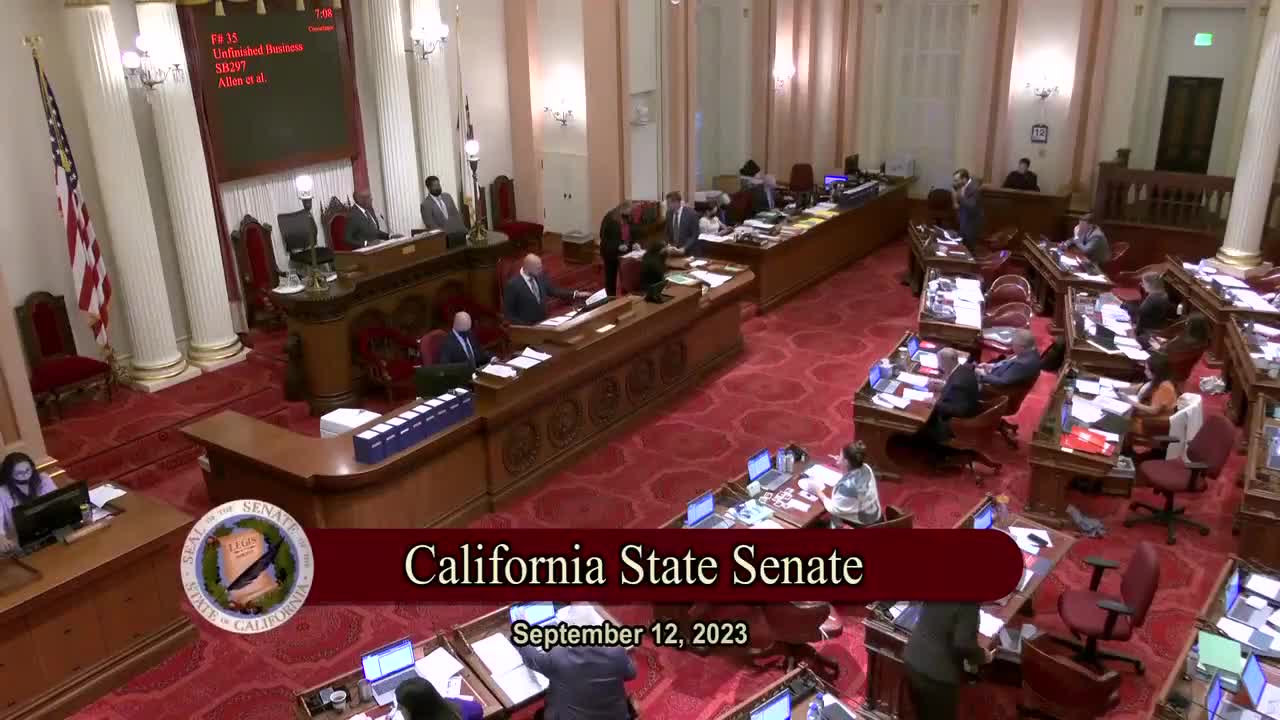 2MIN
Senate Floor
 1MIN
Assembly Floor
 4MIN
Assembly Standing Committee on Health
Bill Author

Bill Co-Author(s):
