SB 509: School employee and pupil training: youth mental and behavioral health: mental health education.
- Session Year: 2023-2024
- House: Senate
- Latest Version Date: 2023-09-15
Current Status:
Failed
(2024-01-25: Stricken from file.)
Introduced
In Committee
First Chamber
In Committee
Second Chamber
Enacted
(1)Existing law, subject to an appropriation, requires the State Department of Education to recommend best practices and identify training programs for use by local educational agencies that serve pupils in any of grades 7 to 12, inclusive, to address youth behavioral health, on or before January 1, 2023, as provided. Existing law requires the department to ensure that each identified training program, among other requirements, provides instruction on recognizing the signs and symptoms of youth behavioral health disorders, including common psychiatric conditions and substance use disorders.
This bill would delete the term common and replace use with abuse for purposes of that instruction requirement. The bill would, subject to an appropriation, require the department to, on or before January 1, 2025, recommend best practices and identify training programs for use by local educational agencies serving pupils in kindergarten or any of grades 1 to 6, inclusive, to address youth behavioral health for those pupils, as provided. The bill would require, on or before July 1, 2027, local educational agencies serving pupils in any of grades 7 to 12, inclusive, to certify to the department that 40% of its classified employees and 100% of its certificated employees, who serve and have direct contact with pupils in any of grades 7 to 12, inclusive, at school, have received the above-described youth behavioral health training, as specified. The bill would prohibit the training in youth behavioral health to be a condition of employment or hiring. By imposing training certification duties on local educational agencies, the bill would impose a state-mandated local program.
(2)Existing law requires the adopted course of study for grades 1 to 6, inclusive, to include certain areas of study, including, among others, English, mathematics, social sciences, science, visual and performing arts, and health, as specified. With respect to the study of health, existing law requires instruction in the principles and practices of individual, family, and community health.
This bill would require that health area of study for grades 1 to 6, inclusive, to also include instruction on mental health. To the extent that this requirement would impose new duties on local educational agencies, it would constitute a state-mandated local program.
(3)This bill would incorporate additional changes to Section 51210 of the Education Code proposed by AB 285 and AB 446 to be operative only if this bill and either or both of those bills are enacted and this bill is enacted last.
(4)The California Constitution requires the state to reimburse local agencies and school districts for certain costs mandated by the state. Statutory provisions establish procedures for making that reimbursement.
This bill would provide that, if the Commission on State Mandates determines that the bill contains costs mandated by the state, reimbursement for those costs shall be made pursuant to the statutory provisions noted above.
(1)Existing law, subject to an appropriation, requires the State Department of Education to recommend best practices and identify training programs for use by local educational agencies that serve pupils in any of grades 7 to 12, inclusive, to address youth behavioral health, on or before January 1, 2023, as provided. Existing law requires the department to ensure that each identified training program, among other requirements, provides instruction on recognizing the signs and symptoms of youth behavioral health disorders, including common psychiatric conditions and substance use disorders.
This bill would delete the term common and replace use with abuse for purposes of that instruction requirement. The bill would, subject to an appropriation, require the department to, on or before January 1, 2025, recommend best practices and identify training programs for use by local educational agencies serving pupils in kindergarten or any of grades 1 to 6, inclusive, to address youth behavioral health for those pupils, as provided. The bill would require, on or before July 1, 2027, local educational agencies serving pupils in any of grades 7 to 12, inclusive, to certify to the department that 40% of its classified employees and 100% of its certificated employees, who serve and have direct contact with pupils in any of grades 7 to 12, inclusive, at school, have received the above-described youth behavioral health training, as specified. The bill would prohibit the training in youth behavioral health to be a condition of employment or hiring. By imposing training certification duties on local educational agencies, the bill would impose a state-mandated local program.
(2)Existing law requires the adopted course of study for grades 1 to 6, inclusive, to include certain areas of study, including, among others, English, mathematics, social sciences, science, visual and performing arts, and health, as specified. With respect to the study of health, existing law requires instruction in the principles and practices of individual, family, and community health.
This bill would require that health area of study for grades 1 to 6, inclusive, to also include instruction on mental health. To the extent that this requirement would impose new duties on local educational agencies, it would constitute a state-mandated local program.
(3)This bill would incorporate additional changes to Section 51210 of the Education Code proposed by AB 285 and AB 446 to be operative only if this bill and either or both of those bills are enacted and this bill is enacted last.
(3)(4)The California Constitution requires the state to reimburse local agencies and school districts for certain costs mandated by the state. Statutory provisions establish procedures for making that reimbursement.
This bill would provide that, if the Commission on State Mandates determines that the bill contains costs mandated by the state, reimbursement for those costs shall be made pursuant to the statutory provisions noted above.
(1)Existing law, subject to an appropriation, requires the State Department of Education to recommend best practices and identify training programs for use by local educational agencies that serve pupils in any of grades 7 to 12, inclusive, to address youth behavioral health, on or before January 1, 2023, as provided. Existing law requires the department to ensure that each identified training program, among other requirements, provides instruction on recognizing the signs and symptoms of youth behavioral health disorders, including common psychiatric conditions and substance use disorders, and on how school staff can best provide referrals to youth behavioral health services or other support to individuals in the early stages of developing a youth behavioral health disorder. disorders.
This bill would delete the term common from the specific examples included in the above-described training requirement of youth behavioral health disorders. The and replace use with abuse for purposes of that instruction requirement. The bill would, subject to an appropriation, require the department to, on or before January 1, 2025, recommend best practices and identify training programs for use by local educational agencies serving pupils in kindergarten or any of grades 1 to 6, inclusive, to address youth behavioral health for those pupils, as provided. The bill would require, on or before July 1, 2027, local educational agencies serving pupils in any of grades 7 to 12, inclusive, to certify to the department that 75% 40% of each of its classified employees and 100% of its certificated employees, who serve and have direct contact with pupils in any of grades 7 to 12, inclusive, at school, have received that the above-described youth behavioral health training, as specified. The bill would prohibit the training in youth behavioral health to be a condition of employment or hiring. By imposing training certification duties on local educational agencies, the bill would impose a state-mandated local program.
(2)Existing law requires, if a school district, county office of education, state special school, or charter school offers one or more courses in health education to pupils in middle school or high school, that the course or courses include instruction in mental health that meet certain requirements, including, among others, defining signs and symptoms of common mental health challenges and the ability to identify warning signs of common mental health problems, as specified.This bill instead would require a school district, county office of education, state special school, or charter school to ensure that all pupils in grades 1 to 12, inclusive, receive evidence-based, age-appropriate mental health education from instructors trained in the appropriate courses at least once in elementary school, at least once in junior high school or middle school, as applicable, and at least once in high school, as provided. The bill would delete the term common from the above-described requirements. By imposing additional duties on local educational agencies, the bill would impose a state-mandated local program. The bill also would make legislative findings and declarations related to the benefits of mental health education for those pupils.(2)Existing law requires the adopted course of study for grades 1 to 6, inclusive, to include certain areas of study, including, among others, English, mathematics, social sciences, science, visual and performing arts, and health, as specified. With respect to the study of health, existing law requires instruction in the principles and practices of individual, family, and community health.
This bill would require that health area of study for grades 1 to 6, inclusive, to also include instruction on mental health. To the extent that this requirement would impose new duties on local educational agencies, it would constitute a state-mandated local program.
(3)The California Constitution requires the state to reimburse local agencies and school districts for certain costs mandated by the state. Statutory provisions establish procedures for making that reimbursement.
This bill would provide that, if the Commission on State Mandates determines that the bill contains costs mandated by the state, reimbursement for those costs shall be made pursuant to the statutory provisions noted above.
(1)Existing law, subject to an appropriation, requires the State Department of Education to recommend best practices and identify training programs for use by local educational agencies to address youth behavioral health, on or before January 1, 2023, as provided. Existing law requires the department to ensure that each identified training program, among other requirements, provides instruction on recognizing the signs and symptoms of youth behavioral health disorders, including common psychiatric conditions and substance use disorders, and on how school staff can best provide referrals to youth behavioral health services or other support to individuals in the early stages of developing a youth behavioral health disorder.
This bill would delete the term common from the specific examples from included in the above-described training requirement of youth behavioral health disorders. The bill would require, on or before January July 1, 2027, local educational agencies to certify to the department that 75% of each of its classified and certificated employees, who have direct contact with pupils at school, have received that youth behavioral health training, as specified. The bill would prohibit the training in youth behavioral health to be a condition of employment or hiring. By imposing training certification duties on local educational agencies, the bill would impose a state-mandated local program.
(2)Existing law requires, if a school district, county office of education, state special school, or charter school offers one or more courses in health education to pupils in middle school or high school, that the course or courses include instruction in mental health that meet certain requirements, including, among others, defining signs and symptoms of common mental health challenges and the ability to identify warning signs of common mental health problems, as specified.
This bill instead would require a school district, county office of education, state special school, or charter school to ensure that all pupils in grades 1 to 12, inclusive, receive evidence-based, age-appropriate mental health education from instructors trained in the appropriate courses at least once in elementary school, at least once in junior high school or middle school, as applicable, and at least once in high school, as provided. The bill would delete the term common from the above-described requirements. By imposing additional duties on local educational agencies, the bill would impose a state-mandated local program. The bill also would make legislative findings and declarations related to the benefits of mental health education for those pupils.
(3)Under existing law, each school district and county office of education is responsible for the overall development of a comprehensive school safety plan for each of its schools operating kindergarten or any of grades 1 to 12, inclusive, in cooperation with certain local entities. Existing law requires that the plan identify appropriate strategies and programs that will provide or maintain a high level of school safety and address the schools procedures for complying with existing laws related to school safety. Existing law requires a charter school to annually update its school safety plan that includes certain safety topics and procedures.This bill would additionally require a county office of education, school district, or charter school that serves pupils in any of grades 7 to 12, inclusive, to annually include in its comprehensive school safety plan or school safety plan, as applicable, the number of school employees that have received the youth behavioral health training described in paragraph (1) above and the percentage of total school employees that received that training. By imposing new duties on local educational agencies, the bill would impose a state-mandated local program.(4)(3)The California Constitution requires the state to reimburse local agencies and school districts for certain costs mandated by the state. Statutory provisions establish procedures for making that reimbursement.
This bill would provide that, if the Commission on State Mandates determines that the bill contains costs mandated by the state, reimbursement for those costs shall be made pursuant to the statutory provisions noted above.
(1)Existing law, subject to an appropriation, requires the State Department of Education to recommend best practices and identify training programs for use by local educational agencies to address youth behavioral health, on or before January 1, 2023, as provided. Existing law requires the department to ensure that each identified training program, among other requirements, provides instruction on recognizing the signs and symptoms of youth behavioral health disorders, including common psychiatric conditions and substance use disorders, and on how school staff can best provide referrals to youth behavioral health services or other support to individuals in the early stages of developing a youth behavioral health disorder.
This bill would require the department, on or before July 1, 2024, to identify training programs that also include instruction on how school staff can best provide referrals to special education services. The bill would provide, for purposes of the instruction on recognizing the signs and symptoms of youth behavioral health disorders, the examples of schizophrenia, bipolar disorder, major clinical depression, and anxiety disorders. delete the specific examples from the above-described training requirement of youth behavioral health disorders. The bill would require, on or before January 1, 2027, local educational agencies to certify to the department that 75% of each of its classified and certificated employees, who have direct contact with pupils at school, have received that youth behavioral health training, as specified. The bill would prohibit the training in youth behavioral health to be a condition of employment or hiring. By imposing training certification duties on local educational agencies, the bill would impose a state-mandated local program.
(2)Existing law requires, if a school district, county office of education, state special school, or charter school offer offers one or more courses in health education to pupils in middle school or high school, that the course or courses include instruction in mental health that meet certain requirements, including, among others, defining signs and symptoms of common mental health challenges and the ability to identify warning signs of common mental health problems, as specified.
This bill instead would require a school district, county office of education, state special school, or charter school to ensure that all pupils in grades 1 to 12, inclusive, receive evidence-based, age-appropriate mental health education from instructors trained in the appropriate courses at least once in elementary school, at least once in junior high school or middle school, as applicable, and at least once in high school, as provided. The bill would delete the term common from the above-described requirements. By imposing additional duties on local educational agencies, the bill would impose a state-mandated local program. The bill also would make legislative findings and declarations related to the benefits of mental health education for those pupils.
(3)Under existing law, each school district and county office of education is responsible for the overall development of a comprehensive school safety plan for each of its schools operating kindergarten or any of grades 1 to 12, inclusive, in cooperation with certain local entities. Existing law requires that the plan identify appropriate strategies and programs that will provide or maintain a high level of school safety and address the schools procedures for complying with existing laws related to school safety. Existing law requires a charter school to annually update its school safety plan that includes certain safety topics and procedures.
This bill would additionally require a county office of education, school district, or charter school that serves pupils in any of grades 7 to 12, inclusive, to annually include in its comprehensive school safety plan or school safety plan, as applicable, the number of school employees that have received the youth behavioral health training described in paragraph (1) above and the percentage of total school employees that received that training. By imposing new duties on local educational agencies, the bill would impose a state-mandated local program.
(3)(4)The California Constitution requires the state to reimburse local agencies and school districts for certain costs mandated by the state. Statutory provisions establish procedures for making that reimbursement.
This bill would provide that, if the Commission on State Mandates determines that the bill contains costs mandated by the state, reimbursement for those costs shall be made pursuant to the statutory provisions noted above.
(1)Existing law, subject to an appropriation, requires the State Department of Education to recommend best practices and identify training programs for use by local educational agencies to address youth behavioral health, on or before January 1, 2023, as provided. Existing law requires the department to ensure that each identified training program, among other requirements, provides instruction on recognizing the signs and symptoms of youth behavioral health disorders, including common psychiatric conditions and substance use disorders, and on how school staff can best provide referrals to youth behavioral health services or other support to individuals in the early stages of developing a youth behavioral health disorder.
This bill would require the department, on or before July 1, 2024, to identify training programs that also include instruction on how school staff can best provide referrals to special education services. The bill would provide, for purposes of the instruction on recognizing the signs and symptoms of youth behavioral health disorders, the examples of schizophrenia, bipolar disorder, major clinical depression, and anxiety disorders. The bill would require, on or before January 1, 2027, local educational agencies to certify to the department that 75% of each of its classified and certificated employees, who have direct contact with pupils at school, have received that youth behavioral health training, as specified. The bill would prohibit the training in youth behavioral health to be a condition of employment or hiring. By imposing training certification duties on local educational agencies, the bill would impose a state-mandated local program.
(2)Existing law requires, if a school district, county office of education, state special school, or charter school offer one or more courses in health education to pupils in middle school or high school, that the course or courses include instruction in mental health that meet certain requirements, as specified.
This bill instead would require a school district, county office of education, state special school, or charter school to ensure that all pupils in grades 1 to 12, inclusive, receive evidence-based, age-appropriate mental health education from instructors trained in the appropriate courses at least once in elementary school, at least once in junior high school or middle school, as applicable, and at least once in high school, as provided. By imposing additional duties on local educational agencies, the bill would impose a state-mandated local program. The bill also would make legislative findings and declarations related to the benefits of mental health education for those pupils.
(3) The California Constitution requires the state to reimburse local agencies and school districts for certain costs mandated by the state. Statutory provisions establish procedures for making that reimbursement.
This bill would provide that, if the Commission on State Mandates determines that the bill contains costs mandated by the state, reimbursement for those costs shall be made pursuant to the statutory provisions noted above.
(a)The Legislature finds and declares all of the following:
(1)Mental health is critical to overall health, well-being, and academic success.
(2)Mental health challenges affect all age groups, races, ethnicities, and socioeconomic classes.
(3)Millions of Californians, including at least one in five youths, live with mental health challenges. Millions more are affected by the mental health challenges of someone else, such as a close friend or family member.
(4)Mental health education is one of the best ways to increase awareness and the seeking of help, while reducing the stigma associated with mental health challenges. The public education system is the most efficient and effective setting for providing this education to all youth.
(b)For the foregoing reasons, it is the intent of the Legislature in enacting this measure to ensure that all California pupils in grades 1 to 12, inclusive, have the opportunity to benefit from a comprehensive mental health education.
SEC. 2.Section 49428.15 of the Education Code is amended to read:49428.15.(a)For purposes of this section, except as otherwise specified, the following definitions apply:
(1)Evidence-based means peer-reviewed, scientific research evidence, including studies based on research methodologies that control threats to both the internal and the external validity of the research findings.
(2)Evidence-informed means using research that is already available and has been tested for efficacy and effectiveness. This evidence is then combined with the experiences and expertise of the training program developers to best fit the population intended to be served.
(3)Local educational agency means a county office of education, school district, state special school, or charter school that serves pupils in any of grades 7 to 12, inclusive.
(4)Youth behavioral health disorders means pupil mental health and substance use disorders.
(5)Youth behavioral health training means training addressing the signs and symptoms of a pupil mental health or substance use disorder.
(b)The department shall, on or before January 1, 2023, recommend best practices, and identify evidence-based and evidence-informed training programs for schools to address youth behavioral health, including, but not necessarily limited to, staff and pupil training.
(c)In identifying one or more evidence-based or evidence-informed youth behavioral health training programs for use by local educational agencies to train school staff or pupils pursuant to subdivision (b), the department shall ensure that each training program meets all of the following requirements:
(1)Provides instruction on recognizing the signs and symptoms of youth behavioral health disorders, including psychiatric conditions and substance abuse disorders such as opioid and alcohol abuse.
(2)Provides instruction on how school staff can best provide referrals to youth behavioral health services or other support to individuals in the early stages of developing a youth behavioral health disorder.
(3)Provides instruction on how to maintain pupil privacy and confidentiality in a manner consistent with federal and state privacy laws.
(4)Provides instruction on the safe deescalation of crisis situations involving individuals with a youth behavioral health disorder.
(5)Is capable of assessing trainee knowledge before and after training is provided in order to measure training outcomes.
(6)Is administered by a nationally recognized training authority in youth behavioral health disorders or by a local educational agency.
(7)(A)Includes in-person and virtual training with certified instructors who can recommend resources available in the community for individuals with a youth behavioral health disorder.
(B)For purposes of this paragraph, certified instructors means individuals who obtain or have obtained a certification to provide the selected youth behavioral health training.
(d)(1)The department shall, on or before January 1, 2025, recommend best practices, and identify evidence-based and evidence-informed training programs for schools to address youth behavioral health, including, but not necessarily limited to, staff and pupil training, for pupils in kindergarten or any of grades 1 to 6, inclusive.
(2)In identifying one or more evidence-based or evidence-informed youth behavioral health training programs for use by local educational agencies to train school staff or pupils pursuant to subdivision (b), the department shall ensure that each training program meets all of the requirements of subdivision (c) of this section, as applicable to training programs to address youth behavioral health for pupils in kindergarten and grades 1 to 6, inclusive.
(3)For purposes of this subdivision, local educational agency means a county office of education, school district, state special school, or charter school that serves pupils in kindergarten or any of grades 1 to 6, inclusive.
(e)This section shall be implemented only to the extent that an appropriation is made in the annual Budget Act or another statute for these purposes.
SEC. 3.Section 49428.3 is added to the Education Code, to read:49428.3.(a)For purposes of this section, the following definitions apply:
(1)Evidence-based means peer-reviewed, scientific research evidence, including studies based on research methodologies that control threats to both the internal and the external validity of the research findings.
(2)Evidence-informed means using research that is already available and has been tested for efficacy and effectiveness. This evidence is then combined with the experiences and expertise of the training program developers to best fit the population intended to be served.
(3)Local educational agency means a county office of education, school district, state special school, or charter school that serves pupils in any of grades 7 to 12, inclusive.
(4)Youth behavioral health disorders means pupil mental health and substance use disorders.
(5)Youth behavioral health training means training addressing the signs and symptoms of a pupil mental health or substance use disorder.
(b)Subject to subdivision (c), on or before July 1, 2027, a local educational agency shall certify to the department that 100 percent of its certificated employees and 40 percent of its classified staff, who have direct contact with pupils in any of grades 7 to 12, have received the youth behavioral health training described in subdivision (c) of Section 49428.15, in accordance with all of the following:
(1)Except as provided in paragraph (2), the youth behavioral health training is provided to classified and certificated employees during regularly scheduled work hours.
(2)If a classified or certificated employee receives the youth behavioral health training in a manner other than through an in-service training program provided by the local educational agency, the employee may present a certificate of successful completion of the training to the local educational agency for purposes of satisfying the requirements of this subdivision.
(3)The youth behavioral health training shall not be a condition of employment or hiring for classified or certificated employees.
(c)A local educational agency may exclude a licensed mental health professional who holds a pupil personnel services credential from the youth behavioral health training required by this section.
(d)Notwithstanding paragraph (6) of subdivision (c) of Section 49428.15, a local educational agency may meet the requirements of this section by having a school employee of the local educational agency who holds a pupil personnel services credential provide the youth behavioral health training to the school employees of the local educational agency, if the training program is identified by the department on a list pursuant to subdivision (c) of Section 49428.15. School employees who provide the youth behavioral health training to other school employees are required to complete any training requirements necessary, as established by the training program identified, to provide training to other school employees.
SEC. 4.Section 51210 of the Education Code is amended to read:51210.(a)The adopted course of study for grades 1 to 6, inclusive, shall include instruction, beginning in grade 1 and continuing through grade 6, in the following areas of study:
(1)English, including knowledge of, and appreciation for literature and the language, as well as the skills of speaking, reading, listening, spelling, handwriting, and composition.
(2)Mathematics, including concepts, operational skills, and problem solving.
(3)Social sciences, drawing upon the disciplines of anthropology, economics, geography, history, political science, psychology, and sociology, designed to fit the maturity of the pupils. Instruction shall provide a foundation for understanding the history, resources, development, and government of California and the United States of America; the development of the American economic system, including the role of the entrepreneur and labor; the relations of persons to their human and natural environment; eastern and western cultures and civilizations; contemporary issues; and the wise use of natural resources.
(4)Science, including the biological and physical aspects, with emphasis on the processes of experimental inquiry and on the place of humans in ecological systems.
(5)Visual and performing arts, including instruction in the subjects of dance, music, theatre, and visual arts, aimed at the development of aesthetic appreciation and the skills of creative expression.
(6)Health, including instruction in the principles and practices of individual, family, and community health, and including instruction on mental health.
(7)Physical education, with emphasis upon the physical activities for the pupils that may be conducive to health and vigor of body and mind, for a total period of time of not less than 200 minutes each 10 schooldays, exclusive of recesses and the lunch period.
(8)Other studies that may be prescribed by the governing board.
(b)(1)A complaint that a school district or county superintendent of schools has not complied with the instructional minute requirements of paragraph (7) of subdivision (a) may be filed with a school district or county superintendent of schools pursuant to the Uniform Complaint Procedures set forth in Chapter 5.1 (commencing with Section 4600) of Division 1 of Title 5 of the California Code of Regulations.
(2)A complainant not satisfied with the decision of a school district or county superintendent of schools may appeal the decision to the department pursuant to Chapter 5.1 (commencing with Section 4600) of Division 1 of Title 5 of the California Code of Regulations and shall receive a written appeal decision within 60 days of the departments receipt of the appeal.
(3)If a school district or county superintendent of schools finds merit in a complaint, or the Superintendent finds merit in an appeal, the school district or county superintendent of schools shall provide a remedy to all affected pupils, parents, and guardians.
(c)The Legislature finds and declares that neither the original provisions of this section, nor any subsequent amendments to it, were intended to create a private right of action. However, nothing in this subdivision shall restrict or expand the existing right of any party to seek relief from noncompliance with this section pursuant to a writ of mandate.
SEC. 4.1.Section 51210 of the Education Code is amended to read:51210.(a)The adopted course of study for grades 1 to 6, inclusive, shall include instruction, beginning in grade 1 and continuing through grade 6, in the following areas of study:
(1)English, including knowledge of, and appreciation for, literature and the language, as well as the skills of speaking, reading, listening, spelling, handwriting, and composition.
(2)Mathematics, including concepts, operational skills, and problem solving.
(3)Social sciences, drawing upon the disciplines of anthropology, economics, geography, history, political science, psychology, and sociology, designed to fit the maturity of the pupils. Instruction shall provide a foundation for understanding the history, resources, development, and government of California and the United States of America; the development of the American economic system, including the role of the entrepreneur and labor; the relations of persons to their human and natural environment; eastern and western cultures and civilizations; contemporary issues; and the wise use of natural resources.
(4)Science, including the biological and physical aspects, with emphasis on the processes of experimental inquiry, on the place of humans in ecological systems, on the causes and effects of climate change, and on the methods to mitigate and adapt to climate change. Appropriate coursework including material on the causes and effects of climate change and methods to mitigate and adapt to climate change shall be offered to pupils as soon as possible, commencing no later than the 202425 school year.
(5)Visual and performing arts, including instruction in the subjects of dance, music, theater, and visual arts, aimed at the development of aesthetic appreciation and the skills of creative expression.
(6)Health, including instruction in the principles and practices of individual, family, and community health, and including instruction on mental health.
(7)Physical education, with emphasis upon the physical activities for the pupils that may be conducive to health and vigor of body and mind, for a total period of time of not less than 200 minutes each 10 schooldays, excluding recesses and the lunch period.
(8)Other studies that the governing board may prescribe.
(b)(1)A complaint that a school district or county superintendent of schools has not complied with the instructional minute requirements of paragraph (7) of subdivision (a) may be filed with a school district or county superintendent of schools pursuant to the Uniform Complaint Procedures set forth in Chapter 5.1 (commencing with Section 4600) of Division 1 of Title 5 of the California Code of Regulations.
(2)A complainant not satisfied with the decision of a school district or county superintendent of schools may appeal the decision to the department pursuant to Chapter 5.1 (commencing with Section 4600) of Division 1 of Title 5 of the California Code of Regulations and shall receive a written appeal decision within 60 days of the departments receipt of the appeal.
(3)If a school district or county superintendent of schools finds merit in a complaint, or the Superintendent finds merit in an appeal, the school district or county superintendent of schools shall provide a remedy to all affected pupils, parents, and guardians.
(c)The Legislature finds and declares that neither the original provisions of this section, nor any subsequent amendments to it, were intended to create a private right of action. However, nothing in this subdivision shall restrict or expand the existing right of any party to seek relief from noncompliance with this section pursuant to a writ of mandate.
SEC. 4.2.Section 51210 of the Education Code is amended to read:51210.(a)The adopted course of study for grades 1 to 6, inclusive, shall include instruction, beginning in grade 1 and continuing through grade 6, in the following areas of study:
(1)English, including knowledge of, and appreciation for, literature and the language, as well as the skills of speaking, reading, listening, spelling, handwriting, including instruction in cursive or joined italics in the appropriate grade levels, and composition.
(2)Mathematics, including concepts, operational skills, and problem solving.
(3)Social sciences, drawing upon the disciplines of anthropology, economics, geography, history, political science, psychology, and sociology, designed to fit the maturity of the pupils. Instruction shall provide a foundation for understanding the history, resources, development, and government of California and the United States of America; the development of the American economic system, including the role of the entrepreneur and labor; the relations of persons to their human and natural environment; eastern and western cultures and civilizations; contemporary issues; and the wise use of natural resources.
(4)Science, including the biological and physical aspects, with emphasis on the processes of experimental inquiry and on the place of humans in ecological systems.
(5)Visual and performing arts, including instruction in the subjects of dance, music, theater, and visual arts, aimed at the development of aesthetic appreciation and the skills of creative expression.
(6)Health, including instruction in the principles and practices of individual, family, and community health, and including instruction on mental health.
(7)Physical education, with emphasis upon the physical activities for the pupils that may be conducive to health and vigor of body and mind, for a total period of time of not less than 200 minutes each 10 schooldays, excluding recesses and the lunch period.
(8)Other studies that the governing board may prescribe.
(b)(1)A complaint that a school district or county superintendent of schools has not complied with the instructional minute requirements of paragraph (7) of subdivision (a) may be filed with a school district or county superintendent of schools pursuant to the Uniform Complaint Procedures set forth in Chapter 5.1 (commencing with Section 4600) of Division 1 of Title 5 of the California Code of Regulations.
(2)A complainant not satisfied with the decision of a school district or county superintendent of schools may appeal the decision to the department pursuant to Chapter 5.1 (commencing with Section 4600) of Division 1 of Title 5 of the California Code of Regulations and shall receive a written appeal decision within 60 days of the departments receipt of the appeal.
(3)If a school district or county superintendent of schools finds merit in a complaint, or the Superintendent finds merit in an appeal, the school district or county superintendent of schools shall provide a remedy to all affected pupils, parents, and guardians.
(c)The Legislature finds and declares that neither the original provisions of this section, nor any subsequent amendments to it, were intended to create a private right of action. However, nothing in this subdivision shall restrict or expand the existing right of any party to seek relief from noncompliance with this section pursuant to a writ of mandate.
SEC. 4.3.Section 51210 of the Education Code is amended to read:51210.(a)The adopted course of study for grades 1 to 6, inclusive, shall include instruction, beginning in grade 1 and continuing through grade 6, in the following areas of study:
(1)English, including knowledge of, and appreciation for, literature and the language, as well as the skills of speaking, reading, listening, spelling, handwriting, including instruction in cursive or joined italics in the appropriate grade levels, and composition.
(2)Mathematics, including concepts, operational skills, and problem solving.
(3)Social sciences, drawing upon the disciplines of anthropology, economics, geography, history, political science, psychology, and sociology, designed to fit the maturity of the pupils. Instruction shall provide a foundation for understanding the history, resources, development, and government of California and the United States of America; the development of the American economic system, including the role of the entrepreneur and labor; the relations of persons to their human and natural environment; eastern and western cultures and civilizations; contemporary issues; and the wise use of natural resources.
(4)Science, including the biological and physical aspects, with emphasis on the processes of experimental inquiry, on the place of humans in ecological systems, on the causes and effects of climate change, and on the methods to mitigate and adapt to climate change. Appropriate coursework including material on the causes and effects of climate change and methods to mitigate and adapt to climate change shall be offered to pupils as soon as possible, commencing no later than the 202425 school year.
(5)Visual and performing arts, including instruction in the subjects of dance, music, theater, and visual arts, aimed at the development of aesthetic appreciation and the skills of creative expression.
(6)Health, including instruction in the principles and practices of individual, family, and community health, and including instruction on mental health.
(7)Physical education, with emphasis upon the physical activities for the pupils that may be conducive to health and vigor of body and mind, for a total period of time of not less than 200 minutes each 10 schooldays, excluding recesses and the lunch period.
(8)Other studies that the governing board may prescribe.
(b)(1)A complaint that a school district or county superintendent of schools has not complied with the instructional minute requirements of paragraph (7) of subdivision (a) may be filed with a school district or county superintendent of schools pursuant to the Uniform Complaint Procedures set forth in Chapter 5.1 (commencing with Section 4600) of Division 1 of Title 5 of the California Code of Regulations.
(2)A complainant not satisfied with the decision of a school district or county superintendent of schools may appeal the decision to the department pursuant to Chapter 5.1 (commencing with Section 4600) of Division 1 of Title 5 of the California Code of Regulations and shall receive a written appeal decision within 60 days of the departments receipt of the appeal.
(3)If a school district or county superintendent of schools finds merit in a complaint, or the Superintendent finds merit in an appeal, the school district or county superintendent of schools shall provide a remedy to all affected pupils, parents, and guardians.
(c)The Legislature finds and declares that neither the original provisions of this section, nor any subsequent amendments to it, were intended to create a private right of action. However, nothing in this subdivision shall restrict or expand the existing right of any party to seek relief from noncompliance with this section pursuant to a writ of mandate.
SEC. 5.(a)Section 4.1 of this bill incorporates amendments to Section 51210 of the Education Code proposed by both this bill and Assembly Bill 285. That section of this bill shall only become operative if (1) both bills are enacted and become effective on or before January 1, 2024, (2) each bill amends Section 51210 of the Education Code, (3) Assembly Bill 446 is not enacted or as enacted does not amend that section, and (4) this bill is enacted after Assembly Bill 285, in which case Sections 4, 4.2, and 4.3 of this bill shall not become operative.
(b)Section 4.2 of this bill incorporates amendments to Section 51210 of the Education Code proposed by both this bill and Assembly Bill 446. That section of this bill shall only become operative if (1) both bills are enacted and become effective on or before January 1, 2024, (2) each bill amends Section 51210 of the Education Code, (3) Assembly Bill 285 is not enacted or as enacted does not amend that section, and (4) this bill is enacted after Assembly Bill 446, in which case Sections 4, 4.1, and 4.3 of this bill shall not become operative.
(c)Section 4.3 of this bill incorporates amendments to Section 51210 of the Education Code proposed by this bill, Assembly Bill 285, and Assembly Bill 446. That section of this bill shall only become operative if (1) all three bills are enacted and become effective on or before January 1, 2024, (2) all three bills amend Section 51210 of the Education Code, and (3) this bill is enacted after Assembly Bill 285 and Assembly Bill 446, in which case Sections 4, 4.1, and 4.2 of this bill shall not become operative.
SEC. 6.If the Commission on State Mandates determines that this act contains costs mandated by the state, reimbursement to local agencies and school districts for those costs shall be made pursuant to Part 7 (commencing with Section 17500) of Division 4 of Title 2 of the Government Code.
(a)The Legislature finds and declares all of the following:
(1)Mental health is critical to overall health, well-being, and academic success.
(2)Mental health challenges affect all age groups, races, ethnicities, and socioeconomic classes.
(3)Millions of Californians, including at least one in five youths, live with mental health challenges. Millions more are affected by the mental health challenges of someone else, such as a close friend or family member.
(4)Mental health education is one of the best ways to increase awareness and the seeking of help, while reducing the stigma associated with mental health challenges. The public education system is the most efficient and effective setting for providing this education to all youth.
(b)For the foregoing reasons, it is the intent of the Legislature in enacting this measure to ensure that all California pupils in grades 1 to 12, inclusive, have the opportunity to benefit from a comprehensive mental health education.
SEC. 2.Section 49428.15 of the Education Code is amended to read:49428.15.(a)For purposes of this section, except as otherwise specified, the following definitions apply:
(1)Evidence-based means peer-reviewed, scientific research evidence, including studies based on research methodologies that control threats to both the internal and the external validity of the research findings.
(2)Evidence-informed means using research that is already available and has been tested for efficacy and effectiveness. This evidence is then combined with the experiences and expertise of the training program developers to best fit the population intended to be served.
(3)Local educational agency means a county office of education, school district, state special school, or charter school that serves pupils in any of grades 7 to 12, inclusive.
(4)Youth behavioral health disorders means pupil mental health and substance use disorders.
(5)Youth behavioral health training means training addressing the signs and symptoms of a pupil mental health or substance use disorder.
(b)The department shall, on or before January 1, 2023, recommend best practices, and identify evidence-based and evidence-informed training programs for schools to address youth behavioral health, including, but not necessarily limited to, staff and pupil training.
(c)In identifying one or more evidence-based or evidence-informed youth behavioral health training programs for use by local educational agencies to train school staff or pupils pursuant to subdivision (b), the department shall ensure that each training program meets all of the following requirements:
(1)Provides instruction on recognizing the signs and symptoms of youth behavioral health disorders, including psychiatric conditions and substance abuse disorders such as opioid and alcohol abuse.
(2)Provides instruction on how school staff can best provide referrals to youth behavioral health services or other support to individuals in the early stages of developing a youth behavioral health disorder.
(3)Provides instruction on how to maintain pupil privacy and confidentiality in a manner consistent with federal and state privacy laws.
(4)Provides instruction on the safe deescalation of crisis situations involving individuals with a youth behavioral health disorder.
(5)Is capable of assessing trainee knowledge before and after training is provided in order to measure training outcomes.
(6)Is administered by a nationally recognized training authority in youth behavioral health disorders or by a local educational agency.
(7)(A)Includes in-person and virtual training with certified instructors who can recommend resources available in the community for individuals with a youth behavioral health disorder.
(B)For purposes of this paragraph, certified instructors means individuals who obtain or have obtained a certification to provide the selected youth behavioral health training.
(d)(1)The department shall, on or before January 1, 2025, recommend best practices, and identify evidence-based and evidence-informed training programs for schools to address youth behavioral health, including, but not necessarily limited to, staff and pupil training, for pupils in kindergarten or any of grades 1 to 6, inclusive.
(2)In identifying one or more evidence-based or evidence-informed youth behavioral health training programs for use by local educational agencies to train school staff or pupils pursuant to subdivision (b), the department shall ensure that each training program meets all of the requirements of subdivision (c) of this section, as applicable to training programs to address youth behavioral health for pupils in kindergarten and grades 1 to 6, inclusive.
(3)For purposes of this subdivision, local educational agency means a county office of education, school district, state special school, or charter school that serves pupils in kindergarten or any of grades 1 to 6, inclusive.
(e)This section shall be implemented only to the extent that an appropriation is made in the annual Budget Act or another statute for these purposes.
SEC. 3.Section 49428.3 is added to the Education Code, to read:49428.3.(a)For purposes of this section, the following definitions apply:
(1)Evidence-based means peer-reviewed, scientific research evidence, including studies based on research methodologies that control threats to both the internal and the external validity of the research findings.
(2)Evidence-informed means using research that is already available and has been tested for efficacy and effectiveness. This evidence is then combined with the experiences and expertise of the training program developers to best fit the population intended to be served.
(3)Local educational agency means a county office of education, school district, state special school, or charter school that serves pupils in any of grades 7 to 12, inclusive.
(4)Youth behavioral health disorders means pupil mental health and substance use disorders.
(5)Youth behavioral health training means training addressing the signs and symptoms of a pupil mental health or substance use disorder.
(b)Subject to subdivision (c), on or before July 1, 2027, a local educational agency shall certify to the department that 100 percent of its certificated employees and 40 percent of its classified staff, who have direct contact with pupils in any of grades 7 to 12, have received the youth behavioral health training described in subdivision (c) of Section 49428.15, in accordance with all of the following:
(1)Except as provided in paragraph (2), the youth behavioral health training is provided to classified and certificated employees during regularly scheduled work hours.
(2)If a classified or certificated employee receives the youth behavioral health training in a manner other than through an in-service training program provided by the local educational agency, the employee may present a certificate of successful completion of the training to the local educational agency for purposes of satisfying the requirements of this subdivision.
(3)The youth behavioral health training shall not be a condition of employment or hiring for classified or certificated employees.
(c)A local educational agency may exclude a licensed mental health professional who holds a pupil personnel services credential from the youth behavioral health training required by this section.
(d)Notwithstanding paragraph (6) of subdivision (c) of Section 49428.15, a local educational agency may meet the requirements of this section by having a school employee of the local educational agency who holds a pupil personnel services credential provide the youth behavioral health training to the school employees of the local educational agency, if the training program is identified by the department on a list pursuant to subdivision (c) of Section 49428.15. School employees who provide the youth behavioral health training to other school employees are required to complete any training requirements necessary, as established by the training program identified, to provide training to other school employees.
SEC. 4.Section 51210 of the Education Code is amended to read:51210.(a)The adopted course of study for grades 1 to 6, inclusive, shall include instruction, beginning in grade 1 and continuing through grade 6, in the following areas of study:
(1)English, including knowledge of, and appreciation for literature and the language, as well as the skills of speaking, reading, listening, spelling, handwriting, and composition.
(2)Mathematics, including concepts, operational skills, and problem solving.
(3)Social sciences, drawing upon the disciplines of anthropology, economics, geography, history, political science, psychology, and sociology, designed to fit the maturity of the pupils. Instruction shall provide a foundation for understanding the history, resources, development, and government of California and the United States of America; the development of the American economic system, including the role of the entrepreneur and labor; the relations of persons to their human and natural environment; eastern and western cultures and civilizations; contemporary issues; and the wise use of natural resources.
(4)Science, including the biological and physical aspects, with emphasis on the processes of experimental inquiry and on the place of humans in ecological systems.
(5)Visual and performing arts, including instruction in the subjects of dance, music, theatre, and visual arts, aimed at the development of aesthetic appreciation and the skills of creative expression.
(6)Health, including instruction in the principles and practices of individual, family, and community health, and including instruction on mental health.
(7)Physical education, with emphasis upon the physical activities for the pupils that may be conducive to health and vigor of body and mind, for a total period of time of not less than 200 minutes each 10 schooldays, exclusive of recesses and the lunch period.
(8)Other studies that may be prescribed by the governing board.
(b)(1)A complaint that a school district or county superintendent of schools has not complied with the instructional minute requirements of paragraph (7) of subdivision (a) may be filed with a school district or county superintendent of schools pursuant to the Uniform Complaint Procedures set forth in Chapter 5.1 (commencing with Section 4600) of Division 1 of Title 5 of the California Code of Regulations.
(2)A complainant not satisfied with the decision of a school district or county superintendent of schools may appeal the decision to the department pursuant to Chapter 5.1 (commencing with Section 4600) of Division 1 of Title 5 of the California Code of Regulations and shall receive a written appeal decision within 60 days of the departments receipt of the appeal.
(3)If a school district or county superintendent of schools finds merit in a complaint, or the Superintendent finds merit in an appeal, the school district or county superintendent of schools shall provide a remedy to all affected pupils, parents, and guardians.
(c)The Legislature finds and declares that neither the original provisions of this section, nor any subsequent amendments to it, were intended to create a private right of action. However, nothing in this subdivision shall restrict or expand the existing right of any party to seek relief from noncompliance with this section pursuant to a writ of mandate.
SEC. 4.1.Section 51210 of the Education Code is amended to read:51210.(a)The adopted course of study for grades 1 to 6, inclusive, shall include instruction, beginning in grade 1 and continuing through grade 6, in the following areas of study:
(1)English, including knowledge of, and appreciation for for, literature and the language, as well as the skills of speaking, reading, listening, spelling, handwriting, and composition.
(2)Mathematics, including concepts, operational skills, and problem solving.
(3)Social sciences, drawing upon the disciplines of anthropology, economics, geography, history, political science, psychology, and sociology, designed to fit the maturity of the pupils. Instruction shall provide a foundation for understanding the history, resources, development, and government of California and the United States of America; the development of the American economic system, including the role of the entrepreneur and labor; the relations of persons to their human and natural environment; eastern and western cultures and civilizations; contemporary issues; and the wise use of natural resources.
(4)Science, including the biological and physical aspects, with emphasis on the processes of experimental inquiry and inquiry, on the place of humans in ecological systems. systems, on the causes and effects of climate change, and on the methods to mitigate and adapt to climate change. Appropriate coursework including material on the causes and effects of climate change and methods to mitigate and adapt to climate change shall be offered to pupils as soon as possible, commencing no later than the 202425 school year.
(5)Visual and performing arts, including instruction in the subjects of dance, music, theatre, theater, and visual arts, aimed at the development of aesthetic appreciation and the skills of creative expression.
(6)Health, including instruction in the principles and practices of individual, family, and community health. health, and including instruction on mental health.
(7)Physical education, with emphasis upon the physical activities for the pupils that may be conducive to health and vigor of body and mind, for a total period of time of not less than 200 minutes each 10 schooldays, exclusive of excluding recesses and the lunch period.
(8)Other studies that may be prescribed by the governing board. board may prescribe.
(b)(1)A complaint that a school district or county superintendent of schools has not complied with the instructional minute requirements of paragraph (7) of subdivision (a) may be filed with a school district or county superintendent of schools pursuant to the Uniform Complaint Procedures set forth in Chapter 5.1 (commencing with Section 4600) of Division 1 of Title 5 of the California Code of Regulations.
(2)A complainant not satisfied with the decision of a school district or county superintendent of schools may appeal the decision to the department pursuant to Chapter 5.1 (commencing with Section 4600) of Division 1 of Title 5 of the California Code of Regulations and shall receive a written appeal decision within 60 days of the departments receipt of the appeal.
(3)If a school district or county superintendent of schools finds merit in a complaint, or the Superintendent finds merit in an appeal, the school district or county superintendent of schools shall provide a remedy to all affected pupils, parents, and guardians.
(c)The Legislature finds and declares that neither the original provisions of this section, nor any subsequent amendments to it, were intended to create a private right of action. However, nothing in this subdivision shall restrict or expand the existing right of any party to seek relief from noncompliance with this section pursuant to a writ of mandate.
SEC. 4.2.Section 51210 of the Education Code is amended to read:51210.(a)The adopted course of study for grades 1 to 6, inclusive, shall include instruction, beginning in grade 1 and continuing through grade 6, in the following areas of study:
(1)English, including knowledge of, and appreciation for for, literature and the language, as well as the skills of speaking, reading, listening, spelling, handwriting, including instruction in cursive or joined italics in the appropriate grade levels, and composition.
(2)Mathematics, including concepts, operational skills, and problem solving.
(3)Social sciences, drawing upon the disciplines of anthropology, economics, geography, history, political science, psychology, and sociology, designed to fit the maturity of the pupils. Instruction shall provide a foundation for understanding the history, resources, development, and government of California and the United States of America; the development of the American economic system, including the role of the entrepreneur and labor; the relations of persons to their human and natural environment; eastern and western cultures and civilizations; contemporary issues; and the wise use of natural resources.
(4)Science, including the biological and physical aspects, with emphasis on the processes of experimental inquiry and on the place of humans in ecological systems.
(5)Visual and performing arts, including instruction in the subjects of dance, music, theatre, theater, and visual arts, aimed at the development of aesthetic appreciation and the skills of creative expression.
(6)Health, including instruction in the principles and practices of individual, family, and community health. health, and including instruction on mental health.
(7)Physical education, with emphasis upon the physical activities for the pupils that may be conducive to health and vigor of body and mind, for a total period of time of not less than 200 minutes each 10 schooldays, exclusive of excluding recesses and the lunch period.
(8)Other studies that may be prescribed by the governing board. board may prescribe.
(b)(1)A complaint that a school district or county superintendent of schools has not complied with the instructional minute requirements of paragraph (7) of subdivision (a) may be filed with a school district or county superintendent of schools pursuant to the Uniform Complaint Procedures set forth in Chapter 5.1 (commencing with Section 4600) of Division 1 of Title 5 of the California Code of Regulations.
(2)A complainant not satisfied with the decision of a school district or county superintendent of schools may appeal the decision to the department pursuant to Chapter 5.1 (commencing with Section 4600) of Division 1 of Title 5 of the California Code of Regulations and shall receive a written appeal decision within 60 days of the departments receipt of the appeal.
(3)If a school district or county superintendent of schools finds merit in a complaint, or the Superintendent finds merit in an appeal, the school district or county superintendent of schools shall provide a remedy to all affected pupils, parents, and guardians.
(c)The Legislature finds and declares that neither the original provisions of this section, nor any subsequent amendments to it, were intended to create a private right of action. However, nothing in this subdivision shall restrict or expand the existing right of any party to seek relief from noncompliance with this section pursuant to a writ of mandate.
SEC. 4.3.Section 51210 of the Education Code is amended to read:51210.(a)The adopted course of study for grades 1 to 6, inclusive, shall include instruction, beginning in grade 1 and continuing through grade 6, in the following areas of study:
(1)English, including knowledge of, and appreciation for for, literature and the language, as well as the skills of speaking, reading, listening, spelling, handwriting, including instruction in cursive or joined italics in the appropriate grade levels, and composition.
(2)Mathematics, including concepts, operational skills, and problem solving.
(3)Social sciences, drawing upon the disciplines of anthropology, economics, geography, history, political science, psychology, and sociology, designed to fit the maturity of the pupils. Instruction shall provide a foundation for understanding the history, resources, development, and government of California and the United States of America; the development of the American economic system, including the role of the entrepreneur and labor; the relations of persons to their human and natural environment; eastern and western cultures and civilizations; contemporary issues; and the wise use of natural resources.
(4)Science, including the biological and physical aspects, with emphasis on the processes of experimental inquiry and inquiry, on the place of humans in ecological systems. systems, on the causes and effects of climate change, and on the methods to mitigate and adapt to climate change. Appropriate coursework including material on the causes and effects of climate change and methods to mitigate and adapt to climate change shall be offered to pupils as soon as possible, commencing no later than the 202425 school year.
(5)Visual and performing arts, including instruction in the subjects of dance, music, theatre, theater, and visual arts, aimed at the development of aesthetic appreciation and the skills of creative expression.
(6)Health, including instruction in the principles and practices of individual, family, and community health. health, and including instruction on mental health.
(7)Physical education, with emphasis upon the physical activities for the pupils that may be conducive to health and vigor of body and mind, for a total period of time of not less than 200 minutes each 10 schooldays, exclusive of excluding recesses and the lunch period.
(8)Other studies that may be prescribed by the governing board. board may prescribe.
(b)(1)A complaint that a school district or county superintendent of schools has not complied with the instructional minute requirements of paragraph (7) of subdivision (a) may be filed with a school district or county superintendent of schools pursuant to the Uniform Complaint Procedures set forth in Chapter 5.1 (commencing with Section 4600) of Division 1 of Title 5 of the California Code of Regulations.
(2)A complainant not satisfied with the decision of a school district or county superintendent of schools may appeal the decision to the department pursuant to Chapter 5.1 (commencing with Section 4600) of Division 1 of Title 5 of the California Code of Regulations and shall receive a written appeal decision within 60 days of the departments receipt of the appeal.
(3)If a school district or county superintendent of schools finds merit in a complaint, or the Superintendent finds merit in an appeal, the school district or county superintendent of schools shall provide a remedy to all affected pupils, parents, and guardians.
(c)The Legislature finds and declares that neither the original provisions of this section, nor any subsequent amendments to it, were intended to create a private right of action. However, nothing in this subdivision shall restrict or expand the existing right of any party to seek relief from noncompliance with this section pursuant to a writ of mandate.
SEC. 5.(a)Section 4.1 of this bill incorporates amendments to Section 51210 of the Education Code proposed by both this bill and Assembly Bill 285. That section of this bill shall only become operative if (1) both bills are enacted and become effective on or before January 1, 2024, (2) each bill amends Section 51210 of the Education Code, (3) Assembly Bill 446 is not enacted or as enacted does not amend that section, and (4) this bill is enacted after Assembly Bill 285, in which case Sections 4, 4.2, and 4.3 of this bill shall not become operative.
(b)Section 4.2 of this bill incorporates amendments to Section 51210 of the Education Code proposed by both this bill and Assembly Bill 446. That section of this bill shall only become operative if (1) both bills are enacted and become effective on or before January 1, 2024, (2) each bill amends Section 51210 of the Education Code, (3) Assembly Bill 285 is not enacted or as enacted does not amend that section, and (4) this bill is enacted after Assembly Bill 446, in which case Sections 4, 4.1, and 4.3 of this bill shall not become operative.
(c)Section 4.3 of this bill incorporates amendments to Section 51210 of the Education Code proposed by this bill, Assembly Bill 285, and Assembly Bill 446. That section of this bill shall only become operative if (1) all three bills are enacted and become effective on or before January 1, 2024, (2) all three bills amend Section 51210 of the Education Code, and (3) this bill is enacted after Assembly Bill 285 and Assembly Bill 446, in which case Sections 4, 4.1, and 4.2 of this bill shall not become operative.
SEC. 5.SEC. 6.If the Commission on State Mandates determines that this act contains costs mandated by the state, reimbursement to local agencies and school districts for those costs shall be made pursuant to Part 7 (commencing with Section 17500) of Division 4 of Title 2 of the Government Code.
(a)The Legislature finds and declares all of the following:
(1)Mental health is critical to overall health, well-being, and academic success.
(2)Mental health challenges affect all age groups, races, ethnicities, and socioeconomic classes.
(3)Millions of Californians, including at least one in five youths, live with mental health challenges. Millions more are affected by the mental health challenges of someone else, such as a close friend or family member.
(4)Mental health education is one of the best ways to increase awareness and the seeking of help, while reducing the stigma associated with mental health challenges. The public education system is the most efficient and effective setting for providing this education to all youth.
(b)For the foregoing reasons, it is the intent of the Legislature in enacting this measure to ensure that all California pupils in grades 1 to 12, inclusive, have the opportunity to benefit from a comprehensive mental health education.
SEC. 2.Section 49428.15 of the Education Code is amended to read:49428.15.(a)For purposes of this section, except as otherwise specified, the following definitions apply:
(1)Evidence-based means peer-reviewed, scientific research evidence, including studies based on research methodologies that control threats to both the internal and the external validity of the research findings.
(2)Evidence-informed means using research that is already available and has been tested for efficacy and effectiveness. This evidence is then combined with the experiences and expertise of the training program developers to best fit the population intended to be served.
(3)Local educational agency means a county office of education, school district, state special school, or charter school that serves pupils in any of grades 7 to 12, inclusive.
(4)Youth behavioral health disorders means pupil mental health and substance use disorders.
(5)Youth behavioral health training means training addressing the signs and symptoms of a pupil mental health or substance use disorder.
(b)The department shall, on or before January 1, 2023, recommend best practices, and identify evidence-based and evidence-informed training programs for schools to address youth behavioral health, including, but not necessarily limited to, staff and pupil training.
(c)In identifying one or more evidence-based or evidence-informed youth behavioral health training programs for use by local educational agencies to train school staff or pupils pursuant to subdivision (b), the department shall ensure that each training program meets all of the following requirements:
(1)Provides instruction on recognizing the signs and symptoms of youth behavioral health disorders, including psychiatric conditions and substance abuse disorders such as opioid and alcohol abuse.
(2)Provides instruction on how school staff can best provide referrals to youth behavioral health services or other support to individuals in the early stages of developing a youth behavioral health disorder.
(3)Provides instruction on how to maintain pupil privacy and confidentiality in a manner consistent with federal and state privacy laws.
(4)Provides instruction on the safe deescalation of crisis situations involving individuals with a youth behavioral health disorder.
(5)Is capable of assessing trainee knowledge before and after training is provided in order to measure training outcomes.
(6)Is administered by a nationally recognized training authority in youth behavioral health disorders or by a local educational agency.
(7)(A)Includes in-person and virtual training with certified instructors who can recommend resources available in the community for individuals with a youth behavioral health disorder.
(B)For purposes of this paragraph, certified instructors means individuals who obtain or have obtained a certification to provide the selected youth behavioral health training.
(d)Subject to subdivision (e), on or before July 1, 2027, a local educational agency shall certify to the department that 75 percent of its classified employees and 75 percent of its certificated employees having direct contact with pupils at each school have received the youth behavioral health training described in subdivision (c) in accordance with all of the following:(1)Except as provided in paragraph (2), the youth behavioral health training is provided to classified and certificated employees during regularly scheduled work hours.(2)If a classified or certificated employee receives the youth behavioral health training in a manner other than through an in-service training program provided by the local educational agency, the employee may present a certificate of successful completion of the training to the local educational agency for purposes of satisfying the requirements of this subdivision.(3)The youth behavioral health training shall not be a condition of employment or hiring for classified or certificated employees.(e)A local educational agency may exclude a licensed mental health professional who holds a pupil personnel service credential from the youth behavioral health training required by this section.(f)Notwithstanding paragraph (6) of subdivision (c), a local educational agency may meet the requirements of this section by having a school employee of the local educational agency who holds a pupil personnel service credential provide the youth behavioral health training to the school employees of the local educational agency, if the training program is identified by the department on a list pursuant to subdivision (c). School employees who provide the youth behavioral health training to other school employees are required to complete any training requirements necessary, as established by the training program identified, to provide training to other school employees.(d)(1)The department shall, on or before January 1, 2025, recommend best practices, and identify evidence-based and evidence-informed training programs for schools to address youth behavioral health, including, but not necessarily limited to, staff and pupil training, for pupils in kindergarten or any of grades 1 to 6, inclusive.
(2)In identifying one or more evidence-based or evidence-informed youth behavioral health training programs for use by local educational agencies to train school staff or pupils pursuant to subdivision (b), the department shall ensure that each training program meets all of the requirements of subdivision (c) of this section, as applicable to training programs to address youth behavioral health for pupils in kindergarten and grades 1 to 6, inclusive.
(3)For purposes of this subdivision, local educational agency means a county office of education, school district, state special school, or charter school that serves pupils in kindergarten or any of grades 1 to 6, inclusive.
(g)(e)This section shall be implemented only to the extent that an appropriation is made in the annual Budget Act or another statute for these purposes.
SEC. 3.Section 49428.3 is added to the Education Code, to read:49428.3.(a)For purposes of this section, the following definitions apply:
(1)Evidence-based means peer-reviewed, scientific research evidence, including studies based on research methodologies that control threats to both the internal and the external validity of the research findings.
(2)Evidence-informed means using research that is already available and has been tested for efficacy and effectiveness. This evidence is then combined with the experiences and expertise of the training program developers to best fit the population intended to be served.
(3)Local educational agency means a county office of education, school district, state special school, or charter school that serves pupils in any of grades 7 to 12, inclusive.
(4)Youth behavioral health disorders means pupil mental health and substance use disorders.
(5)Youth behavioral health training means training addressing the signs and symptoms of a pupil mental health or substance use disorder.
(b)Subject to subdivision (c), on or before July 1, 2027, a local educational agency shall certify to the department that 100 percent of its certificated employees and 40 percent of its classified staff, who have direct contact with pupils in any of grades 7 to 12, have received the youth behavioral health training described in subdivision (c) of Section 49428.15, in accordance with all of the following:
(1)Except as provided in paragraph (2), the youth behavioral health training is provided to classified and certificated employees during regularly scheduled work hours.
(2)If a classified or certificated employee receives the youth behavioral health training in a manner other than through an in-service training program provided by the local educational agency, the employee may present a certificate of successful completion of the training to the local educational agency for purposes of satisfying the requirements of this subdivision.
(3)The youth behavioral health training shall not be a condition of employment or hiring for classified or certificated employees.
(c)A local educational agency may exclude a licensed mental health professional who holds a pupil personnel services credential from the youth behavioral health training required by this section.
(d)Notwithstanding paragraph (6) of subdivision (c) of Section 49428.15, a local educational agency may meet the requirements of this section by having a school employee of the local educational agency who holds a pupil personnel services credential provide the youth behavioral health training to the school employees of the local educational agency, if the training program is identified by the department on a list pursuant to subdivision (c) of Section 49428.15. School employees who provide the youth behavioral health training to other school employees are required to complete any training requirements necessary, as established by the training program identified, to provide training to other school employees.
SEC. 3.Section 51925 of the Education Code is amended to read:51925.Each school district, county office of education, state special school, and charter school shall ensure that all pupils in grades 1 to 12, inclusive, receive evidence-based, age-appropriate mental health education from instructors trained in the appropriate courses at least once in elementary school, at least once in junior high school or middle school, as applicable, and at least once in high school. This instruction shall include all of the following:(a)Reasonably designed instruction on the overarching themes and core principles of mental health.(b)Defining signs and symptoms of mental health challenges. Depending on pupil age and developmental level, this may include defining conditions such as depression, suicidal thoughts and behaviors, schizophrenia, bipolar disorder, eating disorders, and anxiety, including post-traumatic stress disorder.(c)Elucidating the evidence-based services and supports that effectively help individuals manage mental health challenges.(d)Promoting mental health wellness and protective factors, which includes positive development, social and cultural connectedness and supportive relationships, resiliency, problem solving skills, coping skills, self-esteem, and a positive school and home environment in which pupils feel comfortable.(e)The ability to identify warning signs of mental health problems in order to promote awareness and early intervention so that pupils know to take action before a situation turns into a crisis. This shall include instruction on both of the following:(1)How to seek and find assistance from professionals and services within the school district that includes, but is not limited to, school counselors with a pupil personnel services credential, school psychologists, and school social workers, and in the community for themselves or others.(2)Evidence-based and culturally responsive practices that are proven to help overcome mental health challenges.(f)The connection and importance of mental health to overall health and academic success and to co-occurring conditions, such as chronic physical conditions, chemical dependence, and substance abuse.(g)Awareness and appreciation about the prevalence of mental health challenges across all populations, races, ethnicities, and socioeconomic statuses, including the impact of race, ethnicity, and culture on the experience and treatment of mental health challenges.(h)Stigma surrounding mental health challenges and what can be done to overcome stigma, increase awareness, and promote acceptance. This shall include, to the extent possible, classroom presentations of narratives by trained peers and other individuals who have experienced mental health challenges and how they coped with their situations, including how they sought help and acceptance.SEC. 4.Section 51210 of the Education Code is amended to read:51210.(a)The adopted course of study for grades 1 to 6, inclusive, shall include instruction, beginning in grade 1 and continuing through grade 6, in the following areas of study:
(1)English, including knowledge of, and appreciation for literature and the language, as well as the skills of speaking, reading, listening, spelling, handwriting, and composition.
(2)Mathematics, including concepts, operational skills, and problem solving.
(3)Social sciences, drawing upon the disciplines of anthropology, economics, geography, history, political science, psychology, and sociology, designed to fit the maturity of the pupils. Instruction shall provide a foundation for understanding the history, resources, development, and government of California and the United States of America; the development of the American economic system, including the role of the entrepreneur and labor; the relations of persons to their human and natural environment; eastern and western cultures and civilizations; contemporary issues; and the wise use of natural resources.
(4)Science, including the biological and physical aspects, with emphasis on the processes of experimental inquiry and on the place of humans in ecological systems.
(5)Visual and performing arts, including instruction in the subjects of dance, music, theatre, and visual arts, aimed at the development of aesthetic appreciation and the skills of creative expression.
(6)Health, including instruction in the principles and practices of individual, family, and community health. health, and including instruction on mental health.
(7)Physical education, with emphasis upon the physical activities for the pupils that may be conducive to health and vigor of body and mind, for a total period of time of not less than 200 minutes each 10 schooldays, exclusive of recesses and the lunch period.
(8)Other studies that may be prescribed by the governing board.
(b)(1)A complaint that a school district or county superintendent of schools has not complied with the instructional minute requirements of paragraph (7) of subdivision (a) may be filed with a school district or county superintendent of schools pursuant to the Uniform Complaint Procedures set forth in Chapter 5.1 (commencing with Section 4600) of Division 1 of Title 5 of the California Code of Regulations.
(2)A complainant not satisfied with the decision of a school district or county superintendent of schools may appeal the decision to the department pursuant to Chapter 5.1 (commencing with Section 4600) of Division 1 of Title 5 of the California Code of Regulations and shall receive a written appeal decision within 60 days of the departments receipt of the appeal.
(3)If a school district or county superintendent of schools finds merit in a complaint, or the Superintendent finds merit in an appeal, the school district or county superintendent of schools shall provide a remedy to all affected pupils, parents, and guardians.
(c)The Legislature finds and declares that neither the original provisions of this section, nor any subsequent amendments to it, were intended to create a private right of action. However, nothing in this subdivision shall restrict or expand the existing right of any party to seek relief from noncompliance with this section pursuant to a writ of mandate.
SEC. 4.SEC. 5.If the Commission on State Mandates determines that this act contains costs mandated by the state, reimbursement to local agencies and school districts for those costs shall be made pursuant to Part 7 (commencing with Section 17500) of Division 4 of Title 2 of the Government Code.
(a)The Legislature finds and declares all of the following:
(1)Mental health is critical to overall health, well-being, and academic success.
(2)Mental health challenges affect all age groups, races, ethnicities, and socioeconomic classes.
(3)Millions of Californians, including at least one in five youths, live with mental health challenges. Millions more are affected by the mental health challenges of someone else, such as a close friend or family member.
(4)Mental health education is one of the best ways to increase awareness and the seeking of help, while reducing the stigma associated with mental health challenges. The public education system is the most efficient and effective setting for providing this education to all youth.
(b)For the foregoing reasons, it is the intent of the Legislature in enacting this measure to ensure that all California pupils in grades 1 to 12, inclusive, have the opportunity to benefit from a comprehensive mental health education.
SEC. 2.Section 49428.15 of the Education Code is amended to read:49428.15.(a)For purposes of this section, the following definitions apply:
(1)Evidence-based means peer-reviewed, scientific research evidence, including studies based on research methodologies that control threats to both the internal and the external validity of the research findings.
(2)Evidence-informed means using research that is already available and has been tested for efficacy and effectiveness. This evidence is then combined with the experiences and expertise of the training program developers to best fit the population intended to be served.
(3)Local educational agency means a county office of education, school district, state special school, or charter school that serves pupils in any of grades 7 to 12, inclusive.
(4)Youth behavioral health disorders means pupil mental health and substance use disorders.
(5)Youth behavioral health training means training addressing the signs and symptoms of a pupil mental health or substance use disorder.
(b)The department shall, on or before January 1, 2023, recommend best practices, and identify evidence-based and evidence-informed training programs for schools to address youth behavioral health, including, but not necessarily limited to, staff and pupil training.
(c)In identifying one or more evidence-based or evidence-informed youth behavioral health training programs for use by local educational agencies to train school staff or pupils pursuant to subdivision (b), the department shall ensure that each training program meets all of the following requirements:
(1)Provides instruction on recognizing the signs and symptoms of youth behavioral health disorders. disorders, including psychiatric conditions and substance abuse disorders such as opioid and alcohol abuse.
(2)Provides instruction on how school staff can best provide referrals to youth behavioral health services or other support to individuals in the early stages of developing a youth behavioral health disorder.
(3)Provides instruction on how to maintain pupil privacy and confidentiality in a manner consistent with federal and state privacy laws.
(4)Provides instruction on the safe deescalation of crisis situations involving individuals with a youth behavioral health disorder.
(5)Is capable of assessing trainee knowledge before and after training is provided in order to measure training outcomes.
(6)Is administered by a nationally recognized training authority in youth behavioral health disorders or by a local educational agency.
(7)(A)Includes in-person and virtual training with certified instructors who can recommend resources available in the community for individuals with a youth behavioral health disorder.
(B)For purposes of this paragraph, certified instructors means individuals who obtain or have obtained a certification to provide the selected youth behavioral health training.
(d)Subject to subdivision (e), on or before January July 1, 2027, a local educational agency shall certify to the department that 75 percent of its classified employees and 75 percent of its certificated employees having direct contact with pupils at each school have received the youth behavioral health training described in subdivision (c) in accordance with all of the following:
(1)Except as provided in paragraph (2), the youth behavioral health training is provided to classified and certificated employees during regularly scheduled work hours.
(2)If a classified or certificated employee receives the youth behavioral health training in a manner other than through an in-service training program provided by the local educational agency, the employee may present a certificate of successful completion of the training to the local educational agency for purposes of satisfying the requirements of this subdivision.
(3)The youth behavioral health training shall not be a condition of employment or hiring for classified or certificated employees.
(e)A local educational agency shall may exclude a licensed mental health professional who holds a pupil personnel service credential from the youth behavioral health training required by this section.
(f)Notwithstanding paragraph (6) of subdivision (c), a local educational agency may meet the requirements of this section by having a school employee of the local educational agency who holds a pupil personnel service credential provide the youth behavioral health training to the school employees of the local educational agency, if the training program is identified by the department on a list pursuant to subdivision (c). School employees who provide the youth behavioral health training to other school employees are required to complete any training requirements necessary, as established by the training program identified, to provide training to other school employees.
(g)A local educational agency shall include in its school safety plan, in addition to the safety topics listed in subparagraphs (A) to (J), inclusive, of paragraph (2) of subdivision (a) of Section 32282, the number of school employees and the total percentage of school employees that annually have received the youth behavioral health training required by this section.(h)(g)This section shall be implemented only to the extent that an appropriation is made in the annual Budget Act or another statute for these purposes.
SEC. 3.Section 51925 of the Education Code is amended to read:51925.Each school district, county office of education, state special school, and charter school shall ensure that all pupils in grades 1 to 12, inclusive, receive evidence-based, age-appropriate mental health education from instructors trained in the appropriate courses at least once in elementary school, at least once in junior high school or middle school, as applicable, and at least once in high school. This instruction shall include all of the following:
(a)Reasonably designed instruction on the overarching themes and core principles of mental health.
(b)Defining signs and symptoms of mental health challenges. Depending on pupil age and developmental level, this may include defining conditions such as depression, suicidal thoughts and behaviors, schizophrenia, bipolar disorder, eating disorders, and anxiety, including post-traumatic stress disorder.
(c)Elucidating the evidence-based services and supports that effectively help individuals manage mental health challenges.
(d)Promoting mental health wellness and protective factors, which includes positive development, social and cultural connectedness and supportive relationships, resiliency, problem solving skills, coping skills, self-esteem, and a positive school and home environment in which pupils feel comfortable.
(e)The ability to identify warning signs of mental health problems in order to promote awareness and early intervention so that pupils know to take action before a situation turns into a crisis. This shall include instruction on both of the following:
(1)How to seek and find assistance from professionals and services within the school district that includes, but is not limited to, school counselors with a pupil personnel services credential, school psychologists, and school social workers, and in the community for themselves or others.
(2)Evidence-based and culturally responsive practices that are proven to help overcome mental health challenges.
(f)The connection and importance of mental health to overall health and academic success and to co-occurring conditions, such as chronic physical conditions, chemical dependence, and substance abuse.
(g)Awareness and appreciation about the prevalence of mental health challenges across all populations, races, ethnicities, and socioeconomic statuses, including the impact of race, ethnicity, and culture on the experience and treatment of mental health challenges.
(h)Stigma surrounding mental health challenges and what can be done to overcome stigma, increase awareness, and promote acceptance. This shall include, to the extent possible, classroom presentations of narratives by trained peers and other individuals who have experienced mental health challenges and how they coped with their situations, including how they sought help and acceptance.
SEC. 4.If the Commission on State Mandates determines that this act contains costs mandated by the state, reimbursement to local agencies and school districts for those costs shall be made pursuant to Part 7 (commencing with Section 17500) of Division 4 of Title 2 of the Government Code.
(a)The Legislature finds and declares all of the following:
(1)Mental health is critical to overall health, well-being, and academic success.
(2)Mental health challenges affect all age groups, races, ethnicities, and socioeconomic classes.
(3)Millions of Californians, including at least one in five youths, live with mental health challenges. Millions more are affected by the mental health challenges of someone else, such as a close friend or family member.
(4)Mental health education is one of the best ways to increase awareness and the seeking of help, while reducing the stigma associated with mental health challenges. The public education system is the most efficient and effective setting for providing this education to all youth.
(b)For the foregoing reasons, it is the intent of the Legislature in enacting this measure to ensure that all California pupils in grades 1 to 12, inclusive, have the opportunity to benefit from a comprehensive mental health education.
SEC. 2.Section 49428.15 of the Education Code is amended to read:49428.15.(a)For purposes of this section, the following definitions apply:
(1)Evidence-based means peer-reviewed, scientific research evidence, including studies based on research methodologies that control threats to both the internal and the external validity of the research findings.
(2)Evidence-informed means using research that is already available and has been tested for efficacy and effectiveness. This evidence is then combined with the experiences and expertise of the training program developers to best fit the population intended to be served.
(3)Local educational agency means a county office of education, school district, state special school, or charter school that serves pupils in any of grades 7 to 12, inclusive.
(4)Youth behavioral health disorders means pupil mental health and substance use disorders.
(5)Youth behavioral health training means training addressing the signs and symptoms of a pupil mental health or substance use disorder.
(b)The department shall, on or before January 1, 2023, recommend best practices, and identify evidence-based and evidence-informed training programs for schools to address youth behavioral health, including, but not necessarily limited to, staff and pupil training.
(c)In identifying one or more evidence-based or evidence-informed youth behavioral health training programs for use by local educational agencies to train school staff or pupils pursuant to subdivision (b), the department shall ensure that each training program meets all of the following requirements:
(1)(A)Provides instruction on recognizing the signs and symptoms of youth behavioral health disorders, including common psychiatric conditions and common substance use disorders such as opioid and alcohol abuse. disorders.(B)Notwithstanding the deadline specified in subdivision (b), on or before July 1, 2024, provides instruction on recognizing the signs and symptoms of common psychiatric conditions such as schizophrenia, bipolar disorder, major clinical depression, and anxiety disorders.(2)(A)Provides instruction on how school staff can best provide referrals to youth behavioral health services or other support to individuals in the early stages of developing a youth behavioral health disorder.
(B)Notwithstanding the deadline specified in subdivision (b), on or before July 1, 2024, provides instruction on how school staff can best provide referrals to special education services.(3)Provides instruction on how to maintain pupil privacy and confidentiality in a manner consistent with federal and state privacy laws.
(4)Provides instruction on the safe deescalation of crisis situations involving individuals with a youth behavioral health disorder.
(5)Is capable of assessing trainee knowledge before and after training is provided in order to measure training outcomes.
(6)Is administered by a nationally recognized training authority in youth behavioral health disorders or by a local educational agency.
(7)(A)Includes in-person and virtual training with certified instructors who can recommend resources available in the community for individuals with a youth behavioral health disorder.
(B)For purposes of this paragraph, certified instructors means individuals who obtain or have obtained a certification to provide the selected youth behavioral health training.
(d)On Subject to subdivision (e), on or before January 1, 2027, a local educational agency shall certify to the department that 75 percent of its classified employees and 75 percent of its certificated employees having direct contact with pupils at each school have received the youth behavioral health training described in subdivision (c) in accordance with all of the following:
(1)Except as provided in paragraph (2), the youth behavioral health training is provided to classified and certificated employees during regularly scheduled work hours.
(2)If a classified or certificated employee receives the youth behavioral health training in a manner other than through an in-service training program provided by the local educational agency, the employee may present a certificate of successful completion of the training to the local educational agency for purposes of satisfying the requirements of this subdivision.
(3)The youth behavioral health training shall not be a condition of employment or hiring for classified or certificated employees.
(e)A local educational agency shall exclude a licensed mental health professional who holds a pupil personnel service credential from the youth behavioral health training required by this section.
(f)Notwithstanding paragraph (6) of subdivision (c), a local educational agency may meet the requirements of this section by having a school employee of the local educational agency who holds a pupil personnel service credential provide the youth behavioral health training to the school employees of the local educational agency, if the training program is identified by the department on a list pursuant to subdivision (c).
(g)A local educational agency shall include in its school safety plan, in addition to the safety topics listed in subparagraphs (A) to (J), inclusive, of paragraph (2) of subdivision (a) of Section 32282, the number of school employees and the total percentage of school employees that annually have received the youth behavioral health training required by this section.
(e)(h)This section shall be implemented only to the extent that an appropriation is made in the annual Budget Act or another statute for these purposes.
SEC. 3.Section 51925 of the Education Code is amended to read:51925.Each school district, county office of education, state special school, and charter school shall ensure that all pupils in grades 1 to 12, inclusive, receive evidence-based, age-appropriate mental health education from instructors trained in the appropriate courses at least once in elementary school, at least once in junior high school or middle school, as applicable, and at least once in high school. This instruction shall include all of the following:
(a)Reasonably designed instruction on the overarching themes and core principles of mental health.
(b)Defining signs and symptoms of common mental health challenges. Depending on pupil age and developmental level, this may include defining conditions such as depression, suicidal thoughts and behaviors, schizophrenia, bipolar disorder, eating disorders, and anxiety, including post-traumatic stress disorder.
(c)Elucidating the evidence-based services and supports that effectively help individuals manage mental health challenges.
(d)Promoting mental health wellness and protective factors, which includes positive development, social and cultural connectedness and supportive relationships, resiliency, problem solving skills, coping skills, self-esteem, and a positive school and home environment in which pupils feel comfortable.
(e)The ability to identify warning signs of common mental health problems in order to promote awareness and early intervention so that pupils know to take action before a situation turns into a crisis. This shall include instruction on both of the following:
(1)How to seek and find assistance from professionals and services within the school district that includes, but is not limited to, school counselors with a pupil personnel services credential, school psychologists, and school social workers, and in the community for themselves or others.
(2)Evidence-based and culturally responsive practices that are proven to help overcome mental health challenges.
(f)The connection and importance of mental health to overall health and academic success and to co-occurring conditions, such as chronic physical conditions, chemical dependence, and substance abuse.
(g)Awareness and appreciation about the prevalence of mental health challenges across all populations, races, ethnicities, and socioeconomic statuses, including the impact of race, ethnicity, and culture on the experience and treatment of mental health challenges.
(h)Stigma surrounding mental health challenges and what can be done to overcome stigma, increase awareness, and promote acceptance. This shall include, to the extent possible, classroom presentations of narratives by trained peers and other individuals who have experienced mental health challenges and how they coped with their situations, including how they sought help and acceptance.
SEC. 4.If the Commission on State Mandates determines that this act contains costs mandated by the state, reimbursement to local agencies and school districts for those costs shall be made pursuant to Part 7 (commencing with Section 17500) of Division 4 of Title 2 of the Government Code.
(a)The Legislature finds and declares all of the following:
(1)Mental health is critical to overall health, well-being, and academic success.
(2)Mental health challenges affect all age groups, races, ethnicities, and socioeconomic classes.
(3)Millions of Californians, including at least one in five youths, live with mental health challenges. Millions more are affected by the mental health challenges of someone else, such as a close friend or family member.
(4)Mental health education is one of the best ways to increase awareness and the seeking of help, while reducing the stigma associated with mental health challenges. The public education system is the most efficient and effective setting for providing this education to all youth.
(b)For the foregoing reasons, it is the intent of the Legislature in enacting this measure to ensure that all California pupils in grades 1 to 12, inclusive, have the opportunity to benefit from a comprehensive mental health education.
SEC. 2.Section 49428.15 of the Education Code is amended to read:49428.15.(a)For purposes of this section, the following definitions apply:
(1)Evidence-based means peer-reviewed, scientific research evidence, including studies based on research methodologies that control threats to both the internal and the external validity of the research findings.
(2)Evidence-informed means using research that is already available and has been tested for efficacy and effectiveness. This evidence is then combined with the experiences and expertise of the training program developers to best fit the population intended to be served.
(3)Local educational agency means a county office of education, school district, state special school, or charter school that serves pupils in any of grades 7 to 12, inclusive.
(4)Youth behavioral health disorders means pupil mental health and substance use disorders.
(5)Youth behavioral health training means training addressing the signs and symptoms of a pupil mental health or substance use disorder.
(b)The department shall, on or before January 1, 2023, recommend best practices, and identify evidence-based and evidence-informed training programs for schools to address youth behavioral health, including, but not necessarily limited to, staff and pupil training.
(c)In identifying one or more evidence-based or evidence-informed youth behavioral health training programs for use by local educational agencies to train school staff or pupils pursuant to subdivision (b), the department shall ensure that each training program meets all of the following requirements:
(1)(A)Provides instruction on recognizing the signs and symptoms of youth behavioral health disorders, including common psychiatric conditions and common substance use disorders such as opioid and alcohol abuse.
(B)Notwithstanding the deadline specified in subdivision (b), on or before July 1, 2024, provides instruction on recognizing the signs and symptoms of common psychiatric conditions such as schizophrenia, bipolar disorder, major clinical depression, and anxiety disorders.
(2)(A)Provides instruction on how school staff can best provide referrals to youth behavioral health services or other support to individuals in the early stages of developing a youth behavioral health disorder.
(B)Notwithstanding the deadline specified in subdivision (b), on or before July 1, 2024, provides instruction on how school staff can best provide referrals to special education services.
(3)Provides instruction on how to maintain pupil privacy and confidentiality in a manner consistent with federal and state privacy laws.
(4)Provides instruction on the safe deescalation of crisis situations involving individuals with a youth behavioral health disorder.
(5)Is capable of assessing trainee knowledge before and after training is provided in order to measure training outcomes.
(6)Is administered by a nationally recognized training authority in youth behavioral health disorders or by a local educational agency.
(7)(A)Includes in-person and virtual training with certified instructors who can recommend resources available in the community for individuals with a youth behavioral health disorder.
(B)For purposes of this paragraph, certified instructors means individuals who obtain or have obtained a certification to provide the selected youth behavioral health training.
(d)On or before January 1, 2027, a local educational agency shall certify to the department that 75 percent of its classified employees and 75 percent of its certificated employees having direct contact with pupils at each school have received the youth behavioral health training described in subdivision (c) in accordance with all of the following:
(1)Except as provided in paragraph (2), the youth behavioral health training is provided to classified and certificated employees during regularly scheduled work hours.
(2)If a classified or certificated employee receives the youth behavioral health training in a manner other than through an in-service training program provided by the local educational agency, the employee may present a certificate of successful completion of the training to the local educational agency for purposes of satisfying the requirements of this subdivision.
(3)The youth behavioral health training shall not be a condition of employment or hiring for classified or certificated employees.
(d)(e)This section shall be implemented only to the extent that an appropriation is made in the annual Budget Act or another statute for these purposes.
SEC. 3.Section 51925 of the Education Code is amended to read:51925.Each school district, county office of education, state special school, and charter school that offers one or more courses in health education to pupils in middle school or high school shall include in those courses instruction in mental health that meets the requirements of this article. This section shall not be construed to limit a school district, county office of education, state special school, or charter school in offering or requiring instruction in mental health as specified in this article. shall ensure that all pupils in grades 1 to 12, inclusive, receive evidence-based, age-appropriate mental health education from instructors trained in the appropriate courses at least once in elementary school, at least once in junior high school or middle school, as applicable, and at least once in high school. This instruction shall include all of the following:
(a)Reasonably designed instruction on the overarching themes and core principles of mental health.
(b)Defining signs and symptoms of common mental health challenges. Depending on pupil age and developmental level, this may include defining conditions such as depression, suicidal thoughts and behaviors, schizophrenia, bipolar disorder, eating disorders, and anxiety, including post-traumatic stress disorder.
(c)Elucidating the evidence-based services and supports that effectively help individuals manage mental health challenges.
(d)Promoting mental health wellness and protective factors, which includes positive development, social and cultural connectedness and supportive relationships, resiliency, problem solving skills, coping skills, self-esteem, and a positive school and home environment in which pupils feel comfortable.
(e)The ability to identify warning signs of common mental health problems in order to promote awareness and early intervention so that pupils know to take action before a situation turns into a crisis. This shall include instruction on both of the following:
(1)How to seek and find assistance from professionals and services within the school district that includes, but is not limited to, school counselors with a pupil personnel services credential, school psychologists, and school social workers, and in the community for themselves or others.
(2)Evidence-based and culturally responsive practices that are proven to help overcome mental health challenges.
(f)The connection and importance of mental health to overall health and academic success and to co-occurring conditions, such as chronic physical conditions, chemical dependence, and substance abuse.
(g)Awareness and appreciation about the prevalence of mental health challenges across all populations, races, ethnicities, and socioeconomic statuses, including the impact of race, ethnicity, and culture on the experience and treatment of mental health challenges.
(h)Stigma surrounding mental health challenges and what can be done to overcome stigma, increase awareness, and promote acceptance. This shall include, to the extent possible, classroom presentations of narratives by trained peers and other individuals who have experienced mental health challenges and how they coped with their situations, including how they sought help and acceptance.
SEC. 4.If the Commission on State Mandates determines that this act contains costs mandated by the state, reimbursement to local agencies and school districts for those costs shall be made pursuant to Part 7 (commencing with Section 17500) of Division 4 of Title 2 of the Government Code.
|
Date
|
Status
|
|---|---|
| Jan 25, 2024 | Veto sustained. |
| Jan 25, 2024 | Stricken from file. |
| Oct 13, 2023 | In Senate. Consideration of Governor's veto pending. |
| Oct 13, 2023 | Vetoed by the Governor. |
| Sep 20, 2023 | Enrolled and presented to the Governor at 4:30 p.m. |
| Sep 13, 2023 | Assembly amendments concurred in. (Ayes 39. Noes 0. Page 2734.) Ordered to engrossing and enrolling. |
| Sep 11, 2023 | In Senate. Concurrence in Assembly amendments pending. |
| Sep 11, 2023 | Read third time. Passed. (Ayes 78. Noes 0. Page 3160.) Ordered to the Senate. |
| Sep 7, 2023 | Read third time and amended. |
| Sep 7, 2023 | Ordered to third reading. |
| Sep 7, 2023 | Assembly Rule 69 suspended. |
| Sep 5, 2023 | Read second time. Ordered to third reading. |
| Sep 1, 2023 | From committee: Do pass. (Ayes 16. Noes 0.) (September 1). |
| Aug 23, 2023 | August 23 set for first hearing. Placed on suspense file. |
| Aug 14, 2023 | Read second time and amended. Re-referred to Com. on APPR. |
| Jul 13, 2023 | From committee: Do pass as amended and re-refer to Com. on APPR. (Ayes 6. Noes 0.) (July 12). |
| Jun 1, 2023 | Referred to Com. on ED. |
| May 25, 2023 | In Assembly. Read first time. Held at Desk. |
| May 24, 2023 | Read third time. Passed. (Ayes 40. Noes 0. Page 1277.) Ordered to the Assembly. |
| May 18, 2023 | Read second time. Ordered to third reading. |
| May 18, 2023 | From committee: Do pass. (Ayes 7. Noes 0. Page 1173.) (May 18). |
| May 12, 2023 | Set for hearing May 18. |
| May 1, 2023 | May 1 hearing: Placed on APPR suspense file. |
| Apr 25, 2023 | Set for hearing May 1. |
| Apr 20, 2023 | Read second time and amended. Re-referred to Com. on APPR. |
| Apr 19, 2023 | From committee: Do pass as amended and re-refer to Com. on APPR. (Ayes 7. Noes 0. Page 790.) (April 19). |
| Apr 11, 2023 | From committee with author's amendments. Read second time and amended. Re-referred to Com. on ED. |
| Apr 3, 2023 | Set for hearing April 19. |
| Feb 22, 2023 | Referred to Com. on ED. |
| Feb 15, 2023 | From printer. May be acted upon on or after March 17. |
| Feb 14, 2023 | Introduced. Read first time. To Com. on RLS. for assignment. To print. |
|
Date
|
Description
|
Location
|
Votes
|
|
|---|---|---|---|---|
| Sep 13, 2023 | Unfinished Business SB509 Portantino et al. Concurrence | Senate Floor |
Passed |
|
| Sep 11, 2023 | SB 509 Portantino Senate Third Reading By Muratsuchi | Assembly Floor |
Passed |
|
| Sep 1, 2023 | Do pass. | Assembly Standing Committee on Appropriations |
Passed |
|
| Jul 12, 2023 | Do pass as amended and be re-referred to the Committee on [Appropriations] | Assembly Standing Committee on Education |
Passed |
|
| May 24, 2023 | Senate 3rd Reading SB509 Portantino et al. | Senate Floor |
Passed |
|
| May 18, 2023 | Do pass | Senate Standing Committee on Appropriations |
Passed |
|
| May 1, 2023 | Placed on suspense file | Senate Standing Committee on Appropriations |
Passed |
|
| Apr 19, 2023 | Do pass as amended, but first amend, and re-refer to the Committee on [Appropriations] | Senate Standing Committee on Education |
Passed |
This list shows positions taken on this bill by organizations on the date displayed, which is linked to the original source.
Positions by individuals are not included.
|
Organization
|
Position
|
Date
|
|---|---|---|
| American Foundation for Suicide Prevention | ** Support | |
| Blue Shield Of California | ** Support | |
| Board of Behavioral Sciences | ** Support | |
| California Academy of Child and Adolescent Psychiatrists | * Support | Jul 12, 2023 |
| California Access Coalition | ** Support | |
| California Alliance of Caregivers | ** Support | |
| California Alliance Of Child And Family Services | ** Support | |
| California Association For Behavior Analysis | ** Support | |
| California Association of Local Behavioral Health Boards and Commissions | ** Support | |
| California Association Of School Counselors | ** Support | |
| California Coalition for Mental Health | ** Support | |
| California Coalition For Youth | ** Support | |
| California Coalition for Youth Law | ** Support | |
| California Council Of Community Behavioral Health Agencies | ** Support | |
| California School Boards Association | * Against Unless Amend | Jul 12, 2023 |
| California State Association of Psychiatrists | ** Support | |
| California Teachers Association | ** Against | |
| California Youth Empowerment Network | ** Support | |
| Children Now | ** Support | |
| ChildrenS Institute | ** Support | |
| Common Sense Media | ** Support | |
| Community Solutions for Children, Families, and Individuals | ** Support | |
| Dbsa California | ** Support | |
| Democratic Club of Claremont | ** Support | |
| Depression and Bipolar Support Alliance California. | ** Support | |
| East Bay Children's Law Offices | ** Support | |
| Hillsides | ** Support | |
| Jewish Family and Children's Services of San Francisco, the Peninsula, Marin and Sonoma Counties | ** Support | |
| Los Angeles County Office Of Education | ** Support | |
| Mental Health America of California | ** Support | |
| Mental Health America of Los Angeles | ** Support | |
| Mental Health Services Oversight and Accountability Commission | ** Support | |
| Monarch School | ** Support | |
| National Association Of Social Workers, California Chapter | ** Support | |
| National Center for Youth Law | ** Support | |
| National Council for Mental Wellbeing | ** Support | |
| National Health Law Program | ** Support | |
| NextGen California | ** Support | |
| Our Duty | * Against | Jul 12, 2023 |
| Pallet Shelter | ** Support | |
| PathPoint | ** Support | |
| Reach Out | ** Support | |
| Steinberg Institute | ** Support | |
| Sycamores | ** Support | |
| Tessie Cleveland Community Services Corporation | ** Support | |
| The Kennedy Forum | ** Support |
SENATE RULES COMMITTEE Office of Senate Floor Analyses (916) 651-1520 Fax: (916) 327-4478 | SB 509 |
VETO
Bill No: SB 509
Author: Portantino (D), et al.
Amended: 9/7/23
Vote: 27
SENATE EDUCATION COMMITTEE: 7-0, 4/19/23
AYES: Newman, Ochoa Bogh, Cortese, Glazer, McGuire, Smallwood-Cuevas, Wilk
SENATE APPROPRIATIONS COMMITTEE: 7-0, 5/18/23
AYES: Portantino, Jones, Ashby, Bradford, Seyarto, Wahab, Wiener
SENATE FLOOR: 40-0, 5/24/23
AYES: Allen, Alvarado-Gil, Archuleta, Ashby, Atkins, Becker, Blakespear, Bradford, Caballero, Cortese, Dahle, Dodd, Durazo, Eggman, Glazer, Gonzalez, Grove, Hurtado, Jones, Laird, Limón, McGuire, Menjivar, Min, Newman, Nguyen, Niello, Ochoa Bogh, Padilla, Portantino, Roth, Rubio, Seyarto, Skinner, Smallwood-Cuevas, Stern, Umberg, Wahab, Wiener, Wilk
SENATE FLOOR: 39-0, 9/13/23
AYES: Allen, Alvarado-Gil, Archuleta, Ashby, Atkins, Becker, Blakespear, Bradford, Cortese, Dahle, Dodd, Durazo, Eggman, Glazer, Gonzalez, Grove, Hurtado, Jones, Laird, Limón, McGuire, Menjivar, Min, Newman, Nguyen, Niello, Ochoa Bogh, Padilla, Portantino, Roth, Rubio, Seyarto, Skinner, Smallwood-Cuevas, Stern, Umberg, Wahab, Wiener, Wilk
NO VOTE RECORDED: Caballero
ASSEMBLY FLOOR: 78-0, 9/11/23 - See last page for vote
SUBJECT: School employee and pupil training: youth mental and behavioral health: mental health education
SOURCE: California Council of Community Behavioral Health Agencies
DIGEST:
This bill requires, by July 1, 2027, a local educational agency (LEA) serving students in grades seven to 12 to certify to the California Department of Education (CDE) that 40% of its classified employees and 100% of its certificated employees who have received youth behavioral health training identified by the CDE; and adds instruction in mental health to the course of study for grades 1 to 6.
ANALYSIS:
Existing law:
- Defines “Youth behavioral health disorders” to mean a pupil mental health and substance use disorders. (Education Code (EC) § 49428.15 (a)(4))
- Defines “Youth behavioral health training” to mean training addressing the signs and symptoms of a pupil mental health or substance use disorder. (EC § 49428.15(a)(5))
- Requires the CDE, by January 1, 2023, to recommend best practices and identify evidence-based and evidence-informed training programs for schools to address youth behavioral health, including, but not necessarily limited to, staff and pupil training, and requires the CDE, in identifying one or more evidence-based or evidence-informed youth behavioral health training programs for use by LEAs to ensure that each training program meets all of the following requirements:
a) Provides instruction on recognizing the signs and symptoms of youth behavioral health, including common psychiatric conditions and substance use disorders such as opioid and alcohol abuse.
b) Provides instruction on how school staff can best provide referrals to youth behavioral health services, or other support to individuals in the early stages of developing a behavioral disorder.
c) Provides instruction on how to maintain pupil privacy and confidentiality in a manner consistent with federal and state privacy laws.
d) Provides instruction on the safe deescalation of crisis situations involving individuals with a youth behavioral health disorder.
e) Is capable of assessing trainee knowledge before and after training is provided in order to measure training outcomes.
f) Is administered by a nationally recognized training authority in youth behavioral health disorders.
g) Includes in-person and virtual training with certified instructors who can recommend resources available in the community for individuals with a youth behavioral health disorder. For this purpose “certified instructors” means individuals who obtain or have obtained a certification to provide the selected training. (EC § 49428.15 (c))
- Requires the governing board of a school district to give diligent care to the health and physical development of pupils, and authorizes the district to employ properly certified persons for the work. (EC § 49400)
- Requires the governing board of any LEA that serves pupils in grades seven to twelve, inclusive, to adopt a policy on pupil suicide prevention, intervention, and postvention. The policy shall specifically address the needs of high-risk groups, including suicide awareness and prevention training for teachers, and ensure that a school employee acts within the authorization and scope of the employee’s credential or license. (EC § 315)
This bill:
- Requires, by July 1, 2027, an LEA serving students in grades seven to 12 to certify to the CDE that 40% of its classified employees and 100% of its certificated employees who serve and have direct contact with these students have received youth behavioral health training identified by the CDE.
- Requires the training to be scheduled during regularly scheduled work hours, except in certain situations.
- Defines LEA, for purposes of this training requirement, to mean a county office of education (COE), school district, state special school for the blind or the deaf, or charter school that serves pupils in kindergarten or any of grades 1 to 6, inclusive.
- Requires CDE, by January 1, 2025, and subject to appropriation, to recommend best practices and identify training programs for school employees to address youth behavioral health for use by LEAs serving students in kindergarten to grade six.
- Includes instruction in mental health in the health course of study for grades 1 to 6.
Comments
- Need for the bill. According to the author “Under SB 14 (Portantino, Chapter 672, Statutes of 2021), the completion of a state-identified training program to address youth behavioral health is not required. This bill, SB 509, builds upon the law by requiring a LEA, as defined, to certify to the department that 75 percent of both classified and certificated employees having direct contact with pupils received the youth behavioral health training identified. This bill ensures that designated staff is trained to recognize and respond to signs of mental health challenges and substance use, strengthening opportunities to intervene and guide youth to appropriate resources and services.”
- CDE Youth Behavioral Health Programs. Pursuant to SB 14 (Portantino, Chapter 672, Statutes of 2021), the CDE was required to recommend, by January 1, 2023, best practices and identify evidence-based and evidence-informed training programs for schools to address youth behavioral health, including, but not necessarily limited to, staff and pupil training.
On the CDE’s website, the department has identified the Youth Mental Health First Aid (YMHFA) a research-based curriculum created upon the medical first aid model. It is designed to provide parents, family members, caregivers, teachers, school staff, neighbors, and other caring adults with skills to help a school-age child or youth who may be experiencing emotional distress, the onset of a mental illness, addiction challenge, or who may be in crisis. YMHFA participants learn to recognize signs and symptoms of children and youth in emotional distress, initiate and offer help, and connect the youth to professional care through a five-step action plan.
YMHFA also clarifies “that its training is not intended for staff with a mental health background such as school psychologists, social workers, clinicians, etc., due to its basic nature. The ideal audience includes teachers, administrators, nurses, counselors, and any other credentialed staff, classified staff (school secretaries, registrars, yard supervisors, campus monitors, bus drivers, lunch staff, janitors, aides, after school staff, etc.), parents, youth employers, and other community partners that have contact with students.”
FISCAL EFFECT: Appropriation: No Fiscal Com.: Yes Local: Yes
According to the Assembly Appropriations Committee analysis, “Ongoing General Fund costs to CDE through the 2026-27 fiscal year, in the hundreds of thousands of dollars annually, to certify that school employees have completed the required training and recommend training programs. CDE also indicates it will provide technical assistance to LEAs to comply with the bill’s requirements. One-time Proposition 98 General Fund costs to LEAs of an unknown but significant amount, potentially in the tens of millions of dollars or more, to ensure a portion of their school employees have received youth behavioral health training. Costs include training costs to LEAs and the cost of employee time to complete the training during work hours. CDE currently offers a no-cost training program, as described in comment 2, however, it is unlikely the program could keep pace with demand created by this bill, absent a budget allocation or charging of fees to LEAs. In addition, schools would need to provide the training during work hours. This may require substitute teachers or other personnel be hired during the times a school employee completes the training. CDE’s no-cost training mentioned above takes 7.5 hours to complete. These costs would be borne by LEAs before the requirement takes effect July 1, 2027. Costs would be lower to the extent school employees already have completed an eligible training. The state has over 130,000 certificated employees teaching grades seven to 12 and more than 250,000 classified employees. The average cost of a substitute teacher for one day is between $200 and $300. Ongoing costs of an unknown amount to LEAs to modify instruction to students in grades one to six ensure content on mental health. The state has 800 schools serving over 2.5 million students in grades one to six. If the Commission on State Mandates determines these requirements to be a reimbursable state mandate, the state would need to reimburse these costs to LEAs or provide funding through the K-12 Mandate Block Grant.”
SUPPORT: (Verified 9/11/23)
California Council of Community Behavioral Health Agencies (source)
American Foundation for Suicide Prevention
Blue Shield of California
Board of Behavioral Sciences
California Access Coalition
California Alliance of Caregivers
California Alliance of Child and Family Services
California Association for Behavior Analysis
California Association of Local Behavioral Health Boards and Commissions
California Association of School Counselors
California Coalition for Mental Health
California Coalition for Youth
California State Association of Psychiatrists
California Youth Empowerment Network
Children Now
Children's Institute
Common Sense Media
Community Solutions for Children, Families and Individuals
Democratic Club of Claremont
Depression and Bipolar Support Alliance California
East Bay Children's Law Offices
Hillsides
Jewish Family and Children's Services of San Francisco, the Peninsula, Marin and Sonoma Counties
Los Angeles County Office of Education
Mental Health America of California
Mental Health America of Los Angeles
Mental Health Services Oversight and Accountability Commission
Monarch School
National Association of Social Workers, California Chapter
National Center for Youth Law
National Council for Mental Wellbeing
National Health Law Program
NextGen California
Pallet Shelter
PathPoint
Portia Bell Hume Behavioral Health and Training Center
Reach Out
Steinberg Institute
Sycamores
Tessie Cleveland Community Services Corporation
The Kennedy Forum
OPPOSITION: (Verified 9/11/23)
California Teachers Association
ARGUMENTS IN SUPPORT: According to the California Council of Behavioral Health Agencies, "SB 509 builds upon the success of SB 224 (Portantino, 2021), requiring that all students between grades 1 and 12 receive evidence based age-appropriate mental health education from a qualified instructor at least one time during elementary school, one time during middle school, and one time during high school. Education about mental health is one of the best ways to increase awareness, empower students to seek help, and reduce the stigma associated with mental health challenges. Evidence-based education about mental health is one of the best ways to increase awareness, empower students to seek help, and reduce the stigma associated with mental health challenges. Schools are ideally positioned to be centers of mental health education, healing, and support. As children and youth spend more hours at school than at home, the public education system is the most efficient and effective setting for providing universal mental health education to children and youth."
ARGUMENTS IN OPPOSITION: According to the California Teachers Association, “CTA is opposed to the training mandate and suggests it be replaced with a "grant" program administered by the California Department of Education (CDE) funded by an appropriation to CDE. LEAs, in consultation with impacted collective bargaining representatives, could apply to CDE for funding to conduct youth behavioral health training based on "model" student behavioral health referral protocols developed by CDE as a result of AB 309 (Chpt. 662-2021) along with best practices and evidence-based and informed training programs addressing youth behavioral health as a result of SB 14 (Chpt. 672-2021) or local training programs developed by LEAs. All employee youth behavioral health training, regardless of the frequency, length, and/or the specificity of the topics to be covered, must be collectively bargained at the local level. CTA continues to express concerns around the liability of school employees and/or the school district after completing youth behavioral health training? How frequently is training to be repeated/updated? What kind of training will employees receive in a 60- to 90-minute format versus a multi-day format particularly given the instruction is to include ‘recognizing the signs and symptoms of youth behavioral health disorders including common psychiatric conditions such as schizophrenia, bipolar disorder, major clinical depression, and anxiety disorders. SB 509 must clarify whether trained employees would be required to notify a school administrator if they ‘believe’ a student has behavioral health issues; as well as the consequences if a trained school employee in youth behavioral health fails to identify a student with behavioral health issues."
GOVERNOR'S VETO MESSAGE:
This bill would require local educational agencies to certify to the California Department of Education by July 1, 2027, that 100 percent of its certificated staff and at least 40 percent of its classified staff who have direct contact with students in grades 7-12 have received youth behavioral health training as specified.
I share the author's goal of ensuring that school staff are equipped with the tools to recognize and offer appropriate support to students experiencing mental health challenges. However, I have concerns with some aspects of the bill as written, including the appropriate scope of the required, one-time training and the lack of an appropriate mechanism to fund the bill via the Gun Violence Prevention and School Safety Fund (AB 28, Chapter 231, Statutes of 2023).
To address these issues, and to ensure alignment with other state investments in this area, I am directing the Department of Finance to propose language for the Legislature's consideration as part of next January's state budget proposal.”
ASSEMBLY FLOOR: 78-0, 9/11/23
AYES: Addis, Aguiar-Curry, Alanis, Alvarez, Arambula, Bains, Bauer-Kahan, Bennett, Berman, Boerner, Bonta, Bryan, Calderon, Juan Carrillo, Wendy Carrillo, Cervantes, Chen, Connolly, Megan Dahle, Davies, Dixon, Essayli, Flora, Mike Fong, Vince Fong, Friedman, Gabriel, Gallagher, Garcia, Gipson, Grayson, Haney, Hart, Holden, Hoover, Irwin, Jackson, Jones-Sawyer, Kalra, Lackey, Lee, Low, Lowenthal, Maienschein, Mathis, McCarty, McKinnor, Muratsuchi, Stephanie Nguyen, Ortega, Pacheco, Papan, Jim Patterson, Joe Patterson, Pellerin, Petrie-Norris, Ramos, Rendon, Reyes, Luz Rivas, Rodriguez, Blanca Rubio, Sanchez, Santiago, Schiavo, Soria, Ta, Ting, Valencia, Villapudua, Waldron, Wallis, Ward, Weber, Wicks, Wilson, Wood, Robert Rivas
NO VOTE RECORDED: Quirk-Silva, Zbur
Prepared by: Kordell Hampton / ED. / (916) 651-4105
10/25/23 10:52:43
**** END ****
SENATE RULES COMMITTEE Office of Senate Floor Analyses (916) 651-1520 Fax: (916) 327-4478 | SB 509 |
UNFINISHED BUSINESS
Bill No: SB 509
Author: Portantino (D), et al.
Amended: 9/7/23
Vote: 21
SENATE EDUCATION COMMITTEE: 7-0, 4/19/23
AYES: Newman, Ochoa Bogh, Cortese, Glazer, McGuire, Smallwood-Cuevas, Wilk
SENATE APPROPRIATIONS COMMITTEE: 7-0, 5/18/23
AYES: Portantino, Jones, Ashby, Bradford, Seyarto, Wahab, Wiener
SENATE FLOOR: 40-0, 5/24/23
AYES: Allen, Alvarado-Gil, Archuleta, Ashby, Atkins, Becker, Blakespear, Bradford, Caballero, Cortese, Dahle, Dodd, Durazo, Eggman, Glazer, Gonzalez, Grove, Hurtado, Jones, Laird, Limón, McGuire, Menjivar, Min, Newman, Nguyen, Niello, Ochoa Bogh, Padilla, Portantino, Roth, Rubio, Seyarto, Skinner, Smallwood-Cuevas, Stern, Umberg, Wahab, Wiener, Wilk
ASSEMBLY FLOOR: 78-0, 9/11/23 - See last page for vote
SUBJECT: School employee and pupil training: youth mental and behavioral health: mental health education
SOURCE: California Council of Community Behavioral Health Agencies
DIGEST:
Requires, by July 1, 2027, a local educational agency (LEA) serving students in grades seven to 12 to certify to the California Department of Education (CDE) that 40% of its classified employees and 100% of its certificated employees who have received youth behavioral health training identified by the CDE; and adds instruction in mental health to the course of study for grades 1 to 6.
Assembly Amendments
- Limit the training requirement to certificated and classified staff serving students in grades 7-12 (the grades for which the CDE-identified evidence-based program is designed); require that all 100% (instead of 75% of) certificated staff be trained and 40% of classified staff having direct contact with pupils be trained; and move the training requirement into a new section so that it is no longer subject to an appropriation.
- Require that CDE identify evidence-based training programs on mental health for teachers of students enrolled in kindergarten to grade 6, by January 1, 2025.
- Delete the requirement that each LEA, state special school, and charter school ensure that all students in grades 1 to 12 receive evidence-based, age-appropriate mental health education at least once in junior high school or middle school, as applicable, and at least once in high school, and instead add mental health to the health curriculum in the course of study for grades 1 to 6.
- Include double-jointing language to avoid chaptering out issues with AB 446 (Quirk-Silva) and AB 285 (Luz Rivas), both of the current legislative session.
ANALYSIS:
Existing law:
- Defines “Youth behavioral health disorders” to mean a pupil mental health and substance use disorders. (Education Code (EC) § 49428.15 (a)(4))
- Defines “Youth behavioral health training” to mean training addressing the signs and symptoms of a pupil mental health or substance use disorder. (EC § 49428.15(a)(5))
- Requires the CDE, by January 1, 2023, to recommend best practices and identify evidence-based and evidence-informed training programs for schools to address youth behavioral health, including, but not necessarily limited to, staff and pupil training, and requires the CDE, in identifying one or more evidence-based or evidence-informed youth behavioral health training programs for use by LEAs to ensure that each training program meets all of the following requirements:
a) Provides instruction on recognizing the signs and symptoms of youth behavioral health, including common psychiatric conditions and substance use disorders such as opioid and alcohol abuse.
b) Provides instruction on how school staff can best provide referrals to youth behavioral health services, or other support to individuals in the early stages of developing a behavioral disorder.
c) Provides instruction on how to maintain pupil privacy and confidentiality in a manner consistent with federal and state privacy laws.
d) Provides instruction on the safe deescalation of crisis situations involving individuals with a youth behavioral health disorder.
e) Is capable of assessing trainee knowledge before and after training is provided in order to measure training outcomes.
f) Is administered by a nationally recognized training authority in youth behavioral health disorders.
g) Includes in-person and virtual training with certified instructors who can recommend resources available in the community for individuals with a youth behavioral health disorder. For this purpose “certified instructors” means individuals who obtain or have obtained a certification to provide the selected training. (EC § 49428.15 (c))
- Requires the governing board of a school district to give diligent care to the health and physical development of pupils, and authorizes the district to employ properly certified persons for the work. (EC § 49400)
- Requires the governing board of any LEA that serves pupils in grades seven to twelve, inclusive, to adopt a policy on pupil suicide prevention, intervention, and postvention. The policy shall specifically address the needs of high-risk groups, including suicide awareness and prevention training for teachers, and ensure that a school employee acts within the authorization and scope of the employee’s credential or license. (EC § 315)
This bill:
- Requires, by July 1, 2027, an LEA serving students in grades seven to 12 to certify to the CDE that 40% of its classified employees and 100% of its certificated employees who serve and have direct contact with these students have received youth behavioral health training identified by the CDE.
- Requires the training to be scheduled during regularly scheduled work hours, except in certain situations.
- Defines LEA, for purposes of this training requirement, to mean a county office of education (COE), school district, state special school for the blind or the deaf, or charter school that serves pupils in kindergarten or any of grades 1 to 6, inclusive.
- Requires CDE, by January 1, 2025, and subject to appropriation, to recommend best practices and identify training programs for school employees to address youth behavioral health for use by LEAs serving students in kindergarten to grade six.
- Includes instruction in mental health in the health course of study for grades 1 to 6.
Comments
- Need for the bill. According to the author “Under SB 14 (Portantino, Chapter 672, Statutes of 2021), the completion of a state-identified training program to address youth behavioral health is not required. This bill, SB 509, builds upon the law by requiring a LEA, as defined, to certify to the department that 75 percent of both classified and certificated employees having direct contact with pupils received the youth behavioral health training identified. This bill ensures that designated staff is trained to recognize and respond to signs of mental health challenges and substance use, strengthening opportunities to intervene and guide youth to appropriate resources and services.”
- CDE Youth Behavioral Health Programs. Pursuant to SB 14 (Portantino, Chapter 672, Statutes of 2021), the CDE was required to recommend, by January 1, 2023, best practices and identify evidence-based and evidence-informed training programs for schools to address youth behavioral health, including, but not necessarily limited to, staff and pupil training.
On the CDE’s website, the department has identified the Youth Mental Health First Aid (YMHFA) a research-based curriculum created upon the medical first aid model. It is designed to provide parents, family members, caregivers, teachers, school staff, neighbors, and other caring adults with skills to help a school-age child or youth who may be experiencing emotional distress, the onset of a mental illness, addiction challenge, or who may be in crisis. YMHFA participants learn to recognize signs and symptoms of children and youth in emotional distress, initiate and offer help, and connect the youth to professional care through a five-step action plan.
YMHFA also clarifies “that its training is not intended for staff with a mental health background such as school psychologists, social workers, clinicians, etc., due to its basic nature. The ideal audience includes teachers, administrators, nurses, counselors, and any other credentialed staff, classified staff (school secretaries, registrars, yard supervisors, campus monitors, bus drivers, lunch staff, janitors, aides, after school staff, etc.), parents, youth employers, and other community partners that have contact with students.”
FISCAL EFFECT: Appropriation: No Fiscal Com.: Yes Local: Yes
According to the Assembly Appropriations Committee analysis, “Ongoing General Fund costs to CDE through the 2026-27 fiscal year, in the hundreds of thousands of dollars annually, to certify that school employees have completed the required training and recommend training programs. CDE also indicates it will provide technical assistance to LEAs to comply with the bill’s requirements. One-time Proposition 98 General Fund costs to LEAs of an unknown but significant amount, potentially in the tens of millions of dollars or more, to ensure a portion of their school employees have received youth behavioral health training. Costs include training costs to LEAs and the cost of employee time to complete the training during work hours. CDE currently offers a no-cost training program, as described in comment 2, however, it is unlikely the program could keep pace with demand created by this bill, absent a budget allocation or charging of fees to LEAs. In addition, schools would need to provide the training during work hours. This may require substitute teachers or other personnel be hired during the times a school employee completes the training. CDE’s no-cost training mentioned above takes 7.5 hours to complete. These costs would be borne by LEAs before the requirement takes effect July 1, 2027. Costs would be lower to the extent school employees already have completed an eligible training. The state has over 130,000 certificated employees teaching grades seven to 12 and more than 250,000 classified employees. The average cost of a substitute teacher for one day is between $200 and $300. Ongoing costs of an unknown amount to LEAs to modify instruction to students in grades one to six ensure content on mental health. The state has 800 schools serving over 2.5 million students in grades one to six. If the Commission on State Mandates determines these requirements to be a reimbursable state mandate, the state would need to reimburse these costs to LEAs or provide funding through the K-12 Mandate Block Grant.”
SUPPORT: (Verified 9/11/23)
California Council of Community Behavioral Health Agencies (source)
American Foundation for Suicide Prevention
Blue Shield of California
Board of Behavioral Sciences
California Access Coalition
California Alliance of Caregivers
California Alliance of Child and Family Services
California Association for Behavior Analysis
California Association of Local Behavioral Health Boards and Commissions
California Association of School Counselors
California Coalition for Mental Health
California Coalition for Youth
California State Association of Psychiatrists
California Youth Empowerment Network
Children Now
Children's Institute
Common Sense Media
Community Solutions for Children, Families and Individuals
Democratic Club of Claremont
Depression and Bipolar Support Alliance California
East Bay Children's Law Offices
Hillsides
Jewish Family and Children's Services of San Francisco, the Peninsula, Marin and Sonoma Counties
Los Angeles County Office of Education
Mental Health America of California
Mental Health America of Los Angeles
Mental Health Services Oversight and Accountability Commission
Monarch School
National Association of Social Workers, California Chapter
National Center for Youth Law
National Council for Mental Wellbeing
National Health Law Program
NextGen California
Pallet Shelter
PathPoint
Portia Bell Hume Behavioral Health and Training Center
Reach Out
Steinberg Institute
Sycamores
Tessie Cleveland Community Services Corporation
The Kennedy Forum
OPPOSITION: (Verified 9/11/23)
California Teachers Association
ARGUMENTS IN SUPPORT: According to the California Council of Behavioral Health Agencies, "SB 509 builds upon the success of SB 224 (Portantino, 2021), requiring that all students between grades 1 and 12 receive evidence based age-appropriate mental health education from a qualified instructor at least one time during elementary school, one time during middle school, and one time during high school. Education about mental health is one of the best ways to increase awareness, empower students to seek help, and reduce the stigma associated with mental health challenges. Evidence-based education about mental health is one of the best ways to increase awareness, empower students to seek help, and reduce the stigma associated with mental health challenges. Schools are ideally positioned to be centers of mental health education, healing, and support. As children and youth spend more hours at school than at home, the public education system is the most efficient and effective setting for providing universal mental health education to children and youth."
ARGUMENTS IN OPPOSITION: According to the California Teachers Association, “CTA is opposed to the training mandate and suggests it be replaced with a "grant" program administered by the California Department of Education (CDE) funded by an appropriation to CDE. LEAs, in consultation with impacted collective bargaining representatives, could apply to CDE for funding to conduct youth behavioral health training based on "model" student behavioral health referral protocols developed by CDE as a result of AB 309 (Chpt. 662-2021) along with best practices and evidence-based and informed training programs addressing youth behavioral health as a result of SB 14 (Chpt. 672-2021) or local training programs developed by LEAs. All employee youth behavioral health training, regardless of the frequency, length, and/or the specificity of the topics to be covered, must be collectively bargained at the local level. CTA continues to express concerns around the liability of school employees and/or the school district after completing youth behavioral health training? How frequently is training to be repeated/updated? What kind of training will employees receive in a 60- to 90-minute format versus a multi-day format particularly given the instruction is to include ‘recognizing the signs and symptoms of youth behavioral health disorders including common psychiatric conditions such as schizophrenia, bipolar disorder, major clinical depression, and anxiety disorders. SB 509 must clarify whether trained employees would be required to notify a school administrator if they ‘believe’ a student has behavioral health issues; as well as the consequences if a trained school employee in youth behavioral health fails to identify a student with behavioral health issues."
ASSEMBLY FLOOR: 78-0, 9/11/23
AYES: Addis, Aguiar-Curry, Alanis, Alvarez, Arambula, Bains, Bauer-Kahan, Bennett, Berman, Boerner, Bonta, Bryan, Calderon, Juan Carrillo, Wendy Carrillo, Cervantes, Chen, Connolly, Megan Dahle, Davies, Dixon, Essayli, Flora, Mike Fong, Vince Fong, Friedman, Gabriel, Gallagher, Garcia, Gipson, Grayson, Haney, Hart, Holden, Hoover, Irwin, Jackson, Jones-Sawyer, Kalra, Lackey, Lee, Low, Lowenthal, Maienschein, Mathis, McCarty, McKinnor, Muratsuchi, Stephanie Nguyen, Ortega, Pacheco, Papan, Jim Patterson, Joe Patterson, Pellerin, Petrie-Norris, Ramos, Rendon, Reyes, Luz Rivas, Rodriguez, Blanca Rubio, Sanchez, Santiago, Schiavo, Soria, Ta, Ting, Valencia, Villapudua, Waldron, Wallis, Ward, Weber, Wicks, Wilson, Wood, Robert Rivas
NO VOTE RECORDED: Quirk-Silva, Zbur
Prepared by: Kordell Hampton / ED. / (916) 651-4105
9/11/23 19:46:59
**** END ****
SENATE THIRD READING
STR Bill Id:SB 509
Author:(Portantino)
As Amended Ver:September 7, 2023
Majority vote
SUMMARY
Requires, by July 1, 2027, a local educational agency (LEA) serving students in grades seven to 12 to certify to the California Department of Education (CDE) that 40% of its classified employees and 100% of its certificated employees who have received youth behavioral health training identified by the CDE; and adds instruction in mental health to the course of study for grades 1 to 6.
Major Provisions
- Requires, by July 1, 2027, an LEA serving students in grades seven to 12 to certify to the CDE that 40% of its classified employees and 100% of its certificated employees who serve and have direct contact with these students have received youth behavioral health training identified by the CDE.
- Requires the training to be scheduled during regularly scheduled work hours, except in certain situations.
- Defines LEA, for purposes of this training requirement, to mean a county office of education (COE), school district, state special school for the blind or the deaf, or charter school that serves pupils in kindergarten or any of grades 1 to 6, inclusive.
- Requires CDE, by January 1, 2025, and subject to appropriation, to recommend best practices and identify training programs for school employees to address youth behavioral health for use by LEAs serving students in kindergarten to grade six.
- Includes instruction in mental health in the health course of study for grades 1 to 6.
- Include double-jointing language to avoid chaptering out issues with AB 446 (Quirk-Silva) and AB 285 (Luz Rivas), both of the current legislative session.
COMMENTS
Recently adopted Health Curriculum Framework includes mental health content. California has adopted both content standards and a curriculum framework for health. On May 8, 2019, the State Board of Education (SBE) adopted the current Health Education Curriculum Framework. The revised framework includes a significant amount of content and guidance on instructional strategies relating to mental health, including most if not all of the content required to be considered for inclusion under current law. After a new curriculum framework is adopted, the SBE typically adopts instructional materials for grades K-8 which align to the framework, but in 2020 the SBE cancelled the adoption of health instructional materials due to lack of publisher interest.
No information about the implementation of the current requirement to teach mental health content in secondary health courses. Current law requires each LEA, charter school, and state special school that offers one or more courses in health education to students in middle school or high school to include in those courses instruction in mental health which includes specified content. This requirement went into effect on January 1, 2022, during the 2021-22 school year. No information appears to be available on the implementation of this requirement to date.
According to the Author
"Education about mental health is one of the best ways to increase awareness, empower students to seek help, and reduce the stigma associated with mental health challenges. Schools are ideally positioned to be centers of mental health education, healing, and support. As children and youth spend more daytime hours at school than at home, the public education system is the most efficient and effective setting for providing universal mental health education to children and youth.
Historically, health education in subjects such as alcohol, tobacco and drugs, the early detection of certain cancers, and HIV have become required because they were recognized as public health crises. The mental health of our children and youth has reached a crisis point. California must make educating its youth about mental health a top priority."
Arguments in Support
The California Council of Behavioral Health Agencies writes, "SB 509 builds upon the success of SB 224 (Portantino, 2021), requiring that all students between grades 1 and 12 receive evidence based age-appropriate mental health education from a qualified instructor at least one time during elementary school, one time during middle school, and one time during high school. Education about mental health is one of the best ways to increase awareness, empower students to seek help, and reduce the stigma associated with mental health challenges.
The Centers for Disease Control (CDC) reports the percentage of children aged 3-17 who suffer from depression and anxiety has steadily risen this century. The CDC also estimates that approximately 4.5 million children in that age range have been diagnosed with a mental health or substance use disorder.
Under existing law, the California Department of Education is required to identify an evidence-based mental health training program for local educational agencies to use to train teachers and other school personnel who have direct contact with students. However, schools are not mandated to require such training for their staff. This differs from other mandated trainings for school personnel including CPR and Mandated Reporting.
Evidence-based education about mental health is one of the best ways to increase awareness, empower students to seek help, and reduce the stigma associated with mental health challenges. Schools are ideally positioned to be centers of mental health education, healing, and support. As children and youth spend more hours at school than at home, the public education system is the most efficient and effective setting for providing universal mental health education to children and youth."
Arguments in Opposition
The California Teachers Association writes, "CTA is opposed to the training mandate and suggests it be replaced with a "grant" program administered by the California Department of Education (CDE) funded by an appropriation to CDE. LEAs, in consultation with impacted collective bargaining representatives, could apply to CDE for funding to conduct youth behavioral health training based on "model" student behavioral health referral protocols developed by CDE as a result of AB 309 (Chpt. 662-2021) along with best practices and evidence-based and informed training programs addressing youth behavioral health as a result of SB 14 (Chpt. 672-2021) or local training programs developed by LEAs.
All employee youth behavioral health training, regardless of the frequency, length, and/or the specificity of the topics to be covered, must be collectively bargained at the local level.
CTA continues to express concerns around the liability of school employees and/or the school district after completing youth behavioral health training? How frequently is training to be repeated/updated? What kind of training will employees receive in a 60- to 90-minute format versus a multi-day format particularly given the instruction is to include ‘recognizing the signs and symptoms of youth behavioral health disorders including common psychiatric conditions such as schizophrenia, bipolar disorder, major clinical depression, and anxiety disorders.’
SB 509 must clarify whether trained employees would be required to notify a school administrator if they ‘believe’ a student has behavioral health issues; as well as the consequences if a trained school employee in youth behavioral health fails to identify a student with behavioral health issues."
FISCAL COMMENTS
According to the Assembly Appropriations Committee:
- Ongoing General Fund costs to CDE through the 2026-27 fiscal year, in the hundreds of thousands of dollars annually, to certify that school employees have completed the required training and recommend training programs. CDE also indicates it will provide technical assistance to LEAs to comply with the bill’s requirements.
- One-time Proposition 98 General Fund costs to LEAs of an unknown but significant amount, potentially in the tens of millions of dollars or more, to ensure a portion of their school employees have received youth behavioral health training. Costs include training costs to LEAs and the cost of employee time to complete the training during work hours. CDE currently offers a no-cost training program, however, it is unlikely the program could keep pace with demand created by this bill, absent a budget allocation or charging of fees to LEAs. In addition, schools would need to provide the training during work hours. This may require substitute teachers or other personnel be hired during the times a school employee completes the training. CDE’s no-cost training mentioned above takes 7.5 hours to complete. These costs would be borne by LEAs before the requirement takes effect July 1, 2027. Costs would be lower to the extent school employees already have completed an eligible training. The state has over 130,000 certificated employees teaching grades seven to 12 and more than 250,000 classified employees. The average cost of a substitute teacher for one day is between $200 and $300.
- Ongoing costs of an unknown amount to LEAs to modify instruction to students in grades one to six ensure content on mental health. The state has 800 schools serving over 2.5 million students in grades one to six.
If the Commission on State Mandates determines these requirements to be a reimbursable state mandate, the state would need to reimburse these costs to LEAs or provide funding through the K-12 Mandate Block Grant.
VOTES
SENATE FLOOR: 40-0-0
YES: Allen, Alvarado-Gil, Archuleta, Ashby, Atkins, Becker, Blakespear, Bradford, Caballero, Cortese, Dahle, Dodd, Durazo, Eggman, Glazer, Gonzalez, Grove, Hurtado, Jones, Laird, Limón, McGuire, Menjivar, Min, Newman, Nguyen, Niello, Ochoa Bogh, Padilla, Portantino, Roth, Rubio, Seyarto, Skinner, Smallwood-Cuevas, Stern, Umberg, Wahab, Wiener, Wilk
ASM EDUCATION: 6-0-1
YES: Muratsuchi, Megan Dahle, Juan Carrillo, Hoover, Lee, Quirk-Silva
ABS, ABST OR NV: McCarty
ASM APPROPRIATIONS: 16-0-0
YES: Holden, Megan Dahle, Bryan, Calderon, Wendy Carrillo, Dixon, Mike Fong, Hart, Lowenthal, Mathis, Papan, Pellerin, Sanchez, Soria, Weber, Wilson
UPDATED
VERSION: September 7, 2023
CONSULTANT: Tanya Lieberman / ED. / (916) 319-2087 FN: 0002004
SENATE THIRD READING
STR Bill Id:SB 509
Author:(Portantino)
As Amended Ver:August 14, 2023
Majority vote
SUMMARY
Requires, by July 1, 2027, a local educational agency (LEA) serving students in grades seven to 12 to certify to the California Department of Education (CDE) that 40% of its classified employees and 100% of its certificated employees who have received youth behavioral health training identified by the CDE; and adds instruction in mental health to the course of study for grades one to six.
Major Provisions
- Requires, by July 1, 2027, an LEA serving students in grades seven to 12 to certify to the CDE that 40% of its classified employees and 100% of its certificated employees who serve and have direct contact with these students have received youth behavioral health training identified by the CDE.
- Requires the training to be scheduled during regularly scheduled work hours, except in certain situations.
- Defines LEA, for purposes of this training requirement, to mean a county office of education (COE), school district, state special school for the blind or the deaf, or charter school that serves pupils in kindergarten or any of grades one to six, inclusive.
- Requires CDE, by January 1, 2025, and subject to appropriation, to recommend best practices and identify training programs for school employees to address youth behavioral health for use by LEAs serving students in kindergarten to grade six.
- Includes instruction in mental health in the health course of study for grades one to six.
COMMENTS
Recently adopted Health Curriculum Framework includes mental health content. California has adopted both content standards and a curriculum framework for health. On May 8, 2019, the State Board of Education (SBE) adopted the current Health Education Curriculum Framework. The revised framework includes a significant amount of content and guidance on instructional strategies relating to mental health, including most if not all of the content required to be considered for inclusion under current law. After a new curriculum framework is adopted, the SBE typically adopts instructional materials for grades K-8 which align to the framework, but in 2020 the SBE cancelled the adoption of health instructional materials due to lack of publisher interest.
No information about the implementation of the current requirement to teach mental health content in secondary health courses. Current law requires each LEA, charter school, and state special school that offers one or more courses in health education to students in middle school or high school to include in those courses instruction in mental health which includes specified content. This requirement went into effect on January 1, 2022, during the 2021-22 school year. No information appears to be available on the implementation of this requirement to date.
According to the Author
"Education about mental health is one of the best ways to increase awareness, empower students to seek help, and reduce the stigma associated with mental health challenges. Schools are ideally positioned to be centers of mental health education, healing, and support. As children and youth spend more daytime hours at school than at home, the public education system is the most efficient and effective setting for providing universal mental health education to children and youth.
Historically, health education in subjects such as alcohol, tobacco and drugs, the early detection of certain cancers, and HIV have become required because they were recognized as public health crises. The mental health of our children and youth has reached a crisis point. California must make educating its youth about mental health a top priority."
Arguments in Support
The California Council of Behavioral Health Agencies writes, "SB 509 builds upon the success of SB 224 (Portantino, 2021), requiring that all students between grades 1 and 12 receive evidence based age-appropriate mental health education from a qualified instructor at least one time during elementary school, one time during middle school, and one time during high school. Education about mental health is one of the best ways to increase awareness, empower students to seek help, and reduce the stigma associated with mental health challenges.
The Centers for Disease Control (CDC) reports the percentage of children aged 3-17 who suffer from depression and anxiety has steadily risen this century. The CDC also estimates that approximately 4.5 million children in that age range have been diagnosed with a mental health or substance use disorder.
Under existing law, the California Department of Education is required to identify an evidence-based mental health training program for local educational agencies to use to train teachers and other school personnel who have direct contact with students. However, schools are not mandated to require such training for their staff. This differs from other mandated trainings for school personnel including CPR and Mandated Reporting.
Evidence-based education about mental health is one of the best ways to increase awareness, empower students to seek help, and reduce the stigma associated with mental health challenges. Schools are ideally positioned to be centers of mental health education, healing, and support. As children and youth spend more hours at school than at home, the public education system is the most efficient and effective setting for providing universal mental health education to children and youth."
Arguments in Opposition
The California Teachers Association writes, "CTA is opposed to the training mandate and suggests it be replaced with a "grant" program administered by the California Department of Education (CDE) funded by an appropriation to CDE. LEAs, in consultation with impacted collective bargaining representatives, could apply to CDE for funding to conduct youth behavioral health training based on "model" student behavioral health referral protocols developed by CDE as a result of AB 309 (Chpt. 662-2021) along with best practices and evidence-based and informed training programs addressing youth behavioral health as a result of SB 14 (Chpt. 672-2021) or local training programs developed by LEAs.
All employee youth behavioral health training, regardless of the frequency, length, and/or the specificity of the topics to be covered, must be collectively bargained at the local level.
CTA continues to express concerns around the liability of school employees and/or the school district after completing youth behavioral health training? How frequently is training to be repeated/updated? What kind of training will employees receive in a 60- to 90-minute format versus a multi-day format particularly given the instruction is to include 'recognizing the signs and symptoms of youth behavioral health disorders including common psychiatric conditions such as schizophrenia, bipolar disorder, major clinical depression, and anxiety disorders.'
SB 509 must clarify whether trained employees would be required to notify a school administrator if they 'believe' a student has behavioral health issues; as well as the consequences if a trained school employee in youth behavioral health fails to identify a student with behavioral health issues."
FISCAL COMMENTS
According to the Assembly Appropriations Committee:
- Ongoing General Fund costs to CDE through the 2026-27 fiscal year, in the hundreds of thousands of dollars annually, to certify that school employees have completed the required training and recommend training programs. CDE also indicates it will provide technical assistance to LEAs to comply with the bill's requirements.
- One-time Proposition 98 General Fund costs to LEAs of an unknown but significant amount, potentially in the tens of millions of dollars or more, to ensure a portion of their school employees have received youth behavioral health training. Costs include training costs to LEAs and the cost of employee time to complete the training during work hours. CDE currently offers a no-cost training program, however, it is unlikely the program could keep pace with demand created by this bill, absent a budget allocation or charging of fees to LEAs. In addition, schools would need to provide the training during work hours. This may require substitute teachers or other personnel be hired during the times a school employee completes the training. CDE's no-cost training mentioned above takes 7.5 hours to complete. These costs would be borne by LEAs before the requirement takes effect July 1, 2027. Costs would be lower to the extent school employees already have completed an eligible training. The state has over 130,000 certificated employees teaching grades seven to 12 and more than 250,000 classified employees. The average cost of a substitute teacher for one day is between $200 and $300.
- Ongoing costs of an unknown amount to LEAs to modify instruction to students in grades one to six ensure content on mental health. The state has 800 schools serving over 2.5 million students in grades one to six.
If the Commission on State Mandates determines these requirements to be a reimbursable state mandate, the state would need to reimburse these costs to LEAs or provide funding through the K-12 Mandate Block Grant.
VOTES
SENATE FLOOR: 40-0-0
YES: Allen, Alvarado-Gil, Archuleta, Ashby, Atkins, Becker, Blakespear, Bradford, Caballero, Cortese, Dahle, Dodd, Durazo, Eggman, Glazer, Gonzalez, Grove, Hurtado, Jones, Laird, Limón, McGuire, Menjivar, Min, Newman, Nguyen, Niello, Ochoa Bogh, Padilla, Portantino, Roth, Rubio, Seyarto, Skinner, Smallwood-Cuevas, Stern, Umberg, Wahab, Wiener, Wilk
ASM EDUCATION: 6-0-1
YES: Muratsuchi, Megan Dahle, Juan Carrillo, Hoover, Lee, Quirk-Silva
ABS, ABST OR NV: McCarty
ASM APPROPRIATIONS: 16-0-0
YES: Holden, Megan Dahle, Bryan, Calderon, Wendy Carrillo, Dixon, Mike Fong, Hart, Lowenthal, Mathis, Papan, Pellerin, Sanchez, Soria, Weber, Wilson
UPDATED
VERSION: August 14, 2023
CONSULTANT: Tanya Lieberman / ED. / (916) 319-2087 FN: 0001513
Date of Hearing: August 23, 2023
ASSEMBLY COMMITTEE ON APPROPRIATIONS
Chris Holden, Chair
SBPCA Bill Id:SB 509
Author:(Portantino) – As Amended Ver:August 14, 2023
Policy Committee: | Education | Vote: | 6 - 0 |
|
| ||
|
|
Urgency: No State Mandated Local Program: Yes Reimbursable: Yes
SUMMARY:
This bill requires a portion of school employees to receive training on youth behavioral health and requires instruction in mental health for students in grades one to six.
Specifically, this bill:
- Requires, by July 1, 2027, a local educational agency (LEA) serving students in grades seven to 12 to certify to the California Department of Education (CDE) that 40% of its classified employees and 100% of its certificates employees who serve and have direct contact with these students have received youth behavioral health training identified by the CDE. The training is to be scheduled during regularly scheduled work hours, except in certain situations.
- Requires instruction to students in grades one to six to include content on mental health.
- Requires CDE, by January 1, 2025, and subject to appropriation, to recommend best practices and identify training programs for school employees to address youth behavioral health for use by LEAs serving students in kindergarten to grade six.
FISCAL EFFECT:
- Ongoing General Fund costs to CDE through the 2026-27 fiscal year, in the hundreds of thousands of dollars annually, to certify that school employees have completed the required training and recommend training programs. CDE also indicates it will provide technical assistance to LEAs to comply with the bill’s requirements.
- One-time Proposition 98 General Fund costs to LEAs of an unknown but significant amount, potentially in the tens of millions of dollars or more, to ensure a portion of their school employees have received youth behavioral health training. Costs include training costs to LEAs and the cost of employee time to complete the training during work hours. CDE currently offers a no-cost training program, as described in comment 2, however, it is unlikely the program could keep pace with demand created by this bill, absent a budget allocation or charging of fees to LEAs. In addition, schools would need to provide the training during work hours. This may require substitute teachers or other personnel be hired during the times a school employee completes the training. CDE’s no-cost training mentioned above takes 7.5 hours to complete. These costs would be borne by LEAs before the requirement takes effect July 1, 2027. Costs would be lower to the extent school employees already have completed an eligible training. The state has over 130,000 certificated employees teaching grades seven to 12 and more than 250,000 classified employees. The average cost of a substitute teacher for one day is between $200 and $300.
- Ongoing costs of an unknown amount to LEAs to modify instruction to students in grades one to six ensure content on mental health. The state has 800 schools serving over 2.5 million students in grades one to six.
If the Commission on State Mandates determines these requirements to be a reimbursable state mandate, the state would need to reimburse these costs to LEAs or provide funding through the K-12 Mandate Block Grant.
COMMENTS:
- Purpose. According to the author:
Education about mental health is one of the best ways to increase awareness, empower students to seek help, and reduce the stigma associated with mental health challenges. Schools are ideally positioned to be centers of mental health education, healing, and support. As children and youth spend more daytime hours at school than at home, the public education system is the most efficient and effective setting for providing universal mental health education to children and youth.
- Background. Current law requires CDE to recommend best practices and identify evidence-based and evidence-informed training programs for school employees and students that address youth behavioral health by January 1, 2023, for use by LEAs that serve students in grades seven to 12.
CDE identified the Youth Mental Health First Aid (YMHFA) training as an evidence-based and evidence-informed training program and offers the virtual training to LEA employees statewide free of charge. The training is 7.5 hours in total, (two hours of self-paced learning and 5.5 hours of instructor-led training). According to CDE, funding for the program is provided by Anthem Blue Shield. Space in the training program is limited and the number of trainings CDE is able to offer in a year is dependent on the amount of funding it receives annually. According to the CDE, in addition to the YMHFA training, there are additional evidence-based or evidence-informed programs. CDE is currently partnering with the group Wellness Together to build a suite of evidence-informed trainings for middle and high school employees, students, and families.
This bill requires LEAs to ensure a portion of school employees are trained using one of these evidence-based and evidence-informed programs. The bill also requires CDE to recommend best practices and identify evidence-based and evidence-informed training programs for school employees and students to address youth behavioral health for use by LEAs serving students in kindergarten to grade six.
Current law requires the adopted course of study for grades one to six to include areas of study including English, math, science, and health. Health instruction is to include content on individual, family, and community health. This bill adds instruction in mental health to this list.
Current law requires each school that offers one or more courses in health education to students in middle school or high school to include in those courses instruction in mental health.
- Opposition. According to the California Teachers Association (CTA), who oppose this bill:
CTA is opposed to the training mandate and suggests it be replaced with a “grant” program administered by the California Department of Education (CDE) funded by an appropriation to CDE. LEAs, in consultation with impacted collective bargaining representatives, could apply to CDE for funding to conduct youth behavioral health training based on “model” pupil behavioral health referral protocols developed by CDE as a result of AB 309 (Chpt. 662-2021) along with best practices and evidence-based and informed training programs addressing youth behavioral health as a result of SB 14 (Chpt. 672-2021) or local training programs developed by LEAs.
All employee youth behavioral health training, regardless of the frequency, length, and/or the specificity of the topics to be covered, must be collectively bargained at the local level.
- Prior Legislation. SB 224 (Portantino), Chapter 675, Statutes of 2022, requires schools that offer courses in health education to students in middle school or high school to include in those courses instruction in mental health that meets specified requirements, and requires CDE, by January 1, 2024, to develop a plan to increase mental health instruction in public schools.
SB 387 (Portantino), of the 2021-22 Legislative Session, would have required an LEA, on or before January 1, 2025, to certify to CDE that 75% of its classified and certificated employees who have direct contact with students at each school have received youth behavioral health training. This bill was held in the Assembly Education Committee.
Analysis Prepared by: Natasha Collins / APPR. / (916) 319-2081
Date of Hearing: July 12, 2023
ASSEMBLY COMMITTEE ON EDUCATION
Al Muratsuchi, Chair
SBPCA Bill Id:SB 509
Author:(Portantino) – As Amended Ver:April 20, 2023
SENATE VOTE: 40-0
SUBJECT: School employee and student training: youth mental and behavioral health: mental health education
SUMMARY: Requires, subject to an appropriation, each local education agency (LEA), state special school, and charter school ensure that all students in grades 1 to 12, inclusive, receive evidence-based, age-appropriate mental health education from instructors trained in the appropriate courses at least once in elementary school, middle school, and high school; and requires an LEA, charter school, and state special school to, on or before July 1, 2027, certify to the California Department of Education (CDE) that 75% of its classified and 75% of its certificated employees having direct contact with students at each school have received a youth behavioral health training, as specified. Specifically, this bill:
- Requires each LEA, state special school, and charter school, instead of only those that offer one or more courses in health education to students in middle school or high school, to ensure that all students in grades 1 to 12, inclusive, receive evidence-based, age-appropriate mental health education from instructors trained in the appropriate courses at least once in elementary school, at least once in junior high school or middle school, as applicable, and at least once in high school, that includes the following:
- Reasonably designed instruction on the overarching themes and core principles of mental health;
- Defining signs and symptoms of mental health challenges. States that, depending on student age and developmental level, this may include defining conditions such as depression, suicidal thoughts and behaviors, schizophrenia, bipolar disorder, eating disorders, and anxiety, including post-traumatic stress disorder;
- Elucidating the evidence-based services and supports that effectively help individuals manage mental health challenges;
- Promoting mental health wellness and protective factors, which includes positive development, social and cultural connectedness and supportive relationships, resiliency, problem solving skills, coping skills, self-esteem, and a positive school and home environment in which students feel comfortable;
- The ability to identify warning signs of mental health problems in order to promote awareness and early intervention so that students know to take action before a situation turns into a crisis, including instruction on both of the following:
- How to seek and find assistance from professionals and services within the school district that includes, but is not limited to, school counselors with a student personnel services credential, school psychologists, and school social workers, and in the community for themselves or others; and
- Evidence-based and culturally responsive practices that are proven to help overcome mental health challenges.
- The connection and importance of mental health to overall health and academic success and to co-occurring conditions, such as chronic physical conditions, chemical dependence, and substance abuse;
- Awareness and appreciation about the prevalence of mental health challenges across all populations, races, ethnicities, and socioeconomic statuses, including the impact of race, ethnicity, and culture on the experience and treatment of mental health challenges; and
- Stigma surrounding mental health challenges and what can be done to overcome stigma, increase awareness, and promote acceptance, including, to the extent possible, classroom presentations of narratives by trained peers and other individuals who have experienced mental health challenges and how they coped with their situations, including how they sought help and acceptance.
- Requires an LEA (defined as a school district, county office of education (COE), charter school, and state special school to, on or before July 1, 2027, certify to the CDE that 75% of its classified and 75% of its certificated employees having direct contact with students at each school have received a youth behavioral health training, as specified.
- Requires that the youth behavioral health training be provided to classified and certificated employees during regularly scheduled work hours.
- States that if a classified or certificated employee receives the youth behavioral health training in a manner other than through an in-service training program provided by the LEA, the employee may present a certificate of successful completion of the training to the LEA for purposes of satisfying this requirement.
- Prohibits the youth behavioral health training from being a condition of employment or hiring for classified or certificated employees.
- Permits an LEA to exclude a licensed mental health professional who holds a student personnel service credential from the youth behavioral health training requirement.
- Authorizes an LEA to meet this requirement by having a school employee who holds a student personnel service credential provide the youth behavioral health training to the school employees, if the training program is identified by the CDE. Requires school employees who provide the youth behavioral health training to other school employees to complete any training requirements necessary, as established by the training program identified, to be authorized to provide training to other school employees.
EXISTING LAW:
- Requires each LEA, charter school, and state special school that offers one or more courses in health education to students in middle school or high school to include in those courses instruction in mental health which includes all of the following:
- Reasonably designed instruction on the overarching themes and core principles of mental health;
- Defining signs and symptoms of common mental health challenges. States that, depending on student age and developmental level, this may include defining conditions such as depression, suicidal thoughts and behaviors, schizophrenia, bipolar disorder, eating disorders, and anxiety, including post-traumatic stress disorder;
- Elucidating the evidence-based services and supports that effectively help individuals manage mental health challenges;
- Promoting mental health wellness and protective factors, which includes positive development, social and cultural connectedness and supportive relationships, resiliency, problem solving skills, coping skills, self-esteem, and a positive school and home environment in which students feel comfortable;
- The ability to identify warning signs of common mental health problems in order to promote awareness and early intervention so that students know to take action before a situation turns into a crisis, including instruction on both of the following:
- How to seek and find assistance from professionals and services within the school district that includes, but is not limited to, school counselors with a student personnel services credential, school psychologists, and school social workers, and in the community for themselves or others; and
- Evidence-based and culturally responsive practices that are proven to help overcome mental health challenges.
- The connection and importance of mental health to overall health and academic success and to co-occurring conditions, such as chronic physical conditions, chemical dependence, and substance abuse;
- Awareness and appreciation about the prevalence of mental health challenges across all populations, races, ethnicities, and socioeconomic statuses, including the impact of race, ethnicity, and culture on the experience and treatment of mental health challenges; and
- Stigma surrounding mental health challenges and what can be done to overcome stigma, increase awareness, and promote acceptance, including, to the extent possible, classroom presentations of narratives by trained peers and other individuals who have experienced mental health challenges and how they coped with their situations, including how they sought help and acceptance. (Education Code (EC) 51925)
- Requires the adopted course of study for grades 1 to 6, inclusive, to include instruction, beginning in grade 1 and continuing through grade 6, in specified areas of study that include health, including instruction in the principles and practices of individual, family, and community health.
- Requires the Instructional Quality Commission (IQC), during the next revision of the publication “Health Framework for California Public Schools” (Health Curriculum Framework), to consider developing, and recommending for adoption by the State Board of Education (SBE), a distinct category on mental health instruction to educate students about all aspects of mental health.
- Requires, for purposes of this requirement, that “mental health instruction” include, but not be limited to, all of the following:
- Reasonably designed and age-appropriate instruction on the overarching themes and core principles of mental health;
- Defining common mental health challenges such as depression, suicidal thoughts and behaviors, schizophrenia, bipolar disorder, eating disorders, and anxiety, including post-traumatic stress disorder;
- Elucidating the services and supports that effectively help individuals manage mental health challenges;
- Promoting mental health wellness, which includes positive development, social connectedness and supportive relationships, resiliency, problem solving skills, coping skills, self-esteem, and a positive school and home environment in which students feel comfortable;
- Ability to identify warning signs of common mental health problems in order to promote awareness and early intervention so students know to take action before a situation turns into a crisis. This should include instruction on both of the following:
- How to appropriately seek and find assistance from mental health professionals and services within the school district and in the community for themselves or others; and
- Appropriate evidence-based research and practices that are proven to help overcome mental health challenges.
- The connection and importance of mental health to overall health and academic success as well as to co-occurring conditions, such as chronic physical conditions and chemical dependence and substance abuse;
- Awareness and appreciation about the prevalence of mental health challenges across all populations, races, ethnicities, and socioeconomic statuses, including the impact of culture on the experience and treatment of mental health challenges;
- Stigma surrounding mental health challenges and what can be done to overcome stigma, increase awareness, and promote acceptance. Requires that this include, to the extent possible, classroom presentations of narratives by peers and other individuals who have experienced mental health challenges, and how they coped with their situations, including how they sought help and acceptance;
- Requires the IQC, in the normal course of recommending curriculum frameworks to the SBE, to ensure that one or more experts in the mental health and educational fields provides input in the development of the mental health instruction in the health framework.
- Expresses the intent of the Legislature that the governing board of each school district and each county superintendent of schools maintain fundamental school health services at a level that is adequate to accomplish all of the following: preserve students’ ability to learn, fulfill existing state requirements and policies regarding students’ health, and contain health care costs through preventive programs and education. (EC 49427).
- Requires schools to notify students and parents at least twice during the school year on how to access student mental health services on campus or in the community, and authorizes schools to apply to their respective county for a grant from the county’s allocation of Mental Health Services Act funds to provide these services. (EC 49428)
- Requires the CDE to develop model referral protocols for addressing student mental health concerns, in consultation with specified agencies and stakeholders, and authorizes these protocols to be used on a voluntary basis by schools. (EC 49428.1)
- Requires the CDE, by January 1, 2023, to recommend best practices, and identify evidence-based and evidence-informed training programs for schools to address youth behavioral health, including staff and student training, contingent upon an appropriation for this purpose. (EC 49428.15)
- Requires COEs, in consultation with the CDE and other relevant state and local agencies, to coordinate agreements between school districts and charter schools within the county in order to develop a system through which qualified mental health professionals and other key school personnel employed by individual school districts and charter schools throughout the county could be rapidly deployed on a short- or long-term basis to an area of the county that has experienced a natural disaster or other traumatic event, in order to provide support to students and staff. (EC 49429.5)
- Establishes the California Youth Behavioral Health Initiative (CYBHI) to be administered by the California Health and Human Services Agency (CHHSA), to transform California’s behavioral health system in which all children and youth 25 years of age and younger, regardless of payer, are screened, supported, and served for emerging and existing behavioral health needs. (Welfare and Institutions Code (WIC) 5961)
- Requires the Department of Health Care Services (DHCS) to award competitive grants for school-linked behavioral health partnership grants to eligible entities, including counties and city mental health departments, tribal entities, LEAs, higher education institutions, publicly funded early childhood education providers, health care service plans, community-based organizations, and behavioral health providers. (WIC 5961.2)
- Requires the DHCS to make incentive payments to qualifying Medi-Cal managed care plans to increase access to behavioral health services in publicly funded childcare and K-12 schools. (WIC 5961.3)
- Requires the DHCS to develop a statewide fee schedule for school-linked outpatient mental health and substance use disorder treatments provided at a schoolsite. (WIC 5961.4)
- Requires the DHCS to develop and select evidence-based interventions and community-defined promising practices to improve outcomes for children and youth with or at high risk for behavioral health conditions. Requires the DHCS or a contracted vendor to provide competitive grants to entities deemed qualified to support implementation of evidence-based interventions/promising practices. (WIC 5961.5)
- Establishes the Mental Health Student Services Act (MHSSA) as a grant program for the purpose of establishing mental health partnerships between a county’s mental health or behavioral health departments and school districts, charter schools, and the COE within a county. Requires the Mental Health Services Oversight and Accountability Commission (MHSOAC) to award grants to fund partnerships, subject to an appropriation being made for this purpose. (WIC 5886)
FISCAL EFFECT: According to the Senate Appropriations Committee, while the provisions of the bill would be contingent upon an appropriation, it could lead to significant Proposition 98 General Fund cost pressure to fund the mental and behavioral health training programs. Assuming a training cost of $150 each for all certificated and classified employees having direct contact with students in behavioral health, statewide costs could be in the tens of millions of dollars on a one-time basis.
COMMENTS:
Need for the bill. According to the author, “Education about mental health is one of the best ways to increase awareness, empower students to seek help, and reduce the stigma associated with mental health challenges. Schools are ideally positioned to be centers of mental health education, healing, and support. As children and youth spend more daytime hours at school than at home, the public education system is the most efficient and effective setting for providing universal mental health education to children and youth.
Historically, health education in subjects such as alcohol, tobacco and drugs, the early detection of certain cancers, and HIV have become required because they were recognized as public health crises. The mental health of our children and youth has reached a crisis point. California must make educating its youth about mental health a top priority.”
Health education in California schools. According to data published by the CDE, in the 2018-19 school year, over 170,400 middle and high school students were enrolled in a Health Education course. Nearly 12,000 health courses were offered, in over 1,600 schools. Health education is sometimes provided in courses not specifically designated as health courses, such as in physical education and or an advisory period, and if this bill were to be enacted, LEAs which do not require a health course for graduation would need to provide this instruction in such a manner. As noted above, the adopted course of study for grades 1 to 6, inclusive, includes content in health, but the amount of time dedicated to health education in those grades is not reported to the state.
A course in health is not a statewide graduation requirement, but current law authorizes school districts to establish local graduation requirements in addition to those required by state law, and some school districts have chosen to make a course in health a local graduation requirement. According to school district websites reviewed this year, 6 of the largest 10 school districts by enrollment require a course in health for graduation.
This bill is modeled after the California Healthy Youth Act (CHYA), which requires schools to teach comprehensive sexual health education and HIV prevention education in three grade spans and specifies content, instructional, and instructor training requirements. The content of the instruction required by this bill largely mirrors the content required to be considered for inclusion in the Health Curriculum Framework under current law.
Recently adopted Health Curriculum Framework includes mental health content. California has adopted both content standards and a curriculum framework for health. On May 8, 2019, the SBE adopted the current Health Education Curriculum Framework. The revised framework includes a significant amount of content and guidance on instructional strategies relating to mental health, including most if not all of the content required to be considered for inclusion under current law. After a new curriculum framework is adopted, the SBE typically adopts instructional materials for grades K-8 which align to the framework, but in 2020 the SBE cancelled the adoption of health instructional materials due to lack of publisher interest.
No information about the implementation of the current requirement to teach mental health content in secondary health courses. Current law requires each LEA, charter school, and state special school that offers one or more courses in health education to students in middle school or high school to include in those courses instruction in mental health which includes specified content. This requirement went into effect on January 1, 2022, during the 2021-22 school year. No information appears to be available on the implementation of this requirement to date. The Committee may wish to consider whether it is premature to expand this requirement when it is not clear how the recently enacted requirement is being implemented.
This bill mandates the training of school staff. This bill requires LEAs to provide training on youth behavioral health to at least 75% of certificated and classified staff with direct contact with students by January 1, 2027, contingent upon an appropriation for this purpose. The training provided must be evidence-based or evidence-informed as identified by the CDE and is to be provided during regular working hours.
There are a multitude of important staff development topics and a limited time for training within or outside of the school day. It is important that LEAs have the ability, in consultation with their employees, to identify those topics of most urgent need at a given time. Although there is a clear value in behavioral health training, the Committee may wish to consider whether a state requirement for training of staff potentially interferes with the ability of LEAs to identify own their priorities for staff development.
Youth mental health crisis intensifying because of the COVID-19 pandemic. The trauma, grief, isolation, and stress experienced during the COVID-19 pandemic further strained California’s children, youth, and families, resulting in decreased social connectedness, poorer educational outcomes, increased depression and anxiety, and increased loss of young life. Recent data illustrates the poor behavioral outcomes for children and youth in California:
- Mental health is the #1 reason children ages 0-17 are hospitalized;
- Suicide is the #2 cause of death for youth ages 10-24;
- 1 in 5 children live with a mental health diagnosis; and
- 58% of adolescents with family incomes below the poverty line reported moderate to serious psychological distress. (Breaking Barriers, 2023)
Disparities in incidence of mental health issues. Structural inequities and racism, exacerbated by the inequitable delivery of behavioral health services, lead to worse mental and behavioral health outcomes for youth and families in underserved communities. Those in marginalized and minority populations are disproportionately affected, including those who identify as Black and Brown, Native American, Asian American and Pacific Islander; girls and women; those who are LGBTQIA+, and those with disabilities. (Breaking Barriers, 2023)
National data from the Centers for Disease Control and Prevention (CDC)’s Youth Risk Behavior Survey 2011-2021 illustrates these disparities:
- In 2021, 42% of high school students felt so sad or hopeless almost every day for at least two weeks in a row that they stopped doing their usual activities. Female students were more likely than male students to experience persistent feelings of sadness or hopelessness. Hispanic and multiracial students were more likely than Asian, Black, and White students to experience persistent feelings of sadness or hopelessness. LGBTQ+ students and students who had any same-sex partners were more likely than their peers to experience persistent feelings of sadness or hopelessness.
- In 2021, 29% of high school students experienced poor mental health during the past 30 days. Female students were more likely than male students to experience poor mental health. Asian and Black students were less likely than Hispanic and multiracial students to experience poor mental health. Asian students were also less likely than White students to experience poor mental health. LGBTQ+ students and students who had any same-sex partners were more likely than their peers to experience poor mental health.
- In 2021, 22% of high school students seriously considered attempting suicide during the past year. Female students were more likely than male students to seriously consider attempting suicide. Asian students were less likely than students from most other racial and ethnic groups to seriously consider attempting suicide. LGBTQ+ students and students who had any same-sex partners were more likely than their peers to seriously consider attempting suicide.
- In 2021, 10% of high school students attempted suicide one or more times during the past year. Female students were more likely than male students to attempt suicide. Black students were more likely than Asian, Hispanic, and White students to attempt suicide. LGBTQ+ students and students who had any same-sex partners were more likely than their peers to attempt suicide.
Schools providing mental health services. Across the country, school systems are increasingly joining forces with community health, mental health, and social service agencies to promote student well-being and to prevent and treat mental health disorders. Utilizing the school environment—where children spend a significant part of their day—for early intervention brings public health efforts to the students, meeting children where they are and therefore providing more accessible services to those in need. It also provides immediate and continuing resources to students without requiring families to search for already limited sources of care.
Mental health services that are provided in schools may include counseling, brief interventions to address behavior problems, assessments and referrals to other systems. Providing mental health services in a school-based setting helps address barriers to learning and provides supports so that all students can achieve in school and ultimately in life. Schools are also places where prevention and early intervention activities can occur in a non-stigmatizing environment.
According to the Orange County Department of Education, “California's Multi-Tiered System of Support (MTSS) is a comprehensive framework that aligns academic, behavioral, and social-emotional learning in a fully integrated system of support for the benefit of all students. The evidence-based domains and features of the California MTSS framework provide opportunities for LEAs to strengthen school, family, and community partnerships while developing the whole child in the most inclusive, equitable learning environment thus closing the equity gaps for all students.” Comprehensive school mental health programs offer three tiers of support within an MTSS approach:
- Tier 1: Universal mental health promotion activities for all students;
- Tier 2: Selective prevention services for students identified as at risk for a mental health problem; and
- Tier 3: Indicated services for students who already show signs of a mental health problem.
California lags in providing critical mental health support to students. Recent research on access to comprehensive school-based mental health services in California (Romer, 2022) includes the following key findings:
- Students in California had significant mental health and related support needs prior to the pandemic that have only further increased;
- Despite growing student mental health needs, critical school and community behavioral and mental health staffing shortages persist;
- School-based mental health referral pathways are not always aligned and coherent, and approaches to service delivery vary greatly across the state;
- Limited funding flexibility and varied understanding of how to navigate, maximize, and plan for sustainability of available funding sources constitute a key barrier to expanding access to mental health services for students; and
- A limited understanding of complex privacy laws and regulations by educational leaders and community partners can be a barrier to providing school-based mental health services.
Schools offering mental health services may provide services with credentialed school staff trained to address student mental health needs, and/or may rely on partnerships with community systems, such as county behavioral health agencies, community mental health providers or centers, hospitals, and universities. Credentialed school counselors, psychologists, social workers, and nurses provide critical health and mental health services to students. The distribution of support personnel in schools differs significantly from one school district to another throughout the state, but it is clear from the CDE data below that, as a state, California lacks sufficient numbers of trained personnel in our schools to meet the mental health needs of over six million students. The recommended ratios are those of the relevant national organizations.
School health professional | Number of professionals in California schools in 2018/19 | 2018/19 ratio of students/professional | Recommended ratios by relevant professional associations |
School counselors | 10,416 | 576:1 | 250:1 |
School psychologists | 6,329 | 948:1 | 500-700:1 |
School social workers | 865 | 6,936:1 | 250:1 |
School nurses | 2,720 | 2,205:1 | 750:1 |
A 2022 report by the California Future Health Workforce Commission notes that California has a severe workforce shortage, with too few of the right types of health workers in the right places to meet the needs of the population. Millions of Californians struggle to access the care they need, and the COVID-19 pandemic has made it clear that under-resourced communities and communities of color are hit hardest by an inadequate workforce. The aging of a generation of baby boomers will exacerbate the shortages in primary care, behavioral health care, and among workers who care for older adults.
This shortage holds true for the public education system in California as well. Schools are facing a severe workforce shortage across multiple job classifications, including the Student Personnel Service (PPS) credentialed professionals identified in the table above.
One-time investments in school mental health. In recognition of the crisis in youth mental health due in part to the COVID-19 pandemic, coupled with the state’s unprecedented budget surplus in recent years, the State funded, one-time investments in counties, districts, schools, and health plans that are eligible to receive dollars to implement various student mental health projects. The table below outlines some of the more than $5 billion in one-time investments made available since 2020 for California students to address mental health staffing, service delivery, and interagency linkages.
Initiative | Overview | Funding available |
|---|---|---|
Mental Health Student Services Partnership Grant Program (MHSSA) | Funds support services including: services provided on school campuses; suicide prevention services; drop-out prevention services; and outreach to high-risk youth and young adults, including foster youth, youth who identify as LGBTQ+, and youth who have been expelled or suspended from school. | $255 million |
School-Linked Partnership and Capacity Grants* | Grants to support behavioral health services to students (age 0 -25) provided by schools, behavioral health providers at or near a school site, school affiliated community-based organizations, or school-based health centers. | $550 million ($400 million for K-12 and $150 million for higher education) |
Student Behavioral Health Incentive Program (SBHIP)* | Incentive payment funding for MediCal Managed Care Plans to build infrastructure, partnerships, and capacity statewide for school behavioral health services. | $389 million |
Behavioral Health Coach Workforce* | Expands behavioral health workforce to serve youth through the creation of the new Wellness Coach role. | $360 million |
*Component of the Children & Youth Behavioral Health Initiative (CYBHI)
Source: One-Time Investments for School Mental Health, Children Now, January 2023
Youth mental health trainings are currently available to LEAs. The CDE, with the support of federal funding, offers access to Youth Mental Health First Aid (YMHFA) training to district and school staff statewide. According to the CDE, “YMHFA is a research-based curriculum created upon the medical first aid model. It is designed to provide parents, family members, caregivers, teachers, school staff, neighbors, and other caring adults with skills to help a school-age child or youth who may be experiencing emotional distress, the onset of a mental illness, addiction challenge or who may be in crisis. YMHFA participants learn to recognize signs and symptoms of children and youth in emotional distress, initiate and offer help, and connect the youth to professional care through a five-step action plan. This no-cost training is currently delivered virtually through two hours of self-paced learning and five and a half hours of instructor-led training. The training can be delivered in evenings, weekends, and is also available in Spanish.”
The YMHFA training is a part of the Project Cal-Well initiative, funded by the federal Substance Abuse and Mental Health Services Administration (SAMHSA) and is designed to raise awareness of mental health and expand access to school and community-based mental health services for youth, families and school communities. The CDE has received $250,000 per year in federal funds between 2014-2019, as well as $70,000 in philanthropic funds, for a total of $1.3 million to date. This included funding for CDE to designate one staff member as YMHFA Program Coordinator; six staff members to be certified as YMHFA instructors; funding for three LEAs to administer trainings and train a minimum of 125 participants per year; pay stipends to external instructors for delivering the training; purchasing of participant manuals; and travel expenses for trainers.
Project Cal-Well was initially launched by the CDE in partnership with three Southern California LEAs from 2014-2019: Garden Grove Unified, ABC Unified and San Diego County Office of Education (COE). Building off successes and lessons learned from the first cycle, the CDE is partnering with three LEAs in Northern California for the second cycle (2019-2024): Humboldt, Stanislaus and Sacramento COEs and will serve students and families from an additional eight school districts across five counties.
Should LEAs be required to use training programs identified by CDE? This bill requires that the mandated training used by LEAs be an evidence-based or evidence-informed youth behavioral health training program identified by the CDE as meeting specified requirements. According to the CDE, in addition to the YMHFA referenced above, there are additional evidence-based or evidence-informed programs. The CDE is currently partnering with Wellness Together to build a suite of evidence-informed asynchronous trainings for middle and high school staff, students, and families. These will be rolled out in phases, with Phase I focused on anxiety and basic mental health; and Phase II with modules on depression and emotional regulation. If additional funding is secured, Phase III is intended to include suicide prevention.
Representatives of LEAs have noted that many LEAs have well established training programs in place to train school staff and students in behavioral health issues, including suicide prevention. These programs may involve an existing contract or MOU with a provider or, in some cases, may have been developed locally by an LEA or COE to meet the unique needs of a particular student population or subgroup of students. LEAs express concern that limiting LEAs to use only CDE-approved trainings could jeopardize the success of existing programs that are effectively meeting the needs of students. There is clearly a role for CDE to provide information on appropriate trainings for those LEAs who do not have such programs in place, but the Committee may wish to consider whether requiring LEAs to use only CDE-approved trainings would lead to the unintended consequence of disrupting existing successful local programs and initiatives.
Arguments in support. The California Council of Behavioral Health Agencies writes, “SB 509 builds upon the success of SB 224 (Portantino, 2021), requiring that all students between grades 1 and 12 receive evidence based age-appropriate mental health education from a qualified instructor at least one time during elementary school, one time during middle school, and one time during high school. Education about mental health is one of the best ways to increase awareness, empower students to seek help, and reduce the stigma associated with mental health challenges.
The Centers for Disease Control (CDC) reports the percentage of children aged 3-17 who suffer from depression and anxiety has steadily risen this century. The CDC also estimates that approximately 4.5 million children in that age range have been diagnosed with a mental health or substance use disorder.
Under existing law, the California Department of Education is required to identify an evidence-based mental health training program for local educational agencies to use to train teachers and other school personnel who have direct contact with students. However, schools are not mandated to require such training for their staff. This differs from other mandated trainings for school personnel including CPR and Mandated Reporting.
Evidence-based education about mental health is one of the best ways to increase awareness, empower students to seek help, and reduce the stigma associated with mental health challenges. Schools are ideally positioned to be centers of mental health education, healing, and support. As children and youth spend more hours at school than at home, the public education system is the most efficient and effective setting for providing universal mental health education to children and youth.”
Arguments in opposition. The California Teachers Association writes, “CTA is opposed to the training mandate and suggests it be replaced with a “grant” program administered by the California Department of Education (CDE) funded by an appropriation to CDE. LEAs, in consultation with impacted collective bargaining representatives, could apply to CDE for funding to conduct youth behavioral health training based on “model” student behavioral health referral protocols developed by CDE as a result of AB 309 (Chpt. 662-2021) along with best practices and evidence-based and informed training programs addressing youth behavioral health as a result of SB 14 (Chpt. 672-2021) or local training programs developed by LEAs.
All employee youth behavioral health training, regardless of the frequency, length, and/or the specificity of the topics to be covered, must be collectively bargained at the local level.
CTA continues to express concerns around the liability of school employees and/or the school district after completing youth behavioral health training? How frequently is training to be repeated/updated? What kind of training will employees receive in a 60- to 90-minute format versus a multi-day format particularly given the instruction is to include ‘recognizing the signs and symptoms of youth behavioral health disorders including common psychiatric conditions such as schizophrenia, bipolar disorder, major clinical depression, and anxiety disorders.’
SB 509 must clarify whether trained employees would be required to notify a school administrator if they ‘believe’ a student has behavioral health issues; as well as the consequences if a trained school employee in youth behavioral health fails to identify a student with behavioral health issues.”
Recommended Committee amendments. Staff recommends that the bill be amended as follows:
- Limit the training requirement to certificated and classified staff serving students in grades 7-12 (the grades for which the CDE-identified evidence-based program is designed); require that all 100% (instead of 75% of) certificated staff be trained and 40% of classified staff having direct contact with pupils be trained; and move the training requirement into a new section so that it is no longer subject to an appropriation.
- Require that CDE identify evidence-based training programs on mental health for teachers of students enrolled in kindergarten to grade 6, by January 1, 2025.
- Delete the requirement that each LEA, state special school, and charter school ensure that all students in grades 1 to 12 receive evidence-based, age-appropriate mental health education at least once in junior high school or middle school, as applicable, and at least once in high school, and instead add mental health to the health curriculum in the course of study for grades 1 to 6.
Related legislation. SB 224 (Portantino) Chapter 675, Statutes of 2022, requires LEAs, charter schools, and the state special schools that offer courses in health education to students in middle school or high school to include in those courses instruction in mental health that meets specified requirements, and requires the CDE, by January 1, 2024, to develop a plan to increase mental health instruction in California public schools.
SB 387 (Portantino) of the 2021-22 Session would have required an LEA, on or before January 1, 2025, to certify to the CDE that 75 percent of its classified and certificated employees who have direct contact with students at each school have received specified youth behavioral health training. This bill was held in the Assembly Education Committee.
SB 14 (Portantino) Chapter 672, Statutes of 2021 adds “for the benefit of the mental or behavioral health of the student” to the list of categories of excused absences for purposes of school attendance; would require the CDE to identify an evidence-based training program for LEAs to use to train classified and certificated school employees having direct contact with students in youth mental and behavioral health and an evidence-based mental and behavioral health training program with a curriculum tailored for students in grades 10 to 12, inclusive.
AB 309 (Gabriel) of this Session requires the CDE to develop model student mental health referral protocols, in consultation with relevant stakeholders, subject to the availability of funding for this purpose.
AB 563 (Berman) of the 2021-22 Session would have required the CDE to establish an Office of School-Based Health Programs for the purpose of improving the operation of, and participation in, school-based health programs. Would have required that $500,000 in federal reimbursements be made available for transfer through an interagency agreement to CDE for the support of the Office.
AB 586 (O’Donnell) of the 2021-22 Session would have established the School Health Demonstration Project to expand comprehensive health and mental health services to students by providing intensive assistance and support to selected LEAs to build the capacity for long-term sustainability through leveraging multiple funding streams and partnering with county Mental Health Plans, Managed Care Organizations, and community-based providers. Lessons learned through the pilot project would be used as a basis to scale up robust and sustainable school-based health and mental health services throughout the state.
SB 428 (Pan) of the 2019-20 Session would have required the CDE to identify an evidence-based training program for local educational agencies to use to train classified and certificated school employees having direct contact with students in youth mental and behavioral health. SB 428 was vetoed by the Governor, who stated:
This bill would require the CDE to identify an evidence-based training program on youth mental health for LEAs to use to train classified and certificated employees who have direct contact with students at each school site. Providing support for students facing mental health is of critical importance. Multiple public agencies beyond CDE hold a responsibility for addressing the mental health crisis impacting young people today. That is why I worked with the Legislature to appropriate $50 million in this year's budget to create the Mental Health Student Services Act. Mental health partnerships among county mental health or behavioral health departments, school districts, charter schools and county offices of education are best positioned to address the diverse mental health needs of young people.
AB 1808 (Committee on Budget) Chapter 32, Statutes of 2018, requires the CDE to identify one or more evidence-based online training programs that an LEA can use to train school staff and students as part of the LEA’s policy on student suicide prevention. Also requires the CDE to provide a grant to a COE to acquire a training program identified by the CDE and disseminate that training program to LEAs at no cost. Also appropriates, for the 2018–19 fiscal year, the sum of $1,700,000 from the General Fund to the SPI for these purposes.
AB 329 (Weber), Chapter 398, Statutes of 2015, requires LEAs to provide instruction in sexual health education, revises HIV prevention education content, expands topics covered in sexual health education, requires this instruction to be inclusive of different sexual orientations, and clarifies parental consent policy.
SB 330 (Padilla), Chapter 481, Statutes of 2013, requires, when the Health Framework was next revised, the IQC to consider developing and recommending to the SBE a distinct category on mental health instruction to educate students about all aspects of mental health.
REGISTERED SUPPORT / OPPOSITION:
Support
American Foundation for Suicide Prevention
Blue Shield of California
Board of Behavioral Sciences
California Access Coalition
California Alliance of Caregivers
California Alliance of Child and Family Services
California Association for Behavior Analysis
California Coalition for Mental Health
California Coalition for Youth
California Council of Community Behavioral Health Agencies
California State Association of Psychiatrists
California Youth Empowerment Network
Children Now
Children's Institute
Common Sense Media
Community Solutions for Children, Families and Individuals
DBSA California
Democratic Club of Claremont
East Bay Children's Law Offices
Hillsides
Los Angeles County Office of Education
Mental Health America of California
Mental Health Services Oversight and Accountability Commission
Monarch School
National Association of Social Workers, California Chapter
National Center for Youth Law
National Council for Mental Wellbeing
National Health Law Program
Nextgen California
Pallet Shelter
Pathpoint
Reach Out
Steinberg Institute
Sycamores
Tessie Cleveland Community Services Corporation
The California Association of Local Behavioral Health Boards and Commissions
The Kennedy Forum
2 individuals
Oppose
California Teachers Association
California School Boards Association
Analysis Prepared by: Tanya Lieberman / ED. / (916) 319-2087
SENATE RULES COMMITTEE Office of Senate Floor Analyses (916) 651-1520 Fax: (916) 327-4478 | SB 509 |
THIRD READING
Bill No: SB 509
Author: Portantino (D), et al.
Amended: 4/20/23
Vote: 21
SENATE EDUCATION COMMITTEE: 7-0, 4/19/23
AYES: Newman, Ochoa Bogh, Cortese, Glazer, McGuire, Smallwood-Cuevas, Wilk
SENATE APPROPRIATIONS COMMITTEE: 7-0, 5/18/23
AYES: Portantino, Jones, Ashby, Bradford, Seyarto, Wahab, Wiener
SUBJECT: School employee and pupil training: youth mental and behavioral health: mental health education
SOURCE: Author
DIGEST:
This bill requires a local educational agency (LEA), on or before January 1, 2027, to certify to the California Department of Education (CDE) that 75 percent of its classified and certificated employees who have direct contact with pupils at each school have received specified youth behavioral health training.
ANALYSIS:
Existing law:
- Requires the CDE, by January 1, 2023, to recommend best practices and identify evidence-based and evidence-informed training programs for schools to address youth behavioral health, including, but not necessarily limited to, staff and pupil training, and requires the CDE, in identifying one or more evidence-based or evidence-informed youth behavioral health training programs for use by LEAs to ensure that each training program meets all of the following requirements:
- Provides instruction on recognizing the signs and symptoms of youth behavioral health, including common psychiatric conditions and substance use disorders such as opioid and alcohol abuse.
- Provides instruction on how school staff can best provide referrals to youth behavioral health services, or other support to individuals in the early stages of developing a behavioral disorder.
- Provides instruction on how to maintain pupil privacy and confidentiality in a manner consistent with federal and state privacy laws.
- Provides instruction on the safe deescalation of crisis situations involving individuals with a youth behavioral health disorder.
- Is capable of assessing trainee knowledge before and after training is provided in order to measure training outcomes.
- Is administered by a nationally recognized training authority in youth behavioral health disorders.
- Includes in-person and virtual training with certified instructors who can recommend resources available in the community for individuals with a youth behavioral health disorder. For this purpose “certified instructors” means individuals who obtain or have obtained a certification to provide the selected training. (Education Code (EC) § 49428.15 (c))
- Requires the governing board of a school district to give diligent care to the health and physical development of pupils, and authorizes the district to employ properly certified persons for the work. (EC § 49400)
- Requires the governing board of any LEA that serves pupils in grades 7 to 12, inclusive, to adopt a policy on pupil suicide prevention, intervention, and postvention. The policy shall specifically address the needs of high-risk groups, including suicide awareness and prevention training for teachers, and ensure that a school employee acts within the authorization and scope of the employee’s credential or license. (EC § 315)
This bill:
- Requires an LEA, on or before January 1, 2027, to certify to the CDE that 75 percent of its classified employees and certificated employees, who have direct contact with pupils at each school, received youth behavioral health training, identified by the CDE, subject to all of the following conditions:
- The youth behavioral health training is provided to classified and certificated employees during regularly scheduled work hours.
- If a classified or certificated employee receives the youth behavioral health training in a manner other than through an in-service training program provided by the LEA, the employee may present a certificate of successful completion of the training to the LEA for purposes of satisfying the requirements of this bill.
- The youth behavioral health training shall not be a condition of employment or hiring for classified or certificated employees.
- Permits an LEA to exclude a licensed mental health professional who holds a pupil personnel service credential from the youth behavioral health training.
- Specifies that school employees who provide the youth behavioral health training to other school employees must complete any training requirements necessary, as established by the training program identified by the CDE, to provide training to other school employees.
- Requires each LEA, COE, state special school, and charter school to ensure that all pupils in grades 1 to 12 receive evidence-based, age-appropriate mental health education from instructors trained in the appropriate courses at least once in elementary school, at least once in junior high school or middle school, as applicable, and at least once in high school.
- Adds findings and declarations related to the need for mental health intervention in California schools.
Comments
- Need for the bill. According to the author, “Under SB 14 (Portantino, Chapter 672, Statutes of 2021), the completion of a state-identified training program to address youth behavioral health is not required. This bill, SB 509, builds upon the law by requiring a LEA, as defined, to certify to the department that 75 percent of both classified and certificated employees having direct contact with pupils received the youth behavioral health training identified. This bill ensures that designated staff is trained to recognize and respond to signs of mental health challenges and substance use, strengthening opportunities to intervene and guide youth to appropriate resources and services.”
- CDE Youth Behavioral Health Programs. Pursuant to SB 14 (Portantino, Chapter 672, Statutes of 2021), he CDE was required to recommend, by January 1, 2023, best practices and identify evidence-based and evidence-informed training programs for schools to address youth behavioral health, including, but not necessarily limited to, staff and pupil training.
On the CDE’s website, the department has identified the Youth Mental Health First Aid (YMHFA) a research-based curriculum created upon the medical first aid model. It is designed to provide parents, family members, caregivers, teachers, school staff, neighbors, and other caring adults with skills to help a school-age child or youth who may be experiencing emotional distress, the onset of a mental illness, addiction challenge or who may be in crisis. YMHFA participants learn to recognize signs and symptoms of children and youth in emotional distress, initiate and offer help, and connect the youth to professional care through a five-step action plan.
YMHFA also clarifies “that its training is not intended for staff with a mental health background such as school psychologists, social workers, clinicians, etc., due to its basic nature. The ideal audience includes teachers, administrators, nurses, counselors, and any other credentialed staff, classified staff (school secretaries, registrars, yard supervisors, campus monitors, bus drivers, lunch staff, janitors, aides, after school staff, etc.), parents, youth employers, and other community partners that have contact with students.”
- What is a Pupil Personal Service (PPS) Credential? PPS credential holders may work with individual students, groups of students, or families to provide the services authorized by their credential to address the needs of all students by providing a comprehensive PPS program. PPS credential covers services for individuals who serve as counselors, school psychologists, school social workers, and school child welfare and attendance regulators. Holders of these credentials perform, including, but not limited to, the following duties:
School Counseling: Develop, plan, implement, and evaluate a school counseling and guidance program that includes academic, career, personal, and social development; advocate for the high academic achievement and social development of all students; provide schoolwide prevention and intervention strategies and counseling services; and provide consultation, training, and staff development to teachers and parents regarding students’ needs.
School Social Work: Assess home, school, personal, and community factors that may affect a student’s learning; identify and provide intervention strategies for children and their families, including counseling, case management, and crisis intervention; consult with teachers, administrators, and other school staff regarding social and emotional needs of students; and coordinate family, school, and community resources on behalf of students.
School Psychology: Provide services that enhance academic performance; design strategies and programs to address problems of adjustment; consult with other educators and parents on issues of social development and behavioral and academic difficulties; conduct psycho-educational assessment for purposes of identifying special needs; provide psychological counseling for individuals, groups, and families; and coordinate intervention strategies for management of individuals and schoolwide crises.
Child Welfare and Attendance: Access appropriate services from both public and private providers, including law enforcement and social services; provide staff development to school personnel regarding state and federal laws pertaining to due process and child welfare and attendance laws, address school policies and procedures that inhibit academic success, implement strategies to improve student attendance; participate in schoolwide reform efforts; and promote understanding and appreciation of those factors that affect the attendance of culturally-diverse student populations.
FISCAL EFFECT: Appropriation: No Fiscal Com.: Yes Local: Yes
According to the Senate Appropriations Committee, while the provisions of this bill would be contingent upon an appropriation, it could lead to significant Proposition 98 General Fund cost pressure to fund the mental and behavioral health training programs. Assuming a training cost of $150 each for all certificated and classified employees having direct contact with students in behavioral health, statewide costs could be in the tens of millions of dollars on a one-time basis.
SUPPORT: (Verified 5/19/23)
American Foundation for Suicide Prevention
Blue Shield of California
Board of Behavioral Sciences
California Access Coalition
California Alliance of Caregivers
California Alliance of Child and Family Services
California Association of Local Behavioral Health Boards and Commissions
California Coalition for Mental Health
California Coalition for Youth Law
California Council of Community Behavioral Health Agencies
California State Association of Psychiatrists
California Youth Empowerment Network
Children Now
Children's Institute
Common Sense Media
Community Solutions for Children, Families and Individuals
Democratic Club of Claremont
Depression and Bipolar Support Alliance California
East Bay Children's Law Offices
Hillsides
Mental Health America of California
Monarch School
National Association of Social Workers, California Chapter
National Center for Youth Law
National Council for Mental Wellbeing
National Health Law Program
NextGen California
Pallet Shelter
PathPoint
Reach Out
Steinberg Institute
Sycamores
Tessie Cleveland Community Services Corporation
The Kennedy Forum
OPPOSITION: (Verified 5/19/23)
California Teachers Association
ARGUMENTS IN SUPPORT: According to the Steinberg Institute, “SB 509 also builds upon the success of SB 224 (Portantino, 2021), requiring that all students between grades 1 and 12 receive evidence based age-appropriate mental health education from a qualified instructor at least one time during elementary school, one time during middle school, and one time during high school. Education about mental health is one of the best ways to increase awareness, empower students to seek help, and reduce the stigma associated with mental health challenges. Evidence-based education about mental health is one of the best ways to increase awareness, empower students to seek help, and reduce the stigma associated with mental health challenges. Schools are ideally positioned to be centers of mental health education, healing, and support. As children and youth spend more hours at school than at home, the public education system is the most efficient and effective setting for providing universal mental health education to children and youth. For these reasons, the Steinberg Institute is proud to support SB 509.”
ARGUMENTS IN OPPOSITION: According to the California Teachers Association, “CTA is opposed to the training mandate and suggests it be replaced with a “grant” program administered by the California Department of Education (CDE) funded by an appropriation to CDE. LEAs, in consultation with impacted collective bargaining representatives, could apply to CDE for funding to conduct youth behavioral health training based on “model” pupil behavioral health referral protocols developed by CDE as a result of AB 309 (Chpt. 662-2021) along with best practices and evidence-based and informed training programs addressing youth behavioral health as a result of SB 14 (Chpt. 672-2021) or local training programs developed by LEAs. All employee youth behavioral health training, regardless of the frequency, length, and/or the specificity of the topics to be covered, must be collectively bargained at the local level. CTA continues to express concerns around the liability of school employees and/or the school district after completing youth behavioral health training? How frequently is training to be repeated/updated? What kind of training will employees receive in a 60- to 90-minute format versus a multi-day format particularly given the instruction is to include “recognizing the signs and symptoms of youth behavioral health disorders including common psychiatric conditions such as schizophrenia, bipolar disorder, major clinical depression, and anxiety disorders.” SB 509 must clarify whether trained employees would be required to notify a school administrator if they “believe” a student has behavioral health issues; as well as the consequences if a trained school employee in youth behavioral health fails to identify a student with behavioral health issues.”
Prepared by: Kordell Hampton / ED. / (916) 651-4105
5/20/23 12:51:44
**** END ****
SENATE COMMITTEE ON
Senator Anthony Portantino, Chair
2023 - 2024 Regular Session
SB 509 (Portantino) - School employee and pupil training: youth mental and behavioral health: mental health education
Version: | Policy Vote: |
Urgency: | Mandate: |
Hearing Date: | Consultant: |
Bill Summary:
This bill requires a local educational agency (LEA), on or before January 1, 2027, to certify to the California Department of Education (CDE) that 75 percent of its classified and certificated employees who have direct contact with pupils at each school have received specified youth behavioral health training.
Fiscal Impact:
While the provisions of the bill would be contingent upon an appropriation, it could lead to significant Proposition 98 General Fund cost pressure to fund the mental and behavioral health training programs. Assuming a training cost of $150 each for all certificated and classified employees having direct contact with students in behavioral health, statewide costs could be in the tens of millions of dollars on a one-time basis.
Background:
Existing law requires the Superintendent of Public Instruction (SPI) to send a notice to each middle school, junior high school, and high school that encourages each school to provide suicide prevention training to each school counselor at least one time while employed as a counselor, provides information on the availability of the suicide prevention training curriculum developed by the SPI, and informs schools about the suicide prevention training provided by the department and describes how a school might retain those services.
Existing law requires the governing board of any LEA that serves pupils in grades seven to twelve, inclusive, to adopt a policy on pupil suicide prevention, intervention, and postvention. The policy shall specifically address the needs of high-risk groups, including suicide awareness and prevention training for teachers, and ensure that a school employee acts within the authorization and scope of the employee’s credential or license.
Youth mental health first aid is a course designed (and trademarked) by the National Council for Behavioral Health, a 501(c)(3) association that advocates for policies that ensure people who have mental health and substance use disorders have access to comprehensive, evidence-based health care services. The eight-hour course teaches individuals how to identify, understand, and respond to signs of mental illnesses and substance use disorders. As part of the course, individuals learn about depression and mood disorders, anxiety disorders, trauma, psychosis, and substance use disorders. Among other things, the course teaches how to assess for risk of suicide or harm and encourage appropriate professional help.
Proposed Law:
This bill, subject to an appropriation, requires an LEA, on or before January 1, 2027, to certify to the CDE that 75 percent of its classified employees and certificated employees, who have direct contact with pupils at each school, received youth behavioral health training, identified by the CDE, subject to all of the following conditions:
- The youth behavioral health training is provided to classified and certificated employees during regularly scheduled work hours.
- If a classified or certificated employee receives the youth behavioral health training in a manner other than through an in-service training program provided by the LEA, the employee may present a certificate of successful completion of the training to the LEA for purposes of satisfying the requirements of this bill.
- The youth behavioral health training shall not be a condition of employment or hiring for classified or certificated employees.
This bill provides that an LEA may exclude a licensed mental health professional who holds a pupil personnel service credential from the youth behavioral health training identified by the CDE.
This bill provides that an LEA may meet the requirement to train 75 percent of its certificated and credentialed staff school employees, who have direct contact with pupils at each school, by having a school employee of the LEA who holds a pupil personnel service credential provide the youth behavioral health training to the school employees of the LEA if the training program is identified by the CDE.
This bill specifies that school employees who provide the youth behavioral health training to other school employees must complete any training requirements necessary, as established by the training program identified by the CDE, to provide training to other school employees.
This bill requires each LEA, COE, state special school, and charter school to ensure that all pupils in grades 1 to 12 receive evidence-based, age-appropriate mental health education from instructors trained in the appropriate courses at least once in elementary school, at least once in junior high school or middle school, as applicable, and at least once in high school.
Related Legislation:
SB 387 (Portantino, 2021), similar to this bill, would have required an LEA, on or before January 1, 2025, to certify to the CDE that 75 percent of its classified and certificated employees who have direct contact with pupils at each school have received specified youth behavioral health training. This bill was never herd in Assembly Education Committee.
SB 14 (Portantino, Chapter 672, Statutes of 2021). An earlier version of the bill included the training certification requirement proposed by this measure, but at a lower threshold of 50 percent. That provision was removed in the Assembly.
SB 428 (Pan, 2019) was similar to this bill and would have required all LEAs, by January 1, 2023, to certify to CDE that at least ten percent of classified and certificated staff having direct contact with children at each school site or two classified and two certificated staff having direct contact with children at each school site, whichever is greater, have obtained similar training. SB 428 was vetoed by Governor Newson, who stated:
“This bill would require the California Department of Education (CDE) to identify an evidence-based training program on youth mental health for Local Educational Agencies (LEAs) to use to train classified and certificated employees who have direct contact with students at each school site.
Providing support for students facing mental health is of critical importance. Multiple public agencies beyond CDE hold a responsibility for addressing the mental health crisis impacting young people today. That is why I worked with the Legislature to appropriate $50 million in this year's budget to create the Mental Health Student Services Act.
Mental health partnerships among county mental health or behavioral health departments, school districts, charter schools and county offices of education are best positioned to address the diverse mental health needs of young people.”
-- END --
SENATE COMMITTEE ON EDUCATION
Senator Josh Newman, Chair
2023 - 2024 Regular
Bill No: Hearing Date: April 19, 2023
Author: | Portantino | ||
Version: |
| ||
Urgency: | Fiscal: | ||
Consultant: | |||
Subject: .
SUMMARY
This bill requires 1) 75 percent of a local educational agency’s (LEA’s) classified and certificated employees to receive youth behavioral health training on or before January 1, 2027, as specified; 2) requires each LEA, county office of education (COE), state special school, and charter school teach evidence-based, age-appropriate mental health education from instructors trained in the appropriate courses, as specified; and 3) include, as a part of an LEA and COE’s, comprehensive school safety plan (CSSP), the total percentage of school employees that annually have received the youth behavioral training.
BACKGROUND
Existing Law
Education Code (EDC)
- Defines “Youth behavioral health disorders” to mean a pupil mental health and substance use disorders. (EDC § 49428.15 (a)(4))
- Defines “Youth behavioral health training” to mean training addressing the signs and symptoms of a pupil mental health or substance use disorder. (EDC § 49428.15(a)(5))
- Requires the California Department of Education (CDE), by January 1, 2023, to recommend best practices and identify evidence-based and evidence-informed training programs for schools to address youth behavioral health, including, but not necessarily limited to, staff and pupil training, and requires the CDE, in identifying one or more evidence-based or evidence-informed youth behavioral health training programs for use by LEAs to ensure that each training program meets all of the following requirements:
a) Provides instruction on recognizing the signs and symptoms of youth behavioral health, including common psychiatric conditions and substance use disorders such as opioid and alcohol abuse.
b) Provides instruction on how school staff can best provide referrals to youth behavioral health services, or other support to individuals in the early stages of developing a behavioral disorder.
c) Provides instruction on how to maintain pupil privacy and confidentiality in a manner consistent with federal and state privacy laws.
d) Provides instruction on the safe deescalation of crisis situations involving individuals with a youth behavioral health disorder.
e) Is capable of assessing trainee knowledge before and after training is provided in order to measure training outcomes.
f) Is administered by a nationally recognized training authority in youth behavioral health disorders.
g) Includes in-person and virtual training with certified instructors who can recommend resources available in the community for individuals with a youth behavioral health disorder. For this purpose “certified instructors” means individuals who obtain or have obtained a certification to provide the selected training. (EDC § 49428.15 (c))
- Requires the governing board of a school district to give diligent care to the health and physical development of pupils, and authorizes the district to employ properly certified persons for the work. (EDC § 49400)
- Requires the governing board of any LEA(LEA) that serves pupils in grades seven to twelve, inclusive, to adopt a policy on pupil suicide prevention, intervention, and postvention. The policy shall specifically address the needs of high-risk groups, including suicide awareness and prevention training for teachers, and ensure that a school employee acts within the authorization and scope of the employee’s credential or license. (EC § 315)
ANALYSIS
This bill requires 1) 75 percent of a local LEAs classified and certificated employees to receive youth behavioral health training on or before January 1, 2027, as specified; 2) requires each LEA, COE, state special school, and charter school teach evidence-based, age-appropriate mental health education from instructors trained in the appropriate courses, as specified; and 3) include, as a part of an LEA and COE’s, CSSP, the total percentage of school employees that annually have received the youth behavioral training. Specifically, this bill:
Identification of Youth Behavioral Health Training by the CDE by January 1, 2023
- Strikes the specification to include psychiatric conditions and substance abuse disorders such as opioid and alcohol abuse as part the youth behavioral health trainings identified by the CDE.
Youth Behavioral Health Training For Classified and Certificated Employees
- Requires an LEA, on or before January 1, 2027, to certify to the CDE that 75 percent of its classified employees and certificated employees, who have direct contact with pupils at each school, received youth behavioral health training, identified by the CDE, subject to all of the following conditions:
- The youth behavioral health training is provided to classified and certificated employees during regularly scheduled work hours.
- If a classified or certificated employee receives the youth behavioral health training in a manner other than through an in-service training program provided by the LEA, the employee may present a certificate of successful completion of the training to the LEA for purposes of satisfying the requirements of this bill.
- The youth behavioral health training shall not be a condition of employment or hiring for classified or certificated employees.
- Requires an LEA to exclude a licensed mental health professional who holds a pupil personnel service credential from the youth behavioral health training identified by the CDE.
- Specifies that an LEA may meet the requirement to train 75 percent of its certificated and credentialed staff school employees, who have direct contact with pupils at each school, by having a school employee of the LEA who holds a pupil personnel service credential provide the youth behavioral health training to the school employees of the LEA if the training program is identified by the CDE.
Mental Health Instruction To Pupils
- Requires each LEA, COE, state special school, and charter school to ensure that all pupils in grades 1 to 12 receive evidence-based, age-appropriate mental health education from instructors trained in the appropriate courses at least once in elementary school, at least once in junior high school or middle school, as applicable, and at least once in high school.
Comprehensive School Safety Plan
- Requires LEAs to include in its school safety plan the number of school employees and the total percentage of school employees that annually have received the youth behavioral training.
Findings and Declarations
- Adds findings and declarations related to the need for mental health intervention in California schools.
STAFF COMMENTS
- Need for the bill. According to the author “Under SB 14 (Portantino, Chapter 672, Statutes of 2021), the completion of a state-identified training program to address youth behavioral health is not required. This bill, SB 509, builds upon the law by requiring a LEA, as defined, to certify to the department that 75 percent of both classified and certificated employees having direct contact with pupils received the youth behavioral health training identified. This bill ensures that designated staff is trained to recognize and respond to signs of mental health challenges and substance use, strengthening opportunities to intervene and guide youth to appropriate resources and services.”
- CDE Youth Behavioral Health Programs. Pursuant to SB 14 (Portantino) Chapter 672, Statutes of 2021, he CDE was required to recommend, by January 1, 2023, best practices and identify evidence-based and evidence-informed training programs for schools to address youth behavioral health, including, but not necessarily limited to, staff and pupil training.
The provision of this bill remove the specification to include psychiatric conditions and substance abuse disorders such as opioid and alcohol abuse. While “youth behavioral health disorders” is defined as “pupil mental health and substance use disorders” (EDC 49428.15), statute also specifies that common psychiatric conditions and substance use disorders such as opioid and alcohol abuse should also be included. By removing this specification the CDE, in identifying one or more evidence-based or evidence-informed youth behavioral health training programs for use by LEAs to train school staff or pupils, and could miss a critical piece to ensuring vital information to provide to LEAs.
The committee may wish to consider if removing this specification, as mentioned above, would eliminate essential information to LEAs, school personnel, and students in recognizing the signs and symptoms of psychiatric conditions and substance use disorders such as opioid and alcohol abuse be eliminated. (See Staff Comment #6)
On the CDE’s website, the department has identified the Youth Mental Health First Aid (YMHFA) a research-based curriculum created upon the medical first aid model. It is designed to provide parents, family members, caregivers, teachers, school staff, neighbors, and other caring adults with skills to help a school-age child or youth who may be experiencing emotional distress, the onset of a mental illness, addiction challenge or who may be in crisis. YMHFA participants learn to recognize signs and symptoms of children and youth in emotional distress, initiate and offer help, and connect the youth to professional care through a five-step action plan.
YMHFA also clarifies “that its training is not intended for staff with a mental health background such as school psychologists, social workers, clinicians, etc., due to its basic nature. The ideal audience includes teachers, administrators, nurses, counselors, and any other credentialed staff, classified staff (school secretaries, registrars, yard supervisors, campus monitors, bus drivers, lunch staff, janitors, aides, after school staff, etc.), parents, youth employers, and other community partners that have contact with students.”
This bill permits a school employee of the LEA who holds a pupil personnel service credential provide the youth behavioral health training to the school employees of the LEA, if the training program is identified by the CDE. However, it is unclear if that employee needs to have already taken the training before providing the training to others.
The author may wish to consider clarifying that a school employee who provides the youth behavioral health training to other school employees must complete any training requirements necessary, as established by the training program identified, before providing training to other school employees. (See Staff Comment #6)
In addition to allowing school employees to train other school employees, this bill also requires, on or before January 1, 2027, to certify to the CDE that 75 percent of its classified employees and certificated employees, who have direct contact with pupils at each school, received youth behavioral health training, identified by the CDE. However, this bill does not specify the frequency in which an LEA must certify with the CDE. The author may wish to consider how frequently LEAs should certify with the CDE to ensure that 75 percent of an LEA’s certificated and classified employees have received the youth behavioral health training, identified by the CDE.
- What is a Pupil Personal Service (PPS) Credential? PPS credential holders may work with individual students, groups of students, or families to provide the services authorized by their credential to address the needs of all students by providing a comprehensive PPS program. PPS credential covers services for individuals who serve as counselors, school psychologists, school social workers, and school child welfare and attendance regulators. Holders of these credentials perform, including, but not limited to, the following duties:
School Counseling: Develop, plan, implement, and evaluate a school counseling and guidance program that includes academic, career, personal, and social development; advocate for the high academic achievement and social development of all students; provide schoolwide prevention and intervention strategies and counseling services; and provide consultation, training, and staff development to teachers and parents regarding students’ needs.
School Social Work: Assess home, school, personal, and community factors that may affect a student’s learning; identify and provide intervention strategies for children and their families, including counseling, case management, and crisis intervention; consult with teachers, administrators, and other school staff regarding social and emotional needs of students; and coordinate family, school, and community resources on behalf of students.
School Psychology: Provide services that enhance academic performance; design strategies and programs to address problems of adjustment; consult with other educators and parents on issues of social development and behavioral and academic difficulties; conduct psycho-educational assessment for purposes of identifying special needs; provide psychological counseling for individuals, groups, and families; and coordinate intervention strategies for management of individuals and schoolwide crises.
Child Welfare and Attendance: Access appropriate services from both public and private providers, including law enforcement and social services; provide staff development to school personnel regarding state and federal laws pertaining to due process and child welfare and attendance laws, address school policies and procedures that inhibit academic success, implement strategies to improve student attendance; participate in schoolwide reform efforts; and promote understanding and appreciation of those factors that affect the attendance of culturally-diverse student populations.
This bill requires an LEA to exclude mental health professional who hold a pupil personnel service credential from the youth behavioral health training. This seems consist with the program identified by the CDE. While the training is not intended for staff with a” mental health background such as school psychologists, social workers, clinicians,” the program may still contain important information.
The author may wish to consider providing LEAs the flexibility to decide if mental health professionals holding a PPS credential should be excluded from training identified by the CDE completely. (See Staff Comment #6)
- Comprehensive School Safety Plan. The law requires that each school update and adopt its CSSP by March 1 annually. LEAs, COEs, and charter schools serving pupils in grades kindergarten through twelve are required to develop and maintain a CSSP designed to address campus risks, prepare for emergencies, and create a safe, secure learning environment for students and school personnel. The law requires designated stakeholders to annually engage in a systematic planning process to develop strategies and policies to prevent and respond to potential incidents involving emergencies, natural and other disasters, hate crimes, violence, active assailants/intruders, bullying and cyberbullying, discrimination, and harassment, child abuse and neglect, discipline, suspension and expulsion, and other safety aspects.
The author may wish to consider if the requirement to include the number of school employees and the total percentage of school employees that annually have received the youth behavioral training in their CSSP is an appropriate location to make such information known.
- Joint Curriculum Policy. The committee on March 15, 2023, adopted the joint Assembly and Senate curriculum policy of 2023-24 that discourages the introduction of policy bills that propose to require, or require consideration of, modifications to state curriculum frameworks, to require that specified content be taught, or to require the development of new model curricula. As specified, this bill requires each LEA, COE, state special school, and charter school to ensure that all pupils in grades 1 to 12, receive evidence-based, age-appropriate mental health education from instructors trained in the appropriate courses at least once in elementary school, at least once in junior high school or middle school, as applicable, and at least once in high school.
This portion of SB 509 (Portantino, 2023) violates the committee’s policy on curriculum, as it requires specific content to be taught to pupils.
- Committee Amendments. Committee staff recommends, and the author has agreed to, the following amendments which address questions raised in comments # 2, 3, and 4:
- Restores the specification that the youth behavioral health trainings identified by CDE to include psychiatric conditions and substance abuse disorders such as opioid and alcohol abuse;
- Strike the requirement for an LEA and COE to include, as part of their CSSP, the number of school employees and the total percentage of school employees that annually have received the youth behavioral training;
- Align the requirement for an LEA to certify to the CDE that 75 percent of its classified and certificated employees have having direct contact with pupils at each school have received the youth behavioral health training with the beginning of the school year;
- Permit, rather than require, an LEA to exclude a licensed mental health professional who holds a pupil personnel service credential from the youth behavioral health training; and
- Specify that school employees who provide the youth behavioral health training to other school employees must complete any training requirements necessary, as established by the training program identified by the CDE, to provide training to other school employees.
- Related Legislation.
SB 387 (Portantino, 2021) requires a LEA, on or before January 1, 2025, to certify to the CDE that 75 percent of its classified and certificated employees who have direct contact with pupils at each school have received specified youth behavioral health training. This bill was never herd in Assembly Education Committee.
SB 224 (Portantino), Chapter 675, Statutes of 2021, requires LEAs and charter schools that offer courses in health education to students in middle school or high school to include in those courses instruction in mental health that meets specified requirements, and requires the CDE, by January 1, 2024, to develop a plan to increase mental health instruction in California public schools.
SB 14 (Portantino) Chapter 672, Statutes of 2021, requires a student's absence related to pupil mental or behavioral health to count as an excused absence for school attendance reporting and, subject to appropriation, requires the CDE, by January 1, 2023, to recommend best practices and identify evidence-based and evidence-informed training programs for schools to address youth behavioral health, including staff and student training.
SB 428 (Pan, 2019) requires the CDE to identify an evidence-based training program for LEAs to use to train classified and certificated school employees having direct contact with pupils in youth mental and behavioral health. This bill was vetoed by Governor Newsom with the following message:
Providing support for students facing mental health is of critical importance. Multiple public agencies beyond CDE hold a responsibility for addressing the mental health crisis impacting young people today. That is why I worked with the Legislature to appropriate $50 million in this year's budget to create the Mental Health Student Services Act. Mental health partnerships among county mental health or behavioral health departments, school districts, charter schools and county offices of education are best positioned to address the diverse mental health needs of young people.
SUPPORT
American Foundation for Suicide Prevention
California Access Coalition
California Alliance of Caregivers
California Alliance of Child and Family Services
California Coalition for Mental Health
California State Association of Psychiatrists
California Youth Empowerment Network
Children Now
Children's Institute
Community Solutions for Children, Families and Individuals
Democratic Club of Claremont
Depression and Bipolar Support Alliance California
East Bay Children's Law Offices
Hillsides
Mental Health America of California
Monarch School
National Association of Social Workers, California Chapter
National Council for Mental Wellbeing
NextGen California
Pallet Shelter
PathPoint
Steinberg Institute
Sycamores
Tessie Cleveland Community Services Corporation
The California Association of Local Behavioral Health Boards and Commissions
The Kennedy Forum
18 individuals
OPPOSITION
California Teachers Association
-- END --
Discussed in Hearing
 26SEC
Senate Floor
 2MIN
Assembly Floor
 21MIN
Assembly Standing Committee on Education
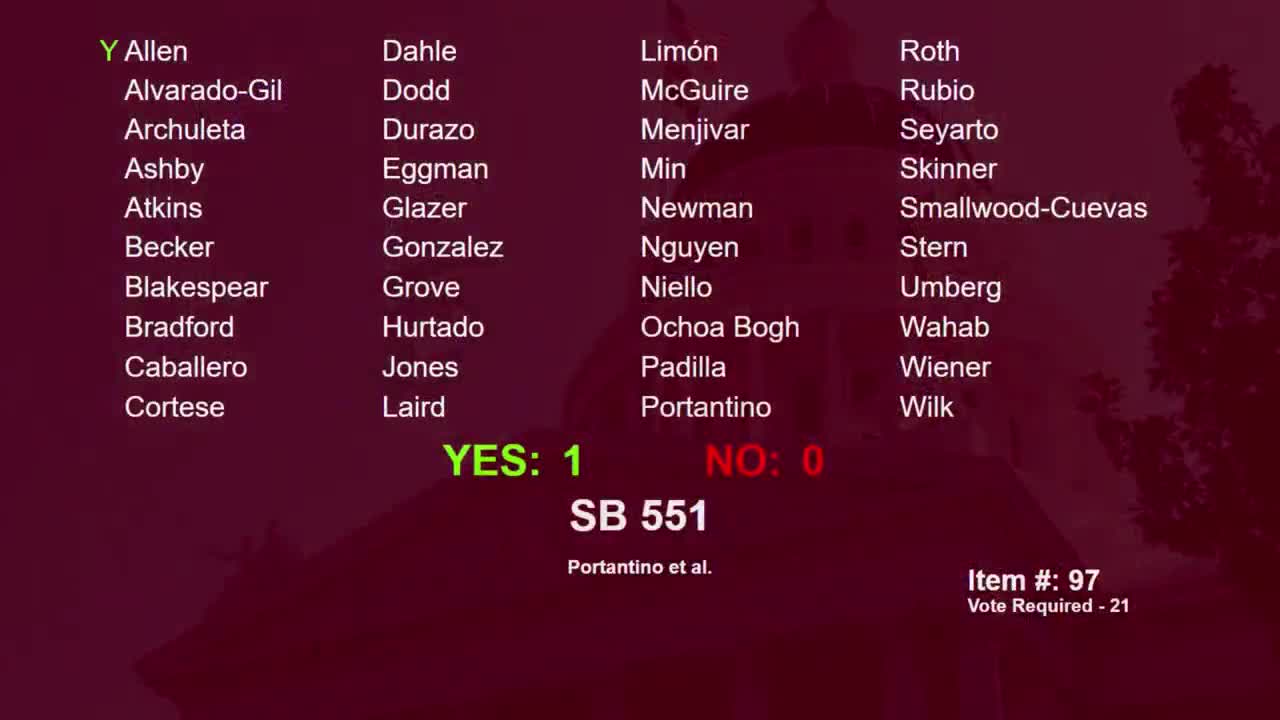 3MIN
Senate Floor
Bill Author