SB 516: Health care coverage: prior authorization.
- Session Year: 2023-2024
- House: Senate
- Latest Version Date: 2024-08-22
Current Status:
Failed
(2024-08-27: August 27 set for first hearing canceled at the request of author.)
Introduced
In Committee
First Chamber
In Committee
Second Chamber
Enacted
What does this bill do?
This bill tells state health regulators to require health plans and insurers to report which services, items, and supplies are subject to prior authorization (the plan’s preapproval before care) and to publish a list of services that are almost always approved. Services on that list would no longer require prior authorization, and a plan or insurer could only reinstate a prior-authorization requirement if the regulator allows it after a showing of good cause. Regulators must study and report on the effects, may hire outside experts to help, and some specialized plans and insurers are exempt.
The summary is provided by generative AI which can make mistakes. For original language, please view the details in the table below.
Existing law, the Knox-Keene Health Care Service Plan Act of 1975, provides for the licensure and regulation of health care service plans by the Department of Managed Health Care, and makes a willful violation of the act a crime. Existing law provides for the regulation of health insurers by the Department of Insurance. Existing law generally authorizes a health care service plan or health insurer to use prior authorization and other utilization review or utilization management functions, under which a licensed physician or a licensed health care professional who is competent to evaluate specific clinical issues may approve, modify, delay, or deny requests for health care services based on medical necessity. Existing law requires a health care service plan or health insurer, including those plans or insurers that delegate utilization review or utilization management functions to medical groups, independent practice associations, or to other contracting providers, to comply with specified requirements and limitations on their utilization review or utilization management functions. Existing law requires the criteria or guidelines used to determine whether or not to authorize, modify, or deny health care services to be developed with involvement from actively practicing health care providers.
This bill would require the Department of Managed Health Care, beginning Care and the Department of Insurance, by July 1, 2025, to issue instructions to health care service plans and health insurers to report specified information relating to prior authorization, as defined, including all covered designated health care services (services), items, and supplies subject to prior authorization and the percentage rate at which health care service plans approved plans, health insurers, or their delegated entities, approve or modify those services, items, and supplies. The bill would require health care service plans and health insurers to report that information to the department by December 31, 2025, and relevant department by December 31, 2025, or as otherwise specified. The bill would require the relevant department to evaluate the reports received from the health care service plans and health insurers, and identify the services, items, and supplies most frequently approved by health care service plans the plans or insurers or their delegated entities, as specified. The bill would require the each department, after evaluating the reports received from health care service plans, plans and health insurers, to identify, and by December 31, 2026, to publish a list of, the most frequently approved or modified services, items, and supplies. supplies, based on a prescribed threshold percentage rate. The bill would authorize the department to consider certain factors when determining the appropriateness of removing prior authorization for a specific health care service, item, or supply, regardless of its approval percentage rate. The bill would require the department to issue instructions to health care service plans and health insurers regarding, among other matters, the date by which the listed services, items, and supplies would no longer be subject to prior authorization, and how a health care service plan plan or insurer could reinstate prior authorization upon a showing of good cause, as prescribed. Within 4 years from the cessation date of the prior authorization requirements, the bill would require the each department to publish a report regarding the impact of the cessation of those requirements. The bill would authorize the department departments to contract with a consultant with expertise in prior authorization procedures to assist with implementation of the bill, as specified. These provisions The bill would provide that it would not apply with respect to specified types of health care service plans or to fully integrated delivery systems, as defined. plans including, but not limited to, specialized health care service plans, or to specialized health insurers, except as specified. The provisions would be repealed on January 1, 2032. Because a willful violation of the bills requirements relative to health care service plans would be a crime, the bill would impose a state-mandated local program.
The bill, until January 1, 2032, would authorize the Insurance Commissioner to issue instructions to health insurers prohibiting them from requiring prior authorization, in accordance with the above-described instructions issued by the Department of Managed Health Care. The bill would require these instructions to direct a health insurer desiring to petition for reinstatement of prior authorization for a particular health care service to submit that petition to the Department of Managed Health Care.The California Constitution requires the state to reimburse local agencies and school districts for certain costs mandated by the state. Statutory provisions establish procedures for making that reimbursement.
This bill would provide that no reimbursement is required by this act for a specified reason.
Existing law, the Knox-Keene Health Care Service Plan Act of 1975, provides for the licensure and regulation of health care service plans by the Department of Managed Health Care, and makes a willful violation of the act a crime. Existing law provides for the regulation of health insurers by the Department of Insurance. Existing law generally authorizes a health care service plan or health insurer to use prior authorization and other utilization review or utilization management functions, under which a licensed physician or a licensed health care professional who is competent to evaluate specific clinical issues may approve, modify, delay, or deny requests for health care services based on medical necessity. Existing law requires a health care service plan or health insurer, including those plans or insurers that delegate utilization review or utilization management functions to medical groups, independent practice associations, or to other contracting providers, to comply with specified requirements and limitations on their utilization review or utilization management functions. Existing law requires the criteria or guidelines used to determine whether or not to authorize, modify, or deny health care services to be developed with involvement from actively practicing health care providers.
On or after January 1, 2026, this bill would prohibit a health care service plan or health insurer from requiring a contracted health professional to complete or obtain a prior authorization for any covered health care services if the plan or insurer approved or would have approved not less than 90% of the prior authorization requests they submitted in the most recent completed one-year contracted period. The bill would set standards for this exemption and its denial, rescission, and appeal. The bill would authorize a plan or insurer to evaluate the continuation of an exemption not more than once every 12 months, and would authorize a plan or insurer to rescind an exemption only at the end of the 12-month period and only if specified criteria are met. The bill would require a plan or insurer to provide an electronic prior authorization process. The bill would also require a plan or insurer to have a process for annually monitoring prior authorization approval, modification, appeal, and denial rates to identify services, items, and supplies that are regularly approved, and to discontinue prior authorization on those services, items, and supplies that are approved 95% of the time. BecauseThis bill would require the Department of Managed Health Care, beginning July 1, 2025, to issue instructions to health care service plans to report specified information relating to prior authorization, as defined, including all covered health care services (services), items, and supplies subject to prior authorization and the percentage at which health care service plans approved those services, items, and supplies. The bill would require health care service plans to report that information to the department by December 31, 2025, and would require the department to evaluate the reports received from the health care service plans and identify the services, items, and supplies most frequently approved by health care service plans or their delegated entities, as specified. The bill would require the department, after evaluating the reports received from health care service plans, to identify, and by December 31, 2026, to publish a list of, the most frequently approved services, items, and supplies. The bill would require the department to issue instructions to health care service plans regarding, among other matters, the date by which the listed services, items, and supplies would no longer be subject to prior authorization, and how a health care service plan could reinstate prior authorization upon a showing of good cause, as prescribed. Within 4 years from the cessation date of the prior authorization requirements, the bill would require the department to publish a report regarding the impact of the cessation of those requirements. The bill would authorize the department to contract with a consultant with expertise in prior authorization procedures to assist with implementation of the bill, as specified. These provisions would not apply with respect to specified types of health care service plans or to fully integrated delivery systems, as defined. The provisions would be repealed on January 1, 2032. Because a willful violation of the bills requirements relative to health care service plans would be a crime, the bill would impose a state-mandated local program.
The bill, until January 1, 2032, would authorize the Insurance Commissioner to issue instructions to health insurers prohibiting them from requiring prior authorization, in accordance with the above-described instructions issued by the Department of Managed Health Care. The bill would require these instructions to direct a health insurer desiring to petition for reinstatement of prior authorization for a particular health care service to submit that petition to the Department of Managed Health Care.
The California Constitution requires the state to reimburse local agencies and school districts for certain costs mandated by the state. Statutory provisions establish procedures for making that reimbursement.
This bill would provide that no reimbursement is required by this act for a specified reason.
Existing law, the Knox-Keene Health Care Service Plan Act of 1975, provides for the licensure and regulation of health care service plans by the Department of Managed Health Care, and makes a willful violation of the act a crime. Existing law provides for the regulation of health insurers by the Department of Insurance. Existing law generally authorizes a health care service plan or health insurer to use prior authorization and other utilization review or utilization management functions, under which a licensed physician or a licensed health care professional who is competent to evaluate specific clinical issues may approve, modify, delay, or deny requests for health care services based on medical necessity. Existing law requires a health care service plan or health insurer, including those plans or insurers that delegate utilization review or utilization management functions to medical groups, independent practice associations, or to other contracting providers, to comply with specified requirements and limitations on their utilization review or utilization management functions. Existing law requires the criteria or guidelines used to determine whether or not to authorize, modify, or deny health care services to be developed with involvement from actively practicing health care providers.
On or after January 1, 2026, this bill would prohibit a health care service plan or health insurer from requiring a contracted health professional to complete or obtain a prior authorization for any covered health care services if the plan or insurer approved or would have approved not less than 90% of the prior authorization requests they submitted in the most recent completed one-year contracted period. The bill would set standards for this exemption and its denial, rescission, and appeal. The bill would authorize a plan or insurer to evaluate the continuation of an exemption not more than once every 12 months, and would authorize a plan or insurer to rescind an exemption only at the end of the 12-month period and only if specified criteria are met. The bill would require a plan or insurer to provide an electronic prior authorization process. The bill would also require a plan or insurer to have a process for annually monitoring prior authorization approval, modification, appeal, and denial rates to identify services, items, and supplies that are regularly approved, and to discontinue prior authorization on those services, items, and supplies that are approved 95% of the time. Because a willful violation of the bills requirements relative to health care service plans would be a crime, the bill would impose a state-mandated local program.
The California Constitution requires the state to reimburse local agencies and school districts for certain costs mandated by the state. Statutory provisions establish procedures for making that reimbursement.
This bill would provide that no reimbursement is required by this act for a specified reason.
(1)Existing law authorizes the Controller to offset any amount due to a state agency from a person or entity against any amount owing to that person or entity by a state agency, including any tax refund, except as specified.This bill would require the Controller to provide information to any person or entity that requests the information on how to file a claim for a refund of any amount erroneously offset pursuant to above-described provisions with the state agency that requested the offset, as specified. The bill would require the state agency to notify the Controller if a claim is filed. The bill would require the Controller to suspend the offset until the state agency notifies the Controller that the claim has been resolved. The bill would require the state agency to refund any amount erroneously offset as expeditiously as possible, but within one year of the filing of a claim and cancel the request for any future offset for the remaining amount. The bill would require the Controller to work in collaboration with applicable state agencies to implement these claim provisions.(2)Existing law authorizes the Controller to offset any amount due to a city, county, or special district from a person or entity against any amount owing to that person or entity by a state agency at the request of the city, county, or special district, as specified.This bill would require a city, county, or special district that has submitted an offset request to withdraw that request upon discovering that the amount owed has been received by the city, county, or special district, as specified. The bill would also require a city, county, or special district that overcollects, as prescribed, to refund the overcollection, as provided. The bill would require the Controller to give the person or entity from whom the offset was collected a receipt with specified information, including the offset amount, and the remaining amount due to the city, county, or special district, when the Controller satisfies an offset request. The bill would require the Controller to provide the public address, phone number, and internet website of the city, county, or special district that requested the offset to any person or entity that requests information on how to file a claim for a refund of any amount erroneously offset under the above-described provisions, as specified. The bill would require the city, county, or special district to notify the Controller if a claim is filed. The bill would require the city, county, or special district that requested an offset to withdraw any request that is subject to a claim for a refund until the claim has been resolved. The bill would require the city, county, or special district to refund any amount erroneously offset and cancel any future offset request for the remaining amount. The bill would require the Controller to work in collaboration with specified state agencies to implement these claim provisions.(3)Existing law authorizes the Franchise Tax Board to allow a taxpayer to enter into an installment payment agreement to make full or partial payment of taxes due, as specified. Under existing law, except in specified circumstances, an installment agreement under these provisions is not considered null and void, or otherwise terminated, unless a specified notice of termination is provided to the taxpayer.This bill would additionally require the Franchise Tax Board to authorize a taxpayer to submit an application for an installment agreement online or by mail or telephone. The bill would prohibit the terms of the installment agreement to be less favorable because of the method the taxpayer chose to submit the application. The bill would also require the Franchise Tax Board, before terminating an installment payment agreement with a taxpayer for failure to comply fully with the terms of the installment agreement, to give the taxpayer at least 60 days to cure the failure.(4)Existing law authorizes a juvenile or superior court, county, state, or the State Bar to refer any fine, monetary sanction, state or local penalty, bail, forfeiture, restitution fine, restitution order, or any other amount to the Franchise Tax Board for collection under guidelines prescribed by the Franchise Tax Board, as specified.Under existing law, upon expiration of 10 years after the date of entry of a money judgment or a judgment for possession or sale of property, the judgment may not be enforced, any enforcement procedures must cease, and any lien created by an enforcement procedure pursuant to the judgment is extinguished.This bill would require the above-described entities to give a specified notice before referring the above-described amounts to the Franchise Tax Board. The bill would prohibit the entities from referring any amount to the Franchise Tax Board that has not been imposed within the previous 15 years or is unenforceable pursuant to the above-described provisions relating to the enforcement of a judgment, unless renewed. The bill would prohibit the entities from referring any renewed judgment to the Franchise Tax Board after 5 years from the date of the filing of the application for renewal. The bill would require the entities to relinquish all rights to collect the referred amounts unless the entities withdraw the referral.(5)Existing law authorizes the state to collect state tax liability through various means, including issuing a withholding order in accordance with certain procedures. Existing law requires the Franchise Tax Board to provide notice before levying any property or property right for unpaid taxes, as specified. Existing law requires that the notice include, among other information, the amount of unpaid tax and the proposed action or actions that may be taken by the Franchise Tax Board and the rights of the person with respect to the action or actions. Existing law authorizes taxpayers to request a review of the Franchise Tax Boards actions, as specified.This bill would expand the above-described provisions to unpaid non-tax debts. The bill would require the Franchise Tax Board, when providing the above-described notice, to additionally specify the source of the unpaid tax or non-tax debt, the type of money or property exempt from any levy, as specified, requirements and procedures to enter into installment agreements, and legal requirements and procedures to release a levy on money or property that is exempt from any levy.The bill would additionally require the board to provide the public address, phone number, and internet website of the city, county, or special district that requested the offset to any person or entity that requests information on how to file a claim with a city, county, or special district for a refund of any amount erroneously levied or collected by the board because of a request by the city, county, or special district. The bill would require the city, county, or special district to notify the board if a claim is filed. The bill would require the city, county, or special district that requested an offset to withdraw any request that is subject to a claim for a refund until the claim has been resolved. The bill would require the city, county, or special district to refund any amount or property erroneously levied or collected.(6)This bill would state its provisions become operative on September 1, 2025, except as provided.(7)This bill would incorporate additional changes to Section 19008 of the Revenue and Taxation Code proposed by AB 1765 to be operative only if this bill and AB 1765 are enacted and this bill is enacted last.(1)Existing law authorizes the Controller to offset any amount due to a state agency from a person or entity against any amount owing to that person or entity by a state agency, including any tax refund, except as specified.
This bill would require the Controller to provide information to any person or entity that requests the information on how to file a claim for a refund of any amount erroneously offset pursuant to above-described provisions with the state agency that requested the offset, as specified. The bill would require the state agency to notify the Controller if a claim is filed. The bill would require the Controller to suspend the offset until the state agency notifies the Controller that the claim has been resolved. The bill would require the state agency to refund any amount erroneously offset as expeditiously as possible, but within one year of the filing of a claim and cancel the request for any future offset for the remaining amount. The bill would require the Controller to work in collaboration with applicable state agencies to implement these claim provisions.
(2)Existing law authorizes the Controller to offset any amount due to a city, county, or special district from a person or entity against any amount owing to that person or entity by a state agency at the request of the city, county, or special district, as specified.
This bill would prohibit a city, county, or special district from sending a bill for any amount due that the city, county, or special district has submitted an offset request to the Controller. The bill would require the city, county, or special district to relinquish all rights to collection unless or until the city, county, or special district withdraws the request for offset. require a city, county, or special district that has submitted an offset request to withdraw that request upon discovering that the amount owed has been received by the city, county, or special district, as specified. The bill would also require a city, county, or special district that overcollects, as prescribed, to refund the overcollection, as provided. The bill would require the city, county, or special district Controller to give the person or entity from whom the offset was collected a receipt with specified information, including the offset amount, and the remaining amount due to the city, county, or special district, when the Controller satisfies an offset request.
The bill would require the Controller to provide information the public address, phone number, and internet website of the city, county, or special district that requested the offset to any person or entity that requests the information on how to file a claim for a refund of any amount erroneously offset under the above-described provisions with the city, county, or special district that requested the offset, provisions, as specified. The bill would require the city, county, or special district to notify the Controller if a claim is filed. The bill would require the Controller to suspend the offset until the city, county, or special district notifies the Controller that city, county, or special district that requested an offset to withdraw any request that is subject to a claim for a refund until the claim has been resolved. The bill would require the city, county, or special district to refund any amount erroneously offset and cancel any future offset request for the remaining amount. The bill would require the Controller to work in collaboration with specified state agencies to implement these claim provisions.
(3)Existing law authorizes the Franchise Tax Board to allow a taxpayer to enter into an installment payment agreement to make full or partial payment of taxes due, as specified. Under existing law, except in specified circumstances, an installment agreement under these provisions is not considered null and void, or otherwise terminated, unless a specified notice of termination is provided to the taxpayer.
This bill would additionally require the Franchise Tax Board to authorize a taxpayer to submit an application for an installment agreement online or by mail or telephone. The bill would prohibit the terms of the installment agreement to be less favorable because of the method the taxpayer chose to submit the application. The bill would also require the Franchise Tax Board, before terminating an installment payment agreement with a taxpayer for failure to comply fully with the terms of the installment agreement, to give the taxpayer at least 60 days to cure the failure.
(4)Existing law authorizes a juvenile or superior court, county, state, or the State Bar to refer any fine, monetary sanction, state or local penalty, bail, forfeiture, restitution fine, restitution order, or any other amount to the Franchise Tax Board for collection under guidelines prescribed by the Franchise Tax Board, as specified.
Under existing law, upon expiration of 10 years after the date of entry of a money judgment or a judgment for possession or sale of property, the judgment may not be enforced, any enforcement procedures must cease, and any lien created by an enforcement procedure pursuant to the judgment is extinguished.
This bill would require the above-described entities to give a specified notice before referring the above-described amounts to the Franchise Tax Board. The bill would prohibit the entities from referring any amount to the Franchise Tax Board that has not been imposed within the previous 15 years or is unenforceable pursuant to the above-described provisions relating to the enforcement of a judgment, unless renewed. The bill would prohibit the entities from referring any renewed judgment to the Franchise Tax Board after 5 years from the date of the filing of the application for renewal. The bill would require the entities to relinquish all rights to collect the referred amounts unless the entities withdraw the referral.
(5)Existing law authorizes the state to collect state tax liability through various means, including issuing a withholding order in accordance with certain procedures. Existing law requires the Franchise Tax Board to provide notice before levying any property or property right for unpaid taxes, as specified. Existing law requires that the notice include, among other information, the amount of unpaid tax and the proposed action or actions that may be taken by the Franchise Tax Board and the rights of the person with respect to the action or actions. Existing law authorizes taxpayers to request a review of the Franchise Tax Boards actions, as specified.
This bill would expand the above-described provisions to unpaid fees. non-tax debts. The bill would require the Franchise Tax Board, when providing the above-described notice, to additionally specify the source of the unpaid tax or fee, non-tax debt, the type of money or property exempt from any levy, as specified, requirements and procedures to enter into installment agreements, and legal requirements and procedures to release a levy on money or property that is exempt from any levy.
The bill would additionally require the board to provide information the public address, phone number, and internet website of the city, county, or special district that requested the offset to any person or entity that requests the information on how to file a claim with a city, county, or special district for a refund of any amount erroneously levied or collected by the board because of a request by the city, county, or special district. The bill would require the city, county, or special district to notify the board if a claim is filed. The bill would require the board to suspend any future levy or collection until the city, county, or special district notifies the board that city, county, or special district that requested an offset to withdraw any request that is subject to a claim for a refund until the claim has been resolved. The bill would require the city, county, or special district to refund any amount or property erroneously levied or collected.
(6)This bill would state its provisions become operative on September 1, 2025, except as provided.
(7)This bill would incorporate additional changes to Section 19008 of the Revenue and Taxation Code proposed by AB 1765 to be operative only if this bill and AB 1765 are enacted and this bill is enacted last.
(1)Existing law authorizes the Controller to offset any amount due to a state agency from a person or entity against any amount owing to that person or entity by a state agency, including any tax refund, except as specified.
This bill would require the Controller to provide information to any person or entity that requests the information on how to file a claim for a refund of any amount erroneously offset pursuant to above-described provisions with the state agency that requested the offset, as specified. The bill would require the state agency to notify the Controller if a claim is filed. The bill would require the Controller to suspend the offset until the state agency notifies the Controller that the claim has been resolved. The bill would require the state agency to refund any amount erroneously offset as expeditiously as possible, but within one year of the filing of a claim and cancel the request for any future offset for the remaining amount. The bill would require the Controller to work in collaboration with applicable state agencies to implement these claim provisions.
(2)Existing law authorizes the Controller to offset any amount due to a city, county, or special district from a person or entity against any amount owing to that person or entity by a state agency at the request of the city, county, or special district, as specified.
This bill would prohibit a city, county, or special district from sending a bill for any amount due that the city, county, or special district has submitted an offset request to the Controller. The bill would require the city, county, or special district to relinquish all rights to collection unless or until the city, county, or special district withdraws the request for offset. The bill would require the city, county, or special district to give the person or entity from whom the offset was collected a receipt with specified information, including the offset amount, and the remaining amount due to the city, county, or special district, when the Controller satisfies an offset request.
The bill would require the Controller to provide information to any person or entity that requests the information on how to file a claim for a refund of any amount erroneously offset under the above-described provisions with the city, county, or special district that requested the offset, as specified. The bill would require the city, county, or special district to notify the Controller if a claim is filed. The bill would require the Controller to suspend the offset until the city, county, or special district notifies the Controller that the claim has been resolved. The bill would require the city, county, or special district to refund any amount erroneously offset and cancel any future offset request for the remaining amount. The bill would require the Controller to work in collaboration with specified state agencies to implement these claim provisions.
(3)Existing law authorizes the Franchise Tax Board to allow a taxpayer to enter into an installment payment agreement to make full or partial payment of taxes due, as specified. Under existing law, except in specified circumstances, an installment agreement under these provisions is not considered null and void, or otherwise terminated, unless a specified notice of termination is provided to the taxpayer.
This bill would additionally require the Franchise Tax Board to authorize a taxpayer to submit an offer application for an installment agreement online or by mail or telephone. The bill would prohibit the terms of the installment agreement to be less favorable because of the method the taxpayer chose to make submit the offer. application. The bill would also require the Franchise Tax Board, before terminating an installment payment agreement with a taxpayer for failure to comply fully with the terms of the installment agreement, to give the taxpayer at least 60 days to cure the failure.
(4)Existing law authorizes a juvenile or superior court, county, state, or the State Bar to refer any fine, monetary sanction, state or local penalty, bail, forfeiture, restitution fine, restitution order, or any other amount to the Franchise Tax Board for collection under guidelines prescribed by the Franchise Tax Board, as specified.
Under existing law, upon expiration of 10 years after the date of entry of a money judgment or a judgment for possession or sale of property, the judgment may not be enforced, any enforcement procedures must cease, and any lien created by an enforcement procedure pursuant to the judgment is extinguished.
This bill would require the above-described entities to give a specified notice before referring the above-described amounts to the Franchise Tax Board. The bill would prohibit the entities from referring any amount to the Franchise Tax Board that has not been imposed within the previous 15 years or is unenforceable pursuant to the above-described provisions relating to the enforcement of a judgment, unless renewed. The bill would prohibit the entities from referring any renewed judgment to the Franchise Tax Board after 5 years from the date of the filing of the application for renewal. The bill would require the entities to relinquish all rights to collect the referred amounts unless the entities withdraw the referral.
(5)Existing law authorizes the state to collect state tax liability through various means, including issuing a withholding order in accordance with certain procedures. Existing law requires the Franchise Tax Board to provide notice before levying any property or property right for unpaid taxes, as specified. Existing law requires that the notice include, among other information, the amount of unpaid tax and the proposed action or actions that may be taken by the Franchise Tax Board and the rights of the person with respect to the action or actions. Existing law authorizes taxpayers to request a review of the Franchise Tax Boards actions, as specified.
This bill would expand the above-described provisions to unpaid fees. The bill would require the Franchise Tax Board, when providing the above-described notice, to additionally specify the source of the unpaid tax or fee, the type of money or property exempt from any levy, as specified, requirements and procedures to enter into installment agreements, and legal requirements and procedures to release a levy on money or property that is exempt from any levy.
The bill would additionally require the board to provide information to any person or entity that requests the information on how to file a claim with a city, county, or special district for a refund of any amount erroneously levied or collected by the board because of a request by the city, county, or special district. The bill would require the city, county, or special district to notify the board if a claim is filed. The bill would require the board to suspend any future levy or collection until the city, county, or special district notifies the board that the claim has been resolved. The bill would require the city, county, or special district to refund any amount or property erroneously levied or collected.
(1)Existing law authorizes the Controller to offset any amount due to a state agency from a person or entity against any amount owing to that person or entity by a state agency, including any tax refund, except as specified.
This bill would authorize a person or entity to file a claim with the Controller for any amount erroneously offset under the above-described provisions. require the Controller to provide information to any person or entity that requests the information on how to file a claim for a refund of any amount erroneously offset pursuant to above-described provisions with the state agency that requested the offset, as specified. The bill would require the state agency to notify the Controller if a claim is filed. The bill would require the Controller to provide the person or entity with the contact information of the state agency that requested the offset when the claim is filed and cease the suspend the offset until the state agency notifies the Controller that the claim is resolved. has been resolved. The bill would require the Controller state agency to refund any amount erroneously offset as expeditiously as possible, but within one year of the filing of a claim. claim and cancel the request for any future offset for the remaining amount. The bill would require the Controller to work in collaboration with the Franchise Tax Board applicable state agencies to implement these claim provisions.
(2)Existing law authorizes the Controller to offset any amount due to a city, county, or special district from a person or entity against any amount owing to that person or entity by a state agency at the request of the city, county, or special district, as specified.
This bill would prohibit the above-described local agencies a city, county, or special district from sending a bill for any amount due that the local agency city, county, or special district has submitted an offset request to the Controller. The bill would require the local agencies city, county, or special district to relinquish all rights to collection unless or until the local agency city, county, or special district withdraws the request for offset. The bill would require the above-described local agencies city, county, or special district to give the person or entity from whom the offset was collected with a receipt with specified information, including the offset amount, and the remaining amount due to the local agency, city, county, or special district, when the Controller satisfies an offset request.
The bill would authorize a person or entity to file a claim with the Controller for reimbursement of any amount erroneously offset under the above-described provisions. require the Controller to provide information to any person or entity that requests the information on how to file a claim for a refund of any amount erroneously offset under the above-described provisions with the city, county, or special district that requested the offset, as specified. The bill would require the city, county, or special district to notify the Controller if a claim is filed. The bill would require the Controller to provide the person or entity with the contact information of the local agency that requested the offset when the claim is filed and cease suspend the offset until the city, county, or special district notifies the Controller that the claim is resolved. has been resolved. The bill would require the Controller city, county, or special district to refund any amount erroneously offset. offset and cancel any future offset request for the remaining amount. The bill would require the Controller to work in collaboration with the Franchise Tax Board specified state agencies to implement these claim provisions.
(3)Existing law authorizes the Franchise Tax Board to allow a taxpayer to enter into an installment payment agreement to make full or partial payment of taxes due, as specified. Under existing law, except in specified circumstances, an installment agreement under these provisions is not considered null and void, or otherwise terminated, unless a specified notice of termination is provided to the taxpayer.
This bill would additionally require the Franchise Tax Board to authorize a taxpayer to submit an offer for an installment agreement online or by mail or telephone. The bill would prohibit the terms of the installment agreement to be less favorable because of the method the taxpayer chose to make the offer. The bill would also require the Franchise Tax Board, before terminating an installment payment agreement with a taxpayer for failure to comply fully with the terms of the installment agreement, to give the taxpayer at least 60 days to cure the failure.
(4)Existing law authorizes a juvenile or superior court, county, state, or the State Bar to refer any fine, monetary sanction, state or local penalty, bail, forfeiture, restitution fine, restitution order, or any other amount to the Franchise Tax Board for collection under guidelines prescribed by the Franchise Tax Board, as specified.
Under existing law, upon expiration of 10 years after the date of entry of a money judgment or a judgment for possession or sale of property, the judgment may not be enforced, any enforcement procedures must cease, and any lien created by an enforcement procedure pursuant to the judgment is extinguished.
This bill would require the above-described entities to give a specified notice before referring the above-described amounts to the Franchise Tax Board. The bill would prohibit the entities from referring any amount to the Franchise Tax Board that has not been imposed within the previous 15 years or is unenforceable pursuant to the above-described provisions relating to the enforcement of a judgment, unless renewed. The bill would prohibit the entities from referring any renewed judgment to the Franchise Tax Board after 5 years from the date of the filing of the application for renewal. The bill would require the entities to relinquish all rights to collect the referred amounts unless the entities withdraw the referral.
(5)Existing law authorizes the state to collect state tax liability through various means, including issuing a withholding order in accordance with certain procedures. Existing law requires the Franchise Tax Board to provide notice before levying any property or property right for unpaid taxes, as specified. Existing law requires that the notice include, among other information, the amount of unpaid tax and the proposed action or actions that may be taken by the Franchise Tax Board and the rights of the person with respect to the action or actions. Existing law authorizes taxpayers to request a review of the Franchise Tax Boards actions, as specified.
This bill would expand the above-described provisions to unpaid fees. The bill would require the Franchise Tax Board, when providing the above-described notice, to additionally specify the source of the unpaid tax or fee, the type of money or property exempt from any levy, as specified, requirements and procedures to enter into installment agreements, and legal requirements and procedures to release a levy on money or property that is exempt from any levy.
(6) Existing law authorizes a person to file a claim with the Franchise Tax Board for reimbursement of charges or fees imposed on the person by an unrelated business entity as the direct result of an erroneous levy, erroneous process action, or erroneous collection action by the board, as specified. Existing law authorizes the Franchise Tax Board to grant the claim under specified conditions.This bill would authorize a person to file a claim with the Franchise Tax Board for a refund of any amount, or property that has been erroneously levied or collected by the board. The bill would require the Franchise Tax Board to refund any amount or property erroneously levied or collected within one year of the filing.The bill would additionally require the board to provide information to any person or entity that requests the information on how to file a claim with a city, county, or special district for a refund of any amount erroneously levied or collected by the board because of a request by the city, county, or special district. The bill would require the city, county, or special district to notify the board if a claim is filed. The bill would require the board to suspend any future levy or collection until the city, county, or special district notifies the board that the claim has been resolved. The bill would require the city, county, or special district to refund any amount or property erroneously levied or collected.
(1)Existing law authorizes the Controller to offset any amount due to a state agency from a person or entity against any amount owing to that person or entity by a state agency, including any tax refund, except as specified.
This bill would authorize a person or entity to file a claim with the Controller for any amount erroneously offset under the above-described provisions. The bill would require the Controller to provide the person or entity with the contact information of the state agency that requested the offset when the claim is filed and cease the offset until the claim is resolved. The bill would require the Controller to refund any amount erroneously offset as expeditiously as possible, but within one year of the filing of a claim. The bill would require the Controller to work in collaboration with the Franchise Tax Board to implement these claim provisions.
(2)Existing law authorizes the Controller to offset any amount due to a city, county, or special district from a person or entity against any amount owing to that person or entity by a state agency at the request of the city, county, or special district, as specified.
This bill would prohibit the above-described local agencies from sending a bill for any amount due that the local agency has submitted an offset request to the Controller. The bill would require the local agencies to relinquish all rights to collection unless or until the local agency withdraws the request for offset. The bill would require the Controller, when satisfying an offset request pursuant to these provisions, the above-described local agencies to give the person or entity from whom the offset was collected with a receipt with specified information, including the offset amount, and the remaining amount due to the local agency. The agency, when the Controller satisfies an offset request.
The bill would authorize a person or entity to file a claim with the Controller for reimbursement of any amount erroneously offset. offset under the above-described provisions. The bill would require the Controller to provide the person or entity with the contact information of the local agency that requested the offset when the claim is filed and cease the offset until the claim is resolved. The bill would require the Controller to refund any amount erroneously offset. The bill would require the Controller to work in collaboration with the Franchise Tax Board to implement these claim provisions.
(3)Existing law authorizes the Franchise Tax Board to allow a taxpayer to enter into an installment payment agreement to make full or partial payment of taxes due, as specified. Under existing law, except in specified circumstances, an installment agreement under these provisions is not considered null and void, or otherwise terminated, unless a specified notice of termination is provided to the taxpayer.
This bill would additionally require the Franchise Tax Board to authorize a taxpayer to submit an offer for an installment agreement online or by mail or telephone. The bill would prohibit the terms of the installment agreement to be less favorable because of the method the taxpayer chose to make the offer. The bill would also require the Franchise Tax Board, before terminating an installment payment agreement with a taxpayer for failure to comply fully with the terms of the installment agreement, to give the taxpayer at least 60 days to cure the failure.
(4)Existing law authorizes a juvenile or superior court, county, state, or the State Bar to refer any fine, monetary sanction, state or local penalty, bail, forfeiture, restitution fine, restitution order, or any other amount to the Franchise Tax Board for collection under guidelines prescribed by the Franchise Tax Board, as specified.
Under existing law, upon expiration of 10 years after the date of entry of a money judgment or a judgment for possession or sale of property, the judgment may not be enforced, any enforcement procedures must cease, and any lien created by an enforcement procedure pursuant to the judgment is extinguished.
This bill would require the above-described entities to give a specified notice before referring the above-described amounts to the Franchise Tax Board. The bill would prohibit the entities from referring any amount to the Franchise Tax Board that has not been imposed within the previous 15 years or is unenforceable pursuant to the above-described provisions relating to the enforcement of a judgment, unless renewed. The bill would prohibit the entities from referring any renewed judgment to the Franchise Tax Board after 5 years from the date of the filing of the application for renewal. The bill would require the entities to relinquish all rights to collect the referred amounts unless the entities withdraw the referral.
(5)Existing law requires the Franchise Tax Board to provide notice before levying any property or property for unpaid taxes, as specified. Existing law requires that the notice include, among other information, the amount of unpaid tax and the proposed action or actions that may be taken by the Franchise Tax Board and the rights of the person with respect to the action or actions. Existing law authorizes taxpayers to request a review of the Franchise Tax Boards actions, as specified.
This bill would expand the above-described notice requirement provisions to unpaid fees. The bill would require the Franchise Tax Board, when providing the above-described notice, to additionally specify the source of the unpaid tax or fee, the type of money or property exempt from any levy, as specified, requirements and procedures to enter into installment agreements, and legal requirements and procedures to release a levy on money or property that is exempt from any levy.
(5)(6) Existing law authorizes a person to file a claim with the Franchise Tax Board for reimbursement of charges or fees imposed on the person by an unrelated business entity as the direct result of an erroneous levy, erroneous process action, or erroneous collection action by the board, as specified. Existing law authorizes the Franchise Tax Board to grant the claim under specified conditions.
This bill would authorize a person to file a claim with the Franchise Tax Board for a refund of any amount, or property that has been erroneously levied or collected by the board. The bill would require the Franchise Tax Board to refund any amount or property erroneously levied or collected within one year of the filing.
(1)Existing law authorizes the Controller to offset any amount due to a state agency from a person or entity against any amount owing to that person or entity by a state agency, including any tax refund, except as specified.
This bill would authorize a person or entity to file a claim with the Controller for any amount erroneously offset under the above-described provisions. The bill would require the Controller to provide the person or entity with the contact information of the state agency that requested the offset when the claim is filed and cease the offset until the claim is resolved. The bill would require the Controller to refund any amount erroneously offset as expeditiously as possible, but within one year of the filing of a claim.
(1)(2)Existing law authorizes the Controller to offset any amount due to a city, county, or special district from a person or entity against any amount owed a owing to that person or entity by a state agency at the request of the city, county, or special district, as specified.
This bill would prohibit a city, county, or special district the above-described local agencies from sending a bill for any amount due that the city, county, or special district local agency has submitted an offset request to the Controller. The bill would require the local agencies to relinquish all rights to collection unless or until the local agency withdraws the request for offset. The bill would require the Controller, when satisfying an offset request pursuant to these provisions, to give the person or entity owed an amount by a state agency a receipt, on a monthly basis, specifying from whom the offset was collected with a receipt with specified information, including the offset amount, and the remaining amount due a city, county, or special district. to the local agency. The bill would authorize a person or entity to file a claim with the Controller for reimbursement of any amount erroneously or illegally offset and require the Controller to refund any amount erroneously or illegally offset within one year of the filing. offset. The bill would require the Controller to provide the person or entity with the contact information of the local agency that requested the offset when the claim is filed and cease the offset until the claim is resolved. The bill would require the Controller to refund any amount erroneously offset.
(2)(3)Existing law authorizes the Franchise Tax Board to allow a taxpayer to enter into an installment payment agreement to make full or partial payment of taxes due, as specified. Under existing law, except in specified circumstances, an installment agreement under these provisions is not considered null and void, or otherwise terminated, unless a specified notice of termination is provided to the taxpayer.
This bill would additionally require the Franchise Tax Board to authorize a taxpayer to submit an offer for an installment agreement online or by mail or telephone. The bill would prohibit the terms of the installment agreement to be less favorable because of the method the taxpayer chose to make the offer. The bill would also require the Franchise Tax Board, before terminating an installment payment agreement with a taxpayer for failure to comply fully with the terms of the installment agreement, to give the taxpayer a reasonable opportunity at least 60 days to cure the failure. The bill would also require the Franchise Tax Board to authorize a taxpayer to submit an offer for an installment agreement online or by telephone.
(3)(4)Existing law authorizes a juvenile or superior court, county, state, or the State Bar to refer any fine, monetary sanction, state or local penalty, bail, forfeiture, restitution fine, restitution order, or any other amount to the Franchise Tax Board for collection under guidelines prescribed by the Franchise Tax Board, as specified.
Under existing law, upon expiration of 10 years after the date of entry of a money judgment or a judgment for possession or sale of property, the judgment may not be enforced, any enforcement procedures must cease, and any lien created by an enforcement procedure pursuant to the judgment is extinguished.
This bill would prohibit a juvenile or superior court, county, state, or the State Bar require the above-described entities to give a specified notice before referring the above-described amounts to the Franchise Tax Board. The bill would prohibit the entities from referring any judgment for a fine, monetary sanction, state or local penalty, bail, forfeiture, restitution fine, restitution order, or any other amount to the Franchise Tax Board that has not been imposed within the previous 15 years or is unenforceable pursuant to the above-described provisions relating to the enforcement of a judgment, unless renewed. The bill would prohibit a juvenile or superior court, county, state, or the State Bar the entities from referring any renewed judgment to the Franchise Tax Board after 5 years from the date of the filing of the application for renewal. The bill would require the entities to relinquish all rights to collect the referred amounts unless the entities withdraw the referral.
(4)(5)Existing law requires the Franchise Tax Board to provide notice prior to before levying any property or property right. for unpaid taxes, as specified. Existing law requires that the notice include, among other information, the amount of unpaid tax and the proposed action or actions that may be taken by the Franchise Tax Board and the rights of the person with respect to the action or actions.
This bill would expand the above-described notice requirement to unpaid fees. The bill would require the Franchise Tax Board, when providing the above-described notice, to additionally specify the source of the unpaid tax, tax or fee, the type of money or property exempt from any levy, as specified, requirements and procedures to enter into installment agreements, and legal requirements and procedures to release a levy on money or property that is exempt from any levy.
(5) Existing law authorizes a person to file a claim with the Franchise Tax Board for reimbursement of charges or fees imposed on the person by an unrelated business entity as the direct result of an erroneous levy, erroneous process action, or erroneous collection action by the board, as specified. Existing law authorizes the Franchise Tax Board to grant the claim under specified conditions.
This bill would authorize a person to file a claim with the Franchise Tax Board for a refund of any amount, or property that has been erroneously or illegally levied or collected by the board. The bill would require the Franchise Tax Board to refund any amount or property erroneously or illegally levied or collected within one year of the filing.
(1) Existing law authorizes the Controller to offset any amount due a city, county, or special district against any amount owed a person or entity by a state agency at the request of the city, county, or special district, as specified.
This bill would prohibit a city, county, or special district from sending a bill for any amount due that the city, county, or special district has submitted an offset request to the Controller. The bill would require the Controller, when satisfying an offset request pursuant to these provisions, to give the person or entity owed an amount by a state agency a receipt, on a monthly basis, specifying the offset amount, and the remaining amount due a city, county, or special district. The bill would authorize a person or entity to file a claim with the Controller for reimbursement of any amount erroneously or illegally offset and require the Controller to refund any amount erroneously or illegally offset within one year of the filing.
(2) Existing law authorizes the Franchise Tax Board to allow a taxpayer to enter into an installment payment agreement to make full or partial payment of taxes due, as specified. Under existing law, except in specified circumstances, an installment agreement under these provisions is not considered null and void, or otherwise terminated, unless a specified notice of termination is provided to the taxpayer.
This bill would additionally require the Franchise Tax Board, before terminating an installment payment agreement with a taxpayer for failure to comply fully with the terms of the installment agreement, to give the taxpayer a reasonable opportunity to cure the failure. The bill would also require the Franchise Tax Board to authorize a taxpayer to submit an offer for an installment agreement online or by telephone.
(3) Existing law authorizes a juvenile or superior court, county, state, or the State Bar to refer any fine, monetary sanction, state or local penalty, bail, forfeiture, restitution fine, restitution order, or any other amount to the Franchise Tax Board for collection under guidelines prescribed by the Franchise Tax Board, as specified.
Under existing law, upon expiration of 10 years after the date of entry of a money judgment or a judgment for possession or sale of property, the judgment may not be enforced, any enforcement procedures must cease, and any lien created by an enforcement procedure pursuant to the judgment is extinguished.
This bill would prohibit a juvenile or superior court, county, state, or the State Bar from referring any judgment for a fine, monetary sanction, state or local penalty, bail, forfeiture, restitution fine, restitution order, or any other amount to the Franchise Tax Board that is unenforceable pursuant to the above-described provisions relating to the enforcement of a judgment, unless renewed. The bill would prohibit a juvenile or superior court, county, state, or the State Bar from referring any renewed judgment to the Franchise Tax Board after 5 years from the date of the filing of the application for renewal.
(4) Existing law requires the Franchise Tax Board to provide notice prior to levying any property or property right. Existing law requires that the notice include, among other information, the amount of unpaid tax and the proposed action or actions that may be taken by the Franchise Tax Board and the rights of the person with respect to the action or actions.
This bill would require the Franchise Tax Board, when providing the above-described notice, to additionally specify the source of the unpaid tax, the type of money or property exempt from any levy, requirements and procedures to enter into installment agreements, and legal requirements and procedures to release a levy on money or property that is exempt from any levy.
(5) Existing law authorizes a person to file a claim with the Franchise Tax Board for reimbursement of charges or fees imposed on the person by an unrelated business entity as the direct result of an erroneous levy, erroneous process action, or erroneous collection action by the board, as specified. Existing law authorizes the Franchise Tax Board to grant the claim under specified conditions.
This bill would authorize a person to file a claim with the Franchise Tax Board for a refund of any amount, or property that has been erroneously or illegally levied or collected by the board. The bill would require the Franchise Tax Board to refund any amount or property erroneously or illegally levied or collected within one year of the filing.
(a)For (1)This section applies only to health care services, items, and supplies ordered or prescribed by:
(A)A network provider.
(B)An out-of-network provider when the plan has authorized health care services, items, or supplies consistent with this chapter.
(C)An out-of-network provider, consistent with the terms and conditions of a health care service plan contract that includes out-of-network benefits.
(2)For purposes of this section, prior authorization means the process by which utilization review determines the medical necessity or medical appropriateness of otherwise covered health care services prior to, or concurrent with, the rendering of those health care services. Prior authorization also includes a requirement by a health care service plan or its delegated entity that an enrollee or health professional notify the health care service plan before a health care service is provided, including preauthorization, precertification, and prior approval.
(b)Beginning By July 1, 2025, the department shall issue instructions to health care service plans plans, which shall include a standard reporting template, to report all of the following:
(1)All covered health care services, items, and supplies subject to prior authorization.
(2)The percentage rate at which the services, items, and supplies are approved or modified by the health care service plan or its delegated entity.
(3)Data regarding requested and authorized duration, frequency, or level of care of the health care services, items, and supplies.
(3)(4)Any other relevant information or data regarding prior authorization determinations and processes, as determined by the department.
(c)(1)By December 31, 2025, or at least six months after the date the department issues instructions pursuant to subdivision (b), a health care service plan shall report to the department the information described in paragraphs (1) to (3), (4), inclusive, of subdivision (b).
(2)If a health care service plan delegates responsibility for decisions regarding prior authorization requests to another entity, the health care service plan shall obtain information required by this section from each delegated entity and include that information in the health care service plan plans report to the department. Health care service plans shall require delegated entities to comply with a request under this paragraph.
(d)(1)The department shall evaluate the reports received pursuant to this section and identify the health care services, items, and supplies most frequently approved by health care service plans or their delegated entities. For purposes of this section, most frequently approved means approved or modified at a threshold rate determined by the department pursuant to this section. The A threshold rate shall not exceed 90 percent.
(2)The department may consider the following factors when determining the appropriateness of removing prior authorization for a specific health care service, item, or supply, regardless of its approval percentage rate:
(A)Utilization of a health care service, item, or supply in a manner inconsistent with current clinical practice guidelines published in peer-reviewed medical literature.
(B)The potential for fraud, waste, and abuse.
(C)The potential for cost savings from eliminating prior authorization, including, but not limited to, out-of-pocket cost savings to the enrollee.
(D)The potential for improvements in quality of care, health care outcomes, and timely access to care for enrollees from eliminating prior authorization.
(E)Other factors deemed appropriate by the department.
(3)Prior to finalizing the list of services, items, and supplies pursuant to this section, the department shall consult interested stakeholders.
(2)(4)By December 31, 2026, the department shall publish the list of health care services, items, and supplies identified under paragraph (1).
(3)(5)The department shall issue instructions to health care service plans regarding all of the following:
(A)The date by which the health care service plan and its delegated entities shall cease requiring prior authorization for the health care services, items, and supplies identified pursuant to this subdivision.(A)The date by which the health care service plan and its delegated entities shall cease requiring prior authorization for the health care services, items, and supplies identified pursuant to this subdivision. When issuing the date by which a health care service plan and its delegated entities shall cease requiring prior authorization pursuant to this section, the department shall take into consideration the time necessary for plans to update their policies.
(B)Requirements for notifying enrollees and providers of the change in prior authorization requirements.
(C)The process by which a health care service plan may petition the department to reinstate the ability of health care service plans to use prior authorization for a particular health care service, item, or supply upon a showing of good cause that a lack of prior authorization for the health care service, item, or supply has resulted in a demonstrable increase in the cost or decrease in the quality of care for the health care service plans enrollees, including, but not limited to, fraud, waste, or abuse. The department determination on a petition pursuant to this paragraph shall be made within 60 days of receipt of all information necessary for the department to issue a decision on the petition. A health care service plan shall not reinstate prior authorization for a health care service, item, or supply subject to this section until authorized by the department.
(4)(6)The director may issue other instructions deemed necessary and appropriate by the director to implement this section.
(e)A health care service plan or its delegated entity shall not deny or reduce payment the contracted or agreed upon payment, or the applicable rate or reimbursement methodology specified in a plan contract, for a covered health care service, item, or supply exempted from a prior authorization requirement pursuant to this section unless the provider failed to substantially perform or provide the health care service, item, or supply.
(f)No later than four years after the date determined by the department under subparagraph (A) of paragraph (3) (5) of subdivision (d), the department shall publish a report regarding the impact of the cessation of prior authorization requirements. Health care service plans shall report information and data to be included in this report, as required by the department.
(g)(1)The department may contract with a consultant or consultants with expertise in prior authorization procedures to assist the department in implementing this section, including, but not limited to, developing instructions described in subdivision (b), evaluating the reports received by the department pursuant to subdivisions (c) and (d), subdivision (c), developing and publishing a list pursuant to subdivision (d), developing other implementation instructions, and drafting the report required pursuant to this section.
(2)The departments contract with a consultant shall include conflict-of-interest provisions to prohibit a person from participating in any report in which the person knows, or has reason to know, they have a material financial interest, including, but not limited to, a person who has a consulting or other agreement with a person or organization that would be affected by the results of the report.
(3)Contracts entered into pursuant to the authority in this subdivision are exempt from Chapter 6 (commencing with Section 14825) of Part 5.5 of Division 3 of Title 2 of the Government Code, Section 19130 of the Government Code, and Part 2 (commencing with Section 10100) of Division 2 of the Public Contract Code, and shall be exempt from the review or approval of any division of the Department of General Services.
(h)(1)This section does not apply to specialized health care service plans, except to the extent the plans provide or administer essential health benefits pursuant to health care service plan contracts subject to Section 1367.005.
(2)This section does not apply to health care service plans contracting with the State Department of Health Care Services pursuant to Chapter 7 (commencing with Section 14000) or Chapter 8 (commencing with Section 14200) of Part 3 of Division 9 of the Welfare and Institutions Code.
(3)This section does not apply to a fully integrated delivery system, as defined in subdivision (h) of Section 127500.2. nonprofit health care service plan with at least 3,500,000 enrollees that owns or operates its own pharmacies and that provides health care services to enrollees in a specific geographic area through a mutually exclusive contract with a single medical group.
(i)(1)Notwithstanding Chapter 3.5 (commencing with Section 11340) of Part 1 of Division 3 of Title 2 of the Government Code, the department may implement, interpret, or make specific this section by means of all-plan letters, methodologies, rules, definitions, policies, forms, information or data requests, or similar instructions, without taking regulatory action, until this section is repealed.
(2)The department shall consult with the Department of Insurance before issuing instructions pursuant to this section.
(j)A health care service plan shall not delegate the requirements in this article to a delegated provider, pharmacy benefit manager, or other entity, unless the parties have negotiated and agreed upon a new provision to the parties contract, as provided in Section 1375.7. A change to the parties contract pursuant to this subdivision shall be considered a material change. Notwithstanding delegation pursuant to this subdivision, a health care service plan shall comply with this section, including, but not limited to, paragraph (2) of subdivision (c).
(k)This section shall remain in effect only until January 1, 2032, and as of that date is repealed.
SEC. 2.Section 10133.52 is added to the Insurance Code, to read:10133.52.(a)The commissioner may issue instructions to health insurers prohibiting them from requiring prior authorization, in accordance with instructions issued by the Department of Managed Health Care pursuant to paragraph (3) of subdivision (d) of Section 1367.025 of the Health and Safety Code. The commissioners instructions shall direct a health insurer desiring to petition for reinstatement of prior authorization for a particular health care service as permitted in subparagraph (C) of paragraph (3) of subdivision (d) of Section 1367.025 of the Health and Safety Code to submit the petition to the Department of Managed Health Care.(b)The commissioner may specify an effective date for a requirement pursuant to subdivision (a) that is the effective date of the requirement as applicable to health care service plans subject to Section 1367.025 of the Health and Safety Code, but shall provide health insurers with reasonable notice to comply.(c)Notwithstanding Chapter 3.5 (commencing with Section 11340) of Part 1 of Division 3 of Title 2 of the Government Code, the commissioner may issue instructions to health insurers pursuant to subdivision (a) without taking regulatory action, until this section is repealed pursuant to subdivision (e).(d)For purposes of this section, prior authorization has the same meaning as defined in Section 1367.025 of the Health and Safety Code.(e)This section, including any requirements on health insurers issued by the commissioner pursuant to subdivision (a), shall remain in effect only until January 1, 2032, and as of that date is repealed.SEC. 2.Section 10133.52 is added to the Insurance Code, to read:10133.52.(a)(1)This section applies only to health care services, items, and supplies ordered or prescribed by:
(A)A network provider.
(B)An out-of-network provider when the health insurer has authorized health care services, items, or supplies consistent with this chapter.
(C)An out-of-network provider, consistent with the terms and conditions of a health insurance policy or certificate that includes out-of-network benefits.
(2)For purposes of this section, prior authorization means the process by which utilization review determines the medical necessity or medical appropriateness of otherwise covered health care services prior to, or concurrent with, the rendering of those health care services. Prior authorization also includes a requirement by a health insurer or its delegated entity that an insured or health professional notify the health insurer before a health care service is provided, including preauthorization, precertification, and prior approval.
(b)By July 1, 2025, the department shall issue instructions to health insurers, which shall include a standard reporting template, to report all of the following:
(1)All covered health care services, items, and supplies subject to prior authorization.
(2)The percentage rate at which the services, items, and supplies are approved or modified by the health insurer or its delegated entity.
(3)Data regarding requested and authorized duration, frequency, or level of care of the health care services, items, and supplies.
(4)Any other relevant information or data regarding prior authorization determinations and processes, as determined by the department.
(c)(1)By December 31, 2025, or at least six months after the date the department issues instructions pursuant to subdivision (b), a health insurer shall report to the department the information described in paragraphs (1) to (4), inclusive, of subdivision (b).
(2)If a health insurer delegates responsibility for decisions regarding prior authorization requests to another entity, the health insurer shall obtain information required by this section from each delegated entity and include that information in the health insurers report to the department. Health insurers shall require delegated entities to comply with a request under this paragraph.
(d)(1)The department shall evaluate the reports received pursuant to this section and identify the health care services, items, and supplies most frequently approved by health insurers or their delegated entities. For purposes of this section, most frequently approved means approved or modified at a threshold rate determined by the department pursuant to this section. A threshold rate shall not exceed 90 percent.
(2)The department may consider the following factors when determining the appropriateness of removing prior authorization for a specific health care service, item, or supply, regardless of its approval percentage rate:
(A)Utilization of a health care service, item, or supply in a manner inconsistent with current clinical practice guidelines published in peer-reviewed medical literature.
(B)The potential for fraud, waste, and abuse.
(C)The potential for cost savings from eliminating prior authorization, including, but not limited to, out-of-pocket cost savings to the insured.
(D)The potential for improvements in quality of care, health care outcomes, and timely access to care for insureds from eliminating prior authorization.
(E)Other factors deemed appropriate by the department.
(3)Prior to finalizing the list of services, items, and supplies pursuant to this section, the department shall consult interested stakeholders.
(4)By December 31, 2026, the department shall publish the list of health care services, items, and supplies identified under paragraph (1).
(5)The department shall issue instructions to health insurers regarding all of the following:
(A)The date by which the health insurer and its delegated entities shall cease requiring prior authorization for the health care services, items, and supplies identified pursuant to this subdivision. When issuing the date by which a health insurer and its delegated entities shall cease requiring prior authorization pursuant to this section, the department shall take into consideration the time necessary for insurers to update their policies.
(B)Requirements for notifying providers of the change in prior authorization requirements.
(C)The process by which a health insurer may petition the department to reinstate the ability of health insurers to use prior authorization for a particular health care service, item, or supply upon a showing of good cause that a lack of prior authorization for the health care service, item, or supply has resulted in a demonstrable increase in the cost or decrease in the quality of care for the health insurers insureds, including, but not limited to, fraud, waste, or abuse. The department determination on a petition pursuant to this paragraph shall be made within 60 days of receipt of all information necessary for the department to issue a decision on the petition. A health insurer shall not reinstate prior authorization for a health care service, item, or supply subject to this section until authorized by the department.
(6)The commissioner may issue other instructions deemed necessary and appropriate by the commissioner to implement this section.
(e)A health insurer or its delegated entity shall not deny or reduce the contracted or agreed upon payment, or the applicable rate or reimbursement methodology specified in a health insurance policy or certificate, for a covered health care service, item, or supply exempted from a prior authorization requirement pursuant to this section unless the provider failed to substantially perform or provide the health care service, item, or supply.
(f)No later than four years after the date determined by the department under subparagraph (A) of paragraph (5) of subdivision (d), the department shall publish a report regarding the impact of the cessation of prior authorization requirements. Health insurers shall report information and data to be included in this report, as required by the department.
(g)(1)The department may contract with a consultant or consultants with expertise in prior authorization procedures to assist the department in implementing this section, including, but not limited to, developing instructions described in subdivision (b), evaluating the reports received by the department pursuant to subdivision (c), developing and publishing a list pursuant to subdivision (d), developing other implementation instructions, and drafting the report required pursuant to this section.
(2)The departments contract with a consultant shall include conflict-of-interest provisions to prohibit a person from participating in any report in which the person knows, or has reason to know, they have a material financial interest, including, but not limited to, a person who has a consulting or other agreement with a person or organization that would be affected by the results of the report.
(3)Contracts entered into pursuant to the authority in this subdivision are exempt from Chapter 6 (commencing with Section 14825) of Part 5.5 of Division 3 of Title 2 of the Government Code, Section 19130 of the Government Code, and Part 2 (commencing with Section 10100) of Division 2 of the Public Contract Code, and shall be exempt from the review or approval of any division of the Department of General Services.
(h)This section does not apply to specialized health insurers, except to the extent the insurers provide or administer essential health benefits pursuant to health insurance policies or certificates subject to Section 10112.27.
(i)(1)Notwithstanding Chapter 3.5 (commencing with Section 11340) of Part 1 of Division 3 of Title 2 of the Government Code, the department may implement, interpret, or make specific this section by means of guidance, methodologies, rules, definitions, policies, forms, information or data requests, or similar instructions, without taking regulatory action, until this section is repealed.
(2)The department shall consult with the Department of Managed Health Care before issuing instructions pursuant to this section.
(j)This section shall remain in effect only until January 1, 2032, and as of that date is repealed.
SEC. 3.No reimbursement is required by this act pursuant to Section 6 of Article XIIIB of the California Constitution because the only costs that may be incurred by a local agency or school district will be incurred because this act creates a new crime or infraction, eliminates a crime or infraction, or changes the penalty for a crime or infraction, within the meaning of Section 17556 of the Government Code, or changes the definition of a crime within the meaning of Section 6 of Article XIIIB of the California Constitution.
(a)For purposes of this section, prior authorization means the process by which utilization review determines the medical necessity or medical appropriateness of otherwise covered health care services prior to, or concurrent with, the rendering of those health care services. Prior authorization also includes a requirement by a health care service plan or its delegated entity that an enrollee or health professional notify the health care service plan before a health care service is provided, including preauthorization, precertification, and prior approval.
(b)Beginning July 1, 2025, the department shall issue instructions to health care service plans to report all of the following:
(1)All covered health care services, items, and supplies subject to prior authorization.
(2)The percentage rate at which the services, items, and supplies are approved by the health care service plan or its delegated entity.
(3)Any other relevant information or data regarding prior authorization determinations and processes, as determined by the department.
(c)(1)By December 31, 2025, a health care service plan shall report to the department the information described in paragraphs (1) to (3), inclusive, of subdivision (b).
(2)If a health care service plan delegates responsibility for decisions regarding prior authorization requests to another entity, the health care service plan shall obtain information required by this section from each delegated entity and include that information in the health care service plan report to the department.
(d)(1)The department shall evaluate the reports received pursuant to this section and identify the health care services, items, and supplies most frequently approved by health care service plans or their delegated entities. For purposes of this section, most frequently approved means approved at a threshold rate determined by the department pursuant to this section. The threshold rate shall not exceed 90 percent.
(2)By December 31, 2026, the department shall publish the list of health care services, items, and supplies identified under paragraph (1).
(3)The department shall issue instructions to health care service plans regarding all of the following:
(A)The date by which the health care service plan and its delegated entities shall cease requiring prior authorization for the health care services, items, and supplies identified pursuant to this subdivision.
(B)Requirements for notifying enrollees and providers of the change in prior authorization requirements.
(C)The process by which a health care service plan may petition the department to reinstate the ability of health care service plans to use prior authorization for a particular health care service, item, or supply upon a showing of good cause that a lack of prior authorization for the health care service, item, or supply has resulted in a demonstrable increase in the cost or decrease in the quality of care for the health care service plans enrollees, including, but not limited to, fraud, waste, or abuse.
(4)The director may issue other instructions deemed necessary and appropriate by the director to implement this section.
(e)A health care service plan or its delegated entity shall not deny or reduce payment for a covered health care service, item, or supply exempted from a prior authorization requirement pursuant to this section unless the provider failed to substantially perform or provide the health care service, item, or supply.
(f)No later than four years after the date determined by the department under subparagraph (A) of paragraph (3) of subdivision (d), the department shall publish a report regarding the impact of the cessation of prior authorization requirements. Health care service plans shall report information and data to be included in this report, as required by the department.
(g)(1)The department may contract with a consultant or consultants with expertise in prior authorization procedures to assist the department in implementing this section, including, but not limited to, developing instructions described in subdivision (b), evaluating the reports received by the department pursuant to subdivisions (c) and (d), developing and publishing a list pursuant to subdivision (d), developing other implementation instructions, and drafting the report required pursuant to this section.
(2)The departments contract with a consultant shall include conflict-of-interest provisions to prohibit a person from participating in any report in which the person knows, or has reason to know, they have a material financial interest, including, but not limited to, a person who has a consulting or other agreement with a person or organization that would be affected by the results of the report.
(3)Contracts entered into pursuant to the authority in this subdivision are exempt from Chapter 6 (commencing with Section 14825) of Part 5.5 of Division 3 of Title 2 of the Government Code, Section 19130 of the Government Code, and Part 2 (commencing with Section 10100) of Division 2 of the Public Contract Code, and shall be exempt from the review or approval of any division of the Department of General Services.
(h)(1)This section does not apply to specialized health care service plans, except to the extent the plans provide or administer essential health benefits pursuant to health care service plan contracts subject to Section 1367.005.
(2)This section does not apply to health care service plans contracting with the State Department of Health Care Services pursuant to Chapter 7 (commencing with Section 14000) or Chapter 8 (commencing with Section 14200) of Part 3 of Division 9 of the Welfare and Institutions Code.
(3)This section does not apply to a fully integrated delivery system, as defined in subdivision (h) of Section 127500.2.
(i)Notwithstanding Chapter 3.5 (commencing with Section 11340) of Part 1 of Division 3 of Title 2 of the Government Code, the department may implement, interpret, or make specific this section by means of all-plan letters, methodologies, rules, definitions, policies, forms, information or data requests, or similar instructions, without taking regulatory action, until this section is repealed.
(j)A health care service plan shall not delegate the requirements in this article to a delegated provider, pharmacy benefit manager, or other entity, unless the parties have negotiated and agreed upon a new provision to the parties contract, as provided in Section 1375.7. A change to the parties contract pursuant to this subdivision shall be considered a material change. Notwithstanding delegation pursuant to this subdivision, a health care service plan shall comply with this section, including, but not limited to, paragraph (2) of subdivision (c).
(k)This section shall remain in effect only until January 1, 2032, and as of that date is repealed.
SEC. 2.Section 10133.52 is added to the Insurance Code, to read:10133.52.(a)The commissioner may issue instructions to health insurers prohibiting them from requiring prior authorization, in accordance with instructions issued by the Department of Managed Health Care pursuant to paragraph (3) of subdivision (d) of Section 1367.025 of the Health and Safety Code. The commissioners instructions shall direct a health insurer desiring to petition for reinstatement of prior authorization for a particular health care service as permitted in subparagraph (C) of paragraph (3) of subdivision (d) of Section 1367.025 of the Health and Safety Code to submit the petition to the Department of Managed Health Care.
(b)The commissioner may specify an effective date for a requirement pursuant to subdivision (a) that is the effective date of the requirement as applicable to health care service plans subject to Section 1367.025 of the Health and Safety Code, but shall provide health insurers with reasonable notice to comply.
(c)Notwithstanding Chapter 3.5 (commencing with Section 11340) of Part 1 of Division 3 of Title 2 of the Government Code, the commissioner may issue instructions to health insurers pursuant to subdivision (a) without taking regulatory action, until this section is repealed pursuant to subdivision (e).
(d)For purposes of this section, prior authorization has the same meaning as defined in Section 1367.025 of the Health and Safety Code.
(e)This section, including any requirements on health insurers issued by the commissioner pursuant to subdivision (a), shall remain in effect only until January 1, 2032, and as of that date is repealed.
SEC. 3.No reimbursement is required by this act pursuant to Section 6 of Article XIIIB of the California Constitution because the only costs that may be incurred by a local agency or school district will be incurred because this act creates a new crime or infraction, eliminates a crime or infraction, or changes the penalty for a crime or infraction, within the meaning of Section 17556 of the Government Code, or changes the definition of a crime within the meaning of Section 6 of Article XIIIB of the California Constitution.
SECTION 1.Article 4.7 (commencing with Section 1366.70) is added to Chapter 2.2 of Division 2 of the Health and Safety Code, to read:4.7.Prior Authorization Exemptions1366.70.For purposes of this article:(a)Health professional means a physician and surgeon or other professional who is licensed in California to deliver or furnish health care services.(b)(1)Health care service means a health care procedure, treatment, or service that is either of the following:(A)Provided at a health facility licensed in California.(B)Provided or ordered by a physician and surgeon or within the scope of practice for which a health care professional is licensed in California.(2)Health care service also includes the provision of pharmaceutical products or services, or durable medical equipment.(3)Health care service includes brand name prescription drugs until January 1, 2029.(4)Health care service does not include any of the following:(A)Tier four prescription drugs, as defined in Section 1342.73, under the applicable enrollees coverage.(B)Experimental, investigational, or unproven drugs or products under the applicable enrollees coverage.(C)Prescription drugs not approved by the federal Food and Drug Administration.(c)(1)Prior authorization means the process by which utilization review determines the medical necessity or medical appropriateness of otherwise covered health care services before or concurrent with the rendering of those health care services.(2)Prior authorization also includes a health care service plan requirement that an enrollee or health professional notify the health care service plan before providing a health care service, including preauthorization, precertification, and prior approval.(3)Prior authorization does not include utilization review used and submitted by health facilities, such as hospitals, skilled nursing facilities, long-term care facilities, and acute rehabilitation facilities, to track the ongoing appropriateness of care and confirm payment to the facilities from health care service plans.1366.71.(a)(1)On or after January 1, 2026, a health care service plan shall not require a contracted health professional to complete or obtain a prior authorization for any covered health care services if, in the most recent completed one-year contracted period, the health care service plan approved or would have approved not less than 90 percent of the prior authorization requests submitted by the health professional for the class of health care services or treatments subject to prior authorization for enrollees of the health care service plan.(2)A health professional shall have a total contracting history of at least 36 months with the health care service plan to be considered eligible for an exemption pursuant to paragraph (1). The 36 months do not need to be continuous.(3)For purposes of this section, a modification by a plan of a prior authorization request that is ultimately approved shall count as an approval.(4)A health professionals exemption pursuant to paragraph (1) shall apply to all health care services, items, and supplies, including drugs, that are covered by the plan contract and are within the contracted health professionals medical licensure, board certification, specialty, or scope of practice.(5)This article applies to any and all product types offered by the health care service plan that are regulated by the department, but includes Medi-Cal managed care plans only to the extent permissible under federal law.(6)(A)A health care service plan shall provide an electronic prior authorization process.(B)A health professional shall agree to use the plans electronic prior authorization process to be considered eligible for an exemption pursuant to paragraph (1). A health care service plan may waive this requirement based on the health professionals access to requisite technologies and infrastructure, including broadband internet.(b)A health care service plan shall evaluate if a contracted health professional without an exemption qualifies for an exemption from prior authorization requirements under subdivision (a) once every 12 months. A health care service plan may evaluate if a contracted health care professional continues to qualify for an exemption from prior authorization requirements under subdivision (a) not more than once every 12 months. This section does not require a health care service plan to evaluate an existing exemption or prevent the establishment of a longer exemption period.(c)A health care service plan shall provide a health professional who receives an exemption with a notice that includes a statement that the health professional qualifies for an exemption from preauthorization requirements and a statement of the duration of the exemption.1366.72.A health professionals exemption from prior authorization shall remain in effect until the 30th calendar day after the date the health care service plan notifies the health professional of the health care service plans determination to rescind the exemption.1366.73.(a)A health care service plan shall only rescind a prior authorization exemption at the end of the 12-month period and if the health care service plan meets all of the following requirements:(1)For exemptions pursuant to paragraph (1) of subdivision (a) of Section 1366.71, makes a determination that the health professional would not have met the 90-percent approval criteria based on a retrospective review of a sample of a minimum of 15, but no more than 25, claims for covered services for which the exemption applies for the previous 12 months.(2)Complies with other applicable requirements specified in this section, including both of the following:(A)Notifies the health professional at least 30 calendar days before the proposed rescission is to take effect.(B)Provides the notice required under subparagraph (A)with the information and data relied on to make the determination.(b)A determination to rescind or deny a prior authorization exemption shall be made by a health professional licensed in California, of the same or similar specialty as the health professional being considered for an exemption, and who has experience in providing the type of services for which the exemption applies.(c)If a health care service plan does not finalize a rescission determination as specified in subdivision (a), then the individual health professional is considered to have met the criteria under Section 1366.71 to continue to qualify for the exemption.1366.74.A health care service plan shall not retroactively deny or modify a covered health care service on the basis of a rescission of an exemption.1366.75.Following a final determination to rescind or deny an exemption, a health professional is eligible for consideration of an exemption after a 12-month period.1366.76.A health care service plan shall not deny or reduce payment for a covered health care service exempted from a prior authorization requirement pursuant to paragraph (1) of subdivision (a) of Section 1366.71, including a covered health care service performed or supervised by another health care professional when the performing or supervising health care professional or other health care professional who ordered the service received a prior authorization exemption, unless the performing or supervising health care professional or other health care professional did either of the following:(a)Knowingly and materially misrepresented the health care service in a request for payment submitted to a health care service plan with the specific intent to deceive and obtain an unlawful payment from the health care service plan.(b)Failed to substantially perform the health care service.1366.77.This article does not prevent a health care service plan from taking action, including rescinding a prior authorization exemption granted under subdivision (a) of Section 1366.71 at any time, against a contracted health professional that has been found, through an investigation by the plan, to have committed fraud or to have a pattern of waste or abuse in violation of the plans contract.1366.78.A grievance or appeal submitted by or on behalf of an enrollee regarding a delay, denial, or modification of health care services shall be reviewed by a physician and surgeon of the same or similar specialty as the physician and surgeon requesting authorization for those health care services.1366.79.(a)A health care service plans policies and procedures pursuant to Section 1367.01 shall include a process for annually monitoring prior authorization approval, modification, appeal, and denial rates to identify services, items, and supplies, including drugs, that are regularly approved.(b)A health care service plan shall discontinue requiring prior authorization on services, items, and supplies, including drugs, that are approved 95 percent of the time.1366.80.(a)The exemption from prior authorization described in paragraph (1) of subdivision (a) of Section 1366.71 shall not be applicable to any health professional for health care services delivered or furnished pursuant to a contract with a risk-bearing organization, as defined in subdivision (g) of Section 1375.4, that is delegated in a contract with a health care service plan to perform prior authorization.(b)This article does not apply to prior authorization that is delegated by a health care service plan to a risk-bearing organization, as defined in subdivision (g) of Section 1375.4. A health care service plan shall not delegate the requirements in this article to a delegated provider unless the parties have negotiated and agreed upon a new provision to the parties contract pursuant to Section 1375.7. That change to the parties contract shall be considered a material change.(c)This article does not apply to fully integrated delivery systems, as defined in subdivision (h) of Section 127500.2.(d)This article does not apply to vision-only and dental-only health care service plans and coverage.(e)This article applies to a pharmacy benefit manager under contract with a health care service plan to administer prior authorization for prescription drugs.1366.81.(a)The department shall conduct an analysis of the inclusion of brand name prescription drugs as a health care service for purposes of this article, including an analysis of the costs and savings, prospects for continuing or expanding the gold card program for brand name prescription drugs, feedback received from the provider community, and an assessment of the administrative costs to the plan of administering or implementing the gold card program for brand name prescription drugs.(b)The department shall submit a report on its findings to the Legislature on or before July 1, 2029. The report shall be submitted in compliance with Section 9795 of the Government Code.(c)This section shall remain in effect only until January 1, 2030, and as of that date is repealed.SEC. 2.Article 1.3 (commencing with Section 10127.40) is added to Chapter 1 of Part 2 of Division 2 of the Insurance Code, to read:1.3.Prior Authorization Exemptions10127.40.For purposes of this article:(a)Health professional means a physician and surgeon or other professional who is licensed in California to deliver or furnish health care services.(b)(1)Health care service means a health care procedure, treatment, or service that is either of the following:(A)Provided at a health facility licensed in California.(B)Provided or ordered by a physician and surgeon or within the scope of practice for which a health care professional is licensed in California.(2)Health care service also includes the provision of pharmaceutical products or services, or durable medical equipment.(3)Health care service includes brand name prescription drugs until January 1, 2029.(4)Health care service does not include any of the following:(A)Tier four prescription drugs, as defined in Section 10123.1932, under the applicable insureds coverage.(B)Experimental, investigational, or unproven drugs or products under the applicable insureds coverage.(C)Prescription drugs not approved by the federal Food and Drug Administration.(c)(1)Prior authorization means the process by which utilization review determines the medical necessity or medical appropriateness of otherwise covered health care services before or concurrent with the rendering of those health care services.(2)Prior authorization also includes a health insurer requirement that an insured or health professional notify the health insurer before providing a health care service, including preauthorization, precertification, and prior approval.(3)Prior authorization does not include utilization review used and submitted by health facilities, such as hospitals, skilled nursing facilities, long-term care facilities, and acute rehabilitation facilities, used to track the ongoing appropriateness of care and confirm payment to the facilities from health insurers.10127.41.(a)(1)On or after January 1, 2026, a health insurer shall not require a contracted health professional to complete or obtain a prior authorization for any covered health care services if, in the most recent completed one-year contracted period, the health insurer approved or would have approved not less than 90 percent of the prior authorization requests submitted by the health professional for the class of health care services or treatments subject to prior authorization for insureds of the health insurer.(2)A health professional shall have a total contracting history of at least 36 months with the health insurer to be considered eligible for an exemption pursuant to paragraph (1). The 36 months do not need to be continuous.(3)For purposes of this section, a modification by an insurer of a prior authorization request that is ultimately approved shall count as an approval.(4)A health professionals exemption pursuant to paragraph (1) shall apply to all health care services, items, and supplies, including drugs, that are covered by the insurance policy and are within the contracted health professionals medical licensure, board certification, specialty, or scope of practice.(5)This article applies to any and all product types offered by the health insurer that are regulated by the department.(6)(A)A health insurer shall provide an electronic prior authorization process.(B)A health professional shall agree to use the insurers electronic prior authorization process to be considered eligible for an exemption pursuant to paragraph (1). A health insurer may waive this requirement based on the health professionals access to requisite technologies and infrastructure, including broadband internet.(b)A health insurer shall evaluate if a contracted health professional without an exemption qualifies for an exemption from prior authorization requirements under subdivision (a) once every 12 months. A health insurer may evaluate if a contracted health care professional continues to qualify for an exemption from prior authorization requirements under subdivision (a) not more than once every 12 months. This section does not require a health insurer to evaluate an existing exemption or prevent the establishment of a longer exemption period.(c)A health insurer shall provide a health professional who receives an exemption with a notice that includes a statement that the health professional qualifies for an exemption from preauthorization requirements and a statement of the duration of the exemption.10127.42.A health professionals exemption from prior authorization shall remain in effect until the 30th calendar day after the date the health insurer notifies the health professional of the health insurers determination to rescind the exemption.10127.43.(a)A health insurer shall only rescind a prior authorization exemption at the end of the 12-month period and if the health insurer meets all of the following requirements:(1)For exemptions pursuant to paragraph (1) of subdivision (a) of Section 10127.41, makes a determination that the health professional would not have met the 90-percent approval criteria based on a retrospective review of a sample of a minimum of 15, but no more than 25, claims for covered services for which the exemption applies for the previous 12 months.(2)Complies with other applicable requirements specified in this section, including both of the following:(A)Notifies the health professional at least 30 calendar days before the proposed rescission is to take effect.(B)Provides the notice required under subparagraph (A) with the information and data relied on to make the determination.(b)A determination to rescind or deny a prior authorization exemption shall be made by a health professional licensed in California of the same or similar specialty as the health professional being considered for an exemption and who has experience in providing the type of services for which the exemption applies.(c)If a health insurer does not finalize a rescission determination as specified in subdivision (a), then the individual health professional is considered to have met the criteria under Section 10127.41 to continue to qualify for the exemption.10127.44.A health insurer shall not retroactively deny or modify a covered health care service on the basis of a rescission of an exemption.10127.45.Following a final determination to rescind or deny an exemption, a health professional is eligible for consideration of an exemption after a 12-month period.10127.46.A health insurer shall not deny or reduce payment for a covered health care service exempted from a prior authorization requirement pursuant to paragraph (1) of subdivision (a) of Section 10127.41, including a covered health care service performed or supervised by another health care professional when the performing or supervising health care professional or other health care professional who ordered the service received a prior authorization exemption, unless the performing or supervising health care professional or other health care professional did either of the following:(a)Knowingly and materially misrepresented the health care service in a request for payment submitted to a health insurer with the specific intent to deceive and obtain an unlawful payment from the health insurer.(b)Failed to substantially perform the health care service.10127.47.This article does not prevent a health insurer from taking action, including rescinding a prior authorization exemption granted under subdivision (a) of Section 10127.41 at any time, against a contracted health professional that has been found, through an investigation by the insurer, to have committed fraud or to have a pattern of waste or abuse in violation of the insurers contract.10127.48.A grievance or appeal submitted by or on behalf of an insured regarding a delay, denial, or modification of health care services shall be reviewed by a physician and surgeon of the same or similar specialty as the physician and surgeon requesting authorization for those health care services.10127.49.(a)A health insurers policies and procedures pursuant to Section 10123.135 shall include a process for annually monitoring prior authorization approval, modification, appeal, and denial rates to identify services, items, and supplies, including drugs, that are regularly approved.(b)A health insurer shall discontinue requiring prior authorization on services, items, and supplies, including drugs, that are approved 95 percent of the time.10127.50.(a)An insurer shall not delegate the requirements in this article to a delegated provider unless the parties have negotiated and agreed upon a new provision to the parties contract pursuant to Section 10133.65. That change to the parties contract shall be considered a material change.(b)This article does not apply to fully integrated delivery systems, as defined in subdivision (h) of Section 127500.2 of the Health and Safety Code.(c)This article does not apply to vision-only and dental-only health insurance policies and coverage.(d)This article applies to a pharmacy benefit manager under contract with a health insurer to administer prior authorization for prescription drugs.10127.51.(a)The department shall conduct an analysis of the inclusion of brand name prescription drugs as a health care service for purposes of this article, including an analysis of the costs and savings, prospects for continuing or expanding the gold card program for brand name prescription drugs, feedback received from the provider community, and an assessment of the administrative costs to the insurer of administering or implementing the gold card program for brand name prescription drugs.(b)The department shall submit a report on its findings to the Legislature on or before July 1, 2029. The report shall be submitted in compliance with Section 9795 of the Government Code.(c)This section shall remain in effect only until January 1, 2030, and as of that date is repealed.SEC. 3.No reimbursement is required by this act pursuant to Section 6 of Article XIIIB of the California Constitution because the only costs that may be incurred by a local agency or school district will be incurred because this act creates a new crime or infraction, eliminates a crime or infraction, or changes the penalty for a crime or infraction, within the meaning of Section 17556 of the Government Code, or changes the definition of a crime within the meaning of Section 6 of Article XIIIB of the California Constitution.For purposes of this article:
(a)Health professional means a physician and surgeon or other professional who is licensed in California to deliver or furnish health care services.
(b)(1)Health care service means a health care procedure, treatment, or service that is either of the following:
(A)Provided at a health facility licensed in California.
(B)Provided or ordered by a physician and surgeon or within the scope of practice for which a health care professional is licensed in California.
(2)Health care service also includes the provision of pharmaceutical products or services, or durable medical equipment.
(3)Health care service includes brand name prescription drugs until January 1, 2029.
(4)Health care service does not include any of the following:
(A)Tier four prescription drugs, as defined in Section 1342.73, under the applicable enrollees coverage.
(B)Experimental, investigational, or unproven drugs or products under the applicable enrollees coverage.
(C)Prescription drugs not approved by the federal Food and Drug Administration.
(c)(1)Prior authorization means the process by which utilization review determines the medical necessity or medical appropriateness of otherwise covered health care services before or concurrent with the rendering of those health care services.
(2)Prior authorization also includes a health care service plan requirement that an enrollee or health professional notify the health care service plan before providing a health care service, including preauthorization, precertification, and prior approval.
(3)Prior authorization does not include utilization review used and submitted by health facilities, such as hospitals, skilled nursing facilities, long-term care facilities, and acute rehabilitation facilities, to track the ongoing appropriateness of care and confirm payment to the facilities from health care service plans.
1366.71.(a)(1)On or after January 1, 2026, a health care service plan shall not require a contracted health professional to complete or obtain a prior authorization for any covered health care services if, in the most recent completed one-year contracted period, the health care service plan approved or would have approved not less than 90 percent of the prior authorization requests submitted by the health professional for the class of health care services or treatments subject to prior authorization for enrollees of the health care service plan.
(2)A health professional shall have a total contracting history of at least 36 months with the health care service plan to be considered eligible for an exemption pursuant to paragraph (1). The 36 months do not need to be continuous.
(3)For purposes of this section, a modification by a plan of a prior authorization request that is ultimately approved shall count as an approval.
(4)A health professionals exemption pursuant to paragraph (1) shall apply to all health care services, items, and supplies, including drugs, that are covered by the plan contract and are within the contracted health professionals medical licensure, board certification, specialty, or scope of practice.
(5)This article applies to any and all product types offered by the health care service plan that are regulated by the department, but includes Medi-Cal managed care plans only to the extent permissible under federal law.
(6)(A)A health care service plan shall provide an electronic prior authorization process.
(B)A health professional shall agree to use the plans electronic prior authorization process to be considered eligible for an exemption pursuant to paragraph (1). A health care service plan may waive this requirement based on the health professionals access to requisite technologies and infrastructure, including broadband internet.
(b)A health care service plan shall evaluate if a contracted health professional without an exemption qualifies for an exemption from prior authorization requirements under subdivision (a) once every 12 months. A health care service plan may evaluate if a contracted health care professional continues to qualify for an exemption from prior authorization requirements under subdivision (a) not more than once every 12 months. This section does not require a health care service plan to evaluate an existing exemption or prevent the establishment of a longer exemption period.
(c)A health care service plan shall provide a health professional who receives an exemption with a notice that includes a statement that the health professional qualifies for an exemption from preauthorization requirements and a statement of the duration of the exemption.
1366.72.A health professionals exemption from prior authorization shall remain in effect until the 30th calendar day after the date the health care service plan notifies the health professional of the health care service plans determination to rescind the exemption.
1366.73.(a)A health care service plan shall only rescind a prior authorization exemption at the end of the 12-month period and if the health care service plan meets all of the following requirements:
(1)For exemptions pursuant to paragraph (1) of subdivision (a) of Section 1366.71, makes a determination that the health professional would not have met the 90-percent approval criteria based on a retrospective review of a sample of a minimum of 15, but no more than 25, claims for covered services for which the exemption applies for the previous 12 months.
(2)Complies with other applicable requirements specified in this section, including both of the following:
(A)Notifies the health professional at least 30 calendar days before the proposed rescission is to take effect.
(B)Provides the notice required under subparagraph (A)with the information and data relied on to make the determination.
(b)A determination to rescind or deny a prior authorization exemption shall be made by a health professional licensed in California, of the same or similar specialty as the health professional being considered for an exemption, and who has experience in providing the type of services for which the exemption applies.
(c)If a health care service plan does not finalize a rescission determination as specified in subdivision (a), then the individual health professional is considered to have met the criteria under Section 1366.71 to continue to qualify for the exemption.
1366.74.A health care service plan shall not retroactively deny or modify a covered health care service on the basis of a rescission of an exemption.
1366.75.Following a final determination to rescind or deny an exemption, a health professional is eligible for consideration of an exemption after a 12-month period.
1366.76.A health care service plan shall not deny or reduce payment for a covered health care service exempted from a prior authorization requirement pursuant to paragraph (1) of subdivision (a) of Section 1366.71, including a covered health care service performed or supervised by another health care professional when the performing or supervising health care professional or other health care professional who ordered the service received a prior authorization exemption, unless the performing or supervising health care professional or other health care professional did either of the following:
(a)Knowingly and materially misrepresented the health care service in a request for payment submitted to a health care service plan with the specific intent to deceive and obtain an unlawful payment from the health care service plan.
(b)Failed to substantially perform the health care service.
1366.77.This article does not prevent a health care service plan from taking action, including rescinding a prior authorization exemption granted under subdivision (a) of Section 1366.71 at any time, against a contracted health professional that has been found, through an investigation by the plan, to have committed fraud or to have a pattern of waste or abuse in violation of the plans contract.
1366.78.A grievance or appeal submitted by or on behalf of an enrollee regarding a delay, denial, or modification of health care services shall be reviewed by a physician and surgeon of the same or similar specialty as the physician and surgeon requesting authorization for those health care services.
1366.79.(a)A health care service plans policies and procedures pursuant to Section 1367.01 shall include a process for annually monitoring prior authorization approval, modification, appeal, and denial rates to identify services, items, and supplies, including drugs, that are regularly approved.
(b)A health care service plan shall discontinue requiring prior authorization on services, items, and supplies, including drugs, that are approved 95 percent of the time.
1366.80.(a)The exemption from prior authorization described in paragraph (1) of subdivision (a) of Section 1366.71 shall not be applicable to any health professional for health care services delivered or furnished pursuant to a contract with a risk-bearing organization, as defined in subdivision (g) of Section 1375.4, that is delegated in a contract with a health care service plan to perform prior authorization.
(b)This article does not apply to prior authorization that is delegated by a health care service plan to a risk-bearing organization, as defined in subdivision (g) of Section 1375.4. A health care service plan shall not delegate the requirements in this article to a delegated provider unless the parties have negotiated and agreed upon a new provision to the parties contract pursuant to Section 1375.7. That change to the parties contract shall be considered a material change.
(c)This article does not apply to fully integrated delivery systems, as defined in subdivision (h) of Section 127500.2.
(d)This article does not apply to vision-only and dental-only health care service plans and coverage.
(e)This article applies to a pharmacy benefit manager under contract with a health care service plan to administer prior authorization for prescription drugs.
1366.81.(a)The department shall conduct an analysis of the inclusion of brand name prescription drugs as a health care service for purposes of this article, including an analysis of the costs and savings, prospects for continuing or expanding the gold card program for brand name prescription drugs, feedback received from the provider community, and an assessment of the administrative costs to the plan of administering or implementing the gold card program for brand name prescription drugs.
(b)The department shall submit a report on its findings to the Legislature on or before July 1, 2029. The report shall be submitted in compliance with Section 9795 of the Government Code.
(c)This section shall remain in effect only until January 1, 2030, and as of that date is repealed.
SEC. 2.Article 1.3 (commencing with Section 10127.40) is added to Chapter 1 of Part 2 of Division 2 of the Insurance Code, to read:1.3.Prior Authorization Exemptions10127.40.For purposes of this article:
(a)Health professional means a physician and surgeon or other professional who is licensed in California to deliver or furnish health care services.
(b)(1)Health care service means a health care procedure, treatment, or service that is either of the following:
(A)Provided at a health facility licensed in California.
(B)Provided or ordered by a physician and surgeon or within the scope of practice for which a health care professional is licensed in California.
(2)Health care service also includes the provision of pharmaceutical products or services, or durable medical equipment.
(3)Health care service includes brand name prescription drugs until January 1, 2029.
(4)Health care service does not include any of the following:
(A)Tier four prescription drugs, as defined in Section 10123.1932, under the applicable insureds coverage.
(B)Experimental, investigational, or unproven drugs or products under the applicable insureds coverage.
(C)Prescription drugs not approved by the federal Food and Drug Administration.
(c)(1)Prior authorization means the process by which utilization review determines the medical necessity or medical appropriateness of otherwise covered health care services before or concurrent with the rendering of those health care services.
(2)Prior authorization also includes a health insurer requirement that an insured or health professional notify the health insurer before providing a health care service, including preauthorization, precertification, and prior approval.
(3)Prior authorization does not include utilization review used and submitted by health facilities, such as hospitals, skilled nursing facilities, long-term care facilities, and acute rehabilitation facilities, used to track the ongoing appropriateness of care and confirm payment to the facilities from health insurers.
10127.41.(a)(1)On or after January 1, 2026, a health insurer shall not require a contracted health professional to complete or obtain a prior authorization for any covered health care services if, in the most recent completed one-year contracted period, the health insurer approved or would have approved not less than 90 percent of the prior authorization requests submitted by the health professional for the class of health care services or treatments subject to prior authorization for insureds of the health insurer.
(2)A health professional shall have a total contracting history of at least 36 months with the health insurer to be considered eligible for an exemption pursuant to paragraph (1). The 36 months do not need to be continuous.
(3)For purposes of this section, a modification by an insurer of a prior authorization request that is ultimately approved shall count as an approval.
(4)A health professionals exemption pursuant to paragraph (1) shall apply to all health care services, items, and supplies, including drugs, that are covered by the insurance policy and are within the contracted health professionals medical licensure, board certification, specialty, or scope of practice.
(5)This article applies to any and all product types offered by the health insurer that are regulated by the department.
(6)(A)A health insurer shall provide an electronic prior authorization process.
(B)A health professional shall agree to use the insurers electronic prior authorization process to be considered eligible for an exemption pursuant to paragraph (1). A health insurer may waive this requirement based on the health professionals access to requisite technologies and infrastructure, including broadband internet.
(b)A health insurer shall evaluate if a contracted health professional without an exemption qualifies for an exemption from prior authorization requirements under subdivision (a) once every 12 months. A health insurer may evaluate if a contracted health care professional continues to qualify for an exemption from prior authorization requirements under subdivision (a) not more than once every 12 months. This section does not require a health insurer to evaluate an existing exemption or prevent the establishment of a longer exemption period.
(c)A health insurer shall provide a health professional who receives an exemption with a notice that includes a statement that the health professional qualifies for an exemption from preauthorization requirements and a statement of the duration of the exemption.
10127.42.A health professionals exemption from prior authorization shall remain in effect until the 30th calendar day after the date the health insurer notifies the health professional of the health insurers determination to rescind the exemption.
10127.43.(a)A health insurer shall only rescind a prior authorization exemption at the end of the 12-month period and if the health insurer meets all of the following requirements:
(1)For exemptions pursuant to paragraph (1) of subdivision (a) of Section 10127.41, makes a determination that the health professional would not have met the 90-percent approval criteria based on a retrospective review of a sample of a minimum of 15, but no more than 25, claims for covered services for which the exemption applies for the previous 12 months.
(2)Complies with other applicable requirements specified in this section, including both of the following:
(A)Notifies the health professional at least 30 calendar days before the proposed rescission is to take effect.
(B)Provides the notice required under subparagraph (A) with the information and data relied on to make the determination.
(b)A determination to rescind or deny a prior authorization exemption shall be made by a health professional licensed in California of the same or similar specialty as the health professional being considered for an exemption and who has experience in providing the type of services for which the exemption applies.
(c)If a health insurer does not finalize a rescission determination as specified in subdivision (a), then the individual health professional is considered to have met the criteria under Section 10127.41 to continue to qualify for the exemption.
10127.44.A health insurer shall not retroactively deny or modify a covered health care service on the basis of a rescission of an exemption.
10127.45.Following a final determination to rescind or deny an exemption, a health professional is eligible for consideration of an exemption after a 12-month period.
10127.46.A health insurer shall not deny or reduce payment for a covered health care service exempted from a prior authorization requirement pursuant to paragraph (1) of subdivision (a) of Section 10127.41, including a covered health care service performed or supervised by another health care professional when the performing or supervising health care professional or other health care professional who ordered the service received a prior authorization exemption, unless the performing or supervising health care professional or other health care professional did either of the following:
(a)Knowingly and materially misrepresented the health care service in a request for payment submitted to a health insurer with the specific intent to deceive and obtain an unlawful payment from the health insurer.
(b)Failed to substantially perform the health care service.
10127.47.This article does not prevent a health insurer from taking action, including rescinding a prior authorization exemption granted under subdivision (a) of Section 10127.41 at any time, against a contracted health professional that has been found, through an investigation by the insurer, to have committed fraud or to have a pattern of waste or abuse in violation of the insurers contract.
10127.48.A grievance or appeal submitted by or on behalf of an insured regarding a delay, denial, or modification of health care services shall be reviewed by a physician and surgeon of the same or similar specialty as the physician and surgeon requesting authorization for those health care services.
10127.49.(a)A health insurers policies and procedures pursuant to Section 10123.135 shall include a process for annually monitoring prior authorization approval, modification, appeal, and denial rates to identify services, items, and supplies, including drugs, that are regularly approved.
(b)A health insurer shall discontinue requiring prior authorization on services, items, and supplies, including drugs, that are approved 95 percent of the time.
10127.50.(a)An insurer shall not delegate the requirements in this article to a delegated provider unless the parties have negotiated and agreed upon a new provision to the parties contract pursuant to Section 10133.65. That change to the parties contract shall be considered a material change.
(b)This article does not apply to fully integrated delivery systems, as defined in subdivision (h) of Section 127500.2 of the Health and Safety Code.
(c)This article does not apply to vision-only and dental-only health insurance policies and coverage.
(d)This article applies to a pharmacy benefit manager under contract with a health insurer to administer prior authorization for prescription drugs.
10127.51.(a)The department shall conduct an analysis of the inclusion of brand name prescription drugs as a health care service for purposes of this article, including an analysis of the costs and savings, prospects for continuing or expanding the gold card program for brand name prescription drugs, feedback received from the provider community, and an assessment of the administrative costs to the insurer of administering or implementing the gold card program for brand name prescription drugs.
(b)The department shall submit a report on its findings to the Legislature on or before July 1, 2029. The report shall be submitted in compliance with Section 9795 of the Government Code.
(c)This section shall remain in effect only until January 1, 2030, and as of that date is repealed.
SEC. 3.No reimbursement is required by this act pursuant to Section 6 of Article XIIIB of the California Constitution because the only costs that may be incurred by a local agency or school district will be incurred because this act creates a new crime or infraction, eliminates a crime or infraction, or changes the penalty for a crime or infraction, within the meaning of Section 17556 of the Government Code, or changes the definition of a crime within the meaning of Section 6 of Article XIIIB of the California Constitution.
SECTION 1.This act shall be known and may be cited as the Franchise Tax Board Debtor Bill of Rights.SEC. 2.Section 12419.5 of the Government Code is amended to read:12419.5.(a)The Controller may, in the Controllers discretion, offset any amount due a state agency from a person or entity, against any amount owing that person or entity by any state agency. The Controller may deduct from the claim, and draw the Controllers warrants for the amounts offset in favor of the respective state agencies to which due, and, for any balance, in favor of the claimant. Whenever insufficient to offset all amounts due state agencies, the amount available shall be applied in the manner as the Controller, in the Controllers discretion, shall determine. If, in the discretion of the Controller, the person or entity refuses or neglects to file a claim within a reasonable time, the head of the state agency owing the amount shall file the claim on behalf of that person or entity. If approved by the Controller, the claim shall have the same force and effect as though filed by that person or entity. The amount due any person or entity from the state or any agency thereof is the net amount otherwise owing that person or entity after any offset as provided in this section.(b)For purposes of this section, an amount owing to a person or entity by any state agency shall include any tax refund.(c)This section shall not apply to payment of online game prizes of ninety-nine dollars ($99) or lower by California State Lottery Retailers pursuant to subdivision (a) of former Section 8880.32.(d)(1)The Controller shall provide information to any person or entity that requests the information on how to file a claim for a refund of any amount erroneously offset pursuant to this section with the state agency that requested the offset, including the public address and phone number of the state agency.(2)The state agency that requested the offset shall notify the Controller if a claim is filed as described in paragraph (1).(3)In order to comply with paragraph (1), the Controller shall maintain the public address and phone number of the state agency that requested an offset.(4)Upon notification by a state agency, described in paragraph (2), the Controller shall suspend any future offset that is the subject of a claim, described in paragraph (1), until the state agency that requested the offset notifies the Controller that the claim has been resolved. (5)The state agency that requested the offset shall refund any amount erroneously offset pursuant to this section as expeditiously as possible, but within one year of the filing of the claim and shall cancel the request for any future offset for the remaining amount.(6)The Controller shall work in collaboration with the applicable state agencies to implement this subdivision.(e)The amendments made to this section by the act adding this subdivision shall become operative on September 1, 2025.SEC. 3.Section 12419.8 of the Government Code is amended to read:12419.8.(a)The Controller may, in the Controllers discretion, offset any amount due a city, county, or special district from a person or entity pursuant to paragraph (1), (2), or (4) of subdivision (f), and shall, at the request of the city, county, or special district, offset any amount due a city, county, or special district from a person or entity pursuant to paragraph (3) of subdivision (f), against any amount owing the person or entity by a state agency on a claim for a refund from the Franchise Tax Board under the Personal Income Tax Law or the Bank and Corporation Tax Law, a claim for refund from the California Department of Tax and Fee Administration under the Sales and Use Tax Law, from winnings in the California State Lottery, or a claim filed by the owner, as described in subdivision (d) of Section 1540 of the Code of Civil Procedure, for payment of money from unclaimed property held by the state. Standards and procedures for submission of requests for offsets shall be as prescribed by the Controller. Whenever insufficient funds are available to satisfy an offset request, the Controller, after first applying the amounts available to any amount due a state agency, may allocate the balance among any other requests for offset.(b)The Controller shall deduct and retain from any amount offset in favor of a city, county, or special district an amount sufficient to reimburse the Controller, the Franchise Tax Board, the California Department of Tax and Fee Administration, or the California State Lottery for their administrative costs of processing the offset payment.(c)(1)A city, county, or special district that has submitted an offset request to the Franchise Tax Boards Interagency Intercept Collection program, as established pursuant to Section 12419.2, pursuant to subdivision (a) shall withdraw the offset request upon discovering that the amount owed has been received by the city, county, or special district. That withdrawal shall occur as soon as possible and no later than the 45th day following the discovery.(2)(A)If a city, county, or special district overcollects debt under the program described in Section 12419.2 and other concurrent collection methods, the city, county, or special district shall refund the overcollection to the person or entity from whom the offset was collected. Any refund required under this paragraph shall be provided to the person or entity for whom the offset was collected as soon as possible and no later than the 45th day following the city, county, or special districts discovery of the overcollection.(B)If the overcollection is not refunded by the 45th day following discovery of the overcollection, the city, county, or special district shall pay interest to the person or entity from whom the offset was collected at a rate of 3 percent per annum on any amount refunded if that interest is ten dollars ($10) or more.(d)(1)When the Controller satisfies an offset request pursuant to subdivision (a), the Controller shall, by the United States Postal Service, issue to the person or entity from whom the offset was collected a receipt specifying all of the following:(A)The offset amount.(B)The name, phone number, and internet website of the city, county, or special district that requested the offset.(C)An explanation of the legal rights and protections afforded to the person or entity from whom the offset was collected, which shall include, but is not limited to, both of the following:(i)A description of the protections against collection for people that receive the Young Child Tax Credit, the California Earned Income Tax Credit, and the Foster Youth Tax Credit.(ii)Language that informs a person of their right to request a fair hearing and free legal representation with the agency that has requested the collection, if the collection is for public benefits.(D)A statement, in bold font, indicating that the funds owed may be more than the amount requested and referring the person from whom an offset was collected to the agency that requested the collection for more information on any outstanding collections.(2)The receipt shall be written using language that is not more than a sixth grade reading level.(3)The Controller shall work in collaboration with the Franchise Tax Board to implement this subdivision.(e)(1)The Controller shall provide the public address, phone number, and internet website of the city, county, or special district that requested the offset to any person or entity that requests information on how to file a claim for a refund of any amount erroneously offset pursuant to this section.(2)The city, county, or special district that requested the offset shall notify the Controller if a claim is filed as described in paragraph (1).(3)In order to comply with paragraph (1), the Controller shall maintain the public address and phone number of the city, county, or special district that requested an offset.(4)The city, county, or special district that requested the offset shall withdraw any request for offset that is the subject of a claim, described in paragraph (1), until the claim has been resolved.(5)The city, county, or special district that requested the offset shall refund any amount erroneously offset and shall cancel the request for any future offset for the remaining amount.(6)The Controller shall work in collaboration with the state agencies described in subdivision (a) to implement this subdivision.(f)This section shall apply only to any of the following situations:(1)Where the amount has been reduced to a judgment.(2)Where the amount is contained in an order of a court.(3)Where the amount is from a bench warrant for payment of any fine, penalty, or assessment.(4)Where the amount is delinquent unsecured property taxes on which a certificate lien has been filed for record in the office of the county recorder pursuant to Section 2191.3 of the Revenue and Taxation Code.(g)For purposes of paragraph (4) of subdivision (f):(1)Upon the tax collectors request for taxpayer identification numbers required by the Controllers procedures, the tax collector shall immediately notify the appropriate assessee, by registered or certified mail, that the request has been made for the purpose of intercepting refunds from the state government due the taxpayer, in order to offset the delinquent property tax obligation. The letter shall state that if the assessee does not pay the outstanding tax amount to the tax collector within 20 days, the required taxpayer identification number will be so provided.(2)The tax collector shall not be named in any action that may be brought as a result of compliance with this subdivision.(h)(1)The amendments made to subdivisions (c) and (e) by the act adding this subdivision shall become operative on September 1, 2025.(2)The amendments made to subdivision (d) by the act adding this subdivision shall become operative upon the Controller updating the notice it sends to the person or entity from whom an offset is collected.SEC. 4.Section 19008 of the Revenue and Taxation Code is amended to read:19008.(a)(1)The Franchise Tax Board may, in cases of financial hardship, as determined by the Franchise Tax Board, allow a taxpayer to enter into installment payment agreements with the Franchise Tax Board to make full or partial payment of taxes due, plus applicable interest and penalties over the life of the installment period. Failure by a taxpayer to comply fully with the terms of the installment payment agreement shall render the agreement null and void, unless the Franchise Tax Board determines that the failure was due to a reasonable cause, and the total amount of tax, interest, and all penalties shall be immediately due and payable.(2)(A)The Franchise Tax Board shall allow a taxpayer to submit an application for an installment agreement online or by mail or telephone.(B)The terms of the installment agreement shall not be less favorable because of the method chosen by the taxpayer to submit an application pursuant to subparagraph (A).(b)In the case of a liability for tax of an individual under Part 10 (commencing with Section 17001) or this part, the Franchise Tax Board shall enter into an agreement to accept the full payment of the tax in installments if, as of the date the individual offers to enter into the agreement, all of the following apply:(1)The aggregate amount of the liability (determined without regard to interest, penalties, additions to the tax and additional amounts) does not exceed ten thousand dollars ($10,000).(2)The taxpayer (and, if the liability relates to a joint return, the taxpayers spouse) has not during any of the preceding five taxable years done any of the following:(A)Failed to file any return of tax imposed under Part 10 (commencing with Section 17001) or this part.(B)Failed to pay any tax required to be shown on the return.(C)Entered into an installment agreement under this section for payment of any tax imposed by Part 10 (commencing with Section 17001) or this part.(3)The Franchise Tax Board determines that the taxpayer is financially unable to pay the liability in full when due, and the taxpayer submits any information as the Franchise Tax Board may require to make this determination.(4)The agreement requires full payment of the liability within three years.(5)The taxpayer agrees to comply with the provisions of this part and Part 10 (commencing with Section 17001) for the period the agreement is in effect.(c)Except in any case where the Franchise Tax Board finds collection of the tax to which an installment payment agreement relates to be in jeopardy, or there is a mutual consent to terminate, alter, or modify the agreement, the agreement shall not be considered null and void, or otherwise terminated, unless all of the following occur:(1)A notice of termination is provided to the taxpayer not later than 30 days before the date of termination.(2)The notice includes an explanation of why the Franchise Tax Board intends to terminate the agreement.(3)If the taxpayer has failed to comply fully with the terms of the installment payment agreement, the taxpayer has been given at least 60 calendar days to cure the failure.(d)No levy may be issued on the property or rights to property of any person with respect to any unpaid tax, including, but not limited to, an offset as described in Section 12419.5 or 12419.8 of the Government Code, or the amount referred to the Franchise Tax Board pursuant to Section 19280:(1)During the period that an offer by the taxpayer for an installment agreement under this section for payment of the unpaid tax is pending with the Franchise Tax Board.(2)If the offer is rejected by the Franchise Tax Board, during the 30 days thereafter and, if a request for review of the rejection is filed within the 30 days, during the period that the review is pending.(3)During the period that the installment agreement for payment of the unpaid tax is in effect.(4)If the agreement is terminated by the Franchise Tax Board, during the 30 days thereafter (and, if a request for review of the termination is filed within the 30 days, during the period that the review is pending).(5)This subdivision shall not apply with respect to any of the following:(A)Any unpaid tax if either of the following occurs:(i)The taxpayer files a written notice with the Franchise Tax Board that waives the restriction imposed by this subdivision on levy with respect to the tax.(ii)The Franchise Tax Board finds that the collection of that tax is in jeopardy.(B)Any levy that was first issued before the date that the applicable proceeding under this subdivision commenced.(C)At the discretion of the Franchise Tax Board, any unpaid tax for which the taxpayer makes an offer of an installment agreement subsequent to a rejection of an offer of an installment agreement with respect to that unpaid tax (or to any review thereof).(D)The period of limitation under Section 19371 shall be suspended for the period during which the Franchise Tax Board is prohibited under this subdivision from making a levy.(e)The Taxpayers Rights Advocate shall establish procedures for an independent departmental administrative review for the rejection of the offer of an installment payment and for installment payment agreements that are rendered null and void, or otherwise terminated under this section, for taxpayers that request that review. This administrative review shall not be subject to Chapter 4.5 (commencing with Section 11400) of Part 1 of Division 3 of Title 2 of the Government Code. Unless review is requested by the taxpayer within 30 days of the date of rejection of the offer of an installment agreement or termination of the installment agreement, this administrative review shall not stay collection of the tax to which the installment payment agreement relates.(f)In the case of an agreement entered into by the Franchise Tax Board under paragraph (1) of subdivision (a) for partial payment of a tax liability, the Franchise Tax Board shall review the agreement at least once every two years.(g)(1)In the case of any taxpayer that is making payments to the Franchise Tax Board under an informal payment arrangement that was in existence prior to the effective date of the act adding this subdivision, that informal payment arrangement, for purposes of this section, shall be treated as an installment payment agreement that was entered into on the later of the following:(A)January 1, 2005.(B)The date on which the arrangement was established by the Franchise Tax Board.(2)In any case where the date determined under the rules of paragraph (1) is a date prior to February 1, 2005, the amount due under the informal payment arrangement as of February 1, 2005, shall be treated as an installment payment agreement amount as of the start of the amnesty program within the meaning of Section 19738.(3)Section 19591 does not apply to either of the following:(A)Informal payment arrangements treated as installment payment agreements under paragraph (1).(B)Installment payment agreements authorized by the amendments made by the act adding this subdivision that were entered into prior to July 1, 2005, or the effective date of the act adding this subdivision, whichever occurs later.SEC. 4.5.Section 19008 of the Revenue and Taxation Code is amended to read:19008.(a)(1)The Franchise Tax Board may, in cases of financial hardship, enter into installment payment agreements with any taxpayer under which that taxpayer is allowed to make payment of any liability imposed or collected under Part 10 (commencing with Section 17001), Part 11 (commencing with Section 23001), or this part, including any additions to tax, interest, penalties, fees, and any other amounts relating to the imposed liability, in installment payments, pursuant to the agreement, if the Franchise Tax Board determines that the agreement will facilitate full or partial collection of the liability.(2)(A)The Franchise Tax Board shall allow a taxpayer to submit an offer for an installment agreement online or by mail or telephone. (B)The terms of the installment agreement shall not be less favorable because of the method chosen by the taxpayer to submit an offer pursuant to subparagraph (A). (b)In the case of a liability of an individual under Part 10 (commencing with Section 17001) or this part, the Franchise Tax Board shall enter into an agreement to accept the full payment of the tax in installments if, as of the date the individual offers to enter into the agreement, all of the following apply:(1)The aggregate amount of the liability (determined without regard to interest, penalties, additions to the tax, and additional amounts) does not exceed twenty-five thousand dollars ($25,000).(2)The taxpayer (and, if the liability relates to a joint return, the taxpayers spouse) has not during any of the preceding five taxable years done any of the following:(A)Failed to file any return of liability imposed under Part 10 (commencing with Section 17001) or this part.(B)Failed to satisfy any term of an installment agreement under this section for payment of any liability imposed by Part 10 (commencing with Section 17001) or this part.(3)The Franchise Tax Board determines that the taxpayer is financially unable to pay the liability in full when due, and the taxpayer submits any information as the Franchise Tax Board may require to make this determination.(4)The agreement requires full payment of the liability within five years.(5)The taxpayer agrees to comply with the provisions of this part and Part 10 (commencing with Section 17001) for the period the agreement is in effect.(c)(1)(A)Failure by a taxpayer to comply fully with the terms of the installment payment agreement shall render the agreement null and void, unless the Franchise Tax Board determines that the failure was due to a reasonable cause, and the total amount of tax, interest, and all penalties shall be immediately due and payable. Except in any case where the Franchise Tax Board finds collection of the tax to which an installment payment agreement relates to be in jeopardy, or there is a mutual consent to terminate, alter, or modify the agreement, the agreement shall not be considered null and void, or otherwise terminated, unless all of the following occur:(i)A notice of termination is provided to the taxpayer not later than 30 days before the date of termination.(ii)The notice includes an explanation of why the Franchise Tax Board intends to terminate the agreement.(iii)If the taxpayer has failed to comply fully with the terms of the installment payment agreement, the taxpayer has been given at least 60 calendar days to cure the failure. (B)This paragraph shall apply only to agreements entered into before January 1, 2024. (2)(A)(i)The Franchise Tax Board may alter, modify, or terminate an agreement entered into under this section if any of the following apply: (I)Information that the taxpayer provided to the Franchise Tax Board before the date the agreement was entered into was inaccurate or incomplete. (II)The Franchise Tax Board determines that the collection of any liability to which an agreement under this section relates is in jeopardy.(III)The Franchise Tax Board determines that the financial condition of a taxpayer with whom the Franchise Tax Board has entered into an agreement has significantly changed.(IV)The taxpayer fails to make an installment payment at the time the installment payment is due under the agreement.(V)The taxpayer fails to file a required tax return under this part or pay any other liability at the time that the liability is due.(VI)The taxpayer fails to provide a financial condition update upon the Franchise Tax Boards request.(ii)The Franchise Tax Board may modify or alter an agreement under this section to add a liability that the taxpayer fails to pay at the time that the liability is due.(iii)If a taxpayer is currently in an installment agreement under subdivision (a) or (b), the Franchise Tax Board may require financial hardship to alter or modify the installment agreement.(iv)(I)Except as provided in subclause (II), the Franchise Tax Board shall not alter, modify, or terminate any agreement under this paragraph unless both of the following occur:(ia)A notice of the alteration, modification, or termination is provided to the taxpayer not later than 30 days before the date of that action.(ib)The notice includes an explanation of the rationale of the Franchise Tax Board for altering, modifying, or terminating the agreement.(II)In any case where the Franchise Tax Board finds collection of the liability to which an installment payment agreement relates to be in jeopardy, the Franchise Tax Board may terminate the installment agreement and issue demand for immediate payment of the liability or the deficiency declared to be in jeopardy.(B)This paragraph shall apply only to agreements entered into on or after January 1, 2024. (d)No levy may be issued on the property or rights to property of any person with respect to any unpaid liability, including, but not limited to, an offset as described in Section 12419.5 or 12419.8 of the Government Code, or the amount referred to the Franchise Tax Board pursuant to Section 19280: (1)During the period that an offer by the taxpayer for an installment agreement under this section for payment of the unpaid liability is pending with the Franchise Tax Board.(2)If the offer is rejected by the Franchise Tax Board, during the 30 days thereafter and, if a request for review of the rejection is filed within the 30 days, during the period that the review is pending.(3)During the period that the installment agreement for payment of the unpaid liability is in effect.(4)If the agreement is terminated by the Franchise Tax Board, during the 30 days thereafter (and, if a request for review of the termination is filed within the 30 days, during the period that the review is pending).(5)This subdivision shall not apply with respect to any of the following:(A)Any unpaid liability if either of the following occurs:(i)The taxpayer files a written notice with the Franchise Tax Board that waives the restriction imposed by this subdivision on levy with respect to the liability.(ii)The Franchise Tax Board finds that the collection of that liability is in jeopardy.(B)Any levy that was first issued before the date that the applicable proceeding under this subdivision commenced.(C)At the discretion of the Franchise Tax Board, any unpaid liability for which the taxpayer makes an offer of an installment agreement subsequent to a rejection of an offer of an installment agreement with respect to that unpaid liability (or to any review thereof).(D)The period of limitation under Section 19371 shall be suspended for the period during which the Franchise Tax Board is prohibited under this subdivision from making a levy.(e)The Taxpayers Rights Advocate shall establish procedures for an independent departmental administrative review for the rejection of the offer of an installment payment and for installment payment agreements that are rendered null and void, or otherwise terminated under this section, for taxpayers that request that review. This administrative review shall not be subject to Chapter 4.5 (commencing with Section 11400) of Part 1 of Division 3 of Title 2 of the Government Code. Unless review is requested by the taxpayer within 30 days of the date of rejection of the offer of an installment agreement or termination of the installment agreement, this administrative review shall not stay collection of the liability to which the installment payment agreement relates.(f)The Franchise Tax Board shall review a representative sample of existing installment agreements entered into under this section at least once every two years to ensure taxpayers are in compliance with the terms of the agreement. (g)(1)The Franchise Tax Board may prescribe regulations as necessary or appropriate to carry out the purposes of this section.(2)The Administrative Procedure Act (Chapter 3.5 (commencing with Section 11340) of Part 1 of Division 3 of Title 2 of the Government Code) shall not apply to any standard, criterion, procedure, determination, rule, notice, guideline, or any other guidance established or issued by the Franchise Tax Board pursuant to this section. SEC. 5.Section 19280 of the Revenue and Taxation Code is amended to read:19280.(a)(1)(A)Fines, monetary sanctions, state or local penalties, bail, forfeitures, restitution fines, restitution orders, or any other amounts imposed by a juvenile or superior court of the State of California or the Supreme Court of the State of California upon a person or any other entity, or any payment from the State Bar of Californias Client Security Fund that is part of a final determination from the Client Security Fund, that are due and payable in an amount totaling no less than one hundred dollars ($100), in the aggregate, for criminal offenses, including all offenses involving a violation of the Vehicle Code, any amounts due pursuant to Section 903.1 of the Welfare and Institutions Code, and any amounts due pursuant to Section 6086.10, 6086.13, or 6140.5 of the Business and Professions Code may, no sooner than 90 days after payment of that amount becomes delinquent, be referred by the juvenile or superior court, the county, the state, or the State Bar to the Franchise Tax Board for collection under guidelines prescribed by the Franchise Tax Board. Except as specified in subparagraph (C), the Department of Corrections and Rehabilitation or county may refer a restitution order to the Franchise Tax Board, in accordance with subparagraph (B) of paragraph (2), for any person subject to the restitution order who is or has been under the jurisdiction of the Department of Corrections and Rehabilitation or the county.(B)A juvenile or superior court, county, state, or the State Bar shall not refer an amount pursuant to subparagraph (A) unless written notice is provided to the debtor specifying all of the following: (i)The amount will be referred to the Franchise Tax Board for collection that may include bank levy, wage garnishment, tax refund offsets, and unclaimed property or lottery offsets. (ii)The full accounting of the amount referred, including, but not limited to, the case number, and date the amount was imposed. (iii)Information about resolving the amount before referral, including, but not limited to, a payment plan or the procedure to pay the amount.(C)The Department of Corrections and Rehabilitation or the county shall not refer a restitution order to the Franchise Tax Board if a county agency has been designated by the county board of supervisors to collect restitution from individuals who are either of the following:(i)Serving a sentence in a county jail pursuant to subdivision (h) of Section 1170 of the Penal Code.(ii)On mandatory supervision pursuant to paragraph (5) of subdivision (h) of Section 1170 of the Penal Code.(iii)On postrelease community supervision pursuant to Title 2.05 (commencing with Section 3450) of Part 3 of the Penal Code, the designated county agency has an existing collection system and objects to collection by the Franchise Tax Board, and the designated county agency informs the Department of Corrections and Rehabilitation or the county that it will collect the restitution order.(D)If the crime victim entitled to restitution in the order notifies either the Department of Corrections and Rehabilitation or the designated county agency with regard to their preference of a collecting agency, that preference shall be honored and the collection shall be performed in accordance with the preference of the victim.(E)A juvenile or superior court, county, state, or the State Bar shall not refer an amount pursuant to subparagraph (A) to the Franchise Tax Board that has not been imposed within the previous 15 years.(F)A juvenile or superior court, county, state, or the State Bar shall not refer an amount to the Franchise Tax Board pursuant to subparagraph (A) that is unenforceable pursuant to Section 683.020 of the Code of Civil Procedure, unless renewed. A juvenile or superior court, county, state, or the State Bar shall not refer any renewed judgment to the Franchise Tax Board after five years from the date of the filing of the application for renewal.(2)For purposes of this subdivision:(A)The amounts referred by the juvenile or superior court, the county, the state, or the State Bar under this section may include an administrative fee and any amounts that a government entity may add to the court-imposed obligation as a result of the underlying offense, trial, or conviction. For purposes of this article, those amounts shall be deemed to be imposed by the court.(B)Restitution orders may be referred to the Franchise Tax Board only by a government entity, as agreed upon by the Franchise Tax Board, provided that all of the following apply:(i)The government entity has the authority to collect on behalf of the state or the victim.(ii)The government entity shall be responsible for distributing the restitution order collections, as appropriate.(iii)The government entity shall ensure, in making the referrals and distributions, that it coordinates with any other related collection activities that may occur by superior courts, counties, or other state agencies.(iv)The government entity shall ensure compliance with laws relating to the reimbursement of the Restitution Fund.(C)The Franchise Tax Board shall establish criteria for referral that shall include setting forth a minimum dollar amount subject to referral and collection.(b)The Franchise Tax Board, in conjunction with the Judicial Council, shall seek whatever additional resources are needed to accept referrals from all 58 counties or superior courts.(c)Upon written notice to the debtor from the Franchise Tax Board, any amount referred to the Franchise Tax Board under subdivision (a) and any interest thereon, including any interest on the amount referred under subdivision (a) that accrued prior to the date of referral, shall be treated as final and due and payable to the State of California, and shall be collected from the debtor by the Franchise Tax Board in any manner authorized under the law for collection of a delinquent personal income tax liability, including, but not limited to, issuance of an order and levy under Article 4 (commencing with Section 706.070) of Chapter 5 of Division 2 of Title 9 of Part 2 of the Code of Civil Procedure in the manner provided for earnings withholding orders for taxes.(d)(1)Part 10 (commencing with Section 17001), this part, Part 10.7 (commencing with Section 21001), and Part 11 (commencing with Section 23001) shall apply to amounts referred under this article in the same manner and with the same force and effect and to the full extent as if the language of those laws had been incorporated in full into this article, except to the extent that any provision is either inconsistent with this article or is not relevant to this article.(2)Any information, information sources, or enforcement remedies and capabilities available to the court or the state referring to the amount due described in subdivision (a) shall be available to the Franchise Tax Board to be used in conjunction with, or independent of, the information, information sources, or remedies and capabilities available to the Franchise Tax Board for purposes of administering Part 10 (commencing with Section 17001), this part, Part 10.7 (commencing with Section 21001), or Part 11 (commencing with Section 23001).(e)The activities required to implement and administer this part shall not interfere with the primary mission of the Franchise Tax Board to administer Part 10 (commencing with Section 17001) and Part 11 (commencing with Section 23001).(f)For amounts referred for collection under subdivision (a), interest shall accrue at the greater of the rate applicable to the amount due being collected or the rate provided under Section 19521. When notice of the amount due includes interest and is mailed to the debtor and the amount is paid within 15 days after the date of notice, interest shall not be imposed for the period after the date of notice.(g)A collection under this article is not a payment of income taxes imposed under Part 10 (commencing with Section 17001) or Part 11 (commencing with Section 23001).(h)(1)Both of the following shall apply to any levy or order issued on or after January 1, 2022, under subdivision (c):(A)The maximum amount of disposable earnings of a debtor for any workweek that is subject to collection shall not exceed the amount specified in Section 706.050 of the Code of Civil Procedure.(B)The minimum basic standard of care amount specified in subdivision (a) of Section 704.220 of the Code of Civil Procedure shall not be subject to collection.(2)This subdivision shall not apply to restitution orders or restitution fines.(i)The juvenile or superior court, the county, the state, or the State Bar shall relinquish all rights to collect the amount referred to the Franchise Tax Board pursuant to subdivision (a), unless or until the juvenile or superior court, the county, the state, or the State Bar has withdrawn the referral.(j)The amendments made to this section by the act adding this subdivision shall become operative on September 1, 2025.SEC. 6.Section 21015.5 of the Revenue and Taxation Code is amended to read:21015.5.(a)(1)No levy may be made on any property or property right of any person unless the board has notified the person in writing of the persons rights as described in subparagraph (D) of paragraph (3) before the levy is made. Except as provided in subdivision (f), the notice shall be required only once for the taxable period to which the unpaid tax or non-tax debt specified in subparagraph (A) of paragraph (3) relates. The notice shall not be required if the unpaid tax or non-tax debt for which notice would otherwise be required under this paragraph is consolidated for collection purposes with a preexisting unpaid tax or non-tax debt for which notice has been given under this paragraph.(2)The notice required by paragraph (1) shall be made by first-class mail to the address of record not less than 30 days before the day of the first levy with respect to the amount of the unpaid tax or non-tax debt for the applicable period. Notice under paragraph (1) is not required if previous mail to the same address was returned undelivered with no forwarding address.(3)The notice required under paragraph (1) shall specify, in simple and nontechnical terms, all of the following:(A)The amount of unpaid tax or non-tax debt.(B)The agency that referred the unpaid tax or non-tax debt to the board for collection.(C)A telephone number to call in the event of any questions.(D)The right of the person to request a review during the 30-day period described in paragraph (2).(E)(i)A disclosure of the type of money or property exempt from any levy, including, but not limited to, the exemptions provided in Article 3 (commencing with Section 704.010) of Chapter 4 of Division 2 of Title 9 of Part 2 of the Code of Civil Procedure.(ii)The requirement of clause (i) may be satisfied by a link to a list of exempt money or property on the boards internet website.(F)The proposed action or actions that may be taken by the board and the rights of the person with respect to the action or actions, including a brief statement that sets forth all of the following:(i)The provisions of California law relating to levy and sale of property.(ii)The procedures applicable to the levy and sale of property under California law.(iii)The independent departmental administrative review available to the taxpayers with respect to the levy and sale and the procedures to obtain that review.(iv)The alternatives available to taxpayers or debtors that could prevent levy on property, including installment agreements under Section 19008.(v)Requirements and procedures to enter into installment agreements under Section 19008. (vi)California legal requirements and procedures with respect to the release of levy, including legal requirements and procedures to release a levy on money or property that is exempt from any levy.(b)(1)The Taxpayers Rights Advocate shall establish procedures for an independent departmental administrative review for taxpayers who request review under subparagraph (D) of paragraph (3) of subdivision (a).(2)A person shall be entitled to only one review under this section with respect to the applicable period to which the unpaid tax or non-tax debt specified in subparagraph (A) of paragraph (3) of subdivision (a) relates.(3)An independent departmental administrative review under this subdivision shall be conducted by an officer or employee, or officers or employees, who have had no prior involvement with respect to the unpaid tax or non-tax debt specified in subparagraph (A) of paragraph (3) of subdivision (a) before the first review under this section or Section 19225. A taxpayer or debtor may waive the requirement of this paragraph. Administrative review under this subdivision is not subject to Chapter 4.5 (commencing with Section 11400) of Part 1 of Division 3 of Title 2 of the Government Code.(c)(1)The person or persons conducting the independent departmental administrative review shall obtain verification that the requirements of any applicable law or administrative procedures have been met by the board.(2)The taxpayer or debtor may raise during the review any relevant issue relating to the unpaid tax, non-tax debt, or the lien, including any of the following:(A)Appropriate spousal defenses.(B)Challenges to the appropriateness of collection actions.(C)Offers of collection alternatives, that may include the posting of a bond, the substitution of other assets, an installment agreement, or an offer in compromise.(3)The determination of the person or persons conducting the review under this subdivision shall take into consideration all of the following:(A)The verification presented under paragraph (1).(B)The issues raised under paragraph (2).(C)Whether any proposed collection action balances the need for the efficient collection of taxes or non-tax debts with the legitimate concern of the person that any collection action not be more intrusive than necessary.(4)An issue may not be raised during the review if:(A)The issue was raised and considered at a previous review under this section or in any other administrative or judicial proceeding.(B)The person seeking to raise the issue participated meaningfully in the review or proceeding.(C)The issue meets the requirements of clause (i) or (ii) of Section 6702(b)(2)(A) of the Internal Revenue Code, as modified by Section 19179.This paragraph does not apply to any issue with respect to a change in circumstances of that person that affects the determination.(d)If review is requested under subparagraph (D) of paragraph (3) of subdivision (a), the levy actions that are the subject of the requested review shall be suspended for the period during which the review is pending. In no event shall any period expire before the 15th day after the day upon which there is a final determination in the review.(e)This section does not apply if the board has made a finding under Section 19081 or 19082 that the collection of tax is in jeopardy except that the taxpayer shall be given the opportunity for the review described in this section within a reasonable period of time after the levy.(f)If the board holds in abeyance the collection of a liability imposed under Part 10 (commencing with Section 17001) or Part 10.2 (commencing with Section 18401), that is final and otherwise due and payable, for a period in excess of six months from the date the hold is first placed on the account, the board shall thereafter mail to the taxpayer a notice prior to issuing a levy or filing or recording a notice of state tax lien.(g)This section is operative for collection actions initiated after the date which is 180 days after the effective date of the act adding this section.(h)Notwithstanding any other provision of this section, if the board determines that any portion of a request for review under this section meets the requirements of clause (i) or (ii) of Section 6702(b)(2)(A) of the Internal Revenue Code, as modified by Section 19179, then the board may treat that portion as if it were never submitted and that portion shall not be subject to any further administrative or judicial review.(i)The amendments made to this section by the act adding this subdivision shall become operative on September 1, 2025.SEC. 7.Section 21015.8 is added to the Revenue and Taxation Code, to read:21015.8.(a)The board shall provide the public address, phone number, and internet website of the city, county, or special district that requested the offset to any person or entity that requests information on how to file a claim for a refund of any amount, or for property that has been erroneously levied or collected by the board because of a request by the city, county, or special district.(b)A city, county, or special district shall notify the board if a claim is filed as described in subdivision (a).(c)In order to comply with subdivision (a), the board shall maintain the contact information of the city, county, or special district that requested a levy or collection.(d)The city, county, or special district that requested the offset shall withdraw any request for offset that is the subject of a claim, described in subdivision (a), until the claim has been resolved.(e)The city, county, or special district that requested the levy or collection shall refund any amount or property erroneously levied or collected.(f)This section shall become operative on September 1, 2025.SEC. 8.Section 4.5 of this bill incorporates amendments to Section 19008 of the Revenue and Taxation Code proposed by both this bill and Assembly Bill 1765. That section of this bill shall only become operative if (1) both bills are enacted and become effective on or before January 1, 2024, (2) each bill amends Section 19008 of the Revenue and Taxation Code, and (3) this bill is enacted after Assembly Bill 1765, in which case Section 4 of this bill shall not become operative.(a)The Controller may, in the Controllers discretion, offset any amount due a state agency from a person or entity, against any amount owing that person or entity by any state agency. The Controller may deduct from the claim, and draw the Controllers warrants for the amounts offset in favor of the respective state agencies to which due, and, for any balance, in favor of the claimant. Whenever insufficient to offset all amounts due state agencies, the amount available shall be applied in the manner as the Controller, in the Controllers discretion, shall determine. If, in the discretion of the Controller, the person or entity refuses or neglects to file a claim within a reasonable time, the head of the state agency owing the amount shall file the claim on behalf of that person or entity. If approved by the Controller, the claim shall have the same force and effect as though filed by that person or entity. The amount due any person or entity from the state or any agency thereof is the net amount otherwise owing that person or entity after any offset as provided in this section.
(b)For purposes of this section, an amount owing to a person or entity by any state agency shall include any tax refund.
(c)This section shall not apply to payment of online game prizes of ninety-nine dollars ($99) or lower by California State Lottery Retailers pursuant to subdivision (a) of former Section 8880.32.
(d)(1)The Controller shall provide information to any person or entity that requests the information on how to file a claim for a refund of any amount erroneously offset pursuant to this section with the state agency that requested the offset, including the public address and phone number of the state agency.
(2)The state agency that requested the offset shall notify the Controller if a claim is filed as described in paragraph (1).
(3)In order to comply with paragraph (1), the Controller shall maintain the public address and phone number of the state agency that requested an offset.
(4)Upon notification by a state agency, described in paragraph (2), the Controller shall suspend any future offset that is the subject of a claim, described in paragraph (1), until the state agency that requested the offset notifies the Controller that the claim has been resolved.
(5)The state agency that requested the offset shall refund any amount erroneously offset pursuant to this section as expeditiously as possible, but within one year of the filing of the claim and shall cancel the request for any future offset for the remaining amount.
(6)The Controller shall work in collaboration with the applicable state agencies to implement this subdivision.
(e)The amendments made to this section by the act adding this subdivision shall become operative on September 1, 2025.
SEC. 3.Section 12419.8 of the Government Code is amended to read:12419.8.(a)The Controller may, in the Controllers discretion, offset any amount due a city, county, or special district from a person or entity pursuant to paragraph (1), (2), or (4) of subdivision (f), and shall, at the request of the city, county, or special district, offset any amount due a city, county, or special district from a person or entity pursuant to paragraph (3) of subdivision (f), against any amount owing the person or entity by a state agency on a claim for a refund from the Franchise Tax Board under the Personal Income Tax Law or the Bank and Corporation Tax Law, a claim for refund from the California Department of Tax and Fee Administration under the Sales and Use Tax Law, from winnings in the California State Lottery, or a claim filed by the owner, as described in subdivision (d) of Section 1540 of the Code of Civil Procedure, for payment of money from unclaimed property held by the state. Standards and procedures for submission of requests for offsets shall be as prescribed by the Controller. Whenever insufficient funds are available to satisfy an offset request, the Controller, after first applying the amounts available to any amount due a state agency, may allocate the balance among any other requests for offset.
(b)The Controller shall deduct and retain from any amount offset in favor of a city, county, or special district an amount sufficient to reimburse the Controller, the Franchise Tax Board, the California Department of Tax and Fee Administration, or the California State Lottery for their administrative costs of processing the offset payment.
(c)(1)A city, county, or special district shall not send a bill for any amount due that the city, county, or special district has submitted an offset request pursuant to subdivision (a) and shall relinquish all right to collection unless or until it has withdrawn the request for offset. that has submitted an offset request to the Franchise Tax Boards Interagency Intercept Collection program, as established pursuant to Section 12419.2, pursuant to subdivision (a) shall withdraw the offset request upon discovering that the amount owed has been received by the city, county, or special district. That withdrawal shall occur as soon as possible and no later than the 45th day following the discovery.
(2)(A)If a city, county, or special district overcollects debt under the program described in Section 12419.2 and other concurrent collection methods, the city, county, or special district shall refund the overcollection to the person or entity from whom the offset was collected. Any refund required under this paragraph shall be provided to the person or entity for whom the offset was collected as soon as possible and no later than the 45th day following the city, county, or special districts discovery of the overcollection.
(B)If the overcollection is not refunded by the 45th day following discovery of the overcollection, the city, county, or special district shall pay interest to the person or entity from whom the offset was collected at a rate of 3 percent per annum on any amount refunded if that interest is ten dollars ($10) or more.
(d)(1)When the Controller satisfies an offset request pursuant to subdivision (a), the city, county, or special district requesting the offset pursuant to subdivision (a) shall give Controller shall, by the United States Postal Service, issue to the person or entity from whom the offset was collected a receipt specifying all of the following:
(1)(A)The offset amount.
(2)(B)The name name, phone number, and internet website of the city, county, or special district that requested the offset.
(3)The remaining amount due to the city, county, or special district.(C)An explanation of the legal rights and protections afforded to the person or entity from whom the offset was collected, which shall include, but is not limited to, both of the following:
(i)A description of the protections against collection for people that receive the Young Child Tax Credit, the California Earned Income Tax Credit, and the Foster Youth Tax Credit.
(ii)Language that informs a person of their right to request a fair hearing and free legal representation with the agency that has requested the collection, if the collection is for public benefits.
(D)A statement, in bold font, indicating that the funds owed may be more than the amount requested and referring the person from whom an offset was collected to the agency that requested the collection for more information on any outstanding collections.
(2)The receipt shall be written using language that is not more than a sixth grade reading level.
(3)The Controller shall work in collaboration with the Franchise Tax Board to implement this subdivision.
(e)(1)The Controller shall provide information the public address, phone number, and internet website of the city, county, or special district that requested the offset to any person or entity that requests the information on how to file a claim for a refund of any amount erroneously offset pursuant to this section with the city, county, or special district that requested the offset, including the public address and phone number of the city, county, or special district. section.
(2)The city, county, or special district that requested the offset shall notify the Controller if a claim is filed as described in paragraph (1).
(3)In order to comply with paragraph (1), the Controller shall maintain the public address and phone number of the city, county, or special district that requested an offset.
(4)Upon notification by a city, county, or special district, described in paragraph (2), the Controller shall suspend any future offset that is the The city, county, or special district that requested the offset shall withdraw any request for offset that is the subject of a claim, described in paragraph (1), until the city, county, or special district that requested the offset notifies the Controller that the claim has been resolved.
(5)The city, county, or special district that requested the offset shall refund any amount erroneously offset and shall cancel the request for any future offset for the remaining amount.
(6)The Controller shall work in collaboration with the state agencies described in subdivision (a) to implement this subdivision.
(f)This section shall apply only to any of the following situations:
(1)Where the amount has been reduced to a judgment.
(2)Where the amount is contained in an order of a court.
(3)Where the amount is from a bench warrant for payment of any fine, penalty, or assessment.
(4)Where the amount is delinquent unsecured property taxes on which a certificate lien has been filed for record in the office of the county recorder pursuant to Section 2191.3 of the Revenue and Taxation Code.
(g)For purposes of paragraph (4) of subdivision (f):
(1)Upon the tax collectors request for taxpayer identification numbers required by the Controllers procedures, the tax collector shall immediately notify the appropriate assessee, by registered or certified mail, that the request has been made for the purpose of intercepting refunds from the state government due the taxpayer, in order to offset the delinquent property tax obligation. The letter shall state that if the assessee does not pay the outstanding tax amount to the tax collector within 20 days, the required taxpayer identification number will be so provided.
(2)The tax collector shall not be named in any action that may be brought as a result of compliance with this subdivision.
(h)(1)The amendments made to subdivisions (c) and (e) by the act adding this subdivision shall become operative on September 1, 2025.
(2)The amendments made to subdivision (d) by the act adding this subdivision shall become operative upon the Controller updating the notice it sends to the person or entity from whom an offset is collected.
SEC. 4.Section 19008 of the Revenue and Taxation Code is amended to read:19008.(a)(1)The Franchise Tax Board may, in cases of financial hardship, as determined by the Franchise Tax Board, allow a taxpayer to enter into installment payment agreements with the Franchise Tax Board to make full or partial payment of taxes due, plus applicable interest and penalties over the life of the installment period. Failure by a taxpayer to comply fully with the terms of the installment payment agreement shall render the agreement null and void, unless the Franchise Tax Board determines that the failure was due to a reasonable cause, and the total amount of tax, interest, and all penalties shall be immediately due and payable.
(2)(A)The Franchise Tax Board shall allow a taxpayer to submit an application for an installment agreement online or by mail or telephone.
(B)The terms of the installment agreement shall not be less favorable because of the method chosen by the taxpayer to submit an application pursuant to subparagraph (A).
(b)In the case of a liability for tax of an individual under Part 10 (commencing with Section 17001) or this part, the Franchise Tax Board shall enter into an agreement to accept the full payment of the tax in installments if, as of the date the individual offers to enter into the agreement, all of the following apply:
(1)The aggregate amount of the liability (determined without regard to interest, penalties, additions to the tax and additional amounts) does not exceed ten thousand dollars ($10,000).
(2)The taxpayer (and, if the liability relates to a joint return, the taxpayers spouse) has not during any of the preceding five taxable years done any of the following:
(A)Failed to file any return of tax imposed under Part 10 (commencing with Section 17001) or this part.
(B)Failed to pay any tax required to be shown on the return.
(C)Entered into an installment agreement under this section for payment of any tax imposed by Part 10 (commencing with Section 17001) or this part.
(3)The Franchise Tax Board determines that the taxpayer is financially unable to pay the liability in full when due, and the taxpayer submits any information as the Franchise Tax Board may require to make this determination.
(4)The agreement requires full payment of the liability within three years.
(5)The taxpayer agrees to comply with the provisions of this part and Part 10 (commencing with Section 17001) for the period the agreement is in effect.
(c)Except in any case where the Franchise Tax Board finds collection of the tax to which an installment payment agreement relates to be in jeopardy, or there is a mutual consent to terminate, alter, or modify the agreement, the agreement shall not be considered null and void, or otherwise terminated, unless all of the following occur:
(1)A notice of termination is provided to the taxpayer not later than 30 days before the date of termination.
(2)The notice includes an explanation of why the Franchise Tax Board intends to terminate the agreement.
(3)If the taxpayer has failed to comply fully with the terms of the installment payment agreement, the taxpayer has been given at least 60 calendar days to cure the failure.
(d)No levy may be issued on the property or rights to property of any person with respect to any unpaid tax, including, but not limited to, an offset as described in Section 12419.5 or 12419.8 of the Government Code, or the amount referred to the Franchise Tax Board pursuant to Section 19280:
(1)During the period that an offer by the taxpayer for an installment agreement under this section for payment of the unpaid tax is pending with the Franchise Tax Board.
(2)If the offer is rejected by the Franchise Tax Board, during the 30 days thereafter and, if a request for review of the rejection is filed within the 30 days, during the period that the review is pending.
(3)During the period that the installment agreement for payment of the unpaid tax is in effect.
(4)If the agreement is terminated by the Franchise Tax Board, during the 30 days thereafter (and, if a request for review of the termination is filed within the 30 days, during the period that the review is pending).
(5)This subdivision shall not apply with respect to any of the following:
(A)Any unpaid tax if either of the following occurs:
(i)The taxpayer files a written notice with the Franchise Tax Board that waives the restriction imposed by this subdivision on levy with respect to the tax.
(ii)The Franchise Tax Board finds that the collection of that tax is in jeopardy.
(B)Any levy that was first issued before the date that the applicable proceeding under this subdivision commenced.
(C)At the discretion of the Franchise Tax Board, any unpaid tax for which the taxpayer makes an offer of an installment agreement subsequent to a rejection of an offer of an installment agreement with respect to that unpaid tax (or to any review thereof).
(D)The period of limitation under Section 19371 shall be suspended for the period during which the Franchise Tax Board is prohibited under this subdivision from making a levy.
(e)The Taxpayers Rights Advocate shall establish procedures for an independent departmental administrative review for the rejection of the offer of an installment payment and for installment payment agreements that are rendered null and void, or otherwise terminated under this section, for taxpayers that request that review. This administrative review shall not be subject to Chapter 4.5 (commencing with Section 11400) of Part 1 of Division 3 of Title 2 of the Government Code. Unless review is requested by the taxpayer within 30 days of the date of rejection of the offer of an installment agreement or termination of the installment agreement, this administrative review shall not stay collection of the tax to which the installment payment agreement relates.
(f)In the case of an agreement entered into by the Franchise Tax Board under paragraph (1) of subdivision (a) for partial payment of a tax liability, the Franchise Tax Board shall review the agreement at least once every two years.
(g)(1)In the case of any taxpayer that is making payments to the Franchise Tax Board under an informal payment arrangement that was in existence prior to the effective date of the act adding this subdivision, that informal payment arrangement, for purposes of this section, shall be treated as an installment payment agreement that was entered into on the later of the following:
(A)January 1, 2005.
(B)The date on which the arrangement was established by the Franchise Tax Board.
(2)In any case where the date determined under the rules of paragraph (1) is a date prior to February 1, 2005, the amount due under the informal payment arrangement as of February 1, 2005, shall be treated as an installment payment agreement amount as of the start of the amnesty program within the meaning of Section 19738.
(3)Section 19591 does not apply to either of the following:
(A)Informal payment arrangements treated as installment payment agreements under paragraph (1).
(B)Installment payment agreements authorized by the amendments made by the act adding this subdivision that were entered into prior to July 1, 2005, or the effective date of the act adding this subdivision, whichever occurs later.
SEC. 4.5.Section 19008 of the Revenue and Taxation Code is amended to read:19008.(a)(1)The Franchise Tax Board may, in cases of financial hardship, as determined by the Franchise Tax Board, allow a taxpayer to enter into installment payment agreements with the Franchise Tax Board to make full or partial payment of taxes due, plus applicable interest and penalties over the life of the installment period. Failure by a taxpayer to comply fully with the terms of the installment payment agreement shall render the agreement null and void, unless any taxpayer under which that taxpayer is allowed to make payment of any liability imposed or collected under Part 10 (commencing with Section 17001), Part 11 (commencing with Section 23001), or this part, including any additions to tax, interest, penalties, fees, and any other amounts relating to the imposed liability, in installment payments, pursuant to the agreement, if the Franchise Tax Board determines that the failure was due to a reasonable cause, and the total amount of tax, interest, and all penalties shall be immediately due and payable. agreement will facilitate full or partial collection of the liability.
(2)(A)The Franchise Tax Board shall allow a taxpayer to submit an offer for an installment agreement online or by mail or telephone.
(B)The terms of the installment agreement shall not be less favorable because of the method chosen by the taxpayer to submit an offer pursuant to subparagraph (A).
(b)In the case of a liability for tax of an individual under Part 10 (commencing with Section 17001) or this part, the Franchise Tax Board shall enter into an agreement to accept the full payment of the tax in installments if, as of the date the individual offers to enter into the agreement, all of the following apply:
(1)The aggregate amount of the liability (determined without regard to interest, penalties, additions to the tax tax, and additional amounts) does not exceed ten thousand dollars ($10,000). twenty-five thousand dollars ($25,000).
(2)The taxpayer (and, if the liability relates to a joint return, the taxpayers spouse) has not during any of the preceding five taxable years done any of the following:
(A)Failed to file any return of tax liability imposed under Part 10 (commencing with Section 17001) or this part.
(B)Failed to pay any tax required to be shown on the return.(C)Entered into(B)Failed to satisfy any term of an installment agreement under this section for payment of any tax liability imposed by Part 10 (commencing with Section 17001) or this part.
(3)The Franchise Tax Board determines that the taxpayer is financially unable to pay the liability in full when due, and the taxpayer submits any information as the Franchise Tax Board may require to make this determination.
(4)The agreement requires full payment of the liability within three five years.
(5)The taxpayer agrees to comply with the provisions of this part and Part 10 (commencing with Section 17001) for the period the agreement is in effect.
(c)(1)(A)Failure by a taxpayer to comply fully with the terms of the installment payment agreement shall render the agreement null and void, unless the Franchise Tax Board determines that the failure was due to a reasonable cause, and the total amount of tax, interest, and all penalties shall be immediately due and payable. Except in any case where the Franchise Tax Board finds collection of the tax to which an installment payment agreement relates to be in jeopardy, or there is a mutual consent to terminate, alter, or modify the agreement, the agreement shall not be considered null and void, or otherwise terminated, unless both all of the following occur:
(1)(i)A notice of termination is provided to the taxpayer not later than 30 days before the date of termination.
(2)(ii)The notice includes an explanation of why the Franchise Tax Board intends to terminate the agreement.
(iii)If the taxpayer has failed to comply fully with the terms of the installment payment agreement, the taxpayer has been given at least 60 calendar days to cure the failure.
(B)This paragraph shall apply only to agreements entered into before January 1, 2024.
(2)(A)(i)The Franchise Tax Board may alter, modify, or terminate an agreement entered into under this section if any of the following apply:
(I)Information that the taxpayer provided to the Franchise Tax Board before the date the agreement was entered into was inaccurate or incomplete.
(II)The Franchise Tax Board determines that the collection of any liability to which an agreement under this section relates is in jeopardy.
(III)The Franchise Tax Board determines that the financial condition of a taxpayer with whom the Franchise Tax Board has entered into an agreement has significantly changed.
(IV)The taxpayer fails to make an installment payment at the time the installment payment is due under the agreement.
(V)The taxpayer fails to file a required tax return under this part or pay any other liability at the time that the liability is due.
(VI)The taxpayer fails to provide a financial condition update upon the Franchise Tax Boards request.
(ii)The Franchise Tax Board may modify or alter an agreement under this section to add a liability that the taxpayer fails to pay at the time that the liability is due.
(iii)If a taxpayer is currently in an installment agreement under subdivision (a) or (b), the Franchise Tax Board may require financial hardship to alter or modify the installment agreement.
(iv)(I)Except as provided in subclause (II), the Franchise Tax Board shall not alter, modify, or terminate any agreement under this paragraph unless both of the following occur:
(ia)A notice of the alteration, modification, or termination is provided to the taxpayer not later than 30 days before the date of that action.
(ib)The notice includes an explanation of the rationale of the Franchise Tax Board for altering, modifying, or terminating the agreement.
(II)In any case where the Franchise Tax Board finds collection of the liability to which an installment payment agreement relates to be in jeopardy, the Franchise Tax Board may terminate the installment agreement and issue demand for immediate payment of the liability or the deficiency declared to be in jeopardy.
(B)This paragraph shall apply only to agreements entered into on or after January 1, 2024.
(d)No levy may be issued on the property or rights to property of any person with respect to any unpaid liability, including, but not limited to, an offset as described in Section 12419.5 or 12419.8 of the Government Code, or the amount referred to the Franchise Tax Board pursuant to Section 19280:
(1)During the period that an offer by the taxpayer for an installment agreement under this section for payment of the unpaid tax liability is pending with the Franchise Tax Board.
(2)If the offer is rejected by the Franchise Tax Board, during the 30 days thereafter and, if a request for review of the rejection is filed within the 30 days, during the period that the review is pending.
(3)During the period that the installment agreement for payment of the unpaid tax liability is in effect.
(4)If the agreement is terminated by the Franchise Tax Board, during the 30 days thereafter (and, if a request for review of the termination is filed within the 30 days, during the period that the review is pending).
(5)This subdivision shall not apply with respect to any of the following:
(A)Any unpaid tax liability if either of the following occurs:
(i)The taxpayer files a written notice with the Franchise Tax Board that waives the restriction imposed by this subdivision on levy with respect to the tax. liability.
(ii)The Franchise Tax Board finds that the collection of that tax liability is in jeopardy.
(B)Any levy that was first issued before the date that the applicable proceeding under this subdivision commenced.
(C)At the discretion of the Franchise Tax Board, any unpaid tax liability for which the taxpayer makes an offer of an installment agreement subsequent to a rejection of an offer of an installment agreement with respect to that unpaid tax liability (or to any review thereof).
(D)The period of limitation under Section 19371 shall be suspended for the period during which the Franchise Tax Board is prohibited under this subdivision from making a levy.
(e)The Taxpayers Rights Advocate shall establish procedures for an independent departmental administrative review for the rejection of the offer of an installment payment and for installment payment agreements that are rendered null and void, or otherwise terminated under this section, for taxpayers that request that review. This administrative review shall not be subject to Chapter 4.5 (commencing with Section 11400) of Part 1 of Division 3 of Title 2 of the Government Code. Unless review is requested by the taxpayer within 30 days of the date of rejection of the offer of an installment agreement or termination of the installment agreement, this administrative review shall not stay collection of the tax liability to which the installment payment agreement relates.
(f)In the case of an agreement entered into by the Franchise Tax Board under subdivision (a) for partial payment of a tax liability, the The Franchise Tax Board shall review the agreement a representative sample of existing installment agreements entered into under this section at least once every two years. years to ensure taxpayers are in compliance with the terms of the agreement.
(g)(1)In the case of any taxpayer that is making payments to the Franchise Tax Board under an informal payment arrangement that was in existence prior to the effective date of the act adding this subdivision, that informal payment arrangement, for purposes of this section, shall be treated as an installment payment agreement that was entered into on the later of the following:(A)January 1, 2005.(B)The date on which the arrangement was established by the Franchise Tax Board.(2)In any case where the date determined under the rules of paragraph (1) is a date prior to February 1, 2005, the amount due under the informal payment arrangement as of February 1, 2005, shall be treated as an installment payment agreement amount as of the start of the amnesty program within the meaning of Section 19738.(3)Section 19591 does not apply to either of the following:(A)Informal payment arrangements treated as installment payment agreements under paragraph (1).(B)Installment payment agreements authorized by the amendments made by the act adding this subdivision that were entered into prior to July 1, 2005, or the effective date of the act adding this subdivision, whichever occurs later.(g)(1)The Franchise Tax Board may prescribe regulations as necessary or appropriate to carry out the purposes of this section.
(2)The Administrative Procedure Act (Chapter 3.5 (commencing with Section 11340) of Part 1 of Division 3 of Title 2 of the Government Code) shall not apply to any standard, criterion, procedure, determination, rule, notice, guideline, or any other guidance established or issued by the Franchise Tax Board pursuant to this section.
SEC. 5.Section 19280 of the Revenue and Taxation Code is amended to read:19280.(a)(1)(A)Fines, monetary sanctions, state or local penalties, bail, forfeitures, restitution fines, restitution orders, or any other amounts imposed by a juvenile or superior court of the State of California or the Supreme Court of the State of California upon a person or any other entity, or any payment from the State Bar of Californias Client Security Fund that is part of a final determination from the Client Security Fund, that are due and payable in an amount totaling no less than one hundred dollars ($100), in the aggregate, for criminal offenses, including all offenses involving a violation of the Vehicle Code, any amounts due pursuant to Section 903.1 of the Welfare and Institutions Code, and any amounts due pursuant to Section 6086.10, 6086.13, or 6140.5 of the Business and Professions Code may, no sooner than 90 days after payment of that amount becomes delinquent, be referred by the juvenile or superior court, the county, the state, or the State Bar to the Franchise Tax Board for collection under guidelines prescribed by the Franchise Tax Board. Except as specified in subparagraph (C), the Department of Corrections and Rehabilitation or county may refer a restitution order to the Franchise Tax Board, in accordance with subparagraph (B) of paragraph (2), for any person subject to the restitution order who is or has been under the jurisdiction of the Department of Corrections and Rehabilitation or the county.
(B)A juvenile or superior court, county, state, or the State Bar shall not refer an amount pursuant to subparagraph (A) unless written notice is provided to the debtor specifying all of the following:
(i)The amount will be referred to the Franchise Tax Board for collection that may include bank levy, wage garnishment, tax refund offsets, and unclaimed property or lottery offsets.
(ii)The full accounting of the amount referred, including, but not limited to, the case number, and date the amount was imposed.
(iii)Information about resolving the amount before referral, including, but not limited to, a payment plan or the procedure to pay the amount.
(C)The Department of Corrections and Rehabilitation or the county shall not refer a restitution order to the Franchise Tax Board if a county agency has been designated by the county board of supervisors to collect restitution from individuals who are either of the following:
(i)Serving a sentence in a county jail pursuant to subdivision (h) of Section 1170 of the Penal Code.
(ii)On mandatory supervision pursuant to paragraph (5) of subdivision (h) of Section 1170 of the Penal Code.
(iii)On postrelease community supervision pursuant to Title 2.05 (commencing with Section 3450) of Part 3 of the Penal Code, the designated county agency has an existing collection system and objects to collection by the Franchise Tax Board, and the designated county agency informs the Department of Corrections and Rehabilitation or the county that it will collect the restitution order.
(D)If the crime victim entitled to restitution in the order notifies either the Department of Corrections and Rehabilitation or the designated county agency with regard to their preference of a collecting agency, that preference shall be honored and the collection shall be performed in accordance with the preference of the victim.
(E)A juvenile or superior court, county, state, or the State Bar shall not refer an amount pursuant to subparagraph (A) to the Franchise Tax Board that has not been imposed within the previous 15 years.
(F)A juvenile or superior court, county, state, or the State Bar shall not refer an amount to the Franchise Tax Board pursuant to subparagraph (A) that is unenforceable pursuant to Section 683.020 of the Code of Civil Procedure, unless renewed. A juvenile or superior court, county, state, or the State Bar shall not refer any renewed judgment to the Franchise Tax Board after five years from the date of the filing of the application for renewal.
(2)For purposes of this subdivision:
(A)The amounts referred by the juvenile or superior court, the county, the state, or the State Bar under this section may include an administrative fee and any amounts that a government entity may add to the court-imposed obligation as a result of the underlying offense, trial, or conviction. For purposes of this article, those amounts shall be deemed to be imposed by the court.
(B)Restitution orders may be referred to the Franchise Tax Board only by a government entity, as agreed upon by the Franchise Tax Board, provided that all of the following apply:
(i)The government entity has the authority to collect on behalf of the state or the victim.
(ii)The government entity shall be responsible for distributing the restitution order collections, as appropriate.
(iii)The government entity shall ensure, in making the referrals and distributions, that it coordinates with any other related collection activities that may occur by superior courts, counties, or other state agencies.
(iv)The government entity shall ensure compliance with laws relating to the reimbursement of the Restitution Fund.
(C)The Franchise Tax Board shall establish criteria for referral that shall include setting forth a minimum dollar amount subject to referral and collection.
(b)The Franchise Tax Board, in conjunction with the Judicial Council, shall seek whatever additional resources are needed to accept referrals from all 58 counties or superior courts.
(c)Upon written notice to the debtor from the Franchise Tax Board, any amount referred to the Franchise Tax Board under subdivision (a) and any interest thereon, including any interest on the amount referred under subdivision (a) that accrued prior to the date of referral, shall be treated as final and due and payable to the State of California, and shall be collected from the debtor by the Franchise Tax Board in any manner authorized under the law for collection of a delinquent personal income tax liability, including, but not limited to, issuance of an order and levy under Article 4 (commencing with Section 706.070) of Chapter 5 of Division 2 of Title 9 of Part 2 of the Code of Civil Procedure in the manner provided for earnings withholding orders for taxes.
(d)(1)Part 10 (commencing with Section 17001), this part, Part 10.7 (commencing with Section 21001), and Part 11 (commencing with Section 23001) shall apply to amounts referred under this article in the same manner and with the same force and effect and to the full extent as if the language of those laws had been incorporated in full into this article, except to the extent that any provision is either inconsistent with this article or is not relevant to this article.
(2)Any information, information sources, or enforcement remedies and capabilities available to the court or the state referring to the amount due described in subdivision (a) shall be available to the Franchise Tax Board to be used in conjunction with, or independent of, the information, information sources, or remedies and capabilities available to the Franchise Tax Board for purposes of administering Part 10 (commencing with Section 17001), this part, Part 10.7 (commencing with Section 21001), or Part 11 (commencing with Section 23001).
(e)The activities required to implement and administer this part shall not interfere with the primary mission of the Franchise Tax Board to administer Part 10 (commencing with Section 17001) and Part 11 (commencing with Section 23001).
(f)For amounts referred for collection under subdivision (a), interest shall accrue at the greater of the rate applicable to the amount due being collected or the rate provided under Section 19521. When notice of the amount due includes interest and is mailed to the debtor and the amount is paid within 15 days after the date of notice, interest shall not be imposed for the period after the date of notice.
(g)A collection under this article is not a payment of income taxes imposed under Part 10 (commencing with Section 17001) or Part 11 (commencing with Section 23001).
(h)(1)Both of the following shall apply to any levy or order issued on or after January 1, 2022, under subdivision (c):
(A)The maximum amount of disposable earnings of a debtor for any workweek that is subject to collection shall not exceed the amount specified in Section 706.050 of the Code of Civil Procedure.
(B)The minimum basic standard of care amount specified in subdivision (a) of Section 704.220 of the Code of Civil Procedure shall not be subject to collection.
(2)This subdivision shall not apply to restitution orders or restitution fines.
(i)The juvenile or superior court, the county, the state, or the State Bar shall relinquish all rights to collect the amount referred to the Franchise Tax Board pursuant to subdivision (a), unless or until the juvenile or superior court, the county, the state, or the State Bar has withdrawn the referral.
(j)The amendments made to this section by the act adding this subdivision shall become operative on September 1, 2025.
SEC. 6.Section 21015.5 of the Revenue and Taxation Code is amended to read:21015.5.(a)(1)No levy may be made on any property or property right of any person unless the board has notified the person in writing of the persons rights as described in subparagraph (D) of paragraph (3) before the levy is made. Except as provided in subdivision (f), the notice shall be required only once for the taxable period to which the unpaid tax or fee non-tax debt specified in subparagraph (A) of paragraph (3) relates. The notice shall not be required if the unpaid tax or fee non-tax debt for which notice would otherwise be required under this paragraph is consolidated for collection purposes with a preexisting unpaid tax or fee non-tax debt for which notice has been given under this paragraph.
(2)The notice required by paragraph (1) shall be made by first-class mail to the address of record not less than 30 days before the day of the first levy with respect to the amount of the unpaid tax or fee non-tax debt for the taxable or fee applicable period. Notice under paragraph (1) is not required if previous mail to the same address was returned undelivered with no forwarding address.
(3)The notice required under paragraph (1) shall specify, in simple and nontechnical terms, all of the following:
(A)The amount of unpaid tax or fee. non-tax debt.
(B)The source of agency that referred the unpaid tax or fee. non-tax debt to the board for collection.
(C)A telephone number to call in the event of any questions.
(D)The right of the person to request a review during the 30-day period described in paragraph (2).
(E)(i)A disclosure of the type of money or property exempt from any levy, including, but not limited to, the exemptions provided in Article 3 (commencing with Section 704.010) of Chapter 4 of Division 2 of Title 9 of Part 2 of the Code of Civil Procedure.
(ii)The requirement of clause (i) may be satisfied by a link to a list of exempt money or property on the boards internet website.
(F)The proposed action or actions that may be taken by the Franchise Tax Board board and the rights of the person with respect to the action or actions, including a brief statement that sets forth all of the following:
(i)The provisions of California law relating to levy and sale of property.
(ii)The procedures applicable to the levy and sale of property under California law.
(iii)The independent departmental administrative review available to the taxpayers with respect to the levy and sale and the procedures to obtain that review.
(iv)The alternatives available to taxpayers or feepayers debtors that could prevent levy on property, including installment agreements under Section 19008.
(v)Requirements and procedures to enter into installment agreements under Section 19008.
(vi)California legal requirements and procedures with respect to the release of levy, including legal requirements and procedures to release a levy on money or property that is exempt from any levy.
(b)(1)The Taxpayers Rights Advocate shall establish procedures for an independent departmental administrative review for taxpayers who request review under subparagraph (D) of paragraph (3) of subdivision (a).
(2)A person shall be entitled to only one review under this section with respect to the taxable or fee applicable period to which the unpaid tax or fee non-tax debt specified in subparagraph (A) of paragraph (3) of subdivision (a) relates.
(3)An independent departmental administrative review under this subdivision shall be conducted by an officer or employee, or officers or employees, who have had no prior involvement with respect to the unpaid tax or fee non-tax debt specified in subparagraph (A) of paragraph (3) of subdivision (a) before the first review under this section or Section 19225. A taxpayer or feepayer debtor may waive the requirement of this paragraph. Administrative review under this subdivision is not subject to Chapter 4.5 (commencing with Section 11400) of Part 1 of Division 3 of Title 2 of the Government Code.
(c)(1)The person or persons conducting the independent departmental administrative review shall obtain verification that the requirements of any applicable law or administrative procedures have been met by the board.
(2)The taxpayer or feepayer debtor may raise during the review any relevant issue relating to the unpaid tax, fee, non-tax debt, or the lien, including any of the following:
(A)Appropriate spousal defenses.
(B)Challenges to the appropriateness of collection actions.
(C)Offers of collection alternatives, that may include the posting of a bond, the substitution of other assets, an installment agreement, or an offer in compromise.
(3)The determination of the person or persons conducting the review under this subdivision shall take into consideration all of the following:
(A)The verification presented under paragraph (1).
(B)The issues raised under paragraph (2).
(C)Whether any proposed collection action balances the need for the efficient collection of taxes or fees non-tax debts with the legitimate concern of the person that any collection action not be more intrusive than necessary.
(4)An issue may not be raised during the review if:
(A)The issue was raised and considered at a previous review under this section or in any other administrative or judicial proceeding.
(B)The person seeking to raise the issue participated meaningfully in the review or proceeding.
(C)The issue meets the requirements of clause (i) or (ii) of Section 6702(b)(2)(A) of the Internal Revenue Code, as modified by Section 19179.
This paragraph does not apply to any issue with respect to a change in circumstances of that person that affects the determination.
(d)If review is requested under subparagraph (D) of paragraph (3) of subdivision (a), the levy actions that are the subject of the requested review shall be suspended for the period during which the review is pending. In no event shall any period expire before the 15th day after the day upon which there is a final determination in the review.
(e)This section does not apply if the board has made a finding under Section 19081 or 19082 that the collection of tax is in jeopardy except that the taxpayer shall be given the opportunity for the review described in this section within a reasonable period of time after the levy.
(f)If the board holds in abeyance the collection of a liability imposed under Part 10 (commencing with Section 17001) or Part 10.2 (commencing with Section 18401), that is final and otherwise due and payable, for a period in excess of six months from the date the hold is first placed on the account, the board shall thereafter mail to the taxpayer a notice prior to issuing a levy or filing or recording a notice of state tax lien.
(g)This section is operative for collection actions initiated after the date which is 180 days after the effective date of the act adding this section.
(h)Notwithstanding any other provision of this section, if the board determines that any portion of a request for review under this section meets the requirements of clause (i) or (ii) of Section 6702(b)(2)(A) of the Internal Revenue Code, as modified by Section 19179, then the Franchise Tax Board board may treat that portion as if it were never submitted and that portion shall not be subject to any further administrative or judicial review.
(i)The amendments made to this section by the act adding this subdivision shall become operative on September 1, 2025.
SEC. 7.Section 21015.8 is added to the Revenue and Taxation Code, to read:21015.8.(a)The board shall provide information the public address, phone number, and internet website of the city, county, or special district that requested the offset to any person or entity that requests the information on how to file a claim with the city, county, or special district for a refund of any amount, or for property that has been erroneously levied or collected by the board because of a request by the city, county, or special district.
(b)A city, county, or special district shall notify the board if a claim is filed as described in subdivision (a).
(c)In order to comply with subdivision (a), the board shall maintain the contact information of the city, county, or special district that requested a levy or collection.
(d)Upon notification by a city, county, or special district, described in subdivision (b), the board shall suspend any future levy or collection that is The city, county, or special district that requested the offset shall withdraw any request for offset that is the subject of a claim, described in subdivision (a), until the city, county, or special district that requested the levy notifies the board that the claim has been resolved.
(e)The city, county, or special district that requested the levy or collection shall refund any amount or property erroneously levied or collected.
(f)This section shall become operative on September 1, 2025.
SEC. 8.Section 4.5 of this bill incorporates amendments to Section 19008 of the Revenue and Taxation Code proposed by both this bill and Assembly Bill 1765. That section of this bill shall only become operative if (1) both bills are enacted and become effective on or before January 1, 2024, (2) each bill amends Section 19008 of the Revenue and Taxation Code, and (3) this bill is enacted after Assembly Bill 1765, in which case Section 4 of this bill shall not become operative.
(a)The Controller may, in the Controllers discretion, offset any amount due a state agency from a person or entity, against any amount owing that person or entity by any state agency. The Controller may deduct from the claim, and draw the Controllers warrants for the amounts offset in favor of the respective state agencies to which due, and, for any balance, in favor of the claimant. Whenever insufficient to offset all amounts due state agencies, the amount available shall be applied in the manner as the Controller, in the Controllers discretion, shall determine. If, in the discretion of the Controller, the person or entity refuses or neglects to file a claim within a reasonable time, the head of the state agency owing the amount shall file the claim on behalf of that person or entity. If approved by the Controller, the claim shall have the same force and effect as though filed by that person or entity. The amount due any person or entity from the state or any agency thereof is the net amount otherwise owing that person or entity after any offset as provided in this section.
(b)For purposes of this section, an amount owing to a person or entity by any state agency shall include any tax refund.
(c)This section shall not apply to payment of online game prizes of ninety-nine dollars ($99) or lower by California State Lottery Retailers pursuant to subdivision (a) of former Section 8880.32.
(d)(1)The Controller shall provide information to any person or entity that requests the information on how to file a claim for a refund of any amount erroneously offset pursuant to this section with the state agency that requested the offset, including the public address and phone number of the state agency.
(2)The state agency that requested the offset shall notify the Controller if a claim is filed as described in paragraph (1).
(3)In order to comply with paragraph (1), the Controller shall maintain the public address and phone number of the state agency that requested an offset.
(4)Upon notification by a state agency, described in paragraph (2), the Controller shall suspend any future offset that is the subject of a claim, described in paragraph (1), until the state agency that requested the offset notifies the Controller that the claim has been resolved.
(5)The state agency that requested the offset shall refund any amount erroneously offset pursuant to this section as expeditiously as possible, but within one year of the filing of the claim and shall cancel the request for any future offset for the remaining amount.
(6)The Controller shall work in collaboration with the applicable state agencies to implement this subdivision.
SEC. 3.Section 12419.8 of the Government Code is amended to read:12419.8.(a)The Controller may, in the Controllers discretion, offset any amount due a city, county, or special district from a person or entity pursuant to paragraph (1), (2), or (4) of subdivision (f), and shall, at the request of the city, county, or special district, offset any amount due a city, county, or special district from a person or entity pursuant to paragraph (3) of subdivision (f), against any amount owing the person or entity by a state agency on a claim for a refund from the Franchise Tax Board under the Personal Income Tax Law or the Bank and Corporation Tax Law, a claim for refund from the California Department of Tax and Fee Administration under the Sales and Use Tax Law, from winnings in the California State Lottery, or a claim filed by the owner, as described in subdivision (d) of Section 1540 of the Code of Civil Procedure, for payment of money from unclaimed property held by the state. Standards and procedures for submission of requests for offsets shall be as prescribed by the Controller. Whenever insufficient funds are available to satisfy an offset request, the Controller, after first applying the amounts available to any amount due a state agency, may allocate the balance among any other requests for offset.
(b)The Controller shall deduct and retain from any amount offset in favor of a city, county, or special district an amount sufficient to reimburse the Controller, the Franchise Tax Board, the California Department of Tax and Fee Administration, or the California State Lottery for their administrative costs of processing the offset payment.
(c)A city, county, or special district shall not send a bill for any amount due that the city, county, or special district has submitted an offset request pursuant to subdivision (a) and shall relinquish all right to collection unless or until it has withdrawn the request for offset.
(d)When the Controller satisfies an offset request pursuant to subdivision (a), the city, county, or special district requesting the offset pursuant to subdivision (a) shall give the person or entity from whom the offset was collected a receipt specifying all of the following:
(1)The offset amount.
(2)The name of the city, county, or special district that requested the offset.
(3)The remaining amount due to the city, county, or special district.
(e)(1)The Controller shall provide information to any person or entity that requests the information on how to file a claim for a refund of any amount erroneously offset pursuant to this section with the city, county, or special district that requested the offset, including the public address and phone number of the city, county, or special district.
(2)The city, county, or special district that requested the offset shall notify the Controller if a claim is filed as described in paragraph (1).
(3)In order to comply with paragraph (1), the Controller shall maintain the public address and phone number of the city, county, or special district that requested an offset.
(4)Upon notification by a city, county, or special district, described in paragraph (2), the Controller shall suspend any future offset that is the subject of a claim, described in paragraph (1), until the city, county, or special district that requested the offset notifies the Controller that the claim has been resolved.
(5)The city, county, or special district that requested the offset shall refund any amount erroneously offset and shall cancel the request for any future offset for the remaining amount.
(6)The Controller shall work in collaboration with the state agencies described in subdivision (a) to implement this subdivision.
(f)This section shall apply only to any of the following situations:
(1)Where the amount has been reduced to a judgment.
(2)Where the amount is contained in an order of a court.
(3)Where the amount is from a bench warrant for payment of any fine, penalty, or assessment.
(4)Where the amount is delinquent unsecured property taxes on which a certificate lien has been filed for record in the office of the county recorder pursuant to Section 2191.3 of the Revenue and Taxation Code.
(g)For purposes of paragraph (4) of subdivision (f):
(1)Upon the tax collectors request for taxpayer identification numbers required by the Controllers procedures, the tax collector shall immediately notify the appropriate assessee, by registered or certified mail, that the request has been made for the purpose of intercepting refunds from the state government due the taxpayer, in order to offset the delinquent property tax obligation. The letter shall state that if the assessee does not pay the outstanding tax amount to the tax collector within 20 days, the required taxpayer identification number will be so provided.
(2)The tax collector shall not be named in any action that may be brought as a result of compliance with this subdivision.
SEC. 4.Section 19008 of the Revenue and Taxation Code is amended to read:19008.(a)(1)The Franchise Tax Board may, in cases of financial hardship, as determined by the Franchise Tax Board, allow a taxpayer to enter into installment payment agreements with the Franchise Tax Board to make full or partial payment of taxes due, plus applicable interest and penalties over the life of the installment period. Failure by a taxpayer to comply fully with the terms of the installment payment agreement shall render the agreement null and void, unless the Franchise Tax Board determines that the failure was due to a reasonable cause, and the total amount of tax, interest, and all penalties shall be immediately due and payable.
(2)(A)The Franchise Tax Board shall allow a taxpayer to submit an offer application for an installment agreement online or by mail or telephone.
(B)The terms of the installment agreement shall not be less favorable because of the method chosen by the taxpayer to submit an offer application pursuant to subparagraph (A).
(b)In the case of a liability for tax of an individual under Part 10 (commencing with Section 17001) or this part, the Franchise Tax Board shall enter into an agreement to accept the full payment of the tax in installments if, as of the date the individual offers to enter into the agreement, all of the following apply:
(1)The aggregate amount of the liability (determined without regard to interest, penalties, additions to the tax and additional amounts) does not exceed ten thousand dollars ($10,000).
(2)The taxpayer (and, if the liability relates to a joint return, the taxpayers spouse) has not during any of the preceding five taxable years done any of the following:
(A)Failed to file any return of tax imposed under Part 10 (commencing with Section 17001) or this part.
(B)Failed to pay any tax required to be shown on the return.
(C)Entered into an installment agreement under this section for payment of any tax imposed by Part 10 (commencing with Section 17001) or this part.
(3)The Franchise Tax Board determines that the taxpayer is financially unable to pay the liability in full when due, and the taxpayer submits any information as the Franchise Tax Board may require to make this determination.
(4)The agreement requires full payment of the liability within three years.
(5)The taxpayer agrees to comply with the provisions of this part and Part 10 (commencing with Section 17001) for the period the agreement is in effect.
(c)Except in any case where the Franchise Tax Board finds collection of the tax to which an installment payment agreement relates to be in jeopardy, or there is a mutual consent to terminate, alter, or modify the agreement, the agreement shall not be considered null and void, or otherwise terminated, unless all of the following occur:
(1)A notice of termination is provided to the taxpayer not later than 30 days before the date of termination.
(2)The notice includes an explanation of why the Franchise Tax Board intends to terminate the agreement.
(3)If the taxpayer has failed to comply fully with the terms of the installment payment agreement, the taxpayer has been given at least 60 calendar days to cure the failure.
(d)No levy may be issued on the property or rights to property of any person with respect to any unpaid tax, including, but not limited to, an offset as described in Section 12419.5 or 12419.8 of the Government Code, or the amount referred to the Franchise Tax Board pursuant to Section 19280:
(1)During the period that an offer by the taxpayer for an installment agreement under this section for payment of the unpaid tax is pending with the Franchise Tax Board.
(2)If the offer is rejected by the Franchise Tax Board, during the 30 days thereafter and, if a request for review of the rejection is filed within the 30 days, during the period that the review is pending.
(3)During the period that the installment agreement for payment of the unpaid tax is in effect.
(4)If the agreement is terminated by the Franchise Tax Board, during the 30 days thereafter (and, if a request for review of the termination is filed within the 30 days, during the period that the review is pending).
(5)This subdivision shall not apply with respect to any of the following:
(A)Any unpaid tax if either of the following occurs:
(i)The taxpayer files a written notice with the Franchise Tax Board that waives the restriction imposed by this subdivision on levy with respect to the tax.
(ii)The Franchise Tax Board finds that the collection of that tax is in jeopardy.
(B)Any levy that was first issued before the date that the applicable proceeding under this subdivision commenced.
(C)At the discretion of the Franchise Tax Board, any unpaid tax for which the taxpayer makes an offer of an installment agreement subsequent to a rejection of an offer of an installment agreement with respect to that unpaid tax (or to any review thereof).
(D)The period of limitation under Section 19371 shall be suspended for the period during which the Franchise Tax Board is prohibited under this subdivision from making a levy.
(e)The Taxpayers Rights Advocate shall establish procedures for an independent departmental administrative review for the rejection of the offer of an installment payment and for installment payment agreements that are rendered null and void, or otherwise terminated under this section, for taxpayers that request that review. This administrative review shall not be subject to Chapter 4.5 (commencing with Section 11400) of Part 1 of Division 3 of Title 2 of the Government Code. Unless review is requested by the taxpayer within 30 days of the date of rejection of the offer of an installment agreement or termination of the installment agreement, this administrative review shall not stay collection of the tax to which the installment payment agreement relates.
(f)In the case of an agreement entered into by the Franchise Tax Board under paragraph (1) of subdivision (a) for partial payment of a tax liability, the Franchise Tax Board shall review the agreement at least once every two years.
(g)(1)In the case of any taxpayer that is making payments to the Franchise Tax Board under an informal payment arrangement that was in existence prior to the effective date of the act adding this subdivision, that informal payment arrangement, for purposes of this section, shall be treated as an installment payment agreement that was entered into on the later of the following:
(A)January 1, 2005.
(B)The date on which the arrangement was established by the Franchise Tax Board.
(2)In any case where the date determined under the rules of paragraph (1) is a date prior to February 1, 2005, the amount due under the informal payment arrangement as of February 1, 2005, shall be treated as an installment payment agreement amount as of the start of the amnesty program within the meaning of Section 19738.
(3)Section 19591 does not apply to either of the following:
(A)Informal payment arrangements treated as installment payment agreements under paragraph (1).
(B)Installment payment agreements authorized by the amendments made by the act adding this subdivision that were entered into prior to July 1, 2005, or the effective date of the act adding this subdivision, whichever occurs later.
SEC. 5.Section 19280 of the Revenue and Taxation Code is amended to read:19280.(a)(1)(A)Fines, monetary sanctions, state or local penalties, bail, forfeitures, restitution fines, restitution orders, or any other amounts imposed by a juvenile or superior court of the State of California or the Supreme Court of the State of California upon a person or any other entity, or any payment from the State Bar of Californias Client Security Fund that is part of a final determination from the Client Security Fund, that are due and payable in an amount totaling no less than one hundred dollars ($100), in the aggregate, for criminal offenses, including all offenses involving a violation of the Vehicle Code, any amounts due pursuant to Section 903.1 of the Welfare and Institutions Code, and any amounts due pursuant to Section 6086.10, 6086.13, or 6140.5 of the Business and Professions Code may, no sooner than 90 days after payment of that amount becomes delinquent, be referred by the juvenile or superior court, the county, the state, or the State Bar to the Franchise Tax Board for collection under guidelines prescribed by the Franchise Tax Board. Except as specified in subparagraph (C), the Department of Corrections and Rehabilitation or county may refer a restitution order to the Franchise Tax Board, in accordance with subparagraph (B) of paragraph (2), for any person subject to the restitution order who is or has been under the jurisdiction of the Department of Corrections and Rehabilitation or the county.
(B)A juvenile or superior court, county, state, or the State Bar shall not refer an amount pursuant to subparagraph (A) unless written notice is provided to the debtor specifying all of the following:
(i)The amount will be referred to the Franchise Tax Board for collection that may include bank levy, wage garnishment, tax refund offsets, and unclaimed property or lottery offsets.
(ii)The full accounting of the amount referred, including, but not limited to, the case number, and date the amount was imposed.
(iii)Information about resolving the amount before referral, including, but not limited to, a payment plan or the procedure to pay the amount.
(C)The Department of Corrections and Rehabilitation or the county shall not refer a restitution order to the Franchise Tax Board if a county agency has been designated by the county board of supervisors to collect restitution from individuals who are either of the following:
(i)Serving a sentence in a county jail pursuant to subdivision (h) of Section 1170 of the Penal Code.
(ii)On mandatory supervision pursuant to paragraph (5) of subdivision (h) of Section 1170 of the Penal Code.
(iii)On postrelease community supervision pursuant to Title 2.05 (commencing with Section 3450) of Part 3 of the Penal Code, the designated county agency has an existing collection system and objects to collection by the Franchise Tax Board, and the designated county agency informs the Department of Corrections and Rehabilitation or the county that it will collect the restitution order.
(D)If the crime victim entitled to restitution in the order notifies either the Department of Corrections and Rehabilitation or the designated county agency with regard to their preference of a collecting agency, that preference shall be honored and the collection shall be performed in accordance with the preference of the victim.
(E)A juvenile or superior court, county, state, or the State Bar shall not refer an amount pursuant to subparagraph (A) to the Franchise Tax Board that has not been imposed within the previous 15 years.
(F)A juvenile or superior court, county, state, or the State Bar shall not refer an amount to the Franchise Tax Board pursuant to subparagraph (A) that is unenforceable pursuant to Section 683.020 of the Code of Civil Procedure, unless renewed. A juvenile or superior court, county, state, or the State Bar shall not refer any renewed judgment to the Franchise Tax Board after five years from the date of the filing of the application for renewal.
(2)For purposes of this subdivision:
(A)The amounts referred by the juvenile or superior court, the county, the state, or the State Bar under this section may include an administrative fee and any amounts that a government entity may add to the court-imposed obligation as a result of the underlying offense, trial, or conviction. For purposes of this article, those amounts shall be deemed to be imposed by the court.
(B)Restitution orders may be referred to the Franchise Tax Board only by a government entity, as agreed upon by the Franchise Tax Board, provided that all of the following apply:
(i)The government entity has the authority to collect on behalf of the state or the victim.
(ii)The government entity shall be responsible for distributing the restitution order collections, as appropriate.
(iii)The government entity shall ensure, in making the referrals and distributions, that it coordinates with any other related collection activities that may occur by superior courts, counties, or other state agencies.
(iv)The government entity shall ensure compliance with laws relating to the reimbursement of the Restitution Fund.
(C)The Franchise Tax Board shall establish criteria for referral that shall include setting forth a minimum dollar amount subject to referral and collection.
(b)The Franchise Tax Board, in conjunction with the Judicial Council, shall seek whatever additional resources are needed to accept referrals from all 58 counties or superior courts.
(c)Upon written notice to the debtor from the Franchise Tax Board, any amount referred to the Franchise Tax Board under subdivision (a) and any interest thereon, including any interest on the amount referred under subdivision (a) that accrued prior to the date of referral, shall be treated as final and due and payable to the State of California, and shall be collected from the debtor by the Franchise Tax Board in any manner authorized under the law for collection of a delinquent personal income tax liability, including, but not limited to, issuance of an order and levy under Article 4 (commencing with Section 706.070) of Chapter 5 of Division 2 of Title 9 of Part 2 of the Code of Civil Procedure in the manner provided for earnings withholding orders for taxes.
(d)(1)Part 10 (commencing with Section 17001), this part, Part 10.7 (commencing with Section 21001), and Part 11 (commencing with Section 23001) shall apply to amounts referred under this article in the same manner and with the same force and effect and to the full extent as if the language of those laws had been incorporated in full into this article, except to the extent that any provision is either inconsistent with this article or is not relevant to this article.
(2)Any information, information sources, or enforcement remedies and capabilities available to the court or the state referring to the amount due described in subdivision (a) shall be available to the Franchise Tax Board to be used in conjunction with, or independent of, the information, information sources, or remedies and capabilities available to the Franchise Tax Board for purposes of administering Part 10 (commencing with Section 17001), this part, Part 10.7 (commencing with Section 21001), or Part 11 (commencing with Section 23001).
(e)The activities required to implement and administer this part shall not interfere with the primary mission of the Franchise Tax Board to administer Part 10 (commencing with Section 17001) and Part 11 (commencing with Section 23001).
(f)For amounts referred for collection under subdivision (a), interest shall accrue at the greater of the rate applicable to the amount due being collected or the rate provided under Section 19521. When notice of the amount due includes interest and is mailed to the debtor and the amount is paid within 15 days after the date of notice, interest shall not be imposed for the period after the date of notice.
(g)A collection under this article is not a payment of income taxes imposed under Part 10 (commencing with Section 17001) or Part 11 (commencing with Section 23001).
(h)(1)Both of the following shall apply to any levy or order issued on or after January 1, 2022, under subdivision (c):
(A)The maximum amount of disposable earnings of a debtor for any workweek that is subject to collection shall not exceed the amount specified in Section 706.050 of the Code of Civil Procedure.
(B)The minimum basic standard of care amount specified in subdivision (a) of Section 704.220 of the Code of Civil Procedure shall not be subject to collection.
(2)This subdivision shall not apply to restitution orders or restitution fines.
(i)The juvenile or superior court, the county, the state, or the State Bar shall relinquish all rights to collect the amount referred to the Franchise Tax Board pursuant to subdivision (a), unless or until the juvenile or superior court, the county, the state, or the State Bar has withdrawn the referral.
SEC. 6.Section 21015.5 of the Revenue and Taxation Code is amended to read:21015.5.(a)(1)No levy may be made on any property or property right of any person unless the board has notified the person in writing of the persons rights as described in subparagraph (D) of paragraph (3) before the levy is made. Except as provided in subdivision (f), the notice shall be required only once for the taxable period to which the unpaid tax or fee specified in subparagraph (A) of paragraph (3) relates. The notice shall not be required if the unpaid tax or fee for which notice would otherwise be required under this paragraph is consolidated for collection purposes with a preexisting unpaid tax or fee for which notice has been given under this paragraph.
(2)The notice required by paragraph (1) shall be made by first-class mail to the address of record not less than 30 days before the day of the first levy with respect to the amount of the unpaid tax or fee for the taxable or fee period. Notice under paragraph (1) is not required if previous mail to the same address was returned undelivered with no forwarding address.
(3)The notice required under paragraph (1) shall specify, in simple and nontechnical terms, all of the following:
(A)The amount of unpaid tax or fee.
(B)The source of the unpaid tax or fee.
(C)A telephone number to call in the event of any questions.
(D)The right of the person to request a review during the 30-day period described in paragraph (2).
(E)A disclosure of the type of money or property exempt from any levy, including, but not limited to, the exemptions provided in Article 3 (commencing with Section 704.010) of Chapter 4 of Division 2 of Title 9 of Part 2 of the Code of Civil Procedure.
(F)The proposed action or actions that may be taken by the Franchise Tax Board and the rights of the person with respect to the action or actions, including a brief statement that sets forth all of the following:
(i)The provisions of California law relating to levy and sale of property.
(ii)The procedures applicable to the levy and sale of property under California law.
(iii)The independent departmental administrative review available to the taxpayers with respect to the levy and sale and the procedures to obtain that review.
(iv)The alternatives available to taxpayers or feepayers that could prevent levy on property, including installment agreements under Section 19008.
(v)Requirements and procedures to enter into installment agreements under Section 19008.
(vi)California legal requirements and procedures with respect to the release of levy, including legal requirements and procedures to release a levy on money or property that is exempt from any levy.
(b)(1)The Taxpayers Rights Advocate shall establish procedures for an independent departmental administrative review for taxpayers who request review under subparagraph (D) of paragraph (3) of subdivision (a).
(2)A person shall be entitled to only one review under this section with respect to the taxable or fee period to which the unpaid tax or fee specified in subparagraph (A) of paragraph (3) of subdivision (a) relates.
(3)An independent departmental administrative review under this subdivision shall be conducted by an officer or employee, or officers or employees, who have had no prior involvement with respect to the unpaid tax or fee specified in subparagraph (A) of paragraph (3) of subdivision (a) before the first review under this section or Section 19225. A taxpayer or feepayer may waive the requirement of this paragraph. Administrative review under this subdivision is not subject to Chapter 4.5 (commencing with Section 11400) of Part 1 of Division 3 of Title 2 of the Government Code.
(c)(1)The person or persons conducting the independent departmental administrative review shall obtain verification that the requirements of any applicable law or administrative procedures have been met by the board.
(2)The taxpayer or feepayer may raise during the review any relevant issue relating to the unpaid tax, fee, or the lien, including any of the following:
(A)Appropriate spousal defenses.
(B)Challenges to the appropriateness of collection actions.
(C)Offers of collection alternatives, that may include the posting of a bond, the substitution of other assets, an installment agreement, or an offer in compromise.
(3)The determination of the person or persons conducting the review under this subdivision shall take into consideration all of the following:
(A)The verification presented under paragraph (1).
(B)The issues raised under paragraph (2).
(C)Whether any proposed collection action balances the need for the efficient collection of taxes or fees with the legitimate concern of the person that any collection action not be more intrusive than necessary.
(4)An issue may not be raised during the review if:
(A)The issue was raised and considered at a previous review under this section or in any other administrative or judicial proceeding.
(B)The person seeking to raise the issue participated meaningfully in the review or proceeding.
(C)The issue meets the requirements of clause (i) or (ii) of Section 6702(b)(2)(A) of the Internal Revenue Code, as modified by Section 19179.
This paragraph does not apply to any issue with respect to a change in circumstances of that person that affects the determination.
(d)If review is requested under subparagraph (D) of paragraph (3) of subdivision (a), the levy actions that are the subject of the requested review shall be suspended for the period during which the review is pending. In no event shall any period expire before the 15th day after the day upon which there is a final determination in the review.
(e)This section does not apply if the board has made a finding under Section 19081 or 19082 that the collection of tax is in jeopardy except that the taxpayer shall be given the opportunity for the review described in this section within a reasonable period of time after the levy.
(f)If the board holds in abeyance the collection of a liability imposed under Part 10 (commencing with Section 17001) or Part 10.2 (commencing with Section 18401), that is final and otherwise due and payable, for a period in excess of six months from the date the hold is first placed on the account, the board shall thereafter mail to the taxpayer a notice prior to issuing a levy or filing or recording a notice of state tax lien.
(g)This section is operative for collection actions initiated after the date which is 180 days after the effective date of the act adding this section.
(h)Notwithstanding any other provision of this section, if the board determines that any portion of a request for review under this section meets the requirements of clause (i) or (ii) of Section 6702(b)(2)(A) of the Internal Revenue Code, as modified by Section 19179, then the Franchise Tax Board may treat that portion as if it were never submitted and that portion shall not be subject to any further administrative or judicial review.
SEC. 7.Section 21015.8 is added to the Revenue and Taxation Code, to read:21015.8.(a)The board shall provide information to any person or entity that requests the information on how to file a claim with the city, county, or special district for a refund of any amount, or for property that has been erroneously levied or collected by the board because of a request by the city, county, or special district.
(b)A city, county, or special district shall notify the board if a claim is filed as described in subdivision (a).
(c)In order to comply with subdivision (a), the board shall maintain the contact information of the city, county, or special district that requested a levy or collection.
(d)Upon notification by a city, county, or special district, described in subdivision (b), the board shall suspend any future levy or collection that is the subject of a claim, described in subdivision (a), until the city, county, or special district that requested the levy notifies the board that the claim has been resolved.
(e)The city, county, or special district that requested the levy or collection shall refund any amount or property erroneously levied or collected.
(a)The Controller may, in the Controllers discretion, offset any amount due a state agency from a person or entity, against any amount owing that person or entity by any state agency. The Controller may deduct from the claim, and draw the Controllers warrants for the amounts offset in favor of the respective state agencies to which due, and, for any balance, in favor of the claimant. Whenever insufficient to offset all amounts due state agencies, the amount available shall be applied in the manner as the Controller, in the Controllers discretion, shall determine. If, in the discretion of the Controller, the person or entity refuses or neglects to file a claim within a reasonable time, the head of the state agency owing the amount shall file the claim on behalf of that person or entity. If approved by the Controller, the claim shall have the same force and effect as though filed by that person or entity. The amount due any person or entity from the state or any agency thereof is the net amount otherwise owing that person or entity after any offset as provided in this section.
(b)For purposes of this section, an amount owing to a person or entity by any state agency shall include any tax refund.
(c)This section shall not apply to payment of online game prizes of ninety-nine dollars ($99) or lower by California State Lottery Retailers pursuant to subdivision (a) of former Section 8880.32.
(d)(1)A person or entity may file a claim with the The Controller shall provide information to any person or entity that requests the information on how to file a claim for a refund of any amount erroneously offset pursuant to this section. section with the state agency that requested the offset, including the public address and phone number of the state agency.
(2)The state agency that requested the offset shall notify the Controller if a claim is filed as described in paragraph (1).
(2)The
(3)In order to comply with paragraph (1), the Controller shall maintain the contact information public address and phone number of the state agency that requested an offset.
(3)The
(4)Upon notification by a state agency, described in paragraph (2), the Controller shall provide a person or entity filing a claim pursuant to paragraph (1) the information described in paragraph (2), and the Controller shall cease suspend any future offset that is the subject of the claim a claim, described in paragraph (1), until the state agency that requested the offset notifies the Controller that the claim is has been resolved.
(4)(5)The Controller state agency that requested the offset shall refund any amount erroneously offset pursuant to this section as expeditiously as possible, but within one year of the filing of the claim. claim and shall cancel the request for any future offset for the remaining amount.
(5)(6)The Controller shall work in collaboration with the Franchise Tax Board applicable state agencies to implement this subdivision.
SEC. 3.Section 12419.8 of the Government Code is amended to read:12419.8.(a)The Controller may, in the Controllers discretion, offset any amount due a city, county, or special district from a person or entity pursuant to paragraph (1), (2), or (4) of subdivision (f), and shall, at the request of the city, county, or special district, offset any amount due a city, county, or special district from a person or entity pursuant to paragraph (3) of subdivision (f), against any amount owing the person or entity by a state agency on a claim for a refund from the Franchise Tax Board under the Personal Income Tax Law or the Bank and Corporation Tax Law, a claim for refund from the State Board of Equalization California Department of Tax and Fee Administration under the Sales and Use Tax Law, from winnings in the California State Lottery, or a claim filed by the owner, as described in subdivision (d) of Section 1540 of the Code of Civil Procedure, for payment of money from unclaimed property held by the state. Standards and procedures for submission of requests for offsets shall be as prescribed by the Controller. Whenever insufficient funds are available to satisfy an offset request, the Controller, after first applying the amounts available to any amount due a state agency, may allocate the balance among any other requests for offset.
(b)The Controller shall deduct and retain from any amount offset in favor of a city, county, or special district an amount sufficient to reimburse the Controller, the Franchise Tax Board, the State Board of Equalization, California Department of Tax and Fee Administration, or the California State Lottery for their administrative costs of processing the offset payment.
(c)A city, county, or special district shall not send a bill for any amount due that the city, county, or special district has submitted an offset request pursuant to subdivision (a) and shall relinquish all right to collection unless or until it has withdrawn the request for offset.
(d)When the Controller satisfies an offset request pursuant to subdivision (a), the city, county, or special district requesting the offset pursuant to subdivision (a) shall give the person or entity from whom the offset was collected a receipt specifying all of the following:
(1)The offset amount.
(2)The name of the city, county, or special district that requested the offset.
(3)The remaining amount due to the city, county, or special district.
(e)(1)A person or entity may file a claim with the The Controller shall provide information to any person or entity that requests the information on how to file a claim for reimbursement a refund of any amount erroneously offset pursuant to this section. section with the city, county, or special district that requested the offset, including the public address and phone number of the city, county, or special district.
(2)The city, county, or special district that requested the offset shall notify the Controller if a claim is filed as described in paragraph (1).
(2)The
(3)In order to comply with paragraph (1), the Controller shall maintain the contact information public address and phone number of the city, county, or special district that requested an offset.
(3)The
(4)Upon notification by a city, county, or special district, described in paragraph (2), the Controller shall provide a person filing a claim pursuant to paragraph (1) the information described in paragraph (2), and the Controller shall cease suspend any future offset that is the subject of the claim a claim, described in paragraph (1), until the city, county, or special district that requested the offset notifies the Controller that the claim is has been resolved.
(4)(5)The Controller city, county, or special district that requested the offset shall refund any amount erroneously offset. offset and shall cancel the request for any future offset for the remaining amount.
(5)(6)The Controller shall work in collaboration with the Franchise Tax Board state agencies described in subdivision (a) to implement this subdivision.
(f)This section shall apply only to any of the following situations:
(1)Where the amount has been reduced to a judgment.
(2)Where the amount is contained in an order of a court.
(3)Where the amount is from a bench warrant for payment of any fine, penalty, or assessment.
(4)Where the amount is delinquent unsecured property taxes on which a certificate lien has been filed for record in the office of the county recorder pursuant to Section 2191.3 of the Revenue and Taxation Code.
(g)For purposes of paragraph (4) of subdivision (f):
(1)Upon the tax collectors request for taxpayer identification numbers required by the Controllers procedures, the tax collector shall immediately notify the appropriate assessee, by registered or certified mail, that the request has been made for the purpose of intercepting refunds from the state government due the taxpayer, in order to offset the delinquent property tax obligation. The letter shall state that if the assessee does not pay the outstanding tax amount to the tax collector within 20 days, the required taxpayer identification number will be so provided.
(2)The tax collector shall not be named in any action that may be brought as a result of compliance with this subdivision.
SEC. 4.Section 19008 of the Revenue and Taxation Code is amended to read:19008.(a)(1)The Franchise Tax Board may, in cases of financial hardship, as determined by the Franchise Tax Board, allow a taxpayer to enter into installment payment agreements with the Franchise Tax Board to make full or partial payment of taxes due, plus applicable interest and penalties over the life of the installment period. Failure by a taxpayer to comply fully with the terms of the installment payment agreement shall render the agreement null and void, unless the Franchise Tax Board determines that the failure was due to a reasonable cause, and the total amount of tax, interest, and all penalties shall be immediately due and payable.
(2)(A)The Franchise Tax Board shall allow a taxpayer to submit an offer for an installment agreement online or by mail or telephone.
(B)The terms of the installment agreement shall not be less favorable because of the method chosen by the taxpayer to submit an offer pursuant to subparagraph (A).
(b)In the case of a liability for tax of an individual under Part 10 (commencing with Section 17001) or this part, the Franchise Tax Board shall enter into an agreement to accept the full payment of the tax in installments if, as of the date the individual offers to enter into the agreement, all of the following apply:
(1)The aggregate amount of the liability (determined without regard to interest, penalties, additions to the tax and additional amounts) does not exceed ten thousand dollars ($10,000).
(2)The taxpayer (and, if the liability relates to a joint return, the taxpayers spouse) has not during any of the preceding five taxable years done any of the following:
(A)Failed to file any return of tax imposed under Part 10 (commencing with Section 17001) or this part.
(B)Failed to pay any tax required to be shown on the return.
(C)Entered into an installment agreement under this section for payment of any tax imposed by Part 10 (commencing with Section 17001) or this part.
(3)The Franchise Tax Board determines that the taxpayer is financially unable to pay the liability in full when due, and the taxpayer submits any information as the Franchise Tax Board may require to make this determination.
(4)The agreement requires full payment of the liability within three years.
(5)The taxpayer agrees to comply with the provisions of this part and Part 10 (commencing with Section 17001) for the period the agreement is in effect.
(c)Except in any case where the Franchise Tax Board finds collection of the tax to which an installment payment agreement relates to be in jeopardy, or there is a mutual consent to terminate, alter, or modify the agreement, the agreement shall not be considered null and void, or otherwise terminated, unless all of the following occur:
(1)A notice of termination is provided to the taxpayer not later than 30 days before the date of termination.
(2)The notice includes an explanation of why the Franchise Tax Board intends to terminate the agreement.
(3)If the taxpayer has failed to comply fully with the terms of the installment payment agreement, the taxpayer has been given at least 60 calendar days to cure the failure.
(d)No levy may be issued on the property or rights to property of any person with respect to any unpaid tax, including, but not limited to, an offset as described in Section 12419.5 or 12419.8 of the Government Code, or the amount referred to the Franchise Tax Board pursuant to Section 19280:
(1)During the period that an offer by the taxpayer for an installment agreement under this section for payment of the unpaid tax is pending with the Franchise Tax Board.
(2)If the offer is rejected by the Franchise Tax Board, during the 30 days thereafter and, if a request for review of the rejection is filed within the 30 days, during the period that the review is pending.
(3)During the period that the installment agreement for payment of the unpaid tax is in effect.
(4)If the agreement is terminated by the Franchise Tax Board, during the 30 days thereafter (and, if a request for review of the termination is filed within the 30 days, during the period that the review is pending).
(5)This subdivision shall not apply with respect to any of the following:
(A)Any unpaid tax if either of the following occurs:
(i)The taxpayer files a written notice with the Franchise Tax Board that waives the restriction imposed by this subdivision on levy with respect to the tax.
(ii)The Franchise Tax Board finds that the collection of that tax is in jeopardy.
(B)Any levy that was first issued before the date that the applicable proceeding under this subdivision commenced.
(C)At the discretion of the Franchise Tax Board, any unpaid tax for which the taxpayer makes an offer of an installment agreement subsequent to a rejection of an offer of an installment agreement with respect to that unpaid tax (or to any review thereof).
(D)The period of limitation under Section 19371 shall be suspended for the period during which the Franchise Tax Board is prohibited under this subdivision from making a levy.
(e)The Taxpayers Rights Advocate shall establish procedures for an independent departmental administrative review for the rejection of the offer of an installment payment and for installment payment agreements that are rendered null and void, or otherwise terminated under this section, for taxpayers that request that review. This administrative review shall not be subject to Chapter 4.5 (commencing with Section 11400) of Part 1 of Division 3 of Title 2 of the Government Code. Unless review is requested by the taxpayer within 30 days of the date of rejection of the offer of an installment agreement or termination of the installment agreement, this administrative review shall not stay collection of the tax to which the installment payment agreement relates.
(f)In the case of an agreement entered into by the Franchise Tax Board under paragraph (1) of subdivision (a) for partial payment of a tax liability, the Franchise Tax Board shall review the agreement at least once every two years.
(g)(1)In the case of any taxpayer that is making payments to the Franchise Tax Board under an informal payment arrangement that was in existence prior to the effective date of the act adding this subdivision, that informal payment arrangement, for purposes of this section, shall be treated as an installment payment agreement that was entered into on the later of the following:
(A)January 1, 2005.
(B)The date on which the arrangement was established by the Franchise Tax Board.
(2)In any case where the date determined under the rules of paragraph (1) is a date prior to February 1, 2005, the amount due under the informal payment arrangement as of February 1, 2005, shall be treated as an installment payment agreement amount as of the start of the amnesty program within the meaning of Section 19738.
(3)Section 19591 does not apply to either of the following:
(A)Informal payment arrangements treated as installment payment agreements under paragraph (1).
(B)Installment payment agreements authorized by the amendments made by the act adding this subdivision that were entered into prior to July 1, 2005, or the effective date of the act adding this subdivision, whichever occurs later.
SEC. 5.Section 19280 of the Revenue and Taxation Code is amended to read:19280.(a)(1)(A)Fines, monetary sanctions, state or local penalties, bail, forfeitures, restitution fines, restitution orders, or any other amounts imposed by a juvenile or superior court of the State of California or the Supreme Court of the State of California upon a person or any other entity, or any payment from the State Bar of Californias Client Security Fund that is part of a final determination from the Client Security Fund, that are due and payable in an amount totaling no less than one hundred dollars ($100), in the aggregate, for criminal offenses, including all offenses involving a violation of the Vehicle Code, any amounts due pursuant to Section 903.1 of the Welfare and Institutions Code, and any amounts due pursuant to Section 6086.10, 6086.13, or 6140.5 of the Business and Professions Code may, no sooner than 90 days after payment of that amount becomes delinquent, be referred by the juvenile or superior court, the county, the state, or the State Bar to the Franchise Tax Board for collection under guidelines prescribed by the Franchise Tax Board. Except as specified in subparagraph (C), the Department of Corrections and Rehabilitation or county may refer a restitution order to the Franchise Tax Board, in accordance with subparagraph (B) of paragraph (2), for any person subject to the restitution order who is or has been under the jurisdiction of the Department of Corrections and Rehabilitation or the county.
(B)A juvenile or superior court, county, state, or the State Bar shall not refer an amount pursuant to subparagraph (A) unless written notice is provided to the debtor specifying all of the following:
(i)The amount will be referred to the Franchise Tax Board for collection that may include bank levy, wage garnishment, tax refund offsets, and unclaimed property or lottery offsets.
(ii)The full accounting of the amount referred, including, but not limited to, the case number, and date the amount was imposed.
(iii)Information about resolving the amount before referral, including, but not limited to, a payment plan or the procedure to pay the amount.
(C)The Department of Corrections and Rehabilitation or the county shall not refer a restitution order to the Franchise Tax Board if a county agency has been designated by the county board of supervisors to collect restitution from individuals who are either of the following:
(i)Serving a sentence in a county jail pursuant to subdivision (h) of Section 1170 of the Penal Code.
(ii)On mandatory supervision pursuant to paragraph (5) of subdivision (h) of Section 1170 of the Penal Code.
(iii)On postrelease community supervision pursuant to Title 2.05 (commencing with Section 3450) of Part 3 of the Penal Code, the designated county agency has an existing collection system and objects to collection by the Franchise Tax Board, and the designated county agency informs the Department of Corrections and Rehabilitation or the county that it will collect the restitution order.
(D)If the crime victim entitled to restitution in the order notifies either the Department of Corrections and Rehabilitation or the designated county agency with regard to their preference of a collecting agency, that preference shall be honored and the collection shall be performed in accordance with the preference of the victim.
(E)A juvenile or superior court, county, state, or the State Bar shall not refer an amount pursuant to subparagraph (A) to the Franchise Tax Board that has not been imposed within the previous 15 years.
(F)A juvenile or superior court, county, state, or the State Bar shall not refer an amount to the Franchise Tax Board pursuant to subparagraph (A) that is unenforceable pursuant to Section 683.020 of the Code of Civil Procedure, unless renewed. A juvenile or superior court, county, state, or the State Bar shall not refer any renewed judgment to the Franchise Tax Board after five years from the date of the filing of the application for renewal.
(2)For purposes of this subdivision:
(A)The amounts referred by the juvenile or superior court, the county, the state, or the State Bar under this section may include an administrative fee and any amounts that a government entity may add to the court-imposed obligation as a result of the underlying offense, trial, or conviction. For purposes of this article, those amounts shall be deemed to be imposed by the court.
(B)Restitution orders may be referred to the Franchise Tax Board only by a government entity, as agreed upon by the Franchise Tax Board, provided that all of the following apply:
(i)The government entity has the authority to collect on behalf of the state or the victim.
(ii)The government entity shall be responsible for distributing the restitution order collections, as appropriate.
(iii)The government entity shall ensure, in making the referrals and distributions, that it coordinates with any other related collection activities that may occur by superior courts, counties, or other state agencies.
(iv)The government entity shall ensure compliance with laws relating to the reimbursement of the Restitution Fund.
(C)The Franchise Tax Board shall establish criteria for referral that shall include setting forth a minimum dollar amount subject to referral and collection.
(b)The Franchise Tax Board, in conjunction with the Judicial Council, shall seek whatever additional resources are needed to accept referrals from all 58 counties or superior courts.
(c)Upon written notice to the debtor from the Franchise Tax Board, any amount referred to the Franchise Tax Board under subdivision (a) and any interest thereon, including any interest on the amount referred under subdivision (a) that accrued prior to the date of referral, shall be treated as final and due and payable to the State of California, and shall be collected from the debtor by the Franchise Tax Board in any manner authorized under the law for collection of a delinquent personal income tax liability, including, but not limited to, issuance of an order and levy under Article 4 (commencing with Section 706.070) of Chapter 5 of Division 2 of Title 9 of Part 2 of the Code of Civil Procedure in the manner provided for earnings withholding orders for taxes.
(d)(1)Part 10 (commencing with Section 17001), this part, Part 10.7 (commencing with Section 21001), and Part 11 (commencing with Section 23001) shall apply to amounts referred under this article in the same manner and with the same force and effect and to the full extent as if the language of those laws had been incorporated in full into this article, except to the extent that any provision is either inconsistent with this article or is not relevant to this article.
(2)Any information, information sources, or enforcement remedies and capabilities available to the court or the state referring to the amount due described in subdivision (a) shall be available to the Franchise Tax Board to be used in conjunction with, or independent of, the information, information sources, or remedies and capabilities available to the Franchise Tax Board for purposes of administering Part 10 (commencing with Section 17001), this part, Part 10.7 (commencing with Section 21001), or Part 11 (commencing with Section 23001).
(e)The activities required to implement and administer this part shall not interfere with the primary mission of the Franchise Tax Board to administer Part 10 (commencing with Section 17001) and Part 11 (commencing with Section 23001).
(f)For amounts referred for collection under subdivision (a), interest shall accrue at the greater of the rate applicable to the amount due being collected or the rate provided under Section 19521. When notice of the amount due includes interest and is mailed to the debtor and the amount is paid within 15 days after the date of notice, interest shall not be imposed for the period after the date of notice.
(g)A collection under this article is not a payment of income taxes imposed under Part 10 (commencing with Section 17001) or Part 11 (commencing with Section 23001).
(h)(1)Both of the following shall apply to any levy or order issued on or after January 1, 2022, under subdivision (c):
(A)The maximum amount of disposable earnings of a debtor for any workweek that is subject to collection shall not exceed the amount specified in Section 706.050 of the Code of Civil Procedure.
(B)The minimum basic standard of care amount specified in subdivision (a) of Section 704.220 of the Code of Civil Procedure shall not be subject to collection.
(2)This subdivision shall not apply to restitution orders or restitution fines.
(i)The juvenile or superior court, the county, the state, or the State Bar shall relinquish all rights to collect the amount referred to the Franchise Tax Board pursuant to subdivision (a), unless or until the juvenile or superior court, the county, the state, or the State Bar has withdrawn the referral.
SEC. 6.Section 21015.5 of the Revenue and Taxation Code is amended to read:21015.5.(a)(1)No levy may be made on any property or property right of any person unless the board has notified the person in writing of the persons rights as described in subparagraph (D) of paragraph (3) before the levy is made. Except as provided in subdivision (f), the notice shall be required only once for the taxable period to which the unpaid tax or fee specified in subparagraph (A) of paragraph (3) relates. The notice shall not be required if the unpaid tax or fee for which notice would otherwise be required under this paragraph is consolidated for collection purposes with a preexisting unpaid tax or fee for which notice has been given under this paragraph.
(2)The notice required by paragraph (1) shall be made by first-class mail to the address of record not less than 30 days before the day of the first levy with respect to the amount of the unpaid tax or fee for the taxable or fee period. Notice under paragraph (1) is not required if previous mail to the same address was returned undelivered with no forwarding address.
(3)The notice required under paragraph (1) shall specify, in simple and nontechnical terms, all of the following:
(A)The amount of unpaid tax or fee.
(B)The source of the unpaid tax or fee.
(C)A telephone number to call in the event of any questions.
(D)The right of the person to request a review during the 30-day period described in paragraph (2).
(E)A disclosure of the type of money or property exempt from any levy, including, but not limited to, the exemptions provided in Article 3 (commencing with Section 704.010) of Chapter 4 of Division 2 of Title 9 of Part 2 of the Code of Civil Procedure.
(F)The proposed action or actions that may be taken by the Franchise Tax Board and the rights of the person with respect to the action or actions, including a brief statement that sets forth all of the following:
(i)The provisions of California law relating to levy and sale of property.
(ii)The procedures applicable to the levy and sale of property under California law.
(iii)The independent departmental administrative review available to the taxpayers with respect to the levy and sale and the procedures to obtain that review.
(iv)The alternatives available to taxpayers or feepayers that could prevent levy on property, including installment agreements under Section 19008.
(v)Requirements and procedures to enter into installment agreements under Section 19008.
(vi)California legal requirements and procedures with respect to the release of levy, including legal requirements and procedures to release a levy on money or property that is exempt from any levy.
(b)(1)The Taxpayers Rights Advocate shall establish procedures for an independent departmental administrative review for taxpayers who request review under subparagraph (D) of paragraph (3) of subdivision (a).
(2)A person shall be entitled to only one review under this section with respect to the taxable or fee period to which the unpaid tax or fee specified in subparagraph (A) of paragraph (3) of subdivision (a) relates.
(3)An independent departmental administrative review under this subdivision shall be conducted by an officer or employee, or officers or employees, who have had no prior involvement with respect to the unpaid tax or fee specified in subparagraph (A) of paragraph (3) of subdivision (a) before the first review under this section or Section 19225. A taxpayer or feepayer may waive the requirement of this paragraph. Administrative review under this subdivision is not subject to Chapter 4.5 (commencing with Section 11400) of Part 1 of Division 3 of Title 2 of the Government Code.
(c)(1)The person or persons conducting the independent departmental administrative review shall obtain verification that the requirements of any applicable law or administrative procedures have been met by the board.
(2)The taxpayer or feepayer may raise during the review any relevant issue relating to the unpaid tax, fee, or the lien, including any of the following:
(A)Appropriate spousal defenses.
(B)Challenges to the appropriateness of collection actions.
(C)Offers of collection alternatives, that may include the posting of a bond, the substitution of other assets, an installment agreement, or an offer in compromise.
(3)The determination of the person or persons conducting the review under this subdivision shall take into consideration all of the following:
(A)The verification presented under paragraph (1).
(B)The issues raised under paragraph (2).
(C)Whether any proposed collection action balances the need for the efficient collection of taxes or fees with the legitimate concern of the person that any collection action not be more intrusive than necessary.
(4)An issue may not be raised during the review if:
(A)The issue was raised and considered at a previous review under this section or in any other administrative or judicial proceeding.
(B)The person seeking to raise the issue participated meaningfully in the review or proceeding.
(C)The issue meets the requirements of clause (i) or (ii) of Section 6702(b)(2)(A) of the Internal Revenue Code, as modified by Section 19179.
This paragraph does not apply to any issue with respect to a change in circumstances of that person that affects the determination.
(d)If review is requested under subparagraph (D) of paragraph (3) of subdivision (a), the levy actions that are the subject of the requested review shall be suspended for the period during which the review is pending. In no event shall any period expire before the 15th day after the day upon which there is a final determination in the review.
(e)This section does not apply if the board has made a finding under Section 19081 or 19082 that the collection of tax is in jeopardy except that the taxpayer shall be given the opportunity for the review described in this section within a reasonable period of time after the levy.
(f)If the board holds in abeyance the collection of a liability imposed under Part 10 (commencing with Section 17001) or Part 10.2 (commencing with Section 18401), that is final and otherwise due and payable, for a period in excess of six months from the date the hold is first placed on the account, the board shall thereafter mail to the taxpayer a notice prior to issuing a levy or filing or recording a notice of state tax lien.
(g)This section is operative for collection actions initiated after the date which is 180 days after the effective date of the act adding this section.
(h)Notwithstanding any other provision of this section, if the board determines that any portion of a request for review under this section meets the requirements of clause (i) or (ii) of Section 6702(b)(2)(A) of the Internal Revenue Code, as modified by Section 19179, then the Franchise Tax Board may treat that portion as if it were never submitted and that portion shall not be subject to any further administrative or judicial review.
SEC. 7.Section 21018.5 is added to the Revenue and Taxation Code, to read:21018.5.A person may file a claim with the board for a refund of any amount, or for property that has been erroneously levied or collected by the board. The board shall refund any amount or property erroneously levied or collected within one year of filing of a claim with the board.SEC. 7.Section 21015.8 is added to the Revenue and Taxation Code, to read:21015.8.(a)The board shall provide information to any person or entity that requests the information on how to file a claim with the city, county, or special district for a refund of any amount, or for property that has been erroneously levied or collected by the board because of a request by the city, county, or special district.
(b)A city, county, or special district shall notify the board if a claim is filed as described in subdivision (a).
(c)In order to comply with subdivision (a), the board shall maintain the contact information of the city, county, or special district that requested a levy or collection.
(d)Upon notification by a city, county, or special district, described in subdivision (b), the board shall suspend any future levy or collection that is the subject of a claim, described in subdivision (a), until the city, county, or special district that requested the levy notifies the board that the claim has been resolved.
(e)The city, county, or special district that requested the levy or collection shall refund any amount or property erroneously levied or collected.
(a)The Controller may, in the Controllers discretion, offset any amount due a state agency from a person or entity, against any amount owing that person or entity by any state agency. The Controller may deduct from the claim, and draw the Controllers warrants for the amounts offset in favor of the respective state agencies to which due, and, for any balance, in favor of the claimant. Whenever insufficient to offset all amounts due state agencies, the amount available shall be applied in the manner as the Controller, in the Controllers discretion, shall determine. If, in the discretion of the Controller, the person or entity refuses or neglects to file a claim within a reasonable time, the head of the state agency owing the amount shall file the claim on behalf of that person or entity. If approved by the Controller, the claim shall have the same force and effect as though filed by that person or entity. The amount due any person or entity from the state or any agency thereof is the net amount otherwise owing that person or entity after any offset as provided in this section.
(b)For purposes of this section, an amount owing to a person or entity by any state agency shall include any tax refund.
(c)This section shall not apply to payment of online game prizes of ninety-nine dollars ($99) or lower by California State Lottery Retailers pursuant to subdivision (a) of former Section 8880.32.
(d)(1)A person or entity may file a claim with the Controller for any amount erroneously offset pursuant to this section.
(2)The Controller shall maintain the contact information of the state agency that requested an offset.
(3)The Controller shall provide a person or entity filing a claim pursuant to paragraph (1) the information described in paragraph (2), and the Controller shall cease any future offset that is the subject of the claim until the claim is resolved.
(4)The Controller shall refund any amount erroneously offset pursuant to this section as expeditiously as possible, but within one year of the filing of the claim.
(5)The Controller shall work in collaboration with the Franchise Tax Board to implement this subdivision.
SEC. 3.Section 12419.8 of the Government Code is amended to read:12419.8.(a)The Controller may, in the Controllers discretion, offset any amount due a city, county, or special district from a person or entity pursuant to paragraph (1), (2), or (4) of subdivision (f), and shall, at the request of the city, county, or special district, offset any amount due a city, county, or special district from a person or entity pursuant to paragraph (3) of subdivision (f), against any amount owing the person or entity by a state agency on a claim for a refund from the Franchise Tax Board under the Personal Income Tax Law or the Bank and Corporation Tax Law, a claim for refund from the State Board of Equalization under the Sales and Use Tax Law, from winnings in the California State Lottery, or a claim filed by the owner, as described in subdivision (d) of Section 1540 of the Code of Civil Procedure, for payment of money from unclaimed property held by the state. Standards and procedures for submission of requests for offsets shall be as prescribed by the Controller. Whenever insufficient funds are available to satisfy an offset request, the Controller, after first applying the amounts available to any amount due a state agency, may allocate the balance among any other requests for offset.
(b)The Controller shall deduct and retain from any amount offset in favor of a city, county, or special district an amount sufficient to reimburse the Controller, the Franchise Tax Board, the State Board of Equalization, or the California State Lottery for their administrative costs of processing the offset payment.
(c)A city, county, or special district shall not send a bill for any amount due that the city, county, or special district has submitted an offset request pursuant to subdivision (a) and shall relinquish all right to collection unless or until it has withdrawn the request for offset.
(d)When the Controller satisfies an offset request pursuant to subdivision (a), the Controller city, county, or special district requesting the offset pursuant to subdivision (a) shall give the person or entity from whom the offset was collected a receipt specifying all of the following:
(1)The offset amount.
(2)The name of the city, county, or special district that requested the offset.
(3)The remaining amount due to the city, county, or special district.
(e)(1)A person or entity may file a claim with the Controller for reimbursement of any amount erroneously offset pursuant to this section.
(2)The Controller shall maintain the contact information of the city, county, or special district that requested an offset.
(3)The Controller shall provide a person filing a claim pursuant to paragraph (1) the information described in paragraph (2), and the Controller shall cease any future offset that is the subject of the claim until the claim is resolved.
(4)The Controller shall refund any amount erroneously offset.
(5)The Controller shall work in collaboration with the Franchise Tax Board to implement this subdivision.
(f)This section shall apply only to any of the following situations:
(1)Where the amount has been reduced to a judgment.
(2)Where the amount is contained in an order of a court.
(3)Where the amount is from a bench warrant for payment of any fine, penalty, or assessment.
(4)Where the amount is delinquent unsecured property taxes on which a certificate lien has been filed for record in the office of the county recorder pursuant to Section 2191.3 of the Revenue and Taxation Code.
(g)For purposes of paragraph (4) of subdivision (f):
(1)Upon the tax collectors request for taxpayer identification numbers required by the Controllers procedures, the tax collector shall immediately notify the appropriate assessee, by registered or certified mail, that the request has been made for the purpose of intercepting refunds from the state government due the taxpayer, in order to offset the delinquent property tax obligation. The letter shall state that if the assessee does not pay the outstanding tax amount to the tax collector within 20 days, the required taxpayer identification number will be so provided.
(2)The tax collector shall not be named in any action that may be brought as a result of compliance with this subdivision.
SEC. 4.Section 19008 of the Revenue and Taxation Code is amended to read:19008.(a)(1)The Franchise Tax Board may, in cases of financial hardship, as determined by the Franchise Tax Board, allow a taxpayer to enter into installment payment agreements with the Franchise Tax Board to make full or partial payment of taxes due, plus applicable interest and penalties over the life of the installment period. Failure by a taxpayer to comply fully with the terms of the installment payment agreement shall render the agreement null and void, unless the Franchise Tax Board determines that the failure was due to a reasonable cause, and the total amount of tax, interest, and all penalties shall be immediately due and payable.
(2)(A)The Franchise Tax Board shall allow a taxpayer to submit an offer for an installment agreement online or by mail or telephone.
(B)The terms of the installment agreement shall not be less favorable because of the method chosen by the taxpayer to submit an offer pursuant to subparagraph (A).
(b)In the case of a liability for tax of an individual under Part 10 (commencing with Section 17001) or this part, the Franchise Tax Board shall enter into an agreement to accept the full payment of the tax in installments if, as of the date the individual offers to enter into the agreement, all of the following apply:
(1)The aggregate amount of the liability (determined without regard to interest, penalties, additions to the tax and additional amounts) does not exceed ten thousand dollars ($10,000).
(2)The taxpayer (and, if the liability relates to a joint return, the taxpayers spouse) has not during any of the preceding five taxable years done any of the following:
(A)Failed to file any return of tax imposed under Part 10 (commencing with Section 17001) or this part.
(B)Failed to pay any tax required to be shown on the return.
(C)Entered into an installment agreement under this section for payment of any tax imposed by Part 10 (commencing with Section 17001) or this part.
(3)The Franchise Tax Board determines that the taxpayer is financially unable to pay the liability in full when due, and the taxpayer submits any information as the Franchise Tax Board may require to make this determination.
(4)The agreement requires full payment of the liability within three years.
(5)The taxpayer agrees to comply with the provisions of this part and Part 10 (commencing with Section 17001) for the period the agreement is in effect.
(c)Except in any case where the Franchise Tax Board finds collection of the tax to which an installment payment agreement relates to be in jeopardy, or there is a mutual consent to terminate, alter, or modify the agreement, the agreement shall not be considered null and void, or otherwise terminated, unless all of the following occur:
(1)A notice of termination is provided to the taxpayer not later than 30 days before the date of termination.
(2)The notice includes an explanation of why the Franchise Tax Board intends to terminate the agreement.
(3)If the taxpayer has failed to comply fully with the terms of the installment payment agreement, the taxpayer has been given at least 60 calendar days to cure the failure.
(d)No levy may be issued on the property or rights to property of any person with respect to any unpaid tax, including, but not limited to, an offset as described in Section 12419.5 or 12419.8 of the Government Code, or the amount referred to the Franchise Tax Board pursuant to Section 19280:
(1)During the period that an offer by the taxpayer for an installment agreement under this section for payment of the unpaid tax is pending with the Franchise Tax Board.
(2)If the offer is rejected by the Franchise Tax Board, during the 30 days thereafter and, if a request for review of the rejection is filed within the 30 days, during the period that the review is pending.
(3)During the period that the installment agreement for payment of the unpaid tax is in effect.
(4)If the agreement is terminated by the Franchise Tax Board, during the 30 days thereafter (and, if a request for review of the termination is filed within the 30 days, during the period that the review is pending).
(5)This subdivision shall not apply with respect to any of the following:
(A)Any unpaid tax if either of the following occurs:
(i)The taxpayer files a written notice with the Franchise Tax Board that waives the restriction imposed by this subdivision on levy with respect to the tax.
(ii)The Franchise Tax Board finds that the collection of that tax is in jeopardy.
(B)Any levy that was first issued before the date that the applicable proceeding under this subdivision commenced.
(C)At the discretion of the Franchise Tax Board, any unpaid tax for which the taxpayer makes an offer of an installment agreement subsequent to a rejection of an offer of an installment agreement with respect to that unpaid tax (or to any review thereof).
(D)The period of limitation under Section 19371 shall be suspended for the period during which the Franchise Tax Board is prohibited under this subdivision from making a levy.
(e)The Taxpayers Rights Advocate shall establish procedures for an independent departmental administrative review for the rejection of the offer of an installment payment and for installment payment agreements that are rendered null and void, or otherwise terminated under this section, for taxpayers that request that review. This administrative review shall not be subject to Chapter 4.5 (commencing with Section 11400) of Part 1 of Division 3 of Title 2 of the Government Code. Unless review is requested by the taxpayer within 30 days of the date of rejection of the offer of an installment agreement or termination of the installment agreement, this administrative review shall not stay collection of the tax to which the installment payment agreement relates.
(f)In the case of an agreement entered into by the Franchise Tax Board under paragraph (1) of subdivision (a) for partial payment of a tax liability, the Franchise Tax Board shall review the agreement at least once every two years.
(g)(1)In the case of any taxpayer that is making payments to the Franchise Tax Board under an informal payment arrangement that was in existence prior to the effective date of the act adding this subdivision, that informal payment arrangement, for purposes of this section, shall be treated as an installment payment agreement that was entered into on the later of the following:
(A)January 1, 2005.
(B)The date on which the arrangement was established by the Franchise Tax Board.
(2)In any case where the date determined under the rules of paragraph (1) is a date prior to February 1, 2005, the amount due under the informal payment arrangement as of February 1, 2005, shall be treated as an installment payment agreement amount as of the start of the amnesty program within the meaning of Section 19738.
(3)Section 19591 does not apply to either of the following:
(A)Informal payment arrangements treated as installment payment agreements under paragraph (1).
(B)Installment payment agreements authorized by the amendments made by the act adding this subdivision that were entered into prior to July 1, 2005, or the effective date of the act adding this subdivision, whichever occurs later.
SEC. 5.Section 19280 of the Revenue and Taxation Code is amended to read:19280.(a)(1)(A)Fines, monetary sanctions, state or local penalties, bail, forfeitures, restitution fines, restitution orders, or any other amounts imposed by a juvenile or superior court of the State of California or the Supreme Court of the State of California upon a person or any other entity, or any payment from the State Bar of Californias Client Security Fund that is part of a final determination from the Client Security Fund, that are due and payable in an amount totaling no less than one hundred dollars ($100), in the aggregate, for criminal offenses, including all offenses involving a violation of the Vehicle Code, any amounts due pursuant to Section 903.1 of the Welfare and Institutions Code, and any amounts due pursuant to Section 6086.10, 6086.13, or 6140.5 of the Business and Professions Code may, no sooner than 90 days after payment of that amount becomes delinquent, be referred by the juvenile or superior court, the county, the state, or the State Bar to the Franchise Tax Board for collection under guidelines prescribed by the Franchise Tax Board. Except as specified in subparagraph (C), the Department of Corrections and Rehabilitation or county may refer a restitution order to the Franchise Tax Board, in accordance with subparagraph (B) of paragraph (2), for any person subject to the restitution order who is or has been under the jurisdiction of the Department of Corrections and Rehabilitation or the county.
(B)A juvenile or superior court, county, state, or the State Bar shall not refer an amount pursuant to subparagraph (A) unless written notice is provided to the debtor specifying all of the following:
(i)The amount will be referred to the Franchise Tax Board for collection that may include bank levy, wage garnishment, tax refund offsets, and unclaimed property or lottery offsets.
(ii)The full accounting of the amount referred, including, but not limited to, the case number, and date the amount was imposed.
(iii)Information about resolving the amount before referral, including, but not limited to, a payment plan or the procedure to pay the amount.
(C)The Department of Corrections and Rehabilitation or the county shall not refer a restitution order to the Franchise Tax Board if a county agency has been designated by the county board of supervisors to collect restitution from individuals who are either of the following:
(i)Serving a sentence in a county jail pursuant to subdivision (h) of Section 1170 of the Penal Code.
(ii)On mandatory supervision pursuant to paragraph (5) of subdivision (h) of Section 1170 of the Penal Code.
(iii)On postrelease community supervision pursuant to Title 2.05 (commencing with Section 3450) of Part 3 of the Penal Code, the designated county agency has an existing collection system and objects to collection by the Franchise Tax Board, and the designated county agency informs the Department of Corrections and Rehabilitation or the county that it will collect the restitution order.
(D)If the crime victim entitled to restitution in the order notifies either the Department of Corrections and Rehabilitation or the designated county agency with regard to their preference of a collecting agency, that preference shall be honored and the collection shall be performed in accordance with the preference of the victim.
(E)A juvenile or superior court, county, state, or the State Bar shall not refer an amount pursuant to subparagraph (A) to the Franchise Tax Board that has not been imposed within the previous 15 years.
(F)A juvenile or superior court, county, state, or the State Bar shall not refer an amount to the Franchise Tax Board pursuant to subparagraph (A) that is unenforceable pursuant to Section 683.020 of the Code of Civil Procedure, unless renewed. A juvenile or superior court, county, state, or the State Bar shall not refer any renewed judgment to the Franchise Tax Board after five years from the date of the filing of the application for renewal.
(2)For purposes of this subdivision:
(A)The amounts referred by the juvenile or superior court, the county, the state, or the State Bar under this section may include an administrative fee and any amounts that a government entity may add to the court-imposed obligation as a result of the underlying offense, trial, or conviction. For purposes of this article, those amounts shall be deemed to be imposed by the court.
(B)Restitution orders may be referred to the Franchise Tax Board only by a government entity, as agreed upon by the Franchise Tax Board, provided that all of the following apply:
(i)The government entity has the authority to collect on behalf of the state or the victim.
(ii)The government entity shall be responsible for distributing the restitution order collections, as appropriate.
(iii)The government entity shall ensure, in making the referrals and distributions, that it coordinates with any other related collection activities that may occur by superior courts, counties, or other state agencies.
(iv)The government entity shall ensure compliance with laws relating to the reimbursement of the Restitution Fund.
(C)The Franchise Tax Board shall establish criteria for referral that shall include setting forth a minimum dollar amount subject to referral and collection.
(b)The Franchise Tax Board, in conjunction with the Judicial Council, shall seek whatever additional resources are needed to accept referrals from all 58 counties or superior courts.
(c)Upon written notice to the debtor from the Franchise Tax Board, any amount referred to the Franchise Tax Board under subdivision (a) and any interest thereon, including any interest on the amount referred under subdivision (a) that accrued prior to the date of referral, shall be treated as final and due and payable to the State of California, and shall be collected from the debtor by the Franchise Tax Board in any manner authorized under the law for collection of a delinquent personal income tax liability, including, but not limited to, issuance of an order and levy under Article 4 (commencing with Section 706.070) of Chapter 5 of Division 2 of Title 9 of Part 2 of the Code of Civil Procedure in the manner provided for earnings withholding orders for taxes.
(d)(1)Part 10 (commencing with Section 17001), this part, Part 10.7 (commencing with Section 21001), and Part 11 (commencing with Section 23001) shall apply to amounts referred under this article in the same manner and with the same force and effect and to the full extent as if the language of those laws had been incorporated in full into this article, except to the extent that any provision is either inconsistent with this article or is not relevant to this article.
(2)Any information, information sources, or enforcement remedies and capabilities available to the court or the state referring to the amount due described in subdivision (a) shall be available to the Franchise Tax Board to be used in conjunction with, or independent of, the information, information sources, or remedies and capabilities available to the Franchise Tax Board for purposes of administering Part 10 (commencing with Section 17001), this part, Part 10.7 (commencing with Section 21001), or Part 11 (commencing with Section 23001).
(e)The activities required to implement and administer this part shall not interfere with the primary mission of the Franchise Tax Board to administer Part 10 (commencing with Section 17001) and Part 11 (commencing with Section 23001).
(f)For amounts referred for collection under subdivision (a), interest shall accrue at the greater of the rate applicable to the amount due being collected or the rate provided under Section 19521. When notice of the amount due includes interest and is mailed to the debtor and the amount is paid within 15 days after the date of notice, interest shall not be imposed for the period after the date of notice.
(g)A collection under this article is not a payment of income taxes imposed under Part 10 (commencing with Section 17001) or Part 11 (commencing with Section 23001).
(h)(1)Both of the following shall apply to any levy or order issued on or after January 1, 2022, under subdivision (c):
(A)The maximum amount of disposable earnings of a debtor for any workweek that is subject to collection shall not exceed the amount specified in Section 706.050 of the Code of Civil Procedure.
(B)The minimum basic standard of care amount specified in subdivision (a) of Section 704.220 of the Code of Civil Procedure shall not be subject to collection.
(2)This subdivision shall not apply to restitution orders or restitution fines.
(i)The juvenile or superior court, the county, the state, or the State Bar shall relinquish all rights to collect the amount referred to the Franchise Tax Board pursuant to subdivision (a), unless or until the juvenile or superior court, the county, the state, or the State Bar has withdrawn the referral.
SEC. 6.Section 21015.5 of the Revenue and Taxation Code is amended to read:21015.5.(a)(1)No levy may be made on any property or property right of any person unless the board has notified the person in writing of the persons rights as described in subparagraph (D) of paragraph (3) before the levy is made. Except as provided in subdivision (f), the notice shall be required only once for the taxable period to which the unpaid tax or fee specified in subparagraph (A) of paragraph (3) relates. The notice shall not be required if the unpaid tax or fee for which notice would otherwise be required under this paragraph is consolidated for collection purposes with a preexisting unpaid tax or fee for which notice has been given under this paragraph.
(2)The notice required by paragraph (1) shall be made by first-class mail to the address of record not less than 30 days before the day of the first levy with respect to the amount of the unpaid tax or fee for the taxable or fee period. Notice under paragraph (1) is not required if previous mail to the same address was returned undelivered with no forwarding address.
(3)The notice required under paragraph (1) shall specify, in simple and nontechnical terms, all of the following:
(A)The amount of unpaid tax or fee.
(B)The source of the unpaid tax or fee.
(C)A telephone number to call in the event of any questions.
(D)The right of the person to request a review during the 30-day period described in paragraph (2).
(E)A disclosure of the type of money or property exempt from any levy, including, but not limited to, the exemptions provided in Article 3 (commencing with Section 704.010) of Chapter 4 of Division 2 of Title 9 of Part 2 of the Code of Civil Procedure.
(F)The proposed action or actions that may be taken by the Franchise Tax Board and the rights of the person with respect to the action or actions, including a brief statement that sets forth all of the following:
(i)The provisions of California law relating to levy and sale of property.
(ii)The procedures applicable to the levy and sale of property under California law.
(iii)The independent departmental administrative review available to the taxpayers with respect to the levy and sale and the procedures to obtain that review.
(iv)The alternatives available to taxpayers or fee payers feepayers that could prevent levy on property, including installment agreements under Section 19008.
(v)Requirements and procedures to enter into installment agreements under Section 19008.
(vi)California legal requirements and procedures with respect to the release of levy, including legal requirements and procedures to release a levy on money or property that is exempt from any levy.
(b)(1)The Taxpayers Rights Advocate shall establish procedures for an independent departmental administrative review for taxpayers who request review under subparagraph (D) of paragraph (3) of subdivision (a).
(2)A person shall be entitled to only one review under this section with respect to the taxable or fee period to which the unpaid tax or fee specified in subparagraph (A) of paragraph (3) of subdivision (a) relates.
(3)An independent departmental administrative review under this subdivision shall be conducted by an officer or employee, or officers or employees, who have had no prior involvement with respect to the unpaid tax or fee specified in subparagraph (A) of paragraph (3) of subdivision (a) before the first review under this section or Section 19225. A taxpayer or fee payer feepayer may waive the requirement of this paragraph. Administrative review under this subdivision is not subject to Chapter 4.5 (commencing with Section 11400) of Part 1 of Division 3 of Title 2 of the Government Code.
(c)(1)The person or persons conducting the independent departmental administrative review shall obtain verification that the requirements of any applicable law or administrative procedures have been met by the board.
(2)The taxpayer or fee payer feepayer may raise during the review any relevant issue relating to the unpaid tax, fee, or the lien, including any of the following:
(A)Appropriate spousal defenses.
(B)Challenges to the appropriateness of collection actions.
(C)Offers of collection alternatives, that may include the posting of a bond, the substitution of other assets, an installment agreement, or an offer in compromise.
(3)The determination of the person or persons conducting the review under this subdivision shall take into consideration all of the following:
(A)The verification presented under paragraph (1).
(B)The issues raised under paragraph (2).
(C)Whether any proposed collection action balances the need for the efficient collection of taxes or fees with the legitimate concern of the person that any collection action not be more intrusive than necessary.
(4)An issue may not be raised during the review if:
(A)The issue was raised and considered at a previous review under this section or in any other administrative or judicial proceeding.
(B)The person seeking to raise the issue participated meaningfully in the review or proceeding.
(C)The issue meets the requirements of clause (i) or (ii) of Section 6702(b)(2)(A) of the Internal Revenue Code, as modified by Section 19179.
This paragraph does not apply to any issue with respect to a change in circumstances of that person that affects the determination.
(d)If review is requested under subparagraph (D) of paragraph (3) of subdivision (a), the levy actions that are the subject of the requested review shall be suspended for the period during which the review is pending. In no event shall any period expire before the 15th day after the day upon which there is a final determination in the review.
(e)This section does not apply if the board has made a finding under Section 19081 or Section 19082 that the collection of tax is in jeopardy except that the taxpayer shall be given the opportunity for the review described in this section within a reasonable period of time after the levy.
(f)If the board holds in abeyance the collection of a liability imposed under Part 10 (commencing with Section 17001) or Part 10.2 (commencing with Section 18401), that is final and otherwise due and payable, for a period in excess of six months from the date the hold is first placed on the account, the board shall thereafter mail to the taxpayer a notice prior to issuing a levy or filing or recording a notice of state tax lien.
(g)This section is operative for collection actions initiated after the date which is 180 days after the effective date of the act adding this section.
(h)Notwithstanding any other provision of this section, if the board determines that any portion of a request for review under this section meets the requirements of clause (i) or (ii) of Section 6702(b)(2)(A) of the Internal Revenue Code, as modified by Section 19179, then the Franchise Tax Board may treat that portion as if it were never submitted and that portion shall not be subject to any further administrative or judicial review.
SEC. 7.Section 21018.5 is added to the Revenue and Taxation Code, to read:21018.5.A person may file a claim with the board for a refund of any amount, or for property that has been erroneously levied or collected by the board. The board shall refund any amount or property erroneously levied or collected within one year of filing of a claim with the board.
(a)The Controller may, in the Controllers discretion, offset any amount due a state agency from a person or entity, against any amount owing that person or entity by any state agency. The Controller may deduct from the claim, and draw the Controllers warrants for the amounts offset in favor of the respective state agencies to which due, and, for any balance, in favor of the claimant. Whenever insufficient to offset all amounts due state agencies, the amount available shall be applied in the manner as the Controller, in the Controllers discretion, shall determine. If, in the discretion of the Controller, the person or entity refuses or neglects to file a claim within a reasonable time, the head of the state agency owing the amount shall file the claim on behalf of that person or entity. If approved by the Controller, the claim shall have the same force and effect as though filed by that person or entity. The amount due any person or entity from the state or any agency thereof is the net amount otherwise owing that person or entity after any offset as provided in this section.
For(b)For purposes of this section, an amount owing to a person or entity by any state agency shall include any tax refund.
This(c)This section shall not apply to payment of online game prizes of ninety-nine dollars ($99) or lower by California State Lottery Retailers pursuant to subdivision (a) of former Section 8880.32.
(d)(1)A person or entity may file a claim with the Controller for any amount erroneously offset pursuant to this section.
(2)The Controller shall maintain the contact information of the state agency that requested an offset.
(3)The Controller shall provide a person or entity filing a claim pursuant to paragraph (1) the information described in paragraph (2), and the Controller shall cease any future offset that is the subject of the claim until the claim is resolved.
(4)The Controller shall refund any amount erroneously offset pursuant to this section as expeditiously as possible, but within one year of the filing of the claim.
SEC. 2.SEC. 3.Section 12419.8 of the Government Code is amended to read:12419.8.(a)The Controller may, in the Controllers discretion, offset any amount due a city, county, or special district from a person or entity pursuant to paragraph (1), (2), or (4) of subdivision (f), and shall, at the request of the city, county, or special district, offset any amount due a city, county, or special district from a person or entity pursuant to paragraph (3) of subdivision (f), against any amount owing the person or entity by a state agency on a claim for a refund from the Franchise Tax Board under the Personal Income Tax Law or the Bank and Corporation Tax Law, a claim for refund from the State Board of Equalization under the Sales and Use Tax Law, from winnings in the California State Lottery, or a claim filed by the owner, as described in subdivision (d) of Section 1540 of the Code of Civil Procedure, for payment of money from unclaimed property held by the state. Standards and procedures for submission of requests for offsets shall be as prescribed by the Controller. Whenever insufficient funds are available to satisfy an offset request, the Controller, after first applying the amounts available to any amount due a state agency, may allocate the balance among any other requests for offset.
(b)The Controller shall deduct and retain from any amount offset in favor of a city, county, or special district an amount sufficient to reimburse the Controller, the Franchise Tax Board, the State Board of Equalization, or the California State Lottery for their administrative costs of processing the offset payment.
(c)A city, county, or special district shall not send a bill for any amount due that the city, county, or special district has submitted an offset request pursuant to subdivision (a). (a) and shall relinquish all right to collection unless or until it has withdrawn the request for offset.
(d)When the Controller satisfies an offset request pursuant to subdivision (a), the Controller shall give the person or entity owed an amount by a state agency a receipt, on a monthly basis, specifying the offset amount and the remaining amount due a city, county, or special district. from whom the offset was collected a receipt specifying all of the following:
(1)The offset amount.
(2)The name of the city, county, or special district that requested the offset.
(3)The remaining amount due to the city, county, or special district.
(e)(1)A person or entity may file a claim with the Controller for reimbursement of any amount erroneously or illegally offset. The Controller shall refund any amount erroneously or illegally offset within one year of filing of a claim with the Controller. offset pursuant to this section.
(2)The Controller shall maintain the contact information of the city, county, or special district that requested an offset.
(3)The Controller shall provide a person filing a claim pursuant to paragraph (1) the information described in paragraph (2), and the Controller shall cease any future offset that is the subject of the claim until the claim is resolved.
(4)The Controller shall refund any amount erroneously offset.
(f)This section shall apply only to any of the following situations:
(1)Where the amount has been reduced to a judgment.
(2)Where the amount is contained in an order of a court.
(3)Where the amount is from a bench warrant for payment of any fine, penalty, or assessment.
(4)Where the amount is delinquent unsecured property taxes on which a certificate lien has been filed for record in the office of the county recorder pursuant to Section 2191.3 of the Revenue and Taxation Code.
(g)For purposes of paragraph (4) of subdivision (f):
(1)Upon the tax collectors request for taxpayer identification numbers required by the Controllers procedures, the tax collector shall immediately notify the appropriate assessee, by registered or certified mail, that the request has been made for the purpose of intercepting refunds from the state government due the taxpayer, in order to offset the delinquent property tax obligation. The letter shall state that if the assessee does not pay the outstanding tax amount to the tax collector within 20 days, the required taxpayer identification number will be so provided.
(2)The tax collector shall not be named in any action that may be brought as a result of compliance with this subdivision.
SEC. 3.SEC. 4.Section 19008 of the Revenue and Taxation Code is amended to read:19008.(a)(1)The Franchise Tax Board may, in cases of financial hardship, as determined by the Franchise Tax Board, allow a taxpayer to enter into installment payment agreements with the Franchise Tax Board to make full or partial payment of taxes due, plus applicable interest and penalties over the life of the installment period. Failure by a taxpayer to comply fully with the terms of the installment payment agreement shall render the agreement null and void, unless the Franchise Tax Board determines that the failure was due to a reasonable cause, and the total amount of tax, interest, and all penalties shall be immediately due and payable.
(2)(A)The Franchise Tax Board shall allow a taxpayer to submit an offer for an installment agreement online or by mail or telephone.
(B)The terms of the installment agreement shall not be less favorable because of the method chosen by the taxpayer to submit an offer pursuant to subparagraph (A).
(b)In the case of a liability for tax of an individual under Part 10 (commencing with Section 17001) or this part, the Franchise Tax Board shall enter into an agreement to accept the full payment of the tax in installments if, as of the date the individual offers to enter into the agreement, all of the following apply:
(1)The aggregate amount of the liability (determined without regard to interest, penalties, additions to the tax and additional amounts) does not exceed ten thousand dollars ($10,000).
(2)The taxpayer (and, if the liability relates to a joint return, the taxpayers spouse) has not during any of the preceding five taxable years done any of the following:
(A)Failed to file any return of tax imposed under Part 10 (commencing with Section 17001) or this part.
(B)Failed to pay any tax required to be shown on the return.
(C)Entered into an installment agreement under this section for payment of any tax imposed by Part 10 (commencing with Section 17001) or this part.
(3)The Franchise Tax Board determines that the taxpayer is financially unable to pay the liability in full when due, and the taxpayer submits any information as the Franchise Tax Board may require to make this determination.
(4)The agreement requires full payment of the liability within three years.
(5)The taxpayer agrees to comply with the provisions of this part and Part 10 (commencing with Section 17001) for the period the agreement is in effect.
(c)Except in any case where the Franchise Tax Board finds collection of the tax to which an installment payment agreement relates to be in jeopardy, or there is a mutual consent to terminate, alter, or modify the agreement, the agreement shall not be considered null and void, or otherwise terminated, unless all of the following occur:
(1)A notice of termination is provided to the taxpayer not later than 30 days before the date of termination.
(2)The notice includes an explanation of why the Franchise Tax Board intends to terminate the agreement.
(3)If the taxpayer has failed to comply fully with the terms of the installment payment agreement, the taxpayer has been given reasonable opportunity at least 60 calendar days to cure the failure.
(d)No levy may be issued on the property or rights to property of any person with respect to any unpaid tax: tax, including, but not limited to, an offset as described in Section 12419.5 or 12419.8 of the Government Code, or the amount referred to the Franchise Tax Board pursuant to Section 19280:
(1)During the period that an offer by the taxpayer for an installment agreement under this section for payment of the unpaid tax is pending with the Franchise Tax Board.
(2)If the offer is rejected by the Franchise Tax Board, during the 30 days thereafter and, if a request for review of the rejection is filed within the 30 days, during the period that the review is pending.
(3)During the period that the installment agreement for payment of the unpaid tax is in effect.
(4)If the agreement is terminated by the Franchise Tax Board, during the 30 days thereafter (and, if a request for review of the termination is filed within the 30 days, during the period that the review is pending).
(5)This subdivision shall not apply with respect to any of the following:
(A)Any unpaid tax if either of the following occurs:
(i)The taxpayer files a written notice with the Franchise Tax Board that waives the restriction imposed by this subdivision on levy with respect to the tax.
(ii)The Franchise Tax Board finds that the collection of that tax is in jeopardy.
(B)Any levy that was first issued before the date that the applicable proceeding under this subdivision commenced.
(C)At the discretion of the Franchise Tax Board, any unpaid tax for which the taxpayer makes an offer of an installment agreement subsequent to a rejection of an offer of an installment agreement with respect to that unpaid tax (or to any review thereof).
(D)The period of limitation under Section 19371 shall be suspended for the period during which the Franchise Tax Board is prohibited under this subdivision from making a levy.
(e)The Taxpayers Rights Advocate shall establish procedures for an independent departmental administrative review for the rejection of the offer of an installment payment and for installment payment agreements that are rendered null and void, or otherwise terminated under this section, for taxpayers that request that review. This administrative review shall not be subject to Chapter 4.5 (commencing with Section 11400) of Part 1 of Division 3 of the Government Code. Unless review is requested by the taxpayer within 30 days of the date of rejection of the offer of an installment agreement or termination of the installment agreement, this administrative review shall not stay collection of the tax to which the installment payment agreement relates.
(f)In the case of an agreement entered into by the Franchise Tax Board under paragraph (1) of subdivision (a) for partial payment of a tax liability, the Franchise Tax Board shall review the agreement at least once every two years.
(g)(1)In the case of any taxpayer that is making payments to the Franchise Tax Board under an informal payment arrangement that was in existence prior to the effective date of the act adding this subdivision, that informal payment arrangement, for purposes of this section, shall be treated as an installment payment agreement that was entered into on the later of the following:
(A)January 1, 2005.
(B)The date on which the arrangement was established by the Franchise Tax Board.
(2)In any case where the date determined under the rules of paragraph (1) is a date prior to February 1, 2005, the amount due under the informal payment arrangement as of February 1, 2005, shall be treated as an installment payment agreement amount as of the start of the amnesty program within the meaning of Section 19738.
(3)Section 19591 does not apply to either of the following:
(A)Informal payment arrangements treated as installment payment agreements under paragraph (1).
(B)Installment payment agreements authorized by the amendments made by the act adding this subdivision that were entered into prior to July 1, 2005, or the effective date of the act adding this subdivision, whichever occurs later.
SEC. 4.SEC. 5.Section 19280 of the Revenue and Taxation Code is amended to read:19280.(a)(1)(A)Fines, monetary sanctions, state or local penalties, bail, forfeitures, restitution fines, restitution orders, or any other amounts imposed by a juvenile or superior court of the State of California or the Supreme Court of the State of California upon a person or any other entity, or any payment from the State Bar of Californias Client Security Fund that is part of a final determination from the Client Security Fund, that are due and payable in an amount totaling no less than one hundred dollars ($100), in the aggregate, for criminal offenses, including all offenses involving a violation of the Vehicle Code, any amounts due pursuant to Section 903.1 of the Welfare and Institutions Code, and any amounts due pursuant to Section 6086.10, 6086.13, or 6140.5 of the Business and Professions Code may, no sooner than 90 days after payment of that amount becomes delinquent, be referred by the juvenile or superior court, the county, the state, or the State Bar to the Franchise Tax Board for collection under guidelines prescribed by the Franchise Tax Board. Except as specified in subparagraph (B), (C), the Department of Corrections and Rehabilitation or county may refer a restitution order to the Franchise Tax Board, in accordance with subparagraph (B) of paragraph (2), for any person subject to the restitution order who is or has been under the jurisdiction of the Department of Corrections and Rehabilitation or the county.
(B)A juvenile or superior court, county, state, or the State Bar shall not refer an amount pursuant to subparagraph (A) unless written notice is provided to the debtor specifying all of the following:
(i)The amount will be referred to the Franchise Tax Board for collection that may include bank levy, wage garnishment, tax refund offsets, and unclaimed property or lottery offsets.
(ii)The full accounting of the amount referred, including, but not limited to, the case number, and date the amount was imposed.
(iii)Information about resolving the amount before referral, including, but not limited to, a payment plan or the procedure to pay the amount.
(B)(C)The Department of Corrections and Rehabilitation or the county shall not refer a restitution order to the Franchise Tax Board if a county agency has been designated by the county board of supervisors to collect restitution from individuals who (i) are serving are either of the following:
(i)Serving a sentence in a county jail pursuant to subdivision (h) of Section 1170 of the Penal Code, (ii) are on Code.
(ii)On mandatory supervision pursuant to paragraph (5) of subdivision (h) of Section 1170 of the Penal Code, or (iii) are on Code.
(iii)On postrelease community supervision pursuant to Title 2.05 (commencing with Section 3450) of Part 3 of the Penal Code, the designated county agency has an existing collection system and objects to collection by the Franchise Tax Board, and the designated county agency informs the Department of Corrections and Rehabilitation or the county that it will collect the restitution order.
(C)(D)If the crime victim entitled to restitution in the order notifies either the Department of Corrections and Rehabilitation or the designated county agency with regard to their preference of a collecting agency, that preference shall be honored and the collection shall be performed in accordance with the preference of the victim.
(E)A juvenile or superior court, county, state, or the State Bar shall not refer an amount pursuant to subparagraph (A) to the Franchise Tax Board that has not been imposed within the previous 15 years.
(D)(F)A juvenile or superior court, county, state, or the State Bar shall not refer any judgment for a fine, monetary sanction, state or local penalty, bail, forfeiture, restitution fine, restitution order, or any other an amount to the Franchise Tax Board pursuant to subparagraph (A) that is unenforceable pursuant to Section 683.020 of the Code of Civil Procedure, unless renewed. A juvenile or superior court, county, state, or the State Bar shall not refer any renewed judgment to the Franchise Tax Board after five years from the date of the filing of the application for renewal.
(2)For purposes of this subdivision:
(A)The amounts referred by the juvenile or superior court, the county, the state, or the State Bar under this section may include an administrative fee and any amounts that a government entity may add to the court-imposed obligation as a result of the underlying offense, trial, or conviction. For purposes of this article, those amounts shall be deemed to be imposed by the court.
(B)Restitution orders may be referred to the Franchise Tax Board only by a government entity, as agreed upon by the Franchise Tax Board, provided that all of the following apply:
(i)The government entity has the authority to collect on behalf of the state or the victim.
(ii)The government entity shall be responsible for distributing the restitution order collections, as appropriate.
(iii)The government entity shall ensure, in making the referrals and distributions, that it coordinates with any other related collection activities that may occur by superior courts, counties, or other state agencies.
(iv)The government entity shall ensure compliance with laws relating to the reimbursement of the Restitution Fund.
(C)The Franchise Tax Board shall establish criteria for referral that shall include setting forth a minimum dollar amount subject to referral and collection.
(b)The Franchise Tax Board, in conjunction with the Judicial Council, shall seek whatever additional resources are needed to accept referrals from all 58 counties or superior courts.
(c)Upon written notice to the debtor from the Franchise Tax Board, any amount referred to the Franchise Tax Board under subdivision (a) and any interest thereon, including any interest on the amount referred under subdivision (a) that accrued prior to the date of referral, shall be treated as final and due and payable to the State of California, and shall be collected from the debtor by the Franchise Tax Board in any manner authorized under the law for collection of a delinquent personal income tax liability, including, but not limited to, issuance of an order and levy under Article 4 (commencing with Section 706.070) of Chapter 5 of Division 2 of Title 9 of Part 2 of the Code of Civil Procedure in the manner provided for earnings withholding orders for taxes.
(d)(1)Part 10 (commencing with Section 17001), this part, Part 10.7 (commencing with Section 21001), and Part 11 (commencing with Section 23001) shall apply to amounts referred under this article in the same manner and with the same force and effect and to the full extent as if the language of those laws had been incorporated in full into this article, except to the extent that any provision is either inconsistent with this article or is not relevant to this article.
(2)Any information, information sources, or enforcement remedies and capabilities available to the court or the state referring to the amount due described in subdivision (a) shall be available to the Franchise Tax Board to be used in conjunction with, or independent of, the information, information sources, or remedies and capabilities available to the Franchise Tax Board for purposes of administering Part 10 (commencing with Section 17001), this part, Part 10.7 (commencing with Section 21001), or Part 11 (commencing with Section 23001).
(e)The activities required to implement and administer this part shall not interfere with the primary mission of the Franchise Tax Board to administer Part 10 (commencing with Section 17001) and Part 11 (commencing with Section 23001).
(f)For amounts referred for collection under subdivision (a), interest shall accrue at the greater of the rate applicable to the amount due being collected or the rate provided under Section 19521. When notice of the amount due includes interest and is mailed to the debtor and the amount is paid within 15 days after the date of notice, interest shall not be imposed for the period after the date of notice.
(g)A collection under this article is not a payment of income taxes imposed under Part 10 (commencing with Section 17001) or Part 11 (commencing with Section 23001).
(h)(1)Both of the following shall apply to any levy or order issued on or after January 1, 2022, under subdivision (c):
(A)The maximum amount of disposable earnings of a debtor for any workweek that is subject to collection shall not exceed the amount specified in Section 706.050 of the Code of Civil Procedure.
(B)The minimum basic standard of care amount specified in subdivision (a) of Section 704.220 of the Code of Civil Procedure shall not be subject to collection.
(2)This subdivision shall not apply to restitution orders or restitution fines.
(i)The juvenile or superior court, the county, the state, or the State Bar shall relinquish all rights to collect the amount referred to the Franchise Tax Board pursuant to subdivision (a), unless or until the juvenile or superior court, the county, the state, or the State Bar has withdrawn the referral.
SEC. 5.SEC. 6.Section 21015.5 of the Revenue and Taxation Code is amended to read:21015.5.(a)(1)No levy may be made on any property or property right of any person unless the board has notified the person in writing of his or her the persons rights as described in subparagraph (D) of paragraph (3) before the levy is made. Except as provided in subdivision (f), the notice shall be required only once for the taxable period to which the unpaid tax or fee specified in subparagraph (A) of paragraph (3) relates. The notice shall not be required if the unpaid tax or fee for which notice would otherwise be required under this paragraph is consolidated for collection purposes with a preexisting unpaid tax or fee for which notice has been given under this paragraph.
(2)The notice required by paragraph (1) shall be made by first-class mail to the address of record not less than 30 days before the day of the first levy with respect to the amount of the unpaid tax or fee for the taxable or fee period. Notice under paragraph (1) is not required if previous mail to the same address was returned undelivered with no forwarding address.
(3)The notice required under paragraph (1) shall specify, in simple and nontechnical terms, all of the following:
(A)The amount of unpaid tax. tax or fee.
(B)The source of the unpaid tax. tax or fee.
(C)A telephone number to call in the event of any questions.
(D)The right of the person to request a review during the 30-day period described in paragraph (2).
(E)Type A disclosure of the type of money or property exempt from any levy. levy, including, but not limited to, the exemptions provided in Article 3 (commencing with Section 704.010) of Chapter 4 of Division 2 of Title 9 of Part 2 of the Code of Civil Procedure.
(F)The proposed action or actions that may be taken by the Franchise Tax Board and the rights of the person with respect to the action or actions, including a brief statement that sets forth all of the following:
(i)The provisions of California law relating to levy and sale of property.
(ii)The procedures applicable to the levy and sale of property under California law.
(iii)The independent departmental administrative review available to the taxpayers with respect to the levy and sale and the procedures to obtain that review.
(iv)The alternatives available to taxpayers or fee payers that could prevent levy on property, including installment agreements under Section 19008.
(v)Requirements and procedures to enter into installment agreements under Section 19008.
(vi)California legal requirements and procedures with respect to the release of levy, including legal requirements and procedures to release a levy on money or property that is exempt from any levy.
(b)(1)The Taxpayers Rights Advocate shall establish procedures for an independent departmental administrative review for taxpayers who request review under subparagraph (D) of paragraph (3) of subdivision (a).
(2)A person shall be entitled to only one review under this section with respect to the taxable or fee period to which the unpaid tax or fee specified in subparagraph (A) of paragraph (3) of subdivision (a) relates.
(3)An independent departmental administrative review under this subdivision shall be conducted by an officer or employee, or officers or employees, who have had no prior involvement with respect to the unpaid tax or fee specified in subparagraph (A) of paragraph (3) of subdivision (a) before the first review under this section or Section 19225. A taxpayer or fee payer may waive the requirement of this paragraph. Administrative review under this subdivision is not subject to Chapter 4.5 (commencing with Section 11400) of Part 1 of Division 3 of Title 2 the Government Code.
(c)(1)The person or persons conducting the independent departmental administrative review shall obtain verification that the requirements of any applicable law or administrative procedures have been met by the board.
(2)The taxpayer or fee payer may raise during the review any relevant issue relating to the unpaid tax tax, fee, or the lien, including any of the following:
(A)Appropriate spousal defenses.
(B)Challenges to the appropriateness of collection actions.
(C)Offers of collection alternatives, that may include the posting of a bond, the substitution of other assets, an installment agreement, or an offer in compromise.
(3)The determination of the person or persons conducting the review under this subdivision shall take into consideration all of the following:
(A)The verification presented under paragraph (1).
(B)The issues raised under paragraph (2).
(C)Whether any proposed collection action balances the need for the efficient collection of taxes or fees with the legitimate concern of the person that any collection action not be more intrusive than necessary.
(4)An issue may not be raised during the review if:
(A)The issue was raised and considered at a previous review under this section or in any other administrative or judicial proceeding.
(B)The person seeking to raise the issue participated meaningfully in the review or proceeding.
(C)The issue meets the requirements of clause (i) or (ii) of Section 6702(b)(2)(A) of the Internal Revenue Code, as modified by Section 19179.
This paragraph does not apply to any issue with respect to a change in circumstances of that person that affects the determination.
(d)If review is requested under subparagraph (D) of paragraph (3) of subdivision (a), the levy actions that are the subject of the requested review shall be suspended for the period during which the review is pending. In no event shall any period expire before the 15th day after the day upon which there is a final determination in the review.
(e)This section does not apply if the board has made a finding under Section 19081 or Section 19082 that the collection of tax is in jeopardy except that the taxpayer shall be given the opportunity for the review described in this section within a reasonable period of time after the levy.
(f)If the board holds in abeyance the collection of a liability imposed under Part 10 (commencing with Section 17001) or Part 10.2 (commencing with Section 18401), that is final and otherwise due and payable, for a period in excess of six months from the date the hold is first placed on the account, the board shall thereafter mail to the taxpayer a notice prior to issuing a levy or filing or recording a notice of state tax lien.
(g)This section is operative for collection actions initiated after the date which is 180 days after the effective date of the act adding this section.
(h)Notwithstanding any other provision of this section, if the board determines that any portion of a request for review under this section meets the requirements of clause (i) or (ii) of Section 6702(b)(2)(A) of the Internal Revenue Code, as modified by Section 19179, then the Franchise Tax Board may treat that portion as if it were never submitted and that portion shall not be subject to any further administrative or judicial review.
SEC. 6.SEC. 7.Section 21018.5 is added to the Revenue and Taxation Code, to read:21018.5.A person may file a claim with the board for a refund of any amount, or for property that has been erroneously or illegally levied or collected by the board. The board shall refund any amount or property erroneously or illegally levied or collected within one year of filing of a claim with the board.
(a)The Controller may, in the Controllers discretion, offset any amount due a city, county, or special district from a person or entity pursuant to paragraph (1), (2), or (4) of subdivision (c), (f), and shall, at the request of the city, county, or special district, offset any amount due a city, county, or special district from a person or entity pursuant to paragraph (3) of subdivision (c), (f), against any amount owing the person or entity by a state agency on a claim for a refund from the Franchise Tax Board under the Personal Income Tax Law or the Bank and Corporation Tax Law, a claim for refund from the State Board of Equalization under the Sales and Use Tax Law, from winnings in the California State Lottery, or a claim filed by the owner, as described in subdivision (d) of Section 1540 of the Code of Civil Procedure, for payment of money from unclaimed property held by the state. Standards and procedures for submission of requests for offsets shall be as prescribed by the Controller. Whenever insufficient funds are available to satisfy an offset request, the Controller, after first applying the amounts available to any amount due a state agency, may allocate the balance among any other requests for offset.
(b)The Controller shall deduct and retain from any amount offset in favor of a city, county, or special district an amount sufficient to reimburse the Controller, the Franchise Tax Board, the State Board of Equalization, or the California State Lottery for their administrative costs of processing the offset payment.
(c)A city, county, or special district shall not send a bill for any amount due that the city, county, or special district has submitted an offset request pursuant to subdivision (a).
(d)When the Controller satisfies an offset request pursuant to subdivision (a), the Controller shall give the person or entity owed an amount by a state agency a receipt, on a monthly basis, specifying the offset amount and the remaining amount due a city, county, or special district.
(e)A person or entity may file a claim with the Controller for reimbursement of any amount erroneously or illegally offset. The Controller shall refund any amount erroneously or illegally offset within one year of filing of a claim with the Controller.
(c)(f)This section shall apply only to any of the following situations:
(1)Where the amount has been reduced to a judgment.
(2)Where the amount is contained in an order of a court.
(3)Where the amount is from a bench warrant for payment of any fine, penalty, or assessment.
(4)Where the amount is delinquent unsecured property taxes on which a certificate lien has been filed for record in the office of the county recorder pursuant to Section 2191.3 of the Revenue and Taxation Code.
(d)(g)For purposes of paragraph (4) of subdivision (c): (f):
(1)Upon the tax collectors request for taxpayer identification numbers required by the Controllers procedures, the tax collector shall immediately notify the appropriate assessee, by registered or certified mail, that the request has been made for the purpose of intercepting refunds from the state government due the taxpayer, in order to offset the delinquent property tax obligation. The letter shall state that if the assessee does not pay the outstanding tax amount to the tax collector within 20 days, the required taxpayer identification number will be so provided.
(2)The tax collector shall not be named in any action that may be brought as a result of compliance with this subdivision.
SEC. 3.Section 19008 of the Revenue and Taxation Code is amended to read:19008.(a)(1)The Franchise Tax Board may, in cases of financial hardship, as determined by the Franchise Tax Board, allow a taxpayer to enter into installment payment agreements with the Franchise Tax Board to make full or partial payment of taxes due, plus applicable interest and penalties over the life of the installment period. Failure by a taxpayer to comply fully with the terms of the installment payment agreement shall render the agreement null and void, unless the Franchise Tax Board determines that the failure was due to a reasonable cause, and the total amount of tax, interest, and all penalties shall be immediately due and payable.
(2)The Franchise Tax Board shall allow a taxpayer to submit an offer for an installment agreement online or by telephone.
(b)In the case of a liability for tax of an individual under Part 10 (commencing with Section 17001) or this part, the Franchise Tax Board shall enter into an agreement to accept the full payment of the tax in installments if, as of the date the individual offers to enter into the agreement, all of the following apply:
(1)The aggregate amount of the liability (determined without regard to interest, penalties, additions to the tax and additional amounts) does not exceed ten thousand dollars ($10,000).
(2)The taxpayer (and, if the liability relates to a joint return, the taxpayers spouse) has not during any of the preceding five taxable years done any of the following:
(A)Failed to file any return of tax imposed under Part 10 (commencing with Section 17001) or this part.
(B)Failed to pay any tax required to be shown on the return.
(C)Entered into an installment agreement under this section for payment of any tax imposed by Part 10 (commencing with Section 17001) or this part.
(3)The Franchise Tax Board determines that the taxpayer is financially unable to pay the liability in full when due, and the taxpayer submits any information as the Franchise Tax Board may require to make this determination.
(4)The agreement requires full payment of the liability within three years.
(5)The taxpayer agrees to comply with the provisions of this part and Part 10 (commencing with Section 17001) for the period the agreement is in effect.
(c)Except in any case where the Franchise Tax Board finds collection of the tax to which an installment payment agreement relates to be in jeopardy, or there is a mutual consent to terminate, alter, or modify the agreement, the agreement shall not be considered null and void, or otherwise terminated, unless both all of the following occur:
(1)A notice of termination is provided to the taxpayer not later than 30 days before the date of termination.
(2)The notice includes an explanation of why the Franchise Tax Board intends to terminate the agreement.
(3)If the taxpayer has failed to comply fully with the terms of the installment payment agreement, the taxpayer has been given reasonable opportunity to cure the failure.
(d)No levy may be issued on the property or rights to property of any person with respect to any unpaid tax:
(1)During the period that an offer by the taxpayer for an installment agreement under this section for payment of the unpaid tax is pending with the Franchise Tax Board.
(2)If the offer is rejected by the Franchise Tax Board, during the 30 days thereafter and, if a request for review of the rejection is filed within the 30 days, during the period that the review is pending.
(3)During the period that the installment agreement for payment of the unpaid tax is in effect.
(4)If the agreement is terminated by the Franchise Tax Board, during the 30 days thereafter (and, if a request for review of the termination is filed within the 30 days, during the period that the review is pending).
(5)This subdivision shall not apply with respect to any of the following:
(A)Any unpaid tax if either of the following occurs:
(i)The taxpayer files a written notice with the Franchise Tax Board that waives the restriction imposed by this subdivision on levy with respect to the tax.
(ii)The Franchise Tax Board finds that the collection of that tax is in jeopardy.
(B)Any levy that was first issued before the date that the applicable proceeding under this subdivision commenced.
(C)At the discretion of the Franchise Tax Board, any unpaid tax for which the taxpayer makes an offer of an installment agreement subsequent to a rejection of an offer of an installment agreement with respect to that unpaid tax (or to any review thereof).
(D)The period of limitation under Section 19371 shall be suspended for the period during which the Franchise Tax Board is prohibited under this subdivision from making a levy.
(e)The Taxpayers Rights Advocate shall establish procedures for an independent departmental administrative review for the rejection of the offer of an installment payment and for installment payment agreements that are rendered null and void, or otherwise terminated under this section, for taxpayers that request that review. This administrative review shall not be subject to Chapter 4.5 (commencing with Section 11400) of Part 1 of Division 3 of the Government Code. Unless review is requested by the taxpayer within 30 days of the date of rejection of the offer of an installment agreement or termination of the installment agreement, this administrative review shall not stay collection of the tax to which the installment payment agreement relates.
(f)In the case of an agreement entered into by the Franchise Tax Board under paragraph (1) of subdivision (a) for partial payment of a tax liability, the Franchise Tax Board shall review the agreement at least once every two years.
(g)(1)In the case of any taxpayer that is making payments to the Franchise Tax Board under an informal payment arrangement that was in existence prior to the effective date of the act adding this subdivision, that informal payment arrangement, for purposes of this section, shall be treated as an installment payment agreement that was entered into on the later of the following:
(A)January 1, 2005.
(B)The date on which the arrangement was established by the Franchise Tax Board.
(2)In any case where the date determined under the rules of paragraph (1) is a date prior to February 1, 2005, the amount due under the informal payment arrangement as of February 1, 2005, shall be treated as an installment payment agreement amount as of the start of the amnesty program within the meaning of Section 19738.
(3)Section 19591 does not apply to either of the following:
(A)Informal payment arrangements treated as installment payment agreements under paragraph (1).
(B)Installment payment agreements authorized by the amendments made by the act adding this subdivision that were entered into prior to July 1, 2005, or the effective date of the act adding this subdivision, whichever occurs later.
SEC. 4.Section 19280 of the Revenue and Taxation Code is amended to read:19280.(a)(1)(A)Fines, monetary sanctions, state or local penalties, bail, forfeitures, restitution fines, restitution orders, or any other amounts imposed by a juvenile or superior court of the State of California or the Supreme Court of the State of California upon a person or any other entity, or any payment from the State Bar of Californias Client Security Fund that is part of a final determination from the Client Security Fund, that are due and payable in an amount totaling no less than one hundred dollars ($100), in the aggregate, for criminal offenses, including all offenses involving a violation of the Vehicle Code, any amounts due pursuant to Section 903.1 of the Welfare and Institutions Code, and any amounts due pursuant to Section 6086.10, 6086.13, or 6140.5 of the Business and Professions Code may, no sooner than 90 days after payment of that amount becomes delinquent, be referred by the juvenile or superior court, the county, the state, or the State Bar to the Franchise Tax Board for collection under guidelines prescribed by the Franchise Tax Board. Except as specified in subparagraph (B), the Department of Corrections and Rehabilitation or county may refer a restitution order to the Franchise Tax Board, in accordance with subparagraph (B) of paragraph (2), for any person subject to the restitution order who is or has been under the jurisdiction of the Department of Corrections and Rehabilitation or the county.
(B)The Department of Corrections and Rehabilitation or the county shall not refer a restitution order to the Franchise Tax Board if a county agency has been designated by the county board of supervisors to collect restitution from individuals who (i) are serving a sentence in a county jail pursuant to subdivision (h) of Section 1170 of the Penal Code, (ii) are on mandatory supervision pursuant to paragraph (5) of subdivision (h) of Section 1170 of the Penal Code, or (iii) are on postrelease community supervision pursuant to Title 2.05 (commencing with Section 3450) of Part 3 of the Penal Code, the designated county agency has an existing collection system and objects to collection by the Franchise Tax Board, and the designated county agency informs the Department of Corrections and Rehabilitation or the county that it will collect the restitution order.
(C)If the crime victim entitled to restitution in the order notifies either the Department of Corrections and Rehabilitation or the designated county agency with regard to their preference of a collecting agency, that preference shall be honored and the collection shall be performed in accordance with the preference of the victim.
(D)A juvenile or superior court, county, state, or the State Bar shall not refer any judgment for a fine, monetary sanction, state or local penalty, bail, forfeiture, restitution fine, restitution order, or any other amount to the Franchise Tax Board that is unenforceable pursuant to Section 683.020 of the Code of Civil Procedure, unless renewed. A juvenile or superior court, county, state, or the State Bar shall not refer any renewed judgment to the Franchise Tax Board after five years from the date of the filing of the application for renewal.
(2)For purposes of this subdivision:
(A)The amounts referred by the juvenile or superior court, the county, the state, or the State Bar under this section may include an administrative fee and any amounts that a government entity may add to the court-imposed obligation as a result of the underlying offense, trial, or conviction. For purposes of this article, those amounts shall be deemed to be imposed by the court.
(B)Restitution orders may be referred to the Franchise Tax Board only by a government entity, as agreed upon by the Franchise Tax Board, provided that all of the following apply:
(i)The government entity has the authority to collect on behalf of the state or the victim.
(ii)The government entity shall be responsible for distributing the restitution order collections, as appropriate.
(iii)The government entity shall ensure, in making the referrals and distributions, that it coordinates with any other related collection activities that may occur by superior courts, counties, or other state agencies.
(iv)The government entity shall ensure compliance with laws relating to the reimbursement of the Restitution Fund.
(C)The Franchise Tax Board shall establish criteria for referral that shall include setting forth a minimum dollar amount subject to referral and collection.
(b)The Franchise Tax Board, in conjunction with the Judicial Council, shall seek whatever additional resources are needed to accept referrals from all 58 counties or superior courts.
(c)Upon written notice to the debtor from the Franchise Tax Board, any amount referred to the Franchise Tax Board under subdivision (a) and any interest thereon, including any interest on the amount referred under subdivision (a) that accrued prior to the date of referral, shall be treated as final and due and payable to the State of California, and shall be collected from the debtor by the Franchise Tax Board in any manner authorized under the law for collection of a delinquent personal income tax liability, including, but not limited to, issuance of an order and levy under Article 4 (commencing with Section 706.070) of Chapter 5 of Division 2 of Title 9 of Part 2 of the Code of Civil Procedure in the manner provided for earnings withholding orders for taxes.
(d)(1)Part 10 (commencing with Section 17001), this part, Part 10.7 (commencing with Section 21001), and Part 11 (commencing with Section 23001) shall apply to amounts referred under this article in the same manner and with the same force and effect and to the full extent as if the language of those laws had been incorporated in full into this article, except to the extent that any provision is either inconsistent with this article or is not relevant to this article.
(2)Any information, information sources, or enforcement remedies and capabilities available to the court or the state referring to the amount due described in subdivision (a) shall be available to the Franchise Tax Board to be used in conjunction with, or independent of, the information, information sources, or remedies and capabilities available to the Franchise Tax Board for purposes of administering Part 10 (commencing with Section 17001), this part, Part 10.7 (commencing with Section 21001), or Part 11 (commencing with Section 23001).
(e)The activities required to implement and administer this part shall not interfere with the primary mission of the Franchise Tax Board to administer Part 10 (commencing with Section 17001) and Part 11 (commencing with Section 23001).
(f)For amounts referred for collection under subdivision (a), interest shall accrue at the greater of the rate applicable to the amount due being collected or the rate provided under Section 19521. When notice of the amount due includes interest and is mailed to the debtor and the amount is paid within 15 days after the date of notice, interest shall not be imposed for the period after the date of notice.
(g)A collection under this article is not a payment of income taxes imposed under Part 10 (commencing with Section 17001) or Part 11 (commencing with Section 23001).
(h)(1)Both of the following shall apply to any levy or order issued on or after January 1, 2022, under subdivision (c):
(A)The maximum amount of disposable earnings of a debtor for any workweek that is subject to collection shall not exceed the amount specified in Section 706.050 of the Code of Civil Procedure.
(B)The minimum basic standard of care amount specified in subdivision (a) of Section 704.220 of the Code of Civil Procedure shall not be subject to collection.
(2)This subdivision shall not apply to restitution orders or restitution fines.
SEC. 5.Section 21015.5 of the Revenue and Taxation Code is amended to read:21015.5.(a)(1)No levy may be made on any property or property right of any person unless the board has notified the person in writing of his or her rights as described in subparagraph (C) (D) of paragraph (3) before the levy is made. Except as provided in subdivision (f), the notice shall be required only once for the taxable period to which the unpaid tax specified in subparagraph (A) of paragraph (3) relates. The notice shall not be required if the unpaid tax for which notice would otherwise be required under this paragraph is consolidated for collection purposes with a preexisting unpaid tax for which notice has been given under this paragraph.
(2)The notice required by paragraph (1) shall be made by first-class mail to the address of record not less than 30 days before the day of the first levy with respect to the amount of the unpaid tax for the taxable period. Notice under paragraph (1) is not required if previous mail to the same address was returned undelivered with no forwarding address.
(3)The notice required under paragraph (1) shall specify, in simple and nontechnical terms, all of the following:
(A)The amount of unpaid tax.
(B)The source of the unpaid tax.
(B)(C)A telephone number to call in the event of any questions.
(C)(D)The right of the person to request a review during the 30-day period described in paragraph (2).
(E)Type of money or property exempt from any levy.
(D)(F)The proposed action or actions that may be taken by the Franchise Tax Board and the rights of the person with respect to the action or actions, including a brief statement that sets forth all of the following:
(i)The provisions of California law relating to levy and sale of property.
(ii)The procedures applicable to the levy and sale of property under California law.
(iii)The independent departmental administrative review available to the taxpayers with respect to the levy and sale and the procedures to obtain that review.
(iv)The alternatives available to taxpayers that could prevent levy on property, including installment agreements under Section 19008.
(v)Requirements and procedures to enter into installment agreements under Section 19008.
(v)(vi)California legal requirements and procedures with respect to the release of levy. levy, including legal requirements and procedures to release a levy on money or property that is exempt from any levy.
(b)(1)The Taxpayers Rights Advocate shall establish procedures for an independent departmental administrative review for taxpayers who request review under subparagraph (C) (D) of paragraph (3) of subdivision (a).
(2)A person shall be entitled to only one review under this section with respect to the taxable period to which the unpaid tax specified in subparagraph (A) of paragraph (3) of subdivision (a) relates.
(3)An independent departmental administrative review under this subdivision shall be conducted by an officer or employee, or officers or employees, who have had no prior involvement with respect to the unpaid tax specified in subparagraph (A) of paragraph (3) of subdivision (a) before the first review under this section or Section 19225. A taxpayer may waive the requirement of this paragraph. Administrative review under this subdivision is not subject to Chapter 4.5 (commencing with Section 11400) of Part 1 of Division 3 of the Government Code.
(c)(1)The person or persons conducting the independent departmental administrative review shall obtain verification that the requirements of any applicable law or administrative procedures have been met by the board.
(2)The taxpayer may raise during the review any relevant issue relating to the unpaid tax or the lien, including any of the following:
(A)Appropriate spousal defenses.
(B)Challenges to the appropriateness of collection actions.
(C)Offers of collection alternatives, that may include the posting of a bond, the substitution of other assets, an installment agreement, or an offer in compromise.
(3)The determination of the person or persons conducting the review under this subdivision shall take into consideration all of the following:
(A)The verification presented under paragraph (1).
(B)The issues raised under paragraph (2).
(C)Whether any proposed collection action balances the need for the efficient collection of taxes with the legitimate concern of the person that any collection action not be more intrusive than necessary.
(4)An issue may not be raised during the review if:
(A)The issue was raised and considered at a previous review under this section or in any other administrative or judicial proceeding.
(B)The person seeking to raise the issue participated meaningfully in the review or proceeding.
(C)The issue meets the requirements of clause (i) or (ii) of Section 6702(b)(2)(A) of the Internal Revenue Code, as modified by Section 19179.
This paragraph does not apply to any issue with respect to a change in circumstances of that person that affects the determination.
(d)If review is requested under subparagraph (C) (D) of paragraph (3) of subdivision (a), the levy actions that are the subject of the requested review shall be suspended for the period during which the review is pending. In no event shall any period expire before the 15th day after the day upon which there is a final determination in the review.
(e)This section does not apply if the board has made a finding under Section 19081 or Section 19082 that the collection of tax is in jeopardy except that the taxpayer shall be given the opportunity for the review described in this section within a reasonable period of time after the levy.
(f)If the board holds in abeyance the collection of a liability imposed under Part 10 (commencing with Section 17001) or Part 10.2 (commencing with Section 18401), that is final and otherwise due and payable, for a period in excess of six months from the date the hold is first placed on the account, the board shall thereafter mail to the taxpayer a notice prior to issuing a levy or filing or recording a notice of state tax lien.
(g)This section is operative for collection actions initiated after the date which is 180 days after the effective date of the act adding this section.
(h)Notwithstanding any other provision of this section, if the board determines that any portion of a request for review under this section meets the requirements of clause (i) or (ii) of Section 6702(b)(2)(A) of the Internal Revenue Code, as modified by Section 19179, then the Franchise Tax Board may treat that portion as if it were never submitted and that portion shall not be subject to any further administrative or judicial review.
SEC. 6.Section 21018.5 is added to the Revenue and Taxation Code, to read:21018.5.A person may file a claim with the board for a refund of any amount, or for property that has been erroneously or illegally levied or collected by the board. The board shall refund any amount or property erroneously or illegally levied or collected within one year of filing of a claim with the board.
|
Date
|
Status
|
|---|---|
| Aug 27, 2024 | August 27 set for first hearing canceled at the request of author. |
| Aug 22, 2024 | Read third time and amended. |
| Aug 22, 2024 | Re-referred to Com. on HEALTH pursuant to Assembly Rule 77.2. |
| Aug 22, 2024 | Ordered to third reading. |
| Aug 20, 2024 | Read second time. Ordered to third reading. |
| Aug 19, 2024 | Read second time and amended. Ordered to second reading. |
| Aug 15, 2024 | From committee: Do pass as amended. (Ayes 12. Noes 0.) (August 15). |
| Aug 7, 2024 | August 7 set for first hearing. Placed on suspense file. |
| Sep 14, 2023 | Re-referred to Com. on APPR. pursuant to Assembly Rule 96. |
| Sep 13, 2023 | From committee with author's amendments. Read second time and amended. Re-referred to Com. on RLS. |
| Sep 12, 2023 | Re-referred to Com. on RLS. |
| Sep 12, 2023 | From inactive file. |
| Sep 12, 2023 | Ordered to third reading. |
| Sep 11, 2023 | Notice of intention to remove from inactive file given by Assembly Member Bonta. |
| Sep 8, 2023 | Ordered to inactive file on request of Assembly Member Bonta. |
| Sep 7, 2023 | Read third time and amended. (Ayes 60. Noes 15. Page 3013.) |
| Sep 7, 2023 | Re-referred to Com. on JUD. pursuant to Assembly Rule 77.2. |
| Sep 7, 2023 | Ordered to third reading. |
| Sep 7, 2023 | Action rescinded whereby bill was read third time and amended. |
| Sep 7, 2023 | Action rescinded whereby bill was re-referred to Com. on JUD. pursuant to Assembly Rule 77.2. |
| Sep 5, 2023 | Read second time. Ordered to third reading. |
| Sep 1, 2023 | Read second time and amended. Ordered to second reading. |
| Sep 1, 2023 | From committee: Do pass as amended. (Ayes 12. Noes 2.) (September 1). |
| Aug 23, 2023 | August 23 set for first hearing. Placed on suspense file. |
| Jun 30, 2023 | Read second time and amended. Re-referred to Com. on APPR. |
| Jun 29, 2023 | From committee: Do pass as amended and re-refer to Com. on APPR. (Ayes 8. Noes 0.) (June 26). |
| Jun 1, 2023 | Referred to Com. on REV. & TAX. |
| May 25, 2023 | In Assembly. Read first time. Held at Desk. |
| May 24, 2023 | Read third time. Passed. (Ayes 32. Noes 8. Page 1268.) Ordered to the Assembly. |
| May 22, 2023 | Read second time. Ordered to third reading. |
| May 18, 2023 | Read second time and amended. Ordered to second reading. |
| May 18, 2023 | From committee: Do pass as amended. (Ayes 5. Noes 2. Page 1173.) (May 18). |
| May 12, 2023 | Set for hearing May 18. |
| May 8, 2023 | May 8 hearing: Placed on APPR suspense file. |
| May 2, 2023 | Set for hearing May 8. |
| Apr 27, 2023 | Read second time and amended. Re-referred to Com. on APPR. |
| Apr 26, 2023 | From committee: Do pass as amended and re-refer to Com. on APPR. (Ayes 4. Noes 1. Page 901.) (April 25). |
| Apr 19, 2023 | From committee: Do pass and re-refer to Com. on PUB S. (Ayes 6. Noes 2. Page 795.) (April 19). Re-referred to Com. on PUB S. |
| Apr 11, 2023 | Set for hearing April 25 in PUB S. pending receipt. |
| Apr 10, 2023 | Set for hearing April 19. |
| Apr 10, 2023 | From committee with author's amendments. Read second time and amended. Re-referred to Com. on GOV. & F. |
| Feb 22, 2023 | Referred to Coms. on GOV. & F. and PUB S. |
| Feb 15, 2023 | From printer. May be acted upon on or after March 17. |
| Feb 14, 2023 | Introduced. Read first time. To Com. on RLS. for assignment. To print. |
|
Date
|
Description
|
Location
|
Votes
|
|
|---|---|---|---|---|
| Aug 15, 2024 | Do pass as amended. | Assembly Standing Committee on Appropriations |
Passed |
|
| Sep 7, 2023 | SB 516 Skinner Senate Third Reading By Bonta Amend By BONTA Set #1 | Assembly Floor |
Passed |
|
| Sep 1, 2023 | Do pass as amended. | Assembly Standing Committee on Appropriations |
Passed |
|
| Jun 26, 2023 | Do pass as amended and be re-referred to the Committee on [Appropriations] | Assembly Standing Committee on Revenue and Taxation |
Passed |
|
| May 24, 2023 | Senate 3rd Reading SB516 Skinner | Senate Floor |
Passed |
|
| May 18, 2023 | Do pass as amended | Senate Standing Committee on Appropriations |
Passed |
|
| May 8, 2023 | Placed on suspense file | Senate Standing Committee on Appropriations |
Passed |
|
| Apr 25, 2023 | Do pass as amended, but first amend, and re-refer to the Committee on [Appropriations] | Senate Standing Committee on Public Safety |
Passed |
|
| Apr 19, 2023 | Do pass, but first be re-referred to the Committee on [Public Safety] | Senate Standing Committee on Governance and Finance |
Passed |
This list shows positions taken on this bill by organizations on the date displayed, which is linked to the original source.
Positions by individuals are not included.
|
Organization
|
Position
|
Date
|
|---|---|---|
| American Diabetes Association | ** Support | |
| Association for Clinical Oncology | ** Support | |
| Association Of Northern California Oncologists | ** Support | |
| California Academy of Child and Adolescent Psychiatry | ** Support | |
| California Association of County Treasurers and Tax Collectors | * Against | Jun 26, 2023 |
| California Low-Income Consumer Coalition | ** Support | |
| California Medical Association | ** Support | |
| California Orthopedic Association | ** Support | |
| California Podiatric Medical Association | ** Support | |
| California Public Defenders Association | ** Support | |
| California State Association of Psychiatrists | ** Support | |
| Children Now | ** Support | |
| Children'S Specialty Care Coalition | ** Support | |
| Chronic Disease Coalition | ** Support | |
| Coalition of California Welfare Rights Organizations | ** Support | |
| Medical Oncology Association Of Southern California | ** Support | |
| Osteopathic Physicians And Surgeons Of California | ** Support | |
| San Bernardino County Medical Society | ** Support | |
| San Diego County Medical Society | ** Support | |
| San Joaquin Medical Society | ** Support | |
| Sierra Sacramento Valley Medical Society | ** Support | |
| The Western Center on Law and Poverty | * Support | Jun 26, 2023 |
| University of California Office of the President | ** Support |
Date of Hearing: August 27, 2024
ASSEMBLY COMMITTEE ON HEALTH
Mia Bonta, Chair
SBPCA Bill Id:SB 516
Author:(Skinner) – As Amended Ver:August 22, 2024
SENATE VOTE: Not relevant
SUBJECT: Health care coverage: prior authorization.
SUMMARY: Requires the Department of Managed Health Care (DMHC) and the California Department of Insurance (CDI), by July 1, 2025, to issue instructions, including a standard reporting template, to health plans and insurers to report specified information, including all covered health care services, items, and supplies subject to prior authorization. Requires health plans and insurers to report that information to the DMHC or CDI by December 31, 2025, and requires the DMHC and CDI to evaluate the reports received from the health plans and insurers. Requires DMHC and CDI, after evaluating the reports, to identify, and by December 31, 2026, to publish a list of, the most frequently approved or modified services, items, and supplies no longer subject to prior authorization, and how a health plan and insurers could reinstate prior authorization upon a showing of good cause. Requires the DMHC and CDI, within four years of the end date of the prior authorization requirements, to publish a report of those requirements. Exempts specialized health plans and insurers, except to the extent the plans provide or administer essential health benefits (EHBs), health plans contracting with the Department of Health Care Services (DHCS), or a nonprofit health plan with at least 3.5 million enrollees, as specified. Sunsets the provisions of this bill on January 1, 2032. Specifically, this bill:
- Clarifies that this bill applies only to health care services, items, and supplies ordered or prescribed by a network provider, an authorized out of network provider, or an out of network provider consistent with the terms and conditions of the health plan contract or insurance policy.
- Requires health plans or insurers, by December 31, 2025, or at least six months after the date the DMHC or CDI issues instructions, to report all of the following:
- All covered health care services, items, and supplies subject to prior authorization;
- The percentage rate at which the services, items, and supplies are approved by the health plan or insurer or its delegated entity; and,
- Any other relevant information or data regarding prior authorization determinations and processes, as determined by DMHC or CDI.
- Requires the health plan or insurer to obtain information from each delegated entity if a health plan or insurer delegates responsibility for decisions regarding prior authorization requests to another entity. Requires health plans or insurers to require delegated entities to comply with a request under this bill.
- Allows the DMHC and CDI to consider the following factors when determining the appropriateness of removing prior authorization for a specific health care service, item, or supply, regardless of its approval percentage rate:
- Utilization of a health care service, item, or supply in a manner inconsistent with current clinical practice guidelines published in peer-reviewed medical literature;
- The potential for fraud, waste, and abuse;
- The potential for cost savings from eliminating prior authorization, including, but not limited to, out-of-pocket cost savings to the enrollee or insured;
- The potential for improvements in quality of care, health care outcomes, and timely access to care for enrollees or insureds from eliminating prior authorization; and,
- Other factors deemed appropriate by the DMHC and CDI.
- Requires the DMHC and CDI to issue instructions to health plans or insurers regarding all of the following:
- The date by which the health plan or insurer and its delegated entities cease requiring prior authorization for the health care services, items, and supplies identified pursuant to this bill. Requires the DMHC or CDI to take into consideration the time necessary for plans or insurers to update their policies;
- Requirements for notifying providers of the change in prior authorization requirements; and,
- The process by which a health plan or insurer may petition the DMHC or CDI to reinstate the ability of health plans or insurers to use prior authorization for a particular health care service, item, or supply upon a showing of good cause that a lack of prior authorization for the health care service, item, or supply has resulted in a demonstrable increase in the cost or decrease in the quality of care for the health plan or insurer’s enrollees or insureds, including, but not limited to, fraud, waste, or abuse. Requires DMHC or CDI to issue a determination on a petition within 60 days of receipt of all information necessary.
- Requires the DMHC and CDI to publish a report regarding the impact of the cessation of prior authorization requirements no later than four years after the date determined by the DMHC and CDI. Requires health plans and insurers to report information and data to be included in this report, as required by the DMHC and CDI.
- Exempts specialized health plans and insurers, except to the extent the plans provide or administer essential health benefits, health plans contracting with DHCS, or a nonprofit health plan with at least 3.5 million enrollees that owns and operates its own pharmacies and that provides health care services to enrollees in a specific geographic area through a mutually exclusive contract with a single medical group, as specified.
- Allows the DMHC or CDI to implement, interpret, or make specific this bill by means of all-plan letters, methodologies, rules, definitions, policies, forms, information or data requests, or similar instructions, without taking regulatory action, until this bill is repealed.
- Prohibits a health plan from delegating the requirements in this bill to a delegated provider, pharmacy benefit manager, or other entity, unless the parties have negotiated and agreed upon a new provision to the parties’ contract, and requires a change to the parties’ contract pursuant to this bill to be considered a material change.
- Requires DMHC and CDI to consult before issuing instructions pursuant to this bill.
- Defines prior authorization as the process by which utilization review (UR) determines the medical necessity or medical appropriateness of covered health care services prior to, or concurrent with, the rendering of those services. Includes a requirement by a health plan or its delegated entity that an enrollee or a health professional notify the health plan before a health care service is provided, including preauthorization, precertification, and prior approval. Defines most frequently approved as approved at a threshold rate determined by the DMHC and CDI, not to exceed 90%.
EXISTING LAW:
- Establishes the DMHC to regulate health plans under the Knox-Keene Health Care Service Plan Act of 1975 and CDI to regulate health insurance under the Insurance Code. [Health and Safety Code (HSC) §1340, et seq., Insurance Code (INS) §106, et seq.]
- Establishes the Medi-Cal program, administered by DHCS, under which low-income individuals are eligible for medical coverage. [Welfare and Institutions Code § 14000, et seq.]
- Establishes as California's EHB benchmark the Kaiser Small Group Health Maintenance Organization, existing California mandates, and 10 federal Patient Protection and Affordable Care Act mandated benefits. [HSC §1367.005 and INS §10112.27]
- Requires the criteria or guidelines used by health plans and insurers, or any entities with which plans or insurers contract for UR or utilization management (UM) functions, to determine whether to authorize, modify, or deny health care services to:
- Be developed with involvement from actively practicing health care providers;
- Be consistent with sound clinical principles and processes;
- Be evaluated, and updated if necessary, at least annually;
- If used as the basis of a decision to modify, delay, or deny services in a specified case under review, be disclosed to the provider and the enrollee or insured in that specified case; and,
- Be available to the public upon request. [HSC §1363.5 and INS §10123.135]
- Requires health plans to demonstrate that medical decisions are rendered by qualified medical providers, unhindered by fiscal and administrative management. [HSC §1367]
- Requires, if a health plan or health insurer that provides coverage for prescription drugs or a contracted physicians group fails to respond to a prior authorization, or step therapy exception request, as specified, within 72 hours for nonurgent requests, and within 24 hours if exigent circumstances exist, upon the receipt of a completed request form, the request is deemed granted. [HSC §1367.241 and INS §10123.191]
- Requires contracts between providers and health plans to be in writing and prohibits, except for applicable copayments and deductibles, a contracted provider from invoicing or balance billing a health plan’s enrollee for the difference between the provider’s billed charges and the reimbursement paid by the health plan or the health plan’s capitated provider for any covered benefit. Prohibits a provider, in the event that a contract has not been reduced to writing, or does not contain the prohibition above, from collecting or attempting to collect from the subscriber or enrollee sums owed by the health plan. [HSC §1379]
- Specifies that the obligation of the plan to comply with existing law is not waived when the plan delegates any services that it is required to perform to its medical groups, independent physician associations, or other contracting entities. [HSC §1399.873]
- Establishes the Health Care Providers’ Bill of Rights that specifies that a health plan change to a material term of the contract must be negotiated and agreed to by the provider. [HSC §1375.7]
FISCAL EFFECT: According to the Assembly Appropriations Committee, DMHC estimates the total cost of this bill to be approximately $1.2 million in fiscal year (FY) 2024-25, $2.0 million in FY 2025-26, $1.5 million in FY 2026-27, $1.3 million in FY 2027-28 and annually thereafter (Managed Care Fund). DMHC states that generally, and depending on final enrollment data, a $1 million increase to the Managed Care Fund could result in a two-cent increase per enrollee on assessments to full-service health plans and a one-cent increase per enrollee to specialized health plans. To the extent this bill and others result in an additional assessment on health plans, consumers could face higher premiums. CDI states it anticipates costs of an unknown amount, possibly in the low to mid-millions of dollars annually, associated with the costs of litigation due to jurisdictional and enforcement issues created by the amendments (Insurance Fund).
COMMENTS:
- PURPOSE OF THIS BILL. According to the author, California patients are too often denied life-saving care or are forced to endure excruciating pain because of unnecessary bureaucratic red tape in the health care industry. Insurance companies routinely use a tool known as "prior authorization" ostensibly to control costs, but that practice is often at the expense of patients who need essential care. This barrier to care can result in unnecessary denials and delay, forcing providers and clinicians to waste valuable time advocating for the care they have already deemed necessary and essential for their patient's health. Often, by the time the treatment is finally approved, the patient is in significantly worse condition, sometimes rendering the treatment ineffective. Prior authorization also can cause serious adverse medical events, and even life-threatening or permanently impairing damage.
The author states that his bill will bar insurance companies from harming California patients solely for the purpose of protecting their bottom line by reforming prior authorization models. These reforms strike an appropriate balance by holding medical providers accountable for the treatments they prescribe without sacrificing the health and well-being of patients in the process. Medical providers and their patients are the most qualified people to make medical decisions, not insurance companies whose primary goal is to protect their bottom line. - BACKGROUND.
- Prior Authorization. According to the California Health Benefits Review Program (CHBRP), prior authorization is a type of UM technique used by health plans and insurers to ensure safety and appropriateness of medical and pharmacy services, reduce low-value care, and control costs. A challenge for policymakers, payers, patients, and providers is that prior authorization is generally intended to decrease costs and waste, but it may also contribute to delays in treatment and additional barriers to care. Currently, evidence is limited as to the extent to which health insurance throughout the United States, and more specifically state-regulated health insurance in California, uses prior authorization and its impact on the performance of the health care system, patient access to appropriate care, and the health and financial interests of the general public. Results from the CHBRP health plan survey indicate that the principal reasons cited by state-regulated health plans/insurers for implementing prior authorization requirements were related to improving patient safety and health outcomes, reducing unnecessary care, ensuring continuity of care, and cost containment.
One common reason prior authorization is used is to reduce and control health care spending. Total national health expenditures as a share of the gross domestic product have increased steadily over time. While the overall increase in health care spending can be largely attributed to increased cost of services and increased utilization, there is another important piece that drives both increased utilization and cost of services. Unnecessary medical care or wasteful health care spending, such as administrative complexities and fraud, are additional drivers. CHBRP cites a recent study estimates that between 20% and 25% of all health care spending in the United States is a result of wasteful and unnecessary spending, as well as missed opportunities to provide appropriate care. Health plans/insurers operating in California responding to CHBRP’s query on areas of highest fraud and abuse noted that waste and abuse may occur more frequently when low value or medically unnecessary care is delivered. Behavioral health – particularly applied behavioral analysis – was identified by health plans/insurers as a leading fraud risk.
While peer-reviewed literature evaluating the impact of prior authorization is relatively limited, much of the published literature regarding the impact of prior authorization focuses on prescription medications. Additionally, prior authorization is commonly grouped together with other UM techniques, such as step therapy, preferred/nonpreferred medication lists, and cost sharing. Study findings suggest that prior authorization interacts with other policies and programs that health plans implement to constrain utilization and cost. The combined results of these studies indicate that whereas the practice of prior authorization itself may have a significant impact on utilization of specific prescription medications, policymakers should also consider other policies that may impact utilization and uptake of the drug. Overall, the evidence regarding whether prior authorization improves patient safety, reduces excess spending, and ensures medically appropriate care is provided, is mixed.
Additionally, CHBRP states that there is clear frustration from both patients and providers regarding prior authorization. Complaints range from the time required to complete the initial prior authorization request and pursue denials, to delays in care, to a general lack of transparency regarding the process and criteria insurers use to evaluate prior authorization requests. People with disabilities, younger patients, those identifying as African American, and people with lower incomes were more likely to report experiencing administrative burdens, including delays in care due to prior authorization. Other aspects of medical care that contribute to waste in the health care system may be particularly impactful when prior authorization is required, such as errors in billing or recording of information within the patient's medical record or miscommunication between health care professionals. - Administrative Burden. According to information provided by the author, 88% of physicians rank prior authorization as either a high or an extremely high administrative burden for their practice. This is not surprising given that physicians complete an average of forty-three per week on requests for medically necessary care that is ultimately approved a vast majority of the time. The author states that this extra administrative burden is a nuisance for physicians, but it is the patients who truly suffer, patients receive less attention from their providers because their time is used up on paperwork and the quality of care is decreased due to unnecessary delays or refusal to cover medically necessary treatments. According to the American Medical Association (AMA), the vast majority of physicians report that prior authorization causes negative health care outcomes, 94% of physicians report that prior authorization causes delays in care and 78% report it results in treatment abandonment by patients. Many physicians also report that prior authorization causes more severe health care consequences including unnecessary hospitalization, permanent medical harm, and life-threatening events.
- Prior Authorization. According to the California Health Benefits Review Program (CHBRP), prior authorization is a type of UM technique used by health plans and insurers to ensure safety and appropriateness of medical and pharmacy services, reduce low-value care, and control costs. A challenge for policymakers, payers, patients, and providers is that prior authorization is generally intended to decrease costs and waste, but it may also contribute to delays in treatment and additional barriers to care. Currently, evidence is limited as to the extent to which health insurance throughout the United States, and more specifically state-regulated health insurance in California, uses prior authorization and its impact on the performance of the health care system, patient access to appropriate care, and the health and financial interests of the general public. Results from the CHBRP health plan survey indicate that the principal reasons cited by state-regulated health plans/insurers for implementing prior authorization requirements were related to improving patient safety and health outcomes, reducing unnecessary care, ensuring continuity of care, and cost containment.
- SUPPORT. The California Medical Association (CMA), co-sponsor, writes that this bill is a balanced measure that ensures patients can receive routine, standard-of-care services in a timely manner so they can get better faster. Patient safety and fraud protections are built into the bill and are consistent with current law. According to the AMA, 87% of physicians report that prior authorization leads to higher overall utilization, adding significant and unnecessary costs to the system. CMA cites a Health Affairs article that approximated that administrative spending in the US is approximately $1 trillion annually. After monitoring and evaluating only 5,000 codes, they estimated prior authorization has an average additional cost of $40-$50 per submission on the health plan and $20-$30 on the submitting provider. The California Academy of Child and Adolescent Psychiatry, co-sponsor, states this bill addresses a significant issue within our healthcare system: the burdensome and often harmful delays caused by prior authorization requirements. This bill's impact will be monitored through 2031, with a report to the Legislature on its effects on cost, quality, and patient access to care. By reducing unnecessary administrative burdens and ensuring that patients receive the care they need without delay, this bill will improve health outcomes and the efficiency of our healthcare system.
- SUPPORT IF AMENDED. Health Access of California (HAC) has long supported rules for UM of all sorts, including prior authorization, while recognizing that UM after care is provided can expose the consumer to unneeded care and avoidable expense. HAC seeks the following amendments: to address the consistency, or lack of consistency, across carriers with respect to the use of prior authorization; to separate reporting for in-network and out of network providers to determine whether prior authorization differs between in-network and out of network; to tailor the prohibition to be plan-specific based on this information; to include Kaiser Foundation Health Plan (Kaiser) because it does use UM; and, to protect consumers from additional cost sharing when prior authorization is prohibited.
- OPPOSE UNLESS AMENDED. The California Association of Health Plans and America’s Health Insurance Plans are opposed unless amended, indicating that this bill should be limited to in-network providers, set a higher threshold for services, items and supplies to be considered, and further clarify the process by which a plan can appeal the decision to remove a service, item, or supplies. The Association of California Health and Life Insurance Companies and America’s Physician Groups request the following amendments to:
- Exclude prescription drugs from this bill;
- Limit to in-network providers across all market segments;
- Set a standard threshold of 95% for services, items and supplies to be considered;
- Apply to all lines of commercial business; and,
- Include additional reporting requirements such as requiring the DMHC to include an overview of the steps necessary to achieve real-time, automated prior authorization.
- RELATED LEGISLATION. AB 1842 (Reyes) requires a group or individual health plan or insurer offering an outpatient prescription drug benefit to provide coverage without prior authorization, step therapy, or UR for at least one medication approved by the United States Food and Drug Administration in each of four designated categories, including medication for the reversal of opioid overdose, a naloxone product, or another opioid antagonist. AB 1842 is pending on the Senate Floor.
- PREVIOUS LEGISLATION.
- SB 598 (Skinner) of 2023 would have prohibited a health plan or insurer from requiring a contracted health professional to complete or obtain a prior authorization for any covered health care services if the plan or insurer approved or would have approved not less than 90% of the prior authorization requests they submitted in the most recent completed one-year contracted period. SB 598 was held on suspense in the Assembly Appropriations Committee.
- SB 250 (Pan) of 2022 was similar to SB 598 and was held on suspense in the Assembly Appropriations Committee.
- AB 1268 (Rodriguez) of 2019 would have required a health plan or health insurer, on or before July 1, 2020, and annually on July 1 thereafter, to report to the appropriate department the number of times in the preceding calendar year that it approved or denied each of the 30 health care services for which prospective review was most frequently requested. AB 1268 was held on suspense in the Assembly Appropriations Committee.
- SUGGESTED AMENDMENTS. To address stakeholder concerns, the Committee is proposing the following amendments:
- Add a factor to be considered by DMHC and CDI when determining the appropriateness of removing prior authorization, including the consistency or lack of consistency, across health plans in the use of prior authorization;
- Require health plans to separately report on whether prior authorization is different for in and out-of-network providers;
- Require DMHC and CDI to include its determinations when publishing a list of health care services, items and supplies not subject to prior authorization;
- Require Kaiser to report data on prior authorization;
- Prohibit imposing additional cost sharing on the enrollee other than the applicable cost sharing; and,
- Exclude prescription drugs from the provisions of this bill.
- POLICY COMMENTS.
- Out-of-network services. Health care providers should be incentivized to contract with health plans to increase consumer access to health care and contain health care costs. This bill includes services provided by out-of-network providers. Does this provision create unintended consequences for provider contracting and potential negative impacts to consumers?
- Exemptions. Concerns have been raised that while Kaiser conducts prior authorization differently than most health plans, Kaiser may still have a medical policy where health care services or items are approved or denied. While this bill establishes a standard prior authorization process by identifying a list of health care services, items and supplies across all health plans, exemptions for a large enrollee population fail to create a complete representation of the impacts of prior authorization in California, especially with respect to behavioral health services.
- Prescription drugs. According to CHBRP, evidence shows that prior authorization requirements result in lower utilization of costly medication subject to prior authorization. As drafted, it is unclear whether “health care services, items and supplies” includes prescription drugs. To address implementation concerns and avoid unintended consequences associated with the rising costs of prescription drugs, the author should expressly exclude prescription drugs.
- Health information exchange. According to CHBRP, prior authorization can also pose challenges and create frustrations for providers. Many providers view prior authorization as an additional cost and time burden on office staff as well on clinician time. Many aspects of prior authorization workflow still rely on the resource-intense use of paper forms, telephone calls, facsimile communications, and portal access. Contributing to the resource intense process is the type of technology (or lack of) used by providers and plans. Although many providers have transitioned to electronic health records (EHRs), for some providers, the cost to do so is prohibitive. Additionally, not all EHRs easily communicate with other EHRs, thereby still requiring a person to manually transfer information from one system to another. To ease this administrative burden, it is important that health care providers and health plans share medical information through EHR and this bill should include health plan reporting data that can help to increase EHR capabilities to health care providers and thus streamline prior authorization.
REGISTERED SUPPORT / OPPOSITION:
Support
California Academy of Child and Adolescent Psychiatry (cosponsor)
California Medical Association (cosponsor)
American Diabetes Association
Association for Clinical Oncology
Association of Northern California Oncologists
California Orthopedic Association
California Podiatric Medical Association
California State Association of Psychiatrists (CSAP)
Children Now
Children's Specialty Care Coalition
Chronic Disease Coalition
Medical Oncology Association of Southern California
Osteopathic Physicians and Surgeons of California
San Bernardino County Medical Society
San Diego County Medical Society
San Joaquin Medical Society
Sierra Sacramento Valley Medical Society
University of California Office of The President
Opposition
None on file.
Analysis Prepared by: Kristene Mapile / HEALTH / (916) 319-2097
SENATE THIRD READING
STR Bill Id:SB 516
Author:(Skinner)
As Amended Ver:August 22, 2024
Majority vote
SUMMARY
Requires the Department of Managed Health Care (DMHC) and the California Department of Insurance (CDI), by July 1, 2025, to issue instructions, including a standard reporting template, to health plans and insurers to report specified information, including all covered health care services, items, and supplies subject to prior authorization. Requires health plans and insurers to report that information to the DMHC or CDI by December 31, 2025, and requires the DMHC and CDI to evaluate the reports received from the health plans and insurers. Requires DMHC or CDI, after evaluating the reports, to identify, and by December 31, 2026, to publish a list of, the most frequently approved or modified services, items, and supplies no longer subject to prior authorization, and how a health plan and insurers could reinstate prior authorization upon a showing of good cause. Requires the DMHC and CDI, within four years from the end date of the prior authorization requirements, to publish a report of those requirements. Authorizes DMHC and CDI to contract with a consultant with expertise in prior authorization procedures to assist with implementation of this bill. Sunsets the provisions of this bill on January 1, 2032.
Major Provisions
- Defines prior authorization as the process by which utilization review determines the medical necessity of medical appropriateness of covered health care services prior to, or concurrent with, the rendering of those services. Includes a requirement by a health plan or its delegated entity that an enrollee or a health professional notify the health plan before a health care service is provided, including preauthorization, precertification, and prior approval. Defines most frequently approved as approved at a threshold rate determined by the DMHC or CDI, not to exceed 90%.
- Clarifies that this bill applies only to health care services, items, and supplies ordered or prescribed by a network provider, authorized out of network provider, or out of network providers consistent with the terms and conditions of the health plan contract or insurance policy.
- Requires health plans, by December 31, 2025, or at least six months after the date the DMHC or CDI issues instructions, to report all of the following:
- All covered health care services, items, and supplies subject to prior authorization;
- The percentage rate at which the services, items, and supplies are approved by the health plan or its delegated entity; and,
- Any other relevant information or data regarding prior authorization determinations and processes, as determined by DMHC or CDI.
- Requires the health plan or insurer to obtain information from each delegated entity if a health plan or insurer delegates responsibility for decisions regarding prior authorization requests to another entity. Requires health plans or insurers to require deleted entities to comply with a request under this bill.
- Allows the DMHC or CDI to consider specified factors when determining the appropriateness of removing prior authorization for a specific health care service, item, or supply, regardless of its approval percentage rate.
- Requires the DMHC or CDI to issue instructions to health plans regarding all of the following:
- The date by which the health plan and its delegated entities cease requiring prior authorization for the health care services, items, and supplies identified pursuant to this bill. Requires the DMHC or CDI to take into consideration the time necessary for plans or insurers to update their policies;
- Requirements for notifying providers of the change in prior authorization requirements; and,
- The process by which a health plan or insurer may petition the DMHC or CDI to reinstate the ability of health plans or insurers to use prior authorization for a particular health care service, item, or supply upon a showing of good cause that a lack of prior authorization for the health care service, item, or supply has resulted in a demonstrable increase in the cost or decrease in the quality of care for the health plan or insurer's enrollees or insureds, including, but not limited to, fraud, waste, or abuse. Requires DMHC or CDI to issue a determination on a petition within 60 days of receipt of all information necessary.
- Requires the DMHC and CDI to publish a report regarding the impact of the cessation of prior authorization requirements no later than four years after the date determined by the DMHC and CDI. Requires health plans and insurers to report information and data to be included in this report, as required by the DMHC and CDI.
- Exempts specialized health plans and insurers, except to the extent the plans provide or administer essential health benefits, health plans contracting with the Department of Health Care Services, or a nonprofit health plan with at least 3.5 million enrollees, as specified.
- Allows the DMHC or CDI to implement, interpret, or make specific this bill by means of all-plan letters, methodologies, rules, definitions, policies, forms, information or data requests, or similar instructions, without taking regulatory action, until this bill is repealed.
- Prohibits a health plan from delegating the requirements in this bill to a delegated provider, pharmacy benefit manager, or other entity, unless the parties have negotiated and agreed upon a new provision to the parties' contract, and requires a change to the parties' contract pursuant to this bill to be considered a material change.
- Requires DMHC and CDI to consult before issuing instructions pursuant to this bill.
COMMENTS
According to the California Health Benefits Review Program (CHBRP), prior authorization is a type of utilization management technique used by health plans and insurers to ensure safety and appropriateness of medical and pharmacy services, reduce low-value care, and control costs. A challenge for policymakers, payers, patients, and providers is that prior authorization is generally intended to decrease costs and waste, but it may also contribute to delays in treatment and additional barriers to care. Currently, evidence is limited as to the extent to which health insurance throughout the United States, and more specifically state-regulated health insurance in California, uses prior authorization and its impact on the performance of the health care system, patient access to appropriate care, and the health and financial interests of the general public. Results from the CHBRP health plan survey indicate that the principal reasons cited by state-regulated health plans/insurers for implementing prior authorization requirements were related to improving patient safety and health outcomes, reducing unnecessary care, ensuring continuity of care, and cost containment.
One common reason prior authorization is used is to reduce and control health care spending. Total national health expenditures as a share of the gross domestic product have increased steadily over time. While the overall increase in health care spending can be largely attributed to increased cost of services and increased utilization, there is another important piece that drives both increased utilization and cost of services. Unnecessary medical care or wasteful health care spending, such as administrative complexities and fraud, are additional drivers. CHBRP cites a recent study estimates that between 20% and 25% of all health care spending in the United States is a result of wasteful and unnecessary spending, as well as missed opportunities to provide appropriate care. Health plans/insurers operating in California responding to CHBRP's query on areas of highest fraud and abuse noted that waste and abuse may occur more frequently when low value or medically unnecessary care is delivered. Behavioral health – particularly applied behavioral analysis – was identified by health plans/insurers as a leading fraud risk. State-regulated health plans/insurers also report fraud for services and medications provided under the pharmacy benefit. Responding health plans/insurers described accounts of falsification of prior authorizations, inappropriate billing practices, and provision of unnecessary (and unrequested by patients) billable products by certain entities, including pharmacies and telehealth entrepreneurs.
The peer-reviewed literature base evaluating the impact of prior authorization is relatively limited. Much of the published literature regarding the impact of prior authorization focuses on prescription medications. Additionally, prior authorization is commonly grouped together with other utilization management techniques, such as step therapy, preferred/nonpreferred medication lists, and cost sharing. Study findings suggest that prior authorization interacts with other policies and programs that health plans implement to constrain utilization and cost. The combined results of these studies indicate that whereas the practice of prior authorization itself may have a significant impact on utilization of specific prescription medications, policymakers should also consider other policies that may impact utilization and uptake of the drug. Overall, the evidence regarding whether prior authorization improves patient safety, reduces excess spending, and ensures medically appropriate care is provided, is mixed.
Additionally, CHBRP states that there is clear frustration from both patients and providers regarding prior authorization. Complaints range from the time required to complete the initial prior authorization request and pursue denials, to delays in care, to a general lack of transparency regarding the process and criteria insurers use to evaluate prior authorization requests. People with disabilities, younger patients, those identifying as African American, and people with lower incomes were more likely to report experiencing administrative burdens, including delays in care due to prior authorization. Other aspects of medical care that contribute to waste in the health care system may be particularly impactful when prior authorization is required, such as errors in billing or recording of information within the patient's medical record or miscommunication between health care professionals.
According to the Author
California patients are too often denied life-saving care or are forced to endure excruciating pain because of unnecessary bureaucratic red tape in the health care industry. Insurance companies routinely use a tool known as "prior authorization" ostensibly to control costs, but that practice is often at the expense of patients who need essential care. This barrier to care can result in unnecessary denials and delay, forcing providers and clinicians to waste valuable time advocating for the care they have already deemed necessary and essential for their patient's health. Often, by the time the treatment is finally approved, the patient is in significantly worse condition, sometimes rendering the treatment ineffective. Prior authorization also can cause serious adverse medical events, and even life-threatening or permanently impairing damage.
This bill will bar insurance companies from harming California patients solely for the purpose of protecting their bottom line by reforming prior authorization models. These reforms strike an appropriate balance by holding medical providers accountable for the treatments they prescribe without sacrificing the health and well-being of patients in the process. Medical providers and their patients are the most qualified people to make medical decisions, not insurance companies whose primary goal is to protect their bottom line.
Arguments in Support
The American Diabetes Association, writing in response to a previous version of this bill, supports efforts to reform prior authorization since prior authorizations create barriers to care, and barriers to timely access to care can have life-long consequences, such as amputations, for people living with diabetes. Amputations are on the rise in the United States, 154,000 people with diabetes undergo amputation each year. And as high as 80% of non-traumatic lower limb amputations happen due to diabetes complications. Removing and reforming unnecessary prior authorizations for diabetic foot ulcer treatments and revascularization peripheral artery disease screenings can greatly reduce the incidence of amputations in this population. Additionally, since diabetes is a chronic disease which requires on-going care, the use of prior authorization is often redundant for everyday medications and durable medical equipment that people with diabetes may require, such as insulin, insulin pump and continuous glucose monitoring supplies on a routine basis.
Arguments in Opposition
The California Association of Health Plans and America's Health Insurance Plans are opposed unless amended to the previous version of this bill, indicating that this bill should be limited to in-network providers, set a higher threshold for services, items and supplies to be considered, and further clarify the process by which a plan can appeal the decision to remove a service, item, or supplies.
FISCAL COMMENTS
According to the Assembly Appropriations Committee, DMHC estimates the total cost of this bill to be approximately $1.2 million in fiscal year (FY) 2024-25, $2.0 million in FY 2025-26, $1.5million in FY 2026-27, $1.3 million in FY 2027-28 and annually thereafter (Managed Care Fund). DMHC states that generally, and depending on final enrollment data, a $1 million increase to the Managed Care Fund could result in a two-cent increase per enrollee on assessments to full-service health plans and a one-cent increase per enrollee to specialized health plans. To the extent this bill and others result in an additional assessment on health plans, consumers could face higher premiums.
CDI states it anticipates costs of an unknown amount, possibly in the low to mid-millions of dollars annually, associated with the costs of litigation due to jurisdictional and enforcement issues created by the amendments (Insurance Fund).
VOTES
SENATE FLOOR: 32-8-0
YES: Allen, Archuleta, Ashby, Atkins, Becker, Blakespear, Bradford, Caballero, Cortese, Dodd, Durazo, Eggman, Glazer, Gonzalez, Hurtado, Laird, Limón, McGuire, Menjivar, Min, Newman, Niello, Padilla, Portantino, Roth, Rubio, Skinner, Smallwood-Cuevas, Stern, Umberg, Wahab, Wiener
NO: Alvarado-Gil, Dahle, Grove, Jones, Nguyen, Ochoa Bogh, Seyarto, Wilk
ASM REVENUE AND TAXATION: 8-0-3
YES: Irwin, Bains, Calderon, Pacheco, Petrie-Norris, Luz Rivas, Valencia, Zbur
ABS, ABST OR NV: Wallis, Jim Patterson, Ta
ASM APPROPRIATIONS: 12-2-2
YES: Holden, Bryan, Calderon, Wendy Carrillo, Mike Fong, Hart, Lowenthal, Mathis, Papan, Pellerin, Weber, Wilson
NO: Megan Dahle, Dixon
ABS, ABST OR NV: Sanchez, Soria
ASSEMBLY FLOOR: 60-15-5
YES: Addis, Aguiar-Curry, Alanis, Alvarez, Arambula, Bauer-Kahan, Bennett, Berman, Boerner, Bonta, Bryan, Calderon, Juan Carrillo, Wendy Carrillo, Cervantes, Chen, Connolly, Mike Fong, Friedman, Gabriel, Garcia, Gipson, Grayson, Haney, Hart, Holden, Irwin, Jackson, Jones-Sawyer, Kalra, Lee, Low, Lowenthal, Maienschein, McCarty, McKinnor, Muratsuchi, Stephanie Nguyen, Ortega, Pellerin, Petrie-Norris, Quirk-Silva, Ramos, Rendon, Reyes, Luz Rivas, Rodriguez, Blanca Rubio, Santiago, Soria, Ting, Valencia, Villapudua, Ward, Weber, Wicks, Wilson, Wood, Zbur, Robert Rivas
NO: Megan Dahle, Davies, Dixon, Flora, Vince Fong, Gallagher, Hoover, Lackey, Mathis, Jim Patterson, Joe Patterson, Sanchez, Ta, Waldron, Wallis
ABS, ABST OR NV: Bains, Essayli, Pacheco, Papan, Schiavo
ASM APPROPRIATIONS: 12-0-3
YES: Wicks, Arambula, Bryan, Calderon, Wendy Carrillo, Dixon, Mike Fong, Grayson, Haney, Hart, Pellerin, Villapudua
ABS, ABST OR NV: Sanchez, Jim Patterson, Ta
UPDATED
VERSION: August 22, 2024
CONSULTANT: Kristene Mapile / HEALTH / (916) 319-2097 FN: 0004432
SENATE THIRD READING
STR Bill Id:SB 516
Author:(Skinner)
As Amended Ver:August 19, 2024
Majority vote
SUMMARY
Requires the Department of Managed Health Care (DMHC), beginning July 1, 2025, to issue instructions to health plans to report specified information, including all covered health care services, items, and supplies subject to prior authorization. Requires health plans to report that information to the DMHC by December 31, 2025, and requires the DMHC to evaluate the reports received from the health plans. Requires DMHC, after evaluating the reports, to identify, and by December 31, 2026, to publish a list of, the most frequently approved services, items, and supplies no longer subject to prior authorization, and how a health plan could reinstate prior authorization upon a showing of good cause. Requires the DMHC, within four years from the end date of the prior authorization requirements, to publish a report of those requirements. Authorizes DMHC to contract with a consultant with expertise in prior authorization procedures to assist with implementation of this bill. Additionally, authorizes the California Department of Insurance (CDI) Commissioner to issue instructions to health insurers prohibiting them from requiring prior authorization, in accordance with instructions issued by DMHC. Allows the CDI Commissioner to specify an effective date for instructions and requires reasonable notice to health insurers. Sunsets the provisions of this bill on January 1, 2032.
Major Provisions
- Defines prior authorization as the process by which utilization review determines the medical necessity of medical appropriateness of covered health care services prior to, or concurrent with, the rendering of those services. Includes a requirement by a health plan or its delegated entity that an enrollee or a health professional notify the health plan before a health care service is provided, including preauthorization, precertification, and prior approval. Defines most frequently approved as approved at a threshold rate determined by the DMHC, not to exceed 90%.
- Requires health plans, by December 31, 2025, to report all of the following:
- All covered health care services, items, and supplies subject to prior authorization;
- The percentage rate at which the services, items, and supplies are approved by the health plan or its delegated entity; and,
- Any other relevant information or data regarding prior authorization determinations and processes, as determined by DMHC.
- Requires the health plan to obtain information from each delegated entity if a health plan delegates responsibility for decisions regarding prior authorization requests to another entity.
- Requires the DMHC to issue instructions to health plans regarding all of the following:
- The date by which the health plan and its delegated entities cease requiring prior authorization for the health care services, items, and supplies identified pursuant to this bill;
- Requirements for notifying enrollees and providers of the change in prior authorization requirements; and,
- The process by which a health plan may petition the DMHC to reinstate the ability of health plans to use prior authorization for a particular health care service, item, or supply upon a showing of good cause that a lack of prior authorization for the health care service, item, or supply has resulted in a demonstrable increase in the cost or decrease in the quality of care for the health plan's enrollees, including, but not limited to, fraud, waste, or abuse.
- Requires the DMHC to publish a report regarding the impact of the cessation of prior authorization requirements no later than four years after the date determined by the DMHC. Requires health plans to report information and data to be included in this report, as required by the DMHC.
- Exempts specialized health plans, except to the extent the plans provide or administer essential health benefits, health plans contracting with the Department of Health Care Services, or a fully integrated delivery system, as defined.
- Allows the DMHC to implement, interpret, or make specific this bill by means of all-plan letters, methodologies, rules, definitions, policies, forms, information or data requests, or similar instructions, without taking regulatory action, until this bill is repealed.
- Prohibits a health plan from delegating the requirements in this bill to a delegated provider, pharmacy benefit manager, or other entity, unless the parties have negotiated and agreed upon a new provision to the parties' contract, and requires a change to the parties' contract pursuant to this bill to be considered a material change.
COMMENTS
According to the California Health Benefits Review Program (CHBRP), prior authorization is a type of utilization management technique used by health plans and insurers to ensure safety and appropriateness of medical and pharmacy services, reduce low-value care, and control costs. A challenge for policymakers, payers, patients, and providers is that prior authorization is generally intended to decrease costs and waste, but it may also contribute to delays in treatment and additional barriers to care. Currently, evidence is limited as to the extent to which health insurance throughout the United States, and more specifically state-regulated health insurance in California, uses prior authorization and its impact on the performance of the health care system, patient access to appropriate care, and the health and financial interests of the general public. Results from the CHBRP health plan survey indicate that the principal reasons cited by state-regulated health plans/insurers for implementing prior authorization requirements were related to improving patient safety and health outcomes, reducing unnecessary care, ensuring continuity of care, and cost containment.
One common reason prior authorization is used is to reduce and control health care spending. Total national health expenditures as a share of the gross domestic product have increased steadily over time. While the overall increase in health care spending can be largely attributed to increased cost of services and increased utilization, there is another important piece that drives both increased utilization and cost of services. Unnecessary medical care or wasteful health care spending, such as administrative complexities and fraud, are additional drivers. CHBRP cites a recent study estimates that between 20% and 25% of all health care spending in the United States is a result of wasteful and unnecessary spending, as well as missed opportunities to provide appropriate care. Health plans/insurers operating in California responding to CHBRP’s query on areas of highest fraud and abuse noted that waste and abuse may occur more frequently when lowvalue or medically unnecessary care is delivered. Behavioral health – particularly applied behavioral analysis – was identified by health plans/insurers as a leading fraud risk. State-regulated health plans/insurers also report fraud for services and medications provided under the pharmacy benefit. Responding health plans/insurers described accounts of falsification of prior authorizations, inappropriate billing practices, and provision of unnecessary (and unrequested by patients) billable products by certain entities, including pharmacies and telehealth entrepreneurs.
The peer-reviewed literature base evaluating the impact of prior authorization is relatively limited. Much of the published literature regarding the impact of prior authorization focuses on prescription medications. Additionally, prior authorization is commonly grouped together with other utilization management techniques, such as step therapy, preferred/nonpreferred medication lists, and cost sharing. Study findings suggest that prior authorization interacts with other policies and programs that health plans implement to constrain utilization and cost. The combined results of these studies indicate that whereas the practice of prior authorization itself may have a significant impact on utilization of specific prescription medications, policymakers should also consider other policies that may impact utilization and uptake of the drug. Overall, the evidence regarding whether prior authorization improves patient safety, reduces excess spending, and ensures medically appropriate care is provided, is mixed.
Additionally, CHBRP states that there is clear frustration from both patients and providers regarding prior authorization. Complaints range from the time required to complete the initial prior authorization request and pursue denials, to delays in care, to a general lack of transparency regarding the process and criteria insurers use to evaluate prior authorization requests. People with disabilities, younger patients, those identifying as African American, and people with lower incomes were more likely to report experiencing administrative burdens, including delays in care due to prior authorization. Other aspects of medical care that contribute to waste in the health care system may be particularly impactful when prior authorization is required, such as errors in billing or recording of information within the patient's medical record or miscommunication between health care professionals.
According to the Author
California patients are too often denied life-saving care or are forced to endure excruciating pain because of unnecessary bureaucratic red tape in the health care industry. Insurance companies routinely use a tool known as "prior authorization" ostensibly to control costs, but that practice is often at the expense of patients who need essential care. This barrier to care can result in unnecessary denials and delay, forcing providers and clinicians to waste valuable time advocating for the care they have already deemed necessary and essential for their patient's health. Often, by the time the treatment is finally approved, the patient is in significantly worse condition, sometimes rendering the treatment ineffective. Prior authorization also can cause serious adverse medical events, and even life-threatening or permanently impairing damage.
This bill will bar insurance companies from harming California patients solely for the purpose of protecting their bottom line by reforming prior authorization models. These reforms strike an appropriate balance by holding medical providers accountable for the treatments they prescribe without sacrificing the health and well-being of patients in the process. Medical providers and their patients are the most qualified people to make medical decisions, not insurance companies whose primary goal is to protect their bottom line.
Arguments in Support
The American Diabetes Association, writing in response to a previous version of this bill, supports efforts to reform prior authorization since prior authorizations create barriers to care, and barriers to timely access to care can have life-long consequences, such as amputations, for people living with diabetes. Amputations are on the rise in the United States, 154,000 people with diabetes undergo amputation each year. And as high as 80% of non-traumatic lower limb amputations happen due to diabetes complications. Removing and reforming unnecessary prior authorizations for diabetic foot ulcer treatments and revascularization peripheral artery disease screenings can greatly reduce the incidence of amputations in this population. Additionally, since diabetes is a chronic disease which requires on-going care, the use of prior authorization is often redundant for everyday medications and durable medical equipment that people with diabetes may require, such as insulin, insulin pump and continuous glucose monitoring supplies on a routine basis.
Arguments in Opposition
There is no known registered opposition to the current version of this bill.
FISCAL COMMENTS
According to the Assembly Appropriations Committee, DMHC estimates the total cost of this bill to be approximately $1.2 million in fiscal year (FY) 2024-25, $2.0 million in FY 2025-26, $1.5million in FY 2026-27, $1.3 million in FY 2027-28 and annually thereafter (Managed Care Fund). DMHC states that generally, and depending on final enrollment data, a $1 million increase to the Managed Care Fund could result in a two-cent increase per enrollee on assessments to full-service health plans and a one-cent increase per enrollee to specialized health plans. To the extent this bill and others result in an additional assessment on health plans, consumers could face higher premiums.
CDI states it anticipates costs of an unknown amount, possibly in the low to mid-millions of dollars annually, associated with the costs of litigation due to jurisdictional and enforcement issues created by the amendments (Insurance Fund).
VOTES
SENATE FLOOR: 32-8-0
YES: Allen, Archuleta, Ashby, Atkins, Becker, Blakespear, Bradford, Caballero, Cortese, Dodd, Durazo, Eggman, Glazer, Gonzalez, Hurtado, Laird, Limón, McGuire, Menjivar, Min, Newman, Niello, Padilla, Portantino, Roth, Rubio, Skinner, Smallwood-Cuevas, Stern, Umberg, Wahab, Wiener
NO: Alvarado-Gil, Dahle, Grove, Jones, Nguyen, Ochoa Bogh, Seyarto, Wilk
ASM REVENUE AND TAXATION: 8-0-3
YES: Irwin, Bains, Calderon, Pacheco, Petrie-Norris, Luz Rivas, Valencia, Zbur
ABS, ABST OR NV: Wallis, Jim Patterson, Ta
ASM APPROPRIATIONS: 12-2-2
YES: Holden, Bryan, Calderon, Wendy Carrillo, Mike Fong, Hart, Lowenthal, Mathis, Papan, Pellerin, Weber, Wilson
NO: Megan Dahle, Dixon
ABS, ABST OR NV: Sanchez, Soria
ASSEMBLY FLOOR: 60-15-5
YES: Addis, Aguiar-Curry, Alanis, Alvarez, Arambula, Bauer-Kahan, Bennett, Berman, Boerner, Bonta, Bryan, Calderon, Juan Carrillo, Wendy Carrillo, Cervantes, Chen, Connolly, Mike Fong, Friedman, Gabriel, Garcia, Gipson, Grayson, Haney, Hart, Holden, Irwin, Jackson, Jones-Sawyer, Kalra, Lee, Low, Lowenthal, Maienschein, McCarty, McKinnor, Muratsuchi, Stephanie Nguyen, Ortega, Pellerin, Petrie-Norris, Quirk-Silva, Ramos, Rendon, Reyes, Luz Rivas, Rodriguez, Blanca Rubio, Santiago, Soria, Ting, Valencia, Villapudua, Ward, Weber, Wicks, Wilson, Wood, Zbur, Robert Rivas
NO: Megan Dahle, Davies, Dixon, Flora, Vince Fong, Gallagher, Hoover, Lackey, Mathis, Jim Patterson, Joe Patterson, Sanchez, Ta, Waldron, Wallis
ABS, ABST OR NV: Bains, Essayli, Pacheco, Papan, Schiavo
ASM APPROPRIATIONS: 12-0-3
YES: Wicks, Arambula, Bryan, Calderon, Wendy Carrillo, Dixon, Mike Fong, Grayson, Haney, Hart, Pellerin, Villapudua
ABS, ABST OR NV: Sanchez, Jim Patterson, Ta
UPDATED
VERSION: August 19, 2024
CONSULTANT: Kristene Mapile / HEALTH / (916) 319-2097 FN: 0004091
Date of Hearing: August 7, 2024
ASSEMBLY COMMITTEE ON APPROPRIATIONS
Buffy Wicks, Chair
SBPCA Bill Id:SB 516
Author:(Skinner) – As Amended Ver:September 13, 2023
Policy Committee: | Revenue and Taxation | Vote: | (not relevant) |
|
| ||
|
|
Urgency: No State Mandated Local Program: Yes Reimbursable: No
SUMMARY:
This bill prohibits a health care service plan (health plan) or health insurer from requiring a contracted health professional to complete or obtain a prior authorization (PA) for any covered health services if the plan or insurer approved or would have approved at least 90% of the PA requests the health professional submitted in the most recent one-year contracted period (PA exemption).
Specifically, this bill:
- Sets standards for exemption, denial, rescission, and appeal of the PA exemption.
- Requires a health plan to allow a PA exemption only to a health professional who has a total contracting history with the health plan of at least 36 months.
- Applies to any product offered by a health plan regulated by the Department of Managed Health Care (DMHC), or health insurer regulated by the Department of Insurance (CDI), but includes Medi-Cal plans only to the extent permissible by federal law.
- Applies a health professional’s PA exemption to all health care services, items, and supplies, including drugs, that are covered by the plan contract or insurance policy and are within the contracted health professional’s medical licensure, board certification, specialty, or scope of practice.
- Authorizes a health plan or insurer to evaluate the continuation of a PA exemption not more than once every 12 months, and to rescind an exemption only at the end of the 12-month period and only if specified criteria are met.
- Requires a health plan or insurer to provide an electronic PA process.
- Requires a health plan or insurer to have a process for monitoring PA approval, modification, appeal, and denial rates to identify services, items, and supplies that are regularly approved, and to discontinue PA on services, items, and supplies that are approved 95% of the time.
- Requires a determination to rescind or deny a PA exemption to be made by a health professional licensed in California of the same or similar specialty as the health professional being considered for an exemption and who has experience in providing the type of services for which the exemption applies.
- Prohibits a health plan or insurer from retroactively denying or modifying a covered service on the basis of a rescission of an exemption.
- Allows a health professional to appeal the decision to deny or rescind a PA exemption and requires the review be conducted by a health professional licensed in California in the same or similar specialty and who was not directly involved in making the initial denial or rescission of the exemption.
- Does not apply to fully integrated delivery systems, to prior authorization delegated by a health plan to a risk-bearing organization, and vision-only and dental-only health plans and insurers.
- Applies to a pharmacy benefit manager under contract with a health plan or insurer.
- Requires DMHC and CDI to analyze the inclusion of brand name prescription drugs as a health service for purposes of this bill, as specified. Requires DMHC and CDI to each submit to the Legislature, on or before July 1, 2029, a report on its findings.
- Repeals the provisions of this bill on January 1, 2030.
FISCAL EFFECT:
- DMHC estimates the total cost of this bill to be approximately $4.4 million in fiscal year (FY) 2024-25, $15.1 million in FY 2025-26, $13.9 million in FY 2026-27, $14.4 million in FY 2027-28, and $14.3 million in FY 2028-29 and annually thereafter (Managed Care Fund).
DMHC states that generally, and depending on final enrollment data, a $1 million increase to the Managed Care Fund could result in a two-cent increase per enrollee on assessments to full-service health plans and a one-cent increase per enrollee to specialized health plans. To the extent this bill and others result in an additional assessment on health plans, consumers could face higher premiums. - CDI estimates costs of $12,000 in FY 2024-25, $185,000 in FY 2025-26, and $143,000 per year in FY 2026-27 through FY 2027-28 (Insurance Fund).
COMMENTS:
- Purpose. This bill is sponsored by the California Medical Association and the California Academy of Child and Adolescent Psychiatry. According to the author:
California patients are too often denied life-saving care or are forced to endure excruciating pain because of unnecessary bureaucratic red tape in the health care industry. Insurance companies routinely use a tool known as “prior authorization” ostensibly to control costs, but that practice is often at the expense of patients who need essential care. This barrier to care can result in unnecessary denials and delay, forcing providers and clinicians to waste valuable time advocating for the care they’ve already deemed necessary and essential for their patient's health. Often, by the time the treatment is finally approved, the patient is in significantly worse condition, sometimes rendering the treatment ineffective. Prior authorization also can cause serious adverse medical events, and even life-threatening or permanently impairing damage.
SB 516 will bar insurance companies from harming California patients solely for the purpose of protecting their bottom line by reforming prior authorization models. These reforms strike an appropriate balance by holding medical providers accountable for the treatments they prescribe without sacrificing the health and well-being of patients in the process. Medical providers and their patients are the most qualified people to make medical decisions, not insurance companies whose primary goal is to protect their bottom line.
- Background.
PA. A July 2024 report from the California Health Care Foundation (CHCF) states PA is used to discourage inappropriate, low-value, or unsafe care and ensure patients receive services covered by their benefit plan and delivered by a contracted provider. PA is also used to reduce unnecessary costs by avoiding potential misuse and directing providers toward lower-cost treatment options. Most payers use some type of utilization management, such as PA, which requires clinicians to obtain advance payment coverage approval from a health plan or insurer before providing a medication, procedure, service, medical device, or supply to a patient. PA requirements can be challenging for patients, health care providers who must spend time and resources to get approvals, and payers because of the effort to design and administer increasingly complex PA systems. The author indicates 88% of physicians rank PA as either a high or extremely high administrative burden for their practice, and physicians complete an average of 45 PAs per week—averaging two days a week—on requests for medically necessary care that is ultimately approved a vast majority of the time.
“Gold Card” Programs. A “gold card” program is an audit-based system where PA is waived for a clinician who is deemed high-performing, meaning they regularly have prior authorizations approved, for a time period. For example, Vermont’s gold carding system for radiology procedures required a denial rate of 3% or less on at least 100 imaging requests in 18 months for gold card status. This bill requires a denial rate of 10% or less for gold card status.
Other Approaches. Other strategies for streamlining PA include sunsetting PA requirements on therapeutics or services that are usually approved, and electronic PA, which was shown to be faster, less expensive, and acceptable to physicians. Vermont requires insurers to implement a gold card pilot program by January 15, 2022 and requires any plan with more than 1,000 covered lives to implement a pilot program that automatically exempts from or streamlines certain PA requirements for a subset of participating providers. In February of 2023, the federal Centers for Medicare and Medicaid Services issued a proposed rule designed to address the administrative burden of PA by requiring certain payers to implement an automated process, meet shorter time frames for decision making, and improve transparency. The proposal applies to payer processes mainly in public programs, with more limited application to health insurance marketplaces and no requirements on employer-sponsored coverage.
- Related Legislation. SB 598 (Skinner), of the current legislative session, was nearly identical to this bill and was held in this committee.
- Prior Legislation.
- SB 250 (Pan), of the 2021-22 Legislative Session, was substantially similar to this bill and SB 598, and was held in this committee.
- AB 1268 (Rodriguez), of the 2019-20 Legislative Session, would have required a health plan or insurer to report to the appropriate department the number of times in the preceding calendar year it approved or denied each of 30 health care services for which prospective review was most frequently requested. AB 1268 was held in this committee.
- SB 250 (Pan), of the 2021-22 Legislative Session, was substantially similar to this bill and SB 598, and was held in this committee.
Analysis Prepared by: Allegra Kim / APPR. / (916) 319-2081
SENATE THIRD READING
STR Bill Id:SB 516
Author:(Skinner)
As Amended Ver:September 1, 2023
Majority vote
SUMMARY
Enacts the Franchise Tax Board Debtor Bill of Rights, which makes numerous changes to the ways in which the State Controller (Controller) and the Franchise Tax Board (FTB) recover outstanding debts through offsets, installment agreements, collections, and liens.
Major Provisions
- Modifies the Interagency Intercept Collections program by doing all of the following:
- Requires the Controller to provide information to any person or entity that requests the information on how to file a claim for a refund of any amount erroneously offset and requires the state agency to notify the Controller if a claim is filed;
- Requires the Controller to suspend an offset until the state agency notifies the Controller that the claim for refund has been resolved and requires the state agency to refund any amount erroneously offset as expeditiously as possible, but within one year of the filing of a claim;
- Requires the Controller to provide the public address, phone number, and internet website of the city, county, or special district that requested the offset to any person or entity that requests information on how to file a claim for a refund of any amount erroneously offset, as well as an explanation of the legal rights and protections afforded to the person or entity from whom the offset was collected;
- Requires any city, county, or special district that has submitted an offset request to withdraw that request within 45 days of discovering that the amount owed has been received by the city, county, or special district; and,
- Requires a city, county, or special district that has overcollected a debt due to use of the offset program to refund that amount within 45 days of the city, county, or special district's discovery of the overcollection.
- Requires FTB to allow a taxpayer to request an installment agreement via mail, online, or telephone, and provides at least 60 days for a taxpayer to cure a failure to abide by an installment agreement before its termination.
- Modifies the collection of Court-ordered fines, sanctions, penalties, and other amounts by doing all of the following:
- Prohibits a Juvenile or Superior Court, county, state, or the State Bar from referring any fines, state or local penalties, bail, forfeitures, restitution fines, restitution orders, any payment from the State Bar of California's Client Security Fund or any other amount imposed by a Superior or Juvenile Court, the Supreme Court of the State of California, State Bar, or a governmental entity in California, unless a written notice containing specified information is provided;
- Bars the California Department of Corrections and Rehabilitation (CDCR) or a county from referring a restitution order to FTB if the county board of supervisors has designated a county agency to collect restitution from individuals who are either serving a sentence in a county jail, or on mandatory supervision; and,
- States that the Juvenile or Superior Court, the county, the state, or the State Bar must relinquish all rights to collect the amount referred to FTB, unless or until the Juvenile or Superior Court, the county, the state, or the State Bar has withdrawn the referral.
- Expands the existing notice that is required prior to the FTB levying any property or property right for unpaid taxes to include levies for non-tax debts, as specified.
COMMENTS
- Recovering debts owed to public entities: Current law authorizes the FTB to collect outstanding debt, subject to certain limitations, on behalf of other public entities, including the Federal Government, courts, the State Bar, and local public agencies through several different methods, which are described briefly below:
- Offsets: Current state law allows the Controller to direct the FTB to collect debt on behalf of other public entities through what are commonly referred to as "offsets." When FTB issues a refund to a taxpayer, if there are any other vehicle debts or court-ordered debt that has been referred to FTB for collection, FTB offsets the taxpayer's refund by the amount due and then issues the remainder of the refund (if any) to the taxpayer. As part of the Treasury Offset Program (TOP), the FTB is also authorized to withhold (offset) a taxpayer's federal income tax refund by the balance due if the taxpayer has a past due, legally enforceable California income tax debt. Additionally, the Controller is authorized to offset delinquent accounts, as specified, against personal income tax refunds that have been certified by the FTB.
- Court Fee Offset Program: Current law allows California courts, the State Bar, or other governmental entities to refer fines, state or local penalties, bail, forfeitures, restitution fines, restitution orders, any payment from the State Bar of California's Client Security Fund or any other amount imposed by a superior or juvenile court, the Supreme Court of the State of California, State Bar, or a governmental entity in California, totaling no less than $100, and delinquent for 90 days or more, to the FTB for collection. Judgments become unenforceable 10 years after the date of entry of the judgment.
- Bank levies: Current law requires that the notice to issue a bank levy include the proposed actions the FTB can take and the rights the person has with respect to that action, and a brief statement regarding certain procedures and laws. The FTB must notify a person in writing no less than 30 days before a levy can be made on any property or property right of any person. The notice must include the amount of unpaid tax, a telephone number to call for questions, a statement regarding the right of the person to request a review during the 30-day period before a levy can be made, and the proposed action or actions that the FTB may take, and the rights of the person with respect to the action or actions, including a brief statement that sets forth all the following:
- The provisions of California law relating to levy and sale of property;
- The procedures applicable to the levy and sale of property under California law;
- The independent departmental administrative review available to taxpayers with respect to the levy and sale and the procedures to obtain that review;
- The alternatives available to taxpayers that could prevent levy on property, including installment agreements; and,
- California legal requirements and procedures with respect to the release of a levy.
- Installment agreements: Installment agreements are an alternative, voluntary method for delinquent taxpayers to pay off outstanding debts over a multi-year period where FTB staff work with delinquent taxpayers to understand their financial hardships and evaluate their ability to pay. Business entities can also enter into installment agreements.
According to the Author
The author has provided the following statement in support of this bill:
No one wants to be in debt to the government, but it is sometimes unavoidable. For Californians trying to pay off public debt, we should make sure the collection practices employed by the state are transparent, fair, and accurate. SB 516 will ensure the state meets these goals by requiring some basic rights in the public debt collection process like being given a receipt when a payment is collected and having the right to a payment plan. Having these protocols in place will not only help ensure that the debt is accurately collected, it will also help debtors stay on track to pay off their debts more quickly.
Arguments in Support
In support of this bill, the California Low Income Consumer Coalition (CLICC) notes, in part:
SB 516 will improve communications between state government and the people from whom the government is collecting by preventing double billing, requiring receipts, allowing easier communications, and limiting the debts that may be referred to the Franchise Tax Board for collection…. Thanks in part to legislation advocated for by CLICC and its members in the past dozen years, the legislature has significantly improved protections for those who may owe debt to private creditors. It is certainly fitting that the legislature should provide similar protections for those who may owe debt to the state itself.
Arguments in Opposition
None on file.
FISCAL COMMENTS
According to the Assembly Appropriations Committee:
- Costs of an unknown amount, potentially in the millions of dollars, to FTB to modify collection processes and make related information technology changes that are not within the scope of FTB’s current Enterprise Data to Revenue 2 (EDR 2) Project internal system update. For example, EDR 2 must be updated to provide taxpayers with additional levy information, such as the source of the unpaid tax or fee and types of money or property exempt from a levy (General Fund (GF)).
- Minor and absorbable costs to the Controller to modify the offset process, including increased communication with other state and local agencies when a person files a refund claim (GF).
- Costs of an unknown, but potentially significant, amount to other state agencies to revise processes for engaging the Controller's Office and FTB on debt collection efforts. Additionally, while this bill does not impact state revenues by changing the computation of tax, state revenues could decline to the extent this bill results in less tax, fee, and penalty revenues collected (GF or special fund).
VOTES
SENATE FLOOR: 32-8-0
YES: Allen, Archuleta, Ashby, Atkins, Becker, Blakespear, Bradford, Caballero, Cortese, Dodd, Durazo, Eggman, Glazer, Gonzalez, Hurtado, Laird, Limón, McGuire, Menjivar, Min, Newman, Niello, Padilla, Portantino, Roth, Rubio, Skinner, Smallwood-Cuevas, Stern, Umberg, Wahab, Wiener
NO: Alvarado-Gil, Dahle, Grove, Jones, Nguyen, Ochoa Bogh, Seyarto, Wilk
ASM REVENUE AND TAXATION: 8-0-3
YES: Irwin, Bains, Calderon, Pacheco, Petrie-Norris, Luz Rivas, Valencia, Zbur
ABS, ABST OR NV: Wallis, Jim Patterson, Ta
ASM APPROPRIATIONS: 12-2-2
YES: Holden, Bryan, Calderon, Wendy Carrillo, Mike Fong, Hart, Lowenthal, Mathis, Papan, Pellerin, Weber, Wilson
NO: Megan Dahle, Dixon
ABS, ABST OR NV: Sanchez, Soria
UPDATED
VERSION: September 1, 2023
CONSULTANT: Wesley Whitaker / REV. & TAX. / (916) 319-2098 FN: 0001694
Date of Hearing: August 23, 2023
ASSEMBLY COMMITTEE ON APPROPRIATIONS
Chris Holden, Chair
SBPCA Bill Id:SB 516
Author:(Skinner) – As Amended Ver:June 30, 2023
Policy Committee: | Revenue and Taxation | Vote: | 8 - 0 |
|
| ||
|
|
Urgency: No State Mandated Local Program: No Reimbursable: No
SUMMARY:
This bill enacts the Franchise Tax Board (FTB) Debtor Bill of Rights.
Specifically, this bill:
- Modifies the offset process to include additional debtor protections, including requiring the State Controller’s Office (SCO) to provide a person with information about how to file a claim for refund of any erroneous offset and suspend the offset until notified that the claim has been resolved, and prohibiting a local agency from sending a bill for any amount due for which there is an SCO offset request.
- Modifies FTB’s installment agreement program, including granting a taxpayer at least 60 days to cure before an agreement is terminated.
- Modifies the collection of court-ordered fines, sanctions, penalties, and other amounts, including prohibiting an agency from referring to FTB a debt collection unless a written notice with specified information is provided to the debtor and prohibiting the referral of certain types of debts.
- Modifies the process of imposing a levy on a taxpayer’s property for unpaid tax liabilities, including expanding existing notice requirements to provide additional information and apply to unpaid fees, and establishing a refund process for erroneous levies.
FISCAL EFFECT:
- Costs of an unknown amount, potentially in the millions of dollars, to FTB to modify collection processes and make related information technology changes that are not within the scope of FTB’s current Enterprise Data to Revenue 2 (EDR 2) Project internal system update. For example, EDR 2 must be updated to provide taxpayers with additional levy information, such as the source of the unpaid tax or fee and types of money or property exempt from a levy (General Fund (GF)).
- Minor and absorbable costs to the SCO to modify the offset process, including increased communication with other state and local agencies when a person files a refund claim (GF).
- Costs of an unknown, but potentially significant, amount to other state agencies to revise processes for engaging the SCO and FTB on debt collection efforts. Additionally, while this bill does not impact state revenues by changing the computation of tax, state revenues could decline to the extent this bill results in less tax, fee, and penalty revenues collected (GF or special fund).
COMMENTS:
- Purpose. According to the author:
For Californians trying to pay off public debt, we should make sure the collection practices employed by the state are transparent, fair, and accurate. SB 516 will ensure the state meets these goals by requiring some basic rights in the public debt collection process like being given a receipt when a payment is collected and having the right to a payment plan. Having these protocols in place will not only help ensure that the debt is accurately collected, it will also help debtors stay on track to pay off their debts more quickly.
- Support and Opposition. This bill is supported by various anti-poverty and legal aid groups, such as the Western Center on Law and Poverty, which argues this bill “builds upon the innovative work California has done to ensure collection efforts by the [FTB] provide the same protections for low-income debtors that the state extends for consumer debts.”
This bill is opposed by the California Association of County Treasurers and Tax Collectors, which argues this bill “prohibits Tax Collectors and other fiscal officers from contacting those individuals who owe the County money if the County is working through the offset program” and “counties only have three years to recover these funds” so “must use every tool available to them to serve the interests of the public in recovering funds owed to the County.”
- Recovering Debts Owed to Public Entities. Existing law allows the SCO and FTB to recover outstanding state and local debts, including unpaid taxes, fines, fees, and other forms of court-ordered debt through several different methods:
- Offsets. Existing law authorizes the SCO to direct FTB to collect debt on behalf of other public entities through “offsets,” whereby FTB offsets a tax refund owed to a taxpayer by the amount due for that taxpayer’s vehicle or court-ordered debts, prior to issuing the remainder of the refund, if any, to the taxpayer. This bill, amongst other changes, requires the SCO to provide a person with information about how to file a claim for refund of any erroneous offset and suspend the offset until notified that the claim has been resolved and requires a local agency to relinquish all rights to collection of a debt unless the agency withdraws the offset request.
- Installment Agreements. Installment agreements are an alternative, voluntary method for delinquent taxpayers to pay off outstanding debts over a multi-year period. FTB staff work with such taxpayers to understand their financial hardships and evaluate their ability to pay. This bill requires FTB to accept an installment agreement offer online or by mail or phone and give a taxpayer at least 60 days to cure a failure to comply fully with the terms of the agreement before termination.
- FTB Collections. Existing law authorizes California courts, the State Bar, and other governmental entities to refer fines, state or local penalties, bail, forfeitures, restitution fines, restitution orders, and other ordered amounts delinquent for 90 days or more to FTB for collection. This bill prohibits the referral of a debt unless a written notice with specified disclosures are provided to the debtor and prohibits the referral of certain types of debts. A referring entity must also relinquish all rights to collection of the debt unless the referral is withdrawn.
- Withholding Orders. Existing law authorizes FTB to issue a levy to collect state tax liability after notifying a person in writing at least 30 days prior. The notice must include the amount of unpaid tax, a telephone number to call with questions, a statement regarding the right of the person to request a review, the actions FTB is authorized to take, and the rights of the person being acted against. This bill requires additional information, such as the ability to enter into an installment agreement, to be included on the notice, extends the notice requirement to levies for unpaid fees, and establishes a refund process for erroneously levies.
Analysis Prepared by: Irene Ho / APPR. / (916) 319-2081
Date of Hearing: June 26, 2023
ASSEMBLY COMMITTEE ON REVENUE AND TAXATION
Jacqui Irwin, Chair
SBPCA Bill Id:SB 516
Author:(Skinner) – As Amended Ver:May 18, 2023
Majority vote. Fiscal committee.
SENATE VOTE: 32-8
SUBJECT: Franchise Tax Board Debtor Bill of Rights
SUMMARY: Enacts the Franchise Tax Board Debtor Bill of Rights, which makes numerous changes to the ways in which the State Controller (Controller) and the Franchise Tax Board (FTB) recover outstanding debts through offsets, installment agreements, collections, and liens. Specifically, this bill:
- Modifies the offset process by doing all of the following:
- Requires the Controller to provide information to any person or entity that requests information regarding how to file a claim for refund of any erroneous offset, including the public address and phone number of the state agency that requested the offset;
- Requires any state agency receiving a claim for refund to notify the Controller, which suspends any future offset until the claim has been resolved;
- Provides that the state agency, and not the Controller, must refund any amount erroneously offset, and cancel any future one;
- Directs the Controller to work with applicable state agencies, not just FTB, to implement the offset program;
- Prohibits a city, county, or special district from sending a bill for any amount due that the city, county, or special district has submitted to the Controller as an offset request, and directs them to relinquish all right to collection unless or until it has withdrawn the request for offset;
- Requires, upon collection by the Controller, the local agency to send the person or entity affected by the offset a receipt that specifies the offset amount, the name of the local agency requesting the offset, and any amount remaining due to the local agency; and,
- Makes conforming changes to the local agency offset program, including:
- Requires the Controller to provide information to any person or entity that requests the information on how to file a claim for a refund of any amount erroneously offset with the local agency that requested it;
- Requires a local agency receiving a claim for refund to notify the Controller, which suspends any future offset until the claim has been resolved; and,
- Provides that the local agency, and not the Controller, must refund any amount erroneously offset, and cancel any request for a future one.
- Modifies installment agreements with the FTB by doing all of the following:
- Allows a taxpayer to enter into an installment agreement by request to the FTB via mail, online or via telephone;
- Specifies that the terms of the installment agreement shall not be less favorable because of the method of requesting the installment agreement chosen by the taxpayer; and,
- Provides that if a taxpayer fails to fully comply with the terms of the installment agreement, the taxpayer has at least 60 days to cure the failure before an installment agreement is terminated.
- Modifies the collection of Court-ordered fines, sanctions, penalties, and other amounts by doing all of the following:
- Prohibits a Juvenile or Superior Court, county, state, or the State Bar from referring any fines, state or local penalties, bail, forfeitures, restitution fines, restitution orders, any payment from the State Bar of California's Client Security Fund or any other amount imposed by a Superior or Juvenile Court, the Supreme Court of the State of California, State Bar, or a governmental entity in California, unless written notice is provided to the debtor specifying all of the following:
- The amount that will be referred to the FTB for collection, which may include bank levy, wage garnishment, tax refund offsets, and unclaimed property or lottery offsets;
- The full accounting of the amount referred, including the case number, and date the amount was imposed; and,
- Information about resolving the amount before referral, including, a payment plan or the procedure to pay the amount.
- Bars the California Department of Corrections and Rehabilitation (CDCR) or a county from referring a restitution order to FTB if the county board of supervisors has designated a county agency to collect restitution from individuals who are either serving a sentence in a county jail, or on mandatory supervision;
- Prohibits a Juvenile or Superior Court, county, state, or the State Bar from referring an amount due to FTB for collection that has not been imposed within the previous 15 years;
- Specifies that a Juvenile or Superior Court, county, state, or the State Bar cannot refer an amount due to FTB for collection that is unenforceable as defined in the Code of Civil Procedure, unless renewed;
- Prohibits a Juvenile or Superior Court, county, state, or the State Bar from referring any renewed judgment to FTB after five years from the date of the filing of the application for renewal; and,
- States that the Juvenile or Superior Court, the county, the state, or the State Bar must relinquish all rights to collect the amount referred to FTB, unless or until the Juvenile or Superior Court, the county, the state, or the State Bar has withdrawn the referral.
- Prohibits a Juvenile or Superior Court, county, state, or the State Bar from referring any fines, state or local penalties, bail, forfeitures, restitution fines, restitution orders, any payment from the State Bar of California's Client Security Fund or any other amount imposed by a Superior or Juvenile Court, the Supreme Court of the State of California, State Bar, or a governmental entity in California, unless written notice is provided to the debtor specifying all of the following:
- Modifies the process of imposing a levy on a taxpayer's property for unpaid tax liabilities by doing all of the following:
- Changes the information required to appear on the notices of levies for unpaid tax liabilities to also include the following:
- The source of the unpaid tax or fee; and,
- Type of money or property exempt from any levy.
- Requires a brief statement be included on a notice of levy that specifies the requirements and procedures to enter into an installment agreement and the legal requirements and procedures to release a levy on money or property that is exempt from any levy;
- Allows a person to file a claim with the FTB for a refund of any amount, or for property that has been erroneously or illegally levied or collected on by the FTB;
- Requires FTB to refund any amount or property erroneously or illegally levied or collected within one year of the date the claim was filed with the FTB;
- Requires FTB to provide information to any person or entity who requests it regarding how to file a claim for refund of any amount, or property that has been erroneously levied or collected, with specified contents;
- Requires a local agency receiving a claim for refund to notify FTB, which suspends any future levy or collection until the claim has been resolved; and,
- Directs the local agency to refund any amount erroneously levied or collected.
- Changes the information required to appear on the notices of levies for unpaid tax liabilities to also include the following:
EXISTING LAW:
- Allows the Controller to offset any amount due to a person or entity by any state agency by a non-tax amount the person or entity owes any state agency, including from state tax refunds issued to the person or entity. Affected persons may file a claim with the Controller if the offset is erroneous, which ceases the Controller's collections efforts, and directs the state agency to refund amounts offset as expeditiously as possible if the offset is found to be erroneous (Government Code Section 12419.5).
- Permits the Controller to offset any amount due to a person or entity by any state agency by a non-tax amount owed to a city, county, or special district, including tax refunds where the amount:
- Has been reduced to a judgment;
- Is contained in an order of a Court;
- Is from a bench warrant for payment of any fine, penalty, or assessment; or,
- Is delinquent unsecured property taxes on which a certificate lien has been filed for record in the office of the county recorder (Government Code Section 12419.8).
- Requires the Controller to offset delinquent accounts against personal income tax refunds by prioritizing the nonpayment of child, family, and spousal support (Government Code Section 12419.3).
- Prohibits the Controller, for taxable years beginning on or after January 1, 2024, from offsetting delinquent accounts against the personal income tax refunds of an individual who received the California Earned Income Tax Credit (CalEITC) or the Young Child Tax Credit (YCTC) in that taxable year (Government Code Section 12419.3.3).
- Requires the FTB to allow a taxpayer to enter into an installment agreement to make full or partial payment of taxes due, plus applicable interest and penalties over the life of the installment period, when all of the following are satisfied:
- The aggregate amount of the liability does not exceed $10,000;
- The taxpayer has not, during any of the preceding five taxable years, done any of the following:
- Failed to file a tax return;
- Failed to pay any tax required to be shown on the return; or,
- Previously entered into an installment agreement.
- FTB determines that the taxpayer is financially unable to pay the liability in full when due, and the taxpayer submits any information as the FTB may require to make this determination;
- The agreement requires full payment of the liability within three years; and,
- The taxpayer agrees to comply with the law for the period the agreement is in effect (Revenue & Taxation Code (R&TC) Section 19008).
- Provides that if a taxpayer fails to comply with the terms of the installment agreement, the agreement is null and void, unless the FTB determines that there was reasonable cause, and the total amount of tax, interest and all penalties become due and payable immediately (R&TC Section 19008).
- Allows California Courts, the State Bar, or a governmental entity to refer fines, state or local penalties, bail, forfeitures, restitution fines, restitution orders, any payment from the State Bar of California's Client Security Fund or any other amount imposed by a Superior or Juvenile Court, the Supreme Court of the State of California, State Bar, or a governmental entity in California, totaling no less than $100, and delinquent for 90 days or more, to the FTB for collection (R&TC Section 19280).
- Authorizes FTB to use administrative collection tools to collect delinquent tax and non-tax debt liabilities, including levying bank accounts and garnishing wages (R&TC Section 19221).
- Limits collections to amounts specified in federal law, which provide the maximum amount of aggregate disposable earnings. Any workweek that is subject to a tax levy shall not exceed the lesser of the following:
- 25 percent of the individual's disposable earnings for that week; or,
- The amount by which disposable earnings for that week exceed thirty times the federal minimum hourly wage, as specified, in effect at the time the earnings are payable (R&TC Section 19280).
- Requires that before FTB levies an amount from a person, it must first notify the person of the proposed actions the FTB can take and the rights the person has with respect to that action, including their right to a review, and a brief statement regarding certain procedures and laws (R&TC Section 21015.5).
- Establishes the Rosenthal Fair Debt Collection Practices Act, which regulates the conduct of debt collectors. Debt collectors must provide debtors with a written notice containing specified information and are prohibited from engaging in numerous deceptive, dishonest, and unfair debt collection practices (Civil Code Section 1788 et seq.).
FISCAL EFFECT: The FTB estimates no General Fund revenue losses.
COMMENTS:
- The author has provided the following statement in support of this bill:
No one wants to be in debt to the government, but it is sometimes unavoidable. For Californians trying to pay off public debt, we should make sure the collection practices employed by the state are transparent, fair, and accurate. SB 516 will ensure the state meets these goals by requiring some basic rights in the public debt collection process like being given a receipt when a payment is collected and having the right to a payment plan. Having these protocols in place will not only help ensure that the debt is accurately collected, it will also help debtors stay on track to pay off their debts more quickly.
- In support of this bill, the California Low Income Consumer Coalition (CLICC) notes, in part:
SB 516 will improve communications between state government and the people from whom the government is collecting by preventing double billing, requiring receipts, allowing easier communications, and limiting the debts that may be referred to the Franchise Tax Board for collection…. Thanks in part to legislation advocated for by CLICC and its members in the past dozen years, the legislature has significantly improved protections for those who may owe debt to private creditors. It is certainly fitting that the legislature should provide similar protections for those who may owe debt to the state itself.
- In opposition to this bill, the California Association of County Treasurers & Tax Collectors, notes, in part:
We continue to oppose SB 516 due to concerns regarding the measures' impacts on the tools available to counties to recover debt owed to the County. Specifically, the new language proposed in Government Code 12419.8(c) prohibits Tax Collectors and other fiscal officers from contacting those individuals who owe the County money if the County is working through the offset program. Since counties only have three years to recover these funds, they must use every tool available to them to serve the interests of the public in recovering funds owed to the County. In the rare event that the County recovers more than what is owed, the funds are immediately returned to the payor.
- Committee Staff Comments:
- What problem is this bill attempting to solve? According to the author, this bill seeks to ensure that Californians who owe money to either the state or local public agencies – including unpaid taxes, fines, fees, or other forms of Court-ordered debt (COD) – receive similar protections as debtors who owe money to private entities. According to an analysis of payroll data by the ADP Research Institute on wage garnishments in 2013, 7.2% of employees had their wages garnished; child support was the most common reason for garnishment at 3.4%, followed by student loan and consumer debt at 2.9%. Garnishments resulting from a tax levy accounted for 1.5% of employees included in the study.[1]
Supporters of this bill, which include advocates for low-income Californians and several legal aid organizations, argue that there is currently a lack of transparency and accountability when the Controller and FTB recover outstanding debts from tax refunds, lottery winnings, or unclaimed property. Further, state and local agencies that have already referred outstanding debt to the Controller or FTB are not currently barred from continuing to contact the debtor and attempting to collect the debt, which could add confusion and create the potential for collections in excess of the amount owed.
- Recovering debts owed to public entities: Current law authorizes the FTB to collect outstanding debt, subject to certain limitations, on behalf of other public entities, including the Federal Government, courts, the State Bar, and local public agencies through several different methods, which are described briefly below:
- Offsets: Current state law allows the Controller to direct the FTB to collect debt on behalf of other public entities through what are commonly referred to as "offsets." When FTB issues a refund to a taxpayer, if there are any other vehicle debts or COD that has been referred to FTB for collection, FTB offsets the taxpayer's refund by the amount due and then issues the remainder of the refund (if any) to the taxpayer. As part of the Treasury Offset Program (TOP), the FTB is also authorized to withhold (offset) a taxpayer's federal income tax refund by the balance due if the taxpayer has a past due, legally enforceable California income tax debt. Additionally, the Controller is authorized to offset delinquent accounts, as specified, against personal income tax refunds that have been certified by the FTB.
- Court Fee Offset Program: Current law allows California courts, the State Bar, or other governmental entities to refer fines, state or local penalties, bail, forfeitures, restitution fines, restitution orders, any payment from the State Bar of California's Client Security Fund or any other amount imposed by a superior or juvenile court, the Supreme Court of the State of California, State Bar, or a governmental entity in California, totaling no less than $100, and delinquent for 90 days or more, to the FTB for collection. Judgments become unenforceable 10 years after the date of entry of the judgment.
- Bank levies: Current law requires that the notice to issue a bank levy include the proposed actions the FTB can take and the rights the person has with respect to that action, and a brief statement regarding certain procedures and laws. The FTB must notify a person in writing no less than 30 days before a levy can be made on any property or property right of any person. The notice must include the amount of unpaid tax, a telephone number to call for questions, a statement regarding the right of the person to request a review during the 30-day period before a levy can be made, and the proposed action or actions that the FTB may take, and the rights of the person with respect to the action or actions, including a brief statement that sets forth all the following:
- The provisions of California law relating to levy and sale of property;
- The procedures applicable to the levy and sale of property under California law;
- The independent departmental administrative review available to taxpayers with respect to the levy and sale and the procedures to obtain that review;
- The alternatives available to taxpayers that could prevent levy on property, including installment agreements; and,
- California legal requirements and procedures with respect to the release of a levy.
- Installment agreements: Installment agreements are an alternative, voluntary method for delinquent taxpayers to pay off outstanding debts over a multi-year period where FTB staff work with delinquent taxpayers to understand their financial hardships and evaluate their ability to pay. Business entities can also enter into installment agreements.
- Offsets: Current state law allows the Controller to direct the FTB to collect debt on behalf of other public entities through what are commonly referred to as "offsets." When FTB issues a refund to a taxpayer, if there are any other vehicle debts or COD that has been referred to FTB for collection, FTB offsets the taxpayer's refund by the amount due and then issues the remainder of the refund (if any) to the taxpayer. As part of the Treasury Offset Program (TOP), the FTB is also authorized to withhold (offset) a taxpayer's federal income tax refund by the balance due if the taxpayer has a past due, legally enforceable California income tax debt. Additionally, the Controller is authorized to offset delinquent accounts, as specified, against personal income tax refunds that have been certified by the FTB.
- Existing consumer debt collection protections and processes: President Jimmy Carter signed the Fair Debt Collection Practices Act in 1977, which regulates debt collection businesses. That same year, California adopted the Rosenthal Fair Debt Collection Practices Act, which regulated debt collection activities of both debt collection companies and original creditors.[2] According to this statute, "consumer debt" is a debt "incurred by a natural person in exchange for property, services or money acquired, on credit, for personal, family, or household purposes" – that is, a debt arising from a consumer marketplace transaction in which payment is deferred or delayed (Civil Code Section 1788.2(e)).
In addition to prohibiting unfair debt collection practices that are not relevant to this bill, the Rosenthal Fair Debt Collection Practices Act requires debt collectors to make certain disclosures to the debtor, including all of the following:- The amount of the debt that the debtor allegedly owes;
- The name of the creditor to whom the debt is owed;
- That unless the debtor disputes the validity of the debt, or any portion of the debt, in writing, and does so within 30 days after receiving the notice, the debt collection agency will act on the assumption that the debt is valid;
- That if the debtor disputes the debt or any portion of it, and so notifies the debt collection agency in writing, within 30 days after being notified of the opportunity to do so, the debt collection agency will obtain and provide the debtor with verification of the debt; and,
- That if the debtor makes such a request, the debt collection agency will send the debtor the name and address of the original creditor.
- Debts owed to private entities vs. public agencies: Historically, California has prioritized the collection of debts owed to public agencies – particularly unpaid taxes – over debts owed to private entities. While the author and supporters of this bill seek to create parity for how both kinds of debts are collected, opponents of this bill argue that debts owed to public agencies deserve greater scrutiny. Unlike private lenders that extend consumer credit under certain assumptions of risk, public agencies expect tax obligations, fines, penalties, and other impositions to be paid in full. Unpaid debts have a greater potential to impact the fiscal condition of local governments than private companies because they are required to balance their budgets and possess limited options to raise revenue without seeking approval from voters.
- Suggested amendment: This bill amends R&TC Section 19008 Section 4 relating to installment agreements to, among other things, require that the FTB, "shall allow a taxpayer to submit an offer for an installment agreement online or by mail or by telephone." The word "offer" is not defined in this bill, nor elsewhere in the R&TC. In order to remain consistent with existing FTB practice and avoid ambiguities that could lead to confusion in the future, the author may wish to amend the bill to replace the word "offer" with "application".
- Related legislation: AB 1765 (Committee on Revenue and Taxation) modifies FTB's installment agreement process to increase the threshold of unpaid tax liability under which the FTB is required to enter into an installment agreement with a delinquent taxpayer, among other technical changes. AB 1765 is currently pending hearing by the Senate Governance and Finance Committee.
- Recovering debts owed to public entities: Current law authorizes the FTB to collect outstanding debt, subject to certain limitations, on behalf of other public entities, including the Federal Government, courts, the State Bar, and local public agencies through several different methods, which are described briefly below:
REGISTERED SUPPORT / OPPOSITION:
Support
California Low-Income Consumer Coalition
California Public Defenders Association (CPDA)
Coalition of California Welfare Rights Organizations
Western Center on Law & Poverty
Opposition
California Association of County Treasurers & Tax Collectors
Analysis Prepared by: Wesley Whitaker / REV. & TAX. / (916) 319-2098
Yildirmaz & Goldar, "Garnishment: The Untold Story." ADP Research Institute (2014). https://www.adp.com/tools-and-resources/adp-research-institute/insights/~/media/ri/pdf/
garnishment-whitepaper.ashx. ↑"Summary of the Fair Debt Collection Practices Statutes." California Department of Consumer Affairs (June 2003). ↑
SENATE RULES COMMITTEE Office of Senate Floor Analyses (916) 651-1520 Fax: (916) 327-4478 | SB 516 |
THIRD READING
Bill No: SB 516
Author: Skinner (D)
Amended: 5/18/23
Vote: 21
SENATE GOVERNANCE & FIN. COMMITTEE: 6-2, 4/19/23
AYES: Caballero, Blakespear, Durazo, Glazer, Skinner, Wiener
NOES: Seyarto, Dahle
SENATE PUBLIC SAFETY COMMITTEE: 4-1, 4/25/23
AYES: Wahab, Bradford, Skinner, Wiener
NOES: Ochoa Bogh
SENATE APPROPRIATIONS COMMITTEE: 5-2, 5/18/23
AYES: Portantino, Ashby, Bradford, Wahab, Wiener
NOES: Jones, Seyarto
SUBJECT: Franchise Tax Board Debtor Bill of Rights
SOURCE: Author
DIGEST:
This bill enacts the Franchise Tax Board Debtor Bill of Rights, which makes several changes to the way the Controller and the Franchise Tax Board collect outstanding debts.
ANALYSIS:
Existing law:
- Allows the State Controller (Controller) to offset any amount due to a person or entity by any state agency by a non-tax amount the person or entity owes any state agency, including from state tax refunds issued to the person or entity.
- Allows affected persons to file a claim with the Controller if the offset is erroneous, which ceases the Controller’s collections efforts, and directs the state agency to refund amounts offset as expeditiously as possible if the offset is found to be erroneous.
- Permits the State Controller to offset any amount due to a person or entity by any state agency by a non-tax amount owed to a city, county, or special district, including tax refunds where the amount:
- Has been reduced to a judgment.
- Is contained in an order of a court.
- Is from a bench warrant for payment of any fine, penalty, or assessment.
- Is delinquent unsecured property taxes on which a certificate lien has been filed for record in the office of the county recorder.
- Requires the Franchise Tax Board (FTB) to allow a taxpayer to enter into an installment agreement (IA) to make full or partial payment of taxes due, plus applicable interest and penalties over the life of the installment period, when:
- The aggregate amount of the liability does not exceed $10,000.
- The taxpayer has not during any of the preceding five taxable years done any of the following:
- Failed to file a tax return.
- Failed to pay any tax required to be shown on the return.
- Previously entered into an installment agreement.
- FTB determines that the taxpayer is financially unable to pay the liability in full when due, and the taxpayer submits any information as the Franchise Tax Board may require to make this determination.
- The agreement requires full payment of the liability within three years.
- The taxpayer agrees to comply with the law for the period the agreement is in effect.
- Provides that if a taxpayer fails to comply with the terms of the IA, the agreement is null and void, unless the FTB determines that there was reasonable cause, and the total amount of tax, interest and all penalties become due and payable immediately.
- Allows the courts, the State Bar, or the governmental entity to refer fines, state or local penalties, bail, forfeitures, restitution fines, restitution orders, any payment from the State Bar of California’s Client Security Fund or any other amount imposed by a Superior or Juvenile court, the Supreme Court of the State of California, State Bar, or a governmental entity in California, totaling no less than $100, and delinquent for 90 days or more, to the FTB for collection.
- Authorizes FTB to use administrative collection tools to collect delinquent tax and non-tax debt liabilities, including levying bank accounts and garnishing wages.
- Limits collections to amounts specified in federal law which provide the maximum amount of aggregate disposable earnings. Any workweek that is subject to a tax levy shall not exceed the lesser of the following:
- 25 percent of the individual’s disposable earnings for that week or,
- The amount by which disposable earnings for that week exceed thirty times the federal minimum hourly wage, as specified, in effect at the time the earnings are payable.
- Requires that before FTB levies an amount from a person to first notify the person of the the proposed actions the FTB can take and the rights the person has with respect to that action, including their right to a review, and a brief statement regarding certain procedures and laws.
This bill:
- Requires the Controller to provide information to any person or entity that requests information regarding how to file a claim for refund of any erroneous offset, with specified contents.
- Requires any state agency receiving a claim for refund to notify the Controller, which suspends any future offset until the claim has been resolved.
- Provides that the state agency, not the Controller, must refund any amount erroneously offset, and cancel any future one.
- Directs the Controller to work with applicable state agencies, not just FTB, to implement the offset program.
- Prohibits a city, county, or special district from sending a bill for any amount due that the city, county, or special district has submitted to the Controller as an offset request, and directs them to relinquish all right to collection unless or until it has withdrawn the request for offset.
- Requires, upon collection by the Controller, the local agency to send the person or entity affected by the offset a receipt that specifies the offset amount, the name of the local agency requesting the offset, and any amount remaining due to the local agency.
- Makes conforming changes to the local agency offset program including to:
- Require the Controller to provide information to any person or entity that requests the information on how to file a claim for a refund of any amount erroneously offset with the local agency that requested it.
- Require a local agency receiving a claim for refund to notify the Controller, which suspends any future offset until the claim has been resolved.
- Provides that the local agency, not the controller, must refund any amount erroneously offset, and cancel any request for a future one.
- Allows a taxpayer to enter into an IA by request to the FTB via mail, online or via telephone, and specifies that the terms of the IA shall not be less favorable because of the method of requesting the IA chosen by the taxpayer.
- Provides that if a taxpayer fails to fully comply with the terms of the IA, the taxpayer has at least 60 days to cure the failure before an IA is terminated.
- Prohibits a juvenile or superior court, county, state, or the State Bar from referring any fines, state or local penalties, bail, forfeitures, restitution fines, restitution orders, any payment from the State Bar of California’s Client Security Fund or any other amount imposed by a Superior or Juvenile court, the Supreme Court of the State of California, State Bar, or a governmental entity in California, unless written notice is provided to the debtor specifying all of the following:
- The amount will be referred to the FTB for collection that may include bank levy, wage garnishment, tax refund offsets, and unclaimed property or lottery offsets.
- The full accounting of the amount referred, including the case number, and date the amount was imposed.
- Information about resolving the amount before referral, including, a payment plan or the procedure to pay the amount.
- Bars the Department of Corrections and Rehabilitation or a county from referring a restitution order to FTB if the county board of supervisors has designated a county agency to collect restitution from individuals who are either serving a sentence in a county jail, or on mandatory supervision.
- Prohibits a juvenile or superior court, county, state, or the State Bar from referring an amount due to FTB for collection that has not been imposed within the previous 15 years.
- Specifies that a juvenile or superior court, county, state, or the State Bar cannot refer an amount due to FTB for collection that is unenforceable as defined in the Code of Civil Procedure, unless renewed.
- Prohibits a juvenile or superior court, county, state, or the State Bar from referring any renewed judgment to FTB after five years from the date of the filing of the application for renewal.
- States that the juvenile or superior court, the county, the state, or the State Bar must relinquish all rights to collect the amount referred to FTB, unless or until the Juvenile or Superior court, the county, the state, or the State Bar has withdrawn the referral.
- Changes the information required to appear on the notices of levies for unpaid tax to also include the following:
- The source of the unpaid tax or fee.
- Type of money or property exempt from any levy.
- Requires a brief statement be included on a notice of levy that specifies the requirements and procedures to enter into an IA and the legal requirements and procedures to release a levy on money or property that is exempt from any levy.
- Allows a person to file a claim with the FTB for a refund of any amount, or for property that has been erroneously or illegally levied or collected on by the FTB.
- Requires FTB to refund any amount or property erroneously or illegally levied or collected within one year of the date the claim was filed with the FTB.
- Requires FTB to provide information to any person or entity who requests it regarding how to file a claim for refund of any amount, or property that has been erroneously levied or collected, with specified contents.
- Requires a local agency receiving a claim for refund to notify FTB, which suspends any future levy or collection until the claim has been resolved.
- Directs the local agency to refund any amount erroneously levied or collected.
FISCAL EFFECT: Appropriation: No Fiscal Com.: Yes Local: No
According to the Senate Appropriations Committee:
- FTB’s administrative costs have yet to be identified, but would likely exceed $50,000 per year (General Fund). FTB indicates that this bill does not change the computation of tax liabilities.
- The Controller’s Office indicates would potentially incur costs in the low hundreds of thousands of dollars annually (General Fund).
SUPPORT: (Verified 5/19/23)
California Public Defenders Association
Coalition of California Welfare Rights Organizations
Western Center on Law and Poverty
OPPOSITION: (Verified 5/19/23)
California Association of County Treasurer-Tax Collectors
ARGUMENTS IN SUPPORT: According to the author, “No one wants to be in debt to the government, but it is sometimes unavoidable. For Californians trying to pay off public debt, we should make sure the collection practices employed by the state are transparent, fair, and accurate. SB 516 will ensure the state meets these goals by requiring some basic rights in the public debt collection process like being given a receipt when a payment is collected and having the right to a payment plan. Having these protocols in place will not only help ensure that the debt is accurately collected, it will also help debtors stay on track to pay off their debts more quickly.”
ARGUMENTS IN OPPOSITION: According to the California Association of County Treasurer-Tax Collectors, “Specifically, the new language proposed in Government Code 12419.8. (c) prohibits Tax Collectors and other fiscal officers from contacting those individuals who owe the County money if the County is working through the offset program. Since counties only have three years to recover these funds, they must use every tool available to them to serve the interests of the public in recovering funds owed to the County. In the rare event that the County recovers more than what is owed, the funds are immediately returned to the payor. The public expects County Treasurers and Tax Collectors to perform their jobs fairly, accurately, and efficiently. Erecting legislative barriers that inhibit efficient functions in their offices works against public trust and accountability. SB 516 creates new barriers to the efficient operations of County Tax Collectors.”
Prepared by: Colin Grinnell / GOV. & F. / (916) 651-4119
5/23/23 13:28:20
**** END ****
SENATE COMMITTEE ON
Senator Anthony Portantino, Chair
2023 - 2024 Regular Session
SB 516 (Skinner) - Franchise Tax Board Debtor Bill of Rights
Version: | Policy Vote: |
Urgency: | Mandate: |
Hearing Date: | Consultant: |
Bill Summary:
SB 516 would modify several provisions related to the Franchise Tax Board’s (FTB’s) collection of debts and levies of property.
*********** ANALYSIS ADDENDUM – SUSPENSE FILE ***********
The following information is revised to reflect amendments
adopted by the committee on May 18, 2023
Fiscal Impact:
FTB’s administrative costs have yet to be identified, but would likely exceed $50,000 per year (General Fund). FTB indicates that the bill does not change the computation of tax liabilities.
The State Controller’s Office (SCO) indicates would potentially incur costs in the low hundreds of thousands of dollars annually (General Fund).
Author Amendments:
Make the local government who requested the collection responsible for handling claims and/or refunds of erroneous offsets. FTB and SCO would instead be required to provide the appropriate contact information for the local government that handles these claims and refunds.
-- END --
SENATE COMMITTEE ON APPROPRIATIONS
Senator Anthony Portantino, Chair
2023 - 2024 Regular Session
SB 516 (Skinner) - Franchise Tax Board Debtor Bill of Rights
Version: April 27, 2023 | Policy Vote: GOV. & F. 6 - 2, PUB. S. 4 - 1 |
Urgency: No | Mandate: No |
Hearing Date: May 8, 2023 | Consultant: Robert Ingenito |
Bill Summary:
SB 516 would modify several provisions related to the Franchise Tax Board’s (FTB’s) collection of debts and levies of property.
Fiscal Impact:
FTB’s administrative costs have yet to be identified, but would likely exceed $50,000 per year (General Fund). FTB indicates that the bill does not change the computation of tax liabilities.
The State Controller’s Office (SCO) indicates that it would incur first-year costs of $441,000, and $424,000 annually thereafter, to implement the provisions of the bill (General Fund). Workload drivers include the authorization of a person or entity file a claim for any amount erroneously offset and would require SCO to refund any amount erroneously offset within one year of the filing.
Background:
Current law allows SCO to direct FTB to collect debt on behalf of other entities in the state. FTB collects various vehicle registration and court-ordered debt (COD) fees known as “offsets.” When FTB issues a refund to a taxpayer, if there are any other vehicle debts or COD that has been referred for collection, FTB offsets the taxpayer’s refund by the amount due and then issues the remainder of the refund (if any) to the taxpayer. Fees collected by FTB include vehicle-registration and other related fees and various COD fees, including (1) fines, (2) monetary sanctions, (3) state or local penalties, (4) bail, (5) forfeitures, (6) restitution fines, (7) restitution orders, (8) any amount imposed by a juvenile or superior court or the Supreme Court of the State of California upon a person or other entity;, (9) any payment from the State Bar of California’s Client Security Fund (CSF) that is part of a final determination of the SCF, that are due and payable in an amount totaling no less than $100, (10) criminal offenses, (11) all offenses involving a violation of the Vehicle Code, (12) amounts due pursuant to Section 903.1 of the Welfare Institutions Code, relating to support of wards and dependent children, and (13) amounts due pursuant to Section 6086.10, 6086.13 or 6140.5 of the Business and Professions Code
Additionally, current law authorizes FTB to use administrative collection tools to collect delinquent tax and non-tax debt liabilities. Collection actions include, but are not limited to, levying bank accounts and garnishing wages. Tax debt collections are currently limited to amounts specified in federal law, which provide the maximum amount of aggregate disposable earnings.
In 2021, the Legislature (AB 176, Committee on Budget) limited FTB’s ability to collect court-ordered and vehicle-related debt from individuals who earn low wages or have low bank account balances, consistent with existing limitations on private debt collectors. Additionally, current law require FTB to allow a taxpayer to enter into an installment agreement (IA) to make full or partial payment of taxes due, plus applicable interest and penalties over the life of the installment period. FTB must enter into IAs with taxpayers who have personal income tax liabilities of $10,000 or less and meet other specified requirements. These taxpayers need to indicate their inability to pay in full, which they do so by completing the IA application (a form of self-attestation). Liabilities of individuals in excess of $10,000 and liabilities under the Corporation Tax Law, require that the taxpayer request a determination regarding financial hardship, and the FTB either requests self-attestation to financial hardship on the IA application or proof of a financial hardship. If a taxpayer fails to comply with the terms of the IA, it generally becomes null and void, and the total amount of tax, interest and all penalties are due and payable immediately. Currently, taxpayers under the Personal Income Tax Law (PITL), can apply online to enter into an IA if (1) the amount due is less than $25,000, the taxpayer can pay the amount in 60 months or less, and (3) the taxpayer has filed all their income tax returns for the past 5 years.
Current law requires that the notice to issue a bank levy include (1) the proposed actions the FTB can take and the rights the person has with respect to that action, (2) a brief statement regarding certain procedures and laws. Current state law provides that the FTB must notify (including specified information) a person in writing no less than 30 days before a levy can be made on any property or property right of any person.
Proposed Law:
This bill would enact the FTB Debtor Bill of Rights, which would change the way debts are collected and consumers are notified. Among other things, it would do the following:
- Prohibit a city, county, or special district from continuing their own collection efforts of a bill for any amount due to that city, county, or special district if they have submitted an offset to the controller and ultimately the FTB. When SCO satisfies an offset request, the bill would require the local entity to issue the person or entity from whom the offset was collected a receipt specifying all of the following: (1) the offset amount, (2) the name of the city, county or special district that requested the offset, and (3) the remaining amount due to the city county or special district.
- Specify that SCO maintain the contact information of the city, county, or special district that requested the offset and provide it to the person for whom the offset is requested upon request. If an erroneous offset occurs, require that SCO refund the amount collected in error as quickly as possible, but no longer than one year from the date when the error is discovered.
- Allow a taxpayer to enter into an IA by request to FTB via mail, online or via telephone. Specify that the terms of the IA shall not be less favorable because of the method of requesting the IA chosen by the taxpayer. If a taxpayer fails to fully comply with the terms of the IA, the bill would require that the taxpayer has at least 60 days to cure the failure before an IA is terminated.
- Specify that a juvenile or superior court, county, state, or the State Bar shall not refer any fines, state or local penalties, bail, forfeitures, restitution fines, restitution orders, any payment from the State Bar of California’s Client Security Fund or any other amount imposed by a Superior or Juvenile court, the Supreme Court of the State of California, State Bar, or a governmental entity in California, totaling no less than $100, and delinquent for 90 days or more, unless written notice is provided to the debtor specifying (1) that the amount will be referred to the FTB for collection that may include bank levy, wage garnishment, tax refund offsets, and unclaimed property or lottery offsets, (2) the full accounting of the amount referred, including the case number, and date the amount was imposed, and (3) information about resolving the amount before referral, including, a payment plan or the procedure to pay the amount.
- Mandate that the Department of Corrections and Rehabilitation or the county shall not refer a restitution order to FTB if the county board of supervisors has designated a county agency to collect restitution from individuals who are either serving a sentence in a county jail, or on mandatory supervision.
- Specify that a juvenile or superior court, county, state, or the State Bar cannot refer an amount due to the FTB for collection that has not been imposed within the previous 15 years.
- Specify that a juvenile or superior court, county, state, or the State Bar cannot refer an amount due to FTB for collection that is unenforceable as defined in the Code of Civil Procedure, unless renewed. A juvenile or superior court, county, state, or the State Bar cannot refer any renewed judgment to the FTB after five years from the date of the filing of the application for renewal. The bill states that the juvenile or superior court, the county, the state, or the State Bar must relinquish all rights to collect the amount referred to the FTB, unless or until the Juvenile or Superior court, the county, the state, or the State Bar has withdrawn the referral.
- Make changes to information required to appear on the notices of levies for unpaid tax. The notices would be required to also include additional specified information.
Related Legislation:
- AB 194 (Committee on Budget, Chapter 55, Statutes of 2022) amongst other provisions, specified that SCO cannot offset delinquent accounts against personal income tax refunds of an individual who received the California Earned Income Tax Credit or the Young Child Tax Credit for taxable years beginning on or after January 1, 2024.
- SB 954 (Liu, Chapter 650, Statutes of 2012) authorized SCO to offset unclaimed property held by the state against debts owed to cities and counties.
Staff Comments:
This bill would not change the amount of debt owed by taxpayers. Instead, it would change the way that collections are done for non-tax debt. Rather than the original entity that was owed the debt and FTB both collecting on the same debt concurrently, it would require that the entity submitting the debt to FTB to collect relinquish its right to attempt to collect the debt. This would prevent a taxpayer from having their one debt collected at both the county or city level and from FTB, which may avoid overcollections.
-- END --
SENATE COMMITTEE ON PUBLIC SAFETY
Senator Aisha Wahab, Chair
2023 - 2024 Regular
Bill No: SB 516 Hearing Date: April 25, 2023
Author: | Skinner | ||
Version: | April 10, 2023 | ||
Urgency: | No | Fiscal: | Yes |
Consultant: | SC | ||
Subject: Franchise Tax Board Debtor Bill of Rights
HISTORY
Source: Author
Prior Legislation: Unknown
Support: California Public Defenders Association; Coalition of California Welfare Rights Organizations; Western Center on Law & Poverty;
Opposition: California Association of County Treasurers and Tax Collectors
PURPOSE
The purpose of this bill is to enact the Franchise Tax Board (FTB) Debtor Bill of Rights, which modifies several provisions related to FTB’s collection of debts and levies of property.
Existing law authorizes the Controller to offset any amount due to a state agency from a person or entity against any amount owing to that person or entity by a state agency, including any tax refund, except as specified. (Gov. Code, § 12419.5.)
This bill requires the Controller to maintain the contact information of the state agency that requested the offset.
Existing law authorizes the Controller to offset any amount due a city, county, or special district from a person or entity as provided against any amount owing the person or entity at the request of the city, county or special district. (Gov. Code, § 12419.8.)
This bill requires the Controller to maintain the contact information of the city, county, or special district that requested an offset.
This bill prohibits a city, county, or special district from sending a bill for any amount due that the city, county, or special district has submitted an offset request and shall relinquish all right to collection until it has withdrawn the request for offset.
This bill requires the Controller, when an offset request by a city, county, or special district is satisfied, to give the person or entity from whom the offset was collected a receipt with all of the following:
- The offset amount;
- The name of the city, county, or special district that requested the offset; and,
- The remaining amount due to the city, county, or special district.
This bill authorizes a person or entity to file a claim with the Controller for any amount erroneously offset under Government Code sections 12419.5 and 12419.8.
The bill requires the Controller to provide the person or entity with the contact information of the state agency, city, county or special district that requested the offset when the claim is filed and cease the offset until the claim is resolved.
The bill requires the Controller to refund any amount erroneously offset as expeditiously as possible, but within one year of the filing of a claim.
Existing law authorizes the FTB, in cases of financial hardship, as determined by FTB, allow a taxpayer to enter into installment payment agreements with the FTB to make full or partial payment of taxes due, plus applicable interest and penalties over the life of the installment period. Failure by a taxpayer to comply fully with the terms of the installment payment agreement shall render the agreement null and void, unless the FTB determines that the failure was due to a reasonable cause, and the total amount of tax, interest, and all penalties shall be immediately due and payable. (Rev. & Tax Code, § 19008, subd. (a).)
This bill requires the FTB to allow a taxpayer to submit an offer for an installment agreement online or by mail or telephone.
This bill provides that the terms of the installment agreement shall not be less favorable because of the method chosen by the taxpayer to submit an offer for an installment agreement.
Existing law states that except in a case where the FTB finds collection of the tax to which an installment payment agreement relates to be in jeopardy, or there is a mutual consent to terminate, alter or modify the agreement, the agreement shall not be null and void, or otherwise terminated, unless both of the following occur:
- A notice of termination is provided to the taxpayer not later than 30 days before the date of termination; and,
- The notice includes an explanation of why the Franchise Tax Board intends to terminate the agreement.
This bill additionally requires if the taxpayer has failed to comply fully with the terms of the installment payment agreement, the taxpayer has been given at least 60 calendar days to cure the failure.
Existing law states that, in addition to any other penalty provided or imposed under the law, the court shall order the defendant to pay both a restitution fine and restitution to the victim or victims, if any. (Pen. Code § 1202.4, subd. (a)(3).)
Existing law specifies that a restitution order is enforceable by the victim as a civil judgment, and enforceable in the same manner as is provided for the enforcement of any other money judgment. Upon the victim’s request, the court shall provide the victim in whose favor the order of restitution is entered with a certified copy of that order and a copy of the defendant’s financial disclosure. (Pen. Code, §§ 1202.4, subd. (i), & 1214, subd. (b).)
Existing law states that any portion of a restitution fine or restitution fee that remains unsatisfied after a defendant is no longer on probation, parole, postrelease community supervision or mandatory supervision, after a term in custody, or after completing diversion is enforceable by the California Victim Compensation Board. (Pen. Code, § 1214, subd. (a).)
Existing law states that restitution is a permanent order that does not expire and is not dischargeable through bankruptcy. (Pen. Code, § 1214, subd. (a).)
Existing law states that fines, monetary sanctions, state or local penalties, bail, forfeitures, restitution fines, restitution orders, or any other amounts imposed by a juvenile or superior court of the State of California or the Supreme Court of the State of California upon a person or any other entity, or any payment from the State Bar of California’s Client Security Fund that is part of a final determination from the Client Security Fund, that are due and payable in an amount totaling no less than $100, may, no sooner than 90 days after payment of that amount becomes delinquent, be referred by the juvenile or superior court, the county, the state, or the State Bar to FTB for collection under guidelines prescribed by the board. (Rev. & Tax Code, § 19280, subd. (a).)
Existing law prohibits the Department of Corrections and Rehabilitation (CDCR) or the county from referring a restitution order to the Franchise Tax Board if a county agency has been designated by the county board of supervisors to collect restitution from individuals who are:
- Serving a sentence in a county jail for a realigned-felony;
- On mandatory supervision; or,
- On postrelease community supervision. (Gov. Code, § 19280, subd. (a)(1)(B).)
This bill states that a juvenile or superior court, county, state, or the State Bar shall not refer an amount pursuant to the above provision unless written notice is provided to the debtor specifying all of the following:
- The amount will be referred to the FTB for collection that may include bank levy, wage garnishment, tax refund offsets, and unclaimed property or lottery offsets;
- The full accounting of the amount referred, including, but not limited to, the case number, and date the amount was imposed; and,
- Information about resolving the amount before referral, including, but not limited to, a payment plan or the procedure to pay the amount.
This bill states that a juvenile or superior court, county, state, or the State Bar shall not refer an amount to the FTB that has not been imposed within the previous 15 years.
Existing law states that except as otherwise provided by statute, upon the expiration of 10 years after the date of entry of a money judgment or a judgment for possession or sale of property, the judgment may not be enforced. (Code of Civ. Pro., § 683.020.)
This bill states that a juvenile or superior court, county, state, or the State Bar shall not refer an amount to the FTB that is unenforceable pursuant to Section 683.020 of the Code of Civil Procedure, unless renewed.
This bill makes other conforming changes.
This bill states that is provisions shall be known and cited as the Franchise Tax Board Debtor Bill of Rights.
COMMENTS
- Need for This Bill
According to the author of this bill:
Currently, when someone owes an unpaid debt to a public agency that public agency may request that the Controller and the FTB to collect the debt on their behalf. The Controller and FTB then collect these debts through offsets and wage garnishments. While public debtors are afforded some rights under existing law, such as the right to request a payment plan and the right to be notified in advance of a collection from bank levy or wage garnishment, there are very basic rights provided to people who owe and pay private debts that are not given to people who owe and pay public debts collected by FTB. These include getting a receipt when a debt is paid through collection and an accounting of the source of the debt. Not having a guarantee to these documents means that people may be unable to validate the debt was paid or that it remains unpaid if there is a dispute. It also prevents people from making plans for paying down the debt more quickly if that is what they’d like to and are able to do.
SB 516 will establish parity between the public and private debt collection processes. It does so by:
• Requiring a municipal government to prevent double billing and errant double collections by ceasing collections when a debt is requested for offset by the FTB or Controller.
• Requiring that, when an offset is satisfied, the person from whom the debt was collected is given a receipt specifying the offset amount collected, to which entity it was paid, and any details about the original debt that could help distinguish between payments made when multiple debts are owed.
• Allowing a claim to be made by the debtor for reimbursement when the same debt was paid to different government agencies
• Codifying current practice that the FTB allow a debtor to submit an offer for an installment agreement online, by mail, or by telephone.
• Codifying current practice that the FTB only terminate an installment payment agreement when it was not complied with after a reasonable opportunity to cure was provided.
• Conform to current law that no youth criminal justice fees can be referred to the Controller or FTB for collection.
• Require that all notifications to debtors include information about their right to secure an installment payment agreement and legal requirements and procedures to release a levy on money or property that is exempt from any levy.
No one wants to be in debt to the government, but it is sometimes unavoidable. For Californians trying to pay off public debt, we should make sure the collection practices employed by the state are transparent, fair, and accurate. SB 516 will ensure the state meets these goals by requiring some basic rights in the public debt collection process like being given a receipt when a payment is collected and having the right to a payment plan. Having these protocols in place will not only help ensure that the debt is accurately collected, it will also help debtors stay on track to pay off their debts more quickly.
- Court-Ordered Fines and Fees
Court-ordered fines and fees collected by FTB include:
- Fines;
- Monetary sanctions;
- State or local penalties;
- Bail;
- Forfeitures;
- Restitution fines;
- Restitution orders;
- Any amount imposed by a juvenile or superior court or the Supreme Court of the State of California upon a person or other entity;
- Any payment from the State Bar of California’s Client Security Fund (CSF) that is part of a final determination of the SCF, that are due and payable in an amount totaling no less than $100;
- Criminal offenses;
- All offenses involving a violation of the Vehicle Code;
- Amounts due pursuant to Section 903.1 of the Welfare Institutions Code, relating to support of wards and dependent children ; and
- Amounts due pursuant to Section 6086.10, 6086.13 or 6140.5 of the Business and Professions Code, related to the disciplinary author of the board of Governors.
Current law allows the courts, the State Bar, or the governmental entity to refer fines, state or local penalties, bail, forfeitures, restitution fines, restitution orders, any payment from the State Bar of California’s Client Security Fund or any other amount imposed by a superior or juvenile court, the Supreme Court of the State of California, State Bar, or a governmental entity in
California, totaling no less than $100, and delinquent for 90 days or more, to the FTB for collection. (Rev. & Tax Code, § 19008.) Judgments generally become unenforceable 10 years after the date of entry of the judgment. (Code Civ. Proc., § 683.020.) However, the 10 year enforcement limitation does not apply to a judgment for court-ordered fines, forfeitures, penalties, fees, assessments, restitution fines, restitution orders or diversion restitution fees. (Pen. Code, § 1214, subd. (e).)
This bill requires, prior to referral to FTB for collection, a superior or juvenile court, county, state, or the State Bar to provide written notice to the debtor specifying the amount will be referred to the FTB for collection, the full accounting of the amount referred including the case number and date the amount was imposed, and information about resolving the amount before referral, including a payment plan or the procedure to pay the amount. This bill prohibits juvenile or superior court, county, state, or the State Bar from referring an amount to the FTB that is unenforceable pursuant to Section 683.020 of the Code of Civil Procedure, unless renewed. Additionally, a juvenile or superior court, county, state, or the State Bar would be prohibited from referring an amount to the FTB that has not been imposed within the previous 15 years.
- Criminal Restitution Orders
Restitution Fine
A convicted defendant must pay a restitution fine. (Pen. Code, § 1202.4, subd. (b).) The fine can only be waived if the court finds compelling and extraordinary reasons not to impose it, and inability to pay does not qualify as a compelling and extraordinary reason to waive the fine. (Pen. Code, § 1202.4, subd. (c).)
The amount of the fine varies in the trial court’s discretion, ranging from a minimum of $300 up to $10,000 for felony convictions, and $150 to $1,000 for misdemeanor convictions. (Pen. Code, § 1202.4, subd. (b)(1).) The court may determine the amount of the fine by multiplying the minimum fine by the number of years of imprisonment to which the defendant is sentenced, and then by the number of convictions. (Pen. Code, § 1202.4, subd. (b)(2).) In this calculation, the court is permitted to consider the defendant’s ability to pay although this factor is only to be considered in determining whether to set the fine in excess of the statutory minimum. (Pen. Code, § 1202.4, subd. (c).)
A restitution fine is not paid directly to the victim. Instead, the fine is deposited in the Restitution Fund from which crime victims may obtain compensation. (Pen. Code, § 1202.4, subd. (e).) Similar to victim restitution, a defendant’s obligation to pay a restitution fine does not expire once the sentence is completed or probation has ended. (Pen. Code, § 1202.4, subd. (f); Pen. Code, § 1214.) The California Victim Compensation Board is authorized with collecting any restitution fines that the defendant is ordered to pay. (Pen. Code, § 1214.)
This bill prohibits juvenile or superior court, county, state, or the State Bar from referring an amount to the FTB that is unenforceable pursuant to Section 683.020 of the Code of Civil Procedure, unless renewed. It appears that restitution fines are not subject to the limitations in Code of Civil Procedure section 683.020, thus they would remain enforceable through FTB and other existing means. (Pen. Code, § 1214, subd. (e).)
Victim Restitution
In 1982, Proposition 8 was approved by California voters to amend the California Constitution to establish the right of crime victims to receive restitution. The initiative provided that “It is the unequivocal intention of the People of the State of California that all persons who suffer losses as a result of criminal activity shall have the right to restitution from the persons convicted of the crimes for losses they suffer. Restitution shall be ordered from the convicted persons in every case, regardless of the sentence or disposition imposed, in which a crime victim suffers a loss, unless compelling and extraordinary reasons exist to the contrary.” (Cal. Const., art. I, sec. 28, subd. (b).)
A trial court is required to order defendant to pay full restitution to victims of a crime “unless it finds compelling and extraordinary reasons for not doing so and states them on the record.” (Pen. Code, § 1202.4, subd. (f).) If the amount of restitution cannot be ascertained at the time of sentencing, the court shall include a provision in the restitution order that the restitution amount shall be determined at a future time. (Id.) The trial court must incorporate the restitution order in the defendant's conditions of probation. (Pen. Code, § 1202.4, subd. (m).)
When the court grants probation, payment of restitution must be made a condition of probation. (Pen. Code, 1202.4, subd. (m).) If part of a restitution order has not been paid after a defendant is no longer on probation, it remains enforceable by the victim as though it were a civil judgment. (Pen. Code, 1202.4, subd. (m); Pen. Code, § 1214.) Additionally, if the defendant is unable to pay full restitution within the initial term of probation, the court can modify and extend the period of probation to allow the defendant to pay off all restitution within the probation term. (Pen. Code, §1203.3, subd. (b)(4); People v. Cookson (1991) 54 Cal.3d 1091, 1097.) Generally, the probation term may be extended up to, but not beyond, the maximum probation period allowed for the offense. (People v Medeiros (1994) 25 Cal.App.4th 1260, 1267–1268.)
The restitution order is also enforceable as a civil judgement. (Pen. Code, § 1214.) Restitution is a permanent order that does not expire and is not dischargeable through bankruptcy. (Ibid.)
This bill prohibits juvenile or superior court, county, state, or the State Bar from referring an amount to the FTB that is unenforceable pursuant to Section 683.020 of the Code of Civil Procedure, unless renewed. It appears that restitution orders are not subject to the limitations in Code of Civil Procedure section 683.020, thus they would remain enforceable through FTB and other existing means. (Pen. Code, § 1214, subd. (e).)
- Double-Referral
This bill is double-referred with the Governance and Finance Committee where any issues impacting their jurisdiction will be analyzed.
- Amendments from Governance and Finance Committee:
Due to time constraints of hearing this bill by two committees prior to the legislative deadline, the following amendments that was agreed upon in the Committee on Governance and Finance will be adopted in this Committee:
1) Clarify that the Controller shall work in collaboration with the FTB to meet the requirements in the bill related to satisfying an offset requested by a city, county or special district.
2) Require the entity requesting the offset, instead of the Controller, to send the notice to the debtor that the bill has been paid.
- Argument in Support
According to the Western Center of Law and Poverty:
Navigating the Franchise Tax Board can be intimidating and confusing, particularly for low-income Californians who may not have an advocate or attorney to advise them. Basic due process principles require people to have sufficient information about their outstanding debts and their repayment options, so that they can make a realistic plan to address their debts and contest any collection errors. SB 516 makes important changes to the information people will receive about their repayment options and about what income is exempt from collection, so that repayment does not create harmful economic instability.
The bill also builds upon the innovative work California has done to ensure collection efforts by the Franchise Tax Board provide the same protections for low-income debtors that the state extends for consumer debts. A majority of the individuals who have debts referred to the Franchise Tax Board could not afford to pay the amount when it was imposed. Collection actions that leave Californians without sufficient income to meet their basic needs causes financial and social instability, which is both morally wrong and more costly for the state. Putting people into financial crisis also reduces the likelihood individuals will be able to pay outstanding amounts in the future.
- Argument in Opposition
According to the California Association of County Treasurers and Tax Collectors:
Specifically, the new language proposed in Government Code 12419.8.(c) prohibits Tax Collectors and other fiscal officers from contacting those individuals who owe the County money if the County is working through the offset program. Since counties only have three years to recover these funds, they must use every tool available to them to serve the interests of the public in recovering funds owed to the County. In the rare event that the County recovers more than what is owed, the funds are immediately returned to the payor.
The public expects County Treasurers and Tax Collectors to perform their jobs fairly, accurately, and efficiently. Erecting legislative barriers that inhibit efficient functions in their offices works against public trust and accountability. SB 516 creates new barriers to the efficient operations of County Tax Collectors and as such, CACTTC is opposed to your bill.
-- END –
SENATE COMMITTEE ON GOVERNANCE AND FINANCE
Senator Anna M. Caballero, Chair
2023 - 2024 Regular
Bill No: | SB 516 | Hearing Date: | 4/19/23 |
Author: | Skinner | Tax Levy: | No |
Version: | 4/10/23 Click here to enter text. | Fiscal: | Yes |
Consultant: | Deitchman | ||
Franchise Tax Board Debtor Bill of Rights
Enacts the Franchise Tax Board (FTB) Debtor Bill of Rights, which modifies several provisions related to FTB’s collection of debts and levies of property.
Background
Offsets. Current state law allows the State Controller to direct the FTB to collect debt on behalf of other entities in the state. FTB collects various vehicle registration and court-ordered debt (COD) fees known as “offsets.” When FTB issues a refund to a taxpayer, if there are any other vehicle debts or COD that has been referred to FTB for collection, FTB offsets the taxpayer’s refund by the amount due and then issues the remainder of the refund (if any) to the taxpayer.
Under state law, the Controller is authorized to offset delinquent accounts, as specified, against personal income tax refunds that have been certified by the FTB.
Vehicle registration fees collected by FTB include:
- Registration fees;
- Transfer fees;
- License fees,
- Use taxes;
- Penalties for offenses related to the standing or parking of a vehicle;
- Unpaid tolls;
- Toll evasion penalties; and
- Any court-imposed fine or penalty assessment and any administrative fee added.
COD fees collected by FTB include:
- Fines;
- Monetary sanctions;
- State or local penalties;
- Bail;
- Forfeitures;
- Restitution fines;
- Restitution orders;
- Any amount imposed by a juvenile or superior court or the Supreme Court of the State of California upon a person or other entity;
- Any payment from the State Bar of California’s Client Security Fund (CSF) that is part of a final determination of the SCF, that are due and payable in an amount totaling no less than $100;
- Criminal offenses;
- All offenses involving a violation of the Vehicle Code;
- Amounts due pursuant to Section 903.1 of the Welfare Institutions Code, relating to support of wards and dependent children ; and
- Amounts due pursuant to Section 6086.10, 6086.13 or 6140.5 of the Business and Professions Code, related to the disciplinary author of the board of Governors.
Current state law authorizes FTB to use administrative collection tools to collect delinquent tax and non-tax debt liabilities. Collection actions include, but are not limited to, levying bank accounts and garnishing wages. Tax debt collections are currently limited to amounts specified in federal law which provide the maximum amount of aggregate disposable earnings. Any workweek that is subject to a tax levy shall not exceed the lesser of the following:
- 25 percent of the individual’s disposable earnings for that week or,
- The amount by which disposable earnings for that week exceed thirty times the federal minimum hourly wage, as specified, in effect at the time the earnings are payable.
Additionally, current state law does not specify a dollar amount threshold for FTB levies.
In 2021, the Legislature (AB 176, Committee on Budget) limited the ability of the FTB to collect court-ordered and vehicle-related debt from individuals who earn low wages or have low bank account balances, consistent with existing limitations on private debt collectors. Specifically, AB 176 set the maximum amount of wages that can be garnished as the lesser of 25 percent of wages or 50 percent of the amount by which the individual’s wages exceed a full-time (40 hours per week) minimum wage job, as defined in Code of Criminal Procedure (CCP) §706.050, established by in 2015 (SB 50, Wieckowski). Additionally, AB 176 also specifies that an amount of money equal to the minimum basic standard of care for a family of four (as determined by the Department of Social Services and adjusted each year) is exempt from collection, as defined in CCP §704.220, as established in 2019 (SB 616, Wieckowski).
Installment Agreements. Current state requires the FTB to allow a taxpayer to enter into an installment agreement (IA) to make full or partial payment of taxes due, plus applicable interest and penalties over the life of the installment period. The FTB must enter into IAs with taxpayers who have personal income tax liabilities of $10,000 or less and meet other requirements specified below. These taxpayers need to indicate their inability to pay in full, which they do so by completing the IA application (a form of self-attestation). Liabilities of individuals in excess of $10,000 and liabilities under the Corporation Tax Law, require that the taxpayer request a determination regarding financial hardship, and the FTB either requests self-attestation to financial hardship on the IA application or proof of a financial hardship. If a taxpayer fails to comply with the terms of the IA, the agreement is null and void, unless the FTB determines that there was reasonable cause, and the total amount of tax, interest and all penalties will be due and payable immediately. In addition, the FTB must review partial payment IAs at least once every two years.
Unless the FTB finds collection of a tax to which an IA relates to be in jeopardy, or there is mutual consent to terminate, alter, or modify the agreement, the agreement may not be considered null and void, or otherwise terminated, unless both of the following occur:
- FTB provides a notice of termination to the taxpayer no later than 30 days before the date of termination.
- The notice includes an explanation of why the FTB intends to terminate the agreement.
Currently, taxpayers under the Personal Income Tax Law (PITL), can apply online to enter into an IA if:
- The amount due is less than $25,000.
- The taxpayer can pay the amount in 60 months or less.
- The taxpayer has filed all their income tax returns for the past 5 years.
Businesses who are unable to pay their tax liability may also apply for an IA by calling the FTB.
Court Fee Offset Program. Current law allows the courts, the State Bar, or the governmental entity to refer fines, state or local penalties, bail, forfeitures, restitution fines, restitution orders, any payment from the State Bar of California’s Client Security Fund or any other amount imposed by a Superior or Juvenile court, the Supreme Court of the State of California, State Bar, or a governmental entity in California, totaling no less than $100, and delinquent for 90 days or more, to the FTB for collection. Judgments become unenforceable 10 years after the date of entry of the judgment.
Bank Levies. Current law requires that the notice to issue a bank levy include the proposed actions the FTB can take and the rights the person has with respect to that action, and a brief statement regarding certain procedures and laws. Current state law provides that the FTB must notify a person in writing no less than 30 days before a levy can be made on any property or property right of any person. The notice must include the following in nontechnical terms:
- Amount of unpaid tax.
- A telephone number to call for questions.
- The right of the person to request a review during the 30-day period before a levy can be made.
- The proposed action or actions that the FTB may take, and the rights of the person with respect to the action or actions, including a brief statement that set forth all the following:
- The provisions of California law relating to levy and sale of property;
- The procedures applicable to the levy and sale of property under California law;
- The independent departmental administrative review available to the taxpayers with respect to the levy and sale and the procedures to obtain that review;
- The alternatives available to taxpayers that could prevent levy on property, including IAs; and
- California legal requirements and procedures with respect to the release of levy.
Further, taxpayers may request a one-time review by the Taxpayer’s Rights Advocate.
Seeking to provide protection for consumers from collection from multiple entities, allow more flexibility for taxpayers to enter into IAs with the FTB, avoid collection of old juvenile debts, and require more details on bank levies, the author wants to revise some FTB collections procedures to provide more details and requirements for offsets and bank levies.
Proposed Law
Senate Bill 516 enacts the Franchise Tax Board (FTB) Debtor Bill of Rights, which makes several changes related to the way debts are collected and consumers are notified.
SB 516 prohibits a city, county, or special district from continuing their own collection efforts of a bill for any amount due to that city, county, or special district if they have submitted an offset to the controller and ultimately the FTB. When the Controller satisfies an offset request, SB 516 requires the controller to issue the person or entity from whom the offset was collected a receipt specifying all of the following:
- The offset amount;
- The name of the city, county or special district that requested the offset; and
- The remaining amount due to the city county or special district.
The bill specifies that the Controller will maintain the contact information of the city, county, or special district that requested the offset and provide it to the person for whom the offset is requested upon request. If an erroneous offset occurs, the measure requires that the controller refund the amount collected in error as quickly as possible, but no longer than one year from the date when the error is discovered.
SB 516 allows a taxpayer to enter into an IA by request to the FTB via mail, online or via telephone. Additionally, the measure specifies that the terms of the IA shall not be less favorable because of the method of requesting the IA chosen by the taxpayer. If a taxpayer fails to fully comply with the terms of the IA, the bill requires that the taxpayer has at least 60 days to cure the failure before an IA is terminated.
The bill specifies that a juvenile or superior court, county, state, or the State Bar shall not refer any fines, state or local penalties, bail, forfeitures, restitution fines, restitution orders, any payment from the State Bar of California’s Client Security Fund or any other amount imposed by a Superior or Juvenile court, the Supreme Court of the State of California, State Bar, or a governmental entity in California, totaling no less than $100, and delinquent for 90 days or more, unless written notice is provided to the debtor specifying all of the following:
- The amount will be referred to the FTB for collection that may include bank levy, wage garnishment, tax refund offsets, and unclaimed property or lottery offsets.
- The full accounting of the amount referred, including the case number, and date the amount was imposed.
- Information about resolving the amount before referral, including, a payment plan or the procedure to pay the amount.
SB 516 mandates that the Department of Corrections and Rehabilitation or the county shall not refer a restitution order to the FTB if the county board of supervisors has designated a county agency to collect restitution from individuals who are either serving a sentence in a county jail, or on mandatory supervision.
The bill specifies that a juvenile or superior court, county, state, or the State Bar cannot refer an amount due to the FTB for collection that has not been imposed within the previous 15 years.
Further, the measure specifies that a juvenile or superior court, county, state, or the State Bar cannot refer an amount due to the FTB for collection that is unenforceable as defined in the Code of Civil Procedure, unless renewed. A juvenile or superior court, county, state, or the State Bar cannot refer any renewed judgment to the FTB after five years from the date of the filing of the application for renewal. The bill states that the juvenile or superior court, the county, the state, or the State Bar must relinquish all rights to collect the amount referred to the FTB, unless or until the Juvenile or Superior court, the county, the state, or the State Bar has withdrawn the referral.
SB 516 makes changes to information required to appear on the notices of levies for unpaid tax. The notices would be required to also include the following:
- The source of the unpaid tax or fee.
- Type of money or property exempt from any levy.
SB 516 also requires a brief statement be included on a notice to levy that specifies the requirements and procedures to enter into an IA and the legal requirements and procedures to release a levy on money or property that is exempt from any levy.
In addition, SB 516 allows a person to file a claim with the FTB for a refund of any amount, or for property that has been erroneously or illegally levied or collected on by the FTB. The FTB must refund any amount or property erroneously or illegally levied or collected within one year of the date the claim was filed with the FTB.
State Revenue Impact
Pending.
Comments
1. Purpose of the bill. According to the author, “No one wants to be in debt to the government, but it is sometimes unavoidable. For Californians trying to pay off public debt, we should make sure the collection practices employed by the state are transparent, fair, and accurate. SB 516 will ensure the state meets these goals by requiring some basic rights in the public debt collection process like being given a receipt when a payment is collected and having the right to a payment plan. Having these protocols in place will not only help ensure that the debt is accurately collected, it will also help debtors stay on track to pay off their debts more quickly.”
2. Collection of debt. This bill does not change the amount of debt owed by taxpayers. Instead, among other things, it modifies the way that collections are done for non-tax debt. Rather than having FTB and the original entity that was owed the debt collecting on the same debt at the same time, it requires that the entity submitting the debt to FTB to collect relinquish its right to attempt to collect the debt. This will prevent a taxpayer from having their one debt collected at both the county or city level and from FTB which may lead to more accurate collections and avoid over collection of debt.
3. Double-referred. The Senate Rules Committee has ordered a double referral of SB 516: first to the Senate Governance and Finance Committee to hear issues of FTB’s offset collections, and then to the Senate Public Safety Committee.
Support and Opposition
(4/14/23)
Support:
Coalition of California Welfare Rights Organizations
Western Center on Law & Poverty, Inc.
Opposition:
California Association of County Treasurers and Tax Collector
-- END --
Discussed in Hearing
 18SEC
Assembly Floor
 9MIN
Assembly Floor
 6MIN
Assembly Standing Committee on Revenue and Taxation
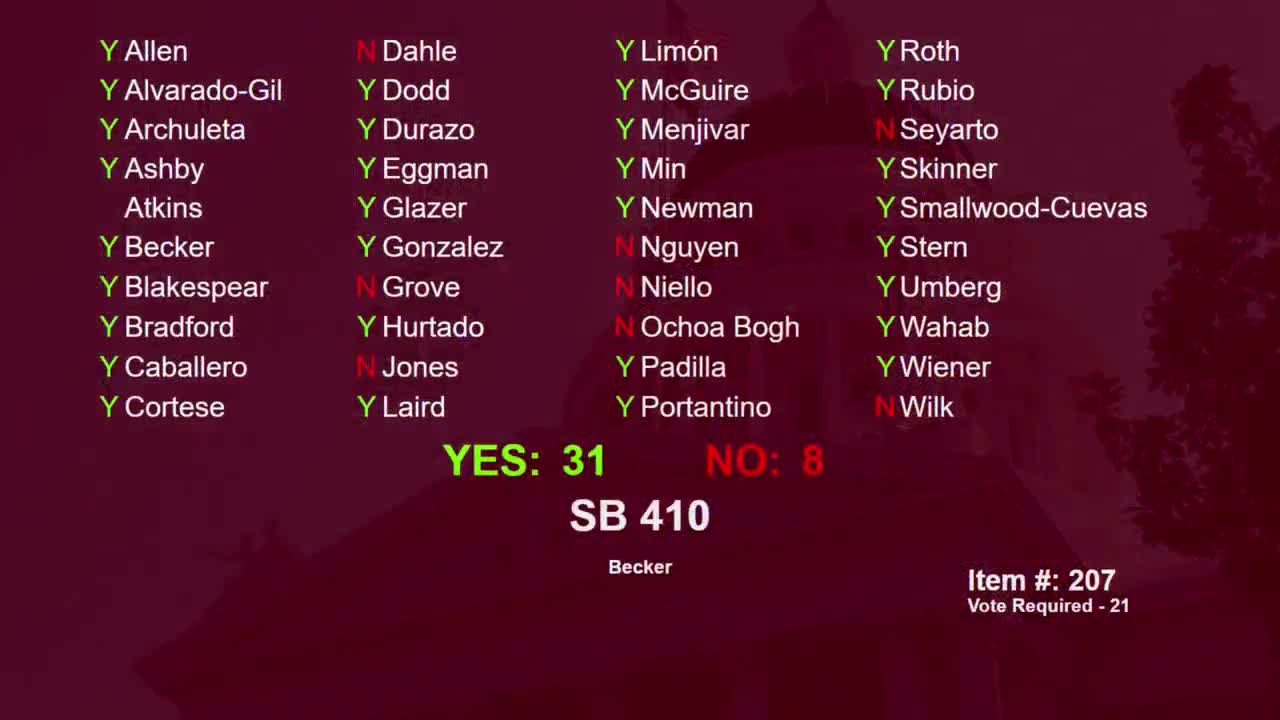 3MIN
Senate Floor
 6MIN
Senate Standing Committee on Public Safety
 7MIN
Senate Standing Committee on Governance and Finance
Bill Author




