SB 58: Controlled substances: decriminalization of certain hallucinogenic substances.
- Session Year: 2023-2024
- House: Senate
- Latest Version Date: 2023-09-11
Current Status:
Failed
(2024-01-25: Veto sustained.)
Introduced
In Committee
First Chamber
In Committee
Second Chamber
Enacted
What does this bill do?
The bill makes it legal for people 21 and older to possess, prepare, transport, and ingest small, specified amounts of psilocybin, psilocyn, DMT, and mescaline and to grow or keep spores, mycelium, or plants that produce those substances for personal, noncommercial use, while keeping penalties for possession on school grounds and for giving them to minors. It also exempts certain testing items and related paraphernalia from paraphernalia laws and requires the California Health and Human Services Agency to convene a workgroup to recommend a regulatory and therapeutic framework, including training and credentialing for facilitated use.
The summary is provided by generative AI which can make mistakes. For original language, please view the details in the table below.
(1)Existing law categorizes certain drugs and other substances as controlled substances and prohibits various actions related to those substances, including their manufacture, transportation, sale, possession, and ingestion.
This bill would, on and after January 1, 2025, make lawful the possession, preparation, obtaining, or transportation of, specified quantities of psilocybin, psilocyn, dimethyltryptamine (DMT), and mescaline, for personal use, as defined, by and with persons 21 years of age or older. The bill would provide penalties for possession of these substances on school grounds, or possession by, or transferring to, persons under 21 years of age.
The bill would require the California Health and Human Services Agency to convene a workgroup to study and make recommendations on the establishment of a framework governing the therapeutic use, including facilitated or supported use, of those substances. The bill would require that workgroup to send a report to the Legislature containing those recommendations on or before January 1, 2025.
(2)Existing law prohibits the cultivation, transfer, or transportation, as specified, of any spores or mycelium capable of producing mushrooms or other materials that contain psilocybin or psilocyn.
This bill would, on and after January 1, 2025, make lawful the cultivation or transportation of specified quantities of spores or mycelium capable of producing mushrooms or other materials that contain psilocybin or psilocyn for personal use, as defined, by and with persons 21 years of age or older.
(3)Existing law prohibits the possession of drug paraphernalia, as defined.
This bill would exempt from this prohibition, paraphernalia related, as specified, to these specific substances. The bill would also exempt from the prohibition items used for the testing and analysis of controlled substances.
(4)Existing law states the intent of the Legislature that the messages and information provided by various state drug and alcohol programs promote no unlawful use of any drugs or alcohol.
This bill would repeal those provisions.
(5)By eliminating and changing the elements of existing crimes and creating new offenses, and by requiring new duties of local prosecutors, this bill would impose a state-mandated local program.
The California Constitution requires the state to reimburse local agencies and school districts for certain costs mandated by the state. Statutory provisions establish procedures for making that reimbursement.
This bill would provide that with regard to certain mandates no reimbursement is required by this act for a specified reason.
With regard to any other mandates, this bill would provide that, if the Commission on State Mandates determines that the bill contains costs so mandated by the state, reimbursement for those costs shall be made pursuant to the statutory provisions noted above.
(6)This bill would state that its provisions are severable.
(1)Existing law categorizes certain drugs and other substances as controlled substances and prohibits various actions related to those substances, including their manufacture, transportation, sale, possession, and ingestion.
This bill would would, on and after January 1, 2025, make lawful the possession, preparation, obtaining, transfer, as specified, or transportation of, specified quantities of psilocybin, psilocyn, dimethyltryptamine (DMT), ibogaine, and mescaline, for personal use, as defined, by and with persons 21 years of age or older. The bill would provide penalties for possession of these substances on school grounds, or possession by, or transferring to, persons under 21 years of age.
The bill would require the California Health and Human Services Agency to convene a workgroup to study and make recommendations on the establishment of a framework governing the therapeutic use, including facilitated or supported use, of those substances. The bill would require that workgroup to send a report to the Legislature containing those recommendations on or before January 1, 2025.
(2)Existing law prohibits the cultivation, transfer, or transportation, as specified, of any spores or mycelium capable of producing mushrooms or other materials that contain psilocybin or psilocyn.
This bill would repeal those provisions.This bill would, on and after January 1, 2025, make lawful the cultivation or transportation of specified quantities of spores or mycelium capable of producing mushrooms or other materials that contain psilocybin or psilocyn for personal use, as defined, by and with persons 21 years of age or older.
(3)Existing law prohibits the possession of drug paraphernalia, as defined.
This bill would exempt from this prohibition, paraphernalia related, as specified, to these specific substances. The bill would also exempt from the prohibition items used for the testing and analysis of controlled substances.
(4)Existing law states the intent of the Legislature that the messages and information provided by various state drug and alcohol programs promote no unlawful use of any drugs or alcohol.
This bill would repeal those provisions.
(5)By eliminating and changing the elements of existing crimes and creating new offenses, and by requiring new duties of local prosecutors, this bill would impose a state-mandated local program.
The California Constitution requires the state to reimburse local agencies and school districts for certain costs mandated by the state. Statutory provisions establish procedures for making that reimbursement.
This bill would provide that with regard to certain mandates no reimbursement is required by this act for a specified reason.
With regard to any other mandates, this bill would provide that, if the Commission on State Mandates determines that the bill contains costs so mandated by the state, reimbursement for those costs shall be made pursuant to the statutory provisions noted above.
(6)This bill would state that its provisions are severable.
(1)Existing law categorizes certain drugs and other substances as controlled substances and prohibits various actions related to those substances, including their manufacture, transportation, sale, possession, and ingestion.
This bill would make lawful the possession, preparation, obtaining, transfer, as specified, or transportation of, specified quantities of psilocybin, psilocyn, dimethyltryptamine (DMT), ibogaine, and mescaline, for personal use or facilitated or supported use, as defined, by and with persons 21 years of age or older. The bill would delay the implementation of those provisions with regard to facilitated or supported use until a framework governing the therapeutic use of those substances has been adopted. The bill would provide penalties for possession of these substances on school grounds, or possession by, or transferring to, persons under 21 years of age.
The bill would require the California Health and Human Services Agency to convene a workgroup to study and make recommendations on the establishment of a framework governing the therapeutic use, including facilitated or supported use, of those substances. The bill would require that workgroup to send a report to the Legislature containing those recommendations on or before January 1, 2025.
(2)Existing law prohibits the cultivation, transfer, or transportation, as specified, of any spores or mycelium capable of producing mushrooms or other materials that contain psilocybin or psilocyn.
This bill would repeal those provisions.
(3)Existing law prohibits the possession of drug paraphernalia, as defined.
This bill would exempt from this prohibition, paraphernalia related, as specified, to these specific substances. The bill would also exempt from the prohibition items used for the testing and analysis of controlled substances.
(4)Existing law states the intent of the Legislature that the messages and information provided by various state drug and alcohol programs promote no unlawful use of any drugs or alcohol.
This bill would repeal those provisions.
(5)By eliminating and changing the elements of existing crimes and creating new offenses, and by requiring new duties of local prosecutors, this bill would impose a state-mandated local program.
The California Constitution requires the state to reimburse local agencies and school districts for certain costs mandated by the state. Statutory provisions establish procedures for making that reimbursement.
This bill would provide that with regard to certain mandates no reimbursement is required by this act for a specified reason.
With regard to any other mandates, this bill would provide that, if the Commission on State Mandates determines that the bill contains costs so mandated by the state, reimbursement for those costs shall be made pursuant to the statutory provisions noted above.
(6)This bill would state that its provisions are severable.
(1)Existing law categorizes certain drugs and other substances as controlled substances and prohibits various actions related to those substances, including their manufacture, transportation, sale, possession, and ingestion.
This bill would make lawful the possession, preparation, obtaining, transfer, as specified, or transportation of, specified quantities of psilocybin, psilocyn, dimethyltryptamine (DMT), ibogaine, and mescaline, for personal use or facilitated or supported use, as defined, by and with persons 21 years of age or older. The bill would delay the implementation of those provisions with regard to facilitated or supported use until a framework governing the therapeutic use of those substances has been adopted. The bill would provide penalties for possession of these substances on school grounds, or possession by, or transferring to, persons under 21 years of age.
(2)Existing law prohibits the cultivation, transfer, or transportation, as specified, of any spores or mycelium capable of producing mushrooms or other materials that contain psilocybin or psilocyn.
This bill would repeal those provisions.
(3)Existing law prohibits the possession of drug paraphernalia, as defined.
This bill would exempt from this prohibition, paraphernalia related, as specified, to these specific substances. The bill would also exempt from the prohibition items used for the testing and analysis of controlled substances.
(4)Existing law states the intent of the Legislature that the messages and information provided by various state drug and alcohol programs promote no unlawful use of any drugs or alcohol.
This bill would repeal those provisions.
(5)By eliminating and changing the elements of existing crimes and creating new offenses, and by requiring new duties of local prosecutors, this bill would impose a state-mandated local program.
The California Constitution requires the state to reimburse local agencies and school districts for certain costs mandated by the state. Statutory provisions establish procedures for making that reimbursement.
This bill would provide that with regard to certain mandates no reimbursement is required by this act for a specified reason.
With regard to any other mandates, this bill would provide that, if the Commission on State Mandates determines that the bill contains costs so mandated by the state, reimbursement for those costs shall be made pursuant to the statutory provisions noted above.
(6)This bill would state that its provisions are severable.
(1)Existing law categorizes certain drugs and other substances as controlled substances and prohibits various actions related to those substances, including their manufacture, transportation, sale, possession, and ingestion.
This bill would make lawful the possession, preparation, obtaining, transfer, as specified, or transportation of, specified quantities of psilocybin, psilocyn, dimethyltryptamine (DMT), ibogaine, and mescaline, for personal use or facilitated or supported use, as defined, by and with persons 21 years of age or older. The bill would provide penalties for possession of these substance substances on school grounds, or possession by, or transferring to, persons under 21 years of age.
(2)Existing law prohibits the cultivation, transfer, or transportation, as specified, of any spores or mycelium capable of producing mushrooms or other material which materials that contain psilocybin or psilocyn.
This bill would repeal those provisions.
(3)Existing law prohibits the possession of drug paraphernalia, as defined.
This bill would exempt from this prohibition, paraphernalia related, as specified, to these specific substances. The bill would also exempt from the prohibition items used for the testing and analysis of controlled substances.
(4)Existing law states the intent of the Legislature that the messages and information provided by various state drug and alcohol programs promote no unlawful use of any drugs or alcohol.
This bill would repeal those provisions.
(5)By eliminating and changing the elements of existing crimes and creating new offenses, and by requiring new duties of local prosecutors, this bill would impose a state-mandated local program.
The California Constitution requires the state to reimburse local agencies and school districts for certain costs mandated by the state. Statutory provisions establish procedures for making that reimbursement.
This bill would provide that with regard to certain mandates no reimbursement is required by this act for a specified reason.
With regard to any other mandates, this bill would provide that, if the Commission on State Mandates determines that the bill contains costs so mandated by the state, reimbursement for those costs shall be made pursuant to the statutory provisions noted above.
(6)This bill would state that its provisions are severable.
(1)Existing law categorizes certain drugs and other substances as controlled substances and prohibits various actions related to those substances, including their manufacture, transportation, sale, possession, and ingestion.
This bill would make lawful the possession, preparation, obtaining, transfer, as specified, or transportation of, specified quantities of psilocybin, psilocyn, dimethyltryptamine (DMT), ibogaine, and mescaline, for personal use or facilitated or supported use, as defined, by and with persons 21 years of age or older. The bill would provide penalties for possession of these substance on school grounds, or possession by, or transferring to, persons under 21 years of age.
(2)Existing law prohibits the cultivation, transfer, or transportation, as specified, of any spores or mycelium capable of producing mushrooms or other material which contain psilocybin or psilocyn.
This bill would repeal those provisions.
(3)Existing law prohibits the possession of drug paraphernalia, as defined.
This bill would exempt from this prohibition, paraphernalia related, as specified, to these specific substances. The bill would also exempt from the prohibition items used for the testing and analysis of controlled substances.
(4)Existing law states the intent of the Legislature that the messages and information provided by various state drug and alcohol programs promote no unlawful use of any drugs or alcohol.
This bill would repeal those provisions.
(5)By eliminating and changing the elements of existing crimes and creating new offenses, and by requiring new duties of local prosecutors, this bill would impose a state-mandated local program.
The California Constitution requires the state to reimburse local agencies and school districts for certain costs mandated by the state. Statutory provisions establish procedures for making that reimbursement.
This bill would provide that with regard to certain mandates no reimbursement is required by this act for a specified reason.
With regard to any other mandates, this bill would provide that, if the Commission on State Mandates determines that the bill contains costs so mandated by the state, reimbursement for those costs shall be made pursuant to the statutory provisions noted above.
(6)This bill would state that its provisions are severable.
The Legislature finds and declares all of the following:
(a)For over fifty years, the War on Drugs has caused overwhelming financial and societal costs. The current United States drug control scheme does not reflect a modern understanding of the incentives, economics, or impacts of substance use, nor does it accurately reflect the risks or potential therapeutic benefits of many presently illicit substances.
(b)Drug prohibition has failed to deter drug use, and it has increased its danger. Criminalization of drug use has created an underground market in which difficult-to-verify dosages and the presence of adulterants increase the risks of illicit drugs.
(c)Lack of honest, evidence-based drug education has paved the way for decades of stigma and misinformation, which have contributed to increasing the dangers of drug use.
(d)Encouraging access to harm reduction tools like fentanyl test strips, drug-checking kits, gas chromatography mass spectrometry machines, and milligram scales increases public health and safety by allowing users to make more accurate decisions about their personal use.
(e)Clinical research demonstrates the potential use of some psychedelic compounds, in conjunction with therapy, for the treatment of mental health, such as end-of-life anxiety, depression, post-traumatic stress, and substance use disorders. Observational evidence and traditional uses of psychedelic plants and fungi demonstrate how ceremony and community are utilized to enhance the outcomes and increase the safety of spiritual practice, emotional healing, and responsible personal growth.
(f)Proposition 122 in Colorado, which passed in November 2022, with a 53 percent vote of the state population, will decriminalize the noncommercial, personal possession of psychedelic plants and fungi and establish a regulated therapy system to provide people with therapeutic access to psychedelic plants and fungi.
(g)Measure 109 in Oregon, which passed in November 2020, with a 56 percent vote of the state population, will establish a regulated psilocybin therapy system in Oregon to provide people therapeutic access to psilocybin.
(h)Measure 110 in Oregon, which passed in November 2020, with a 58 percent vote of the state population, decriminalized the personal possession of all drugs, and almost 20 countries around the world including Portugal, the Czech Republic, and Spain, have expressly or effectively decriminalized the personal use of illicit substances.
(i)The City Councils of the City of Oakland and the City of Santa Cruz and the Board of Supervisors of the City and County of San Francisco have all passed resolutions deprioritizing the enforcement of the possession, use, and propagation of psychedelic plants and fungi, effectively decriminalizing in those cities. Since June 2019, the City of Ann Arbor, Michigan, and the Cities of Somerville and Cambridge, Massachusetts have all decriminalized the possession, use, and propagation of psychedelic plants and fungi at the local level. In 2020, Washington, D.C., passed Initiative 81 to decriminalize and deprioritize the possession and use of psychedelic plants and fungi with 76 percent voter approval.
(j)This act will decriminalize the noncommercial, personal use of specified controlled substances. This provision would take effect on January 1, 2025. This act further decriminalizes the use of specified controlled substances for the purpose of group community-based healing, including facilitated and supported use, risk reduction, and other related services, but delays implementation of this provision until a framework for the therapeutic use, which would include community-based healing, facilitated and supported use, risk reduction, and other related services, of the specified controlled substances is developed and adopted. This bill lays the groundwork for California to develop a therapeutic access program for psychedelic plants and fungi.
(k)These changes in law will not affect any restrictions on the driving or operation of a vehicle while impaired, or an employers ability to restrict the use of controlled substances by its employees, or affect the legal standard for negligence.
(l)Peyote is specifically excluded from the list of substances to be decriminalized, and any cultivation, harvest, extraction, tincture or other product manufactured or derived therefrom, because of the nearly endangered status of the peyote plant and the special significance peyote holds in Native American spirituality. Section 11363 of the Health and Safety Code, which makes it a crime in California to cultivate, harvest, dry, or process any plant of the genus Lophophora, also known as Peyote, is not amended or repealed.
(m)The State of California fully respects and supports the continued Native American possession and use of peyote under federal law, Section 1996a of Title 42 of the United States Code, understanding that Native Americans in the United States were persecuted and prosecuted for their ceremonial practices and use of peyote for more than a century and had to fight numerous legal and political battles to achieve the current protected status, and the enactment of this legislation does not intend to undermine explicitly or implicitly that status.
SEC. 2.Section 11054 of the Health and Safety Code is amended to read:11054.(a)The controlled substances listed in this section are included in Schedule I.
(b)Opiates. Unless specifically excepted or unless listed in another schedule, any of the following opiates, including their isomers, esters, ethers, salts, and salts of isomers, esters, and ethers whenever the existence of those isomers, esters, ethers, and salts is possible within the specific chemical designation:
(1)Acetylmethadol.
(2)Allylprodine.
(3)Alphacetylmethadol (except levoalphacetylmethadol, also known as levo-alpha-acetylmethadol, levomethadyl acetate, or LAAM).
(4)Alphameprodine.
(5)Alphamethadol.
(6)Benzethidine.
(7)Betacetylmethadol.
(8)Betameprodine.
(9)Betamethadol.
(10)Betaprodine.
(11)Clonitazene.
(12)Dextromoramide.
(13)Diampromide.
(14)Diethylthiambutene.
(15)Difenoxin.
(16)Dimenoxadol.
(17)Dimepheptanol.
(18)Dimethylthiambutene.
(19)Dioxaphetyl butyrate.
(20)Dipipanone.
(21)Ethylmethylthiambutene.
(22)Etonitazene.
(23)Etoxeridine.
(24)Furethidine.
(25)Hydroxypethidine.
(26)Ketobemidone.
(27)Levomoramide.
(28)Levophenacylmorphan.
(29)Morpheridine.
(30)Noracymethadol.
(31)Norlevorphanol.
(32)Normethadone.
(33)Norpipanone.
(34)Phenadoxone.
(35)Phenampromide.
(36)Phenomorphan.
(37)Phenoperidine.
(38)Piritramide.
(39)Proheptazine.
(40)Properidine.
(41)Propiram.
(42)Racemoramide.
(43)Tilidine.
(44)Trimeperidine.
(45)Any substance that contains any quantity of acetylfentanyl (N-[1-phenethyl-4-piperidinyl] acetanilide) or a derivative thereof.
(46)Any substance that contains any quantity of the thiophene analog of acetylfentanyl (N-[1-[2-(2-thienyl)ethyl]-4-piperidinyl] acetanilide) or a derivative thereof.
(47)1-Methyl-4-Phenyl-4-Propionoxypiperidine (MPPP).
(48)1-(2-Phenethyl)-4-Phenyl-4-Acetyloxypiperidine (PEPAP).
(c)Opium derivatives. Unless specifically excepted or unless listed in another schedule, any of the following opium derivatives, its salts, isomers, and salts of isomers whenever the existence of those salts, isomers, and salts of isomers is possible within the specific chemical designation:
(1)Acetorphine.
(2)Acetyldihydrocodeine.
(3)Benzylmorphine.
(4)Codeine methylbromide.
(5)Codeine-N-Oxide.
(6)Cyprenorphine.
(7)Desomorphine.
(8)Dihydromorphine.
(9)Drotebanol.
(10)Etorphine (except hydrochloride salt).
(11)Heroin.
(12)Hydromorphinol.
(13)Methyldesorphine.
(14)Methyldihydromorphine.
(15)Morphine methylbromide.
(16)Morphine methylsulfonate.
(17)Morphine-N-Oxide.
(18)Myrophine.
(19)Nicocodeine.
(20)Nicomorphine.
(21)Normorphine.
(22)Pholcodine.
(23)Thebacon.
(d)Hallucinogenic substances. Unless specifically excepted or unless listed in another schedule, any material, compound, mixture, or preparation that contains any quantity of the following hallucinogenic substances, or that contains any of its salts, isomers, and salts of isomers whenever the existence of those salts, isomers, and salts of isomers is possible within the specific chemical designation (for purposes of this subdivision only, the term isomer includes the optical, position, and geometric isomers):
(1)4-bromo-2,5-dimethoxy-amphetamineSome trade or other names: 4-bromo-2,5-dimethoxy-alpha-methylphenethylamine; 4-bromo-2,5-DMA.
(2)2,5-dimethoxyamphetamineSome trade or other names: 2,5-dimethoxy-alpha-methylphenethylamine; 2,5-DMA.
(3)4-methoxyamphetamineSome trade or other names: 4-methoxy-alpha-methylphenethylamine, paramethoxyamphetamine, PMA.
(4)5-methoxy-3,4-methylenedioxy-amphetamine.
(5)4-methyl-2,5-dimethoxy-amphetamineSome trade or other names: 4-methyl-2,5-dimethoxy-alpha-methylphenethylamine; DOM; and STP.
(6)3,4-methylenedioxy amphetamine.
(7)3,4,5-trimethoxy amphetamine.
(8)BufotenineSome trade or other names: 3-(beta-dimethylaminoethyl)-5-hydroxyindole; 3-(2-dimethylaminoethyl)-5 indolol; N,N-dimethylserolonin, 5-hydroxy-N,N-dimethyltryptamine; mappine.
(9)DiethyltryptamineSome trade or other names: N,N-Diethyltryptamine; DET.
(10)DimethyltryptamineSome trade or other names: DMT.
(11)IbogaineSome trade or other names: 7-Ethyl-6,6beta, 7,8,9,10,12,13-octahydro-2-methoxy-6,9-methano-5H-pyrido [1,2:1,2] azepino [5,4-b] indole; Tabernantheiboga.
(12)Lysergic acid diethylamide.
(13)Cannabis.
(14)Mescaline, derived from plants presently classified botanically in the Echinopsis or Trichocereus genus of cacti, including, without limitation, the Bolivian Torch Cactus, San Pedro Cactus, or Peruvian Torch Cactus, but not including mescaline derived from any plant described in paragraph (15).
(15)PeyoteMeaning all parts of the plant presently classified botanically as Lophophora williamsii Lemaire, whether growing or not, the seeds thereof, any extract from any part of the plant, and every compound, manufacture, salts, derivative, mixture, or preparation of the plant, its seeds or extracts (interprets 21 U.S.C. Sec. 812(c), Schedule 1(c)(12)).
(16)N-ethyl-3-piperidyl benzilate.
(17)N-methyl-3-piperidyl benzilate.
(18)Psilocybin.
(19)Psilocyn.
(20)Tetrahydrocannabinols. Synthetic equivalents of the substances contained in the plant, or in the resinous extractives of Cannabis, sp. and/or synthetic substances, derivatives, and their isomers with similar chemical structure and pharmacological activity such as the following: delta 1 cis or trans tetrahydrocannabinol, and their optical isomers; delta 6 cis or trans tetrahydrocannabinol, and their optical isomers; delta 3,4 cis or trans tetrahydrocannabinol, and its optical isomers.
Because nomenclature of these substances is not internationally standardized, compounds of these structures, regardless of numerical designation of atomic positions covered.
(21)Ethylamine analog of phencyclidineSome trade or other names: N-ethyl-1-phenylcyclohexylamine, (1-phenylcyclohexyl) ethylamine, N-(1-phenylcyclohexyl) ethylamine, cyclohexamine, PCE.
(22)Pyrrolidine analog of phencyclidineSome trade or other names: 1-(1-phenylcyclohexyl)-pyrrolidine, PCP, PHP.
(23)Thiophene analog of phencyclidineSome trade or other names: 1-[1-(2 thienyl)-cyclohexyl]-piperidine, 2-thienyl analog of phencyclidine, TPCP, TCP.
(e)Depressants. Unless specifically excepted or unless listed in another schedule, any material, compound, mixture, or preparation that contains any quantity of the following substances having a depressant effect on the central nervous system, including its salts, isomers, and salts of isomers whenever the existence of those salts, isomers, and salts of isomers is possible within the specific chemical designation:
(1)Mecloqualone.
(2)Methaqualone.
(3)Gamma hydroxybutyric acid (also known by other names such as GHB; gamma hydroxy butyrate; 4-hydroxybutyrate; 4-hydroxybutanoic acid; sodium oxybate; sodium oxybutyrate), including its immediate precursors, isomers, esters, ethers, salts, and salts of isomers, esters, and ethers, including, but not limited to, gammabutyrolactone, for which an application has not been approved under Section 505 of the Federal Food, Drug, and Cosmetic Act (21 U.S.C. Sec. 355).
(f)Unless specifically excepted or unless listed in another schedule, any material, compound, mixture, or preparation that contains any quantity of the following substances having a stimulant effect on the central nervous system, including its isomers:
(1)Cocaine base.
(2)Fenethylline, including its salts.
(3)N-Ethylamphetamine, including its salts.
SEC. 3.Section 11214 is added to the Health and Safety Code, to read:11214.(a)The California Health and Human Services Agency shall convene a workgroup to study and make recommendations on the establishment of a framework governing the therapeutic use, including facilitated or supported use, as defined in paragraph (2) of subdivision (g) of Section 11350.1 and paragraph (2) of subdivision (g) of Section 11377.1, of mescaline, ibogaine, Dimethyltryptamine (DMT), and psilocyn or psilocybin.
(b)The Secretary of the California Health and Human Services Agency or their designee shall be the chairperson of the workgroup.
(c)The workgroup shall include, but not be limited to, all of the following:
(1)Persons with expertise in psychedelic therapy, medicine and public health, drug policy, harm reduction, and youth drug education.
(2)Law enforcement and emergency medical services or fire service first responders.
(3)People with experience with the traditional indigenous use of psychedelic substances, including representatives from the National Council of the Native American Church and Indian tribes in California.
(4)Veterans groups.
(5)University researchers with expertise in psychedelics.
(6)Research scientists with expertise in clinical studies and drug approval process under the federal Food and Drug Administration.
(7)Individuals from other states that have decriminalized psychedelics and established regulatory frameworks for the lawful use of psychedelics.
(d)The workgroup shall study subjects, including, but not limited to, all of the following:
(1)Research on the safety and efficacy of using each of the controlled substances specified in subdivision (a) in a therapeutic setting for treating post-traumatic stress disorder, depression, anxiety, addiction, and other mental health conditions.
(2)Long-term impact of supervised psychedelic or dissociative drug use with seeking and misusing other substances, including alcohol, cannabis, illicit substances, and unregulated psychedelic or dissociative drugs.
(3)Perceptions of harm of psychedelic or dissociative drugs following enactment of decriminalization both on a personal use and therapeutic use level.
(4)Impact of different regulatory frameworks on different health outcomes among vulnerable populations, including youth, people with substance use disorders, and minority or disenfranchised groups.
(5)Regulated use models for the controlled substances specified in subdivision (a) from other jurisdictions.
(6)Content and scope of educational campaigns that have proven effective in accurate public health approaches regarding use, effect, and risk reduction for the substances specified in subdivision (a), including, but not limited to, public service announcements, educational curricula, appropriate crisis response, and appropriate training for first responders and multiresponders, including law enforcement, emergency medical services, fire service, and unarmed coresponder units.
(7)Policies for minimizing use-related risks, including information related to appropriate use and impacts of detrimental substance use.
(8)Appropriate frameworks to govern the therapeutic use of controlled substances, including qualifications and training for therapists or facilitators.
(e)The workgroup shall develop policy recommendations regarding, but not limited to, all of the following:
(1)Development of a statewide program or programs for the training of individuals providing therapeutic psychedelic services in therapeutic settings, including facilitated and supported use settings.
(2)Development of a statewide credentialing process for individuals providing therapeutic psychedelic services in therapeutic settings, including facilitated or supported use settings.
(3)The content and scope of educational campaigns and accurate public health approaches regarding use, effect, risk reduction, and safety for the substances specified in subdivision (a).
(4)Policies for minimizing use-related risks, including information related to appropriate use and impacts of detrimental substance use.
(5)Policies for the regulation of controlled substances specified in subdivision (a), including responsible marketing, product safety, and cultural responsibility.
(6)Policies for the safe and equitable production, access, use, and delivery of the controlled substances specified in subdivision (a).
(f)Subsequent to the Legislatures adoption of a framework governing therapeutic use of the substances described in subdivision (a), it is the intent of the Legislature that the transfer of a substance described in subdivision (a), without financial gain, in the context of therapeutic use, which includes facilitated or supported use, be decriminalized.
(g)As used in this section, facilitated or supported use means the supervised or assisted personal use of a substance described in subdivision (a) by an individual or group of persons 21 years of age or older, or the assisting or supervising of such persons in such use, within the context of spiritual guidance, community-based healing, or related services.
(h)(1)On or before January 1, 2025, the workgroup shall submit a report to the Legislature detailing its findings and recommendations.
(2)A report to be submitted pursuant to this subdivision shall be submitted in compliance with Section 9795 of the Government Code.
(i)This section shall remain in effect until January 1, 2026, and as of that date is repealed.
SEC. 4.Section 11350 of the Health and Safety Code is amended to read:11350.(a)Except as otherwise provided in this division, every person who possesses (1) any controlled substance specified in subdivision (b), (c), (e), or paragraph (1) of subdivision (f) of Section 11054, specified in paragraph (15) or (20) of subdivision (d) of Section 11054, or specified in subdivision (b) or (c) of Section 11055, or specified in subdivision (h) of Section 11056, or (2) any controlled substance classified in Schedule III, IV, or V that is a narcotic drug, unless upon the written prescription of a physician, dentist, podiatrist, or veterinarian licensed to practice in this state, shall be punished by imprisonment in a county jail for not more than one year, except that such person shall instead be punished pursuant to subdivision (h) of Section 1170 of the Penal Code if that person has one or more prior convictions for an offense specified in clause (iv) of subparagraph (C) of paragraph (2) of subdivision (e) of Section 667 of the Penal Code or for an offense requiring registration pursuant to subdivision (c) of Section 290 of the Penal Code.
(b)Except as otherwise provided in this division, whenever a person who possesses any of the controlled substances specified in subdivision (a), the judge may, in addition to any punishment provided for pursuant to subdivision (a), assess against that person a fine not to exceed seventy dollars ($70) with proceeds of this fine to be used in accordance with Section 1463.23 of the Penal Code. The court shall, however, take into consideration the defendants ability to pay, and no defendant shall be denied probation because of their inability to pay the fine permitted under this subdivision.
(c)Except in unusual cases in which it would not serve the interest of justice to do so, whenever a court grants probation pursuant to a felony conviction under this section, in addition to any other conditions of probation that may be imposed, the following conditions of probation shall be ordered:
(1)For a first offense under this section, a fine of at least one thousand dollars ($1,000) or community service.
(2)For a second or subsequent offense under this section, a fine of at least two thousand dollars ($2,000) or community service.
(3)If a defendant does not have the ability to pay the minimum fines specified in paragraphs (1) and (2), community service shall be ordered in lieu of the fine.
(d)It is not unlawful for a person other than the prescription holder to possess a controlled substance described in subdivision (a) if both of the following apply:
(1)The possession of the controlled substance is at the direction or with the express authorization of the prescription holder.
(2)The sole intent of the possessor is to deliver the prescription to the prescription holder for its prescribed use or to discard the substance in a lawful manner.
(e)This section does not permit the use of a controlled substance by a person other than the prescription holder or permit the distribution or sale of a controlled substance that is otherwise inconsistent with the prescription.
SEC. 5.Section 11350.1 is added to the Health and Safety Code, to read:11350.1.(a)Except as otherwise provided in subdivisions (b), (c), (d), and (e) of this section and notwithstanding any other law, all of the following shall be lawful for a natural person 21 years of age or older and shall not be a violation of state or local law:
(1)The possession, preparation, obtaining, or transportation, of no more than the allowable amount of mescaline, as described in paragraph (14) of subdivision (d) of Section 11054, for personal use.
(2)The ingesting of mescaline.
(3)The possession, planting, cultivating, harvesting, or preparation of plants capable of producing mescaline, except for the plant presently classified botanically as Lophophora williamsii Lemaire, on property owned or controlled by a person, for the purposes described in this subdivision by that person, and possession of any product produced by those plants.
(b)Possession of mescaline by a person 21 years of age or over on the grounds of any public or private elementary, vocational, junior high, or high school, during hours that the school is open for classes or school-related programs, or at any time when minors are using the facility is punishable as a misdemeanor.
(c)(1)A person who knowingly gives away or administers mescaline to a person who is under 18 years of age in violation of law shall be punished by imprisonment in a county jail for a period of not more than six months or by a fine of not more than five hundred dollars ($500), or by both that fine and imprisonment, or by imprisonment pursuant to subdivision (h) of Section 1170 of the Penal Code.
(2)Notwithstanding paragraph (1), a person 18 years of age or over who knowingly gives away or administers mescaline to a minor under 14 years of age in violation of law shall be punished by imprisonment in the state prison for a period of three, five, or seven years.
(3)A person who knowingly gives away or administers mescaline to a person who is at least 18 years of age, but under 21 years of age is guilty of an infraction.
(d)Except as otherwise provided, possession of mescaline by a person under 18 years of age is punishable as an infraction and shall require:
(1)Upon a finding that a first offense has been committed, four hours of drug education or counseling and up to 10 hours of community service over a period not to exceed 60 days, commencing when the drug education or counseling services are made available to them.
(2)Upon a finding that a second offense or subsequent offense has been committed, six hours of drug education or counseling and up to 20 hours of community service over a period not to exceed 90 days, commencing when the drug education or counseling services are made available to them.
(e)Except as otherwise provided, possession of mescaline by a person at least 18 years of age but less than 21 years of age is punishable as an infraction.
(f)Mescaline or related products involved in any way with conduct deemed lawful by this section are not contraband nor subject to seizure, and no conduct deemed lawful by this section shall constitute the basis for detention, search, or arrest, or the basis for the seizure or forfeiture of assets.
(g)As used in this section, the following terms are defined as follows:
(1)Allowable amount means four grams per person. Allowable amount does not include the weight of any material of which the substance is a part or to which the substance is added, dissolved, held in solution, or suspended, or any ingredient or material combined with the substance as part of a preparation.
(2)Financial gain means the receipt of money or other valuable consideration in exchange for the item being transferred.
(3)Mescaline does not include synthetic analogs of mescaline, including derivatives of mescaline that are produced using chemical synthesis, chemical modification, or chemical conversion.
(4)Personal use means for the personal ingestion or other personal and noncommercial use by the person in possession.
(5)Preparation means processing or otherwise preparing for use.
(h)This section shall take effect on January 1, 2025.
SEC. 6.Section 11364 of the Health and Safety Code is amended to read:11364.(a)It is unlawful to possess an opium pipe or any device, contrivance, instrument, or paraphernalia used for unlawfully injecting or smoking (1) a controlled substance specified in subdivision (b), (c), or (e) or paragraph (1) of subdivision (f) of Section 11054, specified in paragraph (15) or (20) of subdivision (d) of Section 11054, specified in subdivision (b) or (c) of Section 11055, or specified in paragraph (2) of subdivision (d) of Section 11055, or (2) a controlled substance that is a narcotic drug classified in Schedule III, IV, or V.
(b)This section shall not apply to hypodermic needles or syringes that have been containerized for safe disposal in a container that meets state and federal standards for disposal of sharps waste.
(c)Until January 1, 2026, as a public health measure intended to prevent the transmission of HIV, viral hepatitis, and other bloodborne diseases among persons who use syringes and hypodermic needles, and to prevent subsequent infection of sexual partners, newborn children, or other persons, this section shall not apply to the possession solely for personal use of hypodermic needles or syringes.
SEC. 7.Section 11364.7 of the Health and Safety Code is amended to read:11364.7.(a)(1)Except as authorized by law, any person who delivers, furnishes, or transfers, possesses with intent to deliver, furnish, or transfer, or manufactures with the intent to deliver, furnish, or transfer, drug paraphernalia, knowing, or under circumstances where one reasonably should know, that it will be used to plant, propagate, cultivate, grow, harvest, compound, convert, produce, process, prepare, pack, repack, store, contain, conceal, inject, ingest, inhale, or otherwise introduce into the human body a controlled substance, except as provided in subdivision (b), in violation of this division, is guilty of a misdemeanor.
(2)A public entity, its agents, or employees shall not be subject to criminal prosecution for distribution of hypodermic needles or syringes or any materials deemed by a local or state health department to be necessary to prevent the spread of communicable diseases, or to prevent drug overdose, injury, or disability to participants in clean needle and syringe exchange projects authorized by the public entity pursuant to Chapter 18 (commencing with Section 121349) of Part 4 of Division 105.
(3)This subdivision does not apply to any paraphernalia that is intended to be used to plant, propagate, cultivate, grow, harvest, compound, convert, produce, process, prepare, pack, repack, store, contain, conceal, inject, ingest, inhale, or otherwise introduce into the human body, any of the following substances:
(A)Dimethyltryptamine (DMT).
(B)Mescaline.
(C)Psilocybin.
(D)Psilocyn.
(b)Except as authorized by law, any person who manufactures with intent to deliver, furnish, or transfer drug paraphernalia knowing, or under circumstances where one reasonably should know, that it will be used to plant, propagate, cultivate, grow, harvest, manufacture, compound, convert, produce, process, prepare, test, analyze, pack, repack, store, contain, conceal, inject, ingest, inhale, or otherwise introduce into the human body cocaine, cocaine base, heroin, phencyclidine, or methamphetamine in violation of this division shall be punished by imprisonment in a county jail for not more than one year, or in the state prison.
(c)Except as authorized by law, any person, 18 years of age or over, who violates subdivision (a) by delivering, furnishing, or transferring drug paraphernalia to a person under 18 years of age who is at least three years younger, or who, upon the grounds of a public or private elementary, vocational, junior high, or high school, possesses a hypodermic needle, as defined in paragraph (7) of subdivision (a) of Section 11014.5, with the intent to deliver, furnish, or transfer the hypodermic needle, knowing, or under circumstances where one reasonably should know, that it will be used by a person under 18 years of age to inject into the human body a controlled substance, is guilty of a misdemeanor and shall be punished by imprisonment in a county jail for not more than one year, by a fine of not more than one thousand dollars ($1,000), or by both that imprisonment and fine.
(d)The violation, or the causing or the permitting of a violation, of subdivision (a), (b), or (c) by a holder of a business or liquor license issued by a city, county, or city and county, or by the State of California, and in the course of the licensees business shall be grounds for the revocation of that license.
(e)All drug paraphernalia defined in Section 11014.5 is subject to forfeiture and may be seized by any peace officer pursuant to Section 11471 unless its distribution has been authorized pursuant to subdivision (a).
(f)If any provision of this section or the application thereof to any person or circumstance is held invalid, it is the intent of the Legislature that the invalidity shall not affect other provisions or applications of this section that can be given effect without the invalid provision or application and to this end the provisions of this section are severable.
SEC. 8.Section 11365 of the Health and Safety Code is amended to read:11365.(a)It is unlawful to visit or to be in any room or place where any controlled substances that are specified in subdivision (b), (c), or (e), or paragraph (1) of subdivision (f) of Section 11054, specified in paragraph (15) or (20) of subdivision (d) of Section 11054, or specified in subdivision (b) or (c) or paragraph (2) of subdivision (d) of Section 11055, or that are narcotic drugs classified in Schedule III, IV, or V, are being unlawfully smoked or used with knowledge that such activity is occurring.
(b) This section shall apply only where the defendant aids, assists, or abets the perpetration of the unlawful smoking or use of a controlled substance specified in subdivision (a). This subdivision is declaratory of existing law as expressed in People v. Cressey (1970) 2 Cal. 3d 836.
SEC. 9.Section 11377 of the Health and Safety Code is amended to read:11377.(a)Except as authorized by law and as otherwise provided in subdivision (b) or Section 11375, or in Article 7 (commencing with Section 4211) of Chapter 9 of Division 2 of the Business and Professions Code, every person who possesses any controlled substance that is (1) classified in Schedule III, IV, or V, and that is not a narcotic drug, (2) specified in subdivision (d) of Section 11054, except paragraphs (10), (11), (13), (14), (15), (18), (19), and (20) of subdivision (d), (3) specified in paragraph (11) of subdivision (c) of Section 11056, (4) specified in paragraph (2) or (3) of subdivision (f) of Section 11054, or (5) specified in subdivision (d), (e), or (f) of Section 11055, unless upon the prescription of a physician, dentist, podiatrist, or veterinarian, licensed to practice in this state, shall be punished by imprisonment in a county jail for a period of not more than one year, except that such person may instead be punished pursuant to subdivision (h) of Section 1170 of the Penal Code if that person has one or more prior convictions for an offense specified in clause (iv) of subparagraph (C) of paragraph (2) of subdivision (e) of Section 667 of the Penal Code or for an offense requiring registration pursuant to subdivision (c) of Section 290 of the Penal Code.
(b)The judge may assess a fine not to exceed seventy dollars ($70) against any person who violates subdivision (a), with the proceeds of this fine to be used in accordance with Section 1463.23 of the Penal Code. The court shall, however, take into consideration the defendants ability to pay, and no defendant shall be denied probation because of their inability to pay the fine permitted under this subdivision.
(c)It is not unlawful for a person other than the prescription holder to possess a controlled substance described in subdivision (a) if both of the following apply:
(1)The possession of the controlled substance is at the direction or with the express authorization of the prescription holder.
(2)The sole intent of the possessor is to deliver the prescription to the prescription holder for its prescribed use or to discard the substance in a lawful manner.
(d)This section does not permit the use of a controlled substance by a person other than the prescription holder or permit the distribution or sale of a controlled substance that is otherwise inconsistent with the prescription.
SEC. 10.Section 11377.1 is added to the Health and Safety Code, to read:11377.1.(a)Except as otherwise provided in subdivisions (b), (c), (d), and (e) of this section, and notwithstanding any other law, all of the following shall be lawful for a natural person 21 years of age or older and shall not be a violation of state or local law:
(1)The possession, preparation, obtaining, or transportation, of no more than the allowable amount of any of the following substances for personal use:
(A)The controlled substance specified in paragraph (10) of subdivision (d) of Section 11054.
(B)The controlled substance specified in paragraph (18) of subdivision (d) of Section 11054.
(C)The controlled substance specified in paragraph (19) of subdivision (d) of Section 11054.
(D)Spores or mycelium capable of producing mushrooms or other material which contains the controlled substance specified in paragraph (18) or (19) of subdivision (d) of Section 11054.
(2)The ingesting of a substance described in paragraph (1).
(3)The possession, planting, cultivating, harvesting, or preparation of plants capable of producing a substance described in paragraph (1), on property owned or controlled by a person, for the uses described in this subdivision by that person, and possession of any product produced by those plants including spores or mycelium capable of producing mushrooms or other materials that contain a controlled substance specified in paragraph (18) or (19) of subdivision (d) of Section 11054, for that purpose.
(b)Possession of a controlled substance specified in paragraph (1) of subdivision (a) by a person 21 years of age or over, on the grounds of any public or private elementary, vocational, junior high, or high school, during hours that the school is open for classes or school-related programs, or at any time when minors are using the facility is punishable as a misdemeanor.
(c)(1)A person who knowingly gives away or administers a controlled substance specified in paragraph (1) of subdivision (a) to a person who is under 18 years of age in violation of law shall be punished by imprisonment in a county jail for a period of not more than six months or by a fine of not more than five hundred dollars ($500), or by both that fine and imprisonment, or by imprisonment pursuant to subdivision (h) of Section 1170 of the Penal Code.
(2)Notwithstanding paragraph (1), a person 18 years of age or over who knowingly gives away or administers a substance described in paragraph (1) to a minor under 14 years of age in violation of law shall be punished by imprisonment in the state prison for a period of three, five, or seven years.
(3)A person who knowingly gives away or administers a substance described in paragraph (1) to a person who is at least 18 years of age, but under 21 years of age is guilty of an infraction.
(d)Except as otherwise provided, possession of a controlled substance specified in paragraph (1) of subdivision (a) by a person under 18 years of age is punishable as an infraction and shall require:
(1)Upon a finding that a first offense has been committed, four hours of drug education or counseling and up to 10 hours of community service over a period not to exceed 60 days, commencing when the drug education or counseling services are made available to them.
(2)Upon a finding that a second offense or subsequent offense has been committed, six hours of drug education or counseling and up to 20 hours of community service over a period not to exceed 90 days, commencing when the drug education or counseling services are made available to them.
(e)Except as otherwise provided, possession of a controlled substance specified in paragraph (1) of subdivision (a) by a person at least 18 years of age but less than 21 years of age is punishable as an infraction.
(f)A controlled substance described in this section or any related product involved in any way with conduct deemed lawful by this section are not contraband nor subject to seizure, and no conduct deemed lawful by this section shall constitute the basis for detention, search, or arrest, or the basis for the seizure or forfeiture of assets.
(g)As used in this section, the following terms are defined as follows:
(1)Allowable amount means the following quantities of a substance per person. Allowable amount does not include the weight of any material of which the substance is a part or to which the substance is added, dissolved, held in solution, or suspended, or any ingredient or material combined with the substance specified in this subdivision as part of a preparation:
(A)One gram of dimethyltryptamine, otherwise known as DMT.
(B)One gram of psilocybin or one ounce of a plant or fungi containing psilocybin.
(C)One gram of psilocyn or one ounce of a plant or fungi containing psilocyn.
(D)The amount of spores or mycelium capable of producing an allowable amount of a plant or fungi which contain a controlled substance specified in paragraph (18) or (19) of subdivision (d) of Section 11054.
(2)Controlled substances in this section does not include synthetic analogs of these substances, including derivatives of these substances that are produced using chemical synthesis, chemical modification, or chemical conversion.
(3)Financial gain means the receipt of money or other valuable consideration in exchange for the item being transferred.
(4)Personal use means for the personal ingestion or other personal and noncommercial use by the person in possession.
(5)Preparation means processing or otherwise preparing for use.
(h)This section shall take effect on January 1, 2025.
SEC. 11.Section 11379 of the Health and Safety Code is amended to read:11379.(a)Except as otherwise provided in subdivision (b), in Section 11377.1, and in Article 7 (commencing with Section 4211) of Chapter 9 of Division 2 of the Business and Professions Code, every person who transports, imports into this state, sells, furnishes, administers, or gives away, or offers to transport, import into this state, sell, furnish, administer, or give away, or attempts to import into this state or transport any controlled substance that is (1) classified in Schedule III, IV, or V and that is not a narcotic drug, except subdivision (g) of Section 11056, (2) specified in subdivision (d) of Section 11054, except paragraphs (13), (14), (15), (20), (21), (22), and (23) of subdivision (d), (3) specified in paragraph (11) of subdivision (c) of Section 11056, (4) specified in paragraph (2) or (3) of subdivision (f) of Section 11054, or (5) specified in subdivision (d) or (e), except paragraph (3) of subdivision (e), or specified in subparagraph (A) of paragraph (1) of subdivision (f), of Section 11055, unless upon the prescription of a physician, dentist, podiatrist, or veterinarian, licensed to practice in this state, shall be punished by imprisonment pursuant to subdivision (h) of Section 1170 of the Penal Code for a period of two, three, or four years.
(b)Notwithstanding the penalty provisions of subdivision (a), any person who transports any controlled substances specified in subdivision (a) within this state from one county to another noncontiguous county shall be punished by imprisonment pursuant to subdivision (h) of Section 1170 of the Penal Code for three, six, or nine years.
(c)For purposes of this section, transports means to transport for sale.
(d)Nothing in this section is intended to preclude or limit prosecution under an aiding and abetting theory, accessory theory, or a conspiracy theory.
SEC. 12.Section 11382 of the Health and Safety Code is amended to read:11382.Except as otherwise provided in Section 11377.1, every person who agrees, consents, or in any manner offers to unlawfully sell, furnish, transport, administer, or give any controlled substance that is (a) classified in Schedule III, IV, or V and that is not a narcotic drug, or (b) specified in subdivision (d) of Section 11054, except paragraphs (13), (14), (15), and (20) of subdivision (d), specified in paragraph (11) of subdivision (c) of Section 11056, or specified in subdivision (d), (e), or (f) of Section 11055, to any person, or offers, arranges, or negotiates to have that controlled substance unlawfully sold, delivered, transported, furnished, administered, or given to any person and then sells, delivers, furnishes, transports, administers, or gives, or offers, or arranges, or negotiates to have sold, delivered, transported, furnished, administered, or given to any person any other liquid, substance, or material in lieu of that controlled substance shall be punished by imprisonment in the county jail for not more than one year, or pursuant to subdivision (h) of Section 1170 of the Penal Code.
SEC. 13.Section 11550 of the Health and Safety Code is amended to read:11550.(a)A person shall not use, or be under the influence of any controlled substance that is (1) specified in subdivision (b), (c), or (e), or paragraph (1) of subdivision (f) of Section 11054, specified in paragraph (15), (21), (22), or (23) of subdivision (d) of Section 11054, specified in subdivision (b) or (c) of Section 11055, or specified in paragraph (1) or (2) of subdivision (d) or in paragraph (3) of subdivision (e) of Section 11055, or (2) a narcotic drug classified in Schedule III, IV, or V, except when administered by or under the direction of a person licensed by the state to dispense, prescribe, or administer controlled substances. It shall be the burden of the defense to show that it comes within the exception. A person convicted of violating this subdivision is guilty of a misdemeanor and shall be sentenced to serve a term of not more than one year in a county jail. The court may also place a person convicted under this subdivision on probation for a period not to exceed five years.
(b)(1)A person who is convicted of violating subdivision (a) when the offense occurred within seven years of that person being convicted of two or more separate violations of that subdivision, and refuses to complete a licensed drug rehabilitation program offered by the court pursuant to subdivision (c), shall be punished by imprisonment in a county jail for not less than 180 days nor more than one year. In no event does the court have the power to absolve a person convicted of a violation of subdivision (a) who is punishable under this subdivision from the obligation of spending at least 180 days in confinement in a county jail unless there are no licensed drug rehabilitation programs reasonably available.
(2)For the purpose of this section, a drug rehabilitation program is not reasonably available unless the person is not required to pay more than the court determines that they are reasonably able to pay in order to participate in the program.
(c)(1)The court may, when it would be in the interest of justice, permit a person convicted of a violation of subdivision (a) punishable under subdivision (a) or (b) to complete a licensed drug rehabilitation program in lieu of part or all of the imprisonment in a county jail. As a condition of sentencing, the court may require the offender to pay all or a portion of the drug rehabilitation program.
(2)In order to alleviate jail overcrowding and to provide recidivist offenders with a reasonable opportunity to seek rehabilitation pursuant to this subdivision, counties are encouraged to include provisions to augment licensed drug rehabilitation programs in their substance abuse proposals and applications submitted to the state for federal and state drug abuse funds.
(d)In addition to any fine assessed under this section, the judge may assess a fine not to exceed seventy dollars ($70) against a person who violates this section, with the proceeds of this fine to be used in accordance with Section 1463.23 of the Penal Code. The court shall, however, take into consideration the defendants ability to pay, and a defendant shall not be denied probation because of their inability to pay the fine permitted under this subdivision.
(e)(1)Notwithstanding subdivisions (a) and (b) or any other law, a person who is unlawfully under the influence of cocaine, cocaine base, heroin, methamphetamine, or phencyclidine while in the immediate personal possession of a loaded, operable firearm is guilty of a public offense punishable by imprisonment in a county jail for not exceeding one year or in state prison.
(2)As used in this subdivision immediate personal possession includes, but is not limited to, the interior passenger compartment of a motor vehicle.
(f)Every person who violates subdivision (e) is punishable upon the second and each subsequent conviction by imprisonment in the state prison for two, three, or four years.
(g)This section does not prevent deferred entry of judgment or a defendants participation in a preguilty plea drug court program under Chapter 2.5 (commencing with Section 1000) of Title 6 of Part 2 of the Penal Code unless the person is charged with violating subdivision (b) or (c) of Section 243 of the Penal Code. A person charged with violating this section by being under the influence of any controlled substance that is specified in paragraph (21), (22), or (23) of subdivision (d) of Section 11054 or in paragraph (3) of subdivision (e) of Section 11055 and with violating either subdivision (b) or (c) of Section 243 of the Penal Code or with a violation of subdivision (e) shall be ineligible for deferred entry of judgment or a preguilty plea drug court program.
SEC. 14.Section 11999 of the Health and Safety Code is repealed.SEC. 15.The provisions of this act are severable. If any provision of this act or its application is held invalid, that invalidity shall not affect other provisions or applications that can be given effect without the invalid provision or application.
SEC. 16.No reimbursement is required by this act pursuant to Section 6 of Article XIIIB of the California Constitution for certain costs that may be incurred by a local agency or school district because, in that regard, this act creates a new crime or infraction, eliminates a crime or infraction, or changes the penalty for a crime or infraction, within the meaning of Section 17556 of the Government Code, or changes the definition of a crime within the meaning of Section 6 of Article XIIIB of the California Constitution.
However, if the Commission on State Mandates determines that this act contains other costs mandated by the state, reimbursement to local agencies and school districts for those costs shall be made pursuant to Part 7 (commencing with Section 17500) of Division 4 of Title 2 of the Government Code.
The Legislature finds and declares all of the following:
(a)For over fifty years, the War on Drugs has caused overwhelming financial and societal costs. The current United States drug control scheme does not reflect a modern understanding of the incentives, economics, or impacts of substance use, nor does it accurately reflect the risks or potential therapeutic benefits of many presently illicit substances.
(b)Drug prohibition has failed to deter drug use, and it has increased its danger. Criminalization of drug use has created an underground market in which difficult-to-verify dosages and the presence of adulterants increase the risks of illicit drugs.
(c)Lack of honest, evidence-based drug education has paved the way for decades of stigma and misinformation, which have contributed to increasing the dangers of drug use.
(d)Encouraging access to harm reduction tools like fentanyl test strips, drug-checking kits, gas chromatography mass spectrometry machines, and milligram scales increases public health and safety by allowing users to make more accurate decisions about their personal use.
(e)Clinical research demonstrates the potential use of some psychedelic compounds, in conjunction with therapy, for the treatment of mental health, such as end-of-life anxiety, depression, post-traumatic stress, and substance use disorders. Observational evidence and traditional uses of psychedelic plants and fungi demonstrate how ceremony and community are utilized to enhance the outcomes and increase the safety of spiritual practice, emotional healing, and responsible personal growth.
(f)Proposition 122 in Colorado, which passed in November 2022, with a 53 percent vote of the state population, will decriminalize the noncommercial, personal possession of psychedelic plants and fungi and establish a regulated therapy system to provide people with therapeutic access to psychedelic plants and fungi.
(g)Measure 109 in Oregon, which passed in November 2020, with a 56 percent vote of the state population, will establish a regulated psilocybin therapy system in Oregon to provide people therapeutic access to psilocybin.
(h)Measure 110 in Oregon, which passed in November 2020, with a 58 percent vote of the state population, decriminalized the personal possession of all drugs, and almost 20 countries around the world including Portugal, the Czech Republic, and Spain, have expressly or effectively decriminalized the personal use of illicit substances.
(i)The City Councils of The the City of Oakland, Oakland and the City of Santa Cruz, Cruz and the Board of Supervisors of the City and County of San Francisco have all passed resolutions deprioritizing the enforcement of the possession, use, and propagation of psychedelic plants and fungi, effectively decriminalizing in those cities. Since June 2019, the City of Ann Arbor, Michigan, and the Cities of Somerville and Cambridge, Massachusetts have all decriminalized the possession, use, and propagation of psychedelic plants and fungi at the local level. In 2020, Washington, D.C., passed Initiative 81 to decriminalize and deprioritize the possession and use of psychedelic plants and fungi with 76 percent voter approval.
(j)This act will decriminalize the noncommercial, personal use of specified controlled substances. This provision would take effect on January 1, 2025. This act further decriminalizes the use of specified controlled substances for the purpose of group community-based healing, including facilitated and supported use, risk reduction, and other related services, but delays implementation of this provision until a framework for the therapeutic use, which would include community-based healing, facilitated and supported use, risk reduction, and other related services, of the specified controlled substances is developed and adopted. This bill lays the groundwork for California to develop a therapeutic access program for psychedelic plants and fungi.
(k)These changes in law will not affect any restrictions on the driving or operation of a vehicle while impaired, or an employers ability to restrict the use of controlled substances by its employees, or affect the legal standard for negligence.
(l)Peyote is specifically excluded from the list of substances to be decriminalized, and any cultivation, harvest, extraction, tincture or other product manufactured or derived therefrom, because of the nearly endangered status of the peyote plant and the special significance peyote holds in Native American spirituality. Section 11363 of the Health and Safety Code, which makes it a crime in California to cultivate, harvest, dry, or process any plant of the genus Lophophora, also known as Peyote, is not amended or repealed.
(m)The State of California fully respects and supports the continued Native American possession and use of peyote under federal law, Section 1996a of Title 42 of the United States Code, understanding that Native Americans in the United States were persecuted and prosecuted for their ceremonial practices and use of peyote for more than a century and had to fight numerous legal and political battles to achieve the current protected status, and the enactment of this legislation does not intend to undermine explicitly or implicitly that status.
SEC. 2.Section 11054 of the Health and Safety Code is amended to read:11054.(a)The controlled substances listed in this section are included in Schedule I.
(b)Opiates. Unless specifically excepted or unless listed in another schedule, any of the following opiates, including their isomers, esters, ethers, salts, and salts of isomers, esters, and ethers whenever the existence of those isomers, esters, ethers, and salts is possible within the specific chemical designation:
(1)Acetylmethadol.
(2)Allylprodine.
(3)Alphacetylmethadol (except levoalphacetylmethadol, also known as levo-alpha-acetylmethadol, levomethadyl acetate, or LAAM).
(4)Alphameprodine.
(5)Alphamethadol.
(6)Benzethidine.
(7)Betacetylmethadol.
(8)Betameprodine.
(9)Betamethadol.
(10)Betaprodine.
(11)Clonitazene.
(12)Dextromoramide.
(13)Diampromide.
(14)Diethylthiambutene.
(15)Difenoxin.
(16)Dimenoxadol.
(17)Dimepheptanol.
(18)Dimethylthiambutene.
(19)Dioxaphetyl butyrate.
(20)Dipipanone.
(21)Ethylmethylthiambutene.
(22)Etonitazene.
(23)Etoxeridine.
(24)Furethidine.
(25)Hydroxypethidine.
(26)Ketobemidone.
(27)Levomoramide.
(28)Levophenacylmorphan.
(29)Morpheridine.
(30)Noracymethadol.
(31)Norlevorphanol.
(32)Normethadone.
(33)Norpipanone.
(34)Phenadoxone.
(35)Phenampromide.
(36)Phenomorphan.
(37)Phenoperidine.
(38)Piritramide.
(39)Proheptazine.
(40)Properidine.
(41)Propiram.
(42)Racemoramide.
(43)Tilidine.
(44)Trimeperidine.
(45)Any substance that contains any quantity of acetylfentanyl (N-[1-phenethyl-4-piperidinyl] acetanilide) or a derivative thereof.
(46)Any substance that contains any quantity of the thiophene analog of acetylfentanyl (N-[1-[2-(2-thienyl)ethyl]-4-piperidinyl] acetanilide) or a derivative thereof.
(47)1-Methyl-4-Phenyl-4-Propionoxypiperidine (MPPP).
(48)1-(2-Phenethyl)-4-Phenyl-4-Acetyloxypiperidine (PEPAP).
(c)Opium derivatives. Unless specifically excepted or unless listed in another schedule, any of the following opium derivatives, its salts, isomers, and salts of isomers whenever the existence of those salts, isomers, and salts of isomers is possible within the specific chemical designation:
(1)Acetorphine.
(2)Acetyldihydrocodeine.
(3)Benzylmorphine.
(4)Codeine methylbromide.
(5)Codeine-N-Oxide.
(6)Cyprenorphine.
(7)Desomorphine.
(8)Dihydromorphine.
(9)Drotebanol.
(10)Etorphine (except hydrochloride salt).
(11)Heroin.
(12)Hydromorphinol.
(13)Methyldesorphine.
(14)Methyldihydromorphine.
(15)Morphine methylbromide.
(16)Morphine methylsulfonate.
(17)Morphine-N-Oxide.
(18)Myrophine.
(19)Nicocodeine.
(20)Nicomorphine.
(21)Normorphine.
(22)Pholcodine.
(23)Thebacon.
(d)Hallucinogenic substances. Unless specifically excepted or unless listed in another schedule, any material, compound, mixture, or preparation that contains any quantity of the following hallucinogenic substances, or that contains any of its salts, isomers, and salts of isomers whenever the existence of those salts, isomers, and salts of isomers is possible within the specific chemical designation (for purposes of this subdivision only, the term isomer includes the optical, position, and geometric isomers):
(1)4-bromo-2,5-dimethoxy-amphetamineSome trade or other names: 4-bromo-2,5-dimethoxy-alpha-methylphenethylamine; 4-bromo-2,5-DMA.
(2)2,5-dimethoxyamphetamineSome trade or other names: 2,5-dimethoxy-alpha-methylphenethylamine; 2,5-DMA.
(3)4-methoxyamphetamineSome trade or other names: 4-methoxy-alpha-methylphenethylamine, paramethoxyamphetamine, PMA.
(4)5-methoxy-3,4-methylenedioxy-amphetamine.
(5)4-methyl-2,5-dimethoxy-amphetamineSome trade or other names: 4-methyl-2,5-dimethoxy-alpha-methylphenethylamine; DOM; and STP.
(6)3,4-methylenedioxy amphetamine.
(7)3,4,5-trimethoxy amphetamine.
(8)BufotenineSome trade or other names: 3-(beta-dimethylaminoethyl)-5-hydroxyindole; 3-(2-dimethylaminoethyl)-5 indolol; N,N-dimethylserolonin, 5-hydroxy-N,N-dimethyltryptamine; mappine.
(9)DiethyltryptamineSome trade or other names: N,N-Diethyltryptamine; DET.
(10)DimethyltryptamineSome trade or other names: DMT.
(11)IbogaineSome trade or other names: 7-Ethyl-6,6beta, 7,8,9,10,12,13-octahydro-2-methoxy-6,9-methano-5H-pyrido [1,2:1,2] azepino [5,4-b] indole; Tabernantheiboga.
(12)Lysergic acid diethylamide.
(13)Cannabis.
(14)Mescaline, derived from plants presently classified botanically in the Echinopsis or Trichocereus genus of cacti, including, without limitation, the Bolivian Torch Cactus, San Pedro Cactus, or Peruvian Torch Cactus, but not including mescaline derived from any plant described in paragraph (15).
(15)PeyoteMeaning all parts of the plant presently classified botanically as Lophophora williamsii Lemaire, whether growing or not, the seeds thereof, any extract from any part of the plant, and every compound, manufacture, salts, derivative, mixture, or preparation of the plant, its seeds or extracts (interprets 21 U.S.C. Sec. 812(c), Schedule 1(c)(12)).
(16)N-ethyl-3-piperidyl benzilate.
(17)N-methyl-3-piperidyl benzilate.
(18)Psilocybin.
(19)Psilocyn.
(20)Tetrahydrocannabinols. Synthetic equivalents of the substances contained in the plant, or in the resinous extractives of Cannabis, sp. and/or synthetic substances, derivatives, and their isomers with similar chemical structure and pharmacological activity such as the following: delta 1 cis or trans tetrahydrocannabinol, and their optical isomers; delta 6 cis or trans tetrahydrocannabinol, and their optical isomers; delta 3,4 cis or trans tetrahydrocannabinol, and its optical isomers.
Because nomenclature of these substances is not internationally standardized, compounds of these structures, regardless of numerical designation of atomic positions covered.
(21)Ethylamine analog of phencyclidineSome trade or other names: N-ethyl-1-phenylcyclohexylamine, (1-phenylcyclohexyl) ethylamine, N-(1-phenylcyclohexyl) ethylamine, cyclohexamine, PCE.
(22)Pyrrolidine analog of phencyclidineSome trade or other names: 1-(1-phenylcyclohexyl)-pyrrolidine, PCP, PHP.
(23)Thiophene analog of phencyclidineSome trade or other names: 1-[1-(2 thienyl)-cyclohexyl]-piperidine, 2-thienyl analog of phencyclidine, TPCP, TCP.
(e)Depressants. Unless specifically excepted or unless listed in another schedule, any material, compound, mixture, or preparation that contains any quantity of the following substances having a depressant effect on the central nervous system, including its salts, isomers, and salts of isomers whenever the existence of those salts, isomers, and salts of isomers is possible within the specific chemical designation:
(1)Mecloqualone.
(2)Methaqualone.
(3)Gamma hydroxybutyric acid (also known by other names such as GHB; gamma hydroxy butyrate; 4-hydroxybutyrate; 4-hydroxybutanoic acid; sodium oxybate; sodium oxybutyrate), including its immediate precursors, isomers, esters, ethers, salts, and salts of isomers, esters, and ethers, including, but not limited to, gammabutyrolactone, for which an application has not been approved under Section 505 of the Federal Food, Drug, and Cosmetic Act (21 U.S.C. Sec. 355).
(f)Unless specifically excepted or unless listed in another schedule, any material, compound, mixture, or preparation that contains any quantity of the following substances having a stimulant effect on the central nervous system, including its isomers:
(1)Cocaine base.
(2)Fenethylline, including its salts.
(3)N-Ethylamphetamine, including its salts.
SEC. 3.Section 11214 is added to the Health and Safety Code, to read:11214.(a)The California Health and Human Services Agency shall convene a workgroup to study and make recommendations on the establishment of a framework governing the therapeutic use, including facilitated or supported use, as defined in paragraph (2) of subdivision (h) (g) of Section 11350.1 and paragraph (2) of subdivision (h) (g) of Section 11377.1, of mescaline, ibogaine, Dimethyltryptamine (DMT), and psilocyn or psilocybin.
(b)The Secretary of the California Health and Human Services Agency or their designee shall be the chairperson of the workgroup.
(c)The workgroup shall include, but not be limited to, all of the following:
(1)Persons with expertise in psychedelic therapy, medicine and public health, drug policy, harm reduction, and youth drug education.
(2)Law enforcement and emergency medical services or fire service first responders.
(3)People with experience with the traditional indigenous use of psychedelic substances, including representatives from the National Council of the Native American Church and Indian tribes in California.
(4)Veterans groups.
(5)University researchers with expertise in psychedelics.
(6)Research scientists with expertise in clinical studies and drug approval process under the federal Food and Drug Administration.
(7)Individuals from other states that have decriminalized psychedelics and established regulatory frameworks for the lawful use of psychedelics.
(d)The workgroup shall study subjects, including, but not limited to, all of the following:
(1)Research on the safety and efficacy of using each of the controlled substances specified in subdivision (a) in a therapeutic setting for treating post-traumatic stress disorder, depression, anxiety, addiction, and other mental health conditions.
(2)Long-term impact of supervised psychedelic or dissociative drug use with seeking and misusing other substances, including alcohol, cannabis, illicit substances, and unregulated psychedelic or dissociative drugs.
(3)Perceptions of harm of psychedelic or dissociative drugs following enactment of decriminalization both on a personal use and therapeutic use level.
(4)Impact of different regulatory frameworks on different health outcomes among vulnerable populations, including youth, people with substance use disorders, and minority or disenfranchised groups.
(5)Regulated use models for the controlled substances specified in subdivision (a) from other jurisdictions.
(6)Content and scope of educational campaigns that have proven effective in accurate public health approaches regarding use, effect, and risk reduction for the substances specified in subdivision (a), including, but not limited to, public service announcements, educational curricula, appropriate crisis response, and appropriate training for first responders and multiresponders, including law enforcement, emergency medical services, fire service, and unarmed coresponder units.
(7)Policies for minimizing use-related risks, including information related to appropriate use and impacts of detrimental substance use.
(8)Appropriate frameworks to govern the therapeutic use of controlled substances, including qualifications and training for therapists or facilitators.
(e)The workgroup shall develop policy recommendations regarding, but not limited to, all of the following:
(1)Development of a statewide program or programs for the training of individuals providing therapeutic psychedelic services in therapeutic settings, including facilitated and supported use settings.
(2)Development of a statewide credentialing process for individuals providing therapeutic psychedelic services in therapeutic settings, including facilitated or supported use settings.
(3)The content and scope of educational campaigns and accurate public health approaches regarding use, effect, risk reduction, and safety for the substances specified in subdivision (a).
(4)Policies for minimizing use-related risks, including information related to appropriate use and impacts of detrimental substance use.
(5)Policies for the regulation of controlled substances specified in subdivision (a), including responsible marketing, product safety, and cultural responsibility.
(6)Policies for the safe and equitable production, access, use, and delivery of the controlled substances specified in subdivision (a).
(f)Subsequent to the Legislatures adoption of a framework governing therapeutic use of the substances described in subdivision (a), it is the intent of the Legislature that the transfer of a substance described in subdivision (a), without financial gain, in the context of therapeutic use, which includes facilitated or supported use, be decriminalized.
(g)As used in this section, facilitated or supported use means the supervised or assisted personal use of a substance described in subdivision (a) by an individual or group of persons 21 years of age or older, or the assisting or supervising of such persons in such use, within the context of spiritual guidance, community-based healing, or related services.
(f)(h)(1)On or before January 1, 2025, the workgroup shall submit a report to the Legislature detailing its findings and recommendations.
(2)A report to be submitted pursuant to this subdivision shall be submitted in compliance with Section 9795 of the Government Code.
(g)(i)This section shall remain in effect until January 1, 2026, and as of that date is repealed.
SEC. 4.Section 11350 of the Health and Safety Code is amended to read:11350.(a)Except as otherwise provided in this division, every person who possesses (1) any controlled substance specified in subdivision (b), (c), (e), or paragraph (1) of subdivision (f) of Section 11054, specified in paragraph (15) or (20) of subdivision (d) of Section 11054, or specified in subdivision (b) or (c) of Section 11055, or specified in subdivision (h) of Section 11056, or (2) any controlled substance classified in Schedule III, IV, or V that is a narcotic drug, unless upon the written prescription of a physician, dentist, podiatrist, or veterinarian licensed to practice in this state, shall be punished by imprisonment in a county jail for not more than one year, except that such person shall instead be punished pursuant to subdivision (h) of Section 1170 of the Penal Code if that person has one or more prior convictions for an offense specified in clause (iv) of subparagraph (C) of paragraph (2) of subdivision (e) of Section 667 of the Penal Code or for an offense requiring registration pursuant to subdivision (c) of Section 290 of the Penal Code.
(b)Except as otherwise provided in this division, whenever a person who possesses any of the controlled substances specified in subdivision (a), the judge may, in addition to any punishment provided for pursuant to subdivision (a), assess against that person a fine not to exceed seventy dollars ($70) with proceeds of this fine to be used in accordance with Section 1463.23 of the Penal Code. The court shall, however, take into consideration the defendants ability to pay, and no defendant shall be denied probation because of their inability to pay the fine permitted under this subdivision.
(c)Except in unusual cases in which it would not serve the interest of justice to do so, whenever a court grants probation pursuant to a felony conviction under this section, in addition to any other conditions of probation that may be imposed, the following conditions of probation shall be ordered:
(1)For a first offense under this section, a fine of at least one thousand dollars ($1,000) or community service.
(2)For a second or subsequent offense under this section, a fine of at least two thousand dollars ($2,000) or community service.
(3)If a defendant does not have the ability to pay the minimum fines specified in paragraphs (1) and (2), community service shall be ordered in lieu of the fine.
(d)It is not unlawful for a person other than the prescription holder to possess a controlled substance described in subdivision (a) if both of the following apply:
(1)The possession of the controlled substance is at the direction or with the express authorization of the prescription holder.
(2)The sole intent of the possessor is to deliver the prescription to the prescription holder for its prescribed use or to discard the substance in a lawful manner.
(e)This section does not permit the use of a controlled substance by a person other than the prescription holder or permit the distribution or sale of a controlled substance that is otherwise inconsistent with the prescription.
SEC. 5.Section 11350.1 is added to the Health and Safety Code, to read:11350.1.(a)Except as otherwise provided in subdivisions (b), (c), (d), (e), and (f) and (e) of this section and notwithstanding any other law, all of the following shall be lawful for a natural person 21 years of age or older and shall not be a violation of state or local law:
(1)The possession, preparation, obtaining, or transportation, of no more than the allowable amount of mescaline, as described in paragraph (14) of subdivision (d) of Section 11054, for personal use or for facilitated or supported use. use.
(2)The ingesting of mescaline.
(3)The possession, planting, cultivating, harvesting, or preparation of plants capable of producing mescaline, except for the plant presently classified botanically as Lophophora williamsii Lemaire, on property owned or controlled by a person, for the purposes described in this subdivision by that person, and possession of any product produced by those plants.
(4)The assisting of another person, 21 years of age or older, with any act described in paragraphs (1) to (3), inclusive, of this subdivision.(b)Implementation related to facilitated or supported use under paragraph (1) of subdivision (a) and the activities described in paragraph (4) of subdivision (a) shall not be lawful until a framework governing the therapeutic use, including facilitated or supported use, of mescaline has been enacted by the Legislature.(c)(b)Possession of mescaline by a person 21 years of age or over on the grounds of any public or private elementary, vocational, junior high, or high school, during hours that the school is open for classes or school-related programs, or at any time when minors are using the facility is punishable as a misdemeanor.
(d)(c)(1)A person who knowingly gives away or administers mescaline to a person who is under 18 years of age in violation of law shall be punished by imprisonment in a county jail for a period of not more than six months or by a fine of not more than five hundred dollars ($500), or by both that fine and imprisonment, or by imprisonment pursuant to subdivision (h) of Section 1170 of the Penal Code.
(2)Notwithstanding paragraph (1), a person 18 years of age or over who knowingly gives away or administers mescaline to a minor under 14 years of age in violation of law shall be punished by imprisonment in the state prison for a period of three, five, or seven years.
(3)A person who knowingly gives away or administers mescaline to a person who is at least 18 years of age, but under 21 years of age is guilty of an infraction.
(e)(d)Except as otherwise provided, possession of mescaline by a person under 18 years of age is punishable as an infraction and shall require:
(1)Upon a finding that a first offense has been committed, four hours of drug education or counseling and up to 10 hours of community service over a period not to exceed 60 days, commencing when the drug education or counseling services are made available to them.
(2)Upon a finding that a second offense or subsequent offense has been committed, six hours of drug education or counseling and up to 20 hours of community service over a period not to exceed 90 days, commencing when the drug education or counseling services are made available to them.
(f)(e)Except as otherwise provided, possession of mescaline by a person at least 18 years of age but less than 21 years of age is punishable as an infraction.
(g)(f)Mescaline or related products involved in any way with conduct deemed lawful by this section are not contraband nor subject to seizure, and no conduct deemed lawful by this section shall constitute the basis for detention, search, or arrest, or the basis for the seizure or forfeiture of assets.
(h)(g)As used in this section, the following terms are defined as follows:
(1)Allowable amount means four grams per person or, in the context of facilitated or supported use involving multiple persons, the aggregate of allowable amounts per participant. person. Allowable amount does not include the weight of any material of which the substance is a part or to which the substance is added, dissolved, held in solution, or suspended, or any ingredient or material combined with the substance specified in this subdivision to prepare a topical or oral administration, food, drink, or other product, including, but not limited to, a brew or tea. as part of a preparation.
(2)Facilitated or supported use means the supervised or assisted personal use of mescaline by an individual or group of persons 21 years of age or older, or the assisting or supervising of such persons in such use, within the context of spiritual guidance, community-based healing, or related services.(3)(2)Financial gain means the receipt of money or other valuable consideration in exchange for the item being transferred. Financial gain does not include reasonable fees for spiritual guidance or related services that are provided in conjunction with facilitated or supported use of mescaline under the guidance and supervision, and on the premises, of the person providing those services.
(3)Mescaline does not include synthetic analogs of mescaline, including derivatives of mescaline that are produced using chemical synthesis, chemical modification, or chemical conversion.
(4)Personal use means for the personal ingestion or other personal and noncommercial use by the person in possession.
(5)Preparation means processing or otherwise preparing for use.
(i)(1)Except as provided in paragraph (2), the transfer of a substance described in paragraph (1) of subdivision (a), without financial gain, between persons 21 years of age and older shall not be a violation of Section 11352 or any other state or local law. (2)Subsequent to the adoption of a framework enacted by the Legislature, the transfer of a substance described in paragraph (1) of subdivision (a), without financial gain, in the context of therapeutic use, which includes facilitated or supported use, shall not be a violation of Section 11352 or any other state or local law.(h)This section shall take effect on January 1, 2025.
SEC. 6.Section 11364 of the Health and Safety Code is amended to read:11364.(a)It is unlawful to possess an opium pipe or any device, contrivance, instrument, or paraphernalia used for unlawfully injecting or smoking (1) a controlled substance specified in subdivision (b), (c), or (e) or paragraph (1) of subdivision (f) of Section 11054, specified in paragraph (15) or (20) of subdivision (d) of Section 11054, specified in subdivision (b) or (c) of Section 11055, or specified in paragraph (2) of subdivision (d) of Section 11055, or (2) a controlled substance that is a narcotic drug classified in Schedule III, IV, or V.
(b)This section shall not apply to hypodermic needles or syringes that have been containerized for safe disposal in a container that meets state and federal standards for disposal of sharps waste.
(c)Until January 1, 2026, as a public health measure intended to prevent the transmission of HIV, viral hepatitis, and other bloodborne diseases among persons who use syringes and hypodermic needles, and to prevent subsequent infection of sexual partners, newborn children, or other persons, this section shall not apply to the possession solely for personal use of hypodermic needles or syringes.
SEC. 7.Section 11364.7 of the Health and Safety Code is amended to read:11364.7.(a)(1)Except as authorized by law, any person who delivers, furnishes, or transfers, possesses with intent to deliver, furnish, or transfer, or manufactures with the intent to deliver, furnish, or transfer, drug paraphernalia, knowing, or under circumstances where one reasonably should know, that it will be used to plant, propagate, cultivate, grow, harvest, compound, convert, produce, process, prepare, pack, repack, store, contain, conceal, inject, ingest, inhale, or otherwise introduce into the human body a controlled substance, except as provided in subdivision (b), in violation of this division, is guilty of a misdemeanor.
(2)A public entity, its agents, or employees shall not be subject to criminal prosecution for distribution of hypodermic needles or syringes or any materials deemed by a local or state health department to be necessary to prevent the spread of communicable diseases, or to prevent drug overdose, injury, or disability to participants in clean needle and syringe exchange projects authorized by the public entity pursuant to Chapter 18 (commencing with Section 121349) of Part 4 of Division 105.
(3)This subdivision does not apply to any paraphernalia that is intended to be used to plant, propagate, cultivate, grow, harvest, compound, convert, produce, process, prepare, pack, repack, store, contain, conceal, inject, ingest, inhale, or otherwise introduce into the human body, any of the following substances:
(A)Dimethyltryptamine (DMT).
(B)Ibogaine.(C)(B)Mescaline.
(D)(C)Psilocybin.
(E)(D)Psilocyn.
(b)Except as authorized by law, any person who manufactures with intent to deliver, furnish, or transfer drug paraphernalia knowing, or under circumstances where one reasonably should know, that it will be used to plant, propagate, cultivate, grow, harvest, manufacture, compound, convert, produce, process, prepare, test, analyze, pack, repack, store, contain, conceal, inject, ingest, inhale, or otherwise introduce into the human body cocaine, cocaine base, heroin, phencyclidine, or methamphetamine in violation of this division shall be punished by imprisonment in a county jail for not more than one year, or in the state prison.
(c)Except as authorized by law, any person, 18 years of age or over, who violates subdivision (a) by delivering, furnishing, or transferring drug paraphernalia to a person under 18 years of age who is at least three years younger, or who, upon the grounds of a public or private elementary, vocational, junior high, or high school, possesses a hypodermic needle, as defined in paragraph (7) of subdivision (a) of Section 11014.5, with the intent to deliver, furnish, or transfer the hypodermic needle, knowing, or under circumstances where one reasonably should know, that it will be used by a person under 18 years of age to inject into the human body a controlled substance, is guilty of a misdemeanor and shall be punished by imprisonment in a county jail for not more than one year, by a fine of not more than one thousand dollars ($1,000), or by both that imprisonment and fine.
(d)The violation, or the causing or the permitting of a violation, of subdivision (a), (b), or (c) by a holder of a business or liquor license issued by a city, county, or city and county, or by the State of California, and in the course of the licensees business shall be grounds for the revocation of that license.
(e)All drug paraphernalia defined in Section 11014.5 is subject to forfeiture and may be seized by any peace officer pursuant to Section 11471 unless its distribution has been authorized pursuant to subdivision (a).
(f)If any provision of this section or the application thereof to any person or circumstance is held invalid, it is the intent of the Legislature that the invalidity shall not affect other provisions or applications of this section that can be given effect without the invalid provision or application and to this end the provisions of this section are severable.
SEC. 8.Section 11365 of the Health and Safety Code is amended to read:11365.(a)It is unlawful to visit or to be in any room or place where any controlled substances that are specified in subdivision (b), (c), or (e), or paragraph (1) of subdivision (f) of Section 11054, specified in paragraph (15) or (20) of subdivision (d) of Section 11054, or specified in subdivision (b) or (c) or paragraph (2) of subdivision (d) of Section 11055, or that are narcotic drugs classified in Schedule III, IV, or V, are being unlawfully smoked or used with knowledge that such activity is occurring.
(b) This section shall apply only where the defendant aids, assists, or abets the perpetration of the unlawful smoking or use of a controlled substance specified in subdivision (a). This subdivision is declaratory of existing law as expressed in People v. Cressey (1970) 2 Cal. 3d 836.
SEC. 9.Section 11377 of the Health and Safety Code is amended to read:11377.(a)Except as authorized by law and as otherwise provided in subdivision (b) or Section 11375, or in Article 7 (commencing with Section 4211) of Chapter 9 of Division 2 of the Business and Professions Code, every person who possesses any controlled substance that is (1) classified in Schedule III, IV, or V, and that is not a narcotic drug, (2) specified in subdivision (d) of Section 11054, except paragraphs (10), (11), (13), (14), (15), (18), (19), and (20) of subdivision (d), (3) specified in paragraph (11) of subdivision (c) of Section 11056, (4) specified in paragraph (2) or (3) of subdivision (f) of Section 11054, or (5) specified in subdivision (d), (e), or (f) of Section 11055, unless upon the prescription of a physician, dentist, podiatrist, or veterinarian, licensed to practice in this state, shall be punished by imprisonment in a county jail for a period of not more than one year, except that such person may instead be punished pursuant to subdivision (h) of Section 1170 of the Penal Code if that person has one or more prior convictions for an offense specified in clause (iv) of subparagraph (C) of paragraph (2) of subdivision (e) of Section 667 of the Penal Code or for an offense requiring registration pursuant to subdivision (c) of Section 290 of the Penal Code.
(b)The judge may assess a fine not to exceed seventy dollars ($70) against any person who violates subdivision (a), with the proceeds of this fine to be used in accordance with Section 1463.23 of the Penal Code. The court shall, however, take into consideration the defendants ability to pay, and no defendant shall be denied probation because of their inability to pay the fine permitted under this subdivision.
(c)It is not unlawful for a person other than the prescription holder to possess a controlled substance described in subdivision (a) if both of the following apply:
(1)The possession of the controlled substance is at the direction or with the express authorization of the prescription holder.
(2)The sole intent of the possessor is to deliver the prescription to the prescription holder for its prescribed use or to discard the substance in a lawful manner.
(d)This section does not permit the use of a controlled substance by a person other than the prescription holder or permit the distribution or sale of a controlled substance that is otherwise inconsistent with the prescription.
SEC. 10.Section 11377.1 is added to the Health and Safety Code, to read:11377.1.(a)Except as otherwise provided in subdivisions (b), (c), (d), (e), and (f) and (e) of this section, and notwithstanding any other law, all of the following shall be lawful for a natural person 21 years of age or older and shall not be a violation of state or local law:
(1)The possession, preparation, obtaining, or transportation, of no more than the allowable amount of any of the following substances for personal use or facilitated or supported use:
(A)The controlled substance specified in paragraph (10) of subdivision (d) of Section 11054.
(B)The controlled substance specified in paragraph (11) of subdivision (d) of Section 11054.(C)(B)The controlled substance specified in paragraph (18) of subdivision (d) of Section 11054.
(D)(C)The controlled substance specified in paragraph (19) of subdivision (d) of Section 11054.
(D)Spores or mycelium capable of producing mushrooms or other material which contains the controlled substance specified in paragraph (18) or (19) of subdivision (d) of Section 11054.
(2)The ingesting of a substance described in paragraph (1).
(3)The possession, planting, cultivating, harvesting, or preparation of plants capable of producing a substance described in paragraph (1), on property owned or controlled by a person, for the uses described in this subdivision by that person, and possession of any product produced by those plants including spores or mycelium capable of producing mushrooms or other materials that contain a controlled substance specified in paragraph (18) or (19) of subdivision (d) of Section 11054, for that purpose.
(4)The assisting of another person, 21 years of age or older, with any act described in paragraphs (1) to (3), inclusive, of this subdivision.(b)Implementation related to facilitated or supported use under paragraph (1) of subdivision (a) and the activities described in paragraph (4) of subdivision (a) shall not be lawful until a framework governing the therapeutic use, including facilitated or supported use, of the substances identified in paragraphs (10), (11), (18), and (19) of subdivision (d) of Section 11054 has been enacted by the Legislature.(c)(b)Possession of a controlled substance specified in paragraph (1) of subdivision (a) by a person 21 years of age or over, on the grounds of any public or private elementary, vocational, junior high, or high school, during hours that the school is open for classes or school-related programs, or at any time when minors are using the facility is punishable as a misdemeanor.
(d)(c)(1)A person who knowingly gives away or administers a controlled substance specified in paragraph (1) of subdivision (a) to a person who is under 18 years of age in violation of law shall be punished by imprisonment in a county jail for a period of not more than six months or by a fine of not more than five hundred dollars ($500), or by both that fine and imprisonment, or by imprisonment pursuant to subdivision (h) of Section 1170 of the Penal Code.
(2)Notwithstanding paragraph (1), a person 18 years of age or over who knowingly gives away or administers a substance described in paragraph (1) to a minor under 14 years of age in violation of law shall be punished by imprisonment in the state prison for a period of three, five, or seven years.
(3)A person who knowingly gives away or administers a substance described in paragraph (1) to a person who is at least 18 years of age, but under 21 years of age is guilty of an infraction.
(e)(d)Except as otherwise provided, possession of a controlled substance specified in paragraph (1) of subdivision (a) by a person under 18 years of age is punishable as an infraction and shall require:
(1)Upon a finding that a first offense has been committed, four hours of drug education or counseling and up to 10 hours of community service over a period not to exceed 60 days, commencing when the drug education or counseling services are made available to them.
(2)Upon a finding that a second offense or subsequent offense has been committed, six hours of drug education or counseling and up to 20 hours of community service over a period not to exceed 90 days, commencing when the drug education or counseling services are made available to them.
(f)(e)Except as otherwise provided, possession of a controlled substance specified in paragraph (1) of subdivision (a) by a person at least 18 years of age but less than 21 years of age is punishable as an infraction.
(g)(f)A controlled substance described in this section or any related product involved in any way with conduct deemed lawful by this section are not contraband nor subject to seizure, and no conduct deemed lawful by this section shall constitute the basis for detention, search, or arrest, or the basis for the seizure or forfeiture of assets.
(h)(g)As used in this section, the following terms are defined as follows:
(1)Allowable amount means the following quantities of a substance per person or, in the context of facilitated or supported use involving multiple persons, the aggregate of allowable amounts per participant. person. Allowable amount does not include the weight of any material of which the substance is a part or to which the substance is added, dissolved, held in solution, or suspended, or any ingredient or material combined with the substance specified in this subdivision to prepare a topical or oral administration, food, drink, or other product, including, but not limited to, a brew or tea: as part of a preparation:
(A)Two grams One gram of dimethyltryptamine, otherwise known as DMT.
(B)Fifteen grams of ibogaine.(C)Two grams of psilocybin or four ounces(B)One gram of psilocybin or one ounce of a plant or fungi containing psilocybin.
(D)Two grams of psilocyn or four ounces(C)One gram of psilocyn or one ounce of a plant or fungi containing psilocyn.
(D)The amount of spores or mycelium capable of producing an allowable amount of a plant or fungi which contain a controlled substance specified in paragraph (18) or (19) of subdivision (d) of Section 11054.
(2)Facilitated or supported use means the supervised or assisted personal use of a substance described in this section by an individual or group of persons 21 years of age or older, or the assisting or supervising of such persons in such use, within the context of spiritual guidance, community-based healing, or related services.(2)Controlled substances in this section does not include synthetic analogs of these substances, including derivatives of these substances that are produced using chemical synthesis, chemical modification, or chemical conversion.
(3)Financial gain means the receipt of money or other valuable consideration in exchange for the item being transferred. Financial gain does not include reasonable fees for spiritual guidance or related services that are provided in conjunction with facilitated or supported use of a controlled substance described in this section under the guidance and supervision, and on the premises, of the person providing those services.
(4)Personal use means for the personal ingestion or other personal and noncommercial use by the person in possession.
(5)Preparation means processing or otherwise preparing for use.
(i)(1)Except as provided in paragraph (2), the transfer of a substance described in paragraph (1) of subdivision (a), without financial gain, between persons 21 years of age and older shall not be a violation of Section 11352 or any other state or local law. (2)Subsequent to the adoption of a framework enacted by the Legislature, the transfer of a substance described in paragraph (1) of subdivision (a), without financial gain, in the context of therapeutic use, which includes facilitated or supported use, shall not be a violation of Section 11352 or any other state or local law.(h)This section shall take effect on January 1, 2025.
SEC. 11.Section 11379 of the Health and Safety Code is amended to read:11379.(a)Except as otherwise provided in subdivision (b), in Section 11377.1, and in Article 7 (commencing with Section 4211) of Chapter 9 of Division 2 of the Business and Professions Code, every person who transports, imports into this state, sells, furnishes, administers, or gives away, or offers to transport, import into this state, sell, furnish, administer, or give away, or attempts to import into this state or transport any controlled substance that is (1) classified in Schedule III, IV, or V and that is not a narcotic drug, except subdivision (g) of Section 11056, (2) specified in subdivision (d) of Section 11054, except paragraphs (13), (14), (15), (20), (21), (22), and (23) of subdivision (d), (3) specified in paragraph (11) of subdivision (c) of Section 11056, (4) specified in paragraph (2) or (3) of subdivision (f) of Section 11054, or (5) specified in subdivision (d) or (e), except paragraph (3) of subdivision (e), or specified in subparagraph (A) of paragraph (1) of subdivision (f), of Section 11055, unless upon the prescription of a physician, dentist, podiatrist, or veterinarian, licensed to practice in this state, shall be punished by imprisonment pursuant to subdivision (h) of Section 1170 of the Penal Code for a period of two, three, or four years.
(b)Notwithstanding the penalty provisions of subdivision (a), any person who transports any controlled substances specified in subdivision (a) within this state from one county to another noncontiguous county shall be punished by imprisonment pursuant to subdivision (h) of Section 1170 of the Penal Code for three, six, or nine years.
(c)For purposes of this section, transports means to transport for sale.
(d)Nothing in this section is intended to preclude or limit prosecution under an aiding and abetting theory, accessory theory, or a conspiracy theory.
SEC. 12.Section 11382 of the Health and Safety Code is amended to read:11382.Except as otherwise provided in Section 11377.1, every person who agrees, consents, or in any manner offers to unlawfully sell, furnish, transport, administer, or give any controlled substance that is (a) classified in Schedule III, IV, or V and that is not a narcotic drug, or (b) specified in subdivision (d) of Section 11054, except paragraphs (13), (14), (15), and (20) of subdivision (d), specified in paragraph (11) of subdivision (c) of Section 11056, or specified in subdivision (d), (e), or (f) of Section 11055, to any person, or offers, arranges, or negotiates to have that controlled substance unlawfully sold, delivered, transported, furnished, administered, or given to any person and then sells, delivers, furnishes, transports, administers, or gives, or offers, or arranges, or negotiates to have sold, delivered, transported, furnished, administered, or given to any person any other liquid, substance, or material in lieu of that controlled substance shall be punished by imprisonment in the county jail for not more than one year, or pursuant to subdivision (h) of Section 1170 of the Penal Code.
SEC. 13.Article 7 (commencing with Section 11390) of Chapter 6 of Division 10 of the Health and Safety Code is repealed.SEC. 14.SEC. 13.Section 11550 of the Health and Safety Code is amended to read:11550.(a)A person shall not use, or be under the influence of any controlled substance that is (1) specified in subdivision (b), (c), or (e), or paragraph (1) of subdivision (f) of Section 11054, specified in paragraph (15), (21), (22), or (23) of subdivision (d) of Section 11054, specified in subdivision (b) or (c) of Section 11055, or specified in paragraph (1) or (2) of subdivision (d) or in paragraph (3) of subdivision (e) of Section 11055, or (2) a narcotic drug classified in Schedule III, IV, or V, except when administered by or under the direction of a person licensed by the state to dispense, prescribe, or administer controlled substances. It shall be the burden of the defense to show that it comes within the exception. A person convicted of violating this subdivision is guilty of a misdemeanor and shall be sentenced to serve a term of not more than one year in a county jail. The court may also place a person convicted under this subdivision on probation for a period not to exceed five years.
(b)(1)A person who is convicted of violating subdivision (a) when the offense occurred within seven years of that person being convicted of two or more separate violations of that subdivision, and refuses to complete a licensed drug rehabilitation program offered by the court pursuant to subdivision (c), shall be punished by imprisonment in a county jail for not less than 180 days nor more than one year. In no event does the court have the power to absolve a person convicted of a violation of subdivision (a) who is punishable under this subdivision from the obligation of spending at least 180 days in confinement in a county jail unless there are no licensed drug rehabilitation programs reasonably available.
(2)For the purpose of this section, a drug rehabilitation program is not reasonably available unless the person is not required to pay more than the court determines that they are reasonably able to pay in order to participate in the program.
(c)(1)The court may, when it would be in the interest of justice, permit a person convicted of a violation of subdivision (a) punishable under subdivision (a) or (b) to complete a licensed drug rehabilitation program in lieu of part or all of the imprisonment in a county jail. As a condition of sentencing, the court may require the offender to pay all or a portion of the drug rehabilitation program.
(2)In order to alleviate jail overcrowding and to provide recidivist offenders with a reasonable opportunity to seek rehabilitation pursuant to this subdivision, counties are encouraged to include provisions to augment licensed drug rehabilitation programs in their substance abuse proposals and applications submitted to the state for federal and state drug abuse funds.
(d)In addition to any fine assessed under this section, the judge may assess a fine not to exceed seventy dollars ($70) against a person who violates this section, with the proceeds of this fine to be used in accordance with Section 1463.23 of the Penal Code. The court shall, however, take into consideration the defendants ability to pay, and a defendant shall not be denied probation because of their inability to pay the fine permitted under this subdivision.
(e)(1)Notwithstanding subdivisions (a) and (b) or any other law, a person who is unlawfully under the influence of cocaine, cocaine base, heroin, methamphetamine, or phencyclidine while in the immediate personal possession of a loaded, operable firearm is guilty of a public offense punishable by imprisonment in a county jail for not exceeding one year or in state prison.
(2)As used in this subdivision immediate personal possession includes, but is not limited to, the interior passenger compartment of a motor vehicle.
(f)Every person who violates subdivision (e) is punishable upon the second and each subsequent conviction by imprisonment in the state prison for two, three, or four years.
(g)This section does not prevent deferred entry of judgment or a defendants participation in a preguilty plea drug court program under Chapter 2.5 (commencing with Section 1000) of Title 6 of Part 2 of the Penal Code unless the person is charged with violating subdivision (b) or (c) of Section 243 of the Penal Code. A person charged with violating this section by being under the influence of any controlled substance that is specified in paragraph (21), (22), or (23) of subdivision (d) of Section 11054 or in paragraph (3) of subdivision (e) of Section 11055 and with violating either subdivision (b) or (c) of Section 243 of the Penal Code or with a violation of subdivision (e) shall be ineligible for deferred entry of judgment or a preguilty plea drug court program.
SEC. 15.SEC. 14.Section 11999 of the Health and Safety Code is repealed.SEC. 15.The provisions of this act are severable. If any provision of this act or its application is held invalid, that invalidity shall not affect other provisions or applications that can be given effect without the invalid provision or application.
SEC. 16.No reimbursement is required by this act pursuant to Section 6 of Article XIIIB of the California Constitution for certain costs that may be incurred by a local agency or school district because, in that regard, this act creates a new crime or infraction, eliminates a crime or infraction, or changes the penalty for a crime or infraction, within the meaning of Section 17556 of the Government Code, or changes the definition of a crime within the meaning of Section 6 of Article XIIIB of the California Constitution.
However, if the Commission on State Mandates determines that this act contains other costs mandated by the state, reimbursement to local agencies and school districts for those costs shall be made pursuant to Part 7 (commencing with Section 17500) of Division 4 of Title 2 of the Government Code.
SEC. 17.The provisions of this act are severable. If any provision of this act or its application is held invalid, that invalidity shall not affect other provisions or applications that can be given effect without the invalid provision or application.The Legislature finds and declares all of the following:
(a)For over fifty years, the War on Drugs has caused overwhelming financial and societal costs. The current United States drug control scheme does not reflect a modern understanding of the incentives, economics, or impacts of substance use, nor does it accurately reflect the risks or potential therapeutic benefits of many presently illicit substances.
(b)Drug prohibition has failed to deter drug use, and it has increased its danger. Criminalization of drug use has created an underground market in which difficult-to-verify dosages and the presence of adulterants increase the risks of illicit drugs.
(c)Lack of honest, evidence-based drug education has paved the way for decades of stigma and misinformation, which have contributed to increasing the dangers of drug use.
(d)Encouraging access to harm reduction tools like fentanyl test strips, drug-checking kits, gas chromatography mass spectrometry machines, and milligram scales increases public health and safety by allowing users to make more accurate decisions about their personal use.
(e)Clinical research demonstrates the potential use of some psychedelic compounds, in conjunction with therapy, for the treatment of mental health, such as end-of-life anxiety, depression, post-traumatic stress, and substance use disorders. Observational evidence and traditional uses of psychedelic plants and fungi demonstrate how ceremony and community are utilized to enhance the outcomes and increase the safety of spiritual practice, emotional healing, and responsible personal growth.
(f)Proposition 122 in Colorado, which passed in November 2022, with a 53 percent vote of the state population, will decriminalize the noncommercial, personal possession of psychedelic plants and fungi and establish a regulated therapy system to provide people with therapeutic access to psychedelic plants and fungi.
(g)Measure 109 in Oregon, which passed in November 2020, with a 56 percent vote of the state population, will establish a regulated psilocybin therapy system in Oregon to provide people therapeutic access to psilocybin.
(h)Measure 110 in Oregon, which passed in November 2020, with a 58 percent vote of the state population, decriminalized the personal possession of all drugs, and almost 20 countries around the world including Portugal, the Czech Republic, and Spain, have expressly or effectively decriminalized the personal use of illicit substances.
(i)The City Councils of The City of Oakland, and the City of Santa Cruz, and the Board of Supervisors of the City and County of San Francisco have all passed resolutions deprioritizing the enforcement of the possession, use, and propagation of psychedelic plants and fungi, effectively decriminalizing in those cities. Since June 2019, the City of Ann Arbor, Michigan, and the Cities of Somerville and Cambridge, Massachusetts have all decriminalized the possession, use, and propagation of psychedelic plants and fungi at the local level. In 2020, Washington, D.C., passed Initiative 81 to decriminalize and deprioritize the possession and use of psychedelic plants and fungi with 76 percent voter approval.
(j)This act will decriminalize the noncommercial, personal use of specified controlled substances. This act further decriminalizes the use of specified controlled substances for the purpose of group community-based healing, including facilitated and supported use, risk reduction, and other related services, but delays implementation of this provision until a framework for the therapeutic use, which would include community-based healing, facilitated and supported use, risk reduction, and other related services, of the specified controlled substances is developed and adopted. This bill lays the groundwork for California to develop a therapeutic access program for psychedelic plants and fungi.
(k)These changes in law will not affect any restrictions on the driving or operation of a vehicle while impaired, or an employers ability to restrict the use of controlled substances by its employees, or affect the legal standard for negligence.
(l)Peyote is specifically excluded from the list of substances to be decriminalized, and any cultivation, harvest, extraction, tincture or other product manufactured or derived therefrom, because of the nearly endangered status of the peyote plant and the special significance peyote holds in Native American spirituality. Section 11363 of the Health and Safety Code, which makes it a crime in California to cultivate, harvest, dry, or process any plant of the genus Lophophora, also known as Peyote, is not amended or repealed.
(m)The State of California fully respects and supports the continued Native American possession and use of peyote under federal law, Section 1996a of Title 42 of the United States Code, understanding that Native Americans in the United States were persecuted and prosecuted for their ceremonial practices and use of peyote for more than a century and had to fight numerous legal and political battles to achieve the current protected status, and the enactment of this legislation does not intend to undermine explicitly or implicitly that status.
SEC. 2.Section 11054 of the Health and Safety Code is amended to read:11054.(a)The controlled substances listed in this section are included in Schedule I.
(b)Opiates. Unless specifically excepted or unless listed in another schedule, any of the following opiates, including their isomers, esters, ethers, salts, and salts of isomers, esters, and ethers whenever the existence of those isomers, esters, ethers, and salts is possible within the specific chemical designation:
(1)Acetylmethadol.
(2)Allylprodine.
(3)Alphacetylmethadol (except levoalphacetylmethadol, also known as levo-alpha-acetylmethadol, levomethadyl acetate, or LAAM).
(4)Alphameprodine.
(5)Alphamethadol.
(6)Benzethidine.
(7)Betacetylmethadol.
(8)Betameprodine.
(9)Betamethadol.
(10)Betaprodine.
(11)Clonitazene.
(12)Dextromoramide.
(13)Diampromide.
(14)Diethylthiambutene.
(15)Difenoxin.
(16)Dimenoxadol.
(17)Dimepheptanol.
(18)Dimethylthiambutene.
(19)Dioxaphetyl butyrate.
(20)Dipipanone.
(21)Ethylmethylthiambutene.
(22)Etonitazene.
(23)Etoxeridine.
(24)Furethidine.
(25)Hydroxypethidine.
(26)Ketobemidone.
(27)Levomoramide.
(28)Levophenacylmorphan.
(29)Morpheridine.
(30)Noracymethadol.
(31)Norlevorphanol.
(32)Normethadone.
(33)Norpipanone.
(34)Phenadoxone.
(35)Phenampromide.
(36)Phenomorphan.
(37)Phenoperidine.
(38)Piritramide.
(39)Proheptazine.
(40)Properidine.
(41)Propiram.
(42)Racemoramide.
(43)Tilidine.
(44)Trimeperidine.
(45)Any substance that contains any quantity of acetylfentanyl (N-[1-phenethyl-4-piperidinyl] acetanilide) or a derivative thereof.
(46)Any substance that contains any quantity of the thiophene analog of acetylfentanyl (N-[1-[2-(2-thienyl)ethyl]-4-piperidinyl] acetanilide) or a derivative thereof.
(47)1-Methyl-4-Phenyl-4-Propionoxypiperidine (MPPP).
(48)1-(2-Phenethyl)-4-Phenyl-4-Acetyloxypiperidine (PEPAP).
(c)Opium derivatives. Unless specifically excepted or unless listed in another schedule, any of the following opium derivatives, its salts, isomers, and salts of isomers whenever the existence of those salts, isomers, and salts of isomers is possible within the specific chemical designation:
(1)Acetorphine.
(2)Acetyldihydrocodeine.
(3)Benzylmorphine.
(4)Codeine methylbromide.
(5)Codeine-N-Oxide.
(6)Cyprenorphine.
(7)Desomorphine.
(8)Dihydromorphine.
(9)Drotebanol.
(10)Etorphine (except hydrochloride salt).
(11)Heroin.
(12)Hydromorphinol.
(13)Methyldesorphine.
(14)Methyldihydromorphine.
(15)Morphine methylbromide.
(16)Morphine methylsulfonate.
(17)Morphine-N-Oxide.
(18)Myrophine.
(19)Nicocodeine.
(20)Nicomorphine.
(21)Normorphine.
(22)Pholcodine.
(23)Thebacon.
(d)Hallucinogenic substances. Unless specifically excepted or unless listed in another schedule, any material, compound, mixture, or preparation that contains any quantity of the following hallucinogenic substances, or that contains any of its salts, isomers, and salts of isomers whenever the existence of those salts, isomers, and salts of isomers is possible within the specific chemical designation (for purposes of this subdivision only, the term isomer includes the optical, position, and geometric isomers):
(1)4-bromo-2,5-dimethoxy-amphetamineSome trade or other names: 4-bromo-2,5-dimethoxy-alpha-methylphenethylamine; 4-bromo-2,5-DMA.
(2)2,5-dimethoxyamphetamineSome trade or other names: 2,5-dimethoxy-alpha-methylphenethylamine; 2,5-DMA.
(3)4-methoxyamphetamineSome trade or other names: 4-methoxy-alpha-methylphenethylamine, paramethoxyamphetamine, PMA.
(4)5-methoxy-3,4-methylenedioxy-amphetamine.
(5)4-methyl-2,5-dimethoxy-amphetamineSome trade or other names: 4-methyl-2,5-dimethoxy-alpha-methylphenethylamine; DOM; and STP.
(6)3,4-methylenedioxy amphetamine.
(7)3,4,5-trimethoxy amphetamine.
(8)BufotenineSome trade or other names: 3-(beta-dimethylaminoethyl)-5-hydroxyindole; 3-(2-dimethylaminoethyl)-5 indolol; N,N-dimethylserolonin, 5-hydroxy-N,N-dimethyltryptamine; mappine.
(9)DiethyltryptamineSome trade or other names: N,N-Diethyltryptamine; DET.
(10)DimethyltryptamineSome trade or other names: DMT.
(11)IbogaineSome trade or other names: 7-Ethyl-6,6beta, 7,8,9,10,12,13-octahydro-2-methoxy-6,9-methano-5H-pyrido [1,2:1,2] azepino [5,4-b] indole; Tabernantheiboga.
(12)Lysergic acid diethylamide.
(13)Cannabis.
(14)Mescaline, derived from plants presently classified botanically in the Echinopsis or Trichocereus genus of cacti, including, without limitation, the Bolivian Torch Cactus, San Pedro Cactus, or Peruvian Torch Cactus, but not including mescaline derived from any plant described in paragraph (15).
(15)PeyoteMeaning all parts of the plant presently classified botanically as Lophophora williamsii Lemaire, whether growing or not, the seeds thereof, any extract from any part of the plant, and every compound, manufacture, salts, derivative, mixture, or preparation of the plant, its seeds or extracts (interprets 21 U.S.C. Sec. 812(c), Schedule 1(c)(12)).
(16)N-ethyl-3-piperidyl benzilate.
(17)N-methyl-3-piperidyl benzilate.
(18)Psilocybin.
(19)Psilocyn.
(20)Tetrahydrocannabinols. Synthetic equivalents of the substances contained in the plant, or in the resinous extractives of Cannabis, sp. and/or synthetic substances, derivatives, and their isomers with similar chemical structure and pharmacological activity such as the following: delta 1 cis or trans tetrahydrocannabinol, and their optical isomers; delta 6 cis or trans tetrahydrocannabinol, and their optical isomers; delta 3,4 cis or trans tetrahydrocannabinol, and its optical isomers.
Because nomenclature of these substances is not internationally standardized, compounds of these structures, regardless of numerical designation of atomic positions covered.
(21)Ethylamine analog of phencyclidineSome trade or other names: N-ethyl-1-phenylcyclohexylamine, (1-phenylcyclohexyl) ethylamine, N-(1-phenylcyclohexyl) ethylamine, cyclohexamine, PCE.
(22)Pyrrolidine analog of phencyclidineSome trade or other names: 1-(1-phenylcyclohexyl)-pyrrolidine, PCP, PHP.
(23)Thiophene analog of phencyclidineSome trade or other names: 1-[1-(2 thienyl)-cyclohexyl]-piperidine, 2-thienyl analog of phencyclidine, TPCP, TCP.
(e)Depressants. Unless specifically excepted or unless listed in another schedule, any material, compound, mixture, or preparation that contains any quantity of the following substances having a depressant effect on the central nervous system, including its salts, isomers, and salts of isomers whenever the existence of those salts, isomers, and salts of isomers is possible within the specific chemical designation:
(1)Mecloqualone.
(2)Methaqualone.
(3)Gamma hydroxybutyric acid (also known by other names such as GHB; gamma hydroxy butyrate; 4-hydroxybutyrate; 4-hydroxybutanoic acid; sodium oxybate; sodium oxybutyrate), including its immediate precursors, isomers, esters, ethers, salts, and salts of isomers, esters, and ethers, including, but not limited to, gammabutyrolactone, for which an application has not been approved under Section 505 of the Federal Food, Drug, and Cosmetic Act (21 U.S.C. Sec. 355).
(f)Unless specifically excepted or unless listed in another schedule, any material, compound, mixture, or preparation that contains any quantity of the following substances having a stimulant effect on the central nervous system, including its isomers:
(1)Cocaine base.
(2)Fenethylline, including its salts.
(3)N-Ethylamphetamine, including its salts.
SEC. 3.Section 11214 is added to the Health and Safety Code, to read:11214.(a)The California Health and Human Services Agency shall convene a workgroup to study and make recommendations on the establishment of a framework governing the therapeutic use, including facilitated or supported use, as defined in paragraph (2) of subdivision (h) of Section 11350.1 and paragraph (2) of subdivision (h) of Section 11377.1, of mescaline, ibogaine, Dimethyltryptamine (DMT), and psilocyn or psilocybin.
(b)The Secretary of the California Health and Human Services Agency or their designee shall be the chairperson of the workgroup.
(c)The workgroup shall include, but not be limited to, all of the following:
(1)Persons with expertise in psychedelic therapy, medicine and public health, drug policy, harm reduction, and youth drug education.
(2)Law enforcement and emergency medical services or fire service first responders.
(3)People with experience with the traditional indigenous use of psychedelic substances, including representatives from the National Council of the Native American Church and Indian tribes in California.
(4)Veterans groups.
(5)University researchers with expertise in psychedelics.
(6)Research scientists with expertise in clinical studies and drug approval process under the federal Food and Drug Administration.
(7)Individuals from other states that have decriminalized psychedelics and established regulatory frameworks for the lawful use of psychedelics.
(d)The workgroup shall study subjects, including, but not limited to, all of the following:
(1)Research on the safety and efficacy of using each of the controlled substances specified in subdivision (a) in a therapeutic setting for treating post-traumatic stress disorder, depression, anxiety, addiction, and other mental health conditions.
(2)Long-term impact of supervised psychedelic or dissociative drug use with seeking and misusing other substances, including alcohol, cannabis, illicit substances, and unregulated psychedelic or dissociative drugs.
(3)Perceptions of harm of psychedelic or dissociative drugs following enactment of decriminalization both on a personal use and therapeutic use level.
(4)Impact of different regulatory frameworks on different health outcomes among vulnerable populations, including youth, people with substance use disorders, and minority or disenfranchised groups.
(5)Regulated use models for the controlled substances specified in subdivision (a) from other jurisdictions.
(6)Content and scope of educational campaigns that have proven effective in accurate public health approaches regarding use, effect, and risk reduction for the substances specified in subdivision (a), including, but not limited to, public service announcements, educational curricula, appropriate crisis response, and appropriate training for first responders and multiresponders, including law enforcement, emergency medical services, fire service, and unarmed coresponder units.
(7)Policies for minimizing use-related risks, including information related to appropriate use and impacts of detrimental substance use.
(8)Appropriate frameworks to govern the therapeutic use of controlled substances, including qualifications and training for therapists or facilitators.
(e)The workgroup shall develop policy recommendations regarding, but not limited to, all of the following:
(1)Development of a statewide program or programs for the training of individuals providing therapeutic psychedelic services in therapeutic settings, including facilitated and supported use settings.
(2)Development of a statewide credentialing process for individuals providing therapeutic psychedelic services in therapeutic settings, including facilitated or supported use settings.
(3)The content and scope of educational campaigns and accurate public health approaches regarding use, effect, risk reduction, and safety for the substances specified in subdivision (a).
(4)Policies for minimizing use-related risks, including information related to appropriate use and impacts of detrimental substance use.
(5)Policies for the regulation of controlled substances specified in subdivision (a), including responsible marketing, product safety, and cultural responsibility.
(6)Policies for the safe and equitable production, access, use, and delivery of the controlled substances specified in subdivision (a).
(f)(1)On or before January 1, 2025, the workgroup shall submit a report to the Legislature detailing its findings and recommendations.
(2)A report to be submitted pursuant to this subdivision shall be submitted in compliance with Section 9795 of the Government Code.
(g)This section shall remain in effect until January 1, 2026, and as of that date is repealed.
SEC. 3.SEC. 4.Section 11350 of the Health and Safety Code is amended to read:11350.(a)Except as otherwise provided in this division, every person who possesses (1) any controlled substance specified in subdivision (b), (c), (e), or paragraph (1) of subdivision (f) of Section 11054, specified in paragraph (15) or (20) of subdivision (d) of Section 11054, or specified in subdivision (b) or (c) of Section 11055, or specified in subdivision (h) of Section 11056, or (2) any controlled substance classified in Schedule III, IV, or V that is a narcotic drug, unless upon the written prescription of a physician, dentist, podiatrist, or veterinarian licensed to practice in this state, shall be punished by imprisonment in a county jail for not more than one year, except that such person shall instead be punished pursuant to subdivision (h) of Section 1170 of the Penal Code if that person has one or more prior convictions for an offense specified in clause (iv) of subparagraph (C) of paragraph (2) of subdivision (e) of Section 667 of the Penal Code or for an offense requiring registration pursuant to subdivision (c) of Section 290 of the Penal Code.
(b)Except as otherwise provided in this division, whenever a person who possesses any of the controlled substances specified in subdivision (a), the judge may, in addition to any punishment provided for pursuant to subdivision (a), assess against that person a fine not to exceed seventy dollars ($70) with proceeds of this fine to be used in accordance with Section 1463.23 of the Penal Code. The court shall, however, take into consideration the defendants ability to pay, and no defendant shall be denied probation because of their inability to pay the fine permitted under this subdivision.
(c)Except in unusual cases in which it would not serve the interest of justice to do so, whenever a court grants probation pursuant to a felony conviction under this section, in addition to any other conditions of probation that may be imposed, the following conditions of probation shall be ordered:
(1)For a first offense under this section, a fine of at least one thousand dollars ($1,000) or community service.
(2)For a second or subsequent offense under this section, a fine of at least two thousand dollars ($2,000) or community service.
(3)If a defendant does not have the ability to pay the minimum fines specified in paragraphs (1) and (2), community service shall be ordered in lieu of the fine.
(d)It is not unlawful for a person other than the prescription holder to possess a controlled substance described in subdivision (a) if both of the following apply:
(1)The possession of the controlled substance is at the direction or with the express authorization of the prescription holder.
(2)The sole intent of the possessor is to deliver the prescription to the prescription holder for its prescribed use or to discard the substance in a lawful manner.
(e)This section does not permit the use of a controlled substance by a person other than the prescription holder or permit the distribution or sale of a controlled substance that is otherwise inconsistent with the prescription.
SEC. 4.SEC. 5.Section 11350.1 is added to the Health and Safety Code, to read:11350.1.(a)Except as otherwise provided in subdivisions (b), (c), (d), (e), and (f) of this section and notwithstanding any other law, all of the following shall be lawful for a natural person 21 years of age or older and shall not be a violation of state or local law:
(1)The possession, preparation, obtaining, or transportation, of no more than the allowable amount of mescaline, as described in paragraph (14) of subdivision (d) of Section 11054, for personal use or for facilitated or supported use.
(2)The ingesting of mescaline.
(3)The possession, planting, cultivating, harvesting, or preparation of plants capable of producing mescaline, except for the plant presently classified botanically as Lophophora williamsii Lemaire, on property owned or controlled by a person, for the purposes described in this subdivision by that person, and possession of any product produced by those plants.
(4)The assisting of another person, 21 years of age or older, with any act described in paragraphs (1) to (3), inclusive, of this subdivision.
(b)Implementation related to facilitated and or supported use under paragraph (1) of subdivision (a) and the activities described in paragraph (4) of subdivision (a) shall not be lawful until a framework governing the therapeutic use, including facilitated and or supported use, of mescaline has been developed and adopted. enacted by the Legislature.
(c)Possession of mescaline by a person 21 years of age or over on the grounds of any public or private elementary, vocational, junior high, or high school, during hours that the school is open for classes or school-related programs, or at any time when minors are using the facility is punishable as a misdemeanor.
(d)(1)A person who knowingly gives away or administers mescaline to a person who is under 18 years of age in violation of law shall be punished by imprisonment in a county jail for a period of not more than six months or by a fine of not more than five hundred dollars ($500), or by both that fine and imprisonment, or by imprisonment pursuant to subdivision (h) of Section 1170 of the Penal Code.
(2)Notwithstanding paragraph (1), a person 18 years of age or over who knowingly gives away or administers mescaline to a minor under 14 years of age in violation of law shall be punished by imprisonment in the state prison for a period of three, five, or seven years.
(3)A person who knowingly gives away or administers mescaline to a person who is at least 18 years of age, but under 21 years of age is guilty of an infraction.
(e)Except as otherwise provided, possession of mescaline by a person under 18 years of age is punishable as an infraction and shall require:
(1)Upon a finding that a first offense has been committed, four hours of drug education or counseling and up to 10 hours of community service over a period not to exceed 60 days, commencing when the drug education or counseling services are made available to them.
(2)Upon a finding that a second offense or subsequent offense has been committed, six hours of drug education or counseling and up to 20 hours of community service over a period not to exceed 90 days, commencing when the drug education or counseling services are made available to them.
(f)Except as otherwise provided, possession of mescaline by a person at least 18 years of age but less than 21 years of age is punishable as an infraction.
(g)Mescaline or related products involved in any way with conduct deemed lawful by this section are not contraband nor subject to seizure, and no conduct deemed lawful by this section shall constitute the basis for detention, search, or arrest, or the basis for the seizure or forfeiture of assets.
(h)As used in this section, the following terms are defined as follows:
(1)Allowable amount means four grams per person or, in the context of facilitated or supported use involving multiple persons, the aggregate of allowable amounts per participant. Allowable amount does not include the weight of any material of which the substance is a part or to which the substance is added, dissolved, held in solution, or suspended, or any ingredient or material combined with the substance specified in this subdivision to prepare a topical or oral administration, food, drink, or other product, including, but not limited to, a brew or tea.
(2)Facilitated or supported use means the supervised or assisted personal use of mescaline by an individual or group of persons 21 years of age or older, or the assisting or supervising of such persons in such use, within the context of spiritual guidance, community-based healing, or related services.
(3)Financial gain means the receipt of money or other valuable consideration in exchange for the item being transferred. Financial gain does not include reasonable fees for spiritual guidance or related services that are provided in conjunction with facilitated or supported use of mescaline under the guidance and supervision, and on the premises, of the person providing those services.
(4)Personal use means for the personal ingestion or other personal and noncommercial use by the person in possession.
(5)Preparation means processing or otherwise preparing for use.
(i)Subsequent to the adoption of a framework pursuant to subdivision (b), (1)Except as provided in paragraph (2), the transfer of a substance described in paragraph (1) of subdivision (a), without financial gain, between persons 21 years of age and older, and in the context of facilitated or supported use, older shall not be a violation of Section 11352 or any other state or local law.
(2)Subsequent to the adoption of a framework enacted by the Legislature, the transfer of a substance described in paragraph (1) of subdivision (a), without financial gain, in the context of therapeutic use, which includes facilitated or supported use, shall not be a violation of Section 11352 or any other state or local law.
SEC. 5.SEC. 6.Section 11364 of the Health and Safety Code is amended to read:11364.(a)It is unlawful to possess an opium pipe or any device, contrivance, instrument, or paraphernalia used for unlawfully injecting or smoking (1) a controlled substance specified in subdivision (b), (c), or (e) or paragraph (1) of subdivision (f) of Section 11054, specified in paragraph (15) or (20) of subdivision (d) of Section 11054, specified in subdivision (b) or (c) of Section 11055, or specified in paragraph (2) of subdivision (d) of Section 11055, or (2) a controlled substance that is a narcotic drug classified in Schedule III, IV, or V.
(b)This section shall not apply to hypodermic needles or syringes that have been containerized for safe disposal in a container that meets state and federal standards for disposal of sharps waste.
(c)Until January 1, 2026, as a public health measure intended to prevent the transmission of HIV, viral hepatitis, and other bloodborne diseases among persons who use syringes and hypodermic needles, and to prevent subsequent infection of sexual partners, newborn children, or other persons, this section shall not apply to the possession solely for personal use of hypodermic needles or syringes.
SEC. 6.SEC. 7.Section 11364.7 of the Health and Safety Code is amended to read:11364.7.(a)(1)Except as authorized by law, any person who delivers, furnishes, or transfers, possesses with intent to deliver, furnish, or transfer, or manufactures with the intent to deliver, furnish, or transfer, drug paraphernalia, knowing, or under circumstances where one reasonably should know, that it will be used to plant, propagate, cultivate, grow, harvest, compound, convert, produce, process, prepare, pack, repack, store, contain, conceal, inject, ingest, inhale, or otherwise introduce into the human body a controlled substance, except as provided in subdivision (b), in violation of this division, is guilty of a misdemeanor.
(2)A public entity, its agents, or employees shall not be subject to criminal prosecution for distribution of hypodermic needles or syringes or any materials deemed by a local or state health department to be necessary to prevent the spread of communicable diseases, or to prevent drug overdose, injury, or disability to participants in clean needle and syringe exchange projects authorized by the public entity pursuant to Chapter 18 (commencing with Section 121349) of Part 4 of Division 105.
(3)This subdivision does not apply to any paraphernalia that is intended to be used to plant, propagate, cultivate, grow, harvest, compound, convert, produce, process, prepare, pack, repack, store, contain, conceal, inject, ingest, inhale, or otherwise introduce into the human body, any of the following substances:
(A)Dimethyltryptamine (DMT).
(B)Ibogaine.
(C)Mescaline.
(D)Psilocybin.
(E)Psilocyn.
(b)Except as authorized by law, any person who manufactures with intent to deliver, furnish, or transfer drug paraphernalia knowing, or under circumstances where one reasonably should know, that it will be used to plant, propagate, cultivate, grow, harvest, manufacture, compound, convert, produce, process, prepare, test, analyze, pack, repack, store, contain, conceal, inject, ingest, inhale, or otherwise introduce into the human body cocaine, cocaine base, heroin, phencyclidine, or methamphetamine in violation of this division shall be punished by imprisonment in a county jail for not more than one year, or in the state prison.
(c)Except as authorized by law, any person, 18 years of age or over, who violates subdivision (a) by delivering, furnishing, or transferring drug paraphernalia to a person under 18 years of age who is at least three years younger, or who, upon the grounds of a public or private elementary, vocational, junior high, or high school, possesses a hypodermic needle, as defined in paragraph (7) of subdivision (a) of Section 11014.5, with the intent to deliver, furnish, or transfer the hypodermic needle, knowing, or under circumstances where one reasonably should know, that it will be used by a person under 18 years of age to inject into the human body a controlled substance, is guilty of a misdemeanor and shall be punished by imprisonment in a county jail for not more than one year, by a fine of not more than one thousand dollars ($1,000), or by both that imprisonment and fine.
(d)The violation, or the causing or the permitting of a violation, of subdivision (a), (b), or (c) by a holder of a business or liquor license issued by a city, county, or city and county, or by the State of California, and in the course of the licensees business shall be grounds for the revocation of that license.
(e)All drug paraphernalia defined in Section 11014.5 is subject to forfeiture and may be seized by any peace officer pursuant to Section 11471 unless its distribution has been authorized pursuant to subdivision (a).
(f)If any provision of this section or the application thereof to any person or circumstance is held invalid, it is the intent of the Legislature that the invalidity shall not affect other provisions or applications of this section that can be given effect without the invalid provision or application and to this end the provisions of this section are severable.
SEC. 7.SEC. 8.Section 11365 of the Health and Safety Code is amended to read:11365.(a)It is unlawful to visit or to be in any room or place where any controlled substances that are specified in subdivision (b), (c), or (e), or paragraph (1) of subdivision (f) of Section 11054, specified in paragraph (15) or (20) of subdivision (d) of Section 11054, or specified in subdivision (b) or (c) or paragraph (2) of subdivision (d) of Section 11055, or that are narcotic drugs classified in Schedule III, IV, or V, are being unlawfully smoked or used with knowledge that such activity is occurring.
(b) This section shall apply only where the defendant aids, assists, or abets the perpetration of the unlawful smoking or use of a controlled substance specified in subdivision (a). This subdivision is declaratory of existing law as expressed in People v. Cressey (1970) 2 Cal. 3d 836.
SEC. 8.SEC. 9.Section 11377 of the Health and Safety Code is amended to read:11377.(a)Except as authorized by law and as otherwise provided in subdivision (b) or Section 11375, or in Article 7 (commencing with Section 4211) of Chapter 9 of Division 2 of the Business and Professions Code, every person who possesses any controlled substance that is (1) classified in Schedule III, IV, or V, and that is not a narcotic drug, (2) specified in subdivision (d) of Section 11054, except paragraphs (10), (11), (13), (14), (15), (18), (19), and (20) of subdivision (d), (3) specified in paragraph (11) of subdivision (c) of Section 11056, (4) specified in paragraph (2) or (3) of subdivision (f) of Section 11054, or (5) specified in subdivision (d), (e), or (f) of Section 11055, unless upon the prescription of a physician, dentist, podiatrist, or veterinarian, licensed to practice in this state, shall be punished by imprisonment in a county jail for a period of not more than one year, except that such person may instead be punished pursuant to subdivision (h) of Section 1170 of the Penal Code if that person has one or more prior convictions for an offense specified in clause (iv) of subparagraph (C) of paragraph (2) of subdivision (e) of Section 667 of the Penal Code or for an offense requiring registration pursuant to subdivision (c) of Section 290 of the Penal Code.
(b)The judge may assess a fine not to exceed seventy dollars ($70) against any person who violates subdivision (a), with the proceeds of this fine to be used in accordance with Section 1463.23 of the Penal Code. The court shall, however, take into consideration the defendants ability to pay, and no defendant shall be denied probation because of their inability to pay the fine permitted under this subdivision.
(c)It is not unlawful for a person other than the prescription holder to possess a controlled substance described in subdivision (a) if both of the following apply:
(1)The possession of the controlled substance is at the direction or with the express authorization of the prescription holder.
(2)The sole intent of the possessor is to deliver the prescription to the prescription holder for its prescribed use or to discard the substance in a lawful manner.
(d)This section does not permit the use of a controlled substance by a person other than the prescription holder or permit the distribution or sale of a controlled substance that is otherwise inconsistent with the prescription.
SEC. 9.SEC. 10.Section 11377.1 is added to the Health and Safety Code, to read:11377.1.(a)Except as otherwise provided in subdivisions (b), (c), (d), (e), and (f) of this section, and notwithstanding any other law, all of the following shall be lawful for a natural person 21 years of age or older and shall not be a violation of state or local law:
(1)The possession, preparation, obtaining, or transportation, of no more than the allowable amount of any of the following substances for personal use or facilitated or supported use:
(A)The controlled substance specified in paragraph (10) of subdivision (d) of Section 11054.
(B)The controlled substance specified in paragraph (11) of subdivision (d) of Section 11054.
(C)The controlled substance specified in paragraph (18) of subdivision (d) of Section 11054.
(D)The controlled substance specified in paragraph (19) of subdivision (d) of Section 11054.
(2)The ingesting of a substance described in paragraph (1).
(3)The possession, planting, cultivating, harvesting, or preparation of plants capable of producing a substance described in paragraph (1), on property owned or controlled by a person, for the uses described in this subdivision by that person, and possession of any product produced by those plants including spores or mycelium capable of producing mushrooms or other materials that contain a controlled substance specified in paragraph (18) or (19) of subdivision (d) of Section 11054, for that purpose.
(4)The assisting of another person, 21 years of age or older, with any act described in paragraphs (1) to (3), inclusive, of this subdivision.
(b)Implementation related to facilitated and or supported use under paragraph (1) of subdivision (a) and the activities described in paragraph (4) of subdivision (a) shall not be lawful until a framework governing the therapeutic use, including facilitated and or supported use, of the substances identified in paragraphs (10), (11), (18), and (19) of subdivision (d) of Section 11054 has been developed and adopted. enacted by the Legislature.
(c)Possession of a controlled substance specified in paragraph (1) of subdivision (a) by a person 21 years of age or over, on the grounds of any public or private elementary, vocational, junior high, or high school, during hours that the school is open for classes or school-related programs, or at any time when minors are using the facility is punishable as a misdemeanor.
(d)(1)A person who knowingly gives away or administers a controlled substance specified in paragraph (1) of subdivision (a) to a person who is under 18 years of age in violation of law shall be punished by imprisonment in a county jail for a period of not more than six months or by a fine of not more than five hundred dollars ($500), or by both that fine and imprisonment, or by imprisonment pursuant to subdivision (h) of Section 1170 of the Penal Code.
(2)Notwithstanding paragraph (1), a person 18 years of age or over who knowingly gives away or administers a substance described in paragraph (1) to a minor under 14 years of age in violation of law shall be punished by imprisonment in the state prison for a period of three, five, or seven years.
(3)A person who knowingly gives away or administers a substance described in paragraph (1) to a person who is at least 18 years of age, but under 21 years of age is guilty of an infraction.
(e)Except as otherwise provided, possession of a controlled substance specified in paragraph (1) of subdivision (a) by a person under 18 years of age is punishable as an infraction and shall require:
(1)Upon a finding that a first offense has been committed, four hours of drug education or counseling and up to 10 hours of community service over a period not to exceed 60 days, commencing when the drug education or counseling services are made available to them.
(2)Upon a finding that a second offense or subsequent offense has been committed, six hours of drug education or counseling and up to 20 hours of community service over a period not to exceed 90 days, commencing when the drug education or counseling services are made available to them.
(f)Except as otherwise provided, possession of a controlled substance specified in paragraph (1) of subdivision (a) by a person at least 18 years of age but less than 21 years of age is punishable as an infraction.
(g)A controlled substance described in this section or any related product involved in any way with conduct deemed lawful by this section are not contraband nor subject to seizure, and no conduct deemed lawful by this section shall constitute the basis for detention, search, or arrest, or the basis for the seizure or forfeiture of assets.
(h)As used in this section, the following terms are defined as follows:
(1)Allowable amount means the following quantities of a substance per person or, in the context of facilitated or supported use involving multiple persons, the aggregate of allowable amounts per participant. Allowable amount does not include the weight of any material of which the substance is a part or to which the substance is added, dissolved, held in solution, or suspended, or any ingredient or material combined with the substance specified in this subdivision to prepare a topical or oral administration, food, drink, or other product, including, but not limited to, a brew or tea:
(A)Two grams of dimethyltryptamine, otherwise known as DMT.
(B)Fifteen grams of ibogaine.
(C)Two grams of psilocybin or four ounces of a plant or fungi containing psilocybin.
(D)Two grams of psilocyn or four ounces of a plant or fungi containing psilocyn.
(2)Facilitated or supported use means the supervised or assisted personal use of a substance described in this section by an individual or group of persons 21 years of age or older, or the assisting or supervising of such persons in such use, within the context of spiritual guidance, community-based healing, or related services.
(3)Financial gain means the receipt of money or other valuable consideration in exchange for the item being transferred. Financial gain does not include reasonable fees for spiritual guidance or related services that are provided in conjunction with facilitated or supported use of a controlled substance described in this section under the guidance and supervision, and on the premises, of the person providing those services.
(4)Personal use means for the personal ingestion or other personal and noncommercial use by the person in possession.
(5)Preparation means processing or otherwise preparing for use.
(i)Subsequent to the adoption of a framework pursuant to subdivision (b), (1)Except as provided in paragraph (2), the transfer of a substance described in paragraph (1) of subdivision (a), without financial gain, between persons 21 years of age and older, and in the context of facilitated or supported use, older shall not be a violation of Section 11352 or any other state or local law.
(2)Subsequent to the adoption of a framework enacted by the Legislature, the transfer of a substance described in paragraph (1) of subdivision (a), without financial gain, in the context of therapeutic use, which includes facilitated or supported use, shall not be a violation of Section 11352 or any other state or local law.
SEC. 10.SEC. 11.Section 11379 of the Health and Safety Code is amended to read:11379.(a)Except as otherwise provided in subdivision (b), in Section 11377.1, and in Article 7 (commencing with Section 4211) of Chapter 9 of Division 2 of the Business and Professions Code, every person who transports, imports into this state, sells, furnishes, administers, or gives away, or offers to transport, import into this state, sell, furnish, administer, or give away, or attempts to import into this state or transport any controlled substance that is (1) classified in Schedule III, IV, or V and that is not a narcotic drug, except subdivision (g) of Section 11056, (2) specified in subdivision (d) of Section 11054, except paragraphs (13), (14), (15), (20), (21), (22), and (23) of subdivision (d), (3) specified in paragraph (11) of subdivision (c) of Section 11056, (4) specified in paragraph (2) or (3) of subdivision (f) of Section 11054, or (5) specified in subdivision (d) or (e), except paragraph (3) of subdivision (e), or specified in subparagraph (A) of paragraph (1) of subdivision (f), of Section 11055, unless upon the prescription of a physician, dentist, podiatrist, or veterinarian, licensed to practice in this state, shall be punished by imprisonment pursuant to subdivision (h) of Section 1170 of the Penal Code for a period of two, three, or four years.
(b)Notwithstanding the penalty provisions of subdivision (a), any person who transports any controlled substances specified in subdivision (a) within this state from one county to another noncontiguous county shall be punished by imprisonment pursuant to subdivision (h) of Section 1170 of the Penal Code for three, six, or nine years.
(c)For purposes of this section, transports means to transport for sale.
(d)Nothing in this section is intended to preclude or limit prosecution under an aiding and abetting theory, accessory theory, or a conspiracy theory.
SEC. 11.SEC. 12.Section 11382 of the Health and Safety Code is amended to read:11382.Except as otherwise provided in Section 11377.1, every person who agrees, consents, or in any manner offers to unlawfully sell, furnish, transport, administer, or give any controlled substance that is (a) classified in Schedule III, IV, or V and that is not a narcotic drug, or (b) specified in subdivision (d) of Section 11054, except paragraphs (13), (14), (15), and (20) of subdivision (d), specified in paragraph (11) of subdivision (c) of Section 11056, or specified in subdivision (d), (e), or (f) of Section 11055, to any person, or offers, arranges, or negotiates to have that controlled substance unlawfully sold, delivered, transported, furnished, administered, or given to any person and then sells, delivers, furnishes, transports, administers, or gives, or offers, or arranges, or negotiates to have sold, delivered, transported, furnished, administered, or given to any person any other liquid, substance, or material in lieu of that controlled substance shall be punished by imprisonment in the county jail for not more than one year, or pursuant to subdivision (h) of Section 1170 of the Penal Code.
SEC. 12.SEC. 13.Article 7 (commencing with Section 11390) of Chapter 6 of Division 10 of the Health and Safety Code is repealed.SEC. 13.SEC. 14.Section 11550 of the Health and Safety Code is amended to read:11550.(a)A person shall not use, or be under the influence of any controlled substance that is (1) specified in subdivision (b), (c), or (e), or paragraph (1) of subdivision (f) of Section 11054, specified in paragraph (15), (21), (22), or (23) of subdivision (d) of Section 11054, specified in subdivision (b) or (c) of Section 11055, or specified in paragraph (1) or (2) of subdivision (d) or in paragraph (3) of subdivision (e) of Section 11055, or (2) a narcotic drug classified in Schedule III, IV, or V, except when administered by or under the direction of a person licensed by the state to dispense, prescribe, or administer controlled substances. It shall be the burden of the defense to show that it comes within the exception. A person convicted of violating this subdivision is guilty of a misdemeanor and shall be sentenced to serve a term of not more than one year in a county jail. The court may also place a person convicted under this subdivision on probation for a period not to exceed five years.
(b)(1)A person who is convicted of violating subdivision (a) when the offense occurred within seven years of that person being convicted of two or more separate violations of that subdivision, and refuses to complete a licensed drug rehabilitation program offered by the court pursuant to subdivision (c), shall be punished by imprisonment in a county jail for not less than 180 days nor more than one year. In no event does the court have the power to absolve a person convicted of a violation of subdivision (a) who is punishable under this subdivision from the obligation of spending at least 180 days in confinement in a county jail unless there are no licensed drug rehabilitation programs reasonably available.
(2)For the purpose of this section, a drug rehabilitation program is not reasonably available unless the person is not required to pay more than the court determines that they are reasonably able to pay in order to participate in the program.
(c)(1)The court may, when it would be in the interest of justice, permit a person convicted of a violation of subdivision (a) punishable under subdivision (a) or (b) to complete a licensed drug rehabilitation program in lieu of part or all of the imprisonment in a county jail. As a condition of sentencing, the court may require the offender to pay all or a portion of the drug rehabilitation program.
(2)In order to alleviate jail overcrowding and to provide recidivist offenders with a reasonable opportunity to seek rehabilitation pursuant to this subdivision, counties are encouraged to include provisions to augment licensed drug rehabilitation programs in their substance abuse proposals and applications submitted to the state for federal and state drug abuse funds.
(d)In addition to any fine assessed under this section, the judge may assess a fine not to exceed seventy dollars ($70) against a person who violates this section, with the proceeds of this fine to be used in accordance with Section 1463.23 of the Penal Code. The court shall, however, take into consideration the defendants ability to pay, and a defendant shall not be denied probation because of their inability to pay the fine permitted under this subdivision.
(e)(1)Notwithstanding subdivisions (a) and (b) or any other law, a person who is unlawfully under the influence of cocaine, cocaine base, heroin, methamphetamine, or phencyclidine while in the immediate personal possession of a loaded, operable firearm is guilty of a public offense punishable by imprisonment in a county jail for not exceeding one year or in state prison.
(2)As used in this subdivision immediate personal possession includes, but is not limited to, the interior passenger compartment of a motor vehicle.
(f)Every person who violates subdivision (e) is punishable upon the second and each subsequent conviction by imprisonment in the state prison for two, three, or four years.
(g)This section does not prevent deferred entry of judgment or a defendants participation in a preguilty plea drug court program under Chapter 2.5 (commencing with Section 1000) of Title 6 of Part 2 of the Penal Code unless the person is charged with violating subdivision (b) or (c) of Section 243 of the Penal Code. A person charged with violating this section by being under the influence of any controlled substance that is specified in paragraph (21), (22), or (23) of subdivision (d) of Section 11054 or in paragraph (3) of subdivision (e) of Section 11055 and with violating either subdivision (b) or (c) of Section 243 of the Penal Code or with a violation of subdivision (e) shall be ineligible for deferred entry of judgment or a preguilty plea drug court program.
SEC. 14.SEC. 15.Section 11999 of the Health and Safety Code is repealed.SEC. 15.SEC. 16.No reimbursement is required by this act pursuant to Section 6 of Article XIIIB of the California Constitution for certain costs that may be incurred by a local agency or school district because, in that regard, this act creates a new crime or infraction, eliminates a crime or infraction, or changes the penalty for a crime or infraction, within the meaning of Section 17556 of the Government Code, or changes the definition of a crime within the meaning of Section 6 of Article XIIIB of the California Constitution.
However, if the Commission on State Mandates determines that this act contains other costs mandated by the state, reimbursement to local agencies and school districts for those costs shall be made pursuant to Part 7 (commencing with Section 17500) of Division 4 of Title 2 of the Government Code.
SEC. 16.SEC. 17.The provisions of this act are severable. If any provision of this act or its application is held invalid, that invalidity shall not affect other provisions or applications that can be given effect without the invalid provision or application.
The Legislature finds and declares all of the following:
(a)For over fifty years, the War on Drugs has caused overwhelming financial and societal costs. The current United States drug control scheme does not reflect a modern understanding of the incentives, economics, or impacts of substance use, nor does it accurately reflect the risks or potential therapeutic benefits of many presently illicit substances.
(b)Drug prohibition has failed to deter drug use, and it has increased its danger. Criminalization of drug use has created an underground market in which difficult-to-verify dosages and the presence of adulterants increase the risks of illicit drugs.
(c)Lack of honest, evidence-based drug education has paved the way for decades of stigma and misinformation, which have contributed to increasing the dangers of drug use.
(d)Encouraging access to harm reduction tools like fentanyl test strips, drug-checking kits, gas chromatography mass spectrometry machines, and milligram scales increases public health and safety by allowing users to make more accurate decisions about their personal use.
(e)Clinical research demonstrates the potential use of some psychedelic compounds, in conjunction with therapy, for the treatment of mental health, such as end-of-life anxiety, depression, post-traumatic stress, and substance use disorders. Observational evidence and traditional uses of psychedelic plants and fungi demonstrate how ceremony and community are utilized to enhance the outcomes and increase the safety of spiritual practice, emotional healing, and responsible personal growth.
(f)Proposition 122 in Colorado, which passed in November 2022, with a 53 percent vote of the state population, will decriminalize the noncommercial, personal possession of psychedelic plants and fungi and establish a regulated therapy system to provide people with therapeutic access to psychedelic plants and fungi.
(g)Measure 109 in Oregon, which passed in November 2020, with a 56 percent vote of the state population, will establish a regulated psilocybin therapy system in Oregon to provide people therapeutic access to psilocybin.
(h)Measure 110 in Oregon, which passed in November 2020, with a 58 percent vote of the state population, decriminalized the personal possession of all drugs, and almost 20 countries around the world including Portugal, the Czech Republic, and Spain, have expressly or effectively decriminalized the personal use of illicit substances.
(i)The City Councils of The City of Oakland, and the City of Santa Cruz, and the Board of Supervisors of the City and County of San Francisco have all passed resolutions deprioritizing the enforcement of the possession, use, and propagation of psychedelic plants and fungi, effectively decriminalizing in those cities. Since June 2019, the City of Ann Arbor, Michigan, and the Cities of Somerville and Cambridge, Massachusetts have all decriminalized the possession, use, and propagation of psychedelic plants and fungi at the local level. In 2020, Washington, D.C., passed Initiative 81 to decriminalize and deprioritize the possession and use of psychedelic plants and fungi with 76 percent voter approval.
(j)This act will decriminalize the noncommercial, personal use of specified controlled substances, including for the purposes of group community-based healing, or other related services, including risk reduction, and lay the groundwork for California to develop a regulated substances. This act further decriminalizes the use of specified controlled substances for the purpose of group community-based healing, including facilitated and supported use, risk reduction, and other related services, but delays implementation of this provision until a framework for the therapeutic use, which would include community-based healing, facilitated and supported use, risk reduction, and other related services, of the specified controlled substances is developed and adopted. This bill lays the groundwork for California to develop a therapeutic access program for psychedelic plants and fungi.
(k)These changes in law will not affect any restrictions on the driving or operation of a vehicle while impaired, or an employers ability to restrict the use of controlled substances by its employees, or affect the legal standard for negligence.
(l)Peyote is specifically excluded from the list of substances to be decriminalized, and any cultivation, harvest, extraction, tincture or other product manufactured or derived therefrom, because of the nearly endangered status of the peyote plant and the special significance peyote holds in Native American spirituality. Section 11363 of the Health and Safety Code, which makes it a crime in California to cultivate, harvest, dry, or process any plant of the genus Lophophora, also known as Peyote, is not amended or repealed.
(m)The State of California fully respects and supports the continued Native American possession and use of peyote under federal law, Section 1996a of Title 42 of the United States Code, understanding that Native Americans in the United States were persecuted and prosecuted for their ceremonial practices and use of peyote for more than a century and had to fight numerous legal and political battles to achieve the current protected status, and the enactment of this legislation does not intend to undermine explicitly or implicitly that status.
SEC. 2.Section 11054 of the Health and Safety Code is amended to read:11054.(a)The controlled substances listed in this section are included in Schedule I.
(b)Opiates. Unless specifically excepted or unless listed in another schedule, any of the following opiates, including their isomers, esters, ethers, salts, and salts of isomers, esters, and ethers whenever the existence of those isomers, esters, ethers, and salts is possible within the specific chemical designation:
(1)Acetylmethadol.
(2)Allylprodine.
(3)Alphacetylmethadol (except levoalphacetylmethadol, also known as levo-alpha-acetylmethadol, levomethadyl acetate, or LAAM).
(4)Alphameprodine.
(5)Alphamethadol.
(6)Benzethidine.
(7)Betacetylmethadol.
(8)Betameprodine.
(9)Betamethadol.
(10)Betaprodine.
(11)Clonitazene.
(12)Dextromoramide.
(13)Diampromide.
(14)Diethylthiambutene.
(15)Difenoxin.
(16)Dimenoxadol.
(17)Dimepheptanol.
(18)Dimethylthiambutene.
(19)Dioxaphetyl butyrate.
(20)Dipipanone.
(21)Ethylmethylthiambutene.
(22)Etonitazene.
(23)Etoxeridine.
(24)Furethidine.
(25)Hydroxypethidine.
(26)Ketobemidone.
(27)Levomoramide.
(28)Levophenacylmorphan.
(29)Morpheridine.
(30)Noracymethadol.
(31)Norlevorphanol.
(32)Normethadone.
(33)Norpipanone.
(34)Phenadoxone.
(35)Phenampromide.
(36)Phenomorphan.
(37)Phenoperidine.
(38)Piritramide.
(39)Proheptazine.
(40)Properidine.
(41)Propiram.
(42)Racemoramide.
(43)Tilidine.
(44)Trimeperidine.
(45)Any substance that contains any quantity of acetylfentanyl (N-[1-phenethyl-4-piperidinyl] acetanilide) or a derivative thereof.
(46)Any substance that contains any quantity of the thiophene analog of acetylfentanyl (N-[1-[2-(2-thienyl)ethyl]-4-piperidinyl] acetanilide) or a derivative thereof.
(47)1-Methyl-4-Phenyl-4-Propionoxypiperidine (MPPP).
(48)1-(2-Phenethyl)-4-Phenyl-4-Acetyloxypiperidine (PEPAP).
(c)Opium derivatives. Unless specifically excepted or unless listed in another schedule, any of the following opium derivatives, its salts, isomers, and salts of isomers whenever the existence of those salts, isomers, and salts of isomers is possible within the specific chemical designation:
(1)Acetorphine.
(2)Acetyldihydrocodeine.
(3)Benzylmorphine.
(4)Codeine methylbromide.
(5)Codeine-N-Oxide.
(6)Cyprenorphine.
(7)Desomorphine.
(8)Dihydromorphine.
(9)Drotebanol.
(10)Etorphine (except hydrochloride salt).
(11)Heroin.
(12)Hydromorphinol.
(13)Methyldesorphine.
(14)Methyldihydromorphine.
(15)Morphine methylbromide.
(16)Morphine methylsulfonate.
(17)Morphine-N-Oxide.
(18)Myrophine.
(19)Nicocodeine.
(20)Nicomorphine.
(21)Normorphine.
(22)Pholcodine.
(23)Thebacon.
(d)Hallucinogenic substances. Unless specifically excepted or unless listed in another schedule, any material, compound, mixture, or preparation that contains any quantity of the following hallucinogenic substances, or that contains any of its salts, isomers, and salts of isomers whenever the existence of those salts, isomers, and salts of isomers is possible within the specific chemical designation (for purposes of this subdivision only, the term isomer includes the optical, position, and geometric isomers):
(1)4-bromo-2,5-dimethoxy-amphetamineSome trade or other names: 4-bromo-2,5-dimethoxy-alpha-methylphenethylamine; 4-bromo-2,5-DMA.
(2)2,5-dimethoxyamphetamineSome trade or other names: 2,5-dimethoxy-alpha-methylphenethylamine; 2,5-DMA.
(3)4-methoxyamphetamineSome trade or other names: 4-methoxy-alpha-methylphenethylamine, paramethoxyamphetamine, PMA.
(4)5-methoxy-3,4-methylenedioxy-amphetamine.
(5)4-methyl-2,5-dimethoxy-amphetamineSome trade or other names: 4-methyl-2,5-dimethoxy-alpha-methylphenethylamine; DOM; and STP.
(6)3,4-methylenedioxy amphetamine.
(7)3,4,5-trimethoxy amphetamine.
(8)BufotenineSome trade or other names: 3-(beta-dimethylaminoethyl)-5-hydroxyindole; 3-(2-dimethylaminoethyl)-5 indolol; N,N-dimethylserolonin, 5-hydroxy-N,N-dimethyltryptamine; mappine.
(9)DiethyltryptamineSome trade or other names: N,N-Diethyltryptamine; DET.
(10)DimethyltryptamineSome trade or other names: DMT.
(11)IbogaineSome trade or other names: 7-Ethyl-6,6beta, 7,8,9,10,12,13-octahydro-2-methoxy-6,9-methano-5H-pyrido [1,2:1,2] azepino [5,4-b] indole; Tabernantheiboga.
(12)Lysergic acid diethylamide.
(13)Cannabis.
(14)Mescaline, derived from plants presently classified botanically in the Echinopsis or Trichocereus genus of cacti, including, without limitation, the Bolivian Torch Cactus, San Pedro Cactus, or Peruvian Torch Cactus, but not including mescaline derived from any plant described in paragraph (15).
(15)PeyoteMeaning all parts of the plant presently classified botanically as Lophophora williamsii Lemaire, whether growing or not, the seeds thereof, any extract from any part of the plant, and every compound, manufacture, salts, derivative, mixture, or preparation of the plant, its seeds or extracts (interprets 21 U.S.C. Sec. 812(c), Schedule 1(c)(12)).
(16)N-ethyl-3-piperidyl benzilate.
(17)N-methyl-3-piperidyl benzilate.
(18)Psilocybin.
(19)Psilocyn.
(20)Tetrahydrocannabinols. Synthetic equivalents of the substances contained in the plant, or in the resinous extractives of Cannabis, sp. and/or synthetic substances, derivatives, and their isomers with similar chemical structure and pharmacological activity such as the following: delta 1 cis or trans tetrahydrocannabinol, and their optical isomers; delta 6 cis or trans tetrahydrocannabinol, and their optical isomers; delta 3,4 cis or trans tetrahydrocannabinol, and its optical isomers.
Because nomenclature of these substances is not internationally standardized, compounds of these structures, regardless of numerical designation of atomic positions covered.
(21)Ethylamine analog of phencyclidineSome trade or other names: N-ethyl-1-phenylcyclohexylamine, (1-phenylcyclohexyl) ethylamine, N-(1-phenylcyclohexyl) ethylamine, cyclohexamine, PCE.
(22)Pyrrolidine analog of phencyclidineSome trade or other names: 1-(1-phenylcyclohexyl)-pyrrolidine, PCP, PHP.
(23)Thiophene analog of phencyclidineSome trade or other names: 1-[1-(2 thienyl)-cyclohexyl]-piperidine, 2-thienyl analog of phencyclidine, TPCP, TCP.
(e)Depressants. Unless specifically excepted or unless listed in another schedule, any material, compound, mixture, or preparation that contains any quantity of the following substances having a depressant effect on the central nervous system, including its salts, isomers, and salts of isomers whenever the existence of those salts, isomers, and salts of isomers is possible within the specific chemical designation:
(1)Mecloqualone.
(2)Methaqualone.
(3)Gamma hydroxybutyric acid (also known by other names such as GHB; gamma hydroxy butyrate; 4-hydroxybutyrate; 4-hydroxybutanoic acid; sodium oxybate; sodium oxybutyrate), including its immediate precursors, isomers, esters, ethers, salts, and salts of isomers, esters, and ethers, including, but not limited to, gammabutyrolactone, for which an application has not been approved under Section 505 of the Federal Food, Drug, and Cosmetic Act (21 U.S.C. Sec. 355).
(f)Unless specifically excepted or unless listed in another schedule, any material, compound, mixture, or preparation that contains any quantity of the following substances having a stimulant effect on the central nervous system, including its isomers:
(1)Cocaine base.
(2)Fenethylline, including its salts.
(3)N-Ethylamphetamine, including its salts.
SEC. 3.Section 11350 of the Health and Safety Code is amended to read:11350.(a)Except as otherwise provided in this division, every person who possesses (1) any controlled substance specified in subdivision (b), (c), (e), or paragraph (1) of subdivision (f) of Section 11054, specified in paragraph (15) or (20) of subdivision (d) of Section 11054, or specified in subdivision (b) or (c) of Section 11055, or specified in subdivision (h) of Section 11056, or (2) any controlled substance classified in Schedule III, IV, or V that is a narcotic drug, unless upon the written prescription of a physician, dentist, podiatrist, or veterinarian licensed to practice in this state, shall be punished by imprisonment in a county jail for not more than one year, except that such person shall instead be punished pursuant to subdivision (h) of Section 1170 of the Penal Code if that person has one or more prior convictions for an offense specified in clause (iv) of subparagraph (C) of paragraph (2) of subdivision (e) of Section 667 of the Penal Code or for an offense requiring registration pursuant to subdivision (c) of Section 290 of the Penal Code.
(b)Except as otherwise provided in this division, whenever a person who possesses any of the controlled substances specified in subdivision (a), the judge may, in addition to any punishment provided for pursuant to subdivision (a), assess against that person a fine not to exceed seventy dollars ($70) with proceeds of this fine to be used in accordance with Section 1463.23 of the Penal Code. The court shall, however, take into consideration the defendants ability to pay, and no defendant shall be denied probation because of their inability to pay the fine permitted under this subdivision.
(c)Except in unusual cases in which it would not serve the interest of justice to do so, whenever a court grants probation pursuant to a felony conviction under this section, in addition to any other conditions of probation that may be imposed, the following conditions of probation shall be ordered:
(1)For a first offense under this section, a fine of at least one thousand dollars ($1,000) or community service.
(2)For a second or subsequent offense under this section, a fine of at least two thousand dollars ($2,000) or community service.
(3)If a defendant does not have the ability to pay the minimum fines specified in paragraphs (1) and (2), community service shall be ordered in lieu of the fine.
(d)It is not unlawful for a person other than the prescription holder to possess a controlled substance described in subdivision (a) if both of the following apply:
(1)The possession of the controlled substance is at the direction or with the express authorization of the prescription holder.
(2)The sole intent of the possessor is to deliver the prescription to the prescription holder for its prescribed use or to discard the substance in a lawful manner.
(e)This section does not permit the use of a controlled substance by a person other than the prescription holder or permit the distribution or sale of a controlled substance that is otherwise inconsistent with the prescription.
SEC. 4.Section 11350.1 is added to the Health and Safety Code, to read:11350.1.(a)Except as otherwise provided in subdivisions (b), (c), (d), and (e) (e), and (f) of this section and notwithstanding any other law, all of the following shall be lawful for a natural person 21 years of age or older and shall not be a violation of state or local law:
(1)The possession, preparation, obtaining, or transportation, of no more than the allowable amount of mescaline, as described in paragraph (14) of subdivision (d) of Section 11054, for personal use or for facilitated or supported use.
(2)The ingesting of mescaline.
(3)The possession, planting, cultivating, harvesting, or preparation of plants capable of producing mescaline, except for the plant presently classified botanically as Lophophora williamsii Lemaire, on property owned or controlled by a person, for the purposes described in this subdivision by that person, and possession of any product produced by those plants.
(4)The assisting of another person, 21 years of age or older, with any act described in paragraphs (1) to (3), inclusive, of this subdivision.
(b)Implementation related to facilitated and supported use under paragraph (1) of subdivision (a) and the activities described in paragraph (4) of subdivision (a) shall not be lawful until a framework governing the therapeutic use, including facilitated and supported use, of mescaline has been developed and adopted.
(b)(c)Possession of mescaline by a person 21 years of age or over on the grounds of any public or private elementary, vocational, junior high, or high school, during hours that the school is open for classes or school-related programs, or at any time when minors are using the facility is punishable as a misdemeanor.
(c)(d)(1)A person who knowingly gives away or administers mescaline to a person who is under 18 years of age in violation of law shall be punished by imprisonment in a county jail for a period of not more than six months or by a fine of not more than five hundred dollars ($500), or by both that fine and imprisonment, or by imprisonment pursuant to subdivision (h) of Section 1170 of the Penal Code.
(2)Notwithstanding paragraph (1), a person 18 years of age or over who knowingly gives away or administers mescaline to a minor under 14 years of age in violation of law shall be punished by imprisonment in the state prison for a period of three, five, or seven years.
(3)A person who knowingly gives away or administers mescaline to a person who is at least 18 years of age, but under 21 years of age is guilty of an infraction.
(d)(e)Except as otherwise provided, possession of mescaline by a person under 18 years of age is punishable as an infraction and shall require:
(1)Upon a finding that a first offense has been committed, four hours of drug education or counseling and up to 10 hours of community service over a period not to exceed 60 days, commencing when the drug education or counseling services are made available to them.
(2)Upon a finding that a second offense or subsequent offense has been committed, six hours of drug education or counseling and up to 20 hours of community service over a period not to exceed 90 days, commencing when the drug education or counseling services are made available to them.
(e)(f)Except as otherwise provided, possession of mescaline by a person at least 18 years of age but less than 21 years of age is punishable as an infraction.
(f)(g)Mescaline or related products involved in any way with conduct deemed lawful by this section are not contraband nor subject to seizure, and no conduct deemed lawful by this section shall constitute the basis for detention, search, or arrest, or the basis for the seizure or forfeiture of assets.
(g)(h)As used in this section, the following terms are defined as follows:
(1)Allowable amount means four grams per person or, in the context of facilitated or supported use involving multiple persons, the aggregate of allowable amounts per participant. Allowable amount does not include the weight of any material of which the substance is a part or to which the substance is added, dissolved, held in solution, or suspended, or any ingredient or material combined with the substance specified in this subdivision to prepare a topical or oral administration, food, drink, or other product, including, but not limited to, a brew or tea.
(2)Facilitated or supported use means the supervised or assisted personal use of mescaline by an individual or group of persons 21 years of age or older, or the assisting or supervising of such persons in such use, within the context of spiritual guidance, community-based healing, or related services.
(3)Financial gain means the receipt of money or other valuable consideration in exchange for the item being transferred. Financial gain does not include reasonable fees for spiritual guidance or related services that are provided in conjunction with facilitated or supported use of mescaline under the guidance and supervision, and on the premises, of the person providing those services.
(4)Personal use means for the personal ingestion or other personal and noncommercial use by the person in possession.
(5)Preparation means processing or otherwise preparing for use.
(h)The
(i)Subsequent to the adoption of a framework pursuant to subdivision (b), the transfer of a substance described in paragraph (1) of subdivision (a), without financial gain, between persons 21 years of age and older, and in the context of facilitated or supported use, shall not be a violation of Section 11352 or any other state or local law.
SEC. 5.Section 11364 of the Health and Safety Code is amended to read:11364.(a)It is unlawful to possess an opium pipe or any device, contrivance, instrument, or paraphernalia used for unlawfully injecting or smoking (1) a controlled substance specified in subdivision (b), (c), or (e) or paragraph (1) of subdivision (f) of Section 11054, specified in paragraph (15) or (20) of subdivision (d) of Section 11054, specified in subdivision (b) or (c) of Section 11055, or specified in paragraph (2) of subdivision (d) of Section 11055, or (2) a controlled substance that is a narcotic drug classified in Schedule III, IV, or V.
(b)This section shall not apply to hypodermic needles or syringes that have been containerized for safe disposal in a container that meets state and federal standards for disposal of sharps waste.
(c)Until January 1, 2026, as a public health measure intended to prevent the transmission of HIV, viral hepatitis, and other bloodborne diseases among persons who use syringes and hypodermic needles, and to prevent subsequent infection of sexual partners, newborn children, or other persons, this section shall not apply to the possession solely for personal use of hypodermic needles or syringes.
SEC. 6.Section 11364.7 of the Health and Safety Code is amended to read:11364.7.(a)(1)Except as authorized by law, any person who delivers, furnishes, or transfers, possesses with intent to deliver, furnish, or transfer, or manufactures with the intent to deliver, furnish, or transfer, drug paraphernalia, knowing, or under circumstances where one reasonably should know, that it will be used to plant, propagate, cultivate, grow, harvest, compound, convert, produce, process, prepare, pack, repack, store, contain, conceal, inject, ingest, inhale, or otherwise introduce into the human body a controlled substance, except as provided in subdivision (b), in violation of this division, is guilty of a misdemeanor.
(2)A public entity, its agents, or employees shall not be subject to criminal prosecution for distribution of hypodermic needles or syringes or any materials deemed by a local or state health department to be necessary to prevent the spread of communicable diseases, or to prevent drug overdose, injury, or disability to participants in clean needle and syringe exchange projects authorized by the public entity pursuant to Chapter 18 (commencing with Section 121349) of Part 4 of Division 105.
(3)This subdivision does not apply to any paraphernalia that is intended to be used to plant, propagate, cultivate, grow, harvest, compound, convert, produce, process, prepare, pack, repack, store, contain, conceal, inject, ingest, inhale, or otherwise introduce into the human body, any of the following substances:
(A)Dimethyltryptamine (DMT).
(B)Ibogaine.
(C)Mescaline.
(D)Psilocybin.
(E)Psilocyn.
(b)Except as authorized by law, any person who manufactures with intent to deliver, furnish, or transfer drug paraphernalia knowing, or under circumstances where one reasonably should know, that it will be used to plant, propagate, cultivate, grow, harvest, manufacture, compound, convert, produce, process, prepare, test, analyze, pack, repack, store, contain, conceal, inject, ingest, inhale, or otherwise introduce into the human body cocaine, cocaine base, heroin, phencyclidine, or methamphetamine in violation of this division shall be punished by imprisonment in a county jail for not more than one year, or in the state prison.
(c)Except as authorized by law, any person, 18 years of age or over, who violates subdivision (a) by delivering, furnishing, or transferring drug paraphernalia to a person under 18 years of age who is at least three years younger, or who, upon the grounds of a public or private elementary, vocational, junior high, or high school, possesses a hypodermic needle, as defined in paragraph (7) of subdivision (a) of Section 11014.5, with the intent to deliver, furnish, or transfer the hypodermic needle, knowing, or under circumstances where one reasonably should know, that it will be used by a person under 18 years of age to inject into the human body a controlled substance, is guilty of a misdemeanor and shall be punished by imprisonment in a county jail for not more than one year, by a fine of not more than one thousand dollars ($1,000), or by both that imprisonment and fine.
(d)The violation, or the causing or the permitting of a violation, of subdivision (a), (b), or (c) by a holder of a business or liquor license issued by a city, county, or city and county, or by the State of California, and in the course of the licensees business shall be grounds for the revocation of that license.
(e)All drug paraphernalia defined in Section 11014.5 is subject to forfeiture and may be seized by any peace officer pursuant to Section 11471 unless its distribution has been authorized pursuant to subdivision (a).
(f)If any provision of this section or the application thereof to any person or circumstance is held invalid, it is the intent of the Legislature that the invalidity shall not affect other provisions or applications of this section that can be given effect without the invalid provision or application and to this end the provisions of this section are severable.
SEC. 7.Section 11365 of the Health and Safety Code is amended to read:11365.(a)It is unlawful to visit or to be in any room or place where any controlled substances that are specified in subdivision (b), (c), or (e), or paragraph (1) of subdivision (f) of Section 11054, specified in paragraph (15) or (20) of subdivision (d) of Section 11054, or specified in subdivision (b) or (c) or paragraph (2) of subdivision (d) of Section 11055, or that are narcotic drugs classified in Schedule III, IV, or V, are being unlawfully smoked or used with knowledge that such activity is occurring.
(b) This section shall apply only where the defendant aids, assists, or abets the perpetration of the unlawful smoking or use of a controlled substance specified in subdivision (a). This subdivision is declaratory of existing law as expressed in People v. Cressey (1970) 2 Cal. 3d 836.
SEC. 8.Section 11377 of the Health and Safety Code is amended to read:11377.(a)Except as authorized by law and as otherwise provided in subdivision (b) or Section 11375, or in Article 7 (commencing with Section 4211) of Chapter 9 of Division 2 of the Business and Professions Code, every person who possesses any controlled substance that is (1) classified in Schedule III, IV, or V, and that is not a narcotic drug, (2) specified in subdivision (d) of Section 11054, except paragraphs (10), (11), (13), (14), (15), (18), (19), and (20) of subdivision (d), (3) specified in paragraph (11) of subdivision (c) of Section 11056, (4) specified in paragraph (2) or (3) of subdivision (f) of Section 11054, or (5) specified in subdivision (d), (e), or (f) of Section 11055, unless upon the prescription of a physician, dentist, podiatrist, or veterinarian, licensed to practice in this state, shall be punished by imprisonment in a county jail for a period of not more than one year, except that such person may instead be punished pursuant to subdivision (h) of Section 1170 of the Penal Code if that person has one or more prior convictions for an offense specified in clause (iv) of subparagraph (C) of paragraph (2) of subdivision (e) of Section 667 of the Penal Code or for an offense requiring registration pursuant to subdivision (c) of Section 290 of the Penal Code.
(b)The judge may assess a fine not to exceed seventy dollars ($70) against any person who violates subdivision (a), with the proceeds of this fine to be used in accordance with Section 1463.23 of the Penal Code. The court shall, however, take into consideration the defendants ability to pay, and no defendant shall be denied probation because of their inability to pay the fine permitted under this subdivision.
(c)It is not unlawful for a person other than the prescription holder to possess a controlled substance described in subdivision (a) if both of the following apply:
(1)The possession of the controlled substance is at the direction or with the express authorization of the prescription holder.
(2)The sole intent of the possessor is to deliver the prescription to the prescription holder for its prescribed use or to discard the substance in a lawful manner.
(d)This section does not permit the use of a controlled substance by a person other than the prescription holder or permit the distribution or sale of a controlled substance that is otherwise inconsistent with the prescription.
SEC. 9.Section 11377.1 is added to the Health and Safety Code, to read:11377.1.(a)Except as otherwise provided in subdivisions (b), (c), (d), and (e) (e), and (f) of this section, and notwithstanding any other law, all of the following shall be lawful for a natural person 21 years of age or older and shall not be a violation of state or local law:
(1)The possession, preparation, obtaining, or transportation, of no more than the allowable amount of any of the following substances for personal use or facilitated or supported use:
(A)The controlled substance specified in paragraph (10) of subdivision (d) of Section 11054.
(B)The controlled substance specified in paragraph (11) of subdivision (d) of Section 11054.
(C)The controlled substance specified in paragraph (18) of subdivision (d) of Section 11054.
(D)The controlled substance specified in paragraph (19) of subdivision (d) of Section 11054.
(2)The ingesting of a substance described in paragraph (1).
(3)The possession, planting, cultivating, harvesting, or preparation of plants capable of producing a substance described in paragraph (1), on property owned or controlled by a person, for the uses described in this subdivision by that person, and possession of any product produced by those plants including spores or mycelium capable of producing mushrooms or other materials that contain a controlled substance specified in paragraph (18) or (19) of subdivision (d) of Section 11054, for that purpose.
(4)The assisting of another person, 21 years of age or older, with any act described in paragraphs (1) to (3), inclusive, of this subdivision.
(b)Implementation related to facilitated and supported use under paragraph (1) of subdivision (a) and the activities described in paragraph (4) of subdivision (a) shall not be lawful until a framework governing the therapeutic use, including facilitated and supported use, of the substances identified in paragraphs (10), (11), (18), and (19) of subdivision (d) of Section 11054 has been developed and adopted.
(b)(c)Possession of a controlled substance specified in paragraph (1) of subdivision (a) by a person 21 years of age or over, on the grounds of any public or private elementary, vocational, junior high, or high school, during hours that the school is open for classes or school-related programs, or at any time when minors are using the facility is punishable as a misdemeanor.
(c)(d)(1)A person who knowingly gives away or administers a controlled substance specified in paragraph (1) of subdivision (a) to a person who is under 18 years of age in violation of law shall be punished by imprisonment in a county jail for a period of not more than six months or by a fine of not more than five hundred dollars ($500), or by both that fine and imprisonment, or by imprisonment pursuant to subdivision (h) of Section 1170 of the Penal Code.
(2)Notwithstanding paragraph (1), a person 18 years of age or over who knowingly gives away or administers a substance described in paragraph (1) to a minor under 14 years of age in violation of law shall be punished by imprisonment in the state prison for a period of three, five, or seven years.
(3)A person who knowingly gives away or administers a substance described in paragraph (1) to a person who is at least 18 years of age, but under 21 years of age is guilty of an infraction.
(d)(e)Except as otherwise provided, possession of a controlled substance specified in paragraph (1) of subdivision (a) by a person under 18 years of age is punishable as an infraction and shall require:
(1)Upon a finding that a first offense has been committed, four hours of drug education or counseling and up to 10 hours of community service over a period not to exceed 60 days, commencing when the drug education or counseling services are made available to them.
(2)Upon a finding that a second offense or subsequent offense has been committed, six hours of drug education or counseling and up to 20 hours of community service over a period not to exceed 90 days, commencing when the drug education or counseling services are made available to them.
(e)(f)Except as otherwise provided, possession of a controlled substance specified in paragraph (1) of subdivision (a) by a person at least 18 years of age but less than 21 years of age is punishable as an infraction.
(f)(g)A controlled substance described in this section or any related product involved in any way with conduct deemed lawful by this section are not contraband nor subject to seizure, and no conduct deemed lawful by this section shall constitute the basis for detention, search, or arrest, or the basis for the seizure or forfeiture of assets.
(g)(h)As used in this section, the following terms are defined as follows:
(1)Allowable amount means the following quantities of a substance per person or, in the context of facilitated or supported use involving multiple persons, the aggregate of allowable amounts per participant. Allowable amount does not include the weight of any material of which the substance is a part or to which the substance is added, dissolved, held in solution, or suspended, or any ingredient or material combined with the substance specified in this subdivision to prepare a topical or oral administration, food, drink, or other product, including, but not limited to, a brew or tea:
(A)Two grams of dimethyltryptamine, otherwise known as DMT.
(B)Fifteen grams of ibogaine.
(C)Two grams of psilocybin or four ounces of a plant or fungi containing psilocybin.
(D)Two grams of psilocyn or four ounces of a plant or fungi containing psilocyn.
(2)Facilitated or supported use means the supervised or assisted personal use of a substance described in this section by an individual or group of persons 21 years of age or older, or the assisting or supervising of such persons in such use, within the context of spiritual guidance, community-based healing, or related services.
(3)Financial gain means the receipt of money or other valuable consideration in exchange for the item being transferred. Financial gain does not include reasonable fees for spiritual guidance or related services that are provided in conjunction with facilitated or supported use of a controlled substance described in this section under the guidance and supervision, and on the premises, of the person providing those services.
(4)Personal use means for the personal ingestion or other personal and noncommercial use by the person in possession.
(5)Preparation means processing or otherwise preparing for use.
(h)The
(i)Subsequent to the adoption of a framework pursuant to subdivision (b), the transfer of a substance described in paragraph (1) of subdivision (a), without financial gain, between persons 21 years of age and older, and in the context of facilitated or supported use, shall not be a violation of Section 11352 or any other state or local law.
SEC. 10.Section 11379 of the Health and Safety Code is amended to read:11379.(a)Except as otherwise provided in subdivision (b), in Section 11377.1, and in Article 7 (commencing with Section 4211) of Chapter 9 of Division 2 of the Business and Professions Code, every person who transports, imports into this state, sells, furnishes, administers, or gives away, or offers to transport, import into this state, sell, furnish, administer, or give away, or attempts to import into this state or transport any controlled substance that is (1) classified in Schedule III, IV, or V and that is not a narcotic drug, except subdivision (g) of Section 11056, (2) specified in subdivision (d) of Section 11054, except paragraphs (13), (14), (15), (20), (21), (22), and (23) of subdivision (d), (3) specified in paragraph (11) of subdivision (c) of Section 11056, (4) specified in paragraph (2) or (3) of subdivision (f) of Section 11054, or (5) specified in subdivision (d) or (e), except paragraph (3) of subdivision (e), or specified in subparagraph (A) of paragraph (1) of subdivision (f), of Section 11055, unless upon the prescription of a physician, dentist, podiatrist, or veterinarian, licensed to practice in this state, shall be punished by imprisonment pursuant to subdivision (h) of Section 1170 of the Penal Code for a period of two, three, or four years.
(b)Notwithstanding the penalty provisions of subdivision (a), any person who transports any controlled substances specified in subdivision (a) within this state from one county to another noncontiguous county shall be punished by imprisonment pursuant to subdivision (h) of Section 1170 of the Penal Code for three, six, or nine years.
(c)For purposes of this section, transports means to transport for sale.
(d)Nothing in this section is intended to preclude or limit prosecution under an aiding and abetting theory, accessory theory, or a conspiracy theory.
SEC. 11.Section 11382 of the Health and Safety Code is amended to read:11382.Except as otherwise provided in Section 11377.1, every person who agrees, consents, or in any manner offers to unlawfully sell, furnish, transport, administer, or give any controlled substance that is (a) classified in Schedule III, IV, or V and that is not a narcotic drug, or (b) specified in subdivision (d) of Section 11054, except paragraphs (13), (14), (15), and (20) of subdivision (d), specified in paragraph (11) of subdivision (c) of Section 11056, or specified in subdivision (d), (e), or (f) of Section 11055, to any person, or offers, arranges, or negotiates to have that controlled substance unlawfully sold, delivered, transported, furnished, administered, or given to any person and then sells, delivers, furnishes, transports, administers, or gives, or offers, or arranges, or negotiates to have sold, delivered, transported, furnished, administered, or given to any person any other liquid, substance, or material in lieu of that controlled substance shall be punished by imprisonment in the county jail for not more than one year, or pursuant to subdivision (h) of Section 1170 of the Penal Code.
SEC. 12.Article 7 (commencing with Section 11390) of Chapter 6 of Division 10 of the Health and Safety Code is repealed.SEC. 13.Section 11550 of the Health and Safety Code is amended to read:11550.(a)A person shall not use, or be under the influence of any controlled substance that is (1) specified in subdivision (b), (c), or (e), or paragraph (1) of subdivision (f) of Section 11054, specified in paragraph (15), (21), (22), or (23) of subdivision (d) of Section 11054, specified in subdivision (b) or (c) of Section 11055, or specified in paragraph (1) or (2) of subdivision (d) or in paragraph (3) of subdivision (e) of Section 11055, or (2) a narcotic drug classified in Schedule III, IV, or V, except when administered by or under the direction of a person licensed by the state to dispense, prescribe, or administer controlled substances. It shall be the burden of the defense to show that it comes within the exception. A person convicted of violating this subdivision is guilty of a misdemeanor and shall be sentenced to serve a term of not more than one year in a county jail. The court may also place a person convicted under this subdivision on probation for a period not to exceed five years.
(b)(1)A person who is convicted of violating subdivision (a) when the offense occurred within seven years of that person being convicted of two or more separate violations of that subdivision, and refuses to complete a licensed drug rehabilitation program offered by the court pursuant to subdivision (c), shall be punished by imprisonment in a county jail for not less than 180 days nor more than one year. In no event does the court have the power to absolve a person convicted of a violation of subdivision (a) who is punishable under this subdivision from the obligation of spending at least 180 days in confinement in a county jail unless there are no licensed drug rehabilitation programs reasonably available.
(2)For the purpose of this section, a drug rehabilitation program is not reasonably available unless the person is not required to pay more than the court determines that they are reasonably able to pay in order to participate in the program.
(c)(1)The court may, when it would be in the interest of justice, permit a person convicted of a violation of subdivision (a) punishable under subdivision (a) or (b) to complete a licensed drug rehabilitation program in lieu of part or all of the imprisonment in a county jail. As a condition of sentencing, the court may require the offender to pay all or a portion of the drug rehabilitation program.
(2)In order to alleviate jail overcrowding and to provide recidivist offenders with a reasonable opportunity to seek rehabilitation pursuant to this subdivision, counties are encouraged to include provisions to augment licensed drug rehabilitation programs in their substance abuse proposals and applications submitted to the state for federal and state drug abuse funds.
(d)In addition to any fine assessed under this section, the judge may assess a fine not to exceed seventy dollars ($70) against a person who violates this section, with the proceeds of this fine to be used in accordance with Section 1463.23 of the Penal Code. The court shall, however, take into consideration the defendants ability to pay, and a defendant shall not be denied probation because of their inability to pay the fine permitted under this subdivision.
(e)(1)Notwithstanding subdivisions (a) and (b) or any other law, a person who is unlawfully under the influence of cocaine, cocaine base, heroin, methamphetamine, or phencyclidine while in the immediate personal possession of a loaded, operable firearm is guilty of a public offense punishable by imprisonment in a county jail for not exceeding one year or in state prison.
(2)As used in this subdivision immediate personal possession includes, but is not limited to, the interior passenger compartment of a motor vehicle.
(f)Every person who violates subdivision (e) is punishable upon the second and each subsequent conviction by imprisonment in the state prison for two, three, or four years.
(g)This section does not prevent deferred entry of judgment or a defendants participation in a preguilty plea drug court program under Chapter 2.5 (commencing with Section 1000) of Title 6 of Part 2 of the Penal Code unless the person is charged with violating subdivision (b) or (c) of Section 243 of the Penal Code. A person charged with violating this section by being under the influence of any controlled substance that is specified in paragraph (21), (22), or (23) of subdivision (d) of Section 11054 or in paragraph (3) of subdivision (e) of Section 11055 and with violating either subdivision (b) or (c) of Section 243 of the Penal Code or with a violation of subdivision (e) shall be ineligible for deferred entry of judgment or a preguilty plea drug court program.
SEC. 14.Section 11999 of the Health and Safety Code is repealed.SEC. 15.No reimbursement is required by this act pursuant to Section 6 of Article XIIIB of the California Constitution for certain costs that may be incurred by a local agency or school district because, in that regard, this act creates a new crime or infraction, eliminates a crime or infraction, or changes the penalty for a crime or infraction, within the meaning of Section 17556 of the Government Code, or changes the definition of a crime within the meaning of Section 6 of Article XIIIB of the California Constitution.
However, if the Commission on State Mandates determines that this act contains other costs mandated by the state, reimbursement to local agencies and school districts for those costs shall be made pursuant to Part 7 (commencing with Section 17500) of Division 4 of Title 2 of the Government Code.
SEC. 16.The provisions of this act are severable. If any provision of this act or its application is held invalid, that invalidity shall not affect other provisions or applications that can be given effect without the invalid provision or application.
The Legislature finds and declares all of the following:
(a)For over fifty years, the War on Drugs has caused overwhelming financial and societal costs. The current United States drug control scheme does not reflect a modern understanding of the incentives, economics, or impacts of substance use, nor does it accurately reflect the risks or potential therapeutic benefits of many presently illicit substances.
(b)Drug prohibition has failed to deter drug use, and it has increased its danger. Criminalization of drug use has created an underground market in which difficult-to-verify dosages and the presence of adulterants increase the risks of illicit drugs.
(c)Lack of honest, evidence-based drug education has paved the way for decades of stigma and misinformation, which have contributed to increasing the dangers of drug use.
(d)Encouraging access to harm reduction tools like fentanyl test strips, drug-checking kits, gas chromatography mass spectrometry machines, and milligram scales increases public health and safety by allowing users to make more accurate decisions about their personal use.
(e)Clinical research demonstrates the potential use of some psychedelic compounds, in conjunction with therapy, for the treatment of mental health, such as end-of-life anxiety, depression, post-traumatic stress, and substance use disorders. Observational evidence and traditional uses of psychedelic plants and fungi demonstrate how ceremony and community are utilized to enhance the outcomes and increase the safety of spiritual practice, emotional healing, and responsible personal growth.
(f)Proposition 122 in Colorado, which passed in November 2022, with a 53 percent vote of the state population, will decriminalize the noncommercial, personal possession of psychedelic plants and fungi and establish a regulated therapy system to provide people with therapeutic access to psychedelic plants and fungi.
(g)Measure 109 in Oregon, which passed in November 2020, with a 56 percent vote of the state population, will establish a regulated psilocybin therapy system in Oregon to provide people therapeutic access to psilocybin.
(h)Measure 110 in Oregon, which passed in November 2020, with a 58 percent vote of the state population, decriminalized the personal possession of all drugs, and almost 20 countries around the world including Portugal, the Czech Republic, and Spain, have expressly or effectively decriminalized the personal use of illicit substances.
(i)The City Councils of The City of Oakland, and the City of Santa Cruz, and the Board of Supervisors of the City and County of San Francisco have all passed resolutions deprioritizing the enforcement of the possession, use, and propagation of psychedelic plants and fungi, effectively decriminalizing in those cities. Since June 2019, the City of Ann Arbor, Michigan, and the Cities of Somerville and Cambridge, Massachusetts have all decriminalized the possession, use, and propagation of psychedelic plants and fungi at the local level. In 2020, Washington, D.C., passed Initiative 81 to decriminalize and deprioritize the possession and use of psychedelic plants and fungi with 76 percent voter approval.
(j)This act will decriminalize the noncommercial, personal use of specified controlled substances, including for the purposes of group counseling and community-based healing, or other related services, including risk reduction, and lay the groundwork for California to develop a regulated therapeutic access program for psychedelic plants and fungi.
(k)These changes in law will not affect any restrictions on the driving or operation of a vehicle while impaired, or an employers ability to restrict the use of controlled substances by its employees, or affect the legal standard for negligence.
(l)Peyote is specifically excluded from the list of substances to be decriminalized, and any cultivation, harvest, extraction, tincture or other product manufactured or derived therefrom, because of the nearly endangered status of the peyote plant and the special significance peyote holds in Native American spirituality. Section 11363 of the Health and Safety Code, which makes it a crime in California to cultivate, harvest, dry, or process any plant of the genus Lophophora, also known as Peyote, is not amended or repealed.
(m)The State of California fully respects and supports the continued Native American possession and use of peyote under federal law, Section 1996a of Title 42 of the United States Code, understanding that Native Americans in the United States were persecuted and prosecuted for their ceremonial practices and use of peyote for more than a century and had to fight numerous legal and political battles to achieve the current protected status, and the enactment of this legislation does not intend to undermine explicitly or implicitly that status.
SEC. 2.Section 11054 of the Health and Safety Code is amended to read:11054.(a)The controlled substances listed in this section are included in Schedule I.
(b)Opiates. Unless specifically excepted or unless listed in another schedule, any of the following opiates, including their isomers, esters, ethers, salts, and salts of isomers, esters, and ethers whenever the existence of those isomers, esters, ethers, and salts is possible within the specific chemical designation:
(1)Acetylmethadol.
(2)Allylprodine.
(3)Alphacetylmethadol (except levoalphacetylmethadol, also known as levo-alpha-acetylmethadol, levomethadyl acetate, or LAAM).
(4)Alphameprodine.
(5)Alphamethadol.
(6)Benzethidine.
(7)Betacetylmethadol.
(8)Betameprodine.
(9)Betamethadol.
(10)Betaprodine.
(11)Clonitazene.
(12)Dextromoramide.
(13)Diampromide.
(14)Diethylthiambutene.
(15)Difenoxin.
(16)Dimenoxadol.
(17)Dimepheptanol.
(18)Dimethylthiambutene.
(19)Dioxaphetyl butyrate.
(20)Dipipanone.
(21)Ethylmethylthiambutene.
(22)Etonitazene.
(23)Etoxeridine.
(24)Furethidine.
(25)Hydroxypethidine.
(26)Ketobemidone.
(27)Levomoramide.
(28)Levophenacylmorphan.
(29)Morpheridine.
(30)Noracymethadol.
(31)Norlevorphanol.
(32)Normethadone.
(33)Norpipanone.
(34)Phenadoxone.
(35)Phenampromide.
(36)Phenomorphan.
(37)Phenoperidine.
(38)Piritramide.
(39)Proheptazine.
(40)Properidine.
(41)Propiram.
(42)Racemoramide.
(43)Tilidine.
(44)Trimeperidine.
(45)Any substance which that contains any quantity of acetylfentanyl (N-[1-phenethyl-4-piperidinyl] acetanilide) or a derivative thereof.
(46)Any substance which that contains any quantity of the thiophene analog of acetylfentanyl (N-[1-[2-(2-thienyl)ethyl]-4-piperidinyl] acetanilide) or a derivative thereof.
(47)1-Methyl-4-Phenyl-4-Propionoxypiperidine (MPPP).
(48)1-(2-Phenethyl)-4-Phenyl-4-Acetyloxypiperidine (PEPAP).
(c)Opium derivatives. Unless specifically excepted or unless listed in another schedule, any of the following opium derivatives, its salts, isomers, and salts of isomers whenever the existence of those salts, isomers, and salts of isomers is possible within the specific chemical designation:
(1)Acetorphine.
(2)Acetyldihydrocodeine.
(3)Benzylmorphine.
(4)Codeine methylbromide.
(5)Codeine-N-Oxide.
(6)Cyprenorphine.
(7)Desomorphine.
(8)Dihydromorphine.
(9)Drotebanol.
(10)Etorphine (except hydrochloride salt).
(11)Heroin.
(12)Hydromorphinol.
(13)Methyldesorphine.
(14)Methyldihydromorphine.
(15)Morphine methylbromide.
(16)Morphine methylsulfonate.
(17)Morphine-N-Oxide.
(18)Myrophine.
(19)Nicocodeine.
(20)Nicomorphine.
(21)Normorphine.
(22)Pholcodine.
(23)Thebacon.
(d)Hallucinogenic substances. Unless specifically excepted or unless listed in another schedule, any material, compound, mixture, or preparation, which preparation that contains any quantity of the following hallucinogenic substances, or which that contains any of its salts, isomers, and salts of isomers whenever the existence of those salts, isomers, and salts of isomers is possible within the specific chemical designation (for purposes of this subdivision only, the term isomer includes the optical, position, and geometric isomers):
(1)4-bromo-2,5-dimethoxy-amphetamineSome trade or other names: 4-bromo-2,5-dimethoxy-alpha-methylphenethylamine; 4-bromo-2,5-DMA.
(2)2,5-dimethoxyamphetamineSome trade or other names: 2,5-dimethoxy-alpha-methylphenethylamine; 2,5-DMA.
(3)4-methoxyamphetamineSome trade or other names: 4-methoxy-alpha-methylphenethylamine, paramethoxyamphetamine, PMA.
(4)5-methoxy-3,4-methylenedioxy-amphetamine.
(5)4-methyl-2,5-dimethoxy-amphetamineSome trade or other names: 4-methyl-2,5-dimethoxy-alpha-methylphenethylamine; DOM; and STP.
(6)3,4-methylenedioxy amphetamine.
(7)3,4,5-trimethoxy amphetamine.
(8)BufotenineSome trade or other names: 3-(beta-dimethylaminoethyl)-5-hydroxyindole; 3-(2-dimethylaminoethyl)-5 indolol; N,N-dimethylserolonin, 5-hydroxy-N,N-dimethyltryptamine; mappine.
(9)DiethyltryptamineSome trade or other names: N,N-Diethyltryptamine; DET.
(10)DimethyltryptamineSome trade or other names: DMT.
(11)IbogaineSome trade or other names: 7-Ethyl-6,6beta, 7,8,9,10,12,13-octahydro-2-methoxy-6,9-methano-5H-pyrido [1,2:1,2] azepino [5,4-b] indole; Tabernantheiboga.
(12)Lysergic acid diethylamide.
(13)Cannabis.
(14)Mescaline, derived from plants presently classified botanically in the Echinopsis or Trichocereus genus of cacti, including, without limitation, the Bolivian Torch Cactus, San Pedro Cactus, or Peruvian Torch Cactus, but not including mescaline derived from any plant described in paragraph (15).
(15)PeyoteMeaning all parts of the plant presently classified botanically as Lophophora williamsii Lemaire, whether growing or not, the seeds thereof, any extract from any part of the plant, and every compound, manufacture, salts, derivative, mixture, or preparation of the plant, its seeds or extracts (interprets 21 U.S.C. Sec. 812(c), Schedule 1(c)(12)).
(16)N-ethyl-3-piperidyl benzilate.
(17)N-methyl-3-piperidyl benzilate.
(18)Psilocybin.
(19)Psilocyn.
(20)Tetrahydrocannabinols. Synthetic equivalents of the substances contained in the plant, or in the resinous extractives of Cannabis, sp. and/or synthetic substances, derivatives, and their isomers with similar chemical structure and pharmacological activity such as the following: delta 1 cis or trans tetrahydrocannabinol, and their optical isomers; delta 6 cis or trans tetrahydrocannabinol, and their optical isomers; delta 3,4 cis or trans tetrahydrocannabinol, and its optical isomers.
Because nomenclature of these substances is not internationally standardized, compounds of these structures, regardless of numerical designation of atomic positions covered.
(21)Ethylamine analog of phencyclidineSome trade or other names: N-ethyl-1-phenylcyclohexylamine, (1-phenylcyclohexyl) ethylamine, N-(1-phenylcyclohexyl) ethylamine, cyclohexamine, PCE.
(22)Pyrrolidine analog of phencyclidineSome trade or other names: 1-(1-phenylcyclohexyl)-pyrrolidine, PCP, PHP.
(23)Thiophene analog of phencyclidineSome trade or other names: 1-[1-(2 thienyl)-cyclohexyl]-piperidine, 2-thienyl analog of phencyclidine, TPCP, TCP.
(e)Depressants. Unless specifically excepted or unless listed in another schedule, any material, compound, mixture, or preparation which that contains any quantity of the following substances having a depressant effect on the central nervous system, including its salts, isomers, and salts of isomers whenever the existence of those salts, isomers, and salts of isomers is possible within the specific chemical designation:
(1)Mecloqualone.
(2)Methaqualone.
(3)Gamma hydroxybutyric acid (also known by other names such as GHB; gamma hydroxy butyrate; 4-hydroxybutyrate; 4-hydroxybutanoic acid; sodium oxybate; sodium oxybutyrate), including its immediate precursors, isomers, esters, ethers, salts, and salts of isomers, esters, and ethers, including, but not limited to, gammabutyrolactone, for which an application has not been approved under Section 505 of the Federal Food, Drug, and Cosmetic Act (21 U.S.C. Sec. 355).
(f)Unless specifically excepted or unless listed in another schedule, any material, compound, mixture, or preparation which that contains any quantity of the following substances having a stimulant effect on the central nervous system, including its isomers:
(1)Cocaine base.
(2)Fenethylline, including its salts.
(3)N-Ethylamphetamine, including its salts.
SEC. 3.Section 11350 of the Health and Safety Code is amended to read:11350.(a)Except as otherwise provided in this division, every person who possesses (1) any controlled substance specified in subdivision (b), (c), (e), or paragraph (1) of subdivision (f) of Section 11054, specified in paragraph (15) or (20) of subdivision (d) of Section 11054, or specified in subdivision (b) or (c) of Section 11055, or specified in subdivision (h) of Section 11056, or (2) any controlled substance classified in Schedule III, IV, or V which that is a narcotic drug, unless upon the written prescription of a physician, dentist, podiatrist, or veterinarian licensed to practice in this state, shall be punished by imprisonment in a county jail for not more than one year, except that such person shall instead be punished pursuant to subdivision (h) of Section 1170 of the Penal Code if that person has one or more prior convictions for an offense specified in clause (iv) of subparagraph (C) of paragraph (2) of subdivision (e) of Section 667 of the Penal Code or for an offense requiring registration pursuant to subdivision (c) of Section 290 of the Penal Code.
(b)Except as otherwise provided in this division, whenever a person who possesses any of the controlled substances specified in subdivision (a), the judge may, in addition to any punishment provided for pursuant to subdivision (a), assess against that person a fine not to exceed seventy dollars ($70) with proceeds of this fine to be used in accordance with Section 1463.23 of the Penal Code. The court shall, however, take into consideration the defendants ability to pay, and no defendant shall be denied probation because of their inability to pay the fine permitted under this subdivision.
(c)Except in unusual cases in which it would not serve the interest of justice to do so, whenever a court grants probation pursuant to a felony conviction under this section, in addition to any other conditions of probation which that may be imposed, the following conditions of probation shall be ordered:
(1)For a first offense under this section, a fine of at least one thousand dollars ($1,000) or community service.
(2)For a second or subsequent offense under this section, a fine of at least two thousand dollars ($2,000) or community service.
(3)If a defendant does not have the ability to pay the minimum fines specified in paragraphs (1) and (2), community service shall be ordered in lieu of the fine.
(d)It is not unlawful for a person other than the prescription holder to possess a controlled substance described in subdivision (a) if both of the following apply:
(1)The possession of the controlled substance is at the direction or with the express authorization of the prescription holder.
(2)The sole intent of the possessor is to deliver the prescription to the prescription holder for its prescribed use or to discard the substance in a lawful manner.
(e)This section does not permit the use of a controlled substance by a person other than the prescription holder or permit the distribution or sale of a controlled substance that is otherwise inconsistent with the prescription.
SEC. 4.Section 11350.1 is added to the Health and Safety Code, to read:11350.1.(a)Except as otherwise provided in subdivisions (b), (c), (d), and (e) of this section and notwithstanding any other law, all of the following shall be lawful for a natural person 21 years of age or older and shall not be a violation of state or local law:
(1)The possession, preparation, obtaining, or transportation, of no more than the allowable amount of mescaline, as described in paragraph (14) of subdivision (d) of Section 11054, for personal use or for facilitated or supported use.
(2)The ingesting of mescaline.
(3)The possession, planting, cultivating, harvesting, or preparation of plants capable of producing mescaline, except for the plant presently classified botanically as Lophophora williamsii Lemaire, on property owned or controlled by a person, for the purposes described in this subdivision by that person, and possession of any product produced by those plants.
(4)The assisting of another person, 21 years of age or older, with any act described in paragraphs (1) to (3), inclusive, of this subdivision.
(b)Possession of mescaline by a person 21 years of age or over on the grounds of any public or private elementary, vocational, junior high, or high school, during hours that the school is open for classes or school-related programs, or at any time when minors are using the facility is punishable as a misdemeanor.
(c)(1)A person who knowingly gives away or administers mescaline to a person who is under 18 years of age in violation of law shall be punished by imprisonment in a county jail for a period of not more than six months or by a fine of not more than five hundred dollars ($500), or by both that fine and imprisonment, or by imprisonment pursuant to subdivision (h) of Section 1170 of the Penal Code.
(2)Notwithstanding paragraph (1), a person 18 years of age or over who knowingly gives away or administers mescaline to a minor under 14 years of age in violation of law shall be punished by imprisonment in the state prison for a period of three, five, or seven years.
(3)A person who knowingly gives away or administers mescaline to a person who is at least 18 years of age, but under 21 years of age is guilty of an infraction.
(d)Except as otherwise provided, possession of mescaline by a person under 18 years of age is punishable as an infraction and shall require:
(1)Upon a finding that a first offense has been committed, four hours of drug education or counseling and up to 10 hours of community service over a period not to exceed 60 days, commencing when the drug education or counseling services are made available to them.
(2)Upon a finding that a second offense or subsequent offense has been committed, six hours of drug education or counseling and up to 20 hours of community service over a period not to exceed 90 days, commencing when the drug education or counseling services are made available to them.
(e)Except as otherwise provided, possession of mescaline by a person at least 18 years of age but less than 21 years of age is punishable as an infraction.
(f)Mescaline or related products involved in any way with conduct deemed lawful by this section are not contraband nor subject to seizure, and no conduct deemed lawful by this section shall constitute the basis for detention, search, or arrest, or the basis for the seizure or forfeiture of assets.
(g)As used in this section, the following terms are defined as follows:
(1)Allowable amount means four grams per person or, in the context of facilitated or supported use involving multiple persons, the aggregate of allowable amounts per participant. Allowable amount does not include the weight of any material of which the substance is a part or to which the substance is added, dissolved, held in solution, or suspended, or any ingredient or material combined with the substance specified in this subdivision to prepare a topical or oral administration, food, drink, or other product, including, but not limited to, a brew or tea.
(2)Facilitated or supported use means the supervised or assisted personal use of mescaline by an individual or group of persons 21 years of age or older, or the assisting or supervising of such persons in such use, within the context of counseling, spiritual guidance, community-based healing, or related services.
(3)Financial gain means the receipt of money or other valuable consideration in exchange for the item being transferred. Financial gain does not include reasonable fees for counseling, spiritual guidance, guidance or related services that are provided in conjunction with facilitated or supported use of mescaline under the guidance and supervision, and on the premises, of the person providing those services.
(4)Personal use means for the personal ingestion or other personal and noncommercial use by the person in possession.
(5)Preparation means processing or otherwise preparing for use.
(h)The transfer of a substance described in paragraph (1) of subdivision (a), without financial gain, between persons 21 years of age and older, and in the context of facilitated or supported use, shall not be a violation of Section 11352 or any other state or local law.
SEC. 5.Section 11364 of the Health and Safety Code is amended to read:11364.(a)It is unlawful to possess an opium pipe or any device, contrivance, instrument, or paraphernalia used for unlawfully injecting or smoking (1) a controlled substance specified in subdivision (b), (c), or (e) or paragraph (1) of subdivision (f) of Section 11054, specified in paragraph (15) or (20) of subdivision (d) of Section 11054, specified in subdivision (b) or (c) of Section 11055, or specified in paragraph (2) of subdivision (d) of Section 11055, or (2) a controlled substance that is a narcotic drug classified in Schedule III, IV, or V.
(b)This section shall not apply to hypodermic needles or syringes that have been containerized for safe disposal in a container that meets state and federal standards for disposal of sharps waste.
(c)Until January 1, 2026, as a public health measure intended to prevent the transmission of HIV, viral hepatitis, and other bloodborne diseases among persons who use syringes and hypodermic needles, and to prevent subsequent infection of sexual partners, newborn children, or other persons, this section shall not apply to the possession solely for personal use of hypodermic needles or syringes.
SEC. 6.Section 11364.7 of the Health and Safety Code is amended to read:11364.7.(a)(1)Except as authorized by law, any person who delivers, furnishes, or transfers, possesses with intent to deliver, furnish, or transfer, or manufactures with the intent to deliver, furnish, or transfer, drug paraphernalia, knowing, or under circumstances where one reasonably should know, that it will be used to plant, propagate, cultivate, grow, harvest, compound, convert, produce, process, prepare, pack, repack, store, contain, conceal, inject, ingest, inhale, or otherwise introduce into the human body a controlled substance, except as provided in subdivision (b), in violation of this division, is guilty of a misdemeanor.
(2)A public entity, its agents, or employees shall not be subject to criminal prosecution for distribution of hypodermic needles or syringes or any materials deemed by a local or state health department to be necessary to prevent the spread of communicable diseases, or to prevent drug overdose, injury, or disability to participants in clean needle and syringe exchange projects authorized by the public entity pursuant to Chapter 18 (commencing with Section 121349) of Part 4 of Division 105.
(3)This subdivision does not apply to any paraphernalia that is intended to be used to plant, propagate, cultivate, grow, harvest, compound, convert, produce, process, prepare, pack, repack, store, contain, conceal, inject, ingest, inhale, or otherwise introduce into the human body, any of the following substances:
(A)Dimethyltryptamine (DMT).
(B)Ibogaine.
(C)Mescaline.
(D)Psilocybin.
(E)Psilocyn.
(b)Except as authorized by law, any person who manufactures with intent to deliver, furnish, or transfer drug paraphernalia knowing, or under circumstances where one reasonably should know, that it will be used to plant, propagate, cultivate, grow, harvest, manufacture, compound, convert, produce, process, prepare, test, analyze, pack, repack, store, contain, conceal, inject, ingest, inhale, or otherwise introduce into the human body cocaine, cocaine base, heroin, phencyclidine, or methamphetamine in violation of this division shall be punished by imprisonment in a county jail for not more than one year, or in the state prison.
(c)Except as authorized by law, any person, 18 years of age or over, who violates subdivision (a) by delivering, furnishing, or transferring drug paraphernalia to a person under 18 years of age who is at least three years younger, or who, upon the grounds of a public or private elementary, vocational, junior high, or high school, possesses a hypodermic needle, as defined in paragraph (7) of subdivision (a) of Section 11014.5, with the intent to deliver, furnish, or transfer the hypodermic needle, knowing, or under circumstances where one reasonably should know, that it will be used by a person under 18 years of age to inject into the human body a controlled substance, is guilty of a misdemeanor and shall be punished by imprisonment in a county jail for not more than one year, by a fine of not more than one thousand dollars ($1,000), or by both that imprisonment and fine.
(d)The violation, or the causing or the permitting of a violation, of subdivision (a), (b), or (c) by a holder of a business or liquor license issued by a city, county, or city and county, or by the State of California, and in the course of the licensees business shall be grounds for the revocation of that license.
(e)All drug paraphernalia defined in Section 11014.5 is subject to forfeiture and may be seized by any peace officer pursuant to Section 11471 unless its distribution has been authorized pursuant to subdivision (a).
(f)If any provision of this section or the application thereof to any person or circumstance is held invalid, it is the intent of the Legislature that the invalidity shall not affect other provisions or applications of this section which that can be given effect without the invalid provision or application and to this end the provisions of this section are severable.
SEC. 7.Section 11365 of the Health and Safety Code is amended to read:11365.(a)It is unlawful to visit or to be in any room or place where any controlled substances which that are specified in subdivision (b), (c), or (e), or paragraph (1) of subdivision (f) of Section 11054, specified in paragraph (15) or (20) of subdivision (d) of Section 11054, or specified in subdivision (b) or (c) or paragraph (2) of subdivision (d) of Section 11055, or which that are narcotic drugs classified in Schedule III, IV, or V, are being unlawfully smoked or used with knowledge that such activity is occurring.
(b) This section shall apply only where the defendant aids, assists, or abets the perpetration of the unlawful smoking or use of a controlled substance specified in subdivision (a). This subdivision is declaratory of existing law as expressed in People v. Cressey (1970) 2 Cal. 3d 836.
SEC. 8.Section 11377 of the Health and Safety Code is amended to read:11377.(a)Except as authorized by law and as otherwise provided in subdivision (b) or Section 11375, or in Article 7 (commencing with Section 4211) of Chapter 9 of Division 2 of the Business and Professions Code, every person who possesses any controlled substance which that is (1) classified in Schedule III, IV, or V, and which that is not a narcotic drug, (2) specified in subdivision (d) of Section 11054, except paragraphs (10), (11), (13), (14), (15), (18), (19), and (20) of subdivision (d), (3) specified in paragraph (11) of subdivision (c) of Section 11056, (4) specified in paragraph (2) or (3) of subdivision (f) of Section 11054, or (5) specified in subdivision (d), (e), or (f) of Section 11055, unless upon the prescription of a physician, dentist, podiatrist, or veterinarian, licensed to practice in this state, shall be punished by imprisonment in a county jail for a period of not more than one year, except that such person may instead be punished pursuant to subdivision (h) of Section 1170 of the Penal Code if that person has one or more prior convictions for an offense specified in clause (iv) of subparagraph (C) of paragraph (2) of subdivision (e) of Section 667 of the Penal Code or for an offense requiring registration pursuant to subdivision (c) of Section 290 of the Penal Code.
(b)The judge may assess a fine not to exceed seventy dollars ($70) against any person who violates subdivision (a), with the proceeds of this fine to be used in accordance with Section 1463.23 of the Penal Code. The court shall, however, take into consideration the defendants ability to pay, and no defendant shall be denied probation because of their inability to pay the fine permitted under this subdivision.
(c)It is not unlawful for a person other than the prescription holder to possess a controlled substance described in subdivision (a) if both of the following apply:
(1)The possession of the controlled substance is at the direction or with the express authorization of the prescription holder.
(2)The sole intent of the possessor is to deliver the prescription to the prescription holder for its prescribed use or to discard the substance in a lawful manner.
(d)This section does not permit the use of a controlled substance by a person other than the prescription holder or permit the distribution or sale of a controlled substance that is otherwise inconsistent with the prescription.
SEC. 9.Section 11377.1 is added to the Health and Safety Code, to read:11377.1.(a)Except as otherwise provided in subdivisions (b), (c), (d), and (e) of this section, and notwithstanding any other law, all of the following shall be lawful for a natural person 21 years of age or older and shall not be a violation of state or local law:
(1)The possession, preparation, obtaining, or transportation, of no more than the allowable amount of any of the following substances for personal use or facilitated or supported use:
(A)The controlled substance specified in paragraph (10) of subdivision (d) of Section 11054.
(B)The controlled substance specified in paragraph (11) of subdivision (d) of Section 11054.
(C)The controlled substance specified in paragraph (18) of subdivision (d) of Section 11054.
(D)The controlled substance specified in paragraph (19) of subdivision (d) of Section 11054.
(2)The ingesting of a substance described in paragraph (1).
(3)The possession, planting, cultivating, harvesting, or preparation of plants capable of producing a substance described in paragraph (1), on property owned or controlled by a person, for the uses described in this subdivision by that person, and possession of any product produced by those plants including spores or mycelium capable of producing mushrooms or other material which materials that contain a controlled substance specified in paragraph (18) or (19) of subdivision (d) of Section 11054, for that purpose.
(4)The assisting of another person, 21 years of age or older, with any act described in paragraphs (1) to (3), inclusive, of this subdivision.
(b)Possession of a controlled substance specified in paragraph (1) of subdivision (a) by a person 21 years of age or over, on the grounds of any public or private elementary, vocational, junior high, or high school, during hours that the school is open for classes or school-related programs, or at any time when minors are using the facility is punishable as a misdemeanor.
(c)(1)A person who knowingly gives away or administers a controlled substance specified in paragraph (1) of subdivision (a) to a person who is under 18 years of age in violation of law shall be punished by imprisonment in a county jail for a period of not more than six months or by a fine of not more than five hundred dollars ($500), or by both that fine and imprisonment, or by imprisonment pursuant to subdivision (h) of Section 1170 of the Penal Code.
(2)Notwithstanding paragraph (1), a person 18 years of age or over who knowingly gives away or administers a substance described in paragraph (1) to a minor under 14 years of age in violation of law shall be punished by imprisonment in the state prison for a period of three, five, or seven years.
(3)A person who knowingly gives away or administers a substance described in paragraph (1) to a person who is at least 18 years of age, but under 21 years of age is guilty of an infraction.
(d)Except as otherwise provided, possession of a controlled substance specified in paragraph (1) of subdivision (a) by a person under 18 years of age is punishable as an infraction and shall require:
(1)Upon a finding that a first offense has been committed, four hours of drug education or counseling and up to 10 hours of community service over a period not to exceed 60 days, commencing when the drug education or counseling services are made available to them.
(2)Upon a finding that a second offense or subsequent offense has been committed, six hours of drug education or counseling and up to 20 hours of community service over a period not to exceed 90 days, commencing when the drug education or counseling services are made available to them.
(e)Except as otherwise provided, possession of a controlled substance specified in paragraph (1) of subdivision (a) by a person at least 18 years of age but less than 21 years of age is punishable as an infraction.
(f)A controlled substance described in this section or any related product involved in any way with conduct deemed lawful by this section are not contraband nor subject to seizure, and no conduct deemed lawful by this section shall constitute the basis for detention, search, or arrest, or the basis for the seizure or forfeiture of assets.
(g)As used in this section, the following terms are defined as follows:
(1)Allowable amount means the following quantities of a substance per person or, in the context of facilitated or supported use involving multiple persons, the aggregate of allowable amounts per participant. Allowable amount does not include the weight of any material of which the substance is a part or to which the substance is added, dissolved, held in solution, or suspended, or any ingredient or material combined with the substance specified in this subdivision to prepare a topical or oral administration, food, drink, or other product, including, but not limited to, a brew or tea:
(A)Two grams of dimethyltryptamine, otherwise known as DMT.
(B)Fifteen grams of ibogaine.
(C)Two grams of psilocybin or four ounces of a plant or fungi containing psilocybin.
(D)Two grams of psilocyn or four ounces of a plant or fungi containing psilocyn.
(2)Facilitated or supported use means the supervised or assisted personal use of a substance described in this section by an individual or group of persons 21 years of age or older, or the assisting or supervising of such persons in such use, within the context of counseling, spiritual guidance, community-based healing, or related services.
(3)Financial gain means the receipt of money or other valuable consideration in exchange for the item being transferred. Financial gain does not include reasonable fees for counseling, spiritual guidance, guidance or related services that are provided in conjunction with facilitated or supported use of a controlled substance described in this section under the guidance and supervision, and on the premises, of the person providing those services.
(4)Personal use means for the personal ingestion or other personal and noncommercial use by the person in possession.
(5)Preparation means processing or otherwise preparing for use.
(h)The transfer of a substance described in paragraph (1) of subdivision (a), without financial gain, between persons 21 years of age and older, and in the context of facilitated or supported use, shall not be a violation of Section 11352 or any other state or local law.
SEC. 10.Section 11379 of the Health and Safety Code is amended to read:11379.(a)Except as otherwise provided in subdivision (b), in Section 11377.1, and in Article 7 (commencing with Section 4211) of Chapter 9 of Division 2 of the Business and Professions Code, every person who transports, imports into this state, sells, furnishes, administers, or gives away, or offers to transport, import into this state, sell, furnish, administer, or give away, or attempts to import into this state or transport any controlled substance which that is (1) classified in Schedule III, IV, or V and which that is not a narcotic drug, except subdivision (g) of Section 11056, (2) specified in subdivision (d) of Section 11054, except paragraphs (13), (14), (15), (20), (21), (22), and (23) of subdivision (d), (3) specified in paragraph (11) of subdivision (c) of Section 11056, (4) specified in paragraph (2) or (3) of subdivision (f) of Section 11054, or (5) specified in subdivision (d) or (e), except paragraph (3) of subdivision (e), or specified in subparagraph (A) of paragraph (1) of subdivision (f), of Section 11055, unless upon the prescription of a physician, dentist, podiatrist, or veterinarian, licensed to practice in this state, shall be punished by imprisonment pursuant to subdivision (h) of Section 1170 of the Penal Code for a period of two, three, or four years.
(b)Notwithstanding the penalty provisions of subdivision (a), any person who transports any controlled substances specified in subdivision (a) within this state from one county to another noncontiguous county shall be punished by imprisonment pursuant to subdivision (h) of Section 1170 of the Penal Code for three, six, or nine years.
(c)For purposes of this section, transports means to transport for sale.
(d)Nothing in this section is intended to preclude or limit prosecution under an aiding and abetting theory, accessory theory, or a conspiracy theory.
SEC. 11.Section 11382 of the Health and Safety Code is amended to read:11382.Except as otherwise provided in Section 11377.1, every person who agrees, consents, or in any manner offers to unlawfully sell, furnish, transport, administer, or give any controlled substance which that is (a) classified in Schedule III, IV, or V and which that is not a narcotic drug, or (b) specified in subdivision (d) of Section 11054, except paragraphs (13), (14), (15), and (20) of subdivision (d), specified in paragraph (11) of subdivision (c) of Section 11056, or specified in subdivision (d), (e), or (f) of Section 11055, to any person, or offers, arranges, or negotiates to have that controlled substance unlawfully sold, delivered, transported, furnished, administered, or given to any person and then sells, delivers, furnishes, transports, administers, or gives, or offers, or arranges, or negotiates to have sold, delivered, transported, furnished, administered, or given to any person any other liquid, substance, or material in lieu of that controlled substance shall be punished by imprisonment in the county jail for not more than one year, or pursuant to subdivision (h) of Section 1170 of the Penal Code.
SEC. 12.Article 7 (commencing with Section 11390) of Chapter 6 of Division 10 of the Health and Safety Code is repealed.SEC. 13.Section 11550 of the Health and Safety Code is amended to read:11550.(a)A person shall not use, or be under the influence of any controlled substance that is (1) specified in subdivision (b), (c), or (e), or paragraph (1) of subdivision (f) of Section 11054, specified in paragraph (15), (21), (22), or (23) of subdivision (d) of Section 11054, specified in subdivision (b) or (c) of Section 11055, or specified in paragraph (1) or (2) of subdivision (d) or in paragraph (3) of subdivision (e) of Section 11055, or (2) a narcotic drug classified in Schedule III, IV, or V, except when administered by or under the direction of a person licensed by the state to dispense, prescribe, or administer controlled substances. It shall be the burden of the defense to show that it comes within the exception. A person convicted of violating this subdivision is guilty of a misdemeanor and shall be sentenced to serve a term of not more than one year in a county jail. The court may also place a person convicted under this subdivision on probation for a period not to exceed five years.
(b)(1)A person who is convicted of violating subdivision (a) when the offense occurred within seven years of that person being convicted of two or more separate violations of that subdivision, and refuses to complete a licensed drug rehabilitation program offered by the court pursuant to subdivision (c), shall be punished by imprisonment in a county jail for not less than 180 days nor more than one year. In no event does the court have the power to absolve a person convicted of a violation of subdivision (a) who is punishable under this subdivision from the obligation of spending at least 180 days in confinement in a county jail unless there are no licensed drug rehabilitation programs reasonably available.
(2)For the purpose of this section, a drug rehabilitation program is not reasonably available unless the person is not required to pay more than the court determines that they are reasonably able to pay in order to participate in the program.
(c)(1)The court may, when it would be in the interest of justice, permit a person convicted of a violation of subdivision (a) punishable under subdivision (a) or (b) to complete a licensed drug rehabilitation program in lieu of part or all of the imprisonment in a county jail. As a condition of sentencing, the court may require the offender to pay all or a portion of the drug rehabilitation program.
(2)In order to alleviate jail overcrowding and to provide recidivist offenders with a reasonable opportunity to seek rehabilitation pursuant to this subdivision, counties are encouraged to include provisions to augment licensed drug rehabilitation programs in their substance abuse proposals and applications submitted to the state for federal and state drug abuse funds.
(d)In addition to any fine assessed under this section, the judge may assess a fine not to exceed seventy dollars ($70) against a person who violates this section, with the proceeds of this fine to be used in accordance with Section 1463.23 of the Penal Code. The court shall, however, take into consideration the defendants ability to pay, and a defendant shall not be denied probation because of their inability to pay the fine permitted under this subdivision.
(e)(1)Notwithstanding subdivisions (a) and (b) or any other law, a person who is unlawfully under the influence of cocaine, cocaine base, heroin, methamphetamine, or phencyclidine while in the immediate personal possession of a loaded, operable firearm is guilty of a public offense punishable by imprisonment in a county jail for not exceeding one year or in state prison.
(2)As used in this subdivision immediate personal possession includes, but is not limited to, the interior passenger compartment of a motor vehicle.
(f)Every person who violates subdivision (e) is punishable upon the second and each subsequent conviction by imprisonment in the state prison for two, three, or four years.
(g)This section does not prevent deferred entry of judgment or a defendants participation in a preguilty plea drug court program under Chapter 2.5 (commencing with Section 1000) of Title 6 of Part 2 of the Penal Code unless the person is charged with violating subdivision (b) or (c) of Section 243 of the Penal Code. A person charged with violating this section by being under the influence of any controlled substance which that is specified in paragraph (21), (22), or (23) of subdivision (d) of Section 11054 or in paragraph (3) of subdivision (e) of Section 11055 and with violating either subdivision (b) or (c) of Section 243 of the Penal Code or with a violation of subdivision (e) shall be ineligible for deferred entry of judgment or a preguilty plea drug court program.
SEC. 14.Section 11999 of the Health and Safety Code is repealed.SEC. 15.No reimbursement is required by this act pursuant to Section 6 of Article XIIIB of the California Constitution for certain costs that may be incurred by a local agency or school district because, in that regard, this act creates a new crime or infraction, eliminates a crime or infraction, or changes the penalty for a crime or infraction, within the meaning of Section 17556 of the Government Code, or changes the definition of a crime within the meaning of Section 6 of Article XIIIB of the California Constitution.
However, if the Commission on State Mandates determines that this act contains other costs mandated by the state, reimbursement to local agencies and school districts for those costs shall be made pursuant to Part 7 (commencing with Section 17500) of Division 4 of Title 2 of the Government Code.
SEC. 16.The provisions of this act are severable. If any provision of this act or its application is held invalid, that invalidity shall not affect other provisions or applications that can be given effect without the invalid provision or application.
The Legislature finds and declares all of the following:
(a)For over fifty years, the War on Drugs has caused overwhelming financial and societal costs. The current United States drug control scheme does not reflect a modern understanding of the incentives, economics, or impacts of substance use, nor does it accurately reflect the risks or potential therapeutic benefits of many presently illicit substances.
(b)Drug prohibition has failed to deter drug use, and it has increased its danger. Criminalization of drug use has created an underground market in which difficult-to-verify dosages and the presence of adulterants increase the risks of illicit drugs.
(c)Lack of honest, evidence-based drug education has paved the way for decades of stigma and misinformation, which have contributed to increasing the dangers of drug use.
(d)Encouraging access to harm reduction tools like fentanyl test strips, drug-checking kits, gas chromatography mass spectrometry machines, and milligram scales increases public health and safety by allowing users to make more accurate decisions about their personal use.
(e)Clinical research demonstrates the potential use of some psychedelic compounds, in conjunction with therapy, for the treatment of mental health, such as end-of-life anxiety, depression, post-traumatic stress, and substance use disorders. Observational evidence and traditional uses of psychedelic plants and fungi demonstrate how ceremony and community are utilized to enhance the outcomes and increase the safety of spiritual practice, emotional healing, and responsible personal growth.
(f)Proposition 122 in Colorado, which passed in November 2022, with a 53 percent vote of the state population, will decriminalize the noncommercial, personal possession of psychedelic plants and fungi and establish a regulated therapy system to provide people with therapeutic access to psychedelic plants and fungi.
(g)Measure 109 in Oregon, which passed in November 2020, with a 56 percent vote of the state population, will establish a regulated psilocybin therapy system in Oregon to provide people therapeutic access to psilocybin.
(h)Measure 110 in Oregon, which passed in November 2020, with a 58 percent vote of the state population, decriminalized the personal possession of all drugs, and almost 20 countries around the world including Portugal, the Czech Republic, and Spain, have expressly or effectively decriminalized the personal use of illicit substances.
(i)The City Councils of The City of Oakland, and the City of Santa Cruz, and the Board of Supervisors of the City and County of San Francisco have all passed resolutions deprioritizing the enforcement of the possession, use, and propagation of psychedelic plants and fungi, effectively decriminalizing in those cities. Since June 2019, the City of Ann Arbor, Michigan, and the Cities of Somerville and Cambridge, Massachusetts have all decriminalized the possession, use, and propagation of psychedelic plants and fungi at the local level. In 2020, Washington, D.C., passed Initiative 81 to decriminalize and deprioritize the possession and use of psychedelic plants and fungi with 76 percent voter approval.
(j)This act will decriminalize the noncommercial, personal use of specified controlled substances, including for the purposes of group counseling and community-based healing, or other related services, including risk reduction, and lay the groundwork for California to develop a regulated therapeutic access program for psychedelic plants and fungi.
(k)These changes in law will not affect any restrictions on the driving or operation of a vehicle while impaired, or an employers ability to restrict the use of controlled substances by its employees, or affect the legal standard for negligence.
(l)Peyote is specifically excluded from the list of substances to be decriminalized, and any cultivation, harvest, extraction, tincture or other product manufactured or derived therefrom, because of the nearly endangered status of the peyote plant and the special significance peyote holds in Native American spirituality. Section 11363 of the Health and Safety Code, which makes it a crime in California to cultivate, harvest, dry, or process any plant of the genus Lophophora, also known as Peyote, is not amended or repealed.
(m)The State of California fully respects and supports the continued Native American possession and use of peyote under federal law, Section 1996a of Title 42 of the United States Code, understanding that Native Americans in the United States were persecuted and prosecuted for their ceremonial practices and use of peyote for more than a century and had to fight numerous legal and political battles to achieve the current protected status, and the enactment of this legislation does not intend to undermine explicitly or implicitly that status.
SEC. 2.Section 11054 of the Health and Safety Code is amended to read:11054.(a)The controlled substances listed in this section are included in Schedule I.
(b)Opiates. Unless specifically excepted or unless listed in another schedule, any of the following opiates, including their isomers, esters, ethers, salts, and salts of isomers, esters, and ethers whenever the existence of those isomers, esters, ethers, and salts is possible within the specific chemical designation:
(1)Acetylmethadol.
(2)Allylprodine.
(3)Alphacetylmethadol (except levoalphacetylmethadol, also known as levo-alpha-acetylmethadol, levomethadyl acetate, or LAAM).
(4)Alphameprodine.
(5)Alphamethadol.
(6)Benzethidine.
(7)Betacetylmethadol.
(8)Betameprodine.
(9)Betamethadol.
(10)Betaprodine.
(11)Clonitazene.
(12)Dextromoramide.
(13)Diampromide.
(14)Diethylthiambutene.
(15)Difenoxin.
(16)Dimenoxadol.
(17)Dimepheptanol.
(18)Dimethylthiambutene.
(19)Dioxaphetyl butyrate.
(20)Dipipanone.
(21)Ethylmethylthiambutene.
(22)Etonitazene.
(23)Etoxeridine.
(24)Furethidine.
(25)Hydroxypethidine.
(26)Ketobemidone.
(27)Levomoramide.
(28)Levophenacylmorphan.
(29)Morpheridine.
(30)Noracymethadol.
(31)Norlevorphanol.
(32)Normethadone.
(33)Norpipanone.
(34)Phenadoxone.
(35)Phenampromide.
(36)Phenomorphan.
(37)Phenoperidine.
(38)Piritramide.
(39)Proheptazine.
(40)Properidine.
(41)Propiram.
(42)Racemoramide.
(43)Tilidine.
(44)Trimeperidine.
(45)Any substance which contains any quantity of acetylfentanyl (N-[1-phenethyl-4-piperidinyl] acetanilide) or a derivative thereof.
(46)Any substance which contains any quantity of the thiophene analog of acetylfentanyl (N-[1-[2-(2-thienyl)ethyl]-4-piperidinyl] acetanilide) or a derivative thereof.
(47)1-Methyl-4-Phenyl-4-Propionoxypiperidine (MPPP).
(48)1-(2-Phenethyl)-4-Phenyl-4-Acetyloxypiperidine (PEPAP).
(c)Opium derivatives. Unless specifically excepted or unless listed in another schedule, any of the following opium derivatives, its salts, isomers, and salts of isomers whenever the existence of those salts, isomers, and salts of isomers is possible within the specific chemical designation:
(1)Acetorphine.
(2)Acetyldihydrocodeine.
(3)Benzylmorphine.
(4)Codeine methylbromide.
(5)Codeine-N-Oxide.
(6)Cyprenorphine.
(7)Desomorphine.
(8)Dihydromorphine.
(9)Drotebanol.
(10)Etorphine (except hydrochloride salt).
(11)Heroin.
(12)Hydromorphinol.
(13)Methyldesorphine.
(14)Methyldihydromorphine.
(15)Morphine methylbromide.
(16)Morphine methylsulfonate.
(17)Morphine-N-Oxide.
(18)Myrophine.
(19)Nicocodeine.
(20)Nicomorphine.
(21)Normorphine.
(22)Pholcodine.
(23)Thebacon.
(d)Hallucinogenic substances. Unless specifically excepted or unless listed in another schedule, any material, compound, mixture, or preparation, which contains any quantity of the following hallucinogenic substances, or which contains any of its salts, isomers, and salts of isomers whenever the existence of those salts, isomers, and salts of isomers is possible within the specific chemical designation (for purposes of this subdivision only, the term isomer includes the optical, position, and geometric isomers):
(1)4-bromo-2,5-dimethoxy-amphetamineSome trade or other names: 4-bromo-2,5-dimethoxy-alpha-methylphenethylamine; 4-bromo-2,5-DMA.
(2)2,5-dimethoxyamphetamineSome trade or other names: 2,5-dimethoxy-alpha-methylphenethylamine; 2,5-DMA.
(3)4-methoxyamphetamineSome trade or other names: 4-methoxy-alpha-methylphenethylamine, paramethoxyamphetamine, PMA.
(4)5-methoxy-3,4-methylenedioxy-amphetamine.
(5)4-methyl-2,5-dimethoxy-amphetamineSome trade or other names: 4-methyl-2,5-dimethoxy-alpha-methylphenethylamine; DOM; and STP.
(6)3,4-methylenedioxy amphetamine.
(7)3,4,5-trimethoxy amphetamine.
(8)BufotenineSome trade or other names: 3-(beta-dimethylaminoethyl)-5-hydroxyindole; 3-(2-dimethylaminoethyl)-5 indolol; N,N-dimethylserolonin, 5-hydroxy-N,N-dimethyltryptamine; mappine.
(9)DiethyltryptamineSome trade or other names: N,N-Diethyltryptamine; DET.
(10)DimethyltryptamineSome trade or other names: DMT.
(11)IbogaineSome trade or other names: 7-Ethyl-6,6beta, 7,8,9,10,12,13-octahydro-2-methoxy-6,9-methano-5H-pyrido [1,2:1,2] azepino [5,4-b] indole; Tabernantheiboga.
(12)Lysergic acid diethylamide.
(13)Cannabis.
(14)Mescaline, derived from plants presently classified botanically in the Echinopsis or Trichocereus genus of cacti, including, without limitation, the Bolivian Torch Cactus, San Pedro Cactus, or Peruvian Torch Cactus, but not including mescaline derived from any plant described in paragraph (15).
(15)PeyoteMeaning all parts of the plant presently classified botanically as Lophophora williamsii Lemaire, whether growing or not, the seeds thereof, any extract from any part of the plant, and every compound, manufacture, salts, derivative, mixture, or preparation of the plant, its seeds or extracts (interprets 21 U.S.C. Sec. 812(c), Schedule 1(c)(12)).
(16)N-ethyl-3-piperidyl benzilate.
(17)N-methyl-3-piperidyl benzilate.
(18)Psilocybin.
(19)Psilocyn.
(20)Tetrahydrocannabinols. Synthetic equivalents of the substances contained in the plant, or in the resinous extractives of Cannabis, sp. and/or synthetic substances, derivatives, and their isomers with similar chemical structure and pharmacological activity such as the following: delta 1 cis or trans tetrahydrocannabinol, and their optical isomers; delta 6 cis or trans tetrahydrocannabinol, and their optical isomers; delta 3,4 cis or trans tetrahydrocannabinol, and its optical isomers.
Because nomenclature of these substances is not internationally standardized, compounds of these structures, regardless of numerical designation of atomic positions covered.
(21)Ethylamine analog of phencyclidineSome trade or other names: N-ethyl-1-phenylcyclohexylamine, (1-phenylcyclohexyl) ethylamine, N-(1-phenylcyclohexyl) ethylamine, cyclohexamine, PCE.
(22)Pyrrolidine analog of phencyclidineSome trade or other names: 1-(1-phenylcyclohexyl)-pyrrolidine, PCP, PHP.
(23)Thiophene analog of phencyclidineSome trade or other names: 1-[1-(2 thienyl)-cyclohexyl]-piperidine, 2-thienyl analog of phencyclidine, TPCP, TCP.
(e)Depressants. Unless specifically excepted or unless listed in another schedule, any material, compound, mixture, or preparation which contains any quantity of the following substances having a depressant effect on the central nervous system, including its salts, isomers, and salts of isomers whenever the existence of those salts, isomers, and salts of isomers is possible within the specific chemical designation:
(1)Mecloqualone.
(2)Methaqualone.
(3)Gamma hydroxybutyric acid (also known by other names such as GHB; gamma hydroxy butyrate; 4-hydroxybutyrate; 4-hydroxybutanoic acid; sodium oxybate; sodium oxybutyrate), including its immediate precursors, isomers, esters, ethers, salts, and salts of isomers, esters, and ethers, including, but not limited to, gammabutyrolactone, for which an application has not been approved under Section 505 of the Federal Food, Drug, and Cosmetic Act (21 U.S.C. Sec. 355).
(f)Unless specifically excepted or unless listed in another schedule, any material, compound, mixture, or preparation which contains any quantity of the following substances having a stimulant effect on the central nervous system, including its isomers:
(1)Cocaine base.
(2)Fenethylline, including its salts.
(3)N-Ethylamphetamine, including its salts.
SEC. 3.Section 11350 of the Health and Safety Code is amended to read:11350.(a)Except as otherwise provided in this division, every person who possesses (1) any controlled substance specified in subdivision (b), (c), (e), or paragraph (1) of subdivision (f) of Section 11054, specified in paragraph (15) or (20) of subdivision (d) of Section 11054, or specified in subdivision (b) or (c) of Section 11055, or specified in subdivision (h) of Section 11056, or (2) any controlled substance classified in Schedule III, IV, or V which is a narcotic drug, unless upon the written prescription of a physician, dentist, podiatrist, or veterinarian licensed to practice in this state, shall be punished by imprisonment in a county jail for not more than one year, except that such person shall instead be punished pursuant to subdivision (h) of Section 1170 of the Penal Code if that person has one or more prior convictions for an offense specified in clause (iv) of subparagraph (C) of paragraph (2) of subdivision (e) of Section 667 of the Penal Code or for an offense requiring registration pursuant to subdivision (c) of Section 290 of the Penal Code.
(b)Except as otherwise provided in this division, whenever a person who possesses any of the controlled substances specified in subdivision (a), the judge may, in addition to any punishment provided for pursuant to subdivision (a), assess against that person a fine not to exceed seventy dollars ($70) with proceeds of this fine to be used in accordance with Section 1463.23 of the Penal Code. The court shall, however, take into consideration the defendants ability to pay, and no defendant shall be denied probation because of their inability to pay the fine permitted under this subdivision.
(c)Except in unusual cases in which it would not serve the interest of justice to do so, whenever a court grants probation pursuant to a felony conviction under this section, in addition to any other conditions of probation which may be imposed, the following conditions of probation shall be ordered:
(1)For a first offense under this section, a fine of at least one thousand dollars ($1,000) or community service.
(2)For a second or subsequent offense under this section, a fine of at least two thousand dollars ($2,000) or community service.
(3)If a defendant does not have the ability to pay the minimum fines specified in paragraphs (1) and (2), community service shall be ordered in lieu of the fine.
(d)It is not unlawful for a person other than the prescription holder to possess a controlled substance described in subdivision (a) if both of the following apply:
(1)The possession of the controlled substance is at the direction or with the express authorization of the prescription holder.
(2)The sole intent of the possessor is to deliver the prescription to the prescription holder for its prescribed use or to discard the substance in a lawful manner.
(e)This section does not permit the use of a controlled substance by a person other than the prescription holder or permit the distribution or sale of a controlled substance that is otherwise inconsistent with the prescription.
SEC. 4.Section 11350.1 is added to the Health and Safety Code, to read:11350.1.(a)Except as otherwise provided in subdivisions (b), (c), (d), and (e) of this section and notwithstanding any other law, all of the following shall be lawful for a natural person 21 years of age or older and shall not be a violation of state or local law:
(1)The possession, preparation, obtaining, or transportation, of no more than the allowable amount of mescaline, as described in paragraph (14) of subdivision (d) of Section 11054, for personal use or for facilitated or supported use.
(2)The ingesting of mescaline.
(3)The possession, planting, cultivating, harvesting, or preparation of plants capable of producing mescaline, except for the plant presently classified botanically as Lophophora williamsii Lemaire, on property owned or controlled by a person, for the purposes described in this subdivision by that person, and possession of any product produced by those plants.
(4)The assisting of another person, 21 years of age or older, with any act described in paragraphs (1) to (3), inclusive, of this subdivision.
(b)Possession of mescaline by a person 21 years of age or over on the grounds of any public or private elementary, vocational, junior high, or high school, during hours that the school is open for classes or school-related programs, or at any time when minors are using the facility is punishable as a misdemeanor.
(c)(1)A person who knowingly gives away or administers mescaline to a person who is under 18 years of age in violation of law shall be punished by imprisonment in a county jail for a period of not more than six months or by a fine of not more than five hundred dollars ($500), or by both that fine and imprisonment, or by imprisonment pursuant to subdivision (h) of Section 1170 of the Penal Code.
(2)Notwithstanding paragraph (1), a person 18 years of age or over who knowingly gives away or administers mescaline to a minor under 14 years of age in violation of law shall be punished by imprisonment in the state prison for a period of three, five, or seven years.
(3)A person who knowingly gives away or administers mescaline to a person who is at least 18 years of age, but under 21 years of age is guilty of an infraction.
(d)Except as otherwise provided, possession of mescaline by a person under 18 years of age is punishable as an infraction and shall require:
(1)Upon a finding that a first offense has been committed, four hours of drug education or counseling and up to 10 hours of community service over a period not to exceed 60 days, commencing when the drug education or counseling services are made available to them.
(2)Upon a finding that a second offense or subsequent offense has been committed, six hours of drug education or counseling and up to 20 hours of community service over a period not to exceed 90 days, commencing when the drug education or counseling services are made available to them.
(e)Except as otherwise provided, possession of mescaline by a person at least 18 years of age but less than 21 years of age is punishable as an infraction.
(f)Mescaline or related products involved in any way with conduct deemed lawful by this section are not contraband nor subject to seizure, and no conduct deemed lawful by this section shall constitute the basis for detention, search, or arrest, or the basis for the seizure or forfeiture of assets.
(g)As used in this section, the following terms are defined as follows:
(1)Allowable amount means four grams per person or, in the context of facilitated or supported use involving multiple persons, the aggregate of allowable amounts per participant. Allowable amount does not include the weight of any material of which the substance is a part or to which the substance is added, dissolved, held in solution, or suspended, or any ingredient or material combined with the substance specified in this subdivision to prepare a topical or oral administration, food, drink, or other product, including, but not limited to, a brew or tea.
(2)Facilitated or supported use means the supervised or assisted personal use of mescaline by an individual or group of persons 21 years of age or older, or the assisting or supervising of such persons in such use, within the context of counseling, spiritual guidance, community-based healing, or related services.
(3)Financial gain means the receipt of money or other valuable consideration in exchange for the item being transferred. Financial gain does not include reasonable fees for counseling, spiritual guidance, or related services that are provided in conjunction with facilitated or supported use of mescaline under the guidance and supervision, and on the premises, of the person providing those services.
(4)Personal use means for the personal ingestion or other personal and noncommercial use by the person in possession.
(5)Preparation means processing or otherwise preparing for use.
(h)The transfer of a substance described in paragraph (1) of subdivision (a), without financial gain, between persons 21 years of age and older, and in the context of facilitated or supported use, shall not be a violation of Section 11352 or any other state or local law.
SEC. 5.Section 11364 of the Health and Safety Code is amended to read:11364.(a)It is unlawful to possess an opium pipe or any device, contrivance, instrument, or paraphernalia used for unlawfully injecting or smoking (1) a controlled substance specified in subdivision (b), (c), or (e) or paragraph (1) of subdivision (f) of Section 11054, specified in paragraph (15) or (20) of subdivision (d) of Section 11054, specified in subdivision (b) or (c) of Section 11055, or specified in paragraph (2) of subdivision (d) of Section 11055, or (2) a controlled substance that is a narcotic drug classified in Schedule III, IV, or V.
(b)This section shall not apply to hypodermic needles or syringes that have been containerized for safe disposal in a container that meets state and federal standards for disposal of sharps waste.
(c)Until January 1, 2026, as a public health measure intended to prevent the transmission of HIV, viral hepatitis, and other bloodborne diseases among persons who use syringes and hypodermic needles, and to prevent subsequent infection of sexual partners, newborn children, or other persons, this section shall not apply to the possession solely for personal use of hypodermic needles or syringes.
SEC. 6.Section 11364.7 of the Health and Safety Code is amended to read:11364.7.(a)(1)Except as authorized by law, any person who delivers, furnishes, or transfers, possesses with intent to deliver, furnish, or transfer, or manufactures with the intent to deliver, furnish, or transfer, drug paraphernalia, knowing, or under circumstances where one reasonably should know, that it will be used to plant, propagate, cultivate, grow, harvest, compound, convert, produce, process, prepare, pack, repack, store, contain, conceal, inject, ingest, inhale, or otherwise introduce into the human body a controlled substance, except as provided in subdivision (b), in violation of this division, is guilty of a misdemeanor.
(2)A public entity, its agents, or employees shall not be subject to criminal prosecution for distribution of hypodermic needles or syringes or any materials deemed by a local or state health department to be necessary to prevent the spread of communicable diseases, or to prevent drug overdose, injury, or disability to participants in clean needle and syringe exchange projects authorized by the public entity pursuant to Chapter 18 (commencing with Section 121349) of Part 4 of Division 105.
(3)This subdivision does not apply to any paraphernalia that is intended to be used to plant, propagate, cultivate, grow, harvest, compound, convert, produce, process, prepare, pack, repack, store, contain, conceal, inject, ingest, inhale, or otherwise introduce into the human body, any of the following substances:
(A)Dimethyltryptamine (DMT).
(B)Ibogaine.
(C)Mescaline.
(D)Psilocybin.
(E)Psilocyn.
(b)Except as authorized by law, any person who manufactures with intent to deliver, furnish, or transfer drug paraphernalia knowing, or under circumstances where one reasonably should know, that it will be used to plant, propagate, cultivate, grow, harvest, manufacture, compound, convert, produce, process, prepare, test, analyze, pack, repack, store, contain, conceal, inject, ingest, inhale, or otherwise introduce into the human body cocaine, cocaine base, heroin, phencyclidine, or methamphetamine in violation of this division shall be punished by imprisonment in a county jail for not more than one year, or in the state prison.
(c)Except as authorized by law, any person, 18 years of age or over, who violates subdivision (a) by delivering, furnishing, or transferring drug paraphernalia to a person under 18 years of age who is at least three years younger, or who, upon the grounds of a public or private elementary, vocational, junior high, or high school, possesses a hypodermic needle, as defined in paragraph (7) of subdivision (a) of Section 11014.5, with the intent to deliver, furnish, or transfer the hypodermic needle, knowing, or under circumstances where one reasonably should know, that it will be used by a person under 18 years of age to inject into the human body a controlled substance, is guilty of a misdemeanor and shall be punished by imprisonment in a county jail for not more than one year, by a fine of not more than one thousand dollars ($1,000), or by both that imprisonment and fine.
(d)The violation, or the causing or the permitting of a violation, of subdivision (a), (b), or (c) by a holder of a business or liquor license issued by a city, county, or city and county, or by the State of California, and in the course of the licensees business shall be grounds for the revocation of that license.
(e)All drug paraphernalia defined in Section 11014.5 is subject to forfeiture and may be seized by any peace officer pursuant to Section 11471 unless its distribution has been authorized pursuant to subdivision (a).
(f)If any provision of this section or the application thereof to any person or circumstance is held invalid, it is the intent of the Legislature that the invalidity shall not affect other provisions or applications of this section which can be given effect without the invalid provision or application and to this end the provisions of this section are severable.
SEC. 7.Section 11365 of the Health and Safety Code is amended to read:11365.(a)It is unlawful to visit or to be in any room or place where any controlled substances which are specified in subdivision (b), (c), or (e), or paragraph (1) of subdivision (f) of Section 11054, specified in paragraph (15) or (20) of subdivision (d) of Section 11054, or specified in subdivision (b) or (c) or paragraph (2) of subdivision (d) of Section 11055, or which are narcotic drugs classified in Schedule III, IV, or V, are being unlawfully smoked or used with knowledge that such activity is occurring.
(b) This section shall apply only where the defendant aids, assists, or abets the perpetration of the unlawful smoking or use of a controlled substance specified in subdivision (a). This subdivision is declaratory of existing law as expressed in People v. Cressey (1970) 2 Cal. 3d 836.
SEC. 8.Section 11377 of the Health and Safety Code is amended to read:11377.(a)Except as authorized by law and as otherwise provided in subdivision (b) or Section 11375, or in Article 7 (commencing with Section 4211) of Chapter 9 of Division 2 of the Business and Professions Code, every person who possesses any controlled substance which is (1) classified in Schedule III, IV, or V, and which is not a narcotic drug, (2) specified in subdivision (d) of Section 11054, except paragraphs (10), (11), (13), (14), (15), (18), (19), and (20) of subdivision (d), (3) specified in paragraph (11) of subdivision (c) of Section 11056, (4) specified in paragraph (2) or (3) of subdivision (f) of Section 11054, or (5) specified in subdivision (d), (e), or (f) of Section 11055, unless upon the prescription of a physician, dentist, podiatrist, or veterinarian, licensed to practice in this state, shall be punished by imprisonment in a county jail for a period of not more than one year, except that such person may instead be punished pursuant to subdivision (h) of Section 1170 of the Penal Code if that person has one or more prior convictions for an offense specified in clause (iv) of subparagraph (C) of paragraph (2) of subdivision (e) of Section 667 of the Penal Code or for an offense requiring registration pursuant to subdivision (c) of Section 290 of the Penal Code.
(b)The judge may assess a fine not to exceed seventy dollars ($70) against any person who violates subdivision (a), with the proceeds of this fine to be used in accordance with Section 1463.23 of the Penal Code. The court shall, however, take into consideration the defendants ability to pay, and no defendant shall be denied probation because of their inability to pay the fine permitted under this subdivision.
(c)It is not unlawful for a person other than the prescription holder to possess a controlled substance described in subdivision (a) if both of the following apply:
(1)The possession of the controlled substance is at the direction or with the express authorization of the prescription holder.
(2)The sole intent of the possessor is to deliver the prescription to the prescription holder for its prescribed use or to discard the substance in a lawful manner.
(d)This section does not permit the use of a controlled substance by a person other than the prescription holder or permit the distribution or sale of a controlled substance that is otherwise inconsistent with the prescription.
SEC. 9.Section 11377.1 is added to the Health and Safety Code, to read:11377.1.(a)Except as otherwise provided in subdivisions (b), (c), (d), and (e) of this section, and notwithstanding any other law, all of the following shall be lawful for a natural person 21 years of age or older and shall not be a violation of state or local law:
(1)The possession, preparation, obtaining, or transportation, of no more than the allowable amount of any of the following substances for personal use or facilitated or supported use:
(A)The controlled substance specified in paragraph (10) of subdivision (d) of Section 11054.
(B)The controlled substance specified in paragraph (11) of subdivision (d) of Section 11054.
(C)The controlled substance specified in paragraph (18) of subdivision (d) of Section 11054.
(D)The controlled substance specified in paragraph (19) of subdivision (d) of Section 11054.
(2)The ingesting of a substance described in paragraph (1).
(3)The possession, planting, cultivating, harvesting, or preparation of plants capable of producing a substance described in paragraph (1), on property owned or controlled by a person, for the uses described in this subdivision by that person, and possession of any product produced by those plants including spores or mycelium capable of producing mushrooms or other material which contain a controlled substance specified in paragraph (18) or (19) of subdivision (d) of Section 11054, for that purpose.
(4)The assisting of another person, 21 years of age or older, with any act described in paragraphs (1) to (3), inclusive, of this subdivision.
(b)Possession of a controlled substance specified in paragraph (1) of subdivision (a) by a person 21 years of age or over, on the grounds of any public or private elementary, vocational, junior high, or high school, during hours that the school is open for classes or school-related programs, or at any time when minors are using the facility is punishable as a misdemeanor.
(c)(1)A person who knowingly gives away or administers a controlled substance specified in paragraph (1) of subdivision (a) to a person who is under 18 years of age in violation of law shall be punished by imprisonment in a county jail for a period of not more than six months or by a fine of not more than five hundred dollars ($500), or by both that fine and imprisonment, or by imprisonment pursuant to subdivision (h) of Section 1170 of the Penal Code.
(2)Notwithstanding paragraph (1), a person 18 years of age or over who knowingly gives away or administers a substance described in paragraph (1) to a minor under 14 years of age in violation of law shall be punished by imprisonment in the state prison for a period of three, five, or seven years.
(3)A person who knowingly gives away or administers a substance described in paragraph (1) to a person who is at least 18 years of age, but under 21 years of age is guilty of an infraction.
(d)Except as otherwise provided, possession of a controlled substance specified in paragraph (1) of subdivision (a) by a person under 18 years of age is punishable as an infraction and shall require:
(1)Upon a finding that a first offense has been committed, four hours of drug education or counseling and up to 10 hours of community service over a period not to exceed 60 days, commencing when the drug education or counseling services are made available to them.
(2)Upon a finding that a second offense or subsequent offense has been committed, six hours of drug education or counseling and up to 20 hours of community service over a period not to exceed 90 days, commencing when the drug education or counseling services are made available to them.
(e)Except as otherwise provided, possession of a controlled substance specified in paragraph (1) of subdivision (a) by a person at least 18 years of age but less than 21 years of age is punishable as an infraction.
(f)A controlled substance described in this section or any related product involved in any way with conduct deemed lawful by this section are not contraband nor subject to seizure, and no conduct deemed lawful by this section shall constitute the basis for detention, search, or arrest, or the basis for the seizure or forfeiture of assets.
(g)As used in this section, the following terms are defined as follows:
(1)Allowable amount means the following quantities of a substance per person or, in the context of facilitated or supported use involving multiple persons, the aggregate of allowable amounts per participant. Allowable amount does not include the weight of any material of which the substance is a part or to which the substance is added, dissolved, held in solution, or suspended, or any ingredient or material combined with the substance specified in this subdivision to prepare a topical or oral administration, food, drink, or other product, including, but not limited to, a brew or tea:
(A)Two grams of dimethyltryptamine, otherwise known as DMT.
(B)Fifteen grams of ibogaine.
(C)Two grams of psilocybin or four ounces of a plant or fungi containing psilocybin.
(D)Two grams of psilocyn or four ounces of a plant or fungi containing psilocyn.
(2)Facilitated or supported use means the supervised or assisted personal use of a substance described in this section by an individual or group of persons 21 years of age or older, or the assisting or supervising of such persons in such use, within the context of counseling, spiritual guidance, community-based healing, or related services.
(3)Financial gain means the receipt of money or other valuable consideration in exchange for the item being transferred. Financial gain does not include reasonable fees for counseling, spiritual guidance, or related services that are provided in conjunction with facilitated or supported use of a controlled substance described in this section under the guidance and supervision, and on the premises, of the person providing those services.
(4)Personal use means for the personal ingestion or other personal and noncommercial use by the person in possession.
(5)Preparation means processing or otherwise preparing for use.
(h)The transfer of a substance described in paragraph (1) of subdivision (a), without financial gain, between persons 21 years of age and older, and in the context of facilitated or supported use, shall not be a violation of Section 11352 or any other state or local law.
SEC. 10.Section 11379 of the Health and Safety Code is amended to read:11379.(a)Except as otherwise provided in subdivision (b), in Section 11377.1, and in Article 7 (commencing with Section 4211) of Chapter 9 of Division 2 of the Business and Professions Code, every person who transports, imports into this state, sells, furnishes, administers, or gives away, or offers to transport, import into this state, sell, furnish, administer, or give away, or attempts to import into this state or transport any controlled substance which is (1) classified in Schedule III, IV, or V and which is not a narcotic drug, except subdivision (g) of Section 11056, (2) specified in subdivision (d) of Section 11054, except paragraphs (13), (14), (15), (20), (21), (22), and (23) of subdivision (d), (3) specified in paragraph (11) of subdivision (c) of Section 11056, (4) specified in paragraph (2) or (3) of subdivision (f) of Section 11054, or (5) specified in subdivision (d) or (e), except paragraph (3) of subdivision (e), or specified in subparagraph (A) of paragraph (1) of subdivision (f), of Section 11055, unless upon the prescription of a physician, dentist, podiatrist, or veterinarian, licensed to practice in this state, shall be punished by imprisonment pursuant to subdivision (h) of Section 1170 of the Penal Code for a period of two, three, or four years.
(b)Notwithstanding the penalty provisions of subdivision (a), any person who transports any controlled substances specified in subdivision (a) within this state from one county to another noncontiguous county shall be punished by imprisonment pursuant to subdivision (h) of Section 1170 of the Penal Code for three, six, or nine years.
(c)For purposes of this section, transports means to transport for sale.
(d)Nothing in this section is intended to preclude or limit prosecution under an aiding and abetting theory, accessory theory, or a conspiracy theory.
SEC. 11.Section 11382 of the Health and Safety Code is amended to read:11382.Except as otherwise provided in Section 11377.1, every person who agrees, consents, or in any manner offers to unlawfully sell, furnish, transport, administer, or give any controlled substance which is (a) classified in Schedule III, IV, or V and which is not a narcotic drug, or (b) specified in subdivision (d) of Section 11054, except paragraphs (13), (14), (15), and (20) of subdivision (d), specified in paragraph (11) of subdivision (c) of Section 11056, or specified in subdivision (d), (e), or (f) of Section 11055, to any person, or offers, arranges, or negotiates to have that controlled substance unlawfully sold, delivered, transported, furnished, administered, or given to any person and then sells, delivers, furnishes, transports, administers, or gives, or offers, or arranges, or negotiates to have sold, delivered, transported, furnished, administered, or given to any person any other liquid, substance, or material in lieu of that controlled substance shall be punished by imprisonment in the county jail for not more than one year, or pursuant to subdivision (h) of Section 1170 of the Penal Code.
SEC. 12.Article 7 (commencing with Section 11390) of Chapter 6 of Division 10 of the Health and Safety Code is repealed.SEC. 13.Section 11550 of the Health and Safety Code is amended to read:11550.(a)A person shall not use, or be under the influence of any controlled substance that is (1) specified in subdivision (b), (c), or (e), or paragraph (1) of subdivision (f) of Section 11054, specified in paragraph (15), (21), (22), or (23) of subdivision (d) of Section 11054, specified in subdivision (b) or (c) of Section 11055, or specified in paragraph (1) or (2) of subdivision (d) or in paragraph (3) of subdivision (e) of Section 11055, or (2) a narcotic drug classified in Schedule III, IV, or V, except when administered by or under the direction of a person licensed by the state to dispense, prescribe, or administer controlled substances. It shall be the burden of the defense to show that it comes within the exception. A person convicted of violating this subdivision is guilty of a misdemeanor and shall be sentenced to serve a term of not more than one year in a county jail. The court may also place a person convicted under this subdivision on probation for a period not to exceed five years.
(b)(1)A person who is convicted of violating subdivision (a) when the offense occurred within seven years of that person being convicted of two or more separate violations of that subdivision, and refuses to complete a licensed drug rehabilitation program offered by the court pursuant to subdivision (c), shall be punished by imprisonment in a county jail for not less than 180 days nor more than one year. In no event does the court have the power to absolve a person convicted of a violation of subdivision (a) who is punishable under this subdivision from the obligation of spending at least 180 days in confinement in a county jail unless there are no licensed drug rehabilitation programs reasonably available.
(2)For the purpose of this section, a drug rehabilitation program is not reasonably available unless the person is not required to pay more than the court determines that they are reasonably able to pay in order to participate in the program.
(c)(1)The court may, when it would be in the interest of justice, permit a person convicted of a violation of subdivision (a) punishable under subdivision (a) or (b) to complete a licensed drug rehabilitation program in lieu of part or all of the imprisonment in a county jail. As a condition of sentencing, the court may require the offender to pay all or a portion of the drug rehabilitation program.
(2)In order to alleviate jail overcrowding and to provide recidivist offenders with a reasonable opportunity to seek rehabilitation pursuant to this subdivision, counties are encouraged to include provisions to augment licensed drug rehabilitation programs in their substance abuse proposals and applications submitted to the state for federal and state drug abuse funds.
(d)In addition to any fine assessed under this section, the judge may assess a fine not to exceed seventy dollars ($70) against a person who violates this section, with the proceeds of this fine to be used in accordance with Section 1463.23 of the Penal Code. The court shall, however, take into consideration the defendants ability to pay, and a defendant shall not be denied probation because of their inability to pay the fine permitted under this subdivision.
(e)(1)Notwithstanding subdivisions (a) and (b) or any other law, a person who is unlawfully under the influence of cocaine, cocaine base, heroin, methamphetamine, or phencyclidine while in the immediate personal possession of a loaded, operable firearm is guilty of a public offense punishable by imprisonment in a county jail for not exceeding one year or in state prison.
(2)As used in this subdivision immediate personal possession includes, but is not limited to, the interior passenger compartment of a motor vehicle.
(f)Every person who violates subdivision (e) is punishable upon the second and each subsequent conviction by imprisonment in the state prison for two, three, or four years.
(g)This section does not prevent deferred entry of judgment or a defendants participation in a preguilty plea drug court program under Chapter 2.5 (commencing with Section 1000) of Title 6 of Part 2 of the Penal Code unless the person is charged with violating subdivision (b) or (c) of Section 243 of the Penal Code. A person charged with violating this section by being under the influence of any controlled substance which is specified in paragraph (21), (22), or (23) of subdivision (d) of Section 11054 or in paragraph (3) of subdivision (e) of Section 11055 and with violating either subdivision (b) or (c) of Section 243 of the Penal Code or with a violation of subdivision (e) shall be ineligible for deferred entry of judgment or a preguilty plea drug court program.
SEC. 14.Section 11999 of the Health and Safety Code is repealed.SEC. 15.No reimbursement is required by this act pursuant to Section 6 of Article XIIIB of the California Constitution for certain costs that may be incurred by a local agency or school district because, in that regard, this act creates a new crime or infraction, eliminates a crime or infraction, or changes the penalty for a crime or infraction, within the meaning of Section 17556 of the Government Code, or changes the definition of a crime within the meaning of Section 6 of Article XIIIB of the California Constitution.
However, if the Commission on State Mandates determines that this act contains other costs mandated by the state, reimbursement to local agencies and school districts for those costs shall be made pursuant to Part 7 (commencing with Section 17500) of Division 4 of Title 2 of the Government Code.
SEC. 16.The provisions of this act are severable. If any provision of this act or its application is held invalid, that invalidity shall not affect other provisions or applications that can be given effect without the invalid provision or application.
The Legislature finds and declares all of the following:
(a)For over fifty years, the War on Drugs has caused overwhelming financial and societal costs. The current United States drug control scheme does not reflect a modern understanding of the incentives, economics, or impacts of substance use, nor does it accurately reflect the risks or potential therapeutic benefits of many presently illicit substances.
(b)Drug prohibition has failed to deter drug use, and has increased its danger. Criminalization of drug use has created an underground market in which difficult-to-verify dosages and the presence of adulterants increase the risks of illicit drugs.
(c)Lack of honest, evidence-based drug education has paved the way for decades of stigma and misinformation, which have contributed to increasing the dangers of drug use.
(d)Encouraging access to harm reduction tools like fentanyl test strips, drug-checking kits, gas chromatography mass spectrometry machines, and milligram scales increases public health and safety by allowing users to make more accurate decisions about their personal use.
(e)Clinical research demonstrates the potential use of some psychedelic compounds, in conjunction with therapy, for the treatment of mental health, such as end-of-life anxiety, depression, post-traumatic stress, and substance use disorders. Observational evidence and traditional uses of psychedelic plants and fungi demonstrate how ceremony and community are utilized to enhance the outcomes and increase the safety of spiritual practice, emotional healing, and responsible personal growth.
(f)Proposition 122 in Colorado, which passed in November 2022, with a 53 percent vote of the state population, will decriminalize the noncommercial, personal possession of psychedelic plants and fungi and establish a regulated therapy system to provide people with therapeutic access to psychedelic plants and fungi.
(g)Measure 109 in Oregon, which passed in November 2020, with a 56 percent vote of the state population, will establish a regulated psilocybin therapy system in Oregon to provide people therapeutic access to psilocybin.
(h)Measure 110 in Oregon, which passed in November 2020, with a 58 percent vote of the state population, decriminalized the personal possession of all drugs, and almost 20 countries around the world including Portugal, the Czech Republic, and Spain, have expressly or effectively decriminalized the personal use of illicit substances.
(i)The City Councils of The City of Oakland, and the City of Santa Cruz, and the Board of Supervisors of the City and County of San Francisco have all passed resolutions deprioritizing the enforcement of the possession, use, and propagation of psychedelic plants and fungi, effectively decriminalizing in those cities. Since June 2019, the City of Ann Arbor, Michigan, and the Cities of Somerville and Cambridge, Massachusetts have all decriminalized the possession, use, and propagation of psychedelic plants and fungi at the local level. In 2020, Washington, D.C., passed Initiative 81 to decriminalize and deprioritize the possession and use of psychedelic plants and fungi with 76 percent voter approval.
(j)This act will decriminalize the noncommercial, personal use of specified controlled substances, including for the purposes of group counseling and community-based healing, or other related services, including risk reduction, and lay the groundwork for California to develop a regulated therapeutic access program for psychedelic plants and fungi.
(k)These changes in law will not affect any restrictions on the driving or operation of a vehicle while impaired, or an employers ability to restrict the use of controlled substances by its employees, or affect the legal standard for negligence.
(l)Peyote is specifically excluded from the list of substances to be decriminalized, and any cultivation, harvest, extraction, tincture or other product manufactured or derived therefrom, because of the nearly endangered status of the peyote plant and the special significance peyote holds in Native American spirituality. Section 11363 of the Health and Safety Code, which makes it a crime in California to cultivate, harvest, dry, or process any plant of the genus Lophophora, also known as Peyote, is not amended or repealed.
(m)The State of California fully respects and supports the continued Native American possession and use of peyote under federal law, Section 1996a of Title 42 of the United States Code, understanding that Native Americans in the United States were persecuted and prosecuted for their ceremonial practices and use of peyote for more than a century and had to fight numerous legal and political battles to achieve the current protected status, and the enactment of this legislation does not intend to undermine explicitly or implicitly that status.
SEC. 2.Section 11054 of the Health and Safety Code is amended to read:11054.(a)The controlled substances listed in this section are included in Schedule I.
(b)Opiates. Unless specifically excepted or unless listed in another schedule, any of the following opiates, including their isomers, esters, ethers, salts, and salts of isomers, esters, and ethers whenever the existence of those isomers, esters, ethers, and salts is possible within the specific chemical designation:
(1)Acetylmethadol.
(2)Allylprodine.
(3)Alphacetylmethadol (except levoalphacetylmethadol, also known as levo-alpha- acetylmethadol, levo-alpha-acetylmethadol, levomethadyl acetate, or LAAM).
(4)Alphameprodine.
(5)Alphamethadol.
(6)Benzethidine.
(7)Betacetylmethadol.
(8)Betameprodine.
(9)Betamethadol.
(10)Betaprodine.
(11)Clonitazene.
(12)Dextromoramide.
(13)Diampromide.
(14)Diethylthiambutene.
(15)Difenoxin.
(16)Dimenoxadol.
(17)Dimepheptanol.
(18)Dimethylthiambutene.
(19)Dioxaphetyl butyrate.
(20)Dipipanone.
(21)Ethylmethylthiambutene.
(22)Etonitazene.
(23)Etoxeridine.
(24)Furethidine.
(25)Hydroxypethidine.
(26)Ketobemidone.
(27)Levomoramide.
(28)Levophenacylmorphan.
(29)Morpheridine.
(30)Noracymethadol.
(31)Norlevorphanol.
(32)Normethadone.
(33)Norpipanone.
(34)Phenadoxone.
(35)Phenampromide.
(36)Phenomorphan.
(37)Phenoperidine.
(38)Piritramide.
(39)Proheptazine.
(40)Properidine.
(41)Propiram.
(42)Racemoramide.
(43)Tilidine.
(44)Trimeperidine.
(45)Any substance which contains any quantity of acetylfentanyl (N-[1-phenethyl-4-piperidinyl] acetanilide) or a derivative thereof.
(46)Any substance which contains any quantity of the thiophene analog of acetylfentanyl (N-[1-[2-(2-thienyl)ethyl]-4-piperidinyl] acetanilide) or a derivative thereof.
(47)1-Methyl-4-Phenyl-4-Propionoxypiperidine (MPPP).
(48)1-(2-Phenethyl)-4-Phenyl-4-Acetyloxypiperidine (PEPAP).
(c)Opium derivatives. Unless specifically excepted or unless listed in another schedule, any of the following opium derivatives, its salts, isomers, and salts of isomers whenever the existence of those salts, isomers, and salts of isomers is possible within the specific chemical designation:
(1)Acetorphine.
(2)Acetyldihydrocodeine.
(3)Benzylmorphine.
(4)Codeine methylbromide.
(5)Codeine-N-Oxide.
(6)Cyprenorphine.
(7)Desomorphine.
(8)Dihydromorphine.
(9)Drotebanol.
(10)Etorphine (except hydrochloride salt).
(11)Heroin.
(12)Hydromorphinol.
(13)Methyldesorphine.
(14)Methyldihydromorphine.
(15)Morphine methylbromide.
(16)Morphine methylsulfonate.
(17)Morphine-N-Oxide.
(18)Myrophine.
(19)Nicocodeine.
(20)Nicomorphine.
(21)Normorphine.
(22)Pholcodine.
(23)Thebacon.
(d)Hallucinogenic substances. Unless specifically excepted or unless listed in another schedule, any material, compound, mixture, or preparation, which contains any quantity of the following hallucinogenic substances, or which contains any of its salts, isomers, and salts of isomers whenever the existence of those salts, isomers, and salts of isomers is possible within the specific chemical designation (for purposes of this subdivision only, the term isomer includes the optical, position, and geometric isomers):
(1)4-bromo-2,5-dimethoxy-amphetamineSome trade or other names: 4-bromo-2,5-dimethoxy-alpha-methylphenethylamine; 4-bromo-2,5-DMA.
(2)2,5-dimethoxyamphetamineSome trade or other names: 2,5-dimethoxy-alpha-methylphenethylamine; 2,5-DMA.
(3)4-methoxyamphetamineSome trade or other names: 4-methoxy-alpha-methylphenethylamine, paramethoxyamphetamine, PMA.
(4)5-methoxy-3,4-methylenedioxy-amphetamine.
(5)4-methyl-2,5-dimethoxy-amphetamineSome trade or other names: 4-methyl-2,5-dimethoxy-alpha-methylphenethylamine; DOM; and STP.
(6)3,4-methylenedioxy amphetamine.
(7)3,4,5-trimethoxy amphetamine.
(8)BufotenineSome trade or other names: 3-(beta-dimethylaminoethyl)-5-hydroxyindole; 3-(2-dimethylaminoethyl)-5 indolol; N,N-dimethylserolonin, 5-hydroxy-N,N-dimethyltryptamine; mappine.
(9)DiethyltryptamineSome trade or other names: N,N-Diethyltryptamine; DET.
(10)DimethyltryptamineSome trade or other names: DMT.
(11)IbogaineSome trade or other names: 7-Ethyl-6,6beta, 7,8,9,10,12,13-octahydro-2-methoxy-6,9-methano-5H-pyrido [1,2:1,2] azepino [5,4-b] indole; Tabernantheiboga.
(12)Lysergic acid diethylamide.
(13)Cannabis.
(14)Mescaline.(14)Mescaline, derived from plants presently classified botanically in the Echinopsis or Trichocereus genus of cacti, including, without limitation, the Bolivian Torch Cactus, San Pedro Cactus, or Peruvian Torch Cactus, but not including mescaline derived from any plant described in paragraph (15).
(15)PeyoteMeaning all parts of the plant presently classified botanically as Lophophora williamsii Lemaire, whether growing or not, the seeds thereof, any extract from any part of the plant, and every compound, manufacture, salts, derivative, mixture, or preparation of the plant, its seeds or extracts (interprets 21 U.S.C. Sec. 812(c), Schedule 1(c)(12)).
(16)N-ethyl-3-piperidyl benzilate.
(17)N-methyl-3-piperidyl benzilate.
(18)Psilocybin.
(19)Psilocyn.
(20)Tetrahydrocannabinols. Synthetic equivalents of the substances contained in the plant, or in the resinous extractives of Cannabis, sp. and/or synthetic substances, derivatives, and their isomers with similar chemical structure and pharmacological activity such as the following: delta 1 cis or trans tetrahydrocannabinol, and their optical isomers; delta 6 cis or trans tetrahydrocannabinol, and their optical isomers; delta 3,4 cis or trans tetrahydrocannabinol, and its optical isomers.
Because nomenclature of these substances is not internationally standardized, compounds of these structures, regardless of numerical designation of atomic positions covered.
(21)Ethylamine analog of phencyclidineSome trade or other names: N-ethyl-1-phenylcyclohexylamine, (1-phenylcyclohexyl) ethylamine, N-(1-phenylcyclohexyl) ethylamine, cyclohexamine, PCE.
(22)Pyrrolidine analog of phencyclidineSome trade or other names: 1-(1-phenylcyclohexyl)-pyrrolidine, PCP, PHP.
(23)Thiophene analog of phencyclidineSome trade or other names: 1-[1-(2 thienyl)-cyclohexyl]-piperidine, 2-thienyl analog of phencyclidine, TPCP, TCP.
(e)Depressants. Unless specifically excepted or unless listed in another schedule, any material, compound, mixture, or preparation which contains any quantity of the following substances having a depressant effect on the central nervous system, including its salts, isomers, and salts of isomers whenever the existence of those salts, isomers, and salts of isomers is possible within the specific chemical designation:
(1)Mecloqualone.
(2)Methaqualone.
(3)Gamma hydroxybutyric acid (also known by other names such as GHB; gamma hydroxy butyrate; 4-hydroxybutyrate; 4-hydroxybutanoic acid; sodium oxybate; sodium oxybutyrate), including its immediate precursors, isomers, esters, ethers, salts, and salts of isomers, esters, and ethers, including, but not limited to, gammabutyrolactone, for which an application has not been approved under Section 505 of the Federal Food, Drug, and Cosmetic Act (21 U.S.C. Sec. 355).
(f)Unless specifically excepted or unless listed in another schedule, any material, compound, mixture, or preparation which contains any quantity of the following substances having a stimulant effect on the central nervous system, including its isomers:
(1)Cocaine base.
(2)Fenethylline, including its salts.
(3)N-Ethylamphetamine, including its salts.
SEC. 3.Section 11350 of the Health and Safety Code is amended to read:11350.(a)Except as otherwise provided in this division, every person who possesses (1) any controlled substance specified in subdivision (b), (c), (e), or paragraph (1) of subdivision (f) of Section 11054, specified in paragraph (14), (15), (15) or (20) of subdivision (d) of Section 11054, or specified in subdivision (b) or (c) of Section 11055, or specified in subdivision (h) of Section 11056, or (2) any controlled substance classified in Schedule III, IV, or V which is a narcotic drug, unless upon the written prescription of a physician, dentist, podiatrist, or veterinarian licensed to practice in this state, shall be punished by imprisonment in a county jail for not more than one year, except that such person shall instead be punished pursuant to subdivision (h) of Section 1170 of the Penal Code if that person has one or more prior convictions for an offense specified in clause (iv) of subparagraph (C) of paragraph (2) of subdivision (e) of Section 667 of the Penal Code or for an offense requiring registration pursuant to subdivision (c) of Section 290 of the Penal Code.
(b)Except as otherwise provided in this division, whenever a person who possesses any of the controlled substances specified in subdivision (a), the judge may, in addition to any punishment provided for pursuant to subdivision (a), assess against that person a fine not to exceed seventy dollars ($70) with proceeds of this fine to be used in accordance with Section 1463.23 of the Penal Code. The court shall, however, take into consideration the defendants ability to pay, and no defendant shall be denied probation because of his or her their inability to pay the fine permitted under this subdivision.
(c)Except in unusual cases in which it would not serve the interest of justice to do so, whenever a court grants probation pursuant to a felony conviction under this section, in addition to any other conditions of probation which may be imposed, the following conditions of probation shall be ordered:
(1)For a first offense under this section, a fine of at least one thousand dollars ($1,000) or community service.
(2)For a second or subsequent offense under this section, a fine of at least two thousand dollars ($2,000) or community service.
(3)If a defendant does not have the ability to pay the minimum fines specified in paragraphs (1) and (2), community service shall be ordered in lieu of the fine.
(d)It is not unlawful for a person other than the prescription holder to possess a controlled substance described in subdivision (a) if both of the following apply:
(1)The possession of the controlled substance is at the direction or with the express authorization of the prescription holder.
(2)The sole intent of the possessor is to deliver the prescription to the prescription holder for its prescribed use or to discard the substance in a lawful manner.
(e)This section does not permit the use of a controlled substance by a person other than the prescription holder or permit the distribution or sale of a controlled substance that is otherwise inconsistent with the prescription.
SEC. 4.Section 11350.1 is added to the Health and Safety Code, to read:11350.1.(a)Except as otherwise provided in subdivisions (b), (c), (d), and (e) of this section and notwithstanding any other law, all of the following shall be lawful for a natural person 21 years of age or older and shall not be a violation of state or local law:
(1)The possession, preparation, obtaining, or transportation, of no more than the allowable amount of mescaline, as described in paragraph (14) of subdivision (d) of Section 11054, for personal use or for facilitated or supported use.
(2)The ingesting of mescaline.
(3)The possession, planting, cultivating, harvesting, or preparation of plants capable of producing mescaline, except for the plant presently classified botanically as Lophophora williamsii Lemaire, on property owned or controlled by a person, for the purposes described in this subdivision by that person, and possession of any product produced by those plants.
(4)The assisting of another person, 21 years of age or older, with any act described in paragraphs (1) to (3), inclusive, of this subdivision.
(b)Possession of mescaline by a person 21 years of age or over on the grounds of any public or private elementary, vocational, junior high, or high school, during hours that the school is open for classes or school-related programs, or at any time when minors are using the facility is punishable as a misdemeanor.
(c)(1)A person who knowingly gives away or administers mescaline to a person who is under 18 years of age in violation of law shall be punished by imprisonment in a county jail for a period of not more than six months or by a fine of not more than five hundred dollars ($500), or by both that fine and imprisonment, or by imprisonment pursuant to subdivision (h) of Section 1170 of the Penal Code.
(2)Notwithstanding paragraph (1), a person 18 years of age or over who knowingly gives away or administers mescaline to a minor under 14 years of age in violation of law shall be punished by imprisonment in the state prison for a period of three, five, or seven years.
(3)A person who knowingly gives away or administers mescaline to a person who is at least 18 years of age, but under 21 years of age is guilty of an infraction.
(d)Except as otherwise provided, possession of mescaline by a person under 18 years of age is punishable as an infraction and shall require:
(1)Upon a finding that a first offense has been committed, four hours of drug education or counseling and up to 10 hours of community service over a period not to exceed 60 days, commencing when the drug education or counseling services are made available to them.
(2)Upon a finding that a second offense or subsequent offense has been committed, six hours of drug education or counseling and up to 20 hours of community service over a period not to exceed 90 days, commencing when the drug education or counseling services are made available to them.
(e)Except as otherwise provided, possession of mescaline by a person at least 18 years of age but less than 21 years of age is punishable as an infraction.
(f)Mescaline or related products involved in any way with conduct deemed lawful by this section are not contraband nor subject to seizure, and no conduct deemed lawful by this section shall constitute the basis for detention, search, or arrest, or the basis for the seizure or forfeiture of assets.
(g)As used in this section, the following terms are defined as follows:
(1)Allowable amount means four grams per person or, in the context of facilitated or supported use involving multiple persons, the aggregate of allowable amounts per participant. Allowable amount does not include the weight of any material of which the substance is a part or to which the substance is added, dissolved, held in solution, or suspended, or any ingredient or material combined with the substance specified in this subdivision to prepare a topical or oral administration, food, drink, or other product, including, but not limited to, a brew or tea.
(2)Facilitated or supported use means the supervised or assisted personal use of mescaline by an individual or group of persons 21 years of age or older, or the assisting or supervising of such persons in such use, within the context of counseling, spiritual guidance, community-based healing, or related services.
(3)Financial gain means the receipt of money or other valuable consideration in exchange for the item being transferred. Financial gain does not include reasonable fees for counseling, spiritual guidance, or related services that are provided in conjunction with facilitated or supported use of mescaline under the guidance and supervision, and on the premises, of the person providing those services.
(4)Personal use means for the personal ingestion or other personal and noncommercial use by the person in possession.
(5)Preparation means processing or otherwise preparing for use.
(h)The transfer of a substance described in paragraph (1) of subdivision (a), without financial gain, between persons 21 years of age and older, and in the context of facilitated or supported use, shall not be a violation of Section 11352 or any other state or local law.
SEC. 5.Section 11364 of the Health and Safety Code is amended to read:11364.(a)It is unlawful to possess an opium pipe or any device, contrivance, instrument, or paraphernalia used for unlawfully injecting or smoking (1) a controlled substance specified in subdivision (b), (c), or (e) or paragraph (1) of subdivision (f) of Section 11054, specified in paragraph (14), (15), (15) or (20) of subdivision (d) of Section 11054, specified in subdivision (b) or (c) of Section 11055, or specified in paragraph (2) of subdivision (d) of Section 11055, or (2) a controlled substance that is a narcotic drug classified in Schedule III, IV, or V.
(b)This section shall not apply to hypodermic needles or syringes that have been containerized for safe disposal in a container that meets state and federal standards for disposal of sharps waste.
(c)Until January 1, 2026, as a public health measure intended to prevent the transmission of HIV, viral hepatitis, and other bloodborne diseases among persons who use syringes and hypodermic needles, and to prevent subsequent infection of sexual partners, newborn children, or other persons, this section shall not apply to the possession solely for personal use of hypodermic needles or syringes.
SEC. 6.Section 11364.7 of the Health and Safety Code is amended to read:11364.7.(a)(1)Except as authorized by law, any person who delivers, furnishes, or transfers, possesses with intent to deliver, furnish, or transfer, or manufactures with the intent to deliver, furnish, or transfer, drug paraphernalia, knowing, or under circumstances where one reasonably should know, that it will be used to plant, propagate, cultivate, grow, harvest, compound, convert, produce, process, prepare, test, analyze, pack, repack, store, contain, conceal, inject, ingest, inhale, or otherwise introduce into the human body a controlled substance, except as provided in subdivision (b), in violation of this division, is guilty of a misdemeanor.
(2)A public entity, its agents, or employees shall not be subject to criminal prosecution for distribution of hypodermic needles or syringes or any materials deemed by a local or state health department to be necessary to prevent the spread of communicable diseases, or to prevent drug overdose, injury, or disability to participants in clean needle and syringe exchange projects authorized by the public entity pursuant to Chapter 18 (commencing with Section 121349) of Part 4 of Division 105.
(3)This subdivision does not apply to any paraphernalia that is intended to be used to plant, propagate, cultivate, grow, harvest, compound, convert, produce, process, prepare, pack, repack, store, contain, conceal, inject, ingest, inhale, or otherwise introduce into the human body, any of the following substances:
(A)Dimethyltryptamine (DMT).
(B)Ibogaine.
(C)Mescaline.
(D)Psilocybin.
(E)Psilocyn.
(b)Except as authorized by law, any person who manufactures with intent to deliver, furnish, or transfer drug paraphernalia knowing, or under circumstances where one reasonably should know, that it will be used to plant, propagate, cultivate, grow, harvest, manufacture, compound, convert, produce, process, prepare, test, analyze, pack, repack, store, contain, conceal, inject, ingest, inhale, or otherwise introduce into the human body cocaine, cocaine base, heroin, phencyclidine, or methamphetamine in violation of this division shall be punished by imprisonment in a county jail for not more than one year, or in the state prison.
(c)Except as authorized by law, any person, 18 years of age or over, who violates subdivision (a) by delivering, furnishing, or transferring drug paraphernalia to a person under 18 years of age who is at least three years his younger, or her junior, or who, upon the grounds of a public or private elementary, vocational, junior high, or high school, possesses a hypodermic needle, as defined in paragraph (7) of subdivision (a) of Section 11014.5, with the intent to deliver, furnish, or transfer the hypodermic needle, knowing, or under circumstances where one reasonably should know, that it will be used by a person under 18 years of age to inject into the human body a controlled substance, is guilty of a misdemeanor and shall be punished by imprisonment in a county jail for not more than one year, by a fine of not more than one thousand dollars ($1,000), or by both that imprisonment and fine.
(d)The violation, or the causing or the permitting of a violation, of subdivision (a), (b), or (c) by a holder of a business or liquor license issued by a city, county, or city and county, or by the State of California, and in the course of the licensees business shall be grounds for the revocation of that license.
(e)All drug paraphernalia defined in Section 11014.5 is subject to forfeiture and may be seized by any peace officer pursuant to Section 11471 unless its distribution has been authorized pursuant to subdivision (a).
(f)If any provision of this section or the application thereof to any person or circumstance is held invalid, it is the intent of the Legislature that the invalidity shall not affect other provisions or applications of this section which can be given effect without the invalid provision or application and to this end the provisions of this section are severable.
SEC. 7.Section 11365 of the Health and Safety Code is amended to read:11365.(a)It is unlawful to visit or to be in any room or place where any controlled substances which are specified in subdivision (b), (c), or (e), or paragraph (1) of subdivision (f) of Section 11054, specified in paragraph (14), (15), (15) or (20) of subdivision (d) of Section 11054, or specified in subdivision (b) or (c) or paragraph (2) of subdivision (d) of Section 11055, or which are narcotic drugs classified in Schedule III, IV, or V, are being unlawfully smoked or used with knowledge that such activity is occurring.
(b) This section shall apply only where the defendant aids, assists, or abets the perpetration of the unlawful smoking or use of a controlled substance specified in subdivision (a). This subdivision is declaratory of existing law as expressed in People v. Cressey (1970) 2 Cal. 3d 836.
SEC. 8.Section 11377 of the Health and Safety Code is amended to read:11377.(a)Except as authorized by law and as otherwise provided in subdivision (b) or Section 11375, or in Article 7 (commencing with Section 4211) of Chapter 9 of Division 2 of the Business and Professions Code, every person who possesses any controlled substance which is (1) classified in Schedule III, IV, or V, and which is not a narcotic drug, (2) specified in subdivision (d) of Section 11054, except paragraphs (10), (11), (13), (14), (15), (18), (19), and (20) of subdivision (d), (3) specified in paragraph (11) of subdivision (c) of Section 11056, (4) specified in paragraph (2) or (3) of subdivision (f) of Section 11054, or (5) specified in subdivision (d), (e), or (f) of Section 11055, unless upon the prescription of a physician, dentist, podiatrist, or veterinarian, licensed to practice in this state, shall be punished by imprisonment in a county jail for a period of not more than one year, except that such person may instead be punished pursuant to subdivision (h) of Section 1170 of the Penal Code if that person has one or more prior convictions for an offense specified in clause (iv) of subparagraph (C) of paragraph (2) of subdivision (e) of Section 667 of the Penal Code or for an offense requiring registration pursuant to subdivision (c) of Section 290 of the Penal Code.
(b)The judge may assess a fine not to exceed seventy dollars ($70) against any person who violates subdivision (a), with the proceeds of this fine to be used in accordance with Section 1463.23 of the Penal Code. The court shall, however, take into consideration the defendants ability to pay, and no defendant shall be denied probation because of his or her their inability to pay the fine permitted under this subdivision.
(c)It is not unlawful for a person other than the prescription holder to possess a controlled substance described in subdivision (a) if both of the following apply:
(1)The possession of the controlled substance is at the direction or with the express authorization of the prescription holder.
(2)The sole intent of the possessor is to deliver the prescription to the prescription holder for its prescribed use or to discard the substance in a lawful manner.
(d)This section does not permit the use of a controlled substance by a person other than the prescription holder or permit the distribution or sale of a controlled substance that is otherwise inconsistent with the prescription.
SEC. 9.Section 11377.1 is added to the Health and Safety Code, to read:11377.1.(a)Except as otherwise provided in subdivisions (b), (c), (d), and (e) of this section, and notwithstanding any other law, all of the following shall be lawful for a natural person 21 years of age or older and shall not be a violation of state or local law:
(1)The possession, preparation, obtaining, or transportation, of no more than the allowable amount of any of the following substances for personal use or facilitated or supported use:
(A)The controlled substance specified in paragraph (10) of subdivision (d) of Section 11054.
(B)The controlled substance specified in paragraph (11) of subdivision (d) of Section 11054.
(C)The controlled substance specified in paragraph (18) of subdivision (d) of Section 11054.
(D)The controlled substance specified in paragraph (19) of subdivision (d) of Section 11054.
(2)The ingesting of a substance described in paragraph (1).
(3)The possession, planting, cultivating, harvesting, or preparation of plants capable of producing a substance described in paragraph (1), on property owned or controlled by a person, for the uses described in this subdivision by that person, and possession of any product produced by those plants including spores or mycelium capable of producing mushrooms or other material which contain a controlled substance specified in paragraph (18) or (19) of subdivision (d) of Section 11054, for that purpose.
(4)The assisting of another person, 21 years of age or older, with any act described in paragraphs (1) to (3), inclusive, of this subdivision.
(b)Possession of a controlled substance specified in paragraph (1) of subdivision (a) by a person 21 years of age or over, on the grounds of any public or private elementary, vocational, junior high, or high school, during hours that the school is open for classes or school-related programs, or at any time when minors are using the facility is punishable as a misdemeanor.
(c)(1)A person who knowingly gives away or administers a controlled substance specified in paragraph (1) of subdivision (a) to a person who is under 18 years of age in violation of law shall be punished by imprisonment in a county jail for a period of not more than six months or by a fine of not more than five hundred dollars ($500), or by both that fine and imprisonment, or by imprisonment pursuant to subdivision (h) of Section 1170 of the Penal Code.
(2)Notwithstanding paragraph (1), a person 18 years of age or over who knowingly gives away or administers a substance described in paragraph (1) to a minor under 14 years of age in violation of law shall be punished by imprisonment in the state prison for a period of three, five, or seven years.
(3)A person who knowingly gives away or administers a substance described in paragraph (1) to a person who is at least 18 years of age, but under 21 years of age is guilty of an infraction.
(d)Except as otherwise provided, possession of a controlled substance specified in paragraph (1) of subdivision (a) by a person under 18 years of age is punishable as an infraction and shall require:
(1)Upon a finding that a first offense has been committed, four hours of drug education or counseling and up to 10 hours of community service over a period not to exceed 60 days, commencing when the drug education or counseling services are made available to them.
(2)Upon a finding that a second offense or subsequent offense has been committed, six hours of drug education or counseling and up to 20 hours of community service over a period not to exceed 90 days, commencing when the drug education or counseling services are made available to them.
(e)Except as otherwise provided, possession of a controlled substance specified in paragraph (1) of subdivision (a) by a person at least 18 years of age but less than 21 years of age is punishable as an infraction.
(f)A controlled substance described in this section or any related product involved in any way with conduct deemed lawful by this section are not contraband nor subject to seizure, and no conduct deemed lawful by this section shall constitute the basis for detention, search, or arrest, or the basis for the seizure or forfeiture of assets.
(g)As used in this section, the following terms are defined as follows:
(1)Allowable amount means the following quantities of a substance per person or, in the context of facilitated or supported use involving multiple persons, the aggregate of allowable amounts per participant. Allowable amount does not include the weight of any material of which the substance is a part or to which the substance is added, dissolved, held in solution, or suspended, or any ingredient or material combined with the substance specified in this subdivision to prepare a topical or oral administration, food, drink, or other product, including, but not limited to, a brew or tea:
(A)Two grams of dimethyltryptamine, otherwise known as DMT.
(B)Fifteen grams of ibogaine.
(C)Two grams of psilocybin or four ounces of a plant or fungi containing psilocybin.
(D)Two grams of psilocyn or four ounces of a plant or fungi containing psilocyn.
(2)Facilitated or supported use means the supervised or assisted personal use of a substance described in this section by an individual or group of persons 21 years of age or older, or the assisting or supervising of such persons in such use, within the context of counseling, spiritual guidance, community-based healing, or related services.
(3)Financial gain means the receipt of money or other valuable consideration in exchange for the item being transferred. Financial gain does not include reasonable fees for counseling, spiritual guidance, or related services that are provided in conjunction with facilitated or supported use of a controlled substance described in this section under the guidance and supervision, and on the premises, of the person providing those services.
(4)Personal use means for the personal ingestion or other personal and noncommercial use by the person in possession.
(5)Preparation means processing or otherwise preparing for use.
(h)The transfer of a substance described in paragraph (1) of subdivision (a), without financial gain, between persons 21 years of age and older, and in the context of facilitated or supported use, shall not be a violation of Section 11352 or any other state or local law.
SEC. 10.Section 11379 of the Health and Safety Code is amended to read:11379.(a)Except as otherwise provided in subdivision (b) (b), in Section 11377.1, and in Article 7 (commencing with Section 4211) of Chapter 9 of Division 2 of the Business and Professions Code, every person who transports, imports into this state, sells, furnishes, administers, or gives away, or offers to transport, import into this state, sell, furnish, administer, or give away, or attempts to import into this state or transport any controlled substance which is (1) classified in Schedule III, IV, or V and which is not a narcotic drug, except subdivision (g) of Section 11056, (2) specified in subdivision (d) of Section 11054, except paragraphs (13), (14), (15), (20), (21), (22), and (23) of subdivision (d), (3) specified in paragraph (11) of subdivision (c) of Section 11056, (4) specified in paragraph (2) or (3) of subdivision (f) of Section 11054, or (5) specified in subdivision (d) or (e), except paragraph (3) of subdivision (e), or specified in subparagraph (A) of paragraph (1) of subdivision (f), of Section 11055, unless upon the prescription of a physician, dentist, podiatrist, or veterinarian, licensed to practice in this state, shall be punished by imprisonment pursuant to subdivision (h) of Section 1170 of the Penal Code for a period of two, three, or four years.
(b)Notwithstanding the penalty provisions of subdivision (a), any person who transports any controlled substances specified in subdivision (a) within this state from one county to another noncontiguous county shall be punished by imprisonment pursuant to subdivision (h) of Section 1170 of the Penal Code for three, six, or nine years.
(c)For purposes of this section, transports means to transport for sale.
(d)Nothing in this section is intended to preclude or limit prosecution under an aiding and abetting theory, accessory theory, or a conspiracy theory.
SEC. 11.Section 11382 of the Health and Safety Code is amended to read:11382.Every Except as otherwise provided in Section 11377.1, every person who agrees, consents, or in any manner offers to unlawfully sell, furnish, transport, administer, or give any controlled substance which is (a) classified in Schedule III, IV, or V and which is not a narcotic drug, or (b) specified in subdivision (d) of Section 11054, except paragraphs (13), (14), (15), and (20) of subdivision (d), specified in paragraph (11) of subdivision (c) of Section 11056, or specified in subdivision (d), (e), or (f) of Section 11055, to any person, or offers, arranges, or negotiates to have that controlled substance unlawfully sold, delivered, transported, furnished, administered, or given to any person and then sells, delivers, furnishes, transports, administers, or gives, or offers, or arranges, or negotiates to have sold, delivered, transported, furnished, administered, or given to any person any other liquid, substance, or material in lieu of that controlled substance shall be punished by imprisonment in the county jail for not more than one year, or pursuant to subdivision (h) of Section 1170 of the Penal Code.
SEC. 12.Article 7 (commencing with Section 11390) of Chapter 6 of Division 10 of the Health and Safety Code is repealed.SEC. 13.Section 11550 of the Health and Safety Code is amended to read:11550.(a)A person shall not use, or be under the influence of any controlled substance that is (1) specified in subdivision (b), (c), or (e), or paragraph (1) of subdivision (f) of Section 11054, specified in paragraph (14), (15), (21), (22), or (23) of subdivision (d) of Section 11054, specified in subdivision (b) or (c) of Section 11055, or specified in paragraph (1) or (2) of subdivision (d) or in paragraph (3) of subdivision (e) of Section 11055, or (2) a narcotic drug classified in Schedule III, IV, or V, except when administered by or under the direction of a person licensed by the state to dispense, prescribe, or administer controlled substances. It shall be the burden of the defense to show that it comes within the exception. A person convicted of violating this subdivision is guilty of a misdemeanor and shall be sentenced to serve a term of not more than one year in a county jail. The court may also place a person convicted under this subdivision on probation for a period not to exceed five years.
(b)(1)A person who is convicted of violating subdivision (a) when the offense occurred within seven years of that person being convicted of two or more separate violations of that subdivision, and refuses to complete a licensed drug rehabilitation program offered by the court pursuant to subdivision (c), shall be punished by imprisonment in a county jail for not less than 180 days nor more than one year. In no event does the court have the power to absolve a person convicted of a violation of subdivision (a) who is punishable under this subdivision from the obligation of spending at least 180 days in confinement in a county jail unless there are no licensed drug rehabilitation programs reasonably available.
(2)For the purpose of this section, a drug rehabilitation program is not reasonably available unless the person is not required to pay more than the court determines that he or she is they are reasonably able to pay in order to participate in the program.
(c)(1)The court may, when it would be in the interest of justice, permit a person convicted of a violation of subdivision (a) punishable under subdivision (a) or (b) to complete a licensed drug rehabilitation program in lieu of part or all of the imprisonment in a county jail. As a condition of sentencing, the court may require the offender to pay all or a portion of the drug rehabilitation program.
(2)In order to alleviate jail overcrowding and to provide recidivist offenders with a reasonable opportunity to seek rehabilitation pursuant to this subdivision, counties are encouraged to include provisions to augment licensed drug rehabilitation programs in their substance abuse proposals and applications submitted to the state for federal and state drug abuse funds.
(d)In addition to any fine assessed under this section, the judge may assess a fine not to exceed seventy dollars ($70) against a person who violates this section, with the proceeds of this fine to be used in accordance with Section 1463.23 of the Penal Code. The court shall, however, take into consideration the defendants ability to pay, and a defendant shall not be denied probation because of his or her their inability to pay the fine permitted under this subdivision.
(e)(1)Notwithstanding subdivisions (a) and (b) or any other law, a person who is unlawfully under the influence of cocaine, cocaine base, heroin, methamphetamine, or phencyclidine while in the immediate personal possession of a loaded, operable firearm is guilty of a public offense punishable by imprisonment in a county jail for not exceeding one year or in state prison.
(2)As used in this subdivision immediate personal possession includes, but is not limited to, the interior passenger compartment of a motor vehicle.
(f)Every person who violates subdivision (e) is punishable upon the second and each subsequent conviction by imprisonment in the state prison for two, three, or four years.
(g)This section does not prevent deferred entry of judgment or a defendants participation in a preguilty plea drug court program under Chapter 2.5 (commencing with Section 1000) of Title 6 of Part 2 of the Penal Code unless the person is charged with violating subdivision (b) or (c) of Section 243 of the Penal Code. A person charged with violating this section by being under the influence of any controlled substance which is specified in paragraph (21), (22), or (23) of subdivision (d) of Section 11054 or in paragraph (3) of subdivision (e) of Section 11055 and with violating either subdivision (b) or (c) of Section 243 of the Penal Code or with a violation of subdivision (e) shall be ineligible for deferred entry of judgment or a preguilty plea drug court program.
SEC. 14.Section 11999 of the Health and Safety Code is repealed.11999.The Legislature finds and declares all of the following:(a) The Legislature has established various drug- and alcohol-related programs which provide for education, prevention, intervention, treatment, or enforcement. (b) The Legislature has classified certain substances as controlled substances and has defined the lawful and unlawful use of controlled substances which are commonly referred to as, but not limited to, anabolic steroids, marijuana, and cocaine. (c) The Legislature has classified certain substances as imitation controlled substances which are commonly referred to as, but not limited to, designer drugs. (d) The Legislature has determined that the possession with the intent to be under the influence, or being under the influence of toluene, or any substance or material containing toluene, or any substance with similar toxic qualities, is unlawful. Some substances or materials containing toluene, or substances with similar toxic qualities are commonly referred to, but not limited to, inhalants such as cement, glue, and paint thinner. (e) The Legislature has determined that the purchase, possession, or use of alcohol by persons under 21 years of age is unlawful. (f) Public and private agencies that provide information pertaining to the drug- and alcohol-related programs provide mixed messages and misinformation relating to the unlawful use of drugs and alcohol. It is the intent of the Legislature that the messages and information provided by the drug and alcohol programs promote no unlawful use of any drugs or alcohol. Mixed messages mean communications discussing how to use or when to use unlawful drugs or alcohol. (g) Any material, curricula, teachings, or promotion of responsible use, if the use is unlawful, of drugs or alcohol is inconsistent with the law. (h) The no unlawful use message applies to all drug and alcohol programs for the people of the State of California. These materials are to teach and promote that any unlawful use of drugs and alcohol is illegal and dangerous. SEC. 15.No reimbursement is required by this act pursuant to Section 6 of Article XIIIB of the California Constitution for certain costs that may be incurred by a local agency or school district because, in that regard, this act creates a new crime or infraction, eliminates a crime or infraction, or changes the penalty for a crime or infraction, within the meaning of Section 17556 of the Government Code, or changes the definition of a crime within the meaning of Section 6 of Article XIIIB of the California Constitution.
However, if the Commission on State Mandates determines that this act contains other costs mandated by the state, reimbursement to local agencies and school districts for those costs shall be made pursuant to Part 7 (commencing with Section 17500) of Division 4 of Title 2 of the Government Code.
SEC. 16.The provisions of this act are severable. If any provision of this act or its application is held invalid, that invalidity shall not affect other provisions or applications that can be given effect without the invalid provision or application.
|
Date
|
Status
|
|---|---|
| Jan 25, 2024 | Veto sustained. |
| Jan 25, 2024 | Stricken from file. |
| Oct 7, 2023 | In Senate. Consideration of Governor's veto pending. |
| Oct 7, 2023 | Vetoed by the Governor. |
| Sep 13, 2023 | Enrolled and presented to the Governor at 4 p.m. |
| Sep 7, 2023 | Assembly amendments concurred in. (Ayes 21. Noes 14. Page 2486.) Ordered to engrossing and enrolling. |
| Sep 6, 2023 | In Senate. Concurrence in Assembly amendments pending. |
| Sep 6, 2023 | Read third time. Passed. (Ayes 43. Noes 15. Page 2973.) Ordered to the Senate. |
| Sep 5, 2023 | Read second time. Ordered to third reading. |
| Sep 1, 2023 | Read second time and amended. Ordered to second reading. |
| Sep 1, 2023 | From committee: Do pass as amended. (Ayes 9. Noes 3.) (September 1). |
| Aug 16, 2023 | August 16 set for first hearing. Placed on suspense file. |
| Jul 13, 2023 | Read second time and amended. Re-referred to Com. on APPR. |
| Jul 12, 2023 | From committee: Do pass as amended and re-refer to Com. on APPR. (Ayes 9. Noes 2.) (July 11). |
| Jun 29, 2023 | Read second time and amended. Re-referred to Com. on HEALTH. |
| Jun 28, 2023 | From committee: Do pass as amended and re-refer to Com. on HEALTH. (Ayes 5. Noes 2.) (June 27). |
| Jun 20, 2023 | From committee with author's amendments. Read second time and amended. Re-referred to Com. on PUB. S. |
| Jun 1, 2023 | Referred to Coms. on PUB. S. and HEALTH. |
| May 25, 2023 | In Assembly. Read first time. Held at Desk. |
| May 24, 2023 | Read third time. Passed. (Ayes 21. Noes 16. Page 1270.) Ordered to the Assembly. |
| May 2, 2023 | Read second time. Ordered to third reading. |
| May 1, 2023 | From committee: Be ordered to second reading pursuant to Senate Rule 28.8. |
| Apr 25, 2023 | Set for hearing May 1. |
| Mar 21, 2023 | From committee: Do pass and re-refer to Com. on APPR. (Ayes 3. Noes 1. Page 426.) (March 21). Re-referred to Com. on APPR. |
| Mar 1, 2023 | Set for hearing March 21. |
| Mar 1, 2023 | From committee with author's amendments. Read second time and amended. Re-referred to Com. on PUB S. |
| Jan 18, 2023 | Referred to Com. on PUB S. |
| Jan 4, 2023 | Read first time. |
| Dec 19, 2022 | From printer. May be acted upon on or after January 16. |
| Dec 16, 2022 | Introduced. To Com. on RLS. for assignment. To print. |
|
Date
|
Description
|
Location
|
Votes
|
|
|---|---|---|---|---|
| Sep 7, 2023 | Unfinished Business SB58 Wiener et al. Concurrence | Senate Floor |
Passed |
|
| Sep 6, 2023 | SB 58 Wiener Senate Third Reading By Wilson | Assembly Floor |
Passed |
|
| Sep 1, 2023 | Do pass as amended. | Assembly Standing Committee on Appropriations |
Passed |
|
| Jul 11, 2023 | Do pass as amended and be re-referred to the Committee on [Appropriations] | Assembly Standing Committee on Health |
Passed |
|
| Jun 27, 2023 | Do pass as amended and be re-referred to the Committee on [Health] | Assembly Standing Committee on Public Safety |
Passed |
|
| May 24, 2023 | Senate 3rd Reading SB58 Wiener et al. | Senate Floor |
Passed |
|
| Mar 21, 2023 | Do pass, but first be re-referred to the Committee on [Appropriations] | Senate Standing Committee on Public Safety |
Passed |
This list shows positions taken on this bill by organizations on the date displayed, which is linked to the original source.
Positions by individuals are not included.
|
Organization
|
Position
|
Date
|
|---|---|---|
| A New PATH | ** Support | |
| Alameda County Central Committee | * Support | Jun 27, 2023 |
| Alameda County Democratic Party | ** Support | |
| ARCADIA POLICE OFFICERS ASSOCIATION | ** Against | |
| Be the Influence | ** Against | |
| Bend The Arc: Jewish Action | ** Support | |
| Blue Dream Democrats | ** Support | |
| Blue Rising | ** Against | |
| Burbank Police Officers Association | ** Against | |
| Butte County | * Support | Jul 11, 2023 |
| California Association Of Highway Patrolmen | ** Against | |
| California Association of Social Rehabilitation Agencies | ** Support | |
| California Attorneys For Criminal Justice | ** Support | |
| California Coalition for Psychedelic Safety and Education | * Against Unless Amend | Jul 11, 2023 |
| California Coalition for Psychedelic Safety and Education | * Against | Jun 27, 2023 |
| California Coalition of Psychedelic Safety and Education | * Against | Jun 27, 2023 |
| California Coalition of School Safety Professionals | ** Against | |
| California Consortium of Addiction Programs and Professionals | ** Support | |
| California Contract Cities Association | ** Against | |
| California District Attorneys Association | ** Against | |
| California Family Council | ** Against | |
| California Institute of Integral Studies | ** Support | |
| California Narcotic Officers' Association | ** Against | |
| California Police Chiefs Association | ** Against | |
| California Public Defenders Association | ** Support | |
| California Reserve Peace Officers Association | ** Against | |
| California State Sheriffs Association | ** Against | |
| California Statewide Law Enforcement Association | ** Against | |
| Citizens Commission on Human Rights | ** Against | |
| City of Berkeley | ** Support | |
| City Of Beverly Hills | ** Against | |
| City of Eureka | ** Support | |
| City Of Huntington Beach | ** Against | |
| City Of Visalia | ** Against | |
| City of West Hollywood | ** Support | |
| CLAREMONT POLICE OFFICERS ASSOCIATION | ** Against | |
| Coalition of Domestic Violence and PPD Survivors | * Support | Jun 27, 2023 |
| Concerned Women for America | ** Against | |
| Corona Police Officers Association | ** Against | |
| Culver City Police Officers' Association | ** Against | |
| Decriminalize Nature, San Francisco | ** Support | |
| Deputy Sheriffs Association of Monterey County | ** Against | |
| Disability Rights California | ** Support | |
| Doctors for Cannabis Regulation | ** Support | |
| Dr. Bronner'S | ** Support | |
| Dr. Bronner's | * Indeterminate | Mar 21, 2023 |
| Dr. Bronner’s | ** Support | |
| FULLERTON POLICE OFFICERS ASSOCIATION | ** Against | |
| Govern for California | ** Support | |
| Grunt Style Foundation | ** Support | |
| Hermosa Coalition for Drug Free Kids | ** Against | |
| Heroic Hearts Project | ** Support | |
| Heroic Hearts Project | * Support | Mar 21, 2023 |
| Heroic Hearts Project | * Support | Mar 21, 2023 |
| Hippie and a Veteran Foundation | ** Support | |
| Home-LA | ** Support | |
| Human Impact Partners | ** Support | |
| Initiate Justice | ** Support | |
| INNATE Integrative Medicine, Santa Cruz | ** Support | |
| Johnny's Ambassadors | * Against | Jul 11, 2023 |
| Lake County Central Committee | * Support | Jun 27, 2023 |
| Lake County Democratic Central Committee | * Support | Jun 27, 2023 |
| Larkspur Mayor Gabe Paulson | ** Against | |
| Law Enforcement Action Partnership | ** Support | |
| Legalization and Regulation Committee of The Psychedelic Bar Association | ** Support | |
| Los Angeles Professional Peace Officers Association | ** Against | |
| los angeles school police officers association | ** Against | |
| Marin Healthy Youth Partnerships | ** Against | |
| Marin Healthy Youth Partnerships | * Against | Mar 21, 2023 |
| Marin Residents for Public Health Cannabis Policy | ** Against | |
| Mindlumen | ** Support | |
| MINDLUMEN | * Support | Mar 21, 2023 |
| MURRIETA POLICE OFFICERS ASSOCIATION | ** Against | |
| National Association Of Social Workers, California Chapter | ** Support | |
| New Approach Advocacy Fund | ** Support | |
| New York City Fire Department | * Support | Jul 11, 2023 |
| Newport Beach Police Association | ** Against | |
| Novato Police Officers Association | ** Against | |
| Oakland City Council Member Rebecca Kaplan | ** Support | |
| Organization for Justice and Equality | ** Against | |
| Palos Verdes Police Officers Association | ** Against | |
| Peace Officers Research Association Of California | ** Against | |
| Personal Plants | ** Support | |
| Placer County | * Support | Jul 11, 2023 |
| Placer County Deputy Sheriffs’ Association | ** Against | |
| POMONA POLICE OFFICERS ASSOCIATION | ** Against | |
| Psychedelic Bar Association, Legalization and Regulation Committee | ** Support | |
| Psychedelics & Pain Association | * Support | Jul 11, 2023 |
| Riverside County Sheriff's Office | ** Against | |
| RIVERSIDE POLICE OFFICERS ASSOCIATION | ** Against | |
| Riverside Sheriffs Association | ** Against | |
| Sacramento Institute for Psychotherapy | * Support | Jul 11, 2023 |
| Sacramento Institute for Psychotherapy | * Support | Jun 27, 2023 |
| Sacramento Institute for Psychotherapy | * Support | Mar 21, 2023 |
| Safelaunch | ** Against | |
| San Anselmo Councilmember Brian Colbert | ** Against | |
| San Anselmo Mayor Steve Burdo | ** Against | |
| San Diegans Against Crime | ** Against | |
| San Diego County District Attorney's Office | * Against | Mar 21, 2023 |
| San Diego Deputy District Attorneys Association | ** Against | |
| San Francisco POA | * Against | Jun 27, 2023 |
| San Francisco Police Department | * Support | Jul 11, 2023 |
| San Francisco Public Defender | ** Support | |
| San Francisco resident | * Support | Jul 11, 2023 |
| San Francisco resident | * Support | Jul 11, 2023 |
| San Francisco VA Medical Center | * Against | Jul 11, 2023 |
| San Rafael Vice Mayor Rachel Kertz | ** Against | |
| Santa Ana Police Officers Association | ** Against | |
| Sarlo Foundation | ** Against | |
| Sausalito City Councilmember Jill Hoffman | ** Against | |
| Secure Justice | ** Support | |
| Several individuals | ** Against | |
| Several individuals | ** Support | |
| Shaw Yoder Antwih Schmelzer Lange Inc | * Support | Jul 11, 2023 |
| Smart Justice California | ** Support | |
| Solano County Democratic Central Committee | ** Support | |
| State of California | * Against | Jul 11, 2023 |
| Tamalpais Union High School District Trustee Emily Uhlhorn | ** Against | |
| The Action Lab at Northeastern University | ** Support | |
| UCSF | * Against | Jul 11, 2023 |
| Unlimited Sciences | ** Support | |
| Upland Police Officers Association | ** Against | |
| Veterans of War | ** Support | |
| Wellify Teen | ** Against | |
| William G. Nash Foundation | ** Against |
SENATE RULES COMMITTEE Office of Senate Floor Analyses (916) 651-1520 Fax: (916) 327-4478 | SB 58 |
VETO
Bill No: SB 58
Author: Wiener (D), et al.
Amended: 9/1/23
Vote: 27
SENATE PUBLIC SAFETY COMMITTEE: 3-1, 3/21/23
AYES: Bradford, Skinner, Wiener
NOES: Wahab
NO VOTE RECORDED: Ochoa Bogh
SENATE APPROPRIATIONS COMMITTEE: Senate Rule 28.8
SENATE FLOOR: 21-16, 5/24/23
AYES: Allen, Archuleta, Atkins, Becker, Bradford, Caballero, Cortese, Dodd, Durazo, Eggman, Gonzalez, Laird, McGuire, Menjivar, Newman, Padilla, Roth, Skinner, Smallwood-Cuevas, Stern, Wiener
NOES: Alvarado-Gil, Ashby, Dahle, Glazer, Grove, Hurtado, Jones, Nguyen, Niello, Ochoa Bogh, Portantino, Rubio, Seyarto, Umberg, Wahab, Wilk
NO VOTE RECORDED: Blakespear, Limón, Min
SENATE FLOOR: 21-14, 9/7/23
AYES: Allen, Archuleta, Atkins, Becker, Bradford, Caballero, Cortese, Dodd, Durazo, Eggman, Gonzalez, Laird, McGuire, Menjivar, Newman, Padilla, Roth, Skinner, Smallwood-Cuevas, Stern, Wiener
NOES: Alvarado-Gil, Blakespear, Dahle, Glazer, Grove, Hurtado, Jones, Min, Nguyen, Niello, Portantino, Seyarto, Umberg, Wahab
NO VOTE RECORDED: Ashby, Limón, Ochoa Bogh, Rubio, Wilk
ASSEMBLY FLOOR: 43-15, 9/6/23 - See last page for vote
SUBJECT: Controlled substances: decriminalization of certain hallucinogenic substances
SOURCE: Heroic Hearts Project
DIGEST:
This bill makes lawful the possession, preparation, obtaining, or transportation of specified quantities of psilocybin, psilocyn, dimethyltryptamine (DMT), and mescaline, for personal use, as defined, by persons 21 years of age or older.
ANALYSIS:
Existing law:
- Classifies controlled substances into five schedules according to their danger and potential for abuse. Schedule I controlled substances have the greatest restrictions and penalties, including prohibiting the prescribing of a Schedule I controlled substance. (Health & Saf. Code, §§ 11054-11058.)
- Classifies several hallucinogenic substances including DMT, ibogaine, mescaline, psilocybin, and psilocyn as Schedule I substances. (Health & Saf. Code, § 11054, subd. (d).)
- Prohibits the possession of several specified controlled substances. (Health & Saf. Code, § 11350, subd. (a).)
- Makes it unlawful for a person to transport, import, sell, furnish, administer, or give away, or offer or attempt to transport, import, sell, furnish, administer, or give away specified controlled substances. (Health & Saf. Code, § 11352.)
- Makes it is unlawful to possess any device, instrument, or paraphernalia used for unlawfully injecting or smoking specified controlled substances, except as specified. (Health & Saf. Code, § 11364, subd. (a).)
- Makes it unlawful for any person to deliver, furnish, or transfer, possess with intent to deliver, furnish, or transfer, or manufacture with the intent to deliver, furnish, or transfer, drug paraphernalia, knowing that it will be used to plant, propagate, cultivate, grow, harvest, compound, convert, produce, process, prepare, test, analyze, pack, repack, store, contain, conceal, inject, ingest, inhale, or otherwise introduce into the human body a controlled substance. (Health & Saf. § 11364.7.)
- Provides that it is unlawful to visit or to be in any room or place where specified controlled substances are being unlawfully smoked or used with knowledge that such activity is occurring. (Health & Saf. Code, § 11365, subd. (a).)
- Provides that the possession of methamphetamine and other specified controlled substances is unlawful. (Health & Saf. Code, § 11377, subd. (a).)
- Makes it unlawful for a person to transport, import into this state, sell, furnish, administer, or give away, or offer to transport, import into this state, sell, furnish, administer, or give away, or attempt to import into this state or transport specified controlled substances. (Health & Saf. Code, § 11379.)
- Makes it unlawful for a person to agree, consent, or in any manner offer to unlawfully sell, furnish, transport, administer, or give specified controlled substances. (Health & Saf. Code, § 11382.)
- Provides that it is unlawful to be under the influence of specified controlled substances. (Health & Saf. Code, § 11550, subd. (a).)
- Includes several legislative findings and declarations related to drug and alcohol education. Provides that any material, curricula, teachings, or promotion of responsible use of alcohol or drugs, if the use is unlawful, is inconsistent with the law. Provides that the “no unlawful use” message applies to all drug and alcohol programs, and that these materials are to teach and promote that any unlawful use of drugs and alcohol is illegal and dangerous. (Health & Saf. Code, § 11999.)
This bill:
- Removes or excludes mescaline, DMT, psilocybin, and psilocin from several of the above listed offenses.
- Defines mescaline as derived from plants presently classified botanically in the Echinopsis or Trichocereus genus of cacti, including, without limitation, the Bolivian Torch Cactus, San Pedro Cactus, or Peruvian Torch Cactus, but not including mescaline derived from any plant defined as peyote.
- Provides that all of the following is lawful for a natural person 21 years of age or older and is not a violation of state or local law:
- The possession, preparation, obtaining, or transportation of mescaline for personal use.
- The ingesting of mescaline.
- The possession, planting, cultivating, harvesting, or processing of plants capable of producing mescaline, except as specified, on property owned or controlled by a person, for personal use by that person, and possession of any product produced by those plants.
- Provides that possession of mescaline by a person 21 years of age or older on the grounds of any public or private elementary, vocational, junior high, or high school, during hours that the school is open for classes or school-related programs, or at any time when minors are using the facility is a misdemeanor.
- Provides that the punishment for a person who knowingly gives away or administers mescaline to a person who is under 18 years of age in violation of law is imprisonment in a county jail for a period of not more than six months or by a fine of not more than $500, or both, or by imprisonment pursuant to subdivision (h) of Section 1170 of the Penal Code.
- Provides that the punishment for a person 18 years of age or over who knowingly gives away or administers mescaline to a minor under 14 years of age in violation of law is imprisonment in the state prison for a period of three, five, or seven years.
- Provides that a person who knowingly gives away or administers mescaline to a person who is at least 18 years of age, but under 21 years of age is guilty of an infraction.
- Provides that possession of mescaline by a person under 18 years of age is punishable as an infraction. Requires the minor to either: (a) complete four hours of drug education or counseling and up to 10 hours of community service over a period not to exceed 60 days, commencing when the drug education or counseling services are made available to them for a first offense; or (b) complete six hours of drug education or counseling and up to 20 hours of community service over a period not to exceed 90 days, commencing when the drug education or counseling services are made available to them for a second or subsequent offense.
- Provides that possession of mescaline by a person at least 18 years of age but less than 21 years of age is punishable as an infraction.
- Provides that mescaline or related products involved in any way with conduct deemed lawful are not contraband nor subject to seizure. Prohibits lawful conduct from constituting the basis for detention, search, or arrest, or the basis for the seizure or forfeiture of assets.
- Defines the following terms:
- “Allowable amount” means four grams per person. Specifies “allowable amount” does not include the weight of any material of which the substance is a part or to which the substance is added, dissolved, held in solution, or suspended, or any ingredient or material combined with the substance as part of a preparation.
- “Financial gain” means the receipt of money or other valuable consideration in exchange for the item being transferred.
- “Personal use” means for the personal ingestion or other personal and noncommercial use by the person in possession.
- “Preparation” means processing or otherwise preparing for use.
- Provides that “mescaline” does not include synthetic analogs of mescaline, including derivatives of mescaline that are produced using chemical synthesis, chemical modification, or chemical conversion.
- Provides that all of the following is lawful for a natural person 21 years of age or older and is not a violation of state or local law:
- The possession, preparation, obtaining, or transportation of DMT, psilocybin, and psilocyn for personal use.
- The ingesting of DMT, psilocybin, and psilocyn.
- The possession, planting, cultivating, harvesting, or processing of plants capable of producing DMT, psilocybin, or psilocyn, on property owned or controlled by a person, for personal use by that person, and possession of any product produced by those plants including spores or mycelium capable of producing mushrooms or other material that contain psilocybin or psilocyn for that purpose.
- Includes all of the same criminal penalties with respect to DMT, psilocybin, and psilocyn as apply to mescaline under the provisions of this bill. Specifically:
- Possession of one of these substances on the grounds of any public or private elementary, vocational, junior high, or high school, during hours that the school is open for classes or school-related programs, or at any time when minors are using the facility is a misdemeanor.
- Knowingly giving away or administering one of these substances to a person under 18 is a wobbler.
- Knowingly giving away or administering one of these substances to a person under 14 is a felony with a punishment of three, five, or seven years in state prison.
- Knowingly giving away or administering one of these substances to a person at least 18 years old but under 21 is an infraction.
- Possession of one of these substances by a person under 18 years of age is an infraction.
- Possession of one of these substances by a person at least 18 years of age but under 21 is an infraction.
- Provides that the above controlled substances or related products involved in any way with conduct deemed lawful are not contraband nor subject to seizure. Prohibits lawful conduct from constituting the basis for detention, search, or arrest, or the basis for the seizure or forfeiture of assets.
- Includes the following definitions:
- “Allowable amount” means the following quantities of a substance per person. Specifies that “allowable amount” does not include the weight of any material of which the substance is a part or to which the substance is added, dissolved, held in solution, or suspended, or any ingredient or material combined with the substance specified in this subdivision as part of a preparation:
- One gram of dimethyltryptamine, otherwise known as DMT.
- One gram of psilocybin or one ounce of a plant or fungi containing psilocybin.
- One gram of psilocyn or one ounce of a plant or fungi containing psilocyn.
- “Financial gain” means the receipt of money or other valuable consideration in exchange for the item being transferred.
- “Personal use” means for the personal ingestion or other personal and noncommercial use by the person in possession.
- “Preparation” means processing or otherwise preparing for use.
- “Allowable amount” means the following quantities of a substance per person. Specifies that “allowable amount” does not include the weight of any material of which the substance is a part or to which the substance is added, dissolved, held in solution, or suspended, or any ingredient or material combined with the substance specified in this subdivision as part of a preparation:
- Repeals the provision of law that includes legislative findings and declarations related to drug and alcohol education.
- Repeals the provision of law that makes it unlawful to transport, import into this state, sell, furnish, gives away, or offer to transport, import into this state, sell, furnish, or give away any spores or mycelium capable of producing mushrooms or other material which contain psilocybin or psilocyn.
- Contains uncodified legislative findings and declarations. Contains a severability provision. Contains technical and conforming changes.
Background
Hallucinogens are a diverse group of drugs that alter a person’s perception or awareness of their surroundings. Some hallucinogens are found in plants and fungi, and some are synthetically produced. Hallucinogens can be consumed in a variety of ways, including swallowed as tablets, pills, or liquid, consumed raw or dried, snorted, injected, inhaled, vaporized, smoked, or absorbed through the lining of the mouth using drug-soaked pieces of paper. Common hallucinogens include LSD, DMT, psilocybin, peyote, and mescaline.
Many hallucinogenic substances, including DMT, mescaline, ibogaine, psilocybin, and psilocyn are classified as Schedule I substances under the state’s Uniform Controlled Substances Act. Schedule I substances are defined as those controlled substances having no medical utility and that have a high potential for abuse. There is research, however, that indicates that many of these substances have therapeutic benefits. (See Davis et. al, Effects of Psilocybin-Assisted Therapy on Major Depressive Disorder, JAMA Psychiatry (2020) available at <https://jamanetwork.com/journals/jamapsychiatry/fullarticle/2772630 ; D’Souza et al., Exploratory Study of the Dose-Related Safety, Tolerability, and Efficacy of Dimethyltryptamine (DMT) in Healthy Volunteers and Major Depressive Disorder, Neuropsychopharmacol (2022) available at <https://www.nature.com/articles/s41386-022-01344-y ; Köck et al., A Systematic Literature Review of Clinical Trials and Therapeutic Applications of Ibogaine, Journal of Substance Abuse Treatment (2022), available at <https://www.sciencedirect.com/science/article/pii/S0740547221004438 .)
In recent years, the U.S. Federal Drug Administration (FDA) has designated psilocybin as a “breakthrough therapy” to treat severe depression. (<https://www.livescience.com/psilocybin-depression-breakthrough-therapy.html [as of Mar. 15, 2023].) The “breakthrough therapy” designation is “a process designed to expedite the development and review of drugs that are intended to treat a serious condition and preliminary clinical evidence indicates that the drug may demonstrate substantial improvement over available therapy on a clinically significant endpoint.” (<https://www.fda.gov/patients/fast-track-breakthrough-therapy-accelerated-approval-priority-review/breakthrough-therapy [as of Mar. 15, 2023].)
Efforts to deprioritize the policing or prosecution of conduct related to certain hallucinogens and to acknowledge the therapeutic value of hallucinogens have gained support in recent years. Since 2019, local measures to deprioritize the policing or prosecution of conduct related to hallucinogens have passed in Oakland, Santa Cruz, Ann Arbor, Denver, and Washington D.C, among others.
In 2020, Oregon voters approved Measure 109, the Psilocybin Services Act, which directed the Oregon Health Authority to create a state-licensed, psilocybin-assisted therapy program over a two-year period. (Kristian Foden-Vencil, Oregon Voters Legalize Therapeutic Psilocybin (Nov. 4, 2020) available at <https://www.opb.org/article/2020/11/04/oregon-measure-109-psilocybin/ .) In implementing Measure 109, Oregon had to determine how to license and regulate the manufacturing, transportation, delivery, sale and purchase of psilocybin products as well as the provision of psilocybin services. (https://www.oregon.gov/oha/ph/preventionwellness/pages/oregon-psilocybin-services.aspx) During the same election, Oregon voters approved Measure 110 which reduced the personal noncommercial possession of small amounts of a Schedule I-IV controlled substance, including several hallucinogens, from a criminal offense to a civil violation resulting in a maximum fine of $100. (Legislative Policy and Research Office, Measure 110 (2020): Background Brief (December 2020) available at <https://www.oregonlegislature.gov/lpro/Publications/Background-Brief-Measure-110-(2020).pdf .)
More recently, Colorado voters approved Proposition 122 which, among things, decriminalized the personal possession and use of psilocybin, psilocyn, DMT, ibogaine and mescaline for adults aged 21 and older. (Andrew Kenney, Coloradans Voted to Legalize Psilocybin. What’s Next? (Nov. 25, 2022) available at <https://www.cpr.org/2022/11/25/colorado-psilocybin-legalization-whats-next/ .) The measure additionally establishes a program for licensed “healing centers” to administer psilocybin and psilocyn to adults by licensed professionals, and creates a regulatory framework for the manufacture, cultivation, testing, storage, transport, transfer, delivery, sale, and purchase of the covered substances between healing centers and other permitted entities. (Id.; <https://www.sos.state.co.us/pubs/elections/Initiatives/titleBoard/filings/2021-2022/58Final.pdf .)
FISCAL EFFECT: Appropriation: No Fiscal Com.: Yes Local: Yes
According to the Assembly Appropriations Committee:
- One-time costs (General Fund) to the California Department of Public Health (CDPH) to convene the workgroup and make therapeutic use framework recommendations to the Legislature. The California Health and Human Services Agency reports it will likely delegate these duties to CDPH. CDPH estimates costs of approximately $362,000 in fiscal year 2024-25 for staffing and contractors to plan and facilitate workgroup meetings and create the required report.
- Potential savings (General Fund) to the California Department of Corrections and Rehabilitation (CDCR), of an unknown but potentially significant amount, in reduced incarceration costs. Under existing law, personal possession of and furnishing or otherwise giving away mescaline, DMT, ibogaine, psilocybin, or psilocin is punishable by incarceration in county jail or, if the defendant has certain prior convictions, by incarceration in prison. CDCR estimates that it costs about $128,000 to incarcerate one person for one year. To the extent this bill eliminates future convictions and related prison terms for individual use, possession, and sharing of these substances, it will reduce CDCR’s incarceration costs.
SUPPORT: (Verified 10/17/23)
Heroic Hearts Project (source)
A New Path
Alameda County Democratic Party
Bend the Arc: Jewish Action
Blue Dream Democrats
California Association of Social Rehabilitation Agencies
California Attorneys for Criminal Justice
California Institute of Integral Studies
California Public Defenders Association
City of Eureka
City of West Hollywood
Decriminalize Nature, San Francisco
Disability Rights California
Doctors for Cannabis Regulation
Dr. Bronner’s
Grunt Style Foundation
Hippie and a Veteran Foundation
Home-LA
Human Impact Partners
Initiate Justice
INNATE Integrative Medicine, Santa Cruz
Law Enforcement Action Partnership
Mindlumen
National Association of Social Workers, California Chapter
New Approach Advocacy Fund
Oakland City Council Member Rebecca Kaplan
Personal Plants
Psychedelic Bar Association, Legalization and Regulation Committee
San Francisco Public Defender
Secure Justice
Smart Justice California
The Action Lab at Northeastern University
Unlimited Sciences
Veterans of War
Several individuals
OPPOSITION: (Verified 10/17/23)
Arcadia Police Officers’ Association
Blue Rising
Burbank Police Officers’ Association
California Association of Highway Patrolmen
California Coalition of School Safety Professionals
California Contract Cities Association
California District Attorneys Association
California Family Council
California State Sheriffs’ Association
California Statewide Law Enforcement Association
Citizens Commission on Human Rights
City of Beverly Hills
City of Huntington Beach
City of Visalia
Claremont Police Officers Association
Concerned Women for America
Corona Police Officers Association
Culver City Police Officers’ Association
Deputy Sheriffs’ Association of Monterey County
Fullerton Police Officers’ Association
Larkspur Mayor Gabe Paulson
Los Angeles Professional Peace Officers Association
Los Angeles School Police Officers Association
Marin Healthy Youth Partnerships
Marin Residents for Public Health Cannabis Policy
Murrieta Police Officers’ Association
Newport Beach Police Association
Palos Verdes Police Officers Association
Peace Officers Research Association of California
Placer County Deputy Sheriffs’ Association
Pomona Police Officers’ Association
Riverside Police Officers Association
Riverside Sheriffs’ Association
SafeLaunch
San Anselmo Councilmember Brian Colbert
San Anselmo Mayor Steve Burdo
San Diegans Against Crime
San Diego Deputy District Attorneys Association
San Rafael Vice Mayor Rachel Kertz
Santa Ana Police Officers Association
Sarlo Foundation
Sausalito City Councilmember Jill Hoffman
Tamalpais Union High School District Trustee Emily Uhlhorn
Upland Police Officers Association
Wellify Teen
William G. Nash Foundation
Several individuals
GOVERNOR'S VETO MESSAGE:
This bill would, beginning on January 1, 2025, decriminalize the possession, preparation, obtaining, or transportation of specified quantities of mescaline, dimethyltryptamine (DMT), psilocybin, and psilocyn, for personal use by persons 21 years of age or older. This bill would also decriminalize the therapeutic use of the substances following the Legislature's adoption of a framework governing therapeutic use.
Both peer-reviewed science and powerful personal anecdotes lead me to support new opportunities to address mental health through psychedelic medicines like those addressed in this bill. Psychedelics have proven to relieve people suffering from certain conditions such as depression, PTSD, traumatic brain injury, and other addictive personality traits. This is an exciting frontier and California will be on the front-end of leading it.
California should immediately begin work to set up regulated treatment guidelines - replete with dosing information, therapeutic guidelines, rules to prevent against exploitation during guided treatments, and medical clearance of no underlying psychoses. Unfortunately, this bill would decriminalize possession prior to these guidelines going into place, and I cannot sign it.
I urge the legislature to send me legislation next year that includes therapeutic guidelines. I am, additionally, committed to working with the legislature and sponsors of this bill to craft legislation that would authorize permissible uses and consider a framework for potential broader decriminalization in the future, once the impacts, dosing, best practice, and safety guardrails are thoroughly contemplated and put in place.
ASSEMBLY FLOOR: 43-15, 9/6/23
AYES: Aguiar-Curry, Alvarez, Arambula, Bennett, Berman, Boerner, Bonta, Bryan, Wendy Carrillo, Connolly, Essayli, Flora, Mike Fong, Friedman, Garcia, Gipson, Haney, Hart, Holden, Jackson, Jones-Sawyer, Kalra, Lee, Low, Lowenthal, McCarty, McKinnor, Stephanie Nguyen, Ortega, Pacheco, Pellerin, Rendon, Blanca Rubio, Santiago, Ting, Villapudua, Waldron, Ward, Wicks, Wilson, Wood, Zbur, Robert Rivas
NOES: Alanis, Bains, Bauer-Kahan, Cervantes, Megan Dahle, Davies, Dixon, Vince Fong, Gallagher, Irwin, Lackey, Muratsuchi, Joe Patterson, Sanchez, Ta
NO VOTE RECORDED: Addis, Calderon, Juan Carrillo, Chen, Gabriel, Grayson, Hoover, Maienschein, Mathis, Papan, Jim Patterson, Petrie-Norris, Quirk-Silva, Ramos, Reyes, Luz Rivas, Rodriguez, Schiavo, Soria, Valencia, Wallis, Weber
Prepared by: Stephanie Jordan / PUB. S. /
10/25/23 10:52:39
**** END ****
SENATE RULES COMMITTEE Office of Senate Floor Analyses (916) 651-1520 Fax: (916) 327-4478 | SB 58 |
UNFINISHED BUSINESS
Bill No: SB 58
Author: Wiener (D), et al.
Amended: 9/1/23
Vote: 21
SENATE PUBLIC SAFETY COMMITTEE: 3-1, 3/21/23
AYES: Bradford, Skinner, Wiener
NOES: Wahab
NO VOTE RECORDED: Ochoa Bogh
SENATE APPROPRIATIONS COMMITTEE: Senate Rule 28.8
SENATE FLOOR: 21-16, 5/24/23
AYES: Allen, Archuleta, Atkins, Becker, Bradford, Caballero, Cortese, Dodd, Durazo, Eggman, Gonzalez, Laird, McGuire, Menjivar, Newman, Padilla, Roth, Skinner, Smallwood-Cuevas, Stern, Wiener
NOES: Alvarado-Gil, Ashby, Dahle, Glazer, Grove, Hurtado, Jones, Nguyen, Niello, Ochoa Bogh, Portantino, Rubio, Seyarto, Umberg, Wahab, Wilk
NO VOTE RECORDED: Blakespear, Limón, Min
ASSEMBLY FLOOR: 43-15, 9/6/23 - See last page for vote
SUBJECT: Controlled substances: decriminalization of certain hallucinogenic substances
SOURCE: Heroic Hearts Project
DIGEST:
This bill makes lawful the possession, preparation, obtaining, or transportation of specified quantities of psilocybin, psilocyn, dimethyltryptamine (DMT), and mescaline, for personal use, as defined, by persons 21 years of age or older.
Assembly Amendments remove ibogaine from the bill; remove facilitated and supported use as acts made lawful by the provisions of the bill; remove transfer as conduct made lawful by the provisions of the bill; make changes to definitions in the bill; require the California Health and Human Services Agency to convene a workgroup to study and make recommendations on the therapeutic use of specified psychedelic substances; and delay implementation of some provisions of the bill until January 1, 2025.
ANALYSIS:
Existing law:
- Classifies controlled substances into five schedules according to their danger and potential for abuse. Schedule I controlled substances have the greatest restrictions and penalties, including prohibiting the prescribing of a Schedule I controlled substance. (Health & Saf. Code, §§ 11054-11058.)
- Classifies several hallucinogenic substances including DMT, ibogaine, mescaline, psilocybin, and psilocyn as Schedule I substances. (Health & Saf. Code, § 11054, subd. (d).)
- Prohibits the possession of several specified controlled substances. (Health & Saf. Code, § 11350, subd. (a).)
- Makes it unlawful for a person to transport, import, sell, furnish, administer, or give away, or offer or attempt to transport, import, sell, furnish, administer, or give away specified controlled substances. (Health & Saf. Code, § 11352.)
- Makes it is unlawful to possess any device, instrument, or paraphernalia used for unlawfully injecting or smoking specified controlled substances, except as specified. (Health & Saf. Code, § 11364, subd. (a).)
- Makes it unlawful for any person to deliver, furnish, or transfer, possess with intent to deliver, furnish, or transfer, or manufacture with the intent to deliver, furnish, or transfer, drug paraphernalia, knowing that it will be used to plant, propagate, cultivate, grow, harvest, compound, convert, produce, process, prepare, test, analyze, pack, repack, store, contain, conceal, inject, ingest, inhale, or otherwise introduce into the human body a controlled substance. (Health & Saf. § 11364.7.)
- Provides that it is unlawful to visit or to be in any room or place where specified controlled substances are being unlawfully smoked or used with knowledge that such activity is occurring. (Health & Saf. Code, § 11365, subd. (a).)
- Provides that the possession of methamphetamine and other specified controlled substances is unlawful. (Health & Saf. Code, § 11377, subd. (a).)
- Makes it unlawful for a person to transport, import into this state, sell, furnish, administer, or give away, or offer to transport, import into this state, sell, furnish, administer, or give away, or attempt to import into this state or transport specified controlled substances. (Health & Saf. Code, § 11379.)
- Makes it unlawful for a person to agree, consent, or in any manner offer to unlawfully sell, furnish, transport, administer, or give specified controlled substances. (Health & Saf. Code, § 11382.)
- Provides that it is unlawful to be under the influence of specified controlled substances. (Health & Saf. Code, § 11550, subd. (a).)
- Includes several legislative findings and declarations related to drug and alcohol education. Provides that any material, curricula, teachings, or promotion of responsible use of alcohol or drugs, if the use is unlawful, is inconsistent with the law. Provides that the “no unlawful use” message applies to all drug and alcohol programs, and that these materials are to teach and promote that any unlawful use of drugs and alcohol is illegal and dangerous. (Health & Saf. Code, § 11999.)
This bill:
- Removes or excludes mescaline, DMT, psilocybin, and psilocin from several of the above listed offenses.
- Defines mescaline as derived from plants presently classified botanically in the Echinopsis or Trichocereus genus of cacti, including, without limitation, the Bolivian Torch Cactus, San Pedro Cactus, or Peruvian Torch Cactus, but not including mescaline derived from any plant defined as peyote.
- Provides that all of the following is lawful for a natural person 21 years of age or older and is not a violation of state or local law:
- The possession, preparation, obtaining, or transportation of mescaline for personal use.
- The ingesting of mescaline.
- The possession, planting, cultivating, harvesting, or processing of plants capable of producing mescaline, except as specified, on property owned or controlled by a person, for personal use by that person, and possession of any product produced by those plants.
- Provides that possession of mescaline by a person 21 years of age or older on the grounds of any public or private elementary, vocational, junior high, or high school, during hours that the school is open for classes or school-related programs, or at any time when minors are using the facility is a misdemeanor.
- Provides that the punishment for a person who knowingly gives away or administers mescaline to a person who is under 18 years of age in violation of law is imprisonment in a county jail for a period of not more than six months or by a fine of not more than $500, or both, or by imprisonment pursuant to subdivision (h) of Section 1170 of the Penal Code.
- Provides that the punishment for a person 18 years of age or over who knowingly gives away or administers mescaline to a minor under 14 years of age in violation of law is imprisonment in the state prison for a period of 3, 5, or 7 years.
- Provides that a person who knowingly gives away or administers mescaline to a person who is at least 18 years of age, but under 21 years of age is guilty of an infraction.
- Provides that possession of mescaline by a person under 18 years of age is punishable as an infraction. Requires the minor to either: (1) complete four hours of drug education or counseling and up to 10 hours of community service over a period not to exceed 60 days, commencing when the drug education or counseling services are made available to them for a first offense; or (2) complete six hours of drug education or counseling and up to 20 hours of community service over a period not to exceed 90 days, commencing when the drug education or counseling services are made available to them for a second or subsequent offense.
- Provides that possession of mescaline by a person at least 18 years of age but less than 21 years of age is punishable as an infraction.
- Provides that mescaline or related products involved in any way with conduct deemed lawful are not contraband nor subject to seizure. Prohibits lawful conduct from constituting the basis for detention, search, or arrest, or the basis for the seizure or forfeiture of assets.
- Defines the following terms:
- “Allowable amount” means four grams per person. Specifies “allowable amount” does not include the weight of any material of which the substance is a part or to which the substance is added, dissolved, held in solution, or suspended, or any ingredient or material combined with the substance as part of a preparation.
- “Financial gain” means the receipt of money or other valuable consideration in exchange for the item being transferred.
- “Personal use” means for the personal ingestion or other personal and noncommercial use by the person in possession.
- “Preparation” means processing or otherwise preparing for use.
- Provides that “mescaline” does not include synthetic analogs of mescaline, including derivatives of mescaline that are produced using chemical synthesis, chemical modification, or chemical conversion.
- Provides that all of the following is lawful for a natural person 21 years of age or older and is not a violation of state or local law:
- The possession, preparation, obtaining, or transportation of DMT, psilocybin, and psilocyn for personal use.
- The ingesting of DMT, psilocybin, and psilocyn.
- The possession, planting, cultivating, harvesting, or processing of plants capable of producing DMT, psilocybin, or psilocyn, on property owned or controlled by a person, for personal use by that person, and possession of any product produced by those plants including spores or mycelium capable of producing mushrooms or other material that contain psilocybin or psilocyn for that purpose.
- Includes all of the same criminal penalties with respect to DMT, psilocybin, and psilocyn as apply to mescaline under the provisions of this bill. Specifically:
- Possession of one of these substances on the grounds of any public or private elementary, vocational, junior high, or high school, during hours that the school is open for classes or school-related programs, or at any time when minors are using the facility is a misdemeanor.
- Knowingly giving away or administering one of these substances to a person under 18 is a wobbler.
- Knowingly giving away or administering one of these substances to a person under 14 is a felony with a punishment of 3, 5, or 7 years in state prison.
- Knowingly giving away or administering one of these substances to a person at least 18 years old but under 21 is an infraction.
- Possession of one of these substances by a person under 18 years of age is an infraction.
- Possession of one of these substances by a person at least 18 years of age but under 21 is an infraction.
- Provides that the above controlled substances or related products involved in any way with conduct deemed lawful are not contraband nor subject to seizure. Prohibits lawful conduct from constituting the basis for detention, search, or arrest, or the basis for the seizure or forfeiture of assets.
- Includes the following definitions:
- “Allowable amount” means the following quantities of a substance per person. Specifies that “allowable amount” does not include the weight of any material of which the substance is a part or to which the substance is added, dissolved, held in solution, or suspended, or any ingredient or material combined with the substance specified in this subdivision as part of a preparation:
- One gram of dimethyltryptamine, otherwise known as DMT.
- One gram of psilocybin or one ounce of a plant or fungi containing psilocybin.
- One gram of psilocyn or one ounce of a plant or fungi containing psilocyn.
- “Financial gain” means the receipt of money or other valuable consideration in exchange for the item being transferred.
- “Personal use” means for the personal ingestion or other personal and noncommercial use by the person in possession.
- “Preparation” means processing or otherwise preparing for use.
- “Allowable amount” means the following quantities of a substance per person. Specifies that “allowable amount” does not include the weight of any material of which the substance is a part or to which the substance is added, dissolved, held in solution, or suspended, or any ingredient or material combined with the substance specified in this subdivision as part of a preparation:
- Repeals the provision of law that includes legislative findings and declarations related to drug and alcohol education.
- Repeals the provision of law that makes it unlawful to transport, import into this state, sell, furnish, gives away, or offer to transport, import into this state, sell, furnish, or give away any spores or mycelium capable of producing mushrooms or other material which contain psilocybin or psilocyn.
- Contains uncodified legislative findings and declarations. Contains a severability provision. Contains technical and conforming changes.
Background
Hallucinogens are a diverse group of drugs that alter a person’s perception or awareness of their surroundings. Some hallucinogens are found in plants and fungi, and some are synthetically produced. Hallucinogens can be consumed in a variety of ways, including swallowed as tablets, pills, or liquid, consumed raw or dried, snorted, injected, inhaled, vaporized, smoked, or absorbed through the lining of the mouth using drug-soaked pieces of paper. Common hallucinogens include LSD, DMT, psilocybin, peyote, and mescaline.
Many hallucinogenic substances, including DMT, mescaline, ibogaine, psilocybin, and psilocyn are classified as Schedule I substances under the state’s Uniform Controlled Substances Act. Schedule I substances are defined as those controlled substances having no medical utility and that have a high potential for abuse. There is research, however, that indicates that many of these substances have therapeutic benefits. (See Davis et. al, Effects of Psilocybin-Assisted Therapy on Major Depressive Disorder, JAMA Psychiatry (2020) available at <https://jamanetwork.com/journals/jamapsychiatry/fullarticle/2772630 ; D’Souza et al., Exploratory Study of the Dose-Related Safety, Tolerability, and Efficacy of Dimethyltryptamine (DMT) in Healthy Volunteers and Major Depressive Disorder, Neuropsychopharmacol (2022) available at <https://www.nature.com
/articles/s41386-022-01344-y ; Köck et al., A Systematic Literature Review of Clinical Trials and Therapeutic Applications of Ibogaine, Journal of Substance Abuse Treatment (2022), available at <https://www.sciencedirect.com/
science/article/pii/S0740547221004438 .)
In recent years, the U.S. Federal Drug Administration (FDA) has designated psilocybin as a “breakthrough therapy” to treat severe depression. (<https://www.livescience.com/psilocybin-depression-breakthrough-therapy.html [as of Mar. 15, 2023].) The “breakthrough therapy” designation is “a process designed to expedite the development and review of drugs that are intended to treat a serious condition and preliminary clinical evidence indicates that the drug may demonstrate substantial improvement over available therapy on a clinically significant endpoint.” (<https://www.fda.gov/patients/fast-track-breakthrough-therapy-accelerated-approval-priority-review/breakthrough-therapy [as of Mar. 15, 2023].)
Efforts to deprioritize the policing or prosecution of conduct related to certain hallucinogens and to acknowledge the therapeutic value of hallucinogens have gained support in recent years. Since 2019, local measures to deprioritize the policing or prosecution of conduct related to hallucinogens have passed in Oakland, Santa Cruz, Ann Arbor, Denver, and Washington D.C, among others.
In 2020, Oregon voters approved Measure 109, the Psilocybin Services Act, which directed the Oregon Health Authority to create a state-licensed, psilocybin-assisted therapy program over a two-year period. (Kristian Foden-Vencil, Oregon Voters Legalize Therapeutic Psilocybin (Nov. 4, 2020) available at <https://www.opb.org
/article/2020/11/04/oregon-measure-109-psilocybin/ .) In implementing Measure 109, Oregon had to determine how to license and regulate the manufacturing, transportation, delivery, sale and purchase of psilocybin products as well as the provision of psilocybin services. (https://www.oregon.gov/oha/ph/
preventionwellness/pages/oregon-psilocybin-services.aspx) During the same election, Oregon voters approved Measure 110 which reduced the personal noncommercial possession of small amounts of a Schedule I-IV controlled substance, including several hallucinogens, from a criminal offense to a civil violation resulting in a maximum fine of $100. (Legislative Policy and Research Office, Measure 110 (2020): Background Brief (December 2020) available at <https://www.oregonlegislature.gov/lpro/Publications/Background-Brief-Measure-110-(2020).pdf .)
More recently, Colorado voters approved Proposition 122 which, among things, decriminalized the personal possession and use of psilocybin, psilocyn, DMT, ibogaine and mescaline for adults aged 21 and older. (Andrew Kenney, Coloradans Voted to Legalize Psilocybin. What’s Next? (Nov. 25, 2022) available at <https://www.cpr.org/2022/11/25/colorado-psilocybin-legalization-whats-next/ .) The measure additionally establishes a program for licensed “healing centers” to administer psilocybin and psilocyn to adults by licensed professionals, and creates a regulatory framework for the manufacture, cultivation, testing, storage, transport, transfer, delivery, sale, and purchase of the covered substances between healing centers and other permitted entities. (Id.; <https://www.sos.state.co.us/pubs/elections/Initiatives/titleBoard/filings/2021-2022/58Final.pdf .)
FISCAL EFFECT: Appropriation: No Fiscal Com.: Yes Local: Yes
According to the Assembly Appropriations Committee:
- One-time costs (General Fund) to the California Department of Public Health (CDPH) to convene the workgroup and make therapeutic use framework recommendations to the Legislature. CHHSA reports it will likely delegate these duties to CDPH. CDPH estimates costs of approximately $362,000 in fiscal year 2024-25 for staffing and contractors to plan and facilitate workgroup meetings and create the required report.
- Potential savings (General Fund) to the California Department of Corrections and Rehabilitation (CDCR), of an unknown but potentially significant amount, in reduced incarceration costs. Under existing law, personal possession of and furnishing or otherwise giving away mescaline, DMT, ibogaine, psilocybin, or psilocin is punishable by incarceration in county jail or, if the defendant has certain prior convictions, by incarceration in prison. CDCR estimates that it costs about $128,000 to incarcerate one person for one year. To the extent this bill eliminates future convictions and related prison terms for individual use, possession, and sharing of these substances, it will reduce CDCR’s incarceration costs.
SUPPORT: (Verified 9/6/23)
Heroic Hearts Project (source)
A New Path
Alameda County Democratic Party
Bend the Arc: Jewish Action
Blue Dream Democrats
California Association of Social Rehabilitation Agencies
California Attorneys for Criminal Justice
California Institute of Integral Studies
California Public Defenders Association
City of Eureka
City of West Hollywood
Decriminalize Nature, San Francisco
Disability Rights California
Doctors for Cannabis Regulation
Dr. Bronner’s
Grunt Style Foundation
Hippie and a Veteran Foundation
Home-LA
Human Impact Partners
Initiate Justice
INNATE Integrative Medicine, Santa Cruz
Law Enforcement Action Partnership
Mindlumen
National Association of Social Workers, California Chapter
New Approach Advocacy Fund
Oakland City Council Member Rebecca Kaplan
Personal Plants
Psychedelic Bar Association, Legalization and Regulation Committee
San Francisco Public Defender
Secure Justice
Smart Justice California
The Action Lab at Northeastern University
Unlimited Sciences
Veterans of War
Several individuals
OPPOSITION: (Verified 9/6/23)
Arcadia Police Officers’ Association
Blue Rising
Burbank Police Officers’ Association
California Association of Highway Patrolmen
California Coalition of School Safety Professionals
California Contract Cities Association
California District Attorneys Association
California Family Council
California State Sheriffs’ Association
California Statewide Law Enforcement Association
Citizens Commission on Human Rights
City of Beverly Hills
City of Huntington Beach
City of Visalia
Claremont Police Officers Association
Concerned Women for America
Corona Police Officers Association
Culver City Police Officers’ Association
Deputy Sheriffs’ Association of Monterey County
Fullerton Police Officers’ Association
Larkspur Mayor Gabe Paulson
Los Angeles Professional Peace Officers Association
Los Angeles School Police Officers Association
Marin Healthy Youth Partnerships
Marin Residents for Public Health Cannabis Policy
Murrieta Police Officers’ Association
Newport Beach Police Association
Palos Verdes Police Officers Association
Peace Officers Research Association of California
Placer County Deputy Sheriffs’ Association
Pomona Police Officers’ Association
Riverside Police Officers Association
Riverside Sheriffs’ Association
SafeLaunch
San Anselmo Councilmember Brian Colbert
San Anselmo Mayor Steve Burdo
San Diegans Against Crime
San Diego Deputy District Attorneys Association
San Rafael Vice Mayor Rachel Kertz
Santa Ana Police Officers Association
Sarlo Foundation
Sausalito City Councilmember Jill Hoffman
Tamalpais Union High School District Trustee Emily Uhlhorn
Upland Police Officers Association
Wellify Teen
William G. Nash Foundation
Several individuals
ASSEMBLY FLOOR: 43-15, 9/6/23
AYES: Aguiar-Curry, Alvarez, Arambula, Bennett, Berman, Boerner, Bonta, Bryan, Wendy Carrillo, Connolly, Essayli, Flora, Mike Fong, Friedman, Garcia, Gipson, Haney, Hart, Holden, Jackson, Jones-Sawyer, Kalra, Lee, Low, Lowenthal, McCarty, McKinnor, Stephanie Nguyen, Ortega, Pacheco, Pellerin, Rendon, Blanca Rubio, Santiago, Ting, Villapudua, Waldron, Ward, Wicks, Wilson, Wood, Zbur, Robert Rivas
NOES: Alanis, Bains, Bauer-Kahan, Cervantes, Megan Dahle, Davies, Dixon, Vince Fong, Gallagher, Irwin, Lackey, Muratsuchi, Joe Patterson, Sanchez, Ta
NO VOTE RECORDED: Addis, Calderon, Juan Carrillo, Chen, Gabriel, Grayson, Hoover, Maienschein, Mathis, Papan, Jim Patterson, Petrie-Norris, Quirk-Silva, Ramos, Reyes, Luz Rivas, Rodriguez, Schiavo, Soria, Valencia, Wallis, Weber
Prepared by: Stephanie Jordan / PUB. S. /
9/6/23 19:23:44
**** END ****
SENATE THIRD READING
STR Bill Id:SB 58
Author:(Wiener)
As Amended Ver:September 1, 2023
Majority vote
SUMMARY
Makes lawful the possession for personal use of specified psychedelic substances by persons 21 years of age or older beginning January 1, 2025, and requires the California Health and Human Services Agency (HHSA) to convene a workgroup to study and make recommendation on the therapeutic use of specified psychedelic substances.
Major Provisions
- Requires HHSA to convene a workgroup to study and make recommendations on the establishment of a framework governing the therapeutic use, including the facilitated and supported use, of mescaline, ibogaine, Dimethyltryptamine (DMT), and psilocyn or psilocybin.
- Requires the workgroup to study subjects including, but not limited to, all of the following:
- Research on the safety and efficacy of using each of the specified psychedelic substances in a therapeutic setting for treating post-traumatic stress disorder, depression, anxiety, addiction, and other mental health conditions;
- Long-term impact of supervised psychedelic or dissociative drug use with seeking and misusing other substances, including alcohol, cannabis, illicit substances, and unregulated psychedelic or dissociative drugs;
- Perceptions of harm of psychedelic or dissociative drugs following enactment of decriminalization both on a personal use and therapeutic use level;
- Impact of different regulatory frameworks on different health outcomes among vulnerable populations, including youth, people with substance use disorders, and minority or disenfranchised groups
- Regulated use models for the specified psychedelic substances from other jurisdictions;
- Content and scope of educational campaigns that have proven effective in accurate public health approaches regarding use, effect, and risk reduction for the specified controlled substances, as specified;
- Policies for minimizing use-related risks; and,
- Appropriate frameworks to govern the therapeutic use of psychedelic substances, including qualifications and training for therapists or facilitators.
- Requires the workgroup to develop policy recommendations regards, but not limited to, all of the following:
- Development of a statewide program or programs for the training of individuals providing therapeutic psychedelic services in therapeutic settings, including facilitated and supported use settings;
- Development of a statewide credentialing process for individuals providing therapeutic psychedelic services in therapeutic settings, including facilitated or supported use settings;
- The content and scope of educational campaigns and accurate public health approaches regarding use, effect, risk reduction, and safety for psychedelic substances;
- Policies for minimizing use-related risks;
- Policies for the regulation of psychedelic substances; and,
- Policies for safe and equitable production, access, use, and delivery of psychedelic substances.
- States that, subsequent to the Legislature's adoption of a framework governing therapeutic use of the specified psychedelic substances, it is the intent of the Legislature that the transfer of the specified psychedelic substances, without financial gain, in the context of therapeutic use, which includes facilitated or supported use, be decriminalized.
- Defines "facilitated or supported use" as the supervised or assisted personal use of specified psychedelic substances by an individual or group of persons 21 years of age or older, or the assisting or supervising of such persons in such use, within the context of spiritual guidance, community-based healing, or related services.
- Requires the workgroup, on or before, January 1, 2025, to submit a report to the Legislature detailing its findings and recommendations.
- Provides that, except as otherwise prohibited, beginning January 1, 2025, all of the following shall be lawful for a natural person 21 years of age or older and shall not be a violation of state or local law:
- The possession, preparation, obtaining, or transportation of no more than the allowable amount of mescaline for personal use;
- The ingesting of mescaline;
- The possession, planting, cultivating, harvesting, or preparation of plants capable of producing mescaline, except for the plant presently classified botanically as Lophophora williamsii Lemaire, on property owned by a person, for specified purposes, and possession of any product produced by those plants; and,
- Provides that the following conduct involving mescaline is unlawful and subject to the following penalties:
- Possession of mescaline by a person 21 years of age or older on the grounds of any school during hours that the school is open for classes or school-related programs, or at any time when minors are using the facility, is a misdemeanor punishable by up to six months in the county jail;
- Knowingly giving away or administering mescaline to a person who is under 18 years of age is a misdemeanor punishable by imprisonment in a county jail for a period of not more than six months or by a fine of not more than $500, or both, or as a felony punishable by imprisonment in the county jail for up to three years;
- A person 18 years of age or over who knowingly giving away or administering mescaline to a minor under 14 years of age is a felony punishable in state prison for a period of three, five, or seven years;
- Knowingly giving away or administering mescaline to a person who is at least 18 years of age, but under 21 years of age, is punishable as an infraction;
- Possession of mescaline by a person under 18 years of age is punishable as an infraction and requires the minor to complete either:
- Four hours of drug education or counseling and up to 10 hours of community service over a period not to exceed 60 days, commencing when the drug education or counseling services are made available to them for a first offense; or,
- Six hours of drug education or counseling and up to 20 hours of community service over a period not to exceed 90 days, commencing when the drug education or counseling services are made available to them for a second or subsequent offense; and
- Possession of mescaline by a person at least 18 years of age but less than 21 years of age is punishable as an infraction
- Specifies that, beginning January 1, 2025, all of the following acts involving DMT, psilocybin, psilocyn, or spores or mycelium capable of producing mushrooms or other material which contains the controlled substances, as specified, are lawful for a person 21 years of age or older, except as otherwise specified by the provisions of this bill:
- The possession, processing, obtaining, or transportation for personal use;
- The ingesting of the specified substances; and,
- The possession, planting, cultivating, harvesting, or processing of plants capable of producing the specified substances on property owned or controlled by a person, for personal use or social sharing by that person, and possession of any product produced by those plants including spores or mycelium capable of producing mushrooms or other material which contain psilocybin or psilocyn for that purpose
- Applies the same criminal penalties with respect to DMT, psilocybin, psilocyn, or spores or mycelium capable of producing mushrooms or other material which contains the controlled substances, as specified, as apply to mescaline under the provisions of this bill, specified above.
- Defines "allowable amount" as the following quantities of a substance per person
- Four grams of mescaline;
- One gram of DMT;
- One gram of psilocybin or one ounce of a plant or fungi containing psilocybin; and,
- One grams of psilocyn or one ounce of a plant or fungi containing psilocyn.
- The amount of spores or mycelium capable of producing an allowable amount of a plant or fugi which contain a specified controlled substance.
- Provides that "allowable amount" does not include the weight of any material of which the substance is a part or to which the substance is added, dissolved, held in solution, or suspended, or any ingredient or material combined with the substance as part of a preparation.
- Defines "financial gain" as the receipt of money or other valuable consideration in exchange for the item being transferred.
- Provides that "mescaline" and "controlled substances" when used as specified do not include synthetic analogs of mescaline, including derivatives of mescaline that are produced using chemical synthesis, chemical modification, or chemical conversion.
- Provides that mescaline, DMT, psilocybin, psilocyn, or spores or mycelium capable of producing mushrooms or other material which contains the controlled substances, as specified, or related products involved in any way with conduct deemed lawful are not contraband nor subject to seizure, and prohibits lawful conduct from constituting the basis for detention, search, or arrest, or the basis for the seizure or forfeiture of assets.
- Provides that criminal penalties related to drug paraphernalia does not apply to paraphernalia that is intended to be used to plant, propagate, cultivate, grow, harvest, compound, convert, produce, process, prepare, pack, repack, store, contain, conceal, inject, ingest, inhale, or otherwise introduce into the human body DMT, mescaline, psilocybin, psilocyn, or spores or mycelium capable of producing mushrooms or other material which contains the controlled substances, as specified.
- Defines mescaline as derived from plants presently classified botanically in the Echinopsis or Trichocereus genus of cacti, including, without limitation, the Bolivian Torch Cactus, San Pedro Cactus, or Peruvian Torch Cactus, but not including mescaline derived from any plant defined as peyote.
- Contains a severability clause.
COMMENTS
According to the Author
"Senate Bill 58, backed by a broad coalition of veterans, decriminalizes the possession and personal use of certain plant-based psychedelic drugs, specifically, psilocybin, psilocyn, dimethyltryptamine ("DMT"), mescaline, and ibogaine, for people 21 years and older. For California's veterans, psychedelics have especially promising healing potential. Studies indicates that for veterans, many of whom live with PTSD, access to psychedelics can be effective in treating the sort of acute trauma they face, and may even save their life. Many veterans who have used psychedelic medicines to treat their PTSD report that without this treatment, they would have taken their life.
"Growing scientific evidence shows that these substances have therapeutic benefits. In recent years, the California cities of Oakland, San Francisco, and Santa Cruz, as well as Washington, D.C., have passed resolutions decriminalizing plant-based psychedelics. In 2020, Oregon voters approved two ballot measures that decriminalize the personal use of all scheduled substances, and authorized the creation of a state-licensed, psilocybin-assisted therapy program over the next two years. In 2022, Colorado voters approved a ballot measure to decriminalize the noncommercial, personal possession of psychedelic plants and fungi.
"Criminalizing people for the possession or use of controlled substances is a failed policy approach, as it does not improve public safety, deter use, or help people who may be experiencing substance use disorder. With thousands of Californians struggling with often treatment-resistant mental health issues, now more than ever, it is time that California takes this step to ensure that people have access to the substances that they need, without the fear of being criminalized for using them."
Arguments in Support
According to the Law Enforcement Action Partnership, "The Law Enforcement Action Partnership is a nonprofit organization of police, prosecutors, judges, and other law enforcement officials working to improve the criminal justice system. We believe that SB 58 would advance that cause and ask for your favorable vote.
"In our field of work, we see how destructive outdated drug laws can be to individuals and communities. Decriminalizing the possession and personal use of certain psychedelics will allow law enforcement officials to prioritize serious threats to public safety and redirect resources to strategies that work, rather than requiring a disproportionate criminal response. An arrest or incarceration record limits a person's job and housing opportunities, eligibility for student aid and home loans, voting rights, access to public benefits… the list goes on and on.
"Our current system fails to acknowledge the religious and medicinal uses of many non-addictive plant medicines decriminalized in this bill, which have been used for thousands of years by indigenous cultures and by present-day communities.
"Generations of anecdotal evidence and current clinical research at leading universities including John Hopkins, NYU, and UCLA, point to therapeutic uses for psychedelic drugs in treating complex mental health issues such as Post-Traumatic Stress Disorder, treatment-resistant depression, and addiction.
"Drugs are classified arbitrarily and not based on science. In a time of rampant opioid overdoses, police and veteran suicides caused by PTSD, and an unaddressed mental health crisis in this country, no one should go to jail for using a healing psychedelic to treat serious mental health issues. Further, the promising research showing the healing properties of these substances should not be stymied by an arbitrary criminal classification."
Arguments in Opposition
According to the California Narcotic Officers' Association, "SB58 simply does not make sense in light of the lack of scientific evidence that has yet to be documented. What we do know is that the FDA, who promotes the protection of the public and medical innovations has not done this with any of the drugs listed in SB58. There are studies underway, but even then, we are being cautioned not to allow our enthusiasm to overcome medical science.
"At the Langon Center for Psychedelic Medicine, within the New York University, Director Dr. Bogenshutz said: He is concerned about allowing any drug to be used, as if it was already approved. He said this is a "deviation" from the standard process.
"The Doctor is concerned that the enthusiasm is "outpacing science". During his discussion on the medical application of psychedelics, he is hoping for a breakthrough, "but we really can't say that is true until we've accumulated and analyzed the evidence that is needed to make that determination,". Dr. Bogenshutz oversees the psychedelic research program, is a professor of Psychiatry at NYU Grossman School of Medicine and graduated from MIT. He is cautioning us about rushing into this venture without scientific evidence.
"Reaching across the globe, we see that Australia has been conducting research through their dept of health [sic] and acknowledged in their February 2023 announcement that "There is only limited evidence that psilocybin is of benefit in treating mental illnesses". Australia has not approved any medications that contain psilocybin, and they caution that any application would mandate a clinically supervised settings with intensive professional support. Psilocybin is not a drug to be dispensed like marijuana without professional guidance.
"The most current report on Crime published by California Attorney General Bonta, revealed that all drug arrests are down, but violent crimes are up. Homicide, rape, assaults, domestic violence, and arson have all increased. The number of property crimes and DUI's are up as well. We had over 15,000 senior citizens that were brutely and violently attacked in California last year: 350 of them were raped.
"So, if we look back over the last six years, we can see that by not holding drug violators accountable, we are experiencing an increase in violent crimes. Hence making additional illegal drugs available to the public just doesn't make sense.
FISCAL COMMENTS
According to the Assembly Appropriations Committee:
- One-time costs (General Fund) to the California Department of Public Health (CDPH) to convene the workgroup and make therapeutic use framework recommendations to the Legislature. CHHSA reports it will likely delegate these duties to CDPH. CDPH estimates costs of approximately $362,000 in fiscal year 2024-25 for staffing and contractors to plan and facilitate workgroup meetings and create the required report.
- Potential future savings (General Fund) to the California Department of Corrections and Rehabilitation (CDCR), of an unknown but potentially significant amount, in reduced incarceration costs. Under existing law, personal possession of mescaline, DMT, psilocybin, or psilocin is punishable by incarceration in county jail or, if the defendant has certain prior convictions, by incarceration in prison. Under this bill, possession of small amounts of these substances will no longer be a criminal offense. If there are fewer prison sentences issued for drug possession as a result of this bill, CDCR's incarceration costs will decline.
VOTES
SENATE FLOOR: 21-16-3
YES: Allen, Archuleta, Atkins, Becker, Bradford, Caballero, Cortese, Dodd, Durazo, Eggman, Gonzalez, Laird, McGuire, Menjivar, Newman, Padilla, Roth, Skinner, Smallwood-Cuevas, Stern, Wiener
NO: Alvarado-Gil, Ashby, Dahle, Glazer, Grove, Hurtado, Jones, Nguyen, Niello, Ochoa Bogh, Portantino, Rubio, Seyarto, Umberg, Wahab, Wilk
ABS, ABST OR NV: Blakespear, Limón, Min
ASM PUBLIC SAFETY: 5-2-1
YES: Jones-Sawyer, Bonta, Bryan, Santiago, Jackson
NO: Alanis, Lackey
ABS, ABST OR NV: Ortega
ASM HEALTH: 9-2-4
YES: Wood, Waldron, Aguiar-Curry, Arambula, Boerner, Flora, McCarty, Santiago, Villapudua
NO: Vince Fong, Joe Patterson
ABS, ABST OR NV: Wendy Carrillo, Maienschein, Rodriguez, Weber
ASM APPROPRIATIONS: 9-3-4
YES: Holden, Bryan, Mike Fong, Hart, Lowenthal, Papan, Pellerin, Weber, Wilson
NO: Megan Dahle, Dixon, Sanchez
ABS, ABST OR NV: Calderon, Wendy Carrillo, Mathis, Soria
UPDATED
VERSION: September 1, 2023
CONSULTANT: Andrew Ironside / PUB. S. / (916) 319-3744 FN: 0001635
Date of Hearing: August 16, 2023
ASSEMBLY COMMITTEE ON APPROPRIATIONS
Chris Holden, Chair
SBPCA Bill Id:SB 58
Author:(Wiener) – As Amended Ver:July 13, 2023
Policy Committee: | Public Safety | Vote: | 5 - 2 |
Health | 9 - 2 | ||
|
|
Urgency: No State Mandated Local Program: Yes Reimbursable: No
SUMMARY:
This bill decriminalizes personal use, personal possession, and social sharing of certain hallucinogenic substances by an adult and requires the California Health and Human Services Agency (CHHSA) to convene a workgroup to recommend a framework to govern therapeutic use of the hallucinogenic substances. The bill decriminalizes facilitated and supported use of these substances once a framework for such use has been enacted by the Legislature.
Specifically, among other provisions, this bill:
- Provides that, for a person 21 years of age or older, the following conduct is lawful with respect to mescaline, dimethyltryptamine (DMT), ibogaine, psilocybin, and psilocin:
- Possessing, preparing, obtaining, or transporting of no more than the allowable amount of the substance for personal use or for facilitated or supported use.
- Ingesting the substance.
- Possessing, planting, cultivating, harvesting, or preparing plants capable of producing the substance, with specified exceptions, on property owned by a person, for specified purposes, and possession of any product produced by those plants.
- Assisting another person aged 21 years or older with the above acts.
- Possessing, preparing, obtaining, or transporting of no more than the allowable amount of the substance for personal use or for facilitated or supported use.
- Provides that the transfer of mescaline, DMT, ibogaine, psilocybin, or psilocin, without financial gain, between persons 21 years of age and older, is not a violation of state law.
- Defines “allowable amount” as the following quantities of a substance per person or, in the context of facilitated or supported use involving multiple persons, the aggregate of the allowable amounts per participant:
- Four grams of mescaline.
- Two grams of DMT.
- 15 grams of ibogaine.
- Two grams of psilocybin or four ounces of a plant or fungi containing psilocybin.
- Two grams of psilocin or four ounces of a plant or fungi containing psilocin.
- Four grams of mescaline.
- Makes certain conduct involving mescaline, DMT, ibogaine, psilocybin, and psilocin unlawful and subject to specified criminal penalties, including possession of a substance on school grounds, giving a substance to a person under age 21, and possession of a substance by a person under age 21.
- Defines “facilitated or supported use” as the supervised or assisted personal use of a specified substance by an individual or group of adults within the context of spiritual guidance, community-based healing, or related services.
- Specifies that implementation related to facilitated and supported use and related activities is not lawful until a framework governing the therapeutic use of these substances has been enacted by the Legislature.
FISCAL EFFECT:
- One-time costs (General Fund) to the California Department of Public Health (CDPH) to convene the workgroup and make therapeutic use framework recommendations to the Legislature. CHHSA reports it will likely delegate these duties to CDPH. CDPH estimates costs of approximately $362,000 in fiscal year 2024-25 for staffing and contractors to plan and facilitate workgroup meetings and create the required report.
- Potential savings (General Fund) to the California Department of Corrections and Rehabilitation (CDCR), of an unknown but potentially significant amount, in reduced incarceration costs. Under existing law, personal possession of and furnishing or otherwise giving away mescaline, DMT, ibogaine, psilocybin, or psilocin is punishable by incarceration in county jail or, if the defendant has certain prior convictions, by incarceration in prison. CDCR estimates that it costs about $128,000 to incarcerate one person for one year. To the extent this bill eliminates future convictions and related prison terms for individual use, possession, and sharing of these substances, it will reduce CDCR’s incarceration costs.
COMMENTS:
- Purpose. According to the author:
Studies indicates that for veterans, many of whom live with PTSD, access to psychedelics can be effective in treating the sort of acute trauma they face, and may even save their life. Many veterans who have used psychedelic medicines to treat their PTSD report that without this treatment, they would have taken their life. Growing scientific evidence shows that these substances have therapeutic benefits. In recent years, the California cities of Oakland, San Francisco, and Santa Cruz, as well as Washington, D.C., have passed resolutions decriminalizing plant-based psychedelics… Criminalizing people for the possession or use of controlled substances is a failed policy approach, as it does not improve public safety, deter use, or help people who may be experiencing substance use disorder. With thousands of Californians struggling with often treatment-resistant mental health issues, now more than ever, it is time that California takes this step to ensure that people have access to the substances that they need, without the fear of being criminalized for using them.
- Background. Hallucinogens are a diverse group of drugs that alter a person’s perception or awareness of their surroundings. Some hallucinogens are found in plants and fungi and some are synthetically produced. This bill pertains to five non-synthetic hallucinogens: mescaline, DMT, ibogaine, psilocybin, and psilocin. Use, possession, cultivation, sales, furnishing, and other activities related to these substances are currently illegal under state and federal law.
This bill decriminalizes personal use, personal possession, and social sharing of these five hallucinogens for people aged 21 and older. Social sharing means the transfer of a substance between two people who are both aged 21 or older, where they do not exchange money or other valuable consideration for the substance. The bill also decriminalizes facilitated and supported use of these substances once the state enacts a framework for such use. Facilitated and supported use is defined as personal use supervised or assisted by another person in the context of spiritual guidance, community-based healing, or related services. The bill requires CHHSA to convene a workgroup to recommend to the Legislature a legal framework for therapeutic and supported use.
In recent years, there has been renewed interest and research in using hallucinogens to help treat persistent depression, post-traumatic stress disorder (PTSD), substance use disorders, and other physical and mental health conditions. The U.S. Federal Drug Administration designated psilocybin as a “breakthrough therapy” to treat severe depression, allowing expedited development and review of related drugs. Anecdotally, veterans, first responders, and others report significant improvement in PTSD and other serious conditions from their personal use of hallucinogens. Several other states and municipalities have recently decriminalized personal possession of some hallucinogens for people aged 21 and older. In 2019, the Oakland and Santa Cruz city councils passed resolutions that largely decriminalized personal possession of certain plant-based hallucinogens. The same year, Denver voters approved a measure to decriminalize personal possession of psilocybin. In 2020, Oregon and Colorado passed measures that largely decriminalized personal possession of hallucinogens and authorized programs to administer some hallucinogens in licensed facilities. After several years of rulemaking, Oregon has adopted a regulatory and licensing framework for facilitated use of some hallucinogens and issued its first license to a therapeutic psilocybin service provider in May 2023.
- Support and Opposition. In support, California Attorneys for Criminal Justice writes:
Research has shown that hallucinogens can have therapeutic benefits for a range of mental health conditions, including anxiety, depression, and PTSD. In fact, many patients with treatment-resistant mental health conditions have found relief using these substances in a controlled, therapeutic setting. Despite this growing body of research, current drug laws in California and across the country criminalize the possession and use of hallucinogenic substances, even for personal use. This has not only resulted in the unnecessary criminalization of individuals who use these substances but has also hindered research into their potential therapeutic benefits… It is worth noting that decriminalization does not mean that we are condoning or promoting drug use. Rather, it is a recognition that criminalizing drug use has been an ineffective and harmful approach, and that a public health approach, rooted in harm reduction and evidence-based practices, is more effective at promoting public health and safety.
In opposition, Safe Launch writes:
This [bill] would decriminalize these powerful substances with zero protections to the public, especially young people. In addition to our youth, those who suffer from mental health conditions and the elderly are particularly vulnerable. This bill is utterly lacking in any protections in the form of:
- Safeguards and a regulatory framework
- First-responder training
- Public information and education
- Supported and structured use with professionals
We know from decades of bad drug policies that personal use has the greatest risk of bad outcomes without any of the above. We CANNOT decriminalize these for personal use – unsupported, unstructured use – the use with the greatest risk of bad outcomes, without education, safeguards and a framework in place. SB58 recklessly pushes policy before science by authorizing the wholesale legalization of numerous psychedelic drugs that have proven to be both dangerous and unpredictable for human consumption.
- Prior Legislation. SB 519 (Wiener), of the 2021-2022 Legislative Session, as introduced, would have decriminalized possession of specified hallucinogens for personal use and social sharing. SB 519 was amended in this committee to remove provisions pertaining to decriminalization and instead require DPH to convene a working group to make recommendations regarding the regulation and use of hallucinogens. The bill died on the Assembly inactive file.
Analysis Prepared by: Annika Carlson / APPR. / (916) 319-2081
Date of Hearing: July 11, 2023
ASSEMBLY COMMITTEE ON HEALTH
Jim Wood, Chair
SBPCA Bill Id:SB 58
Author:(Wiener) – As Amended Ver:June 29, 2023
SENATE VOTE: 21-16
SUBJECT: Controlled substances: decriminalization of certain hallucinogenic substances.
SUMMARY: Decriminalizes possessing, preparing, obtaining, transferring, as specified, or transporting of, specified quantities of psilocybin, psilocyn, dimethyltryptamine (DMT), ibogaine, and mescaline, for personal use or facilitated or supported use, as defined, by and with persons 21 years of age or older. Delays the implementation of those provisions with regard to facilitated or supported use until a framework governing the therapeutic use of those substances has been adopted. Provide penalties for possession of these substances on school grounds, or possession by, or transferring to, persons under 21 years of age. Specifically, this bill:
- Defines mescaline as derived from plants presently classified botanically in the Echinopsis or Trichocereus genus of cacti, including, without limitation, the Bolivian Torch Cactus, San Pedro Cactus, or Peruvian Torch Cactus, but not including mescaline derived from any plant defined as peyote.
- Requires that, except as otherwise prohibited, all of the following to be lawful for a natural person 21 years of age or older and is not a violation of state or local law:
- Possessing, preparing, obtaining, or transporting of no more than the allowable amount of mescaline for personal use or for facilitated or supported use;
- Ingesting of mescaline;
- Possessing, planting, cultivating, harvesting, or preparing plants capable of producing mescaline, except for the plant presently classified botanically as Lophophora williamsii Lemaire, on property owned by a person, for specified purposes, and possession of any product produced by those plants; and,
- Assisting another person, 21 years of age or older, with the above acts.
- Possessing, preparing, obtaining, or transporting of no more than the allowable amount of mescaline for personal use or for facilitated or supported use;
- Makes the following conduct involving mescaline unlawful and subject to the following penalties:
- Possession of mescaline by a person 21 years of age or older on the grounds of any school during hours that the school is open for classes or school-related programs, or at any time when minors are using the facility, is a misdemeanor punishable by up to six months in the county jail;
- Knowingly giving away or administering mescaline to a person who is under 18 years of age is a misdemeanor punishable by imprisonment in a county jail for a period of not more than six months or by a fine of not more than $500, or both, or as a felony punishable by imprisonment in the county jail for up to three years;
- Knowingly giving away or administering mescaline to a minor under 14 years of age by a person 18 years of age or over is a felony punishable in state prison for a period of three, five, or seven years;
- Knowingly giving away or administering mescaline to a person who is at least 18 years of age, but under 21 years of age, is punishable as an infraction;
- Possessing mescaline by a person under 18 years of age is an infraction and requires the minor to complete either:
- Four hours of drug education or counseling and up to 10 hours of community service over a period not to exceed 60 days, commencing when the drug education or counseling services are made available to them for a first offense; or,
- Six hours of drug education or counseling and up to 20 hours of community service over a period not to exceed 90 days, commencing when the drug education or counseling services are made available to them for a second or subsequent offense; and,
- Four hours of drug education or counseling and up to 10 hours of community service over a period not to exceed 60 days, commencing when the drug education or counseling services are made available to them for a first offense; or,
- Possessing mescaline by a person at least 18 years of age but less than 21 years of age is an infraction.
- Possession of mescaline by a person 21 years of age or older on the grounds of any school during hours that the school is open for classes or school-related programs, or at any time when minors are using the facility, is a misdemeanor punishable by up to six months in the county jail;
- Makes all of the following acts involving DMT, ibogaine, psilocybin, and psilocin, lawful for a person 21 years of age or older, except as otherwise specified by the provisions of this bill:
- Possessing, processing, obtaining, or transporting of DMT, ibogaine, psilocybin, and psilocyn for personal use or for facilitated and supported use;
- Ingesting of DMT, ibogaine, psilocybin, and psilocin;
- Possessing, planting, cultivating, harvesting, or processing of plants capable of producing of DMT, ibogaine, psilocybin, and psilocin on property owned or controlled by a person, for personal use or social sharing by that person, and possessing of any product produced by those plants including spores or mycelium capable of producing mushrooms or other material which contain psilocybin or psilocyn for that purpose; and,
- Assisting another person, 21 years of age or older, with the above acts.
- Possessing, processing, obtaining, or transporting of DMT, ibogaine, psilocybin, and psilocyn for personal use or for facilitated and supported use;
- Applies the criminal penalties specified in 3a)-f) above to DMT, Ibogaine, psilocybin, and psilocin.
- Defines “allowable amount” as the following quantities of a substance per person or, in the context of facilitated or supported use involving multiple persons, the aggregate of the allowable amounts per participant:
- Four grams of mescaline;
- Two grams of DMT;
- Fifteen grams of ibogaine;
- Two grams of psilocybin or four ounces of a plant or fungi containing psilocybin; and,
- Two grams of psilocin or four ounces of a plant or fungi containing psilocin.
- Four grams of mescaline;
- Exempts for the definition of “allowable amount” the weight of any material of which the substance is a part or to which the substance is added, dissolved, held in solution, or suspended, or any ingredient or material combined with the substance to prepare a topical or oral administration, food, drink, or other product, including, but not limited to, a brew or tea.
- Defines “facilitated or supported use” as the supervised or assisted personal use of mescaline by an individual or group of persons 21 years of age or older, or the assisting or supervising of such persons in such use, within the context of spiritual guidance, community-based healing, or related services.
- Defines “financial gain” as the receipt of money or other valuable consideration in exchange for the item being shared. Exempts for the definition of “financial gain” reasonable fees for spiritual guidance or related services that are provided in conjunction with administering or use of mescaline under the guidance and supervision, and on the premises, of the person providing those services.
- Defines “personal use” as the personal ingestion or other personal and noncommercial use by the person in possession.
- Defines “preparation” as processing or preparing for use.
- Specifies that implementation related to facilitated and supported use and related activities is not lawful until such time as a regulatory framework governing the therapeutic use, including facilitated and supported use, of mescaline, DMT, ibogaine, psilocybin, and psilocin has been developed and adopted.
- Specifies that mescaline, DMT, ibogaine, psilocybin, and psilocin, or related products involved in any way with conduct deemed lawful are not contraband nor subject to seizure, and prohibits lawful conduct from constituting the basis for detention, search, or arrest, or the basis for the seizure or forfeiture of assets.
- Specifies that criminal penalties related to drug paraphernalia does not apply to paraphernalia that is intended to be used to plant, propagate, cultivate, grow, harvest, compound, convert, produce, process, prepare, pack, repack, store, contain, conceal, inject, ingest, inhale, or otherwise introduce into the human body DMT, ibogaine, mescaline, psilocybin, or psilocin.
- Declares that this bill lays the groundwork for the state to develop a regulated therapeutic access program for psychedelic plants and fungi. Makes other legislative findings and declarations.
- Makes technical and conforming changes.
EXISTING FEDERAL LAW:
- Makes it unlawful for any person to knowingly or intentionally possess a controlled substance unless such substance was obtained directly, or pursuant to a valid prescription or order, from a practitioner, while acting in the course of their professional practice, or as otherwise specified. [21 United States Code (U.S.C.) § 844]
- Makes it unlawful to knowingly open, lease, rent, use, or maintain any place, whether permanently or temporarily, for the purpose of manufacturing, distributing, or using any controlled substance. [21 U.S.C. § 856 (a)]
- Makes it unlawful to manage or control any place, whether permanently or temporarily, either as an owner, lessee, agent, employee, occupant, or mortgagee, and knowingly and intentionally renting, leasing, profiting from, or making available for use, with or without compensation, the place for the purpose of unlawfully manufacturing, storing, distributing, or using a controlled substance. [21 U.S.C. § 856, (b)]
EXISTING STATE LAW:
- Lists controlled substances into five “schedules” intended to list drugs in decreasing order of harm and increasing medical utility or safety and provides penalties for the possession of and the engagement in commerce of a controlled substances. Includes in Schedule I the most serious and heavily controlled substances, with Schedule V being the least serious and most lightly controlled substances. [Health and Safety Code (HSC) § 11054-11058]
- Classifies several hallucinogenic substances including DMT, ibogaine, mescaline, psilocybin, and psilocyn as Schedule I substances. [HSC § 11054(d)]
- Provides that, upon change in federal law permitting the prescription, furnishing, or dispensing of a cannabidiol product, a physician, pharmacist, or other authorized healing arts licensee acting within their scope of practice who prescribes, furnishes, or dispenses a cannabidiol product in accordance with federal law, is deemed to be in compliance with state law. [HSC §11150.2(a)]
- Prohibits the possession of several specified controlled substances. [HSC §11350(a)]
- Makes it is unlawful to possess any device, instrument, or paraphernalia used for unlawfully injecting or smoking specified controlled substances, except as specified. [HSC §11364(a)]
- Makes it unlawful for any person to deliver, furnish, or transfer, possess with intent to deliver, furnish, or transfer, or manufacture with the intent to deliver, furnish, or transfer, drug paraphernalia, knowing that it will be used to plant, propagate, cultivate, grow, harvest, compound, convert, produce, process, prepare, test, analyze, pack, repack, store, contain, conceal, inject, ingest, inhale, or otherwise introduce into the human body a controlled substance. [HSC §11364.7]
- Makes it unlawful to visit or to be in any room or place where specified controlled substances are being unlawfully smoked or used with knowledge that such activity is occurring. [HSC §11365(a)]
- Provides that the possession of methamphetamine and other specified controlled substances is unlawful. [HSC §11377(a)]
- Makes it unlawful for a person to transport, import into this state, sell, furnish, administer, or give away, or offer to transport, import into this state, sell, furnish, administer, or give away, or attempt to import into this state or transport specified controlled substances. [HSC § 11379]
- Makes it unlawful for a person to agree, consent, or in any manner offer to unlawfully sell, furnish, transport, administer, or give specified controlled substances.[HSC §11382]
- Provides that it is unlawful to be under the influence of specified controlled substances. [HSC §11550(a)]
- Makes it unlawful for a person who, with the intent to produce psilocybin or psilocyn, cultivates any spores or mycelium capable of producing mushrooms or other material which contains such a controlled substance. [HSC §11390]
- Makes it unlawful to transport, import into this state, sell, furnish, give away, or offer to transport, import into this state, sell, furnish, or give away any spores or mycelium capable of producing mushrooms or other material which contain psilocybin or psilocyn. [HSC §
11391]
FISCAL EFFECT: According to the Senate Appropriations Committee, pursuant to Senate Rule 28.8 negligible state costs.
COMMENTS:
- PURPOSE OF THIS BILL. According to the author this bill, backed by a broad coalition of veterans, decriminalizes the possession and personal use of certain plant-based psychedelic drugs, specifically psilocybin, psilocyn, DMT, mescaline, and ibogaine, for people 21 years and older. For California’s veterans, psychedelics have especially promising healing potential. Studies indicate that for veterans, many of whom live with Post Traumatic Stress Disorder (PTSD), access to psychedelics can be effective in treating the sort of acute trauma they face, and may even save their life. Many veterans who have used psychedelic medicines to treat their PTSD report that without this treatment, they would have taken their life.
The author states that growing scientific evidence shows that these substances have therapeutic benefits. In recent years, the California cities of Oakland, San Francisco, and Santa Cruz, as well as Washington, D.C., have passed resolutions decriminalizing plant-based psychedelics. In 2020, Oregon voters approved two ballot measures that decriminalize the personal use of all scheduled substances, and authorized the creation of a state-licensed, psilocybin-assisted therapy program over the next two years. In 2022, Colorado voters approved a ballot measure to decriminalize the noncommercial, personal possession of psychedelic plants and fungi. The author concludes that criminalizing people for the possession or use of controlled substances is a failed policy approach, as it does not improve public safety, deter use, or help people who may be experiencing substance use disorder (SUD). The author concludes, with thousands of Californians struggling with often treatment-resistant mental health issues, now more than ever, it is time that California takes this step to ensure that people have access to the substances that they need, without the fear of being criminalized for using them. - BACKGROUND.
- California and Federal Drug Schedule. California and Federal drug schedules closely mirror each other. Both have five schedules intended to list drugs in decreasing order of harm and increasing medical utility or safety and provides penalties for possession of and engaging in the commerce of controlled substances. Schedule I includes the most serious and heavily controlled substances, with Schedule V being the least serious and most lightly controlled substances. The drugs on each schedule are largely consistent.
Schedule I – The drug has a high potential for abuse; the drug has no currently accepted medical use in treatment in the United States (U.S.); there is a lack of accepted safety for use of the drug under medical supervision.
Schedule II – The drug has a high potential for abuse; the drug has a currently accepted medical use in treatment in the U.S. or a currently accepted medical use with severe restrictions; abuse of the drug may lead to severe psychological or physical dependence.
Schedule III – The drug has potential for abuse less than the drugs or other substances in Schedule I and II; the drug has a currently accepted medical use in treatment in the U.S.; abuse of the drug or other substance may lead to moderate or low physical dependence or high psychological dependence.
Schedule IV – The drug has a low potential for abuse relative to the drugs in Schedule III; the drug has a currently accepted medical use in the U.S.; abuse of the drug may lead to limited physical dependence or psychological dependence relative to the drugs or other substances in Schedule III.
Schedule V – The drug has a low potential for abuse relative to the drugs or other substances in IV; the drug has a currently accepted medical use in treatment in the U.S.; abuse of the drug may lead to limited physical dependence of psychological dependence relative to the drugs or other substances in Schedule IV. - Hallucinogens: Hallucinogens are a diverse group of drugs that alter a person’s perception or awareness of their surroundings. Some hallucinogens are found in plants and fungi and some are synthetically produced. According to the National Institute on Drug Abuse, hallucinogens are commonly split into two categories: classic hallucinogens and dissociative drugs. Both types can cause hallucinations, and dissociative drugs can cause the user to feel disconnected from their body or environment. Hallucinogens can be consumed in a variety of ways, including swallowed as tablets, pills, or liquid, consumed raw or dried, snorted, injected, inhaled, vaporized, smoked, or absorbed through the lining of the mouth using drug-soaked pieces of paper. Common hallucinogens include lysergic acid diethylamide (LSD), DMT, psilocybin, peyote, mescaline, and ketamine.
- California and Federal Drug Schedule. California and Federal drug schedules closely mirror each other. Both have five schedules intended to list drugs in decreasing order of harm and increasing medical utility or safety and provides penalties for possession of and engaging in the commerce of controlled substances. Schedule I includes the most serious and heavily controlled substances, with Schedule V being the least serious and most lightly controlled substances. The drugs on each schedule are largely consistent.
Many hallucinogenic substances, including LSD, DMT, mescaline, and psilocybin are classified as Schedule I substances under the state’s Uniform Controlled Substances Act. Schedule I substances are defined as those controlled substances having no medical utility and that have a high potential for abuse. There is research, however, that indicates that many of these substances have therapeutic benefits. (Davis et. al, Effects of Psilocybin-Assisted Therapy on Major Depressive Disorder, JAMA Psychiatry (2020); D’Souza et al., Exploratory Study of the Dose-Related Safety, Tolerability, and Efficacy of Dimethyltryptamine (DMT) in Healthy Volunteers and Major Depressive Disorder, Neuropsychopharmacol (2022); Köck et al., A Systematic Literature Review of Clinical Trials and Therapeutic Applications of Ibogaine, Journal of Substance Abuse Treatment (2022)).
In recent years, the U.S. Federal Drug Administration (FDA) has designated psilocybin as a “breakthrough therapy” to treat severe depression. (Saplakoglu, FDA Calls Psychedelic Psilocybin a ‘Breakthrough Therapy’ for Severe Depression, Live Science (Nov. 25, 2019). The “breakthrough therapy” designation is “a process designed to expedite the development and review of drugs that are intended to treat a serious condition and preliminary clinical evidence indicates that the drug may demonstrate substantial improvement over available therapy on a clinically significant endpoint.”
While research on hallucinogenic substances is promising, their use is not without risk. Hallucinogens included in this bill are associated with significant harms. The absence of adequate reporting systems to track these harms hampers the ability to quantify them, however, a review of the medical literature, demonstrates these drugs contribute to non-trivial risks for individuals and the public health. Case reports document adverse effects of psilocybin and other hallucinogens including acute panic (Nordic Council of Ministries, 2009; Riley and Blackman, 2008; van Amsterdam et al., 2011), risk of physical self-harm (Allen et al., 1991; Schwartz and Smith, 1988; van Amsterdam et al., 2011), self-harm resulting in death, including in cases with no known medical or psychiatric history (Honyiglo et al., 2019), medical help-seeking (Allen et al., 1991; Nordic Council of Ministries, 2009; Mowry et al., 2014), and enduring negative psychological or psychiatric problems (Allen et al., 1991; Nordic Council of Ministries, 2009; Nielen et al., 2004; Espiard et al., 2020; Hendin et al., 2021).
- Reform Efforts Related to Hallucinogens: This bill would make lawful the possession for personal use of specified hallucinogenic substances by persons 21 years of age or older. It would also make lawful the facilitated and supported use of these substances once the state develops a regulatory framework for these activities.
Local and statewide efforts to deprioritize the policing or prosecution of conduct related to certain hallucinogens and to acknowledge the therapeutic value of hallucinogens have gained support in recent years. In 2019, voters in Denver approved a measure to make the personal use and possession of psilocybin by adults 21 years of age and older the lowest law enforcement priority and to prohibit the city from spending resources to impose criminal penalties related to such conduct. That same year, the Oakland City Council passed a resolution prohibiting the use of city funding “to assist in the enforcement of laws imposing criminal penalties for the use and possession of entheogenic plants by adults” and specifies that investigating people for growing, buying, distributing or possessing those substances “shall be amongst the lowest law enforcement priority for the City of Oakland”. Similarly, a resolution passed by the Santa Cruz City Council in 2020 made the personal possession and use of entheogenic plants and fungi a low priority for law enforcement. The Ann Arbor City Council passed a similar measure that same year. Initiative 81, the Entheogenic Plant and Fungus Policy Act of 2020, makes “the investigation and arrest of persons 18 years of age or older, for non-commercial planting, cultivating, purchasing, transporting, distributing, engaging in practices with, and/or possessing entheogenic plants and fungi” among the lowest enforcement priorities for Washington D.C.’s local police department. Additional jurisdictions have passed similar measures since 2020.
In 2020, Oregon voters approved Measure 109, the Psilocybin Services Act, which directed the Oregon Health Authority to create a state-licensed, psilocybin-assisted therapy program over a two-year period. In implementing Measure 109, Oregon had to determine how to license and regulate the manufacturing, transportation, delivery, sale and purchase of psilocybin products as well as the provision of psilocybin services. Following the two-year development period for psilocybin services, the state began taking license applications on January 2, 2023. Psilocybin services refers to preparation, administration, and integration sessions provided by a licensed facilitator. Psilocybin services are available to individuals aged 21 and older and do not require a prescription or medical referral. The psilocybin products consumed must be cultivated or produced by a licensed psilocybin manufacturer and can only be provided to a client at a licensed psilocybin service center during an administration session. Psilocybin services are expected to be available to the public later this year.
During the same election, Oregon voters approved Measure 110 that reduced the personal noncommercial possession of small amounts of a Schedule I-IV controlled substance, including several hallucinogens, from a criminal offense to a civil violation resulting in a maximum fine of $100.
More recently, Colorado voters approved Proposition 122 which, among things, decriminalized the personal possession and use of psilocybin, psilocyn, DMT, ibogaine and mescaline for adults aged 21 and older. The measure additionally establishes a program for licensed “healing centers” to administer psilocybin and psilocyn to adults by licensed professionals, and creates a regulatory framework for the manufacture, cultivation, testing, storage, transport, transfer, delivery, sale, and purchase of the covered substances between healing centers and other permitted entities.
d) FDA Draft Guidance on Clinical Trials with Psychedelic Drugs. On June 23, 2023, FDA published a new draft guidance to highlight fundamental considerations to researchers investigating the use of psychedelic drugs for potential treatment of medical conditions, including for psychiatric conditions or SUDs. This is the first FDA draft guidance that presents considerations to industry for designing clinical trials for psychedelic drugs.
There has been growing interest in the therapeutic potential of psychedelic drugs in recent years. They are being evaluated for use in the potential treatment of conditions such as depression, post-traumatic stress disorder, SUDs and other conditions. However, designing clinical studies to evaluate the safety and effectiveness of these compounds presents a number of unique challenges that require careful consideration.
“Psychedelic drugs show initial promise as potential treatments for mood, anxiety and SUDs. However, these are still investigational products. Tiffany Farchione, M.D., director of the Division of Psychiatry in the FDA’s Center for Drug Evaluation and Research said that “sponsors evaluating the therapeutic potential of these drugs should consider their unique characteristics when designing clinical studies. By publishing this draft guidance, the FDA hopes to outline the challenges inherent in designing psychedelic drug development programs and provide information on how to address these challenges. The goal is to help researchers design studies that will yield interpretable results that will be capable of supporting future drug applications.”
The purpose of the draft guidance is to advise researchers on study design and other considerations as they develop medications that contain psychedelics. Within the draft guidance, the term psychedelics refers to “classic psychedelics,” typically understood to be drugs such as psilocybin and LSD that act on the brain’s serotonin system, as well as “entactogens” or “empathogens” such as methylenedioxymethamphetamine (MDMA).
The FDA draft guidance describes basic considerations throughout the drug development process including trial conduct, data collection, subject safety and new drug application requirements. For example, psychedelic drugs may produce psychoactive effects such as mood and cognitive changes, as well as hallucinations. As a result, there is the potential for abuse of these drugs, which is a drug safety issue that requires careful consideration and putting sufficient safety measures in place for preventing misuse throughout clinical development. For psychedelics that are currently Schedule I controlled substances, the draft guidance notes that activities associated with investigations under an Investigational New Drug Application must comply with applicable Drug Enforcement Administration regulatory requirements.
The evidentiary standard for establishing effectiveness of psychedelic drugs is the same as for all other drugs. However, there are unique factors investigators may need to consider when designing their clinical trials if those trials are to be considered adequate and well-controlled. The draft guidance also addresses the role of psychotherapy in psychedelic drug development, considerations for safety monitoring and the importance of characterizing dose-response and the durability of any treatment effect.
- Criminal Under Federal Law: State authorization does not nullify federal drug laws, and the substances this bill decriminalize remain illegal under federal law. As a result, state authorization for personal possession or for facilities providing “facilitated and supported use” of mescaline, DMT, ibogaine, psilocybin, and psilocin would not prevent the federal government from shutting down those facilities. Likewise, state authorization does not provide immunity from federal criminal proceedings, if federal law enforcement was inclined to pursue them.
- Criminal Under Federal Law: State authorization does not nullify federal drug laws, and the substances this bill decriminalize remain illegal under federal law. As a result, state authorization for personal possession or for facilities providing “facilitated and supported use” of mescaline, DMT, ibogaine, psilocybin, and psilocin would not prevent the federal government from shutting down those facilities. Likewise, state authorization does not provide immunity from federal criminal proceedings, if federal law enforcement was inclined to pursue them.
For example, federal law provides, “It shall be unlawful for any person knowingly or intentionally to possess a controlled substance unless such substance was obtained directly, or pursuant to a valid prescription or order, from a practitioner, while acting in the course of his professional practice,” or as otherwise specified. Federal law also makes it unlawful to do either of the following:
- Knowingly open, lease, rent, use, or maintain any place, whether permanently or temporarily, for the purpose of manufacturing, distributing, or using any controlled substance; or,
- Manage or control any place, whether permanently or temporarily, either as an owner, lessee, agent, employee, occupant, or mortgagee, and knowingly and intentionally rent, lease, profit from, or make available for use, with or without compensation, the place for the purpose of unlawfully manufacturing, storing, distributing, or using a controlled substance.
It should be noted that provisions of this bill decriminalizing personal possession of specified hallucinogens and creating a pathway for their facilitated and supported use would still be considered unlawful under federal law.
- SUPPORT. According to the Heroic Hearts Project, sponsor of the bill, the stigma behind psychedelic drugs overshadows their legitimate value as medicine. In the 1960s, psychedelics were legal and many researchers were conducting promising studies on the effectiveness of these substances as a medicine. However, the War on Drugs halted this scientific progress and among many things, created a system of criminalization to deter drug use that is not founded in science. Today, research clearly demonstrates psychedelics’ value as a tool for healing, and many experts consider them the most promising advancement in mental health treatment in decades. Heroic Heart states for California’s veterans, psychedelics have especially promising healing potential. Too many veterans live with the debilitating effects of PTSD, and studies indicate that for veterans, many of whom live with PTSD, access to psychedelics can be effective in treating this acute trauma. Such treatment has the potential to save lives. Veterans die by suicide at a rate of one and a half times the general public. Many veterans who have used psychedelic medicines to treat their PTSD report that without this treatment, they would have taken their life. Heroic Hearts concludes by stating, it is time that California stop criminalizing people that possess and use substances that have immense medicinal potential and look towards how California should thoughtfully regulate legal use of these substances. This bill is an incremental measure that relies on a more modern understanding of psychedelics, and provides space for California to start a more sensible conversation about how we really ought to treat people who are using psychedelic substances for their own personal and medical purposes.
The California Public Defenders Association, also in a support position, states that growing scientific evidence shows that these substances have therapeutic benefits. Criminalizing people for the possession or use of controlled substances is a failed policy approach, as it does not improve public safety, deter use, or help people who may be experiencing SUD. In recent years, various California cities including Santa Cruz and Oakland as well as Washington, D.C. and Somerville, Massachusetts have all decriminalized psychedelic plants and fungi. In 2020, Oregon voters decriminalized the personal use of all substances and authorized the creation of a state licensed, psilocybin-assisted therapy program over the next two years. Other countries have also successfully decriminalized the possession and personal use of all controlled substances. With mental health issues on the rise, it is time that California takes an incremental and measured step away from the overuse of criminal penalties. - OPPOSITION. According to the California Narcotic Officers’ Association (CNOA) in an oppose position, this bill does not make sense in light of the lack of scientific evidence that has yet to be documented. The FDA, which promotes the protection of the public and medical innovations has not approved any of the drugs listed in this bill. There are studies underway, but even then, enthusiasm should not overcome medical science. CNOA cites concerns expressed by the Director of the Langon Center for Psychedelic Medicine, within New York University about allowing any drug to be used, as if it was already approved as it is a “deviation” from the standard process and cautions against rushing into this venture without scientific evidence. Australia has been conducting research through their Department of Health and recently acknowledged in their February 2023 announcement that “There is only limited evidence that psilocybin is of benefit in treating mental illnesses.” Australia has not approved any medications that contain psilocybin, and they caution that any application would mandate a clinically supervised settings with intensive professional support. CNOA concludes psilocybin is not a drug to be dispensed like marijuana without professional guidance.
The California Coalition of School Safety Professionals (CCSSP), also in an oppose position states that while they appreciate the author’s comments concerning the potential medical and mental health benefits that these substances might be able to provide to some trauma patients, including veterans, they are troubled by the danger that could result from the decriminalization of these psychedelic drugs. CCSSP concludes by stating that medical professionals are best situated to determine which, if any, of these hallucinogens (and how much) should be prescribed to their patients. California decriminalized cannabis by first authorizing only the medical use of cannabis. Similarly, if our state is going to effectively legalize magic mushrooms, etc., a more incremental approach should be taken by requiring some type of initial medical oversight, at least. - OPPOSE UNLESS AMENDED. The California Coalition for Psychedelic Safety and Education (CCPSE) in an oppose unless amended position states that this bill is being represented as if it would merely “decriminalize the possession and personal use” of psychedelics. However, the bill goes much farther, creating a fully legal but unregulated market for psychedelic services. This bill would make it legal for anyone over 21 to offer dosing events, and charge "reasonable fees" for these "services" as long as the drugs are given for free. There CCSPE states there are no training or licensure requirements, no regulations, no safeguards or requirement for public information, no medical framework, and no protections for vulnerable people suffering with mental health conditions. CCPSE further states that they are not anti-psychedelics, they are pro-safety as a group of medical providers, lawyers, public health professionals, ethicists, youth advocates, and families who have lost family members to psychedelic use. While appreciating the potential healing benefits of psychedelics and the need for an end to drug war policies, they state that Californians also deserve a safe and responsible policy approach.
CCPSE states that this bill is being proposed to open access to medical treatment for veterans with PTSD and others suffering from mental illness. As medicines, they need to be treated as such, with a framework and guidelines. Early research shows these substances can cause significant harm. Clinical research into the therapeutic use of psilocybin for anxiety, depression and alcohol use disorder is still limited and ongoing. There are no completed clinical trials studying psilocybin or any drugs included in this bill for PTSD. Just as important, there are important contraindications to use, some of which are little-known: pregnancy; history of seizure disorder; severe cardiovascular disease including previous heart attack or stroke; people on specific antidepressants; family history of Schizophrenia or Bipolar disorder; people with psychotic symptoms with depression; those with significant trauma histories who lack coping skills or a safety plan; and people who have previously experienced any adverse effect from psychedelics, such as prolonged psychosis or suicidal ideation. CCSPE concludes that in every state but California, the legislatures are either convening Advisory Boards or Committees to study the issue or are simultaneously putting in place a regulatory framework to create guardrails to maximize safety. CCSPE calls for a regulatory framework including licensure; safety scaffolding including public information, public health data collection, harm reduction education and first responder training; and narrow decriminalization to start. - CONCERNS. The Reason Foundation (the Foundation), an organization committed to ending the drug war, states in a letter of concern, that this bill would legalize the cultivation, preparation, possession and use of dimethyltryptamine, ibogaine, mescaline, and psilocybin or psilocyn in amounts reflecting personal use. It would also permit the assisting of another person, 21 years of age or older to complete these tasks. In both cases, however, the language is constructed such that a person could not cultivate, harvest or prepare these substances in any amount exceeding the “allowable amounts,” which are the per-person possession limits. This language is a key limitation of the bill because it would never allow anyone to specialize in the production of these substances so they could trade them with others. The Foundation states that this bill nominally allows for the “facilitated or supported use” of these substances in supervised or group settings, but they also expressly forbid the transfer of these substances between adults for financial gain. Every individual who seeks to use these substances would be compelled to manufacture them independently, and in quantities that would not exceed possession limits. While the legalization of these substances is a step in the right direction, these restrictions will result in a highly inefficient marketplace. Growers would not be capable of achieving economies of scale that could reduce per-unit costs for members of a communal group. The Foundation concludes, that California could address these problems by allowing for a regulated marketplace. That could take the form of a commercial licensing system, as Oregon has done for psilocybin services. Alternatively, California could allow registered caregivers to produce psychedelic substances safely and at scale, following the approach used for medical marijuana. Registered caregivers could then trade or provide these substances to other adults 21 years of age or older so that a functioning, regulated market can emerge.
- DOUBLE REFERRAL. This bill is double referred, it passed the Assembly Committee on Public Safety with a 5-2 vote on June 27, 2023.
- RELATED LEGISLATION. SB 250 (Umberg) would provide that a person is immune from prosecution for possession of a controlled substance or controlled substance analog for personal use if they deliver the substance to the local public health agency or to local law enforcement.
- PREVIOUS LEGISLATION.
- SB 519 (Wiener) of 2022, was substantially similar to this bill. SB 519 died on the Assembly inactive file.
- SB 57 (Wiener) of 2022, would have authorized the City and County of San Francisco, the County of Los Angeles, and the City of Oakland to approve entities to operate overdose prevention program for adults supervised by healthcare professionals or other trained staff where people who use drugs can safely consume drugs and get access or referrals SUD treatment services, primary medical care, mental health services, and social services. SB 57 was vetoed by Governor Newsom whose veto message stated in part:
- SB 519 (Wiener) of 2022, was substantially similar to this bill. SB 519 died on the Assembly inactive file.
“I have long supported the cutting edge of harm reduction strategies. However, I am acutely concerned about the operations of safe injection sites without strong, engaged local leadership and well-documented, vetted, and thoughtful operational and sustainability plans. The unlimited number of safe injection sites that this bill would authorize - facilities which could exist well into the later part of this decade - could induce a world of unintended consequences. It is possible that these sites would help improve the safety and health of our urban areas, but if done without a strong plan, they could work against this purpose. These unintended consequences in cities like Los Angeles, San Francisco, and Oakland cannot be taken lightly. Worsening drug consumption challenges in these areas is not a risk we can take.”
- AB 362 (Eggman) of 2020 would have authorized the City and County of San Francisco to approve entities to operate an overdose prevention program for adults supervised by healthcare professionals or other trained staff where people who use drugs can safely consume drugs and get access to referrals to addiction treatment. AB 362 was never heard in the Senate Health Committee.
- AB 2495 (Eggman) of 2016 would have decriminalized conduct connected to use and operation of an adult public health or medical intervention facility that is permitted by state or local health departments and intended to reduce death, disability, or injury due to the use of controlled substances. SB 294 was heard for testimony and returned to the desk.
- AB 362 (Eggman) of 2020 would have authorized the City and County of San Francisco to approve entities to operate an overdose prevention program for adults supervised by healthcare professionals or other trained staff where people who use drugs can safely consume drugs and get access to referrals to addiction treatment. AB 362 was never heard in the Senate Health Committee.
- PUBLIC HEALTH CONSIDERATIONS.
- Risk and Benefit Assessment. This bill authorizes the therapeutic and personal use of hallucinogenic substances that have not been subjected to the rigorous drug approval process of the FDA. Typically, prior to consumers’ access and consumption of most drugs, particularly when used for therapies for certain conditions, these drugs have gone through the FDA drug approval process. The reverse order of this bill, legalization before FDA approval, could place individuals at unknown risk of harm. Additionally, it establishes a precedent for future drug decriminalization and provides an avenue for factors other than rigorous, science based research, to influence decisions regarding the safety and availability of drugs in California. The assessment for public health determinations should always be whether the benefits of allowing the therapeutic and/or personal use of the hallucinogenics outweigh the known and potential risks for the intended population.
- Consumer Harm of Personal/Social Use. This bill currently allows for the personal (or social) use of specified hallucinogenics prior to their availability for therapeutic use. Legalizing social use prior to therapeutic use could have negative consequences and adversely impact individuals – particularly veterans who are hoping to legally use these drugs to treat various illnesses or conditions such as trauma and depression. The use of hallucinogenics can negatively impact the well-being of individuals and are specifically contraindicated for consumers who have a personal or family history of primary psychotic or affective disorders like Schizophrenia or Bipolar 1, depression, as well as for people with significant trauma histories. For example, hallucinogenics could lead to reliving traumatic experiences, and opening up repressed traumatic memories that can lead to significant emotional upheaval. Because of these significant contraindications, personal use without the assessment and assistance of trained medical professionals prior to use, could pose significant risks to those using the substances.
- Oversight of Research on Scheduled Substances in California. Current law [HSC §11480 & §11481] requires that proposed research studies using certain opioid, stimulant, and hallucinogenic drugs classified as Schedule I and Schedule II Controlled Substances as their main study drug(s), are to be reviewed and authorized by the Research Advisory Panel of California (Panel) within the Attorney General's Office. The Panel primarily seeks to ensure the safety and protection of participating human research subjects and adequate security of the controlled substances are used in the study. The Panel evaluates the scientific validity of each proposed project, and may reject proposals where the research is poorly conceived, would produce conclusions of little scientific value, or would not justify the exposure of California subjects to the risk of research. It is unclear whether decriminalizing the hallucinogenics specified in this bill would remove them from the only existing oversight of research involving these substances in California.
- Public Health vs. Public Safety. It has been claimed that the legalization or decriminalization of specific hallucinogenics in other states and cities has resulted in no documented increase in public safety issues. It is reported that arrests and crime rates do not seem to have escalated as a result of personal and/or group use of these substances. These reports have been used to justify the position that decriminalization has resulted in no harm to public safety. While this data is important and encouraging from a public safety perspective, the evaluation of hallucinogenics in the sphere of public health use has different considerations than those used in determining public safety. The Committee may wish to use caution against using public safety considerations when evaluating the impact of hallucinogenic substances on public health outcomes, harms, and abuse potential.
- COMMITTEE AMENDMENTS. Amendments were adopted in Assembly Public Safety for the delayed implementation of therapeutic use including facilitated and supported use until a framework governing the therapeutic use of the drugs specified in this bill have been developed and adopted. This Committee and the author have agreed to amend this bill with the following framework:
- Require the California Health and Human Services Agency (CHHSA) to convene a workgroup to study and make recommendations to the Legislature on the establishment of a framework governing the therapeutic use (including facilitated and supported use) of the hallucinogenics specified in the bill;
- Establish the composition of the workgroup and specifies that the Secretary of CHSSA or their designee to serve as Chair of the workgroup;
- Specify the focus areas of the workgroup;
- Require the workgroup to develop policy recommendations on the therapeutic use, including facilitated and supported use;
- Require the workgroup to, no later than January 1, 2025, submit a report to the Legislature detailing their findings and recommendations; and,
- Clarify language related to the transfer of the hallucinogenics specified in the bill.
REGISTERED SUPPORT / OPPOSITION:
Support
Heroic Hearts Project (sponsor)
A New Path
Alameda County Democratic Party
Bend the Arc: Jewish Action
Blue Dream Democrats
California Association of Social Rehabilitation Agencies
California Attorneys for Criminal Justice
California Consortium of Addiction Programs and Professionals
California Institute of Integral Studies
California Public Defenders Association
City of Berkeley
City of Eureka
City of West Hollywood
Decriminalize Nature, San Francisco
Disability Rights California
Dr. Bronner's
Govern for California
Grunt Style Foundation
Hippie and A Veteran Foundation
Home-LA
Human Impact Partners
Initiate Justice
Innate Integrative Medicine, Santa Cruz
Law Enforcement Action Partnership
Legalization and Regulation Committee of The Psychedelic Bar Association
Mindlumen
National Association of Social Workers, California Chapter
New Approach Advocacy Fund
Oakland City Council Member Rebecca Kaplan
Personal Plants
San Francisco Public Defender
Secure Justice
Smart Justice California
Solano County Democratic Central Committee
The Action Lab At Northeastern University
Unlimited Sciences
Veterans of War
15 Individuals
Opposition
Arcadia Police Officers' Association
Burbank Police Officers' Association
California Association of Highway Patrolmen
California Coalition of School Safety Professionals
California Contract Cities Association
California District Attorneys Association
California Family Council
California Narcotic Officers' Association
California Police Chiefs Association
California Reserve Peace Officers Association
California State Sheriffs' Association
California Statewide Law Enforcement Association
Citizens Commission on Human Rights
City of Beverly Hills
City of Visalia
Claremont Police Officers Association
Concerned Women for America
Corona Police Officers Association
Culver City Police Officers' Association
Deputy Sheriffs' Association of Monterey County
Fullerton Police Officers' Association
Hermosa Coalition for Drug-free Kids
Los Angeles County Professional Peace Officers Association
Los Angeles Professional Peace Officers Association
Los Angeles School Police Officers Association
Marin Residents for Public Health Cannabis Policies
Murrieta Police Officers' Association
Newport Beach Police Association
Novato Police Officers Association
Organization for Justice and Equality
Palos Verdes Police Officers Association
Peace Officers Research Association of California
Peace Officers Research Association of California (PORAC)
Placer County Deputy Sheriffs' Association
Pomona Police Officers' Association
Riverside County Sheriff's Office
Riverside Police Officers Association
Riverside Sheriffs' Association
San Diegans Against Crime
San Diego Deputy District Attorneys Association
Santa Ana Police Officers Association
Upland Police Officers Association
Analysis Prepared by: Judith Babcock / HEALTH / (916) 319-2097
Date of Hearing: June 27, 2023
Counsel: Andrew Ironside
ASSEMBLY COMMITTEE ON PUBLIC SAFETY
Reginald Byron Jones-Sawyer, Sr., Chair
SBPCA Bill Id:SB 58
Author:(Wiener) – As Amended Ver:June 20, 2023
As Proposed to be Amended in Committee
SUMMARY: Makes lawful the possession for personal use of specified hallucinogenic substances by persons 21 years of age or older, and would make lawful the facilitated and supported use of these substances once the state develops a regulatory framework for these activities. Specifically, this bill:
- Defines mescaline as derived from plants presently classified botanically in the Echinopsis or Trichocereus genus of cacti, including, without limitation, the Bolivian Torch Cactus, San Pedro Cactus, or Peruvian Torch Cactus, but not including mescaline derived from any plant defined as peyote.
- Provides that, except as otherwise prohibited, all of the following shall be lawful for a natural person 21 years of age or older and shall not be a violation of state or local law:
- The possession, preparation, obtaining, or transportation of no more than the allowable amount of mescaline for person use or for facilitated or supported use;
- The ingesting of mescaline;
- The possession, planting, cultivating, harvesting, or preparation of plants capable of producing mescaline, except for the plant presently classified botanically as Lophophora williamsii Lemaire, on property owned by a person, for specified purposes, and possession of any product produced by those plants; and,
- The assisting of another person, 21 years of age or older, with the above acts.
- The possession, preparation, obtaining, or transportation of no more than the allowable amount of mescaline for person use or for facilitated or supported use;
- Provides that the following conduct involving mescaline is unlawful and subject to the following penalties:
- Possession of mescaline by a person 21 years of age or older on the grounds of any school during hours that the school is open for classes or school-related programs, or at any time when minors are using the facility, is a misdemeanor punishable by up to six months in the county jail;
- Knowingly giving away or administering mescaline to a person who is under 18 years of age is a misdemeanor punishable by imprisonment in a county jail for a period of not more than six months or by a fine of not more than $500, or both, or as a felony punishable by imprisonment in the county jail for up to three years;
- A person 18 years of age or over who knowingly giving away or administering mescaline to a minor under 14 years of age is a felony punishable in state prison for a period of three, five, or seven years;
- Knowingly giving away or administering mescaline to a person who is at least 18 years of age, but under 21 years of age, is punishable as an infraction;
- Possession of mescaline by a person under 18 years of age is punishable as an infraction and requires the minor to complete either:
- Four hours of drug education or counseling and up to 10 hours of community service over a period not to exceed 60 days, commencing when the drug education or counseling services are made available to them for a first offense; or,
- Six hours of drug education or counseling and up to 20 hours of community service over a period not to exceed 90 days, commencing when the drug education or counseling services are made available to them for a second or subsequent offense; and,
- Four hours of drug education or counseling and up to 10 hours of community service over a period not to exceed 60 days, commencing when the drug education or counseling services are made available to them for a first offense; or,
- Possession of mescaline by a person at least 18 years of age but less than 21 years of age is punishable as an infraction.
- Possession of mescaline by a person 21 years of age or older on the grounds of any school during hours that the school is open for classes or school-related programs, or at any time when minors are using the facility, is a misdemeanor punishable by up to six months in the county jail;
- Specifies that all of the following acts involving DMT, ibogaine, psilocybin, and psilocin, are lawful for a person 21 years of age or older, except as otherwise specified by the provisions of this bill:
- The possession, processing, obtaining, or transportation of DMT, ibogaine, psilocybin, and psilocyn for personal use or for facilitated and supported use;
- The ingesting of DMT, ibogaine, psilocybin, and psilocin;
- The possession, planting, cultivating, harvesting, or processing of plants capable of producing of DMT, ibogaine, psilocybin, and psilocin on property owned or controlled by a person, for personal use or social sharing by that person, and possession of any product produced by those plants including spores or mycelium capable of producing mushrooms or other material which contain psilocybin or psilocyn for that purpose; and,
- The assisting of another person, 21 years of age or older, with the above acts.
- The possession, processing, obtaining, or transportation of DMT, ibogaine, psilocybin, and psilocyn for personal use or for facilitated and supported use;
- Applies the same criminal penalties with respect to DMT, ibogaine, psilocybin, and psilocin as apply to mescaline under the provisions of this bill, specified above.
- Defines “allowable amount” as the following quantities of a substance per person or, in the context of facilitated or supported use involving multiple persons, the aggregate of the allowable amounts per participant:
- Four grams of mescaline;
- Two grams of DMT;
- Fifteen grams of ibogaine;
- Two grams of psilocybin or four ounces of a plant or fungi containing psilocybin; and,
- Two grams of psilocin or four ounces of a plant or fungi containing psilocin.
- Four grams of mescaline;
- Provides that “allowable amount” does not include the weight of any material of which the substance is a part or to which the substance is added, dissolved, held in solution, or suspended, or any ingredient or material combined with the substance specified in this subdivision to prepare a topical or oral administration, food, drink, or other product, including, but not limited to, a brew or tea.
- Defines “facilitated or supported use” as the supervised or assisted personal use of mescaline by an individual or group of persons 21 years of age or older, or the assisting or supervising of such persons in such use, within the context of spiritual guidance, community-based healing, or related services.
- Defines “financial gain” as the receipt of money or other valuable consideration in exchange for the item being shared. Provides that “financial gain” does not include reasonable fees for spiritual guidance or related services that are provided in conjunction with administering or use of mescaline under the guidance and supervision, and on the premises, of the person providing those services.
- Defines “personal use” as for the personal ingestion or other personal and noncommercial use by the person in possession.
- Defines “preparation” as processing or otherwise preparing for use.
- Provides that implementation related to facilitated and supported use and related activities shall not be lawful until such time as a regulatory framework governing the therapeutic use, including facilitated and supported use, of mescaline, DMT, ibogaine, psilocybin, and psilocin has been developed and adopted.
- Provides that mescaline, DMT, ibogaine, psilocybin, and psilocin, or related products involved in any way with conduct deemed lawful are not contraband nor subject to seizure, and prohibits lawful conduct from constituting the basis for detention, search, or arrest, or the basis for the seizure or forfeiture of assets.
- Provides that criminal penalties related to drug paraphernalia does not apply to paraphernalia that is intended to be used to plant, propagate, cultivate, grow, harvest, compound, convert, produce, process, prepare, pack, repack, store, contain, conceal, inject, ingest, inhale, or otherwise introduce into the human body DMT, ibogaine, mescaline, psilocybin, or psilocin.
- Includes a legislative declaration that this bill lays the groundwork for the state to develop a regulated therapeutic access program for psychedelic plants and fungi.
- Makes technical and conforming changes.
- Makes other legislative findings and declarations.
EXISTING FEDERAL LAW:
- Provides that it shall be unlawful for any person knowingly or intentionally to possess a controlled substance unless such substance was obtained directly, or pursuant to a valid prescription or order, from a practitioner, while acting in the course of his professional practice, or as otherwise specified. (21 U.S.C. § 844)
- Provides that is unlawful to knowingly open, lease, rent, use, or maintain any place, whether permanently or temporarily, for the purpose of manufacturing, distributing, or using any controlled substance. (21 U.S.C. § 856, subd. (a).)
- Provides that it is unlawful to manage or control any place, whether permanently or temporarily, either as an owner, lessee, agent, employee, occupant, or mortgagee, and knowingly and intentionally rent, lease, profit from, or make available for use, with or without compensation, the place for the purpose of unlawfully manufacturing, storing, distributing, or using a controlled substance. (21 U.S.C. § 856, subd. (b).)
EXISTING STATE LAW:
- Lists controlled substances in five “schedules” - intended to list drugs in decreasing order of harm and increasing medical utility or safety - and provides penalties for possession of and commerce in controlled substances. Schedule I includes the most serious and heavily controlled substances, with Schedule V being the least serious and most lightly controlled substances. (Health & Saf. Code, §§ 11054-11058.)
- Classifies several hallucinogenic substances including DMT, ibogaine, LSD, mescaline, psilocybin, and psilocyn as Schedule I substances. (Health & Saf. Code, § 11054, subd. (d).)
- Provides that, upon change in federal law permitting the prescription, furnishing, or dispensing of a cannabidiol product, a physician, pharmacist, or other authorized healing arts licensee acting within his or her scope of practice who prescribes, furnishes, or dispenses a cannabidiol product in accordance with federal law, shall be deemed to be in compliance with state law. (Health & Saf. Code, § 11150.2, subd. (a).)
- Prohibits the possession of several specified controlled substances. (Health & Saf. Code, § 11350, subd. (a).)
- Makes it is unlawful to possess any device, instrument, or paraphernalia used for unlawfully injecting or smoking specified controlled substances, except as specified. (Health & Saf. Code, § 11364, subd. (a).)
- Makes it unlawful for any person to deliver, furnish, or transfer, possess with intent to deliver, furnish, or transfer, or manufacture with the intent to deliver, furnish, or transfer, drug paraphernalia, knowing that it will be used to plant, propagate, cultivate, grow, harvest, compound, convert, produce, process, prepare, test, analyze, pack, repack, store, contain, conceal, inject, ingest, inhale, or otherwise introduce into the human body a controlled substance. (Health & Saf. Code, § 11364.7.)
- Provides that it is unlawful to visit or to be in any room or place where specified controlled substances are being unlawfully smoked or used with knowledge that such activity is occurring. (Health & Saf. Code, § 11365, subd. (a).)
- Provides that the possession of methamphetamine and other specified controlled substances is unlawful. (Health & Saf. Code, § 11377, subd. (a).)
- Makes it unlawful for a person to transport, import into this state, sell, furnish, administer, or give away, or offer to transport, import into this state, sell, furnish, administer, or give away, or attempt to import into this state or transport specified controlled substances. (Health & Saf. Code, § 11379.)
- Makes it unlawful for a person to agree, consent, or in any manner offer to unlawfully sell, furnish, transport, administer, or give specified controlled substances. (Health & Saf. Code, § 11382.)
- Provides that it is unlawful to be under the influence of specified controlled substances. (Health & Saf. Code, § 11550, subd. (a).)
- Makes it unlawful for a person who, with the intent to produce psilocybin or psilocyn, cultivates any spores or mycelium capable of producing mushrooms or other material which contains such a controlled substance. (Health & Saf. Code, § 11390.)
- Makes it unlawful to transport, import into this state, sell, furnish, gives away, or offer to transport, import into this state, sell, furnish, or give away any spores or mycelium capable of producing mushrooms or other material which contain psilocybin or psilocyn. (Health & Saf. Code, § 11391.)
FISCAL EFFECT: Unknown.
COMMENTS:
- Author's Statement: According to the author, "Senate Bill 58, backed by a broad coalition of veterans, decriminalizes the possession and personal use of certain plant-based psychedelic drugs, specifically, psilocybin, psilocyn, dimethyltryptamine (“DMT”), mescaline, and ibogaine, for people 21 years and older. For California’s veterans, psychedelics have especially promising healing potential. Studies indicates that for veterans, many of whom live with PTSD, access to psychedelics can be effective in treating the sort of acute trauma they face, and may even save their life. Many veterans who have used psychedelic medicines to treat their PTSD report that without this treatment, they would have taken their life.
“Growing scientific evidence shows that these substances have therapeutic benefits. In recent years, the California cities of Oakland, San Francisco, and Santa Cruz, as well as Washington, D.C., have passed resolutions decriminalizing plant-based psychedelics. In 2020, Oregon voters approved two ballot measures that decriminalize the personal use of all scheduled substances, and authorized the creation of a state-licensed, psilocybin-assisted therapy program over the next two years. In 2022, Colorado voters approved a ballot measure to decriminalize the noncommercial, personal possession of psychedelic plants and fungi.
“Criminalizing people for the possession or use of controlled substances is a failed policy approach, as it does not improve public safety, deter use, or help people who may be experiencing substance use disorder. With thousands of Californians struggling with often treatment-resistant mental health issues, now more than ever, it is time that California takes this step to ensure that people have access to the substances that they need, without the fear of being criminalized for using them.” - Hallucinogens: Hallucinogens are a diverse group of drugs that alter a person’s perception or awareness of their surroundings. Some hallucinogens are found in plants and fungi and some are synthetically produced. According to the National Institute on Drug Abuse, hallucinogens are commonly split into two categories: classic hallucinogens and dissociative drugs. Both types can cause hallucinations, and dissociative drugs can cause the user to feel disconnected from their body or environment. Hallucinogens can be consumed in a variety of ways, including swallowed as tablets, pills, or liquid, consumed raw or dried, snorted, injected, inhaled, vaporized, smoked, or absorbed through the lining of the mouth using drug-soaked pieces of paper. Common hallucinogens include LSD, DMT, psilocybin, peyote, mescaline, and ketamine.
Many hallucinogenic substances, including LSD, DMT, mescaline, and psilocybin are classified as Schedule I substances under the state’s Uniform Controlled Substances Act. Schedule I substances are defined as those controlled substances having no medical utility and that have a high potential for abuse. There is research, however, that indicates that many of these substances have therapeutic benefits. (See Davis et. al, Effects of Psilocybin-Assisted Therapy on Major Depressive Disorder, JAMA Psychiatry (2020) <https://jamanetwork.com/journals/jamapsychiatry/fullarticle/2772630> [las of June 22, 203]; D’Souza et al., Exploratory Study of the Dose-Related Safety, Tolerability, and Efficacy of Dimethyltryptamine (DMT) in Healthy Volunteers and Major Depressive Disorder, Neuropsychopharmacol (2022) <https://www.nature.com/articles/s41386-022-01344-y > [as of June 22, 2023]; Köck et al., A Systematic Literature Review of Clinical Trials and Therapeutic Applications of Ibogaine, Journal of Substance Abuse Treatment (2022), <https://www.sciencedirect.com/science/article/pii/S0740547221004438> [as of June 22, 2023].)
In recent years, the U.S. Federal Drug Administration (FDA) has designated psilocybin as a “breakthrough therapy” to treat severe depression. (Saplakoglu, FDA Calls Psycheelic Psilocybin a ‘Breakthrough Therapy’ for Severe Depression, Live Science (Nov. 25, 2019) <https://www.livescience.com/psilocybin-depression-breakthrough-therapy.html> [as of June 22, 2023].) The “breakthrough therapy” designation is “a process designed to expedite the development and review of drugs that are intended to treat a serious condition and preliminary clinical evidence indicates that the drug may demonstrate substantial improvement over available therapy on a clinically significant endpoint.” (<https://www.fda.gov/patients/fast-track-breakthrough-therapy-accelerated-approval-priority-review/breakthrough-therapy> [as of June 22, 2023].)
- Reform Efforts Related to Hallucinogens: This bill would makes lawful the possession for personal use of specified hallucinogenic substances by persons 21 years of age or older. It would also make lawful the facilitated and supported use of these substances once the state develops a regulatory framework for these activities.
Local and statewide efforts to deprioritize the policing or prosecution of conduct related to certain hallucinogens and to acknowledge the therapeutic value of hallucinogens have gained support in recent years. In 2019, voters in Denver approved a measure to make the personal use and possession of psilocybin by adults 21 years of age and older the lowest law enforcement priority and to prohibit the city from spending resources to impose criminal penalties related to such conduct. (Tom Angell, Denver Voters Approve Measure to Decriminalize Psychedelic Mushrooms (May 8, 2019) <https://www.forbes.com/sites/tomangell/2019/05/08/denver-voters-approve-measure-to-decriminalize-psychedelic-mushrooms/?sh=395f4b313ddc> [as of June 22, 2023].) That same year, the Oakland City Council passed a resolution prohibiting the use of city funding “to assist in the enforcement of laws imposing criminal penalties for the use and possession of entheogenic plants by adults” and specifies that investigating people for growing, buying, distributing or possessing those substances “shall be amongst the lowest law enforcement priority for the City of Oakland.” (Merritt Kennedy, Oakland City Council Effectively Decriminalizes Psychedelic Mushrooms (Jun. 5, 2019) <https://www.npr.org/2019/06/05/730061916/oakland-city-council-effectively-decriminalizes-psychedelic-mushrooms> [as of June 22, 2023].) Similarly, a resolution passed by the Santa Cruz City Council in 2020 made the personal possession and use of entheogenic plants and fungi a low priority for law enforcement. (David E. Carpenter, Santa Cruz is Third U.S. City to Decriminalize Psilocybin, Plant Medicine, as Advocacy Expands (Feb. 1 2020) <https://www.forbes.com/sites/davidcarpenter/2020/02/01/santa-cruz-is-third-us-city-to-decriminalize-psilocybin-plant-medicine-as-advocacy-expands/?sh=5fa1c2cd5d0d> [as of June 22, 2023].) The Ann Arbor City Council passed a similar measure that same year. (Associated Press, Ann Arbor Decriminalizes Magic Mushrooms, Psychedelic Plants (Sept. 26, 2020) <https://apnews.com/article/ann-arbor-plants-featured-ca-state-wire-mi-state-wire-b0ce69ca0961c150e0f900e8ea4cf432> [as of June 22, 2023].) Initiative 81, the Entheogenic Plant and Fungus Policy Act of 2020, makes “the investigation and arrest of persons 18 years of age or older, for non-commercial planting, cultivating, purchasing, transporting, distributing, engaging in practices with, and/or possessing entheogenic plants and fungi” among the lowest enforcement priorities for Washington D.C.’s local police department. (https://decrimnaturedc.org/wp-content/uploads/2020/02/Entheogenic_Plant_and_Fungus_Policy_Act_of_2020_published_2_18_2020.pdf) Additional jurisdictions have passed similar measures since 2020.
In 2020, Oregon voters approved Measure 109, the Psilocybin Services Act, which directed the Oregon Health Authority to create a state-licensed, psilocybin-assisted therapy program over a two-year period. (Kristian Foden-Vencil, Oregon Voters Legalize Therapeutic Psilocybin (Nov. 4, 2020) <https://www.opb.org/article/2020/11/04/oregon-measure-109-psilocybin//> [as of June 22, 2023].) In implementing Measure 109, Oregon had to determine how to license and regulate the manufacturing, transportation, delivery, sale and purchase of psilocybin products as well as the provision of psilocybin services. (https://www.oregon.gov/oha/ph/preventionwellness/pages/oregon-psilocybin-services.aspx) Following the two-year development period for psilocybin services, the state began taking license applications on January 2, 2023. (Ibid.) Psilocybin services refers to preparation, administration, and integration sessions provided by a licensed facilitator. (Ibid.) Psilocybin services are available to individuals aged 21 and older and do not require a prescription or medical referral. (Ibid.) The psilocybin products consumed must be cultivated or produced by a licensed psilocybin manufacturer and can only be provided to a client at a licensed psilocybin service center during an administration session. (Ibid.) Psilocybin services are expected to be available to the public later this year. (Andrew Selsky and Mike Corder, Oregon Closer to Magic Mushroom Therapy, But Has Setback (Mar. 10, 2023) < https://apnews.com/article/magic-mushroom-therapy-psilocybin-legalization-oregon-bd1b3c43cab74437e8868751c9c9591d> [as of June 22, 2023].)
During the same election, Oregon voters approved Measure 110 that reduced the personal noncommercial possession of small amounts of a Schedule I-IV controlled substance, including several hallucinogens, from a criminal offense to a civil violation resulting in a maximum fine of $100. (Legislative Policy and Research Office, Measure 110 (2020): Background Brief (Dec. 2020) <https://www.oregonlegislature.gov/lpro/Publications/Background-Brief-Measure-110-(2020).pdf> [as of June 22, 2023].)
More recently, Colorado voters approved Proposition 122 which, among things, decriminalized the personal possession and use of psilocybin, psilocyn, DMT, ibogaine and mescaline for adults aged 21 and older. (Andrew Kenney, Coloradans Voted to Legalize Psilocybin. What’s Next? (Nov. 25, 2022) <https://www.cpr.org/2022/11/25/colorado-psilocybin-legalization-whats-next/> [as of June 22, 2023.) The measure additionally establishes a program for licensed “healing centers” to administer psilocybin and psilocyn to adults by licensed professionals, and creates a regulatory framework for the manufacture, cultivation, testing, storage, transport, transfer, delivery, sale, and purchase of the covered substances between healing centers and other permitted entities. (Ibid.; https://www.sos.state.co.us/pubs/elections/Initiatives/titleBoard/filings/2021-2022/58Final.pdf)
- If This Bill Becomes Law, the Conduct Allowed would Still be Criminal Under Federal Law: State authorization does not nullify federal drug laws, and the substances this bill decriminalize remain illegal under federal law. As a result, state authorization for personal possession or for facilities providing “facilitated and supported use” of mescaline, DMT, ibogaine, psilocybin, and psilocin would not prevent the federal government from shutting down those facilities. Likewise, state authorization does not provide immunity from federal criminal proceedings, if federal law enforcement was inclined to pursue them.
For example, federal law provides, “It shall be unlawful for any person knowingly or intentionally to possess a controlled substance unless such substance was obtained directly, or pursuant to a valid prescription or order, from a practitioner, while acting in the course of his professional practice,” or as otherwise specified. (21 U.S.C. § 844) It also makes it unlawful to do either of the following:
(a) knowingly open, lease, rent, use, or maintain any place, whether permanently or temporarily, for the purpose of manufacturing, distributing, or using any controlled substance;
(b) manage or control any place, whether permanently or temporarily, either as an owner, lessee, agent, employee, occupant, or mortgagee, and knowingly and intentionally rent, lease, profit from, or make available for use, with or without compensation, the place for the purpose of unlawfully manufacturing, storing, distributing, or using a controlled substance. (21 U.S.C. § 856.)
Despite decriminalizing personal possession of specified hallucinogens and creating a pathway for their facilitated and supported use, conduct authorized under this bill would still be unlawful under federal law.
- Argument in Support:
- According to the Law Enforcement Action Partnership, “The Law Enforcement Action Partnership is a nonprofit organization of police, prosecutors, judges, and other law enforcement officials working to improve the criminal justice system. We believe that SB 58 would advance that cause and ask for your favorable vote.
“In our field of work, we see how destructive outdated drug laws can be to individuals and communities. Decriminalizing the possession and personal use of certain psychedelics will allow law enforcement officials to prioritize serious threats to public safety and redirect resources to strategies that work, rather than requiring a disproportionate criminal response. An arrest or incarceration record limits a person’s job and housing opportunities, eligibility for student aid and home loans, voting rights, access to public benefits… the list goes on and on.
“Our current system fails to acknowledge the religious and medicinal uses of many non-addictive plant medicines decriminalized in this bill, which have been used for thousands of years by indigenous cultures and by present-day communities.
“Generations of anecdotal evidence and current clinical research at leading universities including John Hopkins, NYU, and UCLA, point to therapeutic uses for psychedelic drugs in treating complex mental health issues such as Post-Traumatic Stress Disorder, treatment-resistant depression, and addiction.
“Drugs are classified arbitrarily and not based on science. In a time of rampant opioid overdoses, police and veteran suicides caused by PTSD, and an unaddressed mental health crisis in this country, no one should go to jail for using a healing psychedelic to treat serious mental health issues. Further, the promising research showing the healing properties of these substances should not be stymied by an arbitrary criminal classification.” - According to The Action Lab at Northeastern University, “The stigma behind psychedelic drugs overshadows their legitimate value as medicine. In the 1960s, psychedelics were legal and many researchers were conducting promising studies on the effectiveness of substances as a medicine. However, the War on Drugs halted this scientific progress and among many things, created a system of criminalization to deter drug use that is not founded in science. Today, we have research that clearly demonstrates psychedelics’ value as a tool for healing, and many experts consider them the most promising advancement in mental health treatment in decades.
“For California’s veterans, psychedelics have especially promising healing potential. Too many veterans live with the debilitating effects of PTSD, and studies indicates that for veterans, many of whom live with PTSD, access to psychedelics can be effective in treating this acute trauma. Such treatment has the potential to save lives—veterans die by suicide at a rate of one and a half times the general public. Many veterans who have used psychedelic medicines to treat their PTSD report that without this treatment, they would have taken their life.
“In recent years, we have seen many states and localities acknowledge the healing potential of psychedelics. In addition to cities across the country, the California cities of Oakland, San Francisco, and Santa Cruz passed resolutions decriminalizing plant-based psychedelics. Washington D.C. did the same. In 2020, Oregon voters approved two ballot measures that decriminalize the personal use of all scheduled substances, and authorized the creation of a state-licensed, psilocybin-assisted therapy program over the next two years. This year, Colorado voters approved a ballot measure to decriminalize the noncommercial, personal possession of psychedelic plants and fungi.
“It is time that California stop criminalizing people that possess and use substances that have immense medicinal potential and look towards how California should thoughtfully regulate legal use of these substances. SB 58 is an incremental measure that relies on a more modern understanding of psychedelics, and provides space for California to start a more sensible conversation about how we really ought to treat people who are using psychedelic substances for their own personal and medical purposes.”
- According to the Law Enforcement Action Partnership, “The Law Enforcement Action Partnership is a nonprofit organization of police, prosecutors, judges, and other law enforcement officials working to improve the criminal justice system. We believe that SB 58 would advance that cause and ask for your favorable vote.
- Argument in Opposition:
- According to the California Narcotic Officers’ Association, “SB58 simply does not make sense in light of the lack of scientific evidence that has yet to be documented. What we do know is that the FDA, who promotes the protection of the public and medical innovations has not done this with any of the drugs listed in SB58. There are studies underway, but even then, we are being cautioned not to allow our enthusiasm to overcome medical science.
“At the Langon Center for Psychedelic Medicine, within the New York University, Director Dr. Bogenshutz said: He is concerned about allowing any drug to be used, as if it was already approved. He said this is a “deviation” from the standard process.
“The Doctor is concerned that the enthusiasm is “outpacing science”. During his discussion on the medical application of psychedelics, he is hoping for a breakthrough, “but we really can’t say that is true until we’ve accumulated and analyzed the evidence that is needed to make that determination,”. Dr. Bogenshutz oversees the psychedelic research program, is a professor of Psychiatry at NYU Grossman School of Medicine and graduated from MIT. He is cautioning us about rushing into this venture without scientific evidence.
“Reaching across the globe, we see that Australia has been conducting research through their dept of health [sic] and acknowledged in their February 2023 announcement that “There is only limited evidence that psilocybin is of benefit in treating mental illnesses”. Australia has not approved any medications that contain psilocybin, and they caution that any application would mandate a clinically supervised settings with intensive professional support. Psilocybin is not a drug to be dispensed like marijuana without professional guidance.
“The most current report on Crime published by California Attorney General Bonta, revealed that all drug arrests are down, but violent crimes are up. Homicide, rape, assaults, domestic violence, and arson have all increased. The number of property crimes and DUI’s are up as well. We had over 15,000 senior citizens that were brutely and violently attacked in California last year: 350 of them were raped.
“So, if we look back over the last six years, we can see that by not holding drug violators accountable, we are experiencing an increase in violent crimes. Hence making additional illegal drugs available to the public just doesn’t make sense.” - According to the California Coalition of School Safety Professionals, “While we appreciate the author’s comments concerning the potential medical and mental health benefits these substances might be able to provide to some trauma patients, including veterans, we are troubled by the danger that could result from this de-criminalization of these psychedelic drugs.
“Medical professionals are best situated to determine which, if any, of these hallucinogens (and how much) should be prescribed to their patients. California de-criminalized cannabis by first authorizing only the medical use of cannabis. Similarly, we believe that if our state is going to effectively legalize magic mushrooms, etc., we should take a more incremental approach and begin by requiring some type of initial medical oversight, at least.”
“Decriminalizing the widespread cultivation, distribution and ingestion of these hallucinogens will result in additional impaired drivers and make our roads less safe. We recognize that alcohol remains the number one cause of impaired drivers, but we also believe that legalizing mushrooms will increase the overall number of intoxicated motor vehicle operators endangering others on our streets and highways.”
- According to the California Narcotic Officers’ Association, “SB58 simply does not make sense in light of the lack of scientific evidence that has yet to be documented. What we do know is that the FDA, who promotes the protection of the public and medical innovations has not done this with any of the drugs listed in SB58. There are studies underway, but even then, we are being cautioned not to allow our enthusiasm to overcome medical science.
- Related Legislation: SB 250 (Umberg), would provide that a person is immune from prosecution for possession of a controlled substance or controlled substance analog for personal use if they deliver the substance to the local public health agency or to local law enforcement.
- Prior Legislation:
- SB 519 (Wiener), of the 2021-2022 Legislative Session, was substantially similar to this bill. SB 519 died on the Assembly inactive file.
- SB 57 (Wiener), of the 2021-2022 Legislative Session, would have authorized the City and County of San Francisco, the County of Los Angeles, and the City of Oakland to approve entities to operate overdose prevention program for adults supervised by healthcare professionals or other trained staff where people who use drugs can safely consume drugs and get access or referrals substance use disorder treatment services, primary medical care, mental health services, and social services. SB 57 was vetoed by the Governor..
- AB 362 (Eggman), of the 2019-2020 Legislative Session, would have authorized the City and County of San Francisco to approve entities to operate an overdose prevention program for adults supervised by healthcare professionals or other trained staff where people who use drugs can safely consume drugs and get access to referrals to addiction treatment. AB 362 was never heard in the Senate Health Committee.
- AB 186 (Eggman), of the 2017-2018 Legislative Session, contained similar provisions to AB 362 (Eggman). AB 186 was vetoed by Governor Brown.
- AB 2495 (Eggman), of the 2015-2016 Legislative Session, would have decriminalized conduct connected to use and operation of an adult public health or medical intervention facility that is permitted by state or local health departments and intended to reduce death, disability, or injury due to the use of controlled substances. SB 294 was heard for testimony and returned to the desk.
- SB 41 (Yee), Chapter 738, Statutes of 2011, authorized a county or city to authorize a licensed pharmacist to sell or furnish 10 or fewer hypodermic needles or syringes to a person 18 or older for human use without a prescription.
- SB 1159 (Vasconcellos), Chapter 608, Statutes of 2004, established a five-year pilot program to allow California pharmacies, when authorized by a local government, to sell up to 10 syringes to adults without a prescription.
- SB 519 (Wiener), of the 2021-2022 Legislative Session, was substantially similar to this bill. SB 519 died on the Assembly inactive file.
REGISTERED SUPPORT / OPPOSITION:
Support
A New Path
Alameda County Democratic Party
Bend the Arc: Jewish Action
Blue Dream Democrats
California Association of Social Rehabilitation Agencies
California Attorneys for Criminal Justice
California Institute of Integral Studies
California Public Defenders Association
City of Berkeley
City of Eureka
City of West Hollywood
Decriminalize Nature, San Francisco
Disability Rights California
Dr. Bronner's
Govern for California
Grunt Style Foundation
Heroic Hearts Project
Hippie and A Veteran Foundation
Home-la
Human Impact Partners
Initiate Justice (UNREG)
Innate Integrative Medicine, Santa Cruz
Law Enforcement Action Partnership
Legalization and Regulation Committee of The Psychedelic Bar Association
Mindlumen
National Association of Social Workers, California Chapter
New Approach Advocacy Fund
Oakland City Council Member Rebecca Kaplan
Personal Plants
San Francisco Public Defender
Secure Justice
Smart Justice California
Solano County Democratic Central Committee
The Action Lab At Northeastern University
Unlimited Sciences
Veterans of War
6 Private Individuals
Opposition
Arcadia Police Officers' Association
Be the Influence
Beverly Hills; City of
Burbank Police Officers' Association
California Association of Highway Patrolmen
California Coalition for Psychedelic Safety and Education
California Coalition of School Safety Professionals
California Contract Cities Association
California District Attorneys Association
California Family Council
California Narcotic Officers' Association
California Police Chiefs Association
California Reserve Peace Officers Association
California State Sheriffs' Association
California Statewide Law Enforcement Association
Citizens Commission on Human Rights
Claremont Police Officers Association
Concerned Women for America
Corona Police Officers Association
Culver City Police Officers' Association
Deputy Sheriffs' Association of Monterey County
Fullerton Police Officers' Association
Hermosa Coalition for Drug-free Kids
Los Angeles County Professional Peace Officers Association
Los Angeles Professional Peace Officers Association
Los Angeles School Police Officers Association
Marin Residents for Public Health Cannabis Policies
Murrieta Police Officers' Association
Newport Beach Police Association
Novato Police Officers Association
Organization for Justice and Equality
Palos Verdes Police Officers Association
Peace Officers Research Association of California (PORAC)
Placer County Deputy Sheriffs' Assocation
Pomona Police Officers' Association
Riverside County Sheriff's Office
Riverside Police Officers Association
Riverside Sheriffs' Association
San Diegans Against Crime
San Diego Deputy District Attorneys Association
Santa Ana Police Officers Association
Upland Police Officers Association
Visalia; City of
56 Private Individuals
Analysis Prepared by: Andrew Ironside / PUB. S. / (916) 319-3744
SENATE RULES COMMITTEE Office of Senate Floor Analyses (916) 651-1520 Fax: (916) 327-4478 | SB 58 |
THIRD READING
Bill No: SB 58
Author: Wiener (D), et al.
Amended: 3/1/23
Vote: 21
SENATE PUBLIC SAFETY COMMITTEE: 3-1, 3/21/23
AYES: Bradford, Skinner, Wiener
NOES: Wahab
NO VOTE RECORDED: Ochoa Bogh
SENATE APPROPRIATIONS COMMITTEE: Senate Rule 28.8
SUBJECT: Controlled substances: decriminalization of certain hallucinogenic substances
SOURCE: Heroic Hearts Project
DIGEST:
This bill makes lawful the possession, preparation, obtaining, transfer, as specified, or transportation of, specified quantities of psilocybin, psilocyn, dimethyltryptamine (DMT), ibogaine, and mescaline, for personal use or facilitated or supported use, as defined, by and with persons 21 years of age or older.
ANALYSIS:
Existing law:
- Classifies controlled substances into five schedules according to their danger and potential for abuse. Schedule I controlled substances have the greatest restrictions and penalties, including prohibiting the prescribing of a Schedule I controlled substance. (Health & Saf. Code, §§ 11054-11058.)
- Classifies several hallucinogenic substances including DMT, ibogaine, mescaline, psilocybin, and psilocyn as Schedule I substances. (Health & Saf. Code, § 11054, subd. (d).)
- Prohibits the possession of several specified controlled substances. (Health & Saf. Code, § 11350, subd. (a).)
- Makes it unlawful for a person to transport, import, sell, furnish, administer, or give away, or offer or attempt to transport, import, sell, furnish, administer, or give away specified controlled substances. (Health & Saf. Code, § 11352.)
- Makes it is unlawful to possess any device, instrument, or paraphernalia used for unlawfully injecting or smoking specified controlled substances, except as specified. (Health & Saf. Code, § 11364, subd. (a).)
- Makes it unlawful for any person to deliver, furnish, or transfer, possess with intent to deliver, furnish, or transfer, or manufacture with the intent to deliver, furnish, or transfer, drug paraphernalia, knowing that it will be used to plant, propagate, cultivate, grow, harvest, compound, convert, produce, process, prepare, test, analyze, pack, repack, store, contain, conceal, inject, ingest, inhale, or otherwise introduce into the human body a controlled substance. (Health & Saf. § 11364.7.)
- Provides that it is unlawful to visit or to be in any room or place where specified controlled substances are being unlawfully smoked or used with knowledge that such activity is occurring. (Health & Saf. Code, § 11365, subd. (a).)
- Provides that the possession of methamphetamine and other specified controlled substances is unlawful. (Health & Saf. Code, § 11377, subd. (a).)
- Makes it unlawful for a person to transport, import into this state, sell, furnish, administer, or give away, or offer to transport, import into this state, sell, furnish, administer, or give away, or attempt to import into this state or transport specified controlled substances. (Health & Saf. Code, § 11379.)
- Makes it unlawful for a person to agree, consent, or in any manner offer to unlawfully sell, furnish, transport, administer, or give specified controlled substances. (Health & Saf. Code, § 11382.)
- Provides that it is unlawful to be under the influence of specified controlled substances. (Health & Saf. Code, § 11550, subd. (a).)
- Makes it unlawful for a person who, with the intent to produce psilocybin or psilocyn, cultivates any spores or mycelium capable of producing mushrooms or other material which contains such a controlled substance. (Health & Saf. Code, § 11390.)
- Makes it unlawful to transport, import into this state, sell, furnish, gives away, or offer to transport, import into this state, sell, furnish, or give away any spores or mycelium capable of producing mushrooms or other material which contain psilocybin or psilocyn. (Health & Saf. Code, § 11391.)
- Includes several legislative findings and declarations related to drug and alcohol education. Provides that any material, curricula, teachings, or promotion of responsible use of alcohol or drugs, if the use is unlawful, is inconsistent with the law. Provides that the “no unlawful use” message applies to all drug and alcohol programs, and that these materials are to teach and promote that any unlawful use of drugs and alcohol is illegal and dangerous. (Health & Saf. Code, § 11999.)
This bill:
- Removes or excludes mescaline, DMT, ibogaine, psilocybin, and psilocin from several of the above listed offenses.
- Defines mescaline as derived from plants presently classified botanically in the Echinopsis or Trichocereus genus of cacti, including, without limitation, the Bolivian Torch Cactus, San Pedro Cactus, or Peruvian Torch Cactus, but not including mescaline derived from any plant defined as peyote.
- Provides that all of the following is lawful for a natural person 21 years of age or older and is not a violation of state or local law:
- The possession, preparation, obtaining, or transportation of mescaline for personal use or for facilitated or supported use.
- The ingesting of mescaline.
- The possession, planting, cultivating, harvesting, or processing of plants capable of producing mescaline, except as specified, on property owned or controlled by a person, for personal use or facilitated or supported use by that person, and possession of any product produced by those plants.
- The assisting of another person, 21 years of age or older, with any of the above acts.
- Provides that possession of mescaline by a person 21 years of age or older on the grounds of any public or private elementary, vocational, junior high, or high school, during hours that the school is open for classes or school-related programs, or at any time when minors are using the facility is a misdemeanor.
- Provides that the punishment for a person who knowingly gives away or administers mescaline to a person who is under 18 years of age in violation of law is imprisonment in a county jail for a period of not more than six months or by a fine of not more than $500, or both, or by imprisonment pursuant to subdivision (h) of Section 1170 of the Penal Code.
- Provides that the punishment for a person 18 years of age or over who knowingly gives away or administers mescaline to a minor under 14 years of age in violation of law is imprisonment in the state prison for a period of 3, 5, or 7 years.
- Provides that a person who knowingly gives away or administers mescaline to a person who is at least 18 years of age, but under 21 years of age is guilty of an infraction.
- Provides that possession of mescaline by a person under 18 years of age is punishable as an infraction. Requires the minor to either: (1) complete four hours of drug education or counseling and up to 10 hours of community service over a period not to exceed 60 days, commencing when the drug education or counseling services are made available to them for a first offense; or (2) complete six hours of drug education or counseling and up to 20 hours of community service over a period not to exceed 90 days, commencing when the drug education or counseling services are made available to them for a second or subsequent offense.
- Provides that possession of mescaline by a person at least 18 years of age but less than 21 years of age is punishable as an infraction.
- Provides that mescaline or related products involved in any way with conduct deemed lawful are not contraband nor subject to seizure. Prohibits lawful conduct from constituting the basis for detention, search, or arrest, or the basis for the seizure or forfeiture of assets.
- Defines the following terms:
- “Allowable amount” means four grams per person or, in the context of facilitated or supported use involving multiple persons, the aggregate of allowable amounts per participant. Specifies “allowable amount” does not include the weight of any material of which the substance is a part or to which the substance is added, dissolved, held in solution, or suspended, or any ingredient or material combined with the substance specified in this subdivision to prepare a topical or oral administration, food, drink, or other product, including, but not limited to, a brew or tea.
- “Facilitated or supported use” means the supervised or assisted personal use of mescaline by an individual or group of persons 21 years of age or older, or the assisting or supervising of such persons in such use, within the context of counseling, spiritual guidance, community-based healing, or related services.
- “Financial gain” means the receipt of money or other valuable consideration in exchange for the item being transferred. Specifies “financial gain” does not include reasonable fees for counseling, spiritual guidance, or related services that are provided in conjunction with facilitated or supported use of mescaline under the guidance and supervision, and on the premises, of the person providing those services.
- “Personal use” means for the personal ingestion or other personal and noncommercial use by the person in possession.
- “Preparation” means processing or otherwise preparing for use.
- Provides that the transfer of mescaline without financial gain, between persons 21 years of age and older, and in the context of facilitated or supported use, is not be a violation of Health and Safety Code section 11352 or any other state or local law.
- Provides that all of the following is lawful for a natural person 21 years of age or older and is not a violation of state or local law:
- The possession, preparation, obtaining, or transportation of DMT, ibogaine, psilocybin, and psilocyn for personal use or for facilitated or supported use.
- The ingesting of DMT, ibogaine, psilocybin, and psilocyn.
- The possession, planting, cultivating, harvesting, or processing of plants capable of producing DMT, ibogaine, psilocybin, or psilocyn, on property owned or controlled by a person, for personal use or for facilitated or supported use by that person, and possession of any product produced by those plants including spores or mycelium capable of producing mushrooms or other material which contain psilocybin or psilocyn for that purpose.
- The assisting of another person, 21 years of age or older, with any of the above acts.
- Includes all of the same criminal penalties with respect to DMT, ibogaine, psilocybin, and psilocyn as apply to mescaline under the provisions of this bill. Specifically:
- Possession of one of these substances on the grounds of any public or private elementary, vocational, junior high, or high school, during hours that the school is open for classes or school-related programs, or at any time when minors are using the facility is a misdemeanor.
- Knowingly giving away or administering one of these substances to a person under 18 is a wobbler.
- Knowingly giving away or administering one of these substances to a person under 14 is a felony with a punishment of 3, 5, or 7 years in state prison.
- Knowingly giving away or administering one of these substances to a person at least 18 years old but under 21 is an infraction.
- Possession of one of these substances by a person under 18 years of age is an infraction.
- Possession of one of these substances by a person at least 18 years of age but under 21 is an infraction.
- Provides that the above controlled substances or related products involved in any way with conduct deemed lawful are not contraband nor subject to seizure. Prohibits lawful conduct from constituting the basis for detention, search, or arrest, or the basis for the seizure or forfeiture of assets.
- Includes the following definitions:
- “Allowable amount” means the following quantities of a substance per person or, in the context of facilitated or supported use involving multiple persons, the aggregate of allowable amounts per participant. Specifies that “allowable amount” does not include the weight of any material of which the substance is a part or to which the substance is added, dissolved, held in solution, or suspended, or any ingredient or material combined with the substance specified in this subdivision to prepare a topical or oral administration, food, drink, or other product, including, but not limited to, a brew or tea:
- Two grams of dimethyltryptamine, otherwise known as DMT.
- Fifteen grams of ibogaine.
- Two grams of psilocybin or four ounces of a plant or fungi containing psilocybin.
- Two grams of psilocyn or four ounces of a plant or fungi containing psilocyn.
- “Facilitated or supported use” means the supervised or assisted personal use of a substance described in this section by an individual or group of persons 21 years of age or older, or the assisting or supervising of such persons in such use, within the context of counseling, spiritual guidance, community-based healing, or related services.
- “Financial gain” means the receipt of money or other valuable consideration in exchange for the item being transferred. Specifies that “financial gain” does not include reasonable fees for counseling, spiritual guidance, or related services that are provided in conjunction with facilitated or supported use of a controlled substance described in this section under the guidance and supervision, and on the premises, of the person providing those services.
- “Personal use” means for the personal ingestion or other personal and noncommercial use by the person in possession.
- “Preparation” means processing or otherwise preparing for use.
- “Allowable amount” means the following quantities of a substance per person or, in the context of facilitated or supported use involving multiple persons, the aggregate of allowable amounts per participant. Specifies that “allowable amount” does not include the weight of any material of which the substance is a part or to which the substance is added, dissolved, held in solution, or suspended, or any ingredient or material combined with the substance specified in this subdivision to prepare a topical or oral administration, food, drink, or other product, including, but not limited to, a brew or tea:
- Provides that the transfer of DMT, ibogaine, psilocybin, and psilocyn without financial gain, between persons 21 years of age and older, and in the context of facilitated or supported use, is not be a violation of Health and Safety Code section 11352 or any other state or local law.
- Repeals the provision of law that includes legislative findings and declarations related to drug and alcohol education.
- Repeals the provision of law that makes it unlawful for a person who, with the intent to produce psilocybin or psilocyn, cultivates any spores or mycelium capable of producing mushrooms or other material which contains such a controlled substance.
- Repeals the provision of law that makes it unlawful to transport, import into this state, sell, furnish, gives away, or offer to transport, import into this state, sell, furnish, or give away any spores or mycelium capable of producing mushrooms or other material which contain psilocybin or psilocyn.
- Contains uncodified legislative findings and declarations. Contains a severability provision. Contains technical and conforming changes.
Background
Hallucinogens are a diverse group of drugs that alter a person’s perception or awareness of their surroundings. Some hallucinogens are found in plants and fungi, and some are synthetically produced. Hallucinogens can be consumed in a variety of ways, including swallowed as tablets, pills, or liquid, consumed raw or dried, snorted, injected, inhaled, vaporized, smoked, or absorbed through the lining of the mouth using drug-soaked pieces of paper. Common hallucinogens include LSD, DMT, psilocybin, peyote, and mescaline.
Many hallucinogenic substances, including DMT, mescaline, ibogaine, psilocybin, and psilocyn are classified as Schedule I substances under the state’s Uniform Controlled Substances Act. Schedule I substances are defined as those controlled substances having no medical utility and that have a high potential for abuse. There is research, however, that indicates that many of these substances have therapeutic benefits. (See Davis et. al, Effects of Psilocybin-Assisted Therapy on Major Depressive Disorder, JAMA Psychiatry (2020) available at <https://jamanetwork.com/journals/jamapsychiatry/fullarticle/2772630 ; D’Souza et al., Exploratory Study of the Dose-Related Safety, Tolerability, and Efficacy of Dimethyltryptamine (DMT) in Healthy Volunteers and Major Depressive Disorder, Neuropsychopharmacol (2022) available at <https://www.nature.com
/articles/s41386-022-01344-y ; Köck et al., A Systematic Literature Review of Clinical Trials and Therapeutic Applications of Ibogaine, Journal of Substance Abuse Treatment (2022), available at <https://www.sciencedirect.com/
science/article/pii/S0740547221004438 .)
In recent years, the U.S. Federal Drug Administration (FDA) has designated psilocybin as a “breakthrough therapy” to treat severe depression. (<https://www.livescience.com/psilocybin-depression-breakthrough-therapy.html [as of Mar. 15, 2023].) The “breakthrough therapy” designation is “a process designed to expedite the development and review of drugs that are intended to treat a serious condition and preliminary clinical evidence indicates that the drug may demonstrate substantial improvement over available therapy on a clinically significant endpoint.” (<https://www.fda.gov/patients/fast-track-breakthrough-therapy-accelerated-approval-priority-review/breakthrough-therapy [as of Mar. 15, 2023].)
Efforts to deprioritize the policing or prosecution of conduct related to certain hallucinogens and to acknowledge the therapeutic value of hallucinogens have gained support in recent years. Since 2019, local measures to deprioritize the policing or prosecution of conduct related to hallucinogens have passed in Oakland, Santa Cruz, Ann Arbor, Denver, and Washington D.C, among others.
In 2020, Oregon voters approved Measure 109, the Psilocybin Services Act, which directed the Oregon Health Authority to create a state-licensed, psilocybin-assisted therapy program over a two-year period. (Kristian Foden-Vencil, Oregon Voters Legalize Therapeutic Psilocybin (Nov. 4, 2020) available at <https://www.opb.org
/article/2020/11/04/oregon-measure-109-psilocybin/ .) In implementing Measure 109, Oregon had to determine how to license and regulate the manufacturing, transportation, delivery, sale and purchase of psilocybin products as well as the provision of psilocybin services. (https://www.oregon.gov/oha/ph/
preventionwellness/pages/oregon-psilocybin-services.aspx) During the same election, Oregon voters approved Measure 110 which reduced the personal noncommercial possession of small amounts of a Schedule I-IV controlled substance, including several hallucinogens, from a criminal offense to a civil violation resulting in a maximum fine of $100. (Legislative Policy and Research Office, Measure 110 (2020): Background Brief (December 2020) available at <https://www.oregonlegislature.gov/lpro/Publications/Background-Brief-Measure-110-(2020).pdf .)
More recently, Colorado voters approved Proposition 122 which, among things, decriminalized the personal possession and use of psilocybin, psilocyn, DMT, ibogaine and mescaline for adults aged 21 and older. (Andrew Kenney, Coloradans Voted to Legalize Psilocybin. What’s Next? (Nov. 25, 2022) available at <https://www.cpr.org/2022/11/25/colorado-psilocybin-legalization-whats-next/ .) The measure additionally establishes a program for licensed “healing centers” to administer psilocybin and psilocyn to adults by licensed professionals, and creates a regulatory framework for the manufacture, cultivation, testing, storage, transport, transfer, delivery, sale, and purchase of the covered substances between healing centers and other permitted entities. (Id.; <https://www.sos.state.co.us/pubs/elections/Initiatives/titleBoard/filings/2021-2022/58Final.pdf .)
FISCAL EFFECT: Appropriation: No Fiscal Com.: Yes Local: Yes
SUPPORT: (Verified 5/2/23)
Heroic Hearts Project (source)
A New Path
Alameda County Democratic Party
Bend the Arc: Jewish Action
Blue Dream Democrats
California Association of Social Rehabilitation Agencies
California Attorneys for Criminal Justice
California Institute of Integral Studies
California Public Defenders Association
City of Eureka
City of West Hollywood
Decriminalize Nature, San Francisco
Disability Rights California
Dr. Bronner’s
Grunt Style Foundation
Hippie and a Veteran Foundation
Home-LA
Human Impact Partners
Initiate Justice
INNATE Integrative Medicine, Santa Cruz
Law Enforcement Action Partnership
Mindlumen
National Association of Social Workers, California Chapter
New Approach Advocacy Fund
Oakland City Council Member Rebecca Kaplan
Personal Plants
Psychedelic Bar Association, Legalization and Regulation Committee
San Francisco Public Defender
Secure Justice
Smart Justice California
The Action Lab at Northeastern University
Unlimited Sciences
Veterans of War
Several individuals
OPPOSITION: (Verified 5/2/23)
Arcadia Police Officers’ Association
Blue Rising
Burbank Police Officers’ Association
California Association of Highway Patrolmen
California Coalition of School Safety Professionals
California Contract Cities Association
California District Attorneys Association
California Family Council
California State Sheriffs’ Association
California Statewide Law Enforcement Association
Citizens Commission on Human Rights
City of Beverly Hills
Claremont Police Officers Association
Concerned Women for America
Corona Police Officers Association
Culver City Police Officers’ Association
Deputy Sheriffs’ Association of Monterey County
Fullerton Police Officers’ Association
Larkspur Mayor Gabe Paulson
Los Angeles Professional Peace Officers Association
Los Angeles School Police Officers Association
Marin Healthy Youth Partnerships
Marin Residents for Public Health Cannabis Policy
Murrieta Police Officers’ Association
Newport Beach Police Association
Palos Verdes Police Officers Association
Peace Officers Research Association of California
Placer County Deputy Sheriffs’ Association
Pomona Police Officers’ Association
Riverside Police Officers Association
Riverside Sheriffs’ Association
San Anselmo Councilmember Brian Colbert
San Anselmo Mayor Steve Burdo
San Diegans Against Crime
San Diego Deputy District Attorneys Association
San Rafael Vice Mayor Rachel Kertz
Santa Ana Police Officers Association
Sarlo Foundation
Sausalito City Councilmember Jill Hoffman
Tamalpais Union High School District Trustee Emily Uhlhorn
Upland Police Officers Association
Wellify Teen
William G. Nash Foundation
Several individuals
Prepared by: Stephanie Jordan / PUB. S. /
5/10/23 15:29:04
**** END ****
SENATE COMMITTEE ON PUBLIC SAFETY
Senator Aisha Wahab, Chair
2023 - 2024 Regular
Bill No: SB 58 Hearing Date: March 21, 2023
Author: | Wiener | ||
Version: | March 1, 2023 | ||
Urgency: | No | Fiscal: | Yes |
Consultant: | SJ | ||
Subject: Controlled substances: decriminalization of certain hallucinogenic substances
HISTORY
Source: Heroic Hearts Project
Prior Legislation: SB 519 (2021), died on the Assembly Inactive File
Support: A New Path; Alameda County Democratic Party; Bend the Arc: Jewish Action; Blue Dream Democrats; California Association of Social Rehabilitation Agencies; California Attorneys for Criminal Justice; California Institute of Integral Studies; California Public Defenders Association; City of Eureka; City of West Hollywood; Disability Rights California; Dr. Bronner’s; Grunt Style Foundation; Heroic Hearts Project, Inc.; Hippie and a Veteran Foundation; Home-LA; Human Impact Partners; Initiate Justice; INNATE Integrative Medicine, Santa Cruz; Law Enforcement Action Partnership; National Association of Social Workers, California Chapter; New Approach Advocacy Fund; Oakland City Council Member Rebecca Kaplan; Personal Plants; San Francisco Public Defender; Secure Justice; Smart Justice California; The Action Lab at Northeastern University; Unlimited Sciences; Veterans of War; several individuals
Opposition: Arcadia Police Officers’ Association; Burbank Police Officers’ Association; California Association of Highway Patrolmen; California Coalition of School Safety Professionals; California Contract Cities Association; California District Attorneys Association; California State Sheriffs’ Association; California Statewide Law Enforcement Association; Citizens Commission on Human Rights; Claremont Police Officers Association; Concerned Women for America; Corona Police Officers Association; Culver City Police Officers’ Association; Deputy Sheriffs’ Association of Monterey County; Fullerton Police Officers’ Association; Los Angeles Professional Peace Officers Association; Los Angeles School Police Officers Association; Murrieta Police Officers’ Association; Newport Beach Police Association; Palos Verdes Police Officers Association; Peace Officers Research Association of California; Placer County Deputy Sheriffs’ Association; Pomona Police Officers’ Association; Riverside Police Officers Association; Riverside Sheriffs’ Association; San Diegans Against Crime; San Diego Deputy District Attorneys Association; Santa Ana Police Officers Association; Upland Police Officers Association
PURPOSE
This purpose of this bill is to make lawful the possession, preparation, obtaining, transfer, as specified, or transportation of, specified quantities of psilocybin, psilocyn, dimethyltryptamine (DMT), ibogaine, and mescaline, for personal use or facilitated or supported use, as defined, by and with persons 21 years of age or older.
Existing law classifies controlled substances into five schedules according to their danger and potential for abuse. Schedule I controlled substances have the greatest restrictions and penalties, including prohibiting the prescribing of a Schedule I controlled substance. (Health & Saf. Code, §§ 11054-11058.)
Existing law classifies several hallucinogenic substances including DMT, ibogaine, mescaline, psilocybin, and psilocyn as Schedule I substances. (Health & Saf. Code, § 11054, subd. (d).)
This bill defines mescaline as derived from plants presently classified botanically in the Echinopsis or Trichocereus genus of cacti, including, without limitation, the Bolivian Torch Cactus, San Pedro Cactus, or Peruvian Torch Cactus, but not including mescaline derived from any plant defined as peyote.
Existing law prohibits the possession of several specified controlled substances. (Health & Saf. Code, § 11350, subd. (a).)
This bill removes mescaline from this code section.
Existing law makes it unlawful for a person to transport, import, sell, furnish, administer, or give away, or offer or attempt to transport, import, sell, furnish, administer, or give away specified controlled substances. (Health & Saf. Code, § 11352.)
Existing law makes it is unlawful to possess any device, instrument, or paraphernalia used for unlawfully injecting or smoking specified controlled substances, except as specified. (Health & Saf. Code, § 11364, subd. (a).)
This bill removes mescaline from this code section.
Existing law make it unlawful for any person to deliver, furnish, or transfer, possess with intent to deliver, furnish, or transfer, or manufacture with the intent to deliver, furnish, or transfer, drug paraphernalia, knowing that it will be used to plant, propagate, cultivate, grow, harvest, compound, convert, produce, process, prepare, test, analyze, pack, repack, store, contain, conceal, inject, ingest, inhale, or otherwise introduce into the human body a controlled substance. (Health & Saf. § 11364.7.)
This bill removes test and analyze from this subdivision and provides that this subdivision does not apply to any paraphernalia that is intended to be used to plant, propagate, cultivate, grow, harvest, compound, convert, produce, process, prepare, pack, repack, store, contain, conceal, inject, ingest, inhale, or otherwise introduce into the human body, any of the following substances: DMT, ibogaine, mescaline, psilocybin, or psilocin.
Existing law provides that it is unlawful to visit or to be in any room or place where specified controlled substances are being unlawfully smoked or used with knowledge that such activity is occurring. (Health & Saf. Code, § 11365, subd. (a).)
This bill removes mescaline from this code section.
Existing law provides that the possession of methamphetamine and other specified controlled substances is unlawful. (Health & Saf. Code, § 11377, subd. (a).)
This bill provides exceptions for DMT, ibogaine, psilocybin, and psilocin.
Existing law makes it unlawful for a person to transport, import into this state, sell, furnish, administer, or give away, or offer to transport, import into this state, sell, furnish, administer, or give away, or attempt to import into this state or transport specified controlled substances. (Health & Saf. Code, § 11379.)
Existing law makes it unlawful for a person to agree, consent, or in any manner offer to unlawfully sell, furnish, transport, administer, or give specified controlled substances. (Health & Saf. Code, § 11382.)
Existing law provides that it is unlawful to be under the influence of specified controlled substances. (Health & Saf. Code, § 11550, subd. (a).)
This bill removes mescaline from this code section.
Existing law makes it unlawful for a person who, with the intent to produce psilocybin or psilocyn, cultivates any spores or mycelium capable of producing mushrooms or other material which contains such a controlled substance. (Health & Saf. Code, § 11390.)
This bill repeals this provision of law.
Existing law makes it unlawful to transport, import into this state, sell, furnish, gives away, or offer to transport, import into this state, sell, furnish, or give away any spores or mycelium capable of producing mushrooms or other material which contain psilocybin or psilocyn. (Health & Saf. Code, § 11391.)
This bill repeals this provision of law.
Existing law includes several legislative findings and declarations related to drug and alcohol education. Provides that any material, curricula, teachings, or promotion of responsible use of alcohol or drugs, if the use is unlawful, is inconsistent with the law. Provides that the “no unlawful use” message applies to all drug and alcohol programs, and that these materials are to teach and promote that any unlawful use of drugs and alcohol is illegal and dangerous. (Health & Saf. Code, § 11999.)
This bill repeals this provision of law.
This bill provides that all of the following is lawful for a natural person 21 years of age or older and is not a violation of state or local law:
- The possession, preparation, obtaining, or transportation of mescaline for personal use or for facilitated or supported use.
- The ingesting of mescaline.
- The possession, planting, cultivating, harvesting, or processing of plants capable of producing mescaline, except as specified, on property owned or controlled by a person, for personal use or facilitated or supported use by that person, and possession of any product produced by those plants.
- The assisting of another person, 21 years of age or older, with any of the above acts.
This bill provides that possession of mescaline by a person 21 years of age or older on the grounds of any public or private elementary, vocational, junior high, or high school, during hours that the school is open for classes or school-related programs, or at any time when minors are using the facility is a misdemeanor.
This bill provides that the punishment for a person who knowingly gives away or administers mescaline to a person who is under 18 years of age in violation of law is imprisonment in a county jail for a period of not more than six months or by a fine of not more than $500, or both, or by imprisonment pursuant to subdivision (h) of Section 1170 of the Penal Code.
This bill provides that the punishment for a person 18 years of age or over who knowingly gives away or administers mescaline to a minor under 14 years of age in violation of law is imprisonment in the state prison for a period of 3, 5, or 7 years.
This bill provides that a person who knowingly gives away or administers mescaline to a person who is at least 18 years of age, but under 21 years of age is guilty of an infraction.
This bill provides that possession of mescaline by a person under 18 years of age is punishable as an infraction. Requires the minor to either: (1) complete four hours of drug education or counseling and up to 10 hours of community service over a period not to exceed 60 days, commencing when the drug education or counseling services are made available to them for a first offense; or (2) complete six hours of drug education or counseling and up to 20 hours of community service over a period not to exceed 90 days, commencing when the drug education or counseling services are made available to them for a second or subsequent offense.
This bill provides that possession of mescaline by a person at least 18 years of age but less than 21 years of age is punishable as an infraction.
This bill provides that mescaline or related products involved in any way with conduct deemed lawful are not contraband nor subject to seizure. Prohibits lawful conduct from constituting the basis for detention, search, or arrest, or the basis for the seizure or forfeiture of assets.
This bill defines the following terms:
- “Allowable amount” means four grams per person or, in the context of facilitated or supported use involving multiple persons, the aggregate of allowable amounts per participant. Specifies “allowable amount” does not include the weight of any material of which the substance is a part or to which the substance is added, dissolved, held in solution, or suspended, or any ingredient or material combined with the substance specified in this subdivision to prepare a topical or oral administration, food, drink, or other product, including, but not limited to, a brew or tea.
- “Facilitated or supported use” means the supervised or assisted personal use of mescaline by an individual or group of persons 21 years of age or older, or the assisting or supervising of such persons in such use, within the context of counseling, spiritual guidance, community-based healing, or related services.
- “Financial gain” means the receipt of money or other valuable consideration in exchange for the item being transferred. Specifies “financial gain” does not include reasonable fees for counseling, spiritual guidance, or related services that are provided in conjunction with facilitated or supported use of mescaline under the guidance and supervision, and on the premises, of the person providing those services.
- “Personal use” means for the personal ingestion or other personal and noncommercial use by the person in possession.
- “Preparation” means processing or otherwise preparing for use.
This bill provides that the transfer of mescaline without financial gain, between persons 21 years of age and older, and in the context of facilitated or supported use, is not be a violation of Health and Safety Code section 11352 or any other state or local law.
This bill provides that all of the following is lawful for a natural person 21 years of age or older and is not a violation of state or local law:
- The possession, preparation, obtaining, or transportation of DMT, ibogaine, psilocybin, and psilocyn for personal use or for facilitated or supported use.
- The ingesting of DMT, ibogaine, psilocybin, and psilocyn.
- The possession, planting, cultivating, harvesting, or processing of plants capable of producing DMT, ibogaine, psilocybin, or psilocyn, on property owned or controlled by a person, for personal use or for facilitated or supported use by that person, and possession of any product produced by those plants including spores or mycelium capable of producing mushrooms or other material which contain psilocybin or psilocyn for that purpose.
- The assisting of another person, 21 years of age or older, with any of the above acts.
This bill includes all of the same criminal penalties with respect to DMT, ibogaine, psilocybin, and psilocyn as apply to mescaline under the provisions of this bill. Specifically:
- Possession one of these substances on the grounds of any public or private elementary, vocational, junior high, or high school, during hours that the school is open for classes or school-related programs, or at any time when minors are using the facility is a misdemeanor.
- Knowingly giving away or administering one of these substances to a person under 18 is a wobbler.
- Knowingly giving away or administering one of these substances to a person under 14 is a felony with a punishment of 3, 5, or 7 years in state prison.
- Knowingly giving away or administering one of these substances to a person at least 18 years old but under 21 is an infraction.
- Possession of one of these substances by a person under 18 years of age is an infraction.
- Possession of one of these substances by a person at least 18 years of age but under 21 is an infraction.
This bill provides that the above controlled substances or related products involved in any way with conduct deemed lawful are not contraband nor subject to seizure. Prohibits lawful conduct from constituting the basis for detention, search, or arrest, or the basis for the seizure or forfeiture of assets.
This bill includes the following definitions:
- “Allowable amount” means the following quantities of a substance per person or, in the context of facilitated or supported use involving multiple persons, the aggregate of allowable amounts per participant. Specifies that “allowable amount” does not include the weight of any material of which the substance is a part or to which the substance is added, dissolved, held in solution, or suspended, or any ingredient or material combined with the substance specified in this subdivision to prepare a topical or oral administration, food, drink, or other product, including, but not limited to, a brew or tea:
- Two grams of dimethyltryptamine, otherwise known as DMT.
- Fifteen grams of ibogaine.
- Two grams of psilocybin or four ounces of a plant or fungi containing psilocybin.
- Two grams of psilocyn or four ounces of a plant or fungi containing psilocyn.
- “Facilitated or supported use” means the supervised or assisted personal use of a substance described in this section by an individual or group of persons 21 years of age or older, or the assisting or supervising of such persons in such use, within the context of counseling, spiritual guidance, community-based healing, or related services.
- “Financial gain” means the receipt of money or other valuable consideration in exchange for the item being transferred. Specifies that “financial gain” does not include reasonable fees for counseling, spiritual guidance, or related services that are provided in conjunction with facilitated or supported use of a controlled substance described in this section under the guidance and supervision, and on the premises, of the person providing those services.
- “Personal use” means for the personal ingestion or other personal and noncommercial use by the person in possession.
- “Preparation” means processing or otherwise preparing for use.
This bill provides that the transfer of DMT, ibogaine, psilocybin, and psilocyn without financial gain, between persons 21 years of age and older, and in the context of facilitated or supported use, is not be a violation of Health and Safety Code section 11352 or any other state or local law.
This bill contains uncodified legislative findings and declarations.
This bill contains a severability provision.
This bill contains technical and conforming changes.
COMMENTS
- Need for This Bill
According to the author:
Senate Bill 58, backed by a broad coalition of veterans, decriminalizes the possession and personal use of certain plant-based psychedelic drugs, specifically, psilocybin, psilocyn, dimethyltryptamine (“DMT”), mescaline, and ibogaine, for people 21 years and older. For California’s veterans, psychedelics have especially promising healing potential. Studies indicates that for veterans, many of whom live with PTSD, access to psychedelics can be effective in treating the sort of acute trauma they face, and may even save their life. Many veterans who have used psychedelic medicines to treat their PTSD report that without this treatment, they would have taken their life.
Growing scientific evidence shows that these substances have therapeutic benefits. In recent years, the California cities of Oakland, San Francisco, and Santa Cruz, as well as Washington, D.C., have passed resolutions decriminalizing plant-based psychedelics. In 2020, Oregon voters approved two ballot measures that decriminalize the personal use of all scheduled substances, and authorized the creation of a state-licensed, psilocybin-assisted therapy program over the next two years. This year, Colorado voters approved a ballot measure to decriminalize the noncommercial, personal possession of psychedelic plants and fungi.
Criminalizing people for the possession or use of controlled substances is a failed policy approach, as it does not improve public safety, deter use, or help people who may be experiencing substance use disorder. With thousands of Californians struggling with often treatment-resistant mental health issues, now more than ever, it is time that California take this step towards ending the failed War on Drugs policies by ending the criminalization of those who possess and use plant-based psychedelic substances with immense healing potential.
- Hallucinogens
Hallucinogens[1] are a diverse group of drugs that alter a person’s perception or awareness of their surroundings. Some hallucinogens are found in plants and fungi, and some are synthetically produced. According to the National Institute on Drug Abuse, hallucinogens are commonly split into two categories: classic hallucinogens and dissociative drugs. Both types can cause hallucinations, and dissociative drugs can cause the user to feel disconnected from their body or environment. Hallucinogens can be consumed in a variety of ways, including swallowed as tablets, pills, or liquid, consumed raw or dried, snorted, injected, inhaled, vaporized, smoked, or absorbed through the lining of the mouth using drug-soaked pieces of paper. Common hallucinogens include DMT, psilocybin, peyote, and mescaline.
Many hallucinogenic substances, including DMT, mescaline, ibogaine, psilocybin, and psilocyn are classified as Schedule I substances under the state’s Uniform Controlled Substances Act. Schedule I substances are defined as those controlled substances having no medical utility and that have a high potential for abuse. There is research, however, that indicates that many of these substances have therapeutic benefits. (See Davis et. al, Effects of Psilocybin-Assisted Therapy on Major Depressive Disorder, JAMA Psychiatry (2020) available at <https://jamanetwork.com/journals/jamapsychiatry/fullarticle/2772630>; D’Souza et al., Exploratory Study of the Dose-Related Safety, Tolerability, and Efficacy of Dimethyltryptamine (DMT) in Healthy Volunteers and Major Depressive Disorder, Neuropsychopharmacol (2022) available at <https://www.nature.com/articles/s41386-022-01344-y>; Köck et al., A Systematic Literature Review of Clinical Trials and Therapeutic Applications of Ibogaine, Journal of Substance Abuse Treatment (2022), available at <https://www.sciencedirect.com/science/article/pii/S0740547221004438>.)
In recent years, the U.S. Federal Drug Administration (FDA) has designated psilocybin as a “breakthrough therapy” to treat severe depression. (<https://www.livescience.com/psilocybin-depression-breakthrough-therapy.html> [as of Mar. 15, 2023].) The “breakthrough therapy” designation is “a process designed to expedite the development and review of drugs that are intended to treat a serious condition and preliminary clinical evidence indicates that the drug may demonstrate substantial improvement over available therapy on a clinically significant endpoint.” (<https://www.fda.gov/patients/fast-track-breakthrough-therapy-accelerated-approval-priority-review/breakthrough-therapy> [as of Mar. 15, 2023].)
- Reform Efforts Related to Hallucinogens
Local Efforts
Efforts to deprioritize the policing or prosecution of conduct related to certain hallucinogens and to acknowledge the therapeutic value of hallucinogens have gained support in recent years. In 2019, voters in Denver approved a measure to make the personal use and possession of psilocybin by adults 21 years of age and older the lowest law enforcement priority and to prohibit the city from spending resources to impose criminal penalties related to such conduct. (Tom Angell, Denver Voters Approve Measure to Decriminalize Psychedelic Mushrooms (May 8, 2019) available at <https://www.forbes.com/sites/tomangell/2019/05/08/denver-voters-approve-measure-to-decriminalize-psychedelic-mushrooms/?sh=7c3f101b3ddc>.) The same year, the Oakland City Council passed a resolution prohibiting the use of city funding “to assist in the enforcement of laws imposing criminal penalties for the use and possession of entheogenic plants by adults” and specifies that investigating people for growing, buying, distributing or possessing those substances “shall be amongst the lowest law enforcement priority for the City of Oakland.” (Merritt Kennedy, Oakland City Council Effectively Decriminalizes Psychedelic Mushrooms (Jun. 5, 2019) available at <https://www.npr.org/2019/06/05/730061916/oakland-city-council-effectively-decriminalizes-psychedelic-mushrooms>.) A resolution passed by the Santa Cruz City Council in 2020 made the personal possession and use of entheogenic plants and fungi a low priority for law enforcement. (David E. Carpenter, Santa Cruz is Third U.S. City to Decriminalize Psilocybin, Plant Medicine, as Advocacy Expands (Feb. 1 2020) available at <https://www.forbes.com/sites/davidcarpenter/2020/02/01/santa-cruz-is-third-us-city-to-decriminalize-psilocybin-plant-medicine-as-advocacy-expands/?sh=16cd782c5d0d>.) A similar measure was passed by the Ann Arbor City Council the same year. (Associated Press, Ann Arbor Decriminalizes Magic Mushrooms, Psychedelic Plants (Sept. 26, 2020) available at <https://apnews.com/article/plants-archive-fungi-ann-arbor-b0ce69ca0961c150e0f900e8ea4cf432>.) Initiative 81, the Entheogenic Plant and Fungus Policy Act of 2020, makes “the investigation and arrest of persons 18 years of age or older, for non-commercial planting, cultivating, purchasing, transporting, distributing, engaging in practices with, and/or possessing entheogenic plants and fungi” among the lowest enforcement priorities for Washington D.C.’s local police department. (https://decrimnaturedc.org/wp-content/uploads/2020/02/Entheogenic_Plant_and_Fungus_Policy_Act_of_2020_published_2_18_2020.pdf) Additional jurisdictions have passed similar measures since 2020.
Statewide Efforts
In 2020, Oregon voters approved Measure 109, the Psilocybin Services Act, which directed the Oregon Health Authority to create a state-licensed, psilocybin-assisted therapy program over a two-year period. (Kristian Foden-Vencil, Oregon Voters Legalize Therapeutic Psilocybin (Nov. 4, 2020) available at <https://www.opb.org/article/2020/11/04/oregon-measure-109-psilocybin/>.) In implementing Measure 109, Oregon had to determine how to license and regulate the manufacturing, transportation, delivery, sale and purchase of psilocybin products as well as the provision of psilocybin services. (https://www.oregon.gov/oha/ph/preventionwellness/pages/oregon-psilocybin-services.aspx) Following the two-year development period for psilocybin services, the state began taking license applications on January 2, 2023. (https://sharedsystems.dhsoha.state.or.us/DHSForms/Served/le4226.pdf.) Psilocybin services refers to preparation, administration, and integration sessions provided by a licensed facilitator. (Id.) Psilocybin services are available to individuals aged 21 and older and do not require a prescription or medical referral. (Id.) The psilocybin products consumed must be cultivated or produced by a licensed psilocybin manufacturer and can only be provided to a client at a licensed psilocybin service center during an administration session. (Id.) Psilocybin services are expected to be available to the public later this year. (Andrew Selsky and Mike Corder, Oregon Closer to Magic Mushroom Therapy, But Has Setback (Mar. 10, 2023) available at <https://apnews.com/article/magic-mushroom-therapy-psilocybin-legalization-oregon-bd1b3c43cab74437e8868751c9c9591d>.)
During the same election, Oregon voters approved Measure 110 which reduced the personal noncommercial possession of small amounts of a Schedule I-IV controlled substance, including several hallucinogens, from a criminal offense to a civil violation resulting in a maximum fine of $100. (Legislative Policy and Research Office, Measure 110 (2020): Background Brief (December 2020) available at <https://www.oregonlegislature.gov/lpro/Publications/Background-Brief-Measure-110-(2020).pdf>.)
More recently, Colorado voters approved Proposition 122 which, among things, decriminalized the personal possession and use of psilocybin, psilocyn, DMT, ibogaine and mescaline for adults aged 21 and older. (Andrew Kenney, Coloradans Voted to Legalize Psilocybin. What’s Next? (Nov. 25, 2022) available at <https://www.cpr.org/2022/11/25/colorado-psilocybin-legalization-whats-next/>.) The measure additionally establishes a program for licensed “healing centers” to administer psilocybin and psilocyn to adults by licensed professionals, and creates a regulatory framework for the manufacture, cultivation, testing, storage, transport, transfer, delivery, sale, and purchase of the covered substances between healing centers and other permitted entities. (Id.; https://www.sos.state.co.us/pubs/elections/Initiatives/titleBoard/filings/2021-2022/58Final.pdf)
- Major Provisions of This Bill
Decriminalization of Specified Conduct
This bill provides that all of the following is lawful for a natural person 21 years of age or older:
- The possession, preparation, obtaining, or transportation of mescaline, DMT, ibogaine, psilocybin, and psilocyn for personal use or for facilitated or supported use.
- The ingesting of mescaline, DMT, ibogaine, psilocybin, and psilocyn.
- The possession, planting, cultivating, harvesting, or processing of plants capable of producing mescaline, DMT, ibogaine, psilocybin, and psilocyn, on property owned or controlled by a person, for personal use or social sharing by that person, and possession of any product produced by those plants.
- The assisting of another person, 21 years of age or older, with any of the above acts.
This bill defines the following terms:
- “Allowable amount” means specified amounts of mescaline, DMT, ibogaine, psilocybin, and psilocyn per person or, in the context of facilitated or supported use involving multiple persons, the aggregate of allowable amounts per participant. Specifies “allowable amount” does not include the weight of any material of which the substance is a part or to which the substance is added, dissolved, held in solution, or suspended, or any ingredient or material combined with the substance specified in this subdivision to prepare a topical or oral administration, food, drink, or other product, including, but not limited to, a brew or tea.
- The allowable amounts per substance are as follows: 4 grams of mescaline, 2 grams of DMT, 15 grams of ibogaine, 2 grams of psilocybin, and 2 grams of psilocyn
- “Facilitated or supported use” means the supervised or assisted personal use of the substance by an individual or group of persons 21 years of age or older, or the assisting or supervising of such persons in such use, within the context of counseling, spiritual guidance, community-based healing, or related services.
- “Financial gain” means the receipt of money or other valuable consideration in exchange for the item being transferred. Specifies “financial gain” does not include reasonable fees for counseling, spiritual guidance, or related services that are provided in conjunction with facilitated or supported use of mescaline under the guidance and supervision, and on the premises, of the person providing those services.
- “Personal use” means for the personal ingestion or other personal and noncommercial use by the person in possession.
- “Preparation” means processing or otherwise preparing for use.
Conduct That Remains Subject to Criminal Penalties
With respect to mescaline, DMT, ibogaine, psilocybin, and psilocyn, the conduct described below remains subject to the following criminal penalties:
- Possession of one of these substances on the grounds of any public or private elementary, vocational, junior high, or high school, during hours that the school is open for classes or school-related programs, or at any time when minors are using the facility is a misdemeanor.
- Knowingly giving away or administering one of these substances to a person under 18 is a wobbler.
- For a person 18 years of age or older, knowingly giving away or administering one of these substances to a person under 14 is a felony with a state prison term of 3, 5, or 7 years.
- Knowingly giving away or administering one of these substances to a person at least 18 years old but under 21 is an infraction.
- Possession of one of these substances by a person under 18 years of age is an infraction and requires completion of drug education or counseling and community service.
- Possession of one of these substances by a person at least 18 years of age but under 21 is an infraction.
- Arguments in Support
According to the Law Enforcement Action Partnership:
In our field of work, we see how destructive outdated drug laws can be to individuals and communities. Decriminalizing the possession and personal use of certain psychedelics will allow law enforcement officials to prioritize serious threats to public safety and redirect resources to strategies that work, rather than requiring a disproportionate criminal response. …
Our current system fails to acknowledge the religious and medicinal uses of many non-addictive plant medicines decriminalized in this bill, which have been used for thousands of years by indigenous cultures and present-day communities.
Generations of anecdotal evidence and current clinical research at leading universities…point to therapeutic uses for psychedelic drugs in treating complex mental health issues …
Drugs are classified arbitrarily and not based on science. In a time of rampant opioid overdoses, police and veteran suicides caused by PTSD, and an unaddressed mental health crisis in this country, no one should go to jail for using a healing psychedelic to treat serious mental health issues. …
California Association of Social Rehabilitation Agencies writes:
As integral parts of California’s county-operated public behavioral health system, [our member organizations] have first-hand knowledge of the difficulties their clients have in overcoming the barriers associated with having been prosecuted for drug possession and use. They also recognize the treatment potential of the substances identified in the legislation.
The stigma behind psychedelic substances often overshadows their legitimate medicinal value and promise. In the 1960s, psychedelics were legal, and many researchers were conducting promising studies on the effectiveness of substances as a medicine. However, the War on Drugs halted this scientific progress and among many things, created a system of criminalization to deter drug use that is not founded in science. Today, we have research that clearly demonstrates psychedelics’ value as a tool for healing, and many experts consider them the most promising advancement in mental health treatment in decades.
For California’s veterans, psychedelics have especially promising healing potential. Too many veterans live with the debilitating effects of PTSD, and studies indicate that … access to psychedelics can be effective in treating this acute trauma. Such treatment has the potential to save lives—veterans die by suicide at a rate of one and a half times the general public. …
It is time that California stops criminalizing people that possess and use substances that have immense medicinal potential and look towards how California should thoughtfully regulate legal use to these substances. SB 58 is an incremental measure that relies on a more modern understanding of these substances and provides space for California to start a more sensible conversation about how we really ought to treat people who are using psychedelic substances for their own personal and medical purposes.
- Arguments in Opposition
According to the California District Attorneys Association:
While we appreciate the thoughtful changes that SB 58 has made over SB 519 from last year, CDAA is concerned that making these drugs legal for recreational use, as opposed to strictly for research-related therapeutic use, is not grounded in scientific evidence about the dangers these drugs pose to individuals and communities.
While we are sympathetic to proponents who argue that the veteran population might benefit therapeutically from exploration of these substances, these drugs are Schedule I controlled substances for a reason. They have no federally accepted medical use and have a high probability of misuse. Given the lack of significant, appropriately controlled research, this legislation strikes CDAA as “too much, too soon.”
…
… CDAA fears SB 58 would unduly affect those experiencing mental health conditions. This community, already susceptible to the phenomenon of “self-medicating” with street drugs, is a built-in customer base for drug pushers, yet this population is even less able to effectively access help for any ensuing addiction disorder, precisely for the reasons that drove them to illicit drugs in the first place.
The California Contract Cities Association writes:
This legislation is very similar to SB 519, which failed to pass in 2021 and faced significant opposition from public safety stakeholders . . . While we acknowledge SB 58 was adjusted to exclude lysergic acid diethylamide (LSD) and 3,4-methylenedioxymethamphetamine (MDMA) from its proposal, we remain very concerned about public safety risks associated with decriminalizing psychedelic drugs like DMT and psilocybin.
Further, SB 58 would allow the cultivation and transportation of materials which contain psilocybin or psilocyn. This means that more hallucinogenic drugs would be able to move across local jurisdictions in far greater numbers with insufficient oversight or accountability from local agencies. This is very worrisome from the perspective of local decision-making authorities like our member cities. Ultimately, we feel that any potential health benefits associated with decriminalizing these drugs, many of which have been vastly understudied, do not outweigh public safety risks and local management issues that could detrimentally impact communities.
-- END --
Some advocates and researchers use the term psychedelic rather than hallucinogen while others use the terms interchangeably. Notably, some sources define psychedelics as a subset of hallucinogens. The term entheogenic has come into use more recently to describe this class of substances. This analysis uses the term hallucinogen due to its use in the controlled substance schedules in the state’s Uniform Controlled Substances Act. ↑
Discussed in Hearing
 5MIN
Senate Floor
 20MIN
Assembly Floor
 56MIN
Assembly Standing Committee on Health
 27MIN
Assembly Standing Committee on Public Safety
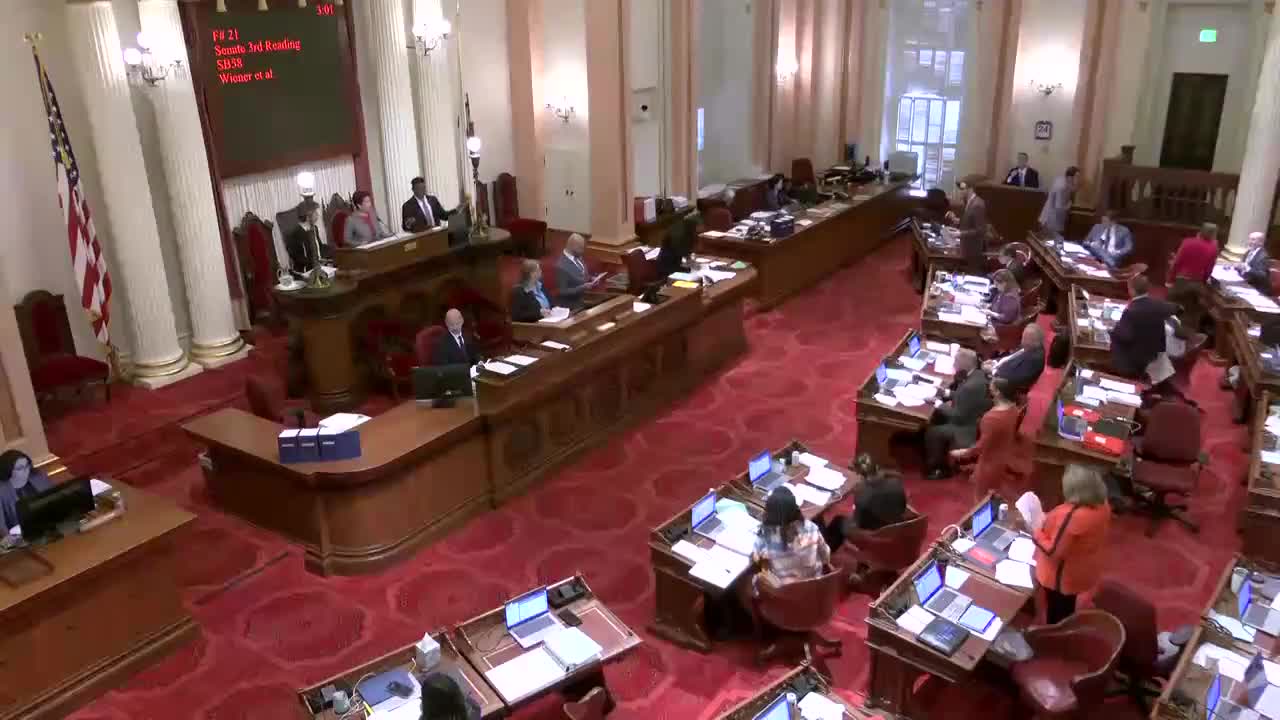 5MIN
Senate Floor
 35MIN