SB 619: State Energy Resources Conservation and Development Commission: certification of facilities: electrical transmission projects.
- Session Year: 2023-2024
- House: Senate
- Latest Version Date: 2023-09-15
Current Status:
Failed
(2024-01-25: Stricken from file.)
Introduced
In Committee
First Chamber
In Committee
Second Chamber
Enacted
(1)The California Environmental Quality Act (CEQA) requires preparation of specified documentation before a public agency approves or carries out certain projects. Existing law makes an environmental leadership development project, as defined, that meets specified requirements and is certified by the Governor eligible for streamlined procedures under CEQA. In particular, existing law requires the adoption of rules of court that expedite certain CEQA actions and proceedings related to an environmental leadership development project to resolve those actions and proceedings, to the extent feasible, within 270 days.
Existing law authorizes persons proposing eligible facilities, including electrical transmission lines carrying electricity from certain other facilities that are located in the state to a point of junction with any interconnected electrical transmission system, to file applications, on or before June 30, 2029, with the State Energy Resources Conservation and Development Commission (Energy Commission) to certify sites and related facilities as environmental leadership development projects, as specified. Existing law makes a site and related facility certified by the Energy Commission as an environmental leadership development project subject to streamlined procedures under CEQA with no further action by the applicant or the Governor. Under existing law, the Energy Commissions certification of sites and related facilities is in lieu of any permit, certificate, or similar document required by any state, local, or regional agency, or federal agency to the extent permitted by federal law, for the use of the sites and related facilities, and supersedes any applicable statute, ordinance, or regulation of any state, local, or regional agency, or federal agency to the extent permitted by federal law, except as specified.
This bill would expand the facilities eligible to be certified as environmental leadership development projects by the Energy Commission to include electrical transmission projects. The bill would require an applicant applying for certification of an electrical transmission project to take certain actions, including, among other actions, to avoid or minimize significant environmental impacts in any disadvantaged community.
(2)Existing law vests the Public Utilities Commission (PUC) with regulatory authority over public utilities, including electrical corporations. Existing law prohibits an electrical corporation from beginning the construction of a line, plant, or system, or any extension of a line, plant, or system, without having first obtained from the PUC a certificate that the present or future public convenience and necessity require its construction. Under existing law, a violation of the Public Utilities Act or any order, decision, rule, direction, demand, or requirement of the PUC is a crime.
The bill would authorize an electrical corporation that files an application with the PUC to authorize the new construction of any electrical transmission facility to simultaneously submit to the Energy Commission an application for certification of the facility as an environmental leadership development project, as specified. The bill would authorize the Energy Commission to recover the reasonable administrative costs incurred from evaluating an application, as specified. The bill would provide that the Energy Commissions certification of a facility proposed by an electrical corporation satisfies and replaces the PUCs obligations under CEQA with respect to that facility. The bill would prohibit the PUC from approving an application until after the Energy Commission has issued a decision on certification of the proposed facility. Because these provisions would be part of the Public Utilities Act and a violation of these requirements or a PUC action implementing these requirements would therefore be a crime, the bill would impose a state-mandated local program.
The California Constitution requires the state to reimburse local agencies and school districts for certain costs mandated by the state. Statutory provisions establish procedures for making that reimbursement.
This bill would provide that no reimbursement is required by this act for a specified reason.
(1)The California Environmental Quality Act (CEQA) requires preparation of specified documentation before a public agency approves or carries out certain projects. Existing law makes an environmental leadership development project, as defined, that meets specified requirements and is certified by the Governor eligible for streamlined procedures under CEQA. In particular, existing law requires the adoption of rules of court that expedite certain CEQA actions and proceedings related to an environmental leadership development project to resolve those actions and proceedings, to the extent feasible, within 270 days.
Existing law authorizes persons proposing eligible facilities, including electrical transmission lines carrying electricity from certain other facilities that are located in the state to a point of junction with any interconnected electrical transmission system, to file applications, on or before June 30, 2029, with the State Energy Resources Conservation and Development Commission (Energy Commission) to certify sites and related facilities as environmental leadership development projects, as specified. Existing law makes a site and related facility certified by the Energy Commission as an environmental leadership development project subject to streamlined procedures under CEQA with no further action by the applicant or the Governor. Under existing law, the Energy Commissions certification of sites and related facilities is in lieu of any permit, certificate, or similar document required by any state, local, or regional agency, or federal agency to the extent permitted by federal law, for the use of the sites and related facilities, and supersedes any applicable statute, ordinance, or regulation of any state, local, or regional agency, or federal agency to the extent permitted by federal law, except as specified.
This bill would expand the facilities eligible to be certified as environmental leadership development projects by the Energy Commission to include electrical transmission projects. The bill would require an applicant applying for certification of an electrical transmission project to take certain actions, including, among other actions, to avoid or minimize significant environmental impacts in any disadvantaged community.
(2)Existing law vests the Public Utilities Commission (PUC) with regulatory authority over public utilities, including electrical corporations. Existing law prohibits an electrical corporation from beginning the construction of a line, plant, or system, or any extension of a line, plant, or system, without having first obtained from the PUC a certificate that the present or future public convenience and necessity require its construction. Under existing law, a violation of the Public Utilities Act or any order, decision, rule, direction, demand, or requirement of the PUC is a crime.
The bill would authorize an electrical corporation that files an application with the PUC authorizing to authorize the new construction of any electrical transmission facility to simultaneously submit to the Energy Commission an application for certification of the facility as an environmental leadership development project, as specified. The bill would authorize the Energy Commission to recover the reasonable administrative costs incurred from evaluating an application, as specified. The bill would provide that the Energy Commissions certification of a facility proposed by an electrical corporation satisfies and replaces the PUCs obligations under CEQA with respect to that facility. The bill would prohibit the PUC from approving an application until after the Energy Commission has issued a decision on certification of the proposed facility. Because these provisions would be part of the Public Utilities Act and a violation of these requirements or a PUC action implementing these requirements would therefore be a crime, the bill would impose a state-mandated local program.
The California Constitution requires the state to reimburse local agencies and school districts for certain costs mandated by the state. Statutory provisions establish procedures for making that reimbursement.
This bill would provide that no reimbursement is required by this act for a specified reason.
(1)The California Environmental Quality Act (CEQA) requires preparation of specified documentation before a public agency approves or carries out certain projects. Existing law makes an environmental leadership development project, as defined, that meets specified requirements and is certified by the Governor eligible for streamlined procedures under CEQA. In particular, existing law requires the adoption of rules of court that expedite certain CEQA actions and proceedings related to an environmental leadership development project to resolve those actions and proceedings, to the extent feasible, within 270 days.
Existing law authorizes persons proposing eligible facilities, including electrical transmission lines carrying electricity from certain other facilities that are located in the state to a point of junction with any interconnected electrical transmission system, to file applications, on or before June 30, 2029, with the State Energy Resources Conservation and Development Commission (Energy Commission) to certify sites and related facilities as environmental leadership development projects, as specified. Existing law makes a site and related facility certified by the Energy Commission as an environmental leadership development project subject to streamlined procedures under CEQA with no further action by the applicant or the Governor. Under existing law, the Energy Commissions certification of sites and related facilities is in lieu of any permit, certificate, or similar document required by any state, local, or regional agency, or federal agency to the extent permitted by federal law, for the use of the sites and related facilities, and supersedes any applicable statute, ordinance, or regulation of any state, local, or regional agency, or federal agency to the extent permitted by federal law, except as specified.
This bill would expand the facilities eligible to be certified as environmental leadership development projects by the Energy Commission to include electrical transmission projects that support the states efforts to achieve specified minimum levels of procurement of electricity from renewable energy resources and zero-carbon resources. The bill would authorize the Energy Commission, when evaluating applications for those eligible electrical transmission facilities, to consider whether an applicant certifies that a capital investment of at least $250,000,000 will be made over a period of 5 years. projects. The bill would require an applicant applying for certification of an electrical transmission project to take certain actions, including, among other actions, to avoid or minimize significant environmental impacts in any disadvantaged community.
(2)Existing law vests the Public Utilities Commission (PUC) with regulatory authority over public utilities, including electrical corporations. Existing law prohibits an electrical corporation from beginning the construction of a line, plant, or system, or any extension of a line, plant, or system, without having first obtained from the PUC a certificate that the present or future public convenience and necessity require its construction. Under existing law, a violation of the Public Utilities Act or any order, decision, rule, direction, demand, or requirement of the PUC is a crime.
The bill would authorize an electrical corporation that files an application with the PUC authorizing the new construction of any electrical transmission facility to simultaneously submit to the Energy Commission an application for certification of the facility as an environmental leadership development project, as specified. The bill would provide that the Energy Commissions certification of a facility proposed by an electrical corporation satisfies and replaces the PUCs obligations under CEQA with respect to that facility. The bill would prohibit the PUC from approving an application until after the Energy Commission has issued a decision on certification of the proposed facility. Because these provisions would be part of the Public Utilities Act and a violation of these requirements or a PUC action implementing these requirements would therefore be a crime, the bill would impose a state-mandated local program.
The California Constitution requires the state to reimburse local agencies and school districts for certain costs mandated by the state. Statutory provisions establish procedures for making that reimbursement.
This bill would provide that no reimbursement is required by this act for a specified reason.
(1)The California Environmental Quality Act (CEQA) requires preparation of specified documentation before a public agency approves or carries out certain projects. Existing law makes an environmental leadership development project, as defined, that meets specified requirements and is certified by the Governor eligible for streamlined procedures under CEQA. In particular, existing law requires the adoption of rules of court that expedite certain CEQA actions and proceedings related to an environmental leadership development project to resolve those actions and proceedings, to the extent feasible, within 270 days.
Existing law authorizes persons proposing eligible facilities, including electrical transmission lines carrying electricity from certain other facilities that are located in the state to a point of junction with any interconnected electrical transmission system, to file applications for certification, applications, on or before June 30, 2029, with the State Energy Resources Conservation and Development Commission (Energy Commission) to certify sites and related facilities, facilities as environmental leadership development projects, as specified. Existing law makes a site and related facility certified by the Energy Commission as an environmental leadership development project subject to streamlined procedures under CEQA with no further action by the applicant or the Governor. Under existing law, the commissions Energy Commissions certification of sites and related facilities is in lieu of any permit, certificate, or similar document required by any state, local, or regional agency, or federal agency to the extent permitted by federal law, for the use of the sites and related facilities, and supersedes any applicable statute, ordinance, or regulation of any state, local, or regional agency, or federal agency to the extent permitted by federal law, except as specified. Existing law imposes various requirements on these sites and related facilities certified by the commission, including a requirement that applicants certify that a skilled and trained workforce, as defined, will be used to perform all construction work on the project. Existing law deems the sites and related facilities certified by the commission as environmental leadership development projects, as specified.This bill would expand the facilities eligible to be certified as environmental leadership development projects by the commission Energy Commission to include electrical transmission lines carrying electricity from certain other facilities that are located in the state, regardless of whether the electricity is carried to a point of junction with any interconnected electrical transmission system. projects that support the states efforts to achieve specified minimum levels of procurement of electricity from renewable energy resources and zero-carbon resources. The bill would authorize the commission, Energy Commission, when evaluating applications for those eligible electrical transmission facilities, to consider whether an applicant certifies that a capital investment of at least $250,000,000 will be made over a period of 5 years.
The bill would include findings that changes proposed by this bill address a matter of statewide concern rather than a municipal affair and, therefore, apply to all cities, including charter cities.(2)Existing law vests the Public Utilities Commission (PUC) with regulatory authority over public utilities, including electrical corporations. Existing law prohibits an electrical corporation from beginning the construction of a line, plant, or system, or any extension of a line, plant, or system, without having first obtained from the PUC a certificate that the present or future public convenience and necessity require its construction. Under existing law, a violation of the Public Utilities Act or any order, decision, rule, direction, demand, or requirement of the PUC is a crime.
The bill would authorize an electrical corporation that files an application with the PUC authorizing the new construction of any electrical transmission facility to simultaneously submit to the Energy Commission an application for certification of the facility as an environmental leadership development project, as specified. The bill would provide that the Energy Commissions certification of a facility proposed by an electrical corporation satisfies and replaces the PUCs obligations under CEQA with respect to that facility. The bill would prohibit the PUC from approving an application until after the Energy Commission has issued a decision on certification of the proposed facility. Because these provisions would be part of the Public Utilities Act and a violation of these requirements or a PUC action implementing these requirements would therefore be a crime, the bill would impose a state-mandated local program.
The California Constitution requires the state to reimburse local agencies and school districts for certain costs mandated by the state. Statutory provisions establish procedures for making that reimbursement.
This bill would provide that no reimbursement is required by this act for a specified reason.
Existing law authorizes persons proposing eligible facilities, including electrical transmission lines carrying electricity from certain other facilities that are located in the state to a point of junction with any interconnected electrical transmission system, to file applications for certification, on or before June 30, 2029, with the State Energy Resources Conservation and Development Commission to certify sites and related facilities, as specified. Under existing law, the commissions certification of sites and related facilities is in lieu of any permit, certificate, or similar document required by any state, local, or regional agency, or federal agency to the extent permitted by federal law, for the use of the sites and related facilities, and supersedes any applicable statute, ordinance, or regulation of any state, local, or regional agency, or federal agency to the extent permitted by federal law, except as specified. Existing law imposes various requirements on these sites and related facilities certified by the commission, including a requirement that applicants certify that a skilled and trained workforce, as defined, will be used to perform all construction work on the project. Existing law deems the sites and related facilities certified by the commission as environmental leadership development projects, as specified.
This bill would expand the facilities eligible to be certified by the commission to include electrical transmission lines carrying electricity from certain other facilities that are located in the state, regardless of whether the electricity is carried to a point of junction with any interconnected electrical transmission system. The bill would require the commission to give priority to authorize the commission, when evaluating applications for those eligible electrical transmission facilities if the facilities, to consider whether an applicant certifies that a capital investment of at least $250,000,000 will be made over a period of 5 years.
The bill would include findings that changes proposed by this bill address a matter of statewide concern rather than a municipal affair and, therefore, apply to all cities, including charter cities.
Existing law authorizes persons proposing eligible facilities, including electrical transmission lines carrying electricity from certain other facilities that are located in the state to a point of junction with any interconnected electrical transmission system, to file applications for certification, on or before June 30, 2029, with the State Energy Resources Conservation and Development Commission to certify sites and related facilities, as specified. Under existing law, the commissions certification of sites and related facilities is in lieu of any permit, certificate, or similar document required by any state, local, or regional agency, or federal agency to the extent permitted by federal law, for the use of the sites and related facilities, and supersedes any applicable statute, ordinance, or regulation of any state, local, or regional agency, or federal agency to the extent permitted by federal law, except as specified. Existing law imposes various requirements on these sites and related facilities certified by the commission, including a requirement that applicants certify that a skilled and trained workforce, as defined, will be used to perform all construction work on the project. Existing law deems the sites and related facilities certified by the commission as environmental leadership development projects, as specified.
This bill would expand the facilities eligible to be certified by the commission to include electrical transmission lines carrying electricity from certain other facilities that are located in the state, regardless of whether the electricity is carried to a point of junction with any interconnected electrical transmission system. The bill would require the commission to give priority to applications for those eligible electrical transmission facilities if the applicant certifies that a capital investment of at least $250,000,000 will be made over a period of 5 years.
The bill would include findings that changes proposed by this bill address a matter of statewide concern rather than a municipal affair and, therefore, apply to all cities, including charter cities.
For purposes of this chapter, the following definitions apply:
(a)California Native American tribe has the same meaning as set forth in Section 21073.
(b)Facility means any of the following:
(1)A solar photovoltaic or terrestrial wind electrical generating powerplant with a generating capacity of 50 megawatts or more and any facilities appurtenant thereto.
(2)An energy storage system as defined in Section 2835 of the Public Utilities Code that is capable of storing 200 megawatthours or more of electricity.
(3)A stationary electrical generating powerplant using any source of thermal energy, with a generating capacity of 50 megawatts or more, excluding any powerplant that burns, uses, or relies on fossil or nuclear fuels.
(4)A discretionary project as described in Section 21080 for which the applicant has certified that a capital investment of at least two hundred fifty million dollars ($250,000,000) will be made over a period of five years and the discretionary project is for (A) the manufacture, production, or assembly of an energy storage system or component manufacturing, wind system or component manufacturing, and solar photovoltaic energy system or component manufacturing, or (B) the manufacture, production, or assembly of specialized products, components, or systems that are integral to renewable energy or energy storage technologies.
(5)An electrical transmission line carrying electricity from a facility described in paragraph (1), (2), or (3) that is located in the state to a point of junction with any interconnected electrical transmission system.
(6)An electrical transmission project.
(c)Site means any location on which an eligible facility is constructed or is proposed to be constructed.
SEC. 2.Section 25545.14 is added to the Public Resources Code, to read:25545.14.An applicant applying for certification of an electrical transmission project under this chapter shall do all of the following:
(a)Avoid or minimize significant environmental impacts in any disadvantaged community.
(b)If measures are required pursuant to Division 13 (commencing with Section 21000) to mitigate significant environmental impacts in a disadvantaged community, mitigate those impacts consistent with that division, including Section 21002. Mitigation measures required under this section shall be undertaken in, and directly benefit, the affected community.
(c)Enter into a binding and enforceable agreement to comply with this section before the commissions certification of the environmental impact report for the project.
SEC. 3.Section 1003.7 is added to the Public Utilities Code, to read:1003.7.(a)(1)An electrical corporation that files an application for a certificate or a permit to construct authorizing the new construction of any electrical transmission facility, including transmission lines and substations that will be rated at 138 kilovolts or greater that are not subject to the provisions of Chapter 6 (commencing with Section 25500) of Division 15 of the Public Resources Code, may at the same time submit an application for that facility to the Energy Commission pursuant to Chapter 6.2 (commencing with Section 25545) of Division 15 of the Public Resources Code.
(2)For purposes of an application submitted to the Energy Commission pursuant to paragraph (1), the electrical transmission facility shall be considered a facility pursuant to subdivision (b) of Section 25545 of the Public Resources Code.
(3)When evaluating an application submitted to the Energy Commission pursuant to paragraph (1), the Energy Commission shall not consider the necessity for the electrical transmission facility. The Energy Commission may consider alternative substation locations or routing of transmission lines.
(4)The Energy Commission may recover from the electrical corporation the reasonable administrative costs incurred from evaluating an application submitted pursuant to paragraph (1).
(5)Notwithstanding subdivision (a) of Section 25545.1 of the Public Resources Code, an application to the Energy Commission may be filed no later than January 1, 2032.
(b)This section does not modify the commissions jurisdiction, including its jurisdiction over the issuance of a certificate of public convenience and necessity or permit to construct pursuant to this article for a facility that is proposed by an electrical corporation, except as follows:
(1)Certification by the Energy Commission of a facility described in subdivision (a) shall satisfy and replace the commissions obligations under the California Environmental Quality Act (Division 13 (commencing with Section 21000) of the Public Resources Code).
(2)The commission shall not issue a final decision approving a certificate or permit to construct until after the Energy Commission has issued a decision on certification of the proposed facility.
(c)Upon approval of the application for a certificate or permit to construct, the commission shall file the applicable notice pursuant to Section 21108 of the Public Resources Code on behalf of itself and the Energy Commission.
SEC. 4.No reimbursement is required by this act pursuant to Section 6 of Article XIIIB of the California Constitution because the only costs that may be incurred by a local agency or school district will be incurred because this act creates a new crime or infraction, eliminates a crime or infraction, or changes the penalty for a crime or infraction, within the meaning of Section 17556 of the Government Code, or changes the definition of a crime within the meaning of Section 6 of Article XIIIB of the California Constitution.
For purposes of this chapter, the following definitions apply:
(a)California Native American tribe has the same meaning as set forth in Section 21073.
(b)Facility means any of the following:
(1)A solar photovoltaic or terrestrial wind electrical generating powerplant with a generating capacity of 50 megawatts or more and any facilities appurtenant thereto.
(2)An energy storage system as defined in Section 2835 of the Public Utilities Code that is capable of storing 200 megawatthours or more of electricity.
(3)A stationary electrical generating powerplant using any source of thermal energy, with a generating capacity of 50 megawatts or more, excluding any powerplant that burns, uses, or relies on fossil or nuclear fuels.
(4)A discretionary project as described in Section 21080 for which the applicant has certified that a capital investment of at least two hundred fifty million dollars ($250,000,000) will be made over a period of five years and the discretionary project is for (A) the manufacture, production, or assembly of an energy storage system or component manufacturing, wind system or component manufacturing, and solar photovoltaic energy system or component manufacturing, or (B) the manufacture, production, or assembly of specialized products, components, or systems that are integral to renewable energy or energy storage technologies.
(5)An electrical transmission line carrying electricity from a facility described in paragraph (1), (2), or (3) that is located in the state to a point of junction with any interconnected electrical transmission system.
(6)An electrical transmission project.
(c)Site means any location on which an eligible facility is constructed or is proposed to be constructed.
SEC. 2.Section 25545.14 is added to the Public Resources Code, to read:25545.14.An applicant applying for certification of an electrical transmission project under this chapter shall do all of the following:
(a)Avoid or minimize significant environmental impacts in any disadvantaged community.
(b)If measures are required pursuant to Division 13 (commencing with Section 21000) to mitigate significant environmental impacts in a disadvantaged community, mitigate those impacts consistent with that division, including Section 21002. Mitigation measures required under this section shall be undertaken in, and directly benefit, the affected community.
(c)Enter into a binding and enforceable agreement to comply with this section before the commissions certification of the environmental impact report for the project.
SEC. 3.Section 1003.7 is added to the Public Utilities Code, to read:1003.7.(a)(1)An electrical corporation that files an application for a certificate or a permit to construct authorizing the new construction of any electrical transmission facility, including transmission lines and substations that will be rated at 138 kilovolts or greater that are not subject to the provisions of Chapter 6 (commencing with Section 25500) of Division 15 of the Public Resources Code, may at the same time submit an application for that facility to the Energy Commission pursuant to Chapter 6.2 (commencing with Section 25545) of Division 15 of the Public Resources Code.
(2)For purposes of an application submitted to the Energy Commission pursuant to paragraph (1), the electrical transmission facility shall be considered a facility pursuant to subdivision (b) of Section 25545 of the Public Resources Code.
(3)When evaluating an application submitted to the Energy Commission pursuant to paragraph (1), the Energy Commission shall not consider the necessity for the electrical transmission facility. The Energy Commission may consider alternative substation locations or routing of transmission lines.
(4)The Energy Commission may recover from the electrical corporation the reasonable administrative costs incurred from evaluating an application submitted pursuant to paragraph (1).
(4)(5)Notwithstanding subdivision (a) of Section 25545.1 of the Public Resources Code, an application to the Energy Commission may be filed no later than January 1, 2032.
(b)This section does not modify the commissions jurisdiction, including its jurisdiction over the issuance of a certificate of public convenience and necessity or permit to construct pursuant to this article for a facility that is proposed by an electrical corporation, except as follows:
(1)Certification by the Energy Commission of a facility described in subdivision (a) shall satisfy and replace the commissions obligations under the California Environmental Quality Act (Division 13 (commencing with Section 21000) of the Public Resources Code).
(2)The commission shall not issue a final decision approving a certificate or permit to construct until after the Energy Commission has issued a decision on certification of the proposed facility.
(c)Upon approval of the application for a certificate or permit to construct, the commission shall file the applicable notice pursuant to Section 21108 of the Public Resources Code on behalf of itself and the Energy Commission.
SEC. 4.No reimbursement is required by this act pursuant to Section 6 of Article XIIIB of the California Constitution because the only costs that may be incurred by a local agency or school district will be incurred because this act creates a new crime or infraction, eliminates a crime or infraction, or changes the penalty for a crime or infraction, within the meaning of Section 17556 of the Government Code, or changes the definition of a crime within the meaning of Section 6 of Article XIIIB of the California Constitution.
For purposes of this chapter, the following definitions apply:
(a)California Native American tribe has the same meaning as set forth in Section 21073.
(b)Facility means any of the following:
(1)A solar photovoltaic or terrestrial wind electrical generating powerplant with a generating capacity of 50 megawatts or more and any facilities appurtenant thereto.
(2)An energy storage system as defined in Section 2835 of the Public Utilities Code that is capable of storing 200 megawatthours or more of electricity.
(3)A stationary electrical generating powerplant using any source of thermal energy, with a generating capacity of 50 megawatts or more, excluding any powerplant that burns, uses, or relies on fossil or nuclear fuels.
(4)A discretionary project as described in Section 21080 for which the applicant has certified that a capital investment of at least two hundred fifty million dollars ($250,000,000) will be made over a period of five years and the discretionary project is for (A) the manufacture, production, or assembly of an energy storage system or component manufacturing, wind system or component manufacturing, and solar photovoltaic energy system or component manufacturing, or (B) the manufacture, production, or assembly of specialized products, components, or systems that are integral to renewable energy or energy storage technologies.
(5)An electrical transmission line carrying electricity from a facility described in paragraph (1), (2), or (3) that is located in the state to a point of junction with any interconnected electrical transmission system.
(6)An electrical transmission project that supports the states efforts to achieve the goals set forth in Section 454.53 of the Public Utilities Code. project.
(c)Site means any location on which an eligible facility is constructed or is proposed to be constructed.
SEC. 2.Section 25545.1 of the Public Resources Code is amended to read:25545.1.(a)A person proposing an eligible facility may file an application for certification no later than June 30, 2029, with the commission to certify a site and related facility in accordance with this chapter, including a person who has an application for certification or small powerplant exemption filed with the commission pursuant to Chapter 6 (commencing with Section 25500) pending as of June 30, 2022. Upon receipt of the application, the commission shall have the exclusive power to certify the site and related facility, whether the application proposes a new site and related facility or a change or addition to an existing facility. This section does not modify the Public Utilities Commissions jurisdiction, including the issuance of a certificate of public convenience and necessity under Chapter 5 (commencing with Section 1001) of Part 1 of Division 1 of the Public Utilities Code for a facility that is proposed by a utility regulated by the Public Utilities Commission.(b)(1)Except as provided in paragraph (2), the issuance of a certificate by the commission for a site and related facility pursuant to this chapter shall be in lieu of any permit, certificate, or similar document required by any state, local, or regional agency, or federal agency to the extent permitted by federal law, for the use of the site and related facilities, and shall supersede any applicable statute, ordinance, or regulation of any state, local, or regional agency, or federal agency to the extent permitted by federal law.(2)Paragraph (1) does not supersede the authority of the State Lands Commission to require leases and receive lease revenues, if applicable, or the authority of the California Coastal Commission, the San Francisco Bay Conservation and Development Commission, the State Water Resources Control Board, or the applicable regional water quality control boards.(3)For facilities described in paragraph (4) of subdivision (b) of Section 25545, this subdivision does not supersede the authority of local air quality management districts or the Department of Toxic Substances Control.(c)When evaluating applications for facilities described in paragraph (6) of subdivision (b) of Section 25545, the commission may consider whether the applicant certifies that a capital investment of at least two hundred fifty million dollars ($250,000,000) will be made over a period of five years.(d)The Legislature finds and declares that this section addresses a matter of statewide concern rather than a municipal affair as that term is used in Section 5 of Article XI of the California Constitution. Therefore, this section applies to all cities, including charter cities.SEC. 2.Section 25545.14 is added to the Public Resources Code, to read:25545.14.An applicant applying for certification of an electrical transmission project under this chapter shall do all of the following:
(a)Avoid or minimize significant environmental impacts in any disadvantaged community.
(b)If measures are required pursuant to Division 13 (commencing with Section 21000) to mitigate significant environmental impacts in a disadvantaged community, mitigate those impacts consistent with that division, including Section 21002. Mitigation measures required under this section shall be undertaken in, and directly benefit, the affected community.
(c)Enter into a binding and enforceable agreement to comply with this section before the commissions certification of the environmental impact report for the project.
SEC. 3.Section 1003.7 is added to the Public Utilities Code, to read:1003.7.(a)(1)An electrical corporation that files an application for a certificate or a permit to construct authorizing the new construction of any electrical transmission facility, including transmission lines and substations that will be rated at 138 kilovolts or greater that are not subject to the provisions of Chapter 6 (commencing with Section 25500) of Division 15 of the Public Resources Code, may at the same time submit an application for that facility to the Energy Commission pursuant to Chapter 6.2 (commencing with Section 25545) of Division 15 of the Public Resources Code.
(2)For purposes of an application submitted to the Energy Commission pursuant to paragraph (1), the electrical transmission facility shall be considered a facility pursuant to subdivision (b) of Section 25545 of the Public Resources Code.
(3)When evaluating an application submitted to the Energy Commission pursuant to paragraph (1), the Energy Commission shall not consider the necessity for the electrical transmission facility. The Energy Commission may consider alternative substation locations or routing of transmission lines.
(4)Notwithstanding subdivision (a) of Section 25545.1 of the Public Resources Code, an application to the Energy Commission may be filed no later than December 31, 2039. January 1, 2032.
(b)This section does not modify the commissions jurisdiction, including its jurisdiction over the issuance of a certificate of public convenience and necessity or permit to construct pursuant to this article for a facility that is proposed by an electrical corporation, except as follows:
(1)Certification by the Energy Commission of a facility described in subdivision (a) shall satisfy and replace the commissions obligations under the California Environmental Quality Act (Division 13 (commencing with Section 21000) of the Public Resources Code).
(2)The commission shall not issue a final decision approving a certificate or permit to construct until after the Energy Commission has issued a decision on certification of the proposed facility.
(c)Upon approval of the application for a certificate or permit to construct, the commission shall file the applicable notice pursuant to Section 21108 of the Public Resources Code on behalf of itself and the Energy Commission.
SEC. 4.No reimbursement is required by this act pursuant to Section 6 of Article XIIIB of the California Constitution because the only costs that may be incurred by a local agency or school district will be incurred because this act creates a new crime or infraction, eliminates a crime or infraction, or changes the penalty for a crime or infraction, within the meaning of Section 17556 of the Government Code, or changes the definition of a crime within the meaning of Section 6 of Article XIIIB of the California Constitution.
For purposes of this chapter, the following definitions apply:
(a)California Native American tribe has the same meaning as set forth in Section 21073.
(b)Facility means any of the following:
(1)A solar photovoltaic or terrestrial wind electrical generating powerplant with a generating capacity of 50 megawatts or more and any facilities appurtenant thereto.
(2)An energy storage system as defined in Section 2835 of the Public Utilities Code that is capable of storing 200 megawatthours or more of electricity.
(3)A stationary electrical generating powerplant using any source of thermal energy, with a generating capacity of 50 megawatts or more, excluding any powerplant that burns, uses, or relies on fossil or nuclear fuels.
(4)A discretionary project as described in Section 21080 for which the applicant has certified that a capital investment of at least two hundred fifty million dollars ($250,000,000) will be made over a period of five years and the discretionary project is for (A) the manufacture, production, or assembly of an energy storage system or component manufacturing, wind system or component manufacturing, and solar photovoltaic energy system or component manufacturing, or (B) the manufacture, production, or assembly of specialized products, components, or systems that are integral to renewable energy or energy storage technologies.
(5)An electrical transmission line carrying electricity from a facility described in paragraph (1), (2), or (3) that is located in the state. state to a point of junction with any interconnected electrical transmission system.
(6)An electrical transmission project that supports the states efforts to achieve the goals set forth in Section 454.53 of the Public Utilities Code.
(c)Site means any location on which an eligible facility is constructed or is proposed to be constructed.
SEC. 2.Section 25545.1 of the Public Resources Code is amended to read:25545.1.(a)A person proposing an eligible facility may file an application for certification no later than June 30, 2029, with the commission to certify a site and related facility in accordance with this chapter, including a person who has an application for certification or small powerplant exemption filed with the commission pursuant to Chapter 6 (commencing with Section 25500) pending as of June 30, 2022. Upon receipt of the application, the commission shall have the exclusive power to certify the site and related facility, whether the application proposes a new site and related facility or a change or addition to an existing facility. This section does not modify the Public Utilities Commissions jurisdiction, including the issuance of a certificate of public convenience and necessity under Chapter 5 (commencing with Section 1001) of Part 1 of Division 1 of the Public Utilities Code for a facility that is proposed by a utility regulated by the Public Utilities Commission.
(b)(1)Except as provided in paragraph (2), the issuance of a certificate by the commission for a site and related facility pursuant to this chapter shall be in lieu of any permit, certificate, or similar document required by any state, local, or regional agency, or federal agency to the extent permitted by federal law, for the use of the site and related facilities, and shall supersede any applicable statute, ordinance, or regulation of any state, local, or regional agency, or federal agency to the extent permitted by federal law.
(2)Paragraph (1) does not supersede the authority of the State Lands Commission to require leases and receive lease revenues, if applicable, or the authority of the California Coastal Commission, the San Francisco Bay Conservation and Development Commission, the State Water Resources Control Board, or the applicable regional water quality control boards.
(3)For facilities described in paragraph (4) of subdivision (b) of Section 25545, this subdivision does not supersede the authority of local air quality management districts or the Department of Toxic Substances Control.
(c)When evaluating applications for facilities described in paragraph (5) (6) of subdivision (b) of Section 25545, the commission may consider whether the applicant certifies that a capital investment of at least two hundred fifty million dollars ($250,000,000) will be made over a period of five years.
(d)The Legislature finds and declares that this section addresses a matter of statewide concern rather than a municipal affair as that term is used in Section 5 of Article XI of the California Constitution. Therefore, this section applies to all cities, including charter cities.
SEC. 3.Section 1003.7 is added to the Public Utilities Code, to read:1003.7.(a)(1)An electrical corporation that files an application for a certificate or a permit to construct authorizing the new construction of any electrical transmission facility, including transmission lines and substations that will be rated at 138 kilovolts or greater that are not subject to the provisions of Chapter 6 (commencing with Section 25500) of Division 15 of the Public Resources Code, may at the same time submit an application for that facility to the Energy Commission pursuant to Chapter 6.2 (commencing with Section 25545) of Division 15 of the Public Resources Code.
(2)For purposes of an application submitted to the Energy Commission pursuant to paragraph (1), the electrical transmission facility shall be considered a facility pursuant to subdivision (b) of Section 25545 of the Public Resources Code.
(3)When evaluating an application submitted to the Energy Commission pursuant to paragraph (1), the Energy Commission shall not consider the necessity for the electrical transmission facility. The Energy Commission may consider alternative substation locations or routing of transmission lines.
(4)Notwithstanding subdivision (a) of Section 25545.1 of the Public Resources Code, an application to the Energy Commission may be filed no later than December 31, 2039.
(b)This section does not modify the commissions jurisdiction, including its jurisdiction over the issuance of a certificate of public convenience and necessity or permit to construct pursuant to this article for a facility that is proposed by an electrical corporation, except as follows:
(1)Certification by the Energy Commission of a facility described in subdivision (a) shall satisfy and replace the commissions obligations under the California Environmental Quality Act (Division 13 (commencing with Section 21000) of the Public Resources Code).
(2)The commission shall not issue a final decision approving a certificate or permit to construct until after the Energy Commission has issued a decision on certification of the proposed facility.
(c)Upon approval of the application for a certificate or permit to construct, the commission shall file the applicable notice pursuant to Section 21108 of the Public Resources Code on behalf of itself and the Energy Commission.
SEC. 4.No reimbursement is required by this act pursuant to Section 6 of Article XIIIB of the California Constitution because the only costs that may be incurred by a local agency or school district will be incurred because this act creates a new crime or infraction, eliminates a crime or infraction, or changes the penalty for a crime or infraction, within the meaning of Section 17556 of the Government Code, or changes the definition of a crime within the meaning of Section 6 of Article XIIIB of the California Constitution.
For purposes of this chapter, the following definitions apply:
(a)California Native American tribe has the same meaning as set forth in Section 21073.
(b)Facility means any of the following:
(1)A solar photovoltaic or terrestrial wind electrical generating powerplant with a generating capacity of 50 megawatts or more and any facilities appurtenant thereto.
(2)An energy storage system as defined in Section 2835 of the Public Utilities Code that is capable of storing 200 megawatthours or more of electricity.
(3)A stationary electrical generating powerplant using any source of thermal energy, with a generating capacity of 50 megawatts or more, excluding any powerplant that burns, uses, or relies on fossil or nuclear fuels.
(4)A discretionary project as described in Section 21080 for which the applicant has certified that a capital investment of at least two hundred fifty million dollars ($250,000,000) will be made over a period of five years and the discretionary project is for (A) the manufacture, production, or assembly of an energy storage system or component manufacturing, wind system or component manufacturing, and solar photovoltaic energy system or component manufacturing, or (B) the manufacture, production, or assembly of specialized products, components, or systems that are integral to renewable energy or energy storage technologies.
(5)An electrical transmission line carrying electricity from a facility described in paragraph (1), (2), or (3) that is located in the state.
(c)Site means any location on which an eligible facility is constructed or is proposed to be constructed.
SEC. 2.Section 25545.1 of the Public Resources Code is amended to read:25545.1.(a)A person proposing an eligible facility may file an application for certification no later than June 30, 2029, with the commission to certify a site and related facility in accordance with this chapter, including a person who has an application for certification or small powerplant exemption filed with the commission pursuant to Chapter 6 (commencing with Section 25500) pending as of June 30, 2022. Upon receipt of the application, the commission shall have the exclusive power to certify the site and related facility, whether the application proposes a new site and related facility or a change or addition to an existing facility. This section does not modify the Public Utilities Commissions jurisdiction, including the issuance of a certificate of public convenience and necessity under Chapter 5 (commencing with Section 1001) of Part 1 of Division 1 of the Public Utilities Code for a facility that is proposed by a utility regulated by the Public Utilities Commission.
(b)(1)Except as provided in paragraph (2), the issuance of a certificate by the commission for a site and related facility pursuant to this chapter shall be in lieu of any permit, certificate, or similar document required by any state, local, or regional agency, or federal agency to the extent permitted by federal law, for the use of the site and related facilities, and shall supersede any applicable statute, ordinance, or regulation of any state, local, or regional agency, or federal agency to the extent permitted by federal law.
(2)Paragraph (1) does not supersede the authority of the State Lands Commission to require leases and receive lease revenues, if applicable, or the authority of the California Coastal Commission, the San Francisco Bay Conservation and Development Commission, the State Water Resources Control Board, or the applicable regional water quality control boards.
(3)For facilities described in paragraph (4) of subdivision (b) of Section 25545, this subdivision does not supersede the authority of local air quality management districts or the Department of Toxic Substances Control.
(c)The commission shall give priority to an application for a facility When evaluating applications for facilities described in paragraph (5) of subdivision (b) of Section 25545 if 25545, the commission may consider whether the applicant certifies that a capital investment of at least two hundred fifty million dollars ($250,000,000) will be made over a period of five years.
(d)The Legislature finds and declares that this section addresses a matter of statewide concern rather than a municipal affair as that term is used in Section 5 of Article XI of the California Constitution. Therefore, this section applies to all cities, including charter cities.
For purposes of this chapter, the following definitions apply:
(a)California Native American tribe has the same meaning as set forth in Section 21073.
(b)Facility means any of the following:
(1)A solar photovoltaic or terrestrial wind electrical generating powerplant with a generating capacity of 50 megawatts or more and any facilities appurtenant thereto.
(2)An energy storage system as defined in Section 2835 of the Public Utilities Code that is capable of storing 200 megawatthours or more of electrical energy. electricity.
(3)A stationary electrical generating powerplant using any source of thermal energy, with a generating capacity of 50 megawatts or more, excluding any powerplant that burns, uses, or relies on fossil or nuclear fuels.
(4)A discretionary project as described in Section 21080 for which the applicant has certified that a capital investment of at least two hundred fifty million dollars ($250,000,000) will be made over a period of five years and the discretionary project is for (A) the manufacture, production, or assembly of an energy storage system or component manufacturing, wind system or component manufacturing, and solar photovoltaic energy system or component manufacturing, or (B) the manufacture, production, or assembly of specialized products, components, or systems that are integral to renewable energy or energy storage technologies.
(5)An electric electrical transmission line carrying electric power electricity from a facility described in paragraph (1), (2), or (3) that is located in the state to a point of junction with any interconnected electrical transmission system. state.
(c)Site means any location on which an eligible facility is constructed or is proposed to be constructed.
SEC. 2.Section 25545.1 of the Public Resources Code is amended to read:25545.1.(a)A person proposing an eligible facility may file an application for certification no later than June 30, 2029, for certification with the commission to certify a site and related facility in accordance with this chapter, including a person who has an application for certification or small powerplant exemption filed with the commission pursuant to Chapter 6 (commencing with Section 25500) pending as of the effective date of this section. June 30, 2022. Upon receipt of the application, the commission shall have the exclusive power to certify the site and related facility, whether the application proposes a new site and related facility or a change or addition to an existing facility. This section does not modify the Public Utilities Commissions jurisdiction, including the issuance of a certificate of public convenience and necessity under Chapter 5 (commencing with Section 1001) of Part 1 of Division 1 of the Public Utilities Code for a facility that is proposed by a utility regulated by the Public Utilities Commission.
(b)(1)Except as provided in paragraph (2), the issuance of a certificate by the commission for a site and related facility pursuant to this chapter shall be in lieu of any permit, certificate, or similar document required by any state, local, or regional agency, or federal agency to the extent permitted by federal law, for the use of the site and related facilities, and shall supersede any applicable statute, ordinance, or regulation of any state, local, or regional agency, or federal agency to the extent permitted by federal law.
(2)Paragraph (1) does not supersede the authority of the State Lands Commission to require leases and receive lease revenues, if applicable, or the authority of the California Coastal Commission, the San Francisco Bay Conservation and Development Commission, the State Water Resources Control Board, or the applicable regional water quality control boards.
(3)For facilities described in paragraph (4) of subdivision (b) of Section 25545, this subdivision does not supersede the authority of local air quality management districts or the Department of Toxic Substances Control.
(c)The commission shall give priority to an application for a facility described in paragraph (5) of subdivision (b) of Section 25545 if the applicant certifies that a capital investment of at least two hundred fifty million dollars ($250,000,000) will be made over a period of five years.
(c)(d)The Legislature finds and declares that this section addresses a matter of statewide concern rather than a municipal affair as that term is used in Section 5 of Article XI of the California Constitution. Therefore, this section applies to all cities, including charter cities.
|
Date
|
Status
|
|---|---|
| Jan 25, 2024 | Veto sustained. |
| Jan 25, 2024 | Stricken from file. |
| Oct 7, 2023 | In Senate. Consideration of Governor's veto pending. |
| Oct 7, 2023 | Vetoed by the Governor. |
| Sep 20, 2023 | Enrolled and presented to the Governor at 4:30 p.m. |
| Sep 13, 2023 | Assembly amendments concurred in. (Ayes 39. Noes 0. Page 2735.) Ordered to engrossing and enrolling. |
| Sep 12, 2023 | Set for hearing September 12. |
| Sep 12, 2023 | From committee: That the Assembly amendments be concurred in. (Ayes 14. Noes 0. Page 2695.) |
| Sep 11, 2023 | Re-referred to Com. on RLS pursuant to Senate Rule 29.10(d). |
| Sep 11, 2023 | From committee: Be re-referred to Com. on E., U. & C. pursuant to Senate Rule 29.10(d). (Ayes 5. Noes 0. Page 2543.) Re-referred to Com. on E., U. & C. |
| Sep 7, 2023 | In Senate. Concurrence in Assembly amendments pending. |
| Sep 7, 2023 | Read third time. Passed. (Ayes 78. Noes 0. Page 3005.) Ordered to the Senate. |
| Sep 5, 2023 | Read second time. Ordered to third reading. |
| Sep 1, 2023 | Read second time and amended. Ordered to second reading. |
| Sep 1, 2023 | From committee: Do pass as amended. (Ayes 11. Noes 0.) (September 1). |
| Aug 23, 2023 | August 23 set for first hearing. Placed on suspense file. |
| Aug 14, 2023 | Read second time and amended. Re-referred to Com. on APPR. |
| Jul 13, 2023 | From committee: Do pass as amended and re-refer to Com. on APPR. with recommendation: To consent calendar. (Ayes 14. Noes 0.) (July 12). |
| Jul 11, 2023 | From committee: Do pass and re-refer to Com. on U. & E. (Ayes 11. Noes 0.) (July 10). Re-referred to Com. on U. & E. |
| Jul 6, 2023 | Assembly Rule 56 suspended. |
| Jun 26, 2023 | Re-referred to Coms. on NAT. RES. and U. & E. pursuant to Assembly Rule 96. |
| Jun 21, 2023 | From committee with author's amendments. Read second time and amended. Re-referred to Com. on U. & E. |
| Jun 15, 2023 | Referred to Com. on U. & E. |
| May 31, 2023 | In Assembly. Read first time. Held at Desk. |
| May 30, 2023 | Read third time. Passed. (Ayes 37. Noes 0. Page 1347.) Ordered to the Assembly. |
| May 18, 2023 | Read second time. Ordered to third reading. |
| May 18, 2023 | From committee: Do pass. (Ayes 7. Noes 0. Page 1177.) (May 18). |
| May 16, 2023 | Set for hearing May 18. |
| May 15, 2023 | May 15 hearing: Placed on APPR suspense file. |
| May 5, 2023 | Set for hearing May 15. |
| May 1, 2023 | Read second time and amended. Re-referred to Com. on APPR. |
| Apr 27, 2023 | From committee: Do pass as amended and re-refer to Com. on APPR. (Ayes 16. Noes 0. Page 871.) (April 24). |
| Apr 18, 2023 | Set for hearing April 24. |
| Apr 17, 2023 | April 18 set for first hearing canceled at the request of author. |
| Apr 3, 2023 | Set for hearing April 18. |
| Feb 22, 2023 | Referred to Com. on E., U. & C. |
| Feb 16, 2023 | From printer. May be acted upon on or after March 18. |
| Feb 15, 2023 | Introduced. Read first time. To Com. on RLS. for assignment. To print. |
|
Date
|
Description
|
Location
|
Votes
|
|
|---|---|---|---|---|
| Sep 13, 2023 | Unfinished Business SB619 Padilla et al. Concurrence | Senate Floor |
Passed |
|
| Sep 12, 2023 | That the Assembly amendments be concurred in | Senate Standing Committee on Energy, Utilities and Communications |
Passed |
|
| Sep 7, 2023 | SB 619 Padilla Senate Third Reading By Muratsuchi | Assembly Floor |
Passed |
|
| Sep 1, 2023 | Do pass as amended. | Assembly Standing Committee on Appropriations |
Passed |
|
| Jul 12, 2023 | Do pass as amended, and be re-referred to the Committee on [Appropriations] with recommendation: To Consent Calendar | Assembly Standing Committee on Utilities and Energy |
Passed |
|
| Jul 10, 2023 | Do pass and be re-referred to the Committee on [Utilities and Energy] | Assembly Standing Committee on Natural Resources |
Passed |
|
| May 30, 2023 | Senate 3rd Reading SB619 Padilla et al. | Senate Floor |
Passed |
|
| May 18, 2023 | Do pass | Senate Standing Committee on Appropriations |
Passed |
|
| May 15, 2023 | Placed on suspense file | Senate Standing Committee on Appropriations |
Passed |
|
| Apr 24, 2023 | Do pass as amended, but first amend, and re-refer to the Committee on [Appropriations] | Senate Standing Committee on Energy, Utilities and Communications |
Passed |
This list shows positions taken on this bill by organizations on the date displayed, which is linked to the original source.
Positions by individuals are not included.
|
Organization
|
Position
|
Date
|
|---|---|---|
| Murrieta Wildomar Chamber of Commerce | ** Support | |
| 1000 Grandmothers for Future Generations | * Support | Jul 10, 2023 |
| 350 Humboldt: Grass Roots Climate Action | ** Support | |
| Advanced Energy United | ** Support | |
| American Clean Power Association | * Support | Jul 10, 2023 |
| Bay Area Council | ** Support | |
| Building Owners and Managers Association | ** Support | |
| California Apartment Association | ** Support | |
| California Association Of Winegrape Growers | ** Support | |
| California Building Industry Association | ** Support | |
| California Business Properties Association | ** Support | |
| California Business Roundtable | ** Support | |
| California Chamber Of Commerce | ** Support | |
| California Retailers Association | ** Support | |
| California State Association Of Electrical Workers | ** Support | |
| California Trucking Association | ** Support | |
| California Wind Energy Association | ** Support | |
| Can Manufacturers Institute | ** Support | |
| Carlsbad Chamber of Commerce | ** Support | |
| Chino Valley Chamber of Commerce | ** Support | |
| Clean Air Task Force | ** Support | |
| Clean Power Campaign | ** Support | |
| Cleaner Task Force | * Support | Apr 24, 2023 |
| Climate Action California | * Support | Jul 10, 2023 |
| Coalition of California Utility Employees | ** Support | |
| Danville Area Chamber of Commerce | ** Support | |
| Elders Climate Action Norcal Chapter | ** Support | |
| Elders Climate Action Socal Chapter | ** Support | |
| Electric Vehicle Charging Association | ** Support | |
| Fremont Chamber of Commerce | ** Support | |
| Fremont, Greater Coachella Valley, Greater High Desert, Lake Elsinore Valley, | ** Support | |
| Full Moon Strategies | * Support | Apr 24, 2023 |
| Gateway Chambers Alliance | ** Support | |
| Greater Coachella Valley Chamber of Commerce | ** Support | |
| Greater High Desert Chamber of Commerce | ** Support | |
| Independent Energy Producers Association | ** Support | |
| Indivisible California State Strong | * Support | Apr 24, 2023 |
| International Brotherhood Of Electrical Workers Local 1245 | * Support | Apr 24, 2023 |
| Judicial Council of California | ** Against | |
| Lake Elsinore Valley Chamber of Commerce | ** Support | |
| Large-Scale Solar Association | ** Support | |
| Liberty Utilities | ** Support | |
| livermore valley chamber of commerce | ** Support | |
| Livermore Valley, Mission Viejo, Modesto, Murrieta Wildomar, Norwalk, | ** Support | |
| Mission Viejo Chamber of Commerce | ** Support | |
| Modesto Chamber of Commerce | ** Support | |
| NAIOP of California | ** Support | |
| Norwalk Chamber Of Commerce | ** Support | |
| Oceanside Chamber of Commerce | ** Support | |
| Oceanside, Palm Desert Area, Palos Verdes Peninsula, Rancho Cordova Area, | ** Support | |
| Pacific Gas & Electric Company | ** Support | |
| Palm Desert Area Chamber of Commerce | ** Support | |
| Palos Verdes Peninsula Chamber Of Commerce | ** Support | |
| Rancho Cordova Area Chamber | ** Support | |
| San Diego Community Power | ** Support | |
| San Leandro Chamber of Commerce | ** Support | |
| San Leandro, Santa Barbara South Coast, Santa Maria Valley, Simi Valley, | ** Support | |
| Santa Barbara South Coast Chamber of Commerce | ** Support | |
| Santa Maria Valley Chamber of Commerce | ** Support | |
| Sempra Energy And Its Affiliates: San Diego Gas & Electric Company And Southern California Gas Company | ** Support | |
| Simi Valley Chamber of Commerce | ** Support | |
| Southern California Edison | ** Support | |
| Terra-Gen | ** Support | |
| The Chamber Newport Beach | ** Support | |
| The Torrance Area Chamber of Commerce | ** Support | |
| The Walnut Creek Chamber of Commerce | ** Support | |
| Torrance Area, Walnut Creek, Vista, and Yuba-Sutter | ** Support | |
| Vista Chamber Of Commerce | ** Support | |
| Yuba-Sutter Chamber of Commerce | ** Support |
SENATE RULES COMMITTEE Office of Senate Floor Analyses (916) 651-1520 Fax: (916) 327-4478 | SB 619 |
VETO
Bill No: SB 619
Author: Padilla (D), et al.
Amended: 9/1/23
Vote: 27
SENATE ENERGY, U. & C. COMMITTEE: 16-0, 4/24/23
AYES: Bradford, Ashby, Becker, Caballero, Dodd, Durazo, Eggman, Gonzalez, McGuire, Min, Newman, Rubio, Seyarto, Skinner, Stern, Wilk
NO VOTE RECORDED: Dahle, Grove
SENATE APPROPRIATIONS COMMITTEE: 7-0, 5/18/23
AYES: Portantino, Jones, Ashby, Bradford, Seyarto, Wahab, Wiener
SENATE FLOOR: 37-0, 5/30/23
AYES: Allen, Alvarado-Gil, Archuleta, Ashby, Atkins, Becker, Blakespear, Bradford, Caballero, Cortese, Dodd, Durazo, Eggman, Glazer, Gonzalez, Hurtado, Jones, Laird, Limón, McGuire, Menjivar, Min, Newman, Niello, Ochoa Bogh, Padilla, Portantino, Roth, Rubio, Seyarto, Skinner, Smallwood-Cuevas, Stern, Umberg, Wahab, Wiener, Wilk
NO VOTE RECORDED: Dahle, Grove, Nguyen
SENATE ENERGY, U. & C. COMMITTEE: 14-0, 9/12/23
AYES: Bradford, Dahle, Ashby, Becker, Dodd, Durazo, Eggman, Gonzalez, Min, Rubio, Seyarto, Skinner, Stern, Wilk
NO VOTE RECORDED: Caballero, Grove, McGuire, Newman
SENATE FLOOR: 39-0, 9/13/23
AYES: Allen, Alvarado-Gil, Archuleta, Ashby, Atkins, Becker, Blakespear, Bradford, Cortese, Dahle, Dodd, Durazo, Eggman, Glazer, Gonzalez, Grove, Hurtado, Jones, Laird, Limón, McGuire, Menjivar, Min, Newman, Nguyen, Niello, Ochoa Bogh, Padilla, Portantino, Roth, Rubio, Seyarto, Skinner, Smallwood-Cuevas, Stern, Umberg, Wahab, Wiener, Wilk
NO VOTE RECORDED: Caballero
ASSEMBLY FLOOR: 78-0, 9/7/23 - See last page for vote
SUBJECT: State Energy Resources Conservation and Development Commission: certification of facilities: electrical transmission projects
SOURCE: Author
DIGEST:
This bill authorizes an electrical corporation that applies to the California Public Utilities Commission (CPUC) to authorize construction of a high voltage electrical transmission line, rated at 138 kilovolts (kV) or greater, to apply to the California Energy Commission (CEC) for certification of the facility pursuant to the California Environmental Quality Act (CEQA), instead of the CPUC conducting the CEQA review. This bill provides that the CEC certification authorizes the project to be eligible for the CEQA judicial streamlining afforded to Environmental Leadership Development Projects and the CEC’s “Opt-in” permitting process.
ANALYSIS:
Existing law:
- Provides that the CPUC may supervise and regulate every public utility in the state and may do all things, whether specifically designated or in addition, which are necessary and convenient in the exercise of such power and jurisdiction. (Public Utilities Code §701)
- Prohibits an electrical corporation from beginning construction of a line, plant, or system, or of any extension thereof, without having first obtained from the CPUC a certificate that the present or future public convenience and necessity requires, or will require, its construction. (Public Utilities Code §1001)
- Establishes the Jobs and Economic Improvement Through Environmental Leadership Act of 2021 which authorizes the Governor, until January 1, 2032, to certify environmental leadership development projects (ELDPs) that meet specified requirements for certain streamlining benefits related to the CEQA. Repeals the Act on January 1, 2032. (Public Resources Code §21178 et seq.)
- Establishes the AB 205 (Committee on Budget, Chapter 61, Statutes of 2022) “Opt-in” permitting which authorizes persons proposing eligible facilities, including electrical transmission lines carrying electricity from certain other facilities that are located in the state to a point of junction with any interconnected electrical transmission system, to file applications for certification, on or before June 30, 2029, with the CEC to certify sites and related facilities. Provides that the CEC’s certification of sites and related facilities is in lieu of any permit, certificate, or similar document required by any state, local, or regional agency, except as specified, including the CPUC permit requirements. (Public Resources Code §25545 et seq.)
- Deems the sites and related facilities certified by the CEC as ELDPs eligible for the judicial streamlining of such projects. (Public Resources Code §25545.13)
This bill:
- Expands the facilities eligible to be certified as ELDPs as part of the AB 205 “Opt-in” permitting by the CEC to include electrical transmission projects.
- Requires an applicant applying for certification of an electrical transmission project to take certain actions, including to avoid or minimize significant environmental impacts in any disadvantaged community.
- Authorizes an electrical corporation that files an application with the CPUC to authorize the new construction of any electrical transmission facility rated at 138 kV or greater to simultaneously submit to the CEC an application for certification of the facility as an ELDP and AB 205 “Opt-in” permitting. Prohibits the CEC from considering the necessity of the electrical transmission facility, thereby retaining that review at the CPUC. Authorizes the CEC to consider alternative substation locations or routing of transmission lines.
- Authorizes the CEC to recover from the electrical corporation the reasonable administrative costs incurred from evaluating an application.
- Provides that an electrical corporation may file an application by no later than January 1, 2032.
- Provides that the CEC’s certification of a facility proposed by an electrical corporation satisfies and replaces the CPUC’s obligations under CEQA with respect to that facility.
- Prohibits the CPUC from approving an application for a Certificate of Public Convenience and Necessity (CPCN) until after the CEC has issued a decision on environmental review certification of the proposed facility.
Background
- Transmission projects. Electric transmission lines are generally high voltage lines that move electricity from generation resources (power plants) to distribution lines in neighborhoods. Companies, usually electric investor-owned utilities (IOUs), proposing the construction of new transmission, are required to obtain a permit from the CPUC for construction of certain specified infrastructure listed under Public Utilities Code Section 1001, including transmission projects. The CPUC reviews permit applications under two concurrent processes: (1) an environmental review pursuant to CEQA, and (2) the review of project need and costs pursuant to Public Utilities Code Section 1001 and General Order (GO) 131-D (CPCN).
- Environmental review. CEQA provides a process for evaluating the environmental effects of applicable projects undertaken or approved by public agencies. There are three general buckets of CEQA-eligible projects: exempted from CEQA, subject to a negative declaration or mitigated negative declaration, or subject to environmental impact review (EIR). If a project is not exempt from CEQA, an initial study is prepared to determine whether the project may have a significant effect on the environment. If the initial study shows that there would not be a significant effect on the environment, the lead agency must prepare a negative declaration or mitigated negative declaration. If the initial study shows that the project may have a significant effect on the environment, the lead agency must prepare an EIR. CEQA requires state and local lead agencies to establish time limits of one year for completing and certifying EIRs and 180 days for completing and adopting negative declarations. These limits are measured from the date on which an application is received and accepted as complete by the lead agency. Agencies may provide for a reasonable extension in the event that compelling circumstances justify additional time and the project applicant consents.
- CPUC permitting and environmental review. Parallel to the CEQA review, the CPUC reviews the electric IOU’s application for a CPCN or a Permit to the Construct (PTC), depending on the size of the project. The CPUC’s decision on the CPCN or PTC cannot be issued until the environmental review is complete. Most of the CPCN/PTC process is outlined in CPUC GO 131-D.
- CPUC’s GO 131-D. GO 131-D specifically addresses the procedures to be followed in applications for siting of electric transmission infrastructure. In essence, it implements the requirements of Public Utilities Code Section 1001. Under GO 131-D, the CPUC has established the criteria that would trigger the need for a permit to build or renovate electrical facilities, including transmission lines and substations. Of the hundreds of major capital electric transmission projects completed in California each year, on average one-two per year may trigger a permit, and thus CEQA. Most projects are reviewed through the CPUC’s advice letter approval process, which tends to be more simplified and expedient than a full application for a CPCN.
The level of analysis performed by the CPUC varies with the size (measured in voltage) of the transmission project. Projects below 50 kV are considered distribution projects, rather than transmission projects, and in general do not require CPUC approval. Projects between 50 kV and 200 kV require a PTC from the CPUC, which consists primarily of an environmental review pursuant to CEQA. The CPUC process generally does not require a detailed analysis of the need for or economics of these projects. Projects over 200 kV require a CPCN from the CPUC. The CPCN process analyzes the need for the project and the economics of the project, as well as, the environmental impacts of the project.
- SB 529 (Hertzberg, Chapter 357, Statutes of 2022). SB 529 exempts extensions, expansions, upgrades, or other modifications of transmission projects from the more involved CPCN review and approval process. Instead, SB 529 authorizes these projects to undergo the more streamlined and expedient PTC review and approval process at the CPUC. The CPUC has an active rulemaking proceeding to implement the changes adopted in SB 529.
- Transmission Outlook. In 2021, the California Independent System Operator (CAISO) issued a 20-Year Transmission Outlook for the electric grid, in collaboration with the CPUC and the CEC, with the goal of exploring the longer-term grid requirements and options for meeting the state’s SB 100 (De León, Chapter 312, Statutes of 2018) clean energy objectives reliably and cost-effectively. The CAISO identified the system needs by mapping resources to the appropriate regions, identifying the transmission additions necessary to add those resources to the grid, and then examining the need to deliver those resources over the bulk transmission system. The 20-Year Transmission Outlook estimates a significant amount, and expense, to construct and expand transmission facilities, including an estimated $10.74 billion in upgrades to existing facilities. Written in partnership with the CPUC and the CEC, the outlook estimates that more than $30 billion in new transmission capacity will be needed by 2040.
- AB 205 (Committee on Budget, Chapter 61, Statutes of 2022). Among its many provisions, AB 205 authorized the CEC to establish a new certification and permitting program for eligible non-fossil-fueled power plants and related facilities to optionally seek certification from the CEC, largely in lieu of local government permitting. The CEC adopted emergency regulations to implement a new optional program (opt-in) that authorizes the CEC to accept applications seeking certification of certain types of non-fossil-fueled energy generating facilities, energy storage facilities, transmission facilities connected to these generation facilities, and other related facilities. The emergency regulations set forth the process for submitting opt-in applications, reviewing applications, performing outreach, and considering whether to issue or deny a certification. As of April of this year, the CEC had officially received only one application to the AB 205 opt-in process for a wind project in Shasta County. The CEC has shared there are a few additional projects with applications in process. These projects are a mixture of battery energy storage, solar photovoltaic with battery energy storage, and geothermal projects, located in various parts of the state.
Comments
- Need for this bill. This bill builds off the authority given to the CEC by AB 205 by additionally allowing an electrical corporation to apply to the CEC, not the CPUC as required by current law, for the environmental review of certain electrical transmission projects, subject to the 270-day decision timeframe found in AB 205. As such, this bill provides electrical corporations the option to select between the CPUC or CEC as their lead CEQA agency for these higher voltage transmission projects.
- CEQA and electric IOU transmission projects. Only larger, high-voltage projects over 200 kV, which also require a CPCN, are consistently subject to complete CEQA review. According to CPUC data (collected by the Assembly Committee on Utilities & Energy this year), from 2012 to 2023, of a total 664 projects that required CPUC review: 608 projects were exempt from CEQA, 29 projects were approved via negative declaration or mitigated negative declaration, and 27 required an EIR. As such, over 90 percent of electric IOU transmission projects over the last decade were exempt from CEQA, not counting the thousands of projects < 50 kV that do not require any review from the CPUC. Of the projects that had to go through a full EIR, over half were subject to federal environmental review; meaning, even if a specific project received a statutory exemption from CEQA, a federal environmental review would still be required. Therefore, efforts to offer CEQA streamlining impact only a small fraction of the needed transmission projects developed in California every year. However, given the potential transmission build-out expected per the CAISO 20-Year Transmission Outlook, it’s very possible there may be an increasing number of transmission projects that require CEQA review.
- Expanding electric IOUs’ permitting options. If electric IOUs select the CEC CEQA review process, the projects are granted a 270 day administrative review timeline in exchange for lesser judicial streamlining, with legal challenges headed to the superior court, and with the additional project requirements in AB 205 related to workforce, greenhouse gas emissions reductions, and reduced impacts in disadvantaged communities. Such an option could increase exposure to litigation that may be more limited via the existing CPUC process which requires that legal appeals are taken directly to the Courts of Appeal or the California Supreme Court (Public Utilities Code §1756). According to the CPUC, the average transmission project that went through an EIR at the CPUC took approximately 29 months for a complete decision (CEQA and CPCN/PTC review) from the date the application was received; the average for all projects was 23 months. As such, the proposal in this bill may result in a few months of time savings. Nonetheless, the author and supporters of this bill, including many electric IOUs, contend a CEC CEQA review may be preferred over the CPUC’s review, even as the CPUC retains the CPCN review process.
Related/Prior Legislation
SB 149 (Caballero, Chapter 60, Statutes of 2023) among its provisions, revised the procedures regarding CEQA administrative records and expedited administrative and judicial review procedures for ELDPs for specified projects, including transmission projects, that required the courts to resolve CEQA litigation within 270 days to the extent feasible and extends the ELDP sunset to January 1, 2034.
SB 319 (McGuire, Chapter 390, Statutes of 2023) required the CEC and the CPUC, in coordination with the CAISO, to better and regularly coordinate planning and permitting of energy transmission infrastructure to ensure the state meets its clean energy goals and to evaluate and report on that planning and related infrastructure development. The bill also required these state energy agencies to jointly develop an electrical transmission infrastructure development guidebook.
SB 420 (Becker, 2023) would have exempted construction of certain low-voltage electrical lines and associated equipment from the need to receive a discretionary permit from the CPUC. The bill was vetoed.
AB 205 (Committee on Budget, Chapter 21, Statutes of 2022) allows certain energy projects, including electric transmission lines between certain non-fossil fuel energy generation facilities to become certified leadership projects under the Jobs and Economic Improvement Through Environmental Leadership Act of 2021 through a certification process through the CEC. With this certification, actions or proceedings related to the certification of an environmental impact report need to be resolves within 270 days to the extent feasible.
FISCAL EFFECT: Appropriation: No Fiscal Com.: Yes Local: Yes
According to the Assembly Committee on Appropriations:
- Costs to the CEC may be substantial, though the CEC’s actual costs will depend on the number of applications for CEQA review of transmission projects the CEC receives, as well as the complexity of each of those projects. As an illustration of the magnitude of costs the CEC might face, the CEC provides the following range of costs for transmission lines of differing lengths: $2 million to $3.5 million for lines less than 50 miles, $3.5 million to $5 million for lines 50 miles to 100 miles and more than $5 million for lines over 100 miles. CEC cautions these cost ranges may increase, subject to various factors, such as whether a proposed line requires creation of a new corridor, the sensitivity of the environments the line will traverse and whether the line crosses federal lands.
It is unclear whether existing law provides the CEC authority to charge a developer of a transmission project a fee to cover the CEC’s cost to certify the project pursuant to CEQA.
- The CPUC contends the bill will result in work beyond its existing workload, requiring three new permanent staff—two regulatory analysts ($210,000 annually) and one attorney ($274,000 annually)—to coordinate with the CEC staff, manage the increased complexity in the transmission project permitting process and support proposed decisions based upon CEC prepared CEQA-equivalent documentation (Public Utilities Commission Reimbursement Account). Presumably, this new workload, to the extent it occurs, will be offset by savings resulting from reduced CPUC workload associated with environmental permitting of proposed transmission lines.
SUPPORT: (Verified 10/13/23)
350 Humboldt: Grassroots Climate Action
Advanced Energy United
Bay Area Council
Building Owners and Managers Association
California Apartment Association
California Association of Winegrape Growers
California Building Industry Association
California Business Properties Association
California Business Roundtable
California Retailers Association
California State Association of Electrical Workers
California Trucking Association
California Wind Energy Association
Can Manufacturers Institute
Chamber of Commerce: California, Carlsbad, Chino Valley, Danville Area,
Fremont, Greater Coachella Valley, Greater High Desert, Lake Elsinore Valley,
Livermore Valley, Mission Viejo, Modesto, Murrieta Wildomar, Norwalk,
Oceanside, Palm Desert Area, Palos Verdes Peninsula, Rancho Cordova Area,
San Leandro, Santa Barbara South Coast, Santa Maria Valley, Simi Valley,
Torrance Area, Walnut Creek, Vista, and Yuba-Sutter
Clean Air Task Force
Clean Power Campaign
Coalition of California Utility Employees
Elders Climate Action, NorCal Chapter
Elders Climate Action, SoCal Chapter
Electric Vehicle Charging Association
Gateway Chambers Alliance
Independent Energy Producers Association
Large-Scale Solar Association
Liberty Utilities
NAIOP of California
Pacific Gas & Electric Company
San Diego Community Power
Southern California Edison
Terra-Gen
The Chamber Newport Beach
OPPOSITION: (Verified 10/13/23)
Judicial Council of California
ARGUMENTS IN SUPPORT: According to the author:
While the state has enacted some of the world’s most aggressive climate goals its transition away from fossil fuels is being threatened by slow siting and permitting processes that delay critical transmission projects necessary to deliver clean energy to consumers.
These long delays undermine reliability and lead to increased costs to ratepayers. SB 619 would expand the CEC’s alternative opt-in certification process to ensure faster review of key projects without sacrificing critical economic and environmental analyses of those projects
ARGUMENTS IN OPPOSITION: In opposition to this bill, the Judicial Council of California opposes the expansion of the administrative and judicial streamlining benefits from the ELDP program. The Judicial Council of California contends that the 270 days limit to resolve CEQA challenges and appeals is an extremely tight timeline that is: (1) unworkable and unnecessary given the existing calendar preference for CEQA actions; (2) will likely impact other cases in the courts, pushing those cases to the back of the line; and (3) may not lead to a faster resolution of the entire case, as non-CEQA causes of actions are frequently brought together with CEQA claims.
GOVERNOR'S VETO MESSAGE:
This bill would allow an electric investor-owned utility (IOU) that applies to the California Public Utilities Commission (CPUC) for a certificate or a permit authorizing the new construction of any electrical transmission project to separately apply to the California Energy Commission (CEC) for environmental review under the California Environmental Quality Act (CEQA).
Building out the electric transmission system is critical for delivering clean electricity to customers from our growing portfolio of zero-carbon resources. While I share the author's goal to improve electric transmission permitting to expedite needed project development, decentralizing permitting between two agencies creates new coordination challenges, requires duplicative staffing, disrupts the sequencing of permitting workstreams and impedes the ability of either agency to consider the full scope of an electric transmission project. Ensuring that a single agency can account for and mitigate both significant costs to electric ratepayers and environmental impacts can lead to better results for Californians.
I welcome further partnership with the Legislature to develop targeted policies that would accelerate the development of needed electric infrastructure. Last year and this year, I signed a number of bills that advance our electric infrastructure needs, helping us progress towards our decarbonization goals. We should build on these efforts thoughtfully. To that end, I'm directing my Administration to work through the infrastructure Strike Team established by Executive Order N-8-23 to do just this.
ASSEMBLY FLOOR: 78-0, 9/7/23
AYES: Addis, Aguiar-Curry, Alanis, Alvarez, Arambula, Bains, Bauer-Kahan, Bennett, Berman, Boerner, Bonta, Bryan, Calderon, Juan Carrillo, Wendy Carrillo, Cervantes, Chen, Connolly, Megan Dahle, Davies, Dixon, Flora, Mike Fong, Vince Fong, Friedman, Gabriel, Gallagher, Garcia, Gipson, Grayson, Haney, Hart, Holden, Hoover, Irwin, Jackson, Jones-Sawyer, Kalra, Lee, Low, Lowenthal, Maienschein, Mathis, McCarty, McKinnor, Muratsuchi, Stephanie Nguyen, Ortega, Pacheco, Papan, Jim Patterson, Joe Patterson, Pellerin, Petrie-Norris, Quirk-Silva, Ramos, Rendon, Reyes, Luz Rivas, Rodriguez, Blanca Rubio, Sanchez, Santiago, Schiavo, Soria, Ta, Ting, Valencia, Villapudua, Waldron, Wallis, Ward, Weber, Wicks, Wilson, Wood, Zbur, Robert Rivas
NO VOTE RECORDED: Essayli, Lackey
Prepared by: Nidia Bautista / E., U. & C. / (916) 651-4107
10/19/23 10:50:08
**** END ****
SENATE RULES COMMITTEE Office of Senate Floor Analyses (916) 651-1520 Fax: (916) 327-4478 | SB 619 |
UNFINISHED BUSINESS
Bill No: SB 619
Author: Padilla (D), et al.
Amended: 9/1/23
Vote: 21
SENATE ENERGY, U. & C. COMMITTEE: 16-0, 4/24/23
AYES: Bradford, Ashby, Becker, Caballero, Dodd, Durazo, Eggman, Gonzalez, McGuire, Min, Newman, Rubio, Seyarto, Skinner, Stern, Wilk
NO VOTE RECORDED: Dahle, Grove
SENATE APPROPRIATIONS COMMITTEE: 7-0, 5/18/23
AYES: Portantino, Jones, Ashby, Bradford, Seyarto, Wahab, Wiener
SENATE FLOOR: 37-0, 5/30/23
AYES: Allen, Alvarado-Gil, Archuleta, Ashby, Atkins, Becker, Blakespear, Bradford, Caballero, Cortese, Dodd, Durazo, Eggman, Glazer, Gonzalez, Hurtado, Jones, Laird, Limón, McGuire, Menjivar, Min, Newman, Niello, Ochoa Bogh, Padilla, Portantino, Roth, Rubio, Seyarto, Skinner, Smallwood-Cuevas, Stern, Umberg, Wahab, Wiener, Wilk
NO VOTE RECORDED: Dahle, Grove, Nguyen
SENATE ENERGY, U. & C. COMMITTEE: 14-0, 9/12/23 (Pursuant to Senate Rule 29.10)
AYES: Bradford, Dahle, Ashby, Becker, Dodd, Durazo, Eggman, Gonzalez, Min, Rubio, Seyarto, Skinner, Stern, Wilk
NO VOTE RECORDED: Caballero, Grove, McGuire, Newman
ASSEMBLY FLOOR: 78-0, 9/7/23 - See last page for vote
SUBJECT: State Energy Resources Conservation and Development Commission: certification of facilities: electrical transmission projects
SOURCE: Author
DIGEST:
This bill authorizes an electrical corporation that applies to the California Public Utilities Commission (CPUC) to authorize a construction of a high voltage electrical transmission line, rated at 138 kilovolts (kV) or greater, to apply to the California Energy Commission (CEC) for certification of the facility pursuant to the California Environmental Quality Act (CEQA), instead of the CPUC conducting the CEQA review. This bill provides that the CEC certification authorizes the project to be eligible for the CEQA judicial streamlining afforded to Environmental Leadership Development Projects and the CEC’s “Opt-in” permitting process.
Assembly Amendments
re-write the bill, specifically: (1) add a new section authorizing electrical corporations to concurrently submit an application to the CEC for environmental permitting when seeking CPUC certification of necessity; (2) authorize the CEC to recover costs from electrical corporations for the reasonable administrative costs from evaluating an application; (3) authorizes electrical corporations to file an application with the CEC by January 1, 2032; (4) add requirements for applicants of transmission projects seeking to receive certification from the CEC’s Opt-in permitting, including minimizing environmental impacts in disadvantaged communities; (5) delete a provision to authorize the CEC to prioritize projects with a capital investment over $250 million for the Opt-in permitting program; (6) retain the existing language in statute for eligible transmission projects connected to eligible generation resources for the CEC’s Opt-in permitting process; (7) and, make other changes.
ANALYSIS:
Existing law:
- Provides that the CPUC may supervise and regulate every public utility in the state and may do all things, whether specifically designated or in addition, which are necessary and convenient in the exercise of such power and jurisdiction. (Public Utilities Code §701)
- Prohibits an electrical corporation from beginning construction of a line, plant, or system, or of any extension thereof, without having first obtained from the CPUC a certificate that the present or future public convenience and necessity requires, or will require, its construction. (Public Utilities Code §1001)
- Establishes the Jobs and Economic Improvement Through Environmental Leadership Act of 2021 which authorizes the Governor, until January 1, 2032, to certify environmental leadership development projects (ELDPs) that meet specified requirements for certain streamlining benefits related to the CEQA. Repeals the Act on January 1, 2032. (Public Resources Code §21178 et seq.)
- Establishes the AB 205 (Committee on Budget, Chapter 61, Statutes of 2022) “Opt-in” permitting which authorizes persons proposing eligible facilities, including electrical transmission lines carrying electricity from certain other facilities that are located in the state to a point of junction with any interconnected electrical transmission system, to file applications for certification, on or before June 30, 2029, with the CEC to certify sites and related facilities. Provides that the CEC’s certification of sites and related facilities is in lieu of any permit, certificate, or similar document required by any state, local, or regional agency, except as specified, including the CPUC permit requirements. (Public Resources Code §25545 et seq.)
- Deems the sites and related facilities certified by the CEC as ELDPs eligible for the judicial streamlining of such projects. (Public Resources Code §25545.13)
This bill:
- Expands the facilities eligible to be certified as ELDPs as part of the AB 205 “Opt-in” permitting by the CEC to include electrical transmission projects.
- Requires an applicant applying for certification of an electrical transmission project to take certain actions, including to avoid or minimize significant environmental impacts in any disadvantaged community.
- Authorizes an electrical corporation that files an application with the CPUC to authorize the new construction of any electrical transmission facility rated at 138 kV or greater to simultaneously submit to the CEC an application for certification of the facility as an ELDP and AB 205 “Opt-in” permitting. Prohibits the CEC from considering the necessity of the electrical transmission facility, thereby retaining that review at the CPUC. Authorizes the CEC to consider alternative substation locations or routing of transmission lines.
- Authorizes the CEC to recover from the electrical corporation the reasonable administrative costs incurred from evaluating an application.
- Provides that an electrical corporation may file an application by no later than January 1, 2032.
- Provides that the CEC’s certification of a facility proposed by an electrical corporation satisfies and replaces the CPUC’s obligations under CEQA with respect to that facility.
- Prohibits the CPUC from approving an application for a Certificate of Public Convenience and Necessity (CPCN) until after the CEC has issued a decision on environmental review certification of the proposed facility.
Background
- Transmission projects. Electric transmission lines are generally high voltage lines that move electricity from generation resources (power plants) to distribution lines in neighborhoods. Companies, usually electric investor-owned utilities (IOUs), proposing the construction of new transmission, are required to obtain a permit from the CPUC for construction of certain specified infrastructure listed under Public Utilities Code Section 1001, including transmission projects. The CPUC reviews permit applications under two concurrent processes: (1) an environmental review pursuant to CEQA, and (2) the review of project need and costs pursuant to Public Utilities Code Section 1001 and General Order (GO) 131-D (CPCN).
- Environmental review. CEQA provides a process for evaluating the environmental effects of applicable projects undertaken or approved by public agencies. There are three general buckets of CEQA-eligible projects: exempted from CEQA, subject to a negative declaration or mitigated negative declaration, or subject to environmental impact review (EIR). If a project is not exempt from CEQA, an initial study is prepared to determine whether the project may have a significant effect on the environment. If the initial study shows that there would not be a significant effect on the environment, the lead agency must prepare a negative declaration or mitigated negative declaration. If the initial study shows that the project may have a significant effect on the environment, the lead agency must prepare an EIR. CEQA requires state and local lead agencies to establish time limits of one year for completing and certifying EIRs and 180 days for completing and adopting negative declarations. These limits are measured from the date on which an application is received and accepted as complete by the lead agency. Agencies may provide for a reasonable extension in the event that compelling circumstances justify additional time and the project applicant consents.
- CPUC permitting and environmental review. Parallel to the CEQA review, the CPUC reviews the electric IOU’s application for a CPCN or a Permit to the Construct (PTC), depending on the size of the project. The CPUC’s decision on the CPCN or PTC cannot be issued until the environmental review is complete. Most of the CPCN/PTC process is outlined in CPUC GO 131-D.
- CPUC’s GO 131-D. GO 131-D specifically addresses the procedures to be followed in applications for siting of electric transmission infrastructure. In essence, it implements the requirements of Public Utilities Code Section1001. Under GO 131-D, the CPUC has established the criteria that would trigger the need for a permit to build or renovate electrical facilities, including transmission lines and substations. Of the hundreds of major capital electric transmission projects completed in California each year, on average one-two per year may trigger a permit, and thus CEQA. Most projects are reviewed through the CPUC’s advice letter approval process, which tends to be more simplified and expedient than a full application for a CPCN.
The level of analysis performed by the CPUC varies with the size (measured in voltage) of the transmission project. Projects below 50 kV are considered distribution projects, rather than transmission projects, and in general do not require CPUC approval. Projects between 50 kV and 200 kV require a PTC from the CPUC, which consists primarily of an environmental review pursuant to CEQA. The CPUC process generally does not require a detailed analysis of the need for or economics of these projects. Projects over 200 kV require a CPCN from the CPUC. The CPCN process analyzes the need for the project and the economics of the project, as well as, the environmental impacts of the project.
- SB 529 (Hertzberg, Chapter 357, Statutes of 2022). SB 529 exempts extensions, expansions, upgrades, or other modifications of transmission projects from the more involved CPCN review and approval process. Instead, SB 529 authorizes these projects to undergo the more streamlined and expedient PTC review and approval process at the CPUC. The CPUC has an active rulemaking proceeding to implement the changes adopted in SB 529.
- Transmission Outlook. In 2021, the California Independent System Operator (CAISO) issued a 20-Year Transmission Outlook for the electric grid, in collaboration with the CPUC and the CEC, with the goal of exploring the longer-term grid requirements and options for meeting the state’s SB 100 (De León, Chapter 312, Statutes of 2018) clean energy objectives reliably and cost-effectively. The CAISO identified the system needs by mapping resources to the appropriate regions, identifying the transmission additions necessary to add those resources to the grid, and then examining the need to deliver those resources over the bulk transmission system. The 20-Year Transmission Outlook estimates a significant amount, and expense, to construct and expand transmission facilities, including an estimated $10.74 billion in upgrades to existing facilities. Written in partnership with the CPUC and the CEC, the outlook estimates that more than $30 billion in new transmission capacity will be needed by 2040.
- AB 205 (Committee on Budget, Chapter 61, Statutes of 2022). Among its many provisions, AB 205 authorized the CEC to establish a new certification and permitting program for eligible non-fossil-fueled power plants and related facilities to optionally seek certification from the CEC, largely in lieu of local government permitting. The CEC adopted emergency regulations to implement a new optional program (opt-in) that authorizes the CEC to accept applications seeking certification of certain types of non-fossil-fueled energy generating facilities, energy storage facilities, transmission facilities connected to these generation facilities, and other related facilities. The emergency regulations set forth the process for submitting opt-in applications, reviewing applications, performing outreach, and considering whether to issue or deny a certification. As of April of this year, the CEC had officially received only one application to the AB 205 opt-in process for a wind project in Shasta County. The CEC has shared there are a few additional projects with applications in process. These projects are a mixture of battery energy storage, solar photovoltaic with battery energy storage, and geothermal projects, located in various parts of the state.
Comments
- Need for this bill. This bill builds off the authority given to the CEC by AB 205 by additionally allowing an electrical corporation to apply to the CEC, not the CPUC as required by current law, for the environmental review of certain electrical transmission projects, subject to the 270-day decision timeframe found in AB 205. As such, this bill provides electrical corporations the option to select between the CPUC or CEC as their lead CEQA agency for these higher voltage transmission projects.
- CEQA and electric IOU transmission projects. Only larger, high-voltage projects over 200 kV, which also require a CPCN, are consistently subject to complete CEQA review. According to CPUC data (collected by the Assembly Committee on Utilities & Energy this year), from 2012 to 2023, of a total 664 projects that required CPUC review: 608 projects were exempt from CEQA, 29 projects were approved via negative declaration or mitigated negative declaration, and 27 required an EIR. As such, over 90 percent of electric IOU transmission projects over the last decade were exempt from CEQA, not counting the thousands of projects < 50 kV that do not require any review from the CPUC. Of the projects that had to go through a full EIR, over half of them were subject to federal environmental review; meaning, even if a specific project received a statutory exemption from CEQA, a federal environmental review would still be required. This data showcase that efforts to offer CEQA streamlining impact only a small fraction of the needed transmission projects developed in California every year. However, given the potential transmission build-out expected per the CAISO 20-Year Transmission Outlook, it’s possible there may be an increasing number of transmission projects that require CEQA review.
- Expanding electric IOUs’ permitting options. If electric IOUs select the CEC CEQA review process, the projects are granted a 270 day administrative review timeline in exchange for lesser judicial streamlining, with legal challenges headed to the superior court, and with the additional project requirements in AB 205 related to workforce, greenhouse gas emissions reductions, and reduced impacts in disadvantaged communities. Such an option could increase exposure to litigation that may be more limited via the existing CPUC process which requires that legal appeals are taken directly to the Courts of Appeal or the California Supreme Court (Public Utilities Code §1756). According to the CPUC, the average transmission project that went through an EIR at the CPUC took approximately 29 months for a complete decision (CEQA and CPCN/PTC review) from the date the application was received; the average for all projects was 23 months. As such, the proposal in this bill may result in a few months of time savings. Nonetheless, the author and supporters of this bill, including many electric IOUs, contend a CEC CEQA review may be preferred over the CPUC’s review, even as the CPUC retains the CPCN review process.
Related/Prior Legislation
SB 149 (Caballero, Chapter 60, Statutes of 2023) among its provisions, revised the procedures regarding CEQA administrative records and expedited administrative and judicial review procedures for ELDPs for specified projects, including transmission projects, that required the courts to resolve CEQA litigation within 270 days to the extent feasible and extends the ELDP sunset to January 1, 2034.
SB 319 (McGuire, 2023) requires the CEC and the CPUC, in coordination with the CAISO, to better and regularly coordinate planning and permitting of energy transmission infrastructure to ensure the state meets its clean energy goals and to evaluate and report on that planning and related infrastructure development. The bill also requires these state energy agencies to jointly develop an electrical transmission infrastructure development guidebook. The bill is pending on the Assembly Floor.
SB 420 (Becker, 2023) exempts construction of certain low-voltage electrical lines and associated equipment from the need to receive a discretionary permit from the CPUC. The bill is pending in the Senate.
AB 205 (Committee on Budget, Chapter 21, Statutes of 2022) allows certain energy projects, including electric transmission lines between certain non-fossil fuel energy generation facilities to become certified leadership projects under the Jobs and Economic Improvement Through Environmental Leadership Act of 2021 through a certification process through the CEC. With this certification, actions or proceedings related to the certification of an environmental impact report need to be resolves within 270 days to the extent feasible.
FISCAL EFFECT: Appropriation: No Fiscal Com.: Yes Local: Yes
According to the Assembly Committee on Appropriations:
- Costs to the CEC may be substantial, though the CEC’s actual costs will depend on the number of applications for CEQA review of transmission projects the CEC receives, as well as the complexity of each of those projects. As an illustration of the magnitude of costs the CEC might face, the CEC provides the following range of costs for transmission lines of differing lengths: $2 million to $3.5 million for lines less than 50 miles, $3.5 million to $5 million for lines 50 miles to 100 miles and more than $5 million for lines over 100 miles. CEC cautions these cost ranges may increase, subject to various factors, such as whether a proposed line requires creation of a new corridor, the sensitivity of the environments the line will traverse and whether the line crosses federal lands.
It is unclear whether existing law provides the CEC authority to charge a developer of a transmission project a fee to cover the CEC’s cost to certify the project pursuant to CEQA.
- The CPUC contends the bill will result in work beyond its existing workload, requiring three new permanent staff—two regulatory analysts ($210,000 annually) and one attorney ($274,000 annually)—to coordinate with the CEC staff, manage the increased complexity in the transmission project permitting process and support proposed decisions based upon CEC prepared CEQA-equivalent documentation (Public Utilities Commission Reimbursement Account). Presumably, this new workload, to the extent it occurs, will be offset by savings resulting from reduced CPUC workload associated with environmental permitting of proposed transmission lines.
SUPPORT: (Verified 9/11/23)
350 Humboldt: Grassroots Climate Action
Advanced Energy United
Bay Area Council
Building Owners and Managers Association
California Apartment Association
California Association of Winegrape Growers
California Building Industry Association
California Business Properties Association
California Business Roundtable
California Retailers Association
California State Association of Electrical Workers
California Trucking Association
California Wind Energy Association
Can Manufacturers Institute
Chamber of Commerce: California, Carlsbad, Chino Valley, Danville Area,
Fremont, Greater Coachella Valley, Greater High Desert, Lake Elsinore Valley,
Livermore Valley, Mission Viejo, Modesto, Murrieta Wildomar, Norwalk,
Oceanside, Palm Desert Area, Palos Verdes Peninsula, Rancho Cordova Area,
San Leandro, Santa Barbara South Coast, Santa Maria Valley, Simi Valley,
Torrance Area, Walnut Creek, Vista, and Yuba-Sutter
Clean Air Task Force
Clean Power Campaign
Coalition of California Utility Employees
Elders Climate Action, NorCal Chapter
Elders Climate Action, SoCal Chapter
Electric Vehicle Charging Association
Gateway Chambers Alliance
Independent Energy Producers Association
Large-Scale Solar Association
Liberty Utilities
NAIOP of California
Pacific Gas & Electric Company
San Diego Community Power
Southern California Edison
Terra-Gen
The Chamber Newport Beach
OPPOSITION: (Verified 9/11/23)
Judicial Council of California
ARGUMENTS IN SUPPORT: According to the author:
While the state has enacted some of the world’s most aggressive climate goals its transition away from fossil fuels is being threatened by slow siting and permitting processes that delay critical transmission projects necessary to deliver clean energy to consumers.
These long delays undermine reliability and lead to increased costs to ratepayers. SB 619 would expand the CEC’s alternative opt-in certification process to ensure faster review of key projects without sacrificing critical economic and environmental analyses of those projects
ARGUMENTS IN OPPOSITION: In opposition to this bill, the Judicial Council of California opposes the expansion of the administrative and judicial streamlining benefits from the ELDP program. The Judicial Council of California contends that the 270 days limit to resolve CEQA challenges and appeals is an extremely tight timeline that is: (1) unworkable and unnecessary given the existing calendar preference for CEQA actions; (2) will likely impact other cases in the courts, pushing those cases to the back of the line; and (3) may not lead to a faster resolution of the entire case, as non-CEQA causes of actions are frequently brought together with CEQA claims.
ASSEMBLY FLOOR: 78-0, 9/7/23
AYES: Addis, Aguiar-Curry, Alanis, Alvarez, Arambula, Bains, Bauer-Kahan, Bennett, Berman, Boerner, Bonta, Bryan, Calderon, Juan Carrillo, Wendy Carrillo, Cervantes, Chen, Connolly, Megan Dahle, Davies, Dixon, Flora, Mike Fong, Vince Fong, Friedman, Gabriel, Gallagher, Garcia, Gipson, Grayson, Haney, Hart, Holden, Hoover, Irwin, Jackson, Jones-Sawyer, Kalra, Lee, Low, Lowenthal, Maienschein, Mathis, McCarty, McKinnor, Muratsuchi, Stephanie Nguyen, Ortega, Pacheco, Papan, Jim Patterson, Joe Patterson, Pellerin, Petrie-Norris, Quirk-Silva, Ramos, Rendon, Reyes, Luz Rivas, Rodriguez, Blanca Rubio, Sanchez, Santiago, Schiavo, Soria, Ta, Ting, Valencia, Villapudua, Waldron, Wallis, Ward, Weber, Wicks, Wilson, Wood, Zbur, Robert Rivas
NO VOTE RECORDED: Essayli, Lackey
Prepared by: Nidia Bautista / E., U. & C. / (916) 651-4107
9/12/23 18:14:18
**** END ****
SENATE COMMITTEE ON ENERGY, UTILITIES AND COMMUNICATIONS
Senator Steven Bradford, Chair
2023 - 2024 Regular
Bill No: SB 619 Hearing Date: 9/12/2023
Author: | Padilla | ||
Version: | 9/1/2023 Amended | ||
Urgency: | No | Fiscal: | Yes |
Consultant: | Nidia Bautista | ||
SUBJECT: State Energy Resources Conservation and Development Commission: certification of facilities: electrical transmission projects
DIGEST: This bill authorizes an electrical corporation that applies to the California Public Utilities Commission (CPUC) to authorize a construction of a new electrical transmission line rated at 138 kilovolts (kV) or greater to apply to the California Energy Commission (CEC) for certification of the facility pursuant to the California Environmental Quality Act (CEQA), instead of the CPUC conducting the CEQA review.
ANALYSIS:
Existing law:
- Establishes and vests the CPUC with regulatory authority over public utilities, including electrical corporations. (Article XII of the California Constitution)
- Provides that the CPUC may supervise and regulate every public utility in the state and may do all things, whether specifically designated or in addition, which are necessary and convenient in the exercise of such power and jurisdiction. (Public Utilities Code §701)
- Prohibits an electrical corporation from beginning construction of a line, plant, or system, or of any extension thereof, without having first obtained from the CPUC a certificate that the present or future public convenience and necessity requires or will require its construction. (Public Utilities Code §1001)
- Authorizes persons proposing eligible facilities, including electrical transmission lines carrying electricity from certain other facilities that are located in the state to a point of junction with any interconnected electrical transmission system, to file applications for certification, on or before June 30, 2029, with the State Energy Resources Conservation and Development Commission (also known as the California Energy Commission (CEC)) to certify sites and related facilities. Provides that the CEC’s certification of sites and related facilities is in lieu of any permit, certificate, or similar document required by any state, local, or regional agency, or federal agency to the extent permitted by federal law, for the use of the sites and related facilities, and supersedes any applicable statute, ordinance, or regulation of any state, local, or regional agency, or federal agency to the extent permitted by federal law, except as specified, including the CPUC permit requirements. (Public Resources Code §25545 et seq.)
- Deems the sites and related facilities certified by the CEC as environmental leadership development projects, as specified. (Public Resources Code §25545.13)
- Establishes the Jobs and Economic Improvement Through Environmental Leadership Act of 2021 which authorizes the Governor, until January 1, 2032, to certify environmental leadership development projects (ELDPs) that meet specified requirements for certain streamlining benefits related to the CEQA. The Act establishes CEQA administrative and judicial review procedures for an "environmental leadership development project". Repeals the Act on January 1, 2032. (Public Resources Code §21178 et seq.)
- Finds and declares that it is the policy of the state that public agencies should not approve discretionary projects, as specified, if there are feasible alternatives or feasible mitigation measures available which would substantially lessen the significant environmental effects of such projects, and that the procedures required by this division are intended to assist public agencies in systematically identifying both the significant effects of proposed projects and the feasible alternatives or feasible mitigation measures which will avoid or substantially lessen such significant effects. Finds and declares that in the event specific economic, social, or other conditions make infeasible such project alternatives or such mitigation measures, individual projects may be approved in spite of one or more significant effects thereof. (Public Resources Code §21108)
This bill:
- Expands the facilities eligible to be certified as ELDPs by the CEC to include electrical transmission projects.
- Requires an applicant applying for certification of an electrical transmission project to take certain actions, including to avoid or minimize significant environmental impacts in any disadvantaged community.
- Authorizes an electrical corporation that files an application with the CPUC to authorize the new construction of any electrical transmission facility rated at 138 kV or greater to simultaneously submit to the CEC an application for certification of the facility as an ELDP and AB 205 (Committee on Budget, Chapter 61, Statutes of 2022) “Opt-in” permitting. Prohibits the CEC from considering the necessity of the electrical transmission facility, thereby retaining that review at the CPUC. Authorizes the CEC to consider alternative substation locations or routing of transmission lines.
- Authorizes the CEC to recover from the electrical corporation the reasonable administrative costs incurred from evaluating an application.
- Provides that an electrical corporation may file an application by no later than January 1, 2032.
- Provides that the CEC’s certification of a facility proposed by an electrical corporation satisfies and replaces the CPUC’s obligations under CEQA with respect to that facility.
- Prohibits the CPUC from approving an application for a Certificate of Public Necessity and Convenience (CPCN) until after the CEC has issued a decision on environmental review certification of the proposed facility.
Background
Transmission projects. Electric transmission lines are generally high voltage lines that move electricity from generation resources (power plants) to distribution lines in neighborhoods. Companies, usually electric investor-owned utilities (IOUs), proposing the construction of new transmission, are required to obtain a permit from the CPUC for construction of certain specified infrastructure listed under Public Utilities Code §1001, including transmission projects. The CPUC reviews permit applications under two concurrent processes: (1) an environmental review pursuant to CEQA, and (2) the review of project need and costs pursuant to Public Utilities Code §1001 and General Order (G.O.) 131-D (CPCN).
Environmental review of transmission projects. CEQA provides a process for evaluating the environmental effects of applicable projects undertaken or approved by public agencies. There are three general buckets of CEQA-eligible projects:
- Exempted from CEQA – projects that either have a categorical exemption (projects that belong to a category that have been found by the Secretary of Natural Resources to not have a significant effect on the environment are exempt from CEQA) or a statutory exemption (projects that belong to a class that have been granted exemptions by the Legislature).
- Subject to a Negative Declaration (ND) or Mitigated Negative Declaration (MND) – a process granted to certain projects that allow a statement describing the reasons a proposed, non-exempt project will not have a significant effect on the environment ND or a statement describing how a project’s plans have been modified to avoid potentially significant effects on the environment that were identified in an initial review MND.
- Subject to an environmental impact review (EIR) – a detailed statement describing and analyzing the significant environmental effects of a project and discussing ways to mitigate or avoid the effects. Of the projects for which an EIR was prepared, many may also be subject to National Environmental Policy Act (NEPA). For projects that are subject to both CEQA and NEPA, the lead agency may file a joint document that covers both.
If a project is not exempt from CEQA, an initial study is prepared to determine whether the project may have a significant effect on the environment. If the initial study shows that there would not be a significant effect on the environment, the lead agency must prepare an ND or MND. If the initial study shows that the project may have a significant effect on the environment, the lead agency must prepare an EIR.
CEQA requires state and local lead agencies to establish time limits of one year for completing and certifying EIRs and 180 days for completing and adopting negative declarations. These limits are measured from the date on which an application is received and accepted as complete by the lead agency. Agencies may provide for a reasonable extension in the event that compelling circumstances justify additional time and the project applicant consents.
Parallel to the CEQA review, the CPUC reviews the electric IOU’s application for a CPCN or a Permit to the Construct (PTC), depending on the size of the project. The CPUC’s decision on the CPCN or PTC cannot be issued until the environmental review is complete. Most of the CPCN/PTC process is outlined in CPUC General Order (GO) 131-D.
CPUC’s GO 131-D. GO 131-D specifically addresses the procedures to be followed in applications for siting of electric transmission infrastructure. In essence, it implements the requirements of Public Utilities Code §1001. Under GO 131-D, the CPUC has established the criteria that would trigger the need for a permit to build or renovate electrical facilities, including transmission lines and substations. Of the hundreds of major capital electric transmission projects completed in California each year, on average one-two per year may trigger a permit, and thus CEQA. Most projects are reviewed through the CPUC’s advice letter approval process, which tends to be more simplified and expedient than a full application for a CPCN.
The level of analysis performed by the CPUC varies with the size (measured in voltage) of the transmission project.
- Projects below 50 kV are considered distribution projects, rather than transmission projects, and in general do not require CPUC approval.
- Projects between 50 kV and 200 kV require a PTC from the CPUC, which consists primarily of an environmental review pursuant to CEQA. The CPUC process generally does not require a detailed analysis of the need for or economics of these projects.
- Projects over 200 kV require a CPCN from the CPUC. The CPCN process analyzes the need for the project and the economics of the project, as well as, the environmental impacts of the project.
SB 529 (Hertzberg, Chapter 357, Statutes of 2022). SB 529 exempts extensions, expansions, upgrades, or other modifications of transmission projects from the more involved CPCN review and approval process. Instead, SB 529 authorizes these projects to undergo the more streamlined and expedient PTC review and approval process at the CPUC.
Transmission Outlook. The California Independent System Operator (CAISO) conducts its transmission planning process to identify potential system limitations as well as opportunities for system reinforcements that improve reliability and efficiency. The annual transmission plan fulfills the CAISO’s core responsibility to identify and plan the development of solutions, transmission or otherwise, to meet the future needs of the electricity grid. The CAISO identifies projects that address grid reliability requirements, identify upgrades needed to successfully meet California’s policy goals, and explore projects that can bring economic benefits to consumers. In 2021, the CAISO issued a 20-Year Transmission Outlook for the electric grid, in collaboration with the CPUC and the CEC, with the goal of exploring the longer-term grid requirements and options for meeting the state’s SB 100 (De León, Chapter 312, Statutes of 2018) clean energy objectives reliably and cost-effectively.
The 20-Year Transmission Outlook was released in September 2021 and the CAISO intends for the expanded planning horizon to provide valuable input for resource planning processes conducted by the CPUC and CEC, and to provide a longer-term context and framing of pertinent issues in the CAISO’s ongoing annual 10-Year Transmission Plan. The CAISO identified the system needs by mapping resources to the appropriate regions, identifying the transmission additions necessary to add those resources to the grid, and then examining the need to deliver those resources over the bulk transmission system. The 20-Year Transmission Outlook estimates a significant amount, and expense, to construct and expand transmission facilities, including an estimated $10.74 billion in upgrades to existing facilities. Written in partnership with the CPUC and the CEC, the outlook estimates that more than $30 billion in new transmission capacity will be needed by 2040.
AB 205 (Committee on Budget, Chapter 61, Statutes of 2022). Among its many provisions, AB 205 authorized the CEC to establish a new certification and permitting program for eligible non-fossil-fueled power plants and related facilities to optionally seek certification from the CEC, using emergency rulemaking authority. The proposed emergency regulations implement a new optional program (opt-in) that authorizes the CEC to accept applications seeking certification of certain types of non-fossil-fueled energy generating facilities, energy storage facilities, transmission facilities and other related facilities. The CEC adopted emergency regulations last fall and the Office of Administrative Law reviewed and approved the regulations soon after. The emergency regulations set forth the process for submitting opt-in applications, reviewing applications, performing outreach, and considering whether to issue or deny a certification.
AB 205 “opt-in” permitting. As of April of this year, the CEC has officially received only one application to the AB 205 opt-in process for a wind project in Shasta County. However, the project application has not been accepted as complete, as such, the 270-day permitting clock in AB 205 has not begun. The CEC has shared there are a few additional projects with applications in process, including two that have held pre-filing meetings, and an additional two have only held preliminary informational meetings with the CEC. These projects are a mixture of battery energy storage, solar photovoltaic with battery energy storage, and geothermal projects, located in various parts of the state.
Comments
Energy infrastructure. Energy infrastructure, including the buildout of transmission lines, has received much attention from stakeholders for the last several years. Much attention and legislative focus has been given to streamline or
accelerate clean energy projects. These various efforts involve either administrative acceleration (time agencies must take to act on a project application) or judicial streamlining (time to resolve litigation, normally CEQA litigation; as well as CEQA record streamlining) or both.
SB 619. This bill builds off the authority given to the CEC by AB 205 by additionally allow an electrical corporation to apply to the CEC, not the CPUC as required by current law, for the environmental review of certain electrical transmission projects, subject to the 270-day decision timeframe found in AB 205. The bill could apply the 270-day timeframe to the CPUC's environmental review of electrical transmission facilities. Thereby providing electrical corporations the option to select between the CPUC or CEC as their lead CEQA agency.
CEQA and electric IOU transmission projects. Only larger, high-voltage projects over 200 kV, which also require a CPCN, are consistently subject to complete CEQA review. According to CPUC data (collected by the Assembly Committee on Utilities & Energy this year), from 2012 to 2023, of a total 664 projects that required CPUC review: 608 projects were exempt from CEQA, 29 projects were approved via ND/MND, and 27 required an EIR. As such, over 90 percent of electric IOU transmission projects over the last decade were exempt from CEQA, not counting the thousands of projects < 50 kV that do not require any review from the CPUC. Of the projects that had to go through a full EIR, over half of them were subject to NEPA; meaning, even if a specific project received a statutory exemption from CEQA, a federal NEPA review would still be required. This data showcase that efforts to offer CEQA streamlining impact only a small fraction of the needed transmission projects developed in California every year. However, given the potential transmission build-out expected per the CAISO 20-Year Transmission Outlook, it’s possible there may be an increasing number of transmission projects that require CEQA review.
Expanding electric IOUs’ permitting options. If electric IOUs select the CEC CEQA review process, the projects are granted a 270 day administrative review timeline in exchange for lesser judicial streamlining, with legal challenges headed to the superior court, and with the additional project requirements in AB 205 related to workforce, greenhouse gas emissions reductions, and reduced impacts in disadvantaged communities. Such an option could increase exposure to litigation that may be more limited via the existing CPUC process which requires that legal appeals are taken directly to the Courts of Appeal or the California Supreme Court (Public Utilities Code §1756). According to the CPUC, the average transmission project that went through an EIR at the CPUC took approximately 29 months for a complete decision (CEQA and CPCN/PTC review) from the date the application was received; the average for all projects was 23 months. As such, the proposal in this bill may result in a few months of time savings. Nonetheless, the author and supporters of this bill, including many electric IOUs, contend a CEC CEQA review may be preferred over the CPUC’s review, even as the CPUC retains the CPCN review process.
Prior/Related Legislation
AB 914 (Friedman, 2023) establishes a two-year time limit, from the date the application is accepted as complete, for a lead state agency to complete the CEQA review and approve or deny an application for an electrical infrastructure project. The bill was held in the Senate Committee on Appropriations.
SB 149 (Caballero, Chapter 60, Statutes of 2023) among its provisions, revised the procedures regarding CEQA administrative records and expedited administrative and judicial review procedures for ELDPs for specified projects, including transmission projects, that required the courts to resolve CEQA litigation within 270 days to the extent feasible and extends the ELDP sunset to January 1, 2034.
SB 319 (McGuire, 2023) requires the CEC and the CPUC, in coordination with the CAISO, to better and regularly coordinate planning and permitting of energy transmission infrastructure to ensure the state meets its clean energy goals and to evaluate and report on that planning and related infrastructure development. The bill also requires these state energy agencies to jointly develop an electrical transmission infrastructure development guidebook. The bill is pending on the Assembly Floor.
SB 420 (Becker, 2023) exempts construction of certain low-voltage electrical lines and associated equipment from the need to receive a discretionary permit from the CPUC. The bill is pending on the Assembly Floor.
AB 205 (Committee on Budget, Chapter 21, Statutes of 2022) allows certain energy projects, including electric transmission lines between certain non-fossil fuel energy generation facilities to become certified leadership projects under the Jobs and Economic Improvement Through Environmental Leadership Act of 2021 through a certification process through the CEC. With this certification, actions or proceedings related to the certification of an environmental impact report need to be resolves within 270 days to the extent feasible.
SB 529 (Hertzberg, Chapter 357, Statutes of 2022) exempts an extension, expansion, upgrade, or other modification of an existing transmission line or substations from the requirement of a CPCN and directs the CPUC to revise its general orders, by January 1, 2024, to instead use its permit to construct process for these approvals.
SB 887 (Becker, Chapter 358, Statutes of 2022) directed, among other provisions, the CPUC, on or before January 15, 2023, to request CAISO to identify the highest priority anticipated transmission facilities that are needed to deliver renewable energy resources or zero-carbon resources.
SB 1274 (McGuire, 2022) would have made a clean energy transmission project that upgrades existing transmission infrastructure to bring renewable energy from an offshore wind project located within or adjacent to the County of Humboldt eligible for ELDP certification. The bill was held in the Senate Environmental Quality Committee without a hearing.
SB 1174 (Herzberg, Chapter 229, Statutes of 2022) required certain CPUC reports and assessments, including reporting relating to the California Renewables Portfolio Standard Program, to consider the role of transmission.
SB 7 (Atkins, Chapter 19, Statues of 2021) extended the Jobs and Economic Improvement Through Environmental Leadership Act, specifically providing the Governor until January 1, 2024, to certify a project and the Act will be repealed by its own provisions on January 1, 2026.
AB 900 (Buchanan, Chapter 354, Statutes of 2011) established the Jobs and Economic Improvement Through Environmental Leadership Act of 2011.
FISCAL EFFECT: Appropriation: No Fiscal Com.: Yes Local: Yes
SUPPORT:
350 Humboldt: Grassroots Climate Action
Advanced Energy United
Bay Area Council
Building Owners and Managers Association
California Apartment Association
California Association of Winegrape Growers
California Building Industry Association
California Business Roundtable
California Business Properties Association
California Retailers Association
California State Association of Electrical Workers
California Trucking Association
California Wind Energy Association
California Chamber of Commerce
Can Manufacturers Institute
Carlsbad Chamber of Commerce
Chino Valley Chamber of Commerce
Clean Air Task Force
Clean Power Campaign
Coalition of California Utility Employees
Danville Area Chamber of Commerce
Elders Climate Action, NorCal Chapter
Elders Climate Action, SoCal Chapter
Electric Vehicle Charging Association
Fremont Chamber of Commerce
Gateway Chamber Alliance
Greater Coachella Valley Chamber
Greater High Desert Chamber of Commerce
Independent Energy Producers Association
Lake Elsinor Valley Chamber of Commerce
Large-Scale Solar Association
Liberty Utilities
Livermore Valley Chamber of Commerce
Mission Viejo Chamber of Commerce
Modesto Chamber of Commerce
Murrieta Wildomar Chamber of Commerce
NAIOP of California
Norwalk Chamber of Commerce
Oceanside Chamber of Commerce
Pacific Gas & Electric Company
Palm Desert Area Chamber of Commerce
Palos Verdes Peninsula Chamber of Commerce
Rancho Cordova Area Chamber
San Diego Community Power
San Leandro Chamber of Commerce
Santa Barbara South Coast Chamber of Commerce
Santa Maria Valley Chamber of Commerce
Simi Valley Chamber of Commerce
Southern California Edison
Terra-Gen
The Chamber Newport Beach
The Torrance Area Chamber of Commerce
The Walnut Creek Chamber of Commerce
Vista Chamber of Commerce
Yuba-Sutter Chamber of Commerce
OPPOSITION:
Judicial Council of California
ARGUMENTS IN SUPPORT: According to the author:
While the state has enacted some of the world’s most aggressive climate goals its transition away from fossil fuels is being threatened by slow siting and permitting processes that delay critical transmission projects necessary to deliver clean energy to consumers. These long delays undermine reliability and lead to increased costs to ratepayers…CAISO estimates we need 7,000 megawatts of new power capacity every year for the next decade, but we’re only adding a fraction of that, raising the threat of summer black-outs. Delays in project approval are also resulting in significantly higher costs to ratepayers for those critical projects. Finally, long permitting delays may also make it impossible for California to access substantial federal assistance currently available to modernize our grid and reduce ratepayer costs. SB 619 would expand the CEC’s alternative opt-in certification process to ensure faster review of key projects without sacrificing critical economic and environmental analyses of those projects
ARGUMENTS IN OPPOSITION: In opposition to this bill, the Judicial Council of California opposes the expansion of the administrative and judicial streamlining benefits from the ELDP program. The Judicial Council of California contends that the 270 days limit to resolve CEQA challenges and appeals is an extremely tight timeline that is: (1) unworkable and unnecessary given the existing calendar preference for CEQA actions; (2) will likely impact other cases in the courts, pushing those cases to the back of the line; and (3) may not lead to a faster resolution of the entire case, as non-CEQA causes of actions are frequently brought together with CEQA claims.
-- END --
SENATE THIRD READING
STR Bill Id:SB 619
Author:(Padilla)
As Amended Ver:September 1, 2023
Majority vote
SUMMARY
Allows an investor-owned electrical utility (IOU) that applies to the California Public Utilities Commission (CPUC) to authorize construction of a new electrical transmission line rated at 138 kilovolts (kV) or greater, or other qualifying electrical transmission facility, such as a substation to, at the same time, apply to the California Energy Commission (CEC) for certification of the facility pursuant to the California Environmental Quality Act (CEQA).
Major Provisions
In addition, this bill, among other things:
- Prohibits the CEC from considering the necessity of an electrical transmission facility an IOU has submitted to it for permitting under CEQA.
- Declares certification by the CEC of an electrical transmission facility satisfies and replaces the CPUC obligations under CEQA.
- Prohibits the CPUC from issuing a final decision to approve construction of an electrical transmission facility until the CEC has issued a decision on the certification of the proposed facility.
- Requires any application to the CEC filed pursuant to this bill be filed by January 1, 2032.
- Allows the CEC to recover from the IOU the reasonable administrative costs incurred from the CEC's environmental evaluation.
COMMENTS
CEQA provides a process for evaluating the environmental effects of applicable projects undertaken or approved by public agencies. If a project is not exempt from CEQA, the lead agency prepares an initial study to determine whether the project may have a significant effect on the environment. If the initial study shows the project would not have a significant effect on the environment, the lead agency must prepare a "negative declaration." However, if the initial study shows the project may have a significant effect, the lead agency must prepare an "environmental impact report" (EIR).
The CPUC permits electrical lines. CPUC General Order (GO) 131-D establishes the rules relating to the planning and construction of electric generation facilities, electric line facilities and substations. The general order distinguishes electrical lines according to their operating capacities and makes differing permit requirements applicable to each type of electrical line:
- An IOU seeking to construct a major electric transmission line (200 kV or more) in California must receive a certificate of public convenience and necessity (CPCN) – an assessment of the economic need of a project – from the CPUC, as well as undergo a CEQA review.
- An IOU seeking to construct a power line (between 50 kV and 200 kV) must first receive from the CPUC a "permit to construct," which primarily encompasses a CEQA review.
- An IOU seeking to construct a distribution line (less than 50 kV) needs neither a CPCN nor a permit to construct; nor does it need a discretionary permit or approval by local governments.
The CPUC serves as the lead agency on an IOU project to construct electric facilities, including both transmission lines and power lines as those terms are used in the CPUC's general order. A project to construct either a transmission line or a power line must receive from the CPUC, consistent with CEQA, either a finding that there is no possibility the construction of the facility may have a significant effect on the environment or that that the project is otherwise exempt from CEQA, or the CPUC must adopt for the project a final EIR, a mitigated negative declaration or a negative declaration. A distribution line is not subject to CEQA review by the CPUC.
The CEC permits powerplants. The Warren-Alquist Act of 1974 grants the CEC exclusive authority to license thermal powerplants 50 megawatts (MW) and larger. The CEC refers to this licensure as "certification." CEC's certification is not an EIR prepared pursuant to CEQA; it is, however, certified by the Secretary of the Natural Resources Agency as a "functional equivalent" of an EIR. Therefore, the CEC's certification process fulfills the requirements of CEQA. Statute requires a person who submits an application for certification to submit to the CEC a fee of $250,000, plus additional fees based on the size of the facility to be certified. The total fee accompanying an application may not exceed $750,000.
Last year, the Legislature—under AB 205 (Budget Committee, Chapter 61, Statutes of 2022)-authorized the developer of qualifying renewable energy and storage facilities, until June 30, 2029, to choose to use the CEC's certification process instead of the permitting process of another lead agency, such as a local government, and designates the CEC as the lead agency on such projects for purposes of CEQA. Under this authorization, the CEC has 270 days to determine whether to issue a certificate for the site of the facility.
This bill builds off the authority given to the CEC by AB 205 by additionally allowing a developer to apply to the CEC, not the CPUC as required by current law, for the environmental review of certain electrical transmission projects, subject to the 270-day decision timeframe found in AB 205. The bill could apply the 270-day timeframe to the CPUC's environmental review of electrical transmission facilities. However, it appears the author – and supporters – have more confidence in the ability of the CEC to quickly review and decide on proposed projects than in the CPUC's ability to do so.
According to the Author
According to the author, "While the state has enacted some of the world's most aggressive climate goals its transition away from fossil fuels is being threatened by slow siting and permitting processes that delay critical transmission projects necessary to deliver clean energy to consumers. These long delays undermine reliability and lead to increased costs to ratepayers. If California hopes to meet its ambitious climate goals, transition transportation to clean vehicles and end our addiction to fossil fuels we must undertake unprecedented efforts to modernize and expand our electrical grid. New high-voltage cables, modernized existing cable networks, and new infrastructure connecting a grid with a far larger capacity to carry clean electrons to power our homes and economy is critical to keeping the lights on in California. CAISO estimates we need 7,000 megawatts of new power capacity every year for the next decade, but we're only adding a fraction of that, raising the threat of summer black-outs. Delays in project approval are also resulting in significantly higher costs to ratepayers for those critical projects. Finally, long permitting delays may also make it impossible for California to access substantial federal assistance currently available to modernize our grid and reduce ratepayer costs. SB 619 would expand the CEC's alternative opt-in certification process to ensure faster review of key projects without sacrificing critical economic and environmental analyses of those projects."
Arguments in Support
A large coalition of utilities, Chambers of Commerce, labor, environmental organizations, electric vehicle interests, and energy and building developers, among others, support this bill and note it strikes "the appropriate balance between environmental protection and allowing load serving entities to save on project costs and delays."
Arguments in Opposition
None on file.
FISCAL COMMENTS
According to the Assembly Committee on Appropriations, costs to the CEC may be substantial – likely in the range of tens of millions – though the CEC's actual costs will depend on the number of applications for CEQA review of transmission projects the CEC receives, as well as the complexity of each of those projects. The Committee notes that whatever the amount of these costs, the CEC will be able to cover them with the fee authority this bill explicitly provides.
Additionally, costs to the CPUC are estimated in the hundreds of thousands for new permanent staff to coordinate with the CEC on permitting these projects. The Committee notes, this new workload, to the extent it occurs, will presumably be offset by savings resulting from reduced CPUC workload associated with the CEC taking responsibility for environmental permitting of proposed transmission lines.
VOTES
SENATE FLOOR: 37-0-3
YES: Allen, Alvarado-Gil, Archuleta, Ashby, Atkins, Becker, Blakespear, Bradford, Caballero, Cortese, Dodd, Durazo, Eggman, Glazer, Gonzalez, Hurtado, Jones, Laird, Limón, McGuire, Menjivar, Min, Newman, Niello, Ochoa Bogh, Padilla, Portantino, Roth, Rubio, Seyarto, Skinner, Smallwood-Cuevas, Stern, Umberg, Wahab, Wiener, Wilk
ABS, ABST OR NV: Dahle, Grove, Nguyen
ASM NATURAL RESOURCES: 11-0-0
YES: Luz Rivas, Flora, Addis, Friedman, Hoover, Mathis, Muratsuchi, Pellerin, Ward, Wood, Zbur
ASM UTILITIES AND ENERGY: 14-0-1
YES: Jim Patterson, Bauer-Kahan, Wendy Carrillo, Chen, Connolly, Hart, Mathis, Muratsuchi, Reyes, Santiago, Schiavo, Ting, Wallis, Wood
ABS, ABST OR NV: Garcia
ASM APPROPRIATIONS: 11-0-5
YES: Holden, Bryan, Calderon, Wendy Carrillo, Mike Fong, Hart, Lowenthal, Papan, Pellerin, Weber, Wilson
ABS, ABST OR NV: Megan Dahle, Dixon, Mathis, Sanchez, Soria
UPDATED
VERSION: September 1, 2023
CONSULTANT: Laura Shybut / U. & E. / (916) 319-2083 FN: 0001627
Date of Hearing: August 23, 2023
ASSEMBLY COMMITTEE ON APPROPRIATIONS
Chris Holden, Chair
SBPCA Bill Id:SB 619
Author:(Padilla) – As Amended Ver:August 14, 2023
Policy Committee: | Natural Resources | Vote: | 11 - 0 |
Utilities and Energy | 14 - 0 | ||
|
|
Urgency: No State Mandated Local Program: Yes Reimbursable: No
SUMMARY:
This bill allows an investor-owned electrical utility (IOU) that applies to the California Public Utilities Commission (CPUC) to authorize construction of a new electrical transmission line rated at 138 kilovolts (kV) or greater, or other qualifying electrical transmission facility, such as a substation to, at the same time, apply to the California Energy Commission (CEC) for certification of the facility pursuant to the California Environmental Quality Act (CEQA).
In addition, this bill, among other things:
- Prohibits the CEC from considering the necessity of an electrical transmission facility an IOU has submitted to it for permitting under CEQA.
- Declares certification by the CEC of an electrical transmission facility satisfies and replaces the CPUC obligations under CEQA.
- Prohibits the CPUC from issuing a final decision to approve construction of an electrical transmission facility until the CEC has issued a decision on the certification of the proposed facility.
- Requires any application to the CEC filed pursuant to this bill be filed by January 1, 2023.
FISCAL EFFECT:
- Costs to the CEC may be substantial, though the CEC’s actual costs will depend on the number of applications for CEQA review of transmission projects the CEC receives, as well as the complexity of each of those projects. As an illustration of the magnitude of costs the CEC might face, the CEC provides the following range of costs for transmission lines of differing lengths: $2 million to $3.5 million for lines less than 50 miles, $3.5 million to $5 million for lines 50 miles to 100 miles and more than $5 million for lines over 100 miles. CEC cautions these cost ranges may increase, subject to various factors, such as whether a proposed line requires creation of a new corridor, the sensitivity of the environments the line will traverse and whether the line crosses federal lands.
It is unclear whether existing law provides the CEC authority to charge a developer of a transmission project a fee to cover the CEC’s cost to certify the project pursuant to CEQA.
- The CPUC contends the bill will result in work beyond its existing workload, requiring three new permanent staff—two regulatory analysts ($210,000 annually) and one attorney ($274,000 annually)—to coordinate with the CEC staff, manage the increased complexity in the transmission project permitting process and support proposed decisions based upon CEC prepared CEQA-equivalent documentation (Public Utilities Commission Reimbursement Account). Presumably, this new workload, to the extent it occurs, will be offset by savings resulting from reduced CPUC workload associated with environmental permitting of proposed transmission lines.
COMMENTS:
- Purpose. The author intends this bill to accelerate the time it takes to permit a proposal to construct electric transmission lines, which the author sees as essential to meeting the state’s ambitious clean energy goals. According to the author:
While the state has enacted some of the world’s most aggressive climate goals its transition away from fossil fuels is being threatened by slow siting and permitting processes that delay critical transmission projects necessary to deliver clean energy to consumers. These long delays undermine reliability and lead to increased costs to ratepayers... SB 619 would expand the CEC’s alternative opt-in certification process to ensure faster review of key projects without sacrificing critical economic and environmental analyses of those projects.
- Background.
The California Environmental Quality Act (CEQA). CEQA provides a process for evaluating the environmental effects of applicable projects undertaken or approved by public agencies. If a project is not exempt from CEQA, the lead agency prepares an initial study to determine whether the project may have a significant effect on the environment. If the initial study shows the project would not have a significant effect on the environment, the lead agency must prepare a “negative declaration.” If the initial study shows the project may have a significant effect, the lead agency must prepare an “environmental impact report” (EIR).
The CPUC permits electrical lines. CPUC General Order (GO) 131-D establishes the rules relating to the planning and construction of electric generation facilities, electric line facilities and substations. The general order distinguishes electrical lines according to their operating capacities and makes differing permit requirements applicable to each type of electrical line:
- An IOU seeking to construct a major electric transmission line (200 kV or more) in California must first receive a certificate of public convenience and necessity (CPCN)—an assessment of the economic need of a project—from the CPUC.
- An IOU seeking to construct a power line (between 50 kV and 200 kV) must first receive from the CPUC a “permit to construct.”
- An IOU seeking to construct a distribution line (less than 50 kV) needs neither a CPCN nor a permit to construct; nor does it need a discretionary permit or approval by local governments.
The CPUC serves as the lead agency on an IOU project to construct electric facilities, including both transmission lines and power lines as those terms are used by CPUC’s general order. A project to construct either a transmission line or a power line, as GO 131-D defines those terms, must first receive from the CPUC, consistent with CEQA, either a finding that there is no possibility the construction of the facility may have a significant effect on the environment or that that the project is otherwise exempt from CEQA, or the CPUC must adopt for the project a final EIR, a mitigated negative declaration or a negative declaration. A distribution line is not subject to CEQA review by the CPUC.
Prior to 1994, CPUC rules required a project to construct an electric line receive from CPUC a CPCN only if the line was designed to operate at or above 200 kV. In 1994, CPUC adopted GO 131-D, described above, to establish the requirement that a power line designed to operate over 50 kV, but under 200 kV, receive from CPUC a permit to construct. Thus, CPUC provides environmental (CEQA) review and discretionary permitting of any project to construct an electric line designed to operate above 50 kV. A line designed to operate below 50 kV needs obtain only ministerial permits, as applicable, from the relevant local governments. Such a project undergoes neither economic nor environmental review.
The CEC certifies powerplants, and other facilities. The Warren-Alquist Act of 1974 grants the CEC exclusive authority to license thermal powerplants 50 megawatts (MW) and larger. The CEC refers to this licensure as “certification.” CEC’s certification is not an EIR prepared pursuant to CEQA; it is, however, certified by the Secretary of the Natural Resources Agency as a “functional equivalent” of an EIR. Therefore, CEC’s certification process fulfills the requirements of CEQA.
Statute requires a person who submits an application for certification submit to CEC a fee of $250,000, plus additional fees based on the size of the facility to be certified. The total fee accompanying an application may not exceed $750,000.
Last year, the Legislature authorized the developer of qualifying renewable energy and storage facilities, until June 30, 2029, to choose to use CEC’s certification process instead of the permitting process of another lead agency, such as a local government, and designates CEC as the lead agency on such projects for purposes of CEQA. Under this authorization, the CEC has 270 days to determine whether to issue a certificate for the site of the facility. (See AB 205 (Budget Committee), Chapter 61, Statutes of 2022.)
This bill builds off the authority given to the CEC by AB 205 by additionally allowing a developer to apply to the CEC, not the CPUC as required by current law, for the environmental review of certain electrical transmission projects, subject to the 270-day decision timeframe found in AB 205.
The bill could apply the 270-day timeframe to the CPUC’s environmental review of electrical transmission facilities. However, it appears the author—and supporters—have more confidence in the ability of the CEC to quickly review and decide on proposed projects than in the CPUC’s ability to do so.
Analysis Prepared by: Jay Dickenson / APPR. / (916) 319-2081
Date of Hearing: July 12, 2023
ASSEMBLY COMMITTEE ON UTILITIES AND ENERGY
Eduardo Garcia, Chair
SBPCA Bill Id:SB 619
Author:(Padilla) – As Amended Ver:June 21, 2023
SENATE VOTE: 37-0
SUBJECT: State Energy Resources Conservation and Development Commission: certification of facilities: electrical transmission projects
SUMMARY: Adds “electrical transmission projects” to the opt-in permitting process at the California Energy Commission (CEC) established by AB 205 (Budget Committee, Chapter 61, Statutes of 2022), which includes authorizing transmission permitting pursuant to the California Environmental Quality Act (CEQA) to go through the CEC rather than at the California Public Utilities Commission (CPUC). Specifically, this bill:
- Adds “an electrical transmission project that supports the state’s efforts to achieve the goals set forth in” SB 100 (De Leon, Chapter 312, Statutes of 2018) to the AB 205 opt-in permitting process at the CEC.
- Authorizes the CEC, when evaluating applications for electrical transmission projects, to consider whether the applicant certifies that a capital investment of at least $250 million will be made over a period of five years.
- Authorizes an electrical corporation, at the time it files an application with the CPUC for a Certificate of Public Convenience and Necessity (CPCN) or Permit to Construct (PTC) for new construction of any electrical transmission facility 138 kilovolts (kV) or greater to, at the same time, submit an application for that facility to the CEC. Prohibits the CEC from considering the necessity for the electrical transmission facility. Authorizes the CEC to consider alternative substation locations or routing of transmission lines. For these projects, authorizes an application to be filed until December 31, 2039, notwithstanding AB 205’s 2029 deadline.
EXISTING LAW:
- Requires, pursuant to CEQA, lead agencies with the principal responsibility for carrying out or approving a proposed project to prepare a negative declaration, mitigated negative declaration, or environmental impact report (EIR) for this action, unless the project is exempt from CEQA. (Public Resources Code §§ 21000, et seq.)
- Defines “project” as an activity which may cause either a direct physical change in the environment, or a reasonably foreseeable indirect physical change in the environment, including an activity that involves the issuance of a lease, permit, license, certificate, or other entitlement for use by one or more public agencies. (Public Resources Code § 21065)
- Requires the CPUC to certify the “public convenience and necessity” for a transmission line over 200 kilovolts (kV) before an electrical corporation may begin construction (This process is known as a CPCN). The CPCN process includes CEQA review of the proposed project. The CPCN confers eminent domain authority for construction of the project. A CPCN is not required for the extension, expansion, upgrade, or other modification of an existing electrical transmission facility, including transmission lines and substations. (Public Utilities Code § 1001)
- Requires an electrical corporation to obtain a discretionary PTC from the CPUC for electrical power line projects between 50-200 kV. A PTC may be exempt from CEQA pursuant to CPUC orders and existing provisions of CEQA. Electrical distribution line projects under 50 kV do not require a CPCN or PTC from the CPUC, nor discretionary approval from local governments, and therefore are not subject to CEQA. (CPUC General Order (GO) 131-D)
- Requires the CPUC, by January 1, 2024, to update GO 131-D to authorize IOUs to use the PTC process or claim an exemption under GO 131-D Section III(B) to seek approval to construct an extension, expansion, upgrade, or other modification to its existing electrical transmission facilities, including electric transmission lines and substations within existing transmission easements, rights of way, or franchise agreements, irrespective of whether the electrical transmission facility is above 200 kV. (Public Utilities Code § 564)
- Requires the CEC to adopt a strategic plan for the state’s electric transmission grid, which recommends actions required to implement investments needed to ensure reliability, relieve congestion and meet future growth in load and generation. (Public Resources Code § 25324)
- Authorizes the CEC to designate electric transmission corridor zones (TCZs) in order to identify and reserve land that is suitable for high-voltage transmission lines. Specifies the CEC may designate a TCZ on its own motion or in response to an application from a person seeking a TCZ designation based on its future plans to construct a high-voltage electric transmission line. Makes the CEC the lead agency, for purposes of CEQA, for the designation of any TCZ. (Public Resources Code §§ 25330-25341)
- Pursuant to the Warren-Alquist Act of 1974, grants the CEC exclusive authority to license thermal powerplants 50 megawatts (MW) and larger (including related facilities such as fuel supply lines, water pipelines and electric transmission lines that tie the plant to the grid). The CEC must consult with specified agencies, but the CEC may override any contrary state or local decision. The CEC process is a certified regulatory program (determined by the Secretary of the Natural Resources Agency to be the functional equivalent of CEQA), so the CEC is exempt from having to prepare an EIR. The certified program, however, does require environmental analysis of the project, including an analysis of alternatives and mitigation measures to minimize any significant adverse effect the project may have on the environment. The Warren-Alquist Act originally limited judicial review of a CEC powerplant license decision to the California Supreme Court, based on the procedures for CPUC judicial review at the time. However, original jurisdiction by the Supreme Court was overturned by a 2021 decision (Communities for a Better Environment v. Energy Resources Conservation and Development Commission (S266386)), so CEC powerplant license decisions are now subject to writ review by the superior courts. The Warren-Alquist Act defines “electric transmission line” as any electric powerline carrying electric power from a thermal powerplant located within the state to a point of junction with any interconnected transmission system. (Public Resources Code §§ 25500, et seq.)
- Authorizes, pursuant to AB 205, additional facilities not subject to the CEC’s thermal powerplant licensing process to “opt-in” to a CEC process for CEQA review until June 30, 2029, in lieu of review by the appropriate local lead agency. These opt-in permitting procedures apply to the following energy-related projects:
- A solar photovoltaic or terrestrial wind electrical generating powerplant with a generating capacity of 50 MW or more and any facilities appurtenant thereto.
- An energy storage system capable of storing 200 megawatthours or more of electrical energy.
- A stationary electrical generating powerplant using any source of thermal energy, with a generating capacity of 50 MW or more, excluding any powerplant that burns, uses, or relies on fossil or nuclear fuels.
- A project for the manufacture, production, or assembly of an energy storage, wind, or photovoltaic system or component, or specialized products, components, or systems that are integral to renewable energy or energy storage technologies, for which the applicant has certified that a capital investment of at least $250 million will be made over a period of five years.
- An electric transmission line carrying electric power from an eligible solar, wind, thermal, or energy storage facility to a point of junction with any interconnected electrical transmission system. (Public Resources Code §§ 25545-25545.13)
- Provides the CEC exclusive power to certify the site and related facility, and provides that the CEC’s approval preempts state, local, or regional authorities, except for the authority of the State Lands Commission (SLC) to require leases and receive lease revenues, if applicable, or the authority of the California Coastal Commission (CCC), the San Francisco Bay Conservation and Development Commission (SFBCDC), the State Water Resources Control Board (SWRCB), or the applicable regional water quality control boards, and, for manufacturing facilities, the authority of local air quality management districts or the Department of Toxic Substances Control (DTSC). Requires the CEC to determine whether to certify the EIR and to issue a certificate for the site and related facilities no later than 270 days after the application is deemed complete, or as soon as practicable thereafter. Applies to these facilities the procedures and requirements applicable to Environmental Leadership Development Projects (ELDPs, Public Resources Code §§ 21178, et seq.), including mitigation of greenhouse gas (GHG) emissions, requiring applicants to pay the costs of expedited administrative and judicial review, and requiring the courts to resolve lawsuits within 270 days, to the extent feasible. (Public Resources Code §§ 25545, et seq.)
- Establishes the policy (100% Clean Energy Policy, or SB 100 Policy) of the state that eligible renewable energy resources and zero-carbon resources supply 90% of all retail sales of electricity to California end-use customers by December 31, 2035, 95% of all retail sales of electricity to California end-use customers by December 31, 2040, 100% of all retail sales of electricity to California end-use customers by December 31, 2045, and 100% of electricity procured to serve all state agencies by December 31, 2035. (Public Utilities Code § 454.53)
FISCAL EFFECT: Unknown. According to the Senate Committee on Appropriations, this bill would result in unknown, potentially significant ongoing costs for the CEC. However, this bill has been substantially amended since its review in the Senate. It is keyed fiscal and will be referred to the Assembly Committee on Appropriations for its review.
BACKGROUND:
Transmission Needs and Urgent Actions – California has ambitious clean energy goals: 100% renewable and zero-carbon energy-producing resources by December 31, 2045. For state agencies that mandate is accelerated by a decade, to December 31, 2035.[1] The state has had some success in this effort, though, arguably, the greatest challenges (and costs) lie ahead. Meeting these targets requires rapid actions to shift every sector of California’s economy away from fossil fuels which coincides with the need to decarbonize our electrical grid. In March 2021, the CEC, the CPUC, and CARB released the SB 100 report, to determine how best to implement the 100% Clean Energy Policy, and found that in order to meet our goals, California will need to roughly triple its current electricity power capacity.[2] The report has also found 6 gigawatts (GW) of new solar, wind, and battery storage resources were needed annually, roughly triple the build rate for solar and wind and an eightfold increase for battery storage.[3]
In early 2022, the California Independent System Operator (CAISO) published a study outside their normal transmission planning cycle to explore the longer-term grid requirements and options for meeting the State’s 100% Clean Energy Policy reliably and cost-effectively.[4] The CAISO embarked on this study to evaluate what transmission needs would be necessary to meet new resource development as required under SB 100 and the increase in demand from electrification of transportation and other industries. The CAISO noted the projected “transmission needs will range from high-voltage lines that traverse significant distances to access out-of-state resources, as well as major generation pockets, including offshore wind and geothermal resources located inside the state. Given the lead times needed for these facilities primarily due to right-of-way acquisition and environmental permitting requirements, the CAISO has found that the longer-term blueprint is essential to chart the transmission planning horizon beyond the conventional 10-year timeframe,”[5] as used in the annual transmission plans. The CAISO collaborated with the CEC and CPUC on the analysis. The resulting plan estimated over $30 billion in cost would be needed to meet our 2045 clean energy goals; $10.7 billion for upgrades to existing infrastructure, $8.1 billion for offshore wind integration, and $11.6 billion for out-of-state wind integration.[6] The CAISO noted the 20-Year Outlook would provide a baseline to guide long-term planning, but cautioned that resource planning and procurement will likely differ over the years relative to the assumptions made in the report.
The CAISO’s most recent transmission planning process (TPP) was released in May 2023, and reflects a more coordinated and strategic approach in studying and recommending new infrastructure as stipulated in a recent joint-entity Memorandum of Understanding between the CAISO, CPUC, and CEC.[7] The 2022-20233 TPP is centered on state projections that call for more than 40 GW of new resources in the next decade and a study projections of 70 GW by 2032.[8] This evaluation reflects the potential of increased electrification occurring notably in the building and transportation sectors.[9] To meet this target requires 45 new transmission projects for a total infrastructure investment of about $7.3 billion with a vast majority of them being located in California.[10] Almost half of the identified projects were selected to achieve a state policy objective; a departure from past TPPs.[11]
The Transmission Permitting Process – Usually, utilities proposing the construction of new transmissions facilities are required to obtain approval from the CPUC for construction of certain specified infrastructure, pursuant to Public Utilities Code §1001. The CPUC reviews permit applications under two concurrent processes:
- An environmental review of applicable projects pursuant to CEQA and CPUC environmental rules. However, some projects may trigger a federal National Environmental Policy Act (NEPA; the federal equivalent of CEQA) review if they cross federal land or use federal funds.
- The review of project needs and costs according to Public Utilities Code §1001 and General Order (GO) 131-D, also known as a Certificate of Public Convenience and Necessity (CPCN), or—depending on project size—a Permit to Construct (PTC).
CEQA provides a process for evaluating the environmental effects of applicable projects undertaken or approved by public agencies. There are three general buckets of CEQA-eligible projects:
- Exempted from CEQA – projects that either have a categorical exemption (projects that belong to a category that have been found by the Secretary of Natural Resources to not have a significant effect on the environment are exempt from CEQA) or a statutory exemption (projects that belong to a class that have been granted exemptions by the Legislature).
- Subject to a Negative Declaration (ND) or Mitigated Negative Declaration (MND) – a process granted to certain projects that allow a statement describing the reasons a proposed, non-exempt project will not have a significant effect on the environment (ND) or a statement describing how a project’s plans have been modified to avoid potentially significant effects on the environment that were identified in an initial review (MND).
- Subject to an EIR – a detailed statement describing and analyzing the significant environmental effects of a project and discussing ways to mitigate or avoid the effects. Of the projects for which an EIR was prepared, many may also be subject to NEPA. For projects that are subject to both CEQA and NEPA, the lead agency may file a joint document that covers both.
If a project is not exempt from CEQA, an initial study is prepared to determine whether the project may have a significant effect on the environment. If the initial study shows that there would not be a significant effect on the environment, the lead agency must prepare an ND or MND. If the initial study shows that the project may have a significant effect on the environment, the lead agency must prepare an EIR.
CEQA requires state and local lead agencies to establish time limits of one year for completing and certifying EIRs and 180 days for completing and adopting negative declarations. These limits are measured from the date on which an application is received and accepted as complete by the lead agency. Agencies may provide for a reasonable extension in the event that compelling circumstances justify additional time and the project applicant consents.
Parallel to the CEQA review, the CPUC reviews the utility’s application for a CPCN or a PTC, depending on the size of the project. The CPUC’s decision on the CPCN or PTC cannot be issued until the environmental review is complete. Most of the CPCN/PTC process is outlined in General Order (GO) 131-D.
CPUC’s GO 131-D – GO 131-D establishes the criteria to be followed to trigger the need for a permit to build or renovate electrical facilities, including transmission lines and substations, and also sets out public notice requirements for proposed transmission projects.[12] The level of analysis performed by the CPUC pursuant to GO 131-D varies with the scale (measured in voltage) of the transmission project.
- Projects below 50 kV are considered distribution projects, rather than transmission projects, and in general, do not require CPUC approval. These projects also do not require discretionary approval from local governments, and therefore are not subject to CEQA.
- Projects between 50 kV and 200 kV require a PTC, which consists primarily of an environmental review pursuant to CEQA. The CPUC process generally does not require an analysis of the need for nor economics of these projects.
- Projects over 200 kV require a CPCN and are consistently subject to complete CEQA review, including an EIR. The CPCN process analyzes the need for the project and the economics of the project, in addition to, the environmental impacts of the project covered under a concurrent CEQA review.
Only larger, high-voltage projects over 200 kV, which also require a CPCN, are consistently subject to complete CEQA review. According to CPUC data shown in Table 1 below, from 2012 to 2023, of a total 664 projects that required CPUC review: 608 projects were exempt from CEQA, 29 projects were approved via ND/MND, and 27 required an EIR. This represents that over 90% of IOU projects over the last decade were exempt from CEQA, not even counting the thousands of projects < 50 kV that do not require any review from the CPUC. Of the projects that had to go through a full EIR, over half of them were subject to NEPA; meaning, even if a specific project received a statutory exemption from CEQA, a federal NEPA review would still be required. These data showcase that efforts to offer CEQA streamlining impact only a small fraction of the needed transmission projects developed in California every year.
Table 1: CPUC CEQA Report[13]
Years | Categorical Exemption[14] | Statutory Exemption | ND/MND | EIR | Joint EIR/NEPA | Total |
2012-2023 | 602 | 6 | 29 | 27 | 14 | 664 |
COMMENTS:
- Author’s Statement. According to the author, “While the state has enacted some of the world’s most aggressive climate goals its transition away from fossil fuels is being threatened by slow siting and permitting processes that delay critical transmission projects necessary to deliver clean energy to consumers. These long delays undermine reliability and lead to increased costs to ratepayers. If California hopes to meet its ambitious climate goals, transition transportation to clean vehicles and end our addiction to fossil fuels we must undertake unprecedented efforts to modernize and expand our electrical grid. New high-voltage cables, modernized existing cable networks, and new infrastructure connecting a grid with a far larger capacity to carry clean electrons to power our homes and economy is critical to keeping the lights on in California. CAISO estimates we need 7,000 megawatts of new power capacity every year for the next decade, but we’re only adding a fraction of that, raising the threat of summer black-outs. Delays in project approval are also resulting in significantly higher costs to ratepayers for those critical projects. Finally, long permitting delays may also make it impossible for California to access substantial federal assistance currently available to modernize our grid and reduce ratepayer costs. SB 619 would expand the CEC’s alternative opt-in certification process to ensure faster review of key projects without sacrificing critical economic and environmental analyses of those projects.”
- Proposed Amendments. The bill before this committee includes proposed amendments from the Assembly Committee on Natural Resources to strike the requirement that electrical transmission projects eligible for AB 205 streamlining must support SB 100 goals in §25545 (b)(6); strike the $250 million threshold for CEC consideration of transmission projects in §25545.1 (c); move the timeline for applications to be filed at the CEC (rather than the CPUC) in Public Utilities Code § 1003.7 (a)(4) to January 1, 2032, to align with SB 149 (Caballero, 2023); and add protections for disadvantaged communities as part of the requirements for eligible projects, as aligned with SB 149 .
- The Changing Rules to Streamline Transmission. Infrastructure, particularly clean energy infrastructure, has been the topic du jour for the last several years. Much attention and legislative focus has been given to streamline or accelerate clean energy projects, such that it may be difficult to track what all has been done or what remains to do given the various policies that have been enacted. These various efforts involve either administrative acceleration (time agencies must take to act on a project application) or judicial streamlining (time to resolve litigation, normally CEQA litigation; as well as CEQA record streamlining) or both. As shown in Table 2, various transmission project types and aspects of their development have received streamlining in recent years, or are subject to further changes if this bill and other proposed legislation are adopted.
Table 2: Recent Policy Actions to Streamline Transmission Development
Eligible Transmission Projects | Expedited Administr-ative Timeline | Lead CEQA Agency | CEQA Judicial Streamlining | Needs Assessment (CPCN or PTC) | Additional Project Requirements | Sunset | |
AB 205[15] | Transmission needed to connect specified eligible energy resources to the larger grid. Not dependent on voltage. All: electrical corporations (IOU or 3rd party developer) and publicly owned utility (POU) projects. | No later than 270 days after application deemed complete | “Opt-in” Developer choice: CEC or locals (as applicable) Preserves authority of SLC, CCC, SFBCDC, SWRCB, local water boards or air districts, or DTSC, as applicable. | 270 days to resolve litigation, to the extent feasible. (initial filing in superior courts) Concurrent preparation of documents. Applicants pay the costs of expedited administrative and judicial review. | Generally no. But yes, at CPUC if an investor-owned utility (IOU) project. | Yes, the procedures and requirements applicable to ELDPs including mitigation of GHG emissions and specified labor standards.[16] | Application deadline: June 30, 2029 |
SB 529[17] | Modifications to existing transmission facilities (including lines and substations) Not dependent on voltage. Only electrical corporation projects. | None. | CPUC | Unchanged – Challenges to CPUC CEQA are taken directly to the Courts of Appeal or the California Supreme Court,[18] and receive judicial calendar preference.[19] | Only PTC [Prior to passage of SB 529, projects on existing infrastructure above 200kV had to go through a CPCN] | None. | None. |
SB 149[20] | Transmission that facilitates delivery of electricity from renewable energy resources, zero-carbon resources, or energy storage projects, and are: 1) identified by CAISO in its annual plan; or 2) a POU project, as specified. Not dependent on voltage. | None. | Unchanged – Generally for these transmission projects, the CPUC. Or for POU projects, the POU or local government. | 270 days to resolve litigation, to the extent feasible. (initial filing in superior courts) Concurrent preparation of documents. Excludes certain documents from record. Applicants pay the costs of expedited administrative and judicial review. For CPUC-jurisdictional projects: challenges will still go directly to the Courts of Appeal or the California Supreme Court,[21] and receive judicial calendar preference.[22] | Unchanged – CPCN, PTC, or none, depending on project voltage for electrical corporation projects. POU projects subject to their own local procedures. | Yes, CAISO-identified projects cannot result in any net additional GHG emissions, including employee transportation. [POU projects are excluded from this requirement.] Must avoid or minimize significant environmental impacts in any disadvantaged community | Project certification by Governor: January 1, 2032. |
Pending Legislation: | |||||||
This bill | Transmission to “support the state’s efforts to achieve” SB 100 goals. As proposed to be amended – all transmission projects. Not dependent on voltage. All: electrical corporations (IOU or 3rd party developer) and publicly owned utility (POU) projects. | If developer chooses CEC as lead: No later than 270 days after application deemed complete | “Opt-in” Developer choice: CEC or CPUC (as applicable) | If developer chooses CEC as lead: CPUC judicial preference is removed, but projects will be eligible for all AB 205 protections as noted above. | Unchanged – CPCN or PTC depending on voltage. CPUC would still conduct a needs assessment even if CEC is lead agency for CEQA. | Yes, the procedures and requirements applicable to ELDPs including mitigation of GHG emissions and specified labor standards.[23] As proposed to be amended – must also avoid or minimize significant environmental impacts in any disadvantaged community. | Application deadline: December 31, 2039. As proposed to be amended – January 1, 2032. |
SB 420[24] | New construction <138kV Specific to only 6 IOUs Located on: previously disturbed land, an urbanized area, or part of a project that has undergone CEQA. Excludes certain protected locations, as specified. | None. | Not CPUC. Potential for CEQA review to then revert to other agencies, depending on project. [Bill does not explicitly exclude CEQA review, just excludes CPUC CEQA review.] | Unchanged – Challenges to CPUC CEQA are taken directly to the Courts of Appeal or the California Supreme Court,[25] and receive judicial calendar preference.[26] | Unchanged – This bill explicitly removes the requirement for a needs assessment; however current CPUC practice does not usually subject these projects to a needs assessment. | None. | None. |
The impact of this recent legislation is that for most transmission projects the administrative review, lead CEQA agency, and requirement for a needs assessment remain unchanged (except for transmission work on existing transmission facilities where higher voltage projects would not be subject to a needs assessment, depending on CPUC implementation of SB 529.) The impact of this bill, should it be adopted, would be to allow developers to choose between the CPUC or CEC as their lead CEQA agency. If they choose the CEC, the projects are granted a 270 day administrative review timeline in exchange for lesser judicial streamlining (challenges would now go to superior court even though they would receive an expedited, 270-day timeline there) and additional project requirements related to workforce, GHG emission reductions, and reduced impacts in disadvantaged communities. For POU transmission projects, this bill would not provide much in the way of streamlining that is not already offered via SB 149 (Caballero, 2023) or AB 205 (Committee on Budget, Chapter 61, Statutes of 2022).
- The Likeliest Outcome. This bill may present a quandary for electrical corporation applicants: trade a potentially faster administrative review for greater exposure to litigation. The author contends that the concurrent CEQA/CPCN review process at the CPUC takes too long;[27] however, it is unclear how bifurcating the environmental review (CEQA) and needs assessment (CPCN/PTC) between two separate agencies may accelerate project approval. In the ideal scenario envisioned by this bill’s proponents, the CEC’s CEQA review would take 270 days or less, as proposed by this bill. The CEC’s CEQA documents would then go to the CPUC for its CPCN/PTC analysis which would resolve in a year or so (current average timeline), so that transmission project approvals would be under 2 years. This ideal scenario does not account for any potential delays caused by litigation, which would be much lengthier for projects under this bill. Moreover, according to the CPUC, the average transmission project that went through an EIR at the CPUC took approximately 29 months for a complete decision (CEQA and CPCN/PTC review) from the date the application was received; the average for all projects was 23 months.[28] So the time savings afforded by this measure, even in the ideal scenario, may be at most a few months.
However, it is unclear how realistic or common this ideal scenario would be. Equally plausible is the CPCN/PTC process at the CPUC being drawn out due to waiting for the CEC’s CEQA documentation, or the CPUC determining the CEC’s CEQA documentation is inadequate and having to adopt their own modified analysis.[29] It is unclear if the CPUC will have the authority to amend or supplement the CEC’s environmental analysis if the CPUC considers additional alternatives than those considered by the CEC. Moreover, advocates would now have two venues—the CEC’s CEQA process and the CPUC’s CPCN/PTC process—to contest a permit. This uncertainty could not only stretch the administrative review of these projects, but exposes these project approvals to greater litigation risk, compounding the delays for projects undergoing the review process under this bill even further.
As an example, the CPUC recently contracted with the CEC to prepare the CEQA documents through a cooperative agreement for two pilot projects: the Vierra 115kV Loop[30] and the Ravenswood-Cooley Landing 115 kV Reconductoring.[31] According to the CPUC, several delays and added costs occurred in the preparation of the Initial Study-MND that adversely impacted the permit decision schedule by several months. However, it is unclear to the committee the cause of these delays and whether the CPUC leading the CEQA preparation would have solved the underlying issues in these applications.
Importantly, this bill does not mandate all transmission projects go through this bifurcated review process. The transmission project developer has the option to choose between the CPUC or the CEC as the lead CEQA agency. This will likely lead to a frustrated few exercising the option proposed by this bill in the hope efficiencies will be gained; while the remaining developers will wait and see whether the scenarios promised by this bill prove realistic and just how high the litigation risk might be.
- Related Legislation.
AB 914 (Friedman) establishes a two-year time limit, from the date the application is accepted as complete, for a lead state agency to complete the CEQA review and approve or deny an application for an electrical infrastructure project. Status: pending hearing in the Senate Committee on Energy, Utilities, and Communications after passage in the Senate Committee on Environmental Quality on a 7-0-0 vote.
AB 1358 (Muratsuchi) directs the joint agencies—the CEC, the CPUC, and CARB—to include in the periodic report they produce with California balancing authorities on achieving the state’s clean and renewable energy goals a statewide transmission plan to facilitate the timely attainment of those goals. Status: Held in the Assembly Committee on Appropriations.
SB 149 (Caballero) revises procedures regarding CEQA administrative records and expedited administrative and judicial review procedures (i.e., requiring the courts to resolve CEQA litigation within 270 days, to the extent feasible) for ELDPs for specified projects. Relevant to this bill, includes transmission projects, as defined, in the list of infrastructure projects eligible for new expedited (270 days, if feasible) judicial review procedures subject to being certified by the governor, approved by the lead agency on or before January 1, 2033, and meeting specified environmental and labor requirements. Status: In engrossing and enrolling.
SB 319 (McGuire) codifies a December 2022 memorandum of understanding between the CPUC, CEC, and CAISO regarding transmission and resource planning and implementation. Status: set for hearing in this committee on July 12, 2023.
SB 420 (Becker) removes the requirement on new electrical transmission facility projects less than 138 kilovolts (kV) proposed by the state’s six largest IOUs[32] from a determination of need from the CPUC before construction. These new projects must either be located on previously disturbed land, located in an urbanized area, or be part of a project that has undergone a CEQA review. Excludes from eligibility projects that are located in wetlands, any unremediated hazardous waste site, or critical habit, as specified. Status: set for hearing in this committee on July 12, 2023.
- Prior Legislation.
AB 205 (Committee on Budget) allowed certain energy projects, including electric transmission lines between certain non-fossil fuel energy generation facilities, to become certified leadership projects under the Jobs and Economic Improvement Through Environmental Leadership Act of 2021 through a certification process through the CEC. With this certification, actions or proceedings related to the certification of an environmental impact report need to be resolved within 270 days to the extent feasible. Status: Chapter 61, Statutes of 2022
SB 529 (Hertzberg) exempted an extension, expansion, upgrade, or other modification of an existing transmission line or substations from the requirement of a CPCN and directs the CPUC to revise its general orders, by January 1, 2024, to instead use its PTC process for these approvals. Status: Chapter 357, Statutes of 2022.
SB 887 (Becker) directed, among other provisions, the CPUC, on or before January 15, 2023, to request CAISO to identify the highest priority anticipated transmission facilities that are needed to deliver renewable energy resources or zero-carbon resources. Status: Chapter 358, Statutes of 2022.
SB 7 (Atkins) extended the Jobs and Economic Improvement Through Environmental Leadership Act, specifically providing the Governor until January 1, 2024, to certify a project and the Act will be repealed by its own provisions on January 1, 2026. Status: Chapter 19, Statutes of 2021.
AB 900 (Buchanan) established the Jobs and Economic Improvement Through Environmental Leadership Act of 2011. Status: Chapter 354, Statutes of 2011.
- Double Referral. This bill was heard in the Assembly Committee on Natural Resources on July 10, 2023, where it passed out on an 11-0 vote.
REGISTERED SUPPORT / OPPOSITION:
Support
350 Humboldt: Grass Roots Climate Action
Bay Area Council
Building Owners and Managers Association
California Apartment Association
California Association of Winegrape Growers
California Building Industry Association
California Business Properties Association
California Business Roundtable
California Chamber of Commerce
California Retailers Association
California State Association of Electrical Workers
California Trucking Association
Can Manufacturers Institute
Carlsbad Chamber of Commerce
Chino Valley Chamber of Commerce
Clean Air Task Force
Clean Power Campaign
Coalition of California Utility Employees
Danville Area Chamber of Commerce
Edison International and Affiliates, Including Southern California Edison
Elders Climate Action, Norcal and Socal Chapters
Fremont Chamber of Commerce
Gateway Chambers Alliance
Greater Coachella Valley Chamber of Commerce
Greater High Desert Chamber of Commerce
Independent Energy Producers Association
Lake Elsinore Valley Chamber of Commerce
Large Scale Solar Association
Liberty Utilities
Livermore Valley Chamber of Commerce
Mission Viejo Chamber of Commerce
Modesto Chamber of Commerce
Murrieta Wildomar Chamber of Commerce
Naiop California
Norwalk Chamber of Commerce
Oceanside Chamber of Commerce
Pacific Gas and Electric Company
Palm Desert Area Chamber of Commerce
Palos Verdes Peninsula Chamber of Commerce
Rancho Cordova Area Chamber of Commerce
San Diego Community Power
San Leandro Chamber of Commerce
Santa Barbara South Coast Chamber of Commerce
Santa Maria Valley Chamber of Commerce
The Chamber Newport Beach
Torrance Area Chamber of Commerce
Vista Chamber of Commerce
Walnut Creek Chamber of Commerce
Yuba Sutter Chamber of Commerce
Other
Sempra Energy and Its Affiliates: San Diego Gas & Electric Company and Southern California Gas Company
Opposition
None on file.
Analysis Prepared by: Laura Shybut / U. & E. / (916) 319-2083
Public Utilities Code § 454.53 ↑
Pg. 10, CEC, CPUC, & CARB; “Achieving 100% Clean Electricity in California,” 2021 SB 100 Joint Agency Report Summary: An Initial Assessment, March 2021. ↑
Pg. 11, Ibid. ↑
CAISO 20-Year Transmission Outlook, January 31, 2022; http://www.caiso.com/InitiativeDocuments/Draft20-YearTransmissionOutlook.pdf ↑
Pg. 1, Ibid. ↑
Pg. 3, Ibid. ↑
California ISO; “Memorandum of Understanding between the California Public Utilities Commission (CPUC), the California Energy Commission (CEC) and the California Independent System Operator (ISO) regarding Transmission and Resource Planning and Implementation,” http://www.caiso.com/planning/Pages/TransmissionPlanning/Default.aspx, December 2022 ↑
Via CAISO 2022-2023 Transmission Plan. In planning for the new resources required to meet system-wide resource needs, CPUC portfolios also took into account the announced retirements of approximately 3700 MW of gas-fired generation to comply with state requirements for thermal generation relying on coastal water for once-through cooling, and the planned retirement of the Diablo Canyon Power Plant. The ISO is not relying on the gas fired generation or Diablo Canyon Power Plant to meet any local capacity or grid support purposes beyond the planned retirement dates. However, the ISO must continue to ensure that they are reliably interconnected and can continue to operate through any potential extension period, so the resources are modeled in the ISO’s studies for those purposes only. ↑
Pg. 2, CAISO; “2022-2023 Transmission Plan,” May 2023. ↑
Pg. 3, Ibid. ↑
Pg. 19, Ibid. ↑
Subject to Public Utilities Code § 451,701,702,761, 762,768,770, and 1001. ↑
From a data request to the CPUC by this committee on March 29, 2023 ↑
According to the CPUC, this column represents categories for projects where the applicant utility filed at the CPUC via Advice Letter to note they were taking an exemption to a CEQA document requirement process. There are a variety of exemptions claimed, including categorical exemptions. The CPUC does not track the type of exemptions claimed per Advice Letter. ↑
Budget Committee, Chapter 61, Statutes of 2022; Public Resources Code §§ 25545, et seq ↑
Public Resources Code §§21178-21189.3 ↑
Hertzberg, Chapter 357, Statutes of 2022; Public Utilities Code §1001 ↑
Public Utilities Code § 1756 ↑
Public Utilities Code § 1767 ↑
Caballero, 2023 ↑
Public Utilities Code § 1756 ↑
Public Utilities Code § 1767 ↑
Public Resources Code §§21178-21189.3 ↑
Becker, 2023 ↑
Public Utilities Code § 1756 ↑
Public Utilities Code § 1767 ↑
The author describes an average 2-4 year completion timeline for EIRs at the CPUC versus a year at the CEC. However, these data have not been verified. Importantly, the CEC EIRs to date have not included long-distance transmission projects; rather they usually site stationary powerplants. It is unclear what project types went into the “average” calculation provided by the author. ↑
Pg. ii, Table 1; Average calculated from 1996-2019; CPUC Energy Division; Guidelines for Energy Project Applications Requiring CEQA Compliance: Pre-filing and Proponent’s Environmental Assessments; November 2019; https://www.cpuc.ca.gov/-/media/cpuc-website/files/legacyfiles/c/6442463239-ceqa-pre-filing-guidelines-pea-checklist-nov-2019.pdf ↑
Under this bill, the CPUC would still be the agency to file the Notice of Determination (Public Resources Code § 21108) on behalf of both the CPUC and CEC. It is unclear if the CPUC will be required to defend the CEC’s CEQA equivalent document as a result. ↑
A. 18-06-004 ↑
A. 17-12-010 ↑
Pacific Gas and Electric, Southern California Edison, San Diego Gas and Electric, PacifiCorp, Bear Valley Electric Service, and Liberty Utilities. ↑
Date of Hearing: July 10, 2023
ASSEMBLY COMMITTEE ON NATURAL RESOURCES
Luz Rivas, Chair
SBPCA Bill Id:SB 619
Author:(Padilla) – As Amended Ver:June 21, 2023
SENATE VOTE: 37-0 (not relevant)
SUBJECT: State Energy Resources Conservation and Development Commission: certification of facilities: electrical transmission projects
SUMMARY: Adds “electrical transmission projects” to the opt-in permitting process at the California Energy Commission (CEC) established by AB 205 (Budget Committee), Chapter 61, Statutes of 2022.
EXISTING LAW:
- Requires, pursuant to the California Environmental Quality Act (CEQA), lead agencies with the principal responsibility for carrying out or approving a proposed project to prepare a negative declaration, mitigated negative declaration, or environmental impact report (EIR) for this action, unless the project is exempt from CEQA. (Public Resources Code (PRC) 21000, et seq.)
- Defines “project” as an activity which may cause either a direct physical change in the environment, or a reasonably foreseeable indirect physical change in the environment, including an activity that involves the issuance of a lease, permit, license, certificate, or other entitlement for use by one or more public agencies. (PRC 21065)
- Requires the Public Utilities Commission (PUC) to certify the “public convenience and necessity” require a transmission line over 200 kilovolts (kV) before an investor-owned utility (IOU) may begin construction (Certificate of Public Convenience and Necessity, or CPCN). The CPCN process includes CEQA review of the proposed project. The CPCN confers eminent domain authority for construction of the project. A CPCN is not required for the extension, expansion, upgrade, or other modification of an existing electrical transmission facility, including transmission lines and substations. (Public Utilities Code (PU Code) 1001)
- Requires an IOU to obtain a discretionary permit to construct (PTC) from the PUC for electrical power line projects between 50-200 kV. A PTC may be exempt from CEQA pursuant to PUC orders and existing provisions of CEQA. IOU electrical distribution line projects under 50 kV do not require a CPCN or PTC from the PUC, nor discretionary approval from local governments, and therefore are not subject to CEQA. (PUC General Order (GO) 131-D)
- Requires the PUC, by January 1, 2024, to update GO 131-D to authorize IOUs to use the PTC process or claim an exemption under GO 131-D Section III(B) to seek approval to construct an extension, expansion, upgrade, or other modification to its existing electrical transmission facilities, including electric transmission lines and substations within existing transmission easements, rights of way, or franchise agreements, irrespective of whether the electrical transmission facility is above 200 kV. (PU Code 564)
- Requires the CEC to adopt a strategic plan for the state’s electric transmission grid, which recommends actions required to implement investments needed to ensure reliability, relieve congestion and meet future growth in load and generation. (PRC 25324)
- Authorizes the CEC to designate electric transmission corridor zones (TCZs) in order to identify and reserve land that is suitable for high-voltage transmission lines. Specifies the CEC may designate a TCZ on its own motion or in response to an application from a person seeking a TCZ designation based on its future plans to construct a high-voltage electric transmission line. Makes the CEC the lead agency, for purposes of CEQA, for the designation of any TCZ. (PRC 25330-25341)
- Pursuant to the Warren-Alquist Act of 1974, grants the CEC exclusive authority to license thermal powerplants 50 megawatts (MW) and larger (including related facilities such as fuel supply lines, water pipelines and electric transmission lines that tie the plant to the grid). The CEC must consult with specified agencies, but the CEC may override any contrary state or local decision. The CEC process is a certified regulatory program (determined by the Resources Secretary to be the functional equivalent of CEQA), so the CEC is exempt from having to prepare an EIR. The certified program, however, does require environmental analysis of the project, including an analysis of alternatives and mitigation measures to minimize any significant adverse effect the project may have on the environment. The Warren-Alquist Act originally limited judicial review of a CEC powerplant license decision to the California Supreme Court, based on the procedures for PUC judicial review at the time. However, original jurisdiction by the Supreme Court was overturned by a 2021 decision (Communities for a Better Environment v. Energy Resources Conservation and Development Commission (S266386)), so CEC powerplant license decisions are now subject to writ review by the superior courts. The Warren-Alquist Act defines “electric transmission line” as any electric powerline carrying electric power from a thermal powerplant located within the state to a point of junction with any interconnected transmission system. (PRC 25500, et seq.)
- Authorizes, pursuant to AB 205, additional facilities not subject to the CEC’s thermal powerplant licensing process to “opt-in” to a CEC process for CEQA review until June 30, 2029, in lieu of review by the appropriate local lead agency. These opt-in permitting procedures apply to the following energy-related projects:
- A solar photovoltaic or terrestrial wind electrical generating powerplant with a generating capacity of 50 MW or more and any facilities appurtenant thereto.
- An energy storage system capable of storing 200 megawatthours or more of electrical energy.
- A stationary electrical generating powerplant using any source of thermal energy, with a generating capacity of 50 MW or more, excluding any powerplant that burns, uses, or relies on fossil or nuclear fuels.
- A project for the manufacture, production, or assembly of an energy storage, wind, or photovoltaic system or component, or specialized products, components, or systems that are integral to renewable energy or energy storage technologies, for which the applicant has certified that a capital investment of at least $250 million will be made over a period of five years.
- An electric transmission line carrying electric power from an eligible solar, wind, thermal, or energy storage facility to a point of junction with any interconnected electrical transmission system.
Provides the CEC exclusive power to certify the site and related facility, and provides that the CEC’s approval preempts state, local, or regional authorities, except for the authority of the State Lands Commission to require leases and receive lease revenues, if applicable, or the authority of the California Coastal Commission, the San Francisco Bay Conservation and Development Commission, the State Water Resources Control Board, or the applicable regional water quality control boards, and, for manufacturing facilities, the authority of local air quality management districts or the Department of Toxic Substances Control. Requires the CEC to determine whether to certify the EIR and to issue a certificate for the site and related facilities no later than 270 days after the application is deemed complete, or as soon as practicable thereafter. Applies the procedures and requirements applicable to Environmental Leadership Development Projects (ELDPs, PRC 21178, et seq.), including mitigation of greenhouse gas (GHG) emissions, requiring applicants to pay the costs of expedited administrative and judicial review, and requiring the courts to resolve lawsuits within 270 days, to the extent feasible. (PRC 25545, et seq.)
- Declares, pursuant to SB 100 (De León), Chapter 312, Statutes of 2018, the policy of the state that eligible renewable energy resources and zero-carbon resources supply 90 percent of all retail sales of electricity to California end-use customers by December 31, 2035, 95 percent of all retail sales of electricity to California end-use customers by December 31, 2040, 100 percent of all retail sales of electricity to California end-use customers by December 31, 2045, and 100 percent of electricity procured to serve all state agencies by December 31, 2035. (PU Code 454.53)
THIS BILL:
- Adds “an electrical transmission project that supports the state’s efforts to achieve the goals set forth in (SB 100)” to the AB 205 opt-in permitting process at the CEC.
- Authorizes the CEC, when evaluating applications for electrical transmission projects, to consider whether the applicant certifies that a capital investment of at least $250 million will be made over a period of five years.
- Authorizes an electrical corporation, at the time it files an application with the PUC for a CPCN or PTC for new construction of any electrical transmission facility, to, at the same time, submit an application for that facility to the CEC. Prohibits the CEC from considering the necessity for the electrical transmission facility. Authorizes the CEC to consider alternative substation locations or routing of transmission lines. For these projects, authorizes an application to be filed until December 31, 2039, notwithstanding AB 205’s 2029 deadline.
FISCAL EFFECT: Unknown
COMMENTS:
- Author’s statement:
While the state has enacted some of the world’s most aggressive climate goals, its transition away from fossil fuels is being threatened by slow siting and permitting processes that delay critical transmission projects necessary to deliver clean energy to consumers. These long delays undermine reliability and lead to increased costs to ratepayers. If California hopes to meet its ambitious climate goals, transition transportation to clean vehicles, and end our addiction to fossil fuels, we must undertake unprecedented efforts to modernize and expand our electrical grid. New high-voltage cables, modernized existing cable networks, and new infrastructure connecting a grid with a far larger capacity to carry clean electrons to power our homes and economy is critical to keeping the lights on in California. The California Independent System Operator estimates we need 7,000 MW of new power capacity every year for the next decade, but we’re only adding a fraction of that, raising the threat of summer black-outs. Delays in project approval are also resulting in significantly higher costs to ratepayers for those critical projects. Finally, long permitting delays may also make it impossible for California to access substantial federal assistance currently available to modernize our grid and reduce ratepayer costs. SB 619 would expand the CEC’s alternative opt-in CEQA process to ensure faster review of key projects without sacrificing critical economic and environmental analyses of those projects.
- Venue shoppers beware? The bill may present a quandary for utility applicants: trade a potentially faster administrative review for greater exposure to litigation. While proponents contend that the concurrent CPCN/CEQA review process at the PUC takes too long, the limited procedures for challenging PUC decisions discourages would-be petitioners. The litigation rate against PUC decisions is extremely low, and the odds of a petitioner prevailing against the PUC is even lower.
Projects reviewed by the CEC under this bill are promised a 270-day (or as soon as practicable) CEC review, followed by 270-day (to the extent feasible) judicial review. However, the CEC decision is subject to review by the superior court under CEQA’s ordinary judicial review procedures. Meanwhile, final approval of the project still depends on the PUC’s approval of the CPCN, following the completion of the CEQA process at the CEC.
- SB 100 condition sounds good, but is likely meaningless and unenforceable. Every interconnected transmission project will, in at least some small way, support delivery of renewable and zero-carbon sources of electricity. However, bulk transmission is open access. The law and physics do not discriminate between brown and green electrons, so any interconnected transmission line will enable the delivery of renewable AND fossil sources of electricity as dictated by the physical generation portfolio, supply contracts, and market-based dispatch. The author and the committee may wish to consider striking this symbolic reference to SB 100 (i.e., PU Code 454.53).
- Purpose of CEC consideration of cost of projects is unclear. The original version of this bill, prior to the recent addition of the opt-in permitting provisions, required the CEC to give priority to an electric transmission line if the applicant certifies that a capital investment of at least $250 million will be made over a period of five years. This provision has since been amended to make this a consideration, but it’s not clear what the point is in the context of the current bill. This provision (Section 2) seems to be a vestige of a prior version of the bill. The author and the committee may wish to consider striking this provision.
- Overlap with SB 149. SB 149 (Caballero, et al), which is part of the governor’s recently-passed infrastructure package, provides for expedited judicial review of energy projects certified by the governor, including the same transmission projects eligible for this bill. In general, the environmental and labor requirements of this bill and SB 149 align. However, a key provision of SB 149 is the following new requirement to protect disadvantaged communities from the impacts of eligible projects (PRC 21189.82(c)):
(c) An applicant for certification of an infrastructure project under this chapter shall do all of the following:
(1) Avoid or minimize significant environmental impacts in any disadvantaged community.
(2) If measures are required pursuant to this division to mitigate significant environmental impacts in a disadvantaged community, mitigate those impacts consistent with this division, including Section 21002. Mitigation measures required under this subdivision shall be undertaken in, and directly benefit, the affected community.
(3) Enter into a binding and enforceable agreement to comply with this subdivision in its application to the Governor and to the lead agency prior to the agency’s certification of the environmental impact report for the project.
The author and the committee may wish to consider adding a similar provision to this bill.
- Mismatched deadlines. As noted above, this bill extends AB 205’s filing deadline, only for electrical transmission projects, from June 30, 2029 to December 31, 2039. Meanwhile, related and overlapping provisions in SB 149, including streamlining for transmission projects and existing ELDP procedures, include certification deadlines of January 1, 2032. The author and the committee may wish to consider aligning the filing deadline in this bill either with the 2029 deadline in AB 205 or the 2032 deadline in SB 149.
- Double referral. This bill has been double-referred to the Assembly Utilities and Energy Committee, which plans to hear the bill July 12. Therefore, should the bill pass this committee, adoption of any amendments will be deferred to the Utilities and Energy Committee.
REGISTERED SUPPORT / OPPOSITION:
Support
Bay Area Council
Building Owners and Managers Association
California Apartment Association
California Association of Winegrape Growers
California Building Industry Association
California Business Properties Association
California Business Roundtable
California Chamber of Commerce
California Retailers Association
California State Association of Electrical Workers
California Trucking Association
Can Manufacturers Institute
Carlsbad Chamber of Commerce
Chino Valley Chamber of Commerce
Clean Power Campaign
Coalition of California Utility Employees
Danville Area Chamber of Commerce
Edison International and Affiliates, Including Southern California Edison
Elders Climate Action, NorCal and SoCal Chapters
Fremont Chamber of Commerce
Gateway Chambers Alliance
Greater Coachella Valley Chamber of Commerce
Greater High Desert Chamber of Commerce
Independent Energy Producers Association
Lake Elsinore Valley Chamber of Commerce
Large Scale Solar Association
Liberty Utilities
Livermore Valley Chamber of Commerce
Mission Viejo Chamber of Commerce
Modesto Chamber of Commerce
Murrieta Wildomar Chamber of Commerce
NAIOP California
Norwalk Chamber of Commerce
Oceanside Chamber of Commerce
Pacific Gas and Electric Company
Palm Desert Area Chamber of Commerce
Palos Verdes Peninsula Chamber of Commerce
Rancho Cordova Area Chamber of Commerce
San Diego Community Power
San Leandro Chamber of Commerce
Santa Barbara South Coast Chamber of Commerce
Santa Maria Valley Chamber of Commerce
The Chamber Newport Beach
Torrance Area Chamber of Commerce
Vista Chamber of Commerce
Walnut Creek Chamber of Commerce
Yuba Sutter Chamber of Commerce
Opposition
None on file
Analysis Prepared by: Lawrence Lingbloom / NAT. RES. /
SENATE RULES COMMITTEE Office of Senate Floor Analyses (916) 651-1520 Fax: (916) 327-4478 | SB 619 |
THIRD READING
Bill No: SB 619
Author: Padilla (D), et al.
Amended: 5/1/23
Vote: 21
SENATE ENERGY, U. & C. COMMITTEE: 16-0, 4/24/23
AYES: Bradford, Ashby, Becker, Caballero, Dodd, Durazo, Eggman, Gonzalez, McGuire, Min, Newman, Rubio, Seyarto, Skinner, Stern, Wilk
NO VOTE RECORDED: Dahle, Grove
SENATE APPROPRIATIONS COMMITTEE: 7-0, 5/18/23
AYES: Portantino, Jones, Ashby, Bradford, Seyarto, Wahab, Wiener
SUBJECT: State Energy Resources Conservation and Development Commission: certification of facilities: electrical transmission lines
SOURCE: Author
DIGEST:
This bill requires facilities eligible to be certified by the California Energy Commission (CEC) to include electrical transmission lines carrying electricity from certain generation facilities regardless of whether the electricity is carried to a point of junction with any interconnected electrical transmission system. This bill also gives consideration to applications for eligible electrical transmission facilities applying for the opt-in permit streamlining, if the applicant certifies that a capital investment of at least $250 million will be made over a period of five years.
ANALYSIS:
Existing law:
- Establishes and vests the California Public Utilities Commission (CPUC) with regulatory authority over public utilities, including electrical corporations. (Article XII of the California Constitution)
- Provides that the CPUC may supervise and regulate every public utility in the state and may do all things, whether specifically designated or in addition, which are necessary and convenient in the exercise of such power and jurisdiction. (Public Utilities Code §701)
- Prohibits an electrical corporation from beginning construction of a line, plant, or system, or of any extension thereof, without having first obtained from the commission a certificate that the present or future public convenience and necessity requires or will require its construction. (Public Utilities Code §1001)
- Authorizes persons proposing eligible facilities, including electrical transmission lines carrying electricity from certain other facilities that are located in the state to a point of junction with any interconnected electrical transmission system, to file applications for certification, on or before June 30, 2029, with the State Energy Resources Conservation and Development Commission (also known as the California Energy Commission (CEC)) to certify sites and related facilities. (Public Resources Code §25545.1)
- Under existing law, the CEC’s certification of sites and related facilities is in lieu of any permit, certificate, or similar document required by any state, local, or regional agency, or federal agency to the extent permitted by federal law, for the use of the sites and related facilities, and supersedes any applicable statute, ordinance, or regulation of any state, local, or regional agency, or federal agency to the extent permitted by federal law, except as specified, including the CPUC permit requirements. (Public Resources Code §25545 et seq.)
- Imposes various requirements on these sites and related facilities certified by the CEC, including a requirement that applicants certify that a skilled and trained workforce will be used to perform all construction work on the project. (Public Resources Code §25545.3.5 et seq.)
- Deems the sites and related facilities certified by the CEC as environmental leadership development projects, as specified. (Public Resources Code §25545.13)
This bill:
- Expands the facilities eligible to be certified by the CEC to include electrical transmission lines carrying electricity from certain other facilities that are located in the state, regardless of whether the electricity is carried to a point of junction with any interconnected electrical transmission system.
- Requires the CEC to give priority to applications for those eligible electrical transmission facilities if the applicant certifies that a capital investment of at least $250 million will be made over a period of five years.
Background
Transmission projects. Electric transmission lines are generally high voltage lines that move electricity from generation resources (power plants) to distribution lines in neighborhoods. Companies, usually electric investor-owned utilities (IOUs), proposing the construction of new transmission, are required to obtain a permit from the CPUC for construction of certain specified infrastructure listed under Public Utilities Code §1001, including transmission projects. The CPUC reviews permit applications under two concurrent processes: (1) an environmental review pursuant to the California Environmental Quality Act (CEQA), and (2) the review of project need and costs pursuant to Public Utilities Code §1001 and General Order (G.O.) 131-D (Certificate of Public Necessity and Convenience (CPCN)).
CPUC’s General Order (GO) 131-D. GO 131-D specifically addresses the procedures to be followed in applications for siting of electric transmission infrastructure. In essence, it implements the requirements of Public Utilities Code §1001. Under GO 131-D, the CPUC has established the criteria that would trigger the need for a permit to construct (PTC) or renovate electrical facilities, including transmission lines and substations. Of the hundreds of major capital electric transmission projects completed in California each year, on average one to two per year may trigger a permit, and thus CEQA. Most projects are reviewed through the CPUC’s advice letter approval process, which tends to be more simplified and expedient than a full application for a CPCN. The level of analysis performed by the CPUC varies with the size (measured in voltage) of the transmission project.
SB 529 (Hertzberg, Chapter 357, Statutes of 2022). SB 529 exempts extensions, expansions, upgrades, or other modifications of transmission projects from the more involved CPCN review and approval process. Instead, SB 529 authorizes these projects to undergo the more streamlined and expedient PTC review and approval process at the CPUC.
Transmission Outlook. The California Independent System Operator (CAISO) conducts its transmission planning process to identify potential system limitations as well as opportunities for system reinforcements that improve reliability and efficiency. The annual transmission plan fulfills the CAISO’s core responsibility to identify and plan the development of solutions, transmission or otherwise, to meet the future needs of the electricity grid. The CAISO identifies projects that address grid reliability requirements, identify upgrades needed to successfully meet California’s policy goals, and explore projects that can bring economic benefits to consumers. In 2021, the CAISO issued a 20-Year Transmission Outlook for the electric grid, in collaboration with the CPUC and the CEC, with the goal of exploring the longer-term grid requirements and options for meeting the state’s SB 100 (De León, Chapter 312, Statutes of 2018) clean energy objectives reliably and cost-effectively. The 20-Year Transmission Outlook estimates a significant amount, and expense, to construct and expand transmission facilities, including an estimated $10.74 billion in upgrades to existing facilities and estimates that more than $30 billion in new transmission capacity will be needed by 2040.
AB 205 (Committee on Budget, Chapter 61, Statutes of 2022). Among its many provisions, AB 205 authorized the CEC to establish a new certification and permitting program for eligible non-fossil-fueled power plants and related facilities to optionally seek certification from the CEC (opt-in), using emergency rulemaking authority, instead of local permitting authority. The CEC adopted emergency regulations last fall and the Office of Administrative Law reviewed and approved the regulations soon after. The emergency regulations set forth the process for submitting opt-in applications, reviewing applications, performing outreach, and considering whether to issue or deny a certification.
AB 205 “opt-in” permitting. As of April of this year, the CEC has officially received only one application to the AB 205 opt-in process for a wind project in Shasta County. However, the project application has not been accepted as complete, as such, the 270-day permitting clock in AB 205 has not begun. The CEC has shared there are a few additional projects with applications in process, including two that have held pre-filing meetings, and an additional two have only held preliminary informational meetings with the CEC. These projects are a mixture of battery energy storage, solar photovoltaic with battery energy storage, and geothermal projects, located in various parts of the state.
Comments
This bill expands the type of associated transmission projects that may be included in the application for an AB 205 opt-in permitting process, specifically no longer requiring only the gen-tie of the transmission project (the portion from the generation source to the junction of the transmission system). According to the author’s office, the expansion is to allow for the expedited permit siting for these transmission projects in lieu of a permit process at the CPUC, or in the case of transmission projects serving publicly-owned utilities (POUs) the local permitting. However, the author acknowledges that this language alone does not circumvent that process given the existing authority of the CPUC in several other code sections (including Public Utilities Code §1001 et seq.), as well as, the specific reference in the AB 205 language that explicitly states that the opt-in permit process does not modify the CPUC’s jurisdiction for a facility that is proposed by a utility regulated by the CPUC. The supporters of this bill acknowledge this limitation and recognize that additional work would be needed to make any changes to the existing CPUC’s authority related to permitting transmission projects. Instead, this bill would capture a more limited set of transmission projects, those serving publicly-owned utilities (POUs), which would otherwise be permitted by local governments.
This bill would also authorize transmission projects for the CEC opt-in streamlined permitting process if the applicant certifies that a capital investment of at least $250 million will be made over a period of five years. The author argues there may need for the CEC to consider projects meeting the specified financing requirements should the AB 205 opt-in program receive numerous applications.
Related/Prior Legislation
SB 319 (McGuire, 2023) codifies a December 2022 memorandum of understanding between the CPUC, CEC, and CAISO regarding transmission and resource planning and implementation. The bill is pending before the full Senate.
SB 420 (Becker, 2023) allows transmission projects, identified by an agency chosen by the governor to be necessary for reliability and to meet the state’s clean energy goals, to become environmental leadership development projects eligible for the California Environmental Quality Act streamlining, among other changes. The bill is pending before the full Senate.
SB 529 (Hertzberg, Chapter 357, Statutes of 2022) exempted an extension, expansion, upgrade, or other modification of an existing transmission line or substations from the requirement of a CPCN and directs the CPUC to revise its general orders, by January 1, 2024, to instead use its PTC process for these approvals.
AB 205 (Committee on Budget, Chapter 61, Statutes of 2022) among its many provisions, included a CEC opt-in time bound certification permitting process for specified project types, including transmission lines.
FISCAL EFFECT: Appropriation: No Fiscal Com.: Yes Local: No
According to the Senate Appropriations Committee:
- Unknown, potentially significant ongoing costs (special fund) for the CEC should it become responsible for transmission permitting for municipal utilities. This bill would exempt projects under the California Public Utilities Commission’s (CPUC’s) jurisdiction, which would encompass the majority of future transmission projects. However, if transmission permitting for municipal utilities was transferred to the CEC, it would result in unknown workload and would likely result in an associated fiscal impact.
SUPPORT: (Verified 5/18/23)
350 Humboldt: Grassroots Climate Action
Clean Air Task Force
Clean Power Campaign
Elders Climate Action, NorCal Chapter
Elders Climate Action, SoCal Chapter
San Diego Community Power
OPPOSITION: (Verified 5/18/23)
None received
ARGUMENTS IN SUPPORT: According to the author:
California ratepayers are suffering from skyrocketing natural gas prices. Meanwhile clean energy is cheaper and not subject to the whims of gas conglomerates and international upheaval. While the state has enacted some of the world’s most aggressive climate goals its transition away from fossil fuels is being threatened by painfully slow siting and permitting processes that delay critical transmission projects necessary to deliver clean energy to consumers. These long delays undermine reliability and extend ratepayers dependence upon wildly fluctuating gas prices. If California hopes to meet its ambitious climate goals, transition transportation to clean vehicles and end our addiction to fossil fuels, we must undertake unprecedented efforts to modernize and expand our electrical grid. New high-voltage cables, modernized existing cable networks, and new infrastructure connecting a grid with a far larger capacity to carry clean electrons to power our homes and economy are all necessary, but we are quickly falling behind on our capacity to properly power our state. CAISO estimates we need 7,000 megawatts of new power capacity every year for the next decade, but we’re only adding a fraction of that, raising the threat of summer black-outs. Delays in project approval are also resulting in significantly higher costs to ratepayers for those critical projects. Finally, long permitting delays may also make it impossible for California to access substantial federal assistance currently available to modernize our grid and reduce ratepayer costs. SB 619 would expand the CEC’s alternative opt-in certification process to ensure faster review of key projects without sacrificing critical economic and environmental analyses of those projects.
Prepared by: Nidia Bautista / E., U. & C. / (916) 651-4107
5/20/23 13:00:35
**** END ****
SENATE COMMITTEE ON
Senator Anthony Portantino, Chair
2023 - 2024 Regular Session
SB 619 (Padilla) - State Energy Resources Conservation and Development Commission: certification of facilities: electrical transmission lines
Version: | Policy Vote: |
Urgency: | Mandate: |
Hearing Date: | Consultant: |
Bill Summary:
This bill would require facilities eligible to be certified by the California Energy Commission (CEC) to include electrical transmission lines carrying electricity from certain generation facilities regardless of whether the electricity is carried to a point of junction with any interconnected electrical transmission system.
Fiscal Impact:
- Unknown, potentially significant ongoing costs (special fund) for the CEC should it become responsible for transmission permitting for municipal utilities. This bill would exempt projects under the California Public Utility Commission’s (CPUC’s) jurisdiction, which would encompass the majority of future transmission projects. However, if transmission permitting for municipal utilities was transferred to the CEC, it would result in unknown workload and would likely result in an associated fiscal impact.
Background:
Transmission projects. Electric transmission lines are generally high voltage lines that move electricity from generation resources (power plants) to distribution lines in neighborhoods. Companies, usually electric investor-owned utilities (IOUs), proposing the construction of new transmission, are required to obtain a permit from the CPUC for construction of certain specified infrastructure listed under Public Utilities Code §1001, including transmission projects. The CPUC reviews permit applications under two concurrent processes: (1) an environmental review pursuant to the California Environmental Quality Act (CEQA), and (2) the review of project need and costs pursuant to Public Utilities Code §1001 and General Order (G.O.) 131-D (Certificate of Public Necessity and Convenience (CPCN)).
CPUC’s General Order (GO) 131-D. GO 131-D specifically addresses the procedures to be followed in applications for siting of electric transmission infrastructure. In essence, it implements the requirements of Public Utilities Code §1001. Under GO 131-D, the CPUC has established the criteria that would trigger the need for a permit to build or renovate electrical facilities, including transmission lines and substations. Of the hundreds of major capital electric transmission projects completed in California each year, on average one-two per year may trigger a permit, and thus CEQA. Most projects are reviewed through the CPUC’s advice letter approval process, which tends to be more simplified and expedient than a full application for a CPCN.
SB 529 (Hertzberg, Chapter 357, Statutes of 2022). SB 529 exempts extensions, expansions, upgrades, or other modifications of transmission projects from the more involved CPCN review and approval process. Instead, SB 529 authorizes these projects to undergo the more streamlined and expedient PTC review and approval process at the CPUC.
Transmission Outlook. The California Independent System Operator (CAISO) conducts its transmission planning process to identify potential system limitations as well as opportunities for system reinforcements that improve reliability and efficiency. The 20-Year Transmission Outlook was released in September 2021 and estimates a significant amount, and expense, to construct and expand transmission facilities, including an estimated $10.74 billion in upgrades to existing facilities. Written in partnership with the CPUC and the CEC, the outlook estimates that more than $30 billion in new transmission capacity will be needed by 2040.
AB 205 “opt-in” permitting. AB 205 (Committee on Budget, Chapter 61, Statutes of 2022) authorized the CEC to establish a new certification and permitting program for eligible non-fossil-fueled power plants and related facilities to optionally seek certification from the CEC, using emergency rulemaking authority. The proposed emergency regulations implement a new optional program (opt-in) that authorizes the CEC to accept applications seeking certification of certain types of non-fossil-fueled energy generating facilities, energy storage facilities, transmission facilities and other related facilities. As of April of this year, the CEC has officially received only one application to the AB 205 opt-in process for a wind project in Shasta County.
Proposed Law:
This bill would require facilities eligible to be certified by the CEC to include electrical transmission lines carrying electricity from certain generation facilities regardless of whether the electricity is carried to a point of junction with any interconnected electrical transmission system. Specifically, this bill would:
- Expand the facilities eligible to be certified by the CEC to include electrical transmission lines carrying electricity from certain other facilities that are located in the state, regardless of whether the electricity is carried to a point of junction with any interconnected electrical transmission system.
- Authorize the CEC, when evaluating applications for those eligible electrical transmission facilities, to consider whether an applicant certifies that a capital investment of at least $250 million will be made over a period of five years.
Related Legislation:
SB 319 (McGuire, 2023) would codify a December 2022 memorandum of understanding between the CPUC, CEC, and CAISO regarding transmission and resource planning and implementation.
SB 420 (Becker, 2023) would allow transmission projects, identified by an agency chosen by the governor to be necessary for reliability and to meet the state’s clean energy goals, to become environmental leadership development projects eligible for the California Environmental Quality Act streamlining, among other changes.
SB 529 (Hertzberg, Chapter 357, Statutes of 2022) exempts an extension, expansion, upgrade, or other modification of an existing transmission line or substations from the requirement of a CPCN and directs the CPUC to revise its general orders, by January 1, 2024, to instead use its permit to construct process for these approvals.
AB 205 (Committee on Budget, Chapter 61, Statutes of 2022) among its many provisions, included a CEC opt-in time bound certification permitting process for specified project types, including transmission lines.
-- END --
SENATE COMMITTEE ON ENERGY, UTILITIES AND COMMUNICATIONS
Senator Steven Bradford, Chair
2023 - 2024 Regular
Bill No: SB 619 Hearing Date: 4/24/2023
Author: | Padilla | ||
Version: | 2/15/2023 Introduced | ||
Urgency: | No | Fiscal: | Yes |
Consultant: | Nidia Bautista | ||
SUBJECT: State Energy Resources Conservation and Development Commission: certification of facilities: electrical transmission lines
DIGEST: This bill requires facilities eligible to be certified by the California Energy Commission (CEC) to include electrical transmission lines carrying electricity from certain generation facilities regardless of whether the electricity is carried to a point of junction with any interconnected electrical transmission system. This bill also gives priority to applications for eligible electrical transmission facilities applying for the opt-in permit streamlining, if the applicant certifies that a capital investment of at least $250 million will be made over a period of five years.
ANALYSIS:
Existing law:
- Establishes and vests the California Public Utilities Commission (CPUC) with regulatory authority over public utilities, including electrical corporations. (Article XII of the California Constitution)
- Provides that the CPUC may supervise and regulate every public utility in the state and may do all things, whether specifically designated or in addition, which are necessary and convenient in the exercise of such power and jurisdiction. (Public Utilities Code §701)
- Prohibits an electrical corporation from beginning construction of a line, plant, or system, or of any extension thereof, without having first obtained from the commission a certificate that the present or future public convenience and necessity requires or will require its construction. (Public Utilities Code §1001)
- Authorizes persons proposing eligible facilities, including electrical transmission lines carrying electricity from certain other facilities that are located in the state to a point of junction with any interconnected electrical transmission system, to file applications for certification, on or before June 30, 2029, with the State Energy Resources Conservation and Development Commission (also known as the California Energy Commission (CEC)) to certify sites and related facilities. (Public Resources Code §25545.1)
- Under existing law, the CEC’s certification of sites and related facilities is in lieu of any permit, certificate, or similar document required by any state, local, or regional agency, or federal agency to the extent permitted by federal law, for the use of the sites and related facilities, and supersedes any applicable statute, ordinance, or regulation of any state, local, or regional agency, or federal agency to the extent permitted by federal law, except as specified, including the CPUC permit requirements. (Public Resources Code §25545 et seq.)
- Imposes various requirements on these sites and related facilities certified by the CEC, including a requirement that applicants certify that a skilled and trained workforce will be used to perform all construction work on the project. (Public Resources Code §25545.3.5 et seq.)
- Deems the sites and related facilities certified by the CEC as environmental leadership development projects, as specified. (Public Resources Code §25545.13)
This bill:
- Expands the facilities eligible to be certified by the CEC to include electrical transmission lines carrying electricity from certain other facilities that are located in the state, regardless of whether the electricity is carried to a point of junction with any interconnected electrical transmission system.
- Requires the CEC to give priority to applications for those eligible electrical transmission facilities if the applicant certifies that a capital investment of at least $250 million will be made over a period of five years.
Background
Transmission projects. Electric transmission lines are generally high voltage lines that move electricity from generation resources (power plants) to distribution lines in neighborhoods. Companies, usually electric investor-owned utilities (IOUs), proposing the construction of new transmission, are required to obtain a permit from the CPUC for construction of certain specified infrastructure listed under Public Utilities Code §1001, including transmission projects. The CPUC reviews permit applications under two concurrent processes: (1) an environmental review pursuant to the California Environmental Quality Act (CEQA), and (2) the review of project need and costs pursuant to Public Utilities Code §1001 and General Order (G.O.) 131-D (Certificate of Public Necessity and Convenience (CPCN)).
CPUC’s General Order (GO) 131-D. GO 131-D specifically addresses the procedures to be followed in applications for siting of electric transmission infrastructure. In essence, it implements the requirements of Public Utilities Code §1001. Under GO 131-D, the CPUC has established the criteria that would trigger the need for a permit to build or renovate electrical facilities, including transmission lines and substations. Of the hundreds of major capital electric transmission projects completed in California each year, on average one-two per year may trigger a permit, and thus CEQA. Most projects are reviewed through the CPUC’s advice letter approval process, which tends to be more simplified and expedient than a full application for a CPCN.
The level of analysis performed by the CPUC varies with the size (measured in voltage) of the transmission project.
- Projects below 50 kilovolts (kV) are considered distribution projects, rather than transmission projects, and in general do not require CPUC approval.
- Projects between 50 kV and 200 kV require a Permit to Construct (PTC) from the CPUC, which consists primarily of an environmental review pursuant to CEQA. The CPUC process generally does not require a detailed analysis of the need for or economics of these projects.
- Projects over 200 kV require a CPCN from the CPUC. The CPCN process analyzes the need for the project and the economics of the project, as well as, the environmental impacts of the project.
SB 529 (Hertzberg, Chapter 357, Statutes of 2022). SB 529 exempts extensions, expansions, upgrades, or other modifications of transmission projects from the more involved CPCN review and approval process. Instead, SB 529 authorizes these projects to undergo the more streamlined and expedient PTC review and approval process at the CPUC.
Transmission Outlook. The California Independent System Operator (CAISO) conducts its transmission planning process to identify potential system limitations as well as opportunities for system reinforcements that improve reliability and efficiency. The annual transmission plan fulfills the CAISO’s core responsibility to identify and plan the development of solutions, transmission or otherwise, to meet the future needs of the electricity grid. The CAISO identifies projects that address grid reliability requirements, identify upgrades needed to successfully meet California’s policy goals, and explore projects that can bring economic benefits to consumers. In 2021, the CAISO issued a 20-Year Transmission Outlook for the electric grid, in collaboration with the CPUC and the CEC, with the goal of exploring the longer-term grid requirements and options for meeting the state’s SB 100 (De León, Chapter 312, Statutes of 2018) clean energy objectives reliably and cost-effectively.
The 20-Year Transmission Outlook was released in September 2021 and the CAISO intends for the expanded planning horizon to provide valuable input for resource planning processes conducted by the CPUC and CEC, and to provide a longer-term context and framing of pertinent issues in the CAISO’s ongoing annual 10-Year Transmission Plan. The CAISO identified the system needs by mapping resources to the appropriate regions, identifying the transmission additions necessary to add those resources to the grid, and then examining the need to deliver those resources over the bulk transmission system. The 20-Year Transmission Outlook estimates a significant amount, and expense, to construct and expand transmission facilities, including an estimated $10.74 billion in upgrades to existing facilities. Written in partnership with the CPUC and the CEC, the outlook estimates that more than $30 billion in new transmission capacity will be needed by 2040.
AB 205 (Committee on Budget, Chapter 61, Statutes of 2022). Among its many provisions, AB 205 authorized the CEC to establish a new certification and permitting program for eligible non-fossil-fueled power plants and related facilities to optionally seek certification from the CEC, using emergency rulemaking authority. The proposed emergency regulations implement a new optional program (opt-in) that authorizes the CEC to accept applications seeking certification of certain types of non-fossil-fueled energy generating facilities, energy storage facilities, transmission facilities and other related facilities. The CEC adopted emergency regulations last fall and the Office of Administrative Law reviewed and approved the regulations soon after. The emergency regulations set forth the process for submitting opt-in applications, reviewing applications, performing outreach, and considering whether to issue or deny a certification.
AB 205 “opt-in” permitting. As of April of this year, the CEC has officially received only one application to the AB 205 opt-in process for a wind project in Shasta County. However, the project application has not been accepted as complete, as such, the 270-day permitting clock in AB 205 has not begun. The CEC has shared there are a few additional projects with applications in process, including two that have held pre-filing meetings, and an additional two have only held preliminary informational meetings with the CEC. These projects are a mixture of battery energy storage, solar photovoltaic with battery energy storage, and geothermal projects, located in various parts of the state.
Comments
This bill expands the type of associated transmission projects that may be included in the application for an AB 205 opt-in permitting process, specifically no longer requiring only the gen-tie of the transmission project (the portion from the generation source to the junction of the transmission system). According to the author’s office, the expansion is to allow for the expedited permit siting for these transmission projects in lieu of a permit process at the CPUC. However, the author acknowledges that this language alone does not circumvent that process, give the existing authority of the CPUC in several other code section (including Public Utilities Code §1001 et seq., the specific reference in the AB 205 language that explicitly states that the opt-in permit process does not modify the CPUC’s jurisdiction for a facility that is proposed by a utility regulated by the CPUC.
The supporters of this bill acknowledge this limitation and recognize that additional work would be needed to make any changes to the existing CPUC’s authority related to permitting transmission projects.
This bill would prioritize transmission projects for the CEC opt-in streamlined permitting process if the applicant certifies that a capital investment of at least $250 million will be made over a period of five years. The author argues there is a need to accelerate transmission projects through the opt-in permitting at the CEC, thereby helping to make them far more affordable and better enable state projects to benefit from federal funding programs created in the Infrastructure Investment Jobs Act (IIJA) and Inflation Reduction Act (IRA).
Amendments needed. Additionally, in order to address the concerns raised by San Diego Gas & Electric (SDG&E) that this bill is discriminating among applications by requiring a prioritization based on financing, the author and committee may wish to amend this bill to authorize the CEC to consider an application for a facility if the applicant certifies to $250 million capital investment for the associated transmission.
Prior/Related Legislation
SB 319 (McGuire, 2023) codifies a December 2022 memorandum of understanding between the CPUC, CEC, and CAISO regarding transmission and resource planning and implementation. The bill is pending hearing in this committee.
SB 420 (Becker, 2023) allows transmission projects, identified by an agency chosen by the governor to be necessary for reliability and to meet the state’s clean energy goals, to become environmental leadership development projects eligible for the California Environmental Quality Act streamlining, among other changes. The bill is pending a hearing in this committee.
SB 529 (Hertzberg, Chapter 357, Statutes of 2022) exempts an extension, expansion, upgrade, or other modification of an existing transmission line or substations from the requirement of a CPCN and directs the CPUC to revise its general orders, by January 1, 2024, to instead use its permit to construct process for these approvals.
AB 205 (Committee on Budget, Chapter 61, Statutes of 2022) among its many provisions, included a CEC opt-in time bound certification permitting process for specified project types, including transmission lines.
FISCAL EFFECT: Appropriation: No Fiscal Com.: Yes Local: No
SUPPORT:
350 Humboldt: Grassroots Climate Action
Clean Air Task Force
Clean Power Campaign
Elders Climate Action, NorCal Chapter
Elders Climate Action, SoCal Chapter
San Diego Community Power
OPPOSITION:
San Diego Gas & Electric Company, unless amended
ARGUMENTS IN SUPPORT: According to the author:
California ratepayers are suffering from skyrocketing natural gas prices. Meanwhile clean energy is cheaper and not subject to the whims of gas conglomerates and international upheaval. While the state has enacted some of the world’s most aggressive climate goals its transition away from fossil fuels is being threatened by painfully slow siting and permitting processes that delay critical transmission projects necessary to deliver clean energy to consumers. These long delays undermine reliability and extend ratepayers dependence upon wildly fluctuating gas prices. If California hopes to meet its ambitious climate goals, transition transportation to clean vehicles and end our addiction to fossil fuels, we must undertake unprecedented efforts to modernize and expand our electrical grid. New high-voltage cables, modernized existing cable networks, and new infrastructure connecting a grid with a far larger capacity to carry clean electrons to power our homes and economy are all necessary, but we are quickly falling behind on our capacity to properly power our state. CAISO estimates we need 7,000 megawatts of new power capacity every year for the next decade, but we’re only adding a fraction of that, raising the threat of summer black-outs. Delays in project approval are also resulting in significantly higher costs to ratepayers for those critical projects. Finally, long permitting delays may also make it impossible for California to access substantial federal assistance currently available to modernize our grid and reduce ratepayer costs. SB 619 would expand the CEC’s alternative opt-in certification process to ensure faster review of key projects without sacrificing critical economic and environmental analyses of those projects.
ARGUMENTS IN OPPOSITION: San Diego Gas & Electric opposes this bill stating:
Unfortunately, SB 619 incorporates a discriminatory requirement with minimum cost and timing thresholds that will only cause further permitting delays for important grid modernization projects. Requiring the CEC to prioritize transmission projects that will spend $250M over 5 years means that these projects will continually be moved to the front of the line, at the expense of all other projects. Prioritizing this subset of eligible projects is not helpful. The Legislature’s efforts would be better spent revising SB 619 to set a mandatory two-year approval deadline for transmission project approval under the California Environmental Quality Act (CEQA) process. The CEQA process can take between two to five or more years. Ensuring that CEQA is completed for transmission projects within two years would make a meaningful difference by providing certainty and enabling more transmission to be built faster. As SB 619 acknowledges and SDG&E concurs, transmission is necessary to meet state goals—this is important enough for the Legislature to, at a minimum, consider providing a two-year CEQA timeline limit for this class of projects.
-- END --
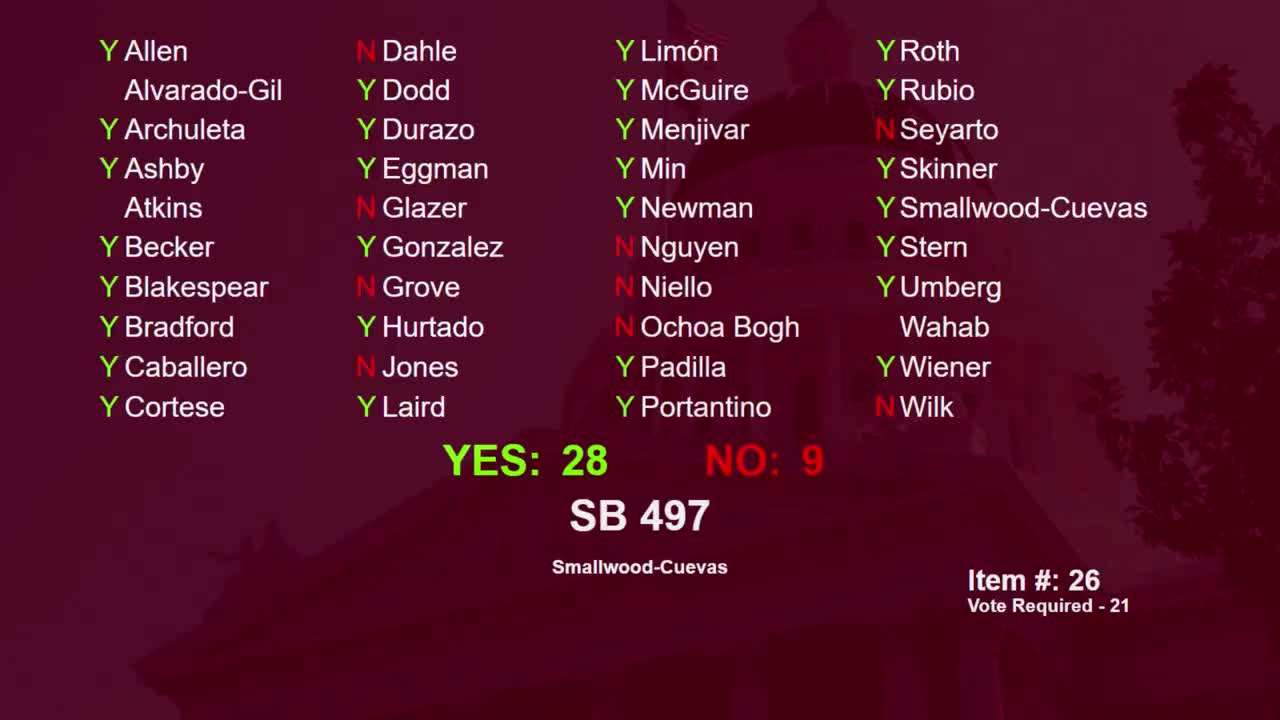
Bill Author