SB 630: Contractors State License Board: regulation of contractors.
- Session Year: 2023-2024
- House: Senate
- Latest Version Date: 2023-09-01
Current Status:
Passed
(2023-09-01: Chaptered by Secretary of State. Chapter 153, Statutes of 2023.)
Introduced
In Committee
First Chamber
In Committee
Second Chamber
Enacted
(1)Existing law, the Contractors State License Law, provides for the licensure and regulation of contractors by the Contractors State License Board in the Department of Consumer Affairs. That law requires an applicant, registrant, or licensee to provide certain information to the board.
This bill would additionally require an applicant, registrant, or licensee that has a valid email address to provide the board with that email address at the time of application or renewal, as applicable.
(2)Existing law, the California Public Records Act, requires a state or local public agency to make public records available for public inspection and to make copies available upon request and payment of a fee, unless the records are exempt from disclosure.
The bill would provide that the above-specified email addresses are not subject to disclosure under prescribed law, including the California Public Records Act, except as specified.
(3)Existing law authorizes the board to take various measures as part of a decision in a disciplinary action, including impose conditions upon the licensee.
This bill would further authorize a decision to provide for a stay of execution of the decision, pending the completion of specified terms and conditions of probation. The bill would provide that the failure to fully comply with the terms and conditions of probation may result in the automatic termination of the stay of execution.
(4)Existing constitutional provisions require that a statute that limits the right of access to the meetings of public bodies or the writings of public officials and agencies be adopted with findings demonstrating the interest protected by the limitation and the need for protecting that interest.
This bill would make legislative findings to that effect.
(a)An applicant for licensure or registration that has a valid email address shall report to the board that email address at the time of application.
(b)A registrant or licensee that has a valid email address shall report that email address to the board at the time of renewal.
(c)To protect the privacy of applicants, registrants, and licensees, the email address provided to the board pursuant to subdivisions (a) and (b) shall not be considered a public record and shall not be disclosed pursuant to Section 27 or pursuant to a request under the California Public Records Act (Division 10 (commencing with Section 7920.000) of Title 1 of the Government Code), unless required by an order of a court of competent jurisdiction.
(d)Information sent from an email account of the board to a valid email address provided by an applicant, registrant, or licensee is presumed to have been delivered to the email address provided.
(e)For the purposes of this section, valid email address means an email address at which the applicant, registrant, or licensee is currently receiving email at the time the application, registration, or license renewal is submitted to the board.
SEC. 2.Section 7095 of the Business and Professions Code is amended to read:7095.(a)The decision may:
(1)Provide for the immediate complete suspension by the licensee of all operations as a contractor during the period fixed by the decision.
(2)Permit the licensee to complete any or all contracts shown by competent evidence taken at the hearing to be then uncompleted.
(3)Impose upon the licensee compliance with such specific terms and conditions as may be just in connection with the licensees operations as a contractor disclosed at the hearing and may further provide that until those terms and conditions are complied with no application for restoration of the suspended or revoked license shall be accepted by the registrar.
(4)(A)Provide for the stay of execution of the decision pending completion of specified terms and conditions of probation.
(B)Failure to fully comply with the terms and conditions of probation set pursuant to subparagraph (A) may result in automatic termination of the stay of execution without further notice. If a stay of execution is terminated pursuant to this subparagraph, the decision shall be considered a disciplinary action within the meaning of this chapter.
(b)The specific terms and conditions imposed pursuant to paragraph (3) or (4) of subdivision (a) may include, but are not limited to, any of the following:
(1)Payment of restitution to persons injured as a result of the violation.
(2)Payment of the costs of investigation and enforcement pursuant to Section 125.3.
(3)Enrollment in, and completion of, specified administrative or trade-specific coursework.
(4)Successful completion of the boards law and business examination or trade examination, as appropriate.
(5)Any further terms and conditions as are set forth for specified violations in the boards disciplinary guidelines in Section 871 of Title 16 of the California Code of Regulations.
SEC. 3.The Legislature finds and declares that Section 1 of this act, which adds Section 7083.2 of the Business and Professions Code, imposes a limitation on the publics right of access to the meetings of public bodies or the writings of public officials and agencies within the meaning of Section 3 of Article I of the California Constitution. Pursuant to that constitutional provision, the Legislature makes the following findings to demonstrate the interest protected by this limitation and the need for protecting that interest:
This act restricts public access to information retained by the Contractors State License Board to protect the personal and private email addresses of licensed contractors.
(a)An applicant for licensure or registration that has a valid email address shall report to the board that email address at the time of application.
(b)A registrant or licensee that has a valid email address shall report that email address to the board at the time of renewal.
(c)To protect the privacy of applicants, registrants, and licensees, the email address provided to the board pursuant to subdivisions (a) and (b) shall not be considered a public record and shall not be disclosed pursuant to Section 27 or pursuant to a request under the California Public Records Act (Division 10 (commencing with Section 7920.000) of Title 1 of the Government Code), unless required by an order of a court of competent jurisdiction.
(d)Information sent from an email account of the board to a valid email address provided by an applicant, registrant, or licensee is presumed to have been delivered to the email address provided.
(e)For the purposes of this section, valid email address means an email address at which the applicant, registrant, or licensee is currently receiving email at the time the application, registration, or license renewal is submitted to the board.
SEC. 2.Section 7095 of the Business and Professions Code is amended to read:7095.(a)The decision may:
(a)(1)Provide for the immediate complete suspension by the licensee of all operations as a contractor during the period fixed by the decision.
(b)(2)Permit the licensee to complete any or all contracts shown by competent evidence taken at the hearing to be then uncompleted.
(c)(3)Impose upon the licensee compliance with such specific terms and conditions as may be just in connection with his the licensees operations as a contractor disclosed at the hearing and may further provide that until such those terms and conditions are complied with no application for restoration of the suspended or revoked license shall be accepted by the registrar.
(4)(A)Provide for the stay of execution of the decision pending completion of specified terms and conditions of probation.
(B)Failure to fully comply with the terms and conditions of probation set pursuant to subparagraph (A) may result in automatic termination of the stay of execution without further notice. If a stay of execution is terminated pursuant to this subparagraph, the decision shall be considered a disciplinary action within the meaning of this chapter.
(b)The specific terms and conditions imposed pursuant to paragraph (3) or (4) of subdivision (a) may include, but are not limited to, any of the following:
(1)Payment of restitution to persons injured as a result of the violation.
(2)Payment of the costs of investigation and enforcement pursuant to Section 125.3.
(3)Enrollment in, and completion of, specified administrative or trade-specific coursework.
(4)Successful completion of the boards law and business examination or trade examination, as appropriate.
(5)Any further terms and conditions as are set forth for specified violations in the boards disciplinary guidelines in Section 871 of Title 16 of the California Code of Regulations.
SEC. 3.The Legislature finds and declares that Section 1 of this act, which adds Section 7083.2 of the Business and Professions Code, imposes a limitation on the publics right of access to the meetings of public bodies or the writings of public officials and agencies within the meaning of Section 3 of Article I of the California Constitution. Pursuant to that constitutional provision, the Legislature makes the following findings to demonstrate the interest protected by this limitation and the need for protecting that interest:
This act restricts public access to information retained by the Contractors State License Board to protect the personal and private email addresses of licensed contractors.
|
Date
|
Status
|
|---|---|
| Sep 1, 2023 | Chaptered by Secretary of State. Chapter 153, Statutes of 2023. |
| Sep 1, 2023 | Approved by the Governor. |
| Aug 22, 2023 | Enrolled and presented to the Governor at 2 p.m. |
| Aug 17, 2023 | In Senate. Ordered to engrossing and enrolling. |
| Aug 17, 2023 | Read third time. Passed. (Ayes 75. Noes 0. Page 2743.) Ordered to the Senate. |
| Jul 13, 2023 | Read second time. Ordered to consent calendar. |
| Jul 12, 2023 | From committee: Do pass. Ordered to consent calendar. (Ayes 15. Noes 0.) (July 12). |
| Jun 27, 2023 | From committee: Do pass and re-refer to Com. on APPR. with recommendation: To consent calendar. (Ayes 11. Noes 0.) (June 27). Re-referred to Com. on APPR. |
| Jun 20, 2023 | From committee: Do pass and re-refer to Com. on JUD. with recommendation: To consent calendar. (Ayes 19. Noes 0.) (June 20). Re-referred to Com. on JUD. |
| May 18, 2023 | Referred to Coms. on B. & P. and JUD. |
| May 11, 2023 | In Assembly. Read first time. Held at Desk. |
| May 11, 2023 | Read third time. Passed. (Ayes 39. Noes 0. Page 1054.) Ordered to the Assembly. |
| May 9, 2023 | Read second time. Ordered to consent calendar. |
| May 8, 2023 | From committee: Be ordered to second reading pursuant to Senate Rule 28.8 and ordered to consent calendar. |
| May 1, 2023 | Set for hearing May 8. |
| Apr 26, 2023 | From committee: Do pass and re-refer to Com. on APPR with recommendation: To consent calendar. (Ayes 11. Noes 0. Page 895.) (April 25). Re-referred to Com. on APPR. |
| Apr 12, 2023 | Set for hearing April 25. |
| Apr 11, 2023 | From committee: Do pass and re-refer to Com. on JUD. (Ayes 12. Noes 0. Page 636.) (April 10). Re-referred to Com. on JUD. |
| Mar 6, 2023 | Set for hearing April 10. |
| Mar 1, 2023 | Referred to Coms. on B., P. & E. D. and JUD. |
| Feb 17, 2023 | From printer. May be acted upon on or after March 19. |
| Feb 16, 2023 | Introduced. Read first time. To Com. on RLS. for assignment. To print. |
|
Date
|
Description
|
Location
|
Votes
|
|
|---|---|---|---|---|
| Aug 17, 2023 | SB 630 Dodd Consent Calendar Second Day Regular Session | Assembly Floor |
Passed |
|
| Jul 12, 2023 | Do pass. To Consent Calendar. | Assembly Standing Committee on Appropriations |
Passed |
|
| Jun 27, 2023 | Do pass and be re-referred to the Committee on [Appropriations] with recommendation: To Consent Calendar | Assembly Standing Committee on Judiciary |
Passed |
|
| Jun 20, 2023 | Do pass and be re-referred to the Committee on [Judiciary] with recommendation: To Consent Calendar | Assembly Standing Committee on Business and Professions |
Passed |
|
| May 11, 2023 | Consent Calendar SB630 Dodd | Senate Floor |
Passed |
|
| Apr 25, 2023 | Do pass, but first be re-referred to the Committee on [Appropriations] with the recommendation: To Consent Calendar | Senate Standing Committee on Judiciary |
Passed |
|
| Apr 10, 2023 | Do pass, but first be re-referred to the Committee on [Judiciary] | Senate Standing Committee on Business, Professions and Economic Development |
Passed |
This list shows positions taken on this bill by organizations on the date displayed, which is linked to the original source.
Positions by individuals are not included.
|
Organization
|
Position
|
Date
|
|---|---|---|
| American Subcontractors Association-California | ** Support | |
| California Builders Alliance | ** Support | |
| Contractors State License Board | ** Support | |
| Sacramento Regional Builders Exchange | ** Support |
Date of Hearing: July 12, 2023
ASSEMBLY COMMITTEE ON APPROPRIATIONS
Chris Holden, Chair
SBPCA Bill Id:SB 630
Author:(Dodd) – As Introduced Ver:February 16, 2023
Policy Committee: | Business and Professions | Vote: | 19 - 0 |
Judiciary | 11 - 0 | ||
|
|
Urgency: No State Mandated Local Program: No Reimbursable: No
SUMMARY:
This bill authorizes the Contractors State License Board (CSLB) to require every applicant, registrant, and licensee to provide a valid email address and to automatically revoke a license for failure to fully comply with the terms and conditions of probation. This bill also makes confidential email addresses provided to CSLB.
Specifically, this bill:
- Requires an applicant, registrant, or licensee with a valid email address to report to the CSLB that email address at the time of application or renewal, as applicable.
- Specifies, to protect the privacy of applicants, registrants, and licensees, an email address provided to CSLB pursuant to this bill is not considered a public record subject to disclosure, unless required by an order of a court of competent jurisdiction.
- Provides that information sent from an email account of CSLB to a valid email address provided by an applicant, registrant, or licensee is presumed to have been delivered to the email address provided.
- Authorizes the CSLB to stay the execution of a decision to revoke the license of a licensee pending completion of specified terms and conditions of probation, including payment of restitution or the costs of investigation and enforcement, completion of specified coursework or exams, and other terms and conditions as set forth in CSLB’s disciplinary guidelines.
- Provides that failure to fully comply with the terms and conditions of probation may result in automatic termination of the stay of execution without further notice.
FISCAL EFFECT:
CSLB’s Information Technology Division anticipates minor and absorbable costs of approximately $9,000 for 90 hours of custom programming to capture and pass an email address to the mainframe from a paper manual entry or online renewal. CSLB anticipates no other costs.
COMMENTS:
- Purpose. This bill is sponsored by CSLB, who states:
[This bill] will enable CSLB to communicate with its licensee population of more than 280,000 in a manner that is low-cost, timely, and environmentally responsible. In addition, authorizing CSLB to reimpose revocation for failing to meet terms of probation and would strengthen consumer protection by incentivizing compliance with probationary conditions while simultaneously reducing costs associated with a second disciplinary proceeding.
- Background. Existing law requires CSLB, within the Department of Consumer Affairs (DCA), to implement and enforce the Contractors State License Law and related regulations pertaining to the licensure, practice, and discipline of the construction industry in California.
CSLB sends a variety of notices and updates to licensees via email. Currently, only licensees who opt in to the board’s listserv receive email alerts. According to CSLB, communicating with applicants and licensees via electronic mail is the most efficient and cost effective method of communication. Numerous DCA boards and bureaus have legislative authorization to require their applicants, registrants, and licensees to provide a valid email address to receive correspondence from the board or bureau. This bill similarly authorizes CSLB to require its applicants, licensees, and registrants to provide a valid email address.
The California Public Records Act requires government records to be disclosed to the public, upon request, unless privacy or public safety concerns warrant an exemption. This bill specifies an email address provided to CSLB is not considered a public record and cannot be disclosed unless required by a court order.
Existing law and regulations allow CSLB to use a variety of enforcement tools to address contractor violations, including imposing probationary conditions upon a licensee. For the most serious violations, CSLB may recommend an accusation, which can result in suspension or revocation of a contractor’s license. Accusation recommendations are sent to the Attorney General (AG), who determines whether there is enough evidence to proceed with a case. Appeals are heard before an administrative law judge who makes a “proposed decision” to the CSLB registrar, who can adopt, not adopt, or modify the decision. If an accusation is filed and upheld, the license may be suspended or revoked by CSLB, though often the AG’s office negotiates an agreement with the licensee, whereby the licensee is instead placed on probation. Licensees are required to comply with the terms and conditions of probation, and, if they fail to do so, CSLB proceeds with revoking their license.
Existing law allows CSLB to automatically revoke a contractor’s license if the contractor fails to pay restitution. However, if a contractor violates probation in any other way, CSLB cannot automatically revoke their license. Instead, a second disciplinary hearing is required, which CSLB argues is a costly and time consuming administrative step and jeopardizes consumer protection.
This bill allows CSLB to provide a stay of execution of a disciplinary decision, pending completion of additional specified terms and conditions, and allows CSLB to automatically revoke the license of a licensee who does not fully comply with the terms and conditions.
Analysis Prepared by: Jennifer Swenson / APPR. / (916) 319-2081
Date of Hearing: June 27, 2023
ASSEMBLY COMMITTEE ON JUDICIARY
Brian Maienschein, Chair
SBPCA Bill Id:SB 630
Author:(Dodd) – As Introduced Ver:February 16, 2023
PROPOSED CONSENT
SENATE VOTE: 39-0
SUBJECT: CONTRACTORS STATE LICENSE BOARD: REGULATION OF CONTRACTORS
KEY ISSUE: SHOULD THE EMAIL ADDRESSES OF LICENSED CONTRACTORS, LIKE THE EMAIL ADDDRESSES OF SOME OTHER LICENSED PROFESSIONALS BUT UNLIKE THE EMAIL ADDRESSES OF PUBLIC EMPLOYEES, BE DEEMED CONFIDENTIAL AND NOT SUBJECT TO PUBLIC DISCLOSURE PURSUANT TO THE CALIFORNIA PUBLIC RECORDS ACT?
SYNOPSIS
Access to information concerning the conduct of the people’s business is a fundamental and necessary right of every person in this state. (Government Code Section 7921.000.) The California Public Records Act (CPRA) makes all documents and “writings” of a public agency open to public inspection upon request, unless the records are otherwise exempt from public disclosure. The CPRA also gives the public the right to obtain a copy of any public record. The only exception is when the document, or a portion thereof, is exempt from public disclosure as a matter of law—under the CPRA itself, or pursuant to another law that is incorporated by reference into the CPRA—or because based on the facts of the particular case, the public interest served by not disclosing the record clearly outweighs the public interest served by disclosure of the record. (Sections 7922.000 7922.525, 7922.530.)
This bill is similar to several other recent bills—none of which were heard by this Committee—that have amended the Business & Professions Code to exempt email addresses of licensees and registrants obtained by licensing boards and bureaus from the CPRA. Like this bill, those prior bills have stated that such CPRA exemptions were necessary to “protect the privacy of applicants, registrants, and licensees[.]” It is hard to see why or how disclosure of an email address -- that presumably is a work email address and not a personal one -- of a licensed contractor to the public would endanger the privacy of such an individual. But there is precedent for a CPRA exemption like the one in this bill. And like other bills to provide a CPRA exemption before it, this bill seems to have a minimal impact on the ability of the public to know about the business of government. Other more relevant and valuable information—such as a contractor’s name and license status and past discipline—remains open to the public and its public disclosure is not affected by this bill. The bill was recently unanimously approved by the Assembly Business & Professions Committee on consent and is supported by the American Subcontractors Association-California; California Builders Alliance; and Sacramento Regional Builders Exchange. It has no opposition on file.
SUMMARY: Authorizes the Contractors State License Board (CSLB) to require applicants, registrants, and licensees to provide a valid email address and to automatically revoke a license for failure to fully comply with the terms and conditions of probation; also makes confidential email addresses that are provided to CSLB. Specifically, this bill:
- Requires an applicant for licensure or registration that has a valid email address to report to the CSLB that email address at the time of application.
- Requires a registrant or licensee that has a valid email address to report that email address to the CSLB at the time of renewal.
- Specifies that to protect the privacy of applicants, registrants, and licensees, the email address provided to the CSLB will not be considered a public record that is subject to disclosure, unless required by an order of a court of competent jurisdiction.
- Provides that information sent from an email account of the CSLB to a valid email address provided by an applicant, registrant, or licensee is presumed to have been delivered to the email address provided.
- Defines “valid email address” to mean an email address at which the applicant, registrant, or licensee is currently receiving email at the time the application, registration, or license renewal is submitted to the CSLB.
- Authorizes the CSLB to stay the execution of a decision to revoke the license of a licensee pending completion of specified terms and conditions of probation.
- Provides that failure to fully comply with the terms and conditions of probation may result in automatic termination of the stay of execution without further notice.
- Specifies that the specific probation terms and conditions imposed may include, but are not limited to, any of the following:
- Payment of restitution to persons injured as a result of the violation.
- Payment of the costs of investigation and enforcement, as specified.
- Enrollment in, and completion of, specified administrative or trade-specific coursework.
- Successful completion of the CSLB’s law and business examination or trade examination, as appropriate.
- Any further terms and conditions as are set forth for specified violations in the CSLB’s disciplinary guidelines, as specified.
- Makes other minor non-substantive changes to the law.
EXISTING LAW:
- Provides that the people have the right of access to information concerning the conduct of the people’s business and, therefore, the writings of public officials and agencies shall be open to public scrutiny. Specifies that any law or rule that limits the public right of access shall be adopted with findings demonstrating the interest protected by the limitation. (California Constitution, art. I, Section 3.)
- Provides that, in enacting the California Public Records Act (CPRA), the Legislature, mindful of the right of individuals to privacy, finds and declares that access to information concerning the conduct of the people’s business is a fundamental and necessary right of every person in this state. (Government Code Section 7921.000. All further statutory references are to this code, unless otherwise indicated.)
- Defines “public records” to include any writing containing information relating to the conduct of the public’s business prepared, owned, used, or retained by any state or local agency regardless of physical form or characteristics and those in the custody of, or maintained by, the Governor’s office means any writing prepared on or after January 6, 1975. (Section 7920.530.)
- Provides that public records are open to inspection at all times during the office hours of a state or local agency and every person has a right to inspect any public record, exempted as otherwise provided; and that any reasonably segregable portion of a record shall be available for inspection by any person requesting the record after deletion of the portions that are exempted by law. (Section 7922.525.)
- Requires a public agency to determine whether it has disclosable public records in its possession within ten days or, in specified “unusual circumstances,” within 14 days of the ten-day period, of its receipt of a request for public records and to promptly notify the person making the request of the determination and the reasons therefor. (Section 7922.535 (a).)
- Requires a public agency to justify withholding any record by demonstrating that the record in question is exempt under express provisions of this division, or that on the facts of the particular case the public interest served by not disclosing the record clearly outweighs the public interest served by disclosure of the record. (Section 7922.000.)
- Provides that the home addresses, home telephone numbers, personal cellular telephone numbers, and birthdates of all employees of a public agency shall not be deemed to be public records and shall not be open to public inspection, except that disclosure of that information may be made as specified. (Section 7928.300 (a).)
- Provides that unless used by the employee to conduct public business, or necessary to identify a person in an otherwise disclosable communication, the personal email addresses of all employees of a public agency shall not be deemed to be public records and shall not be open to public inspection, except that disclosure of that information may be made as specified in the law. (Section 7928.300 (b)(1).)
- Provides that the exemption for personal email addresses in 8), above, shall not be construed to limit the public’s right to access the content of an employee’s personal email that is used to conduct public business, as decided by the Supreme Court in City of San Jose v. Superior Court (2017) 2 Cal.5th 608. (Section 7928.300 (b)(2).)
- Requires, upon written request of any employee, a public agency to not disclose the employee’s home address, home telephone number, personal cellular telephone number, personal email address, or birthdate and remove the employee’s home address, home telephone number, and personal cellular telephone number from any mailing list maintained by the agency, except if the list is used exclusively by the agency to contact the employee. (Section 7928.300 (c).)
- Requires an agency to maintain in its records only personal information that is relevant and necessary to accomplish the lawful purpose of the agency and prohibits the agency from disclosing any personal information in a manner that would link the information disclosed to the person to whom it pertains, subject to several exceptions. Specifies, in particular, that personal information which identifies a driver’s license holder may be disclosed pursuant to the CPRA. (Civil Code Sections 1798.14, 1798.24.)
FISCAL EFFECT: As currently in print this bill is keyed fiscal.
COMMENTS: This bill, sponsored by the Contractors State License Board (CSLB), makes several changes to the law regarding applicants for licensure as contractors. Most of the bill’s provisions are within the jurisdiction of the Assembly Committee on Business & Professions, which thoroughly analyzed them prior to that committee unanimously approving the bill by a vote of 19-0. The bill’s only provision that is in this Committee’s jurisdiction deals with the California Public Records Act (CPRA), which is therefore the sole focus of this analysis. The bill exempts from the definition of public record under the CPRA email addresses of licensed contractors and applicants for licensure by the CSLB.
While this would arguably conflict with other provisions of the CPRA and have at least some adverse impact on the transparency of public records, the value of the information sought to be withheld from the public is relatively minimal. Furthermore, the exemption is consistent with numerous other provisions in the Business & Professions Code that exempt email addresses of other licensees and applicants for licensure from public disclosure—that arguably also conflict with the CPRA. According to the author:
Ensuring contractors work in a safe, competent and professional manner is at the heart of our commitment to California consumers. We achieve that through better communication and education, as well as clear pathways for improvement when things go wrong. My proposal advances these principles among the licensed trades to strengthen an industry that is essential as we continue to build out our state.
Background – The California Public Records Act. Access to information concerning the conduct of the people’s business is a fundamental and necessary right of every person in this state. (Section 7921.000.) In 2004, the right of public access was enshrined in the California Constitution with the passage of Proposition 59 (Nov. 3, 2004, statewide general election), placed on the ballot by unanimous vote of both houses of the Legislature pursuant to SCA 1 (Burton), Chap. 1, Stats. 2004, amending the California Constitution to specifically protect the right of the public to access and obtain government records: “The people have the right of access to information concerning the conduct of the people’s business, and therefore . . . the writings of public officials and agencies shall be open to public scrutiny.” (Cal. Const., art. I, sec. 3 (b)(1).) In 2014, voters approved Proposition 42 (Jun. 3, 2014, statewide direct primary election), placed on the ballot by unanimous vote of both houses of the Legislature, (SCA 3 (Leno, Ch. 123, Stats. 2013), to further increase public access to government records by requiring local agencies to comply with the CPRA and the Ralph M. Brown Act, and with any subsequent statutory enactment amending either act, as provided. (Cal. Const., art. I, sec. 3 (b)(7).)
The California Public Records Act (CPRA) makes all documents and “writings” of a public agency open to public inspection upon request, unless the records are otherwise exempt from public disclosure. The CPRA also gives the public the right to obtain a copy of any public record. The only exception is when the document, or a portion thereof, is exempt from public disclosure as a matter of law—under the CPRA itself, or pursuant to another law that is incorporated by reference into the CPRA—or because based on the facts of the particular case, the public interest served by not disclosing the record clearly outweighs the public interest served by disclosure of the record. (Sections 7922.000 7922.525, 7922.530.)
Under the CPRA, public records are open to inspection at all times during the office hours of a public agency for inspection by the public, unless exempted. (Section 7922.525.) A public record is defined as “any writing containing information relating to the conduct of the public’s business prepared, owned, used, or retained by any public agency regardless of physical form or characteristics.” (Section 7920.530.) Any writing in the possession of a government agency that relates to the operation of government is considered a public record.
The mere custody of a writing by a public agency does not make it a public record, but if a record is kept by an officer because it is necessary or convenient to the discharge of his official duty, it is a public record. (San Gabriel Tribune v. Superior Court (1983) 143 Cal.App.3d 762, 774.) . . .. “This definition is intended to cover every conceivable kind of record that is involved in the governmental process and will pertain to any new form of record-keeping instrument as it is developed. Only purely personal information unrelated to 'the conduct of the public's business' could be considered exempt from this definition, i.e., the shopping list phoned from home, the letter to a public officer from a friend which is totally void of reference to governmental activities.” (Braun v. City of Taft (1984) 154 Cal.App.3d 332, 340.)
The bill in print is consistent with other licensing statutes, but inconsistent with the CPRA and other provisions of state law regarding the collection and dissemination of information by public agencies. The CPRA specifically addresses the confidentiality of personal identifying information of employees of public agencies–including personal email addresses—contained within agency records as follows:
- Home addresses, home telephone numbers, personal cellular telephone numbers, and birthdates of all employees of a public agency shall not be deemed to be public records and shall not be open to public inspection, except that disclosure of that information may be made as specified. (Section 7928.300 (a).)
- Unless used by the employee to conduct public business, or necessary to identify a person in an otherwise disclosable communication, the personal email addresses of all employees of a public agency shall not be deemed to be public records and shall not be open to public inspection, except that disclosure of that information may be made as specified in the law. (Section 7928.300 (b)(1).) However, this protection for personal email addresses shall not be construed to limit the public’s right to access the content of an employee’s personal email that is used to conduct public business, as decided by the Supreme Court in City of San Jose v. Superior Court (2017) 2 Cal.5th 608. (Section 7928.300 (b)(2).)
- Requires, upon written request of any employee, a public agency to not disclose the employee’s home address, home telephone number, personal cellular telephone number, personal email address, or birthdate and remove the employee’s home address, home telephone number, and personal cellular telephone number from any mailing list maintained by the agency, except if the list is used exclusively by the agency to contact the employee. (Section 7928.300 (c).)
Given that all records of a public agency are subject to inspection and disclosure, unless exempt under express provisions of the CPRA, or because – based upon the facts of the particular case-- the public interest served by not disclosing the record clearly outweighs the public interest served by disclosure of the record (Section 7922.000), an email address other than a personal email address, is subject to disclosure under the CPRA, Arguably, there is just as much (if not more) public interest in disclosure of the professional/work email address of a licensed contractor used to do business with the CLRB as in the personal email address of a public employee used to conduct public business.
The bill. According to the CSLB, communicating with applicants and licensees via electronic mail is the most efficient and cost effective method of communication. According to information provided to the Committee by the author:
The CSLB license population is over 285,000 licensees, making it cost prohibitive for CSLB to send information by U.S. Mail about new legislative bills, industry bulletins, or notices of board and stakeholder meetings that require licensee input. Using U.S. Mail would cost approximately $300,000 so CSLB increasingly provides important updates by listserv email notification. However, licensees must access the CSLB website and “opt in” to receive information by email, which only a small percentage of licensees have done.
The bill is similar to several other recent bills—none of which were heard by this Committee—that have amended the Business & Professions Code to exempt email addresses of licensees and registrants obtained by licensing boards and bureaus from the CPRA. Like this bill, those prior bills have stated that such CPRA exemptions were necessary to “protect the privacy of applicants, registrants, and licensees[.]”
- SB 1120 (Jones, Chapter 302, Statutes of 2022) authorized the Board for Professional Engineers, Land Surveyors and Geologists to require an email address from applicants and licensees, required updating an email address within 30 days of changing an email address, and exempted the licensee and applicant email addresses from disclosure under the CPRA.
- AB 2686 (Berman, Chapter 415, Statutes of 2022) authorized the Speech-Language Pathology, Audiology, and Hearing Aid Dispensers Board to require all applicants, licensees, or registrants to provide the Board with an email address no later than July 1, 2023; required email addresses to be updated within 30 days of any changes; and made email addresses confidential and not subject to disclosure under the CPRA.
- AB 298 (Irwin, Chapter 300, Statutes of 2021) recast previous existing law -- stating that email addresses of licensed accountants and applicants for licensure as accountants are not considered public records and prohibiting email addresses from being disclosed pursuant to specified provisions of law, unless required pursuant to a court order—as being in the interest of protecting the privacy of applicants and licensees.
It is hard to see why or how disclosure of an email address -- that presumably is a work email address and not a personal one -- of a licensed contractor (or an applicant for licensure, or a speech-language pathologist, audiologist, hearing aid dispensers, or accountants, for that matter) to the public would endanger the privacy of such an individual. It could also be true that these licensing boards wish to save licensees and applicants from the harassment of spam emails, solicitations and other forms of unwanted email, a worthy goal that may nevertheless be an insufficient justification to exempt materials from public disclosure pursuant to the CPRA. In any case, there is precedent for a CPRA exemption like the one in this bill. And like other bills to provide a CPRA exemption before it, this bill seems to have a minimal impact on the ability of the public to know about the business of government. Other more relevant and valuable information—such as a contractor’s name and license status and past discipline—remains open to the public and its public disclosure is not affected by this bill.
ARGUMENTS IN SUPPORT: Sponsor Contractors State License Board writes that it supports the bill for a number of reasons, including the fact that it would “protect the privacy of CSLB licensees and applicants by exempting their email address from disclosure under the Public Records Act.”
American Subcontractors Association-California writes that it supports the bill for similar reasons:
This bill adds an additional requirement for those with a valid email address to provide that address when applying or renewing, while limiting access to the email address in terms of an exemption to the California Public Records Act. This will speed the communications process between the Board and applicants for licensure, hence, making it efficacious.
REGISTERED SUPPORT / OPPOSITION:
Support
Contractors State License Board (sponsor)
American Subcontractors Association-California
California Builders Alliance
Sacramento Regional Builders Exchange
Opposition
None on file
Analysis Prepared by: Alison Merrilees / JUD. / (916) 319-2334
Date of Hearing: June 20, 2023
ASSEMBLY COMMITTEE ON BUSINESS AND PROFESSIONS
Marc Berman, Chair
SBPCA Bill Id:SB 630
Author:(Dodd) – As Introduced Ver:February 16, 2023
NOTE: This bill is double referred and if passed by this Committee will be re-referred to the Assembly Judiciary Committee.
SENATE VOTE: 39-0
SUBJECT: Contractors State License Board: regulation of contractors
SUMMARY: Authorizes the Contractors State License Board (CSLB) to require applicants, registrants, and licensees to provide a valid email address and to automatically revoke a license for failure to fully comply with the terms and conditions of probation.
EXISTING LAW:
- Establishes the Department of Consumer Affairs (DCA) within the Business, Consumer Services, and Housing Agency. (BPC § 100)
- Requires each person holding a license, certificate, registration, permit, or other authority to engage in a profession or occupation issued by a board within Department of Consumer Affairs (DCA) to notify the issuing board of any change in the person’s mailing address within 30 days after the change, unless the board has specified by regulations a shorter time period. (BPC § 136)
- Establishes the CSLB within the DCA to license and regulate contractors and home improvement salespersons. (BPC §§ 7000-7191)
- Requires the CSLB in consultation with the director of DCA to appoint a registrar of contractors (registrar) and sunsets the CSLB and its authority to appoint a registrar on January 1, 2025, as specified. (BPC § 7011)
- Requires an applicant to submit to the registrar an application with specified information on a form prescribed by CSLB. (BPC § 7066)
- Requires licensees to notify the registrar, on a form prescribed by the registrar, in writing within 90 days of any change to information including, but not be limited to, business address, personnel, and business name. (BPC § 7083)
- Requires a licensee whose license is expired or suspended, and is renewable, or whose license is canceled, to notify the registrar in writing of a change of address of record within 90 days, and shall maintain a current address of record during the five-year period immediately following the expiration or cancellation of the license. (BPC § 7083.1)
- States that access to information concerning the conduct of the people’s business is a fundamental and necessary right of every person in this state. (Government (GOV) Code § 7921.000)
- Specifies that an agency must justify withholding any record by demonstrating that the record in question is exempt or that the public interest served by not disclosing the record clearly outweighs the public interest served by disclosure of the record. (GOV Code § 7922.000)
- Prohibits a board, bureau, commission, committee, department, division, or agency under DCA from renewing or reinstating the license of any licensee who has failed to pay all of the investigation and prosecution costs of their case as ordered by an administrative law judge. However a board may, in its discretion, conditionally renew or reinstate for a maximum of one year the license of any licensee who demonstrates financial hardship and who enters into a formal agreement with the board to reimburse the board within that one-year period for the unpaid costs. (BPC § 125.3)
- Provides that a hearing to determine whether a right, authority, license, or privilege should be revoked, suspended, limited, or conditioned must be initiated by filing an accusation or District Statement of Reduction in Force. (GOV § 11500)
- Authorizes a stay of execution to be included in the decision or at any time before the decision becomes effective. The stay of execution may be accompanied by an express condition that the respondent comply with specified terms of probation, which must be just and reasonable, and may include an order to pay restitution. (BPC § 11519(b) and (d))
- Requires the registrar to issue a citation to a person who, upon inspection or investigation there is probable cause to believe that they are acting in the capacity of or engaging in the business of a contractor and is not licensed nor subject to an exemption from licensure. (BPC § 7028.7(a))
- Authorizes the registrar upon their own motion, and requires upon the verified complaint in writing of any person, to investigate the action of any applicant, contractor, or home improvement salesperson and deny licensure or the renewal of a license, or cite, temporarily suspend, or permanently revoke a license or registration if the applicant, licensee, or registrant is guilty of or commits any one or more of the acts or omissions that is cause for disciplinary action. (BPC § 7090)
- Specifies that the failure to pay a civil penalty, or to comply with an order of correction or an order to pay a specified sum to an injured party in lieu of correction once the order has become final, shall result in the automatic suspension of a license by operation of law 30 days after noncompliance with the terms of the order, although the registrar may delay revocation for up to one year, as specified (BPC § 7091(a))
- Specifies that the decision of the registrar may:
- Provide for the immediate complete suspension by the licensee of all operations as a contractor during the period fixed by the decision.
- Permit the licensee to complete any or all contracts shown by competent evidence taken at the hearing to be then uncompleted.
- Impose upon the licensee compliance with such specific conditions as may be just in connection with his operations as a contractor disclosed at the hearing and may further provide that until such conditions are complied with no application for restoration of the suspended or revoked license shall be accepted by the registrar.
(BPC § 7095)
EXISTING REGULATIONS:
- Requires the CSLB, in reaching a decision on a disciplinary action under the Administrative Procedure Act, to consider disciplinary guidelines that are incorporated by reference. Deviation from these guidelines and orders, including the standard terms of probation, is appropriate where the board in its sole discretion determines that the facts of the particular case warrant such a deviation. (California Code of Regulations, Title 16, § 871)
EXISTING CSLB DISCIPLINARY GUIDELINES:
- Specifies that if a respondent (i.e. licensee subject to disciplinary action) violates probation in any respect, the registrar, after giving notice and opportunity to be heard, may revoke probation and impose the disciplinary order to revoke a license that was stayed. (California Contractors License Law & reference Book, Chapter 13, 2023 Edition)
- Authorizes the registrar to impose the disciplinary order to revoke a license that was previously stayed without giving the respondent (i.e. licensee subject to disciplinary action) an opportunity to be heard if the respondent fails to comply with a restitution order. (California Contractors License Law & reference Book, Chapter 13, 2023 Edition)
THIS BILL:
- Requires an applicant for licensure or registration that has a valid email address to report to the CSLB that email address at the time of application.
- Requires a registrant or licensee that has a valid email address to report that email address to the CSLB at the time of renewal.
- Specifies that to protect the privacy of applicants, registrants, and licensees, the email address provided to the CSLB will not be considered a public record that is subject to disclosure, unless required by an order of a court of competent jurisdiction.
- Provides that information sent from an email account of the CSLB to a valid email address provided by an applicant, registrant, or licensee is presumed to have been delivered to the email address provided.
- Defines “valid email address” to mean an email address at which the applicant, registrant, or licensee is currently receiving email at the time the application, registration, or license renewal is submitted to the CSLB.
- Authorizes the CSLB to stay the execution of a decision to revoke the license of a licensee pending completion of specified terms and conditions of probation.
- Provides that failure to fully comply with the terms and conditions of probation may result in automatic termination of the stay of execution without further notice.
- Specifies that the specific probation terms and conditions imposed may include, but are not limited to, any of the following:
- Payment of restitution to persons injured as a result of the violation.
- Payment of the costs of investigation and enforcement, as specified.
- Enrollment in, and completion of, specified administrative or trade-specific coursework.
- Successful completion of the CSLB’s law and business examination or trade examination, as appropriate.
- Any further terms and conditions as are set forth for specified violations in the CSLB’s disciplinary guidelines, as specified.
- Makes minor, conforming changes.
FISCAL EFFECT: According to the Senate Appropriations Committee pursuant to Senate Rule 28.8, no significant state costs anticipated.
COMMENTS:
Purpose. This bill is sponsored by Contractors State License Board (CSLB). According to the author:
Ensuring contractors work in a safe, competent and professional manner is at the heart of our commitment to California consumers. We achieve that through better communication and education, as well as clear pathways for improvement when things go wrong. My proposal advances these principles among the licensed trades to strengthen an industry that is essential as we continue to build out our state.
Background.
Contractors and CSLB. The CSLB was established in 1929 to regulate the construction industry in California and to protect consumers from unscrupulous contractors.[1] It is responsible for implementing and enforcing the Contractors State License Law and related regulations pertaining to the licensure, practice, and discipline of the construction industry in California. The law requires, in part, that any person or business that constructs or alters, or offers to construct or alter, any building, highway, road, parking facility, railroad, excavation, or other structure in California be licensed by CSLB if the total cost of labor and materials for one or more contracts on the project is $500 or more.[2]
CSLB issues licenses to sole proprietors and legal business entities such as a partnership, corporation, limited liability company, or joint venture.[3] Every license is required to have a qualifying individual (also referred to as a “qualifier”) who is the person listed in CSLB records that satisfies the experience and examination requirements for a license.[4]
CSLB issues four (4) license types: “A” General Engineering Contractor; “B” General Building Contractor; “B-2” Residential Remodeling Contractor; and “C” Specialty Contractor of which there are 42 specialty contractor classifications (e.g., electrical, drywall, painting, plumbing, roofing, and fencing).[5] Certain license holders are eligible to additionally obtain an asbestos or hazardous substance removal certification issued by CSLB.[6] As of March 1, 2023, there were 285,179 licensed contractors and 27,904 registered home improvement salespersons.
Email. Over the last decade, numerous boards and bureaus have sought legislative authorization to require their applicants, registrants, licensees, and the like to provide a valid email address to receive correspondence from the relative board or bureau. Email provides an expedient, cost-effective, and environmentally-friendly means of communicating with each board’s applicant and licensee population. To date, the following boards, bureaus, and councils have been authorized to require their respective applicants, registrants, and licensees to provide an email addresses at the time of application or renewal:
- Board for Professional Engineers, Land Surveyors, and Geologists
- Board of Accountancy
- Board of Behavioral Sciences
- Board of Pharmacy
- Board of Vocational Nursing and Psychiatric Technicians
- Bureau of Automotive Repair
- California Massage Therapy Council
- Dental Board of California
- Dental Hygiene Board of California
- Department of Real Estate
- Medical Board of California
- Speech-Language Pathology and Audiology and Hearing Aid Dispensers Board
This bill would similarly authorize CSLB to require its applicants, licensees, and registrants to provide a valid email address if they have one. CSLB sends a variety of notices and updates to licensees via email. Consequently, only those licensees that have opted in to the board’s listserv receive email alerts, meaning some licensees may not be aware of important changes to licensure requirements or construction-related laws and regulations. This change will ensure that more licensees receive timely communication from the board.
The California Public Records Act requires government records to be disclosed to the public, upon request, unless there are privacy and/or public safety concerns that warrant an exemption.[7] To protect the privacy of applicants, licensees, and registrants, this bill specifies that email addresses can only be disclosed as required by a court order.
CSLB Enforcement. CSLB is responsible for protecting consumers by regulating the construction industry. In doing so, CSLB enforces construction-related laws and regulations and provides resolution for disputes. CSLB enforcement staff investigate complaints against licensees and registered home improvement salespersons as well as unlicensed people acting as contractors and unregistered people acting as home improvement salespeople.[8] The majority of complaints that CSLB receives are from residential property owners who contracted for home improvement projects, although CSLB also receives complaints from licensees, industry groups, and governmental agencies. Complaints are investigated and when warranted, disciplinary action is taken.
CSLB has a variety of enforcement tools to use depending on the severity of the violation(s). Advisory notices, which are not publicly disclosed, notify licensees of the violation, explain how to comply with the law in the future, and warn licensees that future violations may result in more stringent disciplinary action.[9]
Letters of admonishment, which are reserved for minor violations, are an intermediate form of corrective action.[10] Contractors must comply with the terms outlined in the letter of admonishment or contest it in writing. Appeals are handled internally by CSLB without a formal hearing process. Although a letter of admonishment is not considered formal disciplinary action, it may be used to support formal disciplinary action in the future. Moreover, a letter of admonishment must be publically disclosed for one or two years.
For more egregious violations, CSLB may issue an administrative citation, which may include a corrective order and require the licensee to pay a civil penalty and/or restitution to an injured party.[11] Citations must be publically disclosed from the date of issuance and for five years after compliance. If a licensee does not comply, their license will be automatically suspended for 90 days, and if still out of compliance after 90 days, their license will be automatically revoked.
For the most serious violations, CSLB may recommend an accusation, which can result in suspension or revocation of a contractor’s license and are required to be publically disclosed.[12] Accusation recommendations are sent to the Office of the Attorney General (AG), who determines whether there is enough evidence to proceed with a case. Appeals are heard before an administrative law judge who makes a “proposed decision” to the CSLB registrar, who can adopt, not adopt, or modify the decision. If an accusation is filed and upheld, the license may be suspended or revoked, though often the AG’s office negotiates an agreement with the licensee, whereby the decision is made to revoke the license, but that decision is stayed and the licensee is placed on probation. Licensees are required to comply with the terms and conditions of probation, and, if they fail to do so, CSLB proceeds with revoking their license.
Existing law currently prohibits the CSLB from renewing or reinstating the license of any licensee who has failed to reimburse the board for investigation and enforcement costs, but does not expressly authorize CSLB to automatically revoke the license of a licensee if they do not.[13] Moreover, CSLB’s existing disciplinary guidelines authorize the board to automatically revoke a contractor’s license if they fail to pay restitution.[14] However, if a contractor violates their probation in any other way, CSLB cannot automatically revoke their license. A second disciplinary hearing is required to revoke the stayed revocation. CSLB argues that this administrative step is costly, time consuming, and jeopardizes consumer protection.
This bill allows the board to automatically revoke the license of a licensee who does not fully comply with the following probation terms, including completion of required courses and examinations, orders to pay restitution or reimburse the board for investigation and enforcement costs, and any other terms and conditions specified in the board’s disciplinary guidelines.
Prior Related Legislation.
AB 1521 (Low), Chapter 359, Statutes of 2019, as it relates to this bill, required specified applicants and permitholders who have a valid email address to report to the California Board of Accountancy (CBA) that email address, as specified.
AB 298 (Irwin), Chapter 300, Statutes of 2021, as it relates to this bill, specified that in the interest of protecting the privacy of applicants and licensees, an email address provided by applicants or licensees to the CBA is not to be considered a public record that is subject to disclosure, unless required pursuant to a court order by a court of competent jurisdiction.
SB 1120 (Jones), Chapter 302, Statutes of 2022, as it relates to this bill, required applicants, licensees, and certificate holders to provide the Board for Professional Engineers, Land Surveyors, and Geologists with a valid email address, if available, and notify the Board of any email address changes.
AB 2686 (Assembly Committee on Business and Professions), Chapter 415, Statutes of 2022, as it relates to this bill, required applicants, registrants, and licensees who have an email address to provide the Speech-Language Pathology, Audiology, and Hearing Aid Dispensers Board (SLPAHAD Board) with that email address no later than July 1, 2023, and to provide to the SLPAHAD Board any and all changes to their email address no later than 30 calendar days after the changes have occurred.
ARGUMENTS IN SUPPORT:
The CSLB, as the sponsor of this bill, writes in support:
[This bill] will enable CSLB to communicate with its licensee population of more than 280,000 in a manner that is low-cost, timely, and environmentally responsible. In addition, authorizing CSLB to reimpose revocation for failing to meet terms of probation would strengthen consumer protection by incentivizing compliance with probationary conditions while simultaneously reducing costs associated with a second disciplinary proceeding.
ARGUMENTS IN OPPOSITION:
None on file.
REGISTERED SUPPORT:
Contractors State License Board (Sponsor)
American Subcontractors Association-California
California Builders Alliance
Sacramento Regional Builders Exchange
REGISTERED OPPOSITION:
None on file.
Analysis Prepared by: Kaitlin Curry / B. & P. / (916) 319-3301
Contractors State License Board. (n.d.). History and Background. Contractors State License Board. Retrieved April 2, 2023, from https://www.cslb.ca.gov/About_Us/History_and_BackGround.aspx ↑
BPC § 7027.2 ↑
Contractors State License Board. (2018, December). Contractors State License Board Sunset Review. Contractors State License Board. Retrieved April 2, 2023, from https://www.cslb.ca.gov/Resources/Reports/Sunset/SunsetReviewReport2018.pdf ↑
Ibid. ↑
Contractors State License Board. (n.d.). CSLB Licensing Classifications. Contractors State License Board. Retrieved April 2, 2023, from https://www.cslb.ca.gov/About_Us/Library/Licensing_Classifications/ ↑
Ibid. ↑
GOV Code § 7921.000 et seq. ↑
Contractors State License Board. (2018, December). Contractors State License Board Sunset Review December 2018. ↑
Ibid. ↑
Ibid. ↑
Ibid. ↑
Ibid. ↑
BPC § 125.3 ↑
Tit. 16, CCR § 871 ↑
SENATE RULES COMMITTEE Office of Senate Floor Analyses (916) 651-1520 Fax: (916) 327-4478 | SB 630 |
CONSENT
Bill No: SB 630
Author: Dodd (D)
Introduced: 2/16/23
Vote: 21
SENATE BUS., PROF. & ECON. DEV. COMMITTEE: 12-0, 4/10/23
AYES: Roth, Nguyen, Archuleta, Ashby, Becker, Dodd, Eggman, Glazer, Niello, Smallwood-Cuevas, Wahab, Wilk
NO VOTE RECORDED: Alvarado-Gil
SENATE JUDICIARY COMMITTEE: 11-0, 4/25/23
AYES: Umberg, Wilk, Allen, Ashby, Caballero, Durazo, Laird, Min, Niello, Stern, Wiener
SENATE APPROPRIATIONS COMMITTEE: Senate Rule 28.8
SUBJECT: Contractors State License Board: regulation of contractors
SOURCE: Contractors State License Board
DIGEST:
This bill requires an applicant for a contractor’s license or a license holder seeking renewal to provide the Contractors State License Board (CSLB) with a valid email address, if available, and clarifies that if specified probationary conditions are imposed, the CSLB may revoke a license if those specified terms and conditions are not met.
ANALYSIS:
Existing law:
- Establishes the CSLB to enforce and administer the Contractors State License Law. (Business and Professions Code (BPC) § 7000 et seq.)
- Makes the failure to pay a civil penalty, or to comply with an order of correction or an order to pay a specified sum to an injured party in lieu of correction once the order has become final, to result in the automatic suspension of a license by operation of law 30 days after noncompliance with the order. (BPC § 7090.1)
- States that the decision of the of the registrar may:
- Provide for the immediate complete suspension by the licensee of all operations as a contractor during the period fixed by the decision;
- Permit the licensee to complete any or all contracts shown by competent evidence taken at the hearing to be then uncompleted;
- Impose upon the license compliance with such specific conditions as may be just in connection with his operations as contractor disclosed at the hearing and may further provide that until such conditions are complied with no application for restoration of the suspended or revoked license to be accepted by the registrar. (BPC § 7095)
- Prohibits a board from renewing or reinstating the license of any licensee who has failed to pay all costs pertaining to enforcement, unless the board determines, in its discretion, a licensee demonstrates financial hardship and enters into a formal agreement with the board to reimburse the board within one-year period for the unpaid costs to renew or reinstate a license for a maximum of one year. (BPC § 125.3(g)(1)(2)
This bill:
- Requires an applicant for a contractor’s license or registration or from the CSLB that has a valid email address to report that email address to the CSLB at the time of application.
- Requires an applicant for renewal of a contractor’s license or registration that has a valid email address to report that email address to the CSLB at the time of renewal.
- States that to protect the privacy of applicants, registrants and licenses, the email provided is not to be considered a public record, as specified.
- States that information sent from an email account of the CSLB to a valid email address provided by an applicant, registrant, or licensee is presumed to have been delivered to the email address provided.
- Defines a “valid email address” as an email address at which the applicant, registrant, or licensee is currently receiving email at the time the application, registration, or license renewal is submitted to the CSLB.
- Authorizes a stay of execution of a disciplinary decision pending specified terms and conditions of probation are met.
- States that a failure to fully comply with the terms and conditions of a probation may result in automatic termination of the stay of execution without further notice, and if a stay of execution is terminated, the decision will be considered a disciplinary action.
- Specifies that the terms and condition which a failure to comply with resulting in further disciplinary action may include, but are not limited to the following:
- Payment of restitution to persons injured as a result of the violation;
- Payment of the costs of the investigation and enforcement, as specified;
- Enrollment in, and completion of, specified administrative or trade-specific coursework;
- Successful completion of the CSLB’s law and business examination or trade examination, as appropriate; and,
- Any further terms and conditions set forth for specified violations in the CSLB’s disciplinary guidelines.
Background
Email and Communication. Under current practice, the CSLB communicates with its license holders in a variety of methods. It utilizes its list-serv, provides updates on its internet website and can use the mail service as well. The CSLB notes that it is costly for the CSLB to mail information to every licensee. Which is why the CSLB reports to rely on its website and list-servs to notify consumers on important licensing, industry updates and bulletins, law changes and other important licensee information. BPC § 7067.6 requires an application for licensure or renewal to be signed by the applicant, but permits the CSLB to establish an electronic method to allow for electronic signatures.
While there is nothing in statute that prohibits the CSLB from requesting a licensee provide their email address or a licensee or applicant voluntarily providing it, licensees are not required to provide the CSLB with such information. As noted by the sponsor, the high cost of mailing has led to CSLB to increasingly use listserv email notifications to educate licensees on information they need to maintain their license. However, to receive listserv updates, licensees must access the CSLB website and “opt in” to receive information by email. As a result, distributed information only reaches those who subscribe to email alerts, potentially leaving licensees unaware of changes to licensure requirements or construction business laws. This bill would require that and applicant for licensure or renewal, provide the CSLB with their valid email address at the time of licensure or renewal if they have a valid email. This bill provides specified privacy protections for those email addresses.
Enforcement and Enforcement Decisions. As part of the CSLB’s authority, it must enforce the license law. The CSLB’s enforcement responsibilities include investigating complaints against licensed and unlicensed contractors; issuing citations and suspending or revoking licenses; seeking administrative, criminal, and civil sanctions against violators; and informing consumers, contractors, and the industry about CSLB-related enforcement actions. Boards and bureaus that license individuals are required to abide by specified provisions of the Government Code pertaining to the Administrative Procedures Act, the licensee’s due process that provides notice and opportunity to be heard in the event a board or bureau considers a license revocation.
The CSLB is permitted to provide probationary conditions instead of imposing a revocation of a license. This discretionary authority ensures that those licensees, who violate the license law where probation measures may be a sufficient action to remedy the contractor’s violation of the law, are afforded an opportunity to correct and improve their deficiency while continuing to provide contracting services in California. As part of the probationary terms, as noted in the CSLB’s disciplinary guidelines, the registrar has authority to impose requirements the licensee must comply with under the terms of the probation including restitution, taking specified coursework, taking and passing a trade specific examination, or the law and ethics examination. Under current law, the CSLB notes that when an individual is on probation, and paying restitution is part of the probationary terms and the licensee fails to pay restitution, the CSLB is permitted to revoke the license without starting the disciplinary process over. However, when a probationary term includes other terms such as coursework or examinations, the CSLB does not have statutory authority to revoke the license without returning to the formal discipline process.
Those serious or egregious actions that warrant and immediate suspension or termination of a license are not impacted by the additional discretion in this bill. This bill may strengthen the current enforcement authority of the CSLB, by ensuring those actions that result in some term of probation, as a means of discipline, are completed by the licensee without additional costs to the CSLB.
FISCAL EFFECT: Appropriation: No Fiscal Com.: Yes Local: No
SUPPORT: (Verified 5/9/23)
Contractors State License Board (source)
American Subcontractors Association of California
OPPOSITION: (Verified 5/9/23)
None received
ARGUMENTS IN SUPPORT: The American Subcontractors Association of California writes in support and notes, “Rather, the bill is intended to facilitate better communication between the CSLB and the applicant or licensee.”
The Contractors State License Board writes in support, “[This bill] will enable CSLB to communication with its licensee population of more than 280,000 in a manner that is low-cost, timely, effective, and environmentally responsible. In addition, authoring the CSLB to re-impose revocation for failing to meet terms of probation would strengthen consumer protection by incentivizing compliance with probationary conditions while simultaneously reducing costs associated with disciplinary proceedings.”
Prepared by: Elissa Silva / B., P. & E.D. / 916-651-4104
5/10/23 15:29:20
**** END ****
Senator Thomas Umberg, Chair
2023-2024 Regular Session
Bill No: SB 630 (Author:Dodd)
Version: February 16, 2023
Hearing Date: April 25, 2023
Fiscal: Yes
Urgency: No
Consultant: AM
SUBJECT
Contractors State License Board: regulation of contractors
DIGEST
This bill requires an applicant for a contractor’s license or a license holder seeking renewal to provide the Contractor’s State License Board (CSLB) with a valid email address, if available, and provides that the email address is not considered a public record under the California Public Records Act (CPRA). The bill also provides that if specified probationary conditions are imposed on a licensee, the CSLB may revoke a license if those specified terms and conditions are not met.
EXECUTIVE SUMMARY
The CPRA makes all records of a public agency open to public inspection upon request unless the records are otherwise exempt or prohibited from public disclosure, and grants the public the right to obtain a copy of any public record. This bill requires an applicant for a contractor’s license or a licensee renewing their license to provide CSLB with a valid email address, if available, but makes that email address nondisclosable to the public. The bill also clarifies that the CSLB may revoke a license when probationary conditions are imposed on a licensee and the licensee does not comply with those conditions.
The bill is sponsored by the Contractor’s State License Board and supported by the American Subcontractors Association of California. There is no known opposition. The bill passed the Senate Business, Professions and Economic Development Committee on a vote of 12 to 0.
PROPOSED CHANGES TO THE LAW
Existing law:
- Provides, pursuant to the California Constitution, that the people have the right of access to information concerning the conduct of the people’s business, and, therefore, the meetings of public bodies and the writings of public officials and agencies are required to be open to public scrutiny. (Cal. const. art. I, § 3(b)(1).)
- Requires a statute to be broadly construed if it furthers the people’s right of access, and narrowly construed if it limits the right of access. (Cal. const. art. I, § 3(b)(1).)
- Requires a statute that limits the public’s right of access to be adopted with findings demonstrating the interest protected by the limitation and the need for protecting that interest. (Cal. const. art. I, § 3(b)(1).)
- Governs the disclosure of information collected and maintained by public agencies pursuant to the CPRA. (Gov. Code §§ 7920.000 et seq.)
- States that the Legislature, mindful of the individual right to privacy, finds and declares that access to information concerning the conduct of the people’s business is a fundamental and necessary right of every person in this state. (Gov. Code § 7921.000.)
- Defines “public records” as any writing containing information relating to the conduct of the public’s business prepared, owned, used, or retained by any state or local agency regardless of physical form or characteristics. (Gov. Code § 7920.530.)
- Provides that all public records are accessible to the public upon request, unless the record requested is exempt from public disclosure. (Gov. Code § 7922.530.)
- Some records are prohibited from being disclosed and other records are permissively exempted from being disclosed. (See e.g. Gov. Code §§ 7923.600 et. seq.)
- Requires a public agency withholding any public record to demonstrate that the record in question is exempt under express provisions of the CPRA or that the public interest served by not disclosing the record clearly outweighs the public interest served by disclosure of the record. (Gov. Code § 7922.000.)
- Establishes the CSLB to enforce and administer the Contractors State License Law, including licensure and discipline of contractors in the state. (Bus. & Prof. Code § 7000 et. seq.)
This bill:
- Requires an applicant for licensure or registration with the CSLB who has a valid email address to report that email address to the board, as provided.
- Prohibits those email addresses from being considered a public record under or disclosed pursuant to the CPRA, unless required by an order of a court of competent jurisdiction.
- Specifies that this limitation on disclosure is to protect the privacy of applicants, registrants, and licensees.
- Authorizes a stay of execution of a disciplinary decision pending a licensee meeting certain terms and conditions of probation.
- States that a failure to fully comply with the terms and conditions of a probation may result in automatic termination of the stay of execution without further notice, and, if a stay of execution is terminated, the decision will be considered a disciplinary action.
- Specifies terms and condition that may be imposed upon a licensee including, but are not limited, to the following:
- payment of restitution to persons injured as a result of the violation;
- payment of the costs of the investigation and enforcement, as specified;
- enrollment in, and completion of, specified administrative or trade-specific coursework;
- successful completion of the CSLB’s law and business examination or trade examination, as appropriate; and
- any further terms and conditions set forth for specified violations in the CSLB’s disciplinary guidelines.
COMMENTS
- Stated need for the bill
The author writes:
Ensuring contractors work in a safe, competent and professional manner is at the heart of our commitment to California consumers. We achieve that through better communication and education, as well as clear pathways for improvement when things go wrong. My proposal advances these principles among the licensed trades to strengthen an industry that is essential as we continue to build out our state.
- This bill makes noncontroversial changes to the Contractors State License Law
The Senate Business, Professions and Economic Development Committee has considered this bill’s changes to the Contractors State License Law that provides if specified probationary conditions are imposed on a licensee, the CSLB may revoke their license if those specified terms and conditions are not met. The analysis is incorporated here by reference. There is no opposition to the bill. These changes appear to be reasonable, will allow CSLB to conduct its business in a more efficient manner, and provide enhanced consumer protection.
- Limiting access to emails provided to CSLB appears consistent with the state’s right to privacy and limits on disclosure of public records
California generally recognizes that public access to information concerning the conduct of the people’s business is a fundamental and necessary right. At the same time, the state recognizes that this right must be balanced against the right to privacy. By exempting email addresses provided to CSLB from disclosure under the CPRA and providing they are not public records, this bill brings the provisions of the Contractors State License Law in line with other licensing acts administered by other entities within the DCA. Current law provides that, in the interest of protecting an applicants’ and licensees’ privacy, CPA applicants’ and licensees’ email addresses provided to the California Board of Accountancy are not public records and are not to be disclosed. (Bus. & Prof. Code § 5009.5.) Additionally, email addresses provided to the Board for Professional Engineers, Land Surveyors, and Geologists are not public records and are not to be disclosed in the interest of privacy. (Bus. & Prof. Code §§ 6767, 7856, & 8753.) The bill provides that this limitation on access to public records is needed to protect the privacy of applicants, registrants, and licensees of CSLB. As there is no apparent public policy reason why email addresses of licensees should be subject to disclosure as public records, the bill’s finding on the need for protecting their privacy seems warranted.
4. Statements in support
The Contractors State License Board, sponsor of the bill, writes in support:
SB 630 will enable CSLB to communicate with its licensee population of more than 280,000 in a manner that is low-cost, timely, effective, and environmentally responsible. In addition, authorizing CSI-B to reimpose revocation for failing to meet terms of probation could strengthen consumer protection by incentivizing compliance with probationary conditions while simultaneously reducing costs associated with disciplinary proceedings.
SUPPORT
Contractors State License Board (sponsor)
American Subcontractors Association of California
OPPOSITION
None known
RELATED LEGISLATION
Pending Legislation: None known.
Prior Legislation:
SB 1120 (Jones, Ch. 302, Stats. 2022), among other things, specified that emails provided to the Board for Professional Engineers, Land Surveyors, and Geologists by licensees are not public records under the CPRA and are exempt from disclosure.
AB 298 (Irwin, Ch. 300, 2021), made various changes related to the California Board of Accountancy, including provisions exempting licensee and applicant email addresses from disclosure under the CPRA.
PRIOR VOTES:
Senate Business, Professions and Economic Development Committee (Ayes 12, Noes 0)
**************
SENATE COMMITTEE ON
BUSINESS, PROFESSIONS AND ECONOMIC DEVELOPMENT
Senator Richard Roth, Chair
2023 - 2024 Regular
Bill No: Hearing Date: April 10, 2023
Author: | |||
Version: | February 16, 2023 | ||
Urgency: | No | Fiscal: | Yes |
Consultant: | Elissa Silva | ||
Subject:
SUMMARY:
Requires an applicant for a contractor’s license or a license holder seeking renewal to provide the Contractor’s State License Board (CSLB) with a valid email address, if available, and clarifies that if specified probationary conditions are imposed, the CSLB may revoke a license if those specified terms and conditions are not met.
NOTE:
This measure is double-referred to the Senate Committee on Judiciary, second.
Existing law:
- Establishes the CSLB to enforce and administer the Contractors State License Law. (Business and Professions Code (BPC) § 7000 et seq.)
- Requires the Registrar to issue a citation to a person whom, upon inspection or investigation, either upon complaint or otherwise, the Registrar has probable cause to believe is acting in the capacity of or engaging in the business of a contractor or salesperson within this state without having a license or registration in good standing and is not otherwise exempted from the law. (BPC § 7028.7(a))
- Permits the registrar, if upon investigation, has probable cause to believe that a licensee, or an applicant for a license has committed any acts or omissions, which are grounds for denial, revocation, or suspension, may issue a citation, as specified. (BPC § 7099)
- Authorizes the registrar upon his or her own motion, and requires upon the verification of a complaint in writing or any person, investigate the action of any contractor, applicant or home improvement salesperson, as specified, if found guilty of or commits any one or more of the acts or omissions constituting causes for disciplinary action. (BPC § 7090)
- Makes the failure to pay a civil penalty, or to comply with an order of correction or an order to pay a specified sum to an injured party in lieu of correction once the order has become final, to result in the automatic suspension of a license by operation of law 30 days after noncompliance with the order. (BPC § 7090.1)
- States that the decision of the of the registrar may:
- Provide for the immediate complete suspension by the licensee of all operations as a contractor during the period fixed by the decision;
- Permit the licensee to complete any or all contracts shown by competent evidence taken at the hearing to be then uncompleted;
- Impose upon the license compliance with such specific conditions as may be just in connection with his operations as contractor disclosed at the hearing and may further provide that until such conditions are complied with no application for restoration of the suspended or revoked license to be accepted by the registrar. (BPC § 7095)
- States that, unless exempted, in any order issued in resolution of a disciplinary proceeding before any board within the DCA, the administrative law judge may direct a licensee found to have a committed a violation of the licensing act to pay a sum not to exceed the reasonable costs of the investigation and enforcement of the case, as specified. (BPC 125.3(a))
- Prohibits a board from renewing or reinstating the license of any licensee who has failed to pay all costs pertaining to enforcement, unless the board determines, in its discretion, a licensee demonstrates financial hardship and enters into a formal agreement with the board to reimburse the board within one-year period for the unpaid costs to renew or reinstate a license for a maximum of one year. (BPC § 125.3(g)(1)(2)
Existing Regulations state that in reaching a decision on a disciplinary action under the Administrative Procedure Act, as specified, the CSLB must consider the disciplinary guidelines entitled “Disciplinary Guidelines” as specified. Deviation from these guidelines and orders, including the standard terms of probation, is appropriate where the board in its sole discretion determines that the facts of the particular case warrant such a deviation--for example: the presence of mitigating factors; the age of the case; evidentiary problems. (Title 16, California Code of Regulations (CCR) § 871)
This bill:
- Requires an applicant for a contractor’s license or registration or from the CSLB that has a valid email address to report that email address to the CSLB at the time of application.
- Requires an applicant for renewal of a contractor’s license or registration that has a valid email address to report that email address to the CSLB at the time of renewal.
- States that to protect the privacy of applicants, registrants and licenses, the email provided is not to be considered a public record, as specified.
- States that information sent from an email account of the CSLB to a valid email address provided by an applicant, registrant, or licensee is presumed to have been delivered to the email address provided.
- Defines a “valid email address” as an email address at which the applicant, registrant, or licensee is currently receiving email at the time the application, registration, or license renewal is submitted to the CSLB.
- Authorizes a stay of execution of a disciplinary decision pending specified terms and conditions of probation are met.
- States that a failure to fully comply with the terms and conditions of a probation may result in automatic termination of the stay of execution without further notice, and if a stay of execution is terminated, the decision will be considered a disciplinary action.
- Specifies that the terms and condition which a failure to comply with resulting in further disciplinary action may include, but are not limited to the following:
- Payment of restitution to persons injured as a result of the violation;
- Payment of the costs of the investigation and enforcement, as specified;
- Enrollment in, and completion of, specified administrative or trade-specific coursework;
- Successful completion of the CSLB’s law and business examination or trade examination, as appropriate; and,
- Any further terms and conditions set forth for specified violations in the CSLB’s disciplinary guidelines.
FISCAL EFFECT:
Unknown. This bill is keyed fiscal by Legislative Counsel.
COMMENTS:
- Purpose. This bill seeks to make two separate changes. The first relates to CSLB’s administrative process, and the second relates to the CSLB’s enforcement authority as follows: 1) require applicants for licensure with the CSLB to provide an email address as part of the application and renewal process and, 2) clarify the CSLB’s enforcement authority for a licensee who fails to comply with specified probationary requirements. The Contractors State License Board is the sponsor of this bill. According to the author, “There are other programs within the Consumer Affairs authorized to send email, instead of mail, and that have the disclosure protection. Those include the Board of Accountancy (B&P Code 5009.5), the Board for Professional Engineers (B&P Code 6767), Land Surveyors (8753), and Geologists(7856) (BPSELSG), among others. This bill seeks to extend that authorization to the CSLB. In addition, statute authorizes CSLB’s Registrar to impose license revocation when a licensee on probation fails to meet certain terms of probation. However, existing law does not address failure to meet common probationary terms, such as completing trade-specific coursework or retaking a CSLB exam.”
- Background.
Contractors and the CSLB. The CSLB is responsible for the implementation and enforcement of the license law (the laws and regulations related to the licensure, practice and discipline of the construction industry in California). The CSLB licenses and regulates approximately 315,000 licensees in 44 licensing classifications and 2 certifications and registers approximately 18,000 Home Improvement Salespersons. All businesses and individuals who construct or alter, or offer to construct or alter, any building, highway, road, parking facility, railroad, excavation, or other structure in California must be licensed by the CSLB if the total cost, including both labor and materials exceeds $500.
Email and Communication. Under current practice, the CSLB communicates with its license holders in a variety of methods. It utilizes its list-serv, provides updates on its internet website and can use the mail service as well. The CSLB notes that it is costly for the CSLB to mail information to every licensee. Which is why the CSLB reports to rely on its website and list-servs to notify consumers on important licensing, industry updates and bulletins, law changes and other important licensee information. BPC § 7067.6 requires an application for licensure or renewal to be signed by the applicant, but permits the CSLB to establish an electronic method to allow for electronic signatures.
In the past few years, boards and bureaus within the DCA have worked to update outdated communication requirements. Requiring mail notifications, communications, and licensure renewal notices are costly to boards and that cost is ultimately born onto licensees via licensing fee increases. Additionally, using mail often takes longer to be received by the licensee, which in turn delays any time-sensitive request or notification.
While there is nothing in statute that prohibits the CSLB from requesting a licensee provide their email address or a licensee or applicant voluntarily providing it, licensees are not required to provide the CSLB with such information. As noted by the sponsor, the high cost of mailing has led to CSLB to increasingly use listserv email notifications to educate licensees on information they need to maintain their license. However, to receive listserv updates, licensees must access the CSLB website and “opt in” to receive information by email. As a result, distributed information only reaches those who subscribe to email alerts, potentially leaving licensees unaware of changes to licensure requirements or construction business laws. This bill would require that and applicant for licensure or renewal, provide the CSLB with their valid email address at the time of licensure or renewal if they have a valid email. This bill provides specified privacy protections for those email addresses. There are a number of other board, which require their licensees to provide a valid email address including the Board of Accountancy and the Speech-Language Pathology, Audiology and Hearing Aid Dispensers Board.
Enforcement and Enforcement Decisions. As part of the CSLB’s authority, it must enforce the license law. The CSLB’s enforcement responsibilities include investigating complaints against licensed and unlicensed contractors; issuing citations and suspending or revoking licenses; seeking administrative, criminal, and civil sanctions against violators; and informing consumers, contractors, and the industry about CSLB-related enforcement actions.
Board and bureaus that license individuals are required to abide by specified provisions of the Government Code pertaining to the Administrative Procedures Act, the licensee’s due process that provides notice and opportunity to be heard in the event a board or bureau considers a license revocation.
The CSLB is permitted to provide probationary conditions instead of imposing a revocation of a license. This discretionary authority ensures that those licensees, who violate the license law where probation measures may be a sufficient action to remedy the contractor’s violation of the law, are afforded an opportunity to correct and improve their deficiency while continuing to provide contracting services in California. As part of the probationary terms, as noted in the CSLB’s disciplinary guidelines, the registrar has authority to impose requirements the licensee must comply with under the terms of the probation including restitution, taking specified coursework, taking and passing a trade specific examination, or the law and ethics examination. Under current law, the CSLB notes that when an individual is on probation, and paying restitution is part of the probationary terms and the licensee fails to pay restitution, the CSLB is permitted to revoke the license without starting the disciplinary process over. However, when a probationary term includes other terms such as coursework or examinations, the CSLB does not have statutory authority to revoke the license without returning to the formal discipline process.
Those serious or egregious actions that warrant and immediate suspension or termination of a license are not impacted by the additional discretion in this bill. This bill may strengthen the current enforcement authority of the CSLB, by ensuring those actions that result in some term of probation, as a means of discipline, are completed by the licensee without additional costs to the CSLB.
CSLB Disciplinary Guidelines. The CSLB follows it disciplinary guidelines as specified in regulation when determining the appropriate disciplinary action against a licensee. In determining whether revocation, suspension or probation should be provided, the following factors are considered:
- Nature and severity of the act(s), offenses, or crime(s) under consideration.
- Actual or potential harm to the public.
- Performed work that was potentially hazardous to the health, safety, or general
- welfare of the public.
- Prior disciplinary record.
- Number and/or variety of current violations.
- Mitigation evidence.
- Rehabilitation evidence.
- In case of a criminal conviction, compliance with terms of sentence and/or court-ordered probation.
- Related Legislation. SB 601 (McGuire of 2023) requires that a home improvement contract by a prime contractor for the reconstruction, restoration, or rebuilding of a residential property that was damaged or destroyed by a natural disaster, as specified, include a specified provision requiring the prime contractor to file separate performance and payment bond, as specified.
AB 2916 (McCarthy, Chapter 293, Statutes of 2022) revises the disclosure of a Letter of Admonishment (LOA) on the CSLB website to be either one or two years, depending on specified factors.
AB 2686 (Berman, Chapter 415, Statutes of 2022) among other provisions, requires an applicant, registrant, or licensee who has an email address to provide the Board of Speech Language Pathologists, Audiologists and Hearing Aid Dispensers Board with that email address no later than July 1, 2023, and to provide to the Board any and all changes to their email address no later than 30 calendar days after the changes have occurred. Specifies that a licensee’s email address shall be considered confidential and not subject to public disclosure.
SB 1120 (Jones, Chapter 302, Statutes of 2022) requires applicants to provide the Board for Professional Engineers, Land Surveyors, and Geologists (BPELSG), if available, their email address and notify the BPELSG of any email address changes; clarifies that unlicensed individuals cannot offer professional engineering and land surveying services; and updates the surveying requirement requiring two or more control points for a survey.
AB 1521 (Low, Chapter 359, Statutes of 2021) extends the sunset date of the Board of Accountancy (Board) and its authority to appoint an executive officer by four years; revises the Board’s authority related to reviewing administrative action by federal or foreign governments for purposes of licensure; requires specified licensees to provide their email address; and, makes other technical and clarifying changes.
AB 569 (Grayson, Chapter 94, Statutes of 2021) increased the maximum civil penalty amounts that can be assessed by the CSLB against a licensed contractor for violations of the Contractors State License Law and authorizes the CSLB to issue a LOA in lieu of a citation for multiple violations at a time.
SB 1042 (Monning, Chapter 110, Statutes of 2018) allows a person cited by the CSLB, and wishing to contest the citation, to file a written request for an administrative hearing within 15 days after the service of the citation. This bill also allows a cited person, in addition to, or instead of, requesting an administrative hearing, to contest the citation in an informal citation conference, also by submitting a written request within 15 days after the service of the citation.
- Arguments in Support. American Subcontractors Association-California writes in support and notes, “Please vote ‘AYE’ on Senator Dodd’s SB 630…the bill is intended to facilitate better communication between the CSLB and the applicant or licensee.”
Contractors State License Board writes in support, “[This bill] will enable CSLB to communication with its licensee population of more than 280,000 in a manner that is low-cost, timely, effective, and environmentally responsible. In addition, authoring the CSLB to re-impose revocation for failing to meet terms of probation would strengthen consumer protection by incentivizing compliance with probationary conditions while simultaneously reducing costs associated with disciplinary proceedings.”
SUPPORT AND OPPOSITION:
Support:
Contractors State License Board (Sponsor)
American Subcontractors Association-California
Opposition:
None received
-- END --
Discussed in Hearing
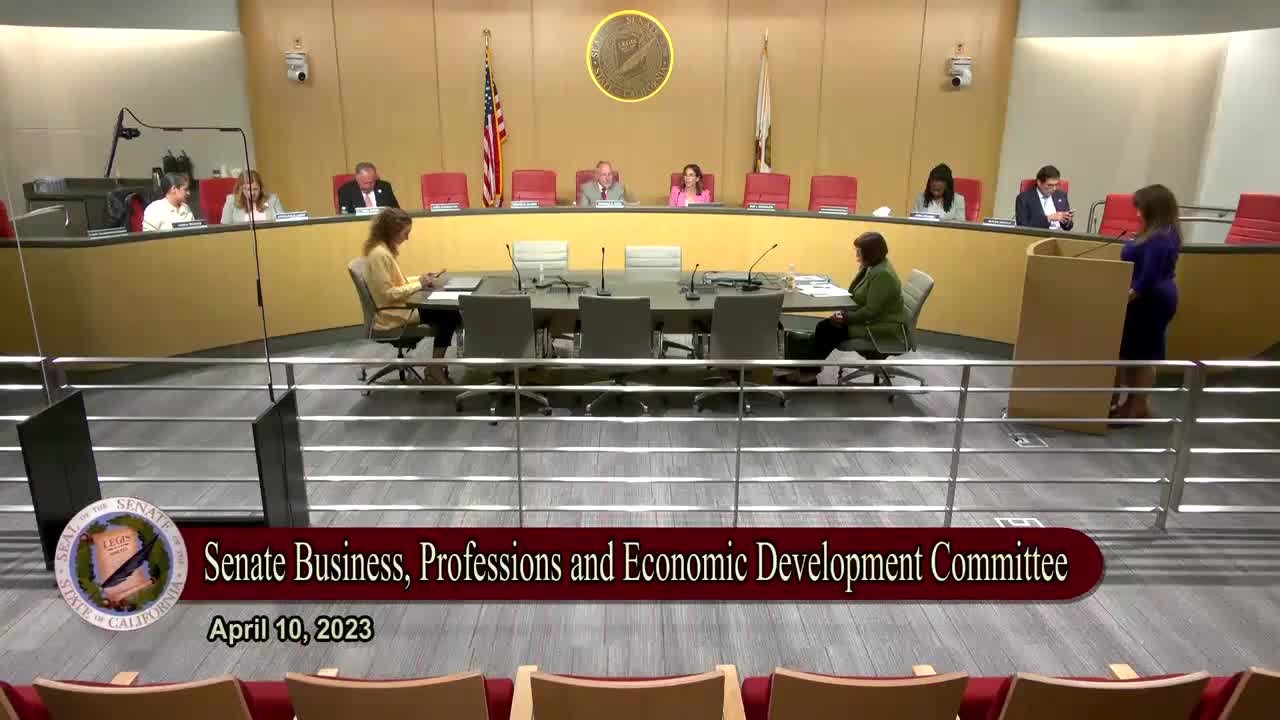 7MIN
Senate Standing Committee on Business, Professions and Economic Development
Bill Author

Bill Co-Author(s):