SB 666: Small business: commercial financing transactions.
- Session Year: 2023-2024
- House: Senate
- Latest Version Date: 2023-10-13
Current Status:
Passed
(2023-10-13: Chaptered by Secretary of State. Chapter 881, Statutes of 2023.)
Introduced
In Committee
First Chamber
In Committee
Second Chamber
Enacted
What does this bill do?
The bill stops lenders and brokers from charging certain extra fees to California small businesses that get commercial financing offers of $500,000 or less. It bans fees for ACH payment processing (except when a payment bounces), fees for a written payoff amount, vague add‑on fees beyond an origination charge (like “risk” or “platform” fees), collateral‑monitoring fees unless the loan is more than 60 days late, and lien filing or termination fees above 150% of cost; harmed businesses can recover actual and statutory damages, injunctions, and attorneys’ fees.
The summary is provided by generative AI which can make mistakes. For original language, please view the details in the table below.
Existing law generally regulates the loaning of money, including the calculation of interest rates. Existing law, the California Financing Law (CFL), prohibits a person from engaging in the business of a finance lender or broker without obtaining a license from the Commissioner of Financial Protection and Innovation. The CFL generally regulates commercial loans made by licensees.
This bill would prohibit a covered entity from charging specified fees in connection with a commercial financing transaction with a small business or small business owner, including, among others, a fee for accepting or processing a payment required by the terms of the commercial financing contract as an automated clearinghouse transfer debit, except as specified, a fee for providing a small business with documentation prepared by the covered entity that contains a statement of the amount due to satisfy the remaining debt, as specified, and a fee in addition to a loan origination fee that does not have a clear corresponding service provided for the fee, as specified. If a covered entity violates these provisions, the bill would entitle a recipient to specified relief, including actual damages, statutory damages, and attorneys fees and costs. The bill would make a waiver of these provisions contrary to public policy and void and unenforceable. The bill would define various terms for these purposes.
Existing law generally regulates the loaning of money, including the calculation of interest rates. Existing law, the California Financing Law (CFL), prohibits a person from engaging in the business of a finance lender or broker without obtaining a license from the Commissioner of Financial Protection and Innovation. The CFL generally regulates commercial loans made by licensees.
This bill would prohibit a covered entity from charging specified fees in connection with a commercial financing transaction with a small business, business or small business owner, including, among others, a fee for accepting or processing a payment required by the terms of the commercial financing contract as an automated clearinghouse transfer debit, except as specified, a fee for providing a small business with documentation prepared by the covered entity that contains a statement of the amount due to satisfy the remaining debt, as specified, and a fee in addition to a loan origination fee that does not have a clear corresponding service provided for the fee, as specified. If a covered entity violates these provisions, the bill would entitle a recipient to specified relief, including actual damages, statutory damages, and attorneys fees and costs. The bill would make a waiver of these provisions contrary to public policy and void and unenforceable. The bill would define various terms for these purposes.
Existing law generally regulates the loaning of money, including the calculation of interest rates. Existing law, the California Financing Law (CFL), prohibits a person from engaging in the business of a finance lender or broker without obtaining a license from the Commissioner of Financial Protection and Innovation. The CFL generally regulates commercial loans made by licensees. A willful violation of the CFL is a crime, except as specified. The law defines various terms for these purposes.
This bill would prohibit a licensee covered entity from charging specified fees in connection with a commercial financing transaction with a small business, including, among others, a fee for accepting or processing a payment required by the terms of the commercial financing contract as an automated clearinghouse transfer debit, a fee for providing a small business with documentation prepared by the licensee covered entity that contains a statement of the amount due to satisfy the remaining debt, as specified, and a fee in addition to a loan origination fee that does not have a clear corresponding service provided for the fee, as specified. If a covered entity violates these provisions, the bill would entitle a recipient to specified relief, including actual damages, statutory damages, and attorneys fees and costs. The bill would make a waiver of these provisions contrary to public policy and void and unenforceable. The bill would define various terms for these purposes. Because a willful violation of these provisions would be a crime, the bill would impose a state-mandated local program.
The California Constitution requires the state to reimburse local agencies and school districts for certain costs mandated by the state. Statutory provisions establish procedures for making that reimbursement.This bill would provide that no reimbursement is required by this act for a specified reason.Existing law, the California Financing Law (CFL), prohibits a person from engaging in the business of a finance lender or broker without obtaining a license from the Commissioner of Financial Protection and Innovation. The CFL generally regulates commercial loans made by licensees. A willful violation of the CFL is a crime, except as specified. The law defines various terms for these purposes.
This bill would prohibit a licensee from charging specified fees in connection with a financing transaction with a small business, including, among others, a fee for accepting or processing a payment required by the terms of the financing contract as an automated clearinghouse transfer debit, a fee for providing a small business with documentation prepared by the licensee that contains a statement of the amount due to satisfy the remaining debt, as specified, and a fee in addition to a loan origination fee that does not have a clear corresponding service provided for the fee, as specified. The bill would define various terms for these purposes. Because a willful violation of these provisions would be a crime, the bill would impose a state-mandated local program.
The California Constitution requires the state to reimburse local agencies and school districts for certain costs mandated by the state. Statutory provisions establish procedures for making that reimbursement.
This bill would provide that no reimbursement is required by this act for a specified reason.
Existing law establishes the California Infrastructure and Economic Development Bank within the Governors Office of Business and Economic Development and requires the bank, among other things, to administer the California Small Business Finance Center that administers programs to assist businesses seeking new capital resources, including, but not limited to, the Small Business Loan Guarantee Program.This bill would state the intent of the Legislature to enact legislation that would expand the access to capital for Californias small businesses.Existing law establishes the California Infrastructure and Economic Development Bank within the Governors Office of Business and Economic Development and requires the bank, among other things, to administer the California Small Business Finance Center that administers programs to assist businesses seeking new capital resources, including, but not limited to, the Small Business Loan Guarantee Program.
This bill would state the intent of the Legislature to enact legislation that would expand the access to capital for Californias small businesses.
For purposes of this title, the following definitions apply:
(a)Automated clearinghouse means any federal reserve bank, or an organization established in agreement with the National Automated Clearing House Association, that operates as a clearinghouse for transmitting or receiving entries between banks or bank accounts and authorizes an electronic transfer of funds between these banks or bank accounts.
(b)(1)Broker means a person who is engaged in the business of performing any of the following acts in connection with commercial financing made by a provider:
(A)Transmitting confidential data about a prospective recipient to a provider with the expectation of compensation in connection with making a referral.
(B)Making a referral to a provider under an agreement with the provider that a prospective recipient referred by the person to the provider meet certain criteria involving confidential data.
(C)Participating in a negotiation of commercial financing between a provider and prospective recipient.
(D)Counseling, advising, or making recommendations to a prospective recipient about a commercial financing transaction based on the prospective recipients confidential data.
(E)(i)Participating in the preparation of any commercial financing documents, including, but not limited to, commercial financing applications, other than providing a prospective recipient blank copies of commercial financing documents.
(ii)Notwithstanding clause (i), transmitting information that is not confidential data to a provider at the request of a prospective recipient shall not, by itself, constitute participation in the preparation of commercial financing documents.
(F)Communicating to a prospective recipient a providers approval decisions related to a commercial financing transaction.
(G)Charging a fee to a prospective recipient for any services related to a prospective recipients application for a commercial financing transaction from a provider.
(2)Notwithstanding paragraph (1), a person is not a broker under this title solely because they take any of the following acts:
(A)Performing support tasks, including, but not limited to, typing, word processing, data entry, filing, billing, answering phone calls, taking and receiving messages, and scheduling, in support of the performance by a broker of any of the activities described in subparagraphs (E) to (G), inclusive, of paragraph (1).
(B)Furnishing a consumer report to a covered entity by a consumer reporting agency in accordance with subsection (a) or (c) of Section 1681b of Title 15 of the United States Code.
(C)Furnishing a consumer credit report, as defined in Section 1785.3, to a covered entity by a consumer credit reporting agency in accordance with subdivision (a) or paragraph (1) of subdivision (b) of Section 1785.11.
(D)Furnishing a prequalifying report, as defined in Section 1785.3, to a covered entity by a consumer credit reporting agency in accordance with paragraph (2) of subdivision (b) of Section 1785.11.
(E)Distributing or disseminating to a prospective recipient of a providers marketing materials or factual information about the provider, its lending activities, or its loan products, including, but not limited to, the providers interest rates, the providers minimum or maximum loan amounts or loan periods, or a general description of the providers underwriting criteria.
(c)Commercial financing has the same meaning as defined in Section 22800 of the Financial Code.
(d)Confidential data means any of the following:
(1)A bank account number.
(2)A bank statement.
(3)A credit or debit card account number.
(4)A credit score, as defined in Section 1785.15.1.
(5)All or a portion of a social security number.
(6)Personal or business income information, including information self-reported by the person.
(7)A taxpayer or employer identification number.
(e)Covered entity means either of the following:
(1)A provider.
(2)A broker.
(f)Depository institution means any of the following:
(1)A bank, trust company, or industrial loan company doing business under the authority of, or in accordance with, a license, certificate, or charter issued by the United States, this state, or any other state, district, territory, or commonwealth of the United States that is authorized to transact business in this state.
(2)A federally chartered savings and loan association, federal savings bank, or federal credit union that is authorized to transact business in this state.
(3)A savings and loan association, savings bank, or credit union organized under the laws of this or any other state that is authorized to transact business in this state.
(g)Provider means a person who extends a specific offer of commercial financing to a recipient, including, but not limited to, a nondepository institution that enters into a written agreement with a depository institution to arrange for the extension of commercial financing by the depository institution to a recipient via an online lending platform administered by the nondepository institution. The fact that a provider extends a specific offer of commercial financing or lending on behalf of a depository institution shall not be construed to mean that the provider engaged in lending or originated that loan or financing.
(h)Recipient means a person who is presented a specific commercial financing offer by a provider that is equal to or less than five hundred thousand dollars ($500,000).
(i)Referral means the introduction of a prospective recipient to a provider or the delivery of a prospective recipients contact information to a provider for the purpose of making an introduction.
(j)Small business means an independently owned and operated business that is not dominant in its field of operation, the principal office of which is located in California, the officers of which are domiciled in California, and that, together with affiliates, has 100 or fewer employees and average annual gross receipts of fifteen million dollars ($15,000,000) or less over the previous three years.
1799.301.This title does not apply to any of the following:
(a)A provider that is a depository institution.
(b)A provider that is a lender regulated under the federal Farm Credit Act of 1971 (12 U.S.C. Sec. 2001 et seq.).
(c)A commercial financing transaction secured by real property.
(d)A person who makes no more than one commercial financing transaction in California in a 12-month period.
(e)A person who makes five or fewer commercial financing transactions in California in a 12-month period that are incidental to the business of that person.
(f)A commercial financing transaction in which the recipient is a dealer, as defined by Section 285 of the Vehicle Code, or an affiliate of the dealer, pursuant to a specific commercial financing offer or commercial open-end credit plan of at least fifty thousand dollars ($50,000), including, but not limited to, a commercial loan made pursuant to that commercial financing transaction.
(g)A commercial financing transaction in which the recipient is a vehicle rental company, or an affiliate of the vehicle rental company, pursuant to a specific commercial financing offer or commercial open-end credit plan of at least fifty thousand dollars ($50,000), including, but not limited to, a commercial loan made pursuant to that commercial financing transaction.
1799.302.A covered entity shall not charge any of the following in connection with a commercial financing transaction with a small business or small business owner:
(a)A fee for accepting or processing a payment required by the terms of the commercial financing contract as an automated clearinghouse transfer debit, except for a fee imposed for a payment by an automated clearinghouse transfer that fails because of insufficient funds in the transferors account.
(b)A fee for providing a small business with documentation prepared by the covered entity that contains a statement of the amount due to satisfy the remaining amount owed, including, but not limited to, interest accrued to the date the statement is prepared and a means of calculating per diem interest accruing thereafter.
(c)A fee in addition to an origination fee that does not have a clear corresponding service provided for the fee, including, but not limited to, a risk assessment, due diligence, or platform fee.
(d)A fee for monitoring the small businesss collateral, unless the underlying commercial financing transaction is delinquent for more than 60 days.
(e)A fee for filing or terminating a lien filed in accordance with the provisions of the Uniform Commercial Code against the businesss assets that exceeds 150 percent of the cost of the filing or termination.
1799.303.(a)If a covered entity violates Section 1799.302, the recipient shall be entitled to all of the following relief:
(1)Actual damages sustained as a result of the violation, including, but not limited to, the amount of fees paid by the recipient that are prohibited by Section 1799.302.
(2)Statutory damages of at least five hundred dollars ($500) but not greater than two thousand five hundred dollars ($2,500).
(3)Injunctive relief.
(4)Attorneys fees and costs.
(5)Any other relief that the court deems proper.
(b)A court may award a covered entity that is the prevailing party in an action brought pursuant to this section reasonable attorneys fees upon a finding that the recipient brought the action in bad faith.
1799.304.A waiver of the provisions of this title is contrary to public policy and is void and unenforceable.
For purposes of this title, the following definitions apply:
(a)Automated clearinghouse means any federal reserve bank, or an organization established in agreement with the National Automated Clearing House Association, that operates as a clearinghouse for transmitting or receiving entries between banks or bank accounts and authorizes an electronic transfer of funds between these banks or bank accounts.
(b)(1)Broker means a person who is engaged in the business of performing any of the following acts in connection with commercial financing made by a provider:
(A)Transmitting confidential data about a prospective recipient to a provider with the expectation of compensation in connection with making a referral.
(B)Making a referral to a provider under an agreement with the provider that a prospective recipient referred by the person to the provider meet certain criteria involving confidential data.
(C)Participating in a negotiation of commercial financing between a provider and prospective recipient.
(D)Counseling, advising, or making recommendations to a prospective recipient about a commercial financing transaction based on the prospective recipients confidential data.
(E)(i)Participating in the preparation of any commercial financing documents, including, but not limited to, commercial financing applications, other than providing a prospective recipient blank copies of commercial financing documents.
(ii)Notwithstanding clause (i), transmitting information that is not confidential data to a provider at the request of a prospective recipient shall not, by itself, constitute participation in the preparation of commercial financing documents.
(F)Communicating to a prospective recipient a providers approval decisions related to a commercial financing transaction.
(G)Charging a fee to a prospective recipient for any services related to a prospective recipients application for a commercial financing transaction from a provider.
(2)Notwithstanding paragraph (1), a person is not a broker under this title solely because they take any of the following acts:
(A)Performing support tasks, including, but not limited to, typing, word processing, data entry, filing, billing, answering phone calls, taking and receiving messages, and scheduling, in support of the performance by a broker of any of the activities described in subparagraphs (E) to (G), inclusive, of paragraph (1).
(B)Furnishing a consumer report to a covered entity by a consumer reporting agency in accordance with subsection (a) or (c) of Section 1681b of Title 15 of the United States Code.
(C)Furnishing a consumer credit report, as defined in Section 1785.3, to a covered entity by a consumer credit reporting agency in accordance with subdivision (a) or paragraph (1) of subdivision (b) of Section 1785.11.
(D)Furnishing a prequalifying report, as defined in Section 1785.3, to a covered entity by a consumer credit reporting agency in accordance with paragraph (2) of subdivision (b) of Section 1785.11.
(E)Distributing or disseminating to a prospective recipient of a providers marketing materials or factual information about the provider, its lending activities, or its loan products, including, but not limited to, the providers interest rates, the providers minimum or maximum loan amounts or loan periods, or a general description of the providers underwriting criteria.
(c)Commercial financing has the same meaning as defined in Section 22800 of the Financial Code.
(d)Confidential data means any of the following:
(1)A bank account number.
(2)A bank statement.
(3)A credit or debit card account number.
(4)A credit score, as defined in Section 1785.15.1.
(5)All or a portion of a social security number.
(6)Personal or business income information, including information self-reported by the person.
(7)A taxpayer or employer identification number.
(e)Covered entity means either of the following:
(1)A provider.
(2)A broker.
(f)Depository institution means any of the following:
(1)A bank, trust company, or industrial loan company doing business under the authority of, or in accordance with, a license, certificate, or charter issued by the United States, this state, or any other state, district, territory, or commonwealth of the United States that is authorized to transact business in this state.
(2)A federally chartered savings and loan association, federal savings bank, or federal credit union that is authorized to transact business in this state.
(3)A savings and loan association, savings bank, or credit union organized under the laws of this or any other state that is authorized to transact business in this state.
(f)(g)Provider means a person who extends a specific offer of commercial financing to a recipient, including, but not limited to, a nondepository institution that enters into a written agreement with a depository institution to arrange for the extension of commercial financing by the depository institution to a recipient via an online lending platform administered by the nondepository institution. The fact that a provider extends a specific offer of commercial financing or lending on behalf of a depository institution shall not be construed to mean that the provider engaged in lending or originated that loan or financing.
(g)(h)Recipient means a person who is presented a specific commercial financing offer by a provider that is equal to or less than five hundred thousand dollars ($500,000).
(h)(i)Referral means the introduction of a prospective recipient to a provider or the delivery of a prospective recipients contact information to a provider for the purpose of making an introduction.
(i)(j)Small business means an independently owned and operated business that is not dominant in its field of operation, the principal office of which is located in California, the officers of which are domiciled in California, and that, together with affiliates, has 100 or fewer employees and average annual gross receipts of fifteen million dollars ($15,000,000) or less over the previous three years.
1799.301.This title does not apply to any of the following:
(a)A provider that is a depository institution.
(b)A provider that is a lender regulated under the federal Farm Credit Act of 1971 (12 U.S.C. Sec. 2001 et seq.).
(c)A commercial financing transaction secured by real property.
(d)A person who makes no more than one commercial financing transaction in California in a 12-month period.
(e)A person who makes five or fewer commercial financing transactions in California in a 12-month period that are incidental to the business of that person.
(f)A commercial financing transaction in which the recipient is a dealer, as defined by Section 285 of the Vehicle Code, or an affiliate of the dealer, pursuant to a specific commercial financing offer or commercial open-end credit plan of at least fifty thousand dollars ($50,000), including, but not limited to, a commercial loan made pursuant to that commercial financing transaction.
(g)A commercial financing transaction in which the recipient is a vehicle rental company, or an affiliate of the vehicle rental company, pursuant to a specific commercial financing offer or commercial open-end credit plan of at least fifty thousand dollars ($50,000), including, but not limited to, a commercial loan made pursuant to that commercial financing transaction.
1799.302.A covered entity shall not charge any of the following in connection with a commercial financing transaction with a small business or small business owner:
(a)A fee for accepting or processing a payment required by the terms of the commercial financing contract as an automated clearinghouse transfer debit, except for a fee imposed for a payment by an automated clearinghouse transfer that fails because of insufficient funds in the transferors account.
(b)A fee for providing a small business with documentation prepared by the covered entity that contains a statement of the amount due to satisfy the remaining amount owed, including, but not limited to, interest accrued to the date the statement is prepared and a means of calculating per diem interest accruing thereafter.
(c)A fee in addition to an origination fee that does not have a clear corresponding service provided for the fee, including, but not limited to, a risk assessment, due diligence, or platform fee.
(d)A fee for monitoring the small businesss collateral, unless the underlying commercial financing transaction is delinquent for more than 60 days.
(e)A fee for filing or terminating a lien filed in accordance with the provisions of the Uniform Commercial Code against the businesss assets that exceeds 150 percent of the cost of the filing or termination.
1799.303.(a)If a covered entity violates Section 1799.302, the recipient shall be entitled to all of the following relief:
(1)Actual damages sustained as a result of the violation, including, but not limited to, the amount of fees paid by the recipient that are prohibited by Section 1799.302.
(2)Statutory damages of at least five hundred dollars ($500) but not greater than two thousand five hundred dollars ($2,500).
(3)Injunctive relief.
(4)Attorneys fees and costs.
(5)Any other relief that the court deems proper.
(b)A court may award a covered entity that is the prevailing party in an action brought pursuant to this section reasonable attorneys fees upon a finding that the recipient brought the action in bad faith.
1799.304.A waiver of the provisions of this title is contrary to public policy and is void and unenforceable.
For purposes of this title, the following definitions apply:
(a)Automated clearinghouse means any federal reserve bank, or an organization established in agreement with the National Automated Clearing House Association, that operates as a clearinghouse for transmitting or receiving entries between banks or bank accounts and authorizes an electronic transfer of funds between these banks or bank accounts.
(b)(1)Broker means a person who is engaged in the business of performing any of the following acts in connection with commercial financing made by a provider:
(A)Transmitting confidential data about a prospective recipient to a provider with the expectation of compensation in connection with making a referral.
(B)Making a referral to a provider under an agreement with the provider that a prospective recipient referred by the person to the provider meet certain criteria involving confidential data.
(C)Participating in a negotiation of commercial financing between a provider and prospective recipient.
(D)Counseling, advising, or making recommendations to a prospective recipient about a commercial financing transaction based on the prospective recipients confidential data.
(E)(i)Participating in the preparation of any commercial financing documents, including, but not limited to, commercial financing applications, other than providing a prospective recipient blank copies of commercial financing documents.
(ii)Notwithstanding clause (i), transmitting information that is not confidential data to a provider at the request of a prospective recipient shall not, by itself, constitute participation in the preparation of commercial financing documents.
(F)Communicating to a prospective recipient a providers approval decisions related to a commercial financing transaction.
(G)Charging a fee to a prospective recipient for any services related to a prospective recipients application for a commercial financing transaction from a provider.
(2)Notwithstanding paragraph (1), a person is not a broker under this title solely because they take any of the following acts:
(A)Performing support tasks, including, but not limited to, typing, word processing, data entry, filing, billing, answering phone calls, taking and receiving messages, and scheduling, in support of the performance by a broker of any of the activities described in subparagraphs (E) to (G), inclusive, of paragraph (1).
(B)Furnishing a consumer report to a covered entity by a consumer reporting agency in accordance with subsection (a) or (c) of Section 1681b of Title 15 of the United States Code.
(C)Furnishing a consumer credit report, as defined in Section 1785.3, to a covered entity by a consumer credit reporting agency in accordance with subdivision (a) or paragraph (1) of subdivision (b) of Section 1785.11.
(D)Furnishing a prequalifying report, as defined in Section 1785.3, to a covered entity by a consumer credit reporting agency in accordance with paragraph (2) of subdivision (b) of Section 1785.11.
(E)Distributing or disseminating to a prospective recipient of a providers marketing materials or factual information about the provider, its lending activities, or its loan products, including, but not limited to, the providers interest rates, the providers minimum or maximum loan amounts or loan periods, or a general description of the providers underwriting criteria.
(c)Commercial financing has the same meaning as defined in Section 22800 of the Financial Code.
(d)Confidential data means any of the following:
(1)A bank account number.
(2)A bank statement.
(3)A credit or debit card account number.
(4)A credit score, as defined in Section 1785.15.1.
(5)All or a portion of a social security number.
(6)Personal or business income information, including information self-reported by the person.
(7)A taxpayer or employer identification number.
(e)Covered entity means either of the following:
(1)A provider.
(2)A broker.
(f)Provider means a person who extends a specific offer of commercial financing to a recipient, including, but not limited to, a nondepository institution that enters into a written agreement with a depository institution to arrange for the extension of commercial financing by the depository institution to a recipient via an online lending platform administered by the nondepository institution. The fact that a provider extends a specific offer of commercial financing or lending on behalf of a depository institution shall not be construed to mean that the provider engaged in lending or originated that loan or financing.
(g)Recipient means a person who is presented a specific commercial financing offer by a provider that is equal to or less than five hundred thousand dollars ($500,000).
(h)Referral means the introduction of a prospective recipient to a provider or the delivery of a prospective recipients contact information to a provider for the purpose of making an introduction.
(i)Small business means an independently owned and operated business that is not dominant in its field of operation, the principal office of which is located in California, the officers of which are domiciled in California, and that, together with affiliates, has 100 or fewer employees and average annual gross receipts of fifteen million dollars ($15,000,000) or less over the previous three years.
1799.301.This title does not apply to any of the following:
(a)A provider that is a depository institution.
(b)A provider that is a lender regulated under the federal Farm Credit Act of 1971 (12 U.S.C. Sec. 2001 et seq.).
(c)A commercial financing transaction secured by real property.
(d)A person who makes no more than one commercial financing transaction in California in a 12-month period.
(e)A person who makes five or fewer commercial financing transactions in California in a 12-month period that are incidental to the business of that person.
(f)A commercial financing transaction in which the recipient is a dealer, as defined by Section 285 of the Vehicle Code, or an affiliate of the dealer, pursuant to a specific commercial financing offer or commercial open-end credit plan of at least fifty thousand dollars ($50,000), including, but not limited to, a commercial loan made pursuant to that commercial financing transaction.
(g)A commercial financing transaction in which the recipient is a vehicle rental company, or an affiliate of the vehicle rental company, pursuant to a specific commercial financing offer or commercial open-end credit plan of at least fifty thousand dollars ($50,000), including, but not limited to, a commercial loan made pursuant to that commercial financing transaction.
1799.302.A covered entity shall not charge any of the following in connection with a commercial financing transaction with a small business: business or small business owner:
(a)A fee for accepting or processing a payment required by the terms of the commercial financing contract as an automated clearinghouse transfer debit. debit, except for a fee imposed for a payment by an automated clearinghouse transfer that fails because of insufficient funds in the transferors account.
(b)A fee for providing a small business with documentation prepared by the covered entity that contains a statement of the amount due to satisfy the remaining amount owed, including, but not limited to, interest accrued to the date the statement is prepared and a means of calculating per diem interest accruing thereafter.
(c)A fee in addition to an origination fee that does not have a clear corresponding service provided for the fee, including, but not limited to, a risk assessment, due diligence, or platform fee.
(d)A fee for monitoring the small businesss collateral, unless the underlying commercial financing transaction is delinquent for more than 90 60 days.
(e)A fee for filing or terminating a lien filed in accordance with the provisions of the Uniform Commercial Code against the businesss assets that exceeds 150 percent of the cost of the filing or termination.
1799.303.(a)If a covered entity violates Section 1799.302, the recipient shall be entitled to all of the following relief:
(1)Actual damages sustained as a result of the violation, including, but not limited to, the amount of fees paid by the recipient that are prohibited by Section 1799.302.
(2)Statutory damages of at least five hundred dollars ($500) but not greater than two thousand five hundred dollars ($2,500).
(3)Injunctive relief.
(4)Attorneys fees and costs.
(5)Any other relief that the court deems proper.
(b)A court may award a covered entity that is the prevailing party in an action brought pursuant to this section reasonable attorneys fees upon a finding that the recipient brought the action in bad faith.
1799.304.A waiver of the provisions of this title is contrary to public policy and is void and unenforceable.
For purposes of this title, the following definitions apply:
(a)Automated clearinghouse means any federal reserve bank, or an organization established in agreement with the National Automated Clearing House Association, that operates as a clearinghouse for transmitting or receiving entries between banks or bank accounts and authorizes an electronic transfer of funds between these banks or bank accounts.
(b)(1)Broker means a person who is engaged in the business of performing any of the following acts in connection with commercial financing made by a provider:
(A)Transmitting confidential data about a prospective recipient to a provider with the expectation of compensation in connection with making a referral.
(B)Making a referral to a provider under an agreement with the provider that a prospective recipient referred by the person to the provider meet certain criteria involving confidential data.
(C)Participating in a negotiation of commercial financing between a provider and prospective recipient.
(D)Counseling, advising, or making recommendations to a prospective recipient about a commercial financing transaction based on the prospective recipients confidential data.
(E)(i)Participating in the preparation of any commercial financing documents, including, but not limited to, commercial financing applications, other than providing a prospective recipient blank copies of commercial financing documents.
(ii)Notwithstanding clause (i), transmitting information that is not confidential data to a provider at the request of a prospective recipient shall not, by itself, constitute participation in the preparation of commercial financing documents.
(F)Communicating to a prospective recipient a providers approval decisions related to a commercial financing transaction.
(G)Charging a fee to a prospective recipient for any services related to a prospective recipients application for a commercial financing transaction from a provider.
(2)Notwithstanding paragraph (1), a person is not a broker under this title solely because they take any of the following acts:
(A)Performing support tasks, including, but not limited to, typing, word processing, data entry, filing, billing, answering phone calls, taking and receiving messages, and scheduling, in support of the performance by a broker of any of the activities described in subparagraphs (E) to (G), inclusive, of paragraph (1).
(B)Furnishing a consumer report to a covered entity by a consumer reporting agency in accordance with subsection (a) or (c) of Section 1681b of Title 15 of the United States Code.
(C)Furnishing a consumer credit report, as defined in Section 1785.3, to a covered entity by a consumer credit reporting agency in accordance with subdivision (a) or paragraph (1) of subdivision (b) of Section 1785.11.
(D)Furnishing a prequalifying report, as defined in Section 1785.3, to a covered entity by a consumer credit reporting agency in accordance with paragraph (2) of subdivision (b) of Section 1785.11.
(E)Distributing or disseminating to a prospective recipient of a providers marketing materials or factual information about the provider, its lending activities, or its loan products, including, but not limited to, the providers interest rates, the providers minimum or maximum loan amounts or loan periods, or a general description of the providers underwriting criteria.
(c)Commercial financing has the same meaning as defined in Section 22800 of the Financial Code.
(d)Confidential data means any of the following:
(1)A bank account number.
(2)A bank statement.
(3)A credit or debit card account number.
(4)A credit score, as defined in Section 1785.15.1.
(5)All or a portion of a social security number.
(6)Personal or business income information, including information self-reported by the person.
(7)A taxpayer or employer identification number.
(e)Covered entity means either of the following:
(1)A provider.
(2)A broker.
(f)Provider means a person who extends a specific offer of commercial financing to a recipient, including, but not limited to, a nondepository institution that enters into a written agreement with a depository institution to arrange for the extension of commercial financing by the depository institution to a recipient via an online lending platform administered by the nondepository institution. The fact that a provider extends a specific offer of commercial financing or lending on behalf of a depository institution shall not be construed to mean that the provider engaged in lending or originated that loan or financing.
(g)Recipient means a person who is presented a specific commercial financing offer by a provider that is equal to or less than five hundred thousand dollars ($500,000).
(h)Referral means the introduction of a prospective recipient to a provider or the delivery of a prospective recipients contact information to a provider for the purpose of making an introduction.
(i)Small business means an independently owned and operated business that is not dominant in its field of operation, the principal office of which is located in California, the officers of which are domiciled in California, and that, together with affiliates, has 100 or fewer employees and average annual gross receipts of fifteen million dollars ($15,000,000) or less over the previous three years.
1799.301.This title does not apply to any of the following:
(a)A provider that is a depository institution.
(b)A provider that is a lender regulated under the federal Farm Credit Act of 1971 (12 U.S.C. Sec. 2001 et seq.).
(c)A commercial financing transaction secured by real property.
(d)A person who makes no more than one commercial financing transaction in California in a 12-month period.
(e)A person who makes five or fewer commercial financing transactions in California in a 12-month period that are incidental to the business of that person.
1799.302.A covered entity shall not charge any of the following in connection with a commercial financing transaction with a small business:
(a)A fee for accepting or processing a payment required by the terms of the commercial financing contract as an automated clearinghouse transfer debit.
(b)A fee for providing a small business with documentation prepared by the covered entity that contains a statement of the amount due to satisfy the remaining amount owed, including, but not limited to, interest accrued to the date the statement is prepared and a means of calculating per diem interest accruing thereafter.
(c)A fee in addition to an origination fee that does not have a clear corresponding service provided for the fee, including, but not limited to, a risk assessment, due diligence, or platform fee.
(d)A fee for monitoring the small businesss collateral, unless the underlying commercial financing transaction is delinquent for more than 90 days.
(e)A fee for filing or terminating a lien filed in accordance with the provisions of the Uniform Commercial Code against the businesss assets that exceeds 150 percent of the cost of the filing or termination.
1799.303.(a)If a covered entity violates Section 1799.302, the recipient shall be entitled to all of the following relief:
(1)Actual damages sustained as a result of the violation, including, but not limited to, the amount of fees paid by the recipient that are prohibited by Section 1799.302.
(2)Statutory damages of at least five hundred dollars ($500) but not greater than two thousand five hundred dollars ($2,500).
(3)Injunctive relief.
(4)Attorneys fees and costs.
(5)Any other relief that the court deems proper.
(b)A court may award a covered entity that is the prevailing party in an action brought pursuant to this section reasonable attorneys fees upon a finding that the recipient brought the action in bad faith.
1799.304.A waiver of the provisions of this title is contrary to public policy and is void and unenforceable.
SECTION 1.Section 22601.1 is added to the Financial Code, to read:22601.1.(a)For purposes of this section, the following definitions apply:(1)Automated clearinghouse means any federal reserve bank, or an organization established in agreement with the National Automated Clearing House Association, that operates as a clearinghouse for transmitting or receiving entries between banks or bank accounts and authorizes an electronic transfer of funds between these banks or bank accounts.(2)Small business means an independently owned and operated business that is not dominant in its field of operation, the principal office of which is located in California, the officers of which are domiciled in California, and that, together with affiliates, has 100 or fewer employees and average annual gross receipts of fifteen million dollars ($15,000,000) or less over the previous three years.(b)A licensee shall not charge any of the following in connection with a financing transaction with a small business:(1)A fee for accepting or processing a payment required by the terms of the financing contract as an automated clearinghouse transfer debit.(2)A fee for providing a small business with documentation prepared by the licensee that contains a statement of the amount due to satisfy the remaining debt, including, but not limited to, interest accrued to the date the statement is prepared and a means of calculating per diem interest accruing thereafter.(3)A fee in addition to a loan origination fee that does not have a clear corresponding service provided for the fee, including, but not limited to, a risk assessment, due diligence, or platform fee.(4)A fee for monitoring the small businesss collateral, unless the underlying loan is delinquent for more than 90 days.(5)A fee for filing or terminating a lien filed in accordance with the provisions of the Uniform Commercial Code against the businesss assets that exceeds 150 percent of the cost of the filing or termination.SEC. 2.No reimbursement is required by this act pursuant to Section 6 of Article XIIIB of the California Constitution because the only costs that may be incurred by a local agency or school district will be incurred because this act creates a new crime or infraction, eliminates a crime or infraction, or changes the penalty for a crime or infraction, within the meaning of Section 17556 of the Government Code, or changes the definition of a crime within the meaning of Section 6 of Article XIIIB of the California Constitution.(a)For purposes of this section, the following definitions apply:
(1)Automated clearinghouse means any federal reserve bank, or an organization established in agreement with the National Automated Clearing House Association, that operates as a clearinghouse for transmitting or receiving entries between banks or bank accounts and authorizes an electronic transfer of funds between these banks or bank accounts.
(2)Small business means an independently owned and operated business that is not dominant in its field of operation, the principal office of which is located in California, the officers of which are domiciled in California, and that, together with affiliates, has 100 or fewer employees and average annual gross receipts of fifteen million dollars ($15,000,000) or less over the previous three years.
(b)A licensee shall not charge any of the following in connection with a financing transaction with a small business:
(1)A fee for accepting or processing a payment required by the terms of the financing contract as an automated clearinghouse transfer debit.
(2)A fee for providing a small business with documentation prepared by the licensee that contains a statement of the amount due to satisfy the remaining debt, including, but not limited to, interest accrued to the date the statement is prepared and a means of calculating per diem interest accruing thereafter.
(3)A fee in addition to a loan origination fee that does not have a clear corresponding service provided for the fee, including, but not limited to, a risk assessment, due diligence, or platform fee.
(4)A fee for monitoring the small businesss collateral, unless the underlying loan is delinquent for more than 90 days.
(5)A fee for filing or terminating a lien filed in accordance with the provisions of the Uniform Commercial Code against the businesss assets that exceeds 150 percent of the cost of the filing or termination.
SEC. 2.No reimbursement is required by this act pursuant to Section 6 of Article XIIIB of the California Constitution because the only costs that may be incurred by a local agency or school district will be incurred because this act creates a new crime or infraction, eliminates a crime or infraction, or changes the penalty for a crime or infraction, within the meaning of Section 17556 of the Government Code, or changes the definition of a crime within the meaning of Section 6 of Article XIIIB of the California Constitution.
SECTION 1.It is the intent of the Legislature to enact legislation that would expand the access to capital for Californias small businesses.It is the intent of the Legislature to enact legislation that would expand the access to capital for Californias small businesses.
|
Date
|
Status
|
|---|---|
| Oct 13, 2023 | Chaptered by Secretary of State. Chapter 881, Statutes of 2023. |
| Oct 13, 2023 | Approved by the Governor. |
| Sep 20, 2023 | Enrolled and presented to the Governor at 4:30 p.m. |
| Sep 12, 2023 | Assembly amendments concurred in. (Ayes 39. Noes 0. Page 2681.) Ordered to engrossing and enrolling. |
| Sep 11, 2023 | In Senate. Concurrence in Assembly amendments pending. |
| Sep 11, 2023 | Read third time. Passed. (Ayes 80. Noes 0. Page 3204.) Ordered to the Senate. |
| Sep 5, 2023 | Read second time. Ordered to third reading. |
| Sep 1, 2023 | From committee: Do pass. (Ayes 16. Noes 0.) (September 1). |
| Aug 16, 2023 | August 16 set for first hearing. Placed on suspense file. |
| Jun 27, 2023 | From committee: Do pass and re-refer to Com. on APPR. (Ayes 11. Noes 0.) (June 27). Re-referred to Com. on APPR. |
| Jun 14, 2023 | Read second time and amended. Re-referred to Com. on JUD. |
| Jun 13, 2023 | From committee: Do pass as amended and re-refer to Com. on JUD. (Ayes 12. Noes 0.) (June 12). |
| Jun 5, 2023 | From committee with author's amendments. Read second time and amended. Re-referred to Com. on B. & F. |
| May 18, 2023 | Referred to Coms. on B. & F. and JUD. |
| May 11, 2023 | In Assembly. Read first time. Held at Desk. |
| May 11, 2023 | Read third time. Passed. (Ayes 39. Noes 0. Page 1053.) Ordered to the Assembly. |
| May 4, 2023 | Read second time. Ordered to consent calendar. |
| May 3, 2023 | From committee: Do pass. Ordered to consent calendar. (Ayes 10. Noes 0. Page 1012.) (May 2). |
| Apr 21, 2023 | Set for hearing May 2. |
| Apr 20, 2023 | Re-referred to Com. on JUD. |
| Apr 19, 2023 | From committee: Do pass and re-refer to Com. on RLS with recommendation: To consent calendar. (Ayes 7. Noes 0. Page 831.) (April 19). Re-referred to Com. on RLS. |
| Apr 10, 2023 | From committee with author's amendments. Read second time and amended. Re-referred to Com. on B. & F.I. |
| Apr 3, 2023 | Set for hearing April 19. |
| Mar 29, 2023 | Re-referred to Com. on B. & F.I. |
| Mar 21, 2023 | From committee with author's amendments. Read second time and amended. Re-referred to Com. on RLS. |
| Mar 1, 2023 | Referred to Com. on RLS. |
| Feb 17, 2023 | From printer. May be acted upon on or after March 19. |
| Feb 16, 2023 | Introduced. Read first time. To Com. on RLS. for assignment. To print. |
|
Date
|
Description
|
Location
|
Votes
|
|
|---|---|---|---|---|
| Sep 12, 2023 | Unfinished Business SB666 Min Concurrence | Senate Floor |
Passed |
|
| Sep 11, 2023 | SB 666 Min Senate Third Reading By Grayson | Assembly Floor |
Passed |
|
| Sep 1, 2023 | Do pass. | Assembly Standing Committee on Appropriations |
Passed |
|
| Jun 27, 2023 | Do pass and be re-referred to the Committee on [Appropriations] | Assembly Standing Committee on Judiciary |
Passed |
|
| Jun 12, 2023 | Do pass as amended and be re-referred to the Committee on [Judiciary] | Assembly Standing Committee on Banking and Finance |
Passed |
|
| May 11, 2023 | Consent Calendar SB666 Min | Senate Floor |
Passed |
|
| May 2, 2023 | Do pass and be ordered to the Consent Calendar | Senate Standing Committee on Judiciary |
Passed |
|
| Apr 19, 2023 | Do pass, but first be re-referred to the Committee on [Rules] with the recommendation: To Consent Calendar | Senate Standing Committee on Banking and Financial Institutions |
Passed |
This list shows positions taken on this bill by organizations on the date displayed, which is linked to the original source.
Positions by individuals are not included.
|
Organization
|
Position
|
Date
|
|---|---|---|
| California Asian Pacific Chamber Of Commerce | * Support | Jun 27, 2023 |
| California Association Of Micro Enterprise Opportunity | ** Support | |
| Cameo - California Association for Micro Enterprise Opportunity | ** Support | |
| Consumer Attorneys Of California | ** Support | |
| Consumer Federation Of California | ** Support | |
| Greenlining Institute | ** Support | |
| Housing and Economic Rights Advocates | ** Support | |
| Kapitus | ** Support | |
| Public Counsel | ** Support | |
| Rapid Finance | ** Support | |
| Revenue Based Finance Coalition | * Support | Jun 12, 2023 |
| Small Business Majority | ** Support | |
| The Greenlining Institute | ** Support |
SENATE RULES COMMITTEE Office of Senate Floor Analyses (916) 651-1520 Fax: (916) 327-4478 | SB 666 |
UNFINISHED BUSINESS
Bill No: SB 666
Author: Min (D)
Amended: 6/14/23
Vote: 21
SENATE BANKING & F.I. COMMITTEE: 7-0, 4/19/23
AYES: Limón, Niello, Bradford, Caballero, Min, Nguyen, Portantino
SENATE JUDICIARY COMMITTEE: 10-0, 5/2/23
AYES: Umberg, Wilk, Allen, Ashby, Caballero, Durazo, Laird, Min, Niello, Wiener
NO VOTE RECORDED: Stern
SENATE FLOOR: 39-0, 5/11/23 (Consent)
AYES: Allen, Alvarado-Gil, Archuleta, Ashby, Atkins, Becker, Blakespear, Bradford, Caballero, Cortese, Dahle, Dodd, Durazo, Eggman, Glazer, Gonzalez, Hurtado, Jones, Laird, Limón, McGuire, Menjivar, Min, Newman, Nguyen, Niello, Ochoa Bogh, Padilla, Portantino, Roth, Rubio, Seyarto, Skinner, Smallwood-Cuevas, Stern, Umberg, Wahab, Wiener, Wilk
NO VOTE RECORDED: Grove
ASSEMBLY FLOOR: 80-0, 9/11/23 - See last page for vote
SUBJECT: Small business: commercial financing transactions
SOURCE: California Association of Micro Enterprise Opportunity
Consumer Federation of California
DIGEST:
This bill restricts specified fees charged to small businesses by commercial financing providers and brokers in connection with commercial financing transactions.
Assembly Amendments
provide specified exemptions and makes technical and clarifying changes.
ANALYSIS:
Existing law:
- Provides the California Financing Law that requires, among other things, licensure of persons engaged in the business of making commercial loans and persons engaged in the brokering of commercial loans. (Financial Code Section 22000 et seq.)
- Requires the disclosure of specified information related to commercial financing transactions. (Financial Code Section 22800 et seq.)
This bill:
- Prohibits the following fees from being charged to a small business in connection with a commercial financing transaction:
- A fee for accepting or processing a payment required by the terms of the financing contract as an automated clearinghouse transfer debit.
- A fee for providing a small business with documentation prepared by the financing provider that contains a statement of the amount due to satisfy the remaining amount owed, including, but not limited to, interest accrued to the date the statement is prepared and a means of calculating per diem interest accruing thereafter.
- A fee in addition to an origination fee that does not have a clear corresponding service provided for the fee, including, but not limited to, a risk assessment, due diligence, or platform fee.
- A fee for monitoring the small business’s collateral, unless the underlying financing transaction is delinquent for more than 60 days.
- A fee for filing or terminating a lien filed in accordance with the provisions of the Uniform Commercial Code against the business’s assets that exceeds 150 percent of the cost of the filing or termination.
- Defines “small business” as an independently owned and operated business that is not dominant in its field of operation, the principal office of which is located in California, the officers of which are domiciled in California, and that, together with affiliates, has 100 or fewer employees and average annual gross receipts of $15 million or less over the previous three years.
- Defines “commercial financing” to have the same meaning as Section 22800 of the Financial Code, related to commercial financing disclosures, which provides that “commercial financing” means an accounts receivable purchase transaction, including factoring, asset-based lending transaction, commercial loan, commercial open-end credit plan, or lease financing transaction intended by the recipient for use primarily for other than personal, family, or household purposes.
- Defines “recipient” as a person who is presented a specific commercial financing offer by a provider that is equal to or less than $500,000.
- Exempts the following from the provisions of this bill:
- A provider that is a depository institution.
- A provider that is a lender regulated under the federal Farm Credit Act.
- A commercial financing transaction secured by real property.
- Any person who makes no more than one commercial financing transaction in California in a 12-month period or any person who makes five or fewer commercial financing transactions in California in a 12-month period that are incidental to the business of the person relying upon the exemption.
- A commercial financing transaction in which the recipient is an automobile dealer, as specified, or a vehicle rental company, pursuant to a specific commercial financing offer or commercial open-end credit plan of at least fifty thousand dollars ($50,000).
- Entitles a recipient to the following relief if a provider or broker violates the fee restrictions described in 1) above:
- Actual damages sustained as a result of the violation, including, but not limited to, the amount of fees paid by the recipient that are prohibited.
- Statutory damages of at least $500 but not greater than $2,500.
- Injunctive relief.
- Attorney’s fees and costs.
- Any other relief that the court deems proper.
- Provides that a court may award a provider or broker that is the prevailing party in an action brought pursuant to this section reasonable attorney’s fees upon a finding that the recipient brought the action in bad faith.
Background
Small businesses face a diverse and sometimes confusing array of financing options. Businesses with steady track records and healthy financial situations may be able to access transparent and low-cost options from banks, such as installment loans or lines of credit, which are structured similarly to familiar consumer products, like a mortgage or credit card. Newer businesses or those with varying cash flows or high debt burdens may not be able to qualify for bank loans and instead may seek out financing from alternative providers. These alternative financing products include sales-based financing, like merchant advances, lease financing, and factoring – all of which are structured in ways that do not make them “loans” from a legal perspective, though each product serves the same basic function of providing a small business with funds that are paid back over time to the financing provider.
The structure and pricing of a given small business financing product can be difficult to understand on its own and in comparison with other financing products. Loans typically contain an upfront fee and then an interest rate charged on the outstanding balance of the loan. Sales-based financing products, on the other hand, contain an explicit or implicit fee that is paid back along with the amount financed on a continuous basis, as the small business remits a percentage of its periodic revenue to the financing provider. California law requires providers of small business financing products to disclose specified metrics, such as the total dollar cost of financing and the cost of financing expressed as an annualized rate, which gives small businesses tools to compare different financing offers.
The required financing disclosure does not capture all of the fees that a provider may charge. The rule specifying the fees that must be included in the calculation of “finance charges” adopts the same treatment as federal law under the Truth in Lending Act and its implementing rule, Regulation Z. Under federal law, finance charges do not include fees that are not “an incident to or condition of the extension of credit.”[1] Examples of fees that are not considered “finance charges” include late fees and certain charges related to perfecting, releasing, or satisfying a security interest. Some of the fees targeted by this bill may not be considered “finance charges” and may not be included in the commercial financing disclosure required under existing law, making these fees less visible to small businesses.
Biden Administration Initiative on “Junk Fees”
The Biden Administration has taken a particular interest in “junk fees” as part of its broader strategy in promoting competition in the American economy. The Biden Administration uses the phrase “junk fees” to describe hidden or unexpected fees that it believes can “stifle competition by encouraging companies to use increasingly sophisticated tools to disguise the true price consumers face.”[2] Throughout federal government, the administration has pushed initiatives to curb junk fees. The Consumer Financial Protection Bureau (CFPB) has targeted overdraft and bounced check fees, leading to voluntary curtailment by many of the largest banks and the issuance of guidance from the CFPB that is expected to reduce surprise fees by over $1 billion annually.[3] The Department of Transportation proposed a rule to require airlines and online booking services to show the full price of a plane ticket up front, including baggage and other fees. And, the Federal Communications Commission released new rules that will go into effect next year to require broadband providers to use “nutrition labels”—similar to those used for food products—to convey key pricing information to consumers about internet service options in an accessible format.
Economic theory posits that price transparency produces better outcomes as consumers are able to make informed decisions that not only improve their well-being, but that also serve as a mechanism to maintain discipline in the market. Economic outcomes are better when suppliers of goods and services compete on the quality and price of what they produce, rather than competing to find the best ways to induce or manipulate their customers to buy their products, irrespective of the underlying value of the product. Empirical research in a variety of markets supports this theory. Most research suggests that when better price information is available, prices for goods sold to consumers fall.[4]
Solutions and Likely Reactions
This bill restricts certain fees related to commercial financing products. It seeks to ban fees related to ACH transactions, pay-off statements, and various up-front fees in addition to an origination fee. This bill limits collateral monitoring fees to those scenarios where the small business owner is more than 90 days delinquent. This bill also limits certain fees related to business filings to no more than 150% of the cost of the filing.
In some cases, providers would likely respond to this bill by increasing their origination fee, their interest rates, or other allowable finance charges to offset revenue lost by the proposed fee restrictions. Existing law provides no caps on rates and finance charges assessed on commercial financing products, nor does this bill propose any. While fees may shift form, rather than go away completely, this could be a desirable outcome. Small businesses may be better able to compare financing offers based on more all-inclusive pricing, rather than sifting through fine print for potential ancillary fees. Additionally, some of the fees restricted by this bill are likely not considered “finance charges” for the purposes of complying with existing law related to commercial financial disclosures. To the extent that more fees are brought out of the shadows and included in the cost of financing expressed as an annualized rate, small businesses may make better decisions that push providers to price their products more competitively.
Comments
According to the author:
California’s small businesses were hit hard by the impacts COVID-19 had on our economy. With 40,000 small businesses in the state forced to close, many others were required to seek loans to keep their businesses afloat. Some of these commercial lenders or finance companies charge hidden or exorbitant fees to small businesses, making the lending process even more burdensome for small businesses.
This bill would allow the financing process to be more equitable and transparent for small businesses here in California. SB 666 identifies fees charged by lenders or MCA providers that are either exorbitant, hidden, or provide no service to the customer, and then looks to prohibit or cap these fees.
FISCAL EFFECT: Appropriation: No Fiscal Com.: No Local: No
SUPPORT: (Verified 9/11/23)
Cameo - California Association for Micro Enterprise Opportunity
Consumer Attorneys of California
Consumer Federation of California
Greenlining Institute
Housing and Economic Rights Advocates
Public Counsel
Small Business Majority
The Greenlining Institute
OPPOSITION: (Verified 9/11/23)
None received
ARGUMENTS IN SUPPORT: Consumer Federation of California and California Association for Micro Enterprise Opportunity write, as co-sponsors, in support:
This bill will protect small business owners by addressing arbitrary financing fees by prohibiting certain junk fees that are imposed on small businesses by unregulated lending or finance companies. SB 666 is part of a multi-bill package sponsored by CFC and a wide range of consumer and small business organizations to crack down on so-called “junk fees.” The pernicious nature of these fees and the negative impact they have on consumers and their pocketbooks and small businesses’ bottom lines is widely recognized and driving important public policy changes. Approximately 85% of Americans have direct experience with hidden or junk fees. These fees can be predatory and unnecessary. That’s why President Biden and some leading Republicans agree that reigning in junk fees is important.
ASSEMBLY FLOOR: 80-0, 9/11/23
AYES: Addis, Aguiar-Curry, Alanis, Alvarez, Arambula, Bains, Bauer-Kahan, Bennett, Berman, Boerner, Bonta, Bryan, Calderon, Juan Carrillo, Wendy Carrillo, Cervantes, Chen, Connolly, Megan Dahle, Davies, Dixon, Essayli, Flora, Mike Fong, Vince Fong, Friedman, Gabriel, Gallagher, Garcia, Gipson, Grayson, Haney, Hart, Holden, Hoover, Irwin, Jackson, Jones-Sawyer, Kalra, Lackey, Lee, Low, Lowenthal, Maienschein, Mathis, McCarty, McKinnor, Muratsuchi, Stephanie Nguyen, Ortega, Pacheco, Papan, Jim Patterson, Joe Patterson, Pellerin, Petrie-Norris, Quirk-Silva, Ramos, Rendon, Reyes, Luz Rivas, Rodriguez, Blanca Rubio, Sanchez, Santiago, Schiavo, Soria, Ta, Ting, Valencia, Villapudua, Waldron, Wallis, Ward, Weber, Wicks, Wilson, Wood, Zbur, Robert Rivas
Prepared by: Michael Burdick / B. & F.I. /
9/11/23 20:10:55
12 CFR Section 1026.4 ↑
https://www.whitehouse.gov/briefing-room/statements-releases/2023/02/01/fact-sheet-president-biden-highlights-new-progress-on-his-competition-agenda/ ↑
https://www.consumerfinance.gov/about-us/newsroom/cfpb-issues-guidance-to-help-banks-avoid-charging-illegal-junk-fees-on-deposit-accounts/ ↑
Austin, D. Andrew and Jane G. Gravelle. "Does Price Transparency Improve Market Efficiency? Implications of Empirical Evidence in Other Markets for the Health Sector." 2008. Accessed at: https://crsreports.congress.gov/product/pdf/RL/RL34101 ↑
SENATE THIRD READING
STR Bill Id:SB 666
Author:(Min)
As Amended Ver:June 14, 2023
Majority vote
SUMMARY
Restricts or prohibits certain fees charged by commercial financing providers and brokers in connection with commercial financing transactions.
Major Provisions
- Prohibits a covered entity from charging a small business the following types of fees:
- A fee for accepting or processing an automated clearinghouse (ACH) transfer debit required by the terms of the commercial financing contract, except for a fee imposed if the ACH transfer fails due to insufficient funds.
- A fee for providing a small business with documentation stating the amount due to satisfy the remaining amount owed.
- In addition to an origination fee, a fee for which a clear corresponding service is not provided, such as a risk assessment, due diligence, or platform fee.
- A fee for monitoring the small business's collateral, unless the underlying commercial financing transaction is delinquent for more than 60 days.
- A fee for filing or terminating a lien filed against the business's assets, if the fee is in excess of 150% of the cost of taking such action.
- Provides that the fee prohibitions do not apply to certain providers, such as a depository institution, and certain commercial financing transactions, such as a transaction secured by real property.
- Entitles a commercial financing recipient to relief, including actual damages, statutory damages between $500 and $2,500, injunctive relief, and attorney's fees and costs, if a covered entity violates the fee prohibitions. A covered entity may also be awarded reasonable attorney's fees upon a finding that the recipient brought the action in bad faith.
- Makes a waiver of these provisions contrary to public policy and void and unenforceable.
COMMENTS
Junk Fees. In 2022, the Biden Administration announced a new initiative to reduce or eliminate hidden fees, charges, and add-ons for banking services as well as non-financial services such as cable, airline tickets, and concert tickets. Collectively termed "junk fees," these fees are believed to "weaken market competition, raise costs for consumers and businesses, and hit the most vulnerable Americans the hardest."
The Biden Administration also notes that junk fees disproportionately impact lower income households and people of color. For example, consumers in low-income and majority-Black neighborhoods paid disproportionately more in credit card late fees, and the National Consumer Law Center found in a 2017 report that Hispanic car buyers paid more in extra add-ons such as service contracts.
Small Business Lending. Small businesses must navigate a highly complex, fragmented, and quickly-evolving lending market. For even savvy borrowers, understanding available options can be time-consuming and confusing, made more difficult because commercial financing is not covered by long-established federal statutes such as the Truth in Lending Act.
Historically, issues around transparency and equity in the small business lending market have been underexplored by California policymakers. This has changed in recent years amid studies and reports documenting the challenging lending environment for small businesses, especially businesses located in low-income or disadvantaged communities or owned by people of color. In response to the proliferation of complex and costly commercial lending products, the Legislature passed SB 1235 (Glazer), Chapter 1011, Statues of 2018, to require the Department of Financial Protection and Innovation (DFPI) to establish standardized commercial financing disclosures. SB 1235 aimed to create the first "small business truth in lending law" in the nation to help small business borrowers compare and evaluate the varied financing options available to them.
SB 666 embraces the Biden Administration's efforts to limit the proliferation of junk fees by prohibiting certain fees charged to small businesses for financing and loan products.
According to the Author
"California's small businesses were hit hard by the impacts COVID-19 had on our economy. With 40,000 small businesses in the state forced to close, many others were required to seek loans to keep their businesses afloat. Some of these commercial lenders or finance companies charge hidden or exorbitant fees to small businesses, making the lending process even more burdensome for small businesses.
This bill would allow the financing process to be more equitable and transparent for small businesses here in California. SB 666 identifies fees charged by lenders or merchant cash advance providers that are either exorbitant, hidden, or provide no service to the customer, and then looks to prohibit or cap these fees."
Arguments in Support
The California Association for Micro Enterprise Opportunity (CAMEO) and the Consumer Federation of California (CFC) write:
"SB 666 will protect small business owners by prohibiting small business lenders from charging fees to an origination fee without clear, corresponding service. Other fees prohibited by this measure are those imposed for the lender collecting payment via ACH, fees for statement or payoff letters, and collateral monitoring of fees unless the transaction is delinquent for more than 60 days. Additionally, this bill will prohibit a lender from charging a small business a UCC lien filing or termination fee that is more than 150% of the cost to the lender"
Arguments in Opposition
None received.
FISCAL COMMENTS
According to the Assembly Appropriations Committee:
- Minor and absorbable costs to the Department of Financial Protection and Innovation (DFPI), as DFPI already oversees other activities by covered entities.
- Annual cost pressures (General Fund (GF) or Trial Court Trust Fund) of an unknown amount, potentially up to $150,000, to the courts in additional workload, as this bill entitles a commercial financing recipient to specified remedies through the courts. It is unclear how many actions may be filed statewide, but the estimated workload cost of one hour of court time is $1,000. Although courts are not funded on the basis of workload, increased pressure on staff and the TCTF may create a need for increased court funding from the GF to perform existing duties. The 2023-24 state budget agreement includes $105.1 million in ongoing GF revenue to continue backfilling the TCTF for expected revenue declines.
VOTES
SENATE FLOOR: 39-0-1
YES: Allen, Alvarado-Gil, Archuleta, Ashby, Atkins, Becker, Blakespear, Bradford, Caballero, Cortese, Dahle, Dodd, Durazo, Eggman, Glazer, Gonzalez, Hurtado, Jones, Laird, Limón, McGuire, Menjivar, Min, Newman, Nguyen, Niello, Ochoa Bogh, Padilla, Portantino, Roth, Rubio, Seyarto, Skinner, Smallwood-Cuevas, Stern, Umberg, Wahab, Wiener, Wilk
ABS, ABST OR NV: Grove
ASM BANKING AND FINANCE: 12-0-0
YES: Grayson, Chen, Bauer-Kahan, Cervantes, Dixon, Mike Fong, Gabriel, Petrie-Norris, Soria, Waldron, Wicks, Wilson
ASM JUDICIARY: 11-0-0
YES: Maienschein, Essayli, Connolly, Dixon, Haney, Kalra, Pacheco, Papan, Reyes, Lee, Sanchez
ASM APPROPRIATIONS: 16-0-0
YES: Holden, Megan Dahle, Bryan, Calderon, Wendy Carrillo, Dixon, Mike Fong, Hart, Lowenthal, Mathis, Papan, Pellerin, Sanchez, Soria, Weber, Wilson
UPDATED
VERSION: June 14, 2023
CONSULTANT: Luke Reidenbach / B. & F. / (916) 319-3081 FN: 0001451
Date of Hearing: August 16, 2023
ASSEMBLY COMMITTEE ON APPROPRIATIONS
Chris Holden, Chair
SBPCA Bill Id:SB 666
Author:(Min) – As Amended Ver:June 14, 2023
Policy Committee: | Banking and Finance | Vote: | 12 - 0 |
Judiciary | 11 - 0 | ||
|
|
Urgency: No State Mandated Local Program: No Reimbursable: No
SUMMARY:
This bill prohibits a commercial financing provider or broker, or “covered entity,” from charging specified fees in connection with a small business transaction.
Specifically, this bill:
- Prohibits a covered entity from charging a small business the following types of fees:
- A fee for accepting or processing an automated clearinghouse (ACH) transfer debit required by the terms of the commercial financing contract, except for a fee imposed if the ACH transfer fails due to insufficient funds.
- A fee for providing a small business with documentation stating the amount due to satisfy the remaining amount owed.
- In addition to an origination fee, a fee for which a clear corresponding service is not provided, such as a risk assessment, due diligence, or platform fee.
- A fee for monitoring the small business’s collateral, unless the underlying commercial financing transaction is delinquent for more than 60 days.
- A fee for filing or terminating a lien filed against the business’s assets, if the fee is in excess of 150% of the cost of taking such action.
- Provides that the fee prohibitions do not apply to certain providers, such as a depository institution, and certain commercial financing transactions, such as a transaction secured by real property.
- Entitles a commercial financing recipient to relief, including actual damages, statutory damages between $500 and $2,500, injunctive relief, and attorney’s fees and costs, if a covered entity violates the fee prohibitions. A covered entity may also be awarded reasonable attorney’s fees upon a finding that the recipient brought the action in bad faith.
- Makes a waiver of these provisions contrary to public policy and void and unenforceable.
FISCAL EFFECT:
- Minor and absorbable costs to the Department of Financial Protection and Innovation (DFPI), as DFPI already oversees other activities by covered entities.
- Annual cost pressures (General Fund (GF) or Trial Court Trust Fund) of an unknown amount, potentially up to $150,000, to the courts in additional workload, as this bill entitles a commercial financing recipient to specified remedies through the courts. It is unclear how many actions may be filed statewide, but the estimated workload cost of one hour of court time is $1,000. Although courts are not funded on the basis of workload, increased pressure on staff and the TCTF may create a need for increased court funding from the GF to perform existing duties. The 2023-24 state budget agreement includes $105.1 million in ongoing GF revenue to continue backfilling the TCTF for expected revenue declines.
COMMENTS:
- Purpose. According to the author, this bill “will allow the financing process to be more equitable and transparent for small businesses here in California. It identifies fees charged by lenders or merchant cash advance (MCA) providers that are either exorbitant, hidden, or provide no service to the customer.” This bill is co-sponsored by the Consumer Federation of California and California Association for Micro Enterprise Opportunity.
- Background.
Junk Fees. In 2022, the Biden administration announced a new initiative to reduce or eliminate hidden fees, charges, and add-ons for banking services, as well as non-financial services such as cable, airline tickets, and concert tickets. Collectively termed “junk fees,” these fees are not disclosed in the initial transaction, but tacked onto the final purchase price. Experts acknowledge that eliminating junk fees may not necessarily lead to savings for the borrower or consumer, but any lost revenue will at least be recouped in more transparent charges or in the retail price of the good or service.
Commercial Financing Fees. Small businesses and start-up entrepreneurs, which often need short-term credit sources, can face crippling processing fees that are not fully disclosed or do not reflect a clear corresponding service. This bill prohibits a covered entity from imposing five specific types of fees in connection with a small business commercial financing transaction. A November 2017 report by the Woodstock Institute found that these types of fees amounted to as much as 14% of the gross loan amount in analyzed loans, sometimes totaling thousands of dollars. This bill also entitles a commercial financing “recipient,” which is likely, but not necessarily, a small business or small business owner, to specified damages and relief, if a covered entity charges a prohibited fee.
Analysis Prepared by: Irene Ho / APPR. / (916) 319-2081
Date of Hearing: June 27, 2023
ASSEMBLY COMMITTEE ON JUDICIARY
Brian Maienschein, Chair
SBPCA Bill Id:SB 666
Author:(Min) – As Amended Ver:June 14, 2023
SENATE VOTE: 39-0
SUBJECT: Small business: commercial financing transactions
KEY ISSUE: should businesses that provide commercial financing to small businesses be prohibited from charging specified fees, including certain processing and transfer fees and those that do not provide a clear corresponding service?
SYNOPSIS
With the decline of community banking, small businesses and start-up entrepreneurs that need ready access to credit are increasingly turning to nonbank and online commercial financing companies. The so-called “Fintech” lending industry includes several online lenders offering an array of financial products. Some of their lines of credit and loans are structured much like a bank loan, with fixed rates and regular monthly payments. However, most of the newer products include a variety of alternative payment methods and non-fixed terms. These products provide an important service to small businesses who need prompt and accessible short-term loans and lines of credit. However, due to the novelty and complexity of these products, it is essential that the small business owner fully understand all the terms and their obligations under these forms of financing. This is not the first time that the Legislature has attempted to regulate new commercial financing providers and products. For example, SB 1235 (Chap. 1011, Stats. 2018) required commercial lending providers that offered products to small businesses to disclose key terms so that the small business would know the true cost of the product and comparison shop across financing options. Earlier this session the Committee heard SB 33 (Glazer), which would eliminate the sunset on a provision that requires disclosure of the annualized rate of financing.
Whereas prior legislation required disclosure of all terms and fees that affect the total costs of the loan, this bill would prohibit a commercial financing provider from charging certain fees, including fees imposed for collecting payment via an automated clearing house; fees for statement and pay-off letters; fees for which there is no clear, corresponding service; and collateral monitoring fees, unless the borrower is delinquent. The bill, therefore, seeks to make credit more accessible and affordable to small businesses by eliminating hidden, deceptive, or unjustifiable fees. It subjects a covered entity that violates its terms to actual and statutory damages.
The bill is supported by several organizations representing consumer, small business, and low- to-moderate-income groups. There is no opposition to this bill, which passed off the Senate Floor on a 39-0 vote and more recently passed out of the Assembly Committee on Banking and Finance on a 12-0 vote.
SUMMARY: Prohibits a covered entity from charging specified fees in connection with a commercial financing transaction with a small business or small business owner. Specifically, this bill:
- Prohibits a covered entity, as defined, from charging any of the following fees in connection with a commercial financing transaction with a small business, as defined:
- A fee for accepting or processing a payment required by the terms of the commercial financing contract as an automated clearinghouse transfer debit, except as specified.
- A fee for providing a small business with documentation prepared by the covered entity that contains a statement of the amount due to satisfy the remaining amount owed, including interest accrued to the date the statement is prepared and a means of calculating per diem interest accruing thereafter.
- A fee in addition to an origination fee that does not have a clear corresponding service provided for the fee, including a risk assessment, due diligence, or platform fee.
- A fee for monitoring the small business’s collateral, unless the underlying commercial transaction is delinquent for more than 60 days.
- A fee for filing or terminating a lien in accordance with the provisions of the Uniform Commercial Code against the business’s assets, if the fee exceeds 150 percent of the cost of the filing or termination.
- Provides that if the covered entity violates any of the above, the recipient shall be entitled to all of the following:
- Actual damages, including the amount of fees paid by the recipient.
- Statutory damages of at least $500 but not greater than $2,500.
- Injunctive relief.
- Attorney’s fees and costs.
- Any amount that the court deems proper.
- Permits the court to award a covered entity that prevails reasonable attorney’s fees upon a finding that the recipient brought the action in bad faith.
- Specifies that any waiver of the provisions of this bill is contrary to public policy and therefore void and unenforceable.
EXISTING LAW:
- Regulates the loaning of money, including the calculation of interest rates. (Financial Code Section 22000 et seq.)
- Prohibits a person from engaging in the business of finance lender or broker without obtaining a license from the Commission of Financial Protection and Innovation. (Financial Code Section 22800 et seq.)
FISCAL EFFECT: As currently in print this bill is keyed non-fiscal.
COMMENTS: Small businesses, like consumers, are sometimes subject to hidden and unreasonable fees when taking out loans with commercial lenders or financing companies. This problem became more apparent during the COVID-19 pandemic when small businesses needed loans to stay afloat. The author believes that this bill “will allow the financing process to be more equitable and transparent for small businesses here in California” by prohibiting fees that “are either exorbitant, hidden, or provide no service to the customer. These fees include fees imposed to cover collecting payment via and automated clearing house; fees for statement and pay-off letters; fees charged in addition to an origination fee without a clear, corresponding service; and collateral monitoring fees outside of a collections scenario. This measure would also prohibit a lender from charging a small business a UCC lien filing or termination fee that is not just or reasonable.”
“Junk fees” and the changing credit market. This bill is part of a package of bills by a coalition of organizations representing consumers, small businesses, and low-to-moderate-income communities. Consumers often face hidden “junk fees” – fees that are not disclosed in the initial transaction but tacked on to the final purchase price – in everything from concert tickets and hotel reservations to online banking. Similarly, small businesses and start-up entrepreneurs, who often need short-term credit sources, confront processing fees that are not fully disclosed or that do not reflect a clear corresponding service. With the decline of traditional community banking, small businesses often try to meet their short-terms credit needs by turning to a variety of newer, online commercial lending products. Long gone are the nostalgic relationships depicted in “It’s a Wonderful Life,” when George Bailey’s small-town Savings and Loan enjoyed a personal relationship with both depositors and borrowers. Today the lender is no longer the small-town community bank; in fact, it is increasingly not even a bank. According to the Federal Reserve Systems monthly publication, Consumer and Community Context, “nonbank online lenders are a growing source of small-dollar credit for small businesses.” One survey found that nearly one-third of small businesses applied for credit in 2018 sought it from an online lender, up from 24 percent in 2017 and 19 percent in 2016. (See “Searching for Small Business Credit Online: What Prospective Borrowers Encounter on Fintech Lender Websites,” Consumer and Community Context, November 2019, p. 3.)
The so-called “Fintech” lending industry includes several online lenders offering an array of financial products. Some of these lines of credit and term loans are structured much like a bank loan, with fixed rates and regular monthly payments. However, most of the newer products include a variety of alternative payment methods and non-fixed terms, including “merchant cash advances” secured by “future receivables” and repaid with a percentage of the businesses daily sales. As described in this Committee’s analysis of SB 33 (on required disclosures in small business commercial financing), these new products include “asset-based financing, sales-based financing, and factoring, all of which are based, in part, on non-fixed terms.” (For a concise and cogent overview of these alternative funding sources, see Assembly Judiciary Committee, Analysis of SB 33, June 20, 2023, pp. 4-6.) While SB 33 (Glazer, 2023) dealt with required disclosure of all fees typically charged in the Fintech industry, this bill would prohibit a “covered entity” from charging certain fees. The bill defines “covered entity” to include brokers and “non-depository” institutions that offer commercial financing to a “small business,” which in turn is defined as an independently owned and operated business with 100 or fewer employees and average gross annual receipts of $15 million dollars or less over the previous three years.
The bill prohibits commercial financing brokers and providers from charging a small business five distinct kinds of fees. First, the bill prohibits certain automated clearing house (ACH) “transfer debit fees,” which lenders sometimes charge for accepting or processing payment through an ACH network. This bill would prohibit these fees if this form of payment is required by the terms of the financing contract. Second, the bill would prohibit any fee, in addition to an origination fee, if there is no clear corresponding service exchanged for the fee. These additional fees, or “companion fees,” are effectively tacked on to the origination fee as “risk assessment” or “due diligence” fees. Third, the bill would prohibit a fee for “monitoring” the borrower’s collateral, unless the underlying transaction is delinquent for more than 60 days. Fourth, the bill would prohibit a fee for filing or terminating a lien (pursuant to the Uniform Commercial Code) against the small business if the fee exceeds 150% of the cost for filing or terminating the lien. Fifth, the bill prohibits so-called “pay off fees” or “statement letter fees.” These are fees that the provider charges the small business for preparing documents that contain a statement of the amount due to satisfy the remaining obligations or interest accrued. Supporters of the bill claim that these fees, which occur when a borrower looks to refinance with a more affordable product, are anti-competitive.
Enforcement of the bill’s provisions. If a covered entity violates the provisions of this bill by charging any of the prohibited fees, the small business borrower could obtain injunctive relief or recover any actual damages, including but not limited to the amount of the fees paid. In addition, the borrower would be entitled to statutory damages of at least $500 but not greater than $2500, as well as reasonable attorney’s fees and court costs. In order to prevent a borrower from bringing unmerited actions, the bill would allow the court to award a broker or provider reasonable attorney’s fees if they are the prevailing party and there is a finding that the borrower brought the action in bad faith.
ARGUMENTS IN SUPPORT: The Consumer Federation of California (CFC) and the California Association for Micro Enterprise Opportunity (CAMEO) – co-sponsors of this measure – contend that “SB 666 will protect small business owners by addressing arbitrary financing fees and prohibiting certain junk fees that are imposed on the small businesses by unregulated lending or finance companies.” CFC and CAMEO observe that with “the decline of traditional small business bank lending,” online commercial lending “is filling the access to capital gap with little to no oversight.” With a “couple of clicks,” the co-sponsors claim, “borrowers can submit an application for financing and receive an answer within days, if not minutes.” CFC and CAMEO believe that “SB 666 will protect small business owners by prohibiting small business lenders from charging fees to an origination fee without clear, corresponding service.” The co-sponsors conclude that “California should lead the way and provide necessary protections for small business owners by ensuring that these fees do not pose unnecessary burdens to their bottom lines.”
Pending Related Legislation. SB 33 (Glazer) would remove a sunset provision (and thus make permanent) a requirement that a commercial financing provider disclose to a small business borrower the annual percentage rate (APR) of their financial product. That bill passed out of this Committee on June, 20, 2023 and is now in the Assembly Appropriations Committee.
REGISTERED SUPPORT / OPPOSITION:
Support
CAMEO - California Association for Micro Enterprise Opportunity
Consumer Attorneys of California
Consumer Federation of California
Greenlining Institute
Housing and Economic Rights Advocates
Public Counsel
Small Business Majority
The Greenlining Institute
Concerns (to prior version only)
Kapitus
Rapid Finance
Opposition
None on file
Analysis Prepared by: Tom Clark / JUD. / (916) 319-2334
Date of Hearing: June 12, 2023
ASSEMBLY COMMITTEE ON BANKING AND FINANCE
Timothy Grayson, Chair
SBPCA Bill Id:SB 666
Author:(Min) – As Amended Ver:June 5, 2023
SENATE VOTE: 39-0
SUBJECT: Small business: commercial financing transactions
SUMMARY: Restricts or prohibits certain fees charged by commercial financing providers and brokers in connection with commercial financing transactions. Specifically, this bill:
- Makes the following definitions:
- “Small business” means an independently owned and operated business that is not dominant in its field of operation, the principal office of which is located in California, the officers of which are domiciled in California, and that, together with affiliates, has 100 or fewer employees and average annual gross receipts of fifteen million dollars ($15,000,000) or less over the previous three years.
- “Commercial financing” to have the same meaning as Section 22800 of the Financial Code, related to commercial financing disclosures, which provides that “commercial financing” means an accounts receivable purchase transaction, including factoring, asset-based lending transaction, commercial loan, commercial open-end credit plan, or lease financing transaction intended by the recipient for use primarily for other than personal, family, or household purposes.
- “Recipient” means a person who is presented with a specific commercial financing offer by a provider that is equal to or less than five hundred thousand dollars ($500,000).
- Prohibits the following fees from being charged to a small business in connection with a commercial financing transaction:
- A fee for accepting or processing a payment required by the terms of the financing contract as an automated clearinghouse transfer debit.
- A fee for providing a small business with documentation prepared by the financing provider that contains a statement of the amount due to satisfy the remaining amount owed, including, but not limited to, interest accrued to the date the statement is prepared and a means of calculating per diem interest accruing thereafter.
- A fee in addition to an origination fee that does not have a clear corresponding service provided for the fee, including, but not limited to, a risk assessment, due diligence, or platform fee.
- A fee for monitoring the small business’s collateral, unless the underlying financing transaction is delinquent for more than 90 days.
- A fee for filing or terminating a lien filed in accordance with the provisions of the Uniform Commercial Code against the business’s assets that exceeds 150 percent of the cost of the filing or termination.
- Exempts the following from the provisions of the bill:
- A provider that is a depository institution.
- A provider that is a lender regulated under the federal Farm Credit Act.
- A commercial financing transaction secured by real property.
- A commercial financing transaction in which the recipient is a dealer or a vehicle rental company, as specified, pursuant to a specific commercial financing offer or commercial open-end credit plan of at least fifty thousand dollars ($50,000), including any commercial loan made pursuant to such a commercial financing transaction.
- Any person who makes no more than one commercial financing transaction in California in a 12-month period or any person who makes five or fewer commercial financing transactions in California in a 12-month period that are incidental to the business of the person relying upon the exemption
- A commercial financing transaction in which the recipient is a dealer, as defined by Section 285 of the Vehicle Code, or an affiliate of the dealer, pursuant to a specific commercial financing offer or commercial open-end credit plan of at least fifty thousand dollars ($50,000), including, but not limited to, a commercial loan made pursuant to that commercial financing transaction.
- A commercial financing transaction in which the recipient is a vehicle rental company, or an affiliate of the vehicle rental company, pursuant to a specific commercial financing offer or commercial open-end credit plan of at least fifty thousand dollars ($50,000), including, but not limited to, a commercial loan made pursuant to that commercial financing transaction.
- Entitles a recipient to the following relief if a provider or broker violates the fee restrictions:
- Actual damages sustained as a result of the violation, including, but not limited to, the amount of fees paid by the recipient that are prohibited.
- Statutory damages of at least five hundred dollars ($500) but not greater than two thousand five hundred dollars ($2,500).
- Injunctive relief.
- Attorney’s fees and costs.
- Any other relief that the court deems proper.
- Provides that a court may award a provider or broker that is the prevailing party in an action brought pursuant to this section reasonable attorney’s fees upon a finding that the recipient brought the action in bad faith.
EXISTING LAW:
- Provides the California Financing Law that requires, among other things, licensure of persons engaged in the business of making commercial loans and persons engaged in the brokering of commercial loans. (Financial Code Section 22000 et seq.)
- Requires the disclosure of specified information related to commercial financing transactions. (Financial Code Section 22800 et seq.)
FISCAL EFFECT: Unknown. This bill is keyed nonfiscal by Legislative Counsel.
COMMENTS:
- Purpose.
According to the author:
California’s small businesses were hit hard by the impacts COVID-19 had on our economy. With 40,000 small businesses in the state forced to close, many others were required to seek loans to keep their businesses afloat. Some of these commercial lenders or finance companies charge hidden or exorbitant fees to small businesses, making the lending process even more burdensome for small businesses.
This bill would allow the financing process to be more equitable and transparent for small businesses here in California. SB 666 identifies fees charged by lenders or MCA providers that are either exorbitant, hidden, or provide no service to the customer, and then looks to prohibit or cap these fees.
- A new policy focus on “junk fees.”
In 2022, the Biden Administration announced a new initiative to reduce or eliminate hidden fees, charges, and add-ons for banking services as well as non-financial services such as cable, airline tickets, and concert tickets. Collectively termed “junk fees,” these fees are believed to “weaken market competition, raise costs for consumers and businesses, and hit the most vulnerable Americans the hardest.”[1]
The Biden Administration points to four broad, and sometimes overlapping, categories of junk fees:
- Mandatory fees that often hide or confuse the full price that will be paid by a consumer, such as concert service fees.
- Surprise fees that consumers learn about after a transaction, such as surprise hospital bills or undisclosed voluntary fees such as airline “family seating fees.”
- Exploitative or predatory fees, which is defined as fees that “far exceed the marginal cost of the service they purport to cover.” Such fees often target consumers who have limited options because those consumers are locked into a product or service.
- Fraudulent fees that involve fraud or misrepresentation. The White House cites the example of advertised “no fee” bank accounts that carry significant indirect charges.
The Biden Administration also notes that junk fees disproportionately impact lower income households and people of color. For example, consumers in low-income and majority-Black neighborhoods paid disproportionately more in credit card late fees, and the National Consumer Law Center found in a 2017 report that Hispanic car buyers paid more in extra add-ons such as service contracts.
- A new policy focus on small business lending.
Small businesses must navigate a highly complex, fragmented, and quickly-evolving lending market. For even savvy borrowers, understanding available options can be time-consuming and confusing, made more difficult because commercial financing is not covered by long-established federal statutes such as the Truth in Lending Act (TILA). As the Consumer Financial Protection Bureau (CFPB) notes about the small business lending market:
The market is fragmented across numerous different product types, making small business lending very different from residential mortgage lending. Among other sources of financing, small businesses use credit cards and lines of credit; equipment, vehicle, and other closed-end loans, both secured and unsecured; and merchant cash advances. Some lenders offer a variety of products while others specialize.[2]
Historically, issues around transparency and equity in the small business lending market have been underexplored by California policymakers. This has changed in recent years amid studies and reports documenting the challenging lending environment for small businesses, especially businesses located in low-income or disadvantaged communities or owned by people of color. In response to the proliferation of complex and costly commercial lending products, the Legislature passed SB 1235 (Glazer), Chapter 1011, Statues of 2018, to require DFPI to establish standardized commercial financing disclosures. SB 1235 aimed to create the first “small business truth in lending law” in the nation to help small business borrowers compare and evaluate the varied financing options available to them.
While SB 1235 became law in 2018, the bill’s provisions only recently took effect in December 2022 following a lengthy and extensive regulatory process. In its press release celebrating the final regulations, DFPI states the new disclosures “will assist small businesses in making more informed decisions about the potential costs of various commercial financing options.”[3]
- A new policy focus on junk fees in small business lending
SB 666 embraces the Biden Administration’s efforts to limit the proliferation of junk fees by prohibiting certain fees charged to small businesses for financing and loan products. In many ways, SB 666 complements SB 1235 by limiting the use of certain fees understood to be unnecessary, excessive, or perhaps misleading.
The bill prohibits the use of five specific types of fees found in commercial financing arrangements. These fees are also highlighted in a series of November 2017 Woodstock Institute reports analyzing lending trends and inequities in separate metropolitan regions.[4] The Woodstock Institute reports note fees amounted to as much as 14% of the gross loan amount in the loans analyzed, sometimes totaling thousands of dollars. Those fees are:
- A fee for accepting or processing a payment required by the terms of the financing contract as an automated clearinghouse transfer debit. The Automated Clearing House (ACH) network is the network by which payments are made between banks without the physical exchange of money. While fees for processing ACH transfers are common and quite small, the Woodstock Institute Report points to the use of ACH set-up fees, often in excess of $300, as part of the initial financing agreement.
- A fee in addition to an origination fee that does not have a clear corresponding service provided for the fee, including, but not limited to, a risk assessment, due diligence, or platform fee. While AB 666 permits an origination fee, the author’s office proposes to prohibit companion fees such as a risk assessment. The author’s office notes that to the extent providers charge a higher origination fee, this is the preferable outcome rather than a smaller origination fee mixed with other fees of unknown purpose.
- A fee for monitoring the small business’s collateral, unless the underlying financing transaction is delinquent for more than 60 days. According to the author’s office, some providers or lenders monitor a borrower’s collateral and then assess a surprise fee to the borrower for this service, even when the borrower is in good standing. SB 666 eliminates that fee unless the transaction is delinquent.
- A fee for filing or terminating a lien filed in accordance with the provisions of the Uniform Commercial Code (UCC) against the business’s assets that exceeds 150% of the cost of the filing or termination. As the Woodstock Institute reports notes, termination fees can be hundreds of dollars, which far exceed the actual cost of creating a public record. SB 666 proposes to limit such fees that are excessively expensive.
- A fee for providing a small business with documentation prepared by the financing provider that contains a statement of the amount due to satisfy the remaining amount owed, including, but not limited to, interest accrued to the date the statement is prepared and a means of calculating per diem interest accruing thereafter. Payoff letter fees or statement letter fees can occur when borrowers look to refinance into a more affordable product. SB 666’s supporters argue this fee is anti-competitive.
- How small businesses benefit from SB 666.
Advocates, experts, and federal policymakers and regulators acknowledge that eliminating certain fees may not lead to savings for the borrower or consumer. In many cases, the lost revenue for firms will be recouped somewhere else, either through other, more transparent charges, interest, or the retail price of a good or service.
However, the effort to curb the use of junk fees is not just about saving people money. As the White House argues:
Markets work when firms compete on an even playing field – displaying prices to consumers in a fair and transparent manner. Mandatory hidden fees risk obscuring the full price, making it harder for consumers to comparison shop – to choose their preferred product and the best deal. These fees can also create an uneven playing field for businesses, making firms that price in a fair and transparent manner seem more expensive than their rivals.
In the small business lending context, fully understanding the potential cost of a loan or financing arrangement means being able to compare those products with the confidence that there will not be surprise or vague charges later on in the process. Thus, while it is possible providers shift costs in other ways, hopefully they do so in a way that offers a clearer picture of the true costs and trade-offs of a particular small business financing arrangement.
- Recent amendments.
The author amended SB 666 to include the following changes:
- An amendment to include "small business owners" not just "small businesses".
- A change to 1799.302 (d), reducing 90 days to 60 days to align this timeline with federal Small Business Administration regulations.
- An amendment to exclude floor plan lenders from the bill.
- An amendment clarifying that the ban on ACH fees does not include a fee imposed when an ACH payment fails because of insufficient funds in a borrower’s account
- Related legislation
SB 33 (Glazer, 2023) removes the sunset date that applies to the requirement that providers of commercial financing disclose the total cost of financing expressed as an annualized rate. The bill is pending in this committee.
SB 1235 (Glazer, Chapter 1011, Statutes of 2018) requires providers of commercial financing to disclose specified information about a commercial financing offer, including the total amount of financing, the dollar cost of financing, the method, frequency, and amount of payments, and until January 1, 2024, the total cost of financing expressed as an annualized rate.
- Amendments
The committee recommends the following amendment to clarify SB 666’s existing exemption for “depository institutions,” a term undefined in the current version of the bill.
Add the following definition in Section 1799.300:
(f) “Depository institution” means any of the following:
(1)A bank, trust company, or industrial loan company doing business under the authority of, or in accordance with, a license, certificate, or charter issued by the United States, this state, or any other state, district, territory, or commonwealth of the United States that is authorized to transact business in this state.
(2) A federally chartered savings and loan association, federal savings bank, or federal credit union that is authorized to transact business in this state.
(3) A savings and loan association, savings bank, or credit union organized under the laws of this or any other state that is authorized to transact business in this state.
REGISTERED SUPPORT / OPPOSITION:
Support
California Association of Micro Enterprise Opportunity (CAMEO)
Small Business Majority
The Greenlining Institute
Consumer Federation of California
Housing and Economic Rights Advocates
Opposition
None on file
Analysis Prepared by: Luke Reidenbach / B. & F. / (916) 319-3081
https://www.whitehouse.gov/briefing-room/blog/2022/10/26/the-presidents-initiative-on-junk-fees-and-related-pricing-practices/ ↑
https://files.consumerfinance.gov/f/documents/cfpb_small-business-lending-rule-fact-sheet_2023-03.pdf ↑
https://dfpi.ca.gov/2022/06/14/dfpis-commercial-financing-disclosure-regulations-approved-to-become-effective-as-of-december-9-2022/ ↑
https://woodstockinst.org/news/press-clips/report-lending-disparities-cost-fresno-small-businesses-millions-dollars/ ↑
SENATE RULES COMMITTEE Office of Senate Floor Analyses (916) 651-1520 Fax: (916) 327-4478 | SB 666 |
CONSENT
Bill No: SB 666
Author: Min (D)
Amended: 4/10/23
Vote: 21
SENATE BANKING & F.I. COMMITTEE: 7-0, 4/19/23
AYES: Limón, Niello, Bradford, Caballero, Min, Nguyen, Portantino
SENATE JUDICIARY COMMITTEE: 10-0, 5/2/23
AYES: Umberg, Wilk, Allen, Ashby, Caballero, Durazo, Laird, Min, Niello, Wiener
NO VOTE RECORDED: Stern
SUBJECT: Small business: commercial financing transactions
SOURCE: California Association of Micro Enterprise Opportunity
Consumer Federation of California
DIGEST:
This bill restricts specified fees charged to small businesses by commercial financing providers and brokers in connection with commercial financing transactions.
ANALYSIS:
Existing law:
- Provides the California Financing Law that requires, among other things, licensure of persons engaged in the business of making commercial loans and persons engaged in the brokering of commercial loans. (Financial Code Section 22000 et seq.)
- Requires the disclosure of specified information related to commercial financing transactions. (Financial Code Section 22800 et seq.)
This bill:
- Prohibits the following fees from being charged to a small business in connection with a commercial financing transaction:
- A fee for accepting or processing a payment required by the terms of the financing contract as an automated clearinghouse transfer debit.
- A fee for providing a small business with documentation prepared by the financing provider that contains a statement of the amount due to satisfy the remaining amount owed, including, but not limited to, interest accrued to the date the statement is prepared and a means of calculating per diem interest accruing thereafter.
- A fee in addition to an origination fee that does not have a clear corresponding service provided for the fee, including, but not limited to, a risk assessment, due diligence, or platform fee.
- A fee for monitoring the small business’s collateral, unless the underlying financing transaction is delinquent for more than 90 days.
- A fee for filing or terminating a lien filed in accordance with the provisions of the Uniform Commercial Code against the business’s assets that exceeds 150 percent of the cost of the filing or termination.
- Defines “small business” as an independently owned and operated business that is not dominant in its field of operation, the principal office of which is located in California, the officers of which are domiciled in California, and that, together with affiliates, has 100 or fewer employees and average annual gross receipts of $15 million or less over the previous three years.
- Defines “commercial financing” to have the same meaning as Section 22800 of the Financial Code, related to commercial financing disclosures, which provides that “commercial financing” means an accounts receivable purchase transaction, including factoring, asset-based lending transaction, commercial loan, commercial open-end credit plan, or lease financing transaction intended by the recipient for use primarily for other than personal, family, or household purposes.
- Defines “recipient” as a person who is presented a specific commercial financing offer by a provider that is equal to or less than $500,000.
- Exempts the following from the provisions of this bill:
- A provider that is a depository institution.
- A provider that is a lender regulated under the federal Farm Credit Act.
- A commercial financing transaction secured by real property.
- Any person who makes no more than one commercial financing transaction in California in a 12-month period or any person who makes five or fewer commercial financing transactions in California in a 12-month period that are incidental to the business of the person relying upon the exemption
- Entitles a recipient to the following relief if a provider or broker violates the fee restrictions described in 1) above:
- Actual damages sustained as a result of the violation, including, but not limited to, the amount of fees paid by the recipient that are prohibited.
- Statutory damages of at least $500 but not greater than $2,500.
- Injunctive relief.
- Attorney’s fees and costs.
- Any other relief that the court deems proper.
- Provides that a court may award a provider or broker that is the prevailing party in an action brought pursuant to this section reasonable attorney’s fees upon a finding that the recipient brought the action in bad faith.
Background
Small businesses face a diverse and sometimes confusing array of financing options. Businesses with steady track records and healthy financial situations may be able to access transparent and low-cost options from banks, such as installment loans or lines of credit, which are structured similarly to familiar consumer products, like a mortgage or credit card. Newer businesses or those with varying cash flows or high debt burdens may not be able to qualify for bank loans and instead may seek out financing from alternative providers. These alternative financing products include sales-based financing, like merchant advances, lease financing, and factoring – all of which are structured in ways that do not make them “loans” from a legal perspective, though each product serves the same basic function of providing a small business with funds that are paid back over time to the financing provider.
The structure and pricing of a given small business financing product can be difficult to understand on its own and in comparison with other financing products. Loans typically contain an upfront fee and then an interest rate charged on the outstanding balance of the loan. Sales-based financing products, on the other hand, contain an explicit or implicit fee that is paid back along with the amount financed on a continuous basis, as the small business remits a percentage of its periodic revenue to the financing provider. California law requires providers of small business financing products to disclose specified metrics, such as the total dollar cost of financing and the cost of financing expressed as an annualized rate, which gives small businesses tools to compare different financing offers.
The required financing disclosure does not capture all of the fees that a provider may charge. The rule specifying the fees that must be included in the calculation of “finance charges” adopts the same treatment as federal law under the Truth in Lending Act and its implementing rule, Regulation Z. Under federal law, finance charges do not include fees that are not “an incident to or condition of the extension of credit.”[1] Examples of fees that are not considered “finance charges” include late fees and certain charges related to perfecting, releasing, or satisfying a security interest. Some of the fees targeted by this bill may not be considered “finance charges” and may not be included in the commercial financing disclosure required under existing law, making these fees less visible to small businesses.
Biden Administration Initiative on “Junk Fees”
The Biden Administration has taken a particular interest in “junk fees” as part of its broader strategy in promoting competition in the American economy. The Biden Administration uses the phrase “junk fees” to describe hidden or unexpected fees that it believes can “stifle competition by encouraging companies to use increasingly sophisticated tools to disguise the true price consumers face.”[2] Throughout federal government, the administration has pushed initiatives to curb junk fees. The Consumer Financial Protection Bureau (CFPB) has targeted overdraft and bounced check fees, leading to voluntary curtailment by many of the largest banks and the issuance of guidance from the CFPB that is expected to reduce surprise fees by over $1 billion annually.[3] The Department of Transportation proposed a rule to require airlines and online booking services to show the full price of a plane ticket up front, including baggage and other fees. And, the Federal Communications Commission released new rules that will go into effect next year to require broadband providers to use “nutrition labels”—similar to those used for food products—to convey key pricing information to consumers about internet service options in an accessible format.
Economic theory posits that price transparency produces better outcomes as consumers are able to make informed decisions that not only improve their well-being, but that also serve as a mechanism to maintain discipline in the market. Economic outcomes are better when suppliers of goods and services compete on the quality and price of what they produce, rather than competing to find the best ways to induce or manipulate their customers to buy their products, irrespective of the underlying value of the product. Empirical research in a variety of markets supports this theory. Most research suggests that when better price information is available, prices for goods sold to consumers fall.[4]
Solutions and Likely Reactions
This bill restricts certain fees related to commercial financing products. It seeks to ban fees related to ACH transactions, pay-off statements, and various up-front fees in addition to an origination fee. This bill limits collateral monitoring fees to those scenarios where the small business owner is more than 90 days delinquent. This bill also limits certain fees related to business filings to no more than 150% of the cost of the filing.
In some cases, providers would likely respond to this bill by increasing their origination fee, their interest rates, or other allowable finance charges to offset revenue lost by the proposed fee restrictions. Existing law provides no caps on rates and finance charges assessed on commercial financing products, nor does this bill propose any. While fees may shift form, rather than go away completely, this could be a desirable outcome. Small businesses may be better able to compare financing offers based on more all-inclusive pricing, rather than sifting through fine print for potential ancillary fees. Additionally, some of the fees restricted by this bill are likely not considered “finance charges” for the purposes of complying with existing law related to commercial financial disclosures. To the extent that more fees are brought out of the shadows and included in the cost of financing expressed as an annualized rate, small businesses may make better decisions that push providers to price their products more competitively.
Comments
According to the author:
California’s small businesses were hit hard by the impacts COVID-19 had on our economy. With 40,000 small businesses in the state forced to close, many others were required to seek loans to keep their businesses afloat. Some of these commercial lenders or finance companies charge hidden or exorbitant fees to small businesses, making the lending process even more burdensome for small businesses.
This bill would allow the financing process to be more equitable and transparent for small businesses here in California. SB 666 identifies fees charged by lenders or MCA providers that are either exorbitant, hidden, or provide no service to the customer, and then looks to prohibit or cap these fees.
FISCAL EFFECT: Appropriation: No Fiscal Com.: No Local: No
SUPPORT: (Verified 5/4/23)
California Association for Micro Enterprise Opportunity (co-source)
Consumer Federation of California (co-source)
Consumer Attorneys of California
Greenlining Institute
Small Business Majority
OPPOSITION: (Verified 5/4/23)
None received
ARGUMENTS IN SUPPORT: Consumer Federation of California and California Association for Micro Enterprise Opportunity write, as co-sponsors, in support:
This bill will protect small business owners by addressing arbitrary financing fees by prohibiting certain junk fees that are imposed on small businesses by unregulated lending or finance companies. SB 666 is part of a multi-bill package sponsored by CFC and a wide range of consumer and small business organizations to crack down on so-called “junk fees.” The pernicious nature of these fees and the negative impact they have on consumers and their pocketbooks and small businesses’ bottom lines is widely recognized and driving important public policy changes. Approximately 85% of Americans have direct experience with hidden or junk fees. These fees can be predatory and unnecessary. That’s why President Biden and some leading Republicans agree that reigning in junk fees is important.
Prepared by: Michael Burdick / B. & F.I. /
5/5/23 13:17:57
**** END ****
12 CFR Section 1026.4 ↑
https://www.whitehouse.gov/briefing-room/statements-releases/2023/02/01/fact-sheet-president-biden-highlights-new-progress-on-his-competition-agenda/ ↑
https://www.consumerfinance.gov/about-us/newsroom/cfpb-issues-guidance-to-help-banks-avoid-charging-illegal-junk-fees-on-deposit-accounts/ ↑
Austin, D. Andrew and Jane G. Gravelle. "Does Price Transparency Improve Market Efficiency? Implications of Empirical Evidence in Other Markets for the Health Sector." 2008. Accessed at: https://crsreports.congress.gov/product/pdf/RL/RL34101 ↑
Senator Thomas Umberg, Chair
2023-2024 Regular Session
Bill No: SB 666 (Author:Min)
Version: April 10, 2023
Hearing Date: May 2, 2023
Fiscal: No
Urgency: No
Consultant: CK
SUBJECT
Small business: commercial financing transactions
DIGEST
This bill prohibits certain fees in connection with commercial financing that is provided to small businesses, as defined.
EXECUTIVE SUMMARY
The issue of “junk” fees and other pricing schemes gained more prominence nationally when President Joe Biden took aim at them in his State of the Union address in February 2023. When merchants include hidden or “junk” fees in the purchase price of goods and services, their customers are not able to make fully informed decisions.
There are various types of pricing schemes generally deemed unfair or unlawful business practices, but this bill specifically targets transparency in commercial financing transactions.
Just as with consumers, small businesses can be hit hard by hidden fees and other unknown costs related to financing transactions. Existing law requires disclosures of specific information in connection with commercial financing of less than $500,000. However, certain junk fees in this context are not covered by those transparency measures. This bill seeks to address this gap by prohibiting certain fees from being charged to small businesses, as defined, in connection with this type of commercial financing, this includes fees in addition to an origination fee that do not have a clear corresponding service provided for the fee.
This bill is co-sponsored by the California Association for Micro Enterprise Opportunity (CAMEO) and the Consumer Federation of California. It is supported by the Consumer Attorneys of California and the Small Business Majority. There is no known opposition. The bill passed out of the Senate Banking and Financial Institutions Committee on a 7 to 0 vote.
PROPOSED CHANGES TO THE LAW
Existing law:
- Establishes the California Financing Law (CFL), which regulates specified finance lenders and brokers making certain types of commercial loans. (Fin. Code § 22000 et seq.)
- Establishes, separate from the CFL, disclosure requirements for certain small commercial loans, subject to specified terms and exemptions. (Fin. Code § 22800 et seq.)
- Requires a commercial financing provider to disclose specified information to a loan recipient, at the time the provider extends a specific commercial financing offer to that recipient, and to obtain the recipient’s signature on such disclosure before consummating the commercial financing transaction. The information to be disclosed is as follows:
- the total amount of funds provided; the total dollar cost of the financing; the term or estimated term; the method, frequency, and amount of payments; a description of prepayment policies; and the total cost of financing expressed as an annualized rate. (Fin. Code § 22802(a), (b).)
- if the provider of commercial financing offers commercial financing that is factoring or asset-based lending and that offers the recipient an agreement that describes the general terms and conditions of the commercial financing transaction that will occur under the agreement, the provider may disclose the following in lieu of 3)(a): an amount financed; the total dollar cost; the term or estimated term; the method, frequency, and amount of payments; a description of prepayment policies; and the total cost of the financing expressed as an annualized rate. (Fin. Code § 22803(a).)
- Provides that, after the final regulations have become effective, any provider required to make the above disclosures shall be subject to examination band enforcement by the Commissioner of the California Department of Financial Protection and Innovation (DFPI) pursuant to provisions under the California Financing Law. (Fin. Code § 22805.)
- Exempts from the disclosure requirement above all of the following:
- depository institutions;
- lenders regulated under the federal Farm Credit Act (12 U.S.C. §§ 2001 et seq.);
- a commercial financing transaction secured by real property;
- a commercial financing transaction in which the recipient is a dealer or a vehicle rental company, as specified, pursuant to a specific commercial financing offer or commercial open-end credit plan of at least $50,000, including any commercial loan made pursuant to such a commercial financing transaction; and
- any person who makes no more than one commercial financing transaction in California in a 12-month period or any person who makes five or fewer commercial financing transactions in California in a 12-month period that are incidental to the business of the person relying upon the exemption. (Fin. Code, § 22801.)
- Defines “recipient” to mean a person who is presented a specific financing offer by a provider that is equal to or less than $500,000. (Fin. Code § 22800.)
This bill:
- Prohibits the following fees from being charged to a small business in connection with a commercial financing transaction:
- a fee for accepting or processing a payment required by the terms of the financing contract as an automated clearinghouse transfer debit;
- a fee for providing a small business with documentation prepared by the financing provider that contains a statement of the amount due to satisfy the remaining amount owed, including interest accrued to the date the statement is prepared and a means of calculating per diem interest accruing thereafter;
- a fee in addition to an origination fee that does not have a clear corresponding service provided for the fee, including a risk assessment, due diligence, or platform fee;
- a fee for monitoring the small business’s collateral, unless the underlying financing transaction is delinquent for more than 90 days; and
- a fee for filing or terminating a lien filed in accordance with the provisions of the Uniform Commercial Code against the business’s assets that exceeds 150 percent of the cost of the filing or termination.
- Defines “small business” as an independently owned and operated business that is not dominant in its field of operation, the principal office of which is located in California, the officers of which are domiciled in California, and that, together with affiliates, has 100 or fewer employees and average annual gross receipts of $15,000,000 or less over the previous three years.
- Defines “commercial financing” to have the same meaning as Section 22800 of the Financial Code, related to commercial financing disclosures.
- Defines “recipient” as a person who is presented a specific commercial financing offer by a provider that is equal to or less than $500,000.
- Exempts the following from the provisions of the bill:
- a provider that is a depository institution;
- a provider that is a lender regulated under the federal Farm Credit Act;
- a commercial financing transaction secured by real property; and
- any person who makes no more than one commercial financing transaction in California in a 12-month period or any person who makes five or fewer commercial financing transactions in California in a 12-month period that are incidental to the business of the person relying upon the exemption
- Authorizes a recipient to bring a claim against an entity in violation for actual damages, statutory damages between $500 and $2,500, injunctive relief, and attorneys’ fees and costs. A prevailing defendant may be awarded fees if the recipient is found to have brought the action in bad faith.
- Provides that a court may award a provider or broker that is the prevailing party in an action brought pursuant to this section reasonable attorney’s fees upon a finding that the recipient brought the action in bad faith.
COMMENTS
- Pricing transparency
In his prepared speech for his State of the Union address, President Biden took aim at so-called “junk fees”:
My administration is also taking on “junk” fees, those hidden surcharges too many businesses use to make you pay more. For example, we’re making airlines show you the full ticket price upfront and refund your money if your flight is cancelled or delayed. We’ve reduced exorbitant bank overdraft fees, saving consumers more than $1 billion a year. We’re cutting credit card late fees by 75%, from $30 to $8. Junk fees may not matter to the very wealthy, but they matter to most folks in homes like the one I grew up in. They add up to hundreds of dollars a month. They make it harder for you to pay the bills or afford that family trip.
I know how unfair it feels when a company overcharges you and gets away with it. Not anymore. We’ve written a bill to stop all that. It’s called the Junk Fee Prevention Act. We’ll ban surprise “resort fees” that hotels tack on to your bill. These fees can cost you up to $90 a night at hotels that aren’t even resorts. We’ll make cable internet and cellphone companies stop charging you up to $200 or more when you decide to switch to another provider. We’ll cap service fees on tickets to concerts and sporting events and make companies disclose all fees upfront. And we’ll prohibit airlines from charging up to $50 roundtrip for families just to sit together. Baggage fees are bad enough – they can’t just treat your child like a piece of luggage.
Americans are tired of being played for suckers.[1]
As part of its rulemaking, the FTC has made the case for why government action in response to these widespread and growing practices is critical to protecting consumers: “Junk fees are especially likely to cause consumer harm when they arise ‘without real notice, unconnected to any additional service, in an industry where advertising is essential.’ . . . Junk fees impose substantial economic harms on consumers and impede the dissemination of important market information.”[2]
While the Biden Administration has clearly declared war with hidden fees at the federal level, a host of bills have been introduced in the California Legislature this year to combat these deceptive practices at the state level. This bill targets fees that face small businesses in commercial financing transactions.
- Pricing in small business financing
Consumer protection in the banking and finance sector is a particular priority for this state. The California Financing Law (CFL) sets forth a comprehensive regulatory framework for consumer and commercial loans issued by specified financial institutions.[3] The CFL’s goals include permitting and encouraging the development of economically sound lending practices and protecting borrowers against unfair practices by some lenders, and its provisions should be liberally construed to promote its purposes and policies.[4]
With the advent of different types of commercial financing, however, not all commercial lending entities are covered by the CFL. This left a gap in the CFL’s protective framework for commercial lending. In response, the Legislature enacted SB 1235 (Glazer, Ch. 1011, Stats. 2018), which established disclosure requirements for specified entities extending commercial financing offers of less than $500,000. SB 1235 deliberately placed its disclosure requirements outside of the CFL to ensure that it covered all commercial lenders, except those already covered by other specified disclosure laws.[5] The bill’s disclosure requirements are intended to help small businesses understand the terms of commercial financing being offered to them and the total dollar cost of financing.
However, SB 1235 has limitations. The required financing disclosures do not include all the fees that may be, and often are, charged to small businesses in connection with financing. Especially with the economic impact of the COVID-19 pandemic for such businesses, the author argues that these hidden and exorbitant fees are particularly egregious.
This bill seeks to fill this void by prohibiting certain “junk fees” in the commercial financing space for small businesses. This includes fees imposed for accepting or processing a payment required by the financing contract as an automated clearing house debit; fees for providing a payoff or statement letter; fees imposed for monitoring collateral, except as specified; and fees imposed in addition to an origination fee with no clear, corresponding service provided.
Small businesses can enforce violations and seek actual damages, including the amount of fees charged in violation, statutory damages of $500 to $2,5000, fees and costs, and other relief the court deems proper. If the claim is found to be brought in bad faith, the prevailing defendant may be awarded reasonable attorneys’ fees.
According to the author:
“Junk fees” have become an all too common addition to the goods and services Californians buy every day, most notably with concert tickets, hotel bookings, and rental cars. Small businesses are also subject to these types of junk fees, specifically when taking out loans with commercial lenders or financing companies. With many of California’s small businesses still struggling to recover from the COVID-19 pandemic, it is imperative to provide proper consumer protections and transparency measures for small businesses in the lending process.
SB 666 will allow the financing process to be more equitable and transparent for small businesses here in California. This bill identifies fees charged by lenders or MCA providers that are either exorbitant, hidden, or provide no service to the customer. These fees include: fees imposed for the lender collecting payment via automated clearing house; fees for statement and pay-off letters; fees charged in addition to an origination fee without a clear, corresponding service; and collateral monitoring fees outside of a collections scenario. This measure would also prohibit a lender from charging a small business a UCC lien filing or termination fee that is not just or reasonable.
The Consumer Federation of California and CAMEO, the co-sponsors of the bill, write jointly with the Small Business Majority:
SB 666 is part of a multi-bill package sponsored by CFC and a wide range of consumer and small business organizations to crack down on so-called “junk fees.” The pernicious nature of these fees and the negative impact they have on consumers and their pocketbooks and small businesses’ bottom lines is widely recognized and driving important public policy changes. Approximately 85% of Americans have direct experience with hidden or junk fees. These fees can be predatory and unnecessary. That’s why President Biden and some leading Republicans agree that reigning in junk fees is important.
With the decline of traditional small business bank lending and lack of scale from most microlenders and CDFIs, online lending is filling the access to capital gap with little to no oversight. It’s never been faster or easier for small businesses to fill out an application and receive the money, often with no regard on whether or not they can pay it back. With a couple of clicks, borrowers can submit an application for financing and receive an answer within days, if not minutes. Because they lack traditional banking relationships, African American and Hispanic-owned employer firms apply to online lenders at higher rates than White-owned firms.
While not all online lending is predatory, if a deal sounds too good to be true, it often is. It is not uncommon to find small business financing with interest rates of higher than 50 percent — some even reaching 350 percent — without these rates being disclosed to the borrower. Often, high fees are wrapped up in these high APRs. Unregulated commercial lenders often charge large sums to small businesses as duplicate fees or fees that do not provide a clear, corresponding service.
SUPPORT
California Association for Micro Enterprise Opportunity (co-sponsor)
Consumer Federation of California (co-sponsor)
Consumer Attorneys of California
Small Business Majority
OPPOSITION
None known
RELATED LEGISLATION
Pending Legislation:
SB 33 (Glazer, 2023) removes the sunset date that applies to the requirement that providers of commercial financing disclose the total cost of financing expressed as an annualized rate. SB 33 is pending in the Senate Appropriations Committee.
SB 869 (Glazer, 2023) requires a person who provides commercial brokerage services to a borrower in a commercial loan transaction by soliciting lenders or otherwise negotiating a commercial loan, to be licensed by the Commissioner of the DFPI and would impose a fiduciary responsibility to the borrower upon a person who provides commercial brokerage services in a commercial loan transaction by soliciting lenders or otherwise negotiating a commercial loan, as specified. SB 869 is pending before the Senate Banking and Financial Institutions Committee.
Prior Legislation: SB 1235 (Glazer, Ch. 1011, Stats. 2018) See Comment 2.
PRIOR VOTES:
Senate Banking and Financial Institutions Committee (Ayes 7, Noes 0)
**************
Remarks of President Joe Biden – State of the Union Address as Prepared for Delivery (February 7, 2023) The White House Briefing Room, https://www.whitehouse.gov/briefing-room/speeches-remarks/2023/02/07/remarks-of-president-joe-biden-state-of-the-union-address-as-prepared-for-delivery/. All internet citations are current as of March 22, 2023. ↑
Federal Register, Unfair or Deceptive Fees Trade Regulation Rule Commission Matter No. R207011 (November 8, 2022) FTC, https://www.govinfo.gov/content/pkg/FR-2022-11-08/pdf/2022-24326.pdf. ↑
Fin. Code, div. 9, §§ 22000 et seq. ↑
Id., § 22001. ↑
Sen. Comm. on Banking & Financial Institutions on Sen. Bill No. 1235 (2017-2018 Reg. Sess.) Aug. 31, 2018, p. 7; Fin. Code, § 228801. ↑
SENATE COMMITTEE ON
BANKING AND FINANCIAL INSTITUTIONS
Senator Monique Limón, Chair
2023 - 2024 Regular
Bill No: SB 666 Hearing Date: April 19, 2023
Author: | Min | ||
Version: | April 10, 2023 Amended | ||
Urgency: | No | Fiscal: | No |
Consultant: | Michael Burdick | ||
Subject: Small business: commercial financing transactions
SUMMARY
This bill restricts specified fees charged to small businesses by commercial financing providers and brokers in connection with commercial financing transactions.
EXISTING LAW
- Provides the California Financing Law that requires, among other things, licensure of persons engaged in the business of making commercial loans and persons engaged in the brokering of commercial loans. (Financial Code Section 22000 et seq.)
- Requires the disclosure of specified information related to commercial financing transactions. (Financial Code Section 22800 et seq.)
THIS BILL
- Prohibits the following fees from being charged to a small business in connection with a commercial financing transaction:
- A fee for accepting or processing a payment required by the terms of the financing contract as an automated clearinghouse transfer debit.
- A fee for providing a small business with documentation prepared by the financing provider that contains a statement of the amount due to satisfy the remaining amount owed, including, but not limited to, interest accrued to the date the statement is prepared and a means of calculating per diem interest accruing thereafter.
- A fee in addition to an origination fee that does not have a clear corresponding service provided for the fee, including, but not limited to, a risk assessment, due diligence, or platform fee.
- A fee for monitoring the small business’s collateral, unless the underlying financing transaction is delinquent for more than 90 days.
- A fee for filing or terminating a lien filed in accordance with the provisions of the Uniform Commercial Code against the business’s assets that exceeds 150 percent of the cost of the filing or termination.
- Defines “small business” as an independently owned and operated business that is not dominant in its field of operation, the principal office of which is located in California, the officers of which are domiciled in California, and that, together with affiliates, has 100 or fewer employees and average annual gross receipts of fifteen million dollars ($15,000,000) or less over the previous three years.
- Defines “commercial financing” to have the same meaning as Section 22800 of the Financial Code, related to commercial financing disclosures, which provides that “commercial financing” means an accounts receivable purchase transaction, including factoring, asset-based lending transaction, commercial loan, commercial open-end credit plan, or lease financing transaction intended by the recipient for use primarily for other than personal, family, or household purposes.
- Defines “recipient” as a person who is presented a specific commercial financing offer by a provider that is equal to or less than five hundred thousand dollars ($500,000).
- Exempts the following from the provisions of the bill:
- A provider that is a depository institution.
- A provider that is a lender regulated under the federal Farm Credit Act.
- A commercial financing transaction secured by real property.
- A commercial financing transaction in which the recipient is a dealer or a vehicle rental company, as specified, pursuant to a specific commercial financing offer or commercial open-end credit plan of at least fifty thousand dollars ($50,000), including any commercial loan made pursuant to such a commercial financing transaction.
- Any person who makes no more than one commercial financing transaction in California in a 12-month period or any person who makes five or fewer commercial financing transactions in California in a 12-month period that are incidental to the business of the person relying upon the exemption
- Entitles a recipient to the following relief if a provider or broker violates the fee restrictions described in #1 above:
- Actual damages sustained as a result of the violation, including, but not limited to, the amount of fees paid by the recipient that are prohibited.
- Statutory damages of at least five hundred dollars ($500) but not greater than two thousand five hundred dollars ($2,500).
- Injunctive relief.
- Attorney’s fees and costs.
- Any other relief that the court deems proper.
- Provides that a court may award a provider or broker that is the prevailing party in an action brought pursuant to this section reasonable attorney’s fees upon a finding that the recipient brought the action in bad faith.
COMMENTS
- PURPOSE
According to the author:
California’s small businesses were hit hard by the impacts COVID-19 had on our economy. With 40,000 small businesses in the state forced to close, many others were required to seek loans to keep their businesses afloat. Some of these commercial lenders or finance companies charge hidden or exorbitant fees to small businesses, making the lending process even more burdensome for small businesses.
This bill would allow the financing process to be more equitable and transparent for small businesses here in California. SB 666 identifies fees charged by lenders or MCA providers that are either exorbitant, hidden, or provide no service to the customer, and then looks to prohibit or cap these fees.
- BACKGROUND
Small businesses face a diverse and sometimes confusing array of financing options. Businesses with steady track records and healthy financial situations may be able to access transparent and low-cost options from banks, such as installment loans or lines of credit, which are structured similarly to familiar consumer products, like a mortgage or credit card. Newer businesses or those with varying cash flows or high debt burdens may not be able to qualify for bank loans and instead may seek out financing from alternative providers. These alternative financing products include sales-based financing, like merchant advances, lease financing, and factoring – all of which are structured in ways that do not make them “loans” from a legal perspective, though each product serves the same basic function of providing a small business with funds that are paid back over time to the financing provider.
The structure and pricing of a given small business financing product can be difficult to understand on its own and in comparison with other financing products. Loans typically contain an upfront fee and then an interest rate charged on the outstanding balance of the loan. Sales-based financing products, on the other hand, contain an explicit or implicit fee that is paid back along with the amount financed on a continuous basis, as the small business remits a percentage of its periodic revenue to the financing provider. California law requires providers of small business financing products to disclose specified metrics, such as the total dollar cost of financing and the cost of financing expressed as an annualized rate, which gives small businesses tools to compare different financing offers.
The required financing disclosure does not capture all of the fees that a provider may charge. The rule specifying the fees that must be included in the calculation of “finance charges” adopts the same treatment as federal law under the Truth in Lending Act and its implementing rule, Regulation Z. Under federal law, finance charges do not include fees that are not “an incident to or condition of the extension of credit.”[1] Examples of fees that are not considered “finance charges” include late fees and certain charges related to perfecting, releasing, or satisfying a security interest. Some of the fees targeted by this bill may not be considered “finance charges” and may not be included in the commercial financing disclosure required under existing law, making these fees less visible to small businesses.
- BIDEN ADMINISTRATION INITIATIVE ON “JUNK FEES”
The Biden Administration has taken a particular interest in “junk fees” as part of its broader strategy in promoting competition in the American economy. The Biden Administration uses the phrase “junk fees” to describe hidden or unexpected fees that it believes can “stifle competition by encouraging companies to use increasingly sophisticated tools to disguise the true price consumers face.”[2] Throughout federal government, the administration has pushed initiatives to curb junk fees. The Consumer Financial Protection Bureau (CFPB) has targeted overdraft and bounced check fees, leading to voluntary curtailment by many of the largest banks and the issuance of guidance from the CFPB that is expected to reduce surprise fees by over $1 billion annually.[3] The Department of Transportation proposed a rule to require airlines and online booking services to show the full price of a plane ticket up front, including baggage and other fees. And, the Federal Communications Commission released new rules that will go into effect next year to require broadband providers to use “nutrition labels”—similar to those used for food products—to convey key pricing information to consumers about internet service options in an accessible format.
Economic theory posits that price transparency produces better outcomes as consumers are able to make informed decisions that not only improve their well-being, but that also serve as a mechanism to maintain discipline in the market. Economic outcomes are better when suppliers of goods and services compete on the quality and price of what they produce, rather than competing to find the best ways to induce or manipulate their customers to buy their products, irrespective of the underlying value of the product. Empirical research in a variety of markets supports this theory. Most research suggests that when better price information is available, prices for goods sold to consumers fall.[4]
- SOLUTIONS AND LIKELY REACTIONS
This bill restricts certain fees related to commercial financing products. It seeks to ban fees related to ACH transactions, pay-off statements, and various up-front fees in addition to an origination fee. The bill limits collateral monitoring fees to those scenarios where the small business owner is more than 90 days delinquent. The bill also limits certain fees related to business filings to no more than 150% of the cost of the filing.
In some cases, providers would likely respond to this bill by increasing their origination fee, their interest rates, or other allowable finance charges to offset revenue lost by the proposed fee restrictions. Existing law provides no caps on rates and finance charges assessed on commercial financing products, nor does this bill propose any. While fees may shift form, rather than go away completely, this could be a desirable outcome. Small businesses may be better able to compare financing offers based on more all-inclusive pricing, rather than sifting through fine print for potential ancillary fees. Additionally, some of the fees restricted by this bill are likely not considered “finance charges” for the purposes of complying with existing law related to commercial financial disclosures. To the extent that more fees are brought out of the shadows and included in the cost of financing expressed as an annualized rate, small businesses may make better decisions that push providers to price their products more competitively.
- ARGUMENTS IN SUPPORT
Consumer Federation of California and CAMEO write, as co-sponsors, in support:
This bill will protect small business owners by addressing arbitrary financing fees by prohibiting certain junk fees that are imposed on small businesses by unregulated lending or finance companies. SB 666 is part of a multi-bill package sponsored by CFC and a wide range of consumer and small business organizations to crack down on so-called “junk fees.” The pernicious nature of these fees and the negative impact they have on consumers and their pocketbooks and small businesses’ bottom lines is widely recognized and driving important public policy changes. Approximately 85% of Americans have direct experience with hidden or junk fees. These fees can be predatory and unnecessary. That’s why President Biden and some leading Republicans agree that reigning in junk fees is important.
- ARGUMENTS IN OPPOSITION
None received
- AMENDMENTS
Due to referral process for this bill and limited time between hearings, any amendments requested by this Committee will be processed in the subsequent policy committee.
Committee staff recommends technical and clarifying amendments to the definition of “recipient,” along with conforming changes.
- DOUBLE REFERRAL
If passed by the Committee, this bill will be referred back to Committee on Rules in order to add a referral to the Committee on Judiciary due to the amendments taken on April 10, 2023.
- PRIOR AND RELATED LEGISLATION
SB 33 (Glazer, 2023) removes the sunset date that applies to the requirement that providers of commercial financing disclose the total cost of financing expressed as an annualized rate. The bill is pending in the Senate Appropriations Committee.
SB 1235 (Glazer, Chapter 1011, Statutes of 2018) requires providers of commercial financing to disclose specified information about a commercial financing offer, including the total amount of financing, the dollar cost of financing, the method, frequency, and amount of payments, and until January 1, 2024, the total cost of financing expressed as an annualized rate.
LIST OF REGISTERED SUPPORT/OPPOSITION
Support
Cameo - California Association for Micro Enterprise Opportunity (co-sponsor)
Consumer Federation of California (co-sponsor)
Opposition
None received
-- END --
12 CFR Section 1026.4 ↑
https://www.whitehouse.gov/briefing-room/statements-releases/2023/02/01/fact-sheet-president-biden-highlights-new-progress-on-his-competition-agenda/ ↑
https://www.consumerfinance.gov/about-us/newsroom/cfpb-issues-guidance-to-help-banks-avoid-charging-illegal-junk-fees-on-deposit-accounts/ ↑
Austin, D. Andrew and Jane G. Gravelle. "Does Price Transparency Improve Market Efficiency? Implications of Empirical Evidence in Other Markets for the Health Sector." 2008. Accessed at: https://crsreports.congress.gov/product/pdf/RL/RL34101 ↑
Discussed in Hearing
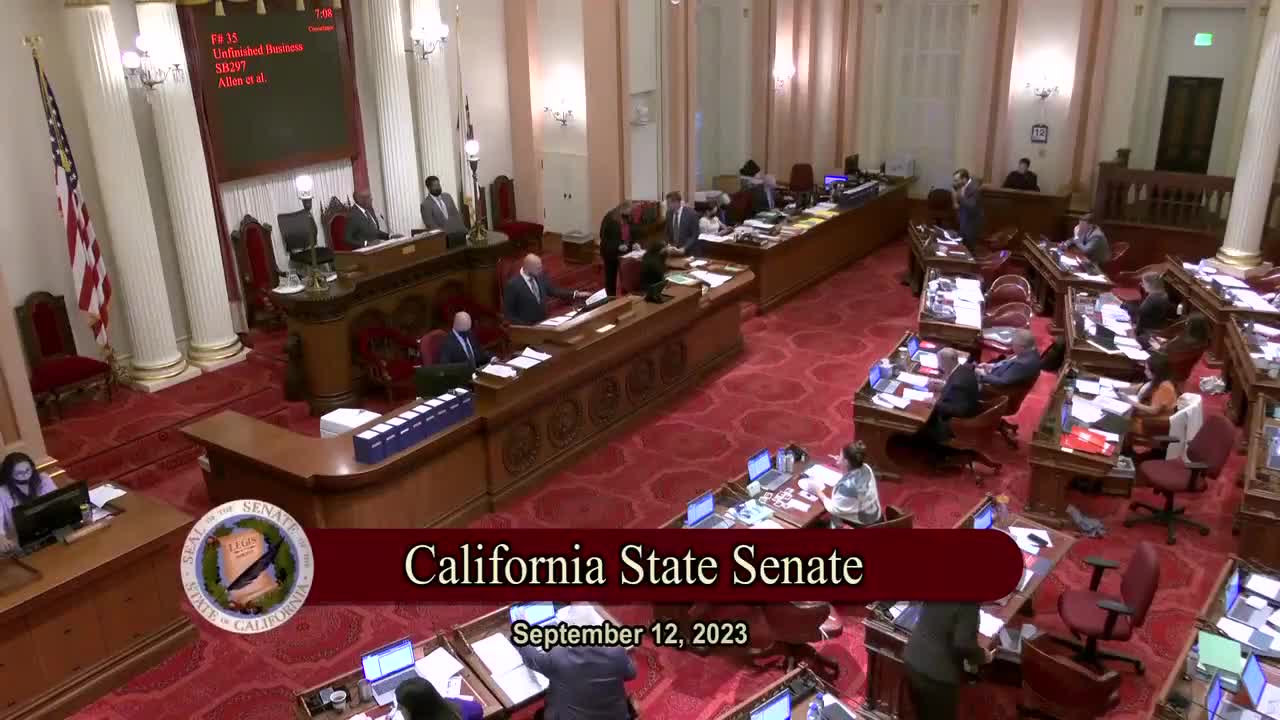 58SEC
Senate Floor
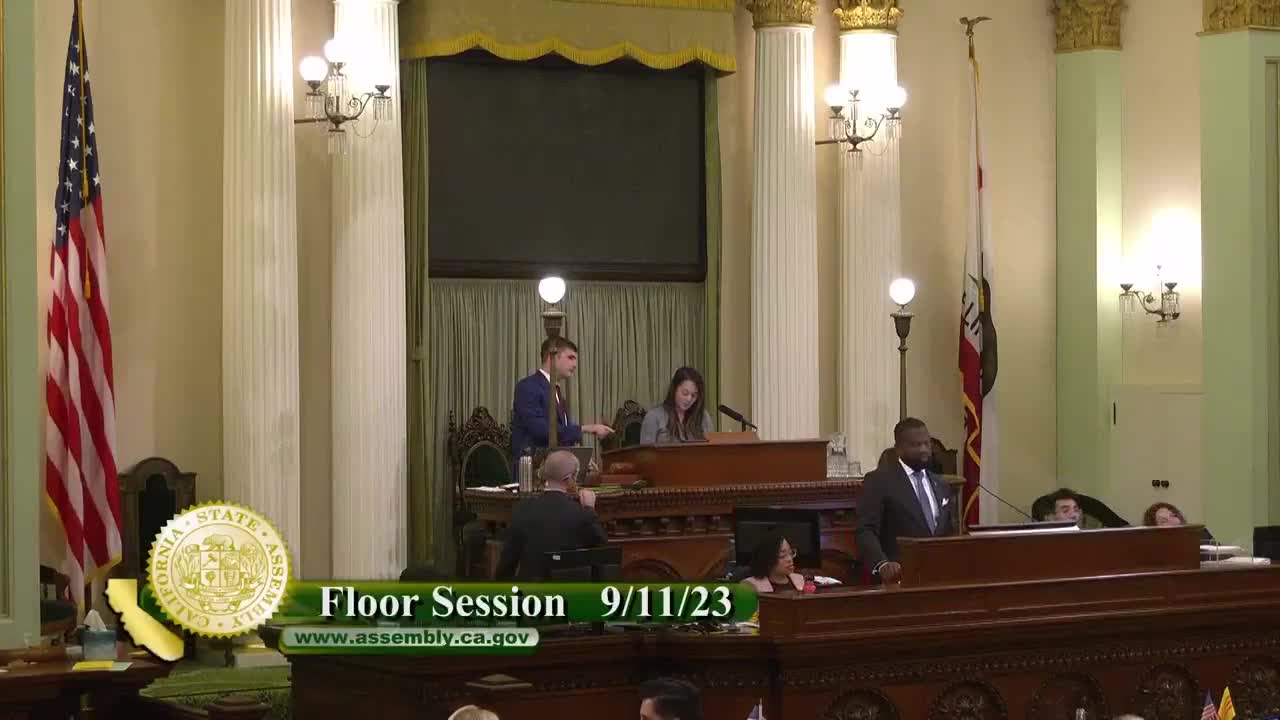 1MIN
Assembly Floor
 6MIN
Assembly Standing Committee on Judiciary
 10MIN
Assembly Standing Committee on Banking and Finance
Bill Author
Bill Co-Author(s):