SB 668: State parks: operating agreements.
- Session Year: 2023-2024
- House: Senate
- Latest Version Date: 2023-09-08
Current Status:
Passed
(2023-09-08: Chaptered by Secretary of State. Chapter 183, Statutes of 2023.)
Introduced
In Committee
First Chamber
In Committee
Second Chamber
Enacted
What does this bill do?
This bill lets the Department of Parks and Recreation continue signing operating agreements (contracts) with qualified nonprofit groups to develop, restore, run, or maintain state park units, and limits full nonprofit operation to no more than 20 park units. It requires nonprofits to file annual public financial reports and hold a joint public meeting with the park superintendent, bars General Fund money from subsidizing nonprofits that fully run parks, preserves affected union jobs as state employment, and allows excess park revenues to be used at other state parks.
The summary is provided by generative AI which can make mistakes. For original language, please view the details in the table below.
Existing law authorizes the Department of Parks and Recreation to enter into an operating agreement with a qualified nonprofit organization for the development, improvement, restoration, care, maintenance, administration, or operation of a unit or units, or portion of a unit, of the state park system, as provided. Existing law repeals this authorization on January 1, 2025.
This bill would indefinitely authorize the Department of Parks and Recreation to enter into operating agreements with a qualified nonprofit organization, as provided.
(a)Notwithstanding any other provision of this article, the department may enter into an operating agreement with a qualified nonprofit organization for the development, improvement, restoration, care, maintenance, administration, or operation of a unit or units, or portion of a unit, of the state park system, as agreed to by the director. The prohibition on park closures, pursuant to subdivision (a) of Section 541.5, does not limit the departments authority to enter into an operating agreement pursuant to this section, as provided in subdivision (e) of Section 541.5. The department may only enter into an operating agreement that involves the operation of the entirety of a park unit for no more than 20 park units. An operating agreement with a qualified nonprofit organization shall include, but shall not be limited to, the following conditions:
(1)The district superintendent for the department shall provide liaison with the department, the nonprofit organization, and the public.
(2)The nonprofit organization shall annually submit a written report to the department regarding its operating activities during the prior year and shall make copies of the report available to the public upon request. The report shall be available on the Internet Web sites of both the department and the nonprofit organization. The report shall include a full accounting of all revenues and expenditures for each unit of the state park system that the nonprofit organization operates pursuant to an operating agreement.
(3)(A)Except as provided in subparagraph (B), all revenues that the qualified nonprofit organization receives from a unit shall be expended only for the care, maintenance, operation, administration, improvement, or development of the unit. The qualified nonprofit organization may additionally contribute in-kind services and funds raised from outside entities for the care, maintenance, operation, administration, improvement, or development of the unit.
(B)If the qualified nonprofit organization determines that the revenues it has received from a unit are in excess of the revenues that are needed for the care, maintenance, operation, administration, improvement, or development of that unit, and that these funds are not already specified for or committed to specific purposes pursuant to an existing agreement or contract restricting the use of those funds, the qualified nonprofit organization may dedicate those excess revenues to another state park unit for that units care, maintenance, operation, administration, improvement, or development.
(4)General Fund moneys shall not be provided to a nonprofit organization to subsidize the operation or maintenance of a park unit. This paragraph applies to state parks, the full operation of which are turned over to a nonprofit organization, but does not apply to or preclude the department from entering into agreements with nonprofit organizations to operate a portion of a state park unit, or from entering into comanagement agreements with nonprofit organizations that involve the sharing of operational and financial responsibilities for the park unit and that have the effect of reducing state costs. This paragraph does not apply to park entrance fees, concession revenues, or any other revenues generated within a park operated by a nonprofit organization pursuant to this section.
(5)Jobs maintained under a memorandum of understanding between the state and the represented bargaining units shall not be eliminated pursuant to the agreement and shall continue to be state employment.
(b)An operating agreement entered into pursuant to subdivision (a) shall honor the existing term of a current concession contract for the state park unit subject to the operating agreement.
(c)An operating agreement entered into pursuant to subdivision (a) shall specify the duties that the nonprofit organization shall be responsible for carrying out relative to management and protection of natural, historical, and cultural resources, and shall identify those management duties that shall continue to be conducted by the department, so that all core operations of the park are delineated. Scientific, architectural, and engineering functions that require special expertise or professional training shall only be conducted by or under the supervision of qualified persons with applicable expertise or training and subject to oversight by the department.
(d)This section does not supersede the requirements of Section 5019.53 regarding the protection of natural, scenic, cultural, and ecological values.
(e)The nonprofit organization and the district superintendent for the department shall, following submittal of the annual report pursuant to subdivision (a), hold a joint public meeting for discussion of the report.
(f)If the department intends to enter into an operating agreement for the development, improvement, restoration, care, maintenance, administration, or operation of a unit or units, or a portion of a unit, the department shall notify the Member of the Legislature in whose district the unit is located, the Chair of the Senate Committee on Natural Resources and Water, the Chair of the Assembly Committee on Water, Parks, and Wildlife, and the chairs of the Assembly and Senate budget committees of that intention. The notification shall include estimated operating costs and revenues and core duties and responsibilities that are likely to be assigned to the nonprofit organization and the department.
(g)For purposes of this section, a qualified nonprofit organization is an organization that is all of the following:
(1)An organization that is exempt from taxation pursuant to Section 501(c)(3) of the Internal Revenue Code.
(2)An organization that has as its principal purpose and activity to provide visitor services in state parks, facilitate public access to park resources, improve park facilities, provide interpretive and educational services, or provide direct protection or stewardship of natural, cultural, or historical lands, or resources.
(3)An organization that is in compliance with the Supervision of Trustees and Fundraisers for Charitable Purposes Act (Article 7 (commencing with Section 12580) of Chapter 6 of Part 2 of Division 3 of Title 2 of the Government Code).
(h)(1)Notwithstanding Section 10231.5 of the Government Code, the department shall provide a report to the Legislature, on a biennial basis, of the status of operating agreements it has entered into pursuant to this section. The report shall include a list of units of the state park system with operating agreements, discussion of the management and operations of each unit subject to an operating agreement, an accounting of the revenues and expenditures incurred under each operating agreement, and an assessment of the benefit to the state from operating agreements entered into pursuant to this section.
(2)A report submitted pursuant to paragraph (1) shall be submitted in compliance with Section 9795 of the Government Code.
(i)This section shall remain in effect until January 1, 2025, and as of that date is repealed, unless a later enacted statute, that is enacted before January 1, 2025, deletes or extends that date. REVISIONS: HeadingLine 2.|
Date
|
Status
|
|---|---|
| Sep 8, 2023 | Chaptered by Secretary of State. Chapter 183, Statutes of 2023. |
| Sep 8, 2023 | Approved by the Governor. |
| Aug 30, 2023 | Enrolled and presented to the Governor at 2 p.m. |
| Aug 24, 2023 | In Senate. Ordered to engrossing and enrolling. |
| Aug 24, 2023 | Read third time. Passed. (Ayes 73. Noes 0. Page 2802.) Ordered to the Senate. |
| Aug 17, 2023 | Read second time. Ordered to consent calendar. |
| Aug 16, 2023 | From committee: Do pass. Ordered to consent calendar. (Ayes 15. Noes 0.) (August 16). |
| Jun 6, 2023 | From committee: Do pass and re-refer to Com. on APPR. (Ayes 14. Noes 0.) (June 6). Re-referred to Com. on APPR. |
| Jun 6, 2023 | Coauthors revised. |
| May 4, 2023 | Referred to Com. on W., P., & W. |
| Apr 17, 2023 | In Assembly. Read first time. Held at Desk. |
| Apr 13, 2023 | Read third time. Passed. (Ayes 36. Noes 0. Page 700.) Ordered to the Assembly. |
| Apr 11, 2023 | Read second time. Ordered to consent calendar. |
| Apr 10, 2023 | From committee: Be ordered to second reading pursuant to Senate Rule 28.8 and ordered to consent calendar. |
| Mar 29, 2023 | Set for hearing April 10. |
| Mar 28, 2023 | From committee: Do pass and re-refer to Com. on APPR with recommendation: To consent calendar. (Ayes 10. Noes 0. Page 547.) (March 28). Re-referred to Com. on APPR. |
| Mar 16, 2023 | Set for hearing March 28. |
| Mar 1, 2023 | Referred to Com. on N.R. & W. |
| Feb 17, 2023 | From printer. May be acted upon on or after March 19. |
| Feb 16, 2023 | Introduced. Read first time. To Com. on RLS. for assignment. To print. |
|
Date
|
Description
|
Location
|
Votes
|
|
|---|---|---|---|---|
| Aug 24, 2023 | SB 668 Dodd Consent Calendar Second Day Regular Session | Assembly Floor |
Passed |
|
| Aug 16, 2023 | Do pass. To Consent Calendar. | Assembly Standing Committee on Appropriations |
Passed |
|
| Jun 6, 2023 | Do pass and be re-referred to the Committee on [Appropriations] | Assembly Standing Committee on Water, Parks, and Wildlife |
Passed |
|
| Apr 13, 2023 | Consent Calendar SB668 Dodd | Senate Floor |
Passed |
|
| Mar 28, 2023 | Do pass, but first be re-referred to the Committee on [Appropriations] with the recommendation: To Consent Calendar | Senate Standing Committee on Natural Resources and Water |
Passed |
This list shows positions taken on this bill by organizations on the date displayed, which is linked to the original source.
Positions by individuals are not included.
|
Organization
|
Position
|
Date
|
|---|---|---|
| California Association Of Local Conservation Corps | * Support | Jun 6, 2023 |
| California Mountain Biking Coalition | ** Support | |
| California State Park Rangers Association | * Against | Jun 6, 2023 |
| California State Park Rangers Association | * Support | Jun 6, 2023 |
| California State Parks Foundation | * Support | Jun 6, 2023 |
| Friends of China Camp | * Support | Jun 6, 2023 |
| Jack London Park Partners | * Support | Jun 6, 2023 |
| Sonoma Ecology Center | * Support | Jun 6, 2023 |
| South Yuba River Citizens League | ** Support | |
| Sugarloaf Ridge State Park | * Support | Jun 6, 2023 |
Date of Hearing: August 16, 2023
ASSEMBLY COMMITTEE ON APPROPRIATIONS
Chris Holden, Chair
SBPCA Bill Id:SB 668
Author:(Dodd) – As Introduced Ver:February 16, 2023
Policy Committee: | Water, Parks and Wildlife | Vote: | 14 - 0 |
|
| ||
|
|
Urgency: No State Mandated Local Program: No Reimbursable: No
SUMMARY:
This bill removes the sunset date on the Department of Parks and Recreation’s (State Parks) authority to enter into operating agreements with qualified nonprofit organizations for the development, improvement, restoration, care, maintenance, administration, or operation of a unit or units, or portion of a unit, of the state park system, as agreed to by the director of State Parks.
FISCAL EFFECT:
Minor and absorbable costs to State Parks to indefinitely maintain its exiting authority to enter into operating and co-management agreements with nonprofits.
COMMENTS:
1) Purpose. According to the author:
We’ve seen how valuable partnerships between State Parks and nonprofits can be in terms of providing much need investments and improvements that ensure parks are accessible and enjoyable for Californians for generations to come. These partnerships have also freed up the precious and finite resources of State Parks to allocate towards other critical needs. Allowing State Parks to continue these partnerships is a win-win.
2) Background. Since California created its first publicly funded park in 1902, the state has relied on partnerships to help raise money needed to protect lands and promote conservation. Local and federal government agencies, Native American tribes, nonprofit groups and foundations, local businesses, volunteers, and private companies have augmented services and provided programs and amenities at a number of parks throughout California.
In the 2000s, and especially with the onset of the Great Recession, the budget for State Parks failed to keep pace with growing demand. In particular, State Parks struggled to maintain sufficient funding for stewardship and management of the state park system. General Fund revenue for State Parks declined by over 37% between fiscal years 2007–08 and 2012–13. This resulted in a deferred maintenance backlog of over $1.3 billion by 2010, inadequate staff to protect park resources and maintain public access and safety, and partial closures of some state parks.
The Legislature and Governor responded with multiple policy and budget solutions. One of these solutions was AB 42 (Huffman), Chapter 450, Statutes of 2011, which authorized State Parks, until January 1, 2019, to enter into operating agreements and co-management agreements with qualified nonprofits for the development, improvement, restoration, care, maintenance, administration, or operation of a unit or units, or portion of a unit, of the state park system. This authority helped to avoid park closures in certain areas.
Operating agreements allow the nonprofit to operate all or a portion of a park unit with minimal involvement by State Parks’ staff. State Parks is authorized to enter into an operating agreement that involves the operation of the entirety of a park unit for no more than 20 park units. Co-management agreements allow the nonprofit to share responsibility for operations of a park unit or portions of a park unit with State Parks. Legislation in subsequent years extended the sunset to January 1, 2025, and revised and updated this authority over time.
Existing law requires each nonprofit organization with an agreement with State Parks to annually submit a written report to the department regarding its operating activities during the prior year, including “a full accounting of all revenues and expenditures for each unit of the state park system that the nonprofit organization operates pursuant to an operating agreement.” Existing law also requires State Parks to biennially report to the Legislature on the status of its agreements with nonprofits.
Existing law prohibits General Fund moneys be provided to a nonprofit to subsidize the operation or maintenance of a park unit. This prohibition, however, does not apply to or preclude the department from entering into agreements with nonprofits to operate a portion of a state park unit, or from entering into co-management agreements with nonprofits that involve the sharing of operational and financial responsibilities for the park unit and that have the effect of reducing state costs.
State Parks notes that absent the authority to enter into agreements with nonprofit partners, the department’s costs would likely increase because it would need to resume operation of the park units, or portions of the park units, that are presently operated or co-managed by a nonprofit partner. Conversely, if a nonprofit walks away from or is financially unable to fulfill its responsibilities under a co-management or operating agreement, State Parks would similarly need to resume operation and management of the park. For example, State Parks resumed operations of the Standish-Hickey State Recreation Area in 2008, costing the department approximately $350,000 in operating costs in fiscal year 2019-20.
3) Support and Opposition. Writing in support, the California State Parks Foundation (CSPF) states:
The original legislation grew out of necessity when up to 70 state parks were threatened to be closed to budgetary restrictions over a decade ago. Partnerships with nonprofits have provided important, stable funding to California Parks allowing parks to remain open and allow continued public access. A recent study released by Parks California with support from the California League of Park Associations and California State Parks Foundation, found that partners contribute over $15 million annually to California state parks. Without these partnerships, the state may be forced to cut the funding of a number of parks with the potential of ultimate closures to reduce costs.
Writing in opposition, the California State Park Rangers Association (CSPRA) argues:
Passage of SB 668 will allow for the flawed elements of AB 42 to continue to the detriment of the people of California and their State Park System. Despite the requirements for oversight, in some cases there has been a lack of public transparency, lack of financial oversight and disclosure, lack of fair and competitive bid processes with other potentially qualified parties, poor visitor experiences, special events with high fees that price out lower income visitors, degraded resources and facilities, and lack of accountability measures.
In a subsequent letter, CSPF responded to the criticisms raised in CSPRA’s letter, arguing, among other things:
Every nonprofit operator agreement contains detailed provisions, requirements, and duties assigned to the nonprofit and the park agency. We have no concerns about the safeguards that the agreements impose on partners with respect to protecting and preserving the park assets they operate on California State Parks’ behalf…The idea that somehow AB 42 operators are evading public scrutiny is absurd. The statute requires nonprofit operators to annually report on their activities and submit audited financials and 990s as part of that report. As public charities, these organizations are also subject to IRS, California Secretary of State, California State Attorney General, and charity rating agency oversight on top of what the Public Resources Code requires.
Analysis Prepared by: Nikita Koraddi / APPR. / (916) 319-2081
Date of Hearing: June 6, 2023
ASSEMBLY COMMITTEE ON WATER, PARKS, AND WILDLIFE
Rebecca Bauer-Kahan, Chair
SBPCA Bill Id:SB 668
Author:(Dodd) – As Introduced Ver:February 16, 2023
SENATE VOTE: 36-0
SUBJECT: State parks: operating agreements
SUMMARY: Indefinitely authorizes the Department of Parks and Recreation (State Parks) to enter into operating agreements with qualified nonprofit organizations for the development, improvement, restoration, care, maintenance, administration, or operation of a unit or units, or portion of a unit, of the state park system, as agreed to by the director.
EXISTING LAW:
- Establishes State Parks within the California Natural Resources Agency (CNRA) under the control of the director and vests State Parks with control of the state park system [Public Resources Code (PRC) § 501, § 5001].
- Authorizes State Parks, through January 1, 2025, to enter into an operating agreement with a qualified nonprofit organization for the development, improvement, restoration, care, maintenance, administration, or operation of a unit or units, or portion of a unit, of the state park system, as agreed to by the director (PRC § 5080.42).
- Defines “qualified nonprofit organization” for the purpose of this authority (PRC § 5080.42).
- Requires an operating agreement with a qualified nonprofit organization to:
- Include specified conditions, including that the nonprofit must annually report to State Parks regarding its operating activities, including a full accounting of all revenues and expenditures, as specified;
- Specify the duties that the nonprofit organization shall be responsible for and those management duties that State Parks shall continue to conduct so that all core operations of the park are delineated, as specified. The agreement may not eliminate any jobs maintained under a memorandum of understanding between the state and the represented bargaining units; and
- Honor the existing term of any current concession contract for the state park unit subject to the operating agreement (PRC § 5080.42).
- Specifies that all revenues that the qualified nonprofit organization receives from a unit be expended only for the care, maintenance, operation, administration, improvement, or development of the unit (PRC § 5080.42).
- Prohibits the use of General Fund moneys to subsidize a nonprofit organization’s operation or maintenance of a park unit in cases where the nonprofit provides for the full operation of the park unit (PRC § 5080.42).
- Limits State Parks’ authority to enter into an operating agreement that involves the operation of the entirety of a park unit to no more than 20 park units (PRC § 5080.42).
- Requires State Parks biennially to report to the Legislature on the status of operating agreements, as specified (PRC § 5080.42).
FISCAL EFFECT: Unknown. This bill is keyed fiscal.
COMMENTS:
- Purpose of this bill. This bill deletes the sunset on State Parks’ authority to enter into operating agreements with nonprofits, thereby extending this authority indefinitely. According to the author, “We’ve seen how valuable partnerships between State Parks and nonprofits can be in terms of providing much need investments and improvements that ensure parks are accessible and enjoyable for Californians for generations to come. These partnerships have also freed up the precious and finite resources of State Parks to allocate towards other critical needs. Allowing State Parks to continue these partnerships is a win-win.”
- Background. Since California created its first publicly funded park in 1902, the state has relied upon partnerships to help raise money needed to protect lands and promote conservation. Local and federal government agencies, Native American tribes, nonprofit groups and foundations, local businesses, volunteers, and private companies have augmented services and provided programs and amenities at a number of parks throughout California.
In the early and mid-2000s, and especially with the onset of the Great Recession, the budget for State Parks failed to keep pace with growing demand. In particular, State Parks struggled to maintain sufficient funding for stewardship and management of the state park system. General Fund revenue for State Parks declined by over 37% between Fiscal Years 2007–08 and 2012–13. This resulted in a deferred maintenance backlog of over $1.3 billion by 2010, inadequate staff to protect park resources and maintain public access and safety, and partial closures of some state parks.
The Legislature and Governor responded with multiple policy and budget solutions. One of these solutions was AB 42 (Huffman), Chapter 450, Statutes of 2011, which authorized State Parks, until January 1, 2019, to enter into operating agreements and co-management agreements with qualified nonprofits for the development, improvement, restoration, care, maintenance, administration, or operation of a unit or units, or portion of a unit, of the state park system. This authority helped to avoid park closures in certain areas.
Operating agreements allow the nonprofit to operate all or a portion of a park unit with minimal involvement by State Parks’ staff. Co-management agreements allow the nonprofit to share responsibility for operations of a park unit or portions of a park unit with State Parks. Legislation in subsequent years extended the sunset to January 1, 2025, and revised and updated this authority over time.
Existing law requires State Parks to biennially report to the Legislature on the status of its agreements with qualified nonprofit organizations. State Parks has released reports covering Fiscal Years 2012–13 through 2019–20. This includes reports that cover all of the nonprofit operators in one report, or individual reports specific to each nonprofit operator. State Parks also maintains information available upon request for later years.
According to the reports, State Parks has previously or is currently entered into operating agreements and/or co-management agreements with the following nonprofit organizations to operate the following state park units (organized alphabetically by unit):
State Park Unit | Nonprofit Operator | Agreement Type |
Armstrong Redwoods State Natural Reserve | The Stewards of the Coast and Redwoods | Co-management |
Austin Creek State Recreation Area | The Stewards of Coast and Redwoods | Operating/Co-management |
California Citrus State Historic Park | California Citrus Historic Park Nonprofit Management Company | Operating |
China Camp State Park | Friends of China Camp, Inc. | Operating |
Crystal Cove State Park | Irvine Ranch Conservancy | Co-management |
El Presidio de Santa Barbara State Historic Park | Santa Barbara Trust for Historic Preservation | Operating |
Fort Ross State Historic Park | Fort Ross Conservancy | Co-management |
Jack London State Historic Park | Valley of the Moon Natural History Association | Operating |
Marconi Conference Center State Historic Park | Marconi Conference Center Operating Corporation | Operating |
Mendocino Woodlands State Park | Mendocino Woodlands Camp Association | Operating |
Old Sacramento State Historic Park | Historic Old Sacramento Foundation | Co-management |
Old Sacramento State Historic Park | Sacramento History Alliance | Operating |
Santa Cruz District (multiple park units) | Friends of Santa Cruz State Parks | Co-management |
Standish-Hickey State Recreation Area | Mendocino Area Parks Association | Operating |
Sugarloaf Ridge State Park | Sonoma Ecology Center and other partners | Operating |
For the operating agreements, the responsibilities of the nonprofits vary slightly, but generally they provide for basic park operation services, including visitor services, fee collection, volunteer recruitment and coordination, fundraising, special events, trail maintenance, and housekeeping. State Parks typically retains responsibility for managing and preserving the unit’s natural and cultural resources; conducting environmental reviews; maintaining sewer lift stations and connections to water mains; conducting tree hazard inspections; training partner staff and volunteers; supervising State Parks staff, partner staff, and volunteers; overseeing public safety; providing a partnership liaison; and providing administrative oversight.
For the co-management agreements, the nonprofits provide more limited services, like operating a visitor center, co-managing select natural resources within a unit, or supporting events within park units.
The listed benefits of these partnerships included keeping parks, campgrounds, and other areas within parks open more often or year round, increasing the number of volunteer hours, completing deferred maintenance projects, and increasing interpretive programs and special programs and events.
Operating agreements with public agencies. While this bill relates to operating and co-management agreements with qualified nonprofits, it is worth noting that existing law (PRC § 5080.30) also authorizes State Parks to enter into similar agreements with public agencies. According to State Parks, it has entered into operating agreements with:
- The cities of Benicia, Carlsbad, Carpinteria, Colusa, Encinitas, Grover Beach, Huntington Beach, Los Angeles, Manhattan Beach, Monterey, Morro Bay, Newport Beach, Pacifica, Pismo Beach, Santa Monica, and Woodland.
- The counties of Los Angeles, Mendocino, Sacramento, San Diego, San Luis Obispo, San Mateo, and Santa Cruz.
- Local park agencies and districts, including East Bay Regional Park District, Napa County Regional Park & Open Space District, and Sonoma County Regional Parks.
- Utility districts, including Johnsville Public Utility District and Tahoe City Public Utility District.
- Educational agencies, including California State University Sacramento; San Diego County Board of Education; and the Southwest Community College District.
- Other public agencies, including the Santa Cruz County Regional Transportation Commission and the U.S. Fish and Wildlife Service.
- The Yurok tribe.
- Arguments in support. Several organizations write in support, with the California State Parks Foundation stating that “Partnerships with nonprofits have provided important, stable funding to California Parks allowing parks to remain open and allow continued public access. A recent study released by Parks California with support from the California League of Park Associations and California State Parks Foundation, found that partners contribute over $15 million annually to California state parks. Without these partnerships, the state may be forced to cut the funding of a number of parks with the potential of ultimate closures to reduce costs.”
- Arguments in opposition. California State Park Rangers Association (CSPRA) writes in opposition, recognizing the value of partnerships but stating that “The proper way to manage parks is with dedicated, trained park professionals operating the units of the State Park System.” CSPRA maintains that “Passage of [this bill] will allow for the flawed elements of AB 42 to continue to the detriment of the people of California and their State Park System. Despite the requirements for oversight, in some cases there has been a lack of public transparency, lack of financial oversight and disclosure, lack of fair and competitive bid processes with other potentially qualified parties, poor visitor experiences, special events with high fees that price out lower income visitors, degraded resources and facilities, and lack of accountability measures.”
- Related legislation. SB 1111 (Pavley), Chapter 540, Statutes of 2016, added a January 1, 2025, sunset to State Parks’ authority to enter into operating agreements with qualified nonprofits for the development, improvement, restoration, care, maintenance, administration, or operation of a unit or units, or portion of a unit, of the state park system. SB 1111 also authorized State Parks to enter into a statewide agreement with a park support organization to facilitate the implementation of reforms recommended by the Parks Forward Commission and to develop and secure expertise, services, resources, and projects that are not readily available to the state park system, as specified.
SB 204 (Pavley), Chapter 573, Statutes of 2015, eliminated the January 1, 2019, sunset on State Parks’ authority to enter into operating agreements with qualified nonprofits for the development, improvement, restoration, care, maintenance, administration, or operation of a unit or units, or portion of a unit, of the state park system.
AB 549 (Levine), Chapter 559, Statutes of 2015, authorized State Parks to enter into agreements with qualified nonprofit organizations for acquisition, installation, and operation of camping cabins or parking facilities for recreational vehicles within units of the state park system.
AB 594 (Assembly Water, Parks and Wildlife Committee), Chapter 407, Statutes of 2013, clarified State Parks’ authority to enter into operating agreements with qualified nonprofit organizations when there was a moratorium on state park closures.
AB 42 (Huffman), Chapter 450, Statutes of 2011, authorized State Parks, through January 1, 2019, to enter into an operating agreement with a qualified nonprofit organization for the development, improvement, restoration, care, maintenance, administration, or operation of a unit or units, or portion of a unit, of the state park system, as identified by the director.
REGISTERED SUPPORT / OPPOSITION:
Support
California Association of Local Conservation Corps
California Mountain Biking Coalition
California State Parks Foundation
South Yuba River Citizens League
Opposition
California State Park Rangers Association
Analysis Prepared by: Keith Cialino / W., P., & W. / (916) 319-2096
SENATE RULES COMMITTEE Office of Senate Floor Analyses (916) 651-1520 Fax: (916) 327-4478 | SB 668 |
CONSENT
Bill No: SB 668
Author: Dodd (D)
Introduced: 2/16/23
Vote: 21
SENATE NATURAL RES. & WATER COMMITTEE: 10-0, 3/28/23
AYES: Min, Seyarto, Allen, Becker, Eggman, Grove, Hurtado, Laird, Limón, Padilla
NO VOTE RECORDED: Dahle
SENATE APPROPRIATIONS COMMITTEE: Senate Rule 28.8
SUBJECT: State parks: operating agreements
SOURCE: Author
DIGEST:
This bill eliminates the sunset on the Department of Parks and Recreation’s authority to enter into an operating agreement with a qualified nonprofit organization for the development, improvement, restoration, care, maintenance, administration, or operation of a unit or units, or portion of a unit, of the state park system, as agreed to by the director.
ANALYSIS:
Existing law
- Establishes the Department of Parks and Recreation (State Parks) with the California Natural Resources Agency (CNRA) under the control of the director. Public Resources Code (PRC) section (§) 501.
- Vests State Parks with control of the state park system (PRC §5001) and directs State Parks to:
- Administer, protect, develop, and interpret the state park system for the use and enjoyment of the public. PRC §5003.
- Protect the state park system from damage and preserve the peace. PRC §5008.
- Authorizes State Parks, through January 1, 2025, to enter into an operating agreement with a qualified nonprofit organization for the development, improvement, restoration, care, maintenance, administration, or operation of a unit or units, or portion of a unit, of the state park system, as agreed to by the director. PRC §5080.42.
- Defines “qualified nonprofit organization” for the purpose of this authority.
- Requires an operating agreement with a qualified nonprofit organization to:
- Include specified conditions, including that the nonprofit must annually report to State Parks regarding its operating activities, including a full accounting of all revenues and expenditures, as specified.
- Specify the duties that the nonprofit organization shall be responsible for and those management duties that State Parks shall continue to conduct so that all core operations of the park are delineated, as specified. The agreement may not eliminate any jobs maintained under a memorandum of understanding between the state and the represented bargaining units.
- Honor the existing term of any current concession contract for the state park unit subject to the operating agreement.
- Generally requires all revenues that the qualified nonprofit organization receives from a unit to be expended only for the care, maintenance, operation, administration, improvement, or development of the unit.
- Generally prohibits the use of General Fund moneys to subsidize a nonprofit organization’s operation or maintenance of a park unit in cases where the nonprofit provides for the full operation of the park unit.
- Limits State Parks’ authority to enter into an operating agreement that involves the operation of the entirety of a park unit to no more than 20 park units.
- Requires State Parks biennially to report to the Legislature on the status of operating agreements, as specified.
This bill eliminates the sunset on State Parks’ authority to enter into an operating agreement with a qualified nonprofit organization for the development, improvement, restoration, care, maintenance, administration, or operation of a unit or units, or portion of a unit, of the state park system, as agreed to by the director.
Background
Since California created its first publicly funded park in 1902, the state has relied upon partnerships to help raise money needed to protect lands and promote conservation. Local and federal government agencies, Native American tribes, nonprofit groups and foundations, local businesses, volunteers, and private companies have augmented services and provided programs and amenities at a number of parks throughout California.
In the early and mid-2000s, and especially with the onset of the Great Recession, the budget for State Parks failed to keep pace with growing demand. In particular, State Parks struggled to maintain sufficient funding for stewardship and management of the state park system. General Fund revenue for State Parks declined by over 37 percent between fiscal years 2007–08 and 2012–13, inclusive. This resulted in a deferred maintenance backlog of over $1.3 billion by 2010, inadequate staff to protect park resources and maintain public access and safety, and partial closures of some state parks.
The Legislature and Governor responded on many fronts with multiple policy and budget solutions over several two-year legislative sessions. One of these solutions included AB 42 (Huffman, Chapter 450, Statutes of 2011), which authorized State Parks, until January 1, 2019, to enter into operating agreements and co-management agreements with qualified nonprofits for the development, improvement, restoration, care, maintenance, administration, or operation of a unit or units, or portion of a unit, of the state park system, as specified.
Specifically, operating agreements allow the nonprofit to operate all or a portion of a park unit with minimal involvement and oversight by State Parks’ staff. Co-management agreements allow the nonprofit to share responsibility for operations of a park unit or portions of a park unit with State Parks.
Legislation in subsequent years extended the sunset to January 1, 2025, and revised and updated this authority over time. This authority was instrumental in helping to avoid park closures in certain areas.
Comments
This authority has been instrumental in helping avoid park closures and expand park services. Existing law requires State Parks to biennially report to the Legislature on the status of its agreements with qualified nonprofit organizations. State Parks has released reports covering Fiscal Years 2012-13 through 2019-20. This includes reports that cover all of the nonprofit operators in one report, or individual reports specific to each nonprofit operator. State Parks also maintains information available upon request for later years.
According to the reports, State Parks has previously or is currently entered into operating agreements and/or co-management agreements with the following nonprofit organizations to operate the following state park units (organized alphabetically by unit):
State Park Unit | Nonprofit Operator | Agreement Type |
Armstrong Redwoods State Natural Reserve | The Stewards of the Coast and Redwoods | Co-management |
Austin Creek State Recreation Area | The Stewards of Coast and Redwoods | Operating/Co-management |
California Citrus State Historic Park | California Citrus Historic Park Nonprofit Management Company | Operating |
China Camp State Park | Friends of China Camp, Inc. | Operating |
Crystal Cove State Park | Irvine Ranch Conservancy | Co-management |
El Presidio de Santa Barbara State Historic Park | Santa Barbara Trust for Historic Preservation | Operating |
Fort Ross State Historic Park | Fort Ross Conservancy | Co-management |
Jack London State Historic Park | Valley of the Moon Natural History Association | Operating |
Marconi Conference Center State Historic Park | Marconi Conference Center Operating Corporation | Operating |
Mendocino Woodlands State Park | Mendocino Woodlands Camp Association | Operating |
Old Sacramento State Historic Park | Historic Old Sacramento Foundation | Co-management |
Old Sacramento State Historic Park | Sacramento History Alliance | Operating |
Santa Cruz District (multiple park units) | Friends of Santa Cruz State Parks | Co-management |
Standish-Hickey State Recreation Area | Mendocino Area Parks Association | Operating |
Sugarloaf Ridge State Park | Sonoma Ecology Center and other partners | Operating |
For the operating agreements, the responsibilities of the nonprofits vary slightly, but generally they provide for basic park operation services, including visitor services, fee collection, volunteer recruitment and coordination, fundraising, special events, trail maintenance, and housekeeping. State Parks typically retains responsibility for managing and preserving the unit’s natural and cultural resources, conducting environmental reviews, maintaining sewer lift stations and connections to water mains, conducting tree hazard inspections, training partner staff and volunteers, supervising State Park staff, partner staff, and volunteers, overseeing public safety, providing a partnership liaison, and providing administrative oversight.
For the co-management agreements, the nonprofits provide more limited services, like operating a visitor center, co-managing select natural resources within a unit, or supporting events within park units.
The listed benefits of these partnerships included keeping parks, campgrounds, and other areas within parks open more often or year round, increasing the number of volunteer hours, completing deferred maintenance projects, and increasing interpretive programs and special programs and events. Further, according to State Parks:
“These agreements allow the Department to reach and exceed visitor expectations while conserving valuable Department resources, which can be utilized in other park units with less partner support. The Department depends on nonprofit operators to engage communities in valuable educational experiences such as Star Parties and exposing students to local ecology at summer camps at Sugarloaf Ridge State Park. Partners have found new and creative ways to attract visitors to State Parks, including the operation of the Old Sacramento Visitor Center in Old Sacramento State Historic Park.
The value these partners add to the Department is almost immeasurable. The connections they have developed with local communities and the new programs they have provided have made a positive impact to visitors’ experiences that may not otherwise have been achievable without these partnerships. These impacts have been especially important during the substantial increase in visitation to State Parks during the COVID-19 pandemic.”
Related/Prior Legislation
SB 1111 (Pavley, Chapter 540, Statutes of 2016) added a January 1, 2025, sunset to State Parks’ authority to enter into operating agreements with qualified nonprofits for the development, improvement, restoration, care, maintenance, administration, or operation of a unit or units, or portion of a unit, of the state park system. Further, authorized State Parks to enter into a statewide agreement with a park support organization to facilitate the implementation of reforms recommended by the Parks Forward Commission and to develop and secure expertise, services, resources, and projects that are not readily available to the state park system, as specified.
AB 549 (Levine, Chapter 559, Statutes of 2015) authorized State Parks to enter into agreements with qualified nonprofit organizations for acquisition, installation, and operation of camping cabins or parking facilities for recreational vehicles within units of the state park system.
SB 204 (Pavley, Chapter 573, Statutes of 2015) eliminated the January 1, 2019, sunset on State Parks’ authority to enter into operating agreements with qualified nonprofits for the development, improvement, restoration, care, maintenance, administration, or operation of a unit or units, or portion of a unit, of the state park system.
AB 594 (Assembly Water, Parks and Wildlife Committee, Chapter 407, Statutes of 2013) clarified State Parks’ authority to enter into operating agreements with qualified nonprofit organizations when there was a moratorium on state park closures.
AB 1589 (Huffman, Chapter 533, Statutes of 2012) clarified allowable uses of revenues by a qualified nonprofit organization under an operating agreement with State Parks. Also established the Legislature’s policy (in findings and declarations) to promote formation of an advisory council to assess and make recommendations on future management, planning, and funding proposals to ensure the long-term sustainability of the state park system.
AB 1478 (Blumenfield, Chapter 530, Statues of 2012) stated the Legislature’s intent to encourage formation of an advisory council to assess and make recommendations on future management, planning, and funding proposals to ensure the long-term sustainability of the state park system.
AB 42 (Huffman, Chapter 450, Statutes of 2011) authorized State Parks, through January 1, 2019, to enter into an operating agreement with a qualified nonprofit organization for the development, improvement, restoration, care, maintenance, administration, or operation of a unit or units, or portion of a unit, of the state park system, as identified by the director.
FISCAL EFFECT: Appropriation: No Fiscal Com.: Yes Local: No
SUPPORT: (Verified 4/10/23)
California Mountain Biking Coalition
California State Parks Foundation
OPPOSITION: (Verified 4/10/23)
None received
ARGUMENTS IN SUPPORT: According to the author, “We’ve seen how valuable partnerships between State Parks and nonprofits can be in terms of providing much need investments and improvements that ensure parks are accessible and enjoyable for Californians for generations to come. These partnerships have also freed up the precious and finite resources of State Parks to allocate towards other critical needs. Allowing state parks to continue these partnerships is a win-win.”
Prepared by: Catherine Baxter / N.R. & W. / (916) 651-4116
4/12/23 14:04:26
**** END ****
SENATE COMMITTEE ON NATURAL RESOURCES AND WATER
Senator Dave Min, Chair
2023 - 2024 Regular
Bill No: SB 668 Hearing Date: March 28, 2023
Author: | |||
Version: | Introduced | ||
Urgency: | Fiscal: | ||
Consultant: | |||
Subject: State parks: operating agreements
BACKGROUND AND EXISTING LAW
Existing law
- Establishes the Department of Parks and Recreation (State Parks) with the California Natural Resources Agency (CNRA) under the control of the director. Public Resources Code (PRC) section (§) 501.
- Vests State Parks with control of the state park system (PRC §5001) and directs State Parks to:
- Administer, protect, develop, and interpret the state park system for the use and enjoyment of the public. PRC §5003.
- Protect the state park system from damage and preserve the peace. PRC §5008.
- Authorizes State Parks, through January 1, 2025, to enter into an operating agreement with a qualified nonprofit organization for the development, improvement, restoration, care, maintenance, administration, or operation of a unit or units, or portion of a unit, of the state park system, as agreed to by the director. PRC §5080.42.
- Defines “qualified nonprofit organization” for the purpose of this authority.
- Requires an operating agreement with a qualified nonprofit organization to:
- Include specified conditions, including that the nonprofit must annually report to State Parks regarding its operating activities, including a full accounting of all revenues and expenditures, as specified.
- Specify the duties that the nonprofit organization shall be responsible for and those management duties that State Parks shall continue to conduct so that all core operations of the park are delineated, as specified. The agreement may not eliminate any jobs maintained under a memorandum of understanding between the state and the represented bargaining units.
- Honor the existing term of any current concession contract for the state park unit subject to the operating agreement.
- Generally requires all revenues that the qualified nonprofit organization receives from a unit to be expended only for the care, maintenance, operation, administration, improvement, or development of the unit.
- Generally prohibits the use of General Fund moneys to subsidize a nonprofit organization’s operation or maintenance of a park unit in cases where the nonprofit provides for the full operation of the park unit.
- Limits State Parks’ authority to enter into an operating agreement that involves the operation of the entirety of a park unit to no more than 20 park units.
- Requires State Parks biennially to report to the Legislature on the status of operating agreements, as specified.
Background
Since California created its first publicly funded park in 1902, the state has relied upon partnerships to help raise money needed to protect lands and promote conservation. Local and federal government agencies, Native American tribes, nonprofit groups and foundations, local businesses, volunteers, and private companies have augmented services and provided programs and amenities at a number of parks throughout California.
In the early and mid-2000s, and especially with the onset of the Great Recession, the budget for State Parks failed to keep pace with growing demand. In particular, State Parks struggled to maintain sufficient funding for stewardship and management of the state park system. General Fund revenue for State Parks declined by over 37 percent between fiscal years 2007–08 and 2012–13, inclusive. This resulted in a deferred maintenance backlog of over $1.3 billion by 2010, inadequate staff to protect park resources and maintain public access and safety, and partial closures of some state parks.
The Legislature and Governor responded on many fronts with multiple policy and budget solutions over several two-year legislative sessions. One of these solutions included AB 42 (Huffman, Chapter 450, Statutes of 2011), which authorized State Parks, until January 1, 2019, to enter into operating agreements and co-management agreements with qualified nonprofits for the development, improvement, restoration, care, maintenance, administration, or operation of a unit or units, or portion of a unit, of the state park system, as specified.
Specifically, operating agreements allow the nonprofit to operate all or a portion of a park unit with minimal involvement and oversight by State Parks’ staff. Co-management agreements allow the nonprofit to share responsibility for operations of a park unit or portions of a park unit with State Parks.
Legislation in subsequent years extended the sunset to January 1, 2025, and revised and updated this authority over time. This authority was instrumental in helping to avoid park closures in certain areas.
PROPOSED LAW
This bill would eliminate the sunset on State Parks’ authority to enter into an operating agreement with a qualified nonprofit organization for the development, improvement, restoration, care, maintenance, administration, or operation of a unit or units, or portion of a unit, of the state park system, as agreed to by the director.
ARGUMENTS IN SUPPORT
According to the author, “We’ve seen how valuable partnerships between State Parks and nonprofits can be in terms of providing much need investments and improvements that ensure parks are accessible and enjoyable for Californians for generations to come. These partnerships have also freed up the precious and finite resources of State Parks to allocate towards other critical needs. Allowing state parks to continue these partnerships is a win-win.”
ARGUMENTS IN OPPOSITION
None received.
COMMENTS
This authority has been instrumental in helping avoid park closures and expand park services. Existing law requires State Parks to biennially report to the Legislature on the status of its agreements with qualified nonprofit organizations. State Parks has released reports covering Fiscal Years 2012-13 through 2019-20. This includes reports that cover all of the nonprofit operators in one report, or individual reports specific to each nonprofit operator. State Parks also maintains information available upon request for later years.
According to the reports, State Parks has previously or is currently entered into operating agreements and/or co-management agreements with the following nonprofit organizations to operate the following state park units (organized alphabetically by unit):
State Park Unit | Nonprofit Operator | Agreement Type |
Armstrong Redwoods State Natural Reserve | The Stewards of the Coast and Redwoods | Co-management |
Austin Creek State Recreation Area | The Stewards of Coast and Redwoods | Operating/Co-management |
California Citrus State Historic Park | California Citrus Historic Park Nonprofit Management Company | Operating |
China Camp State Park | Friends of China Camp, Inc. | Operating |
Crystal Cove State Park | Irvine Ranch Conservancy | Co-management |
El Presidio de Santa Barbara State Historic Park | Santa Barbara Trust for Historic Preservation | Operating |
Fort Ross State Historic Park | Fort Ross Conservancy | Co-management |
Jack London State Historic Park | Valley of the Moon Natural History Association | Operating |
Marconi Conference Center State Historic Park | Marconi Conference Center Operating Corporation | Operating |
Mendocino Woodlands State Park | Mendocino Woodlands Camp Association | Operating |
Old Sacramento State Historic Park | Historic Old Sacramento Foundation | Co-management |
Old Sacramento State Historic Park | Sacramento History Alliance | Operating |
Santa Cruz District (multiple park units) | Friends of Santa Cruz State Parks | Co-management |
Standish-Hickey State Recreation Area | Mendocino Area Parks Association | Operating |
Sugarloaf Ridge State Park | Sonoma Ecology Center and other partners | Operating |
For the operating agreements, the responsibilities of the nonprofits vary slightly, but generally they provide for basic park operation services, including visitor services, fee collection, volunteer recruitment and coordination, fundraising, special events, trail maintenance, and housekeeping. State Parks typically retains responsibility for managing and preserving the unit’s natural and cultural resources, conducting environmental reviews, maintaining sewer lift stations and connections to water mains, conducting tree hazard inspections, training partner staff and volunteers, supervising State Park staff, partner staff, and volunteers, overseeing public safety, providing a partnership liaison, and providing administrative oversight.
For the co-management agreements, the nonprofits provide more limited services, like operating a visitor center, co-managing select natural resources within a unit, or supporting events within park units.
The listed benefits of these partnerships included keeping parks, campgrounds, and other areas within parks open more often or year round, increasing the number of volunteer hours, completing deferred maintenance projects, and increasing interpretive programs and special programs and events. Further, according to State Parks:
“These agreements allow the Department to reach and exceed visitor expectations while conserving valuable Department resources, which can be utilized in other park units with less partner support. The Department depends on nonprofit operators to engage communities in valuable educational experiences such as Star Parties and exposing students to local ecology at summer camps at Sugarloaf Ridge State Park. Partners have found new and creative ways to attract visitors to State Parks, including the operation of the Old Sacramento Visitor Center in Old Sacramento State Historic Park.
The value these partners add to the Department is almost immeasurable. The connections they have developed with local communities and the new programs they have provided have made a positive impact to visitors’ experiences that may not otherwise have been achievable without these partnerships. These impacts have been especially important during the substantial increase in visitation to State Parks during the COVID-19 pandemic.”
Operating agreements with public agencies. While this bill relates to operating and co-management agreements with qualified nonprofits, it is worth noting that existing law also authorizes State Parks to enter into similar agreements with public agencies. According to State Parks, it has entered in operating agreements with:
- The cities of Benicia, Carlsbad, Carpinteria, Colusa, Encinitas, Grover Beach, Huntington Beach, Los Angeles, Manhattan Beach, Monterey, Morro Bay, Newport Beach, Pacifica, Pismo Beach, Santa Monica, and Woodland.
- The counties of Los Angeles, Mendocino, Sacramento, San Diego, San Luis Obispo, San Mateo, and Santa Cruz.
- Local park agencies and districts, including East Bay Regional Park District, Napa County Regional Park & Open Space District, and Sonoma County Regional Parks.
- Utility districts, including Johnsville Public Utility District and Tahoe City Public Utility District.
- Educational agencies, including CSU, Sacramento; San Diego County Board of Education; and the Southwest Community College District.
- Other public agencies, including the Santa Cruz County Regional Transportation Commission and the U.S. Fish and Wildlife Service.
- The Yurok tribe.
Previous legislation.
AB 42 (Huffman, Chapter 450, Statutes of 2011) authorized State Parks, through January 1, 2019, to enter into an operating agreement with a qualified nonprofit organization for the development, improvement, restoration, care, maintenance, administration, or operation of a unit or units, or portion of a unit, of the state park system, as identified by the director.
AB 1478 (Blumenfield, Chapter 530, Statues of 2012) stated the Legislature’s intent to encourage formation of an advisory council to assess and make recommendations on future management, planning, and funding proposals to ensure the long-term sustainability of the state park system.
AB 1589 (Huffman, Chapter 533, Statutes of 2012) clarified allowable uses of revenues by a qualified nonprofit organization under an operating agreement with State Parks. Also established the Legislature’s policy (in findings and declarations) to promote formation of an advisory council to assess and make recommendations on future management, planning, and funding proposals to ensure the long-term sustainability of the state park system.
AB 594 (Assembly Water, Parks and Wildlife Committee, Chapter 407, Statutes of 2013) clarified State Parks’ authority to enter into operating agreements with qualified nonprofit organizations when there was a moratorium on state park closures.
SB 204 (Pavley, Chapter 573, Statutes of 2015) eliminated the January 1, 2019, sunset on State Parks’ authority to enter into operating agreements with qualified nonprofits for the development, improvement, restoration, care, maintenance, administration, or operation of a unit or units, or portion of a unit, of the state park system.
AB 549 (Levine, Chapter 559, Statutes of 2015) authorized State Parks to enter into agreements with qualified nonprofit organizations for acquisition, installation, and operation of camping cabins or parking facilities for recreational vehicles within units of the state park system.
SB 1111 (Pavley, Chapter 540, Statutes of 2016) added a January 1, 2025, sunset to State Parks’ authority to enter into operating agreements with qualified nonprofits for the development, improvement, restoration, care, maintenance, administration, or operation of a unit or units, or portion of a unit, of the state park system. Further, authorized State Parks to enter into a statewide agreement with a park support organization to facilitate the implementation of reforms recommended by the Parks Forward Commission and to develop and secure expertise, services, resources, and projects that are not readily available to the state park system, as specified.
SUGGESTED AMENDMENTS
None.
SUPPORT
None Received
OPPOSITION
None Received
-- END --
Discussed in Hearing
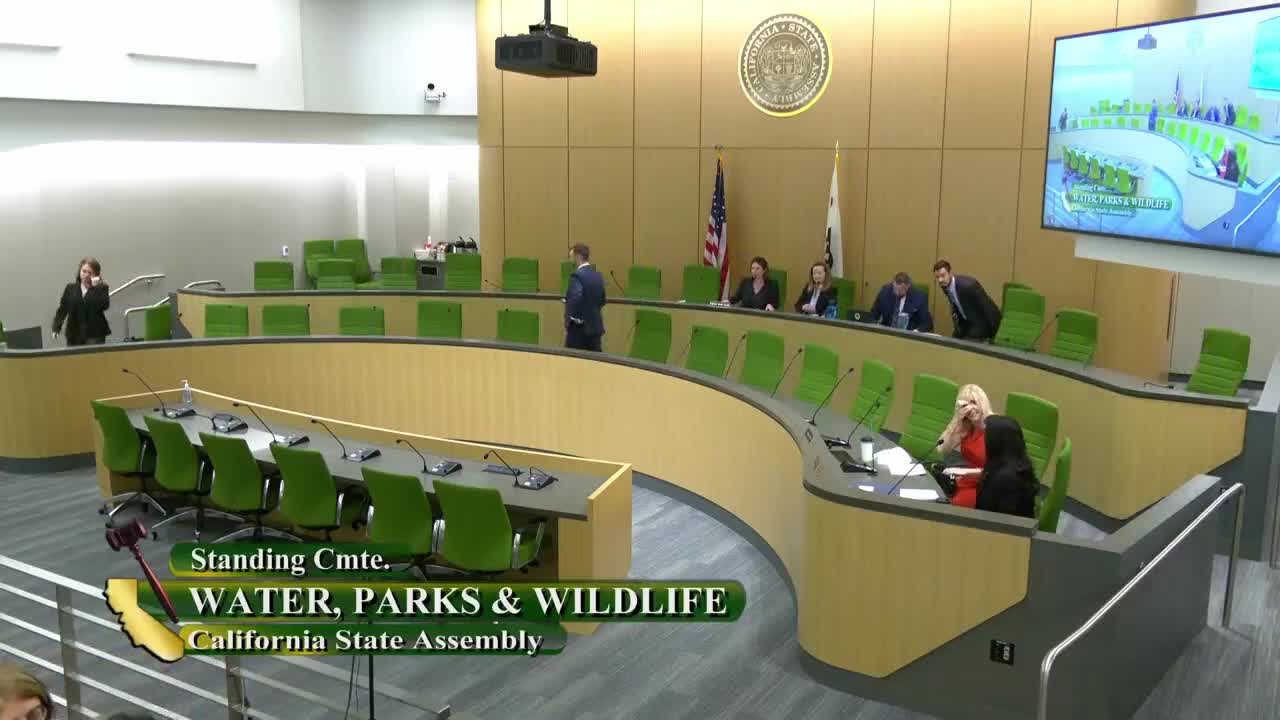 30MIN
Assembly Standing Committee on Water, Parks, and Wildlife
Bill Author

Bill Co-Author(s):
