SB 677: Intercity rail: LOSSAN Rail Corridor.
- Session Year: 2023-2024
- House: Senate
- Latest Version Date: 2023-10-07
Current Status:
Passed
(2023-10-07: Chaptered by Secretary of State. Chapter 407, Statutes of 2023.)
Introduced
In Committee
First Chamber
In Committee
Second Chamber
Enacted
Existing law authorizes the Department of Transportation, subject to approval of the Secretary of Transportation, to enter into an interagency transfer agreement under which a joint powers board assumes responsibility for administering the state-funded intercity rail service in a particular corridor, including the LOSSAN Rail Corridor, defined to mean the intercity passenger rail corridor between San Diego, Los Angeles, and San Luis Obispo. Existing law requires the agreements to cover an initial 3-year period after the transfer, and authorizes subsequent extensions by mutual agreement. Pursuant to this authority, the department entered into an interagency transfer agreement with the LOSSAN Rail Corridor Agency to administer intercity passenger rail service in the LOSSAN corridor.
Existing law provides for the allocation of state funds by the secretary to a joint powers board under an interagency transfer agreement based on an annual business plan for the intercity rail corridor and subsequent appropriation of state funds. Existing law requires the joint powers board to submit the annual business plan to the secretary for review and recommendation by April 1 of each year. Existing law requires the business plan to include, among other things, a report on the performance of the corridor service, an overall operating plan, short-term and long-term capital improvement programs, funding requirements for the upcoming fiscal year, and an action plan with specific performance goals and objectives.
This bill would require the LOSSAN Rail Corridor Agency, as part of the annual business plan submitted to the secretary, to include a description of the effects of climate change on the LOSSAN corridor, to identify projects planned to increase climate resiliency on the corridor, and to discuss possible funding options for those identified projects, as specified. To the extent the bill would add to the duties of the LOSSAN Rail Corridor Agency, the bill would impose a state-mandated local program.
The California Constitution requires the state to reimburse local agencies and school districts for certain costs mandated by the state. Statutory provisions establish procedures for making that reimbursement.
This bill would provide that, if the Commission on State Mandates determines that the bill contains costs mandated by the state, reimbursement for those costs shall be made pursuant to the statutory provisions noted above.
Existing law recognizes the LOSSAN Rail Corridor Agency as a joint powers authority established to provide an organization capable of implementing the recommendations contained in the State Rail Corridor Study Groups June 1987 report entitled Los Angeles-San Diego State Rail Corridor Study and undertaking related efforts to improve intercity services and facilities in the corridor and to coordinate subcorridor commuter rail services with intercity services. Existing law defines the LOSSAN Rail Corridor to mean the San Diego-Los Angeles-San Luis Obispo intercity passenger rail corridor. authorizes the Department of Transportation, subject to approval of the Secretary of Transportation, to enter into an interagency transfer agreement under which a joint powers board assumes responsibility for administering the state-funded intercity rail service in a particular corridor, including the LOSSAN Rail Corridor, defined to mean the intercity passenger rail corridor between San Diego, Los Angeles, and San Luis Obispo. Existing law requires the agreements to cover an initial 3-year period after the transfer, and authorizes subsequent extensions by mutual agreement. Pursuant to this authority, the department entered into an interagency transfer agreement with the LOSSAN Rail Corridor Agency to administer intercity passenger rail service in the LOSSAN corridor.
Existing law provides for the allocation of state funds by the secretary to a joint powers board under an interagency transfer agreement based on an annual business plan for the intercity rail corridor and subsequent appropriation of state funds. Existing law requires the joint powers board to submit the annual business plan to the secretary for review and recommendation by April 1 of each year. Existing law requires the business plan to include, among other things, a report on the performance of the corridor service, an overall operating plan, short-term and long-term capital improvement programs, funding requirements for the upcoming fiscal year, and an action plan with specific performance goals and objectives.
This bill would require the LOSSAN Rail Corridor Agency to prioritize and promote climate resiliency in its planning and projects within the LOSSAN Rail Corridor. By adding Agency, as part of the annual business plan submitted to the secretary, to include a description of the effects of climate change on the LOSSAN corridor, to identify projects planned to increase climate resiliency on the corridor, and to discuss possible funding options for those identified projects, as specified. To the extent the bill would add to the duties of the LOSSAN Rail Corridor Agency, the bill would impose a state-mandated local program.
The California Constitution requires the state to reimburse local agencies and school districts for certain costs mandated by the state. Statutory provisions establish procedures for making that reimbursement.
This bill would provide that, if the Commission on State Mandates determines that the bill contains costs mandated by the state, reimbursement for those costs shall be made pursuant to the statutory provisions noted above.
Existing law recognizes the LOSSAN Rail Corridor Agency as a joint powers authority established to provide an organization capable of implementing the recommendations contained in the State Rail Corridor Study Groups June 1987 report entitled Los Angeles-San Diego State Rail Corridor Study and undertaking related efforts to improve intercity services and facilities in the corridor and to coordinate subcorridor commuter rail services with intercity services. Existing law defines the LOSSAN Rail Corridor to mean the San Diego-Los Angeles-San Luis Obispo intercity passenger rail corridor.
This bill would state the intent of the Legislature to enact subsequent legislation pertaining to the LOSSAN Rail Corridor. require the LOSSAN Rail Corridor Agency to prioritize and promote climate resiliency in its planning and projects within the LOSSAN Rail Corridor. By adding to the duties of the LOSSAN Rail Corridor Agency, the bill would impose a state-mandated local program.
The California Constitution requires the state to reimburse local agencies and school districts for certain costs mandated by the state. Statutory provisions establish procedures for making that reimbursement.
This bill would provide that, if the Commission on State Mandates determines that the bill contains costs mandated by the state, reimbursement for those costs shall be made pursuant to the statutory provisions noted above.
Existing law recognizes the LOSSAN Rail Corridor Agency as a joint powers authority established to provide an organization capable of implementing the recommendations contained in the State Rail Corridor Study Groups June 1987 report entitled Los Angeles-San Diego State Rail Corridor Study and undertaking related efforts to improve intercity services and facilities in the corridor and to coordinate subcorridor commuter rail services with intercity services. Existing law defines the LOSSAN Rail Corridor to mean the San Diego-Los Angeles-San Luis Obispo intercity passenger rail corridor.
This bill would state the intent of the Legislature to enact subsequent legislation pertaining to the LOSSAN Rail Corridor.
As part of the business plan required by subdivision (b) of Section 14070.4 that is due by April 1, 2024, and each year thereafter, the LOSSAN Rail Corridor Agency shall do all of the following:
(a)Include a description of the effects of climate change, including sea level rise and weather-related events, on the corridor, including how to adapt to its impacts.
(b)Identify projects planned, as part of the capital improvement programs, to increase climate resiliency on the corridor.
(c)Discuss possible funding options for the projects identified pursuant to subdivision (b), including, but not limited to, federal and state funding.
SEC. 2.If the Commission on State Mandates determines that this act contains costs mandated by the state, reimbursement to local agencies and school districts for those costs shall be made pursuant to Part 7 (commencing with Section 17500) of Division 4 of Title 2 of the Government Code.
(a)Notwithstanding Section 14072.2, the LOSSAN Rail Corridor Agency shall prioritize and promote climate resiliency in its planning and projects within the LOSSAN Rail Corridor.
(b)For purposes of this section, the LOSSAN Rail Corridor has the same meaning as defined in Section 14072.
SEC. 2.If the Commission on State Mandates determines that this act contains costs mandated by the state, reimbursement to local agencies and school districts for those costs shall be made pursuant to Part 7 (commencing with Section 17500) of Division 4 of Title 2 of the Government Code.
SECTION 1.It is the intent of the Legislature to enact subsequent legislation pertaining to the San Diego-Los Angeles-San Luis Obispo intercity passenger rail corridor.It is the intent of the Legislature to enact subsequent legislation pertaining to the San Diego-Los Angeles-San Luis Obispo intercity passenger rail corridor.
|
Date
|
Status
|
|---|---|
| Oct 7, 2023 | Chaptered by Secretary of State. Chapter 407, Statutes of 2023. |
| Oct 7, 2023 | Approved by the Governor. |
| Sep 15, 2023 | Enrolled and presented to the Governor at 3 p.m. |
| Sep 11, 2023 | In Senate. Ordered to engrossing and enrolling. |
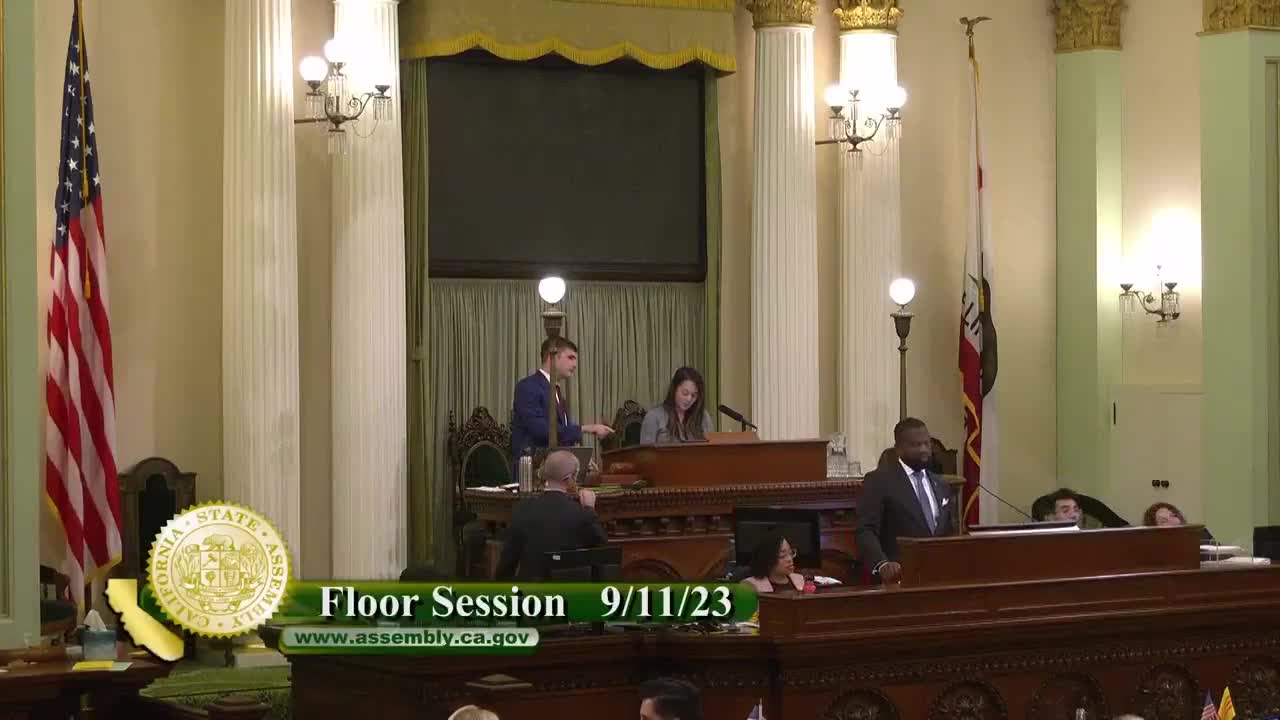
| Sep 11, 2023 | Read third time. Passed. (Ayes 80. Noes 0. Page 3204.) Ordered to the Senate. |
| Sep 5, 2023 | Read second time. Ordered to third reading. |
| Sep 1, 2023 | From committee: Do pass. (Ayes 16. Noes 0.) (September 1). |
| Aug 23, 2023 | August 23 set for first hearing. Placed on suspense file. |
| Jun 27, 2023 | From committee: Do pass and re-refer to Com. on APPR. with recommendation: To consent calendar. (Ayes 15. Noes 0.) (June 26). Re-referred to Com. on APPR. |
| May 18, 2023 | Referred to Com. on TRANS. |
| May 11, 2023 | In Assembly. Read first time. Held at Desk. |
| May 11, 2023 | Read third time. Passed. (Ayes 39. Noes 0. Page 1054.) Ordered to the Assembly. |
| May 9, 2023 | Read second time. Ordered to consent calendar. |
| May 8, 2023 | From committee: Be ordered to second reading pursuant to Senate Rule 28.8 and ordered to consent calendar. |
| May 1, 2023 | Set for hearing May 8. |
| Apr 26, 2023 | From committee: Do pass and re-refer to Com. on APPR with recommendation: To consent calendar. (Ayes 16. Noes 0. Page 904.) (April 25). Re-referred to Com. on APPR. |
| Apr 17, 2023 | From committee with author's amendments. Read second time and amended. Re-referred to Com. on TRANS. |
| Apr 3, 2023 | Set for hearing April 25. |
| Mar 29, 2023 | Re-referred to Com. on TRANS. |
| Mar 21, 2023 | From committee with author's amendments. Read second time and amended. Re-referred to Com. on RLS. |
| Mar 1, 2023 | Referred to Com. on RLS. |
| Feb 17, 2023 | From printer. May be acted upon on or after March 19. |
| Feb 16, 2023 | Introduced. Read first time. To Com. on RLS. for assignment. To print. |
|
Date
|
Description
|
Location
|
Votes
|
|
|---|---|---|---|---|
| Sep 11, 2023 | SB 677 Blakespear Senate Third Reading By Dixon | Assembly Floor |
Passed |
|
| Sep 1, 2023 | Do pass. | Assembly Standing Committee on Appropriations |
Passed |
|
| Jun 26, 2023 | Do pass and be re-referred to the Committee on [Appropriations] with recommendation: To Consent Calendar | Assembly Standing Committee on Transportation |
Passed |
|
| May 11, 2023 | Consent Calendar SB677 Blakespear | Senate Floor |
Passed |
|
| Apr 25, 2023 | Do pass, but first be re-referred to the Committee on [Appropriations] with the recommendation: To Consent Calendar | Senate Standing Committee on Transportation |
Passed |
This list shows positions taken on this bill by organizations on the date displayed, which is linked to the original source.
Positions by individuals are not included.
|
Organization
|
Position
|
Date
|
|---|---|---|
| Streets for All | ** Support |
SENATE THIRD READING
STR Bill Id:SB 677
Author:(Blakespear)
As Amended Ver:April 17, 2023
Majority vote
SUMMARY
Requires the Los Angeles – San Diego – San Luis Obispo Rail (LOSSAN) Rail Corridor Agency to include in its annual business plan a description of the effects of climate change, including sea level rise and weather-related events, on the corridor.
Major Provisions
- Requires the business plan to include the following:
- A description of how to adapt to climate change impacts on the LOSSAN Corridor;
- Identification of projects planned, as part of the capital improvement programs, to increase climate resiliency on the corridor; and,
- Possible funding options for the projects identified, including but not limited to federal and state funding.
- Provides for the above considerations to be made in the business plan due on April 1, 2024, and annually thereafter.
COMMENTS
The Los Angeles–San Diego–San Luis Obispo (LOSSAN) Rail Corridor Agency is a JPA formed in 1989 that works to increase ridership, revenue, capacity, reliability, coordination, and safety on the rail corridor between San Diego, Los Angeles, and San Luis Obispo. On September 29, 2012, Governor Jerry Brown signed SB 1225, (Padilla), Chapter 802, Statutes of 2012, which authorized the LOSSAN Agency to oversee the state-supported Pacific Surfliner intercity passenger rail service operating on the LOSSAN rail corridor, subject to the approval of an interagency transfer agreement with the State of California. The Orange County Transportation Authority (OCTA) serves as the managing agency for the LOSSAN Agency and provides management and administrative support as outlined in the Administrative Support Agreement between the LOSSAN Agency and OCTA. In addition to the Pacific Surfliner, the corridor also serves Metrolink and COASTER commuter trains, as well as BNSF Railway and Union Pacific Railroad freight trains. In 2019 the corridor served 8.33 million passengers.
The Pacific Surfliner service travels along a 351-mile coastal rail corridor through six counties in Southern California: San Diego, Orange, Los Angeles, Ventura, Santa Barbara, and San Luis Obispo. It is currently the second busiest intercity passenger rail corridor in the United States and the busiest state-supported Amtrak route. The LOSSAN Agency is governed by a Board of Directors composed of 11 voting members representing rail owners, operators, and planning agencies along the LOSSAN rail corridor, as well as four non-voting, ex-officio members.
Over the years, the Pacific Surfliner has significantly increased its service. In 1971, the Pacific Surfliner started with six daily trips. By 2019, service increased to 27 daily trips. Ridership had increased significantly and peaked in 2017 at nearly 3 million riders with farebox recovery exceeding 50%. Due to COVID-19, service was reduced to 12 daily trips in the second half of 2020. Service has since increased to 18 daily trips, with 12 of the trips operating between San Diego and Los Angeles, four trips between San Diego and Goleta, and two of the trips between San Diego and San Luis Obispo. Despite the service cuts, the Pacific Surfliner service remains the busiest state-supported route in the entire Amtrak National system.
The LOSSAN Agency is the governing board of the LOSSAN Corridor and is composed of 11 voting members representing rail owners, operators, and planning agencies along the corridor. A primary responsibility of the LOSSAN Agency, per SB 1225 and the terms of an agreement with the State of California, is to develop an annual business plan that outlines the agency's major goals and objectives. This bill would require that the LOSSAN agency include climate resiliency considerations as a chapter in the business plan to describe the effects of climate change on the corridor, identify projects to increase climate resiliency in the corridor, and discuss funding options for these projects.
The system has suffered serious setbacks as a result of climate change. In September of 2021, eroding of the private-property slope caused track movement forcing Metrolink to suspend passenger rail service in south Orange County. Service was restored the following month. In December 2021, geotechnical monitoring showed cumulative track movement, requiring 3,000 tons of rock for stabilization. In September of 2022, passenger service was suspended after high tides and storm surges eroded some of the previously placed rock. OCTA immediately embarked on emergency repairs in October 2022, to stabilize the rail line and incrementally restart rail service. The project placed ground anchors into bedrock through the slide planes, designed to hold back a larger slide and stabilize movement on the corridor. That same month, the California Transportation Commission met in a special session to approve $6 million in funding for the emergency repairs. The total cost of the emergency work is approximately $13.7 million. Limited passenger rail service resumed in 2023. On June 5th due to debris falling from a slope north of San Clemente Pier tracks were again between Irvine and Oceanside.
Coastal resiliency challenges exist across the corridor. In San Diego, the Del Mar Bluffs where the trains are located are retreating an average of six inches a year. Bluff collapses have impacted service seven times since 2018. More recently, SANDAG was awarded $300 million from the state to re-align tracks away from vulnerable coastal bluffs and construct a double track through Del Mar and Los Panasquitos Lagoon. The project is expected to be completed by 2035.
More recently, the California State Senate created a subcommittee within the Senate Transportation Committee on LOSSAN Rail Corridor Resiliency and it had its first hearing on May 16, 2023.
While the existing business plan contains a Capital Improvement Program, it currently does not discuss the effects of climate change on the corridor or identify projects in the capital improvement program that are climate resiliency related, as this bill would require.
According to the Author
"The LOSSAN Corridor is the second busiest rail corridor in the nation serving as the primary intercity, commuter, freight, and military rail corridor throughout a six-county mega region where 20 million people reside. Unfortunately, impacts from sea-level rise, erosion, and weather-related events have jeopardized the long-term resiliency of the corridor and, in some instances, ceased operations for up to months at a time. Late last year, rail tracks in San Clemente, CA shifted as much as 28" into the Pacific Ocean due to landslides and coastal erosion. In Del Mar, CA, crumbling bluffs have jeopardized the longevity of the most southern portion of the corridor."
Arguments in Support
According to RideSD, "RideSD believes that the integration of climate change factors into the planning and development of the LOSSAN Rail Corridor will pave the way for a more sustainable and resilient transport network. By adopting a forward-looking approach, this bill ensures that our rail system is not only better equipped to handle the evolving climate but also contributes positively to our shared goal of a greener future."
Arguments in Opposition
None on file.
FISCAL COMMENTS
According to Assembly Appropriations Committee, "LOSSAN estimates costs ranging from $2.5 million to $3.5 million to contract with a third party to conduct a study on the effects of sea level rise and other effects of climate change and incorporate the findings in to the 2024 business plan. LOSSAN asserts the state would need to fund the effort, since the state funds intercity rail corridors (special fund)."
VOTES
SENATE FLOOR: 39-0-1
YES: Allen, Alvarado-Gil, Archuleta, Ashby, Atkins, Becker, Blakespear, Bradford, Caballero, Cortese, Dahle, Dodd, Durazo, Eggman, Glazer, Gonzalez, Hurtado, Jones, Laird, Limón, McGuire, Menjivar, Min, Newman, Nguyen, Niello, Ochoa Bogh, Padilla, Portantino, Roth, Rubio, Seyarto, Skinner, Smallwood-Cuevas, Stern, Umberg, Wahab, Wiener, Wilk
ABS, ABST OR NV: Grove
ASM TRANSPORTATION: 15-0-0
YES: Friedman, Vince Fong, Berman, Juan Carrillo, Davies, Gipson, Hart, Jackson, Kalra, Lowenthal, Stephanie Nguyen, Sanchez, Wallis, Ward, Wicks
ASM APPROPRIATIONS: 16-0-0
YES: Holden, Megan Dahle, Bryan, Calderon, Wendy Carrillo, Dixon, Mike Fong, Hart, Lowenthal, Mathis, Papan, Pellerin, Sanchez, Soria, Weber, Wilson
UPDATED
VERSION: April 17, 2023
CONSULTANT: David Sforza / TRANS. / (916) 319-2093 FN: 0001410
Date of Hearing: August 23, 2023
ASSEMBLY COMMITTEE ON APPROPRIATIONS
Chris Holden, Chair
SBPCA Bill Id:SB 677
Author:(Blakespear) – As Amended Ver:April 17, 2023
Policy Committee: | Transportation | Vote: | 15 - 0 |
|
| ||
|
|
Urgency: No State Mandated Local Program: Yes Reimbursable: Yes
SUMMARY:
This bill requires the Los Angeles – San Diego – San Luis Obispo Rail (LOSSAN) Rail Corridor Agency, as part of the business plan it must provide to the California Transportation Agency annually, to include information regarding sea level rise and other effects of climate change.
Specifically, this bill requires LOSSAN to include the following in its business plan:
- Description of the effects of climate change, including sea level rise and weather-related events, on the corridor, including how to adapt to their impacts.
- Projects planned, as part of the capital improvement programs, to increase climate resiliency on the corridor.
- Discussion of possible funding options for the projects, including, but not limited to, federal and state funding.
FISCAL EFFECT:
LOSSAN estimates costs ranging from $2.5 million to $3.5 million to contract with a third party to conduct a study on the effects of sea level rise and other effects of climate change and incorporate the findings in to the 2024 business plan. LOSSAN asserts the state would need to fund the effort, since the state funds intercity rail corridors (special fund).
COMMENTS:
- Purpose. The author intends this bill to ensure the LOSSAN Rail Corridor Agency considers, and plans for, the effects of climate change on the rail corridor. According to the author:
The LOSSAN Corridor is the second busiest rail corridor in the nation serving as the primary intercity, commuter, freight, and military rail corridor throughout a six-county mega region where 20 million people reside. Unfortunately, impacts from sea-level rise, erosion, and weather-related events have jeopardized the long-term resiliency of the corridor and, in some instances, ceased operations for up to months at a time… This bill would require that the LOSSAN agency include climate resiliency considerations as a chapter in the business plan to describe the effects of climate change on the corridor, identify projects to increase climate resiliency in the corridor, and discuss funding options for these projects.
- Background.
LOSSAN Rail Corridor. State law defines several intercity rail corridors, among them the San Diego-Los Angeles-San Luis Obispo intercity passenger rail corridor, defined in statute as the LOSSAN Rail Corridor. The state-supported Pacific Surfliner intercity passenger rail service operates on the LOSSAN Rail Corridor and is the busiest intercity passenger rail service in the country.
Statute authorizes the LOSSAN Rail Corridor Agency to oversee operation of the Pacific Surfliner and to increase ridership, revenue, capacity, reliability, coordination and safety on the LOSSAN Rail Corridor. The agency is a joint powers authority composed of 11 voting members representing rail owners, operators, and planning agencies along the corridor. The Orange County Transportation Authority (OCTA) serves as the managing agency for the LOSSAN Rail Corridor Agency and provides management and administrative support to the agency.
State law requires the LOSSAN Rail Corridor Agency produce an annual business plan and submit it to the California State Transportation Agency (CalSTA) by April 1 of each year. The plan must include:
- A report on the recent as well as historical performance of the corridor service.
- An overall operating plan including proposed service enhancements to increase ridership and provide for increased traveler demands in the corridor for the upcoming year.
- Short-term and long-term capital improvement programs.
- Funding requirements for the upcoming fiscal year.
- An action plan with specific performance goals and objectives.
Crumbling cliffs and rock slides disrupt Pacific Surfliner service. The tracks of the LOSSAN Rail Corridor, in many places, run directly adjacent to the coast. For much of 2021 and 2022, rail service on the corridor was suspended in the face of repeated landslides and rockslides that pushed the rails dangerously seaward.
Corridor managers undertook emergency actions to stabilize the land under the rails, at least temporarily, and the Pacific Surfliner has resumed services. Nonetheless, sea level rise and severe storms are expected exacerbate erosion along the corridor. This bill, in response, requires the business plan the LOSSAN Rail Corridor Agency produces pursuant to existing law to include information regarding sea level rise and other effects of climate change.
Analysis Prepared by: Jay Dickenson / APPR. / (916) 319-2081
Date of Hearing: June 26, 2023
ASSEMBLY COMMITTEE ON TRANSPORTATION
Laura Friedman, Chair
SBPCA Bill Id:SB 677
Author:(Blakespear) – As Amended Ver:April 17, 2023
SENATE VOTE: 39-0
SUBJECT: Intercity rail: LOSSAN Rail Corridor
SUMMARY: Requires the Los Angeles – San Diego – San Luis Obispo Rail (LOSSAN) Rail Corridor Agency to include in its annual business plan a description of the effects of climate change, including sea level rise and weather-related events, on the corridor. Specifically, this bill:
- Requires the business plan to include the following:
- A description of how to adapt to climate changes impacts on the LOSSAN Corridor;
- Identification of projects planned, as part of the capital improvement programs, to increase climate resiliency on the corridor; and
- Possible funding options for the projects identified, including but not limited to federal and state funding.
- Provides for the above considerations to be made in the business plan due on April 1, 2024 and every plan annually thereafter.
EXISTING LAW:
- Authorizes the California Department of Transportation (Caltrans) to contract with the National Railroad Passenger Corporation (Amtrak) for intercity rail passenger services. (Government Code Section (GOV) 14035)
- Provides funding for intercity passenger rail service from a portion of the sales tax on diesel fuel through the Public Transportation Account. (Public Utilities Code Section (PUC) 99312.3)
- Authorizes the LOSSAN Rail Corridor Agency to oversee state-supported intercity passenger rail service. (GOV 14072.2)
- Authorizes Caltrans, subject to approval of the Secretary of Transportation (CalSTA), to enter into an interagency transfer agreement under which a joint powers authority (JPA) assumes responsibility for administering the state-supported intercity passenger rail service, and associated feeder bus service, in a particular corridor. (GOV 14031.8)
- Defines the boundaries of the three intercity rail corridors. (GOV 14072)
- Requires the preparation of an annual business plan, due to CalSTA by April 1 every year, for the corridor by each participating JPA board of directors. (GOV 14070.4)
- Requires the annual busniess plan to include:
- A report on the recent as well as historical performance of the corridor service;
- An overall operating plan including proposed service enhancements to increase ridership and provide for increased traveler demands in the corridor for the upcoming year;
- Short-term and long-term capital improvement programs;
- Funding requirements for the upcoming fiscal year; and,
- An action plan with specific performance goals and objectives. (GOV 14070.4)
FISCAL EFFECT: According to the Senate Appropriations Committee, pursuant to Senate Rule 28.8, negligible state costs.
COMMENTS: The Los Angeles–San Diego–San Luis Obispo (LOSSAN) Rail Corridor Agency is a JPA formed in 1989 that works to increase ridership, revenue, capacity, reliability, coordination, and safety on the rail corridor between San Diego, Los Angeles, and San Luis Obispo. On September 29, 2012, Governor Jerry Brown signed SB 1225, (Padilla), Chapter 802, Statutes of 2012, which authorized the LOSSAN Agency to oversee the state-supported Pacific Surfliner intercity passenger rail service operating on the LOSSAN rail corridor, subject to approval of an interagency transfer agreement with the State of California. The Orange County Transportation Authority (OCTA) serves as the managing agency for the LOSSAN Agency and provides management and administrative support as outlined in the Administrative Support Agreement between the LOSSAN Agency and OCTA. In addition to the Pacific Surfliner the corridor also serves Metrolink and COASTER commuter trains, as well as BNSF Railway and Union Pacific Railroad freight trains. In 2019 the corridor served 8.33 million passengers
The Pacific Surfliner service travels along a 351-milecoastal rail corridor through six counties in
Southern California: San Diego, Orange, Los Angeles, Ventura, Santa Barbara, and
San Luis Obispo. It is currently the second busiest intercity passenger rail corridor in the United States, and the busiest state-supported Amtrak route. The LOSSAN Agency is governed by a Board of Directors composed of 11 voting members representing rail owners, operators, and planning agencies along the LOSSAN rail corridor, as well as four non-voting, ex-officio members.
Over the years the Pacific Surfliner has significantly increased its service. In 1971, the Pacific Surfliner started with six daily trips. By 2019, service increased to 27 daily trips. Ridership had increased significantly and peaked in 2017 at nearly 3 million riders with farebox recovery exceeding 50%. Due to COVID-19, service was reduced to 12 daily trips the second half of 2020. Service has since increased to 18 daily trips, with 12 of the trips operating between San Diego and Los Angeles, four trips between San Diego and Goleta, and two of the trips between San Diego and San Luis Obispo. Despite the service cuts, the Pacific Surfliner service remains the busiest state-supported route in the entire Amtrak National system.
According to the author, “The LOSSAN Corridor is the second busiest rail corridor in the nation serving as the primary intercity, commuter, freight, and military rail corridor throughout a six-county mega region where 20 million people reside. Unfortunately, impacts from sea-level rise, erosion, and weather-related events have jeopardized the long-term resiliency of the corridor and, in some instances, ceased operations for up to months at a time. Late last year, rail tracks in San Clemente, CA shifted as much as 28” into the Pacific Ocean due to landslides and coastal erosion. In Del Mar, CA, crumbling bluffs have jeopardized the longevity of the most southern portion of the corridor.
The LOSSAN Agency is the governing board of the LOSSAN Corridor and is composed of 11 voting members representing rail owners, operators, and planning agencies along the corridor. A primary responsibility of the LOSSAN Agency, per SB 1225 and terms of an agreement with the State of California, is to develop an annual business plan which outlines the agency’s major goals and objectives. This bill would require that the LOSSAN agency include climate resiliency considerations as a chapter in the business plan to describe the effects of climate change on the corridor, identify projects to increase climate resiliency in the corridor, and discuss funding options for these projects.”
The system has suffered serious setbacks as a result of climate change. In September of 2021, eroding of the private-property slope caused track movement forcing Metrolink to suspend passenger rail service in south Orange County. Service was restored the following month. In December of 2021, geotechnical monitoring showed cumulative track movement, requiring 3,000 tons of rock for stabilization. In September of 2022, passenger service was suspended after high tides and storm surge eroded some of the previously placed rock. OCTA immediately embarked on emergency repairs in October 2022, to stabilize the rail line and incrementally restart rail service. The project placed ground anchors into bedrock through the slide planes, designed to hold back a larger slide and stabilize movement on the corridor. That same month, the California Transportation Commission met in special session to approve $6 million in funding for the emergency repairs. The total cost of the emergency work is approximately $13.7 million. Limited passenger rail service resumed in 2023. On June 5th due to debris falling from a slope north of San Clemente Pier tracks were again between Irvine and Oceanside.
Coastal resiliency challenges exist across the corridor. In San Diego the Del Mar Bluffs where the trains are located are retreating an average of 6 inches a year. Bluff collapses have impacted service seven times since 2018. More recently, SANDAG was awarded $300 million from the state to re-align tracks away from vulnerable coastal bluffs and construct double track through Del Mar and Los Panasquitos Lagoon. The project is expected to be completed by 2035.
More recently, the California State Senate created a subcommittee within the Senate Transportation Committee on LOSSAN Rail Corridor Resiliency and it had its first hearing on May 16, 2023.
While the existing business plan contains a Capital Improvement Program, it currently does not discuss the effects of climate change on the corridor or identify projects in the capital improvement program that are climate resiliency related, as this bill would require.
Previous Legislation:
SB 1225 (Padilla) Chapter 802, Statutes of 2012, authorized an interagency transfer agreement to be entered into with a local JPA to provide intercity rail service in the LOSSAN Corridor if specific conditions are met.
AB 111 (Boerner of 2021) would have allocated $5 million to SANDAG for the LOSSAN corridor realignment study. That bill was amended into a different bill and died in this Committee.
REGISTERED SUPPORT / OPPOSITION:
Support
Streets for All
Opposition
None on file
Analysis Prepared by: David Sforza / TRANS. / (916) 319-2093
SENATE RULES COMMITTEE Office of Senate Floor Analyses (916) 651-1520 Fax: (916) 327-4478 | SB 677 |
CONSENT
Bill No: SB 677
Author: Blakespear (D)
Amended: 4/17/23
Vote: 21
SENATE TRANSPORTATION COMMITTEE: 16-0, 4/25/23
AYES: Gonzalez, Niello, Allen, Archuleta, Becker, Blakespear, Cortese, Dahle, Dodd, Limón, McGuire, Newman, Nguyen, Seyarto, Umberg, Wahab
SENATE APPROPRIATIONS COMMITTEE: Senate Rule 28.8
SUBJECT: Intercity rail: LOSSAN Rail Corridor
SOURCE: Author
DIGEST:
This bill requires the Los Angeles-San Diego-San Luis Obispo (LOSSAN) Rail Corridor Agency to include a description of the effects of climate change and identify planned projects to increase climate resiliency in its annual Business Plan, as specified.
ANALYSIS:
Existing law:
- Authorizes the Calfirnia Deprtmnet of Transportation (Caltrans) to contract with the National Railroad Passenger Corporation (Amtrak) for intercity rail passenger services.
- Provides funding for intercity passenger rail service from a portion of the sales tax on diesel fuel through the Public Transportation Account.
- Authorizes the Captiol Corridor JPA, San Joaquin JPA, and the LOSSAN Rail Corridor Agency to oversee state-supported intercity passenger rail service.
- Authorizes Caltrans, subject to approval of the Secretary of Transportation, to enter into an interagency transfer agreement under which a JPA assumes responsibility for administering the state-supported intercity passenger rail service, and associated feeder bus service, in a particular corridor.
- Defines the boundaries of the three intercity rail corridors.
- Requires the preparation of an annual Business Plan, due to the Secreatry of Transportation by April 1 every year, for the corridor by each participating JPA board of directors.
- Requires the annual Busniess Plan to incldue:
- A report on the recent as well as historical performance of the corridor service;
- An overall operating plan including proposed service enhancements to increase ridership and provide for increased traveler demands in the corridor for the upcoming year;
- Short-term and long-term capital improvement programs;
- Funding requirements for the upcoming fiscal year; and
- An action plan with specific performance goals and objectives.
This bill:
- Requires the LOSSAN Rail Corridor Agency to include the following elements in its annual Business Plan due April 1, 2024 and each year thereafter:
- Include a description of the effects of climate change, including sea level rise and weather-related events, on the corridor, including how to adapt to its impacts;
- Identify projects planned, as part of the capital improvement program, to increase climate resiliency on the corridor; and
- Discuss possible funding options for the projects identified, including, but not limited to, federal and state funding.
Comments
- Purpose of the bill. According to the author, “The LOSSAN Corridor is the second busiest rail corridor in the nation serving as the primary intercity, commuter, freight, and military rail corridor throughout a six-county mega region where 20 million people reside. Unfortunately, impacts from sea-level rise, erosion, and weather-related events have jeopardized the long-term resiliency of the corridor and, in some instances, ceased operations for up to months at a time. Late last year, rail tracks in San Clemente, CA shifted as much as 28” into the Pacific Ocean due to landslides and coastal erosion. In Del Mar, CA, crumbling bluffs have jeopardized the longevity of the most southern portion of the corridor.
“The LOSSAN Agency is the governing board of the LOSSAN Corridor and is composed of 11 voting members representing rail owners, operators, and planning agencies along the corridor. A primary responsibility of the LOSSAN Agency, per SB 1225 and terms of an agreement with the State of California, is to develop an annual business plan which outlines the agency’s major goals and objectives. This bill would require that the LOSSAN agency include climate resiliency considerations as a chapter in the business plan to describe the effects of climate change on the corridor, identify projects to increase climate resiliency in the corridor, and discuss funding options for these projects.”
- Intercity rail in California. California is home to three of the six busiest Amtrak intercity passenger rail routes in the nation. The Capitol Corridor service in Northern California covers 170 miles, with 18 stations, connecting Auburn to San Jose. In 2019, the Capitol Corridor had record ridership of roughly 1.7 million. The San Joaquins serves the Central Valley and pre-COVID were operating two daily round trips between Sacramento and Bakersfield and five daily round trips between Oakland and Bakersfield, carrying over 1.1 million passengers a year. In Southern California, the Pacific Surfliner service is a 351-mile coastal corridor that runs from San Diego to San Luis Obispo, travelling through Orange, Los Angeles, Ventura, and Santa Barbara counties. Pre-COVID, the Pacific Surfliner had 26 daily trains and an annual ridership of nearly 3 million.
Prior to 2012, Caltrans Division of Rail and Mass Transit managed and funded two of the three intercity rail services within the state - the Pacific Surfliner and the San Joaquins. The Capitol Corridor was, and still is, managed by a JPA that administers day-to-day operations within specified service boundaries. During the 2011-12 Legislative Session, SB 1225 (Padilla, Chapter 802, Statutes of 2012), and AB 1779 (Galgiani, Chapter 801, Statutes of 2012), authorized the transfer of responsibility of Pacific Surfliner and San Joaquins, respectively, to
JPA managing agencies and, among other provisions, defined the service boundaries within each region. Currently, all three intercity rail service lines are managed by local JPAs while Caltrans remains responsible for providing state funding for each intercity rail line.
Historically, the intercity rail lines were partially funded by the federal government through Amtrak operations. However, with the passage of the Passenger Rail Investment and Improvement Act of 2008 (PRIIA), states were required to assume full funding of these lines. In California, the three intercity rail lines are funded from a portion of the sales tax on diesel fuel, which was roughly $130 million for the 2021-22 fiscal year. With the passage of SB 1 (Beall, Chapter 5, Statutes of 2017), the three intercity rail providers also receive an additional roughly $20 million per year for capital and operations support from the State Rail Assistance (SRA) program. Additionally, there are other funding sources for capital improvements for intercity rail including the Transit Intercity Rail Capital Program (TIRCP) and the Interregional Transportation Improvement Program (ITIP).
The statutes governing the JPAs define the specific corridors in which they are authorized to operate and provide service. Specifically, the Capitol Corridor is defined to extend from Colfax to San Jose. The San Joaquins corridor is defined as Los Angeles through Bakersfield to Oakland and Sacramento. The LOSSAN corridor is San Diego through Los Angeles to San Luis Obispo.
- LOSSAN Rail Corridor Agency. As mentioned, in Southern California, the LOSSAN Rail Corridor Agency runs the Pacific Surfliner service. The Pacific Surfliner is a 351-mile coastal corridor that runs from San Diego to San Luis Obispo, travelling through Orange, Los Angeles, Ventura, and Santa Barbara counties. Pre-COVID, the Pacific Surfliner had 26 daily trains (13 roundtrips) and an annual ridership of nearly 3 million. To accommodate the drastic decline in ridership during the pandemic, service was reduced to 12 daily trips (six roundtrips). As of June 2021, the Pacific Surfliner increased service to 18 daily trips (or nine roundtrips), six of these roundtrips between San Diego and Los Angeles, two round trips between San Diego and Goleta, and one round trip between San Diego and San Luis Obispo.
LOSSAN is currently the second busiest intercity passenger rail corridor in the United States, and the busiest state-supported Amtrak route. Additionally, the LOSSAN corridor transports $1 billion in goods via freight rail operators, and is part of the Defense Department’s Strategic Rail Corridor Network, providing access to military bases throughout San Diego.
The LOSSAN Agency is governed by a Board of Directors composed of 11 voting members representing rail owners, operators, and planning agencies along the LOSSAN rail corridor, as well as four non-voting, ex-officio members. Specifically, the voting member agencies include San Diego Metropolitan Transit System (MTS), San Diego Association of Governments (SANDAG), North County Transit District (NCTD), the Orange County Transportation Authority (OCTA), Riverside County Transportation Commission (RCTC), Los Angeles County Metropolitan Transportation Authority (Metro), Ventura County Transportation Commission (VCTC), Santa Barbara County Association of Governments (SBCAG), and San Luis Obispo Council of Governments (SLOCOG).
In addition to the Pacific Surfliner service, the LOSSAN corridor is used by four different passenger and freight rail services, including the NCTD Coaster commuter rail, Metrolink, the BNSF railway, and the Union Pacific railroad.
- LOSSAN faces serious challenges due to climate change. As noted by the author, the LOSSAN corridor, which runs directly on the coast in many areas, is suffering the impacts of sea-level rise, erosion, and weather-related events that have jeopardized the long-term resiliency of the corridor and, in some instances, ceased operations for up to months at a time.
In September 2021, significant beach erosion activated a landslide on a hillside adjacent to the portion of the corridor owned by OCTA, in the city of San Clemente. It pushed the railroad tracks 28 inches toward the Pacific Ocean. Train service was suspended at that time to stabilize the tracks and service resumed. In September 2022, heavy rain, winds, and storm surge caused the hillside adjacent to the railroad right-of-way to fail and shift the tracks. Train service was again suspended and bus connector service was initiated for both Amtrak and Metrolink service.
OCTA immediately embarked on emergency repairs in October 2022, to stabilize the rail line and incrementally restart rail service. The project placed ground anchors into bedrock through the slide planes, designed to hold back a larger slide and stabilize movement on the corridor. That same month, the California Transportation Commission (CTC) met in special session to approve $6 million in funding for the emergency repairs. The total cost of the emergency work is approximately $13.7 million. As part of its project overview, OCTA noted some key takeaways, “Constructing the ground anchors will arrest this inland slide movement and protect the immediate integrity of a critical transportation corridor that serves passengers, goods movement, and national security.” Further, addressing the need for long-term solutions, OCTA noted, “Ocean intrusion into the railroad right-of-way along the cities of Dana Point and San Clemente will continue to be a threat to keeping the railroad moving. Long-term alternatives for protection of the railroad corridor need to be developed.”
To that end, in February 2023, OCTA announced a framework to study long-term rail solutions, working with local, state, and federal partners to further study and understand the issues behind the coastal erosion. The study, split into two phases, with phase one to develop options to protect the costal infrastructure at various sea levels and gain a better understanding of the climate effects on the rail line; and phase two to develop options for protecting, or potentially moving, the rail line. OCTA hopes the study will more clearly identify costs and schedules associated with more long-term solutions, expected to be in the billions of dollars.
On April 10, 2023, OCTA announced that the construction work has been successful in stabilizing the tracks and that all regular Metrolink and Pacific Surfliner passenger service through San Clemente resumed on April 17, 2023.
In San Diego County, SANDAG and NCTD have been leading efforts to stabilize portions of the coastal bluffs in the City of Del Mar to protect the railroad from erosion, landslides, and seismic events; and plan for a possible longer term realignment of the tracks. This section of the corridor has also had to shut down repeatedly to address safety concerns. Specifically, Phase 5 of the Del Mar stabilization project will install additional columns to support the railroad, reinforce the bluffs, and install retaining walls, drainage improvements, and other stabilization and erosion control measures on the upper bluffs, bluff face, and new sea walls to protect the bluff toe. The project is expected to begin construction later this year at an estimated cost of $78 million.
For the longer term, SANDAG is leading a San Diego Regional Rail Alterative Alignment and Improvements study to analyze ways to reduce travel times, enhance safety, and increase capacity along the San Diego segment of the corridor. One aspect of the study is to evaluate potential double track alignments between San Dieguito and Sorrento Valley that would move the tracks completely off the eroding bluffs. As part of the 2022-2023 state budget, SANDAG was allocated $300 million to begin environmental analysis, study potential impacts, address stakeholder concerns, and identify future costs of the project.
- Legislature puts spotlight on LOSSAN. In addition to providing $300 million for the LOSSAN corridor in the state budget, this committee created a new subcommittee focused on studying the future resiliency of the infrastructure and service along the entire 351-mile rail line. The Subcommittee on LOSSAN Rail Corridor Resiliency is comprised of members of this committee who represent the Corridor. Specifically, the subcommittee will be chaired by Senator Blakespear (D-Encinitas), and members include Senator Monique Limón (D- Santa Barbara), Senator Josh Newman (D- Fullerton), Senator Janet Nguyen (R-Huntington Beach), and Senator Thomas J. Umberg (D-Santa Ana). The Subcommittee plans a series of hearings this year, kicking off on May 16, 2023, with a hearing entitled “Setting the Stage for a Resilient Rail Future.”
- SB 677 wants LOSSAN to build climate resiliency into its plans and projects. As mentioned previously, the LOSSAN agency is governed by a 15 member Board of Directors. Additionally, it should be noted that the LOSSAN corridor is made up of seven different right-of-way owners, including public agencies and freight railroads. As required by SB 1225, and the terms of the interagency transfer agreement, the LOSSAN Agency must submit an annual business plan by April 1 of each year to California State Transportation Agency (CalSTA). The primary purpose of the business plan is to identify the major goals and objectives for the LOSSAN agency’s management of the Pacific Surfliner, as well as the budget necessary to administer, market, and operate the service during the upcoming two-year period. The business plan also summarizes operations, service levels, budget, and capital improvements that have contributed to the success of the Pacific Surfliner service and identifies improvements to sustain and grow its success moving forward.
Additionally, the business plan contains a Capital Improvement Program, which includes details of planned corridor-wide capital projects, and possible funding options, including federal and state funding. The most recent LOSSAN business plan details the work done throughout 2021 with key stakeholders to update the program and compile all identified projects into a comprehensive list, including the status of each project as well as any programmed funding.
However, the current business plan does not discuss the effects of climate change on the corridor or identify projects in the capital improvement program that are climate resiliency related.
In recent years, the state has put more focus on planning for climate adaptation for infrastructure. For example, Caltrans now addresses the primary climate impacts posing risks to state highway system infrastructure, including changes in precipitation, wildfire risk, and sea level rise as part of its biennial State Highway System Management Plan. The identification of the vulnerabilities is now built into Caltrans’ planning for future projects on the state highway system, including the costs associated. It also serves to identify projects that may qualify for new federal and state funding programs dedicated to climate adaptation and resiliency.
SB 677 would require the LOSSAN agency to include in its business plan, due on April 1, 2024, and each year thereafter, a description of the effects of climate change, including sea level rise and weather-related events, on the corridor and how to adapt to its impacts. The bill would also require the Capital Improvement Program to identify specific projects that increase climate resiliency on the corridor, and discuss possible funding options, federal and state, for the projects.
As LOSSAN agency notes that while each member agency or host railroad is responsible for the implementation of its respective capital improvement projects, the LOSSAN agency takes a lead role in funding and legislative pursuits, with a focus on leveraging existing funds to advance capital projects that have a corridor-wide benefit. Including a discussion of climate change issues for the corridor and highlighting projects that are directly related to climate resiliency may assist the agency in future project funding pursuits.
FISCAL EFFECT: Appropriation: No Fiscal Com.: Yes Local: Yes
SUPPORT: (Verified 5/9/23)
None received
OPPOSITION: (Verified 5/9/23)
None received
Prepared by: Melissa White / TRANS. / (916) 651-4121
5/10/23 15:34:54
**** END ****
SENATE COMMITTEE ON TRANSPORTATION
Senator Lena Gonzalez, Chair
2023 - 2024 Regular
Bill No: SB 677 Hearing Date: 4/25/2023
Author: | Blakespear | ||
Version: | 4/17/23 Amended | ||
Urgency: | No | Fiscal: | Yes |
Consultant: | Melissa White | ||
SUBJECT: Intercity rail: LOSSAN Rail Corridor
DIGEST: This bill requires the Los Angeles-San Diego-San Luis Obispo (LOSSAN) Rail Corridor Agency to include a description of the effects of climate change and identify planned projects to increase climate resiliency in its annual Business Plan, as specified.
ANALYSIS:
Existing law:
- Authorizes the Calfirnia Deprtmnet of Transportation (Caltrans) to contract with the National Railroad Passenger Corporation (Amtrak) for intercity rail passenger services.
- Provides funding for intercity passenger rail service from a portion of the sales tax on diesel fuel through the Public Transportation Account.
- Authorizes the Captiol Corridor JPA, San Joaquin JPA, and the LOSSAN Rail Corridor Agency to oversee state-supported intercity passenger rail service.
- Authorizes Caltrans, subject to approval of the Secretary of Transportation, to enter into an interagency transfer agreement under which a JPA assumes responsibility for administering the state-supported intercity passenger rail service, and associated feeder bus service, in a particular corridor.
- Defines the boundaries of the three intercity rail corridors.
- Requires the preparation of an annual Business Plan, due to the Secreatry of Transportation by April 1 every year, for the corridor by each participating JPA board of directors.
- Requires the annual Busniess Plan to incldue:
- A report on the recent as well as historical performance of the corridor service;
- An overall operating plan including proposed service enhancements to increase ridership and provide for increased traveler demands in the corridor for the upcoming year;
- Short-term and long-term capital improvement programs;
- Funding requirements for the upcoming fiscal year; and
- An action plan with specific performance goals and objectives.
This bill:
- Requires the LOSSAN Rail Corridor Agency to include the following elements in its annual Business Plan due April 1, 2024 and each year thereafter:
- Include a description of the effects of climate change, including sea level rise and weather-related events, on the corridor, including how to adapt to its impacts;
- Identify projects planned, as part of the capital improvement program, to increase climate resiliency on the corridor; and
- Discuss possible funding options for the projects identified, including, but not limited to, federal and state funding.
COMMENTS:
- Purpose of the bill. According to the author, “The LOSSAN Corridor is the second busiest rail corridor in the nation serving as the primary intercity, commuter, freight, and military rail corridor throughout a six-county mega region where 20 million people reside. Unfortunately, impacts from sea-level rise, erosion, and weather-related events have jeopardized the long-term resiliency of the corridor and, in some instances, ceased operations for up to months at a time. Late last year, rail tracks in San Clemente, CA shifted as much as 28” into the Pacific Ocean due to landslides and coastal erosion. In Del Mar, CA, crumbling bluffs have jeopardized the longevity of the most southern portion of the corridor.
“The LOSSAN Agency is the governing board of the LOSSAN Corridor and is composed of 11 voting members representing rail owners, operators, and planning agencies along the corridor. A primary responsibility of the LOSSAN Agency, per SB 1225 and terms of an agreement with the State of California, is to develop an annual business plan which outlines the agency’s major goals and objectives. This bill would require that the LOSSAN agency include climate resiliency considerations as a chapter in the business plan to describe the effects of climate change on the corridor, identify projects to increase climate resiliency in the corridor, and discuss funding options for these projects.”
- Intercity rail in California. California is home to three of the six busiest Amtrak intercity passenger rail routes in the nation. The Capitol Corridor service in Northern California covers 170 miles, with 18 stations, connecting Auburn to San Jose. In 2019, the Capitol Corridor had record ridership of roughly 1.7 million. The San Joaquins serves the Central Valley and pre-COVID were operating two daily round trips between Sacramento and Bakersfield and five daily round trips between Oakland and Bakersfield, carrying over 1.1 million passengers a year. In Southern California, the Pacific Surfliner service is a 351-mile coastal corridor that runs from San Diego to San Luis Obispo, travelling through Orange, Los Angeles, Ventura, and Santa Barbara counties. Pre-COVID, the Pacific Surfliner had 26 daily trains and an annual ridership of nearly 3 million.
Prior to 2012, Caltrans Division of Rail and Mass Transit managed and funded two of the three intercity rail services within the state - the Pacific Surfliner and the San Joaquins. The Capitol Corridor was, and still is, managed by a JPA that administers day-to-day operations within specified service boundaries. During the 2011-12 Legislative Session, SB 1225 (Padilla, Chapter 802, Statutes of 2012), and AB 1779 (Galgiani, Chapter 801, Statutes of 2012), authorized the transfer of responsibility of Pacific Surfliner and San Joaquins, respectively, to
JPA managing agencies and, among other provisions, defined the service boundaries within each region. Currently, all three intercity rail service lines are managed by local JPAs while Caltrans remains responsible for providing state funding for each intercity rail line.
Historically, the intercity rail lines were partially funded by the federal government through Amtrak operations. However, with the passage of the Passenger Rail Investment and Improvement Act of 2008 (PRIIA), states were required to assume full funding of these lines. In California, the three intercity rail lines are funded from a portion of the sales tax on diesel fuel, which was roughly $130 million for the 2021-22 fiscal year. With the passage of SB 1 (Beall, Chapter 5, Statutes of 2017), the three intercity rail providers also receive an additional roughly $20 million per year for capital and operations support from the State Rail Assistance (SRA) program. Additionally, there are other funding sources for capital improvements for intercity rail including the Transit Intercity Rail Capital Program (TIRCP) and the Interregional Transportation Improvement Program (ITIP).
The statutes governing the JPAs define the specific corridors in which they are authorized to operate and provide service. Specifically, the Capitol Corridor is defined to extend from Colfax to San Jose. The San Joaquins corridor is defined as Los Angeles through Bakersfield to Oakland and Sacramento. The LOSSAN corridor is San Diego through Los Angeles to San Luis Obispo.
- LOSSAN Rail Corridor Agency. As mentioned, in Southern California, the LOSSAN Rail Corridor Agency runs the Pacific Surfliner service. The Pacific Surfliner is a 351-mile coastal corridor that runs from San Diego to San Luis Obispo, travelling through Orange, Los Angeles, Ventura, and Santa Barbara counties. Pre-COVID, the Pacific Surfliner had 26 daily trains (13 roundtrips) and an annual ridership of nearly 3 million. To accommodate the drastic decline in ridership during the pandemic, service was reduced to 12 daily trips (six roundtrips). As of June 2021, the Pacific Surfliner increased service to 18 daily trips (or nine roundtrips), six of these roundtrips between San Diego and Los Angeles, two round trips between San Diego and Goleta, and one round trip between San Diego and San Luis Obispo.
LOSSAN is currently the second busiest intercity passenger rail corridor in the United States, and the busiest state-supported Amtrak route. Additionally, the LOSSAN corridor transports $1 billion in goods via freight rail operators, and is part of the Defense Department’s Strategic Rail Corridor Network, providing access to military bases throughout San Diego.
The LOSSAN Agency is governed by a Board of Directors composed of 11 voting members representing rail owners, operators, and planning agencies along the LOSSAN rail corridor, as well as four non-voting, ex-officio members. Specifically, the voting member agencies include San Diego Metropolitan Transit System (MTS), San Diego Association of Governments (SANDAG), North County Transit District (NCTD), the Orange County Transportation Authority (OCTA), Riverside County Transportation Commission (RCTC), Los Angeles County Metropolitan Transportation Authority (Metro), Ventura County Transportation Commission (VCTC), Santa Barbara County Association of Governments (SBCAG), and San Luis Obispo Council of Governments (SLOCOG).
In addition to the Pacific Surfliner service, the LOSSAN corridor is used by four different passenger and freight rail services, including the NCTD Coaster commuter rail, Metrolink, the BNSF railway, and the Union Pacific railroad.
- LOSSAN faces serious challenges due to climate change. As noted by the author, the LOSSAN corridor, which runs directly on the coast in many areas, is suffering the impacts of sea-level rise, erosion, and weather-related events that have jeopardized the long-term resiliency of the corridor and, in some instances, ceased operations for up to months at a time.
In September 2021, significant beach erosion activated a landslide on a hillside adjacent to the portion of the corridor owned by OCTA, in the city of San Clemente. It pushed the railroad tracks 28 inches toward the Pacific Ocean. Train service was suspended at that time to stabilize the tracks and service resumed. In September 2022, heavy rain, winds, and storm surge caused the hillside adjacent to the railroad right-of-way to fail and shift the tracks. Train service was again suspended and bus connector service was initiated for both Amtrak and Metrolink service.
OCTA immediately embarked on emergency repairs in October 2022, to stabilize the rail line and incrementally restart rail service. The project placed ground anchors into bedrock through the slide planes, designed to hold back a larger slide and stabilize movement on the corridor. That same month, the California Transportation Commission (CTC) met in special session to approve $6 million in funding for the emergency repairs. The total cost of the emergency work is approximately $13.7 million. As part of its project overview, OCTA noted some key takeaways, “Constructing the ground anchors will arrest this inland slide movement and protect the immediate integrity of a critical transportation corridor that serves passengers, goods movement, and national security.” Further, addressing the need for long-term solutions, OCTA noted, “Ocean intrusion into the railroad right-of-way along the cities of Dana Point and San Clemente will continue to be a threat to keeping the railroad moving. Long-term alternatives for protection of the railroad corridor need to be developed.”
To that end, in February 2023, OCTA announced a framework to study long-term rail solutions, working with local, state, and federal partners to further study and understand the issues behind the coastal erosion. The study, split into two phases, with phase one to develop options to protect the costal infrastructure at various sea levels and gain a better understanding of the climate effects on the rail line; and phase two to develop options for protecting, or potentially moving, the rail line. OCTA hopes the study will more clearly identify costs and schedule associated with more long-term solutions, expected to be in the billions of dollars.
On April 10, 2023, OCTA announced that the construction work has been successful in stabilizing the tracks and that all regular Metrolink and Pacific Surfliner passenger service through San Clemente would resume on April 17th.
In San Diego County, SANDAG and NCTD have been leading efforts to stabilize portions of the coastal bluffs in the City of Del Mar to protect the railroad from erosion, landslides, and seismic events; and plan for a possible longer term realignment of the tracks. This section of the corridor has also had to shut down repeatedly to address safety concerns. Specifically, Phase 5 of the Del Mar stabilization project will install additional columns to support the railroad, reinforce the bluffs, and install retaining walls, drainage improvements, and other stabilization and erosion control measures on the upper bluffs, bluff face, and new sea walls to protect the bluff toe. The project is expected to begin construction later this year at an estimated cost of $78 million.
For the longer term, SANDAG is leading a San Diego Regional Rail Alterative Alignment and Improvements study to analyze ways to reduce travel times, enhance safety, and increase capacity along the San Diego segment of the corridor. One aspect of the study is to evaluate potential double track alignments between San Dieguito and Sorrento Valley that would move the tracks completely off the eroding bluffs. As part of the 2022-2023 state budget, SANDAG was allocated $300 million to begin environmental analysis, study potential impacts, address stakeholder concerns, and identify future costs of the project.
- Legislature puts spotlight on LOSSAN. In addition to providing $300 million for the LOSSAN corridor in the state budget, this committee created a new subcommittee focused on studying the future resiliency of the infrastructure and service along the entire 351-mile rail line. The Subcommittee on LOSSAN Rail Corridor Resiliency is comprised of members of this committee who represent the Corridor. Specifically, the subcommittee will be chaired by Senator Blakespear (D-Encinitas), and members include Senator Monique Limón (D- Santa Barbara), Senator Josh Newman (D- Fullerton), Senator Janet Nguyen (R-Huntington Beach), and Senator Thomas J. Umberg (D-Santa Ana).
The Subcommittee plans a series of hearings this year, kicking off on May 16, 2023, with a hearing entitled “Setting the Stage for a Resilient Rail Future.”
- SB 677 wants LOSSAN to build climate resiliency into its plans and projects. As mentioned previously, the LOSSAN agency is governed by a 15 member Board of Directors. Additionally, it should be noted that the LOSSAN corridor is made up of seven different right-of-way owners, including public agencies and freight railroads. As required by SB 1225, and the terms of the interagency transfer agreement, the LOSSAN Agency must submit an annual business plan by April 1 of each year to California State Transportation Agency (CalSTA). The primary purpose of the business plan is to identify the major goals and objectives for the LOSSAN agency’s management of the Pacific Surfliner, as well as the budget necessary to administer, market, and operate the service during the upcoming two-year period. The business plan also summarizes operations, service levels, budget, and capital improvements that have contributed to the success of the Pacific Surfliner service and identifies improvements to sustain and grow its success moving forward.
Additionally, the business plan contains a Capital Improvement Program, which includes details of planned corridor-wide capital projects, and possible funding options, including federal and state funding. The most recent LOSSAN business plan details the work done throughout 2021 with key stakeholders to update the program and compile all identified projects into a comprehensive list, including the status of each project as well as any programmed funding.
However, the current business plan does not discuss the effects of climate change on the corridor or identify projects in the capital improvement program that are climate resiliency related.
In recent years, the state has put more focus on planning for climate adaptation for infrastructure. For example, Caltrans now addresses the primary climate impacts posing risks to state highway system infrastructure, including changes in precipitation, wildfire risk, and sea level rise as part of its biennial State Highway System Management Plan. The identification of the vulnerabilities is now built into Caltrans’ planning for future projects on the state highway system, including the costs associated. It also serves to identify projects that may qualify for new federal and state funding programs dedicated to climate adaptation and resiliency.
SB 677 would require the LOSSAN agency to include in its business plan, due on April 1, 2024, and each year thereafter, a description of the effects of climate change, including sea level rise and weather-related events, on the corridor and how to adapt to its impacts. The bill would also require the Capital Improvement Program to identify specific projects that increase climate resiliency on the corridor, and discuss possible funding options, federal and state, for the projects.
As LOSSAN agency notes that while each member agency or host railroad is responsible for the implementation of its respective capital improvement projects, the LOSSAN agency takes a lead role in funding and legislative pursuits, with a focus on leveraging existing funds to advance capital projects that have a corridor-wide benefit. Including a discussion of climate change issues for the corridor and highlighting projects that are directly related to climate resiliency may assist the agency in future project funding pursuits.
Related/PREVIOUS Legislation:
SB 742 (Allen, Chapter 652, Statutes of 2019) – Made various changes to provisions relating to the state's intercity thruway bus services.
SB 477 (Cannella, 2017) – Would have authorized a local JPA operating intercity rail service to expand service beyond its statutorily defined corridor if specific conditions are met. This bill was held on the Assembly Appropriations Committee suspense file.
SB 1 (Beall, Chapter 5, Statutes of 2017) – Provides approximately $5.2 billion per year in new funding for highways, transit and active transportation programs.
SB 1225 (Padilla, Chapter 802, Statutes of 2012) – Authorized an interagency transfer agreement to be entered into with a local JPA to provide intercity rail service in the LOSSAN Corridor if specific conditions are met.
AB 1779 (Galgiani, Chapter 801, Statutes of 2012) – Authorized an interagency transfer agreement to be entered into with a local JPA to provide intercity rail service in the San Joaquin Corridor if specific conditions are met.
FISCAL EFFECT: Appropriation: Fiscal Com.: Local:
POSITIONS: (Communicated to the committee before noon on Wednesday,
April 19, 2023.)
SUPPORT:
None received
OPPOSITION:
None received
-- END --
Bill Author

Bill Co-Author(s):