SB 731: Employment discrimination: unlawful practices: work from home: disability.
- Session Year: 2023-2024
- House: Senate
- Latest Version Date: 2023-09-11
Current Status:
Failed
(2024-01-25: Veto sustained.)
Introduced
In Committee
First Chamber
In Committee
Second Chamber
Enacted
Existing law, the California Fair Employment and Housing Act (FEHA), protects the right to seek, obtain, and hold employment without discrimination because of prescribed characteristics. FEHA makes various employment practices unlawful and empowers the Civil Rights Department to investigate and prosecute complaints alleging unlawful practices. FEHA makes it an unlawful practice for an employer or other entity to fail to make reasonable accommodation for the known physical or mental disability of an applicant or employee. FEHA further makes it an unlawful practice for an employer or other entity to fail to engage in a timely, good faith, interactive process with the employee or applicant to determine effective reasonable accommodations, if any, in response to a request for reasonable accommodation by an employee or applicant with a known physical or mental disability or known medical condition.
This bill would make it an unlawful employment practice for an employer to fail to provide to an employee who is working from home at least 30 calendar days advance notice before requiring the employee to return to work in person. The bill would prohibit an employee from being required to return to work in person until the employer provides notice in accordance with the bill. The bill would require that notice be written and sent by mail or email and include, at a minimum, prescribed text with information about the rights of an employee to reasonable accommodation for a disability. The bill would establish specified restrictions on the interpretation of its provisions.
Existing law, the California Fair Employment and Housing Act (FEHA), protects the right to seek, obtain, and hold employment without discrimination because of prescribed characteristics. FEHA makes various employment practices unlawful and empowers the Civil Rights Department to investigate and prosecute complaints alleging unlawful practices. FEHA makes it an unlawful practice for an employer or other entity to fail to make reasonable accommodation for the known physical or mental disability of an applicant or employee. FEHA further makes it an unlawful practice for an employer or other entity to fail to engage in a timely, good faith, interactive process with the employee or applicant to determine effective reasonable accommodations, if any, in response to a request for reasonable accommodation by an employee or applicant with a known physical or mental disability or known medical condition.
This bill would make it an unlawful employment practice for an employer, before requiring an employee who is working from home to return to work in person, employer to fail to provide to an employee who is working from home at least 30 calendar days advance notice to the employee. before requiring the employee to return to work in person. The bill would prohibit an employee from being required to return to work in person until the employer provides notice in accordance with the bill. The bill would require that notice be written and sent by mail or email and include, at a minimum, prescribed text with information about the rights of an employee to reasonable accommodation for a disability. The bill would establish specified restrictions on the interpretation of its provisions.
Existing law, the California Fair Employment and Housing Act (FEHA), protects the right to seek, obtain, and hold employment without discrimination because of prescribed characteristics. FEHA makes various employment practices unlawful and empowers the Civil Rights Department to investigate and prosecute complaints alleging unlawful practices. FEHA makes it an unlawful practice for an employer or other entity to fail to make reasonable accommodation for the known physical or mental disability of an applicant or employee. FEHA further makes it an unlawful practice for an employer or other entity to fail to engage in a timely, good faith, interactive process with the employee or applicant to determine effective reasonable accommodations, if any, in response to a request for reasonable accommodation by an employee or applicant with a known physical or mental disability or known medical condition.
This bill would make it an unlawful employment practice for an employer employer, before requiring an employee who is working from home to return to work in person, to fail to provide an employee who is working from home pursuant to an agreement with, or policy of, the employer with at least 30 days advance notice before requiring that employee to return to work in person. at least 30 calendar days advance notice to the employee. The bill would require that notice to be written and sent by mail or email and include, at a minimum, prescribed text with information about the rights of an employee to reasonable accommodation for a disability.
Existing law, the California Fair Employment and Housing Act (FEHA), protects the right to seek, obtain, and hold employment without discrimination because of prescribed characteristics. FEHA makes various employment practices unlawful and empowers the Civil Rights Department to investigate and prosecute complaints alleging unlawful practices. FEHA makes it an unlawful practice for an employer or other entity to fail to make reasonable accommodation for the known physical or mental disability of an applicant or employee. FEHA further makes it an unlawful practice for an employer or other entity to fail to engage in a timely, good faith, interactive process with the employee or applicant to determine effective reasonable accommodations, if any, in response to a request for reasonable accommodation by an employee or applicant with a known physical or mental disability or known medical condition.
This bill would authorize an employee with a qualifying disability, as defined, to initiate a renewed reasonable accommodation request to perform their work remotely if certain requirements are met, including that the employee performed their essential job functions remotely for at least 6 of the 24 months preceding the renewed request. The bill would require an employer to grant the renewed request if those specified requirements are met. Under the bill, the employers obligation to provide remote work as a reasonable accommodation would end if the employee can no longer perform all of their essential job functions remotely. The bill would prescribe notice requirements if the employer denies a renewed request. The bill would authorize an employer to request written notice from the employees medical provider to determine if the employee has a qualifying disability.This bill would make it an unlawful employment practice for an employer to fail to provide an employee who is working from home pursuant to an agreement with, or policy of, the employer with at least 30 days advance notice before requiring that employee to return to work in person. The bill would require that notice to include, at a minimum, prescribed text with information about the rights of an employee to reasonable accommodation for a disability.
Existing law, the California Fair Employment and Housing Act (FEHA), protects the right to seek, obtain, and hold employment without discrimination because of prescribed characteristics. FEHA makes various employment practices unlawful and empowers the Civil Rights Department to investigate and prosecute complaints alleging unlawful practices. FEHA makes it an unlawful practice for an employer or other entity to fail to make reasonable accommodation for the known physical or mental disability of an applicant or employee. FEHA further makes it an unlawful practice for an employer or other entity to fail to engage in a timely, good faith, interactive process with the employee or applicant to determine effective reasonable accommodations, if any, in response to a request for reasonable accommodation by an employee or applicant with a known physical or mental disability or known medical condition.
This bill would authorize an employee with a qualifying disability, as defined, to initiate a renewed reasonable accommodation request to perform their work remotely if certain requirements are met, including that the employee performed their essential job functions remotely for at least 6 of the 24 months preceding the renewed request. The bill would require an employer to grant the renewed request if those specified requirements are met. Under the bill, the employers obligation to provide remote work as a reasonable accommodation would end if the employee can no longer perform all of their essential job functions remotely. The bill would prescribe notice requirements if the employer denies a renewed request. The bill would authorize an employer to request written notice from the employees medical provider to determine if the employee has a qualifying disability.
(a)It shall be an unlawful employment practice for an employer to fail to provide to an employee who is working from home at least 30 calendar days advance notice before requiring the employee to return to work in person. An employee shall not be required to return to work in person until the employer provides notice in accordance with this section.
(b)The notice required pursuant to subdivision (a) shall be written and sent by mail or email and shall include, at a minimum, the following text:
You have the right to ask your employer to allow you to continue working remotely as an accommodation if you have a disability. Your employer is required to engage in a timely, good faith, interactive process to determine if there are effective reasonable accommodations for your disability, including working remotely. If you are able to perform all of your essential job functions while working remotely, your employer must grant your request unless it would create an undue hardship for your employer, an alternative reasonable accommodation is available, or you do not meet the definition of disability under the law. You can learn more about your rights at https://calcivilrights.ca.gov/accommodation/.
(c)This section shall not be construed to do any of the following:
(1)Diminish either an employers obligations with respect to, or an employees rights to, reasonable accommodation for a disability, including, but not limited to, situations in which a reasonable accommodation allowing the employee to work from home preexisted the provision of a notice pursuant to this section.
(2)Require an employee who is working from home as a reasonable accommodation at the time the notice is provided to reenter an interactive process as a result of notice pursuant to this section.
(3)Authorize an employer to remove or otherwise change an existing reasonable accommodation, except at an employees request or where otherwise authorized by this part.
(a)It shall be an unlawful employment practice for an employer, before requiring an employee who is working from home to return to work in person, employer to fail to provide to an employee who is working from home at least 30 calendar days advance notice to the employee. before requiring the employee to return to work in person. An employee shall not be required to return to work in person until the employer provides notice in accordance with this section.
(b)The notice required pursuant to subdivision (a) shall be written and sent by mail or email and shall include, at a minimum, the following text:
You have the right to ask your employer to allow you to continue working remotely as an accommodation if you have a disability. Your employer is required to engage in a timely, good faith, interactive process to determine if there are effective reasonable accommodations for your disability, including working remotely. If you are able to perform all of your essential job functions while working remotely, your employer must grant your request unless it would create an undue hardship for your employer, an alternative reasonable accommodation is available, or you do not meet the definition of disability under the law. You can learn more about your rights at https://calcivilrights.ca.gov/accommodation/.
(c)This section shall not be construed to do any of the following:
(1)Diminish either an employers obligations with respect to, or an employees rights to, reasonable accommodation for a disability, including, but not limited to, situations in which a reasonable accommodation allowing the employee to work from home preexisted the provision of a notice pursuant to this section.
(2)Require an employee who is working from home as a reasonable accommodation at the time the notice is provided to reenter an interactive process as a result of notice pursuant to this section.
(3)Authorize an employer to remove or otherwise change an existing reasonable accommodation, except at an employees request or where otherwise authorized by this part.
(a)It shall be an unlawful employment practice for an employer employer, before requiring an employee who is working from home to return to work in person, to fail to provide an employee who is working from home pursuant to an agreement with, or policy of, the employer with at least 30 days advance notice before requiring that employee to return to work in person. at least 30 calendar days advance notice to the employee.
(b)The notice required pursuant to subdivision (a) shall be written and sent by mail or email and shall include, at a minimum, the following text:
You have the right to ask your employer to allow you to continue working remotely as an accommodation if you have a disability. Your employer is required to engage in a timely, good faith, interactive process to determine if there are effective reasonable accommodations for your disability, including working remotely. If you are able to perform all of your essential job functions while working remotely, your employer must grant your request unless it would create an undue hardship for your employer, an alternative reasonable accommodation is available, or you do not meet the definition of disability under the law. You can learn more about your rights at https://calcivilrights.ca.gov/accommodation/.
(a)It shall be an unlawful employment practice for an employer to fail to provide an employee who is working from home pursuant to an agreement with, or policy of, the employer with at least 30 days advance notice before requiring that employee to return to work in person.
(b)The notice required pursuant to subdivision (a) shall include, at a minimum, the following text:
You have the right to ask your employer to allow you to continue working remotely as an accommodation if you have a disability. Your employer is required to engage in a timely, good faith, interactive process to determine if there are effective reasonable accommodations for your disability, including working remotely. If you are able to perform all of your essential job functions while working remotely, your employer must grant your request unless it would create an undue hardship for your employer, an alternative reasonable accommodation is available, or you do not meet the definition of disability under the law. You can learn more about your rights at https://calcivilrights.ca.gov/accommodation/.
SECTION 1.Section 12940.2 is added to the Government Code, to read:12940.2.(a)For purposes of this section qualifying disability means an employees medical provider has determined that the employee has a disability that significantly impacts the employees ability to work outside of their home.(b)An employee with a qualifying disability may initiate a renewed reasonable accommodation request to perform their work remotely if all of the following requirements are met:(1)The employee requested remote work as a reasonable accommodation before March 1, 2020, and that request was denied or an alternative accommodation was provided.(2)The employee performed their essential job functions remotely for at least 6 of the 24 months preceding the renewed request.(3)The employees essential job functions are the same at the time of the renewed request as when the employee performed their work remotely as described in paragraph (2).(c)An employer shall grant a renewed request made pursuant to subdivision (b) if the requirements in paragraphs (1) to (3), inclusive, of subdivision (b) are met.(d)The employer shall not be obligated to provide remote work as a reasonable accommodation under this section if the employee can no longer perform all of their essential job functions remotely.(e)If the employer denies a renewed request, the employer shall do both of the following:(1)Provide written notice to the employee within 30 days of denial, including providing the employers reasons for denial.(2)Give the employee 30 days notice to report back to inperson work.(f)If the employees renewed request under subdivision (b) is denied or revoked under subdivision (d), this section does not prohibit the employee from requesting remote work as a reasonable accommodation under subdivision (m) of Section 12940, and this section does not limit an employers duty to comply with subdivisions (m) and (n) of Section 12940.(g)The employer may request written notice from the employees medical provider to determine if the employee has a qualifying disability.(a)For purposes of this section qualifying disability means an employees medical provider has determined that the employee has a disability that significantly impacts the employees ability to work outside of their home.
(b)An employee with a qualifying disability may initiate a renewed reasonable accommodation request to perform their work remotely if all of the following requirements are met:
(1)The employee requested remote work as a reasonable accommodation before March 1, 2020, and that request was denied or an alternative accommodation was provided.
(2)The employee performed their essential job functions remotely for at least 6 of the 24 months preceding the renewed request.
(3)The employees essential job functions are the same at the time of the renewed request as when the employee performed their work remotely as described in paragraph (2).
(c)An employer shall grant a renewed request made pursuant to subdivision (b) if the requirements in paragraphs (1) to (3), inclusive, of subdivision (b) are met.
(d)The employer shall not be obligated to provide remote work as a reasonable accommodation under this section if the employee can no longer perform all of their essential job functions remotely.
(e)If the employer denies a renewed request, the employer shall do both of the following:
(1)Provide written notice to the employee within 30 days of denial, including providing the employers reasons for denial.
(2)Give the employee 30 days notice to report back to inperson work.
(f)If the employees renewed request under subdivision (b) is denied or revoked under subdivision (d), this section does not prohibit the employee from requesting remote work as a reasonable accommodation under subdivision (m) of Section 12940, and this section does not limit an employers duty to comply with subdivisions (m) and (n) of Section 12940.
(g)The employer may request written notice from the employees medical provider to determine if the employee has a qualifying disability.
|
Date
|
Status
|
|---|---|
| Jan 25, 2024 | Veto sustained. |
| Jan 25, 2024 | Stricken from file. |
| Oct 8, 2023 | In Senate. Consideration of Governor's veto pending. |
| Oct 8, 2023 | Vetoed by the Governor. |
| Sep 13, 2023 | Enrolled and presented to the Governor at 4 p.m. |
| Sep 7, 2023 | Assembly amendments concurred in. (Ayes 40. Noes 0. Page 2471.) Ordered to engrossing and enrolling. |
| Sep 6, 2023 | In Senate. Concurrence in Assembly amendments pending. |
| Sep 6, 2023 | Read third time. Passed. (Ayes 74. Noes 0. Page 2965.) Ordered to the Senate. |
| Sep 5, 2023 | Read second time. Ordered to third reading. |
| Sep 1, 2023 | Read second time and amended. Ordered to second reading. |
| Sep 1, 2023 | From committee: Do pass as amended. (Ayes 13. Noes 2.) (September 1). |
| Jul 12, 2023 | July 12 set for first hearing. Placed on APPR. suspense file. |
| Jun 27, 2023 | From committee: Do pass and re-refer to Com. on APPR. (Ayes 9. Noes 1.) (June 27). Re-referred to Com. on APPR. |
| Jun 19, 2023 | From committee with author's amendments. Read second time and amended. Re-referred to Com. on JUD. |
| Jun 15, 2023 | From committee: Do pass and re-refer to Com. on JUD. (Ayes 7. Noes 0.) (June 14). Re-referred to Com. on JUD. |
| Jun 8, 2023 | Referred to Coms. on L. & E. and JUD. |
| May 25, 2023 | In Assembly. Read first time. Held at Desk. |
| May 25, 2023 | Read third time. Passed. (Ayes 40. Noes 0. Page 1304.) Ordered to the Assembly. |
| May 23, 2023 | Ordered to special consent calendar. |
| May 18, 2023 | Read second time. Ordered to third reading. |
| May 18, 2023 | From committee: Do pass. (Ayes 7. Noes 0. Page 1182.) (May 18). |
| May 12, 2023 | Set for hearing May 18. |
| May 1, 2023 | May 1 hearing: Placed on APPR suspense file. |
| Apr 25, 2023 | Set for hearing May 1. |
| Apr 20, 2023 | Read second time and amended. Re-referred to Com. on APPR. |
| Apr 19, 2023 | From committee: Do pass as amended and re-refer to Com. on APPR with recommendation: To consent calendar. (Ayes 11. Noes 0. Page 800.) (April 18). |
| Apr 10, 2023 | Set for hearing April 18. |
| Apr 4, 2023 | April 11 set for second hearing canceled at the request of author. |
| Mar 21, 2023 | Set for hearing April 11. |
| Mar 20, 2023 | March 28 set for first hearing canceled at the request of author. |
| Mar 9, 2023 | Set for hearing March 28. |
| Mar 1, 2023 | Referred to Com. on JUD. |
| Feb 21, 2023 | From printer. May be acted upon on or after March 20. |
| Feb 17, 2023 | Introduced. Read first time. To Com. on RLS. for assignment. To print. |
|
Date
|
Description
|
Location
|
Votes
|
|
|---|---|---|---|---|
| Sep 7, 2023 | Unfinished Business SB731 Ashby et al. Concurrence | Senate Floor |
Passed |
|
| Sep 6, 2023 | SB 731 Ashby Senate Third Reading By Kalra | Assembly Floor |
Passed |
|
| Sep 1, 2023 | Do pass as amended. | Assembly Standing Committee on Appropriations |
Passed |
|
| Jun 27, 2023 | Do pass and be re-referred to the Committee on [Appropriations] | Assembly Standing Committee on Judiciary |
Passed |
|
| Jun 14, 2023 | Do pass and be re-referred to the Committee on [Judiciary] | Assembly Standing Committee on Labor and Employment |
Passed |
|
| May 25, 2023 | Special Consent SB731 Ashby | Senate Floor |
Passed |
|
| May 18, 2023 | Do pass | Senate Standing Committee on Appropriations |
Passed |
|
| May 1, 2023 | Placed on suspense file | Senate Standing Committee on Appropriations |
Passed |
|
| Apr 18, 2023 | Do pass as amended, but first amend, and re-refer to the Committee on [Appropriations] with the recommendation: To Consent Calendar | Senate Standing Committee on Judiciary |
Passed |
This list shows positions taken on this bill by organizations on the date displayed, which is linked to the original source.
Positions by individuals are not included.
|
Organization
|
Position
|
Date
|
|---|---|---|
| Association of California State Employees with Disabilities | ** Support | |
| California Catholic Conference | ** Support | |
| California Employment Lawyers Association | ** Support | |
| California Faculty Association | ** Support | |
| Consumer Attorneys Of California | ** Support | |
| Disability Rights California | ** Support | |
| National Association Of Social Workers, California Chapter | ** Support | |
| Statewide Disability Advisory Council | * Support | Jun 27, 2023 |
| The Arc and United Cerebral Palsy California Collaboration | ** Support |
SENATE RULES COMMITTEE Office of Senate Floor Analyses (916) 651-1520 Fax: (916) 327-4478 | SB 731 |
VETO
Bill No: SB 731
Author: Ashby (D), et al.
Amended: 9/1/23
Vote: 27
SENATE JUDICIARY COMMITTEE: 11-0, 4/18/23
AYES: Umberg, Wilk, Allen, Ashby, Caballero, Durazo, Laird, McGuire, Min, Niello, Wiener
SENATE APPROPRIATIONS COMMITTEE: 7-0, 5/18/23
AYES: Portantino, Jones, Ashby, Bradford, Seyarto, Wahab, Wiener
SENATE FLOOR: 40-0, 5/25/23
AYES: Allen, Alvarado-Gil, Archuleta, Ashby, Atkins, Becker, Blakespear, Bradford, Caballero, Cortese, Dahle, Dodd, Durazo, Eggman, Glazer, Gonzalez, Grove, Hurtado, Jones, Laird, Limón, McGuire, Menjivar, Min, Newman, Nguyen, Niello, Ochoa Bogh, Padilla, Portantino, Roth, Rubio, Seyarto, Skinner, Smallwood-Cuevas, Stern, Umberg, Wahab, Wiener, Wilk
SENATE FLOOR: 40-0, 9/7/23
AYES: Allen, Alvarado-Gil, Archuleta, Ashby, Atkins, Becker, Blakespear, Bradford, Caballero, Cortese, Dahle, Dodd, Durazo, Eggman, Glazer, Gonzalez, Grove, Hurtado, Jones, Laird, Limón, McGuire, Menjivar, Min, Newman, Nguyen, Niello, Ochoa Bogh, Padilla, Portantino, Roth, Rubio, Seyarto, Skinner, Smallwood-Cuevas, Stern, Umberg, Wahab, Wiener, Wilk
ASSEMBLY FLOOR: 74-0, 9/6/23 - See last page for vote
SUBJECT: Employment discrimination: unlawful practices: work from home: disability
SOURCE: Author
DIGEST:
This bill requires an employer to provide an employee who is working from home with at least 30 calendar days’ advance notice, as specified, before requiring that employee to return to work in person.
ANALYSIS:
Existing federal law:
- Requires, pursuant to the Americans with Disabilities Act (ADA), that all state and local government employers and all private employers with 15 or more employees, provide reasonable accommodation to qualified employees or applicants with disabilities, as defined, unless to do so would cause the employer undue hardship. (42 U.S.C. §§ 12101-12117, 12201-12213.)
- Specifies that the ADA supersedes state law, except where state law provides greater protections for individuals with disabilities. (29 C.F.R. § 1630.1(c)(2).)
Existing state law:
- Makes it an unlawful employment practice, unless based upon a bona fide occupational qualification, for an employer, because of physical disability, mental disability, or medical condition, as defined, to refuse to hire or employ the person or to refuse to select the person for a training program leading to employment, or to bar or to discharge the person from employment or from a training program leading to employment, or to discriminate against the person in compensation or in terms, conditions, or privileges of employment. (Gov. Code § 12940(a).)
- Clarifies that 1), above, does not prohibit an employer from refusing to hire or discharging an employee with a physical disability, mental disability, or medical condition, or subject an employer to any legal liability resulting from the refusal to employ or the discharge of an employee with a physical mental disability, if the employee, because of a physical disability, mental disability, or medical condition, is unable to perform the employee’s essential duties even with reasonable accommodations, or cannot perform those duties in a manner that would not endanger the employee’s health or safety or the health or safety of others even with reasonable accommodations. (Gov. Code § 12940(a)(1) and (2).)
- Defines “mental disability” to include, but not be limited to, all of the following:
- Having any mental or psychological disorder or condition, such as intellectual disability, organic brain syndrome, emotional or mental illness, or specific learning disabilities, that limits a major life activity, as specified;
- Any other mental or psychological disorder or condition that requires special education or related services;
- Having a record or history of a mental or psychological disorder or condition described in a) or b) which is known to the employer;
- Being regarded or treated by the employer or other entity covered by this part as having, or having had, any mental condition that makes achievement of a major life activity difficult; and
- Being regarded or treated by the employer or other entity covered by this part as having, or having had, a mental or psychological disorder or condition that has no present disabling effect, but that may become a mental disability as described in a) or b). (Gov. Code 12926(j).)
- Defines “physical disability” to include, but not be limited to, all of the following:
- Having any physiological disease, disorder, condition, cosmetic disfigurement, or anatomical loss that affects specified body systems and limits major life activity, as specified;
- A physiological disease, disorder, condition, cosmetic disfigurement, or anatomical loss limits a major life activity if it makes the achievement of the major life activity difficult;
- Any other health impairment not described in a) that requires special education or related services;
- Having a record or history of a disease, disorder, condition, cosmetic disfigurement, anatomical loss, or health impairment described in a) or b), which is known to the employer or other entity covered by this part;
- Being regarded or treated by the employer or other entity covered by this part as having, or having had, any physical condition that makes achievement of a major life activity difficult; and
- Being regarded or treated by the employer or other entity covered by this part as having, or having had, a disease, disorder, condition, cosmetic disfigurement, anatomical loss, or health impairment that has no present disabling effect but may become a physical disability as described in a) and b). (Gov. Code 12926(m).)
- Excludes sexual behavior disorders, compulsive gambling, kleptomania, pyromania, or psychoactive substance use disorders resulting from the current unlawful use of controlled substances or other drugs from the definitions of “mental disability” and “physical disability.” (Gov. Code 12926(j) and (m).)
- Defines “essential functions” to mean the fundamental job duties of the employment position the individual with a disability holds or desires and clarifies that marginal functions of the position are not included. (Gov. Code § 12926(f).)
- Specifies that a job function may be considered essential for any of several reasons, including, but not limited to, any one or more of the following:
- The reason the position exists is to perform that function;
- The limited number of employees available among whom the performance of that job function can be distributed; and
- The function may be highly specialized, so that the incumbent in the position is hired based on expertise or the ability to perform a particular function. (Gov. Code § 12926(f)(1).)
- Provides that evidence of whether a particular function is essential includes, but is not limited to, specified items. (Gov. Code § 12926(f)(2).)
- Makes it an unlawful employment practice for an employer to fail to make reasonable accommodation for the known physical or mental disability of an applicant or employee but does not require an accommodation that is demonstrated by the employer or other covered entity to produce undue hardship, as defined, to its operation. (Gov. Code § 12940(m)(2).)
- Makes it an unlawful employment practices for an employer to fail to engage in a timely, good faith, interactive process with the employee or applicant to determine effective reasonable accommodations, if any, in response to a request for reasonable accommodation by an employee or applicant with a known physical or mental disability or known medical condition. (Gov. Code § 12940(n).)
- Defines “reasonable accommodation” to include either of the following:
- Making existing facilities used by employees readily accessible to, and usable by, individuals with disabilities; or
- Job restructuring, part-time or modified work schedules, reassignment to a vacant position, acquisition or modification of equipment or devices, adjustment or modifications of examinations, training materials or policies, the provision of qualified readers or interpreters, and other similar accommodations for individuals with disabilities. (Gov. Code § 12926(p).
- Defines “undue hardship” to mean an action requiring significant difficulty or expense, when considered in light of the following factors:
- The nature and cost of the accommodation needed;
- The overall financial resources of the facilities involved in the provision of the reasonable accommodations, the number of persons employed at the facility, and the effect on expenses and resources or the impact otherwise of these accommodations upon the operation of the facility;
- The overall financial resources of the covered entity, the overall size of the business of a covered entity with respect to the number of employees, and the number, type, and location of its facilities;
- The type of operations, including the composition, structure, and functions of the workforce of the entity; and
- The geographic separateness or administrative or fiscal relationship of the facility or facilities. (Gov. Code § 12926(u).)
- Makes it an unlawful employment practice for an employer to retaliate or otherwise discriminate against a person for requesting accommodation of a physical or mental disability, regardless of whether the request was granted. (Gov. Code § 12940(m)(2).)
This bill:
- Provides that it shall be an unlawful employment practice for an employer to fail to provide to an employee who is working from home at least 30 calendar days’ advance notice before requiring the employee to return to work in person. Specifies that the notice shall be written and sent by mail or email and shall include, at a minimum, specified text. Provides that an employee shall not be required to return to work in person until the employer provides notice in accordance with this bill.
- Provides that the provisions of this bill shall not be construed to do any of the following: (a) diminish either an employer’s obligations with respect to, or an employee’s rights to, reasonable accommodation for a disability, including, but not limited to, situations in which a reasonable accommodation allowing the employee to work from home preexisted the provision of a notice pursuant to this bill; (b) require an employee who is working from home as a reasonable accommodation at the time the notice is provided to reenter an interactive process as a result of notice pursuant to this bill; or (c) authorize an employer to remove or otherwise change an existing reasonable accommodation, except at an employee’s request or where otherwise authorized, as specified.
Comments
In response to public health orders, many employers instituted remote work policies during some or all of the height of the COVID-19 pandemic. At the same time, unemployment rates among people with disabilities fell. This trend may reverse as employers recall their employees to in-person work. To ensure that employees with disabilities who are called back to in-person work have the time and information they need to request continued remote work as a reasonable accommodation if they need it, this bill requires employers to provide employees with 30 days’ advance notice when the employer intends to end a remote work policy and bring employees back in-person, including specific text about the right to request a reasonable accommodation. This bill does not alter the legal process for handling such a request and does not alter the legal standard by which such a request must be evaluated.
The author is concerned that, as many employers have or will soon migrate back to in-person work, opportunities for employees with disabilities to work remotely may begin to recede. As a result, the boom in employment for people with disabilities may start to fade if it has not done so already. Perhaps notably, after dropping precipitously over the course of the COVID-19 pandemic, the unemployment rate for people with disabilities has begun to tick upward again in the first two months of 2023.[1]
This bill requires employers to give employees who are working remotely pursuant to their employer’s policy at least 30 days’ advance notice before ending that policy and recalling the employees to in-person work. While this notice has the added benefit of giving all employees time to make whatever arrangements are necessary to adjust back to in-person work, the author’s primary intent is to make sure that workers with disabilities have sufficient time to submit a request for continued remote work as a reasonable accommodation. For this same reason, the notice must include specific text alerting employees of their right to make an accommodation request.
This bill does not alter the process by which employers are supposed to respond to such a request nor does the bill change the legal standard under which such a request must be evaluated. Both workers with disabilities and their employers would have the same obligations and rights as they do under existing law, but this bill helps make certain that workers with disabilities are aware of these rights and that they have sufficient time to exercise those rights if they wish to do so. Thus, while this bill does not guarantee workers with disabilities that they will be allowed to continue working remotely, it should help to ensure that workers with disabilities do not lose employment when continued remote work was a viable option to enable them to remain on the job.
FISCAL EFFECT: Appropriation: No Fiscal Com.: Yes Local: No
According to the Assembly Appropriations Committee:
- Costs of approximately $205,000 in fiscal year (FY) 2024-25 and $203,000 annually thereafter to the Civil Rights Department (CRD) for two additional positions to receive, investigate, mediate, and prosecute complaints (General Fund). Based on historical data regarding the number of disability-related employment complaints, CRD estimates intake of approximately 280 new complaints annually and investigating approximately 110 of those complaints. CRD also estimates hundreds to thousands of inquiries to its Communications Center as employees try to understand their rights to work from home.
- Costs of approximately $45,000 in FY 2023-24, $402,000 in FY 2024-25, and $389,000 in FY 2025-26 to the Department of Justice for additional staff hours and positions, as the Civil Law Division's Employment and Administrative Mandate Section anticipates an increase in workload representing state agencies in employment litigation (Legal Services Revolving Fund, with costs primarily reimbursable through direct billings to the client agency).
SUPPORT: (Verified 10/17/23)
Association of California State Employees with Disabilities
California Catholic Conference
California Employment Lawyers Association
California Faculty Association
Consumer Attorneys of California
Disability Rights California
National Association of Social Workers, California Chapter
The Arc and United Cerebral Palsy California Collaboration
OPPOSITION: (Verified 10/11/23)
None received
GOVERNOR'S VETO MESSAGE:
This bill would require employers, before requiring an employee who is working from home to return to in-person work, to provide 30 calendar days' advance written notice. The bill would also require the notice to include specified text informing employees of their right to request continuing to work remotely as a reasonable accommodation for a disability.
My administration supports reasonable advance notice by employers, where feasible, to employees of return to work requirements, in order to allow for employees to prepare for the change. My administration also strongly supports the existing legal requirement that employers must reasonably accommodate employees with disabilities, which includes the possibility that working from home could be a reasonable accommodation in appropriate circumstances, and encourages that information to be included in employer communications with employees about return to work.
However, SB 731 would impose an inflexible 30-day advance notice requirement to return-to-work that would not take into account the needs of any particular employer. Businesses, especially small businesses, may have limited employees to staff in-person positions and the 30-day advance notice requirement of return-to-work could be impractical, especially in times of critical need or emergencies.
ASSEMBLY FLOOR: 74-0, 9/6/23
AYES: Addis, Aguiar-Curry, Alanis, Alvarez, Arambula, Bains, Bauer-Kahan, Bennett, Berman, Boerner, Bonta, Bryan, Calderon, Juan Carrillo, Wendy Carrillo, Cervantes, Chen, Connolly, Megan Dahle, Davies, Flora, Mike Fong, Vince Fong, Friedman, Gabriel, Garcia, Gipson, Haney, Hart, Holden, Irwin, Jackson, Jones-Sawyer, Kalra, Lackey, Lee, Low, Lowenthal, Maienschein, Mathis, McCarty, McKinnor, Muratsuchi, Stephanie Nguyen, Ortega, Pacheco, Papan, Jim Patterson, Joe Patterson, Pellerin, Petrie-Norris, Quirk-Silva, Ramos, Rendon, Reyes, Luz Rivas, Rodriguez, Blanca Rubio, Sanchez, Santiago, Schiavo, Soria, Ting, Valencia, Villapudua, Waldron, Wallis, Ward, Weber, Wicks, Wilson, Wood, Zbur, Robert Rivas
NO VOTE RECORDED: Dixon, Essayli, Gallagher, Grayson, Hoover, Ta
Prepared by: Margie Estrada / JUD. / (916) 651-4113
10/19/23 10:46:56
Labor Force Statistics from the Current Population Survey: Unemployment Rate - With a Disability, 16 Years and Over https://data.bls.gov/timeseries/LNU04074597&years_option=all_years (as of Mar. 12, 2023). ↑
SENATE RULES COMMITTEE Office of Senate Floor Analyses (916) 651-1520 Fax: (916) 327-4478 | SB 731 |
UNFINISHED BUSINESS
Bill No: SB 731
Author: Ashby (D), et al.
Amended: 9/1/23
Vote: 21
SENATE JUDICIARY COMMITTEE: 11-0, 4/18/23
AYES: Umberg, Wilk, Allen, Ashby, Caballero, Durazo, Laird, McGuire, Min, Niello, Wiener
SENATE APPROPRIATIONS COMMITTEE: 7-0, 5/18/23
AYES: Portantino, Jones, Ashby, Bradford, Seyarto, Wahab, Wiener
SENATE FLOOR: 40-0, 5/25/23
AYES: Allen, Alvarado-Gil, Archuleta, Ashby, Atkins, Becker, Blakespear, Bradford, Caballero, Cortese, Dahle, Dodd, Durazo, Eggman, Glazer, Gonzalez, Grove, Hurtado, Jones, Laird, Limón, McGuire, Menjivar, Min, Newman, Nguyen, Niello, Ochoa Bogh, Padilla, Portantino, Roth, Rubio, Seyarto, Skinner, Smallwood-Cuevas, Stern, Umberg, Wahab, Wiener, Wilk
ASSEMBLY FLOOR: 74-0, 9/6/23 - See last page for vote
SUBJECT: Employment discrimination: unlawful practices: work from home: disability
SOURCE: Author
DIGEST:
This bill requires an employer to provide an employee who is working from home with at least 30 calendar days’ advance notice, as specified, before requiring that employee to return to work in person.
Assembly Amendments
clarify that an employee is prohibited from being required to return to work in person until the employer provides the required notice.
ANALYSIS:
Existing federal law:
- Requires, pursuant to the Americans with Disabilities Act (ADA), that all state and local government employers and all private employers with 15 or more employees, provide reasonable accommodation to qualified employees or applicants with disabilities, as defined, unless to do so would cause the employer undue hardship. (42 U.S.C. §§ 12101-12117, 12201-12213.)
- Defines a “qualified individual” as an individual who, with or without reasonable accommodation, can perform the essential functions of the employment position that such individual holds or desires. For the purposes of this title, consideration shall be given to the employer’s judgment as to what functions of a job are essential, and if an employer has prepared a written description before advertising or interviewing applicants for the job, this description shall be considered evidence of the essential functions of the job. (42 U.S.C. § 12111(8).)
- States that “reasonable accommodation” may include making existing facilities used by employees readily accessible to and usable by individuals with disabilities, job restructuring, part-time or modified work schedules, reassignment to a vacant position, acquisition or modification of equipment or devices, appropriate adjustment or modifications of examinations, training materials or policies, the provision of qualified readers or interpreters, and other similar accommodations for individuals with disabilities. (42 U.S.C. § 12111(9).)
- Defines an “undue hardship” as an action requiring significant difficulty or expense, when considered in light of the following factors, among other things:
- The nature and cost of the accommodation needed under this Act;
- The overall financial resources of the facility or facilities involved in the provision of the reasonable accommodation; the number of persons employed at such facility; the effect on expenses and resources, or the impact otherwise of such accommodation upon the operation of the facility;
- The overall financial resources of the covered entity; the overall size of the business of a covered entity with respect to the number of its employees; the number, type, and location of its facilities; and
- The type of operation or operations of the covered entity, including the composition, structure, and functions of the workforce of such entity; the geographic separateness, administrative, or fiscal relationship of the facility or facilities in question to the covered entity. (42 U.S.C. § 12111(10).)
- Specifies that the ADA supersedes state law, except where state law provides greater protections for individuals with disabilities. (29 C.F.R. § 1630.1(c)(2).)
Existing state law:
- Makes it an unlawful employment practice, unless based upon a bona fide occupational qualification, for an employer, because of physical disability, mental disability, or medical condition, as defined, to refuse to hire or employ the person or to refuse to select the person for a training program leading to employment, or to bar or to discharge the person from employment or from a training program leading to employment, or to discriminate against the person in compensation or in terms, conditions, or privileges of employment. (Gov. Code § 12940(a).)
- Clarifies that 1), above, does not prohibit an employer from refusing to hire or discharging an employee with a physical disability, mental disability, or medical condition, or subject an employer to any legal liability resulting from the refusal to employ or the discharge of an employee with a physical mental disability, if the employee, because of a physical disability, mental disability, or medical condition, is unable to perform the employee’s essential duties even with reasonable accommodations, or cannot perform those duties in a manner that would not endanger the employee’s health or safety or the health or safety of others even with reasonable accommodations. (Gov. Code § 12940(a)(1) and (2).)
- Defines “mental disability” to include, but not be limited to, all of the following:
- Having any mental or psychological disorder or condition, such as intellectual disability, organic brain syndrome, emotional or mental illness, or specific learning disabilities, that limits a major life activity, as specified;
- Any other mental or psychological disorder or condition that requires special education or related services;
- Having a record or history of a mental or psychological disorder or condition described in a) or b) which is known to the employer;
- Being regarded or treated by the employer or other entity covered by this part as having, or having had, any mental condition that makes achievement of a major life activity difficult; and
- Being regarded or treated by the employer or other entity covered by this part as having, or having had, a mental or psychological disorder or condition that has no present disabling effect, but that may become a mental disability as described in a) or b). (Gov. Code 12926(j).)
- Defines “physical disability” to include, but not be limited to, all of the following:
- Having any physiological disease, disorder, condition, cosmetic disfigurement, or anatomical loss that affects specified body systems and limits major life activity, as specified;
- A physiological disease, disorder, condition, cosmetic disfigurement, or anatomical loss limits a major life activity if it makes the achievement of the major life activity difficult;
- Any other health impairment not described in a) that requires special education or related services;
- Having a record or history of a disease, disorder, condition, cosmetic disfigurement, anatomical loss, or health impairment described in a) or b), which is known to the employer or other entity covered by this part;
- Being regarded or treated by the employer or other entity covered by this part as having, or having had, any physical condition that makes achievement of a major life activity difficult; and
- Being regarded or treated by the employer or other entity covered by this part as having, or having had, a disease, disorder, condition, cosmetic disfigurement, anatomical loss, or health impairment that has no present disabling effect but may become a physical disability as described in a) and b). (Gov. Code 12926(m).)
- Excludes sexual behavior disorders, compulsive gambling, kleptomania, pyromania, or psychoactive substance use disorders resulting from the current unlawful use of controlled substances or other drugs from the definitions of “mental disability” and “physical disability.” (Gov. Code 12926(j) and (m).)
- Defines “essential functions” to mean the fundamental job duties of the employment position the individual with a disability holds or desires and clarifies that marginal functions of the position are not included. (Gov. Code § 12926(f).)
- Specifies that a job function may be considered essential for any of several reasons, including, but not limited to, any one or more of the following:
- The reason the position exists is to perform that function;
- The limited number of employees available among whom the performance of that job function can be distributed; and
- The function may be highly specialized, so that the incumbent in the position is hired based on expertise or the ability to perform a particular function. (Gov. Code § 12926(f)(1).)
- Provides that evidence of whether a particular function is essential includes, but is not limited to, specified items. (Gov. Code § 12926(f)(2).)
- Makes it an unlawful employment practice for an employer to fail to make reasonable accommodation for the known physical or mental disability of an applicant or employee but does not require an accommodation that is demonstrated by the employer or other covered entity to produce undue hardship, as defined, to its operation. (Gov. Code § 12940(m)(2).)
- Makes it an unlawful employment practices for an employer to fail to engage in a timely, good faith, interactive process with the employee or applicant to determine effective reasonable accommodations, if any, in response to a request for reasonable accommodation by an employee or applicant with a known physical or mental disability or known medical condition. (Gov. Code § 12940(n).)
- Defines “reasonable accommodation” to include either of the following:
- Making existing facilities used by employees readily accessible to, and usable by, individuals with disabilities; or
- Job restructuring, part-time or modified work schedules, reassignment to a vacant position, acquisition or modification of equipment or devices, adjustment or modifications of examinations, training materials or policies, the provision of qualified readers or interpreters, and other similar accommodations for individuals with disabilities. (Gov. Code § 12926(p).
- Defines “undue hardship” to mean an action requiring significant difficulty or expense, when considered in light of the following factors:
- The nature and cost of the accommodation needed;
- The overall financial resources of the facilities involved in the provision of the reasonable accommodations, the number of persons employed at the facility, and the effect on expenses and resources or the impact otherwise of these accommodations upon the operation of the facility;
- The overall financial resources of the covered entity, the overall size of the business of a covered entity with respect to the number of employees, and the number, type, and location of its facilities;
- The type of operations, including the composition, structure, and functions of the workforce of the entity; and
- The geographic separateness or administrative or fiscal relationship of the facility or facilities. (Gov. Code § 12926(u).)
- Makes it an unlawful employment practice for an employer to retaliate or otherwise discriminate against a person for requesting accommodation of a physical or mental disability, regardless of whether the request was granted. (Gov. Code § 12940(m)(2).)
This bill:
- Provides that it shall be an unlawful employment practice for an employer to fail to provide to an employee who is working from home at least 30 calendar days’ advance notice before requiring the employee to return to work in person. Specifies that the notice shall be written and sent by mail or email and shall include, at a minimum, specified text. Provides that an employee shall not be required to return to work in person until the employer provides notice in accordance with this bill.
- Provides that the provisions of this bill shall not be construed to do any of the following: (a) diminish either an employer’s obligations with respect to, or an employee’s rights to, reasonable accommodation for a disability, including, but not limited to, situations in which a reasonable accommodation allowing the employee to work from home preexisted the provision of a notice pursuant to this bill; (b) require an employee who is working from home as a reasonable accommodation at the time the notice is provided to reenter an interactive process as a result of notice pursuant to this bill; or (c) authorize an employer to remove or otherwise change an existing reasonable accommodation, except at an employee’s request or where otherwise authorized, as specified.
Comments
In response to public health orders, many employers instituted remote work policies during some or all of the height of the COVID-19 pandemic. At the same time, unemployment rates among people with disabilities fell. This trend may reverse as employers recall their employees to in-person work. To ensure that employees with disabilities who are called back to in-person work have the time and information they need to request continued remote work as a reasonable accommodation if they need it, this bill requires employers to provide employees with 30 days’ advance notice when the employer intends to end a remote work policy and bring employees back in-person, including specific text about the right to request a reasonable accommodation. This bill does not alter the legal process for handling such a request and does not alter the legal standard by which such a request must be evaluated.
The author is concerned that, as many employers have or will soon migrate back to in-person work, opportunities for employees with disabilities to work remotely may begin to recede. As a result, the boom in employment for people with disabilities may start to fade if it has not done so already. Perhaps notably, after dropping precipitously over the course of the COVID-19 pandemic, the unemployment rate for people with disabilities has begun to tick upward again in the first two months of 2023.[1]
This bill requires employers to give employees who are working remotely pursuant to their employer’s policy at least 30 days’ advance notice before ending that policy and recalling the employees to in-person work. While this notice has the added benefit of giving all employees time to make whatever arrangements are necessary to adjust back to in-person work, the author’s primary intent is to make sure that workers with disabilities have sufficient time to submit a request for continued remote work as a reasonable accommodation. For this same reason, the notice must include specific text alerting employees of their right to make an accommodation request.
This bill does not alter the process by which employers are supposed to respond to such a request nor does the bill change the legal standard under which such a request must be evaluated. Both workers with disabilities and their employers would have the same obligations and rights as they do under existing law, but this bill helps make certain that workers with disabilities are aware of these rights and that they have sufficient time to exercise those rights if they wish to do so. Thus, while this bill does not guarantee workers with disabilities that they will be allowed to continue working remotely, it should help to ensure that workers with disabilities do not lose employment when continued remote work was a viable option to enable them to remain on the job.
FISCAL EFFECT: Appropriation: No Fiscal Com.: Yes Local: No
According to the Assembly Appropriations Committee:
- Costs of approximately $205,000 in fiscal year (FY) 2024-25 and $203,000 annually thereafter to the Civil Rights Department (CRD) for two additional positions to receive, investigate, mediate, and prosecute complaints (General Fund). Based on historical data regarding the number of disability-related employment complaints, CRD estimates intake of approximately 280 new complaints annually and investigating approximately 110 of those complaints. CRD also estimates hundreds to thousands of inquiries to its Communications Center as employees try to understand their rights to work from home.
- Costs of approximately $45,000 in FY 2023-24, $402,000 in FY 2024-25, and $389,000 in FY 2025-26 to the Department of Justice for additional staff hours and positions, as the Civil Law Division's Employment and Administrative Mandate Section anticipates an increase in workload representing state agencies in employment litigation (Legal Services Revolving Fund, with costs primarily reimbursable through direct billings to the client agency).
SUPPORT: (Verified 9/6/23)
California Catholic Conference
California Employment Lawyers Association
California Faculty Association
Consumer Attorneys of California
Disability Rights California
National Association of Social Workers, California Chapter
The Arc and United Cerebral Palsy California Collaboration
OPPOSITION: (Verified 9/6/23)
None received
ASSEMBLY FLOOR: 74-0, 9/6/23
AYES: Addis, Aguiar-Curry, Alanis, Alvarez, Arambula, Bains, Bauer-Kahan, Bennett, Berman, Boerner, Bonta, Bryan, Calderon, Juan Carrillo, Wendy Carrillo, Cervantes, Chen, Connolly, Megan Dahle, Davies, Flora, Mike Fong, Vince Fong, Friedman, Gabriel, Garcia, Gipson, Haney, Hart, Holden, Irwin, Jackson, Jones-Sawyer, Kalra, Lackey, Lee, Low, Lowenthal, Maienschein, Mathis, McCarty, McKinnor, Muratsuchi, Stephanie Nguyen, Ortega, Pacheco, Papan, Jim Patterson, Joe Patterson, Pellerin, Petrie-Norris, Quirk-Silva, Ramos, Rendon, Reyes, Luz Rivas, Rodriguez, Blanca Rubio, Sanchez, Santiago, Schiavo, Soria, Ting, Valencia, Villapudua, Waldron, Wallis, Ward, Weber, Wicks, Wilson, Wood, Zbur, Robert Rivas
NO VOTE RECORDED: Dixon, Essayli, Gallagher, Grayson, Hoover, Ta
Prepared by: Margie Estrada / JUD. / (916) 651-4113
9/6/23 18:37:06
**** END ****
Labor Force Statistics from the Current Population Survey: Unemployment Rate - With a Disability, 16 Years and Over https://data.bls.gov/timeseries/LNU04074597&years_option=all_years (as of Mar. 12, 2023). ↑
SENATE THIRD READING
STR Bill Id:SB 731
Author:(Ashby)
As Amended Ver:September 1, 2023
Majority vote
SUMMARY
Requires an employer to provide an employee who is working from home with at least 30 calendar days' advance notice, by mail or email, before requiring that employee to return to work in person. The notice provided by the employer is also required to include specified text informing employees of their right to request a reasonable accommodation for a disability.
Major Provisions
- Provides that an employee is not required to return to work in person until the employer provides the 30 days' advance notice, as specified.
- Requires, the notice to include, at a minimum, the following text: "You have the right to ask your employer to allow you to continue working remotely as an accommodation if you have a disability. Your employer is required to engage in a timely, good faith, interactive process to determine if there are effective reasonable accommodations for your disability, including working remotely. If you are able to perform all of your essential job functions while working remotely, your employer must grant your request unless it would create an undue hardship for your employer, an alternative reasonable accommodation is available, or you do not meet the definition of disability under the law. You can learn more about your rights at https://calcivilrights.ca.gov/accommodation/."
- Provides that this section shall not be construed to do any of the following:
- Diminish either an employer's obligations with respect to, or an employee's rights to, reasonable accommodation for a disability, including, but not limited to, situations in which a reasonable accommodation allowing the employee to work from home preexisted the provision of a notice pursuant to this section.
- Require an employee who is working from home as a reasonable accommodation at the time the notice is provided to reenter an interactive process as a result of notice pursuant to this section.
- Authorize an employer to remove or otherwise change an existing reasonable accommodation, except at an employee's request or where otherwise authorized by this part.
COMMENTS
According to a 2022 article by the Los Angeles Times, "After generations of being overlooked and sidelined in the job market, Americans with disabilities are enjoying an unprecedented employment boom — thanks to the COVID-19 pandemic. Widespread acceptance of remote working and an overall labor shortage have opened up historic opportunities for some of the nation's most skilled and underutilized workers. The question now is whether people with disabilities can hold on to those gains as a recession looms and more employers press their employees to come back to the office."[1]
Additionally, a recent report by the Center for American Progress notes that "The rise of long COVID will likely mean larger populations of disabled people in the workplace and among those with unrealized employment goals. As the disability community continues to grow partly due to long COVID, employers must re-imagine workplaces with a focus on disability-forward policies and creating inclusive environments. Designing policies and environments with the most affected in mind can greatly improve the experience for all workers."[2]
According to the Author
"It is vital that California employers provide sufficient notice to employees when requiring them to return to in-person work. [This bill] ensures that all employees are given the flexibility to manage their work and family responsibilities effectively, request continued remote work through disability accommodations, or find alternative employment. Women in particular saw increased participation in the workforce during the pandemic, due in part to remote work. A return to in-person work can disrupt current flexibility for working mothers, putting women at risk of lost work time, experience, and potentially unemployment without proper notice of schedule changes."
In addition, the author points out that this bill will promote equity solutions and maximize benefits for underserved and marginalized communities because, "As many employers soon migrate back to in-person work, opportunities for employees with disabilities to work remotely may begin to recede. While [this bill] gives all employees time to make whatever arrangements are necessary to adjust back to in person work, the bill also ensures that workers with disabilities have sufficient time to submit a request for continued remote work as a reasonable accommodation."
Arguments in Support
The California Employment Lawyers Association (CELA), in support, states "During the pandemic, work-from-home policies allowed many individuals with disabilities to have greater access to employment opportunities. These policies also helped workers with family caregiving responsibilities, mainly women, who amid pandemic-related school and day care closures have been juggling child care duties while they work.
[This bill] will ensure that workers have enough time to plan if an employer establishes a return-to-work policy, and in some cases, to request a reasonable accommodation to continue working from home. For workers with disabilities, the process to request an accommodation, complete or obtain any required supporting documentation and engage in a good faith, interactive process can be a time intensive process and providing 30 days' notice is a helpful baseline to conduct these activities. For workers with caregiving responsibilities, a 30 days' notice will help workers make child-, elder-, or disability-care arrangements, if necessary."
Arguments in Opposition
None on file.
FISCAL COMMENTS
According to the Assembly Appropriations Committee:
- Costs of approximately $205,000 in fiscal year (FY) 2024-25 and $203,000 annually thereafter to the Civil Rights Department (CRD) for two additional positions to receive, investigate, mediate, and prosecute complaints (General Fund). Based on historical data regarding the number of disability-related employment complaints, CRD estimates intake of approximately 280 new complaints annually and investigating approximately 110 of those complaints. CRD also estimates hundreds to thousands of inquiries to its Communications Center as employees try to understand their rights to work from home.
- Costs of approximately $45,000 in FY 2023-24, $402,000 in FY 2024-25, and $389,000 in FY 2025-26 to the Department of Justice for additional staff hours and positions, as the Civil Law Division's Employment and Administrative Mandate Section anticipates an increase in workload representing state agencies in employment litigation (Legal Services Revolving Fund, with costs primarily reimbursable through direct billings to the client agency).
VOTES
SENATE FLOOR: 40-0-0
YES: Allen, Alvarado-Gil, Archuleta, Ashby, Atkins, Becker, Blakespear, Bradford, Caballero, Cortese, Dahle, Dodd, Durazo, Eggman, Glazer, Gonzalez, Grove, Hurtado, Jones, Laird, Limón, McGuire, Menjivar, Min, Newman, Nguyen, Niello, Ochoa Bogh, Padilla, Portantino, Roth, Rubio, Seyarto, Skinner, Smallwood-Cuevas, Stern, Umberg, Wahab, Wiener, Wilk
ASM LABOR AND EMPLOYMENT: 7-0-0
YES: Kalra, Chen, Vince Fong, Haney, Ortega, Reyes, Ward
ASM JUDICIARY: 9-1-1
YES: Maienschein, Connolly, Haney, Kalra, Pacheco, Papan, Reyes, Lee, Sanchez
NO: Dixon
ABS, ABST OR NV: Essayli
ASM APPROPRIATIONS: 13-2-1
YES: Holden, Bryan, Calderon, Wendy Carrillo, Mike Fong, Hart, Lowenthal, Mathis, Papan, Pellerin, Sanchez, Weber, Wilson
NO: Megan Dahle, Dixon
ABS, ABST OR NV: Soria
UPDATED
VERSION: September 1, 2023
CONSULTANT: Martin Vindiola / L. & E. / (916)319-2091 FN: 0001540
Lee, Don. Surge in remote working due to COVID fuels record employment for people with disabilities. Los Angeles Times, December 2022. ↑
Ives-Rublee, M., Khattar, R., Neal, A. Revolutionizing the Workplace: Why Long COVID and the Increase of Disabled Workers Require a New Approach. Center for American Progress, December 2022. ↑
Date of Hearing: July 12, 2023
ASSEMBLY COMMITTEE ON APPROPRIATIONS
Chris Holden, Chair
SBPCA Bill Id:SB 731
Author:(Ashby) – As Amended Ver:June 19, 2023
Policy Committee: | Labor and Employment | Vote: | 7 - 0 |
Judiciary | 9 - 1 | ||
|
|
Urgency: No State Mandated Local Program: No Reimbursable: No
SUMMARY:
This bill makes it an unlawful employment practice for an employer to fail to provide at least 30 calendar days’ written notice before requiring an employee working from home to return to in-person work.
This bill requires the notice to be sent by mail or email and include specified text regarding the right of an employee with a disability to ask their employer for an accommodation to continue working remotely.
FISCAL EFFECT:
- Costs of approximately $469,000 in fiscal year (FY) 2024-25 and $464,000 annually thereafter to the Civil Rights Department (CRD) for four additional positions to receive, investigate, mediate, and prosecute complaints (General Fund). Based on historical data regarding the number of disability-related employment complaints, CRD estimates intake of approximately 280 new complaints annually and investigating approximately 110 of those complaints. CRD also estimates hundreds to thousands of inquiries to its Communications Center as employees try to understand their rights to work from home.
- Costs of approximately $45,000 in FY 2023-24, $402,000 in FY 2024-25, and $389,000 in FY 2025-26 to the Department of Justice for additional staff hours and positions, as the Civil Law Division’s Employment and Administrative Mandate Section anticipates an increase in workload representing state agencies in employment litigation (Legal Services Revolving Fund, with costs primarily reimbursable through direct billings to the client agency).
COMMENTS:
- Purpose. According to the author, this bill “ensures that all employees are given the flexibility to manage their work and family responsibilities effectively, request continued remote work through disability accommodations, or find alternative employment.” This bill is supported by various disability and workers’ rights groups.
- Background.
Return to In-person Work. As COVID-19 rates steadily decline, many employers have begun calling their workers back into the office, ending the forced flexibility required by the pandemic. This bill requires an employer to provide at least 30 days’ written notice before requiring an employee to return to work in person. The Assembly Labor and Employment Committee’s analysis of this bill notes the term “return to work in person” is not clear and asks “For example, would a ‘return to work in person’ mean that employees must work in the office full-time, or would it mean that they must work in the office a certain number of days per week?” The author’s office confirms the intent of this bill’s notice provisions is to apply anytime the schedule of an employee currently authorized to work from home in any capacity changes to require additional in-office work.
- Reasonable Accommodation. Under the Fair Employment and Housing Act, an employer must engage in an interactive process to provide reasonable accommodations for an employee with a known physical or mental disability. This bill requires the employer’s return-to-work notice to include specified language regarding the right of an employee with a disability to ask their employer for an accommodation to continue working remotely. Thus, the 30-day window provides employees able to report to in-person work the time to make necessary arrangements and employees with a disability exacerbated by in-person work the time to initiate the reasonable accommodation process.
Analysis Prepared by: Irene Ho / APPR. / (916) 319-2081
Date of Hearing: June 27, 2023
ASSEMBLY COMMITTEE ON JUDICIARY
Brian Maienschein, Chair
SBPCA Bill Id:SB 731
Author:(Ashby) – As Amended Ver:June 19, 2023
SENATE VOTE: 40-0
SUBJECT: EMPLOYMENT DISCRIMINATION: UNLAWFUL PRACTICES: WORK FROM HOME: DISABILITY
KEY ISSUE: SHOULD EMPLOYERS BE REQUIRED TO GIVE AT LEAST 30 CALENDAR DAYS’ NOTICE BEFORE REQUIRING AN EMPLOYEE WHO IS WORKING FROM HOME TO RETURN TO WORK IN PERSON?
SYNOPSIS
At the onset of the Coronavirus pandemic, employers across the country shut down offices and directed employees to work from home. While grappling with the implications of a global health crisis, many workers also realized immense benefits from their employer’s forced flexibility. As Covid rates steadily decline, however, employers have begun calling their workers back into the office. Regardless of their individual circumstances, workers across industries are now grappling with how to restructure their lives in order to return to work in person.
This bill would require each employer to provide their employees with 30 calendar days’ notice prior to requiring them to return to work in person. The notice must be given in written form, either by email or physical mail, and include a specified statement. The bill is supported by a number of workers’ rights and disability advocates, the Consumer Attorneys of California, the National Association of Social Workers, California Chapter, and the California Catholic Conference. There is no known opposition. This bill was previously heard by the Assembly Committee on Labor and Employment and passed on a vote of 7-0.
SUMMARY: Requires an employer, before requiring an employee who is working from home to return to work in person, to provide at least 30 calendar days’ advance notice to the employee. Requires the notice be written and sent by mail or email and include, at a minimum, the following specified text:
“You have the right to ask your employer to allow you to continue working remotely as an accommodation if you have a disability. Your employer is required to engage in a timely, good faith, interactive process to determine if there are effective reasonable accommodations for your disability, including working remotely. If you are able to perform all of your essential job functions while working remotely, your employer must grant your request unless it would create an undue hardship for your employer, an alternative reasonable accommodation is available, or you do not meet the definition of disability under the law. You can learn more about your rights at https://calcivilrights.ca.gov/accommodation/.”
EXISTING FEDERAL LAW:
- Prohibits, pursuant to the Americans with Disabilities Act (ADA), discrimination against individuals with disabilities in all areas of public life, including jobs, schools, transportation, and all public and private places that are open to the general public. (42 U.S.C. Section 12101 et seq.)
- Requires, pursuant to the ADA, that all state and local government employers and all private employers with 15 or more employees, provide reasonable accommodation to qualified employees or applicants with disabilities, as defined, unless to do so would cause the employer undue hardship. (42 U.S.C. Sections 12101-12117, 12201-12213.)
- Defines a “qualified individual” as an individual who, with or without reasonable accommodation, can perform the essential functions of the employment position that such individual holds or desires. For the purposes of this title, consideration shall be given to the employer’s judgment as to what functions of a job are essential, and if an employer has prepared a written description before advertising or interviewing applicants for the job, this description shall be considered evidence of the essential functions of the job. (42 U.S.C. Section 12111 (8).)
- States that “reasonable accommodation” may include making existing facilities used by employees readily accessible to and usable by individuals with disabilities, job restructuring, part-time or modified work schedules, reassignment to a vacant position, acquisition or modification of equipment or devices, appropriate adjustment or modifications of examinations, training materials or policies, the provision of qualified readers or interpreters, and other similar accommodations for individuals with disabilities. (42 U.S.C. Section 12111 (9).)
- Defines an “undue hardship” as an action requiring significant difficulty or expense, when considered in light of specified factors. (42 U.S.C. Section 12111 (10).)
- Specifies that the ADA supersedes state law, except where state law provides greater protections for individuals with disabilities. (29 C.F.R. Section 1630.1 (c)(2).)
EXISTING STATE LAW:
- Establishes the Civil Rights Department (CRD) to, among other things, enforce California’s civil rights laws and protect Californians from discrimination in employment, housing, businesses, state-funded programs, and from bias-motivated violence, and from human trafficking. (Government Code Section 12900 et seq. Unless specified all further references are to the Government Code.)
- Makes it an unlawful employment practice, unless based upon a bona fide occupational qualification, for an employer, because of physical disability, mental disability, or medical condition, as defined, to refuse to hire or employ the person or to refuse to select the person for a training program leading to employment, or to bar or to discharge the person from employment or from a training program leading to employment, or to discriminate against the person in compensation or in terms, conditions, or privileges of employment. (Section 12940(a).)
- Clarifies that 2), above, does not prohibit an employer from refusing to hire or discharging an employee with a physical disability, mental disability, or medical condition, or subject an employer to any legal liability resulting from the refusal to employ or the discharge of an employee with a physical mental disability, if the employee, because of a physical disability, mental disability, or medical condition, is unable to perform the employee’s essential duties even with reasonable accommodations, or cannot perform those duties in a manner that would not endanger the employee’s health or safety or the health or safety of others even with reasonable accommodations. (Section 12940(a)(1) and (2).)
- Makes it an unlawful employment practice for an employer to fail to make reasonable accommodation for the known physical or mental disability of an applicant or employee but does not require an accommodation that is demonstrated by the employer or other covered entity to produce undue hardship, as defined, to its operation. (Section 12940 (m)(1).)
- Makes it an unlawful employment practice for an employer to retaliate or otherwise discriminate against a person for requesting accommodation, regardless of whether the request was granted. (Section 12940 (m)(2).)
- Makes it an unlawful employment practice for an employer to fail to engage in a timely, good faith, interactive process with the employee or applicant to determine effective reasonable accommodations, if any, in response to a request for reasonable accommodation by an employee or applicant with a known physical or mental disability or known medical condition. (Section 12940 (n).)
- Defines “essential functions” to mean the fundamental job duties of the employment position the individual with a disability holds or desires and clarifies that marginal functions of the position are not included. (Section 12926 (f).)
- Defines “reasonable accommodation” to include either of the following:
- Making existing facilities used by employees readily accessible to, and usable by, individuals with disabilities; or
- Job restructuring, part-time or modified work schedules, reassignment to a vacant position, acquisition or modification of equipment or devices, adjustment or modifications of examinations, training materials or policies, the provision of qualified readers or interpreters, and other similar accommodations for individuals with disabilities. (Section 12926 (p).)
FISCAL EFFECT: As currently in print this bill is keyed fiscal.
COMMENTS: At the onset of the Coronavirus pandemic, employers across the country shut down offices and directed employees to work from home. While grappling with the implications of a global health crisis, many workers also realized immense benefits from their employer’s forced flexibility. Parents were granted more flexible schedules, allowing greater capacity to address their children’s school or health concerns. People with disabilities that would otherwise hinder their ability to report in person to an office were able to gain entry into workplaces that were previously inaccessible. The Los Angeles Times reports that since the beginning of the pandemic, employment of people with disabilities has increased by nearly 25 percent. (Don Lee, Surge in remote working due to COVID fuels record employment for people with disabilities, Los Angeles Times (December 15, 2022) available at: https://www.latimes.com/politics/story/2022-12-15/long-left-out-of-job-market-people-with-disabilities-reap-benefits-of-covid-19s-teleworking-boom.) According to the LA Times report, the question now becomes “whether people with disabilities can hold on to those gains as a recession looms and more employers press their employees to come back to the office.” (Ibid.)
As Covid rates steadily decline, however, employers have begun calling their workers back into the office. For many employees, circumstances may have changed in the intervening years since the beginning of the pandemic, including potentially having children or developing new health concerns. Others may have elected to move to other cities or sell their car as a result of no longer needing to commute into work each day. Additionally, many workers still face the effects of “long COVID.” According to the Center for American Progress, “The rise of long COVID will likely mean larger populations of disabled people in the workplace and among those with unrealized employment goals. […] Designing policies and environments with the most affected in mind can greatly improve the experience for all workers.” (Mia Ives-Rublee, Rose Khattar, Anona Neal, Revolutionizing the Workplace: Why Long COVID and the Increase of Disabled Workers Require a New Approach, Center for American Progress (December 21, 2022) available at: https://www.americanprogress.org/article/revolutionizing-the-workplace-why-long-covid-and-the-increase-of-disabled-workers-require-a-new-approach/.) Regardless of their individual circumstances, workers across industries are now grappling with how to restructure their lives in order to return to work in person. According to the author:
It is vital that California employers provide sufficient notice to employees when requiring them to return to in-person work. SB 731 ensures that all employees are given the flexibility to manage their work and family responsibilities effectively, request continued remote work through disability accommodations, or find alternative employment. Women in particular saw increased participation in the workforce during the pandemic, due in part to remote work. A return to in-person work can disrupt current flexibility for working mothers and parents, putting them at risk of lost work time, experience, and potentially unemployment without proper notice of schedule changes.
This bill also requires that employers provide disability accommodation disclosures. Historic opportunities for disability reasonable accommodations have allowed some of our most skilled and underutilized workers to obtain meaningful employment during the pandemic. Increasing awareness ensures that all employees required to return to in-person work know their rights to request accommodations.
This bill would require each employer to provide their employees with 30 calendar days’ notice prior to requiring them to return to work in person. The notice must be given in written form, either by email or physical mail, and include the following statement:
“You have the right to ask your employer to allow you to continue working remotely as an accommodation if you have a disability. Your employer is required to engage in a timely, good faith, interactive process to determine if there are effective reasonable accommodations for your disability, including working remotely. If you are able to perform all of your essential job functions while working remotely, your employer must grant your request unless it would create an undue hardship for your employer, an alternative reasonable accommodation is available, or you do not meet the definition of disability under the law. You can learn more about your rights at https://calcivilrights.ca.gov/accommodation/.”
Employees whose employers fail to comply with the notice requirements proposed by this bill would be authorized to file an administrative complaint with the Civil Rights Department (CRD). If the employee requests it at the time of filing the complaint, the CRD would then be able to issue the employee the right to sue after which point they may initiate a claim against their employer in court.
Under the Fair Employment and Housing Act, employers with five or more employees are required to provide reasonable accommodations for employees with a known physical or mental disability or known medical condition. (Government Code Section 12940 (n).) Accommodations under this provision often include the ability to work from home. It is important to note that nothing in this bill modifies the requirement that an employer engage in the interactive process with an employee that would otherwise qualify for a reasonable accommodation. Rather the notice would only serve as an alert to all employees who are presently working from home, regardless of whether they have any disability, that they will be expected to return to work in person. Those who are able to report to work in person so that they may begin to make any necessary arrangements, while employees who have a disability that would be exacerbated or pose barriers to completing their work may begin the conversations with their employer. Both the 30-day time frame as well as the required content of the notice would reasonably provide workers with the information necessary to either prepare to return to work in person or initiate the reasonable accommodation process. As such, this measure seems a balanced approach to one of the innumerable changes in our society following the Coronavirus pandemic.
ARGUMENTS IN SUPPORT: This measure is supported by a diverse coalition of workers’ rights and disability advocates, and health care professionals. In support of the bill, Disability Rights California writes:
SB 731 will ensure that workers have enough time to plan if an employer establishes a return-to-work policy, and in some cases, to request a reasonable accommodation to continue working from home. For workers with disabilities, the process to request an accommodation, complete or obtain any required supporting documentation and engage in a good faith, interactive process can be a time intensive process and providing 30 days’ notice is a helpful baseline to conduct these activities. For workers with caregiving responsibilities, a 30 days’ notice will help workers make child-, elder-, or disability-care arrangements, if necessary. We appreciate that this notice will give workers more information about their rights under existing law. As a result, more workers will be able to request an accommodation to continue working from home, if needed.
The California Faculty Association also writes in support stating:
As a representative body of educators, many of whom experienced the benefits of remote work during the pandemic, we understand the importance of this notice period. For those with disabilities, it allows them to plan and request for continued remote work if necessary, or to arrange for other reasonable accommodations. It also ensures that all employees are adequately informed about their right to request accommodations.
We applaud the author for introducing this bill, and for the recognition of the challenges faced by disabled employees during this transition period. It is paramount that we as a society strive to preserve the employment gains made by disabled persons during the pandemic and ensure that they are not disadvantaged as we return to traditional work formats.
While SB 731 does not change existing laws on disability accommodation, it enhances their enforcement by providing a clear procedure and timeline for both employers and employees. This clarity will help prevent misunderstandings and conflicts, fostering a smoother transition back to in-person work while protecting the rights and jobs of disabled employees. As we return to our workplaces, let us ensure that we do so with inclusivity and equity for all.
REGISTERED SUPPORT / OPPOSITION:
Support
Association of California State Employees With Disabilities
California Catholic Conference
California Employment Lawyers Association
California Faculty Association
Consumer Attorneys of California
Disability Rights California
National Association of Social Workers, California Chapter
The Arc and United Cerebral Palsy California Collaboration
Opposition
None on file
Analysis Prepared by: Manuela Boucher-de la Cadena / JUD. / (916) 319-2334
Date of Hearing: June 14, 2023
ASSEMBLY COMMITTEE ON LABOR AND EMPLOYMENT
Ash Kalra, Chair
SBPCA Bill Id:SB 731
Author:(Ashby) – As Amended Ver:April 20, 2023
SENATE VOTE: 40-0
SUBJECT: Employment discrimination: unlawful practices: work from home: disability
SUMMARY: Requires an employer to provide an employee who is working from home pursuant to an agreement with, or policy of, the employer with at least 30 days’ advance notice before requiring that employee to return to work in person. The notice provided by the employer is also required to include specified text informing employees of their right to request a reasonable accommodation if they have a disability. Specifically, this bill:
Requires, the notice to include, at a minimum, the following text: “You have the right to ask your employer to allow you to continue working remotely as an accommodation if you have a disability. Your employer is required to engage in a timely, good faith, interactive process to determine if there are effective reasonable accommodations for your disability, including working remotely. If you are able to perform all of your essential job functions while working remotely, your employer must grant your request unless it would create an undue hardship for your employer, an alternative reasonable accommodation is available, or you do not meet the definition of disability under the law. You can learn more about your rights at https://calcivilrights.ca.gov/accommodation/.”
EXISTING FEDERAL LAW:
- Prohibits, pursuant to the Americans with Disabilities Act (ADA), discrimination against individuals with disabilities in all areas of public life, including jobs, schools, transportation, and all public and private places that are open to the general public. (42 U.S.C. § 12101 et seq.)
- Requires, pursuant to ADA, that all state and local government employers and all private employers with 15 or more employees, provide reasonable accommodation to qualified employees or applicants with disabilities, as defined, unless to do so would cause the employer undue hardship. (42 U.S.C. § 12111.)
- States that “reasonable accommodation” may include making existing facilities used by employees readily accessible to and usable by individuals with disabilities, job restructuring, part-time or modified work schedules, reassignment to a vacant position, acquisition or modification of equipment or devices, appropriate adjustment or modifications of examinations, training materials or policies, the provision of qualified readers or interpreters, and other similar accommodations for individuals with disabilities. (42 U.S.C. § 12111 (9).)
- Defines undue hardship as an action requiring significant difficulty or expense when considered in light of a number of factors. These factors include the nature and cost of the accommodation in relation to the size, resources, nature, and structure of the employer's operation. (42 U.S.C. § 12111 (10).)
- Specifies that the ADA does not invalidate or limit the remedies, rights, and procedures of any Federal law or law of any State or political subdivision of any State or jurisdiction that provides greater or equal protection for the rights of individuals with disabilities than is afforded by the ADA. (29 C.F.R. § 1630.1 (c)(2).)
EXISTING STATE LAW:
- Establishes the Civil Rights Department (CRD) to, among other things, enforce California’s civil rights laws and protect Californians from discrimination in employment, housing, businesses, state-funded programs, and from bias-motivated violence, and from human trafficking. (Gov. Code, § 12900 et seq.)
- Establishes the Fair Employment and Housing Act (FEHA), which protects the right and opportunity of all persons to seek, obtain, and hold employment without discrimination, abridgment, or harassment on account of race, religious creed, color, national origin, ancestry, physical disability, mental disability, medical condition, genetic information, marital status, sex, gender, gender identity, gender expression, age, sexual orientation, or military and veteran status. (Gov. Code, § 12921 (a).)
- Makes it an unlawful employment practice, unless based upon a bona fide occupational qualification, for an employer, because of physical disability, mental disability, or medical condition, as defined, to refuse to hire or employ the person or to refuse to select the person for a training program leading to employment, or to bar or to discharge the person from employment or from a training program leading to employment, or to discriminate against the person in compensation or in terms, conditions, or privileges of employment. (Gov. Code, § 12940 (a).)
- Clarifies that this part does not prohibit an employer from refusing to hire or discharging an employee with a physical or mental disability, or subject an employer to any legal liability resulting from the refusal to employ or the discharge of an employee with a physical or mental disability, if the employee, because of a physical or mental disability, is unable to perform the employee’s essential duties even with reasonable accommodations, or cannot perform those duties in a manner that would not endanger the employee’s health or safety or the health or safety of others even with reasonable accommodations. (Gov. Code, § 12940 (a)(1).)
- Makes it an unlawful employment practice for an employer to fail to make reasonable accommodation for the known physical or mental disability of an applicant or employee but does not require an accommodation that is demonstrated by the employer or other covered entity to produce undue hardship, as defined, to its operation. (Gov. Code, § 12940 (m)(1).)
- Makes it an unlawful employment practice for an employer to retaliate or otherwise discriminate against a person for requesting accommodation, regardless of whether the request was granted. (Gov. Code, § 12940 (m)(2).)
- Makes it an unlawful employment practice for an employer to fail to engage in a timely, good faith, interactive process with the employee or applicant to determine effective reasonable accommodations, if any, in response to a request for reasonable accommodation by an employee or applicant with a known physical or mental disability or known medical condition. (Gov. Code, § 12940 (n).)
- Defines “reasonable accommodation” to include either of the following:
- making existing facilities used by employees readily accessible to, and usable by, individuals with disabilities; or
- job restructuring, part-time or modified work schedules, reassignment to a vacant position, acquisition or modification of equipment or devices, adjustment or modifications of examinations, training materials or policies, the provision of qualified readers or interpreters, and other similar accommodations for individuals with disabilities. (Gov. Code, § 12926 (p).)
- making existing facilities used by employees readily accessible to, and usable by, individuals with disabilities; or
- Defines “undue hardship” to mean an action requiring significant difficulty or expense, when considered in light of the following factors:
- The nature and cost of the accommodation needed;
- The overall financial resources of the facilities involved in the provision of the reasonable accommodations, the number of persons employed at the facility, and the effect on expenses and resources or the impact otherwise of these accommodations upon the operation of the facility;
- The overall financial resources of the covered entity, the overall size of the business of a covered entity with respect to the number of employees, and the number, type, and location of its facilities;
- The type of operations, including the composition, structure, and functions of the workforce of the entity; and
- The geographic separateness or administrative or fiscal relationship of the facility or facilities. (Gov. Code, § 12926 (u).)
- The nature and cost of the accommodation needed;
FISCAL EFFECT: According to the Senate Appropriations Committee, the CRD reports costs of $469,000 in 2024-25, and $464,000 in 2025-26 and annually thereafter for 4.0 additional permanent positions (1.0 Consultant III, 2.0 Associate Governmental Program Analysts, and 1.0 Office Technician) in order to receive, investigate, mediate, and potentially prosecute complaints that are submitted as a result of SB 731 (General Fund). CRD estimates that it will annually receive about 280 additional intake forms and investigate about 110 additional complaints as a result of SB 731. This assumption is based on data surrounding the number of disability-related employment complaints that CRD has historically received each year. CRD further reports that by requiring notices to employees about their accommodation rights to work from home, we expect SB 731 will lead to additional complaints for denials of accommodations. In addition, we anticipate complaints from employees who were not provided the required notice, regardless of their right to the underlying accommodation. We also anticipate hundreds or thousands of inquiries to our Communications Center as people try to understand their rights to work from home.
COMMENTS: Note: This measure is double referred to the Assembly Judiciary Committee upon passage out of this Committee.
According to a 2022 article by the Los Angeles Times, “After generations of being overlooked and sidelined in the job market, Americans with disabilities are enjoying an unprecedented employment boom — thanks to the COVID-19 pandemic. Widespread acceptance of remote working and an overall labor shortage have opened up historic opportunities for some of the nation’s most skilled and underutilized workers. The question now is whether people with disabilities can hold on to those gains as a recession looms and more employers press their employees to come back to the office.”[1]
Additionally, a recent report by the Center for American Progress notes that “The rise of long COVID will likely mean larger populations of disabled people in the workplace and among those with unrealized employment goals. As the disability community continues to grow partly due to long COVID, employers must re-imagine workplaces with a focus on disability-forward policies and creating inclusive environments. Designing policies and environments with the most affected in mind can greatly improve the experience for all workers.”[2]
According to the author, “It is vital that California employers provide sufficient notice to employees when requiring them to return to in-person work. [This bill] ensures that all employees are given the flexibility to manage their work and family responsibilities effectively, request continued remote work through disability accommodations, or find alternative employment. Women in particular saw increased participation in the workforce during the pandemic, due in part to remote work. A return to in-person work can disrupt current flexibility for working mothers, putting women at risk of lost work time, experience, and potentially unemployment without proper notice of schedule changes.”
In addition, the author points out that this bill will promote equity solutions and maximize benefits for underserved and marginalized communities because, “As many employers soon migrate back to in-person work, opportunities for employees with disabilities to work remotely may begin to recede. While [this bill] gives all employees time to make whatever arrangements are necessary to adjust back to in person work, the bill also ensures that workers with disabilities have sufficient time to submit a request for continued remote work as a reasonable accommodation.”
Arguments in Support
The California Employment Lawyers Association (CELA), in support, states “During the pandemic, work-from-home policies allowed many individuals with disabilities to have greater access to employment opportunities. These policies also helped workers with family caregiving responsibilities, mainly women, who amid pandemic-related school and day care closures have been juggling child care duties while they work.
[This bill] will ensure that workers have enough time to plan if an employer establishes a return-to-work policy, and in some cases, to request a reasonable accommodation to continue working from home. For workers with disabilities, the process to request an accommodation, complete or obtain any required supporting documentation and engage in a good faith, interactive process can be a time intensive process and providing 30 days’ notice is a helpful baseline to conduct these activities. For workers with caregiving responsibilities, a 30 days’ notice will help workers make child-, elder-, or disability-care arrangements, if necessary.”
Committee Comments
Committee staff notes that as currently drafted, this bill requires employers to provide employees at least 30 days’ advance notice before requiring that employee to return to work in person. The author may wish to specify what “return to work in person” means.
Many employers have adopted hybrid work schedules that allow employees to work from home and in the office. Similarly, some employers have specified a certain number of days per month that employees must report to the office. However, as the bill is currently drafted, it is not clear what would constitute a "return to work in person." For example, would a "return to work in person" mean that employees must work in the office full-time, or would it mean that they must work in the office a certain number of days per week? The author may wish to clarify what they mean by "return to work in person" in order to avoid confusion.
Additionally, it would be advisable for the author to incorporate explicit language outlining the manner(s) in which the mandatory notice will be communicated to employees. For example, this may include options such as electronic mail, traditional mail, or any other precise means of communication.
REGISTERED SUPPORT / OPPOSITION:
Support
Association of California State Employees with Disabilities
California Catholic Conference
California Employment Lawyers Association
California Faculty Association
Consumer Attorneys of California
Disability Rights California
National Association of Social Workers, California Chapter
The Arc and United Cerebral Palsy California Collaboration
Opposition
None on file.
Analysis Prepared by: Martin Vindiola / L. & E. /
Lee, Don. Surge in remote working due to COVID fuels record employment for people with disabilities. Los Angeles Times, December 2022. ↑
Ives-Rublee, M., Khattar, R., Neal, A. Revolutionizing the Workplace: Why Long COVID and the Increase of Disabled Workers Require a New Approach. Center for American Progress, December 2022. ↑
SENATE RULES COMMITTEE Office of Senate Floor Analyses (916) 651-1520 Fax: (916) 327-4478 | SB 731 |
THIRD READING
Bill No: SB 731
Author: Ashby (D)
Amended: 4/20/23
Vote: 21
SENATE JUDICIARY COMMITTEE: 11-0, 4/18/23
AYES: Umberg, Wilk, Allen, Ashby, Caballero, Durazo, Laird, McGuire, Min, Niello, Wiener
SENATE APPROPRIATIONS COMMITTEE: 7-0, 5/18/23
AYES: Portantino, Jones, Ashby, Bradford, Seyarto, Wahab, Wiener
SUBJECT: Employment discrimination: unlawful practices: work from home: disability
SOURCE: Author
DIGEST:
This bill requires employers to provide 30 days’ advance notice before requiring employees to work in-person work if those employees have been working remotely pursuant to an employer policy. The bill also requires the notice to include specified text informing disabled employees of their right to request a reasonable accommodation.
ANALYSIS:
Existing federal law:
- Requires, pursuant to the Americans with Disabilities Act (ADA), that all state and local government employers and all private employers with 15 or more employees, provide reasonable accommodation to qualified employees or applicants with disabilities, as defined, unless to do so would cause the employer undue hardship. (42 U.S.C. §§ 12101-12117, 12201-12213.)
- Defines a “qualified individual” as an individual who, with or without reasonable accommodation, can perform the essential functions of the employment position that such individual holds or desires. For the purposes of this title, consideration shall be given to the employer’s judgment as to what functions of a job are essential, and if an employer has prepared a written description before advertising or interviewing applicants for the job, this description shall be considered evidence of the essential functions of the job. (42 U.S.C. § 12111(8).)
- States that “reasonable accommodation” may include making existing facilities used by employees readily accessible to and usable by individuals with disabilities, job restructuring, part-time or modified work schedules, reassignment to a vacant position, acquisition or modification of equipment or devices, appropriate adjustment or modifications of examinations, training materials or policies, the provision of qualified readers or interpreters, and other similar accommodations for individuals with disabilities. (42 U.S.C. § 12111(9).)
- Defines an “undue hardship” as an action requiring significant difficulty or expense, when considered in light of the following factors, among other things:
a) the nature and cost of the accommodation needed under this Act;
b) the overall financial resources of the facility or facilities involved in the provision of the reasonable accommodation; the number of persons employed at such facility; the effect on expenses and resources, or the impact otherwise of such accommodation upon the operation of the facility;
c) the overall financial resources of the covered entity; the overall size of the business of a covered entity with respect to the number of its employees; the number, type, and location of its facilities; and
d) the type of operation or operations of the covered entity, including the composition, structure, and functions of the workforce of such entity; the geographic separateness, administrative, or fiscal relationship of the facility or facilities in question to the covered entity. (42 U.S.C. § 12111(10).)
4) Specifies that the ADA supersedes state law, except where state law provides greater protections for individuals with disabilities. (29 C.F.R. § 1630.1(c)(2).)
Existing state law:
- Makes it an unlawful employment practice, unless based upon a bona fide occupational qualification, for an employer, because of physical disability, mental disability, or medical condition, as defined, to refuse to hire or employ the person or to refuse to select the person for a training program leading to employment, or to bar or to discharge the person from employment or from a training program leading to employment, or to discriminate against the person in compensation or in terms, conditions, or privileges of employment. (Gov. Code § 12940(a).)
- Clarifies that (1), above, does not prohibit an employer from refusing to hire or discharging an employee with a physical disability, mental disability, or medical condition, or subject an employer to any legal liability resulting from the refusal to employ or the discharge of an employee with a physical mental disability, if the employee, because of a physical disability, mental disability, or medical condition, is unable to perform the employee’s essential duties even with reasonable accommodations, or cannot perform those duties in a manner that would not endanger the employee’s health or safety or the health or safety of others even with reasonable accommodations. (Gov. Code § 12940(a)(1) and (2).)
- Defines “mental disability” to include, but not be limited to, all of the following:
- having any mental or psychological disorder or condition, such as intellectual disability, organic brain syndrome, emotional or mental illness, or specific learning disabilities, that limits a major life activity, as specified;
- any other mental or psychological disorder or condition that requires special education or related services;
- having a record or history of a mental or psychological disorder or condition described in (a) or (b) which is known to the employer;
- being regarded or treated by the employer or other entity covered by this part as having, or having had, any mental condition that makes achievement of a major life activity difficult;
- being regarded or treated by the employer or other entity covered by this part as having, or having had, a mental or psychological disorder or condition that has no present disabling effect, but that may become a mental disability as described in (a) or (b). (Gov. Code 12926(j).)
- Defines “physical disability” to include, but not be limited to, all of the following:
- having any physiological disease, disorder, condition, cosmetic disfigurement, or anatomical loss that affects specified body systems and limits major life activity, as specified;
- a physiological disease, disorder, condition, cosmetic disfigurement, or anatomical loss limits a major life activity if it makes the achievement of the major life activity difficult;
- any other health impairment not described in (a) that requires special education or related services;
- having a record or history of a disease, disorder, condition, cosmetic disfigurement, anatomical loss, or health impairment described in (a) or (b), which is known to the employer or other entity covered by this part;
- being regarded or treated by the employer or other entity covered by this part as having, or having had, any physical condition that makes achievement of a major life activity difficult;
- being regarded or treated by the employer or other entity covered by this part as having, or having had, a disease, disorder, condition, cosmetic disfigurement, anatomical loss, or health impairment that has no present disabling effect but may become a physical disability as described in (a) and (b). (Gov. Code 12926(m).)
- Excludes sexual behavior disorders, compulsive gambling, kleptomania, pyromania, or psychoactive substance use disorders resulting from the current unlawful use of controlled substances or other drugs from the definitions of “mental disability” and “physical disability.” (Gov. Code 12926(j) and (m).)
- Defines “essential functions” to mean the fundamental job duties of the employment position the individual with a disability holds or desires and clarifies that marginal functions of the position are not included. (Gov. Code § 12926(f).)
- Specifies that a job function may be considered essential for any of several reasons, including, but not limited to, any one or more of the following:
- the reason the position exists is to perform that function;
- the limited number of employees available among whom the performance of that job function can be distributed; and
- the function may be highly specialized, so that the incumbent in the position is hired based on expertise or the ability to perform a particular function. (Gov. Code § 12926(f)(1).)
- Specifies that evidence of whether a particular function is essential includes, but is not limited to, the following:
- the employer’s judgment as to which functions are essential;
- written job descriptions prepared before advertising or interviewing applicants for the job;
- the amount of time spent on the job performing the function;
- the consequences of not requiring the incumbent to perform the function;
- the terms of a collective bargaining agreement;
- the work experiences of past incumbents in the job; and
- the current work experience of incumbents in similar jobs. (Gov. Code § 12926(f)(2).)
- Makes it an unlawful employment practice for an employer to fail to make reasonable accommodation for the known physical or mental disability of an applicant or employee but does not require an accommodation that is demonstrated by the employer or other covered entity to produce undue hardship, as defined, to its operation. (Gov. Code § 12940(m)(2).)
- Makes it an unlawful employment practices for an employer to fail to engage in a timely, good faith, interactive process with the employee or applicant to determine effective reasonable accommodations, if any, in response to a request for reasonable accommodation by an employee or applicant with a known physical or mental disability or known medical condition. (Gov. Code § 12940(n).)
- Defines “reasonable accommodation” to include either of the following:
- making existing facilities used by employees readily accessible to, and usable by, individuals with disabilities; or
- job restructuring, part-time or modified work schedules, reassignment to a vacant position, acquisition or modification of equipment or devices, adjustment or modifications of examinations, training materials or policies, the provision of qualified readers or interpreters, and other similar accommodations for individuals with disabilities. (Gov. Code § 12926(p).
- Defines “undue hardship” to mean an action requiring significant difficulty or expense, when considered in light of the following factors:
- the nature and cost of the accommodation needed;
- the overall financial resources of the facilities involved in the provision of the reasonable accommodations, the number of persons employed at the facility, and the effect on expenses and resources or the impact otherwise of these accommodations upon the operation of the facility;
- the overall financial resources of the covered entity, the overall size of the business of a covered entity with respect to the number of employees, and the number, type, and location of its facilities;
- the type of operations, including the composition, structure, and functions of the workforce of the entity; and
- the geographic separateness or administrative or fiscal relationship of the facility or facilities. (Gov. Code § 12926(u).)
- Makes it an unlawful employment practice for an employer to retaliate or otherwise discriminate against a person for requesting accommodation of a physical or mental disability, regardless of whether the request was granted. (Gov. Code § 12940(m)(2).)
This bill:
- Requires employers to provide employees working remotely pursuant to an employer policy with 30 days’ advance notice before recalling those employees to in-person work.
- Requires the notice to include the following text: “You have the right to ask your employer to allow you to continue working remotely as an accommodation if you have a disability. Your employer is required to engage in a timely, good faith, interactive process to determine if there are effective reasonable accommodations for your disability, including working remotely. If you are able to perform all of your essential job functions while working remotely, your employer must grant your request unless it would create an undue hardship for your employer, an alternative reasonable accommodation is available, or you do not meet the definition of disability under the law. You can learn more about your rights at https://calcivilrights.ca.gov/accommodation/.”
Comments
In response to public health orders, many employers instituted remote work policies during some or all of the height of the COVID-19 pandemic. At the same time, unemployment rates among people with disabilities fell. This trend may reverse as employers recall their employees to in-person work. To ensure that employees with disabilities who are called back to in-person work have the time and information they need to request continued remote work as a reasonable accommodation if they need it, this bill requires employers to provide employees with 30 days’ advance notice when the employer intends to end a remote work policy and bring employees back in-person, including specific text about the right to request a reasonable accommodation. The bill does not alter the legal process for handling such a request and does not alter the legal standard by which such a request must be evaluated.
The author is concerned that, as many employers have or will soon migrate back to in-person work, opportunities for employees with disabilities to work remotely may begin to recede. As a result, the boom in employment for people with disabilities may start to fade if it has not done so already. Perhaps notably, after dropping precipitously over the course of the COVID-19 pandemic, the unemployment rate for people with disabilities has begun to tick upward again in the first two months of 2023.[1]
This bill requires employers to give employees who are working remotely pursuant to their employer’s policy at least 30 days’ advance notice before ending that policy and recalling the employees to in-person work. While this notice has the added benefit of giving all employees time to make whatever arrangements are necessary to adjust back to in-person work, the author’s primary intent is to make sure that workers with disabilities have sufficient time to submit a request for continued remote work as a reasonable accommodation. For this same reason, the notice must include specific text alerting employees of their right to make an accommodation request.
Importantly, however, the bill does not alter the process by which employers are supposed to respond to such a request nor does the bill change the legal standard under which such a request must be evaluated. Both workers with disabilities and their employers would have the same obligations and rights as they do under existing law, but the bill helps make certain that workers with disabilities are aware of these rights and that they have sufficient time to exercise those rights if they wish to do so. Thus, while the bill does not guarantee workers with disabilities that they will be allowed to continue working remotely, it should help to ensure that workers with disabilities do not lose employment when continued remote work was a viable option to enable them to remain on the job.
FISCAL EFFECT: Appropriation: No Fiscal Com.: Yes Local: No
According to the Senate Appropriations Committee:
The Civil Rights Department (CRD) reports costs of $469,000 in 2024-25, and $464,000 in 2025-26 and annually thereafter for 4.0 additional permanent positions (1.0 Consultant III, 2.0 Associate Governmental Program Analysts, and 1.0 Office Technician) in order to receive, investigate, mediate, and potentially prosecute complaints that are submitted as a result of SB 731 (General Fund). CRD estimates that it will annually receive about 280 additional intake forms and investigate about 110 additional complaints as a result of SB 731. This assumption is based on data surrounding the number of disability-related employment complaints that CRD has historically received each year. CRD further reports that by requiring notices to employees about their accommodation rights to work from home, we expect SB 731 will lead to additional complaints for denials of accommodations. In addition, we anticipate complaints from employees who were not provided the required notice, regardless of their right to the underlying accommodation. We also anticipate hundreds or thousands of inquiries to our Communications Center as people try to understand their rights to work from home.
SUPPORT: (Verified 5/19/23)
California Catholic Conference
California Employment Lawyers Association
Consumer Attorneys of California
Disability Rights California
The Arc and United Cerebral Palsy California Collaboration
National Association of Social Workers, California Chapter
OPPOSITION: (Verified 5/19/23)
None received
Prepared by: Margie Estrada / JUD. / (916) 651-4113
5/20/23 13:05:39
**** END ****
Labor Force Statistics from the Current Population Survey: Unemployment Rate - With a Disability, 16 Years and Over https://data.bls.gov/timeseries/LNU04074597&years_option=all_years (as of Mar. 12, 2023). ↑
SENATE COMMITTEE ON APPROPRIATIONS
Senator Anthony Portantino, Chair
2023 - 2024 Regular Session
SB 731 (Ashby) - Employment discrimination: unlawful practices: work from home: disability
Version: April 20, 2023 | Policy Vote: JUD. 11 - 0 |
Urgency: No | Mandate: No |
Hearing Date: May 1, 2023 | Consultant: Matthew Fleming |
Bill Summary:
SB 731 would require employers to provide 30 days advance notice before requiring employees to return to in-person work if those employees have been working remotely pursuant to an employer policy.
Fiscal Impact:
The Civil Rights Department (CRD) reports costs of $469,000 in 2024-25, and $464,000 in 2025-26 and annually thereafter for 4.0 additional permanent positions (1.0 Consultant III, 2.0 Associate Governmental Program Analysts, and 1.0 Office Technician) in order to receive, investigate, mediate, and potentially prosecute complaints that are submitted as a result of SB 731 (General Fund). CRD estimates that it will annually receive about 280 additional intake forms and investigate about 110 additional complaints as a result of SB 731. This assumption is based on data surrounding the number of disability-related employment complaints that CRD has historically received each year. CRD further reports that by requiring notices to employees about their accommodation rights to work from home, we expect SB 731 will lead to additional complaints for denials of accommodations. In addition, we anticipate complaints from employees who were not provided the required notice, regardless of their right to the underlying accommodation. We also anticipate hundreds or thousands of inquiries to our Communications Center as people try to understand their rights to work from home.
Background:
In response to public health orders, many employers instituted remote work policies during some or all of the height of the COVID-19 pandemic. At the same time, unemployment rates among people with disabilities fell. This trend may reverse as employers recall their employees to in-person work. To ensure that employees with disabilities who are called back to in-person work have the time and information they need to request continued remote work as an reasonable accommodation if they need it, this bill requires employers to provide employees with 30 days’ advance notice when the employer intends to end a remote work policy and bring employees back in-person.
Proposed Law:
Requires employers to provide employees working remotely pursuant to an employer policy with 30 days’ advance notice before recalling those employees to in-person work.
-- END --
Senator Thomas Umberg, Chair
2023-2024 Regular Session
Bill No: SB 731 (Author:Ashby)
Version: February 17, 2023
Hearing Date: April 18, 2023
Fiscal: Yes
Urgency: No
Consultant: TSG
[NOTE: This is an analysis of the bill as proposed to be amended. A mockup of the proposed amendments appears at the end.]
SUBJECT
Employment discrimination: unlawful practices: disability: work from home
DIGEST
This bill requires employers to provide 30 days’ advance notice before requiring employees to work in-person work if those employees have been working remotely pursuant to an employer policy. The bill also requires the notice to include specified text informing disabled employees of their right to request a reasonable accommodation.
EXECUTIVE SUMMARY
In response to public health orders, many employers instituted remote work policies during some or all of the height of the COVID-19 pandemic. At the same time, unemployment rates among people with disabilities fell. This trend may reverse as employers recall their employees to in-person work. To ensure that employees with disabilities who are called back to in-person work have the time and information they need to request continued remote work as an reasonable accommodation if they need it, this bill requires employers to provide employees with 30 days’ advance notice when the employer intends to end a remote work policy and bring employees back in-person, including specific text about the right to request a reasonable accommodation. The bill does not alter the legal process for handling such a request and does not alter the legal standard by which such a request must be evaluated.
The bill is author-sponsored. Support comes from organizations who appreciate the intent to promote greater access to employment for people with disabilities. There is no opposition on file. If the bill passes out of this Committee, it will next be heard in the Senate Appropriations Committee.
PROPOSED CHANGES TO THE LAW
Existing federal law:
- Requires, pursuant to the Americans with Disabilities Act (ADA), that all state and local government employers and all private employers with 15 or more employees, provide reasonable accommodation to qualified employees or applicants with disabilities, as defined, unless to do so would cause the employer undue hardship. (42 U.S.C. §§ 12101-12117, 12201-12213.)
- Defines a “qualified individual” as an individual who, with or without reasonable accommodation, can perform the essential functions of the employment position that such individual holds or desires. For the purposes of this title, consideration shall be given to the employer’s judgment as to what functions of a job are essential, and if an employer has prepared a written description before advertising or interviewing applicants for the job, this description shall be considered evidence of the essential functions of the job. (42 U.S.C. § 12111(8).)
- States that “reasonable accommodation” may include making existing facilities used by employees readily accessible to and usable by individuals with disabilities, job restructuring, part-time or modified work schedules, reassignment to a vacant position, acquisition or modification of equipment or devices, appropriate adjustment or modifications of examinations, training materials or policies, the provision of qualified readers or interpreters, and other similar accommodations for individuals with disabilities. (42 U.S.C. § 12111(9).)
3) Defines an “undue hardship” as an action requiring significant difficulty or expense, when considered in light of the following factors, among other things:
a) the nature and cost of the accommodation needed under this Act;
b) the overall financial resources of the facility or facilities involved in the provision of the reasonable accommodation; the number of persons employed at such facility; the effect on expenses and resources, or the impact otherwise of such accommodation upon the operation of the facility;
c) the overall financial resources of the covered entity; the overall size of the business of a covered entity with respect to the number of its employees; the number, type, and location of its facilities; and
d) the type of operation or operations of the covered entity, including the composition, structure, and functions of the workforce of such entity; the geographic separateness, administrative, or fiscal relationship of the facility or facilities in question to the covered entity. (42 U.S.C. § 12111(10).)
4) Specifies that the ADA supersedes state law, except where state law provides greater protections for individuals with disabilities. (29 C.F.R. § 1630.1(c)(2).)
Existing state law:
1) Makes it an unlawful employment practice, unless based upon a bona fide occupational qualification, for an employer, because of physical disability, mental disability, or medical condition, as defined, to refuse to hire or employ the person or to refuse to select the person for a training program leading to employment, or to bar or to discharge the person from employment or from a training program leading to employment, or to discriminate against the person in compensation or in terms, conditions, or privileges of employment. (Gov. Code § 12940(a).)
2) Clarifies that (1), above, does not prohibit an employer from refusing to hire or discharging an employee with a physical disability, mental disability, or medical condition, or subject an employer to any legal liability resulting from the refusal to employ or the discharge of an employee with a physical mental disability, if the employee, because of a physical disability, mental disability, or medical condition, is unable to perform the employee’s essential duties even with reasonable accommodations, or cannot perform those duties in a manner that would not endanger the employee’s health or safety or the health or safety of others even with reasonable accommodations. (Gov. Code § 12940(a)(1) and (2).)
3) Defines “mental disability” to include, but not be limited to, all of the following:
a) having any mental or psychological disorder or condition, such as intellectual disability, organic brain syndrome, emotional or mental illness, or specific learning disabilities, that limits a major life activity, as specified;
b) any other mental or psychological disorder or condition that requires special education or related services;
c) having a record or history of a mental or psychological disorder or condition described in (a) or (b) which is known to the employer;
d) being regarded or treated by the employer or other entity covered by this part as having, or having had, any mental condition that makes achievement of a major life activity difficult;
e) being regarded or treated by the employer or other entity covered by this part as having, or having had, a mental or psychological disorder or condition that has no present disabling effect, but that may become a mental disability as described in (a) or (b). (Gov. Code 12926(j).)
4) Defines “physical disability” to include, but not be limited to, all of the following:
a) having any physiological disease, disorder, condition, cosmetic disfigurement, or anatomical loss that affects specified body systems and limits major life activity, as specified;
b) a physiological disease, disorder, condition, cosmetic disfigurement, or anatomical loss limits a major life activity if it makes the achievement of the major life activity difficult;
c) any other health impairment not described in (a) that requires special education or related services;
d) having a record or history of a disease, disorder, condition, cosmetic disfigurement, anatomical loss, or health impairment described in (a) or (b), which is known to the employer or other entity covered by this part;
e) being regarded or treated by the employer or other entity covered by this part as having, or having had, any physical condition that makes achievement of a major life activity difficult;
f) being regarded or treated by the employer or other entity covered by this part as having, or having had, a disease, disorder, condition, cosmetic disfigurement, anatomical loss, or health impairment that has no present disabling effect but may become a physical disability as described in (a) and (b). (Gov. Code 12926(m).)
5) Excludes sexual behavior disorders, compulsive gambling, kleptomania, pyromania, or psychoactive substance use disorders resulting from the current unlawful use of controlled substances or other drugs from the definitions of “mental disability” and “physical disability.” (Gov. Code 12926(j) and (m).)
6) Defines “essential functions” to mean the fundamental job duties of the employment position the individual with a disability holds or desires and clarifies that marginal functions of the position are not included. (Gov. Code § 12926(f).)
7) Specifies that a job function may be considered essential for any of several reasons, including, but not limited to, any one or more of the following:
a) the reason the position exists is to perform that function;
b) the limited number of employees available among whom the performance of that job function can be distributed; and
c) the function may be highly specialized, so that the incumbent in the position is hired based on expertise or the ability to perform a particular function. (Gov. Code § 12926(f)(1).)
8) Specifies that evidence of whether a particular function is essential includes, but is not limited to, the following:
a) the employer’s judgment as to which functions are essential;
b) written job descriptions prepared before advertising or interviewing applicants for the job;
c) the amount of time spent on the job performing the function;
d) the consequences of not requiring the incumbent to perform the function;
e) the terms of a collective bargaining agreement;
f) the work experiences of past incumbents in the job; and
g) the current work experience of incumbents in similar jobs. (Gov. Code § 12926(f)(2).)
9) Makes it an unlawful employment practice for an employer to fail to make reasonable accommodation for the known physical or mental disability of an applicant or employee but does not require an accommodation that is demonstrated by the employer or other covered entity to produce undue hardship, as defined, to its operation. (Gov. Code § 12940(m)(2).)
10) Makes it an unlawful employment practices for an employer to fail to engage in a timely, good faith, interactive process with the employee or applicant to determine effective reasonable accommodations, if any, in response to a request for reasonable accommodation by an employee or applicant with a known physical or mental disability or known medical condition. (Gov. Code § 12940(n).)
11) Defines “reasonable accommodation” to include either of the following:
a) making existing facilities used by employees readily accessible to, and usable by, individuals with disabilities; or
b) job restructuring, part-time or modified work schedules, reassignment to a vacant position, acquisition or modification of equipment or devices, adjustment or modifications of examinations, training materials or policies, the provision of qualified readers or interpreters, and other similar accommodations for individuals with disabilities. (Gov. Code § 12926(p).
12) Defines “undue hardship” to mean an action requiring significant difficulty or expense, when considered in light of the following factors:
a) the nature and cost of the accommodation needed;
b) the overall financial resources of the facilities involved in the provision of the reasonable accommodations, the number of persons employed at the facility, and the effect on expenses and resources or the impact otherwise of these accommodations upon the operation of the facility;
c) the overall financial resources of the covered entity, the overall size of the business of a covered entity with respect to the number of employees, and the number, type, and location of its facilities;
d) the type of operations, including the composition, structure, and functions of the workforce of the entity; and
e) the geographic separateness or administrative or fiscal relationship of the facility or facilities. (Gov. Code § 12926(u).)
11) Makes it an unlawful employment practice for an employer to retaliate or otherwise discriminate against a person for requesting accommodation of a physical or mental disability, regardless of whether the request was granted. (Gov. Code § 12940(m)(2).)
This bill (as proposed to be amended):
- Requires employers to provide employees working remotely pursuant to an employer policy with 30 days’ advance notice before recalling those employees to in-person work.
2) Requires the notice to include the following text: “You have the right to ask your employer to allow you to continue working remotely as an accommodation if you have a disability. Your employer is required to engage in a timely, good faith, interactive process to determine if there are effective reasonable accommodations for your disability, including working remotely. If you are able to perform all of your essential job functions while working remotely, your employer must grant your request unless it would create an undue hardship for your employer, an alternative reasonable accommodation is available, or you do not meet the definition of disability under the law. You can learn more about your rights at https://calcivilrights.ca.gov/accommodation/.”
COMMENTS
- The role of remote work in expanding employment opportunity for people with disabilities over the course of the COVID-19 pandemic
The unemployment rate among people with disabilities is disproportionately high. According to U.S. Bureau of Labor Statistics data, that rate is currently about twice as high as it is for the overall population.[1] Over the course of the last decade, levels of unemployment were generally trending lower, from highs around 15 percent down to around 7 percent when the COVID-19 pandemic struck in March 2020.[2] As it did for the overall population, unemployment among people with disabilities then spiked. Since then, however, the employment rate for people with disabilities has improved dramatically. By late 2022, it stood at a mere 5 percent.
While different factors may have contributed to this pattern, the author and several commentators point to the widespread adoption of remote working options as the key. Interviewed for a Los Angeles Times article on the subject, Rutgers University Associate Professor Mason Ameri, who studies disability employment, called remote work: “a total game changer.”[3] Similarly, academic papers have drawn a link between the increase in workforce participation among people with disabilities and the rise of remote work. After examining employment data spanning the pre-pandemic and pandemic periods, two Harvard University researchers concluded that:
examination of the occupations where disabled employment growth has exceeded that of non-disabled suggests that these trends are not solely attributable to tight labor markets but may also be shaped by the structural shifts in the workforce brought about by COVID-19, in particular the shift towards telework.[4]
2. Opportunities for workers with disabilities to work remotely could recede with widespread return to work in-person
The author is concerned that, as many employers have or will soon migrate back to in-person work, opportunities for employees with disabilities to work remotely may begin to recede. As a result, the boom in employment for people with disabilities may start to fade if it has not done so already. Perhaps notably, after dropping precipitously over the course of the COVID-19 pandemic, the unemployment rate for people with disabilities has begun to tick upward again in the first two months of 2023.[5]
3. How this bill aims to help preserve remote work opportunities for at least some workers with disabilities
As proposed to be amended, this bill requires employers to give employees who are working remotely pursuant to their employer’s policy at least 30 days’ advance notice before ending that policy and recalling the employees to in-person work. While this notice has the added benefit of giving all employees time to make whatever arrangements are necessary to adjust back to in-person work, the author’s primary intent is to make sure that workers with disabilities have sufficient time to submit a request for continued remote work as a reasonable accommodation. For this same reason, the notice must include specific text alerting employees of their right to make an accommodation request.
Importantly, however, the bill does not alter the process by which employers are supposed to respond to such a request nor does the bill change the legal standard under which such a request must be evaluated. Both workers with disabilities and their employers would have the same obligations and rights as they do under existing law, but the bill helps make certain that workers with disabilities are aware of these rights and that they have sufficient time to exercise those rights if they wish to do so. Thus, while the bill does not guarantee workers with disabilities that they will be allowed to continue working remotely, it should help to ensure that workers with disabilities do not lose employment when continued remote work was a viable option to enable them to remain on the job.
4. Amendments
This analysis pertains to the bill as the author proposes to amend it through amendments to be offered in Committee. A mock-up of the amendments in context is attached to this analysis.
5. Arguments in support of the bill
According to the author:
SB 731 ensures that disabled employees, who have demonstrated the ability to work with an accommodation during the pandemic, can continue to receive flexibility from their employers. After generations of being overlooked and sidelined in the job market, individuals with disabilities have experienced an unprecedented employment boom. The pandemic fueled record employment rates for people with disabilities, thanks to increased flexibility in the workplace. Disability employment rates are now the best they have been since the Great Recession. […] Improving employment access and flexibility is essential to maintaining our workforce, and SB 731 seeks to continue to allow employees with disabilities the agency of a flexible work environment […].
In support of the bill, the California Catholic Conference writes:
Working from home has always been a vital accommodation to help people with disabilities, particularly those with mobility impairments, remain part of the workforce. Hesitancy around how remote working might operate and lack of experience of seeing it in practice among employers has traditionally been a barrier for workers with disabilities to have to overcome. Historic opportunities for reasonable accommodation have allowed some of our most skilled and underutilized workers to obtain meaningful employment. […] [SB 731] will allow our disabled individuals to remain part of our workforce and not have to choose between quitting their jobs and working without reasonable accommodations.
SUPPORT
California Catholic Conference
The Arc and United Cerebral Palsy California Collaboration
National Association of Social Workers, California Chapter
OPPOSITION
None known
RELATED LEGISLATION
Pending Legislation: None known.
Prior Legislation: None known.
**************
Amended Mock-up for 2023-2024 SB-731 (Ashby (S))
Mock-up based on Version Number 99 - Introduced 2/17/23
The people of the State of California do enact as follows:
SECTION 1. Section 12940.2 is added to the Government Code, to read:
12940.2. (a) It shall be an unlawful employment practice for an employer to fail to provide an employee who is working from home pursuant to an agreement with, or policy of, the employer with at least 30 days’ advance notice before requiring that employee to return to work in person.
(b) The notice required pursuant to subdivision (a) shall include, at a minimum, the following text: “You have the right to ask your employer to allow you to continue working remotely as an accommodation if you have a disability. Your employer is required to engage in a timely, good faith, interactive process to determine if there are effective reasonable accommodations for your disability, including working remotely. If you are able to perform all of your essential job functions while working remotely, your employer must grant your request unless it would create an undue hardship for your employer, an alternative reasonable accommodation is available, or you do not meet the definition of disability under the law. You can learn more about your rights at https://calcivilrights.ca.gov/accommodation/.”
Employment Status of the Civilian Noninstitutional Population by Disability Status and Selected Characteristics, 2022 Annual Averages. U.S. Bureau of Labor Statistics https://www.bls.gov/news.release/disabl.t01.htm (as of Mar. 12, 2023). ↑
These statistics and those that follow in this paragraph are derived from: Labor Force Statistics from the Current Population Survey: Unemployment Rate - With a Disability, 16 Years and Over https://data.bls.gov/timeseries/LNU04074597&years_option=all_years (as of Mar. 12, 2023). ↑
Lee. Surge in Remote Working Due to COVID Fuels Record Employment for People with Disabilities (Dec. 15, 2022) Los Angeles Times https://www.latimes.com/politics/story/2022-12-15/long-left-out-of-job-market-people-with-disabilities-reap-benefits-of-covid-19s-teleworking-boom (as of Mar. 12, 2023). ↑
Ne'eman A, Maestas N. How Has COVID-19 Impacted Disability Employment? (Dec. 14, 2022) Disability Health Journal https://www.ncbi.nlm.nih.gov/pmc/articles/PMC9747687/ (as of Mar. 12, 2023). ↑
Labor Force Statistics from the Current Population Survey: Unemployment Rate - With a Disability, 16 Years and Over https://data.bls.gov/timeseries/LNU04074597&years_option=all_years (as of Mar. 12, 2023). ↑
Discussed in Hearing
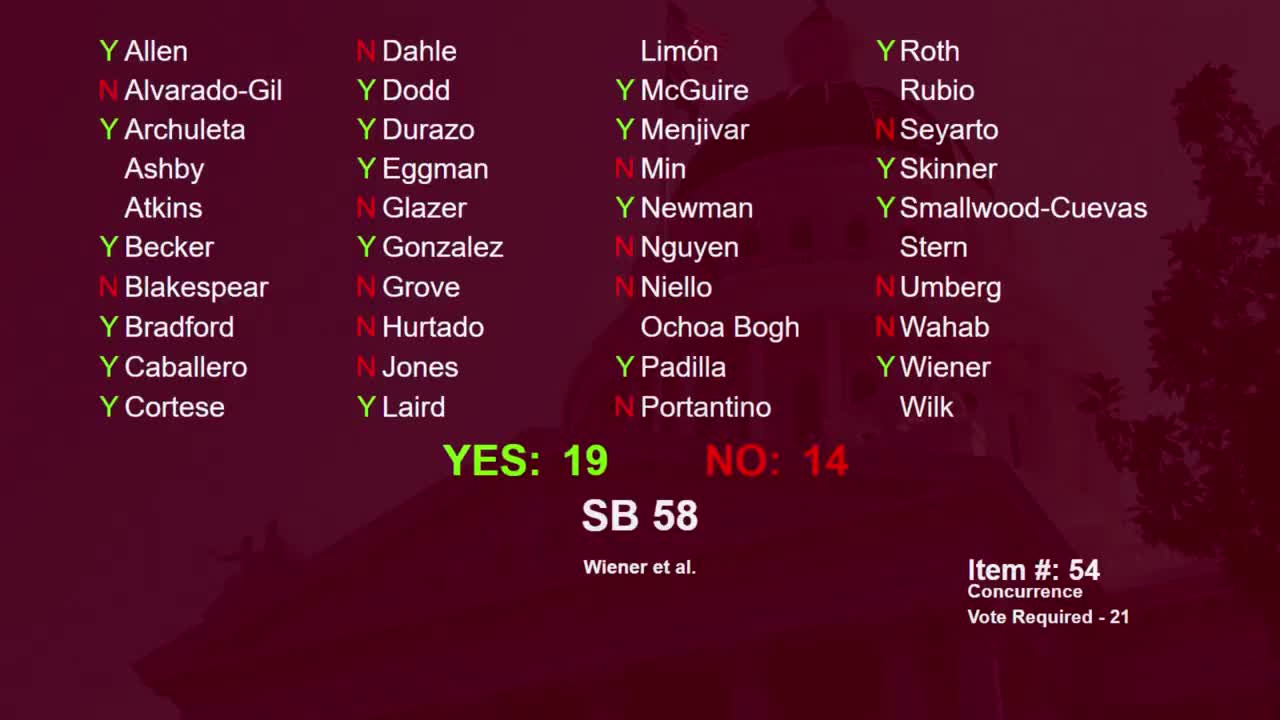 36SEC
Senate Floor
 3MIN
Assembly Floor
 8MIN
Assembly Standing Committee on Judiciary
 11MIN
Assembly Standing Committee on Labor and Employment
Bill Author