AB 1456: California Environmental Quality Act: California Vegetation Treatment Program.
- Session Year: 2025-2026
- House: Assembly
- Latest Version Date: 2025-07-18
Current Status:
In Progress
(2025-08-29: In committee: Held under submission.)
Introduced
In Committee
Awaiting First Chamber Vote
Passed First Chamber
In Committee
Awaiting Second Chamber Vote
Passed Second Chamber
Enacted
The California Environmental Quality Act (CEQA) requires a lead agency, as defined, to prepare, or cause to be prepared, and certify the completion of an environmental impact report (EIR) on a project that it proposes to carry out or approve that may have a significant effect on the environment or to adopt a negative declaration if it finds that the project will not have that effect. CEQA also requires a lead agency to prepare a mitigated negative declaration for a project that may have a significant effect on the environment if revisions in the project would avoid or mitigate that effect and there is no substantial evidence that the project, as revised, would have a significant effect on the environment.
CEQA authorizes the preparation and certification of an EIR for a program, plan, policy, or ordinance, commonly known as a program EIR, and requires a lead agency to examine later activities in the program in light of the program EIR to determine whether an additional environmental document is required to be prepared.
This bill would require, on or before January 1, 2027, the State Board of Forestry and Fire Protection to update the California Vegetation Treatment Program Final Program Environmental Impact Report (FPEIR) to, among other things, expand the area that is treatable landscape under the FPEIR to portions of the state suitable for vegetation treatment consistent with the FPEIR, regardless of fire suppression responsibility designation, and recognize cultural burning conducted pursuant to a specified law as a covered treatment activity. The bill would authorize a public agency to partner with a federally recognized California Native American tribe to conduct a project under the FPEIR in the agencys jurisdiction.
The California Environmental Quality Act (CEQA) requires a lead agency, as defined, to prepare, or cause to be prepared, and certify the completion of an environmental impact report (EIR) on a project that it proposes to carry out or approve that may have a significant effect on the environment or to adopt a negative declaration if it finds that the project will not have that effect. CEQA also requires a lead agency to prepare a mitigated negative declaration for a project that may have a significant effect on the environment if revisions in the project would avoid or mitigate that effect and there is no substantial evidence that the project, as revised, would have a significant effect on the environment.
This bill would exempt from CEQA a vegetation fuel management project, as defined, undertaken or funded by a public agency, or the adoption of an ordinance requiring the implementation of a vegetation fuel management project. The bill would require a lead agency that determines to carry out or approve an activity that is within the exemption to file a notice of exemption with the Office of Land Use and Climate Innovation, as specified.Because this bill would impose additional duties on local lead agencies to determine if the exemption applies and, if so, to file a notice of exemption, this bill would impose a state-mandated local program.The California Constitution requires the state to reimburse local agencies and school districts for certain costs mandated by the state. Statutory provisions establish procedures for making that reimbursement.This bill would provide that no reimbursement is required by this act for a specified reason.CEQA authorizes the preparation and certification of an EIR for a program, plan, policy, or ordinance, commonly known as a program EIR, and requires a lead agency to examine later activities in the program in light of the program EIR to determine whether an additional environmental document is required to be prepared.
This bill would require, on or before January 1, 2027, the State Board of Forestry and Fire Protection to update the California Vegetation Treatment Program Final Program Environmental Impact Report (FPEIR) to, among other things, expand the area that is treatable landscape under the FPEIR to portions of the state suitable for vegetation treatment consistent with the FPEIR, regardless of fire suppression responsibility designation, and recognize cultural burning conducted pursuant to a specified law as a covered treatment activity. The bill would authorize a public agency to partner with a federally recognized California Native American tribe to conduct a project under the FPEIR in the agencys jurisdiction.
The California Environmental Quality Act (CEQA) requires a lead agency, as defined, to prepare, or cause to be prepared, and certify the completion of an environmental impact report on a project that it proposes to carry out or approve that may have a significant effect on the environment or to adopt a negative declaration if it finds that the project will not have that effect. CEQA also requires a lead agency to prepare a mitigated negative declaration for a project that may have a significant effect on the environment if revisions in the project would avoid or mitigate that effect and there is no substantial evidence that the project, as revised, would have a significant effect on the environment.
This bill would exempt from CEQA a vegetation fuel management project, as defined, undertaken or funded by a public agency, or the adoption of an ordinance requiring the implementation of a vegetation fuel management project. The bill would require a lead agency that determines to carry out or approve an activity that is within the exemption to file a notice of exemption with the Office of Land Use and Climate Innovation, as specified.
Because this bill would impose additional duties on local lead agencies to determine if the exemption applies and, if so, to file a notice of exemption, this bill would impose a state-mandated local program.
The California Constitution requires the state to reimburse local agencies and school districts for certain costs mandated by the state. Statutory provisions establish procedures for making that reimbursement.
This bill would provide that no reimbursement is required by this act for a specified reason.
(a)For purposes of this section, FPEIR means the Final Program Environmental Impact Report. Report for the California Vegetation Treatment Program, certified by the State Board of Forestry and Fire Protection on December 30, 2019.
(b)On or before January 1, 2027, the State Board of Forestry and Fire Protection shall update the California Vegetation Treatment Program FPEIR, certified by the state board in December 2019, FPEIR in accordance with Section 21166. The update shall, at a minimum, do all of the following:
(1)Expand the area that is treatable landscape under the FPEIR to portions of the state suitable for vegetation treatment consistent with the FPEIR, including for the treatment types of ecological restoration, fuel breaks, and wildland-urban interface fuel reduction, regardless of fire suppression responsibility designation.
(2)Require a project under the FPEIR to incorporate in its project description the disposition of biomass generated by vegetation treatments, as necessary, including any commercial sale of biomass for the purpose of cost recovery.
(3)Include provisions that recognize the dual objectives of cultural and ecological restoration through vegetation management activities that integrate indigenous knowledge and tribal ecological knowledge, and recognize cultural burning conducted pursuant to Section 4505 as a covered treatment activity.
(4)Undertake any amendments necessary to implement the objectives stated in the Governors Proclamation of a State of Emergency, dated March 1, 2025.
(c)The FPEIR shall remain in full effect and may continue to serve as the basis for later project-specific environmental analyses to support vegetation treatment projects while the update pursuant to subdivision (b) is being prepared.
(c)(d)A public agency may partner with a federally recognized California Native American tribe to conduct a project under the FPEIR in the agencys jurisdiction.
(a)For purposes of this section, FPEIR means the Final Program Environmental Impact Report.
(b)On or before January 1, 2027, the State Board of Forestry and Fire Protection shall update the California Vegetation Treatment Program FPEIR, certified by the state board in December 2019, in accordance with Section 21166. The update shall, at a minimum, do all of the following:
(1)Expand the area that is treatable landscape under the FPEIR to portions of the state suitable for vegetation treatment consistent with the FPEIR, including for the treatment types of ecological restoration, fuel breaks, and wildland-urban interface fuel reduction, regardless of fire suppression responsibility designation.
(2)Require a project under the FPEIR to incorporate in its project description the disposition of biomass generated by vegetation treatments, as necessary, including any commercial sale of biomass for the purpose of cost recovery.
(3)Include provisions that recognize the dual objectives of cultural and ecological restoration through vegetation management activities that integrate indigenous knowledge and tribal ecological knowledge, and recognize cultural burning conducted pursuant to Section 4505 as a covered treatment activity.
(c)A public agency may partner with a federally recognized California Native American tribe to conduct a project under the FPEIR in the agencys jurisdiction.
SECTION 1.Section 21080.52 is added to the Public Resources Code, to read:21080.52.(a)For purposes of this section, vegetation fuel management project means a project that meets all of the following requirements:(1)The vegetation fuel management project occurs in a project area that meets both of the following:(A)The project is within five miles of a structure.(B)The project area is within a very high fire hazard severity zone, as determined by the Department of Forestry and Fire Protection pursuant to Section 51178 of the Government Code, or as designated by ordinance pursuant to Section 51179 of the Government Code.(2)The project contains a time restriction on the vegetation fuel management activity to protect species identified as candidate, sensitive, or species of special status by state or federal agencies, fully protected species, and species protected by the federal Endangered Species Act of 1973 (16 U.S.C. Sec. 1531 et seq.) and the California Endangered Species Act (Chapter 1.5 (commencing with Section 2050) of Division 3 of the Fish and Game Code).(3)The vegetation fuel management activity removes vegetation that meets all of the following requirements:(A)The vegetation is a nonnative species.(B)The vegetation is eight inches or less in diameter.(C)The vegetation meets one or more of the following requirements:(i)The vegetation is an invasive species.(ii)The vegetation is dead, poorly maintained, or drought stressed, as determined by the State Fire Marshal or the State Fire Marshals designee.(iii)The vegetation is a common species that meets one of the following requirements:(I)The vegetation is biologically prone to burning due to chemical composition, including, but not limited to, vegetation containing volatile oils.(II)The vegetation is difficult to maintain in a fire-resistant state, including, but not limited to, vegetation that accumulates dead woody material, dead leaves, or other hazardous dead growth.(III)The vegetation has a physical structure that presents challenges to routine maintenance, including, but not limited to, thorny or dense shrubs that accumulate dead material in locations where it is difficult to remove.(IV)The vegetation has a high surface area to volume ratio, including, but not limited to, vegetation with fine needles or lacey leaves.(V)The vegetation is prone to rapid changes in moisture content in response to environmental conditions, including, but not limited to, vegetation that loses moisture within hours when exposed to hot, dry weather.(b)Notwithstanding Section 4799.05, this division does not apply to either of the following:(1)A vegetation fuel management project undertaken or funded by a public agency.(2)The adoption of an ordinance requiring the implementation of a vegetation fuel management project.(c)If a lead agency determines that an activity is not subject to this division pursuant to subdivision (b) and determines to approve or carry out the activity, the lead agency shall file a notice of exemption with the Office of Land Use and Climate Innovation in the manner specified in subdivisions (b) and (c) of Section 21108 or subdivisions (b) and (c) of Section 21152.SEC. 2.No reimbursement is required by this act pursuant to Section 6 of Article XIIIB of the California Constitution because a local agency or school district has the authority to levy service charges, fees, or assessments sufficient to pay for the program or level of service mandated by this act, within the meaning of Section 17556 of the Government Code.(a)For purposes of this section, vegetation fuel management project means a project that meets all of the following requirements:
(1)The vegetation fuel management project occurs in a project area that meets both of the following:
(A)The project is within five miles of a structure.
(B)The project area is within a very high fire hazard severity zone, as determined by the Department of Forestry and Fire Protection pursuant to Section 51178 of the Government Code, or as designated by ordinance pursuant to Section 51179 of the Government Code.
(2)The project contains a time restriction on the vegetation fuel management activity to protect species identified as candidate, sensitive, or species of special status by state or federal agencies, fully protected species, and species protected by the federal Endangered Species Act of 1973 (16 U.S.C. Sec. 1531 et seq.) and the California Endangered Species Act (Chapter 1.5 (commencing with Section 2050) of Division 3 of the Fish and Game Code).
(3)The vegetation fuel management activity removes vegetation that meets all of the following requirements:
(A)The vegetation is a nonnative species.
(B)The vegetation is eight inches or less in diameter.
(C)The vegetation meets one or more of the following requirements:
(i)The vegetation is an invasive species.
(ii)The vegetation is dead, poorly maintained, or drought stressed, as determined by the State Fire Marshal or the State Fire Marshals designee.
(iii)The vegetation is a common species that meets one of the following requirements:
(I)The vegetation is biologically prone to burning due to chemical composition, including, but not limited to, vegetation containing volatile oils.
(II)The vegetation is difficult to maintain in a fire-resistant state, including, but not limited to, vegetation that accumulates dead woody material, dead leaves, or other hazardous dead growth.
(III)The vegetation has a physical structure that presents challenges to routine maintenance, including, but not limited to, thorny or dense shrubs that accumulate dead material in locations where it is difficult to remove.
(IV)The vegetation has a high surface area to volume ratio, including, but not limited to, vegetation with fine needles or lacey leaves.
(V)The vegetation is prone to rapid changes in moisture content in response to environmental conditions, including, but not limited to, vegetation that loses moisture within hours when exposed to hot, dry weather.
(b)Notwithstanding Section 4799.05, this division does not apply to either of the following:
(1)A vegetation fuel management project undertaken or funded by a public agency.
(2)The adoption of an ordinance requiring the implementation of a vegetation fuel management project.
(c)If a lead agency determines that an activity is not subject to this division pursuant to subdivision (b) and determines to approve or carry out the activity, the lead agency shall file a notice of exemption with the Office of Land Use and Climate Innovation in the manner specified in subdivisions (b) and (c) of Section 21108 or subdivisions (b) and (c) of Section 21152.
SEC. 2.No reimbursement is required by this act pursuant to Section 6 of Article XIIIB of the California Constitution because a local agency or school district has the authority to levy service charges, fees, or assessments sufficient to pay for the program or level of service mandated by this act, within the meaning of Section 17556 of the Government Code.
|
Date
|
Status
|
|---|---|
| Aug 29, 2025 | In committee: Held under submission. |
| Aug 18, 2025 | In committee: Referred to suspense file. |
| Jul 18, 2025 | Read second time and amended. Re-referred to Com. on APPR. |
| Jul 18, 2025 | From committee: Amend, and do pass as amended and re-refer to Com. on APPR. (Ayes 7. Noes 0.) (July 16). |
| Jul 2, 2025 | From committee: Do pass and re-refer to Com. on N.R. & W. (Ayes 8. Noes 0.) (July 2). Re-referred to Com. on N.R. & W. |
| Jun 18, 2025 | Referred to Coms. on E.Q. and N.R. & W. |
| Jun 4, 2025 | In Senate. Read first time. To Com. on RLS. for assignment. |
| Jun 3, 2025 | Read third time. Passed. Ordered to the Senate. (Ayes 79. Noes 0. Page 1997.) |
| May 27, 2025 | Read second time. Ordered to third reading. |
| May 23, 2025 | From committee: Do pass. (Ayes 14. Noes 0.) (May 23). |
| May 14, 2025 | In committee: Set, first hearing. Referred to APPR. suspense file. |
| Apr 29, 2025 | From committee: Do pass and re-refer to Com. on APPR. with recommendation: To Consent Calendar. (Ayes 14. Noes 0.) (April 28). Re-referred to Com. on APPR. |
| Apr 21, 2025 | Re-referred to Com. on NAT. RES. |
| Apr 10, 2025 | From committee chair, with author's amendments: Amend, and re-refer to Com. on NAT. RES. Read second time and amended. |
| Mar 13, 2025 | Referred to Com. on NAT. RES. |
| Feb 24, 2025 | Read first time. |
| Feb 22, 2025 | From printer. May be heard in committee March 24. |
| Feb 21, 2025 | Introduced. To print. |
|
Date
|
Description
|
Location
|
Votes
|
|
|---|---|---|---|---|
| Aug 18, 2025 | Placed on suspense file | Senate Standing Committee on Appropriations |
Passed |
|
| Jul 16, 2025 | Do pass as amended, but first amend, and re-refer to the Committee on [Appropriations] | Senate Standing Committee on Natural Resources and Water |
Passed |
|
| Jul 2, 2025 | Do pass, but first be re-referred to the Committee on [Natural Resources and Water] | Senate Standing Committee on Environmental Quality |
Passed |
|
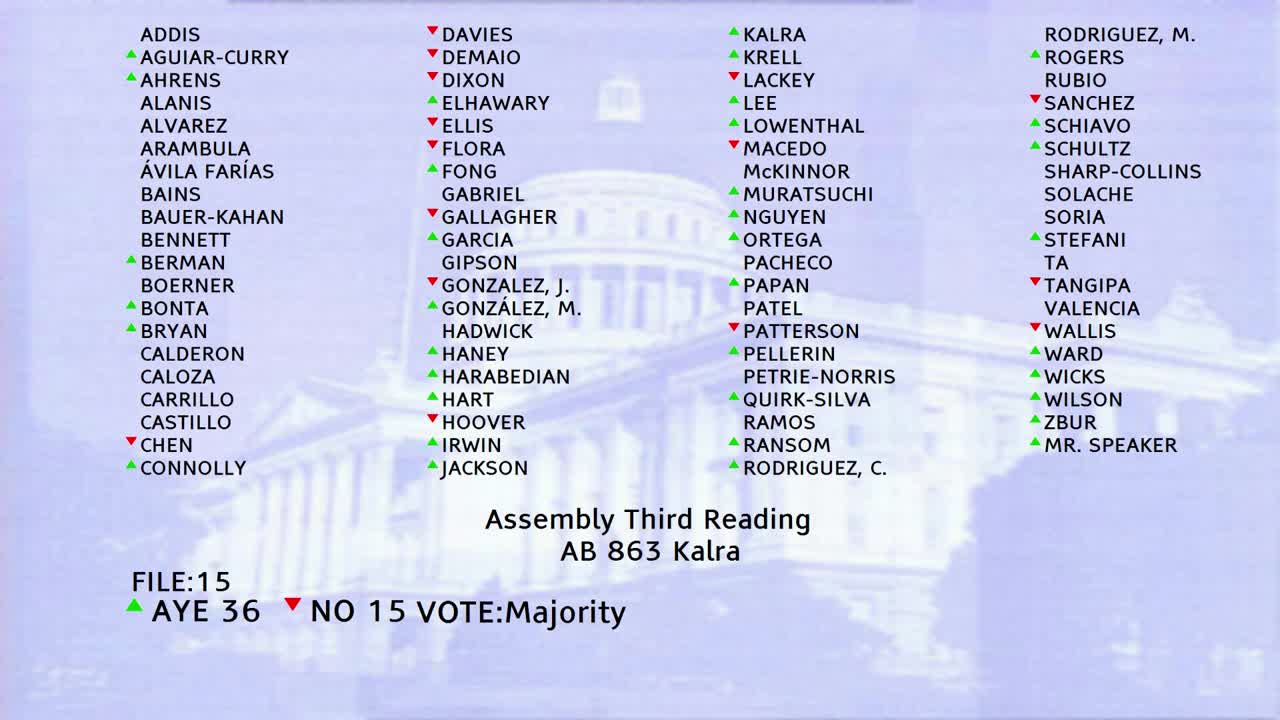
| Jun 3, 2025 | AB 1456 Bryan Assembly Third Reading | Assembly Floor |
Passed |
|
| May 23, 2025 | Do pass. | Assembly Standing Committee on Appropriations |
Passed |
|
| Apr 28, 2025 | Do pass and be re-referred to the Committee on [Appropriations] with recommendation: To Consent Calendar | Assembly Standing Committee on Natural Resources |
Passed |
This list shows positions taken on this bill by organizations on the date displayed, which is linked to the original source.
Positions by individuals are not included.
|
Organization
|
Position
|
Date
|
|---|---|---|
| AMERICAN SOCIETY OF CIVIL ENGINEERS-REGION 9 | ** Support | |
| Auten Resource Consulting | ** Support | |
| California Forestry Association | ** Support | |
| California Licensed Foresters Association | ** Support | |
| City of Lafayette | ** Support | |
| City Of Laguna Beach | ** Support | |
| City Of Tustin | ** Support | |
| Rural County Representatives of California | ** Support | |
| San Luis Opispo County Fire Safe Council | ** Support | |
| US Green Building Council, California | ** Support |
SENATE COMMITTEE ON
Senator Anna Caballero, Chair
2025 - 2026 Regular Session
AB 1456 (Bryan) - California Environmental Quality Act: California Vegetation Treatment Program
Version: | Policy Vote: |
Urgency: | Mandate: |
Hearing Date: | Consultant: |
Bill Summary:
This bill would require the State Board of Forestry and Fire Protection to update the Final Program Environmental Impact Report (FPEIR) for the California Vegetation Treatment Program by January 1, 2027.
Fiscal Impact:
- The Department of Forestry and Fire Protection (CalFire) estimates ongoing costs of about $582,000 in year one, $746,000 in year two, and $661,000 annually thereafter (Timber Regulation and Forest Restoration Fund [TRFRF]) to address the additional workload resulting from the implementation of this bill.
Background:
State Board of Forestry and Fire Protection (Board). In 1885, the Governor of California approved an act that authorized the appointment of a three-man State Board of Forestry, the first such body in the nation. That original Board was abolished in 1893. In 1905, an “Act of March 18, 1905,” became law, creating a new Board of Forestry and the first State Forester.
The Board consists of nine members appointed by the Governor and approved by the Senate. There are five public members, three members from the forest products industry, and one member from the range livestock industry. The Governor designates the chair of the Board, who continues to serve in that capacity at the pleasure of the Governor, and the vice chair is elected by the members. The members serve four-year terms.
The Board is responsible for developing the general forest policy of the state, determining the guidance policies of the Department of Forestry and Fire Protection (Department), and representing the state's interest in federal forestland in California. Together, the Board and the Department work to carry out their mandate to protect and enhance the state's unique forest and wildland resources.
State Responsibility Area (SRA). The SRA is the areas of the state where the state has the financial responsibility for preventing and suppressing wildfires (Public Resources Code (PRC) § 4102). The Board is required to classify all lands within the state to determine the SRA (PRC § 4125). Lands in the SRA include:
- Lands covered wholly or in part by forests or by trees producing or capable of producing forest products.
- Lands covered wholly or in part by timber, brush, undergrowth, or grass, whether of commercial value or not, which protect the soil from excessive erosion, retard runoff of water or accelerate water percolation, if such lands are sources of water which is available for irrigation or for domestic or industrial use.
- Lands in areas which are principally used or useful for range or forage purposes, which are contiguous to the lands described above (PRC § 4126).
Lands which are not in SRA are in local or federal responsibility areas (LRA and FRA), as applicable.
California Vegetation Treatment Program (CalVTP). The CalVTP, developed by the Board and approved on December 30, 2019, is a critical component of the state’s multi-faceted strategy to address California’s wildfire crisis. The CalVTP includes the use of prescribed burning, mechanical treatments, manual treatments, herbicide application, and prescribed herbivory as tools to reduce hazardous vegetation around communities in the Wildland-Urban Interface (WUI), to construct fuel breaks (shaded or non-shaded), and to promote ecological restoration. The CalVTP FPEIR provides a powerful California Environmental Quality Act (CEQA) compliance tool to expedite the implementation of wildfire resilience projects.
Project proponents can use the CalVTP to comply with CEQA for vegetation treatments consistent with the CalVTP FPEIR. A project proponent is any local or state agency providing funding or having land ownership and/or management or other regulatory responsibility in the treatable landscape. This includes the Department, Counties, Cities, Water Agencies, Special Districts, Open Space Districts, State Parks, California Department of Fish and Wildlife (CDFW), Universities, Conservancies, and many other state and local public agencies.
According to the Governor, 106 projects have been approved to date under CalVTP.
CalVTP Treatable Landscape. Geographic area is one of the factors identified in CEQA Guidelines that agencies may consider when determining whether a project is within the scope of a PEIR. The geographic area analyzed in the CalVTP FPEIR is the treatable landscape. The treatable landscape consists of land primarily within the SRA and some areas of the LRA, and some FRA. Therefore, areas of a treatment project outside the treatable landscape are not within the scope of the CalVTP FPEIR.
January 2025 Los Angeles Wildfires. The new year started ominously in southern California, when during its first week a strong high-pressure system over the Great Basin triggered powerful Santa Ana winds. The Los Angeles area hadn’t seen any measurable rainfall for eight months and was in a state of moderate drought. On January 6, the National Weather Service issued a red flag warning predicting hurricane strength winds.
Around 10:30 the next morning, dispatch officers began receiving reports of a fast-moving fire in the mountains near Pacific Palisades. Eventually the Palisades Fire became the most destructive fire in City of Los Angeles history – 12 people were killed, 23,448 acres burned, and according to the Department’s damage assessment report, 6,833 structures were damaged or destroyed.
Later in the evening on the 7th, a fire began in the San Gabriel Mountains and Santa Ana winds pushed the flames into the foothill communities of Altadena, Pasadena, and Sierra Madre. The Eaton Fire burned 14,021 acres and damaged or destroyed 10,488 structures. 18 people, all from the predominantly Black neighborhood in west Altadena, were killed. The fire became the fifth most deadly and second most destructive in California history.
Administration’s response. Governor Newsom, in response to the Los Angeles wildfires, issued a number of executive orders and proclamations to aid recovery, protect victims, fast-track wildfire safety regulations, and facilitate wildfire prevention projects.
Notably, the State of Emergency Proclamation on March 1, 2025 (Proclamation) suspended state statutes, rules, regulations, and requirements under the jurisdiction of California Natural Resources Agency (CNRA) and Environmental Protection Agency (EPA) boards, departments, and offices in order expedite critical fuel reduction projects, specifically including CEQA and the California Coastal Act. Individuals or entities who wish to conduct fuel reduction projects under this Proclamation must first seek a determination from the CNRA and/or EPA Secretaries that the proposed activity is eligible for this suspension. These projects must be initiated before the end of calendar year 2025.
In that emergency proclamation, the Governor acknowledged that even with the success of CalVTP, more is needed to expedite critical fuels reduction projects in more areas of the state, including those not yet covered by CalVTP, to protect the lives and property of Californians. The proclamation directs the Board to take immediate steps to update the CalVTP FPEIR, in consultation with CNRA and others as appropriate, to increase CalVTP’s efficiency and utilization, in order to continue promoting rapid environmental review for large wildfire risk reduction treatments.
Proposed Law:
This bill would:
- Require the Board to update the CalVTP by January 1, 2027.
- Require the update to expand the treatable landscape.
- Require a project under the FPEIR to incorporate the disposition of biomass in the project description.
- Require the update to include cultural burning.
- Undertake any amendments necessary to implement the objectives stated in the Governor’s Proclamation of a State of Emergency, dated March 1, 2025.
- Provide that the FPEIR shall remain in full effect and may continue to serve as the basis for later project-specific environmental analyses to support vegetation treatment projects while the update pursuant to subdivision (b) is being prepared.
- Authorize a public agency to enter into an agreement with a federally recognized California Native American tribe to conduct a project under the FPEIR.
Related Legislation:
AB 1227 (Ellis, 2025) would exempt specified fuels reduction projects from the CEQA until January 1, 2028, and requires the California Natural Resources Agency (CNRA) and the California Environmental Protection Agency (CalEPA) to report to the Legislature on the implementation of a recent emergency proclamation by the Governor intended to expedite fuels reduction projects.
AB 66 (Patterson, 2025) would exempt from CEQA egress route projects in subdivisions reviewed by the Board of Forestry (BOF) where the BOF recommends creation of secondary access to the subdivision.
SB 632 (Galgiani Chapter 411, Statutes of 2019) requires the State Board of Forestry and Fire Protection, as soon as practicably feasible, but no later February 1, 2020, to complete its environmental review under CEQA and certify a specific final PEIR for a vegetation treatment program.
-- END --
SENATE COMMITTEE ON NATURAL RESOURCES AND WATER
Senator Monique Limón, Chair
2025 - 2026 Regular
Bill No: AB Hearing Date: July 16, 2025
Author: | |||
Version: | Amended | ||
Urgency: | Fiscal: | ||
Consultant: | |||
Subject: California Environmental Quality Act: California Vegetation Treatment Program
SUMMARY
This bill would require the State Board of Forestry and Fire Protection to update the Final Program Environmental Impact Report (FPEIR) for the California Vegetation Treatment Program by January 1, 2027. This bill also specifies that a public agency may partner with a federally recognized California Native American tribe to conduct a project under the FPEIR.
BACKGROUND AND EXISTING LAW
State Board of Forestry and Fire Protection (Board). In 1885, the Governor of California approved an act that authorized the appointment of a three-man State Board of Forestry, the first such body in the nation. That original Board was abolished in 1893. In 1905, an “Act of March 18, 1905,” became law, creating a new Board of Forestry and the first State Forester.
The Board consists of nine members appointed by the Governor and approved by the Senate. There are five public members, three members from the forest products industry, and one member from the range livestock industry. The Governor designates the chair of the Board, who continues to serve in that capacity at the pleasure of the Governor, and the vice chair is elected by the members. The members serve four-year terms.
The Board is responsible for developing the general forest policy of the state, determining the guidance policies of the Department of Forestry and Fire Protection (Department), and representing the state's interest in federal forestland in California. Together, the Board and the Department work to carry out their mandate to protect and enhance the state's unique forest and wildland resources.
State Responsibility Area (SRA). The SRA is the areas of the state where the state has the financial responsibility for preventing and suppressing wildfires (Public Resources Code (PRC) § 4102). The Board is required to classify all lands within the state to determine the SRA (PRC § 4125). Lands in the SRA include:
- Lands covered wholly or in part by forests or by trees producing or capable of producing forest products.
- Lands covered wholly or in part by timber, brush, undergrowth, or grass, whether of commercial value or not, which protect the soil from excessive erosion, retard runoff of water or accelerate water percolation, if such lands are sources of water which is available for irrigation or for domestic or industrial use.
- Lands in areas which are principally used or useful for range or forage purposes, which are contiguous to the lands described above (PRC § 4126).
Lands which are not in SRA are in local or federal responsibility areas (LRA and FRA), as applicable.
California Vegetation Treatment Program (CalVTP). The CalVTP, developed by the Board and approved on December 30, 2019, is a critical component of the state’s multi-faceted strategy to address California’s wildfire crisis. The CalVTP includes the use of prescribed burning, mechanical treatments, manual treatments, herbicide application, and prescribed herbivory as tools to reduce hazardous vegetation around communities in the Wildland-Urban Interface (WUI), to construct fuel breaks (shaded or non-shaded), and to promote ecological restoration. The CalVTP FPEIR provides a powerful California Environmental Quality Act (CEQA) compliance tool to expedite the implementation of wildfire resilience projects.
Project proponents can use the CalVTP to comply with CEQA for vegetation treatments consistent with the CalVTP FPEIR. A project proponent is any local or state agency providing funding or having land ownership and/or management or other regulatory responsibility in the treatable landscape. This includes the Department, Counties, Cities, Water Agencies, Special Districts, Open Space Districts, State Parks, California Department of Fish and Wildlife (CDFW), Universities, Conservancies, and many other state and local public agencies.
According to the Governor, 106 projects have been approved to date under CalVTP.
CalVTP Treatable Landscape. Geographic area is one of the factors identified in CEQA Guidelines that agencies may consider when determining whether a project is within the scope of a PEIR. The geographic area analyzed in the CalVTP FPEIR is the treatable landscape. The treatable landscape consists of land primarily within the SRA and some areas of the LRA, and some FRA. Therefore, areas of a treatment project outside the treatable landscape are not within the scope of the CalVTP FPEIR.
January 2025 Los Angeles Wildfires. The new year started ominously in southern California, when during its first week a strong high-pressure system over the Great Basin triggered powerful Santa Ana winds. The Los Angeles area hadn’t seen any measurable rainfall for eight months and was in a state of moderate drought. On January 6, the National Weather Service issued a red flag warning predicting hurricane strength winds.
Around 10:30 the next morning, dispatch officers began receiving reports of a fast-moving fire in the mountains near Pacific Palisades. Eventually the Palisades Fire became the most destructive fire in City of Los Angeles history – 12 people were killed, 23,448 acres burned, and according to the Department’s damage assessment report, 6,833 structures were damaged or destroyed.
Later in the evening on the 7th, a fire began in the San Gabriel Mountains and Santa Ana winds pushed the flames into the foothill communities of Altadena, Pasadena, and Sierra Madre. The Eaton Fire burned 14,021 acres and damaged or destroyed 10,488 structures. 18 people, all from the predominantly Black neighborhood in west Altadena, were killed. The fire became the fifth most deadly and second most destructive in California history.
Administration’s response. Governor Newsom, in response to the Los Angeles wildfires, issued a number of executive orders and proclamations to aid recovery, protect victims, fast-track wildfire safety regulations, and facilitate wildfire prevention projects.
Notably, the State of Emergency Proclamation on March 1, 2025 (Proclamation) suspended state statutes, rules, regulations, and requirements under the jurisdiction of California Natural Resources Agency (CNRA) and Environmental Protection Agency (EPA) boards, departments, and offices in order expedite critical fuel reduction projects, specifically including CEQA and the California Coastal Act. Individuals or entities who wish to conduct fuel reduction projects under this Proclamation must first seek a determination from the CNRA and/or EPA Secretaries that the proposed activity is eligible for this suspension. These projects must be initiated before the end of calendar year 2025.
In that emergency proclamation, the Governor acknowledged that even with the success of CalVTP, more is needed to expedite critical fuels reduction projects in more areas of the state, including those not yet covered by CalVTP, to protect the lives and property of Californians. The proclamation directs the Board to take immediate steps to update the CalVTP FPEIR, in consultation with CNRA and others as appropriate, to increase CalVTP’s efficiency and utilization, in order to continue promoting rapid environmental review for large wildfire risk reduction treatments.
Existing law:
- Pursuant to CEQA (Public Resources Code (PRC) §§ 21000 et seq.):
- Authorizes the preparation and certification of an environmental impact report (EIR) for a program, plan, policy, or ordinance, commonly known as a “program EIR” or PEIR, and requires a lead agency to examine later activities in the program in light of the PEIR to determine whether an additional environmental document is required to be prepared.
- Provides that when an EIR has been prepared for a project, no subsequent or supplemental EIR is to be required by the lead agency or by any responsible agency, unless one or more of the following events occurs:
- Substantial changes are proposed in the project that will require major revisions of the EIR;
- Substantial changes occur with respect to the circumstances under which the project is being undertaken which will require major revisions in the EIR; and/or,
- New information, which was not known and could not have been known at the time the EIR was certified as complete, becomes available. (PRC § 21166)
- Defines, under the CEQA Guidelines, a PEIR as an EIR which may be prepared on a series of actions that can be characterized as one large project and are related either geographically, as logical parts in the chain of contemplated actions, in connection with issuance of rules, regulations, plans, or other general criteria to govern the conduct of a continuing program, or as individual activities carried out under the same authorizing statutory or regulatory authority and having generally similar environmental effects which can be mitigated in similar ways. (Title 14 California Code of Regulations § 15168)
- Requires, to the extent feasible, the FPEIR to serve, in addition to any identified entities in the report, as a programmatic environmental document for prescribed fires initiated by a third party for a public purpose.
- Provides that this does not apply to a prescribed fire activity that is exempt from CEQA.
- Provides that vegetation treatments in chaparral or sage scrub shall only occur if the Department finds the activity will not cause type conversion. (PRC § 4483)
PROPOSED LAW
This bill would:
- Require the Board to update the CalVTP by January 1, 2027.
- Require the update to expand the treatable landscape.
- Require a project under the FPEIR to incorporate the disposition of biomass in the project description.
- Require the update to include cultural burning.
- Authorize a public agency to enter into an agreement with a federally recognized California Native American tribe to conduct a project under the FPEIR.
ARGUMENTS IN SUPPORT
According to the author, “The California Vegetation Treatment Program was developed and approved by the Board of Forestry in 2019 to streamline CEQA for greatly-needed vegetation management projects across the state to reduce our wildfire risk. To facilitate getting more vegetation management done, and consistent with the Governor’s executive order, this bill requires the Board to expand the program to more area covered under the Programmatic Environmental Impact Report. The bill also integrates indigenous knowledge and tribal ecological knowledge by including provisions that recognize the dual objectives of cultural and ecological restoration through vegetation management activities.”
Writing in support, the San Luis Obispo Fire Safe Council says, “As I write this letter the Madre fire is a 35,000 acre wildfire burning in our county that started yesterday afternoon and spread at the rate of over 3,000 acres an hour (5 square miles per hour).
These fires are only stoppable when they burn into areas that have been treated to reduce fuel loading. AB 1456 will help in that effort.”
Rural County Representatives of California (RCRC) writes, “AB 1456 seeks to improve the VTP EIR by expanding it to include ecological restoration, fuel breaks, and fuel reduction projects in both state and local responsibility areas. The bill also requires projects to describe how resulting biomass will be handled and integrate tribal knowledge and cultural burning. Together, these changes will expand the utility of the VTP EIR and help local agencies reduce fire risk in a more timely manner.”
ARGUMENTS IN OPPOSITION
Writing in an “oppose unless amended” position, the Center for Biological Diversity states “The Center objects to AB 1456 because it will substantially expand the area subject to the California Vegetation Treatment Program without detailed environmental review, and may, as written, enhance the destruction of California forest lands for commercial use but without any fire suppression or environmental benefits or analysis.[…]”
“Particularly when the environmentally damaging commercial use of forest biomass is on the table, there should be more environmental review of local projects, not less. We suggest that the bill be amended to require a full EIR for any substantial addition to the program area, and to any proposed sale of forest biomass. [emphasis in original]. […]”
“We agree with the bill’s provision that a project under the FPEIR must “incorporate in its project description the disposition of biomass generated by vegetation treatments.” But the following clause, “including any commercial sale of biomass for the purpose of cost recovery,” is a dangerous suggestion that the door is open for forest biomass sales for the production of electricity and for other commercial purposes. And merely incorporating a feature into the project description does not ensure that it will be analyzed, especially given CalFire’s encouragement to project proponents to use a non-public project-specific analysis to avoid application of CEQA.”
COMMENTS
Specific guidance to the Board. This bill provides more specific guidance to the Board regarding how to best implement the Governor’s Proclamation. The Proclamation states:
The Board of Forestry and Fire Protection shall take immediate steps to update the [CalVTP FPEIR], in consultation with [CNRA] and others as appropriate, to increase CalVTP’s efficiency and utilization, in order to continue promoting rapid environmental review for large wildfire risk reduction treatments. In addition to accessing expertise from all appropriate state agencies, this process should also include public workshops with practitioners to solicit feedback on experiences during implementation in the first five years of the CalVTP and suggested improvements.
This bill specifies some of the changes the Board must make to the FPEIR, and places a statutory deadline on the Board for completing those updates.
The Committee may wish to amend this subdivision to authorize the Board to make other changes to the FPEIR to address the Proclamation for elements not otherwise specified in statute, as necessary. [See AMENDMENT #1, proposed (b)(4)]
Specify enduring applicability of the FPEIR. The Committee may wish to amend the bill to specify that the existing FPEIR remains in effect while updates are being undertaken. This will provide certainty to project proponents wishing to use the CalVTP FPEIR that it will still be available for projects. [See AMENDMENT #1, proposed (d)]
Type conversion. Since the Board certified the CalVTP FPEIR in late 2019, it has been under litigation from environmental organizations concerned about the FPEIR’s impacts to type conversion. On May 30, 2025, the Appellate Court reversed the Superior Court’s decision upholding the FPEIR’s type conversion analysis. There are currently ongoing conversations between the plaintiffs, State Board, and other stakeholders to develop a consensus solution regarding how to best address type conversion in the FPEIR.
The author may wish to amend this bill in the future, if necessary, to address any agreement or consensus reached on the issue of type conversion in the FPEIR.
SUGGESTED AMENDMENTS
AMENDMENT 1
Section 21088.1 is added to the Public Resources Code, to read:
21088.1. (a) For purposes of this section, “FPEIR” means the Final Program Environmental Impact Report. Report for the California Vegetation Treatment Program, certified by the State Board of Forestry and Fire Protection (state board) on December 30, 2019.
(b) On or before January 1, 2027, the State Board of Forestry and Fire Protection state board shall update the California Vegetation Treatment Program FPEIR, certified by the state board in December 2019, FPEIR in accordance with Section 21166. The update shall, at a minimum, do all of the following:
(1) Expand the area that is treatable landscape under the FPEIR to portions of the state suitable for vegetation treatment consistent with the FPEIR, including for the treatment types of ecological restoration, fuel breaks, and wildland-urban interface fuel reduction, regardless of fire suppression responsibility designation.
(2) Require a project under the FPEIR to incorporate in its project description the disposition of biomass generated by vegetation treatments, as necessary, including any commercial sale of biomass for the purpose of cost recovery.
(3) Include provisions that recognize the dual objectives of cultural and ecological restoration through vegetation management activities that integrate indigenous knowledge and tribal ecological knowledge, and recognize cultural burning conducted pursuant to Section 4505 as a covered treatment activity.
(4) Undertake any amendments necessary to implement the objectives stated in the Governor’s Proclamation of a State of Emergency, dated March 1, 2025.
(d) The FPEIR shall remain in full effect and may continue to serve as the basis for later project-specific environmental analyses to support vegetation treatment projects while the update pursuant to subdivision (c) is being prepared.
(e) A public agency may partner with a federally recognized California Native American tribe to conduct a project under the FPEIR in the agency’s jurisdiction.
SUPPORT
American Society of Civil Engineers-Region 9
Auten Resource Consulting
California Forestry Association
California Licensed Foresters Association
Rural County Representatives of California (RCRC)
San Luis Obispo County Fire Safe Council
OPPOSITION
Center for Biological Diversity (unless amended)
-- END --
ASSEMBLY THIRD READING
ATR Bill Id:AB 1456
Author:(Bryan)
As Amended Ver:April 10, 2025
Majority vote
SUMMARY
Requires, on or before January 1, 2027, the State Board of Forestry and Fire Protection (Board) to expand the treatable landscape under the California Vegetation Treatment Program (CalVTP).
Major Provisions
- Defines "FPEIR" as the Final Program Environmental Impact Report.
- Requires, on or before January 1, 2027, the Board to update the CalVTP FPEIR, certified by the Board in December 2019, in accordance with PRC 21166. Requires the update, at a minimum, to do all of the following:
- Expand the area that is treatable landscape under the FPEIR to portions of the state suitable for vegetation treatment consistent with the FPEIR, including for the treatment types of ecological restoration, fuel breaks, and wildland-urban interface (WUI) fuel reduction, regardless of fire suppression responsibility designation;
- Require a project under the FPEIR to incorporate in its project description the disposition of biomass generated by vegetation treatments, as necessary, including any commercial sale of biomass for the purpose of cost recovery; and,
- Include provisions that recognize the dual objectives of cultural and ecological restoration through vegetation management activities that integrate indigenous knowledge and tribal ecological knowledge, and recognize cultural burning conducted as a covered treatment activity.
- Authorizes a public agency to partner with a federally recognized California Native American tribe to conduct a project under the FPEIR in the agency's jurisdiction.
COMMENTS
CalVTP was developed and approved by the Board on December 30, 2019, and includes the use of prescribed burning, mechanical treatments, manual treatments, herbicides, and prescribed herbivory as tools to reduce hazardous vegetation around communities in the WUI, to construct fuel breaks, and to restore healthy ecological fire regimes.
The Board certified a VTP FPEIR prepared pursuant to CEQA. The FPEIR can be used by a long list of specified public agencies, of which there are more than 200 with land ownership or land management responsibilities in the treatable landscape. The FPEIR provides a helpful tool to expedite the implementation of vegetation treatments. The FPEIR is intended to provide broad CEQA coverage for individual projects consistent with the analysis and mitigation strategies set forth in the document. The geographic area analyzed in the CalVTP PEIR is the treatable landscape; areas of a treatment project outside the treatable landscape are not within the scope of the CalVTP PEIR.
Although this program has made progress towards the governor's yearly goal of 250,000 treatment acres, the contribution is small and CalVTP has not yet reached its fullest potential for aiding the statewide mandate for increased forest fuel treatments.
After the LA fires, the Governor issued an emergency proclamation acknowledging that even with the success of CalVTP, more is needed to expedite critical fuels reduction projects in more areas of the state, including those not yet covered by CalVTP, to protect the lives and property of Californians. The proclamation directs the Board to take immediate steps to update the CalVTP FPEIR, in consultation with NRA and others as appropriate, to increase CalVTP's efficiency and utilization, in order to continue promoting rapid environmental review for large wildfire risk reduction treatments.
In step with the governor's direction, AB 1456 requires the Board, by January 1, 2027, to update the CalVTP FPEIR to expand the area that is treatable landscape to portions of the state suitable for vegetation treatment. To further improve the program, the bill also requires a project to incorporate in its project description the disposition of biomass generated by vegetation treatments, and requires the Board to recognize the dual objectives of cultural and ecological restoration through vegetation management activities that integrate indigenous knowledge and tribal ecological knowledge, and recognize cultural burning conducted as a covered treatment activity.
According to the Author
Arguments in Support
The California Association of Forests writes, "Consistent with the Governor's direction, this legislation directs the Board of Forestry to expand the scope of the treatable landscape irrespective of fire suppression responsibility designation. Doing so will ensure that projects located outside of the SRA benefit from the same streamlined process that has been used to expedite these critical projects on lands located within the SRA."
Arguments in Opposition
The Center for Biological Diversity objects to AB 1456 because it will substantially expand the area subject to the California Vegetation Treatment Program without detailed environmental review, and may, as written, enhance the destruction of California forest lands for commercial use but without any fire suppression or environmental benefits or analysis.
FISCAL COMMENTS
According to the Assembly Appropriations Committee, this bill will result in one-time or ongoing costs of an unknown amount, likely in excess of $150,000, for the Board to update the CalVTP FEIR (General Fund or special fund). State agencies are in the early stages of implementing the Governor's directive, and the scope of the administration’s update to the CalVTP FEIR – and the extent to which the requirements of this bill overlap with or deviate from the administration's plan – are not known at this time.
VOTES
ASM NATURAL RESOURCES: 14-0-0
YES: Bryan, Alanis, Connolly, Ellis, Flora, Garcia, Haney, Hoover, Kalra, Muratsuchi, Pellerin, Schultz, Wicks, Zbur
ASM APPROPRIATIONS: 14-0-1
YES: Wicks, Arambula, Calderon, Caloza, Dixon, Elhawary, Fong, Mark González, Hart, Pacheco, Pellerin, Solache, Ta, Tangipa
ABS, ABST OR NV: Sanchez
UPDATED
VERSION: April 10, 2025
CONSULTANT: Paige Brokaw / NAT. RES. / (916) 319-2092 FN: 0000513
Date of Hearing: May 14, 2025
ASSEMBLY COMMITTEE ON APPROPRIATIONS
Buffy Wicks, Chair
ABPCA Bill Id:AB 1456
Author:(Bryan) – As Amended Ver:April 10, 2025
Policy Committee: | Natural Resources | Vote: | 14 - 0 |
|
| ||
|
|
Urgency: No State Mandated Local Program: No Reimbursable: No
SUMMARY:
This bill requires the State Board of Forestry and Fire Protection (BOF) to expand the treatable landscape under the California Vegetation Treatment Program (CalVTP).
Specifically, this bill:
- Requires BOF, by January 1, 2027, to update the CalVTP Final Environmental Impact Report (FPEIR), as specified. Requires the update, at a minimum, to do all of the following:
- Expand the area that is treatable landscape under the FPEIR to portions of the state suitable for vegetation treatment consistent with the FPEIR, including for the treatment types of ecological restoration, fuel breaks, and wildland-urban interface (WUI) fuel reduction, regardless of fire suppression responsibility designation.
- Require a project under the FPEIR to incorporate in its project description the disposition of biomass generated by vegetation treatments, as necessary, including any commercial sale of biomass for the purpose of cost recovery.
- Include provisions that recognize the dual objectives of cultural and ecological restoration through vegetation management activities that integrate indigenous knowledge and tribal ecological knowledge, and recognize cultural burning conducted as a covered treatment activity.
- Authorizes a public agency to partner with a federally recognized California Native American tribe to conduct a project under the FPEIR in the agency’s jurisdiction.
FISCAL EFFECT:
One-time or ongoing costs of an unknown amount, likely in excess of $150,000, for BOF to update the CalVTP FEIR (General Fund or special fund). While a recent emergency proclamation by the Governor (discussed below) similarly directs BOF to conduct public workshops and update the CalVTP FEIR to increase its efficiency and utilization, the requirements in this bill are more specific and prescriptive. State agencies are in the early stages of implementing the Governor’s directive, and the scope of the administration’s update to the CalVTP FEIR – and the extent to which the requirements of this bill overlap with or deviate from the administration’s plan – are not known at this time.
COMMENTS:
- Background. Recent Fires. The 2020 fire season broke numerous records. Five of California’s six largest fires in modern history burned at the same time, with more than 4.3 million acres burned across the state, double the previous record. The Los Angeles (LA) fires earlier this year burned an area nearly the size of Washington, D.C., killed 28 people, and damaged or destroyed nearly 16,000 structures. Forest management, including fuel load reduction, is vital to preventing the ignition and spread of wildfires.
CalVTP. According to BOF, CalVTP is a critical component of the state’s multifaceted strategy to address California’s wildfire crisis. CalVTP includes the use of prescribed burning, mechanical treatments, manual treatments, herbicide application, and prescribed herbivory as tools to reduce hazardous vegetation around communities in the WUI, construct fuel breaks, and promote ecological restoration. BOF contends the CalVTP PEIR provides a powerful California Environmental Quality Act (CEQA) compliance tool to expedite the implementation of wildfire resilience projects. Specifically, a project proponent can use the CalVTP to comply with CEQA for vegetation treatments consistent with the CalVTP PEIR.
The FPEIR may be used by specified public agencies, of which there are more than 200 with land ownership or land management responsibilities in the treatable landscape. The FPEIR is intended to provide broad CEQA coverage for individual projects consistent with the analysis and mitigation strategies set forth in the document. According to the Governor, 106 projects have been approved to date under CalVTP.
Emergency Proclamation. After the LA fires, the Governor issued an emergency proclamation suspending environmental regulations, including CEQA and the Coastal Act, as needed, to expedite fuels reduction projects. In that emergency proclamation, the Governor acknowledged that even with the success of CalVTP, “more is needed to expedite critical fuels reduction projects in more areas of the state, including those not yet covered by CalVTP, to protect the lives and property of Californians.” The proclamation directs BOF to take immediate steps to update the CalVTP FPEIR, in consultation with the California Natural Resources Agency and others as appropriate, to increase CalVTP’s efficiency and utilization.
Along with others in support, the California Forestry Association writes:
Consistent with the Governor’s direction, this legislation directs the Board of Forestry to expand the scope of the treatable landscape irrespective of fire suppression responsibility designation. Doing so will ensure that projects located outside of the SRA [State Responsibility Area] benefit from the same streamlined process that has been used to expedite these critical projects on lands located within the SRA.
Analysis Prepared by: Nikita Koraddi / APPR. / (916) 319-2081
Date of Hearing: April 28, 2025
ASSEMBLY COMMITTEE ON NATURAL RESOURCES
Isaac G. Bryan, Chair
ABPCA Bill Id:AB 1456 (
Author:Bryan) – As Amended Ver:April 10, 2025
SUBJECT: California Environmental Quality Act: California Vegetation Treatment Program
SUMMARY: Requires, on or before January 1, 2027, the State Board of Forestry and Fire Protection (Board) to expand the treatable landscape under the California Vegetation Treatment Program (CalVTP).
EXISTING LAW:
- Pursuant to the California Environmental Quality Act (CEQA) (Public Resources Code (PRC) 21000 et seq.):
- Authorizes the preparation and certification of an environmental impact report (EIR) for a program, plan, policy, or ordinance, commonly known as a “program EIR,” and requires a lead agency to examine later activities in the program in light of the program EIR to determine whether an additional environmental document is required to be prepared.
- Provides that when an EIR has been prepared for a project, no subsequent or supplemental EIR is to be required by the lead agency or by any responsible agency, unless one or more of the following events occurs:
- Substantial changes are proposed in the project that will require major revisions of the EIR;
- Substantial changes occur with respect to the circumstances under which the project is being undertaken which will require major revisions in the EIR; and/or,
- New information, which was not known and could not have been known at the time the EIR was certified as complete, becomes available. (PRC 21166)
- Requires the Office of Land Use and Climate Innovation to prepare and develop proposed guidelines for the implementation of CEQA by public agencies.
- Defines, under the CEQA Guidelines, a program EIR (PEIR) as an EIR which may be prepared on a series of actions that can be characterized as one large project and are related either geographically, as logical parts in the chain of contemplated actions, in connection with issuance of rules, regulations, plans, or other general criteria to govern the conduct of a continuing program, or as individual activities carried out under the same authorizing statutory or regulatory authority and having generally similar environmental effects which can be mitigated in similar ways. (Title 14 California Code of Regulations 15168)
- Requires, to the extent feasible, the Board’s Vegetation Treatment Program Programmatic Environmental Impact Report (PEIR) to serve, in addition to any identified entities in the report, as programmatic environmental document for prescribed fires initiated by a third party for a public purpose. Provides that this does not apply to a prescribed fire activity that is exempt from CEQA. (PRC 4483)
THIS BILL:
- Defines “FPEIR” as the Final Program Environmental Impact Report.
- Requires, on or before January 1, 2027, the Board to update the CalVTP FPEIR, certified by the Board in December 2019, in accordance with PRC 21166. Requires the update, at a minimum, to do all of the following:
- Expand the area that is treatable landscape under the FPEIR to portions of the state suitable for vegetation treatment consistent with the FPEIR, including for the treatment types of ecological restoration, fuel breaks, and wildland-urban interface (WUI) fuel reduction, regardless of fire suppression responsibility designation;
- Require a project under the FPEIR to incorporate in its project description the disposition of biomass generated by vegetation treatments, as necessary, including any commercial sale of biomass for the purpose of cost recovery; and,
- Include provisions that recognize the dual objectives of cultural and ecological restoration through vegetation management activities that integrate indigenous knowledge and tribal ecological knowledge, and recognize cultural burning conducted as a covered treatment activity.
- Authorizes a public agency to partner with a federally recognized California Native American tribe to conduct a project under the FPEIR in the agency’s jurisdiction.
FISCAL EFFECT: Unknown
COMMENTS:
- Fire risk. The 2020 fire season broke numerous records. Five of California’s six largest fires in modern history burned at the same time, with more than 4.3 million acres burned across the state, double the previous record. The Los Angeles (LA) fires this year burned an area nearly the size of Washington, D.C., killed 28 people, and damaged or destroyed nearly 16,000 structures, according to the Department of Forestry and Fire Protection (CAL FIRE). Forest management, including fuel load reduction, is vital to preventing the ignition and spread of wildfires.
- California Vegetation Treatment Program. CalVTP was developed and approved by the Board on December 30, 2019, and includes the use of prescribed burning, mechanical treatments, manual treatments, herbicides, and prescribed herbivory as tools to reduce hazardous vegetation around communities in the WUI, to construct fuel breaks, and to restore healthy ecological fire regimes.
The Board certified a VTP FPEIR prepared pursuant to CEQA. The FPEIR can be used by a long list of specified public agencies, of which there are more than 200 with land ownership or land management responsibilities in the treatable landscape. The FPEIR provides a helpful tool to expedite the implementation of vegetation treatments. The FPEIR is intended to provide broad CEQA coverage for individual projects consistent with the analysis and mitigation strategies set forth in the document. It provides a more efficient (though not perfect) process for vegetation management on 20.3 million acres of State Responsibility Land (SRA) in California (there are small portions of local responsibility areas (LRA) are covered as well). Geographic area is one of the factors identified in CEQA Guidelines that agencies may consider when determining whether a project is within the scope of a PEIR. The geographic area analyzed in the CalVTP PEIR is the treatable landscape. The treatable landscape consists of land primarily within the SRA and some areas of the LRA, and some Federal Responsibility Area. Therefore, areas of a treatment project outside the treatable landscape are not within the scope of the CalVTP PEIR. According to the Governor, 106 projects have been approved to date under CalVTP.
Although this program has made progress towards the governor’s yearly goal of 250,000 treatment acres, the contribution is small and CalVTP has not yet reached its fullest potential for aiding the statewide mandate for increased forest fuel treatments.
- Emergency proclamation. After the LA fires, the Governor issued an emergency proclamation on March 1 ordering a suspension of all laws, regulations, rules, and requirements that fall within the jurisdiction of boards, departments, and offices within the California Environmental Protection Agency and the California Natural Resources Agency (NRA) to be suspended for expediting critical fuels reduction projects initiated this calendar year.
In that emergency proclamation, the Governor acknowledged that even with the success of CalVTP, more is needed to expedite critical fuels reduction projects in more areas of the state, including those not yet covered by CalVTP, to protect the lives and property of Californians. The proclamation directs the Board to take immediate steps to update the CalVTP FPEIR, in consultation with NRA and others as appropriate, to increase CalVTP’s efficiency and utilization, in order to continue promoting rapid environmental review for large wildfire risk reduction treatments.
- This bill. In lock step with the governor’s direction, AB 1456 requires the Board, by January 1, 2027, to update the CalVTP FPEIR to expand the area that is treatable landscape to portions of the state suitable for vegetation treatment. To further improve the program, the bill also requires a project to incorporate in its project description the disposition of biomass generated by vegetation treatments, and requires the Board to recognize the dual objectives of cultural and ecological restoration through vegetation management activities that integrate indigenous knowledge and tribal ecological knowledge, and recognize cultural burning conducted as a covered treatment activity.
REGISTERED SUPPORT / OPPOSITION:
Support
California Forestry Association
City of Lafayette
City of Laguna Beach
City of Tustin
Rural County Representatives of California
US Green Building Council, California
Opposition
None on file
Analysis Prepared by: Paige Brokaw / NAT. RES. /
Discussed in Hearing
 4MIN
Senate Standing Committee on Natural Resources and Water
 3MIN
Senate Standing Committee on Environmental Quality
 6MIN
Assembly Floor
Bill Author

Bill Co-Author(s):