AB 27: Personal Income Tax Law: Corporation Tax Law: Chiquita Canyon elevated temperature landfill event: exclusions.
- Session Year: 2025-2026
- House: Assembly
- Latest Version Date: 2025-06-19
Current Status:
In Progress
(2025-08-13: In committee: Set, first hearing. Hearing canceled at the request of author.)
Introduced
In Committee
Awaiting First Chamber Vote
Passed First Chamber
In Committee
Awaiting Second Chamber Vote
Passed Second Chamber
Enacted
(1)The Personal Income Tax Law and the Corporation Tax Law, in conformity with federal income tax law, generally define gross income as income from whatever source derived, except as specifically excluded, and provides various exclusions from gross income.
This bill, for taxable years beginning on or after January 1, 2024, and before January 1, 2029, would provide an exclusion from gross income for amounts received, on or after March 1, 2024, as compensation for specified costs and losses related to the Chiquita Canyon elevated temperature landfill event in the County of Los Angeles, as provided.
Existing law requires a bill authorizing a new tax expenditure to contain, among other things, specific goals, purposes, and objectives the tax expenditure will achieve, detailed performance indicators, and data collection requirements.
This bill would include additional information required for any bill authorizing a new tax expenditure.
This bill would take effect immediately as a tax levy.(2)Existing law establishes various means-tested public social services programs administered by counties to provide eligible recipients with certain benefits, including, but not limited to, cash assistance under the California Work Opportunity and Responsibility to Kids (CalWORKs) program, nutrition assistance under the CalFresh program, and health care services under the Medi-Cal program.
Existing law requires the State Department of Social Services, subject to an appropriation in the annual Budget Act, to administer the California Guaranteed Income Pilot Program to provide grants to eligible entities for the purpose of administering pilot programs and projects that provide a guaranteed income to participants. Existing law defines an eligible entity, for purposes of the program, as a nonprofit organization, as specified, or a city, county, or city and county.
This bill would, to the extent permitted by federal law, prohibit any Chiquita Canyon elevated temperature landfill event payment amount received by a taxpayer from being considered income or resources when determining eligibility or benefit amounts for any means-tested program or guaranteed income payments, as defined. To the extent that the bill would expand eligibility for programs administered by counties, the bill would impose a state-mandated local program.
(3)This bill would make legislative findings and declarations related to a gift of public funds.
(4)The California Constitution requires the state to reimburse local agencies and school districts for certain costs mandated by the state. Statutory provisions establish procedures for making that reimbursement.
This bill would provide that, if the Commission on State Mandates determines that the bill contains costs mandated by the state, reimbursement for those costs shall be made pursuant to the statutory provisions noted above.
The Personal Income Tax Law and the Corporation Tax Law, in conformity with federal income tax law, generally define gross income as income from whatever source derived, except as specifically excluded, and provides various exclusions from gross income.
This bill, for taxable years beginning on or after January 1, 2024, and before January 1, 2029, would provide an exclusion from gross income for amounts received, on or after March 1, 2024, as compensation for specified costs and losses related to the Chiquita Canyon elevated temperature landfill event in the County of Los Angeles, as provided.
Existing law requires a bill authorizing a new tax expenditure to contain, among other things, specific goals, purposes, and objectives the tax expenditure will achieve, detailed performance indicators, and data collection requirements.
This bill would include additional information required for any bill authorizing a new tax expenditure.
This bill would take effect immediately as a tax levy.
The Personal Income Tax Law and the Corporation Tax Law, in conformity with federal income tax law, generally define gross income as income from whatever source derived, except as specifically excluded, and provides various exclusions from gross income.
This bill, for taxable years beginning on or after January 1, 2024, would provide an exclusion from gross income for amounts received, on or after March 1, 2024, as compensation for specified costs and losses related to the Chiquita Canyon elevated temperature landfill event in the County of Los Angeles, as provided.
Existing law requires a bill authorizing a new tax expenditure to contain, among other things, specific goals, purposes, and objectives the tax expenditure will achieve, detailed performance indicators, and data collection requirements.
This bill would include additional information required for any bill authorizing a new tax expenditure.
This bill would take effect immediately as a tax levy.
(a)For taxable years beginning on or after January 1, 2024, and before January 1, 2029, gross income does not include any Chiquita Canyon elevated temperature landfill event payment amount received by a taxpayer.
(b)For purposes of this section:
(1)Chiquita Canyon elevated temperature landfill event means the elevated temperature landfill event, beginning on May 1, 2022, that occurred beneath the Chiquita Canyon Landfill in the County of Los Angeles, California.
(2)Chiquita Canyon elevated temperature landfill event payment means any amount received by a taxpayer on or after March 1, 2024, as compensation for loss, damages, expenses, relocation, suffering, loss in real property value, closing costs with respect to real property, including realtor commissions, or inconvenience, including access to real property, resulting from the Chiquita Canyon elevated temperature landfill event, if the amount was provided by either of the following:
(A)A federal, state, or local governmental agency.
(B)Waste Connections, Inc., any subsidiary, insurer, or agent of Waste Connections, Inc., or any person related to Waste Connections, Inc.
(c)The taxpayer payor shall provide, upon request by the Franchise Tax Board, documentation of the Chiquita Canyon elevated temperature landfill event payment amount in the form and manner requested by the Franchise Tax Board.
(d)For the purpose of complying with Section 41 in regards to the exclusion provided by this section and Section 24309.9, the Legislature finds and declares as follows:
(1)The specific goal, purpose, and objective of the tax exclusion is to provide essential relief to individuals who have suffered loss, damages, expenses, relocation, suffering, and inconvenience resulting from the Chiquita Canyon elevated temperature landfill event.
(2)The performance indicators for the Legislature to use in determining if the exclusion achieves the stated goal, purpose, and objective shall be the number of taxpayers that excluded Chiquita Canyon elevated temperature event payment amounts from gross income, and the aggregate amount of related payments arising out of the Chiquita Canyon elevated temperature landfill event. There is no available data to collect or report with respect to the exclusion.
(e)This section shall become inoperative on December 1, 2029.
SEC. 2.Section 24309.9 is added to the Revenue and Taxation Code, to read:24309.9.(a)For taxable years beginning on or after January 1, 2024, and before January 1, 2029, gross income does not include any Chiquita Canyon elevated temperature landfill event payment amount received by a taxpayer.
(b)For purposes of this section:
(1)Chiquita Canyon elevated temperature landfill event means the elevated temperature landfill event, beginning on May 1, 2022, that occurred beneath the Chiquita Canyon Landfill in the County of Los Angeles, California.
(2)Chiquita Canyon elevated temperature landfill event payment means any amount received by a taxpayer on or after March 1, 2024, as compensation for loss, damages, expenses, relocation, suffering, loss in real property value, closing costs with respect to real property, including realtor commissions, or inconvenience, including access to real property, resulting from the Chiquita Canyon elevated temperature landfill event, if the amount was provided by either of the following:
(A)A federal, state, or local governmental agency.
(B)Waste Connections, Inc., any subsidiary, insurer, or agent of Waste Connections, Inc., or any person related to Waste Connections, Inc.
(c)The taxpayer payor shall provide, upon request by the Franchise Tax Board, documentation of the Chiquita Canyon elevated temperature landfill event payment amount in the form and manner requested by the Franchise Tax Board.
(d)This section shall become inoperative on December 1, 2029.
SEC. 3.This act provides for a tax levy within the meaning of Article IV of the California Constitution and shall go into immediate effect.SEC. 3.Section 10010 is added to the Welfare and Institutions Code, to read:10010.(a)Notwithstanding any other law and to the extent permitted by federal law, a Chiquita Canyon elevated temperature landfill event payment amount received by a taxpayer shall not be considered income or resources for purposes of determining eligibility for benefits, or the amount of benefits, under a means-tested program, including, but not limited to, any of the following:
(1)Childcare and development programs, as defined in Section 10213.5.
(2)The California Work Opportunity and Responsibility to Kids (CalWORKs) program, as described in Chapter 2 (commencing with Section 11200) of Part 3.
(3)The Kinship Guardianship Assistance Payment (Kin-GAP) Program, as described in Article 4.5 (commencing with Section 11360) of Chapter 2 of Part 3.
(4)The State Supplementary Program (SSP) for Aged, Blind and Disabled, as described in Chapter 3 (commencing with Section 12000) of Part 3.
(5)The Medi-Cal program, as described in Chapter 7 (commencing with Section 14000) of Part 3.
(6)The Adoption Assistance Program (AAP), as described in Chapter 2.1 (commencing with Section 16115) of Part 4.
(7)General assistance programs, as described in Chapter 1 (commencing with Section 17000) of Part 5.
(8)The CalFresh program, as described in Chapter 10 (commencing with Section 18900) of Part 6.
(9)The California Food Assistance Program (CFAP), as described in Chapter 10.1 (commencing with Section 18930) of Part 6.
(10)The Cash Assistance Program for Aged, Blind, and Disabled Legal Immigrants (CAPI), as described in Chapter 10.3 (commencing with Section 18937) of Part 6.
(b)Notwithstanding any other law and to the extent permitted by federal law, any Chiquita Canyon elevated temperature landfill event payment amount received by a taxpayer shall not be considered income or resources for purposes of determining eligibility for guaranteed income payments or the amount of those guaranteed income payments.
(c)For purposes of this section, guaranteed income payments means unconditional, recurring, regular cash payments, whether publicly or privately funded, that are intended to support the basic needs of eligible recipients, including, but not limited to, payments provided through pilot programs or projects receiving funding from the California Guaranteed Income Pilot Program, as described in Chapter 16 (commencing with Section 18997) of Part 6, or payments provided through locally funded programs.
SEC. 4.The Legislature finds and declares that the addition of Sections 17157.5 and 24309.9 to the Revenue and Taxation Code by this act serves a public purpose of remedying the burden the Chiquita Canyon elevated temperature landfill event has placed on the residents of the area. Individuals have had to home harden, cover severely high utility bills, suffer new health complications, and potentially relocate as a result of this disaster they did not cause. The moneys received from the Chiquita Canyon Operators is in direct response to that disaster.
SEC. 5.If the Commission on State Mandates determines that this act contains costs mandated by the state, reimbursement to local agencies and school districts for those costs shall be made pursuant to Part 7 (commencing with Section 17500) of Division 4 of Title 2 of the Government Code.
(a)For taxable years beginning on or after January 1, 2024, and before January 1, 2029, gross income does not include any Chiquita Canyon elevated temperature event payment amount received by a taxpayer.
(b)For purposes of this section:
(1)Chiquita Canyon elevated temperature landfill event means the elevated temperature landfill event, beginning on May 1, 2022, that occurred beneath the Chiquita Canyon Landfill in the County of Los Angeles, California.
(2)Chiquita Canyon elevated temperature landfill event payment means any amount received by a taxpayer on or after March 1, 2024, as compensation for loss, damages, expenses, relocation, suffering, loss in real property value, closing costs with respect to real property, including realtor commissions, or inconvenience, including access to real property, resulting from the Chiquita Canyon elevated temperature landfill event, if the amount was provided by either of the following:
(A)A federal, state, or local governmental agency.
(B)Waste Connections, Inc., any subsidiary, insurer, or agent of Waste Connections, Inc., or any person related to Waste Connections, Inc.
(c)The taxpayer shall provide, upon request by the Franchise Tax Board, documentation of the Chiquita Canyon elevated temperature event payment amount in the form and manner requested by the Franchise Tax Board.
(d)For the purpose of complying with Section 41 in regards to the exclusion provided by this section and Section 24309.9, the Legislature finds and declares as follows:
(1)The specific goal, purpose, and objective of the tax exclusion is to provide essential relief to individuals who have suffered loss, damages, expenses, relocation, suffering, and inconvenience resulting from the Chiquita Canyon elevated temperature landfill event.
(2)The performance indicators for the Legislature to use in determining if the exclusion achieves the stated goal, purpose, and objective shall be the number of taxpayers that excluded Chiquita Canyon elevated temperature event payment amounts from gross income, and the aggregate amount of related payments arising out of the Chiquita Canyon elevated temperature landfill event.
(e)This section shall become inoperative on December 1, 2029.
SEC. 2.Section 24309.9 is added to the Revenue and Taxation Code, to read:24309.9.(a)For taxable years beginning on or after January 1, 2024, and before January 1, 2029, gross income does not include any Chiquita Canyon elevated temperature landfill event payment amount received by a taxpayer.
(b)For purposes of this section:
(1)Chiquita Canyon elevated temperature landfill event means the elevated temperature landfill event, beginning on May 1, 2022, that occurred beneath the Chiquita Canyon Landfill in the County of Los Angeles, California.
(2)Chiquita Canyon elevated temperature landfill event payment means any amount received by a taxpayer on or after March 1, 2024, as compensation for loss, damages, expenses, relocation, suffering, loss in real property value, closing costs with respect to real property, including realtor commissions, or inconvenience, including access to real property, resulting from the Chiquita Canyon elevated temperature landfill event, if the amount was provided by either of the following:
(A)A federal, state, or local governmental agency.
(B)Waste Connections, Inc., any subsidiary, insurer, or agent of Waste Connections, Inc., or any person related to Waste Connections, Inc.
(c)The taxpayer shall provide, upon request by the Franchise Tax Board, documentation of the Chiquita Canyon elevated temperature landfill event payment amount in the form and manner requested by the Franchise Tax Board.
(d)This section shall become inoperative on December 1, 2029.
SEC. 3.This act provides for a tax levy within the meaning of Article IV of the California Constitution and shall go into immediate effect.
(a)For taxable years beginning on or after January 1, 2024, gross income does not include any Chiquita Canyon elevated temperature event payment amount received by a taxpayer.
(b)For purposes of this section:
(1)Chiquita Canyon elevated temperature landfill event means the elevated temperature landfill event, beginning on May 1, 2022, that occurred beneath the Chiquita Canyon Landfill in the County of Los Angeles, California.
(2)Chiquita Canyon elevated temperature landfill event payment means any amount received by a taxpayer on or after March 1, 2024, as compensation for loss, damages, expenses, relocation, suffering, loss in real property value, closing costs with respect to real property, including realtor commissions, or inconvenience, including access to real property, resulting from the Chiquita Canyon elevated temperature landfill event, if the amount was provided by either of the following:
(A)A federal, state, or local governmental agency.
(B)Waste Connections, Inc., any subsidiary, insurer, or agent of Waste Connections, Inc., or any person related to Waste Connections, Inc.
(c)The taxpayer shall provide, upon request by the Franchise Tax Board, documentation of the Chiquita Canyon elevated temperature event payment amount in the form and manner requested by the Franchise Tax Board.
(d)For the purpose of complying with Section 41 in regards to the exclusion provided by this section and Section 24309.9, the Legislature finds and declares as follows:
(1)The specific goal, purpose, and objective of the tax exclusion is to provide essential relief to individuals who have suffered loss, damages, expenses, relocation, suffering, and inconvenience resulting from the Chiquita Canyon elevated temperature landfill event.
(2)The performance indicators for the Legislature to use in determining if the exclusion achieves the stated goal, purpose, and objective shall be the number of taxpayers that excluded Chiquita Canyon elevated temperature event payment amounts from gross income, and the aggregate amount of related payments arising out of the Chiquita Canyon elevated temperature landfill event.
SEC. 2.Section 24309.9 is added to the Revenue and Taxation Code, to read:24309.9.(a)For taxable years beginning on or after January 1, 2024, gross income does not include any Chiquita Canyon elevated temperature landfill event payment amount received by a taxpayer.
(b)For purposes of this section:
(1)Chiquita Canyon elevated temperature landfill event means the elevated temperature landfill event, beginning on May 1, 2022, that occurred beneath the Chiquita Canyon Landfill in the County of Los Angeles, California.
(2)Chiquita Canyon elevated temperature landfill event payment means any amount received by a taxpayer on or after March 1, 2024, as compensation for loss, damages, expenses, relocation, suffering, loss in real property value, closing costs with respect to real property, including realtor commissions, or inconvenience, including access to real property, resulting from the Chiquita Canyon elevated temperature landfill event, if the amount was provided by either of the following:
(A)A federal, state, or local governmental agency.
(B)Waste Connections, Inc., any subsidiary, insurer, or agent of Waste Connections, Inc., or any person related to Waste Connections, Inc.
(c)The taxpayer shall provide, upon request by the Franchise Tax Board, documentation of the Chiquita Canyon elevated temperature landfill event payment amount in the form and manner requested by the Franchise Tax Board.
SEC. 3.This act provides for a tax levy within the meaning of Article IV of the California Constitution and shall go into immediate effect.
|
Date
|
Status
|
|---|---|
| Aug 13, 2025 | In committee: Set, first hearing. Hearing canceled at the request of author. |
| Jul 8, 2025 | From committee: Do pass and re-refer to Com. on APPR. with recommendation: To Consent Calendar. (Ayes 5. Noes 0.) (July 7). Re-referred to Com. on APPR. |
| Jul 2, 2025 | Re-referred to Com. on HUMAN S. |
| Jun 25, 2025 | From committee: Do pass and re-refer to Com. on RLS. (Ayes 5. Noes 0.) (June 25). Re-referred to Com. on RLS. |
| Jun 19, 2025 | From committee chair, with author's amendments: Amend, and re-refer to committee. Read second time, amended, and re-referred to Com. on REV. & TAX. |
| Jun 11, 2025 | Referred to Com. on REV. & TAX. |
| May 29, 2025 | In Senate. Read first time. To Com. on RLS. for assignment. |
| May 29, 2025 | Read third time. Passed. Ordered to the Senate. (Ayes 71. Noes 0. Page 1774.) |
| May 27, 2025 | Read second time. Ordered to third reading. |
| May 23, 2025 | From committee: Do pass. (Ayes 14. Noes 0.) (May 23). |
| May 21, 2025 | Joint Rule 62(a), file notice suspended. (Page 1627.) |
| May 21, 2025 | In committee: Set, first hearing. Referred to APPR. suspense file. |
| May 14, 2025 | In committee: Hearing postponed by committee. |
| May 6, 2025 | From committee: Do pass and re-refer to Com. on APPR. (Ayes 7. Noes 0.) (May 5). Re-referred to Com. on APPR. |
| Mar 10, 2025 | In committee: Set, first hearing. Referred to REV. & TAX. suspense file. |
| Mar 4, 2025 | Re-referred to Com. on REV. & TAX. |
| Mar 3, 2025 | From committee chair, with author's amendments: Amend, and re-refer to Com. on REV. & TAX. Read second time and amended. |
| Feb 3, 2025 | Referred to Com. on REV. & TAX. |
| Dec 3, 2024 | From printer. May be heard in committee January 2. |
| Dec 2, 2024 | Read first time. To print. |
|
Date
|
Description
|
Location
|
Votes
|
|
|---|---|---|---|---|
| Jul 7, 2025 | Do pass, but first be re-referred to the Committee on [Appropriations] with the recommendation: To Consent Calendar | Senate Standing Committee on Human Services |
Passed |
|
| Jun 25, 2025 | Do pass, but first be re-referred to the Committee on [Rules] | Senate Standing Committee on Revenue and Taxation |
Passed |
|
| May 29, 2025 | AB 27 Schiavo Assembly Third Reading | Assembly Floor |
Passed |
|
| May 23, 2025 | Do pass. | Assembly Standing Committee on Appropriations |
Passed |
|
| May 5, 2025 | Do pass and be re-referred to the Committee on [Appropriations] | Assembly Standing Committee on Revenue and Taxation |
Passed |
This list shows positions taken on this bill by organizations on the date displayed, which is linked to the original source.
Positions by individuals are not included.
|
Organization
|
Position
|
Date
|
|---|---|---|
| 350 Humboldt | ** Support | |
| 350 Sacramento | ** Support | |
| California Environmental Voters | ** Support | |
| Californians Against Waste | ** Support | |
| Climate Action California | ** Support | |
| Climate Reality Project, San Fernando Valley | ** Support | |
| County Of Los Angeles | ** Support | |
| Elders Climate Action, Northern California Chapter | ** Support | |
| Elders Climate Action, Southern California Chapter | ** Support | |
| Glendale Environmental Coalition | ** Support | |
| Santa Cruz Climate Action Network | ** Support | |
| The Climate Reality Project, Silicon Valley | ** Support |
SENATE COMMITTEE ON REVENUE AND TAXATION
Senator Jerry McNerney, Chair
2025 - 2026 Regular
Bill No: | AB 27 | Hearing Date: | 6/25/25 |
Author: | Schiavo | Tax Levy: | Yes |
Version: | 6/19/25 Amended | Fiscal: | Yes |
Consultant: | Summers | ||
Personal Income Tax Law: Corporation Tax Law: Chiquita Canyon elevated temperature landfill event: exclusions
Enacts a Personal Income and Corporation Tax exclusion for any Chiquita Canyon elevated temperature landfill event payment amount received by a taxpayer, on or after March 1, 2024, and before January 1, 2029, and establishes that these payment amounts are excluded from income for determining certain state benefits.
Background
Tax expenditures. California law allows various income tax credits, deductions, exemptions, and exclusions. The Legislature enacts such tax incentives to compensate taxpayers for incurring certain expenses, such as adoption of a child, or to influence certain behaviors, such as charitable giving. The Legislature uses tax incentives to encourage taxpayers to do something they would otherwise not do, but for the tax credit. The Department of Finance is required to publish an annual list of tax expenditures, which currently total approximately $91.5 billion.
Income. Existing federal and state laws provide that gross income includes all income from any source, including compensation for services, business income, gains from property, interest, dividends, rents, and royalties, unless specifically excluded. Existing federal and state laws exclude certain types of income from gross income, such as specified amounts received as a gift or inheritance, certain compensation for injuries and sickness, qualified scholarships, educational assistance programs, foster care payments, and interest received on certain state or federal obligations, among other things.
Treatment of settlement awards. Generally, federal and state law allow taxpayers to exclude income from settlements from gross income if the amount received resulted from a personal physical injury or physical sickness, unless it is punitive damages. Additionally, payments received as a reimbursement of costs, such as those paid to rebuild a destroyed home, are excluded from gross income. However, amounts resulting from emotional distress are included when calculating gross income, unless the emotional distress is the result of physical injury or sickness. In some cases, federal and state law require the inclusion of attorney's fees resulting from a settlement in the calculation of gross income. To the extent that any settlement payment exceeds costs incurred or paid in connection with the event that caused the settlement, that income may be taxable.
Disaster tax relief. In recent years, the Legislature has enacted Personal Income and Corporation Tax exclusions when disaster victims receive settlement payments to replace property damaged or destroyed by specific wildfire events or disaster events, including:
- AB 50 (Hill, 2011), which deemed the San Bruno natural gas pipeline explosion to be a qualified disaster for purposes of disaster payments, thereby allowing taxpayers to exclude disaster relief payments and capital gains treatment for involuntary conversions resulting from the explosion from state income.
- AB 1249 (Gallagher, 2022), which applied to amounts received in settlement from the PG&E trust to victims of the 2015 Butte, 2017 North Bay, and 2018 Camp Fires.
- SB 1246 (Stern, 2022), which applied to amounts received in settlement from Southern California Edison related to the 2017 Thomas Fire and the 2018 Woolsey Fire.
- SB 131 (Committee on Budget & Fiscal Review, 2023), which applied to amounts received in settlements associated with either the 2019 Kincade Fire in the County of Sonoma or the 2020 Zogg Fire in the Counties of Tehama and Shasta.
However, victims of future disasters who receive settlement payments may be unable to exclude them from taxable income for state purposes unless and until the Legislature enacts a bill. Additionally, some taxpayers may have received settlement payments in connection with other disasters in the past, where the Legislature has not enacted an exclusion specific to that disaster.
Pandemic relief. During the COVID-19 pandemic, the Legislature enacted several income exclusions to provide tax relief associated with various forms of COVID relief, including:
- SB 113 (Senate Committee on Budget & Fiscal Review, 2022), which provided a gross income exclusion for utility payment assistance received under the California Arrearage Payment Program.
- AB 81 (Ting, 2021), which provided a gross income exclusion for rent forgiveness and certain rental assistance payments.
- SB 91 (Senate Committee on Budget & Fiscal Review, 2021), which provided a gross income exclusion for rental assistance received under the State Rental Assistance Program and the federal Consolidated Appropriations Act.
However, victims of other mass disease or health-related events are unable to exclude from gross income amounts received in connection with the mass disease or health-related event unless and until the Legislature enacts a bill.
Chiquita Canyon elevated temperature landfill event (ETLE). Since May of 2022, the Chiquita Canyon Landfill in Los Angeles County has been experiencing a chemical reaction that the Environmental Protection Agency calls a Subsurface Elevated Temperature event. This type of event causes excessive toxic leakage, which increases emissions and odors from carbon monoxide, hydrogen gas, hydrogen sulfide, and volatile organic compounds, while methane is decreased.[1] The extreme heat smoldered decades-old garbage and damaged the landfill’s gas control systems, causing foul odors to drift into the surrounding area.[2] The smoldering chemical reaction has sent noxious odors into area neighborhoods and triggered legal action by residents and Los Angeles County.[3]
The owner of the landfill, Waste Connections Inc., established a fund from March 2024 to February 2025 for the residents of Val Verde, Live Oak, Hasley Hills, Hillcrest Parkway, Hasley Canyon, and Stevenson Ranch.[4] Payments were expected to exceed $25 million and were awarded to 1,829 households between March 2024 and February 2025. They also distributed over 1,000 air filters.[5] Previous to being shut down, Chiquita Canyon was Los Angeles County’s second-largest active landfill and accounted for about one-third of all garbage disposed of in L.A. County.[6] The owners of Chiquita Canyon Landfill shut down the municipal waste site on January 1, 2025.[7]
The author seeks to enact income exclusions that will exclude payment amounts related to the Chiquita Canyon ETLE for state income tax purposes and for determining eligibility for certain state benefits.
Proposed Law
Assembly Bill 27 enacts Personal Income and Corporation Tax exclusions for any Chiquita Canyon ETLE payment amount received by a taxpayer, received on or after March 1, 2024, and before January 1, 2029. The payment amount exclusion applies to compensation for loss, damages, expenses, relocation, suffering, loss in real property value, closing costs with respect to real property, including realtor commissions, or inconvenience, including access to real property, resulting from the Chiquita Canyon ELTE, if the amount was provided by either of the following:
- A federal, state, or local governmental agency.
- Waste Connections, Inc., any subsidiary, insurer, or agent of Waste Connections, Inc., or any person related to Waste Connections, Inc.
The bill also:
- Establishes that payment amounts received in connection with the Chiquita Canyon ETLE shall not be considered income for purposes of determining eligibility for certain state benefits.
- Requires the taxpayer to provide documentation in the form and manner requested by the Franchise Tax Board (FTB) for excluded payment amounts.
- Makes legislative findings and declarations supporting its purposes to comply with Section 41 of the Revenue and Taxation Code.
- Becomes inoperative December 1, 2029.
State Revenue Impact
According to FTB, the revenue impact on the General Fund from AB 27’s income exclusion is unknown. This is because it is difficult to determine the amounts and timing of payments in connection with the Chiquita Canyon ELTE. However, it is assumed that for every $25 million in qualified amounts received, and applying an average tax rate of 6%, the estimated revenue loss would be approximately $1.5 million.
Comments
- Purpose of the bill. According to the author, “Trash beneath the Chiquita Canyon Landfill has been smoldering for more than 2 years, directly affecting the homes, schools and businesses in the surrounding area. These residents did not know what they were signing up for before moving to this area, but every day they experience headaches, nausea, tremors, and more due to the noxious gases released by the underground reaction. There have been relief programs established to help residents do what they can to protect themselves or to seek temporary relief, but many fear accept funds for the implications to assistance program eligibility or changes in their tax brackets. Those experiencing the brunt of toxic chemicals daily should not be punished for someone else’s negligence. AB 27 will give them the relief they deserve and the confidence to accept additional resources from either the landfill or the government.”
- Revenue loss. Existing tax law provides various credits, deductions, exclusions, and exemptions for certain taxpayers. Since these items are enacted to accomplish some governmental purpose and determined to have a cost, in the form of foregone revenues, state law refers to them as “tax expenditures.” This bill would create a new tax expenditure, costing the General Fund in foregone revenue. As a result, the state will have to reduce spending or increase taxes to match the foregone revenue.
- Precedent. Income is generally taxable, regardless of the source from which it is derived. The Legislature has made several exceptions to this rule; however, they have been limited to specific wildfires or to implement state benefit programs. The Legislature in recent years has enacted several income exclusions for amounts received in connection with certain Governor-proclaimed or President-declared disasters for wildfire or COVID-19 pandemic relief. However, the Chiquita Canyon ETLE has not been proclaimed or declared a disaster. If enacted, this bill would authorize the first gross income exclusion for a non-disaster mass tort. If the Legislature allows an exclusion for settlement payments resulting from the Chiquita Canyon ELTE, why should it not extend the same treatment to all mass tort or public nuisance alleged to harm the health of a community, or perhaps to payment amounts made in connection with other noxious odor events, such as the Tijuana River Valley or the Sunshine Canyon landfill? Additionally, AB 27 authorizes an income exclusion that is broader than the income exclusions the Legislature has authorized for wildfire, which were limited to settlement class action payouts, or COVID relief, which was limited to specified forms of financial relief. AB 27 departs from the precedent of authorizing limited and narrow income exclusions by authorizing an income exclusion for nearly any form of payment related to the Chiquita Canyon ETLE provided by federal, state, and local government or by Waste Connections, Inc., and related parties, including: compensation for loss, damages, expenses, relocation, suffering, loss in real property value, closing costs with respect to real property, including realtor commissions, or inconvenience, including access to real property. This may lead to a slippery slope where payments from non-disaster events are broadly excluded from gross income, thereby eroding the income tax base.
- Health and quality of life. Studies conducted by Roux Associates, Inc. and the University of Southern California Keck School of Medicine found that while no short-term toxic exposure levels from volatile organic compounds were exceeded, certain cancer-causing gases like benzene and carbon tetrachloride were detected in the community’s ambient air at levels that exceed long-term health risk thresholds.[8] Although these risks appear consistent with broader regional air quality issues, Roux could not rule out incremental contributions from the Chiquita Canyon Landfill. USC has not yet assessed post-incident cancer rates due to data limitations, but plans future follow-up. Additionally, the ETLE has indirectly impacted property values and the use of properties in the surrounding area due to residents’ inability to enjoy outdoor spaces because of the unpleasant odor and concerns about exposure.
- Equity. AB 27 advances social equity by providing financial relief to Val Verde and neighboring communities, addressing an environmental-justice gap created by the Chiquita Canyon Landfill. Val Verde in Northern Los Angeles County was founded in 1928 by African American leaders as a refuge from the Jim Crow laws and remains to this day a multi-ethnic community with a majority Hispanic population. By excluding settlement payments from state personal and corporate income tax, the bill allows residents to retain every dollar of compensation, rather than losing a portion to taxation. AB 27 also bars state and local agencies from counting those payments as “income or resources” when determining eligibility for certain state benefits, such as CalWORKs, CalFresh, and Medi-Cal. This is crucial for low-income families who rely on means-tested programs for food, health care, and cash assistance.
- Federal legislative action. House Resolution (HR) 9918 (Rep. Mike Garcia, 118th Congress) and HR 1179 (Rep. George Whitesides, 119th Congress), if enacted, would treat amounts received by the following entities as qualified disaster relief payments pursuant to Internal Revenue Code 139(b) and would exclude those amount from gross income: (1) a Federal, State, or local government agency, (2) Waste Connections, Inc., or (3) any subsidiary, insurer, or agent of Waste Connections, Inc., or any related person. HR 9918 failed to progress out of the 118th Congress House Committee on Ways and Means Committee. HR 1179 is currently pending in the 119th Congress House Committee on Ways and Means Committee.
- Conformity. AB 27 enacts a gross income exclusion that is not available for federal tax purposes. As a result, taxpayers may have to include the same income for federal purposes that they would exclude for state purposes, which can create confusion for taxpayers.
- Related legislation. AB 28 (Schiavo, 2025) requires landfill operators to take specified measures to identify and mitigate subsurface elevated temperature events at solid waste landfills. This bill is currently with the Senate Environmental Quality Committee pending a hearing. Additionally, SB 816 (Valladares, 2025) would authorize a property tax exemption for real property impacted by the Chiquita Canyon elevated temperature for lien dates from January 1, 2025, to January 1, 2030. This bill is currently with the Senate Revenue and Taxation Committee.
- Section 41. Section 41 of the Revenue and Taxation Code requires any bill enacting a new tax expenditure to contain, among other things, specific goals, purposes, and objectives that the tax expenditure will achieve and detailed performance indicators, along with data collection and reporting requirements (SB 1335, Leno, 2014). A bill that would authorize a new gross income exclusion is exempt from the requirement that the bill contain detailed performance indicators and data collection reporting if the Legislature determines there is no available data to collect and report (AB 3289, Committee on Revenue and Taxation, 2024). To satisfy these requirements, AB 27 finds and declares that the specific goal, purpose, and objective of the exclusion is to provide essential relief to individuals who have suffered loss, damages, expenses, relocation, suffering, and inconvenience resulting from the Chiquita Canyon ELTE. The measure also declares that there is no available data to collect or report with respect to the exclusions.
Assembly Actions
Assembly Revenue & Taxation Committee: 7-0
Assembly Appropriations Committee: 14-0
Assembly Floor: 71-0
Support and Opposition
(6/19/2025)
Support: California Environmental Voters
Californians Against Waste
Climate Action California
Climate Reality Project, San Fernando Valley
County of Los Angeles
Elders Climate Action, Northern California Chapter
Elders Climate Action, Southern California Chapter
Glendale Environmental Coalition
Santa Cruz Climate Action Network
The Climate Reality Project: Silicon Valley
350 Humboldt
350 Sacramento
Opposition: None received.
-- END --
Spectrum News. (2025, March 28). Chiquita Canyon landfill regulations. Spectrum Local News. https://spectrumlocalnews.com/weather/2022/environment/2025/03/28/chiquita-canyon-landfill-regulations. ↑
Barboza, T. (2024, December 31). Chiquita Canyon landfill will no longer accept trash in 2025. Los Angeles Times. https://www.latimes.com/environment/story/2024-12-31/chiquita-canyon-landfill-will-no-longer-accept-trash-in-2025. ↑
ABC7. (2024, December 17). LA County sues Chiquita Canyon Landfill, claiming Castaic residents have been sickened by noxious fumes, odors. ABC7 Los Angeles. https://abc7.com/post/la-county-sues-chiquita-canyon-landfill-claiming-castaic-residents-have-been-sickened-noxious-fumes-odors/15672684/; Barboza, T. (2024, December 17). Los Angeles County sues Chiquita Canyon Landfill. Los Angeles Times. https://www.latimes.com/environment/story/2024-12-17/los-angeles-county-sues-chiquita-canyon-landfill ↑
Sheeler, A. (2025, March). California takes aim at troubled Chiquita Canyon landfill. CalMatters. https://calmatters.org/politics/2025/03/chiquita-canyon-landfill-california/. ↑
Chiquita Canyon Landfill Relief Program. (n.d.). Community relief. https://www.chiquitalandfillcommunityrelief.com/. ↑
Id. ↑
Id. ↑
Roux Associates, Inc. (2024, February 7). Chiquita Canyon Landfill environmental report [PDF]. https://s3.us-west-1.amazonaws.com/chiquitacanyon.com.bucket/2025%2F05%2F2024-02-07-ROUX-CCL-Report-1.pdf; California Scientific Program. (2025, March 11). Chiquita Canyon Cancer Risks Assessment Report [PDF]. https://s3.us-west-1.amazonaws.com/chiquitacanyon.com.bucket/2025/05/2025-03-11-Chiquita-Canyon-Cancer-Risks-Assessment-Report-from-CSP-1.pdf. ↑
ASSEMBLY THIRD READING
ATR Bill Id:AB 27
Author:(Schiavo)
As Amended Ver:March 3, 2025
Majority vote. Tax Levy
SUMMARY
Provides a gross income exclusion for amounts received as payment for losses related to the "Chiquita Canyon elevated temperature landfill event."
Major Provisions
- Excludes from gross income, under the Personal Income Tax (PIT) Law and the Corporation Tax (CT) Law, for taxable years beginning on or after January 1, 2024, and before January 1, 2029, any "Chiquita Canyon elevated temperature event payment" received by a taxpayer.
- Defines a "Chiquita Canyon elevated temperature landfill event payment" as any amount received by a taxpayer on or after March 1, 2024, as compensation for loss, damages, expenses, relocation, suffering, loss in real property value, closing costs with respect to real property, including relator commissions, or inconvenience, including access to the real property, resulting from the "Chiquita Canyon elevated temperature landfill event." A qualifying payment must have been provided by a federal, state, or local governmental agency, Waste Connections, Inc., or any subsidiary, insurer, or agent of, or any person related to, Waste Connections, Inc.
- Defines the "Chiquita Canyon elevated temperature landfill event" as the elevated temperature landfill event (ETLE), beginning on May 1, 2022, that occurred beneath the Chiquita Canyon Landfill in the County of Los Angeles, California.
- Requires a taxpayer to, upon request, provide the Franchise Tax Board (FTB) with any documentation of the Chiquita Canyon elevated temperature event payment amount, in the form and manner requested by the FTB.
- Finds and declares that, for the purposes of complying with Revenue and Taxation Code (R&TC) Section 41, the goal, purpose, and objective of this bill's tax exclusion is to provide essential relief to individuals who have suffered loss, damages, expense, relocation, suffering, and inconvenience resulting from the Chiquita Canyon elevated temperature landfill event (ETLE). The Legislature may use the number of taxpayers that excluded amounts pursuant to this bill, and the aggregate amount excluded.
- Makes this bill inoperative as of December 1, 2029
- Takes immediate effect as a tax levy.
COMMENTS
- Chiquita Canyon Landfill event: Beginning in May 2022, an ongoing ETLE at the Chiquita Canyon Landfill has grown in size according to the United States Environmental Protection Agency (US EPA). The landfill is a 639-acre municipal solid waste facility in Los Angeles County operated by Chiquita Canyon, LLC, a subsidiary of Waste Connections, Inc. The ignition and expansion of this ETLE has negatively affected communities surrounding the landfill. The precise cause of the ETLE has yet to be determined, but the subsurface reaction at the landfill has impeded the ability to collect waste gas emitting from the landfill and has increased leachate production[1]. Specifically, the ETLE has precipitated 6,800 odor complaints in 2023, and increased leachate production from approximately 150,000 gallons per week in January 202, to over 1,000,000 gallons per week in December 2023[2].
- Response to the ETLE: In November 2023, a multi-agency critical action team led by the US EPA was formed to address the ETLE. According to a list published by the South Coast Air Quality Management District, Chiquita Canyon, LLC has been issued 113 violations, all for the discharge of contaminants causing a nuisance, except one violation for failing to properly maintain equipment. The ETLE, however, was not declared a disaster at any level of government, and those impacted by the ETLE remain ineligible for disaster relief provisions in existing statute.
Waste Connections, Inc., the parent company of Chiquita Canyon LLC, began issuing reimbursement payments to those impacted by the ETLE, through its Community Relief Program (CRP). According to Chiquita Canyon, LLC's website, the CRP provided grants ranging between $1,000 to $2,000 per household to cover expenses related to mitigating the air contamination and odor emanating from the ETLE. Thus, these reimbursement payments are considered taxable income as no disaster has been declared by the President, and no state of emergency proclaimed by the Governor.
- Federal legislative action: Two measures have been introduced in Congress to exclude from gross income relief payments issued as a result of the Chiquita Canyon ETLE. Last year, US Representative Mike Garcia introduced House Resolution (HR) 9918, which would have included the payments issued by Chiquita Canyon, LLC as a qualifying disaster relief payment under IRC Section 139. This year, Representative George Whitesides has introduced HR 1179, which is substantively similar to HR 9918.
- This bill: As currently drafted, this bill would exclude certain payments issued related to the ETLE, if those payments were made on or after March 1, 2024.
According to the Author
The author has provided the following statement in support of this bill:
Trash beneath the Chiquita Canyon Landfill has been smoldering for more than two years, directly affecting the homes, schools, and businesses in the surrounding area. These residents did not know what they were signing up for before moving to this area, but every day they experience headaches, nausea, tremors, and more due to the noxious gasses released by the underground reaction. There have been relief programs established to help residents do what they can to protect themselves or to seek temporary relief, but many fear accepting funds for the implications to assistance program eligibility or changes in their tax brackets. Those experiencing the brunt of toxic chemicals daily should not be punished for someone else's negligence. AB 27 will give them the relief they deserve and the confidence to accept additional resources from either the landfill or the government.
Arguments in Support
Climate Action California, writing in support of this bill, states, in part:
Climate Action California and the grassroots groups signing below have more than 12,500 supporters in our state. We are concerned about the terrible impacts the Chiquita Canyon Landfill disaster has inflicted upon the nearby environmental justice community of Val Verde.
We support Assembly Bill 27, which would provide a tax exemption to injured residents for received compensation related to the elevated temperature landfill event.
Arguments in Opposition
None on file
FISCAL COMMENTS
The Assembly Committee on Appropriations, in its analysis of this bill, states:
- General Fund (GF) revenue loss of an unknown, but potentially significant, amount. FTB notes it does not know the amount, duration, and timing of qualifying payments. However, FTB assumes approximately $40,000 in GF revenue loss for every $1 million in payments received (applying an average tax rate of 4%). As of December 2024, Chiquita Canyon LLC reports that $15 million has been disbursed through its community relief fund. Thus, applying FTB's calculation, this bill would result in GF revenue loss of approximately $600,000 thus far. By decreasing PIT and CT revenue, this bill also likely decreases Proposition 98 GF spending by approximately 40% of the revenue loss (the exact amount depends on the specific amount of the annual Proposition 98 guarantee).
- Costs of an unknown, but potentially non-absorbable, amount to FTB to administer the exclusion. FTB notes that it may not be aware of which taxpayers received a Chiquita Canyon elevated temperature landfill event payment, and that it is generally the payor's, and not the recipient's, responsibility to provide such documentation to FTB. FTB further notes that this bill provides a retroactive gross income exclusion and most taxpayers have already filed their 2024 tax returns. Thus, FTB will likely incur additional costs to process amended returns claiming the exclusion.
VOTES
ASM REVENUE AND TAXATION: 7-0-0
YES: Gipson, Ta, Carrillo, DeMaio, Garcia, McKinnor, Quirk-Silva
ASM APPROPRIATIONS: 14-0-1
YES: Wicks, Arambula, Calderon, Caloza, Dixon, Elhawary, Fong, Mark González, Hart, Pacheco, Pellerin, Solache, Ta, Tangipa
ABS, ABST OR NV: Sanchez
UPDATED
VERSION: March 3, 2025
CONSULTANT: Harrison Bowlby / REV. & TAX. / (916) 319-2098 FN: 0000792
Date of Hearing: May 21, 2025
ASSEMBLY COMMITTEE ON APPROPRIATIONS
Buffy Wicks, Chair
ABPCA Bill Id:AB 27
Author:(Schiavo) – As Amended Ver:March 3, 2025
Policy Committee: | Revenue and Taxation | Vote: | 7 - 0 |
|
| ||
|
|
Urgency: No State Mandated Local Program: No Reimbursable: No
SUMMARY:
This bill provides a gross income exclusion for amounts received as payment for losses related to the “Chiquita Canyon elevated temperature landfill event.”
Specifically, this bill:
- Excludes from gross income, under the Personal Income Tax (PIT) Law and Corporation Tax (CT) Law, for taxable years beginning on or after January 1, 2024, and before January 1, 2029, a “Chiquita Canyon elevated temperature event payment” received by a taxpayer.
- Defines a “Chiquita Canyon elevated temperature landfill event payment” as an amount received by a taxpayer on or after March 1, 2024, as compensation for loss, damages, expenses, relocation, suffering, loss in real property value, closing costs with respect to real property, or inconvenience, including access to real property, resulting from the Chiquita Canyon elevated temperature landfill event. The qualifying payment must have been provided by a federal, state, or local governmental agency, or Waste Connections, Inc., or a subsidiary, insurer, agent of, or any person related to Waste Connections, Inc.
- Requires a taxpayer to provide, upon request, the Franchise Tax Board (FTB) with documentation of the Chiquita Canyon elevated temperature landfill event payment amount.
- Declares the goal and performance indicators of this tax expenditure.
FISCAL EFFECT:
- General Fund (GF) revenue loss of an unknown, but potentially significant, amount. FTB notes it does not know the amount, duration, and timing of qualifying payments. However, FTB assumes approximately $40,000 in GF revenue loss for every $1 million in payments received (applying an average tax rate of 4%). As of December 2024, Chiquita Canyon LLC reports that $15 million has been disbursed through its community relief fund. Thus, applying FTB’s calculation, this bill would result in GF revenue loss of approximately $600,000 thus far. By decreasing PIT and CT revenue, this bill also likely decreases Proposition 98 GF spending by approximately 40% of the revenue loss (the exact amount depends on the specific amount of the annual Proposition 98 guarantee).
- Costs of an unknown, but potentially non-absorbable, amount to FTB to administer the exclusion. FTB notes that it may not be aware of which taxpayers received a Chiquita Canyon elevated temperature landfill event payment, and that it is generally the payor’s, and not the recipient’s, responsibility to provide such documentation to FTB. FTB further notes that this bill provides a retroactive gross income exclusion and most taxpayers have already filed their 2024 tax returns. Thus, FTB will likely incur additional costs to process amended returns claiming the exclusion.
COMMENTS:
- Purpose. According to the author:
There have been relief programs established to help residents do what they can to protect themselves or to seek temporary relief, but many fear accepting funds for the implications to assistance program eligibility or changes in their tax brackets. Those experiencing the brunt of toxic chemicals daily should not be punished for someone else’s negligence. AB 27 will give them the relief they deserve and the confidence to accept additional resources from either the landfill or the government.
This bill is supported by the County of Los Angeles and various environmental groups.
- Chiquita Canyon. The Chiquita Canyon Landfill is a 639-acre municipal solid waste facility in Los Angeles County operated by Chiquita Canyon, LLC, a subsidiary of Waste Connections, Inc. There has been an elevated land temperature event at the Chiquita Canyon Landfill since May 2022, resulting in gas emissions from the site that have harmed the surrounding communities. The U.S. Environmental Protection Agency formed a multi-agency critical action team in November 2023 to address the event. However, the event has not been declared a disaster at any level of government, meaning community members impacted by the event remain ineligible for disaster relief.
Waste Connections, Inc. has begun issuing reimbursement payments to community members impacted by the event through its Community Relief Program, providing grants ranging between $1,000 to $2,000 per household to cover expenses related to mitigating air contamination and odors from the event. However, since there has not been a federal or state disaster declaration associated with the event, such reimbursement payments would be considered taxable income. This bill excludes such payments, along with other related payments from a federal, state, or local governmental agency, from a taxpayer’s gross income under the PIT or CT Law.
- Related Legislation. AB 28 (Schiavo) requires a landfill operator to take specified actions to identify and mitigate a subsurface elevated temperature event at a solid waste landfill, and establishes requirements for local enforcement agencies and various state agencies related to such events. AB 28 is pending on this committee’s suspense file.
Analysis Prepared by: Irene Ho / APPR. / (916) 319-2081
Date of Hearing: May 5, 2025
ASSEMBLY COMMITTEE ON REVENUE AND TAXATION
Mike Gipson, Chair
ABPCA Bill Id:AB 27 (
Author:Schiavo) – As Amended Ver:March 3, 2025
SUSPENSE
Majority vote. Tax levy. Fiscal committee.
SUBJECT: Personal Income Tax Law: Corporation Tax Law: Chiquita Canyon elevated temperature landfill event: exclusions
SUMMARY: Provides a gross income exclusion for amounts received as payment for losses related to the "Chiquita Canyon elevated temperature landfill event." Specifically, this bill:
- Excludes from gross income, under the Personal Income Tax (PIT) Law and the Corporation Tax (CT) Law, for taxable years beginning on or after January 1, 2024, and before January 1, 2029, any "Chiquita Canyon elevated temperature event payment" received by a taxpayer.
- Defines a "Chiquita Canyon elevated temperature landfill event payment" as any amount received by a taxpayer on or after March 1, 2024, as compensation for loss, damages, expenses, relocation, suffering, loss in real property value, closing costs with respect to real property, including relator commissions, or inconvenience, including access to the real property, resulting from the "Chiquita Canyon elevated temperature landfill event." A qualifying payment must have been provided by a federal, state, or local governmental agency, Waste Connections, Inc., or any subsidiary, insurer, or agent of, or any person related to, Waste Connections, Inc.
- Defines the "Chiquita Canyon elevated temperature landfill event" as the elevated temperature landfill event (ETLE), beginning on May 1, 2022, that occurred beneath the Chiquita Canyon Landfill in the County of Los Angeles, California.
- Requires a taxpayer to, upon request, provide the Franchise Tax Board (FTB) with any documentation of the Chiquita Canyon elevated temperature event payment amount, in the form and manner requested by the FTB.
- Finds and declares that, for the purposes of complying with Revenue and Taxation Code (R&TC) Section 41, the goal, purpose, and objective of this bill's tax exclusion is to provide essential relief to individuals who have suffered loss, damages, expense, relocation, suffering, and inconvenience resulting from the Chiquita Canyon elevated temperature landfill event (ETLE). The Legislature may use the number of taxpayers that excluded amounts pursuant to this bill, and the aggregate amount excluded.
- Makes this bill inoperative as of December 1, 2029
- Takes immediate effect as a tax levy.
EXISTING FEDERAL LAW:
- Provides that gross income includes all income from whatever source derived, unless specifically excluded. (Internal Revenue Code (IRC) Section 61.)
- Excludes from gross income amounts received as a qualified disaster relief payment, as defined, in presidentially declared disaster areas. (IRC Section 139.)
- Authorizes a deduction equal to the amount of loss attributable to a federally declared disaster, to the extent those amounts are not reimbursed from other sources. (IRC Section 165.)
EXISTING STATE LAW:
- Conforms, with certain modifications, to the definition of gross income. (R&TC Section 17071 and 24721.)
- Conforms, with certain modifications, to the federal treatment of qualified disaster payments. (R&TC Section 17201 and 24329.)
- Provides a corresponding state disaster loss deduction, mirrored on the federal disaster loss deduction, for disasters in areas of the state for which the Governor has proclaimed a state of emergency. (R&TC Section 17207.14 and 24347.)
FISCAL EFFECT: The FTB notes that a definitive revenue impact is difficult to determine, as the amount of payments and the timing of the payments are unknown, but states that for every $1 million in payments received, and applying a 4% tax rate, the estimated revenue loss would be approximately $40,000. As of December 2024, Chiquita Canyon LLC reports that $15 million had been disbursed through its community relief fund[1]. Applying the FTB's calculation, a Committee staff estimate of this bill's revenue loss is $600,000, thereby qualifying this bill for this Committee's suspense file.
COMMENTS:
- The author has provided the following statement in support of this bill:
Trash beneath the Chiquita Canyon Landfill has been smoldering for more than 2 years, directly affecting the homes, schools, and businesses in the surrounding area. These residents did not know what they were signing up for before moving to this area, but every day they experience headaches, nausea, tremors, and more due to the noxious gasses released by the underground reaction. There have been relief programs established to help residents do what they can to protect themselves or to seek temporary relief, but many fear accepting funds for the implications to assistance program eligibility or changes in their tax brackets. Those experiencing the brunt of toxic chemicals daily should not be punished for someone else's negligence. AB 27 will give them the relief they deserve and the confidence to accept additional resources from either the landfill or the government.
- Climate Action California, writing in support of this bill, states, in part:
Climate Action California and the grassroots groups signing below have more than 12,500 supporters in our state. We are concerned about the terrible impacts the Chiquita Canyon Landfill disaster has inflicted upon the nearby environmental justice community of Val Verde.
We support Assembly Bill 27, which would provide a tax exemption to injured residents for received compensation related to the elevated temperature landfill event.
- Committee Staff Comments:
- Chiquita Canyon Landfill event: Beginning in May 2022, an ongoing ETLE at the Chiquita Canyon Landfill has grown in size according to the United States Environmental Protection Agency (US EPA). The landfill is a 639-acre municipal solid waste facility in Los Angeles County operated by Chiquita Canyon, LLC, a subsidiary of Waste Connections, Inc. The ignition and expansion of this ETLE has negatively affected communities surrounding the landfill. The precise cause of the ETLE has yet to be determined, but the subsurface reaction at the landfill has impeded the ability to collect waste gas emitting from the landfill and has increased leachate production[2]. Specifically, the ETLE has precipitated 6,800 odor complaints in 2023, and increased leachate production from approximately 150,000 gallons per week in January 202, to over 1,000,000 gallons per week in December 2023[3].
- Response to the ETLE: In November 2023, a multi-agency critical action team led by the US EPA was formed to address the ETLE. According to a list published by the South Coast Air Quality Management District, Chiquita Canyon, LLC has been issued 113 violations, all for the discharge of contaminants causing a nuisance, except one violation for failing to properly maintain equipment. The ETLE, however, was not declared a disaster at any level of government, and those impacted by the ETLE remain ineligible for disaster relief provisions in existing statute.
Waste Connections, Inc., the parent company of Chiquita Canyon LLC, began issuing reimbursement payments to those impacted by the ETLE, through its Community Relief Program (CRP). According to Chiquita Canyon, LLC's website, the CRP provided grants ranging between $1,000 to $2,000 per household to cover expenses related to mitigating the air contamination and odor emanating from the ETLE. Thus, these reimbursement payments are considered taxable income as no disaster has been declared by the President, and no state of emergency proclaimed by the Governor.
- Federal legislative action: Two measures have been introduced in Congress to exclude from gross income relief payments issued as a result of the Chiquita Canyon ETLE. Last year, US Representative Mike Garcia introduced House Resolution (HR) 9918, which would have included the payments issued by Chiquita Canyon, LLC as a qualifying disaster relief payment under IRC Section 139. This year, Representative George Whitesides has introduced HR 1179, which indicates its intent to address relief payments issued as a result of the ETLE, but no substantive text has been amended into the HR.
- This bill: As currently drafted, this bill would exclude certain payments issued related to the ETLE, if those payments were made on or after March 1, 2024. This bill, however, appears to omit the word "landfill" when stipulating what types of payments may be excluded from gross income, while including the "landfill" when defining a qualifying payment. The author and Committee may wish to consider providing that a "Chiquita Canyon elevated temperature landfill event payment" is a qualifying payment under this bill, rather than a "Chiquita Canyon elevated temperature event payment."
- Out of conformity: Generally, California conforms, with certain modifications, to federal tax law. Conformity promotes taxpayer compliance by reducing confusion and eases administration of tax law. This bill provides a gross income exclusion for which there is no similar provision in federal statute, thereby bringing California further out of conformity with federal law.
- What is a "tax expenditure"? Existing law provides various credits, deductions, exclusions, and exemptions for particular taxpayer groups. In the late 1960s, United States Treasury officials began arguing that these features of the tax law should be referred to as "expenditures" since they are generally enacted to accomplish some governmental purpose and there is a determinable cost associated with each of them (in the form of forgone revenues). This bill would authorize taxpayers to exclude amounts received as payment for losses related to the Chiquita Canyon ETLE, thereby qualifying as a tax expenditure.
- Committee's tax expenditure policy: SB 1335 (Leno), Chapter 845, Statutes of 2014, added R&TC Section 41, which recognized that the Legislature should apply the same level of review used for government spending programs to tax credits introduced on or after January 1, 2015. AB 263 (Burke), Chapter 743, Statutes of 2019, extended the requirements in R&TC Section 41 to all tax expenditure measures under the PIT Law, the CT Law, and the Sales and Use Tax Law introduced on or after January 1, 2020. A tax expenditure proposal must outline specific goals, purposes, and objectives that the tax expenditure will achieve, along with detailed performance indicators for the Legislature to use when measuring whether the tax expenditure meets those stated goals, purposes, and objectives. In addition to the R&TC Section 41 requirements, this Committee's policy also requires that all tax expenditure proposals contain an appropriate sunset provision to be eligible for a vote[4]. Sunsets are required because eliminating a tax expenditure generally requires a 2/3rd vote. These requirements must be satisfied before a bill can receive a vote in this Committee. This bill complies with the requirements of R&TC Section 41, and contains an appropriate five-year sunset.
- FTB considerations: The FTB has noted the following considerations in its analysis of this bill:
- Implementation considerations: This bill states that a taxpayer shall provide, upon request from the FTB, documentation of any payments received in the form and manner requested by the FTB. The FTB, however, may not be aware of which individuals or entities received payments. Generally, the payor is required to provide a list or other documentation to the FTB. The author and Committee may wish to amend this bill to instead require Waste Connections, Inc. or its subsidiary, to report requested information to the FTB.
Additionally, this bill would require the FTB to report on the number of qualified taxpayers that excluded qualified amounts from gross income, and the aggregate amount of those settlement payments arising out of the Chiquita Canyon ETLE. The FTB, however, notes that taxpayers are not required to report excluded income on their return, and some payment recipients may not have a filing requirement. As a result, the FTB may not be able to report the required information.
- Policy consideration: This bill provides a retroactive gross income exclusion to January 1, 2024. The FTB has already developed the forms and instructions for the 2024 taxable year, and most taxpayers will have filed their 2024 returns by April of this year. Thus, the FTB may incur additional costs to develop additional tax forms and instructions before the filing deadline. Furthermore, if this bill were to be enacted before the filing deadline, the FTB may incur additional costs to process amended returns claiming the exclusion. While the FTB suggests amending this bill to be operative beginning January 1, 2025, Committee staff notes that the purpose of this bill is to authorize taxpayers to exclude amounts pursuant to this bill that were distributed in the 2024 taxable year, and retroactive application seems appropriate given the author's intent.
REGISTERED SUPPORT / OPPOSITION:
Support
Climate Action California
Climate Reality Project, San Fernando Valley
Climate Reality Project, Silicon Valley
Elders Climate Action, NorCal
Elders Climate Action, SoCal
Glendale Environmental Coalition
Santa Cruz Climate Action Network
350 Humboldt
350 Sacramento
Opposition
None on file
Analysis Prepared by: Harrison Bowlby / REV. & TAX. / (916) 319-2098
Kazdin, Tess. Los Angeles County Files Lawsuit Against Chiquita Canyon Landfill Operators, Waste Today Magazine, https://www.wastetodaymagazine.com/news/los-angeles-county-files-lawsuit-against-chiquita-canyon-landfill-operators/, accessed March 2025. ↑
Leachate, in the context of a landfill, is water that has percolated through the landfill, leaching chemicals or constituents from that waste. ↑
US EPA, Chiquita Canyon Landfill, Castaic, CA, https://www.epa.gov/ca/chiquita-canyon-landfill#reaction, accessed February 2025. ↑
An "appropriate sunset provision" shall mean five years, except in the case of a tax expenditure measure providing relief to California veterans, in which case "appropriate sunset provision" shall mean 10 years. ↑
Date of Hearing: March 10, 2025
ASSEMBLY COMMITTEE ON REVENUE AND TAXATION
Mike Gipson, Chair
ABPCA Bill Id:AB 27 (
Author:Schiavo) – As Amended Ver:March 3, 2025
Majority vote. Tax levy. Fiscal committee.
SUBJECT: Personal Income Tax Law: Corporation Tax Law: Chiquita Canyon elevated temperature landfill event: exclusions
SUMMARY: Provides a gross income exclusion for amounts received as payment for losses related to the "Chiquita Canyon elevated temperature landfill event." Specifically, this bill:
- Excludes from gross income, under the Personal Income Tax (PIT) Law and the Corporation Tax (CT) Law, for taxable years beginning on or after January 1, 2024, and before January 1, 2029, any "Chiquita Canyon elevated temperature event payment" received by a taxpayer.
- Defines a "Chiquita Canyon elevated temperature landfill event payment" as any amount received by a taxpayer on or after March 1, 2024, as compensation for loss, damages, expenses, relocation, suffering, loss in real property value, closing costs with respect to real property, including relator commissions, or inconvenience, including access to the real property, resulting from the "Chiquita Canyon elevated temperature landfill event." A qualifying payment must have been provided by a federal, state, or local governmental agency, Waste Connections, Inc., or any subsidiary, insurer, or agent of, or any person related to, Waste Connections, Inc.
- Defines the "Chiquita Canyon elevated temperature landfill event" as the elevated temperature landfill event (ETLE), beginning on May 1, 2022, that occurred beneath the Chiquita Canyon Landfill in the County of Los Angeles, California.
- Requires a taxpayer to, upon request, provide the Franchise Tax Board (FTB) with any documentation of the Chiquita Canyon elevated temperature event payment amount, in the form and manner requested by the FTB.
- Finds and declares that, for the purposes of complying with Revenue and Taxation Code (R&TC) Section 41, the goal, purpose, and objective of this bill's tax exclusion is to provide essential relief to individuals who have suffered loss, damages, expense, relocation, suffering, and inconvenience resulting from the Chiquita Canyon elevated temperature landfill event (ETLE). The Legislature may use the number of taxpayers that excluded amounts pursuant to this bill, and the aggregate amount excluded.
- Takes immediate effect as a tax levy.
EXISTING FEDERAL LAW:
- Provides that gross income includes all income from whatever source derived, unless specifically excluded. (Internal Revenue Code (IRC) Section 61.)
- Excludes from gross income amounts received as a qualified disaster relief payment, as defined, in presidentially declared disaster areas. (IRC Section 139.)
- Authorizes a deduction equal to the amount of loss attributable to a federally declared disaster, to the extent those amounts are not reimbursed from other sources. (IRC Section 165.)
EXISTING STATE LAW:
- Conforms, with certain modifications, to the definition of gross income. (R&TC Section 17071 and 24721.)
- Conforms, with certain modifications, to the federal treatment of qualified disaster payments. (R&TC Section 17201 and 24329.)
- Provides a corresponding state disaster loss deduction, mirrored on the federal disaster loss deduction, for disasters in areas of the state for which the Governor has proclaimed a state of emergency. (R&TC Section 17207.14 and 24347.)
FISCAL EFFECT: The FTB notes that a definitive revenue impact is difficult to determine, as the amount of payments and the timing of the payments are unknown, but states that for every $1 million in payments received, and applying a 4% tax rate, the estimated revenue loss would be approximately $40,000. As of December 2024, Chiquita Canyon LLC reports that $15 million had been disbursed through its community relief fund[1]. Applying the FTB's calculation, a Committee staff estimate of this bill's revenue loss is $600,000, thereby qualifying this bill for this Committee's suspense file.
COMMENTS:
- The author has provided the following statement in support of this bill:
Trash beneath the Chiquita Canyon Landfill has been smoldering for more than 2 years, directly affecting the homes, schools, and businesses in the surrounding area. These residents did not know what they were signing up for before moving to this area, but every day they experience headaches, nausea, tremors, and more due to the noxious gasses released by the underground reaction. There have been relief programs established to help residents do what they can to protect themselves or to seek temporary relief, but many fear accepting funds for the implications to assistance program eligibility or changes in their tax brackets. Those experiencing the brunt of toxic chemicals daily should not be punished for someone else's negligence. AB 27 will give them the relief they deserve and the confidence to accept additional resources from either the landfill or the government.
- Committee Staff Comments:
- Chiquita Canyon Landfill event: Beginning in May 2022, an ongoing ETLE at the Chiquita Canyon Landfill has grown in size according to the United States Environmental Protection Agency (US EPA). The landfill is a 639-acre municipal solid waste facility in Los Angeles County operated by Chiquita Canyon, LLC, a subsidiary of Waste Connections, Inc. The ignition and expansion of this ETLE has negatively affected communities surrounding the landfill. The precise cause of the ETLE has yet to be determined, but the subsurface reaction at the landfill has impeded the ability to collect waste gas emitting from the landfill and has increased leachate production[2]. Specifically, the ETLE has precipitated 6,800 odor complaints in 2023, and increased leachate production from approximately 150,000 gallons per week in January 202, to over 1,000,000 gallons per week in December 2023[3].
- Response to the ETLE: In November 2023, a multi-agency critical action team led by the US EPA was formed to address the ETLE. According to a list published by the South Coast Air Quality Management District, Chiquita Canyon, LLC has been issued 113 violations, all for the discharge of contaminants causing a nuisance, except one violation for failing to properly maintain equipment. The ETLE, however, was not declared a disaster at any level of government, and those impacted by the ETLE remain ineligible for disaster relief provisions in existing statute.
Waste Connections, Inc., the parent company of Chiquita Canyon LLC, began issuing reimbursement payments to those impacted by the ETLE, through its Community Relief Program (CRP). According to Chiquita Canyon, LLC's website, the CRP provided grants ranging between $1,000 to $2,000 per household to cover expenses related to mitigating the air contamination and odor emanating from the ETLE. Thus, these reimbursement payments are considered taxable income as no disaster has been declared by the President, and no state of emergency proclaimed by the Governor.
- Federal legislative action: Two measures have been introduced in Congress to exclude from gross income relief payments issued as a result of the Chiquita Canyon ETLE. Last year, US Representative Mike Garcia introduced House Resolution (HR) 9918, which would have included the payments issued by Chiquita Canyon, LLC as a qualifying disaster relief payment under IRC Section 139. This year, Representative George Whitesides has introduced HR 1179, which indicates its intent to address relief payments issued as a result of the ETLE, but no substantive text has been amended into the HR.
- This bill: As currently drafted, this bill would exclude certain payments issued related to the ETLE, if those payments were made on or after March 1, 2024. This bill, however, appears to omit the word "landfill" when stipulating what types of payments may be excluded from gross income, while including the "landfill" when defining a qualifying payment. The author and Committee may wish to consider providing that a "Chiquita Canyon elevated temperature landfill event payment" is a qualifying payment under this bill, rather than a "Chiquita Canyon elevated temperature event payment."
- Out of conformity: Generally, California conforms, with certain modifications, to federal tax law. Conformity promotes taxpayer compliance by reducing confusion and eases administration of tax law. This bill provides a gross income exclusion for which there is no similar provision in federal statute, thereby bringing California further out of conformity with federal law.
- What is a "tax expenditure"? Existing law provides various credits, deductions, exclusions, and exemptions for particular taxpayer groups. In the late 1960s, United States Treasury officials began arguing that these features of the tax law should be referred to as "expenditures" since they are generally enacted to accomplish some governmental purpose and there is a determinable cost associated with each of them (in the form of forgone revenues). This bill would authorize taxpayers to exclude amounts received as payment for losses related to the Chiquita Canyon ETLE, thereby qualifying as a tax expenditure.
- Committee's tax expenditure policy: SB 1335 (Leno), Chapter 845, Statutes of 2014, added R&TC Section 41, which recognized that the Legislature should apply the same level of review used for government spending programs to tax credits introduced on or after January 1, 2015. AB 263 (Burke), Chapter 743, Statutes of 2019, extended the requirements in R&TC Section 41 to all tax expenditure measures under the PIT Law, the CT Law, and the Sales and Use Tax Law introduced on or after January 1, 2020. A tax expenditure proposal must outline specific goals, purposes, and objectives that the tax expenditure will achieve, along with detailed performance indicators for the Legislature to use when measuring whether the tax expenditure meets those stated goals, purposes, and objectives. In addition to the R&TC Section 41 requirements, this Committee's policy also requires that all tax expenditure proposals contain an appropriate sunset provision to be eligible for a vote[4]. Sunsets are required because eliminating a tax expenditure generally requires a 2/3rd vote. These requirements must be satisfied before a bill can receive a vote in this Committee. This bill complies with the requirements of R&TC Section 41, and contains an appropriate five-year sunset.
- FTB considerations: The FTB has noted the following considerations in its analysis of this bill:
- Implementation considerations: This bill states that a taxpayer shall provide, upon request from the FTB, documentation of any payments received in the form and manner requested by the FTB. The FTB, however, may not be aware of which individuals or entities received payments. Generally, the payor is required to provide a list or other documentation to the FTB. The author and Committee may wish to amend this bill to instead require Waste Connections, Inc. or its subsidiary, to report requested information to the FTB.
Additionally, this bill would require the FTB to report on the number of qualified taxpayers that excluded qualified amounts from gross income, and the aggregate amount of those settlement payments arising out of the Chiquita Canyon ETLE. The FTB, however, notes that taxpayers are not required to report excluded income on their return, and some payment recipients may not have a filing requirement. As a result, the FTB may not be able to report the required information.
- Policy consideration: This bill provides a retroactive gross income exclusion to January 1, 2024. The FTB has already developed the forms and instructions for the 2024 taxable year, and most taxpayers will have filed their 2024 returns by April of this year. Thus, the FTB may incur additional costs to develop additional tax forms and instructions before the filing deadline. Furthermore, if this bill were to be enacted before the filing deadline, the FTB may incur additional costs to process amended returns claiming the exclusion. While the FTB suggests amending this bill to be operative beginning January 1, 2025, Committee staff notes that the purpose of this bill is to authorize taxpayers to exclude amounts pursuant to this bill that were distributed in the 2024 taxable year, and retroactive application seems appropriate given the author's intent.
REGISTERED SUPPORT / OPPOSITION:
Support
None on file
Opposition
None on file
Analysis Prepared by: Harrison Bowlby / REV. & TAX. / (916) 319-2098
Kazdin, Tess. Los Angeles County Files Lawsuit Against Chiquita Canyon Landfill Operators, Waste Today Magazine, https://www.wastetodaymagazine.com/news/los-angeles-county-files-lawsuit-against-chiquita-canyon-landfill-operators/, accessed March 2025. ↑
Leachate, in the context of a landfill, is water that has percolated through the landfill, leaching chemicals or constituents from that waste. ↑
US EPA, Chiquita Canyon Landfill, Castaic, CA, https://www.epa.gov/ca/chiquita-canyon-landfill#reaction, accessed February 2025. ↑
An "appropriate sunset provision" shall mean five years, except in the case of a tax expenditure measure providing relief to California veterans, in which case "appropriate sunset provision" shall mean 10 years. ↑
Discussed in Hearing
 21MIN
Senate Standing Committee on Natural Resources and Water
 15MIN
Senate Standing Committee on Revenue and Taxation
 1MIN
Assembly Floor
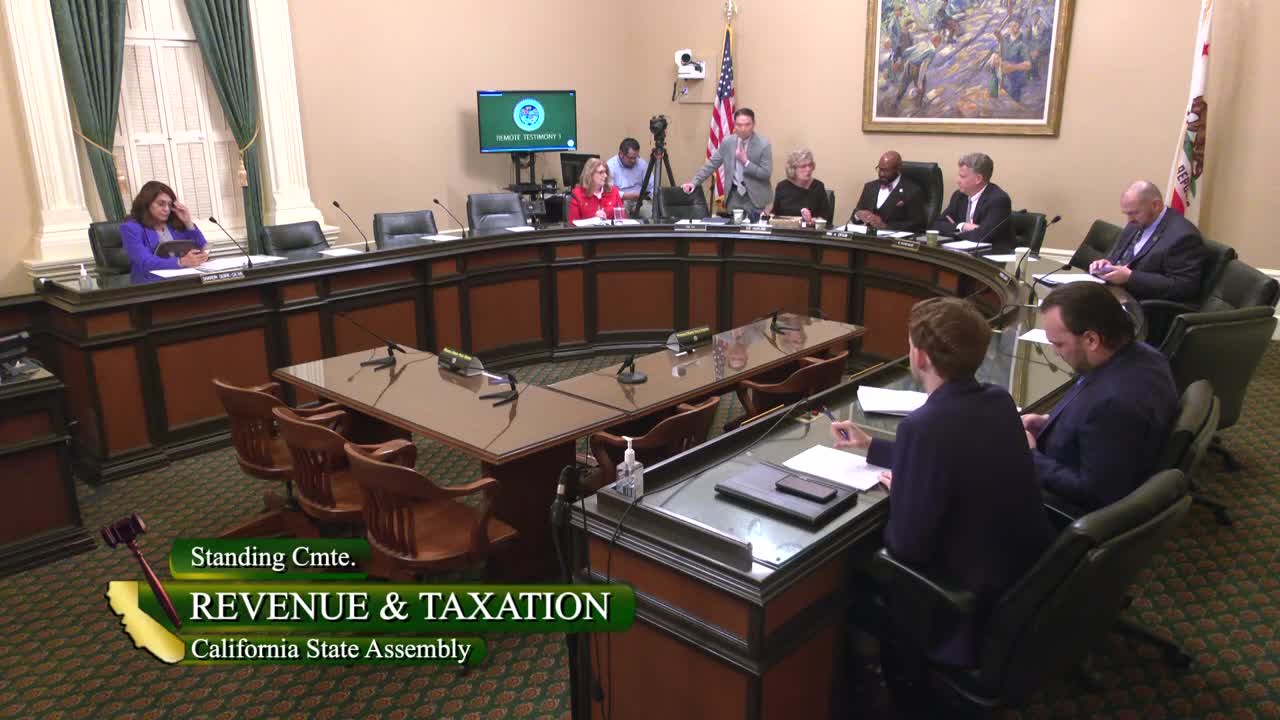 14MIN
Assembly Standing Committee on Revenue and Taxation
Bill Author