AB 2200: Controlled environment horticulture space: thermal curtains.
- Session Year: 2025-2026
- House: Assembly
- Latest Version Date: 2026-04-13
Current Status:
In Progress
(2026-08-27: Ordered to inactive file at the request of Senator Laird.)
Introduced
In Committee
Awaiting First Chamber Vote
Passed First Chamber
In Committee
Awaiting Second Chamber Vote
Passed Second Chamber
Enacted
Existing law, the California Building Standards Law, establishes the California Building Standards Commission within the Department of General Services. Existing law requires the commission to approve and adopt building standards and to codify those standards in the California Building Standards Code. Existing law requires the commission to publish, or cause to be published, editions of the code in its entirety once every 3 years. Existing law requires the responsibility for the enforcement and administration of building standards to remain in the state or local agency, as specified.
This bill, notwithstanding any other law, would require a controlled environment horticulture space, as defined, that uses single-paned glass windows and either thermal curtains, shade cloths, or equivalent technologies, to be considered compliant under the California Energy Code. Code, provided that the Energy Commission makes a finding that the arrangement is as, or more, energy efficient than current regulations. The bill would require that provision to remain in effect until the next triennial update of the California Building Standards Code. The bill would also require the commission to, commencing with the next triennial edition of the California Building Standards Code and in consultation with after development of a standard by the Energy Commission and the Department of Food and Agriculture, develop and Commission, adopt building standards to allow controlled environmental horticulture spaces or conditioned greenhouses to use alternative technologies, such as thermal curtains, thermal screens, shade cloths, or equivalent technologies, in lieu of the requirements for double-paned glass windows or two 2 or more glazings separated by either air or gas glazing. By increasing the duties of local officials, this bill would impose a state-mandated local program.
The bill would include findings that changes proposed by this bill address a matter of statewide concern rather than a municipal affair and, therefore, apply to all cities, including charter cities.
The California Constitution requires the state to reimburse local agencies and school districts for certain costs mandated by the state. Statutory provisions establish procedures for making that reimbursement.
This bill would provide that no reimbursement is required by this act for a specified reason.
Existing law, the California Building Standards Law, establishes the California Building Standards Commission within the Department of General Services. Existing law requires the commission to approve and adopt building standards and to codify those standards in the California Building Standards Code. Existing law requires the commission to publish, or cause to be published, editions of the code in its entirety once every 3 years. Existing law requires the responsibility for the enforcement and administration of building standards to remain in the state or local agency, as specified.
This bill, notwithstanding any other law, would require a controlled environment horticulture space, as defined, that uses single-paned windows and either thermal curtains, shade cloths, or equivalent technologies, to be considered compliant under the California Energy Code. The bill would require that provision to remain in effect until the next triennial update of the California Building Standards Code. The bill would also require the commission to, commencing with the next triennial edition of the California Building Standards Code and in consultation with the Energy Commission and the Department of Food and Agriculture, develop and adopt building standards to allow controlled environmental horticulture spaces or conditioned greenhouses to use thermal curtains, thermal screens, shade cloths, or equivalent technologies, in lieu of the requirements for double-paned windows or two or more glazings separated by either air or gas glazing. By increasing the duties of local officials, this bill would impose a state-mandated local program.
The bill would include findings that changes proposed by this bill address a matter of statewide concern rather than a municipal affair and, therefore, apply to all cities, including charter cities.
The California Constitution requires the state to reimburse local agencies and school districts for certain costs mandated by the state. Statutory provisions establish procedures for making that reimbursement.
This bill would provide that no reimbursement is required by this act for a specified reason.
The Legislature finds and declares all of the following:
(a)Controlled environment horticulture spaces, including commercial greenhouses, play an important role in boosting Californias agricultural economy, providing a reliable food supply year round, and producing more crops with less land.
(b)The California Building Standards Code (Title 24 of the California Code of Regulations), including the California Energy Code (Part 6 of Title 24 of the California Code of Regulations), establishes important requirements to reduce energy consumption and greenhouse gas emissions.
(c)Existing prescriptive requirements mandating double-paned glass windows or insulated glazing are not well-suited for do not account for the variety of greenhouse structures, where other designs may achieve similar efficiencies while preserving light transmission and cost-effectiveness cost-effectiveness, which are critical to successful operations.
(d)Thermal screens are widely recognized technologies that can significantly reduce heat loss, conserve energy, and lower operating costs for greenhouse facilities, while maintaining the level of light transmission necessary for plant health.
(e)Providing greenhouses with the flexibility to use other equivalent technologies, such as thermal screens, as an alternative to double-paned windows will reduce costs, encourage sustainable agricultural practices, and support the continued growth of Californias agricultural sector without compromising energy efficiency goals. SEC. 2.Section 18944.22 is added to the Health and Safety Code, to read:18944.22.(a)For purposes of this section, all of the following definitions shall apply:
(1)Controlled environment horticulture space means a building space dedicated to plant production by manipulating indoor environmental conditions, including through electric lighting, irrigation, mechanical heating, mechanical cooling, or dehumidification.
(2)Thermal screen means a retractable or fixed insulating barrier designed and manufactured to reduce heat loss and improve energy efficiency in greenhouse structures.
(b)(1)Notwithstanding any other law, a controlled environment horticulture space that uses single-paned glass windows and either thermal curtains, thermal screens, shade cloths, or equivalent technologies shall be considered compliant under the California Energy Code (Part 6 of Title 24 of the California Code of Regulations). Regulations), provided that the Energy Commission makes a finding that the arrangement is as, or more, energy efficient than current regulations.
(2)Paragraph (1) shall remain in effect until the next triennial update of the California Building Standards Code.
(c)The commission shall, commencing with the next triennial edition of the California Building Standards Code (Title 24 of the California Code of Regulations), in consultation with after the development of a standard by the Energy Commission and the Department of Food and Agriculture, develop Commission, and adopt building standards to allow controlled environmental horticulture spaces or conditioned greenhouses to use alternative technologies, such as thermal curtains, thermal screens, shade cloths, or equivalent technologies, in lieu of the requirements for double-paned glass windows or two or more glazings separated by either air or gas glazing.
SEC. 3.The Legislature finds and declares that supporting the greenhouse industry, food security, and economic productivity in California is a matter of statewide concern and is not a municipal affair as that term is used in Section 5 of Article XI of the California Constitution. Therefore, Section 2 of this act adding Section 18944.22 to the Health and Safety Code applies to all cities, including charter cities.
SEC. 4.No reimbursement is required by this act pursuant to Section 6 of Article XIIIB of the California Constitution because a local agency or school district has the authority to levy service charges, fees, or assessments sufficient to pay for the program or level of service mandated by this act, within the meaning of Section 17556 of the Government Code.
The Legislature finds and declares all of the following:
(a)Controlled environment horticulture spaces, including commercial greenhouses, play an important role in boosting Californias agricultural economy, providing a reliable food supply year round, and producing more crops with less land.
(b)The California Building Standards Code (Title 24 of the California Code of Regulations), including the California Energy Code (Part 6 of Title 24 of the California Code of Regulations), establishes important requirements to reduce energy consumption and greenhouse gas emissions.
(c)Existing prescriptive requirements mandating double-paned windows or insulated glazing are not well-suited for greenhouse structures, where light transmission and cost-effectiveness are critical to successful operations.
(d)Thermal screens are widely recognized technologies that can significantly reduce heat loss, conserve energy, and lower operating costs for greenhouse facilities, while maintaining the level of light transmission necessary for plant health.
(e)Providing greenhouses with the flexibility to use other equivalent technologies, such as thermal screens, as an alternative to double-paned windows will reduce costs, encourage sustainable agricultural practices, and support the continued growth of Californias agricultural sector without compromising energy efficiency goals.
SEC. 2.Section 18944.22 is added to the Health and Safety Code, to read:18944.22.(a)For purposes of this section, all of the following definitions shall apply:
(1)Controlled environment horticulture space means a building space dedicated to plant production by manipulating indoor environmental conditions, including through electric lighting, irrigation, mechanical heating, mechanical cooling, or dehumidification.
(2)Thermal screen means a retractable or fixed insulating barrier designed and manufactured to reduce heat loss and improve energy efficiency in greenhouse structures.
(b)(1)Notwithstanding any other law, a controlled environment horticulture space that uses single-paned windows and either thermal curtains, thermal screens, shade cloths, or equivalent technologies shall be considered compliant under the California Energy Code (Part 6 of Title 24 of the California Code of Regulations).
(2)Paragraph (1) shall remain in effect until the next triennial update of the California Building Standards Code.
(c)The commission shall, commencing with the next triennial edition of the California Building Standards Code (Title 24 of the California Code of Regulations), in consultation with the Energy Commission and the Department of Food and Agriculture, develop and adopt building standards to allow controlled environmental horticulture spaces or conditioned greenhouses to use thermal curtains, thermal screens, shade cloths, or equivalent technologies, in lieu of the requirements for double-paned windows or two or more glazings separated by either air or gas glazing.
SEC. 3.The Legislature finds and declares that supporting the greenhouse industry, food security, and economic productivity in California is a matter of statewide concern and is not a municipal affair as that term is used in Section 5 of Article XI of the California Constitution. Therefore, Section 2 of this act adding Section 18944.22 to the Health and Safety Code applies to all cities, including charter cities.
SEC. 4.No reimbursement is required by this act pursuant to Section 6 of Article XIIIB of the California Constitution because a local agency or school district has the authority to levy service charges, fees, or assessments sufficient to pay for the program or level of service mandated by this act, within the meaning of Section 17556 of the Government Code.
|
Date
|
Status
|
|---|---|
| Aug 27, 2026 | Ordered to inactive file at the request of Senator Laird. |
| Aug 4, 2026 | Read second time. Ordered to third reading. |
| Aug 3, 2026 | From committee: Be ordered to second reading pursuant to Senate Rule 28.8. |
| Jun 30, 2026 | From committee: Do pass and re-refer to Com. on APPR. with recommendation: To Consent Calendar. (Ayes 17. Noes 0.) (June 30). Re-referred to Com. on APPR. |
| Jun 15, 2026 | Re-referred to Com. on E., U & C. |
| Jun 3, 2026 | Referred to Com. on RLS. |
| May 21, 2026 | In Senate. Read first time. To Com. on RLS. for assignment. |
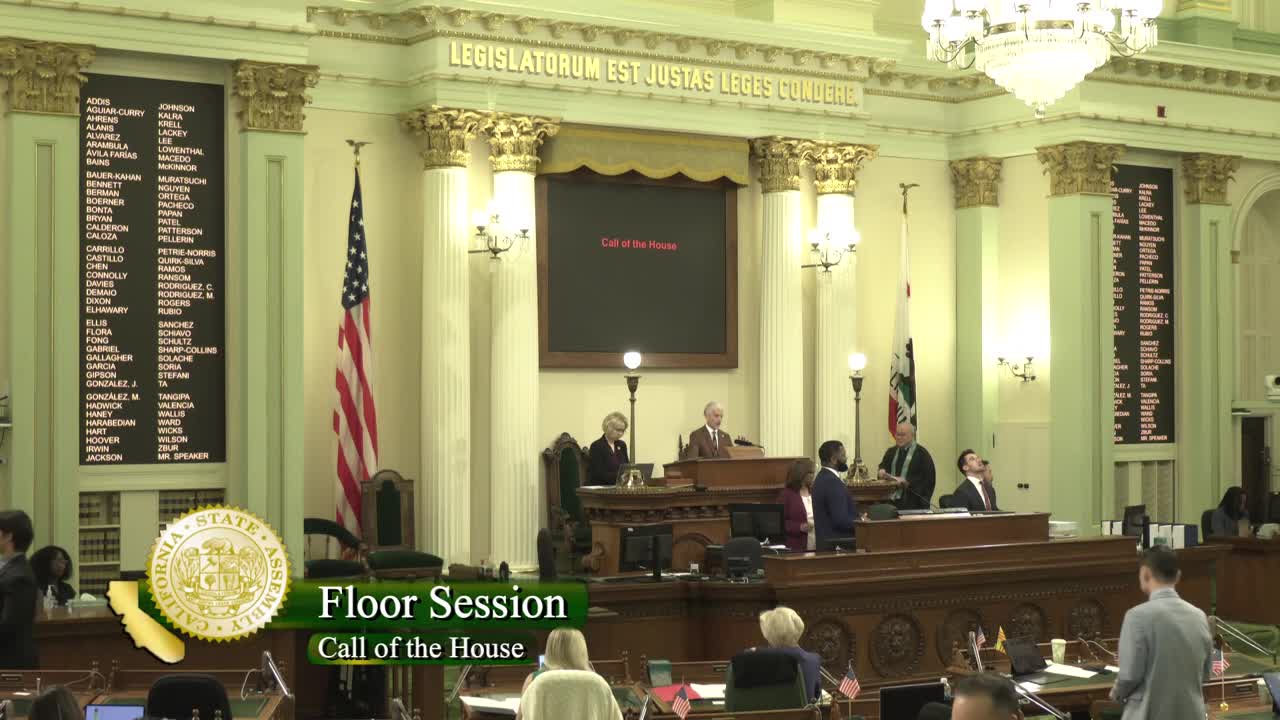
| May 21, 2026 | Read third time. Passed. Ordered to the Senate. (Ayes 73. Noes 0. Page 5179.) |
| May 21, 2026 | Read third time. Passed. Ordered to the Senate. (Ayes 73. Noes 0.) |
| May 7, 2026 | Read second time. Ordered to third reading. |
| May 6, 2026 | From committee: Do pass. (Ayes 14. Noes 0.) (May 6). |
| Apr 14, 2026 | Re-referred to Com. on APPR. |
| Apr 13, 2026 | Read second time and amended. |
| Apr 9, 2026 | From committee: Amend, and do pass as amended and re-refer to Com. on APPR. with recommendation: To Consent Calendar. (Ayes 17. Noes 0.) (April 8). |
| Mar 16, 2026 | Referred to Com. on U. & E. |
| Feb 20, 2026 | From printer. May be heard in committee March 22. |
| Feb 19, 2026 | Read first time. To print. |
|
Date
|
Description
|
Location
|
Votes
|
|
|---|---|---|---|---|
| Jun 30, 2026 | Do pass, but first be re-referred to the Committee on [Appropriations] with the recommendation: To Consent Calendar | Senate Standing Committee on Energy, Utilities and Communications |
Passed |
|
| May 21, 2026 | AB 2200 Hart Assembly Third Reading | Assembly Floor |
Passed |
|
| May 6, 2026 | Do pass. | Assembly Standing Committee on Appropriations |
Passed |
|
| Apr 8, 2026 | Do pass as amended, and be re-referred to the Committee on [Appropriations] with recommendation: To Consent Calendar | Assembly Standing Committee on Utilities and Energy |
Passed |
This list shows positions taken on this bill by organizations on the date displayed, which is linked to the original source.
Positions by individuals are not included.
|
Organization
|
Position
|
Date
|
|---|---|---|
| Windset Farms | ** Support |
SENATE RULES COMMITTEE Office of Senate Floor Analyses (916) 651-4171 | AB 2200 |
THIRD READING
Bill No: AB 2200
Author: Hart (D)
Amended: 4/13/26 in Assembly
Vote: 21
SENATE ENERGY, U. & C. COMMITTEE: 17-0, 6/30/26
AYES: Allen, Ochoa Bogh, Archuleta, Arreguín, Ashby, Becker, Caballero, Dahle, Gonzalez, Grove, Hurtado, McNerney, Reyes, Richardson, Stern, Strickland, Wahab
SENATE APPROPRIATIONS COMMITTEE: Senate Rule 28.8
ASSEMBLY FLOOR: 73-0, 5/21/26 - See last page for vote
SUBJECT: Controlled environment horticulture space: thermal curtains
SOURCE: Windset Farms
DIGEST:
This bill requires the California Building Standards Commission (CBSC) to adopt a standard developed by the California Energy Commission (CEC) to allow certain indoor agriculture buildings and air-conditioned greenhouses to use alternative technologies instead of using double-paned glass windows.
ANALYSIS:
Existing law:
- Establishes the CEC’s authority to create regulations for building efficiency standards. Existing law requires the CEC to create cost-effective regulations for lighting, insulation, climate control systems, and other building design and construction standards that increase energy and water efficiency for new residential and new nonresidential buildings. Local governments may not issue permits for construction and installation projects that fail to comply with the CEC’s certified efficiency standards. (Public Resources Code §25402)
- Requires the CEC’s building water and energy efficiency standards to be cost effective for the economic life of the building when compared to historic practice. When determining a standard’s cost effectiveness, the CEC must consider the value of the water or energy saved, impact on product performance for consumers, and the life-cycle cost of the standard. Existing law also requires the CEC to consider a standard’s impact on housing costs, the total statewide costs and benefits of the standard over its lifetime, the economic impact on California businesses, and alternative approaches and costs. (Public Resources Code §25402)
This bill:
- Defines a “controlled environment horticulture space” as a building space dedicated to plant production using environmental controls, including electric lighting, irrigation, heating, cooling, or dehumidification.
- Requires the CBSC to adopt standards developed by the CEC in the next triennial building code requirements, allowing controlled environment horticulture (CEH) spaces or conditioned greenhouses to use alternative technologies, such as thermal curtains, thermal screens, shade cloths, or equivalent technologies, in lieu of the requirements for double-paned glass windows.
- Specifies that a CEH space that uses single-paned glass windows and either thermal curtains, thermal screens, shade cloths, or equivalent technologies shall be considered compliant under the energy code if the CEC finds that these technologies are at least as efficient as technologies used under existing regulations.
Background
CEC’s Title 24 Building Energy Efficiency Standards. Existing law establishes the CEC’s authority to adopt cost-effective building and appliance standards to promote the conservation of energy and water. Title 20 of the California Code of Regulations includes the CEC’s appliance standards. Title 24 includes the CEC’s building energy efficiency standards. While the CEC develops the building energy efficiency standards, the CBSC is responsible for adopting all building standards, including Title 24 energy efficiency standards. Local governments are responsible for enforcing building standards through building inspections. Building energy efficiency standards are developed and adopted for a three-year period and apply at the time of construction. While some standards are mandatory, others are less proscriptive.
Bill primarily addresses energy code compliance needs for one farm but may benefit others. This bill addresses barriers that greenhouse farms may face when developing new facilities that use certain technologies that do not currently comply with existing energy code for CEH spaces. As part of the 2022 edition of the building energy efficiency standards, the CEC adopted a definition of a CEH space, which applies to agricultural productions that occur indoors, including in greenhouses. Among other requirements, the CEC’s efficiency standards for CEH spaces specified that the building envelope of an air-conditioned CEH must be either 1) an opaque wall or roof or 2) a double-glazed window that uses air or gas as insulation between the panels. These existing requirements do not enable a greenhouse farm that uses other technologies, including single paned windows paired with thermal screens or more advanced temperature and environmental control systems to use these alternative technologies to meet energy code requirements.
Energy code requirements are prospective and do not apply retroactively to existing facilities; as a result, some farms that pre-date the CEC’s rules for CEH spaces are already operating greenhouses that do not use double-paned windows for insulation. While the CEC’s energy code requirements do not impact these existing structures, they can prevent farms that use alternative technologies as part of their operations from expanding or building new facilities that also match their existing production processes.
At least one in-state agricultural producer, Windset Farms, uses alternative insulation technologies as part of its greenhouse vegetable farming. Windset Farms is based in Santa Maria, California, and operates the largest greenhouse vegetable farm in the state. Windset Farms greenhouses currently use single-paned glass with retractable thermal curtains along with environmental control systems developed by KUBO, a Netherlands-based manufacturer of advanced technology greenhouses. Windset established much of its existing agricultural production prior to the CEC’s adoption of CEH energy code requirements. However, the company in the process of expanding its greenhouses to include an additional 97 acres of greenhouse space adjacent to its existing facilities. Existing CEC standards for CEH spaces would limit Windset’s ability to use its existing KUBO-designed advanced greenhouses for its expansion. This bill would enable Windset to continue using its existing greenhouse technology as part of its expansion and would enable other farms to establish new greenhouses using similar alternative climate and insulation technologies.
Prior/Related Legislation
SB 48 (Becker, Chapter 378, Statutes of 2023) required the CEC, along with other agencies, to develop a state strategy to achieve state goals for energy and greenhouse gas emissions (GHG) from existing buildings, as specified.
SB 795 (Stern, 2023) would have required the CEC to develop and implement an electronic statewide heating, ventilation and air conditioning (HVAC) equipment sales registry and compliance tracking system. It also would have required the CEC to develop an electronic statewide compliance documentation data repository for HVAC equipment and lighting controls. The bill was held by the Assembly Appropriations Committee.
SB 1477 (Stern, Chapter 378, Statutes of 2018) required the CEC to develop a statewide market transformation initiative to transform the state’s market for low-emission space and water heating equipment for new and existing residential and nonresidential buildings and to develop an incentive program to fund near-zero emission technology for new residential and commercial buildings.
AB 3232 (Friedman, Chapter 373, Statutes of 2018) required the CEC to assess the potential for the state to achieve the goal of reducing the emissions of GHGs by the state’s residential and commercial building stock by at least 40% below 1990 levels by January 1, 2030.
AB 802 (Williams, Chapter 590, Statutes of 2015), among its provisions, established the energy use “benchmarking” and disclosure program at the CEC for existing buildings.
FISCAL EFFECT: Appropriation: No Fiscal Com.: Yes Local: Yes
SUPPORT: (Verified 8/3/26)
Windset Farms (source)
OPPOSITION: (Verified 8/3/26)
None received
ARGUMENTS IN SUPPORT: According to the author:
AB 2200 will give food producers flexibility in meeting energy efficiency standards in ways that are tailored to local conditions and specific crop needs, helping keep costs down and produce more affordable. Current energy regulations require double-paned windows for new agricultural greenhouses to improve energy efficiency. Many greenhouse systems, however, rely on the temperate climate and extensive sunlight found in much of California. Single-paned windows with curtain systems provide the necessary sunlight into these greenhouses and give growers the ability to adjust to changing conditions for optimal crop growth and yield. AB 2200 helps support innovative greenhouses, bolster crop production, and keep more farms here in California by creating a narrow exemption for greenhouses that utilize single-paned windows.
ASSEMBLY FLOOR: 73-0, 5/21/26
AYES: Addis, Aguiar-Curry, Ahrens, Alanis, Alvarez, Ávila Farías, Bains, Bauer-Kahan, Bennett, Berman, Boerner, Bonta, Bryan, Calderon, Caloza, Carrillo, Castillo, Connolly, Davies, DeMaio, Dixon, Elhawary, Ellis, Flora, Fong, Gabriel, Gallagher, Gipson, Jeff Gonzalez, Mark González, Hadwick, Haney, Hart, Hoover, Irwin, Jackson, Johnson, Kalra, Krell, Lee, Lowenthal, Macedo, McKinnor, Muratsuchi, Nguyen, Ortega, Pacheco, Papan, Patel, Patterson, Pellerin, Petrie-Norris, Quirk-Silva, Ransom, Michelle Rodriguez, Rogers, Blanca Rubio, Sanchez, Schiavo, Schultz, Sharp-Collins, Solache, Soria, Stefani, Ta, Tangipa, Valencia, Wallis, Ward, Wicks, Wilson, Zbur, Rivas
NO VOTE RECORDED: Arambula, Chen, Garcia, Harabedian, Lackey, Ramos, Celeste Rodriguez
Prepared by: Sarah Smith / E., U. & C. / (916) 651-4107
8/5/26 15:04:32
**** END ****
SENATE COMMITTEE ON ENERGY, UTILITIES AND COMMUNICATIONS
Senator Benjamin Allen, Chair
2025 - 2026 Regular
Bill No: Hearing Date: 6/30/2026
Author: | |||
Version: | Amended | ||
Urgency: | Fiscal: | ||
Consultant: | |||
SUBJECT:
DIGEST: This bill requires the California Building Standards Commission (CBSC) to adopt a standard developed by the California Energy Commission (CEC) to allow certain indoor agriculture buildings and air-conditioned greenhouses to use alternative technologies instead of using double-paned glass windows.
ANALYSIS:
Existing law:
- Establishes the CEC’s authority to create regulations for building efficiency standards. Existing law requires the CEC to create cost-effective regulations for lighting, insulation, climate control systems, and other building design and construction standards that increase energy and water efficiency for new residential and new nonresidential buildings. Local governments may not issue permits for construction and installation projects that fail to comply with the CEC’s certified efficiency standards. (Public Resources Code §25402)
- Requires the CEC’s building water and energy efficiency standards to be cost effective for the economic life of the building when compared to historic practice. When determining an efficiency standard’s cost effectiveness, the CEC must consider the value of the water or energy saved, impact on product performance for consumers, and the life-cycle cost of the standard. Existing law also requires the CEC to consider an efficiency standard’s impact on housing costs, the total statewide costs and benefits of the standard over its lifetime, the economic impact on California businesses, and any alternative approaches and their associated costs. (Public Resources Code §25402)
This bill:
- Defines a “controlled environment horticulture space” as a building space dedicated to plant production using environmental controls, including electric lighting, irrigation, heating, cooling, or dehumidification.
- Requires the CBSC to adopt building standards developed by the CEC in the next triennial building code requirements, to allow controlled environmental horticulture (CEH) spaces or conditioned greenhouses to use alternative technologies, such as thermal curtains, thermal screens, shade cloths, or equivalent technologies, in lieu of the requirements for double-paned glass windows.
- Specifies that a CEH space that uses single-paned glass windows and either thermal curtains, thermal screens, shade cloths, or equivalent technologies shall be considered compliant under the California Energy Code if the CEC finds that these technologies are at least as efficient as technologies used under existing regulations.
Background
CEC’s Title 24 Building Energy Efficiency Standards. Existing law establishes the CEC’s authority to adopt cost-effective building and appliance standards to promote the conservation of energy and water. Title 20 of the California Code of Regulations includes the CEC’s appliance standards and Title 24 includes the CEC’s Building Energy Efficiency Standards. While the CEC develops the Building Energy Efficiency Standards, the CBSC is responsible for adopting all building standards, including Title 24 energy efficiency standards. Local governments are responsible for enforcing building standards through building inspections. Building energy efficiency standards are developed and adopted for a three-year period and apply at the time of construction. While some standards are mandatory, others are less proscriptive.
Bill primarily addresses energy code compliance needs for one farm but may benefit others. This bill addresses barriers that greenhouse farms may face when developing new facilities that use certain technologies that do not currently comply with existing energy code for CEH spaces. As part of the 2022 edition of the building energy efficiency standards, the CEC defined CEH spaces as the following: “…a building space dedicated to plant production by manipulating indoor environmental conditions, such as through electric lighting, irrigation, mechanical heating, mechanical cooling, or dehumidification. A CEH space does not include building space where plants are grown solely to decorate that space.” This definition applies to agricultural productions that occur indoors, including in greenhouses. Among other requirements, the CEC’s efficiency standards for CEH spaces specified that the building envelope of an air-conditioned CEH must be either 1) an opaque wall or roof or 2) a double-glazed window that uses air or gas as insulation between the panels. These existing requirements do not enable a greenhouse farm that uses other technologies, including single paned windows paired with thermal screens or more advanced temperature and environmental control systems to use these alternative technologies to meet energy code requirements.
Energy code requirements are prospective and do not apply retroactively to existing facilities; as a result, some farms that pre-date the CEC’s rules for CEH spaces are already operating greenhouses that do not use double-paned windows for insulation. While the CEC’s energy code requirements do not impact these existing structures, they can prevent farms that use alternative technologies as part of their operations from expanding or building new facilities that also match their existing production processes.
At least one in-state agricultural producer, Windset Farms, uses alternative insulation technologies as part of its greenhouse vegetable farming. Windset Farms is based in Santa Maria, California, and operates the largest greenhouse vegetable farm in the state. Windset Farms greenhouses currently use single-paned glass with retractable thermal curtains along with environmental control systems developed by KUBO, a Netherlands-based manufacturer of advanced technology greenhouses. Windset established much of its existing agricultural production prior to the CEC’s adoption of CEH energy code requirements. However, the company in the process of expanding its greenhouses to include an additional 97 acres of greenhouse space adjacent to its existing facilities. Existing CEC standards for CEH spaces would limit Windset’s ability to use its existing KUBO-designed advanced greenhouses for its expansion. This bill would enable Windset to continue using its existing greenhouse technology as part of its expansion and would enable other farms to establish new greenhouses using similar alternative climate and insulation technologies.
Prior/Related Legislation
SB 48 (Becker, Chapter 378, Statutes of 2023) required the CEC, along with other agencies, to develop to a state strategy to achieve state goals for energy and greenhouse gas emissions (GHG) from existing buildings, as specified.
SB 795 (Stern, 2023) would have required the CEC to develop and implement an electronic statewide heating, ventilation and air conditioning (HVAC) equipment sales registry and compliance tracking system. It also would have required the CEC to develop an electronic statewide compliance documentation data repository for HVAC equipment and lighting controls. The bill was held by the Assembly Appropriations Committee.
SB 1477 (Stern, Chapter 378, Statutes of 2018) required the CEC to develop a statewide market transformation initiative to transform the state’s market for low-emission space and water heating equipment for new and existing residential and nonresidential buildings and to develop an incentive program to fund near-zero emission technology for new residential and commercial buildings.
AB 3232 (Friedman, Chapter 373, Statutes of 2018) required the CEC to assess the potential for the state to achieve the goal of reducing the emissions of GHGs by the state’s residential and commercial building stock by at least 40% below 1990 levels by January 1, 2030.
AB 802 (Williams, Chapter 590, Statutes of 2015), among its provisions, established the energy use “benchmarking” and disclosure program at the CEC for existing buildings.
FISCAL EFFECT: Appropriation: Fiscal Com.: Local:
SUPPORT:
Windset Farms (Sponsor)
OPPOSITION:
None received
ARGUMENTS IN SUPPORT: According to the author:
AB 2200 will give food producers flexibility in meeting energy efficiency standards in ways that are tailored to local conditions and specific crop needs, helping keep costs down and produce more affordable. Current energy regulations require double-paned windows for new agricultural greenhouses to improve energy efficiency. Many greenhouse systems, however, rely on the temperate climate and extensive sunlight found in much of California. Single-paned windows with curtain systems provide the necessary sunlight into these greenhouses and give growers the ability to adjust to changing conditions for optimal crop growth and yield. AB 2200 helps support innovative greenhouses, bolster crop production, and keep more farms here in California by creating a narrow exemption for greenhouses that utilize single-paned windows.
-- END --
ASSEMBLY THIRD READING
ATR Bill Id:AB 2200
Author:(Hart)
As Amended Ver:April 13, 2026
Majority vote
SUMMARY
This bill deems a controlled environment horticulture facility – such as a greenhouse – that uses single-pane glass windows in combination with thermal curtains, thermal screens, shade cloth, or equivalent technologies to be in compliance with the California Energy Code, provided the California Energy Commission (CEC) determines that the arrangement is at least as energy efficient as current code requirements.
The bill also directs the Building Standards Commission to adopt permanent building standards that allow use of such technologies as part of the next update of the California Building Standards, provided CEC has made the finding described above.
Major Provisions
COMMENTS
State law charges the CEC with regulating the lighting, insulation, climate control system and other building design and construction standards that increase efficiency in the use of energy and water for new residential and new nonresidential buildings. The law further directs the CEC to periodically update the standards and adopt any revision that, in the CEC's judgment, is necessary. Ultimately, the CEC submits its standards to the Building Standards Commission for adoption into the California Building Standards Code.
The 2022 California Building Standards Code, based on CEC regulations, provides standards for controlled environment horticulture spaces, such as greenhouses. Specifically, the standards require a nonopaque building, such as a greenhouse with glass walls or roof, to have, at least, double-paned windows.
This bill seeks to enable certain greenhouses to meet California's Building Standards if the CEC makes a finding that their unique arrangement is equivalent to existing permitted arrangements. This would allow new facilities to use single-paned windows paired with retractable thermal curtain systems (or other alternative technologies) in lieu of the double-paned glazing currently required under the 2022 Energy Code. The bill is premised on the position that certain advanced greenhouse systems, such as KUBO's Ultra-Clima used by Windset Farms across its 168-acre Santa Maria operation, are specifically engineered around single-paned glass and thermal curtains as an integrated climate control system, and that forcing compliance with the existing double-pane requirement undermines the viability of these single-paned designs without a corresponding energy efficiency benefit.
According to the Author
According to the author, "AB 2200 will give food producers flexibility in meeting energy efficiency standards in ways that are tailored to local conditions and specific crop needs, helping keep costs down and produce more affordable produce. Current energy regulations require double-paned windows for new agricultural greenhouses to improve energy efficiency. Many greenhouse systems, however, rely on the temperate climate and extensive sunlight found in much of California. Single-paned windows with curtain systems provide the necessary sunlight into these greenhouses and give growers the ability to adjust to changing conditions for optimal crop growth and yield. AB 2200 helps support innovative greenhouses, bolster crop production, and keep more farms here in California by creating a narrow exemption for greenhouses that utilize single-paned windows."
Arguments in Support
This bill is supported by Windset Farms, which describes itself as one of the largest greenhouse agricultural facilities in the United States. Windset asserts the 2022 Building Standards have created "unintended impacts," and that the current "Double-pane glazing requirements can reduce light transmission by approximately 15%, directly lowering crop yields and making new greenhouse development in California economically infeasible." Windset Farms goes on to describe the technologies it uses in its greenhouses as "engineered thermal screens that provide highly effective insulation while maintaining optimal light transmission" that "significantly reduce heat loss, minimize energy demand, and allow for precise climate control without compromising crop productivity."
Arguments in Opposition
None on file.
FISCAL COMMENTS
According to the Assembly Committee on Appropriations, this bill will create new work for the CEC. The CEC notes it can complete the work with its existing resources.
VOTES
ASM UTILITIES AND ENERGY: 17-0-1
YES: Petrie-Norris, Patterson, Boerner, Calderon, Davies, Mark González, Harabedian, Hart, Irwin, Kalra, Papan, Rogers, Schiavo, Schultz, Ta, Wallis, Zbur
ABS, ABST OR NV: Chen
ASM APPROPRIATIONS: 14-0-1
YES: Wicks, Hoover, Aguiar-Curry, Caloza, Dixon, Fong, Mark González, Krell, Pacheco, Pellerin, Sharp-Collins, Solache, Ta, Tangipa
ABS, ABST OR NV: Arambula
UPDATED
VERSION: April 13, 2026
CONSULTANT: Laura Shybut / U. & E. / (916) 319-2083 FN: 0002508
Date of Hearing: May 6, 2026
ASSEMBLY COMMITTEE ON APPROPRIATIONS
Buffy Wicks, Chair
ABPCA Bill Id:AB 2200
Author:(Hart) – As Amended Ver:April 13, 2026
Policy Committee: | Utilities and Energy | Vote: | 17 - 0 |
|
| ||
|
|
Urgency: No State Mandated Local Program: Yes Reimbursable: No
SUMMARY:
This bill declares a controlled environment horticulture space, such as a greenhouse, that uses single-paned glass windows and either thermal curtains, thermal screens, shade cloths or equivalent technologies is to be considered compliant under the California Energy Code, provided that the California Energy Commission (CEC) makes a finding that the arrangement is as, or more, energy efficient than current regulations.
The bill also directs the Building Standards Commission to adopt permanent building standards that allow use of such technologies as part of the next update of the California Building Standards, provided CEC has made the finding described above.
FISCAL EFFECT:
This bill creates new analytical work for the CEC. However, this work is compatible with the work it already performs on building energy efficiency standards, pursuant to existing law. The CEC assumes it could complete this work with its existing resources.
COMMENTS:
Existing law authorizes the Building Standards Commission, within the Department of General Services, to approve and adopt building standards through a triennial rulemaking process to revise and update the California Building Standards Code. There are approximately twenty state agencies that develop building standards and submit them to the Building Standards Commission for review, approval and adoption.
State law charges the CEC with regulating the lighting, insulation, climate control system and other building design and construction standards that increase efficiency in the use of energy and water for new residential and new nonresidential buildings. The law further directs the CEC to periodically update the standards and adopt any revision that, in the CEC’s judgment, is necessary. Ultimately, the CEC submits its standards to the Building Standards Commission for adoption into the California Building Standards Code.
The 2022 California Building Standards Code, based on CEC regulations, provides standards for controlled environment horticulture spaces, such as greenhouses. Specifically, the standards require a nonopaque building, such as a greenhouse with glass walls or roof, to have, at least, double-paned windows. Bill supporter Windset Farms—which describes itself as one of the largest greenhouse agricultural facilities in the United States—asserts these standards have created “unintended impacts,” and that “Double-pane glazing requirements can reduce light transmission by approximately 15%, directly lowering crop yields and making new greenhouse development in California economically infeasible.” Windset Farms goes on to describe the technologies it uses in its greenhouses as “engineered thermal screens that provide highly effective insulation while maintaining optimal light transmission” that “significantly reduce heat loss, minimize energy demand, and allow for precise climate control without compromising crop productivity.”
Yet, even if Windset Farms’ claims are true, such technology does not satisfy the state’s building standards. This bill would change that, provided the CEC makes certain findings. According to the author:
AB 2200 will give food producers flexibility in meeting energy efficiency standards in ways that are tailored to local conditions and specific crop needs, helping keep costs down and produce more affordable produce...AB 2200 helps support innovative greenhouses, bolster crop production, and keep more farms here in California by creating a narrow exemption for greenhouses that utilize single-paned windows.
There is no opposition registered against this bill.
Analysis Prepared by: Jay Dickenson / APPR. / (916) 319-2081
Date of Hearing: April 8, 2026
ASSEMBLY COMMITTEE ON UTILITIES AND ENERGY
Cottie Petrie-Norris, Chair
ABPCA Bill Id:AB 2200 (
Author:Hart) – As Introduced Ver:February 19, 2026
SUBJECT: Controlled environment horticulture space: thermal curtains
SUMMARY: Exempts greenhouse facilities from the California Energy Code's double-paned glazing requirement, allowing single-paned windows paired with thermal curtains or equivalent technologies to qualify as code-compliant. Additionally, directs the Building Standards Commission to codify permanent standards for this alternative approach in the next triennial code update.
EXISTING LAW:
- Authorizes the California Building Standards Commission (CBSC) to approve and adopt building standards. Every three years, CBSC undertakes building standards rulemaking to revise and update the California Building Standards Code. (Title 24 of the California Code of Regulations)
- Requires proposed building standards that are submitted to CBSC for consideration to be accompanied by an analysis completed by the appropriate state agency that justifies approval based on the following criteria: a) the building standard does not conflict with, overlap, or duplicate other building standards; b) the proposed standard is within the parameters of the agency's jurisdiction; c) the public interest requires the adoption of the building standard; d) the standard is not unreasonable, arbitrary, unfair, or capricious; e) the cost to the public is reasonable, based on the overall benefit to be derived from the building standard; f) the standard is not unnecessarily ambiguous or vague; and g) the applicable national specifications, published standards, and model codes have been appropriately incorporated into the standard. (Health and Safety Code § 18930)
- Requires the California Energy Commission (CEC) to regulate lighting, insulation, climate, and other building design and construction standards that increase efficiency in the use of energy and water; energy and water conservation design standards; and standards for minimum levels of operating efficiency for energy- and water-efficient appliances. Local governments may not issue permits for construction and installation projects that fail to comply with the CEC’s certified efficiency standards. (Public Resources Code §§ 25402, 25402.1)
- Requires the CEC’s building efficiency standards to be cost-effective when taken in their entirety and amortized over the economic life of the structure compared with historic practice. It also requires the CEC to determine the lifecycle cost of complying with a building standard. (Public Resources Code § 25402(b)(3))
- Requires any building standard adopted by the CEC to be submitted to the CBSC for approval. (Public Resources Code § 25402.2)
FISCAL EFFECT: Unknown. This bill is keyed fiscal and will be referred to the Assembly Committee on Appropriations for its review.
BACKGROUND:
Energy Codes – Existing law establishes the CEC’s authority to adopt cost-effective building and appliance standards to promote the conservation of energy and water. Title 20 of the California Code of Regulations includes the CEC’s appliance standards and Title 24 includes the CEC’s Building Energy Efficiency Standards, which are also known as the Energy Codes. Existing law also sets cost-effectiveness requirements for the Energy Codes and requires the CEC to consider the cost of housing as part of cost-effectiveness determinations. While the CEC establishes the Energy Codes, enforcement of these standards rests with local building officials and final adoption and approval rests with the CBSC as part of the larger California Building Standards Code.
Under existing law, the CEC adopts new building energy efficiency standards every three years, and standards become effective one year after their adoption. The 2025 Energy Codes went into effect January 1, 2026, and the CEC is already in development on their 2028 Energy Codes. The CEC adopts three different types of code: mandatory, performance, and prescriptive standards. While mandatory standards are required for all new construction in the state, performance standards may vary by geographic location, building type, and the energy budget for the building. The prescriptive standards provide an alternative to the performance standards by offering a set of packages that provide a checklist-like compliance approach. Builders must build to the mandatory standards but have more flexibility in how to meet the performance or prescriptive standards.[1]
Greenhouses in the Energy Codes – The 2022 Energy Codes established a requirement for Controlled Environment Horticulture spaces, of which greenhouses are a subset, making double-paned glazing the mandatory minimum compliance for conditioned greenhouses with nonopaque envelopes (i.e., see-through walls or roofs).[2] According to the CEC, the International Energy Conservation Code (IECC) Commercial, a national model code the CEC follows, regulates greenhouses and allows for “internal curtain systems.” However, the CEC notes no certification body currently validates that greenhouse glazing systems meet the target values of the IECC Commercial standard.[3] As a result of this lack of verifiable performance data for internal curtain systems, the CEC adopted the double-paned glazing requirement to provide, as the CEC noted to committee, “a verifiable minimum performance level until reliable certification methods exist for alternatives like internal curtain systems.”
The CEC is coordinating with the Attachment Energy Rating Council (AERC), a U.S. Department of Energy-recognized organization that rates window attachments, and the Codes and Standards Enhancement (CASE) Team, a ratepayer-funded investor-owned utility program that presents recommendations to the CEC to update the Energy Codes, to both verify and incorporate alternative compliance pathways to the greenhouse standards. On March 5, 2026, the CASE Team recommended creating a new compliance path for conditioned greenhouses with single-glazed glass envelopes that have curtains to be compliant with the 2028 Energy Codes.[4]
 Windset Farms – According to their own promotional materials, Windset Farms, located in Santa Maria, California, operates the largest single-site greenhouse vegetable facility in the United States, cultivating tomatoes, peppers, and cucumbers across 168 acres of glass.[5] The facility uses the KUBO Ultra-Clima system, a Dutch-engineered greenhouse design that KUBO developed over 15 years ago as a departure from traditional passive greenhouse structures.[6] Rather than relying on double-paned glazing for insulation, the Ultra-Clima is built around single-pane glass combined with a retractable thermal curtain system that actively manages heat retention, humidity, light transmission, and airflow. The thermal screens can be deployed or retracted based on time of day and weather conditions, retaining heat at night while allowing maximum solar gain during the day. Research indicates this approach can reduce heat demand by 20–40% compared to an unscreened greenhouse.[7] Windset also leverages the single-pane system to condense humidity out of the air without mechanical dehumidification, collects 100% of CO₂ from on-site boilers to feed to plants, and recirculates irrigation drain water through biofilters for reuse. While Windset Farms is the only California operator known to the committee to use the Ultra-Clima greenhouse design, other agriculture groups also deploy the technology throughout the United States and world: such as BrightFarms’ Pennsylvania[8] and Texas locations.[9]
COMMENTS:
- Author’s Statement. According to the author, “AB 2200 will give food producers flexibility in meeting energy efficiency standards in ways that are tailored to local conditions and specific crop needs, helping keep costs down and produce more affordable produce. Current energy regulations require double-paned windows for new agricultural greenhouses to improve energy efficiency. Many greenhouse systems, however, rely on the temperate climate and extensive sunlight found in much of California. Single-paned windows with curtain systems provide the necessary sunlight into these greenhouses and give growers the ability to adjust to changing conditions for optimal crop growth and yield. AB 2200 helps support innovative greenhouses, bolster crop production, and keep more farms here in California by creating a narrow exemption for greenhouses that utilize single-paned windows.”
- Purpose of the bill. AB 2200 seeks to create an exemption to California's Title 24 energy efficiency building standards for greenhouses, allowing new facilities to use single-paned windows paired with retractable thermal curtain systems (or other alternative technologies) in lieu of the double-paned glazing currently required under the 2022 Energy Code. The bill is premised on the position that certain advanced greenhouse systems, such as KUBO's Ultra-Clima used by Windset Farms across its 168-acre Santa Maria operation (detailed above), are specifically engineered around single-paned glass and thermal curtains as an integrated climate control system, and that forcing compliance with the double-pane requirement undermines the viability of these designs without a corresponding energy efficiency benefit. The bill addresses this by creating a statutory exemption recognizing thermal curtain systems as a compliant alternative to double-paned glazing for glass greenhouses.
- Lack of Data to Justify Exemption. When the CEC adopted the double-pane glazing standard in the 2022 Energy Code, it did so in alignment with the national model code – the IECC Commercial – and in the absence of verifiable performance data for thermal curtain systems as an alternative. Since Windset Farms disclosed its plans to expand its Santa Maria facility, which would subject the new construction to the updated Energy Code requirements, the CEC has been actively engaged with the company in exploring a regulatory solution that would allow Windset's greenhouse design to qualify for, or be exempt from, the current standard. However to do that, the CEC must have sufficient data to justify an exemption to their building code; data the CEC claims to have not yet received. This lack of data could be due to difficulties in collection or concern around confidentiality or market sensitive information, but until the CEC can analyze the data, they cannot know that the greenhouse design lives up to the stated energy and water efficiency claims.
This bill provides a statutory exemption to the greenhouse’s Energy Code compliance, without sufficient evidence to justify such an exemption. Even the CASE Team, in recommending an exception for thermal curtains in the 2028 Energy Code, noted the need for building inspectors to confirm curtain installation and control strategies are compliant, and field verifications to ensure all conditions were correct.[10] Given these considerations, the committee recommends an amendment to the exemption for single-paned windows with alternative technologies (§ 18944.22 (b)(1-2)) to state that such an exemption can only be granted upon a finding by the CEC that such alternative arrangements are as efficient as the current regulations. This addresses what would otherwise be a risk that the Legislature is simply declaring a technology compliant without the technical verification to back it up. By requiring the CEC to affirmatively find energy equivalence before the exemption applies, the amendment ensures that the standard is not lowered.
- CEC's Role in Future Standards. This bill directs the CBSC to develop permanent building standards “in consultation with” the CEC and the Department of Food and Agriculture. While this phrasing of agency consultation with the CBSC is common throughout the Health and Safety Code, it misrepresents the contribution of the CEC to the code development underway. The committee recommends amendments to this subdivision (§ 18944.22 (c)) to replace “in consultation with” the CEC to “after the development of a standard by” the CEC, acknowledging the CEC’s central role in the Energy Code’s development. This ensures that when the permanent standard is ultimately codified in the triennial building code update, it is built on a technical foundation developed by the agency with primary jurisdiction over energy efficiency, rather than emerging from a broader consultation process where the CEC's role could be diluted. Second, the committee recommends removing the Department of Food and Agriculture as a consulting party. While agricultural interests are clearly relevant to this bill's goals, CDFA does not have technical jurisdiction over building energy standards and including it in standard setting could introduce procedural complexity without adding meaningful technical expertise.
- Additional Corrections. The committee recommends amendments to the findings and declarations to keep them grounded in established fact rather than anticipated outcomes, and to the operative provisions to specify “glass” windows throughout.
- Related Legislation.
AB 2458 (Bennett) requires the CEC’s appliance efficiency standards to apply not only to appliances that are sold or offered for sale in California, but also to appliances that are rented, imported, distributed, or leased, or offered for rental, importation, distribution, or lease in the state. Status: set for hearing in this committee on April 8, 2026.
AB 2612 (Schultz) requires the Building Standards Commission to adopt mandatory building standards for building electrical circuit features to enable plug-in photovoltaic systems to operate in the state. Status: set for hearing in the Assembly Committee on Housing on April 15, 2026.
- Prior Legislation.
AB 130 (Committee on Budget) among its many provisions, prohibits the CBSC and any other adopting agency, from October 1, 2025, until June 1, 2031, from considering, approving, or adopting any proposed building standards affecting residential units unless conditions are met. Status: Chapter 22, Statutes of 2025.
AB 1738 (Boerner) requires the Department of Housing and Community Development (HCD) to research and develop building standards for electric vehicle charging stations when retrofits are completed in existing residential structures and gives HCD the option of proposing those standards for adoption. Status: Chapter 687, Statutes of 2022.
REGISTERED SUPPORT / OPPOSITION:
Support
Windset Farms
Opposition
None on file.
Analysis Prepared by: Laura Shybut / U. & E. / (916) 319-2083
CEC, pg. iv, 2022 Building Energy Efficiency Standards for Residential and Non-residential Buildings – Title 24, Part 6, and Associated Administrative Regulations in Part 1, August 2022. ↑
Pg. 246, Section 120.6 (h)(3), CEC, 2025 Building Energy Efficiency Standards for Residential and Nonresidential Buildings, July 2025, https://www.energy.ca.gov/sites/default/files/2025-07/CEC-400-2025-010-F_0.pdf ↑
From IECC Section C402.1.1.2: U-factor targets of 0.5 for skylights and 0.7 for vertical fenestration ↑
Lydia Miner, “Greenhouse Envelope Alternative,” CAST Team Comment Letter to the CEC, March 5, 2026, https://title24stakeholders.com/wp-content/uploads/2026/03/2028-T24-Stakeholder-Round-2_-CEH-Greenhouse-Envelope-and-Glazing.pdf ↑
Windset Blog post, “Kubo and Windset Farms Pave the Way for Sustainable Greenhouse Expansion – Windset Farms”, https://windsetfarms.com/kubo-partners-with-windset-farms-to-pave-the-way-for-sustainable-greenhouse-expansion/ ↑
Ultra-Clima Greenhouse – KUBO Sustainable Greenhouses, https://www.kubogreenhouses.com/en/innovations/ultra-clima-greenhouse ↑
Boyaci et al. (2023). “Determination of the Effect of a Thermal Curtain Used in a Greenhouse on the Indoor Climate and Energy Savings.” Energies, 16(23), 7744. https://doi.org/10.3390/en16237744 ↑
https://www.kubogreenhouses.com/en/innovations/ultra-clima-greenhouse ↑
“BrightFarms Expands to Texas with New State-of-the-Art Greenhouse in Lorena,” December 10, 2024, https://www.brightfarms.com/press/brightfarms-expands-to-texas/ ↑
Pg. 23, Lydia Miner, “Greenhouse Envelope Alternative,” CAST Team Comment Letter to the CEC, March 5, 2026, https://title24stakeholders.com/wp-content/uploads/2026/03/2028-T24-Stakeholder-Round-2_-CEH-Greenhouse-Envelope-and-Glazing.pdf ↑
Bill Author

Bill Co-Author(s):