AB 2412: State agencies or departments: public communications.
- Session Year: 2025-2026
- House: Assembly
- Latest Version Date: 2026-06-16
Current Status:
In Progress
(2026-06-26: In committee: Set, final hearing. Hearing canceled at the request of author.)
Introduced
In Committee
Awaiting First Chamber Vote
Passed First Chamber
In Committee
Awaiting Second Chamber Vote
Passed Second Chamber
Enacted
Existing law requires a state agency or department that utilizes generative artificial intelligence (GenAI) to directly communicate with a person regarding government services and benefits to ensure that those communications include a disclaimer that indicates to the person that the communication was generated by GenAI, as specified, and information describing how a person may contact a human employee of the state agency or department.
This bill would instead require that disclaimer when a state agency or department communicates with the public, as specified. uses GenAI to directly communicate with the public and would define directly communicate to mean to use GenAI, instead of a natural person, to communicate directly with a specific member of the public or to communicate a general public announcement, as specified.
Existing law requires a state agency or department that utilizes generative artificial intelligence (GenAI) to directly communicate with a person regarding government services and benefits to ensure that those communications include a disclaimer that indicates to the person that the communication was generated by GenAI, as specified, and information describing how a person may contact a human employee of the state agency or department.
This bill would instead require that disclaimer when a state agency or department communicates with the public. public, as specified.
Existing law requires a state agency or department that utilizes generative artificial intelligence (GenAI) to directly communicate with a person regarding government services and benefits to ensure that those communications include a disclaimer that indicates to the person that the communication was generated by GenAI, as specified, and information describing how a person may contact a human employee of the state agency or department.
This bill would instead require that disclaimer when a state agency or department communicates with the public.
(a)A state agency or department that utilizes uses GenAI to directly communicate with the public, including through both individualized direct communications and general public announcements, public shall ensure that those communications include both of the following:
(a)(1)A disclaimer that indicates to the person that the communication was generated by GenAI pursuant to all of the following:
(1)(A)For written communications involving physical and digital media, including letters, email, and other occasional messages, the disclaimer shall appear prominently at the start of each communication.
(2)(B)For written communications involving continuous online interactions, including interactions with chatbots, the disclaimer shall be prominently displayed throughout the interaction.
(3)(C)For audio communications, the disclaimer shall be provided orally at the start and end of the interaction.
(4)(D)For video communications, the disclaimer shall be prominently displayed throughout the interaction.
(b)(2)Information, or a link to an internet website containing information, describing how a person may contact a human employee of the state agency or department.
(b)(1)As used in this section, directly communicate means to use GenAI, instead of a natural person, to communicate directly with a specific member of the public or to communicate a general public announcement.
(2)Directly communicate does not mean to use GenAI to assist in the drafting of a communication.
A state agency or department that utilizes GenAI to communicate with the public public, including through both individualized direct communications and general public announcements, shall ensure that those communications include both of the following:
(a)A disclaimer that indicates to the person that the communication was generated by GenAI pursuant to all of the following:
(1)For written communications involving physical and digital media, including letters, email, and other occasional messages, the disclaimer shall appear prominently at the start of each communication.
(2)For written communications involving continuous online interactions, including interactions with chatbots, the disclaimer shall be prominently displayed throughout the interaction.
(3)For audio communications, the disclaimer shall be provided orally at the start and end of the interaction.
(4)For video communications, the disclaimer shall be prominently displayed throughout the interaction.
(b)Information, or a link to an internet website containing information, describing how a person may contact a human employee of the state agency or department.
A state agency or department that utilizes GenAI to directly communicate with a person regarding government services and benefits the public shall ensure that those communications include both of the following:
(a)A disclaimer that indicates to the person that the communication was generated by GenAI. GenAI pursuant to all of the following:
(1)For written communications involving physical and digital media, including letters, email, and other occasional messages, the disclaimer shall appear prominently at the start of each communication.
(2)For written communications involving continuous online interactions, including interactions with chatbots, the disclaimer shall be prominently displayed throughout the interaction.
(3)For audio communications, the disclaimer shall be provided verbally orally at the start and end of the interaction.
(4)For video communications, the disclaimer shall be prominently displayed throughout the interaction.
(b)Information, or a link to an internet website containing information, describing how the a person may contact a human employee of the state agency or department.
|
Date
|
Status
|
|---|---|
| Jun 26, 2026 | In committee: Set, final hearing. Hearing canceled at the request of author. |
| Jun 16, 2026 | From committee chair, with author's amendments: Amend, and re-refer to committee. Read second time, amended, and re-referred to Com. on P., D.T., & C.P. |
| Jun 16, 2026 | In committee: Set, second hearing. Hearing canceled at the request of author. |
| Jun 12, 2026 | In committee: Set, first hearing. Hearing canceled at the request of author. |
| Jun 9, 2026 | From committee: Do pass and re-refer to Com. on P., D.T., & C.P. (Ayes 12. Noes 1.) (June 9). Re-referred to Com. on P., D.T., & C.P. |
| May 13, 2026 | Referred to Coms. on G.O. and P., D.T., & C.P. |
| May 5, 2026 | In Senate. Read first time. To Com. on RLS. for assignment. |
| May 4, 2026 | Read third time. Passed. Ordered to the Senate. (Ayes 73. Noes 0. Page 4917.) |
| May 4, 2026 | Read third time. Passed. Ordered to the Senate. (Ayes 73. Noes 0.) |
| May 4, 2026 | Read third time. Passed. Ordered to the Senate. |
| Apr 23, 2026 | Read second time. Ordered to Consent Calendar. |
| Apr 22, 2026 | From committee: Do pass. To Consent Calendar. (Ayes 13. Noes 0.) (April 22). |
| Apr 13, 2026 | Re-referred to Com. on APPR. |
| Apr 9, 2026 | Read second time and amended. |
| Apr 8, 2026 | From committee: Amend, and do pass as amended and re-refer to Com. on APPR. with recommendation: To Consent Calendar. (Ayes 15. Noes 0.) (April 7). |
| Mar 9, 2026 | Referred to Com. on P. & C.P. |
| Feb 21, 2026 | From printer. May be heard in committee March 23. |
| Feb 20, 2026 | Read first time. To print. |
|
Date
|
Description
|
Location
|
Votes
|
|
|---|---|---|---|---|
| Jun 9, 2026 | Do pass, but first be re-referred to the Committee on [Privacy, Digital Technologies, and Consumer Protection] | Senate Standing Committee on Governmental Organization |
Passed |
|
| May 4, 2026 | AB 2412 Ta Consent Calendar Second Day Regular Session | Assembly Floor |
Passed |
|
| Apr 22, 2026 | Do pass. To Consent Calendar. | Assembly Standing Committee on Appropriations |
Passed |
|
| Apr 7, 2026 | Do pass as amended, and be re-referred to the Committee on [Appropriations] with recommendation: To Consent Calendar | Assembly Standing Committee on Privacy and Consumer Protection |
Passed |
This list shows positions taken on this bill by organizations on the date displayed, which is linked to the original source.
Positions by individuals are not included.
|
Organization
|
Position
|
Date
|
|---|---|---|
| California Civil Liberties Advocacy | ** Support | |
| Oakland Privacy | ** Support | |
| Orange County Employees Association | ** Support |
SENATE COMMITTEE ON GOVERNMENTAL ORGANIZATION
Senator Susan Rubio
Chair
2025 - 2026 Regular
Bill No: Hearing Date: 6/9/2026
Author: | , et al. | ||
Version: | Amended | ||
Urgency: | Fiscal: | ||
Consultant: | |||
SUBJECT:
DIGEST: This bill clarifies that the disclaimer that a state agency or department must provide when utilizing generative artificial intelligence (GenAI) to communicate, that agency must provide the disclaimer to the public for both individualized direct communications and general public announcements, as specified.
ANALYSIS:
Existing law:
- Requires a state agency or department that utilizes GenAI to directly communicate with a person regarding government services and benefits to ensure that those communications include both of the following:
- A disclaimer that indicates to the person that the communication was generated by GenAI.
- For written communications involving physical and digital media, including letters, email, and other occasional messages, the disclaimer shall appear prominently at the start of each communication.
- For written communications involving continuous online interactions, including interactions with chatbots, the disclaimer shall be prominently displayed throughout the interaction.
- For audio communications, the disclaimer shall be provided verbally at the start and end of the interaction.
- For video communications, the disclaimer shall be prominently displayed throughout the interaction.
- Information, or a link to an internet website containing information, describing how the person may contact a human employee of the state agency or department.
- A disclaimer that indicates to the person that the communication was generated by GenAI.
This bill clarifies that the required disclaimer a state agency or department utilizing generative artificial intelligence (GenAI) must provide for both individualized direct communications and general public announcements, as specified.
Background
Author Statement. According to the author’s office, “residents must know whether they are interacting with a human or an AI system when communicating with a government agency. Mandatory disclosures eliminate confusion and prevent deception. Government communications wield authority; therefore, nondisclosure of AI use damages public confidence. Transparency protects trust in state institutions. In the absence of a standard rule, agencies will disclose AI use inconsistently. AB 2412 sets uniform statewide standards for AI adoption.”
GenAI Accountability Act. Existing law, pursuant to SB 896 (Dodd, Chapter 928, Statutes of 2024), requires a state agency or department utilizing GenAI to communicate with the public to ensure that those communications include a disclaimer that indicates to the natural persona that the communication was generated by GenAI and information, or a link to an internet website, describing how a person may contact a human employee of the state agency or department.
GenAI is a type of AI technology that creates new content including text, images, audio, video, or computer code in response to a user prompt. Unlike traditional software that follows fixed rules, GenAI uses large amounts of data and machine learning techniques to generate novel content that resembles that of material created by a human.
State agencies are currently utilizing various GenAI, in accordance with Executive Order N-12-23, to assist with public communications, answer questions, draft documents, provide information about programs, and supporting customer service functions. This bill expands upon existing transparency law regarding state use of GenAI by specifying that a state agency utilizing GenAI to communicate with the public, including both individualized direct communications and general public announcements, to ensure that the appropriate disclaimers are applied.
Prior/Related Legislation
SB 896 (Dodd, Chapter 928, Statutes of 2024) established disclosure requirements for state agencies and departments that use GenAI when communicating directly with a person about governmental services and benefits, as specified.
FISCAL EFFECT: Appropriation: Fiscal Com.: Local:
SUPPORT:
California Civil Liberties Advocacy
Oakland Privacy
Orange County Employees Association
OPPOSITION:
None received
ARGUMENTS IN SUPPORT: In support of the bill, Oakland Privacy writes, in part, “Assembly Bill 2412 simply extends to government agencies noticing standards that the state has liberally required of private GenAI use across a variety of sectors. Privacy advocates have long noted evasive noticing methodologies that are obscure, hidden, unclear or bulk in nature, which makes it hard for users to recognize the information they are nominally being provided with.”
Further, “[s]imple rules regarding prominent placement and timing help ensure that notices that users are communicating with an agency, chatbot or GenAI system are read and understood, and that users can easily transfer to a human being when they need to do so to get the assistance they need.”
DUAL REFERRAL: Senate Governmental Organization Committee and Senate Privacy, Digital Technologies, & Consumer Protection Committee
Date of Hearing: April 22, 2026
ASSEMBLY COMMITTEE ON APPROPRIATIONS
Buffy Wicks, Chair
ABPCA Bill Id:AB 2412
Author:(Ta) – As Amended Ver:April 9, 2026
Policy Committee: | Privacy and Consumer Protection | Vote: | 15 - 0 |
|
| ||
|
|
Urgency: No State Mandated Local Program: No Reimbursable: No
SUMMARY:
This bill expands existing disclosure requirements for state agencies using generative artificial intelligence to communicate with the public. Existing law requires disclaimers only when a state agency uses GenAI to communicate directly with a person regarding government services and benefits. This bill extends those requirements to all public-facing communications, including both individualized direct communications and general public announcements.
FISCAL EFFECT:
Uknown, likely minor absorbable costs to state agencies. The bill incrementally expands existing GenAI disclosure requirements to cover all public-facing communications; compliance can largely be achieved through configuration changes to existing systems.
COMMENTS:
- Purpose. According to the author:
Residents must know whether they are interacting with a human or an AI system when communicating with a government agency. Mandatory disclosures eliminate confusion and prevent deception. Government communications wield authority; therefore, nondisclosure of AI use damages public confidence. Transparency protects trust in state institutions. In the absence of a standard rule, agencies will disclose AI use inconsistently. AB 2412 sets uniform statewide standards for AI adoption.
- Background. In September 2023, Governor Newsom signed Executive Order N-12-23 directing state agencies to deploy GenAI ethically and responsibly. The Legislature subsequently enacted SB 986 (Dodd), Chapter 928, Statutes of 2024, which, among other things, codified disclosure requirements for state agencies using GenAI to communicate directly with individuals about government services and benefits. Those requirements specify disclaimer formats for written, chatbot, audio, and video communications and require agencies to provide contact information for a human employee. This bill extends those same requirements to all public-facing communications using GenAI, addressing a gap in which GenAI-generated content such as social media posts, press releases, or public health messaging would not require disclosure under current law.
Analysis Prepared by: Shiran Zohar / APPR. / (916) 319-2081
Date of Hearing: April 7, 2026
Fiscal:
ASSEMBLY COMMITTEE ON PRIVACY AND CONSUMER PROTECTION
Rebecca Bauer-Kahan, Chair
ABPCA Bill Id:AB 2412 (
Author:Ta) – As Introduced Ver:February 20, 2026
PROPOSED AMENDMENT
SUBJECT: State agencies or departments: public communications
SYNOPSIS
SB 986 (Dodd, Ch. 928, Stat. 2024) established disclosure requirements for state agencies and departments that use generative artificial intelligence (GenAI) when communicating directly with a person about governmental services and benefits. This bill expands the disclosure requirements to include any form of communication with the public, not simply direct communication regarding governmental services and benefits.
An amendment described in Comment #4 would clarify that both individualized direct communications and general public announcements utilizing GenAI are subject to disclosure requirements.
This bill is author-sponsored and has no registered support or opposition.
EXISTING LAW:
- Defines “Artificial intelligence” to mean an engineered or machine-based system that varies in its level of autonomy and that can, for explicit or implicit objectives, infer from the input it receives how to generate outputs that can influence physical or virtual environments. (Gov. Code § 11546.45.5)
- Defines “GenAI” or “Generative artificial intelligence” to mean an artificial intelligence system that can generate derived synthetic content, including text, images, video, and audio that emulates the structure and characteristics of the system’s training data. (Gov. Code. § 11549.64(b).)
- Requires that a state agency or department that uses GenAI to directly communicate with a person regarding government services and benefits includes within those communications:
- A disclaimer that the communication was generated using GenAI. (Gov. Code. § 11549.66(a).)
- For written communications involving physical and digital media, including letters, email, and other occasional messages, the disclaimer shall appear prominently at the start of each communication.
- For written communications involving continuous online interactions, including interactions with chatbots, the disclaimer shall be prominently displayed throughout the interaction.
- For audio communications, the disclaimer shall be provided verbally at the start and end of the interaction.
- For video communications, the disclaimer shall be prominently displayed throughout the interaction.
- Information, or a link to an internet website containing information, on how a person can contact a human employee of the state agency or department. (Gov. Code. § 11549.66(b).)
- A disclaimer that the communication was generated using GenAI. (Gov. Code. § 11549.66(a).)
THIS BILL: Expands the disclosure requirements to include individualized direct communication with a person and general announcements to the public, not limited to communication regarding government services and benefits.
COMMENTS:
1) Author’s statement. According to the author:
Residents must know whether they are interacting with a human or an AI system when communicating with a government agency. Mandatory disclosures eliminate confusion and prevent deception. Government communications wield authority; therefore, nondisclosure of AI use damages public confidence. Transparency protects trust in state institutions. In the absence of a standard rule, agencies will disclose AI use inconsistently. AB 2412 sets uniform statewide standards for AI adoption.
2) AI and GenAI. The development of GenAI has created exciting opportunities for California’s economy and the lives of its residents. GenAI can generate compelling text, images and audio in an instant – but with novel technologies come novel safety concerns.
In brief, AI is the mimicking of human intelligence by artificial systems such as computers. AI uses algorithms – sets of rules – to transform inputs into outputs. Inputs and outputs can be anything a computer can process: numbers, text, audio, video, or movement. AI is not fundamentally different from other computer functions; its novelty lies in its application. Unlike normal computer functions, AI is able to accomplish tasks that are normally performed by humans.
AI that are trained on small, specific datasets in order to make recommendations and predictions are sometimes referred to as “predictive AI.” This differentiates them from GenAI, which are trained on massive datasets in order to produce detailed text and images. When Netflix suggests a TV show to a viewer, the recommendation is produced by predictive AI that has been trained on the viewing habits of Netflix users. When ChatGPT generates text in clear, concise paragraphs, it uses GenAI that has been trained on the written contents of the internet.
GenAI’s use has skyrocketed in recent years, with one report suggesting that roughly 115 million to 180 million people use GenAI daily.[1] With so many people relying on GenAI tools like ChatGPT and Claude, it’s unsurprising that states have also turned to the technology as a potential tool to streamline tasks and promote efficiency. Indeed, a 2024 survey found that just over half (53 percent) of state employees surveyed said that they use GenAI in their work.[2] This number is only expected to grow as GenAI continues to develop and improve.
3) Governor Gavin Newsom’s GenAI Executive Order. In September 2023, Governor Gavin Newsom signed Executive Order N-12-23 with the stated goals of “deploy[ing] GenAI ethically and responsibly throughout state government, protect[ing] and prepar[ing] for potential harms, and remain[ing] the world’s AI leader.”[3] The executive order lists a number of provisions:
- Risk-Analysis Report: Direct state agencies and departments to perform a joint risk-analysis of potential threats to and vulnerabilities of California’s critical energy infrastructure by the use of GenAI.
- Procurement Blueprint: To support a safe, ethical, and responsible innovation ecosystem inside state government, agencies will issue general guidelines for public sector procurement, uses, and required training for application of GenAI – building on the White House’s Blueprint for an AI Bill of Rights and the National Institute for Science and Technology’s AI Risk Management Framework. State agencies and departments will consider procurement and enterprise use opportunities where GenAI can improve the efficiency, effectiveness, accessibility, and equity of government operations.
- Beneficial Uses of GenAI Report: Direct state agencies and departments to develop a report examining the most significant and beneficial uses of GenAI in the state. The report will also explain the potential harms and risks for communities, government, and state government workers.
- Deployment and Analysis Framework: Develop guidelines for agencies and departments to analyze the impact that adopting GenAI tools may have on vulnerable communities. The state will establish the infrastructure needed to conduct pilots of GenAI projects, including California Department of Technology approved environments or “sandboxes” to test such projects.
- State Employee Training: To support California’s state government workforce and prepare for the next generation of skills needed to thrive in the GenAI economy, agencies will provide trainings for state government workers to use state-approved GenAI to achieve equitable outcomes, and will establish criteria to evaluate the impact of GenAI to the state government workforce.
- GenAI Partnership and Symposium: Establish a formal partnership with the University of California, Berkeley and Stanford University to consider and evaluate the impacts of GenAI on California and what efforts the state should undertake to advance its leadership in this industry. The state and the institutions will develop and host a joint summit in 2024 to engage in meaningful discussions about the impacts of GenAI on California and its workforce.
- Legislative Engagement: Engage with Legislative partners and key stakeholders in a formal process to develop policy recommendations for responsible use of AI, including any guidelines, criteria, reports, and/or training.
- Evaluate Impacts of AI on an Ongoing Basis: Periodically evaluate for potential impact of GenAI on regulatory issues under the respective agency, department, or board’s authority and recommend necessary updates as a result of this evolving technology.
In response to Governor Newsom’s executive order, the California legislature drafted SB 896 (Dodd, Ch. 928, Stat. 2024), which codified several provisions of N-12-23.[4] Specifically, SB 896 required that the Office of Emergency Services perform a risk analysis of potential threats to California’s critical infrastructure posed by GenAI, to be updated as needed to address significant developments. SB 986 also established disclosure requirements for state agencies and departments that use GenAI to communicate directly with a person regarding government services and benefits.
4) This bill expands disclosure requirements regarding governmental use of GenAI. AB 2412 expands the disclosure requirements of SB 986 (Dodd, Ch. 928, Stats. 2024) to any communication with the public, not simply communication regarding governmental services and benefits. Under this bill, state agencies would be required to include disclosures on all public-facing media that uses GenAI in the drafting, such as social media posts, press releases, public health messaging, and general informational content. Existing law only requires disclosures for state agencies communicating directly regarding benefits and services. Transparency surrounding AI usage, especially as it is employed by the government, is critical to both improve AI systems and to promote trust and accountability in governmental services. Additionally, requiring disclosures when GenAI is used to communicate with the public is useful in quickly identifying and remedying flaws in GenAI, such as hallucinations, and helps to promote sound governance of emerging technologies. According to Tech Policy Press, a nonprofit aimed at exploring pro-democracy approaches in tech, state agencies relying on AI:
must provide enhanced documentation on risk management practices, impact assessments, test environments, human oversight in decision-making, and ongoing performance monitoring. Agencies must also specify whether they notify affected populations about AI use, offer mechanisms to contest AI-driven decisions, and allow individuals to opt-out.[5]
With the growing reliance on GenAI, AB 2412 aims to promote transparency and accountability from state agencies by requiring conspicuous disclosures when GenAI is used. Requiring such disclosures is a critical first step to promoting sound governance over these technologies and ensures that the public is aware when they are engaging with GenAI-created content.
5) Amendment. To clarify which forms of communication with the public would be subject to disclosure agreements, the author has agreed to the following amendment:
A state agency or department that utilizes GenAI to communicate with the public, including through both individualized direct communications and general public announcements, shall ensure that those communications include both of the following:
REGISTERED SUPPORT / OPPOSITION:
Support
None on file.
Opposition
None on file.
Analysis Prepared by: Kate Davis / P. & C.P. / (916) 319-2200
Andres, Guadamuz, “How many people are using generative AI on a daily basis? A Gemini report,” (Apr 14, 2025), https://www.technollama.co.uk/a-gemini-report-how-many-people-are-using-generative-ai-on-a-daily-basis-a-gemini-report. ↑
Amy Glasscock, “Generating opportunity: The risks and rewards of generative AI in state government,” National Association of State Chief Information Officers, (Nov 2024), https://www.nascio.org/wp-content/uploads/2024/11/NASCIO_Risks-and-Rewards-of-GenAI_2024_a.pdf. ↑
Governor Gavin Newson, Executive Order N-12-23, https://www.gov.ca.gov/2023/09/06/governor-newsom-signs-executive-order-to-prepare-california-for-the-progress-of-artificial-intelligence/. ↑
Governor Newsom released an updated Executive Order, N-5-26, on March 30, 2026, which requires companies interested in doing business with the state of California to certify that their AI systems include necessary safeguards against illegal content, harmful bias, and violations of civil rights and liberties. (Governor Gavin Newsom, Executive Order N-5-26, https://www.gov.ca.gov/wp-content/uploads/2026/03/3.30-FINAL-Trusted-AI-Procurement-EO-N-5-26.pdf.) ↑
Clara Langevin, “AI Accountability Starts with Government Transparency,” Tech Policy Press, (Mar 20, 2025), https://www.techpolicy.press/ai-accountability-starts-with-government-transparency/. ↑
Discussed in Hearing
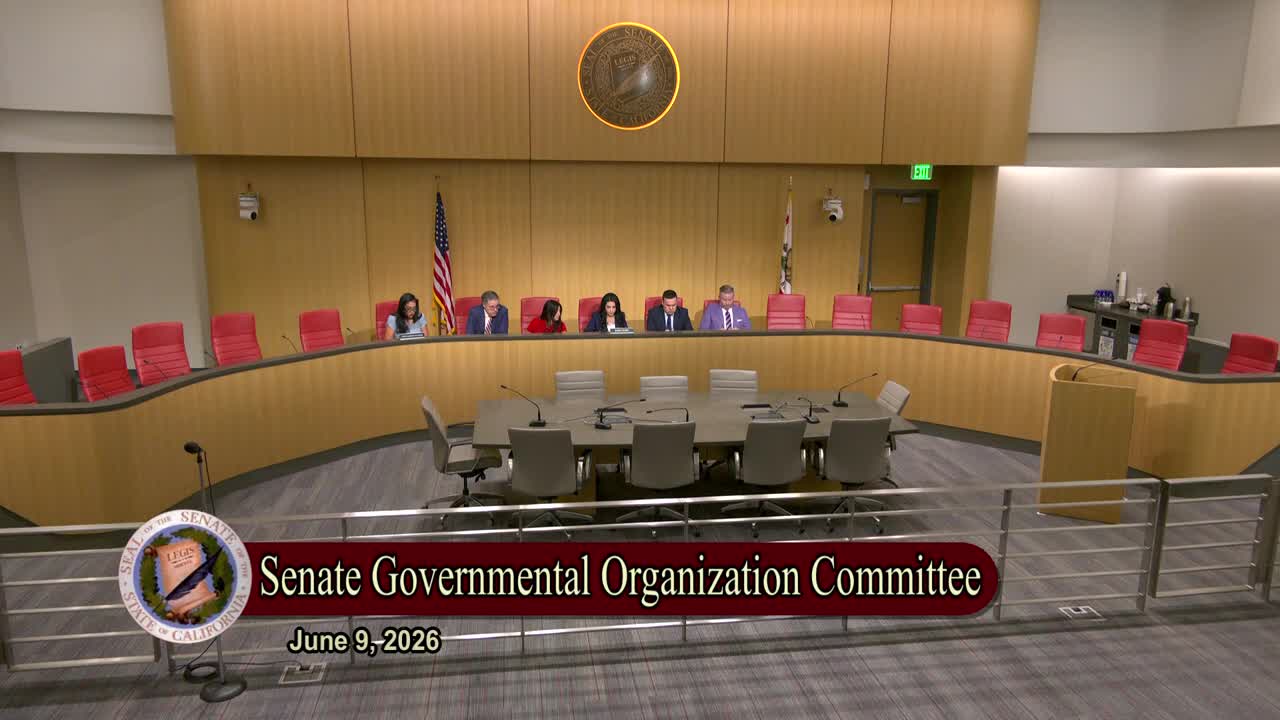 5MIN
Senate Standing Committee on Governmental Organization
 32MIN
Assembly Standing Committee on Appropriations

Bill Co-Author(s):