AB 2626: Housing programs: financing.
- Session Year: 2025-2026
- House: Assembly
- Latest Version Date: 2026-06-15
Current Status:
In Progress
(2026-08-13: In committee: Held under submission.)
Introduced
In Committee
Awaiting First Chamber Vote
Passed First Chamber
In Committee
Awaiting Second Chamber Vote
Passed Second Chamber
Enacted
What does this bill do?
The bill lets the California Department of Housing and Community Development waive residual receipts (leftover income from a project) or minimum annual loan payments that are charged to cover project monitoring for housing developments funded with department resources. The department may grant a waiver after assessing its actual monitoring costs together with the project’s ability to pay.
The summary is provided by generative AI which can make mistakes. For original language, please view the details in the table below.
Existing law establishes the Department of Housing and Community Development and requires it to administer various programs intended to promote the development of housing, as specified, pursuant to which the department provides financial assistance in the form of deferred payment loans to pay for the eligible costs of development of specified types of housing projects. Existing law sets forth various general powers of the department in implementing these programs, including authorizing the department to enter into long-term contracts or agreements of up to 30 years for the purpose of servicing loans or grants or enforcing regulatory agreements or other security documents.
This bill would permit the department to waive payment of residual receipts or minimum annual loan payments used to cover the cost of project monitoring required under a department regulatory agreement. agreement, based on the assessment by the departments actual cost in combination with a projects ability to pay.
Existing law establishes the Department of Housing and Community Development and requires it to administer various programs intended to promote the development of housing, as specified, pursuant to which the department provides financial assistance in the form of deferred payment loans to pay for the eligible costs of development of specified types of housing projects. Existing law sets forth various general powers of the department in implementing these programs, including authorizing the department to enter into long-term contracts or agreements of up to 30 years for the purpose of servicing loans or grants or enforcing regulatory agreements or other security documents.
This bill would permit the department to waive payment of residual receipts or minimum annual loan payments required under a department regulatory agreement.
Existing law establishes the Department of Housing and Community Development and requires it to administer various programs intended to promote the development of housing, as specified, pursuant to which the department provides financial assistance in the form of deferred payment loans to pay for the eligible costs of development of specified types of housing projects. Existing law sets forth various general powers of the department in implementing these programs, including authorizing the department to enter into long-term contracts or agreements of up to 30 years for the purpose of servicing loans or grants or enforcing regulatory agreements or other security documents.This bill would express the intent of the Legislature to enact legislation to assist affordable housing developments that are financially at risk.Existing law establishes the Department of Housing and Community Development and requires it to administer various programs intended to promote the development of housing, as specified, pursuant to which the department provides financial assistance in the form of deferred payment loans to pay for the eligible costs of development of specified types of housing projects. Existing law sets forth various general powers of the department in implementing these programs, including authorizing the department to enter into long-term contracts or agreements of up to 30 years for the purpose of servicing loans or grants or enforcing regulatory agreements or other security documents.
This bill would express the intent of the Legislature to enact legislation to assist affordable housing developments that are financially at risk.
Notwithstanding any other law, to improve the fiscal integrity of a development financed with departmental resources, the department, in its sole discretion, may waive payment of residual receipts or minimum annual loan payments used to cover the cost of project monitoring required under a department regulatory agreement. agreement, based on the assessment by the departments actual cost in combination with a projects ability to pay.
Notwithstanding any other law, to improve the fiscal integrity of a development financed with departmental resources, the department, in its sole discretion, may waive payment of residual receipts or minimum annual loan payments required under a department regulatory agreement.
SECTION 1.It is the intent of the Legislature to enact legislation to assist affordable housing developments that are financially at risk.It is the intent of the Legislature to enact legislation to assist affordable housing developments that are financially at risk.
|
Date
|
Status
|
|---|---|
| Aug 13, 2026 | In committee: Held under submission. |
| Aug 3, 2026 | In committee: Referred to APPR. suspense file. |
| Jun 25, 2026 | From committee: Do pass and re-refer to Com. on APPR. with recommendation: To Consent Calendar. (Ayes 10. Noes 0.) (June 24). Re-referred to Com. on APPR. |
| Jun 15, 2026 | From committee chair, with author's amendments: Amend, and re-refer to committee. Read second time, amended, and re-referred to Com. on HOUSING. |
| Jun 10, 2026 | Referred to Com. on HOUSING. |
| May 28, 2026 | In Senate. Read first time. To Com. on RLS. for assignment. |
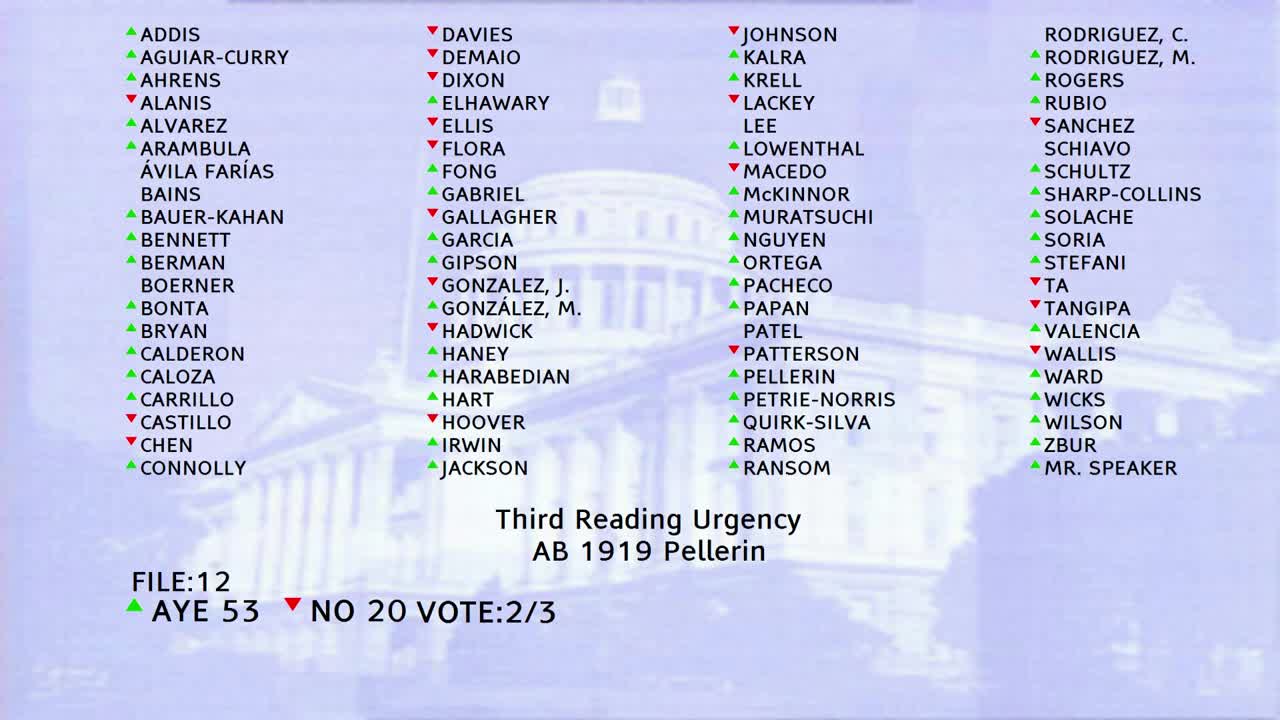
| May 27, 2026 | Read third time. Passed. Ordered to the Senate. (Ayes 69. Noes 1.) |
| May 27, 2026 | Read third time. Passed. Ordered to the Senate. (Ayes 69. Noes 1. Page 5477.) |
| May 27, 2026 | Read third time. Passed. Ordered to the Senate. |
| May 18, 2026 | Read second time. Ordered to third reading. |
| May 14, 2026 | From committee: Do pass. (Ayes 13. Noes 1.) (May 14). |
| Apr 29, 2026 | In committee: Set, first hearing. Referred to APPR. suspense file. |
| Apr 15, 2026 | From committee: Do pass and re-refer to Com. on APPR. (Ayes 12. Noes 0.) (April 15). Re-referred to Com. on APPR. |
| Apr 2, 2026 | In committee: Set, first hearing. Hearing canceled at the request of author. |
| Mar 10, 2026 | Re-referred to Com. on H. & C.D. |
| Mar 9, 2026 | Referred to Com. on H. & C.D. |
| Mar 9, 2026 | From committee chair, with author's amendments: Amend, and re-refer to Com. on H. & C.D. Read second time and amended. |
| Feb 21, 2026 | From printer. May be heard in committee March 23. |
| Feb 20, 2026 | Read first time. To print. |
|
Date
|
Description
|
Location
|
Votes
|
|
|---|---|---|---|---|
| Aug 3, 2026 | Placed on suspense file | Senate Standing Committee on Appropriations |
Passed |
|
| Jun 24, 2026 | Do pass, but first be re-referred to the Committee on [Appropriations] with the recommendation: To Consent Calendar | Senate Standing Committee on Housing |
Passed |
|
| May 27, 2026 | AB 2626 Gabriel Assembly Third Reading | Assembly Floor |
Passed |
|
| May 14, 2026 | Do pass. | Assembly Standing Committee on Appropriations |
Passed |
|
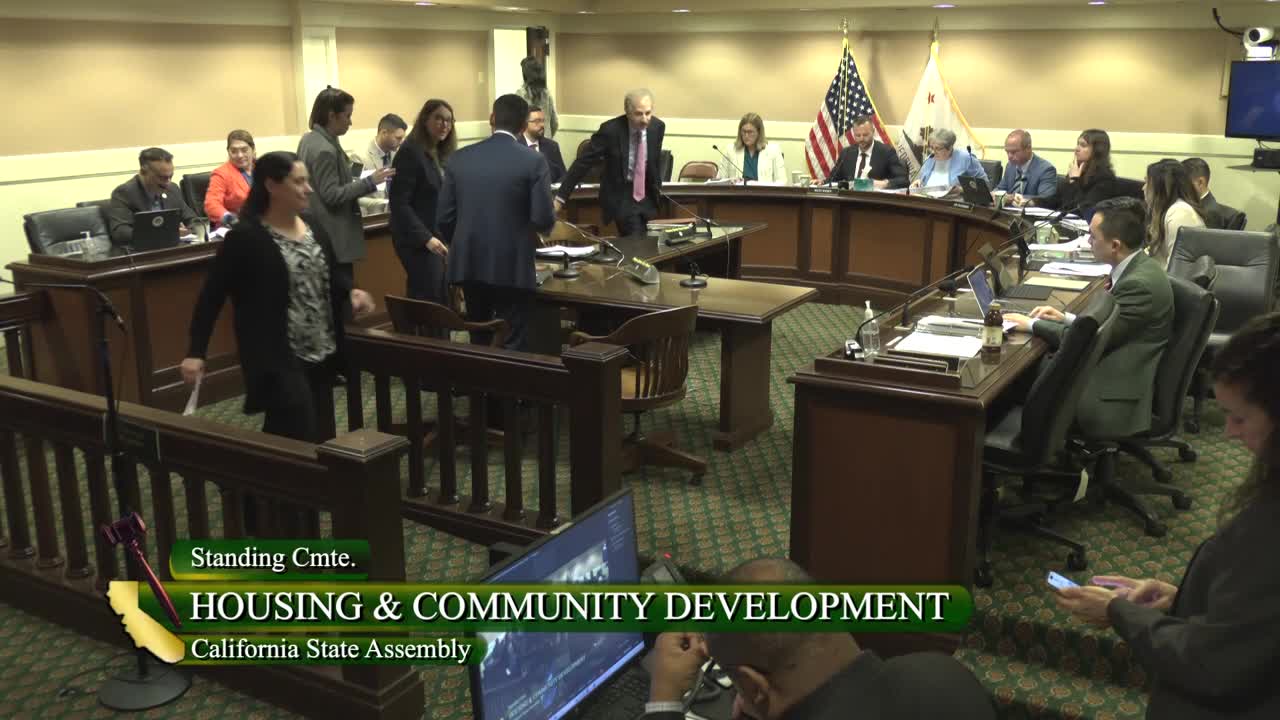
| Apr 15, 2026 | Do pass and be re-referred to the Committee on [Appropriations] | Assembly Standing Committee on Housing and Community Development |
Passed |
This list shows positions taken on this bill by organizations on the date displayed, which is linked to the original source.
Positions by individuals are not included.
|
Organization
|
Position
|
Date
|
|---|---|---|
| Abode Housing Development | ** Support | |
| All Home | ** Support | |
| California Coalition for Community Investment | ** Support | |
| California Coalition For Rural Housing | ** Support | |
| California Housing Consortium | ** Support | |
| California Housing Partnership | ** Support | |
| Cty Housing, INC. | ** Support | |
| East Bay Housing Organizations | ** Support | |
| East LA Community Corporation | ** Support | |
| Emeryville; City Of | ** Support | |
| ENTERPRISE COMMUNITY PARTNERS, INC. | ** Support | |
| Enterprise Community Partners, INC. (Co-Sponsor) | ** Support | |
| Episcopal Community Services of San Francisco | ** Support | |
| Housing California | ** Support | |
| Housing Trust Silicon Valley | ** Support | |
| LeadingAge California | ** Support | |
| LINC Housing | ** Support | |
| Little Tokyo Service Center | ** Support | |
| Local Initiatives Support Corporation | ** Support | |
| MidPen Housing Corporation | ** Support | |
| National Equity Fund | ** Support | |
| Non-Profit Housing Association of Northern California | ** Support | |
| Nonprofit Housing Association of Northern California (Co-Sponsor) | ** Support | |
| Resources for Community Development | ** Support | |
| Southern California Association of Non-profit Housing (SCANPH) | ** Support | |
| Supportive Housing Alliance | ** Support | |
| Tenderloin Neighborhood Development Corporation | ** Support | |
| The California Housing Partnership (Co-Sponsor) | ** Support |
SENATE COMMITTEE ON
Senator Sabrina Cervantes, Chair
2025 - 2026 Regular Session
AB 2626 (Gabriel) - Housing programs: financing
Version: | Policy Vote: |
Urgency: | Mandate: |
Hearing Date: | Consultant: |
Bill Summary:
AB 2626 would authorize the Department of Housing and Community Development (HCD) to waive payment of residual receipts or annual loan payments used to cover the cost of project monitoring that are required under regulatory agreements, as specified.
Fiscal Impact:
- To the extent HCD exercises the authority to waive payment of residual receipts or minimum annual loan payments, the bill would reduce HCD’s revenues and create unknown cost pressures to fund HCD’s ongoing administrative and project monitoring expenses from other sources. HCD would also incur unknown administrative workload costs, likely in the low hundreds of thousands of dollars annually, to conduct assessments of department costs and a project sponsor’s ability to pay. See Staff Comments. (General Fund)
Background:
Under existing law, HCD administers various programs for the development of affordable housing and typically provides financial assistance in the form of deferred payment loans that require a project sponsor to only pay a residual amount to cover HCD’s administrative costs over the life of the loan. The amount of the fee charged to developers to cover monitoring costs is typically 0.42% of the total loan amount.
Existing law, the Loan Portfolio Restructuring (LPR) Program, authorizes HCD to approve an extension of a department loan, the reinstatement of a qualifying unpaid mature loan, the subordination of a loan to new debt, or an investment of tax credit equity under numerous rental housing finance programs. Existing law specifies that loans may only be restructured at HCD’s discretion if a development is in compliance with the existing regulatory agreement, the development requires a restructuring in order to continue to operate, and the development has, or will have after rehabilitation and repairs, a potential remaining useful life of at least as long as the new loan term. An extension must be for a period of at least 10 years and up to 55 years, at an interest rate of 3 percent. Rents may be adjusted upward to the minimum extent necessary to support the new debt to pay for rehabilitation, and subject to specified limits to maintain affordability. Existing law authorizes HCD to charge loan processing and monitoring fees to an applicant to generate sufficient revenue to cover initial and ongoing monitoring requirements of the program.
Existing law, as enacted by AB 130 (Budget Committee), Chap. 22/2025, a trailer bill associated with the 2025-26 Budget, also authorizes HCD to approve the payoff of a department loan prior to the end of its term, and the extraction of equity from a development for purposes approved by the department, as specified. AB 130 also allows the owner of a property subject to a regulatory agreement with HCD to take out additional debt on the development to finance rehabilitation or investment in new affordable housing, as specified. HCD background on the trailer bill indicates that leveraging excess equity from current projects to create new and preserve existing affordable housing projects is a cost-effective solution that can increase the impact of prior state investments and support ongoing preservation without additional state funding.
Proposed Law:
AB 2626 would authorize HCD, at its sole discretion, to waive payment of residual receipts or minimum annual loan payments used to cover the cost of project monitoring that are required under a regulatory agreement with HCD, based on the assessment of the department’s actual cost in combination with a project’s ability to pay.
Related Legislation:
AB 2020 (Gabriel), which is pending in this Committee, would authorize HCD, at its discretion, to authorize the transfer of excess reserves or operating income from one rental housing development to another under specified conditions.
AB 913 (Gabriel), which was held on this Committee’s Suspense File last year, included the provisions of this bill as well as the authorization included in this year’s AB 2020.
AB 130 (Budget Committee), Chap. 22/2025, a housing trailer bill, included a provision expanding the LPR program to authorize HCD to approve the payoff of a department loan prior to the end of its term, and the extraction of equity from a development for purposes approved by the department, as specified. The bill also allowed an owner of a property subject to a regulatory agreement with HCD to take out additional debt on the development to finance rehabilitation or investment in new affordable housing.
AB 1699 (Torres), Chap. 780/2012, established the LPR Program and authorized HCD to approve an extension of a department loan, the subordination of a loan to new debt, or an investment of tax credit equity under older rental housing finance programs, as specified.
Staff Comments:
This bill would allow HCD to waive a developer’s payment of residual receipts or minimum loan payments that are used to cover the department’s ongoing project monitoring costs, based on an assessment of HCD’s actual costs in combination with a project’s ability to pay. As noted above, the implementation of this bill is discretionary, and would not result in immediate costs to HCD. To the extent that HCD exercises the authority to waive monitoring fee payments, the department indicates there would be an increase in workload, which creates a General Fund cost pressure to pay for HCD’s ongoing administrative costs, as well as cost pressures to pay for ongoing monitoring from other sources. The level of ongoing administrative workload would vary depending on the number of requests for fee waivers and the complexity of each assessment of HCD costs and a project’s ability to pay. In addition, the loss of revenues that would need to be covered by other sources to backfill costs for ongoing monitoring would depend upon the number of requests and the amounts waived for those projects.
-- END --
SENATE COMMITTEE ON HOUSING
Senator Jesse Arreguín, Chair
2025 - 2026 Regular
Bill No: AB 2626 Hearing Date: 6/24/ 2026
Author: | Gabriel | ||
Version: | 6/15/2026 Amended | ||
Urgency: | No | Fiscal: | Yes |
Consultant: | Alison Hughes | ||
SUBJECT: Housing programs: financing
DIGEST: This bill allows the Department of Housing and Community Development (HCD) to waive payment of residual receipts or minimum annual loan payments used to cover the cost of project monitoring required under an HCD regulatory agreement, as specified.
ANALYSIS:
Existing law:
- Allows HCD to approve an extension of an HCD loan, the reinstatement of a qualifying unpaid matured loan, the subordination of an HCD loan to new debt, or an investment of tax credit equity under various older HCD rental housing finance programs.
- Provides that HCD may subordinate its loan to refinance existing senior debt only as necessary for project feasibility and to reimburse borrower advances for predevelopment costs, recent capital improvements, and recent operating deficits.
- Creates the Multifamily Housing Program (MHP), whose Regulations include the following prohibitions:
- Prohibits the Sponsor from encumbering, pledging, or hypothecating the Rental Housing Development, or any interest therein or portion thereof, or allow any lien, charge, or assessment against the Rental Housing Development without the prior written approval of HCD. HCD will not permit refinancing of existing liens or additional financing secured by the Rental Housing Development except to the extent necessary to maintain or improve the Fiscal Integrity of the Project, to maintain Affordable Rents, or to decrease Rents and for no other purpose, including, but not limited to, cash payments to the Sponsor, repayment of general partner loans or of limited partner loans, or for limited partner buyouts. Notwithstanding the general provisions in UMR Section 8308(g), this special condition controls, in that no MHP reserve balance can fund a limited partner buyout or exit; and
- No loan may be paid off prior to maturity without the prior written consent of HCD in its sole discretion, which shall be subject to conditions deemed necessary to ensure compliance with the Program requirements. All of the loan documents, including the Regulatory Agreement and Deed of Trust, shall continue in full force and effect notwithstanding any prepayment, in whole or in part, or the loan.
- Requires HCD to allow an owner of a property subject to a regulatory agreement with HCD to take out additional debt on the development to finance, with the HCD’s approval, rehabilitation of the property or investment in new affordable housing, if all of the following conditions are met:
- All hard debt, including the additional debt, is underwritten with a debt-service coverage ratio of at a minimum 1.15 and is demonstrated to project positive cash flow for 15 consecutive years. For the purposes of this subdivision, “hard debt” means debt that must be repaid via an amortizing payment or at a specified maturity date;
- Any new debt is subordinate to HCD’s lien and regulatory agreement, as applicable, unless HCD reasonably determines that subordination of HCD’s lien is necessary for the feasibility of a project and to fund reasonable rehabilitation or improvements, including soft costs;
- Any extracted equity is any of the following:
- With HCD’s approval, contributed to other projects that will increase or improve the supply of deed-restricted affordable housing serving low-income households in the state;
- Utilized in the purchase of a limited partner interest of a tax credit investor in the project, provided that the amount used to purchase that interest, as specified;
- Utilized in the payment of any unpaid deferred developer fee for the project pursuant to any applicable HCD regulations;
- Applied toward payment for necessary repairs and rehabilitation of the project;
- Utilized for the establishment or replenishment of HCD-approved project reserves; and,
- Utilized for any other purposes approved by HCD.
- HCD’s regulatory agreement remains in place for the project for its remaining term; and,
- HCD continues to be entitled to receive monitoring fees to ensure compliance with the existing regulatory agreement.
- Defines “extracted equity” to mean debt added to a HCD-regulated property that is not used for any of the following purposes:
- Approved project rehabilitation work;
- To pay off existing debt;
- Replenishment of reserves; and
- Other HCD-approved project specific uses.
This bill allows HCD to waive payment of residual receipts or minimum annual loan payments used to cover the cost of project monitoring required under an HCD regulatory agreement based on the assessment by HCD’s actual cost in combination with a project’s ability to pay, to improve the fiscal integrity of a development financed with HCD resources
Background
Affordable Housing Finance. The state finances affordable multifamily rental housing using a combination of loans, tax credits, and private activity bonds. Unlike market rate housing, affordable housing does not have the cash-flow from rents to support traditional financing. Affordable housing is provided to tenants whose household income is below the area median income (AMI). To qualify, very low-income tenants must make 60% or less of the AMI and lower-income tenants must make only 80% or less of AMI. Tenants in affordable housing are only required to pay 30% of their income toward rent, so the state provides enough long-term subsidy to reduce the overall debt service on a development. HCD loans serve as the permanent financing that comes in once a development is complete to take out the predevelopment and construction loans a developer took on to construct the development. HCD loans are secured with a lien in first position on the property. Developments are also subject to a 55-year recorded regulatory agreement which runs with the project. If a developer pays off an HCD loan before the covenants expire, the regulatory agreement is not extinguished and the developer must continue to provide the units at an affordability rent for the length of the regulatory agreement to lower-income tenants.
Comments
- Author’s statement. “California's housing crisis demands action on every front, and that starts with protecting the affordable housing we already have. To support this goal, affordable housing providers need targeted relief from cost burdens that threaten the viability of the developments that house our most vulnerable residents. AB 2626 seeks to address this by authorizing the Department of Housing and Community Development to waive annual monitoring fee payments for affordable housing developments when necessary to protect their fiscal integrity and long-term affordability. This common-sense fix will keep vulnerable developments afloat and preserve affordable homes for the Californians who need them most.”
2) Challenges Facing Affordable Housing Developments. Due to several factors including the depletion of operating reserves resulting from the COVID-19 rent moratorium and unprecedented increases in insurance rates, affordable housing developments are facing financial challenges. Enterprise Community Partners recently conducted a survey of 130 affordable properties and found that on average the developments were experiencing insurance cost increases of 70%, with some providers reporting increases up to 500%. Because rents are capped, these properties have fewer options to cover these increases. In some cases, the situation is made worse because the project’s operating reserves have not recovered from the rent moratoriums. Due to these financial pressures some properties are at risk of foreclosing or becoming market-rate developments, which would eliminate vital affordable housing units.
3) Fees for Monitoring. Existing law authorizes HCD to charge loan processing and monitoring fees to an applicant to generate sufficient revenue to cover initial and ongoing monitoring requirements of the program. Developments pay a flat fee of 0.42% of the total loan amount to support the cost of monitoring. A recent analysis by the California Housing Partnership has shown that Multi-family Housing Program (MHP) monitoring fees average $1,000 per unit per year. The California Housing Finance Agency (CalHFA), a sister state agency to HCD that also makes loans to affordable housing developments, charges a flat monitoring fee of $7,500 regardless of the number of units in the development. Where past bills have proposed to cap the monitoring fees charged by HCD, this bill gives HCD discretion to waive the fee if it would improve the fiscal integrity of a development financed with departmental resources.
Last year, AB 130 (Committee on Budget, Chapter 22), gave HCD authority to allow developers to utilize equity in their affordable housing projects to finance further investments in other affordable housing projects, purchase a limited partners interest of a tax credit investor in the project, pay any unpaid deferred developer fee for the project, and pay for necessary repairs and rehabilitation of the project. This bill would allow HCD to waive payment of residual receipts — the excess income after a developer has paid off their debts — or minimum annual loan payments that are used to cover the cost of project monitoring required under a department regulatory agreement to improve the fiscal integrity of a development financed with departmental resources. The goal is for HCD to be able to pause payments if the developer is experiencing financial hardships, and resume those payments at a later date.
6) If at first you don’t succeed… This bill is substantially similar to AB 913 (Celeste Rodriguez, 2025), which was held in Senate Appropriations. That bill contained two separate policies intended to grant financial relief for affordable housing projects. This bill contains one provision, while AB 2020 (Gabriel, 2026) contains the other.
Related/Prior Legislation
AB 913 (Celeste Rodriguez, 2025) — would have authorized HCD to authorize the transfer of excess reserves or operating income from one rental housing development to another under specified conditions. AB 913 would have also authorized HCD to waive payment of residual receipts or annual loan payments required under regulatory agreements, as specified. AB 913 was held in Senate Appropriations Committee.
AB 515 (Ward, 2023) — would have amended the Loan Portfolio Restructuring Program (LPR Program) to authorize HCD to approve the payoff of a department loan prior to the end of its term, and the extraction of equity from a development for purposes approved by the department, as specified. AB 515 was held in the Senate Appropriations Committee.
AB 578 (Berman, 2023) — would have reduced the amount of annual loan payments that developers pay to HCD to cover the ongoing costs of project monitoring under the Multifamily Housing Program and the No Place Like Home Program to the lesser of the current amount or $260 per unit. AB 578 was held in the Senate Appropriations Committee.
FISCAL EFFECT: Appropriation: Fiscal Com.: Local:
POSITIONS: (Communicated to the committee before noon on Wednesday,
June 17th, 2026.)
SUPPORT:
Enterprise Community Partners, INC. (Co-Sponsor)
Nonprofit Housing Association of Northern California (Co-Sponsor)
The California Housing Partnership (Co-Sponsor)
Abode Housing Development
California Coalition for Rural Housing
California Housing Consortium
Emeryville; City of
Housing California
Housing Trust Silicon Valley
Little Tokyo Service Center
Local Initiatives Support Corporation
National Equity Fund
Resources for Community Development
Southern California Association of Non-profit Housing (SCANPH)
Supportive Housing Alliance
OPPOSITION:
None received.
-- END --
ASSEMBLY THIRD READING
ATR Bill Id:AB 2626
Author:(Gabriel)
As Amended Ver:March 9, 2026
Majority vote
SUMMARY
Allows the Department of Housing and Community Development (HCD) to waive payment of residual receipts or minimum annual loan payments required under a department regulatory agreement to improve the fiscal integrity of a development financed with departmental resources.
Major Provisions
Allows the Department of Housing and Community Development (HCD) to waive payment of residual receipts or minimum annual loan payments required under a department regulatory agreement to improve the fiscal integrity of a development financed with departmental resources.
COMMENTS
Affordable Housing Finance: The state finances affordable multifamily rental housing using a combination of loans, tax credits, and private activity bonds. Unlike market rate housing, affordable housing does not have the cash-flow from rents to support traditional financing. Affordable housing is provided to tenants whose household income is below the area median income (AMI). To qualify, very low-income tenants must make 60% or less of the AMI and lower-income tenants must make only 80% or less of AMI. Tenants in affordable housing are only required to pay 30% of their income toward rent, so the state provides enough long-term subsidy to reduce the overall debt service on a development. HCD loans serve as the permanent financing that comes in once a development is complete to take out the predevelopment and construction loans a developer took on to construct the development. HCD loans are secured with a lien in first position on the property. Developments are also subject to a 55-year recorded regulatory agreement which runs with the project. If a developer pays off an HCD loan before the covenants expire, the regulatory agreement is not extinguished and the developer must continue to provide the units at an affordability rent for the length of the regulatory agreement to lower-income tenants. Last year, AB 130 (Committee on Budget), Chapter 22, gave HCD authority to allow developers to utilize equity in their affordable housing projects to finance further investments in other affordable housing projects, purchase a limited partners interest of a tax credit investor in the project, pay any unpaid deferred developer fee for the project, and pay for necessary repairs and rehabilitation of the project. This bill is different from AB 130 in that it allows HCD to waive payment of residual receipts or minimum annual loan payments required under a department regulatory agreement to improve the fiscal integrity of a development financed with departmental resources.
Challenges Facing Affordable Housing Developments: Due to several factors including the depletion of operating reserves resulting from the COVID-19 rent moratorium and unprecedented increases in insurance rates, affordable housing developments are facing financial challenges. Enterprise Community Partners recently conducted a survey of 130 affordable properties and found that on average the developments were experiencing insurance cost increases of 70%, with some providers reporting increases up to 500%. Because rents are capped, these properties have fewer options to cover these increases. In some cases, the situation is made worse because the project's operating reserves have not recovered from the rent moratoriums. Due to these financial pressures some properties are at risk of foreclosing or becoming market-rate developments, which would eliminate vital affordable housing units.
Fees for Monitoring: Existing law authorizes HCD to charge loan processing and monitoring fees to an applicant to generate sufficient revenue to cover initial and ongoing monitoring requirements of the program. Developments pay a flat fee of 0.42% of the total loan amount to support the cost of monitoring. A recent analysis by the California Housing Partnership has shown that Multi-family Housing Program (MHP) monitoring fees average $1,000 per unit per year. The California Housing Finance Agency (CalHFA), a sister state agency to HCD which also makes loans to affordable housing developments, charges a flat monitoring fee of $7,500 regardless of the number of units in the development. Past bills have proposed to cap the monitoring fees charged by HCD, this bill gives HCD discretion to waive the fee if it would improve the fiscal integrity of a development financed with departmental resources.
According to the Author
"California's housing crisis demands action on every front, and that starts with protecting the affordable housing we already have. To support this goal, affordable housing providers need targeted relief from cost burdens that threaten the viability of the developments that house our most vulnerable residents. AB 2626 seeks to address this by authorizing the Department of Housing and Community Development to waive annual monitoring fee payments for affordable housing developments when necessary to protect their fiscal integrity and long-term affordability. This common-sense fix will keep vulnerable developments afloat and preserve affordable homes for the Californians who need them most."
Arguments in Support
According to the California Housing Partnership, "AB 2626 recognizes that the state needs to charge reasonable monitoring and compliance fees and therefore provides HCD with the discretion to waive monitoring fee payments when doing so is necessary to protect the financial health of a development or in the best interests of the state. This targeted flexibility allows the state to respond to situations where compliance costs threaten the viability of affordable housing while maintaining appropriate oversight and accountability."
Arguments in Opposition
None on file.
FISCAL COMMENTS
According to the Assembly Committee on Appropriations:
Because implementation of this bill's provisions is discretionary, there are no immediate costs to HCD. However, if HCD exercises this discretion, HCD would incur ongoing General Fund costs of an unknown amount, but likely in the low- to mid-hundreds of thousands of dollars annually for additional staff. HCD indicates the workload increase will vary depending on the number of requests.
In addition, any monitoring fees waived by HCD under this bill will reduce income to HCD and may require other resources to cover HCD expenses.
The Legislative Analyst's Office recently warned of General Fund structural deficits of around $35 billion per year in the 2027-28 fiscal year and ongoing.
VOTES
ASM HOUSING AND COMMUNITY DEVELOPMENT: 12-0-0
YES: Haney, Patterson, Ávila Farías, Caloza, Garcia, Kalra, Lee, Quirk-Silva, Ta, Tangipa, Wicks, Wilson
ASM APPROPRIATIONS: 13-1-1
YES: Wicks, Hoover, Aguiar-Curry, Calderon, Caloza, Fong, Mark González, Krell, Pacheco, Pellerin, Sharp-Collins, Solache, Ta
NO: Dixon
ABS, ABST OR NV: Tangipa
UPDATED
VERSION: March 9, 2026
CONSULTANT: Lisa Engel / H. & C.D. / (916) 319-2085 FN: 0002587
Date of Hearing: April 29, 2026
ASSEMBLY COMMITTEE ON APPROPRIATIONS
Buffy Wicks, Chair
ABPCA Bill Id:AB 2626
Author:(Gabriel) – As Amended Ver:March 9, 2026
Policy Committee: | Housing and Community Development | Vote: | 12 - 0 |
|
| ||
|
|
Urgency: No State Mandated Local Program: No Reimbursable: No
SUMMARY:
This bill allows the Department of Housing and Community Development (HCD) to waive payment of residual receipts or minimum annual loan payments required under a department regulatory agreement to improve the fiscal integrity of a development financed with departmental resources.
FISCAL EFFECT:
Because implementation of this bill’s provisions is discretionary, there are no immediate costs to HCD. However, if HCD exercises this discretion, HCD would incur ongoing General Fund costs of an unknown amount, but likely in the low- to mid-hundreds of thousands of dollars annually for additional staff. HCD indicates the workload increase will vary depending on the number of requests.
In addition, any monitoring fees waived by HCD under this bill will reduce income to HCD and may require other resources to cover HCD expenses.
The Legislative Analyst’s Office recently warned of General Fund structural deficits of around $35 billion per year in the 2027-28 fiscal year and ongoing.
COMMENTS:
- Purpose. According to the author:
California's housing crisis demands action on every front, and that starts with protecting the affordable housing we already have. To support this goal, affordable housing providers need targeted relief from cost burdens that threaten the viability of the developments that house our most vulnerable residents. [This bill] seeks to address this by authorizing HCD to waive annual monitoring fee payments for affordable housing developments when necessary to protect their fiscal integrity and long-term affordability. This common-sense fix will keep vulnerable developments afloat and preserve affordable homes for the Californians who need them most.
- Background. The state finances affordable multifamily rental housing using a combination of loans, tax credits, and private activity bonds. Unlike market rate housing, affordable housing does not have the cash-flow from rents to support traditional financing. Due to several factors including the depletion of operating reserves resulting from the COVID-19 rent moratorium and unprecedented increases in insurance rates, affordable housing developments are facing financial challenges.
Existing law authorizes HCD to charge loan processing and monitoring fees to an applicant to generate sufficient revenue to cover initial and ongoing monitoring requirements of the program. Developments pay a flat fee of 0.42% of the total loan amount to support the cost of monitoring. A recent analysis by the California Housing Partnership shows that Multi-family Housing Program (MHP) monitoring fees average $1,000 per unit per year. The California Housing Finance Agency (CalHFA), which also makes loans to affordable housing developments, charges a flat monitoring fee of $7,500, regardless of the number of units in the development. Past bills have proposed to cap the monitoring fees charged by HCD; this bill gives HCD discretion to waive the fee if it would improve the fiscal integrity of a development financed with departmental resources.
Advocates assert this bill provides targeted flexibility that allows the state to respond to situations where compliance costs threaten the viability of affordable housing while maintaining appropriate oversight and accountability.
- Related Legislation. AB 2020 (Gabriel), of this legislative session, allows HCD to authorize the transfer of excess reserves or excess operating income from one rental housing development to another rental housing development owned by the same developer. AB 2020 is pending in this committee.
AB 913 (C. Rodriguez), of this legislative session, combined the contents of this bill and AB 2020, above. AB 913 was held on the Senate Appropriations Committee’s suspense file.
Analysis Prepared by: Jennifer Swenson / APPR. / (916) 319-2081
Date of Hearing: April 15, 2026
ASSEMBLY COMMITTEE ON HOUSING AND COMMUNITY DEVELOPMENT
Matt Haney, Chair
ABPCA Bill Id:AB 2626 (
Author:Gabriel) – As Amended Ver:March 9, 2026
SUBJECT: Housing programs: financing
SUMMARY: Allows the Department of Housing and Community Development (HCD) to waive payment of residual receipts or minimum annual loan payments required under a department regulatory agreement to improve the fiscal integrity of a development financed with departmental resources.
EXISTING LAW:
- Requires HCD to require annual loan payments in the minimum amount necessary to cover the costs of project monitoring. Provides for the first 30 years of the loan term, the amount of the required loan payments shall not exceed .42% per annum. (Health and Safety Code (HSC) Section 50675.6)
- Allows HCD to approve an extension of a department loan, the reinstatement of a qualifying unpaid matured loan, the subordination of a department loan to new debt, or an investment of tax credit equity under various older HCD rental housing finance programs. (HSC 50560)
- Allows HCD to approve an extension of a loan, the reinstatement of a qualifying unpaid matured loan, or the subordination of an HCD loan to new debt or an investment of tax credit equity if it determines that the project will have after rehabilitation of repairs, a potential remaining useful life equal to or greater than the term of the restructured loan. (HSC 50560)
- Provides that HCD may subordinate its loan to refinance existing senior debt only as necessary for project feasibility and to reimburse borrower advances for predevelopment costs, recent capital improvements, and recent operating deficits. (HSC 50560)
- Establishes the Multi-family Housing Program (MHP), whose Regulations include the following prohibitions:
- Prohibits the Sponsor from encumbering, pledging, or hypothecating the Rental Housing Development, or any interest therein or portion thereof, or allow any lien, charge, or assessment against the Rental Housing Development without the prior written approval of HCD. HCD will not permit refinancing of existing liens or additional financing secured by the Rental Housing Development except to the extent necessary to maintain or improve the Fiscal Integrity of the Project, to maintain Affordable Rents, or to decrease Rents and for no other purpose, including, but not limited to, cash payments to the Sponsor, repayment of general partner loans or of limited partner loans, or for limited partner buyouts. Notwithstanding the general provisions in UMR Section 8308(g), this special condition controls, in that no MHP reserve balance can fund a limited partner buyout or exit.
- No loan may be paid off prior to maturity without the prior written consent of the
Department in its sole discretion, which consent shall be subject to conditions deemed
necessary to ensure compliance with the Program requirements. All of the loan
documents, including the Regulatory Agreement and Deed of Trust, shall continue in
full force and effect notwithstanding any prepayment, in whole or in part, or the loan. (California Code of Regulations (CCR), Title 25, Subchapter 4, MHP Regulations 7322) - Requires HCD to allow an owner of a property subject to a regulatory agreement with the department to take out additional debt on the development to finance, with the department’s approval, rehabilitation of the property or investment in new affordable housing, if all of the following conditions are met:
- All hard debt, including the additional debt, is underwritten with a debt-service coverage ratio of at a minimum 1.15 and is demonstrated to project positive cash flow for 15 consecutive years. For the purposes of this subdivision, “hard debt” means debt that must be repaid via an amortizing payment or at a specified maturity date;
- Any new debt is subordinate to the department’s lien and regulatory agreement, as applicable, unless the department reasonably determines that subordination of the department’s lien is necessary for the feasibility of a project and to fund reasonable rehabilitation or improvements, including soft costs;
- Any extracted equity is any of the following:
- With the department’s approval, contributed to other projects that will increase or improve the supply of deed-restricted affordable housing serving low-income households in the state;
- Utilized in the purchase of a limited partner interest of a tax credit investor in the project, provided that the amount used to purchase that interest, as specified;
- Utilized in the payment of any unpaid deferred developer fee for the project pursuant to any applicable department regulations;
- Applied toward payment for necessary repairs and rehabilitation of the project;
- Utilized for the establishment or replenishment of department-approved project reserves; and
- Utilized for any other purposes approved by the department.
- The department’s regulatory agreement remains in place for the project for its remaining term.
- The department continues to be entitled to receive monitoring fees to ensure compliance with the existing regulatory agreement. (HSC 50406.4)
- Defines “extracted equity” to mean debt added to a department-regulated property that is not used for any of the following purposes:
- Approved project rehabilitation work;
- To pay off existing debt;
- Replenishment of reserves; and
- Other department-approved project specific uses. (HSC 50406.4)
FISCAL EFFECT: Unknown.
COMMENTS:
Author’s Statement: According to the author, California's housing crisis demands action on every front, and that starts with protecting the affordable housing we already have. To support this goal, affordable housing providers need targeted relief from cost burdens that threaten the viability of the developments that house our most vulnerable residents. AB 2626 seeks to address this by authorizing the Department of Housing and Community Development to waive annual monitoring fee payments for affordable housing developments when necessary to protect their fiscal integrity and long-term affordability. This common-sense fix will keep vulnerable developments afloat and preserve affordable homes for the Californians who need them most.
Affordable Housing Finance: The state finances affordable multifamily rental housing using a combination of loans, tax credits, and private activity bonds. Unlike market rate housing, affordable housing does not have the cash-flow from rents to support traditional financing. Affordable housing is provided to tenants whose household income is below the area median income (AMI). To qualify, very low-income tenants must make 60% or less of the AMI and lower-income tenants must make only 80% or less of AMI. Tenants in affordable housing are only required to pay 30% of their income toward rent, so the state provides enough long-term subsidy to reduce the overall debt service on a development. HCD loans serve as the permanent financing that comes in once a development is complete to take out the predevelopment and construction loans a developer took on to construct the development. HCD loans are secured with a lien in first position on the property. Developments are also subject to a 55-year recorded regulatory agreement which runs with the project. If a developer pays off an HCD loan before the covenants expire, the regulatory agreement is not extinguished and the developer must continue to provide the units at an affordability rent for the length of the regulatory agreement to lower-income tenants. Last year, AB 130 (Committee on Budget), Chapter 22, gave HCD authority to allow developers to utilize equity in their affordable housing projects to finance further investments in other affordable housing projects, purchase a limited partners interest of a tax credit investor in the project, pay any unpaid deferred developer fee for the project, and pay for necessary repairs and rehabilitation of the project. This bill is different from AB 130 in that it allows HCD to waive payment of residual receipts or minimum annual loan payments required under a department regulatory agreement to improve the fiscal integrity of a development financed with departmental resources.
Challenges Facing Affordable Housing Developments: Due to several factors including the depletion of operating reserves resulting from the COVID-19 rent moratorium and unprecedented increases in insurance rates, affordable housing developments are facing financial challenges. Enterprise Community Partners recently conducted a survey of 130 affordable properties and found that on average the developments were experiencing insurance cost increases of 70%, with some providers reporting increases up to 500%. Because rents are capped, these properties have fewer options to cover these increases. In some cases, the situation is made worse because the project’s operating reserves have not recovered from the rent moratoriums. Due to these financial pressures some properties are at risk of foreclosing or becoming market-rate developments, which would eliminate vital affordable housing units.
Fees for Monitoring: Existing law authorizes HCD to charge loan processing and monitoring fees to an applicant to generate sufficient revenue to cover initial and ongoing monitoring requirements of the program. Developments pay a flat fee of 0.42%of the total loan amount to support the cost of monitoring. A recent analysis by the California Housing Partnership has shown that Multi-family Housing Program (MHP) monitoring fees average $1,000 per unit per year. The California Housing Finance Agency (CalHFA), a sister state agency to HCD which also makes loans to affordable housing developments, charges a flat monitoring fee of $7,500 regardless of the number of units in the development. Past bills have proposed to cap the monitoring fees charged by HCD, this bill gives HCD discretion to waive the fee if it would improve the fiscal integrity of a development financed with departmental resources.
Arguments in Support: According to the California Housing Partnership, “AB 2626 recognizes that the state needs to charge reasonable monitoring and compliance fees and therefore provides HCD with the discretion to waive monitoring fee payments when doing so is necessary to protect the financial health of a development or in the best interests of the state. This targeted flexibility allows the state to respond to situations where compliance costs threaten the viability of affordable housing while maintaining appropriate oversight and accountability.”
Arguments in Opposition: None on file.
Related Legislation:
AB 2020 (Gabriel) (2026) allows Department of Housing and Community Development (HCD) to authorize the transfer of “excess reserves” or “excess operating income” from one rental housing development, subject to a HCD regulatory agreement, to another rental housing development that is owned by the same sponsor or affiliate. AB 2020 will be heard in the Assembly Housing and Community Development Committee on April 15, 2026.
AB 913 (Celeste Rodriguez) (2025) would have authorized the HCD to authorize the transfer of excess reserves or operating income from one rental housing development to another under specified conditions. AB 913 would have also authorized HCD to waive payment of residual receipts or annual loan payments required under regulatory agreements, as specified. AB 913 was held in Senate Appropriations Committee.
AB 515 (Ward) (2023) would have amended the Loan Portfolio Restructuring Program (LPR Program) to authorize the HCD to approve the payoff of a department loan prior to the end of its term, and the extraction of equity from a development for purposes approved by the department, as specified. AB 515 was held in the Senate Appropriations Committee.
AB 578 (Berman) (2023) would have reduced the amount of annual loan payments that developers pay to the HCD to cover the ongoing costs of project monitoring under the Multifamily Housing Program and the No Place Like Home Program to the lesser of the current amount or $260 per unit. AB 578 was held in the Senate Appropriations Committee.
REGISTERED SUPPORT / OPPOSITION:
Support
California Coalition for Rural Housing (Co-Sponsor)
California Housing Partnership (Co-Sponsor)
Enterprise Community Partners, INC. (Co-Sponsor)
Non-profit Housing Association of Northern California (Co-Sponsor)
Abode Housing Development
All Home
California Coalition for Community Investment
California Housing Consortium
CTY Housing, INC.
East Bay Housing Organizations
East LA Community Corporation
Episcopal Community Services of San Francisco
Housing California
LeadingAge California
Linc Housing
Little Tokyo Service Center
Local Initiatives Support Corporation
MidPen Housing Corporation
Resources for Community Development
Southern California Association of Nonprofit Housing
Supportive Housing Alliance
Tenderloin Neighborhood Development Corporation
Opposition
None on file.
Analysis Prepared by: Lisa Engel / H. & C.D. / (916) 319-2085
Discussed in Hearing
 1MIN
Assembly Floor
 13MIN
Assembly Standing Committee on Housing and Community Development
Bill Author

Bill Co-Author(s):