AB 331: Elections: duties of election officials: voter information guides.
- Session Year: 2025-2026
- House: Assembly
- Latest Version Date: 2025-04-21
Current Status:
In Progress
(2025-08-29: In committee: Held under submission.)
Introduced
In Committee
Awaiting First Chamber Vote
Passed First Chamber
In Committee
Awaiting Second Chamber Vote
Passed Second Chamber
Enacted
(1)Existing law requires an elections official, upon completion of the count, to add the results of write-in votes and any paper ballots used as certified by the precinct board, and thereupon declare the vote. Existing law requires the elections official to prepare a certified statement of the results of the election and submit it to the governing body within 30 days of the election, as specified. Existing law requires the elections official to send to the Secretary of State within 31 days of the election in an electronic format a complete copy of specified election results, including the vote given for persons for electors of President and Vice President of the United States, all candidates voted for statewide office, and all statewide measures.
This bill would specify that the duties described above imposed on election elections officials are ministerial and nondiscretionary.
This bill would require elections officials who fail to prepare a certified statement of the result of the election, as described above, to immediately deliver all records and other information pertaining to the election to the Secretary of State. The bill would require the Secretary of State to then make all necessary determinations and certify the results of the election as soon as practicable. The bill would specify that all costs associated with the Secretary of State completing the canvass and certification of the election must be borne by the county that failed to timely certify its election results.Existing law, if the Secretary of State determines that state election laws are not being enforced, requires the Secretary of State to call the violation of those laws to the attention of the district attorney of the county or to the Attorney General.
This bill, if an elections official fails to prepare a certified statement of the results of the election, would require the Secretary of State to call the violation to the attention of the district attorney of the county or to the Attorney General and authorize the Secretary of State to assist the county elections official in discharging their duties, consistent with those provisions.
(2)Existing law requires a governing body to declare elected or nominated the person having the highest number of votes for each office voted on at an election under its jurisdiction and to declare the results of each measure voted on at an election under its jurisdiction.
This bill would specify that these duties are ministerial and nondiscretionary.
(3)Existing law requires the Secretary of State to prepare a state voter information guide that includes, among other things, a complete copy of each state measure, the Voter Bill of Rights, and information on candidates for the office of United States Senator and the offices of President and Vice President, as specified. Existing law requires county elections officials to prepare a county voter information guide that contains, among other things, voluntary statements by a candidate for nonpartisan elective office.
This bill would require the Secretary of State and county elections officials to prepare voter information guides for county jail facilities in a format that will be accepted by jail facilities. The bill would require county jail officials to work in good faith with the Secretary of State and county election elections officials to ensure delivery of state and county voter information guides to their facilities for each primary and general election. By requiring county elections officials to prepare voter information guides for each jail in their jurisdiction, the bill would impose a state-mandated local program.
(4)Existing law makes it a crime to display a container for the purpose of collecting ballots, with the intent to deceive a voter into casting a ballot in an unofficial ballot box. Existing law also makes it a crime to direct or solicit a voter to place a ballot in such a container. Existing law makes these crimes punishable by a fine not to exceed $1,000, by imprisonment for 16 months or two or three years, or by both fine and imprisonment.
This bill would also make it a crime to display an envelope for the purpose of collecting ballots, with the intent to deceive a voter into casting a ballot in an unofficial ballot box. The bill would make it a crime to direct or solicit a voter to place a ballot in such an envelope. By expanding the scope of these crimes, the bill would impose a state-mandated local program.
(5)The California Constitution requires the state to reimburse local agencies and school districts for certain costs mandated by the state. Statutory provisions establish procedures for making that reimbursement.
This bill would provide that with regard to certain mandates no reimbursement is required by this act for a specified reason.
With regard to any other mandates, this bill would provide that, if the Commission on State Mandates determines that the bill contains costs so mandated by the state, reimbursement for those costs shall be made pursuant to the statutory provisions noted above.
(1)Existing law requires an elections official, upon completion of the count, to add the results of write-in votes and any paper ballots used as certified by the precinct board, and thereupon declare the vote. Existing law requires the elections official to prepare a certified statement of the results of the election and submit it to the governing body within 30 days of the election, as specified. Existing law requires the elections official to send to the Secretary of State within 31 days of the election in an electronic format a complete copy of specified election results, including the vote given for persons for electors of President and Vice President of the United States, all candidates voted for statewide office, and all statewide measures.
This bill would specify that the duties described above imposed on election officials are ministerial and nondiscretionary.
This bill would require elections officials who fail to prepare a certified statement of the result of the election, as described above, to immediately deliver all records and other information pertaining to the election to the Secretary of State. The bill would require the Secretary of State to then make all necessary determinations and certify the results of the election as soon as practicable. The bill would specify that all costs associated with the Secretary of State completing the canvass and certification of the election must be borne by the county that failed to timely certify its election results.
(2)Existing law requires a governing body to declare elected or nominated the person having the highest number of votes for each office voted on at an election under its jurisdiction and to declare the results of each measure voted on at an election under its jurisdiction.
This bill would specify that these duties are ministerial and nondiscretionary.
(3)Existing law requires the Secretary of State to prepare a state voter information guide that includes, among other things, a complete copy of each state measure, the Voter Bill of Rights, and information on candidates for the office of United States Senator and the offices of President and Vice President, as specified. Existing law requires county elections officials to prepare a county voter information guide that contains, among other things, voluntary statements by a candidate for nonpartisan elective office.
This bill would require the Secretary of State and county elections officials to prepare voter information guides for county jail facilities in a format that will be accepted by jail facilities. The bill would require county jail officials to work in good faith with the Secretary of State and county election officials to ensure delivery of state and county voter information guides to their facilities for each primary and general election. By requiring county elections officials to prepare voter information guides for each jail in their jurisdiction, the bill would impose a state-mandated local program.
(4)Existing law makes it a crime to display a container for the purpose of collecting ballots, with the intent to deceive a voter into casting a ballot in an unofficial ballot box. Existing law also makes it a crime to direct or solicit a voter to place a ballot in such a container. Existing law makes these crimes publishable punishable by a fine not to exceed $1,000, by imprisonment for 16 months or two or three years, or by both fine and imprisonment.
This bill would also make it a crime to display an envelope for the purpose of collecting ballots, with the intent to deceive a voter into casting a ballot in an unofficial ballot box. The bill would make it a crime to direct or solicit a voter to place a ballot in such an envelope. By expanding the scope of these crimes, the bill would impose a state-mandated local program.
(5)The California Constitution requires the state to reimburse local agencies and school districts for certain costs mandated by the state. Statutory provisions establish procedures for making that reimbursement.
This bill would provide that with regard to certain mandates no reimbursement is required by this act for a specified reason.
With regard to any other mandates, this bill would provide that, if the Commission on State Mandates determines that the bill contains costs so mandated by the state, reimbursement for those costs shall be made pursuant to the statutory provisions noted above.
(1)Existing law requires an elections official, upon completion of the count, to add the results of write-in votes and any paper ballots used as certified by the precinct board, and thereupon declare the vote. Existing law requires the elections official to prepare a certified statement of the results of the election and submit it to the governing body within 30 days of the election, as specified. Existing law requires the elections official to send to the Secretary of State within 31 days of the election in an electronic format a complete copy of specified election results, including the vote given for persons for electors of President and Vice President of the United States, all candidates voted for statewide office, and all statewide measures.
This bill would specify that the duties described above imposed on election officials are ministerial and nondiscretionary.
This bill would require elections officials who fail to prepare a certified statement of the result of the election, as described above, to immediately deliver all records and other information pertaining to the election to the Secretary of State. The bill would require the Secretary of State to then make all necessary determinations and certify the results of the election as soon as practicable. The bill would specify that all costs associated with the Secretary of State completing the canvass and certification of the election must be borne by the county that failed to timely certify its election results.
(2)Existing law requires a governing body to declare elected or nominated the person having the highest number of votes for each office voted on at an election under its jurisdiction and to declare the results of each measure voted on at an election under its jurisdiction.
This bill would specify that these duties are ministerial and nondiscretionary.
(3)Existing law requires the Secretary of State to prepare a state voter information guide that includes, among other things, a complete copy of each state measure, the Voter Bill of Rights, and information on candidates for the office of United States Senator and the offices of President and Vice President, as specified. Existing law requires county elections officials to prepare a county voter information guide that contains, among other things, voluntary statements by a candidate for nonpartisan elective office.
This bill would require the Secretary of State and county elections officials to prepare voter information guides for jail facilities in a format that will be accepted by jail facilities. The bill would require jail officials to work in good faith with the Secretary of State and county election officials to ensure delivery of state and county voter information guides to their facilities for each primary and general election. By requiring county elections officials to prepare voter information guides for each jail in their jurisdiction, the bill would impose a state-mandated local program.
(4)Existing law makes it a crime to display a container for the purpose of collecting ballots, with the intent to deceive a voter into casting a ballot in an unofficial ballot box. Existing law also makes it a crime to direct or solicit a voter to place a ballot in such a container. Existing law makes these crimes publishable by a fine not to exceed $1,000, by imprisonment for 16 months or two or three years, or by both fine and imprisonment.
This bill would also make it a crime to display an envelope for the purpose of collecting ballots, with the intent to deceive a voter into casting a ballot in an unofficial ballot box. The bill would make it a crime to direct or solicit a voter to place a ballot in such an envelope. By expanding the scope of these crimes, the bill would impose a state-mandated local program.
(5)The California Constitution requires the state to reimburse local agencies and school districts for certain costs mandated by the state. Statutory provisions establish procedures for making that reimbursement.
This bill would provide that with regard to certain mandates no reimbursement is required by this act for a specified reason.
With regard to any other mandates, this bill would provide that, if the Commission on State Mandates determines that the bill contains costs so mandated by the state, reimbursement for those costs shall be made pursuant to the statutory provisions noted above.
(a)The Secretary of State shall prepare a state voter information guide for each county jail in the state in a format that will be accepted by county jail facilities and shall make that guide available to registered voters with a mailing address in a county jail facility.
(b)The number of state voter information guides the Secretary of State makes available to registered voters inside each facility shall be equal to either of the following, as applicable:
(1)At least 30 percent of the number of registered voters inside the facility, if the guides will be in a location accessible by all registered voters.
(2)Equal to the number of registered voters inside the facility, if the guides will be delivered individually to each registered voter.
(c)County jail officials shall work in good faith with the Secretary of State to ensure delivery of state voter information guides to their facilities for each primary and general election.
SEC. 2.Section 13318 is added to the Elections Code, to read:13318.(a)County elections officials shall prepare county voter information guides for each county jail within their jurisdiction in a format that will be accepted by the county jail facility and shall make that guide available to registered voters with a mailing address in a county jail facility.
(b)The number of county voter information guides the county elections officials make available to registered voters inside the facility shall be equal to either of the following, as applicable:
(1)At least 30 percent of the number of registered voters inside the facility, if the guides will be in a location accessible by all registered voters.
(2)Equal to the number of registered voters inside the facility, if the guides will be delivered individually to each registered voter.
(c)County jail officials shall work in good faith with county election officials to ensure delivery of state and county voter information guides to their facilities for each primary and general election.
SEC. 3.Section 15371 of the Elections Code is amended to read:15371.(a)Upon completion of the count, the elections official shall add to the results as so determined, the results of the write-in votes and any paper ballots used as certified by the precinct board, and thereupon shall declare the vote, and forthwith post one copy at the counting place for public inspection.
(b)The duties imposed on election officials pursuant to subdivision (a) are ministerial and nondiscretionary.
SEC. 4.Section 15372 of the Elections Code is amended to read:15372.(a)The elections official shall prepare a certified statement of the results of the election and submit it to the governing body within 30 days of the election or, in the case of school district, community college district, county board of education, or special district elections conducted on the first Tuesday after the first Monday in November of odd-numbered years, no later than the last Monday before the last Friday of that month.
(b)The elections official shall post the certified statement of the results of the election on the elections officials internet website in a downloadable spreadsheet format that may include, but is not limited to, a comma-separated values file or a tab-separated values file and that is compatible with a spreadsheet software application that is widely used at the time of the posting. The certified statement of the election results shall be posted and maintained on the elections officials internet website for at least 10 years following the election. This subdivision shall apply only to an elections official who uses a computer system that has the capability of producing the election results in a downloadable spreadsheet format without requiring modification of the computer system.
(c)The duties imposed on election officials pursuant to subdivisions (a) and (b) are ministerial and nondiscretionary.
(d)(1)If the election elections official fails to prepare a certified statement of the results of the election as specified in subdivision (a), the election official shall immediately deliver all records and other information pertaining to the election, including all ballots and paper cast vote records, to the Secretary of State. the Secretary of State shall call the violation to the attention of the district attorney of the county or to the Attorney General and may assist the county elections official in discharging the officers duties, consistent with subdivision (b) of Section 12172.5 of the Government Code.
(2)After receipt of the records and information described in paragraph (1), the Secretary of State shall make all necessary determinations and certify the results of the election as soon as practicable.(3)The governing body and all other county staff necessary to complete the canvass and certification of the election shall be present and available at all times during the completion of the canvass and certification by the Secretary of State.(4)All costs associated with the completion of the canvass and certification of the election by the Secretary of State shall be borne by the county that fails to timely certify its election results.SEC. 5.Section 15375 of the Elections Code is amended to read:15375.(a)The elections official shall send to the Secretary of State within 31 days of the election in an electronic format in the manner requested one complete copy of all results as to each of the following:
(1)All candidates voted for statewide office.
(2)All candidates voted for the following offices:
(A)Member of the State Assembly.
(B)Member of the State Senate.
(C)Member of the United States House of Representatives.
(D)Member of the State Board of Equalization.
(E)Justice of the Court of Appeal.
(F)Judge of the superior court.
(3)All persons voted for at the presidential primary. The results for all persons voted for at the presidential primary for delegates to national conventions shall be canvassed and shall be sent within 28 days after the election.
(4)The vote given for persons for electors of President and Vice President of the United States. The results for presidential electors shall be endorsed Presidential Election Returns and shall be canvassed and sent within 28 days after the election.
(5)All statewide measures.
(6)The total number of ballots cast.
(b)The duties imposed on election officials pursuant to subdivision (a) are ministerial and nondiscretionary.
SEC. 6.Section 15400 of the Elections Code is amended to read:15400.(a)It is the ministerial and nondiscretionary duty of the governing body to declare elected or nominated to each office voted on at each election under its jurisdiction the person having the highest number of votes for that office, or who was elected or nominated under the exceptions noted in Section 15452.
(b)It is the ministerial and nondiscretionary duty of the governing board to declare the results of each election under its jurisdiction as to each measure voted on at the election.
SEC. 7.Section 18568 of the Elections Code is amended to read:18568.Every person is punishable by a fine not exceeding one thousand dollars ($1,000), or by imprisonment pursuant to subdivision (h) of Section 1170 of the Penal Code for 16 months or two or three years, or by both that fine and imprisonment, who:
(a)Aids in changing or destroying any poll list or official ballot.
(b)Aids in wrongfully placing any ballots in the ballot container or in taking any therefrom.
(c)Adds or attempts to add any ballots to those legally polled at any election by fraudulently putting them into the ballot container, either before or after the ballots therein have been counted.
(d)Adds to or mixes with, or attempts to add to or mix with, the ballots polled, any other ballots, while they are being counted or canvassed or at any other time, with intent to change the result of the election, or allows another to do so, when in the persons power to prevent it.
(e)Carries away or destroys, attempts to carry away or destroy, or knowingly allows another to carry away or destroy, any poll list, ballot container, or ballots lawfully polled or who willfully detains, mutilates, or destroys any election returns.
(f)Removes any unvoted ballots from the polling place before the completion of the ballot count.
(g)Displays a container or provides an envelope for the purpose of collecting or returning ballots, with the intent to deceive a voter into casting a ballot in an unofficial ballot or returning a ballot in an unofficial ballot return envelope. Evidence of intent to deceive may include using the word official on the container or envelope, or otherwise fashioning the container or envelope in a way that is likely to deceive a voter into believing that the container or envelope is an official collection box or official ballot return envelope that has been approved by an elections official.
(h)Directs or solicits a voter to place a ballot in a container or envelope prohibited by subdivision (g).
SEC. 8.No reimbursement is required by this act pursuant to Section 6 of Article XIIIB of the California Constitution for certain costs that may be incurred by a local agency or school district because, in that regard, this act creates a new crime or infraction, eliminates a crime or infraction, or changes the penalty for a crime or infraction, within the meaning of Section 17556 of the Government Code, or changes the definition of a crime within the meaning of Section 6 of Article XIIIB of the California Constitution.
However, if the Commission on State Mandates determines that this act contains other costs mandated by the state, reimbursement to local agencies and school districts for those costs shall be made pursuant to Part 7 (commencing with Section 17500) of Division 4 of Title 2 of the Government Code.
(a)The Secretary of State shall prepare a state voter information guide for each county jail in the state in a format that will be accepted by county jail facilities and shall make that guide available to eligible voters inside each registered voters with a mailing address in a county jail facility.
(b)The number of state voter information guides the Secretary of State makes available to eligible registered voters inside each facility shall be equal to either of the following, as applicable:
(1)At least 30 percent of the number of eligible registered voters inside the facility, if the guides will be in a location accessible by all eligible registered voters.
(2)Equal to the number of eligible registered voters inside the facility, if the guides will be delivered individually to each eligible voter registered voter.
(c)Jail County jail officials shall work in good faith with the Secretary of State to ensure delivery of state voter information guides to their facilities for each primary and general election.
SEC. 2.Section 13318 is added to the Elections Code, to read:13318.(a)County elections officials shall prepare county voter information guides for each county jail within their jurisdiction in a format that will be accepted by the county jail facility and shall make that guide available to eligible voters inside the registered voters with a mailing address in a county jail facility.
(b)The number of county voter information guides the county elections officials make available to eligible registered voters inside the facility shall be equal to either of the following, as applicable:
(1)At least 30 percent of the number of eligible registered voters inside the facility, if the guides will be in a location accessible by all eligible registered voters.
(2)Equal to the number of eligible registered voters inside the facility, if the guides will be delivered individually to each eligible voter registered voter.
(c)Jail County jail officials shall work in good faith with county election officials to ensure delivery of state and county voter information guides to their facilities for each primary and general election.
SEC. 3.Section 15371 of the Elections Code is amended to read:15371.(a)Upon completion of the count, the elections official shall add to the results as so determined, the results of the write-in votes and any paper ballots used as certified by the precinct board, and thereupon shall declare the vote, and forthwith post one copy at the counting place for public inspection.
(b)The duties imposed on election officials pursuant to subdivision (a) are ministerial and nondiscretionary.
SEC. 4.Section 15372 of the Elections Code is amended to read:15372.(a)The elections official shall prepare a certified statement of the results of the election and submit it to the governing body within 30 days of the election or, in the case of school district, community college district, county board of education, or special district elections conducted on the first Tuesday after the first Monday in November of odd-numbered years, no later than the last Monday before the last Friday of that month.
(b)The elections official shall post the certified statement of the results of the election on the elections officials internet website in a downloadable spreadsheet format that may include, but is not limited to, a comma-separated values file or a tab-separated values file and that is compatible with a spreadsheet software application that is widely used at the time of the posting. The certified statement of the election results shall be posted and maintained on the elections officials internet website for at least 10 years following the election. This subdivision shall apply only to an elections official who uses a computer system that has the capability of producing the election results in a downloadable spreadsheet format without requiring modification of the computer system.
(c)The duties imposed on election officials pursuant to subdivisions (a) and (b) are ministerial and nondiscretionary.
(d)(1)If the election official fails to prepare a certified statement of the results of the election as specified in subdivision (a), the election official shall immediately deliver all records and other information pertaining to the election, including all ballots and paper cast vote records, to the Secretary of State.
(2)After receipt of the records and information described in paragraph (1), the Secretary of State shall make all necessary determinations and certify the results of the election as soon as practicable.
(3)The governing body and all other county staff necessary to complete the canvass and certification of the election shall be present and available at all times during the completion of the canvass and certification by the Secretary of State.
(4)All costs associated with the completion of the canvass and certification of the election by the Secretary of State shall be borne by the county that fails to timely certify its election results.
SEC. 5.Section 15375 of the Elections Code is amended to read:15375.(a)The elections official shall send to the Secretary of State within 31 days of the election in an electronic format in the manner requested one complete copy of all results as to each of the following:
(1)All candidates voted for statewide office.
(2)All candidates voted for the following offices:
(A)Member of the Assembly.
(B)Member of the Senate.
(C)Member of the United States House of Representatives.
(D)Member of the State Board of Equalization.
(E)Justice of the Court of Appeal.
(F)Judge of the superior court.
(3)All persons voted for at the presidential primary. The results for all persons voted for at the presidential primary for delegates to national conventions shall be canvassed and shall be sent within 28 days after the election.
(4)The vote given for persons for electors of President and Vice President of the United States. The results for presidential electors shall be endorsed Presidential Election Returns and shall be canvassed and sent within 28 days after the election.
(5)All statewide measures.
(6)The total number of ballots cast.
(b)The duties imposed on election officials pursuant to subdivision (a) are ministerial and nondiscretionary.
SEC. 6.Section 15400 of the Elections Code is amended to read:15400.(a)It is the ministerial and nondiscretionary duty of the governing body to declare elected or nominated to each office voted on at each election under its jurisdiction the person having the highest number of votes for that office, or who was elected or nominated under the exceptions noted in Section 15452.
(b)It is the ministerial and nondiscretionary duty of the governing board to declare the results of each election under its jurisdiction as to each measure voted on at the election.
SEC. 7.Section 18568 of the Elections Code is amended to read:18568.Every person is punishable by a fine not exceeding one thousand dollars ($1,000), or by imprisonment pursuant to subdivision (h) of Section 1170 of the Penal Code for 16 months or two or three years, or by both that fine and imprisonment, who:
(a)Aids in changing or destroying any poll list or official ballot.
(b)Aids in wrongfully placing any ballots in the ballot container or in taking any therefrom.
(c)Adds or attempts to add any ballots to those legally polled at any election by fraudulently putting them into the ballot container, either before or after the ballots therein have been counted.
(d)Adds to or mixes with, or attempts to add to or mix with, the ballots polled, any other ballots, while they are being counted or canvassed or at any other time, with intent to change the result of the election, or allows another to do so, when in the persons power to prevent it.
(e)Carries away or destroys, attempts to carry away or destroy, or knowingly allows another to carry away or destroy, any poll list, ballot container, or ballots lawfully polled or who willfully detains, mutilates, or destroys any election returns.
(f)Removes any unvoted ballots from the polling place before the completion of the ballot count.
(g)Displays a container or provides an envelope for the purpose of collecting or returning ballots, with the intent to deceive a voter into casting a ballot in an unofficial ballot or returning a ballot in an unofficial ballot return envelope. Evidence of intent to deceive may include using the word official on the container or envelope, or otherwise fashioning the container or envelope in a way that is likely to deceive a voter into believing that the container or envelope is an official collection box or official ballot return envelope that has been approved by an elections official.
(h)Directs or solicits a voter to place a ballot in a container or envelope prohibited by subdivision (g).
SEC. 8.No reimbursement is required by this act pursuant to Section 6 of Article XIIIB of the California Constitution for certain costs that may be incurred by a local agency or school district because, in that regard, this act creates a new crime or infraction, eliminates a crime or infraction, or changes the penalty for a crime or infraction, within the meaning of Section 17556 of the Government Code, or changes the definition of a crime within the meaning of Section 6 of Article XIIIB of the California Constitution.
However, if the Commission on State Mandates determines that this act contains other costs mandated by the state, reimbursement to local agencies and school districts for those costs shall be made pursuant to Part 7 (commencing with Section 17500) of Division 4 of Title 2 of the Government Code.
(a)The Secretary of State shall prepare a state voter information guide for each jail in the state in a format that will be accepted by jail facilities and shall make that guide available to eligible voters inside each facility.
(b)The number of state voter information guides the Secretary of State makes available to eligible voters inside each facility shall be equal to either of the following, as applicable:
(1)At least 30 percent of the number of eligible voters inside the facility, if the guides will be in a location accessible by all eligible voters.
(2)Equal to the number of eligible voters inside the facility, if the guides will be delivered individually to each eligible voter
(c)Jail officials shall work in good faith with the Secretary of State to ensure delivery of state voter information guides to their facilities for each primary and general election.
SEC. 2.Section 13318 is added to the Elections Code, to read:13318.(a)County elections officials shall prepare county voter information guides for each jail within their jurisdiction in a format that will be accepted by the jail facility and shall make that guide available to eligible voters inside the facility.
(b)The number of county voter information guides the county elections officials make available to eligible voters inside the facility shall be equal to either of the following, as applicable:
(1)At least 30 percent of the number of eligible voters inside the facility, if the guides will be in a location accessible by all eligible voters.
(2)Equal to the number of eligible voters inside the facility, if the guides will be delivered individually to each eligible voter
(c)Jail officials shall work in good faith with county election officials to ensure delivery of state and county voter information guides to their facilities for each primary and general election.
SEC. 3.Section 15371 of the Elections Code is amended to read:15371.(a)Upon completion of the count, the elections official shall add to the results as so determined, the results of the write-in votes and any paper ballots used as certified by the precinct board, and thereupon shall declare the vote, and forthwith post one copy at the counting place for public inspection.
(b)The duties imposed on election officials pursuant to subdivision (a) are ministerial and nondiscretionary.
SEC. 4.Section 15372 of the Elections Code is amended to read:15372.(a)The elections official shall prepare a certified statement of the results of the election and submit it to the governing body within 30 days of the election or, in the case of school district, community college district, county board of education, or special district elections conducted on the first Tuesday after the first Monday in November of odd-numbered years, no later than the last Monday before the last Friday of that month.
(b)The elections official shall post the certified statement of the results of the election on his or her Internet Web site the elections officials internet website in a downloadable spreadsheet format that may include, but is not limited to, a comma-separated values file or a tab-separated values file and that is compatible with a spreadsheet software application that is widely used at the time of the posting. The certified statement of the election results shall be posted and maintained on the elections officials Internet Web site internet website for a period of at least 10 years following the election. This subdivision shall apply only to an elections official who uses a computer system that has the capability of producing the election results in a downloadable spreadsheet format without requiring modification of the computer system.
(c)The duties imposed on election officials pursuant to subdivisions (a) and (b) are ministerial and nondiscretionary.
(d)(1)If the election official fails to prepare a certified statement of the results of the election as specified in subdivision (a), the election official shall immediately deliver all records and other information pertaining to the election, including all ballots and paper cast vote records, to the Secretary of State.
(2)After receipt of the records and information described in paragraph (1), the Secretary of State shall make all necessary determinations and certify the results of the election as soon as practicable.
(3)The governing body and all other county staff necessary to complete the canvass and certification of the election shall be present and available at all times during the completion of the canvass and certification by the Secretary of State.
(4)All costs associated with the completion of the canvass and certification of the election by the Secretary of State shall be borne by the county that fails to timely certify its election results.
SEC. 5.Section 15375 of the Elections Code is amended to read:15375.(a)The elections official shall send to the Secretary of State within 31 days of the election in an electronic format in the manner requested one complete copy of all results as to all each of the following:
(a)(1)All candidates voted for statewide office.
(b)(2)All candidates voted for the following offices:
(1)(A)Member of the Assembly.
(2)(B)Member of the Senate.
(3)(C)Member of the United States House of Representatives.
(4)(D)Member of the State Board of Equalization.
(5)(E)Justice of the Court of Appeal.
(6)(F)Judge of the superior court.
(c)(3)All persons voted for at the presidential primary. The results for all persons voted for at the presidential primary for delegates to national conventions shall be canvassed and shall be sent within 28 days after the election.
(d)(4)The vote given for persons for electors of President and Vice President of the United States. The results for presidential electors shall be endorsed Presidential Election Returns and shall be canvassed and sent within 28 days after the election.
(e)(5)All statewide measures.
(f)(6)The total number of ballots cast.
(b)The duties imposed on election officials pursuant to subdivision (a) are ministerial and nondiscretionary.
SEC. 6.Section 15400 of the Elections Code is amended to read:15400.The (a)It is the ministerial and nondiscretionary duty of the governing body shall to declare elected or nominated to each office voted on at each election under its jurisdiction the person having the highest number of votes for that office, or who was elected or nominated under the exceptions noted in Section 15452. The
(b)It is the ministerial and nondiscretionary duty of the governing board shall also to declare the results of each election under its jurisdiction as to each measure voted on at the election.
SEC. 7.Section 18568 of the Elections Code is amended to read:18568.Every person is punishable by a fine not exceeding one thousand dollars ($1,000), or by imprisonment pursuant to subdivision (h) of Section 1170 of the Penal Code for 16 months or two or three years, or by both that fine and imprisonment, who:
(a)Aids in changing or destroying any poll list or official ballot.
(b)Aids in wrongfully placing any ballots in the ballot container or in taking any therefrom.
(c)Adds or attempts to add any ballots to those legally polled at any election by fraudulently putting them into the ballot container, either before or after the ballots therein have been counted.
(d)Adds to or mixes with, or attempts to add to or mix with, the ballots polled, any other ballots, while they are being counted or canvassed or at any other time, with intent to change the result of the election, or allows another to do so, when in the persons power to prevent it.
(e)Carries away or destroys, attempts to carry away or destroy, or knowingly allows another to carry away or destroy, any poll list, ballot container, or ballots lawfully polled or who willfully detains, mutilates, or destroys any election returns.
(f)Removes any unvoted ballots from the polling place before the completion of the ballot count.
(g)Displays a container or provides an envelope for the purpose of collecting or returning ballots, with the intent to deceive a voter into casting a ballot in an unofficial ballot box. or returning a ballot in an unofficial ballot return envelope. Evidence of intent to deceive may include using the word official on the container, container or envelope, or otherwise fashioning the container or envelope in a way that is likely to deceive a voter into believing that the container or envelope is an official collection box or official ballot return envelope that has been approved by an elections official.
(h)Directs or solicits a voter to place a ballot in a container or envelope prohibited by subdivision (g).
SEC. 8.No reimbursement is required by this act pursuant to Section 6 of Article XIIIB of the California Constitution for certain costs that may be incurred by a local agency or school district because, in that regard, this act creates a new crime or infraction, eliminates a crime or infraction, or changes the penalty for a crime or infraction, within the meaning of Section 17556 of the Government Code, or changes the definition of a crime within the meaning of Section 6 of Article XIIIB of the California Constitution.
However, if the Commission on State Mandates determines that this act contains other costs mandated by the state, reimbursement to local agencies and school districts for those costs shall be made pursuant to Part 7 (commencing with Section 17500) of Division 4 of Title 2 of the Government Code.
|
Date
|
Status
|
|---|---|
| Aug 29, 2025 | In committee: Held under submission. |
| Aug 18, 2025 | In committee: Referred to suspense file. |
| Jul 15, 2025 | From committee: Do pass and re-refer to Com. on APPR. (Ayes 5. Noes 0.) (July 15). Re-referred to Com. on APPR. |
| Jul 1, 2025 | From committee: Do pass and re-refer to Com. on PUB. S. (Ayes 5. Noes 0.) (July 1). Re-referred to Com. on PUB. S. |
| Jun 11, 2025 | Referred to Coms. on E. & C.A. and PUB. S. |
| Jun 3, 2025 | In Senate. Read first time. To Com. on RLS. for assignment. |
| Jun 2, 2025 | Read third time. Passed. Ordered to the Senate. (Ayes 71. Noes 1. Page 1819.) |
| May 27, 2025 | Read second time. Ordered to third reading. |
| May 23, 2025 | From committee: Do pass. (Ayes 12. Noes 0.) (May 23). |
| May 14, 2025 | In committee: Set, first hearing. Referred to suspense file. |
| Apr 23, 2025 | From committee: Do pass and re-refer to Com. on APPR. (Ayes 9. Noes 0.) (April 22). Re-referred to Com. on APPR. |
| Apr 22, 2025 | Re-referred to Com. on PUB. S. |
| Apr 21, 2025 | From committee chair, with author's amendments: Amend, and re-refer to Com. on PUB. S. Read second time and amended. |
| Apr 3, 2025 | Re-referred to Com. on PUB. S. |
| Apr 2, 2025 | From committee chair, with author's amendments: Amend, and re-refer to Com. on PUB. S. Read second time and amended. |
| Mar 26, 2025 | From committee: Do pass and re-refer to Com. on PUB. S. (Ayes 7. Noes 0.) (March 26). Re-referred to Com. on PUB. S. |
| Feb 18, 2025 | Referred to Coms. on ELECTIONS and PUB. S. |
| Jan 28, 2025 | From printer. May be heard in committee February 27. |
| Jan 27, 2025 | Read first time. To print. |
|
Date
|
Description
|
Location
|
Votes
|
|
|---|---|---|---|---|
| Aug 18, 2025 | Placed on suspense file | Senate Standing Committee on Appropriations |
Passed |
|
| Jul 15, 2025 | Do pass, but first be re-referred to the Committee on [Appropriations] | Senate Standing Committee on Public Safety |
Passed |
|
| Jul 1, 2025 | Do pass, but first be re-referred to the Committee on [Public Safety] | Senate Standing Committee on Elections and Constitutional Amendments |
Passed |
|
| Jun 2, 2025 | AB 331 Pellerin Assembly Third Reading | Assembly Floor |
Passed |
|
| May 23, 2025 | Do pass. | Assembly Standing Committee on Appropriations |
Passed |
|
| Apr 22, 2025 | Do pass and be re-referred to the Committee on [Appropriations] | Assembly Standing Committee on Public Safety |
Passed |
|
| Mar 26, 2025 | Do pass and be re-referred to the Committee on [Public Safety] | Assembly Standing Committee on Elections |
Passed |
This list shows positions taken on this bill by organizations on the date displayed, which is linked to the original source.
Positions by individuals are not included.
|
Organization
|
Position
|
Date
|
|---|---|---|
| Attorney General Rob Bonta | ** Support | |
| California Common Cause | ** Support | |
| California Voter Foundation | ** Support | |
| Ella Baker Center For Human Rights | ** Support | |
| Indivisible Ca Statestrong | ** Support | |
| Initiate Justice | ** Support | |
| LA Defensa | ** Support | |
| League Of Women Voters Of California | ** Support | |
| Verified Voting | ** Support |
SENATE COMMITTEE ON APPROPRIATIONS
Senator Anna Caballero, Chair
2025 - 2026 Regular Session
AB 331 (Pellerin) - Elections: duties of election officials: voter information guides
Version: April 21, 2025 | Policy Vote: E. & C.A. 5 - 0, PUB. S. 5 - 0 |
Urgency: No | Mandate: Yes |
Hearing Date: August 18, 2025 | Consultant: Robert Ingenito |
Bill Summary:
AB 331 would (1) require the Secretary of State (SOS) and county election officials to prepare voter information guides (VIGs) for county jail facilities in a format that will be accepted by the jail facilities, (2) clarify that the duty to certify election results is a ministerial duty of the elections official, and (3) make it a crime to use misleading unofficial ballot return envelopes.
Fiscal Impact:
- By requiring (1) local elections official to prepare specially formatted VIGs for county jails, and (2) county jail officials to ensure delivery of VIGs to each jail facility, this bill creates a state-mandated local program. To the extent the Commission on State Mandates determines that the provisions of this bill create a new program or impose a higher level of service on local agencies, local agencies could claim reimbursement of those costs. The magnitude is unknown, but potentially in excess of $50,000 annually (General Fund).
- SOS would incur General Fund costs of $105,000 per election to prepare specially formatted state voter information guides for county jails.
- By expanding the scope of an existing crime, this bill could result in cost pressures of an unknown, but potentially significant, amount to the courts. A defendant charged with a felony is entitled to no-cost legal representation and a jury trial (Trial Court Trust Fund (TCTF)). The specific number of new actions that could be filed under the bill is unknown; however, it generally costs about $10,500 to operate a courtroom for an eight-hour day. Courts are not funded on the basis of workload, and increased pressure on TCTF may create a need for increased funding for courts from the General Fund. The enacted 2025-26 budget includes $38 million in ongoing support from the General Fund to continue to backfill TCTF for revenue declines.
- Additionally, this bill could result in General Fund costs of an unknown, but potentially significant amount, to the Department of Corrections and Rehabilitation and the counties to incarcerate people convicted of a violation. The specific incarceration costs resulting from the bill would be driven by the number of convictions, the length of each sentence, and whether each sentence must be served in county jail or state prison. Incarceration in county jail costs, on average, $29,000; the comparable figure for state prison is $133,000. County incarceration costs generally are not considered reimbursable state mandates pursuant to Proposition 30 (2012); however, overcrowding in county jails creates General Fund cost pressures, as the State has historically granted new funding to counties to offset overcrowding resulting from 2011 public safety realignment.
- The Department of Justice (DOJ) indicates that this bill would result in minor and absorbable enforcement costs.
Background:
A 2020 Prison Policy Initiative report, “Eligible but Excluded: A Guide to Removing the Barriers to Jail Voting,” discussed that while most people in local jails are legally eligible to vote, in practice many are unable to exercise those rights. The report discussed several barriers that prevent those in jail from voting, including confusion about voter eligibility requirements and deadlines for registering to vote and casting a ballot.
Some states require personal identification (e.g., a social security number or driver’s license number) in order to register or cast a ballot, which can be problematic because when a person is arrested and detained in jail, their personal effects, such as identifications, are typically confiscated. Additionally, incarcerated people have limited or no access to the internet or various paper resources, making it significantly challenging to access voting forms, election resources, or confirm a ballot has been received and/or accepted by election officials. Delays in receiving mail in jail may also impede the timely casting of ballots or voter registration forms.
The state VIG, mailed to voters prior to a statewide election, contains information about federal and statewide candidates and statewide ballot measures. The county VIG, mailed to voters prior to a statewide and local election, contains a sample of the ballot, information about local candidates and ballot measures, and polling place locations. VIGs are reportedly not reaching eligible voters in jails because they are generally held together with staples, and staples are not allowed in jails.
Current law has long established that an elections official has a mandatory duty to certify election results. Certification has historically been an uncontroversial post-election formality across the country. However, since the 2020 election, more than 30 local officials nationwide have refused or threatened to refuse to certify election results. These efforts were unsuccessful because state courts and state officials intervened to protect the certification process.
Following reports of unauthorized and unofficial vote-by-mail (VBM) drop boxes during the November 2020 election, SB 35 (Umberg, 2021) made it crime to display a ballot collection container with the intent to deceive a voter into casting a ballot in an unofficial ballot box, or to direct or solicit a voter to cast such a ballot. According to the author, the DOJ received a report of a potentially misleading ballot return envelope being delivered to a voter during the November 2024 election. This bill expands the crime created by SB 35 to include the use of unofficial VBM ballot return envelopes.
Proposed Law:
This bill would do the following:
- Require SOS to prepare a state VIG for each county jail in California in a format that will be accepted by county jail facilities and to make that guide available to registered voters with a mailing address in a county jail facility.
- Require county election officials to prepare a county VIG for each county jail in their counties in a format that will be accepted by county jail facilities and to make that guide available to registered voters with a mailing address in a county jail facility.
- Provide that the specified number of VIGs be equal to either of the following, as applicable: (1) at least 30 percent of the number of registered voters inside the facility, if the guides will be in a location accessible to each registered voter, or (2) equal to the number of registered voters inside the facility, if the guides will be delivered individually to each registered voter.
- Clarify that existing provisions of law that require an elections official to prepare a certified statement of the results of the election and submit it to the governing body within 30 days of the election, post the certified statement of results of the election on its website, and send to the SOS within 31 days of the election in an electronic format a complete copy of specified election results, are ministerial and nondiscretionary duties.
- Require SOS, if an elections official fails to prepare a certified statement of the results of the election, to call the violation to the attention of the district attorney of the county or to the AG and permit SOS to assist the county elections official in discharging the officer’s duties.
- Make it a crime punishable by a fine, by imprisonment in county jail or in state prison, or by both a fine and imprisonment, for a person who provides, directs, or solicits a voter to place or return a ballot in an envelope with the intent or in a way to deceive a voter into returning a ballot in an unofficial return envelope and believing that the envelope is an official ballot return envelope.
Related Legislation:
- AB 544 (Bryan, 2024) would have required, among other provisions, the SOS to operate a pilot grant program to provide grants to three specified counties to design, implement, and evaluate a program to improve voter participation in jail facilities using appropriated funds. The bill was vetoed by Governor Newsom.
- SB 35 (Umberg, Chapter 318, Statutes of 2021) prohibited displaying a ballot collection container with the intent to deceive a voter into casting a ballot and directing or soliciting a voter into casting a ballot in an unofficial ballot collection container.
-- END --
SENATE COMMITTEE ON PUBLIC SAFETY
Senator Jesse Arreguín, Chair
2025 - 2026 Regular
Bill No: AB 331 Hearing Date: July 15, 2025
Author: | Pellerin | ||
Version: | April 21, 2025 | ||
Urgency: | No | Fiscal: | Yes |
Consultant: | SJ | ||
Subject: Elections: duties of election officials: voter information guides
HISTORY
Source: California Attorney General Rob Bonta
Prior Legislation: AB 544 (Bryan), vetoed, 2024
AB 3184 (Berman), Ch. 437, Stats. of 2024
SB 35 (Umberg), Ch. 318, Stats. of 2021
Support: California Common Cause; California Voter Foundation; Ella Baker Center for Human Rights; Initiate Justice; LA Defensa; League of Women Voters of California; Verified Voting
Opposition: None known
Assembly Floor Vote: 71 - 1
PURPOSE
The purpose of this bill is to require the Secretary of State (SOS) and county election officials to prepare voter information guides (VIGs) for county jail facilities, as specified; make it a crime to provide or direct a person to use an unofficial ballot return envelope; and clarify that the duty to certify and report election results is ministerial and nondiscretionary.
Existing law provides that a person who is a U.S. citizen, at least 18 years of age, a resident of the state, and not serving a state or federal prison term for the conviction of a felony may vote. (Cal. Con., art. II, §§ 2, 4.)
Existing law provides that the following acts are punishable by a fine not exceeding $1,000, or by imprisonment in a county jail for 16 months, two years, or three years, or by both:
- Displaying a container for the purpose of collecting ballots, with the intent to deceive a voter into casting a ballot in an unofficial ballot box.
- Directing or soliciting a voter to place a ballot in an unofficial ballot box. (Elec. Code, § 18568, subds. (g)-(h).)
Existing law requires the SOS to produce a state VIG that contains specified information, including, but not limited to, a complete copy of each member, arguments and rebuttals for and against each state ballot measure, and an analysis of each state ballot measure. (Elec. Code, §§ 9081, 9082, 9084.)
Existing law requires a county elections official to prepare a county VIG by at least 29 days before a primary election. (Elec. Code, § 13300.)
Existing law requires the SOS to establish a process that allows a voter to opt out of receiving a paper copy of the state VIG, and instead to receive it by electronic mail, as specified.
(Elec. Code, § 9094.5.)
Existing law authorizes the county and city elections officials to establish a process that allows a voter to opt out of receiving a paper copy of the state VIG, and instead to receive or access it by electronic mail, as specified. (Elec. Code, § 13300.7.)
Existing law requires the SOS to send one copy of the state VIG by mail to each city and county elections official, each member of the Legislature, the proponents of each statewide ballot measure, each public library, and specified educational institutions. (Elec. Code, § 9096.)
Existing law requires the elections official, upon completion of the count, to add to the results as so determined, the results of the write-in votes and any paper ballots used as certified by the precinct board, and thereupon shall declare the vote, and forthwith post one copy at the counting place for public inspection. (Elec. Code, § 15371.)
Existing law requires the elections official to prepare a certified statement of the results of the election and submit it to the governing body within 30 days of the election, except as specified. (Elec. Code, § 15372, subd. (a).)
Existing law requires the elections official to post the certified statement of the results of the election on the elections official’s internet website in a downloadable spreadsheet format. Requires the certified statement of the election results to be posted and maintained on the elections official’s website for at least 10 years following the election. (Elec. Code, § 15372, subd. (b).)
Existing law requires the elections official to send to the SOS within 31 days of the election in an electronic format in the manner requested one complete copy of all election results, as specified. (Elec. Code, § 15375, subds. (a)-(f).)
Existing law requires a governing body to declare elected the person having the highest number of votes for that office and to declare the results of each election under its jurisdiction as to each measure voted on at the election. (Elec. Code, § 15400.)
This bill requires the SOS to prepare a state VIG and each county election official to prepare a county VIG for each county jail in California in a format that will be accepted by county jail facilities. Requires the SOS and county election officials to make those guides available to registered voters with a mailing address in a county jail facility.
This bill requires that the number of state and county VIGs made available to registered voters inside each county facility to be equal to either of the following:
- At least 30 percent of the number of registered voters inside the facility if the guides will be in a location accessible to all registered voters.
- Equal to the number of registered voters inside the facility if the guides will be delivered individually to each registered voter.
This bill makes it a crime punishable by a fine not exceeding $1,000, by imprisonment in a county jail for 16 months, two years, or three years, or by both, to provide an envelope for the purpose of returning a ballot with the intent to deceive a voter into returning a ballot in an unofficial ballot return envelope.
This bill makes it a crime punishable by a fine not exceeding $1,000, by imprisonment in a county jail for 16 months, two years, or three years, or by both, to direct or solicit a voter to place a ballot in an unofficial ballot return envelope.
This bill clarifies that it is the ministerial and nondiscretionary duty of the governing board to declare the results of each election under its jurisdiction as to each measure voted on at the election.
This bill clarifies that the duty of county elections officials to report election results to the SOS is ministerial and nondiscretionary.
This bill clarifies that the duties of county elections officials to prepare a certified statement of election results and submit it to the governing body as well as post the certified statement of election results on the election official’s website are ministerial and nondiscretionary.
This bill requires the SOS, if an elections official fails to prepare a certified statement of the results of an election, to call the violation to the attention of the district attorney of the county or to the Attorney General and may assist the county elections official in discharging the officer’s duties.
This bill makes other technical and conforming changes.
COMMENTS
- Need For This Bill
According to the author:
AB 331 makes technical changes to the Elections Code to ensure timely certification of results, provide voter guides to eligible voters in jails, and clarify that all materials distributed with the intention to mislead voters are unlawful. By clearly defining elections officials’ certification duties as ministerial, AB 331 removes any ambiguity that could be potentially exploited by bad actors. Furthermore, AB 331 makes it clear that it is the duty of county elections officials and the Secretary of State to provide voter information guides in a format accepted by jails. These changes will ensure that the Department of Justice, under the Attorney General, can more easily enforce California’s voter protection laws.
- Ongoing Barriers to Voting in County Jails
Although most individuals incarcerated in the state’s county jails have the right to vote, this group of voters continues to face barriers to doing so. A recent article laid out the issue:
Most California jails don’t offer in-person voting, and voting by mail can be challenging. People might be registered at one address, but even if their mail is being forwarded to their jail, they get released or transferred elsewhere.
Advocates who have tried to help those jailed to vote list a host of hurdles that vary by county. Due to lengthy mail screening, some don’t get voter guides in time. Others don’t get voter guides at all, because people in jail can only receive mail under a certain page limit, or without staples.
Voter information is key to the process, advocates say — letting people know if they’re eligible, or how to register or vote. But advocates face their own barriers, such as limits on how often they can visit jails or how long they can stay.
(Sameea Kamal, Thousands in California’s jails have the right to vote—but here’s why many won’t (Sept. 16, 2024) available at <https://calmatters.org/politics/elections/2024/09/california-voters-jails-barriers/>.)
In order to ensure that individuals incarcerated in county jails receive VIGs, this bill requires the SOS to prepare a state VIG and each county election official to prepare a county VIG for each county jail in California. This bill specifies that the VIGs must be in a format that will be accepted by county jail facilities, and requires the SOS and county election officials to make those guides available to registered voters with a mailing address in a county jail facility.
This bill additionally requires that the number of state and county VIGs made available to registered voters inside each county facility to be equal to either of the following: at least 30 percent of the number of registered voters inside the facility if the guides will be in a location accessible to all registered voters, or equal to the number of registered voters inside the facility if the guides will be delivered individually to each registered voter.
- Unofficial Vote by Mail Ballot Return Envelopes
During the November 2020 statewide general election, there were reported instances of unauthorized and unofficial vote by mail (VBM) drop boxes. As a result, SB 35 (Umberg), Chapter 318, Statutes of 2021, was enacted to prohibit displaying a ballot collection container with the intent to deceive a voter into casting a ballot and directing or soliciting a voter into casting a ballot in an unofficial ballot collection container. SB 35 also made it a crime to direct or solicit a voter to place a ballot in an unofficial ballot box. These offenses are punishable by a fine of up to $1,000, imprisonment in a county jail for 16 months, two years, or three years, or by both.
According to the proponents of this bill, the Department of Justice received a report of a potentially misleading ballot return envelope being delivered to a voter during a recent election. To address this issue, this bill adds language related to unofficial ballot return envelopes to the statute that criminalizes displaying a container for the purpose of collecting ballots with the intent to deceive a voter into casting a ballot in an unofficial ballot box.
- Election Result Certification
An increase in the number of local elections officials nationwide who refused or threatened to refuse to certify election results since 2020 led to the publication of a report with recommendations for states in order to protect the integrity of elections.[1] Among the report’s many recommendations was one for “[s]tate election boards, secretaries of state, attorneys general and local prosecutors … [to] explicitly advise county officials of their non-discretionary certification duties and the penalties for non-compliance before any election.” (Citizens for Responsibility and Ethics in Washington, Election Certification Under Threat: A legal roadmap to protect the 2024 election including from 35 officials who have refused to certify results (Aug. 2024), p. 6 available at <https://www.citizensforethics.org/reports-investigations/crew-reports/election-certification-under-threat/>.)
This bill adopts this recommendation and clarifies that the duties of election officials to certify election results, report election results to the SOS, or declare the results of an election are ministerial and nondiscretionary. This bill also requires the SOS, if an elections official fails to prepare a certified statement of the results of an election, to call the violation to the attention of the district attorney of the county or to the Attorney General and authorizes the SOS to assist the county elections official in discharging its duties.
- Argument in Support
Attorney General Rob Bonta, the bill’s sponsor, writes:
Assembly Bill 331 … [will] clarify and strengthen California’s election laws by ensuring 1) the law is clear that a county’s duty to certify and report their election results is ministerial and nondiscretionary, 2) registered voters in jails receive voter information guides, and 3) unofficial ballot return envelopes are not used to mislead voters.
…
… Due to the tight certification deadlines at the local, state and federal levels, it is crucial that California’s results are certified on time. Clarity in the law would be beneficial to ensure officials are aware of their nondiscretionary obligation to certify. Additionally, DOJ received reports that registered voters in jails are not receiving voter information guides because these publications are almost always held together by staples, which are often not allowed in the jails. Lastly, DOJ received a report of a potentially misleading ballot return envelope being delivered to a voter and recommends an expansion of California’s ballot return protections to establish consequences to deter this type of conduct.
…
The right to vote is sacred, and AB 331 protects this right through several critical, common-sense refinements to California election law.
-- END --
The report did not indicate that any elections officials in the state of California had refused or threatened to refuse to certify election results. ↑
SENATE COMMITTEE ON
ELECTIONS AND CONSTITUTIONAL AMENDMENTS
Senator Sabrina Cervantes, Chair
2025 - 2026 Regular
Bill No: AB Hearing Date: 7/1/25
Author: | |||
Version: | 4/21/25 | ||
Urgency: | No | Fiscal: | Yes |
Consultant: | Scott Matsumoto | ||
Subject: Elections: duties of election officials: voter information guides.
DIGEST
This bill requires the Secretary of State (SOS) and county election officials to prepare voter information guides (VIGs) for county jail facilities in a format that will be accepted by the jail facilities. This bill also clarifies that the duty to certify election results is a ministerial duty of the elections official. Finally, this bill makes it a crime to use misleading unofficial ballot return envelopes.
ANALYSIS
Existing law:
- Provides that a person who is a United States citizen, a resident of California, not imprisoned for the conviction of a felony, and at least 18 years of age by Election Day may register to vote and vote.
- Requires the SOS to produce a state VIG that contains specified information, including, but not limited to, arguments and rebuttals for and against each state ballot measure and an analysis of each state ballot measure. The SOS must mail the state VIG to every postal address at which one or more persons are registered to vote starting the 29th day before a statewide election. Voters are permitted to opt out of receiving a paper copy of the state VIG and receive it by electronic mail.
- Requires the SOS to send one copy of the state VIG by mail to each city and county elections official, each member of the Legislature, the proponents of each statewide ballot measure, each public library, and specified educational institutions. The SOS may provide additional copies of the state VIG to these persons and institutions upon request.
- Requires election officials to compile election results, declare the vote upon completion of the vote count, and post one copy at the counting place for public inspection. Elections officials are required to prepare a certified statement of the results of the election, post the statement on their website, and submit it to the governing body within 30 days of the election.
- Requires an elections official to send one complete copy of all results to the SOS in an electronic format within 31 days of the election that includes all of the following:
- All candidates voted for statewide office.
- All candidates voted for Member of the State Assembly, Member of the State Senate, Member of the United States House of Representatives, Member of the State Board of Equalization, Justice of the Court of Appeal, and Judge of the superior court.
- All statewide measures.
- The total number of ballots cast.
- Requires a governing body to declare elected or nominated to each office voted on at each election under its jurisdiction the person having the highest number of votes for that office, and to declare the results of each election under its jurisdiction as to each measure voted on at the election.
- Provides that every person who does either of the following is punishable by a fine not exceeding $1,000, or by imprisonment for 16 months or two or three years, or by both:
- Displays a container for the purpose of collecting ballots, with the intent to deceive a voter into casting a ballot in an unofficial ballot box. Evidence of intent to deceive may include using the word “official” on the container, or otherwise fashioning the container in a way that is likely to deceive a voter into believing that the container is an official collection box that has been approved by an elections official.
- Directs or solicits a voter to place a ballot in an unofficial ballot box prohibited as described above.
This bill:
- Requires the SOS to prepare a state VIG for each county jail in California in a format that will be accepted by county jail facilities and to make that guide available to registered voters with a mailing address in a county jail facility.
- Requires county election officials to prepare a county VIG for each county jail in their counties in a format that will be accepted by county jail facilities and to make that guide available to registered voters with a mailing address in a county jail facility.
- Provides that the number of VIGs required in 1) and 2) be equal to either of the following, as applicable:
- At least 30 percent of the number of registered voters inside the facility, if the guides will be in a location accessible to each registered voter.
- Equal to the number of registered voters inside the facility, if the guides will be delivered individually to each registered voter.
- Clarifies that existing provisions of law that require an elections official to prepare a certified statement of the results of the election and submit it to the governing body within 30 days of the election, post the certified statement of results of the election on its website, and send to the SOS within 31 days of the election in an electronic format a complete copy of specified election results, are ministerial and nondiscretionary duties.
- Requires the SOS, if an elections official fails to prepare a certified statement of the results of the election, to call the violation to the attention of the district attorney of the county or to the AG and permits the SOS to assist the county elections official in discharging the officer’s duties.
- Makes it a crime punishable by a fine, by imprisonment in county jail or in state prison, or by both a fine and imprisonment, for a person who provides, directs, or solicits a voter to place or return a ballot in an envelope with the intent or in a way to deceive a voter into returning a ballot in an unofficial return envelope and believing that the envelope is an official ballot return envelope.
BACKGROUND
Unique Barriers and Recent Research. A 2020 Prison Policy Initiative report, “Eligible but Excluded: A Guide to Removing the Barriers to Jail Voting,” discussed that while most people in local jails are legally eligible to vote, in practice many are unable to exercise those rights. The report discussed several barriers that prevent those in jail from voting, including confusion about voter eligibility requirements and deadlines for registering to vote and casting a ballot.
Some states require personal identification (e.g., a social security number or driver’s license number) in order to register or cast a ballot, which can be problematic because when a person is arrested and detained in jail, their personal effects, such as identifications, are typically confiscated. Additionally, incarcerated people have limited or no access to the internet or various paper resources, making it significantly challenging to access voting forms, election resources, or confirm a ballot has been received and/or accepted by election officials. Delays in receiving mail in jail may also impede the timely casting of ballots or voter registration forms.
Unofficial Vote by Mail Ballot Return Envelopes. During the November 2020 statewide general election, there were instances of unauthorized and unofficial vote by mail (VBM) drop boxes. According to an October 11, 2020, an advisory from the SOS to county election officials, the SOS’ office received several complaints regarding the use of unauthorized and non-official VBM drop boxes being used or proposed to be used at local political party offices, candidate headquarters, and churches throughout the state. According to the memo, examples that were provided to the SOS’s office included boxes or containers labeled as “ballot drop boxes” or “official ballot drop boxes.”
Following the election, SB 35 (Umberg), Chapter 318, Statutes of 2021, was enacted to prohibit displaying a ballot collection container with the intent to deceive a voter into casting a ballot and directing or soliciting a voter into casting a ballot in an unofficial ballot collection container. SB 35 established that evidence of an intent to deceive may include using the word “official” on the container, or otherwise fashioning the container in a way that is likely to deceive a voter into believing that the container is an official collection box that has been approved by an elections official.
According to the author and the sponsor, the state Department of Justice received a report of a potentially misleading ballot return envelope being delivered to a voter during a recent election.
Certification Process. Since the 2020 election, more than 30 local officials nationwide have refused or threatened to refuse to certify election results. These efforts were unsuccessful because state courts and state officials intervened to protect the certification process. State officials have several legal tools available to respond to and protect against future election certification issues. The Citizens for Responsibility and Ethics in Washington published a report, “Election Certification Under Threat: A legal roadmap to protect the 2024 election including from 35 officials who have refused to certify results,” that outlines legal remedies available to state and federal authorities to protect certification at the county level. Among the recommendations, the report noted that state election boards, secretaries of state, attorneys general, and local prosecutors should explicitly advise county officials of their non-discretionary certification duties and the penalties for non-compliance before any election.
COMMENTS
- Author’s Statement. This bill makes technical changes to the Elections Code to ensure timely certification of results, provides voter guides to eligible voters in jails, and clarifies that all materials distributed with the intention to mislead voters are unlawful. By clearly defining election officials’ certification duties as ministerial, this bill removes any ambiguity that could be potentially exploited by bad actors. Furthermore, this bill makes it clear that it is the duty of county election officials and the SOS to provide voter information guides in a format accepted by jails. These changes will ensure that the California Department of Justice, can more easily enforce California’s voter protection laws.
- Receiving Election Materials. Current law provides a person is entitled to register to vote if they are a United States citizen, a resident of California, not in prison for the conviction of a felony, and at least 18 years of age at the time of the next election and requires all voters to be mailed a VBM ballot. In other words, if a person is not serving a state or federal prison term for the conviction of a felony and meets all of the other registration requirements, they are eligible to vote and to receive a ballot in the mail. Regardless of this bill, local jurisdictions are required to provide registration, information about the election, and voting access to eligible voters. This includes sending information regarding an upcoming election every eligible voter, including those in a jail facility. To deny access or provide inadequate access to voting and voting information for eligible individuals is voter disenfranchisement.
- Double Referral. If approved by this committee, this bill will be referred to the Committee on Public Safety for further consideration.
RELATED/PRIOR LEGISLATION
AB 544 (Bryan) of 2024 would have required, among other provisions, the SOS to operate a pilot grant program to provide grants to three specified counties to design, implement, and evaluate a program to improve voter participation in jail facilities using appropriated funds. Governor Newsom vetoed this bill and noted that counties are able to establish these programs without statutory authority.
SB 35 (Umberg), Chapter 318, Statutes of 2021, prohibited displaying a ballot collection container with the intent to deceive a voter into casting a ballot and directing or soliciting a voter into casting a ballot in an unofficial ballot collection container.
PRIOR ACTION
Assembly Floor: | |
Assembly Appropriations Committee: | |
Assembly Public Safety Committee: | 9 - 0 |
Assembly Elections Committee: |
|
POSITIONS
Sponsor: Attorney General Rob Bonta
Support: California Common Cause
California Voter Foundation
Ella Baker Center for Human Rights
Initiate Justice
LA Defensa
League of Women Voters of California
Verified Voting
Oppose: None received
-- END --
ASSEMBLY THIRD READING
ATR Bill Id:AB 331
Author:(Pellerin)
As Amended Ver:April 21, 2025
Majority vote
SUMMARY
Requires the Secretary of State (SOS) and county elections officials to prepare voter information guides (VIGs) for county jail facilities in a format that will be accepted by the jail facilities. Makes it a crime to use misleading unofficial ballot return envelopes. Clarifies that the duty to certify election results is a ministerial duty of the elections official.
Major Provisions
- Requires the SOS and county elections officials to prepare state and county VIGs for each county jail in the state in a format that will be accepted by jail facilities, and to make guides available to registered voters inside each county jail facility, as specified.
- Clarifies that existing provisions of law that require an elections official to prepare a certified statement of the results of the election and submit it to the governing body within 30 days of the election, post the certified statement of results of the election on its internet website, and send to the SOS within 31 days of the election in an electronic format a complete copy of specified election results, are ministerial and nondiscretionary duties.
- Requires the SOS, if an elections official fails to prepare a certified statement of the results of the election, to call the violation to the attention of the district attorney of the county or to the Attorney General (AG), and permits the SOS to assist the county elections official in discharging the officer's duties.
- Makes it a crime punishable by a fine, by imprisonment in county jail or in state prison, or by both a fine and imprisonment, for a person who provides, directs, or solicits a voter to place or return a ballot in an envelope with the intent or in a way to deceive a voter into returning a ballot in an unofficial return envelope and believing that the envelope is an official ballot return envelope.
COMMENTS
The state and county voter information guides contain important information about state and local candidates and ballot measures. This bill requires the SOS and county elections officials to prepare state and county VIGs for each county jail facility in the state in a format that will be accepted by jail facilities. According to the author and sponsor, guides are not reaching eligible voters in jails because these publications are almost always held together with staples, which is often not allowed by the jails.
During the November 2020 statewide general election, there were instances of unauthorized and non-official VBM drop boxes. SB 35 (Umberg), Chapter 318, Statutes of 2021, was enacted to prohibit displaying a ballot collection container with the intent to deceive a voter into casting a ballot in an unofficial ballot box and directing or soliciting a voter to cast a ballot into an unofficial ballot collection container. SB 35 established that evidence of an intent to deceive may include using the word "official" on the container, or otherwise fashioning the container in a way that is likely to deceive a voter into believing that the container is an official collection box that has been approved by an elections official.
According to the author and sponsor, the state Department of Justice (DOJ) received a report of a potentially misleading ballot return envelope being delivered to a voter during the November 2024 general election. In order to protect voters and deter this type of conduct from occurring, this bill expands current prohibitions on the use of unauthorized and non-official VBM drop boxes to include the use of unauthorized and non-official VBM ballot return envelopes.
State law has long established that officials have a mandatory, nondiscretionary duty to certify elections. Despite this, since the 2020 election, more than 30 local officials nationwide have refused or threatened to refuse to certify election results (committee staff is unaware of any local elections officials in California who have refused or threatened to refuse to certify election results during that time). Their efforts did not succeed because state courts and state officials intervened to protect the certification process.
This bill clarifies that the duty to certify election results is a ministerial and nondiscretionary duty of the elections official, and requires the SOS, if an elections official fails to timely certify and report the election results in accordance with the law, to call the violation to the attention of the district attorney of the county or to the AG.
Please see the policy committee analysis for a full discussion of this bill.
According to the Author
"AB 331 makes technical changes to the Elections Code to ensure timely certification of results, provide voter guides to eligible voters in jails, and clarify that all materials distributed with the intention to mislead voters are unlawful. By clearly defining elections officials' certification duties as ministerial, AB 331 removes any ambiguity that could be potentially exploited by bad actors. Furthermore, AB 331 makes it clear that it is the duty of county elections officials and the Secretary of State to provide voter information guides in a format accepted by jails. These changes will ensure that the Department of Justice, under the Attorney General, can more easily enforce California's voter protection laws."
Arguments in Support
In support of the bill, the California Voter Foundation and Verified Voting, write: "We applaud the language in AB 331 that makes it clear in several places in California election code that the duty of certifying and declaring the winners elected is purely ministerial, and importantly, nondiscretionary. It is imperative that California not be added to the list of states where certification has been debated. We also support the provision that requires the Secretary of State to contact local and/or state law enforcement authorizes to take action if a county fails to certify its election results, and authorizes the Secretary of State to facilitate a lawful vote count if a California county is unable or unwilling to fulfill its legal duty to count its voters' votes.
"This bill also strengthens and further restricts the use of unofficial ballot drop boxes to include the use of unofficial collection envelopes, a phenomenon that must be restricted to preserve the integrity of a voter's voted ballot… AB 331 also provides that official voting information be made available to eligible voters in jail facilities in a format acceptable to jails in each county, and mandates that Sheriff Departments and county jail officials work in good faith with election officials to ensure delivery of both local county information and state-provided election information."
Arguments in Opposition
None received.
FISCAL COMMENTS
According to the Assembly Appropriations Committee:
- Minor and absorbable costs per election to each local elections official to prepare specially formatted county voter information guides for county jails. If the Commission on State Mandates determines this bill's requirements to be a reimbursable state mandate, the state would need to reimburse these costs to local entities.
Costs of approximately $105,000 per election to the SOS to prepare specially formatted state voter information guides for county jails (General Fund).
- Likely minor and absorbable costs to county jail officials to ensure delivery of voter information guides to each jail facility. If the Commission on State Mandates determines this bill's requirements to be a reimbursable state mandate, the state would need to reimburse these costs to local entities.
- By expanding the scope of an existing crime, punishable by a $1,000 fine or imprisonment as a felony, this bill may result in additional individuals tried and convicted for the felony, resulting in potential cost pressures to the courts in increased workload and incarceration costs to the counties and the state, in excess of $150,000 overall.
Cost pressures (General Fund (GF) or Trial Court Trust Fund (TCTF)) of an unknown, but potentially significant, amount to the courts to adjudicate violations of the crime expanded by this bill. A defendant charged with a felony is entitled to no-cost legal representation and a jury trial. Actual court costs will depend on the number of cases filed and the amount of time it takes to adjudicate each case. Although courts are not funded on the basis of workload, increased pressure on the TCTF may create a demand for increased funding for courts from the GF. The fiscal year 2024-25 state budget provides $37.3 million ongoing GF to backfill declining revenue to the TCTF.
Additionally, costs (GF or local funds) of an unknown, but potentially significant, amount to the counties and the Department of Corrections and Rehabilitation to incarcerate people convicted of a violation. Actual incarceration costs will depend on the number of convictions, the length of each sentence, and whether each sentence must be served in county jail or state prison. The average annual cost to incarcerate one person in county jail is approximately $29,000. The Legislative Analyst's Office estimates the average annual cost to incarcerate one person in state prison is $133,000. Although county incarceration costs are generally not considered reimbursable state mandates pursuant to Proposition 30 (2012), overcrowding in county jails creates cost pressure on the General Fund because the state has historically granted new funding to counties to offset overcrowding resulting from 2011 public safety realignment.
- The DOJ reports no significant costs to enforce the provisions of this bill.
VOTES
ASM ELECTIONS: 7-0-0
YES: Pellerin, Macedo, Bennett, Berman, Solache, Stefani, Tangipa
ASM PUBLIC SAFETY: 9-0-0
YES: Schultz, Alanis, Mark González, Haney, Harabedian, Lackey, Nguyen, Ramos, Sharp-Collins
ASM APPROPRIATIONS: 12-0-3
YES: Wicks, Arambula, Calderon, Caloza, Elhawary, Fong, Mark González, Hart, Pacheco, Pellerin, Solache, Tangipa
ABS, ABST OR NV: Sanchez, Dixon, Ta
UPDATED
VERSION: April 21, 2025
CONSULTANT: Nichole Becker / ELECTIONS / (916) 319-2094 FN: 0000574
Date of Hearing: May 14, 2025
ASSEMBLY COMMITTEE ON APPROPRIATIONS
Buffy Wicks, Chair
ABPCA Bill Id:AB 331
Author:(Pellerin) – As Amended Ver:April 21, 2025
Policy Committee: | Elections | Vote: | 7 - 0 |
Public Safety | 9 - 0 | ||
|
|
Urgency: No State Mandated Local Program: Yes Reimbursable: Yes
SUMMARY:
This bill requires the Secretary of State (SOS) and county elections officials to prepare accessible voter information guides for jail facilities, and expands the crime of deceiving a voter into casting a ballot in an unofficial ballot box.
Specifically, this bill:
- Requires the SOS and county elections officials to prepare voter information guides for county jail facilities in a format accepted by each jail facility and to make a certain number of guides available to registered voters inside the facility. County jail officials must work in good faith with the SOS and county elections officials to ensure delivery of state and county voter information guides to jail facilities.
- Provides that the required duties of an elections official to certify election results under existing law are ministerial and non-discretionary. The SOS must alert the county district attorney or Attorney General (AG) if an elections official fails to prepare a certified statement of election results. The SOS may assist the elections official in discharging these duties. The required duties of a governing body to declare election results under existing law are also ministerial and non-discretionary.
- Expands the existing crime of displaying or promoting a container for the purpose of collecting ballots with the intent to deceive a voter into casting a ballot in an unofficial ballot box, by additionally making it a crime to display or promote an envelope for the purpose of returning ballots with the intent to deceive.
FISCAL EFFECT:
- Minor and absorbable costs per election to each local elections official to prepare specially formatted county voter information guides for county jails. If the Commission on State Mandates determines this bill’s requirements to be a reimbursable state mandate, the state would need to reimburse these costs to local entities.
Costs of approximately $105,000 per election to the SOS to prepare specially formatted state voter information guides for county jails (General Fund).
- Likely minor and absorbable costs to county jail officials to ensure delivery of voter information guides to each jail facility. If the Commission on State Mandates determines this bill’s requirements to be a reimbursable state mandate, the state would need to reimburse these costs to local entities.
- By expanding the scope of an existing crime, punishable by a $1,000 fine or imprisonment as a felony, this bill may result in additional individuals tried and convicted for the felony, resulting in potential cost pressures to the courts in increased workload and incarceration costs to the counties and the state, in excess of $150,000 overall.
Cost pressures (General Fund (GF) or Trial Court Trust Fund (TCTF)) of an unknown, but potentially significant, amount to the courts to adjudicate violations of the crime expanded by this bill. A defendant charged with a felony is entitled to no-cost legal representation and a jury trial. Actual court costs will depend on the number of cases filed and the amount of time it takes to adjudicate each case. Although courts are not funded on the basis of workload, increased pressure on the TCTF may create a demand for increased funding for courts from the GF. The fiscal year 2024-25 state budget provides $37.3 million ongoing GF to backfill declining revenue to the TCTF.
Additionally, costs (GF or local funds) of an unknown, but potentially significant, amount to the counties and the Department of Corrections and Rehabilitation to incarcerate people convicted of a violation. Actual incarceration costs will depend on the number of convictions, the length of each sentence, and whether each sentence must be served in county jail or state prison. The average annual cost to incarcerate one person in county jail is approximately $29,000. The Legislative Analyst’s Office estimates the average annual cost to incarcerate one person in state prison is $133,000. Although county incarceration costs are generally not considered reimbursable state mandates pursuant to Proposition 30 (2012), overcrowding in county jails creates cost pressure on the General Fund because the state has historically granted new funding to counties to offset overcrowding resulting from 2011 public safety realignment.
- The Department of Justice (DOJ) reports no significant costs to enforce the provisions of this bill.
COMMENTS:
- Purpose. According to the author, “AB 331 makes technical changes to the Elections Code to ensure timely certification of results, provide voter guides to eligible voters in jails, and clarify that all materials distributed with the intention to mislead voters are unlawful.” The author contends, “These changes will ensure that the [DOJ], under the [AG], can more easily enforce California’s voter protection laws.” This bill is sponsored by AG Rob Bonta and supported by voter empowerment and social justice groups.
- Background. Voter Information Guides. The state voter information guide, mailed to voters prior to a statewide election, contains information about federal and statewide candidates and statewide ballot measures. The county voter information guide, mailed to voters prior to a statewide and local election, contains a sample of the ballot, information about local candidates and ballot measures, and polling place locations. This bill requires the SOS and county elections officials to prepare state and county voter information guides in a format accepted by jail facilities. According to the author and sponsor, guides are not reaching eligible voters in jails because the guide is generally held together with staples, and staples are not allowed in jails.
Election Certification. Existing law has long established that an elections official has a mandatory duty to certify election results. Certification has historically been an uncontroversial post-election formality across the country. However, since the 2020 election, more than 30 local officials nationwide have refused or threatened to refuse to certify election results. This bill clarifies the duty of an elections official to certify results is ministerial and non-discretionary, authorizes the SOS to help discharge those duties, and requires the SOS to call a violation of those duties to the attention of prosecutors.
Unofficial Ballot Return Boxes and Envelopes. Following reports of unauthorized and unofficial vote-by-mail (VBM) drop boxes during the November 2020 election, SB 35 (Umberg), Chapter 318, Statutes of 2021, made it crime to display a ballot collection container with the intent to deceive a voter into casting a ballot in an unofficial ballot box, or to direct or solicit a voter to cast such a ballot. According to the author and sponsor, the DOJ received a report of a potentially misleading ballot return envelope being delivered to a voter during the November 2024 election. This bill expands the crime created by SB 35 to include the use of unofficial VBM ballot return envelopes.
Analysis Prepared by: Irene Ho / APPR. / (916) 319-2081
Date of Hearing: April 22, 2025
Counsel: Dustin Weber
ASSEMBLY COMMITTEE ON
Nick Schultz, Chair
ABPCA Bill Id:
Author:() – As Ver:
SUMMARY: Requires the Secretary of State (SOS) and county elections officials to prepare voter information guides for county jail facilities and to make the guide available to registered voters in each jail, as specified. Specifically, this bill:
- Requires the SOS to prepare a state voter information guide for each county jail in the state, and county election officials to prepare county voter information guides for each county jail within their jurisdiction, in a format that will be accepted by county jail facilities and to make that guide available to registered voters with a mailing address in a county jail facility.
- Establishes that the number of state and county voter information guides shall be equal to either of the following, as applicable:
- At least 30 percent of the number of registered voters inside the facility, if the guides will be in a location accessible by all registered voters.
- Equal to the number of registered voters inside the facility, if the guides will be delivered individually to each registered voter.
- Requires county jail officials to work in good faith with the SOS and county election officials to ensure delivery of state and county voter information guides to their facilities for each primary and general election.
- Expands the crime, punishable by a $1,000 fine or as a felony, or both, for displaying a container for the purpose of collecting or returning ballots, with the intent to deceive a voter into casting a ballot in an unofficial ballot box, to include providing an envelope for the purpose of returning ballots with the intent to deceive a voter into returning a ballot in an unofficial ballot return envelope.
- Establishes that the duties involved in reporting the vote, certifying the statement of election results, sending to the SOS one complete copy of the election results in electronic format imposed on election officials, as defined, are ministerial and nondiscretionary.
- Establishes that it is the ministerial and nondiscretionary duty of the governing body to declare elected or nominated to each office voted on at each election under its jurisdiction the person having the highest number of votes for that office, or who was elected or nominated under defined exceptions; and the results of each election under its jurisdiction as to each measure voted on at the election.
- Provides that if the elections official fails to prepare a certified statement of the results of the election, as specified, the Secretary of State shall call the violation to the attention of the district attorney of the county or to the Attorney General and may assist the county elections official in discharging the officer’s duties.
- Makes conforming changes.
EXISTING LAW:
- Provides that every person is punishable by a fine not exceeding $1,000, or by imprisonment for 16 months, two years, or three years, or by both that fine and imprisonment, as specified, who does either of the following:
- Displays a container for the purpose of collecting ballots, with the intent to deceive a voter into casting a ballot in an unofficial ballot box. Evidence of intent to deceive may include using the word “official” on the container, or otherwise fashioning the container in a way that is likely to deceive a voter into believing that the container is an official collection box that has been approved by an elections official.
- Directs or solicits a voter to place a ballot in an unofficial ballot box prohibited as described above. (Elec. Code, § 18568, subds. (g)-(h).)
- Requires the SOS to produce a state Voter Information Guide (VIG) that contains specified information, including, but not limited to, arguments and rebuttals for and against each state ballot measure, and an analysis of each state ballot measure. (Elec. Code, §§ 9081, 9084.)
- Requires a state VIG be mailed to every postal address at which one or more persons are registered to vote starting the 29th day before a statewide election. (Elec. Code, § 13300.)
- Requires the SOS to establish a process that allows a voter to choose to opt out of receiving a paper copy of the state VIG, and instead to receive it by electronic mail, as specified.
(Elec. Code, §§ 9094.5, 13300.7.)
- Requires the SOS to send one copy of the state VIG by mail to each city and county elections official, each member of the Legislature, the proponents of each statewide ballot measure, each public library, and specified educational institutions. (Elec. Code, § 9096.)
- States that upon completion of the count, the elections official shall add to the results as so determined, the results of the write-in votes and any paper ballots used as certified by the precinct board, and thereupon shall declare the vote, and forthwith post one copy at the counting place for public inspection. (Elec. Code, § 15371.)
- Requires the elections official to prepare a certified statement of the results of the election and submit it to the governing body within 30 days of the election or, in the case of school district, community college district, county board of education, or special district elections conducted on the first Tuesday after the first Monday in November of odd-numbered years, no later than the last Monday before the last Friday of that month. (Elec. Code, § 15372, subd. (a).)
- Provides that the elections official shall post the certified statement of the results of the election on the elections official’s internet website in a downloadable spreadsheet format. The certified statement of the election results shall be posted and maintained on the elections official’s Internet Web site for at least 10 years following the election. (Elec. Code, § 15372, subd. (b).)
- States the elections official shall send to the Secretary of State within 31 days of the election in an electronic format in the manner requested one complete copy of all election results, as specified. (Elec. Code, § 15375, subds. (a)-(f).)
- Requires a governing body to declare elected or nominated to each office voted on at each election under its jurisdiction the person having the highest number of votes for that office, and to declare the results of each election under its jurisdiction as to each measure voted on at the election. (Elec. Code, § 15400.)
FISCAL EFFECT:
Unknown
COMMENTS:
- Author's Statement: According to the author, “AB 331 makes technical changes to the Elections Code to ensure timely certification of results, provide voter guides to eligible voters in jails, and clarify that all materials distributed with the intention to mislead voters are unlawful. By clearly defining elections officials’ certification duties as ministerial, AB 331 removes any ambiguity that could be potentially exploited by bad actors. Furthermore, AB 331 makes it clear that it is the duty of county elections officials and the Secretary of State to provide voter information guides in a format accepted by jails. These changes will ensure that the Department of Justice, under the Attorney General, can more easily enforce California’s voter protection laws.”
- Effect of the Bill: This bill would, among other things, require voter information guides (VIG’s) to be produced in a format that will be accepted by county jails and clarify the prohibition on unauthorized use of ballot drop boxes or envelopes.
The author cites reports made to the Department of Justice regarding voters in county jails not receiving VIG’s because the guides are traditionally held together by staples, which jail policies prohibit. This bill requires elections officials to make guides available to registered voters within jails in an acceptable format. By allowing for a centralized location in the county jail for VIG’s, however, this bill could at least help address the shortage of voter information guides available in county jails during election season.
According to an October 12, 2020, advisory from the SOS, the SOS’s office sent cease and desist letters to local officials regarding the use of unauthorized and non-official vote-by-mail (VBM) drop boxes being used throughout the state.[1] According to the memo, examples that were provided to the SOS’s office included boxes or containers labeled misleadingly as “secure” or “official” ballot drop boxes.[2] SB 35 (Umberg), Chapter 318, Statutes of 2021, was enacted to prohibit displaying a ballot collection container with the intent to deceive a voter into casting a ballot in an unofficial ballot box and directing or soliciting a voter to cast a ballot into an unofficial ballot collection container. (Elec. Code, § 18568.) SB 35 established that evidence of an intent to deceive may include using the word “official” on the container, or otherwise fashioning the container in a way that is likely to deceive a voter into believing that the container is an official collection box that has been approved by an elections official. (Elec. Code, § 18568, subd. (g).) Violation of this section of the Elections Code is punishable by a fine not to exceed $1,000, or by imprisonment for 16 months, or two or three years. (Ibid.) In order to further protect voters and deter this type of conduct from occurring, this bill expands current prohibitions on the use of unauthorized and non-official VBM drop boxes to include the use of unauthorized and non-official VBM ballot return envelopes.
The author notes, “counties in eight different states have delayed certification of their election results” since November 2020. However, none of these counties were in California.[3] “Across the country — in Arizona, Colorado, Georgia, Michigan, Nevada, New Mexico, North Carolina, and Pennsylvania — Republican officials have refused to certify or delayed certification of results for the election of local, state, and national candidates.”[4] While concerns have been raised in California about certification timelines, those concerns appear to have been grounded in various issues with mail ballots, ballot curing, evaluating provisional ballots, final canvassing, and eventual certification.[5] AB 3184 (Berman), Chapter 437, Statutes of 2024, appears to have addressed some of these concerns by setting county certification for 28 days after the election. (Elec. Code, § 15391, subd. (a).) While the issue with certain county election officials refusing to certify election results has not yet squarely impacted California elections, this bill attempts to prevent certification refusal from becoming an issue at all in California elections.
- Election Certification Remedies: State law has long established that officials have a mandatory, nondiscretionary duty to certify elections. State officials already have several legal tools available to respond to and protect against future election certification issues. One report outlines legal remedies available to state and federal authorities to protect certification at the county level.[6]
State election boards, secretaries of state, attorneys general, and local prosecutors can explicitly advise county officials of their non-discretionary certification duties and the penalties for non-compliance, which is functionally part of this bill. State authorities can also bring expedited mandamus litigation, which takes the form of a remedy through judicial order directing an entity to perform an obligated act to resolve certification disputes.[7]
Other remedies for combatting certification refusal can include removal or replacement of obstinate election officials, in addition to pursuing civil penalties or criminal penalties, where available.[8] This bill clarifies that elections officials involved in certification are not actually free to make a choice about the results being certified, which could contribute to ensuring California remains free from formal disputes over certification.
- Voting Barriers for Incarcerated Individuals: This bill could help improve voter participation among incarcerated populations who remain eligible to vote.
A Prison Policy Initiative report highlighted that while most individuals in local jails are legally eligible to vote, many are unable to exercise those rights.[9] The report notes that most people in jail have not been convicted of the charges on which they are being held and pretrial detention does not disqualify someone from voting; people in jail who are serving post-conviction sentences have typically been convicted of misdemeanors and few states disenfranchise people serving time for misdemeanor convictions; and not all states disenfranchise individuals on probation or parole.[10]
The report also discusses several barriers that prevent those in jail from voting. These barriers include confusion about voter eligibility requirements and deadlines for registering to vote and casting a ballot.[11] Moreover, incarcerated people have limited or no access to the internet or various paper resources, making it challenging to access voting forms, election resources, or to confirm election officials have received ballots.[12]
Additionally, the report discusses high population turnover rates in jails. According to the report, the average jail stay is between three to four weeks, however, many people are incarcerated for much shorter periods of time.[13] An individual may register to vote, but end up in jail on Election Day; or an individual may register to vote while in jail, but be released prior to casting a ballot.[14] So, a person’s registration information will not match their status on Election Day, and thus the person may be unable to vote.[15]
Other barriers to county jail inmates receiving VIG’s have been reported, including lengthy mail processing times at jails, page limits on mail, and a prohibition on outside groups distributing the guides.[16] Some counties, like Humboldt County, already achieved success here by “facilitating the delivery of same-day provisional ballots on Election Night” and working “together to create a first-of-its-kind inmate Voter Information Guide for Humboldt County, [which] compiled all the ballot-specific information from the 39 versions of the county voter guide, ensuring inmates had access to materials tailored to their registration address.”[17]
While this bill does not appear to tackle every barrier, this bill could help getting voter information to eligible voters in county jails, which could increase participation and contribute to replicating Humboldt County’s success across other California counties.
- Argument in Support: According to California Attorney General Rob Bonta, one of the bill’s sponsors, “Since November 2020, counties in eight states have experienced delayed certification because officials have refused to certify the vote. Due to the tight certification deadlines at the local, state and federal levels, it is crucial that California’s results are certified on time. Clarity in the law would be beneficial to ensure officials are aware of their nondiscretionary obligation to certify. Additionally, DOJ received reports that registered voters in jails are not receiving voter information guides because these publications are almost always held together by staples, which often are not allowed in the jails. Lastly, DOJ received a report of a potentially misleading ballot return envelope being delivered to a voter and recommends an expansion of California’s ballot return protections to establish consequences to deter this type of conduct.
“To address certification delays, AB 331 would 1) ensure counties certify elections as required under current law by (A) clarifying existing law that a county’s duty to certify and report their election results is ministerial and nondiscretionary, (B) requiring any county that fails to timely certify and report its election results to transmit all election materials to the custody of the Secretary of State in Sacramento, to facilitate the timely tabulation of ballots, (C) imposing financial liability on counties for refusal to certify election results, which would both deter counties from failing to certify election results and compensate the State if it is forced to intervene.
“To ensure registered voters in jail receive voter information guides required under current law, the bill would 2) require delivery of voter information guides to jails in a form that those institutions are able to accept.
“To ensure unofficial ballot return envelopes are not used to mislead voters, AB 331 would 3) expand rules that currently prohibit intentionally misleading voters into depositing their ballots in unofficial ballot collection containers to also prohibit the use of misleading unofficial ballot return envelopes.
“The right to vote is sacred, and AB 331 protects this right through several critical, common-sense refinements to California election law. Attorney General Bonta is proud to sponsor this measure.”
- Related Legislation:
- SB 407 (Choi) would reduce deadlines to 10 days for counting all ballots and preparing the certified statement of the results of the election, and 11 days for sending the Secretary of State a complete copy of all election results. SB 407 was held in held Senate Elections and Constitutional Amendments Committee.
- AB 930 (Ward) would allow a voter requesting a recount to specify the order in which votes are recounted by the batch in which ballots were scanned or, in the case of a recount that involves more than one county, the order in which counties will conduct the recount within the jurisdiction. AB 930 is set to be heard in the Assembly Elections Committee.
- AB 1214 (Patterson) would require elections officials to count all ballots and prepare the certified statement of the results of the election within 21 days of the election, and to send the SOS a complete copy of all election results within 22 days of the election. AB 1214 failed passage in the Assembly Elections Committee.
- Prior Legislation:
- AB 3197 (Lackey), Chapter 120, Statutes of 2024, authorized a county elections official who verifies signatures on petitions or papers that are required to be signed by voters of a county, city, school district, or special district subject to petitioning to establish and require the use of a standardized petition form for distribution within and submission to the county.
- AB 544 (Bryan), of the 2023-24 Legislative Session, would have operated a pilot program to provide grants to county election offices in the County of San Benito, the County of San Mateo, and the County of Santa Cruz to improve voter participation in jail facilities. AB 544 was vetoed by the Governor.
- AB 1559 (Berman), of the 2023-24 Legislative Session, would have added paper cast vote records to the list of materials county elections officials are required to keep. The bill would have also required county elections officials to keep certain electronic data for 22 months for elections involving a federal office or for six months for all other elections. AB 1559 was held in the Senate Appropriations Committee.
- AB 37 (Berman), Chapter 312, Statutes of 2021, requires any county that does not conduct an all-mailed ballot election to provide at least two vote by mail ballot drop-off locations within the jurisdiction where the election is held, or at least one vote by mail ballot drop-off location for every 30,000 registered voters within the jurisdiction where the election is held, whichever results in more vote by mail ballot drop-off locations.
REGISTERED SUPPORT / OPPOSITION:
Support
Attorney General Rob Bonta
California Common CAUSE
Ella Baker Center for Human Rights
Indivisible CA Statestrong
Initiate Justice
LA Defensa
League of Women Voters of California
Opposition
None submitted.
Analysis Prepared by:
Secretary of State Alex Padilla and Attorney General Xavier Becerra Send Cease and Desist Letters on Ballot Drop Boxes (Oct. 12, 2024) California Secretary of State <https://www.sos.ca.gov/administration/news-releases-and-advisories/2020-news-releases-and-advisories/ap20094> [as of Apr. 15, 2025]. ↑
Ibid. ↑
Glawe, Potential 2024 ‘Chaos’: Election Deniers Refusing to Certify Results (Mar. 17, 2024) Rolling Stone <https://www.rollingstone.com/politics/politics-features/election-deniers-refuse-certify-chaos-2024-1234988747/> [as of Apr. 15, 2025]. ↑
Ibid. ↑
Lemus-Ceballos, California Counties Certify Election Results for the First Time on Unified Deadline (Dec. 3, 2024) Action News Now <https://www.actionnewsnow.com/news/california-counties-certify-election-results-for-the-first-time-on-unified-deadline/article_89856ae4-b1e5-11ef-9beb-c7c95d331b6d.html> [as of Apr. 15, 2025]. ↑
Election Certification Under Threat (Aug. 12, 2024) Center for Responsibility and Ethics in Washington <https://www.citizensforethics.org/reports-investigations/crew-reports/election-certification-under-threat/> [as of Apr. 15, 2025]. ↑
Ibid. ↑
Ibid. ↑
Jackson-Gleich, Eligible but Excluded: A Guide to Removing the Barriers to Jail Voting (Oct. 2020) Prison Police Initiative <https://www.prisonpolicy.org/reports/jail_voting.html> [as of Apr. 15, 2025]. ↑
Ibid. ↑
Ibid. ↑
Ibid. ↑
Ibid. ↑
Ibid. ↑
Ibid. ↑
Greenson, ‘Exceptional Work’ Allowed Eligible Humboldt Jail Inmates to Cast Ballots (Jan. 7, 2025) North Coast Journal <https://www.northcoastjournal.com/NewsBlog/archives/2025/01/07/exceptional-work-allowed-eligible-humboldt-jail-inmates-to-cast-ballots> [as of Apr. 15, 2025]. ↑
Ibid. ↑
Date of Hearing: March 26, 2025
ASSEMBLY COMMITTEE ON ELECTIONS
Gail Pellerin, Chair
ABPCA Bill Id:AB 331 (
Author:Pellerin) – As Introduced Ver:January 27, 2025
SUBJECT: Elections: duties of election officials: voter information guides.
SUMMARY: Requires the Secretary of State (SOS) and county elections officials to prepare voter information guides (VIGs) for jail facilities in a format that will be accepted by the jail facilities. Makes it a crime to use misleading unofficial ballot return envelopes. Clarifies that the duty to certify elections results is a ministerial duty of the elections official. Specifically, this bill:
- Requires the SOS and county elections officials to prepare state and county VIGs for each jail in the state in a format that will be accepted by jail facilities, and to make guides available to eligible voters inside each facility. Requires the number of state and county VIGs the elections officials make available to eligible voters inside each facility to be equal to either of the following, as applicable:
- At least 30 percent of the number of eligible voters inside the facility, if the guides will be in a location accessible by all eligible voters.
- Equal to the number of eligible voters inside the facility, if the guides will be delivered individually to each eligible voter.
- At least 30 percent of the number of eligible voters inside the facility, if the guides will be in a location accessible by all eligible voters.
- Requires jail officials to work in good faith with the SOS and county elections officials to ensure delivery of state and county VIGs to their facilities for each primary and general election.
- Clarifies that existing provisions of law that require an elections official to prepare a certified statement of the results of the election and submit it to the governing body within 30 days of the election, post the certified statement of results of the election on its internet website, and send to the SOS within 31 days of the election in an electronic format a complete copy of specified election results, are ministerial and nondiscretionary duties.
- Requires an elections official, if they fail to prepare a certified statement of the results of the election as specified under existing law, to immediately deliver all records and other information pertaining to the election, including all ballots and paper cast vote records, to the SOS. Requires the SOS, after receipt of the records and information, to make all necessary determinations and certify the results of the election as soon as practicable.
- Requires the governing body and all other county staff necessary to complete the canvass and certification of the election to be present and available at all times during the completion of the canvass and certification by the SOS.
- Provides that all costs associated with the completion of the canvass and certification of the election by the SOS are borne by the county that fails to timely certify its election results.
- Requires the governing body and all other county staff necessary to complete the canvass and certification of the election to be present and available at all times during the completion of the canvass and certification by the SOS.
- Makes it a crime punishable by a fine, by imprisonment in county jail or in state prison, or by both a fine and imprisonment, for a person who provides, directs, or solicits a voter to place or return a ballot in an envelope with the intent or in a way to deceive a voter into returning a ballot in an unofficial return envelope and believing that the envelope is an official ballot return envelope.
- Makes conforming changes.
EXISTING LAW:
- Requires the SOS to produce a state VIG that contains specified information, including, but not limited to, arguments and rebuttals for and against each state ballot measure, and an analysis of each state ballot measure. (Elections Code §§9081, 9084, 9086, 9094)
- Requires that a state VIG be mailed to every postal address at which one or more persons are registered to vote starting the 29th day before a statewide election. (Elections Code §13300)
- Requires the SOS to establish a process that allows a voter to choose to opt out of receiving a paper copy of the state VIG, and instead to receive it by electronic mail, as specified.
(Elections Code §§9094.5, 13300.7)
- Requires the SOS to send one copy of the state VIG by mail to each city and county elections official, each member of the Legislature, the proponents of each statewide ballot measure, each public library, and specified educational institutions. (Elections Code §9096)
- Provides that upon request, and at the discretion of the SOS, additional copies of the state VIG may be furnished to these persons and institutions listed above. (Elections Code §9096)
- Requires an elections official, upon completion of the count, to add to the results as so determined, the results of the write-in votes and any paper ballots used as certified by the precinct board, and thereupon to declare the vote, and forthwith post one copy at the counting place for public inspection. (Elections Code §15371)
- Requires an elections official to prepare a certified statement of the results of the election and submit it to the governing body within 30 days of the election, as specified. Requires an elections official to post the certified statement of the results of the election on their website in a downloadable spreadsheet format, as specified. (Elections Code §15372)
- Requires an elections official to send one complete copy of all results to the SOS in an electronic format within 31 days of the election as to all of the following:
- All candidates voted for statewide office.
- All candidates voted for the following offices:
- Member of the Assembly.
- Member of the Senate.
- Member of the United States House of Representatives.
- Member of the State Board of Equalization.
- Justice of the Court of Appeal.
- Judge of the superior court.
- All statewide measures.
- The total number of ballots cast. (Elections Code §15375)
- Requires a governing body to declare elected or nominated to each office voted on at each election under its jurisdiction the person having the highest number of votes for that office, and to declare the results of each election under its jurisdiction as to each measure voted on at the election. (Elections Code §15400)
- Provides that every person is punishable by a fine not exceeding $1,000, or by imprisonment for 16 months or two or three years, or by both that fine and imprisonment, as specified, who does either of the following:
- Displays a container for the purpose of collecting ballots, with the intent to deceive a voter into casting a ballot in an unofficial ballot box. Evidence of intent to deceive may include using the word “official” on the container, or otherwise fashioning the container in a way that is likely to deceive a voter into believing that the container is an official collection box that has been approved by an elections official.
- Directs or solicits a voter to place a ballot in an unofficial ballot box prohibited as described above. (Elections Code §18586)
- Displays a container for the purpose of collecting ballots, with the intent to deceive a voter into casting a ballot in an unofficial ballot box. Evidence of intent to deceive may include using the word “official” on the container, or otherwise fashioning the container in a way that is likely to deceive a voter into believing that the container is an official collection box that has been approved by an elections official.
FISCAL EFFECT: Unknown. State-mandated local program; contains a crimes and infractions disclaimer.
COMMENTS:
- Purpose of the Bill: According to the author:
AB 331 makes technical changes to the Elections Code to ensure timely certification of results, provide voter guides to eligible voters in jails, and clarify that all materials distributed with the intention to mislead voters are unlawful. By clearly defining elections officials’ certification duties as ministerial, AB 331 removes any ambiguity that could be potentially exploited by bad actors. Furthermore, AB 331 makes it clear that it is the duty of county elections officials and the Secretary of State to provide voter information guides in a format accepted by jails. These changes will ensure that the Department of Justice, under the Attorney General, can more easily enforce California’s voter protection laws.
- Unofficial Vote by Mail (VBM) Ballot Return Envelopes and Previous Legislation: During the November 2020 statewide general election, there were instances of unauthorized and non-official VBM drop boxes. According to an October 11, 2020, advisory from the SOS to county elections officials, the SOS’s office received several complaints regarding the use of unauthorized and non-official VBM drop boxes being used or proposed to be used at local political party offices, candidate headquarters, and churches throughout the state. According to the memo, examples that were provided to the SOS’s office included boxes or containers labeled simply as “ballot drop boxes” or designated misleadingly as “official ballot drop boxes.” The memo stated that, “[state] law does not authorize the use of unauthorized, non-official vote-by-mail ballot drop boxes. County elections officials alone have the authority to designate the location, hours of operation, and number of drop boxes in the county, and have the responsibility for ensuring compliance with all applicable statues and regulations that guarantees the security and chain of custody of vote-by-mail ballots deposited. Moreover, the use of unauthorized, non-official vote-by-mail ballot drop boxes does not comply with state law governing ballot collection activities.” Subsequently, SB 35 (Umberg), Chapter 318, Statutes of 2021, was enacted to prohibit displaying a ballot collection container with the intent to deceive a voter into casting a ballot in an unofficial ballot box and directing or soliciting a voter to cast a ballot into an unofficial ballot collection container. SB 35 established that evidence of an intent to deceive may include using the word "official" on the container, or otherwise fashioning the container in a way that is likely to deceive a voter into believing that the container is an official collection box that has been approved by an elections official.
According to the author and sponsor, the state Department of Justice (DOJ) received a report of a potentially misleading ballot return envelope being delivered to a voter during the November 2024 general election. In order to protect voters and deter this type of conduct from occurring, this bill expands current prohibitions on the use of unauthorized and non-official VBM drop boxes to include the use of unauthorized and non-official VBM ballot return envelopes. - Election Certification Processes and Guardrails: Certification, the statutory process by which officials sign off on the completion of election results, has historically been an uncontroversial postelection formality across the country. State law has long established that officials have a mandatory, nondiscretionary duty to certify elections. Despite this, since the 2020 election, more than 30 local officials nationwide have refused or threatened to refuse to certify election results (committee staff is unaware of any local elections officials in California who have refused or threatened to refuse to certify election results during that time). Their efforts did not succeed because state courts and state officials intervened to protect the certification process. State officials have several legal tools available to respond to and protect against future election certification issues. The Citizens for Responsibility and Ethics in Washington (CREW) published a report, “Election Certification Under Threat: A legal roadmap to protect the 2024 election including from 35 officials who have refused to certify results” that outlines legal remedies available to state and federal authorities to protect certification at the county level. Based on a review of states’ responses to certification abuses since the 2020 election, the report recommends the following preventative and remedial measures:
- State election boards, secretaries of state, attorneys general and local prosecutors should explicitly advise county officials of their non-discretionary certification duties and the penalties for non-compliance before any election, as Michigan authorities have done.
- State authorities should bring expedited mandamus litigation to swiftly resolve certification disputes in the state’s highest court, as New Mexico and Nevada authorities have. Mandamus can be used to compel an official to perform a ministerial duty required by law.
- States should utilize mechanisms, where available, for state election officials to step in to certify elections in place of county officials who refuse to do so.
- States should utilize mechanisms, where available, for state election boards or courts to remove county officials who willfully disregard their legal duties, as North Carolina, New Mexico and Nevada have in place.
- If county officials willfully violate the law, state authorities should pursue appropriate civil and criminal remedies. If state authorities fail to act, then federal authorities should pursue appropriate civil and criminal remedies to protect federal voting rights.
This bill codifies some of the legal protections mentioned above. Specifically, this bill clarifies that the duty to certify election results is a ministerial and nondiscretionary duty of the elections official. Additionally, this bill requires an elections official, if they fail to timely certify and report the election results in accordance with the law, to immediately deliver all election materials to the SOS, and requires the SOS to tabulate and certify the results of the election as soon as practicable. Finally, this bill requires the county to pay all costs associated with the completion of the canvass and certification of the election by the SOS.
- State and County Voter Information Guides: State VIGs contain information about federal and statewide candidates and statewide ballot measures and are mailed to registered voters prior to a statewide election. County VIGs (also known as a “sample ballot”) contain a sample of the ballot, information about local candidates and ballot measures, and polling place locations. A county VIG is sent to registered voters prior to statewide and local elections.
This bill requires the SOS and county elections officials to prepare state and county VIGs for each jail in the state in a format that will be accepted by jail facilities. According to the author and sponsor, guides are not reaching eligible voters in jails because these publications are almost always held together with staples, which is often not allowed by the jails. Additionally this bill requires the elections officials to make guides available to eligible voters inside each jail facility, as specified. By default, every registered voter will receive a paper state and county VIG in the mail, unless a voter chooses to receive electronic voting materials. If a voter has a mailing address at a jail facility or if a jailed individual requests a ballot to be mailed to the jail where they are incarcerated (temporary address change), their state and county VIGs will be mailed to that location.
The term “eligible voter” often is used to include individuals who meet the requirements to be able to vote, but who are not registered to vote. As written, this bill requires elections officials to make guides available to all eligible voters inside each jail facility, instead of all registered voters within the jail. It may be logistically challenging for elections officials to comply with this requirement, as they do not receive notifications when an eligible voter has been incarcerated in a jail facility. The author and sponsor indicate that this bill is intended to apply to eligible voters who are already registered to vote and inside jail facilities, and they intend to clarify this provision.
Additionally, the term “jail facility” is not defined in the bill. There are various types of jail facilities in the state. For example, there are separate facilities for adults and juveniles. It may be logistically challenging for elections officials to provide guides to all eligible voters in every jail facility in the state. - Unique Barriers for Justice Involved Individuals and Recent Research: A 2020 Prison Policy Initiative report, “Eligible but Excluded: A guide to removing the barriers to jail voting,” discusses that while most individuals in local jails are legally eligible to vote, in practice many are unable to exercise those rights. According to the report, the main reasons for this include: most people in jail have not been convicted of the charges on which they are being held (also known as being detained “pretrial”) and pretrial detention does not disqualify someone from voting; people in jail who are serving post-conviction sentences have typically been convicted of misdemeanors and few states disenfranchise people serving time for misdemeanor convictions; and, not all states disenfranchise individuals on probation or parole.
The report further discusses several barriers that prevent those in jail from voting. Voter registration and ballot-casting related barriers include confusion about voter eligibility requirements for justice involved individuals and deadlines for registering to vote and casting a ballot. Moreover, incarcerated people have limited or no access to the internet or various paper resources, making it challenging to access voting forms, election resources, or confirm a ballot has been received and/or accepted by election officials. Many states and counties publish voter guides that are sent to all residential addresses. However, these guides may not be distributed to jails, either because policies do not require such distribution or because such policies are not enforced. Additionally, delays in jail mail may also impede the timely casting of ballots or voter registration forms. Additionally, the report discusses high population turnover rates in jails. According to the report, the average jail stay is between three to four weeks, however, many people are incarcerated for much shorter periods of time. Consequently, an individual may register to vote, but end up in jail on election day (or for the duration of the voting period). Conversely, an individual may register to vote while in jail, but be released prior to casting a ballot. In either scenario, a person’s registration information will not match their status on election day, and thus the person may be unable to vote. - Arguments in Support: The sponsor of this bill, Attorney General Rob Bonta, writes in support:
Since November 2020, counties in eight states have experienced delayed certification because officials have refused to certify the vote. Due to the tight certification deadlines at the local, state and federal levels, it is crucial that California’s results are certified on time. Clarity in the law would be beneficial to ensure officials are aware of their nondiscretionary obligation to certify. Additionally, DOJ received reports that registered voters in jails are not receiving voter information guides because these publications are almost always held together by staples, which often are not allowed in the jails. Lastly, DOJ received a report of a potentially misleading ballot return envelope being delivered to a voter and recommends an expansion of California’s ballot return protections to establish consequences to deter this type of conduct.
To address certification delays, AB 331 would 1) ensure counties certify elections as required under current law by (A) clarifying existing law that a county’s duty to certify and report their election results is ministerial and nondiscretionary, (B) requiring any county that fails to timely certify and report its election results to transmit all election materials to the custody of the Secretary of State in Sacramento, to facilitate the timely tabulation of ballots, [and] (C) imposing financial liability on counties for refusal to certify election results, which would both deter counties from failing to certify election results and compensate the State if it is forced to intervene.
To ensure registered voters in jail receive voter information guides required under current law, the bill would 2) require delivery of voter information guides to jails in a form that those institutions are able to accept. To ensure unofficial ballot return envelopes are not used to mislead voters, AB 331 would 3) expand rules that currently prohibit intentionally misleading voters into depositing their ballots in unofficial ballot collection containers to also prohibit the use of misleading unofficial ballot return envelopes.
- Double Referral: This bill has been double-referred to the Assembly Committee on Public Safety.
REGISTERED SUPPORT / OPPOSITION:
Support
Attorney General Rob Bonta (sponsor)
La Defensa
Opposition
None on file.
Analysis Prepared by: Nichole Becker / ELECTIONS / (916) 319-2094
Discussed in Hearing
 5MIN
Senate Standing Committee on Public Safety
 8MIN
Senate Standing Committee on Elections and Constitutional Amendments
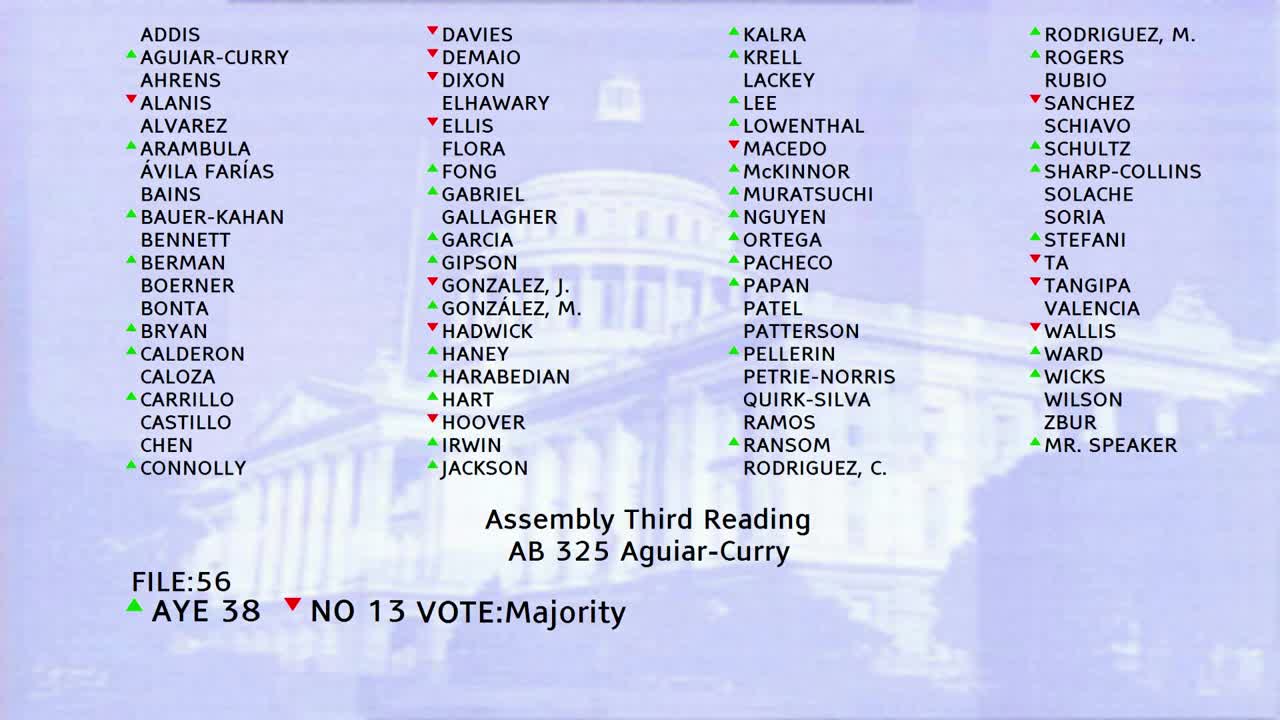 1MIN
Assembly Floor
 7MIN
Assembly Standing Committee on Public Safety
 11MIN
Assembly Standing Committee on Elections
Bill Author

Bill Co-Author(s):