AB 2299: California Antihunger Response and Employment Training Act of 2026.
- Session Year: 2025-2026
- House: Assembly
- Latest Version Date: 2026-04-06
Current Status:
In Progress
(2026-08-13: In committee: Held under submission.)
Introduced
In Committee
Awaiting First Chamber Vote
Passed First Chamber
In Committee
Awaiting Second Chamber Vote
Passed Second Chamber
Enacted
What does this bill do?
The bill expands California’s state food assistance program (CFAP) to provide CalFresh‑level benefits to people who are denied CalFresh only because they hit the federal ABAWD time limit (able‑bodied adults without dependents) or only because of certain humanitarian immigration statuses. It also creates a state‑funded CARET program to pay people the same benefit amount they lost under the ABAWD time limit. CARET recipients can access CalFresh employment and training services, providers may claim equivalent state reimbursements, and benefits must be issued through the state electronic benefits transfer system.
The summary is provided by generative AI which can make mistakes. For original language, please view the details in the table below.
Existing federal law establishes the Supplemental Nutrition Assistance Program (SNAP), known in California as CalFresh, under which supplemental nutrition assistance benefits allocated to the state by the federal government are distributed to eligible individuals by each county.
Existing federal law limits a participant who is an able-bodied adult without dependents (ABAWD) to 3 months of CalFresh benefits in a 3-year period unless that participant has met work participation requirements or is otherwise exempt. Existing federal law authorizes a waiver of that time limit upon the request of a state if it is determined that the area in which the individuals reside has an unemployment rate of over 10% or does not have a sufficient number of jobs to provide employment for the individuals. Existing state law requires the State Department of Social Services, to the extent permitted by federal law, to annually seek a federal waiver of the time limit. Existing federal law also authorizes a state to provide, in each fiscal year, an exemption from the 3-month time limit for covered individuals, to the extent that the average monthly number of exemptions in effect during a fiscal year does not exceed 8% of the number of covered individuals in the state.
Existing law authorizes counties to participate in the CalFresh Employment and Training (CalFresh E&T) program, established by federal law, and requires a participating county to demonstrate in its CalFresh E&T plan how it is effectively using CalFresh E&T funds for each of the components that the county offers, including work experience or training and job searching.This bill would require the department to establish the California Antihunger Response and Employment Training (CARET), a state-funded program to provide benefits to a person who has been determined ineligible for CalFresh benefits, or for whom CalFresh benefits have been discontinued, as a result of the ABAWD time limit, and who also is ineligible for a percentage exemption, as specified. The bill would require that the person receive the same amount of benefits under the CARET program that they would have received under the CalFresh program if the ABAWD time limit did not make them ineligible. The bill would also make a CARET program recipient eligible for CalFresh E&T program benefits, and would make a CalFresh E&T provider serving a CARET recipient eligible to draw down a state-funded reimbursement in the same amount that the provider would have been eligible to receive for allowable CalFresh E&T services for a CalFresh recipient. The bill would require the issuance of CARET benefits through a state-administered and state-funded electronic benefits transfer system, as specified.The bill would require the department to develop, in consultation with specified entities, and to issue guidance to maximize the use of percentage exemptions from the 3-month time limit available under federal law and guidance relating to SNAP. The bill would authorize the guidance to include redistribution of percentage exemptions between counties, as specified. The bill would require the guidance to be issued no later than April 1, 2028, and to remain operative until the CARET program is operative.Existing law requires the department to also establish the California Food Assistance Program (CFAP) to provide nutrition benefits to households that are ineligible for CalFresh benefits solely due to their immigration status, as specified. Existing law requires CFAP benefits to be equivalent to SNAP benefits. Under existing law, operative on the date the department notifies the Legislature that the Statewide Automated Welfare System can perform the necessary automation for this purpose, an individual 55 years of age or older is eligible for CFAP benefits, subject to an appropriation. Existing law requires these provisions only be implemented during any period that specified federal benefits are provided.
This bill, the California Antihunger Response and Employment Training Act of 2026, would expand CFAP eligibility to include individuals ineligible for CalFresh benefits due to the federal time limits placed on ABAWDs regardless of if they are a citizen or noncitizen and individuals ineligible solely due to their humanitarian immigration status. The bill would also repeal the provisions requiring certain federal benefits be provided in order for CFAP to be implemented.
The bill would make related findings and declarations.
To the extent that the bill would expand eligibility for county-administered benefits through the establishment of the CARET expansion of the CFAP program, the bill would impose a state-mandated local program.
The California Constitution requires the state to reimburse local agencies and school districts for certain costs mandated by the state. Statutory provisions establish procedures for making that reimbursement.
This bill would provide that, if the Commission on State Mandates determines that the bill contains costs mandated by the state, reimbursement for those costs shall be made pursuant to the statutory provisions noted above.
Existing federal law establishes the Supplemental Nutrition Assistance Program (SNAP), known in California as CalFresh, under which supplemental nutrition assistance benefits allocated to the state by the federal government are distributed to eligible individuals by each county.
Existing federal law limits a participant who is an able-bodied adult without dependents (ABAWD) to 3 months of CalFresh benefits in a 3-year period unless that participant has met work participation requirements or is otherwise exempt. Existing federal law authorizes a waiver of that time limit upon the request of a state if it is determined that the area in which the individuals reside has an unemployment rate of over 10% or does not have a sufficient number of jobs to provide employment for the individuals. Existing state law requires the State Department of Social Services, to the extent permitted by federal law, to annually seek a federal waiver of the time limit. Existing federal law also authorizes a state to provide, in each fiscal year, an exemption from the 3-month time limit for covered individuals, to the extent that the average monthly number of exemptions in effect during a fiscal year does not exceed 8% of the number of covered individuals in the state.
Existing law authorizes counties to participate in the CalFresh Employment and Training (CalFresh E&T) program, established by federal law, and requires a participating county to demonstrate in its CalFresh E&T plan how it is effectively using CalFresh E&T funds for each of the components that the county offers, including work experience or training and job searching.
This bill would require the department to establish the California Antihunger Response and Employment Training (CARET), a state-funded program to provide benefits to a person who has been determined ineligible for CalFresh benefits, or for whom CalFresh benefits have been discontinued, as a result of the ABAWD time limit, and who also is ineligible for a percentage exemption, as specified. The bill would require that the person receive the same amount of benefits under the CARET program that they would have received under the CalFresh program if the ABAWD time limit did not make them ineligible. The bill would also make a CARET program recipient eligible for CalFresh E&T program benefits, and would make a CalFresh E&T provider serving a CARET recipient eligible to draw down a state-funded reimbursement in the same amount that the provider would have been eligible to receive for allowable CalFresh E&T services for a CalFresh recipient. The bill would require the issuance of CARET benefits through a state-administered and state-funded electronic benefits transfer system, as specified.
The bill would require the department to develop, in consultation with specified entities, and to issue guidance to maximize the use of percentage exemptions from the 3-month time limit available under federal law and guidance relating to SNAP. The bill would authorize the guidance to include redistribution of percentage exemptions between counties, as specified. The bill would require the guidance to be issued no later than April 1, 2028, and to remain operative until the CARET program is operative.
The bill would make related findings and declarations.
To the extent that the bill would expand eligibility for county-administered benefits through the establishment of the CARET program, the bill would impose a state-mandated local program.
The California Constitution requires the state to reimburse local agencies and school districts for certain costs mandated by the state. Statutory provisions establish procedures for making that reimbursement.
This bill would provide that, if the Commission on State Mandates determines that the bill contains costs mandated by the state, reimbursement for those costs shall be made pursuant to the statutory provisions noted above.
This act shall be known, and may be referred to, as the California Antihunger Response and Employment Training Act of 2026.
SEC. 2.The Legislature finds and declares all of the following:
(a)One in five Californians suffers from food insecurity.
(b)The federal Supplemental Nutrition Assistance Program (SNAP), known as CalFresh in California, is the most important defense against hunger, helping millions of Californians prevent hunger and its long-term consequences.
(c)SNAP not only helps prevent hunger among low-income households, it also creates jobs and supports our food economy across the state.
(d)The passage of federal House Resolution 1 (Public Law 119-21) marked the largest cut to CalFresh in program history, with 800,000 nearly 1,000,000 Californians expected to lose vital benefits.
(e)Hunger never makes any person better able to prepare for work, secure a job, or succeed at their place of employment. It only makes them, and our economy, weaker and less able to persevere during hard times.
(f)In addition, cutting low-income Californians from CalFresh disconnects them from CalFresh Employment and Training programs, which can help them reduce barriers to unemployment and gain new skills that increase their employability and likelihood of their future economic success.
(g)California will establish a state food assistance program that will serve low-income, out-of-work, underemployed, and job-seeking Californians who are impacted by these ill-conceived federal actions.
(h)The Legislature encourages the State Department of Social Services to find prospects for comparable employment and training opportunities for individuals receiving benefits through the California Food Assistance Program (CFAP).
SEC. 3.Chapter 10.6 (commencing with Section 18947) is added to Part 6 of Division 9 of the Welfare and Institutions Code, to read:10.6.California Antihunger Response and Employment Training Program18947.(a)The State Department of Social Services shall establish the California Antihunger Response and Employment Training (CARET), a state-funded program for persons described in subdivision (b).(b)A person who has been determined ineligible for CalFresh benefits, or for whom CalFresh benefits have been discontinued, as a result of the federal able-bodied adult without dependents (ABAWD) time limit, and who also is ineligible for a percentage exemption, shall receive benefits under the CARET program.(c)A person described in subdivision (b) shall receive CARET benefits in the same amount as the CalFresh benefits they would have received if the ABAWD time limit did not make them ineligible.(d)A CARET program recipient shall also be eligible for the same CalFresh Employment and Training (CalFresh E&T) program benefits described in Section 18926.5 that the recipient would have been eligible for if the ABAWD time limit did not make the recipient ineligible for CalFresh benefits.(e)A CalFresh E&T provider serving a CARET recipient shall be eligible to draw down a state-funded reimbursement in the same amount that the provider would have been eligible to receive for allowable CalFresh E&T services for a CalFresh recipient.(f)(1)Benefits issued pursuant to this chapter shall be issued through a state-administered and state-funded electronic benefits transfer system that is subject to the standards established in Section 10072.(2)The electronic benefits transfer system used to issue CARET benefits may also be used to issue other state-funded food assistance benefits.(g)This chapter applies only if federal law and guidance prohibit the state from retaining an exemption allocated pursuant to Section 273.24(g) of Title 7 of the Code of Federal Regulations for use in a later month.18947.1.(a)The State Department of Social Services shall issue guidance to maximize the use of percentage exemptions available under federal law and guidance relating to the federal Supplemental Nutrition Assistance Program.(b)The department shall develop the guidance in consultation with the Office of Systems Integration, county human services agencies, public benefit recipient advocates, representatives of public benefit caseworkers, and other relevant stakeholders.(c)The guidance may include redistribution of percentage exemptions between counties if necessary to maximize the use of the percentage exemptions to prevent hunger among persons subject to the federal able-bodied adult without dependents time limit.(d)The guidance shall be issued no later than April 1, 2028, and shall remain operative until the CARET program described in Section 18947 of the Welfare and Institutions Code is operative.SEC. 3.The heading of Chapter 10.1 (commencing with Section 18930) of Part 6 of Division 9 of the Welfare and Institutions Code is amended to read:10.1.California Food Assistance Program for Legal Immigrants SEC. 4.Section 18930 of the Welfare and Institutions Code, as amended by Section 86 of Chapter 85 of the Statutes of 2021, is amended to read:18930.(a)The State Department of Social Services shall establish a Food Assistance Program to provide assistance for those persons described in subdivision (b). The department shall enter into an agreement with the United States Department of Agriculture to use the existing federal Supplemental Nutrition Assistance Program coupons for the purposes of administering this program. Persons who are members of a household receiving CalFresh benefits under this chapter or under Chapter 10 (commencing with Section 18900), and are receiving CalWORKs benefits under Chapter 2 (commencing with Section 11200) of Part 3 on September 1, 1998, shall have eligibility determined under this chapter without need for a new application no later than November 1, 1998, and the beginning date of assistance under this chapter for those persons shall be September 1, 1998.
(b)(1)Except as provided in paragraphs (2), (3), and (4) and Section 18930.5, noncitizens of the United States shall be eligible for the program established pursuant to subdivision (a) if the persons immigration status meets the eligibility criteria of the federal Supplemental Nutrition Assistance Program in effect on August 21, 1996, but the person is not eligible for federal Supplemental Nutrition Assistance Program benefits solely due to the persons immigration status under Public Law 104-193 and any subsequent amendments thereto. status.
(2)Noncitizens of the United States shall be eligible for the program established pursuant to subdivision (a) if the person is a battered immigrant spouse or child or the parent or child of the battered immigrant, as described in Section 1641(c) of Title 8 of the United States Code, as amended by Section 5571 of Public Law 105-33, or if the person is a Cuban or Haitian entrant as described in Section 501(e) of the federal Refugee Education Assistance Act of 1980 (Public Law 96-122).
(3)Individuals ineligible for CalFresh benefits solely due to the federal time limits placed on able-bodied adults without dependents (ABAWDs) shall be eligible for the program established pursuant to subdivision (a), regardless of if they are a citizen or noncitizen.
(4)Notwithstanding paragraph (5), individuals ineligible for CalFresh benefits solely due to their humanitarian immigration status shall be eligible for the program established pursuant to subdivision (a).
(3)(5)An applicant who is otherwise eligible for the program but who entered the United States on or after August 22, 1996, shall be eligible for aid under this chapter only if the applicant is sponsored and one of the following apply:
(A)The sponsor has died.
(B)The sponsor is disabled as defined in subparagraph (A) of paragraph (3) of subdivision (b) of Section 11320.3.
(C)The applicant, after entry into the United States, is a victim of abuse by the sponsor or the spouse of the sponsor if the spouse is living with the sponsor.
(4)(6)An applicant who is otherwise eligible for the program but who entered the United States on or after August 22, 1996, who does not meet one of the conditions of paragraph (3), (5), shall be eligible for aid under this chapter beginning on October 1, 1999.
(5)(7)The applicant shall be required to provide verification that one of the conditions of subparagraph (A), (B), or (C) of paragraph (3) (5) has been met.
(6)(8)For purposes of subparagraph (C) of paragraph (3), (5), abuse shall be defined in the same manner as provided in Section 11495.1 and Section 11495.12. A sworn statement of abuse by a victim, or the representative of the victim if the victim is not able to competently swear, shall be sufficient to establish abuse if one or more additional items of evidence of abuse is also provided. Additional evidence may include, but is not limited to, the following:
(A)Police, government agency, or court records or files.
(B)Documentation from a domestic violence program, legal, clinical, medical, or other professional from whom the applicant or recipient has sought assistance in dealing with abuse.
(C)A statement from any other individual with knowledge of the circumstances that provided the basis for the claim.
(D)Physical evidence of abuse.
(7)(9)If the victim cannot provide additional evidence of abuse, then the sworn statement shall be sufficient if the county makes a determination documented in writing in the case file that the applicant is credible.
(c)(1)To the extent allowed by federal law, the income, resources, and deductible expenses of those persons described in subdivision (b) shall be excluded when calculating CalFresh benefits under Chapter 10 (commencing with Section 18900).
(2)No household shall receive more CalFresh benefits under this section than it would if no household member was rendered ineligible pursuant to Title IV of Public Law 104-193 and any subsequent amendments thereto.
(d)This section shall become inoperative on the date that the department has notified the Legislature that the Statewide Automated Welfare System can perform the necessary automation to implement Section 18930, as added by the act that added this subdivision, and, as of January 1 of the following year, is repealed.
SEC. 5.Section 18930 of the Welfare and Institutions Code, as amended by Section 84 of Chapter 50 of the Statutes of 2022, is amended to read:18930.(a)There is hereby created the California Food Assistance Program (CFAP).
(b)CFAP shall utilize existing CalFresh and electronic benefits transfer system infrastructure to the extent permissible by federal law.
(c)(1)The State Department of Social Services shall use state funds appropriated for CFAP to provide nutrition benefits to households that are ineligible for CalFresh benefits solely for the following reasons:
(A)The individual is ineligible solely due to federal time limits placed on able-bodied adults without dependents (ABAWDs) regardless of if they are a citizen or noncitizen.
(B)Notwithstanding paragraph (C), the individual is ineligible solely due to their humanitarian immigration status.
(C)The individual is ineligible solely due to their immigration status. In accordance with Section 1621(d) of Title 8 of the United States Code, this chapter provides benefits for undocumented persons.
(1)(i)Subject to an appropriation in the annual Budget Act for the express purpose of this paragraph, an individual 55 years of age or older shall be eligible for the program established in subdivision (a) if the individuals immigration status is the sole basis for their ineligibility for CalFresh benefits.
(2)(ii)Except as provided in paragraphs (3), (4), and (5) clauses (iii), (iv), and (v), and Section 18930.5, noncitizens of the United States shall be eligible for the program established pursuant to subdivision (a) if the persons immigration status meets the eligibility criteria of the federal Supplemental Nutrition Assistance Program in effect on August 21, 1996, but the person is not eligible for federal Supplemental Nutrition Assistance Program benefits solely due to the persons immigration status under Public Law 104-193 and any subsequent amendments thereto. status.
(3)(iii)Noncitizens of the United States shall be eligible for the program established pursuant to subdivision (a) if the person is a battered immigrant spouse or child or the parent or child of the battered immigrant, as described in Section 1641(c) of Title 8 of the United States Code, as amended by Section 5571 of Public Law 105-33, or if the person is a Cuban or Haitian entrant as described in Section 501(e) of the federal Refugee Education Assistance Act of 1980 (Public Law 96-422).
(4)(iv)An applicant who is otherwise eligible for the program but who entered the United States on or after August 22, 1996, shall be eligible for aid under this chapter if the applicant is sponsored and one of the following apply:
(A)(I)The sponsor has died.
(B)(II)The sponsor is disabled, as defined in subparagraph (A) of paragraph (3) of subdivision (b) of Section 11320.3.
(C)(III)The applicant, after entry into the United States, is a victim of abuse by the sponsor or the spouse of the sponsor if the spouse is living with the sponsor.
(5)(v)An applicant who is otherwise eligible for the program but who entered the United States on or after August 22, 1996, who does not meet one of the conditions of paragraph (4), clause (iv), shall be eligible for aid under this chapter beginning on October 1, 1999.
(6)(vi)The applicant shall be required to provide verification that one of the conditions of subparagraph (A), (B), or (C) of paragraph (4) subclause (I), (II), or (III) of clause (iv) has been met.
(7)(vii)For purposes of subparagraph (C) of paragraph (4), subclause (III) of clause (iv), abuse shall be defined in the same manner as provided in Section 11495.1 and Section 11495.12. A sworn statement of abuse by a victim, or the representative of the victim if the victim is not able to competently swear, shall be sufficient to establish abuse if one or more additional items of evidence of abuse are also provided. Additional evidence may include, but is not limited to, the following:
(A)(I)Police, government agency, or court records or files.
(B)(II)Documentation from a domestic violence program, legal, clinical, medical, or other professional from whom the applicant or recipient has sought assistance in dealing with abuse.
(C)(III)A statement from any other individual with knowledge of the circumstances that provided the basis for the claim.
(D)(IV)Physical evidence of abuse.
(8)(viii)If the victim cannot provide additional evidence of abuse, then the sworn statement shall be sufficient if the county makes a determination documented in writing in the case file that the applicant is credible.
(d)(1)The amount of nutrition benefits provided to each CFAP household shall be identical to the amount that would otherwise be provided to a household eligible for CalFresh benefits.
(2)The benefit amount for a CFAP recipient who is an excluded member of a CalFresh household shall be limited to the amount that the recipient would have received as their share of a CalFresh household benefit, had they not been excluded due to their immigration status. status, humanitarian immigrant status, or expired federal time limit.
(3)To the extent permissible under federal law, the delivery of CFAP nutrition benefits shall be identical to the delivery of CalFresh benefits to eligible CalFresh households.
(e)(1)To the extent allowed by federal law, the income, resources, and deductible expenses of those persons described in subdivision (c) shall be excluded when calculating CalFresh benefits under Chapter 10 (commencing with Section 18900).
(2)No household shall receive more CalFresh benefits under this section than it would if no household member was rendered ineligible pursuant to Title IV of Public Law 104-193 and any subsequent amendments thereto.
(f)Notwithstanding the rulemaking provisions of the Administrative Procedure Act (Chapter 3.5 (commencing with Section 11340) of Part 1 of Division 3 of Title 2 of the Government Code), the State Department of Social Services may implement and administer this section through all-county letters or similar instructions without taking regulatory action until final regulations are adopted, but no later than 18 months after the date upon which this subdivision becomes operative.
(g)This section shall become operative on the date that the department notifies the Legislature that the Statewide Automated Welfare System can perform the necessary automation to implement this section.
SEC. 6.Section 18935 of the Welfare and Institutions Code is repealed.18935.This chapter shall be implemented only during any period that federal benefits are provided under Section 1612(a) of Title 8 of the United States Code.SEC. 4.SEC. 7.If the Commission on State Mandates determines that this act contains costs mandated by the state, reimbursement to local agencies and school districts for those costs shall be made pursuant to Part 7 (commencing with Section 17500) of Division 4 of Title 2 of the Government Code.
REVISIONS: HeadingLines 2 and 3.This act shall be known, and may be referred to, as the California Antihunger Response and Employment Training Act of 2026.
SEC. 2.The Legislature finds and declares all of the following:
(a)One in five Californians suffers from food insecurity.
(b)The federal Supplemental Nutrition Assistance Program (SNAP), known as CalFresh in California, is the most important defense against hunger, helping millions of Californians prevent hunger and its long-term consequences.
(c)SNAP not only helps prevent hunger among low-income households, it also creates jobs and supports our food economy across the state.
(d)The passage of federal House Resolution 1 (Public Law 119-21) marked the largest cut to CalFresh in program history, with 800,000 Californians expected to lose vital benefits.
(e)Hunger never makes any person better able to prepare for work, secure a job, or succeed at their place of employment. It only makes them, and our economy, weaker and less able to persevere during hard times.
(f)In addition, cutting low-income Californians from CalFresh disconnects them from CalFresh Employment and Training programs, which can help them reduce barriers to unemployment and gain new skills that increase their employability and likelihood of their future economic success.
(g)California will establish a state food assistance program that will serve low-income, out-of-work, underemployed, and job-seeking Californians who are impacted by these ill-conceived federal actions.
SEC. 3.Chapter 10.6 (commencing with Section 18947) is added to Part 6 of Division 9 of the Welfare and Institutions Code, to read:10.6.California Antihunger Response and Employment Training Program18947.(a)The State Department of Social Services shall establish the California Antihunger Response and Employment Training (CARET), a state-funded program for persons described in subdivision (b).
(b)A person who has been determined ineligible for CalFresh benefits, or for whom CalFresh benefits have been discontinued, as a result of the federal able-bodied adult without dependents (ABAWD) time limit, and who also is ineligible for a percentage exemption, shall receive benefits under the CARET program.
(c)A person described in subdivision (b) shall receive CARET benefits in the same amount as the CalFresh benefits they would have received if the ABAWD time limit did not make them ineligible.
(d)A CARET program recipient shall also be eligible for the same CalFresh Employment and Training (CalFresh E&T) program benefits described in Section 18926.5 that the recipient would have been eligible for if the ABAWD time limit did not make the recipient ineligible for CalFresh benefits.
(e)A CalFresh E&T provider serving a CARET recipient shall be eligible to draw down a state-funded reimbursement in the same amount that the provider would have been eligible to receive for allowable CalFresh E&T services for a CalFresh recipient.
(f)(1)Benefits issued pursuant to this chapter shall be issued through a state-administered and state-funded electronic benefits transfer system that is subject to the standards established in Section 10072.
(2)The electronic benefits transfer system used to issue CARET benefits may also be used to issue other state-funded food assistance benefits.
(g)This chapter applies only if federal law and guidance prohibit the state from retaining an exemption allocated pursuant to Section 273.24(g) of Title 7 of the Code of Federal Regulations for use in a later month.
18947.1.(a)The State Department of Social Services shall issue guidance to maximize the use of percentage exemptions available under federal law and guidance relating to the federal Supplemental Nutrition Assistance Program.
(b)The department shall develop the guidance in consultation with the Office of Systems Integration, county human services agencies, public benefit recipient advocates, representatives of public benefit caseworkers, and other relevant stakeholders.
(c)The guidance may include redistribution of percentage exemptions between counties if necessary to maximize the use of the percentage exemptions to prevent hunger among persons subject to the federal able-bodied adult without dependents time limit.
(d)The guidance shall be issued no later than April 1, 2028, and shall remain operative until the CARET program described in Section 18947 of the Welfare and Institutions Code is operative.
SEC. 4.If the Commission on State Mandates determines that this act contains costs mandated by the state, reimbursement to local agencies and school districts for those costs shall be made pursuant to Part 7 (commencing with Section 17500) of Division 4 of Title 2 of the Government Code.
|
Date
|
Status
|
|---|---|
| Aug 13, 2026 | In committee: Held under submission. |
| Aug 3, 2026 | In committee: Referred to APPR. suspense file. |
| Jun 29, 2026 | From committee: Do pass and re-refer to Com. on APPR. (Ayes 5. Noes 0.) (June 29). Re-referred to Com. on APPR. |
| Jun 10, 2026 | Referred to Com. on HUMAN S. |
| May 27, 2026 | In Senate. Read first time. To Com. on RLS. for assignment. |
| May 26, 2026 | Read third time. Passed. Ordered to the Senate. (Ayes 64. Noes 1.) |
| May 26, 2026 | Read third time. Passed. Ordered to the Senate. (Ayes 64. Noes 1. Page 5311.) |
| May 26, 2026 | Read third time. Passed. Ordered to the Senate. |
| May 18, 2026 | Read second time. Ordered to third reading. |
| May 14, 2026 | From committee: Do pass. (Ayes 11. Noes 0.) (May 14). |
| May 14, 2026 | Coauthors revised. |
| May 6, 2026 | In committee: Set, first hearing. Referred to APPR. suspense file. |
| Apr 15, 2026 | From committee: Do pass and re-refer to Com. on APPR. (Ayes 5. Noes 0.) (April 14). Re-referred to Com. on APPR. |
| Apr 15, 2026 | Coauthors revised. |
| Apr 7, 2026 | Re-referred to Com. on HUM. S. |
| Apr 6, 2026 | From committee chair, with author's amendments: Amend, and re-refer to Com. on HUM. S. Read second time and amended. |
| Mar 16, 2026 | Referred to Com. on HUM. S. |
| Feb 20, 2026 | From printer. May be heard in committee March 22. |
| Feb 19, 2026 | Read first time. To print. |
|
Date
|
Description
|
Location
|
Votes
|
|
|---|---|---|---|---|
| Aug 3, 2026 | Placed on suspense file | Senate Standing Committee on Appropriations |
Passed |
|
| Jun 29, 2026 | Do pass, but first be re-referred to the Committee on [Appropriations] | Senate Standing Committee on Human Services |
Passed |
|
| May 26, 2026 | AB 2299 Calderon Assembly Third Reading | Assembly Floor |
Passed |
|
| May 14, 2026 | Do pass. | Assembly Standing Committee on Appropriations |
Passed |
|
| Apr 14, 2026 | Do pass and be re-referred to the Committee on [Appropriations] | Assembly Standing Committee on Human Services |
Passed |
This list shows positions taken on this bill by organizations on the date displayed, which is linked to the original source.
Positions by individuals are not included.
|
Organization
|
Position
|
Date
|
|---|---|---|
| AAPIs for Civic Empowerment | ** Support | |
| Alameda County Community Food Bank | ** Support | |
| Alliance of Californians for Community Empowerment (ACCE) Action | ** Support | |
| Asian Americans Advancing Justice Southern California | ** Support | |
| Asian Law Alliance | ** Support | |
| Bay Area Legal Aid | ** Support | |
| Berkeley Food Network | ** Support | |
| Bill Wilson Center | ** Support | |
| California Alliance For Retired Americans | ** Support | |
| California Association Of Food Banks | ** Support | |
| California Center for Movement Legal Services | ** Support | |
| California Domestic Workers Coalition | ** Support | |
| California Family Resource Association | ** Support | |
| California Food and Farming Network | ** Support | |
| California Immigrant Policy Center | ** Support | |
| California LGBTQ Health and Human Services Network | ** Support | |
| California Rural Legal Assistance | ** Support | |
| California Work & Family Coalition | ** Support | |
| Central California Food Bank | ** Support | |
| Centro Legal de la Raza | ** Support | |
| Child Abuse Prevention Center and its Affiliates Safe Kids California, Prevent Child Abuse California and the California Family Resource Association | ** Support | |
| CHILD ABUSE PREVENTION CENTER AND ITS AFFILIATES SAFE KIDS CALIFORNIA, PREVENT CHILD ABUSE CALIFORNIA AND THE CALIFORNIA FAMILY RESOURCE ASSOCIATION; THE | ** Support | |
| Coalition of California Welfare Rights Organization | ** Support | |
| Community Action Partnership of San Bernardino County | ** Support | |
| Courage California | ** Support | |
| CPCA Advocates | ** Support | |
| Disability Rights California | ** Support | |
| East Bay Leadership Council | ** Support | |
| Equal Rights Advocates | ** Support | |
| Equality California | ** Support | |
| Feeding San Diego | ** Support | |
| Food Bank of Contra Costa and Solano | ** Support | |
| Food for People, the Food Bank for Humboldt County | ** Support | |
| Food in Need of Distribution Food Bank | ** Support | |
| Food Share Ventura County | ** Support | |
| Foodshare Ventura County | ** Support | |
| Friends Committee On Legislation Of California | ** Support | |
| Fullwell | ** Support | |
| G.R.A.C.E. Social and Medical Services | ** Support | |
| Glide Foundation | ** Support | |
| GRACE - End Child Poverty CA | ** Support | |
| GRACE End Child Poverty CA | ** Support | |
| Homeless Action Center | ** Support | |
| Housing California | ** Support | |
| Hunger Action Los Angeles | ** Support | |
| Jacobs & Cushman San Diego Food Bank | ** Support | |
| JFCS East Bay | ** Support | |
| LA Best Babies Network | ** Support | |
| Law Foundation of Silicon Valley | ** Support | |
| Legal Aid of Sonoma County | ** Support | |
| Legal Services of Northern California | ** Support | |
| Loaves and Fishes of Contra Costa | ** Support | |
| Los Angeles Food Policy Council | ** Support | |
| Los Angeles Regional Food Bank | ** Support | |
| Lutheran Office Of Public Policy - California | ** Support | |
| Maternal and Child Health Access | ** Support | |
| Mujeres Unidas Y Activas | ** Support | |
| Neighborhood Legal Services of Los Angeles County | ** Support | |
| NextGen California | ** Support | |
| Nourish California | ** Support | |
| Orange County United Way | ** Support | |
| Para Los Ninos | ** Support | |
| Parent Voices | ** Support | |
| Prosper CA Coalition (formerly Caleitc Coalition) | ** Support | |
| Pubic Interest Law Project | ** Support | |
| Public Interest Law Project | ** Support | |
| REDF | ** Support | |
| Rio Hondo College | ** Support | |
| Sacramento Food Bank & Family Services | ** Support | |
| Sacred Heart Community Service | ** Support | |
| San Diego for Every Child | ** Support | |
| San Diego Hunger Coalition | ** Support | |
| SAN DIEGO; COUNTY OF | ** Support | |
| San Francisco-Marin Food Bank | ** Support | |
| Second Harvest Food Bank of Orange County | ** Support | |
| Second Harvest Food Bank Santa Cruz County | ** Support | |
| Second Harvest of Silicon Valley | ** Support | |
| The Resource Connection Food Bank | ** Support | |
| Unitarian Universalist Church of Berkeley | ** Support | |
| United Ways Of California | ** Support | |
| West Center on Law & Poverty | ** Support | |
| western center on law and poverty | ** Support | |
| Weston Center on Law & Poverty | ** Support | |
| Westside Food Bank | ** Support | |
| Women'S Foundation California | ** Support | |
| Young Invincibles | ** Support | |
| Yuba Sutter Food Bank | ** Support |
SENATE COMMITTEE ON
Senator Sabrina Cervantes, Chair
2025 - 2026 Regular Session
AB 2299 (Calderon) - California Antihunger Response and Employment Training Act of 2026
Version: | Policy Vote: |
Urgency: | Mandate: |
Hearing Date: | Consultant: |
Bill Summary:
AB 2299 would expand eligibility for the California Food Assistance Program.
Fiscal Impact:
- The California Department of Social Services (CDSS) estimates the following General Fund costs:
- Costs of $1.6 billion starting in 2027-28, and ongoing annual costs of $2.9 billion when fully implemented in 2029-30, for benefits, county administration, and automation. If CDSS opts to find prospects for employment and training opportunities for individuals, there would be additional costs for that effort.
- State operations costs of $1,767,000 in 2026-27 and $1,721,000 ongoing thereafter.
- Costs to counties for administration would be potentially reimbursable by the state, subject to a determination by the Commission on State Mandates.
Background:
CalFresh is California’s version of the federal Supplemental Nutrition Assistance Program (SNAP), an entitlement program that provides eligible households with monthly benefits to purchase food. Benefits are delivered through an electronic benefits transfer (EBT) card which cardholders can use at authorized point-of-sale terminals. Grocers and other retailers are paid directly by the federal government for the dollar value of purchases made with CalFresh food benefits. Monthly benefits per household vary based on household size, income, and deductible living expenses. CDSS provides oversight for the CalFresh program at the state level, and counties are responsible for eligibility determinations and administration at the local level.
California Food Assistance Program (CFAP). CFAP provides state-funded food benefits for certain lawfully present noncitizens who do not qualify for federal CalFresh benefits. In order to be eligible to CFAP, noncitizens must currently be ineligible for CalFresh benefits solely due to their immigration status under the federal Personal Responsibility and Work Opportunity Reconciliation Act (PRWORA) of 1996. For example, CFAP-eligible individuals include noncitizens who are lawful permanent residents who have not met the five-year U.S. residency requirement. State law requires that, subject to an appropriation in the annual Budget Act, an individual 55 years of age or older is eligible for CFAP if the individual’s immigration status is the sole basis for their ineligibility for CalFresh benefits. However, this provision only becomes operative on the date that the CDSS notifies the Legislature that the Statewide Automated Welfare System can perform the necessary automation for implementation. Counties are responsible for eligibility determinations and administration at the local level.
H.R. 1 (Public Law 119-21). H.R. 1 made significant changes to the SNAP program, impacting California’s CalFresh program. This included changes to the work requirements for Able-Bodied Adults without Dependents (ABAWDs). Federal rules impose time limits on benefits for ABAWDS unless the individuals are meeting specified work requirements. Under H.R. 1, the exemptions from ABAWD work requirements will decrease, and the number of people required to work to receive CalFresh benefits will increase. The work requirements will increase in most cases to include those 55 to 64 years old. Work requirements will also apply to parents and caretakers with children 14 and older, whereas previously those with children under 18 were excluded. Additionally, exemptions for veterans, people experiencing homelessness, and former foster youth will be eliminated. The new law adds a new exemption for indigenous peoples, as defined. States can apply for federal waivers to pause these rules, but only under specified criteria.
H.R. 1 also made certain individuals who are lawfully present through humanitarian immigration processes that were eligible for CalFresh, no longer eligible for the program. These individuals include, but are not limited to:
- Refugees.
- Asylees.
- Individuals with deportation or removal withheld.
- Trafficking survivors.
- Survivors of domestic violence.
Currently, since eligibility requirements for CalFresh also apply generally to CFAP, individuals in the categories above who are no longer eligible for CalFresh due to H.R. 1 are not eligible for CFAP.
Proposed Law:
Specific provisions of the bill would:
- Require that the following individuals are eligible for the CFAP:
- Individuals ineligible for CalFresh benefits solely due to the federal time limits placed on ABAWDs, regardless of if they are a citizen or noncitizen.
- Individuals ineligible for CalFresh benefits solely due to their humanitarian immigration status.
- State that the Legislature encourages the CDSS to find prospects for comparable employment and training opportunities for individuals receiving benefits through the CFAP.
Related Legislation:
SB 1201 (McNerney) would require the CDSS to request specified federal waivers related to veterans’ eligibility for CalFresh benefits. The bill is currently in the Assembly Appropriations Committee.
AB 1049 (Celeste Rodriguez) would delete the requirement that federal sponsor-deeming rules apply to the CFAP. The bill is currently on the suspense file in this committee.
-- END --
SENATE COMMITTEE ON HUMAN SERVICES
Senator Becker, Chair
2025 - 2026 Regular
Bill No: | AB 2299 | ||
Author: | Calderon | ||
Version: | April 6, 2026 | Hearing Date: | June 29, 2026 |
Urgency: | No | Fiscal: | Yes |
Consultant: | Naima Ford Antal | ||
Subject: California Antihunger Response and Employment Training Act of 2026
SUMMARY
This bill expands eligibility for the California Food Assistance Program (CFAP) to include certain individuals who become ineligible for CalFresh due to changes created by federal House Resolution 1 (Public Law 119-21), regardless of whether they are a citizen or noncitizen.
ABSTRACT
Existing Law:
- Establishes under federal law, the Supplemental Nutrition Assistance Program (SNAP) to promote the general welfare and to safeguard the health and wellbeing of the nation’s population by raising the levels of nutrition among low-income households. (7 United States Code [USC] Section 2011 et seq.)
- Establishes citizenship requirements for SNAP benefits, including that undocumented immigrants are not eligible for SNAP. (7 Code of Federal Regulations [CFR] 273.4)
- Requires, as a condition of eligibility for SNAP benefits, each non-exempt household member to comply with work requirements, which may include, registering for work, participating in an employment and training program, or participating in a workfare program. (7 CFR 273.7(a)(1)(iii))
- Requires able-bodied adults without dependents (ABAWDs) to only be eligible for SNAP for three months during a three-year period unless they qualify for an exemption. (7 CFR 273.24)
- Allows a state agency to waive the ABAWD time limit requirements for a group of individuals if it is determined that the area the individuals live in has:
- An unemployment rate of 10% or more; or
- Does not have enough jobs to provide employment for the individuals. (7 CFR 273.24(f))
- Establishes the CalFresh program to administer the provision of federal SNAP benefits to families and individuals meeting specified criteria. (Welfare and Institutions Code [WIC] 18900 et seq.)
- Requires the California Department of Social Services (CDSS) annually, to the extent permitted by federal law, to seek a federal SNAP waiver to the three-month limit in a three-year period of CalFresh benefits for an ABAWD, unless that participant has met the work participation requirement, as provided. (WIC 18926)
- Requires CDSS to establish a food assistance program for immigrants, titled the Food Assistance Program for Legal Immigrants (CFAP), to provide aid to people who are not eligible for federal SNAP benefits due solely to their immigration status. (WIC 18930 et seq.)
- Requires CFAP benefits provided to household be identical to amount of CalFresh received if household was eligible. (WIC 18930(d)(1))
- Requires, except as otherwise stated, the federal and state laws and regulations governing SNAP to also govern food assistance program, except as specified in law. (WIC 18932 (a))
This Bill:
- Makes findings and declarations about the impact of the federal House Resolution 1 (Public Law 119-21) on CalFresh recipients that will be newly ineligible, including restricted access to the CalFresh Employment and Training Program.
- Renames the food assistance program the California Food Assistance Program (CFAP) instead of the Food Assistance Program for Legal Immigrants in all parts of state statute.
- Removes references to the Personal Responsibility and Work Opportunity Reconciliation Act of 1996.
- Makes individuals who are ineligible for CalFresh benefits solely due to the federal time limits placed on ABAWDs, eligible for CFAP, regardless of whether they are a citizen or noncitizen.
- Makes individuals who are ineligible for CalFresh benefits solely due to their humanitarian immigration status, eligible for CFAP.
- Requires CDSS to use state funds appropriated for CFAP to provide nutrition benefits to households that are ineligible for CalFresh benefits due to ABAWD work requirements or immigration status.
- Expands the requirement that if a CFAP recipient is a member of a household receiving CalFresh, that their benefit be equal to what they would receive if they were enrolled in CalFresh as a part of the household, to humanitarian immigrants and ABAWD CFAP recipients.
- Strikes the provision requiring CFAP benefits to only be provided during a period when federal benefits are required.
FISCAL IMPACT
According to the Assembly Appropriations Committee:
- Ongoing General Fund (GF) costs of at least $1 billion annually to expand CFAP to provide benefits to approximately 660,000 persons discontinued from CalFresh benefits as a result of federal limitations. This estimate assumes approximately 840,000 individuals will become subject to the work requirement beginning June 1, 2026. Of these individuals, approximately 660,000 will not meet the work requirement or qualify for an allowable exemption, meaning they are likely to lose access to CalFresh benefits three months after they are screened. CDSS estimates in 2026-27, the average monthly benefit per discontinued time-limited individual is $260.45 and that approximately 108,600 individuals will lose benefits each month.
- Ongoing GF costs of approximately $190,000 to $200,000 to expand CFAP to include approximately 72,000 noncitizens discontinued from CalFresh under federal House Resolution 1 (H.R.1) (Public Law 119-21).
- CDSS estimates ongoing GF administrative costs of an unknown amount, likely in the range of $800,000 to $1.3 million, to support five to eight staff positions to implement the changes in the bill.
- One-time GF automation costs of an unknown amount for changes to the California Statewide Automated Welfare System (CalSAWS).
- Ongoing costs counties to administer expanded CFAP benefits. In April, the Department of Finance approved $20 million to provide counties with one-time funding to support administrative implementation of H.R.1 ABAWD provisions.
BACKGROUND AND DISCUSSION
Purpose of the Bill:
According to the author, “As our version of the federal SNAP program, CalFresh has helped millions of Californians afford groceries for their families. However, with the signing of H.R. 1 President Trump drastically cut federal funding to SNAP and CalFresh. Specifically, H.R. 1 initiates stricter work requirements, removes eligibility for certain lawfully present immigrants, and shifts billions of dollars in program costs from the federal government onto states. If we do not act as a state, nearly a million Californians will lose access to CALFRESH, that helps put food on the table.”
CalFresh
CalFresh is California’s version of federal SNAP, an entitlement program that provides eligible households with federally funded monthly benefits to purchase food. Currently, CalFresh food benefits are 100% federally funded, but recent changes in federal law will require states to pay a portion of the benefit. CalFresh administration costs are funded with 50% federal funds, 35% General Fund, and 15% county funds, except for state-mandated program changes. Benefits are delivered through an EBT card which cardholders can use at point-of-sale terminals authorized by the United States Department of Agriculture (USDA). Grocers and other retailers are paid directly by the federal government for the dollar value of purchases made with CalFresh food benefits. Monthly benefits per household vary based on household size, income, and deductible living expenses. Larger households generally receive more benefits than smaller households and relatively higher-income households generally receive fewer benefits than lower-income households. The average benefit in 2025-2026 is approximately $333 per month for all households.
California Food Assistance Program (CFAP)
Under federal law, CalFresh benefits are not available to certain non-citizens. However, California provides state-funded food assistance through CFAP for a limited group of qualified non-citizens who are not eligible for federal benefits due to their immigration status. Like CalFresh, CFAP benefits are provided via EBT cards and can only be used to purchase food products authorized under CalFresh.
CFAP was created in response to passage of the Personal Responsibility and Work Opportunity Reconciliation Act in 1996, which restricted federal eligibility for aid to immigrant populations entering the United States. However, income and other federal eligibility requirements, as well as benefit amounts, for CFAP align with those for CalFresh.
California law identifies specific categories of lawfully present immigrants who are eligible for CFAP benefits as follows:
- Lawful permanent residents (green card holders).
- Cuban/Haitian entrants.
- Individuals residing in the US from a Compact of Free Association country (Micronesia, Palau, and Marshall Islands).
Before H.R. 1, immigrants that fell into the categories below were also eligible for CFAP:
- Refugees, those receiving asylum, persons granted withholding of deportation/removal, conditional entry or paroled into the U.S. for at least one year.
- Domestic violence victims and their children.
- Victims of trafficking.
In 2025-26, about 58,000 households received CFAP with an average monthly benefit of $366 per household and $176 per person.
House Resolution 1 (H.R. 1)
H.R. 1 was signed into law on July 4, 2025. This law will increase the federal deficit by trillions of dollars and seeks to partially offset costs by, among other things, limiting eligibility and federal funding for food assistance programs. Over the next ten years, H.R. 1 will make almost $200 billion in cuts to SNAP. In California, that amounts to a $1.7 to $3.7 billion cut annually.
Non-Citizen CalFresh Eligibility
Recent changes in the federal bill, H.R. 1, changed the CalFresh eligibility rule for noncitizens and disqualifies certain noncitizen groups from being eligible for CalFresh assistance. The changes will limit eligibility for CalFresh to lawful permanent residents, Cuban Haitian entrants, and residents from Compact of Free Association nations. The bill also made certain individuals who are lawfully present through humanitarian immigration processes that were eligible for CalFresh, no longer eligible under H.R. 1. These individuals include:
- Refugees, asylees, and people granted withholding of removal (based on fear of prosecution).
- Trafficking survivors.
- Survivors of domestic violence who have filed a self-petition under Violence Against Women Act.
- Persons granted humanitarian parole for a period of at least one year.
Since eligibility requirements for CalFresh also apply to CFAP, individuals in the categories above also are not eligible for CFAP. This bill will make them eligible for CFAP if they otherwise meet the eligibility standards and were made ineligible solely due to federal H.R. 1 changes. According to the California Budget and Policy Center, 36% of those ineligible due to this rule change will be children and 10% are seniors or adults with a disability.[1] According to CDSS, about 34,000 individuals currently enrolled in CalFresh will lose assistance because of this change but the impact may be larger because declines in enrollment have already increased. According to the Legislative Analyst’s Office, participation in CalFresh and CFAP declined in 2026 due to eligibility requirements and possibly a chilling effect. Participation in CFAP has had a steeper decline than CalFresh.
Able-Bodied Adults without Dependents (ABAWDs)
Before H.R. 1, a person who was 18 to 54 years old, able to work, and did not have any dependents but otherwise fulfilled CalFresh income requirements was considered an ABAWD. As established with the federal Personal Responsibility and Work Opportunity Reconciliation Act of 1996, under the ABAWD time limit, ABAWDs can only receive SNAP (CalFresh) benefits for three months in three years unless they work at least 80 hours per month, participate in a qualifying education and training activity for at least 80 hours per month, or comply with a workfare program. ABAWDs can also satisfy these requirements by participating in the CalFresh Education & Training program. Certain groups were given exceptions to the ABAWD work and time limit requirements despite being an adult without dependents or disabilities. Those groups include people who are:
- Over 54 years old.
- In a household with children under 18 years old.
- Pregnant.
- Unable to work due to a physical or mental limitation.
- Adults 24 years old or younger who aged out of foster care.
- Veterans.
- Adults experiencing homelessness.
- Living in a work surplus area where the ABAWD time limit was waived, specifically areas that had an unemployment rate of more than 10% or with a demonstrated lack of sufficient jobs.
Due to high unemployment rates, California has been designated a “work surplus area” and therefore, every adult CalFresh recipient has been operating with a waiver to the ABAWD time limit rules. Under current state law, CDSS is annually required to apply for a federal exemption to the ABAWD rule if the state meets certain federal criteria related to high unemployment. The United States Department of Agriculture Food and Nutrition Services has approved California for a statewide ABAWD waiver many times, most recently in January of 2025 and would have been effective through January 2027. However, after the passage of H.R. 1, the Food and Nutrition Service rescinded and ended the state’s ABAWD waiver effective November 2, 2025, for most counties and will end it effective October 31, 2026, for Colusa, Imperial, and Tulare counties.
Under H.R. 1, the number of ABAWD exceptions has decreased and the number of people who are considered to be ABAWDs and required to work to receive CalFresh benefits have increased. There is no longer a time limit and work requirement exceptions for:
- Adults 55-64 years old.
- Parents and caretakers with children 14 and older.
- Veterans.
- People experiencing homelessness.
- Former foster youth.
States can apply for new waivers to pause these rules, but only in areas with 10% or higher unemployment as described in H.R. 1. The new law does add a new exception for indigenous peoples if the person falls under one of the federal definitions for “Indian”, “Urban Indian” or “California Indian”.
According to the Congressional Budget Office, the new ABAWD rules may cause a significant reduction of participation among the affected groups nationally. The Office wrote, “[These] provisions will reduce participation in SNAP by roughly 2.4 million people in an average month over the 2025-2034 period. Of those people, about 800,000 will be able-bodied adults through age 64 who do not live with dependent children. Another 300,000 will be able-bodied adults ages 18 to 64 who live with children who are age 14 or older. And roughly 1 million will be able-bodied adults ages 18 to 54 (or 18 to 49, starting in 2031) who do not live with dependents but who, in the CBO’s January 2025 baseline projections (which preceded the law’s enactment), would have received a waiver from the work requirements.”[2] According to the Legislative Analyst’s Office, 562,000 people in California are at risk of losing CalFresh benefits due to the decreased number of exceptions to the ABWAD requirement. This bill would allow people who lose CalFresh benefits because they are ABAWDs and do not qualify for the time limit or work requirement exceptions to receive CFAP benefits, regardless of their citizenship status.
Related/Prior Legislation:
SB 1201 (McNearney) requires CDSS to submit waiver requests to the federal Department of Agriculture to allow costs incurred by veterans during a job search to be excluded from CalFresh income eligibility determinations and to exempt certain veterans from CalFresh work requirements. SB 1201 is pending in the Assembly.
AB 311 (Santiago, 2024) would have removed the 55 years and older age limit for noncitizens eligible for the CFAP if the noncitizens satisfy all eligibility criteria for participation in CalFresh except any requirements related to immigration status. This bill was held in the Senate Appropriations Committee.
AB 1965 (Wicks, 2022) would have required CDSS to establish the California Antihunger Response and Employment Training Act of 2022 to provide state-funded food assistance benefits to persons no longer eligible for CalFresh due to the federal ABAWD time limits or ineligibility for other exemptions. AB 1965 was vetoed.
SB 628 (Hurtado, Chapter 879, Statutes of 2023) declares that it is the established policy of the state that every human being has the right to access sufficient affordable and healthy food and requires relevant agencies to consider that right when making policies.
SB 187 (Committee on Budget and Fiscal Review, Chapter 50, Statutes of 2022) among other things, removes the requirement that CFAP applicants provide a social security number if they do not have one and eliminates the work requirement for CFAP participants when the CFAP expansion is implemented.
COMMENTS
This bill allows people who would not be eligible for CalFresh due to policy changes in H.R. 1 to be eligible for CFAP. The H.R. 1 changes to eligibility of ABAWDs and certain noncitizens, the two groups identified in this bill, have been enacted this year. As the year continues, more and more people will lose their food benefits due to the changes. This bill expands the eligibility of an existing state program to make up for the shrinking federal program. Access to CFAP could fill in a potential gap in benefits and decrease the predicted levels of food insecurity that many experts believe will occur due to H.R. 1. According to a report by the Alliance to End Hunger, nationally, “up to 6 billion meals may be lost each year due to the changes being brought about via H.R.1. That’s more than the entire Feeding America network of food banks, meal programs, and church pantries provided last year.”[3] This bill attempts to decrease the number of skipped meals in California by allowing more people to access CFAP.
PRIOR VOTES
Assembly Floor: | 64 - 1 |
Assembly Appropriations Committee: | 11 - 0 |
Assembly Human Services Committee: | 5 - 0 |
POSITIONS
Support:
California Association of Food Banks (Co-Sponsor)
California Immigrant Policy Center (Co-Sponsor)
Coalition of California Welfare Rights Organization (Co-Sponsor)
Grace - End Child Poverty CA (Co-Sponsor)
Nourish California (Co-Sponsor)
Public Interest Law Project (Co-Sponsor)
Western Center on Law and Poverty (Co-Sponsor)
Aapis for Civic Empowerment
Alameda County Community Food Bank
Alliance of Californians for Community Empowerment (ACCE) Action
Asian Americans Advancing Justice Southern California
Asian Law Alliance
Bay Area Legal Aid
Berkeley Food Network
Bill Wilson Center
California Alliance for Retired Americans
California Center for Movement Legal Services
California Domestic Workers Coalition
California Family Resource Association
California Food and Farming Network
California Lgbtq Health and Human Services Network
California Work & Family Coalition
Central California Food Bank
Centro Legal De LA Raza
Child Abuse Prevention Center and its Affiliates Safe Kids California, Prevent Child Abuse California and the California Family Resource Association; the
Community Action Partnership of San Bernardino County
Courage California
Cpca Advocates
Disability Rights California
East Bay Leadership Council
Equal Rights Advocates
Equality California
Feeding San Diego
Food Bank of Contra Costa and Solano
Food for People, the Food Bank for Humboldt County
Food in Need of Distribution Food Bank
Foodshare Ventura County
Friends Committee on Legislation of California
Fullwell
G.r.a.c.e. Social and Medical Services
Glide Foundation
Homeless Action Center
Housing California
Hunger Action Los Angeles
Jacobs & Cushman San Diego Food Bank
Jfcs East Bay
LA Best Babies Network
Law Foundation of Silicon Valley
Legal Aid of Sonoma County
Legal Services of Northern California
Loaves and Fishes of Contra Costa
Los Angeles Food Policy Council
Los Angeles Regional Food Bank
Lutheran Office of Public Policy - California
Maternal and Child Health Access
Mujeres Unidas Y Activas
Neighborhood Legal Services of Los Angeles County
Nextgen California
Office of Kat Taylor
Orange County United Way
Para Los Niños
Parent Voices
Prosper CA Coalition (formerly Caleitc Coalition)
Redf
Sacramento Food Bank & Family Services
Sacred Heart Community Service
San Diego for Every Child
San Diego Hunger Coalition
San Diego; County of
San Francisco-marin Food Bank
Second Harvest Food Bank of Orange County
Second Harvest Food Bank Santa Cruz County
Second Harvest of Silicon Valley
The Resource Connection Food Bank
Unitarian Universalist Church of Berkeley
United Ways of California
Westside Food Bank
Women's Foundation California
Young Invincibles
Yuba Sutter Food Bank
Oppose:
None received
-- END --
ASSEMBLY THIRD READING
ATR Bill Id:AB 2299
Author:(Calderon)
As Amended Ver:April 6, 2026
Majority vote
SUMMARY
Renames and revises the California Food Assistance Program for Legal Immigrants (CFAP) by removing outdated federal eligibility references, extending eligibility to individuals ineligible for CalFresh due to able-bodied adults without dependents (ABAWD) time limits or humanitarian immigration status. Requires the California Department of Social Services (CDSS) to provide state-funded benefits to those populations and revises benefit calculations.
Major Provisions
- Creates the California Antihunger Response and Employment Training Act of 2026.
- Renames the California Food Assistance Program for Legal Immigrants to the California Food Assistance Program.
- Strikes references to Public Law 104-193 and any subsequent amendments thereto relating to CFAP eligibility for noncitizens of the United States (U.S.) whose immigration status meets the federal Supplemental Nutrition Assistance Program (SNAP) eligibility criteria in effect on August 21, 1996, but who are ineligible for federal SNAP benefits solely due to immigration status.
- Expands CFAP eligibility to include individuals ineligible for CalFresh benefits solely due to the federal time limits placed on ABAWDs, regardless of whether they are a citizen or noncitizen, and humanitarian immigration status.
- Adds to CDSS' requirement relating to using state CFAP funds to provide nutrition benefits to households to include those that are ineligible for CalFresh benefits solely due to the federal ABAWD time limit, regardless of citizenship status, and humanitarian immigration status.
- Clarifies that the benefit amount of a CFAP recipient who is an excluded member of a CalFresh household shall be limited to the amount that the recipient would have received as their share of a CalFresh household benefit, had they not been excluded due to their humanitarian status or expired federal time limit.
- Strikes the requirement that CFAP be implemented only during any period that federal benefits are provided.
COMMENTS
Background: CalFresh, California's implementation of the federal SNAP, is the state's largest food assistance program and primary lifeline for residents struggling with food insecurity. Administered by CDSS and county human services agencies, CalFresh provides monthly food benefits via an electronic benefits transfer (EBT) card that can be used to purchase eligible food such as fruits and vegetables, meat, dairy products, and seeds at authorized retailers, including grocery stores and farmers' markets.
In 2024-25, about 5.5 million Californians received over $12.5 billion in federally funded CalFresh benefits, with an average monthly benefit of about $192 per person, or $6.46 per day. Research shows SNAP reduces food insecurity by about 20% overall and by 33% among children. The Public Policy Institute of California estimates CalFresh kept approximately 856,000 Californians out of poverty in 2023, including 312,000 children,[1] making it the state's largest poverty-reduction program.
CalFresh/SNAP Changes in H.R. 1: ABAWD Time Limits. On July 4, 2025, H.R. 1 was signed into law and made significant changes to ABAWD time-limit rules by expanding the age range subject to the time limit, narrowing exemption criteria, and limiting state and county waiver eligibility. These changes take effect June 1, 2026, and are expected to increase the number of individuals subject to the time limit and at risk of losing CalFresh benefits unless they qualify for an exemption or meet work requirements.
Under CalFresh rules, ABAWDs are generally limited to three months of benefits within a 36-month period unless they qualify for an exemption, meet work requirements, live in an area with a time-limit waiver, qualify for an additional three-month eligibility period, or receive a discretionary exemption. According to All County Letter (ACL) 25-93,[2] federal law previously defined ABAWDs as individuals 18 through 49 years of age without dependents who did not qualify for an exemption. The Fiscal Responsibility Act of 2023 increased the upper age limit to 54 years of age, and H.R. 1 further increased the upper age limit to 64 years of age. Individuals 60 through 64 years of age remain exempt from general work requirements due to age but may still be subject to the ABAWD time limit unless they qualify for another exemption. Individuals are no longer considered ABAWDs beginning the month they turn 65 years of age.
H.R. 1 also made significant changes to ABAWD exemptions by eliminating temporary exemptions for veterans, individuals experiencing homelessness, and former foster youth under 25 years of age. H.R. 1 modified the dependent child exemption by limiting it to individuals responsible for the care of a dependent child under 14 years of age, rather than individuals living with a child under 18 years of age.
CDSS estimates that the expanded ABAWD definition will increase the affected population from about 345,400 to 954,800 individuals, with approximately 665,500 individuals expected to be subject to the time limit and potentially lose CalFresh eligibility, including 250,000 individuals who have been identified as homeless. The remaining 289,000 individuals are expected to either meet work requirements or qualify for an exemption. CDSS expects these discontinuances to occur gradually over 12 months during annual recertifications.
On April 7, 2026, the Department of Finance approved $20 million GF to provide counties one-time funding to support administrative readiness efforts for the June 1, 2026, implementation of H.R. 1 ABAWD provisions.
This bill expands CFAP to provide state-funded food benefits to individuals who lose CalFresh eligibility solely due to the federal ABAWD time limit, which includes populations previously exempt from the ABAWD time limits such as veterans, individuals experiencing homelessness, and former foster youth under 25 years of age.
California Food Assistance Program. California provides state-funded food benefits through the CFAP program for individuals in limited categories of legal immigrant status (meaning refugees and victims of domestic violence) who are not eligible for federal CalFresh benefits due solely to their immigration status. CFAP benefits are equivalent to those provided by CalFresh. In the 2024-25 fiscal year, CFAP benefits totaled approximately $130 million for 28,900 households. Under the Budget Act of 2024, the state plans to expand CFAP eligibility to include all adults 55 years of age and older, regardless of immigration status, starting in 2027.
CalFresh/SNAP Changes in H.R. 1: Noncitizen Eligibility. According to ACL 25-92,[3] H.R. 1 did not change the definition of "qualified aliens" under the Personal Responsibility and Work Opportunity Reconciliation Act but amended the Food and Nutrition Act to significantly narrow noncitizen eligibility for SNAP. Under H.R. 1, SNAP eligibility is limited to U.S. citizens, noncitizen U.S. nationals, LPRs, individuals residing in the U.S. under a Compact of Free Association, and Cuban and Haitian entrants.
Effective April 1, 2026, several categories of lawfully present noncitizens who are not LPRs are no longer eligible, including refugees, asylees, parolees (unless they are Cuban and Haitian entrants), individuals with deportation or removal withheld, conditional entrants, trafficking survivors, battered noncitizens, and certain Afghan and Ukrainian parolees. These individuals may become eligible for CalFresh or CFAP if they adjust to LPR status and meet or are exempt from the five-year waiting period. The PPIC reports that 80% of immigrants were either citizens or had some other legal residency status in 2023, down from 83% in 2022.
This bill expands CFAP to provide state-funded food benefits to individuals who are ineligible for CalFresh solely due to their humanitarian immigration status.
According to the Author
"As our version of the federal SNAP program, CalFresh has helped millions of Californians afford groceries for their families. However, with the signing of H.R. 1 President Trump drastically cut federal funding to SNAP and CalFresh. Specifically, H.R. 1 initiates stricter work requirements, removes eligibility for certain lawfully present immigrants, and shifts billions of dollars in program costs from the federal government onto states. If we do not act as a state, nearly a million Californians will lose access to CALFRESH, that helps put food on the table."
Arguments in Support
According to the Sponsors of this bill, GRACE End Child Poverty CA, Public Interest Law Project, California Association of Food Banks, Western Center on Law & Poverty, and the Coalition of California Welfare Rights Organization write, "California's food system economy is one of our most important. When people are cut off from food assistance, the amount of money they'll have to spend in California grocery stores will be reduced, harming our state's economy. We saw this not too long ago with the CalFresh delay during the 2025 government shutdown. Not only will gross sales decline in one of our most important industries, but the workers in that industry will face increased job insecurity. Additionally, many of these workers may themselves be cut off from benefits, as many food retailer workers also get SNAP. [This bill] will prevent hunger, promote employment, and support California's food economy."
Arguments in Opposition
None on file.
FISCAL COMMENTS
According to the Assembly Appropriations Committee on May 6, 2026:
- Ongoing General Fund (GF) costs of at least $1 billion annually to expand CFAP to provide benefits to approximately 660,000 persons discontinued from CalFresh benefits as a result of federal limitations. This estimate assumes approximately 840,000 individuals will become subject to the work requirement beginning June 1, 2026. Of these individuals, approximately 660,000 will not meet the work requirement or qualify for an allowable exemption, meaning they are likely to lose access to CalFresh benefits three months after they are screened. CDSS estimates in 2026-27, the average monthly benefit per discontinued time-limited individual is $260.45 and that approximately 108,600 individuals will lose benefits each month.
- Ongoing GF costs of approximately $190,000 to $200,000 to expand CFAP to include approximately 72,000 noncitizens discontinued from CalFresh under federal House Resolution 1 (H.R.1) (Public Law 119-21).
- CDSS estimates ongoing GF administrative costs of an unknown amount, likely in the range of $800,000 to $1.3 million, to support five to eight staff positions to implement the changes in the bill.
- One-time GF automation costs of an unknown amount for changes to the California Statewide Automated Welfare System (CalSAWS).
- Ongoing costs counties to administer expanded CFAP benefits. In April, the Department of Finance approved $20 million to provide counties one-time funding to support administrative implementation of H.R.1 ABAWD provisions.
The Legislative Analyst’s Office recently warned of General Fund structural deficits of around $35 billion per year in the 2027-28 fiscal year and ongoing.
VOTES
ASM HUMAN SERVICES: 5-0-2
YES: Lee, Calderon, Elhawary, Jackson, Solache
ABS, ABST OR NV: Castillo, Tangipa
ASM APPROPRIATIONS: 11-0-4
YES: Wicks, Aguiar-Curry, Calderon, Caloza, Fong, Mark González, Krell, Pacheco, Pellerin, Sharp-Collins, Solache
ABS, ABST OR NV: Hoover, Dixon, Ta, Tangipa
UPDATED
VERSION: April 6, 2026
CONSULTANT: Bri-Ann Hernández-Mengual / HUM. S. / (916) 319-2089 FN: 0002836
https://www.ppic.org/publication/poverty-in-california/ ↑
https://cdss.ca.gov/Portals/9/Additional-Resources/Letters-and-Notices/ACLs/2025/25-93.pdf?ver=Ib9riEMEV474i6-xtntg4g%3d%3d ↑
https://cdss.ca.gov/Portals/9/Additional-Resources/Letters-and-Notices/ACLs/2025/25-92.pdf?ver=PRtQKSFGm1objM-ai4SirA%3d%3d ↑
Date of Hearing: May 6, 2026
ASSEMBLY COMMITTEE ON APPROPRIATIONS
Buffy Wicks, Chair
ABPCA Bill Id:AB 2299
Author:(Calderon) – As Amended Ver:April 6, 2026
Policy Committee: | Human Services | Vote: | 5 - 0 |
|
| ||
|
|
Urgency: No State Mandated Local Program: Yes Reimbursable: Yes
SUMMARY:
This bill expands California Food Assistance Program (CFAP) eligibility to include individuals ineligible for CalFresh benefits due to the federal time limits placed on able-bodied adults without dependents (ABAWD) and individuals ineligible solely due to their humanitarian immigration status. The bill also repeals the provisions requiring certain federal benefits be provided in order for CFAP to be implemented.
Specifically, this bill:
- Renames the California Food Assistance Program for Legal Immigrants as the California Food Assistance Program.
- Strikes references to Public Law 104-193 and any subsequent amendments relating to CFAP eligibility for noncitizens of the United States (U.S.) whose immigration status meets the federal Supplemental Nutrition Assistance Program (SNAP) eligibility criteria in effect on August 21, 1996, but who are ineligible for federal SNAP benefits solely due to immigration status.
- Expands CFAP eligibility to include individuals ineligible for CalFresh benefits solely due to the federal time limits placed on ABAWDs, regardless of whether they are a citizen or noncitizen, and humanitarian immigration status.
- Requires the California Department of Social Services (CDSS) to use state CFAP funds to provide nutrition benefits to individuals ineligible for CalFresh benefits solely due to the federal ABAWD time limit, regardless of citizenship status, and humanitarian immigration status.
- Clarifies that the benefit amount of a CFAP recipient who is an excluded member of a CalFresh household is limited to the amount the recipient would have received as their share of a CalFresh household benefit, had they not been excluded due to their humanitarian status or expired federal time limit.
- Strikes the requirement that CFAP be implemented only when certain federal benefits are provided.
FISCAL EFFECT:
- Ongoing General Fund (GF) costs of at least $1 billion annually to expand CFAP to provide benefits to approximately 660,000 persons discontinued from CalFresh benefits as a result of federal limitations. This estimate assumes approximately 840,000 individuals will become subject to the work requirement beginning June 1, 2026. Of these individuals, approximately 660,000 will not meet the work requirement or qualify for an allowable exemption, meaning they are likely to lose access to CalFresh benefits three months after they are screened. CDSS estimates in 2026-27, the average monthly benefit per discontinued time-limited individual is $260.45 and that approximately 108,600 individuals will lose benefits each month.
- Ongoing GF costs of approximately $190,000 to $200,000 to expand CFAP to include approximately 72,000 noncitizens discontinued from CalFresh under federal House Resolution 1 (H.R.1) (Public Law 119-21).
- CDSS estimates ongoing GF administrative costs of an unknown amount, likely in the range of $800,000 to $1.3 million, to support five to eight staff positions to implement the changes in the bill.
- One-time GF automation costs of an unknown amount for changes to the California Statewide Automated Welfare System (CalSAWS).
- Ongoing costs counties to administer expanded CFAP benefits. In April, the Department of Finance approved $20 million to provide counties one-time funding to support administrative implementation of H.R.1 ABAWD provisions.
The Legislative Analyst’s Office recently warned of General Fund structural deficits of around $35 billion per year in the 2027-28 fiscal year and ongoing.
COMMENTS:
- Purpose. According to the author:
As our version of the federal SNAP program, CalFresh has helped millions of Californians afford groceries for their families. However, with the signing of H.R. 1 President Trump drastically cut federal funding to SNAP and CalFresh. Specifically, H.R. 1 initiates stricter work requirements, removes eligibility for certain lawfully present immigrants, and shifts billions of dollars in program costs from the federal government onto states. If we do not act as a state, nearly a million Californians will lose access to CALFRESH, that helps put food on the table.
- Background. CalFresh. The CalFresh program is California’s version of the federal Supplemental Nutrition Assistance Program (SNAP), which provides monthly food assistance to qualifying low‑income households. CalFresh benefits are 100% federally funded. Costs to administer the program are shared among the federal government, the state and counties. Under federal law, CalFresh benefits are available to U.S. citizens and, under narrow circumstances, lawfully-present non-U.S. citizens, referred to as lawful permanent residents (LPRs). CDSS administers approximately $12.6 billion federal SNAP funds annually through the CalFresh program, serving about 5.5 million CalFresh participants.
CFAP. California provides state-funded food benefits through the CFAP program for individuals in limited categories of legal immigrant status (meaning refugees and victims of domestic violence) who are not eligible for federal CalFresh benefits due solely to their immigration status. CFAP benefits are equivalent to those provided by CalFresh. In the 2024-25 fiscal year, CFAP benefits totaled approximately $130 million for 28,900 households. Under the Budget Act of 2024, the state plans to expand CFAP eligibility to include all adults 55 years of age and older, regardless of immigration status, starting in 2027.
Federal Impacts of H.R.1. In July 2025, President Trump signed H.R.1, which included cuts to SNAP that reduce food assistance for millions of families. There are various populations of Californians that are eligible for CalFresh, including those referred to as Able-Bodied Adults Without Dependents, or “ABAWDs.”
Under CalFresh rules, ABAWDs are generally limited to three months of benefits within a 36-month period. Existing law exempts ABAWDS from this time limit if the ABAWD is over age 54, lives in a household that includes children under age 18, is pregnant, is unable to work due to a physical or mental limitation, is a former foster youth under age 24, is a veteran, is homeless, or is living in an area for which the time limit was waived due to an area unemployment rate of more than 10% or with a demonstrated lack of sufficient jobs.
Federal H.R.1 changed the ABAWD time-limit rules by expanding the age range subject to the time limit to adults through age 64, requiring an eligible household to have a child under age 14, eliminating the exemptions for former foster youth, veterans and homeless individuals, and limiting state and county waiver eligibility. These changes take effect June 1, 2026, and are expected to increase the number of individuals subject to the time limit and at risk of losing CalFresh benefits.
CDSS estimates these changes will increase the non-exempt ABAWD population from about 345,400 to 954,800 individuals, with approximately 665,500 individuals expected to be newly subject to the time limit and potentially lose CalFresh eligibility, including 250,000 homeless individuals. The remaining 289,000 individuals are expected to either meet work requirements or qualify for an exemption. CDSS expects these changes to occur gradually over 12 months during annual recertifications.
In addition, H.R.1 narrowed noncitizen eligibility for SNAP to U.S. citizens, noncitizen U.S. nationals, LPRs, individuals residing in the U.S. under a Compact of Free Association, and Cuban and Haitian entrants. Effective April 1, 2026, several categories of lawfully present noncitizens who are not LPRs are no longer eligible, including refugees, asylees, parolees (unless they are Cuban and Haitian entrants), individuals with deportation or removal withheld, conditional entrants, trafficking survivors, battered noncitizens, and certain Afghan and Ukrainian parolees. These individuals may become eligible for CalFresh or CFAP if they adjust to LPR status and meet or are exempt from the five-year waiting period.
This bill expands CFAP to provide state-funded food benefits to individuals who lose CalFresh eligibility solely due to the federal ABAWD time limit or who are ineligible for CalFresh solely due to their humanitarian immigration status.
Analysis Prepared by: Jennifer Swenson / APPR. / (916) 319-2081
Date of Hearing: April 14, 2026
ASSEMBLY COMMITTEE ON HUMAN SERVICES
Alex Lee, Chair
ABPCA Bill Id:AB 2299 (
Author:Calderon) – As Amended Ver:April 6, 2026
SUBJECT: California Antihunger Response and Employment Training Act of 2026
SUMMARY: Renames and revises the California Food Assistance Program for Legal Immigrants (CFAP) by removing outdated federal eligibility references, extending eligibility to individuals ineligible for CalFresh due to able-bodied adults without dependents (ABAWD) time limits or humanitarian immigration status. Requires the California Department of Social Services (CDSS) to provide state-funded benefits to those populations and revises benefit calculations. Specifically, this bill:
- Creates the California Antihunger Response and Employment Training Act of 2026.
- Renames the California Food Assistance Program for Legal Immigrants to the California Food Assistance Program.
- Strikes references to Public Law 104-193 and any subsequent amendments thereto relating to CFAP eligibility for noncitizens of the United States (U.S.) whose immigration status meets the federal Supplemental Nutrition Assistance Program (SNAP) eligibility criteria in effect on August 21, 1996, but who are ineligible for federal SNAP benefits solely due to immigration status.
- Expands CFAP eligibility to include individuals ineligible for CalFresh benefits solely due to the federal time limits placed on ABAWDs, regardless of whether they are a citizen or noncitizen, and humanitarian immigration status.
- Adds to CDSS’ requirement relating to using state CFAP funds to provide nutrition benefits to households to include those that are ineligible for CalFresh benefits solely due to the federal ABAWD time limit, regardless of citizenship status, and humanitarian immigration status.
- Clarifies that the benefit amount of a CFAP recipient who is an excluded member of a CalFresh household shall be limited to the amount that the recipient would have received as their share of a CalFresh household benefit, had they not been excluded due to their humanitarian status or expired federal time limit.
- Strikes the requirement that CFAP be implemented only during any period that federal benefits are provided under 12) below in federal law.
- Makes the following findings and declarations:
- One in five Californians suffers from food insecurity;
- The federal SNAP, known as CalFresh in California, is the most important defense against hunger, helping millions of Californians prevent hunger and its long-term consequences;
- SNAP not only helps prevent hunger among low-income households, it also creates jobs and supports our food economy across the state;
- The passage of federal House Resolution 1 (H.R. 1; Public Law 119-21) marked the largest cut to CalFresh in program history, with 1,000,000 Californians expected to lose vital benefits;
- Hunger never makes any person better able to prepare for work, secure a job, or succeed at their place of employment. It only makes them, and our economy, weaker and less able to persevere during hard times;
- In addition, cutting low-income Californians from CalFresh disconnects them from CalFresh Employment and Training programs, which can help them reduce barriers to unemployment and gain new skills that increase their employability and likelihood of their future economic success;
- California will establish a state food assistance program that will serve low-income, out-of-work, underemployed, and job-seeking Californians who are impacted by these ill-conceived federal actions; and,
- The Legislature encourages CDSS to find prospects for comparable employment and training opportunities for individuals receiving benefits through CFAP.
- Makes technical changes.
EXISTING LAW:
State law:
- Establishes access to sufficient, affordable, and healthy food as a human right and requires state agencies and departments to consider this state policy when it is pertinent to the distribution of sufficient, affordable food. (Welfare and Institutions Code [WIC] § 18700)
- Establishes the CalFresh program to administer the provision of federal SNAP benefits to families and individuals meeting certain criteria, as specified. (WIC § 18900 et seq.)
- Requires CDSS to establish CFAP to provide assistance for persons who are not eligible for federal SNAP benefits solely due to their immigration status. Requires, when possible, that the income, resources, and deductible expenses of those who receive CFAP benefits to be excluded when calculating CalFresh benefits. (WIC § 18930 et seq.)
- Requires an individual 55 years of age or older, subject to an appropriation in the annual Budget Act, to be eligible for CFAP if the individual’s immigration status is the sole basis for their ineligibility for CalFresh benefits. (WIC 18930(c)(1))
- Specifies that noncitizens of the U.S. are eligible for CFAP if the person’s immigration status meets the SNAP eligibility criteria in effect on August 21, 1996, but is not eligible for SNAP benefits solely due to their immigration status. (WIC § 18930(c)(3))
- Requires an applicant who is otherwise eligible for CFAP but who entered the U.S. on or after August 22, 1996, to be eligible for CFAP if the applicant is sponsored and one of the following apply: the sponsor has died; the sponsor is disabled; or, the applicant, after entry into the U.S., is a victim of abuse by the sponsor or the spouse of the sponsor if the spouse is living with the sponsor. (WIC § 18930(c)(4))
- Requires the amount of nutrition benefits provided to each CFAP household to be identical to the amount that would otherwise be provided to a household eligible for CalFresh benefits. (WIC § 18930(d)(1))
- Requires, except as otherwise provided, the federal and state laws and regulations governing the federal Food Stamp to also govern CFAP. (WIC § 18932(a))
- Requires the development of the California Statewide Automated Welfare System (CalSAWS) enrollment and eligibility functionality, case management systems, ancillary services, public portals, and mobile applications to include the goal of minimizing the burden of the overall eligibility process for enrollment and retention of benefits for low-income Californians and streamlining interactions for both clients and eligibility workers and facilitating applicant and client submission of feedback. (WIC § 10823.3)
Federal law: Note: For the purposes of referring to federal law accurately, this section uses the term “alien” which is not a term used in the Committee or California, per AB 1096 (Luz Rivas), Chapter 296, Statutes of 2021.
- Establishes SNAP pursuant to the Food Stamp Act of 1964. (7 United States Code [U.S.C.] § 2011 et seq.)
- Establishes the Personal Responsibility and Work Opportunity Reconciliation (PRWORA) Act of 1996, restricting eligibility of aliens for many federal benefit programs, including the Temporary Assistance for Needy Families (TANF), Social Security Income, Medicaid, and SNAP, except for “qualified aliens.” (Title IV of Public Law 104-193; 8 U.S.C. §§ 1601-1646)
- Establishes citizenship requirements for SNAP benefits, including that undocumented immigrants are ineligible for SNAP, as specified. (7 Code of Federal Regulations § 273.4.)
- Restricts SNAP eligibility for qualified noncitizens and provides eligibility only for specified exempt groups such as refugees, asylees, certain veterans and military families, individuals with disabilities, children, elderly individuals, certain tribal members, and lawful permanent residents (LPRs) after five years. (8 U.S.C. § 1621(a))
- Authorizes a state to provide that an alien who is not lawfully present in the U.S. as eligible for any state or local public benefit for which such alien would otherwise be ineligible only through the enactment of a state law after August 22, 1996, which affirmatively provides for such eligibility. (8 U.S.C. § 1621(d))
- Amends SNAP through the Food and Nutrition Act of 2008 by expanding work requirements, restricting eligibility for certain noncitizens, and shifting a portion of benefit and administrative costs to states, among other things. (7 U.S.C. § 2011 et seq; Public Law 119-21)
FISCAL EFFECT: Unknown, this bill has not been analyzed by a fiscal committee.
COMMENTS:
Background: CalFresh, California’s implementation of the federal SNAP, is the state’s largest food assistance program and primary lifeline for residents struggling with food insecurity. Administered by CDSS and county human services agencies, CalFresh provides monthly food benefits via an electronic benefits transfer (EBT) card that can be used to purchase eligible food such as fruits and vegetables, meat, dairy products, and seeds at authorized retailers, including grocery stores and farmers’ markets.
Eligibility is primarily based on household income, assets, and household composition. Households may be categorically eligible if they receive or are eligible for programs such as the California Work Opportunity and Responsibility to Kids (CalWORKs), General Assistance/General Relief, Social Security Income/State Supplementary Payment, Cash Assistance for Immigrants, or Tribal TANF. Because CalFresh is largely governed by federal law, the state has limited authority to modify eligibility rules.
In 2024-25, about 5.5 million Californians received over $12.5 billion in federally funded CalFresh benefits, with an average monthly benefit of about $192 per person, or $6.46 per day. Research shows SNAP reduces food insecurity by about 20% overall and by 33% among children. The Public Policy Institute of California estimates CalFresh kept approximately 856,000 Californians out of poverty in 2023, including 312,000 children,[1] making it the state’s largest poverty-reduction program.
CalFresh/SNAP Changes in H.R. 1: ABAWD Time Limits. On July 4, 2025, H.R. 1 was signed into law and made significant changes to ABAWD time-limit rules by expanding the age range subject to the time limit, narrowing exemption criteria, and limiting state and county waiver eligibility. These changes take effect June 1, 2026, and are expected to increase the number of individuals subject to the time limit and at risk of losing CalFresh benefits unless they qualify for an exemption or meet work requirements.
Under CalFresh rules, ABAWDs are generally limited to three months of benefits within a 36-month period unless they qualify for an exemption, meet work requirements, which is an average of 20 hours per week or 80 hours per month, live in an area with a time-limit waiver, qualify for an additional three-month eligibility period, or receive a discretionary exemption. While H.R. 1 does not change the overall structure of the ABAWD time-limit policy, it significantly changes who is subject to the time limit and who qualifies for exemptions.
According to All County Letter (ACL) 25-93,[2] federal law previously defined ABAWDs as individuals 18 through 49 years of age without dependents who did not qualify for an exemption. The Fiscal Responsibility Act of 2023 increased the upper age limit to 54 years of age, and H.R. 1 further increased the upper age limit to 64 years of age. Individuals 60 through 64 years of age remain exempt from general work requirements due to age but may still be subject to the ABAWD time limit unless they qualify for another exemption. Individuals are no longer considered ABAWDs beginning the month they turn 65 years of age.
H.R. 1 also made significant changes to ABAWD exemptions by adding a new exemption for individuals who meet the definition of Indian, Urban Indian, or California Indian under federal law and eliminating temporary exemptions for veterans, individuals experiencing homelessness, and former foster youth under 25 years of age. H.R. 1 modified the dependent child exemption by limiting it to individuals responsible for the care of a dependent child under 14 years of age, rather than individuals living with a child under 18 years of age.
Research shows that when time limits are imposed, program participation drops significantly, largely because individuals are cut off from assistance rather than because they obtain employment.[3] Studies also show time limits do not significantly increase employment or earnings, and most individuals subject to time limits already work at some point before or after receiving food assistance, often in low-wage jobs with unstable hours. When food benefits are cut off, individuals often struggle to afford food, housing, and healthcare, increasing hardship without improving employment outcomes.
CDSS estimates that the expanded ABAWD definition will increase the affected population from about 345,400 to 954,800 individuals, with approximately 665,500 individuals expected to be subject to the time limit and potentially lose CalFresh eligibility, including 250,000 individuals who have been identified as homeless. The remaining 289,000 individuals are expected to either meet work requirements or qualify for an exemption. CDSS expects these discontinuances to occur gradually over 12 months during annual recertifications.
CDSS estimates the net administrative cost to implement ABAWD changes in 2025-26 at $2.7 million General Fund (GF; $7.5 million total funds), which was included in the June 2025 Budget prior to the enactment of H.R. 1. While no new additional funding has been provided in the current fiscal year or proposed in the Governor’s 2026-27 Budget to implement the changes or address the projected CalFresh caseload reductions, the budget authorized up to $35 million General Fund for implementation, including up to $15 million for CDSS, and up to $20 million to support county implementation. On April 7, 2026, the Department of Finance approved $20 million GF to provide counties one-time funding to support administrative readiness efforts for the June 1, 2026, implementation of H.R. 1 ABAWD provisions.
According to the U.S. Department of Agriculture, every $1 in federally funded CalFresh benefits generates approximately $1.50 in economic activity, and every $1 billion in CalFresh benefits generates over 10,000 jobs across sectors such as agriculture, transportation, and retail, resulting in an estimated $5.3 billion in total annual economic activity. If CFAP is expanded to cover individuals who lose CalFresh eligibility, the state could lose an estimated $1.6 billion in annual economic activity. Additionally, hunger costs the U.S. economy at least $77.5 billion annually in health care costs alone. Expanding access to food assistance could reduce healthcare costs by an estimated $1,400 per low-income adult per year and generate savings for state Medicaid programs by preventing avoidable hospitalizations and chronic health conditions.
This bill expands CFAP to provide state-funded food benefits to individuals who lose CalFresh eligibility solely due to the federal ABAWD time limit, which includes populations previously exempt from the ABAWD time limits such as veterans, individuals experiencing homelessness, and former foster youth under 25 years of age.
California Food Assistance Program. Prior to PRWORA of 1996, most lawfully residing noncitizens were eligible for federal nutrition assistance on the same basis as U.S. citizens. PRWORA significantly restricted eligibility for federally funded food assistance by rendering many lawfully present noncitizens, particularly LPRs, ineligible until they had resided in the U.S. for five years or met other qualifying criteria. In response, the federal government allowed states to provide state-funded food assistance to these populations using the existing SNAP benefit delivery infrastructure if the state reimbursed the federal government for the cost of benefits.
California established CFAP to provide state-funded nutrition benefits to certain noncitizens who are ineligible for CalFresh solely due to immigration status. CFAP benefits are issued through the same EBT system and administered through CalSAWs, and benefit amounts are equal to CalFresh benefits. Subsequent federal legislation restored SNAP eligibility for many lawfully present noncitizens, including individuals who have resided in the U.S. for five years, children under 18 years of age, and individuals receiving disability-related assistance. CFAP currently serves approximately 59,300 individuals.
The state has taken steps in recent budget actions to expand CFAP eligibility. Subject to appropriation, the state plans to expand CFAP to all income-eligible undocumented individuals 55 years of age and older, with implementation expected on October 1, 2027, following delays related to automation and budget constraints. The administration has estimated that this expansion could eventually cost approximately $169 million annually, although the Legislative Analyst’s Office has indicated that actual costs could be significantly higher due to uncertainty in estimating the eligible population and potential enrollment growth. According to the Public Policy Institute of California (PPIC), California has the largest share of undocumented immigrants than any other state, but its share has fallen from 23% to 16%, representing 2.25 million immigrants in 2023.[4]
CalFresh/SNAP Changes in H.R. 1: Noncitizen Eligibility. According to ACL 25-92,[5] H.R. 1 did not change the definition of “qualified aliens” under PROWRA but amended the Food and Nutrition Act to significantly narrow noncitizen eligibility for SNAP. Under H.R. 1, SNAP eligibility is limited to U.S. citizens, noncitizen U.S. nationals, LPRs, individuals residing in the U.S. under a Compact of Free Association, and Cuban and Haitian entrants.
Effective April 1, 2026, several categories of lawfully present noncitizens who are not LPRs are no longer eligible, including refugees, asylees, parolees (unless they are Cuban and Haitian entrants), individuals with deportation or removal withheld, conditional entrants, trafficking survivors, battered noncitizens, and certain Afghan and Ukrainian parolees. These individuals may become eligible for CalFresh or CFAP if they adjust to LPR status and meet or are exempt from the five-year waiting period. The PPIC reports that 80% of immigrants were either citizens or had some other legal residency status in 2023, down from 83% in 2022.
This bill expands CFAP to provide state-funded food benefits to individuals who are ineligible for CalFresh solely due to their humanitarian immigration status.
Author’s Statement: According to the Author, “As our version of the federal SNAP program, CalFresh has helped millions of Californians afford groceries for their families. However, with the signing of H.R. 1 President Trump drastically cut federal funding to SNAP and CalFresh. Specifically, H.R. 1 initiates stricter work requirements, removes eligibility for certain lawfully present immigrants, and shifts billions of dollars in program costs from the federal government onto states. If we do not act as a state, nearly a million Californians will lose access to CALFRESH, that helps put food on the table."
Equity Implications: Recent federal changes to SNAP eligibility and ABAWD time-limit rules disproportionately affect low-income immigrants, individuals experiencing homelessness, veterans, and older adults with limited employment opportunities. Timit limits disproportionately impact communities that already face discrimination and barriers to employment, including people of color, former foster youth, veterans, individuals with disabilities, and older adults. Due to inequities in the labor market, 23% of Black SNAP recipients lose benefits due to time limits compared to 16% of white recipients. Many individuals subject to work requirements face barriers such as unstable housing, health limitations, criminal records, lack of transportation, and caregiving responsibilities, making rigid hourly work requirements difficult to meet even for those actively seeking employment.
By expanding CFAP to provide state-funded nutrition benefits to individuals who are ineligible for CalFresh solely due to federal ABAWD time limits or humanitarian immigration status, this bill may help mitigate the loss of food assistance for vulnerable populations who may remain income-eligible and reduce food insecurity.
Arguments in Support: According to the Sponsors of this bill, GRACE End Child Poverty CA, Public Interest Law Project, California Association of Food Banks, Western Center on Law & Poverty, and the Coalition of California Welfare Rights Organization write, “California’s food system economy is one of our most important. When people are cut off from food assistance, the amount of money they’ll have to spend in California grocery stores will be reduced, harming our state’s economy. We saw this not too long ago with the CalFresh delay during the 2025 government shutdown. Not only will gross sales decline in one of our most important industries, but the workers in that industry will face increased job insecurity. Additionally, many of these workers may themselves be cut off from benefits, as many food retailer workers also get SNAP. [This bill] will prevent hunger, promote employment, and support California’s food economy.”
Arguments in Opposition: None on file.
Policy Considerations: The current federal option that California uses to administer CFAP is limited to specified populations excluded from federal benefits under PRWORA and uses the same EBT system as CalFresh. The state is currently implementing a CFAP expansion to undocumented individuals 55 years of age and older beginning October 1, 2027, which requires CalSAWs integration and the development of a separate state-funded EBT system. The infrastructure being developed for CFAP expansion could potentially be used to serve individuals who become newly ineligible for CalFresh due to recent federal changes. However, expanding CFAP eligibility to additional populations like ABAWDs and humanitarian immigrants who lose CalFresh eligibility due to H.R. 1 would require completion of ongoing automation updates and could affect the planned October 1, 2027, implementation timeline.
The Author may wish to consider how eligible populations would be incorporated relative to the planned expansion to undocumented individuals 55 years of age and older, as the lack of specified implementation sequencing could affect implementation and automation timeline, and administrative workload.
RELATED AND PRIOR LEGISLATION:
AB 1211 (Sharp-Collins) of 2025, would have required CDSS, if the federal government reduced SNAP benefits, to ensure that CalFresh benefits remain at current levels, and to use state funds if federal funding is insufficient. Would have required CDSS to conduct a feasibility study on increasing eligibility and benefits of the CalFresh program. AB 1211 was held on the Assembly Appropriations Committee suspense file.
SB 245 (Hurtado) of 2023, would have removed the 55 years and older age limit for noncitizens eligible for CFAP if the noncitizens satisfy all eligibility criteria for participation in CalFresh except any requirements related to immigration status. SB 245 was held on the Assembly Appropriations Committee suspense file.
AB 311 (Santiago) of 2023, is identical to SB 245 (Hurtado, 2023) and SB 464 (Hurtado, 2021). AB 311 was held on the Senate Appropriations Committee suspense file.
SB 464 (Hurtado) of 2021, is identical to SB 245 (Hurtado, 2023) and AB 311 (Santiago, 2023). SB 464 was held on the Assembly Appropriations Committee suspense file.
AB 135 (Committee on Budget), Chapter 85, Statutes of 2021, provided $5 million in the 2021 Budget Act to expand food assistance CFAP to individuals 55 years of age and older, who are ineligible for CalFresh benefits due solely to their immigration status.
AB 221 (Santiago) of 2021, would have required CDSS to provide food assistance benefits statewide to low-income California residents, regardless of their immigration status, among other things. AB 221 was held on the Senate Appropriations Committee suspense file.
AB 1096 (L. Rivas), Chapter 296, Statutes of 2021, struck the offensive and dehumanizing term "alien" used to describe a person who is not a citizen or national of the U.S. where it appears in multiple California code sections, and replaced it with other terms that do not include the word "alien," and made other nonsubtantive changes.
AB 826 (Santiago) of 2020, would have required CDSS to establish a program to provide eligible immigrants with a cash benefit intended for food assistance. AB 826 was vetoed by Governor Newsom.
SB 1443 (Rubio) of 2020, would have made all noncitizens, regardless of immigration status, eligible for CFAP aid. SB 1443 was held in the Senate Rules Committee.
AB 1770 (Alejo) of 2016, would have extended eligibility for nutrition assistance under CFAP to a noncitizen who is lawfully present in the U.S., provided they met all remaining eligibility requirements. AB 1770 was vetoed by Governor Brown.
REGISTERED SUPPORT / OPPOSITION:
Support
California Association of Food Banks (Co-Sponsor)
Coalition of California Welfare Rights Organization (Co-Sponsor)
Grace - End Child Poverty CA (Co-Sponsor)
Pubic Interest Law Project (Co-Sponsor)
Western Center on Law and Poverty (Co-Sponsor)
AAPIs for Civic Empowerment
ACCE Action (Alliance of Californians for Community Empowerment)
Asian Law Alliance
Bay Area Legal Aid
Bill Wilson Center
California Center for Movement Legal Services
California Family Resource Association
California Immigrant Policy Center
California LGBTQ Health and Human Services Network
California Rural Legal Assistance
California Work and Family Coalition
Central California Food Bank
Centro Legal De LA Raza
Child Abuse Prevention Center and its Affiliates Safe Kids California, Prevent Child Abuse California and the California Family Resource Association
Community Action Partnership of San Bernardino County
Disability Rights California
Equal Rights Advocates
Equality California
Food Bank of Contra Costa and Solano
Food for People, the Food Bank for Humboldt County
Food in Need of Distribution Food Bank
Food Share Ventura County
Friends Committee on Legislation of California
Fullwell
G.R.A.C.E. Social and Medical Services
Glide Foundation
Homeless Action Center
Housing California
Hunger Action Los Angeles
LA Best Babies Network
Law Foundation of Silicon Valley
Legal Aid of Sonoma County
Legal Services of Northern California
Los Angeles Food Policy Council
Los Angeles Regional Food Bank
Lutheran Office of Public Policy - California
Maternal and Child Health Access
Neighborhood Legal Services of Los Angeles County
Nourish California
Orange County United Way
Para Los Ninos
Prosper CA Coalition (formerly Caleitc Coalition)
Public Interest Law Project
Rio Hondo College
Sacramento Food Bank & Family Services
Sacred Heart Community Service
San Diego for Every Child
San Diego Hunger Coalition
San Francisco-Marin Food Bank
Second Harvest Food Bank of Orange County
Second Harvest Food Bank of Santa Cruz County
Second Harvest of Silicon Valley
The Resource Connection Food Bank
United Ways of California
Western Center on Law & Poverty
Westside Food Bank
Women's Foundation California
Young Invincibles
Yuba Sutter Food Bank
One private citizen
Opposition
None on file.
Analysis Prepared by: Bri-Ann Hernández-Mengual / HUM. S. / (916) 319-2089
https://www.ppic.org/publication/poverty-in-california/ ↑
https://cdss.ca.gov/Portals/9/Additional-Resources/Letters-and-Notices/ACLs/2025/25-93.pdf?ver=Ib9riEMEV474i6-xtntg4g%3d%3d ↑
https://www.cbpp.org/research/food-assistance/worsening-snaps-harsh-work-requirement-would-take-food-assistance-away#:~:text=SNAP's%20Harsh%20Work%20Requirement%20Takes,that%20year%2C%20Census%20data%20show.&text=Work%20rates%20among%20SNAP%20households,at%20some%20point%20during%202023. ↑
https://www.ppic.org/publication/immigrants-in-california/ ↑
https://cdss.ca.gov/Portals/9/Additional-Resources/Letters-and-Notices/ACLs/2025/25-92.pdf?ver=PRtQKSFGm1objM-ai4SirA%3d%3d ↑
Discussed in Hearing
 1MIN
Senate Standing Committee on Appropriations
 10MIN
Senate Standing Committee on Human Services
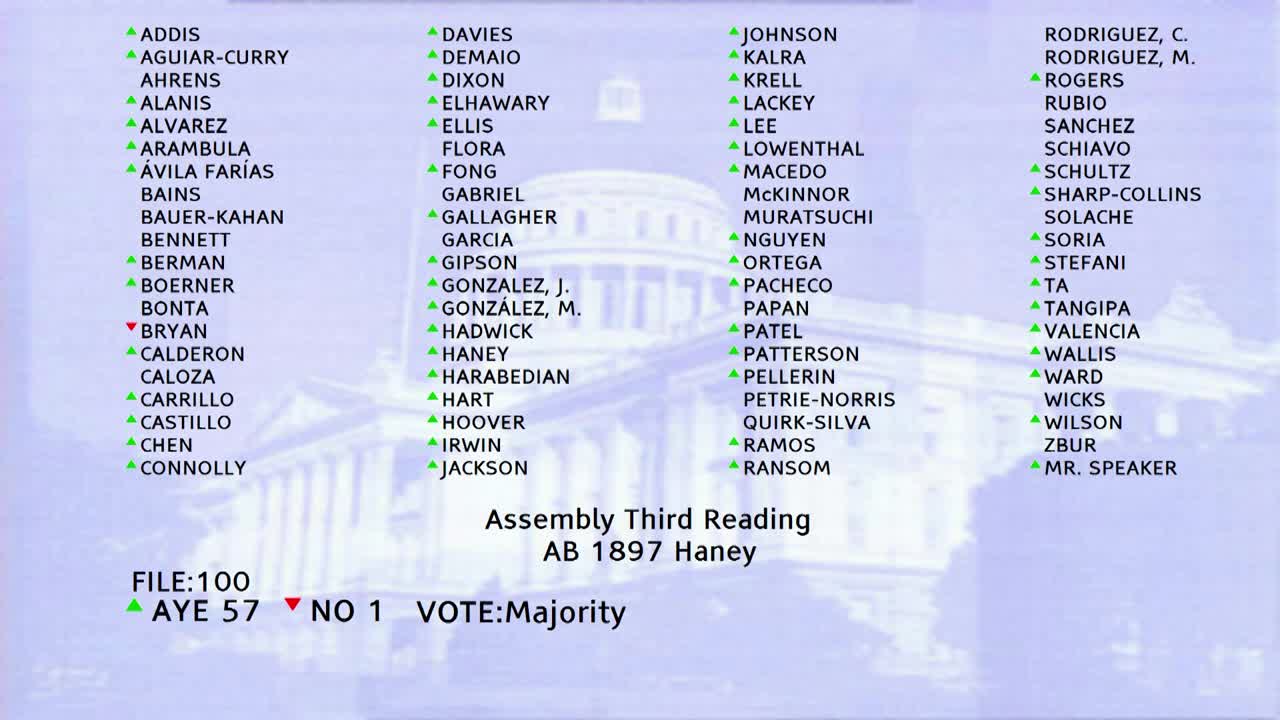 4MIN
Assembly Floor
 11MIN
Assembly Standing Committee on Human Services
Bill Author