AB 33: Autonomous vehicles.
- Session Year: 2025-2026
- House: Assembly
- Latest Version Date: 2025-06-30
Current Status:
In Progress
(2025-09-09: Ordered to inactive file at the request of Senator Gonzalez.)
Introduced
In Committee
Awaiting First Chamber Vote
Passed First Chamber
In Committee
Awaiting Second Chamber Vote
Passed Second Chamber
Enacted
Existing law authorizes the operation of an autonomous vehicle on public roads for testing purposes by a driver who possesses the proper class of license for the type of vehicle operated if specified requirements are satisfied. Existing law prohibits the operation of an autonomous vehicle on public roads until the manufacturer submits an application to the Department of Motor Vehicles, as specified, and that application is approved. A violation of the Vehicle Code or a local ordinance adopted pursuant to that code is an infraction.
This bill would prohibit the delivery of commercial goods, as defined, directly to a residence or to a business for its use or retail sale through the operation of an autonomous vehicle without a human safety operator on any highway within the State of California. The bill would declare that a violation of this prohibition is not an infraction and is instead punishable by a civil fine not to exceed $25,000 for each instance of the violation. The bill would make certain findings and declarations related to these provisions. make a first violation of this provision subject to a $10,000 administrative fine and a $25,000 administrative fine for subsequent violations. The bill would authorize the department to suspend or revoke the permit of an autonomous vehicle manufacturer for repeated violations of this provision.
The bill would require the department to submit a report to the Legislature evaluating the performance of autonomous vehicle technology and its impact on public safety and employment, as specified. This bill would require all relevant state agencies, including, among others, the Department of Transportation and the State Air Resources Board, to provide information to the department to research this report. The bill would prohibit the department from issuing a deployment permit for the use of an autonomous vehicle to deliver commercial goods without a human safety operator until a later enacted statute authorizes the issuance of a permit for that purpose.
The bill would also make certain findings and declarations related to these provisions.
Existing law authorizes the operation of an autonomous vehicle on public roads for testing purposes by a driver who possesses the proper class of license for the type of vehicle operated if specified requirements are satisfied. Existing law prohibits the operation of an autonomous vehicle on public roads until the manufacturer submits an application to the Department of Motor Vehicles, as specified, and that application is approved. Existing law makes it a crime to violate, or fail to comply with, any provision A violation of the Vehicle Code or any a local ordinance adopted pursuant to this code. that code is an infraction.
This bill would prohibit the delivery of commercial goods, as defined, directly to a residence or to a business for its use or retail sale through the operation of an autonomous vehicles vehicle without a human operator on any highway within the State of California. The bill would exclude the transportation of prepared meals and food intended for immediate consumption from restaurants or food establishments directly to consumers from this prohibition. The bill would declare that a violation of this prohibition is not a crime, and an infraction and is instead punishable by a civil fine not to exceed $25,000 for each instance of the violation. The bill would make certain findings and declarations related to these provisions.
This bill would make technical, nonsubstantive changes to these provisions.The bill would require the department to submit a report to the Legislature evaluating the performance of autonomous vehicle technology and its impact on public safety and employment, as specified. This bill would require all relevant state agencies, including, among others, the Department of Transportation and the State Air Resources Board, to provide information to the department to research this report. The bill would prohibit the department from issuing a deployment permit for the use of an autonomous vehicle to deliver commercial goods without a human operator until a later enacted statute authorizes the issuance of a permit for that purpose.
Existing law authorizes the operation of an autonomous vehicle on public roads for testing purposes by a driver who possesses the proper class of license for the type of vehicle operated if specified requirements are satisfied. Existing law prohibits the operation of an autonomous vehicle on public roads until the manufacturer submits an application to the Department of Motor Vehicles, as specified, and that application is approved. Existing law makes it a crime to violate, or fail to comply with, any provision of the Vehicle Code or any local ordinance adopted pursuant to this code.
This bill would prohibit the delivery of commercial goods, as defined, directly to a residence or to a business for its use or retail sale through the operation of autonomous vehicles without a human operator on any highway within the State of California. The bill would exclude the transportation of prepared meals and food intended for immediate consumption from restaurants or food establishments directly to consumers from this prohibition. The bill would declare that a violation of this prohibition is not a crime, and instead punishable by a civil fine not to exceed $25,000 for each instance of the violation. The bill would make certain findings and declarations related to these provisions.
This bill would make technical, nonsubstantive changes to these provisions.
Existing law authorizes the operation of an autonomous vehicle on public roads for testing purposes by a driver who possesses the proper class of license for the type of vehicle operated if specified requirements are satisfied. Existing law prohibits the operation of an autonomous vehicle on public roads until the manufacturer submits an application to the Department of Motor Vehicles, as specified, and that application is approved.
This bill would make technical, nonsubstantive changes to these provisions.
The Legislature finds and declares all of the following:
(a)The deployment of autonomous vehicles (AVs) for commercial purposes poses potential risks to road safety, especially given the technologys reliance on complex algorithms that can be prone to unforeseen errors and failures.
(b)The widespread use of AVs in the delivery industry threatens the livelihoods of thousands of Californians employed as drivers and delivery personnel whose work provides stable, well-paying jobs that support families and communities.
(c)While technological innovation is valuable, it must be balanced against the potential displacement of workers and the economic impact on local economies. Preserving good jobs and ensuring robust workforce participation is essential to Californias long-term economic health.
(d)The state must prioritize the development and enforcement of regulations that protect public safety, promote job security, and maintain oversight over emerging technologies.
SEC. 2.Section 38760 is added to the Vehicle Code, to read:38760.For purposes of Section 38761, Sections 38761 and 38762, the following definitions shall apply:
(a)Autonomous vehicle has the same meaning as that term is defined in paragraph (2) of subdivision (a) of Section 38750.
(b)Commercial goods means any goods, wares, merchandise, or other tangible items requiring transportation for a fee or a commercial purpose. Commercial goods include any items for which a motor carrier permit is required pursuant to Division 14.85 (commencing with Section 34600).
(c)(1)Human safety operator means a person operating an autonomous vehicle or vehicle equipped with autonomous technology who is trained in operating and shutting off the vehicle. A human safety operator shall meet all federal and state qualifications for the type of vehicle being operated, whether in automated or nonautomated mode.
(2)The definition of operator, as that term is defined in paragraph (4) of subdivision (a) of Section 38750, is separate and distinct and does not apply to Section 38761.
(d)Motor carrier permit means the authorization issued by the department that allows motor carriers to transport property for compensation pursuant to Chapter 2 (commencing with Section 34620) of Division 14.85.
SEC. 3.Section 38761 is added to the Vehicle Code, to read:38761.(a)Notwithstanding any other law, the delivery of commercial goods directly to a residence or to a business for its use or retail sale through the operation of an autonomous vehicle without a human safety operator is prohibited on a highway within the State of California.
(b)(1)The department shall impose an administrative fine of ten thousand dollars ($10,000) for a first violation of this section.
(2)The department shall impose an administrative fine of twenty-five thousand dollars ($25,000) for each subsequent violation of this section.
(3)Penalties assessed pursuant to this section shall be recoverable by the department and deposited into the Motor Vehicle Account in the State Transportation Fund for use by the department in administering this chapter.
(c)The department may, subject to regulations adopted pursuant to subdivision (d) of Section 38750 and the notice and hearing requirements of Chapter 5 (commencing with Section 11500) of Part 1 of Division 3 of Title 2 of the Government Code, suspend or revoke the permit of an autonomous vehicle manufacturer for repeated violations of this section.
SEC. 4.Section 38762 is added to the Vehicle Code, to read:38762.(a)(1)By January 1, 2031, or five years after commencement of testing, whichever occurs later, and upon appropriation by the Legislature, the department shall submit a report to the Legislature and the relevant policy and fiscal committees evaluating the performance of autonomous vehicle technology and its impact on public safety and employment in the transportation sector for autonomous vehicles utilized to deliver commercial goods.
(2)The report shall include both of the following:
(A)A summary of disengagements, crashes, and other information the department believes is relevant.
(B)A recommendation on whether the Legislature should remove, modify, or maintain the requirement for an autonomous vehicle utilized to deliver commercial goods to operate with a human safety operator physically present in the vehicle.
(3)While preparing the report, the department shall consult with all of the following:
(A)The Department of the California Highway Patrol regarding traffic impacts, driver and passenger safety risks, and impacts on other motorists, bicyclists, and pedestrians.
(B)The Labor and Workforce Development Agency regarding job-related impacts, including worker displacement and shortcomings in retraining opportunities.
(C)The Department of Transportation regarding infrastructure impacts, deficiencies, and needs.
(D)The State Air Resources Board regarding how autonomous vehicles utilized to deliver commercial goods impact the 2022 Scoping Plan for Achieving Carbon Neutrality.
(E)Independent experts regarding the performance of the technology, public safety impacts, and other relevant factors in considering deployment.
(b)The Department of the California Highway Patrol, the Labor and Workforce Development Agency, the Department of Transportation, the State Air Resources Board, and all other relevant state agencies shall provide information, as specified by the department, that is needed to research the report required by this section.
(c)It is the intent of the Legislature to, upon issuance of the report required in subdivision (a), conduct an oversight hearing to assess the state of autonomous vehicle technology for vehicles utilized to deliver commercial goods.
(d)The department shall not issue a deployment permit for use of an autonomous vehicle utilized to deliver commercial goods without a human safety operator earlier than one year after the oversight hearing described in subdivision (c) and only if a later enacted statute authorizes the issuance of a permit for that purpose.
SEC. 5.Section 40010 is added to the Vehicle Code, to read:40010.A violation of Section 38761 is not an infraction and shall instead be punishable by a civil fine not to exceed twenty-five thousand dollars ($25,000) for each instance of the violation.The Legislature finds and declares all of the following:
(a)The deployment of autonomous vehicles (AVs) for commercial purposes poses potential risks to road safety, especially given the technologys reliance on complex algorithms that can be prone to unforeseen errors and failures.
(b)The widespread use of AVs in the delivery industry threatens the livelihoods of thousands of Californians employed as drivers and delivery personnel whose work provides stable, well-paying jobs that support families and communities.
(c)While technological innovation is valuable, it must be balanced against the potential displacement of workers and the economic impact on local economies. Preserving good jobs and ensuring robust workforce participation is essential to Californias long-term economic health.
(d)The state must prioritize the development and enforcement of regulations that protect public safety, promote job security, and maintain oversight over emerging technologies.
SEC. 2.Section 38760 is added to the Vehicle Code, to read:38760.For purposes of Section 38761, the following definitions shall apply:
(a)Autonomous vehicle has the same meaning as that term is defined in paragraph (2) of subdivision (a) of Section 38750.
(b)Commercial goods means any goods, wares, merchandise, or other tangible items requiring transportation for a fee or a commercial purpose. Commercial goods include any items for which a motor carrier permit is required pursuant to Division 14.85 (commencing with Section 34600). Commercial goods does not include any prepared meals and food intended for immediate consumption by consumers through food delivery, as described in subdivision (c).
(c)Food delivery means the transportation of prepared meals and food intended for immediate consumption from restaurants or food establishments directly to consumers.(d)(c)(1)Human operator means a person operating an autonomous vehicle or vehicle equipped with autonomous technology who is trained in operating and shutting off the vehicle. A human operator shall meet all federal and state qualifications for the type of vehicle being operated, whether in automated or nonautomated mode.
(2)The definition of operator operator, as that term is defined in paragraph (4) of subdivision (a) of Section 38750 38750, is separate and distinct and shall does not apply to Section 38761.
(e)(d)Motor carrier permit means the authorization issued by the Department of Motor Vehicles department that allows motor carriers to transport property for compensation pursuant to Chapter 2 (commencing with Section 34620) of Division 14.85.
SEC. 3.Section 38761 is added to the Vehicle Code, to read:38761.(a)Notwithstanding any other law, the delivery of commercial goods directly to a residence or to a business for its use or retail sale through the operation of an autonomous vehicles vehicle without a human operator is prohibited on any a highway within the State of California.
(b)Food delivery is excluded from the prohibition described in subdivision (a).SEC. 4.Section 38762 is added to the Vehicle Code, to read:38762.(a)(1)By January 1, 2031, or five years after commencement of testing, whichever occurs later, and upon appropriation by the Legislature, the department shall submit a report to the Legislature and the relevant policy and fiscal committees evaluating the performance of autonomous vehicle technology and its impact on public safety and employment in the transportation sector for autonomous vehicles utilized to deliver commercial goods.
(2)The report shall include both of the following:
(A)A summary of disengagements, crashes, and other information the department believes is relevant.
(B)A recommendation on whether the Legislature should remove, modify, or maintain the requirement for an autonomous vehicle utilized to deliver commercial goods to operate with a human safety operator physically present in the vehicle.
(3)While preparing the report, the department shall consult with all of the following:
(A)The Department of the California Highway Patrol regarding traffic impacts, driver and passenger safety risks, and impacts on other motorists, bicyclists, and pedestrians.
(B)The Labor and Workforce Development Agency regarding job-related impacts, including worker displacement and shortcomings in retraining opportunities.
(C)The Department of Transportation regarding infrastructure impacts, deficiencies, and needs.
(D)The State Air Resources Board regarding how autonomous vehicles utilized to deliver commercial goods impact the 2022 Scoping Plan for Achieving Carbon Neutrality.
(E)Independent experts regarding the performance of the technology, public safety impacts, and other relevant factors in considering deployment.
(b)The Department of the California Highway Patrol, the Labor and Workforce Development Agency, the Department of Transportation, the State Air Resources Board, and all other relevant state agencies shall provide information, as specified by the department, that is needed to research the report required by this section.
(c)It is the intent of the Legislature to, upon issuance of the report required in subdivision (a), conduct an oversight hearing to assess the state of autonomous vehicle technology for vehicles utilized to deliver commercial goods.
(d)The department shall not issue a deployment permit for use of an autonomous vehicle utilized to deliver commercial goods without a human safety operator earlier than one year after the oversight hearing described in subdivision (c) and only if a later enacted statute authorizes the issuance of a permit for that purpose.
SEC. 4.SEC. 5.Section 40010 is added to the Vehicle Code, to read:40010.A violation of Section 38761 is not an infraction and shall instead be punishable by a civil fine not to exceed twenty-five thousand dollars ($25,000) for each instance of the violation.
REVISIONS: HeadingLine 2.The Legislature finds and declares all of the following:
(a)The deployment of autonomous vehicles (AVs) for commercial purposes poses potential risks to road safety, especially given the technologys reliance on complex algorithms that can be prone to unforeseen errors and failures.
(b)The widespread use of AVs in the delivery industry threatens the livelihoods of thousands of Californians employed as drivers and delivery personnel whose work provides stable, well-paying jobs that support families and communities.
(c)While technological innovation is valuable, it must be balanced against the potential displacement of workers and the economic impact on local economies. Preserving good jobs and ensuring robust workforce participation is essential to Californias long-term economic health.
(d)The state must prioritize the development and enforcement of regulations that protect public safety, promote job security, and maintain oversight over emerging technologies.
SEC. 2.Section 38760 is added to the Vehicle Code, to read:38760.For purposes of Section 38761, the following definitions shall apply:
(a)Autonomous vehicle has the same meaning as that term is defined in paragraph (2) of subdivision (a) of Section 38750.
(b)Commercial goods means any goods, wares, merchandise, or other tangible items requiring transportation for a fee or a commercial purpose. Commercial goods include any items for which a motor carrier permit is required pursuant to Division 14.85 (commencing with Section 34600). Commercial goods does not include any prepared meals and food intended for immediate consumption by consumers through food delivery, as described in subdivision (c).
(c)Food delivery means the transportation of prepared meals and food intended for immediate consumption from restaurants or food establishments directly to consumers.
(d)(1)Human operator means a person operating an autonomous vehicle or vehicle equipped with autonomous technology who is trained in operating and shutting off the vehicle. A human operator shall meet all federal and state qualifications for the type of vehicle being operated, whether in automated or nonautomated mode.
(2)The definition of operator as that term is defined in paragraph (4) of subdivision (a) of Section 38750 is separate and distinct and shall not apply to Section 38761.
(e)Motor carrier permit means the authorization issued by the Department of Motor Vehicles that allows motor carriers to transport property for compensation pursuant to Chapter 2 (commencing with Section 34620) of Division 14.85.
SEC. 3.Section 38761 is added to the Vehicle Code, to read:38761.(a)Notwithstanding any other law, the delivery of commercial goods directly to a residence or to a business for its use or retail sale through the operation of autonomous vehicles without a human operator is prohibited on any highway within the State of California.
(b)Food delivery is excluded from the prohibition described in subdivision (a).
SEC. 4.Section 40010 is added to the Vehicle Code, to read:40010.A violation of Section 38761 is not an infraction and shall instead be punishable by a civil fine not to exceed twenty-five thousand dollars ($25,000) for each instance of the violation.
SECTION 1.Section 38750 of the Vehicle Code, as amended by Section 1 of Chapter 682 of the Statutes of 2024, is amended to read:38750.(a)For purposes of this division, the following definitions apply:(1)Autonomous technology means technology that has the capability to drive a vehicle without the active physical control or monitoring by a human operator.(2)(A)Autonomous vehicle means any vehicle equipped with autonomous technology that has been integrated into that vehicle that meets the definition of Level 3, Level 4, or Level 5 of SAE Internationals Taxonomy and Definitions for Terms Related to Driving Automation Systems for On-Road Motor Vehicles, standard J3016 (APR2021), as may be revised.(B)An autonomous vehicle does not include a vehicle that is equipped with one or more collision avoidance systems, including, but not limited to, electronic blind spot assistance, automated emergency braking systems, park assist, adaptive cruise control, lane keep assist, lane departure warning, traffic jam and queuing assist, or other similar systems that enhance safety or provide driver assistance, but are not capable, collectively or singularly, of driving the vehicle without the active control or monitoring of a human operator.(3)Department means the Department of Motor Vehicles.(4)An operator of an autonomous vehicle is the person who is seated in the drivers seat, or, if there is no person in the drivers seat, causes the autonomous technology to engage.(5)A manufacturer of autonomous technology is the person, as defined in Section 470, that originally manufactures a vehicle and equips autonomous technology on the originally completed vehicle or, in the case of a vehicle not originally equipped with autonomous technology by the vehicle manufacturer, the person that modifies the vehicle by installing autonomous technology to convert it to an autonomous vehicle after the vehicle was originally manufactured.(b)An autonomous vehicle may be operated on public roads for testing purposes by a driver who possesses the proper class of license for the type of vehicle being operated if all of the following requirements are met:(1)The autonomous vehicle is being operated on roads in this state solely by employees, contractors, or other persons designated by the manufacturer of the autonomous technology.(2)The driver is seated in the drivers seat, monitoring the safe operation of the autonomous vehicle, and capable of taking over immediate manual control of the autonomous vehicle in the event of an autonomous technology failure or other emergency.(3)Prior to the start of testing in this state, a manufacturer performing the testing shall obtain an instrument of insurance, surety bond, or proof of self-insurance in the amount of five million dollars ($5,000,000), and shall provide evidence of the insurance, surety bond, or self-insurance to the department consistent with the regulations adopted pursuant to subdivision (d).(c)Except as provided in subdivision (b), an autonomous vehicle shall not be operated on public roads until the manufacturer submits an application that is approved by the department pursuant to the regulations adopted pursuant to subdivision (d). The application shall contain, at a minimum, all of the following certifications:(1)A certification by the manufacturer that the autonomous technology satisfies all of the following requirements:(A)The autonomous vehicle has a mechanism to engage and disengage the autonomous technology that is easily accessible by the operator.(B)The autonomous vehicle has a visual indicator inside the cabin to indicate when the autonomous technology is engaged.(C)The autonomous vehicle has a system to safely alert the operator if an autonomous technology failure is detected while the autonomous technology is engaged, and when an alert is given, the system shall do either of the following:(i)Require the operator to take control of the autonomous vehicle.(ii)If the operator does not or is unable to take control of the autonomous vehicle, the autonomous vehicle shall be capable of coming to a complete stop.(D)The autonomous vehicle shall allow the operator to take control in multiple manners, including, without limitation, through the use of the brake, the accelerator pedal, or the steering wheel, and it shall alert the operator that the autonomous technology has been disengaged.(E)The autonomous vehicles autonomous technology meets Federal Motor Vehicle Safety Standards for the vehicles model year and all other applicable safety standards and performance requirements set forth in state and federal law and the regulations promulgated pursuant to those laws.(F)The autonomous technology does not make inoperative any Federal Motor Vehicle Safety Standards for the vehicles model year and all other applicable safety standards and performance requirements set forth in state and federal law and the regulations promulgated pursuant to those laws.(G)The autonomous vehicle has a separate mechanism, in addition to, and separate from, any other mechanism required by law, to capture and store the autonomous technology sensor data for at least 30 seconds before a collision occurs between the autonomous vehicle and another vehicle, object, or natural person while the vehicle is operating in autonomous mode. The autonomous technology sensor data shall be captured and stored in a read-only format by the mechanism so that the data is retained until extracted from the mechanism by an external device capable of downloading and storing the data. The data shall be preserved for three years after the date of the collision.(2)A certification that the manufacturer has tested the autonomous technology on public roads and has complied with the testing standards, if any, established by the department pursuant to subdivision (d).(3)A certification that the manufacturer will maintain, an instrument of insurance, a surety bond, or proof of self-insurance as specified in regulations adopted by the department pursuant to subdivision (d), in an amount of five million dollars ($5,000,000).(d)(1)The department shall adopt regulations setting forth requirements for the submission of evidence of insurance, surety bond, or self-insurance required by subdivision (b), the submission and approval of an application to operate an autonomous vehicle pursuant to subdivision (c), and processes related to notices of autonomous vehicle noncompliance pursuant to Section 38752.(2)The regulations shall include any testing, equipment, and performance standards, in addition to those established for purposes of subdivision (b), that the department concludes are necessary to ensure the safe operation of autonomous vehicles on public roads, with or without the presence of a driver inside the vehicle. In developing these regulations, the department may consult with the Department of the California Highway Patrol, the Institute of Transportation Studies at the University of California, or any other entity identified by the department that has expertise in automotive technology, automotive safety, and autonomous system design.(3)The department may establish additional requirements by the adoption of regulations, which it determines, in consultation with the Department of the California Highway Patrol, are necessary to ensure the safe operation of autonomous vehicles on public roads, including, but not limited to, regulations regarding the aggregate number of deployments of autonomous vehicles on public roads, special rules for the registration of autonomous vehicles, new license requirements for operators of autonomous vehicles, regulations for notices of autonomous vehicle noncompliance, and rules for revocation, suspension, or denial of any license or any approval issued pursuant to this division.(4)The department shall hold public hearings on the adoption of any regulation applicable to the operation of an autonomous vehicle without the presence of a driver inside the vehicle.(e)(1)The department shall approve an application submitted by a manufacturer pursuant to subdivision (c) if it finds that the applicant has submitted all information and completed testing necessary to satisfy the department that the autonomous vehicles are safe to operate on public roads and the applicant has complied with all requirements specified in the regulations adopted by the department pursuant to subdivision (d).(2)Notwithstanding paragraph (1), if the application seeks approval for autonomous vehicles capable of operating without the presence of a driver inside the vehicle, the department may impose additional requirements it deems necessary to ensure the safe operation of those vehicles, and may require the presence of a driver in the drivers seat of the vehicle if it determines, based on its review pursuant to paragraph (1), that such a requirement is necessary to ensure the safe operation of those vehicles on public roads.(f)The department shall post a public notice on its internet website when it adopts the regulations required by subdivision (d). The department shall not approve an application submitted pursuant to the regulations until 30 days after the public notice is provided.(g)Federal regulations promulgated by the National Highway Traffic Safety Administration shall supersede the provisions of this division when found to be in conflict with any other state law or regulation.(h)The manufacturer of the autonomous technology installed on a vehicle shall provide a written disclosure to the purchaser of an autonomous vehicle that describes what information is collected by the autonomous technology equipped on the vehicle. The department may promulgate regulations to assess a fee upon a manufacturer that submits an application pursuant to subdivision (c) to operate autonomous vehicles on public roads in an amount necessary to recover all costs reasonably incurred by the department.(i)(1)Commencing January 1, 2030, to the extent authorized by federal law, any autonomous vehicle with a model year of 2031 or later and a gross vehicle weight rating of less than 8,501 pounds shall only be operated pursuant to a deployment permit pursuant to Article 3.8 (commencing with Section 228.00) of Chapter 1 of Division 1 of Title 13 of the California Code of Regulations if the vehicle is a zero-emission vehicle, as defined in Section 44258 of the Health and Safety Code.(2)The department shall not commence rulemaking for the adoption of regulations implementing this subdivision before January 1, 2027.(a)For purposes of this division, the following definitions apply:
(1)Autonomous technology means technology that has the capability to drive a vehicle without the active physical control or monitoring by a human operator.
(2)(A)Autonomous vehicle means any vehicle equipped with autonomous technology that has been integrated into that vehicle that meets the definition of Level 3, Level 4, or Level 5 of SAE Internationals Taxonomy and Definitions for Terms Related to Driving Automation Systems for On-Road Motor Vehicles, standard J3016 (APR2021), as may be revised.
(B)An autonomous vehicle does not include a vehicle that is equipped with one or more collision avoidance systems, including, but not limited to, electronic blind spot assistance, automated emergency braking systems, park assist, adaptive cruise control, lane keep assist, lane departure warning, traffic jam and queuing assist, or other similar systems that enhance safety or provide driver assistance, but are not capable, collectively or singularly, of driving the vehicle without the active control or monitoring of a human operator.
(3)Department means the Department of Motor Vehicles.
(4)An operator of an autonomous vehicle is the person who is seated in the drivers seat, or, if there is no person in the drivers seat, causes the autonomous technology to engage.
(5)A manufacturer of autonomous technology is the person, as defined in Section 470, that originally manufactures a vehicle and equips autonomous technology on the originally completed vehicle or, in the case of a vehicle not originally equipped with autonomous technology by the vehicle manufacturer, the person that modifies the vehicle by installing autonomous technology to convert it to an autonomous vehicle after the vehicle was originally manufactured.
(b)An autonomous vehicle may be operated on public roads for testing purposes by a driver who possesses the proper class of license for the type of vehicle being operated if all of the following requirements are met:
(1)The autonomous vehicle is being operated on roads in this state solely by employees, contractors, or other persons designated by the manufacturer of the autonomous technology.
(2)The driver shall be is seated in the drivers seat, monitoring the safe operation of the autonomous vehicle, and capable of taking over immediate manual control of the autonomous vehicle in the event of an autonomous technology failure or other emergency.
(3)Prior to the start of testing in this state, the a manufacturer performing the testing shall obtain an instrument of insurance, surety bond, or proof of self-insurance in the amount of five million dollars ($5,000,000), and shall provide evidence of the insurance, surety bond, or self-insurance to the department in the form and manner required by the department pursuant to consistent with the regulations adopted pursuant to subdivision (d).
(c)Except as provided in subdivision (b), an autonomous vehicle shall not be operated on public roads until the manufacturer submits an application to the department, and that application that is approved by the department pursuant to the regulations adopted pursuant to subdivision (d). The application shall contain, at a minimum, all of the following certifications:
(1)A certification by the manufacturer that the autonomous technology satisfies all of the following requirements:
(A)The autonomous vehicle has a mechanism to engage and disengage the autonomous technology that is easily accessible to by the operator.
(B)The autonomous vehicle has a visual indicator inside the cabin to indicate when the autonomous technology is engaged.
(C)The autonomous vehicle has a system to safely alert the operator if an autonomous technology failure is detected while the autonomous technology is engaged, and when an alert is given, the system shall do either of the following:
(i)Require the operator to take control of the autonomous vehicle.
(ii)If the operator does not or is unable to take control of the autonomous vehicle, the autonomous vehicle shall be capable of coming to a complete stop.
(D)The autonomous vehicle shall allow the operator to take control in multiple manners, including, without limitation, through the use of the brake, the accelerator pedal, or the steering wheel, and it shall alert the operator that the autonomous technology has been disengaged.
(E)The autonomous vehicles autonomous technology meets Federal Motor Vehicle Safety Standards for the vehicles model year and all other applicable safety standards and performance requirements set forth in state and federal law and the regulations promulgated pursuant to those laws.
(F)The autonomous technology does not make inoperative any Federal Motor Vehicle Safety Standards for the vehicles model year and all other applicable safety standards and performance requirements set forth in state and federal law and the regulations promulgated pursuant to those laws.
(G)The autonomous vehicle has a separate mechanism, in addition to, and separate from, any other mechanism required by law, to capture and store the autonomous technology sensor data for at least 30 seconds before a collision occurs between the autonomous vehicle and another vehicle, object, or natural person while the vehicle is operating in autonomous mode. The autonomous technology sensor data shall be captured and stored in a read-only format by the mechanism so that the data is retained until extracted from the mechanism by an external device capable of downloading and storing the data. The data shall be preserved for three years after the date of the collision.
(2)A certification that the manufacturer has tested the autonomous technology on public roads and has complied with the testing standards, if any, established by the department pursuant to subdivision (d).
(3)A certification that the manufacturer will maintain, an instrument of insurance, a surety bond, or proof of self-insurance as specified in regulations adopted by the department pursuant to subdivision (d), in an amount of five million dollars ($5,000,000).
(d)(1)The department shall adopt regulations setting forth requirements for the submission of evidence of insurance, surety bond, or self-insurance required by subdivision (b), the submission and approval of an application to operate an autonomous vehicle pursuant to subdivision (c), and processes related to notices of autonomous vehicle noncompliance pursuant to Section 38752.
(2)The regulations shall include any testing, equipment, and performance standards, in addition to those established for purposes of subdivision (b), that the department concludes are necessary to ensure the safe operation of autonomous vehicles on public roads, with or without the presence of a driver inside the vehicle. In developing these regulations, the department may consult with the Department of the California Highway Patrol, the Institute of Transportation Studies at the University of California, or any other entity identified by the department that has expertise in automotive technology, automotive safety, and autonomous system design.
(3)The department may establish additional requirements by the adoption of regulations, which it determines, in consultation with the Department of the California Highway Patrol, are necessary to ensure the safe operation of autonomous vehicles on public roads, including, but not limited to, regulations regarding the aggregate number of deployments of autonomous vehicles on public roads, special rules for the registration of autonomous vehicles, new license requirements for operators of autonomous vehicles, regulations for notices of autonomous vehicle noncompliance, and rules for revocation, suspension, or denial of any license or any approval issued pursuant to this division.
(4)The department shall hold public hearings on the adoption of any regulation applicable to the operation of an autonomous vehicle without the presence of a driver inside the vehicle.
(e)(1)The department shall approve an application submitted by a manufacturer pursuant to subdivision (c) if it finds that the applicant has submitted all information and completed testing necessary to satisfy the department that the autonomous vehicles are safe to operate on public roads and the applicant has complied with all requirements specified in the regulations adopted by the department pursuant to subdivision (d).
(2)Notwithstanding paragraph (1), if the application seeks approval for autonomous vehicles capable of operating without the presence of a driver inside the vehicle, the department may impose additional requirements it deems necessary to ensure the safe operation of those vehicles, and may require the presence of a driver in the drivers seat of the vehicle if it determines, based on its review pursuant to paragraph (1), that such a requirement is necessary to ensure the safe operation of those vehicles on public roads.
(f)The department shall post a public notice on its internet website when it adopts the regulations required by subdivision (d). The department shall not approve an application submitted pursuant to the regulations until 30 days after the public notice is provided.
(g)Federal regulations promulgated by the National Highway Traffic Safety Administration shall supersede the provisions of this division when found to be in conflict with any other state law or regulation.
(h)The manufacturer of the autonomous technology installed on a vehicle shall provide a written disclosure to the purchaser of an autonomous vehicle that describes what information is collected by the autonomous technology equipped on the vehicle. The department may promulgate regulations to assess a fee upon a manufacturer that submits an application pursuant to subdivision (c) to operate autonomous vehicles on public roads in an amount necessary to recover all costs reasonably incurred by the department.
(i)(1)Commencing January 1, 2030, to the extent authorized by federal law, any autonomous vehicle with a model year of 2031 or later and a gross vehicle weight rating of less than 8,501 pounds shall only be operated pursuant to a deployment permit pursuant to Article 3.8 (commencing with Section 228.00) of Chapter 1 of Division 1 of Title 13 of the California Code of Regulations if the vehicle is a zero-emission vehicle, as defined in Section 44258 of the Health and Safety Code.
(2)The department shall not commence rulemaking for the adoption of regulations implementing this subdivision before January 1, 2027.
|
Date
|
Status
|
|---|---|
| Sep 9, 2025 | Ordered to inactive file at the request of Senator Gonzalez. |
| Aug 29, 2025 | Read second time. Ordered to third reading. |
| Aug 29, 2025 | From committee: Do pass. (Ayes 5. Noes 2.) (August 29). |
| Jul 14, 2025 | In committee: Referred to APPR. suspense file. |
| Jul 1, 2025 | Withdrawn from committee. |
| Jul 1, 2025 | Re-referred to Com. on APPR. |
| Jun 30, 2025 | From committee chair, with author's amendments: Amend, and re-refer to committee. Read second time, amended, and re-referred to Com. on JUD. |
| Jun 25, 2025 | From committee: Do pass and re-refer to Com. on JUD. (Ayes 10. Noes 3.) (June 24). Re-referred to Com. on JUD. |
| Jun 11, 2025 | Referred to Coms. on TRANS. and JUD. |
| May 29, 2025 | In Senate. Read first time. To Com. on RLS. for assignment. |
| May 29, 2025 | Read third time. Passed. Ordered to the Senate. (Ayes 57. Noes 7. Page 1773.) |
| May 27, 2025 | Read second time. Ordered to third reading. |
| May 23, 2025 | From committee: Do pass. (Ayes 11. Noes 1.) (May 23). |
| May 14, 2025 | In committee: Set, first hearing. Referred to suspense file. |
| Apr 22, 2025 | From committee: Do pass and re-refer to Com. on APPR. (Ayes 12. Noes 2.) (April 21). Re-referred to Com. on APPR. |
| Apr 22, 2025 | Coauthors revised. |
| Apr 2, 2025 | Re-referred to Com. on TRANS. |
| Apr 1, 2025 | From committee chair, with author's amendments: Amend, and re-refer to Com. on TRANS. Read second time and amended. |
| Mar 19, 2025 | In committee: Set, first hearing. Hearing canceled at the request of author. |
| Mar 5, 2025 | Re-referred to Com. on TRANS. |
| Mar 4, 2025 | From committee chair, with author's amendments: Amend, and re-refer to Com. on TRANS. Read second time and amended. |
| Mar 3, 2025 | Referred to Com. on TRANS. |
| Dec 3, 2024 | From printer. May be heard in committee January 2. |
| Dec 2, 2024 | Read first time. To print. |
|
Date
|
Description
|
Location
|
Votes
|
|
|---|---|---|---|---|
| Aug 29, 2025 | Do pass | Senate Standing Committee on Appropriations |
Passed |
|
| Jul 14, 2025 | Placed on suspense file | Senate Standing Committee on Appropriations |
Passed |
|
| Jun 24, 2025 | Do pass, but first be re-referred to the Committee on [Judiciary] | Senate Standing Committee on Transportation |
Passed |
|
| May 29, 2025 | AB 33 Aguiar-Curry Assembly Third Reading | Assembly Floor |
Passed |
|
| May 23, 2025 | Do pass. | Assembly Standing Committee on Appropriations |
Passed |
|
| Apr 21, 2025 | Do pass and be re-referred to the Committee on [Appropriations] | Assembly Standing Committee on Transportation |
Passed |
This list shows positions taken on this bill by organizations on the date displayed, which is linked to the original source.
Positions by individuals are not included.
|
Organization
|
Position
|
Date
|
|---|---|---|
| Abate of California - Motorcyclists Rights & Safety Organization | ** Support | |
| Abate-A-Weed | ** Against | |
| Alliance For Automotive Innovation | ** Against | |
| Association for Uncrewed Vehicle Systems International | ** Against | |
| Aurora Innovation, INC. | ** Against | |
| Autonomous Vehicle Industry Association | ** Against | |
| Board of Supervisors for the City and County of San Francisco | ** Support | |
| CalChamber | ** Against | |
| California Chamber Of Commerce | ** Against | |
| California Conference Board Of The Amalgamated Transit Union | ** Support | |
| California Conference Of Machinists | ** Support | |
| California Federation of Labor Unions, Afl-cio | ** Support | |
| California Grocers Association | ** Against | |
| California Manufacturers & Technology Association | ** Against | |
| California Manufacturers And Technology Association | ** Against | |
| California Manufacturing Technology Association | ** Against | |
| California New Car Dealers Association | ** Support | |
| California Safety and Legislative Board of Smart – Transportation Division | ** Support | |
| California School Employees Association | ** Support | |
| California State Council of Service Employees International Union | ** Support | |
| California Teamsters Public Affairs Council | ** Support | |
| CFT- a Union of Educators & Classified Professionals, Aft, Afl-cio | ** Support | |
| Chamber Of Progress | ** Against | |
| Coalition for Small and Disabled Veteran Businesses | ** Against | |
| Coalition of Small and Disabled Veteran Businesses | ** Against | |
| Consumer Attorneys Of California | ** Support | |
| Consumer Federation Of California | ** Support | |
| Consumer Technology Association | ** Against | |
| Contra Costa Transportation Authority | ** Against | |
| Cslb-blet-ibt | ** Support | |
| Cupertino Chamber of Commerce | ** Against | |
| Engineers and Scientists of California, IFPTE Local 20, AFL-CIO | ** Support | |
| Flasher Barricade Association | ** Against | |
| Gatik | ** Against | |
| Kodiak | ** Against | |
| Kodiak Robotics, INC. | ** Against | |
| Mountain View Chamber of Commerce | ** Against | |
| National Federation Of Independent Business | ** Against | |
| National Federation Of The Blind Of California | ** Against | |
| NFIB | ** Against | |
| Nuro | ** Against | |
| NURO, INC. | ** Against | |
| Orange County Business Council | ** Against | |
| Orange County Employees Association | ** Support | |
| Palo Alto Chamber of Commerce | ** Against | |
| San Diego Regional Chamber Of Commerce | ** Against | |
| San Gabriel Valley Economic Partnership | ** Against | |
| SAVE Coalition | ** Against | |
| Silicon Valley Leadership Group | ** Against | |
| Stack Ai | ** Against | |
| Stack AV | ** Against | |
| Teamsters California | ** Support | |
| Techequity Action | ** Support | |
| Technet | ** Against | |
| Tesla | ** Against | |
| Tesla, Inc. | ** Against | |
| Torc | ** Against | |
| Truck And Engine Manufacturers Association | ** Against | |
| UFCW - Western States Council | ** Support | |
| Unite Here International Union, Afl-Cio | ** Support | |
| Utility Workers Union of America | ** Support | |
| Utility Workers Union of America, AFL-CIO | ** Support | |
| Volkswagen ADMT | ** Against | |
| Volvo Autonomous Solutions, a Volvo Group Company | ** Against | |
| Waabi | ** Against | |
| WAABI INNOVATION US INC. | ** Against | |
| Waymo | ** Against | |
| World Blind Union | ** Against | |
| Zoox | ** Against | |
| Zoox, INC. | ** Against |
SENATE RULES COMMITTEE Office of Senate Floor Analyses (916) 651-1520 Fax: (916) 327-4478 | AB 33 |
THIRD READING
Bill No: AB 33
Author: Aguiar-Curry (D), et al.
Amended: 6/30/25 in Senate
Vote: 21
SENATE TRANSPORTATION COMMITTEE: 10-3, 6/24/25
AYES: Cortese, Archuleta, Arreguín, Cervantes, Gonzalez, Grayson, Limón, Menjivar, Richardson, Umberg
NOES: Strickland, Dahle, Seyarto
NO VOTE RECORDED: Blakespear, Valladares
SENATE APPROPRIATIONS COMMITTEE: 5-2, 8/29/25
AYES: Caballero, Cabaldon, Grayson, Richardson, Wahab
NOES: Seyarto, Dahle
ASSEMBLY FLOOR: 57-7, 5/29/25 - See last page for vote
SUBJECT: Autonomous vehicles
SOURCE: Author
DIGEST:
This bill prohibits an autonomous vehicle (AV) without a human safety operator from delivering commercial goods directly to a residence or to a business for its use or retail sale, as specified.
ANALYSIS:
Existing law:
- Authorizes the operation of AVs on public roads for testing purposes under certain circumstances specified in the Department of Motor Vehicles (DMV) regulations.
- Defines “autonomous vehicle” to mean vehicle equipped with technology that makes it capable of operation that meets the definition of Levels 3, 4, or 5 of the Society of Automotive Engineers (SAE) International's Taxonomy and Testing of Autonomous Vehicles Definitions for Terms Related to Driving Automation Systems for On-Road Motor Vehicles, standard J3016 (APR 2021).
- Defines “autonomous technology” to mean technology that has the capability to drive a vehicle without the active physical control or monitoring by a human operator.
- Defines “highway” to mean a way or place of whatever nature, publically maintained and open to the use of the public for purposes of vehicular travel and includes a street, as defined.
- States that an AV does not include a vehicle that is equipped with one or more collision avoidance systems, including, but not limited to, electronic blind spot assistance, automated emergency braking systems, park assist, adaptive cruise control, lane keep assist, lane departure warning, traffic jam and queuing assist, or other similar systems that enhance safety or provide driver assistance, but are not capable, collectively or singularly, of driving the vehicle without the active control or monitoring of a human operator.
- Prohibits the operation of AVs on public roads for non-testing purposes unless the manufacturer of the vehicles submits an application to DMV that is approved pursuant to DMV regulations.
- Requires DMV to approve an application submitted by a manufacturer for the operation of AVs for non-testing purposes if DMV finds that the applicant has submitted all information and completed testing necessary to satisfy that the AVs are safe to operate on public roads and the applicant has complied with all requirements specified in DMV regulations.
- Authorizes DMV to impose additional requirements it deems necessary to ensure the safe operation of AVs if those vehicles are capable of operating without the presence of a driver inside the vehicle.
- At the regulatory level, DMV administers the Autonomous Vehicles Program and issues permits to manufacturers that test and deploy autonomous vehicles on California public roads, as specified. Further restricts the testing and deployment of autonomous vehicles to vehicles under 10,001 pounds and excludes motorcycles.
This bill:
- Makes findings and declarations pertaining to the significance of AV technology within the State and the importance of preserving jobs and economic growth through the technological transition.
- Prohibits the delivery of commercial goods to a residence or to a business for the use or retail sale through the operation of an AV without the presence of a human safety operator in the AV on a highway within the State.
- Imposes an administrative fine of ten thousand dollars ($10,000) for a first violation of the abovementioned requirements and twenty-five thousand ($25,000) for each subsequent violation to be collected and used by DMV.
- Pursuant to regulations adopted by DMV, allows the Department to suspend or revoke the permit of an AV manufacturer for repeated violations, as specified.
- Defines “commercial goods” to mean any goods, wares, merchandise, or other tangible items requiring transportation for a fee or a commercial purpose. Commercial goods include any items for which a motor carrier permit is required.
- Defines "human safety operator" to mean a person operating an AV or vehicle equipped with autonomous technology who is trained in operating and shutting off the vehicle. The human safety operator is required to meet all federal and state qualifications for the type of vehicle being operated, whether in automated or nonautomated mode.
- Requires DMV to issue a report to the Legislature by January 1, 2031, or five years after the commencement of testing, evaluating the performance of AV technology and its impact on public safety and employment in the transportation sector for AVs and their impact on public safety and employment in the transportation sector for AVs utilized to deliver commercial goods. The report is required to include a recommendation on whether the Legislature should remove, modify, or maintain the requirement for an AV utilized to make deliveries to operate with a human safety operator physically present in the vehicle, and requires the Legislature to conduct an oversight hearing.
- Requires the California State Air Resourced Board, the Department of the California Highway Patrol, the Labor and Workforce Development Agency, the Department of Transportation or other relevant state agencies to collaborate with DMV on issuing the report
Comments
- Purpose of this bill. According to the author, “AB 33 protects public safety and supports California's workforce by requiring a human safety operator in autonomous vehicles (AVs) used for commercial deliveries to homes and businesses. This ensures critical human oversight when it matters most—when AVs navigate neighborhoods and business districts. The testing and deployment of light-duty AVs in California have been fraught with malfunctions, including interference with emergency response scenes, collisions, and sudden stops that block traffic. Adding deliveries of countless consumer goods to homes and businesses on local streets and roads throughout the state will result in a proliferation of autonomous vehicles—meaning that AVs have greater potential to injure and kill Californians and threaten jobs. With up to 3 million transportation-related jobs at risk, workers face potential job loss, declining wages, and diminished bargaining power. Proponents claim AVs will create jobs, yet they have provided no clear plan for transitioning workers from traditional delivery roles or brick-and-mortar businesses. This bill addresses these challenges by requiring a certified human safety operator to supervise AVs used for commercial deliveries, ensuring that a human may intervene in unexpected situations and emergencies. By requiring human oversight, this bill allows AV technology to advance responsibly while prioritizing public safety and creating a pathway for California’s transportation workforce to adapt to AV technology.”
- AV’s in California. In 2012, the Legislature passed SB 1298 (Padilla, Chapter 570, Statutes of 2012) which permitted AVs to operate on public roads for testing by a driver under certain conditions. In 2014, DMV released regulations to allow for testing AVs with a test driver. In April 2018, DMV finalized regulations for the testing and deployment of AVs on public roads without a driver. Approximately 36 companies currently have a testing permit with a driver and six companies have received an AV permit for testing without a driver. Lastly, three companies currently have an approved driverless deployment permit.
Currently, DMV regulations prohibit the testing or deployment of AVs weighing 10,001 pounds or more. This was initially done for safety reasons, as vehicles with heavier weights are capable of causing significantly more damage in a collision. DMV held a public workshop on January 27, 2023, to receive public comment to potentially start a new regulatory process to consider authorizing the testing and deployment of AVs over 10,000 pounds after years of lobbying efforts.
In April of this year, DMV issued a notice for proposed rulemaking to revise existing AV regulations; including to now permit the use of AV's over 10,000 pounds with and without a human operator, so long as they are not delivering passengers or hazardous materials. AVs over 10,001 pounds would be prohibited from operating on streets of speed limits of 25 mph or less, with some exceptions. AVs would have to be tested with a human operator for 500,000 miles before they can receive a driverless testing permit, and another 500,000 miles before they can receive a driverless deployment permit. (AV companies cannot charge for their service until they receive a deployment permit.)
- AVs and public safety. Policy conversations continue as to how to improve AV safety on public streets. For example, in 2023 a series of public safety mishaps and accidents occurred between AVs and the public, including an accident with a pedestrian in San Francisco and AV robotaxis’ blocking public safety vehicles including firetrucks. One response was AB 1777 (Ting, Chapter 682, Statues of 2024) which, amongst other things, placed a variety of safety requirements on manufactures of AVs by July 1, 2026. For 2025, according to its website, 824 AV vehicle collision reports have been submitted to DMV as of the beginning of June. It’s important to note that DMV does not categorize the severity of the accidents; however, out of the collision reports submitted, zero fatalities were associated with an AV.
- Commercial delivery vehicles. Commercial delivery vehicles play an important role in California’s economy through transporting goods and services in and around the state for business purposes. Commercial delivery vehicles come in various types and sizes, each designed to meet specific logistical needs or services. For example, several types of delivery vehicles include, but are not limited to, vans, box trucks, refrigerated trucks, flatbed trucks, or in certain instances passenger vehicles. Functions of delivery vehicles include, but are not limited to, cargo transport (moving goods from one location to another), last‑mile delivery, and heavy freight transport. Currently, a number of states allow / authorize AVs to carry out commercial delivery services; most notably is the State of Texas. In Texas, AVs are allowed / authorized (without a human operator present in the vehicle) to commercially transport general freight, industrial goods, and agricultural goods.
- Third attempt. Over the last two years, the Legislature passed and the Governor vetoed AB 2286 (Aguiar-Curry of 2024) and AB 316 (Aguiar-Curry of 2023), which would have prohibited the operation of AVs over 10,001 pounds without a human operator.
This bill is both narrower and more expansive than prior attempts to restrict AV operation without a human operator. This bill would allow driverless AVs over 10,001 pounds so long as the operation does not include delivering commercial goods directly to a retail business or a person's home for use or sale. Theoretically, this bill would not prohibit the possibility for the operation of driverless AVs for deliveries, including vehicles over 10,001 pounds, to a business so long as the product is not intended to be used or sold at that location. However, it is unclear what "use" may mean, and could be interpreted to mean even storing products counts as a "use."
On the other hand, this bill is also more expansive than the prior two efforts, as it would prohibit a business model DMV regulations currently do permit. Existing AV regulations allow for the testing or operation of AVs under 10,001 pounds, both for passenger delivery and goods delivery. Should this bill be enacted, the provisions specified in this bill would curb existing AV delivery service models and prohibit future growth in this industry unless AV companies modify their business models to employ a human safety operator in each AV delivery vehicle.
Lastly, this bill also takes a different approach than DMV’s current rulemaking proposal to authorize AV testing and deployment for certain AVs. DMV’s proposal prohibits AVs over 10,000 pounds from operating on streets with speed limits of 25 mph or less. The proposed DMV regulations would permit AV trucks to drive from one hub to another, while prohibiting their use on roads that would allow them to make personal deliveries to homes and businesses, which typically are on roads that have 25 mph speed limits. Such restrictions potentially stem from the fact that driving on local streets and roads is more difficult for AVs, as more unpredictable behavior from motorists can occur. The danger of this unpredictability for heavier vehicles is significantly larger because the weight and speed of a vehicle can increase the likelihood of death. It is unclear what the impacts of this measure will have relative to the AV rulemaking process currently underway as the provisions in this bill are not in complete alignment with DMV’s existing and proposed AV regulations.
FISCAL EFFECT: Appropriation: No Fiscal Com.: Yes Local: No
According to the Senate Appropriations Committee:
- DMV estimates minor costs to promulgate regulations and determine new disengagement reporting requirements, and ongoing costs of approximately $1.23 million annually for five years (Motor Vehicle Account) for the following:
- $500,000 annually for consultant contracts with technical experts on AV technology to conduct an evaluation of the performance of AV technology and impact on public safety using data from AV manufacturers.
- $250,000 annually for a project management contract for oversight, coordination between relevant agencies, managing scope and timeline, and preparing the report.
- $475,000 annually for DMV staff work, including coordination and oversight of the consultant and project management contracts, management and oversight of the required elements of the report, coordinating with specified state agencies, and completing the analysis.
- Unknown penalty revenue gains related to administrative fines imposed by DMV for violating the bill’s prohibition on delivering commercial goods to a residence or business with a driverless AV. These fine revenues are intended to partially offset DMV’s administrative costs, but the department indicates that revenues from enforcement are not expected to be significant. See Staff Comments. (Motor Vehicle Account)
- The California Air Resources Board (CARB) estimates costs of approximately $283,000 (for 1.0 full-time PY of staff time, and additional support workload) to consult with DMV regarding impacts to the Scoping Plan, and to provide research support to DMV. Staff notes that CARB reported these costs to be minor and absorbable on a prior bill with similar requirements, but indicates that it can no longer absorb workload within existing resources. (Motor Vehicle Account)
- The Labor and Workforce Development Agency (LWD Agency) and Department of Transportation (Caltrans) estimate minor and absorbable costs to consult with DMV in the preparation of the report. (various special funds)
- The California Highway Patrol (CHP) estimates minor and absorbable costs to collect and analyze data on traffic and safety impacts, and to assist in the preparation of the final report. CHP notes that data regarding AV crashes is currently tracked and reported to the DMV. (Motor Vehicle Account)
SUPPORT: (Verified 8/29/25)
Abate of California - Motorcyclists Rights & Safety Organization
Board of Supervisors for the City and County of San Francisco
California Conference Board of the Amalgamated Transit Union
California Conference of Machinists
California Federation of Labor Unions, Afl-cio
California New Car Dealers Association
California Safety and Legislative Board of Smart – Transportation Division
California School Employees Association
California State Council of Service Employees International Union
California Teamsters Public Affairs Council
Cft- a Union of Educators & Classified Professionals, Aft, Afl-cio
Consumer Attorneys of California
Consumer Federation of California
Cslb-blet-ibt
Engineers and Scientists of California, Ifpte Local 20, Afl-cio
Orange County Employees Association
Teamsters California
Techequity Action
Ufcw - Western States Council
Unite Here International Union, Afl-cio
Utility Workers Union of America
Utility Workers Union of America, Afl-cio
OPPOSITION: (Verified 8/29/25)
Abate-a-weed
Alliance for Automotive Innovation
Association for Uncrewed Vehicle Systems International
Aurora Innovation, INC.
Autonomous Vehicle Industry Association
Calchamber
California Chamber of Commerce
California Grocers Association
California Manufacturers & Technology Association
California Manufacturers and Technology Association
California Manufacturing Technology Association
Chamber of Progress
Coalition for Small and Disabled Veteran Businesses
Coalition of Small and Disabled Veteran Businesses
Consumer Technology Association
Contra Costa Transportation Authority
Cupertino Chamber of Commerce
Flasher Barricade Association
Gatik
Kodiak Robotics, INC.
Mountain View Chamber of Commerce
National Federation of Independent Business
National Federation of the Blind of California
Nfib
Nuro, INC.
Orange County Business Council
Palo Alto Chamber of Commerce
San Diego Regional Chamber of Commerce
San Gabriel Valley Economic Partnership
Save Coalition
Silicon Valley Leadership Group
Stack Ai
Stack Av
Technet
Tesla
Tesla, INC.
Torc
Truck and Engine Manufacturers Association
Volkswagen Admt
Volvo Autonomous Solutions, a Volvo Group Company
Waabi
Waabi Innovation US INC.
Waymo
World Blind Union
Zoox, INC.
ASSEMBLY FLOOR: 57-7, 5/29/25
AYES: Addis, Aguiar-Curry, Ahrens, Alanis, Arambula, Ávila Farías, Bains, Bauer-Kahan, Bennett, Boerner, Bonta, Calderon, Caloza, Carrillo, Castillo, Connolly, Davies, Elhawary, Fong, Gabriel, Garcia, Gipson, Mark González, Haney, Harabedian, Hart, Irwin, Kalra, Krell, Lackey, Lee, Lowenthal, McKinnor, Muratsuchi, Ortega, Pacheco, Papan, Patel, Pellerin, Petrie-Norris, Quirk-Silva, Ramos, Ransom, Celeste Rodriguez, Michelle Rodriguez, Rogers, Blanca Rubio, Schiavo, Schultz, Soria, Stefani, Valencia, Wallis, Wicks, Wilson, Zbur, Rivas
NOES: DeMaio, Ellis, Gallagher, Jeff Gonzalez, Hoover, Macedo, Patterson
NO VOTE RECORDED: Alvarez, Berman, Bryan, Chen, Dixon, Flora, Hadwick, Jackson, Nguyen, Sanchez, Sharp-Collins, Solache, Ta, Tangipa, Ward
Prepared by: Manny Leon / TRANS. / (916) 651-4121
8/29/25 20:24:09
**** END ****
SENATE COMMITTEE ON
Senator Anna Caballero, Chair
2025 - 2026 Regular Session
AB 33 (Aguiar-Curry) - Autonomous vehicles
Version: | Policy Vote: |
Urgency: | Mandate: |
Hearing Date: | Consultant: |
Bill Summary:
AB 33 would prohibit the delivery of commercial goods directly to a residence or business for its use or retail sale by an autonomous vehicle (AV) operating without a human safety operator, and require the Department of Motor Vehicles (DMV) to impose administrative penalties for violations of this prohibition. The bill would also require DMV, upon appropriation by the Legislature, to submit a specified evaluation of AV technology and its impact on public safety and employment on the transportation sector to the Legislature by January 1, 2031, or five years after commencement of testing, whichever is later.
Fiscal Impact:
- DMV estimates minor costs to promulgate regulations and determine new disengagement reporting requirements, and ongoing costs of approximately $1.23 million annually for five years (Motor Vehicle Account) for the following:
- $500,000 annually for consultant contracts with technical experts on AV technology to conduct an evaluation of the performance of AV technology and impact on public safety using data from AV manufacturers.
- $250,000 annually for a project management contract for oversight, coordination between relevant agencies, managing scope and timeline, and preparing the report.
- $475,000 annually for DMV staff work, including coordination and oversight of the consultant and project management contracts, management and oversight of the required elements of the report, coordinating with specified state agencies, and completing the analysis.
- Unknown penalty revenue gains related to administrative fines imposed by DMV for violating the bill’s prohibition on delivering commercial goods to a residence or business with a driverless AV. These fine revenues are intended to partially offset DMV’s administrative costs, but the department indicates that revenues from enforcement are not expected to be significant. See Staff Comments. (Motor Vehicle Account)
- The California Air Resources Board (CARB) estimates costs of approximately $283,000 (for 1.0 full-time PY of staff time, and additional support workload) to consult with DMV regarding impacts to the Scoping Plan, and to provide research support to DMV. Staff notes that CARB reported these costs to be minor and absorbable on a prior bill with similar requirements, but indicates that it can no longer absorb workload within existing resources. (Motor Vehicle Account)
- The Labor and Workforce Development Agency (LWD Agency) and Department of Transportation (Caltrans) estimate minor and absorbable costs to consult with DMV in the preparation of the report. (various special funds)
- The California Highway Patrol (CHP) estimates minor and absorbable costs to collect and analyze data on traffic and safety impacts, and to assist in the preparation of the final report. CHP notes that data regarding AV crashes is currently tracked and reported to the DMV. (Motor Vehicle Account)
Background:
Existing law defines “autonomous vehicle” as a vehicle equipped with technology that makes it capable of operation that meets the definition of Levels 3, 4, or 5 of the Society of Automotive Engineers (SAE) International's Taxonomy and Testing of Autonomous Vehicles Definitions for Terms Related to Driving Automation Systems for On-Road Motor Vehicles, standard J3016 (APR 2021). Existing law authorizes the operation of AVs on public roads for testing and deployment purposes under certain circumstances specified in DMV regulations, and prohibits operation of AVs on public roads without DMV approval.
Existing law requires DMV to adopt regulations by January 1, 2015 setting forth the requirements for the application to operate AVs on public roads for non-testing purposes. In 2014 the DMV established regulations to authorize the testing of AVs with gross vehicle weights of less than 10,001 pounds with safety drivers. In 2018 the DMV established regulations to authorize testing of light-duty AVs without safety drivers. Light-duty AV regulations were updated in 2019 to allow for the testing and deployment of AV motor trucks (delivery vehicles weighing less than 10,001 pounds) on public roads. In 2022 the DMV established regulations to authorize the deployment of light-duty AVs without safety drivers. The DMV indicates that 30 companies are currently authorized to test light-duty AVs with a safety driver, six companies are authorized to test without a safety driver, and three companies are authorized to commercially deploy driverless light-duty AVs.
In California, testing and deployment of AVs that weigh 10,001 pounds or more is currently not permitted. DMV held workshops in January and July of 2023 to discuss topics intended to inform the development of future rulemakings for both light-duty and heavy-duty AVs, which included participation by AV manufacturers, technology companies, members of academia, and special interest and labor stakeholders. In addition, the department facilitated two first responder roundtable workshops in Northern and Southern California to gather feedback regarding interactions with AVs operating on public roads. On August 30, 2024, the department released draft regulations for informal stakeholder input. As a result of the workshops and input on the draft regulations, DMV released proposed regulations in April of this year that allows for the testing and public deployment of autonomous heavy duty commercial motor vehicles, enhances existing data reporting, creates a staged application process, and creates additional enforcement authority. Specifically, the proposed regulations would permit the use of AV's over 10,000 pounds with and without a human operator, so long as they are not delivering passengers or hazardous materials, but these heavy-duty AVs would be prohibited from operating on streets with speed limits of 25 mph or less, with some exceptions. The public comment period closed on June 9, 2025, and DMV held a public hearing on the proposed regulations on June 10th.
Proposed Law:
AB 33 would prohibit the delivery of commercial goods by an AV operating on a highway without a human safety operator, and require DMV to submit a report to the Legislature evaluating the performance of AV technology and its impact on public safety and employment. Specifically, this bill would:
- Prohibit the delivery of commercial goods directly to a residence or to a business for its use or retail sale through the operation of an AV on a highway without a human safety operator. The safety operator must be trained in operating and shutting off the vehicle, and meet all federal and state qualifications for the type of vehicle being operated.
- Require DMV to impose an administrative fine of $10,000 for a first violation, and $25,000 for each subsequent violation of this prohibition. Penalty revenues must be deposited into the Motor Vehicle Account for use by DMV for its administrative purposes.
- Authorize DMV to suspend or revoke the permit of an AV manufacturer for repeated violations of this prohibition, subject to specified regulations and notice and hearing requirements,
- Require DMV, upon appropriation by the Legislature, to submit a report to the Legislature evaluating the performance of AV technology and its impact on public safety and employment in the transportation sector for AVs used to deliver commercial goods by January 1, 2031, or five years after commencement of testing, whichever is later. The report must include a summary of disengagements, crashes, and any other relevant information, as well as a recommendation of whether the Legislature should remove, modify, or maintain the requirement for an AV utilized to deliver commercial goods to operate with a human safety operator physically present in the vehicle.
- Require DMV to consult with the following entities while preparing the report, and require these entities to provide information needed to research the report:
- CHP on traffic impacts, driver and passenger safety risks, and impacts on other motorists, bicyclists, and pedestrians.
- LWD Agency on any job-related impacts, including worker displacement and shortcomings in retraining opportunities.
- Caltrans on infrastructure impacts, deficiencies, and needs.
- CARB on how AVs utilized to deliver commercial goods impact the 2022 Scoping Plan for Achieving Carbon Neutrality.
- Independent experts on the performance of the technology, public safety impacts, and other relevant factors in considering deployment.
- State legislative intent to conduct an oversight hearing upon issuance of the report to assess the state of AV technology for vehicles utilized to deliver commercial goods.
- Prohibit DMV from issuing a deployment permit for use of an AV utilized to deliver commercial goods without a human safety operator earlier than one year after the specified oversight hearing, and only if a later enacted statute authorizes the issuance of a permit for that purpose.
Related Legislation:
AB 2286 (Aguiar-Curry), which was vetoed by Governor Newsom last year, would have prohibited the operation of an AV with a gross vehicle weight of over 10,000 pounds on public roads for testing purposes, transporting goods, or transporting passengers without a human safety operator. The bill also required DMV to submit a specified evaluation of AV technology and its impacts on public safety and employment, as specified. The Governor’s veto message noted that DMV’s draft regulations propose strict guidelines for heavy-duty AV operations, and also stated the following:
“Recognizing that our workforce is the foundation of our economic success, California leads the nation with some of the strongest worker protection laws. Our state also is renowned globally as a leader in technological innovation. We reject that one aim must yield to the other, and our success disproves this false binary. But advancing both priorities requires creativity, collaboration, and a willingness to work together to identify pragmatic solutions. Toward that end, my office offered multiple rounds of suggested amendments, which were unfortunately not accepted. While I cannot sign this legislation in its current form, my Administration stands ready to work with the legislature and stakeholders toward progress on this issue.”
AB 316 (Aguiar-Curry), which was vetoed by Governor Newsom in 2023, was nearly identical to AB 2286 from last year. The veto message, in part, stated the following:
“Assembly Bill 316 is unnecessary for the regulation and oversight of heavy-duty autonomous vehicle technology in California, as existing law provides sufficient authority to create the appropriate regulatory framework.” …and… “Considering the longstanding commitment of my Administration to addressing the present and future challenges for work and workers in California, and the existing regulatory framework that presently and sufficiently governs this particular technology, this bill is not needed at this time.”
Staff Comments:
DMV indicates that it would incur costs of approximately $1.23 million annually for five years for contracts with technical experts, contracts for project management oversight, and for DMV staff work. Staff assumes that DMV would incur one-time costs to enter into a contract with independent experts to assess AV technology, public safety impacts, and other relevant factors, as well as conducting data analysis, and that DMV would incur some level of ongoing staffing costs to coordinate with manufacturers on collision and disengagement reports, consult with specified entities, compile information, and draft the report, upon appropriation of funds by the Legislature. DMV indicates that its assessment of contracting costs is based upon existing consulting contracts related to AV deployment. Ultimately, however, any requests for additional resources would be evaluated through the budget process and subject to approval by the Legislature.
The Motor Vehicle Account (MVA) is the primary funding source for the California Highway Patrol and DMV. The Legislative Analyst’s Office (LAO) published a report last year as part of its analysis of the Governor’s proposed 2024-25 Budget entitled “Insolvency Risks for Environmental and Transportation Special Funds” that includes an evaluation of the MVA. The report notes that between 2018-19 and 2023-24, MVA revenues have increased by $714 million while expenditures have increased by about $1 billion, and since 2021-22, annual expenditures have exceeded yearly revenues, resulting in a structural imbalance.
The MVA is expected to fully exhaust its reserves in 2025-26, with expenditures expected to exceed available resources by roughly $140 million. Staff notes that the 2025-26 Budget addresses the issue on a one-time basis by transferring $85 million from the Air Pollution Control Fund and $81 million from the Greenhouse Gas Reduction Fund to the MVA to support CARB’s Mobile Source Program, which has received MVA support in the past. Absent further actions to address the MVA fund condition, approving any new proposals that would increase MVA expenditures would exacerbate the current structural imbalance of the fund. The Budget Summary published for the May Revision of the 2025-26 Budget notes that “Given the ongoing fiscal constraints in the MVA, the Administration will continue to prioritize fiscal discipline. This means limiting new workload or initiatives, including those with delayed implementation dates that would create additional cost pressures over time. By focusing on core operational priorities, the DMV can serve Californians while staying within available MVA resources.”
Staff notes that the bill was recently amended to revise the enforcement provisions by deleting a provision that made a violation of the prohibition on delivering commercial goods to a residence or business with a driverless AV punishable with a civil fine of up to $25,000 and instead requiring DMV to impose an administrative fine for violations. The bill requires the administrative fine revenues to be deposited into the MVA “for use by the department in administering this chapter.” Staff notes, however, that the Vehicle Code provisions added by the bill are not included within a “chapter” of the Vehicle Code, but are instead included as stand-alone sections of statute within Division 16.6, pertaining to autonomous vehicles. As such, it is unclear whether any administrative fine revenues are to be used to partially offset DMV’s administrative costs associated with the entire Division of the Vehicle Code related to autonomous vehicles, or limited to the administration of the specific provisions added by the bill. Staff recommends that the bill be amended to clarify the author’s intent. Furthermore, it is unclear how DMV would be notified that a violation of the prohibition in the bill has occurred so that an administrative fine can be imposed by the department. Staff notes one potential solution can be found in DMV’s proposed regulations that are currently pending approval. Specifically, the proposed regulations include requirements for the issuance of a “Notice of Autonomous Vehicle Noncompliance” when a peace officer observes an alleged violation of the Vehicle Code or a local traffic ordinance adopted pursuant to the Vehicle Code. Should this regulation be finalized, DMV could be notified of a violation of the bill’s prohibition through issuance of such a “Notice of Noncompliance” by law enforcement.
This bill would prohibit the delivery of commercial goods directly to a residence or business through the operation of an autonomous vehicle without a human safety operator. Staff notes that current DMV regulations allow for the testing and deployment of light-duty AVs (weighing under 10,001 pounds) for both passenger service and delivery of goods. As such, this bill would invalidate current AV delivery service models, or at least require AV companies to modify business practices to require a human operator in each AV delivery vehicle, which may be impractical.
-- END --
SENATE COMMITTEE ON TRANSPORTATION
Senator Dave Cortese, Chair
2025 - 2026 Regular
Bill No: Hearing Date: 6/24/2025
Author: | Aguiar-Curry | ||
Version: | 4/1/2025 Amended | ||
Urgency: | No | Fiscal: | Yes |
Consultant: | Manny Leon | ||
SUBJECT:
DIGEST: This bill prohibits an autonomous vehicle (AV) without a human operator from delivering commercial goods directly to a residence or to a business for its use or retail sale.
ANALYSIS:
Existing law:
- Authorizes the operation of AVs on public roads for testing purposes under certain circumstances specified in the Department of Motor Vehicles (DMV) regulations.
- Defines “autonomous vehicle” to mean vehicle equipped with technology that makes it capable of operation that meets the definition of Levels 3, 4, or 5 of the Society of Automotive Engineers (SAE) International's Taxonomy and Testing of Autonomous Vehicles Definitions for Terms Related to Driving Automation Systems for On-Road Motor Vehicles, standard J3016 (APR 2021).
- Defines “autonomous technology” to mean technology that has the capability to drive a vehicle without the active physical control or monitoring by a human operator.
- Defines “highway” to mean a way or place of whatever nature, publically maintained and open to the use of the public for purposes of vehicular travel and includes a street, as defined.
- States that an AV does not include a vehicle that is equipped with one or more collision avoidance systems, including, but not limited to, electronic blind spot assistance, automated emergency braking systems, park assist, adaptive cruise control, lane keep assist, lane departure warning, traffic jam and queuing assist, or other similar systems that enhance safety or provide driver assistance, but are not capable, collectively or singularly, of driving the vehicle without the active control or monitoring of a human operator.
- Prohibits the operation of AVs on public roads for non-testing purposes unless the manufacturer of the vehicles submits an application to DMV that is approved pursuant to DMV regulations.
- Requires DMV to approve an application submitted by a manufacturer for the operation of AVs for non-testing purposes if DMV finds that the applicant has submitted all information and completed testing necessary to satisfy that the AVs are safe to operate on public roads and the applicant has complied with all requirements specified in DMV regulations.
- Authorizes DMV to impose additional requirements it deems necessary to ensure the safe operation of AVs if those vehicles are capable of operating without the presence of a driver inside the vehicle.
- At the regulatory level, DMV administers the Autonomous Vehicles Program and issues permits to manufacturers that test and deploy autonomous vehicles on California public roads, as specified. Further restricts the testing and deployment of autonomous vehicles to vehicles under 10,001 pounds and excludes motorcycles.
This bill:
- Makes findings and declarations pertaining to the significance of AV technology within the State and the importance of preserving jobs and economic growth through the technological transition.
- Prohibits the delivery of commercial goods to a residence or to a business for the use or retail sale through the operation of an AV without the presence of a human operator in the AV on a highway within the State.
- Provides that a violation of the provisions specified in this bill is not an infraction and instead is punishable by a civil fine not to exceed $25,000 for each instance of the violation.
- Defines “commercial goods” to mean any goods, wares, merchandise, or other tangible items requiring transportation for a fee or a commercial purpose. Commercial goods include any items for which a motor carrier permit is required.
- Defines "human operator" to mean a person operating an AV or vehicle equipped with autonomous technology who is trained in operating and shutting off the vehicle. The human operator is required to meet all federal and state qualifications for the type of vehicle being operated, whether in automated or nonautomated mode.
- Requires DMV to issue a report to the Legislature by January 1, 2031, or five years after the commencement of testing, evaluating the performance of AV technology and its impact on public safety and employment in the transportation sector for AVs and their impact on public safety and employment in the transportation sector for AVs utilized to deliver commercial goods. The report is required to include a recommendation on whether the Legislature should remove, modify, or maintain the requirement for an AV utilized to make deliveries to operate with a human safety operator physically present in the vehicle, and requires the Legislature to conduct an oversight hearing.
- Requires the California State Air Resourced Board, the Department of the California Highway Patrol, the Labor and Workforce Development Agency, the Department of Transportation or other relevant state agencies to collaborate with DMV on issuing the report.
COMMENTS:
- Purpose of the bill. According to the author, “AB 33 protects public safety and supports California's workforce by requiring a human safety operator in autonomous vehicles (AVs) used for commercial deliveries to homes and businesses. This ensures critical human oversight when it matters most—when AVs navigate neighborhoods and business districts. The testing and deployment of light-duty AVs in California have been fraught with malfunctions, including interference with emergency response scenes, collisions, and sudden stops that block traffic. Adding deliveries of countless consumer goods to homes and businesses on local streets and roads throughout the state will result in a proliferation of autonomous vehicles—meaning that AVs have greater potential to injure and kill Californians and threaten jobs. With up to 3 million transportation-related jobs at risk, workers face potential job loss, declining wages, and diminished bargaining power. Proponents claim AVs will create jobs, yet they have provided no clear plan for transitioning workers from traditional delivery roles or brick-and-mortar businesses. This bill addresses these challenges by requiring a certified human safety operator to supervise AVs used for commercial deliveries, ensuring that a human may intervene in unexpected situations and emergencies. By requiring human oversight, this bill allows AV technology to advance responsibly while prioritizing public safety and creating a pathway for California’s transportation workforce to adapt to AV technology.”
- AV’s in California. In 2012, the Legislature passed SB 1298 (Padilla, Chapter 570) which permitted AVs to operate on public roads for testing by a driver under certain conditions. In 2014, DMV released regulations to allow for testing AVs with a test driver. In April 2018, the DMV finalized regulations for the testing and deployment of AVs on public roads without a driver. Approximately 36 companies currently have a testing permit with a driver and six companies have received an AV permit for testing without a driver. Lastly, three companies currently have an approved driverless deployment permit.
Currently, DMV regulations prohibit the testing or deployment of AVs weighing 10,001 pounds or more. This was initially done for safety reasons, as vehicles with heavier weights are capable of causing significantly more damage in a collision. DMV held a public workshop on January 27, 2023, to receive public comment to potentially start a new regulatory process to consider authorizing the testing and deployment of AVs over 10,000 pounds after years of lobbying efforts.
In April of this year, DMV issued a notice for proposed rulemaking to revise existing AV regulations; including to now permit the use of AV's over 10,000 pounds with and without a human operator, so long as they are not delivering passengers or hazardous materials. AVs over 10,001 pounds would be prohibited from operating on streets of speed limits of 25 mph or less, with some exceptions. AVs would have to be tested with a human operator for 500,000 miles before they can receive a driverless testing permit, and another 500,000 miles before they can receive a driverless deployment permit. (AV companies cannot charge for their service until they receive a deployment permit.)
- AVs and public safety. Policy conversations continue as to how to improve AV safety on public streets. For example, in 2023 a series of public safety mishaps and accidents occurred between AVs and the public, including an accident with a pedestrian in San Francisco and AV robotaxis’ blocking public safety vehicles including firetrucks. One response was AB 1777 (Ting, Chapter 682, Statues of 2024) which, amongst other things, placed a variety of safety requirements on manufactures of AVs by July 1, 2026. For 2025, according to its website, 824 AV vehicle collision reports have been submitted to DMV as of the beginning of June. It’s important to note that DMV does not categorize the severity of the accidents; however, out of the collision reports submitted, zero fatalities were associated with an AV.
- Commercial delivery vehicles. Commercial delivery vehicles play an important role in California’s economy through transporting goods and services in and around the state for business purposes. Commercial delivery vehicles come in various types and sizes, each designed to meet specific logistical needs or services. For example, several types of delivery vehicles include, but are not limited to, vans, box trucks, refrigerated trucks, flatbed trucks, or in certain instances passenger vehicles. Functions of delivery vehicles include, but are not limited to, cargo transport (moving goods from one location to another), last-mile delivery, and heavy freight transport. Currently, a number of states allow / authorize AVs to carry out commercial delivery services; most notably is the State of Texas. In Texas, AVs are allowed / authorized (without a human operator present in the vehicle) to commercially transport general freight, industrial goods, and agricultural goods.
- Third attempt. Over the last two years, the Legislature passed and the Governor vetoed AB 2286 (Aguiar-Curry of 2024) and AB 316 (Aguiar-Curry of 2023), which would have prohibited the operation of AVs over 10,001 pounds without a human operator.
This bill is both narrower and more expansive than prior attempts to restrict AV operation without a human operator. This bill would allow driverless AVs over 10,001 pounds so long as the operation does not include delivering commercial goods directly to a retail business or a person's home for use or sale. Theoretically, this bill would not prohibit the possibility for the operation of driverless AVs for deliveries, including vehicles over 10,001 pounds, to a business so long as the product is not intended to be used or sold at that location. However, it is unclear what "use" may mean, and could be interpreted to mean even storing products counts as a "use."
On the other hand, this bill is also more expansive than the prior two efforts, as it would prohibit a business model DMV regulations currently do permit. Existing AV regulations allow for the testing or operation of AVs under 10,001 pounds, both for passenger delivery and goods delivery. Should this bill be enacted, the provisions specified in this bill would curb existing AV delivery service models and prohibit future growth in this industry unless AV companies modify their business models to employ a human operator in each AV delivery vehicle.
Lastly, this bill also takes a different approach than DMV’s current rulemaking proposal to authorize AV testing and deployment for certain AVs. DMV’s proposal prohibits AVs over 10,000 pounds from operating on streets with speed limits of 25 mph or less. The proposed DMV regulations would permit AV trucks to drive from one hub to another, while prohibiting their use on roads that would authorize them to make personal deliveries to homes and businesses, which typically are on roads that have 25 mph speed limits. Such restrictions potentially stem from the fact that driving on local streets and roads is more difficult for AVs, as more unpredictable behavior from motorists can occur. The danger of this unpredictability for heavier vehicles is significantly larger because the weight and speed of a vehicle can increase the likelihood of death. It is unclear what the impacts of this measure will have relative to the AV rulemaking process currently underway as the provisions in this bill are not in complete alignment with DMV’s existing and proposed AV regulations.
- Double referral. This bill is doubled referred to both the Senate Transportation Committee and the Senate Judiciary Committee and will be heard in that committee should the measure be passed out of this committee.
Related/previous Legislation:
AB 2286 (Aguiar-Curry of 2024) – Would have restricted an AV with a gross vehicle weight (GVW) of 10,001 pounds or more from being operated on public roads for testing purposes, transporting goods, or transporting passengers without a human safety operator physically present in the AV at the time of operation. This bill was vetoed by Governor Newsom.
AB 3061 (Haney of 2024) – Would have required the manufacturers of autonomous vehicles (AVs) to report to the Department of Motor Vehicles (DMV) any vehicle collision, traffic violation, or disengagement, or the assault or harassment of any passenger or safety driver that involves a manufacturer’s vehicle in California starting July 31, 2025. This bill was vetoed by Governor Newsom.
SB 915 (Cortese of 2024) – Would have required local authorization for an AV commercial passenger service to operate within its limits. This bill was held in the Assembly Transportation Committee.
AB 1777 (Ting, Chapter 682, Statues of 2024) – Placed a variety of safety requirements on manufactures of AVs by July 1, 2026 and further authorized a peace officer to issue a "notice of autonomous vehicle noncompliance" for a violation of the Vehicle Code or a local traffic ordinance to an AV manufacturer.
AB 96 (Kalra, Chapter 419, Statutes of 2023) – Required a public transit employer to provide written notice to an exclusive representative of the workforce affected by autonomous transit vehicle technology, and that collective bargaining commence within a certain timeframe, among other provisions.
AB 316 (Aguiar-Curry of 2023) – Was substantially similar to AB 2286. This bill was vetoed by Governor Newsom.
SB 1298 (Padilla, Chapter 570, Statutes of 2012) – Established conditions for the operation of AVs upon public roadways.
FISCAL EFFECT: Appropriation: No Fiscal Com.: Yes Local: No
POSITIONS: (Communicated to the committee before noon on Wednesday,
June 18, 2025.)
SUPPORT:
California Federation of Labor Unions, Afl-cio (sponsor)
Teamsters California (sponsor)
Abate of California - Motorcyclists Rights & Safety Organization
California Conference Board of the Amalgamated Transit Union
California Conference of Machinists
California New Car Dealers Association
California Safety and Legislative Board of Smart – Transportation Division
California School Employees Association
California State Council of Service Employees International Union
California Teamsters Public Affairs Council
Cft- a Union of Educators & Classified Professionals, Aft, Afl-cio
Consumer Attorneys of California
Consumer Federation of California
Cslb-blet-ibt
Engineers and Scientists of California, Ifpte Local 20, Afl-cio
Orange County Employees Association
Ufcw - Western States Council
Unite Here International Union, Afl-cio
Utility Workers Union of America
Utility Workers Union of America, Afl-cio
OPPOSITION:
Abate-a-weed
Alliance for Automotive Innovation
Association for Uncrewed Vehicle Systems International
Aurora Innovation, INC.
Autonomous Vehicle Industry Association
California Chamber of Commerce
California Grocers Association
California Manufacturers & Technology Association
California Manufacturers and Technology Association
California Manufacturing Technology Association
Chamber of Progress
Coalition for Small and Disabled Veteran Businesses
Coalition of Small and Disabled Veteran Businesses
Consumer Technology Association
Contra Costa Transportation Authority
Cupertino Chamber of Commerce
Flasher Barricade Association
Gatik
Kodiak Robotics, INC.
Mountain View Chamber of Commerce
National Federation of Independent Business (NFIB)
National Federation of the Blind of California
Nfib
Nuro, INC.
Orange County Business Council
Palo Alto Chamber of Commerce
San Gabriel Valley Economic Partnership
Save Coalition
Silicon Valley Leadership Group
Stack Ai
Stack Av
Technet
Tesla
Tesla, INC.
Torc
Truck and Engine Manufacturers Association
Volkswagen Admt
Volvo Autonomous Solutions, a Volvo Group Company
Waabi
Waabi Innovation US INC.
Waymo
World Blind Union
Zoox, INC.
ARGUMENTS IN SUPPORT: The California Federation of Labor Unions writes, “The increased deployment of driverless vehicles on California roads has been developing as the delivery industry has boomed. Many large corporations like Amazon, that primarily offer goods via online shopping, have increasingly offered same-day delivery services to their customers, raising the demand for the labor that makes those deliveries possible. Many corporations that offer rapid delivery services are looking to deploy driverless vehicles to replace workers in an effort to cut costs.
“There are over half a million workers who drive for a living in California—in delivery, freight, passenger service, public transit, and more. Commercial drivers have the experience and training to navigate the complexities of the roads they share with other drivers and the public. Yet, companies are looking to increase their profits with driverless vehicles at the complete expense of workers who provide for their families.
“Many companies are already replacing workers, and the push to implement AI in nearly every technological aspect of our lives is also expanding to driverless vehicles. Additionally, companies like Amazon are increasing their investment in autonomous technology for last-mile commercial package deliveries. They are looking to invest over a billion dollars in technologies to replace workers.”
ARGUMENTS IN OPPOSITION: Autonomous Vehicle Industry Association writes, “The undersigned organizations write to express strong opposition to AB 33, which would effectively ban the delivery of “commercial goods” via fully autonomous vehicles (“AV”) in California. AB 33 is much broader in scope than similar legislation that was vetoed the past two years in a row and that focused solely on AV trucks over 10,000 pounds. This third attempt would effectively ban all autonomous vehicles from delivering goods, regardless of their size, thereby nullifying permits issued by the Department of Motor Vehicles (“DMV”) that already authorize businesses to do deliveries. Thus, AB 33 would undermine California’s regulatory process, block Californians from accessing the benefits of AV technology, and further set back the state on this critical innovation.
“AB 33 would prevent AV companies from delivering goods to businesses and homes in California. Yet, under AB 33, AVs could transport people. Banning AV use solely based on what the AV is transporting demonstrates that safety is not a concern AB 33 seeks to address. Moreover, as discussed below, the DMV has promulgated robust regulations for the safe testing and operation of AVs in California, and the DMV recently proposed additional regulations.
“Rather than increase barriers to the deployment of AVs, California should support driverless AV operations because AVs do not drive drunk, text while driving, fall asleep at the wheel, or recklessly speed. AVs have built a significant safety record through more than a dozen years of development and deployment, with vehicles operated by members of the Autonomous Vehicle Industry Association having driven more than 145 million autonomous miles on U.S. public roads alone. This safety record is supported by data collected by the federal government, which requires AV companies to report incidents—no matter how minor or who caused the incident—that occur while an automated driving system is engaged. Autonomous vehicles, of all kinds and providing various services, are safely operating without human drivers across the country, but AB 33 would prevent California from reaping these safety benefits.”
-- END --
ASSEMBLY THIRD READING
ATR Bill Id:AB 33
Author:(Aguiar-Curry)
As Amended Ver:April 1, 2025
Majority vote
SUMMARY
Prohibits an autonomous vehicle (AV) without a human operator from delivering commercial goods directly to a residence or to a business for its use or retail sale.
Major Provisions
- Provides that a violation of this provision is not an infraction and instead is punishable by a civil fine not to exceed $25,000 for each instance of the violation.
- Defines commercial goods as any goods, wares, merchandise, or other tangible items requiring transportation for a fee or a commercial purpose. Commercial goods include any items for which a motor carrier permit is required.
- Defines "human operator" to mean a person operating an AV or vehicle equipped with autonomous technology who is trained in operating and shutting off the vehicle. The human operator is required to meet all federal and state qualifications for the type of vehicle being operated, whether in automated or nonautomated mode.
- Requires California Department of Motor Vehicles (DMV) to issue a report to the Legislature by January 1, 2031, or five years after the commencement of testing, evaluating the performance of AV technology and its impact on public safety and employment in the transportation sector for AVs and their impact on public safety and employment in the transportation sector for AVs utilized to deliver commercial goods. The report is required to include a recommendation on whether the Legislature should remove, modify, or maintain the requirement for an AV utilized to make deliveries to operate with a human safety operator physically present in the vehicle, and requires the Legislature to conduct an oversight hearing.
- Requires the California State Air Resourced Board, the Department of the California Highway Patrol, the Labor and Workforce Development Agency, the Department of Transportation or other relevant state agencies to collaborate with DMV on issuing the report.
COMMENTS
The Legislature passed SB 1298 (Padilla), Chapter 570, Statutes of 2012 which permitted AVs to operate on public roads for testing by a driver under certain conditions. In 2014, DMV released regulations to allow for testing AVs with a test driver, and in April 2018, DMV finalized regulations for the testing and deployment of AVs on public roads without a driver. Thirty-six companies currently have a permit for testing with a driver (down from a high of 58), and six companies have received a permit for testing without a driver. Three companies have received a deployment permit without a human driver. One company has a deployment permit for a level three AV, which requires a human operator. One or two companies currently have a deployment permit. One company, Cruise, has lost both its deployment permit and its permit to test without a human operator.
DMV regulations prohibit the testing or deployment of AVs weighing 10,001 pounds or more. This was initially done for safety reasons, as vehicles with heavier weights are capable of causing significantly more damage in a collision. DMV held a public workshop on January 27, 2023, to receive public comment to potentially start a new regulatory process to consider authorizing the testing and deployment of AVs over 10,000 pounds after years of lobbying efforts.
In April 2025, the DMV issued a notice for proposed rulemaking to permit the use of AV's over 10,000 pounds with and without a human operator, so long as they are not delivering passengers or hazardous materials. AVs over 10,001 pounds would be prohibited from operating on streets of speed limits of 25 mph or less, with some exceptions. AVs would have to be tested with a human operator for 500,000 miles before they can receive a driverless testing permit, and another 500,000 miles before they can receive a driverless deployment permit. (AV companies cannot charge for their service until they receive a deployment permit.)
Unclear if AVs are safer than humans. According to a RAND Corporation report Driving to Safety: How Many Miles of Driving Would it Take to Demonstrate Autonomous Vehicle Reliability, it may take decades before we know if AVs are safer than human drivers. Despite tens of thousands of deaths on the road every year, humans are capable of driving a remarkable number of miles without collisions. Americans drive 3 trillion miles every year. In 2013, there were 2.3 million injuries reported, a rate of 77 injuries per 100 million miles driven. The 32,719 deaths from car crashes that year correspond to a rate of about one fatality per 100 million miles driven. AVs have not driven anywhere near that many miles, and already an AV has killed at least one person in Tempe, Arizona.
AV companies often cite a report from the National Transportation Safety Board (NTSB) that found that 94% of all collisions are because of human error, and concluded that AVs have the potential to save tens of thousands of lives. According to the Insurance Institute for Highway Safety (IIHS), "It is likely that fully self-driving cars will eventually identify hazards better than people, but we found that this alone would not prevent the bulk of crashes." IIHS estimates that only a third of the collisions caused by human error would be expected to be avoided because AVs will potentially have more accurate perceptions than human drivers and are not vulnerable to incapacitation. Avoiding the other two-thirds would require AVs that are programmed to prioritize safety over speed and convenience."
Committee comments: In 2012 the Legislature gave the Governor and DMV the authority to determine if AVs are safe to operate on public roads for testing by a driver under certain conditions. This bill would claw back the authority given to the Governor to permit the use of autonomous vehicles to make deliveries. The Legislature should consider if it believes there is sufficient reason to remove that authority.
Over the last two years, the Legislature passed and the Governor vetoed AB 2286 (Aguiar-Curry) of 2024 and AB 316 (Aguiar-Curry) of 2023, which would have prohibited the operation of AVs over 10,001 pounds without a human operator. That approach codified existing DMV regulations.
This bill is both narrower and more expansive than prior attempts to restrict AV operation without a human operator. This bill authorizes driverless AVs over 10,001 pounds so long as the operation does not include delivering commercial goods directly to a retail business or a person's home for use or sale. Theoretically, this bill would not prohibit the possibility for the operation of driverless AVs for deliveries, including vehicles over 10,001 pounds, to a business so long as the product is not intended to be used or sold at that location. It is unclear in the bill what "use" may mean, and could be interpreted to mean even storing the product counts as a "use."
However, this bill is also more expansive than the prior two efforts, as it would prohibit a business model DMV regulations currently permit. Existing AV regulations permit the testing or operation of AVs under 10,001 pounds, both for passenger delivery and goods delivery. Nuro Inc. has had a deployment permit to operate a driverless delivery AV in California for its driverless delivery service since December 23, 2020. It was the first AV company to receive a deployment permit to operate a driverless AV from the DMV for profit. Nuro is permitted to operate in San Mateo and Santa Clara in fair weather conditions at a speed of 25 miles per hour (mph) on roadways with a maximum speed of 35 mph. Nuro has developed an AV incapable of operating with a human operator and has received approval from NHTSA to operate the vehicle as a low-speed vehicle on public roads. Since 2019, Nuro has had partnerships with Kroger to deliver groceries, Dominos to deliver pizza, or Uber Eats to deliver food. Should this bill pass, their vehicle would no longer be permitted to operate in California.
This bill also takes a different approach than the Governor's proposal to authorize AV testing and deployment for AV trucks. The Governor's proposal prohibits AVs over 10,000 pounds from operating on streets with speed limits of 25 mph or less. This would permit AV trucks to drive from one hub to another, while prohibiting their use on roads that would authorize them to make personal deliveries to homes and businesses, which typically are on roads that have 25 mph speed limits. Such restrictions potentially stem from the fact that driving on local streets and roads is more difficult for AVs, as more unpredictable behavior can occur. The danger of this unpredictability for heavier vehicles is significantly larger because the weight and speed of a vehicle can increase the likelihood of death.
According to the Author
"AB 33 protects public safety and supports California's workforce by requiring a human safety operator in autonomous vehicles (AVs) used for commercial deliveries to homes and businesses. This ensures critical human oversight when it matters most—when AVs navigate neighborhoods and business districts. The testing and deployment of light-duty AVs in California have been fraught with malfunctions, including interference with emergency response scenes, collisions, and sudden stops that block traffic. Adding deliveries of countless consumer goods to homes and businesses on local streets and roads throughout the state will result in a proliferation of autonomous vehicles—meaning that AVs have greater potential to injure and kill Californians and threaten jobs. With up to 3 million transportation-related jobs at risk, workers face potential job loss, declining wages, and diminished bargaining power. Proponents claim AVs will create jobs, yet they have provided no clear plan for transitioning workers from traditional delivery roles or brick-and-mortar businesses. This bill addresses these challenges by requiring a certified human safety operator to supervise AVs used for commercial deliveries, ensuring that a human may intervene in unexpected situations and emergencies. By requiring human oversight, this bill allows AV technology to advance responsibly while prioritizing public safety and creating a pathway for California's transportation workforce to adapt to AV technology."
Arguments in Support
The California Labor Federation, a co-sponsor of this bill, argues " There are over half a million workers who drive for a living in California—in delivery, freight, passenger service, public transit, and more. Commercial drivers have the experience and training to navigate the complexities of the roads they share with other drivers and the public. Yet, companies are looking to increase their profits with driverless vehicles at the complete expense of workers who provide for their families.
Many companies are already replacing workers, and the push to implement AI in nearly every technological aspect of our lives is also expanding to driverless vehicles. Additionally, companies like Amazon are increasing their investment in autonomous technology for last-mile commercial package deliveries. They are looking to invest over a billion dollars in technologies to replace workers.
To ensure job protection and consumer safety, AB 33 requires a human operator on any driverless vehicle used to deliver commercial goods directly to residences or businesses. This approach is technologically neutral and still allows the technology's deployment to make deliveries, so long as a human operator is present."
Arguments in Opposition
The Autonomous Vehicle Industry Association, California Grocers Association, Technet and the Alliance for Automotive Innovation, writing in opposition to this bill, argue "The status quo for safety is unacceptable and AB 33 would lock it in. The National Highway Traffic Safety Administration ("NHTSA") estimates that over 40,000 traffic deaths occurred in 2023—approximately 100 fatalities per day. In California alone, more than 4,000 lives were lost in motor vehicle crashes in 2023. 2024 was the deadliest year on San Francisco roads in decades, a year when the city's Vision Zero SF program marked its 10th anniversary. These fatality numbers reveal a pattern of increasingly unsafe driving that is occurring in California and across the country, and they reflect an unacceptable status quo when it comes to safety on our roadways. Now is the time for California to support safety-enhancing solutions like AVs, not arbitrarily foreclose their use.
Rather than increase barriers to the deployment of AVs, California should support driverless AV operations because AVs do not drive drunk, text while driving, fall asleep at the wheel, or recklessly speed. AVs have built a significant safety record through more than a dozen years of development and deployment, with vehicles operated by members of the Autonomous Vehicle Industry Association having driven more than 70 million autonomous miles on U.S. public roads alone. This safety record is supported by data collected by the federal government, which requires AV companies to report incidents—no matter how minor or who caused the incident—that occur while an automated driving system is engaged. Autonomous vehicles, of all kinds and providing various services, are safely operating without human drivers across the country, but AB 33 would prevent California from reaping these safety benefits."
FISCAL COMMENTS
According to the Assembly Appropriations Committee, this bill requires significant new analytical and administrative work of DMV to produce the report required by this bill.
For its part, DMV estimates cost to conduct this work of approximately $1.25 million annually, each year for five years, for the following activities:
- Consult with CHP regarding traffic impacts, driver and passenger safety risks, and impacts on other motorists, bicyclists, and pedestrians.
- Consult with the Labor and Workforce Development Agency on any job-related impacts, including worker displacement and shortcomings in retraining opportunities.
- Consult with Caltrans on infrastructure impacts, deficiencies, and needs.
- Consult with the ARB regarding how AVs utilized to deliver commercial goods impact the "2022 Scoping Plan for Achieving Carbon Neutrality."
- Consult with independent experts on the performance of the technology, public safety impacts, and any other relevant factors in considering deployment.
According to DMV, the monies would fund (1) outside contracts with technical experts on AV technology, at a cost of $500,000 per year, (2) an outside contract with a project manager to oversee and coordinate meetings, manage scope and timeline, and the prepare of the final report, at a cost of $250,000 per year, and (3) DMV staff work, at an annual cost of $475,000.
DMV notes the appropriate funding source for this work would be the Motor Vehicle Account (MVA). According to the Legislative Analyst's Office (LAO), the MVA—the main funding source for the DMV—is expected to fully exhaust its reserves and become insolvent in fiscal year 2025‑26. The LAO further warns that the MVA, absent corrective action, such as revenue increases or spending reductions, will experience a negative fund balance of $1.4 billion in fiscal year 2028‑29.
The ARB notes the bill requires it to consult with the DMV. ARB asserts such consultation will require the full-time attention of one air pollution specialist, at a cost of $223,000, as well as the occasional work of two other staff members at a minor cost. According to ARB, it can "no longer absorb additional workload" absent new funding.
VOTES
ASM TRANSPORTATION: 12-2-2
YES: Wilson, Davies, Aguiar-Curry, Ahrens, Carrillo, Harabedian, Hart, Lackey, Lowenthal, Ransom, Rogers, Ward
NO: Hoover, Macedo
ABS, ABST OR NV: Jackson, Papan
ASM APPROPRIATIONS: 11-1-3
YES: Wicks, Arambula, Calderon, Caloza, Elhawary, Fong, Mark González, Hart, Pacheco, Pellerin, Solache
NO: Tangipa
ABS, ABST OR NV: Sanchez, Dixon, Ta
UPDATED
VERSION: April 1, 2025
CONSULTANT: David Sforza / TRANS. / (916) 319-2093 FN: 0000537
Date of Hearing: May 14, 2025
ASSEMBLY COMMITTEE ON APPROPRIATIONS
Buffy Wicks, Chair
ABPCA Bill Id:AB 33
Author:(Aguiar-Curry) – As Amended Ver:April 1, 2025
Policy Committee: | Transportation | Vote: | 12 - 2 |
|
| ||
|
|
Urgency: No State Mandated Local Program: No Reimbursable: No
SUMMARY:
This bill prohibits an autonomous vehicle (AV) from operating on the state’s roads to deliver commercial goods, unless there is a human operator on board the vehicle.
Specifically, this bill:
- Expressly prohibits the delivery of commercial goods directly to a residence or to a business for its use or retail sale through the operation of an AV without a human operator on “a highway” and makes doing so a civil violation, not an infraction, punishable by civil fine not to exceed $25,000 for each violation.
- Directs the Department of Motor Vehicles (DMV)—either by January 1, 2031, or five years after commencement of testing of AVs, whichever is later, and upon appropriation by the Legislature—to submit a report to the Legislature that:
- DMV prepares in consultation with the following state entities regarding assessment of effects of AVs within each entity’s area of expertise: the California Highway Patrol (CHP), the Labor and Workforce Development Agency, the Department of Transportation (Caltrans) and the Air Resources Board (ARB), and with independent experts regarding the performance of the technology, public safety impacts and other relevant factors in considering deployment.
- Evaluates the performance of AV technology and its impact on public safety and employment in the transportation sector for AVs utilized to deliver commercial goods.
- Includes a recommendation on whether the Legislature should remove, modify or maintain the requirement for an AV utilized to deliver commercial goods operate with a “human safety operator” physically present in the vehicle.
- Codifies an expression of the intent of the Legislature, upon receipt of DMV’s report, to conduct an oversight hearing to assess the state of AV technology for vehicles utilized to deliver commercial goods.
- Prohibits DMV from issuing a deployment permit for use of an AV utilized to deliver commercial goods without a “human safety operator” earlier than one year after the oversight hearing described above and only if a later enacted statute authorizes the issuance of a permit for that purpose.
FISCAL EFFECT:
This bill requires significant new analytical and administrative work of DMV to produce the report required by this bill.
For its part, DMV estimates cost to conduct this work of approximately $1.25 million annually, each year for five years, for the following activities:
- Consult with CHP regarding traffic impacts, driver and passenger safety risks, and impacts on other motorists, bicyclists, and pedestrians.
- Consult with the Labor and Workforce Development Agency on any job-related impacts, including worker displacement and shortcomings in retraining opportunities.
- Consult with Caltrans on infrastructure impacts, deficiencies, and needs.
- Consult with the ARB regarding how AVs utilized to deliver commercial goods impact the “2022 Scoping Plan for Achieving Carbon Neutrality.”
- Consult with independent experts on the performance of the technology, public safety impacts, and any other relevant factors in considering deployment.
According to DMV, the monies would fund (1) outside contracts with technical experts on AV technology, at a cost of $500,000 per year, (2) an outside contract with a project manager to oversee and coordinate meetings, manage scope and timeline, and the prepare of the final report, at a cost of $250,000 per year, and (3) DMV staff work, at an annual cost of $475,000.
DMV notes the appropriate funding source for this work would be the Motor Vehicle Account (MVA). According to the Legislative Analyst’s Office (LAO), the MVA—the main funding source for the DMV—is expected to fully exhaust its reserves and become insolvent in fiscal year 2025‑26. The LAO further warns that the MVA, absent corrective action, such as revenue increases or spending reductions, will experience a negative fund balance of $1.4 billion in fiscal year 2028‑29.
The ARB notes the bill requires it to consult with the DMV. ARB asserts such consultation will require the full-time attention of one air pollution specialist, at a cost of $223,000, as well as the occasional work of two other staff members at a minor cost. According to ARB, it can “no longer absorb additional workload” absent new funding.
COMMENTS:
- Purpose. The author contends a human must be on board a commercial AV to best ensure public safety and will ensure employment for those humans. According to the author:
The testing and deployment of light-duty AVs in California have been fraught with malfunctions, including interference with emergency response scenes, collisions, and sudden stops that block traffic. Adding deliveries of countless consumer goods to homes and businesses on local streets and roads throughout the state will result in a proliferation of autonomous vehicles—meaning that AVs have greater potential to injure and kill Californians and threaten jobs. With up to 3 million transportation-related jobs at risk, workers face potential job loss, declining wages, and diminished bargaining power…By requiring human oversight, this bill allows AV technology to advance responsibly while prioritizing public safety and creating a pathway for California’s transportation workforce to adapt to AV technology.
- Background. Existing law allows operation of an AV on public roadways for testing purposes. To operate an AV on the roadways, a manufacturer must receive permission from DMV, but only after the manufacturer has submitted to DMV an application that includes various legally required elements.
DMV regulations have allowed dozens of companies to test and deploy light-duty AVs on California roadways. DMV’s website lists 40 companies permitted by DMV to test light-duty AVs with a driver, seven companies to test light-duty vehicles without a driver and three companies to deploy AVs without a driver.
DMV’s existing AV regulations do not allow testing or deployment of an AV with a gross vehicle weight of over 10,000 pounds. However, in January of 2023, DMV held an initial public workshop to consider a new regulatory process to authorize the testing and deployment of AVs that weigh over 10,000 pounds.
Last year, the author of this bill introduced AB 2286, which would have prohibited an AV with a gross vehicle weight over 10,000 pounds from operating on public roads without a human safety operator physically present in the AV at the time of operation. AB 2286 successfully passed the Legislature but was subsequently vetoed by the Governor.
In August of 2024 the DMV published a draft proposal for regulations for AVs that allows an AV over 10,000 pounds to operate, with or without a human operator, on freeways and arterial roads.
Analysis Prepared by: Jay Dickenson / APPR. / (916) 319-2081
Date of Hearing: April 21, 2025
ASSEMBLY COMMITTEE ON TRANSPORTATION
Lori D. Wilson, Chair
ABPCA Bill Id:AB 33 (
Author:Aguiar-Curry) – As Amended Ver:March 4, 2025
SUBJECT: Autonomous vehicles
SUMMARY: Prohibits an autonomous vehicle (AV) without a human operator from delivering commercial goods directly to a residence or to a business for its use or retail sale. Specifically, this bill:
- Provides that a violation of this provision is not an infraction and instead is punishable by a civil fine not to exceed $25,000 for each instance of the violation.
- Defines commercial goods as any goods, wares, merchandise, or other tangible items requiring transportation for a fee or a commercial purpose. Commercial goods include any items for which a motor carrier permit is required.
- Defines “human operator” to mean a person operating an AV or vehicle equipped with autonomous technology who is trained in operating and shutting off the vehicle. The human operator is required to meet all federal and state qualifications for the type of vehicle being operated, whether in automated or nonautomated mode.
- Requires California Department of Motor Vehicles (DMV) to issue a report to the Legislature by January 1, 2031, or five years after the commencement of testing, evaluating the performance of AV technology and its impact on public safety and employment in the transportation sector for AVs and their impact on public safety and employment in the transportation sector for AVs utilized to deliver commercial goods. The report is required to include a recommendation on whether the Legislature should remove, modify, or maintain the requirement for an AV utilized to make deliveries to operate with a human safety operator physically present in the vehicle, and requires the Legislature to conduct an oversight hearing.
- Requires the California State Air Resourced Board, the Department of the California Highway Patrol, the Labor and Workforce Development Agency, the Department of Transportation or other relevant state agencies to collaborate with DMV on issuing the report.
EXISTING LAW:
- Authorizes the operation of AVs on public roads for testing purposes under certain circumstances specified in DMV regulations. (Vehicle Code Section (VEH) 38750)
- Defines “autonomous vehicle” to mean vehicle equipped with technology that makes it capable of operation that meets the definition of Levels 3, 4, or 5 of the Society of Automotive Engineers (SAE) International's Taxonomy and Testing of Autonomous Vehicles Definitions for Terms Related to Driving Automation Systems for On-Road Motor Vehicles, standard J3016 (APR 2021). (VEH 38750)
- Defines “autonomous technology” to mean technology that has the capability to drive a vehicle without the active physical control or monitoring by a human operator. (VEH 38750)
- States that an AV does not include a vehicle that is equipped with one or more collision avoidance systems, including, but not limited to, electronic blind spot assistance, automated emergency braking systems, park assist, adaptive cruise control, lane keep assist, lane departure warning, traffic jam and queuing assist, or other similar systems that enhance safety or provide driver assistance, but are not capable, collectively or singularly, of driving the vehicle without the active control or monitoring of a human operator. (VEH 38750)
- Prohibits the operation of AVs on public roads for non-testing purposes unless the manufacturer of the vehicles submits an application to DMV that is approved pursuant to DMV regulations. (VEH 38750)
- Requires DMV to approve an application submitted by a manufacturer for the operation of AVs for non-testing purposes if DMV finds that the applicant has submitted all information and completed testing necessary to satisfy that the AVs are safe to operate on public roads and the applicant has complied with all requirements specified in DMV regulations. (VEH 38750)
- Authorizes DMV to impose additional requirements it deems necessary to ensure the safe operation of AVs if those vehicles are capable of operating without the presence of a driver inside the vehicle. (VEH 38750)
Existing DMV regulations:
- Requires AV manufacturers to have a testing or deployment permit to operate an autonomous vehicle in California.
- Restricts the testing and deployment of autonomous vehicles to vehicles under 10,001 pounds and excludes motorcycles.
- Authorizes both the testing and deployment of AVs without a human operator inside the vehicle.
- Requires an AV with a testing permit (but not a deployment permit) to report collisions to DMV within 10 days of the collision if the collision resulted in damage of property or in bodily injury or death if they have a testing permit.
- Requires AVs with a testing permit (but not a deployment permit) to report disengagements on an annual basis.
FISCAL EFFECT: Unknown
COMMENTS: The Legislature passed SB 1298 (Padilla), Chapter 570, Statutes of 2012 which permitted AVs to operate on public roads for testing by a driver under certain conditions. In 2014, DMV released regulations to allow for testing AVs with a test driver, and in April 2018, DMV finalized regulations for the testing and deployment of AVs on public roads without a driver. Thirty-six companies currently have a permit for testing with a driver (down from a high of 58), and six companies have received a permit for testing without a driver. Three companies have received a deployment permit without a human driver. One company has a deployment permit for a level three AV, which requires a human operator. One or two companies currently have a deployment permit. One company, Cruise, has lost both its deployment permit and its permit to test without a human operator.
DMV regulations prohibit the testing or deployment of AVs weighing 10,001 pounds or more. This was initially done for safety reasons, as vehicles with heavier weights are capable of causing significantly more damage in a collision. DMV held a public workshop on January 27, 2023, to receive public comment to potentially start a new regulatory process to consider authorizing the testing and deployment of AVs over 10,000 pounds after years of lobbying efforts.
In August of 2024 the DMV published a draft proposal for regulations for AVs. That draft permits AVs over 10,001 pounds to operate with or without a human operator on freeways and arterial roads. While DMV issued a draft proposal for regulations, it has yet to begin an official proposal for rulemaking to expand the use of AVs over 10,001 pounds.
According to the author, “AB 33 protects public safety and supports California's workforce by requiring a human safety operator in autonomous vehicles (AVs) used for commercial deliveries to homes and businesses. This ensures critical human oversight when it matters most—when AVs navigate neighborhoods and business districts. The testing and deployment of light-duty AVs in California have been fraught with malfunctions, including interference with emergency response scenes, collisions, and sudden stops that block traffic. Adding deliveries of countless consumer goods to homes and businesses on local streets and roads throughout the state will result in a proliferation of autonomous vehicles—meaning that AVs have greater potential to injure and kill Californians and threaten jobs. With up to 3 million transportation-related jobs at risk, workers face potential job loss, declining wages, and diminished bargaining power. Proponents claim AVs will create jobs, yet they have provided no clear plan for transitioning workers from traditional delivery roles or brick-and-mortar businesses. This bill addresses these challenges by requiring a certified human safety operator to supervise AVs used for commercial deliveries, ensuring that a human may intervene in unexpected situations and emergencies. By requiring human oversight, this bill allows AV technology to advance responsibly while prioritizing public safety and creating a pathway for California’s transportation workforce to adapt to AV technology.”
Unclear if AVs are safer than humans. According to a RAND Corporation report Driving to Safety: How Many Miles of Driving Would it Take to Demonstrate Autonomous Vehicle Reliability, it may take decades before we know if AVs are safer than human drivers. Despite tens of thousands of deaths on the road every year, humans are capable of driving a remarkable number of miles without collisions. Americans drive 3 trillion miles every year. In 2013, there were 2.3 million injuries reported, a rate of 77 injuries per 100 million miles driven. The 32,719 deaths from car crashes that year correspond to a rate of about one fatality per 100 million miles driven. AVs have not driven anywhere near that many miles, and already an AV has killed at least one person in Tempe, Arizona.
AV companies often cite a report from the National Transportation Safety Board (NTSB) that found that 94% of all collisions are because of human error, and concluded that AVs have the potential to save tens of thousands of lives. According to the Insurance Institute for Highway Safety (IIHS), “It is likely that fully self-driving cars will eventually identify hazards better than people, but we found that this alone would not prevent the bulk of crashes.” IIHS estimates that only a third of the collisions caused by human error would be expected to be avoided because AVs will potentially have more accurate perceptions than human drivers and are not vulnerable to incapacitation. Avoiding the other two-thirds would require AVs that are programmed to prioritize safety over speed and convenience.”
The Autonomous Vehicle Industry Association, California Grocers Association, Technet and the Alliance for Automotive Innovation, writing in opposition to this bill, argue “The status quo for safety is unacceptable and AB 33 would lock it in. The National Highway Traffic Safety Administration (“NHTSA”) estimates that over 40,000 traffic deaths occurred in 2023—approximately 100 fatalities per day. In California alone, more than 4,000 lives were lost in motor vehicle crashes in 2023. 2024 was the deadliest year on San Francisco roads in decades, a year when the city’s Vision Zero SF program marked its 10th anniversary. These fatality numbers reveal a pattern of increasingly unsafe driving that is occurring in California and across the country, and they reflect an unacceptable status quo when it comes to safety on our roadways. Now is the time for California to support safety-enhancing solutions like AVs, not arbitrarily foreclose their use.
Rather than increase barriers to the deployment of AVs, California should support driverless AV operations because AVs do not drive drunk, text while driving, fall asleep at the wheel, or recklessly speed. AVs have built a significant safety record through more than a dozen years of development and deployment, with vehicles operated by members of the Autonomous Vehicle Industry Association having driven more than 70 million autonomous miles on U.S. public roads alone. This safety record is supported by data collected by the federal government, which requires AV companies to report incidents—no matter how minor or who caused the incident—that occur while an automated driving system is engaged. Autonomous vehicles, of all kinds and providing various services, are safely operating without human drivers across the country, but AB 33 would prevent California from reaping these safety benefits.”
AVs performance in California. Since 2021 AVs have been providing passenger service in California. Most AV testing and deployment in California has occurred in San Francisco. In January 2023, the San Francisco County Transportation Authority asked the California Public Utilities Commission to reject Waymo’s request to allow commercial deployment throughout the city. The letter notes a series of 9-1-1 calls that the city had received noting AVs causing traffic obstructions and backups and erratic driving. The duration of unplanned AV stops obstructing travel lanes appeared to range from minutes (extending through many traffic light cycles) to hours. Additional incidents were posted on social media or reported by the media. The number of reported incidents is likely a fraction of the total unplanned stops because most are reported during late night hours when few people are on the streets to notice them and because many people would not think to call 9-1-1 in these circumstances. The AV failure incidents the public has reported have been significantly concentrated on downtown streets, streets with transit service, streets on the bike network, intersections, and streets on the City’s High Injury Network (the 12% of San Francisco streets that account for more than 68% of severe or fatal injury crashes).”
The California Labor Federation, a co-sponsor of this bill, argues “ There are over half a million workers who drive for a living in California—in delivery, freight, passenger service, public transit, and more. Commercial drivers have the experience and training to navigate the complexities of the roads they share with other drivers and the public. Yet, companies are looking to increase their profits with driverless vehicles at the complete expense of workers who provide for their families.
Many companies are already replacing workers, and the push to implement AI in nearly every technological aspect of our lives is also expanding to driverless vehicles. Additionally, companies like Amazon are increasing their investment in autonomous technology for last-mile commercial package deliveries. They are looking to invest over a billion dollars in technologies to replace workers.
To ensure job protection and consumer safety, AB 33 requires a human operator on any driverless vehicle used to deliver commercial goods directly to residences or businesses. This approach is technologically neutral and still allows the technology’s deployment to make deliveries, so long as a human operator is present.”
Governor veto: Last year Governor Newsom vetoed AB 2286 (Aguiar-Curry) which would have prohibited AVs over 10,001 pounds from operating without a human operator. In his veto message, the Governor stated:
“This bill would prohibit the operation of autonomous vehicles weighing 10,000 pounds or more on public roads for testing, transporting goods, or carrying passengers without a human safety operator physically present in the vehicle.
In my veto of a nearly identical bill last year, I expressed that my Administration remains committed to working with the author, sponsors, and stakeholders in furthering our efforts to meet the needs of traffic safety, worker protections, and jobs as this evolving technology progresses in California.
As we continue to move forward, it is important to note that 35 jurisdictions -- including Arizona, Nevada, Texas, Washington, and the District of Columbia - have already authorized the testing of heavy-duty autonomous vehicles. California remains the only state to actively prohibit these vehicles.
Recognizing that our workforce is the foundation of our economic success, California leads the nation with some of the strongest worker protection laws. Our state also is renowned globally as a leader in technological innovation. We reject that one aim must yield to the other, and our success disproves this false binary. But advancing both priorities requires creativity, collaboration, and a willingness to work together to identify pragmatic solutions. Toward that end, my office offered multiple rounds of suggested amendments, which were unfortunately not accepted. While I cannot sign this legislation in its current form, my Administration stands ready to work with the legislature and stakeholders toward progress on this issue.”
Committee comments: In 2012 the Legislature gave the Governor and DMV the authority to determine if AVs are safe to operate on public roads for testing by a driver under certain conditions. This bill would claw back the authority given to the Governor to permit the use of autonomous vehicles to make deliveries. The Legislature should consider if it believes there is sufficient reason to remove that authority.
Over the last two years, the Legislature passed and the Governor vetoed AB 2286 (Aguiar-Curry) of 2024 and AB 316 (Aguiar-Curry) of 2023, which would have prohibited the operation of AVs over 10,001 pounds without a human operator. That approach codified existing DMV regulations.
This bill is both narrower and more expansive than prior attempts to restrict AV operation without a human operator. This bill authorizes driverless AVs over 10,001 pounds so long as the operation does not include delivering commercial goods directly to a retail business or a person’s home for use or sale. Theoretically, this bill would not prohibit the possibility for the operation of driverless AVs for deliveries, including vehicles over 10,001 pounds, to a business so long as the product is not intended to be used or sold at that location. It is unclear in the bill what “use” may mean, and could be interpreted to mean even storing the product counts as a “use.”
However, this bill is also more expansive than the prior two efforts, as it would prohibit a business model DMV regulations currently permit. Existing AV regulations permit the testing or operation of AVs under 10,001 pounds, both for passenger delivery and goods delivery. Nuro Inc. has had a deployment permit to operate a driverless delivery AV in California for its driverless delivery service since December 23, 2020. It was the first AV company to receive a deployment permit to operate a driverless AV from the DMV for profit. Nuro is permitted to operate in San Mateo and Santa Clara in fair weather conditions at a speed of 25 miles per hour (mph) on roadways with a maximum speed of 35 mph. Nuro has developed an AV incapable of operating with a human operator and has received approval from NHTSA to operate the vehicle as a low-speed vehicle on public roads. Since 2019, Nuro has had partnerships with Kroger to deliver groceries, Dominos to deliver pizza, or Uber Eats to deliver food. Should this bill pass, their vehicle would no longer be permitted to operate in California.
This bill also takes a different approach than the Governor’s draft proposal to authorize AV testing and deployment for AV trucks. The Governor’s proposal would permit freeway and arterial driving by AV trucks over 10,001 pounds, authorizing them to essentially drive from one hub to another, while prohibiting their use on roads that would authorize them to make personal deliveries to homes and businesses. Such restrictions potentially stem from the fact that driving on local streets and roads is more difficult for AVs, as more unpredictable behavior can occur. The danger of this unpredictability for heavier vehicles is significantly larger because the weight and speed of a vehicle can increase the likelihood of death.
The Legislature should consider if it makes sense to prohibit light-duty delivery of goods when it permits far more precious cargo, a human, to be delivered by an AV. The Legislature should consider if it should take an action that would potentially permanently prohibit the use of driverless AVs for deliveries unless or until the Legislature repeals such a law, or if it should continue the existing policy of allowing the DMV and the Governor, through regulation, to continue to expand the use of AVs.
Previous legislation: AB 96 (Kalra), Chapter 419, Statutes of 2023 requires a public transit employer to provide written notice to an exclusive representative of the workforce affected by autonomous transit vehicle technology, and that collective bargaining commence within a certain timeframe, among other provisions.
SB 1298 (Padilla), Chapter 570, Statutes of 2012 established conditions for the operation of AVs upon public roadways.
AB 2286 (Aguiar-Curry) of 2024 would have restricted an AV with a gross vehicle weight (GVW) of 10,001 pounds or more from being operated on public roads for testing purposes, transporting goods, or transporting passengers without a human safety operator physically present in the AV at the time of operation. That bill was vetoed by Governor Newsom.
AB 3061 (Haney) of 2024 would have required the manufacturers of autonomous vehicles (AVs) to report to the Department of Motor Vehicles (DMV) any vehicle collision, traffic violation, or disengagement, or the assault or harassment of any passenger or safety driver that involves a manufacturer’s vehicle in California starting July 31, 2025. That bill was vetoed by Governor Newsom.
SB 915 (Cortese) of 2024 would have required local authorization for an AV commercial passenger service to operate within its limits. That bill died in this committee.
AB 316 (Aguiar-Curry) of 2023 was substantially similar to AB 2286. That bill was vetoed by Governor Newsom.
AB 2441 (Kalra) of 2022 would have required a public transit district to provide written notice to an exclusive representative of the workforce affected by autonomous transit vehicle technology, among other provisions. That bill was vetoed by the Governor.
SB 336 (Dodd) of 2019 would have required a transit operator on every fully-automated transit vehicle until January 1, 2025. That bill died in this committee.
AB 1141 (Berman) of 2017 would have required DMV to adopt regulations setting standards for AVs operating freight by September 30, 2018. That bill died in Assembly Communications and Conveyance Committee.
REGISTERED SUPPORT / OPPOSITION:
Support
California Federation of Labor Unions, AFL-CIO (co-sponsor)
California Teamsters Public Affairs Council (co-sponsor)
Abate of California
California Conference Board of the Amalgamated Transit Union
California Conference of Machinists
California State Legislative Board of SMART – Transportation Division
CFT-A Union of Educators & Classified Professionals, AFT, AFL-CIO
Consumer Attorneys of California
California State Legislative Board—Brotherhood of Locomotive Engineers and Trainmen
Engineers and Scientists of California, IFPTE Local 20, AFL-CIO
Orange County Employees Association
SEIU California
Unite Here International Union, AFL-CIO
Utility Workers Union of America, AFL-CIO
Opposition
Abate-a-Weed
Alliance for Automotive Innovation
Association for Uncrewed Vehicle Systems International
Aurora Innovation
Autonomous Vehicle Industry Association
California Chamber of Commerce
California Grocers Association
California Manufacturing Technology Association
Chamber of Progress
Coalition of Small and Disabled Veteran Businesses
Consumer Technology Association
Cupertino Chamber of Commerce
Flasher Barricade Association
Gatik
Kodiak
Mountain View Chamber of Commerce
National Federation of the Blind of California
NFIB
Nuro
Palo Alto Chamber of Commerce
Silicon Valley Leadership Group
Stack Ai
Technet
Tesla
Torc
Truck and Engine Manufacturers Association
Volkswagen ADMT
Volvo Autonomous Solutions, a Volvo Group Company
Waabi
Waymo
World Blind Union
Zoox
Analysis Prepared by: David Sforza / TRANS. / (916) 319-2093
Discussed in Hearing
 43MIN
Senate Standing Committee on Transportation
 18MIN
Assembly Floor
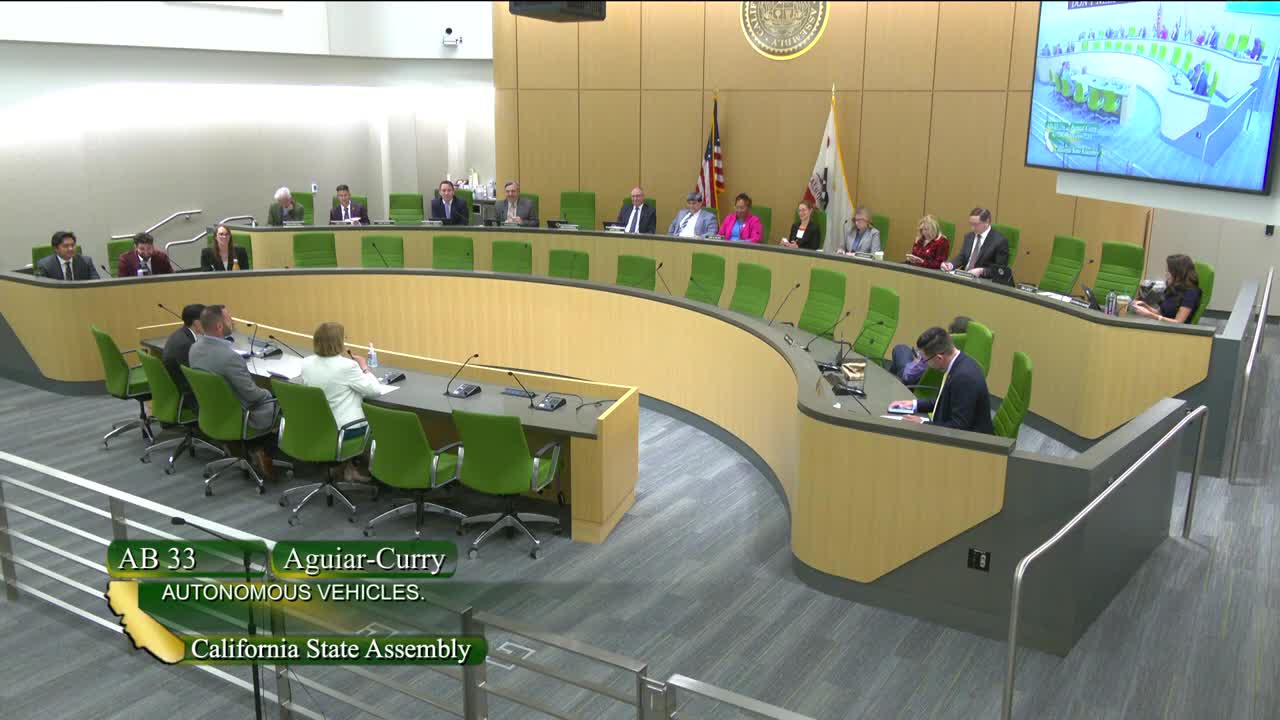 1H
Assembly Standing Committee on Transportation
Bill Author