AB 75: Residential property insurance images.
- Session Year: 2025-2026
- House: Assembly
- Latest Version Date: 2025-07-01
Current Status:
In Progress
(2025-08-29: In committee: Held under submission.)
Introduced
In Committee
Awaiting First Chamber Vote
Passed First Chamber
In Committee
Awaiting Second Chamber Vote
Passed Second Chamber
Enacted
Existing law generally regulates classes of insurance, including residential property insurance. Existing law requires an insurer to send various notices to a policyholder at specified intervals.
This bill would require an admitted insurer to notify a residential property insurance policyholder that aerial images may be taken or obtained of the insured property, as specified, unless a claim has been submitted or is pending on the property and the images will be used only for evaluating the claim. The bill would require the insurer to provide the aerial images upon request, as specified, and would require the notice to include instructions regarding how a policyholder may make that request.
This bill would prohibit an admitted insurer from basing a decision to terminate insurance coverage, as defined, on an aerial image taken more than 180 days prior to sending notice of that decision to the policyholder, except as specified. The bill would require an admitted insurer that bases a decision to terminate insurance coverage on an aerial image to provide the policyholder with that aerial image, notice of that decision, and the opportunity to dispute the accuracy of the image, and to verify remediation, before the effective date of the decision to terminate insurance coverage.
This bill would make the above-described provisions operative on July 1, 2026.
Existing law generally regulates classes of insurance, including residential property insurance. Existing law requires an insurer to send various notices to a policyholder at specified intervals.
This bill would require an admitted insurer to notify a residential property insurance policyholder that aerial images will may be taken or obtained of the insured property, as specified, unless a claim has been submitted or is pending on the property and the images will be used only for evaluating the claim. The bill would require the insurer to provide the aerial images upon request, as specified, and would require the notice to include instructions regarding how a policyholder may make that request.
This bill would prohibit an admitted insurer from basing an adverse underwriting decision, a decision to terminate insurance coverage, as defined, on an aerial image taken more than 45 180 days prior to sending notice of that adverse underwriting decision to the policyholder, except as specified, and requires specified. The bill would require an admitted insurer that bases an adverse underwriting decision a decision to terminate insurance coverage on an aerial image to provide the policyholder with that aerial image, notice of that underwriting decision, and the opportunity to remedy the conditions pertaining to the adverse underwriting decision to the extent possible, dispute the accuracy of the image, and to verify remediation, before the effective date of the adverse underwriting decision. decision to terminate insurance coverage.
Existing law generally regulates classes of insurance, including residential property insurance. Existing law requires an insurer to send various notices to a policyholder at specified intervals.
This bill would require an admitted insurer to notify a residential property insurance policyholder at least 30 days in advance of the day that aerial images will be taken or obtained of the insured property, as specified, unless a claim has been submitted or is pending on the property and the images will be used only for evaluating the claim. The bill would require the insurer to provide the aerial images upon request, as specified, and would require the notice to include instructions regarding how a policyholder may make that request.
This bill would prohibit an admitted insurer from basing an adverse underwriting decision, as defined, on an aerial image taken more than 45 days prior to sending notice of that adverse underwriting decision to the policyholder, except as specified, and requires an admitted insurer that bases an adverse underwriting decision on an aerial image to provide the policyholder with that aerial image, notice of that underwriting decision, and the opportunity to remedy the conditions pertaining to the adverse underwriting decision to the extent possible, and to verify remediation, before the effective date of the adverse underwriting decision.
Existing law generally regulates classes of insurance, including residential property insurance. Existing law requires an insurer to send various notices to a policyholder at specified intervals.
This bill would require an admitted insurer to notify a residential property insurance policyholder at least 30 days in advance of the day that an unmanned aircraft will be used to take images aerial images will be taken of the insured property, as specified, unless a claim has been submitted or is pending on the property. property and the images will be used only for evaluating the claim. The bill would require the insurer to provide the aerial images upon request, and would require the notice to include instructions regarding how a policyholder may make that request.
Existing law generally regulates classes of insurance, including residential property insurance. Existing law requires an insurer to send various notices to a policyholder at specified intervals.
This bill would require an admitted insurer to notify a residential property insurance policyholder at least 30 days in advance of the day that an unmanned aircraft will be used to take images of the insured property, as specified, unless a claim has been submitted or is pending on the property. The bill would require the insurer to provide the images upon request, and would require the notice to include instructions regarding how a policyholder may make that request.
(a)(1)(A)An admitted insurer shall notify a residential property insurance policyholder if any aerial images may be taken or obtained of the insured property during the policy period by, on behalf of, or in service of the insurer.
(B)The notice pursuant to this subdivision shall be provided at least annually, including with the initial policy issuance and upon each renewal, and shall be on a separate page from any other notice, information, or disclosure.
(C)The notice shall include both of the following:
(i)In at least 14-point bold font, the following:
[INSURER NAME] WILL COLLECT OR OBTAIN AERIAL IMAGES OF THE INSURED PROPERTY FOR USE IN UNDERWRITING DECISIONS.
You have the right to request and receive any aerial images taken or obtained of the insured property.
If an aerial image is used in a decision to cancel, nonrenew, or reduce coverage for an insurance policy, the aerial image will be included with the notice of that decision.
If the aerial image is used in a decision to cancel, nonrenew, or reduce coverage for an insurance policy, you have the right to request an in-person physical inspection of the property to verify the accuracy, timeliness, and validity of the aerial image.
You have the right to dispute the accuracy of an image used in a decision to cancel, nonrenew, or reduce coverage based on an aerial image prior to the effective date of the decision, and to request an in-person physical inspection to verify remediation, or to otherwise provide evidence of remediation in a manner set forth by [Insurer Name].
[Insurer Name] cannot use aerial images older than 180 days in a decision to cancel, nonrenew, or reduce coverage for an insurance policy unless the reason for the decision has been verified as accurate, persistent, and valid by an in-person physical inspection of the insured property or alternative verification process conducted no more than 180 days prior to sending the notice of that decision.
(ii)Instructions regarding how a policyholder may make a request to receive any aerial images taken or obtained of the insured property, pursuant to subdivision (b).
(D)This subdivision shall not apply if a claim has been submitted or is pending on the property, provided any aerial images taken or obtained of the insured property are used only for the purpose of evaluating the submitted or pending claim.
(2)(A)A notice pursuant to this subdivision shall be mailed via the United States Postal Service to the policyholders mailing address of record.
(B)For a policyholder who has agreed to transact business electronically pursuant to the Uniform Electronic Transactions Act (Title 2.5 (commencing with Section 1633.1) of Part 2 of Division 3 of the Civil Code), the insurer may provide notice to the email address provided by the policyholder.
(b)An admitted insurer shall provide any aerial images taken or obtained of the insured property to the policyholder upon request within 30 days of receiving that request.
(c)An admitted insurer shall not base a decision to terminate insurance coverage in whole or in part on an aerial image taken more than 180 days prior to sending notice of that decision to the policyholder unless the conditions pertaining to the decision to terminate insurance coverage have been verified as accurate, persistent, and valid by an in-person physical inspection of the insured property or alternative verification process conducted no more than 180 days prior to sending the notice of the decision.
(d)If an admitted insurer bases a decision to terminate insurance coverage in whole or in part on an aerial image, that aerial image shall be provided to the policyholder along concurrent with the notice of that decision pursuant to Chapter 11 (commencing with Section 675) of Part 1 of Division 1.
(e)A policyholder that has been subject to a decision to terminate insurance coverage based in whole or in part on an aerial image may request that the admitted insurer conduct an in-person physical inspection of the property to verify the accuracy, persistence, and validity of the conditions pertaining to the decision to terminate insurance coverage as depicted in the aerial image. The policyholder may, at their sole discretion, use a process made available by the insurer other than an in-person physical inspection to verify the accuracy, persistence, and validity of the conditions pertaining to the decision to terminate coverage.
(f)An admitted insurer that bases a decision to terminate insurance coverage in whole or in part on an aerial image shall provide the policyholder with the opportunity to dispute the accuracy of the image used in the decision to terminate insurance coverage, and to verify remediation, before the effective date of the decision to terminate insurance coverage. The policyholder may verify remediation by in-person physical inspection pursuant to subdivision (e) or by otherwise providing evidence of remediation in a manner set forth by the admitted insurer.
(g)This section shall not be construed to authorize aerial imaging that is otherwise prohibited under law.
(h)For purposes of this section:
(1)Termination of insurance coverage has the same meaning as in Section 791.02.
(2)Aerial image means an image or video collected by aircraft or satellite, whether or not that aircraft or satellite is operated with the possibility of direct human intervention.
(i)This section shall become operative on July 1, 2026.
(a)(1)(A)An admitted insurer shall notify a residential property insurance policyholder if any aerial images will may be taken or obtained of the insured property during the policy period by, on behalf of, or in service of the insurer.
(B)The notice pursuant to this subdivision shall be provided at least annually, including with the initial policy issuance and upon each renewal, and shall be on a separate page from any other notice, information, or disclosure.
(C)The notice shall include both of the following:
(i)In at least 14-point bold font, the following:
[INSURER NAME] WILL COLLECT OR OBTAIN AERIAL IMAGES OF THE INSURED PROPERTY FOR USE IN UNDERWRITING DECISIONS.
You have the right to request and receive any aerial images taken or obtained of the insured property.
If an aerial image is used in a decision to cancel, nonrenew, or reduce coverage for an insurance policy, the aerial image will be included with the notice of that decision.
If the aerial image is used in a decision to cancel, nonrenew, or reduce coverage for an insurance policy, you have the right to request an in-person physical inspection of the property to verify the accuracy, timeliness, and validity of the aerial image.
You have the right to remedy the reason or reasons for dispute the accuracy of an image used in a decision to cancel, nonrenew, or reduce coverage based on an aerial image to the extent possible prior to the effective date of the decision, and to request an in-person physical inspection to verify remediation, or to otherwise provide evidence of remediation in a manner set forth by [Insurer Name].
[Insurer Name] cannot use aerial images older than 45 180 days in a decision to cancel, nonrenew, or reduce coverage for an insurance policy unless the reason for the decision has been verified as accurate, persistent, and valid by an in-person physical inspection of the insured property or alternative verification process conducted no more than 45 180 days prior to sending the notice of that decision.
(ii)Instructions regarding how a policyholder may make a request to receive any aerial images taken or obtained of the insured property, pursuant to subdivision (b).
(D)This subdivision shall not apply if a claim has been submitted or is pending on the property, provided any aerial images taken or obtained of the insured property are used only for the purpose of evaluating the submitted or pending claim.
(2)(A)A notice pursuant to this subdivision shall be mailed via the United States Postal Service to the policyholders mailing address of record.
(B)For a policyholder who has agreed to transact business electronically pursuant to the Uniform Electronic Transactions Act (Title 2.5 (commencing with Section 1633.1) of Part 2 of Division 3 of the Civil Code), the insurer may provide notice to the email address provided by the policyholder.
(b)An admitted insurer shall provide any aerial images taken or obtained of the insured property to the policyholder upon request within 30 days of receiving that request.
(c)An admitted insurer shall not base an adverse underwriting decision a decision to terminate insurance coverage in whole or in part on an aerial image taken more than 45 180 days prior to sending notice of that adverse underwriting decision to the policyholder unless the conditions pertaining to the adverse underwriting decision to terminate insurance coverage have been verified as accurate, persistent, and valid by an in-person physical inspection of the insured property or alternative verification process conducted no more than 45 180 days prior to sending the notice of the adverse underwriting decision.
(d)If an admitted insurer bases an adverse underwriting decision a decision to terminate insurance coverage in whole or in part on an aerial image, that aerial image shall be provided to the policyholder along with the notice of that adverse underwriting decision pursuant to Chapter 11 (commencing with Section 675) of Part 1 of Division 1.
(e)A policyholder that has been subject to an adverse underwriting decision a decision to terminate insurance coverage based in whole or in part on an aerial image may request that the admitted insurer conduct an in-person physical inspection of the property to verify the accuracy, persistence, and validity of the conditions pertaining to the adverse underwriting decision to terminate insurance coverage as depicted in the aerial image.
(f)An admitted insurer that bases an adverse underwriting decision a decision to terminate insurance coverage in whole or in part on an aerial image shall provide the policyholder with the opportunity to remedy the conditions pertaining to dispute the accuracy of the image used in the adverse underwriting decision to the extent possible, decision to terminate insurance coverage, and to verify remediation, before the effective date of the adverse underwriting decision. decision to terminate insurance coverage. The policyholder may verify remediation by in-person physical inspection pursuant to subdivision (e) or by otherwise providing evidence of remediation in a manner set forth by the admitted insurer.
(g)This section shall not be construed to authorize aerial imaging that is otherwise prohibited under law.
(h)For purposes of this section:
(1)Adverse underwriting decision Termination of insurance coverage has the same meaning as in Section 791.02.
(2)Aerial image means an image or video collected by aircraft or satellite, whether or not that aircraft or satellite is operated with the possibility of direct human intervention.
(a)(1)(A)An admitted insurer shall notify a residential property insurance policyholder if any aerial images will be taken or obtained of the insured property during the policy period by, on behalf of, or in service of the insurer. The policyholder shall receive the notice at least 30 days in advance of the day that the images will be taken. of the insurer.
(B)The notice pursuant to this subdivision shall be provided at least annually, including with the initial policy issuance and upon each renewal, and shall be on a separate page from any other notice, information, or disclosure.
(C)The notice shall include both of the following:
(i)In at least 14-point bold font, the following:
[INSURER NAME] WILL COLLECT OR OBTAIN AERIAL IMAGES OF THE INSURED PROPERTY FOR USE IN UNDERWRITING DECISIONS.
You have the right to request and receive any aerial images taken or obtained of the insured property.
If an aerial image is used in a decision to cancel, nonrenew, or reduce coverage for an insurance policy, the aerial image will be included with the notice of that decision.
If the aerial image is used in a decision to cancel, nonrenew, or reduce coverage for an insurance policy, you have the right to request an in-person physical inspection of the property to verify the accuracy, timeliness, and validity of the aerial image.
You have the right to remedy the reason or reasons for a decision to cancel, nonrenew, or reduce coverage based on an aerial image to the extent possible prior to the effective date of the decision, and to request an in-person physical inspection to verify remediation, or to otherwise provide evidence of remediation in a manner set forth by [Insurer Name].
[Insurer Name] cannot use aerial images older than 45 days in a decision to cancel, nonrenew, or reduce coverage for an insurance policy unless the reason for the decision has been verified as accurate, persistent, and valid by an in-person physical inspection of the insured property conducted no more than 45 days prior to sending the notice of that decision.
(ii)Instructions regarding how a policyholder may make a request to receive any aerial images taken or obtained of the insured property, pursuant to subdivision (b).
(B)(D)This subdivision shall not apply if a claim has been submitted or is pending on the property, provided any aerial images taken or obtained of the insured property are used only for the purpose of evaluating the submitted or pending claim.
(2)(A)A notice pursuant to this subdivision shall be mailed via the United States Postal Service to the policyholders mailing address of record.
(B)For a policyholder who has agreed to transact business electronically pursuant to the Uniform Electronic Transactions Act (Title 2.5 (commencing with Section 1633.1) of Part 2 of Division 3 of the Civil Code), the insurer may provide notice to the electronic mail email address provided by the policyholder in addition to the mailed notice pursuant to subparagraph (A). policyholder.
(b)An admitted insurer shall provide any aerial images taken or obtained of the insured property to the policyholder upon request. A notice provided pursuant to subdivision (a) shall include instructions regarding how a policyholder may make that request for images. request within 30 days of receiving that request.
(c)An admitted insurer shall not base an adverse underwriting decision in whole or in part on an aerial image taken more than 45 days prior to sending notice of that adverse underwriting decision to the policyholder unless the conditions pertaining to the adverse underwriting decision have been verified as accurate, persistent, and valid by an in-person physical inspection of the insured property conducted no more than 45 days prior to sending the notice of the adverse underwriting decision.
(d)If an admitted insurer bases an adverse underwriting decision in whole or in part on an aerial image, that aerial image shall be provided to the policyholder along with the notice of that adverse underwriting decision pursuant to Chapter 11 (commencing with Section 675) of Part 1 of Division 1.
(e)A policyholder that has been subject to an adverse underwriting decision based in whole or in part on an aerial image may request that the admitted insurer conduct an in-person physical inspection of the property to verify the accuracy, persistence, and validity of the conditions pertaining to the adverse underwriting decision as depicted in the aerial image.
(f)An admitted insurer that bases an adverse underwriting decision in whole or in part on an aerial image shall provide the policyholder with the opportunity to remedy the conditions pertaining to the adverse underwriting decision to the extent possible, and to verify remediation, before the effective date of the adverse underwriting decision. The policyholder may verify remediation by in-person physical inspection pursuant to subdivision (e) or by otherwise providing evidence of remediation in a manner set forth by the admitted insurer.
(g)This section shall not be construed to authorize aerial imaging that is otherwise prohibited under law.
(c)(h)For purposes of this section:
(1)Receive means the earliest of the delivery date shown on an express, certified, or registered mail receipt form of the United States Postal Service or two business days after the request was postmarked by the United States Postal Service.(1)Adverse underwriting decision has the same meaning as in Section 791.02.
(2)Aerial image means an image or video collected by aircraft or satellite, whether or not that aircraft or satellite is operated with the possibility of direct human intervention.
(a)(1)(A)An admitted insurer shall notify a residential property insurance policyholder that an unmanned aircraft will be used to take images of the insured property. if any aerial images will be taken of the insured property by, on behalf of, or in service of the insurer. The policyholder shall receive the notice at least 30 days in advance of the day that the images will be taken.
(B)This subdivision shall not apply if a claim has been submitted or is pending on the property, provided any aerial images taken of the insured property are used only for the purpose of evaluating the submitted or pending claim.
(1)The notice(2)(A)A notice pursuant to this subdivision shall be mailed via the United States Postal Service to the policyholders mailing address of record. The policyholder shall receive the notice at least 30 days in advance of the day that images will be taken. The
(B)For a policyholder who has agreed to transact business electronically pursuant to the Uniform Electronic Transactions Act (Title 2.5 (commencing with Section 1633.1) of Part 2 of Division 3 of the Civil Code), the insurer may additionally provide notice to the policyholder via electronic mail. mail address provided by the policyholder in addition to the mailed notice pursuant to subparagraph (A).
(2)The insurer shall provide the unmanned aircraft images, if any are taken, to the policyholder upon request. The notice(b)An admitted insurer shall provide any aerial images taken or obtained of the insured property to the policyholder upon request. A notice provided pursuant to subdivision (a) shall include instructions regarding how a policyholder may make that request for images.
(b)This section does not apply if a claim has been submitted or is pending on the property.(c)For purposes of this section:
(1)Receive means the earliest of the delivery date shown on an express, certified, or registered mail receipt form of the United States Postal Service or two business days after the request was postmarked by the United States Postal Service.
(2)Unmanned aircraft has the same meaning as defined in Section 853.5 of the Government Code.(2)Aerial image means an image or video collected by aircraft or satellite, whether or not that aircraft or satellite is operated with the possibility of direct human intervention.
(a)An admitted insurer shall notify a residential property insurance policyholder that an unmanned aircraft will be used to take images of the insured property.
(1)The notice shall be mailed via the United States Postal Service to the policyholders mailing address of record. The policyholder shall receive the notice at least 30 days in advance of the day that images will be taken. The insurer may additionally provide notice to the policyholder via electronic mail.
(2)The insurer shall provide the unmanned aircraft images, if any are taken, to the policyholder upon request. The notice shall include instructions regarding how a policyholder may make that request for images.
(b)This section does not apply if a claim has been submitted or is pending on the property.
(c)For purposes of this section:
(1)Receive means the earliest of the delivery date shown on an express, certified, or registered mail receipt form of the United States Postal Service or two business days after the request was postmarked by the United States Postal Service.
(2)Unmanned aircraft has the same meaning as defined in Section 853.5 of the Government Code.
|
Date
|
Status
|
|---|---|
| Aug 29, 2025 | In committee: Held under submission. |
| Aug 18, 2025 | In committee: Referred to suspense file. |
| Jul 16, 2025 | From committee: Do pass and re-refer to Com. on APPR. (Ayes 13. Noes 0.) (July 15). Re-referred to Com. on APPR. |
| Jul 10, 2025 | From committee: Do pass and re-refer to Com. on JUD. (Ayes 7. Noes 0.) (July 9). Re-referred to Com. on JUD. |
| Jul 1, 2025 | From committee chair, with author's amendments: Amend, and re-refer to committee. Read second time, amended, and re-referred to Com. on INS. |
| Jun 18, 2025 | Referred to Coms. on INS. and JUD. |
| Jun 4, 2025 | In Senate. Read first time. To Com. on RLS. for assignment. |
| Jun 3, 2025 | Read third time. Passed. Ordered to the Senate. (Ayes 76. Noes 1. Page 2000.) |
| May 27, 2025 | Read second time. Ordered to third reading. |
| May 23, 2025 | Assembly Rule 63 suspended. (Ayes 51. Noes 16. Page 1644.) |
| May 23, 2025 | Read second time and amended. Ordered returned to second reading. |
| May 23, 2025 | From committee: Amend, and do pass as amended. (Ayes 11. Noes 0.) (May 23). |
| May 14, 2025 | In committee: Set, first hearing. Referred to suspense file. |
| May 1, 2025 | From committee: Do pass and re-refer to Com. on APPR. (Ayes 13. Noes 0.) (May 1). Re-referred to Com. on APPR. |
| Apr 23, 2025 | Re-referred to Com. on P. & C.P. |
| Apr 22, 2025 | From committee chair, with author's amendments: Amend, and re-refer to Com. on P. & C.P. Read second time and amended. |
| Apr 2, 2025 | From committee: Do pass and re-refer to Com. on P. & C.P. (Ayes 15. Noes 0.) (April 2). Re-referred to Com. on P. & C.P. |
| Feb 12, 2025 | Re-referred to Com. on INS. |
| Feb 11, 2025 | From committee chair, with author's amendments: Amend, and re-refer to Com. on INS. Read second time and amended. |
| Feb 3, 2025 | Referred to Coms. on INS. and P. & C.P. |
| Jan 6, 2025 | Read first time. |
| Dec 17, 2024 | From printer. May be heard in committee January 16. |
| Dec 16, 2024 | Introduced. To print. |
|
Date
|
Description
|
Location
|
Votes
|
|
|---|---|---|---|---|
| Aug 18, 2025 | Placed on suspense file | Senate Standing Committee on Appropriations |
Passed |
|
| Jul 15, 2025 | Do pass, but first be re-referred to the Committee on [Appropriations] | Senate Standing Committee on Judiciary |
Passed |
|
| Jul 9, 2025 | Do pass, but first be re-referred to the Committee on [Judiciary] | Senate Standing Committee on Insurance |
Passed |
|
| Jun 3, 2025 | AB 75 Calderon Assembly Third Reading | Assembly Floor |
Passed |
|
| May 23, 2025 | Do pass as amended. | Assembly Standing Committee on Appropriations |
Passed |
|
| May 1, 2025 | Do pass and be re-referred to the Committee on [Appropriations] | Assembly Standing Committee on Privacy and Consumer Protection |
Passed |
|
| Apr 2, 2025 | Do pass and be re-referred to the Committee on [Privacy and Consumer Protection] | Assembly Standing Committee on Insurance |
Passed |
This list shows positions taken on this bill by organizations on the date displayed, which is linked to the original source.
Positions by individuals are not included.
|
Organization
|
Position
|
Date
|
|---|---|---|
| American Property Casualty Insurance Association | ** Against | |
| California Association Of Realtors | ** Support | |
| California State Association Of Counties | ** Support | |
| city of laguna niguel | ** Support | |
| Consumer Federation Of California | ** Against | |
| Cotality | ** Against | |
| Department of Insurance | ** Support | |
| Insurance Commissioner Ricardo Lara / California Department of Insurance | ** Support | |
| Insurance Services Office, Inc. | ** Against | |
| Karen Clark & Company | ** Against | |
| League Of California Cities | ** Support | |
| National Association of Mutual Insurance Companies | ** Against | |
| Nearmap US INC | ** Against | |
| Oakland Privacy | ** Against | |
| Pacific Association Of Domestic Insurance Companies | ** Against | |
| Personal Insurance Federation Of California | ** Against | |
| Privacy Rights Clearinghouse | ** Against | |
| Southern California Rental Housing Association | ** Support | |
| Zestyai | ** Against |
SENATE COMMITTEE ON APPROPRIATIONS
Senator Anna Caballero, Chair
2025 - 2026 Regular Session
AB 75 (Calderon) - Residential property insurance images
Version: July 1, 2025 | Policy Vote: INS. 7 - 0, JUD. 13 - 0 |
Urgency: No | Mandate: No |
Hearing Date: August 18, 2025 | Consultant: Janelle Miyashiro |
Bill Summary:
AB 75 requires insurers to annually notify residential property insurance policyholders if aerial images may be taken of the insured property and provide those images to a policyholder upon request. AB 75 also prohibits insurers from basing a decision to terminate insurance coverage on aerial images older than 180 days that cancellation decision notice is sent, and provides policyholders a process to dispute the accuracy of the aerial images taken that resulted in the cancellation of their policy, as specified.
Fiscal Impact:
The California Department of Insurance reports costs of $102,000 in Fiscal Year (FY) 2025-26, $195,000 in FY 2026-27, and $179,000 in FY 2027-28 and ongoing for increased workload associated with complaint management and other consumer services (Insurance Fund).
Background:
According to the National Association of Insurance Commissioners, the increasing commercial use of UASs (aircrafts that fly without a human pilot on-board, controlled remotely or autonomously, commonly referred to as drones) and their applications in many fields has compelled industry leaders as well as various federal and state regulatory agencies to contemplate how and when they are used. Insurance companies are exploring commercialization and coverage issues and opportunities while state insurance regulators work to address all relevant regulatory challenges and concerns related to drone operation.
The use of drones could be very beneficial for the insurance industry, particularly following a natural disaster. Drones could be employed to reach remote, inaccessible, or even dangerous areas by claims adjusters, providing increased and more complete data to speed up claims processing timelines. They may also enhance cost efficiency for insurers, both in pre-loss and post-loss assessments, as utilizing drones may reduce the labor and time associated with manual inspections.
However, there are concerns centered around the use of drones and the changing insurance environment, particularly in developing industry best practices and risk management. These concerns include the lack of transparency around insurers’ termination of coverage without policyholder notification, the responsibility of insurers to communicate with policyholders when conducting risk assessments, and privacy and data security issues.
Proposed Law:
- Requires an admitted insurer to notify a residential property insurance policyholder if any aerial images may be taken or obtained of the insured property during the policy period by, on behalf of, or in service of the insurer.
- Requires the notice to be provided at least annually, including with the initial policy issuance and upon renewal on a separate page from any other notice, information, or disclosure.
- Requires the notice to be in at least 14-point bold font and include instructions regarding how a policyholder may make a request to receive any aerial images taken or obtained of the insured property.
- Requires the notice to be mailed via the United States Postal Service to the policyholder’s mailing address of record unless the policyholder has agreed to transact business electronically.
- Specifies the notice as follows:
“[INSURER NAME] WILL COLLECT OR OBTAIN AERIAL IMAGES OF THE INSURED PROPERTY FOR USE IN UNDERWRITING DECISIONS.
You have the right to request and receive any aerial images taken or obtained of the insured property.
If an aerial image is used in a decision to cancel, nonrenew, or reduce coverage for an insurance policy, the aerial image will be included with the notice of that decision.
If the aerial image is used in a decision to cancel, nonrenew, or reduce coverage for an insurance policy, you have the right to request an in-person physical inspection of the property to verify the accuracy, timeliness, and validity of the aerial image.
You have the right to dispute the accuracy of an image used in a decision to cancel, nonrenew, or reduce coverage based on an aerial image prior to the effective date of the decision, and to request an in-person physical inspection to verify remediation, or to otherwise provide evidence of remediation in a manner set forth by [Insurer Name].
[Insurer Name] cannot use aerial images older than 180 days in a decision to cancel, nonrenew, or reduce coverage for an insurance policy unless the reason for the decision has been verified as accurate, persistent, and valid by an in-person physical inspection of the insured property or alternative verification process conducted no more than 180 days prior to sending the notice of that decision.”
- Provides that the above notification requirements do not apply if a claim has been submitted or is pending on the property if any aerial images taken or obtained of the property are used only for the purpose of evaluating the claim.
- Requires an insurer to provide any aerial images taken or obtained of the insured property to the policyholder upon request within 30 days of receiving that request.
- Prohibits an insurer from basing a decision to terminate insurance coverage in whole or part on an aerial image taken more than 180 days prior to sending a decision notice unless the conditions pertaining to the termination decision have been verified by an in-person physical inspection of the property or alternative verification process conducted no more than 180 days prior to sending the notice of the decision.
- If an insurer terminates a policy based in whole or in part on an aerial image, then requires an insurer to provide the policyholder:
- The aerial image used as the basis of the termination decision.
- The opportunity to dispute the accuracy of the image used in the decision and verify remediation before the effective date of the termination decision.
- Authorizes a policyholder whose policy has been terminated based on an aerial image to request the insurer to conduct an in-person physical inspection of the property or other process made available by the insurer to verify the conditions pertaining to the coverage termination decision.
- Defines “aerial image” as an image or video collected by aircraft or satellite, whether or not that aircraft or satellite is operated with the possibility of direct human intervention.
- Makes the provisions of the bill operative on July 1, 2026.
Related Legislation:
SB 260 (Wahab, 2025) would establish new requirements for residential property insurers when using aerial images taken by a remotely unmanned aircraft system to gather evidence when evaluating policies, as specified; and would create criminal penalties for the use of UASs in specified locations. SB 260 is pending in this committee.
-- END --
Senator Thomas Umberg, Chair
2025-2026 Regular Session
Bill No: AB 75 (Author:Calderon)
Version: July 1, 2025
Hearing Date: July 15, 2025
Fiscal: Yes
Urgency: No
Consultant: AM
SUBJECT
Residential property insurance images
DIGEST
This bill requires an admitted insurer to: notify a residential property insurance policyholder that aerial images may be taken or obtained of the insured property; provide the aerial images upon request; and include instructions regarding how a policyholder may make that request in the notice, as specified and with limited exceptions. The bill prohibits an admitted insurer from basing a decision to terminate insurance coverage on an aerial image taken more than 180 days prior to sending notice of that decision to the policyholder, except as specified; and requires an admitted insurer that bases a decision to terminate on an aerial image to provide that image to the policyholder with the notice of the decision to terminate. The bill requires the policyholder to have an opportunity to dispute the accuracy of the image, and to verify remediation, before the effective date of the decision to terminate insurance coverage. The bill makes these provisions operative on July 1, 2026.
EXECUTIVE SUMMARY
California insurers have begun using drones and other aerial surveillance to inspect homes and making determination of nonrenewal of polices, and in many cases denying insureds access to the photos used to make those determinations.[1] California is facing an insurance crisis due to the issues of wildfires, [2] which has resulted in increased prices with many homeowners finding it difficult or impossible to find any insurance besides the California FAIR Plan.[3] The author argues that lack of awareness that images were taken, and lack of access to those images, makes it difficult to rectify potential problems that could otherwise reduce risk and maintain insurability, and even more difficult to contest the grounds for nonrenewal. The bill is author sponsored. The bill is supported by the California Association of Realtors, the City of Laguna Niguel, the League of California Cities. The bill is opposed by the Consumer Federation of California, Cotality, Karen Clark & Company, Oakland Privacy, and Privacy Rights Clearinghouse. This bill passed the Senate Insurance Committee on a vote of 7 to 0.
PROPOSED CHANGES TO THE LAW
Existing law:
- Provides for the regulation of insurance by the California Department of Insurance (CDI), which is under the control of the Insurance Commissioner (Commissioner). (Ins. Code § 12921.)
- Requires an insurer to provide a notice of nonrenewal at least 75 days before policy expiration that includes the specific reason or reasons for the nonrenewal, the telephone number of the insurer’s representative who handles consumer inquiries or complaints, and a statement pertaining to availability of review by the Department of Insurance (CDI). (Ins. Code § 678.)
- Establishes the Insurance Information and Privacy Protection Act, which provides various rights to natural persons who are the subject of information collected, received, or maintained in connection with insurance transactions, and policyholders who engage in or seek to engage in these transactions. Prescribes standards for the collection, use, and disclosure of personal information gathered in connection with insurance transactions by insurance institutions, agents, or insurance-support organizations. (Ins. Code §§ 791.01 et seq.)
- Requires an insurance institution or agent to provide a notice of information practices to all applicants or policyholders at the time of delivery of the insurance policy when personal information is collected from the applicant, or at the time the collection of personal information is initiated when personal information is collected from a source other than the applicant. In the case of a policy renewal, requires that the notice be provided no later than the policy renewal date; however, no notice is required in connection with a policy renewal if personal information is collected only from the policyholder, an insured under the policy, or public records, or if a notice has been given within the previous 24 months. (Ins. Code § 791.04.)
- Defines “personal information,” for purposes of these rights and standards, to mean, any individually identifiable information gathered in connection with an insurance transaction from which judgements can be made about an individual’s character, habits, avocations, finances, occupation, general reputation, credit, health, or any other personal characteristic. (Ins. Code § 791.01(s).)
- Provides that a person is liable for physical invasion of privacy when the person knowingly enters onto the land or into the airspace above the land of another person without permission or otherwise commits a trespass in order to capture any type of visual image, sound recording, or other physical impression of the plaintiff engaging in a private, personal, or familial activity and the invasion occurs in a manner that is offensive to a reasonable person. (Civ. Code § 1708.8.)
- Establishes the California Consumer Privacy Act (CCPA), which grants consumers certain rights with regard to their personal information, including enhanced notice, access, and disclosure; the right to deletion; the right to restrict the sale of information; and protection from discrimination for exercising these rights. Places attendant obligations on businesses to respect those rights. (Civ. Code § 1798.100 et seq.)
This bill:
- Requires an admitted insurer to notify a residential property insurance policyholder if any aerial images will be taken or obtained of the insured property during the policy period by, on behalf of, or in service of, the insurer.
- Defines “aerial image” to mean an image or video collected by aircraft or satellite, whether or not that aircraft or satellite is operated with the possibility of direct human intervention.
- Requires the notice to include certain information and be provided at least annually, at the initial policy issuance and upon each renewal, and that the notice be on a separate page from any other notice, information, or disclosure.
- Requires admitted insurer to provide any aerial images taken or obtained of the insured property to the policyholder upon request within 30 days of receiving that request.
- Prohibits an admitted insurer from basing an adverse underwriting decision in whole, or in part, on an aerial image taken more than 45 days prior to sending notice of that adverse underwriting decision to the policyholder unless the conditions pertaining to the adverse underwriting decision have been verified as accurate, persistent, and valid by an in-person physical inspection of the insured property conducted no more than 45 days prior to sending the notice of the adverse underwriting decision.
- Requires the aerial image to be provided to the policyholder concurrent with the notice of that adverse underwriting decision if an admitted insurer bases an adverse underwriting decision in whole, or in part, on an aerial image.
- Authorizes a policyholder that has been subject to an adverse underwriting decision based in whole, or in part, on an aerial image to request that the admitted insurer conduct an in-person physical inspection of the property to verify the accuracy, persistence, and validity of the conditions pertaining to the adverse underwriting decision as depicted in the aerial image. Authorizes a policyholder, at their sole discretion, to use a process made available by the insurer other than an in-person physical inspection to verify the accuracy, persistence, and validity of the conditions pertaining to the decision to terminate coverage.
- Requires an admitted insurer that bases an adverse underwriting decision in whole, or in part, on an aerial image to provide the policyholder with the opportunity to remedy the conditions pertaining to the adverse underwriting decision to the extent possible, and to verify remediation, before the effective date of the adverse underwriting decision. The policyholder may verify remediation by in-person physical inspection pursuant to 6), above, or by otherwise providing evidence of remediation in a manner set forth by the admitted insurer.
- Makes these provisions operative on July 1, 2026.
COMMENTS
- Stated need for the bill
The author writes:
As the California homeowners' insurance market tightens, insurers are desperate for ways to cut costs and reduce risk exposure. One way insurers are doing so is by conducting aerial inspections of properties using drone, aircraft, and satellite imaging as an alternative to traditional on-site property inspections to evaluate risk and insurability. Unfortunately, this practice has led to a spate of reports of homeowners who were blindsided when their insurance policies were not renewed based on purported evidence from aerial images that they didn't know were taken, and didn't have the opportunity to review. In many of these cases, after weeks or months of back-and-forth with insurers to review the evidence underlying their nonrenewal decision, the aerial images turned out to be inaccurate, outdated, or misleading.
By providing policyholders with notice before taking or obtaining aerial images of their property, granting access to those images, capping the age of images that can be used in non-renewals, and establishing a right to request an in-person inspection to verify the accuracy, timeliness, and validity of aerial images used in non-renewals, insurance companies can contain costs while providing policyholders with critical protections against invalid non-renewals.
- Insurers are using satellite and other aerial images to inspect homes and using those images to deny renewal of coverage
California and many other states have been facing an insurance crisis for many years now driven by the more frequent and severe natural disasters. In California, wildfires are the main issues but other states are experiencing issues with tornadoes, hurricanes, floods, and sea level rise. There are several components to the insurance crisis in California, with insurers refusing to write policies in the wildland urban interface zones, which are fire prone areas where development abuts wetlands[4], and others refusing to write any new polices at all in the state.[5] This has forced many homeowners to get insurance from surplus lines carriers, which are not regulated in the same manner by CDI as admitted insurers and generally cost more, or the California FAIR plan, which is the insurer of last resort. To highlight this issue, in 2024 State Farm announced that it would nonrenew “30,000 property insurance and 42,000 commercial apartment policies” and in 2023 it announced it would no longer accept applications for any kind of insurance in California except for because of personal vehicle insurance citing large increases in construction costs and inflation.”[6]
The author of the bill reports to this Committee that California homeowners have been “blindsided” by notices of nonrenewal for a range of issues including “a small branch touching the house,” “mold, algae on roof,” and “outdated paint [and/or] discoloration which means deterioration.” Many of these nonrenewal notices are relying on alleged evidence obtained from aerial images taken of the homes prior to the notice, which the homeowners were not informed about prior to receiving said notice of nonrenewal.
According to a Wall Street Journal article from April 6, 2024:
Across the U.S., insurance companies are using aerial images of homes as a tool to ditch properties seen as higher risk.
Nearly every building in the country is being photographed, often without the owner’s knowledge. Companies are deploying drones, manned airplanes and high-altitude balloons to take images of properties. […]
The array of photos is being sorted by computer models to spy out underwriting no-nos such as damaged roof shingles, yard debris, overhanging tree branches and undeclared swimming pools or trampolines. The red-flagged images are providing insurers with ammunition for nonrenewal notices nationwide.
In many cases, the reports indicate that the policyholder was not aware the images were taken, and that the images were used erroneously. Nichole Brink, a former Farmers Insurance agent whose departure from the company was spurred by opposition to their aerial imaging policies, told the Wall Street Journal that ‘the insurer was dropping customers over aerial images that were 2 or 3 years old, and in one case even flagged a house for overhanging tree branches that turned out to be shadows.’[7]
This bill seeks to address this issue by providing enhanced consumer protections for insureds. The bill requires an admitted insurer to notify a residential property insurance policyholder that aerial images may be taken or obtained of the insured property during the policy period by, on behalf of, or in service of, the insurer. An insured must provide the aerial images upon request and include instructions regarding how a policyholder may make that request in the notice. The bill provides that this provision does not apply if a claim has been submitted or is pending on the property, provided any aerial images taken or obtained of the insured property are used only for the purpose of evaluating the submitted or pending claim.
Additionally, the bill prohibits an admitted insurer from basing a decision to terminate insurance coverage on an aerial image taken more than 180 days prior to sending notice of that decision to the policyholder unless the conditions pertaining to that decision have been verified as accurate, persistent, and valid by an in-person physical inspection of the insured property or alternative verification process conducted no more than 180 days prior to sending the notice of the decision. The bill requires an admitted insurer that bases a decision to terminate on an aerial image to provide that image to the policyholder with the notice of the decision to terminate. This will allow the insured to confirm if the aerial photos are accurate and provide a better idea of how they can potentially remediate the issue. Under the bill, a policyholder is required to have an opportunity to dispute the accuracy of the image, and to verify remediation, before the effective date of the decision to terminate insurance coverage. A policyholder is also allowed to request that the insurer conduct an in-person physical inspection of the property to verify the accuracy, persistence, and validity of the conditions pertaining to the decision to terminate insurance coverage as depicted in the aerial image, and may, at their sole discretion, use a process made available by the insurer other than an in-person physical inspection to verify the accuracy, persistence, and validity of the conditions pertaining to the decision to terminate coverage.
- Statements in support
The League of California Cities writes in support, stating:
California has the highest wildfire risk in the US. In recent years, the state has experienced a growing number of highly destructive wildfires due to climate change and over a century of logging and fire suppression. The devastating impacts of these wildfires has unfortunately resulted in the destruction of over 57,000 structures in the last decade. The insurance crisis in California continues to plague homeowners, businesses and many are forced to obtain insurance from the FAIR plan due to the lack of insurance available in high fire severity zones. Often when a homeowner receives a cancellation the insurance company has used drone footage to request various changes, including roof hardening and wildfire mitigation or the homeowner will be cancelled.
AB 75 (Calderon) would prohibit insurers from basing a decision to terminate insurance coverage off the aerial images taken more than 180 days prior to sending notice to the policyholder. If a policy is cancelled based on the aerial images the policyholder must be provided with the images, notice of the decision, and provided an opportunity to dispute the accuracy of the image and verify remediation before the effective date of the policy cancellation. This measure would go into effect starting July 1, 2026.
AB 75 would hold insurance companies accountable and provide transparency to consumers which will improve the process by which individuals lose coverage or are cancelled.
4. Statements in opposition
The Consumer Federation of California (CFC) writes in opposition unless amended, stating:
Insurance companies have increasingly been using aerial images to assist them in making decisions about whether to insure, renew or cancel their potential and existing policyholders. These images are often taken by unmanned drones or satellite images, either by the insurance company itself or by one of their private for-profit vendors that they contract with to assist them in making coverage decisions. Sadly, the days of a personal inspection or review of all properties are long gone and such visits are increasingly rare in our home insurance marketplace.
However, there have been far too many cases in recent years where these images taken by or on behalf of insurance companies have been incorrect or of the wrong property. Generally speaking there has been a lack of transparency and consumer protections in this area. So while CFC is pleased to see some effort being taken to increase the currently low bar in this area, AB 75 falls significantly short of what is necessary to truly begin to protect consumers.
CFC would like to see a number of amendments taken to the bill and would be
pleased to work with the author and committee on such amendments.[…]
SUPPORT
California Association of Realtors
City of Laguna Niguel
League of California Cities
OPPOSITION
Consumer Federation of California
Cotality
Karen Clark & Company
Oakland Privacy
Privacy Rights Clearinghouse
RELATED LEGISLATION
Pending Legislation:
SB 495 (Allen, 2025), among other things, requires insurers to offer 100% of the personal property policy coverage limit without an itemized claim from the policyholder in the event of a covered total loss of a dwelling resulting from a state of emergency. AB 495 is currently pending in the Assembly Judiciary Committee.
SB 616 (Rubio, 2025) creates an independent Community Hardening Commission within the Department of Insurance, with the goals of developing a unified and centralized fire mitigation standard for all levels of government across the state, as well as generating guidelines to enable the creation of a wildfire data sharing platform. SB 616 is currently pending in the Assembly Insurance Committee.
Prior Legislation: None known.
PRIOR VOTES
Senate Insurance Committee (Ayes 7, Noes 0)
Assembly Floor (Ayes 76, Noes 1)
Assembly Appropriations Committee (Ayes 11, Noes 0)
Assembly Privacy and Consumer Protection Committee (Ayes 13, Noes 0)
Assembly Insurance Committee (Ayes 15, Noes 0)
**************
Megan Fan Munce, Insurers are using satellite images to inspect homes in California — and dropping policies in the process, San Francisco Chronicle (Oct. 26, 2024), available at https://www.sfchronicle.com/california/article/home-insurance-satellite-photo-19497336.php. ↑
David Gelles, The Home Insurance Crisis Is Getting Even More Expensive, The New York Times (May 15, 2025), available at https://www.nytimes.com/2025/05/15/climate/climate-change-home-insurance-costs.html. ↑
The California FAIR Plan is the insurer of last resort when basic fire coverage is not available from a traditional carrier. ↑
Glen Marin, Here's why you can't get home insurance in California, California Magazine, (Sept. 19, 2024), available at https://www.universityofcalifornia.edu/news/heres-why-you-cant-get-home-insurance-california. ↑
Tiffany Olin, California Insurance Crisis: Non-renewals and the CA FAIR Plan, ABC 30 News, (Apr. 9, 2025), available at https://abc30.com/post/california-insurance-crisis-renewals-ca-fair-plan/16145021/. ↑
Evan Symon, State Farm Announces Non-Renewal Of 72,000 Insurance Policies In California, California Globe, (Mar. 22, 2024), available at https://californiaglobe.com/fr/state-farm-announces-non-renewal-of-72000-insurance-policies-in-california/#:~:text=%60%60These%20actions%20are%20California%2Dspecific%20and%20will%20occur,apartment%20policies%2C''%20said%20State%20Farm%20on%20Thursday. ↑
Jean Eaglesham, Insurers Are Spying on Your Home From the Sky: Companies are using drones to check out roofs or to spot yard debris and undeclared trampolines, Wall Street Journal, (Apr. 6, 2024), available at https://www.wsj.com/real-estate/home-insurance-aerial-images-37a18b16?gaa_at=eafs&gaa_n=ASWzDAgb_8ZnDHP2lpGVQoIrUIVNXhunJ6a-oQRRDe8cor9fnEaajFOLSdvfvhX4xXY%3D&gaa_ts=68699482&gaa_sig=VA_p0wAIR6aQFJ66GXYfEBQra7DXeTHkNyvyxihAlXbbJPi5vJMq5WKpTgdax3mNQMYq_x82tXhemW3TTVzyDw%3D%3D. ↑
SENATE COMMITTEE ON INSURANCE
Senator Susan Rubio, Chair
2025 - 2026 Regular
Bill No: AB 75 Hearing Date: July 9, 2025
Author: | Calderon | ||
Version: | July 1, 2025 Amended | ||
Urgency: | No | Fiscal: | Yes |
Consultant: | Brandon Seto | ||
SUBJECT: Residential property insurance images
DIGEST:
Beginning July 1, 2026, requires admitted insurers to notify residential property insurance policyholders if aerial images may be taken of the insured property and to provide access to those images upon request. Prohibits insurers from basing decisions to terminate coverage on aerial images older than 180 days, and provides policyholders, who have been subject to a decision to terminate coverage based on an aerial image, with the right to dispute the accuracy of the image, and to verify remediation of the issues leading to those decisions.
ANALYSIS:
Existing law:
- Requires an insurer to provide a notice of non-renewal at least 75 days before policy expiration and include the specific reason or reasons for the non-renewal, the telephone number of the insurer’s representative who handles consumer inquiries or complaints, and a statement pertaining to the availability of review by the California Department of Insurance (CDI).
- Provides several rights to persons who are the subject of information collected, received, or maintained in connection with insurance transactions, and policyholders who engage in or seek to engage in these transactions. Among others, the goals of these rights are to maintain a balance between the need for information by those conducting the business of insurance and the public’s need for fairness in insurance information practices, including the need to minimize intrusiveness, to enable persons to ascertain what information is being or has been collected about them in connection with insurance transactions, and to have access to such information for the purpose of verifying or disputing its accuracy.
- Prescribes standards for the collection, use, and disclosure of personal information gathered in connection with insurance transactions by insurance institutions, agents, or insurance support organizations.
- Requires an insurance institution or agent to provide a notice of information practices to all applicants or policyholders at the time of delivery of the insurance policy when personal information is collected from the applicant, or at the time the collection of personal information is initiated when personal information is collected from a source other than the applicant. In the case of a policy renewal, requires that the notice be provided no later than the policy renewal date, but provides that no notice is required in connection with a policy renewal if personal information is only collected from the policyholder, an insured under the policy, or public records, or if a notice has been given within the previous 24 months.
- Defines an “insurance transaction” as any interaction involving insurance primarily for personal, family, or household needs, rather than business or professional needs that entails either determinations of an individual’s eligibility for an insurance coverage, benefit, or payment, as well as service of an insurance application, policy, contract, or certificate.
- Defines “personal information”, for purposes of these rights and standards, to mean, any individually identifiable information gathered in connection with an insurance transaction from which judgments can be made about an individual’s character, habits, avocations, finances, occupation, general reputation, credit, health, or any other personal characteristic.
This bill:
- Requires an admitted insurer to provide a notice, as specified, to a residential property insurance policyholder at least annually, including with the initial policy issuance and upon each renewal, if any aerial images may be taken or obtained of the insured property.
- Requires an admitted insurer to provide any aerial images taken or obtained of the insured property to the policyholder upon request within 30 days of receiving such requests.
- Stipulates that if an admitted insurer bases a decision to terminate insurance coverage in whole or in part on an aerial image, that aerial image must be provided to the policyholder concurrent with the notice of that decision.
- Prohibits an admitted insurer from basing a decision to terminate insurance coverage in whole or in part on an aerial image taken more than 180 days prior to sending the notice of a decision to terminate coverage to the policyholder, unless the conditions pertaining to the decision have been verified as accurate, persistent, and valid by an in-person physical inspection of the insured property or an alternative verification process conducted no more than 180 days prior to sending the notice of the decision.
- Provides a policyholder that has been subject to a decision to terminate insurance coverage based in whole or in part on an aerial image, with the right to request that the admitted insurer conduct an in-person physical inspection of the property to verify the accuracy, persistence, and validity of the conditions pertaining to the decision. The policyholder may use a process, other than an in-person physical inspection, made available by the insurer to verify the accuracy, persistence, and validity of the conditions pertaining to the decision.
- Requires that the policyholder be provided with the opportunity to dispute the accuracy of the image used in the decision to terminate coverage, and to verify remediation, before the effective date of the decision to terminate coverage.
- Specifies that the provisions of the bill shall not be construed to authorize aerial imaging that is otherwise prohibited under law.
- Defines "aerial image" to mean an image or video collected by aircraft or satellite, whether or not that aircraft or satellite is operated with the possibility of direct human intervention.
- States that a “termination of insurance coverage” means a cancellation or non-renewal of an insurance policy, in whole or in part, for any reason other than the failure to pay a premium as required by the policy.
- Specifies that the provisions above will become operative on July 1, 2026.
Background
According to the Author:
"As the California homeowners' insurance market tightens, insurers are desperate for ways to cut costs and reduce risk exposure. One way insurers are doing so is by conducting aerial inspections of properties using drone, aircraft, and satellite imaging as an alternative to traditional on-site property inspections to evaluate risk and insurability. Unfortunately, this practice has led to a spate of reports of homeowners who were blindsided when their insurance policies were not renewed based on purported evidence from aerial images that they didn't know were taken, and didn't have the opportunity to review. In many of these cases, after weeks or months of back-and-forth with insurers to review the evidence underlying their nonrenewal decision, the aerial images turned out to be inaccurate, outdated, or misleading.
By providing policyholders with notice before taking or obtaining aerial images of their property, granting access to those images, capping the age of images that can be used in non-renewals, and establishing a right to request an in-person inspection to verify the accuracy, timeliness, and validity of aerial images used in non-renewals, insurance companies can contain costs while providing policyholders with critical protections against invalid non-renewals."
Related/Prior Legislation
SB 260 (Wahab): Would establish new requirements on residential property insurers when using aerial images taken by a remotely unmanned aircraft system (UAS) to gather evidence when evaluating policies, as specified, and creates criminal penalties for the use of UASs in specified locations. This bill was held in Senate Appropriations Committee.
SB 354 (Limón): Would (1) create standards, protections, and duties regarding the processing of consumers’ personal information by insurance licensees and their third-party service providers. (2) Outline specific requirements regarding consumers’ rights to know what personal information is being processed, how it is collected, stored, and shared, and how consumers can correct, amend, or delete such information. (3) Create a right for consumers to consent to the sharing of their personal information by licensees for various purposes. (4) Provide that consumers have a right to be made aware of the reasons for adverse underwriting decisions relating to insurance coverage. This bill is pending in Assembly Insurance Committee.
Double Referral
Should this bill pass out of this committee, it will be heard in Senate Judiciary Committee, which will analyze the issues in this bill under its purview.
ARGUMENTS IN SUPPORT:
Insurance Commissioner Ricardo Lara states:
“As widely reported by the media and experienced by insurance consumers, insurance companies are increasingly using aerial imagery to inspect homes in lieu of in-person inspections, including the use of drones, satellite images, manned and unmanned aircraft, and high-altitude balloons. My Department has heard from consumers who are rightly concerned about the use of aerial imaging in home inspections as a basis to refuse to issue a new policy, or to cancel or non-renew an existing policy. Consumers are also concerned that they are not given prior notice when their insurer intends on taking or obtaining aerial images of the insured property, which raises significant privacy and transparency issues. While insurance companies have the right to conduct inspections of properties to assess risk based on their underwriting guidelines, consumers also have the right to know what information is used by their insurer and how it may affect their policy.
AB 75 represents a common-sense solution that addresses privacy and transparency issues by requiring notice to the consumer if their insurer intends on taking or obtaining aerial images of the insured property, and establishes that consumers may request copies of those aerial images. As the insurance industry increasingly uses aerial imaging, it is reasonable to expect that policyholders should know if their property is being surveilled and to have access rights to those images. It is my hope that increasing transparency in the property inspection process will result in less adverse underwriting decisions that are sometimes based on outdated or erroneous aerial images.”
ARGUMENTS IN OPPOSITION:
Opponents have raised concerns about the impact of this bill on both the Sustainable Insurance Strategy (SIS) and privacy concerns:
As drafted, AB 75 would jeopardize the SIS by effectively prohibiting insurers’ use of catastrophe models and wildfire risk models. These models utilize satellite imagery that is often older than 180 days, which is prohibited by AB 75. As a part of the essential underlying data in these models, satellite data is considered for different parts of the wildfire risk estimation process, including the development of fuel layers.
The 180-day requirement in AB 75 is logistically impossible for modelers to employ in catastrophe and wildfire risk models since satellite imagery must be captured during “cloud off, leaf on” periods where there is a clear view of the vegetation and visible greenery. It is quite likely that satellite imagery of fuel layers may not occur within a 180-day window due to the need for clear conditions and the presence of green fuel. The current language in AB 75 could be interpreted to apply to catastrophe models and wildfire risk models. Specifically, throughout AB 75 the phrase “bases a decision…. In whole or in part on an aerial image”, combined with the definition in (h)(2) of aerial image, creates the nexus for impacting catastrophe and wildfire risk models that are not the focus of AB 75.
Regarding privacy:
AB 75 aims to address a real problem – insurance companies increasingly use drones and other aerial imaging to photograph private homes, often without homeowners’ knowledge or consent. Taking aerial photos of private homes represents a significant privacy concern for many individuals. While we agree with the bill’s recognition of the underlying problem and appreciate the recent amendments, the current bill does not go far enough to protect consumer privacy.
SUPPORT:
Insurance Commissioner Ricardo Lara / California Department of Insurance
California Association of Realtors
California State Association of Counties
City of Laguna Niguel
League of California Cities
Southern California Rental Housing Association
OPPOSITION:
Consumer Federation of California
Cotality
Insurance Services Office, INC.
Karen Clark & Company
Nearmap US INC
Oakland Privacy
Privacy Rights Clearinghouse
-- END --
ASSEMBLY THIRD READING
ATR Bill Id:AB 75
Author:(Calderon)
As Amended Ver:May 23, 2025
Majority vote
SUMMARY
Requires admitted insurers to notify residential property insurance policyholders in advance of taking aerial images of the insured property and to provide access to those images upon request; prohibits insurers from basing decisions to terminate coverage on aerial images older than 180 days; and provides policyholders who have been subject to a decision to terminate coverage based on an aerial image with the right to dispute the accuracy of the image, to verify remediation, and to request an in-person inspection.
Major Provisions
- Requires an admitted insurer to provide a notice, as specified, to a residential property insurance policyholder at least annually, including with the initial policy issuance and upon each renewal, if any aerial images may be taken or obtained of the insured property.
- Requires an admitted insurer to provide any aerial images taken or obtained of the insured property to the policyholder upon request within 30 days of receiving that requests, and along with the notice of a decision to terminate insurance coverage based in whole or in part on the aerial image.
- Prohibits an admitted insurer from basing a decision to terminate insurance coverage in whole or in part on an aerial image taken more than 180 days prior to sending the notice of a decision to terminate coverage to the policyholder, unless the conditions pertaining to the decision have been verified as accurate, persistent, and valid by an in-person physical inspection of the insured property or an alternative verification process conducted no more than 180 days prior to sending the notice of the decision.
- Provides a policyholder that has been subject to a decision to terminate insurance coverage based in whole or in part on an aerial image with the right to request that the admitted insurer conduct an in-person physical inspection of the property to verify the accuracy, persistence, and validity of the conditions pertaining to the decision; and requires that the policyholder be provided with the opportunity to dispute the accuracy of the image used in the decision to terminate coverage, and to verify remediation, before the effective date of the decision to terminate coverage.
- Specifies that the provisions of the bill shall not be construed to authorize aerial imaging that is otherwise prohibited under law.
- Defines "aerial image" to mean an image or video collected by aircraft or satellite, whether or not that aircraft or satellite is operated with the possibility of direct human intervention.
COMMENTS
- Aerial Imaging in Insurance: Insurance Code Section 678(a)(1)(B)(i) requires any notice of nonrenewal to include the specific reason or reasons for the nonrenewal. According to various reports, California homeowners have been blindsided by non-renewals citing a range of issues including "a small branch touching the house," "mold, algae on roof," and "outdated paint [and] discoloration which means deterioration." These justifications increasingly rely on purported evidence from aerial images of homes, which the homeowners do not know were taken or obtained prior to receiving the non-renewal notice.
Aerial imaging can be more cost-effective than in-person inspections and presents less risk to the inspector from, e.g., climbing on the roof of the insured property. By reducing overhead, in theory, reasonably conducted aerial inspections could therefore reduce insurance costs during a time when insurance affordability continues to decline along with accessibility. That said, in-person inspections are far more evident to the consumer when they are being conducted, and pose less incidental privacy risk, and less risk of misinterpretation at the expense of the consumer.
Numerous reports document the increasingly prevalent practice of using information from aerial images to justify nonrenewal of residential homeowner's insurance policies. In many cases, the reports indicate that the policyholder was not aware the images were taken, and that the images were used erroneously. Nichole Brink, a former Farmers Insurance agent whose departure from the company was spurred by opposition to their aerial imaging policies, told the Wall Street Journal that "the insurer was dropping customers over aerial images that were two or three years old, and in one case even flagged a house for overhanging tree branches that turned out to be shadows."
Lack of awareness that images were taken, and lack of access to those images, makes it difficult to rectify potential problems that could otherwise reduce risk and maintain insurability, and even more difficult to contest the grounds for nonrenewal. This bill would resolve these problems by ensuring the policyholder is aware aerial images will be taken and by providing them with the opportunity to access those images, to verify the contents of the images, and to contest their accuracy, as appropriate.
- Existing Rights under the Insurance Information and Privacy Protection Act (IIPPA): In California, the IIPPA primarily governs the collection and use of personal information for insurance purposes. Specifically, the IIPPA provides standards for the "collection, use and disclosure of information gathered in connection with insurance transactions by insurance institutions, agents or insurance-support organizations[…]." The IIPPA applies to "natural persons who are the subject of information collected, received or maintained in connection with insurance transactions involving policies, contracts or certificates of insurance delivered, issued for delivery or renewed in this state" and applicants, individuals, and policyholders who engage in or seek to engage in these transactions.
The IIPPA defines "personal information" to mean "any individually identifiable information gathered in connection with an insurance transaction from which judgments can be made about an individual's character, habits, avocations, finances, occupation, general reputation, credit, health, or any other personal characteristics," but it is not clear whether this includes images of the exterior of a home, nor aerial images in particular. The IIPPA provides several rights with respect to personal information, including rights to receive copies of the information and inclusion by the insurer of their collection practices in mandatory notices.
Still, considering the numerous reports of insurance policyholders unaware of the collection of aerial images that were later used as the basis for non-renewals, it is clear that existing law is not sufficient to provide requisite transparency, let alone privacy rights, with respect to this information. Consumers continue to be blindsided by life-altering non-renewal decisions made on the basis of images they were not aware existed, in many cases using spurious justifications that the consumers cannot easily contest or that could have been rectified were they aware in advance that aerial images would be taken.
- Insurance Commissioner Bulletins: California Insurance Commissioner Ricardo Lara, who supports this bill, has not yet issued an explicit bulletin on the matter of aerial imaging, but Insurance Commissioners in several other states, including New Hampshire, Connecticut, Massachusetts, and Pennsylvania, have done so, in many cases recommending best practices for insurers conducting or utilizing aerial imaging similar to those required by this bill.
New Hampshire Insurance Commissioner DJ Bettencourt noted in a February 2025 bulletin that "the [New Hampshire] Department [of Insurance] has received several complaints in recent months, in which certain carriers are refusing to renew homeowners' policies, because of poor roof conditions mistakenly identified in aerial photographs." The bulletin asserts that "insurers must understand that aerial imagery, while useful, is not infallible and has its limitations. To safeguard consumers against unsupported underwriting decisions, insurers must implement appropriate checks and balances when using aerial imagery." This bulletin specifically prescribes that insurers conduct a follow-up physical inspection to validate any suspected issues derived from aerial data, and that "if an applicant or insured contests the insurer's findings – even if the insurer believes it has compelling evidence – conducting a physical inspection of the property remains necessary." Similarly, a March 2024 bulletin from the Connecticut Insurance Department provides that:
[T]he Department does not seek to broadly restrict the use of aerial imagery in underwriting as we recognize the value of this tool. However, appropriate guardrails pertaining to the use of aerial imagery are needed to protect consumers from unsupported underwriting action. An example of this type of guardrail is, in the absence of unequivocal material damage shown, a physical inspection to validate the specific type of damage that the aerial image purports to show or receipt of a report prepared by a licensed home improvement contractor or roofer addressing the condition of the subject roof as submitted by the policyholder. The Department expects that this type of guardrail be set forth in each insurer's filed underwriting guidelines if aerial imagery is used.
In many reported cases, homeowners were unaware that aerial images were taken or served as the basis for an adverse underwriting decision such as a nonrenewal, and were not able to independently assess the clarity, validity, or timeliness of those images because they lacked a prescribed mechanism for accessing the images. Providing requisite transparency for consumers to prepare for and, if necessary, contest findings from aerial imaging is an important first step to avoiding problematic uses of aerial imaging in the insurance industry.
According to the Author
"As the California homeowners' insurance market tightens, insurers are desperate for ways to cut costs and reduce risk exposure. One way insurers are doing so is by conducting aerial inspections of properties using drone, aircraft, and satellite imaging as an alternative to traditional on-site property inspections to evaluate risk and insurability. Unfortunately, this practice has led to a spate of reports of homeowners who were blindsided when their insurance policies were not renewed based on purported evidence from aerial images that they didn't know were taken, and didn't have the opportunity to review. In many of these cases, after weeks or months of back-and-forth with insurers to review the evidence underlying their nonrenewal decision, the aerial images turned out to be inaccurate, outdated, or misleading.
By providing policyholders with notice before taking or obtaining aerial images of their property, granting access to those images, capping the age of images that can be used in non-renewals, and establishing a right to request an in-person inspection to verify the accuracy, timeliness, and validity of aerial images used in non-renewals, insurance companies can contain costs while providing policyholders with critical protections against invalid non-renewals."
Arguments in Support
Insurance Commissioner Ricardo Lara, in support of the bill, argues:
My department has heard from consumers who are rightly concerned about the use of aerial imaging in home inspections as a basis to refuse to issue a policy or to cancel or nonrenew an existing policy. Consumers are also concerned that they are not given prior notice to when their insurer intends on taking or obtaining aerial images of the insured property, which raises significant privacy and transparency issues.
While insurance companies have the right to conduct inspections of properties to assess risk based on their new business or renewal underwriting guidelines, consumers also have a right to know what information is used by their insurer to affect their policy. Consumers are often unaware of when images are being taken or obtained and current law does not include a process for the consumer to obtain those images.
Arguments in Opposition
Recent amendments have removed opposition from insurance industry trade groups. Privacy Rights Clearinghouse, who remain in opposition to the bill, argue:
AB 75 aims to address a real problem – insurance companies increasingly use drones and other aerial imaging to photograph private homes, often without the homeowners' knowledge or consent. According to at least one industry report, the insurance sector accounts for roughly 17% of commercial drone usage, and this number continues to grow. What many Californians would consider an invasive practice has quietly become routine business with little regulation or oversight.
Taking aerial photos of private homes represents a significant privacy concern for many individuals. While we agree with the bill's recognition of the underlying problem and appreciate the recent amendments, the current bill does not go far enough to protect consumer privacy.
FISCAL COMMENTS
According to the Assembly Appropriations Committee, "Costs of approximately $102,000 in fiscal year (FY) 2025-26, $195,000 in FY 2026-27, and $179,000 in FY 2027-28 and annually thereafter to the Department of Insurance (CDI) to manage a likely increase in consumer complaints regarding aerial images and related underwriting decisions, necessitating additional staff workload to respond and update informational materials (Insurance Fund)."
VOTES
ASM INSURANCE: 15-0-2
YES: Calderon, Wallis, Addis, Alvarez, Ávila Farías, Berman, Chen, Gipson, Harabedian, Krell, Nguyen, Ortega, Petrie-Norris, Michelle Rodriguez, Valencia
ABS, ABST OR NV: Ellis, Hadwick
ASM PRIVACY AND CONSUMER PROTECTION: 13-0-2
YES: Bauer-Kahan, Bennett, Bryan, Flora, Irwin, Lowenthal, Ortega, Patterson, Pellerin, Petrie-Norris, Ward, Wicks, Wilson
ABS, ABST OR NV: Dixon, DeMaio
ASM APPROPRIATIONS: 11-0-4
YES: Wicks, Arambula, Calderon, Caloza, Elhawary, Fong, Mark González, Hart, Pacheco, Pellerin, Solache
ABS, ABST OR NV: Sanchez, Dixon, Ta, Tangipa
UPDATED
VERSION: May 23, 2025
CONSULTANT: Landon Klein / INS. / (916) 319-2086 FN: 0000890
Date of Hearing: May 14, 2025
ASSEMBLY COMMITTEE ON APPROPRIATIONS
Buffy Wicks, Chair
ABPCA Bill Id:AB 75
Author:(Calderon) – As Amended Ver:April 22, 2025
Policy Committee: | Insurance | Vote: | 15 - 0 |
Privacy and Consumer Protection | 13 - 0 | ||
|
|
Urgency: No State Mandated Local Program: No Reimbursable: No
SUMMARY:
This bill requires an insurer to notify a homeowners insurance policyholder if aerial images will be taken or obtained of the insured property.
Specifically, this bill:
- Requires an admitted insurer to annually notify a residential property insurance policyholder if aerial images will be taken or obtained of the insured property during the policy period, unless a claim has been submitted on the property and the images will be used only for evaluating the claim.
- Requires an insurer to provide the policyholder with the aerial images within 30 days of a policyholder’s request.
- Prohibits an insurer from basing an adverse underwriting decision on an aerial image taken more than 45 days prior to sending the notice of the decision to the policyholder, unless the conditions were verified by an in-person physical inspection within 45 days of the notice.
- Requires an insurer basing an adverse underwriting decision on an aerial image to provide the policyholder with the image, notice of the decision, and opportunity to remediate. The policyholder may request an in-person physical inspection to verify the decision.
FISCAL EFFECT:
Costs of approximately $102,000 in fiscal year (FY) 2025-26, $195,000 in FY 2026-27, and $179,000 in FY 2027-28 and annually thereafter to the Department of Insurance (CDI) to manage a likely increase in consumer complaints regarding aerial images and related underwriting decisions, necessitating additional staff workload to respond and update informational materials (Insurance Fund).
COMMENTS:
- Purpose. According to the author:
As the California homeowners’ insurance market tightens, insurers are desperate for ways to cut costs and reduce risk exposure. One way insurers are doing so is by conducting aerial inspections of properties using drone, aircraft, and satellite imaging as an alternative to traditional on-site property inspections to evaluate risk and insurability. Unfortunately, this practice has led to a spate of reports of homeowners who were blindsided when their insurance policies were not renewed based on purported evidence from aerial images that they didn’t know were taken, and didn’t have the opportunity to review. In many of these cases, after weeks or months of back-and-forth with insurers to review the evidence underlying their nonrenewal decision, the aerial images turned out to be inaccurate, outdated, or misleading.
- Aerial Images. Historically, aerial images for insurance underwriting purposes were primarily used to assess areas impacted by natural disasters, where debris and hazards made it too dangerous for in-person inspections. However, aerial images captured by flyover planes, drones, or satellites are becoming increasingly commonplace in the home insurance industry’s risk assessment process. In theory, the use of aerial imagery should enable insurers to make better, more accurate decisions regarding policies. However, there have been numerous examples of an aerial image being misused, leading to incorrect policy non-renewals. This bill requires an insurer to adopt greater transparency in the insurer’s use of aerial images for adjusting rates and making non-renewal decisions. This bill also provides a policyholder with multiple avenues to seek recourse in cases of adverse underwriting.
- Support and Opposition. This bill is supported by Insurance Commissioner Ricardo Lara, who argues, “My Department has heard from consumers who are rightly concerned about the use of aerial imaging in home inspections as a basis to refuse to issue a new policy, or to cancel or nonrenew an existing policy.” This bill is also supported by local government and realtor associations.
This bill is opposed by a coalition of insurer groups led by the Personal Insurance Federation of California, unless this bill is amended “to protect the increased clarity to the consumer, while making the bill functional from an implementation perspective.” This bill is also opposed by privacy and consumer rights groups, unless this bill is amended to strengthen privacy and consumer protections.
- Related Legislation. SB 260 (Wahab) prohibits using an inspection by a remotely operated unmanned aircraft as evidence for terminating a home protection contract, among other provisions. SB 260 is pending on the Senate Appropriations Committee’s suspense file.
Analysis Prepared by: Irene Ho / APPR. / (916) 319-2081
Date of Hearing: May 1, 2025
Fiscal: Yes
ASSEMBLY COMMITTEE ON PRIVACY AND CONSUMER PROTECTION
Rebecca Bauer-Kahan, Chair
ABPCA Bill Id:AB 75 (
Author:Calderon) – As Amended Ver:April 22, 2025
SUBJECT: Residential property insurance images
SYNOPSIS
Recently, insurers have increasingly used aerial images of properties to assess risk and determine policy renewals. Insurers argue that this practice improves safety by eliminating the need for evaluators to climb roofs or enter potentially dangerous environments. They also claim it is less intrusive than traditional in-home inspections, as it does not require entry into the policyholder’s home.
However, several concerns have been raised. Aerial photos are often taken without notifying the policyholder, amounting to surveillance and an invasion of privacy. Additionally, these images are frequently used in underwriting and nonrenewal decisions without disclosure to the policyholder, leaving them with little agency in the process. This practice has become increasingly common in California, where insurance nonrenewals are on the rise.
This author-sponsored bill seeks to increase transparency around the use of aerial imagery by insurers. It would require insurers to notify policyholders before aerial photos are taken and allow policyholders to request copies of the images. If an adverse underwriting decision or nonrenewal is based on an aerial photo, the insurer must provide the photo to the policyholder. The bill also requires insurers to offer an option for an in-person inspection in cases of adverse decisions and to allow policyholders the opportunity to remediate cited issues, where feasible, before the decision takes effect.
The bill is supported by the California Association of Realtors and California Insurance Commissioner Ricardo Lara. It is opposed, unless amended, by the American Property Casualty Insurance Association, the Consumer Federation of California, and the Privacy Rights Clearinghouse.
This bill was previously heard by the Insurance Committee, where it passed with a 15-0-2 vote.
THIS BILL:
- Defines “aerial image” to mean an image or video collected by aircraft or satellite, whether or not that aircraft or satellite is operated with the possibility of direct human intervention.
- Requires an admitted insurer to notify a residential property insurance policyholder if any aerial images will be taken or obtained of the insured property during the policy period by, on behalf of, or in service of the insurer.
- Requires the notice pursuant to 2) to include certain information and to be provided at least annually, including with the initial policy issuance and upon each renewal, on a separate page from any other notice, information, or disclosure.
- Requires that an admitted insurer to provide any aerial images taken or obtained of the insured property to the policyholder upon request within 30 days of receiving that request.
- Prohibits an admitted insurer from basing an adverse underwriting decision in whole or in part on an aerial image taken more than 45 days prior to sending notice of that adverse underwriting decision to the policyholder unless the conditions pertaining to the adverse underwriting decision have been verified as accurate, persistent, and valid by an in-person physical inspection of the insured property conducted no more than 45 days prior to sending the notice of the adverse underwriting decision.
- Requires that, if an admitted insurer bases an adverse underwriting decision in whole or in part on an aerial image, the aerial image must be provided to the policyholder along with the notice of that adverse underwriting decision
- Permits a policyholder that has been subject to an adverse underwriting decision based in whole or in part on an aerial image to request that the admitted insurer conduct an in-person physical inspection of the property to verify the accuracy, persistence, and validity of the conditions pertaining to the adverse underwriting decision as depicted in the aerial image.
- Requires an admitted insurer that bases an adverse underwriting decision in whole or in part on an aerial image to provide the policyholder with the opportunity to remedy the conditions pertaining to the adverse underwriting decision to the extent possible, and to verify remediation, before the effective date of the adverse underwriting decision. The policyholder may verify remediation by in-person physical inspection pursuant to 7) or by otherwise providing evidence of remediation in a manner set forth by the admitted insurer.
EXISTING LAW:
- Requires an insurer to provide a notice of nonrenewal at least 75 days before policy expiration that includes the specific reason or reasons for the nonrenewal, the telephone number of the insurer’s representative who handles consumer inquiries or complaints, and a statement pertaining to availability of review by the Department of Insurance (CDI). (Ins. Code § 678.)
- Provides several rights to natural persons who are the subject of information collected, received, or maintained in connection with insurance transactions, and policyholders who engage in or seek to engage in these transactions (Ins. Code § 791.01(b)); and prescribes standards for the collection, use, and disclosure of personal information gathered in connection with insurance transactions by insurance institutions, agents, or insurance-support organizations (Ins. Code § 791 et seq.)
- Requires an insurance institution or agent to provide a notice of information practices to all applicants or policyholders at the time of delivery of the insurance policy when personal information is collected from the applicant, or at the time the collection of personal information is initiated when personal information is collected from a source other than the applicant. In the case of a policy renewal, requires that the notice be provided no later than the policy renewal date, but provides that no notice is required in connection with a policy renewal if personal information is collected only from the policyholder, an insured under the policy, or public records, or if a notice has been given within the previous 24 months. (Ins. Code § 791.04.)
- Defines “personal information,” for purposes of these rights and standards, to mean, any individually identifiable information gathered in connection with an insurance transaction from which judgements can be made about an individual’s character, habits, avocations, finances, occupation, general reputation, credit, health, or any other personal characteristic. (Ins. Code § 791.01(s).)
- Provides that a person is liable for physical invasion of privacy when the person knowingly enters onto the land or into the airspace above the land of another person without permission or otherwise commits a trespass in order to capture any type of visual image, sound recording, or other physical impression of the plaintiff engaging in a private, personal, or familial activity and the invasion occurs in a manner that is offensive to a reasonable person. (Civ. Code § 1708.8.)
- Establishes the CCPA, which grants consumers certain rights with regard to their personal information, including enhanced notice, access, and disclosure; the right to deletion; the right to restrict the sale of information; and protection from discrimination for exercising these rights. Places attendant obligations on businesses to respect those rights. (Civ. Code § 1798.100 et seq.)
COMMENTS:
1) Author’s statement. According to the author:
As the California homeowners’ insurance market tightens, insurers are desperate for ways to cut costs and reduce risk exposure. One way insurers are doing so is by conducting aerial inspections of properties using drone, aircraft, and satellite imaging as an alternative to traditional on-site property inspections to evaluate risk and insurability. Unfortunately, this practice has led to a spate of reports of homeowners who were blindsided when their insurance policies were not renewed based on purported evidence from aerial images that they didn’t know were taken, and didn’t have the opportunity to review. In many of these cases, after weeks or months of back-and-forth with insurers to review the evidence underlying their nonrenewal decision, the aerial images turned out to be inaccurate, outdated, or misleading.
AB 75 requires insurers to provide at least 30 days’ notice before collecting aerial images of an insured property, and to provide those images to the homeowner upon request. This would empower homeowners with the transparency necessary to protect their privacy, and to review and contest unjust or unsubstantiated non-renewals.
2) Aerial Images. Actuaries have long used a variety of metrics, including location and the history of a home, to assess risk and issue policies and underwriting decisions that reflect that risk. Traditionally, these assessments were performed by an insurance agent conducting an in-person inspection of the property. However, with technological advancements, aerial images captured by flyover planes, drones, or satellites have become commonplace in the home insurance industry’s risk assessment process.
In California, insurers are required to disclose the reason for any adverse underwriting decision, such as a loss of coverage or a nonrenewal of a policy. Yet many policyholders have been caught off-guard by nonrenewals citing issues identified through aerial imagery, a method they were often unaware was being used.
Historically, aerial images were primarily used to assess areas recently impacted by natural disasters, where debris and hazards made it too dangerous for in-person inspections. However, these practices have become routine for many property insurers as a cost-effective way to quickly access vast amounts of information about properties. As Forbes notes, aerial imagery provides insurers with a rapid and inexpensive method of evaluating risk at scale:
When used correctly, [aerial images] are less invasive, cost-effective and provide a high degree of consistency. Insurers can use high-resolution aerial imagery to gain a precise, timely view of a property and capture its condition from multiple angles. Some insurers apply AI to that imagery to gain more comprehensive information than a person could provide.[1]
In theory, the use of aerial imagery should enable insurers to make better, more accurate decisions regarding policies. However, there have been numerous instances where aerial images have been misused, leading to incorrect nonrenewals. For example, a San Francisco resident received a nonrenewal notice based on an aerial photo showing water pooling on her roof. The image, however, had been taken immediately after a rainstorm, making the pooling unsurprising and not indicative of any structural issue. Despite hiring a roofer who confirmed the roof was in good condition and presenting this evidence to the insurer, her policy was still not renewed.[2] Similarly, a Monterey County resident received a nonrenewal notice based on aerial images, not of their own property, but of their neighbor’s.[3] Although this case was ultimately resolved, it caused significant, unnecessary stress in a state already grappling with an insurance crisis. Other similar incidents have been reported in San Francisco and San Carlos.[4],[5]
These decisions are likely further complicated by the use of artificial intelligence, often with minimal human oversight. A report from The Wall Street Journal last year detailed how some homeowners were issued nonrenewal notices based on photos that were two to three years old, meaning that even if a homeowner had replaced a roof or corrected an issue, they could still be unfairly penalized.[6] In another case, an insurer issued an adverse underwriting notice for “hanging tree limbs,” which upon closer inspection, turned out to be mere shadows captured in the photo.[7] These circumstances have created widespread uneasiness about how aerial images are used in the property insurance process and whether there is clear human intervention in the process, leaving many policyholders uncertain about how to challenge or navigate these opaque practices.
3) What this bill would do. This bill would require insurers to adopt greater transparency in their use of aerial images for adjusting rates and making nonrenewal decisions. It would also provide policyholders with multiple avenues to ensure recourse in cases of adverse underwriting.
Specifically, the bill would mandate that insurers notify policyholders annually that aerial images may be taken of their property. Insurers would also be required to provide at least 30 days’ advance notice before any photos are taken. Policyholders would have the right to request copies of any aerial images captured and used by their insurer. If an aerial image is used to inform an adverse underwriting decision, the photo must be no older than 45 days from the date of the notice, protecting policyholders from decisions based on outdated information. Additionally, insurers must include any such images alongside the notice of the adverse underwriting.
The bill would also require insurers to offer policyholders the option of an in-person inspection to validate information gathered from aerial imagery. This provision aligns with existing California laws, including the California Consumer Privacy Act (CCPA), which grants consumers the right to correct personal information collected by businesses. Furthermore, the bill would require insurers to give policyholders the opportunity to remediate the cited issue, if feasible, and to have the property’s risk reevaluated before the adverse underwriting takes effect.
Lastly, the bill mandates an annual notice informing policyholders of the aforementioned rights: the right to request aerial images; the requirement that images used for underwriting be no older than 45 days; the option to request an in-person inspection following an adverse underwriting; and the right to remediate any identified issues.
4) Policy Considerations. As the Assembly Insurance Committee’s analysis has already evaluated the feasibility of the bill from the insurers’ perspective, this analysis will focus on the bill’s privacy and consumer protection aspects. As outlined above, the bill provides several mechanisms to ensure that consumers have recourse in the event of an adverse underwriting decision, thereby empowering policyholders with greater agency over their insurance coverage.
Regarding privacy, insurers are governed by the Insurance Information and Privacy Protection Act (IIPPA), which sets standards for how personal information is collected and under what circumstances. Under the IIPPA, personal information is defined as “any individually identifiable information gathered in connection with an insurance transaction from which judgments can be made about an individual’s character, habits, avocations, finances, occupation, general reputation, credit, health, or any other personal characteristics.” As noted in the Insurance Committee’s analysis, it remains unclear whether this definition extends to exterior images of a policyholder’s property. However, this bill would align the acquisition of aerial photographs with other types of personal information collection that require consumer notices under the IIPPA.
Providing notice would increase transparency and help maintain consumer privacy during periods when aerial images may be captured. For instance, notice would allow individuals to adjust their behavior to avoid being unintentionally recorded in a compromising situation, such as being nude outdoors. It would also allow policyholders the opportunity to remove any items from their property that they may not wish to have captured in an aerial image.
Nevertheless, the Privacy Rights Clearinghouse, taking an oppose-unless-amended position, argues:
Consumers deserve to have the option to refuse aerial surveillance. Though recent amendments greatly improve the notice language, consumers will likely receive an annual disclosure that provides no opportunity to opt out of the practice. The bill’s current language provides consumers with the opportunity to request an in-person physical inspection upon an adverse decision. Consumers who oppose the practice from the outset also deserve a similar option.
[…]
Security concerns are especially relevant for aerial images, which can capture more than property conditions. Such images may inadvertently record home security features and patterns of daily live that exceed what’s needed for insurance purposes. Data minimization is the only true defense against data breaches. At a minimum, AB 75 should address:
- Clear maximum retention periods after which images must be deleted.
- Strict purpose limitations restricting the collection and use of aerial images to specified insurance purposes.
- Mandatory blurring of people, neighbors’ properties, and other sensitive elements not relevant to the insured property.
As noted above, this bill aligns with the CCPA in that it enables consumers to obtain an in-person validation of aerial information, similar to the CCPA right to correct personal information. A reasonable argument can be made that policyholders should be afforded the full panoply of rights granted to consumers under the CCPA, including the right to opt out of the collection, sale, and distribution of their personal information. However, insurers, including property insurers, are required to collect personal information to conduct risk assessments and adjust rates accordingly. Furthermore, insurers are generally exempt from the CCPA and recent regulations proposed by the California Privacy Protection Agency would explicitly exempt insurers from CCPA compliance.[8]
Additionally, insurers have increasingly turned to aerial images as a cost-effective alternative to in-person assessments, reducing both operational costs and risk to employees. This necessitates a careful balance between privacy concerns and consumer welfare, which the proposed bill addresses through notices, the option to obtain in-person validation of images, and the opportunity to remediate the issue before an adverse underwriting decision takes effect.
The data minimization principle, however, may play an even more crucial role in protecting consumers in this context. There is no reason for insurers to collect or use aerial images for purposes beyond assessing risks and adjusting policies. Insurers should not be allowed to sell or share this information, and if aerial photos are being used for purposes beyond risk assessment, such uses should be disclosed in the notices sent to policyholders. Furthermore, establishing a retention period for the aerial images would be beneficial. While it is important to understand how insurers use these photos to assess changes in risk and prosecute fraud, there is likely a point at which these images no longer serve any purpose and should be discarded.
Therefore, if this bill passes the Committee, the author may wish to consider incorporating data minimization provisions for aerial photos, as well as ensuring that the annual notice to policyholders explicitly outlines all potential uses of these images. Many of these concerns regarding data use, minimization, and informed consent are also being considered in SB 354 (Limón, 2025).
ARGUMENTS IN SUPPORT: Insurance Commissioner Ricardo Lara writes:
I write in strong SUPPORT of Assembly Bill 75, scheduled to be heard in your committee on Thursday, May 1st. AB 75 would require an admitted insurer to provide notice to a residential property insurance policyholder at least annually if any aerial images will be taken or obtained of the insured property. An admitted insurer would be required to inform policyholders how they might obtain copies of their images.
As widely reported by the media and experienced by insurance consumers, insurance companies are increasingly using aerial imagery to inspect homes in lieu of in-person inspections, including the use of drones, satellite images, manned and unmanned aircraft, and high-altitude balloons. My Department has heard from consumers who are rightly concerned about the use of aerial imaging in home inspections as a basis to refuse to issue a new policy, or to cancel or nonrenew an existing policy. Consumers are also concerned that they are not given prior notice to when their insurer intends on taking or obtaining aerial images of the insured property, which raises significant privacy and transparency issues. While insurance companies have the right to conduct inspections of properties to assess risk based on their underwriting guidelines, consumers also have the right to know what information is used by their insurer and how it may affect their policy.
AB 75 represents a commonsense solution that addresses privacy and transparency issues by requiring notice to the consumer if their insurer intends on taking or obtaining aerial images of the insured property, and establishes that consumers may request copies of those aerial images. As the insurance industry increasingly uses aerial imaging, it is reasonable to expect that policyholders should know if their property is being surveilled and to have access rights to those images. It is my hope that increasing transparency in the property inspection process will result in less adverse underwriting decisions that are sometimes based on outdated or erroneous aerial images.
The California Association of Realtors writes:
The California Association of REALTORS ® (C.A.R.) is pleased to support your bill, AB 75 (Calderon), a measure which will require admitted insurance carriers to notify policy holders if aerial images will be taken of the insured property, unless a claim has been submitted on the policy and the images will be used only for evaluating the claim. The bill also requires the insurer to provide the images to the policy holder upon request.
Under current law, there is no specific requirement for admitted insurance carriers to notify property owners that they will be subject to aerial surveillance by their insurer. As drone technology and other aerial surveillance becomes more prevalent, it is essential that safeguards are put into place to protect homeowners’ privacy rights. Without proper notification, individuals may be unaware that their property is being monitored, which raises significant concerns about privacy, data security and the potential misuse of images. Furthermore, requiring notification falls in line with California’s long history of consumer protection principles. We feel strongly that this legislation is essential to safeguard basic property rights.
ARGUMENTS IN OPPOSITION: Personal Insurance Federation of California, alongside a coalition of insurers, argues:
Insurance companies must verify the continued maintenance of a property that they have underwritten. Notice of their right to inspect is included in the initial policy issuance documents and in the annual renewal notifications. Historically these inspections have had to be conducted by insurance agents physically visiting a property. In more recent years, companies have been able to utilize the photo inventory collected by third party contractors to verify the state of a property and inform policy holders where there are deficiencies to be righted. The shift to aerial imaging as decreased the physical risk to agents, who previously would have to enter potentially hostile environments as well as inspect roof conditions and has decreased the cost to companies. The cost benefit cannot be dismissed at a time where any cost savings in the industry improves market availability.
While the industry understands and respects the spirit of AB 75 and the goal of providing greater transparency and awareness to consumers, the bill as drafted would be impossible for companies to comply with.
Because insurance companies do not direct the contractor when to take photos, but rather request existing photographs from the contractor’s inventory, it is impossible for the insurer to give notice in advance of the photograph being taken. When the insurer requests the photograph it is possible that the contractor collected aerial images up to 18 months prior depending on weather, population density, and other factors specific to the contractor.
The Consumer Federation of California, argues in an oppose unless amended position:
[T]here have been far too many cases in recent years where these images taken by or on behalf of insurance companies have been incorrect or of the wrong property. Generally speaking there has been a lack of transparency and consumer protections in this area. So while CFC is pleased to see some effort being taken to increase the currently low bar in this area, AB 75 falls significantly short of what is necessary to truly begin to protect consumers.
CFC would like to see a number of amendments taken to the bill and would be pleased to work with the author and committee on such amendments. They would include the following:
1) Consumers should automatically receive a copy of the image taken without having to request it. This should particularly be true for consumers who live in the WUI, or Wildland Urban Interface, the growing part of California thanks to climate change (made worse in part by insurance industry investments in projects that exacerbate climate change) where fire risk has been significantly increasing in recent years. Having consumers automatically receive a copy of the image or images taken would significantly reduce, if not eliminate, “wrong property” errors.
2) The bill ignores the current reality that many Californians are now insured by insurance companies that are not admitted insurers. These "surplus lines" insurers have been growing in size in California, particularly in the homeowner market, as admitted insurers have increasingly turned their back on their California policyholders as they seek massive rate increases. However, these surplus lines insurers with growing market share in the WUI are unregulated by the state and overwhelmingly do not fall under the jurisdiction of the California Department of Insurance (CDI). AB 75 should attempt to acknowledge and attempt to deal with this sad current reality.
3) While CFC appreciates the 30-day advance notification of a consumer, we worry that insurance companies and their vendors will manipulate this notification provision such that they merely include it in other annual notifications that they provide to consumers. This way those companies have technically met the standard currently set forth in the bill without actually providing any meaningful notification to a consumer. The bill should do a better job of making the advance notification meaningful and actionable by the consumer. For example, an insurance company should be notifying a policyholder in June that there will be an aerial photo taken of their property in August of that year. Under the current language in the bill an insurance company could merely notify all policyholders in January that within the next year (and after 30 days) an aerial image will be taken of the property. That appears to technically meet the current standard in the bill but as a practical matter does not help the policyholder much, if at all. This language should be significantly tightened up.
4) For potential policyholders the provisions of the bill appear not to apply at all, since the language says "a residential property insurance policyholder." However, we believe such images are also used during the underwriting process to help evaluate policyholder applications. This loophole in the bill should be closed.
REGISTERED SUPPORT / OPPOSITION:
Support
California Association of Realtors
Insurance Commissioner Ricardo Lara / California Department of Insurance
Opposition
American Property Casualty Insurance Association
Consumer Federation of California
National Association of Mutual Insurance Companies
Pacific Association of Domestic Insurance Companies
Personal Insurance Federation of California
Privacy Rights Clearinghouse
Zestyai
Analysis Prepared by: John Bennett / P. & C.P. / (916) 319-2200
David Tobias, “Understanding Aerial Inspections In The Insurance Space,” Forbes (Oct. 14, 2024), https://www.forbes.com/councils/forbesbusinesscouncil/2024/10/14/understanding-aerial-inspections-in-the-insurance-space/ ↑
Megan Fan Munce, “Insurers are using satellite images to inspect homes in California — and dropping policies in the process,” San Francisco Chronicle (Oct. 26, 2024), https://www.sfchronicle.com/california/article/home-insurance-satellite-photo-19497336.php. ↑
Ibid. ↑
Stephanie Sierra, “‘Mold, algae’: Insurer drops SF homeowners, citing aerial footage of roof that didn’t exist,” ABC (Dec. 12, 2024), https://abc7news.com/post/mold-algae-moss-insurance-drops-san-francisco-homeowners-citing-aerial-footage-roof-inspector-refutes-report/15641999/. ↑
Max Darrow, “San Carlos family says insurer dropped them without warning after aerial photos,” CBS News (Aug. 13, 2024), https://www.cbsnews.com/sanfrancisco/news/san-carlos-family-says-home-insurer-dropped-them-with-no-warning-over-oak-tree/. ↑
Jean Eaglesham, “Insurers Are Spying on Your Home From the Sky,” The Wall Street Journal (Apr. 6, 2024), https://www.wsj.com/real-estate/home-insurance-aerial-images-37a18b16. ↑
Ibid. ↑
Sean P. Nalty, “California Privacy Protection Agency Clarifies Application of the CCPA to Insurance Companies,” Ogletree Deakins (Feb. 25, 2025), https://ogletree.com/insights-resources/blog-posts/california-privacy-protection-agency-clarifies-application-of-the-ccpa-to-insurance-companies/. ↑
Date of Hearing: April 2, 2025
ASSEMBLY COMMITTEE ON INSURANCE
Lisa Calderon, Chair
ABPCA Bill Id:AB 75 (
Author:Calderon) – As Amended Ver:February 11, 2025
SUBJECT: Residential property insurance images
SUMMARY: Requires admitted insurers to notify residential property insurance policyholders at least 30 days in advance of taking any aerial images of the insured property, and requires insurers to provide any aerial images taken or obtained of the insured property to the policyholder upon request. Specifically, this bill:
- Requires an admitted insurer to notify a residential property insurance policyholder if any aerial images will be taken of the insured property by, on behalf of, or in service of the insurer, and requires that the policyholder receive the notice at least 30 days in advance of the day the images will be taken, as defined.
- Requires that an admitted insurer provide any aerial images taken or obtained of the insured property to the policyholder upon request, and that a notice provided pursuant to 1), above, include instructions regarding how a policyholder may make that request for images.
- Exempts from the notice requirement in 1), above, circumstances in which a claim has been submitted or is pending on the property, provided any aerial images taken of the insured property are used only for the purpose of evaluating the submitted or pending claim.
- Specifies that the notice pursuant to 1), above, be mailed via the United States Postal Service (USPS) to the policyholder’s mailing address of record, or, if the policyholder has agreed to transact business electronically pursuant to the Uniform Electronic Transactions Act, to the electronic mail address provided by the policyholder in addition to the mailed notice.
- Defines “aerial image” to mean an image or video collected by aircraft or satellite, whether or not that aircraft or satellite is operated with the possibility of direct human intervention.
- Defines “receive” to mean the earliest of the delivery date shown on an express, certified, or registered mail receipt form of the USPS or two business days after the request was postmarked by the USPS.
EXISTING LAW:
- Requires an insurer to provide a notice of nonrenewal at least 75 days before policy expiration that includes the specific reason or reasons for the nonrenewal, the telephone number of the insurer’s representative who handles consumer inquiries or complaints, and a statement pertaining to availability of review by the Department of Insurance (CDI). (Insurance (Ins.) Code Section 678)
- Provides several rights to natural persons who are the subject of information collected, received, or maintained in connection with insurance transactions, and policyholders who engage in or seek to engage in these transactions (Ins. Code Section 791.01(b)); and prescribes standards for the collection, use, and disclosure of personal information gathered in connection with insurance transactions by insurance institutions, agents, or insurance-support organizations (Ins. Code Section 791, et seq.).
- Requires an insurance institution or agent to provide a notice of information practices to all applicants or policyholders at the time of delivery of the insurance policy when personal information is collected from the applicant, or at the time the collection of personal information is initiated when personal information is collected from a source other than the applicant. In the case of a policy renewal, requires that the notice be provided no later than the policy renewal date, but provides that no notice is required in connection with a policy renewal if personal information is only collected from the policyholder, an insured under the policy, or public records, or if a notice has been given within the previous 24 months. (Ins. Code Section 791.04)
- Defines “personal information,” for purposes of these rights and standards, to mean, any individually identifiable information gathered in connection with an insurance transaction from which judgements can be made about an individual’s character, habits, avocations, finances, occupation, general reputation, credit, health, or any other personal characteristic. (Ins. Code Section 791.01(s))
- Provides that a person is liable for physical invasion of privacy when the person knowingly enters onto the land or into the airspace above the land of another person without permission or otherwise commits a trespass in order to capture any type of visual image, sound recording, or other physical impression of the plaintiff engaging in a private, personal, or familial activity and the invasion occurs in a manner that is offensive to a reasonable person. (Civil Code Section 1708.8)
FISCAL EFFECT: Unknown
COMMENTS:
- Purpose: According to the author:
As the California homeowners’ insurance market tightens, insurers are desperate for ways to cut costs and reduce risk exposure. One way insurers are doing so is by conducting aerial inspections of properties using drone, aircraft, and satellite imaging as an alternative to traditional on-site property inspections to evaluate risk and insurability. Unfortunately, this practice has led to a spate of reports of homeowners who were blindsided when their insurance policies were not renewed based on purported evidence from aerial images that they didn’t know were taken, and didn’t have the opportunity to review. In many of these cases, after weeks or months of back-and-forth with insurers to review the evidence underlying their nonrenewal decision, the aerial images turned out to be inaccurate, outdated, or misleading.
AB 75 requires insurers to provide at least 30 days’ notice before collecting aerial images of an insured property, and to provide those images to the homeowner upon request. This would empower homeowners with the transparency necessary to protect their privacy, and to review and contest unjust or unsubstantiated non-renewals.
- Aerial Imaging in Insurance: Insurance Code Section 678(a)(1)(B)(i) requires any notice of nonrenewal to include the specific reason or reasons for the nonrenewal. According to various reports, California homeowners have been blindsided by non-renewals citing a range of issues including “a small branch touching the house,” “mold, algae on roof,” and “outdated paint [and] discoloration which means deterioration.” These justifications increasingly rely on purported evidence from aerial images of homes, which the homeowners do not know were taken or obtained prior to receiving the non-renewal notice.
Aerial imaging can be more cost-effective than in-person inspections and presents less risk to the inspector from, e.g., climbing on the roof of the insured property. By reducing overhead, in theory, reasonably conducted aerial inspections could therefore reduce insurance costs during a time when insurance affordability continues to decline along with accessibility. That said, in-person inspections are far more evident to the consumer when they are being conducted, and pose less incidental privacy risk, and less risk of misinterpretation at the expense of the consumer.
Numerous reports document the increasingly prevalent practice of using information from aerial images to justify nonrenewal of residential homeowner’s insurance policies. According to a Wall Street Journal article from April 6, 2024:
Across the U.S., insurance companies are using aerial images of homes as a tool to ditch properties seen as higher risk.
Nearly every building in the country is being photographed, often without the owner’s knowledge. Companies are deploying drones, manned airplanes and high-altitude balloons to take images of properties. […]
The array of photos is being sorted by computer models to spy out underwriting no-nos such as damaged roof shingles, yard debris, overhanging tree branches and undeclared swimming pools or trampolines. The red-flagged images are providing insurers with ammunition for nonrenewal notices nationwide.
In many cases, the reports indicate that the policyholder was not aware the images were taken, and that the images were used erroneously. Nichole Brink, a former Farmers Insurance agent whose departure from the company was spurred by opposition to their aerial imaging policies, told the Wall Street Journal that “the insurer was dropping customers over aerial images that were 2 or 3 years old, and in one case even flagged a house for overhanging tree branches that turned out to be shadows.”
Lack of awareness that images were taken, and lack of access to those images, makes it difficult to rectify potential problems that could otherwise reduce risk and maintain insurability, and even more difficult to contest the grounds for nonrenewal. This bill would resolve these problems by ensuring the policyholder is aware aerial images will be taken and by providing them with the opportunity to access those images upon request. By providing policyholders with advance notice before aerial imaging of their property, insurance companies can contain costs while simultaneously allowing the necessary transparency for policyholders to contest invalid non-renewals based on outdated or misleading images. Prior notice of aerial imaging can also allow the policyholder to assess and resolve any potential risks that could otherwise trigger nonrenewal, thereby minimizing risk exposure of insurers and protecting the policyholders themselves from loss.
- Existing Rights under the Insurance Information and Privacy Protection Act (IIPPA): In California, the IIPPA primarily governs the collection and use of personal information for insurance purposes. Specifically, the IIPPA provides standards for the “collection, use and disclosure of information gathered in connection with insurance transactions by insurance institutions, agents or insurance-support organizations[…].” The IIPPA applies to “natural persons who are the subject of information collected, received or maintained in connection with insurance transactions involving policies, contracts or certificates of insurance delivered, issued for delivery or renewed in this state” and applicants, individuals, and policyholders who engage in or seek to engage in these transactions.
The IIPPA defines “personal information” to mean “any individually identifiable information gathered in connection with an insurance transaction from which judgments can be made about an individual’s character, habits, avocations, finances, occupation, general reputation, credit, health, or any other personal characteristics,” but it is not clear whether this includes images of the exterior of a home, nor aerial images in particular. The IIPPA provides several rights with respect to personal information, including rights to receive copies of the information and inclusion by the insurer, et al., of their collection practices in mandatory notices.
Section 678 of the Insurance Code also requires an insurer to provide a notice of nonrenewal at least 75 days before policy expiration that includes the specific reason or reasons for the nonrenewal, the telephone number of the insurer’s representative who handles consumer inquiries or complaints, and a statement pertaining to the availability of review by CDI.
Still, considering the numerous reports of insurance policyholders unaware of the collection of aerial images that were later used as the basis for non-renewals, it is clear that existing law is not sufficient to provide requisite transparency, let alone privacy rights, with respect to this information. Consumers continue to be blindsided by life-altering non-renewal decisions made on the basis of images they were not aware existed, in many cases using spurious justifications that the consumers cannot easily contest or that could have been rectified were they aware in advance that aerial images would be taken.
- Insurance Commissioner Bulletins: This bill is supported by Insurance Commissioner Ricardo Lara, who argues:
As widely reported by the media and experienced by insurance consumers, insurance companies are increasingly using aerial imagery to inspect homes in lieu of in-person inspections, including through the use of drones, satellite images, manned and unmanned airplanes, and high-altitude balloons. My department has heard from consumers who are rightly concerned about the use of aerial imaging in home inspections as a basis to refuse to issue a policy or to cancel or nonrenew an existing policy. Consumers are also concerned that they are not given prior notice to when their insurer intends on taking or obtaining aerial images of the insured property, which raises significant privacy and transparency issues.
While insurance companies have the right to conduct inspections of properties to assess risk based on their new business or renewal underwriting guidelines, consumers also have a right to know what information is used by their insurer to affect their policy. Consumers are often unaware of when images are being taken or obtained and current law does not include a process for the consumer to obtain those images.
Commissioner Lara has not yet issued an explicit bulletin on the matter of aerial imaging, but Insurance Commissioners in several other states, including New Hampshire, Connecticut, Massachusetts, and Pennsylvania, have done so, in many cases recommending significantly more involved practices for insurers conducting or utilizing aerial imaging.
New Hampshire Insurance Commissioner DJ Bettencourt noted in a February 2025 bulletin that “the [New Hampshire] Department [of Insurance] has received several complaints in recent months, in which certain carriers are refusing to renew homeowners’ policies, because of poor roof conditions mistakenly identified in aerial photographs.” The bulletin asserts that “insurers must understand that aerial imagery, while useful, is not infallible and has its limitations. To safeguard consumers against unsupported underwriting decisions, insurers must implement appropriate checks and balances when using aerial imagery.” This bulletin specifically prescribes that insurers conduct a follow-up physical inspection to validate any suspected issues derived from aerial data, and that “if an applicant or insured contests the insurer’s findings – even if the insurer believes it has compelling evidence – conducting a physical inspection of the property remains necessary.” Similarly, a March 2024 bulletin from the Connecticut Insurance Department provides that:
[T]he Department does not seek to broadly restrict the use of aerial imagery in underwriting as we recognize the value of this tool. However, appropriate guardrails pertaining to the use of aerial imagery are needed to protect consumers from unsupported underwriting action. An example of this type of guardrail is, in the absence of unequivocal material damage shown, a physical inspection to validate the specific type of damage that the aerial image purports to show or receipt of a report prepared by a licensed home improvement contractor or roofer addressing the condition of the subject roof as submitted by the policyholder. The Department expects that this type of guardrail be set forth in each insurer’s filed underwriting guidelines if aerial imagery is used.
In many reported cases, homeowners were unaware that aerial images were taken or served as the basis for an adverse underwriting decision such as a nonrenewal, and were not able to independently assess the clarity, validity, or timeliness of those images because they lacked a prescribed mechanism for accessing the images. Providing requisite transparency for consumers to prepare for and, if necessary, contest findings from aerial imaging is an important first step to avoiding problematic uses of aerial imaging in the insurance industry.
- Workability and Arguments in Opposition: This bill is opposed unless amended by several trade groups representing insurers, as well as Verisk, a data analytics company that “leverage[s] aerial imagery to assist insurers in making […] decisions.” Opponents of the bill question its workability due to the fact that most insurers do not take or order the collection of aerial images directly, but rather purchase access to these images, which are independently collected, through companies like Verisk. According to a joint letter from the Personal Insurance Federation of California (PIFC), the American Property Casualty Insurance Association (APCIA), the Pacific Association of Domestic Insurers (PADIC), and the National Association of Mutual Insurance Companies (NAMIC):
Because insurance companies do not direct the contractor when to take photos, but rather request existing photographs from the contractor’s inventory, it is impossible for the insurer to give notice in advance of the photograph being taken. When the insurer requests photographs, it is possible the contractor collected the aerial images up to 18 months prior depending on weather, population density, and other factors specific to the contractor.
Verisk, similarly, argues that “aircraft flights and satellites do not always collect images on exact schedules,” and that “notifying a homeowner, specifically 30 days in advance, requires a level of precision that doesn’t exist in the imagery collection process.” Setting aside that satellites are highly predictable in their orbital positioning, it should be noted that the bill in print requires notice at least 30 days in advance, and not “specifically 30 days in advance.” While cloud cover or other factors may delay image collection by a day or even a week, it is extremely unlikely that these factors would force an insurer out of compliance, as delaying imaging would not render the prior notice inaccurate nor incompliant with the bill in print.
Verisk also argues that “imagery vendors may collect data for multiple clients, industries, or public agencies at once – not just for insurance purposes.” However, the bill in print requires the notice to be provided when aerial images are collected “by, on behalf of, or in service of the insurer.” To the extent that a relationship exists between the insurer and the imagery vendor such that the aerial images are being collected “on behalf of, or in service of” the insurer, the contractual relationship can and should stipulate that the imagery vendor provide notice to the insurer such that the insurer can notify the policyholder. If no such relationship exists at the time of collection, as the bill is currently in print, the notice would not be required, rendering this workability concern moot. That said, this may inadvertently exclude a considerable portion of aerial imaging from the requirements of the bill. Should this bill pass out of this committee, the author may wish to consider amending the bill to require notification when obtaining images from an independent third party to ensure that consumers are aware of this practice as well.
- Opponent Privacy Concerns and Double-Referral: Oakland Privacy, in opposition unless amended, raises several concerns about a perceived expansion of the scope of aerial imaging by insurers. Oakland Privacy argues, “While insurance companies will have to provide consumers with notice and the images will be subject to data minimization requirements, the bill expands the definition of an aerial image to include satellites. This in essence grants insurance companies authority to deploy new unproven tools that are extremely privacy invasive without necessary guardrails or oversight.”
This bill is double-referred to the Assembly Committee on Privacy & Consumer Protection. Should the bill pass out of this committee, the Assembly Committee on Privacy & Consumer Protection will be responsible for assessing the impacts of this bill on privacy rights. That said, the bill in print does not appear to authorize aerial imaging to the extent it is prohibited by existing privacy laws, but rather ensures that notice is provided for practices that are already being undertaken. Satellite imaging is presently commonplace (e.g. Google Earth), and with advancements in resolution, is already being used for aerial assessment of properties.
- Pending Legislation:
SB 260 (Wahab, 2025) would institute several rules concerning the use of unmanned aircraft in a variety of domains, including: 1) prohibiting the use of onsite inspection by a remotely operated unmanned aircraft as evidence for the termination of a home protection contract, unless the findings of the inspection are corroborated by an inspection conducted by a property inspector within 14 days from the date of the unmanned aircraft inspection; 2) requiring 14 days’ notice to the individual to whom the home inspection contract is issued before a home protection company can inspect the property using an unmanned aircraft; and 3) requiring the home protection company to provide copies of photo- or videographic evidence used in a property inspection report to the property owner.
SB 354 (Limón, 2025) would establish the Insurance Consumer Privacy Protection Act of 2025, which would establish a variety of privacy protections for personal information collected and used by insurers concerning insurance transactions, including data minimization requirements, opt-in consent for the collection of personal information, limitations on the use of sensitive personal information, transparency in data collection and retention, and oversight of third-party service provider arrangements.
REGISTERED SUPPORT / OPPOSITION:
Support
California Association of Realtors
California State Association of Counties
Department of Insurance
Southern California Rental Housing Association
Oppose Unless Amended
American Property Casualty Insurance Association
Insurance Services Office, INC.
National Association of Mutual Insurance Companies
Oakland Privacy
Pacific Association of Domestic Insurance Companies
Personal Insurance Federation of California
Analysis Prepared by: Landon Klein / INS. / (916) 319-2086
Discussed in Hearing
 10MIN
Senate Standing Committee on Judiciary
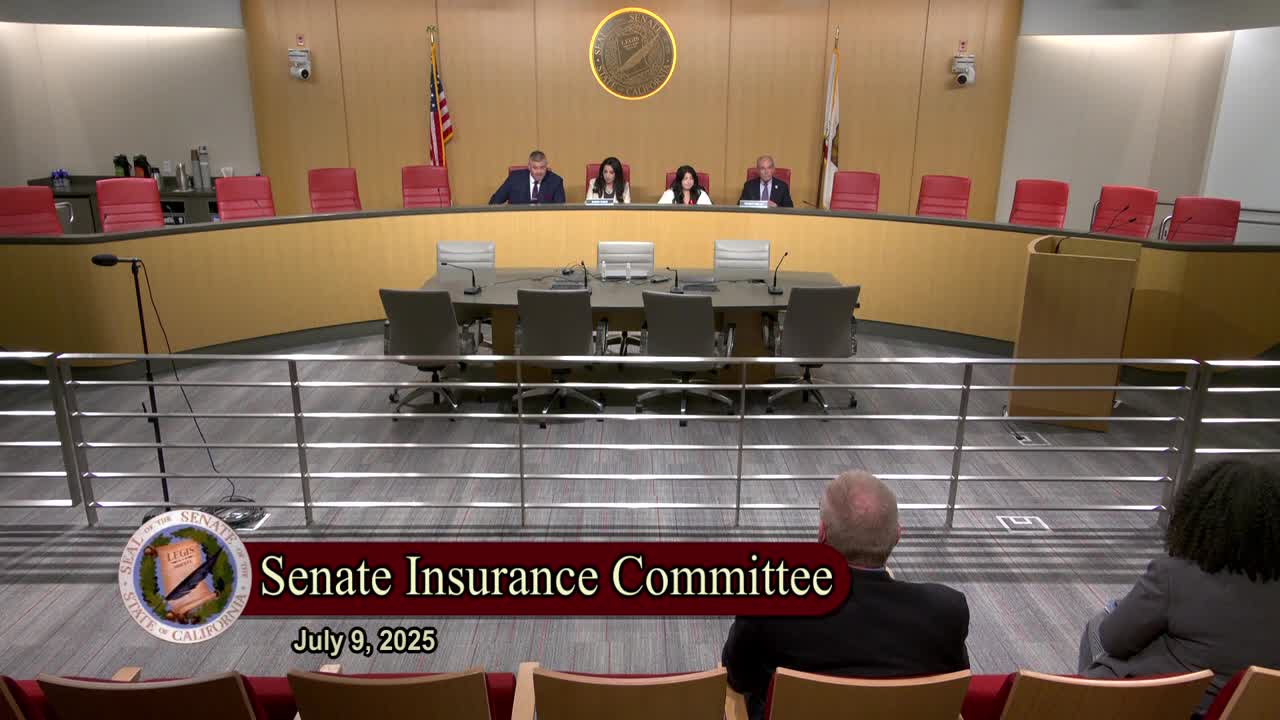 21MIN
Senate Standing Committee on Insurance
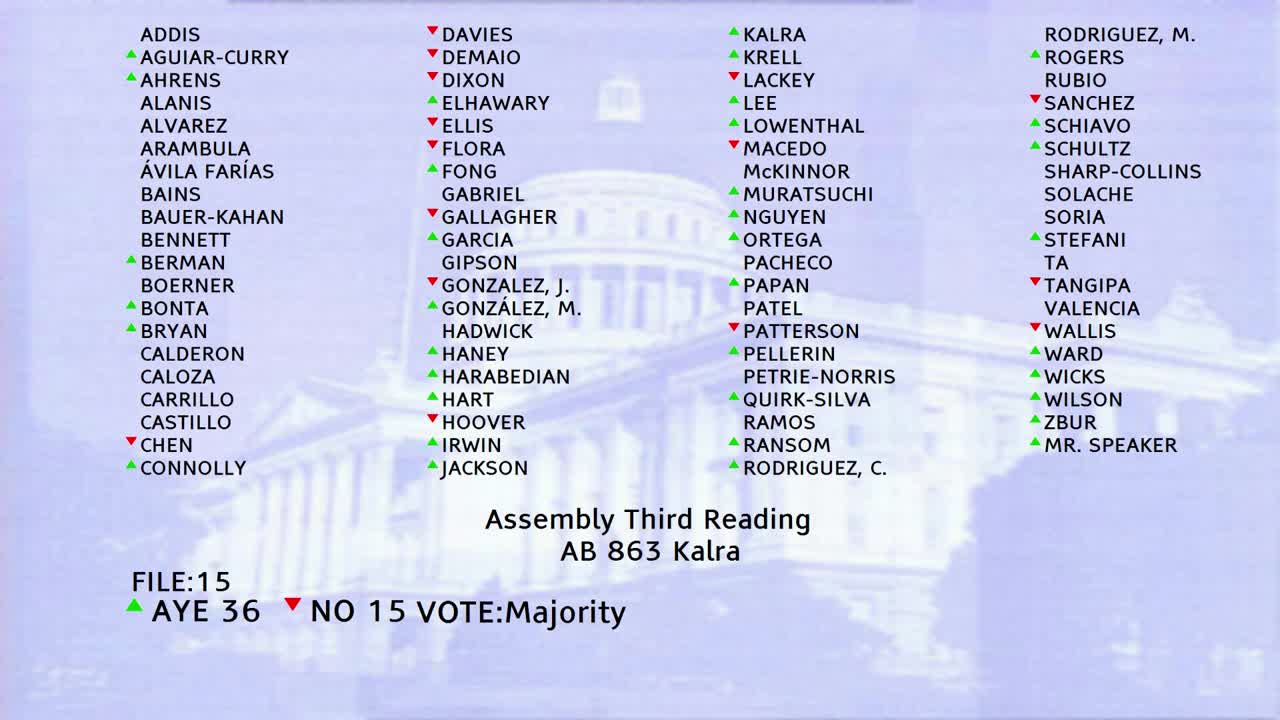 1MIN
Assembly Floor
 12MIN
Assembly Standing Committee on Privacy and Consumer Protection
 10MIN
Assembly Standing Committee on Insurance
Bill Author

Bill Co-Author(s):