AB 1914: General plan elements: childcare.
- Session Year: 2025-2026
- House: Assembly
- Latest Version Date: 2026-06-08
Current Status:
In Progress
(2026-08-13: In committee: Held under submission.)
Introduced
In Committee
Awaiting First Chamber Vote
Passed First Chamber
In Committee
Awaiting Second Chamber Vote
Passed Second Chamber
Enacted
The Planning and Zoning Law requires the legislative body of a city or county to adopt a comprehensive, long-term general plan that includes various elements, including, among others, a land use, circulation, housing, safety, and environmental justice element. Existing law requires a city or county to update its general plan elements subject to certain criteria and timelines.
This bill would require a city, county, or city and county, on or after January 1, 2028, but no later than January 1, 2033, to prepare and adopt a childcare plan or integrate a childcare plan into the next adoption of the city, county, or city and countys general plan to address the childcare needs of the jurisdiction, as specified.
The bill would include findings that changes proposed by this bill address a matter of statewide concern rather than a municipal affair and, therefore, apply to all cities, including charter cities.
The California Constitution requires the state to reimburse local agencies and school districts for certain costs mandated by the state. Statutory provisions establish procedures for making that reimbursement.
This bill would provide that no reimbursement is required by this act for a specified reason.
The Planning and Zoning Law requires the legislative body of a city or county to adopt a comprehensive, long-term general plan that includes various elements, including, among others, a land use, circulation, housing, safety, and environmental justice element. Existing law requires a city or county to update its general plan elements subject to certain criteria and timelines.
This bill would require a city or city, county, or city and county, upon the next update of 2 or more of the elements included in the general plan on or after January 1, 2028, but no later than January 1, 2033, to review and update the land use, circulation, housing, safety, and environmental justice elements, and any other element, where appropriate, prepare and adopt a childcare plan or integrate a childcare plan into the next adoption of the city, county, or city and countys general plan to address the childcare needs of the jurisdiction. The bill would require the elements to be reviewed and updated to reflect the goal of ensuring every family has access to quality, convenient, safe, and affordable childcare, as specified. jurisdiction, as specified.
The bill would include findings that changes proposed by this bill address a matter of statewide concern rather than a municipal affair and, therefore, apply to all cities, including charter cities.
The California Constitution requires the state to reimburse local agencies and school districts for certain costs mandated by the state. Statutory provisions establish procedures for making that reimbursement.
This bill would provide that no reimbursement is required by this act for a specified reason.
The Planning and Zoning Law requires the legislative body of a city or county to adopt a comprehensive, long-term general plan that includes various elements, including, among others, a land use, circulation, housing, safety, and environmental justice element. Existing law requires a city or county to update its general plan elements subject to certain criteria and timelines.
This bill would require a city or county, upon the next update of 2 or more of the elements included in the general plan on or after January 1, 2028, to review and update the land use, circulation, housing, safety, and environmental justice elements, and any other element, where appropriate, to address the childcare needs of the jurisdiction. The bill would require the elements to be reviewed and updated to reflect the goal of ensuring every family has access to quality, convenient, safe, and affordable childcare, as specified.
The bill would include findings that changes proposed by this bill address a matter of statewide concern rather than a municipal affair and, therefore, apply to all cities, including charter cities.
The California Constitution requires the state to reimburse local agencies and school districts for certain costs mandated by the state. Statutory provisions establish procedures for making that reimbursement.
This bill would provide that no reimbursement is required by this act for a specified reason.
The Legislature finds and declares all of the following:
(a)Childcare access and infrastructure are a critical need, and every family should have access to quality, convenient, safe, and affordable childcare.
(b)To address the states childcare crisis, all levels of government must be involved and prioritize planning for their communities childcare needs.
(c)Integrating the childcare needs of those who live and work in the jurisdiction into a citys or countys planning processes is a promising strategy to promote greater consistency and consideration of childcare in earlier stages of local planning processes, while preserving local discretion.
(d)Including childcare in emergency preparedness and disaster planning is also critical to ensure the unique needs of this vulnerable population are met before, during, and after disasters, supporting community resilience, economic recovery, and child safety.
SEC. 2.Section 65302.03 is added to the Government Code, to read:65302.03.(a)For purposes of this section, the following definitions apply:
(1)Childcare means license-exempt childcare, childcare and development services, and childcare and development programs, for children up to 13 years of age, including children with exceptional needs and children from all linguistic and cultural backgrounds.
(2)Childcare plan means a plan developed by a city, county, or city and county to address the childcare needs of the jurisdiction.
(3)Childcare and development programs has the same meaning as defined in Section 10213.5 of the Welfare and Institutions Code.
(4)Childcare and development services has the same meaning as defined in Section 10213.5 of the Welfare and Institutions Code.
(5)License-exempt childcare has the same meaning as described in Section 1596.792 of the Health and Safety Code, as it relates to childcare.
(b)On or after January 1, 2028, but no No later than January 1, 2033, each city, county, or city and county shall prepare and adopt a childcare plan or integrate a child care plan into the next adoption of the city, county, or city and countys general plan to address the childcare needs of the jurisdiction.
(c)If a city, county, or city and county has already adopted a similar childcare plan in its general plan or apart from the general plan, that meets the requirements of this section, the city, county, or city and county may designate that childcare plan to comply with this section.
SEC. 3.The Legislature finds and declares that Section 2 of this act adding Section 65302.03 to the Government Code addresses a matter of statewide concern rather than a municipal affair as that term is used in Section 5 of Article XI of the California Constitution. Therefore, Section 2 of this act applies to all cities, including charter cities. ensuring that all cities and counties adequately plan for childcare needs within their jurisdiction is a matter of statewide concern and is not a municipal affair as that term is used in Section 5 of Article XI of the California Constitution. Therefore, Section 2 of this act adding Section 65302.03 to the Government Code applies to all cities, including charter cities.
SEC. 4.No reimbursement is required by this act pursuant to Section 6 of Article XIIIB of the California Constitution because a local agency or school district has the authority to levy service charges, fees, or assessments sufficient to pay for the program or level of service mandated by this act, within the meaning of Section 17556 of the Government Code.
The Legislature finds and declares all of the following:
(a)Childcare access and infrastructure are a critical need, and every family should have access to quality, convenient, safe, and affordable childcare.
(b)To address the states childcare crisis, all levels of government must be involved and prioritize planning for their communities childcare needs.
(c)Integrating the childcare needs of those who live and work in the jurisdiction into a citys or countys planning processes is a promising strategy to promote greater consistency and consideration of childcare in earlier stages of local planning processes, while preserving local discretion.
(d)Including childcare in emergency preparedness and disaster planning is also critical to ensure the unique needs of this vulnerable population are met before, during, and after disasters, supporting community resilience, economic recovery, and child safety.
SEC. 2.Section 65302.03 is added to the Government Code, to read:65302.03.(a)For purposes of this section, the following definitions apply:
(1)Childcare means all licensed license-exempt childcare, childcare and development services and license-exempt childcare, including, but not limited to, private for-profit programs, nonprofit programs, and publicly funded programs, services, and childcare and development programs, for all children up to and including 12 13 years of age, including children with exceptional needs and children from all linguistic and cultural backgrounds.
(2)Childcare plan means a plan developed by a city, county, or city and county to address the childcare needs of the jurisdiction.
(3)Childcare and development programs has the same meaning as defined in Section 10213.5 of the Welfare and Institutions Code.
(4)Childcare and development services has the same meaning as defined in Section 10213.5 of the Welfare and Institutions Code.
(5)License-exempt childcare has the same meaning as described in Section 1596.792 of the Health and Safety Code, as it relates to childcare.
(b)On or after January 1, 2028, but no later than January 1, 2033, each city, county, or city and county shall prepare and adopt a childcare plan or integrate a child care plan into the next adoption of the city, county, or city and countys general plan to address the childcare needs of the jurisdiction.
(c)If a city, county, or city and county has already adopted a similar childcare plan in its general plan or apart from the general plan, that meets the requirements of this section, the city, county, or city and county may designate that childcare plan to comply with this section.
SEC. 3.The Legislature finds and declares that Section 2 of this act adding Section 65302.03 to the Government Code addresses a matter of statewide concern rather than a municipal affair as that term is used in Section 5 of Article XI of the California Constitution. Therefore, Section 2 of this act applies to all cities, including charter cities.
SEC. 4.No reimbursement is required by this act pursuant to Section 6 of Article XIIIB of the California Constitution because a local agency or school district has the authority to levy service charges, fees, or assessments sufficient to pay for the program or level of service mandated by this act, within the meaning of Section 17556 of the Government Code.
The Legislature finds and declares all of the following:
(a)Childcare access and infrastructure are a critical need, and every family should have access to quality, convenient, safe, and affordable childcare.
(b)To address the states childcare crisis, all levels of government must be involved and prioritize planning for their communities childcare needs.
(c)Integrating the childcare needs of those who live and work in the jurisdiction into a citys or countys planning processes is a promising strategy to promote greater consistency and consideration of childcare in earlier stages of local planning processes, while preserving local discretion.
(d)Including childcare in emergency preparedness and disaster planning is also critical to ensure the unique needs of this vulnerable population are met before, during, and after disasters, supporting community resilience, economic recovery, and child safety.
SECTION 1.SEC. 2.Section 65302.03 is added to the Government Code, to read:65302.03.(a)For purposes of this section, Childcare the following definitions apply:
(1)Childcare means all licensed childcare and development services and license-exempt childcare, including, but not limited to, private for-profit programs, nonprofit programs, and publicly funded programs, for all children up to and including 12 years of age, including children with exceptional needs and children from all linguistic and cultural backgrounds.
(b)(1)Upon the next update of two or more elements described in Section 65302, on or after January 1, 2028, a city or county shall review and update the land use, circulation, housing, safety, and environmental justice elements, and any other element, where appropriate, to address the childcare needs of the jurisdiction.(2)The elements described in paragraph (1) shall be reviewed and updated to reflect the goal of ensuring every family has access to quality, convenient, safe, and affordable childcare. This goal may be achieved in various ways, including, but not limited to, all of the following:(A)Directing resources or leveraging other public and private resources to support development or operation of childcare and early education facilities and services.(B)Integrating the childcare needs of those who live and work in the jurisdiction into the citys or countys planning processes. Locate childcare services, where possible, in or near housing, transportation, and employment centers to be convenient to residents and workers.(C)Partnering with local childcare planning organizations to involve all sectors of the community in the planning for and provision of childcare.(D)Looking for innovative ways to involve employers, religious organizations, and developers in the provision of childcare services and facilities.(E)Revising zoning ordinance standards and permitting processes for childcare facilities to support the establishment of small family daycare homes, as defined in Section 1597.44 of the Health and Safety Code, large family daycare homes, as defined in Section 1597.465 of the Health and Safety Code, and daycare centers, as defined in Section 1596.76 of the Health and Safety Code, and comply with existing by-right state laws through a simplified, streamlined review process.(F)Developing and implementing a comprehensive city or county childcare facilities plan that engages the resources of the city or county, community agencies and organizations, and major employers and employment centers. The plan would identify priority geographic areas to locate new childcare centers, considering target populations and supply gaps, and identify and assess existing and potential financing mechanisms for facility development.(G)Allowing developments of emergency shelters to include space for childcare centers.(H)Including childcare as a sensitive receptor in public safety planning and including childcare in hazard mitigation planning.(I)Including childcare in emergency preparedness and disaster planning to ensure the unique needs of this vulnerable population are met before, during, and after disasters, supporting community resilience, economic recovery, and child safety.(J)Including childcare in climate adaptation and resiliency strategies.(2)Childcare plan means a plan developed by a city, county, or city and county to address the childcare needs of the jurisdiction.
(b)On or after January 1, 2028, but no later than January 1, 2033, each city, county, or city and county shall prepare and adopt a childcare plan or integrate a child care plan into the next adoption of the city, county, or city and countys general plan to address the childcare needs of the jurisdiction.
(c)If a city, county, or city and county has already adopted a similar childcare plan in its general plan or apart from the general plan, that meets the requirements of this section, the city, county, or city and county may designate that childcare plan to comply with this section.
SEC. 2.SEC. 3.The Legislature finds and declares that Section 1 2 of this act adding Section 65302.03 to the Government Code addresses a matter of statewide concern rather than a municipal affair as that term is used in Section 5 of Article XI of the California Constitution. Therefore, Section 1 2 of this act applies to all cities, including charter cities.
SEC. 3.SEC. 4.No reimbursement is required by this act pursuant to Section 6 of Article XIIIB of the California Constitution because a local agency or school district has the authority to levy service charges, fees, or assessments sufficient to pay for the program or level of service mandated by this act, within the meaning of Section 17556 of the Government Code.
(a)For purposes of this section, Childcare means all licensed childcare and development services and license-exempt childcare, including, but not limited to, private for-profit programs, nonprofit programs, and publicly funded programs, for all children up to and including 12 years of age, including children with exceptional needs and children from all linguistic and cultural backgrounds.
(b)(1)Upon the next update of two or more elements described in Section 65302, on or after January 1, 2028, a city or county shall review and update the land use, circulation, housing, safety, and environmental justice elements, and any other element, where appropriate, to address the childcare needs of the jurisdiction.
(2)The elements described in paragraph (1) shall be reviewed and updated to reflect the goal of ensuring every family has access to quality, convenient, safe, and affordable childcare. This goal may be achieved in various ways, including, but not limited to, all of the following:
(A)Directing resources or leveraging other public and private resources to support development or operation of childcare and early education facilities and services.
(B)Integrating the childcare needs of those who live and work in the jurisdiction into the citys or countys planning processes. Locate childcare services, where possible, in or near housing, transportation, and employment centers to be convenient to residents and workers.
(C)Partnering with local childcare planning organizations to involve all sectors of the community in the planning for and provision of childcare.
(D)Looking for innovative ways to involve employers, religious organizations, and developers in the provision of childcare services and facilities.
(E)Revising zoning ordinance standards and permitting processes for childcare facilities to support the establishment of small family daycare homes, as defined in Section 1597.44 of the Health and Safety Code, large family daycare homes, as defined in Section 1597.465 of the Health and Safety Code, and daycare centers, as defined in Section 1596.76 of the Health and Safety Code, and comply with existing by-right state laws through a simplified, streamlined review process.
(F)Developing and implementing a comprehensive city or county childcare facilities plan that engages the resources of the city or county, community agencies and organizations, and major employers and employment centers. The plan would identify priority geographic areas to locate new childcare centers, considering target populations and supply gaps, and identify and assess existing and potential financing mechanisms for facility development.
(G)Allowing developments of emergency shelters to include space for childcare centers.
(H)Including childcare as a sensitive receptor in public safety planning and including childcare in hazard mitigation planning.
(I)Including childcare in emergency preparedness and disaster planning to ensure the unique needs of this vulnerable population are met before, during, and after disasters, supporting community resilience, economic recovery, and child safety.
(J)Including childcare in climate adaptation and resiliency strategies.
SEC. 2.The Legislature finds and declares that Section 1 of this act adding Section 65302.03 to the Government Code addresses a matter of statewide concern rather than a municipal affair as that term is used in Section 5 of Article XI of the California Constitution. Therefore, Section 1 of this act applies to all cities, including charter cities.
SEC. 3.No reimbursement is required by this act pursuant to Section 6 of Article XIIIB of the California Constitution because a local agency or school district has the authority to levy service charges, fees, or assessments sufficient to pay for the program or level of service mandated by this act, within the meaning of Section 17556 of the Government Code.
|
Date
|
Status
|
|---|---|
| Aug 13, 2026 | In committee: Held under submission. |
| Aug 3, 2026 | In committee: Referred to APPR. suspense file. |
| Jun 29, 2026 | From committee: Do pass and re-refer to Com. on APPR. (Ayes 3. Noes 1.) (June 29). Re-referred to Com. on APPR. |
| Jun 17, 2026 | From committee: Do pass and re-refer to Com. on HUMAN S. (Ayes 5. Noes 1.) (June 17). Re-referred to Com. on HUMAN S. |
| Jun 8, 2026 | From committee chair, with author's amendments: Amend, and re-refer to committee. Read second time, amended, and re-referred to Com. on L. GOV. |
| Jun 3, 2026 | Referred to Coms. on L. GOV. and HUMAN S. |
| May 21, 2026 | In Senate. Read first time. To Com. on RLS. for assignment. |
| May 21, 2026 | Read third time. Passed. Ordered to the Senate. (Ayes 59. Noes 9.) |
| May 21, 2026 | Read third time. Passed. Ordered to the Senate. (Ayes 59. Noes 9. Page 5179.) |
| May 7, 2026 | Read second time. Ordered to third reading. |
| May 6, 2026 | From committee: Do pass. (Ayes 10. Noes 2.) (May 6). |
| Apr 28, 2026 | Re-referred to Com. on APPR. |
| Apr 27, 2026 | Read second time and amended. |
| Apr 23, 2026 | From committee: Amend, and do pass as amended and re-refer to Com. on APPR. (Ayes 5. Noes 1.) (April 23). |
| Apr 21, 2026 | Re-referred to Com. on HUM. S. |
| Apr 20, 2026 | Read second time and amended. |
| Apr 16, 2026 | From committee: Amend, and do pass as amended and re-refer to Com. on HUM. S. (Ayes 8. Noes 1.) (April 15). |
| Mar 23, 2026 | In committee: Set, first hearing. Hearing canceled at the request of author. |
| Mar 2, 2026 | Referred to Coms. on L. GOV. and HUM. S. |
| Feb 13, 2026 | From printer. May be heard in committee March 15. |
| Feb 12, 2026 | Read first time. To print. |
|
Date
|
Description
|
Location
|
Votes
|
|
|---|---|---|---|---|
| Aug 3, 2026 | Placed on suspense file | Senate Standing Committee on Appropriations |
Passed |
|
| Jun 29, 2026 | Do pass, but first be re-referred to the Committee on [Appropriations] | Senate Standing Committee on Human Services |
Passed |
|
| Jun 17, 2026 | Do pass, but first be re-referred to the Committee on [Human Services] | Senate Standing Committee on Local Government |
Passed |
|
| May 21, 2026 | AB 1914 Schiavo Assembly Third Reading | Assembly Floor |
Passed |
|
| May 6, 2026 | Do pass. | Assembly Standing Committee on Appropriations |
Passed |
|
| Apr 23, 2026 | Do pass as amended and be re-referred to the Committee on [Appropriations] | Assembly Standing Committee on Human Services |
Passed |
|
| Apr 15, 2026 | Do pass as amended and be re-referred to the Committee on [Human Services] | Assembly Standing Committee on Local Government |
Passed |
This list shows positions taken on this bill by organizations on the date displayed, which is linked to the original source.
Positions by individuals are not included.
|
Organization
|
Position
|
Date
|
|---|---|---|
| A Child's Place Intentional Learning & Emotional Informed Studio | ** Support | |
| Alameda County Office Of Education | ** Support | |
| American Planning Association | ** Against | |
| Build Up California | ** Support | |
| Build Up San Mateo County | ** Support | |
| CA Commission on the Status of Women and Girls | ** Support | |
| California Child Care Resource and Referral Network | ** Support | |
| California Coalition for Community Investment | ** Support | |
| California Coalition for Community Investment (CCCI) | ** Support | |
| California State Association Of Counties | ** Against | |
| California State PTA | ** Support | |
| CAMEO Network | ** Support | |
| CDC Small Business Finance | ** Support | |
| Child Action | ** Support | |
| Child Care Alliance of Los Angeles | ** Support | |
| Child Care Law Center | ** Support | |
| Child Care Providers United (CCPU) | ** Support | |
| Child Care Resource Center | ** Support | |
| Children Now | ** Support | |
| Cielo | ** Support | |
| City of La Verne | ** Against | |
| City of Thousand Oaks | ** Against | |
| Consortium for Early Learning Services | ** Support | |
| Early Care And Education Consortium | ** Support | |
| Early Edge California | ** Support | |
| Eileen Monahan Consulting | ** Support | |
| Ellen Kamei, Councilmember, City of Mountain View | ** Support | |
| Eric Guerra, Councilmember, City Of Sacramento | ** Support | |
| Family Connections Centers | ** Support | |
| First 5 Association Of California | ** Support | |
| Kidango | ** Support | |
| Kristen Anderson Consulting | ** Support | |
| League Of California Cities | ** Against | |
| LEAP | ** Support | |
| Lisa Gauthier, County Supervisor, San Mateo County | ** Support | |
| Little Blossoms Childcare | ** Support | |
| Long Beach Day Nursery | ** Support | |
| Low Income Investment Fund | ** Support | |
| Marin Child Care Council | ** Support | |
| marin county child care commission | ** Support | |
| Pamela Campos, Councilmember, San Jose | ** Support | |
| Para Los Ninos | ** Support | |
| Parent Voices California | ** Support | |
| Rural County Representatives of California | ** Against | |
| San Francisco Child Care Planning and Advisory Council | ** Support | |
| San Jose Councilmember Pamela Campos | ** Support | |
| San Mateo County Child Care Partnership Council | ** Support | |
| San Mateo County Supervisor Lisa Gauthier | ** Support | |
| Seeds of Tomorrow Preschool | ** Support | |
| Silicon Valley Community Foundation | ** Support | |
| Skyline College | ** Support | |
| Start Well, Early Childhood Mental Health Consultation | ** Support | |
| The Low Income Investment Fund | ** Support | |
| Thriving Families CA Foundation | ** Support | |
| Thriving Families California (TFC) | ** Support | |
| Xouhoa Bowen, Councilmember, San Leandro | ** Support |
SENATE COMMITTEE ON
Senator Sabrina Cervantes, Chair
2025 - 2026 Regular Session
AB 1914 (Schiavo) - General plan elements: childcare
Version: | Policy Vote: |
Urgency: | Mandate: |
Hearing Date: | Consultant: |
Bill Summary:
AB 1914 would require cities and counties to adopt or integrate a childcare plan in the next adoption of their general plan, but no later than January 1, 2033, to address the childcare needs of the jurisdiction, as specified.
Fiscal Impact:
- The Governor’s Office of Land Use and Climate Innovation (LCI) estimates one-time costs of approximately $104,000 annually for two years for 0.5 PY of staff time to incorporate the relevant childcare plan elements into LCI’s Genera Plan Guidelines. (General Fund)
- Unknown, potentially significant local costs for jurisdictions to include a childcare plan in the next adoption of the general plan, or by January 1, 2033, as specified. Local costs related to general plan updates are generally not state-reimbursable because cities and counties have the authority to charge and adjust planning and permitting fees to cover their administrative expenses associated with new local planning mandates. See Staff Comments. (local funds)
Background:
Existing law requires cities and counties to adopt a general plan with eight mandatory elements: land use, circulation, housing, conservation, open space, noise, safety, and environmental justice. Although state law specifies the minimum requirements of a plan, local officials may adopt optional elements that address additional topics based on regional necessity. Once adopted, those optional elements have the same legal force as the mandatory elements. The general plan must be “internally consistent,” which means the various elements cannot have conflicting information or assumptions. With the exception of the housing element, which must be updated every five to eight years, cities and counties are not required to regularly update the general plan.
Existing law requires LCI to develop and adopt advisory guidelines to assist cities and counties in the preparation and content of the mandatory elements required in general plans. These guidelines outline statutory requirements, offer policy language recommendations, and provide examples of cities and counties that have adopted similar policies across both mandatory and optional elements. The guidelines strive to support local governments and other community partners in crafting plans that reflect state law while addressing community needs and priorities. LCI is required to regularly review and revise these guidelines as necessary. The last full update of LCI’s General Plan Guidelines was published in 2017, and LCI is currently working on a comprehensive update to their planning guidance, including the General Plan Guidelines.
Each county in California has a Local Childcare Planning Council (LPC) established to identify local childcare priorities and develop policies to address those needs. State law requires the county board of supervisors and the county superintendent of schools to appoint members to these councils, ensuring balanced representation of consumers, childcare providers, public agency representatives, community representatives, and discretionary appointees. LPCs are responsible for conducting a countywide childcare needs assessment at least once every five years, developing comprehensive plans to mobilize public and private resources and to address identified needs, and ensuring community input in setting local priorities. Many LPCs have developed these strategic plans informed by needs assessment and community feedback.
Proposed Law:
AB 1914 would require cities and counties to adopt or integrate a childcare plan into the next adoption of their general plan, but no later than January 1, 2033, to address the childcare needs of the jurisdiction. If the city or county has already adopted a similar childcare plan that meets the requirements of the bill, the local jurisdiction may designate that childcare plan to comply with these requirements.
Related Legislation:
AB 752 (Ávila Farías), Chap. 164/2025, provided that a daycare center that is collocated with multifamily housing shall be considered a residential use of property and a use by right.
SB 234 (Skinner), Chap. 244/2019, made all family childcare homes a residential use of property and a use by right for purposes of all local ordinances and prohibited all family child care homes from being subject to a business license, tax, or fee.
Staff Comments:
The mandated local planning costs associated with this bill would generally not be subject to state reimbursement because local agencies have the authority to charge and adjust planning and permitting fees as necessary to cover administrative costs. Existing law authorizes planning and zoning fees to “include the costs reasonably necessary to prepare and revise the plans and policies that a local agency is required to adopt before it can make any necessary findings and determinations.” Case law and previous decisions by the Commission on State Mandates support the position that local governments’ planning costs are not reimbursable when the state imposes new planning mandates.
-- END --
SENATE COMMITTEE ON HUMAN SERVICES
Senator Becker, Chair
2025 - 2026 Regular
Bill No: | AB 1914 | ||
Author: | Schiavo | ||
Version: | June 8, 2026 | Hearing Date: | June 29, 2026 |
Urgency: | No | Fiscal: | Yes |
Consultant: | Diana Dominguez | ||
Subject: General plan elements: childcare
SUMMARY
This bill would require a city, county, or city and county to adopt or integrate a childcare plan into the next adoption or revision of its general plan by January 1, 2033.
ABSTRACT
Existing Law:
- Establishes the Child Care and Development Services Act to provide a comprehensive, coordinated, and cost-effective system of childcare and development services for children from infancy to 13 years of age and their parents, including a full range of supervision, health, and support services through full- and part-time programs. (Welfare and Institutions Code [WIC] 10207 et seq.)
- Requires each planning agency within a city or county to prepare, and the legislative body of each city or county to adopt, a comprehensive, long-term general plan for the physical development of the city or county, and of any land outside its boundaries which in the planning agency’s judgment bears relation to its planning. Provides that chartered cities shall adopt general plans which contain the mandatory elements, as specified. (Government Code [GOV] 65300)
- Requires a general plan to include elements on the following, as specified: land use, circulation, housing, conservation, open space, noise, safety, and environmental justice. (GOV 65302)
- Requires, upon the next update of one or more general plan elements, on or after January 1, 2028, the safety element to be reviewed and updated as necessary to address the hazard of extreme heat. (GOV 65302.01)
- Requires a county or city that is located in a warehouse concentration region, as defined, to update its circulation element, as specified, on or before January 1, 2026. (GOV 65302.02)
- Defines “childcare and development programs” as those programs that offer a full range of services for children from infancy to 13 years of age, for any part of a day, by a public or private agency, in centers and family childcare homes. These programs include, but are not limited to, all of the following:
- General childcare and development.
- Migrant childcare and development.
- Child care provided by the California School Age Families Education Program.
- Resource and referral.
- Child care and development services for children with exceptional needs.
- Family childcare home education network.
- Alternative payment.
- Schoolage community childcare. (WIC 10213.5(i))
- Defines “childcare and development services” as those services designed to meet a wide variety of needs of children and their families, while their parents or guardians are working, in training, seeking employment, incapacitated, or in need of respite. These services may include direct care and supervision, instructional activities, resource and referral programs, and alternative payment arrangements. (WIC 10213.5(j))
- Exempts the following child care arrangements from child care licensure:
- Any family child care home providing care for the children of only one family in addition to the operator’s own children.
- Any cooperative agreement between parents for the care of their children when no payment is involved and the arrangement meets specified conditions.
- Any arrangement for the receiving and care of children by a relative.
- Any public recreation program, as specified.
- Extended day care programs operated by public or private schools, as specified.
- Any school parenting program or adult education child care program that meets specified criteria.
- Any child day care program that operates only one day per week for no less than four hours on that one day.
- Any child day care program that is not operated on the site of a ski facility, shopping mall, department store, or any other similar site identified by CDSS by regulation.
- Any program that provides activities for children of an instructional nature in a classroom-like setting and satisfies specific criteria.
- A California State Preschool Program operated by a local educational agency under contract with the State Department of Education and that operates in a school building, as specified. (Health and Safety Code 1596.792)
- Establishes local childcare and development planning councils to provide a forum for the identification of local priorities for childcare and the development of policies to meet those priorities. Requires a local planning council to annually submit to the California Department of Social Services (CDSS) and the California Department of Education identified priorities. Requires a local planning council to conduct an assessment of childcare needs in the county once every five years, prepare a comprehensive countywide childcare plan, conduct a periodic review of childcare programs, collaborate with subsidized and nonsubsidized childcare providers and administrators, design a system to consolidate local childcare waiting lists if one is not already in existence, and coordinate part-day programs with other services to provide full-day care, among other things. (WIC 10485–10487)
This Bill:
- Makes findings and declarations about the need for all levels of government to be involved in and prioritize planning for their communities’ child care needs.
- Defines the following terms for purposes of this bill:
- “Child care” means license-exempt childcare, childcare and development services, and childcare and development programs, for children up to 13 years of age, including children with exceptional needs and children from all linguistic and cultural backgrounds.
- “Child care plan” means a plan developed by a city, county, or city and county to address the childcare needs of the jurisdiction.
- “Child care and development programs” means programs that offer a full range of services for children from infancy to 13 years of age, for any part of a day, by a public or private agency, in centers and family child care homes.
- “Child care and development services” means services designed to meet a wide variety of needs of children and their families, while their parents or guardians are working, in training, seeking employment, incapacitated, or in need of respite. These services may include direct care and supervision, instructional activities, resource and referral programs, and alternative payment arrangements.
- “License-exempt child care” has the same meaning as Section 1596.792 of the Health and Safety Code, as it relates to child care, which exempts specified facilities from child care licensure, including:
- Any family child care home providing care for the children of only one family in addition to the operator’s own children.
- Any cooperative agreement between parents for the care of their children when no payment is involved and the arrangement meets specified conditions.
- Any arrangement for the receiving and care of children by a relative.
- Any public recreation program, as specified.
- Extended day care programs operated by public or private schools, as specified.
- Any school parenting program or adult education child care program that meets specified criteria.
- Any child day care program that operates only one day per week for no less than four hours on that one day.
- Any child day care program that is not operated on the site of a ski facility, shopping mall, department store, or any other similar site identified by CDSS by regulation.
- Any program that provides activities for children of an instructional nature in a classroom-like setting and satisfies specific criteria.
- A California State Preschool Program operated by a local educational agency under contract with the State Department of Education and that operates in a school building, as specified.
- Requires, no later than January 1, 2033, each city, county, or city and county to prepare and adopt a child care plan or integrate a child care plan into the next adoption of the city, county, or city and county’s general plan to address the child care needs of the jurisdiction.
- Provides that, if a city, county, or city and county has already adopted a similar child care plan in its general plan or apart from the general plan that meets the requirements of this bill, the city, county, or city and county may designate that child care plan to comply with this bill.
- Provides that this bill shall apply to all cities, including charter cities.
FISCAL IMPACT
According to the Assembly Appropriations Committee, “No state costs. Local costs resulting from this bill are not reimbursable by the state because local agencies have general authority to charge and adjust planning and permitting fees to cover their administrative expenses associated with new planning mandates.”
BACKGROUND AND DISCUSSION
Purpose of the Bill:
According to the author, “As rising living costs and threats to cut funding from the federal government continue to create additional barriers to affordable child care, it is increasingly important to examine child care accessibility as communities plan for future growth and infrastructure needs. Instead of relying solely on ad hoc solutions to address child care accessibility, I believe AB 1914 is a promising strategy to promote greater consistency and consideration of child care in earlier stages of local planning, while preserving local discretion. Requiring local general plans to include child care is crucial because it supports economic development by enabling workforce participation, attracts families and talent, promotes healthier, family-friendly communities, and aligns land use with community needs, ensuring equitable access and reducing traffic by integrating child care facilities near homes, jobs, and transportation. As we saw from the fires in Los Angeles, it is also critical to include child care in disaster planning and climate adaptation and resilience strategies to ensure children are cared for before, during, and after disasters and to ensure they have access to safe, healthy learning environments. Child care is a critical resource for California families and requires comprehensive planning to ensure widespread access to high-quality, affordable options.”
Local Government General Plans and Zoning
State law provides powers and duties for cities and counties regarding land use. Each city and county is required to prepare and adopt a general plan to guide future planning decisions. General plans are required to include eight mandatory elements: land use, circulation (e.g., traffic), housing, conservation, open space, noise, safety, and environmental justice. Elements must be consistent with each other, and several elements must be revised every eight years, meaning general plans are typically reviewed every eight years. Additionally, a city or county’s land use decisions, such as zoning ordinances, must be consistent with its general plan. This bill would require a city or county, by January 1, 2033, to prepare and adopt a child care plan or integrate a child care plan into the next adoption of the city or county’s general plan to address the child care needs of the jurisdiction.
Zoning Exemptions for Child Care Facilities
Local zoning identifies a primary use for parcels of land in an area. Recent legislation has exempted certain child care facilities from local zoning requirements. SB 234 (Skinner, Chapter 244, Statutes of 2019) made all family daycare homes a residential use of property and a use by right for purposes of all local ordinances. Similarly, AB 752 (Ávila Farías, Chapter 164, Statutes of 2025) made a daycare center that is co-located with multifamily housing a residential use of property and a use by right. In both circumstances, this means that a local government’s review of a child care facility may not require discretionary local government review or approval.
Local Child Care Development Planning Councils (LPCs)
LPCs were created by AB 2141 (Speier, Chapter 1187, Statutes of 1991) in response to the implementation of the federal Child Care and Development Block Grant program. LPCs serve as forums to address the child care needs of all families, including subsidized and non-subsidized child care. Councilmembers are appointed by each county’s board of supervisors and superintendent of schools and include consumers (parents), child care providers, public agency representatives, community representatives, and discretionary appointees. The LPC in each county is required to assess child care needs at least once every five years and annually identify local priorities that reflect all child care needs in the county. LPCs also facilitate child care funding transfers and partner with local providers such as county welfare departments, regional centers, human services agencies, job training programs, and parent organizations. The 2026-27 May Revision proposes to provide $7.7 million for LPCs.[1] This bill would require a city or county’s general plan to include a child care plan to address the child care needs of the jurisdiction.
Related/Prior Legislation:
AB 752 (Ávila Farías, Chapter 164, Statutes of 2025) provided that a daycare center that is collocated with multifamily housing shall be considered a residential use of property and a use by right.
AB 2684 (Bryan, Chapter 1009, Statutes of 2024) required a city or county to update the safety element of its general plan to address the hazard of extreme heat upon the next revision of one or more elements of the general plan on or after January 1, 2028.
AB 98 (Juan Carrillo, Chapter 931, Statutes of 2024) required a city or county to update the circulation element of its general plan to include truck routes.
SB 234 (Skinner, Chapter 244, Statutes of 2019) made all family child care homes a residential use of property and a use by right for purposes of all local ordinances and prohibited all family child care homes from being subject to a business license, tax, or fee. Prior to SB 234, large family child care homes were subject to local zoning requirements, while small family child care homes were exempt.
SB 1000 (Leyva, Chapter 587, Statutes of 2016) required cities and counties to address environmental justice in their general plans by either adopting a separate environmental justice element or integrating environmental justice goals, policies, and objectives into their general plans.
AB 2141 (Speier, Chapter 1187, Statutes of 1991) established a local planning process, using local child care and development planning councils, for the allocation of child care funding received under the federal Child care and Development Block Grant.
COMMENTS
This bill seeks to improve child care access by incorporating child care in local government planning. Although certain child care facilities may bypass local planning requirements under recently passed “allowable use” and “use by right” legislation, requiring cities and counties to plan for child care needs could allow local governments to be more strategic about where child care facilities are, or will be, located. While each county already has an LPC that develops local child care priorities, LPCs are not directly involved in city and county planning. While this bill does not explicitly require a city or county to consult with its LPC, the general plan process must include public hearings to solicit community input.
Child care is essential for families with young children, school-age children, and children and youth with exceptional needs. It enables parents and guardians to go to work, training, or school knowing their children are in a safe and supportive environment. Therefore, child care is an integral part of community and economic planning to ensure children and families can thrive. This bill could create more visibility of local child care priorities and promote collaboration between the child care sector and local government.
SUPPORT/OPPOSITION
Arguments in Support:
According to Low Income Investment Fund, Build Up California, and the California Commission on the Status of Women and Girls, co-sponsors of this bill, “Access to reliable and affordable child care is closely tied to where families live, how they travel to work, and the infrastructure and services available in their communities. Yet despite its importance to families and the workforce, child care is not consistently incorporated into local planning processes. As a result, communities may miss opportunities to plan for child care facilities near housing, employment centers, and transit corridors, or may unintentionally create barriers that limit the development of new child care providers. AB 1914 will require that local jurisdictions create a child care plan separate from or integrated into local general plans. Integrating child care earlier in the planning process will help communities better align land-use decisions, infrastructure investments, and local policies to support the growth of child care options in their jurisdiction. […] Improving coordination between child care access and local planning decisions is a practical and forward-looking strategy to help communities better meet the needs of working families. By requiring jurisdictions to consider child care in their local planning processes, AB 1914 promotes thoughtful planning while preserving local discretion in how those needs are addressed.”
Arguments in Opposition:
According to the League of California Cities, “Cities recognize the importance of creating more affordable and accessible childcare options and support additional funding and resources to expand childcare availability. Unfortunately, AB 1914 requires cities to plan for childcare through an unfunded mandate, without providing additional resources to ensure cities have the tools they need to turn those plans into realities for their residents. […] Existing law already treats small and large licensed family childcare homes as residential uses permitted by right for zoning purposes. Recent legislation has also limited fees and provided targeted CEQA exemptions. These reforms focus on implementation – making it easier to open and expand childcare facilities in communities. In contrast, AB 1914 adds another layer of planning without addressing major barriers to expanding childcare access, such as funding and workforce shortages. Every county in California has a Local Childcare Planning Council (LPC) that identifies local childcare priorities and develops policies to address those needs, including comprehensive plans updated every five years. Rather than requiring new plans that duplicate the work LPCs are already doing, the Legislature should focus on leveraging that work to turn existing plans into real progress in addressing California’s childcare crisis.”
PRIOR VOTES
Senate Local Government Committee: | 5 - 1 |
Assembly Floor: | 59 - 9 |
Assembly Appropriations Committee: | 10 - 2 |
Assembly Local Government Committee: | 8 - 1 |
POSITIONS
Support:
Low Income Investment Fund (Co-Sponsor)
CA Commission on the Status of Women and Girls (Co-Sponsor)
A Child's Place Intentional Learning & Emotional Informed Studio
Alameda County Office of Education
Build Up San Mateo County
California Child Care Resource and Referral Network
California Coalition for Community Investment (CCCI)
California State Pta
Cameo Network
CDC Small Business Finance
Child Action
Child Care Alliance of Los Angeles
Child Care Law Center
Child Care Providers United (CCPU)
Child Care Resource Center
Children Now
Cielo
Consortium for Early Learning Services
Early Care and Education Consortium
Early Edge California
Eileen Monahan Consulting
Ellen Kamei, Councilmember, City of Mountain View
Eric Guerra, Councilmember, City of Sacramento
Family Connections Centers
First 5 Association of California
Kidango
Kristen Anderson Consulting
Leap
Little Blossoms Childcare
Long Beach Day Nursery
Marin Child Care Council
Marin County Child Care Commission
Para Los Ninos
Parent Voices California
San Francisco Child Care Planning and Advisory Council
San Jose Councilmember Pamela Campos
San Mateo County Child Care Partnership Council
San Mateo County Supervisor Lisa Gauthier
Seeds of Tomorrow Preschool
Skyline College
Start Well, Early Childhood Mental Health Consultation
Thriving Families CA Foundation
Thriving Families California (TFC)
Xouhoa Bowen, Councilmember, San Leandro
Oppose:
City of La Verne
City of Thousand Oaks
League of California Cities
-- END --
https://www.cdss.ca.gov/Portals/9/Additional-Resources/Fiscal-and-Financial-Information/LOcal-Assistance-Estimates/2026-27/Revisions/2026-may-revision-detail-tables.pdf ↑
SENATE COMMITTEE ON LOCAL GOVERNMENT
Senator María Elena Durazo, Chair
2025 - 2026 Regular
Bill No: | AB 1914 | Hearing Date: | 6/17/26 |
Author: | Schiavo | Fiscal: | Yes |
Version: | 6/8/26 | Consultant: | Peterson |
General plan elements: childcare
Requires cities and counties to adopt or integrate a childcare plan into the next adoption or revision of the general plan by January 1, 2033.
Background
The California Constitution allows cities and counties to “make and enforce within its limits, all local, police, sanitary and other ordinances and regulations not in conflict with general laws.” It is from this fundamental power (commonly called the police power) that cities and counties derive their authority to regulate behavior to preserve the health, safety, and welfare of the public—including land use authority.
Planning and Zoning Law. State law provides additional powers and duties for cities and counties regarding land use. The Planning and Zoning Law requires every county and city to adopt a general plan that sets out planned uses for all of the area covered by the plan. A general plan must include specified mandatory “elements,” including a housing element that establishes the locations and densities of housing, and a land use element that describes the general categories of uses (such as multifamily residential, single family residential, retail commercial, and open space) that are allowed in specific portions of a jurisdiction. Cities’ and counties’ major land use decisions—including zoning ordinances and other aspects of development permitting—must be consistent with their general plans. General plans also include policies, standards, and mitigation measures that developments must comply with, to protect against flood hazards, fire hazards, and climate change, and to further environmental justice, among other state goals.
Local governments use their police power to enact zoning ordinances that establish the types of land uses that are allowed or authorized in an area. Zoning ordinances also contain provisions to physically shape development and impose other requirements, such as setting maximum heights and densities for housing units, minimum numbers of required parking spaces, setbacks, and lot coverage ratios. These ordinances can also include conditions on development to address aesthetics, community impacts, or other particular site-specific considerations.
Child day care facilities. The California Child Day Care Facilities Act governs the licensure, maintenance, and operation of child day care facilities in the state. This law and the associated regulations adopted by the California Department of Social Services’ (CDSS) establish, among other things, general health and safety requirements, staff-to-child ratios, and provider training requirements. The CDSS Community Care Licensing Division has the responsibility of licensing and monitoring the state’s child day care facilities.
There are different types of child day care facilities:
- Family daycare homes are operated in the licensee’s own home, which may be rented, leased, or owned, and are permitted to be in a mobile home park or an apartment. These homes provide non-medical care and supervision in a family-like setting with all the daily activities associated with home. Family daycare homes are further categorized into small (eight or fewer children) and large homes (as many as 14) based on the size of the childcare group and the ages of the children; and
- Child care centers are child day care facilities and may be part of a large childcare corporation or locally owned. They are usually located in commercial buildings, schools, religious facilities, public buildings, or private buildings. Centers can accommodate infants, toddlers, preschoolers, and school-age children. Separate licenses are required to care for infants, preschoolers, and school-age children, although a center may be licensed to care for all three age groups at one site. Depending on their age, children receive care in separate areas at the center for safety and activity reasons.
SB 234 (Skinner, 2019) made all family daycare homes a residential use of property and a use by right for purposes of all local ordinances and prohibited all family daycare homes from being subject to a business license, tax, or fee. AB 752 (Ávila Farías, 2025) made collocated daycare centers in multifamily housing developments a use by right, includes an exemption from CEQA, and prohibits local jurisdictions from charging taxes, fees, or business licenses on these types of facilities.
Despite recent efforts to expand childcare services, access issues remain. According to a recent policy brief by the UCLA Center for Health Policy Research:
“The 2023 California Health Interview Survey (CHIS) showed that less than half of young children ages 0–5 in California have regular child care arrangements. Young children who are Latinx or who are from low-income households are less likely to have regular child care. CHIS data also indicate that nearly 1 in 5 households with children ages 0–5 are not able to secure child care when they need it for a week or longer. These households report cost as the main reason they are unable to obtain child care. Moreover, the proportion of households that spend $200 or more per week on child care has increased since 2019. These CHIS findings highlight critical gaps surrounding child care in California.”[1]
To encourage consistent access to childcare across the state, the author wants to incorporate childcare into local government planning.
Proposed Law
Assembly Bill 1914 requires, no later than January 1, 2033, each city and county to prepare and adopt a childcare plan or integrate a childcare plan into the next adoption of their general plan. Under the measure, a childcare plan is a plan the city or county develops to address the childcare needs of the jurisdiction.
If a city or county has already adopted a similar childcare plan, it may designate that childcare plan to comply with the measure.
AB 1914 defines its terms, and makes findings and declarations to further its intent.
Comments
1. Purpose of the bill. According to the author, “As rising living costs and threats to cut funding from the federal government continue to create additional barriers to affordable child care, it is increasingly important to examine child care accessibility as communities plan for future growth and infrastructure needs. Instead of relying solely on ad hoc solutions to address child care accessibility, I believe AB 1914 is a promising strategy to promote greater consistency and consideration of child care in earlier stages of local planning, while preserving local discretion. Requiring local general plans to include child care is crucial because it supports economic development by enabling workforce participation, attracts families and talent, promotes healthier, family-friendly communities, and aligns land use with community needs, ensuring equitable access and reducing traffic by integrating child care facilities near homes, jobs, and transportation. As we saw from the fires in Los Angeles, it is also critical to include child care in disaster planning and climate adaptation and resilience strategies to ensure children are cared for before, during, and after disasters and to ensure they have access to safe, healthy learning environments. Child care is a critical resource for California families and requires comprehensive planning to ensure widespread access to high-quality, affordable options.”
2. No free lunch. AB 1914 adds to the many planning requirements that local agencies face. Local agencies will have to decide how to manage their workload to comply with AB 1914’s requirements. They could divert resources from other planning efforts. Alternatively, they could increase permit fees to increase planning staff. Regardless of what local agencies choose, there is a cost to increasing planning requirements. Supporters of the measure argue that the benefits outweigh the costs. If childcare does not factor into local planning, supporters argue that local agencies may miss opportunities to plan for childcare facilities near housing, employment centers, and transit corridors, or may unintentionally create barriers that limit the development of new childcare providers. It is unclear whether the costs to plan for childcare could be better spent on expanding actual childcare opportunities.
3. The train has left the station. AB 1914 requires local agencies to incorporate childcare into their planning efforts despite recent legislation that has bypassed local approvals to permit childcare facilities. SB 234 (Skinner, 2019) made all family daycare homes a residential use of property and a use by right for purposes of all local ordinances. Similarly, AB 752 (Ávila Farías, 2025) made collocated daycare centers in multifamily housing developments a use by right. Even if local agencies comply with AB 1914 and incorporate childcare into their planning documents, these recent streamlining bills may override some of these local planning efforts.
4. Mandate. The California Constitution requires the state to reimburse local governments for the costs of new or expanded state mandated local programs. Because AB 1914 adds to the duties of local officials when planning for childcare, Legislative Counsel says the bill imposes a new state mandate. AB 1914 disclaims the state’s responsibility for providing reimbursement by citing local governments’ authority to charge for the costs of implementing the bill’s provisions.
5. Charter city. The California Constitution allows cities that adopt charters to control their own “municipal affairs.” In all other matters, charter cities must follow the general, statewide laws. Because the Constitution doesn’t define “municipal affairs,” the courts determine whether a topic is a municipal affair or whether it’s an issue of statewide concern. AB 1914 says that it applies to all cities, including charter cities. To support this assertion, the bill includes a legislative finding and declaration that ensuring that all cities and counties adequately plan for childcare needs within their jurisdiction is a matter of statewide concern and is not a municipal affair.
6. Coming and going. The Senate Rules Committee has ordered a double referral of AB 1914: first to the Committee on Local Government to hear issues related to local planning, and second to the Committee on Human Services.
Assembly Actions
Assembly Committee on Local Government: 8-1
Assembly Committee on Human Services: 5-1
Assembly Committee on Appropriations: 10-2
Assembly Floor: 59-9
Support and Opposition
(6/12/2026)
Support: CA Commission on the Status of Women and Girls (Sponsor)
Low Income Investment Fund (Sponsor)
Ellen Kamei, Councilmember, City of Mountain View
Eric Guerra, Councilmember, City of Sacramento
Lisa Gauthier, County Supervisor, San Mateo County
Pamela Campos, Councilmember, San Jose
Xouhoa Bowen, Councilmember, San Leandro
A Child's Place Intentional Learning & Emotional Informed Studio
Alameda County Office of Education
Build Up San Mateo County
California Child Care Resource and Referral Network
California Coalition for Community Investment (CCCI)
California Commission on the Status of Women and Girls
California State Pta
Cameo Network
CDC Small Business Finance
Child Action
Child Care Law Center
Child Care Providers United (CCPU)
Child Care Resource Center
Children Now
Consortium for Early Learning Services
Early Care and Education Consortium
Early Edge California
Eileen Monahan Consulting
Family Connections Centers
First 5 Association of California
Kidango
Kristen Anderson Consulting
Leap
Little Blossoms Childcare
Long Beach Day Nursery
Marin Child Care Council
Marin County Child Care Commission
Para Los Ninos
Parent Voices California
San Francisco Child Care Planning & Advisory Council
San Mateo County Child Care Partnership Council
Seeds of Tomorrow Preschool
Silicon Valley Community Foundation
Skyline College
Thriving Families CA Foundation
Opposition: City of LA Verne
City of Thousand Oaks
League of California Cities
-- END --
https://healthpolicy.ucla.edu/our-work/publications/child-care-households-with-children-0-5-years ↑
ASSEMBLY THIRD READING
ATR Bill Id:AB 1914
Author:(Schiavo and Lee)
As Amended Ver:April 27, 2026
Majority vote
SUMMARY
Requires cities and counties to adopt or integrate a childcare plan into the next adoption or revision of the general plan by January 1, 2033, to address the childcare needs of the jurisdiction, and authorizes cities and counties to designate an existing childcare plan as compliant.
Major Provisions
- Requires, on or after January 1, 2028, but no later than January 1, 2033, each city, county, or city and county to prepare and adopt a childcare plan or integrate a childcare plan into the next adoption of the city, county, or city and county's general plan to address the childcare needs of the jurisdiction.
- Authorizes the city, county, or city and county, if a city, county, or city and county has already adopted a similar childcare plan in its general plan or apart from the general plan, to designate that childcare plan to comply with these provisions.
- Defines the following terms:
- "Childcare" means license-exempt childcare, childcare and development services, and childcare and development programs, for children up to 13 years of age, including children with exceptional needs and children from all linguistic and cultural backgrounds.
- "Childcare plan" means a plan developed by a city, county, or city and county to address the childcare needs of the jurisdiction.
- "Childcare and development programs" has the same meaning as defined in Section 10213.5 of the Welfare and Institutions Code
- "Childcare and development services" has the same meaning as defined in Section 10213.5 of the Welfare and Institutions Code.
- "License-exempt childcare" has the same meaning as described in Section 1596.792 of the Health and Safety Code, as it relates to childcare
- Makes the finding and declaration that these provisions address a matter of statewide concern rather than a municipal affair as that term is used in Section 5 of Article XI of the California Constitution. Therefore, these provisions apply to all cities, including charter cities.
- Provides that no reimbursement is required by these provisions pursuant to Section 6 of Article XIII B of the California Constitution because a local agency or school district has the authority to levy service charges, fees, or assessments sufficient to pay for the program or level of service mandated by these provisions, within the meaning of Government Code Section 17556.
- Makes the following findings and declarations:
- Childcare access and infrastructure are a critical need, and every family should have access to quality, convenient, safe, and affordable childcare;
- To address the state's childcare crisis, all levels of government must be involved and prioritize planning for their communities' childcare needs;
- Integrating the childcare needs of those who live and work in the jurisdiction into a city's or county's planning processes is a promising strategy of childcare in earlier stages of local planning processes, while preserving local discretion; and,
- Including childcare in emergency preparedness and disaster planning is also critical to ensure the unique needs of this vulnerable population are met before, during, and after disasters, supporting community resilience, economic recovery, and child safety.
COMMENTS
General Plans. State law requires each jurisdiction to adopt a general plan governing the use of land within its boundaries. The general plan must include specified elements, including a land use element that designates allowable uses such as residential, commercial or open spaces, and a housing element that plans for the location and density of housing. All major land use decisions, such as zoning ordinances and development approvals, must be consistent with the general plan, which also establishes policies, standards, and mitigation measures related to issues such as flood and fire hazards, climate change, and environmental justice.
Local governments enact zoning ordinances that establish the types of land uses that are allowed or authorized in an area. Zoning ordinances also contain provisions to physically shape development and impose other requirements, such as setting maximum heights and densities for housing units, minimum numbers of required parking spaces, setbacks, and lot coverage ratios. These ordinances can also include conditions on development to address aesthetics, community impacts, or other particular site-specific considerations.
Local Planning Councils. Under current law [Welfare and Institutions Code (WIC) Section 10485-10487], Local Childcare Development Planning Councils (LPCs) provide a forum for the identification of local priorities for childcare and the development of policies to meet the needs identified within those priorities. LPCs were legislatively created in 1991, following the federal establishment of the Child Care and Development Block Grant (CCDBG) program to ensure local voices influence how CCDBG funds are allocated.
Each county in California has an LPC established to identify local childcare priorities and develop policies to address those needs. State law requires the county board of supervisors and county superintendent of schools to appoint members to these councils, ensuring balanced representation with equal parts of consumers, childcare providers, public agency representatives, community representatives, and discretionary appointees. LPCs are responsible for conducting a countywide childcare needs assessment at least once every five years, developing comprehensive plans to mobilize public and private resources and to address identified needs, and ensuring community input in setting local priorities. Many LPCs have developed these strategic plans informed by needs assessment and community feedback gathered through forums.
According to the Author
"As rising living costs and threats to cut funding from the federal government continue to create additional barriers to affordable child care, it is increasingly important to examine child care accessibility as communities plan for future growth and infrastructure needs. Instead of relying solely on ad hoc solutions to address child care accessibility, I believe AB 1914 is a promising strategy to promote greater consistency and consideration of child care in earlier stages of local planning, while preserving local discretion. Requiring local general plans to include child care is crucial because it supports economic development by enabling workforce participation, attracts families and talent, promotes healthier, family-friendly communities, and aligns land use with community needs, ensuring equitable access and reducing traffic by integrating child care facilities near homes, jobs, and transportation. As we saw from the fires in Los Angeles, it is also critical to include child care in disaster planning and climate adaptation and resilience strategies to ensure children are cared for before, during, and after disasters and to ensure they have access to safe, healthy learning environments. Child care is a critical resource for California families and requires comprehensive planning to ensure widespread access to high-quality, affordable options."
Arguments in Support
The Low Income Investment Fund, Build Up California, and the California Commission on the Status of Women and Girls writes in support, "Access to reliable and affordable child care is closely tied to where families live, how they travel to work, and the infrastructure and services available in their communities. Yet despite its importance to families and the workforce, child care is not consistently incorporated into local planning processes. As a result, communities may miss opportunities to plan for child care facilities near housing, employment centers, and transit corridors, or may unintentionally create barriers that limit the development of new child care providers…"
"Planning for child care access also plays an important role in community resilience. As California communities increasingly face wildfires, extreme heat, floods, and other disasters, it is critical that emergency planning and climate adaptation strategies consider the needs of children and child care providers. Including child care considerations within general plan safety and environmental justice elements will help ensure that facilities are located in safe environments and that communities are better prepared to support children and families before, during, and after emergencies."
Arguments in Opposition
The League of California Cities writes in opposition, "Existing law already treats small and large licensed family childcare homes as residential uses permitted by right for zoning purposes. Recent legislation has also limited fees and provided targeted CEQA exemptions. These reforms focus on implementation – making it easier to open and expand childcare facilities in communities. In contrast, AB 1914 adds another layer of planning without addressing major barriers to expanding childcare access, such as funding, and workforce shortages.
"Every county in California has a Local Childcare Planning Council (LPC) that identifies local childcare priorities and develops policies to address those needs, including comprehensive plans updated every five years. Rather than requiring new plans that duplicate the work LPCs are already doing, the Legislature should focus on leveraging that work to turn existing plans into real progress in addressing California's childcare crisis."
FISCAL COMMENTS
No state costs. Local costs resulting from this bill are not reimbursable by the state because local agencies have general authority to charge and adjust planning and permitting fees to cover their administrative expenses associated with new planning mandates.
VOTES
ASM LOCAL GOVERNMENT: 8-1-1
YES: Carrillo, Pacheco, Ramos, Ransom, Blanca Rubio, Stefani, Ward, Wilson
NO: Johnson
ABS, ABST OR NV: Ta
ASM HUMAN SERVICES: 5-1-1
YES: Lee, Calderon, Elhawary, Blanca Rubio, Ahrens
NO: Tangipa
ABS, ABST OR NV: Castillo
ASM APPROPRIATIONS: 10-2-3
YES: Wicks, Aguiar-Curry, Caloza, Fong, Mark González, Krell, Pacheco, Pellerin, Sharp-Collins, Solache
NO: Dixon, Tangipa
ABS, ABST OR NV: Hoover, Arambula, Ta
UPDATED
VERSION: April 27, 2026
CONSULTANT: Linda Rios / L. GOV. / (916) 319-3958 FN: 0002519
Date of Hearing: May 6, 2026
ASSEMBLY COMMITTEE ON APPROPRIATIONS
Buffy Wicks, Chair
ABPCA Bill Id:AB 1914
Author:(Schiavo) – As Amended Ver:April 27, 2026
Policy Committee: | Local Government | Vote: | 8 - 1 |
Human Services | 5 - 1 | ||
|
|
Urgency: No State Mandated Local Program: Yes Reimbursable: No
SUMMARY:
This bill requires each city, county, or city and county to adopt or integrate a childcare plan into the next adoption or revision of its general plan by January 1, 2033, to address the childcare needs of the jurisdiction.
The bill authorizes a city or county that has adopted a similar childcare plan that meets this bill’s requirements to designate the existing childcare plan as compliant.
FISCAL EFFECT:
No state costs. Local costs resulting from this bill are not reimbursable by the state because local agencies have general authority to charge and adjust planning and permitting fees to cover their administrative expenses associated with new planning mandates.
COMMENTS:
- Purpose. According to the author:
As rising living costs and threats to cut funding from the federal government continue to create additional barriers to affordable child care, it is increasingly important to examine child care accessibility as communities plan for future growth and infrastructure needs. Instead of relying solely on ad hoc solutions to address child care accessibility, I believe [this bill] is a promising strategy to promote greater consistency and consideration of child care in earlier stages of local planning, while preserving local discretion.
- Background. General Plans. State law requires each jurisdiction to adopt a general plan governing the use of land within its boundaries. The general plan must include specified elements, including a land use element that designates allowable uses such as residential, commercial or open spaces, and a housing element that plans for the location and density of housing. All major land use decisions, such as zoning ordinances and development approvals, must be consistent with the general plan, which also establishes policies, standards, and mitigation measures related to issues such as flood and fire hazards, climate change, and environmental justice.
Local governments enact zoning ordinances that establish the types of land uses that are allowed or authorized in an area. Zoning ordinances also contain provisions to physically shape development and impose other requirements, such as setting maximum heights and densities for housing units, minimum numbers of required parking spaces, setbacks, and lot coverage ratios. These ordinances can also include conditions on development to address aesthetics, community impacts, or other particular site-specific considerations.
This bill requires, by January 1, 2033, every county and city, including a charter city, to adopt or integrate a childcare plan into its general plan.
- Local Childcare Planning Councils (LPCs). Each county in California has an LPC established to identify local childcare priorities and develop policies to address those needs. State law requires the county board of supervisors and the county superintendent of schools to appoint members to these councils, ensuring balanced representation of consumers, childcare providers, public agency representatives, community representatives, and discretionary appointees. LPCs are responsible for conducting a countywide childcare needs assessment at least once every five years, developing comprehensive plans to mobilize public and private resources and to address identified needs, and ensuring community input in setting local priorities. Many LPCs have developed these strategic plans informed by needs assessment and community feedback gathered through forums.
This bill allows cities and counties that have adopted a similar childcare plan, either within or separate from the general plan, to designate that plan as compliant.
- Related Legislation. AB 2083 (Jackson), of this legislative session, establishes the Moreno Valley-Perris Childcare Special District for the purpose of, among other things, expanding childcare capacity and access through the development, coordination, and operation of universal childcare programs. AB 2083 is pending in this committee.
AB 2006 (M. Rodriguez), of this legislative session, requires the state to prioritize space in newly constructed, acquired, or renovated state-owned office buildings for licensed childcare providers to operate daycare centers. AB 2006 is pending in this committee.
Analysis Prepared by: Jennifer Swenson / APPR. / (916) 319-2081
Date of Hearing: April 23, 2026
ASSEMBLY COMMITTEE ON HUMAN SERVICES
Alex Lee, Chair
ABPCA Bill Id:AB 1914 (
Author:Schiavo) – As Amended Ver:April 20, 2026
SUBJECT: General plan elements: childcare
SUMMARY: Requires cities and counties to adopt or integrate a childcare plan into the next adoption or revision of the general plan by January 1, 2033, to address the childcare needs of the jurisdiction, and authorizes cities and counties to designate an existing childcare plan as compliant. Specifically, this bill:
- Requires, on or after January 1, 2028, but no later than January 1, 2033, each city, county, or city and county to prepare and adopt a childcare plan or integrate a childcare plan into the next adoption of the city, county, or city and county’s general plan to address the childcare needs of the jurisdiction.
- Authorizes the city, county, or city and county, if a city, county, or city and county has already adopted a similar childcare plan in its general plan or apart from the general plan, to designate that childcare plan to comply with these provisions.
- Makes the finding and declaration that these provisions address a matter of statewide concern rather than a municipal affair as that term is used in Section 5 of Article XI of the California Constitution. Therefore, these provisions apply to all cities, including charter cities.
- Provides that no reimbursement is required by these provisions pursuant to Section 6 of Article XIII B of the California Constitution because a local agency or school district has the authority to levy service charges, fees, or assessments sufficient to pay for the program or level of service mandated by these provisions, within the meaning of Government Code Section 17556.
- Defines the following terms:
- “Childcare” means all licensed childcare and development services and license-exempt childcare, including, but not limited to, private for-profit programs, nonprofit programs, and publicly funded programs, for all children up to and including 12 years of age, including children with exceptional needs and children from all linguistic and cultural backgrounds;
- “Childcare plan” means a plan developed by a city, county, or city and county to address the childcare needs of the jurisdiction.
- Makes the following findings and declarations:
- Childcare access and infrastructure are a critical need, and every family should have access to quality, convenient, safe, and affordable childcare;
- To address the state’s childcare crisis, all levels of government must be involved and prioritize planning for their communities’ childcare needs;
- Integrating the childcare needs of those who live and work in the jurisdiction into a city’s or county’s planning processes is a promising strategy of childcare in earlier stages of local planning processes, while preserving local discretion; and,
- Including childcare in emergency preparedness and disaster planning is also critical to ensure the unique needs of this vulnerable population are met before, during, and after disasters, supporting community resilience, economic recovery, and child safety.
EXISTING LAW:
- Specifies the purpose of the California Child Day Care Facilities Act, which include streamlining the administration of childcare licensing and thereby increasing the efficiency and effectiveness of this system and encouraging the development of licensing staff with knowledge and understanding of children and childcare needs. (Health and Safety Code § 1596.73)
- Requires each planning agency to prepare and the legislative body of each county and city to adopt a comprehensive, long-term general plan for the physical development of the county or city, and of any land outside its boundaries which in the planning agency’s judgment bears relation to its planning. Requires chartered cities to adopt general plans, which contain the mandatory elements: land use, circulation, housing, conservation, open space, noise, safety, and environmental justice. (Government Code [GOV] § 65300)
- Authorizes the general plan to include any other elements or address any other subjects which, in the judgment of the legislative body, are related to the physical development of the county or city. (GOV § 65303)
- Declares legislative intent that Local Childcare Planning Councils (LPCs) provide a forum for the identification of local priorities for childcare and the development of policies to meet the needs identified within those priorities. (Welfare and Institutions Code [WIC] § 10485(a))
- Requires an LPC, upon approval by the county board of supervisors and the county superintendent of schools, to annually submit to the California Department of Social Services (CDSS) and the California Department of Education by May 30 the county childcare priorities based on a comprehensive needs assessment conducted at least every five years that evaluates supply, demand, cost, and market rates, including subsidized and unsubsidized families, waitlists, vulnerable populations, income, language, geography, and age cohorts; and, to document findings, solicit public input through at least one hearing, develop a countywide childcare plan, periodically review state-funded programs, collaborate with providers and stakeholders, design a system to consolidate waiting lists if none exists, coordinate part-day programs with full-day care, obtain local approval prior to submission, and designate up to two representatives to participate in state proposal review processes outside their jurisdiction. (WIC § 10486(b))
FISCAL EFFECT: Unknown, this bill has not been analyzed by a fiscal committee.
COMMENTS: This analysis only discusses policy issues germane to the jurisdiction of the Assembly Committee on Human Services.
Background: Licensed Childcare. The California Child Day Care Facilities Act governs the licensure, maintenance, and operation of childcare centers and family childcare homes (FCCHs) in the state. This Act and the associated regulations found in Title 22 of the California Code of Regulations establish, among other things, health and safety requirements, staff-to-child ratios, and provider training requirements. CDSS’ Community Care Licensing Division licenses and monitors childcare facilities.
FCCHs are operated in a provider’s home and provide care to as many as eight children for small homes and up to 14 children for large homes in a family-like setting, while centers are typically located in commercial buildings, schools, religious facilities, or public buildings and serve larger groups of children. CDSS reports that 128,879 Californian children were enrolled in FCCHs with an additional 93,705 served in a center as of October 2025.
California faces a significant shortage of licensed childcare, with an estimated 600,000 children between 0 and 5 years of age lacking reasonable access, particularly infants and toddlers, resulting in long wait lists and limited options near where families live and work.[1] Childcare costs also remain high, ranging from about $9,000 to $29,000 annually depending on age and county, and consuming up to 28% of median household income in some areas.[2]
General Plans. According to the Assembly Committee on Local Government, state law grants cities and counties broad authority over land use through the Planning and Zoning Law, which requires each jurisdiction to adopt a general plan governing the uses of land within its boundaries. The general plan must include specified elements, including a land use element that designates allowable uses such as residential, commercial or open spaces, and a housing element that plans for the location and density of housing. All major land use decisions, such as zoning ordinances and development approvals, must be consistent with the general plan, which also establishes policies, standards, and mitigation measures related to issues such as flood and fire hazards, climate change, and environmental justice.
Local governments implement these plans through their police power to enact zoning ordinances that regulate how land may be used and developed. These ordinances define permitted uses and impose development standards, including height and density limits, parking requirements, setbacks, and lot coverage. They may also include additional conditions to address site-specific impacts, community compatibility, and aesthetic considerations.
This bill requires cities and counties, by January 1, 2033, to adopt or integrate a childcare plan into their general plans to address local childcare needs.
Local Childcare Planning Councils. LPCs were legislatively created in 1991, following the federal establishment of the Child Care and Development Block Grant (CCDBG) program to ensure local voices influence how CCDBG funds are allocated.
Each county in California has an LPC established to identify local childcare priorities and develop policies to address those needs. State law requires the county board of supervisors and county superintendent of schools to appoint members to these councils, ensuring balanced representation with equal parts of consumers, childcare providers, public agency representatives, community representatives, and discretionary appointees. LPCs are responsible for conducting a countywide childcare needs assessment at least once every five years, developing comprehensive plans to mobilize public and private resources and to address identified needs, and ensuring community input in setting local priorities. Many LPCs have developed these strategic plans informed by needs assessment and community feedback gathered through forums.
This bill authorizes cities and counties that have already adopted a similar childcare plan, either within or separate from the general plan, to designate that plan as compliant.
Author’s Statement: According to the Author, “As rising living costs and threats to cut funding from the federal government continue to create additional barriers to affordable child care, it is increasingly important to examine child care accessibility as communities plan for future growth and infrastructure needs. Instead of relying solely on ad hoc solutions to address child care accessibility, I believe [this bill] is a promising strategy to promote greater consistency and consideration of child care in earlier stages of local planning, while preserving local discretion. Requiring local general plans to include child care is crucial because it supports economic development by enabling workforce participation, attracts families and talent, promotes healthier, family-friendly communities, and aligns land use with community needs, ensuring equitable access and reducing traffic by integrating child care facilities near homes, jobs, and transportation. As we saw from the fires in Los Angeles, it is also critical to include child care in disaster planning and climate adaptation and resilience strategies to ensure children are cared for before, during, and after disasters and to ensure they have access to safe, healthy learning environments. Child care is a critical resource for California families and requires comprehensive planning to ensure widespread access to high-quality, affordable options.”
Equity Implications: This bill may improve access to childcare by requiring local governments to assess and plan for childcare needs across their communities, including for children with exceptional needs and those from diverse linguistic and cultural backgrounds. By integrating childcare into general plans, this bill may promote more intentional childcare facility placement near housing, transportation, and employment, potentially reducing geographic and transportation barriers that disproportionately affect low-income families and communities of color.
Double referral: This bill was previously heard in the Assembly Committee on Local Government on April 15, 2026, and was approved on an 8-1 vote.
Policy Considerations: The bill defines “childcare” broadly to include all licensed childcare and license-exempt childcare, including but not limited to, private for-profit programs, nonprofit programs, and publicly funded programs for children up to 12 years of age.
Should this bill move forward, the Author may wish to consider aligning this definition with existing terminology in the Welfare and Institutions Code to ensure consistency across programs.
Proposed Committee Amendment: The Committee proposes amendments to address policy considerations stated above to do the following:
65302.03. (1) “Childcare” means all licensed license-exempt childcare, childcare and development services, and license-exempt childcare, including, but not limited to, private for-profit programs, nonprofit programs, and publicly funded programs, and childcare and development programs, for all children up to and including 12 13 years of age, including children with exceptional needs and children from all linguistic and cultural backgrounds.
(2) “Childcare plan” means a plan developed by a city, county, or city and county to address the childcare needs of the jurisdiction.
(3) “Childcare and development programs” has the same meaning as defined in Section 10213.5 of the Welfare and Institutions Code.
(4) “Childcare and development services” has the same meaning as defined in Section 10213.5 of the Welfare and Institutions Code.
(5) “License-exempt childcare” has the same meaning as described in Section 1596.792 of the Health and Safety Code, as it relates to childcare.
Arguments in Support: Low Income Investment Fund, Build Up California and the California Commission on the Status of Women and Girls, co-sponsors of this bill, write, “Access to reliable and affordable child care is closely tied to where families live, how they travel to work, and the infrastructure and services available in their communities. Yet despite its importance to families and the workforce, child care is not consistently incorporated into local general planning. As a result, communities may miss opportunities to plan for child care facilities near housing, employment centers, and transit corridors, or may unintentionally create barriers that limit the development of new child care providers.
“[This bill] addresses this gap by ensuring that child care is considered as part of long-term community planning. When jurisdictions update two or more elements of their general plans, the bill requires them to evaluate how planning decisions related to land use, transportation, housing, safety, and environmental justice affect the availability and accessibility of child care. Integrating these considerations earlier in the planning process will help communities better align land-use decisions, infrastructure investments, and local policies to support the growth of child care options in their jurisdiction.”
Arguments in Opposition: Rural County Representatives of California, California State Association of Counties, and American Planning Association California Chapter write oppose unless amended: “… California law already treats small and large licensed family childcare homes as residential uses permitted by right for zoning purposes. Recent legislation has further reduced barriers by limiting fees, expanding by-right permitting for certain childcare facilities, and providing targeted CEQA exemptions. APA California and Counties supported these efforts and continues to support their effective implementation. These types of targeted reforms provide a more direct and effective pathway for expanding childcare facilities than a broad General Plan mandate.
“While General Plans can establish policies and goals, they do not directly result in childcare facility development. Instead, facility delivery is driven by implementation programs, licensing, financing, and site-specific feasibility. As proposed, the bill risks creating a significant planning exercise without addressing the core barriers to expanding childcare capacity.”
RELATED AND PRIOR LEGISLATION
AB 2083 (Jackson) of the current legislative session, establishes the Moreno Valley-Perris Childcare Special District (District) as a five-year pilot to expand childcare capacity and access, structured as a dependent special district and governed by a multi-agency board with authority to plan, fund, and administer childcare services, partner with local entities, and support workforce and facility development. Authorizes the District to designate, contract with, or operate childcare facilities, requiring the use of union-represented childcare workers, and to seek voter approval for long-term funding. Requires the District to either dissolve or pursue permanent formation through the Local Agency Formation Commission after the pilot period. AB 2083 is set to be heard by the Assembly Committee on Human Services on April 23, 2026.
AB 2006 (M. Rodriguez) of the current legislative session, requires the state, beginning January 1, 2027, to prioritize space in newly constructed, acquired, or renovated state-owned office buildings for licensed childcare providers to operate daycare centers. Authorizes the Director of California Department of General Services to establish lease terms and set rental rates, including reduced or no rent for nonprofit providers that accept subsidies, and prioritizes enrollment of children for state employees followed by nearby community members. AB 2006 is pending before the Assembly Committee on Appropriations.
AB 752 (Ávila Farías), Chapter 164, Statutes of 2025, provided that a daycare center that is colocated with multifamily housing shall be considered a residential use of property and a use by right.
SB 234 (Skinner), Chapter 244, Statutes of 2019, revised statutes regarding licensed FCCHs pertaining to local zoning laws and housing protections.
REGISTERED SUPPORT / OPPOSITION:
Support
CA Commission on the Status of Women and Girls (Co-Sponsor)
Build Up San Mateo County
California Coalition for Community Investment (CCCI)
California Commission on the Status of Women and Girls
Cameo Network
CDC Small Business Finance
Child Action INC
Children Now
Consortium for Early Learning Services
Early Care and Education Consortium
Early Edge California
Eileen Monahan Consulting
Family Connections Centers
Kristen Anderson Consulting
Little Blossoms Childcare
Low Income Investment Fund
Marin Child Care Council
Marin County Child Care Commission
San Francisco Child Care Planning & Advisory Council
San Jose Councilmember Pamela Campos
San Mateo County Child Care Partnership Council
San Mateo County Supervisor Lisa Gauthier
Silicon Valley Community Foundation
Opposition
None on file.
Analysis Prepared by: Bri-Ann Hernández-Mengual / HUM. S. / (916) 319-2089
Date of Hearing: April 15, 2026
ASSEMBLY COMMITTEE ON LOCAL GOVERNMENT
Juan Carrillo, Chair
ABPCA Bill Id:AB 1914 (
Author:Schiavo) – As Introduced Ver:February 12, 2026
SUBJECT: General plan elements: childcare
SUMMARY: Requires cities and counties to review and update specified elements of the General Plan to address the childcare needs of the jurisdiction upon the next update of two or more elements. Specifically, this bill:
- Defines “childcare” to mean all licensed childcare and development services and license-exempt childcare and development services and license-exempt childcare, including, but not limited to, private for-profit programs, nonprofit programs, and publicly funded programs, for all children up to and including 12 years of age, including children with exceptional needs and children from all linguistic and cultural backgrounds.
- Requires cities and counties to review and update the land use, circulation, housing, safety, and environmental justice elements, and any other element, where appropriate, to address the childcare needs of the jurisdiction upon the next update of two or more elements, as specified.
- Requires cities and counties to review and update the elements in 2) above to reflect the goal of ensuring every family has access to quality, convenient, safe, and affordable childcare. This goal may be achieved in various ways, including, but not limited to, all of the following:
- Directing resources or leveraging other public and private resources to support development or operation of childcare and early education facilities and services.
- Integrating the childcare needs of those who live and work in the jurisdiction into the city’s or county’s planning processes. Locate childcare services, where possible, in or near housing, transportation, and employment centers to be convenient to residents and workers.
- Partnering with local childcare planning organizations to involve all sectors of the community in the planning for and provision of childcare.
- Looking for innovative ways to involve employers, religious organizations, and developers in the provision of childcare services and facilities.
- Revising zoning ordinance standards and permitting processes for childcare facilities to support the establishment of small family daycare homes, as specified, large family daycare homes, as specified, and daycare centers, as specified, and comply with existing by-right state laws through a simplified, streamlined review process.
- Developing and implementing a comprehensive city or county childcare facilities plan that engages the resources of the city or county, community agencies and organizations, and major employers and employment centers. The plan would identify priority geographic areas to locate new childcare centers, considering target populations and supply gaps, and identify and assess existing and potential financing mechanisms for facility development.
- Allowing developments of emergency shelters to include space for childcare centers.
- Including childcare as a sensitive receptor in public safety planning and including childcare in hazard mitigation planning.
- Including childcare in emergency preparedness and disaster planning to ensure the unique needs of this vulnerable population are met before, during, and after disasters, supporting community resilience, economic recovery, and child safety.
- Including childcare in climate adaptation and resiliency strategies.
- Makes findings and declarations that the bill addresses a matter of statewide concern rather than a municipal affair as that term is used in Section 5 of Article XI of the California Constitution. Therefore, the bill applies to all cities, including charter cities.
- Provides that no reimbursement is required by this bill because a local agency or school district has the authority to levy service charges, fees, or assessments sufficient to pay for the program or level of service mandated by this bill.
FISCAL EFFECT: This bill is keyed fiscal and contains a state-mandated local program.
COMMENTS:
- Bill Summary. This bill requires cities and counties to include the childcare needs of the jurisdiction in their general plan, specifically the land use, circulation, housing, safety, and environmental justice elements, when two or more elements are updated. The bill requires that cities and counties update the aforementioned elements to reflect the goal of ensuring that every family has access to quality, convenient, safe, and affordable childcare. The bill provides a list of examples to achieve this goal, which includes:
- Directing resources or leverage other public and private resources to support development or operation of childcare and early education facilities and services.
- Integrating the childcare needs of those who live and work in the jurisdiction into the city’s or county’s planning processes. Locate childcare services, where possible, in or near housing, transportation, and employment centers to be convenient to residents and workers
- Partnering with local childcare planning organizations to involve all sectors of the community in the planning for and provision of childcare.
- Looking for innovative ways to involve employers, religious organizations, and developers in the provision of childcare services and facilities.
- Revising zoning ordinance standards and permitting processes for childcare facilities to support the establishment of small and large family care centers, daycare centers, and comply with existing by-right childcare center laws.
- Developing and implementing a comprehensive city or county childcare facilities plan that engages the resources of the city or county, community agencies and organizations, and major employers and employment centers. The plan would identify priority geographic areas to locate new childcare centers, considering target populations and supply gaps, and identify and assess existing and potential financing mechanisms for facility development.
- Allowing developments of emergency shelters to include space for childcare centers.
- Including childcare as a sensitive receptor in public safety planning and including childcare in hazard mitigation planning.
- Including childcare in emergency preparedness and disaster planning to ensure the unique needs of this vulnerable population are met before, during, and after disasters, supporting community resilience, economic recovery, and child safety.
- Including childcare in climate adaptation and resiliency strategies.
This bill is sponsored by the Low Income Investment Fund.
- Author’s Statement. According to the author, “As rising living costs and threats to cut funding from the federal government continue to create additional barriers to affordable child care, it is increasingly important to examine child care accessibility as communities plan for future growth and infrastructure needs. Instead of relying solely on ad hoc solutions to address child care accessibility, I believe AB 1914 is a promising strategy to promote greater consistency and consideration of child care in earlier stages of local planning, while preserving local discretion. Requiring local general plans to include child care is crucial because it supports economic development by enabling workforce participation, attracts families and talent, promotes healthier, family-friendly communities, and aligns land use with community needs, ensuring equitable access and reducing traffic by integrating child care facilities near homes, jobs, and transportation. As we saw from the fires in Los Angeles, it is also critical to include child care in disaster planning and climate adaptation and resilience strategies to ensure children are cared for before, during, and after disasters and to ensure they have access to safe, healthy learning environments. Child care is a critical resource for California families and requires comprehensive planning to ensure widespread access to high-quality, affordable options.”
- Planning and Zoning Law. State law provides additional powers and duties for cities and counties regarding land use. The Planning and Zoning Law require every county and city to adopt a general plan that sets out planned uses for all of the area covered by the plan. A general plan must include specified mandatory “elements,” including a housing element that establishes the locations and densities of housing, and a land use element that describes the general categories of uses (such as multifamily residential, single family residential, retail commercial, and open space) that are allowed in specific portions of a jurisdiction. Cities’ and counties’ major land use decisions—including zoning ordinances and other aspects of development permitting—must be consistent with their general plans. General plans also include policies, standards, and mitigation measures that developments must comply with, to protect against flood hazards, fire hazards, and climate change, and to further environmental justice, among other state goals.
Local governments use their police power to enact zoning ordinances that establish the types of land uses that are allowed or authorized in an area. Zoning ordinances also contain provisions to physically shape development and impose other requirements, such as setting maximum heights and densities for housing units, minimum numbers of required parking spaces, setbacks, and lot coverage ratios. These ordinances can also include conditions on development to address aesthetics, community impacts, or other particular site-specific considerations. - Child Day Care Facilities. The California Child Day Care Facilities Act governs the licensure, maintenance, and operation of child day care facilities in the state. This law and the associated regulations adopted by the California Department of Social Services’ (CDSS) establish, among other things, general health and safety requirements, staff-to-child ratios, and provider training requirements. The CDSS Community Care Licensing Division has the responsibility of licensing and monitoring the state’s child day care facilities.
There are different types of child day care facilities:- Family daycare homes are operated in the licensee’s own home, which may be rented, leased, or owned, and are permitted to be in a mobile home park or an apartment. These homes provide non-medical care and supervision in a family-like setting with all the daily activities associated with home. Family daycare homes are further categorized into small (eight or fewer children) and large homes (as many as 14) based on the size of the childcare group and the ages of the children.
- Childcare centers are child day care facilities other than a family daycare home. Childcare may be part of a large childcare corporation or locally owned and are usually located in commercial buildings, schools, religious facilities, public buildings, or private buildings. Centers can accommodate infants, toddlers, preschoolers, and school-age children. Separate licenses are required to care for infants, preschoolers, and school-age children, although a center may be licensed to care for all three age groups at one site. Depending on their age, children receive care in separate areas at the center for safety and activity reasons.
SB 234 (Skinner), Chapter 244, Statutes of 2019, made all family daycare homes a residential use of property and a use by right for purposes of all local ordinances, and prohibited all family daycare homes from being subject to a business license, tax, or fee. Prior to SB 234, large family childcare homes were subject to local zoning requirements, while small family daycare homes were exempt.
AB 752 (Avila-Farias), Chapter 164, Statutes of 2025, made collocated daycare centers in multifamily housing developments a use by right, includes an exemption from CEQA, and prohibits local jurisdictions from charging taxes, fees, or business licenses on these types of facilities.
- Local Planning Councils. Under current law [Welfare and Institutions Code (WIC)§ 10485-10487], Local Childcare Development Planning Councils (LPCs) provide a forum for the identification of local priorities for childcare and the development of policies to meet the needs identified within those priorities. LPCs were legislatively created in 1991, following the federal establishment of the Child Care and Development Block Grant (CCDBG) program to ensure local voices influence how CCDBG funds are allocated.
Each county in California has an LPC established to identify local childcare priorities and develop policies to address those needs. State law requires the county board of supervisors and county superintendent of schools to appoint members to these councils, ensuring balanced representation with equal parts of consumers, childcare providers, public agency representatives, community representatives, and discretionary appointees. LPCs are responsible for conducting a countywide childcare needs assessment at least once every five years, developing comprehensive plans to mobilize public and private resources and to address identified needs, and ensuring community input in setting local priorities. Many LPCs have developed these strategic plans informed by needs assessment and community feedback gathered through forums. - Childcare Disaster Plans. The California Childcare Disaster Plan (2016), developed in alignment with federal Child Care and Development Block Grant requirements and as an annex to the broader State Emergency Plan, provides a comprehensive approach to emergency preparedness, response, and recovery within the early care and education system. It outlines strategies to improve communication among childcare providers, families, and emergency responders, and it recommends best practices for evacuation planning, emergency drills, and supply management. The plan also clearly assigns roles and responsibilities across a wide range of state agencies, including CDSS and Office of Emergency Services (CalOES), as well as federal partners and the Resource and Referral Agencies and Network (R&R Network) to ensure safe evacuations, continuity of operations, health and safety monitoring, and access to funding and recovery services.
In response to ongoing lessons from the pandemic and climate-related disasters, the Statewide Interagency Child Care Disaster Plan (2023), as required under federal law as part of the Child Care and Development Fund, was released to promote greater cross-agency coordination. Developed by CDSS and with input from state departments, local emergency planners, and childcare stakeholders, the 2023 Plan clarifies the roles of state and local agencies in ensuring continuity of childcare before, during, and after emergencies and disasters.
In the preparedness phase, licensed childcare providers are required to maintain emergency plans that include evacuation procedures, shelter-in-place protocols, communication systems, and accommodations for children with disabilities or medical needs. State regulations also mandate training in pediatric first aid, cardiopulmonary resuscitation, and infectious disease prevention, with drills conducted at least twice a year. During an emergency, CDSS coordinates with local and state partners to issue timely communications via bulletins, licensing notices, and Everbridge mass notifications. R&R agencies serve as key local hubs for real-time updates on provider status, childcare availability, and relocation needs. Licensing staff use automated systems to track operational status and communicate with providers in evacuation zones. In the recovery phase, the plan ensures that providers are not penalized for closures due to emergencies and may continue receiving subsidies during periods of temporary closure. Emergency waivers, technical assistance, and support for temporary childcare arrangements help restore services quickly. - Policy Considerations. The Committee may wish to consider the following:
- Role of the General Plan. The General Plan serves as a planning tool for cities and counties to identify adequate sites and zones where infrastructure and land uses are appropriate to meet the needs of the community. This bill requires 5 of the 7 elements to be reviewed and updated to “reflect the goal of ensuring every family has access to quality, convenient, safe, and affordable childcare”. While this is a laudable goal, program assessments or operation requirements of any kind of development are not typically included in the General Plan. Additionally, the terms “quality, convenient, safe, and affordable” are undefined in the bill and may be difficult to interpret and implement at the local level. The Committee may wish to consider if assessing childcare programs for affordability, convenience, quality, and safety are appropriate factors to be considered in the General Plan.
- Childcare Facilities vs. Services. This bill uses the term “childcare facility”, “childcare center”, and “childcare”. It is unclear if these terms are interchangeable. The author may wish to consider standardizing terminology for clarity.
- Childcare facilities as a use by-right. This bill requires cities and counties to address the need for childcare facilities in the General Plan. SB 234 (Skinner), Chapter 244, Statutes of 2019, and AB 752 (Avila- Farias), Chapter 164, Statutes of 2025, made childcare centers in homes, or those that were co-located on multi-family residential properties, a use by-right. AB 752 also exempted childcare centers on multifamily properties from CEQA. The Committee may wish to consider what additional benefits this bill would provide to the process of siting childcare facilities.
- Planning for Childcare Need. This bill identifies partnering with local childcare planning organizations to involve all sectors of community in the planning for and provision of childcare. As described above, LPCs are responsible for conducting a countywide childcare needs assessment at least once every five years, developing comprehensive plans to mobilize public and private resources and to address identified needs, and ensuring community input in setting local priorities for childcare. The Committee may wish to consider if duplicating this process in the General Plan would render additional benefit to the provision of childcare services.
- Disaster Planning and Recovery. The role of childcare and childcare professionals in disaster planning and recovery is considered and planned for at the state level in conjunction with the federal government. Since various public agencies at the federal, state, and local level are already required to collect data and develop policy recommendations on the childcare needs of a jurisdiction related to disaster preparedness, the Committee may wish to consider if the bill poses any redundancies to existing law.
- Committee Amendments. To address the policy considerations above, the Committee may wish to consider the following amendments:
- Define “childcare plan” to mean a plan developed by a city, county, or city and county to address the childcare needs of the jurisdiction.
- Revise and recast subdivision (b) to instead require that a city, county, or city and county to prepare and adopt a childcare service plan or integrate a plan to address the childcare needs of the jurisdiction into the next adoption or revision of the city’s, county’s, or city and county’s general plan, beginning January 1, 2028 but no later than January 1, 2033.
- Provide that a city, county, or city and county may comply with the provisions of this bill if the city, county, or city and county has already adopted a similar plan in its general plan or a plan apart from the general plan that meets the requirements of this bill.
- Make additional technical and conforming changes.
Due to timing, the author has requested the following amendments to be incorporated as committee amendments:
- Find and declare all the following:
- Child care access and infrastructure are a critical need, and every family should have access to quality, convenient, safe, and affordable child care.
- To address the state's child care crisis, all levels of government must be involved and prioritize planning for their communities' child care needs.
- Integrating the child care needs of those who live and work in the jurisdiction into a city’s or county’s planning processes is a promising strategy to promote greater consistency and consideration of child care in earlier stages of local planning processes, while preserving local discretion.
- Including child care in emergency preparedness and disaster planning is also critical to ensure the unique needs of this vulnerable population are met before, during, and after disasters, supporting community resilience, economic recovery, and child safety.
- Add Senator Josh Becker as a co-author to the bill.
- Related Legislation. AB 2083 (Jackson) establishes the Moreno Valley-Perris Childcare Special District for the purpose of, among other things, expanding childcare capacity and access through the development, coordination, and operation of universal childcare programs. This bill is under consideration in this Committee.
- Previous Legislation. AB 1471 (Soria) of 2025 revises the responsibilities of local childcare resource and referral (R&R) agencies by codifying their role in disaster preparedness, response, and recovery. This bill also requires the California Child Care R&R Network to implement the roles and responsibilities assigned to it in the disaster plans. This bill died in the Assembly Committee on Appropriations.
- Arguments in Support. The Low Income Investment Fund writes in support, “Access to reliable and affordable child care is closely tied to where families live, how they travel to work, and the infrastructure and services available in their communities. Yet despite its importance to families and the workforce, childcare is not consistently incorporated into local general planning. As a result, communities may miss opportunities to plan for childcare facilities near housing, employment centers, and transit corridors, or may unintentionally create barriers that limit the development of new childcare providers.
“AB 1914 addresses this gap by ensuring that childcare is considered as part of long-term community planning. When jurisdictions update two or more elements of their general plans, the bill requires them to evaluate how planning decisions related to land use, transportation, housing, safety, and environmental justice affect the availability and accessibility of childcare. Integrating these considerations earlier in the planning process will help communities better align land-use decisions, infrastructure investments, and local policies to support the growth of childcare options in their jurisdiction.” - Arguments in Opposition. The American Planning Association, California State Association of Counties, and the Rural County Representatives of California write in opposition, “AB 1914 would require cities and counties to undertake a substantial, multi-element update to their General Plans—effectively requiring revisions to at least five of the seven mandatory elements. The issue is not whether childcare is important—it is whether the General Plan mandate is the appropriate mechanism to deliver it.
“While General Plans can establish policies and goals, they do not directly result in childcare facility development. Instead, facility delivery is driven by implementation programs, licensing, financing, and site-specific feasibility. As proposed, the bill risks creating a significant planning exercise without addressing the core barriers to expanding childcare capacity…
“Local jurisdictions are already working to implement a growing number of state-mandated planning requirements. Many lack the staffing and financial resources needed to keep pace with these cumulative obligations. AB 1914 explicitly provides that no reimbursement is required for the new duties imposed on local agencies, creating a significant unfunded mandate…” - Double-Referral. This bill is double referred to the Assembly Human Services Committee.
REGISTERED SUPPORT / OPPOSITION:
Support
Low Income Investment Fund (Sponsor)
California Coalition for Community Investment (CCCI)
California Commission on the Status of Women and Girls
Child Action INC
Children Now
Early Edge California
Eileen Monahan Consulting
Kristen Anderson Consulting
Little Blossoms Childcare
San Jose Councilmember Pamela Campos
San Mateo County Supervisor Lisa Gauthier
Opposition
American Planning Association
California State Association of Counties
Rural County Representatives of California
Analysis Prepared by: Linda Rios / L. GOV. / (916) 319-3958
Discussed in Hearing
 7MIN
Senate Standing Committee on Human Services
 20MIN
Senate Standing Committee on Local Government
 2MIN
Assembly Floor
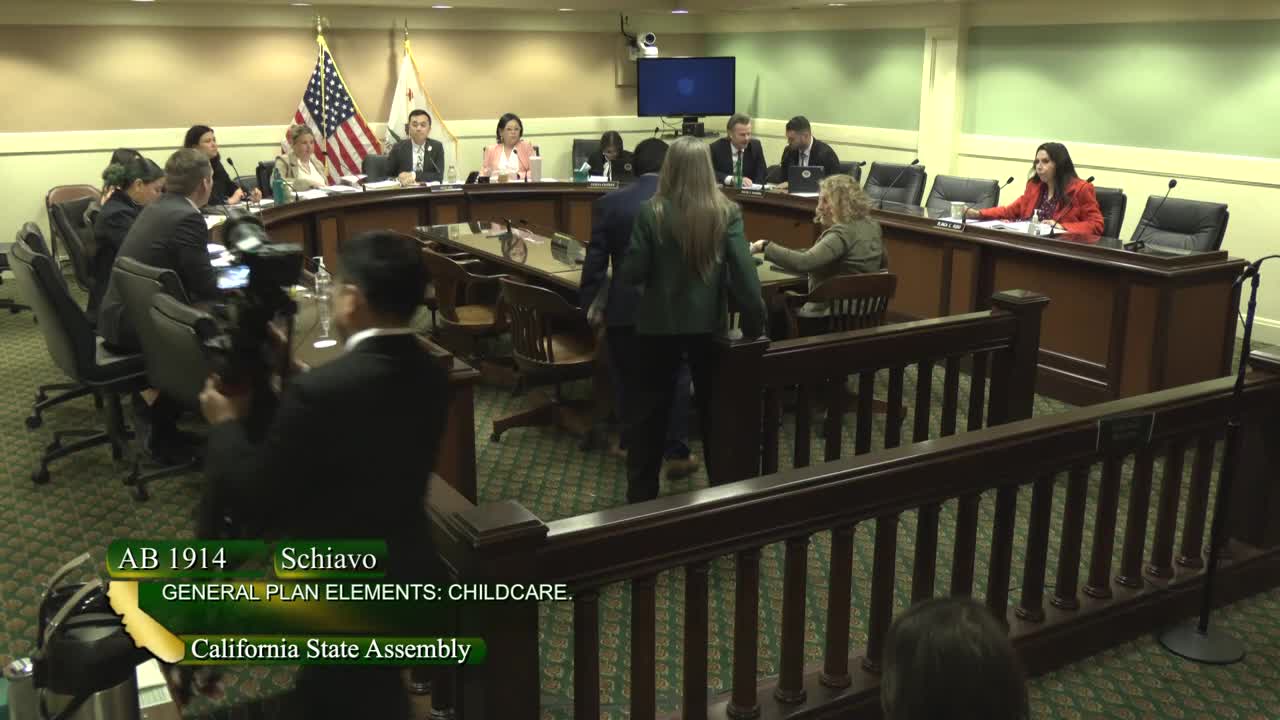 16MIN
Assembly Standing Committee on Human Services
 32MIN