AB 458: Public contracts: firearms, ammunition, and firearm accessories.
- Session Year: 2025-2026
- House: Assembly
- Latest Version Date: 2026-07-02
Current Status:
In Progress
(2026-08-17: Ordered to inactive file at the request of Senator Ashby.)
Introduced
In Committee
Awaiting First Chamber Vote
Passed First Chamber
In Committee
Awaiting Second Chamber Vote
Passed Second Chamber
Enacted
Existing law generally regulates contracts entered into by any state agency for the acquisition of goods and requires public contracts to be awarded by competitive bidding pursuant to specified procedures.
This bill would require, no later than July 1, 2027, the Department of General Services, in consultation with the Department of Justice, to develop model guidelines for offices, officers, departments, divisions, boards, bureaus, and commissions of the state on the procurement of firearms, ammunition, and firearm accessories.
Existing law generally regulates contracts entered into by any state agency for the acquisition of goods and requires public contracts to be awarded by competitive bidding pursuant to specified procedures. Existing law makes specified violations of these provisions a crime.This bill would, during the bidding process, on an annual basis, and upon request of the Department of General Services or a state agency, as applicable, require a bidder for, or a party to, a contract with a state agency for the procurement of firearms, ammunition, or firearm accessories to take specified acts. The bill would require a state agency to reject a bid or cancel a contract under specified circumstances. The bill would define various terms for these purposes. By expanding the scope of a crime, this bill would impose a state-mandated local program.The California Constitution requires the state to reimburse local agencies and school districts for certain costs mandated by the state. Statutory provisions establish procedures for making that reimbursement.This bill would provide that no reimbursement is required by this act for a specified reason.Existing law generally regulates contracts entered into by any state agency for the acquisition of goods and requires public contracts to be awarded by competitive bidding pursuant to specified procedures. Existing law makes specified violations of these provisions a crime.
This bill would, during the bidding process, on an annual basis, and upon request of the Department of General Services or a state agency, as applicable, require a bidder for, or a party to, a contract with a state agency for the procurement of firearms, ammunition, or firearm accessories to take specified acts. The bill would require a state agency to reject a bid or cancel a contract under specified circumstances. The bill would define various terms for these purposes. By expanding the scope of a crime, this bill would impose a state-mandated local program.
The California Constitution requires the state to reimburse local agencies and school districts for certain costs mandated by the state. Statutory provisions establish procedures for making that reimbursement.
This bill would provide that no reimbursement is required by this act for a specified reason.
Existing law generally regulates contracts entered into by any state agency for the acquisition of goods and requires public contracts to be awarded by competitive bidding pursuant to specified procedures. Existing law makes specified violations of these provisions a crime.
This bill would, during the bidding process, on an annual basis, and upon request of the Department of General Services or a state agency, as applicable, require a bidder for, or a party to, a contract with a state agency for the procurement of firearms, ammunition, or firearm accessories to take specified acts. The bill would require a state agency to reject a bid or cancel a contract under specified circumstances. The bill would define various terms for these purposes. By expanding the scope of a crime, this bill would impose a state-mandated local program.
The California Constitution requires the state to reimburse local agencies and school districts for certain costs mandated by the state. Statutory provisions establish procedures for making that reimbursement.
This bill would provide that no reimbursement is required by this act for a specified reason.
(a)For purposes of this section, firearm accessory has the same meaning as defined in Section 3273.50 of the Civil Code.
(b)No later than July 1, 2027, the Department of General Services, in consultation with the Department of Justice, shall develop model guidelines for offices, officers, departments, divisions, boards, bureaus, and commissions of the state on the procurement of firearms, ammunition, and firearm accessories. The purpose of the model guidelines is to help state entities choose vendors and contractors for the procurement of firearms, ammunition, and firearm accessories that are in compliance with applicable local, state, and federal firearms laws.
No later than July 1, 2027, the Department of General Services, in consultation with the Department of Justice, shall develop model guidelines for offices, officers, departments, divisions, boards, bureaus, and commissions of the state on the procurement of firearms, ammunition, and firearm accessories. The purpose of the model guidelines is to help state entities choose vendors and contractors for the procurement of firearms, ammunition, and firearm accessories that are in compliance with applicable local, state, and federal firearms laws.
SECTION 1.Section 10334.1 is added to the Public Contract Code, immediately following Section 10334, to read:10334.1.(a)(1)This section shall be known, and may be cited, as the Ira Sharp Firearm and Ammunition Procurement Act.(2)The purpose and intent of this section is for the state to develop procurement practices for firearms, ammunition, and firearm accessories.(3)This section applies to any contract for procuring firearms, ammunition, or firearm accessories a state agency solicits, enters into, awards, amends, renews, or extends on or after January 1, 2026.(b)For purposes of this section:(1)Ammunition has the same meaning as defined in Section 16150 of the Penal Code.(2)Contractor means any person, firm, corporation, or partnership, or any combination thereof, who enters into a contract or agreement with a state agency.(3)Firearm has the same meaning as defined in Section 16520 of the Penal Code.(4)Firearm accessory means a supplementary item or component designed to do either of the following:(A)Enhance a firearms functionality, performance, or user experience.(B)Modify a firearm or external gear used in conjunction with a firearm, including, but not limited to, any of the following:(i)Sights and optics.(ii)Holsters.(iii)Magazines.(iv)Grips.(v)Slings.(vi)Muzzle devices, suppressors, compensators, and flash hiders.(vii)Bipods.(viii)Trigger upgrades and conversion devices.(ix)Cleaning kits.(x)Ammunition carriers.(5)Firearm precursor part has the same meaning as defined in Section 16531 of the Penal Code.(6)State agency means any office, officer, department, division, board, bureau, or commission of the state.(c)During the bidding process, on an annual basis, and upon request of the department or a state agency, as applicable, a bidder for, or party to, a contract with a state agency for the procurement of firearms, ammunition, or firearm accessories shall do all of the following:(1)Comply with all applicable local, state, and federal laws, including any licensing, certification, or permitting laws.(2)Provide proof and a copy of any required valid license, permit, or certificate to the appropriate state agency.(3)Provide materials documenting both of the following:(A)The number of trace requests the bidder or contractor received from the federal Bureau of Alcohol, Tobacco, Firearms and Explosives for each year within the past five calendar years.(B)The time between the sale of a firearm subject to a trace request described in subparagraph (A) and the crime that generated the trace request, if known.(4)Provide materials documenting any thefts or losses from the bidders or contractors premises for the past five calendar years.(5)Provide a copy of the two most recent inspection reports of any firearm, ammunition, or firearm accessory inspection conducted by a federal, state, or local agency, including, but not limited to, any followup materials documenting administrative actions taken by the agency.(6)Disclose any violation found from any type of inspection conducted by a federal, state, or local agency during the two most recent firearm, ammunition, or firearm accessory inspections.(7)Provide any materials documenting the bidders or contractors corrective actions taken in response to a finding of noncompliance or violation of any federal, state, or local firearm, ammunition, or firearm accessory law, regulation, or other requirement.(8)Provide, in writing, any practices or policies, including, but not limited to, any amendments to those practices or policies made during the solicitation process, in effect or adopted by the bidder or contractor or required by any contract term that do any of the following:(A)Prevent, detect, or screen for the transfer of firearms, ammunition, or firearm accessories to straw purchasers or firearm traffickers.(B)Prevent, detect, or screen against the sale of firearms, ammunition, or firearm accessories to an individual prohibited from possessing a firearm by federal law, state law, local law, or court order.(C)Prevent, detect, or document the theft or loss of firearms, ammunition, or firearm accessories.(D)Train employees or subcontractors to ensure compliance with all applicable federal, state, or local firearms, ammunition, or firearm accessories laws and regulations.(E)Assist law enforcement agencies in the investigation or prevention of criminal access to firearms, ammunition, or firearm accessories. This subparagraph does not require any bidder or contractor to assist law enforcement in a criminal investigation without notice.(F)Operate a digital video surveillance system.(9)Agree not to sell unserialized gun build kits or firearm precursor parts, including, but not limited to, unserialized firearms, unserialized unfinished frames, and unserialized unfinished receivers.(10)Provide a written, signed statement expressing that the seller or bidder is and will remain in compliance with any applicable federal, state, or local law related to firearm precursor parts.(d)A state agency shall reject a bid from a bidder or cancel a contract with a contractor if either of the following conditions is met:(1)The bidder or contractor has not complied with this section.(2)The state agency or the department has determined, using a scoring system, that the bidder or contractor has fallen below the minimum score required for contracting with the state.(e)A state agency shall not waive the requirements of this section.(f)(1)The department, in coordination with the Department of Justice, shall develop processes and procedures to implement this section that include, but are not limited to, a process to administer and assess a bidders or contractors compliance with the requirements of this section.(2)The processes and procedures required by paragraph (1) may include any of the following:(A)A prequalification process to prequalify potential bidders.(B)A scoring system to be used in contracting or purchasing that evaluates a bidders or contractors public safety values relating to firearms, ammunition, and firearm accessories.(C)Terminating contracts for contractors found to not be in compliance with the terms of this section. SEC. 2.No reimbursement is required by this act pursuant to Section 6 of Article XIIIB of the California Constitution because the only costs that may be incurred by a local agency or school district will be incurred because this act creates a new crime or infraction, eliminates a crime or infraction, or changes the penalty for a crime or infraction, within the meaning of Section 17556 of the Government Code, or changes the definition of a crime within the meaning of Section 6 of Article XIIIB of the California Constitution.(a)(1)This section shall be known, and may be cited, as the Ira Sharp Firearm and Ammunition Procurement Act.
(2)The purpose and intent of this section is for the state to develop procurement practices for firearms, ammunition, and firearm accessories.
(3)This section applies to any contract for procuring firearms, ammunition, or firearm accessories a state agency solicits, enters into, awards, amends, renews, or extends on or after January 1, 2026.
(b)For purposes of this section:
(1)Ammunition has the same meaning as defined in Section 16150 of the Penal Code.
(2)Contractor means any person, firm, corporation, or partnership, or any combination thereof, who enters into a contract or agreement with a state agency.
(3)Firearm has the same meaning as defined in Section 16520 of the Penal Code.
(4)Firearm accessory means a supplementary item or component designed to do either of the following:
(A)Enhance a firearms functionality, performance, or user experience.
(B)Modify a firearm or external gear used in conjunction with a firearm, including, but not limited to, any of the following:
(i)Sights and optics.
(ii)Holsters.
(iii)Magazines.
(iv)Grips.
(v)Slings.
(vi)Muzzle devices, suppressors, compensators, and flash hiders.
(vii)Bipods.
(viii)Trigger upgrades and conversion devices.
(ix)Cleaning kits.
(x)Ammunition carriers.
(5)Firearm precursor part has the same meaning as defined in Section 16531 of the Penal Code.
(6)State agency means any office, officer, department, division, board, bureau, or commission of the state.
(c)During the bidding process, on an annual basis, and upon request of the department or a state agency, as applicable, a bidder for, or party to, a contract with a state agency for the procurement of firearms, ammunition, or firearm accessories shall do all of the following:
(1)Comply with all applicable local, state, and federal laws, including any licensing, certification, or permitting laws.
(2)Provide proof and a copy of any required valid license, permit, or certificate to the appropriate state agency.
(3)Provide materials documenting both of the following:
(A)The number of trace requests the bidder or contractor received from the federal Bureau of Alcohol, Tobacco, Firearms, Firearms and Explosives for each year within the past five calendar years.
(B)The time between the sale of a firearm subject to a trace request described in subparagraph (A) and the crime that generated the trace request, if known.
(4)Provide materials documenting any thefts or losses from the bidders or contractors premises for the past five calendar years.
(5)Provide a copy of the two most recent inspection reports of any firearm, ammunition, or firearm accessory inspection conducted by a federal, state, or local agency, including, but not limited to, any followup materials documenting administrative actions taken by the agency.
(6)Disclose any violation found from any type of inspection conducted by a federal, state, or local agency during the two most recent firearm, ammunition, or firearm accessory inspections.
(7)Provide any materials documenting the bidders or contractors corrective actions taken in response to a finding of noncompliance or violation of any federal, state, or local firearm, ammunition, or firearm accessory law, regulation, or other requirement.
(8)Provide, in writing, any practices or policies, including, but not limited to, any amendments to those practices or policies made during the solicitation process, in effect or adopted by the bidder or contractor or required by any contract term that do any of the following:
(A)Prevent, detect, or screen for the transfer of firearms, ammunition, or firearm accessories to straw purchasers or firearm traffickers.
(B)Prevent, detect, or screen against the sale of firearms, ammunition, or firearm accessories to an individual prohibited from possessing a firearm by federal law, state law, local law, or court order.
(C)Prevent, detect, or document the theft or loss of firearms, ammunition, or firearm accessories.
(D)Train employees or subcontractors to ensure compliance with all applicable federal, state, or local firearms, ammunition, or firearm accessories laws and regulations.
(E)Assist law enforcement agencies in the investigation or prevention of criminal access to firearms, ammunition, or firearm accessories. This subparagraph does not require any bidder or contractor to assist law enforcement in a criminal investigation without notice.
(F)Operate a digital video surveillance system.
(9)Agree not to sell unserialized gun build kits or firearm precursor parts, including, but not limited to, unserialized firearms, unserialized unfinished frames, and unserialized unfinished receivers.
(10)Provide proof of a written, signed statement expressing that the seller or bidder is and will remain in compliance with any applicable federal, state, or local law related to firearm precursor parts.
(d)A state agency shall reject a bid from a bidder or cancel a contract with a contractor if either of the following conditions is met:
(1)The bidder or contractor has not complied with this section.
(2)The state agency or the department determines that the bidder or contractor is not aligned with the states public safety values relating to firearms, ammunition, and firearm accessories. has determined, using a scoring system, that the bidder or contractor has fallen below the minimum score required for contracting with the state.
(e)A state agency shall not do either of the following: waive the requirements of this section.
(1)Waive the requirements of this section.(2)Make exigent or emergency purchases of firearms, ammunition, or firearm accessories.(f)(1)The department, in coordination with the Department of Justice, shall develop processes and procedures to implement this section that include, but are not limited to, a process to administer and assess a bidders or contractors compliance with the requirements of this section.
(2)The processes and procedures required by paragraph (1) may include any of the following:
(A)A prequalification process to prequalify potential bidders.
(B)A scoring system to be used in contracting or purchasing that evaluates a bidders or contractors public safety values relating to firearms, ammunition, and firearm accessories.
(C)Terminating contracts for contractors found to not be in compliance with the terms of this section.
SEC. 2.No reimbursement is required by this act pursuant to Section 6 of Article XIIIB of the California Constitution because the only costs that may be incurred by a local agency or school district will be incurred because this act creates a new crime or infraction, eliminates a crime or infraction, or changes the penalty for a crime or infraction, within the meaning of Section 17556 of the Government Code, or changes the definition of a crime within the meaning of Section 6 of Article XIIIB of the California Constitution.
(a)(1)This section shall be known, and may be cited, as the Ira Sharp Firearm and Ammunition Procurement Act.
(2)The purpose and intent of this section is for the state to develop procurement practices for firearms, ammunition, and firearm accessories.
(3)This section applies to any contract for procuring firearms, ammunition, or firearm accessories a state agency solicits, enters into, awards, amends, renews, or extends on or after January 1, 2026.
(b)For purposes of this section:
(1)Ammunition has the same meaning as defined in Section 16150 of the Penal Code.
(2)Contractor means any person, firm, corporation, or partnership, or any combination thereof, who enters into a contract or agreement with a state agency.
(3)Firearm has the same meaning as defined in Section 16520 of the Penal Code.
(4)Firearm accessory means a supplementary item or component designed to do either of the following:
(A)Enhance a firearms functionality, performance, or user experience.
(B)Modify a firearm or external gear used in conjunction with a firearm, including, but not limited to, any of the following:
(i)Sights and optics.
(ii)Holsters.
(iii)Magazines.
(iv)Grips.
(v)Slings.
(vi)Muzzle devices, suppressors, compensators, and flash hiders.
(vii)Bipods.
(viii)Trigger upgrades and conversion devices.
(ix)Cleaning kits.
(x)Ammunition carriers.
(5)Firearm precursor part has the same meaning as defined in Section 16531 of the Penal Code.
(6)State agency means any office, officer, department, division, board, bureau, or commission of the state.
(c)During the bidding process, on an annual basis, and upon request of the department or a state agency, as applicable, a bidder for, or party to, a contract with a state agency for the procurement of firearms, ammunition, or firearm accessories shall do all of the following:
(1)Comply with all applicable local, state, and federal laws, including any licensing, certification, or permitting laws.
(2)Provide proof and a copy of any required valid license, permit, or certificate to the appropriate state agency.
(3)Provide materials documenting both of the following:
(A)The number of trace requests the bidder or contractor received from the federal Bureau of Alcohol, Tobacco, Firearms, and Explosives for each year within the past five calendar years.
(B)The time between the sale of a firearm subject to a trace request described in subparagraph (A) and the crime that generated the trace request, if known.
(4)Provide materials documenting any thefts or losses from the bidders or contractors premises for the past five calendar years.
(5)Provide a copy of the two most recent inspection reports of any firearm, ammunition, or firearm accessory inspection conducted by a federal, state, or local agency, including, but not limited to, any followup materials documenting administrative actions taken by the agency.
(6)Disclose any violation found from any type of inspection conducted by a federal, state, or local agency during the two most recent firearm, ammunition, or firearm accessory inspections.
(7)Provide any materials documenting the bidders or contractors corrective actions taken in response to a finding of noncompliance or violation of any federal, state, or local firearm, ammunition, or firearm accessory law, regulation, or other requirement.
(8)Provide, in writing, any practices or policies, including, but not limited to, any amendments to those practices or policies made during the solicitation process, in effect or adopted by the bidder or contractor or required by any contract term that do any of the following:
(A)Prevent, detect, or screen for the transfer of firearms, ammunition, or firearm accessories to straw purchasers or firearm traffickers.
(B)Prevent, detect, or screen against the sale of firearms, ammunition, or firearm accessories to an individual prohibited from possessing a firearm by federal law, state law, local law, or court order.
(C)Prevent, detect, or document the theft or loss of firearms, ammunition, or firearm accessories.
(D)Train employees or subcontractors to ensure compliance with all applicable federal, state, or local firearms, ammunition, or firearm accessories laws and regulations.
(E)Assist law enforcement agencies in the investigation or prevention of criminal access to firearms, ammunition, or firearm accessories.
(F)Operate a digital video surveillance system.
(9)Agree not to sell unserialized gun build kits or firearm precursor parts, including, but not limited to, unserialized firearms, unserialized unfinished frames, and unserialized unfinished receivers.
(10)Provide proof of compliance with any applicable federal, state, or local law related to firearm precursor parts.
(d)A state agency shall reject a bid from a bidder or cancel a contract with a contractor if either of the following conditions is met:
(1)The bidder or contractor has not complied with this section.
(2)The state agency or the department determines that the bidder or contractor is not aligned with the states public safety values relating to firearms, ammunition, and firearm accessories.
(e)A state agency shall not do either of the following:
(1)Waive the requirements of this section.
(2)Make exigent or emergency purchases of firearms, ammunition, or firearm accessories.
(f)(1)The department, in coordination with the Department of Justice, shall develop processes and procedures to implement this section that include, but are not limited to, a process to administer and assess a bidders or contractors compliance with the requirements of this section.
(2)The processes and procedures required by paragraph (1) may include any of the following:
(A)A prequalification process to prequalify potential bidders.
(B)A scoring system to be used in contracting or purchasing that evaluates a bidders or contractors public safety values relating to firearms, ammunition, and firearm accessories.
(C)Terminating contracts for contractors found to not be in compliance with the terms of this section.
SEC. 2.No reimbursement is required by this act pursuant to Section 6 of Article XIIIB of the California Constitution because the only costs that may be incurred by a local agency or school district will be incurred because this act creates a new crime or infraction, eliminates a crime or infraction, or changes the penalty for a crime or infraction, within the meaning of Section 17556 of the Government Code, or changes the definition of a crime within the meaning of Section 6 of Article XIIIB of the California Constitution.
|
Date
|
Status
|
|---|---|
| Aug 17, 2026 | Ordered to inactive file at the request of Senator Ashby. |
| Aug 13, 2026 | Read second time. Ordered to third reading. |
| Aug 13, 2026 | From committee: Do pass. (Ayes 5. Noes 0.) (August 13). |
| Aug 3, 2026 | In committee: Referred to APPR. suspense file. |
| Jul 2, 2026 | Read second time and amended. Re-referred to Com. on APPR. |
| Jul 1, 2026 | From committee: Amend, and do pass as amended and re-refer to Com. on APPR. (Ayes 5. Noes 0.) (June 30). |
| Jun 23, 2026 | From committee: Do pass and re-refer to Com. on PUB. S. (Ayes 11. Noes 0.) (June 23). Re-referred to Com. on PUB. S. |
| Jun 18, 2025 | Referred to Coms. on G.O. and PUB. S. |
| Jun 4, 2025 | In Senate. Read first time. To Com. on RLS. for assignment. |
| Jun 3, 2025 | Read third time. Passed. Ordered to the Senate. (Ayes 66. Noes 3. Page 2006.) |
| May 27, 2025 | Read second time. Ordered to third reading. |
| May 23, 2025 | Read second time and amended. Ordered returned to second reading. |
| May 23, 2025 | From committee: Amend, and do pass as amended. (Ayes 11. Noes 2.) (May 23). |
| May 23, 2025 | Assembly Rule 63 suspended. (Ayes 51. Noes 16. Page 1644.) |
| May 7, 2025 | In committee: Set, first hearing. Referred to APPR. suspense file. |
| Apr 7, 2025 | Re-referred to Com. on APPR. |
| Apr 3, 2025 | Read second time and amended. |
| Apr 2, 2025 | From committee: Amend, and do pass as amended and re-refer to Com. on APPR. (Ayes 8. Noes 0.) (April 1). |
| Mar 10, 2025 | Referred to Com. on PUB. S. |
| Feb 7, 2025 | From printer. May be heard in committee March 9. |
| Feb 6, 2025 | Read first time. To print. |
|
Date
|
Description
|
Location
|
Votes
|
|
|---|---|---|---|---|
| Aug 13, 2026 | Do pass | Senate Standing Committee on Appropriations |
Passed |
|
| Aug 3, 2026 | Placed on suspense file | Senate Standing Committee on Appropriations |
Passed |
|
| Jun 30, 2026 | Do pass as amended, but first amend, and re-refer to the Committee on [Appropriations] | Senate Standing Committee on Public Safety |
Passed |
|
| Jun 23, 2026 | Do pass, but first be re-referred to the Committee on [Public Safety] | Senate Standing Committee on Governmental Organization |
Passed |
|
| Jun 3, 2025 | AB 458 Stefani Assembly Third Reading | Assembly Floor |
Passed |
|
| May 23, 2025 | Do pass as amended. | Assembly Standing Committee on Appropriations |
Passed |
|
| Apr 1, 2025 | Do pass as amended and be re-referred to the Committee on [Appropriations] | Assembly Standing Committee on Public Safety |
Passed |
This list shows positions taken on this bill by organizations on the date displayed, which is linked to the original source.
Positions by individuals are not included.
|
Organization
|
Position
|
Date
|
|---|---|---|
| Board of Supervisors of the City and County of San Francisco | ** Support | |
| Brady California (co-source) | ** Support | |
| Brady Campaign (co-source) | ** Support | |
| Brady United Against Gun Violence | ** Support | |
| California Police Chiefs Association | ** Support | |
| Everytown for Gun Safety | ** Support | |
| Giffords | ** Support | |
| GIFFORDS Courage to Prevent Gun Violence | ** Support | |
| Gun Owners of California | ** Against | |
| Moms Demand Action for Gun Sense in America | ** Support | |
| National Rifle Association in California | ** Against | |
| NeverAgainCA | ** Support | |
| San Francisco Board of Supervisors | ** Support | |
| Silicon Valley Alliance for Gun Safety | ** Support | |
| Students Demand Action for Gun Sense in America | ** Support |
SENATE RULES COMMITTEE Office of Senate Floor Analyses (916) 651-4171 | AB 458 |
THIRD READING
Bill No: AB 458
Author: Stefani (D)
Amended: 7/2/26 in Senate
Vote: 21
SENATE GOVERNMENTAL ORG. COMMITTEE: 11-0, 6/23/26
AYES: Rubio, Archuleta, Ashby, Blakespear, Cervantes, Hurtado, Padilla, Richardson, Smallwood-Cuevas, Wahab, Weber Pierson
NO VOTE RECORDED: Valladares, Alvarado-Gil, Dahle, Ochoa Bogh
SENATE PUBLIC SAFETY COMMITTEE: 5-0, 6/30/26
AYES: Arreguín, Caballero, Cortese, Pérez, Wiener
NO VOTE RECORDED: Seyarto
SENATE APPROPRIATIONS COMMITTEE: 5-0, 8/13/26
AYES: Cervantes, Cabaldon, Grayson, Richardson, Wahab
NO VOTE RECORDED: Seyarto, Dahle
ASSEMBLY FLOOR: 66-3, 6/3/25 - See last page for vote
SUBJECT: Public contracts: firearms, ammunition, and firearm accessories
SOURCE: Brady California
Brady Campaign to Prevent Gun Violence
DIGEST:
This bill requires the Department of General Services (DGS), in consultation with the Department of Justice (DOJ), to develop model guidelines for state entities, as defined, on the procurement of firearms, ammunition, and firearm accessories, as specified.
ANALYSIS:
Existing law:
- States that DGS shall adopt, publish, and apply uniform standards of rating bidders, on the basis of questionnaires and required statements, with respect to contracts upon which each bidder is qualified to bid.
- Provides that DGS may remove a bidder who has demonstrated a lack of reliability in complying with and completing previously awarded contracts with the state, based upon his or her performance on contracts previously awarded by the state.
- Requires the Director of DGS to establish statewide acquisition standards, the purpose of which shall be to ensure the necessary quality of goods acquired, as specified.
- Defines “firearm” to mean a device, designed to be used as a weapon, from which is expelled through a barrel, a projectile by the force of explosion or other form of combustion.
- Defines a “firearm accessory” to mean an attachment or device designed or adapted to be inserted into, affixed onto, or used in conjunction with a firearm that is designed, intended, or functions to increase a firearm’s rate of fire or to increase the speed at which a person may reload a firearm or replace the magazine, or any other attachment or device, as specified, that may render a firearm an assault weapon when inserted into, affixed onto, or used in conjunction with a firearm. The term firearm accessory also includes any other device, took, kit, part, or parts set that is clearly designed and intended for use in manufacturing firearms.
- Defines “ammunition” to mean one or more loaded cartridges consisting of a primed case, propellant, and with one or more projectiles, but does not include blanks.
This bill:
- Requires, no later than July 1, 2027, DGS, in consultation with the DOJ, to develop model guidelines for offices, officers, departments, divisions, boards, bureaus, and commissions of the state on the procurement of firearms, ammunition, and firearm accessories.
- Provides that the purpose of these guidelines is to help state entities choose vendors and contractors for the procurement of firearms, ammunition, and firearm accessories that are in compliance with applicable local, state, and federal firearm laws.
Background
Author Statement. According to the author’s office, “the state of California can use the power of its purse to incentivize compliance with the laws and implementation of safe business practices for firearms vendors vying for state procurement contracts. Firearms vendors can promote public safety and help law enforcement prevent gun trafficking and gun violence. AB 458 takes the important step of ensuring that model guidelines are developed for state departments and agencies on the procurement of firearms and ammunition, which would reduce the likelihood of trafficking, gun crime, and violence.”
Public Procurement of Firearms. This bill requires DGS, in consultation with the DOJ, to develop model guidelines for state agencies and departments regarding the procurement of firearms, ammunition, and firearms accessories. According to the author’s office, one of the motivations of this bill is a recent report by the Brady Campaign titled Government Agencies Should Screen Firearms Vendors which examined public agency firearms procurement practices. The report found that California public agencies spent approximately $18 million in taxpayer funds purchasing firearms from a dealer with a history of compliance issues identified by the federal Bureau of Alcohol, Tobacco, Firearms and Explosives (ATF). The report also identified another dealer that had been cited for multiple federal recordkeeping violations and for unlawfully possessing prohibited firearms.
The report further argues that firearms dealers with histories of noncompliance with federal firearms laws are more likely to have firearms from their inventories later recovered during criminal investigations. In support of this claim, the report cites ATF inspection data showing that, among the approximately one percent of firearms dealers linked to nearly 60% of crime guns recovered nationwide, 75% were found to have violated federal law, including significant recordkeeping deficiencies and unlawful sales practices involving prohibited purchasers of potential firearms traffickers. By comparison, ATF inspections of a random sample of dealers found noncompliance rates closer to 37%.
This bill provides that the purpose of the model procurement guidelines is to help state entities choose vendors and contractors for the procurement of firearms, ammunition, and firearm accessories that are in compliance with applicable local, state, and federal firearms laws.
Firearm Dealer Licensing. Federal law requires firearms dealers to obtain a federal firearms license (FFL) from the ATF. The ATF issues different types of licenses for dealers, manufacturers, importers, collectors, and pawnbrokers. As of January 2026, California had approximately 1,300+ licensed firearms dealers and pawnbrokers and more than 12,000 FFL holders overall. However, an FFL alone is not sufficient to sell firearms in California. State law requires firearms dealers to obtain additional state and local licenses and permits, secure a Certificate of Eligibility from the DOJ, and be listed on the DOJ’s centralized roster of firearms dealers. Only dealers meeting these requirements may lawfully sell, lease, or transfer firearms in California, subject to limited exemptions.
California firearms dealers are also subject to extensive state and federal regulations governing recordkeeping, inventory security, firearm transfers, storage requirements, and other operational practices. Research has consistently found a relationship between dealer compliance and the likelihood that firearms from a dealer’s inventory will later be recovered in connection with criminal activity.
In 2021, the Legislature enacted AB 1191 (McCarty, Chapter 683, Statutes of 2021), requiring the DOJ to analyze and report on crime-gun trends and sources. DOJ’s most recent report, released in July 2025, found that more than one-third of crime guns recovered in the previous year had a prior transaction record in the State’s Automated Firearms System, while more than one-quarter could be traced to a specific California dealer. The report further found that just 81 California dealers were associated with approximately half of all traceable crime guns recovered in 2024, highlighting the concentration of crime-gun traces among a relatively small number of dealers.
DGS Division and DOJ Bureau of Firearms. According to DGS’s internet website, the Procurement Division sets state procurement policies and provides purchasing services. It delegates purchasing authority; certifies small and/or disabled veteran businesses to do business with the state; sponsors the Small Business Council; participates in the Disabled Veterans Business Enterprise Council; and provides innovative purchasing methods that save taxpayer’s dollars, integrating quality solutions to meet customer’s needs.
The DOJ’s Bureau of Firearms serves the people of California through education regulation, and enforcement actions regarding manufacture, sales, ownership, safety training, and transfer of firearms. Bureau of Firearms staff are leaders in providing firearms expertise and information to law enforcement, legislators, and the general public in a comprehensive program to promote legitimate and responsible firearms possession and use by California residents.
Purchases of Firearms by Law Enforcement and Effect of this Bill. According to the Senate Public Safety Committee analysis of this bill:
California has some of the strictest firearm purchasing policies in the nation. Subject to narrow exceptions, existing law generally requires all firearm sales or transfers to be completed through a licensed dealer. When both parties to a sale or transfer are not licensed, licensed dealers act as intermediaries, who must conduct the required background checks and deliver the firearm to the transferee. Only certain gun sales and transfers are exempt from participation by a licensed dealer, including infrequent transfers between immediate family members, certain government-sponsored transfers, transfers to historical societies, museums or institutional collections, and transfers to licensed firearms manufacturers and importers, among a few others. Existing law includes several grounds for the forfeiture of a license to sell firearms if the various procedures prescribed by law are not followed
Moreover, individuals who purchase a firearm are also subject to a 10-day waiting period that restricts a licensed dealer from delivering or transferring a firearm to a person within 10 days of the application to purchase the firearm, the submission of any correction to the application, or the submission of any fee required, after notice from the DOJ that the required fee has not been transmitted. Even though the required background checks can usually be completed within a few days, licensed dealers must wait the full 10 days before transferring possession of the firearm to the purchaser. In addition to the waiting period, prospective purchasers must undergo a rigorous background check process. California’s Proposition 63, effective July 1, 2017, required the DOJ to serve as the point of contact for firearm purchaser background checks. Thus, dealers must initiate the background check required by federal law by contacting the DOJ, and must furnish the DOJ with various information about the purchaser. Collectively, this information is known as the Dealer’s Record of Sale, or DROS, and includes 40 distinct pieces of information about the purchaser pursuant to Penal Code §28160.
California law enforcement agencies are exempt from all of the above requirements. Existing law, for each of the distinct requirements specified in the previous two paragraphs, includes a specific exemption for law enforcement agencies. That is, law enforcement agencies do not necessarily have to purchase firearms from a licensed dealer, do not have to wait the 10 days that civilian purchasers must wait, and need not undergo a background check and provide information through the DROS system. Moreover, while Californians generally are restricted in what handguns they may purchase by a system known as the DOJ roster of “not unsafe” handguns, this statutory framework includes a tiered exemption scheme for specified law enforcement entities, set forth in Penal Code section 32000, establishing three groups of entities that are subject to varying prerequisites for purchase, eligibility to purchase for personal use, and restrictions on resale of un-rostered handguns.
Law enforcement agencies purchase a high volume of firearms – cities across the United States spend in excess of $5 billion a year on guns alone, with ammunition and other firearm-related supplies costing a few billion more. Indeed, the number one purchase of firearms in the United States is the taxpayer. In support of this bill, the author cites a Brady Campaign report on public agency firearm procurement practices, which found that 67 California law enforcement agencies spent a total of $18 million in California taxpayer funds between 2015 and 2021 at a dealer with a relatively poor compliance history with the Bureau of Alcohol, Tobacco, Firearms and Explosives (ATF). This report went on to cite data from the ATF highlighting that when ATF inspected the 1% of gun dealers that supplied almost 60% of crime guns nationwide, it found that 75% of these dealers had violated federal law, including significant recordkeeping violations and participation in sales to potential gun traffickers and prohibited persons. By comparison, when ATF inspected a random sample of dealers, the number that were found to be noncompliant dropped to 37%.
This bill takes a first step toward ensuring that the public procurement process for firearms adheres to, or can at least be informed by, a standard set of guidelines that applies to all state entities. Specifically, this bill requires DGS, no later than July 1, 2027 to develop model guidelines for offices, officers, departments, divisions, boards, bureaus, and commissions of the state on the procurement of firearms, ammunition, and firearm accessories, in consultation with DGS. The stated purpose of the model guidelines, pursuant to this bill, is to help state entities choose vendors and contractors for the procurement of firearms, ammunition, and firearm accessories that are in compliance with applicable local, state, and federal firearms laws. The author and Committee may wish to consider amending the bill to include a definition of “firearm accessories,” as no such definition currently exists in California law.
Related/Prior Legislation
AB 1810 (Berman, 2026) requires the DOJ to annually inspect the 10 firearm dealer locations with the highest percentage of total sales that were recovered by law enforcement, as specified; to grant DOJ de-licensure authority for dealers who fail to comply with inspection-related requirements; and to modify DOJ’s fee authority with regard to dealers. (Pending in the Senate Appropriations Committee)
AB 1191 (McCarty, Chapter 683, Statutes of 2021) required the DOJ to analyze information reported by law enforcement agencies regarding the history of a recovered firearm that is illegally possessed, has been used in a crime, or is suspected of having been used in a crime.
FISCAL EFFECT: Appropriation: No Fiscal Com.: Yes Local: No
According to the Senate Appropriations Committee, unknown one-time costs, potentially ranging from absorbable to the low hundreds of thousands of dollars (Service Revolving Fund), for DGS to develop the guidance and update the State Administrative Manual (SAM) and State Contracting Manual (SCM). The upfront workload to create this guidance is expected to be the primary cost driver, with ongoing costs likely decreasing as the department transitions to updating vendor selection best practices as necessary.
DOJ does not anticipate a significant fiscal impact to consult with DGS to develop the firearms procurement guidelines.
SUPPORT: (Verified 8/13/26)
Brady California (co-source)
Brady Campaign (co-source)
Brady United Against Gun Violence
Board of Supervisors of the City and County of San Francisco
California Police Chiefs Association
Everytown for Gun Safety
GIFFORDS Courage to Prevent Gun Violence
Moms Demand Action for Gun Sense in America
NeverAgainCA
Silicon Valley Alliance for Gun Safety
Students Demand Action for Gun Sense in America
OPPOSITION: (Verified 8/13/26)
Gun Owners of California
National Rifle Association in California
ARGUMENTS IN SUPPORT: According to the Brady Campaign, “multiple state agencies and departments – such as the California Highway Patrol and the California Department of Corrections and Rehabilitation – purchase firearms, ammunition, and related accessories with California taxpayer funds. As a matter of common sense, the State, especially agencies tasked with protecting the public, should ensure that its procedures dangerous items in a manner that safeguards public safety.”
ARGUMENTS IN OPPOSITION: According to the National Rifle Association of California, “AB 458 imposes additional red tape and bureaucratic hurdles on those bidding or contracting with a state agency for the procurement of firearms, ammunition, or firearm accessories. Despite the extensive administrative procedures and requirements already existing in state law, this new ‘vigorous vetting process’ (as touted by the author) will only serve to unduly burden those seeking to contract with the state.”
ASSEMBLY FLOOR: 66-3, 6/3/25
AYES: Addis, Aguiar-Curry, Ahrens, Alanis, Alvarez, Arambula, Ávila Farías, Bains, Bauer-Kahan, Bennett, Berman, Boerner, Bonta, Bryan, Calderon, Caloza, Carrillo, Connolly, Davies, Elhawary, Fong, Gabriel, Gallagher, Garcia, Gipson, Jeff Gonzalez, Mark González, Haney, Harabedian, Hart, Irwin, Jackson, Kalra, Krell, Lackey, Lee, Lowenthal, Muratsuchi, Nguyen, Ortega, Pacheco, Papan, Patel, Patterson, Pellerin, Petrie-Norris, Quirk-Silva, Ramos, Ransom, Celeste Rodriguez, Michelle Rodriguez, Rogers, Blanca Rubio, Schiavo, Schultz, Sharp-Collins, Solache, Soria, Stefani, Valencia, Wallis, Ward, Wicks, Wilson, Zbur, Rivas
NOES: DeMaio, Dixon, Sanchez
NO VOTE RECORDED: Castillo, Chen, Ellis, Flora, Hadwick, Hoover, Macedo, McKinnor, Ta, Tangipa
Prepared by: Brian Duke / G.O. / (916) 651-1530
8/14/26 10:47:13
SENATE COMMITTEE ON
Senator Sabrina Cervantes, Chair
2025 - 2026 Regular Session
AB 458 (Stefani) - Public contracts: firearms, ammunition, and firearm accessories
Version: | Policy Vote: |
Urgency: | Mandate: |
Hearing Date: | Consultant: |
Bill Summary:
AB 458 requires the Department of General Services (DGS), in consultation with the Department of Justice (DOJ), to develop model guidelines for state entities on the procurement of firearms, ammunition, and firearm accessories.
Fiscal Impact:
- Unknown one-time costs, potentially ranging from absorbable to the low hundreds of thousands of dollars (Service Revolving Fund), for DGS to develop the guidance and update the State Administrative Manual (SAM) and State Contracting Manual (SCM). The upfront workload to create this guidance is expected to be the primary cost driver, with ongoing costs likely decreasing as the department transitions to updating vendor selection best practices as necessary.
- DOJ does not anticipate a significant fiscal impact to consult with DGS to develop the firearms procurement guidelines.
Background:
Federal law requires firearms dealers to obtain a federal firearms license (FFL) from the federal Bureau of Alcohol, Tobacco, Firearms and Explosives (ATF). The ATF issues different types of licenses for dealers, manufacturers, importers, collectors, and pawnbrokers. As of January 2026, California had approximately 1,300+ licensed firearms dealers and pawnbrokers and more than 12,000 FFL holders overall. However, an FFL alone is not sufficient to sell firearms in California. State law requires firearms dealers to obtain additional state and local licenses and permits, secure a Certificate of Eligibility from the DOJ, and be listed on the DOJ’s centralized roster of firearms dealers. Only dealers meeting these requirements may lawfully sell, lease, or transfer firearms in California, subject to limited exemptions.
California firearms dealers are also subject to extensive state and federal regulations governing recordkeeping, inventory security, firearm transfers, storage requirements, and other operational practices. Research has consistently found a relationship between dealer compliance and the likelihood that firearms from a dealer’s inventory will later be recovered in connection with criminal activity.
Proposed Law:
- By July 1, 2027, requires DGS, in consultation with DOJ, to develop model guidelines for offices, officers, departments, divisions, boards, bureaus, and commissions of the state on the procurement of firearms, ammunition, and firearm accessories.
- States the purpose of these guidelines is to help state entities choose vendors and contractors for the procurement of firearms, ammunition, and firearm accessories that are in compliance with applicable local, state, and federal firearms laws.
- Defines “firearm accessory” to mean an attachment or device designed or adapted to be inserted into, affixed onto, or used in conjunction with a firearm that is designed, intended, or functions to increase a firearm’s rate of fire or to increase the speed at which a person may reload a firearm or replace the magazine, or any other attachment or device described in subdivision (a) of Section 30515 of the Penal Code that may render a firearm an assault weapon when inserted into, affixed onto, or used in conjunction with a firearm. The term firearm accessory also includes any other device, tool, kit, part, or parts set that is clearly designed and intended for use in manufacturing firearms.
-- END --
SENATE COMMITTEE ON PUBLIC SAFETY
Senator Jesse Arreguín, Chair
2025 - 2026 Regular
Bill No: AB 458 Hearing Date: June 30, 2026
Author: | Stefani | ||
Version: | May 23, 2025 | ||
Urgency: | No | Fiscal: | Yes |
Consultant: | AB | ||
Subject: Public contracts: firearms, ammunition, and firearm accessories
HISTORY
Source: Author
Prior Legislation: AB 733 (M. Fong), vetoed, 2023
SB 99 (Umberg), held in Assembly Appropriations, 2023
AB 1486 (Jones-Sawyer), died on Senate Inactive File, 2023
AB 481 (Chiu), Ch. 406, Stats. of 2021
Support: California Police Chiefs Association; San Francisco Board of Supervisors
Opposition: None known
Assembly Floor Vote: 66 - 3
PURPOSE
The purpose of this bill is to require the Department of General Services (DGS), in consultation with the Department of Justice (DOJ), by no later than July 1, 2027, to develop model guidelines for offices, officers, departments, divisions, boards, bureaus, and commissions of the state on the procurement of firearms, ammunition, and firearm accessories.
Existing law provides that no state shall pass any law impairing the obligation of contracts. (U.S. Const., art. I, Sec. 10, cl. 1.)
Existing law provides that Congress shall have the power to regulate commerce with foreign nations, among states, and with the Indian tribes. (U.S. Const., art. I, Sec. 8, cl. 3.)
Existing law provides that a law impairing the obligation of contracts may not be passed. (Cal. Const., art. I, § 9.)
Existing law states that all contracts for goods and services above $25,000 shall be made or entered into with the lowest responsible bidder, unless otherwise determined by the needs of the agency or direction from the DGS. (Pub. Cont. Code, § 10301.)
Existing law provides that in cases of emergency where immediate purchase of goods without bid is necessary for the protection of the public health, welfare, or safety, whenever the department contracts for goods in excess of $25,000, or a higher amount as established by the director, the DGS shall advertise in the California State Contracts Register the availability of its solicitation, and interested suppliers, upon request, shall be furnished with copies of the solicitation. (Pub. Cont. Code, § 10302.)
Existing law states that DGS shall adopt, publish and apply uniform standards of rating bidders, on the basis of questionnaires and required statements, with respect to contracts upon which each bidder is qualified to bid. (Pub. Cont. Code, § 10303.)
Existing law provides that DGS may remove a bidder who has demonstrated a lack of reliability in complying with and completing previously awarded contracts with the state, based upon his or her performance on contracts previously been awarded by the state. (Pub. Cont. Code, § 10303.)
Existing law establishes that every acquisition of goods in excess of $100 for any state agency shall be made by or under the supervision of DGS. However, the state agency may specify the quality of the goods to be acquired. (Pub. Cont. Code, § 10308.)
Existing law provides that if the agency is of the opinion the interests of the state would not be served by the acquisition of goods of a lesser quality or different than that specified by the agency, the agency may request a hearing before DGS and the department shall determine which goods will best serve the interests of the state, whereupon the department shall issue a contract for the goods specified by the department. (Pub. Cont. Code, § 10308.)
Existing law requires DGS to delegate purchasing authority, as defined, to any state agency that fulfils certain requirements, as specified. (Pub. Cont. Code, § 10333, subd. (a)(1)-(5).)
Existing law defines “firearm” as a device, designed to be used as a weapon, from which is expelled through a barrel, a projectile by the force of an explosion or other form of combustion. (Pen. Code, § 16520, subd. (a).)
Existing law defines “firearms precursor part” as any forging, casting, printing, extrusion, machined body or similar article that has reached a stage in manufacture where it may readily be completed, assembled or converted to be used as the frame or receiver of a functional firearm, or that is marketed or sold to the public to become or be used as the frame or receiver of a functional firearm once completed, assembled or converted. (Pen. Code, § 16531, subd. (a).)
Existing law provides that no person shall sell, lease, or transfer firearms unless the person has been issued a license pursuant to existing law, and provides that a violation of this provision is punishable as a misdemeanor. (Pen. Code, § 26500.)
Existing law provides that the above prohibition does not apply to the sale, delivery or transfer of a firearm when made by an authorized law enforcement representative, as specified. (Pen. Code, § 26620.)
Existing law provides that a state officer or employee, or operator lessee, or licensee of any state property, shall not contract for, authorize, or allow the sale of any firearm, firearm precursor part, or ammunition on state property or in the buildings that sit on state property or property otherwise owned, leased, occupied, or operated by the state, except as provided (Pen. Code, § 27573.)
This bill provides that by no later than July 1, 2027, DGS, in consultation with DOJ, shall develop model guidelines for offices, officers, departments, divisions, boards, bureaus, and commissions of the state on the procurement of firearms, ammunition, and firearm accessories.
This bill specifies that the purpose of the model guidelines is to help state entities choose vendors and contractors for the procurement of firearms, ammunition, and firearm accessories that are in compliance with applicable local, state, and federal firearms laws.
COMMENTS
- Need for This Bill
No author’s statement has been submitted for this bill.
- Purchases of Firearms by Law Enforcement and Effect of This Bill
California has some of the strictest firearm purchasing policies in the nation. Subject to narrow exceptions, existing law generally requires all firearm sales or transfers to be completed through a licensed dealer. When both parties to a sale or transfer are not licensed, licensed dealers act as intermediaries, who must conduct the required background checks and deliver the firearm to the transferee.[1] Only certain gun sales and transfers are exempt from participation by a licensed dealer, including infrequent transfers between immediate family members, certain government-sponsored transfers, transfers to historical societies, museums or institutional collections, and transfers to licensed firearms manufacturers and importers, among a few others.[2] Existing law includes several grounds for the forfeiture of a license to sell firearms if the various procedures prescribed by law are not followed.[3]
Moreover, individuals who purchase a firearm are also subject to a 10-day waiting period that restricts a licensed dealer from delivering or transferring a firearm to a person within 10 days of the application to purchase the firearm, the submission of any correction to the application, or the submission of any fee required, after notice from the DOJ that the required fee has not been transmitted. Even though the required background checks can usually be completed within a few days, licensed dealers must wait the full 10 days before transferring possession of the firearm to the purchaser. In addition to the waiting period, prospective purchasers must undergo a rigorous background check process. California’s Proposition 63, effective July 1, 2017, required the DOJ to serve as the point of contact for firearm purchaser background checks. Thus, dealers must initiate the background check required by federal law by contacting the DOJ, and must furnish the DOJ with various information about the purchaser.[4] Collectively, this information is known as the Dealer’s Record of Sale, or DROS, and includes 40 distinct pieces of information about the purchaser pursuant to Penal Code §28160.[5]
California law enforcement agencies are exempt from all of the above requirements. Existing law, for each of the distinct requirements specified in the previous two paragraphs, includes a specific exemption for law enforcement agencies. That is, law enforcement agencies do not necessarily have to purchase firearms from a licensed dealer, do not have to wait the 10 days that civilian purchasers must wait, and need not undergo a background check and provide information through the DROS system.[6] Moreover, while Californians generally are restricted in what handguns they may purchase by a system known as the DOJ roster of “not unsafe” handguns, this statutory framework includes a tiered exemption scheme for specified law enforcement entities, set forth in Penal Code section 32000, establishing three groups of entities that are subject to varying prerequisites for purchase, eligibility to purchase for personal use, and restrictions on resale of un-rostered handguns.[7]
Law enforcement agencies purchase a high volume of firearms – cities across the United States spend in excess of $5 billion a year on guns alone, with ammunition and other firearm-related supplies costing a few billion more.[8] Indeed, the number one purchase of firearms in the United States is the taxpayer. In support of this bill, the author cites a Brady Campaign report on public agency firearm procurement practices, which found that 67 California law enforcement agencies spent a total of $18 million in California taxpayer funds between 2015 and 2021 at a dealer with a relatively poor compliance history with the Bureau of Alcohol, Tobacco, Firearms and Explosives (ATF).[9] This report went on to cite data from the ATF highlighting that when ATF inspected the 1% of gun dealers that supplied almost 60% of crime guns nationwide, it found that 75% of these dealers had violated federal law, including significant recordkeeping violations and participation in sales to potential gun traffickers and prohibited persons. By comparison, when ATF inspected a random sample of dealers, the number that were found to be noncompliant dropped to 37%.[10]
This bill takes a first step toward ensuring that the public procurement process for firearms adheres to, or can at least be informed by, a standard set of guidelines that applies to all state entities. Specifically, the bill requires DGS, no later than July 1, 2027 to develop model guidelines for offices, officers, departments, divisions, boards, bureaus, and commissions of the state on the procurement of firearms, ammunition, and firearm accessories, in consultation with DGS. The stated purpose of the model guidelines, pursuant to the bill, is to help state entities choose vendors and contractors for the procurement of firearms, ammunition, and firearm accessories that are in compliance with applicable local, state, and federal firearms laws. The author and Committee may wish to consider amending the bill to include a definition of “firearm accessories,” as no such definition currently exists in California law.
- Argument in Support
According to the California Police Chiefs Association:
AB 458 establishes commonsense accountability standards for vendors seeking contracts with state agencies for the procurement of firearms, ammunition, and firearm accessories. The bill requires contractors to demonstrate compliance with applicable laws, disclose relevant inspection and compliance histories, document efforts to prevent firearm trafficking and straw purchases, maintain policies to prevent theft and diversion, and cooperate with law enforcement efforts to
prevent criminal access to firearms. The measure further requires state agencies to evaluate these factors when making procurement decisions.
California law enforcement agencies depend on responsible manufacturers, distributors, and vendors to help ensure firearms and related products remain out of the hands of prohibited persons and criminal organizations. When public agencies procure firearms and ammunition, taxpayers should have confidence that state contracts are being awarded to businesses that maintain strong compliance practices, support efforts to combat illegal firearm trafficking, and operate with transparency and accountability.
AB 458 advances these objectives by encouraging best practices throughout the firearms supply chain. The bill promotes responsible stewardship of public funds while reinforcing the important role that industry partners play in preventing firearm theft, diversion, and unlawful trafficking. It also recognizes the value of cooperation between private sector vendors and law enforcement agencies investigating crimes involving firearms.
From a public safety perspective, the information required under AB 458 will assist state agencies in identifying vendors that have demonstrated a commitment to legal compliance, secure inventory management, employee training, and proactive measures to prevent criminal access to firearms and ammunition. These are important considerations when public entities are purchasing products that have significant public safety implications.
-- END --
Pen. Code, § 27545. ↑
Pen. Code, §§ 27850 et. seq. ↑
Pen. Code, §§ 26800 et. seq. ↑
Penal Code §§28160, 28205. ↑
See the DROS Worksheet that must be submitted to DOJ: https://des.doj.ca.gov/forms/DROS_Worksheet_BOF-929.pdf ↑
See Pen. Code, §§ 26660, 28400, 26950. ↑
See Pen. Code, §§ 31900, 32000. ↑
“Preventing gun violence through the power of procurement.” Brady Campaign. 2021, https://assets.bradyunited.org/production/files/NJ-Procurement.pdf?dm=1716461312 , at p.5. ↑
Brady United Against Gun Violence. A California Case Study: Government Agencies Should Screen Firearms Vendors. <https://s3.amazonaws.com/brady-static/Procurement-CA-v5.pdf, at p.4. ↑
Ibid.i ↑
SENATE COMMITTEE ON GOVERNMENTAL ORGANIZATION
Senator Steve Padilla
Chair
2025 - 2026 Regular
Bill No: Hearing Date: 6/23/2026
Author: | |||
Version: | Amended | ||
Urgency: | Fiscal: | ||
Consultant: | Brian Duke | ||
SUBJECT:
DIGEST: This bill requires the Department of General Services (DGS), in consultation with the Department of Justice (DOJ), to develop model guidelines for state entities, as defined, on the procurement of firearms, ammunition, and firearm accessories, as specified.
ANALYSIS:
Existing law:
- States that DGS shall adopt, publish, and apply uniform standards of rating bidders, on the basis of questionnaires and required statements, with respect to contracts upon which each bidder is qualified to bid.
- Provides that DGS may remove a bidder who has demonstrated a lack of reliability in complying with and completing previously awarded contracts with the state, based upon his or her performance on contracts previously awarded by the state.
- Requires the Director of DGS to establish statewide acquisition standards, the purpose of which shall be to ensure the necessary quality of goods acquired, as specified.
- Defines “firearm” as a device, designed to be used as a weapon, from which is expelled through a barrel, a projectile by the force of explosion or other form of combustion.
- Defines “ammunition” as one or more loaded cartridges consisting of a primed case, propellant, and with one or more projectiles, but does not include blanks.
This bill:
- Requires, no later than July 1, 2027, DGS, in consultation with the DOJ, to develop model guidelines for offices, officers, departments, divisions, boards, bureaus, and commissions of the state on the procurement of firearms, ammunition, and firearm accessories.
- Provides that the purpose of these guidelines is to help state entities choose vendors and contractors for the procurement of firearms, ammunition, and firearm accessories that are in compliance with applicable local, state, and federal firearm laws.
Background
Author Statement. According to the author’s office, “the state of California can use the power of its purse to incentivize compliance with the laws and implementation of safe business practices for firearms vendors vying for state procurement contracts. Firearms vendors can promote public safety and help law enforcement prevent gun trafficking and gun violence. AB 458 takes the important step of ensuring that model guidelines are developed for state departments and agencies on the procurement of firearms and ammunition, which would reduce the likelihood of trafficking, gun crime, and violence.”
Public Procurement of Firearms. This bill requires DGS, in consultation with the DOJ, to develop model guidelines for state agencies and departments regarding the procurement of firearms, ammunition, and firearms accessories. According to the author’s office, one of the motivations of this bill is a recent report by the Brady Campaign titled Government Agencies Should Screen Firearms Vendors which examined public agency firearms procurement practices. The report found that California public agencies spent approximately $18 million in taxpayer funds purchasing firearms from a dealer with a history of compliance issues identified by the federal Bureau of Alcohol, Tobacco, Firearms and Explosives (ATF). The report also identified another dealer that had been cited for multiple federal recordkeeping violations and for unlawfully possessing prohibited firearms.
The report further argues that firearms dealers with histories of noncompliance with federal firearms laws are more likely to have firearms from their inventories later recovered during criminal investigations. In support of this claim, the report cites ATF inspection data showing that, among the approximately one percent of firearms dealers linked to nearly 60 percent of crime guns recovered nationwide, 75 percent were found to have violated federal law, including significant recordkeeping deficiencies and unlawful sales practices involving prohibited purchasers of potential firearms traffickers. By comparison, ATF inspections of a random sample of dealers found noncompliance rates closer to 37 percent.
This bill provides that the purpose of the model procurement guidelines is to help state entities choose vendors and contractors for the procurement of firearms, ammunition, and firearm accessories that are in compliance with applicable local, state, and federal firearms laws.
Firearm Dealer Licensing. Federal law requires firearms dealers to obtain a federal firearms license (FFL) from the ATF. The ATF issues different types of licenses for dealers, manufacturers, importers, collectors, and pawnbrokers. As of January 2026, California had approximately 1,300+ licensed firearms dealers and pawnbrokers and more than 12,000 FFL holders overall. However, an FFL alone is not sufficient to sell firearms in California. State law requires firearms dealers to obtain additional state and local licenses and permits, secure a Certificate of Eligibility from the DOJ, and be listed on the DOJ’s centralized roster of firearms dealers. Only dealers meeting these requirements may lawfully sell, lease, or transfer firearms in California, subject to limited exemptions.
California firearms dealers are also subject to extensive state and federal regulations governing recordkeeping, inventory security, firearm transfers, storage requirements, and other operational practices. Research has consistently found a relationship between dealer compliance and the likelihood that firearms from a dealer’s inventory will later be recovered in connection with criminal activity.
In 2021, the Legislature enacted AB 1191 (McCarty, Chapter 683, Statutes of 2021), requiring the DOJ to analyze and report on crime-gun trends and sources. DOJ’s most recent report, released in July 2025, found that more than one-third of crime guns recovered in the previous year had a prior transaction record in the State’s Automated Firearms System, while more than one-quarter could be traced to a specific California dealer. The report further found that just 81 California dealers were associated with approximately half of all traceable crime guns recovered in 2024, highlighting the concentration of crime-gun traces among a relatively small number of dealers.
DGS Division and DOJ Bureau of Firearms. According to DGS’s internet website, the Procurement Division sets state procurement policies and provides purchasing services. It delegates purchasing authority; certifies small and/or disabled veteran businesses to do business with the state; sponsors the Small Business Council; participates in the Disabled Veterans Business Enterprise Council; and provides innovative purchasing methods that save taxpayer’s dollars, integrating quality solutions to meet customer’s needs.
The DOJ’s Bureau of Firearms serves the people of California through education regulation, and enforcement actions regarding manufacture, sales, ownership, safety training, and transfer of firearms. Bureau of Firearms staff are leaders in providing firearms expertise and information to law enforcement, legislators, and the general public in a comprehensive program to promote legitimate and responsible firearms possession and use by California residents.
Prior/Related Legislation
AB 1810 (Berman, 2026) requires the DOJ to annually inspect the 10 firearm dealer locations with the highest percentage of total sales that were recovered by law enforcement, as specified; to grant DOJ de-licensure authority for dealers who fail to comply with inspection-related requirements; and to modify DOJ’s fee authority with regard to dealers. (Pending in the Senate Public Safety Committee)
AB 1486 (Jones-Sawyer, 2026) would have clarified that an assault weapon is not a “standard issue service weapon,” for the purpose of local acquisitions of military equipment, and clarify that any vote by a local governing body to approve funding, acquisition, or use of military equipment must occur at least 30 days after the law enforcement agency requesting the equipment has held a community engagement meeting pursuant to existing law. (Held on the Senate Inactive File)
AB 481 (Chiu, Chapter 406, Statutes of 2021) requires a law enforcement agency to obtain approval of the applicable governing body, by adoption of a military equipment use policy, prior to taking certain actions relating to the funding, acquisition, or use of military equipment.
FISCAL EFFECT: Appropriation: Fiscal Com.: Local:
SUPPORT:
Brady Campaign (Co-source)
Brady California (Co-source)
Brady United Against Gun Violence
Board of Supervisors of the City and County of San Francisco
California Police Chiefs Association
Everytown for Gun Safety
GIFFORDS
Moms Demand Action for Gun Sense in America
NeverAgainCA
Silicon Valley Alliance for Gun Safety
Students Demand Action for Gun Sense in America
OPPOSITION:
Gun Owners of California
National Rifle Association in California
ARGUMENTS IN SUPPORT: According to the Brady Campaign, “multiple state agencies and departments – such as the California Highway Patrol and the California Department of Corrections and Rehabilitation – purchase firearms, ammunition, and related accessories with California taxpayer funds. As a matter of common sense, the State, especially agencies tasked with protecting the public, should ensure that its procedures dangerous items in a manner that safeguards public safety.”
ARGUMENTS IN OPPOSITION: According to the National Rifle Association of California, “AB 458 imposes additional red tape and bureaucratic hurdles on those bidding or contracting with a state agency for the procurement of firearms, ammunition, or firearm accessories. Despite the extensive administrative procedures and requirements already existing in state law, this new ‘vigorous vetting process’ (as touted by the author) will only serve to unduly burden those seeking to contract with the state.”
DUAL REFERRAL: Senate Governmental Organization Committee and Senate Public Safety Committee
ASSEMBLY THIRD READING
ATR Bill Id:AB 458
Author:(Stefani)
As Amended Ver:May 23, 2025
Majority vote
SUMMARY
Requires, no later than July 1, 2027, the Department of General Services (DGS), in consultation with the Department of Justice (DOJ), to develop model guidelines for state personnel and state entities regarding the procurement of firearms and firearms accessories, the purpose of which is to help state entities choose vendors and contractors for the procurement of firearms, ammunition, and firearm accessories that are in compliance with applicable local, state, and federal firearms laws.
Major Provisions
COMMENTS
Effect of the Bill: This bill would require DGS, in consultation with DOJ to develop model guidelines for state entities regarding the procurement of firearms, ammunition, and firearms accessories. It is difficult to predict any substantive effect because details of the model guidelines are unknown.
The author notes a recent Brady campaign report on public agency firearms procurement practices as one of the reasons this bill is needed. The report notes that $18 million of California taxpayer funds was spent at a dealer with a relatively poor compliance history with the ATF. The report details another seller with a less desirable compliance history being responsible for multiple document control violations of federal regulations and unlawfully possessing banned firearms.
The report goes on to state evidence that companies with a history of noncompliance with federal firearms laws increase the likelihood that firearms from that dealer′s inventory will be found during a criminal investigation. The report found ″when ATF inspected the one% of gun dealers that supplied almost 60% of crime guns nationwide, it found that 75% of these dealers had violated federal law, including significant recordkeeping violations and participation in sales to potential gun traffickers and prohibited persons. In comparison, when ATF inspected a random sample of dealers, the number that were found to be noncompliant dropped to 37%.″
The ATF study was published in November 2000. The report is not clear about the connection being made with the data. If it is already known that the one % of the least compliant businesses contribute to 60% of the ″crime guns nationwide,″ then a correlation with firearms showing up at crime scenes could be reasonably predicted with that data alone. Assuming that data is known, it could be argued that procurement laws would not be as effective at breaking this correlation as what could be accomplished through more rigorous regulatory enforcement. Based on this example, it is arguably more clear that this bill′s efforts to better regulate the State′s procurement of firearms could help the State in preventing firearms purchases from contractors with a more checkered compliance history and therefore, the State′s purchases would be less likely to be found at a crime scene.
Other parts of the report create a somewhat clearer picture for how more effective procurement can positively impact public safety. The report details the results from a New York City lawsuit against regional firearms dealers that had an unusually high number of guns sold and recovered at crime scenes. After implementation of better compliance procedures, a follow-up study found an 84% decrease in the likelihood of those same dealers′ guns being found at crime scenes. The improved outcome in New York City was the result of using the threat of legal sanctions to produce compliance, not using procurement standards to produce compliance.
This report links more compliant firearms dealers with a lower likelihood of the compliant dealers′ firearms being found at a crime scene or during a criminal investigation. The connection between procurement laws leading to fewer firearms being found at a crime scene or during a criminal investigation is not as clear from this report. To secure more clarity with this connection, it could be helpful to know whether strong procurement laws lead to more compliant dealers. Not having that data just yet, however, is understandable given the novelty of the legislative idea and the inability to secure data from another state because it appears there are no states with this type of law on the books.
According to the Author
″The State of California has the opportunity to use the power of its purse to incentivize compliance with the laws and implementation of safe business practices for firearms vendors vying for state procurement contracts. Firearms vendors have the ability to promote public safety and help law enforcement prevent gun trafficking and gun violence. Firearm vendors can do this by creating and implementing policies to prevent, detect, and screen for straw purchasers or firearm traffickers, preventing sales to prohibited individuals, protecting against the theft of guns and ammunition, training vendor employees, and by having reasonable policies designed to ensure maximum compliance with state and federal laws. AB 458 takes the important step of ensuring that all State agencies and departments that purchase firearms, ammunition, or firearms accessories have the information necessary to assess whether potential vendors are in compliance with applicable laws and use the safest business practices shown to reduce the likelihood of trafficking, gun crime, and violence.″
Arguments in Support
According to the Silicon Valley Alliance for Gun Safety, ″Research has shown that California law enforcement agencies spend millions of taxpayer dollars buying firearms from manufacturers and dealers with repeated violations of federal firearm regulations. We ask California residents to purchase firearms and ammunition responsibly. Shouldn′t the same standard be required of our law enforcement agencies?
″AB 458 will ensure that firearm vendors who sell to government agencies are vetted for compliance with state and federal regulations, implementation of anti-straw purchase policies, inspection histories, and use the safest business practices shown to reduce the likelihood of trafficking, gun crime, and violence.
″In 2019, New Jersey′s governor issued an executive order requiring responsible firearm procurement for government agencies. This year, New Jersey and Colorado have similar bills before their legislators.
″In California, Los Angeles, San Francisco, Oakland and San Diego recently passed local legislation requiring government agencies to only purchase firearms and ammunition from responsible dealers. We need a uniform state law that applies throughout California. Let′s continue to be a leader in gun safety and require our government agencies to set the example for responsible firearm purchasing.″
Arguments in Opposition
According to the Gun Owners of California, ″One of the most troubling aspects of this bill is its reliance on subjective criteria, specifically requiring contractors to be ′aligned with the state′s public safety values.′ Public safety values are not concretely defined, and their interpretation can change over time, leading to inconsistent enforcement and potential discrimination against law-abiding businesses. This arbitrary standard opens the door for unfair contract rejections based on political motivations rather than factual compliance with the law. A so-called ′scoring system′ to evaluate vendors′ compliance with vague public safety values is eerily reminiscent of the social credit system employed by Communist China, where subjective government approval dictates business success or failure.
″Furthermore, the bill suggests that firearm dealers may be engaging in unethical behavior by requiring them to disclose past ATF trace requests and regulatory infractions, regardless of intent or resolution. If a firearm dealer were truly engaged in unlawful activity, their Federal Firearms License (FFL) would have already been revoked by the Bureau of Alcohol, Tobacco, Firearms, and Explosives (ATF). Many of the regulatory infractions cited in studies supporting this bill were collected over a 20 period and often consist of minor paperwork errors which are common, unintentional, and not indicative of willful disregard for the law. Punishing businesses for bureaucratic missteps rather than actual misconduct is both unreasonable and unfair.
″Finally, AB 458 has the potential to waste taxpayer dollars by limiting public agencies′ ability to choose vendors that best align with their budgetary constraints. By creating additional layers of compliance, the bill could exclude cost-effective and reputable dealers, forcing agencies to contract with vendors who may be less experienced or more expensive simply because they meet the state′s ambiguous ′public safety values′ requirement. This legislation does not enhance public safety but instead creates unnecessary red tape and restricts the free and fair procurement process.″
FISCAL COMMENTS
According to the Assembly Appropriations Committee:
- One-time costs (General Fund) to DGS to develop model procurement guidelines, possibly in the tens of thousands to hundreds of thousands of dollars, depending on if DGS needs additional staffing.
- One-time costs (General Fund, special funds) to DOJ to consult with DGS on the model procurement guidelines. Depending on the level of DOJ′s involvement, these costs may be minor.
VOTES
ASM PUBLIC SAFETY: 8-0-1
YES: Schultz, Alanis, Mark González, Haney, Harabedian, Nguyen, Ramos, Sharp-Collins
ABS, ABST OR NV: Lackey
ASM APPROPRIATIONS: 11-2-2
YES: Wicks, Arambula, Calderon, Caloza, Elhawary, Fong, Mark González, Hart, Pacheco, Pellerin, Solache
NO: Dixon, Tangipa
ABS, ABST OR NV: Sanchez, Ta
UPDATED
VERSION: May 23, 2025
CONSULTANT: Dustin Weber / PUB. S. / (916) 319-3744 FN: 0000760
Date of Hearing: May 7, 2025
ASSEMBLY COMMITTEE ON APPROPRIATIONS
Buffy Wicks, Chair
ABPCA Bill Id:AB 458
Author:(Stefani) – As Amended Ver:April 3, 2025
Policy Committee: | Public Safety | Vote: | 8 - 0 |
|
| ||
|
|
Urgency: No State Mandated Local Program: Yes Reimbursable: No
SUMMARY:
This bill establishes procurement requirements for provision of firearms to a state agency.
The bill applies to any contract for procuring firearms, ammunition, or firearm accessories (collectively, “firearms or accessories”) a state agency solicits, enters into, awards, amends, renews, or extends on or after January 1, 2026.
Among other provisions, the bill:
- Requires a bidder for a state agency contract for firearms or accessories to, among other things, comply with all state and federal firearms laws, provide documentation related to its licensure and firearms trace requests received by the bidder, provide its policies relating to prevention and detection of firearms sales to straw purchasers and prohibited persons, and agree not to sell unserialized firearm build kits or parts. All documentation required by the bill must be provided on an annual basis and upon request by the Department of General Services (DGS) or the state agency that is party to the contract.
- Requires a state agency to reject a bid or cancel a contract with a contractor if the bidder or contractor does not meet the bill’s disclosure and agreement requirements.
- Requires DGS, in coordination with the Department of Justice (DOJ) to establish processes and procedures to implement the bill’s requirements, including a process to administer and assess a bidder’s compliance.
FISCAL EFFECT:
- Costs (General Fund) to DGS to establish and implement the firearms procurement process required by the bill. According to the department’s initial assessment, it will need about four additional staff positions to manage this increased workload, for costs likely in the hundreds of thousands of dollars to low millions of dollars annually.
- Costs (General Fund, special funds) of an unknown but potentially significant amount to DOJ to coordinate with DGS to establish firearms procurement processes and procedures, possibly in the tens of thousands to low hundreds of thousands of dollars annually while work is ongoing. Actual costs will depend on how much staffing DOJ must devote to helping establish the procurement processes, but workload costs may taper off after the processes are established.
- Increased contracting costs (General Fund, special funds) of an unknown but significant amount to state agencies that contract for acquisition of firearms and accessories, possibly in the tens of millions of dollars annually in the aggregate. To the extent bidders and contractors pass on their costs for meeting the bill’s disclosure and compliance requirements, the bill may result in more expensive contracts for state agencies that contract for firearms or accessories. The Department of Fish and Wildlife, California State Parks, Department of Corrections and Rehabilitation (CDCR), and DOJ, among other state entities, employ many law enforcement officers and are likely to pay more for firearm contracts under this bill.
For its part, California Highway Patrol (CHP) projects possible increased contracting costs of $9.8 million annually for ammunition and $1.5 million each time CHP purchases firearms. CHP also expects higher contracting costs for firearm accessories covered by the bill. CHP reports it purchased 6.3 million rounds of ammunition in 2024 and purchases approximately 11,000 firearms every seven to 11 years.
COMMENTS:
This bill is sponsored by Brady and Brady California. According to a report by Brady, some California law enforcement agencies have purchases firearms from dealers that are not in compliance with state and federal firearms laws:
Brady identified 67 California law enforcement agencies that together purchased over $18 million worth of goods from LC Action Police Supply, a gun store headquartered in San Jose, between July 2015 to the fall of 2021…Since 1995, LC Action has been cited by ATF inspectors for over 40 violations of federal firearms laws over the course of eight compliance inspections. If law enforcement agencies had asked LC Action about its ATF inspection history, they would have learned that ATF officials have found that LC Action’s violations of federal firearms laws more than once warranted a warning conference – the most severe administrative action that ATF can take before revoking a dealer’s license. Of LC Action’s over 40 cited violations, more than 20 were repeats of similar violations the dealer already had been cited for previously.
Data compiled by Brady indicates CDCR, CHP, and DOJ obtained firearms from LC Action, as did multiple local law enforcement agencies. While this data pertains to just one firearm dealer, it exposes the lack of oversight over the practices of firearms contractors in the state. Under existing law, DGS is primarily responsible for the state’s contracting and procurement for goods and services used by state agencies and departments. This bill requires DGS, in coordination with DOJ, to establish procurement processes for firearms by state agencies to help ensure that dealers providing firearms to the state comply with state and federal firearms laws. According to the bill’s author:
AB 458 takes the important step of ensuring that all State agencies and departments that purchase firearms, ammunition, or firearms accessories have the information necessary to assess whether potential vendors are in compliance with applicable laws and use the safest business practices shown to reduce the likelihood of trafficking, gun crime, and violence.
Analysis Prepared by: Annika Carlson / APPR. / (916) 319-2081
Date of Hearing: April 1, 2025
Counsel: Dustin Weber
ASSEMBLY COMMITTEE ON
Nick Schultz, Chair
ABPCA Bill Id:
Author:() – As Ver:
As Proposed to be Amended in Committee
SUMMARY:
Requires a bidder for a contract with a state agency for the procurement of firearms, ammunition, or firearm accessories to take defined actions. Specifically, this bill:
- Requires a bidder for a contract with a state agency for the procurement of firearms, ammunition or firearm accessories, during the bidding process, on an annual basis, and upon request of the Department of General Services (DGS) or a state agency, to do all of the following:
- Comply with all applicable local, state, and federal laws, including any licensing, certification, or permitting laws.
- Provide proof and a copy of any required valid license, permit, or certificate to the appropriate state agency.
- Provide materials documenting both of the following:
- The number of trace requests the bidder or contractor received from the federal Bureau of Alcohol, Tobacco, Firearms, and Explosives (ATF) for each year within the past five calendar years; and
- The time between the sale of a firearm subject to a trace request and the crime that generated the trace request, if known.
- Provide materials documenting any thefts or losses from the bidder’s or contractor’s premises for the past five calendar years.
- Provide a copy of the two most recent inspection reports of any firearm, ammunition, or firearm accessory inspection conducted by a federal, state, or local agency, including, but not limited to, any follow-up materials documenting administrative actions taken by the agency.
- Disclose any violation found from any type of inspection conducted by a federal, state, or local agency during the two most recent firearm, ammunition, or firearm accessory inspections.
- Provide any materials documenting the bidder’s or contractor’s corrective actions taken in response to a finding of noncompliance or violation of any federal, state, or local firearm, ammunition, or firearm accessory law, regulation, or other requirement.
- Provide, in writing, any practices or policies, including, but not limited to, any amendments to those practices or policies made during the solicitation process, in effect or adopted by the bidder or contractor, or required by any contract term that do any of the following:
- Prevent, detect, or screen for the transfer of firearms, ammunition, or firearm accessories to straw purchasers or firearm traffickers.
- Prevent, detect, or screen against the sale of firearms, ammunition, or firearm accessories to an individual prohibited from possessing a firearm by federal law, state law, local law, or court order.
- Prevent, detect, or document the theft or loss of firearms, ammunition, or firearm accessories.
- Train employees or subcontractors to ensure compliance with all applicable federal, state, or local firearms, ammunition, or firearm accessories laws and regulations.
- Assist law enforcement agencies in the investigation or prevention of criminal access to firearms, ammunition, or firearm accessories. Nothing in this subparagraph requires any bidder or contractor to assist law enforcement in a criminal investigation without notice.
- Operate a digital video surveillance system.
- Agree not to sell unserialized gun build kits or firearm precursor parts, including, but not limited to, unserialized firearms, unserialized unfinished frames, and unserialized unfinished receivers.
- Provide a written, signed statement expressing that the seller or bidder is and will remain in compliance with any applicable federal, state, or local law related to firearm precursor parts.
- Requires a state agency to reject a bid from a bidder or cancel a contract with a contractor if either of the following conditions is met:
- The bidder or contractor has not complied with this section; or
- The state agency or department has determined, using a scoring system, that the bidder or contractor has fallen below the minimum score required for contracting with the State.
- Mandates that a state agency shall not waive the requirements of this section.
- States that the department (DGS?), in coordination with the Department of Justice, shall develop processes and procedures to implement this section that include, but are not limited to, a process to administer and assess a bidder’s or contractor’s compliance with the requirements of this section, including:
- A prequalification process to prequalify potential bidders.
- A scoring system to be used in contracting or purchasing that evaluates a bidder’s or contractor’s public safety values relating to firearms, ammunition, and firearm accessories.
- Terminating contracts for contractors found to not be in compliance with the terms of this section.
- Provides the following definitions:
- “Ammunition” means one or more loaded cartridges consisting of a primed case, propellant, and with one or more projectiles, including, but not limited to, any bullet, cartridge, magazine, clip, speed loader, autoloader, ammunition feeding device, or projectile capable of being fired from a firearm with a deadly consequence.
- “Firearm” means a device, designed to be used as a weapon, from which is expelled through a barrel, a projectile by the force of an explosion or other form of combustion.
- “Contractor” means any person, firm, corporation, or partnership, or any combination thereof, who enters into a contract or agreement with a state agency.
- “Firearm accessory” means a supplementary item or component designed to do specific things, as defined.
- “Firearms precursor parts” means any forging, casting, printing, extrusion, machined body or similar article that has reached a stage in manufacture where it may readily be completed, assembled or converted to be used as the frame or receiver of a functional firearm, or that is marketed or sold to the public to become or be used as the frame or receiver of a functional firearm once completed, assembled or converted.
- “State agency” means any office, officer, department, division, board, bureau, or commission of the state.
- “Ammunition” means one or more loaded cartridges consisting of a primed case, propellant, and with one or more projectiles, including, but not limited to, any bullet, cartridge, magazine, clip, speed loader, autoloader, ammunition feeding device, or projectile capable of being fired from a firearm with a deadly consequence.
EXISTING FEDERAL LAW:
- Provides that no state shall pass any law impairing the obligation of contracts. (U.S. Const., art. I, Sec. 10, cl. 1.)
- Provides that Congress shall have the power to regulate commerce with foreign nations, among states, and with the Indian tribes. (U.S. Const., art. I, Sec. 8, cl. 3.)
EXISTING STATE LAW:
- Provides that a law impairing the obligation of contracts may not be passed. (Cal. Const. art. I, § 9.)
- States that all contracts for goods and services above $25,000 shall be made or entered into with the lowest responsible bidder, unless otherwise determined by the needs of the agency or direction from the DGS. (Pub. Cont. Code, § 10301.)
- Provides that in cases of emergency where immediate purchase of goods without bid is necessary for the protection of the public health, welfare, or safety, whenever the department contracts for goods in excess of $25,000, or a higher amount as established by the director, the DGS shall advertise in the California State Contracts Register the availability of its solicitation, and interested suppliers, upon request, shall be furnished with copies of the solicitation. (Pub. Cont. Code, § 10302.)
- States that DGS shall adopt, publish and apply uniform standards of rating bidders, on the basis of questionnaires and required statements, with respect to contracts upon which each bidder is qualified to bid. (Pub. Cont. Code, § 10303.)
- Provides that DGS may remove a bidder who has demonstrated a lack of reliability in complying with and completing previously awarded contracts with the state, based upon his or her performance on contracts previously been awarded by the state. (Pub. Cont. Code, § 10303.)
- Requires the director to establish statewide acquisition standards, the purpose of which shall be to ensure the necessary quality of goods acquired by or under the supervision of the department and to permit the consolidation of acquisitions in order to effect greater economies in state contracting. (Pub. Cont. Code, § 10307.)
- Establishes that every acquisition of goods in excess of $100 for any state agency shall be made by or under the supervision of DGS. However, the state agency may specify the quality of the goods to be acquired. (Pub. Cont. Code, § 10308.)
- Provides that if the agency is of the opinion the interests of the state would not be served by the acquisition of goods of a lesser quality or different than that specified by the agency, the agency may request a hearing before DGS and the department shall determine which goods will best serve the interests of the state, whereupon the department shall issue a contract for the goods specified by the department. (Pub. Cont. Code, § 10308.)
- Requires that DGS shall delegate purchasing authority, as defined, to any state agency that does all of the following:
- Designates an agency officer as responsible and directly accountable for the agency’s purchasing program.
- Establishes written policies and procedures, including procedures for ensuring and documenting competitive purchasing, complying with purchasing standards, inspecting acquired products for compliance with specifications, reporting contractor failures to deliver products as specified in contracts, ensuring that agency contracting personnel are free from conflict of interest, and complying with other provisions of law as the department may require.
- Establishes procedures for complying with the provisions of the Small Business Procurement and Contract Act.
- Establishes policies for training personnel in purchasing law and procedures, controlling and reviewing purchasing practices, auditing purchasing activities, and delegating purchasing authority within the agency.
- Reports the data to the office that the department may require. (Pub. Cont. Code, § 10333, subd. (a)(1)-(5).)
- When it is in the best interests of the state, DGS may negotiate amendments to the terms and conditions of existing contracts for goods and services, whether or not the original contract was the result of competition, on behalf of itself or another state agency. (Pub. Cont. Code, § 6611, subd. (b).)
- Provides that if the director deems it is for the best interests of the state, he may, on the refusal or failure of the successful bidder to execute the contract, award it to the second lowest responsible bidder. (Pub. Cont. Code, § 10182.)
- States that if the director deems the acceptance of the lowest responsible bid or bids is not for the best interests of the state, after stating his or her reasons for rejecting the bid or bids, the director may reject all bids and proceed by day’s labor or advertise for other bids in the manner required by this part. (Pub. Cont. Code, § 10185.)
- Defines “ammunition” as one or more loaded cartridges consisting of a primed case, propellant, and with one or more projectiles, but does not include blanks. (Pen. Code, § 16150, subd. (a).)
- Defines “firearm” as a device, designed to be used as a weapon, from which is expelled through a barrel, a projectile by the force of an explosion or other form of combustion. (Pen. Code, § 16520, subd. (a).)
- Defines “firearms precursor part” as any forging, casting, printing, extrusion, machined body or similar article that has reached a stage in manufacture where it may readily be completed, assembled or converted to be used as the frame or receiver of a functional firearm, or that is marketed or sold to the public to become or be used as the frame or receiver of a functional firearm once completed, assembled or converted. (Pen. Code, § 16531, subd. (a).)
FISCAL EFFECT:
Unknown
COMMENTS:
- Author's Statement: According to the author, “The State of California has the opportunity to use the power of its purse to incentivize compliance with the laws and implementation of safe business practices for firearms vendors vying for state procurement contracts. Firearms vendors have the ability to promote public safety and help law enforcement prevent gun trafficking and gun violence. Firearm vendors can do this by creating and implementing policies to prevent, detect, and screen for straw purchasers or firearm traffickers, preventing sales to prohibited individuals, protecting against the theft of guns and ammunition, training vendor employees, and by having reasonable policies designed to ensure maximum compliance with state and federal laws. AB 458 takes the important step of ensuring that all State agencies and departments that purchase firearms, ammunition, or firearms accessories have the information necessary to assess whether potential vendors are in compliance with applicable laws and use the safest business practices shown to reduce the likelihood of trafficking, gun crime, and violence.
- Effect of the Bill: This bill would reshape the State of California’s procurement practices as it relates to firearms, ammunition, and firearms accessories.
The author notes a recent Brady campaign report on public agency firearms procurement practices as one of the reasons this bill is needed. The report notes that $18 million of California taxpayer funds was spent at a dealer with a relatively poor compliance history with the ATF. This is a substantial sum and taxpayers should expect that their dollars be used in the most responsible possible ways. The report details another seller with a less desirable compliance history being responsible for multiple document control violations of federal regulations and unlawfully possessing banned firearms. Where more efficient and responsible expending of taxpayer dollars is possible, it is not unreasonable to work towards implementing that possibility.
The report goes on to state evidence that companies with a history of noncompliance with federal firearms laws increase the likelihood that firearms from that dealer’s inventory will be found during a criminal investigation. The report found “when ATF inspected the 1% of gun dealers that supplied almost 60% of crime guns nationwide, it found that 75% of these dealers had violated federal law, including significant recordkeeping violations and participation in sales to potential gun traffickers and prohibited persons. In comparison, when ATF inspected a random sample of dealers, the number that were found to be noncompliant dropped to 37%.”
As an initial matter, this ATF study was published in November 2000, nearly 25 years ago. The report is not clear about the connection being made with the data. If it is already known that the 1% of least compliant businesses contribute to 60% of the “crime guns nationwide”, then a correlation with firearms showing up at crime scenes could be reasonably predicted with that data alone. Assuming that data is known, it could be argued that procurement laws would not be as effective at breaking this correlation as what could be accomplished through more rigorous regulatory enforcement. Based on this example, it is arguably more clear that this bill’s efforts to better regulate the State’s procurement of firearms could help the State in preventing firearms purchases from contractors with a more checkered compliance history and therefore, the State’s purchases would be less likely to be found at a crime scene.
Other parts of the report create a somewhat clearer picture for how more effective procurement can positively impact public safety. The report details the results from a New York City lawsuit against regional firearms dealers that had an unusually high number of guns sold recovered at crime scenes. After implementation of better compliance procedures, a follow up study found an 84% decrease in the likelihood of those same dealers’ guns being found at crime scenes. While this creates an argument for better compliance practices being correlated with fewer guns found at crime scenes, the improved outcome here was the result of using the threat of legal sanctions to produce compliance, not using procurement standards to produce compliance.
This report does make a relatively clear link between more compliant firearms dealers being connected with a lower likelihood of the compliant dealers’ firearms being found at a crime scene or during a criminal investigation. The connection between procurement laws leading to fewer firearms being found at a crime scene or during a criminal investigation is not as clear from this report. To secure more clarity with this connection, it could be helpful to know whether strong procurement laws lead to more compliant dealers. Not having that data just yet, however, is understandable given the novelty of the legislative idea and the inability to secure data from another state because it appears there are no states with this type of law on the books.
It is not clear whether this bill will accomplish all of its intended policy goals, but it could lead to a more efficient and responsible use of taxpayer dollars.
- The Contracts Clause: This bill would establish significant contractual regulations for purchasing firearms. The US Constitution states that “no state shall . . . pass any . . . law impairing the obligation of contracts.” (U.S. Const., art. I, Sec. 10, cl. 1.) Similarly, the California Constitution states that “A . . . law impairing the obligation of contracts may not be passed.” (Cal. Const. art. I, § 9.) The Court has advised, “[t]he laws which exist at the time and place of the making of a contract, and where it is to be performed, enter into and form a part of it.” (Wood v. Phillips (1941) 313 U.S. 362, 370.) As Justice Holmes stated, however, “One whose rights . . . are subject to state restriction, cannot remove them from the power of the State by making a contract about them.” (Hudson County Water Co. v. McCarter (1908) 209 U.S. 349, 357.) In a case where the Court found states had some power to pass laws that impact private contracts, they also wrote, “[t]he obligations of a contract are impaired by a law which renders them invalid, or releases or extinguishes them . . . .’” (Home Building. & Loan Assn. v. Blaisdell (1934) 290 U.S. 398, 431.)
The Court applies a two-part test to determine whether a law impairs a contract. (Sveen v. Mellin (2018) 584 U.S. 811.) The first part of the test asks whether state law must operate as a “substantial impairment” of a contractual relationship. (Ibid.) To determine whether a substantial impairment has occurred, the Court considers the extent to which the law undermines the contractual bargain, interferes with a party's reasonable expectations, and prevents the party from safeguarding or reinstating his rights. (Ibid.) The second part says if substantial impairment is present, then the means and ends of the legislation is analyzed to determine whether the impairment violates the Contracts Clause. (Ibid.) Here, courts evaluate whether the state law is an appropriate and reasonable means of advancing “a significant and legitimate public purpose.” (Energy Reserves Group, Ltd. v. Kansas Power and Light Co. (1983) 459 U.S. 400, 411.)
The requirements under this bill as applied to new contracts would almost certainly not implicate the Contracts Clause. Any attempted retroactive application of the law likely would implicate the Contracts Clause. Because this bill purports to include relatively significant changes to procurement laws, there could also be concern that the State could use its bargaining power to get new contracts, rather than performing until the expiration of the original contract. This could upset the reasonable expectations of sellers. Due to the uncertain reach of the Contracts Clause, it is unclear whether some of the provisions of this bill could operate as a substantial impairment of a contractual obligation.
Ultimately, whether application of this bill would implicate the Contracts Clause is unclear.
- The Dormant Commerce Clause: This bill would impact firearms businesses by establishing various requirements to enter into firearms contracts with the state.
The dormant Commerce Clause is a constitutional rule read into the Commerce Clause. The Supreme Court has interpreted the Commerce Clause to mean any state law that puts unreasonable restrictions on interstate commerce, even in areas without congressional regulation, are unconstitutional.[1]
The Supreme Court has identified two principles for dormant Commerce Clause analysis: 1) states may not discriminate against interstate commerce, and 2) states may not take actions that are facially neutral but unduly burden interstate commerce.[2] The Court has also established an exception to the dormant Commerce Clause for states participating in the market. (South-Central Timber Development, Inc. v. Wunnicke, (1984) 476 U.S. 82, 93.)
The market-participant exception provides that where states are acting as a market participant, rather than as a market regulator, the dormant Commerce Clause is inapplicable. (Ibid.) In Wunnicke, the Court wrote, “The limit of the market participant doctrine must be that it allows a State to impose burdens on commerce within the market in which it is a participant, but allows it to go no further. The State may not impose conditions, whether by statute, regulation, or contract, that have a substantial regulatory effect outside of that particular market.” (Id. at p. 101.)
This bill does not necessarily create a directly similar situation to that in the Wunnicke case. The State would be acting as a purchaser, but would not be attempting to control a subsequent buyer’s post-purchase behavior. Instead, the State would be the buyer arguably attempting to regulate post-purchase behavior of its sellers. What could be a concern, more similar to Wunnicke, is the impact of this bill could be the State employing these laws not just as a market participant, but as a regulator of downstream and unrelated affairs.
The dormant Commerce Clause may not even reach the market participant stage. This bill would put regulations on an entire industry but only in a specific setting, which is when a business in the industry desires to do business with the State. There is no requirement that any firearms dealer or manufacturer do business with the State. An argument implicating the dormant Commerce Clause must show discrimination and burden regarding firearms-related products in interstate commerce. Because the bill arguably would only impact state dealers and manufacturers at home, and not necessarily the flow of firearms-related goods into and out of the state, the constitutional violation may not be implicated. With this said, if the burden of the bill is so substantial as to have an impact on the flow of these goods into or out of the State, a constitutional violation seems possible, even if unlikely. Whether the reach of this bill is sufficiently extensive that it sufficiently distorts the market and interstate flow of firearms, ammunition, and other firearms-related goods remains uncertain.
Whether this bill’s provisions would violate dormant Commerce Clause is likewise unclear.
- Additional Considerations: Language in the bill applying to amended, renewed, and extended contracts makes it unclear whether the bill’s provisions could create retroactivity implications. If an existing contractor and the State agree to an amendment to a contract, would the bill’s provisions apply only to the amendment or to the entire contract? This bill potentially could incentivize the State and sellers to leave outdated contracts, or contract provisions, in place to avoid the new requirements.
- Argument in Support: According to the Silicon Valley Alliance for Gun Safety, “Research has shown that California law enforcement agencies spend millions of taxpayer dollars buying firearms from manufacturers and dealers with repeated violations of federal firearm regulations. We ask California residents to purchase firearms and ammunition responsibly. Shouldn’t the same standard be required of our law enforcement agencies?
“AB 458 will ensure that firearm vendors who sell to government agencies are vetted for compliance with state and federal regulations, implementation of anti-straw purchase policies, inspection histories, and use the safest business practices shown to reduce the likelihood of trafficking, gun crime, and violence.
“In 2019, New Jersey’s governor issued an executive order requiring responsible firearm procurement for government agencies. This year, New Jersey and Colorado have similar bills before their legislators.
“In California, Los Angeles, San Francisco, Oakland and San Diego recently passed local legislation requiring government agencies to only purchase firearms and ammunition from responsible dealers. We need a uniform state law that applies throughout California. Let’s continue to be a leader in gun safety and require our government agencies to set the example for responsible firearm purchasing.”
- Argument in Opposition: According to the Gun Owners of California, “One of the most troubling aspects of this bill is its reliance on subjective criteria, specifically requiring contractors to be ‘aligned with the state’s public safety values.’ Public safety values are not concretely defined, and their interpretation can change over time, leading to inconsistent enforcement and potential discrimination against law-abiding businesses. This arbitrary standard opens the door for unfair contract rejections based on political motivations rather than factual compliance with the law. A so-called ‘scoring system’ to evaluate vendors’ compliance with vague public safety values is eerily reminiscent of the social credit system employed by Communist China, where subjective government approval dictates business success or failure.
“Furthermore, the bill suggests that firearm dealers may be engaging in unethical behavior by requiring them to disclose past ATF trace requests and regulatory infractions, regardless of intent or resolution. If a firearm dealer were truly engaged in unlawful activity, their Federal Firearms License (FFL) would have already been revoked by the Bureau of Alcohol, Tobacco, Firearms, and Explosives (ATF). Many of the regulatory infractions cited in studies supporting this bill were collected over a 20 period and often consist of minor paperwork errors which are common, unintentional, and not indicative of willful disregard for the law. Punishing businesses for bureaucratic missteps rather than actual misconduct is both unreasonable and unfair.
“Finally, AB 458 has the potential to waste taxpayer dollars by limiting public agencies' ability to choose vendors that best align with their budgetary constraints. By creating additional layers of compliance, the bill could exclude cost-effective and reputable dealers, forcing agencies to contract with vendors who may be less experienced or more expensive simply because they meet the state’s ambiguous ‘public safety values’ requirement. This legislation does not enhance public safety but instead creates unnecessary red tape and restricts the free and fair procurement process.”
- Prior Legislation:
- SB 99 (Umberg), of the 2023-24 Legislative Session, would have added to those standards that the United States Armed Forces has not been prohibited by federal law or regulation from purchasing the military equipment from the manufacturer or seller of the military equipment. SB 99 was held in the Assembly Appropriations Committee.
- AB 79 (Weber), of the 2023-24 Legislative Session, would have prohibited a person from knowingly manufacturing, modifying, selling, transferring, or operating a robotic device or unmanned aircraft that is equipped or mounted with a weapon, as specified. AB 79 was held in the Assembly Public Safety Committee.
- AB 1486 (Jones-Sawyer), would have clarified the meaning of standard issue service weapons and ammunition for purposes of this provision and exclude assault weapons from this exception. AB 1486 was held on the Senate Floor.
- AB 481 (Chiu), Chapter 406, Statutes of 2021, requires a law enforcement agency to obtain approval of the applicable governing body, by adoption of a military equipment use policy, prior to taking certain actions relating to the funding, acquisition, or use of military equipment.
REGISTERED SUPPORT / OPPOSITION:
Support
Board of Supervisors for The City and County of San Francisco
Brady California
Brady Campaign
California Police Chiefs Association
Silicon Valley Alliance for Gun Safety
Oppose
Gun Owners of California, INC.
Analysis Prepared by:
ArtI.S8.C3.7.1 Overview of Dormant Commerce Clause, Library of Congress <https://constitution.congress.gov/browse/essay/artI-S8-C3-7-1/ALDE_00013307/#ALDF_00022555> [as of Mar. 25, 2025].
Ibid. ↑
Discussed in Hearing
 1MIN
Senate Standing Committee on Appropriations
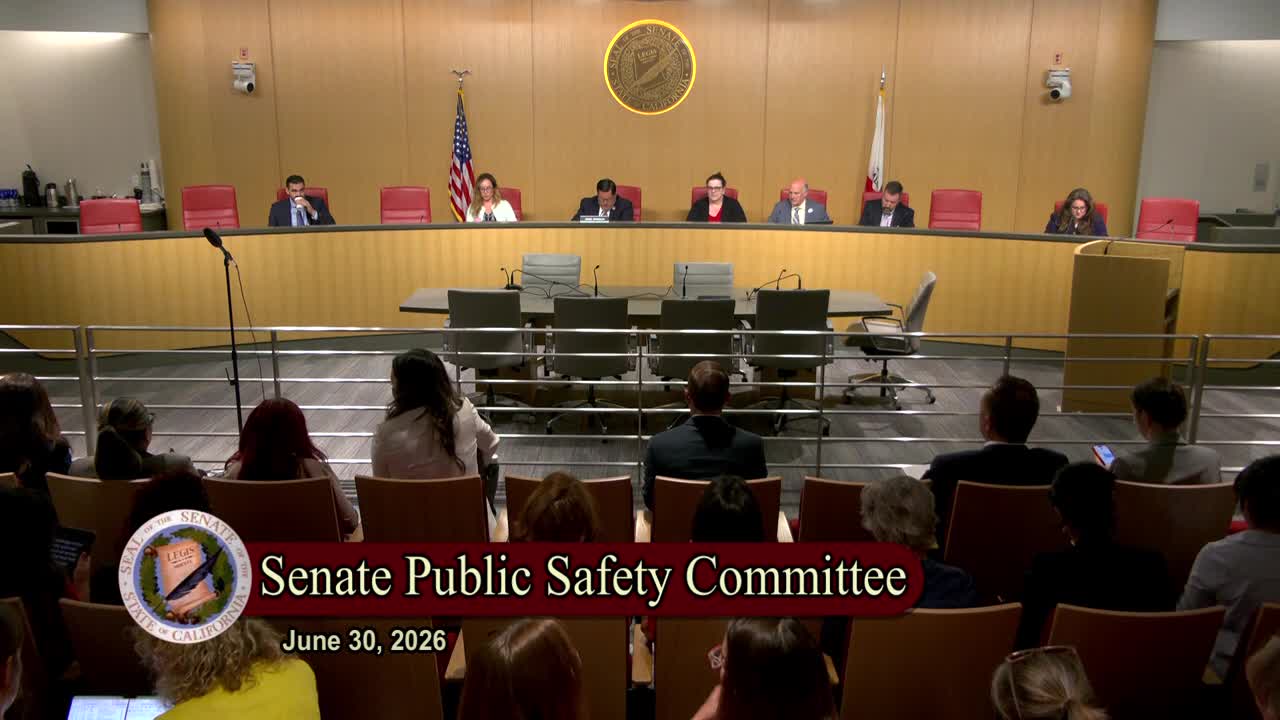 5MIN
Senate Standing Committee on Public Safety
 7MIN
Senate Standing Committee on Governmental Organization
 1MIN
Assembly Floor
 13MIN
Assembly Standing Committee on Public Safety
Bill Author

Bill Co-Author(s):