AB 2101: Human trafficking: notice and training: disaster sites.
- Session Year: 2025-2026
- House: Assembly
- Latest Version Date: 2026-05-18
Current Status:
In Progress
(2026-08-13: In committee: Held under submission.)
Introduced
In Committee
Awaiting First Chamber Vote
Passed First Chamber
In Committee
Awaiting Second Chamber Vote
Passed Second Chamber
Enacted
What does this bill do?
Requires private companies working at designated disaster sites or mitigation sites—places rebuilding after damage or sites cleared to reduce hazards—to post the state human trafficking help notice and to give at least 20 minutes of training to employees involved in recovery, rebuilding, cleanup, permitting, or mitigation work; the training must be in the workers’ most widely spoken language and include examples of how trafficking can occur in disaster settings. The posting rule does not apply to telecommunications companies or internet service providers, and training may be created or run by nonprofit or private experts.
The summary is provided by generative AI which can make mistakes. For original language, please view the details in the table below.
Existing law requires specified businesses and other establishments, including, among others, airports, intercity passenger rail or light rail stations, bus stations, and truck stops, to post a notice, as developed by the Department of Justice, that contains information relating to slavery and human trafficking, including information regarding specified nonprofit organizations that a person can call for services or support in the elimination of slavery and human trafficking.
This bill would additionally require a privately operated entity that operates in a designated disaster site or designated mitigation site, as those terms are defined, that is involved in the response, recovery, rebuilding, or cleanup of a disaster site, permitting related to recovery, rebuilding, or cleanup of a disaster site, or efforts to mitigate or prevent the occurrence of a disaster, to post the above-described notice. notice, except for telecommunications companies or internet service providers.
Existing law requires a business or other establishment that operates intercity passenger rail or light rail stations or bus stations to provide at least 20 minutes of training to specified employees in recognizing the signs of human trafficking and how to report those signs to the appropriate law enforcement agency. Existing law requires that training to include, among other things, the definition of human trafficking, including sex trafficking and labor trafficking, and guidance on how to identify individuals who are most at risk for human trafficking.
This bill would, starting June 1, 2027, require an a privately operated entity that operates in a designated disaster site or designated mitigation site to provide at least 20 minutes of training to all employees involved in specified disaster recovery or mitigation tasks. The bill would authorize the training to be developed or administered by a nonprofit or private entity with professional experience related to human trafficking and would require the training to be delivered in the language that is the most widely spoken language among the employees that will receive the training. The bill would require the training to include the same elements as the training described in the above-paragraph and examples and case scenarios relevant to how trafficking occurs at designated disaster sites and designated mitigation sites.
Existing law requires specified businesses and other establishments, including, among others, airports, intercity passenger rail or light rail stations, bus stations, and truck stops, to post a notice, as developed by the Department of Justice, that contains information relating to slavery and human trafficking, including information regarding specified nonprofit organizations that a person can call for services or support in the elimination of slavery and human trafficking.
This bill would additionally require a privately operated entity that operates in a designated disaster sites and site or designated mitigation sites, site, as those terms are defined, that is involved in the response, recovery, rebuilding, or cleanup of a disaster site, permitting related to recovery, rebuilding, or cleanup of a disaster site, or efforts to mitigate or prevent the occurrence of a disaster, to post the above-described notice.
Existing law requires a business or other establishment that operates intercity passenger rail or light rail stations or bus stations to provide at least 20 minutes of training to specified employees in recognizing the signs of human trafficking and how to report those signs to the appropriate law enforcement agency. Existing law requires that training to include, among other things, the definition of human trafficking, including sex trafficking and labor trafficking, and guidance on how to identify individuals who are most at risk for human trafficking.
This bill would, starting June 1, 2027, require an entity that operates in a designated disaster site or designated mitigation site to provide at least 20 minutes of training to all employees involved in specified disaster recovery or mitigation tasks. The bill would authorize the training to be developed or administered by a nonprofit or private entity with professional experience related to human trafficking and would require the training to be delivered in the language that is the most widely spoken language among the employees that will receive the training. The bill would require the training to include the same elements as the training described in the above-paragraph and examples and case scenarios relevant to how trafficking occurs at designated disaster sites and designated mitigation sites, as specified. sites.
Existing law requires specified businesses and other establishments, including, among others, airports, intercity passenger rail or light rail stations, bus stations, and truck stops, to post a notice, as developed by the Department of Justice, that contains information relating to slavery and human trafficking, including information regarding specified nonprofit organizations that a person can call for services or support in the elimination of slavery and human trafficking.
This bill would additionally require designated disaster sites and designated mitigation sites, as those terms are defined, to post the above-described notice.
Existing law requires a business or other establishment that operates intercity passenger rail or light rail stations or bus stations to provide at least 20 minutes of training to specified employees in recognizing the signs of human trafficking and how to report those signs to the appropriate law enforcement agency. Existing law requires that training to include, among other things, the definition of human trafficking, including sex trafficking and labor trafficking, and guidance on how to identify individuals who are most at risk for human trafficking.
This bill would, starting June 1, 2027, require an entity that operates in a designated disaster site or designated mitigation site to provide at least 20 minutes of training to all employees involved in specified disaster recovery or mitigation tasks. The bill would authorize the training to be developed or administered by a nonprofit or private entity with professional experience related to human trafficking and would require the training to be delivered in the language that is the most widely spoken language among the employees that will receive the training. The bill would require the training to include the same elements as the training described in the above-paragraph and examples and case scenarios relevant to how trafficking occurs at designated disaster sites and designated mitigation sites, as specified.
(a)It is the intent of the Legislature in enacting this bill to establish a minimum threshold for human trafficking awareness training and education. It is the intent of the Legislature that this bill shall not be construed to discourage or relieve an employer from providing for longer, more frequent, or more elaborate training and education regarding human trafficking awareness.
(b)It is further the intent of the Legislature to encourage employers to take all reasonable steps necessary to lead to the rescue identification of human trafficking victims and prevent any kind of human trafficking in their establishments.
SEC. 2.Section 52.6 of the Civil Code is amended to read:52.6.(a)Each of the following businesses and other establishments shall, upon the availability of the model notice described in subdivision (d), (e), post a notice that complies with the requirements of this section in a conspicuous place near the public entrance of the establishment or in another conspicuous location in clear view of the public and employees where similar notices are customarily posted:
(1)On-sale general public premises licensees under the Alcoholic Beverage Control Act (Division 9 (commencing with Section 23000) of the Business and Professions Code).
(2)Adult or sexually oriented businesses, as defined in subdivision (a) of Section 318.5 of the Penal Code.
(3)Primary airports, as defined in Section 47102(16) of Title 49 of the United States Code.
(4)Intercity passenger rail or light rail stations.
(5)Bus stations.
(6)Truck stops. For purposes of this section, truck stop means a privately owned and operated facility that provides food, fuel, shower or other sanitary facilities, and lawful overnight truck parking.
(7)Emergency rooms within general acute care hospitals.
(8)Urgent care centers.
(9)Facilities that provide pediatric care. For purposes of this section, facilities that provide pediatric care means a medical facility that provides pediatric services, as that term is defined in Section 16907.5 of the Welfare and Institutions Code.
(10)Farm labor contractors, as defined in subdivision (b) of Section 1682 of the Labor Code.
(11)Privately operated job recruitment centers.
(12)Roadside rest areas.
(13)Businesses or establishments that offer massage or bodywork services for compensation and are not described in paragraph (1) of subdivision (b) of Section 4612 of the Business and Professions Code.
(14)Hotels, motels, and bed and breakfast inns, as defined in subdivision (b) of Section 24045.12 of the Business and Professions Code, not including personal residences.
(15)Hair, nail, electrolysis, and skin care, and other related businesses or establishments subject to regulation under Chapter 10 (commencing with Section 7301) of Division 3 of the Business and Professions Code.
(16)A privately operated entity that operates in a designated disaster site that is involved in the response, recovery, rebuilding, or cleanup of a disaster site, permitting related to recovery, rebuilding, or cleanup of a disaster site, or efforts to mitigate or prevent the occurrence of a disaster. For purposes of this section, designated disaster site means a structure or defined piece of land, or a group of contiguous structures or land, that was physically damaged or destroyed by a disaster as defined by Section 8680.3 of the Government Code. If the notice cannot be posted in a location as specified in subdivision (a), the employer shall keep the notice posted conspicuously at the place of work or otherwise where it can be seen as employees come or go to their places of work, as practicable, or at the office or nearest agency for payment kept by the employer.
(17)A privately operated entity that operates in a designated mitigation site that is involved in the response, recovery, rebuilding, or cleanup of a disaster site, permitting related to recovery, rebuilding, or cleanup of a disaster site, or efforts to mitigate or prevent the occurrence of a disaster. For purposes of this section, designated mitigation site means a structure or defined piece of land, or a group of contiguous structures or land, that has been determined to require elimination of materials or fuel pursuant to Section 4291 of the Public Resources Code. If the notice cannot be posted in a location as specified in subdivision (a), the employer shall keep the notice posted conspicuously at the place of work or otherwise where it can be seen as employees come or go to their places of work, as practicable, or at the office or nearest agency for payment kept by the employer.
(b)Notwithstanding paragraph (16) or (17) of subdivision (a), the requirement to post a notice shall not apply to telecommunications companies or internet service providers, including, but not limited to, telephone corporations, wireless telecommunications carriers, cable operators, broadband providers, or other entities primarily engaged in providing telecommunications or internet access services unless the company or provider is also operating a facility described in paragraphs (1) to (15), inclusive.
(b)(c)The notice to be posted pursuant to subdivision (a) shall be at least 81/2 inches by 11 inches in size, written in a 16-point font, and shall state the following:
If you or someone you know is being forced to engage in any activity and cannot leavewhether it is commercial sex, housework, farm work, construction, factory, retail, or restaurant work, or any other activitytext 233-733 (Be Free) or call the National Human Trafficking Hotline at 1-888-373-7888 or the California Coalition to Abolish Slavery and Trafficking (CAST) at 1-888-KEY-2-FRE(EDOM) or 1-888-539-2373 to access help and services. | ||
Victims of slavery and human trafficking are protected under United States and California law. | ||
| ||
Available 24 hours a day, 7 days a week. | ||
Toll-free. | ||
Operated by nonprofit, nongovernmental organizations. | ||
Anonymous and confidential. | ||
Accessible in more than 160 languages. | ||
Able to provide help, referral to services, training, and general information. | ||
(d)The notice to be posted pursuant to subdivision (a) shall be printed in English, Spanish, and in one other language that is the most widely spoken language in the county where the establishment is located and for which translation is mandated by the federal Voting Rights Act of 1965 (52 U.S.C. Sec. 10301 et seq.), as applicable. This section does not require a business or other establishment in a county where a language other than English or Spanish is the most widely spoken language to print the notice in more than one language in addition to English and Spanish.
(d)(e)(1)On or before April 1, 2013, the Department of Justice shall develop a model notice that complies with the requirements of this section and make the model notice available for download on the departments internet website.
(2)On or before January 1, 2019, the Department of Justice shall revise and update the model notice to comply with the requirements of this section and make the updated model notice available for download on the departments internet website. A business or establishment required to post the model notice shall not be required to post the updated model notice until on and after January 1, 2019.
(e)(f)On or before January 1, 2021, a business or other establishment that operates a facility described in paragraph (4) or (5) of subdivision (a) shall provide at least 20 minutes of training to its new and existing employees who may interact with, or come into contact with, a victim of human trafficking or who are likely to receive, in the course of their employment, a report from another employee about suspected human trafficking, in recognizing the signs of human trafficking and how to report those signs to the appropriate law enforcement agency.
(f)(g)The employee training pursuant to subdivisions (e) and (h) (f) and (i) shall include, but not be limited to, all of the following:
(1)The definition of human trafficking, including sex trafficking and labor trafficking.
(2)Myths and misconceptions about human trafficking.
(3)Physical and mental signs to be aware of that may indicate that human trafficking is occurring.
(4)Guidance on how to identify individuals who are most at risk for human trafficking.
(5)Guidance on how to report human trafficking, including, but not limited to, national hotlines (1-888-373-7888 and text line 233733) and contact information for local law enforcement agencies that an employee may use to make a confidential report.
(6)Protocols for reporting human trafficking when on the job.
(g)(h)(1)The human trafficking employee training pursuant to subdivision (e) (f) may include, but shall not be limited to, information and material utilized in training Santa Clara County Valley Transportation Authority employees, private nonprofit organizations that represent the interests of human trafficking victims, and the Department of Justice.
(2)The failure to report human trafficking by an employee shall not, by itself, result in the liability of the business or other establishment that operates a facility described in paragraph (4) or (5) of subdivision (a) or of any other person or entity.
(h)(i)On or before June 1, 2027, an a privately operated entity that operates in an area described in paragraph (16) or (17) of subdivision (a) shall provide at least 20 minutes of training to all employees involved in the recovery, rebuilding, or cleanup of a disaster site, permitting related to recovery, rebuilding, or cleanup of a disaster site, or efforts to mitigate or prevent the occurrence of a disaster. The training may be developed or administered by a nonprofit or private entity with professional experience related to human trafficking. The training shall be delivered in the language that is the most widely spoken language among the employees that will receive the training. The training shall include examples and case scenarios relevant to how trafficking occurs at designated disaster sites and designated mitigation sites.
(i)(j)A business or establishment that fails to comply with the requirements of this section is liable for a civil penalty of one thousand dollars ($1,000) for a first offense and two thousand dollars ($2,000) for each subsequent offense. A government entity identified in Section 17204 of the Business and Professions Code may bring an action to impose a civil penalty pursuant to this subdivision against a business or establishment if a local or state agency with authority to regulate that business or establishment has satisfied both of the following:
(1)Provided the business or establishment with reasonable notice of noncompliance, which informs the business or establishment that it is subject to a civil penalty if it does not correct the violation within 30 days from the date the notice is sent to the business or establishment.
(2)Verified that the violation was not corrected within the 30-day period described in paragraph (1).
(j)(k)This section does not prevent a local governing body from adopting and enforcing a local ordinance, rule, or regulation to prevent slavery or human trafficking. If a local ordinance, rule, or regulation duplicates or supplements the requirements that this section imposes upon businesses and other establishments, this section does not supersede or preempt that local ordinance, rule, or regulation.
(k)(l)The Attorney General may enforce this section.
(l)(m)Fines collected pursuant to this section shall be deposited in the Survivors Support Fund.
(a)It is the intent of the Legislature in enacting this bill to establish a minimum threshold for human trafficking awareness training and education. It is the intent of the Legislature that this bill shall not be construed to discourage or relieve an employer from providing for longer, more frequent, or more elaborate training and education regarding human trafficking awareness.
(b)It is further the intent of the Legislature to encourage employers to take all reasonable steps necessary to lead to the rescue of human trafficking victims and prevent any kind of human trafficking in their establishments.
SEC. 2.Section 52.6 of the Civil Code is amended to read:52.6.(a)Each of the following businesses and other establishments shall, upon the availability of the model notice described in subdivision (d), post a notice that complies with the requirements of this section in a conspicuous place near the public entrance of the establishment or in another conspicuous location in clear view of the public and employees where similar notices are customarily posted:
(1)On-sale general public premises licensees under the Alcoholic Beverage Control Act (Division 9 (commencing with Section 23000) of the Business and Professions Code).
(2)Adult or sexually oriented businesses, as defined in subdivision (a) of Section 318.5 of the Penal Code.
(3)Primary airports, as defined in Section 47102(16) of Title 49 of the United States Code.
(4)Intercity passenger rail or light rail stations.
(5)Bus stations.
(6)Truck stops. For purposes of this section, truck stop means a privately owned and operated facility that provides food, fuel, shower or other sanitary facilities, and lawful overnight truck parking.
(7)Emergency rooms within general acute care hospitals.
(8)Urgent care centers.
(9)Facilities that provide pediatric care. For purposes of this section, facilities that provide pediatric care means a medical facility that provides pediatric services, as that term is defined in Section 16907.5 of the Welfare and Institutions Code.
(10)Farm labor contractors, as defined in subdivision (b) of Section 1682 of the Labor Code.
(11)Privately operated job recruitment centers.
(12)Roadside rest areas.
(13)Businesses or establishments that offer massage or bodywork services for compensation and are not described in paragraph (1) of subdivision (b) of Section 4612 of the Business and Professions Code.
(14)Hotels, motels, and bed and breakfast inns, as defined in subdivision (b) of Section 24045.12 of the Business and Professions Code, not including personal residences.
(15)Hair, nail, electrolysis, and skin care, and other related businesses or establishments subject to regulation under Chapter 10 (commencing with Section 7301) of Division 3 of the Business and Professions Code.
(16)Designated disaster sites. A privately operated entity that operates in a designated disaster site that is involved in the response, recovery, rebuilding, or cleanup of a disaster site, permitting related to recovery, rebuilding, or cleanup of a disaster site, or efforts to mitigate or prevent the occurrence of a disaster. For purposes of this section, designated disaster site means a structure or defined piece of land, or a group of contiguous structures or land, that was physically damaged or destroyed by a disaster as defined by Section 8680.3 of the Government Code.
(17)Designated mitigation sites. A privately operated entity that operates in a designated mitigation site that is involved in the response, recovery, rebuilding, or cleanup of a disaster site, permitting related to recovery, rebuilding, or cleanup of a disaster site, or efforts to mitigate or prevent the occurrence of a disaster. For purposes of this section, designated mitigation site means a structure or defined piece of land, or a group of contiguous structures or land, that has been determined to require elimination of materials or fuel pursuant to Section 4291 of the Public Resources Code.
(b)The notice to be posted pursuant to subdivision (a) shall be at least 81/2 inches by 11 inches in size, written in a 16-point font, and shall state the following:
If you or someone you know is being forced to engage in any activity and cannot leavewhether it is commercial sex, housework, farm work, construction, factory, retail, or restaurant work, or any other activitytext 233-733 (Be Free) or call the National Human Trafficking Hotline at 1-888-373-7888 or the California Coalition to Abolish Slavery and Trafficking (CAST) at 1-888-KEY-2-FRE(EDOM) or 1-888-539-2373 to access help and services. | ||
Victims of slavery and human trafficking are protected under United States and California law. | ||
| ||
Available 24 hours a day, 7 days a week. | ||
Toll-free. | ||
Operated by nonprofit, nongovernmental organizations. | ||
Anonymous and confidential. | ||
Accessible in more than 160 languages. | ||
Able to provide help, referral to services, training, and general information. | ||
(c)The notice to be posted pursuant to subdivision (a) shall be printed in English, Spanish, and in one other language that is the most widely spoken language in the county where the establishment is located and for which translation is mandated by the federal Voting Rights Act of 1965 (52 U.S.C. Sec. 10301 et seq.), as applicable. This section does not require a business or other establishment in a county where a language other than English or Spanish is the most widely spoken language to print the notice in more than one language in addition to English and Spanish.
(d)(1)On or before April 1, 2013, the Department of Justice shall develop a model notice that complies with the requirements of this section and make the model notice available for download on the departments internet website.
(2)On or before January 1, 2019, the Department of Justice shall revise and update the model notice to comply with the requirements of this section and make the updated model notice available for download on the departments internet website. A business or establishment required to post the model notice shall not be required to post the updated model notice until on and after January 1, 2019.
(e)On or before January 1, 2021, a business or other establishment that operates a facility described in paragraph (4) or (5) of subdivision (a) shall provide at least 20 minutes of training to its new and existing employees who may interact with, or come into contact with, a victim of human trafficking or who are likely to receive, in the course of their employment, a report from another employee about suspected human trafficking, in recognizing the signs of human trafficking and how to report those signs to the appropriate law enforcement agency.
(f)The employee training pursuant to subdivisions (e) and (h) shall include, but not be limited to, all of the following:
(1)The definition of human trafficking, including sex trafficking and labor trafficking.
(2)Myths and misconceptions about human trafficking.
(3)Physical and mental signs to be aware of that may indicate that human trafficking is occurring.
(4)Guidance on how to identify individuals who are most at risk for human trafficking.
(5)Guidance on how to report human trafficking, including, but not limited to, national hotlines (1-888-373-7888 and text line 233733) and contact information for local law enforcement agencies that an employee may use to make a confidential report.
(6)Protocols for reporting human trafficking when on the job.
(g)(1)The human trafficking employee training pursuant to subdivision (e) may include, but shall not be limited to, information and material utilized in training Santa Clara County Valley Transportation Authority employees, private nonprofit organizations that represent the interests of human trafficking victims, and the Department of Justice.
(2)The failure to report human trafficking by an employee shall not, by itself, result in the liability of the business or other establishment that operates a facility described in paragraph (4) or (5) of subdivision (a) or of any other person or entity.
(h)On or before June 1, 2027, an entity that operates in an area described in paragraph (16) or (17) of subdivision (a) shall provide at least 20 minutes of training to all employees involved in the recovery, rebuilding, or cleanup of a disaster site, permitting related to recovery, rebuilding, or cleanup of a disaster site, or efforts to mitigate or prevent the occurrence of a disaster. The training may be developed or administered by a nonprofit or private entity with professional experience related to human trafficking. The training shall be delivered in the language that is the most widely spoken language among the employees that will receive the training. The training shall include examples and case scenarios relevant to how trafficking occurs at designated disaster sites and designated mitigation sites. The training may include the following examples:
(1)A subcontractor who uses undocumented workers and threatens workers with deportation or immigration enforcement.(2)A worker whose pay is withheld for several days as a tactic to compel labor.(3)A worker who is recruited through a local home improvement store or street corner through false promises for a job that is remote and dangerous.(4)A worker who is moved across locations or worksites without proper documentation.(5)A worker who is forced to work in unsafe or unethically housed in substandard accommodations.(i)A business or establishment that fails to comply with the requirements of this section is liable for a civil penalty of one thousand dollars ($1,000) for a first offense and two thousand dollars ($2,000) for each subsequent offense. A government entity identified in Section 17204 of the Business and Professions Code may bring an action to impose a civil penalty pursuant to this subdivision against a business or establishment if a local or state agency with authority to regulate that business or establishment has satisfied both of the following:
(1)Provided the business or establishment with reasonable notice of noncompliance, which informs the business or establishment that it is subject to a civil penalty if it does not correct the violation within 30 days from the date the notice is sent to the business or establishment.
(2)Verified that the violation was not corrected within the 30-day period described in paragraph (1).
(j)This section does not prevent a local governing body from adopting and enforcing a local ordinance, rule, or regulation to prevent slavery or human trafficking. If a local ordinance, rule, or regulation duplicates or supplements the requirements that this section imposes upon businesses and other establishments, this section does not supersede or preempt that local ordinance, rule, or regulation.
(k)The Attorney General may enforce this section.
(l)Fines collected pursuant to this section shall be deposited in the Survivors Support Fund.
(a)It is the intent of the Legislature in enacting this bill to establish a minimum threshold for human trafficking awareness training and education. It is the intent of the Legislature that this bill shall not be construed to discourage or relieve an employer from providing for longer, more frequent, or more elaborate training and education regarding human trafficking awareness.
(b)It is further the intent of the Legislature to encourage employers to take all reasonable steps necessary to lead to the rescue of human trafficking victims and prevent any kind of human trafficking in their establishments.
SEC. 2.Section 52.6 of the Civil Code is amended to read:52.6.(a)Each of the following businesses and other establishments shall, upon the availability of the model notice described in subdivision (d), post a notice that complies with the requirements of this section in a conspicuous place near the public entrance of the establishment or in another conspicuous location in clear view of the public and employees where similar notices are customarily posted:
(1)On-sale general public premises licensees under the Alcoholic Beverage Control Act (Division 9 (commencing with Section 23000) of the Business and Professions Code).
(2)Adult or sexually oriented businesses, as defined in subdivision (a) of Section 318.5 of the Penal Code.
(3)Primary airports, as defined in Section 47102(16) of Title 49 of the United States Code.
(4)Intercity passenger rail or light rail stations.
(5)Bus stations.
(6)Truck stops. For purposes of this section, truck stop means a privately owned and operated facility that provides food, fuel, shower or other sanitary facilities, and lawful overnight truck parking.
(7)Emergency rooms within general acute care hospitals.
(8)Urgent care centers.
(9)Facilities that provide pediatric care. For purposes of this section, facilities that provide pediatric care means a medical facility that provides pediatric services, as that term is defined in Section 16907.5 of the Welfare and Institutions Code.
(10)Farm labor contractors, as defined in subdivision (b) of Section 1682 of the Labor Code.
(11)Privately operated job recruitment centers.
(12)Roadside rest areas.
(13)Businesses or establishments that offer massage or bodywork services for compensation and are not described in paragraph (1) of subdivision (b) of Section 4612 of the Business and Professions Code.
(14)Hotels, motels, and bed and breakfast inns, as defined in subdivision (b) of Section 24045.12 of the Business and Professions Code, not including personal residences.
(15)Hair, nail, electrolysis, and skin care, and other related businesses or establishments subject to regulation under Chapter 10 (commencing with Section 7301) of Division 3 of the Business and Professions Code.
(16)Designated disaster sites. For purposes of this section, designated disaster site means a structure or defined piece of land, or a group of contiguous structures or land, that was physically damaged or destroyed by a disaster as defined by Section 8680.3 of the Government Code.
(17)Designated mitigation sites. For purposes of this section, designated mitigation site means a structure or defined piece of land, or a group of contiguous structures or land, that has been determined to require elimination of materials or fuel pursuant to Section 4291 of the Public Resources Code.
(b)The notice to be posted pursuant to subdivision (a) shall be at least 81/2 inches by 11 inches in size, written in a 16-point font, and shall state the following:
If you or someone you know is being forced to engage in any activity and cannot leavewhether it is commercial sex, housework, farm work, construction, factory, retail, or restaurant work, or any other activitytext 233-733 (Be Free) or call the National Human Trafficking Hotline at 1-888-373-7888 or the California Coalition to Abolish Slavery and Trafficking (CAST) at 1-888-KEY-2-FRE(EDOM) or 1-888-539-2373 to access help and services. | ||
Victims of slavery and human trafficking are protected under United States and California law. | ||
| ||
Available 24 hours a day, 7 days a week. | ||
Toll-free. | ||
Operated by nonprofit, nongovernmental organizations. | ||
Anonymous and confidential. | ||
Accessible in more than 160 languages. | ||
Able to provide help, referral to services, training, and general information. | ||
(c)The notice to be posted pursuant to subdivision (a) shall be printed in English, Spanish, and in one other language that is the most widely spoken language in the county where the establishment is located and for which translation is mandated by the federal Voting Rights Act of 1965 (52 U.S.C. Sec. 10301 et seq.), as applicable. This section does not require a business or other establishment in a county where a language other than English or Spanish is the most widely spoken language to print the notice in more than one language in addition to English and Spanish.
(d)(1)On or before April 1, 2013, the Department of Justice shall develop a model notice that complies with the requirements of this section and make the model notice available for download on the departments internet website.
(2)On or before January 1, 2019, the Department of Justice shall revise and update the model notice to comply with the requirements of this section and make the updated model notice available for download on the departments internet website. A business or establishment required to post the model notice shall not be required to post the updated model notice until on and after January 1, 2019.
(e)On or before January 1, 2021, a business or other establishment that operates a facility described in paragraph (4) or (5) of subdivision (a) shall provide at least 20 minutes of training to its new and existing employees who may interact with, or come into contact with, a victim of human trafficking or who are likely to receive, in the course of their employment, a report from another employee about suspected human trafficking, in recognizing the signs of human trafficking and how to report those signs to the appropriate law enforcement agency.
(f)The employee training pursuant to subdivision subdivisions (e) and (h) shall include, but not be limited to, all of the following:
(1)The definition of human trafficking, including sex trafficking and labor trafficking.
(2)Myths and misconceptions about human trafficking.
(3)Physical and mental signs to be aware of that may indicate that human trafficking is occurring.
(4)Guidance on how to identify individuals who are most at risk for human trafficking.
(5)Guidance on how to report human trafficking, including, but not limited to, national hotlines (1-888-373-7888 and text line 233733) and contact information for local law enforcement agencies that an employee may use to make a confidential report.
(6)Protocols for reporting human trafficking when on the job.
(g)(1)The human trafficking employee training pursuant to subdivision (e) may include, but shall not be limited to, information and material utilized in training Santa Clara County Valley Transportation Authority employees, private nonprofit organizations that represent the interests of human trafficking victims, and the Department of Justice.
(2)The failure to report human trafficking by an employee shall not, by itself, result in the liability of the business or other establishment that operates a facility described in paragraph (4) or (5) of subdivision (a) or of any other person or entity.
(h)On or before June 1, 2027, an entity that operates in an area described in paragraph (16) or (17) of subdivision (a) shall provide at least 20 minutes of training to all employees involved in the recovery, rebuilding, or cleanup of a disaster site, permitting related to recovery, rebuilding, or cleanup of a disaster site, or efforts to mitigate or prevent the occurrence of a disaster. The training may be developed or administered by a nonprofit or private entity with professional experience related to human trafficking. The training shall be delivered in the language that is the most widely spoken language among the employees that will receive the training. The training shall include examples and case scenarios relevant to how trafficking occurs at designated disaster sites and designated mitigation sites. The training may include the following examples:
(1)A subcontractor who uses undocumented workers and threatens workers with deportation or immigration enforcement.
(2)A worker whose pay is withheld for several days as a tactic to compel labor.
(3)A worker who is recruited through a local home improvement store or street corner through false promises for a job that is remote and dangerous.
(4)A worker who is moved across locations or worksites without proper documentation.
(5)A worker who is forced to work in unsafe or unethically housed in substandard accommodations.
(h)(i)A business or establishment that fails to comply with the requirements of this section is liable for a civil penalty of one thousand dollars ($1,000) for a first offense and two thousand dollars ($2,000) for each subsequent offense. A government entity identified in Section 17204 of the Business and Professions Code may bring an action to impose a civil penalty pursuant to this subdivision against a business or establishment if a local or state agency with authority to regulate that business or establishment has satisfied both of the following:
(1)Provided the business or establishment with reasonable notice of noncompliance, which informs the business or establishment that it is subject to a civil penalty if it does not correct the violation within 30 days from the date the notice is sent to the business or establishment.
(2)Verified that the violation was not corrected within the 30-day period described in paragraph (1).
(i)(j)This section does not prevent a local governing body from adopting and enforcing a local ordinance, rule, or regulation to prevent slavery or human trafficking. If a local ordinance, rule, or regulation duplicates or supplements the requirements that this section imposes upon businesses and other establishments, this section does not supersede or preempt that local ordinance, rule, or regulation.
(j)(k)The Attorney General may enforce this section.
(k)(l)Fines collected pursuant to this section shall be deposited in the Survivors Support Fund.
|
Date
|
Status
|
|---|---|
| Aug 13, 2026 | In committee: Held under submission. |
| Aug 3, 2026 | In committee: Referred to APPR. suspense file. |
| Jun 24, 2026 | From committee: Do pass and re-refer to Com. on APPR. with recommendation: To Consent Calendar. (Ayes 13. Noes 0.) (June 23). Re-referred to Com. on APPR. |
| Jun 10, 2026 | Referred to Com. on JUD. |
| May 28, 2026 | In Senate. Read first time. To Com. on RLS. for assignment. |
| May 27, 2026 | Read third time. Passed. Ordered to the Senate. (Ayes 75. Noes 0.) |
| May 27, 2026 | Read third time. Passed. Ordered to the Senate. (Ayes 75. Noes 0. Page 5474.) |
| May 27, 2026 | Read third time. Passed. Ordered to the Senate. |
| May 19, 2026 | Read second time. Ordered to third reading. |
| May 18, 2026 | Read second time and amended. Ordered returned to second reading. |
| May 14, 2026 | From committee: Amend, and do pass as amended. (Ayes 11. Noes 1.) (May 14). |
| May 6, 2026 | In committee: Set, first hearing. Referred to APPR. suspense file. |
| Apr 23, 2026 | From committee: Do pass and re-refer to Com. on APPR. (Ayes 6. Noes 1.) (April 23). Re-referred to Com. on APPR. |
| Apr 13, 2026 | Re-referred to Com. on E.M. |
| Apr 9, 2026 | Read second time and amended. |
| Apr 8, 2026 | From committee: Amend, and do pass as amended and re-refer to Com. on E.M with recommendation: To Consent Calendar. (Ayes 12. Noes 0.) (April 7). |
| Mar 16, 2026 | Referred to Coms. on JUD. and E.M. |
| Feb 19, 2026 | From printer. May be heard in committee March 21. |
| Feb 18, 2026 | Read first time. To print. |
|
Date
|
Description
|
Location
|
Votes
|
|
|---|---|---|---|---|
| Aug 3, 2026 | Placed on suspense file | Senate Standing Committee on Appropriations |
Passed |
|
| Jun 23, 2026 | Do pass, but first be re-referred to the Committee on [Appropriations] with the recommendation: To Consent Calendar | Senate Standing Committee on Judiciary |
Passed |
|
| May 27, 2026 | AB 2101 Gipson Assembly Third Reading | Assembly Floor |
Passed |
|
| May 14, 2026 | Do pass as amended. | Assembly Standing Committee on Appropriations |
Passed |
|
| Apr 23, 2026 | Do pass and be re-referred to the Committee on [Appropriations] | Assembly Standing Committee on Emergency Management |
Passed |
|
| Apr 7, 2026 | Do pass as amended, and be re-referred to the Committee on [Emergency Management] with recommendation: To Consent Calendar | Assembly Standing Committee on Judiciary |
Passed |
This list shows positions taken on this bill by organizations on the date displayed, which is linked to the original source.
Positions by individuals are not included.
|
Organization
|
Position
|
Date
|
|---|---|---|
| 3strands global foundation | ** Support | |
| Asian Americans Advancing Justice Southern California | ** Support | |
| Asian Americans Advancing Justice-southern California | ** Support | |
| CalBroadband | ** Against | |
| Calcom Association | ** Against | |
| California Domestic Workers Coalition | ** Support | |
| Central Valley Justice Coalition | ** Support | |
| Children'S Law Center Of California | ** Support | |
| Community Lawyers, Inc. | ** Support | |
| Community Legal Services in East Palo Alto | ** Support | |
| jobs to move america | ** Support | |
| Justice At Last | ** Support | |
| League Of California Cities | ** Against | |
| Little Hoover Commission | ** Support | |
| Pilipino Workers Center of Southern California | ** Support | |
| Public Citizen | ** Support | |
| Resilience Force | ** Support | |
| Rural County Representatives of California (RCRC) | ** Against | |
| Sunita Jain Anti-Trafficking Initiative | ** Support | |
| Sunita Jain Anti-trafficking Initiative at Loyola Law School | ** Support | |
| Sunita Jain Anti-trafficking Initiative at Loyola Law School (sponsor) | ** Support | |
| Thai Community Development Center | ** Support | |
| Translatin@ Coalition | ** Support | |
| United States Telecom Association | ** Against | |
| Wage Justice Center | ** Support | |
| Worksafe | ** Support |
SENATE COMMITTEE ON
Senator Sabrina Cervantes, Chair
2025 - 2026 Regular Session
AB 2101 (Gipson) - Human trafficking: notice and training: disaster sites
Version: | Policy Vote: |
Urgency: | Mandate: |
Hearing Date: | Consultant: |
Bill Summary:
AB 2101 would require a private entity that operates in a disaster area or mitigation site to post a standardized notice that contains information relating to slavery and human trafficking. The bill requires a private entity that operates in a disaster site or mitigation site to provide at least 20 minutes of training to employees involved in recovery or mitigation tasks.
Fiscal Impact:
Ongoing cost pressures to the courts in additional workload by adding more entities to an existing list of businesses that must comply with a slavery and human trafficking notice and training requirement with a violation enforceable by public prosecutors. Although the Attorney General may bring a claim for penalties only after a 30-day notice-and-cure period, otherwise limiting the number of claims that are filed in court, it is unclear how entities operating in disaster areas, potentially covering hundreds of thousands of acres, can meet existing requirements to post the notice “near the public entrance of the establishment” or “in clear view of the public and employees where similar notices are customarily posted,” thus making it unclear how an entity may cure the violation and be relieved of penalties. (Trial Court Trust Fund, General Fund)
Minor costs, if any, to the courts to adjudicate new civil actions. An eight-hour court day costs approximately $10,500 based on the hourly rate of court personnel including at minimum the judge, clerk, bailiff, court reporter, jury administrator, administrative staff, and jury per-diems. While the courts are not funded on a workload basis, an increase in workload could result in delayed court services and would put pressure on the General Fund to fund additional staff and resources. The FY 2026-27 Budget appropriated $70 million General Fund for this purpose. (Trial Court Trust Fund, General Fund)
Background:
Civil Code Section 52.6 requires certain establishments to post notices regarding resources for witnesses to, and victims of, human trafficking and slavery. That section also requires rail and bus stations to train their employees in identifying and reporting incidents of human trafficking. The Fair Employment and Housing Act also requires hotel and motel employers to provide at least 20 minutes of training and education regarding human trafficking awareness to their employees, as provided. Both federal and state law authorize civil actions by victims of human trafficking, and sex trafficking in particular.
Proposed Law:
This bill requires privately operated entities that operate in a disaster site or mitigation site that are involved in the response, recovery, rebuilding, or cleanup of a disaster site, permitting related to recovery, rebuilding, or cleanup of a disaster site, or efforts to mitigate or prevent the occurrence of a disaster to post the notice regarding slavery and human trafficking. Telecommunications companies and internet service providers are exempted from the notice requirement.
The bill requires a privately operated entity to provide at least 20 minutes of training in recognizing the signs of human trafficking and how to report those signs to the appropriate law enforcement agency to all employees involved in specified disaster recovery or mitigation tasks.
Related Legislation:
AB 1918 (Dixon) requires body art facilities, as defined, to post the notice regarding slavery and human trafficking. The bill requires a business or other establishment that operates a body art facility to provide training in recognizing the signs of human trafficking to registered practitioners who practice in the body art facility and who may interact with a victim of human trafficking or who are likely to receive a report from an employee of the business about suspected human trafficking. AB 1918 is on the Senate Third Reading File.
SB 970 (Atkins) Chapter 842/2018 established training requirements for hotel and motel employees. SB 970 also explicitly stated that it was the intent of the Legislature in enacting the bill to establish a minimum threshold for human trafficking awareness training and education. AB 2034 (Kalra) Chapter 812/2018 requires businesses that operate intercity passenger rail, light rail, or bus stations to train certain employees in recognizing the signs of human trafficking and how to report those signs.
AB 1661 (Davies) Chapter 106/2022 required businesses that provide hair, nail, electrolysis, and skin care services, and other related businesses or establishments subject to regulation under the Barbering and Cosmetology Act to post the required notice above in a conspicuous place near the public entrance of the establishment or in another conspicuous location in clear view of the public and employees where similar notices are customarily posted.
Staff Comments:
Civil Code Section 52.6 (m) states: Fines collected pursuant to this section shall be deposited in the Survivors Support Fund.
Revenues (fines) from penalties would be reported from the courts to the State Controller’s Office. The Judicial Council indicates it has no record of any violations of Civil Code Section 52.6 (j). Preliminary information indicates there are inquiries about where to remit if revenues are collected with San Diego County having two pending cases.
At this time, the Department of Finance Manual of State Funds and the Index of Fund Condition Statements do not reference the Survivors Support Fund. However, the Department of Finance indicates it is in the process of establishing the fund and will be ready to deposit revenues.
SENATE COMMITTEE ON
Senator Sabrina Cervantes, Chair
2025 - 2026 Regular Session
AB 2101 (Gipson) - Human trafficking: notice and training: disaster sites
Version: | Policy Vote: |
Urgency: | Mandate: |
Hearing Date: | Consultant: |
Bill Summary:
AB 2101 would require a private entity that operates in a disaster area or mitigation site to post a standardized notice that contains information relating to slavery and human trafficking. The bill requires a private entity that operates in a disaster site or mitigation site to provide at least 20 minutes of training to employees involved in recovery or mitigation tasks.
Fiscal Impact:
Ongoing cost pressures to the courts in additional workload by adding more entities to an existing list of businesses that must comply with a slavery and human trafficking notice and training requirement with a violation enforceable by public prosecutors. Although the Attorney General may bring a claim for penalties only after a 30-day notice-and-cure period, otherwise limiting the number of claims that are filed in court, it is unclear how entities operating in disaster areas, potentially covering hundreds of thousands of acres, can meet existing requirements to post the notice “near the public entrance of the establishment” or “in clear view of the public and employees where similar notices are customarily posted,” thus making it unclear how an entity may cure the violation and be relieved of penalties. (Trial Court Trust Fund, General Fund)
Minor costs, if any, to the courts to adjudicate new civil actions. An eight-hour court day costs approximately $10,500 based on the hourly rate of court personnel including at minimum the judge, clerk, bailiff, court reporter, jury administrator, administrative staff, and jury per-diems. While the courts are not funded on a workload basis, an increase in workload could result in delayed court services and would put pressure on the General Fund to fund additional staff and resources. The FY 2026-27 Budget appropriated $70 million General Fund for this purpose. (Trial Court Trust Fund, General Fund)
Background:
Civil Code Section 52.6 requires certain establishments to post notices regarding resources for witnesses to, and victims of, human trafficking and slavery. That section also requires rail and bus stations to train their employees in identifying and reporting incidents of human trafficking. The Fair Employment and Housing Act also requires hotel and motel employers to provide at least 20 minutes of training and education regarding human trafficking awareness to their employees, as provided. Both federal and state law authorize civil actions by victims of human trafficking, and sex trafficking in particular.
Proposed Law:
This bill requires privately operated entities that operate in a disaster site or mitigation site that are involved in the response, recovery, rebuilding, or cleanup of a disaster site, permitting related to recovery, rebuilding, or cleanup of a disaster site, or efforts to mitigate or prevent the occurrence of a disaster to post the notice regarding slavery and human trafficking. Telecommunications companies and internet service providers are exempted from the notice requirement.
The bill requires a privately operated entity to provide at least 20 minutes of training in recognizing the signs of human trafficking and how to report those signs to the appropriate law enforcement agency to all employees involved in specified disaster recovery or mitigation tasks.
Related Legislation:
AB 1918 (Dixon) requires body art facilities, as defined, to post the notice regarding slavery and human trafficking. The bill requires a business or other establishment that operates a body art facility to provide training in recognizing the signs of human trafficking to registered practitioners who practice in the body art facility and who may interact with a victim of human trafficking or who are likely to receive a report from an employee of the business about suspected human trafficking. AB 1918 is on the Senate Third Reading File.
SB 970 (Atkins) Chapter 842/2018 established training requirements for hotel and motel employees. SB 970 also explicitly stated that it was the intent of the Legislature in enacting the bill to establish a minimum threshold for human trafficking awareness training and education. AB 2034 (Kalra) Chapter 812/2018 requires businesses that operate intercity passenger rail, light rail, or bus stations to train certain employees in recognizing the signs of human trafficking and how to report those signs.
AB 1661 (Davies) Chapter 106/2022 required businesses that provide hair, nail, electrolysis, and skin care services, and other related businesses or establishments subject to regulation under the Barbering and Cosmetology Act to post the required notice above in a conspicuous place near the public entrance of the establishment or in another conspicuous location in clear view of the public and employees where similar notices are customarily posted.
Staff Comments:
Civil Code Section 52.6 (m) states: Fines collected pursuant to this section shall be deposited in the Survivors Support Fund.
The Judicial Council indicates it has no record of any violations of Civil Code Section 52.6 (j).
At this time, the Department of Finance Manual of State Funds and the Index of Fund Condition Statements do not reference the Survivors Support Fund.
Senator Thomas Umberg, Chair
2025-2026 Regular Session
Bill No: AB 2101 (Author:Gipson)
Version: May 18, 2026
Hearing Date: June 23, 2026
Fiscal: Yes
Urgency: No
Consultant: ME
SUBJECT
Human trafficking: notice and training: disaster sites
DIGEST
This bill requires a privately operated entity that operates in a designated disaster site or mitigation site, as defined, to post a specified notice regarding human trafficking and to provide specified human trafficking training to their employees, as provided.
EXECUTIVE SUMMARY
Section 52.6 of the Civil Code (Section 52.6) requires certain establishments to post notices regarding resources for witnesses to, and victims of, human trafficking and slavery. That section also requires rail and bus stations to train their employees in identifying and reporting incidents of human trafficking. The Fair Employment and Housing Act (FEHA) also requires hotel and motel employers to provide at least 20 minutes of training and education regarding human trafficking awareness to their employees, as provided. Both federal and state law authorize civil actions by victims of human trafficking, and sex trafficking in particular.
The author brings this bill to expand the reach of Section 52.6 to include privately operated entities that operate in designated disaster sites or mitigation sites involved in the response, recovery, rebuilding, or cleanup of a disaster site, permitting related to recovery, rebuilding, or cleanup of a disaster site, or efforts to mitigate or prevent the occurrence of a disaster on the list of establishments that must post the specified notice regarding forced commercial sex, housework, farm work, construction, factory, retail, or restaurant work, or any other activity. The bill also requires that, on or before June 1, 2027, a privately operated entity that operates in the designated disaster sites or mitigation sites provide at least 20 minutes of training regarding human trafficking to their employees. The bill is sponsored by the Sunita Jain Anti-trafficking Initiative at Loyola Law School and supported by various organizations that work to prevent human trafficking and support the survivors of trafficking. The Committee received no timely opposition.
PROPOSED CHANGES TO THE LAW
Existing law:
- Provides that any person who deprives or violates the personal liberty of another with the intent to obtain forced labor or services is guilty of the crime of human trafficking. (Pen. Code § 236.1 (a).)
- Requires specified businesses and establishments to post notices in a conspicuous place near the public entrance of the establishment or in another conspicuous location in clear view of the public and employees where similar notices are customarily posted. (Civ. Code § 52.6 (a).)
- Requires the notices to include specific language regarding a textline and various hotlines to contact if one is aware of or is a victim of human trafficking. The Department of Justice is required to create a model notice that may be used by these businesses. (Civ. Code § 52.6 (b)-(d).)
- Provides that a business or other establishment that operates intercity passenger rail, light rail, or bus stations shall provide at least 20 minutes of training to employees who may interact with, or come into contact with, a victim of human trafficking or who are likely to receive, in the course of their employment, a report from another employee about suspected human trafficking, in recognizing the signs of human trafficking and how to report those signs to the appropriate law enforcement agency. A list of topics that must be covered in such training is further provided. (Civ. Code § 52.6 (e)-(g).)
- Subjects businesses that fail to comply with the notice and training requirements of Section 52.6 of the Civil Code to specified civil penalties. (Civ. Code § 52.6 (h).)
- Provides that nothing in Civil Code Section 52.6 prevents local governing bodies from adopting and enforcing a local ordinance, rule, or regulation to prevent slavery or human trafficking. (Civ. Code § 52.6 (i).)
This bill:
- Requires privately operated entities that operate in a designated disaster site or designated mitigation site, as defined, that are involved in the response, recovery, rebuilding, or cleanup of a disaster site, permitting related to recovery, rebuilding, or cleanup of a disaster site, or efforts to mitigate or prevent the occurrence of a disaster to post the notice regarding slavery and human trafficking. Telecommunications companies and internet service providers are exempted from the notice requirement.
- Requires a privately operated entity described in 1), above, to provide at least 20 minutes of training in recognizing the signs of human trafficking and how to report those signs to the appropriate law enforcement agency to all employees involved in specified disaster recovery or mitigation tasks, beginning June 1, 2027.
- Specifies the intent of the Legislature in enacting this bill.
- Specifies that the training may be developed or administered by a nonprofit or private entity with professional experience related to human trafficking.
- Requires the training to be delivered in the language that is the most widely spoken language among the employees that will receive the training and must include examples and case scenarios relevant to how trafficking occurs at designated disaster sites and designated mitigation sites.
COMMENTS
- The troubling prevalence of human trafficking
Human trafficking is the world’s fastest growing criminal enterprise, bringing in annual profits in the tens of billions of dollars. Human trafficking is generally defined as the use of force, coercion, or fraud to obtain coerced labor or personal services. Existing law provides that any person who deprives or violates the personal liberty of another with the intent to obtain forced labor or services is guilty of the crime of human trafficking.
The International Labour Organization estimates that approximately 40 million people were victims of some form of human slavery worldwide in 2016.[1] This includes 24.9 million people in forced labor, meaning they were being “forced to work under threat or coercion as domestic workers, on construction sites, in clandestine factories, on farms and fishing boats, in other sectors, and in the sex industry.” Over 70 percent of these victims were women and girls and one in four victims were children. In their 2019 Data Report, the U.S. National Human Trafficking Hotline identified over 22,000 victims and survivors and over 4,300 traffickers.[2]
Traffickers look for people who are susceptible for a variety of reasons, including psychological or emotional vulnerability, economic hardship, lack of a social safety net, membership in a marginalized group, natural disasters, or political instability. Human trafficking is often described as a hidden crime as victims rarely come forward to seek help due to a variety of factors, including language barriers, the severe trauma resulting from these crimes, fear of the traffickers, and fear of law enforcement.
2. California’s human trafficking awareness and training law
To increase awareness of human trafficking and provide support to victims, Civil Code Section 52.6 requires certain businesses and establishments, including truck stops, health facilities, massage parlors, and transit centers, to post notices encouraging victims of human trafficking and those who suspect human trafficking to contact a textline or one of several hotlines to access help and services. The law requires the notice to state specified content and requires the Department of Justice to post a model notice.
In addition, several laws, SB 970 (Atkins, Ch. 842, Stats. 2018) and AB 2034 (Kalra, Ch. 812, Stats. 2018), established training requirements for specified employees. AB 2034 amended Section 52.6, requiring businesses that operate intercity passenger rail, light rail, or bus stations to train certain employees in recognizing the signs of human trafficking and how to report those signs.
SB 970 also added Section 12950.3 to the Government Code, which required such employee trainings at hotels and motels. SB 970 also explicitly stated that it was the intent of the Legislature in enacting the bill “to establish a minimum threshold for human trafficking awareness training and education.”
SB 630 (Stern, Ch. 57, Stats. 2019) made clear that Section 52.6, and the requirements set out therein, do not prevent local governing bodies from adopting and enforcing a local ordinance, rule, or regulation to prevent slavery or human trafficking. It further provided that Section 52.6 does not supersede or preempt a local ordinance, rule, or regulation that duplicates or supplements the requirements Section 52.6 imposes upon businesses and other establishments. The addition of this clause paved the way for local jurisdictions to take more aggressive approaches to combatting the scourge of human trafficking in California.
AB 1661 (Davies, Ch. 106, Stats. 2022) required businesses that provide hair, nail, electrolysis, and skin care services, and other related businesses or establishments subject to regulation under the Barbering and Cosmetology Act to post the required notice above in a conspicuous place near the public entrance of the establishment or in another conspicuous location in clear view of the public and employees where similar notices are customarily posted. AB 1740 (Sanchez, Ch. 104, Stats. 2023) added pediatric care to the list of establishments that must post the human trafficking notice.
3. Another expansion of Section 52.6
This bill takes another step forward by requiring privately operated entities in a designated disaster site or a designated mitigation site to post the notice regarding slavery and human trafficking. Additionally, the bill requires a privately operated entity that operates in a designated disaster site or designated mitigation site to provide at least 20 minutes of training to specified employees involved in disaster recovery or mitigation tasks in the most widely spoken language among the employees that will receive the training.
According to the author:
AB 2101 affirms that California will not allow disaster sites to become breeding grounds for labor abuse. The workers who step in during times of crisis—utility crews, debris removal teams, construction workers, electricians, roofers, and day laborers—are essential to rebuilding communities and restoring normalcy after climate emergencies. When unscrupulous employers exploit these workers by threatening them with ICE or exploitation to silence or coerce them, it is not only unethical— it constitutes trafficking. By expanding “Know Your Rights” protections and strengthening safeguards at disaster recovery worksites, AB 2101 ensures that those on the front lines of rebuilding are protected, informed, and treated with dignity and respect. As climate-related disasters grow more frequently and immigration enforcement actions intensify, the need for proactive worker protection becomes increasingly urgent. This bill is a critical first step toward closing a dangerous gap in California’s anti-trafficking framework.
The Sunita Jain Anti-Trafficking Initiative at Loyola Law School, sponsors of the bill, write the following in support of the AB 2101:
California now leads the nation, with roughly 136 formal establishments providing Natural Disaster and Emergency Relief Services and employing more than 3,000 workers. As disasters become more frequent, the sector continues to expand, with employment rising at an annualized rate of 6.8% from 2020 to 2025.
Despite the essential role they play, the workers who support rebuilding efforts after natural disasters face widespread issues of wage theft, exposure to hazardous conditions without proper training or PPE, and are 2x as likely to be trafficked compared to workers at non disaster worksites. Individuals who lack clear information about their rights, or fear retaliation, are less likely to report abuse. Bad actors exploit this silence.
The abuses and risks that disaster restoration workers have long faced are now further compounded with unprecedented federal immigration enforcement - Often working outdoors in plain sight and hired in informal or temporary capacities, these community members are particularly vulnerable to ICE raids. Further, unethical employers and supervisors increasingly exploit the threat of immigration enforcement to coerce workers into unpaid labor, force them into jobs they did not agree to perform, and force them to remain in exploitative and unsafe working conditions.
[ . . . ] AB 2101 marks an important first step toward addressing the documented pattern of abuse and trafficking across the disaster restoration industry. AB 2101 amends Civil Code § 52.6 to require the posting of “Know Your Rights (KYR)” and Human Trafficking Hotline information at designated disaster sites and at businesses that hire or deploy disaster-response workers. Further, the bill also establishes standardized training requirements within the disaster restoration industry to ensure workers and supervisors understand these protections and how to identify these red flags in the field.
California has addressed similar abuses in other high-risk industries through Civil Code § 52.6, which requires KYR postings in businesses and establishments that are impacted by human trafficking. Since 2013, the law has expanded to cover 15 industries, most recently adding emergency departments and pediatric facilities in 2024.
SUPPORT
Sunita Jain Anti-trafficking Initiative at Loyola Law School (sponsor)
3Strands Global Foundation
Central Valley Justice Coalition
Community Lawyers, Inc.
Community Legal Services in East Palo Alto
Jobs to Move America
Little Hoover Commission
Pilipino Workers Center of Southern California
Public Citizen
Thai Community Development Center
TransLatin@ Coalition
Worksafe
OPPOSITION
None known
RELATED LEGISLATION
Pending Legislation:
AB 1845 (Krell, 2026) requires postsecondary education institutions to offer as part of the institution’s sexual harassment training specified training regarding human trafficking. AB 1845 is in the Senate Rules Committee.
AB 1918 (Dixon, 2026) requires body art facilities, as defined, to post the notice regarding slavery and human trafficking. The bill requires a business or other establishment that operates a body art facility to provide at least 20 minutes of training in recognizing the signs of human trafficking and how to report those signs to the appropriate law enforcement agency to registered practitioners who practice in the body art facility and who may interact with, or come into contact with, a victim of human trafficking or who are likely to receive a report from an employee of the business or establishment about suspected human trafficking.
Prior Legislation:
AB 1740 (Sanchez, Ch. 104, Stats. 2023) See Comment 2.
AB 1661 (Davies, Ch. 106, Stats. 2022) See Comment 2.
AB 1788 (Cunningham, Ch. 760, Stats. 2022) established a cause of action against hotels for failing to report known sexual trafficking within the hotel, as specified, or where an employee benefits from sexual trafficking activity within the hotel, as specified.
SB 630 (Stern, Ch. 57, Stats. 2019) See Comment 2.
SB 970 (Atkins, Ch. 842, Stats. 2018) See Comment 2.
AB 2034 (Kalra, Ch. 812, Stats. 2018) See Comment 2.
SB 225 (Stern, Ch. 565, Stats. 2017) updated language that is required to be included in notices certain businesses must post. It included a special textline that can be texted for services and support.
SB 597 (Leyva, Ch. 570, Stats. 2017) allowed victims of human trafficking to participate in the Secretary of State’s Safe at Home program.
AB 260 (Santiago, Ch. 547, Stats. 2017) included hotels, motels, and other lodging establishments among the businesses that must post signage regarding reporting human trafficking.
AB 1227 (Bonta, Ch. 558, Stats. 2017) required human trafficking prevention education in schools.
SB 1193 (Steinberg, Ch. 515, Stats. 2012) added Section 52.6 to the Civil Code.
PRIOR VOTES:
Assembly Floor (Ayes 75, Noes 0)
Assembly Appropriations Committee (Ayes 11, Noes 1)
Assembly Emergency Management Committee (Ayes 6, Noes 1)
Assembly Judiciary Committee (Ayes 12, Noes 0)
**************
Global Estimates of Modern Slavery (2017) International Labour Organization, http://www.ilo.org/wcmsp5/groups/public/---dgreports/---dcomm/documents/publication/wcms_575479.pdf. All internet citations are current as of May 30, 2026. ↑
2019 Data Report, U.S. National Human Trafficking Hotline, https://humantraffickinghotline.org/sites/default/files/Polaris-2019-US-National-Human-Trafficking-Hotline-Data-Report.pdf. ↑
ASSEMBLY THIRD READING
ATR Bill Id:AB 2101
Author:(Gipson)
As Amended Ver:May 18, 2026
Majority vote
SUMMARY
Expands existing human trafficking-related notice posting and training requirements to capture private entities that participate in recovery and response efforts in designated disaster and mitigation sites.
Major Provisions
- Adds privately operated entities, subject to specified exemptions, that operate in designated disaster sites and designated mitigation sites that are involved in the response, recovery, rebuilding, or cleanup of a disaster site, permitting related to recovery, rebuilding, or cleanup of a disaster site, or efforts to mitigate or prevent the occurrence of a disaster to the list of businesses and establishments that must post a notice on human trafficking and how to spot and report suspected instances of human trafficking.
- Defines ″designated disaster site″ as a structure or defined piece of land, or a group of contiguous structures or land, that was physically damaged or destroyed by a disaster as defined by Section 8680.3 of the Government Code.
- Defines ″designated mitigation site″ as a structure or defined piece of land, or a group of contiguous structures or land, that has been determined to require elimination of materials or fuel pursuant to Section 4291 of the Public Resources Code.
- Requires, on or before June 1, 2027, an entity that operates in an area described as either a ″designated disaster site″ or ″designated mitigation site″ to provide at least 20 minutes of training to all employees involved in the recovery, rebuilding, or cleanup of a disaster site, permitting related to recovery, rebuilding, or cleanup of a disaster site, or efforts to mitigate or prevent the occurrence of a disaster.
- Authorizes the training to be developed or administered by a nonprofit or private entity with professional experience related to human trafficking. Requires the training to be delivered in the language that is the most widely spoken language among the employees that will receive the training. Requires the training to include examples and case scenarios relevant to how trafficking occurs at designated disaster sites and designated mitigation sites.
COMMENTS
Civil Code Section 52.6 requires numerous businesses and workplaces to post a notice in their establishments informing the employees and the general public of the risk of human trafficking and the hotlines one may call to report suspected instances of trafficking. The full list currently captures fifteen different types of businesses, including hotels and short-term stay establishments; hair, nail, electrolysis, and other similar beauty treatment facilities; emergency rooms and urgent care centers; bus stations; adult or sexually oriented businesses; pediatric facilities; and airports. Additionally, existing law requires two of those existing businesses (bus stations and intercity passenger rail or light rail stations) to ensure their employees who may interact with a victim of human trafficking or who are likely to receive a report from another employee about suspected human trafficking complete a 20-minute training about how to recognize the signs of human trafficking and how to appropriately report those signs. (Civil Code Section 52.6 (e).)
A business′ failure to comply with either the notice provision or the training requirements exposes the business to a civil penalty of $1,000 for the first violation and $2,000 for each subsequent violation. Public prosecutors are authorized to bring a claim in court against the misbehaving business but must give the business notice that they are out of compliance and give them a 30-day window to come into compliance before initiating an action.
Importantly, Section 52.6 explicitly states that no liability attaches simply because an employee did not make a report to law enforcement about suspected human trafficking. This provision acknowledges the complexity of human trafficking, and the potential risk to both the victim and the employee that may result from engaging with potential human traffickers.
This bill further expands the list of businesses and entities that are required to comply with existing law′s notice-posting provision to include privately operated entities that operate in designated disaster sites and designated mitigation sites that are involved in the response, recovery, rebuilding, or cleanup of a disaster site, permitting related to recovery, rebuilding, or cleanup of a disaster site, or efforts to mitigate or prevent the occurrence of a disaster. The bill defines ″designated disaster site″ to mean ″a structure or defined piece of land, or a group of contiguous structures or land, that was physically damaged or destroyed by a disaster as defined by Section 8680.3 of the Government Code.″ Government Code Section 8680.3 defines a ″disaster″ as ″a fire, flood, storm, tidal wave, earthquake, terrorism, epidemic, or other similar public calamity that the Governor determines presents a threat to public safety.″
The bill defines ″designated mitigation site″ as ″a structure or defined piece of land, or a group of contiguous structures or land, that has been determined to require elimination or fuel pursuant to Section 4291 of the Public Resources Code.″ Public Resources Code Section 4291 imposes various maintenance obligations on individuals who have some form of control over buildings or structures in ″the state responsibility area,″ aimed at mitigating fire risk.
Civil Code Section 52.6 also requires certain employees of intercity passenger rail or light rail stations and bus stations to complete a 20-minute training on how to recognize the signs of human trafficking and their reporting options. This bill also requires private entities that operate in designated disaster and mitigation sites to provide a 20-minute training ″to all employees involved in the recovery, rebuilding, or cleanup of a disaster site, permitting related to recovery, rebuilding, or cleanup of a disaster site, or efforts to mitigate or prevent the occurrence of a disaster.″ The entity would be required to deliver the training in the language that is most common among the employees and include examples and case scenarios relevant to how human trafficking occurs at designated disaster and mitigation sites.
According to the Author
AB 2101 affirms that California will not allow disaster sites to become breeding grounds for labor abuse. The workers who step in during times of crisis—utility crews, debris removal teams, construction workers, electricians, roofers, and day laborers—are essential to rebuilding communities and restoring normalcy after climate emergencies. When unscrupulous employers exploit these workers by threatening them with ICE or exploitation to silence or coerce them, it is not only unethical— it constitutes trafficking. By expanding ″Know Your Rights″ protections and strengthening safeguards at disaster recovery worksites, AB 2101 ensures that those on the front lines of rebuilding are protected, informed, and treated with dignity and respect. As climate-related disasters grow more frequently and immigration enforcement actions intensify, the need for proactive worker protection becomes increasingly urgent. This bill is a critical first step toward closing a dangerous gap in California′s anti-trafficking framework.
Arguments in Support
This bill is sponsored by the Sunita Jain Anti-Trafficking Initiative at Loyola Law School. It is supported by workers′ rights advocacy organizations and legal services organizations. In support of the bill the sponsor submits:
In the wake of wildfires, floods, earthquakes, and other climate-driven disasters, California relies heavily on a workforce of construction laborers, debris removal crews, roofers, and other restoration workers to help families and communities recover and return to normalcy. With dispersed worksites, long subcontracting chains, minimal oversight, and a workforce that is predominately immigrant, temporary, and/or marginalized and isolated, disaster restoration sites create fertile ground for abuse and labor trafficking - defined as the deprivation of personal liberty by use of force, fraud, or coercion to compel labor or services.
AB 2101 directly addresses these issues. In increasing education, awareness and training around this issue within this high-risk industry, California will take necessary and important first steps towards safeguarding the workers who rebuild natural disasters and by extension, take important first steps towards safeguarding the State′s ability to rebuild effectively after a climate catastrophe.
Arguments in Opposition
There is no formal opposition on file. However, CalCom Association, the United States Telecom Association, and CalBroadband have submitted a position of oppose unless amended. CalBroadband submits:
As currently drafted, AB 2101 may inadvertently apply to telecommunications providers and broadband infrastructure, even though these entities should not be the intended target of the bill. Telecommunications networks are fundamentally different from the types of facilities contemplated under Civil Code Section 52.6. Providers operate highly complex, distributed systems that must remain flexible and rapidly deployable during emergencies. Imposing additional or duplicative requirements on these networks—particularly without clear statutory boundaries—could create regulatory uncertainty and operational challenges.
Moreover, broadband providers already operate under extensive federal and state regulatory frameworks governing reliability, emergency response, and service continuity. Layering additional, potentially conflicting requirements onto these systems risks diverting resources away from core functions—namely, maintaining and restoring service when Californians need it most.
FISCAL COMMENTS
According to the Assembly Appropriations Committee, ongoing cost pressures of an unknown amount to the courts in additional workload by adding more entities to an existing list of businesses that must comply with an anti-trafficking notice and training requirement with a violation enforceable by public prosecution (GF or Trial Court Trust Fund (TCTF)). Although a prosecutor may bring a claim for penalties only after a 30-day notice-and-cure period, otherwise limiting the number of claims that are filed in court, it is unclear how entities operating in certain disaster areas, potentially covering hundreds of thousands of acres, can meet existing requirements to post the notice ″near the public entrance of the establishment″ or ″in clear view of the public and employees where similar notices are customarily posted,″ thus making it unclear how an entity may cure the violation and be relieved of penalties.
It is unknown how many civil actions may be filed statewide and how much court time may be needed to resolve each case, but it generally costs approximately $1,000 to operate a courtroom for one hour. Although courts are not funded on the basis of workload, increased pressure on staff and the TCTF may create a demand for increased court funding from the GF. The state budget provides annual GF backfills to the TCTF to offset revenue reductions, totaling approximately $117.3 million in fiscal year 2025-26.
The Legislative Analyst′s Office recently warned of GF structural deficits of around $35 billion per year in the 2027-28 fiscal year and ongoing.
VOTES
ASM JUDICIARY: 12-0-0
YES: Kalra, Macedo, Lee, Bryan, Connolly, Dixon, Harabedian, Pacheco, Papan, Sanchez, Stefani, Zbur
ASM EMERGENCY MANAGEMENT: 6-1-0
YES: Ransom, Arambula, Bains, Bennett, Calderon, DeMaio
NO: Hadwick
ASM APPROPRIATIONS: 11-1-3
YES: Wicks, Aguiar-Curry, Calderon, Caloza, Fong, Mark González, Krell, Pacheco, Pellerin, Sharp-Collins, Solache
NO: Ta
ABS, ABST OR NV: Hoover, Dixon, Tangipa
UPDATED
VERSION: May 18, 2026
CONSULTANT: Manuela Boucher / JUD. / (916) 319-2334 FN: 0002609
Date of Hearing: May 6, 2026
ASSEMBLY COMMITTEE ON APPROPRIATIONS
Buffy Wicks, Chair
ABPCA Bill Id:AB 2101
Author:(Gipson) – As Amended Ver:April 9, 2026
Policy Committee: | Judiciary | Vote: | 12 - 0 |
Emergency Management | 6 - 1 | ||
|
|
Urgency: No State Mandated Local Program: No Reimbursable: No
SUMMARY:
This bill expands an existing human trafficking-related notice and training requirement for certain businesses to include a private entity that participates in recovery and response efforts in designated disaster and mitigation sites.
Specifically, this bill:
- Adds a privately operated entity that operates in a designated disaster site or designated mitigation site involved in: (a) the response, recovery, rebuilding, or cleanup of a disaster site, (b) permitting related to recovery, rebuilding, or cleanup of a disaster site, or (c) efforts to mitigate or prevent the occurrence of a disaster to post an existing notice developed by the Department of Justice (DOJ) containing information related to slavery and human trafficking.
- Requires, beginning June 1, 2027, such an entity to provide at least 20 minutes of training to all employees involved in the above-described disaster recovery or mitigation tasks that meets the requirements of an existing training on how certain transit employees can recognize and report the signs of human trafficking to the appropriate law enforcement agency; except authorizes the training to be developed or administered by certain private entities, and requires the training be delivered in the language most widely-spoken among employees receiving the training and include examples of how trafficking occurs at disaster sites.
FISCAL EFFECT:
Ongoing cost pressures of an unknown amount to the courts in additional workload by adding more entities to an existing list of businesses that must comply with an anti-trafficking notice and training requirement with a violation enforceable by public prosecution (GF or Trial Court Trust Fund (TCTF)). Although a prosecutor may bring a claim for penalties only after a 30-day notice-and-cure period, otherwise limiting the number of claims that are filed in court, it is unclear how entities operating in certain disaster areas, potentially covering hundreds of thousands of acres, can meet existing requirements to post the notice “near the public entrance of the establishment” or “in clear view of the public and employees where similar notices are customarily posted,” thus making it unclear how an entity may cure the violation and be relieved of penalties.
It is unknown how many civil actions may be filed statewide and how much court time may be needed to resolve each case, but it generally costs approximately $1,000 to operate a courtroom for one hour. Although courts are not funded on the basis of workload, increased pressure on staff and the TCTF may create a demand for increased court funding from the GF. The state budget provides annual GF backfills to the TCTF to offset revenue reductions, totaling approximately $117.3 million in fiscal year 2025-26.
The Legislative Analyst’s Office recently warned of GF structural deficits of around $35 billion per year in the 2027-28 fiscal year and ongoing.
COMMENTS:
- Purpose. According to the author:
AB 2101 affirms that California will not allow disaster sites to become breeding grounds for labor abuse. The workers who step in during times of crisis – utility crews, debris removal teams, construction workers, electricians, roofers, and day laborers – are essential to rebuilding communities and restoring normalcy after climate emergencies. When unscrupulous employers exploit these workers by threatening them with ICE or exploitation to silence or coerce them, it is not only unethical – it constitutes trafficking. By expanding “Know Your Rights” protections and strengthening safeguards at disaster recovery worksites, AB 2101 ensures that those on the front lines of rebuilding are protected, informed, and treated with dignity and respect.
- Know Your Rights. Existing law requires numerous businesses and workplaces to post a notice in their establishments informing employees and the general public of the risk of human trafficking and the hotlines one may call to report suspected instances of trafficking. Existing law also requires a business or establishment operating a rail station or bus stop facility to provide a 20-minute training to employees about how to recognize the signs of human trafficking and how to appropriately report those signs to law enforcement. This bill requires a private entity that participates in recovery and response efforts in designated disaster and mitigation sites to also adhere to the notice and training requirement. However, while the existing requirement to post the notice near an establishment’s public entrance or in clear view where similar notices are customarily posted is easily implementable for an establishment with a physical brick-and-mortar premises, it is unclear how an entity operating in a disaster or mitigation site across a group of damaged or contaminated contiguous structures or land may best comply with the posting requirement.
- Support and Opposition. This bill is sponsored by the Sunita Jain Anti-Trafficking Initiative at Loyola Law School, which argues, “Implementing Know Your Rights postings and standardized training requirements in this industry is a critical measure for ensuring that these essential workers know their rights, recognize trafficking risks, and access support.” This bill is also supported by other workers’ rights groups and legal aid organizations.
This bill is opposed by local government associations and broadband provider associations, unless amended, with the former groups arguing “the bill as currently drafted would impose new compliance obligations and enforcement risks that will significantly impact local jurisdictions’ ability to deliver these services efficiently and cost-effectively.”
- Related Legislation. AB 1918 (Dixon) adds body art facilities to the existing list of businesses that must comply with the anti-trafficking notice and training requirement. AB 1918 is pending on the Assembly Consent Calendar.
Analysis Prepared by: Irene Ho / APPR. / (916) 319-2081
Date of Hearing: April 23, 2026
ASSEMBLY COMMITTEE ON EMERGENCY MANAGEMENT
Rhodesia Ransom, Chair
ABPCA Bill Id:AB 2101 (
Author:Gipson) – As Amended Ver:April 9, 2026
SUBJECT: Human trafficking: notice and training: disaster sites
SUMMARY: This bill would expand existing human trafficking-related notice posting and training requirements to capture private entities that participate in recovery and response efforts in designated disaster and mitigation sites. Specifically, this bill:
- States that it is the intent of the Legislature to establish a minimum threshold for human trafficking awareness training and education, and that this bill shall not be construed to discourage or relieve an employer from providing for longer, more frequent, or more elaborate training and education regarding human trafficking awareness.
- States that it is further the intent of the Legislature to encourage employers to take all reasonable steps necessary to lead to the rescue of human trafficking victims and prevent any kind of human trafficking in their establishments.
- Adds, to the list of businesses and establishments that must post a notice on human trafficking and how to spot and report suspected instances of human trafficking, privately operated entities that operate in designated disaster sites or designated mitigation sites that are involved in the response, recovery, rebuilding, or cleanup of a disaster site, permitting related to recovery, rebuilding, or cleanup of a disaster site, or efforts to mitigate or prevent the occurrence of a disaster
- Defines “designated disaster site” as a structure or defined piece of land, or a group of contiguous structures or land, that was physically damaged or destroyed by a disaster as defined by Section 8680.3 of the Government Code.
- Defines “designated mitigation site” as a structure or defined piece of land, or a group of contiguous structures or land, that has been determined to require elimination of materials or fuel pursuant to Section 4291 of the Public Resources Code.
- Requires, on or before June 1, 2027, an entity that operates in an area described as either a “designated disaster site” or “designated mitigation site” to provide at least 20 minutes of training to all employees involved in the recovery, rebuilding, or cleanup of a disaster site, permitting related to recovery, rebuilding, or cleanup of a disaster site, or efforts to mitigate or prevent the occurrence of a disaster.
- Authorizes the training to be developed or administered by a nonprofit or private entity with professional experience related to human trafficking.
- Requires the training to be delivered in the language that is the most widely spoken language among the employees that will receive the training and include examples and case scenarios relevant to how trafficking occurs at designated disaster sites and designated mitigation sites.
EXISTING LAW:
- Makes a person who deprives or violates the personal liberty of another with the intent to obtain forced labor or services guilty of human trafficking. (Penal Code Section 236.1.)
- Requires certain businesses and other establishments to post a notice that complies with specified requirements in a conspicuous place near the public entrance of the establishment or in another conspicuous location in clear view of the public and employees where similar notices are customarily posted. (Civil Code Section 52.6 (a).)
- Requires a business or other establishment that operates an intercity passenger rail or light rail stations, or bus stations to provide at least 20 minutes of training to its new and existing employees who may interact with, or come into contact with, a victim of human trafficking or who are likely to receive, in the course of their employment, a report from another employee about suspected human trafficking, in recognizing the signs of human trafficking and how to report those signs to the appropriate law enforcement agency. (Civil Code Section 52.6 (e).)
- Requires the training to include, but not be limited to, all of the following:
- The definition of human trafficking, including sex trafficking and labor trafficking;
- Myths and misconceptions about human trafficking;
- Physical and mental signs to be aware of that may indicate that human trafficking is occurring. (Civil Code Section 52.6 (f).)
- Authorizes the training to include, but does not limit it, to information and material utilized in training Santa Clara County Valley Transportation Authority employees, private nonprofit organizations that represent the interest of human trafficking victims, and the Department of Justice. (Civil Code Section 52.6 (g)(1).)
- Establishes that the failure to report human trafficking by an employee shall not, by itself, result in the liability of the business or other establishment that operates a facility that is required to provide the training or of any other entity. (Civil Code Section 52.6 (h).)
- Imposes liability for a civil penalty of one thousand dollars ($1,000) for a first offense and two thousand dollars ($2,000) for each subsequent offense on a business entity or establishment that fails to comply with the notice and training requirements of Civil Code Section 52.6, and authorizes a public prosecutor to bring an action to impose the civil penalty if a local or state agency with authority to regulate the business or establishment has 1) provided the business with reasonable notice of noncompliance and informed them that it is subject to a civil penalty if it does not correct the violation within 30 days from the date of notice and 2) verifies that the violation was not corrected within the 30-day period. (Civil Code Section 52.6 (h).)
- For purposes of the California Disaster Assistance Act, defines “disaster” as a fire, flood, storm, tidal wave, earthquake, terrorism, epidemic, or other similar public calamity that the Governor determines presents a threat to public safety.
- Requires a person who owns, leases, controls, operates, or maintains a building or structure in the state responsibility area to comply with specified fire mitigation efforts. (Public Resources Code Section 4291.)
FISCAL EFFECT: Unknown. This bill has not been analyzed by a fiscal committee.
COMMENTS:
Author Statement: “AB 2101 affirms that California will not allow disaster sites to become breeding grounds for labor abuse. The workers who step in during times of crisis—utility crews, debris removal teams, construction workers, electricians, roofers, and day laborers—are essential to rebuilding communities and restoring normalcy after climate emergencies. When unscrupulous employers exploit these workers by threatening them with ICE or exploitation to silence or coerce them, it is not only unethical— it constitutes trafficking. By expanding “Know Your Rights” protections and strengthening safeguards at disaster recovery worksites, AB 2101 ensures that those on the front lines of rebuilding are protected, informed, and treated with dignity and respect. As climate-related disasters grow more frequently and immigration enforcement actions intensify, the need for proactive worker protection becomes increasingly urgent. This bill is a critical first step toward closing a dangerous gap in California’s anti-trafficking framework.”
Equity Statement: “This bill will have a positive impact on the ability of underserved and marginalized communites to access the justice system. Laws only protect when workers know their rights. By requiring Know Your Rights (KYR) postings and standardized training for disaster restoration employees, California can empower workers to understand and assert their rights when they are violated. In the absence of such empowerment tools, workers are coerced into silence and bad actors’ profit from their illegal threats and actions. This legislation provides an important first step for marginalized workers in the disaster restoration sector to seek support and protection through legal mechanisms. Through opening the door to protective services and the justice system for these community members, AB 2101 seeks to address and prevent the trafficking and exploitation that consistently emerge in rebuilding efforts after natural disasters.”
Human Trafficking: According to the California Attorney General’s Office, “Human trafficking is among the world's fastest growing criminal enterprises and is estimated to be a $150 billion-a-year global industry. It is a form of modern-day slavery that profits from the exploitation of our most vulnerable populations. One common misperception is that human trafficking requires movement across borders. In reality, it involves controlling a person or group through force, fraud, or coercion to exploit the victims for forced labor, sexual exploitation, or both. This can occur entirely within a single country, or it can cross borders. Human trafficking strips victims of their freedom and violates our nation's promise that every person in the United States is guaranteed basic human rights. It is also a crime. The Attorney General's Office is focused on combating the pervasive issue of human trafficking in California and has made it one of his top priorities.”
California has one of the largest anti-trafficking and response footprints in the country, with at least 35 Human Trafficking Task Forces or Collaborative Efforts working to address the issue. Since 2006, the number of arrests and cases has steadily increased. According to the State Threat Assessment Center (STAC), human trafficking has been discovered and prosecuted in approximately half of the 58 counties in California, indicating a present and statewide threat. With its extensive international border, major international ports of entry, powerful industrial base and common natural disasters, California will continue to be seen as opportune ground for traffickers to employ their trade.
Cal OES applies a multi-pronged approach in its fight of trafficking. Cal OES facilitates programs that support the identification of trafficking victims, helping to hold traffickers accountable for their crimes, and providing financial assistance to victim service organizations charged with helping victims recover. With the collective focus and expertise contained in the California State Threat Assessment System, Human Trafficking Grant Programs Division, and the California Specialized Training Institute (CSTI), Cal OES has reach and effect to support anti-trafficking efforts in every county in California, in addition to cross-state and international partners. Cal OES, through CSTI, delivers specialized training on how to identify and report human trafficking. This includes instruction for law enforcement agencies, emergency management personnel and victim service professionals. CSTI develops practical, informed training programs that strengthen community efforts to combat human trafficking as a contemporary form of exploitation. Currently there are three courses being offered by CSTI: The State of Human Trafficking in California (HTCA); Human Trafficking: Modern Day Slavery (HT); and Convergence of Human Trafficking, Terrorism, and the Signs of Radicalization (HTR). [1]
Disasters as Grounds for Human Trafficking: Natural disasters can create emergency conditions that traffickers exploit when core response systems are strained and populations are displaced. Evacuations, sheltering operations, communications outages, and the sudden loss of housing or income can increase vulnerability to coercion and exploitation. Following disasters such as Hurricane Katrina and the 2010 Haiti earthquake, governmental and international organizations documented elevated risks of trafficking among displaced persons, women, and children. These conditions underscore the need for emergency planners to treat human trafficking as a secondary threat that can emerge during disaster response and recovery operations. [2],[3]
Traffickers often take advantage of the operational chaos that follows disasters by posing as transportation providers, contractors, employers, or even relief personnel. During mass sheltering, debris removal, temporary housing placement, and post-disaster labor surges, individuals in urgent need of assistance may be targeted through fraudulent offers that lead to forced labor or sexual exploitation. Emergency managers coordinating shelters, disaster service centers, volunteer operations, and contractor access points are in a key position to reduce these risks through credential verification, situational awareness, and referral pathways for suspected victims. International organizations including IOM and UNICEF have emphasized that displaced populations and unaccompanied minors require heightened protection measures during humanitarian emergencies.[4],[5]
Recognizing human trafficking during disasters is critical as exploitation can occur alongside other life-safety threats while remaining hidden within chaotic response environments. FEMA’s National Disaster Recovery Framework emphasizes protecting vulnerable populations during recovery, and DHS Blue Campaign materials provide operational awareness tools. 3, [6] During evacuations, shelter operations, mass care, and recovery efforts, victims may be overlooked if responders are not trained to identify warning signs such as restricted movement, inconsistent personal information, fearfulness, or control by another individual. Early recognition allows emergency personnel, law enforcement, and service providers to intervene quickly, connect victims with protective resources, and prevent further harm.
Existing law requires numerous businesses and workplaces to post a notice in their establishments informing the employees and the general public of the risk of human trafficking and the hotlines one may call to report suspected instances of trafficking (Civil Code Section 52.6). As currently constructed, the bill language narrows the scope of the entities who would be required to provide training to employees involved in the “recovery, rebuilding, or cleanup of a disaster site, permitting related to recovery, rebuilding, or cleanup of a disaster site, or efforts to mitigate or prevent the occurrence of a disaster”.
As noted in the Assembly Judiciary Committee’s analysis:
These changes certainly help narrow the scope of who may be captured by the bill’s language. However, it is still broad and would apply to any private business that “is involved” in response, recovery, rebuilding, or clean-up efforts following a declared disaster, or permitting related to those efforts. It is worth considering whether such an expansive notice requirement is advisable, given that over-noticing risks people ignoring the contents of the notice completely. Accordingly, the author may wish to consider further narrowing the scope of the bill.
Arguments in Support: Sunita Jain Anti-Trafficking Initiative at Loyola Law School, sponsors of this bill, write in support: “In the wake of wildfires, floods, earthquakes, and other climate-driven disasters, California relies heavily on a workforce of construction laborers, debris removal crews, roofers, and other restoration workers to help families and communities recover and return to normalcy. With dispersed worksites, long subcontracting chains, minimal oversight, and a workforce that is predominately immigrant, temporary, and/or marginalized and isolated, disaster restoration sites create fertile ground for abuse and labor trafficking - defined as the deprivation of personal liberty by use of force, fraud, or coercion to compel labor or services.
AB 2101 directly addresses these issues. In increasing education, awareness and training around this issue within this high-risk industry, California will take necessary and important first steps towards safeguarding the workers who rebuild natural disasters and by extension, take important first steps towards safeguarding the State’s ability to rebuild effectively after a climate catastrophe.”
Arguments in Opposition: CalBroadband and CalCom write, “[a]s currently drafted, AB 2101 may inadvertently apply to telecommunications providers and broadband infrastructure, even though these entities should not be the intended target of the bill. Telecommunications networks are fundamentally different from the types of facilities contemplated under Civil Code Section 52.6. Providers operate highly complex, distributed systems that must remain flexible and rapidly deployable during emergencies. Imposing additional or duplicative requirements on these networks—particularly without clear statutory boundaries—could create regulatory uncertainty and operational challenges. Moreover, broadband providers already operate under extensive federal and state regulatory frameworks governing reliability, emergency response, and service continuity. Layering additional, potentially conflicting requirements onto these systems risks diverting resources away from core functions—namely, maintaining and restoring service when Californians need it most.”
Rural County Representatives of California (RCRC) and the League of California Cities (Cal Cities), in opposition unless amended, write “while we appreciate the intent behind AB 2101, and support increased visibility of human trafficking information and resources at worksites, the bill as currently drafted would impose new compliance obligations and enforcement risks that will significantly impact local jurisdictions’ ability to deliver these services efficiently and cost-effectively. As written, AB 2101 requires private entities to post specified notices on human trafficking resources in disaster sites and designated mitigation sites “…in a conspicuous place near the public entrance of the establishment or in another conspicuous location in clear view of the public and employees where similar notices are customarily posted.” However, unlike a business establishment, these areas will likely not have a “public entrance” or other area that clearly meets this location requirement. For instance, recovery efforts continue in the Caldor Fire (2021) burn area, a 220,000 acre “disaster site” under the definition of this bill, that has no defined entrance or location in clear view of the public. Further, “mitigation site” as defined in the bill, includes everything from a large vegetation management project with thousands of acres of treatment to a homeowner maintaining ten feet of defensible space around their home. Both situations lack a clear pathway for compliance with the requirements of the bill and create enforcement exposure for contractors. Most importantly, the lack of clarity prevents the bill from being successful in ensuring needed information is available to those at risk of human trafficking.”
Double Referral: This bill was first heard in Assembly Judiciary Committee on April 7th, 2026. It passed on a 12-0 vote with amendments that revised and clarified privately entities operating on designated mitigation and disaster sites.
Related Legislation:
AB 1661 (Davies), Chapter 106, Statutes of 2022. This bill includes hair, nail, electrolysis, and skin care businesses, and other related businesses or establishments subject to regulation pursuant to the Barbering and Cosmetology Act among the establishments required to post a notice regarding slavery and human trafficking.
AB 2034 (Kalra), Chapter 812, Statutes of 2018. Requires businesses and establishments that operate in transportation or handle high volumes of traffic to train their employees in recognizing the signs of human trafficking and reporting suspected human trafficking.
AB 260 (Santiago), Chapter 547, Statutes of 2017. This bill increases the number of businesses and other establishments to include hotels, motels, bed and breakfast inns, that are required to post a notice on their premises related to slavery and human trafficking, including information related to specified nonprofit organizations that provide services in support of the elimination of slavery and human trafficking.
SB 225 (Stern), Chapter 565, Statutes of 2017. Requires the notice, provided for in Civil Code Section 52.6, to include language indicating that victims, or those who witness trafficking, can text a special hotline to access help and services, and requires the Department of Justice to update the model notice accordingly.
REGISTERED SUPPORT / OPPOSITION:
Support
Asian Americans Advancing Justice Southern California
Asian Americans Advancing Justice-southern California
California Domestic Workers Coalition
Community Legal Services in East Palo Alto
Justice At Last
Pilipino Workers Center
Resilience Force
Sunita Jain Anti-trafficking Initiative
Thai Community Development Center
Wage Justice Center
Worksafe
Opposition
CalBroadband
Calcom Association
League of California Cities
Rural County Representatives of California (RCRC)
Analysis Prepared by: Ugbad Farah / E.M. / (916) 319-3802
What is Human Trafficking? Raising awareness during January, https://www.news.caloes.ca.gov/january-human-trafficking-awareness-month/ ↑
IS-1151: Blue Campaign Disaster Responder Training, https://training.fema.gov/is/courseoverview.aspx?code=IS-1151&lang=en ↑
Blue Campaign, https://www.dhs.gov/blue-campaign ↑
Counter-trafficking in emergencies, https://www.iom.int/counter-trafficking-emergencies ↑
Guidance Note for Reviewing Child Protection in Emergencies (CPiE), https://alliancecpha.org/sites/default/files/technical/attachments/child_protection_in_emergencies_guidance_note_for_donors_alliance_30june_final.pdf ↑
National Disaster Recovery Framework, https://www.fema.gov/emergency-managers/national-preparedness/frameworks/recovery ↑
Date of Hearing: April 7, 2026
ASSEMBLY COMMITTEE ON JUDICIARY
Ash Kalra, Chair
ABPCA Bill Id:AB 2101
Author:(Gipson) – As Introduced Ver:February 18, 2026
PROPOSED CONSENT (As Proposed to be Amended)
SUBJECT: Human trafficking: notice and training: disaster sites
KEY ISSUE: SHOULD PRIVATE ENTITIES THAT OPERATE IN DESIGNATED DISASTER SITES AND DESIGNATED MITIGATION SITES THAT ARE INVOLVED IN DISASTER RESPONSE AND RECOVERY BE REQUIRED TO POST NOTICES RELATING TO IDENTIFYING AND RESPONDING TO SIGNS OF HUMAN TRAFFICKING AND COMPLETE A TRAINING ON THE SAME TOPIC?
SYNOPSIS
The impacts of human trafficking on victims cannot be overstated. Victims, largely women and children, can suffer immense physical and psychological trauma as a result of being trafficked. According to the author and sponsors, rates of human trafficking appear to increase in the immediate aftermath of a natural disaster. This bill proposes to add “designated disaster sites” and “designated mitigation sites” to the list of businesses and entities that must post a specified notice relating to human trafficking on their premises. However, as currently in print the new provisions appear to capture entire areas that may not have a single structure or oversight entity able to comply with the bill’s requirements. Additionally, the bill would require these same “entities” to provide a 20-minute training to their employees specifically addressing human trafficking in these disaster and mitigation sites. The bill also includes various examples of bad behaviors by employers that may be included in the training. While the intent of the new training is evident and the identified behaviors are decidedly abhorrent, they may not always fall under the statutory definition of human trafficking. The author is proposing amendments to address each of these concerns. They are incorporated into the SUMMARY and discussed in the body of this analysis.
This bill is sponsored by the Sunita Jain Anti-Trafficking Initiative at Loyola Law School. It is supported by workers’ rights advocacy organizations and legal services organizations. There is no known opposition. Should this bill be approved by this Committee, it will be heard next by the Assembly Committee on Emergency Management.
SUMMARY: Expands existing human trafficking-related notice posting and training requirements to capture private entities that participate in recovery and response efforts in designated disaster and mitigation sites. Specifically, this bill:
- States that it is the intent of the Legislature to establish a minimum threshold for human trafficking awareness training and education, and that this bill shall not be construed to discourage or relieve an employer from providing for longer, more frequent, or more elaborate training and education regarding human trafficking awareness.
- States that it is further the intent of the Legislature to encourage employers to take all reasonable steps necessary to lead to the rescue of human trafficking victims and prevent any kind of human trafficking in their establishments.
- Adds privately operated entities that operate in designated disaster sites and designated mitigation sites that are involved in the response, recovery, rebuilding, or cleanup of a disaster site, permitting related to recovery, rebuilding, or cleanup of a disaster site, or efforts to mitigate or prevent the occurrence of a disaster to the list of businesses and establishments that must post a notice on human trafficking and how to spot and report suspected instances of human trafficking.
- Defines “designated disaster site” as a structure or defined piece of land, or a group of contiguous structures or land, that was physically damaged or destroyed by a disaster as defined by Section 8680.3 of the Government Code.
- Defines “designated mitigation site” as a structure or defined piece of land, or a group of contiguous structures or land, that has been determined to require elimination of materials or fuel pursuant to Section 4291 of the Public Resources Code.
- Requires, on or before June 1, 2027, an entity that operates in an area described as either a “designated disaster site” or “designated mitigation site” to provide at least 20 minutes of training to all employees involved in the recovery, rebuilding, or cleanup of a disaster site, permitting related to recovery, rebuilding, or cleanup of a disaster site, or efforts to mitigate or prevent the occurrence of a disaster.
- Authorizes the training to be developed or administered by a nonprofit or private entity with professional experience related to human trafficking. Requires the training to be delivered in the language that is the most widely spoken language among the employees that will receive the training. Requires the training to include examples and case scenarios relevant to how trafficking occurs at designated disaster sites and designated mitigation sites.
EXISTING LAW:
- Makes a person who deprives or violates the personal liberty of another with the intent to obtain forced labor or services guilty of human trafficking. (Penal Code Section 236.1.)
- Requires certain businesses and other establishments to post a notice that complies with specified requirements in a conspicuous place near the public entrance of the establishment or in another conspicuous location in clear view of the public and employees where similar notices are customarily posted. (Civil Code Section 52.6 (a).)
- Requires a business or other establishment that operates an intercity passenger rail or light rail stations, or bus stations to provide at least 20 minutes of training to its new and existing employees who may interact with, or come into contact with, a victim of human trafficking or who are likely to receive, in the course of their employment, a report from another employee about suspected human trafficking, in recognizing the signs of human trafficking and how to report those signs to the appropriate law enforcement agency. (Civil Code Section 52.6 (e).)
- Requires the training to include, but not be limited to, all of the following:
- The definition of human trafficking, including sex trafficking and labor trafficking;
- Myths and misconceptions about human trafficking;
- Physical and mental signs to be aware of that may indicate that human trafficking is occurring. (Civil Code Section 52.6 (f).)
- Authorizes the training to include, but does not limit it, to information and material utilized in training Santa Clara County Valley Transportation Authority employees, private nonprofit organizations that represent the interest of human trafficking victims, and the Department of Justice. (Civil Code Section 52.6 (g)(1).)
- Establishes that the failure to report human trafficking by an employee shall not, by itself, result in the liability of the business or other establishment that operates a facility that is required to provide the training or of any other entity. (Civil Code Section 52.6 (h).)
- Imposes liability for a civil penalty of one thousand dollars ($1,000) for a first offense and two thousand dollars ($2,000) for each subsequent offense on a business entity or establishment that fails to comply with the notice and training requirements of Civil Code Section 52.6, and authorizes a public prosecutor to bring an action to impose the civil penalty if a local or state agency with authority to regulate the business or establishment has 1) provided the business with reasonable notice of noncompliance and informed them that it is subject to a civil penalty if it does not correct the violation within 30 days from the date of notice and 2) verifies that the violation was not corrected within the 30-day period. (Civil Code Section 52.6 (h).)
- For purposes of the California Disaster Assistance Act, defines “disaster” as a fire, flood, storm, tidal wave, earthquake, terrorism, epidemic, or other similar public calamity that the Governor determines presents a threat to public safety.
- Requires a person who owns, leases, controls, operates, or maintains a building or structure in the state responsibility area to comply with specified fire mitigation efforts. (Public Resources Code Section 4291.)
FISCAL EFFECT: As currently in print this bill is keyed fiscal.
COMMENTS: In an era of bipartisan bickering, one of the issues that the entire Legislature can rally around is the campaign against human trafficking. The Penal Code defines human trafficking as the act of depriving or violating the personal liberty of another with the intent to obtain forced labor or services. Someone convicted of human trafficking in California can face up to life in prison, depending on the alleged type of trafficking. The impacts of human trafficking on victims cannot be overstated. Victims, largely women and children, can suffer immense physical and psychological trauma as a result of being trafficked. According to the author:
AB 2101 affirms that California will not allow disaster sites to become breeding grounds for labor abuse. The workers who step in during times of crisis—utility crews, debris removal teams, construction workers, electricians, roofers, and day laborers—are essential to rebuilding communities and restoring normalcy after climate emergencies. When unscrupulous employers exploit these workers by threatening them with ICE or exploitation to silence or coerce them, it is not only unethical— it constitutes trafficking. By expanding “Know Your Rights” protections and strengthening safeguards at disaster recovery worksites, AB 2101 ensures that those on the front lines of rebuilding are protected, informed, and treated with dignity and respect. As climate-related disasters grow more frequently and immigration enforcement actions intensify, the need for proactive worker protection becomes increasingly urgent. This bill is a critical first step toward closing a dangerous gap in California’s anti-trafficking framework.
Civil Code Section 52.6 requires numerous businesses and workplaces to post a notice in their establishments informing the employees and the general public of the risk of human trafficking and the hotlines one may call to report suspected instances of trafficking. The full list currently captures fifteen different types of businesses, including hotels and short-term stay establishments; hair, nail, electrolysis, and other similar beauty treatment facilities; emergency rooms and urgent care centers; bus stations; adult or sexually oriented businesses; pediatric facilities; and airports. Additionally, existing law requires two of those existing businesses (bus stations and intercity passenger rail or light rail stations) to ensure their employees who may interact with a victim of human trafficking or who are likely to receive a report from another employee about suspected human trafficking complete a 20-minute training about how to recognize the signs of human trafficking and how to appropriately report those signs. (Civil Code Section 52.6 (e).)
A business’ failure to comply with either the notice provision or the training requirements exposes the business to a civil penalty of $1,000 for the first violation and $2,000 for each subsequent violation. Public prosecutors are authorized to bring a claim in court against the misbehaving business but must give the business notice that they are out of compliance and give them a 30-day window to come into compliance before initiating an action.
Importantly, Section 52.6 explicitly states that no liability attaches simply because an employee did not make a report to law enforcement about suspected human trafficking. This provision acknowledges the complexity of human trafficking, and the potential risk to both the victim and the employee that may result from engaging with potential human traffickers.
As currently in print this bill would further expand the list of businesses and entities that are required to comply with existing law’s notice-posting provision to include “designated disaster sites,” and “designated mitigation sites.” The bill defines “designated disaster site” to mean “a structure or defined piece of land, or a group of contiguous structures or land, that was physically damaged or destroyed by a disaster as defined by Section 8680.3 of the Government Code.” Government Code Section 8680.3 defines a “disaster” as “a fire, flood, storm, tidal wave, earthquake, terrorism, epidemic, or other similar public calamity that the Governor determines presents a threat to public safety.”
The bill defines “designated mitigation site” as “a structure or defined piece of land, or a group of contiguous structures or land, that has been determined to require elimination or fuel pursuant to Section 4291 of the Public Resources Code.” Public Resources Code Section 4291 imposes various maintenance obligations on individuals who have some form of control over buildings or structures in “the state responsibility area,” aimed at mitigating fire risk.
As currently constructed, this bill arguably imposes a new notice obligation on the disaster and mitigation sites themselves. Given a generous interpretation, in conjunction with the directive to “businesses and other establishments” found in 52.6(a), these provisions would seem to require every business and establishment in a designated disaster and mitigation site to comply with the section’s notice requirement. This could theoretically require a business whose store front has just burned down to post the required notice and provide their employees a new 20-minute training or risk liability for a civil penalty. Acknowledging that businesses and homeowners in places designated as a disaster zone are already likely to be facing devastating circumstances, it does not seem reasonable to impose a new notice obligation simply because their “structure” happened to be dealt an unlucky hand and land in a disaster area. Additionally, although not strictly within the purview of this Committee, it seems that “designated mitigation site” may capture what could generally be considered wildland, so long as there is a structure there.
Acknowledging neither the author nor the sponsor intends to impose what could be considered highly unreasonable requirements of people facing challenging times, the author is proposing to amend subparagraphs 16 and 17 of the bill to specify that the notice requirement applies to privately owned entities that may operate in these designated disaster and mitigation areas for the purpose of rebuilding after a disaster has hit. The amendments would read as follows:
(16) A privately operated entity that operates in a designated disaster sites that is involved in the response, recovery, rebuilding, or cleanup of a disaster site, permitting related to recovery, rebuilding, or cleanup of a disaster site, or efforts to mitigate or prevent the occurrence of a disaster. For purposes of this section, “designated disaster site” means a structure or defined piece of land, or a group of contiguous structures or land, that was physically damaged or destroyed by a disaster as defined by Section 8680.3 of the Government Code.
(17) A privately operated entity that operates in a designated mitigation sites that is involved in the response, recovery, rebuilding, or cleanup of a disaster site, permitting related to recovery, rebuilding, or cleanup of a disaster site, or efforts to mitigate or prevent the occurrence of a disaster. For purposes of this section, “designated mitigation site” means a structure or defined piece of land, or a group of contiguous structures or land, that has been determined to require elimination of materials or fuel pursuant to Section 4291 of the Public Resources Code.
These changes certainly help narrow the scope of who may be captured by the bill’s language. However, it is still broad and would apply to any private business that “is involved” in response, recovery, rebuilding, or clean-up efforts following a declared disaster, or permitting related to those efforts. It is worth considering whether such an expansive notice requirement is advisable, given that over-noticing risks people ignoring the contents of the notice completely. Accordingly, the author may wish to consider further narrowing the scope of the bill.
Civil Code Section 52.6 also requires certain employees of intercity passenger rail or light rail stations and bus stations to complete a 20-minute training on how to recognize the signs of human trafficking and their reporting options. AB 2101 would also require entities that operate in designated disaster and mitigation sites to provide a 20-minute training “to all employees involved in the recovery, rebuilding, or cleanup of a disaster site, permitting related to recovery, rebuilding, or cleanup of a disaster site, or efforts to mitigate or prevent the occurrence of a disaster.” The entity would be required to deliver the training in the language that is most common among the employees and include examples and case scenarios relevant to how human trafficking occurs at designated disaster and mitigation sites. The bill also includes specific examples. While the examples provided are indisputably abhorrent practices and largely unlawful, they may not all fall under the statutory definition of human trafficking pursuant to Penal Code Section 236.1. Additionally, for the purposes of statutory construction they are unnecessary and potentially overly proscriptive. To avoid inadvertently excluding otherwise relevant examples, the author proposes to strike the examples from the bill:
(h) On or before June 1, 2027, an entity that operates in an area described in paragraph (16) or (17) of subdivision (a) shall provide at least 20 minutes of training to all employees involved in the recovery, rebuilding, or cleanup of a disaster site, permitting related to recovery, rebuilding, or cleanup of a disaster site, or efforts to mitigate or prevent the occurrence of a disaster. The training may be developed or administered by a nonprofit or private entity with professional experience related to human trafficking. The training shall be delivered in the language that is the most widely spoken language among the employees that will receive the training. The training shall include examples and case scenarios relevant to how trafficking occurs at designated disaster sites and designated mitigation sites. The training may include the following examples:
(1) A subcontractor who uses undocumented workers and threatens workers with deportation or immigration enforcement.
(2) A worker whose pay is withheld for several days as a tactic to compel labor.
(3) A worker who is recruited through a local home improvement store or street corner through false promises for a job that is remote and dangerous.
(4) A worker who is moved across locations or worksites without proper documentation.
(5) A worker who is forced to work in unsafe or unethically housed in substandard accommodations.
ARGUMENTS IN SUPPORT: This bill is sponsored by the Sunita Jain Anti-Trafficking Initiative at Loyola Law School. It is supported by workers’ rights advocacy organizations and legal services organizations. In support of the bill the sponsor submits:
In the wake of wildfires, floods, earthquakes, and other climate-driven disasters, California relies heavily on a workforce of construction laborers, debris removal crews, roofers, and other restoration workers to help families and communities recover and return to normalcy. With dispersed worksites, long subcontracting chains, minimal oversight, and a workforce that is predominately immigrant, temporary, and/or marginalized and isolated, disaster restoration sites create fertile ground for abuse and labor trafficking - defined as the deprivation of personal liberty by use of force, fraud, or coercion to compel labor or services.
AB 2101 directly addresses these issues. In increasing education, awareness and training around this issue within this high-risk industry, California will take necessary and important first steps towards safeguarding the workers who rebuild natural disasters and by extension, take important first steps towards safeguarding the State’s ability to rebuild effectively after a climate catastrophe.
REGISTERED SUPPORT / OPPOSITION:
Support
Sunita Jain Anti-trafficking Initiative (sponsor)
Asian Americans Advancing Justice Southern California
California Domestic Workers Coalition
Children's Law Center of California
Community Legal Services in East Palo Alto
Justice At Last
Pilipino Workers Center
Thai Community Development Center
Wage Justice Center
Worksafe
Opposition
None on file
Analysis Prepared by: Manuela Boucher-de la Cadena / JUD. / (916) 319-2334
Discussed in Hearing
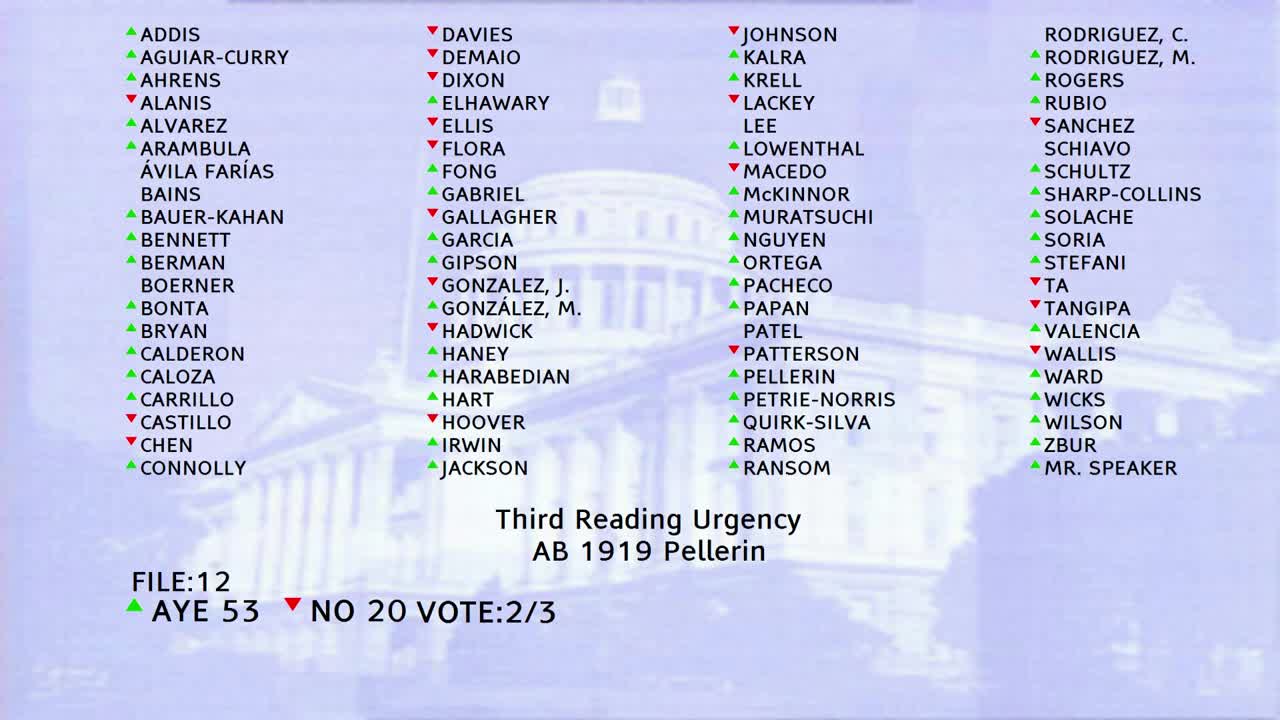 1MIN
Assembly Floor
 26MIN
Assembly Standing Committee on Emergency Management
Bill Author


