AB 1584: State Air Resources Board: Office of Civil Rights.
- Session Year: 2025-2026
- House: Assembly
- Latest Version Date: 2026-06-09
Current Status:
In Progress
(2026-08-13: In committee: Held under submission.)
Introduced
In Committee
Awaiting First Chamber Vote
Passed First Chamber
In Committee
Awaiting Second Chamber Vote
Passed Second Chamber
Enacted
Existing law establishes within the California Environmental Protection Agency the State Air Resources Board. Existing law provides for the establishment of air pollution control districts and air quality management districts. Existing law generally vests regulatory jurisdiction over stationary sources of air pollution to in the air pollution control districts and air quality management districts and regulatory jurisdiction over mobile sources of air pollution to in the State Air Resources Board.
This bill, contingent upon an appropriation by the Legislature in the annual Budget Act or another act for its purposes, would create the Office of Civil Rights within the state board. The bill would set forth the responsibilities of the office, including providing training on civil rights obligations to board staff, grantees, contractors, and subrecipients, and coordinating with air pollution control districts and air quality management districts and the California Environmental Protection Agency to align civil rights compliance efforts statewide. subrecipients. The bill would require the state board to post on its internet website an annual summary of information regarding the office, including a summary of civil rights complaints received by the office and a description of compliance and enforcement efforts by the office relating to civil rights.
Existing law establishes within the California Environmental Protection Agency the State Air Resources Board. Existing law provides for the establishment of air pollution control districts and air quality management districts. Existing law generally vests regulatory jurisdiction over stationary sources of air pollution to the air pollution control districts and air quality management districts and regulatory jurisdiction over mobile sources of air pollution to the State Air Resources Board.
This bill, contingent upon an appropriation by the Legislature in the annual Budget Act or another act for its purposes, would create the Office of Civil Rights within the state board. The bill would set forth the responsibilities of the office, including providing training on civil rights obligations to board staff, grantees, contractors, and subrecipients, and coordinating with air pollution control districts and air quality management districts and the California Environmental Protection Agency to align civil rights compliance efforts statewide. The bill would require the state board to post on its internet website an annual summary of information regarding the office, including a summary of civil rights complaints received by the office and a description of compliance and enforcement efforts by the office relating to civil rights.
(a)There is hereby established within the state board an Office of Civil Rights.
(b)The responsibilities of the office established pursuant to subdivision (a) include, but are not limited to, all of the following:
(1)Providing training on civil rights obligations to board staff, grantees, contractors, and subrecipients.
(2)Developing a civil rights evaluation tool to assist recipients in understanding and being able to meet their civil rights requirements.
(3)Ensuring language access and culturally appropriate outreach in all public engagement processes, including, but not limited to, all of the following:
(A)Translation and interpretation services.
(B)Bilingual or multilingual staffing.
(C)Multilingual public materials.
(4)Coordinating with air pollution control districts and air quality management districts and the California Environmental Protection Agency to align civil rights compliance efforts statewide.(c)The state board shall post on its internet website an annual summary that includes, but is not limited to, the following information regarding the office created pursuant to subdivision (a):
(1)A summary of civil rights complaints received by the office.
(2)A description of compliance and enforcement efforts by the office relating to civil rights.
(3)An overview of public outreach and engagement activities carried out by the office.
(d)The implementation of this section is contingent upon an appropriation by the Legislature in the annual Budget Act or another act for these purposes.
(a)There is hereby established within the state board an Office of Civil Rights.
(b)The responsibilities of the office established pursuant to subdivision (a) include, but are not limited to, all of the following:
(1)Providing training on civil rights obligations to board staff, grantees, contractors, and subrecipients.
(2)Developing a civil rights evaluation tool to assist recipients in understanding and being able to meet their civil rights requirements.
(3)Ensuring language access and culturally appropriate outreach in all public engagement processes, including, but not limited to, all of the following:
(A)Translation and interpretation services.
(B)Bilingual or multilingual staffing.
(C)Multilingual public materials.
(4)Coordinating with air pollution control districts and air quality management districts and the California Environmental Protection Agency to align civil rights compliance efforts statewide.
(c)The state board shall post on its internet website an annual summary that includes, but is not limited to, the following information regarding the office created pursuant to subdivision (a):
(1)A summary of civil rights complaints received by the office.
(2)A description of compliance and enforcement efforts by the office relating to civil rights.
(3)An overview of public outreach and engagement activities carried out by the office.
(d)The implementation of this section is contingent upon an appropriation by the Legislature in the annual Budget Act or another act for these purposes.
|
Date
|
Status
|
|---|---|
| Aug 13, 2026 | In committee: Held under submission. |
| Aug 3, 2026 | In committee: Referred to APPR. suspense file. |
| Jul 1, 2026 | From committee: Do pass and re-refer to Com. on APPR. (Ayes 11. Noes 2.) (June 30). Re-referred to Com. on APPR. |
| Jun 17, 2026 | From committee: Do pass and re-refer to Com. on JUD. (Ayes 5. Noes 2.) (June 17). Re-referred to Com. on JUD. |
| Jun 9, 2026 | From committee chair, with author's amendments: Amend, and re-refer to committee. Read second time, amended, and re-referred to Com. on E.Q. |
| Jun 3, 2026 | Referred to Coms. on E.Q. and JUD. |
| May 22, 2026 | In Senate. Read first time. To Com. on RLS. for assignment. |
| May 22, 2026 | Read third time. Passed. Ordered to the Senate. (Ayes 57. Noes 18. Page 5253.) |
| May 22, 2026 | Read third time. Passed. Ordered to the Senate. (Ayes 57. Noes 18.) |
| May 18, 2026 | Read second time. Ordered to third reading. |
| May 14, 2026 | From committee: Do pass. (Ayes 11. Noes 4.) (May 14). |
| Apr 22, 2026 | In committee: Set, first hearing. Referred to APPR. suspense file. |
| Apr 8, 2026 | From committee: Do pass and re-refer to Com. on APPR. (Ayes 9. Noes 3.) (April 7). Re-referred to Com. on APPR. |
| Mar 16, 2026 | Referred to Com. on JUD. |
| Jan 14, 2026 | From printer. May be heard in committee February 13. |
| Jan 13, 2026 | Read first time. To print. |
|
Date
|
Description
|
Location
|
Votes
|
|
|---|---|---|---|---|
| Aug 3, 2026 | Placed on suspense file | Senate Standing Committee on Appropriations |
Passed |
|
| Jun 30, 2026 | Do pass, but first be re-referred to the Committee on [Appropriations] | Senate Standing Committee on Judiciary |
Passed |
|
| Jun 17, 2026 | Do pass, but first be re-referred to the Committee on [Judiciary] | Senate Standing Committee on Environmental Quality |
Passed |
|
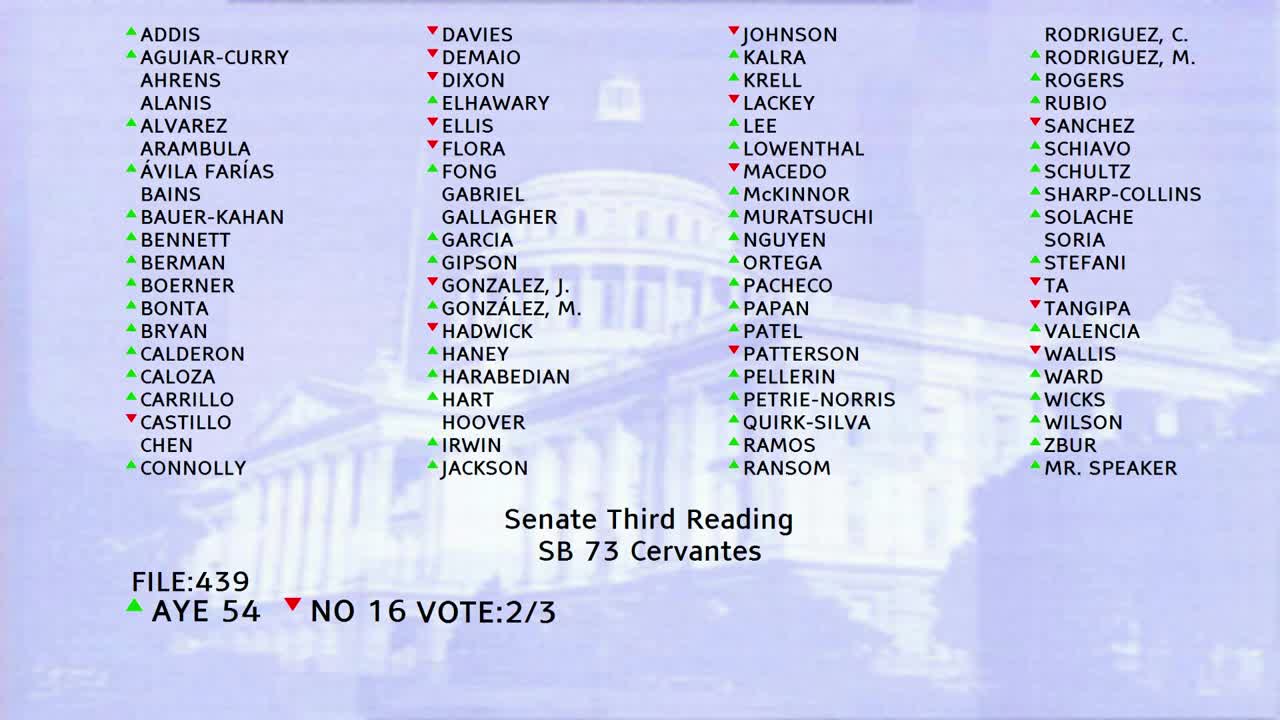
| May 22, 2026 | AB 1584 Jackson Assembly Third Reading | Assembly Floor |
Passed |
|
| May 14, 2026 | Do pass. | Assembly Standing Committee on Appropriations |
Passed |
|
| Apr 7, 2026 | Do pass and be re-referred to the Committee on [Appropriations] | Assembly Standing Committee on Judiciary |
Passed |
This list shows positions taken on this bill by organizations on the date displayed, which is linked to the original source.
Positions by individuals are not included.
|
Organization
|
Position
|
Date
|
|---|---|---|
| California Air Resources Board | ** Support | |
| California Immigrant Policy Center | ** Support | |
| Coalition For Clean Air | ** Support |
SENATE COMMITTEE ON
Senator Sabrina Cervantes, Chair
2025 - 2026 Regular Session
AB 1584 (Jackson) - State Air Resources Board: Office of Civil Rights
Version: | Policy Vote: |
Urgency: | Mandate: |
Hearing Date: | Consultant: |
Bill Summary:
This bill would establish an Office of Civil Rights within the California Air Resources Board (CARB) and define the responsibilities and duties thereof.
Fiscal Impact:
- CARB estimates ongoing costs of $1.3 million annually (Air Pollution Control Fund [APCF]) to establish and manage an Office of Civil Rights.
Background:
Existing law establishes CARB, charging it with controlling motor vehicle emissions and coordinating, encouraging, and reviewing air quality efforts across all levels of government (Health and Safety Code §39500), and requires CARB to adopt standards, rules, and regulations consistent with the state's goal of providing a decent home and suitable living environment for every Californian (HSC §39601). Existing law also establishes the Department of Human Resources to oversee the state's civil service system and ensure that applicants and employees in state service are treated equitably without regard to political affiliation, race, color, sex, religious creed, national origin, ancestry, marital status, age, sexual orientation, disability, political or religious opinions, or other non-job-related factors (Government Code §18500).
According to CARB, its efforts to uphold civil rights laws and protections are relevant to all its work, including its work focused on addressing the disproportionate impact of air pollution on communities of color. CARB is currently updating its Civil Rights Policy and Discrimination Complaints Process. This could be reasonably expected to increase the number of civil rights complaints received by the department.
Proposed Law:
This bill would:
- Establish the Office of Civil Rights within CARB and task the Office with doing the following:
- Providing training on civil rights obligations to board staff, grantees, contractors, and subrecipients;
- Developing a civil rights evaluation tool to assist recipients in understanding and being able to meet their civil rights requirements;
- Ensuring language access and culturally appropriate outreach in all public engagement processes, as specified; and
- Require CARB to post on its website an annual summary that would include, but not be limited to, the following information:
- A summary of civil rights complaints received by the Office of Civil Rights;
- A description of compliance and enforcement efforts by the Office relating to civil rights; and
- An overview of public outreach and engagement activities carried out by the Office.
- Provide that the bill's implementation would be contingent on an appropriation.
Related Legislation:
AB 715 (Addis, Chapter 428, Statutes of 2025) among other things, established the Office of Civil Rights under the Government Operations Agency with specified duties.
Staff Comments:
CARB notes that establishment of an Office of Civil Rights could improve its oversight and ability to enforce civil rights complaints. This bill would be consistent with CARB's Blueprint 2.0 goal to provide transparent compliance with non-discrimination laws.
-- END --
Senator Thomas Umberg, Chair
2025-2026 Regular Session
Bill No: AB 1584 (Author:Jackson)
Version: June 9, 2026
Hearing Date: June 30, 2026
Fiscal: Yes
Urgency: No
Consultant: ME
SUBJECT
State Air Resources Board: Office of Civil Rights
DIGEST
This bill establishes an Office of Civil Rights within the State Air Resources Board (CARB).
EXECUTIVE SUMMARY
The author brings this bill to establish an Office of Civil Rights within CARB in an effort to ensure that the people that are most harmed by pollution are able to meaningfully participate in informing the decisionmaking of CARB. This Office within CARB would be responsible for providing training on civil rights obligations to CARB staff, grantees, contractors, and subrecipients; developing a civil rights evaluation tool to assist recipients in understanding and being able to meet their civil rights requirements; and ensuring language access and culturally appropriate outreach in all public engagement processes. CARB would also be required to post on its website an annual summary that includes a summary of civil rights complaints received by the Office; a description of compliance and enforcement efforts by the Office relating to civil rights; and an overview of public outreach and engagement activities carried out by the Office.
The bill is author sponsored and supported by the California Immigrant Policy Center. No timely opposition was received by the Committee. This bill was approved by the Senate Environmental Quality Committee with a vote of 5 to 2. If the bill passes this Committee, it will next be referred to the Senate Appropriations Committee.
PROPOSED CHANGES TO THE LAW
Existing law:
- Establishes the California Air Resources Board (CARB) and tasks CARB with controlling emissions from motor vehicles and to coordinate, encourage, and review the efforts of all levels of government as they affect air quality. (Health & Saf. Code § 39500.)
- Requires CARB to establish standards, rules, and regulations that are consistent with the state’s goal of providing a decent home and suitable living environment for every Californian. (Health & Saf. Code § 39601.)
- Establishes the Department of Human Resources to oversee the state’s civil service system and to ensure that all applicants and employees in state service are treated in an equitable manner without regard to political affiliation, race, color, sex, religious creed, national origin, ancestry, marital status, age, sexual orientation, disability, political or religious opinions or nonjob-related factors. (Gov. Code § 18500.)
This bill:
- Establishes an Office of Civil Rights (Office) within the CARB.
- Specifies that the responsibilities of the Office include, but are not limited to, all of the following: providing training on civil rights obligations to CARB staff, grantees, contractors, and subrecipients; developing a civil rights evaluation tool to assist recipients in understanding and being able to meet their civil rights requirements; and ensuring language access and culturally appropriate outreach in all public engagement processes, as specified.
- Requires CARB to post on its website an annual summary that includes, but is not limited to, the following information regarding the Office: a summary of civil rights complaints received by the Office; a description of compliance and enforcement efforts by the Office relating to civil rights; and an overview of public outreach and engagement activities carried out by the Office.
- Provides that the implementation of the provisions of this bill is contingent upon appropriation by the Legislature in the Budget Act or another act.
COMMENTS
- Stated need for the bill
According to the author:
Black and Latino Californians bear a disproportionate burden of air pollution exposure, the result of decades of inequitable land use policies, discriminatory zoning, and the systematic placement of freeways, industrial facilities, and waste sites near communities of color. Meaningful representation is not a courtesy; it is a democratic obligation. CARB must reflect the diversity of the state it serves, through the appointment of Board members and staff with deep roots in frontline communities, outreach conducted in multiple languages, and engagement embedded in trusted local institutions. The people most harmed by pollution have the clearest stake in the solutions, and until their voices carry real weight within the agency, California's environmental policies will continue to fall short of the equity they promise.
2. Creates and Office of Civil Rights in CARB
The author’s office provided the Committee with information explaining that, “Black, Latino, Asian American and low-income communities are exposed to substantially more air pollution than other demographic groups in California.” As explained in a health article provided by the Author’s office[1]:
[ . . . ] Air pollution, urbanization, redlining and industrialization all intersect with health equity in a way that harms minority and low-income communities, says Olawale Amubieya, MD, pulmonologist and junior faculty in the Division of Pulmonary and Critical Care Medicine at UCLA Health.
“Policies of the past cut out low-income, minority and urban communities from suburban communities where the traffic and smog are less dense. [These policies] relegated them into areas that are close to industrial plants, which produce more air pollution,” he says. “It really does put these at-risk communities at even higher risk because of the health effects.”
Included in high-risk category are low-income communities with large percentages of racial minorities, people experiencing homelessness, pregnant people, developing children, elderly adults and people with disabilities and chronic conditions.
Neighborhoods in the San Francisco Bay area with higher percentages of people of color face double the rate of pollution-related childhood asthma compared to predominantly white neighborhoods, according to research from March 2021.
Additionally, Black, Latino, Asian American and low-income communities are exposed to substantially more air pollution than other demographic groups in California, a 2019 study shows. People living in dense urban areas like Los Angeles County had higher exposure to traffic pollution compared to the state average.
Dr. Amubieya says when poor air quality collides with the health inequities that already exist, diseases are exacerbated and health issues arise.
CARB is tasked with controlling emissions from motor vehicles and coordinating, encouraging, and reviewing the efforts of all levels of government as they affect air quality.
As reported by Politico in 2020, “Black employees of the California Air Resources Board have raised concerns about a racist work environment and are calling for more representation at the state’s main air and climate agency.”[2] Additionally, as explained in the Senate Environmental Quality Committee analysis for this bill[3]:
In 2020, Black employees at CARB submitted a letter to agency leadership outlining systematic bias within the agency. The letter noted that the staff of the agency were disproportionately white, that white staff regularly discounted the opinion of better qualified Black staffers, and that the agency did not actively seek to recruit a diverse workforce.
[ . . . ]
In response to the allegations in the letter, CARB established the Racial Equity Inventory’s Community Partner Workgroup and has adopted a “vision for change” to improve the agency’s internal policies and programs to better support a diverse workforce. The author notes that improving diversity at CARB is especially important given that one of the agency’s core missions is to improve air quality and cut down on pollution in California’s diverse frontline communities.
Drilling down on equity within CARB’s efforts to achieve California’s climate goals specifically, as early as AB 32 in 2006 (Nunez, Chapter 488, Statutes of 2006) called for an Environmental Justice Advisory Committee (EJAC). Although the CARB EJAC has provided significant (and often critical) feedback and direction on CARB on proposed actions, members have often complained that such feedback was not adequately considered or valued. This recently culminated in the resignation of EJAC co-chair Dr. Catherine Garoupa in November of last year. In her resignation, Dr. Garoupa cited “growing hostility toward EJAC that undermines its integrity” and “the increasing bias of the agency toward regulated industries and dismissal of the best available science, at the expense of low income communities and communities of color.”
The author brings this bill to establish an Office of Civil Rights within CARB in an effort to ensure that the people that are most harmed by pollution are able to meaningfully participate in informing the decision-making of CARB so that there are meaningful improvements to most impacted communities. This Office would be responsible for providing training on civil rights obligations to CARB staff, grantees, contractors, and subrecipients; developing a civil rights evaluation tool to assist recipients in understanding and being able to meet their civil rights requirements; and ensuring language access and culturally appropriate outreach in all public engagement processes. CARB would also be required to post on its website an annual summary that includes a summary of civil rights complaints received by the Office; a description of compliance and enforcement efforts by the Office relating to civil rights; and an overview of public outreach and engagement activities carried out by the Office.
The California Immigrant Policy Center explains the following in support of the bill:
Frontline communities across California, predominantly communities of color, low-income residents, and non-English-speaking households, continue to bear a disproportionate burden of air pollution and its devastating health consequences, including asthma, cardiovascular disease, and premature death. These same communities are now at heightened risk as federal rollbacks eliminate the enforcement mechanisms they have long depended on. By embedding a dedicated Office of Civil Rights within CARB, AB 1584 ensures that California's own environmental programs, grants, and contracts are held to the civil rights standards the federal government is abandoning.
Additionally, language access is foundational to equitable public engagement. AB 1584's requirements for translation and interpretation services, bilingual staffing, and multilingual public materials will ensure that the communities most affected by air quality decisions have a genuine seat at the table, not just a technical opportunity to participate. This is both a legal obligation and a matter of basic fairness.
We appreciate that AB 1584 builds in structures for ongoing learning and improvement through annual public summaries of civil rights activities and coordinated efforts across CARB, local air districts, and CalEPA. These provisions signal a long-term commitment to getting this right, and they give community partners like our organizations a meaningful way to stay engaged and support CARB's work over time. For these reasons, we strongly support AB 1584.
SUPPORT
California Immigrant Policy Center
OPPOSITION
None received
RELATED LEGISLATION
Pending Legislation: None known.
Prior Legislation: None known.
PRIOR VOTES:
Senate Environmental Quality Committee (Ayes 5, Noes 2)
Assembly Floor (Ayes 57, Noes 18)
Assembly Appropriations Committee (Ayes 11, Noes 4)
Assembly Judiciary Committee (Ayes 9, Noes 3)
**************
When air pollution becomes a health equity issue: Poor air quality colliding with existing health inequities exacerbates disease, UCLA Health (Nov. 1, 2021) Jocelyn Apodaca Schlossberg, available at https://www.uclahealth.org/news/article/air-pollution-health-equity-los-angeles ↑
Black employees call out systemic racism at California Air Resources Board, Politico, by Debra Kahn (Oct. 21, 2020), available at https://www.politico.com/states/california/story/2020/10/21/black-employees-call-out-systemic-racism-at-california-air-resources-board-1328910. ↑
Citations omitted. ↑
SENATE COMMITTEE ON ENVIRONMENTAL QUALITY
Senator Blakespear, Chair
2025 - 2026 Regular
Bill No: AB 1584
Author: | Jackson | ||
Version: | 6/9/2026 | Hearing Date: | 6/17/2026 |
Urgency: | No | Fiscal: | Yes |
Consultant: | Heather Walters | ||
SUBJECT: State Air Resources Board: Office of Civil Rights
DIGEST: This bill establishes an Office of Civil Rights within the California Air Resources Board and defines the responsibilities and duties thereof.
ANALYSIS:
Existing law:
- Establishes the California Air Resources Board (CARB) and tasks the Board with controlling emissions from motor vehicles and to coordinate, encourage, and review the efforts of all levels of government as they affect air quality. (Health and Safety Code Section 39500.)
- Requires the California Air Resources Board to establish standards, rules, and regulations that are consistent with the state’s goal of providing a decent home and suitable living environment for every Californian. (Health and Safety Code Section 39601.)
- Establishes the Department of Human Resources to oversee the state’s civil service system and to ensure that all applicants and employees in state service are treated in an equitable manner without regard to political affiliation, race, color, sex, religious creed, national origin, ancestry, marital status, age, sexual orientation, disability, political or religious opinions or nonjob-related factors. (Government Code Section 18500.)
This bill:
- Establishes the Office of Civil Rights within the California Air Resources Board and tasks the Office with doing the following:
- Providing training on civil rights obligations to board staff, grantees, contractors, and subrecipients;
- Developing a civil rights evaluation tool to assist recipients in understanding and being able to meet their civil rights requirements;
- Ensuring language access and culturally appropriate outreach in all public engagement processes, as specified; and
- Requires the California Air Resources Board to post on its website an annual summary that includes, but is not limited to, the following information:
- A summary of civil rights complaints received by the Office of Civil Rights;
- A description of compliance and enforcement efforts by the Office relating to civil rights; and
- An overview of public outreach and engagement activities carried out by the office.
- Provides that the bill’s implementation is contingent on an appropriation.
Background
- Civil rights in California. California enacted civil rights laws in 1959 to prohibit discrimination in employment and housing based on a person’s race, religion, national origin and ancestry. In addition to the Fair Employment Practices Act (FEHA), the Unruh Civil Rights Act also passed that year prohibiting discrimination by business establishments. In the decades since, a number of additional state antidiscrimination laws have passed. They expanded the original act’s list of protected classes to include as many as 18 characteristics such as sex and disability. In addition, sexual harassment and retaliation now are prohibited actions. California’s civil rights laws were consolidated in 1980 under the jurisdiction of the Civil Rights Department (CRD), which is now the largest civil rights agency in the country. It is part of the state’s Business, Consumer Services and Housing Agency.
- Defining equity. The concept of “equity” in policymaking is deceptively complex. PolicyLink, a national policy think tank, defines equity as “just and fair inclusion into a society in which all can participate, prosper, and reach their full potential.”[1] Equity involves people having what they need to enjoy full, healthy lives. Different groups of people — based on race, ethnicity, gender, immigration status, sexual orientation, or socioeconomic status — may need different types or amounts of resources and supports to enjoy full, healthy lives.
More specifically, equity is often broken down further into more detailed components. In a 2023 synthesis of federal equity action plans, the Urban Institute broke equity into the following components to evaluate programs:- Procedural equity, when public decisionmaking processes are transparent, accessible, fair, and inclusive;
- Structural equity, when government institutions and systems have the processes, practices, and policies to operationalize equity in how they function and make decisions; and
- Distributional equity, when there is an equitable distribution of resources, community burdens, and benefits.[2]
These dimensions of equity can be useful in considering AB 1584. Providing access to the public through appropriate-language outreach and tools for recipients promotes procedural equity. The proposed civil rights training to those working for and with CARB advances structural equity. Many of CARB’s actions and regulations affect distributional equity in California; by strengthening the other two dimensions of equity with this bill, CARB could potentially advance greater distributional equity through future actions.
Comments
- Purpose of Bill. According to the author, “Black and Latino Californians bear a disproportionate burden of air pollution exposure, the result of decades of inequitable land use policies, discriminatory zoning, and the systematic placement of freeways, industrial facilities, and waste sites near communities of color. Meaningful representation is not a courtesy, it is a democratic obligation. CARB must reflect the diversity of the state it serves, through the appointment of board members and staff with deep roots in frontline communities, outreach conducted in multiple languages, and engagement embedded in trusted local institutions. The people most harmed by pollution have the clearest stake in the solutions, and until their voices carry real weight within the agency, California's environmental policies will continue to fall short of the equity they promise.”
- Equity concerns raised at CARB. In 2020, Black employees at CARB submitted a letter to agency leadership outlining systematic bias within the agency. The letter noted that the staff of the agency were disproportionately white, that white staff regularly discounted the opinion of better qualified Black staffers, and that the agency did not actively seek to recruit a diverse workforce. Somewhat ironically given the current federal administration’s crusade against diversity efforts in workplace hiring, the United States Department of Justice used the letter as justification for commencing an investigation into the California Air Resources Board’s hiring practices.[3]
In response to the allegations in the letter, CARB established the Racial Equity Inventory’s Community Partner Workgroup and has adopted a “vision for change” to improve the agency’s internal policies and programs to better support a diverse workforce.[4] The author notes that improving diversity at CARB is especially important given that one of the agency’s core missions is to improve air quality and cut down on pollution in California’s diverse frontline communities.
Drilling down on equity within CARB’s efforts to achieve California’s climate goals specifically, as early as AB 32 in 2006 (Nunez, Chapter 488, Statutes of 2006) called for an Environmental Justice Advisory Committee (EJAC). Although the CARB EJAC has provided significant (and often critical) feedback and direction on CARB on proposed actions, members have often complained that such feedback was not adequately considered or valued. This recently culminated in the resignation of EJAC co-chair Dr. Catherine Garoupa in November of last year.[5] In her resignation, Dr. Garoupa cited “growing hostility toward EJAC that undermines its integrity” and “the increasing bias of the agency toward regulated industries and dismissal of the best available science, at the expense of low income communities and communities of color.”
Although an Office of Civil Rights, as proposed by AB 1584, will not directly address the issues raised by Black CARB staffers nor Dr. Garoupa, both examples illustrate the benefits of requiring CARB to undertake a more active, integrated effort to include equity and civil rights across the range of activities and positions within the agency.
Related/Prior Legislation
AB 715 (Addis, Chapter 428, Statutes of 2025) among other things, established the Office of Civil Rights under the Government Operations Agency with specified duties.
SOURCE:
Author
SUPPORT:
None received
OPPOSITION:
None received
-- END --
The Equity Manifesto. PolicyLink. https://www.policylink.org/about/equity-manifesto ↑
Pathways to Equity at Scale, 2023. Balu et al. https://www.urban.org/research/publication/pathways-equity ↑
Stephen Lee, DOJ Probes California EPA Alleging Discriminatory Hiring, Bloomberg Law (Aug. 27, 2025) https://news.bloomberglaw.com/environment-and-energy/doj-investigates-california-epa-alleging-discriminatory-hiring ↑
CARB – Equity. https://ww2.arb.ca.gov/equity ↑
Catherine Garoupa, Letter to CARB Chair Lauren Sanchez and CARB Members. November 18, 2025. https://www.documentcloud.org/documents/26289397-garoupa-ejac-resignation-letter-111825/ ↑
ASSEMBLY THIRD READING
ATR Bill Id:AB 1584
Author:(Jackson)
As Introduced Ver:January 13, 2026
Majority vote
SUMMARY
Establishes the Office of Civil Rights within the California Air Resources Board.
Major Provisions
- Establishes the Office of Civil Rights within the California Air Resources Board and tasks the Office with doing the following:
- Providing training on civil rights obligations to board staff, grantees, contractors, and subrecipients;
- Developing a civil rights evaluation tool to assist recipients in understanding and being able to meet their civil rights requirements;
- Ensuring language access and culturally appropriate outreach in all public engagement processes, as specified; and
- Coordinating with air pollution control districts and air quality management districts and the California Environmental Protection Agency to align civil rights compliance efforts statewide.
- Requires the California Air Resources Board to post on its website an annual summary that includes, but is not limited to, the following information:
- A summary of civil rights complaints received by the Office of Civil Rights;
- A description of compliance and enforcement efforts by the Office relating to civil rights; and
- An overview of public outreach and engagement activities carried out by the office.
- Provides that the bill's implementation is contingent on an appropriation.
COMMENTS
In 2020, a group of Black employees at the California Air Resources Board submitted a letter to agency leadership highlighting bias and disparate treatment of Black employees within the agency. (https://ww2.arb.ca.gov/sites/default/files/2020-11/Letter-Action%20Plan%20for%20Racial%20Change%20at%20CARB.pdf.) Seeking to ensure that the Air Resources Board is responsive to the needs of California's diverse communities, this bill establishes an Office of Civil Rights at the Air Resources Board.
Troubling allegations about discriminatory employment practices at the California Air Resources Board. As mentioned, in 2020 Black employees at the Air Resources Board submitted a letter to agency leadership outlining systematic bias within the agency. The letter noted that the staff of the agency were disproportionately white, that white staff regularly discounted the opinion of better qualified Black staffers, and that the agency did not actively seek to recruit a diverse workforce. Somewhat ironically given the current federal administration's crusade against diversity efforts in workplace hiring, the United States Department of Justice used the letter as justification for commencing an investigation into the California Air Resources Board's hiring practices. (Stephen Lee, DOJ Probes California EPA Alleging Discriminatory Hiring, Bloomberg Law (Aug. 27, 2025) available at: https://news.bloomberglaw.com/environment-and-energy/doj-investigates-california-epa-alleging-discriminatory-hiring.)
In response to the allegations in the letter, the Air Resources Board established the Racial Equity Inventory's Community Partner Workgroup and has adopted a "vision for change" to improve the agency's internal policies and programs to better support a diverse workforce. (https://ww2.arb.ca.gov/equity.) The author notes that improving diversity at the Air Resources Board is especially important given that one of the agency's core missions is to improve air quality and cut down on pollution in California's diverse frontline communities. The author notes that if that agency cannot properly treat and value the contributions of its non-white workforce then the agency will be too quick to gloss over the environmental concerns of diverse environmental justice communities across the state.
This bill establishes the Office of Civil Rights within the California Air Resources Board. The bill would specifically task the Office of Civil Rights with providing trainings to Board staff on their obligations under the law to frontline communities and develop a tool for the Board to utilize when evaluating the impact of Board policies and actions on communities of color. The bill also tasks the Office with ensuring adequate translation services for Californians interacting with the Board. The Office of Civil Rights would also serve as the Board lead point of contact for ensuring that the Board's parent agency, the California Environmental Protect Agency, as well as the regional air boards coordinate their efforts to protect frontline communities from the impact of pollution. The bill would require the Office of Civil Rights to provide annual public reports on the Board's efforts to promote compliance with civil rights laws and the Board's efforts to diversify and make its public outreach programs more accessible. Finally, reflecting the present state of the General Fund, the bill would make its enactment contingent on a subsequent legislative appropriation.
This bill follows other agencies in adopting specialized units to address environmental justice and the specific needs of communities of color. The environmental justice movement recognizes the disparities in environmental outcomes between communities across California and seeks to ensure fair outcomes in environmental protection and enforcement in communities across the state. Too frequently California's lower-income communities of color experience far greater impacts from pollution, toxic contamination, and the effects of global warming than richer areas of the state. Furthermore, these communities rarely possess adequate resources to fully represent their interests in court or before state regulators seeking to address environmental harms. Accordingly, in recent years, the state has attempted to better assist these communities by coordinating state environmental programs to ensure that these communities are not left behind as California aggressively seeks to remediate past environmental harms and proactively mitigate the impacts of global climate change. To that end, as a part of the Budget Act of 2004, the Legislature required the Governor's Office of Land Use and Climate Innovation to coordinate environmental justice programs across the state. (SB 1097 (Committee on Budget and Fiscal Review) Chap. 225, Stats. 2004.) More recently, the Legislature enacted AB 1628 (R. Rivas) Chap. 360, Stats. 2019 to ensure better coordination between the environmental justice units within various state agencies, similar to the efforts within the various levels of California Environmental Protection Agency envisioned by this bill.
According to the Author
Black and Latino Californians bear a disproportionate burden of air pollution exposure, the result of decades of inequitable land use policies, discriminatory zoning, and the systematic placement of freeways, industrial facilities, and waste sites near communities of color. Meaningful representation is not a courtesy, it is a democratic obligation. CARB must reflect the diversity of the state it serves, through the appointment of board members and staff with deep roots in frontline communities, outreach conducted in multiple languages, and engagement embedded in trusted local institutions. The people most harmed by pollution have the clearest stake in the solutions, and until their voices carry real weight within the agency, California's environmental policies will continue to fall short of the equity they promise.
Arguments in Support
This bill is supported by the Coalition for Clean Air and the California Immigrant Policy Center. In support of the bill the California Immigrant Policy Center writes:
Frontline communities across California, predominantly communities of color, low-income residents, immigrant communities, and non-English-speaking households, continue to bear a disproportionate burden of air pollution and its devastating health consequences, including asthma, cardiovascular disease, and premature death. These same communities are now at heightened risk as federal rollbacks eliminate the enforcement mechanisms they have long depended on. By embedding a dedicated Office of Civil Rights within CARB, AB 1584 ensures that California's own environmental programs, grants, and contracts are held to the civil rights standards the federal government is abandoning.
Additionally, language access is foundational to equitable public engagement. AB 1584's requirements for translation and interpretation services, bilingual staffing, and multilingual public materials will ensure that the communities most affected by air quality decisions have a genuine seat at the table, not just a technical opportunity to participate. This is both a legal obligation and a matter of basic fairness.
We also appreciate that AB 1584 builds in structures for ongoing learning and improvement through annual public summaries of civil rights activities and coordinated efforts across CARB, local air districts, and CalEPA. These provisions signal a long-term commitment to getting this right, and they give community partners like our organizations a meaningful way to stay engaged and support CARB's work overtime.
Arguments in Opposition
None on file
FISCAL COMMENTS
According to the Assembly Appropriations Committee, potential significant costs (Air Pollution Control Fund). CARB anticipates costs of $1.5 in budget year and ongoing for the following:
- Eight permanent positions, including a civil rights supervisor to manage the office and oversee compliance efforts; staff to develop and maintain a civil rights evaluation tool; staff to develop and deliver civil rights training to CARB employees, grantees, contractors, and subrecipients; staff to investigate and track civil rights complaints and produce annual complaint and compliance summaries; and staff to provide language access services, including translation, interpretation, multilingual staffing, and multilingual public materials, and to maintain the office's civil rights webpage. CARB also identifies the need for staff to lead coordination with air pollution control districts, air quality management districts, and CalEPA on statewide civil rights compliance.
- $132,000 ongoing annually in administrative costs for personnel, facilities, asset management, and health and safety support.
- $170,000 for desktop support services, IT procurement, and development and maintenance of the civil rights webpage and evaluation tool.
- $229,000 for legal review and support of civil rights investigations and compliance activities.
VOTES
ASM JUDICIARY: 9-3-0
YES: Kalra, Lee, Bryan, Connolly, Harabedian, Pacheco, Papan, Stefani, Zbur
NO: Macedo, Dixon, Sanchez
ASM APPROPRIATIONS: 11-4-0
YES: Wicks, Aguiar-Curry, Calderon, Caloza, Fong, Mark González, Krell, Pacheco, Pellerin, Sharp-Collins, Solache
NO: Hoover, Dixon, Ta, Tangipa
UPDATED
VERSION: January 13, 2026
CONSULTANT: Nicholas Liedtke / JUD. / (916) 319-2334 FN: 0002615
Date of Hearing: April 22, 2026
ASSEMBLY COMMITTEE ON APPROPRIATIONS
Buffy Wicks, Chair
ABPCA Bill Id:AB 1584
Author:(Jackson) – As Introduced Ver:January 13, 2026
Policy Committee: | Judiciary | Vote: | 9 - 3 |
|
| ||
|
|
Urgency: No State Mandated Local Program: No Reimbursable: No
SUMMARY:
This bill establishes an Office of Civil Rights within the California Air Resources Board (CARB). The bill tasks the office with providing civil rights training to board staff, grantees, contractors, and subrecipients; developing a civil rights evaluation tool; ensuring language access and culturally appropriate outreach in public engagement processes; and coordinating civil rights compliance efforts with local air districts and CalEPA. The bill requires CARB to post an annual summary of civil rights complaints, compliance efforts, and outreach activities. Implementation is contingent upon an appropriation by the Legislature.
FISCAL EFFECT:
Potential significant costs (Air Pollution Control Fund). CARB anticipates costs of $1.5 in budget year and ongoing for the following:
- Eight permanent positions, including a civil rights supervisor to manage the office and oversee compliance efforts; staff to develop and maintain a civil rights evaluation tool; staff to develop and deliver civil rights training to CARB employees, grantees, contractors, and subrecipients; staff to investigate and track civil rights complaints and produce annual complaint and compliance summaries; and staff to provide language access services, including translation, interpretation, multilingual staffing, and multilingual public materials, and to maintain the office’s civil rights webpage. CARB also identifies the need for staff to lead coordination with air pollution control districts, air quality management districts, and CalEPA on statewide civil rights compliance.
- $132,000 ongoing annually in administrative costs for personnel, facilities, asset management, and health and safety support.
- $170,000 for desktop support services, IT procurement, and development and maintenance of the civil rights webpage and evaluation tool.
- $229,000 for legal review and support of civil rights investigations and compliance activities.
COMMENTS:
- Purpose. According to the author:
Black and Latino Californians bear a disproportionate burden of air pollution exposure, the result of decades of inequitable land use policies, discriminatory zoning, and the systematic placement of freeways, industrial facilities, and waste sites near communities of color. Meaningful representation is not a courtesy, it is a democratic obligation. CARB must reflect the diversity of the state it serves, through the appointment of board members and staff with deep roots in frontline communities, outreach conducted in multiple languages, and engagement embedded in trusted local institutions. The people most harmed by pollution have the clearest stake in the solutions, and until their voices carry real weight within the agency, California's environmental policies will continue to fall short of the equity they promise.
- Background. In 2020, a group of Black employees at CARB submitted a letter to agency leadership alleging systematic bias and disparate treatment of Black employees, including a disproportionately white workforce, dismissal of minority staff contributions, and inadequate recruitment of a diverse workforce. In response, CARB adopted Resolution 20-33, establishing an explicit commitment to racial equity, and created the Office of Racial Equity and the Diversity and Racial Equity Task Force. CARB has since partnered with UC Santa Cruz and USC to develop a multi-year Racial Equity Inventory and a Racial Equity Lens evaluation tool for use in agency decision-making. CARB’s organizational structure already includes several units whose functions may overlap with the office this bill would create, including the existing Civil Rights Office — currently staffed by only three employees — the Office of Racial Equity, and the Office of Environmental Justice, Tribal Affairs, and Border Relations. The bill does not address how the proposed Office of Civil Rights would relate to these existing units — whether it would consolidate, supplement, or supersede their functions. The author may wish to clarify this relationship, particularly given the budget constraints facing the state.
Analysis Prepared by: Shiran Zohar / APPR. / (916) 319-2081
Date of Hearing: April 7, 2026
ASSEMBLY COMMITTEE ON JUDICIARY
Ash Kalra, Chair
ABPCA Bill Id:AB 1584
Author:(Jackson) – As Introduced Ver:January 13, 2026
SUBJECT: State Air Resources Board: Office of Civil Rights
KEY ISSUE: should an office of civil rights be established within the california air resources board to better assist the agency in serving the needs of california’s frontline communities?
SYNOPSIS
The California Air Resources Board is tasked with enforcing California’s wide-ranging and strict pollution control laws. Not only does the agency oversee the state’s Cap and Invest program but the Air Resources Board also oversees pollution rules for cars and trucks, the ports, and some stationary sources. One of the agency’s most important and pressing challenges is reducing particulate pollution in communities adjacent to transit corridors, communities that are typically lower income and more diverse than the state overall. Unfortunately, in 2020 troubling allegations arose within the agency about the treatment of Black staff. Not only did staff allege a series of frequent microaggressions but also noted that agencywide recruitment and retention of minority staff was inadequate. The author and proponents of this bill note that a workforce that does not reflect the diversity of California will struggle to meet the needs of diverse environmental justice communities across this state.
To ensure that the Air Resources Board better represents and serves California’s diverse communities, this bill would create an Office of Civil Rights within the California Air Resources Board. The bill would task the Office with providing trainings to agency staff on civil rights and the needs of diverse communities, improve language access for Californians engaging with the agency, and develop objective tools to study how agency rulemaking and enforcement actions is helping the state’s diverse communities.
This bill is supported by the Coalition for Clean Air and the California Immigrant Policy Center who highlight the need for all state agencies, including the Air Resources Board, to better engage with frontline, environmental justice communities and applauds the bill’s efforts to move the Air Resources Board in a positive direction. The proponents also applaud the bill’s focus on improving language access for communities engaging with state regulators. The bill has no registered opposition.
SUMMARY: Establishes the Office of Civil Rights within the California Air Resources Board. Specifically, this bill:
- Establishes the Office of Civil Rights within the California Air Resources Board and tasks the Office with doing the following:
- Providing training on civil rights obligations to board staff, grantees, contractors, and subrecipients;
- Developing a civil rights evaluation tool to assist recipients in understanding and being able to meet their civil rights requirements;
- Ensuring language access and culturally appropriate outreach in all public engagement processes, as specified; and
- Coordinating with air pollution control districts and air quality management districts and the California Environmental Protection Agency to align civil rights compliance efforts statewide.
- Requires the California Air Resources Board to post on its website an annual summary that includes, but is not limited to, the following information:
- A summary of civil rights complaints received by the Office of Civil Rights;
- A description of compliance and enforcement efforts by the Office relating to civil rights; and
- An overview of public outreach and engagement activities carried out by the office.
- Provides that the bill’s implementation is contingent on an appropriation.
EXISTING LAW:
- Establishes the California Air Resources Board and tasks the Board with controlling emissions from motor vehicles and to coordinate, encourage, and review the efforts of all levels of government as they affect air quality. (Health and Safety Code Section 39500.)
- Requires the California Air Resources Board to establish standards, rules, and regulations that are consistent with the state’s goal of providing a decent home and suitable living environment for every Californian. (Health and Safety Code Section 39601.)
- Establishes the Department of Human Resources to oversee the state’s civil service system and to ensure that all applicants and employees in state service are treated in an equitable manner without regard to political affiliation, race, color, sex, religious creed, national origin, ancestry, marital status, age, sexual orientation, disability, political or religious opinions or nonjob-related factors. (Government Code Section 18500.)
FISCAL EFFECT: As currently in print this bill is keyed fiscal.
COMMENTS: In 2020, a group of Black employees at the California Air Resources Board submitted a letter to agency leadership highlighting bias and disparate treatment of Black employees within the agency. (https://ww2.arb.ca.gov/sites/default/files/2020-11/Letter-Action%20Plan%20for%20Racial%20Change%20at%20CARB.pdf.) Seeking to ensure that the Air Resources Board is responsive to the needs of California’s diverse communities, this bill would establish an Office of Civil Rights at the Air Board. In support of the bill, the author states:
Black and Latino Californians bear a disproportionate burden of air pollution exposure, the result of decades of inequitable land use policies, discriminatory zoning, and the systematic placement of freeways, industrial facilities, and waste sites near communities of color. Meaningful representation is not a courtesy, it is a democratic obligation. CARB must reflect the diversity of the state it serves, through the appointment of board members and staff with deep roots in frontline communities, outreach conducted in multiple languages, and engagement embedded in trusted local institutions. The people most harmed by pollution have the clearest stake in the solutions, and until their voices carry real weight within the agency, California's environmental policies will continue to fall short of the equity they promise.
Troubling allegations about discriminatory employment practices at the California Air Resources Board. As mentioned, in 2020 Black employees at the Air Resources Board submitted a letter to agency leadership outlining systematic bias within the agency. The letter noted that the staff of the agency were disproportionately white, that white staff regularly discounted the opinion of better qualified Black staffers, and that the agency did not actively seek to recruit a diverse workforce. Somewhat ironically given the current federal administration’s crusade against diversity efforts in workplace hiring, the United States Department of Justice used the letter as justification for commencing an investigation into the California Air Resources Board’s hiring practices. (Stephen Lee, DOJ Probes California EPA Alleging Discriminatory Hiring, Bloomberg Law (Aug. 27, 2025) available at: https://news.bloomberglaw.com/environment-and-energy/doj-investigates-california-epa-alleging-discriminatory-hiring.)
In response to the allegations in the letter, the Air Resources Board established the Racial Equity Inventory’s Community Partner Workgroup and has adopted a “vision for change” to improve the agency’s internal policies and programs to better support a diverse workforce. (https://ww2.arb.ca.gov/equity.) The author notes that improving diversity at the Air Resources Board is especially important given that one of the agency’s core missions is to improve air quality and cut down on pollution in California’s diverse frontline communities. The author argues that if that agency cannot properly treat and value the contributions of its non-white workforce then the agency will be too quick to gloss over the environmental concerns of diverse environmental justice communities across the state.
This bill would establish the Office of Civil Rights within the California Air Resources Board. The bill would specifically task the Office of Civil Rights with providing trainings to Board staff on their obligations under the law to frontline communities and develop a tool for the Board to utilize when evaluating the impact of Board policies and actions on communities of color. The bill also tasks the Office with ensuring adequate translation services for Californians interacting with the Board. The Office of Civil Rights would also serve as the Board lead point of contact for ensuring that the Board’s parent agency, the California Environmental Protect Agency, as well as the regional air boards coordinate their efforts to protect frontline communities from the impact of pollution. The bill would require the Office of Civil Rights to provide annual public reports on the Board’s efforts to promote compliance with civil rights laws and the Board’s efforts to diversify and make more accessible its public outreach programs. Finally, reflecting the present state of the General Fund, the bill would make its enactment contingent on a subsequent legislative appropriation.
This bill follows other agencies in adopting specialized units to address environmental justice and the specific needs of communities of color. The environmental justice movement recognizes the disparities in environmental outcomes between communities across California and seeks to ensure fair outcomes in environmental protection and enforcement in communities across the state. Too frequently California’s lower-income communities of color experience far greater impacts from pollution, toxic contamination, and the effects of global warming than richer areas of the state. Furthermore, these communities rarely possess adequate resources to fully represent their interests in court or before state regulators seeking to address environmental harms. Accordingly, in recent years, the state has attempted to better assist these communities by coordinating state environmental programs to ensure that these communities are not left behind as California aggressively seeks to remediate past environmental harms and proactively mitigate the impacts of global climate change. To that end, as a part of the Budget Act of 2004, the Legislature required the Governor's Office of Land Use and Climate Innovation to coordinate environmental justice programs across the state. (SB 1097 (Committee on Budget and Fiscal Review) Chap. 225, Stats. 2004.) More recently, the Legislature enacted AB 1628 (R. Rivas) Chap. 360, Stats. 2019 to ensure better coordination between the environmental justice units within various state agencies, similar to the efforts within the various levels of California Environmental Protection Agency envisioned by this bill. To that end, given that AB 1628 required the Attorney General and the Governor's Office of Land Use and Climate Innovation to coordinate on statewide environmental justice efforts, the author may wish to consider additional amendments to ensure coordination between the Air Resources Board’s Office of Civil Rights and other civil rights and environmental justice focused agencies across state government. However, recognizing the budget constraints currently facing the state, the Committee does not see fit to insist on such an amendment at this time.
ARGUMENTS IN SUPPORT: This bill is supported by the Coalition for Clean Air and the California Immigrant Policy Center. In support of the bill the California Immigrant Policy Center writes:
Frontline communities across California, predominantly communities of color, low-income residents, immigrant communities, and non-English-speaking households, continue to bear a disproportionate burden of air pollution and its devastating health consequences, including asthma, cardiovascular disease, and premature death. These same communities are now at heightened risk as federal rollbacks eliminate the enforcement mechanisms they have long depended on. By embedding a dedicated Office of Civil Rights within CARB, AB 1584 ensures that California's own environmental programs, grants, and contracts are held to the civil rights standards the federal government is abandoning.
Additionally, language access is foundational to equitable public engagement. AB 1584's requirements for translation and interpretation services, bilingual staffing, and multilingual public materials will ensure that the communities most affected by air quality decisions have a genuine seat at the table, not just a technical opportunity to participate. This is both a legal obligation and a matter of basic fairness.
We also appreciate that AB 1584 builds in structures for ongoing learning and improvement through annual public summaries of civil rights activities and coordinated efforts across CARB, local air districts, and CalEPA. These provisions signal a long-term commitment to getting this right, and they give community partners like our organizations a meaningful way to stay engaged and support CARB's work over time.
REGISTERED SUPPORT / OPPOSITION:
Support
California Immigrant Policy Center
Coalition for Clean Air
Opposition
None on file
Analysis Prepared by: Nicholas Liedtke / JUD. / (916) 319-2334
Discussed in Hearing
 1MIN
Senate Standing Committee on Appropriations
 1MIN
Senate Standing Committee on Judiciary
 2MIN
Senate Standing Committee on Environmental Quality
 1MIN
Assembly Floor
 32MIN
Assembly Standing Committee on Appropriations
 4MIN
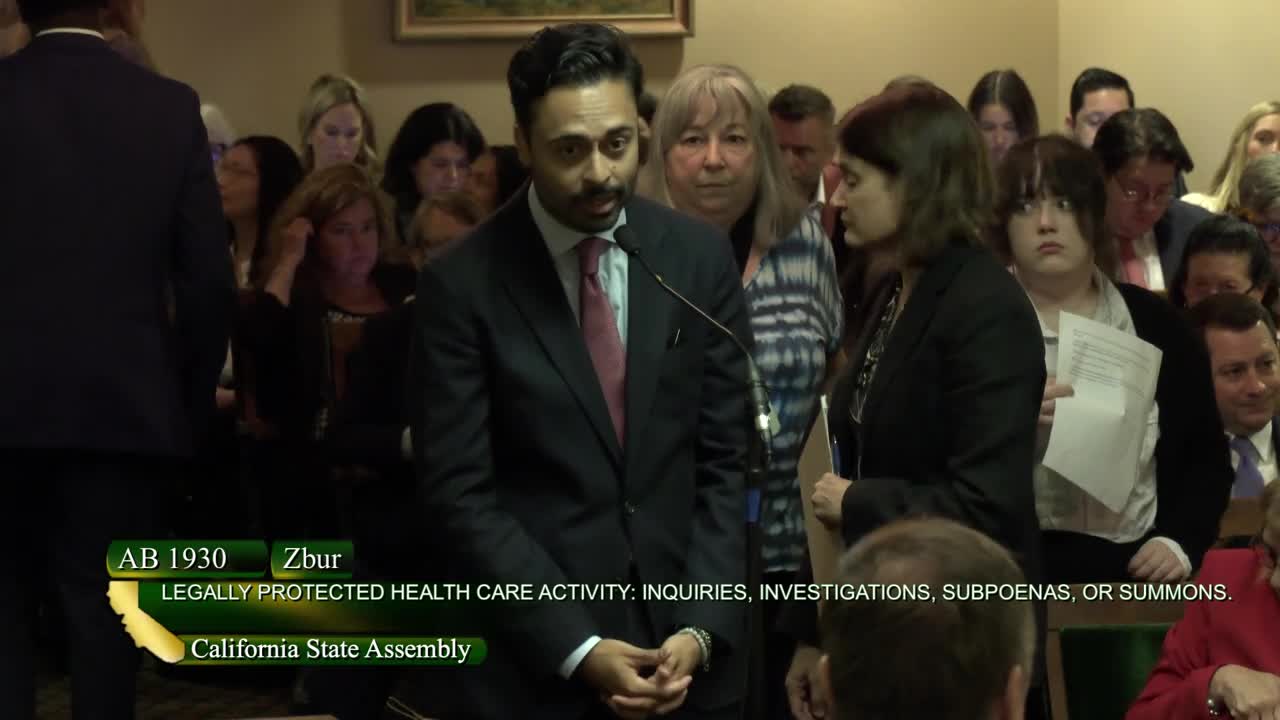
Assembly Standing Committee on Judiciary
Bill Author

Bill Co-Author(s):