SB 371: Transportation network companies: insurance coverage.
- Session Year: 2025-2026
- House: Senate
- Latest Version Date: 2025-10-03
Current Status:
Passed
(2025-10-03: Chaptered by Secretary of State. Chapter 314, Statutes of 2025.)
Introduced
In Committee
Awaiting First Chamber Vote
Passed First Chamber
In Committee
Awaiting Second Chamber Vote
Passed Second Chamber
Enacted
Existing law provides for the regulation of charter-party carriers of passengers by the Public Utilities Commission and includes specific requirements applicable to transportation network companies and their participating drivers. Existing law defines transportation network companies as certain organizations that, using an online-enabled application or platform, connect passengers with drivers using a personal vehicle. Existing law imposes specified requirements for liability insurance coverage on transportation network companies and their drivers, including a requirement that the insurance coverage provide for uninsured motorist coverage and underinsured motorist coverage in the amount of $1,000,000 from the moment a passenger enters the vehicle of a participating driver until the passenger exits the vehicle. Under existing law, that coverage may be satisfied by insurance maintained by the participating driver, the transportation network company, or a combination of insurance maintained by the participating driver and transportation network company.
This bill would lower that amount to $60,000 per person and $300,000 per incident. The bill would also make the transportation network company responsible for maintaining the uninsured motorist coverage and underinsured motorist coverage.
The bill would require the commission and the Department of Insurance to collaborate on a study of the impacts of the requirements established for uninsured motorist coverage and underinsured motorist coverage to assess whether those requirements are appropriate to the risk of transportation network company services, and to report the findings of this study to specified committees of the Legislature on or before December 31, 2030.
Existing law requires the commission to develop, publish, and annually update a report containing specified information, including, among other things, the commissions annual work plan and an accounting of the commissions transactions and proceedings from the prior year. Existing law requires the commission to submit that report to the Governor and Legislature no later than February 1 of each year.
This bill would require the report submitted on or before February 1, 2026, to also contain certain information regarding automobile accidents reported to the commission by transportation network companies and uninsured motorist and underinsured motorist claims resulting from those accidents, as specified. The bill would require the report submitted on or before February 1, 2027, to specify the average transportation network company rider fare paid during certain time periods, as provided.
This bill would make the operation of its provisions contingent upon the enactment of AB 1340 of the 202526 Regular Session.
Existing law provides for the regulation of charter-party carriers of passengers by the Public Utilities Commission and includes specific requirements applicable to transportation network companies and their participating drivers. Existing law defines transportation network companies as certain organizations that, using an online-enabled application or platform, connect passengers with drivers using a personal vehicle. Existing law imposes specified requirements for liability insurance coverage on transportation network companies and their drivers, including a requirement that the insurance coverage provide for uninsured motorist coverage and underinsured motorist coverage in the amount of $1,000,000 from the moment a passenger enters the vehicle of a participating driver until the passenger exits the vehicle. Under existing law, that coverage may be satisfied by insurance maintained by the participating driver, the transportation network company, or a combination of insurance maintained by the participating driver and transportation network company.
This bill would lower that amount to $60,000 per person and $300,000 per incident. The bill would also make the transportation network company responsible for maintaining the uninsured motorist coverage and underinsured motorist coverage.
The bill would require the commission and the Department of Insurance to collaborate on a study of the impacts of the requirements established for uninsured motorist coverage and underinsured motorist coverage to assess whether those requirements are appropriate to the risk of transportation network company services, and to report the findings of this study to specified committees of the Legislature on or before December 31, 2030.
Existing law requires the commission to develop, publish, and annually update a report containing specified information, including, among other things, the commissions annual work plan and an accounting of the commissions transactions and proceedings from the prior year. Existing law requires the commission to submit that report to the Governor and Legislature no later than February 1 of each year.
This bill would require the report submitted on or before February 1, 2026, to also contain certain information regarding automobile accidents reported to the commission by transportation network companies and uninsured motorist and underinsured motorist claims resulting from those accidents, as specified. The bill would require the report submitted on or before February 1, 2027, to specify the average transportation network company rider fare paid during certain time periods, as provided.
This bill would make the operation of its provisions contingent upon the enactment of AB 1340 of the 202526 Regular Session.
Existing law provides for the regulation of charter-party carriers of passengers by the Public Utilities Commission and includes specific requirements applicable to transportation network companies and their participating drivers. Existing law defines transportation network companies as certain organizations that, using an online-enabled application or platform, connect passengers with drivers using a personal vehicle. Existing law imposes specified requirements for liability insurance coverage on transportation network companies and their drivers, including a requirement that the insurance coverage provide for uninsured motorist coverage and underinsured motorist coverage in the amount of $1,000,000 from the moment a passenger enters the vehicle of a participating driver until the passenger exits the vehicle. Under existing law, that coverage may be satisfied by insurance maintained by the participating driver, the transportation network company, or a combination of insurance maintained by the participating driver and transportation network company.
This bill would lower that amount to $100,000 $60,000 per person and $300,000 per incident. The bill would also make the transportation network company responsible for maintaining the uninsured motorist coverage and underinsured motorist coverage.
The bill would require the commission and the Department of Insurance to collaborate on a study of the impacts of the requirements established for uninsured motorist coverage and underinsured motorist coverage to assess whether those requirements are appropriate to the risk of transportation network company services, and to report the findings of this study to specified committees of the Legislature on or before December 31, 2030.
Existing law requires the commission to develop, publish, and annually update a report containing specified information, including, among other things, the commissions annual work plan and an accounting of the commissions transactions and proceedings from the prior year. Existing law requires the commission to submit that report to the Governor and Legislature no later than February 1 of each year.
This bill would require the report submitted on or before February 1, 2026, to also contain certain information regarding automobile accidents reported to the commission by transportation network companies and uninsured motorist and underinsured motorist claims resulting from those accidents, as specified. The bill would require the report submitted on or before February 1, 2027, to specify the average transportation network company rider fare paid during certain time periods, as provided.
This bill would make the operation of its provisions contingent upon the enactment of AB 1340 of the 202526 Regular Session.
Existing law provides for the regulation of charter-party carriers of passengers by the Public Utilities Commission and includes specific requirements applicable to transportation network companies and their participating drivers. Existing law defines transportation network companies as certain organizations that, using an online-enabled application or platform, connect passengers with drivers using a personal vehicle. Existing law imposes specified requirements for liability insurance coverage on transportation network companies and their drivers, including a requirement that the insurance coverage provide for uninsured motorist coverage and underinsured motorist coverage in the amount of $1,000,000 from the moment a passenger enters the vehicle of a participating driver until the passenger exits the vehicle. Under existing law, that coverage may be satisfied by insurance maintained by the participating driver, the transportation network company, or a combination of insurance maintained by the participating driver and transportation network company.
This bill would lower that amount to $50,000 $100,000 per person and $100,000 $300,000 per incident. The bill would also make the transportation network company responsible for maintaining the uninsured motorist coverage and underinsured motorist coverage.
The bill would require the commission and the Department of Insurance to collaborate on a study of the impacts of the requirements established for uninsured motorist coverage and underinsured motorist coverage to assess whether those requirements are appropriate to the risk of transportation network company services, and to report the findings of this study to specified committees of the Legislature on or before December 31, 2030.
Existing law requires the commission to develop, publish, and annually update a report containing specified information, including, among other things, the commissions annual work plan and an accounting of the commissions transactions and proceedings from the prior year. Existing law requires the commission to submit that report to the Governor and Legislature no later than February 1 of each year.
This bill would require the report submitted on or before February 1, 2026, to also contain certain information regarding automobile accidents reported to the commission by transportation network companies and uninsured motorist and underinsured motorist claims resulting from those accidents, as specified.
Existing law provides for the regulation of charter-party carriers of passengers by the Public Utilities Commission and includes specific requirements applicable to transportation network companies and their participating drivers. Existing law defines transportation network companies as certain organizations that, using an online-enabled application or platform, connect passengers with drivers using a personal vehicle. Existing law imposes specified requirements for liability insurance coverage on transportation network companies and their drivers, including a requirement that the insurance coverage provide for uninsured motorist coverage and underinsured motorist coverage in the amount of $1,000,000 from the moment a passenger enters the vehicle of a participating driver until the passenger exits the vehicle. Under existing law, that coverage may be satisfied by insurance maintained by the participating driver, the transportation network company, or a combination of insurance maintained by the participating driver and transportation network company.
This bill would lower that amount to $50,000 per person and $100,000 per incident. The bill would also make the transportation network company responsible for maintaining the uninsured motorist coverage and underinsured motorist coverage unless the participating driver voluntarily chooses otherwise. coverage.
Existing law requires the commission to develop, publish, and annually update a report containing specified information, including, among other things, the commissions annual work plan and an accounting of the commissions transactions and proceedings from the prior year. Existing law requires the commission to submit that report to the Governor and Legislature no later than February 1 of each year.
This bill would require the report submitted on or before February 1, 2026, to also contain certain information regarding automobile accidents reported to the commission by transportation network companies and uninsured motorist and underinsured motorist claims resulting from those accidents, as specified.
Existing law provides for the regulation of charter-party carriers of passengers by the Public Utilities Commission and includes specific requirements applicable to transportation network companies and their participating drivers. Existing law defines transportation network companies as certain organizations that, using an online-enabled application or platform, connect passengers with drivers using a personal vehicle. Existing law imposes specified requirements for liability insurance coverage on transportation network companies and their drivers, including a requirement that the insurance coverage provide for uninsured motorist coverage and underinsured motorist coverage in the amount of $1,000,000 from the moment a passenger enters the vehicle of a participating driver until the passenger exits the vehicle. Under existing law, that coverage may be satisfied by insurance maintained by the participating driver, the transportation network company, or a combination of insurance maintained by the participating driver and transportation network company.
This bill would make the transportation network company responsible for maintaining the uninsured motorist coverage and underinsured motorist coverage unless the participating driver voluntarily chooses otherwise.
Existing law requires the commission to develop, publish, and annually update a report containing specified information, including, among other things, the commissions annual work plan and an accounting of the commissions transactions and proceedings from the prior year. Existing law requires the commission to submit that report to the Governor and Legislature no later than February 1 of each year.
This bill would require the report submitted on or before February 1, 2026, to also contain certain information regarding automobile accidents reported to the commission by transportation network companies and uninsured motorist and underinsured motorist claims resulting from those accidents, as specified.
Existing law defines transportation network companies as certain organizations that, using an online-enabled application or platform, connect passengers with drivers using a personal vehicle. Existing law imposes specified requirements for liability insurance coverage on transportation network companies and their drivers, including a requirement that the insurance coverage provide for uninsured motorist coverage and underinsured motorist coverage in the amount of $1,000,000 from the moment a passenger enters the vehicle of a participating driver until the passenger exits the vehicle. Under existing law, that coverage may be satisfied by insurance maintained by the participating driver, the transportation network company, or a combination of insurance maintained by the participating driver and transportation network company.
This bill would make the transportation network company responsible for maintaining the uninsured motorist coverage and underinsured motorist coverage unless the participating driver voluntarily chooses otherwise.
Existing law vests the Public Utilities Commission with regulatory authority over public utilities, including electrical corporations and gas corporations. Existing law requires every electrical and every gas corporation submitting an application to the commission for a certificate authorizing the new construction of any electric plant, line, or extension, or gas plant, line, or extension, except as provided, to include specified information in the application in addition to any other required information, including preliminary engineering and design information on the project, an appropriate cost estimate, and a cost analysis comparing the project with any feasible alternative sources of power, as specified.This bill would require the application to also include an analysis of the greenhouse gas emissions associated with the project over the useful life of the plant, line, or extension.Under existing law, a violation of any order, decision, rule, direction, demand, or requirement of the commission is a crime.Because a violation of a commission action implementing this bills requirements would be a crime, the bill would impose a state-mandated local program. The California Constitution requires the state to reimburse local agencies and school districts for certain costs mandated by the state. Statutory provisions establish procedures for making that reimbursement.This bill would provide that no reimbursement is required by this act for a specified reason.Existing law vests the Public Utilities Commission with regulatory authority over public utilities, including electrical corporations and gas corporations. Existing law requires every electrical and every gas corporation submitting an application to the commission for a certificate authorizing the new construction of any electric plant, line, or extension, or gas plant, line, or extension, except as provided, to include specified information in the application in addition to any other required information, including preliminary engineering and design information on the project, an appropriate cost estimate, and a cost analysis comparing the project with any feasible alternative sources of power, as specified.
This bill would require the application to also include an analysis of the greenhouse gas emissions associated with the project over the useful life of the plant, line, or extension.
Under existing law, a violation of any order, decision, rule, direction, demand, or requirement of the commission is a crime.
Because a violation of a commission action implementing this bills requirements would be a crime, the bill would impose a state-mandated local program.
The California Constitution requires the state to reimburse local agencies and school districts for certain costs mandated by the state. Statutory provisions establish procedures for making that reimbursement.
This bill would provide that no reimbursement is required by this act for a specified reason.
It is the intent of the Legislature that this act ensures that financial savings realized as a result of any reductions in insurance expenditures for transportation network companies will be strategically reinvested to enhance the economic stability and welfare of drivers and riders.
SEC. 2.Section 918.3 is added to the Public Utilities Code, to read:918.3.(a)The commission and the Department of Insurance shall collaborate on a study of the impacts of the requirements established for uninsured motorist coverage and underinsured motorist coverage under paragraph (2) of subdivision (b) of Section 5433 to assess whether those coverage requirements are appropriate to the risk of transportation network company services in order to promote data-driven decisions on insurance requirements, and shall report the findings of this study to the Assembly Committee on Insurance and the Senate Committee on Insurance on or before December 31, 2030.
(b)Pursuant to Section 10231.5 of the Government Code, this section shall become inoperative on December 31, 2034, and, as of January 1, 2035, is repealed.
SEC. 3.Section 5433 of the Public Utilities Code is amended to read:5433.(a)A transportation network company and any participating driver shall maintain transportation network company insurance as provided in this section.
(b)The following requirements shall apply to transportation network company insurance from the moment a participating driver accepts a ride request on the transportation network companys online-enabled application or platform until the driver completes the transaction on the online-enabled application or platform or until the ride is complete, whichever is later:
(1)Transportation network company insurance shall be primary and in the amount of one million dollars ($1,000,000) for death, personal injury, and property damage. The requirements for the coverage required by this paragraph may be satisfied by any of the following:
(A)Transportation network company insurance maintained by a participating driver.
(B)Transportation network company insurance maintained by a transportation network company.
(C)Any combination of subparagraphs (A) and (B).
(2)A transportation network company shall provide uninsured motorist coverage and underinsured motorist coverage in the amount of sixty thousand dollars ($60,000) per person and three hundred thousand dollars ($300,000) per incident from the moment a passenger enters the vehicle of a participating driver until the passenger exits the vehicle. The policy provided in this paragraph shall be primary over any other applicable uninsured or underinsured motorist coverage and shall be solely the obligation of the transportation network company.
(3)The insurer, in the case of insurance coverage provided under this subdivision, shall have the duty to defend and indemnify the insured.
(4)A transportation network company may meet its obligations under paragraph (1) through a policy obtained by a participating driver pursuant to subparagraph (A) or (C) of paragraph (1) only if the transportation network company verifies that the policy is maintained by the driver and is specifically written to cover the drivers use of a vehicle in connection with a transportation network companys online-enabled application or platform.
(c)The following requirements shall apply to transportation network company insurance from the moment a participating driver logs on to the transportation network companys online-enabled application or platform until the driver accepts a request to transport a passenger, and from the moment the driver completes the transaction on the online-enabled application or platform or the ride is complete, whichever is later, until the driver either accepts another ride request on the online-enabled application or platform or logs off the online-enabled application or platform:
(1)Transportation network company insurance shall be primary and in the amount of at least fifty thousand dollars ($50,000) for death and personal injury per person, one hundred thousand dollars ($100,000) for death and personal injury per incident, and thirty thousand dollars ($30,000) for property damage. The requirements for the coverage required by this paragraph may be satisfied by any of the following:
(A)Transportation network company insurance maintained by a participating driver.
(B)Transportation network company insurance maintained by a transportation network company that provides coverage in the event a participating drivers insurance policy under subparagraph (A) has ceased to exist or has been canceled, or the participating driver does not otherwise maintain transportation network company insurance pursuant to this subdivision.
(C)Any combination of subparagraphs (A) and (B).
(2)A transportation network company shall also maintain insurance coverage that provides excess coverage insuring the transportation network company and the driver in the amount of at least two hundred thousand dollars ($200,000) per occurrence to cover any liability arising from a participating driver using a vehicle in connection with a transportation network companys online-enabled application or platform within the time periods specified in this subdivision, which liability exceeds the required coverage limits in paragraph (1).
(3)The insurer providing insurance coverage under this subdivision shall be the only insurer having the duty to defend any liability claim arising from an accident occurring within the time periods specified in this subdivision.
(4)A transportation network company may meet its obligations under this subdivision through a policy obtained by a participating driver pursuant to subparagraph (A) or (C) of paragraph (1) only if the transportation network company verifies that the policy is maintained by the driver and is specifically written to cover the drivers use of a vehicle in connection with a transportation network companys online-enabled application or platform.
(d)Coverage under a transportation network company insurance policy shall not be dependent on a personal automobile insurance policy first denying a claim nor shall a personal automobile insurance policy be required to first deny a claim.
(e)In every instance where transportation network company insurance maintained by a participating driver to fulfill the insurance obligations of this section has lapsed or ceased to exist, the transportation network company shall provide the coverage required by this section beginning with the first dollar of a claim.
(f)This article does not limit the liability of a transportation network company arising out of an automobile accident involving a participating driver in any action for damages against a transportation network company for an amount above the required insurance coverage.
SEC. 4.Section 5436 is added to the Public Utilities Code, to read:5436.(a)The commission shall provide the following information in its annual report submitted on or before February 1, 2026, pursuant to Section 910:
(1)The average annual number of automobile accidents involving a participating driver using a personal vehicle reported to the commission for the years 2022 to 2024, inclusive, by transportation network companies.
(2)The average annual percentage of those automobile accidents reported to the commission resulting in uninsured motorist or underinsured motorist claims, or both, for the years 2022 to 2024, inclusive.
(3)The average annual percentage of those automobile accidents reported to the commission resulting in uninsured motorist or underinsured motorist claims, or both, over $100,000 for the years 2022 to 2024, inclusive.
(b)(1)In the annual report submitted on or before February 1, 2027, pursuant to Section 910, the commission shall specify the average transportation network company rider fare, excluding tips, tolls, and taxes, paid during the following time periods:
(A)July 1, 2025, to December 31, 2025, inclusive.
(B)January 1, 2026, to June 30, 2026, inclusive.
(C)July 1, 2026, to December 31, 2026, inclusive.
(2)The information required pursuant to paragraph (1) shall be published by the commission as an aggregate number across all transportation network companies for each time period as reported by transportation network companies.
(c)The commission shall not provide the information described in subdivisions (a) and (b) separately for each transportation network company, and nothing in subdivisions (a) and (b) shall affect the confidentiality of data submitted to the commission by transportation network companies.
(d)Pursuant to Section 10231.5 of the Government Code, this section is inoperative on February 1, 2031, and, as of January 1, 2032, is repealed.
SEC. 5.This act shall become operative only if Assembly Bill 1340 of the 202526 Regular Session is enacted and becomes effective on or before January 1, 2026.
It is the intent of the Legislature that this act ensures that financial savings realized as a result of any reductions in insurance expenditures for transportation network companies will be strategically reinvested to enhance the economic stability and welfare of drivers and riders.
SEC. 2.Section 918.3 is added to the Public Utilities Code, to read:918.3.(a)The commission and the Department of Insurance shall collaborate on a study of the impacts of the requirements established for uninsured motorist coverage and underinsured motorist coverage under paragraph (2) of subdivision (b) of Section 5433 to assess whether those coverage requirements are appropriate to the risk of transportation network company services in order to promote data-driven decisions on insurance requirements, and shall report the findings of this study to the Assembly Committee on Insurance and the Senate Committee on Insurance on or before December 31, 2030.
(b)Pursuant to Section 10231.5 of the Government Code, this section shall become inoperative on December 31, 2034, and, as of January 1, 2035, is repealed.
SEC. 3.Section 5433 of the Public Utilities Code is amended to read:5433.(a)A transportation network company and any participating driver shall maintain transportation network company insurance as provided in this section.
(b)The following requirements shall apply to transportation network company insurance from the moment a participating driver accepts a ride request on the transportation network companys online-enabled application or platform until the driver completes the transaction on the online-enabled application or platform or until the ride is complete, whichever is later:
(1)Transportation network company insurance shall be primary and in the amount of one million dollars ($1,000,000) for death, personal injury, and property damage. The requirements for the coverage required by this paragraph may be satisfied by any of the following:
(A)Transportation network company insurance maintained by a participating driver.
(B)Transportation network company insurance maintained by a transportation network company.
(C)Any combination of subparagraphs (A) and (B).
(2)A transportation network company shall provide uninsured motorist coverage and underinsured motorist coverage in the amount of sixty thousand dollars ($60,000) per person and three hundred thousand dollars ($300,000) per incident from the moment a passenger enters the vehicle of a participating driver until the passenger exits the vehicle. The policy provided in this paragraph shall be primary over any other applicable uninsured or underinsured motorist coverage and shall be solely the obligation of the transportation network company.
(3)The insurer, in the case of insurance coverage provided under this subdivision, shall have the duty to defend and indemnify the insured.
(4)A transportation network company may meet its obligations under paragraph (1) through a policy obtained by a participating driver pursuant to subparagraph (A) or (C) of paragraph (1) only if the transportation network company verifies that the policy is maintained by the driver and is specifically written to cover the drivers use of a vehicle in connection with a transportation network companys online-enabled application or platform.
(c)The following requirements shall apply to transportation network company insurance from the moment a participating driver logs on to the transportation network companys online-enabled application or platform until the driver accepts a request to transport a passenger, and from the moment the driver completes the transaction on the online-enabled application or platform or the ride is complete, whichever is later, until the driver either accepts another ride request on the online-enabled application or platform or logs off the online-enabled application or platform:
(1)Transportation network company insurance shall be primary and in the amount of at least fifty thousand dollars ($50,000) for death and personal injury per person, one hundred thousand dollars ($100,000) for death and personal injury per incident, and thirty thousand dollars ($30,000) for property damage. The requirements for the coverage required by this paragraph may be satisfied by any of the following:
(A)Transportation network company insurance maintained by a participating driver.
(B)Transportation network company insurance maintained by a transportation network company that provides coverage in the event a participating drivers insurance policy under subparagraph (A) has ceased to exist or has been canceled, or the participating driver does not otherwise maintain transportation network company insurance pursuant to this subdivision.
(C)Any combination of subparagraphs (A) and (B).
(2)A transportation network company shall also maintain insurance coverage that provides excess coverage insuring the transportation network company and the driver in the amount of at least two hundred thousand dollars ($200,000) per occurrence to cover any liability arising from a participating driver using a vehicle in connection with a transportation network companys online-enabled application or platform within the time periods specified in this subdivision, which liability exceeds the required coverage limits in paragraph (1).
(3)The insurer providing insurance coverage under this subdivision shall be the only insurer having the duty to defend any liability claim arising from an accident occurring within the time periods specified in this subdivision.
(4)A transportation network company may meet its obligations under this subdivision through a policy obtained by a participating driver pursuant to subparagraph (A) or (C) of paragraph (1) only if the transportation network company verifies that the policy is maintained by the driver and is specifically written to cover the drivers use of a vehicle in connection with a transportation network companys online-enabled application or platform.
(d)Coverage under a transportation network company insurance policy shall not be dependent on a personal automobile insurance policy first denying a claim nor shall a personal automobile insurance policy be required to first deny a claim.
(e)In every instance where transportation network company insurance maintained by a participating driver to fulfill the insurance obligations of this section has lapsed or ceased to exist, the transportation network company shall provide the coverage required by this section beginning with the first dollar of a claim.
(f)This article does not limit the liability of a transportation network company arising out of an automobile accident involving a participating driver in any action for damages against a transportation network company for an amount above the required insurance coverage.
SEC. 4.Section 5436 is added to the Public Utilities Code, to read:5436.(a)The commission shall provide the following information in its annual report submitted on or before February 1, 2026, pursuant to Section 910:
(1)The average annual number of automobile accidents involving a participating driver using a personal vehicle reported to the commission for the years 2022 to 2024, inclusive, by transportation network companies.
(2)The average annual percentage of those automobile accidents reported to the commission resulting in uninsured motorist or underinsured motorist claims, or both, for the years 2022 to 2024, inclusive.
(3)The average annual percentage of those automobile accidents reported to the commission resulting in uninsured motorist or underinsured motorist claims, or both, over $100,000 for the years 2022 to 2024, inclusive.
(b)(1)In the annual report submitted on or before February 1, 2027, pursuant to Section 910, the commission shall specify the average transportation network company rider fare, excluding tips, tolls, and taxes, paid during the following time periods:
(A)July 1, 2025, to December 31, 2025, inclusive.
(B)January 1, 2026, to June 30, 2026, inclusive.
(C)July 1, 2026, to December 31, 2026, inclusive.
(2)The information required pursuant to paragraph (1) shall be published by the commission as an aggregate number across all transportation network companies for each time period as reported by transportation network companies.
(c)The commission shall not provide the information described in subdivisions (a) and (b) separately for each transportation network company, and nothing in subdivisions (a) and (b) shall affect the confidentiality of data submitted to the commission by transportation network companies.
(d)Pursuant to Section 10231.5 of the Government Code, this section is inoperative on February 1, 2031, and, as of January 1, 2032, is repealed.
SEC. 5.This act shall become operative only if Assembly Bill 1340 of the 202526 Regular Session is enacted and becomes effective on or before January 1, 2026.
It is the intent of the Legislature that this act ensures that financial savings realized as a result of any reductions in insurance expenditures for transportation network companies will be strategically reinvested to enhance the economic stability and welfare of drivers and riders.
SEC. 2.Section 918.3 is added to the Public Utilities Code, to read:918.3.(a)The commission and the Department of Insurance shall collaborate on a study of the impacts of the requirements established for uninsured motorist coverage and underinsured motorist coverage under paragraph (2) of subdivision (b) of Section 5433 to assess whether those coverage requirements are appropriate to the risk of transportation network company services in order to promote data-driven decisions on insurance requirements, and shall report the findings of this study to the Assembly Committee on Insurance and the Senate Committee on Insurance on or before December 31, 2030.
(b)Pursuant to Section 10231.5 of the Government Code, this section shall become inoperative on December 31, 2034, and, as of January 1, 2035, is repealed.
SEC. 3.Section 5433 of the Public Utilities Code is amended to read:5433.(a)A transportation network company and any participating driver shall maintain transportation network company insurance as provided in this section.
(b)The following requirements shall apply to transportation network company insurance from the moment a participating driver accepts a ride request on the transportation network companys online-enabled application or platform until the driver completes the transaction on the online-enabled application or platform or until the ride is complete, whichever is later:
(1)Transportation network company insurance shall be primary and in the amount of one million dollars ($1,000,000) for death, personal injury, and property damage. The requirements for the coverage required by this paragraph may be satisfied by any of the following:
(A)Transportation network company insurance maintained by a participating driver.
(B)Transportation network company insurance maintained by a transportation network company.
(C)Any combination of subparagraphs (A) and (B).
(2)A transportation network company shall provide uninsured motorist coverage and underinsured motorist coverage in the amount of one hundred sixty thousand dollars ($100,000) ($60,000) per person and three hundred thousand dollars ($300,000) per incident from the moment a passenger enters the vehicle of a participating driver until the passenger exits the vehicle. The policy provided in this paragraph shall be primary over any other applicable uninsured or underinsured motorist coverage and shall be solely the obligation of the transportation network company.
(3)The insurer, in the case of insurance coverage provided under this subdivision, shall have the duty to defend and indemnify the insured.
(4)A transportation network company may meet its obligations under paragraph (1) through a policy obtained by a participating driver pursuant to subparagraph (A) or (C) of paragraph (1) only if the transportation network company verifies that the policy is maintained by the driver and is specifically written to cover the drivers use of a vehicle in connection with a transportation network companys online-enabled application or platform.
(c)The following requirements shall apply to transportation network company insurance from the moment a participating driver logs on to the transportation network companys online-enabled application or platform until the driver accepts a request to transport a passenger, and from the moment the driver completes the transaction on the online-enabled application or platform or the ride is complete, whichever is later, until the driver either accepts another ride request on the online-enabled application or platform or logs off the online-enabled application or platform:
(1)Transportation network company insurance shall be primary and in the amount of at least fifty thousand dollars ($50,000) for death and personal injury per person, one hundred thousand dollars ($100,000) for death and personal injury per incident, and thirty thousand dollars ($30,000) for property damage. The requirements for the coverage required by this paragraph may be satisfied by any of the following:
(A)Transportation network company insurance maintained by a participating driver.
(B)Transportation network company insurance maintained by a transportation network company that provides coverage in the event a participating drivers insurance policy under subparagraph (A) has ceased to exist or has been canceled, or the participating driver does not otherwise maintain transportation network company insurance pursuant to this subdivision.
(C)Any combination of subparagraphs (A) and (B).
(2)A transportation network company shall also maintain insurance coverage that provides excess coverage insuring the transportation network company and the driver in the amount of at least two hundred thousand dollars ($200,000) per occurrence to cover any liability arising from a participating driver using a vehicle in connection with a transportation network companys online-enabled application or platform within the time periods specified in this subdivision, which liability exceeds the required coverage limits in paragraph (1).
(3)The insurer providing insurance coverage under this subdivision shall be the only insurer having the duty to defend any liability claim arising from an accident occurring within the time periods specified in this subdivision.
(4)A transportation network company may meet its obligations under this subdivision through a policy obtained by a participating driver pursuant to subparagraph (A) or (C) of paragraph (1) only if the transportation network company verifies that the policy is maintained by the driver and is specifically written to cover the drivers use of a vehicle in connection with a transportation network companys online-enabled application or platform.
(d)Coverage under a transportation network company insurance policy shall not be dependent on a personal automobile insurance policy first denying a claim nor shall a personal automobile insurance policy be required to first deny a claim.
(e)In every instance where transportation network company insurance maintained by a participating driver to fulfill the insurance obligations of this section has lapsed or ceased to exist, the transportation network company shall provide the coverage required by this section beginning with the first dollar of a claim.
(f)This article does not limit the liability of a transportation network company arising out of an automobile accident involving a participating driver in any action for damages against a transportation network company for an amount above the required insurance coverage.
SEC. 4.Section 5436 is added to the Public Utilities Code, to read:5436.(a)The commission shall provide the following information in its annual report submitted on or before February 1, 2026, pursuant to Section 910:
(1)The average annual number of automobile accidents involving a participating driver using a personal vehicle reported to the commission for the years 2022 to 2024, inclusive, by transportation network companies.
(2)The average annual percentage of those automobile accidents reported to the commission resulting in uninsured motorist or underinsured motorist claims, or both, for the years 2022 to 2024, inclusive.
(3)The average annual percentage of those automobile accidents reported to the commission resulting in uninsured motorist or underinsured motorist claims, or both, over $100,000 for the years 2022 to 2024, inclusive.
(b)(1)In the annual report submitted on or before February 1, 2027, pursuant to Section 910, the commission shall specify the average transportation network company rider fare, excluding tips, tolls, and taxes, paid during the following time periods:
(A)July 1, 2025, to December 31, 2025, inclusive.
(B)January 1, 2026, to June 30, 2026, inclusive.
(C)July 1, 2026, to December 31, 2026, inclusive.
(2)The information required pursuant to paragraph (1) shall be published by the commission as an aggregate number across all transportation network companies for each time period as reported by transportation network companies.
(b)(c)The commission shall not provide the information described in subdivision (a) subdivisions (a) and (b) separately for each transportation network company, and nothing in subdivision (a) subdivisions (a) and (b) shall affect the confidentiality of data submitted to the commission by transportation network companies.
(c)(d)Pursuant to Section 10231.5 of the Government Code, this section is inoperative on February 1, 2030, 2031, and, as of January 1, 2031, 2032, is repealed.
SEC. 5.This act shall become operative only if Assembly Bill 1340 of the 202526 Regular Session is enacted and becomes effective on or before January 1, 2026.
REVISIONS: HeadingLine 2.It is the intent of the Legislature that this act ensures that financial savings realized as a result of any reductions in insurance expenditures for transportation network companies will be strategically reinvested to enhance the economic stability and welfare of drivers and riders.
SEC. 2.Section 918.3 is added to the Public Utilities Code, to read:918.3.(a)The commission and the Department of Insurance shall collaborate on a study of the impacts of the requirements established for uninsured motorist coverage and underinsured motorist coverage under paragraph (2) of subdivision (b) of Section 5433 to assess whether those coverage requirements are appropriate to the risk of transportation network company services in order to promote data-driven decisions on insurance requirements, and shall report the findings of this study to the Assembly Committee on Insurance and the Senate Committee on Insurance on or before December 31, 2030.
(b)Pursuant to Section 10231.5 of the Government Code, this section shall become inoperative on December 31, 2034, and, as of January 1, 2035, is repealed.
SECTION 1.SEC. 3.Section 5433 of the Public Utilities Code is amended to read:5433.(a)A transportation network company and any participating driver shall maintain transportation network company insurance as provided in this section.
(b)The following requirements shall apply to transportation network company insurance from the moment a participating driver accepts a ride request on the transportation network companys online-enabled application or platform until the driver completes the transaction on the online-enabled application or platform or until the ride is complete, whichever is later:
(1)Transportation network company insurance shall be primary and in the amount of one million dollars ($1,000,000) for death, personal injury, and property damage. The requirements for the coverage required by this paragraph may be satisfied by any of the following:
(A)Transportation network company insurance maintained by a participating driver.
(B)Transportation network company insurance maintained by a transportation network company.
(C)Any combination of subparagraphs (A) and (B).
(2)A transportation network company shall provide uninsured motorist coverage and underinsured motorist coverage in the amount of fifty one hundred thousand dollars ($50,000) ($100,000) per person and one three hundred thousand dollars ($100,000) ($300,000) per incident from the moment a passenger enters the vehicle of a participating driver until the passenger exits the vehicle. The policy provided in this paragraph shall be primary over any other applicable uninsured or underinsured motorist coverage and shall be solely the obligation of the transportation network company.
(3)The insurer, in the case of insurance coverage provided under this subdivision, shall have the duty to defend and indemnify the insured.
(4)A transportation network company may meet its obligations under paragraph (1) through a policy obtained by a participating driver pursuant to subparagraph (A) or (C) of paragraph (1) only if the transportation network company verifies that the policy is maintained by the driver and is specifically written to cover the drivers use of a vehicle in connection with a transportation network companys online-enabled application or platform.
(c)The following requirements shall apply to transportation network company insurance from the moment a participating driver logs on to the transportation network companys online-enabled application or platform until the driver accepts a request to transport a passenger, and from the moment the driver completes the transaction on the online-enabled application or platform or the ride is complete, whichever is later, until the driver either accepts another ride request on the online-enabled application or platform or logs off the online-enabled application or platform:
(1)Transportation network company insurance shall be primary and in the amount of at least fifty thousand dollars ($50,000) for death and personal injury per person, one hundred thousand dollars ($100,000) for death and personal injury per incident, and thirty thousand dollars ($30,000) for property damage. The requirements for the coverage required by this paragraph may be satisfied by any of the following:
(A)Transportation network company insurance maintained by a participating driver.
(B)Transportation network company insurance maintained by a transportation network company that provides coverage in the event a participating drivers insurance policy under subparagraph (A) has ceased to exist or has been canceled, or the participating driver does not otherwise maintain transportation network company insurance pursuant to this subdivision.
(C)Any combination of subparagraphs (A) and (B).
(2)A transportation network company shall also maintain insurance coverage that provides excess coverage insuring the transportation network company and the driver in the amount of at least two hundred thousand dollars ($200,000) per occurrence to cover any liability arising from a participating driver using a vehicle in connection with a transportation network companys online-enabled application or platform within the time periods specified in this subdivision, which liability exceeds the required coverage limits in paragraph (1).
(3)The insurer providing insurance coverage under this subdivision shall be the only insurer having the duty to defend any liability claim arising from an accident occurring within the time periods specified in this subdivision.
(4)A transportation network company may meet its obligations under this subdivision through a policy obtained by a participating driver pursuant to subparagraph (A) or (C) of paragraph (1) only if the transportation network company verifies that the policy is maintained by the driver and is specifically written to cover the drivers use of a vehicle in connection with a transportation network companys online-enabled application or platform.
(d)Coverage under a transportation network company insurance policy shall not be dependent on a personal automobile insurance policy first denying a claim nor shall a personal automobile insurance policy be required to first deny a claim.
(e)In every instance where transportation network company insurance maintained by a participating driver to fulfill the insurance obligations of this section has lapsed or ceased to exist, the transportation network company shall provide the coverage required by this section beginning with the first dollar of a claim.
(f)This article does not limit the liability of a transportation network company arising out of an automobile accident involving a participating driver in any action for damages against a transportation network company for an amount above the required insurance coverage.
SEC. 2.Section 5433.5 is added to the Public Utilities Code, to read:5433.5.It is the intent of the bill that added this section to ensure that financial savings realized as a result of any reductions in insurance expenditures for transportation network companies will be strategically reinvested to enhance the economic stability and welfare of drivers and riders.SEC. 3.SEC. 4.Section 5436 is added to the Public Utilities Code, to read:5436.(a)The commission shall provide the following information in its annual report submitted on or before February 1, 2026, pursuant to Section 910:
(1)The average annual number of automobile accidents reported to the commission for the years 2022 to 2024, inclusive, by transportation network companies.
(2)The average annual percentage of those automobile accidents reported to the commission resulting in uninsured motorist or underinsured motorist claims, or both, for the years 2022 to 2024, inclusive.
(3)The average annual percentage of those automobile accidents reported to the commission resulting in uninsured motorist or underinsured motorist claims, or both, over $100,000 for the years 2022 to 2024, inclusive.
(b)The commission shall not provide the information described in subdivision (a) separately for each transportation network company, and nothing in subdivision (a) shall affect the confidentiality of data submitted to the commission by transportation network companies.
(c)Pursuant to Section 10231.5 of the Government Code, this section is inoperative on February 1, 2030, and, as of January 1, 2031, is repealed.
(a)A transportation network company and any participating driver shall maintain transportation network company insurance as provided in this section.
(b)The following requirements shall apply to transportation network company insurance from the moment a participating driver accepts a ride request on the transportation network companys online-enabled application or platform until the driver completes the transaction on the online-enabled application or platform or until the ride is complete, whichever is later:
(1)Transportation network company insurance shall be primary and in the amount of one million dollars ($1,000,000) for death, personal injury, and property damage. The requirements for the coverage required by this subdivision paragraph may be satisfied by any of the following:
(A)Transportation network company insurance maintained by a participating driver.
(B)Transportation network company insurance maintained by a transportation network company.
(C)Any combination of subparagraphs (A) and (B).
(2)(A)Transportation network company insurance coverage provided under this subdivision shall also provide for uninsured motorist coverage and underinsured motorist coverage in the amount of one million dollars ($1,000,000) from the moment a passenger enters the vehicle of a participating driver until the passenger exits the vehicle. The policy may also provide this coverage during any other time period, if requested by a participating driver relative to insurance maintained by the driver.(B)Notwithstanding paragraph (1), and unless the participating driver voluntarily chooses otherwise, the coverage required by this paragraph shall be satisfied by insurance maintained by a transportation network company and not made an obligation of the driver.(2)A transportation network company shall provide uninsured motorist coverage and underinsured motorist coverage in the amount of fifty thousand dollars ($50,000) per person and one hundred thousand dollars ($100,000) per incident from the moment a passenger enters the vehicle of a participating driver until the passenger exits the vehicle. The policy provided in this paragraph shall be primary over any other applicable uninsured or underinsured motorist coverage and shall be solely the obligation of the transportation network company.
(3)The insurer, in the case of insurance coverage provided under this subdivision, shall have the duty to defend and indemnify the insured.
(4)A transportation network company may meet its obligations under this subdivision paragraph (1) through a policy obtained by a participating driver pursuant to subparagraph (A) or (C) of paragraph (1) only if the transportation network company verifies that the policy is maintained by the driver and is specifically written to cover the drivers use of a vehicle in connection with a transportation network companys online-enabled application or platform.
(c)The following requirements shall apply to transportation network company insurance from the moment a participating driver logs on to the transportation network companys online-enabled application or platform until the driver accepts a request to transport a passenger, and from the moment the driver completes the transaction on the online-enabled application or platform or the ride is complete, whichever is later, until the driver either accepts another ride request on the online-enabled application or platform or logs off the online-enabled application or platform:
(1)Transportation network company insurance shall be primary and in the amount of at least fifty thousand dollars ($50,000) for death and personal injury per person, one hundred thousand dollars ($100,000) for death and personal injury per incident, and thirty thousand dollars ($30,000) for property damage. The requirements for the coverage required by this paragraph may be satisfied by any of the following:
(A)Transportation network company insurance maintained by a participating driver.
(B)Transportation network company insurance maintained by a transportation network company that provides coverage in the event a participating drivers insurance policy under subparagraph (A) has ceased to exist or has been canceled, or the participating driver does not otherwise maintain transportation network company insurance pursuant to this subdivision.
(C)Any combination of subparagraphs (A) and (B).
(2)A transportation network company shall also maintain insurance coverage that provides excess coverage insuring the transportation network company and the driver in the amount of at least two hundred thousand dollars ($200,000) per occurrence to cover any liability arising from a participating driver using a vehicle in connection with a transportation network companys online-enabled application or platform within the time periods specified in this subdivision, which liability exceeds the required coverage limits in paragraph (1).
(3)The insurer providing insurance coverage under this subdivision shall be the only insurer having the duty to defend any liability claim arising from an accident occurring within the time periods specified in this subdivision.
(4)A transportation network company may meet its obligations under this subdivision through a policy obtained by a participating driver pursuant to subparagraph (A) or (C) of paragraph (1) only if the transportation network company verifies that the policy is maintained by the driver and is specifically written to cover the drivers use of a vehicle in connection with a transportation network companys online-enabled application or platform.
(d)Coverage under a transportation network company insurance policy shall not be dependent on a personal automobile insurance policy first denying a claim nor shall a personal automobile insurance policy be required to first deny a claim.
(e)In every instance where transportation network company insurance maintained by a participating driver to fulfill the insurance obligations of this section has lapsed or ceased to exist, the transportation network company shall provide the coverage required by this section beginning with the first dollar of a claim.
(f)This article does not limit the liability of a transportation network company arising out of an automobile accident involving a participating driver in any action for damages against a transportation network company for an amount above the required insurance coverage.
SEC. 2.Section 5433.5 is added to the Public Utilities Code, to read:5433.5.It is the intent of the bill that added this section to ensure that financial savings realized as a result of any reductions in insurance expenditures for transportation network companies will be strategically reinvested to enhance the economic stability and welfare of drivers and riders.
SEC. 3.Section 5436 is added to the Public Utilities Code, to read:5436.(a)The commission shall provide the following information in its annual report submitted on or before February 1, 2026, pursuant to Section 910:
(1)The average annual number of automobile accidents reported to the commission for the years 2022 to 2024, inclusive, by transportation network companies.
(2)The average annual percentage of those automobile accidents reported to the commission resulting in uninsured motorist or underinsured motorist claims, or both, for the years 2022 to 2024, inclusive.
(3)The average annual percentage of those automobile accidents reported to the commission resulting in uninsured motorist or underinsured motorist claims, or both, over $100,000 for the years 2022 to 2024, inclusive.
(b)The commission shall not provide the information described in subdivision (a) separately for each transportation network company, and nothing in subdivision (a) shall affect the confidentiality of data submitted to the commission by transportation network companies.
(c)Pursuant to Section 10231.5 of the Government Code, this section is inoperative on February 1, 2030, and, as of January 1, 2031, is repealed.
(a)A transportation network company and any participating driver shall maintain transportation network company insurance as provided in this section.
(b)The following requirements shall apply to transportation network company insurance from the moment a participating driver accepts a ride request on the transportation network companys online-enabled application or platform until the driver completes the transaction on the online-enabled application or platform or until the ride is complete, whichever is later:
(1)Transportation network company insurance shall be primary and in the amount of one million dollars ($1,000,000) for death, personal injury, and property damage. The requirements for the coverage required by this subdivision may be satisfied by any of the following:
(A)Transportation network company insurance maintained by a participating driver.
(B)Transportation network company insurance maintained by a transportation network company.
(C)Any combination of subparagraphs (A) and (B).
(2)(A)Transportation network company insurance coverage provided under this subdivision shall also provide for uninsured motorist coverage and underinsured motorist coverage in the amount of one million dollars ($1,000,000) from the moment a passenger enters the vehicle of a participating driver until the passenger exits the vehicle. The policy may also provide this coverage during any other time period, if requested by a participating driver relative to insurance maintained by the driver.
(B)Notwithstanding paragraph (1), and unless the participating driver voluntarily chooses otherwise, the coverage required by this paragraph shall be satisfied by insurance maintained by a transportation network company and not made an obligation of the driver.
(3)The insurer, in the case of insurance coverage provided under this subdivision, shall have the duty to defend and indemnify the insured.
(4)A transportation network company may meet its obligations under this subdivision through a policy obtained by a participating driver pursuant to subparagraph (A) or (C) of paragraph (1) only if the transportation network company verifies that the policy is maintained by the driver and is specifically written to cover the drivers use of a vehicle in connection with a transportation network companys online-enabled application or platform.
(c)The following requirements shall apply to transportation network company insurance from the moment a participating driver logs on to the transportation network companys online-enabled application or platform until the driver accepts a request to transport a passenger, and from the moment the driver completes the transaction on the online-enabled application or platform or the ride is complete, whichever is later, until the driver either accepts another ride request on the online-enabled application or platform or logs off the online-enabled application or platform:
(1)Transportation network company insurance shall be primary and in the amount of at least fifty thousand dollars ($50,000) for death and personal injury per person, one hundred thousand dollars ($100,000) for death and personal injury per incident, and thirty thousand dollars ($30,000) for property damage. The requirements for the coverage required by this paragraph may be satisfied by any of the following:
(A)Transportation network company insurance maintained by a participating driver.
(B)Transportation network company insurance maintained by a transportation network company that provides coverage in the event a participating drivers insurance policy under subparagraph (A) has ceased to exist or has been canceled, or the participating driver does not otherwise maintain transportation network company insurance pursuant to this subdivision.
(C)Any combination of subparagraphs (A) and (B).
(2)A transportation network company shall also maintain insurance coverage that provides excess coverage insuring the transportation network company and the driver in the amount of at least two hundred thousand dollars ($200,000) per occurrence to cover any liability arising from a participating driver using a vehicle in connection with a transportation network companys online-enabled application or platform within the time periods specified in this subdivision, which liability exceeds the required coverage limits in paragraph (1).
(3)The insurer providing insurance coverage under this subdivision shall be the only insurer having the duty to defend any liability claim arising from an accident occurring within the time periods specified in this subdivision.
(4)A transportation network company may meet its obligations under this subdivision through a policy obtained by a participating driver pursuant to subparagraph (A) or (C) of paragraph (1) only if the transportation network company verifies that the policy is maintained by the driver and is specifically written to cover the drivers use of a vehicle in connection with a transportation network companys online-enabled application or platform.
(d)Coverage under a transportation network company insurance policy shall not be dependent on a personal automobile insurance policy first denying a claim nor shall a personal automobile insurance policy be required to first deny a claim.
(e)In every instance where transportation network company insurance maintained by a participating driver to fulfill the insurance obligations of this section has lapsed or ceased to exist, the transportation network company shall provide the coverage required by this section beginning with the first dollar of a claim.
(f)This article does not limit the liability of a transportation network company arising out of an automobile accident involving a participating driver in any action for damages against a transportation network company for an amount above the required insurance coverage.
SEC. 2.Section 5433.5 is added to the Public Utilities Code, to read:5433.5.It is the intent of the bill that added this section to ensure that financial savings realized as a result of any reductions in insurance expenditures for transportation network companies will be strategically reinvested to enhance the economic stability and welfare of drivers and riders.
SEC. 3.Section 5436 is added to the Public Utilities Code, to read:5436.(a)The commission shall provide the following information in its annual report submitted on or before February 1, 2026, pursuant to Section 910:
(1)The average annual number of automobile accidents reported to the commission for the years 2022 to 2024, inclusive, by transportation network companies.
(2)The average annual percentage of those automobile accidents reported to the commission resulting in uninsured motorist or underinsured motorist claims, or both, for the years 2022 to 2024, inclusive.
(3)The average annual percentage of those automobile accidents reported to the commission resulting in uninsured motorist or underinsured motorist claims, or both, over $100,000 for the years 2022 to 2024, inclusive.
(b)The commission shall not provide the information described in subdivision (a) separately for each transportation network company, and nothing in subdivision (a) shall affect the confidentiality of data submitted to the commission by transportation network companies.
(c)Pursuant to Section 10231.5 of the Government Code, this section is inoperative on February 1, 2030, and, as of January 1, 2031, is repealed.
(a)A transportation network company and any participating driver shall maintain transportation network company insurance as provided in this section.
(b)The following requirements shall apply to transportation network company insurance from the moment a participating driver accepts a ride request on the transportation network companys online-enabled application or platform until the driver completes the transaction on the online-enabled application or platform or until the ride is complete, whichever is later:
(1)Transportation network company insurance shall be primary and in the amount of one million dollars ($1,000,000) for death, personal injury, and property damage. The requirements for the coverage required by this subdivision may be satisfied by any of the following:
(A)Transportation network company insurance maintained by a participating driver.
(B)Transportation network company insurance maintained by a transportation network company.
(C)Any combination of subparagraphs (A) and (B).
(2)(A)Transportation network company insurance coverage provided under this subdivision shall also provide for uninsured motorist coverage and underinsured motorist coverage in the amount of one million dollars ($1,000,000) from the moment a passenger enters the vehicle of a participating driver until the passenger exits the vehicle. The policy may also provide this coverage during any other time period, if requested by a participating driver relative to insurance maintained by the driver.
(B)Notwithstanding paragraph (1), and unless the participating driver voluntarily chooses otherwise, the coverage required by this paragraph shall be satisfied by insurance maintained by a transportation network company and not made an obligation of the driver.
(3)The insurer, in the case of insurance coverage provided under this subdivision, shall have the duty to defend and indemnify the insured.
(4)A transportation network company may meet its obligations under this subdivision through a policy obtained by a participating driver pursuant to subparagraph (A) or (C) of paragraph (1) only if the transportation network company verifies that the policy is maintained by the driver and is specifically written to cover the drivers use of a vehicle in connection with a transportation network companys online-enabled application or platform.
(c)The following requirements shall apply to transportation network company insurance from the moment a participating driver logs on to the transportation network companys online-enabled application or platform until the driver accepts a request to transport a passenger, and from the moment the driver completes the transaction on the online-enabled application or platform or the ride is complete, whichever is later, until the driver either accepts another ride request on the online-enabled application or platform or logs off the online-enabled application or platform:
(1)Transportation network company insurance shall be primary and in the amount of at least fifty thousand dollars ($50,000) for death and personal injury per person, one hundred thousand dollars ($100,000) for death and personal injury per incident, and thirty thousand dollars ($30,000) for property damage. The requirements for the coverage required by this paragraph may be satisfied by any of the following:
(A)Transportation network company insurance maintained by a participating driver.
(B)Transportation network company insurance maintained by a transportation network company that provides coverage in the event a participating drivers insurance policy under subparagraph (A) has ceased to exist or has been canceled, or the participating driver does not otherwise maintain transportation network company insurance pursuant to this subdivision.
(C)Any combination of subparagraphs (A) and (B).
(2)A transportation network company shall also maintain insurance coverage that provides excess coverage insuring the transportation network company and the driver in the amount of at least two hundred thousand dollars ($200,000) per occurrence to cover any liability arising from a participating driver using a vehicle in connection with a transportation network companys online-enabled application or platform within the time periods specified in this subdivision, which liability exceeds the required coverage limits in paragraph (1).
(3)The insurer providing insurance coverage under this subdivision shall be the only insurer having the duty to defend any liability claim arising from an accident occurring within the time periods specified in this subdivision.
(4)A transportation network company may meet its obligations under this subdivision through a policy obtained by a participating driver pursuant to subparagraph (A) or (C) of paragraph (1) only if the transportation network company verifies that the policy is maintained by the driver and is specifically written to cover the drivers use of a vehicle in connection with a transportation network companys online-enabled application or platform.
(d)Coverage under a transportation network company insurance policy shall not be dependent on a personal automobile insurance policy first denying a claim nor shall a personal automobile insurance policy be required to first deny a claim.
(e)In every instance where transportation network company insurance maintained by a participating driver to fulfill the insurance obligations of this section has lapsed or ceased to exist, the transportation network company shall provide the coverage required by this section beginning with the first dollar of a claim.
(f)This article shall does not limit the liability of a transportation network company arising out of an automobile accident involving a participating driver in any action for damages against a transportation network company for an amount above the required insurance coverage.
(g)This section shall become operative on July 1, 2015.SEC. 2.Section 5433.5 is added to the Public Utilities Code, to read:5433.5.It is the intent of the bill that added this section to ensure that financial savings realized as a result of any reductions in insurance expenditures for transportation network companies will be strategically reinvested to enhance the economic stability and welfare of drivers and riders.
SECTION 1.Section 1003 of the Public Utilities Code is amended to read:1003.Every electrical and every gas corporation submitting an application to the commission for a certificate authorizing the new construction of any electric plant, line, or extension, or gas plant, line, or extension, not subject to the provisions of Chapter 6 (commencing with Section 25500) of Division 15 of the Public Resources Code, shall include all of the following information in the application in addition to any other required information:(a)Preliminary engineering and design information on the project. The design information provided for thermal electric plants shall include preliminary data regarding the operating characteristics of the proposed plant, including, but not limited to, the annual capacity factor, availability factor, and the heat rate for each year of the useful life of the plant, line, or extension.(b)A project implementation plan showing how the project would be contracted for and constructed. This plan shall show how all major tasks would be integrated and shall include a timetable identifying the design, construction, completion, and operation dates for each major component of the plant, line, or extension.(c)An appropriate cost estimate, including preliminary estimates of the costs of financing, construction, and operation, including fuel, maintenance, and dismantling or inactivation after the useful life of the plant, line, or extension.(d)A cost analysis comparing the project with any feasible alternative sources of power. The corporation shall demonstrate the financial impact of the plant, line, or extension construction on the corporations ratepayers, stockholders, and on the cost of the corporations borrowed capital. The cost analyses shall be performed for the projected useful life of the plant, line, or extension, including dismantling or inactivation after the useful life of the plant, line, or extension.(e)A design and construction management and cost control plan which indicates the contractual and working responsibilities and interrelationships between the corporations management and other major parties involved in the project. This plan shall also include a construction progress information system and specific cost controls.(f)An analysis of the greenhouse gas emissions associated with the project over the useful life of the plant, line, or extension.SEC. 2.No reimbursement is required by this act pursuant to Section 6 of Article XIIIB of the California Constitution because the only costs that may be incurred by a local agency or school district will be incurred because this act creates a new crime or infraction, eliminates a crime or infraction, or changes the penalty for a crime or infraction, within the meaning of Section 17556 of the Government Code, or changes the definition of a crime within the meaning of Section 6 of Article XIIIB of the California Constitution.Every electrical and every gas corporation submitting an application to the commission for a certificate authorizing the new construction of any electric plant, line, or extension, or gas plant, line, or extension, not subject to the provisions of Chapter 6 (commencing with Section 25500) of Division 15 of the Public Resources Code, shall include all of the following information in the application in addition to any other required information:
(a)Preliminary engineering and design information on the project. The design information provided for thermal electric plants shall include preliminary data regarding the operating characteristics of the proposed plant, including, but not limited to, the annual capacity factor, availability factor, and the heat rate for each year of the useful life of the plant, line, or extension.
(b)A project implementation plan showing how the project would be contracted for and constructed. This plan shall show how all major tasks would be integrated and shall include a timetable identifying the design, construction, completion, and operation dates for each major component of the plant, line, or extension.
(c)An appropriate cost estimate, including preliminary estimates of the costs of financing, construction, and operation, including fuel, maintenance, and dismantling or inactivation after the useful life of the plant, line, or extension.
(d)A cost analysis comparing the project with any feasible alternative sources of power. The corporation shall demonstrate the financial impact of the plant, line, or extension construction on the corporations ratepayers, stockholders, and on the cost of the corporations borrowed capital. The cost analyses shall be performed for the projected useful life of the plant, line, or extension, including dismantling or inactivation after the useful life of the plant, line, or extension.
(e)A design and construction management and cost control plan which indicates the contractual and working responsibilities and interrelationships between the corporations management and other major parties involved in the project. This plan shall also include a construction progress information system and specific cost controls.
(f)An analysis of the greenhouse gas emissions associated with the project over the useful life of the plant, line, or extension.
SEC. 2.No reimbursement is required by this act pursuant to Section 6 of Article XIIIB of the California Constitution because the only costs that may be incurred by a local agency or school district will be incurred because this act creates a new crime or infraction, eliminates a crime or infraction, or changes the penalty for a crime or infraction, within the meaning of Section 17556 of the Government Code, or changes the definition of a crime within the meaning of Section 6 of Article XIIIB of the California Constitution.
|
Date
|
Status
|
|---|---|
| Oct 3, 2025 | Chaptered by Secretary of State. Chapter 314, Statutes of 2025. |
| Oct 3, 2025 | Approved by the Governor. |
| Sep 17, 2025 | Enrolled and presented to the Governor at 2 p.m. |
| Sep 10, 2025 | Assembly amendments concurred in. (Ayes 39. Noes 0. Page 2835.) Ordered to engrossing and enrolling. |
| Sep 9, 2025 | From committee: That the Assembly amendments be concurred in. (Ayes 7. Noes 0. Page 2753.) |
| Sep 8, 2025 | From committee: Be re-referred to Com. on INS. pursuant to Senate Rule 29.10(d). (Ayes 5. Noes 0. Page 2628.) Re-referred to Com. on INS. |
| Sep 8, 2025 | Re-referred to Com. on RLS. pursuant to Senate Rule 29.10(d). |
| Sep 8, 2025 | In Senate. Concurrence in Assembly amendments pending. |
| Sep 8, 2025 | Read third time. Passed. (Ayes 77. Noes 0. Page 2983.) Ordered to the Senate. |
| Sep 5, 2025 | Coauthors revised. |
| Sep 3, 2025 | Read second time. Ordered to third reading. |
| Sep 2, 2025 | Read second time and amended. Ordered to second reading. |
| Aug 29, 2025 | From committee: Do pass as amended. (Ayes 11. Noes 0.) (August 29). |
| Aug 20, 2025 | August 20 set for first hearing. Placed on APPR. suspense file. |
| Jul 18, 2025 | Read second time and amended. Re-referred to Com. on APPR. |
| Jul 18, 2025 | From committee: Do pass as amended and re-refer to Com. on APPR. (Ayes 9. Noes 0.) (July 16). |
| Jul 17, 2025 | Assembly Rule 63 suspended. (Ayes 49. Noes 15. Page 2578.) |
| Jul 16, 2025 | From committee: Do pass and re-refer to Com. on C. & C. (Ayes 16. Noes 0.) (July 16). Re-referred to Com. on C. & C. |
| Jul 14, 2025 | Joint Rule 62(a) suspended. |
| Jul 10, 2025 | Assembly Rule 56 suspended. |
| Jun 30, 2025 | From committee with author's amendments. Read second time and amended. Re-referred to Com. on INS. |
| Jun 16, 2025 | Referred to Coms. on INS. and C. & C. |
| May 28, 2025 | In Assembly. Read first time. Held at Desk. |
| May 27, 2025 | Read third time. Passed. (Ayes 39. Noes 0. Page 1249.) Ordered to the Assembly. |
| May 13, 2025 | Read second time. Ordered to third reading. |
| May 12, 2025 | From committee: Be ordered to second reading pursuant to Senate Rule 28.8. |
| May 2, 2025 | Set for hearing May 12. |
| Apr 30, 2025 | Read second time and amended. Re-referred to Com. on APPR. |
| Apr 29, 2025 | From committee: Do pass as amended and re-refer to Com. on APPR. (Ayes 15. Noes 0. Page 919.) (April 28). |
| Apr 24, 2025 | Set for hearing April 28. |
| Apr 23, 2025 | Re-referred to Coms. on TRANS. and APPR. |
| Apr 22, 2025 | From committee: Do pass and re-refer to Com. on RLS. (Ayes 16. Noes 0. Page 810.) (April 21). Re-referred to Com. on RLS. |
| Apr 10, 2025 | Set for hearing April 21. |
| Mar 26, 2025 | From committee with author's amendments. Read second time and amended. Re-referred to Com. on E., U & C. |
| Feb 26, 2025 | Referred to Com. on E., U & C. |
| Feb 14, 2025 | From printer. May be acted upon on or after March 16. |
| Feb 13, 2025 | Introduced. Read first time. To Com. on RLS. for assignment. To print. |
|
Date
|
Description
|
Location
|
Votes
|
|
|---|---|---|---|---|
| Sep 10, 2025 | Unfinished Business SB371 Cabaldon et al. Concurrence | Senate Floor |
Passed |
|
| Sep 9, 2025 | That the Assembly amendments be concurred in | Senate Standing Committee on Insurance |
Passed |
|
| Sep 8, 2025 | SB 371 Cabaldon Senate Third Reading By Valencia | Assembly Floor |
Passed |
|
| Aug 29, 2025 | Do pass as amended. | Assembly Standing Committee on Appropriations |
Passed |
|
| Jul 16, 2025 | Do pass and be re-referred to the Committee on [Communications and Conveyance] | Assembly Standing Committee on Insurance |
Passed |
|
| Jul 16, 2025 | Do pass as amended and be re-referred to the Committee on [Appropriations] | Assembly Standing Committee on Communications and Conveyance |
Passed |
|
| May 27, 2025 | Senate 3rd Reading SB371 Cabaldon | Senate Floor |
Passed |
|
| Apr 28, 2025 | Do pass as amended, but first amend, and re-refer to the Committee on [Appropriations] | Senate Standing Committee on Transportation |
Passed |
|
| Apr 21, 2025 | Do pass, but first be re-referred to the Committee on [Rules] | Senate Standing Committee on Energy, Utilities and Communications |
Passed |
This list shows positions taken on this bill by organizations on the date displayed, which is linked to the original source.
Positions by individuals are not included.
|
Organization
|
Position
|
Date
|
|---|---|---|
| Action Network – Sacramento | ** Support | |
| Bay Area Council | ** Support | |
| CalAsian Chamber of Commerce | ** Support | |
| California Asian Pacific Chamber Of Commerce | ** Support | |
| California Black Chamber of Commerce | ** Support | |
| California Conference Board Of The Amalgamated Transit Union | ** Against | |
| California Federation of Labor Unions, Afl-cio | ** Against | |
| California Hispanic Chamber Of Commerce | ** Support | |
| California Nightlife Association | ** Support | |
| California School Employees Association | ** Against | |
| California State Legislative Board of the SMART – Transportation Division | ** Against | |
| California Teamsters Public Affairs Council | ** Against | |
| California-Hawaii State Conference of the National Association for the Advancement of Colored People (NAACP) | ** Support | |
| Central City Association Of Los Angeles | ** Support | |
| Chamber Of Progress | ** Support | |
| Coalition of Concerned Rideshare Drivers | ** Against | |
| Consumer Attorneys Of California | ** Against | |
| Consumer Federation of America | ** Against | |
| Consumer Federation Of California | ** Against | |
| Consumer Watchdog | ** Against | |
| Consumers For Auto Reliability & Safety | ** Against | |
| downtown sacramento partnership | ** Support | |
| Greater Los Angeles African American Chamber of Commerce | ** Support | |
| Los Angeles Area Chamber Of Commerce | ** Support | |
| Lyft, Inc. | ** Support | |
| MTM Health | ** Support | |
| National Action Network Sacramento Chapter | ** Support | |
| Peace Officers Research Association Of California | ** Support | |
| San Francisco Chamber of Commerce | ** Support | |
| Silicon Valley Leadership Group | ** Support | |
| Technet | ** Support | |
| Transport Union of America, California State Conference | ** Against | |
| Transport Workers Union of America, California State Conference | ** Against | |
| Uber Technologies, Inc. | ** Support | |
| United Policyholders | ** Against | |
| Valley Industry & Commerce Association | ** Support |
SENATE COMMITTEE ON INSURANCE
Senator Susan Rubio, Chair
2025 - 2026 Regular
Bill No: SB 371 Hearing Date: September 9, 2025
Author: | Cabaldon | ||
Version: | September 2, 2025 Amended | ||
Urgency: | No | Fiscal: | Yes |
Consultant: | Brandon Seto | ||
SUBJECT: Transportation network companies: insurance coverage
DIGEST:
This bill lowers uninsured/underinsured motorist (UM/UIM) coverage requirements for transportation network companies (TNCs) from $1 million to $60,000 per person and $300,000 per incident from the moment a passenger enters the vehicle of a participating TNC driver until the passenger exits the vehicle.
ANALYSIS:
Existing law:
- Defines a TNC as an organization, including, but not limited to, a corporation, limited-liability company, partnership, sole proprietor, or any other entity, operating in California that provides pre-arranged transportation services for compensation using an online-enabled application or platform to connect passengers with drivers using a personal vehicle.
- Requires a TNC and any participating driver to maintain TNC insurance as specified. Existing law requires TNC insurance to serve as the primary insurance for the duration of a TNC ride and requires this insurance to provide the following coverage amounts:
- $1 million for death, personal injury, and property damage.
- $1 million in uninsured and underinsured motorist coverage.
- Specifies TNC insurance requirements may be met through a policy maintained by the TNC, a participating TNC driver, or a combination of both the company and the driver.
- Defines a charter-party carrier of passengers as every person engaged in the transportation of persons by motor vehicle for compensation over any public highway. This includes any person, corporation, or other entity engaged in the provision of a hired driver service when a rented motor vehicle is being operated by a hired driver. The CPUC supervises and regulates every charter-party carrier of passengers.
- Establishes minimum accident liability insurance requirements for charter-party carriers and specifies that this insurance must provide adequate protection against liability for property damage, bodily injury, and death resulting from an accident.
- Requires TNCs to disclose the insurance coverage and liability limits that the TNC supplies in writing to participating drivers as part of its agreements with those drivers. Further requires the TNC to advise participating drivers in writing that the driver’s personal car insurance policy will not provide coverage because the driver uses the vehicle for TNC services.
- States under the requirements of the Financial Responsibility Law (FRL), drivers must purchase auto insurance with certain minimum limits of coverage: $30,000 for liability resulting in bodily injury or death of one person, $60,000 for liability resulting in bodily injury or death to more than one person, and $15,000 for liability resulting from property damage.
This bill:
- Reduces TNC coverage requirements for UM/UIM to $60,000 per person and $300,000 per incident. This policy will be primary over any other applicable UM/UIM coverage and solely the obligation of the TNC.
- States the intent of the Legislature that financial savings realized as a result of any reductions in insurance expenditures for TNCs will be strategically reinvested to enhance the economic stability and welfare of drivers and riders.
- Requires the CPUC and CDI to study of the impacts of these new UM/UIM coverage requirements to assess whether those requirements are appropriate to the risk of TNC services, and to report the findings to the Legislature on or before December 31, 2030.
- Clarifies that the $1 million coverage for death, personal injury, or property damage requirement shall be met through a policy maintained by a TNC, unless a participating TNC driver voluntarily chooses to maintain such a policy.
- Requires the CPUC to provide the following information as part of its annual report submitted on or before February 1, 2026 to the Legislature:
- The average annual number of automobile accidents reported to the CPUC for 2022 through 2024, inclusive, by TNCs
- The average annual percentage of those accidents resulting in uninsured motorist or underinsured motorist claims, or both, for 2022 through 2024, inclusive
- The average annual percentage of those accidents resulting in uninsured motorist or underinsured motorist claims, or both, over $100,000 for 2022 through 2024, inclusive
- States that the CPUC’s annual report submitted on or before February 1, 2027, must specify the average TNC rider fare, excluding tips, tolls, and taxes, paid during three time periods: July 1, 2025 to December 31, 2025; January 1, 2026 to June 30, 2026; and July 1, 2026 to December 31, 2026.
- Stipulates that the bill will become operative only if AB 1340 (Wicks and Berman) of this session is enacted and becomes effective on or before January 1, 2026.
Background
UM/UIM Coverage: This is coverage for insured drivers in accidents when the other driver is at fault and does not have insurance, or does not have enough insurance. California law requires insurers to offer UM/UIM coverage at minimum levels, but does not require a driver or vehicle owner to carry it.
Related/Prior Legislation
AB 2293 (Bonilla, Chapter 389, Statutes of 2014): Established liability insurance coverage requirements for TNCs, including the stipulation that TNCs provide $1 million in UM/UIM coverage from the moment a passenger enters the vehicle of a participating driver until the passenger exits the vehicle.
SB 1107 (Dodd, Chapter 717, Statutes of 2022): As of January 1, 2025, increased the minimum allowable motor vehicle financial responsibility limits from $15,000 to $30,000 to cover costs related to the bodily injury or death of one person in any one accident, from $30,000 to $60,000 to cover costs related to the bodily injury or death of two or more persons in any one accident, and from $5,000 to $15,000 to cover costs related to the destruction of property in any one accident. Further increases these limits to $50,000/$100,000/$25,000, respectively, effective January 1, 2035.
ARGUMENTS IN SUPPORT:
According to Uber Technologies, Inc. and Lyft, Inc.:
“Currently in California, during the period when a driver is actively engaged in a ride with a passenger in the vehicle, TNCs are mandated to hold a $1 million auto liability insurance policy and $1 million in UM/UIM coverage. The UM/UIM requirement is an example of a coverage that is well in excess of minimum requirements for other industries including taxis and limousines. The confluence of UM/UIM policy, widespread litigation abuse, and rapid inflation is leading to record-breaking costs here in California, and riders are paying more than they need to. In Los Angeles, for example, 45% of a typical ride fare on average in May 2025 goes to pay for government-mandated insurance requirements. Lyft has calculated that an average $6 per ride is allocated to insurance in California, a figure that is double the national average. And while drivers’ earnings have actually been increasing, they are receiving smaller shares of the overall fare riders are paying, leading to confusion and frustration about what is behind the increased costs and where the money is going.
Things have changed since 2014 when these regulations were created, and it's time for the regulations to be corrected to benefit riders and drivers. First, rideshare is no longer a new and unknown innovative technology, but rather a way of life for many Californians. Second, there is additional insurance for drivers today, implemented by Prop 22, that overlaps directly with UM/UIM benefits. TNCs now maintain Occupational Accident Insurance for all drivers in California that provides $1M in coverage for medical expenses, earnings replacement, and survivor benefits for drivers injured while on app. Proper insurance coverage is important to ensure accountability within our service, but it’s imperative that we strike the right balance to maintain the primary benefits that bring riders and drivers to the platform in the first place. With SB 371 we hope to start a common sense, data driven dialogue to figure out how to mitigate the rising costs of insurance and work to make rideshare more affordable.”
ARGUMENTS IN OPPOSITION:
A coalition of consumer groups in opposition to a previous version of this bill state:
“The above signed consumer protection organizations strongly oppose SB 371, as amended on June 30th to reduce the current $1 million in uninsured and underinsured motorist (UM/UIM) coverage currently required for Uber and Lyft rides down to $50,000 per person and $100,000 per incident.
Current coverage ensures that passengers and drivers are not left without compensation when struck by uninsured or underinsured drivers. Weakening this protection would shift the financial burden of serious accidents from billion-dollar rideshare companies to vulnerable Californians, public healthcare programs, and hospitals. Uber drivers operate in high-risk environments, often under time pressure and without professional licensing or mandatory training. Compared to taxi drivers—who undergo fingerprint-based background checks, safety training, and operate under strict regulations—Uber drivers face minimal oversight. Lowering this coverage would leave countless passengers and drivers without sufficient recovery.”
SUPPORT:
Bay Area Council
California Asian Pacific Chamber of Commerce
California Black Chamber of Commerce
California Hispanic Chamber of Commerce
California Nightlife Association
California-Hawaii State Conference of the National Association for the Advancement of Colored People (NAACP)
Central City Association of Los Angeles
Chamber of Progress
Downtown Sacramento Partnership
Greater Los Angeles African American Chamber of Commerce
Los Angeles Area Chamber of Commerce
Lyft, INC.
MTM Health
National Action Network – Sacramento Chapter
Peace Officers’ Research Association of California
San Francisco Chamber of Commerce
Silicon Valley Leadership Group
Technet
Uber Technologies, INC.
Valley Industry & Commerce Association
OPPOSITION:
California Conference Board of the Amalgamated Transit Union
California Teamsters Public Affairs Council
Coalition of Concerned Rideshare Drivers
Consumer Attorneys of California
Consumer Federation of America
Consumer Federation of California
Consumer Watchdog
Consumers for Auto Reliability & Safety
Transport Workers Union of America, California State Conference
United Policyholders
-- END --
SENATE RULES COMMITTEE Office of Senate Floor Analyses (916) 651-1520 Fax: (916) 327-4478 | SB 371 |
UNFINISHED BUSINESS
Bill No: SB 371
Author: Cabaldon (D), et al.
Amended: 9/2/25 in Assembly
Vote: 21
SENATE INSURANCE COMMITTEE: 7-0, 9/9/25
AYES: Rubio, Niello, Becker, Caballero, Jones, Padilla, Wahab
ASSEMBLY FLOOR: 77-0, 9/8/25 - See last page for vote
SUBJECT: Transportation network companies: insurance coverage
SOURCE: Author
DIGEST:
This bill lowers uninsured/underinsured motorist (UM/UIM) coverage requirements for transportation network companies (TNCs) from $1 million to $60,000 per person and $300,000 per incident from the moment a passenger enters the vehicle of a participating TNC driver until the passenger exits the vehicle.
Assembly Amendments
:
- Reduce TNC coverage requirements for UM/UIM to $60,000 per person and $300,000 per incident.
- Require the California Public Utilities Commission (CPUC) and the California Department of Insurance (CDI) to study of the impacts of these new UM/UIM coverage requirements to assess whether they are appropriate to the risk of TNC services, and to report the findings to the Legislature on or before December 31, 2030.
- State that the CPUC’s annual report submitted on or before February 1, 2027, must specify the average TNC rider fare, excluding tips, tolls, and taxes, paid during three time periods: July 1, 2025 to December 31, 2025; January 1, 2026 to June 30, 2026; and July 1, 2026 to December 31, 2026.
- Stipulate that the bill will become operative only if AB 1340 (Wicks and Berman) of this session is enacted and becomes effective on or before January 1, 2026.
ANALYSIS:
Existing law:
- Defines a TNC as an organization, including, but not limited to, a corporation, limited-liability company, partnership, sole proprietor, or any other entity, operating in California that provides pre-arranged transportation services for compensation using an online-enabled application or platform to connect passengers with drivers using a personal vehicle.
- Requires a TNC and any participating driver to maintain TNC insurance as specified. Existing law requires TNC insurance to serve as the primary insurance for the duration of a TNC ride and requires this insurance to provide the following coverage amounts:
- $1 million for death, personal injury, and property damage.
- $1 million in uninsured and underinsured motorist coverage.
- Specifies TNC insurance requirements may be met through a policy maintained by the TNC, a participating TNC driver, or a combination of both the company and the driver.
- Defines a charter-party carrier of passengers as every person engaged in the transportation of persons by motor vehicle for compensation over any public highway. This includes any person, corporation, or other entity engaged in the provision of a hired driver service when a rented motor vehicle is being operated by a hired driver. The CPUC supervises and regulates every charter-party carrier of passengers.
- Establishes minimum accident liability insurance requirements for charter-party carriers and specifies that this insurance must provide adequate protection against liability for property damage, bodily injury, and death resulting from an accident.
- Requires TNCs to disclose the insurance coverage and liability limits that the TNC supplies in writing to participating drivers as part of its agreements with those drivers. Further requires the TNC to advise participating drivers in writing that the driver’s personal car insurance policy will not provide coverage because the driver uses the vehicle for TNC services.
- States under the requirements of the Financial Responsibility Law (FRL), drivers must purchase auto insurance with certain minimum limits of coverage: $30,000 for liability resulting in bodily injury or death of one person, $60,000 for liability resulting in bodily injury or death to more than one person, and $15,000 for liability resulting from property damage.
This bill:
- Reduces TNC coverage requirements for UM/UIM to $60,000 per person and $300,000 per incident. This policy will be primary over any other applicable UM/UIM coverage and solely the obligation of the TNC.
- States the intent of the Legislature that financial savings realized as a result of any reductions in insurance expenditures for TNCs will be strategically reinvested to enhance the economic stability and welfare of drivers and riders.
- Requires the CPUC and CDI to study of the impacts of these new UM/UIM coverage requirements to assess whether those requirements are appropriate to the risk of TNC services, and to report the findings to the Legislature on or before December 31, 2030.
- Clarifies that the $1 million coverage for death, personal injury, or property damage requirement shall be met through a policy maintained by a TNC, unless a participating TNC driver voluntarily chooses to maintain such a policy.
- Requires the CPUC to provide the following information as part of its annual report submitted on or before February 1, 2026 to the Legislature:
- The average annual number of automobile accidents reported to the CPUC for 2022 through 2024, inclusive, by TNCs
- The average annual percentage of those accidents resulting in uninsured motorist or underinsured motorist claims, or both, for 2022 through 2024, inclusive
- The average annual percentage of those accidents resulting in uninsured motorist or underinsured motorist claims, or both, over $100,000 for 2022 through 2024, inclusive
- States that the CPUC’s annual report submitted on or before February 1, 2027, must specify the average TNC rider fare, excluding tips, tolls, and taxes, paid during three time periods: July 1, 2025 to December 31, 2025; January 1, 2026 to June 30, 2026; and July 1, 2026 to December 31, 2026.
- Stipulates that this bill will become operative only if AB 1340 (Wicks and Berman) of this session is enacted and becomes effective on or before January 1, 2026.
Background
UM/UIM Coverage. This is coverage for insured drivers in accidents when the other driver is at fault and does not have insurance, or does not have enough insurance. California law requires insurers to offer UM/UIM coverage at minimum levels, but does not require a driver or vehicle owner to carry it.
Related/Prior Legislation
AB 2293 (Bonilla, Chapter 389, Statutes of 2014). Established liability insurance coverage requirements for TNCs, including the stipulation that TNCs provide $1 million in UM/UIM coverage from the moment a passenger enters the vehicle of a participating driver until the passenger exits the vehicle.
SB 1107 (Dodd, Chapter 717, Statutes of 2022). As of January 1, 2025, increased the minimum allowable motor vehicle financial responsibility limits from $15,000 to $30,000 to cover costs related to the bodily injury or death of one person in any one accident, from $30,000 to $60,000 to cover costs related to the bodily injury or death of two or more persons in any one accident, and from $5,000 to $15,000 to cover costs related to the destruction of property in any one accident. Further increases these limits to $50,000/$100,000/$25,000, respectively, effective January 1, 2035.
FISCAL EFFECT: Appropriation: No Fiscal Com.: Yes Local: No
According to the Assembly Appropriations Committee:
“Costs of up to $1 million over two years to the CPUC for staff and external consultants to lead the study with CDI to assess the lowered UM/UIM coverage requirements (Public Utilities Commission Utilities Reimbursement Account (PUCURA)). The CPUC notes it is not the right entity to lead or co-lead an insurance adequacy study because it lacks access to insurer claims data and does not have in-house actuarial expertise. Since TNCs do not currently report data regarding UM/UIM claims to the CPUC, the CPUC would also incur costs of an unknown, but potentially significant amount, to collect and report such data by the time of the CPUC’s next annual report (PUCURA).
Costs of approximately $388 in fiscal year (FY) 2025-26 and $45,000 in FY 2026-27 to CDI for increased staff workload to review new rate applications submitted by insurance companies (Insurance Fund). CDI notes that a 2017 data call revealed only 16 companies offering TNC coverage in California, with 13 being admitted personal auto insurers and three being non-admitted commercial auto insurers. Additionally, costs of approximately $37,000 in FY 2030-31 to CDI to collaborate with the CPUC on the insurance adequacy study (Insurance Fund).”
SUPPORT: (Verified 9/8/25)
Bay Area Council
California Asian Pacific Chamber of Commerce
California Black Chamber of Commerce
California Hispanic Chamber of Commerce
California Nightlife Association
California-Hawaii State Conference of the National Association for the
Advancement of Colored People (NAACP)
Central City Association of Los Angeles
Chamber of Progress
Downtown Sacramento Partnership
Greater Los Angeles African American Chamber of Commerce
Los Angeles Area Chamber of Commerce
Lyft, INC.
MTM Health
National Action Network – Sacramento Chapter
Peace Officers’ Research Association of California
San Francisco Chamber of Commerce
Silicon Valley Leadership Group
Technet
Uber Technologies, INC.
Valley Industry & Commerce Association
OPPOSITION: (Verified 9/8/25)
California Conference Board of the Amalgamated Transit Union
California Teamsters Public Affairs Council
Coalition of Concerned Rideshare Drivers
Consumer Attorneys of California
Consumer Federation of America
Consumer Federation of California
Consumer Watchdog
Consumers for Auto Reliability & Safety
Transport Workers Union of America, California State Conference
United Policyholders
ARGUMENTS IN SUPPORT:
According to Uber Technologies, Inc. and Lyft, Inc.:
“Currently in California, during the period when a driver is actively engaged in a ride with a passenger in the vehicle, TNCs are mandated to hold a $1 million auto liability insurance policy and $1 million in UM/UIM coverage. The UM/UIM requirement is an example of a coverage that is well in excess of minimum requirements for other industries including taxis and limousines. The confluence of UM/UIM policy, widespread litigation abuse, and rapid inflation is leading to record-breaking costs here in California, and riders are paying more than they need to. In Los Angeles, for example, 45% of a typical ride fare on average in May 2025 goes to pay for government-mandated insurance requirements. Lyft has calculated that an average $6 per ride is allocated to insurance in California, a figure that is double the national average. And while drivers’ earnings have actually been increasing, they are receiving smaller shares of the overall fare riders are paying, leading to confusion and frustration about what is behind the increased costs and where the money is going.
Things have changed since 2014 when these regulations were created, and it's time for the regulations to be corrected to benefit riders and drivers. First, rideshare is no longer a new and unknown innovative technology, but rather a way of life for many Californians. Second, there is additional insurance for drivers today, implemented by Prop 22, that overlaps directly with UM/UIM benefits. TNCs now maintain Occupational Accident Insurance for all drivers in California that provides $1M in coverage for medical expenses, earnings replacement, and survivor benefits for drivers injured while on app. Proper insurance coverage is important to ensure accountability within our service, but it’s imperative that we strike the right balance to maintain the primary benefits that bring riders and drivers to the platform in the first place. With SB 371 we hope to start a common sense, data driven dialogue to figure out how to mitigate the rising costs of insurance and work to make rideshare more affordable.”
ARGUMENTS IN OPPOSITION:
A coalition of consumer groups in opposition to a previous version of this bill state:
“The above signed consumer protection organizations strongly oppose SB 371, as amended on June 30th to reduce the current $1 million in uninsured and underinsured motorist (UM/UIM) coverage currently required for Uber and Lyft rides down to $50,000 per person and $100,000 per incident.
Current coverage ensures that passengers and drivers are not left without compensation when struck by uninsured or underinsured drivers. Weakening this protection would shift the financial burden of serious accidents from billion-dollar rideshare companies to vulnerable Californians, public healthcare programs, and hospitals. Uber drivers operate in high-risk environments, often under time pressure and without professional licensing or mandatory training. Compared to taxi drivers—who undergo fingerprint-based background checks, safety training, and operate under strict regulations—Uber drivers face minimal oversight. Lowering this coverage would leave countless passengers and drivers without sufficient recovery and would offload corporate liability onto the public. We urge you to reject this attempt to erode essential consumer protections.”
ASSEMBLY FLOOR: 77-0, 9/8/25
AYES: Addis, Aguiar-Curry, Ahrens, Alanis, Alvarez, Arambula, Ávila Farías, Bains, Bauer-Kahan, Bennett, Berman, Boerner, Bonta, Bryan, Caloza, Carrillo, Castillo, Chen, Connolly, Davies, DeMaio, Dixon, Elhawary, Ellis, Flora, Fong, Gabriel, Gallagher, Garcia, Gipson, Jeff Gonzalez, Mark González, Hadwick, Haney, Harabedian, Hart, Hoover, Irwin, Jackson, Johnson, Kalra, Krell, Lackey, Lee, Lowenthal, Macedo, McKinnor, Muratsuchi, Pacheco, Papan, Patel, Patterson, Pellerin, Petrie-Norris, Quirk-Silva, Ramos, Ransom, Celeste Rodriguez, Michelle Rodriguez, Rogers, Blanca Rubio, Sanchez, Schiavo, Schultz, Sharp-Collins, Solache, Soria, Stefani, Ta, Tangipa, Valencia, Wallis, Ward, Wicks, Wilson, Zbur, Rivas
NO VOTE RECORDED: Calderon, Nguyen, Ortega
Prepared by: Brandon Seto / INS. / (916) 651-4110
9/9/25 18:07:36
**** END ****
SENATE THIRD READING
STR Bill Id:SB 371
Author:(Cabaldon)
As Amended Ver:September 02, 2025
Majority vote
SUMMARY
Reduces uninsured/underinsured motorist (UM/UIM) coverage for transportation network companies (TNCs) from $1 million to $60,000 per person and $300,000 per incident from the moment a passenger enters the vehicle of a participating driver until the passenger exits the vehicle (Period 3).
Major Provisions
- Specifies that the policy will be primary over any other applicable UM/UIM coverage and solely the obligation of the TNC.
- Clarifies that the $1 million coverage for death, personal injury, or property damage requirement shall be met through a policy maintained by a TNC, unless a participating TNC driver voluntarily chooses to maintain such a policy.
- States that it is this bill’s intent to ensure that financial savings from any insurance cost reductions for TNCs will be reinvested to support the welfare and economic stability of TNC drivers and riders.
- Requires the California Public Utilities Commission (CPUC) and the California Department of Insurance (CDI) to collaborate on a study of the impacts of the requirements established for uninsured motorist coverage and underinsured motorist coverage to assess whether those coverage requirements are appropriate to the risk of transportation network company services in order to promote data-driven decisions on insurance requirements, and shall report the findings of this study to the Assembly Committee on Insurance and the Senate Committee on Insurance on or before December 31, 2030.
- Requires the CPUC to provide the following information as part of its next annual report to the Legislature, as specified:
- The average annual number of automobile accidents involving a participating drive using a personal vehicle reported to the CPUC for the years 2022 to 2024, inclusive, by TNCs.
- The average annual percentage of those accidents resulting in uninsured motorist or underinsured motorist claims, or both, for the years 2022 through 2024.
- The average annual percentage of those accidents resulting in uninsured motorist or underinsured motorist claims, or both, over $100,000 for the years 2022 through 2024.
- Provides in the annual report submitted on or before February 1, 2027, the CPUC must specify the average transportation network company rider fare, excluding tips, tolls, and taxes, paid during the following time periods:
- July 1, 2025, to December 31, 2025.
- January 1, 2026, to June 30, 2026.
- July 1, 2026, to December 31, 2026.
- July 1, 2025, to December 31, 2025.
- Provides this measure is only operative if Assembly Bill 1340 of the 2025–26 Regular Session is enacted and becomes effective on or before January 1, 2026.
COMMENTS
- This measure reduces UI/UIM coverage from $1 million to $60,000/$300,000. This reduction would apply under Period 3. Period 3 starts as soon as a passenger(s) enter a TNC and continues until the passenger(s) exits. AB 2293 in 2014 established the $1 million UM/UIM limit after thoughtful negotiations. At that time the TNC industry was relatively new and data did not exist to determine what may or may not constitute appropriate limits. From there many other states followed suit such as New York and New Jersey but generally each state chose varying coverage limits.
UM/UIM in California: UM/UIM coverage consists of elements that protect the insured against bodily injury damages arising out of an automobile accident when the at-fault party has lower limits or no insurance at all. California law requires the insurer to offer UM/UIM coverage at minimum levels, but does not require a driver or vehicle owner to carry it. Existing law provides a specific method that allows a consumer to waive the coverage or request lower limits. UM coverage pays for losses caused by an at-fault uninsured driver up to selected limits. Underinsured motorist coverages pays for losses, up to the selected limit, related to bodily injury caused by an at-fault driver, less any contributions by the at-fault party’s insurer, any other liable person, and other sources specified in statute. UIM coverage only applies when the at fault driver has lower insurance limits than the injured driver.
- Cost Shifting from TNC to….: The bill proposes to reduce the TNC insurance resources available to compensate those injured by a UM/UIM driver by a considerable amount. If this bill were to become law, there would be some number of claims involving uninsured/under-insured drivers where the damages exceed the new, lower UM/UIM limits. Reducing limits does not reduce the losses experienced.
The gap will be filled, to some extent, by a number of other possible sources. The most likely source is the UM/UIM coverage provided by the overwhelming majority of private passenger automobile insurance (PPA) policies which include UM/UIM coverage. If a passenger is a driver with PPA that includes UM/UIM coverage (estimated around 90% of PPA policies) is injured, and the injuries exceed the limits of the TNC policy, the passenger's PPA policy can help fill the gap. The passenger's PPA policy coverage becomes secondary to the primary policy carried by the TNC and pays for injuries that exceed the TNC limit up to the limit of the PPA policy. An inevitable consequence will be shifting costs that are currently captured by the premiums paid by TNCs to premiums paid by regular drivers through their PPA policies.
The TNCs argue that much of the current claim activity on their UM/UIM policies is the result of fraud/abuse on the part of some attorneys. This argument does not eliminate the inevitable cost shifting that will result from bona fide claims. One TNC noted that, "Claimants can still pursue damages over the $100K limit because UM/UIM is not the only insurance available to them….The passengers could have their own UM/UIM coverage on an auto policy in their household, health insurance, disability insurance, or even workers comp (if on a business trip). These policies are more efficient than UM/UIM in that there are embedded cost control mechanisms and the claimant can get reimbursed faster for necessary medical procedures."
- Financial Responsibility Limits (FRL): Every driver in California must show financial responsibility, which is auto insurance coverage. Financial responsibility shows that a driver is financially able to provide monetary protection to those injured or vehicle damaged due to an accident, regardless of fault. As a practical matter, auto liability coverage also provides the means to protect the at fault driver's assets. Wealthy drivers with low limits expose that wealth to pay damages in a settlement of judgement when they are at fault in an accident. Thus coverage limits are typically chosen to reflect the wealth of the driver. Drivers with little or no wealth/assets generally choose low limits.
In 2022, SB 1107 (Dodd), increased FRL for personal driving. The limits increased on January 1, 2025 to $30,000/$60,000/$15,000 and will increase again in 2035 to $50,000/$100,000/$25,000. These new FRLs apply to personal use driving and car rental. Please note, these are "minimum" limits. It is advised that drivers carry coverage than that is appropriate to their situation.
- TNCs: TNCs are commonly referred to as rideshare or ride-hail companies. One of the distinguishing factors of a TNC, compared to other types of transportation services like taxis or chartered vehicles, is the use of personal vehicles and web-based applications to connect riders to drivers. California has over 500,000 TNC drivers across the state; however, according to San Francisco County Transportation Authority's 2020 report titled TNCs 2020: A Profile of Ride-Hailing in California, "TNC trips are highly concentrated in a few urban areas. Nearly two-thirds of TNC trips are in San Francisco, Los Angeles, and San Diego counties. Within these counties, trips are most highly concentrated in just a few areas: San Francisco's downtown core, Los Angeles’ Westside, and at the San Diego airport, respectively." TNC drivers are designated as independent contractors because of the provisions of voter-approved Proposition 22 in 2020, which cemented the independent contractor status of TNC drivers in state law after case law (Dynamex) and state legislation (AB 5) designated those workers as TNC employees.
AB 2293 (Bonilla, Chapter 389, Statutes of 2014) required a study to be completed by CDI and CPUC in 2017 on the impacts of the insurance requirements established under that bill. The study, titled, "Joint Study of TNC Insurance Coverage Requirements in California" found that "The average claim for UM/UIM is significantly higher than the claim severity for Death and Personal Injury. This indicates that UM/UIM coverage is an essential component of TNC insurance coverage." The report also highlighted that the statutory UM/UIM requirements may only apply from the moment a passenger enters the vehicle until the passenger exist the vehicle, and not during the other time periods when a driver is not carrying a passenger, thus leading to potential insurance gaps. Outside of this study, there is limited data/information on this issue.
According to the Author
According to the Author: "After spending time in my district and listening to constituents, it is clear that affordability is their top concern. This tracks with Californians across the state who are struggling with increased inflation, the cost of groceries, and increased housing and transportation costs. At the same time, people are using TNC services more than ever before for everyday transportation - to get to workplaces, doctor's appointments, airports and more. Likewise, TNC drivers are seeing the high cost of state mandated uninsured/underinsured motorist insurance eat into their bottom line and riders are seeing the cost of their rides increasing.
While the overall regulatory scheme for TNCs established in 2014 has worked, it is time to re-evaluate unintended consequences of the law. Current law requires TNC companies or riders to carry a $1 million policy in UM and UIM coverage while a passenger is in the TNC vehicle. SB 371 will address the cost of rides for users by rightsizing the required insurance to instead require $50,000 per person and $100,000 per incident.”
Arguments in Support
According to Uber, "We believe there is critical work to be done to better balance California's outdated Transportation Network Company (TNC) insurance requirements in order to lower costs of app-based ride-sharing for consumers and support the reinvestment of savings to enhance the economic stability and welfare of drivers and riders. SB 371 accomplishes this goal by rightsizing the state requirement for uninsured/underinsured motorist coverage for TNCs from $1 million to $50,000 per person and $100,000 per accident. SB 371 accomplishes this goal by rightsizing the state requirement for uninsured/underinsured motorist coverage for TNCs from $1 million to $50,000 per person and $100,000 per accident.
This extreme imbalance in insurance requirements creates excessive costs that are ultimately borne by consumers. Personal auto insurance prices are up over 20% year over year nationally. The confluence of this UM/UIM policy, widespread litigation abuse, and rapid inflation is leading to record breaking costs here in California, and riders are paying more than they need to. In Los Angeles, for example, 45% of a typical ride fare on average in May 2025 goes to pay for government-mandated insurance requirements. And while drivers' earnings have actually been increasing, they are receiving smaller shares of the overall fare riders are paying, leading to confusion and frustration about what is behind the increased costs and where the money is going."
Arguments in Opposition
According to the Consumer Attorneys of California, "According to the Insurance Research Council, 17% of California drivers are uninsured, and many more carry only minimal coverage. Weakening the UM/UIM requirement would not eliminate costs—it would shift them to taxpayers, public health programs, and hospitals. Medi-Cal, private insurers, and emergency rooms would be forced to cover unpaid medical bills and lost wages, driving up costs for all Californians. Uber's attempt to externalize its liability undermines public policy and fiscal responsibility.
Uber drivers operate in high-risk environments, often under time pressure and without professional licensing or mandatory training. Compared to taxi drivers—who undergo fingerprint-based background checks, safety training, and operate under strict regulations—Uber drivers face minimal oversight. Given the nature of the work, maintaining robust insurance protections is a necessary safeguard. Lowering insurance requirements now would expose thousands of Californians to unnecessary financial harm and reverse a necessary consumer protection. We urge your committee to reject SB 371's reduction of California's $1 million UM/UIM coverage unless the bill is amended to more adequately protect Californians in ride shares."
FISCAL COMMENTS
According to the Assembly Appropriations Committee, costs of up to $1 million over two years to the CPUC for staff and external consultants to lead the study with CDI to assess the lowered UM/UIM coverage requirements (Public Utilities Commission Utilities Reimbursement Account (PUCURA)). The CPUC notes it is not the right entity to lead or co-lead an insurance adequacy study because it lacks access to insurer claims data and does not have in-house actuarial expertise. Since TNCs do not currently report data regarding UM/UIM claims to the CPUC, the CPUC would also incur costs of an unknown, but potentially significant amount, to collect and report such data by the time of the CPUC's next annual report (PUCURA).
Costs of approximately $388 in fiscal year (FY) 2025-26 and $45,000 in FY 2026-27 to CDI for increased staff workload to review new rate applications submitted by insurance companies (Insurance Fund). CDI notes that a 2017 data call revealed only 16 companies offering TNC coverage in California, with 13 being admitted personal auto insurers and three being non-admitted commercial auto insurers. Additionally, costs of approximately $37,000 in FY 2030-31 to CDI to collaborate with the CPUC on the insurance adequacy study (Insurance Fund).
VOTES
SENATE FLOOR: 39-0-1
YES: Allen, Alvarado-Gil, Archuleta, Arreguín, Ashby, Becker, Blakespear, Cabaldon, Caballero, Cervantes, Choi, Cortese, Dahle, Durazo, Gonzalez, Grayson, Grove, Hurtado, Jones, Laird, Limón, McGuire, McNerney, Menjivar, Niello, Ochoa Bogh, Padilla, Pérez, Richardson, Rubio, Seyarto, Smallwood-Cuevas, Stern, Strickland, Umberg, Valladares, Wahab, Weber Pierson, Wiener
ABS, ABST OR NV: Reyes
ASM INSURANCE: 16-0-1
YES: Calderon, Wallis, Addis, Alvarez, Ávila Farías, Berman, Chen, Ellis, Gipson, Hadwick, Harabedian, Krell, Nguyen, Petrie-Norris, Michelle Rodriguez, Valencia
ABS, ABST OR NV: Ortega
ASM COMMUNICATIONS AND CONVEYANCE: 9-0-0
YES: Boerner, Hoover, Ahrens, Bonta, Caloza, Castillo, Lowenthal, Rogers, Blanca Rubio
ASM APPROPRIATIONS: 11-0-4
YES: Wicks, Arambula, Calderon, Caloza, Elhawary, Fong, Mark González, Ahrens, Pacheco, Pellerin, Solache
ABS, ABST OR NV: Sanchez, Dixon, Ta, Tangipa
UPDATED
VERSION: September 02, 2025
CONSULTANT: Kathleen O'Malley / INS. / (916) 319-2086 FN: 0001470
Date of Hearing: August 20, 2025
ASSEMBLY COMMITTEE ON APPROPRIATIONS
Buffy Wicks, Chair
SBPCA Bill Id:SB 371
Author:(Cabaldon) – As Amended Ver:July 18, 2025
Policy Committee: | Insurance | Vote: | 16 - 0 |
Communications and Conveyance | 9 - 0 | ||
|
|
Urgency: No State Mandated Local Program: No Reimbursable: No
SUMMARY:
This bill lowers the uninsured/underinsured motorist (UM/UIM) coverage requirement for transportation network companies (TNCs) and TNC drivers, from $1 million generally to $100,000 per person and $300,000 per incident.
Specifically, this bill:
- Declares the intent of the Legislature to ensure that financial savings realized as a result of reductions in insurance expenditures for TNCs are strategically reinvested to enhance the economic stability and welfare of drivers and riders.
- Requires a TNC to provide UM/UIM coverage in the amount of $100,000 per person and $300,000 per incident, instead of $1 million generally, from the moment a passenger enters a TNC driver’s vehicle until the passenger exits the vehicle. The policy must be the obligation of the TNC solely and primary over other applicable UM/UIM coverage.
- Requires the California Public Utilities Commission (CPUC) to include data regarding reported TNC automobile accidents and UM/UIM claims for the years 2022 to 2024, inclusive, in its next annual report due by February 1, 2026.
- Requires, by December 31, 2030, the CPUC and Department of Insurance (CDI) to collaborate on a study of the lowered UM/UIM coverage requirements to assess whether the requirements are appropriate to the risk of TNC services.
FISCAL EFFECT:
- Costs of up to $1 million over two years to the CPUC for staff and external consultants to lead the study with CDI to assess the lowered UM/UIM coverage requirements (Public Utilities Commission Utilities Reimbursement Account (PUCURA)). The CPUC notes it is not the right entity to lead or co-lead an insurance adequacy study because it lacks access to insurer claims data and does not have in-house actuarial expertise. Since TNCs do not currently report data regarding UM/UIM claims to the CPUC, the CPUC would also incur costs of an unknown, but potentially significant amount, to collect and report such data by the time of the CPUC’s next annual report (PUCURA).
- Costs of approximately $388 in fiscal year (FY) 2025-26 and $45,000 in FY 2026-27 to CDI for increased staff workload to review new rate applications submitted by insurance companies (Insurance Fund). CDI notes that a 2017 data call revealed only 16 companies offering TNC coverage in California, with 13 being admitted personal auto insurers and three being non-admitted commercial auto insurers. Additionally, costs of approximately $37,000 in FY 2030-31 to CDI to collaborate with the CPUC on the insurance adequacy study (Insurance Fund).
COMMENTS:
- Purpose. According to the author:
After spending time in my district and listening to constituents, it is clear that affordability is their top concern…people are using TNC services more than ever before for everyday transportation – to get to workplaces, doctor’s appointments, airports and more. Likewise, TNC drivers are seeing the high cost of state mandated [UM/UIM] insurance eat into their bottom line and riders are seeing the cost of their rides increasing.
While the overall regulatory scheme for TNCs established in 2014 has worked, it is time to re-evaluate unintended consequences of the law.
- Background. UM/UIM Coverage. UM/UIM coverage protects the insured against bodily injury damages arising out of an automobile accident when the at-fault party has lower coverage limits or no insurance at all. UM coverage pays for losses, up to the limit amount, caused by an at-fault uninsured driver. UIM coverage pays for losses, up to the limit amount, caused by an at-fault driver with less coverage than the injured driver, less any contributions by the at-fault driver’s insurer, any other liable person, and other specified sources. Existing law requires an insurer to offer UM/UIM coverage at minimum levels, but does not require a driver or vehicle owner to carry such insurance.
TNCs. AB 2293 (Bonilla), Chapter 389, Statutes of 2014, formally established the CPUC’s role as the regulator of TNCs and imposed insurance requirements on TNCs and drivers to resolve ambiguity arising from a driver’s use of a personal vehicle for commercial purposes. At the time, the TNC industry was relatively new and data did not exist to determine what an appropriate UM/UIM limit may be. After many negotiations, AB 2293 set the UM/UIM limit at $1 million.
CPUC regulations require a TNC to annually report data to the CPUC about each ride taken on a TNC platform, such as trip length, pick-up and drop-off locations, and accidents. However, the CPUC only began releasing trip data, which is heavily redacted, in 2021, following years of legal fights pertaining to balancing the right of the public to obtain such information, the right of TNCs to assert confidentiality to protect their economic interests, and the privacy interests of TNC passengers. As a result, there is little research or analysis published by regulators or independent third-parties about TNC operations.
This bill originally proposed to lower the TNC UM/UIM coverage requirement to $50,000 per person and $100,000 per incident. However, according to the Assembly Insurance Committee’s analysis of this bill, “Compelling evidence was not provided to this committee that validated a 95% reduction in TNC UM/UIM limits…One TNC provided data showing that a limit of $100,000 per person, covered about 70% of claims.” Although this bill was amended to now set the coverage requirement at $100,000 per person and $300,000 per incident, there will likely still be some claims where damages exceed the new lower limits. If an injured passenger in the accident has their own private passenger automobile (PPA) insurance that includes UM/UIM coverage (approximately 90% of PPA policies include such coverage) and damages exceed the limits of the TNC’s UM/UIM coverage, the passenger’s PPA policy may help fill this gap in coverage. As noted in the Assembly Insurance Committee’s analysis of this bill, “An inevitable consequence will be shifting costs that are currently captured by the premiums paid by TNCs to premiums paid by regular drivers through their PPA policies.”
- Support and Opposition. This bill is supported by individual TNC companies and a coalition of business associations, with Uber arguing:
California requires no other driver to maintain any amount of this insurance, including taxis, limos, buses or personal vehicles. Because it is such an extreme UM/UIM policy, virtually everyone on the road is underinsured by comparison, leading to TNC insurance effectively covering the actions of anyone and everyone driving near a rideshare vehicle.
This bill is opposed by labor organizations and a coalition of consumer groups, led by the Consumer Federation of California, which argues, “Weakening this protection would shift the financial burden of serious accidents from billion-dollar rideshare companies to vulnerable Californians, public healthcare programs, and hospitals.”
- Related Legislation. AB 1340 (Wicks) establishes the TNC Drivers Labor Relations Act, granting drivers the right to form, join, and participation in collective bargaining. AB 1340 is pending hearing by the Senate Appropriations Committee.
Analysis Prepared by: Irene Ho / APPR. / (916) 319-2081
Date of Hearing: July 16, 2025
ASSEMBLY COMMITTEE ON INSURANCE
Lisa Calderon, Chair
SBPCA Bill Id:SB 371
Author:(Cabaldon) – As Amended Ver:June 30, 2025
SENATE VOTE: 39-0
SUBJECT: Transportation network companies: insurance coverage
SUMMARY: Reduces uninsured/underinsured motorist (UM/UIM) coverage for transportation network companies (TNCs) from $1 million to $50,000 per person and $100,000 per incident from the moment a passenger enters the vehicle of a participating driver until the passenger exits the vehicle (Period 3). Specifically, this bill:
- Specifies that the policy will be primary over any other applicable UM/UIM coverage and solely the obligation of the TNC.
- Clarifies that the $1 million coverage for death, personal injury, or property damage requirement shall be met through a policy maintained by a TNC, unless a participating TNC driver voluntarily chooses to maintain such a policy.
- States that it is this bill’s intent to ensure that financial savings from any insurance cost reductions for TNCs will be reinvested to support the welfare and economic stability of TNC drivers and riders.
- Requires the California Public Utilities Commission (CPUC) to provide the following information as part of its next annual report to the Legislature, as specified:
- The average annual number of automobile accidents reported to the CPUC for the years 2022 to 2024, inclusive, by TNCs.
- The average annual percentage of those accidents resulting in uninsured motorist or underinsured motorist claims, or both, for the years 2022 through 2024.
- The average annual percentage of those accidents resulting in uninsured motorist or underinsured motorist claims, or both, over $100,000 for the years 2022 through 2024.
EXISTING LAW:
- Requires a TNC and any participating driver to maintain TNC insurance as specified. Existing law specifically requires TNC insurance to serve as the primary insurance for the duration of a TNC ride and requires this insurance to provide the following coverage amounts:
- $1 million for death, personal injury, and property damage.
- $1 million in underinsured and uninsured motorist coverage.
- Specifies TNC insurance requirements may be met through a policy maintained by the TNC, a participating TNC driver, or a combination of both the company and the driver. Existing law specifies a process for verifying that insurance requirements are met when those requirements rely on an insurance policy held by a participating driver. (Public Utilities Code §5433)
- Authorizes the CPUC to supervise and regulate every charter-party carrier of passengers. (Public Utilities Code §5381)]
- Defines a charter-party carrier of passengers as every person engaged in the transportation of persons by motor vehicle for compensation over any public highway in this state. A charter-party carrier of passengers includes any person, corporation, or other entity engaged in the provision of a hired driver service when a rented motor vehicle is being operated by a hired driver. (Public Utilities Code §5360)
- Requires each charter-party carrier of passengers to demonstrate its ability and financial capacity to provide transportation services before the CPUC can issue or renew a license to operate. Existing law prohibits the CPUC from issuing a license to any entity that fails to demonstrate that it meets licensure requirements. Existing law also specifies various criteria companies must meet prior to licensure, including, but not limited to, providing proof of insurance as required by the CPUC. (Public Utilities Code §5372)
- Establishes minimum accident liability insurance requirements for charter-party carriers and specifies that this insurance must provide adequate protection against liability for property damage, bodily injury, and death resulting from an accident. (Public Utilities Code §5391 et. seq.)
- Defines a TNC as an organization, including, but not limited to, a corporation, limited-liability company, partnership, sole proprietor, or any other entity, operating in California that provides prearranged transportation services for compensation using an online-enabled application or platform to connect passengers with drivers using a personal vehicle. (Public Utilities Code §5431)
- Requires TNCs to disclose the insurance coverage and liability limits that the TNC supplies in writing to participating drivers as part of its agreements with those drivers. Existing law requires the TNC to advise participating drivers in writing that the driver’s personal car insurance policy will not provide coverage because the driver uses the vehicle for TNC services. (Public Utilities Code §5432)
- Provides that the requirements of the Financial Responsibility Law (FRL), which requires most drivers purchase auto insurance with certain minimum limits of coverage, to $30,000 for liability resulting in bodily injury or death of one person, $60,000 for liability resulting in bodily injury or death to more than one person, and $15,000 for liability resulting from property damage (known as $30,000/$60,000/$15,000), up from the current requirements of $15,000, $30,000, and $5,000 respectively. (Vehicle Code, Section 16500)
- Increases, effective January 1, 2035, the requirements of the FRL to $50,000 for bodily injury or death to one person, $100,000 for bodily injury or death to more than one person, and $25,000 for liability resulting from property damage. (Vehicle Code, Section 16500)
FISCAL EFFECT: Unknown
COMMENTS:
- Purpose of the bill: According to the Author: “After spending time in my district and listening to constituents, it is clear that affordability is their top concern. This tracks with Californians across the state who are struggling with increased inflation, the cost of groceries, and increased housing and transportation costs. At the same time, people are using TNC services more than ever before for everyday transportation - to get to workplaces, doctor’s appointments, airports and more. Likewise, TNC drivers are seeing the high cost of state mandated uninsured/underinsured motorist insurance eat into their bottom line and riders are seeing the cost of their rides increasing.
While the overall regulatory scheme for TNCs established in 2014 has worked, it is time to re-evaluate unintended consequences of the law. Current law requires TNC companies or riders to carry a $1 million policy in UM and UIM coverage while a passenger is in the TNC vehicle. SB 371 will address the cost of rides for users by rightsizing the required insurance to instead require $50,000 per person and $100,000 per incident.”
- This analysis will focus on UM/UIM and the author’s request to reduce TNC UM/UIM coverage from $1 million to $50,000/$100,000. This reduction would apply under Period 3. Period 3 starts as soon as a passenger(s) enter a TNC and continues until the passenger(s) exits. AB 2293 in 2014 established the $1 million UM/UIM limit after thoughtful negotiations. At that time the TNC industry was relatively new and data did not exist to determine what may or may not constitute appropriate limits. From there many other states followed suit such as New York and New Jersey but generally each state chose varying coverage limits.
UM/UIM in California: UM/UIM coverage consists of elements that protect the insured against bodily injury damages arising out of an automobile accident when the at-fault party has lower limits or no insurance at all. California law requires the insurer to offer UM/UIM coverage at minimum levels, but does not require a driver or vehicle owner to carry it. Existing law provides a specific method that allows a consumer to waive the coverage or request lower limits. UM coverage pays for losses caused by an at-fault uninsured driver up to selected limits. Underinsured motorist coverages pays for losses, up to the selected limit, related to bodily injury caused by an at-fault driver, less any contributions by the at-fault party’s insurer, any other liable person, and other sources specified in statute. UIM coverage only applies when the at fault driver has lower insurance limits than the injured driver.
- Cost Shifting from TNC to….: The bill proposes to reduce the TNC insurance resources available to compensate those injured by a UM/UIM driver by a considerable amount. If this bill were to become law, there would be some number of claims involving uninsured/under-insured drivers where the damages exceed the new, lower UM/UIM limits. Reducing limits does not reduce the losses experienced. TNC claims data provided in a study indicated that approximately 60% of claims would be settled under the $50,000/$100,000 limit. Accordingly, there would be costs born beyond that limit in approximately 40% of claims. Those losses will be shifted to other sources or uncompensated.
The gap will be filled, to some extent, by a number of other possible sources. The most likely source is the UM/UIM coverage provided by the overwhelming majority of private passenger automobile insurance (PPA) policies which include UM/UIM coverage. If a passenger is a driver with PPA that includes UM/UIM coverage (estimated around 90% of PPA policies) is injured, and the injuries exceed the limits of the TNC policy, the passenger’s PPA policy can help fill the gap. The passenger’s PPA policy coverage becomes secondary to the primary policy carried by the TNC and pays for injuries that exceed the TNC limit up to the limit of the PPA policy. An inevitable consequence will be shifting costs that are currently captured by the premiums paid by TNCs to premiums paid by regular drivers through their PPA policies.
The TNCs argue that much of the current claim activity on their UM/UIM policies is the result of fraud/abuse on the part of some attorneys. This argument does not eliminate the inevitable cost shifting that will result from bona fide claims. One TNC noted that, “Claimants can still pursue damages over the $100K limit because UM/UIM is not the only insurance available to them….The passengers could have their own UM/UIM coverage on an auto policy in their household, health insurance, disability insurance, or even workers comp (if on a business trip). These policies are more efficient than UM/UIM in that there are embedded cost control mechanisms and the claimant can get reimbursed faster for necessary medical procedures.”
- Financial Responsibility Limits (FRL): Every driver in California must show financial responsibility, which is auto insurance coverage. Financial responsibility shows that a driver is financially able to provide monetary protection to those injured or vehicle damaged due to an accident, regardless of fault. As a practical matter, auto liability coverage also provides the means to protect the at fault driver’s assets. Wealthy drivers with low limits expose that wealth to pay damages in a settlement of judgement when they are at fault in an accident. Thus coverage limits are typically chosen to reflect the wealth of the driver. Drivers with little or no wealth/assets generally choose low limits.
In 2022, SB 1107 (Dodd), increased FRL for personal driving. The limits increased on January 1, 2025 to $30,000/$60,000/$15,000 and will increase again in 2035 to $50,000/$100,000/$25,000. These new FRLs apply to personal use driving and car rental. Please note, these are “minimum” limits. It is advised that drivers carry coverage than that is appropriate to their situation.
- TNCs: TNCs are commonly referred to as rideshare or ride-hail companies. One of the distinguishing factors of a TNC, compared to other types of transportation services like taxis or chartered vehicles, is the use of personal vehicles and web-based applications to connect riders to drivers. California has over 500,000 TNC drivers across the state; however, according to San Francisco County Transportation Authority’s 2020 report titled TNCs 2020: A Profile of Ride-Hailing in California, “TNC trips are highly concentrated in a few urban areas. Nearly two-thirds of TNC trips are in San Francisco, Los Angeles, and San Diego counties. Within these counties, trips are most highly concentrated in just a few areas: San Francisco’s downtown core, Los Angeles’ Westside, and at the San Diego airport, respectively.” TNC drivers are designated as independent contractors because of the provisions of voter-approved Proposition 22 in 2020, which cemented the independent contractor status of TNC drivers in state law after case law (Dynamex) and state legislation (AB 5) designated those workers as TNC employees.
AB 2293 (Bonilla, Chapter 389, Statutes of 2014) required a study to be completed by CDI and CPUC in 2017 on the impacts of the insurance requirements established under that bill. The study, titled, “Joint Study of TNC Insurance Coverage Requirements in California” found that “The average claim for UM/UIM is significantly higher than the claim severity for Death and Personal Injury. This indicates that UM/UIM coverage is an essential component of TNC insurance coverage.” The report also highlighted that the statutory UM/UIM requirements may only apply from the moment a passenger enters the vehicle until the passenger exist the vehicle, and not during the other time periods when a driver is not carrying a passenger, thus leading to potential insurance gaps. Outside of this study, there is limited data/information on this issue.
- Related legislation: AB 1340 (Wicks & Berman) would establish the TNC Drivers Labor Relations Act and require the Public Employment Relations Board (PERB) to protect TNC drivers’ collective bargaining rights under the Act. Pending before the Senate Appropriations Committee.
- Previous legislation: AB 2293 (Bonilla, Chapter 389, Statutes of 2014) this bill established the $1 million under and uninsured motorist insurance coverage requirement and modified the Charter-Party Carriers’ Act to establish insurance requirements for TNCs.
SB 1107 (Dodd) (Chapter 717, Statutes of 2022) This bill (1) increases, effective January 1, 2025, the requirements of the FRL, which requires most drivers purchase auto insurance with certain minimum limits of coverage, to $30,000 for liability resulting in bodily injury or death of one person, $60,000 for liability resulting in bodily injury or death to more than one person, and $15,000 for liability resulting from property damage (known as $30,000/$60,000/$15,000), up from the current requirements of $15,000, $30,000, and $5,000 respectively; (2) adjusts further, on January 1, 2035, the FRL requirements upward by $20,000, $40,000, and $10,000, respectively, so that on January 1, 2035, the minimum limits will become $50,000 for bodily injury or death to one person, $100,000 for bodily injury or death to more than one person, and $25,000 for liability resulting from property damage; (3) requires the Insurance Commissioner to solicit rate applications in advance of each change to the FRL that would go into effect with the change in the FRL; and, (4) adjusts the bonding and deposit requirements for drivers that do not purchase auto insurance to match the FRL requirements as they change
- Arguments in support: According to Uber, “We believe there is critical work to be done to better balance California's outdated Transportation Network Company (TNC) insurance requirements in order to lower costs of app-based ride-sharing for consumers and support the reinvestment of savings to enhance the economic stability and welfare of drivers and riders. SB 371 accomplishes this goal by rightsizing the state requirement for uninsured/underinsured motorist coverage for TNCs from $1 million to $50,000 per person and $100,000 per accident. SB 371 accomplishes this goal by rightsizing the state requirement for uninsured/underinsured motorist coverage for TNCs from $1 million to $50,000 per person and $100,000 per accident.
This extreme imbalance in insurance requirements creates excessive costs that are ultimately borne by consumers. Personal auto insurance prices are up over 20% year over year nationally. The confluence of this UM/UIM policy, widespread litigation abuse, and rapid inflation is leading to record breaking costs here in California, and riders are paying more than they need to. In Los Angeles, for example, 45% of a typical ride fare on average in May 2025 goes to pay for government-mandated insurance requirements. And while drivers’ earnings have actually been increasing, they are receiving smaller shares of the overall fare riders are paying, leading to confusion and frustration about what is behind the increased costs and where the money is going.”
- Arguments in opposition: According to the Consumer Attorneys of California, “According to the Insurance Research Council, 17% of California drivers are uninsured, and many more carry only minimal coverage. Weakening the UM/UIM requirement would not eliminate costs—it would shift them to taxpayers, public health programs, and hospitals. Medi-Cal, private insurers, and emergency rooms would be forced to cover unpaid medical bills and lost wages, driving up costs for all Californians. Uber’s attempt to externalize its liability undermines public policy and fiscal responsibility.
Uber drivers operate in high-risk environments, often under time pressure and without professional licensing or mandatory training. Compared to taxi drivers—who undergo fingerprint-based background checks, safety training, and operate under strict regulations—Uber drivers face minimal oversight. Given the nature of the work, maintaining robust insurance protections is a necessary safeguard. Lowering insurance requirements now would expose thousands of Californians to unnecessary financial harm and reverse a necessary consumer protection. We urge your committee to reject SB 371’s reduction of California’s $1 million UM/UIM coverage unless the bill is amended to more adequately protect Californians in ride shares.”
- Double-referral: Should this measure pass out of the Assembly Insurance Committee, it will move onto the Assembly Communications and Conveyance Committee.
- Recommended Amendments: As stated above, should this measure move forward, it would move onto Assembly Communications and Conveyance Committee on the same day, therefore, the committee would seek a verbal commitment from the Author that these amends will be taken in Assembly Communications and Conveyance Committee.
- Increase the limits from $50,000/$100,000 to $100,000/$300,000.
- Add a study to be conducted by CPUC/CDI.
“The CPUC and CDI shall collaborate on a study of the impacts of the requirements established for uninsured motorist coverage and underinsured motorist coverage under paragraph (2) of subdivision (b) of Section 5433 to assess whether those coverage requirements are appropriate to the risk of transportation network company services in order to promote data-driven decisions on insurance requirements, and shall report the findings of this study to the Assembly Committee on Insurance and the Senate Committee on Insurance on or before December 31, 2030.”
Additionally, should the bill move forward, the Author may wish to consider stronger protections and safeguards for Californians who will be impacted by the reduction of TNC UM/UIM limits.
REGISTERED SUPPORT / OPPOSITION:
Support
Bay Area Council
California Asian Pacific Chamber of Commerce
California Black Chamber of Commerce
California Hispanic Chamber of Commerce
California Nightlife Association
California-Hawaii State Conference of the National Association for the Advancement of Colored People (NAACP)
Central City Association of Los Angeles
Chamber of Progress
Greater Los Angeles African American Chamber of Commerce
Los Angeles Area Chamber of Commerce
Lyft, INC.
Mtm Health
National Action Network - Sacramento Chapter
San Francisco Chamber of Commerce
Silicon Valley Leadership Group
Technet
Uber Technologies, INC.
Valley Industry & Commerce Association
Oppose
Coalition of Concerned Rideshare Drivers
Consumer Federation of America
Consumer Watchdog
Consumers for Auto Reliability & Safety
United Policyholders
Oppose Unless Amended
California Conference Board of the Amalgamated Transit Union
California Federation of Labor Unions, Afl-cio
California State Legislative Board of the Smart - Transportation Division
California Teamsters Public Affairs Council
Consumer Attorneys of California
Transport Union of America, California State Conference
Transport Workers Union of America, Afl-cio
Analysis Prepared by: Kathleen O'Malley / INS. / (916) 319-2086
Date of Hearing: July 16, 2025
ASSEMBLY COMMITTEE ON COMMUNICATIONS AND CONVEYANCE
Tasha Boerner, Chair
SBPCA Bill Id:SB 371
Author:(Cabaldon) – As Amended Ver:June 30, 2025
SENATE VOTE: 39-0
SUBJECT: Transportation network companies: insurance coverage
SUMMARY: Reduces the amount of uninsured and underinsured motorist (UM/UIM) coverage a transportation network company shall provide from $1,000,000 to a maximum of $50,000 per person and $100,000 per incident. This bill also requires additional reporting by the California Public Utilities Commission (CPUC).
Specifically, this bill:
- Specifies that the policy shall be primary over any other applicable uninsured or underinsured motorist coverage, and shall be solely the obligation of the transportation network company.
- Establishes that the intent of this bill is to ensure that financial savings realized as a result of any reductions in insurance expenditures for a TNC shall be strategically reinvested to enhance the economic stability and welfare of drivers and riders.
- Requires the CPUC to, in its existing annual report to the Legislature, to include certain information about automobile accidents, insurance, and claims. Specifies that the commission shall not provide the information for each TNC separately and that nothing in this bill shall affect the confidentiality of data submitted to the commission by TNCs.
- Specifies that the provisions of this bill are inoperative on February 1, 2030 and repealed as of January 1, 2031.
EXISTING LAW:
FISCAL EFFECT: Unknown. This scope of this bill has expanded significantly since it was considered in the Senate fiscal committee.
COMMENTS:
- Double referral. This bill was first referred to the Assembly Insurance committee. Please see that committee analysis for a fuller discussion on the insurance provisions of this bill.
Additionally, due to time constraints, amendments that otherwise would have been considered in the first committee are being passed on to this committee to consider adopting. The Insurance Committee recommended, and the author indicated that he agrees to accept, amendments that would increase the proposed insurance limits to $100,000 per person and $300,000 per incident. The amendments would also direct the California Department of Technology and California Public Utilities Commission to collaborate on a study of the impacts of the requirements established for uninsured motorist coverage and underinsured
motorist coverage pursuant to this bill. The report would be provided to the Assembly and Senate Insurance committees by December 31, 2030.
- TNC Legislative and Regulatory History. While there has always been a need for services available for personal transportation, a Transportation Network Company (TNCs) is a relatively new class of personal transportation business with roots in the California technology sector based in San Francisco. One of the distinguishing factors of a TNC, compared to other types of transportation services like taxis or chartered vehicles, is the use of personal vehicles and web-based applications to connect riders to drivers. Within the last ten years TNCs have become a significant part of California's transportation landscape, providing millions of trips per year across the state and especially in California’s most populous counties. While TNC service is more ubiquitous now than it has ever been in the past, at the turn of the 2010’s it was a nascent industry in California that carved a niche for itself within the existing transportation services market.
The first iteration of what we now call TNCs was launched in 2009 by Uber. At the time, the term “transportation network company” had not been formalized in any statute or regulatory decision. The TNC industry asserted it did not fit in the existing regulatory category of a charter party carrier because unlike traditional charter-party carriers, the TNCs claimed they were not providing a transportation service, but are merely providing the platform by which passengers and drivers may connect and pay for the transportation. Initially, the CPUC resisted by sending cease and desist letters to operators and levying fines for violations of the Passenger Charter-Party Carriers Act. Eventually in 2013, following agreements between the CPUC and a lengthy public rulemaking process, the CPUC created a new regulatory category of charter-party carriers and coined the name “transportation network company”. As part of that 2013 decision, the CPUC also adopted the first regulatory and data reporting requirement for TNC services. For example, the CPUC required TNCs to obtain a license from the CPUC, for drivers to undergo background checks, implementation of a zero-tolerance policy for drugs and alcohol, insurance requirements, and also the first trip data reporting requirements.
In 2014, following the CPUC’s 2013 decision to adopt the first TNC specific regulations under existing law, Legislature passed the first bill addressing transportation network companies. That initial legislation - AB 2293, 2014. (Bonilla) - codified the CPUC’s definition of a TNC and imposed insurance requirements on TNC companies and their drivers. AB 2293 redoubled the CPUC’s role as the regulator of TNCs, and also clarified insurance requirements to ensure adequate protections for drivers and riders. Prior to that legislation, a TNC driver's use of a personal vehicle created some uncertainty regarding the use of personal or commercial insurance, and when each coverage applied. The insurance requirements established in 2014 have not been revisited in any legislation before this bill.
- TNCs Compared to Other Personal Transportation. While on one hand TNCs are a newer class of personal transportation, the concept of privately contracted or chartered personal transportation is obviously not new. For example, in 1961 the “Passenger Charter-Party Carriers’ Act” was signed into law with the intent of regulating personal transportation for compensation by private entities. With limited exemptions, such as for taxis and public transportation, the Passenger Charter-Party Carriers Act applies broadly to every person engaged in the transportation of persons by motor vehicle for compensation over any public street, road, or highway in this state. Existing law and regulations establishes minimum accident liability insurance requirements for charter-party carriers. For example, commercial balloon operations, river rafting, and skiing must carry at least $750,000 per accident in liability insurance. Existing law was also recently updated to increase coverage specifically for rail transportation crews to $5,000,000 in combined single limit coverage for bodily injury and property liability damage, and $1,000,000 in uninsured and underinsured motorist coverage. While rail transportation crews are required to carry the same level of UM/UIM coverage as TNCs, other classes of charter party carriers are not.
CPUC General Order 115-G[1] establishes the insurance requirements for all charter-party carriers, including TNCs. With few exceptions, such as for TNCs and rail transportation crews, the insurance levels for each class of carrier are set at the discretion of the CPUC and not by statute. Under General Order 115-G charter-party carriers are generally not required to carry any UM/UIM coverage. Additionally, the general liability insurance for charter-party carriers operating a vehicle with less than 7 passengers is $750,000, whereas for TNCs it is set at $1,000,000 by statute. The focus of this bill, however, is only on UM/UIM. Therefore, TNCs are currently the most insured type of personal transportation regulated by the CPUC compared to other types of charter-party carriers.
- Is there a problem? Supporters of this bill argue that the level of UM/UIM required to be carried by TNCs encourages litigation and insurance payouts, thus raising costs for TNCs and riders. They argue that by reducing UM/UIM insurance requirements, savings can be realized to pass onto riders and reduce operations costs. Whether there is sufficient evidence to support this claim is a topic of debate. Published reports on the topic have conflicting or questionable findings, and TNC trip data reported to the CPUC has generally not been made available to the public. Attempts by the CPUC to disclose TNC trip data to the public has been consistently protested by TNC companies, typically asserting privacy and business concerns.
In 2017, only several years after the insurance requirements were established, the Department of Insurance and the CPUC issued a joint report[2] analyzing the insurance requirements. The report found that “The average claim for UM/UIM is significantly higher than the claim severity for Death and Personal Injury. This indicates that UM/UIM coverage is an essential component of TNC insurance coverage.” The report also highlighted that the statutory UM/UIM requirements may only apply from the moment a passenger enters the vehicle until the passenger exist the vehicle, and not during the other time periods when a driver is not carrying a passenger, thus leading to potential insurance gaps. The CPUC or CDI have not issued any subsequent reports or analysis on this issue.
However, this year a study was published by an organization called the Berkeley Research Group (BRG) that found that the statutory insurance mandate “may increase costs for riders, spur litigation abuse, and undermine public safety.” According to the report, the BRG was “provided with data containing bodily insurance indemnity claims on UM/UIM policies for Uber and Lyft for California and Illinois. We [the BRG] had independent access to data that Uber and Lyft provided us, and neither Uber or Lyft provided access to data provided by the other company at any time.” Based on that summary, it is not clear whether Uber or Lyft provides similar or identical information to regulators, or to the public. The BRG report does not specify whether BRG independently verified or confirmed any of the data that was provided by the companies. The report also does not appear to describe how the data was aggregated, for example, whether the most severe accidents were grouped together or whether all occurrences were randomized into groups. According to the report, the data was provided in aggregated form quarterly from Quarter 4, 2020 through Quarter 3, 2022. Notably, in the wake of the COVID-19 pandemic, these are generally outlier years for TNC operations and road usage generally. Like many businesses, TNC ridership dropped dramatically during the pandemic. At the same time, research shows that that fatal crashes spiked from expected levels, meaning roads were generally less safe than typical times during those periods[3]. All these factors raise some legitimate questions about the data underlying the report, and its utility in drawing a conclusion to policy generally.
Those points aside, the report’s analysis of that data supports the conclusion that the state’s UM/UIM coverage limits raise costs, which is borne in some combination of drivers, riders, and TNCs. The report finds, based on aggregated data that did not analyze individual occurrences: “There is no statistical evidence that drivers or riders utilizing TNCs would be subject to outsize financial exposure in the event of accidents, were the mandated level of UM/UIM coverage reduced to $50,000 per individual ($100,000 per accident).”
- TNC Data Confidentiality. Pursuant to the CPUC regulations adopted in 2014, TNCs are required to report annually on every ride taken on a TNC platform. The data covers a myriad of information such as the driver names & IDs, accidents & incidents, the length of the trip in miles, the location of pick-up and drop-off, among other fields of data. Until 2021, the CPUC considered all of the TNC’s annual trip data to be confidential which left little public insight into how these companies affected the public right-of-way or the safety of the platforms. While some stakeholders have requested the CPUC regularly disclose trip and other data with the public, the companies have continued to assert their confidentiality rights. The CPUC has for years continued to wrestle with the legal issues pertaining to balancing the right of the public to obtain public information, the right of the companies to assert confidentiality to protect their economic interests, and also the interests of TNC riders to their privacy. The public has only gained access to trip data from the year 2021 and that data is heavily redacted. As a result, there is little research or analysis that has been published by researchers or regulators on TNC operations. Last month, this committee convened an information hearing on TNC operations, where some of the witnesses spoke to the value of gaining access to this information. The TNCs in attendance also discussed the privacy implications of doing so.
While the current annual reporting requirements are subject to requirements set by the CPUC, this bill would require the CPUC to include in its general annual report to the Legislature specified information about TNC trips, accidents, and insurance claims. The reporting would only cover the years 2022-2024. It is not clear if the CPUC currently collects any of the specified information in the bill, or whether the CPUC currently considers any of that information subject to public disclosure. Under this bill, the information included in the report could not be reported by individual company, therefore it would be reported on an aggregated basis. Given the limited scope of the required reporting under this bill that only includes the years 2022-2024, it raises a question whether the previous year’s trip data is irrelevant, or serves any value to the public of the company. Given that the CPUC has continued to wrestle with whether to release prior year data, particularly for the years 2014-2020, perhaps this bill also could have directly clarified the Legislature’s direction as to the public disclosure and value of trip data prior to 2022.
- Intent language. This bill includes intent language that specifies the intent that the savings from this bill be strategically reinvested in to enhance the economic stability and welfare of drivers and riders. While a TNC may choose to pass any future savings onto riders or drivers, this bill proposes no specific mechanism to do that. Accordingly, it is not reasonable to codify intent language. Instead, the committee may wish to amend this bill to move this language to findings and declarations
- Related/similar legislation.
- SB 757 (Archuleta, Statutes of 2024). The bill established specific insurance requirements for a rail transportation crews, a class of charter party carriers.
- AB 2293 (Bonilla, Statutes of 2014). The bill codified the definition of a transportation network company and established insurance requirements for TNCs.
- Committee amendments.
- Recast intent language in Section 3 of the bill instead as findings and declarations.
- Increase UM/UIM insurance limits to $100,000 per person and $300,000 per incident, per recommendation from Assembly Insurance Committee.
- Require a joint study from the California Department of Insurance and the California Public Utilities Commission on the UM/UIM impacts of this bill, per recommendation from the Assembly Insurance Committee.
REGISTERED SUPPORT / OPPOSITION:
Support
Bay Area Council
CA Black Chamber of Commerce
CalAsian Chamber of Commerce
California Asian Pacific Chamber of Commerce
California Black Chamber of Commerce
California Hispanic Chamber of Commerce
California Hispanic Chambers of Commerce
California Nightlife Association
California-Hawaii State Conference of the National Association for the Advancement of Colored People (NAACP)
Central City Association of Los Angeles
Chamber of Progress
Greater Los Angeles African American Chamber of Commerce
Los Angeles Area Chamber of Commerce
Lyft, INC.
MTM Health
National Action Network - Sacramento Chapter
San Francisco Chamber of Commerce
Silicon Valley Leadership Group
Technet
Uber Technologies, INC.
Valley Industry & Commerce Association
Opposition
California Conference Board of the Amalgamated Transit Union
California School Employees Association
Coalition of Concerned Rideshare Drivers
Consumer Federation of America
California Federation of Labor Unions, AFL-CIO
California State Legislative Board of the Smart - Transportation Division
California Teamsters Public Affairs Council
Consumer Attorneys of California
Consumer Watchdog
Consumers for Auto Reliability & Safety
Transport Union of America, California State Conference
Transport Workers Union of America, AFL-CIO
United Policyholders
Analysis Prepared by: Emilio Perez / C. & C. / (916) 319-2637
California Public Utilities Commission. General Order 115-G. Updated May 18, 2022. ↑
California Department of Insurance and California Public Utilities Commission. “Joint Study on Transportation Network Company (TNC) Insurance Requirements in California”. Published December 31, 2017. ↑
AAA Foundation for Traffic Safety. “The Pandemic’s Tenacious Grip on Traffic Safety”. Published July 2024. https://aaafoundation.org/wp-content/uploads/2024/07/202407-AAAFTS-Impact-of-COVID.pdf ↑
SENATE RULES COMMITTEE Office of Senate Floor Analyses (916) 651-1520 Fax: (916) 327-4478 | SB 371 |
THIRD READING
Bill No: SB 371
Author: Cabaldon (D)
Amended: 4/30/25
Vote: 21
SENATE ENERGY, U. & C. COMMITTEE: 16-0, 4/21/25
AYES: Becker, Allen, Archuleta, Arreguín, Ashby, Caballero, Dahle, Gonzalez, Grayson, Grove, Limón, McNerney, Rubio, Stern, Strickland, Wahab
NO VOTE RECORDED: Ochoa Bogh
SENATE TRANSPORTATION COMMITTEE: 15-0, 4/28/25
AYES: Cortese, Strickland, Archuleta, Arreguín, Blakespear, Cervantes, Dahle, Gonzalez, Grayson, Limón, Menjivar, Richardson, Seyarto, Umberg, Valladares
SENATE APPROPRIATIONS COMMITTEE: Senate Rule 28.8
SUBJECT: Transportation network companies: insurance coverage
SOURCE: Author
DIGEST:
This bill (1) clarifies that existing under and uninsured motorist insurance requirements for transportation network companies (TNCs) may be met through a policy maintained by the TNC, unless a participating driver voluntarily chooses to carry the policy. This bill also (2) requires the California Public Utilities Commission (CPUC) to submit specified information about TNC insurance claims as part of the CPUC’s next annual report to the Legislature.
ANALYSIS:
Existing law:
- Authorizes the CPUC to supervise and regulate every charter-party carrier of passengers. (Public Utilities Code §5381)
- Defines a charter-party carrier of passengers as every person engaged in the transportation of persons by motor vehicle for compensation over any public highway in this state. A charter-party carrier of passengers includes any person, corporation, or other entity engaged in the provision of a hired driver service when a rented motor vehicle is being operated by a hired driver. (Public Utilities Code §5360)
- Requires each charter-party carrier of passengers to demonstrate its ability and financial capacity to provide transportation services before the CPUC can issue or renew a license to operate. Existing law prohibits the CPUC from issuing a license to any entity that fails to demonstrate that it meets licensure requirements. Existing law also specifies various criteria companies must meet prior to licensure, including, but not limited to, providing proof of insurance as required by the CPUC. (Public Utilities Code §5372)
- Establishes minimum accident liability insurance requirements for charter-party carriers and specifies that this insurance must provide adequate protection against liability for property damage, bodily injury, and death resulting from an accident. (Public Utilities Code §5391 et. seq.)
- Defines a TNC as an organization, including, but not limited to, a corporation, limited-liability company, partnership, sole proprietor, or any other entity, operating in California that provides prearranged transportation services for compensation using an online-enabled application or platform to connect passengers with drivers using a personal vehicle. (Public Utilities Code §5431)
- Requires TNCs to disclose the insurance coverage and liability limits that the TNC supplies in writing to participating drivers as part of its agreements with those drivers. Existing law requires the TNC to advise participating drivers in writing that the driver’s personal car insurance policy will not provide coverage because the driver uses the vehicle for TNC services. (Public Utilities Code §5432)
- Requires a TNC and any participating driver to maintain TNC insurance as specified. Existing law specifically requires TNC insurance to serve as the primary insurance for the duration of a TNC ride and requires this insurance to provide the following coverage amounts:
- $1 million for death, personal injury, and property damage.
- $1 million in underinsured and uninsured motorist coverage.
Existing law specifies TNC insurance requirements may be met through a policy maintained by the TNC, a participating TNC driver, or a combination of both the company and the driver. Existing law specifies a process for verifying that insurance requirements are met when those requirements rely on an insurance policy held by a participating driver. (Public Utilities Code §5433)
This bill:
- Clarifies that the $1 million under and uninsured motorist insurance requirement shall be met through a policy maintained by a TNC, unless a participating TNC driver voluntarily chooses to maintain such a policy.
- States that it is this bill’s intent to ensure that financial savings from any insurance cost reductions for TNCs will be reinvested to support the welfare and economic stability of TNC drivers and riders.
- Requires the CPUC to provide the following information as part of its next annual report to the Legislature, as specified:
- The average annual number of automobile accidents reported to the CPUC for the years 2022 to 2024, inclusive, by TNCs.
- The average annual percentage of those accidents resulting in uninsured motorist or underinsured motorist claims, or both, for the years 2022 through 2024.
- The average annual percentage of those accidents resulting in uninsured motorist or underinsured motorist claims, or both, over $100,000 for the years 2022 through 2024.
Background
TNC insurance requirements are unique. TNCs are a form of charter-party carrier regulated by the CPUC. The CPUC permits a variety of transportation service providers, and TNCs generally receive a Class “P” Certificate from the CPUC. Each permit type may include different permitting rules and insurance requirements. The CPUC’s General Order (GO) 115-G identifies the insurance requirements for all charter-party carriers certified by the CPUC. Under GO 115-G, TNCs are the only charter-party carrier required to carry $1 million in under and uninsured motorist coverage in addition to a separate $1 million policy for bodily injury and property damage and a commercial car insurance policy for injury and property liability coverage. These three policies are separate from an occupational accident insurance policy that TNC companies maintain for TNC drivers that are injured or killed as a result of an accident while driving for the TNC. While other charter-party carriers may have to maintain higher insurance amounts, those carriers generally specialize in carrying larger groups in specialty vehicles such as buses and limousines. While companies providing railroad crew transportation services must obtain a $5 million policy for bodily injury and property damage, GO 115-G does not require these companies to carry a separate policy for under and uninsured motorist coverage.
Uninsured Motorist and Under Insured Motorist (UM/UIM) Coverage. Generally, UM/UIM policies are a form of insurance intended to cover circumstances in which an accident is caused by a third-party who lacks car insurance or who has a policy with limits that do not adequately cover damages. For example, in the event that an uninsured driver injures a TNC passenger in an accident with a TNC during a ride, the UM/UIM policy may cover damages associated with the TNC passenger’s injury because the party that caused the accident does not have insurance that can cover those costs. UM/UIM policies differ from liability policies because the individual holding the UM/UIM coverage is not the party at-fault for the accident.
Transparency into insurance costs and TNC accidents remains elusive. TNCs have indicated that a cottage industry has developed around UM/UIM claims that exploit the fact that TNCs are the only passenger carrier required to carry a $1 million UM/UIM policy. Certain TNCs have said that their UM/UIM claims are 10-12 times more expensive than average UM/UIM claims against personal policies, despite those TNCs having lower vehicle crash fatality rates than the national average. However, obtaining data regarding the rate and amounts of UM/UIM claims across the TNC sector remains challenging. While existing CPUC rules require TNCs to report information regarding accidents to the CPUC, data on accidents, claims, and costs are not publicly accessible. This bill adds reporting requirements that may better enable the Legislature to determine if there are sector-wide issues with UM/UIM claims.
Bill clarifies existing TNC practices. This bill clarifies that the UM/UIM coverage requirements for TNCs may be met with policies held by the TNC rather than each driver. While nothing in this bill or existing law prevents a driver from obtaining an UM/UIM policy, this bill’s clarification reflects existing practices as a $1million UM/UIM policy is likely too expensive for many TNC drivers to obtain. Under existing law, costs associated with TNC insurance policies are passed to TNC riders. While some TNCs note the cost of insurance in their waybills, other TNCs do not disaggregate these costs from other service fees assessed on passengers. Depending on the length and cost of the TNC ride, fees associated with TNC insurance costs may comprise a substantial part of a TNC customer’s final bill.
Related/Prior Legislation
SB 757 (Archuleta, Chapter 411, Statutes of 2023) clarified licensing requirements for rail crew transportation providers, prohibits certain subcontracting for these services, and increased minimum insurance requirements for rail crew transportation operators. Specifically, the bill required crew transportation operators to provide proof of coverage for $5 million in specified bodily injury and property damage liability coverage and proof of coverage for $1 million in uninsured and underinsured motorist coverage.
AB 2293 (Bonilla, Chapter 389, Statutes of 2014) modified the Charter-Party Carriers’ Act to establish insurance requirements for TNCs and codify the definition of a TNC in the Act. The bill established the $1 million under and uninsured motorist insurance coverage requirement.
FISCAL EFFECT: Appropriation: No Fiscal Com.: Yes Local: No
SUPPORT: (Verified 5/12/25)
Action Network – Sacramento
Bay Area Council
California Asian Pacific Chamber of Commerce
California Black Chamber of Commerce
California Hispanic Chambers of Commerce
California Nightlife Association
California-Hawaii State Conference of the NAACP
Central City Association of Los Angeles
Chamber of Progress
Downtown Sacramento Partnership
Greater Los Angeles African American Chamber of Commerce
Los Angeles Chamber of Commerce
Lyft, INC.
MTM Health
Peace Officers Research Association of California
San Francisco Chamber of Commerce
Silicon Valley Leadership Group
TechNet
Uber Technologies, INC.
Valley Industry & Commerce Association
OPPOSITION: (Verified 5/12/25)
Consumer Attorneys of California
Consumer Federation of California
Consumer Watchdog
Consumers for Auto Reliability and Safety
United Policyholders
ARGUMENTS IN SUPPORT: According to the author:
After spending time in my district and listening to constituents, it is clear that affordability is their top concern. This tracks with Californians across the state who are struggling with increased inflation, the cost of groceries, and increased housing and transportation costs. At the same time, people are using TNC services more than ever before for everyday transportation - to get to workplaces, doctor’s appointments, airports and more. Likewise, TNC drivers are seeing the high cost of state mandated uninsured/underinsured motorist insurance eat into their bottom line.
While the overall regulatory scheme established in 2014 has worked, it is time to re-evaluate unintended consequences of the law. Current law requires TNC drivers or the TNC companies to satisfy the UM/UIM coverage requirements. In practice, the TNC companies provide this coverage and the drivers should not be concerned with shouldering the burden of obtaining this costly coverage. While there are other portions of the law that would further address the cost of rides and the impacts on riders and drivers, such as the excessive $1 million UM/UIM coverage, SB 371 removes the burden for drivers and instead put the sole burden on the TNC to obtain the coverage.
ARGUMENTS IN OPPOSITION: In opposition, the Consumer Attorneys of California state:
SB 371 is anticipated to be amended to weaken California’s decade long statutory requirement that transportation network companies (TNCs) maintain $1 million in uninsured and underinsured motorist (UM/UIM) coverage. California enacted the $1 million UM/UIM requirement in 2015 to ensure that injured rideshare passengers and drivers would not be left without compensation when hit by uninsured or underinsured motorists. The law reflects a clear policy choice: when the public uses ride share vehicles, they should not bear the financial burden of another driver’s failure to carry adequate insurance. Weakening this requirement would shift costs from billion-dollar tech companies onto vulnerable individuals and public systems.
Prepared by: Sarah Smith / E., U. & C. / (916) 651-4107
5/14/25 12:26:04
**** END ****
SENATE COMMITTEE ON TRANSPORTATION
Senator Dave Cortese, Chair
2025 - 2026 Regular
Bill No: Hearing Date: 04/28/2025
Author: | Cabaldon | ||
Version: | 3/26/2025 Amended | ||
Urgency: | No | Fiscal: | No |
Consultant: | Isabelle LaSalle | ||
SUBJECT:
DIGEST: This bill clarifies that existing uninsured motorist and under insured motorist (UM/UIM) insurance requirements for transportation network companies (TNCs) may be met through a policy maintained by the TNC.
ANALYSIS:
Existing law:
- Defines a TNC as an organization, including, but not limited to, a corporation, limited-liability company, partnership, sole proprietor, or any other entity, operating in California that provides prearranged transportation services for compensation using an online-enabled application or platform to connect passengers with drivers using a personal vehicle. (Public Utilities Code §5431)
- Requires TNCs to disclose the insurance coverage and liability limits that the TNC supplies in writing to participating drivers as part of its agreements with those drivers. Requires the TNC to advise participating drivers in writing that the driver’s personal car insurance policy will not provide coverage because the driver uses the vehicle for TNC services. (Public Utilities Code §5432)
- Requires a TNC and any participating driver to maintain TNC insurance as specified. Also requires TNC insurance to serve as the primary insurance for the duration of a TNC ride and requires this insurance to provide the following coverage amounts:
- $1 million for death, personal injury, and property damage.
- $1 million in underinsured and uninsured motorist coverage.
- Specifies TNC insurance requirements may be met through a policy maintained by the TNC, a participating TNC driver, or a combination of both the company and the driver. Specifies a process for verifying that insurance requirements are met when those requirements rely on an insurance policy held by a participating driver. (Public Utilities Code §5433)
This bill:
- Clarifies that the $1 million under and uninsured motorist insurance requirement shall be met through a policy maintained by a TNC, unless a participating TNC driver voluntarily chooses to maintain such a policy.
- States that it is this bill’s intent to ensure that financial savings from any insurance cost reductions for TNCs will be reinvested to support the welfare and economic stability of TNC drivers and riders.
COMMENTS:
- Purpose of this bill. According to the author, “After spending time in my district and listening to constituents, it is clear that affordability is their top concern. This tracks with Californians across the state who are struggling with increased inflation, the cost of groceries, and increased housing and transportation costs. At the same time, people are using TNC services more than ever before for everyday transportation - to get to workplaces, doctor’s appointments, airports and more. Likewise, TNC drivers are seeing the high cost of state mandated uninsured/underinsured motorist insurance eat into their bottom line.
While the overall regulatory scheme established in 2014 has worked, it is time to re-evaluate unintended consequences of the law. Current law requires TNC drivers or the TNC companies to satisfy the UM/UIM coverage requirements. In practice, the TNC companies provide this coverage and the drivers should not be concerned with shouldering the burden of obtaining this costly coverage. While there are other portions of the law that would further address the cost of rides and the impacts on riders and drivers, such as the excessive $1 million UM/UIM coverage, SB 371 simply removes the burden for drivers and instead put the sole burden on the TNC to obtain the coverage.”
- What is a Transportation Network Company (TNC)? A TNC is a company that provides transportation services using an online-enabled platform to connect passengers with drivers using their personal vehicles. They are colloquially known as rideshare companies. TNCs are permitted and regulated by the California Public Utilities Commission (CPUC), which has issued around 20 TNC permits to different companies in the state, the most well-known being Uber and Lyft. TNC drivers must possess a valid California driver’s license, be at least 21 years of age, and must provide at least one year of driving history before providing TNC services. TNCs must obtain each TNC driver’s driving record before the driver begins providing service and annually thereafter. There are hundreds of thousands of TNC drivers operating in California as rideshare popularity has rapidly evolved over the last ten years. However, more recently consumers are paying more for their rides. One of the cost drivers identified by TNCs are the unique, state-mandated insurance policies imposed on TNCs.
- Array of insurance policies. TNCs have uniquely high insurance requirements, established in part by AB 2293 (Bonilla, Chapter 389, Statutes of 2014), which provided the original framework for TNC operation during the birth of the rideshare industry in California. According to the CPUC, current law defines TNC services as having distinct periods, with each period having its own insurance level, as follows:
- When the app is off, drivers’ personal auto insurance coverage applies.
- When the app is open and the driver is waiting for a match a TNC must have primary insurance of at least $50,000 for death and personal injury per person, $100,000 for death and personal injury per incident, and $30,000 for property damage. The TNC must also have $200,000 in excess coverage (per occurrence).
- When the driver has accepted a ride but has not yet picked up a passenger, and when the driver is transporting the passenger, TNCs must have primary commercial insurance of $1 million for death, personal injury, and property damage. In addition, TNCs must maintain $1 million of UM/UIM coverage from the moment the passenger enters the vehicle until the passenger exits the vehicle.[1]
The requirement to have $1 million in UM/UIM coverage when a passenger is in the vehicle is the focus of this bill. TNCs are the only charter-party carrier required to carry $1 million in under and uninsured motorist coverage in addition to a separate $1 million policy for bodily injury and property damage and a commercial car insurance policy for injury and property liability coverage. No such mandate exists for taxis, limousines, or other professional drivers.
- Uninsured Motorist and Under Insured Motorist (UM/UIM) Coverage. UM/UIM coverage provides protection when an accident is caused by a third party who either lacks insurance or has insufficient coverage to fully compensate for the resulting damages. For example, if an uninsured driver injures a TNC passenger during a ride, the UM/UIM policy may help cover the passenger’s injuries, since the at-fault party cannot. UM/UIM coverage in California can also cover pain and suffering. Unlike liability insurance, which covers damages caused by the insured to others, UM/UIM coverage applies when the policyholder (i.e. the driver and TNC) is not responsible for the accident.
- Company holds the policy now. Current law allows TNC insurance requirements to be met through a policy maintained by the TNC, a participating TNC driver, or a combination of both the company and the driver. In practice, nearly every driver is covered by UM/UIM policies held by the TNC rather than each individual driver. In fact, it is unclear if an individual driver would even be able to secure such a policy at an individual level due to the high cost. SB 371 aligns with current law and practice by clarifying that the insurance requirement shall be met through a policy maintained by a TNC, unless a participating TNC driver voluntarily chooses to maintain such a policy.
- Calls for reform. Although TNCs hold the UM/UIM policies, costs associated with these insurance policies are passed to TNC riders. Supporters of SB 371, including Uber and Lyft, indicate that a significant portion of riders’ fares go to recouping state mandated insurance costs. For example, Uber shared that between 30 - 35% of the cost of a typical Uber rideshare trip goes toward these costs. Lyft says that an average $6 per Lyft ride is allocated to insurance costs. These companies point to the $1 million UM/UIM coverage requirement as a notable cost driver, although it is unclear to what extent the percentages shared with the committee encompass all of a company’s insurance costs, or just the UM/UIM expense.
TNCs also argue that the $1 million UM/UIM insurance minimum creates an incentive for exploitation. For example, Uber contends that attorneys, particularly in Los Angeles, make claims for uninsured or underinsured benefits covered by the TNC, rather than first seeking damages from the at-fault party. Uber argues that a large industry has sprung up around exploiting TNC UM/UIM coverage, which also includes doctors incentivized to inflate their billing in order to drive up the amount of “damages” that are recoverable. On the other hand, proponents of the current requirement contend that $1 million coverage requirement is needed for accidents when there are high numbers of passengers in a car. They also argue that there is insufficient evidence to support a change to the requirements at this time.
- Crash and claim data reporting. Data should be a key component of TNC UM/UIM insurance reform. While existing CPUC rules require TNCs to report information regarding accidents to the CPUC, data on accidents, claims, and costs are not publicly accessible. Data will offer a clearer picture of whether the UM/UIM coverage requirement is too high, if it is being abused, what number to lower it to—if at all, and the impact to riders and drivers if it is reduced.
- Committee Amendments. The author and the Senate Energy, Utilities and Communications Committee agreed to amendments to SB 371. Due to the double referral of SB 371, the amendments will be taken in this committee, as follows:
- The proposed amendments would add additional reporting requirements for PUC pertaining to vehicular accident data of TNCs including the average number of accidents reported to PUC for years 2022-2024, average annual percentage of the accidents reported resulting in uninsured motorist and underinsurance motorist claims for years 2022-2024, and average annual percentage of the accidents reported resulting in uninsured motorist and underinsurance motorist claims over $100,000.
- Adds PUC confidentiality provisions for the abovementioned reports submitted by TNCs and sets a technical statutory inoperative date of February 1, 2030.
Related/previous Legislation:
SB 757 (Archuleta, Chapter 411, Statutes of 2023) – Clarified licensing requirements for rail crew transportation providers, prohibits certain subcontracting for these services, and increased minimum insurance requirements for rail crew transportation operators. Specifically, the bill required crew transportation operators to provide proof of coverage for $5 million in specified bodily injury and property damage liability coverage and proof of coverage for $1 million in uninsured and underinsured motorist coverage.
AB 2293 (Bonilla, Chapter 389, Statutes of 2014) – Modified the Charter-Party Carriers’ Act to establish insurance requirements for TNCs and codify the definition of a TNC in the Act. The bill established the $1 million under and uninsured motorist insurance coverage requirement.
FISCAL EFFECT: Appropriation: No Fiscal Com.: No Local: No
POSITIONS: (Communicated to the committee before noon on Wednesday, April 23, 2025.)
SUPPORT:
Bay Area Council
CA Black Chamber of Commerce
California Asian Pacific Chamber of Commerce (CAPCC)
California Black Chamber of Commerce
California Hispanic Chambers of Commerce
California Nightlife Association (CALNIGHT)
California-hawaii State Conference of the NAACP
California-hawaii State Conference of the National Association for the Advancement of Colored People (NAACP)
Central City Association of Los Angeles
Chamber of Progress
Downtown Sacramento Partnership
Greater Los Angeles African American Chamber of Commerce
Los Angeles Chamber of Commerce
Lyft, INC.
Mtm Health
National Action Network - Sacramento Chapter
Peace Officers Research Association of California (PORAC)
San Francisco Chamber of Commerce
Silicon Valley Leadership Group
Technet
Uber Technologies, INC.
Valley Industry & Commerce Association
OPPOSITION:
Consumer Attorneys of California
Consumer Federation of California
Consumer Watchdog
Consumers for Auto Reliability and Safety
United Policyholders
ARGUMENTS IN SUPPORT:
Writing in support, Lyft states, “10 years worth of claims data and industry developments show that these requirements are much higher than what is necessary to adequately compensate injured parties. In addition, specifically UM/UIM limits, can be restructured and modernized to maintain affordability without sacrificing necessary protections for rideshare users.
Lyft has calculated that an average $6 per ride is allocated to insurance in California, a figure that is double the national average. This significant cost underscores the substantial financial impact of insurance requirements on TNCs and, by extension, to the price of rides and driver earnings. California is one of only a handful of states that require UM/UIM insurance for TNCs at these extreme levels.
Ultimately, these insurance requirements, in addition to the rising costs of insurance generally, drive up the costs of rides and reduce the earning potential for drivers. Additionally, since our requirements are widely known, the legal system has been chronically abused through frivolous claims and/or lawsuits, and unnecessary legal and medical costs, with little of those settlement funds actually going to the claimant.”
ARGUMENTS IN OPPOSITION:
Writing in opposition, the Consumer Attorneys of California and a coalition of consumer protection organizations state, “the above signed consumer protection organizations strongly oppose SB 371, which is expected to be amended to reduce the $1 million in uninsured and underinsured motorist (UM/UIM) coverage currently required for Uber and Lyft rides. This coverage ensures that passengers and drivers are not left without compensation when struck by uninsured or underinsured drivers. Weakening this protection would shift the financial burden of serious accidents from billion-dollar rideshare companies to vulnerable Californians, public healthcare programs, and hospitals.
There is no independently verifiable data-based justification for lowering this requirement. Despite repeated requests, Uber and Lyft have failed to produce transparent insurance cost data. Meanwhile, California faces high rates of uninsured drivers, and Uber’s own documents show that nearly half of UM/UIM claims exceed $100,000. Lowering this coverage would leave countless passengers and drivers without sufficient recovery and would offload corporate liability onto the public.”
-- END --
https://www.cpuc.ca.gov/regulatory-services/licensing/transportation-licensing-and-analysis-branch/transportation-network-companies/tnc-insurance-requirements ↑
SENATE COMMITTEE ON ENERGY, UTILITIES AND COMMUNICATIONS
Senator Josh Becker, Chair
2025 - 2026 Regular
Bill No: Hearing Date: 4/21/2025
Author: | |||
Version: | Amended | ||
Urgency: | Fiscal: | ||
Consultant: | |||
SUBJECT:
DIGEST: This bill clarifies that existing under and uninsured motorist insurance requirements for transportation network companies (TNCs) may be met through a policy maintained by the TNC, unless a participating driver voluntarily chooses to carry the policy.
ANALYSIS:
Existing law:
- Authorizes the California Public Utilities Commission (CPUC) to supervise and regulate every charter-party carrier of passengers. (Public Utilities Code §5381)
- Defines a charter-party carrier of passengers as every person engaged in the transportation of persons by motor vehicle for compensation over any public highway in this state. A charter-party carrier of passengers includes any person, corporation, or other entity engaged in the provision of a hired driver service when a rented motor vehicle is being operated by a hired driver. (Public Utilities Code §5360)
- Requires each charter party carrier of passengers to demonstrate its ability and financial capacity to provide transportation services before the CPUC can issue or renew a license to operate. Existing law prohibits the CPUC from issuing a license to any entity that fails to demonstrate that it meets licensure requirements. Existing law also specifies various criteria companies must meet prior to licensure, including, but not limited to, providing proof of insurance as required by the CPUC. (Public Utilities Code §5372)
- Establishes minimum accident liability insurance requirements for charter-party carriers and specifies that this insurance must provide adequate protection against liability for property damage, bodily injury, and death resulting from an accident. (Public Utilities Code § 5391 et. seq.)
- Defines a TNC as an organization, including, but not limited to, a corporation, limited-liability company, partnership, sole proprietor, or any other entity, operating in California that provides prearranged transportation services for compensation using an online-enabled application or platform to connect passengers with drivers using a personal vehicle. (Public Utilities Code §5431)
- Requires TNCs to disclose the insurance coverage and liability limits that the TNC supplies in writing to participating drivers as part of its agreements with those drivers. Existing law requires the TNC to advise participating drivers in writing that the driver’s personal car insurance policy will not provide coverage because the driver uses the vehicle for TNC services. (Public Utilities Code §5432)
- Requires a TNC and any participating driver to maintain TNC insurance as specified. Existing law specifically requires TNC insurance to serve as the primary insurance for the duration of a TNC ride and requires this insurance to provide the following coverage amounts:
- $1 million for death, personal injury, and property damage.
- $1 million in underinsured and uninsured motorist coverage.
Existing law specifies TNC insurance requirements may be met through a policy maintained by the TNC, a participating TNC driver, or a combination of both the company and the driver. Existing law specifies a process for verifying that insurance requirements are met when those requirements rely on an insurance policy held by a participating driver. (Public Utilities Code §5433)
This bill:
- Clarifies that the $1 million under and uninsured motorist insurance requirement shall be met through a policy maintained by a TNC, unless a participating TNC driver voluntarily chooses to maintain such a policy.
- States that it is this bill’s intent to ensure that financial savings from any insurance cost reductions for TNCs will be reinvested to support the welfare and economic stability of TNC drivers and riders.
Background
TNC insurance requirements are unique. TNCs are a form of charter-party carrier regulated by the CPUC. The CPUC permits a variety of transportation service providers, and TNCs generally receive a Class “P” Certificate from the CPUC. Each permit type may include different permitting rules and insurance requirements. The CPUC’s General Order (GO) 115-G identifies the insurance requirements for all charter-party carriers certified by the CPUC. Under GO 115-G, TNCs are the only charter-party carrier required to carry $1 million in under and uninsured motorist coverage in addition to a separate $1 million policy for bodily injury and property damage and a commercial car insurance policy for injury and property liability coverage. These three policies are separate from an occupational accident insurance policy that TNC companies maintain for TNC drivers that are injured or killed as a result of an accident while driving for the TNC. While other charter-party carriers may have to maintain higher insurance amounts, those carriers generally specialize in carrying larger groups in specialty vehicles such as buses and limousines. While companies providing railroad crew transportation services must obtain a $5 million policy for bodily injury and property damage, GO 115-G does not require these companies to carry a separate policy for under and uninsured motorist coverage.
Uninsured Motorist and Under Insured Motorist (UM/UIM) Coverage. Generally, UM/UIM policies are a form of insurance intended to cover circumstances in which an accident is caused by a third-party who lacks car insurance or who has a policy with limits that do not adequately cover damages. For example, in the event that an uninsured driver injures a TNC passenger in an accident with a TNC during a ride, the UM/UIM policy may cover damages associated with the TNC passenger’s injury because the party that caused the accident does not have insurance that can cover those costs. UM/UIM policies differ from liability policies because the individual holding the UM/UIM coverage is not the party at-fault for the accident.
Transparency into insurance costs and TNC accidents remains elusive. TNCs have indicated that a cottage industry has developed around UM/UIM claims that exploit the fact that TNCs are the only passenger carrier required to carry a $1 million UM/UIM policy. Certain TNCs have said that their UM/UIM claims are 10-12 times more expensive than average UM/UIM claims against personal policies, despite those TNCs having lower vehicle crash fatality rates than the national average. However, obtaining data regarding the rate and amounts of UM/UIM claims across the TNC sector remains challenging. While existing CPUC rules require TNCs to report information regarding accidents to the CPUC, data on accidents, claims, and costs are not publicly accessible.
Bill clarifies existing TNC practices. This bill clarifies that the UM/UIM coverage requirements for TNCs may be met with policies held by the TNC rather than each driver. While nothing in this bill or existing law prevents a driver from obtaining an UM/UIM policy, this bill’s clarification reflects existing practices as a $1million UM/UIM policy is likely too expensive for many TNC drivers to obtain. Under existing law, costs associated with TNC insurance policies are passed to TNC riders. While some TNCs note the cost of insurance in their waybills, other TNCs do not disaggregate these costs from other service fees assessed on passengers. Depending on the length and cost of the TNC ride, fees associated with TNC insurance costs may comprise a substantial part of a TNC customer’s final bill.
Need for amendments. As currently written, this bill may not require changes to the CPUC’s existing general orders regarding insurance obligations for charter-party carriers. However, the bill raises concerns about the extent to which existing TNC UM/UIM insurance policies are creating unnecessary consumer costs. Under this bill and existing law, the Legislature may lack sufficient publicly accessible data to determine the extent to which changes to UM/UIM policies can be adequately balanced with the need to protect TNC riders. As a result, the author and committee may wish to amend this bill to require the CPUC to provide the following information regarding TNCs on a company-basis in the CPUC’s next annual report to the Legislature:
- The average annual number accidents reported to the CPUC by TNCs.
- The average annual percentage of those accidents resulting in UM/UIM claims.
- The average annual percentage of accidents resulting UM/UIM claims over $100,000.
Dual Referral. Should this bill be approved by this committee, it will be re-referred to the Senate Rules Committee.
Prior/Related Legislation
SB 757 (Archuleta, Chapter 411, Statutes of 2023) clarified licensing requirements for rail crew transportation providers, prohibits certain subcontracting for these services, and increased minimum insurance requirements for rail crew transportation operators. Specifically, the bill required crew transportation operators to provide proof of coverage for $5 million in specified bodily injury and property damage liability coverage and proof of coverage for $1 million in uninsured and underinsured motorist coverage.
AB 2293 (Bonilla, Chapter 389, Statutes of 2014) modified the Charter-Party Carriers’ Act to establish insurance requirements for TNCs and codify the definition of a TNC in the Act. The bill established the $1 million under and uninsured motorist insurance coverage requirement.
FISCAL EFFECT: Appropriation: Fiscal Com.: Local:
SUPPORT:
Action Network – Sacramento
Bay Area Council
California Asian Pacific Chamber of Commerce
California Black Chamber of Commerce
California Hispanic Chambers of Commerce
California Nightlife Association
California-Hawaii State Conference of the NAACP
Central City Association of Los Angeles
Chamber of Progress
Downtown Sacramento Partnership
Greater Los Angeles African American Chamber of Commerce
Los Angeles Chamber of Commerce
Lyft, INC.
MTM Health
Peace Officers Research Association of California
San Francisco Chamber of Commerce
Silicon Valley Leadership Group
TechNet
Uber Technologies, INC.
Valley Industry & Commerce Association
OPPOSITION:
Consumer Attorneys of California
Consumer Federation of California
Consumer Watchdog
Consumers for Auto Reliability and Safety
United Policyholders
ARGUMENTS IN SUPPORT: According to the author:
After spending time in my district and listening to constituents, it is clear that affordability is their top concern. This tracks with Californians across the state who are struggling with increased inflation, the cost of groceries, and increased housing and transportation costs. At the same time, people are using TNC services more than ever before for everyday transportation - to get to workplaces, doctor’s appointments, airports and more. Likewise, TNC drivers are seeing the high cost of state mandated uninsured/underinsured motorist insurance eat into their bottom line.
While the overall regulatory scheme established in 2014 has worked, it is time to re-evaluate unintended consequences of the law. Current law requires TNC drivers or the TNC companies to satisfy the UM/UIM coverage requirements. In practice, the TNC companies provide this coverage and the drivers should not be concerned with shouldering the burden of obtaining this costly coverage. While there are other portions of the law that would further address the cost of rides and the impacts on riders and drivers, such as the excessive $1 million UM/UIM coverage, SB 371 removes the burden for drivers and instead put the sole burden on the TNC to obtain the coverage.
ARGUMENTS IN OPPOSITION: In opposition, the Consumer Attorneys of California state:
SB 371 is anticipated to be amended to weaken California’s decade long statutory requirement that transportation network companies (TNCs) maintain $1 million in uninsured and underinsured motorist (UM/UIM) coverage. California enacted the $1 million UM/UIM requirement in 2015 to ensure that injured rideshare passengers and drivers would not be left without compensation when hit by uninsured or underinsured motorists. The law reflects a clear policy choice: when the public uses ride share vehicles, they should not bear the financial burden of another driver’s failure to carry adequate insurance. Weakening this requirement would shift costs from billion-dollar tech companies onto vulnerable individuals and public systems.
-- END --
Discussed in Hearing
 3MIN
Senate Floor
 16MIN
Senate Standing Committee on Insurance
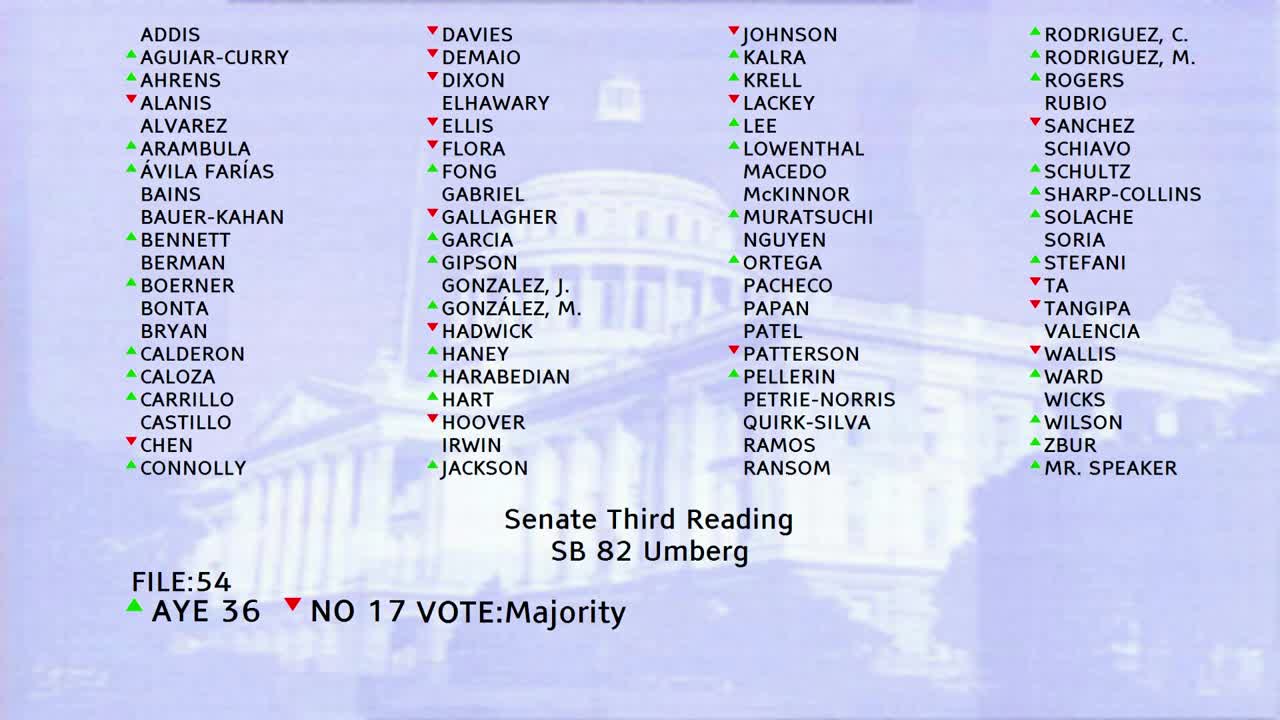 3MIN
Assembly Floor
 53MIN
Assembly Standing Committee on Insurance
 1H
Assembly Standing Committee on Communications and Conveyance
 2MIN
Senate Floor
 15MIN
Senate Standing Committee on Transportation
 16MIN