AB 1412: Special education: pupil transfers: residency requirements: records.
- Session Year: 2025-2026
- House: Assembly
- Latest Version Date: 2025-10-07
Current Status:
Passed
(2025-10-07: Chaptered by Secretary of State - Chapter 453, Statutes of 2025.)
Introduced
In Committee
Awaiting First Chamber Vote
Passed First Chamber
In Committee
Awaiting Second Chamber Vote
Passed Second Chamber
Enacted
(1)If an individual with exceptional needs, as defined, transfers from outside the state to a district, as defined, in the state, or transfers from district to district, within the same academic year, existing law requires local educational agencies, as defined, to provide the pupil with a free appropriate public education, including services comparable to those described in the previously approved individualized education program, in consultation with the parents, until the local educational agency conducts a federally required assessment, if determined to be necessary by the local educational agency, and develops a new individualized education program, if appropriate, that is consistent with federal and state law.
This bill would require a local educational agency, within 30 days of receipt of official records or specified unofficial records, to either adopt and implement the individualized education program previously adopted for the pupil or develop, adopt, and implement a new individualized education program for the pupil that is consistent with federal and state law, if applicable. To the extent the bill would impose additional duties on local education agencies, the bill would impose a state-mandated local program.
(2)Existing law ratifies the Interstate Compact on Educational Opportunity for Military Children, as specified.
Existing law requires the new school in which an individual with exceptional needs enrolls to take reasonable steps to promptly obtain the pupils records from their previous school, including the individualized education program and supporting documents and any other records relating to the provision of special education and related services to the pupil, pursuant to specified federal law.
This bill would expressly require those reasonable steps to also be consistent with specified requirements of the Interstate Compact on Educational Opportunity for Military Children, and would require the new school to accept unofficial records provided by the pupils parent or guardian until validated by official records, consistent with specified requirements of the Interstate Compact on Educational Opportunity for Military Children. To the extent the bill would impose additional duties on local educational agencies, the bill would impose a state-mandated local program.
(3)Existing law provides that each person between 6 and 18 years of age not exempted is subject to compulsory full-time education and requires a person subject to compulsory education to attend the public full-time day school or continuation school or classes in the school district in which the residence of the parents or legal guardian is located. Existing law provides that a pupil complies with the residency requirements if the pupils parent is transferred or is pending transfer to a military installation within the state while on active military duty pursuant to an official military order, and requires a parent to provide proof of residence in the school district within 10 days after the published arrival date provided on official documentation.
This bill would expressly provide that the above-described provisions apply to all pupils whose parent is an active duty member of the Armed Forces of the United States, including pupils eligible for services or accommodations pursuant to the federal Individuals with Disabilities Education Act, Section 504 of the federal Rehabilitation Act of 1973, or the federal Americans with Disabilities Act of 1990, as applicable. The bill would require school districts, upon notification that a pupil who is enrolling pursuant to the above-described provisions is receiving, or may eligible to receive, services or accommodations pursuant to federal law, to promptly coordinate with the pupils parents and previous school, as provided. To the extent the bill would impose additional duties on local educational agencies, the bill would impose a state-mandated local program.
(4)The California Constitution requires the state to reimburse local agencies and school districts for certain costs mandated by the state. Statutory provisions establish procedures for making that reimbursement.
This bill would provide that, if the Commission on State Mandates determines that the bill contains costs mandated by the state, reimbursement for those costs shall be made pursuant to the statutory provisions noted above.
(1)If an individual with exceptional needs, as defined, transfers from outside the state to a district, as defined, in the state, or transfers from district to district, within the same academic year, existing law requires local educational agencies, as defined, to provide the pupil with a free appropriate public education, including services comparable to those described in the previously approved individualized education program, in consultation with the parents, until the local educational agency conducts a federally required assessment, if determined to be necessary by the local educational agency, and develops a new individualized education program, if appropriate, that is consistent with federal and state law.
This bill would require a local educational agency, within 30 days of the above-described transfers, receipt of official records or specified unofficial records, to either adopt and implement the individualized education program previously adopted for the pupil or develop, adopt, and implement a new individualized education program for the pupil that is consistent with federal and state law, if applicable. To the extent the bill would impose additional duties on local education agencies, the bill would impose a state-mandated local program.
(2)Existing law ratifies the Interstate Compact on Educational Opportunity for Military Children, as specified.
Existing law requires the new school in which an individual with exceptional needs enrolls to take reasonable steps to promptly obtain the pupils records from their previous school, including the individualized education program and supporting documents and any other records relating to the provision of special education and related services to the pupil, pursuant to specified federal law.
This bill would expressly require those reasonable steps to also be consistent with the specified requirements of the Interstate Compact on Educational Opportunity for Military Children, and would require the new school to accept unofficial records provided by the pupils parent or guardian until validated by official records, consistent with the specified requirements of the Interstate Compact on Educational Opportunity for Military Children. To the extent the bill would impose additional duties on local educational agencies, the bill would impose a state-mandated local program.
(3)Existing law provides that each person between 6 and 18 years of age not exempted is subject to compulsory full-time education and requires a person subject to compulsory education to attend the public full-time day school or continuation school or classes in the school district in which the residence of the parents or legal guardian is located. Existing law provides that a pupil complies with the residency requirements if the pupils parent is transferred or is pending transfer to a military installation within the state while on active military duty pursuant to an official military order, and requires a parent to provide proof of residence in the school district within 10 days after the published arrival date provided on official documentation.
This bill would expressly provide that the above-described provisions apply to all pupils whose parent is an active duty member of the Armed Forces of the United States, including pupils eligible for services or accommodations pursuant to the federal Individuals with Disabilities Education Act, Section 504 of the federal Rehabilitation Act of 1973, or the federal Americans with Disabilities Act of 1990, as applicable. The bill would require school districts, upon notification that a pupil who is enrolling pursuant to the above-described provisions is receiving, or may eligible to receive, services or accommodations pursuant to federal law, to promptly coordinate with the pupils parents and previous school, as provided. To the extent the bill would impose additional duties on local educational agencies, the bill would impose a state-mandated local program.
(4)The California Constitution requires the state to reimburse local agencies and school districts for certain costs mandated by the state. Statutory provisions establish procedures for making that reimbursement.
This bill would provide that, if the Commission on State Mandates determines that the bill contains costs mandated by the state, reimbursement for those costs shall be made pursuant to the statutory provisions noted above.
(1)If an individual with exceptional needs, as defined, transfers from outside the state to a district, as defined, in the state, or transfers from district to district, within the same academic year, existing law requires local educational agencies, as defined, to provide the pupil with a free appropriate public education, including services comparable to those described in the previously approved individualized education program, in consultation with the parents, until the local educational agency conducts a federally required assessment, if determined to be necessary by the local educational agency, and develops a new individualized education program, if appropriate, that is consistent with federal and state law.
This bill would require a local educational agency, within 30 days of the above-described transfers, to either adopt and implement the individualized education program previously adopted for the pupil or develop, adopt, and implement a new individualized education program for the pupil that is consistent with federal and state law, if applicable. To the extent the bill would impose additional duties on local education agencies, the bill would impose a state-mandated local program.
(2)Existing law ratifies the Interstate Compact on Educational Opportunity for Military Children, as specified.
Existing law requires the new school in which an individual with exceptional needs enrolls to take reasonable steps to promptly obtain the pupils records from their previous school, including the individualized education program and supporting documents and any other records relating to the provision of special education and related services to the pupil, pursuant to specified federal law.
This bill would expressly require those reasonable steps to also be consistent with the requirements of the Interstate Compact on Educational Opportunity for Military Children, and would require the new school to accept unofficial records provided by the pupils parent or guardian until validated by official records, consistent with the requirements of the Interstate Compact on Educational Opportunity for Military Children. To the extent the bill would impose additional duties on local educational agencies, the bill would impose a state-mandated local program.
(3)Existing law provides that each person between 6 and 18 years of age not exempted is subject to compulsory full-time education and requires a person subject to compulsory education to attend the public full-time day school or continuation school or classes in the school district in which the residence of the parents or legal guardian is located. Existing law provides that a pupil complies with the residency requirements if the pupils parent is transferred or is pending transfer to a military installation within the state while on active military duty pursuant to an official military order, and requires a parent to provide proof of residence in the school district within 10 days after the published arrival date provided on official documentation.
This bill would expressly provide that the above-described provisions apply to all pupils whose parent is an active duty member of the Armed Forces of the United States, including pupils eligible for services or accommodations pursuant to the federal Individuals with Disabilities Education Act, Section 504 of the federal Rehabilitation Act of 1973, or the federal Americans with Disabilities Act of 1990, as applicable. The bill would require school districts, upon notification that a pupil who is enrolling pursuant to the above-described provisions is receiving, or may eligible to receive, services or accommodations pursuant to federal law, to promptly coordinate with the pupils parents and previous school, as provided. To the extent the bill would impose additional duties on local educational agencies, the bill would impose a state-mandated local program.
(4)The California Constitution requires the state to reimburse local agencies and school districts for certain costs mandated by the state. Statutory provisions establish procedures for making that reimbursement.
This bill would provide that, if the Commission on State Mandates determines that the bill contains costs mandated by the state, reimbursement for those costs shall be made pursuant to the statutory provisions noted above.
(a)For purposes of this section, the following definitions apply:
(1)Active military duty means full-time military duty status in the active uniformed service of the United States, including members of the California National Guard and the State Guard on active duty orders pursuant to Title 10 or 32 of the United States Code or Part 1 (commencing with Section 100) of Division 2 of the Military and Veterans Code.
(2)Military installation means a base, camp, post, station, yard, center, home port facility for any ship, or other activity under the jurisdiction of the United States Department of Defense or the United States Coast Guard.
(3)Parent means the natural or adoptive parent or guardian of a dependent child.
(b)(1)Notwithstanding Section 48200, a pupil complies with the residency requirements for school attendance in a school district, if the pupil is a pupil whose parent is transferred or is pending transfer to a military installation within the state while on active military duty pursuant to an official military order.
(2)For purposes of paragraph (1), pupil includes a pupil eligible for services or accommodations pursuant to the federal Individuals with Disabilities Education Act (20 U.S.C. Sec. 1400 et seq.), Section 504 of the federal Rehabilitation Act of 1973 (29 U.S.C. Sec. 794), or the federal Americans with Disabilities Act of 1990 (42 U.S.C. Sec. 12101 et seq.), as applicable.
(c)A school district shall accept applications by electronic means for enrollment, including enrollment in a specific school or program within the school district, and course registration for pupils described in subdivision (b).
(d)(1)The parent shall provide proof of residence in the school district within 10 days after the published arrival date provided on official documentation.
(2)For purposes of paragraph (1), a parent may use any of the following addresses as related to their military move:
(A)A temporary on-base billeting facility.
(B)A purchased or leased home or apartment.
(C)Federal government or public-private venture off-base military housing.
(e)Upon notification that a pupil enrolling pursuant to this section is receiving, or may be eligible to receive, services or accommodations pursuant to the federal Individuals with Disabilities Education Act (20 U.S.C. Sec. 1400 et seq.), Section 504 of the federal Rehabilitation Act of 1973 (29 U.S.C. Sec. 794), or the federal Americans with Disabilities Act of 1990 (42 U.S.C. Sec. 12101 et seq.), as applicable, the school district shall promptly coordinate with the pupils parents and previous school pursuant to Section 56325 to ensure the timely exchange of records and to reduce any delays in the pupil receiving comparable services or accommodations from the school district, including, but not limited to, implementation of their individualized education program, individualized family service plan, or plan pursuant to Section 504 of the federal Rehabilitation Act of 1973 (29 U.S.C. Sec. 794), as applicable.
SEC. 2.Section 56325 of the Education Code is amended to read:56325.(a)(1)As required by subclause (I) of clause (i) of subparagraph (C) of paragraph (2) of subsection (d) of Section 1414 of Title 20 of the United States Code, the following shall apply to special education programs for individuals with exceptional needs who transfer from district to district within the state. In the case of an individual with exceptional needs who has an individualized education program and transfers into a district from a district not operating programs under the same local plan in which the individual with exceptional needs was last enrolled in a special education program within the same academic year, the local educational agency shall provide the pupil with a free appropriate public education, including services comparable to those described in the previously approved individualized education program, in consultation with the parents, for a period not to exceed 30 days, by which time the local educational agency shall adopt the previously approved individualized education program or shall develop, adopt, and implement a new individualized education program that is consistent with federal and state law.
(2)In the case of an individual with exceptional needs who has an individualized education program and transfers into a district from a district operating programs under the same special education local plan area of the district in which the individual with exceptional needs was last enrolled in a special education program within the same academic year, the new district shall continue, without delay, to provide services comparable to those described in the existing approved individualized education program, unless the parent and the local educational agency agree to develop, adopt, and implement a new individualized education program that is consistent with federal and state law.
(3)(A)As required by subclause (II) of clause (i) of subparagraph (C) of paragraph (2) of subsection (d) of Section 1414 of Title 20 of the United States Code, the following shall apply to special education programs for individuals with exceptional needs who transfer from an educational agency located outside the State of California to a district within California. In the case of an individual with exceptional needs who transfers from district to district within the same academic year, the local educational agency shall provide the pupil with a free appropriate public education, including services comparable to those described in the previously approved individualized education program, in consultation with the parents, until the local educational agency conducts an assessment pursuant to paragraph (1) of subsection (a) of Section 1414 of Title 20 of the United States Code, if determined to be necessary by the local educational agency, and develops a new individualized education program, if appropriate, that is consistent with federal and state law.
(B)(i)For purposes of subparagraph (A), a local educational agency shall, within 30 days of receipt of official or unofficial records, either adopt and implement the individualized education program previously adopted for the pupil or develop, adopt, and implement a new individualized education program for the pupil that is consistent with federal and state law, if applicable.
(ii)For purposes of clause (i), unofficial records has the same meaning as described in subdivision (A) of Article IV of the Interstate Compact on Educational Opportunity for Military Children, as specified in Section 49701.
(b)(1)To facilitate the transition for an individual with exceptional needs described in subdivision (a), the new school in which the individual with exceptional needs enrolls shall take reasonable steps to promptly obtain the pupils records, including the individualized education program and supporting documents and any other records relating to the provision of special education and related services to the pupil, from the previous school in which the pupil was enrolled, pursuant to paragraph (2) of subsection (a) of Section 99.31 of Title 34 of the Code of Federal Regulations and consistent with the Interstate Compact on Educational Opportunity for Military Children, as specified in subdivision (A) of Article I, subdivision (E) of Article II, and subdivisions (B) and (C) of Article V of Section 49701, as applicable.
(2)The previous school in which the individual with exceptional needs was enrolled shall take reasonable steps to promptly respond to the request from the new school.
(3)The new school in which the individual with exceptional needs enrolls shall accept unofficial records provided by the pupils parent or guardian pending validation by the official records, consistent with the requirements of the Interstate Compact on Educational Opportunity for Military Children, as specified in subdivision (A) of Article I, subdivision (E) of Article II, and subdivisions (B) and (C) of Article V of Section 49701, as applicable.
(c)If whenever a pupil described in subdivision (a) was placed and residing in a residential nonpublic, nonsectarian school, prior to transferring to a district in another special education local plan area, and this placement is not eligible for funding pursuant to Section 56836.165, the special education local plan area that contains the district that made the residential nonpublic, nonsectarian school placement is responsible for the funding of the placement, including related services, for the remainder of the school year. An extended year session is included in the school year in which the session ends.
SEC. 3.If the Commission on State Mandates determines that this act contains costs mandated by the state, reimbursement to local agencies and school districts for those costs shall be made pursuant to Part 7 (commencing with Section 17500) of Division 4 of Title 2 of the Government Code.
(a)For purposes of this section, the following definitions apply:
(1)Active military duty means full-time military duty status in the active uniformed service of the United States, including members of the California National Guard and the State Guard on active duty orders pursuant to Title 10 or 32 of the United States Code or Part 1 (commencing with Section 100) of Division 2 of the Military and Veterans Code.
(2)Military installation means a base, camp, post, station, yard, center, home port facility for any ship, or other activity under the jurisdiction of the United States Department of Defense or the United States Coast Guard.
(3)Parent means the natural or adoptive parent or guardian of a dependent child.
(b)(1)Notwithstanding Section 48200, a pupil complies with the residency requirements for school attendance in a school district, if the pupil is a pupil whose parent is transferred or is pending transfer to a military installation within the state while on active military duty pursuant to an official military order.
(2)For purposes of paragraph (1), pupil includes a pupil eligible for services or accommodations pursuant to the federal Individuals with Disabilities Education Act (20 U.S.C. Sec. 1400 et seq.), Section 504 of the federal Rehabilitation Act of 1973 (29 U.S.C. Sec. 794), or the federal Americans with Disabilities Act of 1990 (42 U.S.C. Sec. 12101 et seq.), as applicable.
(c)A school district shall accept applications by electronic means for enrollment, including enrollment in a specific school or program within the school district, and course registration for pupils described in subdivision (b).
(d)(1)The parent shall provide proof of residence in the school district within 10 days after the published arrival date provided on official documentation.
(2)For purposes of paragraph (1), a parent may use any of the following addresses as related to their military move:
(A)A temporary on-base billeting facility.
(B)A purchased or leased home or apartment.
(C)Federal government or public-private venture off-base military housing.
(e)Upon notification that a pupil enrolling pursuant to this section is receiving, or may be eligible to receive, services or accommodations pursuant to the federal Individuals with Disabilities Education Act (20 U.S.C. Sec. 1400 et seq.), Section 504 of the federal Rehabilitation Act of 1973 (29 U.S.C. Sec. 794), or the federal Americans with Disabilities Act of 1990 (42 U.S.C. Sec. 12101 et seq.), as applicable, the school district shall promptly coordinate with the pupils parents and previous school pursuant to Section 56325 to ensure the timely exchange of records and to reduce any delays in the pupil receiving comparable services or accommodations from the school district, including, but not limited to, implementation of their individualized education program, individualized family service plan, or plan pursuant to Section 504 of the federal Rehabilitation Act of 1973 (29 U.S.C. Sec. 794), as applicable.
SEC. 2.Section 56325 of the Education Code is amended to read:56325.(a)(1)As required by subclause (I) of clause (i) of subparagraph (C) of paragraph (2) of subsection (d) of Section 1414 of Title 20 of the United States Code, the following shall apply to special education programs for individuals with exceptional needs who transfer from district to district within the state. In the case of an individual with exceptional needs who has an individualized education program and transfers into a district from a district not operating programs under the same local plan in which the individual with exceptional needs was last enrolled in a special education program within the same academic year, the local educational agency shall provide the pupil with a free appropriate public education, including services comparable to those described in the previously approved individualized education program, in consultation with the parents, for a period not to exceed 30 days, by which time the local educational agency shall adopt the previously approved individualized education program or shall develop, adopt, and implement a new individualized education program that is consistent with federal and state law.
(2)In the case of an individual with exceptional needs who has an individualized education program and transfers into a district from a district operating programs under the same special education local plan area of the district in which the individual with exceptional needs was last enrolled in a special education program within the same academic year, the new district shall continue, without delay, to provide services comparable to those described in the existing approved individualized education program, unless the parent and the local educational agency agree to develop, adopt, and implement a new individualized education program that is consistent with federal and state law.
(3)(A)As required by subclause (II) of clause (i) of subparagraph (C) of paragraph (2) of subsection (d) of Section 1414 of Title 20 of the United States Code, the following shall apply to special education programs for individuals with exceptional needs who transfer from an educational agency located outside the State of California to a district within California. In the case of an individual with exceptional needs who transfers from district to district within the same academic year, the local educational agency shall provide the pupil with a free appropriate public education, including services comparable to those described in the previously approved individualized education program, in consultation with the parents, until the local educational agency conducts an assessment pursuant to paragraph (1) of subsection (a) of Section 1414 of Title 20 of the United States Code, if determined to be necessary by the local educational agency, and develops a new individualized education program, if appropriate, that is consistent with federal and state law.
(B)(i)For purposes of subparagraph (A), a local educational agency shall, within 30 days, days of receipt of official or unofficial records, either adopt and implement the individualized education program previously adopted for the pupil or develop, adopt, and implement a new individualized education program for the pupil that is consistent with federal and state law, if applicable.
(ii)For purposes of clause (i), unofficial records has the same meaning as described in subdivision (A) of Article IV of the Interstate Compact on Educational Opportunity for Military Children, as specified in Section 49701.
(b)(1)To facilitate the transition for an individual with exceptional needs described in subdivision (a), the new school in which the individual with exceptional needs enrolls shall take reasonable steps to promptly obtain the pupils records, including the individualized education program and supporting documents and any other records relating to the provision of special education and related services to the pupil, from the previous school in which the pupil was enrolled, pursuant to paragraph (2) of subsection (a) of Section 99.31 of Title 34 of the Code of Federal Regulations and consistent with the Interstate Compact on Educational Opportunity for Military Children, as specified in subdivision (A) of Article I, subdivision (E) of Article II, and subdivisions (B) and (C) of Article V of Section 49701. 49701, as applicable.
(2)The previous school in which the individual with exceptional needs was enrolled shall take reasonable steps to promptly respond to the request from the new school.
(3)The new school in which the individual with exceptional needs enrolls shall accept unofficial records provided by the pupils parent or guardian pending validation by the official records, consistent with the requirements of the Interstate Compact on Educational Opportunity for Military Children, as specified in subdivision (A) of Article I, subdivision (E) of Article II, and subdivisions (B) and (C) of Article V of Section 49701. 49701, as applicable.
(c)If whenever a pupil described in subdivision (a) was placed and residing in a residential nonpublic, nonsectarian school, prior to transferring to a district in another special education local plan area, and this placement is not eligible for funding pursuant to Section 56836.165, the special education local plan area that contains the district that made the residential nonpublic, nonsectarian school placement is responsible for the funding of the placement, including related services, for the remainder of the school year. An extended year session is included in the school year in which the session ends.
SEC. 3.If the Commission on State Mandates determines that this act contains costs mandated by the state, reimbursement to local agencies and school districts for those costs shall be made pursuant to Part 7 (commencing with Section 17500) of Division 4 of Title 2 of the Government Code.
(a)For purposes of this section, the following definitions apply:
(1)Active military duty means full-time military duty status in the active uniformed service of the United States, including members of the California National Guard and the State Guard on active duty orders pursuant to Title 10 or 32 of the United States Code or Part 1 (commencing with Section 100) of Division 2 of the Military and Veterans Code.
(2)Military installation means a base, camp, post, station, yard, center, home port facility for any ship, or other activity under the jurisdiction of the United States Department of Defense or the United States Coast Guard.
(3)Parent means the natural or adoptive parent or guardian of a dependent child.
(b)(1)Notwithstanding Section 48200, a pupil complies with the residency requirements for school attendance in a school district, if the pupil is a pupil whose parent is transferred or is pending transfer to a military installation within the state while on active military duty pursuant to an official military order.
(2)For purposes of paragraph (1), pupil includes a pupil eligible for services or accommodations pursuant to the federal Individuals with Disabilities Education Act (20 U.S.C. Sec. 1400 et seq.), Section 504 of the federal Rehabilitation Act of 1973 (29 U.S.C. Sec. 794), or the federal Americans with Disabilities Act of 1990 (42 U.S.C. Sec. 12101 et seq.), as applicable.
(c)A school district shall accept applications by electronic means for enrollment, including enrollment in a specific school or program within the school district, and course registration for pupils described in subdivision (b).
(d)(1)The parent shall provide proof of residence in the school district within 10 days after the published arrival date provided on official documentation.
(2)For purposes of paragraph (1), a parent may use any of the following addresses as related to their military move:
(A)A temporary on-base billeting facility.
(B)A purchased or leased home or apartment.
(C)Federal government or public-private venture off-base military housing.
(e)Upon notification that a pupil enrolling pursuant to this section is receiving, or may be eligible to receive, services or accommodations pursuant to the federal Individuals with Disabilities Education Act (20 U.S.C. Sec. 1400 et seq.), Section 504 of the federal Rehabilitation Act of 1973 (29 U.S.C. Sec. 794), or the federal Americans with Disabilities Act of 1990 (42 U.S.C. Sec. 12101 et seq.), as applicable, the school district shall promptly coordinate with the pupils parents and previous school pursuant to Section 56325 to ensure the timely exchange of records and to reduce any delays in the pupil receiving comparable services or accommodations from the school district, including, but not limited to, implementation of their individualized education program, individualized family service plan, or plan pursuant to Section 504 of the federal Rehabilitation Act of 1973 (29 U.S.C. Sec. 794), as applicable.
SEC. 2.Section 56325 of the Education Code is amended to read:56325.(a)(1)As required by subclause (I) of clause (i) of subparagraph (C) of paragraph (2) of subsection (d) of Section 1414 of Title 20 of the United States Code, the following shall apply to special education programs for individuals with exceptional needs who transfer from district to district within the state. In the case of an individual with exceptional needs who has an individualized education program and transfers into a district from a district not operating programs under the same local plan in which he or she the individual with exceptional needs was last enrolled in a special education program within the same academic year, the local educational agency shall provide the pupil with a free appropriate public education, including services comparable to those described in the previously approved individualized education program, in consultation with the parents, for a period not to exceed 30 days, by which time the local educational agency shall adopt the previously approved individualized education program or shall develop, adopt, and implement a new individualized education program that is consistent with federal and state law.
(2)In the case of an individual with exceptional needs who has an individualized education program and transfers into a district from a district operating programs under the same special education local plan area of the district in which he or she the individual with exceptional needs was last enrolled in a special education program within the same academic year, the new district shall continue, without delay, to provide services comparable to those described in the existing approved individualized education program, unless the parent and the local educational agency agree to develop, adopt, and implement a new individualized education program that is consistent with federal and state law.
(3)(A)As required by subclause (II) of clause (i) of subparagraph (C) of paragraph (2) of subsection (d) of Section 1414 of Title 20 of the United States Code, the following shall apply to special education programs for individuals with exceptional needs who transfer from an educational agency located outside the State of California to a district within California. In the case of an individual with exceptional needs who transfers from district to district within the same academic year, the local educational agency shall provide the pupil with a free appropriate public education, including services comparable to those described in the previously approved individualized education program, in consultation with the parents, until the local educational agency conducts an assessment pursuant to paragraph (1) of subsection (a) of Section 1414 of Title 20 of the United States Code, if determined to be necessary by the local educational agency, and develops a new individualized education program, if appropriate, that is consistent with federal and state law.
(B)For purposes of subparagraph (A), a local educational agency shall, within 30 days, either adopt and implement the individualized education program previously adopted for the pupil or develop, adopt, and implement a new individualized education program for the pupil that is consistent with federal and state law, if applicable.
(b)(1)To facilitate the transition for an individual with exceptional needs described in subdivision (a), the new school in which the individual with exceptional needs enrolls shall take reasonable steps to promptly obtain the pupils records, including the individualized education program and supporting documents and any other records relating to the provision of special education and related services to the pupil, from the previous school in which the pupil was enrolled, pursuant to paragraph (2) of subsection (a) of Section 99.31 of Title 34 of the Code of Federal Regulations. Regulations and consistent with the Interstate Compact on Educational Opportunity for Military Children, as specified in Section 49701.
(2)The previous school in which the individual with exceptional needs was enrolled shall take reasonable steps to promptly respond to the request from the new school.
(3)The new school in which the individual with exceptional needs enrolls shall accept unofficial records provided by the pupils parent or guardian pending validation by the official records, consistent with the requirements of the Interstate Compact on Educational Opportunity for Military Children, as specified in Section 49701.
(c)If whenever a pupil described in subdivision (a) was placed and residing in a residential nonpublic, nonsectarian school, prior to transferring to a district in another special education local plan area, and this placement is not eligible for funding pursuant to Section 56836.165, the special education local plan area that contains the district that made the residential nonpublic, nonsectarian school placement is responsible for the funding of the placement, including related services, for the remainder of the school year. An extended year session is included in the school year in which the session ends.
SEC. 3.If the Commission on State Mandates determines that this act contains costs mandated by the state, reimbursement to local agencies and school districts for those costs shall be made pursuant to Part 7 (commencing with Section 17500) of Division 4 of Title 2 of the Government Code.
|
Date
|
Status
|
|---|---|
| Oct 7, 2025 | Chaptered by Secretary of State - Chapter 453, Statutes of 2025. |
| Oct 7, 2025 | Approved by the Governor. |
| Sep 2, 2025 | Enrolled and presented to the Governor at 3 p.m. |
| Aug 26, 2025 | In Assembly. Ordered to Engrossing and Enrolling. |
| Aug 25, 2025 | Read third time. Passed. Ordered to the Assembly. (Ayes 37. Noes 0. Page 2252.). |
| Aug 20, 2025 | Read second time. Ordered to Consent Calendar. |
| Aug 19, 2025 | From committee: Be ordered to second reading file pursuant to Senate Rule 28.8 and ordered to Consent Calendar. |
| Jul 15, 2025 | From committee: Do pass and re-refer to Com. on APPR. with recommendation: To Consent Calendar. (Ayes 5. Noes 0.) (July 14). Re-referred to Com. on APPR. |
| Jun 18, 2025 | From committee: Do pass and re-refer to Com. on M. & V.A. with recommendation: To Consent Calendar. (Ayes 7. Noes 0.) (June 18). Re-referred to Com. on M. & V.A. |
| Jun 4, 2025 | Referred to Coms. on ED. and M. & V.A. |
| May 23, 2025 | In Senate. Read first time. To Com. on RLS. for assignment. |
| May 23, 2025 | Read third time. Passed. Ordered to the Senate. (Ayes 70. Noes 0. Page 1657.) |
| May 15, 2025 | Read second time. Ordered to third reading. |
| May 14, 2025 | From committee: Do pass. (Ayes 15. Noes 0.) (May 14). |
| Apr 30, 2025 | From committee: Do pass and re-refer to Com. on APPR. (Ayes 8. Noes 0.) (April 29). Re-referred to Com. on APPR. |
| Apr 22, 2025 | Re-referred to Com. on M. & V.A. |
| Apr 21, 2025 | Read second time and amended. |
| Apr 10, 2025 | From committee: Amend, and do pass as amended and re-refer to Com. on M. & V.A. (Ayes 9. Noes 0.) (April 9). |
| Mar 13, 2025 | Referred to Coms. on ED. and M. & V.A. |
| Feb 24, 2025 | Read first time. |
| Feb 22, 2025 | From printer. May be heard in committee March 24. |
| Feb 21, 2025 | Introduced. To print. |
|
Date
|
Description
|
Location
|
Votes
|
|
|---|---|---|---|---|
| Aug 25, 2025 | Consent Calendar 2nd AB1412 Jeff Gonzalez et al. | Senate Floor |
Passed |
|
| Jul 14, 2025 | Do pass, but first be re-referred to the Committee on [Appropriations] with the recommendation: To Consent Calendar | Senate Standing Committee on Military and Veterans Affairs |
Passed |
|
| Jun 18, 2025 | Do pass, but first be re-referred to the Committee on [Military and Veterans Affairs] with the recommendation: To Consent Calendar | Senate Standing Committee on Education |
Passed |
|
| May 23, 2025 | AB 1412 Jeff Gonzalez Assembly Third Reading | Assembly Floor |
Passed |
|
| May 14, 2025 | Do pass. | Assembly Standing Committee on Appropriations |
Passed |
|
| Apr 29, 2025 | Do pass and be re-referred to the Committee on [Appropriations] | Assembly Standing Committee on Military and Veterans Affairs |
Passed |
|
| Apr 9, 2025 | Do pass as amended and be re-referred to the Committee on [Military and Veterans Affairs] | Assembly Standing Committee on Education |
Passed |
This list shows positions taken on this bill by organizations on the date displayed, which is linked to the original source.
Positions by individuals are not included.
|
Organization
|
Position
|
Date
|
|---|---|---|
| American Legion, Department Of California | ** Support | |
| AMVETS Department of California | ** Support | |
| Association Of California School Administrators | ** Against | |
| California Association Of County Veterans Service Officers | ** Support | |
| California School Employees Association | ** Support | |
| California State Commanders Veterans Council | ** Support | |
| California State PTA | ** Support | |
| Disability Rights California | ** Support | |
| Emotions Matter | ** Support | |
| Emotions Matter INC. | ** Support | |
| Military Officers Association Of America, California Council Of Chapters | ** Support | |
| Military Services in California | ** Support | |
| San Diego Regional Chamber Of Commerce | ** Support | |
| San Diego Unified School District | ** Support | |
| The Arc and United Cerebral Palsy California Collaboration | ** Support | |
| U. S. Department of Defense | ** Support | |
| U.S. Department of Defense | ** Support | |
| Vietnam Veterans Of America, California State Council | ** Support |
SENATE RULES COMMITTEE Office of Senate Floor Analyses (916) 651-1520 Fax: (916) 327-4478 | AB 1412 |
CONSENT
Bill No: AB 1412
Author: Jeff Gonzalez (R), et al.
Amended: 4/21/25 in Assembly
Vote: 21
SENATE EDUCATION COMMITTEE: 7-0, 6/18/25
AYES: Pérez, Ochoa Bogh, Cabaldon, Choi, Cortese, Laird, Limón
SENATE MILITARY & VETERANS COMMITTEE: 5-0, 7/14/25
AYES: Archuleta, Grove, McNerney, Menjivar, Umberg
SENATE APPROPRIATIONS COMMITTEE: Senate Rule 28.8
ASSEMBLY FLOOR: 70-0, 5/23/25 - See last page for vote
SUBJECT: Special education: pupil transfers: residency requirements: records
SOURCE: U.S. Department of Defense
DIGEST:
This bill enhances educational continuity for students with disabilities who transfer into California schools—particularly military-connected students—by establishing procedures for expedited records transfer and requiring timely implementation of individualized education programs (IEPs).
ANALYSIS:
Existing law:
- Defines a pupil as meeting school district residency requirements if their parent is transferred or pending transfer to a military installation within California while on active military duty, under official orders. (Education Code (EC) § 48204.3)
- Requires local educational agencies (LEAs) to provide comparable special education services for up to 30 days to students with existing IEPs who transfer between California districts, after which the LEA must adopt the existing IEP or develop a new one. (EC § 56325(a)(1))
- Requires LEAs to provide comparable services to students with IEPs who transfer from out of state, in consultation with the parents, until the LEA conducts an assessment and develops a new IEP if needed, but does not establish a specific timeline. (EC § 56325(a)(3))
- Requires receiving schools to take reasonable steps to obtain a transferring student’s IEP and related records from the previous school and requires the former school to promptly respond. (EC § 56325(b))
- Requires receiving schools to accept unofficial records from a military-connected student’s parent or guardian, pending receipt of official records, consistent with the Interstate Compact on Educational Opportunity for Military Children. (EC § 49701)
- Assigns fiscal responsibility for certain residential nonpublic, nonsectarian school placements to the Special Education Local Plan Area (SELPA) that made the original placement, even if the student transfers to a district in another SELPA. (EC § 56836.165)
This bill:
- Clarifies that students eligible under the Individuals with Disabilities Education Act (IDEA), Section 504, or the Americans with Disabilities Act (ADA) meet school district residency requirements when their parent is transferred or pending transfer to a military installation in California under official orders, consistent with advance enrollment provisions.
- Requires a school district, upon notification that a student may be eligible for services under IDEA, Section 504, or the ADA, to promptly coordinate with the student’s parents and prior school to facilitate timely exchange of records and reduce delays in the provision of services.
- Requires a LEA, within 30 days of receiving official or unofficial records for a student transferring into California from another state, to either adopt and implement the student’s existing IEP or develop, adopt, and implement a new IEP consistent with federal and state law.
- Requires a receiving school to take reasonable steps to obtain the student’s IEP, supporting documents, and other relevant records from the student’s prior school, consistent with the federal Family Educational Rights and Privacy Act and the Interstate Compact on Educational Opportunity for Military Children.
- Requires a receiving school to accept unofficial records provided by a parent or guardian, pending receipt and validation of official records, consistent with the Interstate Compact on Educational Opportunity for Military Children.
- Specifies that when a student residing in a residential nonpublic, nonsectarian school is transferred to another SELPA midyear, the SELPA that made the original placement remains fiscally responsible for the placement and related services through the remainder of the school year, including any extended school year session.
Comments
- Need for this bill. According to the author, “As a veteran myself, I have seen first-hand the impacts that the military lifestyle can have on children as they navigate their education. Students are often forced to relocate and get reacquainted with new schools many times as their parents are transferred while on active duty to our nation. Students with special needs face even more challenges as they require special education services that are tailored to their needs and those services are often delayed after they transfer schools. This bill would provide a timeline for school districts to implement and adopt those special services and flexibility for students and their families so that the services can be implemented sooner. Addressing these educational and service delays is essential for taking care of our military connected students, especially those with special needs.
“Existing law requires that a student with an existing individualized education program who transfers to a new school district from within the state to immediately receive comparable services to the previously approved IEP for at most 30 days. After 30 days, the new school district must adopt the previously agreed upon IEP or adopt a new IEP. This 30 day timeline does not exist for a student with special needs transfers from out of state. The highly mobile lifestyle of military connected children can lead to educational disruptions. The existing 30 day timeline for IEP implementation/adoption for in-state transfers is beneficial but students who are transferring from out of state do not enjoy this benefit. Existing law also requires the prompt acquisition of student records but it does not allow the use of unofficial records while the official records are pending. This is another obstacle that delays the much needed services for students with exceptional needs.”
- Military-connected students face disproportionate service delays during transitions. Military-connected students move frequently—on average six to nine times during their K–12 career—which places them at heightened risk for disruption in education services. These risks are compounded for students with disabilities, who rely on timely and consistent implementation of specialized supports. A 2021 national survey found that families of military-connected students with disabilities waited an average of 171 days for services following identification, and nearly 80% of those who experienced a service lapse after a move reported delays longer than 60 days. These gaps are not merely administrative hurdles—they represent a loss of learning time and stability for students who are already facing the challenges of family separation, housing transitions, and school changes. By requiring school districts to adopt or revise an IEP within 30 days of receiving records from out-of-state transfers, this bill takes a meaningful step toward reducing those disruptions and aligning timelines for in-state and out-of-state transfers.
- Formalizing what is already best practice: prompt coordination and use of unofficial records. Most districts strive to implement services without delay for incoming students, especially when they are notified that the student may be eligible for special education. This bill codifies those best practices by requiring prompt coordination between the receiving district, the family, and the sending school. Additionally, this bill reinforces the provisions of the Interstate Compact by requiring acceptance of unofficial records during the enrollment process. In practice, unofficial records—such as copies of an IEP brought by a parent—are often the only available documents during the initial weeks after a move. Requiring districts to accept these records and act on them as provisional guidance empowers schools to respond more quickly and responsively, ensuring continuity of services even before the bureaucracy of official records catches up.
- Applying the IEP deadline broadly may be ambitious but provides clarity and equity. The 30-day timeline proposed in this bill does not apply only to military-connected students but to all students with disabilities transferring into California from out of state. This decision reflects an intent to create uniformity in timelines regardless of a student’s background. However, it also raises questions about feasibility in cases where records are delayed, incomplete, or difficult to interpret across state lines. Unlike in-state transfers, where LEAs may already be familiar with a neighboring district’s practices, an IEP from another state may reflect different eligibility criteria, service models, or terminology. Even so, this deadline sets a clear expectation and gives families a concrete framework for understanding their rights. It also puts receiving districts on notice that they must proactively engage in service planning, rather than delaying action until a full reassessment is completed.
- Fiscal implications are likely limited, but the benefits may be significant. While this bill may result in modest administrative and staffing costs for districts that need to accelerate IEP review timelines, these are not new responsibilities—just clarified ones. LEAs are already required under federal law to provide services to students with disabilities upon enrollment. What this bill does is create a legal timeframe that both protects families from open-ended delays and encourages districts to prioritize students who are at the highest risk of falling through the cracks. Moreover, the clarification of fiscal responsibility for nonpublic school placements when a student transfers SELPAs helps avoid midyear disputes and maintains stability for students in the most restrictive and costly placements, where any interruption can have serious consequences.
- Aligning state law with the spirit and letter of the Interstate Compact. California joined all 50 states and the District of Columbia in adopting the Interstate Compact on Educational Opportunity for Military Children to mitigate the academic and social impacts of frequent moves. The Compact enshrines key principles such as timely enrollment, transparent record transfers, and continuity in academic programs. This bill builds on those principles, especially as they apply to special education. It ensures that disability-related services are not treated as an afterthought in the transition process, but as a core component of educational access. By doing so, California reinforces its commitment to supporting military families and acknowledges that the sacrifices borne by service members should not be paid by their children in the form of delayed supports.
- A small step with importance for a large and underserved population. According to the U.S. Department of Defense, California is home to over 150,000 active-duty service members and more than 50,000 military-connected K–12 students. These students are disproportionately likely to experience academic stress, social disconnection, and mental health challenges compared to their civilian peers. Students with disabilities are especially vulnerable, and the data suggest that they often struggle to receive the services they are entitled to in a timely manner after a move. This bill does not overhaul California’s special education framework, but it meaningfully strengthens the state’s response to this vulnerable population by improving clarity, consistency, and urgency in service provision.
FISCAL EFFECT: Appropriation: No Fiscal Com.: Yes Local: Yes
SUPPORT: (Verified 8/18/25)
U.S. Department of Defense (source)
American Legion, Department of California
AMVETS Department of California
California Association of County Veterans Service Officers
California School Employees Association
California State Commanders Veterans Council
Disability Rights California
Military Officers Association of America, California Council of Chapters
Military Services in California
San Diego Regional Chamber of Commerce
San Diego Unified School District
Vietnam Veterans of America, California State Council
OPPOSITION: (Verified 8/18/25)
None received
ASSEMBLY FLOOR: 70-0, 5/23/25
AYES: Addis, Aguiar-Curry, Ahrens, Alanis, Alvarez, Arambula, Ávila Farías, Bains, Bauer-Kahan, Bennett, Berman, Boerner, Bonta, Calderon, Caloza, Carrillo, Castillo, Connolly, Davies, DeMaio, Elhawary, Ellis, Flora, Fong, Gabriel, Gallagher, Garcia, Gipson, Jeff Gonzalez, Mark González, Hadwick, Haney, Harabedian, Hart, Hoover, Irwin, Jackson, Kalra, Krell, Lackey, Lowenthal, Macedo, McKinnor, Muratsuchi, Ortega, Pacheco, Papan, Patel, Patterson, Pellerin, Petrie-Norris, Quirk-Silva, Ramos, Ransom, Celeste Rodriguez, Michelle Rodriguez, Rogers, Blanca Rubio, Schiavo, Schultz, Solache, Soria, Stefani, Ta, Tangipa, Valencia, Ward, Wilson, Zbur, Rivas
NO VOTE RECORDED: Bryan, Chen, Dixon, Lee, Nguyen, Sanchez, Sharp-Collins, Wallis, Wicks
Prepared by: Ian Johnson / ED. / (916) 651-4105
8/21/25 16:45:47
SENATE COMMITTEE ON MILITARY AND VETERANS AFFAIRS
Senator Bob Archuleta, Chair
2025 - 2026 Regular
Bill No: AB 1412 Hearing Date: 7/14/25
Author: | Jeff Gonzalez | ||
Version: | 4/21/25 Amended | ||
Urgency: | No | Fiscal: | Yes |
Consultant: | Jenny Callison | ||
Subject: Special education: pupil transfers: residency requirements: records
DESCRIPTION
Summary:
Requires a local educational agency to adopt and implement the individualized education program (IEP) for a transfer student within 30 days of receipt of records.
Existing law:
- Defines a pupil as meeting school district residency requirements if their parent is transferred or pending transfer to a military installation within California while on active military duty, under official orders. (Education Code (EC) § 48204.3)
- Requires local educational agencies (LEAs) to provide comparable special education services for up to 30 days to students with existing IEPs who transfer between California districts, after which the LEA must adopt the existing IEP or develop a new one. (EC § 56325(a)(1))
- Requires LEAs to provide comparable services to students with IEPs who transfer from out of state, in consultation with the parents, until the LEA conducts an assessment and develops a new IEP if needed, but does not establish a specific timeline. (EC § 56325(a)(3))
- Requires receiving schools to take reasonable steps to obtain a transferring student’s IEP and related records from the previous school and requires the former school to promptly respond. (EC § 56325(b))
- Requires receiving schools to accept unofficial records from a military-connected student’s parent or guardian, pending receipt of official records, consistent with the Interstate Compact on Educational Opportunity for Military Children. (EC § 49701)
- Assigns fiscal responsibility for certain residential nonpublic, nonsectarian school placements to the Special Education Local Plan Area (SELPA) that made the original placement, even if the student transfers to a district in another SELPA. (EC § 56836.165)
This bill:
- Clarifies that students eligible under the Individuals with Disabilities Education Act (IDEA), Section 504, or the ADA meet school district residency requirements when their parent is transferred or pending transfer to a military installation in California under official orders, consistent with advance enrollment provisions.
- Requires a school district, upon notification that a student may be eligible for services under IDEA, Section 504, or the Americans with Disabilities Act (ADA), to promptly coordinate with the student’s parents and prior school to facilitate timely exchange of records and reduce delays in the provision of services.
- Requires a LEA, within 30 days of receiving official or unofficial records for a student transferring into California from another state, to either adopt and implement the student’s existing IEP or develop, adopt, and implement a new IEP consistent with federal and state law.
- Requires a receiving school to take reasonable steps to obtain the student’s IEP, supporting documents, and other relevant records from the student’s prior school, consistent with the federal Family Educational Rights and Privacy Act (FERPA) and the Interstate Compact on Educational Opportunity for Military Children.
- Requires a receiving school to accept unofficial records provided by a parent or guardian, pending receipt and validation of official records, consistent with the Interstate Compact on Educational Opportunity for Military Children.
- Specifies that when a student residing in a residential nonpublic, nonsectarian school is transferred to another SELPA midyear, the SELPA that made the original placement remains fiscally responsible for the placement and related services through the remainder of the school year, including any extended school year session.
BACKGROUND
According to the U.S. Department of Defense, California is home to over 150,000 active-duty service members and more than 50,000 military-connected K–12 students. The highly mobile lifestyle of military connected children can lead to educational disruptions. Military-connected students move frequently—on average six to nine times during their K–12 career—which places them at heightened risk for disruption in education services. These risks are compounded for students with disabilities, who rely on timely and consistent implementation of specialized supports.
Existing law requires that a student with an existing individualized education program who transfers to a new school district from within the state to immediately receive comparable services to the previously approved IEP for at most 30 days. After 30 days, the new school district must adopt the previously agreed upon IEP or adopt a new IEP. This 30 day timeline does not exist for a student with special needs transfers from out of state.
A 2021 national survey found that families of military-connected students with disabilities waited an average of 171 days for services following identification, and nearly 80% of those who experienced a service lapse after a move reported delays longer than 60 days. The existing 30-day timeline for IEP implementation/adoption for in-state transfers does not allow students who are transferring from out of state to enjoy this benefit. This put in place unnecessary barriers for many children of military members who transferred from another duty station to one in California.
COMMENT
In 2010, California joined all 50 states and the District of Columbia in adopting the Interstate Compact on Educational Opportunity for Military Children to mitigate the academic and social impacts of frequent moves. The Compact enshrines key principles such as timely enrollment, transparent record transfers, and continuity in academic programs. This bill builds on those principles, especially as they apply to special education. It ensures that disability-related services are treated as a core component of educational access so no military student in California is underequipped.
According to the author: “As a veteran myself, I have seen first-hand the impacts that the military lifestyle can have on children as they navigate their education. Students are often forced to relocate and get reacquainted with new schools many times as their parents are transferred while on active duty to our nation. Students with special needs face even more challenges as they require special education services that are tailored to their needs and those services are often delayed after they transfer schools. This bill would provide a timeline for school districts to implement and adopt those special services and flexibility for students and their families so that the services can be implemented sooner. Addressing these educational and service delays is essential for taking care of our military connected students, especially those with special needs.”
POSITIONS
Sponsor: Author.
Support: U.S. Department of Defense (Sponsor)
American Legion, Department of California
AMVETs, Department of California
California Association of County Veterans Service Officers
California State Commanders Veterans Council
California State PTA
Disability Rights California
Emotions Matter INC
Military Officers Association of America, California Council of Chapters
Military Services in California
San Diego Regional Chamber of Commerce
The Arc and United Cerebral Palsy California Collaboration
Oppose: None on File.
-- END --
SENATE COMMITTEE ON EDUCATION
Senator Sasha Renée Pérez, Chair
2025 - 2026 Regular
Bill No: AB 1412 Hearing Date: June 18, 2025
Author: | |||
Version: | April 21, 2025 | ||
Urgency: | No | Fiscal: | Yes |
Consultant: | Ian Johnson | ||
Subject: Special education: pupil transfers: residency requirements: records.
NOTE: This bill has been referred to the Committees on Education and Military and Veterans Affairs. A “do pass” motion should include referral to the Committee on Military and Veterans Affairs.
SUMMARY
This bill enhances educational continuity for students with disabilities who transfer into California schools—particularly military-connected students—by establishing procedures for expedited records transfer and requiring timely implementation of individualized education programs (IEPs).
BACKGROUND
Existing law:
- Defines a pupil as meeting school district residency requirements if their parent is transferred or pending transfer to a military installation within California while on active military duty, under official orders. (Education Code (EC) § 48204.3)
- Requires local educational agencies (LEAs) to provide comparable special education services for up to 30 days to students with existing IEPs who transfer between California districts, after which the LEA must adopt the existing IEP or develop a new one. (EC § 56325(a)(1))
- Requires LEAs to provide comparable services to students with IEPs who transfer from out of state, in consultation with the parents, until the LEA conducts an assessment and develops a new IEP if needed, but does not establish a specific timeline. (EC § 56325(a)(3))
- Requires receiving schools to take reasonable steps to obtain a transferring student’s IEP and related records from the previous school and requires the former school to promptly respond. (EC § 56325(b))
- Requires receiving schools to accept unofficial records from a military-connected student’s parent or guardian, pending receipt of official records, consistent with the Interstate Compact on Educational Opportunity for Military Children. (EC § 49701)
- Assigns fiscal responsibility for certain residential nonpublic, nonsectarian school placements to the Special Education Local Plan Area (SELPA) that made the original placement, even if the student transfers to a district in another SELPA. (EC § 56836.165)
ANALYSIS
This bill:
- Clarifies that students eligible under the Individuals with Disabilities Education Act (IDEA), Section 504, or the ADA meet school district residency requirements when their parent is transferred or pending transfer to a military installation in California under official orders, consistent with advance enrollment provisions.
- Requires a school district, upon notification that a student may be eligible for services under IDEA, Section 504, or the Americans with Disabilities Act (ADA), to promptly coordinate with the student’s parents and prior school to facilitate timely exchange of records and reduce delays in the provision of services.
- Requires a LEA, within 30 days of receiving official or unofficial records for a student transferring into California from another state, to either adopt and implement the student’s existing IEP or develop, adopt, and implement a new IEP consistent with federal and state law.
- Requires a receiving school to take reasonable steps to obtain the student’s IEP, supporting documents, and other relevant records from the student’s prior school, consistent with the federal Family Educational Rights and Privacy Act (FERPA) and the Interstate Compact on Educational Opportunity for Military Children.
- Requires a receiving school to accept unofficial records provided by a parent or guardian, pending receipt and validation of official records, consistent with the Interstate Compact on Educational Opportunity for Military Children.
- Specifies that when a student residing in a residential nonpublic, nonsectarian school is transferred to another SELPA midyear, the SELPA that made the original placement remains fiscally responsible for the placement and related services through the remainder of the school year, including any extended school year session.
STAFF COMMENTS
- Need for the bill. According to the author, “As a veteran myself, I have seen first-hand the impacts that the military lifestyle can have on children as they navigate their education. Students are often forced to relocate and get reacquainted with new schools many times as their parents are transferred while on active duty to our nation. Students with special needs face even more challenges as they require special education services that are tailored to their needs and those services are often delayed after they transfer schools. This bill would provide a timeline for school districts to implement and adopt those special services and flexibility for students and their families so that the services can be implemented sooner. Addressing these educational and service delays is essential for taking care of our military connected students, especially those with special needs.”
“Existing law requires that a student with an existing individualized education program who transfers to a new school district from within the state to immediately receive comparable services to the previously approved IEP for at most 30 days. After 30 days, the new school district must adopt the previously agreed upon IEP or adopt a new IEP. This 30 day timeline does not exist for a student with special needs transfers from out of state. The highly mobile lifestyle of military connected children can lead to educational disruptions. The existing 30 day timeline for IEP implementation/adoption for in-state transfers is beneficial but students who are transferring from out of state do not enjoy this benefit. Existing law also requires the prompt acquisition of student records but it does not allow the use of unofficial records while the official records are pending. This is another obstacle that delays the much needed services for students with exceptional needs.”
- Military-connected students face disproportionate service delays during transitions. Military-connected students move frequently—on average six to nine times during their K–12 career—which places them at heightened risk for disruption in education services. These risks are compounded for students with disabilities, who rely on timely and consistent implementation of specialized supports. A 2021 national survey found that families of military-connected students with disabilities waited an average of 171 days for services following identification, and nearly 80% of those who experienced a service lapse after a move reported delays longer than 60 days. These gaps are not merely administrative hurdles—they represent a loss of learning time and stability for students who are already facing the challenges of family separation, housing transitions, and school changes. By requiring school districts to adopt or revise an IEP within 30 days of receiving records from out-of-state transfers, this bill takes a meaningful step toward reducing those disruptions and aligning timelines for in-state and out-of-state transfers.
- Formalizing what is already best practice: prompt coordination and use of unofficial records. Most districts strive to implement services without delay for incoming students, especially when they are notified that the student may be eligible for special education. This bill codifies those best practices by requiring prompt coordination between the receiving district, the family, and the sending school. Additionally, the bill reinforces the provisions of the Interstate Compact by requiring acceptance of unofficial records during the enrollment process. In practice, unofficial records—such as copies of an IEP brought by a parent—are often the only available documents during the initial weeks after a move. Requiring districts to accept these records and act on them as provisional guidance empowers schools to respond more quickly and responsively, ensuring continuity of services even before the bureaucracy of official records catches up.
- Applying the IEP deadline broadly may be ambitious but provides clarity and equity. The 30-day timeline proposed in this bill does not apply only to military-connected students but to all students with disabilities transferring into California from out of state. This decision reflects an intent to create uniformity in timelines regardless of a student’s background. However, it also raises questions about feasibility in cases where records are delayed, incomplete, or difficult to interpret across state lines. Unlike in-state transfers, where LEAs may already be familiar with a neighboring district’s practices, an IEP from another state may reflect different eligibility criteria, service models, or terminology. Even so, this deadline sets a clear expectation and gives families a concrete framework for understanding their rights. It also puts receiving districts on notice that they must proactively engage in service planning, rather than delaying action until a full reassessment is completed.
- Fiscal implications are likely limited, but the benefits may be significant. While the bill may result in modest administrative and staffing costs for districts that need to accelerate IEP review timelines, these are not new responsibilities—just clarified ones. LEAs are already required under federal law to provide services to students with disabilities upon enrollment. What this bill does is create a legal timeframe that both protects families from open-ended delays and encourages districts to prioritize students who are at the highest risk of falling through the cracks. Moreover, the clarification of fiscal responsibility for nonpublic school placements when a student transfers SELPAs helps avoid midyear disputes and maintains stability for students in the most restrictive and costly placements, where any interruption can have serious consequences.
- Aligning state law with the spirit and letter of the Interstate Compact. California joined all 50 states and the District of Columbia in adopting the Interstate Compact on Educational Opportunity for Military Children to mitigate the academic and social impacts of frequent moves. The Compact enshrines key principles such as timely enrollment, transparent record transfers, and continuity in academic programs. This bill builds on those principles, especially as they apply to special education. It ensures that disability-related services are not treated as an afterthought in the transition process, but as a core component of educational access. By doing so, California reinforces its commitment to supporting military families and acknowledges that the sacrifices borne by service members should not be paid by their children in the form of delayed supports.
- A small step with importance for a large and underserved population. According to the U.S. Department of Defense, California is home to over 150,000 active-duty service members and more than 50,000 military-connected K–12 students. These students are disproportionately likely to experience academic stress, social disconnection, and mental health challenges compared to their civilian peers. Students with disabilities are especially vulnerable, and the data suggest that they often struggle to receive the services they are entitled to in a timely manner after a move. This bill does not overhaul California’s special education framework, but it meaningfully strengthens the state’s response to this vulnerable population by improving clarity, consistency, and urgency in service provision.
- Prior concerns about implementation timelines and legal risk. The Association of California School Administrators (ACSA) previously raised concerns about the feasibility of requiring districts to adopt or develop an IEP within 30 days of receiving records from an out-of-state transfer. Their feedback emphasized that developing a legally compliant IEP often involves coordinating across multiple staff roles, scheduling meetings with parents, and in some cases conducting updated assessments—all of which may take time. They also noted the potential risks of relying on unofficial or outdated documentation, which could lead to misaligned services or increased exposure to due process complaints or noncompliance under federal law.
Recent amendments to the bill appear to have addressed many of these concerns, and ACSA has indicated that it is now more comfortable with the current version of the bill. As amended, the bill specifies that the 30-day timeline begins upon receipt of official or unofficial records, rather than upon enrollment. This provides districts with flexibility and aligns the out-of-state transfer process with timelines already required for in-state transfers under existing law.
The use of unofficial records is consistent with the provisions of the Interstate Compact on Educational Opportunity for Military Children, which California adopted in 2009. Under the Compact, LEAs are expected to provisionally enroll military-connected students and use available documentation to ensure immediate access to services. AB 1412 reinforces this principle, helping to reduce delays that disproportionately affect students with disabilities from military families—many of whom experience multiple school transitions during their K–12 years.
The bill preserves the ability of LEAs to reassess students or revise services as needed once additional information becomes available. Its focus is on establishing a consistent and timely framework to ensure that students do not experience unnecessary service gaps while awaiting a full administrative handoff between states.
SUPPORT
U.S. Department of Defense (Sponsor)
American Legion, Department of California
AMVETS, Department of California
California State Commanders Veterans Council
Disability Rights California
Military Officers Association of America, California Council of Chapters
San Diego Regional Chamber of Commerce
OPPOSITION
None received
-- END --
ASSEMBLY THIRD READING
ATR Bill Id:AB 1412
Author:(Jeff Gonzalez)
As Amended Ver:April 21, 2025
Majority vote
SUMMARY
Makes changes to special education requirements pertaining to enrollment, records transfer, and comparable services for military-connected students.
Major Provisions
- States that students eligible under the federal Individuals with Disabilities Education Act (IDEA), Section 504 of the federal Rehabilitation Act of 1973 (Section 504) or the federal Americans with Disabilities Act (ADA) of 1990 meet the residency requirements of a school district when their parent is transferred or is pre-enrollment in a school district of a student whose parent is transferred or is pending transfer to a military installation within the state while on active military duty pursuant to an official military order. This practice is known as "advance enrollment."
- Requires that, upon notification that a pupil may be eligible to receive services or accommodations pursuant to the IDEA, Section 504, or the ADA, a school district promptly coordinates with the pupil's parents and previous school to ensure the timely exchange of records and to reduce any delays in the pupil receiving comparable services or accommodations from the school district.
- For all students transferring from another state into a California local educational agency (LEA), requires a receiving LEA to, within 30 days of receipt of official or unofficial records, as defined, either adopt and implement the Individualized Education Program (IEP) previously adopted for the pupil or develop, adopt, and implement a new IEP for the pupil that is consistent with federal and state law, if applicable.
- Require that, for a student transferring into an LEA from outside of California, the new school take reasonable steps to promptly obtain the pupil's records, consistent with the Interstate Compact on Educational Opportunity for Military Children.
- Requires that the new school in which the individual with exceptional needs enrolls accept unofficial records provided by the pupil's parent or guardian pending validation by the official records, consistent with the requirements of the Interstate Compact on Educational Opportunity for Military Children.
COMMENTS
Military-connected students in California. According to the U.S. Department of Defense (DOD), California is home to the largest number of active-duty military personnel in the country, with over 152,000 active duty personnel, representing 12.8 % of the national force stationed within the U.S. According to the Defense Manpower Data Center, as of August 2024 there were 53,607 military connected students of active-duty parents in California. These students are affiliated with 30 different military installations throughout the state, with the largest concentration in San Diego County.
Transfer of records for military-connected students with disabilities. Current law requires that a student's new school take reasonable steps to promptly obtain their records, including the IEP and supporting documents and any other records relating to the provision of special education and related services, from the previous school in which the pupil was enrolled. It also requires, for military-connected students, the new school to accept unofficial records provided by the pupil's parent or guardian pending validation by the official records, consistent with the requirements of the Interstate Compact on Educational Opportunity for Military Children.
This bill requires that, for all students transferring from another state into a California LEA, the receiving LEA, within 30 days of receiving official or unofficial records, as defined, either adopt and implement the IEP previously adopted for the pupil or develop, adopt, and implement a new IEP for the pupil that is consistent with federal and state law. This proposed requirement would apply to all students, not just those who are military-connected (for whom the law entitles them to use unofficial records), and it may be difficult for LEAs to obtain records from other states in time to meet this 30-day timeframe.
Service delays for military-connected students with disabilities. According to 2021 survey data from 1,100 military families collected by the Ohio State University and Partners in Promise, military-connected students with disabilities may face specific challenges, including:
- Delays in receiving services - an average of 171 days from initial identification;
- Interruptions in services of 5.75 months after a Permanent Change of Station (nearly a quarter of a two-year tour of duty). 77% of those who went without services after a move waited longer than 60 days; and
- Low rates (20%) of the use of the complaint system to address delays or other concerns.
The Military Child Education Coalition (MCEC) Military Kids Now 2020 survey asked respondents for feedback on the provision of special needs services in public and charter schools, among other topics. The survey received responses from over 5,100 military-connected students, parents, veterans, and educators. Of those responding to questions on special needs, around 70% of families reported encountering challenges in implementing an IEP or Incident Action Plan (IAP), while approximately 50% reported that accommodations and supports did not remain in place during a transition. Around 66% reported they could have benefitted from legal advice during moves. The MCEC also noted that parents reported a lack of consistency between schools regarding special education services, with some requiring new testing to confirm eligibility and others offering only a reduced number of services. They voiced concerns about having to learn each new school's policies and the time it took to re-establish services for their child.
According to the Author
According to the author, "As a veteran myself, I have seen first-hand the impacts that the military lifestyle can have on children as they navigate their education. Students are often forced to relocate and get reacquainted with new schools many times as their parents are transferred while on active duty to our nation. Students with special needs face even more challenges as they require special education services that are tailored to their needs and those services are often delayed after they transfer schools. This bill would provide a timeline for school districts to implement and adopt those special services and flexibility for students and their families so that the services can be implemented sooner. Addressing these educational and service delays is essential for taking care of our military connected students, especially those with special needs."
Existing law requires that a student with an existing individualized education program who transfers to a new school district from within the state to immediately receive comparable services to the previously approved IEP for at most 30 days. After 30 days, the new school district must adopt the previously agreed upon IEP or adopt a new IEP. This 30 day timeline does not exist for a student with special needs transfers from out of state. The highly mobile lifestyle of military connected children can lead to educational disruptions. The existing 30 day timeline for IEP implementation/adoption for in-state transfers is beneficial but students who are transferring from out of state do not enjoy this benefit. Existing law also requires the prompt acquisition of student records but it does not allow the use of unofficial records while the official records are pending. This is another obstacle that delays the much needed services for students with exceptional needs."
Arguments in Support
The United States Department of Defense writes, "Military families move frequently and change school systems, on average, six to nine times throughout their educational journey. In addition to planned Permanent Changes of Station (PCS) moves across state lines, military families often must experience additional subsequent relocations from temporary to permanent housing due to limited availability of military or community housing at the time of their arrival. Moreover, military families must also adjust to other significant and unique aspects of military life, such as long and/or frequent deployments of one or more parent. The policy changes incorporated into this bill address many of these challenges and improves military family well-being and readiness by leveraging existing policies that the State has enacted to enhance federal and state requirements."
Arguments in Opposition
The Association of California School Administrators writes, "When a student with an IEP transfers to a new district within the same state, federal law requires the receiving district to provide such child with Free Appropriate Public Education (FAPE), including services comparable to those described in the previously held IEP, in consultation with the parents, until the receiving district either adopts the previous IEP or develops a new one. When transferring from out of state, similar requirements apply; however, the receiving district may initiate its own evaluation process. While well-intentioned, this timeline does not accurately reflect the operational realities of many districts. Developing a compliant and individualized IEP requires extensive collaboration among staff and specialists, scheduling coordination with parents, and, in many cases, new assessments. A 30-day timeline could force districts into rushed processes prioritizing compliance over quality.
Furthermore, while the Interstate Compact on Educational Opportunity for Military Children requires that receiving districts accept unofficial educational records pending verification from the sending district, these records are not always transmitted as required. Taking action based on unverified or incorrect documentation raises the risk that a student may not receive the proper services. This situation could be perceived as a denial of FAPE, which is often a cause for due process complaints, state complaints, or civil rights investigations."
FISCAL COMMENTS
According to the Assembly Appropriations Committee, ongoing Proposition 98 General Fund cost pressures, likely of a minor amount, for LEAs to comply with the 30 day timeline required by the bill. Federal and state law already compels LEAs to provide services to qualifying students and it is unclear how many LEAs statewide would otherwise not provide such services within 30 days and for how long.
VOTES
ASM EDUCATION: 9-0-0
YES: Muratsuchi, Hoover, Addis, Alvarez, Bonta, Castillo, Garcia, Lowenthal, Patel
ASM MILITARY AND VETERANS AFFAIRS: 8-0-0
YES: Schiavo, Jeff Gonzalez, Ávila Farías, Carrillo, Davies, Michelle Rodriguez, Sharp-Collins, Valencia
ASM APPROPRIATIONS: 15-0-0
YES: Wicks, Sanchez, Arambula, Calderon, Caloza, Dixon, Elhawary, Fong, Mark González, Hart, Pacheco, Pellerin, Solache, Ta, Tangipa
UPDATED
VERSION: April 21, 2025
CONSULTANT: Tanya Lieberman / ED. / (916) 319-2087 FN: 0000420
Date of Hearing: May 14, 2025
ASSEMBLY COMMITTEE ON APPROPRIATIONS
Buffy Wicks, Chair
ABPCA Bill Id:AB 1412
Author:(Jeff Gonzalez) – As Amended Ver:April 21, 2025
Policy Committee: | Education | Vote: | 9 - 0 |
Military and Veterans Affairs | 8 - 0 | ||
|
|
Urgency: No State Mandated Local Program: Yes Reimbursable: Yes
SUMMARY:
This bill requires a local educational agency (LEA), within 30 days of receipt of official or unofficial records for a student recently transferred from a school outside of California, to develop (if needed), adopt, and implement that student’s individualized education program (IEP).
FISCAL EFFECT:
Ongoing Proposition 98 General Fund cost pressures, likely of a minor amount, for LEAs to comply with the 30 day timeline required by the bill. Federal and state law already compels LEAs to provide services to qualifying students and it is unclear how many LEAs statewide would otherwise not provide such services within 30 days and for how long.
COMMENTS:
- Purpose. According to the author:
As a veteran myself, I have seen first-hand the impacts that the military lifestyle can have on children as they navigate their education. Students are often forced to relocate and get reacquainted with new schools many times as their parents are transferred while on active duty to our nation. Students with special needs face even more challenges as they require special education services that are tailored to their needs and those services are often delayed after they transfer schools. This bill would provide a timeline for school districts to implement and adopt those special services and flexibility for students and their families so that the services can be implemented sooner. Addressing these educational and service delays is essential for taking care of our military-connected students, especially those with special needs.
- Background. Provisions for Recently Transferred Students. Current law requires that a student with an existing IEP who transfers to a new school district from within the state immediately receive comparable services to the previously approved IEP for up to 30 days. After 30 days, the new school district must adopt the previously agreed-upon IEP or adopt a new IEP. However, this 30-day timeline does not exist for a student with special needs who transfers from out of state. This may result in delays for the provision of special education-related services to students transferring from outside of California, a large portion of which are military dependent students. Current law also requires the prompt acquisition of student records, but the law does not allow the use of unofficial records while the official records are pending.
This bill applies the 30-day timeline to students who may be eligible for or already have an IEP that transfer from outside of California. The bill also requires the prompt coordination by a receiving school district with a military dependent student’s previous school to facilitate the timely exchange of records for students receiving, or possibly eligible to receive, services or accommodations under the federal Individuals with Disabilities Education Act (IDEA), Section 504, or the Americans with Disabilities Act.
504 Plans and IEPs. Section 504 of the Rehabilitation Act of 1973 prohibits a public school from denying an individual with a disability in the United States, as defined, solely by reason of his or her disability, participation in the benefits of education, or from subjecting a student to discrimination under any program or activity receiving federal financial assistance.
Section 504 regulations requires a public school provide a Free and Appropriate Education to qualified students in their jurisdictions who have a physical or mental impairment that substantially limits one or more major life activities. To qualify for protections under Section 504, a student must 1) have a physical or mental impairment that substantially limits one or more major life activities, 2) have a record of such an impairment; or 3) be regarded as having such an impairment. Major life activities include walking, seeing, hearing, speaking, breathing, working, performing manual tasks, and learning.
Unlike under the IDEA, students do not need to have one of a list of specified disabling conditions under Section 504. Some students who do not qualify for an IEP under the IDEA may qualify for a 504 plan.
Military-connected Students in California. According to the U.S. Department of Defense, California has the largest number of active-duty military personnel in the country, with over 152,000 active duty personnel, representing 12.8% of the entire national force stationed within the U.S. According to the Defense Manpower Data Center, as of August 2024 there were 53,607 military connected students of active-duty parents in California. These students represent affiliation with 30 different military installations throughout the state, with the largest concentration in San Diego County.
Analysis Prepared by: Aaron Heredia / APPR. / (916) 319-2081
Date of Hearing: April 29, 2025
ASSEMBLY COMMITTEE ON MILITARY AND VETERANS AFFAIRS
Pilar Schiavo, Chair
ABPCA Bill Id:AB 1412 (
Author:Jeff Gonzalez) – As Amended Ver:April 21, 2025
SUBJECT: Special education: pupil transfers: residency requirements: records.
SUMMARY: Makes changes to special education requirements pertaining to enrollment, records transfer, and comparable services for military-connected students. Specifically, this bill:
- States that a pupil eligible under the federal Individuals with Disabilities Education Act (IDEA), Section 504 of the federal Rehabilitation Act of 1973 (Section 504), or the federal Americans with Disabilities Act (ADA) of 1990 meets the residency requirements for school attendance when their parent is transferred or is pending transfer to a military installation within the state while on active military duty pursuant to an official military order.
- Requires a school district, upon notification that a pupil may be eligible to receive services or accommodations pursuant to the IDEA, Section 504, or the ADA, to promptly coordinate with the student's parents and former school to ensure a timely exchange of records and minimize delays in providing necessary services or accommodations to the pupil.
- Requires a California local educational agency (LEA) to either adopt and implement the Individualized Education Program (IEP) previously adopted, or develop, adopt, and implement a new IEP that is consistent with federal and state law within 30 days of receipt of official records or specified unofficial records for a pupil with exceptional needs transferring from an educational agency located outside the State to a school district within California.
- Requires, for a student with exceptional needs transferring into a LEA from outside of the State, the new school to take reasonable steps to promptly obtain the pupil’s records, consistent with the Interstate Compact on Educational Opportunity for Military Children (Interstate Compact).
- Requires the new school in which the individual with exceptional needs enrolls to accept unofficial records provided by the pupil’s parent or guardian pending validation by the official records, consistent with the requirements of the Interstate Compact.
- Defines “unofficial records” for the purposes of this bill as education records that are an unofficial or “hand-carried” complete set of unofficial educational records, as specified, provided by the record custodian in the sending state to the parents when official records cannot be released to the parent for transfer purposes.
EXISTING LAW:
- Defines a “student who is a child of a military family” as a school-aged child living in the household of an active duty service member. This is the same definition used in current law for purposes of Interstate Compact. (Education Code (EC) § 49701)
- Requires a pupil between the ages of six through 18 to attend school in the school district where either parent or legal guardian resides, except as specified. (EC § 48200)
States that a pupil complies with the residency requirements for school attendance in a school district if the pupil is a pupil whose parent is transferred or is pending transfer to a military installation within the State while on active military duty pursuant to an official military order. (EC § 48204.3)
Requires a LEA, when a student with exceptional needs transfers to a new district within the same academic year and has an IEP from their previous school, to provide a comparable free appropriate public education in consultation with the parents for up to 30 days, after which they must either adopt the existing IEP or create a new one that complies with federal and state law. (EC § 56325)
- Requires the new school in which the individual with exceptional needs enrolls to take reasonable steps to promptly obtain the pupil’s records, including the IEP, supporting documents, and any other records relating to the provision of special education and related services to the pupil, from the previous school in which the pupil was enrolled. (EC § 56325)
- Establishes the Interstate Compact to address educational transition challenges faced by children in military families, including the following provisions:
- Requires a receiving state to make reasonable accommodations and modifications to address the needs of incoming students with disabilities, subject to an existing Section 504 or Title II Plan, to provide the student with equal access to education. Specifies this does not prevent the receiving school from conducting further evaluations to ensure the student is appropriately placed; and,
- Requires, in the event that official education records cannot be released to the parents for the purpose of transfer, the custodian of the records in the sending state to prepare and furnish to the parent a complete set of unofficial educational records containing uniform information as determined by the Interstate Commission on Educational Opportunity for Military Children. Requires, upon receipt of the unofficial education records, the school in the receiving state to enroll and place the student based on the information provided in the unofficial records as soon as possible, pending validation by the official records. (EC § 49701)
- Prohibits a school district of residence from prohibiting the transfer of a student who is a child of an active-duty military duty parent to a school in any school district, if the school district to which the parents of the student apply approves the application for transfer. (EC § 49700)
FISCAL EFFECT: This bill has not been analyzed by a fiscal committee.
COMMENTS:
- PURPOSE OF THIS BILL. According to the author, “As a veteran myself, I have seen first-hand the impacts that the military lifestyle can have on children as they navigate their education. Students are often forced to relocate and get reacquainted with new schools many times as their parents are transferred while on active duty to our nation. Students with special needs face even more challenges as they require special education services that are tailored to their needs and those services are often delayed after they transfer schools. This bill would provide a timeline for school districts to implement and adopt those special services and flexibility for students and their families so that the services can be implemented sooner. Addressing these educational and service delays is essential for taking care of our military-connected students, especially those with special needs.”
- BACKGROUND. Existing law requires that a student with an existing IEP who transfers to a new school district from within the state immediately receive comparable services to the previously approved IEP for at most 30 days. After 30 days, the new school district must adopt the previously agreed-upon IEP or adopt a new IEP. This 30-day timeline does not exist for a student with special needs who transfers from out of state. The highly mobile lifestyle of military-connected children can lead to educational disruptions. The existing 30-day timeline for IEP implementation/adoption for in-state transfers is beneficial, but students who are transferring from out of state do not enjoy this benefit. Existing law also requires the prompt acquisition of student records, but it does not allow the use of unofficial records while the official records are pending. This is another obstacle that delays the much-needed services for students with exceptional needs.
- Advance enrollment for military-connected students with disabilities. Current law requires that a student whose parent is transferred or is pending transfer to a military installation within the state while on active military duty pursuant to an official military order has complied with the residency requirements for school attendance in any school district. This policy is intended to minimize delays in school attendance for students relocating to California due to a military transfer. This bill clarifies that this right applies to students who have IEPs, Individualized Family Service Plans, Section 504 plans, or other accommodations under the ADA.
- Comparable services for military-connected students with disabilities. Current law requires that students with disabilities who transfer into a new school district from outside California be provided with a free appropriate public education, including services comparable to those described in the previously approved IEP, until it conducts an assessment and develops a new IEP, if appropriate, and must be consistent with federal and state law. It also requires the new school to accept unofficial records provided by the pupil’s parent or guardian pending validation by the official records, consistent with the requirements of the Interstate Compact.
This bill requires, upon notification that a student is receiving, or may be eligible to receive, services or accommodations pursuant to the IDEA, Section 504, or the ADA, a school district to promptly coordinate with the student’s parents and previous school to ensure the timely exchange of records and reduce any delays in the pupil receiving comparable services or accommodations from the school district. - Transfer of records for military-connected students with disabilities. Current law requires that a student’s new school take reasonable steps to promptly obtain their records, including the IEP, supporting documents, and any other records relating to the provision of special education and related services, from the previous school in which the pupil was enrolled. It also requires, for military-connected students, the new school to accept unofficial records provided by the pupil’s parent or guardian pending validation by the official records, consistent with the requirements of the Interstate Compact.
This bill requires that, for all students transferring from another state into a California LEA, the receiving LEA, within 30 days, either adopt and implement the IEP previously adopted for the pupil or develop, adopt, and implement a new IEP for the pupil that is consistent with federal and state law. The Committee may wish to consider that this proposed requirement would apply to all students, not just those who are military-connected (for whom the law entitles them to use unofficial records), and that it may be difficult for LEAs to obtain records from other states within the required 30-day period. - Military-connected students in California. According to the U.S. Department of Defense (DoD), California is home to the largest number of active-duty military personnel in the country, with over 152,000 active duty personnel, representing 12.8 % of the national force stationed within the U.S. According to the Defense Manpower Data Center, as of August 2024 there were 53,607 military connected students of active-duty parents in California. These students are affiliated with 30 different military installations throughout the state, with the largest concentration in San Diego County.
- Service delays for military-connected students with disabilities. According to 2021 survey data from 1,100 military families collected by the Ohio State University and Partners in Promise, military-connected students with disabilities may face additional challenges. Military families reported waiting on average 171 days, from initial diagnosis or identification of an issue to receiving special education services. Delays in receiving services affect military families not only after initial eligibility determinations but also following military relocations, 40% reported going without services, an average of 5.75 months delay after a PCS move, and 77% of those without services waited over 60 days.
- Free and Appropriate Public Education (FAPE). FAPE is a civil right derived from the Fourteenth Amendment of the U.S. Constitution. FAPE is defined in the Code of Federal Regulations as “the provision of regular or special education and related aids and services that (i) are designed to meet individual needs of handicapped persons as adequately as the needs of nonhandicapped persons are met and (ii) are based on adherence to procedures that satisfy the requirements" specified for one's educational setting with regard to one's evaluation, placement, and procedural safeguards. In the U.S. Code, FAPE is defined as an educational program and related services that are individualized to a specific student and meet the standards established by the state, provided at public expense and without charge.
According to the U.S. Department of Education (DOE), students with disabilities have the same right to K-12 public education as students without disabilities. To receive and benefit from that education, students with disabilities may need special education and/or related aids and services. The DOE Office for Civil Rights works to ensure that public elementary and secondary schools, including charter schools, provide a free, appropriate public education to all qualified students with disabilities (generally, students with disabilities who are of school age), regardless of the nature or severity of their disabilities. Section 504 and Title II require public schools to provide appropriate education and modifications, aids, and related services free of charge to students with disabilities and their parents or guardians. The “appropriate” component means that this education must be designed to meet the student's individual educational needs. - Interstate Compact. The DoD, in collaboration with the National Center for Interstate Compacts and the Council of State Governments, developed the Interstate Compact to address educational transition issues of children of military families. The goal of the Compact is to ensure that the children of military families are afforded the same opportunities for educational success as other children and are not penalized or delayed in achieving their educational goals. States participating in the Interstate Compact work to coordinate graduation requirements, transfer of records, course placement, and other administrative policies. According to the DoD, all 50 states and the District of Columbia participate in the Interstate Compact. California codified the Interstate Compact into state law in 2009.
A 2014 California Department of Education (CDE) review of the implementation of the Interstate Compact in California found variations in implementation across districts. The report recommended that California enhance efforts to ensure school district staff and military families are thoroughly informed about the Interstate Compact provisions for consistent application. The report also found that California’s membership in the Interstate Compact has substantially aided both school districts and military families by alleviating many of the educational difficulties military children encounter due to their frequent moves from a school in one state to a school in another state.
- SUPPORT. The United States Department of Defense is the sponsor of this bill and writes that military families change schools six to nine times during their education due to frequent relocations, which include not only planned Permanent Changes of Station but also subsequent relocations from temporary to permanent housing due to limited availability of military or community housing at the time of their arrival. Military families face the challenges of long deployments, and for families of children with disabilities, this is compounded by delays in special education support, which can lead to significant learning gaps and hinder their children's access to necessary services. This bill addresses various challenges experienced by military families by improving the timely provision of special education services, aligning transfer policies for students with IEPs, facilitating school transfers, and clarifying eligibility for military-specific educational policies. The DoD concludes that with nearly 84,000 children of active duty service members in the State, this bill can greatly enhance educational experiences for military families by improving the existing supportive policies and programs in California.
- OPPOSITION. The Association of California School Administrators (ACSA) opposes this bill. ACSA supports the objective of maintaining educational continuity for students with disabilities, but states that the timeline for IEP implementation is unrealistic and may result in decisions based on outdated IEPs and evaluations, misaligned services, and potential legal issues under IDEA and Section 504. According to ACSA, when a student with an IEP transfers to a new school district within the same state, federal law requires the receiving district to provide the child with FAPE, including services comparable to those described in the previously held IEP, in consultation with the parents, until the receiving district either adopts the previous IEP or develops a new one. When transferring from out of state, similar requirements apply; however, the receiving district may initiate its own evaluation process.
ACSA states that while well-intentioned, this timeline does not accurately reflect the operational realities of many districts. Developing a compliant and individualized IEP requires extensive collaboration among staff and specialists, scheduling coordination with parents, and, in many cases, new assessments. A 30-day timeline could force districts into rushed processes prioritizing compliance over quality. According to ACSA, the Interstate Compact requires receiving districts to accept unofficial educational records while awaiting verification from sending districts; however, these records are not always transmitted as required. Taking action based on unverified or incorrect documentation raises the risk that a student may not receive the proper services. This situation could be perceived as a denial of FAPE, which is often a cause for due process complaints, state complaints, or civil rights investigations. - DOUBLE REFERRAL. This bill is double referred, it passed the Assembly Committee on Education with a 9-0 vote on April 9, 2025.
- PREVIOUS LEGISLATION.
- SB 920 (Seyarto), Chapter 923, Statutes of 2024, codifies the existing Purple Star School Designation Program to reduce the burden on military-connected students and their families by articulating the most critical transition supports for military-connected students and their families.
- ACR 53 (Ward), Chapter 53, Statutes of 2021, requests the CDE to establish and manage a program designating schools that support military-connected students as Purple Star Schools and use the Military Child Education Coalition for resources and information regarding the Purple Star School Program.
- SB 455 (Newman), Chapter 239, Statutes of 2017, establishes that a student whose parent is transferred or is pending transfer to a military installation within the state while on active military duty pursuant to an official military order has complied with the residency requirements for school attendance in any school district.
- AB 306 (Hadley), Chapter 771, Statutes of 2016, prohibits a school district of residence from prohibiting the transfer of a student who is a child of an active military duty parent to a school in any school district if the school district to which the parents of the student applies approves the application for transfer.
- AB 2202 (Block), Chapter 402, Statutes of 2012, extends the sunset from January 1, 2013 to January 1, 2014, for provisions related to the Superintendent of Public Instruction (SPI) reconvening a task force to review the impact of the Interstate Compact on school districts and students, and issue a final report to the Legislature by December 1, 2013.
- AB 343 (Saldana), Chapter 237, Statutes of 2009, enacts the Interstate Compact, which addresses issues experienced by children of military families who frequently transfer between schools.
- AB 2049 (Saldana) Chapter 589, Statutes of 2008, requires the SPI to convene and support a task force to review and make recommendations on the Interstate Compact.
- AB 1809 (Saldana) of the 2007-08 Session would have established the Interstate Commission on Educational Opportunities for Military Families and ratified the Interstate Compact, to remove barriers to educational success imposed on children of military families due to frequent moves and deployment of their parents. AB 1809 was held in the Assembly Appropriations Committee.
- AB 2102 (Saldana), Chapter 608, Statutes of 2006, establishes procedures, including requiring the CDE to establish a formal liaison with the DoD and school districts that enroll military dependents, to facilitate and smooth the transfer of school-age military dependents and their school records.
- SB 920 (Seyarto), Chapter 923, Statutes of 2024, codifies the existing Purple Star School Designation Program to reduce the burden on military-connected students and their families by articulating the most critical transition supports for military-connected students and their families.
REGISTERED SUPPORT / OPPOSITION:
Support
U.S. Department of Defense (sponsor)
California State PTA
Disability Rights California
Emotions Matter INC
Military Services in California
The Arc and United Cerebral Palsy California Collaboration
Opposition
Association of California School Administrators
Analysis Prepared by: Patty Patten / M. & V.A. / (916) 319-3550
Date of Hearing: April 9, 2025
ASSEMBLY COMMITTEE ON EDUCATION
Al Muratsuchi, Chair
ABPCA Bill Id:AB 1412 (
Author:Jeff Gonzalez) – As Introduced Ver:February 21, 2025
[This bill was double referred to the Committee on Veterans Affairs, and may be heard by that Committee on issues in its jurisdiction.]
SUBJECT: Special education: pupil transfers: residency requirements: records
SUMMARY: Makes changes to special education requirements pertaining to enrollment, records transfer, and comparable services for military-connected students. Specifically, this bill:
- States that students eligible under the federal Individuals with Disabilities Education Act (IDEA), Section 504 of the federal Rehabilitation Act of 1973 (Section 504) or the federal Americans with Disabilities Act (ADA) of 1990 meet the residency requirements of a school district when their parent is transferred or is pre-enrollment in a school district of a student whose parent is transferred or is pending transfer to a military installation within the state while on active military duty pursuant to an official military order. This practice is known as “advance enrollment.”
- Requires that, upon notification that a pupil may be eligible to receive services or accommodations pursuant to the IDEA, Section 504, or the ADA, a school district promptly coordinates with the pupil’s parents and previous school to ensure the timely exchange of records and to reduce any delays in the pupil receiving comparable services or accommodations from the school district.
- For all students transferring from another state into a California local educational agency (LEA), requires a receiving LEA to, within 30 days, either adopt and implement the Individualized Education Program (IEP) previously adopted for the pupil or develop, adopt, and implement a new IEP for the pupil that is consistent with federal and state law, if applicable.
- Require that, for a student transferring into an LEA from outside of California, the new school take reasonable steps to promptly obtain the pupil’s records, consistent with the Interstate Compact on Educational Opportunity for Military Children.
- Requires that the new school in which the individual with exceptional needs enrolls accept unofficial records provided by the pupil’s parent or guardian pending validation by the official records, consistent with the requirements of the Interstate Compact on Educational Opportunity for Military Children.
EXISTING LAW:
- Defines a “student who is a child of a military family” as a school-aged child living in the household of an active duty service member. This is the same definition used in current law for purposes of Interstate Compact on Educational Opportunity for Military Children. (Education Code (EC) 49701)
States that a pupil complies with the residency requirements for school attendance in a school district, if the pupil is a pupil whose parent is transferred or is pending transfer to a military installation within the state while on active military duty pursuant to an official military order. (EC 48204.3.)
Requires that, in the case of an individual with exceptional needs who has an IEP and transfers into a district from a district not operating programs under the same local plan in which they were last enrolled in a special education program within the same academic year, the local educational agency provide the pupil with a free appropriate public education, including services comparable to those described in the previously IEP, in consultation with the parents, for a period not to exceed 30 days, by which time the LEA must adopt the previously approved IEP or develop, adopt, and implement a new IEP that is consistent with federal and state law. (EC 56325)
- Requires, in the case of an individual with exceptional needs who transfers from a district outside of California to one in California within the same academic year, the LEA to provide the pupil with a free appropriate public education, including services comparable to those described in the previously approved IEP, in consultation with the parents, until the LEA conducts an assessment, if determined to be necessary by the LEA, and develops a new IEP, if appropriate, that is consistent with federal and state law. (EC 56325)
- Requires the new school in which the individual with exceptional needs enrolls to take reasonable steps to promptly obtain the pupil’s records, including the IEP and supporting documents and any other records relating to the provision of special education and related services to the pupil, from the previous school in which the pupil was enrolled. (EC 56325)
- Requires LEAs, including charter schools, to exempt a student of a military family who transfers between schools any time after the completion of the student’s second year of high school from all coursework and other requirements that are in excess of state graduation requirements, unless the school district makes a finding that the student is reasonably able to complete the school district’s graduation requirements in time to graduate from high school by the end of the student’s fourth year of high school. (EC 51225.1)
- Establishes the Interstate Compact on Educational Opportunity for Military Children, which addresses educational transition issues of children of military families, which, among other provisions:
- Requires a receiving state to make reasonable accommodations and modifications to address the needs of incoming students with disabilities, subject to an existing Section 504 or Title II Plan, to provide the student with equal access to education. States that this does not preclude the school in the receiving state from performing subsequent evaluations to ensure appropriate placement of the student; and
- Requires, in the event that official education records cannot be released to the parents for the purpose of transfer, the custodian of the records in the sending state to prepare and furnish to the parent a complete set of unofficial educational records containing uniform information as determined by the Interstate Commission on Educational Opportunity for Military Children. Requires, upon receipt of the unofficial education records by a school in the receiving state, that the school enroll and appropriately place the student based on the information provided in the unofficial records, pending validation by the official records, as quickly as possible. (EC 49701)
- Prohibits a school district of residence from prohibiting the transfer of a student who is a child of an active-duty military duty parent to a school in any school district, if the school district to which the parents of the student applies approves the application for transfer. (EC 49700)
- Requires that, if an LEA determines that a student of a military family is reasonably able to complete graduation requirements within the students’ fifth year of high school, the LEA:
- Inform the student of their option to remain in school for a fifth year to complete the school district’s graduation requirements;
- Inform the student about how remaining in school for a fifth year to complete the graduation requirements will affect the student’s ability to gain admission to a postsecondary educational institution;
- Provide information to the student about transfer opportunities available through the California Community Colleges; and
- Permit the student to stay in school for a fifth year to complete the graduation requirements. (EC 51225.1)
- Requires that, within 30 calendar days of the date that a student who is a child of a military family may qualify for this exemption, the LEA notify the student and the student’s parent or guardian of the availability of the exemption. (EC 51225.1)
- Requires that, if the LEA fails to provide this notice, the student of a military family remain eligible for the exemption. (EC 51225.1)
- Places other requirements on LEAs intended to ensure that students are not required to graduate before the end of their fourth year of high school, that students are aware of the impact of the waived graduation requirements on postsecondary educational institution admission, and that the exemption continues to be in effect even if the student no longer meets the definition of a child of a military family. (EC 51225.1)
- Requires an LEA to accept coursework satisfactorily completed by a student of a military family while attending another public school, even if the student did not complete the entire course, and requires that the student be issued full or partial credit for work completed. (EC 51225.2)
- Prohibits a student who is a child of a military family from being required to take a course if the student has satisfactorily completed the entire course in another school. (EC 51225.2)
- Requires that a student who is the child of a military family be allowed to remain in his or her school of origin, and to matriculate with his or her peers in accordance with the established feeder patterns of school districts. (EC 48204.6)
FISCAL EFFECT: This bill has been keyed a possible state-mandated local program by the Office of Legislative Counsel.
COMMENTS:
Need for the bill. According to the author, “As a veteran myself, I have seen first-hand the impacts that the military lifestyle can have on children as they navigate their education. Students are often forced to relocate and get reacquainted with new schools many times as their parents are transferred while on active duty to our nation. Students with special needs face even more challenges as they require special education services that are tailored to their needs and those services are often delayed after they transfer schools. This bill would provide a timeline for school districts to implement and adopt those special services and flexibility for students and their families so that the services can be implemented sooner. Addressing these educational and service delays is essential for taking care of our military connected students, especially those with special needs.”
Existing law requires that a student with an existing individualized education program who transfers to a new school district from within the state to immediately receive comparable services to the previously approved IEP for at most 30 days. After 30 days, the new school district must adopt the previously agreed upon IEP or adopt a new IEP. This 30 day timeline does not exist for a student with special needs transfers from out of state. The highly mobile lifestyle of military connected children can lead to educational disruptions. The existing 30 day timeline for IEP implementation/adoption for in-state transfers is beneficial but students who are transferring from out of state do not enjoy this benefit. Existing law also requires the prompt acquisition of student records but it does not allow the use of unofficial records while the official records are pending. This is another obstacle that delays the much needed services for students with exceptional needs.”
Advance enrollment for military-connected students with disabilities. Current law requires that a student whose parent is transferred or is pending transfer to a military installation within the state while on active military duty pursuant to an official military order has complied with the residency requirements for school attendance in any school district. This policy is intended to minimize delays in school attendance for students relocating to California due to a military transfer. This bill clarifies that this right applies to students who have IEPs, Individualized Family Service Plans (IFSP), Section 504 plans, or other accommodations under the ADA.
Comparable services for military-connected students with disabilities. Current law requires that students with disabilities who transfer into a new school district from outside California be provided with a free appropriate public education, including services comparable to those described in the previously approved IEP, until it conducts an assessment and develops a new IEP, if appropriate, that is consistent with federal and state law. It also requires the new school to accept unofficial records provided by the pupil’s parent or guardian pending validation by the official records, consistent with the requirements of the Interstate Compact on Educational Opportunity for Military Children.
This bill requires, upon notification that a student is receiving, or may be eligible to receive, services or accommodations pursuant to the IDEA, Section 504, or the ADA, a school to district promptly coordinate with the student’s parents and previous school to ensure the timely exchange of records and to reduce any delays in the pupil receiving comparable services or accommodations from the school district.
Transfer of records for military-connected students with disabilities. Current law requires that a student’s new school take reasonable steps to promptly obtain their records, including the IEP and supporting documents and any other records relating to the provision of special education and related services, from the previous school in which the pupil was enrolled. It also requires, for military-connected students, the new school to accept unofficial records provided by the pupil’s parent or guardian pending validation by the official records, consistent with the requirements of the Interstate Compact on Educational Opportunity for Military Children.
This bill requires that, for all students transferring from another state into a California LEA, the receiving LEA, within 30 days, either adopt and implement the IEP previously adopted for the pupil or develop, adopt, and implement a new IEP for the pupil that is consistent with federal and state law. The Committee may wish to consider that this proposed requirement would apply to all students, not just those who are military-connected (for whom the law entitles them to use unofficial records), and that it may be difficult for LEAs to obtain records from other states in time to meet this 30-day timeframe.
Military-connected students in California. According to the U.S. Department of Defense (DOD), California is home to the largest number of active-duty military personnel in the country, with over 152,000 active duty personnel, representing 12.8 % of the national force stationed within the U.S. According to the Defense Manpower Data Center, as of August 2024 there were 53,607 military connected students of active-duty parents in California. These students are affiliated with 30 different military installations throughout the state, with the largest concentration in San Diego County.
Service delays for military-connected students with disabilities. According to 2021 survey data from 1,100 military families collected by the Ohio State University and Partners in Promise, military-connected students with disabilities may face specific challenges, including:
- Delays in receiving services - an average of 171 days from initial identification;
- Interruptions in services of 5.75 months after a Permanent Change of Station (nearly a quarter of a two-year tour of duty). 77% of those who went without services after a move waited longer than 60 days; and
- Low rates (20%) of the use of the complaint system to address delays or other concerns.
The Military Child Education Coalition (MCEC) Military Kids Now 2020 survey asked respondents for feedback on the provision of special needs services in public and charter schools, among other topics. The survey received responses from over 5,100 military-connected students, parents, veterans, and educators. Of those responding to questions on special needs, around 70% of families reported encountering challenges in implementing an IEP or Incident Action Plan (IAP), while approximately 50% reported that accommodations and supports did not remain in place during a transition. Around 66% reported they could have benefitted from legal advice during moves. The MCEC also noted that parents reported a lack of consistency between schools regarding special education services, with some requiring new testing to confirm eligibility and others offering only a reduced number of services. They voiced concerns about having to learn each new school’s policies and the time it took to re-establish services for their child.
Academic achievement of military-connected students in California is slightly higher than the average. Until recently there has been little published data regarding academic outcomes of students from military families. One area of inquiry has been the effect of long parental deployments on students’ academic performance, and one study (Richardson, 2011) found that students whose parents have been deployed 19 months or longer have modestly lower scores across all subjects and irrespective of the rank, component, seniority, or gender of the parent. Another study (Engel, 2010) of students in DOD schools found that long deployments and deployments during the month of testing had the most adverse effects, and that evidence suggests that these effects may persist for several years. A 2011 policy brief from the University of Southern California School of Social Work notes that “Living with fear that a parent – or another relative – serving in the military is in danger can traumatize a child to the point where it significantly affects their ability to function in the school environment.”
Other research has focused on risk factors that are associated with poor academic outcomes. One study (Sullivan, 2015), using data from the 2013 administration of the California Healthy Kids Survey, found that students from military families had greater odds of experiencing substance use, physical violence, and nonphysical harassment than their peers. Another study (Gilreath, 2016) using the same data set found that California military-connected youth are at a higher risk for suicidal ideation, plans, attempts, and attempts requiring medical care because of suicidal behaviors.
The federal Every Student Succeeds Act (ESSA), enacted in 2015, requires states to identify military students with a unique military identifier, in order to allow military student data to be analyzed as a separate subgroup. The identifier is intended to help assess military student performance, as well as to shed light on the relationship between military life and dependent child development.
Since the 2018-19 school year, California summative assessment data in English language arts and mathematics has been disaggregated for students from military families as a separate subgroup. These data show that, for the 2022-23 school year, 50% of military students met or exceeded standards in English language arts, compared to a statewide average of 47%. In mathematics, 37% of military students met or exceeded standard, compared to a statewide average of 35%.
Effect of high mobility on academic success. According to the DOD, children from military families move an average of six to nine times during a school career, and 33% of these children are in transition annually. A 2012 report by the Military Child Education Coalition for the U.S. Army found that “graduation requirements, tiered diplomas, prerequisite courses, grading variations, and state high stakes testing are all challenges to the student in transition.”
Numerous studies indicate that student mobility is associated with poor educational outcomes. One meta-analysis (Mehana, 2004) on the effects of school mobility on reading and math achievement in the elementary grades found the equivalent of a 3–4 month performance disadvantage in achievement. Another study (Reynolds, 2009) found that frequent mobility was associated with significantly lower reading and math achievement by up to a third of a standard deviation, and that students who moved three or more times had rates of school dropout that was nearly one-third of a standard deviation higher than those who were school stable. One longitudinal study (Temple, 1999) found that half of the one-year difference between mobile and non-mobile students could be attributed to mobility, and that it is “frequent, rather than occasional, mobility that significantly increases the risk of underachievement.” Another longitudinal study (Herbers, 2014) found that students who experience more school changes between kindergarten and twelfth grade are less likely to complete high school on time, complete fewer years of schooling, and attain lower levels of occupational prestige, even when controlling for poverty. Results of this study indicated more negative outcomes associated with moves later in the grade school career, particularly between fourth and eighth grade.
Interstate Compact on Educational Opportunity for Military Children. The DOD, in collaboration with the National Center for Interstate Compacts and the Council of State Governments, developed the Interstate Compact on Educational Opportunity for Military Children (Compact) to address educational transition issues of children of military families.
The goal of the Compact is to ensure that the children of military families are afforded the same opportunities for educational success as other children and are not penalized or delayed in achieving their educational goals. States participating in the Compact work to coordinate graduation requirements, transfer of records, course placement, and other administrative policies. According to the DOD, all 50 States and the District of Columbia participate in the interstate compact. California adopted the Compact in the state’s Education Code in 2009. The Compact addresses a number of topics, including:
- Timely enrollment;
- Transfer of school records;
- School placement;
- Eligibility for enrollment and participation in school programs, athletics, and extracurricular activities; and
- On-time graduation.
A 2014 California Department of Education (CDE) review of the implementation of the Compact in California found variations in implementation across districts. The report suggested that California undertake a more comprehensive effort to ensure that school district personnel and military families are maximally familiar with the provisions of the Compact so that its provisions are applied consistently. The report also found that California’s membership in the Compact has substantially aided both school districts and military families by alleviating many of the educational difficulties military children encounter due to their frequent moves from a school in one state to a school in another state.
Arguments in support. The United States Department of Defense writes, “Military families move frequently and change school systems, on average, six to nine times throughout their educational journey. In addition to planned Permanent Changes of Station (PCS) moves across state lines, military families often must experience additional subsequent relocations from temporary to permanent housing due to limited availability of military or community housing at the time of their arrival. Moreover, military families must also adjust to other significant and unique aspects of military life, such as long and/or frequent deployments of one or more parent.
For military families of children with disabilities, this cycle can be especially overwhelming as the burden to ensure continuity of care tends to fall on the family, at a time when those service members may be dealing with a variety of other military-connected stressors. Delays in implementation of special education support to military children can create a loss of educational opportunity and contribute to critical learning gaps. These losses can be magnified with each military move, greatly impacting child identification, eligibility determinations and receipt of services under the federal Individuals with Disabilities Education Act (IDEA) or Section 504 of the Rehabilitation Act of 1973.
The policy changes incorporated into this bill address many of these challenges and improves military family well-being and readiness by leveraging existing policies that the State has enacted to enhance federal and state requirements to:
- Reduce delays in provision of special education and related services for highly mobile students;
- Align special education policies provided for in- and out-of-state transfer students with existing IEP and Section 504 plans;
- Facilitate early coordination of transfers between sending and receiving schools pursuant to the Interstate Compact on Educational Opportunities for Military Children; and
- Clarify eligibility of existing military-specific policies for such students with special education needs.
In closing, DoD is grateful for the tremendous support that California continues to offer our military children and families. With nearly 84,000 children of active duty Service members currently living in the State, enhanced state-wide policies, such as those contained within AB 1412, can have a significant positive impact on the educational experiences of military families by facilitating refined implementation of the supportive policies and programs that California has already enacted. We thank the authors of this measure and appreciate your attention and consideration.”
Recommended Committee amendments. Staff recommends that this bill be amended to:
- Add code references citing specific sections of the Interstate Compact on Educational Opportunities for Military Children.
- Specify that the proposed requirement that within 30 days, for students transferring from out of California, to either adopt and implement the IEP previously adopted for the pupil or develop, adopt, and implement a new IEP, apply 30 days from the receipt of official or unofficial records.
Related legislation. SB 920 (Seyarto), Chapter 923, Statutes of 2024, codifies the existing Purple Star School Designation Program, which was established by the CDE in 2022.
ACR 53 (Ward), Chapter 53, Statutes of 2021, requests the CDE to establish and manage a program designating schools that support military-connected students as Purple Star Schools and use the Military Child Education Coalition for resources and information regarding the Purple Star School Program.
AB 2949 (Gloria), Chapter 327, Statutes of 2018, requires that a student who is the child of a military family be allowed to remain in his or her school of origin and to matriculate with his or her peers in accordance with the established feeder patterns of school districts.
AB 365 (Muratsuchi), Chapter 739, Statutes of 2017, extends to students from military families certain rights regarding exemptions from local graduation requirements and acceptance of partial credit, which are currently afforded to other groups of highly mobile students.
SB 455 (Newman), Chapter 239, Statutes of 2017, establishes that a student whose parent is transferred or is pending transfer to a military installation within the state while on active military duty pursuant to an official military order has complied with the residency requirements for school attendance in any school district.
AB 306 (Hadley), Chapter 771, Statutes of 2016, prohibits a school district of residence from prohibiting the transfer of a student who is a child of an active military duty parent to a school in any school district if the school district to which the parents of the student applies approves the application for transfer.
AB 2341 (Quirk-Silva) of the 2013-14 Session would have added an indicator to the CALPADS to identify students of military families and would have required LEAs to report enrollment of students of military families, as specified. This bill was held in the Senate Appropriations Committee.
AB 2202 (Block), Chapter 402, Statutes of 2012, extends the sunset from January 1, 2013 to January 1, 2014, for provisions related to the SPI reconvening a task force to review the impact of the Compact on school districts and students, and issue a final report to the Legislature by December 1, 2013.
AB 343 (Saldana) Chapter 237, Statutes of 2009, enacts the Compact, which addresses issues experienced by children of military families who frequently transfer between schools.
AB 2049 (Saldana) Chapter 589, Statutes of 2008, requires the SPI to convene and support a task force to review and make recommendations regarding the Interstate Compact on Educational Opportunity for Military Children.
AB 1809 (Saldana) of the 2007-08 Session would have established the Interstate Commission on Educational Opportunities for Military Families and ratified the Interstate Compact on Educational Opportunity for Military Children, to remove barriers to educational success imposed on children of military families due to frequent moves and deployment of their parents. This bill was held in the Assembly Appropriations Committee.
AB 2102 (Saldana), Chapter 608, Statutes of 2006, establishes procedures, including requiring the CDE to establish a formal liaison with the DOD and school districts that enroll military dependents, to facilitate and smooth the transfer of school-age military dependents and their school records.
REGISTERED SUPPORT / OPPOSITION:
Support
Emotions Matter
Military Services in California
The Arc and United Cerebral Palsy California Collaboration
U.S. Department of Defense
Opposition
None on file
Analysis Prepared by: Tanya Lieberman / ED. / (916) 319-2087
Discussed in Hearing
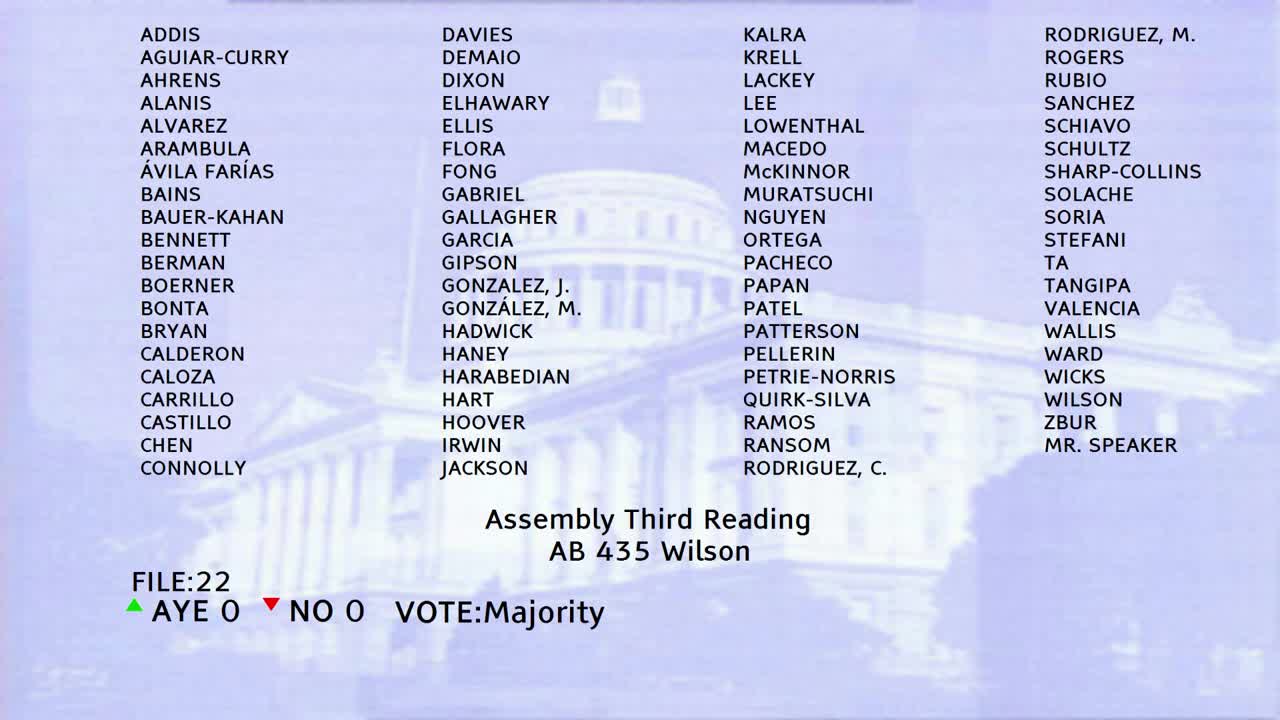 1MIN
Assembly Floor
 9MIN
Assembly Standing Committee on Military and Veterans Affairs
 15MIN
Assembly Standing Committee on Education
Bill Author