AB 1415: California Health Care Quality and Affordability Act.
- Session Year: 2025-2026
- House: Assembly
- Latest Version Date: 2025-10-11
Current Status:
Passed
(2025-10-11: Chaptered by Secretary of State - Chapter 641, Statutes of 2025.)
Introduced
In Committee
Awaiting First Chamber Vote
Passed First Chamber
In Committee
Awaiting Second Chamber Vote
Passed Second Chamber
Enacted
Existing law, the California Health Care Quality and Affordability Act, establishes within the Department of Health Care Access and Information the Office of Health Care Affordability to analyze the health care market for cost trends and drivers of spending, develop data-informed policies for lowering health care costs for consumers and purchasers, set and enforce cost targets, and create a state strategy for controlling the cost of health care and ensuring affordability for consumers and purchasers. Existing law requires the office to conduct ongoing research and evaluation on payers, fully integrated delivery systems, and providers to determine whether the definitions or other provisions of the act include those entities that significantly affect health care cost, quality, equity, and workforce stability. Existing law defines multiple terms relating to these provisions, including a health care entity to mean a payer, provider, or a fully integrated delivery system and a provider to mean specified entities delivering or furnishing health care services.
This bill would update the definitions applying to these provisions, including defining a provider to mean specified entities delivering or furnishing health care services. The bill would include additional definitions, including, but not limited to, a hedge fund to mean a pool of funds managed by investors for the purpose of earning a return on those funds, regardless of strategies used to manage the funds, subject to certain exceptions. The bill would require the office to conduct ongoing research and evaluation on management services organizations, as specified, and to establish requirements for management services organizations to submit data and other information as necessary to carry out the functions of the office.
Existing law requires a health care entity to provide the Office of Health Care Affordability with written notice of agreements or transactions that do specified actions, including sell or transfer, among other things, a material amount of its assets to one or more entities.
The bill would similarly require a noticing entity, as defined, to provide the office written notice of agreements or transactions between the noticing entity and a health care entity or management services organization, or an entity that owns, or controls the health care entity or management services organization that perform the same specified actions described above. The bill would additionally require a management services organization to provide the office with written notice of any agreement or transaction between the organization and any other entity.
Existing law, the California Health Care Quality and Affordability Act, establishes within the Department of Health Care Access and Information the Office of Health Care Affordability to analyze the health care market for cost trends and drivers of spending, develop data-informed policies for lowering health care costs for consumers and purchasers, set and enforce cost targets, and create a state strategy for controlling the cost of health care and ensuring affordability for consumers and purchasers. Existing law requires the office to conduct ongoing research and evaluation on payers, fully integrated delivery systems, and providers to determine whether the definitions or other provisions of the act include those entities that significantly affect health care cost, quality, equity, and workforce stability. Existing law defines multiple terms relating to these provisions, including a health care entity to mean a payer, provider, or a fully integrated delivery system and a provider to mean specified entities delivering or furnishing health care services.
This bill would update the definitions applying to these provisions, including defining a provider to mean specified entities delivering or furnishing health care services. The bill would include additional definitions, including, but not limited to, a hedge fund to mean a pool of funds managed by investors for the purpose of earning a return on those funds, regardless of strategies used to manage the funds, subject to certain exceptions. The bill would require the office to conduct ongoing research and evaluation on management services organizations, as specified, and to establish requirements for management services organizations to submit data and other information as necessary to carry out the functions of the office.
Existing law requires a health care entity to provide the Office of Health Care Affordability with written notice of agreements or transactions that do specified actions, including sell or transfer, among other things, a material amount of its assets to one or more entities.
The bill would similarly require a noticing entity, as defined, to provide the office written notice of agreements or transactions between the noticing entity and a health care entity or management services organization, or an entity that owns, or controls the health care entity or management services organization that perform the same specified actions described above. The bill would additionally require a management services organization to provide the office with written notice of any agreement or transaction between the organization and any other entity.
Existing law, the California Health Care Quality and Affordability Act, establishes within the Department of Health Care Access and Information the Office of Health Care Affordability to analyze the health care market for cost trends and drivers of spending, develop data-informed policies for lowering health care costs for consumers and purchasers, set and enforce cost targets, and create a state strategy for controlling the cost of health care and ensuring affordability for consumers and purchasers. Existing law requires the office to conduct ongoing research and evaluation on payers, fully integrated delivery systems, and providers to determine whether the definitions or other provisions of the act include those entities that significantly affect health care cost, quality, equity, and workforce stability. Existing law defines multiple terms relating to these provisions, including a health care entity to mean a payer, provider, or a fully integrated delivery system and a provider to mean specified entities delivering or furnishing health care services.
This bill would update the definitions applying to these provisions, including defining a provider to mean specified entities delivering or furnishing health care services. The bill would include additional definitions, including, but not limited to, a hedge fund to mean a pool of funds managed by investors for the purpose of earning a return on those funds, regardless of strategies used to manage the funds, subject to certain exceptions. The bill would require the office to conduct ongoing research and evaluation on management services organizations, as specified, and to establish requirements for management services organizations to submit data and other information as necessary to carry out the functions of the office.
Existing law requires a health care entity to provide the Office of Health Care Affordability with written notice of agreements or transactions that do specified actions, including sell or transfer, among other things, a material amount of its assets to one or more entities.
The bill would similarly require a noticing entity, as defined, to provide the office written notice of agreements or transactions between the noticing entity and a health care entity or management services organization, or an entity that owns, or controls the health care entity or management services organization that perform the same specified actions described above. The bill would additionally require a management services organization to provide the office with written notice of any agreement or transaction between the organization and any other entity.
Existing law, the California Health Care Quality and Affordability Act, establishes within the Department of Health Care Access and Information the Office of Health Care Affordability to analyze the health care market for cost trends and drivers of spending, develop data-informed policies for lowering health care costs for consumers and purchasers, set and enforce cost targets, and create a state strategy for controlling the cost of health care and ensuring affordability for consumers and purchasers. Existing law requires the office to conduct ongoing research and evaluation on payers, fully integrated delivery systems, and providers to determine whether the definitions or other provisions of the act include those entities that significantly affect health care cost, quality, equity, and workforce stability. Existing law defines multiple terms relating to these provisions, including a health care entity to mean a payer, provider, or a fully integrated delivery system and a provider to mean specified entities delivering or furnishing health care services.
This bill would update the definitions applying to these provisions, including defining a provider to mean specified entities delivering or furnishing health care services and would include a health system, as defined, in the existing definition. services. The bill would include additional definitions, including, but not limited to, a health system to mean specified entities under common ownership or control and a hedge fund to mean a pool of funds managed by investors for the purpose of earning a return on those funds, regardless of strategies used to manage the funds, subject to certain exceptions. The bill would require the office to conduct ongoing research and evaluation on management services organizations, as specified, and to establish requirements for management services organizations to submit data and other information as necessary to carry out the functions of the office.
Existing law requires a health care entity to provide the Office of Health Care Affordability with written notice of agreements or transactions that do specified actions, including sell or transfer, among other things, a material amount of its assets to one or more entities.
The bill would similarly require a noticing entity, as defined, to provide the office written notice of agreements or transactions between the noticing entity and a health care entity or management services organization, or an entity that owns, or controls the health care entity or management services organization that perform the same specified actions described above. The bill would additionally require a management services organization to provide the office with written notice of any agreement or transaction between the organization and any other entity.
Existing law, the California Health Care Quality and Affordability Act, establishes within the Department of Health Care Access and Information the Office of Health Care Affordability to analyze the health care market for cost trends and drivers of spending, develop data-informed policies for lowering health care costs for consumers and purchasers, set and enforce cost targets, and create a state strategy for controlling the cost of health care and ensuring affordability for consumers and purchasers. Existing law requires the office to conduct ongoing research and evaluation on payers, fully integrated delivery systems, and providers to determine whether the definitions or other provisions of the act include those entities that significantly affect health care cost, quality, equity, and workforce stability. Existing law defines multiple terms relating to these provisions, including a health care entity to mean a payer, provider, or a fully integrated delivery system and a provider to mean specified entities delivering or furnishing health care services.
This bill would update the definitions applying to these provisions, including defining a provider to mean specified private or public health care providers entities delivering or furnishing health care services and would include a health system, as defined, in the existing definition. The bill would include additional definitions, including, but not limited to, a health system to mean specified entities under common ownership or control and a hedge fund to mean a pool of funds managed by investors for the purpose of earning a return on those funds, regardless of strategies used to manage the funds, subject to certain exceptions. The bill would require the office to conduct ongoing research and evaluation on management services organizations, as specified, and to establish requirements for management services organizations to submit data and other information as necessary to carry out the functions of the office.
Existing law requires a health care entity to provide the Office of Health Care Affordability with written notice of agreements or transactions that do specified actions, including sell or transfer, among other things, a material amount of its assets to one or more entities.
The bill would similarly require a noticing entity, as defined, to provide the office written notice of agreements or transactions between the noticing entity and a health care entity, entity or management services organization, or an entity that owns, or controls the health care entity, entity or management services organization that perform the same specified actions described above. The bill would additionally require a management services organization to provide the office with written notice of any agreement or transaction between the organization and any other entity.
Existing law, the California Health Care Quality and Affordability Act, establishes within the Department of Health Care Access and Information the Office of Health Care Affordability to analyze the health care market for cost trends and drivers of spending, develop data-informed policies for lowering health care costs for consumers and purchasers, set and enforce cost targets, and create a state strategy for controlling the cost of health care and ensuring affordability for consumers and purchasers. Existing law requires the office to conduct ongoing research and evaluation on payers, fully integrated delivery systems, and providers to determine whether the definitions or other provisions of the act include those entities that significantly affect health care cost, quality, equity, and workforce stability. Existing law defines multiple terms relating to these provisions, including a health care entity to mean a payer, provider, or a fully integrated delivery system and a provider to mean specified entities delivering or furnishing health care services.
This bill would update the definitions applying to these provisions to include a management services organization, as defined, as a health care entity. The bill would also update provisions, including defining a provider to mean specified private or public health care providers and would include a health system, as defined, and an entity that owns, operates, or controls an entity specified in the existing definition, regardless of whether it is currently operating, providing services, or has a pending or suspended license. definition. The bill would include additional definitions, including, but not limited to, a health system to mean specified entities under common ownership or control and a hedge fund to mean a pool of funds managed by investors for the purpose of earning a return on those funds, regardless of strategies used to manage the funds, subject to certain exceptions. The bill would require the office to conduct ongoing research and evaluation on management services organizations, as specified, and to establish requirements for management services organizations to submit data as necessary to carry out the functions of the office.
Existing law requires a health care entity to provide the Office of Health Care Affordability with written notice of agreements or transactions that do specified actions, including sell or transfer, among other things, a material amount of its assets to one or more entities.
The bill would similarly require a private equity group, hedge fund, or newly created business entity created for the purpose of entering into agreements or transactions with a health care entity noticing entity, as defined, to provide the office written notice of agreements or transactions between any of the above-described entities the noticing entity and a health care entity, or an entity that owns, or controls the health care entity, that perform the same specified actions described above.
Existing law, the California Health Care Quality and Affordability Act, establishes within the Department of Health Care Access and Information the Office of Health Care Affordability to analyze the health care market for cost trends and drivers of spending, develop data-informed policies for lowering health care costs for consumers and purchasers, set and enforce cost targets, and create a state strategy for controlling the cost of health care and ensuring affordability for consumers and purchasers. Existing law defines multiple terms relating to these provisions, including a health care entity to mean a payer, provider, or a fully integrated delivery system and a provider to mean specified entities delivering or furnishing health care services.
This bill would update the definitions applying to these provisions to include a management services organization, as defined, as a health care entity. The bill would also update a provider to mean specified private or public health care providers and would include a health system, as defined, and an entity that owns, operates, or controls an entity specified in the existing definition, regardless of whether it is currently operating, providing services, or has a pending or suspended license. The bill would include additional definitions, including, but not limited to, a health system to mean specified entities under common ownership or control and a hedge fund to mean a pool of funds managed by investors for the purpose of earning a return on those funds, regardless of strategies used to manage the funds, subject to certain exceptions.
Existing law requires a health care entity to provide the Office of Health Care Affordability with written notice of agreements or transactions that do specified actions, including sell or transfer, among other things, a material amount of its assets to one or more entities.
The bill would similarly require a private equity group, hedge fund, or newly created business entity created for the purpose of entering into agreements or transactions with a health care entity to provide the office written notice of agreements or transactions between any of the above-described entities and a health care entity, or an entity that owns, or controls the health care entity, that perform the same specified actions described above.
As used in this chapter, the following definitions apply:
(a)(1)Administrative costs and profits means the total sum of all expenses not included in the numerator of the medical loss ratio calculation under state or federal law, including, but not limited to, all of the following:
(A)All categories of administrative expenditures.
(B)Net additions to reserves.
(C)Rate dividends or rebates.
(D)Profits or losses.
(E)Taxes and fees.
(2)For purposes of this chapter, administrative costs and profits for a fully integrated delivery system means those associated with its nonprofit health care services plan.
(b)Affordability for consumers means considering the totality of costs paid by consumers for covered benefits, including the enrollee share of premium and cost-sharing amounts paid towards the maximum out-of-pocket amount, including deductibles, copays, coinsurance, and other forms of cost sharing for public and private health coverage.
(c)Affordability for purchasers means considering the cost to purchasers, including, but not limited to, health plans and health insurers, employers purchasing group coverage, and the state, for health coverage and shall include premium costs, actuarial value of coverage for covered benefits, and the value delivered on health care spending in terms of improved quality and cost efficiency.
(d)Alternative payment model means a state or nationally recognized payment approach that financially incentivizes high-quality and cost-efficient care.
(e)Board means the Health Care Affordability Board established by Section 127501.10.
(f)Director means the Director of the Department of Health Care Access and Information.
(g)(1)Exempted provider means a provider that meets standards established by the board for exemption from either of the following:
(A)The statewide health care target.
(B)Specific targets set for health care sectors, including fully integrated delivery systems, geographic regions, and for individual health care entities.
(2)The factors used in setting standards for exemption may include, but are not limited to, annual gross and net revenues, patient volume, and high-cost outliers in a given service or geographic region.
(3)In determining whether a provider is an exempted provider, the board shall also consider any affiliates, subsidiaries, or other entities that control, govern, or are financially responsible for the provider or that are subject to the control, governance, or financial control of the provider.
(4)A physician practice that does not meet the definition in subdivision (r) is an exempted provider.
(h)Fully integrated delivery system means a system that includes a physician organization, health facility or health system, and a nonprofit health care service plan that provides health care services to enrollees in a specific geographic region of the state through an affiliate hospital system and an exclusive contract between the nonprofit health care service plan and a single physician organization in each geographic region to provide those medical services.
(i)Geographic region may either be the regions specified in Section 1385.01 or may be otherwise defined by the board.
(j)Health care cost target means the target percentage for the maximum annual increase in per capita total health care expenditures.
(k)Health care entity means a payer, provider, or a fully integrated delivery system.
(l)Hedge fund means a pool of funds managed by investors for the purpose of earning a return on those funds, regardless of the strategies used to manage the funds. Hedge funds include, but are not limited to, a pool of funds managed or controlled by private limited partnerships or other types of private corporate or partnership formations. A hedge fund does not include either of the following:
(1)Natural persons or other entities that contribute, or promise to contribute, funds to the hedge fund, but otherwise do not participate in the management of the hedge fund or the funds assets, or in any change in control of the hedge fund or the funds assets.
(2)Entities that solely provide or manage debt financing secured in whole or in part by the assets of a health care facility, including, but not limited to, banks and credit unions, commercial real estate lenders, bond underwriters, and trustees.
(m)Insurance market means the public and private health insurance markets.
(n)Line of business means the different individual, small, and large group business lines, as defined in Section 1348.95 of this code and Section 10127.19 of the Insurance Code, as well as Medi-Cal, Medicare, Covered California, or self-insured public employee health plans.
(o)Management services organization means an entity that provides management and administrative support services for a provider in support of the delivery of health care services, excluding the direct provision of health services. Management and administrative support services shall include provider rate negotiation, revenue cycle management, or both. A management services organization does not include entities that own one or more health facilities, as defined in subdivision (a) or (b) of Section 1250.
(p)Material change means any change in ownership, operations, or governance for a health care entity, involving a material amount of assets of a health care entity.
(q)Payer means private and public health care payers, including all of the following:
(1)A health care service plan or a specialized mental health care service plan, as defined in the Knox-Keene Health Care Service Plan Act of 1975 (Chapter 2.2 (commencing with Section 1340) of Division 2) or a Medi-Cal managed care plan contracted with the State Department of Health Care Services to provide full scope benefits to a Medi-Cal enrollee pursuant to Chapter 7 (commencing with Section 14000), Chapter 8 (commencing with Section 14200), or Chapter 8.75 (commencing with Section 14591) of, Part 3 of Division 9 of the Welfare and Institutions Code.
(2)A health insurer licensed to provide health insurance or specialized behavioral health-only policies, as defined in Section 106 of the Insurance Code.
(3)A publicly funded health care program, including, but not limited to, Medi-Cal and Medicare.
(4)A third-party administrator.
(5)Any other public or private entity, other than an individual, that pays for or arranges for the purchase of health care services on behalf of employees, dependents, or retirees.
(r)Physician organization includes any of the following:
(1)An organization described in paragraph (2) of subdivision (g) of Section 1375.4.
(2)A risk-bearing organization, as defined in Section 1375.4.
(3)A restricted health care service plan and limited health care service plan under subdivision (a) of Section 1300.49 of Title 28 of the California Code of Regulations. The inclusion of restricted health care service plans and limited health care service plans in the definition of physician organization does not narrow, abrogate, or otherwise alter the regulatory authority of the Department of Managed Health Care over these entities.
(4)A medical foundation exempt from licensure pursuant to subdivision (l) of Section 1206.
(5)A medical group practice, a professional medical corporation, a medical partnership, or any lawfully organized group of physicians and surgeons that provides, delivers, furnishes, or otherwise arranges for health care services and is comprised of 25 or more physicians.
(6)Notwithstanding paragraph (5), an organization of less than 25 physicians, but that is a high-cost outlier whose costs for the same services provided are substantially higher compared to the statewide average, as identified through data sources that include, but are not limited to, data from state and federal agencies, other relevant supplemental data, such as financial data on providers that is submitted to state agencies, or data reported to HCAI under the Health Care Payments Data Program, established pursuant to Chapter 8.5 (commencing with Section 127671). The cost of delivering the same services in a geographic region shall be considered to the extent that cost substantially deviates from the statewide average and reflects higher costs in that region unrelated to the market dominance of providers in that region or unrelated to the ownership, management, or asset structure chosen by the organization.
(s)Private equity group means an investor or group of investors who primarily engage in the raising or returning of capital and who invest, develop, dispose of, or purchase any equity interest in assets, either as a parent company or through another entity the investor or investors completely or partially own or control. A private equity group does not include natural persons or other entities that contribute or promise to contribute funds to the private equity group, but otherwise do not participate in the management of the private equity group or the groups assets, or in any change in control of the private equity group or the groups assets.
(t)Provider means any of the following that delivers or furnishes health care services:
(1)A physician organization.
(2)A health facility, as defined in Section 1250, including a general acute care hospital.
(3)A clinic conducted, operated, or maintained as an outpatient department of a hospital, as described in subdivision (d) of Section 1206.
(4)A clinic described in subdivision (l) of Section 1206.
(5)A clinic described in subdivision (a) of Section 1204.
(6)A specialty clinic, as described in paragraphs (1) to (3), inclusive, of subdivision (b) of Section 1204.
(7)An ambulatory surgical center or accredited outpatient setting.
(8)A clinical laboratory licensed or registered with the State Department of Public Health under Chapter 3 (commencing with Section 1200) of the Business and Professions Code.
(9)An imaging facility that employs or contracts with persons that are subject to the Radiation Control Law (Chapter 8 (commencing with Section 114960) of Part 9 of Division 104), or the Radiologic Technologists Act (Article 5 (commencing with Section 106955) of Chapter 4 of Part 1, or Article 6 (commencing with Section 107150) of Chapter 4 of Part 1 of Division 104).
(u)Purchaser means an individual, organization, or business entity that purchases health care services, including, but not limited to, trust funds, trade associations, and private and public employers who provide health care benefits to their employees, members, and dependents.
(v)Total health care expenditures means all health care spending in the state by public and private sources, including all of the following:
(1)All claims-based payments and encounters for covered health care benefits.
(2)All non-claims-based payments for covered health care benefits, such as capitation, salary, global budget, other alternative payment methods, or supplemental provider payments pursuant to the Medi-Cal program.
(3)All cost sharing for covered health care benefits paid by residents of this state, including, but not limited to, copayments, coinsurance, and deductibles.
(4)Administrative costs and profits.
(5)Pharmacy rebates and any inpatient or outpatient prescription drug costs not otherwise included in this subdivision.
SEC. 2.Section 127501 of the Health and Safety Code is amended to read:127501.(a)There is hereby established, within the Department of Health Care Access and Information, the Office of Health Care Affordability. The Director of the Department of Health Care Access and Information shall be the director of the office and shall carry out all functions of that position, including enforcement.
(b)The office shall be responsible for analyzing the health care market for cost trends and drivers of spending, developing data-informed policies for lowering health care costs for consumers and purchasers, creating a state strategy for controlling the cost of health care and ensuring affordability for consumers and purchasers, and enforcing cost targets.
(c)The office shall do all of the following:
(1)Increase cost transparency through public reporting of per capita total health care spending and factors contributing to health care cost growth.
(2)Support the board, through data collection and analysis and recommendations, to establish a statewide health care cost target for per capita total health care spending.
(3)Support the board, through data collection and analysis and recommendations, to establish specific health care cost targets by health care sector, including fully integrated delivery systems, geographic regions, and individual health care entities, as appropriate.
(4)Collect and analyze data from existing and emerging public and private data sources that allow the office to track spending, set cost targets, approve performance improvement plans, monitor impacts on health care workforce stability, and carry out all other functions of the office.
(5)Analyze cost and quality trends for drugs covered by pharmaceutical and medical benefits. The office shall consider the data in the reports required pursuant to Section 1367.243 and Section 10123.205 of the Insurance Code and pharmaceutical data reported in the Health Care Payments Data Program, established pursuant to Chapter 8.5 (commencing with Section 127671).
(6)Oversee the states progress towards meeting the health care cost target by providing technical assistance, requiring public testimony, requiring submission of and monitoring compliance with performance improvement plans, and assessing administrative penalties through enforcement actions, including escalating administrative penalties for noncompliance.
(7)Promote, measure, and publicly report performance on quality and health equity through the adoption of a priority set of standard quality and equity measures for health care entities, with consideration for minimizing administrative burden and duplication.
(8)Advance standards for promoting the adoption of alternative payment models.
(9)Measure and promote sustained systemwide investment in primary care and behavioral health.
(10)Advance standards for health care workforce stability and training, as these relate to costs.
(11)Disseminate best practices from entities that comply with the cost target, including a summary of affordability efforts that enable the entity to meet the cost target.
(12)Review and evaluate consolidation, market power, and other market failures through cost and market impact reviews of mergers, acquisitions, or corporate affiliations involving health care service plans, health insurers, hospitals, physician organizations, pharmacy benefit managers, and other health care entities.
(13)Analyze trends in the price of health care technologies.
(14)Analyze trends in the cost of labor for both management and administration, as well as nonsupervisorial health care workforce, as well as analyzing the profits of health care entities, if that data is available.
(15)Conduct ongoing research and evaluation on payers, fully integrated delivery systems, management services organizations, and providers, including physician organizations, to determine whether the definitions or other provisions of this chapter include those entities that significantly affect health care cost, quality, equity, and workforce stability.
(16)Adopt and promulgate regulations for the purpose of carrying out this chapter.
(17)Establish advisory or technical committees, as necessary.
(d)For purposes of implementing this chapter, including hiring staff and consultants, through the procurement authority and processes of the department, facilitating and conducting meetings, conducting research and analysis, and developing the required reports, the office may enter into exclusive or nonexclusive contracts on a bid or negotiated basis. Until January 1, 2026, contracts entered into or amended pursuant to this chapter are exempt from Chapter 6 (commencing with Section 14825) of Part 5.5 of Division 3 of Title 2 of the Government Code, Part 2 (commencing with Section 10100) of Division 2 of the Public Contract Code, and the State Administrative Manual, and are exempt from the review or approval of any division of the Department of General Services.
SEC. 3.Section 127501.5 is added to the Health and Safety Code, to read:127501.5.The office shall, in a manner prescribed by the office, establish requirements for management services organizations to submit data and other information as necessary to carry out the functions of the office.
SEC. 4.Section 127507 of the Health and Safety Code is amended to read:127507.(a)The office shall monitor cost trends, including conducting research and studies on the health care market, including, but not limited to, the impact of consolidation, market power, venture capital activity, profit margins, and other market failures on competition, prices, access, quality, and equity. In a manner supportive of the efforts of the Attorney General, the Department of Managed Health Care, and the Department of Insurance, as appropriate, the office shall promote competitive health care markets by examining mergers, acquisitions, corporate affiliations, or other transactions that entail a material change to ownership, operations, or governance structure involving health care service plans, health insurers, hospitals or hospital systems, physician organizations, providers, pharmacy benefit managers, and other health care entities. The office shall prospectively analyze those transactions likely to have significant effects, seek input from the parties and the public, and report on the anticipated impacts to the health care market. The role of the office is to collect and report information that is informative to the public.
(b)This article does not apply to an exempted provider unless that provider is being acquired by, or affiliating with, an entity that is not an exempted provider. If an entity that is not an exempted provider is acquiring or affiliating with an exempted provider, the entity that is not an exempted provider shall meet the requirements of this article.
(c)(1)A health care entity shall provide the office with written notice of agreements or transactions that do either of the following:
(A)Sell, transfer, lease, exchange, option, encumber, convey, or otherwise dispose of a material amount of its assets to one or more entities.
(B)Transfer control, responsibility, or governance of a material amount of the assets or operations of the health care entity to one or more entities.
(2)(A)A noticing entity shall provide the office with written notice of agreements or transactions between the noticing entity and a health care entity or management services organization, or an entity that owns or controls the health care entity or management services organization that do either of the following:
(i)Sell, transfer, lease, exchange, option, encumber, convey, or otherwise dispose of a material amount of the health care entitys or management services organizations assets to one or more entities.
(ii)Transfer control, responsibility, or governance of a material amount of the assets or operations of the health care entity or management services organization to one or more entities.
(B)In addition to reporting obligations under subparagraph (A), a management services organization shall provide the office with written notice of any agreement or transaction that is described in clauses (i) and (ii) of subparagraph (A) between the management services organization and any other entity.
(C)The office shall adopt regulations to eliminate duplicative reporting if a noticing entity or health care entity is required to submit notice to the office under more than one provision in subdivision (c).
(3)Written notice pursuant to paragraph (1) shall be provided to the office at least 90 days prior to entering into the agreement or transaction. If the conditions in paragraph (1) of subdivision (a) of Section 127507.2 apply, the office shall make the notice of material change publicly available, including all information and materials submitted to the office for review with regard to the material change.
(4)The office shall adopt regulations for proposed material changes that warrant a notification, establish appropriate fees, and consider appropriate thresholds, including, but not limited to, annual gross and net revenues and market share in a given service or region.
(d)The requirement to provide notice of a material change pursuant to subdivision (c) does not apply to any of the following:
(1)Agreements or transactions involving health care service plans that are subject to review by the Director of the Department of Managed Health Care for cost impact or market consolidation under the Knox-Keene Health Care Service Plan Act of 1975 (Chapter 2.2 (commencing with Section 1340) of Division 2).
(2)Agreements or transactions involving health insurers that are subject to review by the Insurance Commissioner under Article 14 (commencing with Section 1091) of Chapter 1 of Part 2, of Division 1 of the Insurance Code.
(3)Agreements or transactions where a county is purchasing, acquiring, or taking control, responsibility, or governance of an entity to ensure continued access in that county.
(4)Agreements or transactions involving nonprofit corporations that are subject to review by the Attorney General under Article 2 (commencing with Section 5914) of Chapter 9 of Part 2, Division 2 of Title 1 of the Corporations Code.
(e)Agreements or transactions exempted under subdivision (d) from the requirement to provide a notice of material change may be referred to the office for a cost and market impact review by the reviewing authority.
(f)This article does not limit the Attorney Generals review of the conversion or restructuring of charitable trusts held by a nonprofit health facility or by an affiliated nonprofit health system or the Attorney Generals review of any health care agreement or transaction under any state or federal law.
(g)This article does not narrow, abrogate, or otherwise alter the corporate practice of medicine doctrine, which expressly prohibits the practice of medicine or control of medicine, medical corporations, medical partnerships, or physician practices by entities or individuals other than licensed physicians and surgeons.
(h)For purposes of this article, noticing entity includes all of the following:
(1)A private equity group or hedge fund.
(2)A newly created business entity created for the purpose of entering into agreements or transactions with a health care entity.
(3)A management services organization.
(4)An entity that owns, operates, or controls a provider, regardless of whether the provider is currently operating, providing health care services, or has a pending or suspended license.
As used in this chapter, the following definitions apply:
(a)(1)Administrative costs and profits means the total sum of all expenses not included in the numerator of the medical loss ratio calculation under state or federal law, including, but not limited to, all of the following:
(A)All categories of administrative expenditures.
(B)Net additions to reserves.
(C)Rate dividends or rebates.
(D)Profits or losses.
(E)Taxes and fees.
(2)For purposes of this chapter, administrative costs and profits for a fully integrated delivery system means those associated with its nonprofit health care services plan.
(b)Affordability for consumers means considering the totality of costs paid by consumers for covered benefits, including the enrollee share of premium and cost-sharing amounts paid towards the maximum out-of-pocket amount, including deductibles, copays, coinsurance, and other forms of cost sharing for public and private health coverage.
(c)Affordability for purchasers means considering the cost to purchasers, including, but not limited to, health plans and health insurers, employers purchasing group coverage, and the state, for health coverage and shall include premium costs, actuarial value of coverage for covered benefits, and the value delivered on health care spending in terms of improved quality and cost efficiency.
(d)Alternative payment model means a state or nationally recognized payment approach that financially incentivizes high-quality and cost-efficient care.
(e)Board means the Health Care Affordability Board established by Section 127501.10.
(f)Director means the Director of the Department of Health Care Access and Information.
(g)(1)Exempted provider means a provider that meets standards established by the board for exemption from either of the following:
(A)The statewide health care target.
(B)Specific targets set for health care sectors, including fully integrated delivery systems, geographic regions, and for individual health care entities.
(2)The factors used in setting standards for exemption may include, but are not limited to, annual gross and net revenues, patient volume, and high-cost outliers in a given service or geographic region.
(3)In determining whether a provider is an exempted provider, the board shall also consider any affiliates, subsidiaries, or other entities that control, govern, or are financially responsible for the provider or that are subject to the control, governance, or financial control of the provider.
(4)A physician practice that does not meet the definition in subdivision (r) is an exempted provider.
(h)Fully integrated delivery system means a system that includes a physician organization, health facility or health system, and a nonprofit health care service plan that provides health care services to enrollees in a specific geographic region of the state through an affiliate hospital system and an exclusive contract between the nonprofit health care service plan and a single physician organization in each geographic region to provide those medical services.
(i)Geographic region may either be the regions specified in Section 1385.01 or may be otherwise defined by the board.
(j)Health care cost target means the target percentage for the maximum annual increase in per capita total health care expenditures.
(k)Health care entity means a payer, provider, or a fully integrated delivery system.
(l)Hedge fund means a pool of funds managed by investors for the purpose of earning a return on those funds, regardless of the strategies used to manage the funds. Hedge funds include, but are not limited to, a pool of funds managed or controlled by private limited partnerships or other types of private corporate or partnership formations. A hedge fund does not include either of the following:
(1)Natural persons or other entities that contribute, or promise to contribute, funds to the hedge fund, but otherwise do not participate in the management of the hedge fund or the funds assets, or in any change in control of the hedge fund or the funds assets.
(2)Entities that solely provide or manage debt financing secured in whole or in part by the assets of a health care facility, including, but not limited to, banks and credit unions, commercial real estate lenders, bond underwriters, and trustees.
(m)Insurance market means the public and private health insurance markets.
(n)Line of business means the different individual, small, and large group business lines, as defined in Section 1348.95 of this code and Section 10127.19 of the Insurance Code, as well as Medi-Cal, Medicare, Covered California, or self-insured public employee health plans.
(o)Management services organization means an entity that provides management and administrative support services for a provider in support of the delivery of health care services, excluding the direct provision of health services. Management and administrative support services shall include provider rate negotiation, revenue cycle management, or both. A management services organization does not include entities that own one or more health facilities, as defined in subdivision (a) or (b) of Section 1250.
(p)Material change means any change in ownership, operations, or governance for a health care entity, involving a material amount of assets of a health care entity.
(q)Payer means private and public health care payers, including all of the following:
(1)A health care service plan or a specialized mental health care service plan, as defined in the Knox-Keene Health Care Service Plan Act of 1975 (Chapter 2.2 (commencing with Section 1340) of Division 2) or a Medi-Cal managed care plan contracted with the State Department of Health Care Services to provide full scope benefits to a Medi-Cal enrollee pursuant to Chapter 7 (commencing with Section 14000), Chapter 8 (commencing with Section 14200), or Chapter 8.75 (commencing with Section 14591) of, Part 3 of Division 9 of the Welfare and Institutions Code.
(2)A health insurer licensed to provide health insurance or specialized behavioral health-only policies, as defined in Section 106 of the Insurance Code.
(3)A publicly funded health care program, including, but not limited to, Medi-Cal and Medicare.
(4)A third-party administrator.
(5)Any other public or private entity, other than an individual, that pays for or arranges for the purchase of health care services on behalf of employees, dependents, or retirees.
(r)Physician organization includes any of the following:
(1)An organization described in paragraph (2) of subdivision (g) of Section 1375.4.
(2)A risk-bearing organization, as defined in Section 1375.4.
(3)A restricted health care service plan and limited health care service plan under subdivision (a) of Section 1300.49 of Title 28 of the California Code of Regulations. The inclusion of restricted health care service plans and limited health care service plans in the definition of physician organization does not narrow, abrogate, or otherwise alter the regulatory authority of the Department of Managed Health Care over these entities.
(4)A medical foundation exempt from licensure pursuant to subdivision (l) of Section 1206.
(5)A medical group practice, a professional medical corporation, a medical partnership, or any lawfully organized group of physicians and surgeons that provides, delivers, furnishes, or otherwise arranges for health care services and is comprised of 25 or more physicians.
(6)Notwithstanding paragraph (5), an organization of less than 25 physicians, but that is a high-cost outlier whose costs for the same services provided are substantially higher compared to the statewide average, as identified through data sources that include, but are not limited to, data from state and federal agencies, other relevant supplemental data, such as financial data on providers that is submitted to state agencies, or data reported to HCAI under the Health Care Payments Data Program, established pursuant to Chapter 8.5 (commencing with Section 127671). The cost of delivering the same services in a geographic region shall be considered to the extent that cost substantially deviates from the statewide average and reflects higher costs in that region unrelated to the market dominance of providers in that region or unrelated to the ownership, management, or asset structure chosen by the organization.
(s)Private equity group means an investor or group of investors who primarily engage in the raising or returning of capital and who invest, develop, dispose of, or purchase any equity interest in assets, either as a parent company or through another entity the investor or investors completely or partially own or control. A private equity group does not include natural persons or other entities that contribute or promise to contribute funds to the private equity group, but otherwise do not participate in the management of the private equity group or the groups assets, or in any change in control of the private equity group or the groups assets.
(t)Provider means any of the following that delivers or furnishes health care services:
(1)A physician organization.
(2)A health facility, as defined in Section 1250, including a general acute care hospital.
(3)A clinic conducted, operated, or maintained as an outpatient department of a hospital, as described in subdivision (d) of Section 1206.
(4)A clinic described in subdivision (l) of Section 1206.
(5)A clinic described in subdivision (a) of Section 1204.
(6)A specialty clinic, as described in paragraphs (1) to (3), inclusive, of subdivision (b) of Section 1204.
(7)An ambulatory surgical center or accredited outpatient setting.
(8)A clinical laboratory licensed or registered with the State Department of Public Health under Chapter 3 (commencing with Section 1200) of the Business and Professions Code.
(9)An imaging facility that employs or contracts with persons that are subject to the Radiation Control Law (Chapter 8 (commencing with Section 114960) of Part 9 of Division 104), or the Radiologic Technologists Act (Article 5 (commencing with Section 106955) of Chapter 4 of Part 1, or Article 6 (commencing with Section 107150) of Chapter 4 of Part 1 of Division 104).
(u)Purchaser means an individual, organization, or business entity that purchases health care services, including, but not limited to, trust funds, trade associations, and private and public employers who provide health care benefits to their employees, members, and dependents.
(v)Total health care expenditures means all health care spending in the state by public and private sources, including all of the following:
(1)All claims-based payments and encounters for covered health care benefits.
(2)All non-claims-based payments for covered health care benefits, such as capitation, salary, global budget, other alternative payment methods, or supplemental provider payments pursuant to the Medi-Cal program.
(3)All cost sharing for covered health care benefits paid by residents of this state, including, but not limited to, copayments, coinsurance, and deductibles.
(4)Administrative costs and profits.
(5)Pharmacy rebates and any inpatient or outpatient prescription drug costs not otherwise included in this subdivision.
SEC. 2.Section 127501 of the Health and Safety Code is amended to read:127501.(a)There is hereby established, within the Department of Health Care Access and Information, the Office of Health Care Affordability. The Director of the Department of Health Care Access and Information shall be the director of the office and shall carry out all functions of that position, including enforcement.
(b)The office shall be responsible for analyzing the health care market for cost trends and drivers of spending, developing data-informed policies for lowering health care costs for consumers and purchasers, creating a state strategy for controlling the cost of health care and ensuring affordability for consumers and purchasers, and enforcing cost targets.
(c)The office shall do all of the following:
(1)Increase cost transparency through public reporting of per capita total health care spending and factors contributing to health care cost growth.
(2)Support the board, through data collection and analysis and recommendations, to establish a statewide health care cost target for per capita total health care spending.
(3)Support the board, through data collection and analysis and recommendations, to establish specific health care cost targets by health care sector, including fully integrated delivery systems, geographic regions, and individual health care entities, as appropriate.
(4)Collect and analyze data from existing and emerging public and private data sources that allow the office to track spending, set cost targets, approve performance improvement plans, monitor impacts on health care workforce stability, and carry out all other functions of the office.
(5)Analyze cost and quality trends for drugs covered by pharmaceutical and medical benefits. The office shall consider the data in the reports required pursuant to Section 1367.243 and Section 10123.205 of the Insurance Code and pharmaceutical data reported in the Health Care Payments Data Program, established pursuant to Chapter 8.5 (commencing with Section 127671).
(6)Oversee the states progress towards meeting the health care cost target by providing technical assistance, requiring public testimony, requiring submission of and monitoring compliance with performance improvement plans, and assessing administrative penalties through enforcement actions, including escalating administrative penalties for noncompliance.
(7)Promote, measure, and publicly report performance on quality and health equity through the adoption of a priority set of standard quality and equity measures for health care entities, with consideration for minimizing administrative burden and duplication.
(8)Advance standards for promoting the adoption of alternative payment models.
(9)Measure and promote sustained systemwide investment in primary care and behavioral health.
(10)Advance standards for health care workforce stability and training, as these relate to costs.
(11)Disseminate best practices from entities that comply with the cost target, including a summary of affordability efforts that enable the entity to meet the cost target.
(12)Review and evaluate consolidation, market power, and other market failures through cost and market impact reviews of mergers, acquisitions, or corporate affiliations involving health care service plans, health insurers, hospitals, physician organizations, pharmacy benefit managers, and other health care entities.
(13)Analyze trends in the price of health care technologies.
(14)Analyze trends in the cost of labor for both management and administration, as well as nonsupervisorial health care workforce, as well as analyzing the profits of health care entities, if that data is available.
(15)Conduct ongoing research and evaluation on payers, fully integrated delivery systems, management services organizations, and providers, including physician organizations, to determine whether the definitions or other provisions of this chapter include those entities that significantly affect health care cost, quality, equity, and workforce stability.
(16)Adopt and promulgate regulations for the purpose of carrying out this chapter.
(17)Establish advisory or technical committees, as necessary.
(d)For purposes of implementing this chapter, including hiring staff and consultants, through the procurement authority and processes of the department, facilitating and conducting meetings, conducting research and analysis, and developing the required reports, the office may enter into exclusive or nonexclusive contracts on a bid or negotiated basis. Until January 1, 2026, contracts entered into or amended pursuant to this chapter are exempt from Chapter 6 (commencing with Section 14825) of Part 5.5 of Division 3 of Title 2 of the Government Code, Part 2 (commencing with Section 10100) of Division 2 of the Public Contract Code, and the State Administrative Manual, and are exempt from the review or approval of any division of the Department of General Services.
SEC. 3.Section 127501.5 is added to the Health and Safety Code, to read:127501.5.The office shall, in a manner prescribed by the office, establish requirements for management services organizations to submit data and other information as necessary to carry out the functions of the office.
SEC. 4.Section 127507 of the Health and Safety Code is amended to read:127507.(a)The office shall monitor cost trends, including conducting research and studies on the health care market, including, but not limited to, the impact of consolidation, market power, venture capital activity, profit margins, and other market failures on competition, prices, access, quality, and equity. In a manner supportive of the efforts of the Attorney General, the Department of Managed Health Care, and the Department of Insurance, as appropriate, the office shall promote competitive health care markets by examining mergers, acquisitions, corporate affiliations, or other transactions that entail a material change to ownership, operations, or governance structure involving health care service plans, health insurers, hospitals or hospital systems, physician organizations, providers, pharmacy benefit managers, and other health care entities. The office shall prospectively analyze those transactions likely to have significant effects, seek input from the parties and the public, and report on the anticipated impacts to the health care market. The role of the office is to collect and report information that is informative to the public.
(b)This article does not apply to an exempted provider unless that provider is being acquired by, or affiliating with, an entity that is not an exempted provider. If an entity that is not an exempted provider is acquiring or affiliating with an exempted provider, the entity that is not an exempted provider shall meet the requirements of this article.
(c)(1)A health care entity shall provide the office with written notice of agreements or transactions that do either of the following:
(A)Sell, transfer, lease, exchange, option, encumber, convey, or otherwise dispose of a material amount of its assets to one or more entities.
(B)Transfer control, responsibility, or governance of a material amount of the assets or operations of the health care entity to one or more entities.
(2)(A)A noticing entity shall provide the office with written notice of agreements or transactions between the noticing entity and a health care entity or management services organization, or an entity that owns or controls the health care entity or management services organization that do either of the following:
(i)Sell, transfer, lease, exchange, option, encumber, convey, or otherwise dispose of a material amount of the health care entitys or management services organizations assets to one or more entities.
(ii)Transfer control, responsibility, or governance of a material amount of the assets or operations of the health care entity or management services organization to one or more entities.
(B)In addition to reporting obligations under subparagraph (A), a management services organization shall provide the office with written notice of any agreement or transaction that is described in clauses (i) and (ii) of subparagraph (A) between the management services organization and any other entity.
(C)The office shall adopt regulations to eliminate duplicative reporting if a noticing entity or health care entity is required to submit notice to the office under more than one provision in subdivision (c).
(3)Written notice pursuant to paragraph (1) shall be provided to the office at least 90 days prior to entering into the agreement or transaction. If the conditions in paragraph (1) of subdivision (a) of Section 127507.2 apply, the office shall make the notice of material change publicly available, including all information and materials submitted to the office for review with regard to the material change.
(4)The office shall adopt regulations for proposed material changes that warrant a notification, establish appropriate fees, and consider appropriate thresholds, including, but not limited to, annual gross and net revenues and market share in a given service or region.
(d)The requirement to provide notice of a material change pursuant to subdivision (c) does not apply to any of the following:
(1)Agreements or transactions involving health care service plans that are subject to review by the Director of the Department of Managed Health Care for cost impact or market consolidation under the Knox-Keene Health Care Service Plan Act of 1975 (Chapter 2.2 (commencing with Section 1340) of Division 2).
(2)Agreements or transactions involving health insurers that are subject to review by the Insurance Commissioner under Article 14 (commencing with Section 1091) of Chapter 1 of Part 2, of Division 1 of the Insurance Code.
(3)Agreements or transactions where a county is purchasing, acquiring, or taking control, responsibility, or governance of an entity to ensure continued access in that county.
(4)Agreements or transactions involving nonprofit corporations that are subject to review by the Attorney General under Article 2 (commencing with Section 5914) of Chapter 9 of Part 2, Division 2 of Title 1 of the Corporations Code.
(e)Agreements or transactions exempted under subdivision (d) from the requirement to provide a notice of material change may be referred to the office for a cost and market impact review by the reviewing authority.
(f)This article does not limit the Attorney Generals review of the conversion or restructuring of charitable trusts held by a nonprofit health facility or by an affiliated nonprofit health system or the Attorney Generals review of any health care agreement or transaction under any state or federal law.
(g)This article does not narrow, abrogate, or otherwise alter the corporate practice of medicine doctrine, which expressly prohibits the practice of medicine or control of medicine, medical corporations, medical partnerships, or physician practices by entities or individuals other than licensed physicians and surgeons.
(h)For purposes of this article, noticing entity includes all of the following:
(1)A private equity group or hedge fund.
(2)A newly created business entity created for the purpose of entering into agreements or transactions with a health care entity.
(3)A management services organization.
(4)An entity that owns, operates, or controls a provider, regardless of whether the provider is currently operating, providing health care services, or has a pending or suspended license.
As used in this chapter, the following definitions apply:
(a)(1)Administrative costs and profits means the total sum of all expenses not included in the numerator of the medical loss ratio calculation under state or federal law, including, but not limited to, all of the following:
(A)All categories of administrative expenditures.
(B)Net additions to reserves.
(C)Rate dividends or rebates.
(D)Profits or losses.
(E)Taxes and fees.
(2)For purposes of this chapter, administrative costs and profits for a fully integrated delivery system means those associated with its nonprofit health care services plan.
(b)Affordability for consumers means considering the totality of costs paid by consumers for covered benefits, including the enrollee share of premium and cost-sharing amounts paid towards the maximum out-of-pocket amount, including deductibles, copays, coinsurance, and other forms of cost sharing for public and private health coverage.
(c)Affordability for purchasers means considering the cost to purchasers, including, but not limited to, health plans and health insurers, employers purchasing group coverage, and the state, for health coverage and shall include premium costs, actuarial value of coverage for covered benefits, and the value delivered on health care spending in terms of improved quality and cost efficiency.
(d)Alternative payment model means a state or nationally recognized payment approach that financially incentivizes high-quality and cost-efficient care.
(e)Board means the Health Care Affordability Board established by Section 127501.10.
(f)Director means the Director of the Department of Health Care Access and Information.
(g)(1)Exempted provider means a provider that meets standards established by the board for exemption from either of the following:
(A)The statewide health care target.
(B)Specific targets set for health care sectors, including fully integrated delivery systems, geographic regions, and for individual health care entities.
(2)The factors used in setting standards for exemption may include, but are not limited to, annual gross and net revenues, patient volume, and high-cost outliers in a given service or geographic region.
(3)In determining whether a provider is an exempted provider, the board shall also consider any affiliates, subsidiaries, or other entities that control, govern, or are financially responsible for the provider or that are subject to the control, governance, or financial control of the provider.
(4)A physician practice that does not meet the definition in subdivision (r) is an exempted provider.
(h)Fully integrated delivery system means a system that includes a physician organization, health facility or health system, and a nonprofit health care service plan that provides health care services to enrollees in a specific geographic region of the state through an affiliate hospital system and an exclusive contract between the nonprofit health care service plan and a single physician organization in each geographic region to provide those medical services.
(i)Geographic region may either be the regions specified in Section 1385.01 or may be otherwise defined by the board.
(j)Health care cost target means the target percentage for the maximum annual increase in per capita total health care expenditures.
(k)Health care entity means a payer, provider, or a fully integrated delivery system.
(l)Hedge fund means a pool of funds managed by investors for the purpose of earning a return on those funds, regardless of the strategies used to manage the funds. Hedge funds include, but are not limited to, a pool of funds managed or controlled by private limited partnerships or other types of private corporate or partnership formations. A hedge fund does not include either of the following:
(1)Natural persons or other entities that contribute, or promise to contribute, funds to the hedge fund, but otherwise do not participate in the management of the hedge fund or the funds assets, or in any change in control of the hedge fund or the funds assets.
(2)Entities that solely provide or manage debt financing secured in whole or in part by the assets of a health care facility, including, but not limited to, banks and credit unions, commercial real estate lenders, bond underwriters, and trustees.
(m)Insurance market means the public and private health insurance markets.
(n)Line of business means the different individual, small, and large group business lines, as defined in Section 1348.95 of this code and Section 10127.19 of the Insurance Code, as well as Medi-Cal, Medicare, Covered California, or self-insured public employee health plans.
(o)Management services organization means an entity that provides management and administrative support services for a provider in support of the delivery of health care services, excluding the direct provision of health services. Management and administrative support services shall include provider rate negotiation, revenue cycle management, or both. Management and administrative support services may also include any of the following: A management services organization does not include entities that own one or more health facilities, as defined in subdivision (a) or (b) of Section 1250.
(1)Utilization management.(2)Claims handling.(3)Customer service.(4)Network development.(p)Material change means any change in ownership, operations, or governance for a health care entity, involving a material amount of assets of a health care entity.
(q)Payer means private and public health care payers, including all of the following:
(1)A health care service plan or a specialized mental health care service plan, as defined in the Knox-Keene Health Care Service Plan Act of 1975 (Chapter 2.2 (commencing with Section 1340) of Division 2) or a Medi-Cal managed care plan contracted with the State Department of Health Care Services to provide full scope benefits to a Medi-Cal enrollee pursuant to Chapter 7 (commencing with Section 14000), Chapter 8 (commencing with Section 14200), or Chapter 8.75 (commencing with Section 14591) of, Part 3 of Division 9 of the Welfare and Institutions Code.
(2)A health insurer licensed to provide health insurance or specialized behavioral health-only policies, as defined in Section 106 of the Insurance Code.
(3)A publicly funded health care program, including, but not limited to, Medi-Cal and Medicare.
(4)A third-party administrator.
(5)Any other public or private entity, other than an individual, that pays for or arranges for the purchase of health care services on behalf of employees, dependents, or retirees.
(r)Physician organization includes any of the following:
(1)An organization described in paragraph (2) of subdivision (g) of Section 1375.4.
(2)A risk-bearing organization, as defined in Section 1375.4.
(3)A restricted health care service plan and limited health care service plan under subdivision (a) of Section 1300.49 of Title 28 of the California Code of Regulations. The inclusion of restricted health care service plans and limited health care service plans in the definition of physician organization does not narrow, abrogate, or otherwise alter the regulatory authority of the Department of Managed Health Care over these entities.
(4)A medical foundation exempt from licensure pursuant to subdivision (l) of Section 1206.
(5)A medical group practice, a professional medical corporation, a medical partnership, or any lawfully organized group of physicians and surgeons that provides, delivers, furnishes, or otherwise arranges for health care services and is comprised of 25 or more physicians.
(6)Notwithstanding paragraph (5), an organization of less than 25 physicians, but that is a high-cost outlier whose costs for the same services provided are substantially higher compared to the statewide average, as identified through data sources that include, but are not limited to, data from state and federal agencies, other relevant supplemental data, such as financial data on providers that is submitted to state agencies, or data reported to HCAI under the Health Care Payments Data Program, established pursuant to Chapter 8.5 (commencing with Section 127671). The cost of delivering the same services in a geographic region shall be considered to the extent that cost substantially deviates from the statewide average and reflects higher costs in that region unrelated to the market dominance of providers in that region or unrelated to the ownership, management, or asset structure chosen by the organization.
(s)Private equity group means an investor or group of investors who primarily engage in the raising or returning of capital and who invest, develop, dispose of, or purchase any equity interest in assets, either as a parent company or through another entity the investor or investors completely or partially own or control. A private equity group does not include natural persons or other entities that contribute or promise to contribute funds to the private equity group, but otherwise do not participate in the management of the private equity group or the groups assets, or in any change in control of the private equity group or the groups assets.
(t)Provider means any of the following that delivers or furnishes health care services:
(1)A physician organization.
(2)A health facility, as defined in Section 1250, including a general acute care hospital.
(3)A clinic conducted, operated, or maintained as an outpatient department of a hospital, as described in subdivision (d) of Section 1206.
(4)A clinic described in subdivision (l) of Section 1206.
(5)A clinic described in subdivision (a) of Section 1204.
(6)A specialty clinic, as described in paragraphs (1) to (3), inclusive, of subdivision (b) of Section 1204.
(7)An ambulatory surgical center or accredited outpatient setting.
(8)A clinical laboratory licensed or registered with the State Department of Public Health under Chapter 3 (commencing with Section 1200) of the Business and Professions Code.
(9)An imaging facility that employs or contracts with persons that are subject to the Radiation Control Law (Chapter 8 (commencing with Section 114960) of Part 9 of Division 104), or the Radiologic Technologists Act (Article 5 (commencing with Section 106955) of Chapter 4 of Part 1, or Article 6 (commencing with Section 107150) of Chapter 4 of Part 1 of Division 104).
(u)Purchaser means an individual, organization, or business entity that purchases health care services, including, but not limited to, trust funds, trade associations, and private and public employers who provide health care benefits to their employees, members, and dependents.
(v)Total health care expenditures means all health care spending in the state by public and private sources, including all of the following:
(1)All claims-based payments and encounters for covered health care benefits.
(2)All non-claims-based payments for covered health care benefits, such as capitation, salary, global budget, other alternative payment methods, or supplemental provider payments pursuant to the Medi-Cal program.
(3)All cost sharing for covered health care benefits paid by residents of this state, including, but not limited to, copayments, coinsurance, and deductibles.
(4)Administrative costs and profits.
(5)Pharmacy rebates and any inpatient or outpatient prescription drug costs not otherwise included in this subdivision.
SEC. 2.Section 127501 of the Health and Safety Code is amended to read:127501.(a)There is hereby established, within the Department of Health Care Access and Information, the Office of Health Care Affordability. The Director of the Department of Health Care Access and Information shall be the director of the office and shall carry out all functions of that position, including enforcement.
(b)The office shall be responsible for analyzing the health care market for cost trends and drivers of spending, developing data-informed policies for lowering health care costs for consumers and purchasers, creating a state strategy for controlling the cost of health care and ensuring affordability for consumers and purchasers, and enforcing cost targets.
(c)The office shall do all of the following:
(1)Increase cost transparency through public reporting of per capita total health care spending and factors contributing to health care cost growth.
(2)Support the board, through data collection and analysis and recommendations, to establish a statewide health care cost target for per capita total health care spending.
(3)Support the board, through data collection and analysis and recommendations, to establish specific health care cost targets by health care sector, including fully integrated delivery systems, geographic regions, and individual health care entities, as appropriate.
(4)Collect and analyze data from existing and emerging public and private data sources that allow the office to track spending, set cost targets, approve performance improvement plans, monitor impacts on health care workforce stability, and carry out all other functions of the office.
(5)Analyze cost and quality trends for drugs covered by pharmaceutical and medical benefits. The office shall consider the data in the reports required pursuant to Section 1367.243 and Section 10123.205 of the Insurance Code and pharmaceutical data reported in the Health Care Payments Data Program, established pursuant to Chapter 8.5 (commencing with Section 127671).
(6)Oversee the states progress towards meeting the health care cost target by providing technical assistance, requiring public testimony, requiring submission of and monitoring compliance with performance improvement plans, and assessing administrative penalties through enforcement actions, including escalating administrative penalties for noncompliance.
(7)Promote, measure, and publicly report performance on quality and health equity through the adoption of a priority set of standard quality and equity measures for health care entities, with consideration for minimizing administrative burden and duplication.
(8)Advance standards for promoting the adoption of alternative payment models.
(9)Measure and promote sustained systemwide investment in primary care and behavioral health.
(10)Advance standards for health care workforce stability and training, as these relate to costs.
(11)Disseminate best practices from entities that comply with the cost target, including a summary of affordability efforts that enable the entity to meet the cost target.
(12)Review and evaluate consolidation, market power, and other market failures through cost and market impact reviews of mergers, acquisitions, or corporate affiliations involving health care service plans, health insurers, hospitals, physician organizations, pharmacy benefit managers, and other health care entities.
(13)Analyze trends in the price of health care technologies.
(14)Analyze trends in the cost of labor for both management and administration, as well as nonsupervisorial health care workforce, as well as analyzing the profits of health care entities, if that data is available.
(15)Conduct ongoing research and evaluation on payers, fully integrated delivery systems, management services organizations, and providers, including physician organizations, to determine whether the definitions or other provisions of this chapter include those entities that significantly affect health care cost, quality, equity, and workforce stability.
(16)Adopt and promulgate regulations for the purpose of carrying out this chapter.
(17)Establish advisory or technical committees, as necessary.
(d)For purposes of implementing this chapter, including hiring staff and consultants, through the procurement authority and processes of the department, facilitating and conducting meetings, conducting research and analysis, and developing the required reports, the office may enter into exclusive or nonexclusive contracts on a bid or negotiated basis. Until January 1, 2026, contracts entered into or amended pursuant to this chapter are exempt from Chapter 6 (commencing with Section 14825) of Part 5.5 of Division 3 of Title 2 of the Government Code, Part 2 (commencing with Section 10100) of Division 2 of the Public Contract Code, and the State Administrative Manual, and are exempt from the review or approval of any division of the Department of General Services.
SEC. 3.Section 127501.5 is added to the Health and Safety Code, to read:127501.5.The office shall, in a manner prescribed by the office, establish requirements for management services organizations to submit data and other information as necessary to carry out the functions of the office.
SEC. 4.Section 127507 of the Health and Safety Code is amended to read:127507.(a)The office shall monitor cost trends, including conducting research and studies on the health care market, including, but not limited to, the impact of consolidation, market power, venture capital activity, profit margins, and other market failures on competition, prices, access, quality, and equity. In a manner supportive of the efforts of the Attorney General, the Department of Managed Health Care, and the Department of Insurance, as appropriate, the office shall promote competitive health care markets by examining mergers, acquisitions, corporate affiliations, or other transactions that entail a material change to ownership, operations, or governance structure involving health care service plans, health insurers, hospitals or hospital systems, physician organizations, providers, pharmacy benefit managers, and other health care entities. The office shall prospectively analyze those transactions likely to have significant effects, seek input from the parties and the public, and report on the anticipated impacts to the health care market. The role of the office is to collect and report information that is informative to the public.
(b)This article does not apply to an exempted provider unless that provider is being acquired by, or affiliating with, an entity that is not an exempted provider. If an entity that is not an exempted provider is acquiring or affiliating with an exempted provider, the entity that is not an exempted provider shall meet the requirements of this article.
(c)(1)A health care entity shall provide the office with written notice of agreements or transactions that do either of the following:
(A)Sell, transfer, lease, exchange, option, encumber, convey, or otherwise dispose of a material amount of its assets to one or more entities.
(B)Transfer control, responsibility, or governance of a material amount of the assets or operations of the health care entity to one or more entities.
(2)(A)A noticing entity shall provide the office with written notice of agreements or transactions between the noticing entity and a health care entity or management services organization, or an entity that owns or controls the health care entity or management services organization that do either of the following:
(i)Sell, transfer, lease, exchange, option, encumber, convey, or otherwise dispose of a material amount of the health care entitys or management services organizations organizations assets to one or more entities.
(ii)Transfer control, responsibility, or governance of a material amount of the assets or operations of the health care entity or management services organization to one or more entities.
(B)In addition to reporting obligations under subparagraph (A), a management services organization shall provide the office with written notice of any agreement or transaction that is described in clauses (i) and (ii) of subparagraph (A) between the management services organization and any other entity.
(C)The office shall adopt regulations to eliminate duplicative reporting if a noticing entity or health care entity is required to submit notice to the office under more than one provision in subdivision (c).
(3)Written notice pursuant to paragraph (1) shall be provided to the office at least 90 days prior to entering into the agreement or transaction. If the conditions in paragraph (1) of subdivision (a) of Section 127507.2 apply, the office shall make the notice of material change publicly available, including all information and materials submitted to the office for review with regard to the material change.
(4)The office shall adopt regulations for proposed material changes that warrant a notification, establish appropriate fees, and consider appropriate thresholds, including, but not limited to, annual gross and net revenues and market share in a given service or region.
(d)The requirement to provide notice of a material change pursuant to subdivision (c) does not apply to any of the following:
(1)Agreements or transactions involving health care service plans that are subject to review by the Director of the Department of Managed Health Care for cost impact or market consolidation under the Knox-Keene Health Care Service Plan Act of 1975 (Chapter 2.2 (commencing with Section 1340) of Division 2).
(2)Agreements or transactions involving health insurers that are subject to review by the Insurance Commissioner under Article 14 (commencing with Section 1091) of Chapter 1 of Part 2, of Division 1 of the Insurance Code.
(3)Agreements or transactions where a county is purchasing, acquiring, or taking control, responsibility, or governance of an entity to ensure continued access in that county.
(4)Agreements or transactions involving nonprofit corporations that are subject to review by the Attorney General under Article 2 (commencing with Section 5914) of Chapter 9 of Part 2, Division 2 of Title 1 of the Corporations Code.
(e)Agreements or transactions exempted under subdivision (d) from the requirement to provide a notice of material change may be referred to the office for a cost and market impact review by the reviewing authority.
(f)This article does not limit the Attorney Generals review of the conversion or restructuring of charitable trusts held by a nonprofit health facility or by an affiliated nonprofit health system or the Attorney Generals review of any health care agreement or transaction under any state or federal law.
(g)This article does not narrow, abrogate, or otherwise alter the corporate practice of medicine doctrine, which expressly prohibits the practice of medicine or control of medicine, medical corporations, medical partnerships, or physician practices by entities or individuals other than licensed physicians and surgeons.
(h)For purposes of this article, noticing entity includes all of the following:
(1)A private equity group or hedge fund.
(2)A newly created business entity created for the purpose of entering into agreements or transactions with a health care entity.
(3)A management services organization.
(4)An entity that owns, operates, or controls a provider, regardless of whether the provider is currently operating, providing health care services, or has a pending or suspended license.
As used in this chapter, the following definitions apply:
(a)(1)Administrative costs and profits means the total sum of all expenses not included in the numerator of the medical loss ratio calculation under state or federal law, including, but not limited to, all of the following:
(A)All categories of administrative expenditures.
(B)Net additions to reserves.
(C)Rate dividends or rebates.
(D)Profits or losses.
(E)Taxes and fees.
(2)For purposes of this chapter, administrative costs and profits for a fully integrated delivery system means those associated with its nonprofit health care services plan.
(b)Affordability for consumers means considering the totality of costs paid by consumers for covered benefits, including the enrollee share of premium and cost-sharing amounts paid towards the maximum out-of-pocket amount, including deductibles, copays, coinsurance, and other forms of cost sharing for public and private health coverage.
(c)Affordability for purchasers means considering the cost to purchasers, including, but not limited to, health plans and health insurers, employers purchasing group coverage, and the state, for health coverage and shall include premium costs, actuarial value of coverage for covered benefits, and the value delivered on health care spending in terms of improved quality and cost efficiency.
(d)Alternative payment model means a state or nationally recognized payment approach that financially incentivizes high-quality and cost-efficient care.
(e)Board means the Health Care Affordability Board established by Section 127501.10.
(f)Director means the Director of the Department of Health Care Access and Information.
(g)(1)Exempted provider means a provider that meets standards established by the board for exemption from either of the following:
(A)The statewide health care target.
(B)Specific targets set for health care sectors, including fully integrated delivery systems, geographic regions, and for individual health care entities.
(2)The factors used in setting standards for exemption may include, but are not limited to, annual gross and net revenues, patient volume, and high-cost outliers in a given service or geographic region.
(3)In determining whether a provider is an exempted provider, the board shall also consider any affiliates, subsidiaries, or other entities that control, govern, or are financially responsible for the provider or that are subject to the control, governance, or financial control of the provider.
(4)A physician practice that does not meet the definition in subdivision (s) (r) is an exempted provider.
(h)Fully integrated delivery system means a system that includes a physician organization, health facility or health system, and a nonprofit health care service plan that provides health care services to enrollees in a specific geographic region of the state through an affiliate hospital system and an exclusive contract between the nonprofit health care service plan and a single physician organization in each geographic region to provide those medical services.
(i)Geographic region may either be the regions specified in Section 1385.01 or may be otherwise defined by the board.
(j)Health care cost target means the target percentage for the maximum annual increase in per capita total health care expenditures.
(k)Health care entity means a payer, provider, or a fully integrated delivery system.
(l)Health system includes any of the following entities, under common ownership or control, in whole or in part: (1)A hospital system, as defined in subdivision (e) of Section 127371.(2)A combination of one or more hospitals and one or more other providers. For purposes of this paragraph and paragraph (3), hospital means all of the following:(A)General acute care hospitals, acute psychiatric hospitals, and special hospitals, as defined in Section 1250.(B)Psychiatric health facilities, as defined in Section 1250.2.(C)Chemical dependency recovery hospitals, as defined in Section 1250.3.(3)A combination of one or more hospitals, one or more other providers, or one or more health care service plans or health insurers. (m)(l)Hedge fund means a pool of funds managed by investors for the purpose of earning a return on those funds, regardless of the strategies used to manage the funds. Hedge funds include, but are not limited to, a pool of funds managed or controlled by private limited partnerships or other types of private corporate or partnership formations. A hedge fund does not include either of the following:
(1)Natural persons or other entities that contribute, or promise to contribute, funds to the hedge fund, but otherwise do not participate in the management of the hedge fund or the funds assets, or in any change in control of the hedge fund or the funds assets.
(2)Entities that solely provide or manage debt financing secured in whole or in part by the assets of a health care facility, including, but not limited to, banks and credit unions, commercial real estate lenders, bond underwriters, and trustees.
(n)(m)Insurance market means the public and private health insurance markets.
(o)(n)Line of business means the different individual, small, and large group business lines, as defined in Section 1348.95 of this code and Section 10127.19 of the Insurance Code, as well as Medi-Cal, Medicare, Covered California, or self-insured public employee health plans.
(p)(o)Management services organization means an entity that provides management and administrative support services for a provider in support of the delivery of health care services, excluding the direct provision of health services. Management and administrative support services shall include provider rate negotiation, revenue cycle management, or both. Management and administrative support services may also include any of the following:
(1)Utilization management.
(2)Claims handling.
(3)Customer service.
(4)Network development.
(q)(p)Material change means any change in ownership, operations, or governance for a health care entity, involving a material amount of assets of a health care entity.
(r)(q)Payer means private and public health care payers, including all of the following:
(1)A health care service plan or a specialized mental health care service plan, as defined in the Knox-Keene Health Care Service Plan Act of 1975 (Chapter 2.2 (commencing with Section 1340) of Division 2) or a Medi-Cal managed care plan contracted with the State Department of Health Care Services to provide full scope benefits to a Medi-Cal enrollee pursuant to Chapter 7 (commencing with Section 14000), Chapter 8 (commencing with Section 14200), or Chapter 8.75 (commencing with Section 14591) of, Part 3 of Division 9 of the Welfare and Institutions Code.
(2)A health insurer licensed to provide health insurance or specialized behavioral health-only policies, as defined in Section 106 of the Insurance Code.
(3)A publicly funded health care program, including, but not limited to, Medi-Cal and Medicare.
(4)A third-party administrator.
(5)Any other public or private entity, other than an individual, that pays for or arranges for the purchase of health care services on behalf of employees, dependents, or retirees.
(s)(r)Physician organization includes any of the following:
(1)An organization described in paragraph (2) of subdivision (g) of Section 1375.4.
(2)A risk-bearing organization, as defined in Section 1375.4.
(3)A restricted health care service plan and limited health care service plan under subdivision (a) of Section 1300.49 of Title 28 of the California Code of Regulations. The inclusion of restricted health care service plans and limited health care service plans in the definition of physician organization does not narrow, abrogate, or otherwise alter the regulatory authority of the Department of Managed Health Care over these entities.
(4)A medical foundation exempt from licensure pursuant to subdivision (l) of Section 1206.
(5)A medical group practice, a professional medical corporation, a medical partnership, or any lawfully organized group of physicians and surgeons that provides, delivers, furnishes, or otherwise arranges for health care services and is comprised of 25 or more physicians.
(6)Notwithstanding paragraph (5), an organization of less than 25 physicians, but that is a high-cost outlier whose costs for the same services provided are substantially higher compared to the statewide average, as identified through data sources that include, but are not limited to, data from state and federal agencies, other relevant supplemental data, such as financial data on providers that is submitted to state agencies, or data reported to HCAI under the Health Care Payments Data Program, established pursuant to Chapter 8.5 (commencing with Section 127671). The cost of delivering the same services in a geographic region shall be considered to the extent that cost substantially deviates from the statewide average and reflects higher costs in that region unrelated to the market dominance of providers in that region or unrelated to the ownership, management, or asset structure chosen by the organization.
(t)(s)Private equity group means an investor or group of investors who primarily engage in the raising or returning of capital and who invest, develop, dispose of, or purchase any equity interest in assets, either as a parent company or through another entity the investor or investors completely or partially own or control. A private equity group does not include natural persons or other entities that contribute or promise to contribute funds to the private equity group, but otherwise do not participate in the management of the private equity group or the groups assets, or in any change in control of the private equity group or the groups assets.
(u)(t)Provider means any of the following that delivers or furnishes health care services:
(1)A physician organization.
(2)A health facility, as defined in Section 1250, including a general acute care hospital.
(3)A clinic conducted, operated, or maintained as an outpatient department of a hospital, as described in subdivision (d) of Section 1206.
(4)A clinic described in subdivision (l) of Section 1206.
(5)A clinic described in subdivision (a) of Section 1204.
(6)A specialty clinic, as described in paragraphs (1) to (3), inclusive, of subdivision (b) of Section 1204.
(7)An ambulatory surgical center or accredited outpatient setting.
(8)A clinical laboratory licensed or registered with the State Department of Public Health under Chapter 3 (commencing with Section 1200) of the Business and Professions Code.
(9)An imaging facility that employs or contracts with persons that are subject to the Radiation Control Law (Chapter 8 (commencing with Section 114960) of Part 9 of Division 104), or the Radiologic Technologists Act (Article 5 (commencing with Section 106955) of Chapter 4 of Part 1, or Article 6 (commencing with Section 107150) of Chapter 4 of Part 1 of Division 104).
(10)A health system, as defined in subdivision (l).(v)(u)Purchaser means an individual, organization, or business entity that purchases health care services, including, but not limited to, trust funds, trade associations, and private and public employers who provide health care benefits to their employees, members, and dependents.
(w)(v)Total health care expenditures means all health care spending in the state by public and private sources, including all of the following:
(1)All claims-based payments and encounters for covered health care benefits.
(2)All non-claims-based payments for covered health care benefits, such as capitation, salary, global budget, other alternative payment methods, or supplemental provider payments pursuant to the Medi-Cal program.
(3)All cost sharing for covered health care benefits paid by residents of this state, including, but not limited to, copayments, coinsurance, and deductibles.
(4)Administrative costs and profits.
(5)Pharmacy rebates and any inpatient or outpatient prescription drug costs not otherwise included in this subdivision.
SEC. 2.Section 127501 of the Health and Safety Code is amended to read:127501.(a)There is hereby established, within the Department of Health Care Access and Information, the Office of Health Care Affordability. The Director of the Department of Health Care Access and Information shall be the director of the office and shall carry out all functions of that position, including enforcement.
(b)The office shall be responsible for analyzing the health care market for cost trends and drivers of spending, developing data-informed policies for lowering health care costs for consumers and purchasers, creating a state strategy for controlling the cost of health care and ensuring affordability for consumers and purchasers, and enforcing cost targets.
(c)The office shall do all of the following:
(1)Increase cost transparency through public reporting of per capita total health care spending and factors contributing to health care cost growth.
(2)Support the board, through data collection and analysis and recommendations, to establish a statewide health care cost target for per capita total health care spending.
(3)Support the board, through data collection and analysis and recommendations, to establish specific health care cost targets by health care sector, including fully integrated delivery systems, geographic regions, and individual health care entities, as appropriate.
(4)Collect and analyze data from existing and emerging public and private data sources that allow the office to track spending, set cost targets, approve performance improvement plans, monitor impacts on health care workforce stability, and carry out all other functions of the office.
(5)Analyze cost and quality trends for drugs covered by pharmaceutical and medical benefits. The office shall consider the data in the reports required pursuant to Section 1367.243 and Section 10123.205 of the Insurance Code and pharmaceutical data reported in the Health Care Payments Data Program, established pursuant to Chapter 8.5 (commencing with Section 127671).
(6)Oversee the states progress towards meeting the health care cost target by providing technical assistance, requiring public testimony, requiring submission of and monitoring compliance with performance improvement plans, and assessing administrative penalties through enforcement actions, including escalating administrative penalties for noncompliance.
(7)Promote, measure, and publicly report performance on quality and health equity through the adoption of a priority set of standard quality and equity measures for health care entities, with consideration for minimizing administrative burden and duplication.
(8)Advance standards for promoting the adoption of alternative payment models.
(9)Measure and promote sustained systemwide investment in primary care and behavioral health.
(10)Advance standards for health care workforce stability and training, as these relate to costs.
(11)Disseminate best practices from entities that comply with the cost target, including a summary of affordability efforts that enable the entity to meet the cost target.
(12)Review and evaluate consolidation, market power, and other market failures through cost and market impact reviews of mergers, acquisitions, or corporate affiliations involving health care service plans, health insurers, hospitals, physician organizations, pharmacy benefit managers, and other health care entities.
(13)Analyze trends in the price of health care technologies.
(14)Analyze trends in the cost of labor for both management and administration, as well as nonsupervisorial health care workforce, as well as analyzing the profits of health care entities, if that data is available.
(15)Conduct ongoing research and evaluation on payers, fully integrated delivery systems, management services organizations, and providers, including physician organizations, to determine whether the definitions or other provisions of this chapter include those entities that significantly affect health care cost, quality, equity, and workforce stability.
(16)Adopt and promulgate regulations for the purpose of carrying out this chapter.
(17)Establish advisory or technical committees, as necessary.
(d)For purposes of implementing this chapter, including hiring staff and consultants, through the procurement authority and processes of the department, facilitating and conducting meetings, conducting research and analysis, and developing the required reports, the office may enter into exclusive or nonexclusive contracts on a bid or negotiated basis. Until January 1, 2026, contracts entered into or amended pursuant to this chapter are exempt from Chapter 6 (commencing with Section 14825) of Part 5.5 of Division 3 of Title 2 of the Government Code, Part 2 (commencing with Section 10100) of Division 2 of the Public Contract Code, and the State Administrative Manual, and are exempt from the review or approval of any division of the Department of General Services.
SEC. 3.Section 127501.5 is added to the Health and Safety Code, to read:127501.5.The office shall, in a manner prescribed by the office, establish requirements for management services organizations to submit data and other information as necessary to carry out the functions of the office.
SEC. 4.Section 127507 of the Health and Safety Code is amended to read:127507.(a)The office shall monitor cost trends, including conducting research and studies on the health care market, including, but not limited to, the impact of consolidation, market power, venture capital activity, profit margins, and other market failures on competition, prices, access, quality, and equity. In a manner supportive of the efforts of the Attorney General, the Department of Managed Health Care, and the Department of Insurance, as appropriate, the office shall promote competitive health care markets by examining mergers, acquisitions, corporate affiliations, or other transactions that entail a material change to ownership, operations, or governance structure involving health care service plans, health insurers, hospitals or hospital systems, physician organizations, providers, pharmacy benefit managers, and other health care entities. The office shall prospectively analyze those transactions likely to have significant effects, seek input from the parties and the public, and report on the anticipated impacts to the health care market. The role of the office is to collect and report information that is informative to the public.
(b)This article does not apply to an exempted provider unless that provider is being acquired by, or affiliating with, an entity that is not an exempted provider. If an entity that is not an exempted provider is acquiring or affiliating with an exempted provider, the entity that is not an exempted provider shall meet the requirements of this article.
(c)(1)A health care entity shall provide the office with written notice of agreements or transactions that do either of the following:
(A)Sell, transfer, lease, exchange, option, encumber, convey, or otherwise dispose of a material amount of its assets to one or more entities.
(B)Transfer control, responsibility, or governance of a material amount of the assets or operations of the health care entity to one or more entities.
(2)(A)A noticing entity shall provide the office with written notice of agreements or transactions between the noticing entity and a health care entity or management services organization, or an entity that owns or controls the health care entity or management services organization that do either of the following:
(i)Sell, transfer, lease, exchange, option, encumber, convey, or otherwise dispose of a material amount of the health care entitys or management services organizations assets to one or more entities.
(ii)Transfer control, responsibility, or governance of a material amount of the assets or operations of the health care entity or management services organization to one or more entities.
(B)In addition to reporting obligations under subparagraph (A), a management services organization shall provide the office with written notice of any agreement or transaction that is described in clauses (i) and (ii) of subparagraph (A) between the management services organization and any other entity.
(3)Written notice pursuant to paragraph (1) shall be provided to the office at least 90 days prior to entering into the agreement or transaction. If the conditions in paragraph (1) of subdivision (a) of Section 127507.2 apply, the office shall make the notice of material change publicly available, including all information and materials submitted to the office for review with regard to the material change.
(4)The office shall adopt regulations for proposed material changes that warrant a notification, establish appropriate fees, and consider appropriate thresholds, including, but not limited to, annual gross and net revenues and market share in a given service or region.
(d)The requirement to provide notice of a material change pursuant to subdivision (c) does not apply to any of the following:
(1)Agreements or transactions involving health care service plans that are subject to review by the Director of the Department of Managed Health Care for cost impact or market consolidation under the Knox-Keene Health Care Service Plan Act of 1975 (Chapter 2.2 (commencing with Section 1340) of Division 2).
(2)Agreements or transactions involving health insurers that are subject to review by the Insurance Commissioner under Article 14 (commencing with Section 1091) of Chapter 1 of Part 2, of Division 1 of the Insurance Code.
(3)Agreements or transactions where a county is purchasing, acquiring, or taking control, responsibility, or governance of an entity to ensure continued access in that county.
(4)Agreements or transactions involving nonprofit corporations that are subject to review by the Attorney General under Article 2 (commencing with Section 5914) of Chapter 9 of Part 2, Division 2 of Title 1 of the Corporations Code.
(e)Agreements or transactions exempted under subdivision (d) from the requirement to provide a notice of material change may be referred to the office for a cost and market impact review by the reviewing authority.
(f)This article does not limit the Attorney Generals review of the conversion or restructuring of charitable trusts held by a nonprofit health facility or by an affiliated nonprofit health system or the Attorney Generals review of any health care agreement or transaction under any state or federal law.
(g)This article does not narrow, abrogate, or otherwise alter the corporate practice of medicine doctrine, which expressly prohibits the practice of medicine or control of medicine, medical corporations, medical partnerships, or physician practices by entities or individuals other than licensed physicians and surgeons.
(h)For purposes of this article, noticing entity includes all of the following:
(1)A private equity group or hedge fund.
(2)A newly created business entity created for the purpose of entering into agreements or transactions with a health care entity.
(3)A management services organization.
(4)An entity that owns, operates, or controls a provider, regardless of whether the provider is currently operating, providing health care services, or has a pending or suspended license.
As used in this chapter, the following definitions apply:
(a)(1)Administrative costs and profits means the total sum of all expenses not included in the numerator of the medical loss ratio calculation under state or federal law, including, but not limited to, all of the following:
(A)All categories of administrative expenditures.
(B)Net additions to reserves.
(C)Rate dividends or rebates.
(D)Profits or losses.
(E)Taxes and fees.
(2)For purposes of this chapter, administrative costs and profits for a fully integrated delivery system means those associated with its nonprofit health care services plan.
(b)Affordability for consumers means considering the totality of costs paid by consumers for covered benefits, including the enrollee share of premium and cost-sharing amounts paid towards the maximum out-of-pocket amount, including deductibles, copays, coinsurance, and other forms of cost sharing for public and private health coverage.
(c)Affordability for purchasers means considering the cost to purchasers, including, but not limited to, health plans and health insurers, employers purchasing group coverage, and the state, for health coverage and shall include premium costs, actuarial value of coverage for covered benefits, and the value delivered on health care spending in terms of improved quality and cost efficiency.
(d)Alternative payment model means a state or nationally recognized payment approach that financially incentivizes high-quality and cost-efficient care.
(e)Board means the Health Care Affordability Board established by Section 127501.10.
(f)Director means the Director of the Department of Health Care Access and Information.
(g)(1)Exempted provider means a provider that meets standards established by the board for exemption from either of the following:
(A)The statewide health care target.
(B)Specific targets set for health care sectors, including fully integrated delivery systems, geographic regions, and for individual health care entities.
(2)The factors used in setting standards for exemption may include, but are not limited to, annual gross and net revenues, patient volume, and high-cost outliers in a given service or geographic region.
(3)In determining whether a provider is an exempted provider, the board shall also consider any affiliates, subsidiaries, or other entities that control, govern, or are financially responsible for the provider or that are subject to the control, governance, or financial control of the provider.
(4)A physician practice that does not meet the definition in subdivision (s) is an exempted provider.
(h)Fully integrated delivery system means a system that includes a physician organization, health facility or health system, and a nonprofit health care service plan that provides health care services to enrollees in a specific geographic region of the state through an affiliate hospital system and an exclusive contract between the nonprofit health care service plan and a single physician organization in each geographic region to provide those medical services.
(i)Geographic region may either be the regions specified in Section 1385.01 or may be otherwise defined by the board.
(j)Health care cost target means the target percentage for the maximum annual increase in per capita total health care expenditures.
(k)Health care entity means a payer, provider, or a fully integrated delivery system.
(l)Health system includes any of the following entities, under common ownership or control, in whole or in part:
(1)A hospital system, as defined in subdivision (e) of Section 127371.
(2)A combination of one or more hospitals and one or more other providers. For purposes of this paragraph and paragraph (3), hospital means all of the following:
(A)General acute care hospitals, acute psychiatric hospitals, and special hospitals, as defined in Section 1250.
(B)Psychiatric health facilities, as defined in Section 1250.2.
(C)Chemical dependency recovery hospitals, as defined in Section 1250.3.
(3)A combination of one or more hospitals, one or more other providers, or one or more health care service plans or health insurers.
(m)Hedge fund means a pool of funds managed by investors for the purpose of earning a return on those funds, regardless of the strategies used to manage the funds. Hedge funds include, but are not limited to, a pool of funds managed or controlled by private limited partnerships or other types of private corporate or partnership formations. A hedge fund does not include either of the following:
(1)Natural persons or other entities that contribute, or promise to contribute, funds to the hedge fund, but otherwise do not participate in the management of the hedge fund or the funds assets, or in any change in control of the hedge fund or the funds assets.
(2)Entities that solely provide or manage debt financing secured in whole or in part by the assets of a health care facility, including, but not limited to, banks and credit unions, commercial real estate lenders, bond underwriters, and trustees.
(n)Insurance market means the public and private health insurance markets.
(o)Line of business means the different individual, small, and large group business lines, as defined in Section 1348.95 of this code and Section 10127.19 of the Insurance Code, as well as Medi-Cal, Medicare, Covered California, or self-insured public employee health plans.
(p)Management services organization means an entity that provides management and administrative support services or support for a provider, not including the direct provision of for a provider in support of the delivery of health care services. Administrative services or support may include, but are not limited to, utilization management, billing and collections, customer service, provider rate negotiation, and network development. services, excluding the direct provision of health services. Management and administrative support services shall include provider rate negotiation, revenue cycle management, or both. Management and administrative support services may also include any of the following:
(1)Utilization management.
(2)Claims handling.
(3)Customer service.
(4)Network development.
(q)Material change means any change in ownership, operations, or governance for a health care entity, involving a material amount of assets of a health care entity.
(r)Payer means private and public health care payers, including all of the following:
(1)A health care service plan or a specialized mental health care service plan, as defined in the Knox-Keene Health Care Service Plan Act of 1975 (Chapter 2.2 (commencing with Section 1340) of Division 2) or a Medi-Cal managed care plan contracted with the State Department of Health Care Services to provide full scope benefits to a Medi-Cal enrollee pursuant to Chapter 7 (commencing with Section 14000), Chapter 8 (commencing with Section 14200), or Chapter 8.75 (commencing with Section 14591) of, Part 3 of Division 9 of the Welfare and Institutions Code.
(2)A health insurer licensed to provide health insurance or specialized behavioral health-only policies, as defined in Section 106 of the Insurance Code.
(3)A publicly funded health care program, including, but not limited to, Medi-Cal and Medicare.
(4)A third-party administrator.
(5)Any other public or private entity, other than an individual, that pays for or arranges for the purchase of health care services on behalf of employees, dependents, or retirees.
(s)Physician organization includes any of the following:
(1)An organization described in paragraph (2) of subdivision (g) of Section 1375.4.
(2)A risk-bearing organization, as defined in Section 1375.4.
(3)A restricted health care service plan and limited health care service plan under subdivision (a) of Section 1300.49 of Title 28 of the California Code of Regulations. The inclusion of restricted health care service plans and limited health care service plans in the definition of physician organization does not narrow, abrogate, or otherwise alter the regulatory authority of the Department of Managed Health Care over these entities.
(4)A medical foundation exempt from licensure pursuant to subdivision (l) of Section 1206.
(5)A medical group practice, a professional medical corporation, a medical partnership, or any lawfully organized group of physicians and surgeons that provides, delivers, furnishes, or otherwise arranges for health care services and is comprised of 25 or more physicians.
(6)Notwithstanding paragraph (5), an organization of less than 25 physicians, but that is a high-cost outlier whose costs for the same services provided are substantially higher compared to the statewide average, as identified through data sources that include, but are not limited to, data from state and federal agencies, other relevant supplemental data, such as financial data on providers that is submitted to state agencies, or data reported to HCAI under the Health Care Payments Data Program, established pursuant to Chapter 8.5 (commencing with Section 127671). The cost of delivering the same services in a geographic region shall be considered to the extent that cost substantially deviates from the statewide average and reflects higher costs in that region unrelated to the market dominance of providers in that region or unrelated to the ownership, management, or asset structure chosen by the organization.
(t)Private equity group means an investor or group of investors who primarily engage in the raising or returning of capital and who invest, develop, dispose of, or purchase any equity interest in assets, either as a parent company or through another entity the investor or investors completely or partially own or control. A private equity group does not include natural persons or other entities that contribute or promise to contribute funds to the private equity group, but otherwise do not participate in the management of the private equity group or the groups assets, or in any change in control of the private equity group or the groups assets.
(u)Provider means a private or public health care provider, including all of the following: any of the following that delivers or furnishes health care services:
(1)A physician organization.
(2)A health facility, as defined in Section 1250, including a general acute care hospital.
(3)A clinic conducted, operated, or maintained as an outpatient department of a hospital, as described in subdivision (d) of Section 1206.
(4)A clinic described in subdivision (l) of Section 1206.
(5)A clinic described in subdivision (a) of Section 1204.
(6)A specialty clinic, as described in paragraphs (1) to (3), inclusive, of subdivision (b) of Section 1204.
(7)An ambulatory surgical center or accredited outpatient setting.
(8)A clinical laboratory licensed or registered with the State Department of Public Health under Chapter 3 (commencing with Section 1200) of the Business and Professions Code.
(9)An imaging facility that employs or contracts with persons that are subject to the Radiation Control Law (Chapter 8 (commencing with Section 114960) of Part 9 of Division 104), or the Radiologic Technologists Act (Article 5 (commencing with Section 106955) of Chapter 4 of Part 1, or Article 6 (commencing with Section 107150) of Chapter 4 of Part 1 of Division 104).
(10)A health system, as defined in subdivision (l).
(v)Purchaser means an individual, organization, or business entity that purchases health care services, including, but not limited to, trust funds, trade associations, and private and public employers who provide health care benefits to their employees, members, and dependents.
(w)Total health care expenditures means all health care spending in the state by public and private sources, including all of the following:
(1)All claims-based payments and encounters for covered health care benefits.
(2)All non-claims-based payments for covered health care benefits, such as capitation, salary, global budget, other alternative payment methods, or supplemental provider payments pursuant to the Medi-Cal program.
(3)All cost sharing for covered health care benefits paid by residents of this state, including, but not limited to, copayments, coinsurance, and deductibles.
(4)Administrative costs and profits.
(5)Pharmacy rebates and any inpatient or outpatient prescription drug costs not otherwise included in this subdivision.
SEC. 2.Section 127501 of the Health and Safety Code is amended to read:127501.(a)There is hereby established, within the Department of Health Care Access and Information, the Office of Health Care Affordability. The Director of the Department of Health Care Access and Information shall be the director of the office and shall carry out all functions of that position, including enforcement.
(b)The office shall be responsible for analyzing the health care market for cost trends and drivers of spending, developing data-informed policies for lowering health care costs for consumers and purchasers, creating a state strategy for controlling the cost of health care and ensuring affordability for consumers and purchasers, and enforcing cost targets.
(c)The office shall do all of the following:
(1)Increase cost transparency through public reporting of per capita total health care spending and factors contributing to health care cost growth.
(2)Support the board, through data collection and analysis and recommendations, to establish a statewide health care cost target for per capita total health care spending.
(3)Support the board, through data collection and analysis and recommendations, to establish specific health care cost targets by health care sector, including fully integrated delivery systems, geographic regions, and individual health care entities, as appropriate.
(4)Collect and analyze data from existing and emerging public and private data sources that allow the office to track spending, set cost targets, approve performance improvement plans, monitor impacts on health care workforce stability, and carry out all other functions of the office.
(5)Analyze cost and quality trends for drugs covered by pharmaceutical and medical benefits. The office shall consider the data in the reports required pursuant to Section 1367.243 and Section 10123.205 of the Insurance Code and pharmaceutical data reported in the Health Care Payments Data Program, established pursuant to Chapter 8.5 (commencing with Section 127671).
(6)Oversee the states progress towards meeting the health care cost target by providing technical assistance, requiring public testimony, requiring submission of and monitoring compliance with performance improvement plans, and assessing administrative penalties through enforcement actions, including escalating administrative penalties for noncompliance.
(7)Promote, measure, and publicly report performance on quality and health equity through the adoption of a priority set of standard quality and equity measures for health care entities, with consideration for minimizing administrative burden and duplication.
(8)Advance standards for promoting the adoption of alternative payment models.
(9)Measure and promote sustained systemwide investment in primary care and behavioral health.
(10)Advance standards for health care workforce stability and training, as these relate to costs.
(11)Disseminate best practices from entities that comply with the cost target, including a summary of affordability efforts that enable the entity to meet the cost target.
(12)Review and evaluate consolidation, market power, and other market failures through cost and market impact reviews of mergers, acquisitions, or corporate affiliations involving health care service plans, health insurers, hospitals, physician organizations, pharmacy benefit managers, and other health care entities.
(13)Analyze trends in the price of health care technologies.
(14)Analyze trends in the cost of labor for both management and administration, as well as nonsupervisorial health care workforce, as well as analyzing the profits of health care entities, if that data is available.
(15)Conduct ongoing research and evaluation on payers, fully integrated delivery systems, management services organizations, and providers, including physician organizations, to determine whether the definitions or other provisions of this chapter include those entities that significantly affect health care cost, quality, equity, and workforce stability.
(16)Adopt and promulgate regulations for the purpose of carrying out this chapter.
(17)Establish advisory or technical committees, as necessary.
(d)For purposes of implementing this chapter, including hiring staff and consultants, through the procurement authority and processes of the department, facilitating and conducting meetings, conducting research and analysis, and developing the required reports, the office may enter into exclusive or nonexclusive contracts on a bid or negotiated basis. Until January 1, 2026, contracts entered into or amended pursuant to this chapter are exempt from Chapter 6 (commencing with Section 14825) of Part 5.5 of Division 3 of Title 2 of the Government Code, Part 2 (commencing with Section 10100) of Division 2 of the Public Contract Code, and the State Administrative Manual, and are exempt from the review or approval of any division of the Department of General Services.
SEC. 3.Section 127501.5 is added to the Health and Safety Code, to read:127501.5.The office shall, in a manner prescribed by the office, establish requirements for management services organizations to submit data and other information as necessary to carry out the functions of the office.
SEC. 4.Section 127507 of the Health and Safety Code is amended to read:127507.(a)The office shall monitor cost trends, including conducting research and studies on the health care market, including, but not limited to, the impact of consolidation, market power, venture capital activity, profit margins, and other market failures on competition, prices, access, quality, and equity. In a manner supportive of the efforts of the Attorney General, the Department of Managed Health Care, and the Department of Insurance, as appropriate, the office shall promote competitive health care markets by examining mergers, acquisitions, corporate affiliations, or other transactions that entail a material change to ownership, operations, or governance structure involving health care service plans, health insurers, hospitals or hospital systems, physician organizations, providers, pharmacy benefit managers, and other health care entities. The office shall prospectively analyze those transactions likely to have significant effects, seek input from the parties and the public, and report on the anticipated impacts to the health care market. The role of the office is to collect and report information that is informative to the public.
(b)This article does not apply to an exempted provider unless that provider is being acquired by, or affiliating with, an entity that is not an exempted provider. If an entity that is not an exempted provider is acquiring or affiliating with an exempted provider, the entity that is not an exempted provider shall meet the requirements of this article.
(c)(1)A health care entity shall provide the office with written notice of agreements or transactions that do either of the following:
(A)Sell, transfer, lease, exchange, option, encumber, convey, or otherwise dispose of a material amount of its assets to one or more entities.
(B)Transfer control, responsibility, or governance of a material amount of the assets or operations of the health care entity to one or more entities.
(2)(A)A noticing entity shall provide the office with written notice of agreements or transactions between the noticing entity and a health care entity, entity or management services organization, or an entity that owns or controls the health care entity, entity or management services organization that do either of the following:
(A)(i)Sell, transfer, lease, exchange, option, encumber, convey, or otherwise dispose of a material amount of the health care entitys or management services organizations assets to one or more entities.
(B)(ii)Transfer control, responsibility, or governance of a material amount of the assets or operations of the health care entity or management services organization to one or more entities.
(B)In addition to reporting obligations under subparagraph (A), a management services organization shall provide the office with written notice of any agreement or transaction that is described in clauses (i) and (ii)of subparagraph (A) between the management services organization and any other entity.
(3)Written notice pursuant to paragraph (1) shall be provided to the office at least 90 days prior to entering into the agreement or transaction. If the conditions in paragraph (1) of subdivision (a) of Section 127507.2 apply, the office shall make the notice of material change publicly available, including all information and materials submitted to the office for review with regard to the material change.
(4)The office shall adopt regulations for proposed material changes that warrant a notification, establish appropriate fees, and consider appropriate thresholds, including, but not limited to, annual gross and net revenues and market share in a given service or region.
(d)The requirement to provide notice of a material change pursuant to subdivision (c) does not apply to any of the following:
(1)Agreements or transactions involving health care service plans that are subject to review by the Director of the Department of Managed Health Care for cost impact or market consolidation under the Knox-Keene Health Care Service Plan Act of 1975 (Chapter 2.2 (commencing with Section 1340) of Division 2).
(2)Agreements or transactions involving health insurers that are subject to review by the Insurance Commissioner under Article 14 (commencing with Section 1091) of Chapter 1 of Part 2, of Division 1 of the Insurance Code.
(3)Agreements or transactions where a county is purchasing, acquiring, or taking control, responsibility, or governance of an entity to ensure continued access in that county.
(4)Agreements or transactions involving nonprofit corporations that are subject to review by the Attorney General under Article 2 (commencing with Section 5914) of Chapter 9 of Part 2, Division 2 of Title 1 of the Corporations Code.
(e)Agreements or transactions exempted under subdivision (d) from the requirement to provide a notice of material change may be referred to the office for a cost and market impact review by the reviewing authority.
(f)This article does not limit the Attorney Generals review of the conversion or restructuring of charitable trusts held by a nonprofit health facility or by an affiliated nonprofit health system or the Attorney Generals review of any health care agreement or transaction under any state or federal law.
(g)This article does not narrow, abrogate, or otherwise alter the corporate practice of medicine doctrine, which expressly prohibits the practice of medicine or control of medicine, medical corporations, medical partnerships, or physician practices by entities or individuals other than licensed physicians and surgeons.
(h)For purposes of this article, noticing entity includes all of the following:
(1)A private equity group or hedge fund.
(2)A newly created business entity created for the purpose of entering into agreements or transactions with a health care entity.
(3)A management services organization.
(4)An entity that owns, operates, or controls a provider, regardless of whether the provider is currently operating, providing health care services, or has a pending or suspended license.
As used in this chapter, the following definitions apply:
(a)(1)Administrative costs and profits means the total sum of all expenses not included in the numerator of the medical loss ratio calculation under state or federal law, including, but not limited to, all of the following:
(A)All categories of administrative expenditures.
(B)Net additions to reserves.
(C)Rate dividends or rebates.
(D)Profits or losses.
(E)Taxes and fees.
(2)For purposes of this chapter, administrative costs and profits for a fully integrated delivery system means those associated with its nonprofit health care services plan.
(b)Affordability for consumers means considering the totality of costs paid by consumers for covered benefits, including the enrollee share of premium and cost-sharing amounts paid towards the maximum out-of-pocket amount, including deductibles, copays, coinsurance, and other forms of cost sharing for public and private health coverage.
(c)Affordability for purchasers means considering the cost to purchasers, including, but not limited to, health plans and health insurers, employers purchasing group coverage, and the state, for health coverage and shall include premium costs, actuarial value of coverage for covered benefits, and the value delivered on health care spending in terms of improved quality and cost efficiency.
(d)Alternative payment model means a state or nationally recognized payment approach that financially incentivizes high-quality and cost-efficient care.
(e)Board means the Health Care Affordability Board established by Section 127501.10.
(f)Director means the Director of the Department of Health Care Access and Information.
(g)(1)Exempted provider means a provider that meets standards established by the board for exemption from either of the following:
(A)The statewide health care target.
(B)Specific targets set for health care sectors, including fully integrated delivery systems, geographic regions, and for individual health care entities.
(2)The factors used in setting standards for exemption may include, but are not limited to, annual gross and net revenues, patient volume, and high-cost outliers in a given service or geographic region.
(3)In determining whether a provider is an exempted provider, the board shall also consider any affiliates, subsidiaries, or other entities that control, govern, or are financially responsible for the provider or that are subject to the control, governance, or financial control of the provider.
(4)A physician practice that does not meet the definition in subdivision (p) (s) is an exempted provider.
(h)Fully integrated delivery system means a system that includes a physician organization, health facility or health system, and a nonprofit health care service plan that provides health care services to enrollees in a specific geographic region of the state through an affiliate hospital system and an exclusive contract between the nonprofit health care service plan and a single physician organization in each geographic region to provide those medical services.
(i)Geographic region may either be the regions specified in Section 1385.01 or may be otherwise defined by the board.
(j)Health care cost target means the target percentage for the maximum annual increase in per capita total health care expenditures.
(k)Health care entity means a payer, provider, or a fully integrated delivery system, or a management services organization. system.
(l)Health system includes any of the following entities, under common ownership or control, in whole or in part:
(1)A hospital system, as defined in subdivision (e) of Section 127371.
(2)A combination of one or more hospitals and one or more physician organizations. other providers. For purposes of this paragraph and paragraph (3), hospital means all of the following:
(A)General acute care hospitals, acute psychiatric hospitals, and special hospitals, as defined in Section 1250.
(B)Psychiatric health facilities, as defined in Section 1250.2.
(C)Chemical dependency recovery hospitals, as defined in Section 1250.3.
(3)A combination of one or more hospitals, one or more physician organizations, other providers, or one or more health care service plans or health insurers.
(m)Hedge fund means a pool of funds managed by investors for the purpose of earning a return on those funds, regardless of the strategies used to manage the funds. Hedge funds include, but are not limited to, a pool of funds managed or controlled by private limited partnerships or other types of private corporate or partnership formations. A hedge fund does not include either of the following:
(1)Natural persons or other entities that contribute, or promise to contribute, funds to the hedge fund, but otherwise do not participate in the management of the hedge fund or the funds assets, or in any change in control of the hedge fund or the funds assets.
(2)Entities that solely provide or manage debt financing secured in whole or in part by the assets of a health care facility, including, but not limited to, banks and credit unions, commercial real estate lenders, bond underwriters, and trustees.
(n)Insurance market means the public and private health insurance markets.
(o)Line of business means the different individual, small, and large group business lines, as defined in Section 1348.95 of this code and Section 10127.19 of the Insurance Code, as well as Medi-Cal, Medicare, Covered California, or self-insured public employee health plans.
(p)Management services organization means an entity that provides administrative services or support for a provider, not including the direct provision of health care services. Administrative services or support may include, but are not limited to, utilization management, billing and collections, customer service, provider rate negotiation, and network development.
(q)Material change means any change in ownership, operations, or governance for a health care entity, involving a material amount of assets of a health care entity.
(r)Payer means private and public health care payers, including all of the following:
(1)A health care service plan or a specialized mental health care service plan, as defined in the Knox-Keene Health Care Service Plan Act of 1975 (Chapter 2.2 (commencing with Section 1340) of Division 2) or a Medi-Cal managed care plan contracted with the State Department of Health Care Services to provide full scope benefits to a Medi-Cal enrollee pursuant to Chapter 7 (commencing with Section 14000), Chapter 8 (commencing with Section 14200), or Chapter 8.75 (commencing with Section 14591) of, Part 3 of Division 9 of the Welfare and Institutions Code.
(2)A health insurer licensed to provide health insurance or specialized behavioral health-only policies, as defined in Section 106 of the Insurance Code.
(3)A publicly funded health care program, including, but not limited to, Medi-Cal and Medicare.
(4)A third-party administrator.
(5)Any other public or private entity, other than an individual, that pays for or arranges for the purchase of health care services on behalf of employees, dependents, or retirees.
(s)Physician organization includes any of the following:
(1)An organization described in paragraph (2) of subdivision (g) of Section 1375.4.
(2)A risk-bearing organization, as defined in Section 1375.4.
(3)A restricted health care service plan and limited health care service plan under subdivision (a) of Section 1300.49 of Title 28 of the California Code of Regulations. The inclusion of restricted health care service plans and limited health care service plans in the definition of physician organization does not narrow, abrogate, or otherwise alter the regulatory authority of the Department of Managed Health Care over these entities.
(4)A medical foundation exempt from licensure pursuant to subdivision (l) of Section 1206.
(5)A medical group practice, a professional medical corporation, a medical partnership, or any lawfully organized group of physicians and surgeons that provides, delivers, furnishes, or otherwise arranges for health care services and is comprised of 25 or more physicians.
(6)Notwithstanding paragraph (5), an organization of less than 25 physicians, but that is a high-cost outlier whose costs for the same services provided are substantially higher compared to the statewide average, as identified through data sources that include, but are not limited to, data from state and federal agencies, other relevant supplemental data, such as financial data on providers that is submitted to state agencies, or data reported to HCAI under the Health Care Payments Data Program, established pursuant to Chapter 8.5 (commencing with Section 127671). The cost of delivering the same services in a geographic region shall be considered to the extent that cost substantially deviates from the statewide average and reflects higher costs in that region unrelated to the market dominance of providers in that region or unrelated to the ownership, management, or asset structure chosen by the organization.
(t)Private equity group means an investor or group of investors who primarily engage in the raising or returning of capital and who invest, develop, dispose of, or purchase any equity interest in assets, either as a parent company or through another entity the investor or investors completely or partially own or control. A private equity group does not include natural persons or other entities that contribute or promise to contribute funds to the private equity group, but otherwise do not participate in the management of the private equity group or the groups assets, or in any change in control of the private equity group or the groups assets.
(u)Provider means a private or public health care provider, including all of the following:
(1)A physician organization.
(2)A health facility, as defined in Section 1250, including a general acute care hospital.
(3)A clinic conducted, operated, or maintained as an outpatient department of a hospital, as described in subdivision (d) of Section 1206.
(4)A clinic described in subdivision (l) of Section 1206.
(5)A clinic described in subdivision (a) of Section 1204.
(6)A specialty clinic, as described in paragraphs (1) to (3), inclusive, of subdivision (b) of Section 1204.
(7)An ambulatory surgical center or accredited outpatient setting.
(8)A clinical laboratory licensed or registered with the State Department of Public Health under Chapter 3 (commencing with Section 1200) of the Business and Professions Code.
(9)An imaging facility that employs or contracts with persons that are subject to the Radiation Control Law (Chapter 8 (commencing with Section 114960) of Part 9 of Division 104), or the Radiologic Technologists Act (Article 5 (commencing with Section 106955) of Chapter 4 of Part 1, or Article 6 (commencing with Section 107150) of Chapter 4 of Part 1 of Division 104).
(10)A health system, as defined in subdivision (l).
(11)An entity that owns, operates, or controls an entity identified in paragraphs (1) to (10), inclusive, regardless of whether it is currently operating, providing health care services, or has a pending or suspended license.(v)Purchaser means an individual, organization, or business entity that purchases health care services, including, but not limited to, trust funds, trade associations, and private and public employers who provide health care benefits to their employees, members, and dependents.
(w)Total health care expenditures means all health care spending in the state by public and private sources, including all of the following:
(1)All claims-based payments and encounters for covered health care benefits.
(2)All non-claims-based payments for covered health care benefits, such as capitation, salary, global budget, other alternative payment methods, or supplemental provider payments pursuant to the Medi-Cal program.
(3)All cost sharing for covered health care benefits paid by residents of this state, including, but not limited to, copayments, coinsurance, and deductibles.
(4)Administrative costs and profits.
(5)Pharmacy rebates and any inpatient or outpatient prescription drug costs not otherwise included in this subdivision.
SEC. 2.Section 127501 of the Health and Safety Code is amended to read:127501.(a)There is hereby established, within the Department of Health Care Access and Information, the Office of Health Care Affordability. The Director of the Department of Health Care Access and Information shall be the director of the office and shall carry out all functions of that position, including enforcement.
(b)The office shall be responsible for analyzing the health care market for cost trends and drivers of spending, developing data-informed policies for lowering health care costs for consumers and purchasers, creating a state strategy for controlling the cost of health care and ensuring affordability for consumers and purchasers, and enforcing cost targets.
(c)The office shall do all of the following:
(1)Increase cost transparency through public reporting of per capita total health care spending and factors contributing to health care cost growth.
(2)Support the board, through data collection and analysis and recommendations, to establish a statewide health care cost target for per capita total health care spending.
(3)Support the board, through data collection and analysis and recommendations, to establish specific health care cost targets by health care sector, including fully integrated delivery systems, geographic regions, and individual health care entities, as appropriate.
(4)Collect and analyze data from existing and emerging public and private data sources that allow the office to track spending, set cost targets, approve performance improvement plans, monitor impacts on health care workforce stability, and carry out all other functions of the office.
(5)Analyze cost and quality trends for drugs covered by pharmaceutical and medical benefits. The office shall consider the data in the reports required pursuant to Section 1367.243 and Section 10123.205 of the Insurance Code and pharmaceutical data reported in the Health Care Payments Data Program, established pursuant to Chapter 8.5 (commencing with Section 127671).
(6)Oversee the states progress towards meeting the health care cost target by providing technical assistance, requiring public testimony, requiring submission of and monitoring compliance with performance improvement plans, and assessing administrative penalties through enforcement actions, including escalating administrative penalties for noncompliance.
(7)Promote, measure, and publicly report performance on quality and health equity through the adoption of a priority set of standard quality and equity measures for health care entities, with consideration for minimizing administrative burden and duplication.
(8)Advance standards for promoting the adoption of alternative payment models.
(9)Measure and promote sustained systemwide investment in primary care and behavioral health.
(10)Advance standards for health care workforce stability and training, as these relate to costs.
(11)Disseminate best practices from entities that comply with the cost target, including a summary of affordability efforts that enable the entity to meet the cost target.
(12)Review and evaluate consolidation, market power, and other market failures through cost and market impact reviews of mergers, acquisitions, or corporate affiliations involving health care service plans, health insurers, hospitals, physician organizations, pharmacy benefit managers, and other health care entities.
(13)Analyze trends in the price of health care technologies.
(14)Analyze trends in the cost of labor for both management and administration, as well as nonsupervisorial health care workforce, as well as analyzing the profits of health care entities, if that data is available.
(15)Conduct ongoing research and evaluation on payers, fully integrated delivery systems, management services organizations, and providers, including physician organizations, to determine whether the definitions or other provisions of this chapter include those entities that significantly affect health care cost, quality, equity, and workforce stability.
(16)Adopt and promulgate regulations for the purpose of carrying out this chapter.
(17)Establish advisory or technical committees, as necessary.
(d)For purposes of implementing this chapter, including hiring staff and consultants, through the procurement authority and processes of the department, facilitating and conducting meetings, conducting research and analysis, and developing the required reports, the office may enter into exclusive or nonexclusive contracts on a bid or negotiated basis. Until January 1, 2026, contracts entered into or amended pursuant to this chapter are exempt from Chapter 6 (commencing with Section 14825) of Part 5.5 of Division 3 of Title 2 of the Government Code, Part 2 (commencing with Section 10100) of Division 2 of the Public Contract Code, and the State Administrative Manual, and are exempt from the review or approval of any division of the Department of General Services.
SEC. 3.Section 127501.5 is added to the Health and Safety Code, to read:127501.5.The office shall, in a manner prescribed by the office, establish requirements for management services organizations to submit data as necessary to carry out the functions of the office.
SEC. 2.SEC. 4.Section 127507 of the Health and Safety Code is amended to read:127507.(a)The office shall monitor cost trends, including conducting research and studies on the health care market, including, but not limited to, the impact of consolidation, market power, venture capital activity, profit margins, and other market failures on competition, prices, access, quality, and equity. In a manner supportive of the efforts of the Attorney General, the Department of Managed Health Care, and the Department of Insurance, as appropriate, the office shall promote competitive health care markets by examining mergers, acquisitions, corporate affiliations, or other transactions that entail a material change to ownership, operations, or governance structure involving health care service plans, health insurers, hospitals or hospital systems, physician organizations, providers, pharmacy benefit managers, and other health care entities. The office shall prospectively analyze those transactions likely to have significant effects, seek input from the parties and the public, and report on the anticipated impacts to the health care market. The role of the office is to collect and report information that is informative to the public.
(b)This article does not apply to an exempted provider unless that provider is being acquired by, or affiliating with, an entity that is not an exempted provider. If an entity that is not an exempted provider is acquiring or affiliating with an exempted provider, the entity that is not an exempted provider shall meet the requirements of this article.
(c)(1)A health care entity shall provide the office with written notice of agreements or transactions that do either of the following:
(A)Sell, transfer, lease, exchange, option, encumber, convey, or otherwise dispose of a material amount of its assets to one or more entities.
(B)Transfer control, responsibility, or governance of a material amount of the assets or operations of the health care entity to one or more entities.
(2)A private equity group, hedge fund, or any newly created business entity created for the purpose of entering into agreements or transactions with a health care entity noticing entity shall provide the office with written notice of agreements or transactions between the private equity group, hedge fund, or newly created business entity, noticing entity and a health care entity, or an entity that owns or controls the health care entity, that do either of the following:
(A)Sell, transfer, lease, exchange, option, encumber, convey, or otherwise dispose of a material amount of the health care entitys assets to one or more entities.
(B)Transfer control, responsibility, or governance of a material amount of the assets or operations of the health care entity to one or more entities.
(3)Written notice pursuant to paragraph (1) shall be provided to the office at least 90 days prior to entering into the agreement or transaction. If the conditions in paragraph (1) of subdivision (a) of Section 127507.2 apply, the office shall make the notice of material change publicly available, including all information and materials submitted to the office for review with regard to the material change.
(4)The office shall adopt regulations for proposed material changes that warrant a notification, establish appropriate fees, and consider appropriate thresholds, including, but not limited to, annual gross and net revenues and market share in a given service or region.
(d)The requirement to provide notice of a material change pursuant to subdivision (c) does not apply to any of the following:
(1)Agreements or transactions involving health care service plans that are subject to review by the Director of the Department of Managed Health Care for cost impact or market consolidation under the Knox-Keene Health Care Service Plan Act of 1975 (Chapter 2.2 (commencing with Section 1340) of Division 2).
(2)Agreements or transactions involving health insurers that are subject to review by the Insurance Commissioner under Article 14 (commencing with Section 1091) of Chapter 1 of Part 2, of Division 1 of the Insurance Code.
(3)Agreements or transactions where a county is purchasing, acquiring, or taking control, responsibility, or governance of an entity to ensure continued access in that county.
(4)Agreements or transactions involving nonprofit corporations that are subject to review by the Attorney General under Article 2 (commencing with Section 5914) of Chapter 9 of Part 2, Division 2 of Title 1 of the Corporations Code.
(e)Agreements or transactions exempted under subdivision (d) from the requirement to provide a notice of material change may be referred to the office for a cost and market impact review by the reviewing authority.
(f)This article does not limit the Attorney Generals review of the conversion or restructuring of charitable trusts held by a nonprofit health facility or by an affiliated nonprofit health system or the Attorney Generals review of any health care agreement or transaction under any state or federal law.
(g)This article does not narrow, abrogate, or otherwise alter the corporate practice of medicine doctrine, which expressly prohibits the practice of medicine or control of medicine, medical corporations, medical partnerships, or physician practices by entities or individuals other than licensed physicians and surgeons.
(h)For purposes of this article, noticing entity includes all of the following:
(1)A private equity group or hedge fund.
(2)A newly created business entity created for the purpose of entering into agreements or transactions with a health care entity.
(3)A management services organization.
(4)An entity that owns, operates, or controls a provider, regardless of whether the provider is currently operating, providing health care services, or has a pending or suspended license.
As used in this chapter, the following definitions apply:
(a)(1)Administrative costs and profits means the total sum of all expenses not included in the numerator of the medical loss ratio calculation under state or federal law, including, but not limited to, all of the following:
(A)All categories of administrative expenditures.
(B)Net additions to reserves.
(C)Rate dividends or rebates.
(D)Profits or losses.
(E)Taxes and fees.
(2)For purposes of this chapter, administrative costs and profits for a fully integrated delivery system means those associated with its nonprofit health care services plan.
(b)Affordability for consumers means considering the totality of costs paid by consumers for covered benefits, including the enrollee share of premium and cost-sharing amounts paid towards the maximum out-of-pocket amount, including deductibles, copays, coinsurance, and other forms of cost sharing for public and private health coverage.
(c)Affordability for purchasers means considering the cost to purchasers, including, but not limited to, health plans and health insurers, employers purchasing group coverage, and the state, for health coverage and shall include premium costs, actuarial value of coverage for covered benefits, and the value delivered on health care spending in terms of improved quality and cost efficiency.
(d)Alternative payment model means a state or nationally recognized payment approach that financially incentivizes high-quality and cost-efficient care.
(e)Board means the Health Care Affordability Board established by Section 127501.10.
(f)Director means the Director of the Department of Health Care Access and Information.
(g)(1)Exempted provider means a provider that meets standards established by the board for exemption from either of the following:
(A)The statewide health care target.
(B)Specific targets set for health care sectors, including fully integrated delivery systems, geographic regions, and for individual health care entities.
(2)The factors used in setting standards for exemption may include, but are not limited to, annual gross and net revenues, patient volume, and high-cost outliers in a given service or geographic region.
(3)In determining whether a provider is an exempted provider, the board shall also consider any affiliates, subsidiaries, or other entities that control, govern, or are financially responsible for the provider or that are subject to the control, governance, or financial control of the provider.
(4)A physician practice that does not meet the definition in subdivision (p) is an exempted provider.
(h)Fully integrated delivery system means a system that includes a physician organization, health facility or health system, and a nonprofit health care service plan that provides health care services to enrollees in a specific geographic region of the state through an affiliate hospital system and an exclusive contract between the nonprofit health care service plan and a single physician organization in each geographic region to provide those medical services.
(i)Geographic region may either be the regions specified in Section 1385.01 or may be otherwise defined by the board.
(j)Health care cost target means the target percentage for the maximum annual increase in per capita total health care expenditures.
(k)Health care entity means a payer, provider, or a fully integrated delivery system. system, or a management services organization.
(l)Health system includes any of the following entities, under common ownership or control, in whole or in part:
(1)A hospital system, as defined in subdivision (e) of Section 127371.
(2)A combination of one or more hospitals and one or more physician organizations.
(3)A combination of one or more hospitals, one or more physician organizations, or one or more health care service plans or health insurers.
(m)Hedge fund means a pool of funds managed by investors for the purpose of earning a return on those funds, regardless of the strategies used to manage the funds. Hedge funds include, but are not limited to, a pool of funds managed or controlled by private limited partnerships or other types of private corporate or partnership formations. A hedge fund does not include either of the following:
(1)Natural persons or other entities that contribute, or promise to contribute, funds to the hedge fund, but otherwise do not participate in the management of the hedge fund or the funds assets, or in any change in control of the hedge fund or the funds assets.
(2)Entities that solely provide or manage debt financing secured in whole or in part by the assets of a health care facility, including, but not limited to, banks and credit unions, commercial real estate lenders, bond underwriters, and trustees.
(l)(n)Insurance market means the public and private health insurance markets.
(m)(o)Line of business means the different individual, small, and large group business lines, as defined in Section 1348.95 of this code and Section 10127.19 of the Insurance Code, as well as Medi-Cal, Medicare, Covered California, or self-insured public employee health plans.
(p)Management services organization means an entity that provides administrative services or support for a provider, not including the direct provision of health care services. Administrative services or support may include, but are not limited to, utilization management, billing and collections, customer service, provider rate negotiation, and network development.
(n)(q)Material change means any change in ownership, operations, or governance for a health care entity, involving a material amount of assets of a health care entity.
(o)(r)Payer means private and public health care payers, including all of the following:
(1)A health care service plan or a specialized mental health care service plan, as defined in the Knox-Keene Health Care Service Plan Act of 1975 (Chapter 2.2 (commencing with Section 1340) of Division 2) or a Medi-Cal managed care plan contracted with the State Department of Health Care Services to provide full scope benefits to a Medi-Cal enrollee pursuant to Chapter 7 (commencing with Section 14000), Chapter 8 (commencing with Section 14200), or Chapter 8.75 (commencing with Section 14591) of, Part 3 of Division 9 of the Welfare and Institutions Code.
(2)A health insurer licensed to provide health insurance or specialized behavioral health-only policies, as defined in Section 106 of the Insurance Code.
(3)A publicly funded health care program, including, but not limited to, Medi-Cal and Medicare.
(4)A third-party administrator.
(5)Any other public or private entity, other than an individual, that pays for or arranges for the purchase of health care services on behalf of employees, dependents, or retirees.
(p)(s)Physician organization includes any of the following:
(1)An organization described in paragraph (2) of subdivision (g) of Section 1375.4.
(2)A risk-bearing organization, as defined in Section 1375.4.
(3)A restricted health care service plan and limited health care service plan under subdivision (a) of Section 1300.49 of Title 28 of the California Code of Regulations. The inclusion of restricted health care service plans and limited health care service plans in the definition of physician organization does not narrow, abrogate, or otherwise alter the regulatory authority of the Department of Managed Health Care over these entities.
(4)A medical foundation exempt from licensure pursuant to subdivision (l) of Section 1206.
(5)A medical group practice, a professional medical corporation, a medical partnership, or any lawfully organized group of physicians and surgeons that provides, delivers, furnishes, or otherwise arranges for health care services and is comprised of 25 or more physicians.
(6)Notwithstanding paragraph (5), an organization of less than 25 physicians, but that is a high-cost outlier whose costs for the same services provided are substantially higher compared to the statewide average, as identified through data sources that include, but are not limited to, data from state and federal agencies, other relevant supplemental data, such as financial data on providers that is submitted to state agencies, or data reported to HCAI under the Health Care Payments Data Program, established pursuant to Chapter 8.5 (commencing with Section 127671). The cost of delivering the same services in a geographic region shall be considered to the extent that cost substantially deviates from the statewide average and reflects higher costs in that region unrelated to the market dominance of providers in that region or unrelated to the ownership, management, or asset structure chosen by the organization.
(t)Private equity group means an investor or group of investors who primarily engage in the raising or returning of capital and who invest, develop, dispose of, or purchase any equity interest in assets, either as a parent company or through another entity the investor or investors completely or partially own or control. A private equity group does not include natural persons or other entities that contribute or promise to contribute funds to the private equity group, but otherwise do not participate in the management of the private equity group or the groups assets, or in any change in control of the private equity group or the groups assets.
(q)(u)Provider means any of the following that delivers or furnishes health care services: a private or public health care provider, including all of the following:
(1)A physician organization.
(2)A health facility, as defined in Section 1250, including a general acute care hospital.
(3)A clinic conducted, operated, or maintained as an outpatient department of a hospital, as described in subdivision (d) of Section 1206.
(4)A clinic described in subdivision (l) of Section 1206.
(5)A clinic described in subdivision (a) of Section 1204.
(6)A specialty clinic, as described in paragraphs (1) to (3), inclusive, of subdivision (b) of Section 1204.
(7)An ambulatory surgical center or accredited outpatient setting.
(8)A clinical laboratory licensed or registered with the State Department of Public Health under Chapter 3 (commencing with Section 1200) of the Business and Professions Code.
(9)An imaging facility that employs or contracts with persons that are subject to the Radiation Control Law (Chapter 8 (commencing with Section 114960) of Part 9 of Division 104), or the Radiologic Technologists Act (Article 5 (commencing with Section 106955) of Chapter 4 of Part 1, or Article 6 (commencing with Section 107150) of Chapter 4 of Part 1 of Division 104).
(10)A health system, as defined in subdivision (l).
(11)An entity that owns, operates, or controls an entity identified in paragraphs (1) to (10), inclusive, regardless of whether it is currently operating, providing health care services, or has a pending or suspended license.
(r)(v)Purchaser means an individual, organization, or business entity that purchases health care services, including, but not limited to, trust funds, trade associations, and private and public employers who provide health care benefits to their employees, members, and dependents.
(s)(w)Total health care expenditures means all health care spending in the state by public and private sources, including all of the following:
(1)All claims-based payments and encounters for covered health care benefits.
(2)All non-claims-based payments for covered health care benefits, such as capitation, salary, global budget, other alternative payment methods, or supplemental provider payments pursuant to the Medi-Cal program.
(3)All cost sharing for covered health care benefits paid by residents of this state, including, but not limited to, copayments, coinsurance, and deductibles.
(4)Administrative costs and profits.
(5)Pharmacy rebates and any inpatient or outpatient prescription drug costs not otherwise included in this subdivision.
SEC. 2.Section 127507 of the Health and Safety Code is amended to read:127507.(a)The office shall monitor cost trends, including conducting research and studies on the health care market, including, but not limited to, the impact of consolidation, market power, venture capital activity, profit margins, and other market failures on competition, prices, access, quality, and equity. In a manner supportive of the efforts of the Attorney General, the Department of Managed Health Care, and the Department of Insurance, as appropriate, the office shall promote competitive health care markets by examining mergers, acquisitions, corporate affiliations, or other transactions that entail a material change to ownership, operations, or governance structure involving health care service plans, health insurers, hospitals or hospital systems, physician organizations, providers, pharmacy benefit managers, and other health care entities. The office shall prospectively analyze those transactions likely to have significant effects, seek input from the parties and the public, and report on the anticipated impacts to the health care market. The role of the office is to collect and report information that is informative to the public.
(b)This article does not apply to an exempted provider unless that provider is being acquired by, or affiliating with, an entity that is not an exempted provider. If an entity that is not an exempted provider is acquiring or affiliating with an exempted provider, the entity that is not an exempted provider shall meet the requirements of this article.
(c)(1)A health care entity shall provide the office with written notice of agreements or transactions that will occur on or after April 1, 2024, that do either of the following:
(A)Sell, transfer, lease, exchange, option, encumber, convey, or otherwise dispose of a material amount of its assets to one or more entities.
(B)Transfer control, responsibility, or governance of a material amount of the assets or operations of the health care entity to one or more entities.
(2)A private equity group, hedge fund, or any newly created business entity created for the purpose of entering into agreements or transactions with a health care entity shall provide the office with written notice of agreements or transactions between the private equity group, hedge fund, or newly created business entity, and a health care entity, or an entity that owns or controls the health care entity, that do either of the following:
(A)Sell, transfer, lease, exchange, option, encumber, convey, or otherwise dispose of a material amount of the health care entitys assets to one or more entities.
(B)Transfer control, responsibility, or governance of a material amount of the assets or operations of the health care entity to one or more entities.
(2)(3)Written notice pursuant to paragraph (1) shall be provided to the office at least 90 days prior to entering into the agreement or transaction. If the conditions in paragraph (1) of subdivision (a) of Section 127507.2 apply, the office shall make the notice of material change publicly available, including all information and materials submitted to the office for review with regard to the material change.
(3)(4)The office shall adopt regulations for proposed material changes that warrant a notification, establish appropriate fees, and consider appropriate thresholds, including, but not limited to, annual gross and net revenues and market share in a given service or region.
(d)The requirement to provide notice of a material change pursuant to subdivision (c) does not apply to any of the following:
(1)Agreements or transactions involving health care service plans that are subject to review by the Director of the Department of Managed Health Care for cost impact or market consolidation under the Knox-Keene Health Care Service Plan Act of 1975 (Chapter 2.2 (commencing with Section 1340) of Division 2).
(2)Agreements or transactions involving health insurers that are subject to review by the Insurance Commissioner under Article 14 (commencing with Section 1091) of Chapter 1 of Part 2, of Division 1 of the Insurance Code.
(3)Agreements or transactions where a county is purchasing, acquiring, or taking control, responsibility, or governance of an entity to ensure continued access in that county.
(4)Agreements or transactions involving nonprofit corporations that are subject to review by the Attorney General under Article 2 (commencing with Section 5914) of Chapter 9 of Part 2, Division 2 of Title 1 of the Corporations Code.
(e)Agreements or transactions exempted under subdivision (d) from the requirement to provide a notice of material change may be referred to the office for a cost and market impact review by the reviewing authority.
(f)This article does not limit the Attorney Generals review of the conversion or restructuring of charitable trusts held by a nonprofit health facility or by an affiliated nonprofit health system or the Attorney Generals review of any health care agreement or transaction under any state or federal law.
(g)This article does not narrow, abrogate, or otherwise alter the corporate practice of medicine doctrine, which expressly prohibits the practice of medicine or control of medicine, medical corporations, medical partnerships, or physician practices by entities or individuals other than licensed physicians and surgeons.
|
Date
|
Status
|
|---|---|
| Oct 11, 2025 | Chaptered by Secretary of State - Chapter 641, Statutes of 2025. |
| Oct 11, 2025 | Approved by the Governor. |
| Sep 15, 2025 | Enrolled and presented to the Governor at 4:30 p.m. |
| Sep 8, 2025 | Senate amendments concurred in. To Engrossing and Enrolling. (Ayes 51. Noes 19. Page 3038.). |
| Sep 4, 2025 | In Assembly. Concurrence in Senate amendments pending. |
| Sep 4, 2025 | Read third time. Passed. Ordered to the Assembly. (Ayes 26. Noes 10. Page 2506.). |
| Aug 25, 2025 | Read second time. Ordered to third reading. |
| Aug 21, 2025 | Read third time and amended. Ordered to second reading. |
| Aug 20, 2025 | Read second time. Ordered to third reading. |
| Aug 19, 2025 | From committee: Be ordered to second reading pursuant to Senate Rule 28.8. |
| Jul 2, 2025 | From committee chair, with author's amendments: Amend, and re-refer to committee. Read second time, amended, and re-referred to Com. on APPR. |
| Jun 27, 2025 | Read second time and amended. Re-referred to Com. on APPR. |
| Jun 26, 2025 | From committee: Amend, and do pass as amended and re-refer to Com. on APPR. (Ayes 9. Noes 2.) (June 25). |
| Jun 18, 2025 | In committee: Set, first hearing. Hearing canceled at the request of author. |
| May 28, 2025 | Referred to Com. on HEALTH. |
| May 15, 2025 | In Senate. Read first time. To Com. on RLS. for assignment. |
| May 15, 2025 | Read third time. Passed. Ordered to the Senate. (Ayes 42. Noes 16. Page 1547.) |
| May 8, 2025 | Read second time. Ordered to third reading. |
| May 7, 2025 | From committee: Do pass. (Ayes 11. Noes 4.) (May 7). |
| Apr 28, 2025 | Re-referred to Com. on APPR. |
| Apr 24, 2025 | Read second time and amended. |
| Apr 23, 2025 | From committee: Amend, and do pass as amended and re-refer to Com. on APPR. (Ayes 11. Noes 3.) (April 22). |
| Apr 3, 2025 | In committee: Hearing postponed by committee. |
| Mar 13, 2025 | Referred to Com. on HEALTH. |
| Feb 24, 2025 | Read first time. |
| Feb 22, 2025 | From printer. May be heard in committee March 24. |
| Feb 21, 2025 | Introduced. To print. |
|
Date
|
Description
|
Location
|
Votes
|
|
|---|---|---|---|---|
| Sep 8, 2025 | AB 1415 Bonta Concurrence in Senate Amendments | Assembly Floor |
Passed |
|
| Sep 4, 2025 | Assembly 3rd Reading AB1415 Bonta et al. By Menjivar | Senate Floor |
Passed |
|
| Jun 25, 2025 | Do pass as amended, but first amend, and re-refer to the Committee on [Appropriations] | Senate Standing Committee on Health |
Passed |
|
| May 15, 2025 | AB 1415 Bonta Assembly Third Reading | Assembly Floor |
Passed |
|
| May 7, 2025 | Do pass. | Assembly Standing Committee on Appropriations |
Passed |
|
| Apr 22, 2025 | Do pass as amended and be re-referred to the Committee on [Appropriations] | Assembly Standing Committee on Health |
Passed |
This list shows positions taken on this bill by organizations on the date displayed, which is linked to the original source.
Positions by individuals are not included.
|
Organization
|
Position
|
Date
|
|---|---|---|
| AARP | ** Support | |
| Access Reproductive Health | ** Support | |
| Adventist Health | ** Against | |
| ALLIANCE OF CATHOLIC HEALTH CARE, INC. | ** Against | |
| American Investment Council | ** Against | |
| Asian Resources, Inc | ** Support | |
| Attorney General Rob Bonta | ** Support | |
| California Academy Of Family Physicians | ** Support | |
| California ChildrenS Hospital Association | ** Against | |
| California Federation Of Teachers | ** Support | |
| California Hospital Association | ** Against | |
| California Independent Physician Practice Association | ** Against | |
| California LGBTQ Health and Human Services Network | ** Support | |
| California Nurses Association | ** Support | |
| California Pan-Ethnic Health Network | ** Support | |
| California Physicians Alliance | ** Support | |
| CALPIRG | ** Support | |
| Cedars Sinai | ** Against | |
| Central Valley Doctors Health System | ** Against | |
| Coalition for Patient Centered Care (CPCC) | ** Support | |
| Coalition for Patient-Centered Care | ** Support | |
| Community Memorial Healthcare | ** Against | |
| Cottage Health | ** Against | |
| Courage California | ** Support | |
| Desert Care Network | ** Against | |
| Dignity Health | ** Against | |
| Economic Security California Action | ** Support | |
| Families USA | ** Support | |
| Friends Committee On Legislation Of California | ** Support | |
| Health Access | ** Support | |
| Indivisible Tri-Valley | ** Support | |
| John Muir Health | ** Against | |
| Latino Coalition for a Healthy California | ** Support | |
| Loma Linda University Adventist Health Sciences Center | ** Against | |
| Lompoc Valley Medical Center | ** Against | |
| Long Beach Area Chamber of Commerce | ** Against | |
| MarinHealth Medical Center | ** Against | |
| Marshall Medical Center | ** Against | |
| Memorialcare Health Systems | ** Against | |
| Montage Health | ** Against | |
| monterey bay central labor council | ** Support | |
| National Union Of Healthcare Workers | ** Support | |
| Newport Healthcare | ** Against | |
| Northern California Carpenters Regional Council | ** Support | |
| Pomona Valley Hospital Medical Center | ** Against | |
| Private Equity Stakeholder Project | ** Support | |
| Private Essential Access Community Hospitals | ** Against | |
| Rady ChildrenS Hospital | ** Against | |
| Redlands Community Hospital | ** Against | |
| Ridgecrest Regional Hospital | ** Against | |
| Saint Agnes Medical Center | ** Against | |
| Salinas Valley Federation of Teachers | ** Support | |
| Salinas Valley Health | ** Against | |
| San Bernardino Mountains Community Hospital District | ** Against | |
| San Diego Regional Chamber Of Commerce | ** Against | |
| Service Employer International Union (SEIU) California | ** Support | |
| Sharp Healthcare | ** Against | |
| Small Business Majority | ** Support | |
| Sonoma Valley Hospital | ** Against | |
| Stanford Medicine Children's Health | ** Against | |
| The Leukemia & Lymphoma Society | ** Support | |
| Unite Here | ** Support | |
| United Food And Commercial Workers Western States Council | ** Support | |
| United Hospital Association | ** Against | |
| University of California | ** Against | |
| Western States Regional Council or Capenters | ** Support | |
| Writers Guild Of America West | ** Support |
CONCURRENCE IN SENATE AMENDMENTS
CSA1 Bill Id:AB 1415
Author:(Bonta)
As Amended Ver:August 21, 2025
Majority vote
SUMMARY
Adds private equity groups, hedge funds, and "management services organizations" (MSOs) to the types of entities required to report to the Office of Health Care Affordability (OHCA) on pending health care transactions. Authorizes OHCA to collect data from MSOs as necessary to carry out its functions.
Senate Amendments
- Narrow the definition of MSO to capture only those entities whose activities include provider rate negotiation, revenue cycle management, or both of these activities.
- Remove the definition of "health systems" from the bill, and remove provisions that subjected "health systems," as defined, to oversight by OHCA.
- Clarify an MSO does not include a health system (i.e., an MSO does not include an entity that owns one or more hospitals).
- Require OHCA to adopt regulations to eliminate duplicative reporting if a noticing entity or health care entity is required to submit notice to the office under more than one provision, as specified.
COMMENTS
OHCA Recent History and Activities. OHCA and its governing Health Care Affordability Board (the Board) were established through the California Health Care Quality and Affordability Act (the Act), which was contained in a health-related budget trailer bill, SB 184 (Committee on Budget and Fiscal Review), Chapter 47, Statutes of 2022. Per SB 184, OHCA, within the Department of Health Care Access and Information, is charged with slowing health care spending growth, promoting high value health care, and assessing market consolidation.
Impact of High Health Costs and Cost Growth. High health care costs pose a burden for Californians. A 2024 survey conducted for the California Health Care Foundation (CHCF) found more than half of Californians overall (53%), and nearly three in four Californians with low incomes (74%), say they skipped or postponed care due to cost in the past year and nearly half of Californians with low incomes (46%), report trouble paying medical bills. Health care cost growth has significantly outpaced inflation in the United States. Since 2000, the price of medical care, including services provided as well as insurance, drugs, and medical equipment, has increased by 121.3%. Prices and administrative costs appeared to be the major drivers of the difference in overall cost between the U.S. and other high-income countries. An estimated 20% to 25% of all health care spending in California is "excess spending." This suggests there are significant cost efficiencies that could be found in the delivery of health care that could moderate high prices and cost growth without reducing health care access and quality.
Addressing Consolidation and Market Competition. One of the key approaches to reduce health care costs is to address market distortions that raise prices without corresponding health or other public interest benefits. Market concentration, including hospital and physician consolidation, has been proliferating in the state along with price acceleration. A substantial body of research shows that consolidation has led to higher health care prices. The level of market concentration is a major factor in the price differences between northern California, where markets are more concentrated, and southern California, where markets are more competitive. These price differences persist when accounting for cost of living and other regional cost factors. The average price of a cesarean delivery in San Diego was just over $20,000, compared with an average price of just over $30,000 in San Francisco. The state has taken some action to address concerns about high prices and anticompetitive behavior that has been enabled by market concentration. In March 2018, California Attorney General Xavier Becerra brought a civil antitrust action against Sutter Health and its affiliates for using their market power in Northern California to increase prices for its health care services. In late 2019, Sutter agreed to pay $575 million to settle the lawsuit, and also agreed to restrictions on out-of-network charges and practices viewed by the state as anticompetitive.
Increasing Commercialization and the Role of Private Equity, and Hedge Funds in Health Care. A number of factors have made it increasingly difficult for health care providers to continue to financially sustain the operation and management of facilities and practices independently, and trends of commercialization, integration, and consolidation of health care entities have accelerated over the past three decades. Private equity is a form of corporate ownership that often entails relying on loans to acquire a business, taking it private if not so already, and attempting to increase its value with the goal of selling it at a profit in three to seven years. Private equity firms that rely on buyouts typically acquire a majority stake (i.e. more than 50% ownership) in mature businesses. A growing body of research suggests that private equity ownership can affect health care spending, quality, and access. The CHCF report, "Private Equity in Health Care: Prevalence, Impact and Policy Options for California and the U.S," found in California, acquisitions of health care providers totaled $4.31 billion dollars between 2019-2023 and represented roughly a third of all health care deals (307 of 875 deals). Private equity firms now own approximately 8% of all private hospitals in the U.S. and approximately 6% of private hospitals in California. Private equity acquisition of health care service providers is associated with higher costs for patients and insurers; lower patient satisfaction; mixed changes to operating costs; mixed to worse quality of care; and worse financial outcomes for entities being acquired.
Effects of Private Equity on Utilization, Prices, and Consolidation. Researchers have examined the impact of private equity investments on spending in nursing homes, ambulatory surgical centers, hospitals, and physician practices, with most finding that private equity investments are associated with increased utilization and higher prices. In addition, research finds private equity ownership can be associated with worse outcomes. Evidence also shows private equity-owned providers may shift patient mix to favor commercial patients with higher reimbursement rates, which can create access barriers for other patients, particularly those with lower incomes. In addition, because of the incentive structures of many private equity transactions, if a private equity firm is unable to meet aggressive profit growth targets, transactions can end in closures or bankruptcies.
Limited Public Transparency of Private Equity Transactions. According to a report by KFF, "Gaps in Data About Hospital and Health System Finances Limit Transparency for Policymakers and Patients," there is little transparency and public reporting on private equity. This makes it challenging for regulators, researchers, and the public to track their activities and evaluate the impact of their investments, such as understanding which regions and types of providers private equity groups are invested in, and how this is evolving. Private equity firms and the companies they acquire frequently use complex corporate structures, which further complicates transparency efforts.
MSOs and Relationship with Private Equity. Providers have increasingly contracted with MSOs to provide varying levels of technical and administrative support. MSOs provide practice management and administrative support services to and on behalf of many health care providers. MSOs can provide a wide array of nonclinical services, ranging from billing, provision of information technology services, and space rental, to employment of nonclinical staff and payer negotiations. In recent years, MSOs have been increasingly used by for-profit entities, including private equity firms, to become involved in health care practices without violating states' rules regarding the "corporate practice of medicine." The MSO model allows corporations, including private equity, to indirectly invest in health care by purchasing providers' nonclinical assets and providing nonclinical services.
According to the Author
Health care costs continue to rise, placing an increasing burden on families, employers, and our state's budget. That is exactly why the Legislature created OHCA—to ensure California is not just expanding access to care, but also making it affordable and sustainable. Under its existing authority, OHCA can review health care transactions involving private equity and hedge funds, however, only the health care entities involved are required to provide notice and documentation to OHCA for their cost and market impact review. OHCA cannot collect information from the private equity groups and hedge funds directly. The author notes that private equity and hedge fund transactions in health care, which drive up prices and reduce quality and access for consumers, have accounted for roughly one-third of all health care deals. By directly requiring private equity groups and hedge funds, as well as MSOs, to file notices of material change transactions, this bill allows OHCA to conduct a more thorough review of the proposed transactions and their potential impact on market competition, access, affordability, quality, and even the health care workforce.
Arguments in Support
Health Access, sponsor of this bill, notes this bill will allow OHCA to keep up with trends in the health care market that impact consumer affordability, including increasingly complex health care mergers, and rising costs for consumers facing an affordability crisis. Health Access argues OHCA has already started reviewing mergers and has found that there are transactions skirting OHCA oversight, because it does not have specific statutory authority to review mergers involving MSOs and the private equity and hedge fund side of health care deals. Coalition for Patient Centered Care (CPCC), a diverse, national group of healthcare industry stakeholders who oppose private equity's acquisition of and influence over independent physicians, argues that private equity is focused on maximizing investor profits rather than advocating for patients, and that private equity firms have been particularly active in acquiring independent physician groups. Service Employer International Union (SEIU) California, UNITE HERE, and other labor organizations write in strong support of this bill, arguing that OHCA needs additional authority to assess the rising role of MSOs, private equity firms, and hedge funds in driving costs. Labor organizations note the critical importance of reining in health care costs.
Arguments in Opposition
The California Hospital Association (CHA) writes this is a premature expansion of OHCA and it would potentially derail health care partnerships and investment. CHA argues that this bill would undermine progress toward California's goals by empowering OHCA to continue to pursue deep, fast, and inequitable cuts to health care spending without adequate consideration of the detrimental consequences for patients. The Long Beach Area Chamber of Commerce raises concerns that this bill will result in increases in compliance burdens, slow down transactions, and increase regulatory complexity. The American Investment Council believes this bill will cause significant confusion and create substantial transaction delays and harm to investing entities. The American Investment Council (AIC) seeks amendments that would, among others, use federal definitions for terms such as "hedge fund" and "private equity group."
FISCAL COMMENTS
According to the Senate Appropriations Committee, pursuant to Senate Rule 28.8, negligible state costs.
VOTES:
ASM HEALTH: 11-3-2
YES: Bonta, Addis, Aguiar-Curry, Rogers, Carrillo, Mark González, Krell, Patel, Celeste Rodriguez, Sharp-Collins, Stefani
NO: Chen, Patterson, Sanchez
ABS, ABST OR NV: Flora, Schiavo
ASM APPROPRIATIONS: 11-4-0
YES: Wicks, Arambula, Calderon, Caloza, Elhawary, Fong, Mark González, Hart, Pacheco, Pellerin, Solache
NO: Sanchez, Dixon, Ta, Tangipa
ASSEMBLY FLOOR: 42-16-21
YES: Addis, Aguiar-Curry, Ahrens, Bauer-Kahan, Bennett, Berman, Boerner, Bonta, Bryan, Caloza, Connolly, Elhawary, Fong, Gabriel, Garcia, Gipson, Mark González, Haney, Harabedian, Jackson, Kalra, Krell, Lee, Lowenthal, McKinnor, Muratsuchi, Ortega, Papan, Patel, Pellerin, Ransom, Celeste Rodriguez, Rogers, Schiavo, Schultz, Sharp-Collins, Solache, Ward, Wicks, Wilson, Zbur, Rivas
NO: Chen, Davies, DeMaio, Dixon, Ellis, Gallagher, Jeff Gonzalez, Hadwick, Hoover, Lackey, Macedo, Patterson, Sanchez, Ta, Tangipa, Wallis
ABS, ABST OR NV: Alanis, Alvarez, Arambula, Ávila Farías, Bains, Calderon, Carrillo, Castillo, Flora, Hart, Irwin, Nguyen, Pacheco, Petrie-Norris, Quirk-Silva, Ramos, Michelle Rodriguez, Blanca Rubio, Soria, Stefani, Valencia
UPDATED
VERSION: August 21, 2025
CONSULTANT: Lisa Murawski / HEALTH / (916) 319-2097 FN: 0001670
SENATE RULES COMMITTEE Office of Senate Floor Analyses (916) 651-1520 Fax: (916) 327-4478 | AB 1415 |
THIRD READING
Bill No: AB 1415
Author: Bonta (D), et al.
Amended: 8/21/25 in Senate
Vote: 21
SENATE HEALTH COMMITTEE: 9-2, 6/25/25
AYES: Menjivar, Durazo, Gonzalez, Limón, Padilla, Richardson, Rubio, Weber Pierson, Wiener
NOES: Valladares, Grove
SENATE APPROPRIATIONS COMMITTEE: Senate Rule 28.8
ASSEMBLY FLOOR: 42-16, 5/15/25 - See last page for vote
SUBJECT: California Health Care Quality and Affordability Act
SOURCE: Health Access California
DIGEST:
This bill establishes definitions of “hedge fund,” “private equity,” “management services organizations,” and “noticing entity” for the purposes of data reporting to the Office of Health Care Affordability (OHCA) to carry out functions of OHCA related to monitoring and analyzing the health care market and cost drivers of spending, and creating a state strategy for controlling the cost of health care.
Senate Floor Amendments of 8/21/2025 revise the definition of management services organization by removing that management and administrative support services may also include utilization management, claims handling, customer services, and network development, and, add that a management services organization does not include entities that own one or more health facilities, as defined, (general acute care hospitals and acute psychiatric hospitals).
Additionally, the amendments require OHCA to adopt regulations to eliminate duplicative reporting if a noticing entity or health care entity is required to submit notice to OHCA under more than one provision of specified law.
ANALYSIS:
Existing law establishes OHCA, within the Department of Health Care Access and Information (HCAI), to, among other things be responsible for: analyzing the health care market for cost trends and drivers of spending, developing data-informed policies for lowering health care costs for consumers and purchasers, creating a state strategy for controlling the cost of health care and ensuring affordability for consumers and purchasers, and enforcing cost targets, including cost targets established by the OHCA board. The HCAI director also serves as the OHCA director. [Health and Safety Code (HSC) §127501]
This bill:
- Defines a “hedge fund” as a pool of funds managed by investors for the purpose of earning a return on those funds, regardless of the strategies used to manage the funds. Hedge funds include, but are not limited to, a pool of funds managed or controlled by private limited partnerships or other types of private corporate or partnership formations. Not included are:
- Natural persons or other entities that contribute, or promise to contribute, funds to the hedge fund, but otherwise do not participate in the management of the hedge fund or the fund’s assets, or in any change in control of the hedge fund or the fund’s assets; or,
- Entities that solely provide or manage debt financing secured in whole or in part by the assets of health care facility, including, but not limited to, banks and credit unions, commercial real estate lenders, bond underwriters, and trustees.
- Defines “management services organization” as an entity that provides management and administrative support services for a provider in support of the delivery of health care services, excluding the direct provision of health care services. Management and administrative support services include provider rate negotiation, revenue cycle management, or both. Indicates a management services organization does not include entities that own one or more health facilities of the type defined, as specified.
- Defines “private equity group” as an investor or group of investors who primarily engage in the raising or returning of capital and who invest, develop, dispose of, or purchase any equity interest in assets, either as a parent company or through another entity the investor or investors completely or partially own or control. Not included are natural persons or other entities that contribute or promise to contribute funds to the private equity group, but otherwise do not participate in the management of the private equity group or the group’s assets, or in any change in control of the private equity group or the group’s assets.
- Adds management services organizations to the entities OHCA is required to conduct research and evaluation on related to entities, which may significantly affect health care cost, quality, equity, and workforce stability.
- Requires OHCA to, in a manner prescribed by OHCA, establish requirements for management services organizations to submit data as necessary to carry out the functions of OHCA.
- Requires a noticing entity to provide OHCA with written notice of agreements or transactions between the noticing entity and a health care entity or management services organization, or an entity that owns or controls the health care entity or management services organization, that do either of the following:
- Sell, transfer, lease, exchange, option, encumber, convey, or otherwise dispose of a material amount of the health care entity’s or management services organization’s assets to one or more entities; and,
- Transfer control, responsibilities, or governance of a material amount of the assets or operations of the health care entity or management services organization to one or more entities.
- Requires, in addition to reporting obligations in 6) above, a management services organization to provide OHCA with written notice of any agreement or transaction that is described in 6) above between the management services organization and any other entity. Requires OHCA to adopt regulations to eliminate duplicative reporting if a noticing entity or health care entity is required to submit notice to OHCA under more than one provision of specified law.
- Defines “noticing entity” to include all of the following:
- A private equity group or hedge fund;
- A newly created business entity created for the purpose of entering into agreements or transactions with a health care entity;
- A management services organization; and,
- An entity that owns, operates, or controls a provider, regardless of whether the provider is currently operating, providing health care services, or has a pending or suspended license.
Comments
According to the author of this bill:
Health care costs continue to rise, placing an increasing burden on families, employers, and our state’s budget. That is exactly why the Legislature created OHCA—to ensure health care in California is affordable and sustainable. This bill makes small but important changes to OHCA’s authority. First, this bill requires private equity groups and hedge funds to report directly to OHCA on significant health care transactions, allowing a more thorough review of these transactions that can drive up prices and reduce quality and access for consumers. This bill similarly requires management services organizations, which exert significant administrative control over health care delivery and prices, to report to OHCA—including private equity-backed MSOs that drive higher cost growth. This bill aligns squarely with the original legislative intent for OHCA: providing OHCA the data and authority it needs to reduce the unsustainable growth in Californians’ health care costs.
Background
OHCA. OHCA was originally created in the 2021 Budget Act. As part of its responsibilities to monitor cost trends and promote competitive markets, OHCA requires health care entities that are not already subject to prior notice requirements or that are not exempt, to provide OHCA in advance with a written notice of agreements or transactions that:
- Sell, transfer, lease, exchange, option, encumber, convey, or otherwise dispose of a material amount of its assets to one or more entities; or,
- Transfer control, responsibility, or governance of a material amount of the assets or operations of the health care entity to one or more entities.
Cost and market impact review. If after OHCA reviews an agreement or transaction, it finds that a material change is likely to have a risk of significant impact on market competition, the state’s ability to meet cost targets, or costs for purchasers and consumers, OHCA will conduct a cost and market impact review. An agreement or transaction subject to a cost and market impact review cannot be implemented until 60 days after OHCA issues its final report. OHCA may refer its findings and the totality of documents gathered and data analysis performed to the Attorney General for further review. A medical group practice, a professional medical corporation, a medical partnership, or any lawfully organized group of less than 25 physicians that provides, delivers, furnishes, or otherwise arranges for health care services is exempt from this and other specified provisions, unless it is a high cost outlier. When an exempted provider is being acquired by, or affiliating with, an entity that is not an exempted provider, the acquiring or affiliating entity is required to comply with notice requirements. Certain agreements that are subject to review by other entities (nonprofit corporations and health plans and insurers) are not subject to notice and review by OHCA, however they may be referred to OHCA for a cost and market impact review. OHCA may refer its factual findings, and all documents, to the Attorney General for further review of unfair methods of competition, anticompetitive behavior, or anticompetitive effects.
OHCA baseline report. In April 2024, the OHCA board approved a statewide health care spending target for 2025 of 3.5% and trending down to 3% by 2029. This target is based on historical median household income growth in an effort to allow growth that is not faster than the income of California’s families. OHCA published “Baseline Report: Health Care Spending Trends in California, 2022–2023” on June 5, 2025. This report provides a baseline assessment of health care spending in the years before the statewide spending target, and it includes per-capita and per-member per-year growth rates at the statewide level and by market, payer, region, and service category. The report summarizes baseline total health care expenditures and total medical expenses, which is the foundation to implement OHCA’s statewide spending target. The spending target is effective for performance years 2025-2029. Changes in total health care expenditures by market are:
- Commercial spending (HMOs, PPOs, other) grew 5.8%;
- Medicare spending (including fee-for-service and Medicare Advantage and excluding individuals in Medi-Cal and Medicare (dual eligibles) and another program referred to as dual eligible special needs plans (DSNPs)) grew over 6%;
- Medi-Cal (fee-for-service and managed care) spending grew 6.5%;
- Dual eligible and D-SNPs spending grew 35.2%; and,
- Total health care expenditures across markets and other spending grew 8.2%.
High cost hospitals. In February 2025, OHCA developed a methodology to identify high-cost hospitals as those that are above the 85th percentile, for three out of five years from 2018-2022. Initially, 11 hospitals were identified that are twice the statewide average on commercial unit price and relative commercial Medicare price. OHCA adjusted the cost target for high cost hospitals by dividing statewide spending target by the average of the high-cost facilities’ cost relativity values, which equates to 1.8% in 2026, 1.7% in 2027 and 2028, and 1.6% in 2029. In April, the OHCA board approved a hospital sector target for seven high-cost hospitals (Community Hospital of the Monterey Peninsula, Doctors Medical Center – Modesto, Dominican Hospital, Salinas Valley Memorial Hospital, Santa Barbara Cottage Hospital, Stanford Health Care, and Washington Hospital – Fremont.)
FISCAL EFFECT: Appropriation: No Fiscal Com.: Yes Local: No
SUPPORT: (Verified 8/20/25)
Health Access California (source)
AARP
Access Reproductive Health
Asian Resources, INC
Attorney General Rob Bonta
California Academy of Family Physicians
California Federation of Teachers
California LGBTQ Health and Human Services Network
California Nurses Association
California Pan-Ethnic Health Network
California Physicians Alliance
California State Council of Service Employees International Union
CalPIRG
Coalition for Patient-Centered Care
Courage California
Economic Security California Action
Families USA
Friends Committee on Legislation of California
Indivisible Tri-Valley
Latino Coalition for a Healthy California
Monterey Bay Central Labor Council
National Union of Healthcare Workers
Northern California Carpenters Regional Council
Private Equity Stakeholder Project
Salinas Valley Federation of Teachers
Small Business Majority
The Leukemia & Lymphoma Society
Unite Here International Union
United Food and Commercial Workers Western States Council
Western States Regional Council of Carpenters
Writers Guild of America West
OPPOSITION: (Verified 8/20/25)
Adventist Health
Alliance of Catholic Health Care, Inc.
American Investment Council
California Children’s Hospital Association
California Hospital Association
California Independent Physician Practice Association
Cedars Sinai
Central Valley Doctors Health System
Community Memorial Healthcare
Cottage Health
Desert Care Network
Dignity Health
John Muir Health
Loma Linda University Adventist Health Sciences Center
Lompoc Valley Medical Center
Long Beach Area Chamber of Commerce
MarinHealth Medical Center
Marshall Medical Center
MemorialCare Health Systems
Montage Health
Newport Healthcare
Pomona Valley Hospital Medical Center
Private Essential Access Community Hospitals
Rady Children’s Hospital
Redlands Community Hospital
Ridgecrest Regional Hospital
Saint Agnes Medical Center
Salinas Valley Health
San Bernardino Mountains Community Hospital District
San Diego Regional Chamber of Commerce
Sharp HealthCare
Stanford Medicine Children’s Health
Sonoma Valley Hospital
United Hospital Association
ARGUMENTS IN SUPPORT: This bill’s sponsor, Health Access California, writes in recent years, private equity groups are using management services organization to indirectly invest in physician organizations by purchasing providers’ nonclinical assets. OHCA is also charged with analyzing health care mergers that are likely to impact competition and the state’s ability to meet the targets, or affordability for consumers through cost and market impact reviews. OHCA has already started reviewing mergers and has found that there are transactions skirting their oversight, and does not have specific statutory authority to review mergers involving management services organizations and the private equity and hedge fund side of health care deals these entities are involved in.” The sponsor indicates that this bill will strengthen OHCA and the state’s ability to slow health care costs and have the full picture about private equity deals in health care that drive up the cost of care and have negative impacts for consumers. Attorney General Bonta writes that when a short-term profit-driven business model is applied to our health care system, there is an incentive to raise prices, cut costs, and pay out any revenue to private equity investors, and, this often leads to staffing shortages, failures to pay vendors, and increased costs for patients and employers. Attorney General Bonta indicates private equity backed acquisitions have led to a higher rate of serious medical errors in hospitals and increased mortality in nursing homes, and, private equity transactions are leading to further consolidation in the health care market through a practice called “roll ups” where health care providers purchase smaller providers in a given area or specialty to aggregate market power, which resulting in increases in prices.
ARGUMENTS IN OPPOSITION: The California Hospital Association (CHA) writes that this bill would undermine progress toward California’s goals by empowering OHCA to continue to pursue deep, fast, and inequitable cuts to health care spending without adequate consideration of the detrimental consequences for patients. CHA raises concerns that OHCA is targeting seven hospitals with even more aggressive spending caps of 1.8% beginning 2026 reduced to 1.6% by 2029. CHA indicates one of these hospitals is a safety net hospital with seven out of eight patients on Medi-Cal or Medicare, and two that are losing money every day on patient care. CHA writes this is a premature expansion of OHCA and it would potentially derail health care partnerships and investment. The Long Beach Area Chamber of Commerce raises concerns that this bill will result in increases in compliance burdens, slow down transactions, and increase regulatory complexity.
Oppose unless amended. The American Investment Council (AIC) writes if passed, this bill will result in less capital being available to fund health care services and research in California, diminished access to care for patients, and additional failures in the health care system. According to AIC, “in 2024 alone, private equity invested $88.3 billion in California’s economy, supporting medical technologies, life sciences and access to health care. Private equity is responsible for 1,621,000 direct jobs and another four million indirect jobs in the state. California is home to over 805 private equity firms that are responsible for some of the state’s most innovative and successful companies.” AIC states that lack of neutral definitions explicitly target private equity groups and hedge funds potentially result in unfair and discriminatory regulatory practices. Additionally, AIC believes this bill will cause significant confusion and create substantial transaction delays and harm to investing entities.
ASSEMBLY FLOOR: 42-16, 5/15/25
AYES: Addis, Aguiar-Curry, Ahrens, Bauer-Kahan, Bennett, Berman, Boerner, Bonta, Bryan, Caloza, Connolly, Elhawary, Fong, Gabriel, Garcia, Gipson, Mark González, Haney, Harabedian, Jackson, Kalra, Krell, Lee, Lowenthal, McKinnor, Muratsuchi, Ortega, Papan, Patel, Pellerin, Ransom, Celeste Rodriguez, Rogers, Schiavo, Schultz, Sharp-Collins, Solache, Ward, Wicks, Wilson, Zbur, Rivas
NOES: Chen, Davies, DeMaio, Dixon, Ellis, Gallagher, Jeff Gonzalez, Hadwick, Hoover, Lackey, Macedo, Patterson, Sanchez, Ta, Tangipa, Wallis
NO VOTE RECORDED: Alanis, Alvarez, Arambula, Ávila Farías, Bains, Calderon, Carrillo, Castillo, Flora, Hart, Irwin, Nguyen, Pacheco, Petrie-Norris, Quirk-Silva, Ramos, Michelle Rodriguez, Blanca Rubio, Soria, Stefani, Valencia
Prepared by: Teri Boughton / HEALTH / (916) 651-4111
8/26/25 9:11:43
**** END ****
SENATE RULES COMMITTEE Office of Senate Floor Analyses (916) 651-1520 Fax: (916) 327-4478 | AB 1415 |
THIRD READING
Bill No: AB 1415
Author: Bonta (D), et al.
Amended: 7/2/25 in Senate
Vote: 21
SENATE HEALTH COMMITTEE: 9-2, 6/25/25
AYES: Menjivar, Durazo, Gonzalez, Limón, Padilla, Richardson, Rubio, Weber Pierson, Wiener
NOES: Valladares, Grove
ASSEMBLY FLOOR: 42-16, 5/15/25 - See last page for vote
SUBJECT: California Health Care Quality and Affordability Act
SOURCE: Health Access California
DIGEST:
This bill establishes definitions of “hedge fund,” “private equity,” “management services organizations,” and “noticing entity” for the purposes of data reporting to the Office of Health Care Affordability (OHCA) as necessary to carry out functions of OHCA related to monitoring and analyzing the health care market and cost drivers of spending, and creating a state strategy for controlling the cost of health care.
ANALYSIS:
Existing law establishes OHCA, within the Department of Health Care Access and Information (HCAI), to, among other things be responsible for: analyzing the health care market for cost trends and drivers of spending, developing data-informed policies for lowering health care costs for consumers and purchasers, creating a state strategy for controlling the cost of health care and ensuring affordability for consumers and purchasers, and enforcing cost targets, including cost targets established by the OHCA board. The HCAI director also serves as the OHCA director. [Health and Safety Code (HSC) §127501]
This bill:
- Defines a “hedge fund” as a pool of funds managed by investors for the purpose of earning a return on those funds, regardless of the strategies used to manage the funds. Hedge funds include, but are not limited to, a pool of funds managed or controlled by private limited partnerships or other types of private corporate or partnership formations. Not included are:
- Natural persons or other entities that contribute, or promise to contribute, funds to the hedge fund, but otherwise do not participate in the management of the hedge fund or the fund’s assets, or in any change in control of the hedge fund or the fund’s assets; or,
- Entities that solely provide or manage debt financing secured in whole or in part by the assets of health care facility, including, but not limited to, banks and credit unions, commercial real estate lenders, bond underwriters, and trustees.
- Defines “management services organization” as an entity that provides management and administrative support services for a provider in support of the delivery of health care services, excluding the direct provision of health care services. Management and administrative support services include provider rate negotiation, revenue cycle management, or both. Management and administrative support services may also include, utilization management, claims handling, customer service, and network development.
- Defines “private equity group” as an investor or group of investors who primarily engage in the raising or returning of capital and who invest, develop, dispose of, or purchase any equity interest in assets, either as a parent company or through another entity the investor or investors completely or partially own or control. Not included are natural persons or other entities that contribute or promise to contribute funds to the private equity group, but otherwise do not participate in the management of the private equity group or the group’s assets, or in any change in control of the private equity group or the group’s assets.
- Adds management services organizations to the entities OHCA is required to conduct research and evaluation on related to entities, which may significantly affect health care cost, quality, equity, and workforce stability.
- Requires OHCA to, in a manner prescribed by OHCA, establish requirements for management services organizations to submit data as necessary to carry out the functions of OHCA.
- Requires a noticing entity to provide OHCA with written notice of agreements or transactions between the noticing entity and a health care entity or management services organization, or an entity that owns or controls the health care entity or management services organization, that do either of the following:
- Sell, transfer, lease, exchange, option, encumber, convey, or otherwise dispose of a material amount of the health care entity’s or management services organization’s assets to one or more entities; and,
- Transfer control, responsibilities, or governance of a material amount of the assets or operations of the health care entity or management services organization to one or more entities.
- Requires, in addition to reporting obligations in 6) above, a management services organization to provide OHCA with written notice of any agreement or transaction that is described in 6) above between the management services organization and any other entity.
- Defines “noticing entity” to include all of the following:
- A private equity group or hedge fund;
- A newly created business entity created for the purpose of entering into agreements or transactions with a health care entity;
- A management services organization; and,
- An entity that owns, operates, or controls a provider, regardless of whether the provider is currently operating, providing health care services, or has a pending or suspended license.
Comments
According to the author of this bill:
Health care costs continue to rise, placing an increasing burden on families, employers, and our state’s budget. That is exactly why the Legislature created OHCA—to ensure health care in California is affordable and sustainable. This bill makes small but important changes to OHCA’s authority. First, this bill requires private equity groups and hedge funds to report directly to OHCA on significant health care transactions, allowing a more thorough review of these transactions that can drive up prices and reduce quality and access for consumers. This bill similarly requires management services organizations, which exert significant administrative control over health care delivery and prices, to report to OHCA—including private equity-backed MSOs that drive higher cost growth. This bill aligns squarely with the original legislative intent for OHCA: providing OHCA the data and authority it needs to reduce the unsustainable growth in Californians’ health care costs.
Background
OHCA. OHCA was originally created in the 2021 Budget Act. As part of its responsibilities to monitor cost trends and promote competitive markets, OHCA requires health care entities that are not already subject to prior notice requirements or that are not exempt, to provide OHCA in advance with a written notice of agreements or transactions that:
- Sell, transfer, lease, exchange, option, encumber, convey, or otherwise dispose of a material amount of its assets to one or more entities; or,
- Transfer control, responsibility, or governance of a material amount of the assets or operations of the health care entity to one or more entities.
Cost and market impact review. If after OHCA reviews an agreement or transaction, it finds that a material change is likely to have a risk of significant impact on market competition, the state’s ability to meet cost targets, or costs for purchasers and consumers, OHCA will conduct a cost and market impact review. An agreement or transaction subject to a cost and market impact review cannot be implemented until 60 days after OHCA issues its final report. OHCA may refer its findings and the totality of documents gathered and data analysis performed to the Attorney General for further review. A medical group practice, a professional medical corporation, a medical partnership, or any lawfully organized group of less than 25 physicians that provides, delivers, furnishes, or otherwise arranges for health care services is exempt from this and other specified provisions, unless it is a high cost outlier. When an exempted provider is being acquired by, or affiliating with, an entity that is not an exempted provider, the acquiring or affiliating entity is required to comply with notice requirements. Certain agreements that are subject to review by other entities (nonprofit corporations and health plans and insurers) are not subject to notice and review by OHCA, however they may be referred to OHCA for a cost and market impact review. OHCA may refer its factual findings, and all documents, to the Attorney General for further review of unfair methods of competition, anticompetitive behavior, or anticompetitive effects.
OHCA baseline report. In April 2024, the OHCA board approved a statewide health care spending target for 2025 of 3.5% and trending down to 3% by 2029. This target is based on historical median household income growth in an effort to allow growth that is not faster than the income of California’s families. OHCA published “Baseline Report: Health Care Spending Trends in California, 2022–2023” on June 5, 2025. This report provides a baseline assessment of health care spending in the years before the statewide spending target, and it includes per-capita and per-member per-year growth rates at the statewide level and by market, payer, region, and service category. The report summarizes baseline total health care expenditures and total medical expenses, which is the foundation to implement OHCA’s statewide spending target. The spending target is effective for performance years 2025-2029. Changes in total health care expenditures by market are:
- Commercial spending (HMOs, PPOs, other) grew 5.8%;
- Medicare spending (including fee-for-service and Medicare Advantage and excluding individuals in Medi-Cal and Medicare (dual eligibles) and another program referred to as dual eligible special needs plans (DSNPs)) grew over 6%;
- Medi-Cal (fee-for-service and managed care) spending grew 6.5%;
- Dual eligible and D-SNPs spending grew 35.2%; and,
- Total health care expenditures across markets and other spending grew 8.2%.
High cost hospitals. In February 2025, OHCA developed a methodology to identify high-cost hospitals as those that are above the 85th percentile, for three out of five years from 2018-2022. Initially, 11 hospitals were identified that are twice the statewide average on commercial unit price and relative commercial Medicare price. OHCA adjusted the cost target for high cost hospitals by dividing statewide spending target by the average of the high-cost facilities’ cost relativity values which equates to 1.8% in 2026, 1.7% in 2027 and 2028, and 1.6% in 2029. In April, the OHCA board approved a hospital sector target for seven high-cost hospitals (Community Hospital of the Monterey Peninsula, Doctors Medical Center – Modesto, Dominican Hospital, Salinas Valley Memorial Hospital, Santa Barbara Cottage Hospital, Stanford Health Care, and Washington Hospital – Fremont.)
Related/Prior Legislation
SB 184 (Committee on Budget and Fiscal Review, Chapter 47, Statutes of 2022) establishes OHCA and identifies its three primary responsibilities: managing spending targets, monitoring system performance, and assessing market consolidation. SB 184 requires OHCA to collect, analyze, and publicly report data on total health care expenditures, and enforce spending targets set by the OHCA board.
FISCAL EFFECT: Appropriation: No Fiscal Com.: Yes Local: No
Senate Rule 28.8
SUPPORT: (Verified 7/30/25)
Health Access California (source)
AARP
Access Reproductive Health
Asian Resources, INC
Attorney General Rob Bonta
California Academy of Family Physicians
California Federation of Teachers
California LGBTQ Health and Human Services Network
California Nurses Association
California Pan-Ethnic Health Network
California Physicians Alliance
California State Council of Service Employees International Union
CalPIRG
Coalition for Patient-Centered Care
Courage California
Economic Security California Action
Families USA
Friends Committee on Legislation of California
Indivisible Tri-Valley
Latino Coalition for a Healthy California
Monterey Bay Central Labor Council
National Union of Healthcare Workers
Northern California Carpenters Regional Council
Private Equity Stakeholder Project
Salinas Valley Federation of Teachers
Small Business Majority
The Leukemia & Lymphoma Society
Unite Here International Union
United Food and Commercial Workers Western States Council
Western States Regional Council of Carpenters
Writers Guild of America West
OPPOSITION: (Verified 7/30/25)
Adventist Health
Alliance of Catholic Health Care, Inc.
American Investment Council
California Children’s Hospital Association
California Hospital Association
California Independent Physician Practice Association
Cedars Sinai
Central Valley Doctors Health System
Community Memorial Healthcare
Cottage Health
Desert Care Network
Dignity Health
John Muir Health
Loma Linda University Adventist Health Sciences Center
Lompoc Valley Medical Center
Long Beach Area Chamber of Commerce
MarinHealth Medical Center
Marshall Medical Center
MemorialCare Health Systems
Montage Health
Newport Healthcare
Pomona Valley Hospital Medical Center
Private Essential Access Community Hospitals
Rady Children’s Hospital
Redlands Community Hospital
Ridgecrest Regional Hospital
Saint Agnes Medical Center
Salinas Valley Health
San Bernardino Mountains Community Hospital District
San Diego Regional Chamber of Commerce
Sharp HealthCare
Stanford Medicine Children’s Health
Sonoma Valley Hospital
United Hospital Association
University of California
ARGUMENTS IN SUPPORT: This bill’s sponsor, Health Access California, writes in recent years, private equity groups are using management services organization to indirectly invest in physician organizations by purchasing providers’ nonclinical assets. OHCA is also charged with analyzing health care mergers that are likely to impact competition and the state’s ability to meet the targets, or affordability for consumers through cost and market impact reviews. OHCA has already started reviewing mergers and has found that there are transactions skirting their oversight, and does not have specific statutory authority to review mergers involving management services organizations and the private equity and hedge fund side of health care deals these entities are involved in.” The sponsor indicates that this bill will strengthen OHCA and the state’s ability to slow health care costs and have the full picture about private equity deals in health care that drive up the cost of care and have negative impacts for consumers. Attorney General Bonta writes that when a short-term profit-driven business model is applied to our health care system, there is an incentive to raise prices, cut costs, and pay out any revenue to private equity investors, and, this often leads to staffing shortages, failures to pay vendors, and increased costs for patients and employers. Attorney General Bonta indicates private equity backed acquisitions have led to a higher rate of serious medical errors in hospitals and increased mortality in nursing homes, and, private equity transactions are leading to further consolidation in the health care market through a practice called “roll ups” where health care providers purchase smaller providers in a given area or specialty to aggregate market power, which resulting in increases in prices.
ARGUMENTS IN OPPOSITION: The California Hospital Association (CHA) writes that this bill would undermine progress toward California’s goals by empowering OHCA to continue to pursue deep, fast, and inequitable cuts to health care spending without adequate consideration of the detrimental consequences for patients. CHA raises concerns that OHCA is targeting seven hospitals with even more aggressive spending caps of 1.8% beginning 2026 reduced to 1.6% by 2029. CHA indicates one of these hospitals is a safety net hospital with seven out of eight patients on Medi-Cal or Medicare, and two that are losing money every day on patient care. CHA writes this is a premature expansion of OHCA and it would potentially derail health care partnerships and investment. University of California (UC) Health writes that definitional expansions broaden the scope of OHCA and would create additional, over burdensome, and duplicative filing requirements that would disrupt or delay much needed investments, innovations, and transactions in the health care space. UC Health also believes adding management services organizations is overbroad. The Long Beach Area Chamber of Commerce raises concerns that this bill will result in increases in compliance burdens, slow down transactions, and increase regulatory complexity.
Oppose unless amended. The American Investment Council (AIC) writes if passed, this bill will result in less capital being available to fund health care services and research in California, diminished access to care for patients, and additional failures in the health care system. According to AIC, “in 2024 alone, private equity invested $88.3 billion in California’s economy, supporting medical technologies, life sciences and access to health care. Private equity is responsible for 1,621,000 direct jobs and another four million indirect jobs in the state. California is home to over 805 private equity firms that are responsible for some of the state’s most innovative and successful companies.” AIC states that lack of neutral definitions explicitly target private equity groups and hedge funds potentially result in unfair and discriminatory regulatory practices. Additionally, AIC believes this bill will cause significant confusion and create substantial transaction delays and harm to investing entities.
ASSEMBLY FLOOR: 42-16, 5/15/25
AYES: Addis, Aguiar-Curry, Ahrens, Bauer-Kahan, Bennett, Berman, Boerner, Bonta, Bryan, Caloza, Connolly, Elhawary, Fong, Gabriel, Garcia, Gipson, Mark González, Haney, Harabedian, Jackson, Kalra, Krell, Lee, Lowenthal, McKinnor, Muratsuchi, Ortega, Papan, Patel, Pellerin, Ransom, Celeste Rodriguez, Rogers, Schiavo, Schultz, Sharp-Collins, Solache, Ward, Wicks, Wilson, Zbur, Rivas
NOES: Chen, Davies, DeMaio, Dixon, Ellis, Gallagher, Jeff Gonzalez, Hadwick, Hoover, Lackey, Macedo, Patterson, Sanchez, Ta, Tangipa, Wallis
NO VOTE RECORDED: Alanis, Alvarez, Arambula, Ávila Farías, Bains, Calderon, Carrillo, Castillo, Flora, Hart, Irwin, Nguyen, Pacheco, Petrie-Norris, Quirk-Silva, Ramos, Michelle Rodriguez, Blanca Rubio, Soria, Stefani, Valencia
Prepared by: Teri Boughton / HEALTH / (916) 651-4111
8/20/25 23:35:46
**** END ****
SENATE COMMITTEE ON HEALTH
Senator Caroline Menjivar, Chair
BILL NO: AB 1415
AUTHOR: | Bonta | ||
VERSION: | April 24, 2025 | ||
HEARING DATE: | June 25, 2025 | ||
CONSULTANT: | Teri Boughton | ||
SUBJECT: California Health Care Quality and Affordability Act
SUMMARY:
Establishes a definition of “health system” and includes health system as a provider, which means it is subject to cost targets under the Office of Health Care Affordability (OHCA). Establishes definitions of “hedge fund,” “private equity,” “management services organizations,” and “noticing entity” for the purposes of data reporting to OHCA as necessary to carry out functions of OHCA related to monitoring and analyzing the health care market and cost drivers of spending, and creating a state strategy for controlling the cost of health care.
Existing law:
- Establishes the Department of Managed Health Care (DMHC) to regulate health plans under the Knox-Keene Health Care Service Plan Act of 1975 (Knox-Keene Act), the California Department of Insurance (CDI) to regulate health insurance, and the Attorney General, who has charge of all legal matters in which California is interested, including enforcement against anticompetitive conduct through the Cartwright Act, and review and consent of transactions involving charitable assets. [HSC §1340, et seq., INS §106, et seq., GOV §12500, et seq. and BPC § 16700, et seq.]
- Establishes OHCA, within the Department of Health Care Access and Information (HCAI), to, among other things be responsible for: analyzing the health care market for cost trends and drivers of spending, developing data-informed policies for lowering health care costs for consumers and purchasers, creating a state strategy for controlling the cost of health care and ensuring affordability for consumers and purchasers, and enforcing cost targets, including cost targets established by the OHCA board. The HCAI director also serves as the OHCA director. [HSC §127501]
- Requires the OHCA board to establish a statewide health care cost target, and specific targets by health care sector, including fully integrated delivery systems, geographic regions, and individual health care entities, as appropriate. Requires the OHCA board to define health care sectors, which may include geographic regions and individual health care entities, as appropriate, except for fully integrated delivery systems, and requires OHCA to promulgate regulations. Permits the OHCA board to adjust cost targets, when warranted, to account for the baseline costs in comparison to other health care entities in the health care sector and geographic region. [HSC §127502]
- Requires OHCA to conduct research and studies on the health care market, including, but not limited to, the impact of consolidation, market power, venture capital activity, profit margins, and other market failures on competition, prices, access, quality, and equity, and, promote competitive health care markets in a manner supportive of the efforts of the Attorney General, DMHC, and CDI, as appropriate. [HSC §127507]
- Requires OHCA to promote competitive health care markets by examining mergers, acquisitions, corporate affiliations, or other transactions that entail a material change to ownership, operations, or governance structure involving health plans, health insurers, hospitals or hospital systems, physician organizations, providers, pharmacy benefit managers, and other health care entities. [HSC §127507]
- Requires a health plan that intends to merge or consolidate with, or enter into an agreement resulting in its purchase, acquisition, or control by, an entity, including another health plan or insurer to give notice to, and secure approval from the DMHC director. Requires a public meeting prior to approving, conditionally approving or disapproving a major transaction or agreement. [HSC §1399.65]
- Defines “major transaction,” under the Knox-Keene Act, to mean a transaction or agreement that meets any of the following criteria:
- Affects a significant number of enrollees;
- Involves a material amount of assets; and,
- Adversely affects either the subscribers or enrollees or the stability of the health care delivery system because of the entity’s market position, including, but not limited to, the entity’s market exit from a market segment or the entity’s dominance of a market segment. [HSC §1399.65]
- Requires any non-profit corporation that operates or controls a health facility to provide written notice to, and obtain the written consent of, the Attorney General prior to entering into any agreement or transaction to do either of the following:
- Sell, transfer, lease, exchange, option, convey, or otherwise dispose of, its assets to a for-profit corporation or entity, or another non-profit corporation; or,
- Transfer control, responsibility, or governance of a material amount of the assets or operations of the non-profit corporation to any for-profit corporation or entity, or another non-profit corporation. [CORP §5914 and §5920]
This bill:
- Defines “health system” to include any of the following entities, under common ownership or control, in whole or in part:
- A hospital system, which is an entity or system of entities that includes or owns two or more hospitals within the state, of which at least one is a general acute care hospital;
- A combination of one or more hospitals and one or more other providers; and,
- A combination of one or more hospitals, one or more providers, or one or more health plans or health insurers. Hospital means a general acute care hospital, acute psychiatric hospital, special hospital, psychiatric health facility, or chemical dependency recovery hospital.
- Defines a “hedge fund” as a pool of funds managed by investors for the purpose of earning a return on those funds, regardless of the strategies used to manage the funds. Hedge funds include, but are not limited to, a pool of funds managed or controlled by private limited partnerships or other types of private corporate or partnership formations. Not included are:
- Natural persons or other entities that contribute, or promise to contribute, funds to the hedge fund, but otherwise do not participate in the management of the hedge fund or the fund’s assets, or in any change in control of the hedge fund or the fund’s assets; or,
- Entities that solely provide or manage debt financing secured in whole or in part by the assets of health care facility, including, but not limited to, banks and credit unions, commercial real estate lenders, bond underwriters, and trustees.
- Defines “management services organization” as an entity that provides administrative services or support for a provider, not including the direct provision of health care services. Administrative services or support may include, but are not limited to, utilization management, billing and collections, customer service, provider rate negotiation, and network development.
- Defines “private equity group” as an investor or group of investors who primarily engage in the raising or returning of capital and who invest, develop, dispose of, or purchase any equity interest in assets, either as a parent company or through another entity the investor or investors completely or partially own or control. Not included are natural persons or other entities that contribute or promise to contribute funds to the private equity group, but otherwise do not participate in the management of the private equity group or the group’s assets, or in any change in control of the private equity group or the group’s assets.
- Revises the definition of “provider” by adding private and public health care providers, including the list of providers in the law, and, adds “health system” to the list of health care entities considered to as a provider.
- Adds management services organizations to the entities OHCA is required to conduct research and evaluation on related to entities, which may significantly affect health care cost, quality, equity, and workforce stability.
- Requires OHCA to, in a manner prescribed by OHCA, establish requirements for management services organizations to submit data as necessary to carry out the functions of OHCA.
- Requires a noticing entity to provide OHCA with written notice of agreements or transactions between the noticing entity and a health care entity, or an entity that owns or controls the health care entity, that do either of the following:
- Sell, transfer, lease, exchange, option, encumber, convey, or otherwise dispose of a material amount of the health care entity’s assets to one or more entities; and,
- Transfer control, responsibilities, or governance of a material amount of the assets or operations of the health care entity to one or more entities.
- Defines “noticing entity” to include all of the following:
- A private equity group or hedge fund;
- A newly created business entity created for the purpose of entering into agreements or transactions with a health care entity;
- A management services organization; and,
- An entity that owns, operates, or controls a provider, regardless of whether the provider is currently operating, providing health care services, or has a pending or suspended license.
FISCAL EFFECT:
According to the Assembly Appropriations Committee, minor and absorbable costs to HCAI.
PRIOR VOTES:
Assembly Floor: | 42 - 16 |
Assembly Appropriations Committee: | 11 - 4 |
Assembly Health Committee: | 11 - 3 |
COMMENTS:
- Author’s statement. According to the author, health care costs continue to rise, placing an increasing burden on families, employers, and our state’s budget. That is exactly why the Legislature created OHCA—to ensure health care in California is affordable and sustainable. This bill makes small but important changes to OHCA’s authority. First, this bill requires private equity groups and hedge funds to report directly to OHCA on significant health care transactions, allowing a more thorough review of these transactions that can drive up prices and reduce quality and access for consumers. This bill similarly requires management services organizations, which exert significant administrative control over health care delivery and prices, to report to OHCA—including private equity-backed MSOs that drive higher cost growth. Finally, current statute only allows OHCA to examine data and costs for individual hospitals, ignoring that many are part of financially and operationally integrated health systems with common ownership, capital investments, and resources. This bill instead allows OHCA to examine health systems as a whole. This bill aligns squarely with the original legislative intent for OHCA: providing OHCA the data and authority it needs to reduce the unsustainable growth in Californians’ health care costs.
- OHCA. OHCA was originally created in the 2021 Budget Act. As part of its responsibilities to monitor cost trends and promote competitive markets, OHCA requires health care entities that are not already subject to prior notice requirements or that are not exempt, to provide OHCA in advance with a written notice of agreements or transactions that:
- Sell, transfer, lease, exchange, option, encumber, convey, or otherwise dispose of a material amount of its assets to one or more entities; or,
- Transfer control, responsibility, or governance of a material amount of the assets or operations of the health care entity to one or more entities.
- Cost and market impact review. If after OHCA reviews an agreement or transaction, it finds that a material change is likely to have a risk of significant impact on market competition, the state’s ability to meet cost targets, or costs for purchasers and consumers, OHCA will conduct a cost and market impact review. An agreement or transaction subject to a cost and market impact review cannot be implemented until 60 days after OHCA issues its final report. OHCA may refer its findings and the totality of documents gathered and data analysis performed to the Attorney General for further review. A medical group practice, a professional medical corporation, a medical partnership, or any lawfully organized group of less than 25 physicians that provides, delivers, furnishes, or otherwise arranges for health care services is exempt from this and other specified provisions, unless it is a high cost outlier. When an exempted provider is being acquired by, or affiliating with, an entity that is not an exempted provider, the acquiring or affiliating entity is required to comply with notice requirements. Certain agreements that are subject to review by other entities (nonprofit corporations and health plans and insurers) are not subject to notice and review by OHCA, however they may be referred to OHCA for a cost and market impact review. The process follows this timeline:
- Notice, including the agreement, to OHCA is required at least 90 calendar days prior to the closing date of the agreement or transaction;
- Within 45 days of its initial review, OHCA will notify a submitter if a cost and market impact review is not necessary. Within 60 days of receiving the notice, OHCA will notify submitters if a cost and market impact review is needed. A timeline can be paused if OHCA requests additional information to complete its review. An expedited review can be requested under specified circumstances, such as severe financial distress of the parties in the transaction. If there is not a cost and market impact review the transaction can proceed;
- If a cost and market impact review is conducted, OHCA will make factual findings and issue a preliminary report, allow affected parties and the public to respond, and then issue a final report. Within ten business days after OHCA’s determination that a cost and market impact review is required, the submitter may appeal the decision to the HCAI director. Within five business days, the director will decide on the appeal. The director may extend the timeline for five additional business days if more time is needed;
- Within 10 business days of issuing a preliminary report, the parties to the transaction and the public may submit written comments. Within 15 days of the close of the comment period, OHCA will issue a report of its findings. The final report may be delayed if OHCA requires additional time to review and evaluate comments;
- A cost and market impact review will be complete within 90 days from date that OHCA determined it was needed, as long as all necessary data has been submitted. OHCA may extend the time frame for one 30-day period;
- The agreement or transaction is on hold until 60 days after OHCA issues its final report; and,
- OHCA may refer its factual findings, and all documents, to the Attorney General for further review of unfair methods of competition, anticompetitive behavior, or anticompetitive effects.
From April 12, 2024 through May 28, 2025, OHCA has received 25 material change notices from a variety of health care entities, and 19 have received waivers for the cost and market impact reviews. It is unclear if the remaining transactions will be subject to cost and market impact review as they are all still under review.
- Health care entities defined. Individual health care entities that may be subject to a cost target or OHCA notice, and possibly cost and market impact reviews, are defined as payers, providers, or a fully integrated delivery system.
- Payer. A payer is private and public health care payers including a health plan or specialized mental health plan, Medi-Cal managed care plan, health insurer, or specialized behavioral health plan, Medi-Cal, Medicare and other publicly funded health care programs, a third-party administrator, and other public or private entity, other than an individual, that pays for or arranges for the purchase of health care services on behalf of employees, dependents, or retirees;
- Provider. A provider is any of the following that delivers or furnishes health care services: Physician organization, health facility, including a general acute care hospital, a clinic, as defined, ambulatory surgical center or accredited outpatient setting, a clinical laboratory licensed or registered with the Department of Public Health, and an imaging facility that employs or contracts with persons subject to the Radiation Control Law, or the Radiologic Technologists Act;
- Physician organization. A physician organization includes an organization that is a risk bearing organization, as defined, including Kaiser Permanente medical groups, a restricted health plan and limited health plan, a medical foundation exempt from licensure, a medical group practice, professional medical corporation, a medical partnership, or any lawfully organized group of physicians and surgeons that provides, delivers, furnishes, or otherwise arranges for health care services and is comprised of 25 or more physicians; and,
- Fully integrated delivery system. This is a system that includes a physician organization, health facility or health system, and a nonprofit health plan that provides health care services to enrollees in a specific geographic region of the state through an affiliate hospital system and an exclusive contract between the nonprofit health plan and a single physician organization in each geographic region to provide those medical services (this refers to Kaiser Permanente).
- OHCA baseline report. In April 2024, the OHCA board approved a statewide health care spending target for 2025 of 3.5% and trending down to 3% by 2029. This target is based on historical median household income growth in an effort to allow growth that is not faster than the income of California’s families. OHCA published “Baseline Report: Health Care Spending Trends in California, 2022–2023” on June 5, 2025. This report provides a baseline assessment of health care spending in the years before the statewide spending target, and it includes per-capita and per-member per-year growth rates at the statewide level and by market, payer, region, and service category. The report summarizes baseline total health care expenditures and total medical expenses, which is the foundation to implement OHCA’s statewide spending target. The spending target is effective for performance years 2025-2029. Changes in total health care expenditures by market are:
- Commercial spending (HMOs, PPOs, other) grew 5.8%;
- Medicare spending (including fee-for-service and Medicare Advantage and excluding individuals in Medi-Cal and Medicare (dual eligibles) and another program referred to as dual eligible special needs plans (DSNPs)) grew over 6%;
- Medi-Cal (fee-for-service and managed care) spending grew 6.5%;
- Dual eligible and D-SNPs spending grew 35.2%; and,
- Total health care expenditures across markets and other spending grew 8.2%.
- High cost hospitals. In February 2025, OHCA developed a methodology to identify high-cost hospitals as those that are above the 85th percentile, for three out of five years from 2018-2022. Initially, 11 hospitals were identified that are twice the statewide average on commercial unit price and relative commercial Medicare price. OHCA adjusted the cost target for high cost hospitals by dividing statewide spending target by the average of the high-cost facilities’ cost relativity values which equates to 1.8% in 2026, 1.7% in 2027 and 2028, and 1.6% in 2029. In April, the OHCA board approved a hospital sector target for seven high-cost hospitals (Community Hospital of the Monterey Peninsula, Doctors Medical Center – Modesto, Dominican Hospital, Salinas Valley Memorial Hospital, Santa Barbara Cottage Hospital, Stanford Health Care, and Washington Hospital – Fremont.)
- Private equity and management services organizations. A November, 8, 2024 article, “Private Equity In health Care: A State-Based Policy Perspective,” published in Health Affairs, describes private equity as an investment strategy where investors take ownership over a company and increase its value and then sell it usually within three to seven years. This occurs through leveraged buyouts or when high levels of debt provide an opportunity for the purchase of ownership of a target company. Health care is attractive for private equity for many reasons including because people always need health care and there is always growth in the industry. From the standpoint of a health care organization an infusion of capital through private equity can help with modernization expenses and technology investments. Private equity companies promise relief from administration burdens, offer joint purchasing, technology innovations, and/or offer better negotiation position against health insurers. However in some cases, the tradeoffs may not be worth it in the long run. A May 29, 2025, article in Modern Health Care, describes a trend where physician specialists have been joining management services organizations funded by private equity companies that have instituted bureaucratic hurdles that interfere with patient access to care and limit long-term revenue for the physicians. A December 16, 2024, Harvard T.H. Chan, Health Policy, article, “Private Equity’s Appetite for Hospitals May Put Patients At Risk” describes a struggling non-profit hospital system in Massachusetts purchased by a private equity company which converted it to a for profit system that had some success for a time but eventually reportedly had patient safety and care issues, bills gone unpaid, and ultimately filed for bankruptcy. In the end, two hospitals closed that served low-income neighborhoods and rural communities.
- What is a management services organization? America’s Physician Groups (APG) describes management services organizations as business organizations that provide administrative infrastructure, scale and technology for risk bearing organizations to function successfully in their relationships with contracted payers and regulators. In article by Stephanie King, “An Introduction to Building a Management Services Organization,” these organizations are described as coming in many shapes and sizes, and, the governance, structure and functionality is unique to the risk bearing entity, such as a health system, Independent Practice Association or medical group. Services include network management, financial management, utilization management, clinical guidelines and programs such as remote patient monitoring, clinical operations, data acquisitions, analytics and care management workflow.
- Related legislation. SB 351 (Cabaldon) prohibits a private equity group or hedge fund involved in any manner with a physician or dental practice, including as an investor, from interfering with the professional judgment of physicians or dentists in making health care decisions and entitles the Attorney General to injunctive relief for violating these provisions. AB 351 is set to be heard in the Assembly Business and Professions Committee on June 24, 2025.
- Prior legislation. AB 3129 (Wood of 2024) would have required a private equity group or hedge fund to provide written notice to, and obtain the written consent of, the Attorney General prior to a transaction with a health care facility except hospitals, provider group except dermatology, or, a provider if the private equity group or hedge fund has been involved in a transaction within the last seven years with a health care facility, provider group or provider. AB 3129 would have prohibited a private equity group or hedge fund involved in any manner with a physician, psychiatric, or dental practice doing business in this state, including as an investor, or as an investor or owner of the assets from interfering with the professional judgment of physicians, psychiatrists, or dentists in making health care decisions; or, exercising control over, or be delegated the power to do other activities, as specified. AB 3129 was vetoed by Governor Newsom, who wrote:
This bill would require a private equity group (PEG) or hedge fund to provide written notice to and obtain the written consent of the Attorney General (AG) at least 90 days before a change of control or acquisition between the PEG or hedge fund and a health care facility or provider group, with exemptions.
The Office of Health Care Affordability (OHCA) was established in 2022 to review and evaluate health care consolidation transactions through cost and market impact reviews (CMIR) of mergers, acquisitions, or corporate affiliations involving health plans, hospitals, physician organizations, pharmacy benefit managers, and other health care entities. OHCA analyzes transactions that may significantly impact market competition, meeting state spending targets, or affordability and will compile data about market consolidation. While OHCA itself cannot block a proposed transaction, it can coordinate with other state entities, including referring transactions for further review to the AG. This bill would exempt transactions involving PEGs or hedge funds that would be subject to review by the AG from OHCA's existing review.
I appreciate the author's continued efforts and partnership to increase oversight of California's health care system in an effort to ensure consumers receive affordable and quality health care. However, OHCA was created as the responsible state entity to review proposed health care transactions, and it would be more appropriate for the OHCA to oversee these consolidation issues as it is already doing much of this work.
SB 184 (Committee on Budget and Fiscal Review, Chapter 47, Statutes of 2022) establishes OHCA and identifies its three primary responsibilities: managing spending targets, monitoring system performance, and assessing market consolidation. SB 184 requires OHCA to collect, analyze, and publicly report data on total health care expenditures, and enforce spending targets set by the OHCA board.
AB 1130 (Wood of 2021) would have established OHCA with similar provisions to those included in SB 184. AB 1130 was never scheduled for a hearing in the Senate Health Committee.
- Support. This bill’s sponsor, Health Access California, writes in recent years, private equity groups are using management services organization to indirectly invest in physician organizations by purchasing providers’ nonclinical assets. Additionally, “while OHCA currently has the authority to collect data on parts of a health care system like a hospital, physician organization and health plans, it does not have the authority to collect data on each health system as an entity in itself and subject such systems to cost growth targets. OHCA is also charged with analyzing health care mergers that are likely to impact competition and the state’s ability to meet the targets, or affordability for consumers through cost and market impact reviews. OHCA has already started reviewing mergers and has found that there are transactions skirting their oversight, and does not have specific statutory authority to review mergers involving management services organizations and the private equity and hedge fund side of health care deals these entities are involved in.” The sponsor indicates that this bill will strengthen OHCA and the state’s ability to slow health care costs and have the full picture about private equity deals in health care that drive up the cost of care and have negative impacts for consumers. Attorney General Bonta writes that when a short-term profit-driven business model is applied to our health care system, there is an incentive to raise prices, cut costs, and pay out any revenue to private equity investors, and, this often leads to staffing shortages, failures to pay vendors, and increased costs for patients and employers. Attorney General Bonta indicates private equity backed acquisitions have led to a higher rate of serious medical errors in hospitals and increased mortality in nursing homes, and, private equity transactions are leading to further consolidation in the health care market through a practice called “roll ups” where health care providers purchase smaller providers in a given area or specialty to aggregate market power, which resulting in increases in prices.
- Opposition. The California Hospital Association (CHA) writes that this bill would undermine progress toward California’s goals by empowering OHCA to continue to pursue deep, fast, and inequitable cuts to health care spending without adequate consideration of the detrimental consequences for patients. CHA raises concerns that OHCA is targeting seven hospitals with even more aggressive spending caps of 1.8% beginning 2026 reduced to 1.6% by 2029. CHA indicates one of these hospitals is a safety net hospital with seven out of eight patients on Medi-Cal or Medicare, and two that are losing money every day on patient care. CHA writes this is a premature expansion of OHCA and it would potentially derail health care partnerships and investment. University of California (UC) Health writes that definitional expansions broaden the scope of OHCA and would create additional, over burdensome, and duplicative filing requirements that would disrupt or delay much needed investments, innovations, and transactions in the health care space. UC Health also believes adding management services organizations is overbroad. Dignity Health writes this bill would enable OHCA to single out additional organizations for inequitable treatment by expanding the definition of health care providers to include hospital and health systems. The Long Beach Area Chamber of Commerce raises concerns that this bill will result in increases in compliance burdens, slow down transactions, and increase regulatory complexity.
- Oppose unless amended. The American Investment Council (AIC) writes if passed, this bill will result in less capital being available to fund health care services and research in California, diminished access to care for patients, and additional failures in the health care system. According to AIC, “in 2024 alone, private equity invested $88.3 billion in California’s economy, supporting medical technologies, life sciences and access to health care. Private equity is responsible for 1,621,000 direct jobs and another four million indirect jobs in the state. California is home to over 805 private equity firms that are responsible for some of the state’s most innovative and successful companies.” AIC indicates that the definition of “affiliates and subsidiaries” are imprecise and could create unnecessary regulatory burdens. AIC states that lack of neutral definitions explicitly target private equity groups and hedge funds potentially resulting in unfair and discriminatory regulatory practices. Additionally, AIC says the role of management services organizations are inaccurate. AIC believes this bill will cause significant confusion and create substantial transaction delays and harm to investing entities.
- Amendments. The author has requested amendments to do the following:
- Delete the definition of health system from the bill;
- Revert the definition of provider to existing law;
- Narrow the definition of management services organization; and,
- Include management services organization as entities about which a noticing entity must submit notice of agreements or transactions.
SUPPORT AND OPPOSITION:
Support: Health Access California (sponsor)
AARP
Access Reproductive Health
Asian Resources, INC
Attorney General Rob Bonta
California Federation of Teachers
California LGBTQ Health and Human Services Network
California Nurses Association
California Pan-Ethnic Health Network
California Physicians Alliance
California State Council of Service Employees International Union
CalPIRG
Coalition for Patient-Centered Care
Courage California
Economic Security California Action
Families USA
Friends Committee on Legislation of California
Health Access California
Latino Coalition for a Healthy California
Monterey Bay Central Labor Council
National Union of Healthcare Workers
Northern California Carpenters Regional Council
Private Equity Stakeholder Project
Salinas Valley Federation of Teachers
Small Business Majority
The Leukemia & Lymphoma Society
Unite Here International Union
United Food and Commercial Workers Western States Council
Western States Regional Council of Carpenters
Writers Guild of America West
Oppose: Adventist Health
Alliance of Catholic Health Care, Inc.
American Investment Council (unless amended)
California Children’s Hospital Association
California Hospital Association
Cedars Sinai
Central Valley Doctors Health System
Community Memorial Healthcare
Cottage Health
Desert Care Network
Dignity Health
John Muir Health
Loma Linda University Adventist Health Sciences Center
Lompoc Valley Medical Center
Long Beach Area Chamber of Commerce
MarinHealth Medical Center
Marshall Medical Center
MemorialCare Health Systems
Montage Health
Newport Healthcare
Pomona Valley Hospital Medical Center
Private Essential Access Community Hospitals
Rady Children’s Hospital
Redlands Community Hospital
Ridgecrest Regional Hospital
Saint Agnes Medical Center
Salinas Valley Health
San Bernardino Mountains Community Hospital District
Sharp HealthCare
Stanford Medicine Children’s Health
Sonoma Valley Hospital
United Hospital Association
University of California
-- END --
ASSEMBLY THIRD READING
ATR Bill Id:AB 1415
Author:(Bonta)
As Amended Ver:April 24, 2025
Majority vote
SUMMARY
Adds private equity groups, hedge funds, and "management services organizations" (MSOs) to the types of entities required to report to the Office of Health Care Affordability (OHCA) on pending health care transactions. Authorizes OHCA to collect data from MSOs as necessary to carry out its functions. Defines and adds "health systems" as a provider type under OHCA.
Major Provisions
COMMENTS
OHCA Recent History and Activities. OHCA and its governing Health Care Affordability Board (the Board) were established through the California Health Care Quality and Affordability Act (the Act), which was contained in a health-related budget trailer bill, SB 184 (Committee on Budget and Fiscal Review), Chapter 47, Statutes of 2022. Per SB 184, OHCA, within the Department of Health Care Access and Information, is charged with slowing health care spending growth, promoting high value health care, and assessing market consolidation.
Impact of High Health Costs and Cost Growth. High health care costs pose a burden for Californians. A 2024 survey conducted for the California Health Care Foundation (CHCF) found more than half of Californians overall (53%), and nearly 3 in 4 Californians with low incomes (74%), say they skipped or postponed care due to cost in the past year and nearly half of Californians with low incomes (46%), report trouble paying medical bills. Medical debt is common and 82% of Californians say it's "extremely" or "very" important to reduce what people pay for health care. High and growing health care costs for insurance premiums are also burdensome for employers that provide employer-sponsored insurance benefits, and rising premium costs can crowd out wage growth for workers. Higher premiums coupled with more common and larger deductibles have resulted in a serious erosion of job-based coverage affordability.
Health care cost growth has significantly outpaced inflation in the United States. Since 2000, the price of medical care, including services provided as well as insurance, drugs, and medical equipment, has increased by 121.3%. Prices and administrative costs appeared to be the major drivers of the difference in overall cost between the U.S. and other high-income countries. An estimated 20% to 25% of all health care spending in California is "excess spending." This suggests there are significant cost efficiencies that could be found in the delivery of health care that could moderate high prices and cost growth without reducing health care access and quality.
Addressing Consolidation and Market Competition. One of the key approaches to reduce health care costs is to address market distortions that raise prices without corresponding health or other public interest benefits. Market concentration, including hospital and physician consolidation, has been proliferating in the state along with price acceleration. A substantial body of research shows that consolidation has led to higher health care prices. The level of market concentration is a major factor in the price differences between northern California, where markets are more concentrated, and southern California, where markets are more competitive. These price differences persist when accounting for cost of living and other regional cost factors. The average price of a cesarean delivery in San Diego was just over $20,000, compared with an average price of just over $30,000 in San Francisco. The state has taken some action to address concerns about high prices and anticompetitive behavior that has been enabled by market concentration. In March 2018, California Attorney General Xavier Becerra brought a civil antitrust action against Sutter Health and its affiliates for using their market power in Northern California to increase prices for its health care services. In late 2019, Sutter agreed to pay $575 million to settle the lawsuit, and also agreed to restrictions on out-of-network charges and practices viewed by the state as anticompetitive.
Increasing Commercialization and the Role of Private Equity, and Hedge Funds in Health Care. A number of factors have made it increasingly difficult for health care providers to continue to financially sustain the operation and management of facilities and practices independently, and trends of commercialization, integration, and consolidation of health care entities have accelerated over the past three decades.
Private equity is a form of corporate ownership that often entails relying on loans to acquire a business, taking it private if not so already, and attempting to increase its value with the goal of selling it at a profit in three to seven years. Private equity firms that rely on buyouts typically acquire a majority stake (i.e. more than 50% ownership) in mature businesses. A growing body of research suggests that private equity ownership can affect health care spending, quality, and access. The CHCF report, "Private Equity in Health Care: Prevalence, Impact and Policy Options for California and the U.S," found in California, acquisitions of health care providers totaled $4.31 billion dollars between 2019-2023 and represented roughly a third of all health care deals (307 of 875 deals). Private equity firms now own approximately 8% of all private hospitals in the U.S. and approximately 6% of private hospitals in California. Private equity acquisition of health care service providers is associated with higher costs for patients and insurers; lower patient satisfaction; mixed changes to operating costs; mixed to worse quality of care; and worse financial outcomes for entities being acquired.
Effects of Private Equity on Utilization, Prices, and Consolidation. Researchers have examined the impact of private equity investments on spending in nursing homes, ambulatory surgical centers, hospitals, and physician practices, with most finding that private equity investments are associated with increased utilization and higher prices. In addition, research finds private equity ownership can be associated with worse outcomes. National Bureau of Economic Research working paper, "Owner Incentives and Performance in Healthcare: Private Equity Investment in Nursing Homes," concluded that going to a private equity-owned nursing home increased an individual’s short-term mortality by 11%.
Private equity's impact on health care is not limited to spending and quality. Evidence shows private equity-owned providers may shift patient mix to favor commercial patients with higher reimbursement rates, which can create access barriers for other patients, particularly those with lower incomes. A 2022 study on urology practices found that Medicaid acceptance was considerably lower at private equity-affiliated practices (52.1%) compared to non-private equity affiliated practices (66%). In addition, because of the incentive structures of many private equity transactions, if a private equity firm is unable to meet aggressive profit growth targets, transactions can end in closures or bankruptcies.
Limited Public Transparency of Private Equity Transactions. According to a report by KFF, "Gaps in Data About Hospital and Health System Finances Limit Transparency for Policymakers and Patients," there is little transparency and public reporting on private equity. This makes it challenging for regulators, researchers, and the public to track their activities and evaluate the impact of their investments, such as understanding which regions and types of providers private equity groups are invested in, and how this is evolving. Private equity firms and the companies they acquire frequently use complex corporate structures, which further complicates transparency efforts.
MSOs and Relationship with Private Equity. Providers have increasingly contracted with MSOs to provide varying levels of technical and administrative support. MSOs provide practice management and administrative support services to and on behalf of many health care providers. MSOs can provide a wide array of nonclinical services, ranging from billing, provision of information technology services, and space rental, to employment of nonclinical staff and payer negotiations. In recent years, MSOs have been increasingly used by for-profit entities, including private equity firms, to become involved in health care practices without violating states' rules regarding the "corporate practice of medicine. The MSO model allows corporations, including private equity, to indirectly invest in health care by purchasing providers' nonclinical assets and providing nonclinical services.
Health Systems. Hospitals, clinics, physician groups, and even health plans often operate as part of an affiliated "health system." Although this term is used colloquially and among health systems that are comprised of these individual entities, there is no existing statutory definition of what constitutes a health system nor what level of affiliation makes an individual hospital or other provider part of a health system. However, they generally share some of operational and financial integration, and may be under common ownership, make system-level strategic plans, pool capital to make investments, and share administrative resources. Although individual components of health systems are under OHCA oversight, OHCA does not have authority to collect data from health systems and hold systems accountable to cost growth targets at the system level.
According to the Author
Health care costs continue to rise, placing an increasing burden on families, employers, and our state's budget. That is exactly why the Legislature created OHCA—to ensure California is not just expanding access to care, but also making it affordable and sustainable. Under its existing authority, OHCA can review health care transactions involving private equity and hedge funds, however, only the health care entities involved are required to provide notice and documentation to OHCA for their cost and market impact review. OHCA cannot collect information from the private equity groups and hedge funds directly. The author notes that private equity and hedge fund transactions in health care, which drive up prices and reduce quality and access for consumers, have accounted for roughly one-third of all health care deals. By directly requiring private equity groups and hedge funds, as well as MSOs, to file notices of material change transactions, this bill allows OHCA to conduct a more thorough review of the proposed transactions and their potential impact on market competition, access, affordability, quality, and even the health care workforce.
This bill will also help OHCA control costs by adding health systems to the definition of providers, thereby subjecting these systems to transparency requirements and spending cost-growth targets, as well as authorizing OHCA to collect data from MSOs. As health care costs continue to grow, it is important we give OHCA the tools it needs to provide California and the Legislature with the information we need to understand and control rising health care costs.
Arguments in Support
Health Access, sponsor of this bill, notes this bill will allow OHCA to keep up with trends in the health care market that impact consumer affordability, including increasingly complex health care mergers, and rising costs for consumers facing an affordability crisis. Health Access argues OHCA has already started reviewing mergers and has found that there are transactions skirting OHCA oversight, because it does not have specific statutory authority to review mergers involving MSOs and the private equity and hedge fund side of health care deals. In addition, because hospitals often function as part of larger systems, Health Access argues, this bill will appropriately allow OHCA to examine large systems like Adventist, Salinas Valley, or Sutter at the system level with their combined market power, not just a collection of individual hospitals. Coalition for Patient Centered Care (CPCC), a diverse, national group of healthcare industry stakeholders who oppose private equity's acquisition of and influence over independent physicians, argues that private equity is focused on maximizing investor profits rather than advocating for patients, and that private equity firms have been particularly active in acquiring independent physician groups. Service Employer International Union (SEIU) California, UNITE HERE, and other labor organizations write in strong support of this bill, arguing that OHCA needs additional authority to assess the rising role of MSOs, private equity firms, and hedge funds in driving costs. Labor unions note the critical importance of reining in health care costs.
Arguments in Opposition
California Hospital Association (CHA) and individual hospitals oppose this bill. CHA expresses overall opposition to OHCA's current actions and argues a proposed expansion is premature. In addition, CHA asserts this bill would enable OHCA to single out additional organizations for inequitable treatment and potentially derail health care partnerships and investments. Similarly, Newport Healthcare, which administers 49 mental health treatment programs in California, writes in opposition to this bill because it requires OHCA to review various transactions and could reduce investment. The Long Beach Area Chamber of Commerce opposes this bill, arguing the broad definition of MSOs risks capturing entities that do not directly influence patient care and citing concerns that transaction reporting will increase compliance burdens.
FISCAL COMMENTS
According to the Assembly Appropriations Committee, minor and absorbable costs to HCAI.
VOTES
ASM HEALTH: 11-3-2
YES: Bonta, Addis, Aguiar-Curry, Rogers, Carrillo, Mark González, Krell, Patel, Celeste Rodriguez, Sharp-Collins, Stefani
NO: Chen, Patterson, Sanchez
ABS, ABST OR NV: Flora, Schiavo
ASM APPROPRIATIONS: 11-4-0
YES: Wicks, Arambula, Calderon, Caloza, Elhawary, Fong, Mark González, Hart, Pacheco, Pellerin, Solache
NO: Sanchez, Dixon, Ta, Tangipa
UPDATED
VERSION: April 24, 2025
CONSULTANT: Lisa Murawski and Lara Flynn / HEALTH / (916) 319-2097 FN: 0000352
Date of Hearing: May 7, 2025
ASSEMBLY COMMITTEE ON APPROPRIATIONS
Buffy Wicks, Chair
ABPCA Bill Id:AB 1415
Author:(Bonta) – As Amended Ver:April 24, 2025
Policy Committee: | Health | Vote: | 11 - 3 |
|
| ||
|
|
Urgency: No State Mandated Local Program: No Reimbursable: No
SUMMARY:
This bill expands the Office of Health Care Affordability’s (OHCA) existing oversight of health care transactions to require a private equity group, hedge fund, or management services organization (MSO), as defined, and other specified entities, to report to OHCA on pending health care transactions. This bill also expands OHCA’s ongoing research and evaluation activities.
Specifically, this bill:
- Requires an entity that owns, operates, or controls a provider that is already subject to OHCA’s oversight, as well as a business entity newly created for the purpose of entering into agreements or transactions with a health care entity, to report to OHCA on pending health care transactions.
- Requires OHCA to include MSOs in ongoing research and evaluation activities, and authorizes OHCA to collect data from MSOs as necessary to carry out OHCA’s functions.
- Defines a “health system” as a provider under OHCA, which makes the health system subject to data reporting, health care cost targets, and notification requirements that apply to providers.
- Expands the types of entities required to notify OHCA about pending health care transactions to include a private equity group or hedge fund; a business entity newly created for the purpose of entering into agreements or transactions with a health care entity, an MSO, and an entity that owns, operates, or controls a provider, as defined.
FISCAL EFFECT:
Minor and absorbable costs to HCAI.
COMMENTS:
- Purpose. This bill is sponsored by Health Access. According to the author, health care costs continue to rise, placing an increasing burden on families, employers, and the state’s budget. The author contends that, like other health care mergers, private equity and hedge fund transactions drive up prices for consumers and have resulted in negative impacts on quality and access for consumers. By directly requiring private equity groups and hedge funds to file notices of material change transactions, this bill allows OHCA to conduct a more thorough review of the proposed transactions and their potential impact on market competition, access, affordability, quality, and even the health care workforce.
- Background.
Private Equity in Health Care. A 2024 report, “Private Equity in Health Care: Prevalence, Impact and Policy Options for California and the U.S,” found in California, acquisitions of health care providers totaled $4.31 billion dollars between 2019-2023 and represented roughly a third of all health care deals (307 of 875 deals). Private equity firms now own approximately 6% of private hospitals in California. The report finds private equity acquisition of health care service providers is associated with higher costs for patients and insurers; lower patient satisfaction; mixed changes to operating costs; mixed to worse quality of care; and, worse financial outcomes for entities being acquired. A report on physician practices found private equity acquisition was associated with higher prices for nearly all specialties studied, particularly in markets where a single private equity firm had 30% or more market share in a given physician specialty. One study that reviewed over 660,000 hospitalizations at 51 private equity–acquired hospitals found that private equity acquisition of hospitals was associated with a 25.4% increase in hospital-acquired conditions, such as falls and central line associated bloodstream infections, despite serving a lower-risk patient population compared to control hospitals. Another report concluded that going to a private equity-owned nursing home increased an individual’s short-term mortality by 11%.
OHCA. Under its existing authority, OHCA may review health care transactions involving private equity and hedge funds, however, only the health care entities involved are required to provide notice and documentation to OHCA for their cost and market impact review. OHCA may not collect information from the private equity groups and hedge funds directly.
- Opposition. California Hospital Association (CHA) and individual hospitals oppose this bill. CHA expresses overall opposition to OHCA’s actions and argues a proposed expansion is premature. Hospitals express concern this bill would expand OHCA’s ability to slow down and potentially derail health care partnerships and investments that are needed to save distressed providers. The Long Beach Area Chamber of Commerce opposes this bill, arguing the broad definition of MSOs risks capturing entities that do not directly influence patient care and citing concerns that transaction reporting will increase compliance burdens, which could discourage new entrants into the market and reduce investment in California’s health care sector.
- Related Legislation. SB 351 (Cabaldon), pending in the Senate Appropriations Committee, prohibits a private equity group or hedge fund involved in any manner with a physician or dental practice doing business in this state from interfering with the professional judgment of physicians or dentists in making health care decisions and exercising power over specified actions, among other provisions.
- Prior Legislation. AB 3129 (Wood), of the 2023-24 Legislative Session, would have required a private equity group or hedge fund to provide written notice to, and obtain the written consent of, the Attorney General prior to a transaction with certain health care facilities or providers. AB 3129 would also have prohibited a private equity group or hedge fund involved with a physician, psychiatric, or dental practice doing business in this state, from interfering with the professional judgment of physicians, psychiatrists, or dentists in making health care decisions. Governor Newsom vetoed AB 3129, stating OHCA was created as the responsible state entity to review proposed health care transactions, and it would be more appropriate for OHCA to oversee these consolidation issues as it was already doing much of this work.
Analysis Prepared by: Allegra Kim / APPR. / (916) 319-2081
Date of Hearing: April 22, 2025
ASSEMBLY COMMITTEE ON HEALTH
Mia Bonta, Chair
ABPCA Bill Id:AB 1415
Author:(Bonta) – As Introduced Ver:February 21, 2025
SUBJECT: California Health Care Quality and Affordability Act.
SUMMARY: Adds private equity groups and hedge funds to the types of entities required to report to the Office of Health Care Affordability (OHCA) on pending health care transactions. Defines and adds “health systems,” as well as entities that own other providers such as hospitals and physician groups, to the definition of provider under OHCA, and similarly defines and adds “management services organizations” (MSOs) to the definition of health care entity, thereby subjecting these newly defined entities to data reporting, health care cost targets, and notification about pending health care transactions under OHCA’s authority. Specifically, this bill:
- Defines the following terms:
- A “health system” as including:
- A hospital system;
- A combination of one or more hospitals and one or more physician organizations; or,
- A combination of one or more hospitals, one or more physician organizations, or one or more health care service plans or health insurers.
- A “hedge fund” as a pool of funds managed by investors for the purpose of earning a return on those funds, regardless of the strategies used to manage the funds, as specified.
- A “private equity group” as an investor or group of investors who primarily engage in the raising or returning of capital and who invest, develop, dispose of, or purchase any equity interest in assets, as specified. Exempts specified entities from the definition.
- An MSO as an entity that provides administrative services or support for a provider, including, but not limited to, utilization management, billing and collections, customer service, provider rate negotiation, and network development.
- A “health system” as including:
- Adds an MSO as a “health care entity,” which makes them subject to data reporting, health care cost targets, and notification requirements that currently apply to health care entities.
- Adds a health system as a “provider,” which makes them subject to data reporting, health care cost targets, and notification requirements that currently apply to providers.
- Adds an entity that owns, operates, or controls a provider, as defined, as a provider, which makes such an entity subject to data reporting, health care cost targets, and notification requirements that currently apply to providers.
- Requires a private equity group, hedge fund, or any newly created business entity created for the purpose of entering into agreements or transactions with a health care entity, to notify OHCA of pending health care transactions, as specified.
EXISTING LAW:
- Establishes the California Health Care Quality and Affordability Act, which creates OHCA within the Department of Health Care Access and Information (HCAI). Identifies OHCA’s three primary responsibilities: managing spending targets, monitoring system performance, and assessing market consolidation. Requires OHCA to collect, analyze, and publicly report data on total health care expenditures, and enforce spending targets set by a Health Care Affordability Board (Board). [Health and Safety Code (HSC) § 127500 et seq.]
- Requires the Board to collect and analyze data from existing and emerging public and private data sources that allow OHCA to track spending, set cost targets, approve performance improvement plans, monitor impacts on health care workforce stability, and carry out all other functions, as specified. [HSC § 127501 (c)(4)]
- For purposes of OHCA’s activities:
- Defines “health care entity” as any of the following: a payer (generally plans and insurers), fully integrated delivery system (a system where physicians, facilities, and a health plan is integrated), or a provider.
- Defines “provider” as any of the following: a physician organization; health facility such as a hospital, clinic, and ambulatory surgery center or accredited outpatient setting; clinical laboratory; and imaging facility. [HSC § 127500.2]
- Requires the Board to develop, apply, and enforce cost growth targets as follows:
- Requires the Board to establish an enforceable statewide health care cost growth target percentage (cost growth target) per calendar year, based on a methodology that is transparent and publicly available, that considers economic indicators or population-based measures and is periodically updated. [HSC § 127502 (a) and (b)]
- Requires cost growth targets to promote affordability while maintaining quality and equitable care; include consideration of the impact on persons with disabilities and chronic illness; promote the stability of the health care workforce, including workforce development; and be adjusted to account for cost growth due to projected growth in organized labor costs, as specified. [HSC § 127502 (c)]
- Allows the Board to define sectors and adjust cost growth targets for sectors, as specified. [HSC § 127502 (b) and (l)]
- Requires the board to apply and enforce cost growth targets for compliance, beginning with targets that apply for the 2026 calendar year. [HSC § 127502]
- Exempts the adoption of cost growth targets from the Administrative Procedures Act. [HSC § 127502 (n)]
- Authorizes OHCA to take progressive enforcement actions to enforce cost growth targets, including providing technical assistance, compelling public testimony by the health care entity, requiring performance improvement plans, and assessing administrative penalties, as specified. Allows OHCA to assess administrative penalties when an entity fails to report data or is otherwise non-compliant, as specified. [HSC § 127502.5 (a) and (h)]
- Authorizes the Board to consider standards to advance the stability of the health care workforce in the setting of cost targets or in the approval of performance improvement plans. [HSC §127506]
- Requires OHCA to collect and publicly report information on health care transactions, as follows:
- Requires OHCA to monitor cost trends, including conducting research and studies on the health care market, including, but not limited to, the impact of consolidation, market power, venture capital activity, profit margins, and other market failures on competition, prices, access, quality, and equity. [HSC § 127507(a)]
- Requires OHCA to promote competitive health care markets by examining mergers, acquisitions, corporate affiliations, or other transactions that entail a material change to ownership, operations, or governance structure involving health care service plans, health insurers, hospitals or hospital systems, physician organizations, providers, pharmacy benefit managers, and other health care entities. [HSC § 127507 (a)]
- Requires OHCA to prospectively analyze transactions likely to have significant effects, seek input from the parties and the public, and report on the anticipated impacts to the health care market. [HSC § 127507 (a)]
- Requires OHCA to adopt regulations specifying the threshold for material changes that warrant a notification. [HSC § 127507 (c)]
- Requires OHCA to conduct a cost and market impact review if it finds a material change, as specified, is likely to have a risk of a significant impact on market competition, the state’s ability to meet cost targets, or costs for purchasers and consumers, and authorizes OHCA to conduct a cost and market impact review under other specified circumstances, including for transactions reviewed and referred to OHCA by another state agency. Allows OHCA to recoup reimbursement from the health care entity for the cost of the cost and market impact review. [HSC § 127507.2]
- Requires a health care entity to provide OHCA with written notice of agreements or transactions to sell or otherwise transfer control of the health care entity, as specified, to one or more entities, subject to certain specified exemptions for transactions involving counties or entities subject to review by other state agencies. Requires notice be provided 90 days prior to entering into the agreement or transaction. [HSC § 127507 (c)]
- Specifies OHCA is entitled to specific performance, injunctive relief, and other equitable remedies a court deems appropriate for enforcement of the requirement specified in 6), above, to report on health care transactions, in addition to any legal remedies, as specified, and entitles OHCA to recover any cost incurred in remedying violations. [HSC § 127507.6]
- Establishes definitions and requirements related to health care spending targets, including data submission to OHCA. [Title 22, California Code of Regulations (CCR) §§ 97445-99749]
- Establishes definitions and requirements related to “material change transactions” involving health care entities and pre-transaction review. [Title 22, CCR §§ 97431-97432]
- Provides for the licensure and regulation of physicians and surgeons by the Medical Board of California (MBC) pursuant to the Medical Practice Act (Act) and Osteopathic Medical Board of California pursuant to the Osteopathic Act. [Business and Professions Code (BPC) § 2000 et seq. and BPC §§ 2450-2459.7.]
- Prohibits the “corporate practice of medicine” by requiring a license to practice medicine and stating, with certain narrow exceptions, that corporations and other artificial legal entities shall have no professional rights, privileges, or powers. [BPC § 2502 and § 2400]
FISCAL EFFECT: Unknown. This bill has not yet been analyzed by a fiscal committee.
COMMENTS:
- PURPOSE OF THIS BILL. According to the author, health care costs continue to rise, placing an increasing burden on families, employers, and our state’s budget. That is exactly why the Legislature created OHCA—to ensure California is not just expanding access to care, but also making it affordable and sustainable. Under its existing authority, OHCA can review health care transactions involving private equity and hedge funds, however, only the health care entities involved are required to provide notice and documentation to OHCA for their cost and market impact review. OHCA cannot collect information from the private equity groups and hedge funds directly. The author notes that private equity and hedge fund transactions in health care have accelerated, and between 2019 and 2023, private equity transactions of health care providers in California totaled $4.31 billion, roughly one-third of all health care deals. Like other health care mergers, private equity and hedge fund transactions drive up prices for consumers, and have resulted in negative impacts on quality and access for consumers, with little regulation or oversight. By directly requiring private equity groups and hedge funds to file notices of material change transactions, this bill allows OHCA to conduct a more thorough review of the proposed transactions and their potential impact on market competition, access, affordability, quality, and even the health care workforce.
The author states that this bill will also help OHCA capture the transactions that impact health care market competition by adding health systems, and health care entities owned, operated, or controlled by other corporate entities to the definition of providers, and MSOs to the definition of health care entities. By including health systems and MSOs as health care entities, this authorizes OHCA to collect data from health systems and MSOs, as well as subject both to spending cost-growth targets. The author concludes that as health care costs continue to grow, it is important we give OHCA the tools it needs to provide California and the Legislature with the information we need to understand and control rising health care costs.
- BACKGROUND.
- Health Care Costs and Cost Growth. The U.S. is a clear outlier in international comparisons of health care spending. Health spending is closely associated with a country’s wealth, but according to the most recent Peterson-KFF Health System Tracker, even compared to wealthy countries, the U.S. spends about twice as much per person on health care than other wealthy countries. Health expenditures per person in the U.S. were $12,555 in 2022, which was over $4,000 more than any other high-income nation.
Health care cost growth has also significantly outpaced inflation in the United States. Since 2000, the price of medical care, including services provided as well as insurance, drugs, and medical equipment, has increased by 121.3%. In contrast, prices for all consumer goods and services rose by 86.1% in the same period. Generally, prices paid by private insurance are higher and rise more quickly than prices paid by public payers. [1]
- Impact of High Health Costs and Cost Growth. High health care costs pose a burden for Californians. A 2024 survey conducted for the California Health Care Foundation (CHCF) found:
- More than half of Californians overall (53%), and nearly 3 in 4 Californians with low incomes (74%), say they skipped or postponed care due to cost in the past year;
- More than a quarter of Californians (28%), and nearly half of Californians with low incomes (46%), report trouble paying medical bills;
- Close to 4 in 10 Californians (38%), and over half of Californians with low incomes (52%), report having medical debt; and,
- Eighty-two percent of Californians and 91% of Californians with low incomes say it’s “extremely” or “very” important to reduce what people pay for health care.[2]
- Impact of High Health Costs and Cost Growth. High health care costs pose a burden for Californians. A 2024 survey conducted for the California Health Care Foundation (CHCF) found:
In addition to posing a burden on individuals, high and growing health care costs for insurance premiums are burdensome for employers that provide employer-sponsored insurance benefits. Labor organizations and researchers have also noted that growing health care costs for those who receive employer-sponsored insurance can crowd out wage growth for workers. A 2024 study published in JAMA Network Open, “Employer-Sponsored Health Insurance Premium Cost Growth and Its Association With Earnings Inequality Among US Families” found increasing health care premiums over several decades were likely associated with reduced annual earnings as well as increased income inequality. The article estimates that if the cost of employer-sponsored insurance had remained at the same proportion of the 1988 average compensation package, the median U.S. family with employer-sponsored insurance could have earned nearly $9,000 more in annual wages in 2019. In fact, labor organizations point out the actual impact on wages is even higher than the $9,000 estimated in the 2024 study, because the study does not account for the explosion in out-of-pocket costs. This trend toward higher out-of-pocket costs requires workers to fund a growing sum of their health care costs out of the portion of their compensation that is ostensibly received as wages. Out-of-pocket costs for insured individuals have risen as individuals and employers seek more affordable premiums. Plans with higher deductibles, copayments, and coinsurance have lower monthly premiums, but health care consumers face high and often unaffordable costs when they go to seek care.
Differential impacts by race also emerged in the study, because health care premiums as a percentage of compensation were significantly higher for non-Hispanic Black and Hispanic families than for non-Hispanic white families, meaning premium cost growth has a disproportionate impact on crowding out wage growth for these groups.[3]
A January 2024 report issued by the University of California, Berkeley Labor Center, “Measuring Consumer Affordability is Integral to Achieving the Goals of the California Office of Health Care Affordability,” notes trends of higher premiums coupled with more common and larger deductibles have resulted in a serious erosion of job-based coverage affordability. In California, 77% of private-sector workers enrolled in coverage through their job had a deductible in 2022, up from just 33% in 2002. In 2022, the average deductible was $1,808 for single coverage and $3,659 for family coverage among private sector employer sponsored insurance.[4]
- Why are Costs so High and Growing? A seminal article published in Health Affairs in 2003, “It’s the Prices, Stupid: Why the United States Is So Different from Other Countries,” showed that the U.S. spends significantly more on health care than any other country. However, on most measures of health services use, the United States was below the median for wealthy, developed peer countries. This suggested that the difference in spending is caused mostly by higher prices for health care goods and services in the U.S. This conclusion has been borne out by more recent studies, including a 2019 update to the original article in Health Affairs, and a 2018 study in JAMA, “Health Care Spending in the United States and Other High-Income Countries.” The 2018 study also found the U.S. spent approximately twice as much as other high-income countries on medical care, yet utilization rates in the United States were largely similar to those in other nations. The study concludes prices and administrative costs appeared to be the major drivers of the difference in overall cost between the U.S. and other high-income countries.[5]
The significantly higher cost of health care and overall outlay on health care in the U.S, as compared to peer countries, does not translate to better health outcomes overall. In 2023, Americans had a life expectancy of 78.4 years, compared to an average of 82.5 among peer countries. The U.S. also tends to significantly lag peer counties on other standard measures.[6] Although California performs slightly better on some health behaviors and outcome measures than the national average, this is likely more related to differences in targeted public health and clinical quality interventions, such as the state’s groundbreaking tobacco control program and the California Maternal Quality Care Collaborative initiative, than what Californians spend on health care.[7],[8]
- Excess Spending. In a 2020 report commissioned by CHCF, “Getting to Affordability: Spending Trends and Waste in California's Health Care System,” an estimated 20% to 25% of all health care spending in California is “excess spending.” This would equate to roughly $81 to $101 billion annually, according to estimates of state expenditures in 2020. The report estimates over 70% of all excess spending results from three factors: administrative complexity, pricing and market inefficiencies, and failure in care delivery and inadequate prevention.[9] This suggests there are significant cost efficiencies that could be found in the delivery of health care that could moderate high prices and cost growth without reducing health care access and quality. One of the key approaches to capture these efficiencies is to address market distortions that raise prices without corresponding health or other public interest benefits.
- Consolidation and Concentration in California Health Care Markets. Because health care is paid for through many different public and private payers like Medicare, Medi-Cal, and commercial plans like UnitedHealthcare and Blue Shield, the market power of any one of these payers to negotiate lower prices with providers is limited. In a highly consolidated market of health care providers, negotiating fair prices is made even more difficult. Market concentration, including hospital and physician consolidation, has been proliferating in the state along with price acceleration, according to a 2019 CHCF report titled, “Sky’s the Limit: Health Care Prices and Market Consolidation in California.” As market concentration rises, so do prices.
The level of market concentration is also a major factor in the price differences between northern California, where markets are more concentrated, and southern California, where markets are more competitive. These price differences persist when accounting for cost of living and other regional cost factors. The average price of a cesarean delivery in San Diego was just over $20,000, compared with an average price of just over $30,000 in San Francisco. The Integrated Healthcare Association estimated, for instance, that if all Californians with commercial and Medicare insurance received care at the same cost as in San Diego, total costs to the state would decrease by an estimated $11 billion annually.
According to a 2024 article by KFF, “Ten Things to Know About Consolidation in Health Care Provider Markets,” a substantial body of research shows that consolidation has led to higher health care prices. The evidence that consolidation leads to higher prices is strongest for hospitals, though studies that have evaluated physician and hospital-physician consolidation have also tended to find that they are associated with higher prices. While consolidation can theoretically reduce fragmentation and improve efficiency, it also makes providers subject to sophisticated business strategies of a larger organization that may seek to use disproportionate market power to charge prices beyond what would be viable in a competitive marketplace.
The state has taken some action to address concerns about high prices and anticompetitive behavior that has been enabled by market concentration. In March 2018, California Attorney General Xavier Becerra brought a civil antitrust action against Sutter Health and its affiliates for using their market power in Northern California to increase prices for its health care services. In late 2019, Sutter agreed to pay $575 million to settle the lawsuit, and also agreed to restrictions on out-of-network charges and practices viewed by the state as anticompetitive.[10] Sutter Health operates as a health system that includes multiple hospitals as well as outpatient clinics, specialty care centers and other types of health care providers.
In addition to market concentration through horizontal integration, such as when a hospital system has disproportionate market power in a geographic location, vertical mergers occur when there is consolidation between entities that offer different services along the same supply chain, such as when a hospital or health plan acquires a physician practice.
- Increasing Commercialization and the Role of Private Equity, and Hedge Funds in Health Care. A number of factors have made it increasingly difficult for health care providers to continue to financially sustain the operation and management of facilities and practices independently, and trends of commercialization, integration, and consolidation of health care entities have accelerated over the past three decades.[11]
Market pressure, and various opportunities to increase profits or valuation of health care assets, with or without investment-related financial incentives, have contributed to this trend. In some cases, practices and facilities face competition from neighboring providers who have received infusions of investment capital to improve infrastructure and capabilities, or to expand their service locations. Well-intended policy goals, including seeking better coordination and integration of care, requirements for meaningful use of electronic health records and health data-sharing, and an increased focus on the collection and improvement of quality metrics have also contributed to this trend, as providers have sought to either join forces or procure additional technology and administrative support to comply with new requirements.
- Private Equity in Health Care. Health care is many things to many people, but to investors, it is a business. Private equity is a form of corporate ownership that often entails relying on loans to acquire a business, taking it private if not so already, and attempting to increase its value with the goal of selling it at a profit in three to seven years. Private equity firms that rely on buyouts typically acquire a majority stake (i.e. more than 50% ownership) in mature businesses, in contrast to venture capital investors,[12] which tend to acquire a minority stake in start-ups and early-stage ventures.
The CHCF report, “Private Equity in Health Care: Prevalence, Impact and Policy Options for California and the U.S,” found in California, acquisitions of health care providers totaled $4.31 billion dollars between 2019-2023 and represented roughly a third of all health care deals (307 of 875 deals). Private equity firms now own approximately 8% of all private hospitals in the U.S. and approximately 6% of private hospitals in California. Furthermore, the report reviews evidence and concludes that private equity acquisition of health care service providers is associated with:
- Higher costs for patients and insurers;
- Lower patient satisfaction;
- Mixed changes to operating costs;
- Mixed to worse quality of care; and,
- Worse financial outcomes for entities being acquired.[13]
- Effects of Private Equity on Health Care. According to “Private Equity Investments in Massachusetts Health Care and State Policy Opportunities,” a July 2024 policy brief issued by the Massachusetts Health Policy Commission (HPC), a growing body of research suggests that private equity ownership can affect health care spending, quality, and access. The HPC, an independent state agency with a similar charge as OHCA, finds that private equity investments have been most active among behavioral health providers, home health and hospice providers, and certain specialty providers, including dentistry and physical therapy. According to HPC, these sectors share a common characteristic of being relatively fragmented and thus may present attractive targets for consolidation.
- Effects of Private Equity on Utilization, Prices, and Consolidation. Researchers have examined the impact of private equity investments on spending in nursing homes, ambulatory surgical centers, hospitals, and physician practices, with most finding that private equity investments are associated with increased utilization and higher prices.
A national study on physician practices found private equity acquisition was associated with statistically significant price increases for nearly all specialties studied, but the increases were particularly high in markets where a single private equity firm had 30% or more market share in a given physician specialty. Regarding the impact on quality, the evidence is more mixed but indicates concerns with quality. One study that reviewed over 660,000 hospitalizations at 51 private equity–acquired hospitals, “Changes in Hospital Adverse Events and Patient Outcomes Associated With Private Equity Acquisition,” found that private equity acquisition of hospitals was associated with a 25.4% increase in hospital-acquired conditions, such as falls and central line associated bloodstream infections, despite serving a lower-risk patient population compared to control hospitals. A National Bureau of Economic Research working paper, “Owner Incentives and Performance in Healthcare: Private Equity Investment in Nursing Homes,” concluded that going to a private equity-owned nursing home increased an individual’s short-term mortality by 11%.[14]
One common strategy private equity firms employ is to consolidate providers through a series of mergers and acquisitions. [15]A 2020 Journal of American Medicine article, “Private Equity Acquisitions of Physician Medical Groups Across Specialties,” notes that private equity has started to play a role in consolidation in recent years. One study found that private equity firms acquired 355 physician practices (1,426 sites and 5,714 physicians) from 2013 to 2016.
- Effects of Private Equity on Health Care Access. Private equity’s impact on health care is not limited to spending and quality. For instance, evidence shows private equity-owned providers may shift patient mix to favor commercial patients with higher reimbursement rates, which can create access barriers for other patients, particularly those with lower incomes. A 2022 study on urology practices found that Medicaid acceptance was considerably lower at private equity-affiliated practices (52.1%) compared to non-private equity affiliated practices (66%). [16]
In addition, because of the incentive structures of many private equity transactions, if a private equity firm is unable to meet aggressive profit growth targets, transactions can end in closures or bankruptcies. Private equity investors aim to produce high returns on investments on a short timeline and enjoy a number of tax advantages, such as the ability to deduct interest payments from taxable income, which encourages private equity’s heavy reliance on debt. In a leveraged buyout, a common financial strategy employed by private equity firms, the firm uses a small portion of equity from its fund and a large portion of debt to finance the acquisition, using the company it is buying as collateral. If the investment fails to produce the desired return on investment over a three to seven year timeframe, assets can be sold off to pay off the debt. In the case of a hospital or health facility, this could result in a closure of a facility or services. One analysis across industries found that large companies acquired by private equity firms through leveraged buyouts had a rate of bankruptcy within 10 years that was 10 times higher than controls.[17]
- Limited Public Transparency of Private Equity Transactions. According to a report by KFF, “Gaps in Data About Hospital and Health System Finances Limit Transparency for Policymakers and Patients,” [18] there is little transparency and public reporting on private equity. This makes it challenging for regulators, researchers, and the public to track their activities and evaluate the impact of their investments, such as understanding which regions and types of providers private equity groups are invested in, and how this is evolving. Private equity firms and the companies they acquire frequently use complex corporate structures, which further complicates transparency efforts.
- MSOs and Relationship with Private Equity. According to the Massachusetts HPC, partially because of the increasing administrative and technological complexity of delivering health care, providers have increasingly contracted with MSOs to provide varying levels of technical and administrative support. MSOs provide practice management and administrative support services to and on behalf of many health care providers, both non-profit and for-profit. MSOs can provide a wide array of nonclinical services, ranging from billing, provision of information technology services, and space rental, to employment of nonclinical staff and payer negotiations. Outsourcing these tasks can improve operational efficiency and alleviate administrative burden for clinicians, which can be particularly beneficial for smaller provider groups. However, in recent years, MSOs have been increasingly used by for-profit entities, including private equity firms, to become involved in health care practices without violating states’ rules regarding the “corporate practice of medicine.” In California, the ban on the corporate practice of medicine has historically prevented unlicensed individuals, organizations, and corporations from employing physicians, to address “conflict between the professional standards and obligations” of medical professionals “and the profit motive of the corporate employer.”[19]
The MSO model allows corporations, including private equity, to indirectly invest in health care by purchasing providers’ nonclinical assets and providing nonclinical services. Even with a focus on nonclinical areas, MSOs can nonetheless have a significant impact on health care market functioning, patient care, and prices. For example, MSOs may create extensive provider networks that negotiate jointly with insurers, increasing the bargaining leverage of those providers relative to insurers and leading to higher prices. For example, a 2022 study published in JAMA Internal Medicine, “Association of physician management companies and private equity investment with commercial health care prices paid to anesthesia practitioners” found that prices increased 26.0% for anesthesiologists contracted with private equity-backed MSOs, compared to 12.9% for anesthesiologists contracted with MSOs without private equity investment.[20]
- Health Systems. Hospitals, clinics, physician groups, and even health plans often operate as part of an affiliated “health system.” Although this term is used colloquially and among health systems that are comprised of these individual entities, there is no existing statutory definition of what constitutes a health system nor what level of affiliation makes an individual hospital or other provider part of a health system. However, they generally share some of operational and financial integration, and may be under common ownership, make system-level strategic plans, pool capital to make investments, and share administrative resources.
- OHCA Recent History and Activities. OHCA and its governing Health Care Affordability Board (the Board) were established through the California Health Care Quality and Affordability Act (the Act), which was contained in a health-related budget trailer bill, SB 184 (Committee on Budget and Fiscal Review), Chapter 47, Statutes of 2022. Per SB 184, OHCA is charged with three key duties:
- Slow Spending Growth: OHCA collects, analyzes, and publicly reports data on total health care expenditures, and enforces spending targets set by OHCA’s Board. On April 24, 2024, the Board established a base 3% cost growth target for 2029, meaning a health care entity is subject to progressive enforcement if the entity’s costs exceed the 3% target. The target was set based on the average annual rate of change in historical median household income growth from 2002-2022. The 3% cost growth target will be phased in between 2025 and 2029, with 2026 being the first year in which a cost growth target of 3.5% will be enforced. Health care entities, as defined in the law and described further below, are subject to the statewide cost growth target unless they are subject to a more specific “sector target” that is defined by OHCA.
- Promote High Value: OHCA promotes, measures, and publicly reports performance on quality and health equity through the adoption of a priority set of standard quality and equity measures for health care entities, with consideration for minimizing administrative burden and duplication. OHCA is currently seeking public comment on its proposed OHCA Quality and Equity Measure Set. Pursuant to statute, OHCA is also pursuing other goals to promote access and value. Specifically, the Board approved primary care investment benchmarks in October 2024, approved Alternative Payment Model Standards and Adoption Goals in June 2024, and adopted its initial set of Workforce Stability Standards in June 2024.
- Assess Market Consolidation: OHCA analyzes transactions that are likely to significantly impact market competition, the state’s ability to meet targets, or affordability for consumers and purchasers. Health care entities that are party to a transaction are required to submit “Material Change Notices” to OHCA, and OHCA may conduct a cost and market impact review if a transaction is likely to have a significant effect on costs, competition, or the state’s ability to meet spending targets. OHCA received its first transaction notification in April 2024, and has not yet required a cost and market impact review for any of the noticed transactions. However, OHCA states it is conducting an “Investigative Study of Hospital Market Competition in Monterey County” and plans to issue a public report later in 2025.
- Effect of this Bill and Rationale for Various Provisions. This bill updates the Act to collect information about various actors in the health care space and, in some cases, subject them to cost growth targets. The additions appear generally consistent with the stated intent of the Legislature in creating OHCA. Specifically, the Legislature expressed intent for OHCA to have a comprehensive view of health care spending, cost trends, and variation to inform actions to reduce the overall rate of growth in health care costs. The Legislature also expressed intent to increase transparency on health care mergers, acquisitions, and corporate affiliations that may impact market competition and affordability for consumers and purchasers. The intent of this bill is to update the Act based on the experience of OHCA so far, by including additional, relevant actors that evidence shows can affect health care spending but were not included in OHCA’s authorizing statute.
- Defining MSOs as Health Care Entities Under the Act. Under the Act, a “health care entity” is any of the following: a payer, including public and private plans and insurers; a fully integrated delivery system (a system where physicians, facilities, and a health plan is integrated, i.e., Kaiser Permanente); or a provider. A “provider” is any of the following: a physician organization; health facility like a hospital, clinic, and ambulatory surgery center or accredited outpatient setting; clinical laboratory; or imaging facility.
Health care entities have a number of responsibilities under the Act. Specifically, they must:
- Report health care spending data to OHCA;
- Comply with statewide or specific, sector-based cost growth targets; and,
- Notify OHCA if they are a party to a material change transaction.
This bill defines MSOs as health care entities under the Act, which will subject them to the above requirements. MSOs are added as health care entities because, as discussed above, MSOs can have significant influence on all aspects of health care outside of direct clinical care, and research has found that private-equity backed MSOs can lead to significant increases in costs. Under current law, a private equity acquisition of an MSO, regardless of the size and scope of the transaction, is not reportable to OHCA. This bill would require MSOs, as health care entities, to report such a pending transaction, and would also require private equity to similarly report the transaction and related information to OHCA.
Because of the significant role MSOs play in health care, OHCA sought to include MSOs under the definition of “health care entity” through a recent OHCA regulation on promoting competition in health care markets. However, the Office of Administrative Law concluded that current statute does not authorize OHCA to include MSOs. This bill would provide such authority.
- Defining New Providers Under the Act. In addition to adding MSOs as health care entities, this bill adds two new “providers” under the Act: (A) a health system and (B) an entity that owns, operates, or controls another provider defined in the Act. As described above, “health care entity” is defined to also include providers. Accordingly, these new providers, as defined in the bill, will also be subject to the requirements above that apply to health care entities (reporting, cost growth targets, and notification about transactions).
This bill adds “health system” to ensure information is collected at the health system level, which, as discussed above, represents an organization of multiple individual providers with a meaningful level of financial integration. Health systems can take many different forms. A health system would include two or more individual providers already subject to OHCA requirements. Therefore, OHCA would likely issue regulations to clarify and harmonize current requirements on providers with the requirements that apply at the health system level.
In written comments submitted to the Health Care Affordability Board in 2024, this bill’s sponsor, Health Access, indicated most state analyses of hospital revenues and spending looks at individual facilities, but the focus on individual facilities rather than systems or groups of entities underestimates how revenue is transferred from an individual facility or facilities into the health system or related group of entities. For instance, Health Access notes, reserves can be used to finance further consolidation and to earn investment revenue, and it is important to understand the financial status of these hospitals and other entities at the system level.
This bill would also add “an entity that owns, operates, or controls another provider” to address complex corporate structures that could otherwise evade the rules that apply to providers.
- Defining Private Equity and Hedge Funds, and Requiring Them to Notify OHCA of Planned Acquisitions. Currently, health care entities must provide OHCA with written notice of material change transactions, with limited exceptions, 90 days prior to entering into an agreement. These notification requirements apply to a health care entity who is a party to, or a subject of, a material change transaction, but they currently do not apply to non-health care entities who are party to a transaction with a health care entity. OHCA’s regulations on Material Change Transactions and Pre-Transaction Review define the contents of the public notice, and include questions about the organization of the entity, history of transactions, planned or expected changes associated with the transaction, community impacts on health care services, potential impact on whether the entity accepts Medi-Cal, and other items.
Based on the evidence linking private equity and hedge fund acquisitions of health care entities with increased prices, as well as concerns about the potential impact of these transactions on quality and access, requiring private equity and hedge funds to also report on planned transactions would ensure consistency between parties to the transaction and allow OHCA to conduct a more comprehensive analysis of the potential impact of the transaction. This bill also defines private equity and hedge fund for the purposes of the Act.
- SUPPORT. Health Access, sponsor of this bill, notes AB 1415 will allow OHCA to keep up with trends in the health care market that impact consumer affordability, including increasingly complex health care mergers, and rising costs for consumers facing an affordability crisis. Health Access argues OHCA has already started reviewing mergers and has found that there are transactions skirting OHCA oversight, because it does not have specific statutory authority to review mergers involving MSOs and the private equity and hedge fund side of health care deals. In addition, because hospitals often function as part of larger systems, Health Access argues, this bill will appropriately allow OHCA to examine large systems like Adventist, Salinas Valley, or Sutter at the system level with their combined market power, not just a collection of individual hospitals.
Coalition for Patient Centered Care (CPCC), a diverse, national group of healthcare industry stakeholders who oppose private equity’s acquisition of and influence over independent physicians, argues in support of this bill that private equity is focused on maximizing investor profits rather than advocating for patients, and that private equity firms have been particularly active in acquiring independent physician groups. CPCC believes this minor, commonsense change to reporting will allow the OHCA to be able to look more closely at the impact of private equity ownership on the provision of healthcare and to look at related cost trends.
The California Physicians Alliance supports this bill because it enhances OHCA’s oversight capabilities, particularly concerning MSOs and private equity firms involved in health care transactions.
Service Employer International Union (SEIU) California, UNITE HERE, and other labor organizations write in strong support of this bill, arguing that OHCA needs additional authority to assess rising role of MSOs, private equity firms and hedge funds in driving costs. Labor unions note the critical importance of reining in health care costs. National Union of Healthcare Workers, representing over 19,000 California healthcare workers, writes in support that on a daily basis, their members see the adverse effects mergers and out-of-control healthcare costs have on patients, such as inability to afford care and reductions in needed services.
- OPPOSITION. California Hospital Association (CHA) and individual hospitals oppose this bill. CHA expresses overall opposition to OHCA’s current actions and argues a proposed expansion is premature. In addition, CHA asserts this bill would enable OHCA to single out additional organizations for inequitable treatment by expanding the definition of health care providers to include hospital and health systems. Furthermore, hospitals express concern this bill would expand OHCA’s ability to slow down and potentially derail health care partnerships and investments that are essential in saving distressed providers.
Newport Healthcare, which administers 49 mental health treatment programs in California, writes in opposition to this bill because it requires OHCA to review various transactions. They believe it will possibly lead to imposing cost targets for other health care entities similar to those that are being debated at OHCA. Newport Healthcare is concerned this bill will discourage health care investment and innovation.
The Long Beach Area Chamber of Commerce opposes this bill, arguing the broad definition of MSOs risks capturing entities that do not directly influence patient care and citing concerns that transaction reporting will increase compliance burdens, which could discourage new entrants into the market and reduce investment in California’s health care sector.
- OPPOSE UNLESS AMENDED. The American Investment Council writes in opposition to this bill unless it is amended to address its concerns, including ambiguity in market impact thresholds for transaction reporting and the inclusion of MSOs as health care entities. AIC also points out that definitions explicitly target private equity groups and hedge funds, and that oversight and reporting requirements disproportionately target certain investor types, creating an uneven regulatory landscape.
America’s Physician Groups (APG) also opposes the bill unless amended to address the inclusion of MSOs as health care entities. APG argues the broad definition of MSOs would add hundreds of business entities that do not directly provide health care services to OHCA oversight, and asserts the application of cost targets to MSOs would result in a “double jeopardy” situation where providers could be subject to two cost targets simultaneously.
- CONCERNS. California Association of Health Plans and the Association of California Life and Health Insurance Companies express concerns with, and seek clarification about, the bill’s addition of new provider types, specifically citing the potential inclusion of health plans and insurers as part of a health system, as well as the role and parameters of MSOs within the bill’s framework.
California Medical Association applauds the intent of the bill in increasing transparency and addressing medical costs, however, they express concern about the bill’s inclusion of MSOs as health care entities, and specifically with the precedent of subjecting entities that do not directly provide patient care, such as MSOs, to the cost targets under OCHA. CMA also seeks clarification that the definition of “health system” does not inadvertently capture a physician group with 25 or less physicians, as these smaller physician groups were intentionally exempted from cost sharing targets under OCHA.
- RELATED LEGISLATION.
- SB 351 (Cabaldon), pending in the Senate Business and Professions Committee, would prohibit a private equity group or hedge fund, as defined, involved in any manner with a physician or dental practice doing business in this state from interfering with the professional judgment of physicians or dentists in making health care decisions and exercising power over specified actions, including, among other things, making decisions regarding coding and billing procedures for patient care services. Would prohibit a private equity group or hedge fund from entering into an agreement or arrangement with a physician or dental practice if the agreement or arrangement would enable the person or entity to engage in the prohibited actions described above. Would render void and unenforceable specified types of contracts between a physician or dental practice and a private equity group or hedge fund that explicitly or implicitly include any clause barring any provider in that practice from competing with that practice in the event of a termination or resignation, or from disparaging, opining, or commenting on that practice in any manner as to any issues involving quality of care, utilization of care, ethical or professional challenges in the practice of medicine or dentistry, or revenue-increasing strategies employed by the private equity group or hedge fund, as specified. Would entitle the Attorney General to injunctive relief and attorney’s fees and costs for the enforcement of these provisions, as specified.
- PREVIOUS LEGISLATION.
- AB 3129 (Wood) of 2024 would have required a private equity group or hedge fund to provide written notice to, and obtain the written consent of, the Attorney General prior to a transaction with a health care facility, except for hospitals, provider groups except dermatology, or, a provider if the private equity group or hedge fund has been involved in a transaction within the last seven years with a health care facility, provider group or provider. Would have prohibited a private equity group or hedge fund involved in any manner with a physician, psychiatric, or dental practice doing business in this state, including as an investor, or as an investor or owner of the assets, from interfering with the professional judgment of physicians, psychiatrists, or dentists in making health care decisions; or, exercising control over, or be delegated the power to do other activities, as specified.
AB 3129 was vetoed by Governor Newsom, who stated OHCA was created as the responsible state entity to review proposed health care transactions, and it would be more appropriate for the OHCA to oversee these consolidation issues as it is already doing much of this work. AB 1415 addresses some of the same reporting issues addressed by AB 3129, and appears consistent with the veto message of AB 3129 by providing OHCA the authority to review private equity group or hedge fund transactions.
- AB 616 (Rodriguez) of 2023 would have established the Medical Group Financial Transparency Act and authorized the disclosure of audited financial reports and comprehensive financial statements of physician organizations of 50 or more physicians and physician organizations that are part of a fully integrated delivery system, collected by OHCA, and financial and other records of risk-bearing organizations made available to the Department of Managed Health Care. AB 616 was vetoed by Governor Newson, who stated the policy was premature, given OHCA was in its initial stages of implementation.
- SB 184 (Committee on Budget and Fiscal Review), Chapter 47, Statutes of 2022, establishes OHCA within HCAI. Identifies OHCAs three primary responsibilities: managing spending targets, monitoring system performance, and assessing market consolidation. Requires OHCA to collect, analyze, and publicly report data on total health care expenditures, and enforce spending targets set by a Health Care Affordability Board.
- AB 1130 (Wood) of 2021 would have established OHCA. AB 1130 was referred to the Senate Committee on Health and not heard. Provisions similar to those included in AB 1130 were later codified and OHCA was established in 2022 through SB 184, as noted in c) above.
- AMENDMENTS. To address stakeholder concerns and technical drafting issues, and to tailor the bill more narrowly to the authority OHCA needs to properly assess and promote competitive markets in California, the author proposes to amend the bill as follows:
- Definition of “Health system.” Clarify the definition of health system to define “hospital” and to clarify a health system is comprised of at least a hospital and at least one other provider, instead of a hospital and at least one physician organization.
This change clarifies which hospitals are included and clarifies that the definition does not include physician organizations of under 25 persons, which are not considered “providers” under OHCA.
- Narrow Requirements for MSOs and Other “Controlling” Entities to Reporting on Material Change Transactions and Data Collection Only. A “health care entity” and “provider” defined under OHCA are automatically required to submit data, meet cost growth targets, and report “material change transactions.” The following amendments will narrow the application of the bill for MSOs and entities described in ii), below, such that cost growth targets would no longer apply to MSOs and entities described in ii), below. With these amendments, MSOs and the entities would be treated similarly to private equity and hedge funds under the bill, i.e., they would be subject to reporting on material change transactions. OHCA would also retain authority to collect data, but OHCA would not require data submission from all MSOs. Rather, they would do so in a limited and targeted fashion, such as when providers affiliated with MSOs do not comply with their cost growth targets.
- Strike the addition of an MSO as a health care entity;
- Strike the addition of “An entity that owns, operates, or controls [a provider], regardless of whether it is currently operating, providing health care services, or has a pending or suspended license,” to the definition of a provider; and,
- Require MSOs and entities described in ii) above to report to OHCA on “material change transactions.”
- Authorize OHCA to collect data from MSOs.
- Minor, Conforming, and Technical Changes. Amendments add MSOs to the types of organizations on which OHCA is required to conduct ongoing research and evaluation to ensure the OHCA statute includes the entities that significantly affect health care cost, quality, equity, and workforce stability. Amendments also make other necessary conforming, and technical changes.
- Narrow Requirements for MSOs and Other “Controlling” Entities to Reporting on Material Change Transactions and Data Collection Only. A “health care entity” and “provider” defined under OHCA are automatically required to submit data, meet cost growth targets, and report “material change transactions.” The following amendments will narrow the application of the bill for MSOs and entities described in ii), below, such that cost growth targets would no longer apply to MSOs and entities described in ii), below. With these amendments, MSOs and the entities would be treated similarly to private equity and hedge funds under the bill, i.e., they would be subject to reporting on material change transactions. OHCA would also retain authority to collect data, but OHCA would not require data submission from all MSOs. Rather, they would do so in a limited and targeted fashion, such as when providers affiliated with MSOs do not comply with their cost growth targets.
REGISTERED SUPPORT / OPPOSITION:
Support
Health Access California (sponsor)
Asian Resources, Inc.
California LGBTQ Health and Human Services Network
California Nurses Association
California Pan - Ethnic Health Network
California Physicians Alliance
California State Council of Service Employees International Union (SEIU California)
CALPIRG
CFT - a Union of Educators & Classified Professionals, AFT, AFL-CIO
Coalition for Patient-centered Care
Courage California
Economic Security California Action
National Union of Healthcare Workers (NUHW)
Northern California Carpenters Regional Council
Small Business Majority
Unite Here International Union, AFL-CIO
Opposition
California Hospital Association
Dignity Health
Long Beach Area Chamber of Commerce
Newport Healthcare
United Hospital Association
University of California
Analysis Prepared by: Lisa Murawski / HEALTH / (916) 319-2097
How does health spending in the U.S. compare to other countries? - Peterson-KFF Health System Tracker ↑
Employer-Sponsored Health Insurance Premium Cost Growth and Its Association With Earnings Inequality Among US Families | Health Policy | JAMA Network Open | JAMA Network ↑
Measuring Consumer Affordability is Integral to Achieving the Goals of the California Office of Health Care Affordability ↑
Health Care Spending in the United States and Other High-Income Countries | Health Care Economics, Insurance, Payment | JAMA | JAMA Network ↑
Trends in lung cancer and cigarette smoking: California compared to the rest of the United States - PMC ↑
Getting to Affordability: Spending Trends and Waste in California's Health Care System - California Health Care Foundation ↑
Ibid. ↑
Ten Things to Know About Consolidation in Health Care Provider Markets | KFF ↑
HPC Policy Brief: Private Equity Investments in Massachusetts Health Care and State Policy Opportunities ↑
Private Equity in Health Care: Prevalence, Impact and Policy Options for California and the U.S. - California Health Care Foundation ↑
Owner Incentives and Performance in Healthcare: Private Equity Investment in Nursing Homes | NBER: ↑
Private Equity in Health Care: Prevalence, Impact and Policy Options for California and the U.S. - California Health Care Foundation. ↑
Access to Urological Care for Medicaid-Insured Patients at Urology Practices Acquired by Private Equity Firms - PubMed ↑
Gaps in Data About Hospital and Health System Finances Limit Transparency for Policymakers and Patients | KFF ↑
The Corporate Practice of Medicine in a Changing Healthcare Environment ↑
Association of Physician Management Companies and Private Equity Investment With Commercial Health Care Prices Paid to Anesthesia Practitioners - PMC ↑
Discussed in Hearing
 2MIN
Assembly Floor
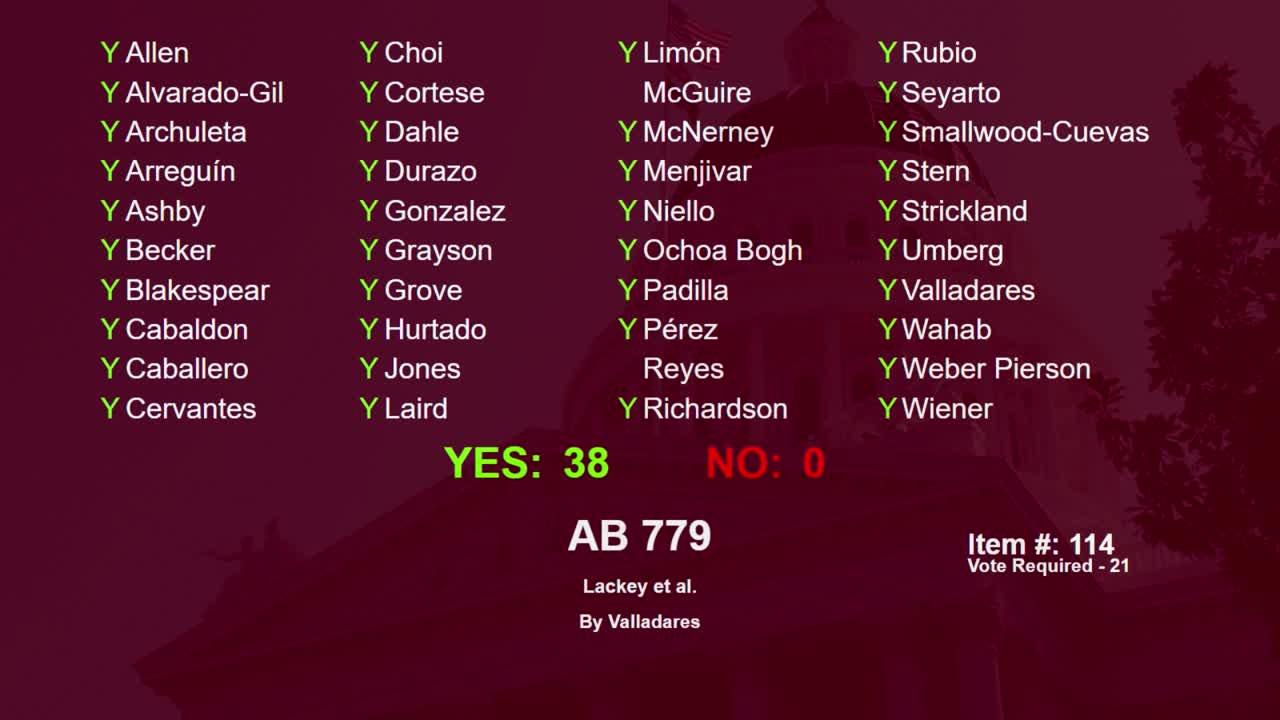 6MIN
Senate Floor
 29MIN
Senate Standing Committee on Health
 10MIN
Assembly Floor
 4MIN
Assembly Standing Committee on Appropriations
 19MIN
Assembly Standing Committee on Health
Bill Author

Bill Co-Author(s):