AB 1510: Santa Clara Valley Transportation Authority: employee relations.
- Session Year: 2025-2026
- House: Assembly
- Latest Version Date: 2025-10-07
Current Status:
Passed
(2025-10-07: Chaptered by Secretary of State - Chapter 454, Statutes of 2025.)
Introduced
In Committee
Awaiting First Chamber Vote
Passed First Chamber
In Committee
Awaiting Second Chamber Vote
Passed Second Chamber
Enacted
Existing law, the Santa Clara Valley Transportation Authority Act, establishes the Santa Clara Valley Transportation Authority with various powers and duties relative to transportation projects and services and the operation of public transit in the County of Santa Clara.
Existing law establishes the Public Employment Relations Board (PERB) in state government as a means of resolving disputes and enforcing the statutory duties and rights of specified public employers and employees under various acts regulating collective bargaining, including the Meyers-Milias-Brown Act. Existing law vests PERB with jurisdiction to enforce certain provisions related to the authoritys employees, over charges of unfair practices for represented authority employees, subject to a selection by an exclusive representative. Existing law, in the case of such a selection, gives PERB jurisdiction over the initial determination as to whether those charges are justified and, if so, the appropriate remedy, subject to certain restrictions.
This bill would authorize any charging party, respondent, or intervenor aggrieved by a final decision or order of PERB in an unfair practice case, except a decision of PERB not to issue a complaint in such a case, to petition for a writ of extraordinary relief from that decision or order, as specified. The bill, if the time to petition for extraordinary relief from a PERB decision or order has expired, would authorize PERB to seek enforcement of any final decision or order in a district court of appeal or superior court having jurisdiction over the county where the events giving rise to the decision or order occurred, as specified.
This bill would make legislative findings and declarations as to the necessity of a special statute for the authority.
Existing law requires the state to provide certain benefits and compensation to a state employee who, who as a member of the California National Guard or a United States military reserve organization, is called into active duty as a result of the Bosnia crisis on or after November 21, 1995. Existing law also requires the state to provide certain benefits to a state employee who, as a member of the California National Guard or United States military reserve organization, is ordered to active duty on and after September 11, 2001, as a result of the War on Terrorism. Existing law requires that those employees, while on active duty, receive from the state, for the duration of the War on Terrorism, specified pay, merit raises, and benefits, for a period not exceeding 365 calendar days. Existing law requires the state to reimburse the cost of insurance premiums for certain state employees ordered to active duty on and after September 11, 2001, as a result of the War on Terrorism, for the period of time on active duty, not to exceed 365 calendar days.
This bill would repeal the provisions requiring the state to provide benefits and compensation for a state employee called into active duty as a result of the Bosnia crisis. The bill would increase the maximum number of calendar days for which employees, while on active duty, would receive from the state, for the duration of the War on Terrorism, specified pay, merit raises, and benefits, to a period not exceeding 730 cumulative calendar days. The bill would increase the maximum number of calendar days for reimbursement for the cost of the insurance premium premiums for certain state employees ordered to active duty on and after September 11, 2001, as a result of the War on Terrorism, to 730 cumulative calendar days.
Existing law, the Santa Clara Valley Transportation Authority Act, establishes the Santa Clara Valley Transportation Authority with various powers and duties relative to transportation projects and services and the operation of public transit in the County of Santa Clara.
Existing law establishes the Public Employment Relations Board (PERB) in state government as a means of resolving disputes and enforcing the statutory duties and rights of specified public employers and employees under various acts regulating collective bargaining, including the Meyers-Milias-Brown Act. Existing law vests PERB with jurisdiction to enforce certain provisions related to the authoritys employees, over charges of unfair practices for represented authority employees, subject to a selection by an exclusive representative. Existing law, in the case of such a selection, gives PERB jurisdiction over the initial determination as to whether those charges are justified and, if so, the appropriate remedy, subject to certain restrictions.
This bill would authorize any charging party, respondent, or intervenor aggrieved by a final decision or order of PERB in an unfair practice case, except a decision of PERB not to issue a complaint in such a case, to petition for a writ of extraordinary relief from that decision or order, as specified. The bill, if the time to petition for extraordinary relief from a PERB decision or order has expired, would authorize PERB to seek enforcement of any final decision or order in a district court of appeal or superior court having jurisdiction over the county where the events giving rise to the decision or order occurred, as specified.
This bill would make legislative findings and declarations as to the necessity of a special statute for the authority.
Existing law requires the state to provide certain benefits and compensation to a state employee who, who as a member of the California National Guard or a United States military reserve organization, is called into active duty as a result of the Bosnia crisis on or after November 21, 1995. Existing law also requires the state to provide certain benefits to a state employee who, as a member of the California National Guard or United States military reserve organization, is ordered to active duty on and after September 11, 2001, as a result of the War on Terrorism. Existing law requires the state to reimburse the cost of insurance premiums for certain state employees for the period of time on active duty, not to exceed 365 calendar days.
This bill would repeal the provisions requiring the state to provide benefits and compensation for a state employee called into active duty as a result of the Bosnia crisis. The bill would increase the maximum number of calendar days for reimbursement for the cost of the insurance premium to 730 cumulative calendar days.
Existing law, the Santa Clara Valley Transportation Authority Act, establishes the Santa Clara Valley Transportation Authority with various powers and duties relative to transportation projects and services and the operation of public transit in the County of Santa Clara.
Existing law establishes the Public Employment Relations Board (PERB) in state government as a means of resolving disputes and enforcing the statutory duties and rights of specified public employers and employees under various acts regulating collective bargaining, including the Meyers-Milias-Brown Act. Existing law vests PERB with jurisdiction to enforce certain provisions related to the authoritys employees, over charges of unfair practices for represented authority employees, subject to a selection by an exclusive representative. Existing law, in the case of such a selection, gives PERB jurisdiction over the initial determination as to whether those charges are justified and, if so, the appropriate remedy, subject to certain restrictions.
This bill would authorize any charging party, respondent, or intervenor aggrieved by a final decision or order of PERB in an unfair practice case, except a decision of PERB not to issue a complaint in such a case, to petition for a writ of extraordinary relief from that decision or order, as specified. The bill, if the time to petition for extraordinary relief from a PERB decision or order has expired, would authorize PERB to seek enforcement of any final decision or order in a district court of appeal or superior court having jurisdiction over the county where the events giving rise to the decision or order occurred, as specified.
This bill would make legislative findings and declarations as to the necessity of a special statute for the authority.
(a)Any charging party, respondent, or intervenor aggrieved by a final decision or order of the Public Employment Relations Board in an unfair practice case, except a decision of that board not to issue a complaint in such a case, may petition for a writ of extraordinary relief from that decision or order.
(b)A petition for a writ of extraordinary relief shall be filed in the district court of appeal having jurisdiction over any county in which the VTA operates. The petition shall be filed within 30 days from the date of the issuance of the Public Employment Relations Boards final decision or order, or order denying reconsideration, as applicable. Upon the filing of the petition, the court shall cause notice to be served upon the Public Employment Relations Board and thereafter shall have jurisdiction of the proceeding. The Public Employment Relations Board shall file in the court the record of the proceeding, certified by that board, within 10 days after the clerks notice unless that time is extended by the court for good cause shown. The court shall have jurisdiction to grant any temporary relief or restraining order it deems just and proper, and in like manner to make and enter a decree enforcing, modifying, and enforcing as modified, or setting aside in whole or in part, the decision or order of the Public Employment Relations Board. The findings of the Public Employment Relations Board with respect to questions of fact, including ultimate facts, if supported by substantial evidence on the record considered as a whole, shall be conclusive. Title 1 (commencing with Section 1067) of Part 3 of the Code of Civil Procedure relating to writs shall, except where specifically superseded by this section, apply to proceedings pursuant to this section.
(c)If the time to petition for extraordinary relief from a Public Employment Relations Board decision or order has expired, the Public Employment Relations Board may seek enforcement of any final decision or order in a district court of appeal or superior court having jurisdiction over the county where the events giving rise to the decision or order occurred. The Public Employment Relations Board shall respond within 10 days to any inquiry from a party to the action as to why the Public Employment Relations Board has not sought court enforcement of the final decision or order. If the response does not indicate that there has been compliance with the Public Employment Relations Boards final decision or order, the Public Employment Relations Board shall seek enforcement of the final decision or order upon the request of the party. The Public Employment Relations Board shall file in the court the record of the proceeding, certified by that board, and appropriate evidence disclosing the failure to comply with the decision or order. If, after the hearing, the court determines that the order was issued pursuant to the procedures established by the Public Employment Relations Board and that the person or entity refuses to comply with the order, the court shall enforce the order by writ of mandamus or other proper process. The court may not review the merits of the order.
SEC. 2.The Legislature finds and declares that a special statute is necessary and that a general statute cannot be made applicable within the meaning of Section 16 of Article IV of the California Constitution because of the unique need of the Santa Clara Valley Transportation Authority to efficiently and cost effectively adjudicate unfair labor practice complaints.
(a)Any charging party, respondent, or intervenor aggrieved by a final decision or order of the Public Employment Relations Board in an unfair practice case, except a decision of that board not to issue a complaint in such a case, may petition for a writ of extraordinary relief from that decision or order.
(b)A petition for a writ of extraordinary relief shall be filed in the district court of appeal having jurisdiction over any county in which the VTA operates. The petition shall be filed within 30 days from the date of the issuance of the Public Employment Relations Boards final decision or order, or order denying reconsideration, as applicable. Upon the filing of the petition, the court shall cause notice to be served upon the Public Employment Relations Board and thereafter shall have jurisdiction of the proceeding. The Public Employment Relations Board shall file in the court the record of the proceeding, certified by that board, within 10 days after the clerks notice unless that time is extended by the court for good cause shown. The court shall have jurisdiction to grant any temporary relief or restraining order it deems just and proper, and in like manner to make and enter a decree enforcing, modifying, and enforcing as modified, or setting aside in whole or in part, the decision or order of the Public Employment Relations Board. The findings of the Public Employment Relations Board with respect to questions of fact, including ultimate facts, if supported by substantial evidence on the record considered as a whole, shall be conclusive. Title 1 (commencing with Section 1067) of Part 3 of the Code of Civil Procedure relating to writs shall, except where specifically superseded by this section, apply to proceedings pursuant to this section.
(c)If the time to petition for extraordinary relief from a Public Employment Relations Board decision or order has expired, the Public Employment Relations Board may seek enforcement of any final decision or order in a district court of appeal or superior court having jurisdiction over the county where the events giving rise to the decision or order occurred. The Public Employment Relations Board shall respond within 10 days to any inquiry from a party to the action as to why the Public Employment Relations Board has not sought court enforcement of the final decision or order. If the response does not indicate that there has been compliance with the Public Employment Relations Boards final decision or order, the Public Employment Relations Board shall seek enforcement of the final decision or order upon the request of the party. The Public Employment Relations Board shall file in the court the record of the proceeding, certified by that board, and appropriate evidence disclosing the failure to comply with the decision or order. If, after the hearing, the court determines that the order was issued pursuant to the procedures established by the Public Employment Relations Board and that the person or entity refuses to comply with the order, the court shall enforce the order by writ of mandamus or other proper process. The court may not review the merits of the order.
SEC. 5.SEC. 2.The Legislature finds and declares that a special statute is necessary and that a general statute cannot be made applicable within the meaning of Section 16 of Article IV of the California Constitution because of the unique need of the Santa Clara Valley Transportation Authority to efficiently and cost effectively adjudicate unfair labor practice complaints.
(a)In addition to the benefits provided pursuant to Sections 19775 and 19775.1, a state employee who, as a member of the California National Guard or a United States military reserve organization, is ordered to active duty by Presidential determination that it is necessary to augment the active forces for any operational mission, or when in time of national emergency declared by the President or otherwise authorized by law, shall have the benefits provided for in subdivision (b).
(b)Any state employee to which subdivision (a) applies, while on active duty, shall receive from the state, for the duration of the event as authorized pursuant to Sections 12302 and 12304 of Title 10 of the United States Code, but not for more than 180 calendar days, as part of the state employees compensation both of the following:
(1)The difference between the amount of the state employees military pay and allowances and the amount the employee would have received as a state employee, including any merit raises that would otherwise have been granted during the time the individual was on active duty. The amount an employee, as defined in Section 18526, would have received as a state employee, including any merit raises that would otherwise have been granted during the time the individual was on active duty, shall be determined by the Department of Human Resources.
(2)All benefits that the state employee would have received had they not served on active duty unless the benefits are prohibited or limited by vendor contracts.
(c)Any individual receiving compensation pursuant to subdivision (b) who does not reinstate to state service following active duty, shall have that compensation treated as a loan payable with interest at the rate earned on the Pooled Money Investment Account. This subdivision shall not apply to compensation received pursuant to Section 19775.
(d)Benefits provided under paragraph (1) of subdivision (b) shall only be provided to a state employee who was not eligible to participate in a federally sponsored income protection program for National Guard personnel or military reserve personnel, or both, called into active duty, as determined by the Department of Human Resources. For a state employee eligible to participate in a federally sponsored income protection program, and whose salary as a state employee was higher than the sum of their military pay and allowances and the maximum allowable benefit under the federally sponsored income protection program, the state employee shall receive the amount payable under paragraph (1) of subdivision (b), but that amount shall be reduced by the maximum allowable benefit under the federally sponsored income protection program. For individuals who elected the federally sponsored income protection program, the state shall reimburse for the cost of the insurance premium for the period of time on active duty, not to exceed 180 calendar days.
(e)For purposes of this section, state employee means an employee as defined in Section 18526 or an officer or employee of the legislative, executive, or judicial department of the state.
(f)This section shall not apply to any state employee entitled to additional compensation or benefits pursuant to Section 19775.18 of this code, or Section 395.08 of the Military and Veterans Code.
SEC. 3.Section 19775.18 of the Government Code is amended to read:19775.18.(a)In addition to the benefits provided pursuant to Sections 19775 and 19775.1, a state employee who, as a member of the California National Guard or a United States military reserve organization, is ordered to active duty on and after September 11, 2001, as a result of the War on Terrorism, shall have the benefits provided for in subdivision (b).
(b)Any state employee to which subdivision (a) applies, while on active duty, shall receive from the state, for the duration of the event known as the War on Terrorism, as authorized pursuant to Sections 12302 and 12304 of Title 10 of the United States Code, but not for more than 365 730 cumulative calendar days, as part of the state employees compensation both of the following:
(1)The difference between the amount of the state employees military pay and allowances and the amount the employee would have received as a state employee, including any merit raises that would otherwise have been granted during the time the individual was on active duty. The amount an employee, as defined in Section 18526, would have received as a state employee, including any merit raises that would otherwise have been granted during the time the individual was on active duty, shall be determined by the Department of Human Resources.
(2)All benefits that the state employee would have received had they not served on active duty unless the benefits are prohibited or limited by vendor contracts.
(c)Any individual receiving compensation pursuant to subdivision (b) who does not reinstate to state service following active duty, shall have that compensation treated as a loan payable with interest at the rate earned on the Pooled Money Investment Account. This subdivision does not apply to compensation received pursuant to Section 19775.
(d)Benefits provided under paragraph (1) of subdivision (b) shall only be provided to a state employee who was not eligible to participate in a federally sponsored income protection program for National Guard personnel or military reserve personnel, or both, called into active duty, as determined by the Department of Human Resources. For a state employee eligible to participate in a federally sponsored income protection program, and whose salary as a state employee was higher than the sum of their military pay and allowances and the maximum allowable benefit under the federally sponsored income protection program, the state employee shall receive the amount payable under paragraph (1) of subdivision (b), but that amount shall be reduced by the maximum allowable benefit under the federally sponsored income protection program. For individuals who elected the federally sponsored income protection program, the state shall reimburse for the cost of the insurance premium for the period of time on active duty, not to exceed 730 cumulative calendar days.
(e)The Governor may, by executive order, extend the period of time for the receipt of benefits provided pursuant to this section by no more than an additional 1,460 calendar days.
(f)(1)Military pay and allowances for the purposes of this section does not include hazardous duty pay, hostile fire pay, or imminent danger pay. A state employee is entitled to retain these and any other special and incentive pay provided by the federal government.
(2)State employee for the purposes of this section means an employee as defined in Section 18526 or an officer or employee of the legislative, executive, or judicial department of the state.
(g)This section does not apply to any state employee entitled to additional compensation or benefits pursuant to Section 19775.17 of this code, or Section 395.08 of the Military and Veterans Code.
(h)This section does not apply to any active duty served after the close of the War on Terrorism.
SEC. 4.Section 100312 is added to the Public Utilities Code, to read:100312.(a)Any charging party, respondent, or intervenor aggrieved by a final decision or order of the Public Employment Relations Board in an unfair practice case, except a decision of that board not to issue a complaint in such a case, may petition for a writ of extraordinary relief from that decision or order.
(b)A petition for a writ of extraordinary relief shall be filed in the district court of appeal having jurisdiction over any county in which the VTA operates. The petition shall be filed within 30 days from the date of the issuance of the Public Employment Relations Boards final decision or order, or order denying reconsideration, as applicable. Upon the filing of the petition, the court shall cause notice to be served upon the Public Employment Relations Board and thereafter shall have jurisdiction of the proceeding. The Public Employment Relations Board shall file in the court the record of the proceeding, certified by that board, within 10 days after the clerks notice unless that time is extended by the court for good cause shown. The court shall have jurisdiction to grant any temporary relief or restraining order it deems just and proper, and in like manner to make and enter a decree enforcing, modifying, and enforcing as modified, or setting aside in whole or in part part, the decision or order of the Public Employment Relations Board. The findings of the Public Employment Relations Board with respect to questions of fact, including ultimate facts, if supported by substantial evidence on the record considered as a whole, shall be conclusive. Title 1 (commencing with Section 1067) of Part 3 of the Code of Civil Procedure relating to writs shall, except where specifically superseded by this section, apply to proceedings pursuant to this section.
(c)If the time to petition for extraordinary relief from a Public Employment Relations Board decision or order has expired, the Public Employment Relations Board may seek enforcement of any final decision or order in a district court of appeal or superior court having jurisdiction over the county where the events giving rise to the decision or order occurred. The Public Employment Relations Board shall respond within 10 days to any inquiry from a party to the action as to why the Public Employment Relations Board has not sought court enforcement of the final decision or order. If the response does not indicate that there has been compliance with the Public Employment Relations Boards final decision or order, the Public Employment Relations Board shall seek enforcement of the final decision or order upon the request of the party. The Public Employment Relations Board shall file in the court the record of the proceeding, certified by that board, and appropriate evidence disclosing the failure to comply with the decision or order. If, after the hearing, the court determines that the order was issued pursuant to the procedures established by the Public Employment Relations Board and that the person or entity refuses to comply with the order, the court shall enforce the order by writ of mandamus or other proper process. The court may not review the merits of the order.
SEC. 5.The Legislature finds and declares that a special statute is necessary and that a general statute cannot be made applicable within the meaning of Section 16 of Article IV of the California Constitution because of the unique need of the Santa Clara Valley Transportation Authority to efficiently and cost-effectively cost effectively adjudicate unfair labor practice complaints.
(a)In addition to the benefits provided pursuant to Sections 19775 and 19775.1, a state employee who, as a member of the California National Guard or a United States military reserve organization, is ordered to active duty by Presidential determination that it is necessary to augment the active forces for any operational mission, or when in time of national emergency declared by the President or otherwise authorized by law, shall have the benefits provided for in subdivision (b).
(b)Any state employee to which subdivision (a) applies, while on active duty, shall receive from the state, for the duration of the event as authorized pursuant to Sections 12302 and 12304 of Title 10 of the United States Code, but not for more than 180 calendar days, as part of the state employees compensation both of the following:
(1)The difference between the amount of the state employees military pay and allowances and the amount the employee would have received as a state employee, including any merit raises that would otherwise have been granted during the time the individual was on active duty. The amount an employee, as defined in Section 18526, would have received as a state employee, including any merit raises that would otherwise have been granted during the time the individual was on active duty, shall be determined by the Department of Human Resources.
(2)All benefits that the state employee would have received had they not served on active duty unless the benefits are prohibited or limited by vendor contracts.
(c)Any individual receiving compensation pursuant to subdivision (b) who does not reinstate to state service following active duty, shall have that compensation treated as a loan payable with interest at the rate earned on the Pooled Money Investment Account. This subdivision shall not apply to compensation received pursuant to Section 19775.
(d)Benefits provided under paragraph (1) of subdivision (b) shall only be provided to a state employee who was not eligible to participate in a federally sponsored income protection program for National Guard personnel or military reserve personnel, or both, called into active duty, as determined by the Department of Human Resources. For a state employee eligible to participate in a federally sponsored income protection program, and whose salary as a state employee was higher than the sum of their military pay and allowances and the maximum allowable benefit under the federally sponsored income protection program, the state employee shall receive the amount payable under paragraph (1) of subdivision (b), but that amount shall be reduced by the maximum allowable benefit under the federally sponsored income protection program. For individuals who elected the federally sponsored income protection program, the state shall reimburse for the cost of the insurance premium for the period of time on active duty, not to exceed 180 calendar days.
(e)For purposes of this section, state employee means an employee as defined in Section 18526 or an officer or employee of the legislative, executive, or judicial department of the state.
(f)This section shall not apply to any state employee entitled to additional compensation or benefits pursuant to Section 19775.16 or 19775.18 of this code, or Section 395.08 of the Military and Veterans Code.
SEC. 3.Section 19775.18 of the Government Code is amended to read:19775.18.(a)In addition to the benefits provided pursuant to Sections 19775 and 19775.1, a state employee who, as a member of the California National Guard or a United States military reserve organization, is ordered to active duty on and after September 11, 2001, as a result of the War on Terrorism, shall have the benefits provided for in subdivision (b).
(b)Any state employee to which subdivision (a) applies, while on active duty, shall receive from the state, for the duration of the event known as the War on Terrorism, as authorized pursuant to Sections 12302 and 12304 of Title 10 of the United States Code, but not for more than 365 calendar days, as part of the state employees compensation both of the following:
(1)The difference between the amount of the state employees military pay and allowances and the amount the employee would have received as a state employee, including any merit raises that would otherwise have been granted during the time the individual was on active duty. The amount an employee, as defined in Section 18526, would have received as a state employee, including any merit raises that would otherwise have been granted during the time the individual was on active duty, shall be determined by the Department of Human Resources.
(2)All benefits that the state employee would have received had they not served on active duty unless the benefits are prohibited or limited by vendor contracts.
(c)Any individual receiving compensation pursuant to subdivision (b) who does not reinstate to state service following active duty, shall have that compensation treated as a loan payable with interest at the rate earned on the Pooled Money Investment Account. This subdivision does not apply to compensation received pursuant to Section 19775.
(d)Benefits provided under paragraph (1) of subdivision (b) shall only be provided to a state employee who was not eligible to participate in a federally sponsored income protection program for National Guard personnel or military reserve personnel, or both, called into active duty, as determined by the Department of Human Resources. For a state employee eligible to participate in a federally sponsored income protection program, and whose salary as a state employee was higher than the sum of their military pay and allowances and the maximum allowable benefit under the federally sponsored income protection program, the state employee shall receive the amount payable under paragraph (1) of subdivision (b), but that amount shall be reduced by the maximum allowable benefit under the federally sponsored income protection program. For individuals who elected the federally sponsored income protection program, the state shall reimburse for the cost of the insurance premium for the period of time on active duty, not to exceed 365 730 cumulative calendar days.
(e)The Governor may, by executive order, extend the period of time for the receipt of benefits provided pursuant to this section by no more than an additional 1,460 calendar days.
(f)(1)Military pay and allowances for the purposes of this section does not include hazardous duty pay, hostile fire pay, or imminent danger pay. A state employee is entitled to retain these and any other special and incentive pay provided by the federal government.
(2)State employee for the purposes of this section means an employee as defined in Section 18526 or an officer or employee of the legislative, executive, or judicial department of the state.
(g)This section does not apply to any state employee entitled to additional compensation or benefits pursuant to Section 19775.16 or 19775.17 of this code, or Section 395.08 of the Military and Veterans Code.
(h)This section does not apply to any active duty served after the close of the War on Terrorism.
SEC. 4.Section 100312 is added to the Public Utilities Code, to read:100312.(a)Any charging party, respondent, or intervenor aggrieved by a final decision or order of the Public Employment Relations Board in an unfair practice case, except a decision of that board not to issue a complaint in such a case, may petition for a writ of extraordinary relief from that decision or order.
(b)A petition for a writ of extraordinary relief shall be filed in the district court of appeal having jurisdiction over any county in which the VTA operates. The petition shall be filed within 30 days from the date of the issuance of the Public Employment Relations Boards final decision or order, or order denying reconsideration, as applicable. Upon the filing of the petition, the court shall cause notice to be served upon the Public Employment Relations Board and thereafter shall have jurisdiction of the proceeding. The Public Employment Relations Board shall file in the court the record of the proceeding, certified by that board, within 10 days after the clerks notice unless that time is extended by the court for good cause shown. The court shall have jurisdiction to grant any temporary relief or restraining order it deems just and proper, and in like manner to make and enter a decree enforcing, modifying, and enforcing as modified, or setting aside in whole or in part the decision or order of the Public Employment Relations Board. The findings of the Public Employment Relations Board with respect to questions of fact, including ultimate facts, if supported by substantial evidence on the record considered as a whole, shall be conclusive. Title 1 (commencing with Section 1067) of Part 3 of the Code of Civil Procedure relating to writs shall, except where specifically superseded by this section, apply to proceedings pursuant to this section.
(c)If the time to petition for extraordinary relief from a Public Employment Relations Board decision or order has expired, the Public Employment Relations Board may seek enforcement of any final decision or order in a district court of appeal or superior court having jurisdiction over the county where the events giving rise to the decision or order occurred. The Public Employment Relations Board shall respond within 10 days to any inquiry from a party to the action as to why the Public Employment Relations Board has not sought court enforcement of the final decision or order. If the response does not indicate that there has been compliance with the Public Employment Relations Boards final decision or order, the Public Employment Relations Board shall seek enforcement of the final decision or order upon the request of the party. The Public Employment Relations Board shall file in the court the record of the proceeding, certified by that board, and appropriate evidence disclosing the failure to comply with the decision or order. If, after hearing, the court determines that the order was issued pursuant to the procedures established by the Public Employment Relations Board and that the person or entity refuses to comply with the order, the court shall enforce the order by writ of mandamus or other proper process. The court may not review the merits of the order.
SEC. 5.The Legislature finds and declares that a special statute is necessary and that a general statute cannot be made applicable within the meaning of Section 16 of Article IV of the California Constitution because of the unique need of the Santa Clara Valley Transportation Authority to efficiently and cost-effectively adjudicate unfair labor practice complaints.
|
Date
|
Status
|
|---|---|
| Oct 7, 2025 | Chaptered by Secretary of State - Chapter 454, Statutes of 2025. |
| Oct 7, 2025 | Approved by the Governor. |
| Sep 9, 2025 | Enrolled and presented to the Governor at 3 p.m. |
| Sep 2, 2025 | Senate amendments concurred in. To Engrossing and Enrolling. (Ayes 76. Noes 1. Page 2808.). |
| Aug 26, 2025 | In Assembly. Concurrence in Senate amendments pending. |
| Aug 25, 2025 | Read third time. Passed. Ordered to the Assembly. (Ayes 37. Noes 0. Page 2252.). |
| Aug 20, 2025 | Read second time. Ordered to Consent Calendar. |
| Aug 19, 2025 | From committee: Be ordered to second reading file pursuant to Senate Rule 28.8 and ordered to Consent Calendar. |
| Jul 9, 2025 | From committee: Do pass and re-refer to Com. on APPR. with recommendation: To Consent Calendar. (Ayes 13. Noes 0.) (July 8). Re-referred to Com. on APPR. |
| Jun 25, 2025 | From committee: Do pass and re-refer to Com. on JUD. with recommendation: To Consent Calendar. (Ayes 5. Noes 0.) (June 25). Re-referred to Com. on JUD. |
| Jun 13, 2025 | From committee chair, with author's amendments: Amend, and re-refer to committee. Read second time, amended, and re-referred to Com. on L., P.E. & R. |
| Jun 11, 2025 | In committee: Set, first hearing. Hearing canceled at the request of author. |
| May 28, 2025 | From committee chair, with author's amendments: Amend, and re-refer to committee. Read second time, amended, and re-referred to Com. on L., P.E. & R. |
| May 21, 2025 | Referred to Coms. on L., P.E. & R. and JUD. |
| May 13, 2025 | In Senate. Read first time. To Com. on RLS. for assignment. |
| May 12, 2025 | Read third time. Passed. Ordered to the Senate. (Ayes 73. Noes 1. Page 1520.) |
| May 8, 2025 | Read second time. Ordered to third reading. |
| May 7, 2025 | From committee: Do pass. (Ayes 15. Noes 0.) (May 7). |
| Apr 23, 2025 | From committee: Do pass and re-refer to Com. on APPR. (Ayes 7. Noes 0.) (April 23). Re-referred to Com. on APPR. |
| Mar 17, 2025 | Referred to Com. on P. E. & R. |
| Mar 5, 2025 | From printer. May be heard in committee April 4. |
| Mar 4, 2025 | Read first time. To print. |
|
Date
|
Description
|
Location
|
Votes
|
|
|---|---|---|---|---|
| Sep 2, 2025 | The committee on PBS recommend that the measure be PASSED, UNAMENDED | Assembly Floor |
Passed |
|
| Aug 25, 2025 | Consent Calendar 2nd AB1510 P. E. & R. (McKinnor) | Senate Floor |
Passed |
|
| Jul 8, 2025 | Do pass, but first be re-referred to the Committee on [Appropriations] with the recommendation: To Consent Calendar | Senate Standing Committee on Judiciary |
Passed |
|
| Jun 25, 2025 | Do pass, but first be re-referred to the Committee on [Judiciary] with the recommendation: To Consent Calendar | Senate Standing Committee on Labor, Public Employment and Retirement |
Passed |
|
| May 12, 2025 | AB 1510 Public Employment and Re Assembly Third Reading By McKINNOR | Assembly Floor |
Passed |
|
| May 7, 2025 | Do pass. | Assembly Standing Committee on Appropriations |
Passed |
|
| Apr 23, 2025 | Do pass and be re-referred to the Committee on [Appropriations] | Assembly Standing Committee on Public Employment and Retirement |
Passed |
This list shows positions taken on this bill by organizations on the date displayed, which is linked to the original source.
Positions by individuals are not included.
|
Organization
|
Position
|
Date
|
|---|---|---|
| American Federation Of State, County And Municipal Employees, Afl-Cio | ** Support | |
| Assembly Committee on Public Employment and Retirement | ** Support |
CONCURRENCE IN SENATE AMENDMENTS
CSA1 Bill Id:AB 1510
Author:(Committee on Public Employment and Retirement)
As Amended Ver:June 13, 2025
Majority vote
SUMMARY
Makes a change to the existing Santa Clara Valley Transportation Authority (VTA) employment relations statute relating to an appeal of a final decision or order of the Public Employment Relations Board (PERB) for purposes of equity and parity to various other public employment relations statutes administered by the PERB.
Senate Amendments
Remove technical clean-up provisions regarding certain pay and benefits for state employees who are members of the California National Guard or United States military reserves relating to the Bosnia crisis and War on Terror, respectively, but maintain provisions relating to employment relations at the VTA, as previously passed by the Assembly.
COMMENTS
Background
Existing law authorizes a party aggrieved by a final decision or order of the Public Employment Relations Board (PERB) in an unfair practice case, except under certain circumstance, to petition a court of competent jurisdiction for a writ of extraordinary relief from such decisions or orders. (See Sections 3509.5 (local public employment relations); 3542 (K-14 education employment relations); 3524.73 (Judicial Council employment relations); 3564 (higher education employment relations); 71639.4 (trial court employment relations); 71825.1 (court interpreter employment relations) of the Gov. Code; Sections 40122.2 (Orange County transit employment relations); 28861 (San Francisco Bay Area Rapid Transit employment relations); 98172 (Santa Cruz Metropolitan transit employment relations); 99562 (Los Angeles County transit supervisory employment relations ); 102409 (Sacramento Regional Transit employment relations) of the Public Utilities Code; and, Section 10428.5 (childcare providers employment relations) of the Welfare and Institutions Code.)
This Bill
This bill would add a similar necessary provision to the VTA employment relations statute administered by the PERB.
Please see the various policy committee analyses for a full discussion of this bill.
According to the Author
"This bill makes a necessary change to the VTA employment relations statute to ensure that any party aggrieved by a final decision or order of the PERB can request a writ of extraordinary relief from a court."
Arguments in Support
Among other things, the American Federation of State, County and Municipal Employees, AFL-CIO states that, "[c]urrently, the VTA's employer-employee relations statute lacks explicit provisions for both PERB enforcement and judicial review. This creates a disparity compared to other public sector employees in California who are under PERB's jurisdiction. By addressing this discrepancy, [this bill] will provide VTA workers with the same fundamental rights and protections afforded to their counterparts across the state. The proposed [VTA employment relations statute is] essential for creating a more balanced and just labor environment.
Arguments in Opposition
None.
FISCAL COMMENTS
This bill was passed by the Senate Committee on Appropriations pursuant to Senate Rule 28.8.
VOTES:
ASM PUBLIC EMPLOYMENT AND RETIREMENT: 7-0-0
YES: McKinnor, Lackey, Alanis, Boerner, Elhawary, Garcia, Nguyen
ASM APPROPRIATIONS: 15-0-0
YES: Wicks, Sanchez, Arambula, Calderon, Caloza, Dixon, Elhawary, Fong, Mark González, Hart, Pacheco, Pellerin, Solache, Ta, Tangipa
ASSEMBLY FLOOR: 73-1-5
YES: Addis, Aguiar-Curry, Ahrens, Alanis, Alvarez, Arambula, Ávila Farías, Bains, Bauer‑Kahan, Bennett, Berman, Boerner, Bonta, Bryan, Calderon, Caloza, Castillo, Chen, Connolly, Davies, Dixon, Elhawary, Ellis, Flora, Fong, Gabriel, Garcia, Gipson, Jeff Gonzalez, Mark González, Hadwick, Haney, Harabedian, Hart, Hoover, Irwin, Jackson, Kalra, Krell, Lackey, Lee, Lowenthal, Macedo, McKinnor, Muratsuchi, Nguyen, Ortega, Pacheco, Papan, Patel, Patterson, Pellerin, Petrie-Norris, Quirk-Silva, Ramos, Ransom, Celeste Rodriguez, Rogers, Blanca Rubio, Schiavo, Schultz, Sharp-Collins, Solache, Soria, Ta, Tangipa, Valencia, Wallis, Ward, Wicks, Wilson, Zbur, Rivas
NO: DeMaio
ABS, ABST OR NV: Carrillo, Gallagher, Michelle Rodriguez, Sanchez, Stefani
SENATE FLOOR: 37-0-3
YES: Allen, Archuleta, Arreguín, Ashby, Becker, Blakespear, Cabaldon, Caballero, Cervantes, Choi, Cortese, Dahle, Durazo, Gonzalez, Grayson, Grove, Jones, Laird, Limón, McGuire, McNerney, Menjivar, Niello, Ochoa Bogh, Padilla, Pérez, Reyes, Richardson, Seyarto, Smallwood-Cuevas, Stern, Strickland, Umberg, Valladares, Wahab, Weber Pierson, Wiener
ABS, ABST OR NV: Alvarado-Gil, Hurtado, Rubio
UPDATED
VERSION: June 13, 2025
CONSULTANT: Michael Bolden / P. E. & R. / (916) 319-3957 FN: 0001251
SENATE RULES COMMITTEE Office of Senate Floor Analyses (916) 651-1520 Fax: (916) 327-4478 | AB 1510 |
CONSENT
Bill No: AB 1510
Author: Committee on Public Employment and Retirement
Amended: 6/13/25 in Senate
Vote: 21
SENATE LABOR, PUB. EMP. & RET. COMMITTEE: 5-0, 6/25/25
AYES: Smallwood-Cuevas, Strickland, Cortese, Durazo, Laird
SENATE JUDICIARY COMMITTEE: 13-0, 7/8/25
AYES: Umberg, Niello, Allen, Arreguín, Ashby, Caballero, Durazo, Laird, Stern, Valladares, Wahab, Weber Pierson, Wiener
SENATE APPROPRIATIONS COMMITTEE: Senate Rule 28.8
ASSEMBLY FLOOR: 73-1, 5/12/25 - See last page for vote
SUBJECT: Santa Clara Valley Transportation Authority: employee relations
SOURCE: Assembly Committee on Public Employment and Retirement
DIGEST:
This bill provides Santa Clara Valley Transportation Authority (VTA), its unions, and intervenors the right to appeal decisions of the Public Employment Relations Board (PERB), as specified.
ANALYSIS:
Existing law:
- Governs collective bargaining in the private sector under the federal National Labor Relations Act (NLRA) but leaves to the states the regulation of collective bargaining in their respective public sectors. While the NLRA and the decisions of its National Labor Relations Board (NLRB) often provide persuasive precedent in interpreting state collective bargaining law, public employees generally have no collective bargaining rights absent specific statutory authority establishing those rights (29 United State Code §151 et seq.).
- Provides several statutory frameworks under California law to provide public employees collective bargaining rights, govern public employer-employee relations, and limit labor strife and economic disruption in the public sector through a reasonable method of resolving disputes regarding wages, hours and other terms and conditions of employment between public employers and recognized public employee organizations or their exclusive representatives. These include the Meyers-Milias-Brown Act (MMBA) which provides for public employer-employee relations between local government employers and their employees, including some, but not all public transit districts. (Government Code §3500 et seq.)
- Establishes PERB, a quasi-judicial administrative agency charged with administering certain statutory frameworks governing employer-employee relations, resolving disputes, and enforcing the statutory duties and rights of public agency employers and employee organizations. (Government Code §3541)
- Does not cover all California’s public transit districts by a common collective bargaining statute. Instead, while some transit agencies are subject to the MMBA, many transit agencies are instead subject to labor relations provisions found in each district’s specific Public Utilities Code (PUC) enabling statute, in joint powers agreements, or in articles of incorporation and bylaws. (e.g., Public Utilities Code §28500)
- Provides transit employees not under the MMBA with basic rights to organization and representation, but does not define or prohibit unfair labor practices. Unlike other California public agencies and employees, these transit agencies and their employees traditionally rely upon the courts to remedy alleged violations. Additionally, they may be subject to provisions of the federal Labor Management Relations Act of 1947 (Taft-Hartley) and the 1964 Urban Mass Transit Act, now known as the Federal Transit Act, commonly referred to as Section 13 (c). (Public Utilities Code §24501 et seq.; 49 United State Code §5333 (b))
- Provides that the following provisions shall govern disputes between exclusive bargaining representatives of public transit employees and local agencies not covered by the MMBA:
- The disputes shall not be subject to any fact-finding procedure otherwise provided by law.
- Each party shall exchange contract proposals not less than 90 days before the expiration of a contract, and shall be in formal collective bargaining not less than 60 days before that expiration.
- Each party shall supply to the other party all reasonable data as requested by the other party.
- At the request of either party to a dispute, the California State Mediation and Conciliation Service shall assign a conciliator to mediate the dispute and shall have access to all formal negotiations. (Government Code §3611)
- Authorizes the Governor to appoint a committee to investigate a transit district’s labor dispute relating to an impasse in bargaining that results in a threatened or actual strike and provides a process to resolve the dispute. (Government Code §3612 to §3616)
- Authorizes the establishment of the Santa Clara Valley Transportation Authority (VTA) through the Santa Clara Valley Transportation Act (SCVTA), which includes provisions governing labor relations between the VTA and its employees and which provides for labor organization representation, unit determination, collective bargaining, and retirement benefits. (Public Utilities Code §100000 et seq.)
- Authorizes VTA employee unions to make an irrevocable selection to move one or more of its represented bargaining units to PERB’s jurisdiction for unfair practice charges, as specified. (Public Utilities Code §100310 (b).
- Provides that the option to select PERB jurisdiction shall not displace or supplant the impasse resolution and injunctive relief procedures requirements provided pursuant to Government Code Sections 3612 to 3614, inclusive, which shall remain exclusive. (Public Utilities Code §100310 (a))
This bill:
- Authorizes any charging party, respondent, or intervenor aggrieved by a PERB final decision or in an unfair practice case, except a PERB decision not to issue a complaint in such a case, to petition for a writ of extraordinary relief from that decision or order.
- Requires the aggrieved party to file petition for a writ of extraordinary relief:
- In the district court of appeal having jurisdiction over any county in which the VTA operates;
- Within 30 days from the date of PERB’s issuance of its final decision or order, or order denying reconsideration, as applicable.
- Requires the appellate court, upon the party’s filing of the petition, to cause the party to serve notice upon PERB and thereafter for the court to have jurisdiction of the proceeding.
- Requires PERB to file its certified record of the proceeding in the court within 10 days after the clerk’s notice unless the court extends that time for good cause.
- Authorizes the court to have jurisdiction to grant any temporary relief or restraining order it deems just and proper, and in like manner to make and enter a decree enforcing, modifying, and enforcing as modified, or setting aside in whole or in part, the PERB decision or order.
- Makes PERB’s findings conclusive with respect to questions of fact, including ultimate facts, if supported by substantial evidence on the record considered as a whole.
- Applies Title 1 (commencing with Section 1067) of Part 3 of the Code of Civil Procedure relating to writs shall, to the proceeding except where specifically superseded by this bill’s provisions.
Background
Until recently, unfair labor practice charges (ULPs) at the VTA were not under PERB’s jurisdiction and were resolved through litigation in superior court or through the federal Section 13 (c) process and U.S. Department of Labor intervention. Recent legislation provided individual VTA bargaining units that are represented by different unions the right to individually elect PERB jurisdiction while allowing other bargaining units the right to continue resolving ULPs through their traditional process in the superior court.
This bill adds language that is standard in other public employer-employee acts to provide a mechanism for PERB to adjudicate ULPs and seek enforcement of its decisions from appellate courts (and effectively remove ULP decisions from the jurisdiction of superior courts). However, the VTA act is different from those other acts in that not all of VTA’s bargaining units have elected PERB’s jurisdiction.
Prior legislation did not include this language, in part, because of policy concerns that an “intervenor” or other aggrieved party could interfere with the superior court process of a party not electing PERB jurisdiction by raising a related ULP at PERB, thereby invoking a jurisdictional conflict.
Thus, this bill’s language enhancing PERB’s jurisdiction is not technical. However, it appears to be uncontroversial. Bargaining units represented by three VTA employee unions have elected PERB jurisdiction. One union has elected to continue under the superior court process. According to the author, all four VTA unions find the bill’s provisions acceptable.
Need for this bill? According to the author:
“This bill would add a necessary provision to the existing SCVTA employer-employee relations statute by authorizing a party aggrieved by a decision or order of the PERB to be able to appeal that decision or order in a court of competent jurisdiction. This addition is substantially similar to provisions that currently exist in, and apply to, other statewide collective bargaining statutes.”
Related/Prior Legislation:
AB 2524 (Kalra, Chapter 789, Statutes of 2022) authorized PERB jurisdiction over disputes relating to employer-employee relations of the VTA for those exclusive representatives that have elected to move one or more of its bargaining units to the jurisdiction of the PERB for unfair practice charges.
SB 957 (Laird, Chapter 240, Statutes of 2022) transferred jurisdiction over unfair labor practice charges involving the Santa Cruz Metropolitan Transit District from the judicial system to PERB.
SB 598 (Pan, Chapter 492, Statutes of 2021) provided exclusive employee organizations the option of transferring jurisdiction over unfair labor practice charges for their represented bargaining units within SacRT from the judicial system to PERB.
FISCAL EFFECT: Appropriation: No Fiscal Com.: Yes Local: No
SUPPORT: (Verified 8/18/25)
Assembly Committee on Public Employment and Retirement (source)
American Federation of State, County and Municipal Employees
OPPOSITION: (Verified 8/18/25)
None received
ARGUMENTS IN SUPPORT:
According to the American Federation of State, County and Municipal Employees:
“Currently, the VTA’s employer-employee relations statute lacks explicit provisions for both PERB enforcement and judicial review. This creates a disparity compared to other public sector employees in California who are under PERB’s jurisdiction. By addressing this discrepancy, AB 1510 will provide VTA workers with the same fundamental rights and protections afforded to their counterparts across the state. The proposed amendments are essential for creating a more balanced and just labor environment.”
ASSEMBLY FLOOR: 73-1, 5/12/25
AYES: Addis, Aguiar-Curry, Ahrens, Alanis, Alvarez, Arambula, Ávila Farías, Bains, Bauer-Kahan, Bennett, Berman, Boerner, Bonta, Bryan, Calderon, Caloza, Castillo, Chen, Connolly, Davies, Dixon, Elhawary, Ellis, Flora, Fong, Gabriel, Garcia, Gipson, Jeff Gonzalez, Mark González, Hadwick, Haney, Harabedian, Hart, Hoover, Irwin, Jackson, Kalra, Krell, Lackey, Lee, Lowenthal, Macedo, McKinnor, Muratsuchi, Nguyen, Ortega, Pacheco, Papan, Patel, Patterson, Pellerin, Petrie-Norris, Quirk-Silva, Ramos, Ransom, Celeste Rodriguez, Rogers, Blanca Rubio, Schiavo, Schultz, Sharp-Collins, Solache, Soria, Ta, Tangipa, Valencia, Wallis, Ward, Wicks, Wilson, Zbur, Rivas
NOES: DeMaio
NO VOTE RECORDED: Carrillo, Gallagher, Michelle Rodriguez, Sanchez, Stefani
Prepared by: Glenn Miles / L., P.E. & R. / (916) 651-1556
8/21/25 16:45:49
SENATE COMMITTEE ON LABOR, PUBLIC EMPLOYMENT AND RETIREMENT
Senator Lola Smallwood-Cuevas, Chair
2025 - 2026 Regular
Bill No: AB 1510 Hearing Date: June 25, 2025
Author: | Committee on Public Employment and Retirement | ||
Version: | June 13, 2025 | ||
Urgency: | No | Fiscal: | Yes |
Consultant: | Glenn Miles | ||
SUBJECT: Santa Clara Valley Transportation Authority: employee relations
KEY ISSUE
This bill provides Santa Clara Valley Transportation Authority (VTA), its unions, and intervenors the right to appeal decisions of the Public Employment Relations Board (PERB), as specified.
ANALYSIS
Existing law:
- Governs collective bargaining in the private sector under the federal National Labor Relations Act (NLRA) but leaves to the states the regulation of collective bargaining in their respective public sectors. While the NLRA and the decisions of its National Labor Relations Board (NLRB) often provide persuasive precedent in interpreting state collective bargaining law, public employees generally have no collective bargaining rights absent specific statutory authority establishing those rights (29 United State Code §151 et seq.).
- Provides several statutory frameworks under California law to provide public employees collective bargaining rights, govern public employer-employee relations, and limit labor strife and economic disruption in the public sector through a reasonable method of resolving disputes regarding wages, hours and other terms and conditions of employment between public employers and recognized public employee organizations or their exclusive representatives. These include the Meyers-Milias-Brown Act (MMBA) which provides for public employer-employee relations between local government employers and their employees, including some, but not all public transit districts. (Government Code §3500 et seq.)
- Establishes PERB, a quasi-judicial administrative agency charged with administering certain statutory frameworks governing employer-employee relations, resolving disputes, and enforcing the statutory duties and rights of public agency employers and employee organizations. (Government Code §3541)
- Does not cover all California’s public transit districts by a common collective bargaining statute. Instead, while some transit agencies are subject to the MMBA, many transit agencies are instead subject to labor relations provisions found in each district’s specific Public Utilities Code (PUC) enabling statute, in joint powers agreements, or in articles of incorporation and bylaws. (e.g., Public Utilities Code §28500)
- Provides transit employees not under the MMBA with basic rights to organization and representation, but does not define or prohibit unfair labor practices. Unlike other California public agencies and employees, these transit agencies and their employees traditionally rely upon the courts to remedy alleged violations. Additionally, they may be subject to provisions of the federal Labor Management Relations Act of 1947 (Taft-Hartley) and the 1964 Urban Mass Transit Act, now known as the Federal Transit Act, commonly referred to as Section 13 (c). (Public Utilities Code §24501 et seq.; 49 United State Code §5333 (b))
- Provides that the following provisions shall govern disputes between exclusive bargaining representatives of public transit employees and local agencies not covered by the MMBA:
- The disputes shall not be subject to any fact-finding procedure otherwise provided by law.
- Each party shall exchange contract proposals not less than 90 days before the expiration of a contract, and shall be in formal collective bargaining not less than 60 days before that expiration.
- Each party shall supply to the other party all reasonable data as requested by the other party.
- At the request of either party to a dispute, the California State Mediation and Conciliation Service shall assign a conciliator to mediate the dispute and shall have access to all formal negotiations. (Government Code §3611)
- Authorizes the Governor to appoint a committee to investigate a transit district’s labor dispute relating to an impasse in bargaining that results in a threatened or actual strike and provides a process to resolve the dispute. (Government Code §3612 to §3616)
- Authorizes the establishment of the Santa Clara Valley Transportation Authority (VTA) through the Santa Clara Valley Transportation Act (SCVTA), which includes provisions governing labor relations between the VTA and its employees and which provides for labor organization representation, unit determination, collective bargaining, and retirement benefits. (Public Utilities Code §100000 et seq.)
- Authorizes VTA employee unions to make an irrevocable selection to move one or more of its represented bargaining units to PERB’s jurisdiction for unfair practice charges, as specified. (Public Utilities Code §100310 (b).
- Provides that the option to select PERB jurisdiction shall not displace or supplant the impasse resolution and injunctive relief procedures requirements provided pursuant to Government Code Sections 3612 to 3614, inclusive, which shall remain exclusive. (Public Utilities Code §100310 (a))
This bill:
- Authorizes any charging party, respondent, or intervenor aggrieved by a PERB final decision or in an unfair practice case, except a PERB decision not to issue a complaint in such a case, to petition for a writ of extraordinary relief from that decision or order.
- Requires the aggrieved party to file petition for a writ of extraordinary relief:
- In the district court of appeal having jurisdiction over any county in which the VTA operates;
- Within 30 days from the date of PERB’s issuance of its final decision or order, or order denying reconsideration, as applicable.
- Requires the appellate court, upon the party’s filing of the petition, to cause the party to serve notice upon PERB and thereafter for the court to have jurisdiction of the proceeding.
- Requires PERB to file its certified record of the proceeding in the court within 10 days after the clerk’s notice unless the court extends that time for good cause.
- Authorizes the court to have jurisdiction to grant any temporary relief or restraining order it deems just and proper, and in like manner to make and enter a decree enforcing, modifying, and enforcing as modified, or setting aside in whole or in part, the PERB decision or order.
- Makes PERB’s findings conclusive with respect to questions of fact, including ultimate facts, if supported by substantial evidence on the record considered as a whole.
- Applies Title 1 (commencing with Section 1067) of Part 3 of the Code of Civil Procedure relating to writs shall, to the proceeding except where specifically superseded by this bill’s provisions.
COMMENTS
1. Background
Until recently, unfair labor practice charges (ULPs) at the VTA were not under PERB’s jurisdiction and were resolved through litigation in superior court or through the federal Section 13 (c) process and U.S. Department of Labor intervention. Recent legislation provided individual VTA bargaining units that are represented by different unions the right to individually elect PERB jurisdiction while allowing other bargaining units the right to continue resolving ULPs through their traditional process in the superior court.
The bill adds language that is standard in other public employer-employee acts to provide a mechanism for PERB to adjudicate ULPs and seek enforcement of its decisions from appellate courts (and effectively remove ULP decisions from the jurisdiction of superior courts). However, the VTA act is different from those other acts in that not all of VTA’s bargaining units have elected PERB’s jurisdiction.
The language was discussed but not included in prior legislation, in part, because the committee had concerns that an “intervenor” or other aggrieved party could interfere with the superior court process of a party not electing PERB jurisdiction by raising a related ULP at PERB.
Thus, the bill’s language enhancing PERB’s jurisdiction is not technical. However, it appears to be uncontroversial. The committee understands that bargaining units represented by three VTA employee unions have elected PERB jurisdiction. One union has elected to continue under the superior court process. According to the author, all four VTA unions find the bill’s provisions acceptable.
2. Need for this bill?
According to the author:
“This bill would add a necessary provision to the existing SCVTA employer-employee relations statute by authorizing a party aggrieved by a decision or order of the PERB to be able to appeal that decision or order in a court of competent jurisdiction. This addition is substantially similar to provisions that currently exist in, and apply to, other statewide collective bargaining statutes.”
3. Proponent Arguments
According to the American Federation of State, County and Municipal Employees:
“Currently, the VTA’s employer-employee relations statute lacks explicit provisions for both PERB enforcement and judicial review. This creates a disparity compared to other public sector employees in California who are under PERB’s jurisdiction. By addressing this discrepancy, AB 1510 will provide VTA workers with the same fundamental rights and protections afforded to their counterparts across the state. The proposed amendments are essential for creating a more balanced and just labor environment.”
4. Opponent Arguments:
None received.
5. Dual Referral:
The Senate Rules Committee referred this bill to the Senate Labor, Public Employment and Committee the Senate Judiciary Committee.
6. Prior Legislation:
AB 2524 (Kalra, Chapter 789, Statutes of 2022) authorized PERB jurisdiction over disputes relating to employer-employee relations of the VTA for those exclusive representatives that have elected to move one or more of its bargaining units to the jurisdiction of the PERB for unfair practice charges.
SB 957 (Laird, Chapter 240, Statutes of 2022) transferred jurisdiction over unfair labor practice charges involving the Santa Cruz Metropolitan Transit District from the judicial system to PERB.
SB 598 (Pan, Chapter 492, Statutes of 2021) provided exclusive employee organizations the option of transferring jurisdiction over unfair labor practice charges for their represented bargaining units within SacRT from the judicial system to PERB.
SUPPORT
American Federation of State, County and Municipal Employees
OPPOSITION
None received.
-- END --
SENATE COMMITTEE ON LABOR, PUBLIC EMPLOYMENT AND RETIREMENT
Senator Lola Smallwood-Cuevas, Chair
2025 - 2026 Regular
Bill No: AB 1510 Hearing Date: June 11, 2025
Author: | Committee on Public Employment and Retirement | ||
Version: | May 28, 2025 | ||
Urgency: | No | Fiscal: | Yes |
Consultant: | Glenn Miles | ||
SUBJECT: Public employees
KEY ISSUE
This bill: 1) deletes an obsolete reference to benefits provided to state employees on military service in the Bosnia crisis; 2) increases, from 365 to 730, the number of days a state employee deployed with a military reserve unit or National Guard unit receives state differential pay and benefits; 3) provides Santa Clara Valley Transportation Authority (VTA), its unions, and intervenors the right to appeal decisions of the Public Employment Relations Board (PERB), as specified.
ANALYSIS
Existing law:
- Provides certain benefits to state employees called up for active military service or National Guard service as follows:
- Provides that a state employee on a long-term leave of absence for active military or National Guard service shall continue to receive certain benefits, as specified, including full compensation for 30 days and for, specified conflicts, compensation equal to the difference between the employee’s military or National Guard pay and the employee’s state salary for specified periods. (Government Code §19775 et seq.)
- Provides that a state employee on active duty for the Bosnia crisis receive the differential compensation described above for a period of up to 180 days. This provision is obsolete as the Bosnia crisis is long over. (Government Code §19775.16)
- Provides that a state employee who, as a member of the California National Guard or a United States military reserve organization, is ordered to active duty by Presidential determination that it is necessary to augment the active forces for any operational mission, or when in time of national emergency declared by the President or otherwise authorized by law, shall receive specified benefits, including the differential compensation described above for a period of up to 180 days. (Government Code §19775.17)
- Governs collective bargaining in the private sector under the federal National Labor Relations Act (NLRA) but leaves to the states the regulation of collective bargaining in their respective public sectors. While the NLRA and the decisions of its National Labor Relations Board (NLRB) often provide persuasive precedent in interpreting state collective bargaining law, public employees generally have no collective bargaining rights absent specific statutory authority establishing those rights (29 United State Code §151 et seq.).
- Provides several statutory frameworks under California law to provide public employees collective bargaining rights, govern public employer-employee relations, and limit labor strife and economic disruption in the public sector through a reasonable method of resolving disputes regarding wages, hours and other terms and conditions of employment between public employers and recognized public employee organizations or their exclusive representatives. These include the Meyers-Milias-Brown Act (MMBA) which provides for public employer-employee relations between local government employers and their employees, including some, but not all public transit districts. (Government Code §3500 et seq.)
- Establishes PERB, a quasi-judicial administrative agency charged with administering certain statutory frameworks governing employer-employee relations, resolving disputes, and enforcing the statutory duties and rights of public agency employers and employee organizations. (Government Code §3541)
- Does not cover all California’s public transit districts by a common collective bargaining statute. Instead, while some transit agencies are subject to the MMBA, many transit agencies are instead subject to labor relations provisions found in each district’s specific Public Utilities Code (PUC) enabling statute, in joint powers agreements, or in articles of incorporation and bylaws. (e.g., Public Utilities Code §28500)
- Provides transit employees not under the MMBA with basic rights to organization and representation, but does not define or prohibit unfair labor practices. Unlike other California public agencies and employees, these transit agencies and their employees traditionally rely upon the courts to remedy alleged violations. Additionally, they may be subject to provisions of the federal Labor Management Relations Act of 1947 (Taft-Hartley) and the 1964 Urban Mass Transit Act, now known as the Federal Transit Act, commonly referred to as Section 13 (c). (Public Utilities Code §24501 et seq.; 49 United State Code §5333 (b))
- Provides that the following provisions shall govern disputes between exclusive bargaining representatives of public transit employees and local agencies not covered by the MMBA:
- The disputes shall not be subject to any fact-finding procedure otherwise provided by law.
- Each party shall exchange contract proposals not less than 90 days before the expiration of a contract, and shall be in formal collective bargaining not less than 60 days before that expiration.
- Each party shall supply to the other party all reasonable data as requested by the other party.
- At the request of either party to a dispute, the California State Mediation and Conciliation Service shall assign a conciliator to mediate the dispute and shall have access to all formal negotiations. (Government Code §3611)
- Authorizes the Governor to appoint a committee to investigate a transit district’s labor dispute relating to an impasse in bargaining that results in a threatened or actual strike and provides a process to resolve the dispute. (Government Code §3612 to §3616)
- Authorizes the establishment of the Santa Clara Valley Transportation Authority (VTA) through the Santa Clara Valley Transportation Act (SCVTA), which includes provisions governing labor relations between the VTA and its employees and which provides for labor organization representation, unit determination, collective bargaining, and retirement benefits. (Public Utilities Code §100000 et seq.)
- Authorizes VTA employee unions to make an irrevocable selection to move one or more of its represented bargaining units to PERB’s jurisdiction for unfair practice charges, as specified. (Public Utilities Code §100310 (b).
- Provides that the option to select PERB jurisdiction shall not displace or supplant the impasse resolution and injunctive relief procedures requirements provided pursuant to Government Code Sections 3612 to 3614, inclusive, which shall remain exclusive. (Public Utilities Code § 100310 (a))
This bill:
- Repeals the obsolete provision that provided compensation and benefits to state employees ordered to active military duty during the Bosnia crisis of the 1990s.
- Increases from 365 calendar days to 730 cumulative calendar days the period for which state employees on active duty for the War on Terrorism can receive compensation and benefits, including the difference between their military pay and their state employee salary.
- Authorizes any charging party, respondent, or intervenor aggrieved by a PERB final decision or in an unfair practice case, except a PERB decision not to issue a complaint in such a case, to petition for a writ of extraordinary relief from that decision or order.
- Requires the aggrieved party to file petition for a writ of extraordinary relief:
- In the district court of appeal having jurisdiction over any county in which the VTA operates;
- Within 30 days from the date of PERB’s issuance of its final decision or order, or order denying reconsideration, as applicable.
- Requires the appellate court, upon the party’s filing of the petition, to cause the party to serve notice upon PERB and thereafter for the court to have jurisdiction of the proceeding.
- Requires PERB to file its certified record of the proceeding in the court within 10 days after the clerk’s notice unless the court extends that time for good cause.
- Authorizes the court to have jurisdiction to grant any temporary relief or restraining order it deems just and proper, and in like manner to make and enter a decree enforcing, modifying, and enforcing as modified, or setting aside in whole or in part, the PERB decision or order.
- Makes PERB’s findings conclusive with respect to questions of fact, including ultimate facts, if supported by substantial evidence on the record considered as a whole.
- Applies Title 1 (commencing with Section 1067) of Part 3 of the Code of Civil Procedure relating to writs shall, to the proceeding except where specifically superseded by this bill’s provisions.
COMMENTS
1. Background
This committee bill contains three discrete issues, one of which is technical clean up language and two of which appear to provide policy modifications that may be difficult to address as stand-alone bills.
- The deletion of language referencing benefits for military reservists and National Guard members serving in the Bosnia crisis is technical clean up because the Bosnia crisis ended decades ago.
- The expansion of benefits from 365 calendar days to 730 cumulative calendar days for military reservists and National Guard members serving in the War on Terrorism reflects a policy determination that it is appropriate to continue supporting state employees serving in this ongoing conflict by ensuring they continue to receive the difference between their military pay and their state salary.
- Until recently, unfair labor practice charges (ULPs) at the VTA were not under PERB’s jurisdiction and were resolved through litigation in superior court or through the federal Section 13 (c) process and U.S. Department of Labor intervention. Recent legislation provided individual VTA bargaining units that are represented by different unions the right to individually elect PERB jurisdiction while allowing other bargaining units the right to continue resolving ULPs through their traditional process in the superior court.
The bill adds language that is standard in other public employer-employee acts to provide a mechanism for PERB to adjudicate ULPs and seek enforcement of its decisions from appellate courts (and effectively remove ULP decisions from the jurisdiction of superior courts). However, the VTA act is different than those other acts in that not all of VTA’s bargaining units have elected PERB’s jurisdiction.
The language was discussed but not included in prior legislation, in part, because the committee had concerns that an “intervenor” or other aggrieved party could interfere with the superior court process of a party not electing PERB jurisdiction by raising a related ULP at PERB.
Thus, the bill’s language enhancing PERB’s jurisdiction is not technical. However, it appears to be uncontroversial. The committee understands that bargaining units represented by three VTA employee unions have elected PERB jurisdiction. One union has elected to continue under the superior court process. According to the author, all four VTA unions find the bill’s provisions acceptable.
2. Need for this bill?
According to the author:
“This bill would add a necessary provision to the existing SCVTA employer-employee relations statute by authorizing a party aggrieved by a decision or order of the PERB to be able to appeal that decision or order in a court of competent jurisdiction. This addition is substantially similar to provisions that currently exist in, and apply to, other statewide collective bargaining statutes.”
3. Proponent Arguments
According to the American Federation of State, County and Municipal Employees:
“Currently, the VTA’s employer-employee relations statute lacks explicit provisions for both PERB enforcement and judicial review. This creates a disparity compared to other public sector employees in California who are under PERB’s jurisdiction. By addressing this discrepancy, AB 1510 will provide VTA workers with the same fundamental rights and protections afforded to their counterparts across the state. The proposed amendments are essential for creating a more balanced and just labor environment.”
4. Opponent Arguments:
None received.
5. Dual Referral:
The Senate Rules Committee referred this bill to the Senate Labor, Public Employment and Committee the Senate Judiciary Committee.
6. Prior Legislation:
AB 2524 (Kalra, Chapter 789, Statutes of 2022) authorized PERB jurisdiction over disputes relating to employer-employee relations of the VTA for those exclusive representatives that have elected to move one or more of its bargaining units to the jurisdiction of the PERB for unfair practice charges.
SB 957 (Laird, Chapter 240, Statutes of 2022) transferred jurisdiction over unfair labor practice charges involving the Santa Cruz Metropolitan Transit District from the judicial system to PERB.
SB 598 (Pan, Chapter 492, Statutes of 2021) provided exclusive employee organizations the option of transferring jurisdiction over unfair labor practice charges for their represented bargaining units within SacRT from the judicial system to PERB.
SUPPORT
American Federation of State, County and Municipal Employees
OPPOSITION
None received.
-- END --
ASSEMBLY THIRD READING
ATR Bill Id:AB 1510
Author:(Committee on Public Employment and Retirement)
As Introduced Ver:March 4, 2025
Majority vote
SUMMARY
Makes technical changes, including technical or conforming, to existing laws relating to state employee pay and benefits, and employer-employee relations at the Santa Clara Valley Transportation Authority (VTA).
Major Provisions
- Repeal an obsolete law relating to certain pay and benefits for state employees who were members of the California National Guard (CNG) or United States (U.S.) military reserve and called to active duty as a result of the Bosnia crisis.
- Update existing law that authorizes certain pay and benefits to state employees who are members of the CNG or U.S. military reserve ordered to active duty on or after September 11, 2001, as a result of the War on Terror by increasing the duration of their ability to a obtain reimbursement of a federally-sponsored income protection insurance premium from 365 to 730 cumulative calendar days.
- Add a necessary provision to the VTA employer-employee relations statute administered by the Public Employment Relations Board (PERB) that authorizes a party aggrieved by a decision or order of the PERB to petition a court for a writ of extraordinary relief from the decisions or orders, similar to what exists in, and apply to, numerous other public employment relations statutes administered by the PERB.
COMMENTS
Background
Current law entitles certain pay and benefits to eligible state employees who, as a member of the CNG or U.S. military reserve, are called to active duty as a result of the Bosnia crisis on or after November 21, 1995. Generally, the pay and benefits relate to the receipt of the difference between their military pay/allowance and pay as a state employee the employee would have received, but for the active duty service. This pay was provided for up to 180 calendar days. The employee also was entitled to receive all benefits they would have received had they not served active duty, as provided. However, this specific statute also expressly provides that it must not apply to any active duty served voluntarily after the close of the Bosnia crisis. Because that crisis has concluded, this bill repeals the obsolete law.
In addition current law entitles similar pay and benefits for eligible state employees who are members of the CNG or U.S. military reserve and ordered to active duty on or after September 11, 2001, as a result of the War on Terrorism, and provided that the War on Terrorism is ongoing. Here, benefits relating to a federally-sponsored income protection program for which the employee elects to participate, the state reimburses the employee for the insurance premium up to 365 cumulative calendar days. Because the War on Terrorism continues, this bill would extend that period to 730 cumulative calendar days.
Finally, existing law authorizes a party aggrieved by a decision or order of the PERB in an unfair practice case, except under certain circumstance, to petition a court of competent jurisdiction for a writ of extraordinary relief from such decisions or orders. (Sections 3509.5 (local public employment relations); 3542 (K-14 education employment relations); 3524.73 (Judicial Council employment relations); 3564 (higher education employment relations); 71639.4 (trial court employment relations); 71825.1 (court interpreter employment relations) of the Gov. Code; Sections 40122.2 (Orange County transit employment relations); 28861 (San Francisco Bay Area Rapid Transit employment relations); 98172 (Santa Cruz Metropolitan transit employment relations); 99562 (Los Angeles County transit supervisory employment relations ); 102409 (Sacramento Regional Transit employment relations) of the Public Utilities Code; and, Section 10428.5 (childcare providers employment relations) of the Welfare and Institutions Code.) This bill also adds a similar necessary provision to the VTA employer-employee relations statute administered by the PERB.
Please see the policy committee analysis for a full discussion of this bill.
According to the Author
"This bill repeals an obsolete law and updates an existing law relating to state employees and their pay and benefits when they serve as a member of the CNG or military reserve, and are called to active duty, and makes a necessary change to the VTA employment relations statute to ensure that any party aggrieved by a decision or order of the PERB can request a writ of extraordinary relief from a court."
Arguments in Support
Among other things, the American Federation of State, County and Municipal Employees, AFL-CIO states that, "[c]urrently, the VTA's employer-employee relations statute lacks explicit provisions for both PERB enforcement and judicial review. This creates a disparity compared to other public sector employees in California who are under PERB's jurisdiction. By addressing this discrepancy, [this bill] will provide VTA workers with the same fundamental rights and protections afforded to their counterparts across the state. The proposed [VTA employment relations statute is] essential for creating a more balanced and just labor environment.
Arguments in Opposition
None.
FISCAL COMMENTS
The Assembly Committee on Appropriations states that this bill would result in the following:
- Negligible costs to PERB and likely absorbable cost pressures to the courts to the extent a party files a VTA-related writ of extraordinary relief.
- Negligible costs to the state to provide reimbursement to specified active-duty state employees, as there are likely few employees to which such a provision applies.
VOTES
ASM PUBLIC EMPLOYMENT AND RETIREMENT: 7-0-0
YES: McKinnor, Lackey, Alanis, Boerner, Elhawary, Garcia, Nguyen
ASM APPROPRIATIONS: 15-0-0
YES: Wicks, Sanchez, Arambula, Calderon, Caloza, Dixon, Elhawary, Fong, Mark González, Hart, Pacheco, Pellerin, Solache, Ta, Tangipa
UPDATED
VERSION: March 4, 2025
CONSULTANT: Michael Bolden / P. E. & R. / (916) 319-3957 FN: 0000354
Date of Hearing: May 7, 2025
ASSEMBLY COMMITTEE ON APPROPRIATIONS
Buffy Wicks, Chair
ABPCA Bill Id:AB 1510
Author:(Committee on Public Employment and Retirement) – As Introduced Ver:March 4, 2025
Policy Committee: | Public Employment and Retirement | Vote: | 7 - 0 |
|
| ||
|
|
Urgency: No State Mandated Local Program: No Reimbursable: No
SUMMARY:
This bill conforms the Santa Clara Valley Transportation Authority (VTA) employer-employee relations statute with other public employment statutes administered by the Public Employment Relations Board (PERB) and makes changes to pay and benefits for a state employee in military.
Specifically, this bill:
- Authorizes a charging party, respondent, or intervenor aggrieved by a final decision or order from PERB to petition a district court of appeal for a writ of extraordinary relief. The petition must be filed within 30 days of PERB’s final decision or order, after which PERB may seek enforcement of the final decision or order.
- Increases, from 365 to 730 cumulative days, the duration for which a state employee in the California National Guard or U.S. military reserve ordered to active duty on or after September 11, 2001, may obtain reimbursement of a federally-sponsored income protection insurance premium.
- Repeals an obsolete law for state employees ordered to active duty after the Bosnia crisis.
FISCAL EFFECT:
- Negligible costs to PERB and likely absorbable cost pressures to the courts to the extent a party files a VTA-related writ of extraordinary relief.
- Negligible costs to the state to provide reimbursement to specified active-duty state employees, as there are likely few employees to which such a provision applies.
COMMENTS:
- Purpose. According to the author, this bill updates an existing law relating to the pay and benefits of a state employee serving in the military and makes a necessary change to the VTA employment relations statute to ensure a party aggrieved by a PERB decision or order can request a writ of extraordinary relief from a court. This bill is supported by the American Federation of State, County and Municipal Employees, AFL-CIO.
- VTA. When the state authorized collective bargaining for public employees in statute, which provides for dispute resolution through PERB, many transit districts already were governed by collective bargaining arrangements and therefore excluded. Those transit districts retain the traditional method of resolving labor disputes through litigation in the court system, rather than through PERB. AB 2524 (Kalra), Chapter 789, Statutes of 2022, gave PERB jurisdiction over disputes relating to VTA employer-employee relations. However, unlike the model established for other transit districts and public employers subject to PERB jurisdiction, AB 2524 did not include authorization for a party aggrieved by PERB’s final decision or order in an unfair practice case to petition a court for a writ of extraordinary relief from the decision or order. Accordingly, this bill updates the VTA statute to conform with other PERB statutes.
Analysis Prepared by: Irene Ho / APPR. / (916) 319-2081
Date of Hearing: April 23, 2025
ASSEMBLY COMMITTEE ON PUBLIC EMPLOYMENT AND RETIREMENT
Tina S. McKinnor, Chair
ABPCA Bill Id:AB 1510 (
Author:Committee on Public Employment and Retirement) – As Introduced Ver:March 4, 2025
SUBJECT: State employees: Santa Clara Valley Transportation Authority: employee relations
SUMMARY: Makes technical changes, including technical or conforming, to existing laws relating to state employee pay and benefits, and employer-employee relations at the Santa Clara Valley Transportation Authority (VTA). Specifically, this bill:
- Repeals an obsolete law relating to certain pay and benefits for state employees who were members of the California National Guard (CNG) or United States (U.S.) military reserve and called to active duty as a result of the Bosnia crisis.
- Updates existing law that authorizes certain pay and benefits to state employees who are members of the CNG or U.S. military reserve ordered to active duty on or after September 11, 2001, as a result of the War on Terror by increasing the duration of their ability to a obtain reimbursement of a federally-sponsored income protection insurance premium from 365 to 730 cumulative days.
- Adds a necessary provision to the VTA employer-employee relations statute administered by the Public Employment Relations Board (PERB) that authorizes a party aggrieved by a decision or order of the PERB to petition a court for a writ of extraordinary relief from the decisions or orders, similar to what exists in, and apply to, other public employment relations statutes administered by the PERB.
EXISTING LAW:
- Entitles certain pay and benefits to eligible state employees who, as a member of the CNG or U.S. military reserve, are called to active duty as a result of the Bosnia crisis on or after November 21, 1995. This statute also expressly provides that it must not apply to any active duty served voluntarily after the close of the Bosnia crisis. (Section 19775.16, Government (Gov.) Code.)
Generally, the pay and benefits relate to the receipt of the difference between their military pay/allowance and pay as a state employee the employee would have received, but for the active duty service. This pay was provided for up to 180 calendar days. The employee also was entitled to receive all benefits they would have received had they not served active duty, as provided.
- Entitles similar pay and benefits for eligible state employees who are members of the CNG or U.S. military reserve and ordered to active duty on or after September 11, 2001, as a result of the War on Terrorism, and provided that the War on Terrorism is ongoing. Here, benefits relating to a federally-sponsored income protection program for which the employee elects to participate, the state reimburses the employee for the insurance premium up to 365 cumulative calendar days. (Section 19775.18, Gov. Code.)
- Governs collective bargaining in the private sector under the federal National Labor Relations Act (NLRA), but leaves it to the states to regulate collective bargaining in their respective public sectors. (Sections 151 et seq., Title 29, United States Code.)
While the NLRA and the decisions of its National Labor Relations Board often provide persuasive precedent in interpreting state collective bargaining law, public employees have no collective bargaining rights absent specific statutory authority establishing those rights.
- Establishes the PERB, a quasi-judicial administrative agency charged with administering certain statutory frameworks governing employer-employee relations, resolving disputes, and enforcing the statutory duties and rights of public agency employers, employees, and employee organizations, but provides the City and County of Los Angeles a certain local alternative to PERB oversight. (Sections 3541 et seq., Gov. Code.)
- Provides several statutory frameworks under California law to provide public employees collective bargaining rights, govern public employer-employee relations, and limit labor strife and economic disruption in the public sector through a reasonable method of resolving disputes regarding wages, hours, and other terms and conditions of employment between public employers and recognized public employee organizations or their exclusive representatives. These include the VTA employment relations statute. (Sections 100300, et seq., Gov. Code.)
- Does not cover California’s public transit districts by a common employer-employee relations statute. Instead, while some transit districts are subject to specific employer-employee relations statutes, the majority of transit districts are subject to labor relations provisions found in each district’s specific Public Utilities Code (P.U.C.) enabling statute, joint powers agreements, or in articles of incorporation, and bylaws.
Generally, these provisions provide employees with basic rights to organization and representation, but do not define or prohibit unfair labor practices. Unlike other California public agencies and employees, public transit districts and their employees not within the jurisdiction of the PERB have no recourse to the PERB. Instead, they must rely upon the courts to remedy alleged violations. Additionally, they may be subject to provisions of the federal Labor Management Relations Act of 1947 and the 1964 Urban Mass Transit Act (modernly referred to as the Federal Transit Act).
- Vests the PERB with jurisdiction to enforce certain provisions relating to employer-employee relations between the VTA and its employees, among other provisions. (Sections 100300, ibid.)
- Authorizes a party aggrieved by a decision or order of the PERB in an unfair practice case, except as specified, to petition a court of competent jurisdiction for a writ of extraordinary relief from such decisions or orders. (Sections 3509.5 (local public employment relations); 3542 (K-14 education employment relations); 3524.73 (Judicial Council employment relations); 3564 (higher education employment relations); 71639.4 (trial court employment relations); 71825.1 (court interpreter employment relations) of the Gov. Code; Sections 40122.2 (Orange County transit employment relations); 28861 (San Francisco Bay Area Rapid Transit employment relations); 98172 (Santa Cruz Metropolitan transit employment relations); 99562 (Los Angeles County transit supervisory employment relations ); 102409 (Sacramento Regional Transit employment relations) of the Public Utilities Code; and, Section 10428.5 (childcare providers employment relations) of the Welfare and Institutions Code.)
FISCAL EFFECT: Unknown. This bill is flagged as fiscal by Legislative Counsel.
COMMENTS:
- Statement by the Author
This bill repeals an obsolete law and updates an existing law relating to state employees and their pay and benefits when they serve as a member of the CNG or military reserve, and are called to active duty, and makes a necessary change to the VTA employment relations statute to ensure that any party aggrieved by a decision or order of the PERB can request a writ of extraordinary relief from a court.
- Comments by Supporters
Among other things, the American Federation of State, County and Municipal Employees, AFL-CIO states that, “[c]urrently, the VTA’s employer-employee relations statute lacks explicit provisions for both PERB enforcement and judicial review. This creates a disparity compared to other public sector employees in California who are under PERB’s jurisdiction. By addressing this discrepancy, [this bill] will provide VTA workers with the same fundamental rights and protections afforded to their counterparts across the state. The proposed [VTA employment relations statute is] essential for creating a more balanced and just labor environment.
- Comments by Opponents
None on file.
- Prior or Related Legislation
Chapter 789, Statutes of 2022 (Assembly Bill 2524, Kalra) gives PERB jurisdiction over disputes relating to employer-employee relations of the VTA for those exclusive representatives that have elected to move one or more of its bargaining units to the jurisdiction of the PERB for unfair practice charges.
REGISTERED SUPPORT / OPPOSITION:
Support
American Federation of State, County and Municipal Employees, AFL-CIO
Opposition
None on file.
Analysis Prepared by: Michael Bolden / P. E. & R. / (916) 319-3957
Discussed in Hearing
 50SEC
Assembly Floor
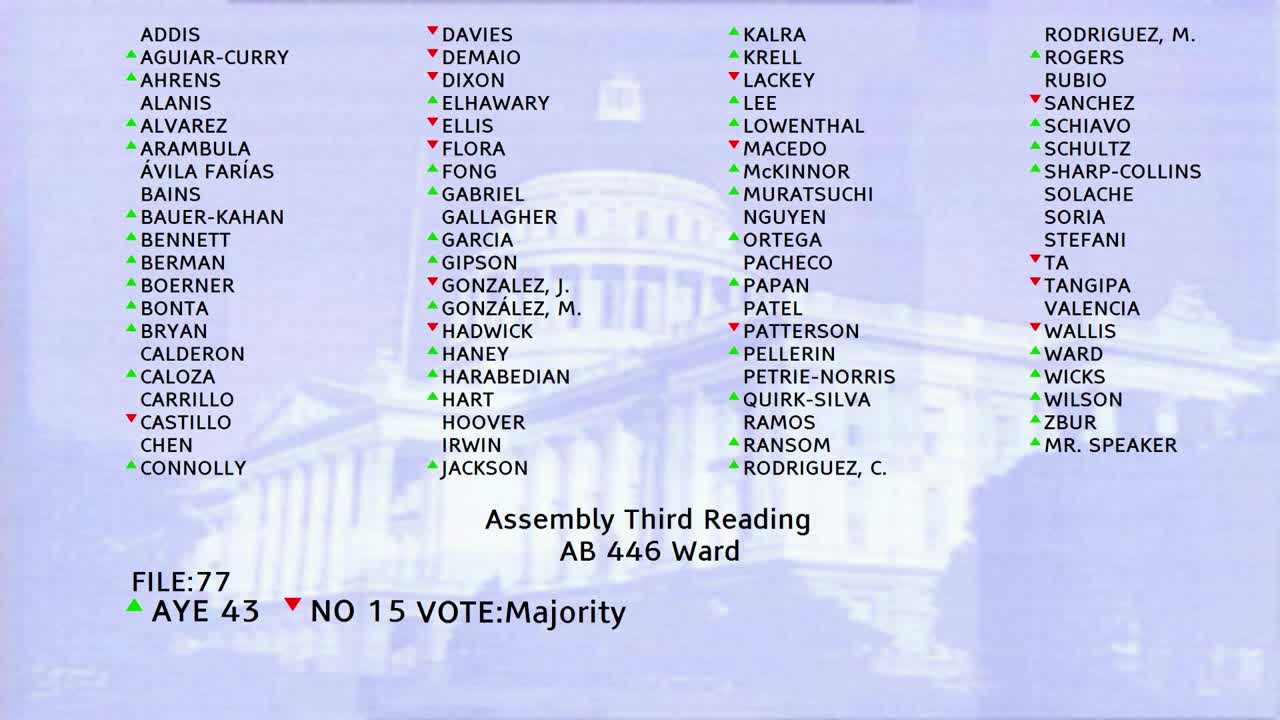 3MIN
Assembly Floor
 4MIN
Assembly Standing Committee on Public Employment and Retirement
Bill Author
Bill Co-Author(s):