AB 238: Mortgage forbearance: state of emergency: wildfire.
- Session Year: 2025-2026
- House: Assembly
- Latest Version Date: 2025-09-22
Current Status:
Passed
(2025-09-22: Chaptered by Secretary of State - Chapter 128, Statutes of 2025.)
Introduced
In Committee
Awaiting First Chamber Vote
Passed First Chamber
In Committee
Awaiting Second Chamber Vote
Passed Second Chamber
Enacted
Existing law requires a mortgage servicer to comply with applicable federal guidance regarding borrower options following a forbearance relating to the COVID-19 emergency.
This bill would authorize a borrower who is experiencing financial hardship that prevents the borrower from making timely payments on a specified residential mortgage loan due directly to the wildfire disaster described in the proclamation of a state of emergency issued by Governor Gavin Newsom on January 7, 2025, or the federally declared disaster, declared on January 8, 2025, related to the Eaton Wildfire, the Palisades Fire, and the Straight-line Winds, to request forbearance on their residential mortgage loan, as prescribed. The bill would limit eligibility for that forbearance to loans that are secured by residential real property improved by 4 or fewer residential units. The bill would require the borrower to affirm that they are experiencing a financial hardship due to the wildfire disaster. Because the bill would expand the crime of perjury, the bill would impose a state-mandated local program.
This bill would, except as specified, require a mortgage servicer to offer mortgage payment forbearance of a period of up to an initial 90 days, which shall be extended at the request of the borrower in 90-day increments, up to a maximum forbearance period of 12 months. The bill would also prohibit a mortgage servicer from assessing any late fees to the borrowers account or charging a default rate of interest during the forbearance period. The bill would provide that the forbearance period includes any period of forbearance related to the wildfire disaster that a mortgage servicer has provided to a borrower before the effective date of these provisions. The bill would require a mortgage servicer to report the credit obligations of borrowers under a disaster-related forbearance plan in compliance with the federal Fair Credit Reporting Act. For accounts granted disaster-related mortgage payment relief, the bill would prohibit mortgage servicers from furnishing information during the forbearance period indicating that the payments are in forbearance and would require them to report the credit obligation or account as current or delinquent, as specified. The bill would prohibit a mortgage servicer from initiating any judicial or nonjudicial foreclosure process, moving for a foreclosure judgment or order of sale, or executing a foreclosure-related eviction or foreclosure during the period of forbearance.
This bill would require the Department of Financial Protection and Innovation to post specified information on its website including links to the provisions of servicing guidelines pertaining to disaster-related forbearance relief for federally backed loans and a dedicated telephone number for borrowers seeking assistance.
The California Constitution requires the state to reimburse local agencies and school districts for certain costs mandated by the state. Statutory provisions establish procedures for making that reimbursement.
This bill would provide that no reimbursement is required by this act for a specified reason.
This bill would declare that it is to take effect immediately as an urgency statute.
Existing law requires a mortgage servicer to comply with applicable federal guidance regarding borrower options following a forbearance relating to the COVID-19 emergency.
This bill would authorize a borrower who is experiencing financial hardship that prevents the borrower from making timely payments on a specified residential mortgage loan due directly to the wildfire disaster described in the proclamation of a state of emergency issued by Governor Gavin Newsom on January 7, 2025, or the federally declared disaster, declared on January 8, 2025, related to the Eaton Wildfire, the Palisades Fire, and the Straight-line Winds, to request forbearance on their residential mortgage loan, as prescribed. The bill would limit eligibility for that forbearance to loans that are secured by residential real property improved by 4 or fewer residential units. The bill would require the borrower to affirm that they are experiencing a financial hardship due to the wildfire disaster. Because the bill would expand the crime of perjury, the bill would impose a state-mandated local program.
This bill would, except as specified, require a mortgage servicer to offer mortgage payment forbearance of a period of up to an initial 90 days, which shall be extended at the request of the borrower in 90-day increments, up to a maximum forbearance period of 12 months. The bill would also prohibit a mortgage servicer from assessing any late fees to the borrowers account or charging a default rate of interest during the forbearance period. The bill would provide that the forbearance period includes any period of forbearance related to the wildfire disaster that a mortgage servicer has provided to a borrower before the effective date of these provisions. The bill would require a mortgage servicer to report the credit obligations of borrowers under a disaster-related forbearance plan in compliance with the federal Fair Credit Reporting Act. For accounts granted disaster-related mortgage payment relief, the bill would prohibit mortgage servicers from furnishing information during the forbearance period indicating that the payments are in forbearance and would require them to report the credit obligation or account as current or delinquent, as specified. The bill would prohibit a mortgage servicer from initiating any judicial or nonjudicial foreclosure process, moving for a foreclosure judgment or order of sale, or executing a foreclosure-related eviction or foreclosure during the period of forbearance.
This bill would require the Department of Financial Protection and Innovation to post specified information on its website including links to the provisions of servicing guidelines pertaining to disaster-related forbearance relief for federally backed loans and a dedicated telephone number for borrowers seeking assistance.
The California Constitution requires the state to reimburse local agencies and school districts for certain costs mandated by the state. Statutory provisions establish procedures for making that reimbursement.
This bill would provide that no reimbursement is required by this act for a specified reason.
This bill would declare that it is to take effect immediately as an urgency statute.
Existing law requires a mortgage servicer to comply with applicable federal guidance regarding borrower options following a forbearance relating to the COVID-19 emergency.
This bill would authorize a borrower who is experiencing financial hardship that prevents the borrower from making timely payments on a specified residential mortgage loan due directly to the wildfire disaster described in the proclamation of a state of emergency issued by Governor Gavin Newsom on January 7, 2025, or the federally declared disaster, declared on January 8, 2025, related to the Eaton Wildfire, the Palisades Fire, and the Straight-line Winds, to request forbearance on their residential mortgage loan, as prescribed. The bill would limit eligibility for that forbearance to loans that are secured by residential real property improved by 4 or fewer residential units. The bill would require the borrower to affirm that they are experiencing a financial hardship due to the wildfire disaster. Because the bill would expand the crime of perjury, the bill would impose a state-mandated local program.
This bill would, except as specified, require a mortgage servicer to offer mortgage payment forbearance of a period of up to an initial 90 days, which shall be extended at the request of the borrower in 90-day increments, up to a maximum forbearance period of 12 months. The bill would also prohibit a mortgage servicer from assessing any late fees to the borrowers account or charging a default rate of interest during the forbearance period. The bill would provide that the forbearance period includes any period of forbearance related to the wildfire disaster that a mortgage servicer has provided to a borrower before the effective date of these provisions. The bill would require a mortgage servicer to report the credit obligations of borrowers under a disaster-related forbearance plan in compliance with the federal Fair Credit Reporting Act. For accounts granted disaster-related mortgage payment relief, the bill would prohibit mortgage servicers from furnishing information during the forbearance period indicating that the payments are in forbearance and would require them to report the credit obligation or account as current or delinquent, as specified. The bill would prohibit a mortgage servicer from initiating any judicial or nonjudicial foreclosure process, moving for a foreclosure judgment or order of sale, or executing a foreclosure-related eviction or foreclosure during the period of forbearance.
This bill would require the Department of Financial Protection and Innovation to post specified information on its website including links to the provisions of servicing guidelines pertaining to disaster-related forbearance relief for federally backed loans and a dedicated telephone number for borrowers seeking assistance.
The California Constitution requires the state to reimburse local agencies and school districts for certain costs mandated by the state. Statutory provisions establish procedures for making that reimbursement.
This bill would provide that no reimbursement is required by this act for a specified reason.
This bill would declare that it is to take effect immediately as an urgency statute.
Existing law requires a mortgage servicer to comply with applicable federal guidance regarding borrower options following a forbearance relating to the COVID-19 emergency.
This bill would authorize a borrower who is experiencing financial hardship that prevents the borrower from making timely payments on a specified residential mortgage loan due directly to the wildfire disaster described in the proclamation of a state of emergency issued by Governor Gavin Newsom on January 7, 2025, or the federally declared disaster, declared on January 8, 2025, related to the Eaton Wildfire, the Palisades Fire, and the Straight-line Winds, to request forbearance on their residential mortgage loan, as prescribed. The bill would limit eligibility for that forbearance to loans that are secured by residential real property improved by 4 or fewer residential units. The bill would require the borrower to affirm that they are experiencing a financial hardship due to the wildfire disaster. Because the bill would expand the crime of perjury, the bill would impose a state-mandated local program.
This bill would, except as specified, require a mortgage servicer to offer mortgage payment forbearance of a period of up to an initial 90 days, which shall be extended at the request of the borrower in 90-day increments, up to a maximum forbearance period of 12 months. The bill would also prohibit a mortgage servicer from assessing any late fees to the borrowers account or charging a default rate of interest during the forbearance period. The bill would provide that the forbearance period includes any period of forbearance related to the wildfire disaster that a mortgage servicer has provided to a borrower before the effective date of these provisions. The bill would require a mortgage servicer to report the credit obligations of borrowers under a disaster-related forbearance plan in compliance with the federal Fair Credit Reporting Act and applicable federal guidelines. Act. For accounts granted disaster-related mortgage payment relief that were current when the borrower entered forbearance, and that are otherwise performing as agreed, relief, the bill would require prohibit mortgage servicers to suspend reporting delinquencies to consumer reporting agencies and would prohibit them from furnishing information regarding payment forbearance to consumer reporting agencies. during the forbearance period indicating that the payments are in forbearance and would require them to report the credit obligation or account as current or delinquent, as specified. The bill would prohibit a mortgage servicer from initiating any judicial or nonjudicial foreclosure process, moving for a foreclosure judgment or order of sale, or executing a foreclosure-related eviction or foreclosure during the period of forbearance.
This bill would require the Department of Financial Protection and Innovation to post specified information on its website including links to the provisions of servicing guidelines pertaining to disaster-related forbearance relief for federally backed loans and a dedicated telephone number for borrowers seeking assistance.
The California Constitution requires the state to reimburse local agencies and school districts for certain costs mandated by the state. Statutory provisions establish procedures for making that reimbursement.
This bill would provide that no reimbursement is required by this act for a specified reason.
This bill would declare that it is to take effect immediately as an urgency statute.
Existing law requires a mortgage servicer to comply with applicable federal guidance regarding borrower options following a forbearance relating to the COVID-19 emergency.
This bill would authorize a borrower who is experiencing financial hardship that prevents the borrower from making timely payments on a specified residential mortgage loan due directly to the wildfire disaster described in the proclamation of a state of emergency issued by Governor Gavin Newsom on January 7, 2025, or the federally declared disaster, declared on January 8, 2025, related to the Eaton Wildfire, the Palisades Fire, and the Straight-line Winds, to request forbearance on their residential mortgage loan, as prescribed. The bill would limit eligibility for that forbearance to loans that are secured by residential real property improved by 4 or fewer residential units. The bill would require the borrower to affirm that they are experiencing a financial hardship due to the wildfire disaster. Because the bill would expand the crime of perjury, the bill would impose a state-mandated local program.
This bill would, except as specified, require a mortgage servicer to offer mortgage payment forbearance of a period of up to an initial 90 days, which shall be extended at the request of the borrower in 90-day increments, up to a maximum forbearance period of 12 months. The bill would also prohibit a mortgage servicer from assessing any late fees to the borrowers account or charging a default rate of interest during the forbearance period. The bill would provide that the forbearance period includes any period of forbearance related to the wildfire disaster that a mortgage servicer has provided to a borrower before the effective date of these provisions. The bill would require a mortgage servicer to report the credit obligations of borrowers under a disaster-related forbearance plan in compliance with the federal Fair Credit Reporting Act and applicable federal guidelines and suspend reporting delinquencies to consumer reporting agencies for guidelines. For accounts granted disaster-related mortgage payment relief that were current when the borrower entered forbearance, and that are otherwise performing as agreed. agreed, the bill would require mortgage servicers to suspend reporting delinquencies to consumer reporting agencies and would prohibit them from furnishing information regarding payment forbearance to consumer reporting agencies. The bill would prohibit a mortgage servicer from initiating any judicial or nonjudicial foreclosure process, moving for a foreclosure judgment or order of sale, or executing a foreclosure-related eviction or foreclosure during the period of forbearance.
This bill would require the Department of Financial Protection and Innovation to post specified information on its website including links to the provisions of servicing guidelines pertaining to disaster-related forbearance relief for federally backed loans and a dedicated telephone number for borrowers seeking assistance.
The California Constitution requires the state to reimburse local agencies and school districts for certain costs mandated by the state. Statutory provisions establish procedures for making that reimbursement.
This bill would provide that no reimbursement is required by this act for a specified reason.
This bill would declare that it is to take effect immediately as an urgency statute.
Existing law requires a mortgage servicer to comply with applicable federal guidance regarding borrower options following a forbearance relating to the COVID-19 emergency.
This bill would authorize a borrower who is experiencing financial hardship that prevents the borrower from making timely payments on a specified residential mortgage loan due directly, as defined, directly to the wildfire disaster described in the proclamation of a state of emergency issued by Governor Gavin Newsom on January 7, 2025, or the federally declared disaster, declared on January 8, 2025, related to the Eaton Wildfire, the Palisades Fire, and the Straight-line Winds, to request forbearance on their residential mortgage loan. loan, as prescribed. The bill would limit eligibility for that forbearance to residential mortgage loans for personal, family, or household use, or borrowers with 10 or fewer investment properties. loans that are secured by residential real property improved by 4 or fewer residential units. The bill would require the borrower to affirm that they are experiencing a financial hardship during due to the wildfire disaster. Because the bill would expand the crime of perjury, the bill would impose a state-mandated local program.
This bill would would, except as specified, require a mortgage servicer to, with no additional documentation required other than the borrowers attestation to a financial hardship caused by the wildfire disaster and with no fees, penalties, or interest, provide the forbearance for up to 180 days. The bill would authorize a mortgage servicer, after that initial 180-day period, to require the borrower to provide documentation of ongoing financial hardship, and to participate in a check-in with the mortgage servicer every 90 days thereafter, in order to extend the period of forbearance for no more than one additional year. to offer mortgage payment forbearance of a period of up to an initial 90 days, which shall be extended at the request of the borrower in 90-day increments, up to a maximum forbearance period of 12 months. The bill would also prohibit a mortgage servicer from initiating any foreclosure process, moving for a foreclosure judgment or order of sale, executing a foreclosure-related eviction or foreclosure sale, or requiring a lump sum payment at the end of the forbearance period. The bill would prohibit a mortgage servicer from acting to negatively impact a borrowers credit score, or otherwise reporting any adverse information to a consumer credit reporting agency about a borrower, in connection with granting forbearance pursuant to these provisions. The bill would also require that any period of mortgage forbearance or deferred payment voluntarily offered by a mortgage servicer to a borrower due to the wildfire disaster before the date upon which these provisions become operative be credited toward the forbearance periods required to be afforded to a borrower by this bill. assessing any late fees to the borrowers account or charging a default rate of interest during the forbearance period. The bill would provide that the forbearance period includes any period of forbearance related to the wildfire disaster that a mortgage servicer has provided to a borrower before the effective date of these provisions. The bill would require a mortgage servicer to report the credit obligations of borrowers under a disaster-related forbearance plan in compliance with the federal Fair Credit Reporting Act and applicable federal guidelines and suspend reporting delinquencies to consumer reporting agencies for accounts granted disaster-related mortgage payment relief that were current when the borrower entered forbearance, and are otherwise performing as agreed. The bill would prohibit a mortgage servicer from initiating any judicial or nonjudicial foreclosure process, moving for a foreclosure judgment or order of sale, or executing a foreclosure-related eviction or foreclosure during the period of forbearance.
This bill would require the Department of Financial Protection and Innovation to post specified information on its website including links to the provisions of servicing guidelines pertaining to disaster-related forbearance relief for federally backed loans and a dedicated telephone number for borrowers seeking assistance.
The California Constitution requires the state to reimburse local agencies and school districts for certain costs mandated by the state. Statutory provisions establish procedures for making that reimbursement.
This bill would provide that no reimbursement is required by this act for a specified reason.
This bill would declare that it is to take effect immediately as an urgency statute.
Existing law requires a mortgage servicer to comply with applicable federal guidance regarding borrower options following a forbearance relating to the COVID-19 emergency.
This bill would authorize a borrower who is experiencing financial hardship due directly, as defined, to the wildfire disaster described in the proclamation of a state of emergency issued by Governor Gavin Newsom on January 7, 2025, to request forbearance on their mortgage loan. The bill would limit eligibility for that forbearance to residential mortgage loans for personal, family, or household use, or borrowers with 10 or fewer investment properties. The bill would require the borrower to affirm that they are experiencing a financial hardship during the wildfire disaster. Because the bill would expand the crime of perjury, the bill would impose a state-mandated local program.
This bill would require a mortgage servicer to, with no additional documentation required other than the borrowers attestation to a financial hardship caused by the wildfire disaster and with no fees, penalties, or interest, provide the forbearance for up to 180 days, which may be extended for an additional period of up to 180 days at the request of the borrower. days. The bill would authorize a mortgage servicer, after that initial 180-day period, to require the borrower to provide documentation of ongoing financial hardship, and to participate in a check-in with the mortgage servicer every 90 days thereafter, in order to extend the period of forbearance for no more than one additional year. The bill would also prohibit a mortgage servicer from initiating any foreclosure process, moving for a foreclosure judgment or order of sale, or executing a foreclosure-related eviction or foreclosure sale. sale, or requiring a lump sum payment at the end of the forbearance period. The bill would prohibit a mortgage servicer from acting to negatively impact a borrowers credit score, or otherwise reporting any adverse information to a consumer credit reporting agency about a borrower, in connection with granting forbearance pursuant to these provisions. The bill would also require that any period of mortgage forbearance or deferred payment voluntarily offered by a mortgage servicer to a borrower due to the wildfire disaster before the date upon which these provisions become operative be credited toward the forbearance periods required to be afforded to a borrower by this bill.
The California Constitution requires the state to reimburse local agencies and school districts for certain costs mandated by the state. Statutory provisions establish procedures for making that reimbursement.
This bill would provide that no reimbursement is required by this act for a specified reason.
This bill would declare that it is to take effect immediately as an urgency statute.
Existing law requires a mortgage servicer to comply with applicable federal guidance regarding borrower options following a forbearance relating to the COVID-19 emergency.
This bill would authorize a borrower who is experiencing financial hardship due to the wildfire disaster described in the proclamation of a state of emergency issued by Governor Gavin Newsom on January 7, 2025, to request forbearance on their mortgage loan. The bill would require the borrower to affirm that they are experiencing a financial hardship during the wildfire disaster. Because the bill would expand the crime of perjury, the bill would impose a state-mandated local program.
This bill would require a mortgage servicer to, with no additional documentation required other than the borrowers attestation to a financial hardship caused by the wildfire disaster and with no fees, penalties, or interest, provide the forbearance for up to 180 days, which may be extended for an additional period of up to 180 days at the request of the borrower. The bill would also prohibit a mortgage servicer from initiating any foreclosure process, moving for a foreclosure judgment or order of sale, or executing a foreclosure-related eviction or foreclosure sale.
The California Constitution requires the state to reimburse local agencies and school districts for certain costs mandated by the state. Statutory provisions establish procedures for making that reimbursement.
This bill would provide that no reimbursement is required by this act for a specified reason.
This bill would declare that it is to take effect immediately as an urgency statute.
This title is known, and may be cited, as the Mortgage Forbearance Act.
3273.21.For purposes of this title, the following terms have the following meanings:
(a)(1)Borrower means a natural person who is a mortgagor or trustor, or a person who holds a power of attorney for a mortgagor or trustor.
(2)Borrower does not include an individual who has surrendered the secured property as evidenced by either a letter confirming the surrender or delivery of the keys to the property to the mortgagee, trustee, beneficiary, or authorized agent.
(3)Borrower does not include an individual who has a recorded notice of default recorded against the real property that is secured by the residential mortgage loan before the beginning of the wildfire disaster unless the notice of default was rescinded.
(b)Federally backed loan means a residential mortgage loan that is insured, guaranteed, purchased, or secured by a federal agency or government-sponsored entity.
(c)Disaster-related forbearance relief means the relief described in servicing guidelines for federally backed loans.
(d)(1)Mortgage servicer means a person or entity who directly services a loan or who is responsible for interacting with the borrower, managing the loan account on a daily basis, including collecting and crediting periodic loan payments, managing any escrow account, or enforcing the note and security instrument, either as the current owner of the promissory note or as the current owners authorized agent.
(2)Mortgage servicer also means a subservicing agent to a master servicer by contract.
(3)Mortgage servicer does not include a trustee, or a trustees authorized agent, acting under a power of sale pursuant to a deed of trust.
(e)Residential mortgage loan means a loan that is secured by residential real property improved by four or fewer residential units.
(f)Wildfire disaster means the conditions described in the proclamation of a state of emergency issued by Governor Gavin Newsom on January 7, 2025, or the federally declared disaster, declared on January 8, 2025, related to the Eaton Wildfire, the Palisades Fire, and the Straight-line Winds (DR-4856-CA).
3273.22.This title applies to a depository institution chartered under federal or state law, a person covered by the licensing requirements of Division 9 (commencing with Section 22000) or Division 20 (commencing with Section 50000) of the Financial Code, or a person licensed pursuant to Part 1 (commencing with Section 10000) of Division 4 of the Business and Professions Code.
3273.23.(a)A borrower who is experiencing financial hardship that prevents the borrower from making timely payments on a residential mortgage loan due directly to the wildfire disaster may request forbearance on the residential mortgage loan by doing both of the following:
(1)Submitting a request to the borrowers mortgage loan servicer before the earlier of either of the following:
(A)Six months after the date upon which the state of emergency issued by Governor Gavin Newsom on January 7, 2025, is terminated.
(B)January 7, 2027.
(2)Affirming that the borrower is experiencing a financial hardship due to the wildfire disaster.
(b)Upon a request by a borrower for forbearance under subdivision (a), a mortgage servicer shall offer mortgage payment forbearance for a period of up to an initial 90 days, which shall be extended at the request of the borrower in 90-day increments, up to a maximum forbearance period of 12 months.
(c)The borrower shall be notified within 10 business days by the mortgage servicer whether their request for forbearance has been approved.
(d)If the mortgage servicer, acting under delegated authority to make forbearance determinations on behalf of the investor, denies a forbearance request within the maximum allowable forbearance period of 12 months pursuant to subdivision (b), the mortgage servicer shall not be in violation of this section if the mortgage servicer provides written notice to the borrower stating the specific reason for denial. The notice shall include both of the following:
(1)A clear and concise explanation of the specific investor provision that is the basis for the denial.
(2)The text of the specific investor guideline or contractual provision that is the basis for the denial of the borrowers forbearance request.
(e)If the written notice in subdivision (c) cites any defect in the borrowers request, including an incomplete application or missing information, that is curable, the mortgage servicer shall do all of the following:
(1)Specifically identify any curable defect in the written notice.
(2)Provide 21 calendar days from the mailing date of the written notice for the borrower to cure any identified defect.
(3)Accept the borrowers revised request for forbearance before the 21-day period described in paragraph (2) lapses.
(4)Respond to the borrowers revised request within five business days of receipt of the revised request.
(f)The forbearance period required by subdivision (b) shall include any period of forbearance related to the wildfire disaster that a mortgage servicer has provided to a borrower before the effective date of this title.
(g)During the period of forbearance required by this section, no late fees shall be assessed to the borrowers account and the borrower shall not be charged a default rate of interest.
(h)No later than 30 calendar days before the end of an initial forbearance period, a mortgage servicer shall provide written notice to the borrower disclosing both of the following:
(1)Any documentation or forms that the mortgage servicer requires the borrower to furnish or complete to be considered for an additional period of forbearance.
(2)A description of the deadlines and timelines associated with considering the borrower for an additional period of forbearance.
(i)A mortgage servicer shall report the credit obligations of borrowers under a disaster-related forbearance plan in compliance with the federal Fair Credit Reporting Act (15 U.S.C. Sec. 1681 et seq.). For accounts granted disaster-related mortgage payment relief pursuant to this title, a mortgage servicer shall not furnish information during the forbearance period indicating that the payments are in forbearance and shall do either of the following:
(1)Report the credit obligation or account as current.
(2)If a borrower was delinquent before the disaster-related forbearance plan, the mortgage servicer shall:
(A)Maintain the delinquent status during the period in which the plan is in effect.
(B)If the consumer brings the account current during the forbearance period, report the account as current.
3273.24.(a)A mortgage servicer shall disclose to a borrower to whom a forbearance has been granted pursuant to Section 3273.23 that the forborne mortgage payments are required to be repaid.
(b)The disclosure required by subdivision (a) is only required to be furnished to the borrower once at the beginning of the forbearance period.
(c)A lump sum payment shall not be required for a borrower who was current on the residential mortgage loan when the borrower entered forbearance.
3273.25.During the time of forbearance granted pursuant to this title, a mortgage servicer shall not initiate any judicial or nonjudicial foreclosure process, move for a foreclosure judgment or order of sale, or execute a foreclosure-related eviction or foreclosure sale if the borrower is performing pursuant to the terms of the forbearance.
3273.26.Failure to comply with this title shall not affect the validity of a trustees sale or a sale to a bona fide purchaser for value.
3273.27.(a)(1)With respect to a federally backed loan, a person shall not be held liable for a violation of this title if compliance with this title conflicts with the servicing guidelines applicable to the federally backed loan.
(2)Servicing guidelines applicable to a federally backed loan includes servicing guidelines like those issued by the Federal National Mortgage Association (Fannie Mae) and the Federal Home Loan Mortgage Corporation (Freddie Mac), the Single Family Housing Policy Handbook issued by the Federal Housing Administration of the United States Department of Housing and Urban Development, the VA Servicer Handbook issued by the United States Department of Veterans Affairs, or a servicing handbook issued by the Rural Development division of the United States Department of Agriculture, as those guidelines existed on January 13, 2025.
(b)With respect to a residential mortgage loan that is not a federally backed loan, a person shall not be held liable for a violation of this title if compliance with this title conflicts with the servicing guidelines issued by Fannie Mae or Freddie Mac.
(c)For purposes of this section, conflicts with means that it is impossible to comply with this title and the persons obligation under the applicable servicing guidelines.
3273.28.The Department of Financial Protection and Innovation shall post all of the following on its website:
(a)Links to the provisions of servicing guidelines pertaining to disaster-related forbearance relief for federally backed loans.
(b)A summary of Fannie Mae and Freddie Mac guidance to assist borrowers in understanding their forbearance programs.
(c)A dedicated telephone number for borrowers seeking assistance.
3273.29.(a)It is the intent of the Legislature that a mortgage servicer offer a borrower forbearance that is consistent with the mortgage servicers contractual or other authority. Nothing in this title requires a mortgage servicer to take any action that would require the mortgage servicer to breach the terms of an existing contract with the investor that owns or insures the residential mortgage loan.
(b)It is the intent that this title not apply to servicing guidelines that are unrelated to disaster-related forbearance relief.
3273.30.The provisions of this title are severable. If any provision of this title or its application is held invalid, that invalidity shall not affect other provisions or applications that can be given effect without the invalid provision or application.
SEC. 2.No reimbursement is required by this act pursuant to Section 6 of Article XIIIB of the California Constitution because the only costs that may be incurred by a local agency or school district will be incurred because this act creates a new crime or infraction, eliminates a crime or infraction, or changes the penalty for a crime or infraction, within the meaning of Section 17556 of the Government Code, or changes the definition of a crime within the meaning of Section 6 of Article XIIIB of the California Constitution.
SEC. 3.This act is an urgency statute necessary for the immediate preservation of the public peace, health, or safety within the meaning of Article IV of the California Constitution and shall go into immediate effect. The facts constituting the necessity are:
To avert economic and social harm by providing a structure for temporary relief to financially distressed borrowers during conditions of extreme peril to the safety of persons and property that exist due to impacts of the Eaton Fire, the Palisades Fire, and the windstorm, it is necessary that this act take effect immediately.
This title is known, and may be cited, as the Mortgage Forbearance Act.
3273.21.For purposes of this title, the following terms have the following meanings:
(a)(1)Borrower means a natural person who is a mortgagor or trustor, or a person who holds a power of attorney for a mortgagor or trustor.
(2)Borrower does not include an individual who has surrendered the secured property as evidenced by either a letter confirming the surrender or delivery of the keys to the property to the mortgagee, trustee, beneficiary, or authorized agent.
(3)Borrower does not include an individual who has a recorded notice of default recorded against the real property that is secured by the residential mortgage loan before the beginning of the wildfire disaster unless the notice of default was rescinded.
(b)Federally backed loan means a residential mortgage loan that is insured, guaranteed, purchased, or secured by a federal agency or government-sponsored entity.
(c)Disaster-related forbearance relief means the relief described in servicing guidelines for federally backed loans.
(d)(1)Mortgage servicer means a person or entity who directly services a loan or who is responsible for interacting with the borrower, managing the loan account on a daily basis, including collecting and crediting periodic loan payments, managing any escrow account, or enforcing the note and security instrument, either as the current owner of the promissory note or as the current owners authorized agent.
(2)Mortgage servicer also means a subservicing agent to a master servicer by contract.
(3)Mortgage servicer does not include a trustee, or a trustees authorized agent, acting under a power of sale pursuant to a deed of trust.
(e)Residential mortgage loan means a loan that is secured by residential real property improved by four or fewer residential units.
(f)Wildfire disaster means the conditions described in the proclamation of a state of emergency issued by Governor Gavin Newsom on January 7, 2025, or the federally declared disaster, declared on January 8, 2025, related to the Eaton Wildfire, the Palisades Fire, and the Straight-line Winds (DR-4856-CA).
3273.22.This title applies to a depository institution chartered under federal or state law, a person covered by the licensing requirements of Division 9 (commencing with Section 22000) or Division 20 (commencing with Section 50000) of the Financial Code, or a person licensed pursuant to Part 1 (commencing with Section 10000) of Division 4 of the Business and Professions Code.
3273.23.(a)A borrower who is experiencing financial hardship that prevents the borrower from making timely payments on a residential mortgage loan due directly to the wildfire disaster may request forbearance on the residential mortgage loan by doing both of the following:
(1)Submitting a request to the borrowers mortgage loan servicer before the earlier of either of the following:
(A)Six months after the date upon which the state of emergency issued by Governor Gavin Newsom on January 7, 2025, is terminated.
(B)January 7, 2027.
(2)Affirming that the borrower is experiencing a financial hardship due to the wildfire disaster.
(b)Upon a request by a borrower for forbearance under subdivision (a), a mortgage servicer shall offer mortgage payment forbearance for a period of up to an initial 90 days, which shall be extended at the request of the borrower in 90-day increments, up to a maximum forbearance period of 12 months.
(c)The borrower shall be notified within 10 business days by the mortgage servicer whether their request for forbearance has been approved.
(d)If the mortgage servicer, acting under delegated authority to make forbearance determinations on behalf of the investor, denies a forbearance request within the maximum allowable forbearance period of 12 months pursuant to subdivision (b), the mortgage servicer shall not be in violation of this section if the mortgage servicer provides written notice to the borrower stating the specific reason for denial. The notice shall include both of the following:
(1)A clear and concise explanation of the specific investor provision that is the basis for the denial.
(2)The text of the specific investor guideline or contractual provision that is the basis for the denial of the borrowers forbearance request.
(e)If the written notice in subdivision (c) cites any defect in the borrowers request, including an incomplete application or missing information, that is curable, the mortgage servicer shall do all of the following:
(1)Specifically identify any curable defect in the written notice.
(2)Provide 21 calendar days from the mailing date of the written notice for the borrower to cure any identified defect.
(3)Accept the borrowers revised request for forbearance before the 21-day period described in paragraph (2) lapses.
(4)Respond to the borrowers revised request within five business days of receipt of the revised request.
(f)The forbearance period required by subdivision (b) shall include any period of forbearance related to the wildfire disaster that a mortgage servicer has provided to a borrower before the effective date of this title.
(g)During the period of forbearance required by this section, no late fees shall be assessed to the borrowers account and the borrower shall not be charged a default rate of interest.
(h)No later than 30 calendar days before the end of an initial forbearance period, a mortgage servicer shall provide written notice to the borrower disclosing both of the following:
(1)Any documentation or forms that the mortgage servicer requires the borrower to furnish or complete to be considered for an additional period of forbearance.
(2)A description of the deadlines and timelines associated with considering the borrower for an additional period of forbearance.
(i)A mortgage servicer shall report the credit obligations of borrowers under a disaster-related forbearance plan in compliance with the federal Fair Credit Reporting Act (15 U.S.C. Sec. 1681 et seq.). For accounts granted disaster-related mortgage payment relief pursuant to this title, a mortgage servicer shall not furnish information during the forbearance period indicating that the payments are in forbearance and shall do either of the following:
(1)Report the credit obligation or account as current.
(2)If a borrower was delinquent before the disaster-related forbearance plan, the mortgage servicer shall:
(A)Maintain the delinquent status during the period in which the plan is in effect.
(B)If the consumer brings the account current during the forbearance period, report the account as current.
3273.24.(a)A mortgage servicer shall disclose to a borrower to whom a forbearance has been granted pursuant to Section 3273.23 that the forborne mortgage payments are required to be repaid.
(b)The disclosure required by subdivision (a) is only required to be furnished to the borrower once at the beginning of the forbearance period.
(c)A lump sum payment shall not be required for a borrower who was current on the residential mortgage loan when the borrower entered forbearance.
3273.25.During the time of forbearance granted pursuant to this title, a mortgage servicer shall not initiate any judicial or nonjudicial foreclosure process, move for a foreclosure judgment or order of sale, or execute a foreclosure-related eviction or foreclosure sale if the borrower is performing pursuant to the terms of the forbearance.
3273.26.Failure to comply with this title shall not affect the validity of a trustees sale or a sale to a bona fide purchaser for value.
3273.27.(a)(1)With respect to a federally backed loan, a person shall not be held liable for a violation of this title if compliance with this title conflicts with the servicing guidelines applicable to the federally backed loan.
(2)Servicing guidelines applicable to a federally backed loan includes servicing guidelines like those issued by the Federal National Mortgage Association (Fannie Mae) and the Federal Home Loan Mortgage Corporation (Freddie Mac), the Single Family Housing Policy Handbook issued by the Federal Housing Administration of the United States Department of Housing and Urban Development, the VA Servicer Handbook issued by the United States Department of Veterans Affairs, or a servicing handbook issued by the Rural Development division of the United States Department of Agriculture, as those guidelines existed on January 13, 2025.
(b)With respect to a residential mortgage loan that is not a federally backed loan, a person shall not be held liable for a violation of this title if compliance with this title conflicts with the servicing guidelines issued by Fannie Mae or Freddie Mac.
(c)For purposes of this section, conflicts with means that it is impossible to comply with this title and the persons obligation under the applicable servicing guidelines.
3273.28.The Department of Financial Protection and Innovation shall post all of the following on its website:
(a)Links to the provisions of servicing guidelines pertaining to disaster-related forbearance relief for federally backed loans.
(b)A summary of Fannie Mae and Freddie Mac guidance to assist borrowers in understanding their forbearance programs.
(c)A dedicated telephone number for borrowers seeking assistance.
3273.29.(a)It is the intent of the Legislature that a mortgage servicer offer a borrower forbearance that is consistent with the mortgage servicers contractual or other authority. Nothing in this title requires a mortgage servicer to take any action that would require the mortgage servicer to breach the terms of an existing contract with the investor that owns or insures the residential mortgage loan.
(b)It is the intent that this title not apply to servicing guidelines that are unrelated to disaster-related forbearance relief.
3273.30.The provisions of this title are severable. If any provision of this title or its application is held invalid, that invalidity shall not affect other provisions or applications that can be given effect without the invalid provision or application.
SEC. 2.No reimbursement is required by this act pursuant to Section 6 of Article XIIIB of the California Constitution because the only costs that may be incurred by a local agency or school district will be incurred because this act creates a new crime or infraction, eliminates a crime or infraction, or changes the penalty for a crime or infraction, within the meaning of Section 17556 of the Government Code, or changes the definition of a crime within the meaning of Section 6 of Article XIIIB of the California Constitution.
SEC. 3.This act is an urgency statute necessary for the immediate preservation of the public peace, health, or safety within the meaning of Article IV of the California Constitution and shall go into immediate effect. The facts constituting the necessity are:
To avert economic and social harm by providing a structure for temporary relief to financially distressed borrowers during conditions of extreme peril to the safety of persons and property that exist due to impacts of the Eaton Fire, the Palisades Fire, and the windstorm, it is necessary that this act take effect immediately.
This title is known, and may be cited, as the Mortgage Forbearance Act.
3273.21.For purposes of this title, the following terms have the following meanings:
(a)(1)Borrower means a natural person who is a mortgagor or trustor, or a person who holds a power of attorney for a mortgagor or trustor.
(2)Borrower does not include an individual who has surrendered the secured property as evidenced by either a letter confirming the surrender or delivery of the keys to the property to the mortgagee, trustee, beneficiary, or authorized agent.
(3)Borrower does not include an individual who has a recorded notice of default recorded against the real property that is secured by the residential mortgage loan before the beginning of the wildfire disaster unless the notice of default was rescinded.
(b)Federally backed loan means a residential mortgage loan that is insured, guaranteed, purchased, or secured by a federal agency or government-sponsored entity.
(c)Disaster-related forbearance relief means the relief described in servicing guidelines for federally backed loans.
(d)(1)Mortgage servicer means a person or entity who directly services a loan or who is responsible for interacting with the borrower, managing the loan account on a daily basis, including collecting and crediting periodic loan payments, managing any escrow account, or enforcing the note and security instrument, either as the current owner of the promissory note or as the current owners authorized agent.
(2)Mortgage servicer also means a subservicing agent to a master servicer by contract.
(3)Mortgage servicer does not include a trustee, or a trustees authorized agent, acting under a power of sale pursuant to a deed of trust.
(e)Residential mortgage loan means a loan that is secured by residential real property improved by four or fewer residential units.
(f)Wildfire disaster means the conditions described in the proclamation of a state of emergency issued by Governor Gavin Newsom on January 7, 2025, or the federally declared disaster, declared on January 8, 2025, related to the Eaton Wildfire, the Palisades Fire, and the Straight-line Winds (DR-4856-CA).
3273.22.This title applies to a depository institution chartered under federal or state law, a person covered by the licensing requirements of Division 9 (commencing with Section 22000) or Division 20 (commencing with Section 50000) of the Financial Code, or a person licensed pursuant to Part 1 (commencing with Section 10000) of Division 4 of the Business and Professions Code.
3273.23.(a)A borrower who is experiencing financial hardship that prevents the borrower from making timely payments on a residential mortgage loan due directly to the wildfire disaster may request forbearance on the residential mortgage loan by doing both of the following:
(1)Submitting a request to the borrowers mortgage loan servicer before the earlier of either of the following:
(A)Six months after the date upon which the state of emergency issued by Governor Gavin Newsom on January 7, 2025, is terminated.
(B)January 7, 2027.
(2)Affirming that the borrower is experiencing a financial hardship due to the wildfire disaster.
(b)Upon a request by a borrower for forbearance under subdivision (a), a mortgage servicer shall offer mortgage payment forbearance for a period of up to an initial 90 days, which shall be extended at the request of the borrower in 90-day increments, up to a maximum forbearance period of 12 months.
(c)The borrower shall be notified within 10 business days by the mortgage servicer whether their request for forbearance has been approved.
(d)If the mortgage servicer, acting under delegated authority to make forbearance determinations on behalf of the investor, denies a forbearance request within the maximum allowable forbearance period of 12 months pursuant to subdivision (b), the mortgage servicer shall not be in violation of this section if the mortgage servicer provides written notice to the borrower stating the specific reason for denial. The notice shall include both of the following:
(1)A clear and concise explanation of the specific investor provision that is the basis for the denial.
(2)The text of the specific investor guideline or contractual provision that is the basis for the denial of the borrowers forbearance request.
(e)If the written notice in subdivision (c) cites any defect in the borrowers request, including an incomplete application or missing information, that is curable, the mortgage servicer shall do all of the following:
(1)Specifically identify any curable defect in the written notice.
(2)Provide 21 calendar days from the mailing date of the written notice for the borrower to cure any identified defect.
(3)Accept the borrowers revised request for forbearance before the 21-day period described in paragraph (2) lapses.
(4)Respond to the borrowers revised request within five business days of receipt of the revised request.
(f)The forbearance period required by subdivision (b) shall include any period of forbearance related to the wildfire disaster that a mortgage servicer has provided to a borrower before the effective date of this title.
(g)During the period of forbearance required by this section, no late fees shall be assessed to the borrowers account and the borrower shall not be charged a default rate of interest.
(h)No later than 30 calendar days before the end of an initial forbearance period, a mortgage servicer shall provide written notice to the borrower disclosing both of the following:
(1)Any documentation or forms that the mortgage servicer requires the borrower to furnish or complete to be considered for an additional period of forbearance.
(2)A description of the deadlines and timelines associated with considering the borrower for an additional period of forbearance.
(i)A mortgage servicer shall report the credit obligations of borrowers under a disaster-related forbearance plan in compliance with the federal Fair Credit Reporting Act (15 U.S.C. Sec. 1681 et seq.). For accounts granted disaster-related mortgage payment relief pursuant to this title, a mortgage servicer shall not furnish information during the forbearance period indicating that the payments are in forbearance and shall do either of the following:
(1)Report the credit obligation or account as current.
(2)If a borrower was delinquent before the disaster-related forbearance plan, the mortgage servicer shall:
(A)Maintain the delinquent status during the period in which the plan is in effect.
(B)If the consumer brings the account current during the forbearance period, report the account as current.
3273.24.(a)A mortgage servicer shall disclose to a borrower to whom a forbearance has been granted pursuant to Section 3273.23 that the forborne mortgage payments are required to be repaid.
(b)The disclosure required by subdivision (a) is only required to be furnished to the borrower once at the beginning of the forbearance period.
(c)A lump sum payment shall not be required for a borrower who was current on the residential mortgage loan when the borrower entered forbearance.
3273.253273.25.During the time of forbearance granted pursuant to this title, a mortgage servicer shall not initiate any judicial or nonjudicial foreclosure process, move for a foreclosure judgment or order of sale, or execute a foreclosure-related eviction or foreclosure sale if the borrower is performing pursuant to the terms of the forbearance.
3273.26.Failure to comply with this title shall not affect the validity of a trustees sale or a sale to a bona fide purchaser for value.
3273.27.(a)(1)With respect to a federally backed loan, a person shall not be held liable for a violation of this title if compliance with this title conflicts with the servicing guidelines applicable to the federally backed loan.
(2)Servicing guidelines applicable to a federally backed loan includes servicing guidelines like those issued by the Federal National Mortgage Association (Fannie Mae) and the Federal Home Loan Mortgage Corporation (Freddie Mac), the Single Family Housing Policy Handbook issued by the Federal Housing Administration of the United States Department of Housing and Urban Development, the VA Servicer Handbook issued by the United States Department of Veterans Affairs, or a servicing handbook issued by the Rural Development division of the United States Department of Agriculture, as those guidelines existed on January 13, 2025.
(b)With respect to a residential mortgage loan that is not a federally backed loan, a person shall not be held liable for a violation of this title if compliance with this title conflicts with the servicing guidelines issued by Fannie Mae or Freddie Mac.
(c)For purposes of this section, conflicts with means that it is impossible to comply with this title and the persons obligation under the applicable servicing guidelines.
3273.28.The Department of Financial Protection and Innovation shall post all of the following on its website:
(a)Links to the provisions of servicing guidelines pertaining to disaster-related forbearance relief for federally backed loans.
(b)A summary of Fannie Mae and Freddie Mac guidance to assist borrowers in understanding their forbearance programs.
(c)A dedicated telephone number for borrowers seeking assistance.
3273.29.(a)It is the intent of the Legislature that a mortgage servicer offer a borrower forbearance that is consistent with the mortgage servicers contractual or other authority. Nothing in this title requires a mortgage servicer to take any action that would require the mortgage servicer to breach the terms of an existing contract with the investor that owns or insures the residential mortgage loan.
(b)It is the intent that this title not apply to servicing guidelines that are unrelated to disaster-related forbearance relief.
3273.30.The provisions of this title are severable. If any provision of this title or its application is held invalid, that invalidity shall not affect other provisions or applications that can be given effect without the invalid provision or application.
SEC. 2.No reimbursement is required by this act pursuant to Section 6 of Article XIIIB of the California Constitution because the only costs that may be incurred by a local agency or school district will be incurred because this act creates a new crime or infraction, eliminates a crime or infraction, or changes the penalty for a crime or infraction, within the meaning of Section 17556 of the Government Code, or changes the definition of a crime within the meaning of Section 6 of Article XIIIB of the California Constitution.
SEC. 3.This act is an urgency statute necessary for the immediate preservation of the public peace, health, or safety within the meaning of Article IV of the California Constitution and shall go into immediate effect. The facts constituting the necessity are:
To avert economic and social harm by providing a structure for temporary relief to financially distressed borrowers during conditions of extreme peril to the safety of persons and property that exist due to impacts of the Eaton Fire, the Palisades Fire, and the windstorm, it is necessary that this act take effect immediately.
This title is known, and may be cited, as the Mortgage Forbearance Act.
3273.21.For purposes of this title, the following terms have the following meanings:
(a)(1)Borrower means a natural person who is a mortgagor or trustor, or a person who holds a power of attorney for a mortgagor or trustor.
(2)Borrower does not include an individual who has surrendered the secured property as evidenced by either a letter confirming the surrender or delivery of the keys to the property to the mortgagee, trustee, beneficiary, or authorized agent.
(3)Borrower does not include an individual who has a recorded notice of default recorded against the real property that is secured by the residential mortgage loan before the beginning of the wildfire disaster unless the notice of default was rescinded.
(b)Federally backed loan means a residential mortgage loan that is insured, guaranteed, purchased, or secured by a federal agency or government-sponsored entity.
(c)Disaster-related forbearance relief means the relief described in servicing guidelines for federally backed loans.
(d)(1)Mortgage servicer means a person or entity who directly services a loan or who is responsible for interacting with the borrower, managing the loan account on a daily basis, including collecting and crediting periodic loan payments, managing any escrow account, or enforcing the note and security instrument, either as the current owner of the promissory note or as the current owners authorized agent.
(2)Mortgage servicer also means a subservicing agent to a master servicer by contract.
(3)Mortgage servicer does not include a trustee, or a trustees authorized agent, acting under a power of sale pursuant to a deed of trust.
(e)Residential mortgage loan means a loan that is secured by residential real property improved by four or fewer residential units.
(f)Wildfire disaster means the conditions described in the proclamation of a state of emergency issued by Governor Gavin Newsom on January 7, 2025, or the federally declared disaster, declared on January 8, 2025, related to the Eaton Wildfire, the Palisades Fire, and the Straight-line Winds (DR-4856-CA).
3273.22.This title applies to a depository institution chartered under federal or state law, a person covered by the licensing requirements of Division 9 (commencing with Section 22000) or Division 20 (commencing with Section 50000) of the Financial Code, or a person licensed pursuant to Part 1 (commencing with Section 10000) of Division 4 of the Business and Professions Code.
3273.23.(a)A borrower who is experiencing financial hardship that prevents the borrower from making timely payments on a residential mortgage loan due directly to the wildfire disaster may request forbearance on the residential mortgage loan by doing both of the following:
(1)Submitting a request to the borrowers mortgage loan servicer before the earlier of either of the following:
(A)Six months after the date upon which the state of emergency issued by Governor Gavin Newsom on January 7, 2025, is terminated.
(B)January 7, 2027.
(2)Affirming that the borrower is experiencing a financial hardship due to the wildfire disaster.
(b)Upon a request by a borrower for forbearance under subdivision (a), a mortgage servicer shall offer mortgage payment forbearance for a period of up to an initial 90 days, which shall be extended at the request of the borrower in 90-day increments, up to a maximum forbearance period of 12 months.
(c)The borrower shall be notified within 10 business days by the mortgage servicer whether their request for forbearance has been approved.
(d)If the mortgage servicer, acting under delegated authority to make forbearance determinations on behalf of the investor, denies a forbearance request within the maximum allowable forbearance period of 12 months pursuant to subdivision (b), the mortgage servicer shall not be in violation of this section if the mortgage servicer provides written notice to the borrower stating the specific reason for denial. The notice shall include both of the following:
(1)A clear and concise explanation of the specific investor provision that is the basis for the denial.
(2)The text of the specific investor guideline or contractual provision that is the basis for the denial of the borrowers forbearance request.
(e)If the written notice in subdivision (c) cites any defect in the borrowers request, including an incomplete application or missing information, that is curable, the mortgage servicer shall do all of the following:
(1)Specifically identify any curable defect in the written notice.
(2)Provide 21 calendar days from the mailing date of the written notice for the borrower to cure any identified defect.
(3)Accept the borrowers revised request for forbearance before the 21-day period described in paragraph (2) lapses.
(4)Respond to the borrowers revised request within five business days of receipt of the revised request.
(f)The forbearance period required by subdivision (b) shall include any period of forbearance related to the wildfire disaster that a mortgage servicer has provided to a borrower before the effective date of this title.
(g)During the period of forbearance required by this section, no late fees shall be assessed to the borrowers account and the borrower shall not be charged a default rate of interest.
(h)No later than 30 calendar days before the end of an initial forbearance period, a mortgage servicer shall provide written notice to the borrower disclosing both of the following:
(1)Any documentation or forms that the mortgage servicer requires the borrower to furnish or complete to be considered for an additional period of forbearance.
(2)A description of the deadlines and timelines associated with considering the borrower for an additional period of forbearance.
(i)A mortgage servicer shall report the credit obligations of borrowers under a disaster-related forbearance plan in compliance with the federal Fair Credit Reporting Act (15 U.S.C. Sec. 1681 et seq.) and applicable federal guidelines. seq.). For accounts granted disaster-related mortgage payment relief that were current when the borrower entered forbearance, and that are otherwise performing as agreed, a mortgage servicer shall suspend reporting delinquencies to consumer reporting agencies and shall not furnish information regarding payment forbearance to consumer reporting agencies. pursuant to this title, a mortgage servicer shall not furnish information during the forbearance period indicating that the payments are in forbearance and shall do either of the following:
(1)Report the credit obligation or account as current.
(2)If a borrower was delinquent before the disaster-related forbearance plan, the mortgage servicer shall:
(A)Maintain the delinquent status during the period in which the plan is in effect.
(B)If the consumer brings the account current during the forbearance period, report the account as current.
3273.24.(a)A mortgage servicer shall disclose to a borrower to whom a forbearance has been granted pursuant to Section 3273.23 that the forborne mortgage payments are required to be repaid.
(b)The disclosure required by subdivision (a) is only required to be furnished to the borrower once at the beginning of the forbearance period.
(c)A lump sum payment shall not be required for a borrower who was current on the residential mortgage loan when the borrower entered forbearance.
3273.25During the time of forbearance granted pursuant to this title, a mortgage servicer shall not initiate any judicial or nonjudicial foreclosure process, move for a foreclosure judgment or order of sale, or execute a foreclosure-related eviction or foreclosure sale if the borrower is performing pursuant to the terms of the forbearance.
3273.26.Failure to comply with this title shall not affect the validity of a trustees sale or a sale to a bona fide purchaser for value.
3273.27.(a)(1)With respect to a federally backed loan, a person shall not be held liable for a violation of this title if compliance with this title conflicts with the servicing guidelines applicable to the federally backed loan.
(2)Servicing guidelines applicable to a federally backed loan includes servicing guidelines like those issued by the Federal National Mortgage Association (Fannie Mae) and the Federal Home Loan Mortgage Corporation (Freddie Mac), the Single Family Housing Policy Handbook issued by the Federal Housing Administration of the United States Department of Housing and Urban Development, the VA Servicer Handbook issued by the United States Department of Veterans Affairs, or a servicing handbook issued by the Rural Development division of the United States Department of Agriculture, as those guidelines existed on January 13, 2025.
(b)With respect to a residential mortgage loan that is not a federally backed loan, a person shall not be held liable for a violation of this title if compliance with this title conflicts with the servicing guidelines issued by Fannie Mae or Freddie Mac.
(c)For purposes of this section, conflicts with means that it is impossible to comply with this title and the persons obligation under the applicable servicing guidelines.
3273.28.The Department of Financial Protection and Innovation shall post all of the following on its website:
(a)Links to the provisions of servicing guidelines pertaining to disaster-related forbearance relief for federally backed loans.
(b)A summary of Fannie Mae and Freddie Mac guidance to assist borrowers in understanding their forbearance programs.
(c)A dedicated telephone number for borrowers seeking assistance.
3273.29.It is the intent of the Legislature that a mortgage servicer offer a borrower forbearance that is consistent with the mortgage servicers contractual or other authority. Nothing in this title requires a mortgage servicer to take any action that would require the mortgage servicer to breach the terms of an existing contract with the investor that owns the residential mortgage loan.
3273.30.The provisions of this title are severable. If any provision of this title or its application is held invalid, that invalidity shall not affect other provisions or applications that can be given effect without the invalid provision or application.
SEC. 2.No reimbursement is required by this act pursuant to Section 6 of Article XIIIB of the California Constitution because the only costs that may be incurred by a local agency or school district will be incurred because this act creates a new crime or infraction, eliminates a crime or infraction, or changes the penalty for a crime or infraction, within the meaning of Section 17556 of the Government Code, or changes the definition of a crime within the meaning of Section 6 of Article XIIIB of the California Constitution.
SEC. 3.This act is an urgency statute necessary for the immediate preservation of the public peace, health, or safety within the meaning of Article IV of the California Constitution and shall go into immediate effect. The facts constituting the necessity are:
To avert economic and social harm by providing a structure for temporary relief to financially distressed borrowers during conditions of extreme peril to the safety of persons and property that exist due to impacts of the Eaton Fire, the Palisades Fire, and the windstorm, it is necessary that this act take effect immediately.
This title is known, and may be cited, as the Mortgage Forbearance Act.
3273.21.For purposes of this title, the following terms have the following meanings:
(a)(1)Borrower means a natural person who is a mortgagor or trustor, or a person who holds a power of attorney for a mortgagor or trustor.
(2)Borrower does not include an individual who has surrendered the secured property as evidenced by either a letter confirming the surrender or delivery of the keys to the property to the mortgagee, trustee, beneficiary, or authorized agent.
(3)Borrower does not include an individual who has a recorded notice of default recorded against the real property that is secured by the residential mortgage loan before the beginning of the wildfire disaster unless the notice of default was rescinded.
(b)Federally backed loan means a residential mortgage loan that is insured, guaranteed, purchased, or secured by a federal agency or government-sponsored entity.
(c)Disaster-related forbearance relief means the relief described in servicing guidelines for federally backed loans.
(d)(1)Mortgage servicer means a person or entity who directly services a loan or who is responsible for interacting with the borrower, managing the loan account on a daily basis, including collecting and crediting periodic loan payments, managing any escrow account, or enforcing the note and security instrument, either as the current owner of the promissory note or as the current owners authorized agent.
(2)Mortgage servicer also means a subservicing agent to a master servicer by contract.
(3)Mortgage servicer does not include a trustee, or a trustees authorized agent, acting under a power of sale pursuant to a deed of trust.
(e)Residential mortgage loan means a loan that is secured by residential real property improved by four or fewer residential units.
(f)Wildfire disaster means the conditions described in the proclamation of a state of emergency issued by Governor Gavin Newsom on January 7, 2025, or the federally declared disaster, declared on January 8, 2025, related to the Eaton Wildfire, the Palisades Fire, and the Straight-line Winds (DR-4856-CA).
3273.22.This title applies to a depository institution chartered under federal or state law, a person covered by the licensing requirements of Division 9 (commencing with Section 22000) or Division 20 (commencing with Section 50000) of the Financial Code, or a person licensed pursuant to Part 1 (commencing with Section 10000) of Division 4 of the Business and Professions Code.
3273.23.(a)A borrower who is experiencing financial hardship that prevents the borrower from making timely payments on a residential mortgage loan due directly to the wildfire disaster may request forbearance on the residential mortgage loan by doing both of the following:
(1)Submitting a request to the borrowers mortgage loan servicer before the earlier of either of the following:
(A)Six months after the date upon which the state of emergency issued by Governor Gavin Newsom on January 7, 2025, is terminated.
(B)January 7, 2027.
(2)Affirming that the borrower is experiencing a financial hardship due to the wildfire disaster.
(b)Upon a request by a borrower for forbearance under subdivision (a), a mortgage servicer shall offer mortgage payment forbearance for a period of up to an initial 90 days, which shall be extended at the request of the borrower in 90-day increments, up to a maximum forbearance period of 12 months.
(c)The borrower shall be notified within five 10 business days by the mortgages mortgage servicer whether their request for forbearance has been approved.
(d)If the mortgage servicer, acting under delegated authority to make forbearance determinations on behalf of the investor, denies a forbearance request, request within the maximum allowable forbearance period of 12 months pursuant to subdivision (b), the mortgage servicer shall not be in violation of this section if the mortgage servicer provides written notice to the borrower stating the specific reason for denial. The notice shall include both of the following:
(1)A clear and concise explanation of the specific investor provision that requires is the basis for the denial.
(2)The text of the servicing guidelines describing the disaster-related forbearance relief. specific investor guideline or contractual provision that is the basis for the denial of the borrowers forbearance request.
(e)If the written notice in subdivision (c) cites any defect in the borrowers request, including an incomplete application or missing information, that is curable, the mortgage servicer shall do all of the following:
(1)Specifically identify any curable defect in the written notice.
(2)Provide 21 calendar days from the mailing date of the written notice for the borrower to cure any identified defect.
(3)Accept the borrowers revised request for forbearance before the 21-day period described in paragraph (2) lapses.
(4)Respond to the borrowers revised request within five business days of receipt of the revised request.
(f)The forbearance period required by subdivision (b) shall include any period of forbearance related to the wildfire disaster that a mortgage servicer has provided to a borrower before the effective date of this title.
(g)During the period of forbearance required by this section, no late fees shall be assessed to the borrowers account and the borrower shall not be charged a default rate of interest.
(h)No later than 30 calendar days before the end of an initial forbearance period, a mortgage servicer shall provide written notice to the borrower disclosing both of the following:
(1)Any documentation or forms that the mortgage servicer requires the borrower to furnish or complete to be considered for an additional period of forbearance.
(2)A description of the deadlines and timelines associated with considering the borrower for an additional period of forbearance.
(i)A mortgage servicer shall report the credit obligations of borrowers under a disaster-related forbearance plan in compliance with the federal Fair Credit Reporting Act (15 U.S.C. Sec. 1681 et seq.) and applicable federal guidelines. Mortgage servicers shall suspend reporting delinquencies to consumer reporting agencies for For accounts granted disaster-related mortgage payment relief that were current when the borrower entered forbearance, and that are otherwise performing as agreed. agreed, a mortgage servicer shall suspend reporting delinquencies to consumer reporting agencies and shall not furnish information regarding payment forbearance to consumer reporting agencies.
3273.24.(a)A mortgage servicer shall disclose to a borrower to whom a forbearance has been granted pursuant to Section 3273.23 that the forborne mortgage payments are required to be repaid.
(b)The disclosure required by subdivision (a) is only required to be furnished to the borrower once at the beginning of the forbearance period.
(c)A lump sum payment shall not be required for a borrower who was current on the residential mortgage loan when the borrower entered forbearance.
3273.25During the time of forbearance granted pursuant to this title, a mortgage servicer shall not initiate any judicial or nonjudicial foreclosure process, move for a foreclosure judgment or order of sale, or execute a foreclosure-related eviction or foreclosure sale if the borrower is performing pursuant to the terms of the forbearance.
3273.26.Failure to comply with this title shall not affect the validity of a trustees sale or a sale to a bona fide purchaser for value.
3273.27.(a)(1)With respect to a federally backed loan, a person shall not be held liable for a violation of this title if compliance with this title conflicts with the servicing guidelines applicable to the federally backed loan.
(2)Servicing guidelines applicable to a federally backed loan includes servicing guidelines like those issued by the Federal National Mortgage Association (Fannie Mae) and the Federal Home Loan Mortgage Corporation (Freddie Mac), the Single Family Housing Policy Handbook issued by the Federal Housing Administration of the United States Department of Housing and Urban Development, the VA Servicer Handbook issued by the United States Department of Veterans Affairs, or a servicing handbook issued by the Rural Development division of the United States Department of Agriculture, as those guidelines existed on January 13, 2025.
(b)With respect to a residential mortgage loan that is not a federally backed loan, a person shall not be held liable for a violation of this title if compliance with this title conflicts with the servicing guidelines issued by Fannie Mae or Freddie Mac.
(c)For purposes of this section, conflicts with means that it is impossible to comply with this title and the persons obligation under the applicable servicing guidelines.
3273.28.The Department of Financial Protection and Innovation shall post all of the following on its website:
(a)Links to the provisions of servicing guidelines pertaining to disaster-related forbearance relief for federally backed loans.
(b)A summary of Fannie Mae and Freddie Mac guidance to assist borrowers in understanding their forbearance programs.
(c)A dedicated telephone number for borrowers seeking assistance.
3273.29.It is the intent of the Legislature that a mortgage servicer offer a borrower forbearance that is consistent with the mortgage servicers contractual or other authority. Nothing in this title requires a mortgage servicer to take any action that would require the mortgage servicer to breach the terms of an existing contract with the investor that owns the residential mortgage loan.
3273.30.The provisions of this title are severable. If any provision of this title or its application is held invalid, that invalidity shall not affect other provisions or applications that can be given effect without the invalid provision or application.
SEC. 2.No reimbursement is required by this act pursuant to Section 6 of Article XIIIB of the California Constitution because the only costs that may be incurred by a local agency or school district will be incurred because this act creates a new crime or infraction, eliminates a crime or infraction, or changes the penalty for a crime or infraction, within the meaning of Section 17556 of the Government Code, or changes the definition of a crime within the meaning of Section 6 of Article XIIIB of the California Constitution.
SEC. 3.This act is an urgency statute necessary for the immediate preservation of the public peace, health, or safety within the meaning of Article IV of the California Constitution and shall go into immediate effect. The facts constituting the necessity are:
To avert economic and social harm by providing a structure for temporary relief to financially distressed borrowers during conditions of extreme peril to the safety of persons and property that exist due to impacts of the Eaton Fire, the Palisades Fire, and the windstorm, it is necessary that this act take effect immediately.
This title is known, and may be cited, as the Mortgage Deferment Forbearance Act.
3273.21.For purposes of this title, the following terms have the following meanings:
(a)(1)Borrower means a natural person who is a mortgagor or trustor or a confirmed successor in interest, trustor, or a person who holds a power of attorney for a mortgagor or trustor or a confirmed successor in interest. Borrower trustor.
(2)Borrower does not include a person an individual who has surrendered the property or has a recorded notice of default, unless the notice has been rescinded or was issued after January 5, 2025, and before the end of the state of emergency proclaimed by Governor Gavin Newsom on January 7, 2025. secured property as evidenced by either a letter confirming the surrender or delivery of the keys to the property to the mortgagee, trustee, beneficiary, or authorized agent.
(3)Borrower does not include an individual who has a recorded notice of default recorded against the real property that is secured by the residential mortgage loan before the beginning of the wildfire disaster unless the notice of default was rescinded.
(b)Directly means that the borrowers residence has been rendered uninhabitable due to wildfire damage, including, but not limited to, destruction by fire, structural compromise, or conditions that made the home unsafe for occupancy.(c)Mortgage(b)Federally backed loan means a residential mortgage loan that is secured by a mortgage and is made for financing, including refinancing of existing mortgage obligations, to create or preserve the long-term affordability of a residential structure in the state, or a buy-down mortgage loan secured by a mortgage, of an owner-occupied unit in this state. insured, guaranteed, purchased, or secured by a federal agency or government-sponsored entity.
(c)Disaster-related forbearance relief means the relief described in servicing guidelines for federally backed loans.
(d)(1)Mortgage servicer means a person or entity who directly services a loan or who is responsible for interacting with the borrower, managing the loan account on a daily basis, including collecting and crediting periodic loan payments, managing any escrow account, or enforcing the note and security instrument, either as the current owner of the promissory note or as the current owners authorized agent.(2)Mortgage servicer also means a subservicing agent to a master servicer by contract.
(3)Mortgage servicer does not include a trustee, or a trustees authorized agent, acting under a power of sale pursuant to a deed of trust.
(e)Residential mortgage loan means a loan that is secured by residential real property improved by four or fewer residential units.
(e)(f)Wildfire disaster means the conditions described in the proclamation of a state of emergency issued by Governor Gavin Newsom on January 7, 2025. 2025, or the federally declared disaster, declared on January 8, 2025, related to the Eaton Wildfire, the Palisades Fire, and the Straight-line Winds (DR-4856-CA).
3273.22.This title applies to a depository institution chartered under federal or state law, a person covered by the licensing requirements of Division 9 (commencing with Section 22000) or Division 20 (commencing with Section 50000) of the Financial Code, or a person licensed pursuant to Part 1 (commencing with Section 10000) of Division 4 of the Business and Professions Code.
3273.22. 3273.23.(a)(1)A borrower who is experiencing financial hardship that prevents the borrower from making timely payments on a residential mortgage loan due directly to the wildfire disaster may request forbearance on the residential mortgage loan by doing both of the following:
(A)(1)Submitting a request to the borrowers mortgage loan servicer. servicer before the earlier of either of the following:
(A)Six months after the date upon which the state of emergency issued by Governor Gavin Newsom on January 7, 2025, is terminated.
(B)January 7, 2027.
(B)(2)Affirming that the borrower is experiencing a financial hardship during due to the wildfire disaster.
(2)Eligibility for forbearance pursuant to this title is limited to residential mortgage loans for personal, family, or household use, or borrowers with 10 or fewer investment properties.(b)Upon a request by a borrower for forbearance under subdivision (a), forbearance shall be granted by the mortgage servicer for up to 180 days. After the initial 180-day period, a mortgage servicer may require the borrower to provide documentation of ongoing financial hardship, and to participate in a check-in with the mortgage servicer every 90 days thereafter, in order to extend the period of forbearance for no more than one additional year. a mortgage servicer shall offer mortgage payment forbearance for a period of up to an initial 90 days, which shall be extended at the request of the borrower in 90-day increments, up to a maximum forbearance period of 12 months.
(c)During the period of forbearance described in this section, no fees, penalties, or interest beyond the amounts scheduled or calculated as if the borrower made all contractual payments on time and in full under the terms of the mortgage contract, shall accrue on the borrowers account.(c)The borrower shall be notified within five business days by the mortgages servicer whether their request for forbearance has been approved.
(d)If the mortgage servicer, acting under delegated authority to make forbearance determinations on behalf of the investor, denies a forbearance request, the mortgage servicer shall not be in violation of this section if the mortgage servicer provides written notice to the borrower stating the specific reason for denial. The notice shall include both of the following:
(1)A clear and concise explanation of the specific investor provision that requires denial.
(2)The text of the servicing guidelines describing the disaster-related forbearance relief.
(e)If the written notice in subdivision (c) cites any defect in the borrowers request, including an incomplete application or missing information, that is curable, the mortgage servicer shall do all of the following:
(1)Specifically identify any curable defect in the written notice.
(2)Provide 21 calendar days from the mailing date of the written notice for the borrower to cure any identified defect.
(3)Accept the borrowers revised request for forbearance before the 21-day period described in paragraph (2) lapses.
(4)Respond to the borrowers revised request within five business days of receipt of the revised request.
(f)The forbearance period required by subdivision (b) shall include any period of forbearance related to the wildfire disaster that a mortgage servicer has provided to a borrower before the effective date of this title.
(g)During the period of forbearance required by this section, no late fees shall be assessed to the borrowers account and the borrower shall not be charged a default rate of interest.
(h)No later than 30 calendar days before the end of an initial forbearance period, a mortgage servicer shall provide written notice to the borrower disclosing both of the following:
(1)Any documentation or forms that the mortgage servicer requires the borrower to furnish or complete to be considered for an additional period of forbearance.
(2)A description of the deadlines and timelines associated with considering the borrower for an additional period of forbearance.
(i)A mortgage servicer shall report the credit obligations of borrowers under a disaster-related forbearance plan in compliance with the federal Fair Credit Reporting Act (15 U.S.C. Sec. 1681 et seq.) and applicable federal guidelines. Mortgage servicers shall suspend reporting delinquencies to consumer reporting agencies for accounts granted disaster-related mortgage payment relief that were current when the borrower entered forbearance, and are otherwise performing as agreed.
3273.23.(a)Upon receiving a request for forbearance from a borrower pursuant to Section 3273.22, a mortgage servicer shall, with no additional documentation required other than the borrowers attestation to a financial hardship caused by the wildfire disaster and with no fees, penalties, or interest, beyond the amounts scheduled or calculated as if the borrower made all contractual payments on time and in full under the terms of the mortgage contract, charged to the borrower in connection with the forbearance, grant the forbearance for up to 180 days. After the initial 180-day period, a mortgage servicer may require the borrower to provide documentation of ongoing financial hardship, and to participate in a check-in with the mortgage servicer every 90 days thereafter, in order to extend the period of forbearance for no more than one additional year. A mortgage servicer shall not require a lump sum payment to be due or required at the conclusion of the forbearance period.(b)A mortgage servicer shall not act to negatively impact a borrowers credit score, or to otherwise report any adverse information to a consumer credit reporting agency about a borrower, in connection with granting forbearance pursuant to this title. (c)A mortgage servicer shall communicate with a borrower to whom a forbearance has been granted to ensure that the borrower understands that the missed mortgage payments are required to be repaid, although they may be paid back over time.3273.24.(a)A mortgage servicer shall disclose to a borrower to whom a forbearance has been granted pursuant to Section 3273.23 that the forborne mortgage payments are required to be repaid.
(b)The disclosure required by subdivision (a) is only required to be furnished to the borrower once at the beginning of the forbearance period.
(c)A lump sum payment shall not be required for a borrower who was current on the residential mortgage loan when the borrower entered forbearance.
3273.24.A3273.25During the time of forbearance granted pursuant to this title, a mortgage servicer shall not initiate any judicial or nonjudicial foreclosure process, move for a foreclosure judgment or order of sale, or execute a foreclosure-related eviction or foreclosure sale. Foreclosure protections shall remain effective so long as the borrower complies with the terms of forbearance. sale if the borrower is performing pursuant to the terms of the forbearance.
3273.25. 3273.26.Failure to comply with this title shall not affect the validity of a trustees sale or a sale to a bona fide purchaser for value.
3273.26.Any period of mortgage forbearance or deferred payment voluntarily offered by a mortgage servicer to a borrower due to the wildfire disaster before the date upon which this title becomes operative shall be credited toward the forbearance periods required to be afforded to a borrower by this title.3273.27.(a)(1)With respect to a federally backed loan, a person shall not be held liable for a violation of this title if compliance with this title conflicts with the servicing guidelines applicable to the federally backed loan.
(2)Servicing guidelines applicable to a federally backed loan includes servicing guidelines like those issued by the Federal National Mortgage Association (Fannie Mae) and the Federal Home Loan Mortgage Corporation (Freddie Mac), the Single Family Housing Policy Handbook issued by the Federal Housing Administration of the United States Department of Housing and Urban Development, the VA Servicer Handbook issued by the United States Department of Veterans Affairs, or a servicing handbook issued by the Rural Development division of the United States Department of Agriculture, as those guidelines existed on January 13, 2025.
(b)With respect to a residential mortgage loan that is not a federally backed loan, a person shall not be held liable for a violation of this title if compliance with this title conflicts with the servicing guidelines issued by Fannie Mae or Freddie Mac.
(c)For purposes of this section, conflicts with means that it is impossible to comply with this title and the persons obligation under the applicable servicing guidelines.
3273.28.The Department of Financial Protection and Innovation shall post all of the following on its website:
(a)Links to the provisions of servicing guidelines pertaining to disaster-related forbearance relief for federally backed loans.
(b)A summary of Fannie Mae and Freddie Mac guidance to assist borrowers in understanding their forbearance programs.
(c)A dedicated telephone number for borrowers seeking assistance.
3273.29.It is the intent of the Legislature that a mortgage servicer offer a borrower forbearance that is consistent with the mortgage servicers contractual or other authority. Nothing in this title requires a mortgage servicer to take any action that would require the mortgage servicer to breach the terms of an existing contract with the investor that owns the residential mortgage loan.
3273.30.The provisions of this title are severable. If any provision of this title or its application is held invalid, that invalidity shall not affect other provisions or applications that can be given effect without the invalid provision or application.
SEC. 2.No reimbursement is required by this act pursuant to Section 6 of Article XIIIB of the California Constitution because the only costs that may be incurred by a local agency or school district will be incurred because this act creates a new crime or infraction, eliminates a crime or infraction, or changes the penalty for a crime or infraction, within the meaning of Section 17556 of the Government Code, or changes the definition of a crime within the meaning of Section 6 of Article XIIIB of the California Constitution.
SEC. 3.This act is an urgency statute necessary for the immediate preservation of the public peace, health, or safety within the meaning of Article IV of the California Constitution and shall go into immediate effect. The facts constituting the necessity are:
To avert economic and social harm by providing a structure for temporary relief to financially distressed borrowers during conditions of extreme peril to the safety of persons and property that exist due to impacts of the Eaton Fire, the Palisades Fire Fire, and the windstorm, it is necessary that this act take effect immediately.
This title is known, and may be cited, as the Mortgage Deferment Act.
3273.21.For purposes of this title, the following terms have the following meanings:
(a)Borrower means a natural person who is a mortgagor or trustor or a confirmed successor in interest, or a person who holds a power of attorney for a mortgagor or trustor or a confirmed successor in interest. Borrower does not include a person who has surrendered the property or has a recorded notice of default, unless the notice has been rescinded or was issued after January 5, 2025, and before the end of the state of emergency proclaimed by Governor Gavin Newsom on January 7, 2025.
(b)Directly means that the borrowers residence has been rendered uninhabitable due to wildfire damage, including, but not limited to, destruction by fire, structural compromise, or conditions that made the home unsafe for occupancy.
(b)(c)Mortgage loan means a loan that is secured by a mortgage and is made for financing, including refinancing of existing mortgage obligations, to create or preserve the long-term affordability of a residential structure in the state, or a buy-down mortgage loan secured by a mortgage, of an owner-occupied unit in this state.
(c)(d)Mortgage servicer means a person or entity who directly services a loan or who is responsible for interacting with the borrower, managing the loan account on a daily basis, including collecting and crediting periodic loan payments, managing any escrow account, or enforcing the note and security instrument, either as the current owner of the promissory note or as the current owners authorized agent.
(d)(e)Wildfire disaster means the conditions described in the proclamation of a state of emergency issued by Governor Gavin Newsom on January 7, 2025.
3273.22.(a)(1)A borrower who is experiencing financial hardship due, directly or indirectly, due directly to the wildfire disaster may request forbearance on the mortgage loan by doing both of the following:
(1)(A)Submitting a request to the borrowers mortgage loan servicer.
(2)(B)Affirming that the borrower is experiencing a financial hardship during the wildfire disaster.
(2)Eligibility for forbearance pursuant to this title is limited to residential mortgage loans for personal, family, or household use, or borrowers with 10 or fewer investment properties.
(b)Upon a request by a borrower for forbearance under subdivision (a), forbearance shall be granted by the mortgage servicer for up to 180 days, and shall be extended once for an additional period of up to 180 days at the request of the borrower, unless, at the borrowers request, either the initial or extended period of forbearance is shortened. days. After the initial 180-day period, a mortgage servicer may require the borrower to provide documentation of ongoing financial hardship, and to participate in a check-in with the mortgage servicer every 90 days thereafter, in order to extend the period of forbearance for no more than one additional year.
(c)During the period of forbearance described in this section, no fees, penalties, or interest beyond the amounts scheduled or calculated as if the borrower made all contractual payments on time and in full under the terms of the mortgage contract, shall accrue on the borrowers account.
3273.23.(a)Upon receiving a request for forbearance from a borrower pursuant to Section 3273.22, a mortgage servicer shall, with no additional documentation required other than the borrowers attestation to a financial hardship caused by the wildfire disaster and with no fees, penalties, or interest, beyond the amounts scheduled or calculated as if the borrower made all contractual payments on time and in full under the terms of the mortgage contract, charged to the borrower in connection with the forbearance, grant the forbearance for up to 180 days, which may be extended for an additional period of up to 180 days at the request of the borrower. days. After the initial 180-day period, a mortgage servicer may require the borrower to provide documentation of ongoing financial hardship, and to participate in a check-in with the mortgage servicer every 90 days thereafter, in order to extend the period of forbearance for no more than one additional year. A mortgage servicer shall not require a lump sum payment to be due or required at the conclusion of the forbearance period.
(b)A mortgage servicer shall not act to negatively impact a borrowers credit score, or to otherwise report any adverse information to a consumer credit reporting agency about a borrower, in connection with granting forbearance pursuant to this title.
(b)(c)A mortgage servicer shall communicate with a borrower to whom a forbearance has been granted to ensure that the borrower understands that the missed mortgage payments are required to be repaid, although they may be paid back over time.
3273.24.A mortgage servicer shall not initiate any judicial or nonjudicial foreclosure process, move for a foreclosure judgment or order of sale, or execute a foreclosure-related eviction or foreclosure sale. Foreclosure protections shall remain effective so long as the borrower complies with the terms of forbearance.
3273.25.Failure to comply with this title shall not affect the validity of a trustees sale or a sale to a bona fide purchaser for value.
3273.26.Any period of mortgage forbearance or deferred payment voluntarily offered by a mortgage servicer to a borrower due to the wildfire disaster before the date upon which this title becomes operative shall be credited toward the forbearance periods required to be afforded to a borrower by this title.
SEC. 2.No reimbursement is required by this act pursuant to Section 6 of Article XIIIB of the California Constitution because the only costs that may be incurred by a local agency or school district will be incurred because this act creates a new crime or infraction, eliminates a crime or infraction, or changes the penalty for a crime or infraction, within the meaning of Section 17556 of the Government Code, or changes the definition of a crime within the meaning of Section 6 of Article XIIIB of the California Constitution.
SEC. 3.This act is an urgency statute necessary for the immediate preservation of the public peace, health, or safety within the meaning of Article IV of the California Constitution and shall go into immediate effect. The facts constituting the necessity are:
To avert economic and social harm by providing a structure for temporary relief to financially distressed borrowers during conditions of extreme peril to the safety of persons and property that exist due to impacts of the Palisades Fire and windstorm, it is necessary that this act take effect immediately.
This title is known, and may be cited, as the Mortgage Deferment Act.
3273.21.For purposes of this title, the following terms have the following meanings:
(a)Borrower means a natural person who is a mortgagor or trustor or a confirmed successor in interest, or a person who holds a power of attorney for a mortgagor or trustor or a confirmed successor in interest.
(b)Mortgage loan means a loan that is secured by a mortgage and is made for financing, including refinancing of existing mortgage obligations, to create or preserve the long-term affordability of a residential structure in the state, or a buy-down mortgage loan secured by a mortgage, of an owner-occupied unit in this state.
(c)Mortgage servicer means a person or entity who directly services a loan or who is responsible for interacting with the borrower, managing the loan account on a daily basis, including collecting and crediting periodic loan payments, managing any escrow account, or enforcing the note and security instrument, either as the current owner of the promissory note or as the current owners authorized agent.
(d)Wildfire disaster means the conditions described in the proclamation of a state of emergency issued by Governor Gavin Newsom on January 7, 2025.
3273.22.(a)A borrower who is experiencing financial hardship due, directly or indirectly, to the wildfire disaster may request forbearance on the mortgage loan by doing both of the following:
(1)Submitting a request to the borrowers mortgage loan servicer.
(2)Affirming that the borrower is experiencing a financial hardship during the wildfire disaster.
(b)Upon a request by a borrower for forbearance under subdivision (a), forbearance shall be granted by the mortgage servicer for up to 180 days, and shall be extended once for an additional period of up to 180 days at the request of the borrower, unless, at the borrowers request, either the initial or extended period of forbearance is shortened.
(c)During the period of forbearance described in this section, no fees, penalties, or interest beyond the amounts scheduled or calculated as if the borrower made all contractual payments on time and in full under the terms of the mortgage contract, shall accrue on the borrowers account.
3273.23.(a)Upon receiving a request for forbearance from a borrower pursuant to Section 3273.22, a mortgage servicer shall, with no additional documentation required other than the borrowers attestation to a financial hardship caused by the wildfire disaster and with no fees, penalties, or interest, beyond the amounts scheduled or calculated as if the borrower made all contractual payments on time and in full under the terms of the mortgage contract, charged to the borrower in connection with the forbearance, grant the forbearance for up to 180 days, which may be extended for an additional period of up to 180 days at the request of the borrower.
(b)A mortgage servicer shall communicate with a borrower to whom a forbearance has been granted to ensure that the borrower understands that the missed mortgage payments are required to be repaid, although they may be paid back over time.
3273.24.A mortgage servicer shall not initiate any judicial or nonjudicial foreclosure process, move for a foreclosure judgment or order of sale, or execute a foreclosure-related eviction or foreclosure sale.
SEC. 2.No reimbursement is required by this act pursuant to Section 6 of Article XIIIB of the California Constitution because the only costs that may be incurred by a local agency or school district will be incurred because this act creates a new crime or infraction, eliminates a crime or infraction, or changes the penalty for a crime or infraction, within the meaning of Section 17556 of the Government Code, or changes the definition of a crime within the meaning of Section 6 of Article XIIIB of the California Constitution.
SEC. 3.This act is an urgency statute necessary for the immediate preservation of the public peace, health, or safety within the meaning of Article IV of the California Constitution and shall go into immediate effect. The facts constituting the necessity are:
To avert economic and social harm by providing a structure for temporary relief to financially distressed borrowers during conditions of extreme peril to the safety of persons and property that exist due to impacts of the Palisades Fire and windstorm, it is necessary that this act take effect immediately.
REVISIONS: HeadingLines 2 and 3.|
Date
|
Status
|
|---|---|
| Sep 22, 2025 | Chaptered by Secretary of State - Chapter 128, Statutes of 2025. |
| Sep 22, 2025 | Approved by the Governor. |
| Sep 4, 2025 | Enrolled and presented to the Governor at 4 p.m. |
| Sep 3, 2025 | Senate amendments concurred in. To Engrossing and Enrolling. (Ayes 77. Noes 0. Page 2855.). |
| Sep 2, 2025 | In Assembly. Concurrence in Senate amendments pending. |
| Sep 2, 2025 | Read third time. Urgency clause adopted. Passed. Ordered to the Assembly. (Ayes 40. Noes 0. Page 2390.). |
| Jul 15, 2025 | Read second time. Ordered to third reading. |
| Jul 14, 2025 | From committee: Do pass. (Ayes 7. Noes 0.) (July 14). |
| Jul 10, 2025 | From committee chair, with author's amendments: Amend, and re-refer to committee. Read second time, amended, and re-referred to Com. on APPR. |
| Jun 26, 2025 | Read second time and amended. Re-referred to Com. on APPR. |
| Jun 25, 2025 | From committee: Amend, and do pass as amended and re-refer to Com. on APPR. (Ayes 12. Noes 0.) (June 24). |
| Jun 18, 2025 | From committee: Do pass and re-refer to Com. on JUD. (Ayes 7. Noes 0.) (June 18). Re-referred to Com. on JUD. |
| Jun 3, 2025 | From committee chair, with author's amendments: Amend, and re-refer to committee. Read second time, amended, and re-referred to Com. on B. & F.I. |
| May 7, 2025 | Referred to Coms. on B. & F.I. and JUD. |
| Apr 7, 2025 | In Senate. Read first time. To Com. on RLS. for assignment. |
| Apr 7, 2025 | Read third time. Urgency clause adopted. Passed. Ordered to the Senate. (Ayes 70. Noes 0. Page 1030.). |
| Apr 2, 2025 | Read third time and amended. Ordered to third reading. (Page 995.) |
| Apr 2, 2025 | Read third time and amended. Ordered to third reading. |
| Mar 20, 2025 | Read second time. Ordered to third reading. |
| Mar 19, 2025 | In committee: Set, first hearing. Referred to APPR. suspense file. |
| Mar 19, 2025 | From committee: Do pass. (Ayes 13. Noes 0.) (March 19). |
| Mar 17, 2025 | Re-referred to Com. on APPR. |
| Mar 14, 2025 | From committee chair, with author's amendments: Amend, and re-refer to Com. on APPR. Read second time and amended. |
| Mar 4, 2025 | From committee: Do pass and re-refer to Com. on APPR. (Ayes 11. Noes 0.) (March 4). Re-referred to Com. on APPR. |
| Mar 3, 2025 | From committee: Do pass and re-refer to Com. on JUD. (Ayes 6. Noes 0.) (March 3). Re-referred to Com. on JUD. |
| Feb 26, 2025 | Coauthors revised. |
| Feb 24, 2025 | Re-referred to Coms. on B.&F. and JUD. pursuant to Assembly Rule 96. |
| Feb 24, 2025 | Assembly Rule 56 suspended. (Page 440.) |
| Feb 24, 2025 | (Pending re-refer to Com. on JUD.) |
| Feb 20, 2025 | Re-referred to Coms. on JUD. and B.&F. pursuant to Assembly Rule 96. |
| Feb 18, 2025 | Referred to Coms. on B.&F. and JUD. |
| Jan 14, 2025 | From printer. May be heard in committee February 13. |
| Jan 13, 2025 | Read first time. To print. |
|
Date
|
Description
|
Location
|
Votes
|
|
|---|---|---|---|---|
| Sep 3, 2025 | The committee(s) on EDT recommend(s) that the measure be PASSED, UNAMENDED | Assembly Floor |
Passed |
|
| Sep 2, 2025 | The committee on TRN recommend that the measure be PASSED, WITH AMENDMENTS | Senate Floor |
Passed |
|
| Jul 14, 2025 | Do pass | Senate Standing Committee on Appropriations |
Passed |
|
| Jun 24, 2025 | Do pass as amended, but first amend, and re-refer to the Committee on [Appropriations] | Senate Standing Committee on Judiciary |
Passed |
|
| Jun 18, 2025 | Do pass, but first be re-referred to the Committee on [Judiciary] | Senate Standing Committee on Banking and Financial Institutions |
Passed |
|
| Apr 7, 2025 | AB 238 Harabedian Third Reading Urgency | Assembly Floor |
Passed |
|
| Mar 19, 2025 | Do pass. | Assembly Standing Committee on Appropriations |
Passed |
|
| Mar 4, 2025 | Do pass and be re-referred to the Committee on [Appropriations] | Assembly Standing Committee on Judiciary |
Passed |
|
| Mar 3, 2025 | Do pass and be re-referred to the Committee on [Judiciary] | Assembly Standing Committee on Banking and Finance |
Passed |
This list shows positions taken on this bill by organizations on the date displayed, which is linked to the original source.
Positions by individuals are not included.
|
Organization
|
Position
|
Date
|
|---|---|---|
| A New Way of Life Re-Entry Project | ** Support | |
| American Federation Of State, County And Municipal Employees, Afl-Cio | ** Support | |
| Associated General Contractors, California Chapters | ** Support | |
| California Apartment Association | ** Support | |
| California Charter Schools Association | ** Support | |
| California Community Foundation | ** Support | |
| California Data Industry Association | ** Against | |
| California Democratic Party Rural Caucus | ** Support | |
| California Professional Firefighters | ** Support | |
| California State Council of Service Employees International Union | ** Support | |
| California-Hawaii State Conference Of The Naacp | ** Support | |
| CDP Rural Caucus | ** Support | |
| CFT- a Union of Educators & Classified Professionals, Aft, Afl-cio | ** Support | |
| City Of Los Angeles | ** Support | |
| County of Los Angeles Board of Supervisors | ** Support | |
| Courage California | ** Support | |
| Governor Newsom | ** Support | |
| Smart Justice California, a project of Tides Advocacy | ** Support |
(Without Reference to File)
CONCURRENCE IN SENATE AMENDMENTS
CSA1 Bill Id:AB 238
Author:(Harabedian and Irwin)
As Amended Ver:July 10, 2025
2/3 vote. Urgency
SUMMARY
This bill requires a mortgage servicer to provide up to 12 months of forbearance to a borrower experiencing financial hardship due to the January 2025 Los Angeles wildfire disaster.
Senate Amendments
- Increase time for notification by mortgage services duties to borrower regarding approval of forbearance request from five to ten business days. (Section 3273.23 (c).)
- Provide a timeframe for safe harbor for a mortgage servicer to deny forbearance when a mortgage service provider is acting under the delegated authority to make forbearance determinations on behalf of an investor—within the maximum allowable forbearance period of 12 months from no timeframe. (Section 3273.23 (d).)
- Update safe harbor prerequisite specifying:
- That the notice for denial contains a clear and concise explanation of the specific investor provision that is the basis for (not that requires) the denial. (Section 3273.23 (d)(1).) and
- The text of the specific investor guideline or contractual provision that is the basis for the denial of the borrower's forbearance request instead of the servicing guidelines that describe the disaster related forbearance relief. (Section 3273.23 (d)(2).)
- Specifies requirements for reporting credit obligations of borrower's under a disaster-related forbearance plan. Specifically, for accounts granted disaster-related mortgage payment relief, a mortgage service provider shall not furnish information during the forbearance period indicating that the payments are in forbearance and shall either:
- Report the obligation as current,
- If a borrower was delinquent before the disaster-related forbearance plan, maintain the delinquent status during the period in which the plan is in effect, but, if the consumer brings the account current during the forbearance period, report the account as current. (Section 3273.23 (i).)
- Clarifies specific intent language by 1) adding "or insures" when describing the existing contractual relationship with an investor and mortgage servicer, and 2) adding specific intent language to show that the terms of this bill does not apply to servicing guidelines that are unrelated to disaster-relief forbearance relief. (Section 3273.29.)
COMMENTS
Mortgage Forbearance. Mortgage forbearance provides borrowers temporary relief when they experience an unexpected hardship or income shock. Under a forbearance plan, a borrower can enter into an agreement with the lender that allows the borrower to pause or reduce mortgage payments during the period of hardship. The borrower will still owe the full amount and repay the missed payments later (typically with interest). Forbearance helps both the borrower and the lender by avoiding foreclosure. The borrower can overcome the initial hardship and get back on track, and the lender does not need to start the lengthy and expensive foreclosure process.
Existing Relief. On January 23, 2025, Governor Newsom announced a commitment from 270 (a number that has since grown to over 420) state-chartered banks, credit unions, lenders, and servicers to provide 90 days of mortgage forbearance for property owners in certain zip codes following the Los Angeles-area wildfire disaster. The commitment also included: a) streamlined processes for requesting initial relief, opportunities for additional relief, and payment options that do not require immediate repayment of unpaid amounts; b) relief from late fees accruing during the 90-day forbearance period; c) foreclosure and eviction protection for at least 60 days; and d) no reporting of late payments to credit agencies by financial institutions.
Government Sponsored Enterprises (GSEs) Guidance. GSEs include Fannie Mae, Freddie Mac, the Federal Housing Administration (FHA), the Department of Veterans Affairs (VA), and the United States Department of Agriculture (USDA) Rural Housing Service. These entities offer disaster-related loss mitigation programs.
Although Fannie Mae and Freddie Mac have issued forbearance guidelines for borrowers affected by a natural disaster, such as permitting a mortgage servicer to offer up to one year of forbearance with certain limitations and requirements, there is no specific federal law requiring streamlined and automatic forbearance for Los Angeles-area fire victims similar to the special rules applicable during the COVID-19 pandemic.
According to the Author
The Mortgage Deferment Act provides essential relief to homeowners facing financial hardship due to the Los Angeles wildfires. By mandating up to 12 months of mortgage forbearance with no added fees, penalties, or interest, this legislation ensures that families have the time and flexibility to recover without the immediate threat of foreclosure.
Given the long-term nature of wildfire recovery, short-term assistance is insufficient. This act establishes clear, accessible relief, preventing financial ruin and stabilizing communities. Long term, uniform action is necessary to protect homeowners and mitigate the economic fallout of this disaster.
Arguments in Support
On January 7, 2025, the Los Angeles region experienced unprecedented wildfire and windstorm events, including the Palisades, Eaton, Hurst, and Hughes Fires, burning over 50,000 acres throughout the county. Many residents have since faced significant financial hardships that have jeopardized their housing stability.
AB 238 ensures critical support for affected homeowners by authorizing borrowers experiencing financial hardship due to the wildfire disaster to request forbearance from their mortgage servicers. The bill mandates an initial 90 days of forbearance, extendable in 90-day increments up to a maximum of 12 months, without fees, penalties, or additional interest. Crucially, it prohibits foreclosure-related actions during the forbearance period and ensures clear communication regarding repayment options.
Arguments in Opposition
Concern was incorrectly recorded as opposition in Senate Judiciary Committee, but has since been addressed and removed.
FISCAL COMMENTS
- The Department of Financial Protection and Innovation (DFPI) anticipates an increase in complaint volume related to wildfire disaster mortgage forbearance relief, but estimates associated workload to be absorbable (Financial Protection Fund).
- Unknown total fiscal impact to the Department of Real Estate (DRE), potentially ranging up to $150,000, to process, review, and investigate consumer complaints (Real Estate Fund).
VOTES:
ASM BANKING AND FINANCE: 6-0-3
YES: Valencia, Fong, Krell, Michelle Rodriguez, Blanca Rubio, Soria
ABS, ABST OR NV: Chen, Dixon, Schiavo
ASM JUDICIARY: 11-0-1
YES: Kalra, Bauer-Kahan, Bryan, Connolly, Essayli, Harabedian, Pacheco, Papan, Sanchez, Stefani, Zbur
ABS, ABST OR NV: Chen
ASM APPROPRIATIONS: 13-0-2
YES: Wicks, Sanchez, Arambula, Calderon, Caloza, Elhawary, Fong, Mark González, Hart, Pacheco, Pellerin, Solache, Ta
ABS, ABST OR NV: Dixon, Hadwick
ASSEMBLY FLOOR: 70-0-9
YES: Addis, Aguiar-Curry, Ahrens, Alanis, Alvarez, Arambula, Ávila Farías, Bains, Bennett, Berman, Boerner, Bonta, Bryan, Calderon, Caloza, Carrillo, Chen, Connolly, Davies, DeMaio, Dixon, Elhawary, Ellis, Flora, Fong, Gabriel, Garcia, Gipson, Mark González, Haney, Harabedian, Hart, Hoover, Irwin, Jackson, Kalra, Krell, Lackey, Lowenthal, Macedo, McKinnor, Muratsuchi, Nguyen, Ortega, Pacheco, Papan, Patel, Patterson, Pellerin, Petrie-Norris, Quirk-Silva, Ramos, Ransom, Celeste Rodriguez, Michelle Rodriguez, Rogers, Blanca Rubio, Schiavo, Schultz, Sharp-Collins, Solache, Soria, Stefani, Tangipa, Valencia, Ward, Wicks, Wilson, Zbur, Rivas
ABS, ABST OR NV: Bauer-Kahan, Castillo, Gallagher, Jeff Gonzalez, Hadwick, Lee, Sanchez, Ta, Wallis
SENATE FLOOR: 40-0-0
YES: Allen, Alvarado-Gil, Archuleta, Arreguín, Ashby, Becker, Blakespear, Cabaldon, Caballero, Cervantes, Choi, Cortese, Dahle, Durazo, Gonzalez, Grayson, Grove, Hurtado, Jones, Laird, Limón, McGuire, McNerney, Menjivar, Niello, Ochoa Bogh, Padilla, Pérez, Reyes, Richardson, Rubio, Seyarto, Smallwood-Cuevas, Stern, Strickland, Umberg, Valladares, Wahab, Weber Pierson, Wiener
UPDATED
VERSION: July 10, 2025
CONSULTANT: Desiree Nguyen Orth / B. & F. / (916) 319-3081 FN: 0001131
SENATE RULES COMMITTEE Office of Senate Floor Analyses (916) 651-1520 Fax: (916) 327-4478 | AB 238 |
THIRD READING
Bill No: AB 238
Author: Harabedian (D) and Irwin (D), et al.
Amended: 7/10/25 in Senate
Vote: 27 - Urgency
SENATE BANKING & F.I. COMMITTEE: 7-0, 6/18/25
AYES: Grayson, Niello, Cervantes, Hurtado, Limón, Richardson, Strickland
SENATE JUDICIARY COMMITTEE: 12-0, 6/24/25
AYES: Umberg, Niello, Allen, Arreguín, Ashby, Caballero, Durazo, Laird, Stern, Wahab, Weber Pierson, Wiener
NO VOTE RECORDED: Valladares
SENATE APPROPRIATIONS COMMITTEE: 7-0, 7/14/25
AYES: Caballero, Seyarto, Cabaldon, Dahle, Grayson, Richardson, Wahab
ASSEMBLY FLOOR: 70-0, 4/7/25 - See last page for vote
SUBJECT: Mortgage forbearance: state of emergency: wildfire
SOURCE: Author
DIGEST:
This bill requires a mortgage servicer to provide up to 12 months of forbearance to a borrower experiencing financial hardship due to the January 2025 Los Angeles wildfire disaster.
ANALYSIS:
Existing law prohibits a mortgage servicer from recording a notice of default until at least 30 days after making contact, as specified, with a borrower to discuss options for avoiding foreclosure. (Civil Code Section 2923.5)
This bill
- Contains an urgency clause.
- Defines “wildfire disaster” to mean the conditions described in specified disaster proclamations related to the Eaton Wildfire, the Palisades Fire, and the Straight-line Winds that occurred in January 2025.
- Permits a borrower who is experiencing financial hardship that prevents the borrower from making timely payments on a residential mortgage loan due directly to the wildfire disaster to request forbearance on the residential mortgage loan, as specified.
- Requires a mortgage servicer, upon a request from a borrower pursuant to #3 above, to offer mortgage payment forbearance for a period of up to an initial 90 days, which shall be extended at the request of the borrower in 90-day increments, up to a maximum forbearance period of 12 months, which shall include any period of forbearance provided to the borrower prior to the enactment of this bill.
- Provides that a mortgage servicer, if acting under delegated authority to make forbearance determinations on behalf of the investor, shall not be in violation of #4 above if the mortgage servicer denies a forbearance request and provides written notice to the borrower stating the specific reason for denial, as specified.
- Provides a specified process for a borrower to cure a defect in the borrower’s forbearance request.
- Prohibits a mortgage servicer, for accounts granted disaster-related mortgage payment relief, from furnishing information during the forbearance period indicating that the payments are in forbearance.
- Prohibits a mortgage servicer from the following acts:
- Assessing any late fees or charging a default rate of interest during the forbearance period.
- Requiring a lump sum payment for a borrower who was current on the residential mortgage loan when the borrower entered forbearance.
- Initiating any judicial or nonjudicial foreclosure process, moving for a foreclosure judgment or order of sale, or executing a foreclosure-related eviction or foreclosure sale during the time of forbearance, if the borrower is performing pursuant to the terms of the forbearance.
- Provides that failure to comply with the provisions of this bill shall not affect the validity of a trustee’s sale or a sale to a bona fide purchaser of value.
- Provides that a person shall not be held liable for a violation of a provision of this bill if compliance with such a provision conflicts with specified servicing guidelines.
- Requires the Department of Financial Protection and Innovation to post the following information on its website:
- Links to the provisions of servicing guidelines pertaining to disaster-related forbearance relief for federally backed loans.
- A summary of Fannie Mae and Freddie Mac guidance to assist borrowers in understanding their forbearance programs.
- A dedicated telephone number for borrowers seeking assistance.
- Declares the intent of the Legislature that a mortgage servicer offer a borrower forbearance that is consistent with the mortgage servicer’s contractual or other authority. Provides that nothing in this bill requires a mortgage servicer to take any action that would require the mortgage servicer to breach the terms of an existing contract with the investor that owns the residential mortgage loan.
Comments
- Purpose. According to the author:
The purpose of this bill is to create a structured, industry-standard mortgage forbearance program specifically for homeowners affected by the Los Angeles wildfires. In the wake of disasters like the Los Angeles wildfires, families face displacement, uncertainty, and the threat of foreclosure. This bill addresses the current lack of formal relief options by providing temporary financial protection, giving homeowners the time they need to recover and rebuild without the immediate pressure of mortgage payments.
- Background. Wildfires in Southern California in January 2025, including the Palisades Fire and Eaton Fire, destroyed more than 18,000 homes and structures, forced evacuations by more than 200,000 people, and resulted in at least 30 fatalities. In addition to the direct and acute consequences, the UCLA Anderson Forecast estimates that the fires will cause a $4.6 billion decline in economic activity and total wage losses of $297 million for local businesses and employees in affected areas.[1]
Homeowners affected by the wildfires may face challenges in making their mortgage payments, particularly those who experience a loss of employment or reduced earnings due to the wildfire disaster. As Los Angeles recovers from the disaster, many of these homeowners will have the opportunity to find other employment opportunities or stabilize their earnings in a manner that will allow them to afford their monthly expenses. For these mortgage borrowers, a temporary pause in their mortgage payment obligations will afford them the opportunity to get back on their feet and avoid the cascading expenses and challenges that accompany mortgage delinquency and foreclosure.
- Mortgage forbearance and LA wildfires. Mortgage forbearance refers to a temporary pause in monthly payments, offered to borrowers who face financial challenges. These payments are not forgiven, and the borrower is required to repay the scheduled payments at a later date, often with interest accruing over the time that the payments are deferred. As recognized by the federal Consumer Financial Protection Bureau: “Forbearance is complicated. There isn’t a ‘one size fits all’ answer, because the options depend on many factors.”[2] Forbearance is not a giveaway to borrowers; it is a tool that can be used to avoid unnecessary defaults, late fees, and foreclosures caused by temporary disruptions to a borrower’s financial situation.
Mortgage servicers typically allow a borrower to receive forbearance when dealing with a financial hardship. Servicers of federally backed mortgages are subject to guidelines that establish expectations, responsibilities, and authorities when servicing mortgages on behalf of the investors who purchase mortgage-backed securities and the government agencies that insure certain mortgages.[3] These guidelines authorize – but do not require – servicers to offer forbearance to borrowers facing a financial hardship, whether related to a natural disaster or a more typical hardship, such as the loss of employment. Servicers of fully private mortgages, which do not receive government support, often follow federal guidelines, at least in part, when servicing these loans.
In the wake of the LA wildfires, hundreds of financial institutions serving the Los Angeles area committed to providing financial relief to customers affected by the wildfires. On January 18, Governor Newsom announced that the state had worked with major lenders to offer mortgage relief to LA firestorm victims.[4] As of January 30, the Department of Financial Protection and Innovation (DFPI) had confirmed additional commitments from more than 400 financial institutions.[5] The lenders committed to offering the following relief to consumers:
- 90-day mortgage payment forbearance periods, streamlined processes for requesting initial relief without submitting forms or documents, payment options that do not require immediate repayment of unpaid amounts (i.e., no balloon payments) at the end of the forbearance period, and the opportunity for additional relief.
- Relief from mortgage-related late fees accruing during the forbearance period for 90 days.
- Protection from new foreclosures or evictions for at least 60 days.
- Institutions will not report late payments of forborne amounts to credit agencies.
- Author’s motivation for this bill and proposed solution. The author introduced this bill to address the lack of formal relief options available to mortgage borrowers affected the LA wildfires by proposing a structured, industry-standard forbearance program. As evidenced by information provided by the author’s office to Committee staff, homeowners in the LA area have had mixed results when seeking forbearance from their mortgage servicers. While some homeowners report a straightforward and easy process, others report challenges in receiving clear information from servicers. In some cases, servicers appear unaware of the terms of the commitment they made to the state of California. Some homeowners have reported that they decided not to seek foreclosure after receiving information from their servicer that their credit score could be negatively affected or that they would owe a lump-sum payment once the forbearance period had ended. The different experiences reported by the author’s constituents support the value of an industry-standard approach, enacted by a formal law.
The author and industry stakeholders have worked collaboratively and diligently to arrive at a set of policies that seeks to balance the interests of borrowers, mortgage servicers, and holders of mortgages and that works within existing legal and contractual requirements already in place. There is no registered opposition to the bill in print.
Two key principles seem to drive the author’s approach to this bill. First, refrain from directing a mortgage servicer to act in a manner that conflicts with or violates legal obligations to which the servicer is subject. Second, where a servicer has discretion in how it carries out forbearance, compel the servicer to act in a manner that is favorable to the borrower. Building from these principles, the bill contains the following key terms:
- Borrowers experiencing financial hardship due to the LA wildfires can receive up to 12 months of forbearance, meted out in 90-day increments.
- If denied a forbearance request, the mortgage servicer is compelled to provide the specific reason for denial, which, if curable, the borrower can remedy their request.
- For borrowers in forbearance, the bill prohibits negative credit reporting, late fees, the requirement for a lump-sum repayment at the end of the forbearance period, or the initiation or furtherance of foreclosure proceedings.
- Mortgage servicers are provided a safe harbor from liability for any provisions of this bill that would require a mortgage servicer to breach the terms of an existing contract with the investor who owns the loan or that conflicts with the servicing guidelines applicable to a federally backed loan.
FISCAL EFFECT: Appropriation: No Fiscal Com.: Yes Local: Yes
SUPPORT: (Verified 7/15/25)
A New Way of Life Re-entry Project
American Federation of State, County and Municipal Employees, AFL-CIO
Associated General Contractors, California Chapters
California Apartment Association
California Charter Schools Association
California Community Foundation
California Professional Firefighters
California State Council of Service Employees International Union
California-hawaii State Conference of the NAACP
CDP Rural Caucus
CFT- a Union of Educators & Classified Professionals, AFT, AFL-CIO
City of Los Angeles
County of Los Angeles Board of Supervisors
Courage California
Smart Justice California, a Project of Tides Advocacy
OPPOSITION: (Verified 7/15/25)
None received
ARGUMENTS IN SUPPORT: The City of Los Angeles writes in support:
On January 7, 2025, the Los Angeles region experienced unprecedented wildfire and windstorm events, including the Palisades, Eaton, Hurst, and Hughes Fires, burning over 50,000 acres throughout the county. Many residents have since faced significant financial hardships that have jeopardized their housing stability.
AB 238 ensures critical support for affected homeowners by authorizing borrowers experiencing financial hardship due to the wildfire disaster to request forbearance from their mortgage servicers. The bill mandates an initial 90 days of forbearance, extendable in 90-day increments up to a maximum of 12 months, without fees, penalties, or additional interest. Crucially, it prohibits foreclosure-related actions during the forbearance period and ensures clear communication regarding repayment options. AB 238 provides homeowners the flexibility and time needed to recover financially without the immediate threat of foreclosure.
ARGUMENTS IN OPPOSITION: None received
ASSEMBLY FLOOR: 70-0, 4/7/25
AYES: Addis, Aguiar-Curry, Ahrens, Alanis, Alvarez, Arambula, Ávila Farías, Bains, Bennett, Berman, Boerner, Bonta, Bryan, Calderon, Caloza, Carrillo, Chen, Connolly, Davies, DeMaio, Dixon, Elhawary, Ellis, Flora, Fong, Gabriel, Garcia, Gipson, Mark González, Haney, Harabedian, Hart, Hoover, Irwin, Jackson, Kalra, Krell, Lackey, Lowenthal, Macedo, McKinnor, Muratsuchi, Nguyen, Ortega, Pacheco, Papan, Patel, Patterson, Pellerin, Petrie-Norris, Quirk-Silva, Ramos, Ransom, Celeste Rodriguez, Michelle Rodriguez, Rogers, Blanca Rubio, Schiavo, Schultz, Sharp-Collins, Solache, Soria, Stefani, Tangipa, Valencia, Ward, Wicks, Wilson, Zbur, Rivas
NO VOTE RECORDED: Bauer-Kahan, Castillo, Gallagher, Jeff Gonzalez, Hadwick, Lee, Sanchez, Ta, Wallis
Prepared by: Michael Burdick / B. & F.I. /
7/15/25 16:18:08
**** END ****
https://www.anderson.ucla.edu/about/centers/ucla-anderson-forecast/economic-impact-los-angeles-wildfires ↑
https://www.consumerfinance.gov/ask-cfpb/what-is-mortgage-forbearance-en-289/ ↑
The federal government supports the mortgage financing system through several programs designed to ensure liquidity in mortgage markets, subsidize costs for credit-challenged borrowers, aid first-time homebuyers, and to increase homeownership. Approximately 70% of mortgages nationwide are supported by federal agencies or government-sponsored enterprises, like Fannie Mae and Freddie Mac (see, e.g., https://www.urban.org/urban-wire/price-tag-keeping-29-million-families-their-homes-162-billion). Each federal program maintains maximum loan amounts to qualify. Given the higher prices of California real estate compared to the national average, it is likely that federally back mortgages comprise significantly less than 70% of outstanding mortgages in California, particularly in areas affected by the LA wildfires, though there is no publicly available data to provide a more precise estimate. ↑
https://www.gov.ca.gov/2025/01/18/governor-newsom-announces-commitments-from-major-lenders-to-provide-firestorm-survivors-with-mortgage-relief/ ↑
SENATE COMMITTEE ON APPROPRIATIONS
Senator Anna Caballero, Chair
2025 - 2026 Regular Session
AB 238 (Harabedian) - Mortgage forbearance: state of emergency: wildfire
Version: July 10, 2025 | Policy Vote: B. & F.I. 7 - 0, JUD. 12 - 0 |
Urgency: Yes | Mandate: Yes |
Hearing Date: July 14, 2025 | Consultant: Janelle Miyashiro |
Bill Summary:
AB 238 requires a mortgage servicer to offer mortgage payment forbearance to borrowers experiencing financial hardship due directly to the January 2025 Los Angeles-area wildfire disaster (wildfire disaster). AB 238 specifies that mortgage forbearance be granted to a qualified borrower for a period of up to an initial 90 days, which would then be required to be extended at the request of the borrower in 90-day increments up to a maximum forbearance period of 12 months.
Fiscal Impact:
- The Department of Financial Protection and Innovation (DFPI) anticipates an increase in complaint volume related to wildfire disaster mortgage forbearance relief, but estimates associated workload to be absorbable (Financial Protection Fund).
- Unknown total fiscal impact to the Department of Real Estate (DRE), potentially ranging up to $150,000, to process, review, and investigate consumer complaints (Real Estate Fund). Enforcement costs to DRE will depend on, among other things, the volume of complaints received specific to wildfire disaster-related mortgage forbearance relief and the complexity of any subsequent investigations.
Background:
Mortgage forbearance provides temporary relief to a borrower when the borrower experiences unexpected financial hardship. Under a forbearance plan, a borrower and lender agree to allow the borrower to pause or reduce mortgage payments during the period of hardship, with the borrower paying that outstanding amount at a later time (usually with interest). Thus, the borrower receives a temporary (albeit potentially costly) reprieve from payments in hopes of regaining financial stability, while the lender avoids a lengthy and expensive foreclosure process.
Proposed Law:
- Authorizes a borrower who is experiencing financial hardship preventing them from making timely payments on a residential mortgage loan due directly to the wildfire disaster to request forbearance on the residential mortgage loan by doing both of the following:
- Submitting a request to the borrower’s mortgage loan servicer, as specified.
- Affirming that the borrower is experiencing a financial hardship due to the wildfire disaster.
- Upon borrower request, requires a mortgage servicer to offer mortgage payment forbearance for a period of up to an initial 90 days, which shall be extended in 90-day increments at the borrower’s request up to a maximum forbearance period of 12 months.
- Establishes specified mortgage servicer notification and disclosure requirements.
- During the granted forbearance period, prohibits a mortgage servicer from initiating any judicial or nonjudicial foreclosure process, move for a foreclosure judgment or order of sale, or execute a foreclosure-related eviction or foreclosure sale if the borrower is performing pursuant to the terms of the forbearance.
- Requires DFPI to post the following information on its website:
- Links to the provisions of servicing guidelines pertaining to disaster-related forbearance relief for federally backed loans.
- A summary of Fannie Mae and Freddie Mac guidance to assist borrowers in understanding their forbearance programs.
- A dedicated telephone number for borrowers seeking assistance.
- Establishes definitions.
- Declares the intent of the Legislature that a mortgage servicer offer a borrower forbearance that is consistent with the mortgage servicer’s contractual or other authority. Provides that nothing in this bill requires a mortgage servicer to take any action that would require the mortgage servicer to breach the terms of an existing contract with the investor that owns or insures the residential mortgage loan.
- Further declares legislative intent that this bill does not apply to servicing guidelines that are unrelated to disaster-related forbearance relief.
- States the measure is an urgency statute necessary to avert economic and social harm by providing a structure for temporary relief to financially distressed borrowers during conditions of extreme peril to the safety of persons and property that exist due to impacts of the Eaton Fire, the Palisades Fire, and the windstorm.
-- END --
Senator Thomas Umberg, Chair
2025-2026 Regular Session
Bill No: AB 238 (Author:Harabedian)
Version: June 3, 2025
Hearing Date: June 24, 2025
Fiscal: Yes
Urgency: Yes
Consultant: ID
SUBJECT
Mortgage forbearance: state of emergency: wildfire
DIGEST
This bill permits a homeowner experiencing financial hardship that prevents them from making timely payments on a residential mortgage due to the Los Angeles wildfires of January 2025 to request payment forbearance on their mortgage, as specified.
EXECUTIVE SUMMARY
In early January 2025, extremely dry conditions and high winds in Los Angeles resulted in two of the worst wildfires in state history: the Palisades and Eaton fires. The fires burned 37,469 acres and damaged or destroyed almost 18,000 structures, including 373 mobilehomes, and resulted in 29 fatalities. In addition, just under 13,000 households were displaced by the Palisades and Eaton fires, exacerbating Los Angeles’ ongoing housing and homelessness crises. Many homeowners were significantly affected by the wildfires, because their properties were covered by hazardous debris and ash, significantly damaged, or completely destroyed by the blazes. Homeowners whose homes were damaged or destroyed found themselves searching for temporary housing while they worked to rebuild or clean up their properties, all while still having mortgage payments due. Thus, many homeowners have experienced significant financial strain as a result of the fires, which likely put many at risk of default on their mortgages and foreclosure. While major mortgage servicers offered temporary payment forbearance for victims of the wildfires pursuant to an agreement with the Governor, this forbearance period has almost expired. AB 238 proposes to permit homeowners of properties with four or fewer residential units to request payment forbearance for an initial 90-day period, and for additional 90-day periods up to a maximum of 12 months of forbearance. AB 238 would prohibit a mortgage servicer from assessing late fees or charging a higher, default interest rate during the period of forbearance, or from initiating or carrying out any foreclosure proceedings. AB 238 also would require mortgage servicers to suspend submitting delinquent payment information to credit reporting agencies for any period of forbearance when the borrower was current on their mortgage when they entered into forbearance. The bill contains an urgency clause. AB 238 is author-sponsored, and is supported by the City and County of Los Angeles, the California Apartment Association, and a number of other organizations. It is opposed by the California Data Industry Association. It previously passed out of the Senate Banking and Financial Institutions Committee by a vote of 7 to 0.
PROPOSED CHANGES TO THE LAW
Existing law:
- Establishes comprehensive procedures for conducting a non-judicial foreclosure sale, pursuant to a power of sale in the deed or mortgage, through an auction conducted by a trustee (also known as the “trustee’s sale”). (Civ. Code §§ 2924g and 2924h.)
- Prohibits a mortgage servicer, mortgagee, trustee, beneficiary, or authorized agent from recording a notice of default until specified actions have been taken, including the following:
- the mortgage servicer contacts the borrower in person or by telephone at least 30 days before the recording of the notice of default to assess the borrower’s financial situation and explore options for the borrower to avoid foreclosure; and
- the mortgage servicer processes a complete application for a first lien loan modification application. (Civ. Code §§ 2923.5(a)(2) and 2923.55(b)(2).)
- If the mortgage servicer has not been able to contact the borrower in person or by telephone despite due diligence, the mortgage servicer may notify the borrower pursuant to (2), above, by mailing a first-class letter that includes the telephone number provided by HUD to find a HUD-certified housing counseling agency. (Civ. Code §§ 2923.5(e)(1) and 2923.55(f)(1).)
- Prohibits a mortgage servicer from taking specified acts related to foreclosure while a borrower’s application for loan modification is pending. (Civ. Code § 2924.11.)
This bill:
- Establishes the “Mortgage Forbearance Act.”
- Permits a borrower experiencing financial hardship that prevents them from making timely payments on a residential mortgage loan due to the Eaton and Palisades fires or the Straight-line Winds to request payment forbearance on their residential mortgage. Specifies that this period of forbearance be for a period of up to 90 days, which must be extended in 90-day segments at the request of the borrower, up to a maximum forbearance period of 12 months. Specifies that any forbearance provided by the mortgage servicer prior to this bill’s enactment that was related to the wildfires must be included in this total forbearance period.
- Requires that the borrower submit a request for forbearance by the earlier of: six months after the termination of the state of emergency issued by the Governor on January 7, 2025; or January 7, 2027. Requires a borrower to affirm that they are experiencing financial hardship due to the wildfire disaster in this request.
- Requires the mortgage servicer to notify the borrower within 10 business days whether the request for forbearance is approved, and if the mortgage servicer denies the forbearance request, requires the mortgage servicer to provide written notice to the borrower stating the specific reason for denial, in order to not be in violation of the bill’s provisions. Specifies that, if this notice cites a defect in the borrower’s request that is curable, the borrower must identify the curable defect and provide the borrower 21 days to cure the defect.
- Prohibits a mortgage servicer from assessing any late fees or charging a default rate of interest for the period of forbearance, and prohibits mortgage servicers from initiating any foreclosure process, moving for a foreclosure judgment or order of sale, or from executing a foreclosure-related eviction or foreclosure sale if the borrower is performing the terms required under the forbearance.
- Requires the mortgage servicer to provide written notice, no later than 30 calendar days before the end of the initial forbearance period, that discloses any required forms or documentation for requesting an additional period of forbearance and the deadlines and timelines for considering any request for an additional period of forbearance.
- Requires a mortgage servicer to report the credit obligations of borrowers under a disaster-related forbearance plan in compliance with the Fair Credit Reporting Act and federal guidelines, and requires, for borrowers in forbearance who were current on their mortgage at the time they entered forbearance, that the mortgage servicer suspend reporting delinquencies to the consumer reporting agencies and not furnish information regarding payment forbearance to consumer reporting agencies.
- Requires that a mortgage servicer disclose to a recipient of forbearance at the beginning of the forbearance period that the forborne mortgage payments are required to be repaid. Prohibits a mortgage servicer from requiring a borrower who was current on their mortgage when they entered into forbearance to pay a lump sum.
- Specifies that a failure to comply with these provisions shall not affect the validity of a trustee’s sale or a sale to a bona fide purchaser for value.
- Specifies that, for federally-backed loans, a person may not be held liable for a violation of these provisions if compliance with these provisions conflicts with the servicing guidelines applicable to the federally-backed loan. For a mortgage not federally-backed, specifies that the person may not be held liable for a violation of these provisions if compliance with these provisions conflicts with the servicing guidelines issued by Fannie Mae or Freddie Mac.
- Requires the Department of Financial Protection and Innovation to post links to the servicing guidelines pertaining to disaster-related forbearance relief for federally-backed loans, a summary of Fannie Mae and Freddie Mac guidance on their forbearance programs, and a dedicated telephone number for borrowers seeking assistance.
- Specifies that this bill applies to a depository institution chartered under federal or state law and a person covered by specified licensing statutes.
- Defines, for the purposes of its provisions, the following:
- “borrower” to mean a natural person who is a mortgagor or trustor, or someone who holds a power of attorney for a mortgagor or trustor, and not a person who has surrendered their property or who has a recorded notice of default against their property that was recorded before the wildfire disaster;
- “mortgage servicer” to mean a person or entity who directly services a loan or who is responsible for interacting with the borrower, managing the loan account or any escrow account, or enforcing the note and security instrument, but not to mean a subservicing agent or a trustee or their agent;
- “residential mortgage loan” to mean a loan that is secured by residential real property improved by four or fewer residential units; and
- “wildfire disaster” to mean the conditions described in the state of emergency proclamation made by the Governor on January 7, 2025, or the federally-declared disaster, related to the Eaton Wildfire, Palisades Fire, and the Straight-line Winds.
- Specifies that is an urgency measure and that its provisions are severable.
COMMENTS
- Author’s statement
According to the author:
The Mortgage Forbearance Act provides essential relief to homeowners facing financial hardship due to the Los Angeles wildfires. By allowing up to 12 months of mortgage forbearance with no added fees, penalties, or interest, this legislation ensures that families have the time and flexibility to recover without the immediate threat of foreclosure.
Given the long-term nature of wildfire recovery, short-term assistance is insufficient. This act establishes clear, accessible relief, preventing financial ruin and stabilizing communities. Long term, uniform action is necessary to protect homeowners and mitigate the economic fallout of this disaster.
- The Palisades and Eaton fires were two of the most destructive fires in California history
In early January 2025, extremely dry conditions and high winds in Los Angeles resulted in two of the most destructive wildfires in state history. The Palisades fire, which started on January 7th, burned a total of 23,448 acres and damaged or destroyed almost 8,000 structures in the Pacific Palisades and Topanga State Park area of west Los Angeles.[1] That same day, another major fire also broke out in the greater Los Angeles area: the Eaton fire. The Eaton fire consumed 14,021 acres and damaged or destroyed more than 10,000 structures, including significant portions of the city of Altadena.[2] About half of all properties in the Pacific Palisades and Altadena were destroyed by the Palisades and Eaton fires, and both fires together tragically took the lives of 29 civilians and injured a dozen firefighters. Real estate losses have been estimated to be as high as $30 billion, and just under 13,000 households were displaced by the Palisades and Eaton fires.[3] An estimated 9,592 single family homes and condominiums, 678 apartment units, 2,210 duplex and bungalow courts, and 373 mobilehomes were either heavily damaged or destroyed. Additionally, records show that about 770 rent-controlled units were destroyed in the Pacific Palisades. All told, the January wildfires in Los Angeles were some of the most tragic and destructive wildfires in state history.
Many homeowners were significantly affected by the wildfires, because their properties were covered by hazardous debris and ash, significantly damaged, or completely destroyed by the blazes. The wildfires also interrupted numerous businesses and many people’s jobs. Homeowners whose homes were damaged or destroyed found themselves searching for temporary housing while they worked to rebuild or clean up their properties, all while still having mortgage payments due. At the same time, rents throughout the region spiked, as thousands were displaced and in need of temporary housing. Thus, many homeowners have experienced significant financial strain as a result of the fires, strain that likely put many at risk of default on their mortgages and foreclosure.
Recognizing this, the Newsom administration negotiated with major mortgage lenders to provide relief to homeowners impacted by the fires. An agreement was announced on January 18th in which the major lenders would provide victims of the LA wildfires 90-day forbearance periods for mortgage payments.[4] Forbearance is a process by which a borrower may temporarily pause making payments on their mortgage without being in default of their mortgage and risking foreclosure. While forbearance does excuse a borrower from paying off their mortgage for a period of time, it does not excuse them entirely from paying; they must still pay back the mortgage and make up for the forborne payments eventually. However, it does provide borrowers experiencing financial strain a temporary reprieve as they get on more stable financial footing.
As part of the Governor’s agreement, lenders agreed to provide: a streamlined process for requesting forbearance; a variety of payment options at the end of the forbearance period, including ones that do not require paying all forborne payments immediately; relief from late fees during the forbearance period; protection from new foreclosure or eviction proceedings for at least 60 days; a pause in reporting late payments for the forborne amounts to credit reporting agencies; and an opportunity for borrowers to extend their periods of forbearance. However, many impacted homeowners’ periods of forbearance are likely soon coming to an end, or have just recently ended, even when many may still be living in temporary housing and in the process of rebuilding.
- Current mortgage options and forbearance for homeowners experiencing financial difficulties
All mortgages in the United States are either “federally-backed” mortgages, in which they are owned, insured, or guaranteed by an agency of the federal government, such as the Fair Housing Administration (FHA), or they are privately-backed mortgages. Of privately-backed mortgages, a majority are what are called “conforming mortgages,” in which they are backed by a Government-Sponsored Enterprise (GSE) like Fannie Mae or Freddie Mac. Fannie Mae and Freddie Mac historically were private companies that operated under government regulation as GSEs; however, after the 2008 financial crisis, both came under the control of the government.[5] A majority of mortgages in the United States are federally-backed mortgages or conforming mortgages.
Government-backed mortgages must follow the rules and requirements set by the agency that is backing the mortgage. Conforming loans backed by a GSE must follow specific guidelines established by the GSE for the servicing of the loan.[6] Under the servicing guidelines for Fannie Mae, mortgage servicers may provide a borrower with mortgage forbearance for six months, and for an additional six months after an initial forbearance, when they are experiencing temporary financial difficulties, but they are not required to do so. If a mortgage servicer of a conforming mortgage does provide forbearance, the servicing guidelines specify various requirements for this forbearance. For example, the mortgage servicer must counsel the borrower regarding their options and the availability of federal disaster relief that may be available when the forbearance is the result of a disaster. When forbearance is requested as a result of a disaster, the servicing guidelines authorize a mortgage servicer to provide forbearance periods of three months.
While forbearance under the servicing guidelines are permissive, the servicing guidelines do require that a mortgage servicer provide a borrower with disaster payment deferral when the borrower qualifies because they had financial hardship related to a disaster. However, deferral is different from forbearance; a deferral is typically a solution for when a borrower is coming out of forbearance, and can resume making mortgage payments, but cannot pay back the forborne amount. With payment deferral, the amount deferred is paid in a lump sum at the end of the mortgage, without accruing interest.
During the COVID-19 pandemic, the federal CARES Act (Coronavirus Aid, Relief, and Economic Security (CARES) Act, Pub. L. No. 116-136 (Mar. 27, 2020) 134 Stat. 281, Section 4022(b)) provided owners of properties with four or fewer residential units that have federally-backed mortgages the ability to obtain forbearance. Unlike the GSE guidelines on forbearance, forbearance under the CARES Act was mandatory when requested by a borrower who qualified due to financial hardship related to the pandemic. The CARES Act provided for up to two six-month periods of forbearance, and prohibited interest, fees, and penalties from being charged beyond what would be able to be charged if the borrower was making full, timely payments under the mortgage contract.
- AB 238 proposes to help homeowners in need of forbearance on their mortgages
AB 238 proposes a statutory program, titled the “Mortgage Forbearance Act,” similar to that of the CARES Act. It would require that mortgage servicers provide borrowers who are experiencing financial hardship due to the Los Angeles wildfires three months of forbearance, with the possibility to renew the forbearance period for up to 12 months of total forbearance. However, AB 238 specifies that this 12-month period includes any forbearance that the borrower’s mortgage servicer has already provided related to the Los Angeles wildfires. During the period of forbearance, the mortgage servicer would be prohibited from charging a borrower in forbearance late fees or the interest rate applicable to a mortgage that is in default. AB 238 also prohibits a mortgage servicer from initiating a foreclosure, obtaining a foreclosure judgment, or executing a foreclosure-related eviction or sale if the borrower is meeting the terms of the forbearance. AB 238 also specifies a process by which a borrower denied forbearance may cure a defect in their request, and requires that the mortgage servicer provide the borrower various notices, including a notice that the borrower is still required to repay the loan once forbearance ends. Once the forbearance period ends, AB 238 would prohibit a mortgage servicer from requiring that the borrower make a lump sum payment of the forborne payments at the end of the forbearance, if the borrower was current on their mortgage before entering forbearance.
AB 238 also includes provisions regarding mortgage servicers reporting forbearance to national credit reporting agencies. Typically, mortgage servicers report to credit reporting agencies the status of the mortgage and the borrower’s compliance with the requirements of the mortgage, including whether the mortgage is in forbearance. While being in forbearance may not actually hurt an individual’s credit score, it would still become a part of an individual’s credit record and may nonetheless affect their ability to obtain loans or credit. Thus, AB 238 requires, for mortgages that are in disaster-related mortgage payment relief that were current prior to when it entered forbearance, and that are still performing as agreed under the forbearance, that the mortgage servicer suspend reporting delinquencies with the borrower’s mortgage to consumer reporting agencies and not report the payment forbearance.
AB 238’s provisions apply to all loans made on a property that contains four or fewer residential units and in which the borrower is a natural person. A borrower who is eligible must request forbearance by the earlier of: six months after the expiration of the state of emergency declared by the Governor regarding the Los Angeles wildfires, or January 7, 2027.
AB 238 has a few other relevant provisions. It limits liability for anyone who violates its provisions when, with respect to a federally-backed loan, compliance with the bill’s provisions would conflict with the servicing guidelines applicable to the federally-backed loan. AB 238 provides the same limitation on liability for a violation of its provisions for non-federally-backed loans when compliance with the bill’s provisions would conflict with the servicing guidelines issued by Fannie Mae and Freddie Mac. Lastly, AB 238 requires the Department of Financial Protection and Innovation to post various links and information on its website to help borrowers understand and access forbearance.
- Amendments
The author has agreed to an amendment requested by bill opponents that would re-write the provisions of the bill related to mortgage servicers’ obligations to report a borrower’s payments to credit reporting agencies. The amendments would remove the requirement that mortgage servicers suspend reporting, and instead would require that mortgage servicers report borrowers in forbearance who were current with their mortgage when they entered into forbearance as current. These amendments will remove the concerns of opposition. A full mock-up of these amendments is attached at the end of this analysis.
- Arguments in support
According to Los Angeles County, which supports AB 238:
On January 7, 2025, the Los Angeles region experienced unprecedented wildfire and windstorm events, including the Palisades, Eaton, Hurst, and Hughes Fires, burning over 50,000 acres throughout the county. Many residents have since faced significant financial hardships that have jeopardized their housing stability.
AB 238 ensures critical support for affected homeowners by authorizing borrowers experiencing financial hardship due to the wildfire disaster to request forbearance from their mortgage servicers. The bill mandates an initial 90 days of forbearance, extendable in 90-day increments up to a maximum of 12 months, without fees, penalties, or additional interest. Crucially, it prohibits foreclosure-related actions during the forbearance period and ensures clear communication regarding repayment options.
- Arguments in opposition
According to the California Data Industry Association, which is opposed to AB 238:
AB 238 proposes to prohibit the reporting of missed payments resulting from wildfire, but this legislation addresses a problem that is already managed through existing credit reporting standards. The current credit reporting system includes the use of the “AW” disaster code, which signals to credit scoring models that a consumer has been impacted by a declared disaster. This code adjusts the interpretation of the consumer’s payment history in a way that prevents negative scoring consequences due to disaster-related forbearances.
When furnishers apply the “AW” code appropriately, the consumer is not penalized by the credit score models for missed or delayed payments. Rather than omitting data from the credit file entirely, this approach ensures the continuity and accuracy of the consumer’s credit history while also providing scoring models with the necessary context to adjust accordingly. Omitting this information can disrupt the integrity of the credit record and lead to unintended consequences, such as score drops due to a lack of usable historical data.
AB 238 also risks introducing significant inconsistency into the national credit reporting system. The bill deviates from the Metro 2® format, the industry standard used across the country for furnishing credit data. By requiring a state-specific deviation, AB 238 creates a fragmented reporting landscape that complicates compliance for furnishers and consumer reporting agencies (CRAs), many of which operate nationally.
National lenders depend on standardized, complete, and comparable data to make credit decisions. Inconsistent state-level mandates like AB 238 could lead to regulatory asymmetry and increase the likelihood of lending disparities or reduced access to credit for California residents.
Consumers are already protected under the Fair Credit Reporting Act (FCRA) and related industry guidance. The natural disaster reporting provisions embedded in the current Metro 2® format enable furnishers to provide accurate and contextualized data. Encouraging the continued and correct use of the “AW” disaster code is a more effective and less disruptive way to meet the bill’s goals without introducing confusion or undermining credit file integrity.
SUPPORT
A New Way of Life Re-entry Project
California Apartment Association
California State Council of Service Employees International Union (SEIU California)
California-Hawaii State Conference of the NAACP
California Democratic Party Rural Caucus
City of Los Angeles
County of Los Angeles Board of Supervisors
Courage California
Smart Justice California, a Project of Tides Advocacy
OPPOSITION
California Data Industry Association
RELATED LEGISLATION
Pending Legislation: SB 610 (Pérez, 2025) requires, among other things, that the Commissioner of Financial Protection and Innovation of the Department of Financial Protection and Innovation to coordinate with mortgage lenders and servicers operating in the state to facilitate and monitor the implementation and promotion of mortgage forbearance, foreclosure prevention, and loss mitigation programs available to borrowers who experience a material decrease in household income or an increase in household expenses due to a wildfire, upon the declaration of a state of emergency due to wildfire. SB 610 is currently pending before the Assembly Housing and Community Development Committee.
Prior Legislation:
AB 3088 (Chiu, Ch. 37, Stats. 2020) enacted the COVID-19 Small Landlord and Homeowner Relief Act of 2020 that required a mortgage servicer to provide a specified notice to a borrower if the mortgage servicer denies forbearance when the borrower was otherwise current on their mortgage payments and was experiencing a financial hardship due to the COVID-19 pandemic.
AB 2501 (Limón, 2020) would have established the COVID-19 Homeowner, Tenant, and Consumer Relief Law of 2020 that, among other things, permitted a borrower on a residential mortgage who was experiencing financial hardship during the COVID-19 pandemic to request forbearance for six months, up to a total of 12 months. AB 2501 failed passage on the Assembly floor.
AB 1436 (Chiu, 2020) would have established, among other things, the Small Landlord and Homeowner Relief Act of 2020 to permit a borrower on a residential mortgage or mortgage on a mobilehome who was experiencing financial hardship during the COVID-19 pandemic to request forbearance for six months, up to a total of 360 days. AB 1436 died in the Senate Appropriations Committee.
PRIOR VOTES:
Senate Banking and Finance Committee (Ayes 7, Noes 0)
Assembly Floor (Ayes 70, Noes 0)
Assembly Appropriations Committee (Ayes 13, Noes 0)
Assembly Judiciary Committee (Ayes 11, Noes 0)
Assembly Banking and Finance Committee (Ayes 6, Noes 0)
**************
Amended Mock-up for 2025-2026 AB 238 (Harabedian)
The people of the State of California do enact as follows:
SECTION 1. Title 19.1 (commencing with Section 3273.20) is added to Part 4 of Division 3 of the Civil Code, to read:
TITLE 19.1. Mortgage Forbearance Act
3273.20. This title is known, and may be cited, as the “Mortgage Forbearance Act.”
3273.21. For purposes of this title, the following terms have the following meanings:
(a) (1) “Borrower” means a natural person who is a mortgagor or trustor, or a person who holds a power of attorney for a mortgagor or trustor.
(2) “Borrower” does not include an individual who has surrendered the secured property as evidenced by either a letter confirming the surrender or delivery of the keys to the property to the mortgagee, trustee, beneficiary, or authorized agent.
(3) “Borrower” does not include an individual who has a recorded notice of default recorded against the real property that is secured by the residential mortgage loan before the beginning of the wildfire disaster unless the notice of default was rescinded.
(b) “Federally backed loan” means a residential mortgage loan that is insured, guaranteed, purchased, or secured by a federal agency or government-sponsored entity.
(c) “Disaster-related forbearance relief” means the relief described in servicing guidelines for federally backed loans.
(d) (1) “Mortgage servicer” means a person or entity who directly services a loan or who is responsible for interacting with the borrower, managing the loan account on a daily basis, including collecting and crediting periodic loan payments, managing any escrow account, or enforcing the note and security instrument, either as the current owner of the promissory note or as the current owner’s authorized agent.
(2) “Mortgage servicer” also means a subservicing agent to a master servicer by contract.
(3) “Mortgage servicer” does not include a trustee, or a trustee’s authorized agent, acting under a power of sale pursuant to a deed of trust.
(e) “Residential mortgage loan” means a loan that is secured by residential real property improved by four or fewer residential units.
(f) “Wildfire disaster” means the conditions described in the proclamation of a state of emergency issued by Governor Gavin Newsom on January 7, 2025, or the federally declared disaster, declared on January 8, 2025, related to the Eaton Wildfire, the Palisades Fire, and the Straight-line Winds (DR-4856-CA).
3273.22. This title applies to a depository institution chartered under federal or state law, a person covered by the licensing requirements of Division 9 (commencing with Section 22000) or Division 20 (commencing with Section 50000) of the Financial Code, or a person licensed pursuant to Part 1 (commencing with Section 10000) of Division 4 of the Business and Professions Code.
3273.23. (a) A borrower who is experiencing financial hardship that prevents the borrower from making timely payments on a residential mortgage loan due directly to the wildfire disaster may request forbearance on the residential mortgage loan by doing both of the following:
(1) Submitting a request to the borrower’s mortgage loan servicer before the earlier of either of the following:
(A) Six months after the date upon which the state of emergency issued by Governor Gavin Newsom on January 7, 2025, is terminated.
(B) January 7, 2027.
(2) Affirming that the borrower is experiencing a financial hardship due to the wildfire disaster.
(b) Upon a request by a borrower for forbearance under subdivision (a), a mortgage servicer shall offer mortgage payment forbearance for a period of up to an initial 90 days, which shall be extended at the request of the borrower in 90-day increments, up to a maximum forbearance period of 12 months.
(c) The borrower shall be notified within 10 business days by the mortgage servicer whether their request for forbearance has been approved.
(d) If the mortgage servicer, acting under delegated authority to make forbearance determinations on behalf of the investor, denies a forbearance request within the maximum allowable forbearance period of 12 months pursuant to subdivision (b), the mortgage servicer shall not be in violation of this section if the mortgage servicer provides written notice to the borrower stating the specific reason for denial. The notice shall include both of the following:
(1) A clear and concise explanation of the specific investor provision that is the basis for the denial.
(2) The text of the specific investor guideline or contractual provision that is the basis for the denial of the borrower’s forbearance request.
(e) If the written notice in subdivision (c) cites any defect in the borrower’s request, including an incomplete application or missing information, that is curable, the mortgage servicer shall do all of the following:
(1) Specifically identify any curable defect in the written notice.
(2) Provide 21 calendar days from the mailing date of the written notice for the borrower to cure any identified defect.
(3) Accept the borrower’s revised request for forbearance before the 21-day period described in paragraph (2) lapses.
(4) Respond to the borrower’s revised request within five business days of receipt of the revised request.
(f) The forbearance period required by subdivision (b) shall include any period of forbearance related to the wildfire disaster that a mortgage servicer has provided to a borrower before the effective date of this title.
(g) During the period of forbearance required by this section, no late fees shall be assessed to the borrower’s account and the borrower shall not be charged a default rate of interest.
(h) No later than 30 calendar days before the end of an initial forbearance period, a mortgage servicer shall provide written notice to the borrower disclosing both of the following:
(1) Any documentation or forms that the mortgage servicer requires the borrower to furnish or complete to be considered for an additional period of forbearance.
(2) A description of the deadlines and timelines associated with considering the borrower for an additional period of forbearance.
(i) A mortgage servicer shall report the credit obligations of borrowers under a disaster-related forbearance plan in compliance with the federal Fair Credit Reporting Act (15 U.S.C. Sec. 1681 et seq.). For accounts granted disaster-related mortgage payment relief under this title, a mortgage servicer shall not furnish information during the forbearance period indicating that the payments are in forbearance, and must:
(1) report the credit obligation or account as current; or
(2) if a borrower was delinquent before the disaster-related forbearance plan:
(A) maintain the delinquent status during the period in which the plan is in effect; and
(B) if the consumer brings the account current during the forbearance period, report the account as current.
(i) A mortgage servicer shall report the credit obligations of borrowers under a disaster-related forbearance plan in compliance with the federal Fair Credit Reporting Act (15 U.S.C. Sec. 1681 et seq.) and applicable federal guidelines. For accounts granted disaster-related mortgage payment relief that were current when the borrower entered forbearance, and that are otherwise performing as agreed, a mortgage servicer shall suspend reporting delinquencies to consumer reporting agencies and shall not furnish information regarding payment forbearance to consumer reporting agencies.
3273.24. (a) A mortgage servicer shall disclose to a borrower to whom a forbearance has been granted pursuant to Section 3273.23 that the forborne mortgage payments are required to be repaid.
(b) The disclosure required by subdivision (a) is only required to be furnished to the borrower once at the beginning of the forbearance period.
(c) A lump sum payment shall not be required for a borrower who was current on the residential mortgage loan when the borrower entered forbearance.
3273.25 During the time of forbearance granted pursuant to this title, a mortgage servicer shall not initiate any judicial or nonjudicial foreclosure process, move for a foreclosure judgment or order of sale, or execute a foreclosure-related eviction or foreclosure sale if the borrower is performing pursuant to the terms of the forbearance.
3273.26. Failure to comply with this title shall not affect the validity of a trustee’s sale or a sale to a bona fide purchaser for value.
3273.27. (a) (1) With respect to a federally backed loan, a person shall not be held liable for a violation of this title if compliance with this title conflicts with the servicing guidelines applicable to the federally backed loan.
(2) Servicing guidelines applicable to a federally backed loan includes servicing guidelines like those issued by the Federal National Mortgage Association (Fannie Mae) and the Federal Home Loan Mortgage Corporation (Freddie Mac), the Single Family Housing Policy Handbook issued by the Federal Housing Administration of the United States Department of Housing and Urban Development, the VA Servicer Handbook issued by the United States Department of Veterans Affairs, or a servicing handbook issued by the Rural Development division of the United States Department of Agriculture, as those guidelines existed on January 13, 2025.
(b) With respect to a residential mortgage loan that is not a federally backed loan, a person shall not be held liable for a violation of this title if compliance with this title conflicts with the servicing guidelines issued by Fannie Mae or Freddie Mac.
(c) For purposes of this section, “conflicts with” means that it is impossible to comply with this title and the person’s obligation under the applicable servicing guidelines.
3273.28. The Department of Financial Protection and Innovation shall post all of the following on its website:
(a) Links to the provisions of servicing guidelines pertaining to disaster-related forbearance relief for federally backed loans.
(b) A summary of Fannie Mae and Freddie Mac guidance to assist borrowers in understanding their forbearance programs.
(c) A dedicated telephone number for borrowers seeking assistance.
3273.29. It is the intent of the Legislature that a mortgage servicer offer a borrower forbearance that is consistent with the mortgage servicer’s contractual or other authority. Nothing in this title requires a mortgage servicer to take any action that would require the mortgage servicer to breach the terms of an existing contract with the investor that owns the residential mortgage loan.
3273.30. The provisions of this title are severable. If any provision of this title or its application is held invalid, that invalidity shall not affect other provisions or applications that can be given effect without the invalid provision or application.
SEC. 2. No reimbursement is required by this act pursuant to Section 6 of Article XIII B of the California Constitution because the only costs that may be incurred by a local agency or school district will be incurred because this act creates a new crime or infraction, eliminates a crime or infraction, or changes the penalty for a crime or infraction, within the meaning of Section 17556 of the Government Code, or changes the definition of a crime within the meaning of Section 6 of Article XIII B of the California Constitution.
SEC. 3. This act is an urgency statute necessary for the immediate preservation of the public peace, health, or safety within the meaning of Article IV of the California Constitution and shall go into immediate effect. The facts constituting the necessity are:
To avert economic and social harm by providing a structure for temporary relief to financially distressed borrowers during conditions of extreme peril to the safety of persons and property that exist due to impacts of the Eaton Fire, the Palisades Fire, and the windstorm, it is necessary that this act take effect immediately.
CalFire, “Palisades Fire,” (3/27/2025) https://www.fire.ca.gov/incidents/2025/1/7/palisades-fire. ↑
CalFire, “Eaton Fire,” (3/04/2025) https://www.fire.ca.gov/incidents/2025/1/7/eaton-fire. ↑
Doug Smith and Sandhya Kambhampati, “Real Estate losses from fires may top $30 billion, from old mobile homes to $23-million mansions,” Los Angeles Times (Feb. 21, 2025) https://www.latimes.com/california/story/2025-02-21/real-estate-losses-from-palisades-and-eaton-fires-top-30-billion#:~:text=Los%20Angeles%20Housing%20Department%20records,the%20city's%20rent%20stabilization%20ordinance. ↑
Office of the Governor, “Governor Newsom announces commitments from major lenders to provide firestorm survivors with mortgage relief” (Jan. 18, 2025) https://www.gov.ca.gov/2025/01/18/governor-newsom-announces-commitments-from-major-lenders-to-provide-firestorm-survivors-with-mortgage-relief/. ↑
Consumer Financial Protection Bureau, “What are Fannie Mae and Freddie Mac?” (Feb. 2, 2024), https://www.consumerfinance.gov/ask-cfpb/what-are-fannie-mae-and-freddie-mac-en-1959/. ↑
See Fannie Mae, Servicing Guide: Fannie Mae Single Family (Jun. 11, 2025), available at https://servicing-guide.fanniemae.com/. ↑
SENATE COMMITTEE ON
BANKING AND FINANCIAL INSTITUTIONS
Senator Timothy Grayson, Chair
2025 - 2026 Regular
Bill No: AB 238 Hearing Date: June 18, 2025
Author: | Harabedian | ||
Version: | June 3, 2025 Amended | ||
Urgency: | Yes | Fiscal: | Yes |
Consultant: | Michael Burdick | ||
Subject: Mortgage forbearance: state of emergency: wildfire
SUMMARY
This bill requires a mortgage servicer to provide up to 12 months of forbearance to a borrower experiencing financial hardship due to the January 2025 Los Angeles wildfire disaster.
EXISTING LAW
Prohibits a mortgage servicer from recording a notice of default until at least 30 days after making contact, as specified, with a borrower to discuss options for avoiding foreclosure. (Civil Code Section 2923.5)
THIS BILL
- Contains an urgency clause.
- Defines “wildfire disaster” to mean the conditions described in specified disaster proclamations related to the Eaton Wildfire, the Palisades Fire, and the Straight-line Winds that occurred in January 2025.
- Permits a borrower who is experiencing financial hardship that prevents the borrower from making timely payments on a residential mortgage loan due directly to the wildfire disaster to request forbearance on the residential mortgage loan, as specified.
- Requires a mortgage servicer, upon a request from a borrower pursuant to #2 above, to offer mortgage payment forbearance for a period of up to an initial 90 days, which shall be extended at the request of the borrower in 90-day increments, up to a maximum forbearance period of 12 months, which shall include any period of forbearance provided to the borrower prior to the enactment of this bill.
- Provides that a mortgage servicer, if acting under delegated authority to make forbearance determinations on behalf of the investor, shall not be in violation of #3 above if the mortgage servicer denies a forbearance request and provides written notice to the borrower stating the specific reason for denial, as specified.
- Provides a specified process for a borrower to cure a defect in the borrower’s forbearance request.
- Requires a mortgage servicer, for accounts granted disaster-related mortgage payment relief that were current when the borrower entered forbearance and that are otherwise performing as agreed, to suspend reporting delinquencies to consumer reporting agencies and to refrain from furnishing information regarding payment forbearance to consumer reporting agencies.
- Prohibits a mortgage servicer from the following acts:
- Assessing any late fees or charging a default rate of interest during the forbearance period.
- Requiring a lump sum payment for a borrower who was current on the residential mortgage loan when the borrower entered forbearance.
- Initiating any judicial or nonjudicial foreclosure process, moving for a foreclosure judgment or order of sale, or executing a foreclosure-related eviction or foreclosure sale during the time of forbearance, if the borrower is performing pursuant to the terms of the forbearance.
- Provides that failure to comply with the provisions of this bill shall not affect the validity of a trustee’s sale or a sale to a bona fide purchaser of value.
- Provides that a person shall not be held liable for a violation of a provision of this bill if compliance with such a provision conflicts with specified servicing guidelines.
- Requires the Department of Financial Protection and Innovation to post the following information on its website:
- Links to the provisions of servicing guidelines pertaining to disaster-related forbearance relief for federally backed loans.
- A summary of Fannie Mae and Freddie Mac guidance to assist borrowers in understanding their forbearance programs.
- A dedicated telephone number for borrowers seeking assistance.
- Declares the intent of the Legislature that a mortgage servicer offer a borrower forbearance that is consistent with the mortgage servicer’s contractual or other authority. Provides that nothing in this bill requires a mortgage servicer to take any action that would require the mortgage servicer to breach the terms of an existing contract with the investor that owns the residential mortgage loan.
COMMENTS
- Purpose
According to the author:
The purpose of this bill is to create a structured, industry-standard mortgage forbearance program specifically for homeowners affected by the Los Angeles wildfires. In the wake of disasters like the Los Angeles wildfires, families face displacement, uncertainty, and the threat of foreclosure. This bill addresses the current lack of formal relief options by providing temporary financial protection, giving homeowners the time they need to recover and rebuild without the immediate pressure of mortgage payments.
- Background
Wildfires in Southern California in January 2025, including the Palisades Fire and Eaton Fire, destroyed more than 18,000 homes and structures, forced evacuations by more than 200,000 people, and resulted in at least 30 fatalities. In addition to the direct and acute consequences, the UCLA Anderson Forecast estimates that the fires will cause a $4.6 billion decline in economic activity and total wage losses of $297 million for local businesses and employees in affected areas.[1]
Homeowners affected by the wildfires may face challenges in making their mortgage payments, particularly those who experience a loss of employment or reduced earnings due to the wildfire disaster. As Los Angeles recovers from the disaster, many of these homeowners will have the opportunity to find other employment opportunities or stabilize their earnings in a manner that will allow them to afford their monthly expenses. For these mortgage borrowers, a temporary pause in their mortgage payment obligations will afford them the opportunity to get back on their feet and avoid the cascading expenses and challenges that accompany mortgage delinquency and foreclosure.
- Mortgage forbearance and LA wildfires
Mortgage forbearance refers to a temporary pause in monthly payments, offered to borrowers who face financial challenges. These payments are not forgiven, and the borrower is required to repay the scheduled payments at a later date, often with interest accruing over the time that the payments are deferred. As recognized by the federal Consumer Financial Protection Bureau: “Forbearance is complicated. There isn’t a ‘one size fits all’ answer, because the options depend on many factors.”[2] Forbearance is not a giveaway to borrowers; it is a tool that can be used to avoid unnecessary defaults, late fees, and foreclosures caused by temporary disruptions to a borrower’s financial situation.
Mortgage servicers typically allow a borrower to receive forbearance when dealing with a financial hardship. Servicers of federally backed mortgages are subject to guidelines that establish expectations, responsibilities, and authorities when servicing mortgages on behalf of the investors who purchase mortgage-backed securities and the government agencies that insure certain mortgages.[3] These guidelines authorize – but do not require – servicers to offer forbearance to borrowers facing a financial hardship, whether related to a natural disaster or a more typical hardship, such as the loss of employment. Servicers of fully private mortgages, which do not receive government support, often follow federal guidelines, at least in part, when servicing these loans.
In the wake of the LA wildfires, hundreds of financial institutions serving the Los Angeles area committed to providing financial relief to customers affected by the wildfires. On January 18, Governor Newsom announced that the state had worked with major lenders to offer mortgage relief to LA firestorm victims.[4] As of January 30, the Department of Financial Protection and Innovation (DFPI) had confirmed additional commitments from more than 400 financial institutions.[5] The lenders committed to offering the following relief to consumers:
- 90-day mortgage payment forbearance periods, streamlined processes for requesting initial relief without submitting forms or documents, payment options that do not require immediate repayment of unpaid amounts (i.e., no balloon payments) at the end of the forbearance period, and the opportunity for additional relief.
- Relief from mortgage-related late fees accruing during the forbearance period for 90 days.
- Protection from new foreclosures or evictions for at least 60 days.
- Institutions will not report late payments of forborne amounts to credit agencies.
- Author’s motivation for this bill and proposed solution
The author introduced this bill to address the lack of formal relief options available to mortgage borrowers affected the LA wildfires by proposing a structured, industry-standard forbearance program. As evidenced by information provided by the author’s office to Committee staff, homeowners in the LA area have had mixed results when seeking forbearance from their mortgage servicers. While some homeowners report a straightforward and easy process, others report challenges in receiving clear information from servicers. In some cases, servicers appear unaware of the terms of the commitment they made to the state of California. Some homeowners have reported that they decided not to seek foreclosure after receiving information from their servicer that their credit score could be negatively affected or that they would owe a lump-sum payment once the forbearance period had ended. The different experiences reported by the author’s constituents support the value of an industry-standard approach, enacted by a formal law.
The author and industry stakeholders have worked collaboratively and diligently to arrive at a set of policies that seek to balance the interests of borrowers, mortgage servicers, and holders of mortgages and that work within existing legal and contractual requirements already in place. Prior versions of this bill had raised concerns with industry stakeholders, but as of the publishing of this analysis, nearly all of those organizations had removed their concerns.[6]
Two key principles seem to drive the author’s approach to this bill. First, refrain from directing a mortgage servicer to act in a manner that conflicts with or violates legal obligations to which the servicer is subject. Second, where a servicer has discretion in how it carries out forbearance, compel the servicer to act in a manner that is favorable to the borrower. Building from these principles, the bill contains the following key terms:
- Borrowers experiencing financial hardship due to the LA wildfires can receive up to 12 months of forbearance, meted out in 90-day increments.
- If denied a forbearance request, the mortgage servicer is compelled to provide the specific reason for denial, which, if curable, the borrower can remedy their request.
- For borrowers in forbearance, the bill prohibits negative credit reporting, late fees, the requirement for a lump-sum repayment at the end of the forbearance period, or the initiation or furtherance of foreclosure proceedings.
- Mortgage servicers are provided a safe harbor from liability for any provisions of this bill that would require a mortgage servicer to breach the terms of an existing contract with the investor who owns the loan or that conflicts with the servicing guidelines applicable to a federally backed loan.
- Arguments in Support
The City of Los Angeles writes in support:
On January 7, 2025, the Los Angeles region experienced unprecedented wildfire and windstorm events, including the Palisades, Eaton, Hurst, and Hughes Fires, burning over 50,000 acres throughout the county. Many residents have since faced significant financial hardships that have jeopardized their housing stability.
AB 238 ensures critical support for affected homeowners by authorizing borrowers experiencing financial hardship due to the wildfire disaster to request forbearance from their mortgage servicers. The bill mandates an initial 90 days of forbearance, extendable in 90-day increments up to a maximum of 12 months, without fees, penalties, or additional interest. Crucially, it prohibits foreclosure-related actions during the forbearance period and ensures clear communication regarding repayment options. AB 238 provides homeowners the flexibility and time needed to recover financially without the immediate threat of foreclosure.
- Double Referral
This bill is double referred to the Committee on Judiciary.
- Prior and Related Legislation
AB 2501 (Limón, 2020) would have provided temporary forbearance and affordable post-forbearance repayment options for borrowers facing financial hardship during the COVID-19 emergency and 180 days thereafter, related to mortgages, automobile financing, PACE assessment contracts, and deferred deposit transactions, as specified.
LIST OF REGISTERED SUPPORT/OPPOSITION
Support
A New Way of Life Re-entry Project
American Federation of State, County and Municipal Employees, AFL-CIO
California Apartment Association
California Charter Schools Association
California Professional Firefighters
California State Council of Service Employees International Union (SEIU California)
California-Hawaii State Conference of the NAACP
CDP Rural Caucus
CFT- a Union of Educators & Classified Professionals, AFT, AFL-CIO
City of Los Angeles
County of Los Angeles Board of Supervisors
Smart Justice California, a Project of Tides Advocacy
Opposition
None received
-- END --
https://www.anderson.ucla.edu/about/centers/ucla-anderson-forecast/economic-impact-los-angeles-wildfires ↑
https://www.consumerfinance.gov/ask-cfpb/what-is-mortgage-forbearance-en-289/ ↑
The federal government supports the mortgage financing system through several programs designed to ensure liquidity in mortgage markets, subsidize costs for credit-challenged borrowers, aid first-time homebuyers, and to increase homeownership. Approximately 70% of mortgages nationwide are supported by federal agencies or government-sponsored enterprises, like Fannie Mae and Freddie Mac (see, e.g., https://www.urban.org/urban-wire/price-tag-keeping-29-million-families-their-homes-162-billion). Each federal program maintains maximum loan amounts to qualify. Given the higher prices of California real estate compared to the national average, it is likely that federally back mortgages comprise significantly less than 70% of outstanding mortgages in California, particularly in areas affected by the LA wildfires, though there is no publicly available data to provide a more precise estimate. ↑
https://www.gov.ca.gov/2025/01/18/governor-newsom-announces-commitments-from-major-lenders-to-provide-firestorm-survivors-with-mortgage-relief/ ↑
Two letters of concerns were provided to this Committee. A letter from Los Angeles County Business Federation is dated March 12, 2025, and appears to be related to a previous version of the bill. The other is from the Consumer Data Industry Association (CDIA) related to a recent amendment about credit reporting. The author is considering amendment language from CDIA to address that concern. ↑
ASSEMBLY THIRD READING
ATR Bill Id:AB 238
Author:(Harabedian and Irwin)
As Amended Ver:April 2, 2025
2/3 vote. Urgency
SUMMARY
This bill requires a mortgage servicer to provide mortgage forbearance to certain borrowers affected by the January 2025 Los Angeles-area wildfire disaster.
Major Provisions
- Authorizes a borrower experiencing financial hardship directly related to the wildfire disaster proclaimed by the Governor on January 7, 2025, to request forbearance on the borrower's mortgage loan at any time prior to the earlier of: 1) six months after the termination of the state of emergency declared on January 7, 2025, or 2) January 7, 2027.
- Requires a mortgage servicer to provide up to an initial 90 days of mortgage forbearance, which shall be extended in 90-day increments at the borrower's request up to a maximum forbearance period of 12 months.
- Requires the mortgage servicer to provide a written notice, as specified, to the borrower stating the specific reason for denying a forbearance request.
- Requires the mortgage servicer to provide a disclosure at the beginning of the forbearance period regarding the repayment of forborne mortgage payments which shall not require a lump sum payment.
- A person is not liable for violating this title if compliance would conflict with the servicing guidelines of a federally backed loan.
COMMENTS
Mortgage Forbearance. Mortgage forbearance provides borrowers temporary relief when they experience an unexpected hardship or income shock. Under a forbearance plan, a borrower can enter into an agreement with the lender that allows the borrower to pause or reduce mortgage payments during the period of hardship. The borrower will still owe the full amount and repay the missed payments later (typically with interest). Forbearance helps both the borrower and the lender by avoiding foreclosure. The borrower can overcome the initial hardship and get back on track, and the lender does not need to start the lengthy and expensive foreclosure process.
Existing Relief. On January 23, 2025, Governor Newsom announced a commitment from 270 (a number that has since grown to over 420) state-chartered banks, credit unions, lenders, and servicers to provide 90 days of mortgage forbearance for property owners in certain zip codes following the Los Angeles-area wildfire disaster. The commitment also included: a) streamlined processes for requesting initial relief, opportunities for additional relief, and payment options that do not require immediate repayment of unpaid amounts; b) relief from late fees accruing during the 90-day forbearance period; c) foreclosure and eviction protection for at least 60 days; and d) no reporting of late payments to credit agencies by financial institutions.
Government Sponsored Enterprises (GSEs) Guidance. GSEs include Fannie Mae, Freddie Mac, the Federal Housing Administration (FHA), the Department of Veterans Affairs (VA), and the United States Department of Agriculture (USDA) Rural Housing Service. These entities offer disaster-related loss mitigation programs.
Although Fannie Mae and Freddie Mac have issued forbearance guidelines for borrowers affected by a natural disaster, such as permitting a mortgage servicer to offer up to one year of forbearance with certain limitations and requirements, there is no specific federal law requiring streamlined and automatic forbearance for Los Angeles-area fire victims similar to the special rules applicable during the COVID-19 pandemic.
According to the Author
The Mortgage Deferment Act provides essential relief to homeowners facing financial hardship due to the Los Angeles wildfires. By mandating up to 12 months of mortgage forbearance with no added fees, penalties, or interest, this legislation ensures that families have the time and flexibility to recover without the immediate threat of foreclosure.
Given the long-term nature of wildfire recovery, short-term assistance is insufficient. This act establishes clear, accessible relief, preventing financial ruin and stabilizing communities. Long term, uniform action is necessary to protect homeowners and mitigate the economic fallout of this disaster.
Arguments in Support
Supporters state, According to CalMatters, the Los Angeles wildfires destroyed over 16,200 structures, displacing 150,000 residents. Many face dual housing costs, with 3,300 homeowners at risk of mortgage default. With $164 billion in losses, long-term support is crucial to prevent financial ruin and protect vulnerable communities.
Arguments in Opposition
None on file.
FISCAL COMMENTS
One-time costs of an unknown amount, but likely in excess of $150,000 (Financial Protection Fund), to the Department of Financial Protection and Innovation for additional staff workload to: 1) handle consumer complaints and questions from licensees, 2) ensure licensee compliance with state forbearance rules that may differ from federal guidance, and 3) quickly update related information technology systems, as this bill takes effect immediately as an urgency statute.
VOTES
ASM BANKING AND FINANCE: 6-0-3
YES: Valencia, Fong, Krell, Michelle Rodriguez, Blanca Rubio, Soria
ABS, ABST OR NV: Chen, Dixon, Schiavo
ASM JUDICIARY: 11-0-1
YES: Kalra, Bauer-Kahan, Bryan, Connolly, Essayli, Harabedian, Pacheco, Papan, Sanchez, Stefani, Zbur
ABS, ABST OR NV: Chen
ASM APPROPRIATIONS: 13-0-2
YES: Wicks, Sanchez, Arambula, Calderon, Caloza, Elhawary, Fong, Mark González, Hart, Pacheco, Pellerin, Solache, Ta
ABS, ABST OR NV: Dixon, Hadwick
UPDATED
VERSION: April 2, 2025
CONSULTANT: Darci Sears / B. & F. / (916) 319-3081 FN: 0000207
ASSEMBLY THIRD READING
ATR Bill Id:AB 238
Author:(Harabedian and Irwin)
As Amended Ver:March 14, 2025
2/3 vote. Urgency
SUMMARY
This bill requires a mortgage servicer to provide mortgage forbearance to certain borrowers affected by the January 2025 Los Angeles-area wildfire disaster.
Major Provisions
- Authorizes a borrower experiencing financial hardship due directly to the wildfire disaster proclaimed by the Governor on January 7, 2025, to request forbearance on the borrower's mortgage loan.
- Among other qualifying factors, the borrower's residence must have been rendered uninhabitable due to wildfire damage. Forbearance eligibility is limited to residential mortgage loans for personal, family, or household use or a borrower with 10 or fewer investment properties.
- Requires a mortgage servicer to provide up to 180 days of mortgage forbearance, without fees, penalties, or interest, to a borrower who has attested to such financial hardship. After 180 days, a mortgage servicer may extend the forbearance period for one additional year while requiring the borrower to: a) provide documentation of ongoing financial hardship and b) check in with the servicer every 90 days thereafter.
- Prohibits a mortgage servicer from: a) initiating or executing certain foreclosure-related actions, b) requiring a lump sum payment be due at the conclusion of the forbearance period, and c) negatively impacting a borrower's credit score because of forbearance.
COMMENTS
Recent amendments are the first step in addressing concerns raised with the understanding that discussions will continue. To more closely align with federal guidance, after 180 days, the bill requires the borrower to provide additional documentation and check in with the servicer every 90 days thereafter. Additional amendments clarify eligibility and add borrower protections (see #2 Major Provisions).
Mortgage Forbearance. Mortgage forbearance provides borrowers temporary relief when they experience an unexpected hardship or income shock. Under a forbearance plan, a borrower can enter into an agreement with the lender that allows the borrower to pause or reduce mortgage payments during the period of hardship. The borrower will still owe the full amount and repay the missed payments later (typically with interest). Forbearance helps both the borrower and the lender by avoiding foreclosure. The borrower can overcome the initial hardship and get back on track, and the lender does not need to start the lengthy and expensive foreclosure process.
Existing Relief. On January 23, 2025, Governor Newsom announced a commitment from 270 (a number that has since grown to over 420) state-chartered banks, credit unions, lenders, and servicers to provide 90 days of mortgage forbearance for property owners in certain zip codes following the Los Angeles-area wildfire disaster. The commitment also included: a) streamlined processes for requesting initial relief, opportunities for additional relief, and payment options that do not require immediate repayment of unpaid amounts; b) relief from late fees accruing during the 90-day forbearance period; c) foreclosure and eviction protection for at least 60 days; and d) no reporting of late payments to credit agencies by financial institutions.
Government Sponsored Enterprises (GSEs) Guidance. GSEs include Fannie Mae, Freddie Mac, the Federal Housing Administration (FHA), the Department of Veterans Affairs (VA), and the United States Department of Agriculture (USDA) Rural Housing Service. These entities offer disaster-related loss mitigation programs.
Although Fannie Mae and Freddie Mac have issued forbearance guidelines for borrowers affected by a natural disaster, such as permitting a mortgage servicer to offer up to one year of forbearance with certain limitations and requirements, there is no specific federal law requiring streamlined and automatic forbearance for Los Angeles-area fire victims similar to the special rules applicable during the COVID-19 pandemic.
According to the Author
The Mortgage Deferment Act provides essential relief to homeowners facing financial hardship due to the Los Angeles wildfires. By mandating up to 12 months of mortgage forbearance with no added fees, penalties, or interest, this legislation ensures that families have the time and flexibility to recover without the immediate threat of foreclosure.
Given the long-term nature of wildfire recovery, short-term assistance is insufficient. This act establishes clear, accessible relief, preventing financial ruin and stabilizing communities. Long term, uniform action is necessary to protect homeowners and mitigate the economic fallout of this disaster.
Arguments in Support
Supporters state, According to CalMatters, the Los Angeles wildfires destroyed over 16,200 structures, displacing 150,000 residents. Many face dual housing costs, with 3,300 homeowners at risk of mortgage default. With $164 billion in losses, long-term support is crucial to prevent financial ruin and protect vulnerable communities.
Arguments in Opposition
None on file.
Concerns have been raised by a coalition of mortgage industry groups led by the California Bankers Association, arguing that "modifications are necessary to ensure the bill offers effective relief while minimizing unintended consequences for both borrowers and servicers."
FISCAL COMMENTS
One-time costs of an unknown amount, but likely in excess of $150,000 (Financial Protection Fund), to the Department of Financial Protection and Innovation for additional staff workload to: 1) handle consumer complaints and questions from licensees, 2) ensure licensee compliance with state forbearance rules that may differ from federal guidance, and 3) quickly update related information technology systems, as this bill takes effect immediately as an urgency statute.
VOTES
ASM BANKING AND FINANCE: 6-0-3
YES: Valencia, Fong, Krell, Michelle Rodriguez, Blanca Rubio, Soria
ABS, ABST OR NV: Chen, Dixon, Schiavo
ASM JUDICIARY: 11-0-1
YES: Kalra, Bauer-Kahan, Bryan, Connolly, Essayli, Harabedian, Pacheco, Papan, Sanchez, Stefani, Zbur
ABS, ABST OR NV: Chen
ASM APPROPRIATIONS: 13-0-2
YES: Wicks, Sanchez, Arambula, Calderon, Caloza, Elhawary, Fong, Mark González, Hart, Pacheco, Pellerin, Solache, Ta
ABS, ABST OR NV: Dixon, Hadwick
UPDATED
VERSION: March 14, 2025
CONSULTANT: Darci Sears / B. & F. / (916) 319-3081 FN: 0000172
Date of Hearing: March 19, 2025
ASSEMBLY COMMITTEE ON APPROPRIATIONS
Buffy Wicks, Chair
ABPCA Bill Id:AB 238
Author:(Harabedian) – As Amended Ver:March 14, 2025
Policy Committee: | Banking and Finance | Vote: | 6 - 0 |
Judiciary | 11 - 0 | ||
|
|
Urgency: Yes State Mandated Local Program: Yes Reimbursable: No
SUMMARY:
This bill requires a mortgage servicer to provide mortgage forbearance to certain borrowers affected by the January 2025 Los Angeles-area wildfire disaster.
Specifically, this bill:
- Authorizes a borrower who is experiencing financial hardship due directly to the wildfire disaster proclaimed by the Governor on January 7, 2025, to request forbearance on the borrower’s mortgage loan. Among other qualifying factors, the borrower’s residence must have been rendered inhabitable due to wildfire damage. Forbearance eligibility is limited to residential mortgage loans for personal, family, or household use, or a borrower with 10 or fewer investment properties.
- Requires a mortgage servicer to provide up to 180 days of mortgage forbearance, without fees, penalties, or interest, to a borrower who has attested to such financial hardship. After 180 days, a mortgage servicer may extend the forbearance period for one additional year while requiring the borrower to: (a) provide documentation of ongoing financial hardship and (b) check in with servicer every 90 days thereafter.
- Prohibits a mortgage servicer from: (a) initiating or executing certain foreclosure-related actions, (b) requiring a lump sum payment be due at the conclusion of the forbearance period, and (c) negatively impacting a borrower’s credit score because of forbearance.
FISCAL EFFECT:
One-time costs of an unknown amount, but likely in excess of $150,000 (Financial Protection Fund), to the Department of Financial Protection and Innovation for an additional staff position (financial institutions examiner) to ensure mortgage servicers comply with state forbearance rules that may differ from federal guidance, and for staff workload to quickly update related information technology systems, as this bill takes effect immediately as an urgency statute.
COMMENTS:
- Purpose. According to the author:
The Mortgage Deferment Act provides essential relief to homeowners facing financial hardship due to the Los Angeles wildfires. By mandating up to 12 months of mortgage forbearance with no added fees, penalties, or interest, this legislation ensures that families have the time and flexibility to recover without the immediate threat of foreclosure.
- Support and Opposition. This bill is supported by consumer groups, economic justice groups, and labor organizations, with the California Professional Firefighters arguing, “This legislation will ensure families are not further burdened by mortgage payments on destroyed or uninhabitable homes while they rebuild their lives.”
There is no registered opposition to this bill. However, a coalition of mortgage industry groups led by the California Bankers Association has submitted concerns with this bill, arguing “modifications are necessary to ensure the bill offers effective relief while minimizing unintended consequences for both borrowers and servicers.”
- Background.
Mortgage Forbearance. Mortgage forbearance provides temporary relief to a borrower when the borrower experiences unexpected financial hardship. Under a forbearance plan, a borrower and lender agree to allow the borrower to pause or reduce mortgage payments during the period of hardship, with the borrower paying that outstanding amount at a later time (usually with interest). Thus, the borrower receives a temporary (albeit potentially costly) reprieve from payments in hopes of regaining financial stability, while the lender avoids a lengthy and expensive foreclosure process.
Forbearance During the COVID-19 Pandemic. The federal Coronavirus Aid, Relief, and Economic Security (CARES) Act provided mortgage payment forbearance for borrowers who, directly or indirectly, suffered a financial hardship due to the COVID-19 national emergency. As part of that unprecedented intervention, no documentation was required to prove hardship beyond an attestation that the borrower was suffering, and a borrower was eligible for up to 180 days of relief, which could be extended another 180 days. Studies about this federal relief referenced in the Assembly Banking and Finance Committee’s analysis of this bill found “little evidence of fraud or forbearance being provided to those who did not need it.” However, some “mortgage servicers did not honor forbearance requests universally and added significant friction in the process.”
Existing Relief and Scope of This Bill. On January 23, 2025, Governor Newsom announced a commitment from 270 (a number that has since grown to over 420) state-chartered banks, credit unions, lenders, and servicers to provide 90 days of mortgage forbearance for property owners in certain zip codes following the Los Angeles-area wildfire disaster. The commitment also included: (a) streamlined processes for requesting initial relief, opportunities for additional relief, and payment options that do not require immediate repayment of unpaid amounts; (b) relief from late fees accruing during the 90-day forbearance period; (c) foreclosure and eviction protection for at least 60 days; and (d) no reporting of late payments to credit agencies by financial institutions.
This bill is modeled after the federal CARES Act to provide borrowers impacted by the Los Angeles-area wildfire disaster with similar generous forbearance intervention. Although government-sponsored entities (GSEs) such as Fannie Mae and Freddie Mac have forbearance guidelines for borrowers affected by a natural disaster, such as permitting a mortgage servicer to offer up to one year of forbearance with certain limitations and requirements, there is no specific federal law requiring streamlined and automatic forbearance for Los Angeles-area fire victims similar to the special rules applicable during the COVID-19 pandemic.
When this bill passed through the Assembly Banking and Finance Committee and Assembly Judiciary Committee, this bill required a mortgage servicer to provide a borrower with 360 days of forbearance without additional documentation requirements, aside from the borrower’s attestation to a financial hardship caused by the wildfire disaster. As noted in the Assembly Banking and Finance Committee’s analysis of this bill, “potential differences between the GSE guidelines and AB 238’s requirements mean that in some situations, servicers could be forced to choose between complying with state law or with guidelines that were agreed to as part of the GSE backing process.” In order to address mortgage industry concerns, the author recently amended this bill to more closely follow GSE forbearance guidelines, such as allowing a mortgage servicer to require the borrower provide documentation of ongoing financial hardship after an initial 180-day forbearance period. However, this bill still generally requires one year of forbearance, whereas federal guidance is permissive, and the extent of other potential conflicts remains unclear. The author has continued to commit to discussions with industry representatives about remaining issues.
Analysis Prepared by: Irene Ho / APPR. / (916) 319-2081
Date of Hearing: March 3, 2025
ASSEMBLY COMMITTEE ON BANKING AND FINANCE
Avelino Valencia, Chair
ABPCA Bill Id:AB 238 (
Author:Harabedian) – As Introduced Ver:January 13, 2025
SUBJECT: Mortgage forbearance: state of emergency: wildfire
SUMMARY: Establishes the Mortgage Deferment Act to require mortgage servicers to offer up to 360 days of mortgage forbearance for borrowers affected by the January 2025 Los Angeles-area wildfires.
Specifically, this bill:
- Makes the following definitions for the purposes of the Mortgage Deferment Act:
- “Borrower” means a natural person who is a mortgageor or trustor or confirmed successor in interest, or a person who holds a power of attorney for such a natural person.
- “Mortgage loan” means a loan that is secured by a mortgage and is made for financing to create a or preserve the long-term affordability of a residential structure in the state, or a buy-down mortgage loan secured by a mortgage, of an owner-occupied unit in the state.
- “Mortgage servicer” means a person or entity who directly services a loan or who is responsible for interacting with the borrower, managing the loan account on a daily basis, including collecting and crediting periodic loan payments, managing any escrow account, or enforcing the note and security instrument.
- “Wildfire disaster” means the conditions described in the proclamation of a state of emergency issued by Governor Gavin Newsom on January 7, 2025.
- Authorizes a borrower experiencing direct or indirect financial hardship due to the wildfire disaster to request mortgage forbearance by submitting a request to the mortgage servicer and affirming that the borrower is experiencing a financial hardship.
- Requires a mortgage servicer to grant the forbearance requested under 2) for up to 180 days without any additional documentation other than the borrower’s attestation and to extend that forbearance an additional 180 days at the request of the borrower.
- Prohibits a mortgage servicer from initiating any judicial or nonjudicial foreclosure process, move for a foreclosure judgment or order of sale, or execute a foreclosure-related eviction or foreclosure sale.
- Contains an urgency clause so provisions take effect immediately.
EXISTING LAW:
- Provides the following protections, among others, for homeowners facing the nonjudicial foreclosure of their homes:
- Prohibits a mortgage servicer from recording a notice of default until at least 30 days after making contact, as specified, with a borrower to discuss options for avoiding foreclosure. (Civil Code Section 2923.5)
- Prohibits a mortgage servicer from taking specified acts related to foreclosure while a borrower’s application for a loan modification is pending. (Civil Code Section 2924.11)
- Requires licensure and oversight by Department of Financial Protection and Innovation (DFPI), as specified, for persons who service federally related residential mortgage loans secured by properties with one-to-four family residences. (Division 20 of the Financial Code, commencing with Section 50000)
FISCAL EFFECT: Unknown. This bill is keyed Fiscal by Legislative Counsel.
COMMENTS:
- Purpose
According to the author:
The Mortgage Deferment Act provides essential relief to homeowners facing financial hardship due to the Los Angeles wildfires. By mandating up to 12 months of mortgage forbearance with no added fees, penalties, or interest, this legislation ensures that families have the time and flexibility to recover without the immediate threat of foreclosure.
Given the long-term nature of wildfire recovery, short-term assistance is insufficient. This act establishes clear, accessible relief, preventing financial ruin and stabilizing communities. Long term, uniform action is necessary to protect homeowners and mitigate the economic fallout of this disaster.
- Background:
- Los Angeles wildfires.
California has faced an alarming increase in destructive wildfires. Most of the largest and devastating fires have taken place within the last decade, culminating in a particularly severe outbreak in recent years. This period has witnessed some of the worst wildfires in the state's recorded history.
More recently, January 2025 wildfires, often referred to as firestorms due to the intense hurricane-force winds that helped the fires quickly spread, destroyed more than 16,000 structures and has led to widespread hardship for victims and the surrounding communities. According to an analysis by the Los Angeles Times, real estate losses from the two largest fires – Palisades and Eaton – could exceed $30 billion, and the fires caused the displacement of approximately 13,000 households.
- The residential mortgage market.
Mortgage loans fall under two primary categories: conforming and nonconforming. Whether or not a mortgage loan is conforming or nonconforming can have an impact on eligibility requirements, interest rates, loan amounts, and mortgage insurance requirements, among other loan features.
A conforming loan “conforms” to the standards established by Fannie Mae and Freddie Mac, which are government-sponsored entities (GSEs) that support mortgage lending through the secondary market. When a lender funds a conforming loan, it then sells that loan to a GSE. The GSE will then often repackage the loan and sell it to investors on the open market. This process in which the GSE is a constant purchaser of mortgages promotes a more stable mortgage market, and a significant majority (around 70%) of mortgages are supported by the GSEs. Their central role means that guidelines and policies establishes by the GSEs typically set the tone for the entire industry.
A nonconforming loan, in contrast, does not meet the standards of the GSEs. These loans, also called jumbo loans or portfolio loans, often have different requirements and terms than conforming loans. In many cases, the loan amount exceeds the dollar amount of a conforming loan. These loans, by not being backed by the GSEs, tend to be riskier for lenders.
- Mortgage servicers.
Generally speaking, a mortgage servicer handles the day-to-day task of managing a mortgage loan. The servicer processes loan payments, responds to borrower questions, and keeps track of principal and interest paid. In many cases, the mortgage servicer is not the lender and is servicing the loan on behalf of the lender or investor.
Mortgage servicers also work with homeowners affected by natural disasters and monitor and control the disbursement of insurance proceeds. For those servicers that follow Fannie Mae’s guidelines, then the servicer typically obtains details on the property damage and the necessary repairs, discusses the plans for repair with the borrower, issues a check for any amounts designated for personal property or living expenses, and then disburse the insurance loss proceeds according to a set procedure. Following this, servicers will typically review and approve the final plans for repair and monitor and inspect repairs as they are completed.[1]
- Forbearance.
Mortgage forbearance provides borrowers temporary relief when they experience an unexpected hardship or income shock. Under a forbearance plan, a borrower can enter into an agreement with the lender that allows the borrower to pause or reduce mortgage payments during the period of hardship. The borrower will still owe the full amount and repays the missed payments at a later time (typically with interest).
Forbearance helps both the borrower and the lender by avoiding a foreclosure. The borrower is able overcome the initial hardship and get back on track, and the lender does not need to start the lengthy and expensive process of foreclosure. Throughout this process, the mortgage servicer acts as the point of contact and manages the forbearance agreement, often checking in with the borrower and negotiating the eventual repayment process.
At the same time, forbearance is not without risks for the borrower. For example, the mortgage still accrues interest during the forbearance period, meaning that it can cost borrowers more in the end to pause payments. And, the loan terms do not change. Thus, forbearance is considered one tool in the toolkit, which includes loan modifications, to keep a homeowner in their home. The success of forbearance depends on whether or not the borrower hardship is truly short-term and whether home and property are stable or appreciating.
The GSEs publish forbearance guidelines for borrowers affected by a natural disaster. Under Fannie Mae’s guidelines, for example, a servicer may offer an initial forbearance plan term of up to three months through a more streamlined process, so long as the property is located in a FEMA-Declared Disaster Area and the mortgage loan was current or less than two months delinquent at the time the disaster event occurred. And, the servicer must request approval from Fannie if the cumulative term of forbearance exceeds 12 months.[2]
- Wildfire-related mortgage forbearance agreement.
On January 23, 2025, Governor Newsom announced a commitment from 270 state-chartered banks, credit unions, and mortgage lenders and servicers to provide 90 days of forbearance for families affected by the Los Angeles wildfires. By January 30, 2025, the commitment had grown to include 400 financial institutions. The announcement included:
- 90-day mortgage payment forbearance periods, streamlined processes for requesting initial relief without submitting forms or documents, payment options that do not require immediate repayment of unpaid amounts (i.e., no balloon payments) at the end of the forbearance period, and the opportunity for additional relief.
- Relief from mortgage-related late fees accruing during the forbearance period for 90 days.
- Protection from new foreclosures or evictions for at least 60 days.
- Institutions will not report late payments of forborne amounts to credit agencies
- CARES Act and learned lessons from ambitious forbearance plans
AB 238 is modeled after federal legislation requiring forbearance during the COVID-19 pandemic. Specifically, the federal CARES Act provided a mortgage payment forbearance option for all borrowers who, either directly or indirectly, suffer a financial hardship due to the novel coronavirus (COVID-19) national emergency. As part of that process, no documentation was required to prove hardship beyond an attestation that the borrower was suffering from that hardship. Under the CARES Act, a borrower was eligible for up to 180 days of forbearance, and that could be extended another 180 days.
The CARES Act’s forbearance requirement, at the time, was an unprecedented intervention. By June 2020, around 5% of all conforming mortgages in the United States were in forbearance. Since then, a number of studies have evaluated the policy’s effectiveness. These studies contain a number of takeaways relevant to the committee’s consideration of AB 238:
- Forbearance successfully helped prevent widespread foreclosures during the COVID-19 pandemic. A research brief by the Philadelphia Federal Reserve concludes: “Our overall findings are that the program mitigated a default wave like that experienced during the Great Recession of 2008–09, as both government and private lenders participated on a broad scale to provide forbearance relief to all who requested it.”[3]
- Forbearance can help stabilize the economy. A study by the Harvard Joint Center for Housing Studies found that the CARES Act’s forbearance policies helped stabilize the economy by boosting local demand during the economic recovery.[4]
- Despite the generous documentation requirements, there is little evidence of fraud or forbearance being provided to those who did not need it. According to an analysis by the Cleveland Federal Reserve, forbearance was largely used by those who would actually benefit from a pause in payments.[5] The report looked at different ways that borrowers could strategically use forbearance for personal gain and found limited evidence of widespread “gaming.”
- There were reports of some mortgage servicers not complying with the CARES Act or providing inconsistent information. The Harvard paper cited above also notes that mortgage servicers did not honor forbearance requests universally and added significant friction in the process.
- How AB 238’s documentation requirement differs from current practice.
AB 238 requires a mortgage servicer to provide forbearance without additional documentation requirements so long as the borrower provides an attestation to a financial hardship caused by the wildfire disaster. This is meant to streamline and automate forbearance requests without the case-by-case analysis that servicers currently conduct. This simple attestation is also meant to ensure fairness and equal access to the benefit.
To highlight the difference between AB 238’s documentation requirements with typical practices, the below, provided by industry representatives, represents the general approach taken by servicers when considering a forbearance request:
“In current practice, when evaluating whether to extend forbearance beyond the initial 90-day period, servicers typically seek to understand if the borrower’s financial hardship persists. While the exact questions may vary by servicer, they generally focus on assessing the borrower’s ongoing financial situation.
Common inquiries include:
- Current Income: What is your present income level, and has it changed since the initial forbearance was granted?
- Employment Status: Are you still employed, or have there been changes in your job situation contributing to the hardship?
- Expenses: What are your current expenses, and do they continue to exceed your ability to pay the mortgage?
- Ongoing Hardship: Is the financial difficulty (e.g., caused by a wildfire or other event) still affecting your ability to make payments?
- Prospects for Improvement: Do you anticipate any upcoming changes in your financial circumstances that might alleviate the hardship?”
- Additional policy considerations
AB 238 proposes a generous forbearance intervention that would apply to mortgage servicers of both conforming and nonconforming loans. The author’s rationale for this is that current 90-day forbearance commitment is insufficient given the widespread and long-term harm caused by the fires, and a reliance on federal guidance that applies only to conforming loans will lead to inconsistencies and gaps in relief.
While this bill is modeled after the successful federal CARES Act, the underlying situation facing fire victims is different than the pandemic and thus may call for a modified approach. The author may wish to consider the following issues as the bill moves forward:
- AB 238 could put mortgage servicers out of compliance with GSEs or other investors.
Unlike the COVID-19 era, there is not a federal law requiring streamlined and automatic forbearance for fire victims. And, most servicers are subject to GSE guidelines that were agreed to when a GSE backed a loan, and these guidelines outline how a servicer may offer forbearance during a natural disaster. The potential differences between the GSE guidelines and AB 238’s requirements mean that in some situations, servicers could be forced to choose between complying with state law or with guidelines that were agreed to as part of the GSE backing process.
It is unclear how significant or common these conflicts will be. For example, AB 238 could make it difficult for servicers to comply with GSE documentation or borrower communication requirements, such as the requirement that a servicer must attempt to achieve “quality right party contact,” which is a process to determine the reason for the forbearance request and whether or not the borrower has the ability to repay the mortgage loan debt. AB 238’s simple attestation, meant to streamline and automate requests, may not satisfy the GSE quality right party contact requirement.
As another example, Fannie Mae does not allow forbearance to extend a loan’s total delinquency beyond 12 months. Thus, if the borrower was already delinquent prior to the forbearance agreement, then the forbearance period must be shorter than 12 months. AB 238, in contrast, could require a servicer to provide 12 months of forbearance to a loan that is already delinquent, meaning that total delinquency could extent past the 12-month cap under the GSE guidelines. As the bill moves forward, the author will need to continue working closely with industry experts to work through these possible tensions.
- There may be misuse by some borrowers.
The combination of AB 238’s simple attestation, the automatic approval, and a prohibition on interest accruing during the forbearance period means that some borrowers who do not face financial hardship would nevertheless strategically pause mortgage payments for a financial gain. Misuse of AB 238’s proposed program may be inevitable, as it is difficult to design a program with minimal red tape that also ensures every person who receives the benefit is deserving. One positive sign, however, is there appears to have been only small amounts of “gaming” of the COVID-19 era forbearance.
- There will be legal challenges.
AB 238 in its current form will invite legal challenges from lenders and mortgage servicers. See Comment #10 for an example of the claims related to federal preemption or takings and impairments of contracts.
- Industry-submitted proposal
Representatives from industry submitted to the author an alternative proposal that would address their concerns. Among its provisions, this proposal contains the following:
- Specifies that a servicer shall offer forbearance of up to an initial 90 days (instead of 180), which can be extended at the request of the borrower for additional periods only to the extent it does not contradict or conflict with applicable investor or insurer guidelines or contractual obligations.
- Allows for interest (but not default interest) to accrue during forbearance, consistent with typical practices. AB 238 does not allow any interest to accrue during the forbearance period.
- Allows for tolling of forbearance that has already been offered since the Los Angeles wildfire event.
The industry proposal, at first read, appears to codify current industry practices, and thus may not result in additional forbearance than what will occur already under current law. However, this proposal also includes a number of clarifying concepts and definitions that the author may wish to consider. As the publication of this analysis, the author’s office was reviewing the industry proposal.
- Author commitments and future refinement.
The author has committed to amending this bill at a later time to allow for more documentation requirements and check-ins after the first 180 days of forbearance. The author has also committed to continue discussions with industry representatives about remaining issues, such as the potential conflict with GSE guidelines, in order to fulfill his objectives of providing long-term relief to borrowers who are facing financial hardship, directly or indirectly, due to Los Angeles wildfires.
- Support
SEIU California writes the following:
Our more than 250,000 members who live in Los Angeles County have felt the devastating impact of these fires, and 91 have been displaced. The deferment of mortgage payments will provide relief for these members and their families as they pay for alternative housing options, easing the financial burdens and economic uncertainty they face as they secure stable certainty.
The California Apartment Association also writes in support, arguing:
AB 238 is a crucial step in helping displaced homeowners as they secure temporary housing, file insurance claims, and plan for reconstruction, without immediate financial strain.
- Concern
A coalition of organizations representing lenders and realtors have submitted a “letter of concern” outlining ways that AB 238, as drafted, would lead to unintended consequences. The letter states
While we fully support the intent of this measure to provide relief to borrowers in need, we believe modifications are necessary to ensure the bill offers effective relief while minimizing unintended consequences for both borrowers and servicers. Mortgage servicers act as intermediaries and are required to follow contractual obligations and investor guidelines. If issues remain unresolved, this measure could raise concerns regarding legal and constitutional matters, including potential takings and impairments of contracts. Additionally, it could introduce the possibility of preemption for federally chartered institutions.
REGISTERED SUPPORT / OPPOSITION:
Support
Bet Tzedek Legal Services
California Apartment Association
California State Council of Service Employees International Union (seiu California)
Consumer Attorneys of California
Rise Economy
Other
California Association of Realtors
California Bankers Association
California Credit Union League
California Land Title Association
California Mortgage Association
California Mortgage Bankers Association
Analysis Prepared by: Luke Reidenbach / B. & F. / (916) 319-3081
https://servicing-guide.fanniemae.com/THE-SERVICING-GUIDE/Part-B-Escrow-Taxes-Assessments-and-Insurance/Chapter-B-5-Property-and-Flood-Insurance-Loss-Events/B-5-01-Insured-Loss-Events/1040963581/B-5-01-Insured-Loss-Events-07-14-2021.htm ↑
https://servicing-guide.fanniemae.com/svc/d2-3.2-01/forbearance-plan#P9626 ↑
https://www.philadelphiafed.org/-/media/frbp/assets/consumer-finance/reports/23-02-tracking-resolutions-of-mortgage-forbearances-and-delinquencies.pdf ↑
https://www.jchs.harvard.edu/blog/can-mortgage-forbearance-help-stabilize-economy ↑
https://www.clevelandfed.org/publications/economic-commentary/2022/ec-202211-mortgage-borrowers-use-of-covid19-forbearance-programs ↑
Date of Hearing: March 4, 2025
ASSEMBLY COMMITTEE ON JUDICIARY
Ash Kalra, Chair
ABPCA Bill Id:AB 238
Author:(Harabedian) – As Introduced Ver:January 13, 2025
SUBJECT: Mortgage forbearance: state of emergency: wildfire
KEY ISSUE: SHOULD THE LEGISLATURE PROVIDE MORTGAGE PAYMENT FORBEARANCE PROTECTIONS FOR BORROWerS EXPERIENCING FINANCIAL HARDSHIP DUE TO THE JANUARY 7, 2025, WILDIFRE DISASTER, INCLUDING PROHIBITIONS ON FORECLOSURE?
SYNOPSIS
This measure, co-authored by Assemblymembers Harabedian and Irwin who represent the districts most adversely affected by the recent Los Angeles wildfires, would establish the Mortgage Deferment Act to provide mortgage forbearance relief to borrowers financially affected by the wildfire disaster. The Los Angeles County wildfires that began on January 7, 2025 have damaged or destroyed more than 16,000 structures in communities across the greater Los Angeles. Entire communities were forced to evacuate under urgent orders, with many homeowners returning to find their properties severely damaged or reduced to ashes. For homeowners displaced by the fires, the financial burden has been overwhelming. Many are now forced to cover the costs of temporary relocation, including rent, utilities, and basic living expenses, while simultaneously remaining responsible for mortgage payments on homes they can no longer occupy. This dual financial obligation has placed immense strain on affected families, particularly when compounded by potential job disruptions and uninsured losses. In some cases, homeowners are making mortgage payments on properties that have been entirely destroyed or are inaccessible due to ongoing safety concerns, leading to a heightened risk of mortgage default, foreclosure, and long-term credit damage. Without immediate relief, these dual burdens threaten to push many families into financial ruin as they struggle to navigate recovery in the aftermath of the wildfire disaster. Existing federal guidance for federally-backed loans permits mortgage servicers to offer forbearance, and a recent forbearance agreement between Governor Newsom and over 400 financial institutions provides some additional relief, however, the existing solutions fall short in many ways, leaving Angelenos with uneven relief.
The bill, modeled after the federal Coronavirus Aid, Relief, and Economic Security (CARES) Act, requires mortgage servicers to grant forbearance for up to 180 days, with an option for an additional 180-day extension at the borrower’s request. The servicer may not require additional documentation beyond the borrower’s attestation of financial hardship due to the wildfire disaster. During the forbearance period, no fees, penalties, or interest beyond scheduled amounts may accrue, and mortgage servicers are prohibited from initiating foreclosure proceedings. The bill is designated as an urgency statute, taking effect immediately upon enactment, and is supported by a wide range of organizations, including the California Professional Firefighters, SEIU, Bet Tzedek Legal Services, and the California Apartment Association. There is no formal opposition, though a coalition of financial organizations, including the California Mortgage Bankers Association, the California Bankers Association, and the California Realtors Association have raised concerns about the bill in print.
SUMMARY: Establishes the Mortgage Deferment Act to provide temporary mortgage relief to borrowers impacted by wildfire disaster. Specifically, this bill:
- Defines the terms “borrower,” “mortgage lender,” and “mortgage servicer.” Defines “wildfire disaster” as the conditions described in the proclamation of a state of emergency declaration issued by Governor Gavin Newsom on January 7, 2025.
- Requires a mortgage servicer to grant mortgage forbearance, for up to 180 days, to any borrower suffering a financial hardship as a result of the wildfire disaster, upon request of such borrower.
- Permits a borrower to request an additional 180 day forbearance, and requires the servicer to accept that request.
- Provides that the initial or extended forbearance period may be shortened at the request of the borrower.
- Prohibits a servicer from requesting any documentation, other than a self-attestation to a financial hardship caused by the wildfire disaster.
- Prohibits a servicer from charging any fees, penalties, or interest, beyond the amounts scheduled or calculated as if the borrower made all contractual payments on time and in full.
- Requires a mortgage servicer to communicate with a borrower to ensure the borrower understands that the missed mortgage payments are required to be repaid, although they may be paid back over time.
- Prohibits a mortgage servicer from initiating a judicial or nonjudicial foreclosure process, move for a foreclosure judgment or order of sale, or execute a foreclosure-related eviction or foreclosure sale.
- Contains an urgency clause. States that this act must take effect immediately in order to avert economic and social harm by providing a structure for temporary relief to financially distressed borrowers due to the Palisades Fire and windstorm.
EXISTING LAW:
- Provides the following protections, among others, for homeowners facing the nonjudicial foreclosure of their homes:
- Prohibits a mortgage servicer from recording a notice of default until at least 30 days after making contact, as specified, with a borrower to discuss options for avoiding foreclosure. (Civil Code Section 2923.5.)
- Prohibits a mortgage servicer from taking specified acts related to foreclosure while a borrower’s application for a loan modification is pending. (Civil Code Section 2924.11.)
- Requires, pursuant to the Homeowner Bill of Rights, that a lender who foreclosed on 175 or more homes in the last year to undertake a series of steps to explore loan modification and loss mitigation with a residential owner-occupant borrower who is delinquent on their home loan, prior to foreclosing on the home. (Civil Code Sections 2923.6, 2923.7, 2923.55, 2924.9, 2924.10, 2924.11, and 2924.17.)
FISCAL EFFECT: As currently in print this bill is keyed fiscal.
COMMENTS: The Los Angeles County wildfires that began on January 7, 2025 are shaping up to be one of the most catastrophic natural disasters in California – and, likely, U.S. – history. The fires have damaged or destroyed more than 16,000 structures in communities across greater Los Angeles, including in the Altadena, Eaton, Pacific Palisades, and Sylmar neighborhoods. Entire communities were forced to evacuate under urgent orders, with many homeowners returning to find their properties severely damaged or reduced to ashes. In addition to the immediate physical destruction, hazardous environmental conditions, including lingering smoke, unstable structures, and contaminated air and water, have prevented many residents from safely returning to their homes, even when properties remain partially or fully intact.
For homeowners displaced by the fires, the financial burden has been overwhelming. Many are now forced to cover the costs of temporary relocation, including rent, utilities, and basic living expenses, while simultaneously remaining responsible for mortgage payments on homes they can no longer occupy.
This dual financial obligation has placed immense strain on affected families, particularly when compounded by potential job disruptions and uninsured losses. In some cases, homeowners are making mortgage payments on properties that have been entirely destroyed or are inaccessible due to ongoing safety concerns, leading to a heightened risk of mortgage default, foreclosure, and long-term credit damage. Without immediate relief, these dual burdens threaten to push many families into financial ruin as they struggle to navigate recovery in the aftermath of the wildfire disaster. As explained by the author:
Los Angeles wildfires have displaced families, destroyed homes, and disrupted incomes, leaving many homeowners struggling to meet mortgage payments. Without relief, financial hardship could lead to foreclosures and long-term instability. A structured, industry standard mortgage deferment program is essential to provide temporary financial relief, allowing families to recover and rebuild without the immediate burden of monthly payments.
Existing solutions. In general, if a home is damaged or destroyed in a natural disaster, mortgage payments are still due. But existing federal guidance and recently-signed agreements between Governor Newsom and large financial institutions provide some relief under certain situations.
Up to 12-month forbearance for federally-backed loans. There are essentially two general categories of loans for residential housing: those that are owned, insured, or guaranteed by an agency within the federal government (“federally-backed” mortgages or loans), and those that are not (“non-federally-backed” or “privately-backed” mortgages or loans). Since the federal agencies have a financial stake in federally-backed loans, the federal government maintains authority to regulate much about how those loans are handled. According to the Senate Banking and Financial Institutions Committee, roughly 70 to 80 percent of California mortgages are federally-backed. (See Sen. Banking and Financial Institutions Com. contribution to Sen. Judiciary Com. Analysis of AB 1436 (2019-2020 Reg. Sess.) at p. 17.) The remainder are not. Borrowers with federally-backed loans must meet the guidance set by government-sponsored enterprises (GSEs), such as Fannie Mae and Freddie Mac. Industry experts report that though privately-backed loans are not required to comply with the federal guidance, many do.
Under existing guidance, mortgage servicers are permitted to offer up to 12 months of forbearance. Though not mandatory, the guidance authorizes a mortgage servicer to offer a total forbearance of up to 12 months, without incurring late fees or penalties. Fannie Mae’s 700+ page servicing guide outlines the parameters of forbearance, including its limitations (e.g., only apply to mortgages secured by principal residences) and requirements (e.g., counsel the borrower on the availability of appropriate workout options and federal disaster relief that might be available through FEMA), as well as a step-by-step workout hierarchy for when a borrower is affected by a natural disaster. (https://servicing-guide.fanniemae.com/.) Loans by the Federal Housing Administration and the Department of Veterans Affairs have similar guidance. Importantly, forbearance requires that the mortgage servicer and the borrower achieve “a successful and meaningful communication (QRPC – Qualified Right Party Contact)” to assess the borrower’s situation, explain available relief options, and determine the most appropriate solution, as is normally required for forbearance plans to be put in place. When the hardship is due to a disaster event, the servicer is authorized to offer an initial forbearance plan term of up to 3 months between a mortgage servicer and a borrower without obtaining QRPC.
Agreement between Governor Newsom and major lenders. On January 18, Governor Newsom announced that major lenders will offer mortgage relief to Los Angeles wildfire victims whose structures were damaged or destroyed due to the wildfires within the following Los Angeles County ZIP codes: 90019, 90041, 90049, 90066, 90265, 90272, 90290, 90402, 91001, 91104, 91106, 91107, and 93536. Over 400 financial institutions have committed to offer up to a 90-day grace period on mortgage payments, 90-day waiver of late fees, and 60-90-day moratorium on new foreclosures for property owners whose structures were damaged or destroyed as a result of the wildfires. (https://www.gov.ca.gov/2025/01/18/governor-newsom-announces-commitments-from-major-lenders-to-provide-firestorm-survivors-with-mortgage-relief/).
The CARES Act. According to the author, this bill is modeled after the CARES Act, which was adopted by the federal government in the immediate aftermath of the COVID-19 outbreak, and expired when the President Biden declared the end of the national emergency on May 11, 2023. Under the CARES Act, owners of properties with one to four residential units and a federally-backed mortgage were permitted to request forbearance on their loan payments by contacting their mortgage servicer. (Coronavirus Aid, Relief, and Economic Security (CARES) Act, Public Law No. 116-136 (Mar. 27, 2020) 134 Stat. 281, Section 4022(b).) As long as the borrower affirmed that they were experiencing financial hardship during the COVID-19 emergency, the mortgage servicer was required to grant forbearance without requiring any additional documentation beyond the borrower’s attestation. The initial forbearance period lasted up to 180 days, with an option for the borrower to request an extension for an additional 180 days. (Ibid.) During the forbearance period, the mortgage servicer was prohibited from charging any fees, penalties, or interest beyond the amounts that would have accrued had the borrower made all contractual payments on time and in full. (CARES Act Section 4022(c).)
The CARES Act did not specify how borrowers were required to repay the forborne amounts once the forbearance period ended. Instead, the various federal agencies overseeing these loans—Fannie Mae, Freddie Mac, the Federal Housing Administration within the Department of Housing and Urban Development, the Department of Veterans Affairs, and the Rural Development division of the Department of Agriculture—each issued their own guidance to mortgage servicers regarding the repayment options they could or could not offer to borrowers.
In sum, the CARES Act established a straightforward framework that allowed distressed borrowers to quickly and easily obtain forbearance upon request. However, it did not apply to privately-backed loans. This meant that, while financially distressed California borrowers—whether landlords or homeowners—with federally backed loans on one-to-four unit properties were assured that they could obtain forbearance upon request and likely extend it for the remainder of the calendar year, those with privately backed mortgages had no such guarantee. At the time, many mortgage servicers appeared willing to work voluntarily with borrowers who had privately-backed loans, but those borrowers had no assurance that such relief would continue.
This bill’s proposed solution. This bill seeks to adopt a uniform, mandatory forbearance framework to all borrowers directly or indirectly harmed by the wildfires.
Who does this bill cover? This bill applies to any borrower suffering financial hardship directly or indirectly as a result of the wildfires. Unlike the agreement reached by the governor and financial institutions, it is not limited to certain zip codes, but broadly applies to anyone financially harmed. This is meant to encompass not only those whose residences are located in the affected areas, but also those whose employment was located in those areas, and are suffering financial hardship as a result. This is similar to the federal guidance, where eligibility criteria is established if the property securing the mortgage is located in a FEMA-Declared Disaster Area or the borrower’s place of employment is located in a FEMA-Declared Disaster Area. Unlike the federal guidance, AB 238 does not appear to be limited to loans secured by properties used as principal residences, and likely would cover forbearance on second-homes and investment properties.
Unlike the CARES Act and the existing federal guidance, which applies only to federally backed loans (i.e., mortgages insured or purchased by Fannie Mae, Freddie Mac, FHA, VA, or USDA), AB 238 does not limit its application to federally-backed mortgages. Instead, it requires all mortgage servicers, regardless of whether the underlying loan is federally- or privately-backed, to offer forbearance under certain conditions.
What does this bill do? The bill requires a mortgage servicer to grant a forbearance request from an eligible borrower for 180 days, and extend the forbearance for an additional 180 days at the request of the borrower. In other words, a borrower does not have to pay their mortgage payments during the forbearance period (up to 1 year), and the servicer is forbidden from charging any fees or penalties, or from initiating any foreclosure proceedings, during the forbearance period. Like in the CARES Act, this bill also has an interest-free forbearance provision, meaning that during the forbearance period, no additional interest can accrue beyond what the borrower would have owed under their original mortgage agreement. In other words, borrowers are not penalized for pausing their payments, and their loan balance would not increase due to deferred interest.
Under normal circumstances, if a borrower misses payments or enters forbearance, mortgage servicers might charge late fees, penalties, or additional interest on the unpaid balance. However, under this bill, mortgage servicers are explicitly prohibited from doing so. Instead, it is as if the borrower had continued making their payments on time—except that they were temporarily excused from actually doing so. This provision aims to prevent financial hardship from snowballing—borrowers are given breathing room without facing additional financial burdens from compounding interest or penalties. They do, however, still owe the full amount of the loan, and are required to resume payments after the forbearance period ends. Any reduced or suspended payments are typically repaid later during the term of the loan in accordance with a repayment plan.
Concerns. A coalition of organizations, including the California Mortgage Bankers Association, the California Bankers Association, and the California Realtors Association support the intent of the measure—to provide relief to borrowers in need—but raise concerns about the bill. Specifically, they worry that the bill does not properly take into account disaster-related loss mitigation programs made available by mortgage investors, including the federal agencies and Government-Sponsored Enterprises (GSEs), such as Fannie Mae, Freddie Mac.
Their concern is that the bill will conflict with investor servicing guidelines and contractual obligations. As they explain:
[W]e request that AB 238 be amended to clarify that a mortgage servicer who complies with the loss mitigation programs for federally- backed loans and treats non-federally backed loans in the same manner as federally- backed loans be deemed in compliance with the measure.
Given that this measure applies to all mortgage loans (and not just privately-backed loans), the author may wish to consider aligning the bill with federal guidelines regarding forbearance to avoid preemption challenges, and to ensure consistency, clarity and uniformity.
The proposed amendment by the banking stakeholders attempts to align the bill with the federal guidance, but undermines the author’s intent in making forbearance mandatory. By stating that compliance with the guidance (which is entirely permissive) is deemed compliance with the bill, the proposed amendments would make forbearance permissive under the bill as well. Alternatively, the author may wish to consider adding language clarifying that the loss mitigation guidance is not permissive for purposes of complying with the bill.
To the extent the bill moves forward in its current form, the author may wish to consider clarifying that the foreclosure prohibition in the bill applies only to loans held by borrowers who have suffered financial harm as a direct or indirect result of the wildfires. The bill in print could be read to prohibit all foreclosures in the state.
ARGUMENTS IN SUPPORT: SEIU California describe the financial impact of the wildfires:
The impact of the Los Angeles wildfires has been catastrophic. According to CalMatters, over 16,200 structures were destroyed and 150,000 residents displaced. Many survivors are now facing dual housing costs, paying both rent for temporary accommodations and mortgage payments on unlivable homes. More than one in six borrowers affected by the Los Angeles Eaton fire are at risk of falling behind on their mortgages this month, according to preliminary estimates from Intercontinental Exchange Inc. In total, as many as 3,300 homeowners are struggling to stay current. Without intervention, these mounting financial burdens, coupled with the estimated $164 billion in economic losses, could lead to further hardship and economic instability.
Our more than 250,000 members who live in Los Angeles County have felt the devastating impact of these fires, and 91 have been displaced. The deferment of mortgage payments will provide relief for these members and their families as they pay for alternative housing options, easing the financial burdens and economic uncertainty they face as they secure stable certainty.
The California Apartment Association explains how this bill would help:
As you know, the Los Angeles Fires destroyed over 16,000 structures, devastating the lives of thousands of people. AB 238 is an important step to ensure that borrowers can defer mortgage payments for up to 360 days without experiencing late fees, penalties, or additional interest, while also prohibiting foreclosure proceedings during the deferment period. AB 238 is a crucial step in helping displaced homeowners as they secure temporary housing, file insurance claims, and plan for reconstruction, without immediate financial strain.
REGISTERED SUPPORT / OPPOSITION:
Support
Bet Tzedek Legal Services
California Apartment Association
California Professional Firefighters
California State Council of Service Employees International Union (SEIU California)
Consumer Attorneys of California
Rise Economy
Concern
California Association of Realtors
California Bankers Association
California Credit Union League
California Land Title Association
California Mortgage Association
California Mortgage Bankers Association
Analysis Prepared by: Shiran Zohar / JUD. / (916) 319-2334
Discussed in Hearing
 53SEC
Assembly Floor
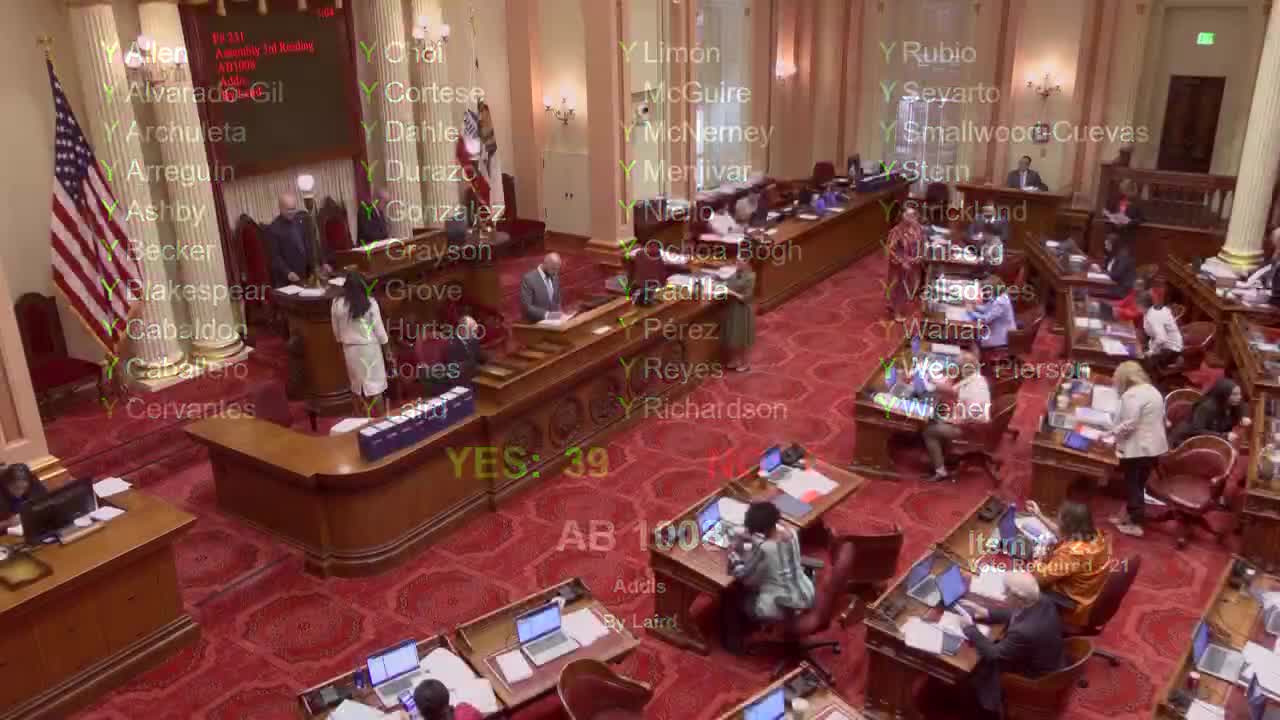 1MIN
Senate Floor
 3MIN
Senate Standing Committee on Appropriations
 4MIN
Senate Standing Committee on Judiciary
 5MIN
Senate Standing Committee on Banking and Financial Institutions
 2MIN
Assembly Floor
 8MIN
Assembly Standing Committee on Appropriations
 20MIN