AB 377: High-Speed Rail Authority: business plan: Merced to Bakersfield segment.
- Session Year: 2025-2026
- House: Assembly
- Latest Version Date: 2025-07-30
Current Status:
Passed
(2025-07-30: Chaptered by Secretary of State - Chapter 81, Statutes of 2025.)
Introduced
In Committee
Awaiting First Chamber Vote
Passed First Chamber
In Committee
Awaiting Second Chamber Vote
Passed Second Chamber
Enacted
The California High-Speed Rail Act creates the High-Speed Rail Authority to develop and implement a high-speed rail system in the state, with specified powers and duties. The act requires the authority to prepare, publish, adopt, and submit to the Legislature a business plan containing specified elements on a biennial basis and to also provide on a biennial basis a project update report, approved by the Secretary of Transportation as consistent with specified criteria, to the budget committees and the appropriate policy committees of both houses of the Legislature, on the development and implementation of intercity high-speed train service, as provided. The act requires the authority to develop schedules for the delivery of specified tasks relating to the Merced to Bakersfield segment of the high-speed rail project for inclusion in the project update report and the business plan and also requires the authority to include certain other information in the project update report and the business plan relating to the Merced to Bakersfield segment, as provided.
This bill would require the authority, as part of the business plan that is due on or before May 1, 2026, to provide a detailed funding plan for the Merced to Bakersfield segment that includes certain information, including an updated estimate of the funding gap for completing the segment and a strategy for addressing the funding gap.
(a)As part of the business plan that is due on or before May 1, 2026, pursuant to Section 185033, the authority shall provide a detailed funding plan for the Merced to Bakersfield segment that includes all of the following information:
(1)An updated estimate of the funding gap for completing the segment.
(2)A strategy for addressing the funding gap that includes all of the following:
(A)An itemized list of anticipated funds by source.
(B)A timeline describing when each source of funds must be received in order to meet the authoritys schedule for segment completion.
(C)The estimated project delays that would result if any funding source fails to materialize, and a discussion of how work could be resequenced to minimize these delays.
(D)An assessment of the likelihood that each proposed source of funding will materialize, including the identification of any major risks for obtaining the funding and a plan for mitigating those risks.
(3)Options for initiating service on the segment described in subparagraph (A) of paragraph (1) of subdivision (b) of Section 185033.7 and the estimated schedule and costs associated with the service.
(b)For purposes of this section, Merced to Bakersfield segment has the same meaning as defined in Section 185033.7.
(a)As part of the business plan that is due on or before May 1, 2026, pursuant to Section 185033, the authority shall provide a detailed funding plan for the Merced to Bakersfield segment that includes all of the following information:
(1)An updated estimate of the funding gap for completing the segment.
(2)A strategy for addressing the funding gap that includes all of the following:
(A)An itemized list of anticipated funds by source.
(B)A timeline describing when each source of funds must be received in order to meet the authoritys schedule for segment completion.
(C)The estimated project delays that would result if any funding source fails to materialize, and a discussion of how work could be resequenced to minimize these delays.
(D)An assessment of the likelihood that each proposed source of funding will materialize, including the identification of any major risks for obtaining the funding and a plan for mitigating those risks.
(E)A description of alternative funding sources that could be used if the planned funding does not materialize, and an assessment of the likelihood for attaining these funds.(3)A contingency plan that provides multiple options for completing and using the segment described in subparagraph (A) of paragraph (1) of subdivision (b) of Section 185033.7 if there is a significant delay in completing the Merced to Bakersfield segment. The authority shall assess each option based on its relative value to the state.(b)The detailed funding plan developed pursuant to this section shall exclude funding sources where the likelihood of attaining the funds is low, including the receipt of any new federal funding before January 20, 2029.(c)For purposes of this section, the following definitions apply:(1)Merced(3)Options for initiating service on the segment described in subparagraph (A) of paragraph (1) of subdivision (b) of Section 185033.7 and the estimated schedule and costs associated with the service.
(b)For purposes of this section, Merced to Bakersfield segment has the same meaning as defined in Section 185033.7.
(2)New federal funding includes any contingent commitment of unobligated future available budget authority specified in law that has been committed but not obligated under the terms of an existing federal grant agreement, where the contingent commitment is not an obligation of the federal government and cannot be obligated without an amendment to the grant agreement.(a)As part of the business plan that is due on or before May 1, 2026, pursuant to Section 185033, the authority shall provide a detailed funding plan for the Merced to Bakersfield segment that includes all of the following information:
(1)An updated estimate of the funding gap for completing the segment.
(2)A strategy for addressing the funding gap that includes all of the following:
(A)An itemized list of anticipated funds by source.
(B)A timeline describing when each source of funds must be received in order to meet the authoritys schedule for segment completion.
(C)The estimated project delays that would result if any funding source fails to materialize, and a discussion of how work could be resequenced to minimize these delays.
(D)An assessment of the likelihood that each proposed source of funding will materialize, including the identification of any major risks for obtaining the funding and a plan for mitigating those risks.
(E)A description of alternative funding sources that could be used if the planned funding does not materialize, and an assessment of the likelihood for attaining these funds.
(3)A contingency plan that provides multiple options for completing and using the segment described in subparagraph (A) of paragraph (1) of subdivision (b) of Section 185033.7 if there is a significant delay in completing the Merced to Bakersfield segment. The authority shall assess each option based on its relative value to the state.
(b)The detailed funding plan developed pursuant to this section shall exclude funding sources where the likelihood of attaining the funds is low, including the receipt of any new federal funding before January 20, 2029.
(c)For purposes of this section, the following definitions apply:
(1)Merced to Bakersfield segment has the same meaning as defined in Section 185033.7.
(2)New federal funding includes any contingent commitment of unobligated future available budget authority specified in law that has been committed but not obligated under the terms of an existing federal grant agreement, where the contingent commitment is not an obligation of the federal government and cannot be obligated without an amendment to the grant agreement.
|
Date
|
Status
|
|---|---|
| Jul 30, 2025 | Chaptered by Secretary of State - Chapter 81, Statutes of 2025. |
| Jul 30, 2025 | Approved by the Governor. |
| Jul 18, 2025 | Enrolled and presented to the Governor at 11:30 a.m. |
| Jul 14, 2025 | Senate amendments concurred in. To Engrossing and Enrolling. (Ayes 72. Noes 0. Page 2532.). |
| Jul 3, 2025 | In Assembly. Concurrence in Senate amendments pending. |
| Jul 3, 2025 | Read third time. Passed. Ordered to the Assembly. (Ayes 35. Noes 0. Page 1933.). |
| Jul 1, 2025 | Read second time. Ordered to Consent Calendar. |
| Jun 30, 2025 | From committee: Be ordered to second reading file pursuant to Senate Rule 28.8 and ordered to Consent Calendar. |
| Jun 10, 2025 | From committee: Do pass and re-refer to Com. on APPR. with recommendation: To Consent Calendar. (Ayes 13. Noes 0.) (June 10). Re-referred to Com. on APPR. |
| Jun 2, 2025 | From committee chair, with author's amendments: Amend, and re-refer to committee. Read second time, amended, and re-referred to Com. on TRANS. |
| May 21, 2025 | Referred to Com. on TRANS. |
| May 8, 2025 | In Senate. Read first time. To Com. on RLS. for assignment. |
| May 8, 2025 | Read third time. Passed. Ordered to the Senate. (Ayes 69. Noes 0. Page 1485.) |
| May 1, 2025 | Read second time. Ordered to Consent Calendar. |
| Apr 30, 2025 | From committee: Do pass. To Consent Calendar. (Ayes 14. Noes 0.) (April 30). |
| Mar 25, 2025 | From committee: Do pass and re-refer to Com. on APPR. with recommendation: To Consent Calendar. (Ayes 16. Noes 0.) (March 24). Re-referred to Com. on APPR. |
| Feb 18, 2025 | Referred to Com. on TRANS. |
| Feb 4, 2025 | From printer. May be heard in committee March 6. |
| Feb 3, 2025 | Read first time. To print. |
|
Date
|
Description
|
Location
|
Votes
|
|
|---|---|---|---|---|
| Jul 14, 2025 | AB 377 Tangipa Concurrence in Senate Amendments | Assembly Floor |
Passed |
|
| Jul 3, 2025 | Consent Calendar 2nd AB377 Tangipa | Senate Floor |
Passed |
|
| Jun 10, 2025 | Do pass, but first be re-referred to the Committee on [Appropriations] with the recommendation: To Consent Calendar | Senate Standing Committee on Transportation |
Passed |
|
| May 8, 2025 | AB 377 Tangipa Consent Calendar Second Day Regular Session | Assembly Floor |
Passed |
|
| Apr 30, 2025 | Do pass. To Consent Calendar. | Assembly Standing Committee on Appropriations |
Passed |
|
| Mar 24, 2025 | Do pass and be re-referred to the Committee on [Appropriations] with recommendation: To Consent Calendar | Assembly Standing Committee on Transportation |
Passed |
This list shows positions taken on this bill by organizations on the date displayed, which is linked to the original source.
Positions by individuals are not included.
|
Organization
|
Position
|
Date
|
|---|---|---|
| Associated Builders And Contractors Of California | ** Support | |
| District 5 Supervisor, Tuolumne County | ** Support |
SENATE COMMITTEE ON TRANSPORTATION
Senator Dave Cortese, Chair
2025 - 2026 Regular
Bill No: Hearing Date: 6/10/2025
Author: | Tangipa | ||
Version: | 6/2/2025 Amended | ||
Urgency: | No | Fiscal: | Yes |
Consultant: | Melissa White | ||
SUBJECT:
DIGEST: This bill requires the California High-Speed Rail Authority (Authority) as part of the business plan due on or before May 1, 2026, to provide a detailed funding plan for the Merced to Bakersfield segment, as specified.
ANALYSIS:
Existing law:
- Creates the Authority in the California State Transportation Agency (CalSTA) with 11 members: five appointed by the Governor, two appointed by the Senate Committee on Rules, two appointed by the Speaker of the Assembly, and one each ex-officio member appointed by the Senate and Assembly.
- Requires the Authority to direct the development and implementation of an intercity high-speed rail service.
- Establishes the independent peer review group to review the planning, engineering, financing, and other elements of the Authority’s plans and issuing analyses of these plans.
- Requires the Authority to submit to the Legislature no later than May 1, 2014, and every two years thereafter, a business plan containing specified information that includes project schedule, scope, and cost, forecast patronage and maintenance and operating costs.
- Requires the Authority to submit to the Legislature no later than March 1, 2017, and every two years thereafter, a project update report containing specified information that includes at a minimum, a program wide summary, as well as details by project segment, including information about the progress of the project, budget projections, expenditures, and project schedule.
- Establishes the Office of the High-Speed Rail Inspector General (OIG) and gives it the authority to initiate an audit or review of the Authority and gives it specific duties and responsibilities relating to reviewing the Authority’s business plans and project update reports.
This bill:
- Requires the Authority as part of the business plan due on or before May 1, 2026, to provide a detailed funding plan for the Merced to Bakersfield segment, as specified, that includes:
- An updated estimate of the funding gap for completing the segment.
- A strategy for addressing the funding gap that includes all of the following:
- An itemized list of anticipated funds by source;
- A timeline describing when each source of funds must be received in order to meet the authority’s schedule for segment completion;
- The estimated project delays that would result if any funding source fails to materialize, and a discussion of how work could be resequenced to minimize these delays; and,
- An assessment of the likelihood that each proposed source of funding will materialize, including the identification of any major risks for obtaining the funding and a plan for mitigating those risks.
- Options for initiating service on portions of the segment, as specified, and the estimated schedule and costs associated with the service.
COMMENTS:
- Purpose of the bill. According to the author, “AB 377 mandates the High Speed Rail Authority to deliver a comprehensive and detailed funding plan for the Merced to Bakersfield segment in its biennial business plan. This requirement is vital to provide long-overdue transparency and accountability to Central Valley residents. Without a clear financial roadmap, the project risks leaving Fresno with an incomplete, unusable infrastructure—a modern-day Stonehenge. By statutorily requiring a funding plan, AB 377 forces accountability before more taxpayer money is wasted on government mismanagement.”
- California High-Speed Rail. Development of high-speed rail in California began more than 20 years ago. SB 1420 (Kopp, Chapter 796, Statutes of 1996), created the Authority to direct development and implementation of intercity high-speed rail service that would be fully coordinated with other public transportation services. The Authority is part of CalSTA and is governed by an eleven-member Board of Directors. The Governor appoints five members of the board, the Senate Rules Committee appoints two, and the Assembly Speaker appoints two. Additionally, the board includes two ex-officio, non-voting members, one member of the Assembly and one member of the Senate.
In 2008, voters approved Proposition 1A, the Safe, Reliable, High-Speed Passenger Train Bond Act, a $9.95 billion general obligation bond to fund the proposed California high-speed rail project and related improvements. As envisioned at the time of the ballot measure, the project was to consist of an 800-mile dedicated high-speed passenger rail system capable of speeds up to 220 miles per hour, initially serving the major metropolitan market of San Francisco through the Central Valley into Los Angeles and Anaheim (Phase I), with service eventually extending to Sacramento, the Inland Empire, and San Diego (Phase II).
When the bonds were approved in 2008, the cost for the project was estimated at $45 billion, to be paid by a mix of state bonds, federal grants, and private investments. Since then, the cost of the project has risen markedly, with the 2024 Business Plan providing estimates as a range between $106 billion (base) to $127 billion (high).
In July 2012, the Legislature approved SB 1029 (Committee on Budget and Fiscal Review, Chapter 152, Statutes of 2012), that appropriated nearly $8 billion in federal and state funds to begin the construction between Madera and Bakersfield. SB 1029 funded three components of the project, including $5.8 billion ($3.2 billion federal grants and $2.6 billion Proposition 1A) to fund the construction of the high-speed rail “backbone” in the Central Valley; $819 million of Proposition 1A bonds for “connectivity” projects on existing rail and transit systems throughout the state; and $1.1 billion for the “bookends” projects in the Bay Area and Southern California ($600 million for the electrification of Caltrain and $500 million for projects in the Los Angeles Basin) to improve existing rail corridors for eventual use by the high-speed rail system.
Further, a fiscal year (FY) 2014-15 state budget trailer bill SB 862 (Committee on Budget and Fiscal Review, Chapter 36, Statutes of 2014), continuously appropriated 25 percent of the revenues derived from the state’s Cap-and-Trade program to the project. In July 2017, the Legislature extended the state’s Cap-and-Trade program through 2030, in AB 398 (Garcia, Chapter 135, Statutes of 2017). The Authority estimates that this equates to a range of $750 million to $1.25 billion annually in funding for the program.
In 2015, the Authority broke ground on the first construction segment in the Central Valley, starting work on 119 miles from Madera to Poplar Avenue outside of Shafter.
- Legislature focuses in on completing an initial segment. As part of the FY 2022-2023 State Budget, the Legislature approved a $10.8 billion transportation package, which included funding for transit, freight related infrastructure, active transportation, and climate adaptation projects. The package also included an appropriation of the remaining $4.2 billion Proposition 1A bonds for the high-speed rail project. Additionally, the Legislature approved SB 198 (Committee on Budget and Fiscal Review, Chapter 71, Statutes of 2022), which required the Authority to focus its resources on finishing a usable high-speed segment from Merced to Bakersfield, which is defined as 171-mile electrified dual-track segment with a new combined station in downtown Merced. SB 198 also limited spending outside of the Merced to Bakersfield line.
SB 198 also created a California High-Speed Rail Authority Office of the Inspector General (OIG) to not only oversee audits and investigations of the Authority and its contractors, but to provide independent fiscal estimates and reviews of the Authority’s business plans and project updates. The OIG is required to make a finding of the reasonableness of those plans and estimates. In 2023, Benjamin Belnap was named the inaugural Inspector General.
- It’s all about the Central Valley. As required by SB 198 and detailed in the 2024 Business Plan, the Authority is focused on completing an initial “building block” of a high-speed system in the Central Valley. Specifically, the full Central Valley Line is detailed as a 171 mile electrified high-speed rail line from Merced to Bakersfield, double tracked, stations (platforms) at Merced, Fresno, Kings/Tulare, and Bakersfield, maintenance and energy facilities, and the purchase of trainsets. It is expected to be completed between 2030-2033. It includes all of the current Central Valley construction (119 miles), with the planned extensions to Merced and Bakersfield.
The project has produced major economic benefits for the Valley. According to the 2025 Project Update Report (PUR), since construction began, more than 14,700 jobs have been created, with 70% percent coming from disadvantaged communities. The project has generated $8.3 billion in labor income, and $21.8 billion in economic activity.
- More federal money, but it’s in jeopardy. In 2021, Congress passed the Infrastructure Investment and Jobs Act (IIJA, P.L. 117-58), otherwise known as the Bipartisan Infrastructure Law (BIL), which will provide over $550 billion in funding for infrastructure including roads, bridges, transit, rail, water infrastructure, and broadband over the next five years.
The Authority set a goal of $8 billion of federal funds needed for the Central Valley Line. This amount would bring the federal funding total to 35% of the project, with the state paying for 65%. The Authority has been successful in vying for these federal grants. Since 2021, the Authority received roughly $3.5 billion in grant awards from various BIL programs, with the largest, $3.1 billion, coming from the Federal-State Partnership for Intercity Rail Grants (FSP). The grant award is for work on the Merced and Bakersfield extension, signaling the first federal funds to be used outside of the original 119 miles.
However, the high-speed rail project was immediately under fire from the incoming federal administration. In February of this year, U.S. Department of Transportation Secretary Sean Duffy announced a compliance review of the project, questioning the continued federal funding and citing concerns about cost overruns and delays. The Authority welcomed the review, stating that multiple independent federal and state audits have been completed and every dollar is accounted for.
On June 4, 2025, the Federal Railroad Administration (FRA) notified the Authority that the compliance review “revealed patterns of unattainable proposals and unrealistic assumptions on a wide range of issues,” and that the Authority’s inability to complete delivery the Central Valley segment within the budget and scheduled agreed to constitute a default of the federal grant agreements. At the writing of this analysis, the FRA has initiated a process to terminate the grant agreements and rescind not only the $3.1 billion in FSP grant funds described above, but an additional $929 million awarded to the project in 2010.
The Authority responded by stating that they “strongly disagree with the FRA’s conclusion,” and they will “fully address and correct the record in our formal response to the FRA’s notice.” The Authority has 30 days to submit documents and a corrective action plan. It is unclear what may happen if the FRA moves forward with rescinding the federal grant funding. In 2017, the previous Trump Administration attempted to rescind the 2010 award. The State of California sued the FRA and the suit was ultimately settled by the Biden Administration and the funding was restored.
- Waiting on updated cost estimates and schedule. As required by statute, the Authority submitted the 2025 PUR to the Legislature on March 1, 2025. The 2025 PUR is largely the same as the 2024 Business Plan as it does not update project costs or schedules. In the 2025 PUR, the Authority indicates that it is in the midst of a comprehensive review of the project. Accordingly, the Authority indicates it will provide a supplemental document upon the completion of its review in summer 2025. This supplemental document is anticipated to include updated detailed estimates of the Merced-to-Bakersfield segment’s cost and schedule.
The 2025 PUR also states that the Authority plans to pursue a new financial strategy that includes long-term sustained investment, innovative financing to drive construction momentum, and public-private partnerships to leverage state funds.
In May, as part of the 2025-26 State Budget discussions, the Authority released overview costs estimates for the Central Valley Line at $36.3 billion, with an additional $2.2 billion for bookends projects and program wide support for a total of $38.5 billion. This represents an increase of $3.2 billion from the 2024 Business Plan. According to the 2024 Business Plan, the amount of available funding is $28.2 billion. The new estimates indicate a roughly $10.3 billion funding shortfall. Additionally, as described above, the shortfall could grow by nearly $4 billion if federal funding is rescinded.
These recent updates also hint at changes to scope and design in the Central Valley, but no details were provided.
- Legislative Analyst and OIG want more details. Recent reports from the OIG, including a review of the 2024 Business Plan and a funding review of the Merced to Bakersfield segment, examine funding shortfalls, and causes for project delay, and raise concerns about a failure to accurately account for current project conditions and risks. Additionally, the Legislative Analyst’s Office (LAO) completed a report in 2024 and found that there is no clear plan for addressing the multi-billion dollar shortfall the Merced to Bakersfield segment is facing. The LAO stated that “The absence of a detailed plan for how and when HSRA proposes to address the funding gap for the Merced-to-Bakersfield segment is problematic. This is because a credible funding plan is necessary to give the project, and its stakeholders and contractors, certainty.”
AB 377 attempts to address some of these concerns by obtaining more information about funding for completion of the Merced to Bakersfield segment. Specifically, the bill requires the Authority to provide a detailed funding plan for the Merced to Bakersfield segment that includes updated estimates of the funding gap, and a strategy for addressing the gap. The strategy must include an itemized list of anticipated funds by source, a timeline for when each funding source must be received in order to meet the project schedule, as assessment of the likelihood of the funding source, and estimated project delays if any funding source fails to materialize. Finally, the funding plan must include options for initiating some form of service on a portion of the Merced to Bakersfield segment.
Much of the information required by AB 377 has also been recommended by the OIG. For example, the OIG recommended the Authority provide “greater specificity regarding when additional funds need to be identified and committed for any unfunded Merced to Bakersfield segment components.” Additionally, the OIG recommended the 2025 PUR contain information, “about feasible options for initiating service on a limited section of the Merced to Bakersfield segment by 2033, if necessary, and the estimated costs to realize them.”
Numerous recommendations from the OIG review of the 2024 Business Plan and the Merced to Bakersfield segment were agreed to by the Authority. The OIG’s review process involves tracking the implementation of these recommendations on its website.
Related/PREVIOUS Legislation:
SB 545 (Cortese) – Requires the Office of Land Use and Climate Innovation (LCI), on or before July 1, 2027, to commission a study and submit a progress report to the Legislature on funding and economic opportunities along high-speed rail corridors, as specified, with a final report due January 1, 2028. This bill is pending in the Assembly.
SB 1260 (Niello, 2024) – Would have required OIG to conduct two independent reviews related to the high-speed rail project. This bill failed passage in this committee.
SB 198 (Committee on Budget and Fiscal Review, Chapter 71, Statutes of 2022) – Appropriated the remaining $4.2 billion Proposition 1A bonds for the high-speed rail project, and created the High-Speed Rail IG.
SB 862 (Committee on Budget and Fiscal Review, Chapter 36, Statutes of 2014) – Continuously appropriated 25 percent of the revenues derived from the state’s Cap-and-Trade program to the project.
SB 1029 (Committee on Budget and Fiscal Review, Chapter 152, Statutes of 2012) – Appropriated nearly $8 billion in federal and state funds to begin the construction between Madera and Bakersfield.
FISCAL EFFECT: Appropriation: No Fiscal Com.: Yes Local: No
POSITIONS: (Communicated to the committee before noon on Wednesday,
June 4, 2025.)
SUPPORT:
Associated Builders and Contractors of California
District 5 Supervisor, Tuolumne County
OPPOSITION:
None received
-- END --
Date of Hearing: April 30, 2025
ASSEMBLY COMMITTEE ON APPROPRIATIONS
Buffy Wicks, Chair
ABPCA Bill Id:AB 377
Author:(Tangipa) – As Introduced Ver:February 3, 2025
Policy Committee: | Transportation | Vote: | 16 - 0 |
|
| ||
|
|
Urgency: No State Mandated Local Program: No Reimbursable: No
SUMMARY:
This bill requires the High-Speed Rail Authority, as part of the authority’s statutorily required business plan that is due on or before May 1, 2026, provide a detailed funding plan for the Merced-to-Bakersfield high-speed rail segment and specifies information the authority is to include in the funding plan.
Among other things, the funding plan is to include a description of alternative funding sources and a contingency plan that provides multiple options for completing and using the Merced-to-Bakersfield segment if there is a significant delay in completing it.
FISCAL EFFECT:
The High-Speed Rail Authority describes the requirements of this bill as “duplicative of existing efforts already undertaken through the High-Speed Rail Business Plan and related planning activities.” Therefore, the authority should require no new resources to comply with this bill.
COMMENTS:
Purpose and Background. The author expresses concern the Bakersfield-to-Merced high-speed rail segment lacks a clear financial plan and, without such a plan, “the project risks leaving Fresno with an incomplete, unusable infrastructure,” which the author likens to “a modern-day Stonehenge.”
The author intends this bill to result in the High-Speed Rail Authority regularly delivering to the Legislature “a comprehensive and detailed funding plan” for the Merced-to-Bakersfield segment, an action the author describes as “vital to provide long-overdue transparency and accountability to Central Valley residents.” The author further asserts this bill “forces accountability before more taxpayer money is wasted on government mismanagement.”
Existing law requires the High-Speed Rail Authority to submit to the Legislature every two years a business plan that includes, among other things, a project schedule, scope and costs and a forecast of patronage and maintenance and operating costs. In addition, existing law requires the authority to submit to the Legislature every two years a project update report that includes, at a minimum, a program-wide summary, details by project segment, project progress, budget projections, expenditures and a project schedule. For over ten years, the authority has regularly submitted to the Legislature the business plan and the project update report, as required by law.
In addition, existing law establishes the Office of the High-Speed Rail Inspector General. Acting under its legal authority, the inspector general has audited the High-Speed Rail Authority and published highly critical reports of the authority’s business plans, which the inspector general provided to the Legislature. In addition, the Legislative Analyst’s Office—itself, an office of the Legislature—has published reports on the High-Speed Rail Authority’s business plans and project update reports, and has presented its findings, in writing and as in-person testimony, to the Legislature, warning in March 2025 that the authority has “no detailed plan to meet roughly $7 billion funding gap for Merced to Bakersfield.”
It, therefore, does not seem to be the case that the Legislature lacks transparency into the High-Speed Rail Authority’s plan for funding the Merced-to-Bakersfield segment. Rather, it seems the authority’s business plan is inadequate. There is likely no harm in requiring, in statute, that the authority provide in its business plans information specific to a detailed funding plan for the Merced-to-Bakersfield high-speed rail segment. However, establishing this requirement in law will probably not have the effects the author intends.
Analysis Prepared by: Jay Dickenson / APPR. / (916) 319-2081
Date of Hearing: March 24, 2024
ASSEMBLY COMMITTEE ON TRANSPORTATION
Lori D. Wilson, Chair
ABPCA Bill Id:AB 377 (
Author:Tangipa) – As Introduced Ver:February 3, 2025
SUBJECT: High-Speed Rail Authority: business plan: Merced to Bakersfield segment
SUMMARY: Requires the California High-Speed Rail Authority (CHSRA) as part of the business plan due on or before May 1, 2026, to provide a detailed funding plan for the Merced to Bakersfield segment. Specifically, this bill: Requires the updated estimate include:
- An updated estimate of the funding gap for completing the segment.
- A strategy for addressing the funding gap that includes all of the following:
- An itemized list of anticipated funds by source;
- A timeline describing when each source of funds must be received in order to meet the authority’s schedule for segment completion;
- The estimated project delays that would result if any funding source fails to materialize, and a discussion of how work could be resequenced to minimize these delays;
- An assessment of the likelihood that each proposed source of funding will materialize, including the identification of any major risks for obtaining the funding and a plan for mitigating those risks; and,
- A description of alternative funding sources that could be used if the planned funding does not materialize, and an assessment of the likelihood for attaining these funds.
- A contingency plan that provides multiple options for completing and using the segment if there is a significant delay in completing the Merced to Bakersfield segment, and an assessment of the relative value to the state of each option.
The detailed funding plan developed pursuant to this section shall exclude funding sources where the likelihood of attaining the funds is low, including the receipt of any new federal funding before January 20, 2029.
EXISTING LAW:
- Creates the CHSRA in the California State Transportation Agency with 11 members: five appointed by the Governor, two appointed by the Senate Committee on Rules, two appointed by the Speaker of the Assembly, and one each ex-officio member appointed by the Senate and Assembly. (Public Utilities Code (PUC) Section 185020)
- Requires CHSRA to direct the development and implementation of an intercity high-speed rail service. (PUC 185030)
- Establishes the independent peer review group to review the planning, engineering, financing, and other elements of the CHSRA’s plans and issuing analyses of these plans. (PUC 185035)
- Requires CHSRA to submit to the Legislature no later than May 1, 2014, and every two years thereafter, a business plan containing specified information that includes project schedule, scope, and cost, forecast patronage and maintenance and operating costs. (PUC 185033)
- Requires CHSRA to submit to the Legislature no later than March 1, 2017, and every two years thereafter, a project update report containing specified information that includes at a minimum, a program wide summary, as well as details by project segment, including information about the progress of the project, budget projections, expenditures, and project schedule. (PUC 185033.5)
- Establishes the Office of the High-Speed Rail Inspector General (OIG-HSR) and gives it the authority to initiate an audit or review of CHSRA and gives it specific duties and responsibilities relating to reviewing CHSRA business plans and project update reports. (PUC 187030)
FISCAL EFFECT: Unknown
COMMENTS: Chapter 796 of 1996 (SB 1420, Kopp) established the CHSRA to plan and construct a high‑speed rail system that would link the state’s major population centers. In November 2008, voters approved Proposition 1A, which authorized the state to sell $10 billion in general obligation bonds to partially fund the system, as well as related projects. Proposition 1A also specified certain criteria and conditions that the system must ultimately achieve. For example, the measure requires that the system be designed to be capable of specified travel times along certain routes, such as nonstop travel from San Francisco to Los Angeles within two hours and forty minutes. The measure also specifies that passenger rail service operated by CHSRA, or pursuant to its authority, will not require an operating subsidy.
Over the years, the project has faced many challenges largely stemming from a lack of adequate funding to complete the project, or even a useable segment. As of the December 31, 2024, $13.8 billion has been spent on the project, mostly on work between Merced and Bakersfield.
In early March 2025, the CHSRA released its Project Update Report (PUR). The report does not included updated project cost and schedule estimates as required by state law. The report’s transmittal letter states: “A comprehensive review of design, scope, cost methodologies, and construction sequencing has been launched to streamline operations and improve long-term feasibility. This initiative emphasizes design standardization, eliminates over-engineered components, and integrates proven engineering solutions to accelerate project completion and optimize resources. Looking ahead, this effort will refine scheduling, procurement, and financial planning, with an updated project plan and supplemental Project Update Report expected by summer 2025 to guide the next phase of high-speed rail development.”
Recent reports from the OIG-HSR examine funding shortfalls, causes for project delay, and raise concerns about a failure to accurately account for current project conditions and risks. In addition, the Legislative Analyst’s Office (LAO) completed a report in 2024 and found that there is no clear plan for addressing the multi-billion dollar shortfall the Merced to Bakersfield segment is facing. The LAO stated that “The absence of a detailed plan for how and when HSRA proposes to address the funding gap for the Merced-to-Bakersfield segment is problematic. This is because a credible funding plan is necessary to give the project, and its stakeholders and contractors, certainty.”
According to the author, “AB 377 mandates the High Speed Rail Authority to deliver a comprehensive and detailed funding plan for the Merced to Bakersfield segment in its biennial business plan. This requirement is vital to provide long-overdue transparency and accountability to Central Valley residents. Without a clear financial roadmap, the project risks leaving Fresno with an incomplete, unusable infrastructure—a modern-day Stonehenge. By statutorily requiring a funding plan, AB 377 forces accountability before more taxpayer money is wasted on government mismanagement.”
Despite, the project’s significant challenges, spending on the project has led to positive economic impacts in the Central Valley, with the greatest direct impacts in Madera and Fresno Counties, and indirect employment effects in Merced County and the rest of California. CHSRA states in its PUR that since construction began more than 14,700 jobs have been created with 70 percent of these jobs filled by residents from disadvantaged communities. The project continues to bolster local economies.
Staff comments: This bill attempts to address concerns that have been raised by the Legislature and various oversight entities about progress of the high-speed rail project by obtaining more information about funding for completion of the Merced to Bakersfield segment. While more information and oversight is valuable, this bill will not necessarily result in the Legislature receiving more useful information about the project or result in more funding for the project.
Since September 2023, the newly created OIG-HSR is continually examining the project and has been issuing recommendations. These recommendations address the same issues this bill attempts to address.
The OIG-HSR’s review process involves it making recommendations to CHSRA and CHSRA agreeing, partially agreeing, or not agreeing the implement the recommendations. The OIG-HSR is tracking the implementation of these recommendations on its website. It is important to note that while the CHSRA agreed to implement many of the recommendations the OIG-HSR has made in its 2025 PUR, the PUR does not address those recommendations at this time.
Because the OIG-HSR’s process is iterative and on-going, this process is far more likely to be effective in actually getting CHSRA to provide information that is beneficial to the Legislature. While, this bill does not cause harm, it may not necessarily result in any improvements in what information CHSRA provides to the Legislature.
Moreover, the greatest challenge the high-speed rail project faces is a lack of funding. Nearly all of the CHSRA business plans and project update reports have stressed that stabilized, long-term funding is needed to complete the vision of high-speed rail from Northern to Southern California.
REGISTERED SUPPORT / OPPOSITION:
Support
No support on file
Opposition
No opposition on file
Analysis Prepared by: Farra Bracht / TRANS. / (916) 319-2093
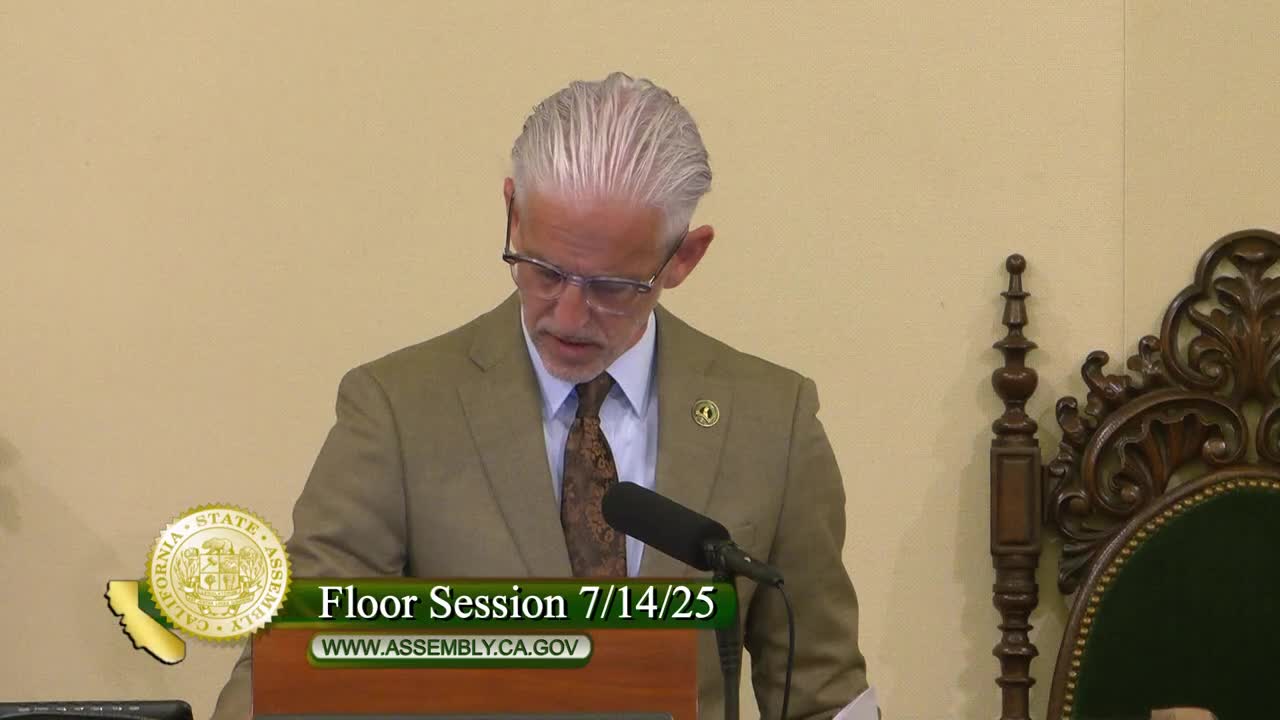
Bill Author

Bill Co-Author(s):