AB 435: Vehicles: child passenger restraints.
- Session Year: 2025-2026
- House: Assembly
- Latest Version Date: 2025-10-07
Current Status:
Passed
(2025-10-07: Chaptered by Secretary of State - Chapter 434, Statutes of 2025.)
Introduced
In Committee
Awaiting First Chamber Vote
Passed First Chamber
In Committee
Awaiting Second Chamber Vote
Passed Second Chamber
Enacted
Existing law requires a parent, legal guardian, or driver who transports a child under 16 years of age on a highway in a motor vehicle to properly secure that child in an appropriate child passenger restraint system or safety belt, as specified. Existing law authorizes a child or ward under 8 years of age who is 4 feet 9 inches in height or taller to be properly restrained by a safety belt rather than by a child passenger restraint system.
Existing law prohibits the operator of a limousine for hire, an authorized emergency vehicle, or a taxicab from operating the limousine for hire, authorized emergency vehicle, or taxicab unless the operator and any passengers 8 years of age or older in the front seat are properly restrained by a safety belt.
Existing law also prohibits a parent, legal guardian, or chartering party from transporting on a bus, or permit to be transported on a bus, a child, ward, or passenger who is 8 years of age or older, but under 16 years of age, unless they are properly restrained by a safety belt, and unless they are acceptably restrained by a safety belt for a child, ward, or passenger who is under 8 years of age and under 4 feet 9 inches in height. A violation of these provisions is an infraction.
Existing law defines, for purposes of the above provisions, properly restrained by a safety belt to mean that the lap belt crosses the hips or upper thighs of the occupant and the shoulder belt, if present, crosses the chest in front of the occupant. Existing law defines acceptably restrained by a safety belt to mean the latch plate is securely fastened in the buckle, the lap belt is adjusted to fit low and tight across the hips or upper thighs, not the stomach area, the shoulder belt is adjusted snugly across the chest and the middle of the shoulder, away from the neck, and the shoulder belt is not placed behind the back or under the arm.
This bill would instead, commencing January 1, 2027, define properly restrained by a safety belt to mean that the child, ward, or passenger meets the requirements of the 5-Step test, which includes that the child, ward, or passenger is sitting all the way back against the auto seat, the knees of the child, ward, or passenger bend over the edge of the auto seat, the shoulder belt snugly crosses the center of the child, ward, or passengers chest and shoulder, not the child, ward, or passengers neck, the lap belt is as low as possible and is touching the child, ward, or passengers thighs, and the child, ward, or passenger can stay seated like this for the whole trip. By changing this definition and thereby expanding the scope of existing crimes, this bill would impose a state-mandated local program.
The California Constitution requires the state to reimburse local agencies and school districts for certain costs mandated by the state. Statutory provisions establish procedures for making that reimbursement.
This bill would provide that no reimbursement is required by this act for a specified reason.
Existing law requires a parent, legal guardian, or driver who transports a child under 8 16 years of age on a highway in a motor vehicle to properly secure that child in a rear seat in an appropriate child passenger restraint system. system or safety belt, as specified. Existing law, however, law authorizes a child or ward under 8 years of age who is 4 feet 9 inches in height or taller to be properly restrained by a safety belt rather than by a child passenger restraint system.
This bill would, commencing January 1, 2027, require a parent, legal guardian, or driver who transports a child 13 years of age and under on a highway in a motor vehicle to properly secure that child in a rear seat in an appropriate child passenger restraint system. The bill would, however, authorize a child or ward between 10 to 13 years of age, inclusive, to be acceptably restrained by a safety belt, rather than by a child passenger restraint system, if the child or wards meets the requirements of the 5-Step test described below. The bill would also prohibit a parent, legal guardian, or driver from transporting on a highway in the front seat of a motor vehicle a child between 13 to 15 years of age, inclusive, unless they are acceptably restrained by a safety belt by meeting the requirements of the 5-Step test. The bill would define the 5-Step test to include that the child or ward is sitting all the way back against the auto seat, the knees of the child or ward bend over the edge of the auto seat, the shoulder belt snugly crosses the center of the childs chest and shoulder, not the childs neck, the lap belt is as low as possible and is touching the child or wards thighs, and the child or ward can stay seated like this for the whole trip.Existing law authorizes a child or ward under 8 years of age to ride in a child passenger restraint system in the front seat of a motor vehicle under specified circumstances, including, among others, that there is no rear seat.This bill would instead authorize a child or ward under 13 years of age to ride in a child passenger restraint system in the front seat under these specified circumstances. The bill would authorize a child or ward 10 years of age or older who is riding in the front seat pursuant to this exception to be restrained by a safety belt rather than by a child passenger restraint system if the child or ward meets the requirements of the 5-Step test.Existing law prohibits the operator of a limousine for hire, an authorized emergency vehicle, or a taxicab from operating the limousine for hire, authorized emergency vehicle, or taxicab unless the operator and any passengers 8 years of age or older in the front seat are properly restrained by a safety belt. A violation of this provision is an infraction.
This bill would, commencing January 1, 2027, require that any passengers 13 years of age of older in the front seat are acceptably restrained by a safety belt. The bill would define acceptably restrained by a safety belt to mean that the child or ward meets the requirements of the 5-Step test. By expanding the scope of an existing crime, this bill would impose a state-mandated local program.Existing law also prohibits a parent, legal guardian, or chartering party from transporting on a bus, or permit to be transported on a bus, a child, ward, or passenger who is 8 years of age or older, but under 16 years of age, unless they are properly restrained by a safety belt, and unless they are acceptably restrained by a safety belt for a child, ward, or passenger who is under 8 years of age and under 4 feet 9 inches in height. Existing A violation of these provisions is an infraction.
Existing law defines defines, for purposes of the above provisions, properly restrained by a safety belt to mean that the lap belt crosses the hips or upper thighs of the occupant and the shoulder belt, if present, crosses the chest in front of the occupant. Existing law defines acceptably restrained by a safety belt to mean the latch plate is securely fastened in the buckle, the lap belt is adjusted to fit low and tight across the hips or upper thighs, not the stomach area, the shoulder belt is adjusted snugly across the chest and the middle of the shoulder, away from the neck, and the shoulder belt is not placed behind the back or under the arm. A violation of this provision is an infraction.
This bill would, commencing January 1, 2027, prohibit a parent, legal guardian, or chartering party from transporting on a bus, or permit to be transported on a bus, a child, ward, or passenger who is under 16 years of age, unless they are acceptably restrained by a safety belt. The bill would define acceptably restrained by a safety belt to mean that the child or ward meets the requirements of the 5-Step test. By expanding the scope of an existing crime, this bill would impose a state-mandated local program.Existing law requires a public or private hospital, clinic, or birthing center to, at the time of the discharge of a child who is under 8 years of age, discuss with the parents or the person to whom the child is released, information on the current law requiring child passenger restraint systems, safety belts, and the transportation of children in rear seats.This bill would, commencing January 1, 2027, require a public or private hospital, clinic, or birthing center to discuss that information if the child is 13 years of age or under.Existing law requires a rental agency to post a notice stating that California law requires that all children under 8 years of age are to be transported in the rear seat of the vehicle in a child restraint system, and requires a car rental agency in California to have available and provide, upon request, a child passenger restraint systems that is certified, as specified, for rental to adults traveling with children under 8 years of age. A violation of this provision is an infraction.This bill would, commencing January 1, 2027, require a rental agency to post a notice stating that California law requires that all children under 10 years of age are to be transported in the rear seat of the vehicle in a child restraint system, and requires a car rental agency to have available and provide a child passenger restraint system for rental to adults traveling with children under 13 years of age. By expanding the scope of an existing crime, this bill would impose a state-mandated local program.This bill would instead, commencing January 1, 2027, define properly restrained by a safety belt to mean that the child, ward, or passenger meets the requirements of the 5-Step test, which includes that the child, ward, or passenger is sitting all the way back against the auto seat, the knees of the child, ward, or passenger bend over the edge of the auto seat, the shoulder belt snugly crosses the center of the child, ward, or passengers chest and shoulder, not the child, ward, or passengers neck, the lap belt is as low as possible and is touching the child, ward, or passengers thighs, and the child, ward, or passenger can stay seated like this for the whole trip. By changing this definition and thereby expanding the scope of existing crimes, this bill would impose a state-mandated local program.
The California Constitution requires the state to reimburse local agencies and school districts for certain costs mandated by the state. Statutory provisions establish procedures for making that reimbursement.
This bill would provide that no reimbursement is required by this act for a specified reason.
Existing law requires a parent, legal guardian, or driver who transports a child under 8 years of age on a highway in a motor vehicle to properly secure that child in a rear seat in an appropriate child passenger restraint system, except, if the system. Existing law, however, authorizes a child or ward under 8 years of age who is 4 feet 9 inches in height or taller, then the child or ward may taller to be restrained by a safety belt rather than by a child passenger restraint system.
This bill would, commencing January 1, 2027, require a parent, legal guardian, or driver who transports a child between 10 to 13 years of age and under on a highway in a motor vehicle to properly secure that child in a rear seat in an appropriate child passenger restraint system, except system. The bill would, however, authorize a child or ward between 10 to 13 years of age may age, inclusive, to be acceptably restrained by a safety belt by meeting belt, rather than by a child passenger restraint system, if the child or wards meets the requirements of the 5-Step test, which requires that the child or ward may be restrained by a safety belt rather than by a child passenger restraint system. The bill would require test described below. The bill would also prohibit a parent, legal guardian, or driver from transporting on a highway in the front seat of a motor vehicle a child between 13 to 15 years of age, inclusive, unless they are acceptably restrained by a safety belt by meeting the requirements of the 5-Step test. The bill would define the 5-Step test to include that the child or ward is sitting all the way back against the auto seat, the knees of the child or ward bend over the edge of the auto seat, the shoulder belt snugly crosses the center of the childs chest and shoulder, not the childs neck, the lap belt is as low as possible and is touching the child or wards thighs, and the child or ward can stay seated like this for the whole trip.
This bill would, commencing January 1, 2027, require a parent, legal guardian, or driver who transports a child under 10 years of age on a highway in a motor vehicle to properly secure that child in a rear seat in an appropriate child passenger restraint system meeting applicable federal motor vehicle safety standards, except as specified. The bill would prohibit a parent, legal guardian, or driver from transporting on a highway in the front seat of a motor vehicle a child between 13 to 16 years of age, unless they are acceptably restrained by a safety belt by meeting the requirements of the 5-Step test.Existing law authorizes a child or ward under 8 years of age to ride in a child passenger restraint system in the front seat of a motor vehicle under specified circumstances, including, among others, that there is no rear seat.
This bill would instead authorize a child or ward under 13 years of age to ride in a child passenger restraint system in the front seat under these specified circumstances. The bill would authorize a child or ward 10 years of age or older who is riding in the front seat pursuant to this exception to be restrained by a safety belt rather than by a child passenger restraint system if the child or ward meets the requirements of the 5-Step test.
Existing law prohibits the operator of a limousine for hire, an authorized emergency vehicle, or a taxicab from operating the limousine for hire, authorized emergency vehicle, or taxicab unless the operator and any passengers 8 years of age or older in the front seat are properly restrained by a safety belt. A violation of this provision is an infraction.
This bill would, commencing January 1, 2027, require that any passengers 13 years of age of older in the front seat are acceptably restrained by a safety belt. The bill would define acceptably restrained by a safety belt to mean that the child or ward meets the requirements of the 5-Step test. By expanding the scope of an existing crime, this bill would impose a state-mandated local program.
Existing law prohibits a parent, legal guardian, or chartering party from transporting on a bus, or permit to be transported on a bus, a child, ward, or passenger who is 8 years of age or older, but under 16 years of age, unless they are properly restrained by a safety belt, and unless they are acceptably restrained by a safety belt for a child, ward, or passenger who is under 8 years of age and under 4 feet 9 inches in height. Existing law defines properly restrained by a safety belt to mean that the lap belt crosses the hips or upper thighs of the occupant and the shoulder belt, if present, crosses the chest in front of the occupant. Existing law defines acceptably restrained by a safety belt to mean the latch plate is securely fastened in the buckle, the lap belt is adjusted to fit low and tight across the hips or upper thighs, not the stomach area, the shoulder belt is adjusted snugly across the chest and the middle of the shoulder, away from the neck, and the shoulder belt is not placed behind the back or under the arm. A violation of this provision is an infraction.
This bill would, commencing January 1, 2027, prohibit a parent, legal guardian, or chartering party from transporting on a bus, or permit to be transported on a bus, a child, ward, or passenger who is under 16 years of age, unless they are acceptably restrained by a safety belt. The bill would define acceptably restrained by a safety belt to mean that the child or ward meets the requirements of the 5-Step test. By expanding the scope of an existing crime, this bill would impose a state-mandated local program.
Existing law requires a public or private hospital, clinic, or birthing center to, at the time of the discharge of a child who is under 8 years of age, discuss with the parents or the person to whom the child is released, information on the current law requiring child passenger restraint systems, safety belts, and the transportation of children in rear seats.
This bill would, commencing January 1, 2027, require a public or private hospital, clinic, or birthing center to discuss that information if the child is under 10 years of age. 13 years of age or under.
Existing law requires a rental agency to post a notice stating that California law requires that all children under 8 years of age are to be transported in the rear seat of the vehicle in a child restraint system, and requires a car rental agency in California to have available and provide, upon request, a child passenger restraint systems that is certified, as specified, for rental to adults traveling with children under 8 years of age. A violation of this provision is an infraction.
This bill would, commencing January 1, 2027, require a rental agency to post a notice stating that California law requires that all children under 13 10 years of age are to be transported in the rear seat of the vehicle in a child restraint system, and requires a car rental agency to have available and provide a child passenger restraint system for rental to adults traveling with children under 10 13 years of age. By expanding the scope of an existing crime, this bill would impose a state-mandated local program.
The California Constitution requires the state to reimburse local agencies and school districts for certain costs mandated by the state. Statutory provisions establish procedures for making that reimbursement.
This bill would provide that no reimbursement is required by this act for a specified reason.
Existing law requires a parent, legal guardian, or driver who transports a child under 8 years of age on a highway in a motor vehicle to properly secure that child in a rear seat in an appropriate child passenger restraint system, except, if the child or ward under 8 years of age is 4 feet 9 inches in height or taller, then the child or ward may be restrained by a safety belt rather than by a child passenger restraint system.
This bill would instead would, commencing January 1, 2027, require a parent, legal guardian, or driver who transports a child under between 10 to 13 years of age on a highway in a motor vehicle to properly secure that child in a rear seat in an appropriate child passenger restraint system, except if the a child or ward is under between 10 to 13 years of age and meets all may be acceptably restrained by a safety belt by meeting the requirements of the 5-Step test, which requires that the child or ward may be restrained by a safety belt rather than by a child passenger restraint system. The bill would require the 5-Step test to include that the child or ward is sitting all the way back against the auto seat, the knees of the child or ward bend comfortably at over the edge of the auto seat, the belt cross the child or wards shoulder between the neck and arm, the shoulder belt snugly crosses the center of the childs chest and shoulder, not the childs neck, the lap belt is as low as possible and are is touching the child or wards thighs, and the child or ward can stay seated like this for the whole trip.
This bill would, commencing January 1, 2027, require a parent, legal guardian, or driver who transports a child under 10 years of age on a highway in a motor vehicle to properly secure that child in a rear seat in an appropriate child passenger restraint system meeting applicable federal motor vehicle safety standards, except as specified. The bill would prohibit a parent, legal guardian, or driver from transporting on a highway in the front seat of a motor vehicle a child between 13 to 16 years of age, unless they are acceptably restrained by a safety belt by meeting the requirements of the 5-Step test.
Existing law prohibits the operator of a limousine for hire, an authorized emergency vehicle, or a taxicab from operating the limousine for hire, authorized emergency vehicle, or taxicab unless the operator and any passengers 8 years of age or older in the front seat are properly restrained by a safety belt. A violation of this provision is an infraction.
This bill would instead would, commencing January 1, 2027, require that any passengers 13 years of age of older in the front seat are properly acceptably restrained by a safety belt. The bill would define acceptably restrained by a safety belt to mean that the child or ward meets the requirements of the 5-Step test. By expanding the scope of an existing crime, this bill would impose a state-mandated local program.
Existing law prohibits a parent, legal guardian, or chartering party from transporting on a bus, or permit to be transported on a bus, a child, ward, or passenger who is 8 years of age or older, but under 16 years of age, unless they are properly restrained by a safety belt, and unless they are acceptably restrained by a safety belt for a child, ward, or passenger who is under 8 years of age and under 4 feet 9 inches in height. Existing law defines properly restrained by a safety belt to mean that the lap belt crosses the hips or upper thighs of the occupant and the shoulder belt, if present, crosses the chest in front of the occupant. Existing law defines acceptably restrained by a safety belt to mean the latch plate is securely fastened in the buckle, the lap belt is adjusted to fit low and tight across the hips or upper thighs, not the stomach area, the shoulder belt is adjusted snugly across the chest and the middle of the shoulder, away from the neck, and the shoulder belt is not placed behind the back or under the arm. A violation of this provision is an infraction.
This bill would instead would, commencing January 1, 2027, prohibit a parent, legal guardian, or chartering party from transporting on a bus, or permit to be transported on a bus, a child, ward, or passenger who is 10 years of age or older, but under 16 years of age, unless they are properly restrained by a safety belt, and unless they are acceptably restrained by a safety belt for a child, ward, or passenger who is under 10 years of age. belt. The bill would define acceptably restrained by a safety belt to mean that the child or ward meets the requirements of the 5-Step test. By expanding the scope of an existing crime, this bill would impose a state-mandated local program.
Existing law requires a public or private hospital, clinic, or birthing center to, at the time of the discharge of a child who is under 8 years of age, discuss with the parents or the person to whom the child is released, information on the current law requiring child passenger restraint systems, safety belts, and the transportation of children in rear seats.
This bill would instead would, commencing January 1, 2027, require a public or private hospital, clinic, or birthing center to discuss that information if the child is under 10 years of age.
Existing law requires a rental agency to post a notice stating that California law requires that all children under 8 years of age are to be transported in the rear seat of the vehicle in a child restraint system, and requires a car rental agency in California to have available and provide, upon request, a child passenger restraint systems that is certified, as specified, for rental to adults traveling with children under 8 years of age. A violation of this provision is an infraction.
This bill would instead would, commencing January 1, 2027, require a rental agency to post a notice stating that California law requires that all children under 13 years of age are to be transported in the rear seat of the vehicle in a child restraint system, and requires a car rental agency to have available and provide a child passenger restraint system for rental to adults traveling with children under 10 years of age. By expanding the scope of an existing crime, this bill would impose a state-mandated local program.
The California Constitution requires the state to reimburse local agencies and school districts for certain costs mandated by the state. Statutory provisions establish procedures for making that reimbursement.
This bill would provide that no reimbursement is required by this act for a specified reason.
Existing law requires a parent, legal guardian, or driver who transports a child under 8 years of age on a highway in a motor vehicle to properly secure that child in a rear seat in an appropriate child passenger restraint system, except, if the child or ward under 8 years of age is 4 feet 9 inches in height or taller, then the child or ward may be restrained by a safety belt rather than by a child passenger restraint system.
This bill would instead require a parent, legal guardian, or driver who transports a child under 13 years of age on a highway in a motor vehicle to properly secure that child in a rear seat in an appropriate child passenger restraint system, except if the child or ward is under 13 years of age and meets all the requirements of the 5-Step test, the child or ward may be restrained by a safety belt rather than by a child passenger restraint system. The bill would require the 5-Step test to include that the child or ward is sitting all the way back against the auto seat, the knees of the child or ward bend comfortably at the edge of the auto seat, the belt cross the child or wards shoulder between the neck and arm, the lap belt is as low as possible and are touching the child or wards thighs, and the child or ward can stay seated like this for the whole trip.
Existing law prohibits the operator of a limousine for hire, an authorized emergency vehicle, or a taxicab from operating the limousine for hire, authorized emergency vehicle, or taxicab unless the operator and any passengers 8 years of age or older in the front seat are properly restrained by a safety belt. A violation of this provision is an infraction.
This bill would instead require that any passengers 13 years of age of older in the front seat are properly restrained by a safety belt. By expanding the scope of an existing crime, this bill would impose a state-mandated local program.
Existing law prohibits a parent, legal guardian, or chartering party from transporting on a bus, or permit to be transported on a bus, a child, ward, or passenger who is 8 years of age or older, but under 16 years of age, unless they are properly restrained by a safety belt, and unless they are acceptably restrained by a safety belt for a child, ward, or passenger who is under 8 years of age and under 4 feet 9 inches in height. Existing law defines properly restrained by a safety belt to mean that the lap belt crosses the hips or upper thighs of the occupant and the shoulder belt, if present, crosses the chest in front of the occupant. Existing law defines acceptably restrained by a safety belt to mean the latch plate is securely fastened in the buckle, the lap belt is adjusted to fit low and tight across the hips or upper thighs, not the stomach area, the shoulder belt is adjusted snugly across the chest and the middle of the shoulder, away from the neck, and the shoulder belt is not placed behind the back or under the arm. A violation of this provision is an infraction.
This bill would instead prohibit a parent, legal guardian, or chartering party from transporting on a bus, or permit to be transported on a bus, a child, ward, or passenger who is 10 years of age or older, but under 16 years of age, unless they are properly restrained by a safety belt, and unless they are acceptably restrained by a safety belt for a child, ward, or passenger who is under 10 years of age. The bill would define acceptably restrained by a safety belt to mean that the child or ward meets the requirements of the 5-Step test. By expanding the scope of an existing crime, this bill would impose a state-mandated local program.
Existing law requires a public or private hospital, clinic, or birthing center to, at the time of the discharge of a child who is under 8 years of age, discuss with the parents or the person to whom the child is released, information on the current law requiring child passenger restraint systems, safety belts, and the transportation of children in rear seats.
This bill would instead require a public or private hospital, clinic, or birthing center to discuss that information if the child is under 10 years of age.
Existing law requires a rental agency to post a notice stating that California law requires that all children under 8 years of age are to be transported in the rear seat of the vehicle in a child restraint system, and requires a car rental agency in California to have available and provide, upon request, a child passenger restraint systems that is certified, as specified, for rental to adults traveling with children under 8 years of age. A violation of this provision is an infraction.
This bill would instead require a rental agency to post a notice stating that California law requires that all children under 13 years of age are to be transported in the rear seat of the vehicle in a child restraint system, and requires a car rental agency to have available and provide a child passenger restraint system for rental to adults traveling with children under 10 years of age. By expanding the scope of an existing crime, this bill would impose a state-mandated local program.
The California Constitution requires the state to reimburse local agencies and school districts for certain costs mandated by the state. Statutory provisions establish procedures for making that reimbursement.
This bill would provide that no reimbursement is required by this act for a specified reason.
(a)The Legislature finds that a mandatory seatbelt law will contribute to reducing highway deaths and injuries by encouraging greater usage of existing manual seatbelts, that automatic crash protection systems that require no action by vehicle occupants offer the best hope of reducing deaths and injuries, and that encouraging the use of manual safety belts is only a partial remedy for addressing this major cause of death and injury. The Legislature declares that the enactment of this section is intended to be compatible with support for federal motor vehicle safety standards requiring automatic crash protection systems and should not be used in any manner to rescind federal requirements for installation of automatic restraints in new cars.
(b)This section shall be known and may be cited as the Motor Vehicle Safety Act.
(c)(1)As used in this section, motor vehicle means a passenger vehicle, a motortruck, or a truck tractor, but does not include a motorcycle.
(2)For purposes of this section, a motor vehicle also means a farm labor vehicle, regardless of the date of certification under Section 31401.
(d)(1)A person shall not operate a motor vehicle on a highway unless that person and all passengers 16 years of age or over are properly restrained by a safety belt. This paragraph does not apply to the operator of a taxicab, as defined in Section 27908, when the taxicab is driven on a city street and is engaged in the transportation of a fare-paying passenger. The safety belt requirement established by this paragraph is the minimum safety standard applicable to employees being transported in a motor vehicle. This paragraph does not preempt more stringent or restrictive standards imposed by the Labor Code or another state or federal regulation regarding the transportation of employees in a motor vehicle.
(2)For purposes of this section the phrase, properly restrained by a safety belt means that the lower (lap) portion of the belt crosses the hips or upper thighs of the occupant and the upper (shoulder) portion of the belt, if present, crosses the chest in front of the occupant.
(3)The operator of a limousine for hire or the operator of an authorized emergency vehicle, as defined in subdivision (a) of Section 165, shall not operate the limousine for hire or authorized emergency vehicle unless the operator and any passengers eight years of age or over in the front seat, are properly restrained by a safety belt.
(4)The operator of a taxicab shall not operate the taxicab unless any passengers eight years of age or over in the front seat, are properly restrained by a safety belt.
(e)A person 16 years of age or over shall not be a passenger in a motor vehicle on a highway unless that person is properly restrained by a safety belt. This subdivision does not apply to a passenger in a sleeper berth, as defined in subdivision (x) of Section 1201 of Title 13 of the California Code of Regulations.
(f)An owner of a motor vehicle, including an owner or operator of a taxicab, as defined in Section 27908, or a limousine for hire, operated on a highway shall maintain safety belts in good working order for the use of the occupants of the vehicle. The safety belts shall conform to motor vehicle safety standards established by the United States Department of Transportation. This subdivision, however, does not require installation or maintenance of safety belts if it is not required by the laws of the United States applicable to the vehicle at the time of its initial sale.
(g)This section does not apply to a passenger or operator with a physically disabling condition or medical condition that would prevent appropriate restraint in a safety belt, if the condition is duly certified by a licensed physician and surgeon or by a licensed chiropractor who shall state the nature of the condition, as well as the reason the restraint is inappropriate. This section also does not apply to a public employee, if the public employee is in an authorized emergency vehicle as defined in paragraph (1) of subdivision (b) of Section 165, or to a passenger in a seat behind the front seat of an authorized emergency vehicle as defined in paragraph (1) of subdivision (b) of Section 165 operated by the public employee, unless required by the agency employing the public employee.
(h)Notwithstanding subdivision (a) of Section 42001, a violation of subdivision (d), (e), or (f) is an infraction punishable by a fine of not more than twenty dollars ($20) for a first offense, and a fine of not more than fifty dollars ($50) for each subsequent offense. In lieu of the fine and any penalty assessment or court costs, the court, pursuant to Section 42005, may order that a person convicted of a first offense attend a school for traffic violators or another court-approved program in which the proper use of safety belts is demonstrated.
(i)In a civil action, a violation of subdivision (d), (e), or (f), or information of a violation of subdivision (h), does not establish negligence as a matter of law or negligence per se for comparative fault purposes, but negligence may be proven as a fact without regard to the violation.
(j)If the United States Secretary of Transportation fails to adopt safety standards for manual safety belt systems by September 1, 1989, a motor vehicle manufactured after that date for sale or sold in this state shall not be registered unless it contains a manual safety belt system that meets the performance standards applicable to automatic crash protection devices adopted by the United States Secretary of Transportation pursuant to Federal Motor Vehicle Safety Standard No. 208 (49 C.F.R. 571.208) as in effect on January 1, 1985.
(k)A motor vehicle offered for original sale in this state that has been manufactured on or after September 1, 1989, shall comply with the automatic restraint requirements of Section S4.1.2.1 of Federal Motor Vehicle Safety Standard No. 208 (49 C.F.R. 571.208), as published in Volume 49 of the Federal Register, No. 138, page 29009. An automobile manufacturer that sells or delivers a motor vehicle subject to this subdivision, and fails to comply with this subdivision, shall be punished by a fine of not more than five hundred dollars ($500) for each sale or delivery of a noncomplying motor vehicle.
(l)Compliance with subdivision (j) or (k) by a manufacturer shall be made by self-certification in the same manner as self-certification is accomplished under federal law.
(m)This section does not apply to a person actually engaged in delivery of newspapers to customers along the persons route if the person is properly restrained by a safety belt prior to commencing and subsequent to completing delivery on the route.
(n)This section does not apply to a person actually engaged in collection and delivery activities as a rural delivery carrier for the United States Postal Service if the person is properly restrained by a safety belt prior to stopping at the first box and subsequent to stopping at the last box on the route.
(o)This section does not apply to a driver actually engaged in the collection of solid waste or recyclable materials along that drivers collection route if the driver is properly restrained by a safety belt prior to commencing and subsequent to completing the collection route.
(p)Subdivisions (d), (e), (f), (g), and (h) shall become inoperative immediately upon the date that the United States Secretary of Transportation, or their delegate, determines to rescind the portion of the Federal Motor Vehicle Safety Standard No. 208 (49 C.F.R. 571.208) that requires the installation of automatic restraints in new motor vehicles, except that those subdivisions shall not become inoperative if the secretarys decision to rescind that Standard No. 208 is not based, in any respect, on the enactment or continued operation of those subdivisions.
(q)This section shall remain in effect only until January 1, 2027, and as of that date is repealed.
SEC. 2.Section 27315 is added to the Vehicle Code, to read:27315.(a)The Legislature finds that a mandatory seatbelt law will contribute to reducing highway deaths and injuries by encouraging greater usage of existing manual seatbelts, that automatic crash protection systems that require no action by vehicle occupants offer the best hope of reducing deaths and injuries, and that encouraging the use of manual safety belts is only a partial remedy for addressing this major cause of death and injury. The Legislature declares that the enactment of this section is intended to be compatible with support for federal motor vehicle safety standards requiring automatic crash protection systems and should not be used in any manner to rescind federal requirements for installation of automatic restraints in new cars.
(b)This section shall be known and may be cited as the Motor Vehicle Safety Act.
(c)For purposes of this section, the following terms and phrases have the following meanings:
(1)(A)Motor vehicle means a passenger vehicle, a motortruck, or a truck tractor, but does not include a motorcycle.
(B)Motor vehicle also means a farm labor vehicle, regardless of the date of certification under Section 31401.
(2)Properly restrained by a safety belt means the person meets all of the following requirements of the 5-Step test:
(A)The person is sitting all the way back against the auto seat.
(B)The knees of the person bend over the edge of the auto seat.
(C)The shoulder belt snugly crosses the center of the persons chest and shoulder, not the persons neck.
(D)The lap belt is as low as possible and is touching the persons thighs.
(E)The person can stay seated like this for the whole trip.
(d)(1)A person shall not operate a motor vehicle on a highway unless that person and all passengers 16 years of age or over are properly restrained by a safety belt. This paragraph does not apply to the operator of a taxicab, as defined in Section 27908, when the taxicab is driven on a city street and is engaged in the transportation of a fare-paying passenger. The safety belt requirement established by this paragraph is the minimum safety standard applicable to employees being transported in a motor vehicle. This paragraph does not preempt more stringent or restrictive standards imposed by the Labor Code or another state or federal regulation regarding the transportation of employees in a motor vehicle.
(2)The operator of a limousine for hire or the operator of an authorized emergency vehicle, as defined in subdivision (a) of Section 165, shall not operate the limousine for hire or authorized emergency vehicle unless the operator and any passengers eight years of age or over in the front seat, are properly restrained by a safety belt.
(3)The operator of a taxicab shall not operate the taxicab unless any passengers eight years of age or over in the front seat, are properly restrained by a safety belt.
(e)A person 16 years of age or over shall not be a passenger in a motor vehicle on a highway unless that person is properly restrained by a safety belt. This subdivision does not apply to a passenger in a sleeper berth, as defined in subdivision (x) of Section 1201 of Title 13 of the California Code of Regulations.
(f)An owner of a motor vehicle, including an owner or operator of a taxicab, as defined in Section 27908, or a limousine for hire, operated on a highway shall maintain safety belts in good working order for the use of the occupants of the vehicle. The safety belts shall conform to motor vehicle safety standards established by the United States Department of Transportation. This subdivision, however, does not require installation or maintenance of safety belts if it is not required by the laws of the United States applicable to the vehicle at the time of its initial sale.
(g)This section does not apply to a passenger or operator with a physically disabling condition or medical condition that would prevent appropriate restraint in a safety belt, if the condition is duly certified by a licensed physician and surgeon or by a licensed chiropractor who shall state the nature of the condition, as well as the reason the restraint is inappropriate. This section also does not apply to a public employee, if the public employee is in an authorized emergency vehicle as defined in paragraph (1) of subdivision (b) of Section 165, or to a passenger in a seat behind the front seat of an authorized emergency vehicle as defined in paragraph (1) of subdivision (b) of Section 165 operated by the public employee, unless required by the agency employing the public employee.
(h)Notwithstanding subdivision (a) of Section 42001, a violation of subdivision (d), (e), or (f) is an infraction punishable by a fine of not more than twenty dollars ($20) for a first offense, and a fine of not more than fifty dollars ($50) for each subsequent offense. In lieu of the fine and any penalty assessment or court costs, the court, pursuant to Section 42005, may order that a person convicted of a first offense attend a school for traffic violators or another court-approved program in which the proper use of safety belts is demonstrated.
(i)In a civil action, a violation of subdivision (d), (e), or (f), or information of a violation of subdivision (h), does not establish negligence as a matter of law or negligence per se for comparative fault purposes, but negligence may be proven as a fact without regard to the violation.
(j)If the United States Secretary of Transportation fails to adopt safety standards for manual safety belt systems by September 1, 1989, a motor vehicle manufactured after that date for sale or sold in this state shall not be registered unless it contains a manual safety belt system that meets the performance standards applicable to automatic crash protection devices adopted by the United States Secretary of Transportation pursuant to Federal Motor Vehicle Safety Standard No. 208 (49 C.F.R. 571.208) as in effect on January 1, 1985.
(k)A motor vehicle offered for original sale in this state that has been manufactured on or after September 1, 1989, shall comply with the automatic restraint requirements of Section S4.1.2.1 of Federal Motor Vehicle Safety Standard No. 208 (49 C.F.R. 571.208), as published in Volume 49 of the Federal Register, No. 138, page 29009. An automobile manufacturer that sells or delivers a motor vehicle subject to this subdivision, and fails to comply with this subdivision, shall be punished by a fine of not more than five hundred dollars ($500) for each sale or delivery of a noncomplying motor vehicle.
(l)Compliance with subdivision (j) or (k) by a manufacturer shall be made by self-certification in the same manner as self-certification is accomplished under federal law.
(m)This section does not apply to a person actually engaged in delivery of newspapers to customers along the persons route if the person is properly restrained by a safety belt prior to commencing and subsequent to completing delivery on the route.
(n)This section does not apply to a person actually engaged in collection and delivery activities as a rural delivery carrier for the United States Postal Service if the person is properly restrained by a safety belt prior to stopping at the first box and subsequent to stopping at the last box on the route.
(o)This section does not apply to a driver actually engaged in the collection of solid waste or recyclable materials along that drivers collection route if the driver is properly restrained by a safety belt prior to commencing and subsequent to completing the collection route.
(p)Subdivisions (d), (e), (f), (g), and (h) shall become inoperative immediately upon the date that the United States Secretary of Transportation, or their delegate, determines to rescind the portion of the Federal Motor Vehicle Safety Standard No. 208 (49 C.F.R. 571.208) that requires the installation of automatic restraints in new motor vehicles, except that those subdivisions shall not become inoperative if the secretarys decision to rescind that Standard No. 208 is not based, in any respect, on the enactment or continued operation of those subdivisions.
(q)This section shall become operative on January 1, 2027.
SEC. 3.Section 27318 of the Vehicle Code is amended to read:27318.(a)A passenger who is 16 years of age or older in a bus shall be properly restrained by a safety belt.
(b)A parent, legal guardian, or chartering party shall not transport on a bus, or permit to be transported on a bus, a child, ward, or passenger who is eight years of age or older, but under 16 years of age, unless they are properly restrained by a safety belt.
(c)Except as provided in subdivision (d), a parent, legal guardian, or chartering party shall not transport on a bus, or permit to be transported on a bus, a child, ward, or passenger who is under eight years of age and under four feet nine inches in height, unless they are acceptably restrained by a safety belt.
(d)If it is not possible to ensure a child, ward, or passenger who is under eight years of age and under four feet nine inches in height is acceptably restrained by a safety belt because of their size, a parent, legal guardian, or chartering party shall either secure them in an appropriate child passenger restraint system that meets applicable federal motor vehicle safety standards, or if the child, ward, or passenger is under two years of age, may authorize a parent, legal guardian, or chartering party to hold them.
(e)(1)For purposes of this section, acceptably restrained by a safety belt means all of the following:
(A)The latch plate is securely fastened in the buckle.
(B)The lap belt shall be adjusted to fit low and tight across the hips or upper thighs, not the stomach area.
(C)The shoulder belt shall be adjusted snugly across the chest and the middle of the shoulder, away from the neck.
(D)The shoulder belt shall not be placed behind the back or under the arm.
(2)For purposes of this section, properly restrained by a safety belt means that the lap belt crosses the hips or upper thighs of the occupant and the shoulder belt, if present, crosses the chest in front of the occupant.
(3)For purposes of this section, bus means a bus that is equipped with safety belts, including a bus that is required to be equipped with a seatbelt assembly pursuant to Federal Motor Vehicle Safety Standard No. 208 (49 C.F.R. 571.208).
(f)Subdivisions (a), (b), (c), and (d) do not apply to a passenger that is leaving, has left, or is returning from their seat to use an onboard bathroom.
(g)If the bus is equipped with safety belts, the motor carrier shall maintain safety belts in good working order for the use of passengers of the vehicle.
(h)A motor carrier operating a bus equipped with safety belts shall do one of the following:
(1)Require the bus driver, before departure of a bus carrying passengers, to inform passengers of the requirement to wear the seatbelt under California law and inform passengers that not wearing a seatbelt is punishable by a fine.
(2)Post, or allow to be posted, signs or placards that inform passengers of the requirement to wear a seatbelt under California law and that not wearing a seatbelt is punishable by a fine. The signs or placards shall be in a font type and font size that is reasonably easy to read and shall be affixed to a bus in multiple, conspicuous locations.
(i)Notwithstanding subdivision (a) of Section 42001, a violation of subdivision (a), (b), (c), or (d) is an infraction punishable by a fine of not more than twenty dollars ($20) for a first offense, and a fine of not more than fifty dollars ($50) for each subsequent offense.
(j)This section does not apply to a schoolbus described in Section 27316 or a school pupil activity bus described in Section 27316.5.
(k)This section shall remain in effect only until January 1, 2027, and as of that date is repealed.
SEC. 4.Section 27318 is added to the Vehicle Code, to read:27318.(a)A passenger who is 16 years of age or older in a bus shall be properly restrained by a safety belt.
(b)Except as provided in subdivision (c), a parent, legal guardian, or chartering party shall not transport on a bus, or permit to be transported on a bus, a child, ward, or passenger who is under 16 years of age unless they are properly restrained by a safety belt.
(c)If it is not possible to ensure a child, ward, or passenger who is under eight years of age and under four feet nine inches in height is properly restrained by a safety belt because of their size, a parent, legal guardian, or chartering party shall either secure them in an appropriate child passenger restraint system that meets applicable federal motor vehicle safety standards, or if the child, ward, or passenger is under two years of age, may authorize a parent, legal guardian, or chartering party to hold them.
(d)(1)For purposes of this section, the following terms and phrases have the following meanings:
(2)Bus means a bus that is equipped with safety belts, including a bus that is required to be equipped with a seatbelt assembly pursuant to Federal Motor Vehicle Safety Standard No. 208 (49 C.F.R. 571.208).
(3)Properly restrained by a safety belt means the child, ward, or passenger meets all of the following requirements of the 5-Step test:
(A)The child, ward, or passenger is sitting all the way back against the auto seat.
(B)The knees of the child, ward, or passenger bend over the edge of the auto seat.
(C)The shoulder belt snugly crosses the center of the child, ward, or passengers chest and shoulder, not the child, ward, or passengers neck.
(D)The lap belt is as low as possible and is touching the child, ward, or passengers thighs.
(E)The child, ward, or passenger can stay seated like this for the whole trip.
(e)Subdivisions (a), (b), and (c) do not apply to a passenger that is leaving, has left, or is returning from their seat to use an onboard bathroom.
(f)If the bus is equipped with safety belts, the motor carrier shall maintain safety belts in good working order for the use of passengers of the vehicle.
(g)A motor carrier operating a bus equipped with safety belts shall do one of the following:
(1)Require the bus driver, before departure of a bus carrying passengers, to inform passengers of the requirement to wear the seatbelt under California law and inform passengers that not wearing a seatbelt is punishable by a fine.
(2)Post, or allow to be posted, signs or placards that inform passengers of the requirement to wear a seatbelt under California law and that not wearing a seatbelt is punishable by a fine. The signs or placards shall be in a font type and font size that is reasonably easy to read and shall be affixed to a bus in multiple, conspicuous locations.
(h)Notwithstanding subdivision (a) of Section 42001, a violation of subdivision (a), (b), or (c) is an infraction punishable by a fine of not more than twenty dollars ($20) for a first offense, and a fine of not more than fifty dollars ($50) for each subsequent offense.
(i)This section does not apply to a schoolbus described in Section 27316 or a school pupil activity bus described in Section 27316.5.
(j)This section shall become operative on January 1, 2027.
SEC. 5.Section 27360.5 of the Vehicle Code is amended to read:27360.5.(a)A parent, legal guardian, or driver shall not transport on a highway in a motor vehicle, as defined in paragraph (1) of subdivision (c) of Section 27315, a child or ward who is eight years of age or older, but less than 16 years of age, without properly securing that child or ward in an appropriate child passenger restraint system or safety belt meeting applicable federal motor vehicle safety standards.
(b)Subdivision (a) does not apply to a driver if the parent or legal guardian of the child is also present in the motor vehicle and is not the driver.
(c)This section shall remain in effect only until January 1, 2027, and as of that date is repealed.
SEC. 6.Section 27360.5 is added to the Vehicle Code, to read:27360.5.(a)A parent, legal guardian, or driver shall not transport on a highway in a motor vehicle, as defined in paragraph (1) of subdivision (c) of Section 27315, a child or ward who is eight years of age or older, but less than 16 years of age, without properly securing that child or ward in an appropriate child passenger restraint system meeting applicable federal motor vehicle safety standards or unless the child or ward is properly restrained by a safety belt.
(b)Subdivision (a) does not apply to a driver if the parent or legal guardian of the child is also present in the motor vehicle and is not the driver.
(c)For purposes of this section, properly restrained by a safety belt means the child or ward meets all of the following requirements of the 5-Step test:
(1)The child or ward is sitting all the way back against the auto seat.
(2)The knees of the child or ward bend over the edge of the auto seat.
(3)The shoulder belt snugly crosses the center of the childs chest and shoulder, not the childs neck.
(4)The lap belt is as low as possible and is touching the child or wards thighs.
(5)The child or ward can stay seated like this for the whole trip.
(d)This section shall become operative on January 1, 2027.
SEC. 7.Section 27363 of the Vehicle Code is amended to read:27363.(a)The court may exempt from the requirements of this article any class of child by age, weight, or size if it is determined that the use of a child passenger restraint system would be impractical by reason of physical unfitness, medical condition, or size. The court may require satisfactory proof of the childs physical unfitness, medical condition, or size and that an appropriate special needs child passenger restraint system is not available.
(b)In case of a life-threatening emergency, or when a child is being transported in an authorized emergency vehicle, if there is no child passenger restraint system available, a child may be transported without the use of that system, but the child shall be secured by a seatbelt.
(c)A child weighing more than 40 pounds may be transported in the backseat of a vehicle while wearing only a lap safety belt when the backseat of the vehicle is not equipped with a combination lap and shoulder safety belt.
(d)Notwithstanding Section 27360, a child or ward under eight years of age who is four feet nine inches in height or taller may be properly restrained by a safety belt, as defined in paragraph (2) of subdivision (d) of Section 27315, rather than by a child passenger restraint system.
(e)Notwithstanding Section 27360, a child or ward under eight years of age may ride properly secured in an appropriate child passenger restraint system meeting applicable federal motor vehicle safety standards in the front seat of a motor vehicle under any of the following circumstances:
(1)There is no rear seat.
(2)The rear seats are side-facing jump seats.
(3)The rear seats are rear-facing seats.
(4)The child passenger restraint system cannot be installed properly in the rear seat.
(5)All rear seats are already occupied by children seven years of age or under.
(6)Medical reasons necessitate that the child or ward not ride in the rear seat. The court may require satisfactory proof of the childs medical condition.
(f)Notwithstanding subdivision (e), a child shall not be transported in a rear-facing child passenger restraint system in the front seat of a motor vehicle that is equipped with an active frontal passenger airbag.
(g)This section shall remain in effect only until January 1, 2027, and as of that date is repealed.
SEC. 8.Section 27363 is added to the Vehicle Code, to read:27363.(a)The court may exempt from the requirements of this article any class of child by age, weight, or size if it is determined that the use of a child passenger restraint system would be impractical by reason of physical unfitness, medical condition, or size. The court may require satisfactory proof of the childs physical unfitness, medical condition, or size and that an appropriate special needs child passenger restraint system is not available.
(b)In case of a life-threatening emergency, or when a child is being transported in an authorized emergency vehicle, if there is no child passenger restraint system available, a child may be transported without the use of that system, but the child shall be secured by a seatbelt.
(c)A child weighing more than 40 pounds may be transported in the backseat of a vehicle while wearing only a lap safety belt when the backseat of the vehicle is not equipped with a combination lap and shoulder safety belt.
(d)Notwithstanding Section 27360, a child or ward under eight years of age who is four feet nine inches in height or taller may be properly restrained by a safety belt rather than by a child passenger restraint system.
(e)Notwithstanding Section 27360, a child or ward under eight years of age may ride properly secured in an appropriate child passenger restraint system meeting applicable federal motor vehicle safety standards in the front seat of a motor vehicle under any of the following circumstances:
(1)There is no rear seat.
(2)The rear seats are side-facing jump seats.
(3)The rear seats are rear-facing seats.
(4)The child passenger restraint system cannot be installed properly in the rear seat.
(5)All rear seats are already occupied by children seven years of age or under.
(6)Medical reasons necessitate that the child or ward not ride in the rear seat. The court may require satisfactory proof of the childs medical condition.
(f)Notwithstanding subdivision (e), a child shall not be transported in a rear-facing child passenger restraint system in the front seat of a motor vehicle that is equipped with an active frontal passenger airbag.
(g)For purposes of this section, properly restrained by a safety belt means the child or ward meets all of the following requirements of the 5-Step test:
(1)The child or ward is sitting all the way back against the auto seat.
(2)The knees of the child or ward bend over the edge of the auto seat.
(3)The shoulder belt snugly crosses the center of the childs chest and shoulder, not the childs neck.
(4)The lap belt is as low as possible and is touching the child or wards thighs.
(5)The child or ward can stay seated like this for the whole trip.
(h)This section shall become operative on January 1, 2027.
SEC. 9.No reimbursement is required by this act pursuant to Section 6 of Article XIIIB of the California Constitution because the only costs that may be incurred by a local agency or school district will be incurred because this act creates a new crime or infraction, eliminates a crime or infraction, or changes the penalty for a crime or infraction, within the meaning of Section 17556 of the Government Code, or changes the definition of a crime within the meaning of Section 6 of Article XIIIB of the California Constitution.
(a)The Legislature finds that a mandatory seatbelt law will contribute to reducing highway deaths and injuries by encouraging greater usage of existing manual seatbelts, that automatic crash protection systems that require no action by vehicle occupants offer the best hope of reducing deaths and injuries, and that encouraging the use of manual safety belts is only a partial remedy for addressing this major cause of death and injury. The Legislature declares that the enactment of this section is intended to be compatible with support for federal motor vehicle safety standards requiring automatic crash protection systems and should not be used in any manner to rescind federal requirements for installation of automatic restraints in new cars.
(b)This section shall be known and may be cited as the Motor Vehicle Safety Act.
(c)(1)As used in this section, motor vehicle means a passenger vehicle, a motortruck, or a truck tractor, but does not include a motorcycle.
(2)For purposes of this section, a motor vehicle also means a farm labor vehicle, regardless of the date of certification under Section 31401.
(d)(1)A person shall not operate a motor vehicle on a highway unless that person and all passengers 16 years of age or over are properly restrained by a safety belt. This paragraph does not apply to the operator of a taxicab, as defined in Section 27908, when the taxicab is driven on a city street and is engaged in the transportation of a fare-paying passenger. The safety belt requirement established by this paragraph is the minimum safety standard applicable to employees being transported in a motor vehicle. This paragraph does not preempt more stringent or restrictive standards imposed by the Labor Code or another state or federal regulation regarding the transportation of employees in a motor vehicle.
(2)For purposes of this section the phrase, properly restrained by a safety belt means that the lower (lap) portion of the belt crosses the hips or upper thighs of the occupant and the upper (shoulder) portion of the belt, if present, crosses the chest in front of the occupant.
(3)The operator of a limousine for hire or the operator of an authorized emergency vehicle, as defined in subdivision (a) of Section 165, shall not operate the limousine for hire or authorized emergency vehicle unless the operator and any passengers eight years of age or over in the front seat, are properly restrained by a safety belt.
(4)The operator of a taxicab shall not operate the taxicab unless any passengers eight years of age or over in the front seat, are properly restrained by a safety belt.
(e)A person 16 years of age or over shall not be a passenger in a motor vehicle on a highway unless that person is properly restrained by a safety belt. This subdivision does not apply to a passenger in a sleeper berth, as defined in subdivision (x) of Section 1201 of Title 13 of the California Code of Regulations.
(f)An owner of a motor vehicle, including an owner or operator of a taxicab, as defined in Section 27908, or a limousine for hire, operated on a highway shall maintain safety belts in good working order for the use of the occupants of the vehicle. The safety belts shall conform to motor vehicle safety standards established by the United States Department of Transportation. This subdivision, however, does not require installation or maintenance of safety belts if it is not required by the laws of the United States applicable to the vehicle at the time of its initial sale.
(g)This section does not apply to a passenger or operator with a physically disabling condition or medical condition that would prevent appropriate restraint in a safety belt, if the condition is duly certified by a licensed physician and surgeon or by a licensed chiropractor who shall state the nature of the condition, as well as the reason the restraint is inappropriate. This section also does not apply to a public employee, if the public employee is in an authorized emergency vehicle as defined in paragraph (1) of subdivision (b) of Section 165, or to a passenger in a seat behind the front seat of an authorized emergency vehicle as defined in paragraph (1) of subdivision (b) of Section 165 operated by the public employee, unless required by the agency employing the public employee.
(h)Notwithstanding subdivision (a) of Section 42001, a violation of subdivision (d), (e), or (f) is an infraction punishable by a fine of not more than twenty dollars ($20) for a first offense, and a fine of not more than fifty dollars ($50) for each subsequent offense. In lieu of the fine and any penalty assessment or court costs, the court, pursuant to Section 42005, may order that a person convicted of a first offense attend a school for traffic violators or another court-approved program in which the proper use of safety belts is demonstrated.
(i)In a civil action, a violation of subdivision (d), (e), or (f), or information of a violation of subdivision (h), does not establish negligence as a matter of law or negligence per se for comparative fault purposes, but negligence may be proven as a fact without regard to the violation.
(j)If the United States Secretary of Transportation fails to adopt safety standards for manual safety belt systems by September 1, 1989, a motor vehicle manufactured after that date for sale or sold in this state shall not be registered unless it contains a manual safety belt system that meets the performance standards applicable to automatic crash protection devices adopted by the United States Secretary of Transportation pursuant to Federal Motor Vehicle Safety Standard No. 208 (49 C.F.R. 571.208) as in effect on January 1, 1985.
(k)A motor vehicle offered for original sale in this state that has been manufactured on or after September 1, 1989, shall comply with the automatic restraint requirements of Section S4.1.2.1 of Federal Motor Vehicle Safety Standard No. 208 (49 C.F.R. 571.208), as published in Volume 49 of the Federal Register, No. 138, page 29009. An automobile manufacturer that sells or delivers a motor vehicle subject to this subdivision, and fails to comply with this subdivision, shall be punished by a fine of not more than five hundred dollars ($500) for each sale or delivery of a noncomplying motor vehicle.
(l)Compliance with subdivision (j) or (k) by a manufacturer shall be made by self-certification in the same manner as self-certification is accomplished under federal law.
(m)This section does not apply to a person actually engaged in delivery of newspapers to customers along the persons route if the person is properly restrained by a safety belt prior to commencing and subsequent to completing delivery on the route.
(n)This section does not apply to a person actually engaged in collection and delivery activities as a rural delivery carrier for the United States Postal Service if the person is properly restrained by a safety belt prior to stopping at the first box and subsequent to stopping at the last box on the route.
(o)This section does not apply to a driver actually engaged in the collection of solid waste or recyclable materials along that drivers collection route if the driver is properly restrained by a safety belt prior to commencing and subsequent to completing the collection route.
(p)Subdivisions (d), (e), (f), (g), and (h) shall become inoperative immediately upon the date that the United States Secretary of Transportation, or their delegate, determines to rescind the portion of the Federal Motor Vehicle Safety Standard No. 208 (49 C.F.R. 571.208) that requires the installation of automatic restraints in new motor vehicles, except that those subdivisions shall not become inoperative if the secretarys decision to rescind that Standard No. 208 is not based, in any respect, on the enactment or continued operation of those subdivisions.
(q)This section shall remain in effect only until January 1, 2027, and as of that date is repealed.
SEC. 2.Section 27315 is added to the Vehicle Code, to read:27315.(a)The Legislature finds that a mandatory seatbelt law will contribute to reducing highway deaths and injuries by encouraging greater usage of existing manual seatbelts, that automatic crash protection systems that require no action by vehicle occupants offer the best hope of reducing deaths and injuries, and that encouraging the use of manual safety belts is only a partial remedy for addressing this major cause of death and injury. The Legislature declares that the enactment of this section is intended to be compatible with support for federal motor vehicle safety standards requiring automatic crash protection systems and should not be used in any manner to rescind federal requirements for installation of automatic restraints in new cars.(b)This section shall be known, and may be cited, as the Motor Vehicle Safety Act.(c)For purposes of this section, the following terms and phrases have the following meanings:(1)Acceptably restrained by a safety belt means the child or ward meets all of the following requirements of the 5-Step test:(A)The child or ward is sitting all the way back against the auto seat.(B)The knees of the child or ward bend over the edge of the auto seat.(C)The shoulder belt snugly crosses the center of the childs chest and shoulder, not the childs neck.(D)The lap belt is as low as possible and is touching the child or wards thighs.(E)The child or ward can stay seated like this for the whole trip.(2)(A)Motor vehicle means a passenger vehicle, a motortruck, or a truck tractor, but does not include a motorcycle.(B)Motor vehicle also means a farm labor vehicle, regardless of the date of certification under Section 31401.(3)Properly restrained by a safety belt means that the lap belt crosses the hips or upper thighs of the occupant and the shoulder belt, if present, crosses the chest in front of the occupant.(d)(1)A person shall not operate a motor vehicle on a highway unless that person and all passengers 16 years of age or older are properly restrained by a safety belt. This paragraph does not apply to the operator of a taxicab, as defined in Section 27908, when the taxicab is driven on a city street and is engaged in the transportation of a fare-paying passenger. The safety belt requirement established by this paragraph is the minimum safety standard applicable to employees being transported in a motor vehicle. This paragraph does not preempt more stringent or restrictive standards imposed by the Labor Code or any other state or federal regulation regarding the transportation of employees in a motor vehicle.(2)The operator of a limousine for hire or the operator of an authorized emergency vehicle, as defined in subdivision (a) of Section 165, shall not operate the limousine for hire or authorized emergency vehicle unless the operator and any passengers 13 years of age or older in the front seat, are acceptably restrained by a safety belt.(3)The operator of a taxicab shall not operate the taxicab unless any passengers 13 years of age or older in the front seat, are acceptably restrained by a safety belt.(e)A person 16 years of age or older shall not be a passenger in a motor vehicle on a highway unless that person is properly restrained by a safety belt. This subdivision does not apply to a passenger in a sleeper berth, as defined in subdivision (x) of Section 1201 of Title 13 of the California Code of Regulations.(f)An owner of a motor vehicle, including an owner or operator of a taxicab, as defined in Section 27908, or a limousine for hire, operated on a highway shall maintain safety belts in good working order for the use of the occupants of the vehicle. The safety belts shall conform to motor vehicle safety standards established by the United States Department of Transportation. This subdivision, however, does not require installation or maintenance of safety belts if it is not required by the laws of the United States applicable to the vehicle at the time of its initial sale.(g)This section does not apply to a passenger or operator with a physically disabling condition or medical condition that would prevent appropriate restraint in a safety belt, if the condition is duly certified by a licensed physician and surgeon or by a licensed chiropractor who shall state the nature of the condition, as well as the reason the restraint is inappropriate. This section also does not apply to a public employee, if the public employee is in an authorized emergency vehicle as defined in paragraph (1) of subdivision (b) of Section 165, or to a passenger in a seat behind the front seat of an authorized emergency vehicle as defined in paragraph (1) of subdivision (b) of Section 165 operated by the public employee, unless required by the agency employing the public employee.(h)Notwithstanding subdivision (a) of Section 42001, a violation of subdivision (d), (e), or (f) is an infraction punishable by a fine of not more than twenty dollars ($20) for a first offense, and a fine of not more than fifty dollars ($50) for each subsequent offense. In lieu of the fine and any penalty assessment or court costs, the court, pursuant to Section 42005, may order that a person convicted of a first offense attend a school for traffic violators or another court-approved program in which the proper use of safety belts is demonstrated.(i)In a civil action, a violation of subdivision (d), (e), or (f), or information of a violation of subdivision (h), does not establish negligence as a matter of law or negligence per se for comparative fault purposes, but negligence may be proven as a fact without regard to the violation.(j)If the United States Secretary of Transportation fails to adopt safety standards for manual safety belt systems by September 1, 1989, a motor vehicle manufactured after that date for sale or sold in this state shall not be registered unless it contains a manual safety belt system that meets the performance standards applicable to automatic crash protection devices adopted by the United States Secretary of Transportation pursuant to Federal Motor Vehicle Safety Standard No. 208 (49 C.F.R. 571.208) as in effect on January 1, 1985.(k)A motor vehicle offered for original sale in this state that has been manufactured on or after September 1, 1989, shall comply with the automatic restraint requirements of Section S4.1.2.1 of Federal Motor Vehicle Safety Standard No. 208 (49 C.F.R. 571.208), as published in Volume 49 of the Federal Register, No. 138, page 29009. An automobile manufacturer that sells or delivers a motor vehicle subject to this subdivision, and fails to comply with this subdivision, shall be punished by a fine of not more than five hundred dollars ($500) for each sale or delivery of a noncomplying motor vehicle.(l)Compliance with subdivision (j) or (k) by a manufacturer shall be made by self-certification in the same manner as self-certification is accomplished under federal law.(m)This section does not apply to a person actually engaged in delivery of newspapers to customers along the persons route if the person is properly restrained by a safety belt prior to commencing and subsequent to completing delivery on the route.(n)This section does not apply to a person actually engaged in collection and delivery activities as a rural delivery carrier for the United States Postal Service if the person is properly restrained by a safety belt prior to stopping at the first box and subsequent to stopping at the last box on the route.(o)This section does not apply to a driver actually engaged in the collection of solid waste or recyclable materials along that drivers collection route if the driver is properly restrained by a safety belt prior to commencing and subsequent to completing the collection route.(p)Subdivisions (d), (e), (f), (g), and (h) shall become inoperative immediately upon the date that the United States Secretary of Transportation, or their delegate, determines to rescind the portion of the Federal Motor Vehicle Safety Standard No. 208 (49 C.F.R. 571.208) that requires the installation of automatic restraints in new motor vehicles, except that those subdivisions shall not become inoperative if the secretarys decision to rescind that Standard No. 208 is not based, in any respect, on the enactment or continued operation of those subdivisions.(q)This section shall become operative on January 1, 2027.SEC. 2.Section 27315 is added to the Vehicle Code, to read:27315.(a)The Legislature finds that a mandatory seatbelt law will contribute to reducing highway deaths and injuries by encouraging greater usage of existing manual seatbelts, that automatic crash protection systems that require no action by vehicle occupants offer the best hope of reducing deaths and injuries, and that encouraging the use of manual safety belts is only a partial remedy for addressing this major cause of death and injury. The Legislature declares that the enactment of this section is intended to be compatible with support for federal motor vehicle safety standards requiring automatic crash protection systems and should not be used in any manner to rescind federal requirements for installation of automatic restraints in new cars.
(b)This section shall be known and may be cited as the Motor Vehicle Safety Act.
(c)For purposes of this section, the following terms and phrases have the following meanings:
(1)(A)Motor vehicle means a passenger vehicle, a motortruck, or a truck tractor, but does not include a motorcycle.
(B)Motor vehicle also means a farm labor vehicle, regardless of the date of certification under Section 31401.
(2)Properly restrained by a safety belt means the person meets all of the following requirements of the 5-Step test:
(A)The person is sitting all the way back against the auto seat.
(B)The knees of the person bend over the edge of the auto seat.
(C)The shoulder belt snugly crosses the center of the persons chest and shoulder, not the persons neck.
(D)The lap belt is as low as possible and is touching the persons thighs.
(E)The person can stay seated like this for the whole trip.
(d)(1)A person shall not operate a motor vehicle on a highway unless that person and all passengers 16 years of age or over are properly restrained by a safety belt. This paragraph does not apply to the operator of a taxicab, as defined in Section 27908, when the taxicab is driven on a city street and is engaged in the transportation of a fare-paying passenger. The safety belt requirement established by this paragraph is the minimum safety standard applicable to employees being transported in a motor vehicle. This paragraph does not preempt more stringent or restrictive standards imposed by the Labor Code or another state or federal regulation regarding the transportation of employees in a motor vehicle.
(2)The operator of a limousine for hire or the operator of an authorized emergency vehicle, as defined in subdivision (a) of Section 165, shall not operate the limousine for hire or authorized emergency vehicle unless the operator and any passengers eight years of age or over in the front seat, are properly restrained by a safety belt.
(3)The operator of a taxicab shall not operate the taxicab unless any passengers eight years of age or over in the front seat, are properly restrained by a safety belt.
(e)A person 16 years of age or over shall not be a passenger in a motor vehicle on a highway unless that person is properly restrained by a safety belt. This subdivision does not apply to a passenger in a sleeper berth, as defined in subdivision (x) of Section 1201 of Title 13 of the California Code of Regulations.
(f)An owner of a motor vehicle, including an owner or operator of a taxicab, as defined in Section 27908, or a limousine for hire, operated on a highway shall maintain safety belts in good working order for the use of the occupants of the vehicle. The safety belts shall conform to motor vehicle safety standards established by the United States Department of Transportation. This subdivision, however, does not require installation or maintenance of safety belts if it is not required by the laws of the United States applicable to the vehicle at the time of its initial sale.
(g)This section does not apply to a passenger or operator with a physically disabling condition or medical condition that would prevent appropriate restraint in a safety belt, if the condition is duly certified by a licensed physician and surgeon or by a licensed chiropractor who shall state the nature of the condition, as well as the reason the restraint is inappropriate. This section also does not apply to a public employee, if the public employee is in an authorized emergency vehicle as defined in paragraph (1) of subdivision (b) of Section 165, or to a passenger in a seat behind the front seat of an authorized emergency vehicle as defined in paragraph (1) of subdivision (b) of Section 165 operated by the public employee, unless required by the agency employing the public employee.
(h)Notwithstanding subdivision (a) of Section 42001, a violation of subdivision (d), (e), or (f) is an infraction punishable by a fine of not more than twenty dollars ($20) for a first offense, and a fine of not more than fifty dollars ($50) for each subsequent offense. In lieu of the fine and any penalty assessment or court costs, the court, pursuant to Section 42005, may order that a person convicted of a first offense attend a school for traffic violators or another court-approved program in which the proper use of safety belts is demonstrated.
(i)In a civil action, a violation of subdivision (d), (e), or (f), or information of a violation of subdivision (h), does not establish negligence as a matter of law or negligence per se for comparative fault purposes, but negligence may be proven as a fact without regard to the violation.
(j)If the United States Secretary of Transportation fails to adopt safety standards for manual safety belt systems by September 1, 1989, a motor vehicle manufactured after that date for sale or sold in this state shall not be registered unless it contains a manual safety belt system that meets the performance standards applicable to automatic crash protection devices adopted by the United States Secretary of Transportation pursuant to Federal Motor Vehicle Safety Standard No. 208 (49 C.F.R. 571.208) as in effect on January 1, 1985.
(k)A motor vehicle offered for original sale in this state that has been manufactured on or after September 1, 1989, shall comply with the automatic restraint requirements of Section S4.1.2.1 of Federal Motor Vehicle Safety Standard No. 208 (49 C.F.R. 571.208), as published in Volume 49 of the Federal Register, No. 138, page 29009. An automobile manufacturer that sells or delivers a motor vehicle subject to this subdivision, and fails to comply with this subdivision, shall be punished by a fine of not more than five hundred dollars ($500) for each sale or delivery of a noncomplying motor vehicle.
(l)Compliance with subdivision (j) or (k) by a manufacturer shall be made by self-certification in the same manner as self-certification is accomplished under federal law.
(m)This section does not apply to a person actually engaged in delivery of newspapers to customers along the persons route if the person is properly restrained by a safety belt prior to commencing and subsequent to completing delivery on the route.
(n)This section does not apply to a person actually engaged in collection and delivery activities as a rural delivery carrier for the United States Postal Service if the person is properly restrained by a safety belt prior to stopping at the first box and subsequent to stopping at the last box on the route.
(o)This section does not apply to a driver actually engaged in the collection of solid waste or recyclable materials along that drivers collection route if the driver is properly restrained by a safety belt prior to commencing and subsequent to completing the collection route.
(p)Subdivisions (d), (e), (f), (g), and (h) shall become inoperative immediately upon the date that the United States Secretary of Transportation, or their delegate, determines to rescind the portion of the Federal Motor Vehicle Safety Standard No. 208 (49 C.F.R. 571.208) that requires the installation of automatic restraints in new motor vehicles, except that those subdivisions shall not become inoperative if the secretarys decision to rescind that Standard No. 208 is not based, in any respect, on the enactment or continued operation of those subdivisions.
(q)This section shall become operative on January 1, 2027.
SEC. 3.Section 27318 of the Vehicle Code is amended to read:27318.(a)A passenger who is 16 years of age or older in a bus shall be properly restrained by a safety belt.
(b)A parent, legal guardian, or chartering party shall not transport on a bus, or permit to be transported on a bus, a child, ward, or passenger who is eight years of age or older, but under 16 years of age, unless they are properly restrained by a safety belt.
(c)Except as provided in subdivision (d), a parent, legal guardian, or chartering party shall not transport on a bus, or permit to be transported on a bus, a child, ward, or passenger who is under eight years of age and under four feet nine inches in height, unless they are acceptably restrained by a safety belt.
(d)If it is not possible to ensure a child, ward, or passenger who is under eight years of age and under four feet nine inches in height is acceptably restrained by a safety belt because of their size, a parent, legal guardian, or chartering party shall either secure them in an appropriate child passenger restraint system that meets applicable federal motor vehicle safety standards, or if the child, ward, or passenger is under two years of age, may authorize a parent, legal guardian, or chartering party to hold them.
(e)(1)For purposes of this section, acceptably restrained by a safety belt means all of the following:
(A)The latch plate is securely fastened in the buckle.
(B)The lap belt shall be adjusted to fit low and tight across the hips or upper thighs, not the stomach area.
(C)The shoulder belt shall be adjusted snugly across the chest and the middle of the shoulder, away from the neck.
(D)The shoulder belt shall not be placed behind the back or under the arm.
(2)For purposes of this section, properly restrained by a safety belt means that the lap belt crosses the hips or upper thighs of the occupant and the shoulder belt, if present, crosses the chest in front of the occupant.
(3)For purposes of this section, bus means a bus that is equipped with safety belts, including a bus that is required to be equipped with a seatbelt assembly pursuant to Federal Motor Vehicle Safety Standard No. 208 (49 C.F.R. 571.208).
(f)Subdivisions (a), (b), (c), and (d) do not apply to a passenger that is leaving, has left, or is returning from their seat to use an onboard bathroom.
(g)If the bus is equipped with safety belts, the motor carrier shall maintain safety belts in good working order for the use of passengers of the vehicle.
(h)A motor carrier operating a bus equipped with safety belts shall do one of the following:
(1)Require the bus driver, before departure of a bus carrying passengers, to inform passengers of the requirement to wear the seatbelt under California law and inform passengers that not wearing a seatbelt is punishable by a fine.
(2)Post, or allow to be posted, signs or placards that inform passengers of the requirement to wear a seatbelt under California law and that not wearing a seatbelt is punishable by a fine. The signs or placards shall be in a font type and font size that is reasonably easy to read and shall be affixed to a bus in multiple, conspicuous locations.
(i)Notwithstanding subdivision (a) of Section 42001, a violation of subdivision (a), (b), (c), or (d) is an infraction punishable by a fine of not more than twenty dollars ($20) for a first offense, and a fine of not more than fifty dollars ($50) for each subsequent offense.
(j)This section does not apply to a schoolbus described in Section 27316 or a school pupil activity bus described in Section 27316.5.
(k)This section shall remain in effect only until January 1, 2027, and as of that date is repealed.
SEC. 4.Section 27318 is added to the Vehicle Code, to read:27318.(a)A passenger who is 16 years of age or older in a bus shall be properly restrained by a safety belt.(b)A parent, legal guardian, or chartering party shall not transport on a bus, or permit to be transported on a bus, a child, ward, or passenger who is under 16 years of age, unless they are acceptably restrained by a safety belt.(c)If it is not possible to ensure a child, ward, or passenger who is under 16 years of age is acceptably restrained by a safety belt because of their size, a parent, legal guardian, or chartering party shall either secure them in an appropriate child passenger restraint system that meets applicable federal motor vehicle safety standards, or if the child, ward, or passenger is under two years of age, may authorize a parent, legal guardian, or chartering party to hold them.(d)For purposes of this section, the following terms and phrases have the following meanings:(1)Acceptably restrained by a safety belt means the child or ward meets all of the following requirements of the 5-Step test:(A)The child or ward is sitting all the way back against the auto seat.(B)The knees of the child or ward bend over the edge of the auto seat.(C)The shoulder belt snugly crosses the center of the childs chest and shoulder, not the childs neck.(D)The lap belt is as low as possible and is touching the child or wards thighs.(E)The child or ward can stay seated like this for the whole trip.(2)Bus means a bus that is equipped with safety belts, including a bus that is required to be equipped with a seatbelt assembly pursuant to Federal Motor Vehicle Safety Standard No. 208 (49 C.F.R. 571.208).(3)Properly restrained by a safety belt means that the lap belt crosses the hips or upper thighs of the occupant and the shoulder belt, if present, crosses the chest in front of the occupant.(e)Subdivisions (a), (b), and (c) do not apply to a passenger that is leaving, has left, or is returning from their seat to use an onboard bathroom.(f)If the bus is equipped with safety belts, the motor carrier shall maintain safety belts in good working order for the use of passengers of the vehicle.(g)A motor carrier operating a bus equipped with safety belts shall do one of the following:(1)Require the bus driver, before departure of a bus carrying passengers, to inform passengers of the requirement to wear the seatbelt under California law and inform passengers that not wearing a seatbelt is punishable by a fine.(2)Post, or allow to be posted, signs or placards that inform passengers of the requirement to wear a seatbelt under California law and that not wearing a seatbelt is punishable by a fine. The signs or placards shall be in a font type and font size that is reasonably easy to read and shall be affixed to a bus in multiple, conspicuous locations.(h)Notwithstanding subdivision (a) of Section 42001, a violation of subdivision (a), (b), and (c) is an infraction punishable by a fine of not more than twenty dollars ($20) for a first offense, and a fine of not more than fifty dollars ($50) for each subsequent offense.(i)This section does not apply to a schoolbus described in Section 27316 or a school pupil activity bus described in Section 27316.5.(j)This section shall become operative on January 1, 2027.SEC. 5.Section 27360 of the Vehicle Code is amended to read:27360.(a)Except as provided in Section 27363, a parent, legal guardian, or driver who transports a child under eight years of age on a highway in a motor vehicle, as defined in paragraph (1) of subdivision (c) of Section 27315, shall properly secure that child in a rear seat in an appropriate child passenger restraint system meeting applicable federal motor vehicle safety standards.(b)Except as provided in Section 27363, a parent, legal guardian, or driver who transports a child under two years of age on a highway in a motor vehicle, as defined in paragraph (1) of subdivision (c) of Section 27315, shall properly secure the child in a rear-facing child passenger restraint system that meets applicable federal motor vehicle safety standards, unless the child weighs 40 or more pounds or is 40 or more inches tall. The child shall be secured in a manner that complies with the height and weight limits specified by the manufacturer of the child passenger restraint system.(c)This section does not apply to a driver if the parent or legal guardian of the child is a passenger in the motor vehicle.(d)This section shall remain in effect only until January 1, 2027, and as of that date is repealed.SEC. 6.Section 27360 is added to the Vehicle Code, to read:27360.(a)A parent, legal guardian, or driver shall not transport on a highway in the front seat of a motor vehicle a child between 13 to 15 years of age, inclusive, unless they are acceptably restrained by a safety belt.(b)Except as provided in Section 27363, a parent, legal guardian, or driver who transports a child between 10 to 13 years of age, inclusive, on a highway in a motor vehicle shall properly secure that child in a rear seat in an appropriate child passenger restraint system meeting applicable federal motor vehicle safety standards.(c)Except as provided in Section 27363, a parent, legal guardian, or driver who transports a child under 10 years of age on a highway in a motor vehicle shall properly secure that child in a rear seat in an appropriate child passenger restraint system meeting applicable federal motor vehicle safety standards.(d)Except as provided in Section 27363, a parent, legal guardian, or driver who transports a child under two years of age on a highway in a motor vehicle shall properly secure the child in a rear-facing child passenger restraint system that meets applicable federal motor vehicle safety standards, unless the child weighs 40 or more pounds or is 40 or more inches tall. The child shall be secured in a manner that complies with the height and weight limits specified by the manufacturer of the child passenger restraint system.(e)This section does not apply to a driver if the parent or legal guardian of the child is a passenger in the motor vehicle.(f)For purposes of this section, the following terms and phrases have the following meanings:(1)Acceptably restrained by a safety belt means the child or ward meets all of the following requirements of the 5-Step test:(A)The child or ward is sitting all the way back against the auto seat.(B)The knees of the child or ward bend over the edge of the auto seat.(C)The shoulder belt snugly crosses the center of the childs chest and shoulder, not the childs neck.(D)The lap belt is as low as possible and are touching the child or wards thighs.(E)The child or ward can stay seated like this for the whole trip.(2)Motor vehicle means a passenger vehicle, a motortruck, or a truck tractor, but does not include a motorcycle.(g)This section shall become operative on January 1, 2027.SEC. 4.Section 27318 is added to the Vehicle Code, to read:27318.(a)A passenger who is 16 years of age or older in a bus shall be properly restrained by a safety belt.
(b)Except as provided in subdivision (c), a parent, legal guardian, or chartering party shall not transport on a bus, or permit to be transported on a bus, a child, ward, or passenger who is under 16 years of age unless they are properly restrained by a safety belt.
(c)If it is not possible to ensure a child, ward, or passenger who is under eight years of age and under four feet nine inches in height is properly restrained by a safety belt because of their size, a parent, legal guardian, or chartering party shall either secure them in an appropriate child passenger restraint system that meets applicable federal motor vehicle safety standards, or if the child, ward, or passenger is under two years of age, may authorize a parent, legal guardian, or chartering party to hold them.
(d)(1)For purposes of this section, the following terms and phrases have the following meanings:
(2)Bus means a bus that is equipped with safety belts, including a bus that is required to be equipped with a seatbelt assembly pursuant to Federal Motor Vehicle Safety Standard No. 208 (49 C.F.R. 571.208).
(3)Properly restrained by a safety belt means the child, ward, or passenger meets all of the following requirements of the 5-Step test:
(A)The child, ward, or passenger is sitting all the way back against the auto seat.
(B)The knees of the child, ward, or passenger bend over the edge of the auto seat.
(C)The shoulder belt snugly crosses the center of the child, ward, or passengers chest and shoulder, not the child, ward, or passengers neck.
(D)The lap belt is as low as possible and is touching the child, ward, or passengers thighs.
(E)The child, ward, or passenger can stay seated like this for the whole trip.
(e)Subdivisions (a), (b), and (c) do not apply to a passenger that is leaving, has left, or is returning from their seat to use an onboard bathroom.
(f)If the bus is equipped with safety belts, the motor carrier shall maintain safety belts in good working order for the use of passengers of the vehicle.
(g)A motor carrier operating a bus equipped with safety belts shall do one of the following:
(1)Require the bus driver, before departure of a bus carrying passengers, to inform passengers of the requirement to wear the seatbelt under California law and inform passengers that not wearing a seatbelt is punishable by a fine.
(2)Post, or allow to be posted, signs or placards that inform passengers of the requirement to wear a seatbelt under California law and that not wearing a seatbelt is punishable by a fine. The signs or placards shall be in a font type and font size that is reasonably easy to read and shall be affixed to a bus in multiple, conspicuous locations.
(h)Notwithstanding subdivision (a) of Section 42001, a violation of subdivision (a), (b), or (c) is an infraction punishable by a fine of not more than twenty dollars ($20) for a first offense, and a fine of not more than fifty dollars ($50) for each subsequent offense.
(i)This section does not apply to a schoolbus described in Section 27316 or a school pupil activity bus described in Section 27316.5.
(j)This section shall become operative on January 1, 2027.
SEC. 7.SEC. 5.Section 27360.5 of the Vehicle Code is amended to read:27360.5.(a)A parent, legal guardian, or driver shall not transport on a highway in a motor vehicle, as defined in paragraph (1) of subdivision (c) of Section 27315, a child or ward who is eight years of age or older, but less than 16 years of age, without properly securing that child or ward in an appropriate child passenger restraint system or safety belt meeting applicable federal motor vehicle safety standards.
(b)Subdivision (a) does not apply to a driver if the parent or legal guardian of the child is also present in the motor vehicle and is not the driver.
(c)This section shall remain in effect only until January 1, 2027, and as of that date is repealed.
SEC. 8.Section 27360.5 is added to the Vehicle Code, to read:27360.5.(a)A parent, legal guardian, or driver shall not transport on a highway in a motor vehicle a child or ward who is 10 years of age or older, but less than 16 years of age, without properly securing that child or ward in an appropriate child passenger restraint system or safety belt meeting applicable federal motor vehicle safety standards.(b)Subdivision (a) does not apply to a driver if the parent or legal guardian of the child is also present in the motor vehicle and is not the driver.(c)As used in this section, motor vehicle means a passenger vehicle, a motortruck, or a truck tractor, but does not include a motorcycle.(d)This section shall become operative on January 1, 2027.SEC. 6.Section 27360.5 is added to the Vehicle Code, to read:27360.5.(a)A parent, legal guardian, or driver shall not transport on a highway in a motor vehicle, as defined in paragraph (1) of subdivision (c) of Section 27315, a child or ward who is eight years of age or older, but less than 16 years of age, without properly securing that child or ward in an appropriate child passenger restraint system meeting applicable federal motor vehicle safety standards or unless the child or ward is properly restrained by a safety belt.
(b)Subdivision (a) does not apply to a driver if the parent or legal guardian of the child is also present in the motor vehicle and is not the driver.
(c)For purposes of this section, properly restrained by a safety belt means the child or ward meets all of the following requirements of the 5-Step test:
(1)The child or ward is sitting all the way back against the auto seat.
(2)The knees of the child or ward bend over the edge of the auto seat.
(3)The shoulder belt snugly crosses the center of the childs chest and shoulder, not the childs neck.
(4)The lap belt is as low as possible and is touching the child or wards thighs.
(5)The child or ward can stay seated like this for the whole trip.
(d)This section shall become operative on January 1, 2027.
SEC. 9.SEC. 7.Section 27363 of the Vehicle Code is amended to read:27363.(a)The court may exempt from the requirements of this article any class of child by age, weight, or size if it is determined that the use of a child passenger restraint system would be impractical by reason of physical unfitness, medical condition, or size. The court may require satisfactory proof of the childs physical unfitness, medical condition, or size and that an appropriate special needs child passenger restraint system is not available.
(b)In case of a life-threatening emergency, or when a child is being transported in an authorized emergency vehicle, if there is no child passenger restraint system available, a child may be transported without the use of that system, but the child shall be secured by a seatbelt.
(c)A child weighing more than 40 pounds may be transported in the backseat of a vehicle while wearing only a lap safety belt when the backseat of the vehicle is not equipped with a combination lap and shoulder safety belt.
(d)Notwithstanding Section 27360, a child or ward under eight years of age who is four feet nine inches in height or taller may be properly restrained by a safety belt, as defined in paragraph (2) of subdivision (d) of Section 27315, rather than by a child passenger restraint system.
(e)Notwithstanding Section 27360, a child or ward under eight years of age may ride properly secured in an appropriate child passenger restraint system meeting applicable federal motor vehicle safety standards in the front seat of a motor vehicle under any of the following circumstances:
(1)There is no rear seat.
(2)The rear seats are side-facing jump seats.
(3)The rear seats are rear-facing seats.
(4)The child passenger restraint system cannot be installed properly in the rear seat.
(5)All rear seats are already occupied by children seven years of age or under.
(6)Medical reasons necessitate that the child or ward not ride in the rear seat. The court may require satisfactory proof of the childs medical condition.
(f)Notwithstanding subdivision (e), a child shall not be transported in a rear-facing child passenger restraint system in the front seat of a motor vehicle that is equipped with an active frontal passenger airbag.
(g)This section shall remain in effect only until January 1, 2027, and as of that date is repealed.
SEC. 10.Section 27363 is added to the Vehicle Code, to read:27363.(a)The court may exempt from the requirements of this article any class of child by age, weight, or size if it is determined that the use of a child passenger restraint system would be impractical by reason of physical unfitness, medical condition, or size. The court may require satisfactory proof of the childs physical unfitness, medical condition, or size and that an appropriate special needs child passenger restraint system is not available.(b)In case of a life-threatening emergency, or when a child is being transported in an authorized emergency vehicle, if there is no child passenger restraint system available, a child may be transported without the use of that system, but the child shall be secured by a seatbelt.(c)A child weighing more than 40 pounds may be transported in the backseat of a vehicle while wearing only a lap safety belt when the backseat of the vehicle is not equipped with a combination lap and shoulder safety belt.(d)Notwithstanding Section 27360, a child or ward between 10 to 13 years of age, inclusive, may be acceptably restrained by a safety belt rather than by a child passenger restraint system if the child or ward meets all of the following requirements of the 5-Step test:(1)The child or ward is sitting all the way back against the auto seat.(2)The knees of the child or ward bend over the edge of the auto seat.(3)The shoulder belt snugly crosses the center of the childs chest and shoulder, not the childs neck.(4)The lap belt is as low as possible and is touching the child or wards thighs.(5)The child or ward can stay seated like this for the whole trip.(e)Notwithstanding Section 27360, a child or ward under 13 years of age may ride properly secured in an appropriate child passenger restraint system meeting applicable federal motor vehicle safety standards in the front seat of a motor vehicle under any of the following circumstances:(1)There is no rear seat.(2)The rear seats are side-facing jump seats.(3)The rear seats are rear-facing seats.(4)The child passenger restraint system cannot be installed properly in the rear seat.(5)All rear seats are already occupied by children thirteen years of age or under.(6)Medical reasons necessitate that the child or ward not ride in the rear seat. The court may require satisfactory proof of the childs medical condition.(f)Notwithstanding subdivision (e), a child shall not be transported in a rear-facing child passenger restraint system in the front seat of a motor vehicle that is equipped with an active frontal passenger airbag.(g)A child or ward 10 years of age or older who is riding in the front seat pursuant to subdivision (e) may be restrained by a safety belt rather than by a child passenger restraint system if the child or ward meets the requirements of the 5-Step test, as defined in subdivision (d).(h)This section shall become operative on January 1, 2027.SEC. 11.Section 27363.5 of the Vehicle Code is amended to read:27363.5.(a)A public or private hospital, clinic, or birthing center shall, at the time of the discharge of a child, provide to and discuss with the parents or the person to whom the child is released, if the child is under eight years of age, information on the current law requiring child passenger restraint systems, safety belts, and the transportation of children in rear seats.(b)A public or private hospital, clinic, or birthing center shall also provide to and discuss with the parent or person to whom the child is released, if the child is under eight years of age, contact information to direct the person to an internet website or other contact that could provide, at no cost or low cost, information and assistance relating to child passenger restraint system requirements, installation, and inspection. Pursuant to this subdivision, the hospital, clinic, or birthing center does not have any additional obligation to provide patients with any assistance relating to child passenger restraint systems, other than providing the contact information as set forth in this subdivision. This contact information may include the following:(1)Call 1-866-SEAT-CHECK or visit www.seatcheck.org to find a nearby location.(2)The telephone number of the local office of the Department of the California Highway Patrol.(3)The internet website for the National Highway Traffic Safety Administrations Child Safety Seat Inspection Station Locator.(4)The internet website for the State Department of Public Healths child passenger restraint system safety inspection locator.(c)A public or private hospital, clinic, or birthing center shall not be responsible for the failure of the parent or person to whom the child is released to properly transport the child.(d)This section shall remain in effect only until January 1, 2027, and as of that date is repealed.SEC. 12.Section 27363.5 is added to the Vehicle Code, to read:27363.5.(a)A public or private hospital, clinic, or birthing center shall, at the time of the discharge of a child, provide to and discuss with the parents or the person to whom the child is released, if the child is 13 years of age or under, information on the current law requiring child passenger restraint systems, safety belts, and the transportation of children in rear seats.(b)A public or private hospital, clinic, or birthing center shall also provide to and discuss with the parent or person to whom the child is released, if the child is 13 years of age or under, contact information to direct the person to an internet website or other contact that could provide, at no cost or low cost, information and assistance relating to child passenger restraint system requirements, installation, and inspection. Pursuant to this subdivision, the hospital, clinic, or birthing center does not have any additional obligation to provide patients with any assistance relating to child passenger restraint systems, other than providing the contact information as set forth in this subdivision. This contact information may include the following:(1)Call 1-866-SEAT-CHECK or visit www.seatcheck.org to find a nearby location.(2)The telephone number of the local office of the Department of the California Highway Patrol.(3)The internet website for the National Highway Traffic Safety Administrations Child Safety Seat Inspection Station Locator.(4)The internet website for the State Department of Public Healths child passenger restraint system safety inspection locator.(c)A public or private hospital, clinic, or birthing center shall not be responsible for the failure of the parent or person to whom the child is released to properly transport the child.(d)This section shall become operative on January 1, 2027.SEC. 13.Section 27365 of the Vehicle Code is amended to read:27365.(a)(1)A car rental agency in California shall inform each of its customers of Section 27360 by posting, in a place conspicuous to the public in each established place of business of the agency, a notice not smaller than 15 by 20 inches which states the following:CALIFORNIA LAW REQUIRES ALL CHILDREN UNDER 8 YEARS OF AGE TO BE TRANSPORTED IN THE REAR SEAT OF THE VEHICLE IN A CHILD RESTRAINT SYSTEM. THIS AGENCY IS REQUIRED TO PROVIDE FOR RENTAL OF A CHILD RESTRAINT SYSTEM IF YOU DO NOT HAVE A CHILD RESTRAINT SYSTEM YOURSELF.(2)The posted notice specified in paragraph (1) is not required if the car rental agencys place of business is located in a hotel that has a business policy prohibiting the posting of signs or notices in any area of the hotel. In that case, a car rental agency shall furnish a written notice to each customer that contains the same information as required for the posted notice.(b)Every car rental agency in California shall have available for, and shall, upon request, provide for rental to, adults traveling with children under eight years of age, child passenger restraint systems that are certified by the manufacturer to meet applicable federal motor vehicle safety standards for use by children, are in good and safe condition, with no missing original parts, and are not older than five years.(c)A violation of this section is an infraction punishable by a fine of one hundred dollars ($100).(d)This section shall remain in effect only until January 1, 2027, and as of that date is repealed.SEC. 14.Section 27365 is added to the Vehicle Code, to read:27365.(a)(1)A car rental agency in California shall inform each of its customers of Section 27360 by posting, in a place conspicuous to the public in each established place of business of the agency, a notice not smaller than 15 by 20 inches which states the following:CALIFORNIA LAW REQUIRES ALL CHILDREN UNDER 10 YEARS OF AGE TO BE TRANSPORTED IN THE REAR SEAT OF THE VEHICLE IN A CHILD RESTRAINT SYSTEM. THIS AGENCY IS REQUIRED TO PROVIDE FOR RENTAL OF A CHILD RESTRAINT SYSTEM IF YOU DO NOT HAVE A CHILD RESTRAINT SYSTEM YOURSELF.(2)The posted notice specified in paragraph (1) is not required if the car rental agencys place of business is located in a hotel that has a business policy prohibiting the posting of signs or notices in any area of the hotel. In that case, a car rental agency shall furnish a written notice to each customer that contains the same information as required for the posted notice.(b)A car rental agency in California shall have available for, and shall, upon request, provide for rental to, adults traveling with children under 13 years of age, child passenger restraint systems that are certified by the manufacturer to meet applicable federal motor vehicle safety standards for use by children, are in good and safe condition, with no missing original parts, and are not older than five years.(c)A violation of this section is an infraction punishable by a fine of one hundred dollars ($100).(d)This section shall become operative on January 1, 2027.SEC. 8.Section 27363 is added to the Vehicle Code, to read:27363.(a)The court may exempt from the requirements of this article any class of child by age, weight, or size if it is determined that the use of a child passenger restraint system would be impractical by reason of physical unfitness, medical condition, or size. The court may require satisfactory proof of the childs physical unfitness, medical condition, or size and that an appropriate special needs child passenger restraint system is not available.
(b)In case of a life-threatening emergency, or when a child is being transported in an authorized emergency vehicle, if there is no child passenger restraint system available, a child may be transported without the use of that system, but the child shall be secured by a seatbelt.
(c)A child weighing more than 40 pounds may be transported in the backseat of a vehicle while wearing only a lap safety belt when the backseat of the vehicle is not equipped with a combination lap and shoulder safety belt.
(d)Notwithstanding Section 27360, a child or ward under eight years of age who is four feet nine inches in height or taller may be properly restrained by a safety belt rather than by a child passenger restraint system.
(e)Notwithstanding Section 27360, a child or ward under eight years of age may ride properly secured in an appropriate child passenger restraint system meeting applicable federal motor vehicle safety standards in the front seat of a motor vehicle under any of the following circumstances:
(1)There is no rear seat.
(2)The rear seats are side-facing jump seats.
(3)The rear seats are rear-facing seats.
(4)The child passenger restraint system cannot be installed properly in the rear seat.
(5)All rear seats are already occupied by children seven years of age or under.
(6)Medical reasons necessitate that the child or ward not ride in the rear seat. The court may require satisfactory proof of the childs medical condition.
(f)Notwithstanding subdivision (e), a child shall not be transported in a rear-facing child passenger restraint system in the front seat of a motor vehicle that is equipped with an active frontal passenger airbag.
(g)For purposes of this section, properly restrained by a safety belt means the child or ward meets all of the following requirements of the 5-Step test:
(1)The child or ward is sitting all the way back against the auto seat.
(2)The knees of the child or ward bend over the edge of the auto seat.
(3)The shoulder belt snugly crosses the center of the childs chest and shoulder, not the childs neck.
(4)The lap belt is as low as possible and is touching the child or wards thighs.
(5)The child or ward can stay seated like this for the whole trip.
(h)This section shall become operative on January 1, 2027.
SEC. 15.SEC. 9.No reimbursement is required by this act pursuant to Section 6 of Article XIIIB of the California Constitution because the only costs that may be incurred by a local agency or school district will be incurred because this act creates a new crime or infraction, eliminates a crime or infraction, or changes the penalty for a crime or infraction, within the meaning of Section 17556 of the Government Code, or changes the definition of a crime within the meaning of Section 6 of Article XIIIB of the California Constitution.
(a)The Legislature finds that a mandatory seatbelt law will contribute to reducing highway deaths and injuries by encouraging greater usage of existing manual seatbelts, that automatic crash protection systems that require no action by vehicle occupants offer the best hope of reducing deaths and injuries, and that encouraging the use of manual safety belts is only a partial remedy for addressing this major cause of death and injury. The Legislature declares that the enactment of this section is intended to be compatible with support for federal motor vehicle safety standards requiring automatic crash protection systems and should not be used in any manner to rescind federal requirements for installation of automatic restraints in new cars.
(b)This section shall be known and may be cited as the Motor Vehicle Safety Act.
(c)(1)As used in this section, motor vehicle means a passenger vehicle, a motortruck, or a truck tractor, but does not include a motorcycle.
(2)For purposes of this section, a motor vehicle also means a farm labor vehicle, regardless of the date of certification under Section 31401.
(d)(1)A person shall not operate a motor vehicle on a highway unless that person and all passengers 16 years of age or over are properly restrained by a safety belt. This paragraph does not apply to the operator of a taxicab, as defined in Section 27908, when the taxicab is driven on a city street and is engaged in the transportation of a fare-paying passenger. The safety belt requirement established by this paragraph is the minimum safety standard applicable to employees being transported in a motor vehicle. This paragraph does not preempt more stringent or restrictive standards imposed by the Labor Code or another state or federal regulation regarding the transportation of employees in a motor vehicle.
(2)For purposes of this section the phrase, properly restrained by a safety belt means that the lower (lap) portion of the belt crosses the hips or upper thighs of the occupant and the upper (shoulder) portion of the belt, if present, crosses the chest in front of the occupant.
(3)The operator of a limousine for hire or the operator of an authorized emergency vehicle, as defined in subdivision (a) of Section 165, shall not operate the limousine for hire or authorized emergency vehicle unless the operator and any passengers eight years of age or over in the front seat, are properly restrained by a safety belt.
(4)The operator of a taxicab shall not operate the taxicab unless any passengers eight years of age or over in the front seat, are properly restrained by a safety belt.
(e)A person 16 years of age or over shall not be a passenger in a motor vehicle on a highway unless that person is properly restrained by a safety belt. This subdivision does not apply to a passenger in a sleeper berth, as defined in subdivision (x) of Section 1201 of Title 13 of the California Code of Regulations.
(f)An owner of a motor vehicle, including an owner or operator of a taxicab, as defined in Section 27908, or a limousine for hire, operated on a highway shall maintain safety belts in good working order for the use of the occupants of the vehicle. The safety belts shall conform to motor vehicle safety standards established by the United States Department of Transportation. This subdivision, however, does not require installation or maintenance of safety belts if it is not required by the laws of the United States applicable to the vehicle at the time of its initial sale.
(g)This section does not apply to a passenger or operator with a physically disabling condition or medical condition that would prevent appropriate restraint in a safety belt, if the condition is duly certified by a licensed physician and surgeon or by a licensed chiropractor who shall state the nature of the condition, as well as the reason the restraint is inappropriate. This section also does not apply to a public employee, if the public employee is in an authorized emergency vehicle as defined in paragraph (1) of subdivision (b) of Section 165, or to a passenger in a seat behind the front seat of an authorized emergency vehicle as defined in paragraph (1) of subdivision (b) of Section 165 operated by the public employee, unless required by the agency employing the public employee.
(h)Notwithstanding subdivision (a) of Section 42001, a violation of subdivision (d), (e), or (f) is an infraction punishable by a fine of not more than twenty dollars ($20) for a first offense, and a fine of not more than fifty dollars ($50) for each subsequent offense. In lieu of the fine and any penalty assessment or court costs, the court, pursuant to Section 42005, may order that a person convicted of a first offense attend a school for traffic violators or another court-approved program in which the proper use of safety belts is demonstrated.
(i)In a civil action, a violation of subdivision (d), (e), or (f), or information of a violation of subdivision (h), does not establish negligence as a matter of law or negligence per se for comparative fault purposes, but negligence may be proven as a fact without regard to the violation.
(j)If the United States Secretary of Transportation fails to adopt safety standards for manual safety belt systems by September 1, 1989, a motor vehicle manufactured after that date for sale or sold in this state shall not be registered unless it contains a manual safety belt system that meets the performance standards applicable to automatic crash protection devices adopted by the United States Secretary of Transportation pursuant to Federal Motor Vehicle Safety Standard No. 208 (49 C.F.R. 571.208) as in effect on January 1, 1985.
(k)A motor vehicle offered for original sale in this state that has been manufactured on or after September 1, 1989, shall comply with the automatic restraint requirements of Section S4.1.2.1 of Federal Motor Vehicle Safety Standard No. 208 (49 C.F.R. 571.208), as published in Volume 49 of the Federal Register, No. 138, page 29009. An automobile manufacturer that sells or delivers a motor vehicle subject to this subdivision, and fails to comply with this subdivision, shall be punished by a fine of not more than five hundred dollars ($500) for each sale or delivery of a noncomplying motor vehicle.
(l)Compliance with subdivision (j) or (k) by a manufacturer shall be made by self-certification in the same manner as self-certification is accomplished under federal law.
(m)This section does not apply to a person actually engaged in delivery of newspapers to customers along the persons route if the person is properly restrained by a safety belt prior to commencing and subsequent to completing delivery on the route.
(n)This section does not apply to a person actually engaged in collection and delivery activities as a rural delivery carrier for the United States Postal Service if the person is properly restrained by a safety belt prior to stopping at the first box and subsequent to stopping at the last box on the route.
(o)This section does not apply to a driver actually engaged in the collection of solid waste or recyclable materials along that drivers collection route if the driver is properly restrained by a safety belt prior to commencing and subsequent to completing the collection route.
(p)Subdivisions (d), (e), (f), (g), and (h) shall become inoperative immediately upon the date that the United States Secretary of Transportation, or their delegate, determines to rescind the portion of the Federal Motor Vehicle Safety Standard No. 208 (49 C.F.R. 571.208) that requires the installation of automatic restraints in new motor vehicles, except that those subdivisions shall not become inoperative if the secretarys decision to rescind that Standard No. 208 is not based, in any respect, on the enactment or continued operation of those subdivisions.
(q)This section shall remain in effect only until January 1, 2027, and as of that date is repealed.
SEC. 2.Section 27315 is added to the Vehicle Code, to read:27315.(a)The Legislature finds that a mandatory seatbelt law will contribute to reducing highway deaths and injuries by encouraging greater usage of existing manual seatbelts, that automatic crash protection systems that require no action by vehicle occupants offer the best hope of reducing deaths and injuries, and that encouraging the use of manual safety belts is only a partial remedy for addressing this major cause of death and injury. The Legislature declares that the enactment of this section is intended to be compatible with support for federal motor vehicle safety standards requiring automatic crash protection systems and should not be used in any manner to rescind federal requirements for installation of automatic restraints in new cars.
(b)This section shall be known, and may be cited, as the Motor Vehicle Safety Act.
(c)For purposes of this section, the following terms and phrases have the following meanings:
(1)Acceptably restrained by a safety belt means the child or ward meets all of the following requirements of the 5-Step test:
(A)The child or ward is sitting all the way back against the auto seat.
(B)The knees of the child or ward bend over the edge of the auto seat.
(C)The shoulder belt snugly crosses the center of the childs chest and shoulder, not the childs neck.
(D)The lap belt is as low as possible and is touching the child or wards thighs.
(E)The child or ward can stay seated like this for the whole trip.
(2)(A)Motor vehicle means a passenger vehicle, a motortruck, or a truck tractor, but does not include a motorcycle.
(B)Motor vehicle also means a farm labor vehicle, regardless of the date of certification under Section 31401.
(3)Properly restrained by a safety belt means that the lap belt crosses the hips or upper thighs of the occupant and the shoulder belt, if present, crosses the chest in front of the occupant.
(d)(1)A person shall not operate a motor vehicle on a highway unless that person and all passengers 16 years of age or older are properly restrained by a safety belt. This paragraph does not apply to the operator of a taxicab, as defined in Section 27908, when the taxicab is driven on a city street and is engaged in the transportation of a fare-paying passenger. The safety belt requirement established by this paragraph is the minimum safety standard applicable to employees being transported in a motor vehicle. This paragraph does not preempt more stringent or restrictive standards imposed by the Labor Code or any other state or federal regulation regarding the transportation of employees in a motor vehicle.
(2)The operator of a limousine for hire or the operator of an authorized emergency vehicle, as defined in subdivision (a) of Section 165, shall not operate the limousine for hire or authorized emergency vehicle unless the operator and any passengers 13 years of age or older in the front seat, are acceptably restrained by a safety belt.
(3)The operator of a taxicab shall not operate the taxicab unless any passengers 13 years of age or older in the front seat, are acceptably restrained by a safety belt.
(e)A person 16 years of age or older shall not be a passenger in a motor vehicle on a highway unless that person is properly restrained by a safety belt. This subdivision does not apply to a passenger in a sleeper berth, as defined in subdivision (x) of Section 1201 of Title 13 of the California Code of Regulations.
(f)An owner of a motor vehicle, including an owner or operator of a taxicab, as defined in Section 27908, or a limousine for hire, operated on a highway shall maintain safety belts in good working order for the use of the occupants of the vehicle. The safety belts shall conform to motor vehicle safety standards established by the United States Department of Transportation. This subdivision, however, does not require installation or maintenance of safety belts if it is not required by the laws of the United States applicable to the vehicle at the time of its initial sale.
(g)This section does not apply to a passenger or operator with a physically disabling condition or medical condition that would prevent appropriate restraint in a safety belt, if the condition is duly certified by a licensed physician and surgeon or by a licensed chiropractor who shall state the nature of the condition, as well as the reason the restraint is inappropriate. This section also does not apply to a public employee, if the public employee is in an authorized emergency vehicle as defined in paragraph (1) of subdivision (b) of Section 165, or to a passenger in a seat behind the front seat of an authorized emergency vehicle as defined in paragraph (1) of subdivision (b) of Section 165 operated by the public employee, unless required by the agency employing the public employee.
(h)Notwithstanding subdivision (a) of Section 42001, a violation of subdivision (d), (e), or (f) is an infraction punishable by a fine of not more than twenty dollars ($20) for a first offense, and a fine of not more than fifty dollars ($50) for each subsequent offense. In lieu of the fine and any penalty assessment or court costs, the court, pursuant to Section 42005, may order that a person convicted of a first offense attend a school for traffic violators or another court-approved program in which the proper use of safety belts is demonstrated.
(i)In a civil action, a violation of subdivision (d), (e), or (f), or information of a violation of subdivision (h), does not establish negligence as a matter of law or negligence per se for comparative fault purposes, but negligence may be proven as a fact without regard to the violation.
(j)If the United States Secretary of Transportation fails to adopt safety standards for manual safety belt systems by September 1, 1989, a motor vehicle manufactured after that date for sale or sold in this state shall not be registered unless it contains a manual safety belt system that meets the performance standards applicable to automatic crash protection devices adopted by the United States Secretary of Transportation pursuant to Federal Motor Vehicle Safety Standard No. 208 (49 C.F.R. 571.208) as in effect on January 1, 1985.
(k)A motor vehicle offered for original sale in this state that has been manufactured on or after September 1, 1989, shall comply with the automatic restraint requirements of Section S4.1.2.1 of Federal Motor Vehicle Safety Standard No. 208 (49 C.F.R. 571.208), as published in Volume 49 of the Federal Register, No. 138, page 29009. An automobile manufacturer that sells or delivers a motor vehicle subject to this subdivision, and fails to comply with this subdivision, shall be punished by a fine of not more than five hundred dollars ($500) for each sale or delivery of a noncomplying motor vehicle.
(l)Compliance with subdivision (j) or (k) by a manufacturer shall be made by self-certification in the same manner as self-certification is accomplished under federal law.
(m)This section does not apply to a person actually engaged in delivery of newspapers to customers along the persons route if the person is properly restrained by a safety belt prior to commencing and subsequent to completing delivery on the route.
(n)This section does not apply to a person actually engaged in collection and delivery activities as a rural delivery carrier for the United States Postal Service if the person is properly restrained by a safety belt prior to stopping at the first box and subsequent to stopping at the last box on the route.
(o)This section does not apply to a driver actually engaged in the collection of solid waste or recyclable materials along that drivers collection route if the driver is properly restrained by a safety belt prior to commencing and subsequent to completing the collection route.
(p)Subdivisions (d), (e), (f), (g), and (h) shall become inoperative immediately upon the date that the United States Secretary of Transportation, or their delegate, determines to rescind the portion of the Federal Motor Vehicle Safety Standard No. 208 (49 C.F.R. 571.208) that requires the installation of automatic restraints in new motor vehicles, except that those subdivisions shall not become inoperative if the secretarys decision to rescind that Standard No. 208 is not based, in any respect, on the enactment or continued operation of those subdivisions.
(q)This section shall become operative on January 1, 2027.
SEC. 3.Section 27318 of the Vehicle Code is amended to read:27318.(a)A passenger who is 16 years of age or older in a bus shall be properly restrained by a safety belt.
(b)A parent, legal guardian, or chartering party shall not transport on a bus, or permit to be transported on a bus, a child, ward, or passenger who is eight years of age or older, but under 16 years of age, unless they are properly restrained by a safety belt.
(c)Except as provided in subdivision (d), a parent, legal guardian, or chartering party shall not transport on a bus, or permit to be transported on a bus, a child, ward, or passenger who is under eight years of age and under four feet nine inches in height, unless they are acceptably restrained by a safety belt.
(d)If it is not possible to ensure a child, ward, or passenger who is under eight years of age and under four feet nine inches in height is acceptably restrained by a safety belt because of their size, a parent, legal guardian, or chartering party shall either secure them in an appropriate child passenger restraint system that meets applicable federal motor vehicle safety standards, or if the child, ward, or passenger is under two years of age, may authorize a parent, legal guardian, or chartering party to hold them.
(e)(1)For purposes of this section, acceptably restrained by a safety belt means all of the following:
(A)The latch plate is securely fastened in the buckle.
(B)The lap belt shall be adjusted to fit low and tight across the hips or upper thighs, not the stomach area.
(C)The shoulder belt shall be adjusted snugly across the chest and the middle of the shoulder, away from the neck.
(D)The shoulder belt shall not be placed behind the back or under the arm.
(2)For purposes of this section, properly restrained by a safety belt means that the lap belt crosses the hips or upper thighs of the occupant and the shoulder belt, if present, crosses the chest in front of the occupant.
(3)For purposes of this section, bus means a bus that is equipped with safety belts, including a bus that is required to be equipped with a seatbelt assembly pursuant to Federal Motor Vehicle Safety Standard No. 208 (49 C.F.R. 571.208).
(f)Subdivisions (a), (b), (c), and (d) do not apply to a passenger that is leaving, has left, or is returning from their seat to use an onboard bathroom.
(g)If the bus is equipped with safety belts, the motor carrier shall maintain safety belts in good working order for the use of passengers of the vehicle.
(h)A motor carrier operating a bus equipped with safety belts shall do one of the following:
(1)Require the bus driver, before departure of a bus carrying passengers, to inform passengers of the requirement to wear the seatbelt under California law and inform passengers that not wearing a seatbelt is punishable by a fine.
(2)Post, or allow to be posted, signs or placards that inform passengers of the requirement to wear a seatbelt under California law and that not wearing a seatbelt is punishable by a fine. The signs or placards shall be in a font type and font size that is reasonably easy to read and shall be affixed to a bus in multiple, conspicuous locations.
(i)Notwithstanding subdivision (a) of Section 42001, a violation of subdivision (a), (b), (c), or (d) is an infraction punishable by a fine of not more than twenty dollars ($20) for a first offense, and a fine of not more than fifty dollars ($50) for each subsequent offense.
(j)This section does not apply to a schoolbus described in Section 27316 or a school pupil activity bus described in Section 27316.5.
(k)This section shall remain in effect only until January 1, 2027, and as of that date is repealed.
SEC. 4.Section 27318 is added to the Vehicle Code, to read:27318.(a)A passenger who is 16 years of age or older in a bus shall be properly restrained by a safety belt.
(b)A parent, legal guardian, or chartering party shall not transport on a bus, or permit to be transported on a bus, a child, ward, or passenger who is under 16 years of age, unless they are acceptably restrained by a safety belt.
(c)If it is not possible to ensure a child, ward, or passenger who is under 16 years of age is acceptably restrained by a safety belt because of their size, a parent, legal guardian, or chartering party shall either secure them in an appropriate child passenger restraint system that meets applicable federal motor vehicle safety standards, or if the child, ward, or passenger is under two years of age, may authorize a parent, legal guardian, or chartering party to hold them.
(d)For purposes of this section, the following terms and phrases have the following meanings:
(1)Acceptably restrained by a safety belt means the child or ward meets all of the following requirements of the 5-Step test:
(A)The child or ward is sitting all the way back against the auto seat.
(B)The knees of the child or ward bend over the edge of the auto seat.
(C)The shoulder belt snugly crosses the center of the childs chest and shoulder, not the childs neck.
(D)The lap belt is as low as possible and is touching the child or wards thighs.
(E)The child or ward can stay seated like this for the whole trip.
(2)Bus means a bus that is equipped with safety belts, including a bus that is required to be equipped with a seatbelt assembly pursuant to Federal Motor Vehicle Safety Standard No. 208 (49 C.F.R. 571.208).
(3)Properly restrained by a safety belt means that the lap belt crosses the hips or upper thighs of the occupant and the shoulder belt, if present, crosses the chest in front of the occupant.
(e)Subdivisions (a), (b), and (c) do not apply to a passenger that is leaving, has left, or is returning from their seat to use an onboard bathroom.
(f)If the bus is equipped with safety belts, the motor carrier shall maintain safety belts in good working order for the use of passengers of the vehicle.
(g)A motor carrier operating a bus equipped with safety belts shall do one of the following:
(1)Require the bus driver, before departure of a bus carrying passengers, to inform passengers of the requirement to wear the seatbelt under California law and inform passengers that not wearing a seatbelt is punishable by a fine.
(2)Post, or allow to be posted, signs or placards that inform passengers of the requirement to wear a seatbelt under California law and that not wearing a seatbelt is punishable by a fine. The signs or placards shall be in a font type and font size that is reasonably easy to read and shall be affixed to a bus in multiple, conspicuous locations.
(h)Notwithstanding subdivision (a) of Section 42001, a violation of subdivision (a), (b), and (c) is an infraction punishable by a fine of not more than twenty dollars ($20) for a first offense, and a fine of not more than fifty dollars ($50) for each subsequent offense.
(i)This section does not apply to a schoolbus described in Section 27316 or a school pupil activity bus described in Section 27316.5.
(j)This section shall become operative on January 1, 2027.
SEC. 5.Section 27360 of the Vehicle Code is amended to read:27360.(a)Except as provided in Section 27363, a parent, legal guardian, or driver who transports a child under eight years of age on a highway in a motor vehicle, as defined in paragraph (1) of subdivision (c) of Section 27315, shall properly secure that child in a rear seat in an appropriate child passenger restraint system meeting applicable federal motor vehicle safety standards.
(b)Except as provided in Section 27363, a parent, legal guardian, or driver who transports a child under two years of age on a highway in a motor vehicle, as defined in paragraph (1) of subdivision (c) of Section 27315, shall properly secure the child in a rear-facing child passenger restraint system that meets applicable federal motor vehicle safety standards, unless the child weighs 40 or more pounds or is 40 or more inches tall. The child shall be secured in a manner that complies with the height and weight limits specified by the manufacturer of the child passenger restraint system.
(c)This section does not apply to a driver if the parent or legal guardian of the child is a passenger in the motor vehicle.
(d)This section shall remain in effect only until January 1, 2027, and as of that date is repealed.
SEC. 6.Section 27360 is added to the Vehicle Code, to read:27360.(a)A parent, legal guardian, or driver shall not transport on a highway in the front seat of a motor vehicle a child between 13 to 16 years of age, 15 years of age, inclusive, unless they are acceptably restrained by a safety belt.
(b)Except as provided in Section 27363, a parent, legal guardian, or driver who transports a child between 10 to 13 years of age, inclusive, on a highway in a motor vehicle shall properly secure that child in a rear seat in an appropriate child passenger restraint system meeting applicable federal motor vehicle safety standards.
(c)Except as provided in Section 27363, a parent, legal guardian, or driver who transports a child under 10 years of age on a highway in a motor vehicle shall properly secure that child in a rear seat in an appropriate child passenger restraint system meeting applicable federal motor vehicle safety standards.
(d)Except as provided in Section 27363, a parent, legal guardian, or driver who transports a child under two years of age on a highway in a motor vehicle shall properly secure the child in a rear-facing child passenger restraint system that meets applicable federal motor vehicle safety standards, unless the child weighs 40 or more pounds or is 40 or more inches tall. The child shall be secured in a manner that complies with the height and weight limits specified by the manufacturer of the child passenger restraint system.
(e)This section does not apply to a driver if the parent or legal guardian of the child is a passenger in the motor vehicle.
(f)For purposes of this section, the following terms and phrases have the following meanings:
(1)Acceptably restrained by a safety belt means the child or ward meets all of the following requirements of the 5-Step test:
(A)The child or ward is sitting all the way back against the auto seat.
(B)The knees of the child or ward bend over the edge of the auto seat.
(C)The shoulder belt snugly crosses the center of the childs chest and shoulder, not the childs neck.
(D)The lap belt is as low as possible and are touching the child or wards thighs.
(E)The child or ward can stay seated like this for the whole trip.
(2)Motor vehicle means a passenger vehicle, a motortruck, or a truck tractor, but does not include a motorcycle.
(g)This section shall become operative on January 1, 2027.
SEC. 7.Section 27360.5 of the Vehicle Code is amended to read:27360.5.(a)A parent, legal guardian, or driver shall not transport on a highway in a motor vehicle, as defined in paragraph (1) of subdivision (c) of Section 27315, a child or ward who is eight years of age or older, but less than 16 years of age, without properly securing that child or ward in an appropriate child passenger restraint system or safety belt meeting applicable federal motor vehicle safety standards.
(b)Subdivision (a) does not apply to a driver if the parent or legal guardian of the child is also present in the motor vehicle and is not the driver.
(c)This section shall remain in effect only until January 1, 2027, and as of that date is repealed.
SEC. 8.Section 27360.5 is added to the Vehicle Code, to read:27360.5.(a)A parent, legal guardian, or driver shall not transport on a highway in a motor vehicle a child or ward who is 10 years of age or older, but less than 16 years of age, without properly securing that child or ward in an appropriate child passenger restraint system or safety belt meeting applicable federal motor vehicle safety standards.
(b)Subdivision (a) does not apply to a driver if the parent or legal guardian of the child is also present in the motor vehicle and is not the driver.
(c)As used in this section, motor vehicle means a passenger vehicle, a motortruck, or a truck tractor, but does not include a motorcycle.
(d)This section shall become operative on January 1, 2027.
SEC. 9.Section 27363 of the Vehicle Code is amended to read:27363.(a)The court may exempt from the requirements of this article any class of child by age, weight, or size if it is determined that the use of a child passenger restraint system would be impractical by reason of physical unfitness, medical condition, or size. The court may require satisfactory proof of the childs physical unfitness, medical condition, or size and that an appropriate special needs child passenger restraint system is not available.
(b)In case of a life-threatening emergency, or when a child is being transported in an authorized emergency vehicle, if there is no child passenger restraint system available, a child may be transported without the use of that system, but the child shall be secured by a seatbelt.
(c)A child weighing more than 40 pounds may be transported in the backseat of a vehicle while wearing only a lap safety belt when the backseat of the vehicle is not equipped with a combination lap and shoulder safety belt.
(d)Notwithstanding Section 27360, a child or ward under eight years of age who is four feet nine inches in height or taller may be properly restrained by a safety belt, as defined in paragraph (2) of subdivision (d) of Section 27315, rather than by a child passenger restraint system.
(e)Notwithstanding Section 27360, a child or ward under eight years of age may ride properly secured in an appropriate child passenger restraint system meeting applicable federal motor vehicle safety standards in the front seat of a motor vehicle under any of the following circumstances:
(1)There is no rear seat.
(2)The rear seats are side-facing jump seats.
(3)The rear seats are rear-facing seats.
(4)The child passenger restraint system cannot be installed properly in the rear seat.
(5)All rear seats are already occupied by children seven years of age or under.
(6)Medical reasons necessitate that the child or ward not ride in the rear seat. The court may require satisfactory proof of the childs medical condition.
(f)Notwithstanding subdivision (e), a child shall not be transported in a rear-facing child passenger restraint system in the front seat of a motor vehicle that is equipped with an active frontal passenger airbag.
(g)This section shall remain in effect only until January 1, 2027, and as of that date is repealed.
SEC. 10.Section 27363 is added to the Vehicle Code, to read:27363.(a)The court may exempt from the requirements of this article any class of child by age, weight, or size if it is determined that the use of a child passenger restraint system would be impractical by reason of physical unfitness, medical condition, or size. The court may require satisfactory proof of the childs physical unfitness, medical condition, or size and that an appropriate special needs child passenger restraint system is not available.
(b)In case of a life-threatening emergency, or when a child is being transported in an authorized emergency vehicle, if there is no child passenger restraint system available, a child may be transported without the use of that system, but the child shall be secured by a seatbelt.
(c)A child weighing more than 40 pounds may be transported in the backseat of a vehicle while wearing only a lap safety belt when the backseat of the vehicle is not equipped with a combination lap and shoulder safety belt.
(d)Notwithstanding Section 27360, a child or ward between 10 to 13 years of age, inclusive, may be acceptably restrained by a safety belt rather than by a child passenger restraint system if the child or ward meets all of the following requirements of the 5-Step test:
(1)The child or ward is sitting all the way back against the auto seat.
(2)The knees of the child or ward bend over the edge of the auto seat.
(3)The shoulder belt snugly crosses the center of the childs chest and shoulder, not the childs neck.
(4)The lap belt is as low as possible and is touching the child or wards thighs.
(5)The child or ward can stay seated like this for the whole trip.
(e)Notwithstanding Section 27360, a child or ward under 10 13 years of age may ride properly secured in an appropriate child passenger restraint system meeting applicable federal motor vehicle safety standards in the front seat of a motor vehicle under any of the following circumstances:
(1)There is no rear seat.
(2)The rear seats are side-facing jump seats.
(3)The rear seats are rear-facing seats.
(4)The child passenger restraint system cannot be installed properly in the rear seat.
(5)All rear seats are already occupied by children thirteen years of age or under.
(6)Medical reasons necessitate that the child or ward not ride in the rear seat. The court may require satisfactory proof of the childs medical condition.
(f)Notwithstanding subdivision (e), a child shall not be transported in a rear-facing child passenger restraint system in the front seat of a motor vehicle that is equipped with an active frontal passenger airbag.
(g)A child or ward 10 years of age or older who is riding in the front seat pursuant to subdivision (e) may be restrained by a safety belt rather than by a child passenger restraint system if the child or ward meets the requirements of the 5-Step test, as defined in subdivision (d).
(g)
(h)This section shall become operative on January 1, 2027.
SEC. 11.Section 27363.5 of the Vehicle Code is amended to read:27363.5.(a)A public or private hospital, clinic, or birthing center shall, at the time of the discharge of a child, provide to and discuss with the parents or the person to whom the child is released, if the child is under eight years of age, information on the current law requiring child passenger restraint systems, safety belts, and the transportation of children in rear seats.
(b)A public or private hospital, clinic, or birthing center shall also provide to and discuss with the parent or person to whom the child is released, if the child is under eight years of age, contact information to direct the person to an internet website or other contact that could provide, at no cost or low cost, information and assistance relating to child passenger restraint system requirements, installation, and inspection. Pursuant to this subdivision, the hospital, clinic, or birthing center does not have any additional obligation to provide patients with any assistance relating to child passenger restraint systems, other than providing the contact information as set forth in this subdivision. This contact information may include the following:
(1)Call 1-866-SEAT-CHECK or visit www.seatcheck.org to find a nearby location.
(2)The telephone number of the local office of the Department of the California Highway Patrol.
(3)The internet website for the National Highway Traffic Safety Administrations Child Safety Seat Inspection Station Locator.
(4)The internet website for the State Department of Public Healths child passenger restraint system safety inspection locator.
(c)A public or private hospital, clinic, or birthing center shall not be responsible for the failure of the parent or person to whom the child is released to properly transport the child.
(d)This section shall remain in effect only until January 1, 2027, and as of that date is repealed.
SEC. 12.Section 27363.5 is added to the Vehicle Code, to read:27363.5.(a)A public or private hospital, clinic, or birthing center shall, at the time of the discharge of a child, provide to and discuss with the parents or the person to whom the child is released, if the child is under 10 years of age, 13 years of age or under, information on the current law requiring child passenger restraint systems, safety belts, and the transportation of children in rear seats.
(b)A public or private hospital, clinic, or birthing center shall also provide to and discuss with the parent or person to whom the child is released, if the child is under 10 years of age, 13 years of age or under, contact information to direct the person to an internet website or other contact that could provide, at no cost or low cost, information and assistance relating to child passenger restraint system requirements, installation, and inspection. Pursuant to this subdivision, the hospital, clinic, or birthing center does not have any additional obligation to provide patients with any assistance relating to child passenger restraint systems, other than providing the contact information as set forth in this subdivision. This contact information may include the following:
(1)Call 1-866-SEAT-CHECK or visit www.seatcheck.org to find a nearby location.
(2)The telephone number of the local office of the Department of the California Highway Patrol.
(3)The internet website for the National Highway Traffic Safety Administrations Child Safety Seat Inspection Station Locator.
(4)The internet website for the State Department of Public Healths child passenger restraint system safety inspection locator.
(c)A public or private hospital, clinic, or birthing center shall not be responsible for the failure of the parent or person to whom the child is released to properly transport the child.
(d)This section shall become operative on January 1, 2027.
SEC. 13.Section 27365 of the Vehicle Code is amended to read:27365.(a)(1)A car rental agency in California shall inform each of its customers of Section 27360 by posting, in a place conspicuous to the public in each established place of business of the agency, a notice not smaller than 15 by 20 inches which states the following:
CALIFORNIA LAW REQUIRES ALL CHILDREN UNDER 8 YEARS OF AGE TO BE TRANSPORTED IN THE REAR SEAT OF THE VEHICLE IN A CHILD RESTRAINT SYSTEM. THIS AGENCY IS REQUIRED TO PROVIDE FOR RENTAL OF A CHILD RESTRAINT SYSTEM IF YOU DO NOT HAVE A CHILD RESTRAINT SYSTEM YOURSELF.
(2)The posted notice specified in paragraph (1) is not required if the car rental agencys place of business is located in a hotel that has a business policy prohibiting the posting of signs or notices in any area of the hotel. In that case, a car rental agency shall furnish a written notice to each customer that contains the same information as required for the posted notice.
(b)Every car rental agency in California shall have available for, and shall, upon request, provide for rental to, adults traveling with children under eight years of age, child passenger restraint systems that are certified by the manufacturer to meet applicable federal motor vehicle safety standards for use by children, are in good and safe condition, with no missing original parts, and are not older than five years.
(c)A violation of this section is an infraction punishable by a fine of one hundred dollars ($100).
(d)This section shall remain in effect only until January 1, 2027, and as of that date is repealed.
SEC. 14.Section 27365 is added to the Vehicle Code, to read:27365.(a)(1)A car rental agency in California shall inform each of its customers of Section 27360 by posting, in a place conspicuous to the public in each established place of business of the agency, a notice not smaller than 15 by 20 inches which states the following:
CALIFORNIA LAW REQUIRES ALL CHILDREN UNDER 13 10 YEARS OF AGE TO BE TRANSPORTED IN THE REAR SEAT OF THE VEHICLE IN A CHILD RESTRAINT SYSTEM. THIS AGENCY IS REQUIRED TO PROVIDE FOR RENTAL OF A CHILD RESTRAINT SYSTEM IF YOU DO NOT HAVE A CHILD RESTRAINT SYSTEM YOURSELF.
(2)The posted notice specified in paragraph (1) is not required if the car rental agencys place of business is located in a hotel that has a business policy prohibiting the posting of signs or notices in any area of the hotel. In that case, a car rental agency shall furnish a written notice to each customer that contains the same information as required for the posted notice.
(b)A car rental agency in California shall have available for, and shall, upon request, provide for rental to, adults traveling with children under 10 13 years of age, child passenger restraint systems that are certified by the manufacturer to meet applicable federal motor vehicle safety standards for use by children, are in good and safe condition, with no missing original parts, and are not older than five years.
(c)A violation of this section is an infraction punishable by a fine of one hundred dollars ($100).
(d)This section shall become operative on January 1, 2027.
SEC. 15.No reimbursement is required by this act pursuant to Section 6 of Article XIIIB of the California Constitution because the only costs that may be incurred by a local agency or school district will be incurred because this act creates a new crime or infraction, eliminates a crime or infraction, or changes the penalty for a crime or infraction, within the meaning of Section 17556 of the Government Code, or changes the definition of a crime within the meaning of Section 6 of Article XIIIB of the California Constitution.
(a)The Legislature finds that a mandatory seatbelt law will contribute to reducing highway deaths and injuries by encouraging greater usage of existing manual seatbelts, that automatic crash protection systems that require no action by vehicle occupants offer the best hope of reducing deaths and injuries, and that encouraging the use of manual safety belts is only a partial remedy for addressing this major cause of death and injury. The Legislature declares that the enactment of this section is intended to be compatible with support for federal motor vehicle safety standards requiring automatic crash protection systems and should not be used in any manner to rescind federal requirements for installation of automatic restraints in new cars.
(b)This section shall be known and may be cited as the Motor Vehicle Safety Act.
(c)(1)As used in this section, motor vehicle means a passenger vehicle, a motortruck, or a truck tractor, but does not include a motorcycle.
(2)For purposes of this section, a motor vehicle also means a farm labor vehicle, regardless of the date of certification under Section 31401.
(d)(1)A person shall not operate a motor vehicle on a highway unless that person and all passengers 16 years of age or over are properly restrained by a safety belt. This paragraph does not apply to the operator of a taxicab, as defined in Section 27908, when the taxicab is driven on a city street and is engaged in the transportation of a fare-paying passenger. The safety belt requirement established by this paragraph is the minimum safety standard applicable to employees being transported in a motor vehicle. This paragraph does not preempt more stringent or restrictive standards imposed by the Labor Code or another state or federal regulation regarding the transportation of employees in a motor vehicle.
(2)For purposes of this section the phrase, properly restrained by a safety belt means that the lower (lap) portion of the belt crosses the hips or upper thighs of the occupant and the upper (shoulder) portion of the belt, if present, crosses the chest in front of the occupant.
(3)The operator of a limousine for hire or the operator of an authorized emergency vehicle, as defined in subdivision (a) of Section 165, shall not operate the limousine for hire or authorized emergency vehicle unless the operator and any passengers eight years of age or over in the front seat, are properly restrained by a safety belt.
(4)The operator of a taxicab shall not operate the taxicab unless any passengers eight years of age or over in the front seat, are properly restrained by a safety belt.
(e)A person 16 years of age or over shall not be a passenger in a motor vehicle on a highway unless that person is properly restrained by a safety belt. This subdivision does not apply to a passenger in a sleeper berth, as defined in subdivision (x) of Section 1201 of Title 13 of the California Code of Regulations.
(f)An owner of a motor vehicle, including an owner or operator of a taxicab, as defined in Section 27908, or a limousine for hire, operated on a highway shall maintain safety belts in good working order for the use of the occupants of the vehicle. The safety belts shall conform to motor vehicle safety standards established by the United States Department of Transportation. This subdivision, however, does not require installation or maintenance of safety belts if it is not required by the laws of the United States applicable to the vehicle at the time of its initial sale.
(g)This section does not apply to a passenger or operator with a physically disabling condition or medical condition that would prevent appropriate restraint in a safety belt, if the condition is duly certified by a licensed physician and surgeon or by a licensed chiropractor who shall state the nature of the condition, as well as the reason the restraint is inappropriate. This section also does not apply to a public employee, if the public employee is in an authorized emergency vehicle as defined in paragraph (1) of subdivision (b) of Section 165, or to a passenger in a seat behind the front seat of an authorized emergency vehicle as defined in paragraph (1) of subdivision (b) of Section 165 operated by the public employee, unless required by the agency employing the public employee.
(h)Notwithstanding subdivision (a) of Section 42001, a violation of subdivision (d), (e), or (f) is an infraction punishable by a fine of not more than twenty dollars ($20) for a first offense, and a fine of not more than fifty dollars ($50) for each subsequent offense. In lieu of the fine and any penalty assessment or court costs, the court, pursuant to Section 42005, may order that a person convicted of a first offense attend a school for traffic violators or another court-approved program in which the proper use of safety belts is demonstrated.
(i)In a civil action, a violation of subdivision (d), (e), or (f), or information of a violation of subdivision (h), does not establish negligence as a matter of law or negligence per se for comparative fault purposes, but negligence may be proven as a fact without regard to the violation.
(j)If the United States Secretary of Transportation fails to adopt safety standards for manual safety belt systems by September 1, 1989, a motor vehicle manufactured after that date for sale or sold in this state shall not be registered unless it contains a manual safety belt system that meets the performance standards applicable to automatic crash protection devices adopted by the United States Secretary of Transportation pursuant to Federal Motor Vehicle Safety Standard No. 208 (49 C.F.R. 571.208) as in effect on January 1, 1985.
(k)A motor vehicle offered for original sale in this state that has been manufactured on or after September 1, 1989, shall comply with the automatic restraint requirements of Section S4.1.2.1 of Federal Motor Vehicle Safety Standard No. 208 (49 C.F.R. 571.208), as published in Volume 49 of the Federal Register, No. 138, page 29009. An automobile manufacturer that sells or delivers a motor vehicle subject to this subdivision, and fails to comply with this subdivision, shall be punished by a fine of not more than five hundred dollars ($500) for each sale or delivery of a noncomplying motor vehicle.
(l)Compliance with subdivision (j) or (k) by a manufacturer shall be made by self-certification in the same manner as self-certification is accomplished under federal law.
(m)This section does not apply to a person actually engaged in delivery of newspapers to customers along the persons route if the person is properly restrained by a safety belt prior to commencing and subsequent to completing delivery on the route.
(n)This section does not apply to a person actually engaged in collection and delivery activities as a rural delivery carrier for the United States Postal Service if the person is properly restrained by a safety belt prior to stopping at the first box and subsequent to stopping at the last box on the route.
(o)This section does not apply to a driver actually engaged in the collection of solid waste or recyclable materials along that drivers collection route if the driver is properly restrained by a safety belt prior to commencing and subsequent to completing the collection route.
(p)Subdivisions (d), (e), (f), (g), and (h) shall become inoperative immediately upon the date that the United States Secretary of Transportation, or his or her their delegate, determines to rescind the portion of the Federal Motor Vehicle Safety Standard No. 208 (49 C.F.R. 571.208) that requires the installation of automatic restraints in new motor vehicles, except that those subdivisions shall not become inoperative if the secretarys decision to rescind that Standard No. 208 is not based, in any respect, on the enactment or continued operation of those subdivisions.
(q)This section shall remain in effect only until January 1, 2027, and as of that date is repealed.
SEC. 2.Section 27315 is added to the Vehicle Code, to read:27315.(a)The Legislature finds that a mandatory seatbelt law will contribute to reducing highway deaths and injuries by encouraging greater usage of existing manual seatbelts, that automatic crash protection systems that require no action by vehicle occupants offer the best hope of reducing deaths and injuries, and that encouraging the use of manual safety belts is only a partial remedy for addressing this major cause of death and injury. The Legislature declares that the enactment of this section is intended to be compatible with support for federal motor vehicle safety standards requiring automatic crash protection systems and should not be used in any manner to rescind federal requirements for installation of automatic restraints in new cars.
(b)This section shall be known, and may be cited, as the Motor Vehicle Safety Act.
(c)For purposes of this section, the following terms and phrases have the following meanings:
(1)Acceptably restrained by a safety belt means the child or ward meets all of the following requirements of the 5-Step test:
(A)The child or ward is sitting all the way back against the auto seat.
(B)The knees of the child or ward bend over the edge of the auto seat.
(C)The shoulder belt snugly crosses the center of the childs chest and shoulder, not the childs neck.
(D)The lap belt is as low as possible and is touching the child or wards thighs.
(E)The child or ward can stay seated like this for the whole trip.
(2)(A)Motor vehicle means a passenger vehicle, a motortruck, or a truck tractor, but does not include a motorcycle.
(B)Motor vehicle also means a farm labor vehicle, regardless of the date of certification under Section 31401.
(3)Properly restrained by a safety belt means that the lap belt crosses the hips or upper thighs of the occupant and the shoulder belt, if present, crosses the chest in front of the occupant.
(d)(1)A person shall not operate a motor vehicle on a highway unless that person and all passengers 16 years of age or older are properly restrained by a safety belt. This paragraph does not apply to the operator of a taxicab, as defined in Section 27908, when the taxicab is driven on a city street and is engaged in the transportation of a fare-paying passenger. The safety belt requirement established by this paragraph is the minimum safety standard applicable to employees being transported in a motor vehicle. This paragraph does not preempt more stringent or restrictive standards imposed by the Labor Code or any other state or federal regulation regarding the transportation of employees in a motor vehicle.
(2)The operator of a limousine for hire or the operator of an authorized emergency vehicle, as defined in subdivision (a) of Section 165, shall not operate the limousine for hire or authorized emergency vehicle unless the operator and any passengers 13 years of age or older in the front seat, are acceptably restrained by a safety belt.
(3)The operator of a taxicab shall not operate the taxicab unless any passengers 13 years of age or older in the front seat, are acceptably restrained by a safety belt.
(e)A person 16 years of age or older shall not be a passenger in a motor vehicle on a highway unless that person is properly restrained by a safety belt. This subdivision does not apply to a passenger in a sleeper berth, as defined in subdivision (x) of Section 1201 of Title 13 of the California Code of Regulations.
(f)An owner of a motor vehicle, including an owner or operator of a taxicab, as defined in Section 27908, or a limousine for hire, operated on a highway shall maintain safety belts in good working order for the use of the occupants of the vehicle. The safety belts shall conform to motor vehicle safety standards established by the United States Department of Transportation. This subdivision, however, does not require installation or maintenance of safety belts if it is not required by the laws of the United States applicable to the vehicle at the time of its initial sale.
(g)This section does not apply to a passenger or operator with a physically disabling condition or medical condition that would prevent appropriate restraint in a safety belt, if the condition is duly certified by a licensed physician and surgeon or by a licensed chiropractor who shall state the nature of the condition, as well as the reason the restraint is inappropriate. This section also does not apply to a public employee, if the public employee is in an authorized emergency vehicle as defined in paragraph (1) of subdivision (b) of Section 165, or to a passenger in a seat behind the front seat of an authorized emergency vehicle as defined in paragraph (1) of subdivision (b) of Section 165 operated by the public employee, unless required by the agency employing the public employee.
(h)Notwithstanding subdivision (a) of Section 42001, a violation of subdivision (d), (e), or (f) is an infraction punishable by a fine of not more than twenty dollars ($20) for a first offense, and a fine of not more than fifty dollars ($50) for each subsequent offense. In lieu of the fine and any penalty assessment or court costs, the court, pursuant to Section 42005, may order that a person convicted of a first offense attend a school for traffic violators or another court-approved program in which the proper use of safety belts is demonstrated.
(i)In a civil action, a violation of subdivision (d), (e), or (f), or information of a violation of subdivision (h), does not establish negligence as a matter of law or negligence per se for comparative fault purposes, but negligence may be proven as a fact without regard to the violation.
(j)If the United States Secretary of Transportation fails to adopt safety standards for manual safety belt systems by September 1, 1989, a motor vehicle manufactured after that date for sale or sold in this state shall not be registered unless it contains a manual safety belt system that meets the performance standards applicable to automatic crash protection devices adopted by the United States Secretary of Transportation pursuant to Federal Motor Vehicle Safety Standard No. 208 (49 C.F.R. 571.208) as in effect on January 1, 1985.
(k)A motor vehicle offered for original sale in this state that has been manufactured on or after September 1, 1989, shall comply with the automatic restraint requirements of Section S4.1.2.1 of Federal Motor Vehicle Safety Standard No. 208 (49 C.F.R. 571.208), as published in Volume 49 of the Federal Register, No. 138, page 29009. An automobile manufacturer that sells or delivers a motor vehicle subject to this subdivision, and fails to comply with this subdivision, shall be punished by a fine of not more than five hundred dollars ($500) for each sale or delivery of a noncomplying motor vehicle.
(l)Compliance with subdivision (j) or (k) by a manufacturer shall be made by self-certification in the same manner as self-certification is accomplished under federal law.
(m)This section does not apply to a person actually engaged in delivery of newspapers to customers along the persons route if the person is properly restrained by a safety belt prior to commencing and subsequent to completing delivery on the route.
(n)This section does not apply to a person actually engaged in collection and delivery activities as a rural delivery carrier for the United States Postal Service if the person is properly restrained by a safety belt prior to stopping at the first box and subsequent to stopping at the last box on the route.
(o)This section does not apply to a driver actually engaged in the collection of solid waste or recyclable materials along that drivers collection route if the driver is properly restrained by a safety belt prior to commencing and subsequent to completing the collection route.
(p)Subdivisions (d), (e), (f), (g), and (h) shall become inoperative immediately upon the date that the United States Secretary of Transportation, or their delegate, determines to rescind the portion of the Federal Motor Vehicle Safety Standard No. 208 (49 C.F.R. 571.208) that requires the installation of automatic restraints in new motor vehicles, except that those subdivisions shall not become inoperative if the secretarys decision to rescind that Standard No. 208 is not based, in any respect, on the enactment or continued operation of those subdivisions.
(q)This section shall become operative on January 1, 2027.
SEC. 3.Section 27318 of the Vehicle Code is amended to read:27318.(a)A passenger who is 16 years of age or older in a bus shall be properly restrained by a safety belt.
(b)A parent, legal guardian, or chartering party shall not transport on a bus, or permit to be transported on a bus, a child, ward, or passenger who is eight years of age or older, but under 16 years of age, unless he or she is they are properly restrained by a safety belt.
(c)Except as provided in subdivision (d), a parent, legal guardian, or chartering party shall not transport on a bus, or permit to be transported on a bus, a child, ward, or passenger who is under eight years of age and under four feet nine inches in height, unless he or she is they are acceptably restrained by a safety belt.
(d)If it is not possible to ensure a child, ward, or passenger who is under eight years of age and under four feet nine inches in height is acceptably restrained by a safety belt because of his or her their size, a parent, legal guardian, or chartering party shall either secure him or her them in an appropriate child passenger restraint system that meets applicable federal motor vehicle safety standards, or if the child, ward, or passenger is under two years of age, may authorize a parent, legal guardian, or chartering party to hold him or her. them.
(e)(1)For purposes of this section, acceptably restrained by a safety belt means all of the following:
(A)The latch plate is securely fastened in the buckle.
(B)The lap belt shall be adjusted to fit low and tight across the hips or upper thighs, not the stomach area.
(C)The shoulder belt shall be adjusted snugly across the chest and the middle of the shoulder, away from the neck.
(D)The shoulder belt shall not be placed behind the back or under the arm.
(2)For purposes of this section, properly restrained by a safety belt means that the lap belt crosses the hips or upper thighs of the occupant and the shoulder belt, if present, crosses the chest in front of the occupant.
(3)For purposes of this section, bus means a bus that is equipped with safety belts, including a bus that is required to be equipped with a seatbelt assembly pursuant to Federal Motor Vehicle Safety Standard No. 208 (49 C.F.R. 571.208).
(f)Subdivisions (a), (b), (c), and (d) do not apply to a passenger that is leaving, has left, or is returning from his or her their seat to use an onboard bathroom.
(g)If the bus is equipped with safety belts, the motor carrier shall maintain safety belts in good working order for the use of passengers of the vehicle.
(h)A motor carrier operating a bus equipped with safety belts shall do one of the following:
(1)Require the bus driver, before departure of a bus carrying passengers, to inform passengers of the requirement to wear the seatbelt under California law and inform passengers that not wearing a seatbelt is punishable by a fine.
(2)Post, or allow to be posted, signs or placards that inform passengers of the requirement to wear a seatbelt under California law and that not wearing a seatbelt is punishable by a fine. The signs or placards shall be in a font type and font size that is reasonably easy to read and shall be affixed to a bus in multiple, conspicuous locations.
(i)Notwithstanding subdivision (a) of Section 42001, a violation of subdivision (a), (b), (c), or (d) is an infraction punishable by a fine of not more than twenty dollars ($20) for a first offense, and a fine of not more than fifty dollars ($50) for each subsequent offense.
(j)This section does not apply to a schoolbus described in Section 27316 or a school pupil activity bus described in Section 27316.5.
(k)This section shall be operative July 1, 2018.(k)This section shall remain in effect only until January 1, 2027, and as of that date is repealed.
SEC. 4.Section 27318 is added to the Vehicle Code, to read:27318.(a)A passenger who is 16 years of age or older in a bus shall be properly restrained by a safety belt.
(b)A parent, legal guardian, or chartering party shall not transport on a bus, or permit to be transported on a bus, a child, ward, or passenger who is under 16 years of age, unless they are acceptably restrained by a safety belt.
(c)If it is not possible to ensure a child, ward, or passenger who is under 16 years of age is acceptably restrained by a safety belt because of their size, a parent, legal guardian, or chartering party shall either secure them in an appropriate child passenger restraint system that meets applicable federal motor vehicle safety standards, or if the child, ward, or passenger is under two years of age, may authorize a parent, legal guardian, or chartering party to hold them.
(d)For purposes of this section, the following terms and phrases have the following meanings:
(1)Acceptably restrained by a safety belt means the child or ward meets all of the following requirements of the 5-Step test:
(A)The child or ward is sitting all the way back against the auto seat.
(B)The knees of the child or ward bend over the edge of the auto seat.
(C)The shoulder belt snugly crosses the center of the childs chest and shoulder, not the childs neck.
(D)The lap belt is as low as possible and is touching the child or wards thighs.
(E)The child or ward can stay seated like this for the whole trip.
(2)Bus means a bus that is equipped with safety belts, including a bus that is required to be equipped with a seatbelt assembly pursuant to Federal Motor Vehicle Safety Standard No. 208 (49 C.F.R. 571.208).
(3)Properly restrained by a safety belt means that the lap belt crosses the hips or upper thighs of the occupant and the shoulder belt, if present, crosses the chest in front of the occupant.
(e)Subdivisions (a), (b), and (c) do not apply to a passenger that is leaving, has left, or is returning from their seat to use an onboard bathroom.
(f)If the bus is equipped with safety belts, the motor carrier shall maintain safety belts in good working order for the use of passengers of the vehicle.
(g)A motor carrier operating a bus equipped with safety belts shall do one of the following:
(1)Require the bus driver, before departure of a bus carrying passengers, to inform passengers of the requirement to wear the seatbelt under California law and inform passengers that not wearing a seatbelt is punishable by a fine.
(2)Post, or allow to be posted, signs or placards that inform passengers of the requirement to wear a seatbelt under California law and that not wearing a seatbelt is punishable by a fine. The signs or placards shall be in a font type and font size that is reasonably easy to read and shall be affixed to a bus in multiple, conspicuous locations.
(h)Notwithstanding subdivision (a) of Section 42001, a violation of subdivision (a), (b), and (c) is an infraction punishable by a fine of not more than twenty dollars ($20) for a first offense, and a fine of not more than fifty dollars ($50) for each subsequent offense.
(i)This section does not apply to a schoolbus described in Section 27316 or a school pupil activity bus described in Section 27316.5.
(j)This section shall become operative on January 1, 2027.
SEC. 5.Section 27360 of the Vehicle Code is amended to read:27360.(a)Except as provided in Section 27363, a parent, legal guardian, or driver who transports a child under eight years of age on a highway in a motor vehicle, as defined in paragraph (1) of subdivision (c) of Section 27315, shall properly secure that child in a rear seat in an appropriate child passenger restraint system meeting applicable federal motor vehicle safety standards.
(b)Except as provided in Section 27363, a parent, legal guardian, or driver who transports a child under two years of age on a highway in a motor vehicle, as defined in paragraph (1) of subdivision (c) of Section 27315, shall properly secure the child in a rear-facing child passenger restraint system that meets applicable federal motor vehicle safety standards, unless the child weighs 40 or more pounds or is 40 or more inches tall. The child shall be secured in a manner that complies with the height and weight limits specified by the manufacturer of the child passenger restraint system.
(c)This section does not apply to a driver if the parent or legal guardian of the child is a passenger in the motor vehicle.
(d)This section shall become operative January 1, 2017.(d)This section shall remain in effect only until January 1, 2027, and as of that date is repealed.
SEC. 6.Section 27360 is added to the Vehicle Code, to read:27360.(a)A parent, legal guardian, or driver shall not transport on a highway in the front seat of a motor vehicle a child between 13 to 16 years of age, unless they are acceptably restrained by a safety belt.
(b)Except as provided in Section 27363, a parent, legal guardian, or driver who transports a child between 10 to 13 years of age, inclusive, on a highway in a motor vehicle shall properly secure that child in a rear seat in an appropriate child passenger restraint system meeting applicable federal motor vehicle safety standards.
(c)Except as provided in Section 27363, a parent, legal guardian, or driver who transports a child under 10 years of age on a highway in a motor vehicle shall properly secure that child in a rear seat in an appropriate child passenger restraint system meeting applicable federal motor vehicle safety standards.
(d)Except as provided in Section 27363, a parent, legal guardian, or driver who transports a child under two years of age on a highway in a motor vehicle shall properly secure the child in a rear-facing child passenger restraint system that meets applicable federal motor vehicle safety standards, unless the child weighs 40 or more pounds or is 40 or more inches tall. The child shall be secured in a manner that complies with the height and weight limits specified by the manufacturer of the child passenger restraint system.
(e)This section does not apply to a driver if the parent or legal guardian of the child is a passenger in the motor vehicle.
(f)For purposes of this section, the following terms and phrases have the following meanings:
(1)Acceptably restrained by a safety belt means the child or ward meets all of the following requirements of the 5-Step test:
(A)The child or ward is sitting all the way back against the auto seat.
(B)The knees of the child or ward bend over the edge of the auto seat.
(C)The shoulder belt snugly crosses the center of the childs chest and shoulder, not the childs neck.
(D)The lap belt is as low as possible and are touching the child or wards thighs.
(E)The child or ward can stay seated like this for the whole trip.
(2)Motor vehicle means a passenger vehicle, a motortruck, or a truck tractor, but does not include a motorcycle.
(g)This section shall become operative on January 1, 2027.
SEC. 7.Section 27360.5 of the Vehicle Code is amended to read:27360.5.(a)A parent, legal guardian, or driver shall not transport on a highway in a motor vehicle, as defined in paragraph (1) of subdivision (c) of Section 27315, a child or ward who is eight years of age or older, but less than 16 years of age, without properly securing that child or ward in an appropriate child passenger restraint system or safety belt meeting applicable federal motor vehicle safety standards.
(b)Subdivision (a) does not apply to a driver if the parent or legal guardian of the child is also present in the motor vehicle and is not the driver.
(c)This section shall remain in effect only until January 1, 2027, and as of that date is repealed.
SEC. 8.Section 27360.5 is added to the Vehicle Code, to read:27360.5.(a)A parent, legal guardian, or driver shall not transport on a highway in a motor vehicle a child or ward who is 10 years of age or older, but less than 16 years of age, without properly securing that child or ward in an appropriate child passenger restraint system or safety belt meeting applicable federal motor vehicle safety standards.
(b)Subdivision (a) does not apply to a driver if the parent or legal guardian of the child is also present in the motor vehicle and is not the driver.
(c)As used in this section, motor vehicle means a passenger vehicle, a motortruck, or a truck tractor, but does not include a motorcycle.
(d)This section shall become operative on January 1, 2027.
SEC. 9.Section 27363 of the Vehicle Code is amended to read:27363.(a)The court may exempt from the requirements of this article any class of child by age, weight, or size if it is determined that the use of a child passenger restraint system would be impractical by reason of physical unfitness, medical condition, or size. The court may require satisfactory proof of the childs physical unfitness, medical condition, or size and that an appropriate special needs child passenger restraint system is not available.
(b)In case of a life-threatening emergency, or when a child is being transported in an authorized emergency vehicle, if there is no child passenger restraint system available, a child may be transported without the use of that system, but the child shall be secured by a seatbelt.
(c)A child weighing more than 40 pounds may be transported in the backseat of a vehicle while wearing only a lap safety belt when the backseat of the vehicle is not equipped with a combination lap and shoulder safety belt.
(d)Notwithstanding Section 27360, a child or ward under eight years of age who is four feet nine inches in height or taller may be properly restrained by a safety belt, as defined in paragraph (2) of subdivision (d) of Section 27315, rather than by a child passenger restraint system.
(e)Notwithstanding Section 27360, a child or ward under eight years of age may ride properly secured in an appropriate child passenger restraint system meeting applicable federal motor vehicle safety standards in the front seat of a motor vehicle under any of the following circumstances:
(1)There is no rear seat.
(2)The rear seats are side-facing jump seats.
(3)The rear seats are rear-facing seats.
(4)The child passenger restraint system cannot be installed properly in the rear seat.
(5)All rear seats are already occupied by children seven years of age or under.
(6)Medical reasons necessitate that the child or ward not ride in the rear seat. The court may require satisfactory proof of the childs medical condition.
(f)Notwithstanding subdivision (e), a child shall not be transported in a rear-facing child passenger restraint system in the front seat of a motor vehicle that is equipped with an active frontal passenger airbag.
(g)This section shall remain in effect only until January 1, 2027, and as of that date is repealed.
SEC. 10.Section 27363 is added to the Vehicle Code, to read:27363.(a)The court may exempt from the requirements of this article any class of child by age, weight, or size if it is determined that the use of a child passenger restraint system would be impractical by reason of physical unfitness, medical condition, or size. The court may require satisfactory proof of the childs physical unfitness, medical condition, or size and that an appropriate special needs child passenger restraint system is not available.
(b)In case of a life-threatening emergency, or when a child is being transported in an authorized emergency vehicle, if there is no child passenger restraint system available, a child may be transported without the use of that system, but the child shall be secured by a seatbelt.
(c)A child weighing more than 40 pounds may be transported in the backseat of a vehicle while wearing only a lap safety belt when the backseat of the vehicle is not equipped with a combination lap and shoulder safety belt.
(d)Notwithstanding Section 27360, a child or ward between 10 to 13 years of age, inclusive, may be acceptably restrained by a safety belt rather than by a child passenger restraint system if the child or ward meets all of the following requirements of the 5-Step test:
(1)The child or ward is sitting all the way back against the auto seat.
(2)The knees of the child or ward bend over the edge of the auto seat.
(3)The shoulder belt snugly crosses the center of the childs chest and shoulder, not the childs neck.
(4)The lap belt is as low as possible and is touching the child or wards thighs.
(5)The child or ward can stay seated like this for the whole trip.
(e)Notwithstanding Section 27360, a child or ward under 10 years of age may ride properly secured in an appropriate child passenger restraint system meeting applicable federal motor vehicle safety standards in the front seat of a motor vehicle under any of the following circumstances:
(1)There is no rear seat.
(2)The rear seats are side-facing jump seats.
(3)The rear seats are rear-facing seats.
(4)The child passenger restraint system cannot be installed properly in the rear seat.
(5)All rear seats are already occupied by children thirteen years of age or under.
(6)Medical reasons necessitate that the child or ward not ride in the rear seat. The court may require satisfactory proof of the childs medical condition.
(f)Notwithstanding subdivision (e), a child shall not be transported in a rear-facing child passenger restraint system in the front seat of a motor vehicle that is equipped with an active frontal passenger airbag.
(g)This section shall become operative on January 1, 2027.
SEC. 11.Section 27363.5 of the Vehicle Code is amended to read:27363.5.(a)A public or private hospital, clinic, or birthing center shall, at the time of the discharge of a child, provide to and discuss with the parents or the person to whom the child is released, if the child is under eight years of age, information on the current law requiring child passenger restraint systems, safety belts, and the transportation of children in rear seats.
(b)A public or private hospital, clinic, or birthing center shall also provide to and discuss with the parent or person to whom the child is released, if the child is under eight years of age, contact information to direct the person to an Internet Web site internet website or other contact that could provide, at no cost or low cost, information and assistance relating to child passenger restraint system requirements, installation, and inspection. Pursuant to this subdivision, the hospital, clinic, or birthing center does not have any additional obligation to provide patients with any assistance relating to child passenger restraint systems, other than providing the contact information as set forth in this subdivision. This contact information may include the following:
(1)Call 1-866-SEAT-CHECK or visit www.seatcheck.org to find a nearby location.
(2)The telephone number of the local office of the Department of the California Highway Patrol.
(3)The Internet Web site internet website for the National Highway Traffic Safety Administrations Child Safety Seat Inspection Station Locator.
(4)The Internet Web site internet website for the State Department of Public Healths child passenger restraint system safety inspection locator.
(c)A public or private hospital, clinic, or birthing center shall not be responsible for the failure of the parent or person to whom the child is released to properly transport the child.
(d)This section shall remain in effect only until January 1, 2027, and as of that date is repealed.
SEC. 12.Section 27363.5 is added to the Vehicle Code, to read:27363.5.(a)A public or private hospital, clinic, or birthing center shall, at the time of the discharge of a child, provide to and discuss with the parents or the person to whom the child is released, if the child is under 10 years of age, information on the current law requiring child passenger restraint systems, safety belts, and the transportation of children in rear seats.
(b)A public or private hospital, clinic, or birthing center shall also provide to and discuss with the parent or person to whom the child is released, if the child is under 10 years of age, contact information to direct the person to an internet website or other contact that could provide, at no cost or low cost, information and assistance relating to child passenger restraint system requirements, installation, and inspection. Pursuant to this subdivision, the hospital, clinic, or birthing center does not have any additional obligation to provide patients with any assistance relating to child passenger restraint systems, other than providing the contact information as set forth in this subdivision. This contact information may include the following:
(1)Call 1-866-SEAT-CHECK or visit www.seatcheck.org to find a nearby location.
(2)The telephone number of the local office of the Department of the California Highway Patrol.
(3)The internet website for the National Highway Traffic Safety Administrations Child Safety Seat Inspection Station Locator.
(4)The internet website for the State Department of Public Healths child passenger restraint system safety inspection locator.
(c)A public or private hospital, clinic, or birthing center shall not be responsible for the failure of the parent or person to whom the child is released to properly transport the child.
(d)This section shall become operative on January 1, 2027.
SEC. 13.Section 27365 of the Vehicle Code is amended to read:27365.(a)(1)A car rental agency in California shall inform each of its customers of Section 27360 by posting, in a place conspicuous to the public in each established place of business of the agency, a notice not smaller than 15 by 20 inches which states the following:
CALIFORNIA LAW REQUIRES ALL CHILDREN UNDER 8 YEARS OF AGE TO BE TRANSPORTED IN THE REAR SEAT OF THE VEHICLE IN A CHILD RESTRAINT SYSTEM. THIS AGENCY IS REQUIRED TO PROVIDE FOR RENTAL OF A CHILD RESTRAINT SYSTEM IF YOU DO NOT HAVE A CHILD RESTRAINT SYSTEM YOURSELF.
(2)The posted notice specified in paragraph (1) is not required if the car rental agencys place of business is located in a hotel that has a business policy prohibiting the posting of signs or notices in any area of the hotel. In that case, a car rental agency shall furnish a written notice to each customer that contains the same information as required for the posted notice.
(b)Every car rental agency in California shall have available for, and shall, upon request, provide for rental to, adults traveling with children under eight years of age, child passenger restraint systems that are certified by the manufacturer to meet applicable federal motor vehicle safety standards for use by children, are in good and safe condition, with no missing original parts, and are not older than five years.
(c)A violation of this section is an infraction punishable by a fine of one hundred dollars ($100).
(d)This section shall remain in effect only until January 1, 2027, and as of that date is repealed.
SEC. 14.Section 27365 is added to the Vehicle Code, to read:27365.(a)(1)A car rental agency in California shall inform each of its customers of Section 27360 by posting, in a place conspicuous to the public in each established place of business of the agency, a notice not smaller than 15 by 20 inches which states the following:
CALIFORNIA LAW REQUIRES ALL CHILDREN UNDER 13 YEARS OF AGE TO BE TRANSPORTED IN THE REAR SEAT OF THE VEHICLE IN A CHILD RESTRAINT SYSTEM. THIS AGENCY IS REQUIRED TO PROVIDE FOR RENTAL OF A CHILD RESTRAINT SYSTEM IF YOU DO NOT HAVE A CHILD RESTRAINT SYSTEM YOURSELF.
(2)The posted notice specified in paragraph (1) is not required if the car rental agencys place of business is located in a hotel that has a business policy prohibiting the posting of signs or notices in any area of the hotel. In that case, a car rental agency shall furnish a written notice to each customer that contains the same information as required for the posted notice.
(b)A car rental agency in California shall have available for, and shall, upon request, provide for rental to, adults traveling with children under 10 years of age, child passenger restraint systems that are certified by the manufacturer to meet applicable federal motor vehicle safety standards for use by children, are in good and safe condition, with no missing original parts, and are not older than five years.
(c)A violation of this section is an infraction punishable by a fine of one hundred dollars ($100).
(d)This section shall become operative on January 1, 2027.
SECTION 1.Section 27315 of the Vehicle Code is amended to read:27315.(a)The Legislature finds that a mandatory seatbelt law will contribute to reducing highway deaths and injuries by encouraging greater usage of existing manual seatbelts, that automatic crash protection systems that require no action by vehicle occupants offer the best hope of reducing deaths and injuries, and that encouraging the use of manual safety belts is only a partial remedy for addressing this major cause of death and injury. The Legislature declares that the enactment of this section is intended to be compatible with support for federal motor vehicle safety standards requiring automatic crash protection systems and should not be used in any manner to rescind federal requirements for installation of automatic restraints in new cars.(b)This section shall be known and may be cited as the Motor Vehicle Safety Act.(c)(1)As used in this section, motor vehicle means a passenger vehicle, a motortruck, or a truck tractor, but does not include a motorcycle.(2)For purposes of this section, a motor vehicle also means a farm labor vehicle, regardless of the date of certification under Section 31401.(d)(1)A person shall not operate a motor vehicle on a highway unless that person and all passengers 16 years of age or older are properly restrained by a safety belt. This paragraph does not apply to the operator of a taxicab, as defined in Section 27908, when the taxicab is driven on a city street and is engaged in the transportation of a fare-paying passenger. The safety belt requirement established by this paragraph is the minimum safety standard applicable to employees being transported in a motor vehicle. This paragraph does not preempt more stringent or restrictive standards imposed by the Labor Code or any other state or federal regulation regarding the transportation of employees in a motor vehicle.(2)For purposes of this section the phrase, properly restrained by a safety belt means that the lower (lap) portion of the belt crosses the hips or upper thighs of the occupant and the upper (shoulder) portion of the belt, if present, crosses the chest in front of the occupant.(3)The operator of a limousine for hire or the operator of an authorized emergency vehicle, as defined in subdivision (a) of Section 165, shall not operate the limousine for hire or authorized emergency vehicle unless the operator and any passengers 13 years of age or older in the front seat, are properly restrained by a safety belt.(4)The operator of a taxicab shall not operate the taxicab unless any passengers 13 years of age or older in the front seat, are properly restrained by a safety belt.(e)A person 16 years of age or older shall not be a passenger in a motor vehicle on a highway unless that person is properly restrained by a safety belt. This subdivision does not apply to a passenger in a sleeper berth, as defined in subdivision (x) of Section 1201 of Title 13 of the California Code of Regulations.(f)An owner of a motor vehicle, including an owner or operator of a taxicab, as defined in Section 27908, or a limousine for hire, operated on a highway shall maintain safety belts in good working order for the use of the occupants of the vehicle. The safety belts shall conform to motor vehicle safety standards established by the United States Department of Transportation. This subdivision, however, does not require installation or maintenance of safety belts if it is not required by the laws of the United States applicable to the vehicle at the time of its initial sale.(g)This section does not apply to a passenger or operator with a physically disabling condition or medical condition that would prevent appropriate restraint in a safety belt, if the condition is duly certified by a licensed physician and surgeon or by a licensed chiropractor who shall state the nature of the condition, as well as the reason the restraint is inappropriate. This section also does not apply to a public employee, if the public employee is in an authorized emergency vehicle as defined in paragraph (1) of subdivision (b) of Section 165, or to a passenger in a seat behind the front seat of an authorized emergency vehicle as defined in paragraph (1) of subdivision (b) of Section 165 operated by the public employee, unless required by the agency employing the public employee.(h)Notwithstanding subdivision (a) of Section 42001, a violation of subdivision (d), (e), or (f) is an infraction punishable by a fine of not more than twenty dollars ($20) for a first offense, and a fine of not more than fifty dollars ($50) for each subsequent offense. In lieu of the fine and any penalty assessment or court costs, the court, pursuant to Section 42005, may order that a person convicted of a first offense attend a school for traffic violators or another court-approved program in which the proper use of safety belts is demonstrated.(i)In a civil action, a violation of subdivision (d), (e), or (f), or information of a violation of subdivision (h), does not establish negligence as a matter of law or negligence per se for comparative fault purposes, but negligence may be proven as a fact without regard to the violation.(j)If the United States Secretary of Transportation fails to adopt safety standards for manual safety belt systems by September 1, 1989, a motor vehicle manufactured after that date for sale or sold in this state shall not be registered unless it contains a manual safety belt system that meets the performance standards applicable to automatic crash protection devices adopted by the United States Secretary of Transportation pursuant to Federal Motor Vehicle Safety Standard No. 208 (49 C.F.R. 571.208) as in effect on January 1, 1985.(k)A motor vehicle offered for original sale in this state that has been manufactured on or after September 1, 1989, shall comply with the automatic restraint requirements of Section S4.1.2.1 of Federal Motor Vehicle Safety Standard No. 208 (49 C.F.R. 571.208), as published in Volume 49 of the Federal Register, No. 138, page 29009. An automobile manufacturer that sells or delivers a motor vehicle subject to this subdivision, and fails to comply with this subdivision, shall be punished by a fine of not more than five hundred dollars ($500) for each sale or delivery of a noncomplying motor vehicle.(l)Compliance with subdivision (j) or (k) by a manufacturer shall be made by self-certification in the same manner as self-certification is accomplished under federal law.(m)This section does not apply to a person actually engaged in delivery of newspapers to customers along the persons route if the person is properly restrained by a safety belt prior to commencing and subsequent to completing delivery on the route.(n)This section does not apply to a person actually engaged in collection and delivery activities as a rural delivery carrier for the United States Postal Service if the person is properly restrained by a safety belt prior to stopping at the first box and subsequent to stopping at the last box on the route.(o)This section does not apply to a driver actually engaged in the collection of solid waste or recyclable materials along that drivers collection route if the driver is properly restrained by a safety belt prior to commencing and subsequent to completing the collection route.(p)Subdivisions (d), (e), (f), (g), and (h) shall become inoperative immediately upon the date that the United States Secretary of Transportation, or their delegate, determines to rescind the portion of the Federal Motor Vehicle Safety Standard No. 208 (49 C.F.R. 571.208) that requires the installation of automatic restraints in new motor vehicles, except that those subdivisions shall not become inoperative if the secretarys decision to rescind that Standard No. 208 is not based, in any respect, on the enactment or continued operation of those subdivisions.SEC. 2.Section 27318 of the Vehicle Code is amended to read:27318.(a)A passenger who is 16 years of age or older in a bus shall be properly restrained by a safety belt.(b)A parent, legal guardian, or chartering party shall not transport on a bus, or permit to be transported on a bus, a child, ward, or passenger who is 10 years of age or older, but under 16 years of age, unless they are properly restrained by a safety belt.(c)Except as provided in subdivision (d), a parent, legal guardian, or chartering party shall not transport on a bus, or permit to be transported on a bus, a child, ward, or passenger who is under 10 years of age, unless they are acceptably restrained by a safety belt.(d)If it is not possible to ensure a child, ward, or passenger who is under 10 years of age is acceptably restrained by a safety belt because of their size, a parent, legal guardian, or chartering party shall either secure them in an appropriate child passenger restraint system that meets applicable federal motor vehicle safety standards, or if the child, ward, or passenger is under two years of age, may authorize a parent, legal guardian, or chartering party to hold them.(e)(1)For purposes of this section, acceptably restrained by a safety belt means the child or ward meets all of the following requirements of the 5-Step test:(A)The child or ward is sitting all the way back against the auto seat.(B)The knees of the child or ward bend comfortably at the edge of the auto seat.(C)The belt cross the child or wards shoulder between the neck and arm.(D)The lap belt is as low as possible and are touching the child or wards thighs.(E)The child or ward can stay seated like this for the whole trip.(2)For purposes of this section, properly restrained by a safety belt means that the lap belt crosses the hips or upper thighs of the occupant and the shoulder belt, if present, crosses the chest in front of the occupant.(3)For purposes of this section, bus means a bus that is equipped with safety belts, including a bus that is required to be equipped with a seatbelt assembly pursuant to Federal Motor Vehicle Safety Standard No. 208 (49 C.F.R. 571.208).(f)Subdivisions (a), (b), (c), and (d) do not apply to a passenger that is leaving, has left, or is returning from their seat to use an onboard bathroom.(g)If the bus is equipped with safety belts, the motor carrier shall maintain safety belts in good working order for the use of passengers of the vehicle.(h)A motor carrier operating a bus equipped with safety belts shall do one of the following:(1)Require the bus driver, before departure of a bus carrying passengers, to inform passengers of the requirement to wear the seatbelt under California law and inform passengers that not wearing a seatbelt is punishable by a fine.(2)Post, or allow to be posted, signs or placards that inform passengers of the requirement to wear a seatbelt under California law and that not wearing a seatbelt is punishable by a fine. The signs or placards shall be in a font type and font size that is reasonably easy to read and shall be affixed to a bus in multiple, conspicuous locations.(i)Notwithstanding subdivision (a) of Section 42001, a violation of subdivision (a), (b), (c), or (d) is an infraction punishable by a fine of not more than twenty dollars ($20) for a first offense, and a fine of not more than fifty dollars ($50) for each subsequent offense.(j)This section does not apply to a schoolbus described in Section 27316 or a school pupil activity bus described in Section 27316.5.SEC. 3.Section 27360 of the Vehicle Code is amended to read:27360.(a)Except as provided in Section 27363, a parent, legal guardian, or driver who transports a child under 13 years of age on a highway in a motor vehicle, as defined in paragraph (1) of subdivision (c) of Section 27315, shall properly secure that child in a rear seat in an appropriate child passenger restraint system meeting applicable federal motor vehicle safety standards.(b)Except as provided in Section 27363, a parent, legal guardian, or driver who transports a child under two years of age on a highway in a motor vehicle, as defined in paragraph (1) of subdivision (c) of Section 27315, shall properly secure the child in a rear-facing child passenger restraint system that meets applicable federal motor vehicle safety standards, unless the child weighs 40 or more pounds or is 40 or more inches tall. The child shall be secured in a manner that complies with the height and weight limits specified by the manufacturer of the child passenger restraint system.(c)This section does not apply to a driver if the parent or legal guardian of the child is a passenger in the motor vehicle.SEC. 4.Section 27360.5 of the Vehicle Code is amended to read:27360.5.(a)A parent, legal guardian, or driver shall not transport on a highway in a motor vehicle, as defined in paragraph (1) of subdivision (c) of Section 27315, a child or ward who is 10 years of age or older, but less than 16 years of age, without properly securing that child or ward in an appropriate child passenger restraint system or safety belt meeting applicable federal motor vehicle safety standards.(b)Subdivision (a) does not apply to a driver if the parent or legal guardian of the child is also present in the motor vehicle and is not the driver.SEC. 5.Section 27363 of the Vehicle Code is amended to read:27363.(a)The court may exempt from the requirements of this article any class of child by age, weight, or size if it is determined that the use of a child passenger restraint system would be impractical by reason of physical unfitness, medical condition, or size. The court may require satisfactory proof of the childs physical unfitness, medical condition, or size and that an appropriate special needs child passenger restraint system is not available.(b)In case of a life-threatening emergency, or when a child is being transported in an authorized emergency vehicle, if there is no child passenger restraint system available, a child may be transported without the use of that system, but the child shall be secured by a seatbelt.(c)A child weighing more than 40 pounds may be transported in the backseat of a vehicle while wearing only a lap safety belt when the backseat of the vehicle is not equipped with a combination lap and shoulder safety belt.(d)Notwithstanding Section 27360, a child or ward under 13 years of age may be properly restrained by a safety belt rather than by a child passenger restraint system if the child or ward meets all of the following requirements of the 5-Step test:(1)The child or ward is sitting all the way back against the auto seat.(2)The knees of the child or ward bend comfortably at the edge of the auto seat.(3)The belt cross the child or wards shoulder between the neck and arm.(4)The lap belt is as low as possible and are touching the child or wards thighs.(5)The child or ward can stay seated like this for the whole trip.(e)Notwithstanding Section 27360, a child or ward under 10 years of age may ride properly secured in an appropriate child passenger restraint system meeting applicable federal motor vehicle safety standards in the front seat of a motor vehicle under any of the following circumstances:(1)There is no rear seat.(2)The rear seats are side-facing jump seats.(3)The rear seats are rear-facing seats.(4)The child passenger restraint system cannot be installed properly in the rear seat.(5)All rear seats are already occupied by children seven years of age or under.(6)Medical reasons necessitate that the child or ward not ride in the rear seat. The court may require satisfactory proof of the childs medical condition.(f)Notwithstanding subdivision (e), a child shall not be transported in a rear-facing child passenger restraint system in the front seat of a motor vehicle that is equipped with an active frontal passenger airbag.SEC. 6.Section 27363.5 of the Vehicle Code is amended to read:27363.5.(a)A public or private hospital, clinic, or birthing center shall, at the time of the discharge of a child, provide to and discuss with the parents or the person to whom the child is released, if the child is under 10 years of age, information on the current law requiring child passenger restraint systems, safety belts, and the transportation of children in rear seats.(b)A public or private hospital, clinic, or birthing center shall also provide to and discuss with the parent or person to whom the child is released, if the child is under 10 years of age, contact information to direct the person to an internet website or other contact that could provide, at no cost or low cost, information and assistance relating to child passenger restraint system requirements, installation, and inspection. Pursuant to this subdivision, the hospital, clinic, or birthing center does not have any additional obligation to provide patients with any assistance relating to child passenger restraint systems, other than providing the contact information as set forth in this subdivision. This contact information may include the following:(1)Call 1-866-SEAT-CHECK or visit www.seatcheck.org to find a nearby location.(2)The telephone number of the local office of the Department of the California Highway Patrol.(3)The internet website for the National Highway Traffic Safety Administrations Child Safety Seat Inspection Station Locator.(4)The internet website for the State Department of Public Healths child passenger restraint system safety inspection locator.(c)A public or private hospital, clinic, or birthing center shall not be responsible for the failure of the parent or person to whom the child is released to properly transport the child.SEC. 7.Section 27365 of the Vehicle Code is amended to read:27365.(a)(1)A car rental agency in California shall inform each of its customers of Section 27360 by posting, in a place conspicuous to the public in each established place of business of the agency, a notice not smaller than 15 by 20 inches which states the following:CALIFORNIA LAW REQUIRES ALL CHILDREN UNDER 13 YEARS OF AGE TO BE TRANSPORTED IN THE REAR SEAT OF THE VEHICLE IN A CHILD RESTRAINT SYSTEM. THIS AGENCY IS REQUIRED TO PROVIDE FOR RENTAL OF A CHILD RESTRAINT SYSTEM IF YOU DO NOT HAVE A CHILD RESTRAINT SYSTEM YOURSELF.(2)The posted notice specified in paragraph (1) is not required if the car rental agencys place of business is located in a hotel that has a business policy prohibiting the posting of signs or notices in any area of the hotel. In that case, a car rental agency shall furnish a written notice to each customer that contains the same information as required for the posted notice.(b)A car rental agency in California shall have available for, and shall, upon request, provide for rental to, adults traveling with children under 10 years of age, child passenger restraint systems that are certified by the manufacturer to meet applicable federal motor vehicle safety standards for use by children, are in good and safe condition, with no missing original parts, and are not older than five years.(c)A violation of this section is an infraction punishable by a fine of one hundred dollars ($100).SEC. 8.SEC. 15.No reimbursement is required by this act pursuant to Section 6 of Article XIIIB of the California Constitution because the only costs that may be incurred by a local agency or school district will be incurred because this act creates a new crime or infraction, eliminates a crime or infraction, or changes the penalty for a crime or infraction, within the meaning of Section 17556 of the Government Code, or changes the definition of a crime within the meaning of Section 6 of Article XIIIB of the California Constitution.
(a)The Legislature finds that a mandatory seatbelt law will contribute to reducing highway deaths and injuries by encouraging greater usage of existing manual seatbelts, that automatic crash protection systems that require no action by vehicle occupants offer the best hope of reducing deaths and injuries, and that encouraging the use of manual safety belts is only a partial remedy for addressing this major cause of death and injury. The Legislature declares that the enactment of this section is intended to be compatible with support for federal motor vehicle safety standards requiring automatic crash protection systems and should not be used in any manner to rescind federal requirements for installation of automatic restraints in new cars.
(b)This section shall be known and may be cited as the Motor Vehicle Safety Act.
(c)(1)As used in this section, motor vehicle means a passenger vehicle, a motortruck, or a truck tractor, but does not include a motorcycle.
(2)For purposes of this section, a motor vehicle also means a farm labor vehicle, regardless of the date of certification under Section 31401.
(d)(1)A person shall not operate a motor vehicle on a highway unless that person and all passengers 16 years of age or over older are properly restrained by a safety belt. This paragraph does not apply to the operator of a taxicab, as defined in Section 27908, when the taxicab is driven on a city street and is engaged in the transportation of a fare-paying passenger. The safety belt requirement established by this paragraph is the minimum safety standard applicable to employees being transported in a motor vehicle. This paragraph does not preempt more stringent or restrictive standards imposed by the Labor Code or another any other state or federal regulation regarding the transportation of employees in a motor vehicle.
(2)For purposes of this section the phrase, properly restrained by a safety belt means that the lower (lap) portion of the belt crosses the hips or upper thighs of the occupant and the upper (shoulder) portion of the belt, if present, crosses the chest in front of the occupant.
(3)The operator of a limousine for hire or the operator of an authorized emergency vehicle, as defined in subdivision (a) of Section 165, shall not operate the limousine for hire or authorized emergency vehicle unless the operator and any passengers eight 13 years of age or over older in the front seat, are properly restrained by a safety belt.
(4)The operator of a taxicab shall not operate the taxicab unless any passengers eight 13 years of age or over older in the front seat, are properly restrained by a safety belt.
(e)A person 16 years of age or over older shall not be a passenger in a motor vehicle on a highway unless that person is properly restrained by a safety belt. This subdivision does not apply to a passenger in a sleeper berth, as defined in subdivision (x) of Section 1201 of Title 13 of the California Code of Regulations.
(f)An owner of a motor vehicle, including an owner or operator of a taxicab, as defined in Section 27908, or a limousine for hire, operated on a highway shall maintain safety belts in good working order for the use of the occupants of the vehicle. The safety belts shall conform to motor vehicle safety standards established by the United States Department of Transportation. This subdivision, however, does not require installation or maintenance of safety belts if it is not required by the laws of the United States applicable to the vehicle at the time of its initial sale.
(g)This section does not apply to a passenger or operator with a physically disabling condition or medical condition that would prevent appropriate restraint in a safety belt, if the condition is duly certified by a licensed physician and surgeon or by a licensed chiropractor who shall state the nature of the condition, as well as the reason the restraint is inappropriate. This section also does not apply to a public employee, if the public employee is in an authorized emergency vehicle as defined in paragraph (1) of subdivision (b) of Section 165, or to a passenger in a seat behind the front seat of an authorized emergency vehicle as defined in paragraph (1) of subdivision (b) of Section 165 operated by the public employee, unless required by the agency employing the public employee.
(h)Notwithstanding subdivision (a) of Section 42001, a violation of subdivision (d), (e), or (f) is an infraction punishable by a fine of not more than twenty dollars ($20) for a first offense, and a fine of not more than fifty dollars ($50) for each subsequent offense. In lieu of the fine and any penalty assessment or court costs, the court, pursuant to Section 42005, may order that a person convicted of a first offense attend a school for traffic violators or another court-approved program in which the proper use of safety belts is demonstrated.
(i)In a civil action, a violation of subdivision (d), (e), or (f), or information of a violation of subdivision (h), does not establish negligence as a matter of law or negligence per se for comparative fault purposes, but negligence may be proven as a fact without regard to the violation.
(j)If the United States Secretary of Transportation fails to adopt safety standards for manual safety belt systems by September 1, 1989, a motor vehicle manufactured after that date for sale or sold in this state shall not be registered unless it contains a manual safety belt system that meets the performance standards applicable to automatic crash protection devices adopted by the United States Secretary of Transportation pursuant to Federal Motor Vehicle Safety Standard No. 208 (49 C.F.R. 571.208) as in effect on January 1, 1985.
(k)A motor vehicle offered for original sale in this state that has been manufactured on or after September 1, 1989, shall comply with the automatic restraint requirements of Section S4.1.2.1 of Federal Motor Vehicle Safety Standard No. 208 (49 C.F.R. 571.208), as published in Volume 49 of the Federal Register, No. 138, page 29009. An automobile manufacturer that sells or delivers a motor vehicle subject to this subdivision, and fails to comply with this subdivision, shall be punished by a fine of not more than five hundred dollars ($500) for each sale or delivery of a noncomplying motor vehicle.
(l)Compliance with subdivision (j) or (k) by a manufacturer shall be made by self-certification in the same manner as self-certification is accomplished under federal law.
(m)This section does not apply to a person actually engaged in delivery of newspapers to customers along the persons route if the person is properly restrained by a safety belt prior to commencing and subsequent to completing delivery on the route.
(n)This section does not apply to a person actually engaged in collection and delivery activities as a rural delivery carrier for the United States Postal Service if the person is properly restrained by a safety belt prior to stopping at the first box and subsequent to stopping at the last box on the route.
(o)This section does not apply to a driver actually engaged in the collection of solid waste or recyclable materials along that drivers collection route if the driver is properly restrained by a safety belt prior to commencing and subsequent to completing the collection route.
(p)Subdivisions (d), (e), (f), (g), and (h) shall become inoperative immediately upon the date that the United States Secretary of Transportation, or his or her their delegate, determines to rescind the portion of the Federal Motor Vehicle Safety Standard No. 208 (49 C.F.R. 571.208) that requires the installation of automatic restraints in new motor vehicles, except that those subdivisions shall not become inoperative if the secretarys decision to rescind that Standard No. 208 is not based, in any respect, on the enactment or continued operation of those subdivisions.
SEC. 2.Section 27318 of the Vehicle Code is amended to read:27318.(a)A passenger who is 16 years of age or older in a bus shall be properly restrained by a safety belt.
(b)A parent, legal guardian, or chartering party shall not transport on a bus, or permit to be transported on a bus, a child, ward, or passenger who is eight 10 years of age or older, but under 16 years of age, unless he or she is they are properly restrained by a safety belt.
(c)Except as provided in subdivision (d), a parent, legal guardian, or chartering party shall not transport on a bus, or permit to be transported on a bus, a child, ward, or passenger who is under eight years of age and under four feet nine inches in height, unless he or she is 10 years of age, unless they are acceptably restrained by a safety belt.
(d)If it is not possible to ensure a child, ward, or passenger who is under eight years of age and under four feet nine inches in height 10 years of age is acceptably restrained by a safety belt because of his or her their size, a parent, legal guardian, or chartering party shall either secure him or her them in an appropriate child passenger restraint system that meets applicable federal motor vehicle safety standards, or if the child, ward, or passenger is under two years of age, may authorize a parent, legal guardian, or chartering party to hold him or her. them.
(e)(1)For purposes of this section, acceptably restrained by a safety belt means all of the following: the child or ward meets all of the following requirements of the 5-Step test:
(A)The latch plate is securely fastened in the buckle.(B)The lap belt shall be adjusted to fit low and tight across the hips or upper thighs, not the stomach area.(C)The shoulder belt shall be adjusted snugly across the chest and the middle of the shoulder, away from the neck.(D)The shoulder belt shall not be placed behind the back or under the arm.(A)The child or ward is sitting all the way back against the auto seat.
(B)The knees of the child or ward bend comfortably at the edge of the auto seat.
(C)The belt cross the child or wards shoulder between the neck and arm.
(D)The lap belt is as low as possible and are touching the child or wards thighs.
(E)The child or ward can stay seated like this for the whole trip.
(2)For purposes of this section, properly restrained by a safety belt means that the lap belt crosses the hips or upper thighs of the occupant and the shoulder belt, if present, crosses the chest in front of the occupant.
(3)For purposes of this section, bus means a bus that is equipped with safety belts, including a bus that is required to be equipped with a seatbelt assembly pursuant to Federal Motor Vehicle Safety Standard No. 208 (49 C.F.R. 571.208).
(f)Subdivisions (a), (b), (c), and (d) do not apply to a passenger that is leaving, has left, or is returning from his or her their seat to use an onboard bathroom.
(g)If the bus is equipped with safety belts, the motor carrier shall maintain safety belts in good working order for the use of passengers of the vehicle.
(h)A motor carrier operating a bus equipped with safety belts shall do one of the following:
(1)Require the bus driver, before departure of a bus carrying passengers, to inform passengers of the requirement to wear the seatbelt under California law and inform passengers that not wearing a seatbelt is punishable by a fine.
(2)Post, or allow to be posted, signs or placards that inform passengers of the requirement to wear a seatbelt under California law and that not wearing a seatbelt is punishable by a fine. The signs or placards shall be in a font type and font size that is reasonably easy to read and shall be affixed to a bus in multiple, conspicuous locations.
(i)Notwithstanding subdivision (a) of Section 42001, a violation of subdivision (a), (b), (c), or (d) is an infraction punishable by a fine of not more than twenty dollars ($20) for a first offense, and a fine of not more than fifty dollars ($50) for each subsequent offense.
(j)This section does not apply to a schoolbus described in Section 27316 or a school pupil activity bus described in Section 27316.5.
(k)This section shall be operative July 1, 2018.SEC. 3.Section 27360 of the Vehicle Code is amended to read:27360.(a)Except as provided in Section 27363, a parent, legal guardian, or driver who transports a child under eight 13 years of age on a highway in a motor vehicle, as defined in paragraph (1) of subdivision (c) of Section 27315, shall properly secure that child in a rear seat in an appropriate child passenger restraint system meeting applicable federal motor vehicle safety standards.
(b)Except as provided in Section 27363, a parent, legal guardian, or driver who transports a child under two years of age on a highway in a motor vehicle, as defined in paragraph (1) of subdivision (c) of Section 27315, shall properly secure the child in a rear-facing child passenger restraint system that meets applicable federal motor vehicle safety standards, unless the child weighs 40 or more pounds or is 40 or more inches tall. The child shall be secured in a manner that complies with the height and weight limits specified by the manufacturer of the child passenger restraint system.
(c)This section does not apply to a driver if the parent or legal guardian of the child is a passenger in the motor vehicle.
(d)This section shall become operative January 1, 2017.SEC. 4.Section 27360.5 of the Vehicle Code is amended to read:27360.5.(a)A parent, legal guardian, or driver shall not transport on a highway in a motor vehicle, as defined in paragraph (1) of subdivision (c) of Section 27315, a child or ward who is eight 10 years of age or older, but less than 16 years of age, without properly securing that child or ward in an appropriate child passenger restraint system or safety belt meeting applicable federal motor vehicle safety standards.
(b)Subdivision (a) does not apply to a driver if the parent or legal guardian of the child is also present in the motor vehicle and is not the driver.
SEC. 5.Section 27363 of the Vehicle Code is amended to read:27363.(a)The court may exempt from the requirements of this article any class of child by age, weight, or size if it is determined that the use of a child passenger restraint system would be impractical by reason of physical unfitness, medical condition, or size. The court may require satisfactory proof of the childs physical unfitness, medical condition, or size and that an appropriate special needs child passenger restraint system is not available.
(b)In case of a life-threatening emergency, or when a child is being transported in an authorized emergency vehicle, if there is no child passenger restraint system available, a child may be transported without the use of that system, but the child shall be secured by a seatbelt.
(c)A child weighing more than 40 pounds may be transported in the backseat of a vehicle while wearing only a lap safety belt when the backseat of the vehicle is not equipped with a combination lap and shoulder safety belt.
(d)Notwithstanding Section 27360, a child or ward under eight 13 years of age who is four feet nine inches in height or taller may be properly restrained by a safety belt, as defined in paragraph (2) of subdivision (d) of Section 27315, belt rather than by a child passenger restraint system. system if the child or ward meets all of the following requirements of the 5-Step test:
(1)The child or ward is sitting all the way back against the auto seat.
(2)The knees of the child or ward bend comfortably at the edge of the auto seat.
(3)The belt cross the child or wards shoulder between the neck and arm.
(4)The lap belt is as low as possible and are touching the child or wards thighs.
(5)The child or ward can stay seated like this for the whole trip.
(e)Notwithstanding Section 27360, a child or ward under eight 10 years of age may ride properly secured in an appropriate child passenger restraint system meeting applicable federal motor vehicle safety standards in the front seat of a motor vehicle under any of the following circumstances:
(1)There is no rear seat.
(2)The rear seats are side-facing jump seats.
(3)The rear seats are rear-facing seats.
(4)The child passenger restraint system cannot be installed properly in the rear seat.
(5)All rear seats are already occupied by children seven years of age or under.
(6)Medical reasons necessitate that the child or ward not ride in the rear seat. The court may require satisfactory proof of the childs medical condition.
(f)Notwithstanding subdivision (e), a child shall not be transported in a rear-facing child passenger restraint system in the front seat of a motor vehicle that is equipped with an active frontal passenger airbag.
SEC. 6.Section 27363.5 of the Vehicle Code is amended to read:27363.5.(a)A public or private hospital, clinic, or birthing center shall, at the time of the discharge of a child, provide to and discuss with the parents or the person to whom the child is released, if the child is under eight 10 years of age, information on the current law requiring child passenger restraint systems, safety belts, and the transportation of children in rear seats.
(b)A public or private hospital, clinic, or birthing center shall also provide to and discuss with the parent or person to whom the child is released, if the child is under eight 10 years of age, contact information to direct the person to an Internet Web site internet website or other contact that could provide, at no cost or low cost, information and assistance relating to child passenger restraint system requirements, installation, and inspection. Pursuant to this subdivision, the hospital, clinic, or birthing center does not have any additional obligation to provide patients with any assistance relating to child passenger restraint systems, other than providing the contact information as set forth in this subdivision. This contact information may include the following:
(1)Call 1-866-SEAT-CHECK or visit www.seatcheck.org to find a nearby location.
(2)The telephone number of the local office of the Department of the California Highway Patrol.
(3)The Internet Web site internet website for the National Highway Traffic Safety Administrations Child Safety Seat Inspection Station Locator.
(4)The Internet Web site internet website for the State Department of Public Healths child passenger restraint system safety inspection locator.
(c)A public or private hospital, clinic, or birthing center shall not be responsible for the failure of the parent or person to whom the child is released to properly transport the child.
SEC. 7.Section 27365 of the Vehicle Code is amended to read:27365.(a)(1)A car rental agency in California shall inform each of its customers of Section 27360 by posting, in a place conspicuous to the public in each established place of business of the agency, a notice not smaller than 15 by 20 inches which states the following:
CALIFORNIA LAW REQUIRES ALL CHILDREN UNDER 8 13 YEARS OF AGE TO BE TRANSPORTED IN THE REAR SEAT OF THE VEHICLE IN A CHILD RESTRAINT SYSTEM. THIS AGENCY IS REQUIRED TO PROVIDE FOR RENTAL OF A CHILD RESTRAINT SYSTEM IF YOU DO NOT HAVE A CHILD RESTRAINT SYSTEM YOURSELF.
(2)The posted notice specified in paragraph (1) is not required if the car rental agencys place of business is located in a hotel that has a business policy prohibiting the posting of signs or notices in any area of the hotel. In that case, a car rental agency shall furnish a written notice to each customer that contains the same information as required for the posted notice.
(b)Every A car rental agency in California shall have available for, and shall, upon request, provide for rental to, adults traveling with children under eight 10 years of age, child passenger restraint systems that are certified by the manufacturer to meet applicable federal motor vehicle safety standards for use by children, are in good and safe condition, with no missing original parts, and are not older than five years.
(c)A violation of this section is an infraction punishable by a fine of one hundred dollars ($100).
SEC. 8.No reimbursement is required by this act pursuant to Section 6 of Article XIIIB of the California Constitution because the only costs that may be incurred by a local agency or school district will be incurred because this act creates a new crime or infraction, eliminates a crime or infraction, or changes the penalty for a crime or infraction, within the meaning of Section 17556 of the Government Code, or changes the definition of a crime within the meaning of Section 6 of Article XIIIB of the California Constitution.
|
Date
|
Status
|
|---|---|
| Oct 7, 2025 | Chaptered by Secretary of State - Chapter 434, Statutes of 2025. |
| Oct 7, 2025 | Approved by the Governor. |
| Sep 15, 2025 | Enrolled and presented to the Governor at 4:30 p.m. |
| Sep 8, 2025 | Senate amendments concurred in. To Engrossing and Enrolling. (Ayes 49. Noes 13. Page 3012.). |
| Sep 2, 2025 | In Assembly. Concurrence in Senate amendments pending. |
| Sep 2, 2025 | Read third time. Passed. Ordered to the Assembly. (Ayes 40. Noes 0. Page 2393.). |
| Aug 20, 2025 | Read second time. Ordered to third reading. |
| Aug 19, 2025 | From committee: Be ordered to second reading pursuant to Senate Rule 28.8. |
| Jul 9, 2025 | From committee: Do pass and re-refer to Com. on APPR. (Ayes 14. Noes 0.) (July 8). Re-referred to Com. on APPR. |
| Jun 25, 2025 | From committee chair, with author's amendments: Amend, and re-refer to committee. Read second time, amended, and re-referred to Com. on TRANS. |
| Jun 18, 2025 | Referred to Com. on TRANS. |
| Jun 5, 2025 | In Senate. Read first time. To Com. on RLS. for assignment. |
| Jun 4, 2025 | Reconsideration granted. (Page 2067.) |
| Jun 4, 2025 | Read third time. Passed. Ordered to the Senate. (Ayes 42. Noes 16. Page 2067.) |
| May 23, 2025 | Read third time. Refused passage. (Ayes 35. Noes 12. Page 1657.). |
| May 23, 2025 | Motion to reconsider made by Assembly Member Wilson. |
| May 19, 2025 | Read third time and amended. Ordered to third reading. (Page 1616.) |
| May 19, 2025 | Read third time and amended. Ordered to third reading. |
| May 8, 2025 | Read second time. Ordered to third reading. |
| May 7, 2025 | From committee: Do pass. (Ayes 11. Noes 2.) (May 7). |
| Mar 25, 2025 | From committee: Do pass and re-refer to Com. on APPR. (Ayes 12. Noes 0.) (March 24). Re-referred to Com. on APPR. |
| Mar 18, 2025 | Re-referred to Com. on TRANS. |
| Mar 17, 2025 | From committee chair, with author's amendments: Amend, and re-refer to Com. on TRANS. Read second time and amended. |
| Feb 18, 2025 | Referred to Com. on TRANS. |
| Feb 7, 2025 | From printer. May be heard in committee March 9. |
| Feb 6, 2025 | Read first time. To print. |
|
Date
|
Description
|
Location
|
Votes
|
|
|---|---|---|---|---|
| Sep 8, 2025 | AB 435 Wilson Concurrence in Senate Amendments | Assembly Floor |
Passed |
|
| Sep 2, 2025 | The committee(s) on LBT recommend(s) that the measure be PASSED, WITH AMENDMENTS | Senate Floor |
Passed |
|
| Jul 8, 2025 | Do pass, but first be re-referred to the Committee on [Appropriations] | Senate Standing Committee on Transportation |
Passed |
|
| Jun 4, 2025 | AB 435 Wilson Assembly Third Reading | Assembly Floor |
Passed |
|
| May 23, 2025 | AB 435 Wilson Assembly Third Reading | Assembly Floor |
Failed |
|
| May 7, 2025 | Do pass. | Assembly Standing Committee on Appropriations |
Passed |
|
| Mar 24, 2025 | Do pass and be re-referred to the Committee on [Appropriations] | Assembly Standing Committee on Transportation |
Passed |
This list shows positions taken on this bill by organizations on the date displayed, which is linked to the original source.
Positions by individuals are not included.
|
Organization
|
Position
|
Date
|
|---|---|---|
| AAA Northern California, Nevada & Utah | ** Support | |
| Automobile Club of Southern California | ** Support | |
| Buckle Up for Life | ** Support | |
| California Coalition for Children's Safety and Health | ** Support | |
| California Department of Public Health | ** Support | |
| California Hospital Association | ** Support | |
| County Of Alameda | ** Support | |
| Juvenile Products Manufacturers Association | ** Support | |
| National Highway Traffic Safety Administration (NHTSA) | ** Support | |
| Rady Children's Hospital | ** Support | |
| safe kids greater sacramento | ** Support | |
| Stanford Medicine Children's Health | ** Support | |
| Strategic Highway Safety Plan Occupant Protection Committee | ** Support | |
| Streets Are For Everyone | ** Support | |
| Sutter-Yuba Taxpayers Association | ** Against |
CONCURRENCE IN SENATE AMENDMENTS
CSA1 Bill Id:AB 435
Author:(Wilson)
As Amended Ver:June 25, 2025
Majority vote
SUMMARY
Updates the definition for "properly restrained by a seat belt" to incorporate the requirements of the 5-Step test, beginning January 1, 2027.
Senate Amendments
- Define "properly restrained by a safety belt" to mean the child, ward, or passenger meets all of the requirements of the 5-Step test.
- Remove the following provisions from the bill:
- The requirement for passengers in the front seat 13 to 15 years of age, to pass the 5-Step test.
- The requirement for a child under 13 years of age to ride in a child restraint system in the front seat under specified circumstances.
- The requirement for a child 10 years or older in the front seat of a motor vehicle to be restrained by a safety belt rather than a child passenger restraint system if they pass the 5-Step test under the specified circumstances.
- The requirement that raises the minimum age exemption for child restraints from eight to 13 years old and removes the 4'9" height exemption.
The requirement for a child under 13 to use a child passenger restraint system unless they are 10 years and above and meet the 5-Step test.
- The requirement that raises the minimum age requirement for children sitting in the front seat from eight to 13.
- Reinstates a provision that allows children under 8 years old and 4'9" or taller to use a seat belt rather than a child passenger restraint system.
COMMENTS
In 2000, the California legislature passed SB 567 (Speier), Chapter 675 which required the use of booster seats for children weighing 40 to 80 pounds. Subsequent legislation updated California child seat laws. AB 1697 (Pavley), Chapter 524, Statutes of 2003 required children less than six years of age or weighing less than 60 pounds to be secured in the rear seat in a proper child safety system. SB 929 (Evans), Chapter 474, Statutes of 2011 updated the child seat law to exempt children over eight years old from rear booster seat requirements and allows children who are at least 4'9" to sit in the front passenger seat. Finally, AB 53 (Garcia), Chapter 292, Statutes of 2016 mandates that children under the age of two remain in rear-facing safety seats unless they exceed 40 pounds or 40 inches.
In 2021, the National Highway Traffic Safety Administration (NHTSA) published Traffic Safety Facts showing that child passenger traffic induced injuries and fatalities increased post-pandemic. According to the report, 80% of traffic-related child fatalities are vehicle occupants. Three percent of traffic fatalities were children 14 and younger. In 2021, 162,298 children were injured in traffic crashes, a 17% increase from 2020. On average, three children were killed and 445 children were injured every day in traffic crashes in 2021. Children aged eight to 12 had the highest incidence of fatalities compared to other age groups. Unrestrained and improperly restrained passengers have a higher incidence of mortality compared to restrained groups.
UC Berkley's Safe Transportation Research and Education Center (SafeTREC) published a 2024 report, "Traffic Safety Facts: Occupant Protection and Child Passenger Safety", which found that child fatality trends are partly due to the improper use of child safety seats and lap/shoulder seat belt use. NHTSA's 2015 "Results of Child Restraint Use Special Study" identified that approximately 46 % of car seats are misused. In another study, AAA and the National Safety Council in 2021 found that 52% of all car seats inspected by child passenger safety technicians are improperly installed, 73% of forward facing car seats are incorrectly installed, and 90% of children using adult lap-and-shoulder safety belts under the age of 10 should still be in a car booster seat. AAA states that parents with the best intentions may be unknowingly endangering their children by putting them in the wrong seat or not securing them properly.
Recent data suggests that the minimum height requirements do not adequately capture the safety needs of children in vehicles. As a result, safety experts have developed a 5-Step test (outlined above) to determine if a child needs a booster seat.
If a child fails to meet all five steps, then this bill would require a child to be in a booster seat. The purpose of the guidelines is to ensure that the seatbelt properly fits the passenger with the intention of significantly reducing the risk of injury or death in case of an accident. Consistent with what this bill would require, a 2025 study by Haironi et al. on Child Passenger Safety published in the International Journal of Multidisciplinary Research and Literature found that children under 13 should occupy the rear seats of a car to prevent injury and improve safety. NHTSA, the American Academy of Pediatrics (AAP), and the Center for Disease Control (CDC), have identified that the minimum exemption of 4'9" has been proven unreliable due to air bag designs and crash dynamics. Louisiana became the first state to require the 5-Step test in 2021, followed by Minnesota in 2024.
Airbag design and the necessity of child seats. Vehicle restraint features and airbags are designed for adults and can pose a risk of injury or death for children especially in the front seat of passenger vehicles. NHSTA states that seat belts help prevent drivers and passengers from being too close to a deploying front air bag and is the reason why rear-facing car seats and children under 13 should remain in the back seat. Today, many car manufacturers have adjusted their restraints and airbag features to accommodate the use of car seats to prevent injury to children passengers.
New innovations in airbag technology are integrating smart sensors that assess the size and position of passengers before deployment. These advanced sensors ensure that airbags deploy in a manner that minimizes injury risk, particularly for smaller individuals and children. While Federal regulations mandate all passenger vehicles have airbag sensors, not all vehicles are equipped with smart sensors. NHSTA recommends that children under 13 should use the proper car seat and should remain in the back seat of passenger vehicles to maximize safety unless the vehicle does not have a rear seat or is too small for a child restraint or the child has a condition that requires frequent medical monitoring.
Child restraint violation data. Traffic violation data from the California Highway Patrol (CHP) identified that there is an increase in child restraint violations post 2020. According to the dataset, there were 3,647 child restrain violations in 2020. Since then, there has been a steady increase in violations. 3,821 in 2021, 3677 in 2022, 4,393 in 2023, and 4,703 in 2024 which is a 22.5% increase since 2020.
Equity considerations. In California, several programs provide low-income individuals and families with access to free or subsidized car seats. In November 2024, the CHP secured federal grant funding of $850,000 for the California Restraint Safety Education and Training (CARSEAT) campaign, which provides essential resources and education on child passenger safety through community-focused events. In addition, the program will offer free child safety seats to families in need. Kidtravel.org maintains an expansive repository of free infant car seats available in all 50 states and provides information about car seat programs at the federal, state, regional, and local levels. For California, Kidstravel.org includes resources for each county and outlines other ways to secure car seats through local police and fire departments, insurance services, and hospitals. Additional resources for free car seats can be found through "Who's Got Car Seats" through the California Office of Traffic Safety. According to the Bureau of Transportation Statistics, the average age of passenger and light-duty vehicles in the United States is approximately 13 years old. All vehicles 2002 and newer are retrofitted with the LATCH system, ensuring compatibility with all car seats.
NHSTA has a database for local entities that perform car seat inspections. Local police and fire departments, as well as some hospitals in California, provide free child, car seat, and booster seat inspections. Resources for proper child seat installation are widely available online as well. Finally, the Juvenile Products Manufacturers Association annually hosts Baby Safety Month in September to celebrate child passenger safety by providing resources on how to properly install child seats, information on where to get car seats checked, and discounts on new and old car seat models available.
According to the Author
"As the second leading cause of unintended injury related deaths among children, motor vehicle crashes present a critical focus for safety improvements. Extending the required age for booster use and implementing straightforward testing can significantly enhance child safety. Research findings support these proposed changes, indicating that they can increase understanding among both parents and children about the benefits of updated laws. Endorsed by the Strategic Highway Safety Plan Occupant Protection Committee, the 5-Step Test was designed to consider the varied internal dimensions of vehicles, which the previous height criterion cannot address adequately."
Arguments in Support
Automobile Club of Southern California and AAA Northern California, Nevada & Utah writing in support of this bill, argue, "The AAA Clubs support laws requiring infants and children under age 13 always ride in the back seat in appropriate restraints that are properly installed. Moreover, the degree of protection obtained by child restraints depends on correct use and fit. Accordingly, we have actively been working with the child passenger safety community to educate the public about what it means to 'sit properly restrained.' The AAA, National Highway Safety Administration, California Department of Public Health, and many more public safety organizations are now promoting use of the 5-step test to determine if a child is ready to use a seat belt instead of a booster seat. Additionally, Louisiana adopted this standard in 2019 and Minnesota in 2024."
Arguments in Opposition
None on file
FISCAL COMMENTS
Pursuant to Senate Rule 28.8, negligible state costs.
VOTES:
ASM TRANSPORTATION: 12-0-4
YES: Wilson, Aguiar-Curry, Ahrens, Carrillo, Harabedian, Hart, Jackson, Lowenthal, Papan, Ransom, Rogers, Ward
ABS, ABST OR NV: Davies, Hadwick, Lackey, Tangipa
ASM APPROPRIATIONS: 11-2-2
YES: Wicks, Arambula, Calderon, Caloza, Elhawary, Fong, Mark González, Hart, Pacheco, Pellerin, Solache
NO: Sanchez, Tangipa
ABS, ABST OR NV: Dixon, Ta
ASSEMBLY FLOOR: 42-16-21
YES: Addis, Ahrens, Arambula, Ávila Farías, Bains, Bauer-Kahan, Bennett, Berman, Bonta, Bryan, Calderon, Caloza, Carrillo, Connolly, Elhawary, Fong, Garcia, Gipson, Mark González, Haney, Harabedian, Hart, Jackson, Kalra, Lowenthal, McKinnor, Muratsuchi, Ortega, Pacheco, Papan, Pellerin, Ramos, Rogers, Blanca Rubio, Schultz, Solache, Soria, Stefani, Wicks, Wilson, Zbur, Rivas
NO: Alanis, Castillo, Davies, DeMaio, Dixon, Ellis, Gallagher, Jeff Gonzalez, Hadwick, Hoover, Irwin, Macedo, Patterson, Sanchez, Tangipa, Wallis
ABS, ABST OR NV: Aguiar-Curry, Alvarez, Boerner, Chen, Flora, Gabriel, Krell, Lackey, Lee, Nguyen, Patel, Petrie-Norris, Quirk-Silva, Ransom, Celeste Rodriguez, Michelle Rodriguez, Schiavo, Sharp-Collins, Ta, Valencia, Ward
SENATE FLOOR: 40-0-0
YES: Allen, Alvarado-Gil, Archuleta, Arreguín, Ashby, Becker, Blakespear, Cabaldon, Caballero, Cervantes, Choi, Cortese, Dahle, Durazo, Gonzalez, Grayson, Grove, Hurtado, Jones, Laird, Limón, McGuire, McNerney, Menjivar, Niello, Ochoa Bogh, Padilla, Pérez, Reyes, Richardson, Rubio, Seyarto, Smallwood-Cuevas, Stern, Strickland, Umberg, Valladares, Wahab, Weber Pierson, Wiener
ASSEMBLY FLOOR: 35-12-32
YES: Ahrens, Arambula, Ávila Farías, Bains, Bauer-Kahan, Bennett, Bonta, Caloza, Carrillo, Connolly, Elhawary, Fong, Garcia, Gipson, Mark González, Haney, Harabedian, Hart, Jackson, Kalra, Lowenthal, McKinnor, Muratsuchi, Ortega, Pacheco, Pellerin, Ramos, Rogers, Blanca Rubio, Schultz, Solache, Stefani, Wilson, Zbur, Rivas
NO: Alanis, Castillo, DeMaio, Ellis, Gallagher, Jeff Gonzalez, Hadwick, Hoover, Macedo, Patterson, Tangipa, Wallis
ABS, ABST OR NV: Addis, Aguiar-Curry, Alvarez, Berman, Boerner, Bryan, Calderon, Chen, Davies, Dixon, Flora, Gabriel, Irwin, Krell, Lackey, Lee, Nguyen, Papan, Patel, Petrie-Norris, Quirk-Silva, Ransom, Celeste Rodriguez, Michelle Rodriguez, Sanchez, Schiavo, Sharp-Collins, Soria, Ta, Valencia, Ward, Wicks
UPDATED
VERSION: June 25, 2025
CONSULTANT: AJ Mendiola / TRANS. / (916) 319-2093 FN: 0001541
SENATE RULES COMMITTEE Office of Senate Floor Analyses (916) 651-1520 Fax: (916) 327-4478 | AB 435 |
THIRD READING
Bill No: AB 435
Author: Wilson (D)
Amended: 6/25/25 in Senate
Vote: 21
SENATE TRANSPORTATION COMMITTEE: 14-0, 7/8/25
AYES: Cortese, Archuleta, Arreguín, Blakespear, Cervantes, Dahle, Gonzalez, Grayson, Limón, Menjivar, Richardson, Seyarto, Umberg, Valladares
NO VOTE RECORDED: Strickland
SENATE APPROPRIATIONS COMMITTEE: Senate Rule 28.8
ASSEMBLY FLOOR: 42-16, 6/4/25 - See last page for vote
SUBJECT: Vehicles: child passenger restraints
SOURCE: Author
DIGEST:
This bill changes the definition of the proper use of a seatbelt to meet the requirements of the 5-Step test, as specified, on January 1, 2027.
ANALYSIS:
Existing law:
- Defines a “properly restrained by a safety belt” as the lower (lap) portion of the belt crosses the hips or upper thighs of the occupant and the upper (shoulder) portion of the belt, if present, crosses the chest in front of the occupant. (Vehicle Code (VEH) 27315)
- Requires children under two years of age to ride in a rear-facing car seat unless the child weighs 40 or more pounds or is 40 or more inches tall. The child shall be secured in a manner that complies with the height and weight limits specified by the manufacturer of the car seat. (VEH 27360)
- Requires children under the age of eight to be secured in a car seat or booster seat in the back seat. (VEH 27318 and 27363)
- Requires children who are eight years of age or have reached 4’9” in height to be secured by a booster seat, but at a minimum must be secured by a safety belt. (VEH 27363)
- Requires passengers who are 16 years of age and over to wear a seat belt. (VEH 27315)
This bill:
- Defines, on and after January 1, 2027, a “properly restrained by a safety belt” to mean the wearer meets all of the following requirements of the 5-Step test:
- The person is sitting all the way back against the auto seat.
- The knees of the person bend over the edge of the auto seat.
- The shoulder belt snugly crosses the center of the person’s chest and shoulder, not the person’s neck.
- The lap belt is as low as possible and is touching the person’s thighs.
- The person can stay seated like this for the whole trip.
Comments
- Purpose of this bill. According to the author, “As the second leading cause of unintended injury related deaths among children, motor vehicle crashes present a critical focus for safety improvements. Research findings support the 5-Step Test while also indicating that it can increase understanding among both parents and children about the proper way to wear a seatbelt. Endorsed by the Strategic Highway Safety Plan Occupant Protection Committee, the 5-Step Test was designed to consider the varied internal dimensions of vehicles, which the previous height criterion cannot address adequately.”
- Current car seat, booster seat, and seat belt law. In 2000, the California legislature passed SB 567 (Speier, Chapter 675) which required the use of booster seats for children weighing between 40 to 80 pounds. Subsequent legislation updated California child seat laws. AB 1697 (Pavley, Chapter 524, Statutes of 2003) required children less than six years of age or weighing less than 60 pounds to be secured in the rear seat in a proper child safety system. SB 929 (Evans, Chapter 474, Statutes of 2011) updated the child car seat law to exempt children over eight years old from rear booster seat requirements and allows children who are at least 4’9” to sit in the front passenger seat. Finally, AB 53 (Garcia, Chapter 292, Statutes of 2016) mandates that children under the age of two remain in rear-facing safety seats unless they exceed 40 pounds or 40 inches.
Current law requires children under the age of 8 to be secured in a car seat or booster seat in the back seat. Children who are 8 years of age or have reached 4’9” in height may be secured by a booster seat, but at a minimum must be secured by a seat belt. According to the California Highway Patrol’s car seat safety information webpage, “[e]ach time you ‘graduate’ your child to the next seat, there’s a reduction in the level of protection for your child. Keep your child in each stage for as long as possible. A child is ready for a booster seat when they have outgrown the weight or height limit of their forward-facing harnesses, which is typically between 40 and 65 pounds…Children at this stage are not yet ready for adult safety belts and should use belt-positioning booster seats until they are at least 4’9″ and between 8 and 12 years old. Safety belts are designed for 165-pound male adults, so it’s no wonder that research shows poorly fitting adult belts can injure children.”[1] The current version of this bill does not change any of the car seat, booster seat, or front seat age requirements in existing law.
- Dangers of ill-fitting seat belts. Proponents of the 5-Step Test argue that many children move from booster seats too early, exposing them to risks from improperly fitted safety belts. Specifically, children who move from boosters before they fit in seatbelts correctly are riding at a special risk of injury from the lap portion of the belt resting on the stomach, not the hips. UC Berkley’s Safe Transportation Research and Education Center (SafeTREC) published a 2024 report, Traffic Safety Facts: Occupant Protection and Child Passenger Safety, which found that child fatality trends are partly due to the improper use of child safety seats and lap/shoulder seat belt use.
- The 5-Step Test. Recent research suggests that the minimum height requirements do not adequately capture the safety needs of children in vehicles. As a result, safety experts have developed a 5-Step Test (outlined below) to determine if a child needs a booster seat. The 5-Step Test gauges whether the seat belt safely fits the child. It includes the following five “steps:”
- The person is sitting all the way back against the auto seat.
- The knees of the person bend over the edge of the auto seat.
- The shoulder belt snugly crosses the center of the person’s chest and shoulder, not the person’s neck.
- The lap belt is as low as possible and is touching the person’s thighs.
- The person can stay seated like this for the whole trip.
This bill would move California to this new 5-Step standard, and away from the current definition of “properly restrained by a safety belt,” which currently specifies that the “lower (lap) portion of the belt crosses the hips or upper thighs of the occupant and the upper (shoulder) portion of the belt, if present, crosses the chest in front of the occupant.” The current standard contains some of the metrics within the 5-Step Test, but is not as comprehensive. The 5-Step Test is designed to more accurately consider the varied internal dimensions of vehicles.
Technically, under this bill, if a child failed the test, they would need to use a booster seat. This requirement is similar to what exists under current law, whereby children must properly wear a seat belt—as defined above—or use a booster seat. However, under existing law, many parents disregard the specific definition of proper seat belt use and only use age as the determining factor to move their children out of booster seats at age 8.
- Spreading awareness about seat belt safety. This bill contains a one year delayed implementation to allow information about the 5-Step Test to be more broadly distributed. Currently, hospitals, birthing clinics, law enforcement, and rental car agencies, among others, distribute car seat safety information. Some of these organizations already distribute information about the 5-Step Test. The 5-Step Test is growing in popularity around the country, and the world. The standard has been integrated into child passenger safety law in both Louisiana and Minnesota. In 2022, it was adopted by the California Department of Public Health for statewide educational materials on child passenger safety.
Related/Prior Legislation
AB 53 (Garcia, Chapter 292, Statutes of 2016) – Mandated that children remain in rear-facing safety seats until age two unless they exceed 40 lbs. or 40 inches.
SB 929 (Evans, Chapter 474, Statutes of 2011) – Prohibited a parent, legal guardian, or driver from transporting on a highway in a motor vehicle, as defined, a child or ward who is under eight years of age without securing that child in an appropriate child passenger restraint system meeting applicable federal motor vehicle safety standards.
AB 1697 (Pavley, Chapter 524, Statutes of 2003) – Required that a child or ward who is less than six years of age or weighs less than 60 pounds be secured in a rear seat in a specified child passenger restraint system.
SB 567 (Speier, Chapter 675, Statutes of 2000) – Required a child under the age of six years of age and less than 60 pounds to be properly restrained in a rear seat child passenger restraint.
FISCAL EFFECT: Appropriation: No Fiscal Com.: Yes Local: Yes
SUPPORT: (Verified 8/18/25)
AAA Northern California, Nevada & Utah
American Automobile Association of Northern California, Nevada & Utah
Auto Club of Southern California
Automobile Club of Southern California
Buckle Up for Life
California Coalition for Children's Safety and Health
California Hospital Association
County of Alameda
Juvenile Products Manufacturers Association
Rady Children's Hospital
Safe Kids Greater Sacramento
Stanford Medicine Children's Health
Streets are for Everyone
OPPOSITION: (Verified 8/18/25)
Sutter Yuba Taxpayers Association
ARGUMENTS IN SUPPORT: Writing in support, AAA Northern Californian, Nevada & Utah states, “Current law requires children who are 8 years of age OR have reached 4’9” in height may be secured by a booster seat, but at a minimum must be secured by a safety belt. However, height alone is not a good indicator for transitioning a child out of a car seat because children grow at different rates and body proportions vary, meaning a child could be tall for their age but still need the protection of a car seat. Too many children are moving from booster seats too early, exposing them to risks from improperly fitted safety belts. These kids are riding at a special risk of injury from the lap portion of the belt resting on the stomach, not the hips…The AAA, National Highway Safety Administration, California Department of Public Health, and many more public safety organizations are now promoting use of the 5-step test to determine if a child is ready to use a seat belt instead of a booster seat. Additionally, Louisiana adopted this standard in 2019 and Minnesota in 2024. There are over 27 million licensed drivers in California, many of whom are carrying unrestrained and vulnerable children. Based on data from the Fatality Analysis Reporting System, 266 child passengers under age 14 nationwide and 23 in California killed in crashes in 2022 were unrestrained. Nearly 40% of those children were unrestrained.”
ARGUMENTS IN OPPOSITION: Writing in opposition to a previous version of this bill, Sutter Yuba Taxpayers Association states, “Existing laws regarding children traveling in automobiles is sufficient. Parents in California should be able to decide if their child can safely travel in their front seats without your intervention.”
ASSEMBLY FLOOR: 42-16, 6/4/25
AYES: Addis, Ahrens, Arambula, Ávila Farías, Bains, Bauer-Kahan, Bennett, Berman, Bonta, Bryan, Calderon, Caloza, Carrillo, Connolly, Elhawary, Fong, Garcia, Gipson, Mark González, Haney, Harabedian, Hart, Jackson, Kalra, Lowenthal, McKinnor, Muratsuchi, Ortega, Pacheco, Papan, Pellerin, Ramos, Rogers, Blanca Rubio, Schultz, Solache, Soria, Stefani, Wicks, Wilson, Zbur, Rivas
NOES: Alanis, Castillo, Davies, DeMaio, Dixon, Ellis, Gallagher, Jeff Gonzalez, Hadwick, Hoover, Irwin, Macedo, Patterson, Sanchez, Tangipa, Wallis
NO VOTE RECORDED: Aguiar-Curry, Alvarez, Boerner, Chen, Flora, Gabriel, Krell, Lackey, Lee, Nguyen, Patel, Petrie-Norris, Quirk-Silva, Ransom, Celeste Rodriguez, Michelle Rodriguez, Schiavo, Sharp-Collins, Ta, Valencia, Ward
Prepared by: Isabelle LaSalle / TRANS. / (916) 651-4121
8/20/25 23:11:14
https://www.chp.ca.gov/programs-services/programs/child-safety-seats ↑
ASSEMBLY THIRD READING
ATR Bill Id:AB 435
Author:(Wilson)
As Amended Ver:May 19, 2025
Majority vote
SUMMARY
Raises the minimum age for vehicle child passenger restraints from eight to 13 years old and replaces the current age and height exemption with a 5-Step test, beginning January 1, 2027, in addition to other changes.
Major Provisions
Defines ″acceptably restrained by a safety belt″ to mean the child or ward meets all the following requirements of the 5-Step test.
The 5-Step test requirements are:
- The child or ward is sitting all the way back against the auto seat;
- The knees of the child or ward bend comfortably over the edge of the auto seat;
- The shoulder belt snugly crosses the center of the child′s chest and shoulder, not the child′s neck;
- The lap belt is as low as possible and is touching the child or ward′s thighs; and,
- The child or ward can stay seated like this for the whole trip.
- Raises the minimum age exemption for child restraints from eight to 13 years old and removes the 4′9″ height exemption.
Requires a child under 13 to use a child passenger restraint system unless they are 10 years and above and meet the 5-Step test.
- Raises the minimum age requirement for children sitting in the front seat from eight to 13.
- It requires passengers in the front seat 13 to 15 years of age, to pass the 5-Step test.
- Allows a child under 13 years of age to ride in a child restraint system in the front seat if there are no rear seats.
- Allows a child 10 years or older in the front seat of a motor vehicle to be restrained by a safety belt rather than a child passenger restraint system if they pass the 5-Step test if there are no rear seats.
COMMENTS
In 2000, the California legislature passed SB 567 (Speier), Chapter 675 which required the use of booster seats for children weighing 40 to 80 pounds. Subsequent legislation updated California child seat laws. AB 1697 (Pavley), Chapter 524, Statutes of 2003 required children less than six years of age or weighing less than 60 pounds to be secured in the rear seat in a proper child safety system. SB 929 (Evans), Chapter 474, Statutes of 2011 updated the child seat law to exempt children over eight years old from rear booster seat requirements and allows children who are at least 4′9″ to sit in the front passenger seat. Finally, AB 53 (Garcia), Chapter 292, Statutes of 2016 mandates that children under the age of two remain in rear-facing safety seats unless they exceed 40 pounds or 40 inches.
In 2021, the National Highway Traffic Safety Administration (NHTSA) published Traffic Safety Facts showing that child passenger traffic induced injuries and fatalities increased post-pandemic. According to the report, 80% of traffic-related child fatalities are vehicle occupants. Three percent of traffic fatalities were children 14 and younger. In 2021, 162,298 children were injured in traffic crashes, a 17% increase from 2020. On average, three children were killed and 445 children were injured every day in traffic crashes in 2021. Children aged eight to 12 had the highest incidence of fatalities compared to other age groups. Unrestrained and improperly restrained passengers have a higher incidence of mortality compared to restrained groups.
UC Berkley′s Safe Transportation Research and Education Center (SafeTREC) published a 2024 report, ″Traffic Safety Facts: Occupant Protection and Child Passenger Safety″, which found that child fatality trends are partly due to the improper use of child safety seats and lap/shoulder seat belt use. NHTSA′s 2015 ″Results of Child Restraint Use Special Study″ identified that approximately 46 % of car seats are misused. In another study, AAA and the National Safety Council in 2021 found that 52% of all car seats inspected by child passenger safety technicians are improperly installed, 73% of forward facing car seats are incorrectly installed, and 90% of children using adult lap-and-shoulder safety belts under the age of 10 should still be in a car booster seat. AAA states that parents with the best intentions may be unknowingly endangering their children by putting them in the wrong seat or not securing them properly.
Recent data suggests that the minimum height requirements do not adequately capture the safety needs of children in vehicles. As a result, safety experts have developed a 5-Step test (outlined above) to determine if a child needs a booster seat.
If a child fails to meet all five steps, then this bill would require a child to be in a booster seat. The purpose of the guidelines is to ensure that the seatbelt properly fits the passenger with the intention of significantly reducing the risk of injury or death in case of an accident. Consistent with what this bill would require, a 2025 study by Haironi et al. on Child Passenger Safety published in the International Journal of Multidisciplinary Research and Literature found that children under 13 should occupy the rear seats of a car to prevent injury and improve safety. NHTSA, the American Academy of Pediatrics (AAP), and the Center for Disease Control (CDC), have identified that the minimum exemption of 4′9″ has been proven unreliable due to air bag designs and crash dynamics. Louisiana became the first state to require the 5-Step test in 2021, followed by Minnesota in 2024.
Airbag design and the necessity of child seats. Vehicle restraint features and airbags are designed for adults and can pose a risk of injury or death for children especially in the front seat of passenger vehicles. NHSTA states that seat belts help prevent drivers and passengers from being too close to a deploying front air bag and is the reason why rear-facing car seats and children under 13 should remain in the back seat. Today, many car manufacturers have adjusted their restraints and airbag features to accommodate the use of car seats to prevent injury to children passengers.
New innovations in airbag technology are integrating smart sensors that assess the size and position of passengers before deployment. These advanced sensors ensure that airbags deploy in a manner that minimizes injury risk, particularly for smaller individuals and children. While Federal regulations mandate all passenger vehicles have airbag sensors, not all vehicles are equipped with smart sensors. NHSTA recommends that children under 13 should use the proper car seat and should remain in the back seat of passenger vehicles to maximize safety unless the vehicle does not have a rear seat or is too small for a child restraint or the child has a condition that requires frequent medical monitoring.
Child restraint violation data. Traffic violation data from the California Highway Patrol (CHP) identified that there is an increase in child restraint violations post 2020. According to the dataset, there were 3,647 child restrain violations in 2020. Since then, there has been a steady increase in violations. 3,821 in 2021, 3677 in 2022, 4,393 in 2023, and 4,703 in 2024 which is a 22.5% increase since 2020.
Equity considerations. In California, several programs provide low-income individuals and families with access to free or subsidized car seats. In November 2024, the CHP secured federal grant funding of $850,000 for the California Restraint Safety Education and Training (CARSEAT) campaign, which provides essential resources and education on child passenger safety through community-focused events. In addition, the program will offer free child safety seats to families in need. Kidtravel.org maintains an expansive repository of free infant car seats available in all 50 states and provides information about car seat programs at the federal, state, regional, and local levels. For California, Kidstravel.org includes resources for each county and outlines other ways to secure car seats through local police and fire departments, insurance services, and hospitals. Additional resources for free car seats can be found through ″Who′s Got Car Seats″ through the California Office of Traffic Safety. According to the Bureau of Transportation Statistics, the average age of passenger and light-duty vehicles in the United States is approximately 13 years old. All vehicles 2002 and newer are retrofitted with the LATCH system, ensuring compatibility with all car seats.
NHSTA has a database for local entities that perform car seat inspections. Local police and fire departments, as well as some hospitals in California, provide free child, car seat, and booster seat inspections. Resources for proper child seat installation are widely available online as well. Finally, the Juvenile Products Manufacturers Association annually hosts Baby Safety Month in September to celebrate child passenger safety by providing resources on how to properly install child seats, information on where to get car seats checked, and discounts on new and old car seat models available.
According to the Author
″As the second leading cause of unintended injury related deaths among children, motor vehicle crashes present a critical focus for safety improvements. Extending the required age for booster use and implementing straightforward testing can significantly enhance child safety. Research findings support these proposed changes, indicating that they can increase understanding among both parents and children about the benefits of updated laws. Endorsed by the Strategic Highway Safety Plan Occupant Protection Committee, the 5-Step Test was designed to consider the varied internal dimensions of vehicles, which the previous height criterion cannot address adequately.″
Arguments in Support
Automobile Club of Southern California and AAA Northern California, Nevada & Utah writing in support of this bill, argue, ″The AAA Clubs support laws requiring infants and children under age 13 always ride in the back seat in appropriate restraints that are properly installed. Moreover, the degree of protection obtained by child restraints depends on correct use and fit. Accordingly, we have actively been working with the child passenger safety community to educate the public about what it means to ′sit properly restrained.′ The AAA, National Highway Safety Administration, California Department of Public Health, and many more public safety organizations are now promoting use of the 5-step test to determine if a child is ready to use a seat belt instead of a booster seat. Additionally, Louisiana adopted this standard in 2019 and Minnesota in 2024.″
Arguments in Opposition
Sutter Yuba Taxpayers Association in opposition of this bill argue, ″Existing laws regarding children traveling in automobiles is sufficient. Parents in California should be able to decide if their child can safely travel in their front seats without your intervention.″
FISCAL COMMENTS
According to the Assembly Appropriations Committee:
Negligible new state costs, if any.
VOTES
ASM TRANSPORTATION: 12-0-4
YES: Wilson, Aguiar-Curry, Ahrens, Carrillo, Harabedian, Hart, Jackson, Lowenthal, Papan, Ransom, Rogers, Ward
ABS, ABST OR NV: Davies, Hadwick, Lackey, Tangipa
ASM APPROPRIATIONS: 11-2-2
YES: Wicks, Arambula, Calderon, Caloza, Elhawary, Fong, Mark González, Hart, Pacheco, Pellerin, Solache
NO: Sanchez, Tangipa
ABS, ABST OR NV: Dixon, Ta
UPDATED
VERSION: May 19, 2025
CONSULTANT: AJ Mendiola / TRANS. / (916) 319-2093 FN: 0000460
ASSEMBLY THIRD READING
ATR Bill Id:AB 435
Author:(Wilson)
As Amended Ver:March 17, 2025
Majority vote
SUMMARY
Raises the minimum age for vehicle child passenger restraints from eight to 13 years old and replaces the current age and height exemption with a 5-Step test, beginning January 1, 2027, in addition to other changes.
Major Provisions
Defines ″acceptably restrained by a safety belt″ to mean the child or ward meets all the following requirements of the 5-Step test.
The 5-Step test requirements are:
- The child or ward is sitting all the way back against the auto seat;
- The knees of the child or ward bend comfortably over the edge of the auto seat;
- The shoulder belt snugly crosses the center of the child′s chest and shoulder, not the child′s neck;
- The lap belt is as low as possible and is touching the child or ward′s thighs; and,
- The child or ward can stay seated like this for the whole trip.
- Raises the minimum age exemption for child restraints from eight to 13 years old and removes the 4′9″ height exemption.
Requires a child under 13 to use a child passenger restraint system unless they are 10 years and above and meet the 5-Step test.
- Raises the minimum age requirement for children sitting in the front seat from eight to 13.
- It requires passengers in the front seat 13 to 16 years old to pass the 5-Step test.
COMMENTS
In 2000, the California legislature passed SB 567 (Speier), Chapter 675 which required the use of booster seats for children weighing 40 to 80 pounds. Subsequent legislation updated California child seat laws. AB 1697 (Pavley), Chapter 524, Statutes of 2003 required children less than six years of age or weighing less than 60 pounds to be secured in the rear seat in a proper child safety system. SB 929 (Evans), Chapter 474, Statutes of 2011 updated the child seat law to exempt children over eight years old from rear booster seat requirements and allows children who are at least 4′9″ to sit in the front passenger seat. Finally, AB 53 (Garcia), Chapter 292, Statutes of 2016 mandates that children under the age of two remain in rear-facing safety seats unless they exceed 40 pounds or 40 inches.
In 2021, the National Highway Traffic Safety Administration (NHTSA) published Traffic Safety Facts showing that child passenger traffic induced injuries and fatalities increased post-pandemic. According to the report, 80% of traffic-related child fatalities are vehicle occupants. Three percent of traffic fatalities were children 14 and younger. In 2021, 162,298 children were injured in traffic crashes, a 17% increase from 2020. On average, three children were killed and 445 children were injured every day in traffic crashes in 2021. Children aged eight to 12 had the highest incidence of fatalities compared to other age groups. Unrestrained and improperly restrained passengers have a higher incidence of mortality compared to restrained groups.
UC Berkley′s Safe Transportation Research and Education Center (SafeTREC) published a 2024 report, ″Traffic Safety Facts: Occupant Protection and Child Passenger Safety″, which found that child fatality trends are partly due to the improper use of child safety seats and lap/shoulder seat belt use. NHTSA′s 2015 ″Results of Child Restraint Use Special Study″ identified that approximately 46 % of car seats are misused. In another study, AAA and the National Safety Council in 2021 found that 52% of all car seats inspected by child passenger safety technicians are improperly installed, 73% of forward facing car seats are incorrectly installed, and 90% of children using adult lap-and-shoulder safety belts under the age of 10 should still be in a car booster seat. AAA states that parents with the best intentions may be unknowingly endangering their children by putting them in the wrong seat or not securing them properly.
Recent data suggests that the minimum height requirements do not adequately capture the safety needs of children in vehicles. As a result, safety experts have developed a 5-Step test (outlined above) to determine if a child needs a booster seat.
If a child fails to meet all five steps, then this bill would require a child to be in a booster seat. The purpose of the guidelines is to ensure that the seatbelt properly fits the passenger with the intention of significantly reducing the risk of injury or death in case of an accident. Consistent with what this bill would require, a 2025 study by Haironi et al. on Child Passenger Safety published in the International Journal of Multidisciplinary Research and Literature found that children under 13 should occupy the rear seats of a car to prevent injury and improve safety. NHTSA, the American Academy of Pediatrics (AAP), and the Center for Disease Control (CDC), have identified that the minimum exemption of 4′9″ has been proven unreliable due to air bag designs and crash dynamics. Louisiana became the first state to require the 5-Step test in 2021, followed by Minnesota in 2024.
Airbag design and the necessity of child seats. Vehicle restraint features and airbags are designed for adults and can pose a risk of injury or death for children especially in the front seat of passenger vehicles. NHSTA states that seat belts help prevent drivers and passengers from being too close to a deploying front air bag and is the reason why rear-facing car seats and children under 13 should remain in the back seat. Today, many car manufacturers have adjusted their restraints and airbag features to accommodate the use of car seats to prevent injury to children passengers.
New innovations in airbag technology are integrating smart sensors that assess the size and position of passengers before deployment. These advanced sensors ensure that airbags deploy in a manner that minimizes injury risk, particularly for smaller individuals and children. While Federal regulations mandate all passenger vehicles have airbag sensors, not all vehicles are equipped with smart sensors. NHSTA recommends that children under 13 should use the proper car seat and should remain in the back seat of passenger vehicles to maximize safety unless the vehicle does not have a rear seat or is too small for a child restraint or the child has a condition that requires frequent medical monitoring.
Child restraint violation data. Traffic violation data from the California Highway Patrol (CHP) identified that there is an increase in child restraint violations post 2020. According to the dataset, there were 3,647 child restrain violations in 2020. Since then, there has been a steady increase in violations. 3,821 in 2021, 3677 in 2022, 4,393 in 2023, and 4,703 in 2024 which is a 22.5% increase since 2020.
Equity considerations. In California, several programs provide low-income individuals and families with access to free or subsidized car seats. In November 2024, the CHP secured federal grant funding of $850,000 for the California Restraint Safety Education and Training (CARSEAT) campaign, which provides essential resources and education on child passenger safety through community-focused events. In addition, the program will offer free child safety seats to families in need. Kidtravel.org maintains an expansive repository of free infant car seats available in all 50 states and provides information about car seat programs at the federal, state, regional, and local levels. For California, Kidstravel.org includes resources for each county and outlines other ways to secure car seats through local police and fire departments, insurance services, and hospitals. Additional resources for free car seats can be found through ″Who′s Got Car Seats″ through the California Office of Traffic Safety. According to the Bureau of Transportation Statistics, the average age of passenger and light-duty vehicles in the United States is approximately 13 years old. All vehicles 2002 and newer are retrofitted with the LATCH system, ensuring compatibility with all car seats.
NHSTA has a database for local entities that perform car seat inspections. Local police and fire departments, as well as some hospitals in California, provide free child, car seat, and booster seat inspections. Resources for proper child seat installation are widely available online as well. Finally, the Juvenile Products Manufacturers Association annually hosts Baby Safety Month in September to celebrate child passenger safety by providing resources on how to properly install child seats, information on where to get car seats checked, and discounts on new and old car seat models available.
According to the Author
″As the second leading cause of unintended injury related deaths among children, motor vehicle crashes present a critical focus for safety improvements. Extending the required age for booster use and implementing straightforward testing can significantly enhance child safety. Research findings support these proposed changes, indicating that they can increase understanding among both parents and children about the benefits of updated laws. Endorsed by the Strategic Highway Safety Plan Occupant Protection Committee, the 5-Step Test was designed to consider the varied internal dimensions of vehicles, which the previous height criterion cannot address adequately.″
Arguments in Support
Automobile Club of Southern California and AAA Northern California, Nevada & Utah writing in support of this bill, argue, ″The AAA Clubs support laws requiring infants and children under age 13 always ride in the back seat in appropriate restraints that are properly installed. Moreover, the degree of protection obtained by child restraints depends on correct use and fit. Accordingly, we have actively been working with the child passenger safety community to educate the public about what it means to ′sit properly restrained.′ The AAA, National Highway Safety Administration, California Department of Public Health, and many more public safety organizations are now promoting use of the 5-step test to determine if a child is ready to use a seat belt instead of a booster seat. Additionally, Louisiana adopted this standard in 2019 and Minnesota in 2024.″
Arguments in Opposition
Sutter Yuba Taxpayers Association in opposition of this bill argue, ″Existing laws regarding children traveling in automobiles is sufficient. Parents in California should be able to decide if their child can safely travel in their front seats without your intervention.″
FISCAL COMMENTS
Negligible new state costs, if any.
VOTES
ASM TRANSPORTATION: 12-0-4
YES: Wilson, Aguiar-Curry, Ahrens, Carrillo, Harabedian, Hart, Jackson, Lowenthal, Papan, Ransom, Rogers, Ward
ABS, ABST OR NV: Davies, Hadwick, Lackey, Tangipa
ASM APPROPRIATIONS: 11-2-2
YES: Wicks, Arambula, Calderon, Caloza, Elhawary, Fong, Mark González, Hart, Pacheco, Pellerin, Solache
NO: Sanchez, Tangipa
ABS, ABST OR NV: Dixon, Ta
UPDATED
VERSION: March 17, 2025
CONSULTANT: AJ Mendiola / TRANS. / (916) 319-2093 FN: 0000367
Date of Hearing: May 7, 2025
ASSEMBLY COMMITTEE ON APPROPRIATIONS
Buffy Wicks, Chair
ABPCA Bill Id:AB 435
Author:(Wilson) – As Amended Ver:March 17, 2025
Policy Committee: | Transportation | Vote: | 12 - 0 |
|
| ||
|
|
Urgency: No State Mandated Local Program: Yes Reimbursable: No
SUMMARY:
This bill generally requires a child who is 10, 11, 12 or 13 years old to ride in the rear seat of a passenger vehicle and requires a child who is nine years old or younger to ride in a child safety seat.
More specifically, this bill generally requires:
- A child who is 14 or 15 years old to ride in the rear seat of a passenger vehicle, unless the child can be “acceptably restrained by a safety belt,” in which case the child may ride in the front seat.
- A child who is older than 9 years and under 14 years to ride in the rear seat and in “an appropriate child passenger restraint system” (commonly referred to as a booster seat) unless the child meets the “5-Step test,” in which case the child must still ride in the rear seat and be “acceptably restrained by a safety belt.”
- A child who is under 10 years old be properly secured in a rear seat in an “appropriate child passenger restraint system” meeting applicable federal standards.
The bill defines a child who is “acceptably restrained by a safety belt” to mean one who meets all of the requirements of the “5-Step test”: (1) the child is sitting all the way back against the auto seat; (2) the knees of the child bend over the edge of the auto seat; (3) the shoulder belt snugly crosses the center of the child’s chest and shoulder, not the child’s neck; (4) the lap belt is as low as possible and is touching the child’s thighs and (5) the child can stay seated like this for the whole trip.
The bill makes comparable changes to statute governing transport of a child in a limousine, taxicab or bus. It also modifies existing law regarding related mandatory notification requirements applicable to hospitals and similar facilities, regarding related mandatory notification requirements generally, and regarding mandatory provision of “child passenger restraint systems” applicable to car rental agencies.
FISCAL EFFECT:
Negligible new state costs, if any.
COMMENTS:
- Purpose. The author intends this bill to update laws regarding use of booster seats and restraints so they reflect the latest research, so that children are less likely to be injured or killed while riding in a motor vehicle. According to the author:
Extending the required age for booster use and implementing straightforward testing can significantly enhance child safety. Research findings support these proposed changes, indicating that they can increase understanding among both parents and children about the benefits of updated laws. Endorsed by the Strategic Highway Safety Plan Occupant Protection Committee, the 5-Step Test was designed to consider the varied internal dimensions of vehicles, which the previous height criterion cannot address adequately.
According to the author, the bill is drafted in a way that is unclear regarding the age at which a child may ride in the front seat. The author’s office describes the intent as follows:
- A child who is 10, 11 or 12 must sit in the back, and in a special safety seat if they cannot pass the 5-step test.
- A child who is 13, 14 or 15 may sit in the front seat, unless they cannot pass the 5-step test, in which case the child must sit in the back seat, but not in a special safety seat.
The author’s staff indicates the author will amend the bill on the Assembly floor to make its text match this intent, should the bill pass this committee.
- Background and Commentary. California law generally requires every passenger who is 16 years or older and riding in a motor vehicle to use a seatbelt. Since the year 2000, the law also has made requirements specific to child passengers in a motor vehicle. Today, state law requires the following of a child passenger in a motor vehicle:
- A child under two years of age must ride in a rear-facing car seat unless the child weighs 40 or more pounds or is 40 or more inches tall.
- A child under the age of eight must be secured in a car seat or booster seat in the back seat of the vehicle, unless the child is at least four feet nine inches tall, in which case the child may instead be properly restrained by a safety belt and seated in the rear seat of the vehicle.
The law provides numerous exceptions to the requirements described above to accommodate, for example, emergencies and motor vehicles that do not have rear passenger seats.
Nonetheless, studies show that, unfortunately, many children continue to be injured or killed in motor vehicle accidents. Improper use of safety seats and restraints is common, and such improper use endangers child passengers. In addition, prescriptions in law, described above, do not reflect the findings of recent studies regarding child passenger safety.
The author seeks to update the law so that it does reflect these findings. Most significantly, perhaps, the bill removes reference to the height and weight thresholds that currently allow a child passenger to forego use of a “booster seat.” Instead, the bill requires (a) any child at least two years old and under 10 years old to sit in the rear passenger seat and to a use booster seat; (b) any child ten years of age through 13 years of age to use a booster seat, unless the child passes the 5-step test, described above and (c) a child 14 or 15 years old to ride in the rear passenger seat unless the child passes the 5-step test. The most notable effects of these changes will likely be more children riding in booster seats longer, in some cases until their 14th birthday (although this is not the author’s intent, as described above). Less notable, perhaps, and if the author is right, will be an increase in proper restraint of child passengers and a reduction in child passenger injury and death.
In describing child passenger restraint requirements, the bill references “an appropriate child passenger restraint system meeting applicable federal motor vehicle safety standards.” Yet, in other places, the bill references simply “a child passenger restraint system” and “a child restraint system.” The author may wish to standardize use of the terms throughout the bill.
- Support and Opposition. The bill is supported by the state’s major motorists’ associations, health organizations and others. The Automobile Club of Southern California and the AAA Northern California, Nevada and Utah, together, assert “improperly restrained children in traffic accidents are the leading cause of death for American kids between the ages of 5 and 14 per federal data” and “Too many children are moving from booster seats too early, exposing them to risks from improperly fitted safety belts.”
The bill is opposed by the Sutter Yuba Taxpayers Association, which writes, succinctly:
Existing laws regarding children traveling in automobiles is sufficient. Parents in California should be able to decide if their child can safely travel in their front seats without your intervention.
Analysis Prepared by: Jay Dickenson / APPR. / (916) 319-2081
Date of Hearing: March 24, 2025
ASSEMBLY COMMITTEE ON TRANSPORTATION
Lori D. Wilson, Chair
ABPCA Bill Id:AB 435 (
Author:Wilson) – As Introduced Ver:February 6, 2025
SUBJECT: Vehicles: child passenger restraints
SUMMARY: Raises the minimum age for vehicle child passenger restraints from eight to 13 years old and replaces the current age and height exemption with a 5-Step test, beginning January 1, 2027, in addition to other changes. Specifically, this bill:
Defines “acceptably restrained by a safety belt” to mean the child or ward meets all the following requirements of the 5-Step test.
The 5-Step test requirements are:
- The child or ward is sitting all the way back against the auto seat;
- The knees of the child or ward bend comfortably over the edge of the auto seat;
- The shoulder belt snugly crosses the center of the child’s chest and shoulder, not the child’s neck;
- The lap belt is as low as possible and is touching the child or ward’s thighs; and,
- The child or ward can stay seated like this for the whole trip.
- Raises the minimum age exemption for child restraints from eight to 13 years old and removes the 4’9” height exemption.
Requires a child under 13 to use a child passenger restraint system unless they are 10 years and above and meet the 5-Step test.
- Raises the minimum age requirement for children sitting in the front seat from eight to 13.
- It requires passengers in the front seat 13 to 16 years old to pass the 5-Step test.
EXISTING LAW:
- Requires children under two years of age to ride in a rear-facing car seat unless the child weighs 40 or more pounds or is 40 or more inches tall. The child shall be secured in a manner that complies with the height and weight limits specified by the manufacturer of the car seat. (Vehicle Code Section (VEH) 27360)
- Requires children under the age of eight to be secured in a car seat or booster seat in the back seat. (VEH 27318 and 27363)
- Requires children who are eight years of age or have reached 4’9” in height to be secured by a booster seat, but at a minimum must be secured by a safety belt. (VEH 27363)
- Requires passengers who are 16 years of age and over to wear a seat belt (VEH 27315)
FISCAL EFFECT: Unknown
COMMENTS: In 2000, the California legislature passed SB 567 (Speier), Chapter 675 which required the use of booster seats for children weighing 40 to 80 pounds. Subsequent legislation updated California child seat laws. AB 1697 (Pavley), Chapter 524, Statutes of 2003 required children less than six years of age or weighing less than 60 pounds to be secured in the rear seat in a proper child safety system. SB 929 (Evans), Chapter 474, Statutes of 2011 updated the child seat law to exempt children over eight years old from rear booster seat requirements and allows children who are at least 4’9” to sit in the front passenger seat. Finally, AB 53 (Garcia), Chapter 292, Statutes of 2016 mandates that children under the age of two remain in rear-facing safety seats unless they exceed 40 pounds or 40 inches.
In 2021, the National Highway Traffic Safety Administration (NHTSA) published Traffic Safety Facts showing that child passenger traffic induced injuries and fatalities increased post-pandemic. According to the report, 80% of traffic-related child fatalities are vehicle occupants. Three percent of traffic fatalities were children 14 and younger. In 2021, 162,298 children were injured in traffic crashes, a 17% increase from 2020. On average, three children were killed and 445 children were injured every day in traffic crashes in 2021. Children aged eight to 12 had the highest incidence of fatalities compared to other age groups. Unrestrained and improperly restrained passengers have a higher incidence of mortality compared to restrained groups.
UC Berkley’s Safe Transportation Research and Education Center (SafeTREC) published a 2024 report, “Traffic Safety Facts: Occupant Protection and Child Passenger Safety”, which found that child fatality trends are partly due to the improper use of child safety seats and lap/shoulder seat belt use. NHTSA’s 2015 “Results of Child Restraint Use Special Study” identified that approximately 46 % of car seats are misused. In another study, AAA and the National Safety Council in 2021 found that 52% of all car seats inspected by child passenger safety technicians are improperly installed, 73% of forward facing car seats are incorrectly installed, and 90% of children using adult lap-and-shoulder safety belts under the age of 10 should still be in a car booster seat. AAA states that parents with the best intentions may be unknowingly endangering their children by putting them in the wrong seat or not securing them properly.
Recent data suggests that the minimum height requirements do not adequately capture the safety needs of children in vehicles. As a result, safety experts have developed a 5-Step test (outlined above) to determine if a child needs a booster seat.
If a child fails to meet all five steps, then this bill would require a child to be in a booster seat. The purpose of the guidelines is to ensure that the seatbelt properly fits the passenger with the intention of significantly reducing the risk of injury or death in case of an accident. Consistent with what this bill would require, a 2025 study by Haironi et al. on Child Passenger Safety published in the International Journal of Multidisciplinary Research and Literature found that children under 13 should occupy the rear seats of a car to prevent injury and improve safety. NHTSA, the American Academy of Pediatrics (AAP), and the Center for Disease Control (CDC), have identified that the minimum exemption of 4’9” has been proven unreliable due to air bag designs and crash dynamics. Louisiana became the first state to require the 5-Step test in 2021, followed by Minnesota in 2024.
Airbag design and the necessity of child seats. Vehicle restraint features and airbags are designed for adults and can pose a risk of injury or death for children especially in the front seat of passenger vehicles. NHSTA states that seat belts help prevent drivers and passengers from being too close to a deploying front air bag and is the reason why rear-facing car seats and children under 13 should remain in the back seat. Today, many car manufacturers have adjusted their restraints and airbag features to accommodate the use of car seats to prevent injury to children passengers.
New innovations in airbag technology are integrating smart sensors that assess the size and position of passengers before deployment. These advanced sensors ensure that airbags deploy in a manner that minimizes injury risk, particularly for smaller individuals and children. While Federal regulations mandate all passenger vehicles have airbag sensors, not all vehicles are equipped with smart sensors. NHSTA recommends that children under 13 should use the proper car seat and should remain in the back seat of passenger vehicles to maximize safety unless the vehicle does not have a rear seat or is too small for a child restraint or the child has a condition that requires frequent medical monitoring.
Child restraint violation data. Traffic violation data from the California Highway Patrol (CHP) identified that there is an increase in child restraint violations post 2020. According to the dataset, there were 3,647 child restrain violations in 2020. Since then, there has been a steady increase in violations. 3,821 in 2021, 3677 in 2022, 4,393 in 2023, and 4,703 in 2024 which is a 22.5% increase since 2020.
Equity considerations. In California, several programs provide low-income individuals and families with access to free or subsidized car seats. In November 2024, the CHP secured federal grant funding of $850,000 for the California Restraint Safety Education and Training (CARSEAT) campaign, which provides essential resources and education on child passenger safety through community-focused events. In addition, the program will offer free child safety seats to families in need. Kidtravel.org maintains an expansive repository of free infant car seats available in all 50 states and provides information about car seat programs at the federal, state, regional, and local levels. For California, Kidstravel.org includes resources for each county and outlines other ways to secure car seats through local police and fire departments, insurance services, and hospitals. Additional resources for free car seats can be found through “Who’s Got Car Seats” through the California Office of Traffic Safety. According to the Bureau of Transportation Statistics, the average age of passenger and light-duty vehicles in the United States is approximately 13 years old. All vehicles 2002 and newer are retrofitted with the LATCH system, ensuring compatibility with all car seats.
NHSTA has a database for local entities that perform car seat inspections. Local police and fire departments, as well as some hospitals in California, provide free child, car seat, and booster seat inspections. Resources for proper child seat installation are widely available online as well. Finally, the Juvenile Products Manufacturers Association annually hosts Baby Safety Month in September to celebrate child passenger safety by providing resources on how to properly install child seats, information on where to get car seats checked, and discounts on new and old car seat models available.
According to the author, “As the second leading cause of unintended injury related deaths among children, motor vehicle crashes present a critical focus for safety improvements. Extending the required age for booster use and implementing straightforward testing can significantly enhance child safety. Research findings support these proposed changes, indicating that they can increase understanding among both parents and children about the benefits of updated laws. Endorsed by the Strategic Highway Safety Plan Occupant Protection Committee, the 5-Step Test was designed to consider the varied internal dimensions of vehicles, which the previous height criterion cannot address adequately.”
Automobile Club of Southern California and AAA Northern California, Nevada & Utah writing in support of this bill, argue “The AAA Clubs support laws requiring infants and children under age 13 always ride in the back seat in appropriate restraints that are properly installed. Moreover, the degree of protection obtained by child restraints depends on correct use and fit. Accordingly, we have actively been working with the child passenger safety community to educate the public about what it means to ‘sit properly restrained.’ The AAA, National Highway Safety Administration, California Department of Public Health, and many more public safety organizations are now promoting use of the 5-step test to determine if a child is ready to use a seat belt instead of a booster seat. Additionally, Louisiana adopted this standard in 2019 and Minnesota in 2024.”
Previous legislation. AB 53 (Garcia) Chapter 292, Statutes of 2016 mandates that children remain in rear-facing safety seats until age two unless they exceed 40 lbs. or 40 inches.
SB 929 (Evans) Chapter 474, Statutes of 2011 prohibits a parent, legal guardian, or driver from transporting on a highway in a motor vehicle, as defined, a child or ward who is under eight years of age without securing that child in an appropriate child passenger restraint system meeting applicable federal motor vehicle safety standards.
AB 1697 (Pavley) Chapter 524, Statutes of 2003 requires that a child or ward who is less than six years of age or weighs less than 60 pounds be secured in a rear seat in a specified child passenger restraint system.
SB 567 (Speier), Chapter 675, Statutes of 2000 requires a child under the age of six years of age and less than 60 pounds to be properly restrained in a rear seat child passenger restraint.
SB 177 (Lowenthal) of 2009 would have allowed certain children to sit in the front seat under an exception, lowering the age of the children occupying the rear seats from 12 to eight years of age. SB 177 died in the Assembly Transportation Committee.
AB 881 (Mullin) of 2007 would have required a child who is under eight years of age to be secured in a rear seat in an appropriate child passenger restraint system. AB 881 was vetoed by Governor Schwarzenegger.
AB 2108 (Evans) of 2006 required a child who is under eight years of age to be secured in a rear seat in an appropriate child passenger restraint system. AB 2108 was vetoed by Governor Schwarzenegger.
REGISTERED SUPPORT / OPPOSITION:
Support
AAA Northern California, Nevada and Utah
Automobile Club of Southern California
Buckle Up for Life
California Hospital Association
Juvenile Products Manufacturers Association
Rady Children’s Hospital
Opposition
None on file
Analysis Prepared by: AJ Mendiola / TRANS. / (916) 319-2093
Discussed in Hearing
 1MIN
Assembly Floor
 2MIN
Senate Floor
 16MIN
Senate Standing Committee on Transportation
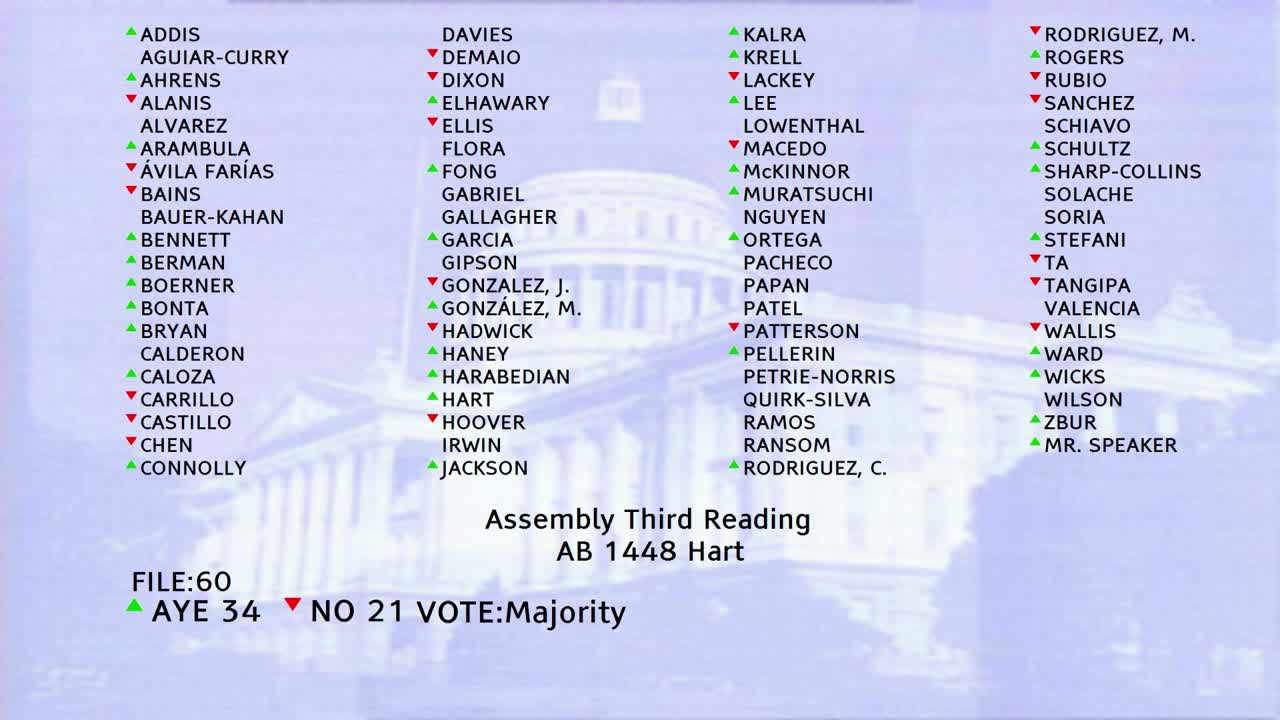 3MIN
Assembly Floor
 4MIN
Assembly Floor
 3MIN
Assembly Standing Committee on Appropriations
 44MIN
Assembly Standing Committee on Transportation
Bill Author

Bill Co-Author(s):