AB 49: Schoolsites: immigration enforcement.
- Session Year: 2025-2026
- House: Assembly
- Latest Version Date: 2025-09-20
Current Status:
Passed
(2025-09-20: Chaptered by Secretary of State - Chapter 122, Statutes of 2025.)
Introduced
In Committee
Awaiting First Chamber Vote
Passed First Chamber
In Committee
Awaiting Second Chamber Vote
Passed Second Chamber
Enacted
(1)Existing law prohibits, except as required by state or federal law or as required to administer a state or federally supported educational program, school officials and employees of a school district, county office of education, or charter school from collecting information or documents regarding citizenship or immigration status of pupils or their family members. Existing law requires the superintendent of a school district, the superintendent of a county office of education, and the principal of a charter school, as applicable, to report to the respective governing board or body of the local educational agency in a timely manner any requests for information or access to a schoolsite by an officer or employee of a law enforcement agency for the purpose of enforcing the immigration laws in a manner that ensures the confidentiality and privacy of any potentially identifying information.
This bill would prohibit school officials and employees of a local educational agency from allowing an officer or employee of an agency conducting immigration enforcement to enter a nonpublic area of a schoolsite, as defined, for any purpose without being presented with a valid judicial warrant, judicial subpoena, or a court order. The bill would require school officials and employees of a local educational agency, to the extent practicable, to request valid identification of any officer or employee of an agency conducting immigration enforcement seeking to enter a nonpublic area of a schoolsite. The bill would also prohibit a local educational agency and its personnel from disclosing or providing, in writing, verbally, or in any other manner, the education records of or any information about a pupil or a pupils family and household without the pupils parents or guardians written consent, a school employee, or a teacher to an officer or employee of an agency conducting immigration enforcement without a valid judicial warrant or judicial subpoena, or court order directing the local educational agency or its personnel to do so. By imposing additional duties on local educational agencies, the bill would impose a state-mandated local program.
(2)Existing law requires the Attorney General, by April 1, 2018, in consultation with the appropriate stakeholders, to publish model policies limiting assistance with immigration enforcement at public schools, to the fullest extent possible consistent with federal and state law, and ensuring that public schools remain safe and accessible to all California residents, regardless of immigration status, as provided. Existing law requires local educational agencies, by July 1, 2018, to adopt those model policies developed by the Attorney General or equivalent policies.
This bill would require the Attorney General, by December 1, 2025, to update those model policies to ensure that the policies align with the above-described prohibitions on school officials and employees of local educational agencies allowing an officer or employee of an agency conducting immigration enforcement to enter a nonpublic area of a schoolsite without a valid judicial warrant or judicial subpoena, or a court order and from disclosing or providing certain information to those officers or employees, as provided. The bill also would require a local educational agency to update its model policy by March 1, 2026, and to make the policy available to the State Department of Education upon request. By imposing additional duties on local educational agencies, the bill would impose a state-mandated local program.
(3)This bill would make these provisions severable.
(4)The California Constitution requires the state to reimburse local agencies and school districts for certain costs mandated by the state. Statutory provisions establish procedures for making that reimbursement.
This bill would provide that, if the Commission on State Mandates determines that the bill contains costs mandated by the state, reimbursement for those costs shall be made pursuant to the statutory provisions noted above.
(5)This bill would declare that it is to take effect immediately as an urgency statute.
(1)Existing law prohibits, except as required by state or federal law or as required to administer a state or federally supported educational program, school officials and employees of a school district, county office of education, or charter school from collecting information or documents regarding citizenship or immigration status of pupils or their family members. Existing law requires the superintendent of a school district, the superintendent of a county office of education, and the principal of a charter school, as applicable, to report to the respective governing board or body of the local educational agency in a timely manner any requests for information or access to a schoolsite by an officer or employee of a law enforcement agency for the purpose of enforcing the immigration laws in a manner that ensures the confidentiality and privacy of any potentially identifying information.
This bill would prohibit school officials and employees of a local educational agency from allowing an immigration authority officer or employee of an agency conducting immigration enforcement to enter a nonpublic area of a schoolsite schoolsite, as defined, for any purpose without being presented with a valid judicial warrant warrant, judicial subpoena, or a court order. The bill would require school officials and employees of a local educational agency, to the extent practicable, to request valid identification of any immigration authority officer or employee of an agency conducting immigration enforcement seeking to enter a nonpublic area of a schoolsite. The bill would also prohibit a local educational agency and its personnel from disclosing or providing, in writing, verbally, or in any other manner, the education records of or any information about a pupil, pupil or a pupils family and household, household without the pupils parents or guardians written consent, a school employee, or a teacher to an immigration authority officer or employee of an agency conducting immigration enforcement without a valid judicial warrant or judicial subpoena, or court order directing the local educational agency or its personnel to do so. By imposing additional duties on local educational agencies, the bill would impose a state-mandated local program.
(2)Existing law requires the Attorney General, by April 1, 2018, in consultation with the appropriate stakeholders, to publish model policies limiting assistance with immigration enforcement at public schools, to the fullest extent possible consistent with federal and state law, and ensuring that public schools remain safe and accessible to all California residents, regardless of immigration status, as provided. Existing law requires local educational agencies, by July 1, 2018, to adopt those model policies developed by the Attorney General or equivalent policies.
This bill would require the Attorney General, by December 1, 2025, to update those model policies to ensure that the policies align with the above-described prohibition prohibitions on school officials and employees of local educational agencies allowing immigration authorities an officer or employee of an agency conducting immigration enforcement to enter a nonpublic area of a schoolsite without a valid judicial warrant or judicial subpoena, or a court order, and requirements for local educational agencies, order and from disclosing or providing certain information to those officers or employees, as provided. The bill also would require a local educational agency to update its model policy by March 1, 2026, and to make the policy available to the State Department of Education upon request. By imposing additional duties on local educational agencies, the bill would impose a state-mandated local program.
(3)This bill would make these provisions severable.
(4)The California Constitution requires the state to reimburse local agencies and school districts for certain costs mandated by the state. Statutory provisions establish procedures for making that reimbursement.
This bill would provide that, if the Commission on State Mandates determines that the bill contains costs mandated by the state, reimbursement for those costs shall be made pursuant to the statutory provisions noted above.
(5)This bill would incorporate additional changes to Section 234.7 of the Education Code proposed by SB 98 to be operative only if this bill and SB 98 are enacted and this bill is enacted last.(6)(5)This bill would declare that it is to take effect immediately as an urgency statute.
(1)Existing law prohibits, except as required by state or federal law or as required to administer a state or federally supported educational program, school officials and employees of a school district, county office of education, or charter school from collecting information or documents regarding citizenship or immigration status of pupils or their family members. Existing law requires the superintendent of a school district, the superintendent of a county office of education, and the principal of a charter school, as applicable, to report to the respective governing board or body of the local educational agency in a timely manner any requests for information or access to a schoolsite by an officer or employee of a law enforcement agency for the purpose of enforcing the immigration laws in a manner that ensures the confidentiality and privacy of any potentially identifying information.
This bill would prohibit school officials and employees of a local educational agency from allowing an officer or employee of an agency conducting immigration enforcement immigration authority to enter a nonpublic area of a schoolsite for any purpose without providing valid identification and being presented with a valid judicial warrant or a court order, unless exigent circumstances necessitate immediate action. order. The bill would require school officials and employees of a local educational agency, to the extent practicable, to request valid identification of any immigration authority seeking to enter a nonpublic area of a schoolsite. The bill would require the local educational agency, if the officer or employee meets those requirements, to limit access to facilities where pupils are not present. also prohibit a local educational agency and its personnel from disclosing or providing, in writing, verbally, or in any other manner, the education records of or any information about a pupil, a pupils family and household, a school employee, or a teacher to an immigration authority without a valid judicial warrant or judicial subpoena, or court order directing the local educational agency or its personnel to do so. By imposing additional duties on local educational agencies, the bill would impose a state-mandated local program.
(2)Existing law requires the Attorney General, by April 1, 2018, in consultation with the appropriate stakeholders, to publish model policies limiting assistance with immigration enforcement at public schools, to the fullest extent possible consistent with federal and state law, and ensuring that public schools remain safe and accessible to all California residents, regardless of immigration status, as provided. Existing law requires local educational agencies, by July 1, 2018, to adopt those model policies developed by the Attorney General or equivalent policies.
This bill would require the Attorney General General, by December 1, 2025, to update those model policies to ensure that the policies align with the above-described prohibition on school officials and employees of local educational agencies allowing officers or employees of agencies conducting immigration enforcement immigration authorities to enter a nonpublic area of a schoolsite without providing identification and a valid judicial warrant or judicial subpoena, or a court order, and the above-described requirement that local educational agencies limit the access of those officers or employees to facilities where pupils are not present, as provided. order, and requirements for local educational agencies, as provided. The bill also would require a local educational agency to update its model policy by March 1, 2026, and to make the policy available to the State Department of Education upon request. By imposing additional duties on local educational agencies, the bill would impose a state-mandated local program.
(3)This bill would make these provisions severable.
(3)(4)The California Constitution requires the state to reimburse local agencies and school districts for certain costs mandated by the state. Statutory provisions establish procedures for making that reimbursement.
This bill would provide that, if the Commission on State Mandates determines that the bill contains costs mandated by the state, reimbursement for those costs shall be made pursuant to the statutory provisions noted above.
(5)This bill would incorporate additional changes to Section 234.7 of the Education Code proposed by SB 98 to be operative only if this bill and SB 98 are enacted and this bill is enacted last.
(4)(6)This bill would declare that it is to take effect immediately as an urgency statute.
(1)Existing law prohibits, except as required by state or federal law or as required to administer a state or federally supported educational program, school officials and employees of a school district, county office of education, or charter school from collecting information or documents regarding citizenship or immigration status of pupils or their family members. Existing law requires the superintendent of a school district, the superintendent of a county office of education, and the principal of a charter school, as applicable, to report to the respective governing board or body of the local educational agency in a timely manner any requests for information or access to a schoolsite by an officer or employee of a law enforcement agency for the purpose of enforcing the immigration laws in a manner that ensures the confidentiality and privacy of any potentially identifying information.
This bill would prohibit school officials and employees of a local educational agency from allowing an officer or employee of an agency conducting immigration enforcement to enter a schoolsite for any purpose without providing valid identification and a valid judicial warrant, warrant or a court order, or unless exigent circumstances necessitating necessitate immediate action. The bill would require the local educational agency, if the officer or employee meets those requirements, to limit access to facilities where pupils are not present. By imposing additional duties on local educational agencies, the bill would impose a state-mandated local program.
(2)Existing law requires the Attorney General, by April 1, 2018, in consultation with the appropriate stakeholders, to publish model policies limiting assistance with immigration enforcement at public schools, to the fullest extent possible consistent with federal and state law, and ensuring that public schools remain safe and accessible to all California residents, regardless of immigration status, as provided.
This bill would require the Attorney General to update those model policies to ensure that the policies align with the above-described prohibition on school officials and employees of local educational agencies allowing officers or employees of agencies conducting immigration enforcement to enter a schoolsite without providing identification and valid judicial warrant or a court order, and the above-described requirement that local educational agencies limit the access of those officers or employees to facilities where pupils are not present, as provided.
(2)(3)The California Constitution requires the state to reimburse local agencies and school districts for certain costs mandated by the state. Statutory provisions establish procedures for making that reimbursement.
This bill would provide that, if the Commission on State Mandates determines that the bill contains costs mandated by the state, reimbursement for those costs shall be made pursuant to the statutory provisions noted above.
(3)(4)This bill would declare that it is to take effect immediately as an urgency statute.
(1)Existing law prohibits, except as required by state or federal law or as required to administer a state or federally supported educational program, school officials and employees of a school district, county office of education, or charter school from collecting information or documents regarding citizenship or immigration status of pupils or their family members. Existing law requires the superintendent of a school district, the superintendent of a county office of education, and the principal of a charter school, as applicable, to report to the respective governing board or body of the local educational agency in a timely manner any requests for information or access to a schoolsite by an officer or employee of a law enforcement agency for the purpose of enforcing the immigration laws in a manner that ensures the confidentiality and privacy of any potentially identifying information.
This bill would prohibit school officials and employees of a local educational agency from allowing an officer or employee of an agency conducting immigration enforcement to enter a schoolsite for any purpose without providing valid identification and a valid, signed valid judicial warrant, and receiving approval from the superintendent of the school district, the superintendent of the county office of education, or the principal of the charter school, or their designee, as applicable. a court order, or exigent circumstances necessitating immediate action. The bill would require the local educational agency, if the officer or employee meets those requirements, to limit access to facilities where pupils are not present. By imposing additional duties on local educational agencies, the bill would impose a state-mandated local program.
(2)The California Constitution requires the state to reimburse local agencies and school districts for certain costs mandated by the state. Statutory provisions establish procedures for making that reimbursement.
This bill would provide that, if the Commission on State Mandates determines that the bill contains costs mandated by the state, reimbursement for those costs shall be made pursuant to the statutory provisions noted above.
(3)This bill would declare that it is to take effect immediately as an urgency statute.
(1)Existing law prohibits, except as required by state or federal law or as required to administer a state or federally supported educational program, school officials and employees of a school district, county office of education, or charter school from collecting information or documents regarding citizenship or immigration status of pupils or their family members. Existing law requires the superintendent of a school district, the superintendent of a county office of education, and the principal of a charter school, as applicable, to report to the respective governing board or body of the local educational agency in a timely manner any requests for information or access to a schoolsite by an officer or employee of a law enforcement agency for the purpose of enforcing the immigration laws in a manner that ensures the confidentiality and privacy of any potentially identifying information.
This bill would prohibit school officials and employees of a local educational agency from allowing an officer or employee of the United States Immigration and Customs Enforcement (ICE) an agency conducting immigration enforcement to enter a schoolsite for any purpose without providing valid identification, a written statement of purpose, and a valid identification and a valid, signed judicial warrant, and receiving approval from the superintendent of the school district, the superintendent of the county office of education, or the principal of the charter school, or their designee, as applicable. The bill would require the local educational agency, if the officer or employee of ICE meets those requirements, to limit access to facilities where pupils are not present. By imposing additional duties on local educational agencies, the bill would impose a state-mandated local program.
(2)The California Child Day Care Facilities Act provides for the licensure and regulation of child day care facilities by the State Department of Social Services. Existing law defines a day care center as a child day care facility other than a family day care home, and includes infant centers, preschools, extended day care facilities, schoolage child care centers, and child care centers licensed pursuant to specified laws.This bill would prohibit, except as required by state or federal law or as required to administer a state or federally supported child care program, employees of a day care center from allowing an officer or employee of ICE to enter the site of the day care center for any purpose without providing valid identification, a written statement of purpose, and a valid judicial warrant, and receiving approval from the director of the day care center or their designee. The bill would require the day care center, if the officer or employee of ICE meets those requirements, to limit access to facilities where children are not present.(3)(2)The California Constitution requires the state to reimburse local agencies and school districts for certain costs mandated by the state. Statutory provisions establish procedures for making that reimbursement.
This bill would provide that, if the Commission on State Mandates determines that the bill contains costs mandated by the state, reimbursement for those costs shall be made pursuant to the statutory provisions noted above.
(1)Existing law prohibits, except as required by state or federal law or as required to administer a state or federally supported educational program, school officials and employees of a school district, county office of education, or charter school from collecting information or documents regarding citizenship or immigration status of pupils or their family members. Existing law requires the superintendent of a school district, the superintendent of a county office of education, and the principal of a charter school, as applicable, to report to the respective governing board or body of the local educational agency in a timely manner any requests for information or access to a schoolsite by an officer or employee of a law enforcement agency for the purpose of enforcing the immigration laws in a manner that ensures the confidentiality and privacy of any potentially identifying information.
This bill would prohibit school officials and employees of a local educational agency from allowing an officer or employee of the United States Immigration and Customs Enforcement (ICE) to enter a schoolsite for any purpose without providing valid identification, a written statement of purpose, and a valid judicial warrant, and receiving approval from the superintendent of the school district, the superintendent of the county office of education, or the principal of the charter school, or their designee, as applicable. The bill would require the local educational agency, if the officer or employee of ICE meets those requirements, to limit access to facilities where pupils are not present. By imposing additional duties on local educational agencies, the bill would impose a state-mandated local program.
(2)The California Child Day Care Facilities Act provides for the licensure and regulation of child day care facilities by the State Department of Social Services. Existing law defines a day care center as a child day care facility other than a family day care home, and includes infant centers, preschools, extended day care facilities, schoolage child care centers, and child care centers licensed pursuant to specified laws.
This bill would prohibit, except as required by state or federal law or as required to administer a state or federally supported child care program, employees of a day care center from allowing an officer or employee of ICE to enter the site of the day care center for any purpose without providing valid identification, a written statement of purpose, and a valid judicial warrant, and receiving approval from the director of the day care center or their designee. The bill would require the day care center, if the officer or employee of ICE meets those requirements, to limit access to facilities where children are not present.
(3)The California Constitution requires the state to reimburse local agencies and school districts for certain costs mandated by the state. Statutory provisions establish procedures for making that reimbursement.
This bill would provide that, if the Commission on State Mandates determines that the bill contains costs mandated by the state, reimbursement for those costs shall be made pursuant to the statutory provisions noted above.
(a)The Legislature finds and declares all of the following:
(1)California is home to 10,600,000 immigrants, with 49 percent of these immigrants coming from Latin America and 41 percent of them born in Asia.
(2)While over one-half of the states immigrants are naturalized as United States citizens, about 1,800,000 of these immigrants are undocumented.
(3)In the 2017 federal fiscal year, during the first Trump administration, there was a 174-percent increase in deportations of immigrants with no criminal record.
(4)Research shows that the effects of immigration enforcement seriously hurt pupils engagement and performance at school. Pupils coming from families with likely unauthorized immigrants have as much as a 25.2-percent increase in the probability of dropping out of school as enforcement increases. There is also a direct correlation between increased deportations within a school district and increased chronic absenteeism and achievements in math among pupils.
(5)When immigration enforcement agencies partner with law enforcement agencies to enforce immigration law, Hispanic pupil enrollment in our public schools is reduced by 7.3 percent. Additionally, these partnerships displace over 300,000 Hispanic pupils as enforcement causes these families to move away or prevents families from moving into these communities.
(6)The United States Supreme Court held in Plyler v. Doe (457 U.S. 202) that denying pupils who are undocumented immigrants a free public education, which is offered to other children who are citizens or documented immigrants, violates the equal protection clause of the Fourteenth Amendment to the United States Constitution.
(b)Therefore, it is the intent of the Legislature to do all of the following:
(1)Safeguard pupils right to free public education regardless of their, and their families, immigration status.
(2)Reaffirm Californias position to provide a safe, secure, and peaceful environment for all pupils to learn.
(3)Declare that local educational agencies shall limit their assistance with immigration enforcement agencies where children and pupils are present to the fullest extent possible, consistent with federal and state law.
(4)Ensure that immigration enforcement is restricted to areas where children are not present.
SEC. 3.Section 234.7 of the Education Code is amended to read:234.7.(a)Except as required by state or federal law, or as required to administer a state or federally supported educational program, school officials and employees of a local educational agency shall not do either of the following:
(1)Collect information or documents regarding citizenship or immigration status of pupils or their family members.
(2)Allow an officer or employee of an agency conducting immigration enforcement to enter a nonpublic area of a schoolsite for any purpose without being presented with a valid judicial warrant or judicial subpoena, or a court order. Any school official or employee of a local educational agency shall, to the extent practicable, request a valid identification from an officer or employee of an agency conducting immigration enforcement seeking to enter a nonpublic area of a schoolsite. This subdivision shall not be construed to limit a local educational agencys or school officials right to consult with counsel or challenge the validity of a warrant, subpoena, or court order in a court of competent jurisdiction.
(b)A local educational agency and its personnel, to the extent practicable, shall not disclose or provide in writing, verbally, or in any other manner, the education records of or any information about a pupil or a pupils family and household without the pupils parents or guardians written consent, a school employee, or a teacher, including, but not limited to, personal information as defined in subdivision (a) of Section 1798.3 of the Civil Code, information about a pupils home, and information about a pupils travel schedule, to an officer or employee of an agency conducting immigration enforcement absent a valid judicial warrant or judicial subpoena, or court order directing the local educational agency or its personnel to do so. Any disclosure of a pupils education records pursuant to a valid judicial warrant or judicial subpoena, or court order shall be in accordance with the parent notification requirements set forth in Section 99.31(a)(9)(ii) of Title 34 of the Code of Federal Regulations.
(c)The superintendent of a school district, the superintendent of a county office of education, and the principal of a charter school, as applicable, shall report to the respective governing board or body of the local educational agency in a timely manner any requests for information or access to a schoolsite by an officer or employee of a law enforcement agency for the purpose of enforcing the immigration laws in a manner that ensures the confidentiality and privacy of any potentially identifying information.
(d)If an employee of a school is aware that a pupils parent or guardian is not available to care for the pupil, the school shall first exhaust any parental instruction relating to the pupils care in the emergency contact information it has for the pupil to arrange for the pupils care. A school is encouraged to work with parents or guardians to update the emergency contact information and not to contact Child Protective Services to arrange for the pupils care unless the school is unable to arrange for care through the use of emergency contact information or other information or instructions provided by the parent or guardian.
(e)The governing board or body of a local educational agency shall do both of the following:
(1)Provide information to parents and guardians, as appropriate, regarding their childrens right to a free public education, regardless of immigration status or religious beliefs. This information shall include information relating to know your rights immigration enforcement established by the Attorney General and may be provided in the annual notification to parents and guardians pursuant to Section 48980 or any other cost-effective means determined by the local educational agency.
(2)Educate pupils about the negative impact of bullying other pupils based on their actual or perceived immigration status or their religious beliefs and customs.
(f)This section does not prohibit the governing board or body of a local educational agency from establishing stronger standards and protections.
(g)(1)The Attorney General, by April 1, 2018, in consultation with the appropriate stakeholders, shall publish model policies limiting assistance with immigration enforcement at public schools, to the fullest extent possible consistent with federal and state law, and ensuring that public schools remain safe and accessible to all California residents, regardless of immigration status. The Attorney General shall, at a minimum, consider all of the following issues when developing the model policies:
(A)Procedures related to requests for access to school grounds for purposes related to immigration enforcement.
(B)Procedures for local educational agency employees to notify the superintendent of the school district or their designee, the superintendent of the county office of education or their designee, or the principal of the charter school or their designee, as applicable, if an individual requests or gains access to school grounds for purposes related to immigration enforcement.
(C)Procedures for responding to requests for personal information about pupils or their family members for purposes of immigration enforcement.
(2)The Attorney General shall, no later than December 1, 2025, update the model policies described in paragraph (1) to ensure that these policies align with the prohibition applicable to school officials and employees of local educational agencies as described in paragraph (2) of subdivision (a), and the requirements for local educational agencies, as described in this section.
(3)Notwithstanding the rulemaking provisions of the Administrative Procedure Act (Chapter 3.5 (commencing with Section 11340) of Part 1 of Division 3 of Title 2 of the Government Code), the Department of Justice may implement, interpret, or make specific this section without taking any regulatory action.
(h)All local educational agencies shall adopt the model policies developed pursuant to paragraph (1) of subdivision (g), or equivalent policies, by July 1, 2018, and shall update those policies to align with this section, including paragraph (2) of subdivision (g), by March 1, 2026.
(i)This section does not prohibit or restrict any governmental entity or official from sending to, or receiving from, federal immigration authorities, information regarding the citizenship or immigration status, lawful or unlawful, of an individual, or from requesting from federal immigration authorities immigration status information, lawful or unlawful, of any individual, or maintaining or exchanging that information with any other federal, state, or local governmental entity, pursuant to Sections 1373 and 1644 of Title 8 of the United States Code.
(j)A local educational agency shall maintain its policy adopted pursuant to subdivision (h) and make the policy available to the department upon request.
(k)Local educational agencies may be subject to monitoring and auditing by the department to ensure compliance with the requirements of subdivisions (h) and (j).
(l)For purposes of this section, the following definitions apply:
(1)Immigration enforcement includes any and all efforts to investigate, enforce, or assist in the investigation or enforcement of any federal civil immigration law, and any and all efforts to investigate, enforce, or assist in the investigation or enforcement of any federal criminal immigration law that penalizes a persons presence in, entry, or reentry to, or employment in, the United States.
(2)Local educational agency means a school district, county office of education, or charter school.
(3)Schoolsite means an individual school campus of a school district, county office of education, or charter school, an area where a local educational agencys school-sponsored activity is currently being held, or a schoolbus or other transportation provided by a local educational agency.
SEC. 4.The provisions of this act are severable. If any provision of this act or its application is held invalid, that invalidity shall not affect other provisions or applications that can be given effect without the invalid provision or application.
SEC. 5.If the Commission on State Mandates determines that this act contains costs mandated by the state, reimbursement to local agencies and school districts for those costs shall be made pursuant to Part 7 (commencing with Section 17500) of Division 4 of Title 2 of the Government Code.
SEC. 6.This act is an urgency statute necessary for the immediate preservation of the public peace, health, or safety within the meaning of Article IV of the California Constitution and shall go into immediate effect. The facts constituting the necessity are:
According to the Migration Policy Institute, 133,000 children between 3 and 17 years of age who are undocumented are enrolled in California public schools, and 750,000 students in kindergarten and grades 1 to 12, inclusive, have at least one parent who is undocumented. In order to ensure, as soon as possible, that these students and their families do not face fear, uncertainty, and potential disruptions to their education, and that schools remain safe havens where all children, regardless of immigration status, can learn and thrive without fear of enforcement actions, it is necessary that this act take effect immediately.
(a)The Legislature finds and declares all of the following:
(1)California is home to 10,600,000 immigrants, with 49 percent of these immigrants coming from Latin America and 41 percent of them born in Asia.
(2)While over one-half of the states immigrants are naturalized as United States citizens, about 1,800,000 of these immigrants are undocumented.
(3)In the 2017 federal fiscal year, during the first Trump administration, there was a 174-percent increase in deportations of immigrants with no criminal record.
(4)Research shows that the effects of immigration enforcement seriously hurt pupils engagement and performance at school. Pupils coming from families with likely unauthorized immigrants have as much as a 25.2-percent increase in the probability of dropping out of school as enforcement increases. There is also a direct correlation between increased deportations within a school district and increased chronic absenteeism and achievements in math among pupils.
(5)When immigration enforcement agencies partner with law enforcement agencies to enforce immigration law, Hispanic pupil enrollment in our public schools is reduced by 7.3 percent. Additionally, these partnerships displace over 300,000 Hispanic pupils as enforcement causes these families to move away or prevents families from moving into these communities.
(6)The United States Supreme Court held in Plyler v. Doe (457 U.S. 202) that denying pupils who are undocumented immigrants a free public education, which is offered to other children who are citizens or documented immigrants, violates the equal protection clause of the Fourteenth Amendment to the United States Constitution.
(b)Therefore, it is the intent of the Legislature to do all of the following:
(1)Safeguard pupils right to free public education regardless of their, and their families, immigration status.
(2)Reaffirm Californias position to provide a safe, secure, and peaceful environment for all pupils to learn.
(3)Declare that local educational agencies shall limit their assistance with immigration enforcement agencies where children and pupils are present to the fullest extent possible, consistent with federal and state law.
(4)Ensure that immigration enforcement is restricted to areas where children are not present.
SEC. 3.Section 234.7 of the Education Code is amended to read:234.7.(a)Except as required by state or federal law, or as required to administer a state or federally supported educational program, school officials and employees of a local educational agency shall not do either of the following:
(1)Collect information or documents regarding citizenship or immigration status of pupils or their family members.
(2)Allow an immigration authority officer or employee of an agency conducting immigration enforcement to enter a nonpublic area of a schoolsite for any purpose without being presented with a valid judicial warrant warrant or judicial subpoena, or a court order. Any school official or employee of a local educational agency shall, to the extent practicable, request a valid identification of any immigration authority from an officer or employee of an agency conducting immigration enforcement seeking to enter a nonpublic area of a schoolsite. This subdivision shall not be construed to limit a local educational agencys or school officials right to consult with counsel or challenge the validity of a warrant, subpoena, or court order in a court of competent jurisdiction.
(b)Notwithstanding any other law, a A local educational agency and its personnel shall, personnel, to the extent practicable, shall not disclose or provide in writing, verbally, or in any other manner, the education records of or any information about a pupil, pupil or a pupils family and household, household without the pupils parents or guardians written consent, a school employee, or a teacher, including, but not limited to, personal information as defined in subdivision (a) of Section 1798.3 of the Civil Code, information about a pupils home, and information about a pupils travel schedule, to an immigration authority without officer or employee of an agency conducting immigration enforcement absent a valid judicial warrant or judicial subpoena, or court order directing the local educational agency or its personnel to do so. Any disclosure of a pupils education records pursuant to a valid judicial warrant or judicial subpoena, or court order shall satisfy be in accordance with the parent notification requirements pursuant to set forth in Section 99.31(a)(9)(ii) of Title 34 of the Code of Federal Regulations.
(c)The superintendent of a school district, the superintendent of a county office of education, and the principal of a charter school, as applicable, shall report to the respective governing board or body of the local educational agency in a timely manner any requests for information or access to a schoolsite by an officer or employee of a law enforcement agency for the purpose of enforcing the immigration laws in a manner that ensures the confidentiality and privacy of any potentially identifying information.
(d)If an employee of a school is aware that a pupils parent or guardian is not available to care for the pupil, the school shall first exhaust any parental instruction relating to the pupils care in the emergency contact information it has for the pupil to arrange for the pupils care. A school is encouraged to work with parents or guardians to update the emergency contact information and not to contact Child Protective Services to arrange for the pupils care unless the school is unable to arrange for care through the use of emergency contact information or other information or instructions provided by the parent or guardian.
(e)The governing board or body of a local educational agency shall do both of the following:
(1)Provide information to parents and guardians, as appropriate, regarding their childrens right to a free public education, regardless of immigration status or religious beliefs. This information shall include information relating to know your rights immigration enforcement established by the Attorney General and may be provided in the annual notification to parents and guardians pursuant to Section 48980 or any other cost-effective means determined by the local educational agency.
(2)Educate pupils about the negative impact of bullying other pupils based on their actual or perceived immigration status or their religious beliefs and customs.
(f)This section does not prohibit the governing board or body of a local educational agency from establishing stronger standards and protections.
(g)(1)The Attorney General, by April 1, 2018, in consultation with the appropriate stakeholders, shall publish model policies limiting assistance with immigration enforcement at public schools, to the fullest extent possible consistent with federal and state law, and ensuring that public schools remain safe and accessible to all California residents, regardless of immigration status. The Attorney General shall, at a minimum, consider all of the following issues when developing the model policies:
(A)Procedures related to requests for access to school grounds for purposes related to immigration enforcement.
(B)Procedures for local educational agency employees to notify the superintendent of the school district or their designee, the superintendent of the county office of education or their designee, or the principal of the charter school or their designee, as applicable, if an individual requests or gains access to school grounds for purposes related to immigration enforcement.
(C)Procedures for responding to requests for personal information about pupils or their family members for purposes of immigration enforcement.
(2)The Attorney General shall, no later than December 1, 2025, update the model policies described in paragraph (1) to ensure that these policies align with the prohibition applicable to school officials and employees of local educational agencies as described in paragraph (2) of subdivision (a), and the requirements for local educational agencies, as described in this section.
(3)Notwithstanding the rulemaking provisions of the Administrative Procedure Act (Chapter 3.5 (commencing with Section 11340) of Part 1 of Division 3 of Title 2 of the Government Code), the Department of Justice may implement, interpret, or make specific this section without taking any regulatory action.
(h)All local educational agencies shall adopt the model policies developed pursuant to paragraph (1) of subdivision (g), or equivalent policies, by July 1, 2018, and shall update those policies to align with this section, including paragraph (2) of subdivision (g), by March 1, 2026.
(i)This section does not prohibit or restrict any governmental entity or official from sending to, or receiving from, federal immigration authorities, information regarding the citizenship or immigration status, lawful or unlawful, of an individual, or from requesting from federal immigration authorities immigration status information, lawful or unlawful, of any individual, or maintaining or exchanging that information with any other federal, state, or local governmental entity, pursuant to Sections 1373 and 1644 of Title 8 of the United States Code.
(j)(1)A local educational agency shall maintain its policy adopted pursuant to subdivision (h) and make the policy available to the department upon request.
(2)(k)Local educational agencies may be subject to monitoring and auditing by the department to ensure compliance with the requirements of this section. subdivisions (h) and (j).
(k)(l)For purposes of this section, the following definitions apply:
(1)Immigration authority means any federal, state, or local officer, employee, or person performing immigration enforcement functions.(2)(1)Immigration enforcement includes any and all efforts to investigate, enforce, or assist in the investigation or enforcement of any federal civil immigration law, and any and all efforts to investigate, enforce, or assist in the investigation or enforcement of any federal criminal immigration law that penalizes a persons presence in, entry, or reentry to, or employment in, the United States.
(3)(2)Local educational agency means a school district, county office of education, or charter school.
(4)(3)Schoolsite means an individual school campus of a school district, county office of education, or charter school, an area where a local educational agencys school-sponsored activity is currently being held, or a schoolbus or other transportation provided by a local educational agency.
SEC. 3.5.Section 234.7 of the Education Code is amended to read:234.7.(a)Except as required by state or federal law, or as required to administer a state or federally supported educational program, school officials and employees of a local educational agency shall not do either of the following:(1)Collect information or documents regarding citizenship or immigration status of pupils or their family members.(2)Allow an immigration authority to enter a nonpublic area of a schoolsite for any purpose without being presented with a valid judicial warrant or a court order. Any school official or employee of a local educational agency shall, to the extent practicable, request a valid identification of any immigration authority seeking to enter a nonpublic area of a schoolsite.(b)Notwithstanding any other law, a local educational agency and its personnel shall, to the extent practicable, not disclose or provide in writing, verbally, or in any other manner, the education records of or any information about a pupil, a pupils family and household, a school employee, or a teacher, including, but not limited to, personal information as defined in subdivision (a) of Section 1798.3 of the Civil Code, information about a pupils home, and information about a pupils travel schedule, to an immigration authority without a valid judicial warrant or judicial subpoena, or court order directing the local educational agency or its personnel to do so. Any disclosure of a pupils education records pursuant to a valid judicial warrant or judicial subpoena, or court order shall satisfy the parent notification requirements pursuant to Section 99.31(a)(9)(ii) of Title 34 of the Code of Federal Regulations.(c)(1)The superintendent of a school district, the superintendent of a county office of education, and the principal of a charter school, as applicable, shall report to the respective governing board or body of the local educational agency in a timely manner any requests for information or access to a schoolsite by an officer or employee of a law enforcement agency for the purpose of enforcing the immigration laws in a manner that ensures the confidentiality and privacy of any potentially identifying information.(2)(A)The superintendent of a school district, the superintendent of a county office of education, and the principal of a charter school, or their respective designee, shall notify all teachers, staff, other school community members that work on a schoolsite, parents, and guardians when the presence of immigration enforcement is confirmed on the schoolsite.(B)A notice provided pursuant to subparagraph (A) shall include all of the following information:(i)The date and time the immigration enforcement was confirmed.(ii)The location of the confirmed immigration enforcement.(iii)A hyperlink to additional resources, including model policies adopted by the local educational agency pursuant to subdivision (h).(C)A notice provided pursuant to subparagraph (A) shall not include any personally identifiable information.(d)If an employee of a school is aware that a pupils parent or guardian is not available to care for the pupil, the school shall first exhaust any parental instruction relating to the pupils care in the emergency contact information it has for the pupil to arrange for the pupils care. A school is encouraged to work with parents or guardians to update the emergency contact information and not to contact Child Protective Services to arrange for the pupils care unless the school is unable to arrange for care through the use of emergency contact information or other information or instructions provided by the parent or guardian.(e)The governing board or body of a local educational agency shall do both of the following:(1)Provide information to parents and guardians, as appropriate, regarding their childrens right to a free public education, regardless of immigration status or religious beliefs. This information shall include information relating to know your rights immigration enforcement established by the Attorney General and may be provided in the annual notification to parents and guardians pursuant to Section 48980 or any other cost-effective means determined by the local educational agency.(2)Educate pupils about the negative impact of bullying other pupils based on their actual or perceived immigration status or their religious beliefs and customs.(f)This section does not prohibit the governing board or body of a local educational agency from establishing stronger standards and protections.(g)(1)The Attorney General, by April 1, 2018, in consultation with the appropriate stakeholders, shall publish model policies limiting assistance with immigration enforcement at public schools, to the fullest extent possible consistent with federal and state law, and ensuring that public schools remain safe and accessible to all California residents, regardless of immigration status. The Attorney General shall, at a minimum, consider all of the following issues when developing the model policies:(A)Procedures related to requests for access to school grounds for purposes related to immigration enforcement.(B)Procedures for local educational agency employees to notify the superintendent of the school district or their designee, the superintendent of the county office of education or their designee, or the principal of the charter school or their designee, as applicable, if an individual requests or gains access to school grounds for purposes related to immigration enforcement.(C)Procedures for responding to requests for personal information about pupils or their family members for purposes of immigration enforcement.(2)The Attorney General shall, no later than December 1, 2025, update the model policies described in paragraph (1) to ensure that these policies align with the prohibition applicable to school officials and employees of local educational agencies as described in paragraph (2) of subdivision (a), and the requirements for local educational agencies, as described in this section.(3)Notwithstanding the rulemaking provisions of the Administrative Procedure Act (Chapter 3.5 (commencing with Section 11340) of Part 1 of Division 3 of Title 2 of the Government Code), the Department of Justice may implement, interpret, or make specific this section without taking any regulatory action.(h)All local educational agencies shall adopt the model policies developed pursuant to paragraph (1) of subdivision (g), or equivalent policies, by July 1, 2018, and shall update those policies to align with this section, including paragraph (2) of subdivision (g), by March 1, 2026.(i)This section does not prohibit or restrict any governmental entity or official from sending to, or receiving from, federal immigration authorities, information regarding the citizenship or immigration status, lawful or unlawful, of an individual, or from requesting from federal immigration authorities immigration status information, lawful or unlawful, of any individual, or maintaining or exchanging that information with any other federal, state, or local governmental entity, pursuant to Sections 1373 and 1644 of Title 8 of the United States Code.(j)(1)A local educational agency shall maintain its policy adopted pursuant to subdivision (h) and make the policy available to the department upon request.(2)Local educational agencies may be subject to monitoring and auditing by the department to ensure compliance with the requirements of this section.(k)For purposes of this section, the following definitions apply:(1)Immigration authority means any federal, state, or local officer, employee, or person performing immigration enforcement functions.(2)Immigration enforcement includes any and all efforts to investigate, enforce, or assist in the investigation or enforcement of any federal civil immigration law, and any and all efforts to investigate, enforce, or assist in the investigation or enforcement of any federal criminal immigration law that penalizes a persons presence in, entry, or reentry to, or employment in, the United States.(3)Local educational agency means a school district, county office of education, or charter school.(4)Schoolsite means an individual school campus of a school district, county office of education, or charter school, an area where a local educational agencys school-sponsored activity is currently being held, or a schoolbus or other transportation provided by a local educational agency.SEC. 4.The provisions of this act are severable. If any provision of this act or its application is held invalid, that invalidity shall not affect other provisions or applications that can be given effect without the invalid provision or application.
SEC. 5.If the Commission on State Mandates determines that this act contains costs mandated by the state, reimbursement to local agencies and school districts for those costs shall be made pursuant to Part 7 (commencing with Section 17500) of Division 4 of Title 2 of the Government Code.
SEC. 6.Section 3.5 of this bill incorporates amendments to Section 234.7 of the Education Code proposed by this bill and Senate Bill 98. That section of this bill shall only become operative if (1) both bills are enacted and become effective on or before January 1, 2026, (2) each bill amends Section 234.7 of the Education Code, and (3) this bill is enacted after Senate Bill 98, in which case Section 234.7 of the Education Code, as amended by Senate Bill 98, shall remain operative only until the operative date of this bill, at which time Section 3.5 of this bill shall become operative, and Section 3 of this bill shall not become operative.SEC. 7.SEC. 6.This act is an urgency statute necessary for the immediate preservation of the public peace, health, or safety within the meaning of Article IV of the California Constitution and shall go into immediate effect. The facts constituting the necessity are:
According to the Migration Policy Institute, 133,000 children between 3 and 17 years of age who are undocumented are enrolled in California public schools, and 750,000 students in kindergarten and grades 1 to 12, inclusive, have at least one parent who is undocumented. In order to ensure, as soon as possible, that these students and their families do not face fear, uncertainty, and potential disruptions to their education, and that schools remain safe havens where all children, regardless of immigration status, can learn and thrive without fear of enforcement actions, it is necessary that this act take effect immediately.
(a)The Legislature finds and declares all of the following:
(1)California is home to 10,600,000 immigrants, with 49 percent of these immigrants coming from Latin America and 41 percent of them born in Asia.
(2)While over one-half of the states immigrants are naturalized as United States citizens, about 1,800,000 of these immigrants are undocumented.
(3)In the 2017 federal fiscal year, during the first Trump administration, there was a 174-percent increase in deportations of immigrants with no criminal record.
(4)Research shows that the effects of immigration enforcement seriously hurt pupils engagement and performance at school. Pupils coming from families with likely unauthorized immigrants have as much as a 25.2-percent increase in the probability of dropping out of school as enforcement increases. There is also a direct correlation between increased deportations within a school district and increased chronic absenteeism and achievements in math among pupils.
(5)When immigration enforcement agencies partner with law enforcement agencies to enforce immigration law, Hispanic pupil enrollment in our public schools is reduced by 7.3 percent. Additionally, these partnerships displace over 300,000 Hispanic pupils as enforcement causes these families to move away or prevents families from moving into these communities.
(6)The United States Supreme Court held in Plyler v. Doe (457 U.S. 202) that denying pupils who are undocumented immigrants a free public education, which is offered to other children who are citizens or documented immigrants, violates the equal protection clause of the Fourteenth Amendment to the United States Constitution.
(b)Therefore, it is the intent of the Legislature to do all of the following:
(1)Safeguard pupils right to free public education regardless of their, and their families, immigration status.
(2)Reaffirm Californias position to provide a safe, secure, and peaceful environment for all pupils to learn.
(3)Declare that local educational agencies shall limit their assistance with immigration enforcement agencies where children and pupils are present to the fullest extent possible, consistent with federal and state law.
(4)Ensure that immigration enforcement is restricted to areas where children are not present.
SEC. 3.Section 234.7 of the Education Code is amended to read:234.7.(a)Except as required by state or federal law law, or as required to administer a state or federally supported educational program, school officials and employees of a local educational agency shall not do either of the following:
(1)Collect information or documents regarding citizenship or immigration status of pupils or their family members.
(2)Allow an officer or employee of an agency conducting immigration enforcement immigration authority to enter a nonpublic area of a schoolsite for any purpose without providing valid identification and being presented with a valid judicial warrant or a court order, unless exigent circumstances necessitate immediate action. order. Any school official or employee of a local educational agency shall, to the extent practicable, request a valid identification of any immigration authority seeking to enter a nonpublic area of a schoolsite.
(b)(1)If an officer or employee of an agency conducting immigration enforcement meets the requirements set forth in paragraph (2) of subdivision (a), the local educational agency shall limit access to facilities where pupils are not present.(b)Notwithstanding any other law, a local educational agency and its personnel shall, to the extent practicable, not disclose or provide in writing, verbally, or in any other manner, the education records of or any information about a pupil, a pupils family and household, a school employee, or a teacher, including, but not limited to, personal information as defined in subdivision (a) of Section 1798.3 of the Civil Code, information about a pupils home, and information about a pupils travel schedule, to an immigration authority without a valid judicial warrant or judicial subpoena, or court order directing the local educational agency or its personnel to do so. Any disclosure of a pupils education records pursuant to a valid judicial warrant or judicial subpoena, or court order shall satisfy the parent notification requirements pursuant to Section 99.31(a)(9)(ii) of Title 34 of the Code of Federal Regulations.
(2)(c)The superintendent of a school district, the superintendent of a county office of education, and the principal of a charter school, as applicable, shall report to the respective governing board or body of the local educational agency in a timely manner any requests for information or access to a schoolsite by an officer or employee of a law enforcement agency for the purpose of enforcing the immigration laws in a manner that ensures the confidentiality and privacy of any potentially identifying information.
(c)(d)If an employee of a school is aware that a pupils parent or guardian is not available to care for the pupil, the school shall first exhaust any parental instruction relating to the pupils care in the emergency contact information it has for the pupil to arrange for the pupils care. A school is encouraged to work with parents or guardians to update the emergency contact information and not to contact Child Protective Services to arrange for the pupils care unless the school is unable to arrange for care through the use of emergency contact information or other information or instructions provided by the parent or guardian.
(d)(e)The governing board or body of a local educational agency shall do both of the following:
(1)Provide information to parents and guardians, as appropriate, regarding their childrens right to a free public education, regardless of immigration status or religious beliefs. This information shall include information relating to know your rights immigration enforcement established by the Attorney General and may be provided in the annual notification to parents and guardians pursuant to Section 48980 or any other cost-effective means determined by the local educational agency.
(2)Educate pupils about the negative impact of bullying other pupils based on their actual or perceived immigration status or their religious beliefs and customs.
(e)(f)This section does not prohibit the governing board or body of a local educational agency from establishing stronger standards and protections.
(f)(g)(1)The Attorney General, by April 1, 2018, in consultation with the appropriate stakeholders, shall publish model policies limiting assistance with immigration enforcement at public schools, to the fullest extent possible consistent with federal and state law, and ensuring that public schools remain safe and accessible to all California residents, regardless of immigration status. The Attorney General shall, at a minimum, consider all of the following issues when developing the model policies:
(A)Procedures related to requests for access to school grounds for purposes related to immigration enforcement.
(B)Procedures for local educational agency employees to notify the superintendent of the school district or their designee, the superintendent of the county office of education or their designee, or the principal of the charter school or their designee, as applicable, if an individual requests or gains access to school grounds for purposes related to immigration enforcement.
(C)Procedures for responding to requests for personal information about pupils or their family members for purposes of immigration enforcement.
(2)The Attorney General shall shall, no later than December 1, 2025, update the model policies described in paragraph (1) to ensure that these policies align with the prohibition applicable to school officials and employees of local educational agencies as described in paragraph (2) of subdivision (a), and the requirements for local educational agencies as described in paragraph (1) of subdivision (b), both as amended by Assembly Bill 49 of the 202526 Regular Session. agencies, as described in this section.
(3)Notwithstanding the rulemaking provisions of the Administrative Procedure Act (Chapter 3.5 (commencing with Section 11340) of Part 1 of Division 3 of Title 2 of the Government Code), the Department of Justice may implement, interpret, or make specific this section without taking any regulatory action.
(g)(h)All local educational agencies shall adopt the model policies developed pursuant to paragraph (1) of subdivision (f), (g), or equivalent policies, by July 1, 2018. 2018, and shall update those policies to align with this section, including paragraph (2) of subdivision (g), by March 1, 2026.
(h)(i)This section does not prohibit or restrict any governmental entity or official from sending to, or receiving from, federal immigration authorities, information regarding the citizenship or immigration status, lawful or unlawful, of an individual, or from requesting from federal immigration authorities immigration status information, lawful or unlawful, of any individual, or maintaining or exchanging that information with any other federal, state, or local governmental entity, pursuant to Sections 1373 and 1644 of Title 8 of the United States Code.
(j)(1)A local educational agency shall maintain its policy adopted pursuant to subdivision (h) and make the policy available to the department upon request.
(2)Local educational agencies may be subject to monitoring and auditing by the department to ensure compliance with the requirements of this section.
(i)(k)For purposes of this section, local educational agency means a school district, county office of education, or charter school. the following definitions apply:
(1)Immigration authority means any federal, state, or local officer, employee, or person performing immigration enforcement functions.
(2)Immigration enforcement includes any and all efforts to investigate, enforce, or assist in the investigation or enforcement of any federal civil immigration law, and any and all efforts to investigate, enforce, or assist in the investigation or enforcement of any federal criminal immigration law that penalizes a persons presence in, entry, or reentry to, or employment in, the United States.
(3)Local educational agency means a school district, county office of education, or charter school.
(4)Schoolsite means an individual school campus of a school district, county office of education, or charter school, an area where a local educational agencys school-sponsored activity is currently being held, or a schoolbus or other transportation provided by a local educational agency.
SEC. 3.5.Section 234.7 of the Education Code is amended to read:234.7.(a)Except as required by state or federal law law, or as required to administer a state or federally supported educational program, school officials and employees of a local educational agency shall not collect information or documents regarding citizenship or immigration status of pupils or their family members. do either of the following:
(1)Collect information or documents regarding citizenship or immigration status of pupils or their family members.
(2)Allow an immigration authority to enter a nonpublic area of a schoolsite for any purpose without being presented with a valid judicial warrant or a court order. Any school official or employee of a local educational agency shall, to the extent practicable, request a valid identification of any immigration authority seeking to enter a nonpublic area of a schoolsite.
(b)Notwithstanding any other law, a local educational agency and its personnel shall, to the extent practicable, not disclose or provide in writing, verbally, or in any other manner, the education records of or any information about a pupil, a pupils family and household, a school employee, or a teacher, including, but not limited to, personal information as defined in subdivision (a) of Section 1798.3 of the Civil Code, information about a pupils home, and information about a pupils travel schedule, to an immigration authority without a valid judicial warrant or judicial subpoena, or court order directing the local educational agency or its personnel to do so. Any disclosure of a pupils education records pursuant to a valid judicial warrant or judicial subpoena, or court order shall satisfy the parent notification requirements pursuant to Section 99.31(a)(9)(ii) of Title 34 of the Code of Federal Regulations.
(b)(c)(1)The superintendent of a school district, the superintendent of a county office of education, and the principal of a charter school, as applicable, shall report to the respective governing board or body of the local educational agency in a timely manner any requests for information or access to a schoolsite by an officer or employee of a law enforcement agency for the purpose of enforcing the immigration laws in a manner that ensures the confidentiality and privacy of any potentially identifying information.
(2)(A)The superintendent of a school district, the superintendent of a county office of education, and the principal of a charter school, or their respective designee, shall notify all teachers, staff, other school community members that work on a schoolsite, parents, and guardians when the presence of immigration enforcement is confirmed on the schoolsite.
(B)A notice provided pursuant to subparagraph (A) shall include all of the following information:
(i)The date and time the immigration enforcement was confirmed.
(ii)The location of the confirmed immigration enforcement.
(iii)A hyperlink to additional resources, including model policies adopted by the local educational agency pursuant to subdivision (h).
(C)A notice provided pursuant to subparagraph (A) shall not include any personally identifiable information.
(c)(d)If an employee of a school is aware that a pupils parent or guardian is not available to care for the pupil, the school shall first exhaust any parental instruction relating to the pupils care in the emergency contact information it has for the pupil to arrange for the pupils care. A school is encouraged to work with parents or guardians to update the emergency contact information and not to contact Child Protective Services to arrange for the pupils care unless the school is unable to arrange for care through the use of emergency contact information or other information or instructions provided by the parent or guardian.
(d)(e)The governing board or body of a local educational agency shall do both of the following:
(1)Provide information to parents and guardians, as appropriate, regarding their childrens right to a free public education, regardless of immigration status or religious beliefs. This information shall include information relating to know your rights immigration enforcement established by the Attorney General and may be provided in the annual notification to parents and guardians pursuant to Section 48980 or any other cost-effective means determined by the local educational agency.
(2)Educate pupils about the negative impact of bullying other pupils based on their actual or perceived immigration status or their religious beliefs and customs.
(e)Nothing in this section prohibits(f)This section does not prohibit the governing board or body of a local educational agency from establishing stronger standards and protections.
(f)(g)(1)The Attorney General, by April 1, 2018, in consultation with the appropriate stakeholders, shall publish model policies limiting assistance with immigration enforcement at public schools, to the fullest extent possible consistent with federal and state law, and ensuring that public schools remain safe and accessible to all California residents, regardless of immigration status. The Attorney General shall, at a minimum, consider all of the following issues when developing the model policies:
(A)Procedures related to requests for access to school grounds for purposes related to immigration enforcement.
(B)Procedures for local educational agency employees to notify the superintendent of the school district or his or her their designee, the superintendent of the county office of education or his or her their designee, or the principal of the charter school or his or her their designee, as applicable, if an individual requests or gains access to school grounds for purposes related to immigration enforcement.
(C)Procedures for responding to requests for personal information about pupils or their family members for purposes of immigration enforcement.
(2)The Attorney General shall, no later than December 1, 2025, update the model policies described in paragraph (1) to ensure that these policies align with the prohibition applicable to school officials and employees of local educational agencies as described in paragraph (2) of subdivision (a), and the requirements for local educational agencies, as described in this section.
(2)(3)Notwithstanding the rulemaking provisions of the Administrative Procedure Act (Chapter 3.5 (commencing with Section 11340) of Part 1 of Division 3 of Title 2 of the Government Code), the Department of Justice may implement, interpret, or make specific this section without taking any regulatory action.
(g)(h)All local educational agencies shall adopt the model policies developed pursuant to paragraph (1) of subdivision (f), (g), or equivalent policies, by July 1, 2018. 2018, and shall update those policies to align with this section, including paragraph (2) of subdivision (g), by March 1, 2026.
(i)This section does not prohibit or restrict any governmental entity or official from sending to, or receiving from, federal immigration authorities, information regarding the citizenship or immigration status, lawful or unlawful, of an individual, or from requesting from federal immigration authorities immigration status information, lawful or unlawful, of any individual, or maintaining or exchanging that information with any other federal, state, or local governmental entity, pursuant to Sections 1373 and 1644 of Title 8 of the United States Code.
(j)(1)A local educational agency shall maintain its policy adopted pursuant to subdivision (h) and make the policy available to the department upon request.
(2)Local educational agencies may be subject to monitoring and auditing by the department to ensure compliance with the requirements of this section.
(h)(k)For purposes of this section, local educational agency means a school district, county office of education, or charter school. the following definitions apply:
(1)Immigration authority means any federal, state, or local officer, employee, or person performing immigration enforcement functions.
(2)Immigration enforcement includes any and all efforts to investigate, enforce, or assist in the investigation or enforcement of any federal civil immigration law, and any and all efforts to investigate, enforce, or assist in the investigation or enforcement of any federal criminal immigration law that penalizes a persons presence in, entry, or reentry to, or employment in, the United States.
(3)Local educational agency means a school district, county office of education, or charter school.
(4)Schoolsite means an individual school campus of a school district, county office of education, or charter school, an area where a local educational agencys school-sponsored activity is currently being held, or a schoolbus or other transportation provided by a local educational agency.
SEC. 4.The provisions of this act are severable. If any provision of this act or its application is held invalid, that invalidity shall not affect other provisions or applications that can be given effect without the invalid provision or application.
SEC. 4.SEC. 5.If the Commission on State Mandates determines that this act contains costs mandated by the state, reimbursement to local agencies and school districts for those costs shall be made pursuant to Part 7 (commencing with Section 17500) of Division 4 of Title 2 of the Government Code.
SEC. 6.Section 3.5 of this bill incorporates amendments to Section 234.7 of the Education Code proposed by this bill and Senate Bill 98. That section of this bill shall only become operative if (1) both bills are enacted and become effective on or before January 1, 2026, (2) each bill amends Section 234.7 of the Education Code, and (3) this bill is enacted after Senate Bill 98, in which case Section 234.7 of the Education Code, as amended by Senate Bill 98, shall remain operative only until the operative date of this bill, at which time Section 3.5 of this bill shall become operative, and Section 3 of this bill shall not become operative.
SEC. 5.SEC. 7.This act is an urgency statute necessary for the immediate preservation of the public peace, health, or safety within the meaning of Article IV of the California Constitution and shall go into immediate effect. The facts constituting the necessity are:
According to the Migration Policy Institute, 133,000 children between 3 and 17 years of age who are undocumented are enrolled in California public schools, and 750,000 students in kindergarten and grades 1 to 12, inclusive, have at least one parent who is undocumented. In order to ensure, as soon as possible, that these students and their families do not face fear, uncertainty, and potential disruptions to their education, and that schools remain safe havens where all children, regardless of immigration status, can learn and thrive without fear of enforcement actions, it is necessary that this act take effect immediately.
(a)The Legislature finds and declares all of the following:
(1)California is home to 10,600,000 immigrants, with 49 percent of these immigrants coming from Latin America and 41 percent of them born in Asia.
(2)While over one-half of the states immigrants are naturalized as United States citizens, about 1,800,000 of these immigrants are undocumented.
(3)In the 2017 federal fiscal year, during the first Trump administration, there was a 174-percent increase in deportations of immigrants with no criminal record.
(4)Research shows that the effects of immigration enforcement seriously hurts hurt pupils engagement and performance at school. Pupils coming from families with likely unauthorized immigrants have as much as a 25.2-percent increase in the probability of dropping out of school as enforcement increases. There is also a direct correlation between increased deportations within a school district and increased chronic absenteeism and achievements in math among pupils.
(5)When immigration enforcement agencies partner with law enforcement agencies to enforce immigration law, Hispanic pupil enrollment in our public schools is reduced by 7.3 percent. Additionally, these partnerships displace over 300,000 Hispanic pupils as enforcement causes these families to move away or prevents families from moving into these communities.
(6)The United States Supreme Court held in Plyler v. Doe (457 U.S. 202) that denying pupils who are undocumented immigrants a free public education, which is offered to other children who are citizens or documented immigrants, violates the equal protection clause of the Fourteenth Amendment to the United States Constitution.
(b)Therefore, it is the intent of the Legislature to do all of the following:
(1)Safeguard pupils right to free public education regardless of their, and their families, immigration status.
(2)Reaffirm Californias position to provide a safe, secure, and peaceful environment for all pupils to learn.
(3)Declare that local educational agencies shall limit their assistance with immigration enforcement agencies where children and pupils are present to the fullest extent possible, consistent with federal and state law.
(4)Ensure that immigration enforcement is restricted to areas where children are not present.
SEC. 3.Section 234.7 of the Education Code is amended to read:234.7.(a)Except as required by state or federal law or as required to administer a state or federally supported educational program, school officials and employees of a local educational agency shall not do either of the following:
(1)Collect information or documents regarding citizenship or immigration status of pupils or their family members.
(2)Allow an officer or employee of an agency conducting immigration enforcement to enter a schoolsite for any purpose without providing valid identification and a valid judicial warrant, warrant or a court order, or unless exigent circumstances necessitating necessitate immediate action.
(b)(1)If an officer or employee of an agency conducting immigration enforcement meets the requirements set forth in paragraph (2) of subdivision (a), the local educational agency shall limit access to facilities where pupils are not present.
(2)The superintendent of a school district, the superintendent of a county office of education, and the principal of a charter school, as applicable, shall report to the respective governing board or body of the local educational agency in a timely manner any requests for information or access to a schoolsite by an officer or employee of a law enforcement agency for the purpose of enforcing the immigration laws in a manner that ensures the confidentiality and privacy of any potentially identifying information.
(c)If an employee of a school is aware that a pupils parent or guardian is not available to care for the pupil, the school shall first exhaust any parental instruction relating to the pupils care in the emergency contact information it has for the pupil to arrange for the pupils care. A school is encouraged to work with parents or guardians to update the emergency contact information and not to contact Child Protective Services to arrange for the pupils care unless the school is unable to arrange for care through the use of emergency contact information or other information or instructions provided by the parent or guardian.
(d)The governing board or body of a local educational agency shall do both of the following:
(1)Provide information to parents and guardians, as appropriate, regarding their childrens right to a free public education, regardless of immigration status or religious beliefs. This information shall include information relating to know your rights immigration enforcement established by the Attorney General and may be provided in the annual notification to parents and guardians pursuant to Section 48980 or any other cost-effective means determined by the local educational agency.
(2)Educate pupils about the negative impact of bullying other pupils based on their actual or perceived immigration status or their religious beliefs and customs.
(e)This section does not prohibit the governing board or body of a local educational agency from establishing stronger standards and protections.
(f)(1)The Attorney General, by April 1, 2018, in consultation with the appropriate stakeholders, shall publish model policies limiting assistance with immigration enforcement at public schools, to the fullest extent possible consistent with federal and state law, and ensuring that public schools remain safe and accessible to all California residents, regardless of immigration status. The Attorney General shall, at a minimum, consider all of the following issues when developing the model policies:
(A)Procedures related to requests for access to school grounds for purposes related to immigration enforcement.
(B)Procedures for local educational agency employees to notify the superintendent of the school district or their designee, the superintendent of the county office of education or their designee, or the principal of the charter school or their designee, as applicable, if an individual requests or gains access to school grounds for purposes related to immigration enforcement.
(C)Procedures for responding to requests for personal information about pupils or their family members for purposes of immigration enforcement.
(2)The Attorney General shall update the model policies described in paragraph (1) to ensure that these policies align with the prohibition applicable to school officials and employees of local educational agencies as described in paragraph (2) of subdivision (a), and the requirements for local educational agencies as described in paragraph (1) of subdivision (b), both as amended by Assembly Bill 49 of the 202526 Regular Session.
(2)(3)Notwithstanding the rulemaking provisions of the Administrative Procedure Act (Chapter 3.5 (commencing with Section 11340) of Part 1 of Division 3 of Title 2 of the Government Code), the Department of Justice may implement, interpret, or make specific this section without taking any regulatory action.
(g)All local educational agencies shall adopt the model policies developed pursuant to paragraph (1) of subdivision (f), or equivalent policies, by July 1, 2018.
(h)This section does not prohibit or restrict any governmental entity or official from sending to, or receiving from, federal immigration authorities, information regarding the citizenship or immigration status, lawful or unlawful, of an individual, or from requesting from federal immigration authorities immigration status information, lawful or unlawful, of any individual, or maintaining or exchanging that information with any other federal, state, or local governmental entity, pursuant to Sections 1373 and 1644 of Title 8 of the United States Code.
(h)(i)For purposes of this section, local educational agency means a school district, county office of education, or charter school.
SEC. 4.If the Commission on State Mandates determines that this act contains costs mandated by the state, reimbursement to local agencies and school districts for those costs shall be made pursuant to Part 7 (commencing with Section 17500) of Division 4 of Title 2 of the Government Code.
SEC. 5.This act is an urgency statute necessary for the immediate preservation of the public peace, health, or safety within the meaning of Article IV of the California Constitution and shall go into immediate effect. The facts constituting the necessity are:
According to the Migration Policy Institute, 133,000 children between 3 and 17 years of age who are undocumented are enrolled in California public schools, and 750,000 students in kindergarten and grades 1 to 12, inclusive, have at least one parent who is undocumented. In order to ensure, as soon as possible, that these students and their families do not face fear, uncertainty, and potential disruptions to their education, and that schools remain safe havens where all children, regardless of immigration status, can learn and thrive without fear of enforcement actions, it is necessary that this act take effect immediately.
(a)The Legislature finds and declares all of the following:
(1)California is home to 10,600,000 immigrants, with 49 percent of these immigrants coming from Latin America and 41 percent of them born in Asia.
(2)While over one-half of the states immigrants are naturalized as United States citizens, about 1,800,000 of these immigrants are undocumented.
(3)In the 2017 federal fiscal year, during the first Trump administration, there was a 174-percent increase in deportations of immigrants with no criminal record.
(4)Research shows that the effects of immigration enforcement seriously hurts pupils engagement and performance at school. Pupils coming from families with likely unauthorized immigrants have as much as a 25.2-percent increase in the probability of dropping out of school as enforcement increases. There is also a direct correlation between increased deportations within a school district and increased chronic absenteeism and achievements in math among pupils.
(5)When immigration enforcement agencies partner with law enforcement agencies to enforce immigration law, Hispanic pupil enrollment in our public schools is reduced by 7.3 percent. Additionally, these partnerships displace over 300,000 Hispanic pupils as enforcement causes these families to move away or prevents families from moving into these communities.
(6)The United States Supreme Court held in Plyler v. Doe (457 U.S. 202) that denying pupils who are undocumented immigrants a free public education, which is offered to other children who are citizens or documented immigrants, violates the equal protection clause of the Fourteenth Amendment to the United States Constitution.
(b)Therefore, it is the intent of the Legislature to do all of the following:
(1)Safeguard pupils right to free public education regardless of their, and their families, immigration status.
(2)Reaffirm Californias position to provide a safe, secure, and peaceful environment for all pupils to learn.
(3)Declare that local educational agencies shall limit their assistance with immigration enforcement agencies where children and pupils are present to the fullest extent possible, consistent with federal and state law.
(4)Ensure that immigration enforcement is restricted to areas where children are not present.
SEC. 3.Section 234.7 of the Education Code is amended to read:234.7.(a)Except as required by state or federal law or as required to administer a state or federally supported educational program, school officials and employees of a local educational agency shall not do either of the following:
(1)Collect information or documents regarding citizenship or immigration status of pupils or their family members.
(2)Allow an officer or employee of an agency conducting immigration enforcement to enter a schoolsite for any purpose without providing valid identification and a valid, signed valid judicial warrant, and receiving approval from the superintendent of the school district or their designee, the superintendent of the county office of education or their designee, or the principal of the charter school or their designee, as applicable. a court order, or exigent circumstances necessitating immediate action.
(b)(1)If an officer or employee of an agency conducting immigration enforcement meets the requirements set forth in paragraph (2) of subdivision (a), the local educational agency shall limit access to facilities where pupils are not present.
(2)The superintendent of a school district, the superintendent of a county office of education, and the principal of a charter school, as applicable, shall report to the respective governing board or body of the local educational agency in a timely manner any requests for information or access to a schoolsite by an officer or employee of a law enforcement agency for the purpose of enforcing the immigration laws in a manner that ensures the confidentiality and privacy of any potentially identifying information.
(c)If an employee of a school is aware that a pupils parent or guardian is not available to care for the pupil, the school shall first exhaust any parental instruction relating to the pupils care in the emergency contact information it has for the pupil to arrange for the pupils care. A school is encouraged to work with parents or guardians to update the emergency contact information and not to contact Child Protective Services to arrange for the pupils care unless the school is unable to arrange for care through the use of emergency contact information or other information or instructions provided by the parent or guardian.
(d)The governing board or body of a local educational agency shall do both of the following:
(1)Provide information to parents and guardians, as appropriate, regarding their childrens right to a free public education, regardless of immigration status or religious beliefs. This information shall include information relating to know your rights immigration enforcement established by the Attorney General and may be provided in the annual notification to parents and guardians pursuant to Section 48980 or any other cost-effective means determined by the local educational agency.
(2)Educate pupils about the negative impact of bullying other pupils based on their actual or perceived immigration status or their religious beliefs and customs.
(e)This section does not prohibit the governing board or body of a local educational agency from establishing stronger standards and protections.
(f)(1)The Attorney General, by April 1, 2018, in consultation with the appropriate stakeholders, shall publish model policies limiting assistance with immigration enforcement at public schools, to the fullest extent possible consistent with federal and state law, and ensuring that public schools remain safe and accessible to all California residents, regardless of immigration status. The Attorney General shall, at a minimum, consider all of the following issues when developing the model policies:
(A)Procedures related to requests for access to school grounds for purposes related to immigration enforcement.
(B)Procedures for local educational agency employees to notify the superintendent of the school district or their designee, the superintendent of the county office of education or their designee, or the principal of the charter school or their designee, as applicable, if an individual requests or gains access to school grounds for purposes related to immigration enforcement.
(C)Procedures for responding to requests for personal information about pupils or their family members for purposes of immigration enforcement.
(2)Notwithstanding the rulemaking provisions of the Administrative Procedure Act (Chapter 3.5 (commencing with Section 11340) of Part 1 of Division 3 of Title 2 of the Government Code), the Department of Justice may implement, interpret, or make specific this section without taking any regulatory action.
(g)All local educational agencies shall adopt the model policies developed pursuant to subdivision (f), or equivalent policies, by July 1, 2018.
(h)For purposes of this section, local educational agency means a school district, county office of education, or charter school.
SEC. 4.If the Commission on State Mandates determines that this act contains costs mandated by the state, reimbursement to local agencies and school districts for those costs shall be made pursuant to Part 7 (commencing with Section 17500) of Division 4 of Title 2 of the Government Code.
SEC. 5.This act is an urgency statute necessary for the immediate preservation of the public peace, health, or safety within the meaning of Article IV of the California Constitution and shall go into immediate effect. The facts constituting the necessity are:
According to the Migration Policy Institute, 133,000 children between 3 and 17 years of age who are undocumented are enrolled in California public schools, and 750,000 students in kindergarten and grades 1 to 12, inclusive, have at least one parent who is undocumented. In order to ensure, as soon as possible, that these students and their families do not face fear, uncertainty, and potential disruptions to their education, and that schools remain safe havens where all children, regardless of immigration status, can learn and thrive without fear of enforcement actions, it is necessary that this act take effect immediately.
REVISIONS: HeadingLines 4, 5, and 6.(a)The Legislature finds and declares all of the following:
(1)California is home to 10,600,000 immigrants, with 49 percent of these immigrants coming from Latin America and 41 percent of them born in Asia.
(2)While over one-half of the states immigrants are naturalized as United States citizens, about 1,800,000 of these immigrants are undocumented.
(3)In the 2017 federal fiscal year, during the first Trump administration, there was a 174-percent increase in deportations of immigrants with no criminal record.
(4)Research shows that the effects of immigration enforcement seriously hurts pupils engagement and performance at school. Pupils coming from families with likely unauthorized immigrants have as much as a 25.2-percent increase in the probability of dropping out of school as enforcement increases. There is also a direct correlation between increased deportations within a school district and increased chronic absenteeism and achievements in math among pupils.
(5)When immigration enforcement agencies partner with law enforcement agencies to enforce immigration law, Hispanic pupil enrollment in our public schools is reduced by 7.3 percent. Additionally, these partnerships displace over 300,000 Hispanic pupils as enforcement causes these families to move away or prevents families from moving into these communities.
(6)The United States Supreme Court held in Plyler v. Doe (457 U.S. 202) that denying pupils who are undocumented immigrants a free public education, which is offered to other children who are citizens or documented immigrants, violates the equal protection clause of the Fourteenth Amendment to the United States Constitution.
(b)Therefore, it is the intent of the Legislature to do all of the following:
(1)Safeguard pupils right to free public education regardless of their, and their families, immigration status.
(2)Reaffirm Californias position to provide a safe, secure, and peaceful environment for all pupils to learn.
(3)Declare that local educational agencies shall limit their assistance with immigration enforcement agencies where children and pupils are present to the fullest extent possible, consistent with federal and state law.
(4)Ensure that immigration enforcement is restricted to areas where children are not present.
SECTION 1.SEC. 3.Section 234.7 of the Education Code is amended to read:234.7.(a)Except as required by state or federal law or as required to administer a state or federally supported educational program, school officials and employees of a local educational agency shall not do either of the following:
(1)Collect information or documents regarding citizenship or immigration status of pupils or their family members.
(2)Allow an officer or employee of the United States Immigration and Customs Enforcement an agency conducting immigration enforcement to enter a schoolsite for any purpose without providing valid identification, a written statement of purpose, and a valid identification and a valid, signed judicial warrant, and receiving approval from the superintendent of the school district or their designee, the superintendent of the county office of education or their designee, or the principal of the charter school or their designee, as applicable.
(b)(1)If an officer or employee of the United States Immigration and Customs Enforcement an agency conducting immigration enforcement meets the requirements set forth in paragraph (2) of subdivision (a), the local educational agency shall limit access to facilities where pupils are not present.
(2)The superintendent of a school district, the superintendent of a county office of education, and the principal of a charter school, as applicable, shall report to the respective governing board or body of the local educational agency in a timely manner any requests for information or access to a schoolsite by an officer or employee of a law enforcement agency for the purpose of enforcing the immigration laws in a manner that ensures the confidentiality and privacy of any potentially identifying information.
(c)If an employee of a school is aware that a pupils parent or guardian is not available to care for the pupil, the school shall first exhaust any parental instruction relating to the pupils care in the emergency contact information it has for the pupil to arrange for the pupils care. A school is encouraged to work with parents or guardians to update the emergency contact information and not to contact Child Protective Services to arrange for the pupils care unless the school is unable to arrange for care through the use of emergency contact information or other information or instructions provided by the parent or guardian.
(d)The governing board or body of a local educational agency shall do both of the following:
(1)Provide information to parents and guardians, as appropriate, regarding their childrens right to a free public education, regardless of immigration status or religious beliefs. This information shall include information relating to know your rights immigration enforcement established by the Attorney General and may be provided in the annual notification to parents and guardians pursuant to Section 48980 or any other cost-effective means determined by the local educational agency.
(2)Educate pupils about the negative impact of bullying other pupils based on their actual or perceived immigration status or their religious beliefs and customs.
(e)This section does not prohibit the governing board or body of a local educational agency from establishing stronger standards and protections.
(f)(1)The Attorney General, by April 1, 2018, in consultation with the appropriate stakeholders, shall publish model policies limiting assistance with immigration enforcement at public schools, to the fullest extent possible consistent with federal and state law, and ensuring that public schools remain safe and accessible to all California residents, regardless of immigration status. The Attorney General shall, at a minimum, consider all of the following issues when developing the model policies:
(A)Procedures related to requests for access to school grounds for purposes related to immigration enforcement.
(B)Procedures for local educational agency employees to notify the superintendent of the school district or their designee, the superintendent of the county office of education or their designee, or the principal of the charter school or their designee, as applicable, if an individual requests or gains access to school grounds for purposes related to immigration enforcement.
(C)Procedures for responding to requests for personal information about pupils or their family members for purposes of immigration enforcement.
(2)Notwithstanding the rulemaking provisions of the Administrative Procedure Act (Chapter 3.5 (commencing with Section 11340) of Part 1 of Division 3 of Title 2 of the Government Code), the Department of Justice may implement, interpret, or make specific this section without taking any regulatory action.
(g)All local educational agencies shall adopt the model policies developed pursuant to subdivision (f), or equivalent policies, by July 1, 2018.
(h)For purposes of this section, local educational agency means a school district, county office of education, or charter school.
SEC. 2.Section 1596.7997 is added to the Health and Safety Code, immediately following Section 1596.7996, to read:1596.7997.(a)Except as required by state or federal law or as required to administer a state or federally supported child care program, employees of a day care center shall not allow an officer or employee of the United States Immigration and Customs Enforcement to enter the site of the day care center for any purpose without providing valid identification, a written statement of purpose, and a valid judicial warrant, and receiving approval from the director of the day care center or their designee.(b)If an officer or employee of the United States Immigration and Customs Enforcement meets the requirements set forth in subdivision (a), the day care center shall limit access to facilities where children are not present.SEC. 3.SEC. 4.If the Commission on State Mandates determines that this act contains costs mandated by the state, reimbursement to local agencies and school districts for those costs shall be made pursuant to Part 7 (commencing with Section 17500) of Division 4 of Title 2 of the Government Code.
(a)Except as required by state or federal law or as required to administer a state or federally supported educational program, school officials and employees of a local educational agency shall not collect information or documents regarding citizenship or immigration status of pupils or their family members. do either of the following:
(1)Collect information or documents regarding citizenship or immigration status of pupils or their family members.
(2)Allow an officer or employee of the United States Immigration and Customs Enforcement to enter a schoolsite for any purpose without providing valid identification, a written statement of purpose, and a valid judicial warrant, and receiving approval from the superintendent of the school district or their designee, the superintendent of the county office of education or their designee, or the principal of the charter school or their designee, as applicable.
(b)
(b)(1)If an officer or employee of the United States Immigration and Customs Enforcement meets the requirements set forth in paragraph (2) of subdivision (a), the local educational agency shall limit access to facilities where pupils are not present.
(2)The superintendent of a school district, the superintendent of a county office of education, and the principal of a charter school, as applicable, shall report to the respective governing board or body of the local educational agency in a timely manner any requests for information or access to a schoolsite by an officer or employee of a law enforcement agency for the purpose of enforcing the immigration laws in a manner that ensures the confidentiality and privacy of any potentially identifying information.
(c)If an employee of a school is aware that a pupils parent or guardian is not available to care for the pupil, the school shall first exhaust any parental instruction relating to the pupils care in the emergency contact information it has for the pupil to arrange for the pupils care. A school is encouraged to work with parents or guardians to update the emergency contact information and not to contact Child Protective Services to arrange for the pupils care unless the school is unable to arrange for care through the use of emergency contact information or other information or instructions provided by the parent or guardian.
(d)The governing board or body of a local educational agency shall do both of the following:
(1)Provide information to parents and guardians, as appropriate, regarding their childrens right to a free public education, regardless of immigration status or religious beliefs. This information shall include information relating to know your rights immigration enforcement established by the Attorney General and may be provided in the annual notification to parents and guardians pursuant to Section 48980 or any other cost-effective means determined by the local educational agency.
(2)Educate pupils about the negative impact of bullying other pupils based on their actual or perceived immigration status or their religious beliefs and customs.
(e)Nothing in this This section prohibits does not prohibit the governing board or body of a local educational agency from establishing stronger standards and protections.
(f)(1)The Attorney General, by April 1, 2018, in consultation with the appropriate stakeholders, shall publish model policies limiting assistance with immigration enforcement at public schools, to the fullest extent possible consistent with federal and state law, and ensuring that public schools remain safe and accessible to all California residents, regardless of immigration status. The Attorney General shall, at a minimum, consider all of the following issues when developing the model policies:
(A)Procedures related to requests for access to school grounds for purposes related to immigration enforcement.
(B)Procedures for local educational agency employees to notify the superintendent of the school district or his or her their designee, the superintendent of the county office of education or his or her their designee, or the principal of the charter school or his or her their designee, as applicable, if an individual requests or gains access to school grounds for purposes related to immigration enforcement.
(C)Procedures for responding to requests for personal information about pupils or their family members for purposes of immigration enforcement.
(2)Notwithstanding the rulemaking provisions of the Administrative Procedure Act (Chapter 3.5 (commencing with Section 11340) of Part 1 of Division 3 of Title 2 of the Government Code), the Department of Justice may implement, interpret, or make specific this section without taking any regulatory action.
(g)All local educational agencies shall adopt the model policies developed pursuant to subdivision (f), or equivalent policies, by July 1, 2018.
(h)For purposes of this section, local educational agency means a school district, county office of education, or charter school.
SEC. 2.Section 1596.7997 is added to the Health and Safety Code, immediately following Section 1596.7996, to read:1596.7997.(a)Except as required by state or federal law or as required to administer a state or federally supported child care program, employees of a day care center shall not allow an officer or employee of the United States Immigration and Customs Enforcement to enter the site of the day care center for any purpose without providing valid identification, a written statement of purpose, and a valid judicial warrant, and receiving approval from the director of the day care center or their designee.
(b)If an officer or employee of the United States Immigration and Customs Enforcement meets the requirements set forth in subdivision (a), the day care center shall limit access to facilities where children are not present.
SEC. 3.If the Commission on State Mandates determines that this act contains costs mandated by the state, reimbursement to local agencies and school districts for those costs shall be made pursuant to Part 7 (commencing with Section 17500) of Division 4 of Title 2 of the Government Code.
|
Date
|
Status
|
|---|---|
| Sep 20, 2025 | Chaptered by Secretary of State - Chapter 122, Statutes of 2025. |
| Sep 20, 2025 | Approved by the Governor. |
| Sep 9, 2025 | Enrolled and presented to the Governor at 3 p.m. |
| Sep 2, 2025 | Senate amendments concurred in. To Engrossing and Enrolling. (Ayes 61. Noes 7. Page 2814.). |
| Sep 2, 2025 | In Assembly. Concurrence in Senate amendments pending. |
| Sep 2, 2025 | Assembly Rule 63 suspended. (Page 2813.) |
| Sep 2, 2025 | Read third time. Urgency clause adopted. Passed. Ordered to the Assembly. (Ayes 33. Noes 0. Page 2392.). |
| Aug 27, 2025 | Read second time. Ordered to third reading. |
| Aug 26, 2025 | Read third time and amended. Ordered to second reading. |
| Aug 20, 2025 | Read second time. Ordered to third reading. |
| Aug 19, 2025 | From committee: Do pass. (Ayes 5. Noes 2.) (August 18). |
| Jul 17, 2025 | Read second time and amended. Re-referred to Com. on APPR. |
| Jul 17, 2025 | From committee: Amend, and do pass as amended and re-refer to Com. on APPR. (Ayes 11. Noes 1.) (July 15). |
| Jul 9, 2025 | From committee: Do pass and re-refer to Com. on JUD. (Ayes 6. Noes 1.) (July 9). Re-referred to Com. on JUD. |
| Jun 23, 2025 | From committee chair, with author's amendments: Amend, and re-refer to committee. Read second time, amended, and re-referred to Com. on ED. |
| Jun 10, 2025 | In committee: Hearing postponed by committee. |
| Jun 4, 2025 | Referred to Coms. on ED. and JUD. |
| May 28, 2025 | In Senate. Read first time. To Com. on RLS. for assignment. |
| May 27, 2025 | Read third time. Urgency clause adopted. Passed. Ordered to the Senate. (Ayes 62. Noes 9. Page 1728.). |
| May 15, 2025 | Read second time. Ordered to third reading. |
| May 14, 2025 | From committee: Do pass. (Ayes 11. Noes 4.) (May 14). |
| Apr 30, 2025 | From committee: Do pass and re-refer to Com. on APPR. (Ayes 8. Noes 2.) (April 29). Re-referred to Com. on APPR. |
| Apr 30, 2025 | Coauthors revised. |
| Apr 22, 2025 | Re-referred to Com. on JUD. |
| Apr 21, 2025 | Read second time and amended. |
| Apr 10, 2025 | From committee: Amend, and do pass as amended and re-refer to Com. on JUD. (Ayes 7. Noes 2.) (April 9). |
| Apr 3, 2025 | Re-referred to Com. on ED. |
| Apr 2, 2025 | From committee chair, with author's amendments: Amend, and re-refer to Com. on ED. Read second time and amended. |
| Mar 18, 2025 | In committee: Set, first hearing. Hearing canceled at the request of author. |
| Mar 3, 2025 | Referred to Coms. on ED. and JUD. |
| Dec 3, 2024 | From printer. May be heard in committee January 2. |
| Dec 2, 2024 | Read first time. To print. |
|
Date
|
Description
|
Location
|
Votes
|
|
|---|---|---|---|---|
| Sep 2, 2025 | The committee(s) on GVO recommend(s) that the measure be PASSED, WITH AMENDMENTS | Assembly Floor |
Passed |
|
| Sep 2, 2025 | The committee on TOU recommend that the measure be PASSED, WITH AMENDMENTS | Senate Floor |
Passed |
|
| Aug 18, 2025 | Do pass | Senate Standing Committee on Appropriations |
Passed |
|
| Jul 15, 2025 | Do pass as amended, but first amend, and re-refer to the Committee on [Appropriations] | Senate Standing Committee on Judiciary |
Passed |
|
| Jul 9, 2025 | Do pass, but first be re-referred to the Committee on [Judiciary] | Senate Standing Committee on Education |
Passed |
|
| May 27, 2025 | AB 49 Muratsuchi Third Reading Urgency | Assembly Floor |
Passed |
|
| May 14, 2025 | Do pass. | Assembly Standing Committee on Appropriations |
Passed |
|
| Apr 29, 2025 | Do pass and be re-referred to the Committee on [Appropriations] | Assembly Standing Committee on Judiciary |
Passed |
|
| Apr 9, 2025 | Do pass as amended and be re-referred to the Committee on [Judiciary] | Assembly Standing Committee on Education |
Passed |
This list shows positions taken on this bill by organizations on the date displayed, which is linked to the original source.
Positions by individuals are not included.
|
Organization
|
Position
|
Date
|
|---|---|---|
| 1 individual | ** Against | |
| 1 individual | ** Support | |
| AAPIs for Civic Empowerment | ** Support | |
| Administrators Association of San Diego City Schools | ** Support | |
| Administrators Association Sweetwater Union | ** Support | |
| Alameda County Office Of Education | ** Support | |
| All Voting Members of The North Westwood Neighborhood Council | ** Support | |
| Alliance College-Ready Public Schools | ** Support | |
| Alliance for A Better Community | ** Support | |
| Alum Rock Union Elementary School District | ** Support | |
| An individual | ** Against | |
| Asian Americans Advancing Justice Southern California | ** Support | |
| Asian Americans Advancing Justice Southern California (co-source) | ** Support | |
| Association Of California School Administrators | ** Support | |
| Bend the Arc: Jewish Action California | ** Support | |
| Berryessa Union School District | ** Support | |
| Bet Tzedek Legal Services | ** Support | |
| Buddhist Church of San Francisco | ** Support | |
| CA Healthy Nail Salon Collaborative | ** Support | |
| CABE Members - Individual Letters | ** Support | |
| California Academy of Child and Adolescent Psychiatry | ** Support | |
| California Adult Education Administrators Association | ** Support | |
| California Alliance Of Child And Family Services | ** Support | |
| California Asian Pacific American Bar Association | ** Support | |
| California Association For Bilingual Education | ** Support | |
| California Association of Black Lawyers | ** Support | |
| California Catholic Conference | ** Support | |
| California chapter of the Council on American-Islamic Relations California | ** Support | |
| California Charter Schools Association | ** Support | |
| California Civil Liberties Advocacy | ** Support | |
| California Council For Adult Education | ** Support | |
| California County Superintendents | ** Support | |
| California Faculty Association | ** Support | |
| California Family Resource Association | ** Support | |
| California Immigrant Policy Center | ** Support | |
| California Primary Care Association | ** Support | |
| California School Employees Association | ** Support | |
| California State Council of Service Employees International Union | ** Support | |
| California State PTA | ** Support | |
| California Teachers Association | ** Support | |
| California Undocumented Higher Education Coalition | ** Support | |
| Californians for Justice | ** Support | |
| Californians Together | ** Support | |
| Cambrian School District | ** Support | |
| Campbell Union High School District | ** Support | |
| Catalyst California | ** Support | |
| Center for Asian Americans in Action | ** Support | |
| Center for Empowering Refugees and Immigrants | ** Support | |
| Central American Resource Center of California | ** Support | |
| CFT- a Union of Educators & Classified Professionals, Aft, Afl-cio | ** Support | |
| Child Abuse Prevention Center | ** Support | |
| Child Care Resource Center | ** Support | |
| Children Now | ** Support | |
| ChildrenS Institute | ** Support | |
| Chinatown Service Center | ** Support | |
| Chinese for Affirmative Action | ** Support | |
| Christ United Presbyterian Church, San Francisco | ** Support | |
| City Of Los Angeles | ** Support | |
| City Of Oakland | ** Support | |
| cleanearth4kids.org | ** Support | |
| Coalition for Humane Immigrant Rights | ** Support | |
| Coalition for Humane Immigrant Rights (co-source) | ** Support | |
| College for All Coalition | ** Support | |
| Consejo de Federaciones Mexicanas | ** Support | |
| County of Los Angeles Board of Supervisors | ** Support | |
| County of Monterey | ** Support | |
| County of San Mateo | ** Support | |
| Early Edge California | ** Support | |
| EdTrust - West | ** Support | |
| El Rancho Unified School District | ** Support | |
| Empowering Pacific Islander Communities | ** Support | |
| Equality California | ** Support | |
| First 5 Alameda County | ** Support | |
| First 5 Association Of California | ** Support | |
| First 5 La | ** Support | |
| Fremont Union High School District | ** Support | |
| Fresno Unified School District | ** Support | |
| Friends Committee On Legislation Of California | ** Support | |
| Hispanas Organized for Political Equality | ** Support | |
| Hmong Innovating Politics | ** Support | |
| Innovate Public Schools | ** Support | |
| Japanese American Citizens League - San Jose Chapter | ** Support | |
| Japanese American Citizens League - Watsonville- Santa Cruz Chapter | ** Support | |
| Japanese American Citizens League, Northern California-Western Nevada-Pacific Regional Office | ** Support | |
| Japantown Task Force | ** Support | |
| Japantown Task Force, INC. | ** Support | |
| Jewish Community Relations Council, Bay Area | ** Support | |
| Kid City Hope Place | ** Support | |
| Koreatown Youth + Community Center | ** Support | |
| Latino and Latina Roundtable of the San Gabriel and Pomona Valley | ** Support | |
| Latino Coalition for a Healthy California | ** Support | |
| Latino Legislative Caucus | ** Support | |
| LEAD Filipino | ** Support | |
| Little Tokyo Service Center | ** Support | |
| Local Early Education Planning Council of Santa Clara County | ** Support | |
| Long Beach Community College District | ** Support | |
| Long Beach Early Childhood Education Committee | ** Support | |
| Los Altos School District | ** Support | |
| Los Angeles County Democratic Party | ** Support | |
| Los Angeles County Office Of Education | ** Support | |
| Los Angeles County School Trustee Association | ** Support | |
| Los Angeles County Superintendent of Schools, Dr. Debra Duardo | ** Support | |
| Los Angeles Unified School District | ** Support | |
| Los Angeles Urban Foundation | ** Support | |
| Milpitas Unified School District | ** Support | |
| Morgan Hill Unified School District | ** Support | |
| Mount Pleasant Elementary School District | ** Support | |
| Mountain View Los Altos High School District | ** Support | |
| Multi-faith Action Coalition | ** Support | |
| Nisei Farmers League | ** Support | |
| Oak Grove School District | ** Support | |
| Oakland Privacy | ** Support | |
| Oakland Unified School District | ** Support | |
| orchard school district | ** Support | |
| Oxnard Union High School District | ** Support | |
| Pacific Juvenile Defender Center | ** Support | |
| Partnership for Los Angeles Schools | ** Support | |
| Pomona Unified School District | ** Support | |
| Public Advocates | ** Support | |
| Roosevelt Elementary School PTA | ** Support | |
| San Diego Unified School District | ** Support | |
| San Francisco Unified School District | ** Support | |
| Santa Clara County Office Of Education | ** Support | |
| Santa Clara County School Boards Association | ** Support | |
| Santa Clara Unified School District | ** Support | |
| Santa Monica Alternative Schoolhouse PTSA | ** Support | |
| Santa Monica Democratic Club | ** Support | |
| School Employers Association Of California | ** Support | |
| Secure Justice | ** Support | |
| Seneca Family of Agencies | ** Support | |
| Soledad City Of | ** Support | |
| South Asian Network | ** Support | |
| Southeast Asia Resource Action Center | ** Support | |
| Southern California College Attainment Network | ** Support | |
| State Superintendent of Public Instruction Tony Thurmond | ** Support | |
| Sunnyvale School District | ** Support | |
| Teach Plus California | ** Support | |
| The Child Abuse Prevention Center And Its Affiliates Safe Kids California, Prevent Child Abuse California And The California Family Resource Association | ** Support | |
| The Gathering for Justice | ** Support | |
| The Lincoln Middle School Parent-Teachers Association | ** Support | |
| The Lincoln Middle School Parent-teachers Association, INC. | ** Support | |
| Thirty-Third District PTA | ** Support | |
| United Administrators of Southern California | ** Support | |
| University Of California Student Association | ** Support | |
| Vision y Compromiso | ** Support | |
| western center on law & poverty | ** Support | |
| What We All Deserve | ** Support | |
| Woodcraft Rangers | ** Support | |
| Yolo County Board of Education | ** Support |
SENATE RULES COMMITTEE Office of Senate Floor Analyses (916) 651-1520 Fax: (916) 327-4478 | AB 49 |
THIRD READING
Bill No: AB 49
Author: Muratsuchi (D), Gonzalez (D), Ortega (D) and Celeste Rodriguez (D), et al.
Amended: 8/26/25 in Senate
Vote: 27 - Urgency
SENATE EDUCATION COMMITTEE: 6-1, 7/9/25
AYES: Pérez, Ochoa Bogh, Cabaldon, Cortese, Gonzalez, Laird
NOES: Choi
SENATE JUDICIARY COMMITTEE: 11-1, 7/15/25
AYES: Umberg, Allen, Arreguín, Ashby, Caballero, Durazo, Laird, Stern, Wahab, Weber Pierson, Wiener
NOES: Niello
NO VOTE RECORDED: Valladares
SENATE APPROPRIATIONS COMMITTEE: 5-2, 8/18/25
AYES: Caballero, Cabaldon, Grayson, Richardson, Wahab
NOES: Seyarto, Dahle
ASSEMBLY FLOOR: 62-9, 5/27/25 - See last page for vote
SUBJECT: Schoolsites: immigration enforcement
SOURCE: Asian Americans Advancing Justice Southern California
Coalition for Humane Immigrant Rights
DIGEST:
This bill, an urgency measure, prohibits local educational agencies (LEAs) from allowing immigration enforcement officers to enter nonpublic areas of a schoolsite without providing a valid judicial warrant, judicial subpoena, or court order.
Senate Floor Amendments of 8/26/25: 1) reinforce student privacy protections by explicitly prohibiting the release of a student’s education records without parent consent; 2) reaffirms that a LEA or school official has the right to consult legal counsel to assess and, if appropriate, challenge the validity of court documents presented by immigration enforcement officials; 3) replace references to “immigration authority” with the more specific term to reflect immigration enforcement activity conducted by an officer or employee of an agency; and 4) strike unnecessary provisions that aim to avoid chaptering conflicts with SB 98 (Perez, 2025).
ANALYSIS:
Existing law:
- Prohibits, except as required by state or federal law or as required to administer a state- or federally supported educational program, school officials and employees of a school district, county office of education, or charter school from collecting information or documents regarding citizenship or immigration status of students or their family members. (Education Code (EC) § 234.7 et seq.)
- Requires the Attorney General (AG), by April 1, 2018, in consultation with the appropriate stakeholders, to publish model policies limiting assistance with immigration enforcement at public schools, to the fullest extent possible consistent with federal and state law, and ensure that public schools remain safe and accessible to all California residents, regardless of immigration status. Existing law requires that the AG in developing the model policies consider all of the following:
- Procedures related to requests for access to school grounds for
purposes related to immigration enforcement.
- Procedures for LEA employees to notify the superintendent of the
school district or their designee, the superintendent of the county office of education or their designee, or the principal of the charter school or their designee, as applicable, if an individual requests or gains access to school grounds for purposes related to immigration enforcement.
- Procedures for responding to requests for personal information about
students or their family members for purposes of immigration enforcement. (EC § 234.7 (f)(1)(A-C inclusive))
- Requires all school districts, county offices of education, and charter schools to adopt the AG’s model policies or equivalent policies limiting assistance with immigration enforcement. (EC § 234.7 (g) and Government Code (GOV) § 7284.8 (a))
- Under the California Values Act, generally prohibits California law enforcement agencies from investigating, interrogating, detaining, detecting, or arresting persons for immigration enforcement purposes. It further provides certain limited exceptions to this prohibition, including transfers of persons pursuant to a judicial warrant and providing certain information to federal authorities regarding serious and violent felons in custody. (GOV § 7284 -7284.21, inclusive)
- Prohibits a school district from permitting access to pupil records to a person without parental consent or under judicial order, with some exceptions as specified. (EC § 49076)
- School districts are authorized to release information from pupil records under limited circumstances as specified. (EC § 49076)
- Requires school districts to notify parents in writing of their rights, including the types of pupil records kept by the district, the position of the official responsible for the records, the policies for reviewing and expunging records, and the criteria used by the district to define “school officials and employees” and to determine “legitimate educational interest.” (EC § 49063)
- Under the Information Practices Act defines personal information to mean any information that is maintained by an agency that identifies or describes an individual, including, but not limited to, the individual’s name, social security number, physical description, home address, home telephone number, education, financial matters, and medical or employment history. It includes statements made by, or attributed to, the individual. (Civil Code § 1798.9)
- Existing federal law, under the federal Family Educational Rights and Privacy Act (FERPA) prohibits federal funds from being provided to any educational agency or institution which has a policy or practice of permitting the release of a pupil’s educational records to any individual, agency, or organization without the written consent of the pupil’s parents. FERPA exempts from the general parental consent requirement certain kinds of disclosures, including disclosures to state and local officials for the purposes of conducting truancy proceedings, a criminal investigation, auditing or evaluating an educational program, or in relation to the application for financial aid. (United States Code, Title 20, Section 1232g and Code of Federal Regulations, Title 34, Sections 99.31)
This bill:
- Prohibits, except as required by state or federal law, school officials and employees of a LEA from allowing an officer or employee of an agency conducting immigration enforcement to enter a nonpublic area of a schoolsite for any purpose without being presented with a valid judicial warrant, subpoena, or a court order. Any school official or employee shall, to the extent practicable, request a valid identification from an officer or employee of an agency conducting immigration enforcement seeking to enter a nonpublic area of a schoolsite. This bill reaffirms that a LEA or school official has the right to consult legal counsel to assess and, if appropriate, challenge the validity of court documents in a court of competent jurisdiction.
- Prohibits LEAs, to the extent practicable, from disclosing or providing in writing, verbally, or in any other manner, the education records or personal information, as defined, of or any information about a student, the student’s family and household without the student’s parents’ or guardians’ written consent, a school employee, or a teacher to an officer or employee of an agency conducting immigration enforcement absent a valid judicial warrant or judicial subpoena, or court order directing the LEA, or its personnel to do so.
- Requires the AG, no later than December 1, 2025, to update its model policies prescribed in existing law to align with this bill’s prohibition.
- Requires LEAs to update its model policies to align with this bill’s provisions by March 1, 2026 and to make the policy available to the California Department of Education.
- Includes an urgency clause, based on the need to ensure that as soon as possible, undocumented students and their families do not face fear, uncertainty, and potential disruptions to their education, and that schools remain safe havens where all children, regardless of immigration status, can learn and thrive without fear of enforcement actions.
Comments
- Need for this bill. According to the author, “All children have a constitutional right to attend public schools, regardless of immigration status. Unfortunately, the threat of federal immigration officials coming onto school grounds to detain undocumented students or family members casts a shadow of fear over all California students. This bill is necessary because students cannot learn if they are afraid of being deported or separated from their family members.”
- Enforcement action in or near protected areas. On January 20, 2025, the acting director of the US Department of Homeland Security issued a memo, effectively rescinding special protection of immigration enforcement activity in or near certain areas. The formerly protected areas included, among other areas, places where children gather such as schools, daycares, pre-schools, and other early learning programs, primary and secondary schools, college campuses as well as education-related activities. This bill would instruct LEAs on how to handle these types of situations, specifically when immigration enforcement officials have valid documentation and when they do not. LEAs are directed to deny access to a schoolsite and are prohibited from disclosing any information including education records about a student or their family without parent consent, a school employee, or a teacher if valid documentation is not presented.
- Right to public education. As cited in the AG’s “Guidance and Model Policies to Assist California’s K-12 Schools in Responding to Immigration Issues,” although California cannot control the actions of federal immigration-enforcement agencies, federal and California laws empower schools to welcome all students and to reassure them of their educational rights and opportunities. Further, under the U.S. Constitution, all students have a right to receive an education without discrimination based on immigration status. In Plyler v. Doe, the U.S. Supreme Court recognized that undocumented immigrants are guaranteed due-process and equal-protection rights under the U.S. Constitution and that children cannot be denied equal access to a public education on the basis of their immigration status. Therefore, K-12 schools must provide free public education to all students regardless of their immigration status and regardless of the citizenship status of the students’ parents or guardians. Similarly, the California law affirms the equal educational rights of immigrant students. It further affirms that all students and staff, regardless of immigration status, have the right to attend campuses that are safe, secure, and peaceful. Further, the education code prohibits discrimination on the basis of a student’s immigration status.
FISCAL EFFECT: Appropriation: No Fiscal Com.: Yes Local: Yes
According to the Senate Appropriations Committee analysis, this bill would have the following fiscal impact:
• This bill’s requirements could result in a reimbursable state mandate. These activities include the development of policies, procedures, and training for faculty and staff with responding to requests from immigration authorities. Assuming a cost between of $500 and $1,000 for each LEA, one-time Proposition 98 General Fund costs would be in hundreds of thousands to low millions of dollars statewide.
• The Department of Justice indicates that this bill’s requirement for the Attorney General to update its model policies would not result in additional costs to the state.
SUPPORT: (Verified 9/2/25)
Asian Americans Advancing Justice Southern California (co-source)
Coalition for Humane Immigrant Rights (co-source)
State Superintendent of Public Instruction Tony Thurmond
AAPIS for Civic Empowerment
Alameda County Office of Education
All Voting Members of the North Westwood Neighborhood Council
Alliance for a Better Community
Association of California School Administrators
Bend the Arc: Jewish Action California
CA Healthy Nail Salon Collaborative
California Adult Education Administrators Association
California Alliance of Child and Family Services
California Asian Pacific American Bar Association
California Association for Bilingual Education
California Catholic Conference
California Chapter of the Council on American-Islamic Relations California
California Charter Schools Association
California Civil Liberties Advocacy
California Council for Adult Education
California County Superintendents
California Faculty Association
California Family Resource Association
California Immigrant Policy Center
California Primary Care Association
California School Employees Association
California State Council of Service Employees International Union
California Teachers Association
California Undocumented Higher Education Coalition
Californians Together
Catalyst California
Central American Resource Center of California
CFT- A Union of Educators & Classified Professionals, AFT, AFL-CIO
Child Abuse Prevention Center
Children Now
Chinese for Affirmative Action
City of Oakland
City of Los Angeles
CleanEarth4Kids.org
College for All Coalition
Consejo De Federaciones Mexicanas
County of Los Angeles Board of Supervisors
County of Monterey
County of San Mateo
Early Edge California
EdTrust - West
Empowering Pacific Islander Communities
Equality California
First 5 LA
Fresno Unified School District
Hispanas Organized for Political Equality
Hmong Innovating Politics
Innovate Public Schools
Kid City Hope Place
Latino Coalition for a Healthy California
Latino and Latina Roundtable of the San Gabriel and Pomona Valley
Latino Legislative Caucus
Lead Filipino
Long Beach Community College District
Los Angeles County Office of Education
Los Angeles Unified School District
Los Angeles Urban Foundation
Multi-Faith Action Coalition
Nisei Farmers League
Oakland Privacy
Oakland Unified School District
Oxnard Union High School District
Partnership for Los Angeles Schools
Public Advocates
San Diego Unified School District
San Francisco Unified School District
Santa Clara County Office of Education
Santa Monica Democratic Club
School Employers Association of California
Secure Justice
Seneca Family of Agencies
Southeast Asia Resource Action Center
Southern California College Attainment Network
Teach Plus California
The Gathering for Justice
United Administrators of Southern California
University of California Student Association
Western Center on Law & Poverty
What We All Deserve
Woodcraft Rangers
1 Individual
OPPOSITION: (Verified 9/2/25)
1 Individual
ASSEMBLY FLOOR: 62-9, 5/27/25
AYES: Addis, Aguiar-Curry, Ahrens, Alanis, Alvarez, Arambula, Ávila Farías, Bains, Bauer-Kahan, Bennett, Berman, Boerner, Bonta, Bryan, Calderon, Caloza, Carrillo, Connolly, Davies, Elhawary, Fong, Gabriel, Garcia, Gipson, Mark González, Haney, Harabedian, Hart, Irwin, Jackson, Kalra, Krell, Lee, Lowenthal, McKinnor, Muratsuchi, Ortega, Pacheco, Papan, Patel, Pellerin, Petrie-Norris, Quirk-Silva, Ramos, Ransom, Celeste Rodriguez, Michelle Rodriguez, Rogers, Blanca Rubio, Schiavo, Schultz, Sharp-Collins, Solache, Soria, Stefani, Valencia, Wallis, Ward, Wicks, Wilson, Zbur, Rivas
NOES: DeMaio, Ellis, Gallagher, Hadwick, Hoover, Patterson, Sanchez, Ta, Tangipa
NO VOTE RECORDED: Castillo, Chen, Dixon, Flora, Jeff Gonzalez, Lackey, Macedo, Nguyen
Prepared by: Olgalilia Ramirez / ED. / (916) 651-4105
9/2/25 10:18:01
**** END ****
(Without Reference to File)
CONCURRENCE IN SENATE AMENDMENTS
WORF Bill Id:AB 49
Author:(Muratsuchi, et al.)
As Amended Ver:August 26, 2025
2/3 vote
SUMMARY
Establishes, as an urgency measure, the California Safe Haven Schools Act and prohibits, except as required by state or federal law, school officials and employees of a local educational agency (LEA) from allowing officer or employee of an agency conducting immigration enforcement to enter a school site without providing a valid judicial warrant or court order. Prohibits LEAs from providing information about pupil’s, their families, teachers, and school employees, to immigration authorities.
Senate Amendments
- Utilizes the term “officer or employee of an agency conducting immigration enforcement” in lieu of the term “immigration authority.”
- Clarifies that these requirements not be construed to limit an LEA’s or school official’s right to consult with counsel or challenge the validity of a warrant, subpoena, or court order in a court of competent jurisdiction.
- Removes references to “exigent circumstances necessitating immediate action” in relation to the prohibition of school officials and employees allowing an immigration authority to enter a nonpublic area of a schoolsite without a valid judicial warrant or court order.
- Requires the Attorney General (AG) to update the model policies limiting assistance with immigration enforcement at public schools by December 1, 2025, and requires LEAs to update their policies by March 1, 2026.
- Specifies that this section does not prohibit or restrict any governmental entity or official from sending to, or receiving from, federal immigration authorities, information regarding the citizenship or immigration status, lawful or unlawful, of an individual, or from requesting from federal immigration authorities immigration status information, lawful or unlawful, of any individual, or maintaining or exchanging that information with any other federal, state, or local governmental entity.
- Requires an LEA to maintain its policy on limiting assistance with immigration enforcement, update the policy as necessary, and make the policy available to the California Department of Education (CDE) upon request and specifies that LEAs may be subject to specified monitoring and auditing by the CDE to ensure compliance with this requirement.
- States that this act is an urgency statute necessary for the immediate preservation of the public peace, health, or safety within the meaning of Article IV of the California Constitution and shall go into immediate effect. States that the facts constituting the necessity are: according to the Migration Policy Institute, 133,000 children between 3 and 17 years of age who are undocumented are enrolled in California public schools, and 750,000 students in kindergarten and grades 1 to 12, inclusive, have at least one parent who is undocumented. In order to ensure, as soon as possible, that these students and their families do not face fear, uncertainty, and potential disruptions to their education, and that schools remain safe havens where all children, regardless of immigration status, can learn and thrive without fear of enforcement actions, it is necessary that this act take effect immediately.
- Makes other technical and clarifying changes.
COMMENTS
Immigration status among California students and parents. According to the Public Policy Institute of California (PPIC), an estimated 133,000 California public school students are undocumented. Almost one in eight students—about 750,000 young people—have at least one parent who is undocumented; the ratio is higher if it includes grandparents, aunts and uncles, cousins, neighbors, and friends. California also has the second largest population of unaccompanied minors in the United States—nearly 100,000 in 2024. These children are required to enroll in school while navigating deportation proceedings.
Right to public education. The U.S. Supreme Court, in a 1982 decision, Plyler v. Doe, upheld the right of undocumented children to free public education. The lawsuit stemmed from a 1975 Texas law that authorized school districts to deny enrollment of children and withhold state funds for the education of children not legally admitted to the U.S. The Supreme Court argued that the denial of public education would be a violation of the U.S. Constitution's Fourteenth Amendment, which does not allow states to deprive any person of life, liberty, or property without due process of law, nor deny to any person within its jurisdiction the equal protection of the laws.
Harm to children from immigration enforcement. According to a report from the Center for American Progress, it is not simply enforcement actions themselves, such as detentions, deportations, raids, or traffic stops, that affect undocumented immigrants and their communities, but also the fear of enforcement actions. The expansion of immigration enforcement pushes even those with legal status to fear that their loved ones could be deported. This fear can take many forms, such as individuals refusing to leave their homes or take their children to school due to an impending raid. Within the school, these actions instill fear in young people and their families, making them perceive schools as a place where family members may be detained. In some cases, ICE officers detained parents after they dropped their children off at school. Students may underperform or exit school early based on fears of detention or the knowledge that, without legal status, access to higher education and a good job are inaccessible. (Center for American Progress, 2012)
According to the Author
“All children have a constitutional right to attend public schools, regardless of immigration status. Unfortunately, the threat of federal immigration officials coming onto school grounds to detain undocumented students or family members casts a shadow of fear over all California students. This bill is necessary because students cannot learn if they are afraid of being deported or separated from their family members.”
Arguments in Support
According to the California Alliance of Child and Family Services, “Concerns about increased immigration enforcement near sensitive locations, such as schools and childcare centers, can create fear and uncertainty among immigrant families. The Trump administration's threats to intensify deportations and reconsider protections for these areas amplify anxieties during his upcoming tenure. Schools should continue to serve as places where children can learn and thrive without fear, regardless of their or their family's immigration status.
AB 49 strengthens these protections for undocumented students and their families by codifying the California Attorney General's model policies, which aim to restrict the involvement of schools in immigration enforcement activities. These policies ensure that federal immigration agents cannot detain undocumented students or their families on or near school property without proper judicial warrants or legal authority.
Schools are one of the last places immigrant families feel safe. The threat of federal immigration officials coming onto school grounds to detain undocumented students or family members casts a shadow of fear over all California students. Students cannot learn if they are under threat of deportation or separation from their family members. Children should not be afraid to come to school, and parents should not be afraid to send their children to school.”
Arguments in Opposition
An individual writes, “The immigration authorities are well within their rights to enter school property – be it either public or private school – and remove illegal aliens for deportation. AB 49 should be voted down and the illegal aliens should be deported. With so many unknowns about these people, being safe rather than sorry is the logical and proper course of action.”
FISCAL COMMENTS
According to the Senate Appropriations Committee:
- The bill's requirements could result in a reimbursable state mandate. These activities include the development of policies, procedures, and training for faculty and staff with responding to requests from immigration authorities. Assuming a cost between of $500 and $1,000 for each LEA, one-time Proposition 98 General Fund costs would be in hundreds of thousands to low millions of dollars statewide.
- The Department of Justice indicates that the bill’s requirement for the Attorney General to update its model policies would not result in additional costs to the state.
VOTES:
ASM EDUCATION: 7-2-0
YES: Muratsuchi, Addis, Alvarez, Bonta, Garcia, Lowenthal, Patel
NO: Hoover, Castillo
ASM JUDICIARY: 8-2-2
YES: Kalra, Bryan, Connolly, Harabedian, Pacheco, Papan, Stefani, Zbur
NO: Dixon, Sanchez
ABS, ABST OR NV: Bauer-Kahan, Macedo
ASM APPROPRIATIONS: 11-4-0
YES: Wicks, Arambula, Calderon, Caloza, Elhawary, Fong, Mark González, Hart, Pacheco, Pellerin, Solache
NO: Sanchez, Dixon, Ta, Tangipa
ASSEMBLY FLOOR: 62-9-8
YES: Addis, Aguiar-Curry, Ahrens, Alanis, Alvarez, Arambula, Ávila Farías, Bains, Bauer-Kahan, Bennett, Berman, Boerner, Bonta, Bryan, Calderon, Caloza, Carrillo, Connolly, Davies, Elhawary, Fong, Gabriel, Garcia, Gipson, Mark González, Haney, Harabedian, Hart, Irwin, Jackson, Kalra, Krell, Lee, Lowenthal, McKinnor, Muratsuchi, Ortega, Pacheco, Papan, Patel, Pellerin, Petrie-Norris, Quirk-Silva, Ramos, Ransom, Celeste Rodriguez, Michelle Rodriguez, Rogers, Blanca Rubio, Schiavo, Schultz, Sharp-Collins, Solache, Soria, Stefani, Valencia, Wallis, Ward, Wicks, Wilson, Zbur, Rivas
NO: DeMaio, Ellis, Gallagher, Hadwick, Hoover, Patterson, Sanchez, Ta, Tangipa
ABS, ABST OR NV: Castillo, Chen, Dixon, Flora, Jeff Gonzalez, Lackey, Macedo, Nguyen
UPDATED
VERSION: August 26, 2025
CONSULTANT: Debbie Look / ED. / (916) 319-2087 FN: 0001534
SENATE RULES COMMITTEE Office of Senate Floor Analyses (916) 651-1520 Fax: (916) 327-4478 | AB 49 |
THIRD READING
Bill No: AB 49
Author: Muratsuchi (D), Gonzalez (D), Ortega (D) and Celeste Rodriguez (D), et al.
Amended: 8/26/25 in Senate
Vote: 27 - Urgency
SENATE EDUCATION COMMITTEE: 6-1, 7/9/25
AYES: Pérez, Ochoa Bogh, Cabaldon, Cortese, Gonzalez, Laird
NOES: Choi
SENATE JUDICIARY COMMITTEE: 11-1, 7/15/25
AYES: Umberg, Allen, Arreguín, Ashby, Caballero, Durazo, Laird, Stern, Wahab, Weber Pierson, Wiener
NOES: Niello
NO VOTE RECORDED: Valladares
SENATE APPROPRIATIONS COMMITTEE: 5-2, 8/18/25
AYES: Caballero, Cabaldon, Grayson, Richardson, Wahab
NOES: Seyarto, Dahle
ASSEMBLY FLOOR: 62-9, 5/27/25 - See last page for vote
SUBJECT: Schoolsites: immigration enforcement
SOURCE: Asian Americans Advancing Justice Southern California
Coalition for Humane Immigrant Rights
DIGEST:
This bill, an urgency measure, prohibits local educational agencies (LEAs) from allowing immigration enforcement officers to enter nonpublic areas of a schoolsite without providing a valid judicial warrant, judicial subpoena, or court order.
Senate Floor Amendments of 8/26/25: 1) reinforce student privacy protections by explicitly prohibiting the release of a student’s education records without parent consent; 2) reaffirms that a LEA or school official has the right to consult legal counsel to assess and, if appropriate, challenge the validity of court documents presented by immigration enforcement officials; 3) replace references to “immigration authority” with the more specific term to reflect immigration enforcement activity conducted by an officer or employee of an agency; and 4) strike unnecessary provisions that aim to avoid chaptering conflicts with SB 98 (Perez, 2025).
ANALYSIS:
Existing law:
- Prohibits, except as required by state or federal law or as required to administer a state- or federally supported educational program, school officials and employees of a school district, county office of education, or charter school from collecting information or documents regarding citizenship or immigration status of students or their family members. (Education Code (EC) § 234.7 et seq.)
- Requires the Attorney General (AG), by April 1, 2018, in consultation with the appropriate stakeholders, to publish model policies limiting assistance with immigration enforcement at public schools, to the fullest extent possible consistent with federal and state law, and ensure that public schools remain safe and accessible to all California residents, regardless of immigration status. Existing law requires that the AG in developing the model policies consider all of the following:
- Procedures related to requests for access to school grounds for
purposes related to immigration enforcement.
- Procedures for LEA employees to notify the superintendent of the
school district or their designee, the superintendent of the county office of education or their designee, or the principal of the charter school or their designee, as applicable, if an individual requests or gains access to school grounds for purposes related to immigration enforcement.
- Procedures for responding to requests for personal information about
students or their family members for purposes of immigration enforcement. (EC § 234.7 (f)(1)(A-C inclusive))
- Requires all school districts, county offices of education, and charter schools to adopt the AG’s model policies or equivalent policies limiting assistance with immigration enforcement. (EC § 234.7 (g) and Government Code (GOV) § 7284.8 (a))
- Under the California Values Act, generally prohibits California law enforcement agencies from investigating, interrogating, detaining, detecting, or arresting persons for immigration enforcement purposes. It further provides certain limited exceptions to this prohibition, including transfers of persons pursuant to a judicial warrant and providing certain information to federal authorities regarding serious and violent felons in custody. (GOV § 7284 -7284.21, inclusive)
- Prohibits a school district from permitting access to pupil records to a person without parental consent or under judicial order, with some exceptions as specified. (EC § 49076)
- School districts are authorized to release information from pupil records under limited circumstances as specified. (EC § 49076)
- Requires school districts to notify parents in writing of their rights, including the types of pupil records kept by the district, the position of the official responsible for the records, the policies for reviewing and expunging records, and the criteria used by the district to define “school officials and employees” and to determine “legitimate educational interest.” (EC § 49063)
- Under the Information Practices Act defines personal information to mean any information that is maintained by an agency that identifies or describes an individual, including, but not limited to, the individual’s name, social security number, physical description, home address, home telephone number, education, financial matters, and medical or employment history. It includes statements made by, or attributed to, the individual. (Civil Code § 1798.9)
- Existing federal law, under the federal Family Educational Rights and Privacy Act (FERPA) prohibits federal funds from being provided to any educational agency or institution which has a policy or practice of permitting the release of a pupil’s educational records to any individual, agency, or organization without the written consent of the pupil’s parents. FERPA exempts from the general parental consent requirement certain kinds of disclosures, including disclosures to state and local officials for the purposes of conducting truancy proceedings, a criminal investigation, auditing or evaluating an educational program, or in relation to the application for financial aid. (United States Code, Title 20, Section 1232g and Code of Federal Regulations, Title 34, Sections 99.31)
This bill:
- Prohibits, except as required by state or federal law, school officials and employees of a LEA from allowing an officer or employee of an agency conducting immigration enforcement to enter a nonpublic area of a schoolsite for any purpose without being presented with a valid judicial warrant, subpoena, or a court order. Any school official or employee shall, to the extent practicable, request a valid identification from an officer or employee of an agency conducting immigration enforcement seeking to enter a nonpublic area of a schoolsite. This bill reaffirms that a LEA or school official has the right to consult legal counsel to assess and, if appropriate, challenge the validity of court documents in a court of competent jurisdiction.
- Prohibits LEAs, to the extent practicable, from disclosing or providing in writing, verbally, or in any other manner, the education records or personal information, as defined, of or any information about a student, the student’s family and household without the student’s parents’ or guardians’ written consent, a school employee, or a teacher to an officer or employee of an agency conducting immigration enforcement absent a valid judicial warrant or judicial subpoena, or court order directing the LEA, or its personnel to do so.
- Requires the AG, no later than December 1, 2025, to update its model policies prescribed in existing law to align with this bill’s prohibition.
- Requires LEAs to update its model policies to align with this bill’s provisions by March 1, 2026 and to make the policy available to the California Department of Education.
- Includes an urgency clause, based on the need to ensure that as soon as possible, undocumented students and their families do not face fear, uncertainty, and potential disruptions to their education, and that schools remain safe havens where all children, regardless of immigration status, can learn and thrive without fear of enforcement actions.
Comments
- Need for this bill. According to the author, “All children have a constitutional right to attend public schools, regardless of immigration status. Unfortunately, the threat of federal immigration officials coming onto school grounds to detain undocumented students or family members casts a shadow of fear over all California students. This bill is necessary because students cannot learn if they are afraid of being deported or separated from their family members.”
- Enforcement action in or near protected areas. On January 20, 2025, the acting director of the US Department of Homeland Security issued a memo, effectively rescinding special protection of immigration enforcement activity in or near certain areas. The formerly protected areas included, among other areas, places where children gather such as schools, daycares, pre-schools, and other early learning programs, primary and secondary schools, college campuses as well as education-related activities. This bill would instruct LEAs on how to handle these types of situations, specifically when immigration enforcement officials have valid documentation and when they do not. LEAs are directed to deny access to a schoolsite and are prohibited from disclosing any information including education records about a student or their family without parent consent, a school employee, or a teacher if valid documentation is not presented.
- Right to public education. As cited in the AG’s “Guidance and Model Policies to Assist California’s K-12 Schools in Responding to Immigration Issues,” although California cannot control the actions of federal immigration-enforcement agencies, federal and California laws empower schools to welcome all students and to reassure them of their educational rights and opportunities. Further, under the U.S. Constitution, all students have a right to receive an education without discrimination based on immigration status. In Plyler v. Doe, the U.S. Supreme Court recognized that undocumented immigrants are guaranteed due-process and equal-protection rights under the U.S. Constitution and that children cannot be denied equal access to a public education on the basis of their immigration status. Therefore, K-12 schools must provide free public education to all students regardless of their immigration status and regardless of the citizenship status of the students’ parents or guardians. Similarly, the California law affirms the equal educational rights of immigrant students. It further affirms that all students and staff, regardless of immigration status, have the right to attend campuses that are safe, secure, and peaceful. Further, the education code prohibits discrimination on the basis of a student’s immigration status.
FISCAL EFFECT: Appropriation: No Fiscal Com.: Yes Local: Yes
According to the Senate Appropriations Committee analysis, this bill would have the following fiscal impact:
• This bill’s requirements could result in a reimbursable state mandate. These activities include the development of policies, procedures, and training for faculty and staff with responding to requests from immigration authorities. Assuming a cost between of $500 and $1,000 for each LEA, one-time Proposition 98 General Fund costs would be in hundreds of thousands to low millions of dollars statewide.
• The Department of Justice indicates that this bill’s requirement for the Attorney General to update its model policies would not result in additional costs to the state.
SUPPORT: (Verified 8/26/25)
Asian Americans Advancing Justice Southern California (co-source)
Coalition for Humane Immigrant Rights (co-source)
State Superintendent of Public Instruction Tony Thurmond
AAPIS for Civic Empowerment
Alameda County Office of Education
All Voting Members of the North Westwood Neighborhood Council
Alliance for a Better Community
Association of California School Administrators
Bend the Arc: Jewish Action California
CA Healthy Nail Salon Collaborative
California Adult Education Administrators Association
California Alliance of Child and Family Services
California Asian Pacific American Bar Association
California Association for Bilingual Education
California Catholic Conference
California Chapter of the Council on American-Islamic Relations California
California Charter Schools Association
California Civil Liberties Advocacy
California Council for Adult Education
California County Superintendents
California Faculty Association
California Family Resource Association
California Immigrant Policy Center
California Primary Care Association
California School Employees Association
California State Council of Service Employees International Union
California Teachers Association
California Undocumented Higher Education Coalition
Californians Together
Catalyst California
Central American Resource Center of California
CFT- A Union of Educators & Classified Professionals, AFT, AFL-CIO
Child Abuse Prevention Center
Children Now
Chinese for Affirmative Action
City of Oakland
City of Los Angeles
CleanEarth4Kids.org
College for All Coalition
Consejo De Federaciones Mexicanas
County of Los Angeles Board of Supervisors
County of Monterey
County of San Mateo
Early Edge California
EdTrust - West
Empowering Pacific Islander Communities
Equality California
First 5 LA
Fresno Unified School District
Hispanas Organized for Political Equality
Hmong Innovating Politics
Innovate Public Schools
Kid City Hope Place
Latino and Latina Roundtable of the San Gabriel and Pomona Valley
Latino Coalition for a Healthy California
Lead Filipino
Long Beach Community College District
Los Angeles County Office of Education
Los Angeles Unified School District
Los Angeles Urban Foundation
Multi-Faith Action Coalition
Nisei Farmers League
Oakland Privacy
Oakland Unified School District
Oxnard Union High School District
Partnership for Los Angeles Schools
Public Advocates
San Diego Unified School District
San Francisco Unified School District
Santa Clara County Office of Education
Santa Monica Democratic Club
School Employers Association of California
Secure Justice
Seneca Family of Agencies
Southeast Asia Resource Action Center
Southern California College Attainment Network
Teach Plus California
The Gathering for Justice
United Administrators of Southern California
University of California Student Association
Western Center on Law & Poverty
What We All Deserve
Woodcraft Rangers
1 Individual
OPPOSITION: (Verified 8/26/25)
1 Individual
ASSEMBLY FLOOR: 62-9, 5/27/25
AYES: Addis, Aguiar-Curry, Ahrens, Alanis, Alvarez, Arambula, Ávila Farías, Bains, Bauer-Kahan, Bennett, Berman, Boerner, Bonta, Bryan, Calderon, Caloza, Carrillo, Connolly, Davies, Elhawary, Fong, Gabriel, Garcia, Gipson, Mark González, Haney, Harabedian, Hart, Irwin, Jackson, Kalra, Krell, Lee, Lowenthal, McKinnor, Muratsuchi, Ortega, Pacheco, Papan, Patel, Pellerin, Petrie-Norris, Quirk-Silva, Ramos, Ransom, Celeste Rodriguez, Michelle Rodriguez, Rogers, Blanca Rubio, Schiavo, Schultz, Sharp-Collins, Solache, Soria, Stefani, Valencia, Wallis, Ward, Wicks, Wilson, Zbur, Rivas
NOES: DeMaio, Ellis, Gallagher, Hadwick, Hoover, Patterson, Sanchez, Ta, Tangipa
NO VOTE RECORDED: Castillo, Chen, Dixon, Flora, Jeff Gonzalez, Lackey, Macedo, Nguyen
Prepared by: Olgalilia Ramirez / ED. / (916) 651-4105
8/27/25 16:20:37
**** END ****
SENATE RULES COMMITTEE Office of Senate Floor Analyses (916) 651-1520 Fax: (916) 327-4478 | AB 49 |
THIRD READING
Bill No: AB 49
Author: Muratsuchi (D), Gonzalez (D), Ortega (D) and Celeste Rodriguez (D), et al.
Amended: 7/17/25 in Senate
Vote: 27 - Urgency
SENATE EDUCATION COMMITTEE: 6-1, 7/9/25
AYES: Pérez, Ochoa Bogh, Cabaldon, Cortese, Gonzalez, Laird
NOES: Choi
SENATE JUDICIARY COMMITTEE: 11-1, 7/15/25
AYES: Umberg, Allen, Arreguín, Ashby, Caballero, Durazo, Laird, Stern, Wahab, Weber Pierson, Wiener
NOES: Niello
NO VOTE RECORDED: Valladares
SENATE APPROPRIATIONS COMMITTEE: 5-2, 8/18/25
AYES: Caballero, Cabaldon, Grayson, Richardson, Wahab
NOES: Seyarto, Dahle
ASSEMBLY FLOOR: 62-9, 5/27/25 - See last page for vote
SUBJECT: Schoolsites: immigration enforcement
SOURCE: Coalition for Humane Immigrant Rights
Asian Americans Advancing Justice Southern California
DIGEST:
This bill, an urgency measure, prohibits local educational agencies (LEAs) from allowing immigration enforcement officers to enter nonpublic areas of a schoolsite without providing a valid judicial warrant or court order.
ANALYSIS:
Existing law:
- Prohibits, except as required by state or federal law or as required to administer a state- or federally supported educational program, school officials and employees of a school district, county office of education, or charter school from collecting information or documents regarding citizenship or immigration status of students or their family members. (Education Code (EC) § 234.7 et seq.)
- Requires the Attorney General (AG), by April 1, 2018, in consultation with the appropriate stakeholders, to publish model policies limiting assistance with immigration enforcement at public schools, to the fullest extent possible consistent with federal and state law, and ensure that public schools remain safe and accessible to all California residents, regardless of immigration status. Existing law requires that the AG in developing the model policies consider all of the following:
- Procedures related to requests for access to school grounds for purposes related to immigration enforcement.
- Procedures for LEA employees to notify the superintendent of the school district or their designee, the superintendent of the county office of education or their designee, or the principal of the charter school or their designee, as applicable, if an individual requests or gains access to school grounds for purposes related to immigration enforcement.
- Procedures for responding to requests for personal information about students or their family members for purposes of immigration enforcement. (EC § 234.7 (f)(1)(A-C inclusive))
- Requires all school districts, county offices of education, and charter schools to adopt the AG’s model policies or equivalent policies limiting assistance with immigration enforcement. (EC § 234.7 (g) and Government Code (GOV) § 7284.8 (a))
- Under the California Values Act, generally prohibits California law enforcement agencies from investigating, interrogating, detaining, detecting, or arresting persons for immigration enforcement purposes. It further provides certain limited exceptions to this prohibition, including transfers of persons pursuant to a judicial warrant and providing certain information to federal authorities regarding serious and violent felons in custody. (GOV § 7284 -7284.21, inclusive)
- Prohibits a school district from permitting access to pupil records to a person without parental consent or under judicial order, with some exceptions as specified. (EC § 49076)
- School districts are authorized to release information from pupil records under limited circumstances as specified. (EC § 49076)
- Requires school districts to notify parents in writing of their rights, including the types of pupil records kept by the district, the position of the official responsible for the records, the policies for reviewing and expunging records, and the criteria used by the district to define “school officials and employees” and to determine “legitimate educational interest.” (EC § 49063)
- Under the Information Practices Act defines personal information to mean any information that is maintained by an agency that identifies or describes an individual, including, but not limited to, the individual’s name, social security number, physical description, home address, home telephone number, education, financial matters, and medical or employment history. It includes statements made by, or attributed to, the individual. (Civil Code § 1798.9)
- Existing federal law, under the federal Family Educational Rights and Privacy Act (FERPA) prohibits federal funds from being provided to any educational agency or institution which has a policy or practice of permitting the release of a pupil’s educational records to any individual, agency, or organization without the written consent of the pupil’s parents. FERPA exempts from the general parental consent requirement certain kinds of disclosures, including disclosures to state and local officials for the purposes of conducting truancy proceedings, a criminal investigation, auditing or evaluating an educational program, or in relation to the application for financial aid. (United States Code, Title 20, Section 1232g and Code of Federal Regulations, Title 34, Sections 99.31)
This bill:
- Prohibits, except as required by state or federal law, school officials and employees of a LEA from allowing an officer or employee of an agency conducting immigration enforcement to enter a nonpublic area of a schoolsite for any purpose without being presented with a valid judicial warrant or a court order. Any school official or employee shall request a valid identification of any immigration authority seeking to enter a nonpublic area of a schoolsite.
- Provides that LEAs, to the extent practicable, shall not disclose or provide in writing, verbally, or in any other manner, the education records or personal information, as defined, of or any information about a pupil, the pupil’s family and household, a school employee, or a teacher to an immigration authority without a valid judicial warrant or judicial subpoena, or court order directing the LEA or its personnel to do so.
- Requires the AG, no later than December 1, 2025, to update its model policies prescribed in existing law to align with this bill’s prohibition.
- Requires LEAs to update its model policies to align with this bill’s provisions by March 1, 2026 and to make the policy available to the California Department of Education.
- Includes an urgency clause, based on the need to ensure that as soon as possible, undocumented students and their families do not face fear, uncertainty, and potential disruptions to their education, and that schools remain safe havens where all children, regardless of immigration status, can learn and thrive without fear of enforcement actions.
- Becomes operative only if the proposed changes to EC § 234.7 by SB 98 (Perez, 2025) are enacted and this bill is enacted last.
Comments
- Need for this bill. According to the author, “All children have a constitutional right to attend public schools, regardless of immigration status. Unfortunately, the threat of federal immigration officials coming onto school grounds to detain undocumented students or family members casts a shadow of fear over all California students. This bill is necessary because students cannot learn if they are afraid of being deported or separated from their family members.”
- Enforcement action in or near protected areas. On January 20, 2025, the acting director of the US Department of Homeland Security issued a memo, effectively rescinding special protection of immigration enforcement activity in or near certain areas. The formerly protected areas included, among other areas, places where children gather such as schools, daycares, pre-schools, and other early learning programs, primary and secondary schools, college campuses as well as education-related activities. This bill would direct all LEAs on how to handle these types of situations, specifically when immigration authorities have valid documentation and when they do not. LEAs are instructed to deny access to a schoolsite and are prohibited from disclosing any information including education records about a student, their family, a school employee, or a teacher if valid documentation is not presented.
- Right to public education. As cited in the AG’s “Guidance and Model Policies to Assist California’s K-12 Schools in Responding to Immigration Issues,” although California cannot control the actions of federal immigration-enforcement agencies, federal and California laws empower schools to welcome all students and to reassure them of their educational rights and opportunities. Further, under the U.S. Constitution, all students have a right to receive an education without discrimination based on immigration status. In Plyler v. Doe, the U.S. Supreme Court recognized that undocumented immigrants are guaranteed due-process and equal-protection rights under the U.S. Constitution and that children cannot be denied equal access to a public education on the basis of their immigration status. Therefore, K-12 schools must provide free public education to all students regardless of their immigration status and regardless of the citizenship status of the students’ parents or guardians. Similarly, the California law affirms the equal educational rights of immigrant students. It further affirms that all students and staff, regardless of immigration status, have the right to attend campuses that are safe, secure, and peaceful. Further, the education code prohibits discrimination on the basis of a student’s immigration status.
FISCAL EFFECT: Appropriation: No Fiscal Com.: Yes Local: Yes
According to the Senate Appropriations Committee analysis, this bill would have the following fiscal impact:
• The bill’s requirements could result in a reimbursable state mandate. These activities include the development of policies, procedures, and training for faculty and staff with responding to requests from immigration authorities. Assuming a cost between of $500 and $1,000 for each LEA, one-time Proposition 98 General Fund costs would be in hundreds of thousands to low millions of dollars statewide.
• The Department of Justice indicates that the bill’s requirement for the Attorney General to update its model policies would not result in additional costs to the state.
SUPPORT: (Verified 8/19/25)
Asian Americans Advancing Justice Southern California (co-source)
Coalition for Humane Immigrant Rights (co-source)
State Superintendent of Public Instruction Tony Thurmond
AAPIS for Civic Empowerment
Alameda County Office of Education
All Voting Members of the North Westwood Neighborhood Council
Alliance for a Better Community
Association of California School Administrators
Bend the Arc: Jewish Action California
CA Healthy Nail Salon Collaborative
California Adult Education Administrators Association
California Alliance of Child and Family Services
California Association for Bilingual Education
California Catholic Conference
California Chapter of the Council on American-Islamic Relations California
California Charter Schools Association
California Civil Liberties Advocacy
California Council for Adult Education
California County Superintendents
California Faculty Association
California Family Resource Association
California Immigrant Policy Center
California Primary Care Association
California School Employees Association
California State Council of Service Employees International Union
California Teachers Association
California Undocumented Higher Education Coalition
Californians Together
Catalyst California
Central American Resource Center of California
CFT- A Union of Educators & Classified Professionals, AFT, AFL-CIO
Child Abuse Prevention Center
Children Now
Chinese for Affirmative Action
City of Oakland
CleanEarth4Kids.org
College for All Coalition
Consejo De Federaciones Mexicanas
County of Los Angeles Board of Supervisors
County of Monterey
County of San Mateo
Early Edge California
EdTrust - West
Empowering Pacific Islander Communities
Equality California
First 5 LA
Fresno Unified School District
Hispanas Organized for Political Equality
Hmong Innovating Politics
Innovate Public Schools
Kid City Hope Place
Latino and Latina Roundtable of the San Gabriel and Pomona Valley
Latino Coalition for a Healthy California
Lead Filipino
Long Beach Community College District
Los Angeles County Office of Education
Los Angeles Unified School District
Los Angeles Urban Foundation
Multi-Faith Action Coalition
Nisei Farmers League
Oakland Privacy
Oakland Unified School District
Partnership for Los Angeles Schools
Public Advocates
San Diego Unified School District
San Francisco Unified School District
Santa Clara County Office of Education
Santa Monica Democratic Club
School Employers Association of California
Secure Justice
Seneca Family of Agencies
Southeast Asia Resource Action Center
Southern California College Attainment Network
Teach Plus California
The Gathering for Justice
United Administrators of Southern California
University of California Student Association
Western Center on Law & Poverty
What We All Deserve
Woodcraft Rangers
1 Individual
OPPOSITION: (Verified 8/19/25)
1 Individual
ASSEMBLY FLOOR: 62-9, 5/27/25
AYES: Addis, Aguiar-Curry, Ahrens, Alanis, Alvarez, Arambula, Ávila Farías, Bains, Bauer-Kahan, Bennett, Berman, Boerner, Bonta, Bryan, Calderon, Caloza, Carrillo, Connolly, Davies, Elhawary, Fong, Gabriel, Garcia, Gipson, Mark González, Haney, Harabedian, Hart, Irwin, Jackson, Kalra, Krell, Lee, Lowenthal, McKinnor, Muratsuchi, Ortega, Pacheco, Papan, Patel, Pellerin, Petrie-Norris, Quirk-Silva, Ramos, Ransom, Celeste Rodriguez, Michelle Rodriguez, Rogers, Blanca Rubio, Schiavo, Schultz, Sharp-Collins, Solache, Soria, Stefani, Valencia, Wallis, Ward, Wicks, Wilson, Zbur, Rivas
NOES: DeMaio, Ellis, Gallagher, Hadwick, Hoover, Patterson, Sanchez, Ta, Tangipa
NO VOTE RECORDED: Castillo, Chen, Dixon, Flora, Jeff Gonzalez, Lackey, Macedo, Nguyen
Prepared by: Olgalilia Ramirez / ED. / (916) 651-4105
8/20/25 23:06:50
**** END ****
SENATE COMMITTEE ON
Senator Anna Caballero, Chair
2025 - 2026 Regular Session
AB 49 (Muratsuchi) - Schoolsites: immigration enforcement
Version: | Policy Vote: |
Urgency: | Mandate: |
Hearing Date: | Consultant: |
Bill Summary:
This bill, an urgency measure, prohibits local educational agencies (LEAs) from allowing immigration enforcement officers to enter nonpublic areas of a schoolsite without providing a valid judicial warrant or court order.
Fiscal Impact:
- The bill’s requirements could result in a reimbursable state mandate. These activities include the development of policies, procedures, and training for faculty and staff with responding to requests from immigration authorities. Assuming a cost between of $500 and $1,000 for each LEA, one-time Proposition 98 General Fund costs would be in hundreds of thousands to low millions of dollars statewide.
- The Department of Justice indicates that the bill’s requirement for the Attorney General to update its model policies would not result in additional costs to the state.
Background:
Existing law prohibits, except as required by state or federal law, or as required to administer a state- or federally supported educational program, school officials and employees of a school district, county office of education, or charter school, from collecting information or documents regarding citizenship or immigration status of students or their family members.
Existing law requires the superintendent of a school district, the superintendent of a county office of education, and the principal of a charter school, as applicable, to report to the respective governing board or body of the LEA in a timely manner any requests for information or access to a schoolsite by an officer or employee of a law enforcement agency for the purpose of enforcing the immigration laws in a manner that ensures the confidentiality and privacy of any potentially identifying information.
Existing law requires the Attorney General to publish model policies limiting assistance with immigration enforcement at public schools, to the fullest extent possible consistent with federal and state law, and ensure that public schools remain safe and accessible to all California residents, regardless of immigration status. Existing law requires that the Attorney General, in developing the model policies, consider specified procedures, including those related to requests for access to school grounds for purposes related to immigration enforcement and procedures for LEA employees to notify the superintendent of the school district or their designee, the superintendent of the county office of education or their designee, or the principal of the charter school or their designee, as applicable, if an individual requests or gains access to school grounds for purposes related to immigration enforcement.
Existing law requires all school districts, county offices of education, and charter schools to adopt the Attorney General’s model policies or equivalent policies limiting assistance with immigration enforcement.
Proposed Law:
This bill prohibits, except as required by state or federal law, school officials and employees of a LEA from allowing an officer or employee of an agency conducting immigration enforcement to enter a nonpublic area of a schoolsite for any purpose without being presented with a valid judicial warrant or a court order. Any school official or employee shall request a valid identification of any immigration authority seeking to enter a nonpublic area of a schoolsite.
This bill provides that LEAs, to the extent practicable, shall not disclose or provide in writing, verbally, or in any other manner, the education records or personal information, as defined, of or any information about a pupil, the pupil’s family and household, a school employee, or a teacher to an immigration authority without a valid judicial warrant or judicial subpoena, or court order directing the LEA or its personnel to do so.
This bill requires the Attorney General, no later than December 1, 2025, to update its model policies prescribed in existing law to align with the bill’s prohibition.
This bill requires LEAs to update its model policies to align with the bill’s provisions by March 1, 2026 and to make the policy available to the CDE.
This bill includes an urgency clause, based on the need to ensure that as soon as possible, undocumented students and their families do not face fear, uncertainty, and potential disruptions to their education, and that schools remain safe havens where all children, regardless of immigration status, can learn and thrive without fear of enforcement actions. The bill shall only become operative if the proposed changes to Education Code Section 234.7 by SB 98 (Perez, 2025) are enacted and this bill is enacted last.
Related Legislation:
SB 98 (Perez, 2025) would require LEAs, the CSU, community college districts, and each Cal Grant qualifying independent institution of higher education, and requests the UC, to issue a notification to specified individuals when the presence of immigration enforcement is confirmed on their respective campuses or schoolsites. SB 98 is pending in the Assembly Appropriations Committee.
SB 48 (Gonzalez, 2025), similar to this bill, would prohibit an LEA from granting US immigration authorities access to a schoolsite or its pupils or consenting to searches without a valid judicial warrant or court order. SB 48 is pending in the Assembly Judiciary Committee.
Staff Comments:
On January 20, 2025, the acting director of the US Department of Homeland Security issued a memo, effectively rescinding special protection of immigration enforcement activity in or near certain areas. The formerly protected areas included, among other areas, places where children gather such as schools, daycares, pre-schools, and other early learning programs, primary and secondary schools, college campuses as well as education-related activities. This bill would direct all LEAs on how to handle these types of situations, specifically when immigration authorities have valid documentation and when they do not. LEAs would be instructed to deny access to a schoolsite if valid documentation is not provided and to limit access to facilities where students are not present when such documentation is presented, unless otherwise required by state or federal law. According to the author, “All children have a constitutional right to attend public schools, regardless of immigration status. Unfortunately, the threat of federal immigration officials coming onto school grounds to detain undocumented students or family members casts a shadow of fear over all California students. This bill is necessary because students cannot learn if they are afraid of being deported or separated from their family members.”
-- END --
Senator Thomas Umberg, Chair
2025-2026 Regular Session
Bill No: AB 49 (Author:Muratsuchi)
Version: June 23, 2025
Hearing Date: July 15, 2025
Fiscal: Yes
Urgency: Yes
Consultant: ID
SUBJECT
Schoolsites: immigration enforcement
DIGEST
This bill prohibits school officials and employees of a local educational agency from allowing an officer conducting immigration enforcement to enter a schoolsite for any purpose, unless the officer or employee provides valid identification and a valid judicial warrant or court order, or exigent circumstances necessitate immediate action.
EXECUTIVE SUMMARY
Immigration enforcement and the risk of deportation or family separation it presents is a serious stressor for many immigrant families and students in California. Recent increased immigration enforcement and federal policy changes regarding immigration enforcement on schoolsites have further increased fears among California schools and communities that undocumented and noncitizen students or their family members will be subject to immigration enforcement actions while at school. The consequences of the threat of increased immigration enforcement activity is significant, both on school attendance and on the well-being of students and their families. AB 49 prohibits school officials and employees of a local educational agency from allowing an officer or employee of an agency conducting immigration enforcement to enter a schoolsite for any purpose, unless the officer or employee provides valid identification and a valid judicial warrant or court order, or exigent circumstances necessitate immediate action. Additionally, even where an officer or agent of an agency conducting immigration enforcement meets those requirements, AB 49 would require school officials and employees to limit the officer’s access to facilities where children are not present. AB 49 is sponsored by the Coalition for Humane Immigrant Rights LA (CHIRLA), Asian Americans Advancing Justice – Southern California, the Santa Clara Office of Education, and the State Superintendent of Public Instruction, and is supported by a coalition of school districts, immigrant rights groups, and other organizations. The Committee has received no timely letters of opposition. AB 49 previously passed out of the Senate Education Committee by a vote of 7 to 2.
PROPOSED CHANGES TO THE LAW
Existing law:
- Prohibits law enforcement agencies from using agency or department moneys or personnel to investigate, interrogate, detain, detect, or arrest persons for immigration enforcement purposes, as specified, place peace officers under the supervision of federal agencies, use immigration authorities as interpreters for law enforcement matters, transfer an individual to immigration authorities unless authorized by a judicial warrant, provide office space exclusively dedicated to immigration authorities, and contract with the federal government for the use of law enforcement agency facilities to house individuals as federal detainees for the purposes of civil immigration custody, as specified. (Gov. Code § 7284.6.)
- Requires the Attorney General, by April 1, 2018, and in consultation with the appropriate stakeholders, to publish model policies limiting assistance with immigration enforcement at public schools, public libraries, health facilities operated by the state or a political subdivision thereof, courthouses, Division of Labor Standards Enforcement facilities, the Agricultural Labor Relations Board, the Division of Workers Compensation, and shelters, to the fullest extent possible consistent with federal and state law, and ensuring that public schools remain safe and accessible to all California residents, regardless of immigration status.
- Requires all public schools, health facilities operated by the state or a political division thereof, and courthouses to implement the Attorney General’s model policy, or an equivalent.
- Encourages the Agricultural Labor Relations Board, the Division of Workers’ Compensation, the Division of Labor Standards Enforcement, shelters, libraries, and all other organizations and entities that provide services related to physical or mental health and wellness, education, or access to justice, including the University of California, to adopt the model policy. (Gov. Code § 7284.8.)
- Defines, for the purposes of the California Values Act, including (2), above, “public schools” to include all elementary and secondary schools under the jurisdiction of local governing boards or a charter school board, the California State University, and California Community Colleges. (Gov. Code § 7284.4(j).)
- Prohibits, except as required by state or federal law or as required to administer a state or federally-supported educational program, school officials and employees of a school district, county office of education, or charter school from collecting information or documents regarding the citizenship or immigration status of a student or their family members. (Ed. Code § 234.7(a).)
- Requires the superintendent of a school district and county office of education, and the principal of a charter school, to report to their respective governing board or body in a timely manner and in a manner that ensures the confidentiality and privacy of any potentially identifying information, any requests for information or access to a schoolsite by an officer or employee of a law enforcement agency for the purpose of enforcing immigration law. (Ed. Code § 234.7(b).)
- Requires the governing board or body of a local educational agency to:
- provide information to parents and guardians regarding their children’s right to a free public education, regardless of immigration status or religious beliefs, including information relating to “know your rights” regarding immigration enforcement established by the Attorney General; and
- educate students about the negative impact of bullying other students based on their actual or perceived immigration status or religious beliefs and customs. (Ed. Code § 234.7(d).)
- Requires the Attorney General, by April 1, 2018, and in consultation with the appropriate stakeholders, to publish model policies limiting assistance with immigration enforcement at public schools, to the fullest extent possible consistent with federal and state law, and ensuring that public schools remain safe and accessible to all California residents, regardless of immigration status. Requires the Attorney General to consider, at a minimum, all of the following in developing the model policies:
- procedures related to requests for access to school grounds for purposes related to immigration enforcement;
- procedures for local educational agency employees to notify specified officers of the governing board or body of public or charter schools if an individual requests or gains access to school grounds for purposes related to immigration enforcement; and
- procedures for responding to requests for personal information about students or their family members for purposes of immigration enforcement. (Ed. Code § 234.7(f).)
- Requires local educational agencies to adopt the model policies developed by the Attorney General pursuant to (7), above, by July 1, 2018. (Ed. Code § 234.7(g).)
This bill:
- Establishes the “California Safe Haven Schools Act.”
- Makes specified findings and declarations related to California’s immigrant community, immigration enforcement and its effect on students, and students’ rights to a public education regardless of immigration status.
- Specifies that it is the intent of the Legislature to:
- safeguard students’ right to free public education regardless of their, and their families’, immigration status;
- reaffirm California’s position to provide a safe, secure, and peaceful environment for all students to learn;
- declare that local educational agencies (LEAs) must limit their assistance with immigration enforcement agencies where children and students are present to the fullest extent possible, consistent with federal and state law; and
- ensure that immigration enforcement is restricted to areas where children are not present.
- Prohibits school officials and employees of an LEA, except as required by state or federal law or as required to administer a state or federally supported educational program, from:
- collecting information or documents regarding citizenship or immigration status of pupils or their family members; or
- allowing an officer or employee of an agency conducting immigration enforcement to enter a schoolsite for any purpose without providing valid identification and a valid judicial warrant or a court order, unless exigent circumstances necessitate immediate action.
- Specifies that, if an officer or employee of an agency conducting immigration enforcement meets the requirements under (4)(b), above, the LEA must limit access to facilities where pupils are not present.
- Requires the Attorney General to update the model policies on limiting assistance with immigration enforcement at public schools to ensure that the policies align with the prohibition and exception described in (4), above.
- Specifies that its provisions and existing statutory provisions do not prohibit or restrict any governmental entity or official from sending to, or receiving from, federal immigration authorities, information regarding the citizenship or immigration status, lawful or unlawful, of an individual, or from requesting from federal immigration authorities immigration status information, lawful or unlawful, or any individual, or maintaining or exchanging that information with any other federal, state, or local government entity, pursuant to specified federal law.
COMMENTS
- Author’s statement
According to the author:
All children have a constitutional right to attend public schools, regardless of immigration status. Unfortunately, the threat of federal immigration officials coming onto school grounds to detain undocumented students or family members casts a shadow of fear over all California students. This bill is necessary because students cannot learn if they are afraid of being deported or separated from their family members.
- California’s undocumented and non-citizen students are essential members of their communities and California’s schools
California is home to about 10.6 million immigrants, accounting for 22% of the foreign-born population nationwide.[1] In 2023, 27% of the state’s population was foreign born, the highest of any state. There are an estimated 133,000 undocumented children in California public K-12 schools, and one in five California children live in a mixed-status household where at least one member is not a U.S. Citizen.[2] About 76% of undocumented students arrived in the United States when they were children or adolescents, and those who arrived to the United States as adults have lived in the United States for eight years on average.[3] Undocumented and non-citizen Californians are important members of their communities who are entitled to various constitutionally-protected rights and to live in their communities without the fear of being forcibly deported to a foreign country. Moreover, in the case Plyler v. Doe, the Supreme Court ruled that all children in the United States, regardless of their immigration status, have a constitutionally-protected right to a free public education. (Plyler v. Doe (1982) 457 U.S. 202.)
- “Death penalty cases being heard in traffic court”
The federal government, primarily through the Immigration and Customs Enforcement agency (ICE), enforces federal immigration laws in the interior of the country, through placing individuals suspected of being deportable in deportation proceedings, carrying out expedited removals, or executing outstanding deportation orders. In order to be deported from the United States, an individual needs to be found to have triggered a ground of deportability. There are numerous grounds of deportability, such as making a false claim to U.S. Citizenship or being convicted of certain criminal offenses. (8 U.S.C. § 1227.) An individual who is present in the United States without ever having been admitted or paroled into the United States by an immigration officer is deportable, as is an individual who has violated their immigration status or has had their immigration status expire. Thus, an undocumented person is always at risk of being subject to immigration enforcement activities by the federal government. However, any person in the United States who is not a citizen has some level of risk that they could be deported from the United States.
If an individual is apprehended by an official for immigration enforcement purposes, and the officer believes the individual is undocumented or has done something to trigger a ground of deportability, they may be placed into a deportation proceeding before an immigration judge to determine whether they are deportable or have any defenses to deportation. While such proceedings often take years to resolve, the result of either failing to appear at such a proceeding or failing to defend against the government’s charges of deportability is that the individual is ordered removed from the United States. So serious are consequences of deportation proceedings that one immigration judge has called them “death penalty cases heard in traffic court.”[4] When an individual is stopped by an immigration officer and placed in a removal proceeding, they may be detained in immigration detention and separated from their families, sometimes indefinitely while awaiting their case or deportation.
- Increased immigration enforcement is harming school attendance and communities across the state
President Trump, since re-entering the office, has promised to ramp up immigration enforcement and greatly increase deportations, and in doing so has understandably stoked considerable fear among immigrant communities. Shortly after taking office, President Trump ended long-standing federal policy that limited immigration enforcement activity at “sensitive locations” like schools, places of worship, and funerals and other religious ceremonies.[5] In 2021, the Biden administration strengthened this sensitive locations policy with new guidance that expanded the protected, sensitive locations to include places like licensed daycare centers, medical facilities, places where children gather, crisis centers, disaster relief centers, community-based organizations, homeless shelters, and domestic violence shelters.[6] However, on January 2025, the Trump Administration rescinded the sensitive locations policy, and instead explicitly permitted immigration enforcement officers to conduct enforcement activities in any location at their individual discretion.[7]
The consequences of the threat of increased immigration enforcement activity are significant. Schools across the country have reported experiencing considerable drops in school attendance as students and their families fear being stopped or questioned by immigration authorities at or on their way to school.[8] One report found a 22 percent increase in school absences in Central Valley school districts coincided with recent increased immigration raids in those communities.[9] There also have been numerous reports of immigration authorities attempting to carry out immigration enforcement activities at or near schools across the country, including a report of immigration agents who attempted to enter two Los Angeles elementary schools in April.[10] In addition, research has shown that many immigrant youth experience high levels of mental health symptoms like anxiety, depression, and post-traumatic stress due to fears of immigration enforcement and separation from their family due to immigration enforcement.[11] Stressors related to immigration status and the risk of deportation negatively impact all aspects of an undocumented or non-citizen individual’s life, including their education. In addition, a deportation can severely impact the individual deported, sending them to a country in which they have not lived for many years or where they fear for their life, and separating them from their families.
- Recent California laws aim to protect California’s noncitizen students and make California’s institutions a safe place for immigrants
Given recent developments in federal immigration policy in the last eight years and the risks that California’s undocumented and noncitizen students face relating to immigration enforcement activity, the Legislature has passed various laws aimed at protecting the state’s undocumented and noncitizen students and minimizing the disruption that immigration enforcement activities can have at the state’s educational institutions. In 2017, the Legislature passed AB 699 (O’Donnell, Ch. 493, Stats. 2017) to ensure that all students in California public schools have equal access to education regardless of their immigration status. AB 699 prohibits a school from collecting information or documents regarding a pupil or their family members’ immigration status and requires school officials to report to their governing bodies any requests for information or access to the schoolsite for the purpose of immigration enforcement.
In addition, AB 699 requires that, by April 2018, the Attorney General issue and publish model policies for public schools regarding limiting assistance with immigration enforcement at schools. AB 699 requires all local educational agencies to adopt the Attorney General’s model policies or an equivalent. The Attorney General issued its guidance and model policies in 2018, though they were updated in December 2024. The model policies for K-12 schools include that: personnel should not inquire specifically about a student or their parent or guardian’s citizenship or immigration status; local educational agencies avoid disclosing information that might indicate a student or their family’s immigration status; schools should prohibit access to school grounds during school hours for all outsiders who have not registered; entry to the schoolsite by immigration enforcement officers is reported to on-site police and administrators; any request for access to a school by an immigration officer, including of specific information requested from the officer, be reported to an administrator; and school personnel generally do not consent to an immigration officer’s access to the school without a valid warrant or a claim of exigent circumstances.[12] AB 699 also requires that the governing body of a local educational agency must provide parents and guardians of students with a variety of resources and information regarding their children’s right to a free public education regardless of immigration status or religious beliefs, including a “know your rights” guide established by the Attorney General. (Ed. Code § 234.7(d).)
The same year that the Legislature passed AB 699, it also passed two other immigration-related bills: AB 450 (Chiu, Ch. 492, Stats. 2017) and SB 54 (De León, Ch. 495, Stats. 2017). AB 450 prohibited an employer from providing voluntary consent to an immigration officer to enter a non-public area of the workplace without being provided a judicial warrant, and placed a similar prohibition on providing immigration officers access to the employer’s employee records. SB 54 prohibited law enforcement agencies from using their resources for immigration enforcement or from cooperating in immigration enforcement activities.
- AB 49 aims to limit immigration enforcement activities at California schools
AB 49 aims to build upon these laws and protect California public school students’ learning environment from interruption by immigration enforcement activities. Specifically, it prohibits the school officials and employees of a local educational agency from allowing an officer or employee of an agency conducting immigration enforcement to enter a schoolsite for any purpose, unless the officer or employee provides valid identification and a valid judicial warrant or court order, or exigent circumstances necessitate immediate action. Additionally, even if an officer or agent of an agency conducting immigration enforcement meets those requirements, AB 49 would require school officials and employees to limit the officer’s access to facilities where children are not present.
AB 49 also requires the Attorney General to update its model policies to reflect the changes made by this bill. It also specifies that it does not prohibit or restrict any government entity or official from sending to, or receiving from, federal immigration authorities information regarding the citizenship or immigration status of an individual or from requesting from federal immigration authorities immigration status information, or maintaining or exchanging such information, pursuant to specified sections the U.S. Code. AB 49 is an urgency measure that will apply immediately upon enactment.
- Amendments
The author has agreed to amendments that will add definitions for immigration authority and immigration enforcement, specify that its prohibition on allowing an immigration authority access to a schoolsite applies to the nonpublic areas of the schoolsite, and that will remove subdivision (b)(1) of Education Code section 234.7 that is added in Section three of the bill. A mock-up of these amendments is attached to the end of this analysis. In addition, the author will be taking amendments that incorporate provisions of SB 48 (Gonzalez), a substantially similar bill, add chaptering out provisions related to SB 98 (Pérez), and add co-authors.
SUPPORT
Asian Americans Advancing Justice – Southern California (sponsor)
Coalition for Humane Immigrant Rights LA (CHIRLA) (sponsor)
Santa Clara County Office of Education (sponsor)
State Superintendent of Public Instruction Tony Thurmond (sponsor)
Aapis for Civic Empowerment
Alameda County Office of Education
Bend the Arc: Jewish Action California
CA Healthy Nail Salon Collaborative
California Association for Bilingual Education
California Charter Schools Association
California County Superintendents
California Faculty Association
California Family Resource Association
California School Employees Association
California State Council of Service Employees International Union
Californians Together
Catalyst California
CFT - a Union of Educators & Classified Professionals, Aft, AFL-CIO
Child Abuse Prevention Center
Cleanearth4kids.org
County of Los Angeles Board of Supervisors
County of Monterey
Early Edge California
Equality California
First 5 LA
Fresno Unified School District
Hispanas Organized for Political Equality
Hmong Innovating Politics
Jewish Community Relations Council Bay Area
Long Beach Community College District
Los Angeles County Office of Education
Monterey; County of
Multi-faith Action Coalition
Nisei Farmers League
Oakland Unified School District
Partnership for Los Angeles Schools
San Diego Unified School District
San Francisco Unified School District
Santa Monica Democratic Club
School Employers Association of California
Secure Justice
Southeast Asia Resource Action Center
Teach Plus California
The Education Trust - West
The Gathering for Justice
United Administrators of Southern California
University of California Student Association
Western Center on Law & Poverty
What We All Deserve (WWAD)
Yolo County Board of Education
OPPOSITION
None received
RELATED LEGISLATION
Pending Legislation:
SB 98 (Cervantes, 2025) requires the governing bodies of local educational agencies and California State Universities, community colleges, and specified independent institutions of higher education, and requests the Regents of the University of California, to notify students or their parents and guardians, teachers, and other specified school community members when immigration enforcement activity is confirmed on the schoolsite or campus. SB 98 is currently pending before the Assembly Appropriations Committee.
SB 48 (Gonzalez, 2025) prohibits a local educational agency and its personnel from granting an immigration official access to schoolsites without a judicial warrant, and from providing information about a student, their family and household, school employees, or a teacher without a judicial warrant. SB 48 also prohibits California law enforcement agencies from collaborating with, or providing any information about a student, the student’s family and household, a school employee, or a teacher to immigration authorities regarding immigration enforcement actions that could be or are taking place within a one mile radius of any schoolsite. SB 48 is currently pending before the Assembly Judiciary Committee.
AB 419 (Connolly, 2025) requires the governing boards or bodies of local educational agencies post the Attorney General’s “Know Your Educational Rights” guide, in every language in which the Attorney General provides it, in the administrative buildings of the agency, on the internet website of the agency, and at each of the agency’s schoolsite. AB 419 is currently pending before the Senate Appropriations Committee.
Prior Legislation:
SB 959 (Hurtado, 2019) would have defined “pupil,” for the purposes of existing law that provides what school officials and employees of a school district cannot do with information related to the citizenship or immigration status of a pupil or their family members, and related provisions, to mean a child enrolled in a childcare or development program, transitional kindergarten, kindergarten, or the first through twelfth grades. SB 959 died in the Senate Education Committee.
SB 54 (De León, Ch. 495, Stats. 2017) prohibited state and local law enforcement agencies from using money or personnel to investigate, interrogate, detain, detect, or arrest persons for immigration enforcement purposes, subject to exception, and required the issuance and adoption by various entities of model policies limiting assistance with immigration enforcement and limiting the availability of information for immigration enforcement.
AB 699 (O’Donnell, Ch. 493, Stats. 2017) included immigration status in the list of specified characteristics for which law states it is the policy of the State of California to provide equal rights and opportunities in the state’s educational institutions, and prohibited school officials and employees of a school district, county office of education, or charter school from collecting information or documents regarding the citizenship or immigration status of pupils or their family members. Required specified school officials to take certain actions in response to requests for information or access to a schoolsite by an immigration officer for the purposes of immigration enforcement, required the Attorney General to publish, by April 1, 2018, model policies limiting assistance with immigration enforcement at public schools, and required all local educational agencies to adopt these model policies or equivalent policies. Required the governing body of local educational agencies to provide specified information of their rights to parents and guardians of students.
AB 450 (Chiu, Ch. 492, Stats. 2017) prohibited an employer from providing voluntary consent to an immigration officer to enter a non-public area of the workplace without being provided a judicial warrant. AB 450 also prohibited an employer from providing immigration officers voluntary consent to access, review, or obtain an employer’s employee records without a subpoena or judicial warrant, except for in the context of a valid request to review I-9 employment eligibility verification forms and related records.
AB 21 (Kalra, Ch. 488, Stats. 2017) required the Trustees of the California State University, the governing boards of community college districts, and independent institutions of higher education, and requested the Regents of the University of California, to take certain actions regarding immigration enforcement activities on campus, including: refraining from disclosing personal information concerning students, faculty, and staff except under specified circumstances; advising all students, faculty, and staff to notify the office of the chancellor or president as soon as possible if they are advised that an immigration officer will or has entered campus to execute an immigration order; complying with a request from an immigration officer for access to a non-public area of campus only upon the presentation of a judicial warrant; and designating a staff person to serve as a point of contact for those who may be subject to immigration actions, among other requirements. Required such institutions of higher education to adopt and implement the model policy limiting assistance with immigration enforcement developed by the Attorney General, or an equivalent.
PRIOR VOTES:
Assembly Floor (Ayes 62, Noes 9)
Assembly Appropriations Committee (Ayes 11, Noes 4)
Assembly Judiciary Committee (Ayes 8, Noes 2)
Assembly Education Committee (Ayes 7, Noes 2)
**************
Mock-up of Amendments for AB-49 (Muratsuchi (A) , Ortega (A))
(Amendments may be subject to technical changes by Legislative Counsel)
The people of the State of California do enact as follows:
SECTION 1. This act shall be known, and may be cited, as the California Safe Haven Schools Act.
SEC. 2. (a) The Legislature finds and declares all of the following:
(1) California is home to 10,600,000 immigrants, with 49 percent of these immigrants coming from Latin America and 41 percent of them born in Asia.
(2) While over one-half of the state’s immigrants are naturalized as United States citizens, about 1,800,000 of these immigrants are undocumented.
(3) In the 2017 federal fiscal year, during the first Trump administration, there was a 174-percent increase in deportations of immigrants with no criminal record.
(4) Research shows that the effects of immigration enforcement seriously hurt pupils’ engagement and performance at school. Pupils coming from families with “likely unauthorized immigrants” have as much as a 25.2-percent increase in the probability of dropping out of school as enforcement increases. There is also a direct correlation between increased deportations within a school district and increased chronic absenteeism and achievements in math among pupils.
(5) When immigration enforcement agencies partner with law enforcement agencies to enforce immigration law, Hispanic pupil enrollment in our public schools is reduced by 7.3 percent. Additionally, these partnerships displace over 300,000 Hispanic pupils as enforcement causes these families to move away or prevents families from moving into these communities.
(6) The United States Supreme Court held in Plyler v. Doe (457 U.S. 202) that denying pupils who are undocumented immigrants a free public education, which is offered to other children who are citizens or documented immigrants, violates the equal protection clause of the Fourteenth Amendment to the United States Constitution.
(b) Therefore, it is the intent of the Legislature to do all of the following:
(1) Safeguard pupils’ right to free public education regardless of their, and their families’, immigration status.
(2) Reaffirm California’s position to provide a safe, secure, and peaceful environment for all pupils to learn.
(3) Declare that local educational agencies shall limit their assistance with immigration enforcement agencies where children and pupils are present to the fullest extent possible, consistent with federal and state law.
(4) Ensure that immigration enforcement is restricted to areas where children are not present.
SEC. 3. Section 234.7 of the Education Code is amended to read:
234.7. (a) Except as required by state or federal law or as required to administer a state or federally supported educational program, school officials and employees of a local educational agency shall not do either of the following:
(1) Collect information or documents regarding citizenship or immigration status of pupils or their family members.
(2) Allow an immigration authority officer or employee of an agency conducting immigration enforcement to enter the nonpublic areas of a schoolsite for any purpose without providing valid identification and a valid judicial warrant or a court order, unless exigent circumstances necessitate immediate action.
(b) (1) If an officer or employee of an agency conducting immigration enforcement meets the requirements set forth in paragraph (2) of subdivision (a), the local educational agency shall limit access to facilities where pupils are not present.
(2) The superintendent of a school district, the superintendent of a county office of education, and the principal of a charter school, as applicable, shall report to the respective governing board or body of the local educational agency in a timely manner any requests for information or access to a schoolsite by an officer or employee of a law enforcement agency for the purpose of enforcing the immigration laws in a manner that ensures the confidentiality and privacy of any potentially identifying information.
(c) If an employee of a school is aware that a pupil’s parent or guardian is not available to care for the pupil, the school shall first exhaust any parental instruction relating to the pupil’s care in the emergency contact information it has for the pupil to arrange for the pupil’s care. A school is encouraged to work with parents or guardians to update the emergency contact information and not to contact Child Protective Services to arrange for the pupil’s care unless the school is unable to arrange for care through the use of emergency contact information or other information or instructions provided by the parent or guardian.
(d) The governing board or body of a local educational agency shall do both of the following:
(1) Provide information to parents and guardians, as appropriate, regarding their children’s right to a free public education, regardless of immigration status or religious beliefs. This information shall include information relating to “know your rights” immigration enforcement established by the Attorney General and may be provided in the annual notification to parents and guardians pursuant to Section 48980 or any other cost-effective means determined by the local educational agency.
(2) Educate pupils about the negative impact of bullying other pupils based on their actual or perceived immigration status or their religious beliefs and customs.
(e) This section does not prohibit the governing board or body of a local educational agency from establishing stronger standards and protections.
(f) (1) The Attorney General, by April 1, 2018, in consultation with the appropriate stakeholders, shall publish model policies limiting assistance with immigration enforcement at public schools, to the fullest extent possible consistent with federal and state law, and ensuring that public schools remain safe and accessible to all California residents, regardless of immigration status. The Attorney General shall, at a minimum, consider all of the following issues when developing the model policies:
(A) Procedures related to requests for access to school grounds for purposes related to immigration enforcement.
(B) Procedures for local educational agency employees to notify the superintendent of the school district or their designee, the superintendent of the county office of education or their designee, or the principal of the charter school or their designee, as applicable, if an individual requests or gains access to school grounds for purposes related to immigration enforcement.
(C) Procedures for responding to requests for personal information about pupils or their family members for purposes of immigration enforcement.
(2) The Attorney General shall update the model policies described in paragraph (1) to ensure that these policies align with the prohibition applicable to school officials and employees of local educational agencies as described in paragraph (2) of subdivision (a), and the requirements for local educational agencies as described in paragraph (1) of subdivision (b), both as amended by Assembly Bill 49 of the 2025–26 Regular Session.
(3) Notwithstanding the rulemaking provisions of the Administrative Procedure Act (Chapter 3.5 (commencing with Section 11340) of Part 1 of Division 3 of Title 2 of the Government Code), the Department of Justice may implement, interpret, or make specific this section without taking any regulatory action.
(g) All local educational agencies shall adopt the model policies developed pursuant to paragraph (1) of subdivision (f), or equivalent policies, by July 1, 2018.
(h) This section does not prohibit or restrict any governmental entity or official from sending to, or receiving from, federal immigration authorities, information regarding the citizenship or immigration status, lawful or unlawful, of an individual, or from requesting from federal immigration authorities immigration status information, lawful or unlawful, of any individual, or maintaining or exchanging that information with any other federal, state, or local governmental entity, pursuant to Sections 1373 and 1644 of Title 8 of the United States Code.
(i) For purposes of this section, the following definitions shall apply:
(1) “local educational agency” means a school district, county office of education, or charter school.
(2) “immigration authority” means any federal, state, or local officer, employee, or person performing immigration enforcement functions.
(3) “immigration enforcement” includes any and all efforts to investigate, enforce, or assist in the investigation or enforcement of any federal civil immigration law, and any and all efforts to investigate, enforce, or assist in the investigation or enforcement of any federal criminal immigration law that penalizes a person’s presence in, entry, or reentry to, or employment in, the United States.
SEC. 4. If the Commission on State Mandates determines that this act contains costs mandated by the state, reimbursement to local agencies and school districts for those costs shall be made pursuant to Part 7 (commencing with Section 17500) of Division 4 of Title 2 of the Government Code.
SEC. 5. This act is an urgency statute necessary for the immediate preservation of the public peace, health, or safety within the meaning of Article IV of the California Constitution and shall go into immediate effect. The facts constituting the necessity are:
According to the Migration Policy Institute, 133,000 children between 3 and 17 years of age who are undocumented are enrolled in California public schools, and 750,000 students in kindergarten and grades 1 to 12, inclusive, have at least one parent who is undocumented. In order to ensure, as soon as possible, that these students and their families do not face fear, uncertainty, and potential disruptions to their education, and that schools remain safe havens where all children, regardless of immigration status, can learn and thrive without fear of enforcement actions, it is necessary that this act take effect immediately.
Marisol Cuellar Mejia et al., Fact Sheet: Immigrants in California, Public Policy Institute of California (Jan. 2025), available at https://www.ppic.org/publication/immigrants-in-california/. ↑
Mirgant Policy Institute, “Profile of the unauthorized population: California” (accessed Apr. 13, 2025), https://www.migrationpolicy.org/data/unauthorized-immigrant-population/state/CA#; Office of Digital Services, “Immigration and California families,” Ca.gov (accessed Apr. 13, 2025), https://www.ca.gov/immigration/. ↑
American Immigration Council and Presidents’ Alliance on Higher Education and Immigration, “Undocumented Students in U.S. Higher Education” (Jun. 2024), available at https://www.higheredimmigrationportal.org/research/undocumented-students-in-higher-education-updated-march-2021/ (hereafter American Immigration Council). ↑
Dana Leigh Marks, “Immigration judge: death penalty cases in a traffic court setting,” CNN (Jun. 26, 2014), https://www.cnn.com/2014/06/26/opinion/immigration-judge-broken-system/index.html. ↑
See Benjamine C. Huffman, Memorandum: Enforcement Actions in or Near Protected Areas, Dept. of Homeland Sec. (Jan. 20, 2025), available at https://www.nafsa.org/regulatory-information/dhs-rescinds-biden-protected-areas-enforcement-policy (hereafter Huffman memo); James A. Puleo, Memorandum: Enforcement Activities at Schools, Places of Worship, or at funerals or other religious ceremonies, Imm. & Nationality Svcs., HQ 807-P (May 17, 1993). ↑
Dept. of Homeland Sec., “Secretary Mayorkas Issues New Guidance for Enforcement Action at Protected Areas,” (Oct. 27, 2021), available at https://www.dhs.gov/archive/news/2021/10/27/secretary-mayorkas-issues-new-guidance-enforcement-action-protected-areas (hereafter Mayorkas memo). ↑
See, Huffman memo, supra note 5. ↑
Jasmine Garsd, “The prospect of immigration agents entering schools is sending shockwaves among communities,” NPR (Feb. 4, 2025), https://www.npr.org/2025/02/04/nx-s1-5277170/schools-ice-immigration. ↑
Thomas Dee, Recent Immigration Raids Increased Student Absences, Annenberg Institute 25-1202 (Jun. 2025), available at https://edworkingpapers.com/ai25-1202. ↑
Austin Turner, “Homeland security agents showed up at 2 L.A. schools. Here’s what happened next,” KTLA 5 (Apr. 10, 2025) https://ktla.com/news/local-news/2-l-a-schools-deny-entry-for-federal-agents-as-immigration-enforcement-fears-ramp-up/; Matt Masterson, “Immigration agents detain man outside Chicago charter school, officials say,” WTTW (Feb. 27, 2025), https://news.wttw.com/2025/02/27/immigration-agents-detain-man-outside-chicago-charter-school-officials-say. ↑
Randy Capps & Michael Fox, “How the fear of immigration enforcement affects the mental health of latino youth,” Migration Policy Institute (Dec. 2020), https://www.migrationpolicy.org/news/how-fear-immigration-enforcement-affects-mental-health-latino-youth. ↑
California Attorney General, Promoting a Safe and Secure Learning Environment for All: guidance and model policies to assist California’s K-12 schools in responding to immigration issues, Cal. Dept. of Just. (Dec. 2024), available at https://oag.ca.gov/news/press-releases/attorney-general-bonta-issues-guidance-educational-rights-immigrant-students-and. ↑
Senator Thomas Umberg, Chair
2025-2026 Regular Session
Bill No: AB 49 (Author:Muratsuchi)
Version: June 23, 2025
Hearing Date: July 15, 2025
Fiscal: Yes
Urgency: Yes
Consultant: ID
SUBJECT
Schoolsites: immigration enforcement
DIGEST
This bill prohibits school officials and employees of a local educational agency from allowing an officer conducting immigration enforcement to enter a schoolsite for any purpose, unless the officer or employee provides valid identification and a valid judicial warrant or court order, or exigent circumstances necessitate immediate action.
EXECUTIVE SUMMARY
Immigration enforcement and the risk of deportation or family separation it presents is a serious stressor for many immigrant families and students in California. Recent increased immigration enforcement and federal policy changes regarding immigration enforcement on schoolsites have further increased fears among California schools and communities that undocumented and noncitizen students or their family members will be subject to immigration enforcement actions while at school. The consequences of the threat of increased immigration enforcement activity is significant, both on school attendance and on the well-being of students and their families. AB 49 prohibits school officials and employees of a local educational agency from allowing an officer or employee of an agency conducting immigration enforcement to enter a schoolsite for any purpose, unless the officer or employee provides valid identification and a valid judicial warrant or court order, or exigent circumstances necessitate immediate action. Additionally, even where an officer or agent of an agency conducting immigration enforcement meets those requirements, AB 49 would require school officials and employees to limit the officer’s access to facilities where children are not present. AB 49 is sponsored by the Coalition for Humane Immigrant Rights LA (CHIRLA), Asian Americans Advancing Justice – Southern California, the Santa Clara Office of Education, and the State Superintendent of Public Instruction, and is supported by a coalition of school districts, immigrant rights groups, and other organizations. The Committee has received no timely letters of opposition. AB 49 previously passed out of the Senate Education Committee by a vote of 7 to 2.
PROPOSED CHANGES TO THE LAW
Existing law:
- Prohibits law enforcement agencies from using agency or department moneys or personnel to investigate, interrogate, detain, detect, or arrest persons for immigration enforcement purposes, as specified, place peace officers under the supervision of federal agencies, use immigration authorities as interpreters for law enforcement matters, transfer an individual to immigration authorities unless authorized by a judicial warrant, provide office space exclusively dedicated to immigration authorities, and contract with the federal government for the use of law enforcement agency facilities to house individuals as federal detainees for the purposes of civil immigration custody, as specified. (Gov. Code § 7284.6.)
- Requires the Attorney General, by April 1, 2018, and in consultation with the appropriate stakeholders, to publish model policies limiting assistance with immigration enforcement at public schools, public libraries, health facilities operated by the state or a political subdivision thereof, courthouses, Division of Labor Standards Enforcement facilities, the Agricultural Labor Relations Board, the Division of Workers Compensation, and shelters, to the fullest extent possible consistent with federal and state law, and ensuring that public schools remain safe and accessible to all California residents, regardless of immigration status.
- Requires all public schools, health facilities operated by the state or a political division thereof, and courthouses to implement the Attorney General’s model policy, or an equivalent.
- Encourages the Agricultural Labor Relations Board, the Division of Workers’ Compensation, the Division of Labor Standards Enforcement, shelters, libraries, and all other organizations and entities that provide services related to physical or mental health and wellness, education, or access to justice, including the University of California, to adopt the model policy. (Gov. Code § 7284.8.)
- Defines, for the purposes of the California Values Act, including (2), above, “public schools” to include all elementary and secondary schools under the jurisdiction of local governing boards or a charter school board, the California State University, and California Community Colleges. (Gov. Code § 7284.4(j).)
- Prohibits, except as required by state or federal law or as required to administer a state or federally-supported educational program, school officials and employees of a school district, county office of education, or charter school from collecting information or documents regarding the citizenship or immigration status of a student or their family members. (Ed. Code § 234.7(a).)
- Requires the superintendent of a school district and county office of education, and the principal of a charter school, to report to their respective governing board or body in a timely manner and in a manner that ensures the confidentiality and privacy of any potentially identifying information, any requests for information or access to a schoolsite by an officer or employee of a law enforcement agency for the purpose of enforcing immigration law. (Ed. Code § 234.7(b).)
- Requires the governing board or body of a local educational agency to:
- provide information to parents and guardians regarding their children’s right to a free public education, regardless of immigration status or religious beliefs, including information relating to “know your rights” regarding immigration enforcement established by the Attorney General; and
- educate students about the negative impact of bullying other students based on their actual or perceived immigration status or religious beliefs and customs. (Ed. Code § 234.7(d).)
- Requires the Attorney General, by April 1, 2018, and in consultation with the appropriate stakeholders, to publish model policies limiting assistance with immigration enforcement at public schools, to the fullest extent possible consistent with federal and state law, and ensuring that public schools remain safe and accessible to all California residents, regardless of immigration status. Requires the Attorney General to consider, at a minimum, all of the following in developing the model policies:
- procedures related to requests for access to school grounds for purposes related to immigration enforcement;
- procedures for local educational agency employees to notify specified officers of the governing board or body of public or charter schools if an individual requests or gains access to school grounds for purposes related to immigration enforcement; and
- procedures for responding to requests for personal information about students or their family members for purposes of immigration enforcement. (Ed. Code § 234.7(f).)
- Requires local educational agencies to adopt the model policies developed by the Attorney General pursuant to (7), above, by July 1, 2018. (Ed. Code § 234.7(g).)
This bill:
- Establishes the “California Safe Haven Schools Act.”
- Makes specified findings and declarations related to California’s immigrant community, immigration enforcement and its effect on students, and students’ rights to a public education regardless of immigration status.
- Specifies that it is the intent of the Legislature to:
- safeguard students’ right to free public education regardless of their, and their families’, immigration status;
- reaffirm California’s position to provide a safe, secure, and peaceful environment for all students to learn;
- declare that local educational agencies (LEAs) must limit their assistance with immigration enforcement agencies where children and students are present to the fullest extent possible, consistent with federal and state law; and
- ensure that immigration enforcement is restricted to areas where children are not present.
- Prohibits school officials and employees of an LEA, except as required by state or federal law or as required to administer a state or federally supported educational program, from:
- collecting information or documents regarding citizenship or immigration status of pupils or their family members; or
- allowing an officer or employee of an agency conducting immigration enforcement to enter a schoolsite for any purpose without providing valid identification and a valid judicial warrant or a court order, unless exigent circumstances necessitate immediate action.
- Specifies that, if an officer or employee of an agency conducting immigration enforcement meets the requirements under (4)(b), above, the LEA must limit access to facilities where pupils are not present.
- Requires the Attorney General to update the model policies on limiting assistance with immigration enforcement at public schools to ensure that the policies align with the prohibition and exception described in (4), above.
- Specifies that its provisions and existing statutory provisions do not prohibit or restrict any governmental entity or official from sending to, or receiving from, federal immigration authorities, information regarding the citizenship or immigration status, lawful or unlawful, of an individual, or from requesting from federal immigration authorities immigration status information, lawful or unlawful, or any individual, or maintaining or exchanging that information with any other federal, state, or local government entity, pursuant to specified federal law.
COMMENTS
- Author’s statement
According to the author:
All children have a constitutional right to attend public schools, regardless of immigration status. Unfortunately, the threat of federal immigration officials coming onto school grounds to detain undocumented students or family members casts a shadow of fear over all California students. This bill is necessary because students cannot learn if they are afraid of being deported or separated from their family members.
- California’s undocumented and non-citizen students are essential members of their communities and California’s schools
California is home to about 10.6 million immigrants, accounting for 22% of the foreign-born population nationwide.[1] In 2023, 27% of the state’s population was foreign born, the highest of any state. There are an estimated 133,000 undocumented children in California public K-12 schools, and one in five California children live in a mixed-status household where at least one member is not a U.S. Citizen.[2] About 76% of undocumented students arrived in the United States when they were children or adolescents, and those who arrived to the United States as adults have lived in the United States for eight years on average.[3] Undocumented and non-citizen Californians are important members of their communities who are entitled to various constitutionally-protected rights and to live in their communities without the fear of being forcibly deported to a foreign country. Moreover, in the case Plyler v. Doe, the Supreme Court ruled that all children in the United States, regardless of their immigration status, have a constitutionally-protected right to a free public education. (Plyler v. Doe (1982) 457 U.S. 202.)
- “Death penalty cases being heard in traffic court”
The federal government, primarily through the Immigration and Customs Enforcement agency (ICE), enforces federal immigration laws in the interior of the country, through placing individuals suspected of being deportable in deportation proceedings, carrying out expedited removals, or executing outstanding deportation orders. In order to be deported from the United States, an individual needs to be found to have triggered a ground of deportability. There are numerous grounds of deportability, such as making a false claim to U.S. Citizenship or being convicted of certain criminal offenses. (8 U.S.C. § 1227.) An individual who is present in the United States without ever having been admitted or paroled into the United States by an immigration officer is deportable, as is an individual who has violated their immigration status or has had their immigration status expire. Thus, an undocumented person is always at risk of being subject to immigration enforcement activities by the federal government. However, any person in the United States who is not a citizen has some level of risk that they could be deported from the United States.
If an individual is apprehended by an official for immigration enforcement purposes, and the officer believes the individual is undocumented or has done something to trigger a ground of deportability, they may be placed into a deportation proceeding before an immigration judge to determine whether they are deportable or have any defenses to deportation. While such proceedings often take years to resolve, the result of either failing to appear at such a proceeding or failing to defend against the government’s charges of deportability is that the individual is ordered removed from the United States. So serious are consequences of deportation proceedings that one immigration judge has called them “death penalty cases heard in traffic court.”[4] When an individual is stopped by an immigration officer and placed in a removal proceeding, they may be detained in immigration detention and separated from their families, sometimes indefinitely while awaiting their case or deportation.
- Increased immigration enforcement is harming school attendance and communities across the state
President Trump, since re-entering the office, has promised to ramp up immigration enforcement and greatly increase deportations, and in doing so has understandably stoked considerable fear among immigrant communities. Shortly after taking office, President Trump ended long-standing federal policy that limited immigration enforcement activity at “sensitive locations” like schools, places of worship, and funerals and other religious ceremonies.[5] In 2021, the Biden administration strengthened this sensitive locations policy with new guidance that expanded the protected, sensitive locations to include places like licensed daycare centers, medical facilities, places where children gather, crisis centers, disaster relief centers, community-based organizations, homeless shelters, and domestic violence shelters.[6] However, on January 2025, the Trump Administration rescinded the sensitive locations policy, and instead explicitly permitted immigration enforcement officers to conduct enforcement activities in any location at their individual discretion.[7]
The consequences of the threat of increased immigration enforcement activity are significant. Schools across the country have reported experiencing considerable drops in school attendance as students and their families fear being stopped or questioned by immigration authorities at or on their way to school.[8] One report found a 22 percent increase in school absences in Central Valley school districts coincided with recent increased immigration raids in those communities.[9] There also have been numerous reports of immigration authorities attempting to carry out immigration enforcement activities at or near schools across the country, including a report of immigration agents who attempted to enter two Los Angeles elementary schools in April.[10] In addition, research has shown that many immigrant youth experience high levels of mental health symptoms like anxiety, depression, and post-traumatic stress due to fears of immigration enforcement and separation from their family due to immigration enforcement.[11] Stressors related to immigration status and the risk of deportation negatively impact all aspects of an undocumented or non-citizen individual’s life, including their education. In addition, a deportation can severely impact the individual deported, sending them to a country in which they have not lived for many years or where they fear for their life, and separating them from their families.
- Recent California laws aim to protect California’s noncitizen students and make California’s institutions a safe place for immigrants
Given recent developments in federal immigration policy in the last eight years and the risks that California’s undocumented and noncitizen students face relating to immigration enforcement activity, the Legislature has passed various laws aimed at protecting the state’s undocumented and noncitizen students and minimizing the disruption that immigration enforcement activities can have at the state’s educational institutions. In 2017, the Legislature passed AB 699 (O’Donnell, Ch. 493, Stats. 2017) to ensure that all students in California public schools have equal access to education regardless of their immigration status. AB 699 prohibits a school from collecting information or documents regarding a pupil or their family members’ immigration status and requires school officials to report to their governing bodies any requests for information or access to the schoolsite for the purpose of immigration enforcement.
In addition, AB 699 requires that, by April 2018, the Attorney General issue and publish model policies for public schools regarding limiting assistance with immigration enforcement at schools. AB 699 requires all local educational agencies to adopt the Attorney General’s model policies or an equivalent. The Attorney General issued its guidance and model policies in 2018, though they were updated in December 2024. The model policies for K-12 schools include that: personnel should not inquire specifically about a student or their parent or guardian’s citizenship or immigration status; local educational agencies avoid disclosing information that might indicate a student or their family’s immigration status; schools should prohibit access to school grounds during school hours for all outsiders who have not registered; entry to the schoolsite by immigration enforcement officers is reported to on-site police and administrators; any request for access to a school by an immigration officer, including of specific information requested from the officer, be reported to an administrator; and school personnel generally do not consent to an immigration officer’s access to the school without a valid warrant or a claim of exigent circumstances.[12] AB 699 also requires that the governing body of a local educational agency must provide parents and guardians of students with a variety of resources and information regarding their children’s right to a free public education regardless of immigration status or religious beliefs, including a “know your rights” guide established by the Attorney General. (Ed. Code § 234.7(d).)
The same year that the Legislature passed AB 699, it also passed two other immigration-related bills: AB 450 (Chiu, Ch. 492, Stats. 2017) and SB 54 (De León, Ch. 495, Stats. 2017). AB 450 prohibited an employer from providing voluntary consent to an immigration officer to enter a non-public area of the workplace without being provided a judicial warrant, and placed a similar prohibition on providing immigration officers access to the employer’s employee records. SB 54 prohibited law enforcement agencies from using their resources for immigration enforcement or from cooperating in immigration enforcement activities.
- AB 49 aims to limit immigration enforcement activities at California schools
AB 49 aims to build upon these laws and protect California public school students’ learning environment from interruption by immigration enforcement activities. Specifically, it prohibits the school officials and employees of a local educational agency from allowing an officer or employee of an agency conducting immigration enforcement to enter a schoolsite for any purpose, unless the officer or employee provides valid identification and a valid judicial warrant or court order, or exigent circumstances necessitate immediate action. Additionally, even if an officer or agent of an agency conducting immigration enforcement meets those requirements, AB 49 would require school officials and employees to limit the officer’s access to facilities where children are not present.
AB 49 also requires the Attorney General to update its model policies to reflect the changes made by this bill. It also specifies that it does not prohibit or restrict any government entity or official from sending to, or receiving from, federal immigration authorities information regarding the citizenship or immigration status of an individual or from requesting from federal immigration authorities immigration status information, or maintaining or exchanging such information, pursuant to specified sections the U.S. Code. AB 49 is an urgency measure that will apply immediately upon enactment.
- Amendments
The author has agreed to amendments that will add definitions for immigration authority and immigration enforcement, specify that its prohibition on allowing an immigration authority access to a schoolsite applies to the nonpublic areas of the schoolsite, and that will remove subdivision (b)(1) of Education Code section 234.7 in Section three of the bill. A complete mock-up is attached to the end of this analysis.
SUPPORT
Asian Americans Advancing Justice – Southern California (sponsor)
Coalition for Humane Immigrant Rights LA (CHIRLA) (sponsor)
Santa Clara County Office of Education (sponsor)
State Superintendent of Public Instruction Tony Thurmond (sponsor)
Aapis for Civic Empowerment
Alameda County Office of Education
Bend the Arc: Jewish Action California
CA Healthy Nail Salon Collaborative
California Association for Bilingual Education
California Charter Schools Association
California County Superintendents
California Faculty Association
California Family Resource Association
California School Employees Association
California State Council of Service Employees International Union
Californians Together
Catalyst California
CFT - a Union of Educators & Classified Professionals, Aft, AFL-CIO
Child Abuse Prevention Center
Cleanearth4kids.org
County of Los Angeles Board of Supervisors
County of Monterey
Early Edge California
Equality California
First 5 LA
Fresno Unified School District
Hispanas Organized for Political Equality
Hmong Innovating Politics
Jewish Community Relations Council Bay Area
Long Beach Community College District
Los Angeles County Office of Education
Monterey; County of
Multi-faith Action Coalition
Nisei Farmers League
Oakland Unified School District
Partnership for Los Angeles Schools
San Diego Unified School District
San Francisco Unified School District
Santa Monica Democratic Club
School Employers Association of California
Secure Justice
Southeast Asia Resource Action Center
Teach Plus California
The Education Trust - West
The Gathering for Justice
United Administrators of Southern California
University of California Student Association
Western Center on Law & Poverty
What We All Deserve (WWAD)
Yolo County Board of Education
OPPOSITION
None received
RELATED LEGISLATION
Pending Legislation:
SB 98 (Cervantes, 2025) requires the governing bodies of local educational agencies and California State Universities, community colleges, and specified independent institutions of higher education, and requests the Regents of the University of California, to notify students or their parents and guardians, teachers, and other specified school community members when immigration enforcement activity is confirmed on the schoolsite or campus. SB 98 is currently pending before the Assembly Appropriations Committee.
SB 48 (Gonzalez, 2025) prohibits a local educational agency and its personnel from granting an immigration official access to schoolsites without a judicial warrant, and from providing information about a student, their family and household, school employees, or a teacher without a judicial warrant. SB 48 also prohibits California law enforcement agencies from collaborating with, or providing any information about a student, the student’s family and household, a school employee, or a teacher to immigration authorities regarding immigration enforcement actions that could be or are taking place within a one mile radius of any schoolsite. SB 48 is currently pending before the Assembly Judiciary Committee.
AB 419 (Connolly, 2025) requires the governing boards or bodies of local educational agencies post the Attorney General’s “Know Your Educational Rights” guide, in every language in which the Attorney General provides it, in the administrative buildings of the agency, on the internet website of the agency, and at each of the agency’s schoolsite. AB 419 is currently pending before the Senate Appropriations Committee.
Prior Legislation:
SB 959 (Hurtado, 2019) would have defined “pupil,” for the purposes of existing law that provides what school officials and employees of a school district cannot do with information related to the citizenship or immigration status of a pupil or their family members, and related provisions, to mean a child enrolled in a childcare or development program, transitional kindergarten, kindergarten, or the first through twelfth grades. SB 959 died in the Senate Education Committee.
SB 54 (De León, Ch. 495, Stats. 2017) prohibited state and local law enforcement agencies from using money or personnel to investigate, interrogate, detain, detect, or arrest persons for immigration enforcement purposes, subject to exception, and required the issuance and adoption by various entities of model policies limiting assistance with immigration enforcement and limiting the availability of information for immigration enforcement.
AB 699 (O’Donnell, Ch. 493, Stats. 2017) included immigration status in the list of specified characteristics for which law states it is the policy of the State of California to provide equal rights and opportunities in the state’s educational institutions, and prohibited school officials and employees of a school district, county office of education, or charter school from collecting information or documents regarding the citizenship or immigration status of pupils or their family members. Required specified school officials to take certain actions in response to requests for information or access to a schoolsite by an immigration officer for the purposes of immigration enforcement, required the Attorney General to publish, by April 1, 2018, model policies limiting assistance with immigration enforcement at public schools, and required all local educational agencies to adopt these model policies or equivalent policies. Required the governing body of local educational agencies to provide specified information of their rights to parents and guardians of students.
AB 450 (Chiu, Ch. 492, Stats. 2017) prohibited an employer from providing voluntary consent to an immigration officer to enter a non-public area of the workplace without being provided a judicial warrant. AB 450 also prohibited an employer from providing immigration officers voluntary consent to access, review, or obtain an employer’s employee records without a subpoena or judicial warrant, except for in the context of a valid request to review I-9 employment eligibility verification forms and related records.
AB 21 (Kalra, Ch. 488, Stats. 2017) required the Trustees of the California State University, the governing boards of community college districts, and independent institutions of higher education, and requested the Regents of the University of California, to take certain actions regarding immigration enforcement activities on campus, including: refraining from disclosing personal information concerning students, faculty, and staff except under specified circumstances; advising all students, faculty, and staff to notify the office of the chancellor or president as soon as possible if they are advised that an immigration officer will or has entered campus to execute an immigration order; complying with a request from an immigration officer for access to a non-public area of campus only upon the presentation of a judicial warrant; and designating a staff person to serve as a point of contact for those who may be subject to immigration actions, among other requirements. Required such institutions of higher education to adopt and implement the model policy limiting assistance with immigration enforcement developed by the Attorney General, or an equivalent.
PRIOR VOTES:
Assembly Floor (Ayes 62, Noes 9)
Assembly Appropriations Committee (Ayes 11, Noes 4)
Assembly Judiciary Committee (Ayes 8, Noes 2)
Assembly Education Committee (Ayes 7, Noes 2)
**************
Mock-up of Amendments for AB-49 (Muratsuchi (A) , Ortega (A))
(Amendments may be subject to technical changes by Legislative Counsel)
The people of the State of California do enact as follows:
SECTION 1. This act shall be known, and may be cited, as the California Safe Haven Schools Act.
SEC. 2. (a) The Legislature finds and declares all of the following:
(1) California is home to 10,600,000 immigrants, with 49 percent of these immigrants coming from Latin America and 41 percent of them born in Asia.
(2) While over one-half of the state’s immigrants are naturalized as United States citizens, about 1,800,000 of these immigrants are undocumented.
(3) In the 2017 federal fiscal year, during the first Trump administration, there was a 174-percent increase in deportations of immigrants with no criminal record.
(4) Research shows that the effects of immigration enforcement seriously hurt pupils’ engagement and performance at school. Pupils coming from families with “likely unauthorized immigrants” have as much as a 25.2-percent increase in the probability of dropping out of school as enforcement increases. There is also a direct correlation between increased deportations within a school district and increased chronic absenteeism and achievements in math among pupils.
(5) When immigration enforcement agencies partner with law enforcement agencies to enforce immigration law, Hispanic pupil enrollment in our public schools is reduced by 7.3 percent. Additionally, these partnerships displace over 300,000 Hispanic pupils as enforcement causes these families to move away or prevents families from moving into these communities.
(6) The United States Supreme Court held in Plyler v. Doe (457 U.S. 202) that denying pupils who are undocumented immigrants a free public education, which is offered to other children who are citizens or documented immigrants, violates the equal protection clause of the Fourteenth Amendment to the United States Constitution.
(b) Therefore, it is the intent of the Legislature to do all of the following:
(1) Safeguard pupils’ right to free public education regardless of their, and their families’, immigration status.
(2) Reaffirm California’s position to provide a safe, secure, and peaceful environment for all pupils to learn.
(3) Declare that local educational agencies shall limit their assistance with immigration enforcement agencies where children and pupils are present to the fullest extent possible, consistent with federal and state law.
(4) Ensure that immigration enforcement is restricted to areas where children are not present.
SEC. 3. Section 234.7 of the Education Code is amended to read:
234.7. (a) Except as required by state or federal law or as required to administer a state or federally supported educational program, school officials and employees of a local educational agency shall not do either of the following:
(1) Collect information or documents regarding citizenship or immigration status of pupils or their family members.
(2) Allow an immigration authority officer or employee of an agency conducting immigration enforcement to enter the nonpublic areas of a schoolsite for any purpose without providing valid identification and a valid judicial warrant or a court order, unless exigent circumstances necessitate immediate action.
(b) (1) If an officer or employee of an agency conducting immigration enforcement meets the requirements set forth in paragraph (2) of subdivision (a), the local educational agency shall limit access to facilities where pupils are not present.
(2) The superintendent of a school district, the superintendent of a county office of education, and the principal of a charter school, as applicable, shall report to the respective governing board or body of the local educational agency in a timely manner any requests for information or access to a schoolsite by an officer or employee of a law enforcement agency for the purpose of enforcing the immigration laws in a manner that ensures the confidentiality and privacy of any potentially identifying information.
(c) If an employee of a school is aware that a pupil’s parent or guardian is not available to care for the pupil, the school shall first exhaust any parental instruction relating to the pupil’s care in the emergency contact information it has for the pupil to arrange for the pupil’s care. A school is encouraged to work with parents or guardians to update the emergency contact information and not to contact Child Protective Services to arrange for the pupil’s care unless the school is unable to arrange for care through the use of emergency contact information or other information or instructions provided by the parent or guardian.
(d) The governing board or body of a local educational agency shall do both of the following:
(1) Provide information to parents and guardians, as appropriate, regarding their children’s right to a free public education, regardless of immigration status or religious beliefs. This information shall include information relating to “know your rights” immigration enforcement established by the Attorney General and may be provided in the annual notification to parents and guardians pursuant to Section 48980 or any other cost-effective means determined by the local educational agency.
(2) Educate pupils about the negative impact of bullying other pupils based on their actual or perceived immigration status or their religious beliefs and customs.
(e) This section does not prohibit the governing board or body of a local educational agency from establishing stronger standards and protections.
(f) (1) The Attorney General, by April 1, 2018, in consultation with the appropriate stakeholders, shall publish model policies limiting assistance with immigration enforcement at public schools, to the fullest extent possible consistent with federal and state law, and ensuring that public schools remain safe and accessible to all California residents, regardless of immigration status. The Attorney General shall, at a minimum, consider all of the following issues when developing the model policies:
(A) Procedures related to requests for access to school grounds for purposes related to immigration enforcement.
(B) Procedures for local educational agency employees to notify the superintendent of the school district or their designee, the superintendent of the county office of education or their designee, or the principal of the charter school or their designee, as applicable, if an individual requests or gains access to school grounds for purposes related to immigration enforcement.
(C) Procedures for responding to requests for personal information about pupils or their family members for purposes of immigration enforcement.
(2) The Attorney General shall update the model policies described in paragraph (1) to ensure that these policies align with the prohibition applicable to school officials and employees of local educational agencies as described in paragraph (2) of subdivision (a), and the requirements for local educational agencies as described in paragraph (1) of subdivision (b), both as amended by Assembly Bill 49 of the 2025–26 Regular Session.
(3) Notwithstanding the rulemaking provisions of the Administrative Procedure Act (Chapter 3.5 (commencing with Section 11340) of Part 1 of Division 3 of Title 2 of the Government Code), the Department of Justice may implement, interpret, or make specific this section without taking any regulatory action.
(g) All local educational agencies shall adopt the model policies developed pursuant to paragraph (1) of subdivision (f), or equivalent policies, by July 1, 2018.
(h) This section does not prohibit or restrict any governmental entity or official from sending to, or receiving from, federal immigration authorities, information regarding the citizenship or immigration status, lawful or unlawful, of an individual, or from requesting from federal immigration authorities immigration status information, lawful or unlawful, of any individual, or maintaining or exchanging that information with any other federal, state, or local governmental entity, pursuant to Sections 1373 and 1644 of Title 8 of the United States Code.
(i) For purposes of this section, the following definitions shall apply:
(1) “local educational agency” means a school district, county office of education, or charter school.
(2) “immigration authority” means any federal, state, or local officer, employee, or person performing immigration enforcement functions.
(3) “immigration enforcement” includes any and all efforts to investigate, enforce, or assist in the investigation or enforcement of any federal civil immigration law, and any and all efforts to investigate, enforce, or assist in the investigation or enforcement of any federal criminal immigration law that penalizes a person’s presence in, entry, or reentry to, or employment in, the United States.
SEC. 4. If the Commission on State Mandates determines that this act contains costs mandated by the state, reimbursement to local agencies and school districts for those costs shall be made pursuant to Part 7 (commencing with Section 17500) of Division 4 of Title 2 of the Government Code.
SEC. 5. This act is an urgency statute necessary for the immediate preservation of the public peace, health, or safety within the meaning of Article IV of the California Constitution and shall go into immediate effect. The facts constituting the necessity are:
According to the Migration Policy Institute, 133,000 children between 3 and 17 years of age who are undocumented are enrolled in California public schools, and 750,000 students in kindergarten and grades 1 to 12, inclusive, have at least one parent who is undocumented. In order to ensure, as soon as possible, that these students and their families do not face fear, uncertainty, and potential disruptions to their education, and that schools remain safe havens where all children, regardless of immigration status, can learn and thrive without fear of enforcement actions, it is necessary that this act take effect immediately.
Marisol Cuellar Mejia et al., Fact Sheet: Immigrants in California, Public Policy Institute of California (Jan. 2025), available at https://www.ppic.org/publication/immigrants-in-california/. ↑
Mirgant Policy Institute, “Profile of the unauthorized population: California” (accessed Apr. 13, 2025), https://www.migrationpolicy.org/data/unauthorized-immigrant-population/state/CA#; Office of Digital Services, “Immigration and California families,” Ca.gov (accessed Apr. 13, 2025), https://www.ca.gov/immigration/. ↑
American Immigration Council and Presidents’ Alliance on Higher Education and Immigration, “Undocumented Students in U.S. Higher Education” (Jun. 2024), available at https://www.higheredimmigrationportal.org/research/undocumented-students-in-higher-education-updated-march-2021/ (hereafter American Immigration Council). ↑
Dana Leigh Marks, “Immigration judge: death penalty cases in a traffic court setting,” CNN (Jun. 26, 2014), https://www.cnn.com/2014/06/26/opinion/immigration-judge-broken-system/index.html. ↑
See Benjamine C. Huffman, Memorandum: Enforcement Actions in or Near Protected Areas, Dept. of Homeland Sec. (Jan. 20, 2025), available at https://www.nafsa.org/regulatory-information/dhs-rescinds-biden-protected-areas-enforcement-policy (hereafter Huffman memo); James A. Puleo, Memorandum: Enforcement Activities at Schools, Places of Worship, or at funerals or other religious ceremonies, Imm. & Nationality Svcs., HQ 807-P (May 17, 1993). ↑
Dept. of Homeland Sec., “Secretary Mayorkas Issues New Guidance for Enforcement Action at Protected Areas,” (Oct. 27, 2021), available at https://www.dhs.gov/archive/news/2021/10/27/secretary-mayorkas-issues-new-guidance-enforcement-action-protected-areas (hereafter Mayorkas memo). ↑
See, Huffman memo, supra note 5. ↑
Jasmine Garsd, “The prospect of immigration agents entering schools is sending shockwaves among communities,” NPR (Feb. 4, 2025), https://www.npr.org/2025/02/04/nx-s1-5277170/schools-ice-immigration. ↑
Thomas Dee, Recent Immigration Raids Increased Student Absences, Annenberg Institute 25-1202 (Jun. 2025), available at https://edworkingpapers.com/ai25-1202. ↑
Austin Turner, “Homeland security agents showed up at 2 L.A. schools. Here’s what happened next,” KTLA 5 (Apr. 10, 2025) https://ktla.com/news/local-news/2-l-a-schools-deny-entry-for-federal-agents-as-immigration-enforcement-fears-ramp-up/; Matt Masterson, “Immigration agents detain man outside Chicago charter school, officials say,” WTTW (Feb. 27, 2025), https://news.wttw.com/2025/02/27/immigration-agents-detain-man-outside-chicago-charter-school-officials-say. ↑
Randy Capps & Michael Fox, “How the fear of immigration enforcement affects the mental health of latino youth,” Migration Policy Institute (Dec. 2020), https://www.migrationpolicy.org/news/how-fear-immigration-enforcement-affects-mental-health-latino-youth. ↑
California Attorney General, Promoting a Safe and Secure Learning Environment for All: guidance and model policies to assist California’s K-12 schools in responding to immigration issues, Cal. Dept. of Just. (Dec. 2024), available at https://oag.ca.gov/news/press-releases/attorney-general-bonta-issues-guidance-educational-rights-immigrant-students-and. ↑
SENATE COMMITTEE ON EDUCATION
Senator Sasha Renée Pérez, Chair
2025 - 2026 Regular
Bill No: AB 49 Hearing Date: July 9, 2025
Author: | Muratsuchi | ||
Version: | June 23, 2025 | ||
Urgency: | Yes | Fiscal: | Yes |
Consultant: | Olgalilia Ramirez | ||
Subject: Schoolsites: immigration enforcement.
NOTE: This bill has been referred to the Committees on Education and Judiciary. A “do pass” motion should include referral to the Committee on Judiciary.
SUMMARY
This bill, an urgency measure, establishes the California Safe Haven Schools Act and prohibits, except as required by state or federal law, school officials and employees of a Local Educational Agency (LEA) from allowing immigration enforcement officers to enter a school site without providing valid identification and documentation. It further requires LEAs to limit access to facilities in areas where students are not present when valid identification and documentation are provided.
BACKGROUND
Existing law:
- Prohibits, except as required by state or federal law or as required to administer a state- or federally supported educational program, school officials and employees of a school district, county office of education, or charter school from collecting information or documents regarding citizenship or immigration status of students or their family members. (Education Code (EC) § 234.7 et seq.)
- Requires the Attorney General (AG), by April 1, 2018, in consultation with the appropriate stakeholders, to publish model policies limiting assistance with immigration enforcement at public schools, to the fullest extent possible consistent with federal and state law, and ensure that public schools remain safe and accessible to all California residents, regardless of immigration status. Existing law requires that the AG in developing the model policies consider all of the following:
- Procedures related to requests for access to school grounds for purposes related to immigration enforcement.
- Procedures for LEA employees to notify the superintendent of the school district or their designee, the superintendent of the county office of education or their designee, or the principal of the charter school or their designee, as applicable, if an individual requests or gains access to school grounds for purposes related to immigration enforcement.
- Procedures for responding to requests for personal information about students or their family members for purposes of immigration enforcement. (EC § 234.7 (f)(1)(A-C inclusive))
- Requires all school districts, county offices of education, and charter schools to adopt the AG’s model policies or equivalent policies limiting assistance with immigration enforcement. (EC § 234.7 (g) and Government Code § 7284.8 (a))
- Under the California Values Act, generally prohibits California law enforcement agencies from investigating, interrogating, detaining, detecting, or arresting persons for immigration enforcement purposes. It further provides certain limited exceptions to this prohibition, including transfers of persons pursuant to a judicial warrant and providing certain information to federal authorities regarding serious and violent felons in custody. (Government Code § 7284 -7284.21, inclusive)
- Prohibits a school district from permitting access to pupil records to a person without parental consent or under judicial order, with some exceptions:
- School districts are required to permit access to records relevant to the legitimate educational interests of specified requesters, including:
- School officials and employees of the districts, members of a school attendance review board and any volunteer aide (as specified), provided that the person has a legitimate educational interest to inspect a record.
- Officials and employees of other public schools or school systems where the pupil intends to or is directed to enroll.
- Other federal, state and local officials as specified.
- Parents of a pupil 18 years of age or older who is a dependent.
- A pupil 16 years of age or older or having completed the 10th grade who requests access.
- A district attorney, judge or probation officer, in relation to truancy proceedings.
- A district attorney’s office for consideration against a parent for failure to comply with compulsory education laws.
- A probation officer, district attorney, or counsel of record for a minor, in relation to a criminal investigation or in regard to declaring a person a ward of the court or involving a violation of a condition of probation.
- A county placing agency when acting as an authorized representative of a state or LEA. (EC § 49076)
- School officials and employees of the districts, members of a school attendance review board and any volunteer aide (as specified), provided that the person has a legitimate educational interest to inspect a record.
- School districts are required to permit access to records relevant to the legitimate educational interests of specified requesters, including:
- School districts are authorized to release information from pupil records to the following:
- Appropriate persons in connection with an emergency if the information is necessary to protect the health or safety of a pupil or other person.
- Agencies or organizations in connection with the application of a pupil for, or receipt of, financial aid.
- The county elections official for the identification of pupils who are eligible to register to vote.
- Accrediting associations in order to carry out accrediting functions.
- Organizations conducting studies on behalf of educational agencies or institutions for the purpose of developing, validating or administering predictive tests, administering student aid programs, and improving instruction.
- Officials and employees of private schools or school systems where the pupil is enrolled or intends to enroll.
- A contractor or consultant with a legitimate educational interest who has a formal written agreement or contract with the school district regarding the provision of outsourced institutional services or functions by the contractor or consultant. (EC § 49076)
- Appropriate persons in connection with an emergency if the information is necessary to protect the health or safety of a pupil or other person.
- Requires school districts to notify parents in writing of their rights, including the types of pupil records kept by the district, the position of the official responsible for the records, the policies for reviewing and expunging records, and the criteria used by the district to define “school officials and employees” and to determine “legitimate educational interest.” (EC § 49063)
- Under the Information Practices Act defines personal information to mean any information that is maintained by an agency that identifies or describes an individual, including, but not limited to, the individual’s name, social security number, physical description, home address, home telephone number, education, financial matters, and medical or employment history. It includes statements made by, or attributed to, the individual. (Civil Code § 1798.9)
- Existing federal law, under the federal Family Educational Rights and Privacy Act (FERPA) prohibits federal funds from being provided to any educational agency or institution which has a policy or practice of permitting the release of a pupil’s educational records to any individual, agency, or organization without the written consent of the pupil’s parents. FERPA exempts from the general parental consent requirement certain kinds of disclosures, including disclosures to state and local officials for the purposes of conducting truancy proceedings, a criminal investigation, auditing or evaluating an educational program, or in relation to the application for financial aid. (United States Code, Title 20, Section 1232g and Code of Federal Regulations, Title 34, Sections 99.31)
ANALYSIS
This bill:
- Establishes the California Safe Haven Schools Act.
- Prohibits, except as required by state or federal law, school officials and employees of a LEA from allowing an officer or employee of an agency conducting immigration enforcement to enter a schoolsite for any purpose without providing valid identification and a valid judicial warrant or a court order, unless exigent circumstances necessitate immediate action.
- Requires that if an officer or employee of an agency conducting immigration enforcement meets the specified valid identification and documentation requirements, the LEA must limit access to facilities where pupils are not present.
- Requires the Attorney General to update its model policies prescribed in existing law on limiting assistance with immigration enforcement at public schools to align with provisions in the bill.
- Includes an urgency clause, based on the need to ensure that as soon as possible, undocumented students and their families do not face fear, uncertainty, and potential disruptions to their education, and that schools remain safe havens where all children, regardless of immigration status, can learn and thrive without fear of enforcement actions.
- Clarifies that the bill does not prohibit or restrict any governmental entity or official from sending to, or receiving from, federal immigration authorities information regarding the citizenship or immigration status, lawful or unlawful, of an individual, or from requesting from federal immigration authorities immigration status information, lawful or unlawful, of any individual, or maintaining or exchanging that information with any other federal, state, or local governmental entity, pursuant to federal law related to communication between government agencies and the Immigration and Naturalization Service.
- Makes several related findings and declarations about the negative effects of immigration enforcement on student engagement, school performance, and school attendance.
- Expresses the intent of the Legislature to do all of the following:
- Safeguard pupils’ right to free public education regardless of their and
their families’ immigration status.
- Reaffirm California’s position to provide a safe, secure, and peaceful
environment for all pupils to learn.
- Declare that LEAs shall limit their assistance with immigration
enforcement agencies where children and pupils are present to the fullest extent possible, consistent with federal and state law.
- Ensure that immigration enforcement is restricted to areas where children
are not present.
STAFF COMMENTS
- Need for the bill. According to the author, “All children have a constitutional right to attend public schools, regardless of immigration status. Unfortunately, the threat of federal immigration officials coming onto school grounds to detain undocumented students or family members casts a shadow of fear over all California students. This bill is necessary because students cannot learn if they are afraid of being deported or separated from their family members.”
- AG model policies instruct schools how to respond to immigration enforcement activity. AB 699 (O’Donnell and Chiu, Chapter 493, Statutes of 2017) required the California AG to issue and publish model policies by April 2018 that limit assistance with immigration enforcement at public schools, thereby ensuring that public schools remain safe and accessible to all California residents regardless of their immigration status. It further mandated that all LEAs adopt these model policies or equivalent policies by July 2018. The AG’s guidance and model policies were initially issued in 2018 and subsequently updated in December 2024. Recent concerns and news regarding arrests, detention, and deportations under the Trump administration prompted the update. The updated policies provide LEAs with guidance on managing and responding to various situations, including instances when immigration officials request to access school grounds for enforcement purposes. The model policies also instruct LEAs on how to identify categories of student information not subject to release and ways to protect student information from unauthorized disclosure of their information. The guidance outlines each model policy for adoption by schools, presents background information on related governing law, describes appropriate actions for various circumstances, and includes practical examples to assist schools in understanding and protecting the rights of students and their families. This bill requires that the AG update its model policies to provide additional guidance on the proposed statutory changes.
- Enforcement actions in or near protected areas. On January 20, 2025, the acting director of the US Department of Homeland Security issued a memo, effectively rescinding special protection of immigration enforcement activity in or near certain areas. The formerly protected areas included, among other areas, places where children gather, such as schools, daycares, preschools, and other early learning programs, primary and secondary schools, college campuses as well as education-related activities. In April of 2025, a team of homeland security agents entered the front office of two Los Angeles Unified School District (LAUSD) campuses—Russell Elementary School and Lillian Street Elementary School. The agents requested information about the welfare of four students attending Russell Elementary that they identified as unaccompanied minors (which is not true), and in the second incident at Lillian Elementary, they were looking to speak with one student. The two school principals followed LAUSD policy and protocols, requesting to see the identification of the agents and documentation, including a judicial warrant. Documentation was not provided, which prompted the principals to decline the request based on student privacy laws, including FERPA. Other incidents have been reported across the State. This bill seeks to direct all LEAs on how to handle these types of situations, specifically when immigration authorities have valid documentation and when they do not. LEAs are instructed to deny access to a schoolsite if valid documentation is not provided and to limit access to facilities where students are not present when such documentation is presented, unless otherwise required by state or federal law.
- The right to education is a fundamental right. As cited in the AG’s “Guidance and Model Policies to Assist California’s K-12 Schools in Responding to Immigration Issues,” although California cannot control the actions of federal immigration-enforcement agencies, federal and California laws empower schools to welcome all students and to reassure them of their educational rights and opportunities. Further, under the U.S. Constitution, all students have a right to receive an education without discrimination based on immigration status. In Plyler v. Doe, the U.S. Supreme Court recognized that undocumented immigrants are guaranteed due-process and equal-protection rights under the U.S. Constitution and that children cannot be denied equal access to a public education on the basis of their immigration status. Therefore, K-12 schools must provide free public education to all students regardless of their immigration status and regardless of the citizenship status of the students’ parents or guardians. Similarly, the California law affirms the equal educational rights of immigrant students. It further affirms that all students and staff, regardless of immigration status, have the right to attend campuses that are safe, secure, and peaceful. Further, the education code prohibits discrimination on the basis of a student’s immigration status. This bill’s legislative findings and declarations align with these principles.
- Related legislation.
SB 48 (Gonzalez, 2025) similar to this bill, an urgency measure, prohibits a LEA, to the extent possible, from granting US immigration authorities access to a schoolsite or its pupils or consenting to searches without a valid judicial warrant or court order. It further specifies how an LEA is to respond to requests from immigration authorities with or without a valid judicial warrant or court order. Unlike SB 48, it limits access to school facilities where pupils are not present when valid documentation is presented. SB 48 is pending hearing in the Assembly Education Committee.
SB 98 (Pérez, 2025) requires LEAs, CSU, each California Community College District, and each Cal Grant qualifying independent institution of higher education and requests UC campuses to issue a notification to the specified individuals when the presence of immigration enforcement is confirmed on their respective campuses or schoolsites. SB 98 is pending hearing in the Assembly Education Committee.
SUPPORT
Asian Americans Advancing Justice Southern California (co-sponsor)
Coalition for Humane Immigrant Rights (co-sponsor)
AAPIS for Civic Empowerment
Alameda County Office of Education
Alliance for a Better Community
Association of California School Administrators
Bend the Arc: Jewish Action California
CA Healthy Nail Salon Collaborative
California Adult Education Administrators Association
California Alliance of Child and Family Services
California Association for Bilingual Education
California Catholic Conference
California chapter of the Council on American-Islamic Relations California
California Charter Schools Association
California Civil Liberties Advocacy
California Council for Adult Education
California County Superintendents
California Faculty Association
California Family Resource Association
California Primary Care Association
California School Employees Association
California State Council of Service Employees International Union
California Teachers Association
California Undocumented Higher Education Coalition
Californians Together
Catalyst California
CFT- A Union of Educators & Classified Professionals, AFT, AFL-CIO
Child Abuse Prevention Center
Children Now
Chinese for Affirmative Action
College for All Coalition
Consejo De Federaciones Mexicanas
County of Los Angeles Board of Supervisors
County of Monterey
Early Edge California
EdTrust - West
Empowering Pacific Islander Communities
Equality California
First 5 LA
Fresno Unified School District
Hispanas Organized for Political Equality
Hmong Innovating Politics
Innovate Public Schools
Kid City Hope Place
Latino and Latina Roundtable of the San Gabriel and Pomona Valley
Latino Coalition for a Healthy California
Long Beach Community College District
Los Angeles County Office of Education
Los Angeles Unified School District
Los Angeles Urban Foundation
Multi-Faith Action Coalition
Nisei Farmers League
Oakland Privacy
Oakland Unified School District
Partnership for Los Angeles Schools
Public Advocates
San Diego Unified School District
San Francisco Unified School District
Santa Clara County Office of Education
Santa Monica Democratic Club
School Employers Association of California
Secure Justice
Seneca Family of Agencies
Southeast Asia Resource Action Center
Southern California College Attainment Network
Teach Plus California
The Gathering for Justice
United Administrators of Southern California
University of California Student Association
Western Center on Law & Poverty
1 Individual
OPPOSITION
1 Individual
-- END --
ASSEMBLY THIRD READING
ATR Bill Id:AB 49
Author:(Muratsuchi and Ortega)
As Amended Ver:April 21, 2025
2/3 vote. Urgency
SUMMARY
Prohibits public school employees and officials from allowing an officer or employee of an agency conducting immigration enforcement from entering schoolsites without valid identification, a valid judicial warrant, a court order, or exigent circumstances necessitating immediate action. Also requires that officers or employees of the agency conducting immigration enforcement who meet these requirements be limited to accessing facilities where students are not present.
Major Provisions
- Prohibits public school employees and officials of a local educational agency (LEA), except as required by state or federal law, from allowing an officer or employee of an agency conducting immigration enforcement from entering schoolsites without valid identification, a valid judicial warrant, a court order, or exigent circumstances necessitating immediate action.
- Requires that officers or employees of the agency conducting immigration enforcement who meet these requirements be limited to accessing facilities where students are not present.
- Is an urgency statute.
COMMENTS
Federal policy on immigration enforcement in schools. Since 1993, the Department of Homeland Security (DHS), formerly known as the Immigration and Naturalization Service, has had a policy to "attempt to avoid apprehension of persons and to tightly control investigative operations on the premises of schools, places of worship, funerals and other religious ceremonies." In 2011, the DHS reaffirmed the policy of avoiding enforcement actions at "sensitive locations" such as schools and churches, unless exigent circumstances exist, a law enforcement action leads to a sensitive location, or prior approval is obtained.
A recent communication from the United States Department of Justice was issued on January 21, 2025, which rescinded guidelines for Immigration and Customs Enforcement (ICE) and Customs and Border Protection (CBP) enforcement actions that prohibit law enforcement activity in or near so-called "sensitive areas." The memo notes that federal law prohibits state and local actors from resisting, obstructing, and otherwise failing to comply with lawful immigration-related commands and requests. A DHS spokesperson noted, "Criminals will no longer be able to hide in America's schools and churches to avoid arrest. The Trump Administration will not tie the hands of our brave law enforcement, and instead trusts them to use common sense."
Immigration status among California children and parents. Approximately 4.2 million children in California had at least one immigrant parent in 2017-18, according to the Urban Institute. Of these children, 93% are United States citizens. Over one million children in California have at least one undocumented parent.
Right to public education. The U.S. Supreme Court, in a 1982 decision, Plyler v. Doe, upheld the right of undocumented children to free public education. The lawsuit stemmed from a 1975 Texas law that authorized school districts to deny enrollment of children and withhold state funds for the education of children not legally admitted to the U.S. The Supreme Court argued that the denial of public education would be a violation of the U.S. Constitution's Fourteenth Amendment, which does not allow states to deprive any person of life, liberty, or property without due process of law, nor deny to any person within its jurisdiction the equal protection of the laws.
Harm to children from immigration enforcement. According to a report from the Center for American Progress, it is not simply enforcement actions themselves, such as detentions, deportations, raids, or traffic stops, that affect undocumented immigrants and their communities, but also the fear of enforcement actions. The expansion of immigration enforcement pushes even those with legal status to fear that their loved ones could be deported. This fear can take many forms, such as individuals refusing to leave their homes or take their children to school due to an impending raid. Within the school, these actions instill fear in young people and their families making them perceive schools as a place where family members may be detained. In some cases, ICE officers detained parents after they dropped their children off at school. Students may underperform or exit school early based on fears of detention or the knowledge that without legal status, access to higher education and a good job are inaccessible. (Center for American Progress, 2012)
California AG's guidance to schools regarding immigration enforcement. In response to concerns regarding immigration enforcement at schools, the Legislature passed and the Governor signed, AB 699 (O'Donnell) Chapter 493, Statutes of 2017, which required the AG to publish model policies limiting assistance with immigration enforcement at public schools, required LEAs to adopt the model policies or equivalent policies, and provide education and support to immigrant students and their families. The initial guidance issued by the AG was released on March 30, 2018, to help California's public K-12 schools and other LEAs develop policies to protect the rights of undocumented students and their families.
The California AG released updated guidance to students, families, and school officials on February 4, 2025, noting that "schools are meant to be a safe place for children to learn and grow. Unfortunately, the President's recent orders have created fear and uncertainty in our immigrant communities. My office is committed to ensuring our educators have the tools and knowledge they need to respond appropriately if immigration officers come to their campus – and that immigrant students and families understand their rights and protections under the law."
According to the Author
According to the author, "All children have a constitutional right to attend public schools, regardless of immigration status. Unfortunately, the threat of federal immigration officials coming onto school grounds to detain undocumented students or family members casts a shadow of fear over all California students. This bill is necessary because students cannot learn if they are afraid of being deported or separated from their family members."
Arguments in Support
According to the California Alliance of Child and Family Services, "Concerns about increased immigration enforcement near sensitive locations, such as schools and childcare centers, can create fear and uncertainty among immigrant families. The Trump administration's threats to intensify deportations and reconsider protections for these areas amplify anxieties during his upcoming tenure. Schools should continue to serve as places where children can learn and thrive without fear, regardless of their or their family's immigration status.
AB 49 strengthens these protections for undocumented students and their families by codifying the California Attorney General's model policies, which aim to restrict the involvement of schools in immigration enforcement activities. These policies ensure that federal immigration agents cannot detain undocumented students or their families on or near school property without proper judicial warrants or legal authority.
Schools are one of the last places immigrant families feel safe. The threat of federal immigration officials coming onto school grounds to detain undocumented students or family members casts a shadow of fear over all California students. Students cannot learn if they are under threat of deportation or separation from their family members. Children should not be afraid to come to school, and parents should not be afraid to send their children to school."
Arguments in Opposition
An individual writes, "The immigration authorities are well within their rights to enter school property – be it either public or private school – and remove illegal aliens for deportation. AB 49 should be voted down and the illegal aliens should be deported. With so many unknowns about these people, being safe rather than sorry is the logical and proper course of action."
FISCAL COMMENTS
According to the Assembly Appropriations Committee:
Ongoing Proposition 98 General Fund cost pressures of an unknown but likely minor amount for LEAs to comply with this bill's requirements. Exact costs will depend on how many LEAs decide to provide resources, such as trainings or guidance memos, to school officials and employees regarding the bill's requirements. While several LEA officials report increased fear in their communities of immigration enforcement actions in recent months, it is unclear to the committee how many of these LEAs would deem it necessary to provide such resources to implement the bill's requirements.
If 200 LEAs incur costs of $500 on average to update policies or resources to comply with this bill, total costs statewide may be around $100,000.
VOTES
ASM EDUCATION: 7-2-0
YES: Muratsuchi, Addis, Alvarez, Bonta, Garcia, Lowenthal, Patel
NO: Hoover, Castillo
ASM JUDICIARY: 8-2-2
YES: Kalra, Bryan, Connolly, Harabedian, Pacheco, Papan, Stefani, Zbur
NO: Dixon, Sanchez
ABS, ABST OR NV: Bauer-Kahan, Macedo
ASM APPROPRIATIONS: 11-4-0
YES: Wicks, Arambula, Calderon, Caloza, Elhawary, Fong, Mark González, Hart, Pacheco, Pellerin, Solache
NO: Sanchez, Dixon, Ta, Tangipa
UPDATED
VERSION: April 21, 2025
CONSULTANT: Debbie Look / ED. / (916) 319-2087 FN: 0000421
Date of Hearing: May 14, 2025
ASSEMBLY COMMITTEE ON APPROPRIATIONS
Buffy Wicks, Chair
ABPCA Bill Id:AB 49
Author:(Muratsuchi) – As Amended Ver:April 21, 2025
Policy Committee: | Education | Vote: | 7 - 2 |
Judiciary | 8 - 2 | ||
|
|
Urgency: Yes State Mandated Local Program: Yes Reimbursable: Yes
SUMMARY:
This bill prohibits a local educational agency (LEA) from allowing an immigration enforcement agency employee or officer to enter a schoolsite without valid identification and a warrant, court order, or exigent circumstances.
Specifically, this bill specifies that an officer or employee of an immigration enforcement agency meeting the bill’s requirements shall only have access to facilities where students are not present. The bill also prohibits an LEA from collecting information or documents regarding citizenship or immigration status of students or their family members. The bill takes effect immediately as an urgency measure.
FISCAL EFFECT:
Ongoing Proposition 98 General Fund cost pressures of an unknown but likely minor amount for LEAs to comply with this bill’s requirements. Exact costs will depend on how many LEAs decide to provide resources, such as trainings or guidance memos, to school officials and employees regarding the bill’s requirements. While several LEA officials report increased fear in their communities of immigration enforcement actions in recent months, it is unclear to the committee how many of these LEAs would deem it necessary to provide such resources to implement the bill’s requirements.
If 200 LEAs incur costs of $500 on average to update policies or resources to comply with this bill, total costs statewide may be around $100,000.
COMMENTS:
- A Student’s Right to an Education. In 1982, the U.S. Supreme Court issued a landmark ruling in Plyer v. Doe, holding that a state may not prohibit or prevent undocumented students from attending public schools, absent a substantial state interest. The case arose from a Texas law that withheld funding from school districts because it was used for students that were not “legally admitted” into the United States, and authorized districts to refuse to reimburse local school boards for the cost allocated to educating undocumented students enrolled in the district. The Court dismissed the State of Texas’ proffered “substantial goals.” It reasoned that there was no evidence that the challenged statute would decrease the number of undocumented immigrants in the state, or that undocumented immigrants overburdened the state’s resources including public education, and that there was no indication that undocumented students would not enrich their own communities in Texas as a result of their public education. The court thus held that Texas had failed to demonstrate a sufficiently substantial state interest that justified denying all undocumented students within its borders access to a public education, and thus the statute was an unconstitutional violation of the Fourteenth Amendment.
- Recent Immigration Enforcement Actions at Schools. On Monday, April 7, 2025, several plainclothes federal agents arrived at two Los Angeles-area elementary schools looking for five children who the agents claimed had entered the country without authorization. According to Los Angeles Unified School District (LAUSD) Superintendent Alberto Carvalho:
They declared to the principals in both instances that the caretakers of these students have authorized them to go to the school. We have confirmed that this is a falsehood. We’ve spoken with the caretakers of these children, in some cases parents, and they deny any interactions, deny providing authorization for these individuals to have any contact with these children at the school.
At the time, district officials could not confirm the individuals were, in fact, representatives of U.S. Immigration and Customs Enforcement (ICE); and in both instances, school officials denied the agents’ access to the students. A few days later, Tricia McLaughlin, assistant secretary of the Department of Homeland Security (DHS) confirmed that the individuals were federal agents with Homeland Security Investigations, an ICE unit that conducts criminal investigations into smuggling operations and drug trafficking. However, according to LAUSD, the agents did not present court orders during their visits to the two elementary schools and appeared reluctant to provide identification. LAUSD also indicates the agents left no information at the school about how the students could contact them, or information about how the students could obtain legal and emotional help if they were, in fact, victims of human trafficking.
- California Families and Immigration Status. According to the Urban Institute, approximately 4.2 million children in California had at least one immigrant parent in 2017 to 18. Of these children, 93% are U.S. citizens. Over 1 million children in California have at least one undocumented parent. While previous guidance from DHS treated schools as “protected areas” from immigration enforcement actions, an updated memo from the U.S. Department of Justice issued on January 21, 2025, rescinded that guidance.
While public schools are, by definition, public property, most schools maintain policies regarding who from, when, and how the public may access campuses. Penal Code section 627.2 prohibits any “outsider” from entering or remaining on school grounds during school hours without having registered with the principal’s designee. Education Code Section 32281 entrusts each district and county office of education for the development of a school safety plan and requires each schoolsite council to consult with representatives from various emergency response departments, including law enforcement, about the school safety plan. Otherwise, state law does not address the relevant procedures applicable to law enforcement, including immigration enforcement agents, seeking to access public schoolsites.
Analysis Prepared by: Aaron Heredia / APPR. / (916) 319-2081
Date of Hearing: April 29, 2025
ASSEMBLY COMMITTEE ON JUDICIARY
Ash Kalra, Chair
ABPCA Bill Id:AB 49
Author:(Muratsuchi) – As Amended Ver:April 21, 2025
SUBJECT: Schoolsites: immigration enforcement
KEY ISSUE: SHOULD SCHOOL OFFICIALS BE PROHIBITED, ABSENT EXIGENT CIRCUMSTANCES, FROM ALLOWING IMMIGRATION ENFORCEMENT AGENTS FROM ENTERING A SCHOOLSITE WITHOUT PROVIDING VALID IDENTIFICATION AND A WARRANT?
SYNOPSIS
Over 30 years ago, the Supreme Court enshrined the right of every student, regardless of immigration status, to access public education. Since the presidential inauguration in January of this year, and the new administrations’ subsequent changes to federal immigration policy, immigrant and mixed-status families have increasingly kept their children home from school, fearing potential immigration actions at schools and family separation. On Monday, April 7, plainclothes federal agents arrived at two Los Angeles-area elementary schools, looking for five children who they claimed had entered the country without authorization. At the time, district officials were unable to confirm the individuals were actually from U.S. Immigration and Customs Enforcement (ICE) and in both instances, school officials denied the agents’ access to the students. The interaction between the schools and the federal agents underscores the goal of this measure – namely, to provide standards to which schools must adhere when facing potential federal immigration enforcement action on campus. This bill prohibits school officials and employees from allowing an immigration enforcement officer from entering a schoolsite for any purpose without first providing valid identification and a valid judicial warrant or court order, or exigent circumstances exist that necessitate immediate action.
This bill is sponsored by the Coalition for Humane Immigrant Rights (CHIRLA) and Asian Americans Advancing Justice – Southern California. It is supported by a broad coalition of school districts and school administrators, as well as affinity organizations, labor unions, the California PTA, and social justice organizations. There is no known opposition. This bill was previously heard by the Assembly Committee on Education where it passed on a vote of 7-2.
SUMMARY: Prohibits public school officials from allowing immigration enforcement agents from entering a schoolsite unless they demonstrate valid identification and a valid warrant. Specifically, this bill:
- Establishes the California Safe Haven Schools Act.
- Makes various findings and declarations relating to California’s immigrant populations, deportation rates in 2017, the effect of immigration enforcement actions on students, and students’ right to access education.
- States that it is the intent of the Legislature to do all of the following:
- Safeguard pupils’ right to free public education regardless of their, and their families’, immigration status;
- Reaffirm California’s position to provide a safe, secure, and peaceful environment for all pupils to learn;
- Declare that local educational agencies shall limit their assistance with immigration enforcement agencies where children and pupils are present to the fullest extent possible, consistent with federal and state law;
- Ensure that immigration enforcement is restricted to areas where children are not present.
- Prohibits school officials and employees of a local educational agency from allowing an officer or employee of an agency conducting immigration enforcement from entering a schoolsite for any purpose without providing valid identification and a valid judicial warrant, a court order, or exigent circumstances necessitating immediate action.
- Requires a local educational agency, if an officer or employee of an agency conducting immigration enforcement meets the requirements in 4), to limit the officer or employee’s access to facilities where pupils are not present.
- Includes an urgency clause.
EXISTING LAW:
- Provides that, notwithstanding any other provision of federal, state, or local law, a federal, state, or local government entity or official may not prohibit, or in any way restrict, any government entity or official from sending to, or receiving from, the Immigration and Naturalization Service information regarding the citizenship or immigration status, lawful or unlawful, of any individual. (8 U.S.C. 1373 (a).)
- Provides that, notwithstanding any other provision of federal, state, or local law, no person or agency may prohibit, or in any way restrict, a federal, state, or local government entity from doing any of the following with respect to information regarding the immigration status, lawful or unlawful, of any individual: (a) sending such information to, or requesting or receiving such information from, the Immigration and Naturalization Service; (b) maintaining such information; and (c) exchanging such information with any other federal, state, or local government entity. (8 U.S.C. 1373 (b).)
- Pursuant to the Family Educational Rights and Privacy Act (FERPA), generally prohibits schools from disclosing information contained in a student's education records to a third party without the student's written consent, except in certain circumstances, including in order to comply with a judicial order or lawfully issued subpoena. (20 U.S.C. Sec. 1232g (a).)
- Pursuant to the Tenth Amendment, limits the power of Congress to directly compel states to enact and enforce a federal regulatory program. (New York v. United States (1992) 505 U.S. 144, 161.)
- Provides that all children have a constitutional right to attend public school regardless of their immigration status. (Plyler v. Doe (1982) 457 U.S. 202.)
- Establishes, in state law, the Donohoe Higher Education Act, which states that public elementary and secondary schools, the California Community Colleges, the California State University, the University of California, and independent institutions of higher education share goals designed to provide educational opportunity and success to the broadest possible range of California citizens, and requires these institutions provide the following:
- Access to education and the opportunity for educational success, for all qualified Californians.
- Quality teaching and programs of excellence for their students.
- Educational equity not only through a diverse and representative student body and faculty but also through educational environments in which each person, regardless of race, gender, gender identity, gender expression, sexual orientation, age, disability, or economic circumstances, has a reasonable chance to fully develop his or her potential. (Education Code Section 66010 et seq. All further references are to the Education Code unless otherwise stated.)
- Declares that it is the policy of the State of California to afford all persons in public schools, regardless of their disability, gender, gender identity, gender expression, nationality, race or ethnicity, religion, sexual orientation, or any other characteristic that is contained in the definition of hate crimes set forth in the Penal Code, equal rights and opportunities in the educational institutions of the state. (Section 200.)
- Guarantees all pupils the right to participate fully in the educational process, free from discrimination and harassment, and declares that California’s public schools have an affirmative obligation to combat racism, sexism, and other forms of bias, and a responsibility to provide equal educational opportunity. (Section 201.)
- Declares that no person is to be subjected to discrimination on the basis of disability, gender, gender identity, gender expression, nationality, race or ethnicity, religion, sexual orientation, or any other characteristic that is contained in the definition of hate crimes set forth in the Penal Code in any program or activity conducted by an educational institution that receives, or benefits from, state financial assistance or enrolls pupils who receive state student financial aid. (Section 220.)
- Prohibits a school district, county office of education, or charter school from collecting or soliciting social security numbers or the last four digits of social security numbers from pupils or their parents or guardians unless otherwise required to do so by state or federal law. (Section 49076.7 (b).)
- Prohibits school officials and employees of a local educational agency (LEA) from collecting information or documents regarding citizenship or immigration status of pupils or their family members, except as required by state or federal law or as required to administer a state or federally supported educational program. (Section 234.7 (a).)
- Requires the superintendent of a school district, the superintendent of a county office of education, and the principal of a charter school, as applicable, to report to the respective governing board or body of the local educational agency in a timely manner any requests for information or access to a schoolsite by an officer or employee of a law enforcement agency for the purpose of enforcing the immigration laws in a manner that ensures the confidentiality and privacy of any potentially identifying information. (Section 234.7 (b).)
- Requires the school, if an employee of a school is aware that a pupil’s parent or guardian is not available to care for the pupil, to first exhaust any parental instruction relating to the pupil’s care in the emergency contact information it has for the pupil to arrange for the pupil’s care. (Section 234.7 (c).)
- Requires the governing board or body of a local educational agency to do all of the following:
- Provide information to parents and guardians, as appropriate, regarding their children’s right to a free public education, regardless of immigration status or religious beliefs. Requires the information to include information relating to the Immigration-Enforcement Actions at California Schools Guide for Students and Families, also known as “Know Your Educational Rights,” developed by the Attorney General and may be provided in the annual notification to parents and guardians pursuant to Section 48980 of the Education Code or any other cost-effective means determined by the local educational agency;
- Post the guide specified in a) in the administrative building and on the internet website of the local educational agency. (Section 234.7 (d).)
- Clarifies that nothing in 1) – 9) prohibits the governing board or body of a local educational agency from establishing stronger standards and protections. (Section 234.7 (e).)
- Requires the Attorney General, by April 1, 2018, in consultation with the appropriate stakeholders, to publish model policies limiting assistance with immigration enforcement at public schools, to the fullest extent possible consistent with federal and state law, and ensuring that public schools remain safe and accessible to all California residents, regardless of immigration status and requires the Attorney General to, at a minimum, consider specified issues when developing the model policies. (Section 234.7 (f).)
FISCAL EFFECT: As currently in print this bill is keyed fiscal.
COMMENTS: Over 30 years ago, the Supreme Court enshrined the right of every student, regardless of immigration status, to access public education. In the landmark ruling, the Court pointed to the immense importance of education, saying in part, “education has a fundamental role in maintaining the fabric of our society. We cannot ignore the significant social costs borne by our Nation when select groups are denied the means to absorb the values and skills upon which our social order rests.” (Plyer v. Doe (1982) 457 U.S. 202, 221.) Since Donald Trump’s inauguration for his second presidential term several months ago, shifts in federal immigration policy have instilled significant fear in immigrant communities nationwide, which has manifested in lowered school attendance rates among students from immigrant families.
On Monday, April 7, several plainclothes federal agents arrived at two Los Angeles-area elementary schools looking for five children who they claimed had entered the country without authorization. According to Superintendent Alberto Carvalho:
‘They declared to the principals in both instances that the caretakers of these students have authorized them to go to the school,’ Carvalho said. ‘We have confirmed that this is a falsehood. We’ve spoken with the caretakers of these children, in some cases parents, and they deny any interactions, deny providing authorization for these individuals to have any contact with these children at the school.’
At the time, district officials were unable to confirm the individuals were, in fact, from U.S. Immigration and Customs Enforcement (ICE); and in both instances, school officials denied the agents’ access to the students. A few days later, Tricia McLaughlin, assistant secretary of the Department of Homeland Security confirmed that the individuals were, in fact, federal agents with Homeland Security Investigations, an ICE unit that conducts criminal investigations into smuggling operations and drug trafficking. According to McLaughlin:
‘These HSI officers were at these schools conducting wellness checks on children who arrived unaccompanied at the border, […] DHS is leading efforts to conduct welfare checks on these children to ensure that they are safe and not being exploited, abused, and sex trafficked.’
The agents did not present court orders during their visits to the two elementary schools and appeared reluctant to provide identification. (Melissa Gomez and Howard Blume Federal officials arrived, denied entry at L.A. schools amid immigration enforcement fears, Los Angeles Times (April 9, 2025) available at: https://www.latimes.com/california/story/2025-04-09/federal-agents-arrived-denied-entry-at-los-angeles-schools-officials-say.) There is also no indication that they left information at the school about how the students could contact them, or information about how the students could obtain legal and emotional help if they were, in fact, victims of human trafficking, which casts doubt about the truth of the officers’ stated rationale for going to the school.
According to the author:
All children have a constitutional right to attend public schools, regardless of immigration status. Unfortunately, the threat of federal immigration officials coming onto school grounds to detain undocumented students or family members casts a shadow of fear over all California students. Students cannot learn if they are living in fear of being deported or separated from their family members. This bill is necessary because children should not be afraid to come to school, and parents should not be afraid to send their children to school.
Plyler v. Doe. In 1982, the Supreme Court issued a landmark ruling in Plyer v. Doe, holding that a state could not prohibit or prevent undocumented students from attending public schools, absent a substantial state interest. The case arose from a Texas law which withheld funding from districts to be used for students that were not “legally admitted” into the United States, and authorized districts to refuse to reimburse local school boards for the cost allocated to educating undocumented students enrolled in the district. In reaching its conclusion, the Court stated:
Denial of education to some isolated group of children poses an affront to one of the goals of the Equal Protection Clause: the abolition of governmental barriers presenting unreasonable obstacles to advancement on the basis of individual merit. Paradoxically, by depriving the children of any disfavored group of an education, we foreclose the means by which that group might raise the level of esteem in which it is held by the majority. But more directly, ‘education prepares individuals to be self-reliant and self-sufficient participants in society.’ […] The inability to read and write will handicap the individual deprived of a basic education each and every day of his life. The inestimable toll of that deprivation on the social, economic, intellectual, and psychological well-being of the individual, and the obstacle it poses to individual achievement, make it most difficult to reconcile the cost or the principle of a status-based denial of basic education with the framework of equality embodied in the Equal Protection Clause. […] By denying these children a basic education, we deny them the ability to live within the structure of our civic institutions, and foreclose any realistic possibility that they will contribute in even the smallest way to the progress of our Nation. […] In light of these countervailing costs, the discrimination contained in [the Texas statute] can hardly be considered rational unless it furthers some substantial goal of the State. (Plyer v. Doe (1982) 457 U.S. 202, 221 - 224)
The Court concluded by dismissing the State of Texas’ proffered “substantial goals.” It reasoned that there was no evidence that the challenged statute would decrease the number of undocumented immigrants in the state, or that undocumented immigrants overburdened the State’s resources including public education, and that there was no indication that undocumented students would not enrich their own communities in Texas as a result of their public education. (Id. at 228 – 230.) The Court thus held that Texas had failed to demonstrate a sufficiently substantial state interest that justified denying all undocumented students within its borders access to a public education, and thus the statute was an unconstitutional violation of the Fourteenth Amendment.
The “sensitive locations” memo and its impact on students. Since at least 2007, Immigrations and Customs Enforcement (ICE) had considered schools to be “sensitive locations,” and sharply restricted ICE activity at or surrounding schools absent exigent circumstances. The Biden administration reiterated that restriction in a 2021 memo that directed “[t]o the fullest extent possible, [ICE and CBP] should not take enforcement action in or near a location that would restrain people’s access to essential services or engagement in essential activities. Such a location is referred to as a ‘protected area.’” The memo went on to describe a number of protected areas, including “a school, such as a pre-school, primary or secondary school, vocational or trade school, or college or university.” In justifying the directive, the memo stated the “need to consider the fact that an enforcement action taken near – and not necessarily in—the protected area can have the same restraining impact on an individual’s access to the protected area itself. […] The fundamental question is whether our enforcement action would restrain people from accessing the protected area to receive essential services or engage in essential activities.” (U.S. Department of Homeland Security, Guidelines for Enforcement Actions in or Near Protected Areas, October 27, 2021 available at: https://www.dhs.gov/sites/default/files/2022-06/ICE%20-%20Immigration%20Enforcement%20at%20Sensitive%20Locations.pdf.)
On January 21, 2025, Acting Department of Homeland Security (DHS) Secretary Benjamine Huffman rescinded the Biden directive stating that it “thwart[ed] law enforcement in or near so-called ‘sensitive’ areas.’” (U.S. Department of Homeland Security, Statement from a DHS Spokesperson on Directives Expanding Law Enforcement and Ending the Abuse of Humanitarian Parole, January 21, 2025 available at: https://www.dhs.gov/news/2025/01/21/statement-dhs-spokesperson-directives-expanding-law-enforcement-and-ending-abuse.) On January 31, 2025, DHS issued a new directive stating they were “not issuing rules regarding where immigration laws are permitted to be enforced. Instead […] the ICE Director charges Assistant Field Office Directors and Assistant Special Agents in Charge with responsibility for making case-by-case determinations regarding whether, where and when to conduct an immigration enforcement action in or near a protected area.” (U.S. Department of Homeland Security, ICE Directive Common Sense Enforcement Actions in or Near Protected Areas, January 31, 2025 available at: https://www.ice.gov/about-ice/ero/protected-areas.) In March, the Department issued yet another directive, reverting back to the 2021 policy only in relation to places of worship. (U.S. Department of Homeland Security, Enforcement Actions in or Near Places of Worship – Injunction, March 2025 available at: https://www.ice.gov/about-ice/ero/protected-areas.)
In sum, the last three months have seen administrative whiplash on the issue of immigration enforcement actions in and around sensitive areas, including schools. The result is an understandably heightened level of anxiety and fear within immigrant communities about the threat of ICE activity and the safety of children attending school.
The threat of immigration enforcement activity in and around schools has already impacted students in California. According to one report, attendance at the Salinas City Elementary School District decreased by four percent compared to August of last year. In a district with fewer than 10,000 students, a seemingly minor drop like that reflects a total of more than 700 students who were losing time in classrooms with teachers and their peers in one school district alone. (Carolyn Jones, ‘Afraid to go to school’: Immigrant families in the Salinas Valley are gripped by fear, CalMatters (Feb. 20, 2025) available at: https://calmatters.org/education/k-12-education/2025/02/deportation/.)
Another study that analyzed data on national school enrollment rates from the National Center for Education Statistics revealed an apparent correlation between local governments that established collaborative relationships with ICE and decreased school attendance rates. Using demographic trends in Hispanic populations as a proxy based on the prevalence of undocumented immigrants from Latin American countries, the report found that in localities that collaborated with ICE, Hispanic enrollment dropped 7.3 percent. Enrollment dropped 9.4 percent in elementary schools, both elementary and secondary, enrollment rates continued to fall the longer collaborative agreements were in place. (Thomas S. Dee, Mark Murphy, How Strict Immigration Enforcement Harms Schoolchildren, Stanford Institute for Economic Policy Research (SIEPR), (Oct., 2018) available at: https://siepr.stanford.edu/publications/policy-brief/how-strict-immigration-enforcement-harms-schoolchildren.)
It seems evident that even the threat of immigration enforcement actions engenders significant and understandable fear in already vulnerable communities. Immigrant parents and their children become less likely to risk leaving their homes, regardless of the student’s immigration status. Thus, these policies effectively impede students of immigrant families from accessing their constitutionally protected public education.
AB 699 (2017, O’Donnell) established the current law which imposes various requirements on school districts and schoolsites faced with potential immigration enforcement actions at their campuses. Existing law prohibits school officials and LEAs from collecting information regarding a student or their family’s immigration status, unless required to administer a state or federal program. (Education Code Section 234.7 (a).) Additionally, in the event a school receives a request for information from immigration enforcement officials, school officials are obligated to provide reports to the governing body of the LEA. (Id. subdivision (b).)
At the time AB 699 was heard by this Committee in 2017, the bill included language substantially similar to the current measure, prohibiting schools from allowing ICE agents from entering a schoolsite without a warrant and permission from the relevant school official. As noted by that analysis, AB 699 “[sought] to provide direction to school officials and leas by creating rules for the place, manner, and procedure for ICE officials seeking to enter a schoolsite.” (Assembly Committee on Judiciary, analysis of AB 699 (O’Donnell, 2017) as heard April 18, 2017.) That provision was subsequently amended out of the bill on the Senate Floor.
This bill picks up where the earliest version of AB 699 left off. AB 49 (Muratsuchi) prohibits school officials and employees from allowing an immigration enforcement officer from entering a schoolsite for any purpose without first providing valid identification and a valid judicial warrant. There are two relevant exceptions. First, existing law already makes an exception for requests for information made pursuant to existing state or federal law, or as required to administer a state or federally supported educational program. This bill applies that exception to the new prohibition on immigration agents’ access to school campuses. Second, the bill makes an exception to the prohibition for “exigent circumstances necessitating immediate action.”
Briefly, the bill currently states that a school or LEA cannot allow an officer or agent to enter a school site “for any purpose without providing valid identification and a valid judicial warrant, a court order, or exigent circumstances necessitating immediate action.” As currently written this language arguably requires the agent to provide the exigent circumstance, a requirement which is illogical. Additionally, considering a judicial warrant is a type of court order, including both is arguably superfluous.
As the bill moves forward, the author may wish to consider clarifying amendments to this provision as follows: (2) Allow an officer or employee of an agency conducting immigration enforcement to enter a schoolsite for any purpose without providing valid identification and a valid judicial warrant, a court order, or unless exigent circumstances necessitate necessitating immediate action.
While public schools are, by definition, public property, most schools maintain policies regarding who, when, and how the public may access campuses. Penal Code Section 627.2 prohibits any “outsider” from entering or remaining on school grounds during school hours without having registered with the principal or designee. Education Code Section 32281 entrusts each district and county office of education for the development of a school safety plan and requires each schoolsite council to consult with representatives from various emergency response departments, including law enforcement, about the school safety plan. (Education Code Section 32281 (a) – (b).) Otherwise it appears the law is silent as to the relevant procedures applicable to law enforcement, including immigration enforcement agents, who may seek to access public schoolsites.
The bill also requires that in the event an immigration enforcement agent satisfies both requirements, that school officials limit the agent’s access to areas where children are not present. Reflecting the speed at which federal policy has shifted and the importance of ensuring students’ continued access to school, this bill also includes an urgency clause.
By implementing the requirements that an immigration enforcement officer must 1) provide valid identification, and 2) a judicial warrant in order to access a campus, this bill proposes a set of guidelines that all school administrators can follow if the occasion arises. Any concern that this bill may frustrate federal agents’ ability to carry out the tasks entrusted to them by federal law is arguably assuaged as agents would have the ability to carry out their directives so long as they have a valid warrant, and can identify themselves as an individual authorized to carry out the warrant’s authority. By additionally requiring school officials to limit the agents’ access away from the presence of children, this bill appears to appropriately balance the aim of protecting all students while not frustrating federal authorities’ ability to carry out their duties or running afoul of federal or state laws.
ARGUMENTS IN SUPPORT: This bill is sponsored by the Coalition for Humane Immigrant Rights (CHIRLA) and Asian Americans Advancing Justice – Southern California. It is supported by a broad coalition of school districts and administrators, as well as affinity organizations, labor unions, the California PTA, and social justice organizations. In support of the bill, CHIRLA submits:
California is home to the largest immigrant population in the country, and in particular, is home to approximately 133,000 school kids ages 3-17.2 Students and their families deserve the right to pursue an education in California and the recent reversal of the United States Department of Homeland Security on sensitive locations memo creates fear and concern among students and parents about the possible presence of federal immigration enforcement on their school campuses, which could have detrimental impacts on student attendance.3
Research shows that the threat of immigration enforcement has sever negative impacts on student’s academic achievement and well-being, in particular leading to increase absenteeism, decreased student achievement and parental designment.4 Students and families should not fear attending class and AB 49 would help ensure students and their parents feel safe on campus by codifying the California Attorney General's model policies, which aim to restrict the involvement of schools in immigration enforcement activities. These policies ensure that federal immigration agents cannot detain undocumented students or their families on a school property without proper judicial warrants or legal authority.
During a time in which immigrant families face constant stress, fear, and concern about the possibility of family separation by federal immigration enforcement, California should be doing everything in its purview to protect Californians. AB 49 aligns with California values and ensures students and their families feel safe when on a school campus. It is for these reasons we are proud to co-sponsor AB 49 and thank you for your leadership in authoring this bill.
Additionally, the California Association for Bilingual Education submits their own support saying that “California must lead the nation in its vigilant protection and support for the safety and well-being of California’s immigrant community who are already facing objectification and are beginning to face harassment and intimidation. Many fear separation from their families, despite their status as citizens or documented residents. […] California must create policies that are more purposeful in supporting its students.” The organization also appears to have facilitated gathering over 400 letters of support from individuals from across California.
REGISTERED SUPPORT / OPPOSITION:
Support
Coalition for Humane Immigrant Rights (CHIRLA) (cosponsor)
Asian Americans Advancing Justice Southern California (cosponsor)
Alameda County Office of Education
Alliance College-Ready Public Schools
Alliance For a Better Community
Alum Rock Union Elementary School District
Bend the Arc: Jewish Action California
Berryessa Union School District
Bet Tzedek Legal Services
Buddhist Church of San Francisco
CABE Members - Individual Letters (400+)
California Academy of Child and Adolescent Psychiatry
California Adult Education Administrators Association
California Alliance of Child and Family Services
California Association for Bilingual Education (CABE)
California Association of Black Lawyers
California Catholic Conference
California Charter Schools Association
California Council for Adult Education
California County Superintendents
California Faculty Association
California Family Resource Association
California Healthy Nail Salons Collaborative
California Immigrant Policy Center
California School Employees Association
California State PTA
California Teachers Association
California Undocumented Higher Education Coalition
Californians for Justice
Californians Together
Cambrian School District
Campbell Union High School District
Center for Asian Americans in Action
Center for Empowering Refugees and Immigrants
CFT - a Union of Educators & Classified Professionals, AFT, AFL-CIO
The Child Abuse Prevention Center Its Affiliates
The California Family Resource Association
Child Care Resource Center
Children Now
Children's Institute
Chinatown Service Center
Chinese for Affirmative Action/AACRE
Christ United Presbyterian Church, San Francisco
College for All Coalition
Consejo De Federaciones Mexicanas (COFEM)
Early Edge California
El Rancho Unified School District
Empowering Pacific Islander Communities (EPIC)
Equality California
First 5 Alameda County
First 5 Association of California
Fremont Union High School District
Fresno Unified School District
Friends Committee on Legislation of California
Hispanas Organized for Political Equality
Hmong Innovating Politics
Japanese American Citizens League - San Jose Chapter
Japanese American Citizens League - Watsonville- Santa Cruz Chapter
Japanese American Citizens League, Northern California-Western Nevada-Pacific Regional Office
Japantown Task Force, INC. (San Francisco)
Kid City Hope Place
Koreatown Youth + Community Center
Little Tokyo Service Center
Local Early Education Planning Council of Santa Clara County
Long Beach Community College District
Long Beach Early Childhood Education Committee
Los Altos School District
Los Angeles County Democratic Party
Los Angeles County Office of Education
Los Angeles County School Trustee Association
Los Angeles County Superintendent of Schools, Dr. Debra Duardo
Los Angeles Urban Foundation
Milpitas Unified School District
Morgan Hill Unified School District
Mount Pleasant Elementary School District
Mountain View Los Altos High School District
Multi-faith Action Coalition
Nisei Farmers League
Oak Grove School District
Oakland Privacy
Orchard School District
Pacific Juvenile Defender Center
Pomona Unified School District
Public Advocates
Roosevelt Elementary School PTA
Santa Clara County Office of Education
Santa Clara County School Boards Association
Santa Clara Unified School District
Santa Monica Alternative Schoolhouse PTSA
Santa Monica Democratic Club
Secure Justice
Seneca Family of Agencies
Soledad; City of
South Asian Network
Southeast Asia Resource Action Center
Southern California College Attainment Network
Sunnyvale School District
Teach Plus California
The Education Trust - West
The Lincoln Middle School Parent-teachers Association, INC.
Thirty-third District PTA
Vision Y Compromiso (UNREG)
Western Center on Law & Poverty
Four individuals
Support if Amended
Administrators Association San Diego City Schools
Administrators Association Sweetwater Union
Association of California School Administrators
California State Council of Service Employees International Union (SEIU California)
Opposition
None on file
Analysis Prepared by: Manuela Boucher-de la Cadena / JUD. / (916) 319-2334
Date of Hearing: April 9, 2025
ASSEMBLY COMMITTEE ON EDUCATION
Al Muratsuchi, Chair
ABPCA Bill Id:AB 49 (
Author:Muratsuchi) – As Amended Ver:April 2, 2025
[Note: This bill is double referred to the Assembly Judiciary Committee and will be heard by that Committee as it relates to issues under its jurisdiction.]
SUBJECT: Schoolsites: immigration enforcement
SUMMARY: Prohibits public school employees and officials from allowing an officer or employee of an agency conducting immigration enforcement from entering schoolsites without valid identification and a valid, signed judicial warrant, and having received approval from the superintendent of the school district or county office of education (COE), or the principal of a charter school. Also requires that officers or employees of the agency conducting immigration enforcement who meet these requirements be limited to accessing facilities where students are not present. Specifically, this bill:
- Establishes the California Safe Haven Schools Act.
- Prohibits public school employees and officials of a local educational agency (LEA), except as required by state or federal law, from allowing an officer or employee of an agency conducting immigration enforcement from entering schoolsites without valid identification and a valid, signed judicial warrant, and having received approval from the superintendent of the school district or COE, or the principal of a charter school.
- Requires that officers or employees of the agency conducting immigration enforcement who meet these requirements be limited to accessing facilities where students are not present.
- Expresses the intent of the Legislature to safeguard students’ rights to free, public education regardless of their or their family’s immigration status; reaffirm California’s position to provide a safe, secure, and peaceful environment for all students to learn; require that LEAs limit their assistance with immigration enforcement agencies where students are present to the fullest extent possible, consistent with federal and state law; and ensure immigration enforcement is restricted to areas where children are not present.
- Makes other technical and clarifying amendments.
EXISTING LAW:
- States that it is the policy of the State of California to afford all persons in public schools, regardless of their disability, gender, gender identity, gender expression, nationality, race or ethnicity, religion, sexual orientation, or any other characteristic that is contained in the definition of hate crimes set forth in Section 422.55 of the Penal Code, including immigration status, equal rights and opportunities in the educational institutions of the state. (Education Code (EC) Section 200)
- Prohibits discrimination on the basis of disability, gender, gender identity, gender expression, nationality, race or ethnicity, religion, sexual orientation, or any other characteristic that is contained in the definition of hate crimes, including immigration status, in any program or activity conducted by an educational institution that receives, or benefits from, state financial assistance or enrolls students who receive state student financial aid. (EC Section 220)
- Establishes the Safe Place to Learn Act, which requires the California Department of Education (CDE) to assess whether LEAs have adopted a policy prohibiting discrimination, harassment, intimidation, and bullying based on specified characteristics, including immigration status and established a process for receiving and investigating complaints of discrimination, harassment, intimidation and bullying based on those characteristics. (EC Section 234.1)
- Prohibits LEAs from collecting information or documents regarding citizenship or immigration status of students or their family members. (EC 234.7)
- Requires the superintendent of a school district or COE and the principal of a charter school to report to the respective governing board or body of the LEA any requests for information or access to a schoolsite by a law enforcement official for the purpose of enforcing the immigration laws in a manner that ensures the confidentiality and privacy of any potentially identifying information. (EC 234.7)
- Requires that if a school employee is aware that a student’s parent or guardian is not available to care for them, the school first exhausts any parental instruction relating to the student’s care in the emergency contact information it has to arrange for the student’s care. Encourages schools to work with parents or guardians to update the emergency contact information and not to contact Child Protective Services to arrange for the student’s care unless the school is unable to arrange for care through the use of emergency contact information or other information or instructions provided by the parent or guardian. (EC 234.7)
- Requires LEAs to:
- Provide information to parents and guardians regarding their children’s right to a free public education, regardless of immigration status or religious beliefs. This includes information relating to “know your rights” immigration enforcement established by the Attorney General (AG) and may be provided in the annual notification to parents and guardians or any other cost-effective means determined by the LEA; and
- Educate pupils about the negative impact of bullying other pupils based on their actual or perceived immigration status or their religious beliefs and customs. (EC 234.7)
- Requires the AG, in consultation with stakeholders, to publish model policies limiting assistance with immigration enforcement at public schools to the fullest extent possible, consistent with federal and state law, by April 1, 2018. Requires the AG to consider all of the following issues in developing the model policies:
- Procedures related to requests for access to school grounds for purposes related to immigration enforcement;
- Procedures for LEA employees to notify the superintendent of the school district or the COE or the principal of the charter school if an individual requests or gains access to school grounds for purposes related to immigration enforcement; and
- Procedures for responding to requests for personal information about students or their family members for purposes of immigration enforcement. (EC 234.7)
- Requires all LEAs to adopt the model policies developed by the AG by July 1, 2018. (EC 234.7)
FISCAL EFFECT: The Office of Legislative Counsel has keyed this as a possible state-mandated local program.
COMMENTS:
Need for the bill. According to the author, “All children have a constitutional right to attend public schools, regardless of immigration status. Unfortunately, the threat of federal immigration officials coming onto school grounds to detain undocumented students or family members casts a shadow of fear over all California students. This bill is necessary because students cannot learn if they are afraid of being deported or separated from their family members.”
Federal policy on immigration enforcement in schools. Since 1993, the Department of Homeland Security (DHS), formerly known as the Immigration and Naturalization Service, has had a policy to "attempt to avoid apprehension of persons and to tightly control investigative operations on the premises of schools, places of worship, funerals and other religious ceremonies." In 2011, the DHS reaffirmed the policy of avoiding enforcement actions at “sensitive locations” such as schools and churches, unless exigent circumstances exist, a law enforcement action leads to a sensitive location, or prior approval is obtained.
A 2021 memo from the U.S. DHS reiterated guidance for Immigration and Customs Enforcement (ICE) and Customs and Border Protection (CBP) in or near sensitive locations and included the following statement:
To the fullest extent possible, we should not take an enforcement action in or near a location that would restrain people’s access to essential services or engagement in essential activities. Such a location is referred to as a protected area.
The memo includes examples of protected areas, including “a school, such as a pre-school, primary or secondary school, vocational or trade school, or college or university.” It also included “a place where children gather, such as a playground, recreation center, childcare center, before- or after-school care center, foster care facility, group home for children, or school bus stop.”
A more recent communication from the U.S. Department of Justice was issued on January 21, 2025, which rescinded guidelines for ICE and CBP enforcement actions that prohibit law enforcement activity in or near so-called “sensitive areas.” The memo notes that federal law prohibits state and local actors from resisting, obstructing, and otherwise failing to comply with lawful immigration-related commands and requests. A DHS spokesperson noted, “Criminals will no longer be able to hide in America’s schools and churches to avoid arrest. The Trump Administration will not tie the hands of our brave law enforcement, and instead trusts them to use common sense.”
Immigration status among California children and parents. Approximately 4.2 million children in California had at least one immigrant parent in 2017-18, according to the Urban Institute. Of these children, 93% are U.S. citizens. Over 1 million children in California have at least one undocumented parent.
Right to public education. The U.S. Supreme Court, in a 1982 decision, Plyler v. Doe, upheld the right of undocumented children to free public education. The lawsuit stemmed from a 1975 Texas law that authorized school districts to deny enrollment of children and withhold state funds for the education of children not legally admitted to the U.S. The Supreme Court argued that the denial of public education would be a violation of the U.S. Constitution's Fourteenth Amendment, which does not allow states to deprive any person of life, liberty, or property without due process of law nor deny to any person within its jurisdiction the equal protection of the laws.
In 1994, Proposition 187 was approved by the voters. It would have prohibited the provision of public health, social services, and education to undocumented immigrants, and would have required law enforcement, teachers, social service, and healthcare workers to verify a person's immigration status. A federal judge found the initiative unconstitutional.
Harm to children from immigration enforcement. According to a report from the Center for American Progress, it is not simply enforcement actions themselves, such as detentions, deportations, raids, or traffic stops, that affect undocumented immigrants and their communities, but it is also the fear of enforcement actions. The expansion of immigration enforcement pushes even those with legal status to fear that their loved ones could be deported. This fear can take many forms, such as individuals refusing to leave their homes or take their children to school due to an impending raid. Within the school, these actions instill fear in young people and their families making them perceive schools as a place where family members may be detained. In some cases, ICE officers detained parents after they dropped their children off at school. Students may underperform or exit school early based on fears of detention or the knowledge that without legal status, access to higher education and a good job are inaccessible. (Center for American Progress, 2012)
This report further notes that “some youth, particularly those whose parents are undocumented, learn early on that their undocumented status makes them different, vulnerable, and even suspect. This is especially driven home by nervous parents who, when fearful of deportation, may not take their children, including U.S.-born children, to school. Even though research by the Urban Institute found that schools provide a safe haven for children who have lost a family member to immigration enforcement, helping these students cope and adjust, the schools can only provide these functions when parents feel comfortable enough to send their children, not fearing immigration reprisal.” (Center for American Progress, 2012)
In addition to impacts on a child’s schooling, “families may avoid interacting with officials in social service agencies, even when this means denying children the social, medical, and educational services they need and are entitled to. In the process, children learn to be fearful of authorities who may, at any moment during a regular activity such as attending school, separate them from their families or send them to a country they do not remember or simply do not know.” (Center for American Progress, 2012)
California AG’s guidance to schools regarding immigration enforcement. In response to concerns regarding immigration enforcement at schools, the Legislature passed and the Governor signed, AB 699 (O’Donnell) Chapter 493, Statutes of 2017, which required the AG to publish model policies limiting assistance with immigration enforcement at public schools, required LEAs to adopt the model policies or equivalent policies, and provide education and support to immigrant students and their families.
The initial guidance issued by the AG was released on March 30, 2018 to help California’s public K-12 schools and other LEAs to develop policies to protect the rights of undocumented students and their families. The guide was designed to help schools better understand protections that safeguard the privacy of undocumented students and their families, and to serve as a model for local school districts.
The California AG released updated guidance to students, families, and school officials on February 4, 2025, noting that “schools are meant to be a safe place for children to learn and grow. Unfortunately, the President’s recent orders have created fear and uncertainty in our immigrant communities. My office is committed to ensuring our educators have the tools and knowledge they need to respond appropriately if immigration officers come to their campus – and that immigrant students and families understand their rights and protections under the law.”
The guidance advises the following actions if an immigration officer comes to campus:
- Notify the designated LEA administrator of the request, and advise the immigration officer that, before proceeding with the request, and absent exigent circumstances, you must first receive direction from the LEA administrator;
- Ask to see and make a copy of or note the officer’s credentials (name and badge number) and the phone number of his/her supervisor;
- Ask the officer for his/her reason for being on school grounds and to produce any documentation that authorizes school access. Make a copy of all documents provided by the officer;
- If the officer does not declare that exigent circumstances exist, respond according to the requirements of the officer’s documentation;
- While you should not consent to access by an immigration enforcement officer unless he/she declares exigent circumstances or has a federal judicial warrant, do not attempt to physically impede an officer, even if he/she appears to lack authorization to enter. If an officer enters the premises without consent, document his/her actions while on campus;
- Notify parents or guardians as soon as possible (unless prevented by a judicial warrant or subpoena), and do so before an officer questions or removes a student for immigration-enforcement purposes (unless a judicial warrant has been presented);
- Provide a copy of those notes and associated documents collected from the officer to the LEA’s legal counsel, Superintendent, or other designated administrator; and
- Apprise the California Department of Justice (DOJ) of any attempt by a law enforcement officer to access a school site or a student for immigration enforcement purposes.
Arguments in support. According to the California Alliance of Child and Family Services, “Concerns about increased immigration enforcement near sensitive locations, such as schools and childcare centers, can create fear and uncertainty among immigrant families. The Trump administration's threats to intensify deportations and reconsider protections for these areas amplify anxieties during his upcoming tenure. Schools should continue to serve as places where children can learn and thrive without fear, regardless of their or their family's immigration status.
AB 49 strengthens these protections for undocumented students and their families by codifying the California Attorney General's model policies, which aim to restrict the involvement of schools in immigration enforcement activities. These policies ensure that federal immigration agents cannot detain undocumented students or their families on or near school property without proper judicial warrants or legal authority.
Schools are one of the last places immigrant families feel safe. The threat of federal immigration officials coming onto school grounds to detain undocumented students or family members casts a shadow of fear over all California students. Students cannot learn if they are under threat of deportation or separation from their family members. Children should not be afraid to come to school, and parents should not be afraid to send their children to school.”
Arguments in opposition. An individual writes, “The immigration authorities are well within their rights to enter school property – be it either public or private school – and remove illegal aliens for deportation. AB 49 should be voted down and the illegal aliens should be deported. With so many unknowns about these people, being safe rather than sorry is the logical and proper course of action.”
Recommended Committee Amendments. Staff recommends that the bill be amended as follows:
- Remove that a valid judicial warrant be signed.
- Remove the requirement to receive approval from the Superintendent of the school district or COE or principal of the charter school prior to granting access to an immigration officer.
- Add “court order” or “exigent circumstances necessitating immediate action” to the conditions granting access to an immigration officer.
- Add an urgency clause at the request of the author.
- Add co-authors.
Related legislation. SB 48 (Gonzalez) of the 2025-26 Session, an urgency measure, would prohibit an LEA from granting an ICE officer permission to access a school campus without a judicial warrant and would require an LEA to have the denial of permission for access witnessed and documented, to the extent possible. Prohibits an LEA from disclosing or providing the education records or any information about a student or their family to an ICE officer without a judicial warrant and the written consent of the student’s parent or guardian. Also prohibits California law enforcement agencies from collaborating with, or providing information about, students or their families, or school employees, to immigration authorities during immigration enforcement actions taking place within one mile of a schoolsite.
SB 98 () of the 2025-26 Session would require the governing boards of LEAs, the California State University, each California Community College District, and each Cal Grant qualifying independent institution of higher education and requests the University of California Regents to issue a notification to specified individuals when the presence of immigration enforcement is confirmed on their respective campuses or schoolsites.
AB 495 (Celeste Rodriguez) of the 2025-26 Session encourages schools to work with parents or guardians to update their student’s emergency contact information; provide information to parents, including the AG’s guidance on responding to immigration issues, as well as information related to plans for family safety; and require LEAs to revise their model policies on responding to immigration enforcement as necessary to align with updates to the model policies developed by the AG. The bill also establishes the Family Preparedness Plan Act of 2025 and authorizes a court to appoint guardians of a minor when the parent is temporarily unavailable to care for the child due to immigration administrative actions. This bill would also prohibit licensed childcare facilities and employees of such facilities from collecting information or documents regarding citizenship or immigration status of children or their family members and require reporting to the Department of Social Services and the AG of any requests for information or access to the facility by an officer or employee of a law enforcement agency conducting immigration enforcement actions. The bill also requires the AG, by April 1, 2026, to publish model policies limiting assistance with immigration enforcement at childcare facilities and requires all licensed childcare facilities to adopt the model policies by July 1, 2026.
AB 419 (Connolly) of the 2025-26 Session requires LEAs to post specified information about immigration enforcement actions at California schools on its website and the website of each school within the LEA in English and any additional languages that a school is required to provide translated documents.
AB 85 (Essayli) of the 2025-26 Session requires law enforcement officials to cooperate with immigration authorities by detaining and transferring an individual and providing release information if a person has been convicted of a felony.
AB 699 (O’Donnell) Chapter 493, Statutes of 2017, requires the AG to publish model policies limiting assistance with immigration enforcement at public schools, requires LEAs to adopt the model policies or equivalent policies, and provides education and support to immigrant students and their families.
SB 54 () Chapter 495, Statutes of 2017, limits the involvement of state and local law enforcement agencies in federal immigration enforcement. Requires the AG to publish model policies limiting assistance with immigration enforcement to the fullest extent possible consistent with federal and state law at public schools, public libraries, health facilities operated by the state or a political subdivision of the state, courthouses, Division of Labor Standards Enforcement facilities, the Division of Workers Compensation, and shelters, and ensuring that they remain safe and accessible to all California residents, regardless of immigration status. Requires all public schools, health facilities operated by the state or a political subdivision of the state, and courthouses to implement the model policy or an equivalent policy.
REGISTERED SUPPORT / OPPOSITION:
Support
Alameda County Office of Education Alliance College-ready Public Schools Alum Rock Union Elementary School District Asian Americans Advancing Justice Southern California Berryessa Union School District Bet Tzedek Legal Services California Academy of Child and Adolescent Psychiatry California Adult Education Administrators Association California Alliance of Child and Family Services California Association for Bilingual Education California Association of Black Lawyers California Catholic Conference California Charter Schools Association California Council for Adult Education California County Superintendents California Family Resource Association California Healthy Nail Salons Collaborative California Immigrant Policy Center California School Employees Association California State PTA California Undocumented Higher Education Coalition Californians for Justice Californians Together Cambrian School District Campbell Union High School District Center for Asian Americans in Action CFT- a Union of Educators & Classified Professionals Child Abuse Prevention Center and Its Affiliates Safe Kids California, Prevent Child Abuse California and The California Family Resource Association Child Care Resource Center Children's Institute Chinese for Affirmative Action/aacre Christ United Presbyterian Church, San Francisco Coalition for Humane Immigrant Rights El Rancho Unified School District First 5 Alameda County First 5 Association of California Fremont Union High School District Fresno Unified School District Friends Committee on Legislation of California Hispanas Organized for Political Equality Hmong Innovating Politics Japanese American Citizens League - San Jose Chapter Japanese American Citizens League - Watsonville- Santa Cruz Chapter Japanese American Citizens League, Northern California-Western Nevada-Pacific Japantown Task Force Little Tokyo Service Center Local Early Education Planning Council of Santa Clara County Los Altos School District Los Angeles County Democratic Party Los Angeles County School Trustee Association Milpitas Unified School District Morgan Hill Unified School District Mount Pleasant Elementary School District Mountain View Los Altos High School District Multi-faith Action Coalition Nisei Farmers League Oak Grove School District Oakland Privacy Orchard School District Pacific Juvenile Defender Center Pomona Unified School District Public Advocates Roosevelt Elementary School PTA Santa Clara County Office of Education Santa Clara County School Boards Association Santa Clara Unified School District Santa Monica Alternative Schoolhouse PTSA Santa Monica Democratic Club Secure Justice Seneca Family of Agencies Southeast Asia Resource Action Center Sunnyvale School District Teach Plus California The Education Trust - West The Lincoln Middle School Parent-teachers Association Thirty-third District PTA Over 800 individuals |
Opposition
Eight individuals
Analysis Prepared by: Debbie Look / ED. / (916) 319-2087
Discussed in Hearing
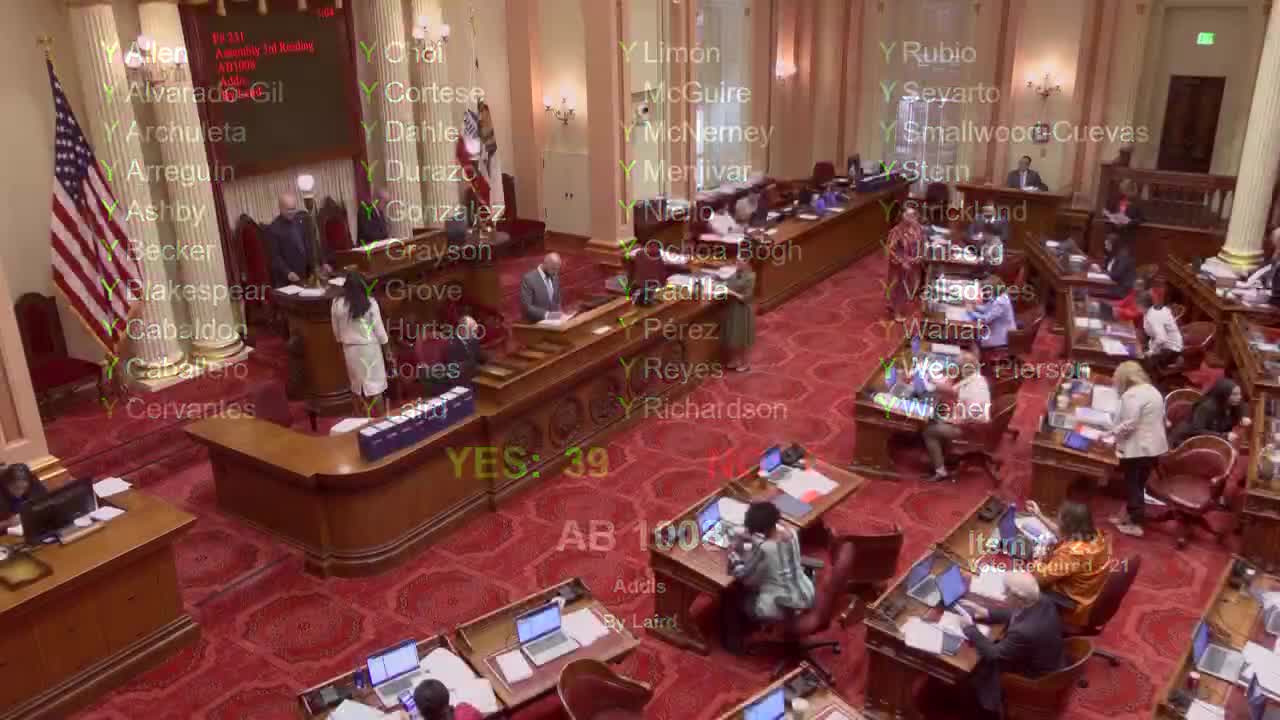 11MIN
Senate Floor
 9MIN
Assembly Floor
 4MIN
Senate Standing Committee on Appropriations
 13MIN
Senate Standing Committee on Judiciary
 28MIN
Senate Standing Committee on Education
 16MIN
Assembly Floor
 7MIN
Assembly Standing Committee on Appropriations
 9MIN
Assembly Standing Committee on Judiciary




Bill Co-Author(s):