AB 823: Solid waste: plastic microbeads: plastic glitter.
- Session Year: 2025-2026
- House: Assembly
- Latest Version Date: 2025-09-05
Current Status:
Failed
(2026-01-22: Consideration of Governor's veto stricken from file.)
Introduced
In Committee
Awaiting First Chamber Vote
Passed First Chamber
In Committee
Awaiting Second Chamber Vote
Passed Second Chamber
Enacted
What does this bill do?
The bill expands California’s existing ban on plastic microbeads in personal care items to also ban products that contain plastic glitter and to ban non-rinse personal care products and cleaning products that use plastic microbeads as abrasives. It applies to manufacturers, retailers, and distributors who sell or offer those personal care and cleaning products in California and allows existing glitter stock to be sold for a limited time.
The summary is provided by generative AI which can make mistakes. For original language, please view the details in the table below.
The Plastic Microbeads Nuisance Prevention Law prohibits a person, as defined, from selling or offering for promotional purposes in this state a personal care product containing plastic microbeads that are used to exfoliate or cleanse in a rinse-off product, including, but not limited to, toothpaste. Existing law exempts a product containing less than one part per million (ppm) by weight of plastic microbeads from the prohibition. The Plastic Microbeads Nuisance Prevention Law imposes a civil penalty not to exceed $2,500 per day for each violation of the prohibition, as provided, and authorizes the Attorney General and local officials to enforce the prohibition.
This bill would, on and after January 1, 2029, prohibit a person from selling, offering for sale, distributing, or offering for promotional purposes in this state a personal care product containing plastic glitter, or a personal care product in a non-rinse-off product or a cleaning product containing one ppm or more by weight of plastic microbeads that are used as an abrasive, as specified. The bill would authorize, until January 1, 2030, a person to continue to sell, offer for sale, distribute, or offer for promotional purposes in this state an existing stock of personal care products containing plastic glitter, as specified. By adding these prohibitions to the Plastic Microbeads Nuisance Prevention Law, the bill would impose the civil penalty for violations of these prohibitions.
The Plastic Microbeads Nuisance Prevention Law prohibits a person, as defined, from selling or offering for promotional purposes in this state a personal care product containing plastic microbeads that are used to exfoliate or cleanse in a rinse-off product, including, but not limited to, toothpaste. Existing law exempts a product containing less than one part per million (ppm) by weight of plastic microbeads from the prohibition. The Plastic Microbeads Nuisance Prevention Law imposes a civil penalty not to exceed $2,500 per day for each violation of the prohibition, as provided, and authorizes the Attorney General and local officials to enforce the prohibition.
This bill would, on and after January 1, 2029, prohibit a person from selling, offering for sale, distributing, or offering for promotional purposes in this state a cleaning product, as defined, a personal care product containing plastic glitter, or a personal care product in a non-rinse-off product, product or a cleaning product containing one ppm or more by weight of plastic microbeads that are used as an abrasive, as specified. The bill would, on and after January 1, 2030, prohibit a person from selling, offering for sale, distributing, or offering for promotional purposes in this state a cleaning product or personal care product, that contains one ppm or more by weight of plastic microbeads that are not used as an abrasive. By adding these prohibitions to the Plastic Microbeads Nuisance Prevention Law, the bill would impose the civil penalty for violations of these prohibitions.
The Plastic Microbeads Nuisance Prevention Law prohibits a person, as defined, from selling or offering for promotional purposes in this state a personal care product containing plastic microbeads that are used to exfoliate or cleanse in a rinse-off product, including, but not limited to, toothpaste. Existing law exempts a product containing less than one part per million (ppm) by weight of plastic microbeads from the prohibition. The Plastic Microbeads Nuisance Prevention Law imposes a civil penalty not to exceed $2,500 per day for each violation of the prohibition, as provided, and authorizes the Attorney General and local officials to enforce the prohibition.
This bill would, on and after January 1, 2029, prohibit a person from selling, offering for sale, distributing, or offering for promotional purposes in this state a cleaning product, as defined, or a personal care product in a non-rinse-off product, containing one ppm or more by weight of plastic microbeads that are used as an abrasive, as specified. The bill would, on and after January 1, 2030, prohibit a person from selling, offering for sale, distributing, or offering for promotional purposes in this state a cleaning product or personal care product, that contains one ppm or more by weight of plastic microbeads that are not used as an abrasive. By adding these prohibitions to the Plastic Microbeads Nuisance Prevention Law, the bill would impose the civil penalty for violations of these prohibitions.
The Plastic Microbeads Nuisance Prevention Law prohibits a person, as defined, from selling or offering for promotional purposes in this state a personal care product containing plastic microbeads that are used to exfoliate or cleanse in a rinse-off product, including, but not limited to, toothpaste. Existing law exempts a product containing less than one part per million (ppm) by weight of plastic microbeads from the prohibition. The Plastic Microbeads Nuisance Prevention Law imposes a civil penalty not to exceed $2,500 per day for each violation of the prohibition, as provided, and authorizes the Attorney General and local officials to enforce the prohibition.
This bill would, on and after January 1, 2027, 2029, prohibit a person from selling, offering for sale, distributing, or offering for promotional purposes in this state a cleaning product, as defined, or a personal care product in a rinse-off non-rinse-off product, containing one ppm or more by weight of plastic microbeads that are used as an abrasive, as specified. The bill would, on and after January 1, 2028, 2030, prohibit a person from selling, offering for sale, distributing, or offering for promotional purposes in this state a coating, as defined, cleaning product, cleaning product or personal care product, that contains one ppm or more by weight of plastic microbeads that are not used as an abrasive. By adding these prohibitions to the Plastic Microbeads Nuisance Prevention Law, the bill would impose the civil penalty for violations of these prohibitions.
The Plastic Microbeads Nuisance Prevention Law prohibits a person, as defined, from selling or offering for promotional purposes in this state a personal care product containing plastic microbeads that are used to exfoliate or cleanse in a rinse-off product, including, but not limited to, toothpaste. Existing law exempts a product containing less than one part per million (ppm) by weight of plastic microbeads from the prohibition. The Plastic Microbeads Nuisance Prevention Law imposes a civil penalty not to exceed $2,500 per day for each violation of the prohibition, as provided, and authorizes the Attorney General and local officials to enforce the prohibition.
This bill would, on and after January 1, 2027, prohibit a person from selling, distributing, or offering for promotional purposes in this state a cleaning product, as defined, or a personal care product in a rinse-off product, containing one ppm or more by weight of plastic microbeads that are used as an abrasive, as specified. The bill would, on and after January 1, 2028, prohibit a person from selling, distributing, or offering for promotional purposes in this state a coating, as defined, cleaning product, or personal care product, that contains one ppm or more by weight of plastic microbeads that are not used as an abrasive. By adding these prohibitions to the Plastic Microbeads Nuisance Prevention Law, the bill would impose the civil penalty for violations of these prohibitions.
As used in this chapter, the following terms have the following meanings:
(a)Cleaning product has the same meaning as designated product in Section 108952 of the Health and Safety Code.
(b)Person means an individual, business, or other entity.
(c)Personal care product means an article intended to be rubbed, poured, sprinkled, or sprayed on, introduced to, or otherwise applied to, the human body or any part thereof for cleansing, beautifying, promoting attractiveness, or altering the appearance, and an article intended for use as a component of that type of article.
(d)Personal care product does not include a prescription drug, as defined in Section 110010.2 of the Health and Safety Code.
(e)Plastic microbead means an intentionally added solid plastic particle measuring five millimeters or less in every dimension.
SEC. 2.Section 42362 of the Public Resources Code is amended to read:42362.(a)A person shall not sell or offer for promotional purposes in this state a personal care product containing plastic microbeads that are used to exfoliate or cleanse in a rinse-off product, including, but not limited to, toothpaste.
(b)On and after January 1, 2029, a person shall not sell, offer for sale, distribute, or offer for promotional purposes in this state any of the following:
(1)A personal care product containing plastic microbeads that are used as an abrasive to clean, exfoliate, or polish, in a non-rinse-off product.
(2)A cleaning product containing plastic microbeads that are used as an abrasive to clean, exfoliate, or polish.
(3)A personal care product containing plastic glitter.
(c)Notwithstanding subdivision (b), a person, until January 1, 2030, may continue to sell, offer for sale, distribute, or offer for promotional purposes in this state an existing stock of personal care products containing plastic glitter that were acquired and transported into the state before January 1, 2029.
As used in this chapter, the following terms have the following meanings:
(a)Cleaning product has the same meaning as designated product in Section 108952 of the Health and Safety Code.
(b)Person means an individual, business, or other entity.
(c)Personal care product means an article intended to be rubbed, poured, sprinkled, or sprayed on, introduced to, or otherwise applied to, the human body or any part thereof for cleansing, beautifying, promoting attractiveness, or altering the appearance, and an article intended for use as a component of that type of article.
(d)Personal care product does not include a prescription drug, as defined in Section 110010.2 of the Health and Safety Code.
(e)Plastic microbead means an intentionally added solid plastic particle measuring five millimeters or less in every dimension.
SEC. 2.Section 42362 of the Public Resources Code is amended to read:42362.(a)A person shall not sell or offer for promotional purposes in this state a personal care product containing plastic microbeads that are used to exfoliate or cleanse in a rinse-off product, including, but not limited to, toothpaste.
(b)On and after January 1, 2029, a person shall not sell, offer for sale, distribute, or offer for promotional purposes in this state either any of the following:
(1)A personal care product containing plastic microbeads that are used as an abrasive to clean, exfoliate, or polish, in a non-rinse-off product.
(2)A cleaning product containing plastic microbeads that are used as an abrasive to clean, exfoliate, or polish.
(c)On and after January 1, 2030, a person shall not sell, offer for sale, distribute, or offer for promotional purposes in this state either of the following products:(1)A personal care product containing plastic microbeads that are not used as an abrasive.(2)A cleaning product containing plastic microbeads that are not used as an abrasive.(3)A personal care product containing plastic glitter.
As used in this chapter, the following terms have the following meanings:
(a)Cleaning product has the same meaning as designated product in Section 108952 of the Health and Safety Code.
(b)Coating means a material applied onto or impregnated into a substrate for protective, decorative, or functional purposes, and includes, but is not limited to, paints, sealers, stains, and varnishes.(c)(b)Person means an individual, business, or other entity.
(d)(c)Personal care product means an article intended to be rubbed, poured, sprinkled, or sprayed on, introduced to, or otherwise applied to, the human body or any part thereof for cleansing, beautifying, promoting attractiveness, or altering the appearance, and an article intended for use as a component of that type of article.
(e)(d)Personal care product does not include a prescription drug, as defined in Section 110010.2 of the Health and Safety Code.
(f)(e)Plastic microbead means an intentionally added solid plastic particle measuring five millimeters or less in every dimension.
SEC. 2.Section 42362 of the Public Resources Code is amended to read:42362.(a)A person shall not sell or offer for promotional purposes in this state a personal care product containing plastic microbeads that are used to exfoliate or cleanse in a rinse-off product, including, but not limited to, toothpaste.
(b)On and after January 1, 2029, a person shall not sell, offer for sale, distribute, or offer for promotional purposes in this state either of the following:
(1)A personal care product containing plastic microbeads that are used as an abrasive to clean, exfoliate, or polish, in a non-rinse-off product.
(2)A cleaning product containing plastic microbeads that are used as an abrasive to clean, exfoliate, or polish.
(c)On and after January 1, 2030, a person shall not sell, offer for sale, distribute, or offer for promotional purposes in this state either of the following products:
(1)A personal care product containing plastic microbeads that are not used as an abrasive.
(2)A cleaning product containing plastic microbeads that are not used as an abrasive.
As used in this chapter, the following terms have the following meanings:
(a)Cleaning product has the same meaning as designated product in Section 108952 of the Health and Safety Code.
(b)Coating means a material applied onto or impregnated into a substrate for protective, decorative, or functional purposes, and includes, but is not limited to, paints, sealers, stains, and varnishes.
(c)Person means an individual, business, or other entity.
(d)(1)Personal care product means an article intended to be rubbed, poured, sprinkled, or sprayed on, introduced to, or otherwise applied to, the human body or any part thereof for cleansing, beautifying, promoting attractiveness, or altering the appearance, and an article intended for use as a component of that type of article.
(e)Personal care product does not include a prescription drug, as defined in Section 110010.2 of the Health and Safety Code.
(f)Plastic microbead means an intentionally added solid plastic particle measuring five millimeters or less in every dimension.
SEC. 2.Section 42362 of the Public Resources Code is amended to read:42362.(a)A person shall not sell or offer for promotional purposes in this state a personal care product containing plastic microbeads that are used to exfoliate or cleanse in a rinse-off product, including, but not limited to, toothpaste.
(b)On and after January 1, 2027, 2029, a person shall not sell, offer for sale, distribute, or offer for promotional purposes in this state either of the following:
(1)A personal care product containing plastic microbeads that are used as an abrasive to clean, exfoliate, or polish, in a non-rinse-off product.
(2)A cleaning product containing plastic microbeads that are used as an abrasive to clean, exfoliate, or polish.
(c)On and after January 1, 2028, 2030, a person shall not sell, offer for sale, distribute, or offer for promotional purposes in this state any either of the following products:
(1)A personal care product containing plastic microbeads that are not used as an abrasive.
(2)A cleaning product containing plastic microbeads that are not used as an abrasive.
(3)A coating containing plastic microbeads that are not used as an abrasive.As used in this chapter, the following terms have the following meanings:
(a)Cleaning product has the same meaning as designated product in Section 108952 of the Health and Safety Code.
(b)Coating means a material applied onto or impregnated into a substrate for protective, decorative, or functional purposes, and includes, but is not limited to, paints, sealers, stains, and varnishes.
(a)(c)Person means an individual, business, or other entity.
(b)(d)(1)Personal care product means an article intended to be rubbed, poured, sprinkled, or sprayed on, introduced to, or otherwise applied to, the human body or any part thereof for cleansing, beautifying, promoting attractiveness, or altering the appearance, and an article intended for use as a component of that type of article.
(2)(e)Personal care product does not include a prescription drug, as defined in Section 110010.2 of the Health and Safety Code.
(c)(f)Plastic microbead means an intentionally added solid plastic particle measuring five millimeters or less in every dimension.
SEC. 2.Section 42362 of the Public Resources Code is amended to read:42362.On and after January 1, 2020, a (a)A person shall not sell or offer for promotional purposes in this state any a personal care products product containing plastic microbeads that are used to exfoliate or cleanse in a rinse-off product, including, but not limited to, toothpaste.
(b)On and after January 1, 2027, a person shall not sell, offer for sale, distribute, or offer for promotional purposes in this state either of the following:
(1)A personal care product containing plastic microbeads that are used as an abrasive to clean, exfoliate, or polish, in a non-rinse-off product.
(2)A cleaning product containing plastic microbeads that are used as an abrasive to clean, exfoliate, or polish.
(c)On and after January 1, 2028, a person shall not sell, offer for sale, distribute, or offer for promotional purposes in this state any of the following products:
(1)A personal care product containing plastic microbeads that are not used as an abrasive.
(2)A cleaning product containing plastic microbeads that are not used as an abrasive.
(3)A coating containing plastic microbeads that are not used as an abrasive.
|
Date
|
Status
|
|---|---|
| Jan 22, 2026 | Consideration of Governor's veto stricken from file. |
| Oct 11, 2025 | Consideration of Governor's veto pending. |
| Oct 11, 2025 | Vetoed by Governor. |
| Sep 9, 2025 | Enrolled and presented to the Governor at 3 p.m. |
| Sep 3, 2025 | In Assembly. Ordered to Engrossing and Enrolling. |
| Sep 3, 2025 | Read third time. Passed. Ordered to the Assembly. (Ayes 40. Noes 0. Page 2436.). |
| Aug 26, 2025 | Read second time. Ordered to third reading. |
| Aug 25, 2025 | From committee: Be ordered to second reading pursuant to Senate Rule 28.8. |
| Aug 13, 2025 | In committee: Hearing postponed by committee. |
| Jul 9, 2025 | From committee: Do pass and re-refer to Com. on APPR. (Ayes 13. Noes 0.) (July 8). Re-referred to Com. on APPR. |
| Jul 2, 2025 | From committee: Do pass and re-refer to Com. on JUD. (Ayes 7. Noes 0.) (July 2). Re-referred to Com. on JUD. |
| Jun 11, 2025 | Referred to Coms. on E.Q. and JUD. |
| Jun 3, 2025 | In Senate. Read first time. To Com. on RLS. for assignment. |
| Jun 2, 2025 | Read third time. Passed. Ordered to the Senate. (Ayes 63. Noes 10. Page 1907.) |
| May 27, 2025 | Read second time. Ordered to third reading. |
| May 23, 2025 | Read second time and amended. Ordered returned to second reading. |
| May 23, 2025 | From committee: Amend, and do pass as amended. (Ayes 11. Noes 1.) (May 23). |
| May 23, 2025 | Assembly Rule 63 suspended. (Ayes 51. Noes 16. Page 1644.) |
| May 14, 2025 | In committee: Set, first hearing. Referred to APPR. suspense file. |
| Apr 30, 2025 | From committee: Do pass and re-refer to Com. on APPR. (Ayes 6. Noes 0.) (April 29). Re-referred to Com. on APPR. |
| Apr 28, 2025 | Re-referred to Com. on E.S & T.M. |
| Apr 24, 2025 | From committee chair, with author's amendments: Amend, and re-refer to Com. on E.S & T.M. Read second time and amended. |
| Apr 22, 2025 | Re-referred to Com. on E.S & T.M. |
| Apr 21, 2025 | From committee chair, with author's amendments: Amend, and re-refer to Com. on E.S & T.M. Read second time and amended. |
| Apr 10, 2025 | Re-referred to Com. on E.S & T.M. |
| Apr 9, 2025 | Read second time and amended. |
| Apr 8, 2025 | From committee: Amend, and do pass as amended and re-refer to Com. on E.S & T.M. (Ayes 10. Noes 4.) (April 7). |
| Mar 10, 2025 | Referred to Coms. on NAT. RES. and E.S & T.M. |
| Feb 20, 2025 | From printer. May be heard in committee March 22. |
| Feb 19, 2025 | Read first time. To print. |
|
Date
|
Description
|
Location
|
Votes
|
|
|---|---|---|---|---|
| Sep 3, 2025 | Assembly 3rd Reading AB823 Boerner et al. By Gonzalez | Senate Floor |
Passed |
|
| Jul 8, 2025 | Do pass, but first be re-referred to the Committee on [Appropriations] | Senate Standing Committee on Judiciary |
Passed |
|
| Jul 2, 2025 | Do pass, but first be re-referred to the Committee on [Judiciary] | Senate Standing Committee on Environmental Quality |
Passed |
|
| Jun 2, 2025 | AB 823 Boerner Assembly Third Reading | Assembly Floor |
Passed |
|
| May 23, 2025 | Do pass as amended. | Assembly Standing Committee on Appropriations |
Passed |
|
| Apr 29, 2025 | Do pass and be re-referred to the Committee on [Appropriations] | Assembly Standing Committee on Environmental Safety and Toxic Materials |
Passed |
|
| Apr 7, 2025 | Do pass as amended and be re-referred to the Committee on [Environmental Safety and Toxic Materials] | Assembly Standing Committee on Natural Resources |
Passed |
This list shows positions taken on this bill by organizations on the date displayed, which is linked to the original source.
Positions by individuals are not included.
|
Organization
|
Position
|
Date
|
|---|---|---|
| 350 Bay Area Action | ** Support | |
| 350 Sacramento | ** Support | |
| 5 Gyres Institute | ** Support | |
| 5 Gyres Science To Solutions | ** Support | |
| 7th Generation Advisors | ** Support | |
| Active San Gabriel Valley | ** Support | |
| Algalita Marine Research And Education | ** Support | |
| Alliance of Nurses for Healthy Environments | ** Support | |
| American Chemistry Council | ** Against | |
| American Cleaning Institute | ** Against | |
| American Coatings Association | ** Against | |
| American College of OBGYNs District IX | ** Support | |
| American Planning Association, California Chapter | ** Against | |
| Azul | ** Support | |
| Ban Sup (single Use Plastic) | ** Support | |
| Black Women For Wellness Action Project | ** Support | |
| Blue Ocean Warriors | ** Support | |
| Breast Cancer Over Time | ** Support | |
| Breast Cancer Prevention Partners | ** Support | |
| Cal Chamber | ** Against | |
| California Black Health Network | ** Support | |
| California Domestic Workers Coalition | ** Support | |
| California Environmental Voters | ** Support | |
| California Grocers Association | ** Against | |
| California Manufacturers & Technology Association | ** Against | |
| California Nurses for Environmental Health and Justice | ** Support | |
| California Product Stewardship Council | ** Support | |
| California Retailers Association | ** Against | |
| Californians Against Waste | ** Support | |
| CALPIRG, California Public Interest Research Group | ** Support | |
| Catholic Charities of Stockton | ** Support | |
| Center For Environmental Health | ** Support | |
| ChicoBag Company | ** Support | |
| Clean Water Action | ** Support | |
| cleanearth4kids.org | ** Support | |
| Climate Action California | ** Support | |
| Coastal Corridor Alliance | ** Support | |
| Community Water Center | ** Support | |
| Courage California | ** Support | |
| Credo Beauty | ** Support | |
| Defend Our Health | ** Support | |
| Del Norte Solid Waste Management Authority | ** Support | |
| Dr. Bronner'S | ** Support | |
| East Bay Municipal Utility District | ** Support | |
| Ecology Center | ** Support | |
| Environmental Justice Communities Against Plastics | ** Support | |
| Environmental Working Group | ** Support | |
| Erin Brockovich Foundation | ** Support | |
| Facts Families Advocating for Chemical and Toxics Safety | ** Support | |
| Fragrance Creators Association | ** Against | |
| Friends Committee On Legislation Of California | ** Support | |
| Friends Of The Earth | ** Support | |
| Green Science Policy Institute | ** Support | |
| GreenLatinos | ** Support | |
| Habits of Waste | ** Support | |
| Household and Commercial Products Association | ** Against | |
| Innersense Organic Beauty | ** Support | |
| Integrated Resource Management | ** Support | |
| Intelligent Nutrients | ** Support | |
| Just the Goods | ** Support | |
| Just Transition Alliance | ** Support | |
| Los Angeles County Sanitation Districts | ** Support | |
| Los Angeles Waterkeeper | ** Support | |
| Mamavation - Non-toxic Products for Healthy Families | ** Support | |
| Monterey Bay Aquarium | ** Support | |
| National Resources Defense Council | ** Support | |
| National Stewardship Action Council | ** Support | |
| Naturepedic | ** Support | |
| Northern California Recycling Association | ** Support | |
| Oakland Recycles | ** Support | |
| Occidental Arts and Ecology Center | ** Support | |
| Ocean Conservancy | ** Support | |
| Pacific Beach Coalition | ** Support | |
| Pacoima Beautiful | ** Support | |
| Personal Care Products Council | ** Against | |
| Physicians for Social Responsibility | ** Support | |
| Physicians for Social Responsibility - Los Angeles | ** Support | |
| Physicians for Social Responsibility, San Francisco Bay | ** Support | |
| Plastic Free Future | ** Support | |
| Plastic Pollution Coalition | ** Support | |
| ReGen Monterey | ** Support | |
| Rethink Waste | ** Support | |
| Rethinkwaste | ** Support | |
| Salinas Valley Solid Waste Authority | ** Support | |
| San Francisco Bay Area Chapter Physicians for Social Responsibility | ** Support | |
| San Francisco Baykeeper | ** Support | |
| Save Our Shores | ** Support | |
| Save The Albatross Coalition | ** Support | |
| Save The Bay | ** Support | |
| Sierra Club California | ** Support | |
| Skinowl | ** Support | |
| Skinowl, INC | ** Support | |
| SoCal 350 Climate Action | ** Support | |
| Social Eco Education | ** Support | |
| Surfrider Foundation | ** Support | |
| Sustainable Rossmoor | ** Support | |
| The Last Plastic Straw | ** Support | |
| U.S. Green Building Council, California | ** Support | |
| Western Plant Health Association | ** Against | |
| zero waste marin | ** Support | |
| Zero Waste San Diego | ** Support | |
| Zero Waste Sonoma | ** Support |
GOVERNOR′S VETO
GV Bill Id:AB 823
Author:(Boerner)
As Enrolled Ver:September 5, 2025
2/3 vote
SUMMARY
This bill prohibits, by January 1, 2029, a person from selling, offering for sale, distributing, or offering for promotional purposes in the state any of the following: (1) a personal care product containing plastic microbeads used as an abrasive to clean, exfoliate, or polish, in a non-rinse-off product, (2) a cleaning product, as defined, containing plastic microbeads used as an abrasive to clean, exfoliate, or polish, or (3) a personal care product containing plastic glitter.
Major Provisions
- Prohibits, by January 1, 2029, a person from selling, offering for sale, distributing, or offering for promotional purposes in the state:
- A personal care product containing plastic microbeads used as an abrasive to clean, exfoliate, or polish, in a non-rinse-off product;
- A cleaning product, as defined, containing plastic microbeads used as an abrasive to clean, exfoliate, or polish; or,
- A personal care product containing plastic glitter.
- Authorizes a person to continue to sell existing stock of personal care products containing plastic glitter through January 1, 2030, if they were acquired and transported into the state before January 1, 2029.
Governor′s Veto Message
This bill would expand the 2015 Plastic Microbeads Nuisance Prevention Law, which bans plastic microbeads in personal care products that are rinsed off, to also ban the sale of non-rinse-off products, certain cleaning products, and personal care products containing plastic glitter.
I support efforts to protect California′s waterways, ecosystems, and public health from the real and significant harms caused by the prevalence of microplastics in our environment. However, I am not supportive of the approach this bill takes to ban specific ingredients, such as glitter, which may incidentally result in a prohibition on biodegradable or natural alternatives.
For this reason, I cannot sign this bill.
COMMENTS
Plastic. Plastics pose a threat to the environment from origin to end-of-life. Plastic production is responsible for three and a half percent of all greenhouse gas emissions—more than the entire aviation sector. In 2021, global plastics production was estimated at 390.7 million metric tons, a 4% increase from the previous year. The United Nations Environment Programme reports that only 9% of all plastic ever made has been recycled, 12% has been incinerated, and the remaining 79% has accumulated in landfills or the environment.
Once plastics enter the environment, they remain there for hundreds to thousands of years. Plastics do not break down into their constituent parts, but instead break down into smaller and smaller particles, or microplastics. Because they are so small, microplastics are carried in the air and in water, and are easily ingested or inhaled by living things and accumulate up the food chain. Microplastics have been found in the most pristine natural environments on earth, including in the deep ocean, Antarctic sea ice, and in the sand of remote deserts. Micoplastics are found in household dust and drinking water (bottled and tap), and humans are inhaling and consuming them. A March, 2024, study published in Science of the Total Environment identified microplastics in all human tissues sampled, with the polyvinyl chloride (PVC) being the dominant polymer. In February of this year, a study published in Nature Medicine found microplastics in human brains in higher concentrations than other body systems. This plastic accumulation increased 50% over the span of eight years. Shockingly little information exists about the potential health impacts of microplastics exposure. Research is emerging that links microplastics to a number of significant health issues, including cancer, dementia, hormone disruption, infertility, and cardiovascular disease.
Microplastics are intentionally added to leave-on cosmetics, household cleaners, and coatings, contributing to widespread environmental pollution and posing serious risks to human health. These microscopic plastic particles do not break down in the environment and often enter waterways, drinking water supplies, and food sources. Current law fails to regulate microplastics in these products, allowing continuous contamination and harm to vulnerable communities.
Plastic pollution and the impacts of plastics on human health fall disproportionately on marginalized communities. According to a 2021 report by the United Nations Environment Programme, "women, in particular, suffer from plastic-related toxicity risk due to higher aggregate exposure at home and even in feminine care products." Nearly all plastic is produced from fossil fuels and generates greenhouse gas emissions and toxic chemicals that impact air and water quality. About 14% of oil is used in petrochemical manufacturing, a precursor to producing plastic. By 2050, plastic production is predicted to account for 50% of oil and fracked gas demand growth. According to Feeding the Plastics Industrial Complex: Taking Public Subsidies, Breaking Pollution Limits, a report released on March 14, 2024, by the Environmental Integrity Project, "more than 66% of people within three miles of factories that manufacture the main ingredients in plastic products are people of color living in communities that are over-exposed to air pollution while schools and other public services are chronically underfunded." The report notes that these facilities receive billions in subsidies while repeatedly violating environmental laws and regulations.
OPC Microplastics Strategy. In 2022, the Ocean Protection Council (OPC) released the Statewide Microplastics Strategy (Strategy) to provide a multi-year roadmap for California to take a national and global leadership role in managing microplastics pollution. The Strategy states that California must take "decisive, precautionary action to reduce microplastic pollution, while scientific knowledge and understanding of microplastics sources, impacts, and successful reduction measures continue to grow."
The Strategy identifies a number of solutions focused on pollution prevention, pathway intervention, and outreach and education. These solutions are identified as "no regrets" actions based on feasibility, evidence, co-benefits, and overall benefit to society and the environment. These recommendations include: 1) Implementing the statewide requirement that single-use foodware and condiments be provided only upon request; 2) Encouraging state purchasing and service contracts to require reusable foodware; 3) Enacting comprehensive statewide plastic source reduction, reuse, and refill goals by 2023; 4) Prohibiting the sale and distribution of EPS foodware and packaging by 2023; 5) Expanding the statewide microbead ban enacted by AB 888 (Bloom), Chapter 594, Statutes of 2015, to include microplastics that are intentionally added to specific consumer products, such as cosmetics, household and industrial detergents, and cleaning products, by 2023; and 6) Prohibiting the sale and distribution of single-use tobacco products that demonstrably contribute to plastic pollution.
This bill is consistent with the recommendation to expand the microbead ban enacted by AB 888 to additional consumer and industrial products.
DTSC candidate chemicals list. The Department of Toxic Substances Control′s (DTSC) Safer Consumer Products (SCP) Program was created in 2013 to advance the development, design, and use of products that are chemically safer for people and the environment. Under this program, DTSC identifies chemicals to be added to a candidate chemicals list, which is used to identify potential chemicals of concern in specific products (i.e., "priority products"). Candidate chemicals are those with known hazard traits and/or environmental or toxicological risks. Priority products are identified based on whether they contain one or more candidate chemicals that have the potential to harm people or the environment based on the potential for exposure and the potential for that exposure to cause "significant or widespread" adverse impacts. Priority products are designated through a formal regulations process. If a candidate chemical is identified as part of a designated priority product, it becomes a chemical of concern. Once identified, DTSC works to analyze alternatives to those chemicals and to encourage producers to use less toxic alternatives.
In 2023, DTSC proposed adding microplastics to the candidate chemicals list and identified specific considerations when evaluating products containing microplastics, including "the potential for the product to release microplastics to the environment during the use or end-of-life stages of the product′s life cycle." Adding microplastics to the candidate chemicals list does not create any new regulatory obligations on producers. It allows DTSC to evaluate product-chemical combinations that may release microplastics into the environment for future consideration as priority products. To date, microplastics have not been added to the candidate chemicals list.
According to the Author
Plastic microbeads are present in many everyday items. They are used in our makeup, our cleaning supplies, and our paints. As a result, our bodies are filled with microplastics. They are in our lungs, bloodstream, placental tissue, breast milk, reproductive organs, and even brains. It′s time to put an end to these unnecessary and dangerous microplastics. With AB 823, we have a chance to protect our oceans, our communities, and our health.
Arguments in Support
A coalition of supporters state, "Whether it′s microplastics in our bodies or our waterways, it is clear California needs to act to eliminate the use of microplastics at the source rather than relying on clean up once they enter the environment. We ask that you support AB 823, prohibiting the sale of leave-on cosmetics, cleaning products, and coatings containing intentionally added microplastics."
Arguments in Opposition
A coalition of opponents state, "Incorporating the appropriate guiding framework based on sound science and considerations of product-specific needs into AB 823 would align California′s approach with internationally recognized standards and provide pathways for innovative product development, ensuring both environmental protection and consumer access to essential products. We stand ready to collaborate with you on this important legislation to find a pathway that is both protective of human health and the environment, while maintaining pathways for safer material innovation. Unfortunately, AB 823 in its current form would ban important consumer products and provide no pathway forward."
FISCAL COMMENTS
According to the Assembly Appropriations Committee, this bill expands the state′s existing ban on plastic microbeads in personal care products, which makes a violator liable for a civil penalty not to exceed $2,500 per day for each violation, and authorizes the penalty to be assessed and recovered in a civil action brought in any court of competent jurisdiction by the Attorney General or local officials.
- Cost pressures (Trial Court Trust Fund, General Fund) of an unknown amount to the courts, potentially in excess of $150,000, to adjudicate enforcement actions authorized by this bill. Actual costs will depend on the number of cases filed and the amount of court time needed to resolve each case. It generally costs approximately $1,000 to operate a courtroom for one hour. Although courts are not funded on the basis of workload, increased pressure on the Trial Court Trust Fund may create a demand for increased funding for courts from the General Fund. The fiscal year 2024-25 state budget provides $37.3 million ongoing General Fund to backfill declining revenue to the Trial Court Trust Fund.
- Possible costs (General Fund, special funds) to the Department of Justice (DOJ) of an unknown amount. Actual costs will depend on whether the Attorney General pursues enforcement actions, and, if so, the level of additional staffing needed by DOJ to handle the related workload. If DOJ hires staff to handle enforcement actions permitted by this bill, the department would incur significant costs, likely in the low hundreds of thousands of dollars annually. If DOJ does not pursue enforcement as permitted by this bill, the department would not incur any costs.
VOTES
ASM NATURAL RESOURCES: 10-4-0
YES: Bryan, Connolly, Garcia, Haney, Kalra, Muratsuchi, Pellerin, Schultz, Wicks, Zbur
NO: Alanis, Ellis, Flora, Hoover
ASM ENVIRONMENTAL SAFETY AND TOXIC MATERIALS: 6-0-1
YES: Connolly, Ellis, Bauer-Kahan, Lee, McKinnor, Papan
ABS, ABST OR NV: Castillo
ASM APPROPRIATIONS: 11-1-3
YES: Wicks, Arambula, Calderon, Caloza, Elhawary, Fong, Mark González, Hart, Pacheco, Pellerin, Solache
NO: Ta
ABS, ABST OR NV: Sanchez, Dixon, Tangipa
ASSEMBLY FLOOR: 63-10-6
YES: Addis, Aguiar-Curry, Ahrens, Alanis, Alvarez, Arambula, Ávila Farías, Bauer-Kahan, Bennett, Berman, Boerner, Bonta, Bryan, Calderon, Caloza, Carrillo, Chen, Connolly, Davies, Elhawary, Fong, Gabriel, Garcia, Gipson, Jeff Gonzalez, Mark González, Haney, Harabedian, Hart, Irwin, Jackson, Kalra, Krell, Lackey, Lee, Lowenthal, McKinnor, Muratsuchi, Nguyen, Ortega, Pacheco, Papan, Patel, Pellerin, Petrie-Norris, Quirk-Silva, Ramos, Ransom, Celeste Rodriguez, Rogers, Blanca Rubio, Schiavo, Schultz, Sharp-Collins, Solache, Soria, Stefani, Valencia, Ward, Wicks, Wilson, Zbur, Rivas
NO: DeMaio, Flora, Gallagher, Hadwick, Hoover, Macedo, Patterson, Ta, Tangipa, Wallis
ABS, ABST OR NV: Bains, Castillo, Dixon, Ellis, Michelle Rodriguez, Sanchez
SENATE FLOOR: 40-0-0
YES: Allen, Alvarado-Gil, Archuleta, Arreguín, Ashby, Becker, Blakespear, Cabaldon, Caballero, Cervantes, Choi, Cortese, Dahle, Durazo, Gonzalez, Grayson, Grove, Hurtado, Jones, Laird, Limón, McGuire, McNerney, Menjivar, Niello, Ochoa Bogh, Padilla, Pérez, Reyes, Richardson, Rubio, Seyarto, Smallwood-Cuevas, Stern, Strickland, Umberg, Valladares, Wahab, Weber Pierson, Wiener
UPDATED
VERSION: September 5, 2025
CONSULTANT: Elizabeth MacMillan / NAT. RES. / (916) 319-2092 FN: 0002180
SENATE RULES COMMITTEE Office of Senate Floor Analyses (916) 651-1520 Fax: (916) 327-4478 | AB 823 |
THIRD READING
Bill No: AB 823
Author: Boerner (D), et al.
Amended: 5/23/25 in Assembly
Vote: 21
SENATE ENVIRONMENTAL QUALITY COMMITTEE: 7-0, 7/2/25
AYES: Blakespear, Valladares, Gonzalez, Hurtado, Menjivar, Padilla, Pérez
NO VOTE RECORDED: Dahle
SENATE JUDICIARY COMMITTEE: 13-0, 7/8/25
AYES: Umberg, Niello, Allen, Arreguín, Ashby, Caballero, Durazo, Laird, Stern, Valladares, Wahab, Weber Pierson, Wiener
SENATE APPROPRIATIONS COMMITTEE: Senate Rule 28.8
ASSEMBLY FLOOR: 63-10, 6/2/25 - See last page for vote
SUBJECT: Solid waste: plastic microbeads: plastic glitter
SOURCE: Author
DIGEST:
This bill expands the existing ban on microbeads in personal care products that are rinsed off to include the sale of non-rinse personal care products, personal care products containing glitter, and cleaning products beginning January 1, 2029 or January 1, 2030 as specified.
ANALYSIS:
Existing law:
- Establishes the California Integrated Waste Management Act of 1989 (IWMA), administered by the Department of Resources Recycling and Recovery (CalRecycle), to regulate the disposal, management, and recycling of solid waste. Establishes under the IWMA a state policy goal that at least 75% of solid waste be source reduced, recycled, or composted by 2020. (Public Resources Code (PRC) §§ 40000 et. seq.)
- Requires, under the Porter-Cologne Water Quality Control Act, that State Water Resources Control Board (State Water Board) and Regional Water Quality Control Boards implement a program to control discharges of preproduction plastic (i.e. resins and colors for plastics). Directs the State Water Board to address the discharges of this plastic from these point and nonpoint sources. (Water Code § 1336)
- Enacts the Plastic Microbead Nuisance Prevention Law (Public Resources Code § 42360-42366), which:
- Prohibits, on and after January 1, 2020, the sale or offering for promotional purposes any personal care products containing plastic microbeads that are used to exfoliate or cleanse in a rinse-off product, including, but not limited to, toothpaste;
- Defines “personal care product” as an article intended to be rubbed, poured, sprinkled, or sprayed on, or otherwise applied to, the human body or any part thereof for cleansing, beautifying, promoting attractiveness, or altering the appearance, and an article intended for use as a component of that kind of article, but does not include prescription drugs;
- Defines “plastic microbead” as an intentionally added solid plastic particle measuring five millimeters or less in every dimension;
- Exempts personal care products that contain less than 1 part per million plastic microbeads by weight; and
- Establishes civil penalties up to $2,500 per day for a violation, as specified.
- Requires, on or before December 31, 2024, the California Ocean Protection Council (OPC) to adopt and implement a Statewide Microplastics Strategy related to microplastic materials that pose an emerging concern for ocean health; specifies that the goal of the Statewide Microplastics Strategy is to increase understanding of the scale and risks of microplastics on the marine environment and to identify proposed solutions to address the impacts of microplastics. (PRC § 35635(b))
- Requires the State Water Board to adopt a definition of microplastics in drinking water by July 1, 2020, adopt a standard methodology to test drinking water for microplastics, and adopt testing and reporting requirements. (Health & Safety Code § 116376)
- Defines “designated product” as a finished product that is an air care product, automotive product, general cleaning product, or a floor polish or maintenance product, as specified. (Health and Safety Code §108952)
This bill expands off the existing ban on microbeads in personal care products to include:
- A personal care product containing glitter or non-rinse off products containing plastic microbeads that are used as an abrasive to clean, exfoliate, or polish; and
- Specifies that entities can still sell personal products containing plastic glitter until January 1 2030 if those products were acquired and transported into the state before January 1, 2029.
- A cleaning product containing plastic microbeads that are used as an abrasive to clean, exfoliate, or polish.
- A personal care product containing glitter or non-rinse off products containing plastic microbeads that are used as an abrasive to clean, exfoliate, or polish; and
Background
Prevalence and Impacts of Microplastics. Microplastics, defined as small plastic particles with a diameter less than 5mm, have become a subject of increasing environmental concern. Because microplastics are so small, they can travel in water, air, and in the bodies of living organisms. As a result, microplastics are ubiquitous in the environment and are found in some of the most remote areas on earth, including arctic sea ice, the deep ocean, mountain peaks in national parks, and human embryos. Of particular concern for living organisms, microplastics’ small size allows them to bioaccumulate up the food chain. Plastics in water, for instance, can be consumed by fish and shellfish and become part of their tissue. The fish and shellfish can in turn be eaten by humans or other animals: with each step up the food web, the concentration of microplastics accumulates. Microplastics can also act as vectors for pollutants such as pesticides and heavy metals, effectively “piggybacking” these harmful pollutants wherever the microplastics go, including into the living tissues of plants, animals, and humans. Current studies have found microplastics in human lungs, brains, and placentas. A recent study suggests that human brains may contain an amount of microplastics equivalent to a plastic spoon. The study also indicated that microplastic levels in the brain have increased by 50% since 2016[1].
There are few studies on the impacts of microplastics on human health. However, a study from 2024 by the prestigious New England Journal of Medicine provided the first evidence of a potential link between microplastics and human reporting: “A study of more than 200 people undergoing surgery found that nearly 60% had microplastics or even smaller nanoplastics in a main artery. Those who did were 4.5 times more likely to experience a heart attack, a stroke or death in the approximately 34 months after the surgery than were those whose arteries were plastic-free…The team tracked 257 people undergoing a surgical procedure that reduces stroke risk by removing plaque from an artery in the neck.[2]”
While studies on the impacts of microplastics on human health are still emerging, numerous studies have shown that microplastics increase risk of cancer and disrupt hormone pathways in lab rats.
Microbeads: intentionally added microplastics. Microplastics can occur when larger pieces of plastic break apart in the environment, or microplastics can be manufactured and intentionally added to products. One type of intentionally added microplastics are microbeads. Microbeads are used as exfoliants and scrubbing agents in various personal care products, such as soap, facial scrubs, body washes, and toothpaste, as well as in cleaning supplies. They are also used in the formulation of cosmetics, including mascara, foundation, face powders, lipstick, and deodorant, to add texture or improve consistency. According a 2023 report by the California State Policy Evidence Consortium:
“During the 1990s and early 2000s, cosmetic and hygiene companies began using solid plastic microbeads as a cleaner or soft exfoliant in facewash, shower gel, and toothpaste. Household and industrial cleaning agents also use microbeads…As a result, unprecedented amounts of microbeads funneled into wastewater treatment plants and subsequently made their way into rivers, lakes, and oceans (Dauvergne, 2018[3])”.
While most microbead bans have focused on their use in personal care products, one study by an Austrian environmental organization and a consumer protection group tested 300 detergents and found microplastics in 119 of them.[4],[5] Another study looking at sources of microplastics in the Netherlands in soil, water and air, found that cleaning agents produces approximately 3 tons of microplastics per year in the Netherlands.[6]
Microbead bans. Microbeads have been banned at the Federal level, and there are microbeads bans in over half the states[7], including in California.
In 2015, California enacted the Plastic Microbeads Nuisance Prevention Law, in 2015 (AB 888, Bloom, Chapter 594). This law prohibits the sale of rinse-off, personal care products that contain plastic microbeads used to exfoliate or cleanse ("personal care product" is defined as an "article intended to be rubbed, poured, sprinkled, or sprayed on, introduced to, or otherwise applied to, the human body…for cleansing, beautifying, promoting attractiveness, or altering the appearance...”)
The European Union has established timelines to ban intentionally added microplastics from a variety of products, including from detergents, waxes, and polishes by 2028, loose glitter on Oct 17, 2023, and rinse-off cosmetics by 2027. The microplastics ban also included other products such as lip, nail and makeup products (Commission Regulation (EU) 2023/2055 - Restriction of microplastics intentionally added to products). Under this ban, suppliers of lip, nail, and makeup products will have to include the statement “This product contains microplastics” on the labels starting in 2031 and going until the bans are effected in 2035.
Comments
Purpose of this bill. According to the author "The plastic pollution crisis is with us every day—not just in faraway places. This isn’t just an environmental issue. It is a public health emergency. Tiny microplastics—so small they are invisible to the naked eye—have infiltrated our waterways, soil, food, and bodies. Plastic microbeads are present in many everyday items. They are used in our makeup, our cleaning supplies, and our paints. As a result, our bodies are filled with microplastics. They are in our lungs, bloodstream, placental tissue, breast milk, reproductive organs, and even brains. It’s time to put an end to these unnecessary and dangerous microplastics. With AB 823, we have a chance to protect our oceans, our communities, and our health."
Microbead alternatives are already on the market. There are numerous alternatives to intentionally added plastic microbeads already on the market today. These include crushed walnut shells, oats, sugar and jojoba seeds.
Alternatives to plastic glitter are also available on the market today, including glitter made from mica minerals. Further innovate research in this space is ongoing. According a to a 2022 study, Large-scale fabrication of structurally colored cellulose nanocrystal films and effect pigments, published in Nature Materials, researchers from the University of Cambridge describe the development of an alternative to plastic glitter, intended for use in the cosmetics industry.
Notably, AB 823 bans all plastic microbeads and plastic glitter, including biodegradable plastic. ‘Biodegradable’ means it will decompose by the action of living organisms, usually microbes. Numerous studies have demonstrated that there is a wide range in how efficiently biodegradable plastics break down in the environment depending on the type of polymers used and the environment in which the biodegradable plastic is immersed, among other factors[8],[9],[10]. One review study from 2021 on biodegradable plastics concluded: “…Not all biodegradable plastics are completely degradable under natural conditions. Some of them may be disintegrated into microplastics more rapidly than conventional plastics, emerging as another threat to soil environments.[11]”
In banning all plastic microbeads and glitter, AB 823 takes an approach to limit the intentional production microplastics that enter and linger in the environment from a variety of products.
Related/Prior Legislation
AB 1628 (McKinnor, 2023) would have required new washing machines for residential or state use to include a microfiber filtration system. This bill was vetoed by the Governor.
AB 888 (Bloom, Chapter 594, Statutes of 2015) prohibits the sale of personal care products that contain plastic microbeads on and after January 1, 2020.
FISCAL EFFECT: Appropriation: No Fiscal Com.: Yes Local: No
According the to the Assembly appropriations committee: “ This bill expands the state's existing ban on plastic microbeads in personal care products, which makes a violator liable for a civil penalty not to exceed $2,500 per day for each violation, and authorizes the penalty to be assessed and recovered in a civil action brought in any court of competent jurisdiction by the Attorney General or local officials.
- Cost pressures (Trial Court Trust Fund, General Fund) of an unknown amount to the courts, potentially in excess of $150,000, to adjudicate enforcement actions authorized by this bill. Actual costs will depend on the number of cases filed and the amount of court time needed to resolve each case. It generally costs approximately $1,000 to operate a courtroom for one hour. Although courts are not funded on the basis of workload, increased pressure on the Trial Court Trust Fund may create a demand for increased funding for courts from the General Fund. The fiscal year 2024-25 state budget provides $37.3 million ongoing General Fund to backfill declining revenue to the Trial Court Trust Fund.
- Possible costs (General Fund, special funds) to the Department of Justice (DOJ) of an unknown amount. Actual costs will depend on whether the Attorney General pursues enforcement actions, and, if so, the level of additional staffing needed by DOJ to handle the related workload. If DOJ hires staff to handle enforcement actions permitted by this bill, the department would incur significant costs, likely in the low hundreds of thousands of dollars annually. If DOJ does not pursue enforcement as permitted by this bill, the department would not incur any costs.”
SUPPORT: (Verified 8/27/25)
350 Bay Area Action
350 Bay Area Action
350 Sacramento
5 Gyres Institute
5 Gyres Science to Solutions
7th Generation Advisors
Active San Gabriel Valley
Algalita Marine Research and Education
Alliance of Nurses for Healthy Environments
American College of Ob-gyn's District Ix
Azul
Ban Sup (single Use Plastic)
Black Women for Wellness Action Project
Blue Ocean Warriors
Breast Cancer Over Time
Breast Cancer Prevention Partners
California Black Health Network
California Domestic Workers Coalition
California Environmental Voters
California Nurses for Environmental Health and Justice
California Product Stewardship Council
Californians Against Waste
Calpirg, California Public Interest Research Group
Catholic Charities of Stockton
Center for Environmental Health
Chicobag Company
Clean Water Action
Cleanearth4kids.org
Climate Action California
Coastal Corridor Alliance
Community Water Center
Courage California
Credo Beauty
Defend Our Health
Del Norte Solid Waste Management Authority
Dr. Bronner's
East Bay Municipal Utility District
Ecology Center
Environmental Justice Communities Against Plastics
Environmental Working Group
Erin Brockovich Foundation
Facts Families Advocating for Chemical and Toxics Safety
Friends Committee on Legislation of California
Friends of the Earth
Green Science Policy Institute
Greenlatinos
Habits of Waste
Innersense Organic Beauty
Integrated Resource Management
Intelligent Nutrients
Just the Goods
Just Transition Alliance
Los Angeles County Sanitation Districts
Los Angeles Waterkeeper
Mamavation - Non-toxic Products for Healthy Families
Monterey Bay Aquarium
National Resources Defense Council
National Stewardship Action Council
Naturepedic
Northern California Recycling Association
Oakland Recycles
Occidental Arts and Ecology Center
Ocean Conservancy
Pacific Beach Coalition
Pacoima Beautiful
Physicians for Social Responsibility
Physicians for Social Responsibility - Los Angeles
Plastic Free Future
Plastic Pollution Coalition
Regen Monterey
Rethinkwaste
Salinas Valley Solid Waste Authority
San Francisco Baykeeper
Save Our Shores
Save the Albatross Coalition
Save the Bay
See (social Eco Education)
Sierra Club California
Skinowl, INC
Socal 350 Climate Action
Surfrider Foundation
Sustainable Rossmoor
The Last Plastic Straw
U.s. Green Building Council, California
Zero Waste Marin
Zero Waste San Diego
Zero Waste Sonoma
OPPOSITION: (Verified 8/27/25)
None received
ASSEMBLY FLOOR: 63-10, 6/2/25
AYES: Addis, Aguiar-Curry, Ahrens, Alanis, Alvarez, Arambula, Ávila Farías, Bauer-Kahan, Bennett, Berman, Boerner, Bonta, Bryan, Calderon, Caloza, Carrillo, Chen, Connolly, Davies, Elhawary, Fong, Gabriel, Garcia, Gipson, Jeff Gonzalez, Mark González, Haney, Harabedian, Hart, Irwin, Jackson, Kalra, Krell, Lackey, Lee, Lowenthal, McKinnor, Muratsuchi, Nguyen, Ortega, Pacheco, Papan, Patel, Pellerin, Petrie-Norris, Quirk-Silva, Ramos, Ransom, Celeste Rodriguez, Rogers, Blanca Rubio, Schiavo, Schultz, Sharp-Collins, Solache, Soria, Stefani, Valencia, Ward, Wicks, Wilson, Zbur, Rivas
NOES: DeMaio, Flora, Gallagher, Hadwick, Hoover, Macedo, Patterson, Ta, Tangipa, Wallis
NO VOTE RECORDED: Bains, Castillo, Dixon, Ellis, Michelle Rodriguez, Sanchez
Prepared by: Brynn Cook / E.Q. / (916) 651-4108
8/27/25 12:12:27
**** END ****
Bioaccumulation of microplastics in decedent human brains | Nature Medicine ↑
Marfella, R., Prattichizzo, F., Sardu, C., Fulgenzi, G., Graciotti, L., Spadoni, T., ... & Paolisso, G. (2024). Microplastics and nanoplastics in atheromas and cardiovascular events. New England Journal of Medicine, 390(10), 900-910. ↑
Dauvergne, P. (2018). The power of environmental norms: marine plastic pollution and the politics of microbeads. Environmental Politics, 27(4), 579-597. ↑
Lin, Q., Pang, L., Ngo, H. H., Guo, W., Zhao, S., Liu, L., ... & Li, F. (2023). Occurrence of microplastics in three types of household cleaning products and their estimated emissions into the aquatic environment. Science of the Total Environment, 902, 165903. ↑
Verschoor, A., De Poorter, L., Dröge, R., Kuenen, J., & de Valk, E. (2016). Emission of microplastics and potential mitigation measures: Abrasive cleaning agents, paints and tyre wear. ↑
Nationwide Ban on Plastic Microbeads in Cosmetics (bdlaw.com) ↑
Wei, X. F., Capezza, A. J., Cui, Y., Li, L., Hakonen, A., Liu, B., & Hedenqvist, M. S. (2022). Millions of microplastics released from a biodegradable polymer during biodegradation/enzymatic hydrolysis. Water Research, 211, 118068 ↑
Mohee, R., Unmar, G. D., Mudhoo, A., & Khadoo, P. (2008). Biodegradability of biodegradable/degradable plastic materials under aerobic and anaerobic conditions. Waste Management, 28(9), 1624-1629. ↑
Adamcová, D., Radziemska, M., Fronczyk, J., Zloch, J., & Vaverkova, M. D. (2017). Research of the biodegradability of degradable/biodegradable plastic material in various types of environments. Przegląd Naukowy. Inżynieria i Kształtowanie Środowiska, 26(1 [75]). ↑
Qin, M., Chen, C., Song, B., Shen, M., Cao, W., Yang, H., ... & Gong, J. (2021). A review of biodegradable plastics to biodegradable microplastics: another ecological threat to soil environments?. Journal of Cleaner Production, 312, 127816 ↑
ASSEMBLY THIRD READING
ATR Bill Id:AB 823
Author:(Boerner)
As Amended Ver:May 23, 2025
Majority vote
SUMMARY
This bill prohibits, by January 1, 2029, a person from selling, offering for sale, distributing, or offering for promotional purposes in the state any of the following: (1) a personal care product containing plastic microbeads used as an abrasive to clean, exfoliate, or polish, in a non-rinse-off product, (2) a cleaning product, as defined, containing plastic microbeads used as an abrasive to clean, exfoliate, or polish, or (3) a personal care product containing plastic glitter.
Major Provisions
- Prohibits, by January 1, 2029, a person from selling, offering for sale, distributing, or offering for promotional purposes in the state:
- A personal care product containing plastic microbeads used as an abrasive to clean, exfoliate, or polish, in a non-rinse-off product;
- A cleaning product, as defined, containing plastic microbeads used as an abrasive to clean, exfoliate, or polish; or,
- A personal care product containing plastic glitter.
- Authorizes a person to continue to sell existing stock of personal care products containing plastic glitter through January 1, 2030, if they were acquired and transported into the state before January 1, 2029.
COMMENTS
Plastic. Plastics pose a threat to the environment from origin to end-of-life. Plastic production is responsible for three and a half percent of all greenhouse gas emissions—more than the entire aviation sector. In 2021, global plastics production was estimated at 390.7 million metric tons, a 4% increase from the previous year. The United Nations Environment Programme reports that only 9% of all plastic ever made has been recycled, 12% has been incinerated, and the remaining 79% has accumulated in landfills or the environment.
Once plastics enter the environment, they remain there for hundreds to thousands of years. Plastics do not break down into their constituent parts, but instead break down into smaller and smaller particles, or microplastics. Because they are so small, microplastics are carried in the air and in water, and are easily ingested or inhaled by living things and accumulate up the food chain. Microplastics have been found in the most pristine natural environments on earth, including in the deep ocean, Antarctic sea ice, and in the sand of remote deserts. Micoplastics are found in household dust and drinking water (bottled and tap), and humans are inhaling and consuming them. A March, 2024, study published in Science of the Total Environment identified microplastics in all human tissues sampled, with the polyvinyl chloride (PVC) being the dominant polymer. In February of this year, a study published in Nature Medicine found microplastics in human brains in higher concentrations than other body systems. This plastic accumulation increased 50% over the span of eight years. Shockingly little information exists about the potential health impacts of microplastics exposure. Research is emerging that links microplastics to a number of significant health issues, including cancer, dementia, hormone disruption, infertility, and cardiovascular disease.
Microplastics are intentionally added to leave-on cosmetics, household cleaners, and coatings, contributing to widespread environmental pollution and posing serious risks to human health. These microscopic plastic particles do not break down in the environment and often enter waterways, drinking water supplies, and food sources. Current law fails to regulate microplastics in these products, allowing continuous contamination and harm to vulnerable communities.
Plastic pollution and the impacts of plastics on human health fall disproportionately on marginalized communities. According to a 2021 report by the United Nations Environment Programme, "women, in particular, suffer from plastic-related toxicity risk due to higher aggregate exposure at home and even in feminine care products." Nearly all plastic is produced from fossil fuels and generates greenhouse gas emissions and toxic chemicals that impact air and water quality. About 14% of oil is used in petrochemical manufacturing, a precursor to producing plastic. By 2050, plastic production is predicted to account for 50% of oil and fracked gas demand growth. According to Feeding the Plastics Industrial Complex: Taking Public Subsidies, Breaking Pollution Limits, a report released on March 14, 2024, by the Environmental Integrity Project, "more than 66% of people within three miles of factories that manufacture the main ingredients in plastic products are people of color living in communities that are over-exposed to air pollution while schools and other public services are chronically underfunded." The report notes that these facilities receive billions in subsidies while repeatedly violating environmental laws and regulations
OPC Microplastics Strategy. In 2022, the Ocean Protection Council (OPC) released the Statewide Microplastics Strategy (Strategy) to provide a multi-year roadmap for California to take a national and global leadership role in managing microplastics pollution. The Strategy states that California must take "decisive, precautionary action to reduce microplastic pollution, while scientific knowledge and understanding of microplastics sources, impacts, and successful reduction measures continue to grow."
The Strategy identifies a number of solutions focused on pollution prevention, pathway intervention, and outreach and education. These solutions are identified as "no regrets" actions based on feasibility, evidence, co-benefits, and overall benefit to society and the environment. These recommendations include: 1) Implementing the statewide requirement that single-use foodware and condiments be provided only upon request; 2) Encouraging state purchasing and service contracts to require reusable foodware; 3) Enacting comprehensive statewide plastic source reduction, reuse, and refill goals by 2023; 4) Prohibiting the sale and distribution of EPS foodware and packaging by 2023; 5) Expanding the statewide microbead ban enacted by AB 888 (Bloom), Chapter 594, Statutes of 2015, to include microplastics that are intentionally added to specific consumer products, such as cosmetics, household and industrial detergents, and cleaning products, by 2023; and 6) Prohibiting the sale and distribution of single-use tobacco products that demonstrably contribute to plastic pollution.
This bill is consistent with the recommendation to expand the microbead ban enacted by AB 888 to additional consumer and industrial products.
DTSC candidate chemicals list. The Department of Toxic Substances Control's (DTSC) Safer Consumer Products (SCP) Program was created in 2013 to advance the development, design, and use of products that are chemically safer for people and the environment. Under this program, DTSC identifies chemicals to be added to a candidate chemicals list, which is used to identify potential chemicals of concern in specific products (i.e., "priority products"). Candidate chemicals are those with known hazard traits and/or environmental or toxicological risks. Priority products are identified based on whether they contain one or more candidate chemicals that have the potential to harm people or the environment based on the potential for exposure and the potential for that exposure to cause "significant or widespread" adverse impacts. Priority products are designated through a formal regulations process. If a candidate chemical is identified as part of a designated priority product, it becomes a chemical of concern. Once identified, DTSC works to analyze alternatives to those chemicals and to encourage producers to use less toxic alternatives.
In 2023, DTSC proposed adding microplastics to the candidate chemicals list and identified specific considerations when evaluating products containing microplastics, including "the potential for the product to release microplastics to the environment during the use or end-of-life stages of the product's life cycle." Adding microplastics to the candidate chemicals list does not create any new regulatory obligations on producers. It allows DTSC to evaluate product-chemical combinations that may release microplastics into the environment for future consideration as priority products. To date, microplastics have not been added to the candidate chemicals list.
This bill. This bill expands the state's ban on plastic microbeads in rinse-off products to include personal care products and cleaning products containing plastic microbeads as an abrasive to clean, exfoliate, or polish, in a non-rinse-off product, cleaning products containing plastic microbeads used as an abrasive to clean, exfoliate, or polish, and personal care products containing plastic glitter.
According to the Author
Plastic microbeads are present in many everyday items. They are used in our makeup, our cleaning supplies, and our paints. As a result, our bodies are filled with microplastics. They are in our lungs, bloodstream, placental tissue, breast milk, reproductive organs, and even brains. It's time to put an end to these unnecessary and dangerous microplastics. With AB 823, we have a chance to protect our oceans, our communities, and our health.
Arguments in Support
A coalition of supporters state, "Whether it's microplastics in our bodies or our waterways, it is clear California needs to act to eliminate the use of microplastics at the source rather than relying on clean up once they enter the environment. We ask that you support AB 823, prohibiting the sale of leave-on cosmetics, cleaning products, and coatings containing intentionally added microplastics."
Arguments in Opposition
A coalition of opponents state, "Incorporating the appropriate guiding framework based on sound science and considerations of product-specific needs into AB 823 would align California's approach with internationally recognized standards and provide pathways for innovative product development, ensuring both environmental protection and consumer access to essential products. We stand ready to collaborate with you on this important legislation to find a pathway that is both protective of human health and the environment, while maintaining pathways for safer material innovation. Unfortunately, AB 823 in its current form would ban important consumer products and provide no pathway forward."
FISCAL COMMENTS
According to the Assembly Appropriations Committee, this bill expands the state's existing ban on plastic microbeads in personal care products, which makes a violator liable for a civil penalty not to exceed $2,500 per day for each violation, and authorizes the penalty to be assessed and recovered in a civil action brought in any court of competent jurisdiction by the Attorney General or local officials.
- Cost pressures (Trial Court Trust Fund, General Fund) of an unknown amount to the courts, potentially in excess of $150,000, to adjudicate enforcement actions authorized by this bill. Actual costs will depend on the number of cases filed and the amount of court time needed to resolve each case. It generally costs approximately $1,000 to operate a courtroom for one hour. Although courts are not funded on the basis of workload, increased pressure on the Trial Court Trust Fund may create a demand for increased funding for courts from the General Fund. The fiscal year 2024-25 state budget provides $37.3 million ongoing General Fund to backfill declining revenue to the Trial Court Trust Fund.
- Possible costs (General Fund, special funds) to the Department of Justice (DOJ) of an unknown amount. Actual costs will depend on whether the Attorney General pursues enforcement actions, and, if so, the level of additional staffing needed by DOJ to handle the related workload. If DOJ hires staff to handle enforcement actions permitted by this bill, the department would incur significant costs, likely in the low hundreds of thousands of dollars annually. If DOJ does not pursue enforcement as permitted by this bill, the department would not incur any costs.
VOTES
ASM NATURAL RESOURCES: 10-4-0
YES: Bryan, Connolly, Garcia, Haney, Kalra, Muratsuchi, Pellerin, Schultz, Wicks, Zbur
NO: Alanis, Ellis, Flora, Hoover
ASM ENVIRONMENTAL SAFETY AND TOXIC MATERIALS: 6-0-1
YES: Connolly, Ellis, Bauer-Kahan, Lee, McKinnor, Papan
ABS, ABST OR NV: Castillo
ASM APPROPRIATIONS: 11-1-3
YES: Wicks, Arambula, Calderon, Caloza, Elhawary, Fong, Mark González, Hart, Pacheco, Pellerin, Solache
NO: Ta
ABS, ABST OR NV: Sanchez, Dixon, Tangipa
UPDATED
VERSION: May 23, 2025
CONSULTANT: Elizabeth MacMillan / NAT. RES. / (916) 319-2092 FN: 0000916
Date of Hearing: May 14, 2025
ASSEMBLY COMMITTEE ON APPROPRIATIONS
Buffy Wicks, Chair
ABPCA Bill Id:AB 823
Author:(Boerner) – As Amended Ver:April 24, 2025
Policy Committee: | Natural Resources | Vote: | 10 - 4 |
Environmental Safety and Toxic Materials | 6 - 0 | ||
|
|
Urgency: No State Mandated Local Program: No Reimbursable: No
SUMMARY:
This bill prohibits, by January 1, 2029, a person from selling, offering for sale, distributing, or offering for promotional purposes in the state any of the following: (1) a personal care product containing plastic microbeads used as an abrasive to clean, exfoliate, or polish, in a non-rinse-off product, (2) a cleaning product, as defined, containing plastic microbeads used as an abrasive to clean, exfoliate, or polish, or (3) a personal care product containing plastic glitter.
FISCAL EFFECT:
This bill expands the state's existing ban on plastic microbeads in personal care products, which makes a violator liable for a civil penalty not to exceed $2,500 per day for each violation, and authorizes the penalty to be assessed and recovered in a civil action brought in any court of competent jurisdiction by the Attorney General or local officials.
- Cost pressures (Trial Court Trust Fund, General Fund) of an unknown amount to the courts, potentially in excess of $150,000, to adjudicate enforcement actions authorized by this bill. Actual costs will depend on the number of cases filed and the amount of court time needed to resolve each case. It generally costs approximately $1,000 to operate a courtroom for one hour. Although courts are not funded on the basis of workload, increased pressure on the Trial Court Trust Fund may create a demand for increased funding for courts from the General Fund. The fiscal year 2024-25 state budget provides $37.3 million ongoing General Fund to backfill declining revenue to the Trial Court Trust Fund.
- Possible costs (General Fund, special funds) to the Department of Justice (DOJ) of an unknown amount. Actual costs will depend on whether the Attorney General pursues enforcement actions, and, if so, the level of additional staffing needed by DOJ to handle the related workload. If DOJ hires staff to handle enforcement actions permitted by this bill, the department would incur significant costs, likely in the low hundreds of thousands of dollars annually. If DOJ does not pursue enforcement as permitted by this bill, the department would not incur any costs.
COMMENTS:
1) Purpose. According to the author:
Plastic microbeads are present in many everyday items. They are used in our makeup, our cleaning supplies, and our paints. As a result, our bodies are filled with microplastics. They are in our lungs, bloodstream, placental tissue, breast milk, reproductive organs, and even brains. It’s time to put an end to these unnecessary and dangerous microplastics. With AB 823, we have a chance to protect our oceans, our communities, and our health.
2) Background. Microbeads are a subset of microplastics that are often added to products to confer abrasive or exfoliating properties. Microbeads can persist in the environment without breaking down and end up in rivers, lakes, and oceans when they are washed down sinks or drains after use. Numerous states and countries, recognizing that there are alternatives to intentionally added plastic microbeads, have instituted plastic microbead bans. California was among the first states in the nation to implement such a ban, with the enactment of the AB 888 (Bloom), Chapter 594, Statutes of 2015. This law prohibited the sale of rinse-off personal care products that contain plastic microbeads used to exfoliate or cleanse. However, state law still allows plastic microbeads in a number of product categories.
Supporters of the bill note that 40 trillion microplastic particles per year are released from household cleaning products alone, and that these intentionally added plastic particles cause widespread environmental contamination and pose serious health risks to humans and wildlife. Supporters write: “Whether it’s microplastics in our bodies or our waterways, it is clear California needs to focus on eliminating the use of microplastics rather than relying on clean up once they enter the environment.”
Analysis Prepared by: Nikita Koraddi / APPR. / (916) 319-2081
Date of Hearing: April 29, 2025
ASSEMBLY COMMITTEE ON ENVIRONMENTAL SAFETY AND TOXIC MATERIALS
Damon Connolly, Chair
ABPCA Bill Id:AB 823 (
Author:Boerner) – As Amended Ver:April 24, 2025
SUBJECT: Solid waste: plastic microbeads: plastic glitter
SUMMARY: Prohibits a person from selling non-rinse-off, personal care products and cleaning products containing plastic microbeads that are used as an abrasive to clean, exfoliate, or polish; and personal care products containing plastic glitter. Specifically, this bill:
- Defines "cleaning product" as having the same meaning as "designated product" under the Cleaning Product Right to Know Act of 2017.
- Prohibits, on and after January 1, 2029, a person from selling, offering for sale, distributing, or offering for promotional purposes in the state any of the following:
- A personal care product containing plastic microbeads that are used as an abrasive to clean, exfoliate, or polish in a non-rinse-off product;
- A cleaning product containing plastic microbeads that are used as an abrasive to clean, exfoliate, or polish; and,
- A personal care product containing plastic glitter.
EXISTING LAW:
- Establishes the Plastic Microbeads Nuisance Prevention Law, which prohibits, on or after January 1, 2020, persons from selling or offering for promotional purposes any personal care product containing plastic microbeads that are used to exfoliate or cleanse in a rinse-off product, including but not limited to, toothpaste; defines "plastic microbead" as an intentionally added solid plastic particle measuring 5 millimeters or less in every dimension; establishes enforcement provisions, including that a person who violates the Plastic Microbeads Nuisance Prevention Law is liable for a civil penalty not to exceed $2,500 per day for each violation, as provided. (Public Resources Code (PRC) § 42360, et seq.)
- Defines, under the Cleaning Product Right to Know Act of 2017, "designated product" to mean a finished product that is an air care product, automotive product, general cleaning product, or a polish or floor maintenance product used primarily for janitorial, domestic, or institutional cleaning purposes. (Health and Safety Code (HSC) § 108952(f))
- Requires, on or before December 31, 2024, the Ocean Protection Council (OPC) to adopt and implement a Statewide Microplastics Strategy related to microplastic materials that pose an emerging concern for ocean health; requires the OPC to work with the State Water Resources Control Board (State Water Board), Office of Environmental Health Hazard Assessment (OEHHA), and other interested entities in the development of the Strategy; specifies that the goal of the Strategy is to increase understanding of the scale and risks of microplastics on the marine environment and to identify proposed solutions to address the impacts of microplastics. (PRC § 35635(b))
- Requires the Department of Toxic Substances Control (DTSC) to adopt regulations to establish a process to identify and prioritize chemicals and chemical ingredients that may be considered chemicals of concern; establish a process to evaluate chemicals of concern, and their potential alternatives, to determine how best to limit exposure or reduce the level of hazard posed by a chemical of concern; and, specify the range of potential regulatory responses that DTSC may take after the alternatives analysis is completed. (HSC § 25252, et. seq.)
- Requires the State Water Board to adopt a definition of microplastics in drinking water by July 1, 2020; adopt a standard methodology to test drinking water for microplastics; and, adopt testing and reporting requirements. (HSC § 116376)
- Requires OEHHA to study the health effects of microplastics in drinking and bottled water, in order to evaluate toxicity characteristics and levels of microplastics in water that are not anticipated to cause or contribute to adverse health effects, or to identify data gaps that would need to be addressed to establish those levels; and authorizes the State Water Board to request that OEHHA prepare and publish a public health goal for microplastics in drinking water. (HSC § 116376.2)
FISCAL EFFECT: Unknown.
COMMENTS:
Need for the bill: According to the author:
"The plastic pollution crisis is with us every day—not just in faraway places. This isn’t just an environmental issue. It is a public health emergency. Tiny microplastics—so small they are invisible to the naked eye—have infiltrated our waterways, soil, food, and bodies. Plastic microbeads are present in many everyday items. They are used in our makeup, our cleaning supplies, and our paints. As a result, our bodies are filled with microplastics. They are in our lungs, bloodstream, placental tissue, breast milk, reproductive organs, and even brains. It’s time to put an end to these unnecessary and dangerous microplastics. With AB 823, we have a chance to protect our oceans, our communities, and our health."
Microplastics: California's 2022 Statewide Microplastics Strategy (Strategy)—developed via a multi-stakeholder, science-informed process facilitated by the OPC—provides an overview of microplastics and microplastics pollution. According to research reviewed in the Strategy, plastics are ubiquitous in both Californians’ daily lives and in the environment. Worldwide, an estimated 11 million metric tons of plastic enter the ocean each year, and without any intervention, this amount is anticipated to triple by 2040. Plastics are recognized globally as the most harmful and persistent fraction of marine litter, accounting for at least 85% of total marine waste.
According to the Strategy, microplastics fall into two general categories: primary microplastics manufactured at a small size (e.g., preproduction plastic pellets used in manufacturing or microbeads in personal care products), or secondary microplastics that result from the breakdown of larger plastics into pieces of ever-decreasing size, with those less than 5 millimeters in size known as microplastics. As a pollutant, microplastics are extraordinarily complex, with a range of polymer types (polymers are large molecules made by linking together a series of smaller molecules, similar to building blocks), sizes, shapes, and associated chemicals. Because of their small size and mobility in the environment, microplastics have been found nearly everywhere scientists have looked, from pristine mountain streams to agricultural soil; in marine organisms, including mammals, fish, mollusks, and crustaceans; and even in a range of human tissues. In California, microplastics have been observed in Monterey Bay, San Francisco Bay, the Greater Farallones National Marine Sanctuary, Lake Tahoe, and in Southern California waterways.
Microbeads: Microbeads are commonly understood to be a specific subset of microplastics that are added to products to confer abrasive or exfoliating properties. Numerous states and countries, recognizing that there are alternatives to intentionally added plastic microbeads, have instituted plastic microbead bans. California was among the first states to implement such a ban, with the enactment of the Plastic Microbeads Nuisance Prevention Law, in 2015 (AB 888, Bloom, Chapter 594). This law prohibits the sale of rinse-off, personal care products that contain plastic microbeads used to exfoliate or cleanse ("personal care product" is defined as an "article intended to be rubbed, poured, sprinkled, or sprayed on, introduced to, or otherwise applied to, the human body…for cleansing, beautifying, promoting attractiveness, or altering the appearance…" (PRC § 42361(b)(1))).
According to the 2023 report, Microplastics occurrence, health effects, and mitigation policies: An evidence review for the California State Legislature, produced by the California State Policy Evidence Consortium (2023 CalSPEC Report; CalSPEC is an independent program administered by the University of California Center Sacramento), microbeads have been in use for quite some time. Bans across state and national governments emerged relatively recently, beginning around 2015. The 2023 CalSPEC Report states:
"During the 1990s and early 2000s, cosmetic and hygiene companies began using solid plastic microbeads as a cleaner or soft exfoliant in facewash, shower gel, and toothpaste (Dauvergne, 2018). Household and industrial cleaning agents also use microbeads…As a result, unprecedented amounts of microbeads funneled into wastewater treatment plants and subsequently made their way into rivers, lakes, and oceans (Dauvergne, 2018). In 2014, research led by the Province of Ontario’s Ministry of Environment and Climate Change in Canada, found significant quantities of microplastics in water samples from Lake Erie and Lake Ontario, with microbeads comprising 14% of total litter (Ontario Government, 2021)…Government actions addressing microbeads began in 2014–15 at the subnational level (Illinois and the Province of Ontario), which motivated national action by Canada and the United States. Other national and subnational jurisdictions followed suit with Argentina being one of the latest national governments to take action."
Describing the national ban in the United States, the 2023 CalSPEC Report states: "With industry support…the United States Congress passed H.R. 1321, the 'Microbead-Free Waters Act' in 2015, which bans manufacturing, packaging, and distribution of rinse-off cosmetics containing synthetic plastic microbeads. It applies both to cosmetics and nonprescription products (i.e., over the counter drugs, such as toothpaste)." Most countries with plastic microbead bans apply the prohibition to microbeads in cosmetics or personal care products; a few countries have also banned plastic microbeads in cleaning products.
Alternatives: Plastic microbead bans have been spurred on, at least in part, by the availability of alternatives for plastic microbeads, coupled with evidence of harms associated with microplastics. As stated in the 2021 study, "Evaluating alternatives to plastic microbeads in cosmetics," published in Nature Sustainability:
"While emerging scientific evidence of environmental release and harm has been the cause of the regulatory restrictions on the use of plastic microbeads, the availability of alternative materials has played a critical role in bringing these regulations about. There is a plethora of alternatives such as crushed walnut shells, oats, sugar and jojoba seeds already in the market, many of which were used in the recent past before plastic microbeads were introduced and are still in use today in [personal care and cosmetic products]."
In addition to prohibiting the sale of non-rinse-off, personal care products and cleaning products containing plastic microbeads, this bill also bans the sale of personal care products containing plastic glitter. Alternatives to plastic glitter are available on the market, and scientists are continuing to innovate. In a 2022 study, "Large-scale fabrication of structurally coloured cellulose nanocrystal films and effect pigments," published in Nature Materials, researchers from the University of Cambridge describe the development of an alternative to plastic glitter, intended for use in the cosmetics industry. In an interview with the University of Cambridge, the study's senior author states:
"Conventional pigments, like your everyday glitter, are not produced sustainably…They get into the soil, the ocean and contribute to an overall level of pollution. Consumers are starting to realise that while glitters are fun, they also have real environmental harms."
In a description of the study's findings, the University of Cambridge states:
"The glitter is made from cellulose nanocrystals, which can bend light in such a way to create vivid colours through a process called structural colour. The same phenomenon produces some of the brightest colours in nature—such as those of butterfly wings and peacock feathers—and results in hues that do not fade, even after a century.
Using self-assembly techniques that allow the cellulose to produce intensely-coloured films, the researchers say their materials could be used to replace the plastic glitter particles and tiny mineral effect pigments which are widely used in cosmetics."
Microplastics and human health: Much remains unknown about the impacts of microplastics on human health. As noted above, microplastics pollution is extraordinarily complex, comprised of a range of polymer types, sizes, shapes, and associated chemicals. The 2023 CalSPEC Report notes that studying the impacts of microplastics can be challenging for multiple reasons, including "inconsistent and uncoordinated analytic methods and contamination introduced during the research process…" The report also notes that the "concentration and character" of microplastics can be highly variable, both spatially and temporally.
Despite these challenges, converging lines of evidence—including the presence of microplastics in drinking water and in the foods humans eat; the occurrence of microplastics in multiple types of human tissue, including brain, blood, and placenta; evidence of adverse health outcomes in non-human animals following microplastics exposures; and the ability of microplastics to absorb toxic chemicals—have, in combination, prompted concerns that microplastic pollution poses a serious human health risk.
The 2023 CalSPEC Report examined evidence concerning the human health effects of microplastics by conducting a rapid systematic review of evidence from peer-reviewed literature. The authors acknowledge several limitations to their review, including that CalSPEC found no studies examining the effects of microplastics exposure on human health, during a comprehensive search in July 2022. As a result, CalSPEC evaluated mammalian rodent studies of microplastics exposures, and concluded the following, based on this review:
"Based on the available evidence from experimental studies in rodents, CalSPEC concludes that microplastics are suspected to promote deleterious human health effects in the reproductive and digestive systems. Although respiratory tract studies were not evaluated as rigorously, CalSPEC concludes that respiratory harms from microplastics are also likely suspected. CalSPEC recognizes that these conclusions are likely an underestimation of the true harm of microplastic exposure given the limitations outlined above."
In March 2024, a study in the New England Journal of Medicine provided the first evidence of a potential link between microplastics and human health, although the authors acknowledge that additional studies are needed and that other factors not addressed in the study, such as socioeconomic status, could have contributed to the study's outcomes. A summary of the study's findings by Scientific American states the following:
"A study of more than 200 people undergoing surgery found that nearly 60% had microplastics or even smaller nanoplastics in a main artery. Those who did were 4.5 times more likely to experience a heart attack, a stroke or death in the approximately 34 months after the surgery than were those whose arteries were plastic-free…The team tracked 257 people undergoing a surgical procedure that reduces stroke risk by removing plaque from an artery in the neck.
The researchers put the excised plaques under an electron microscope. They saw jagged blobs—evidence of microplastics—intermingled with cells and other waste products in samples from 150 of the participants. Chemical analyses revealed that the bulk of the particles were composed of either polyethylene, which is the most used plastic in the world and is often found in food packaging, shopping bags and medical tubing, or polyvinyl chloride, known more commonly as PVC or vinyl."
State action on microplastics pollution: In addition to enacting a ban on intentionally added plastic microbeads used in rinse-off cosmetics, the Legislature has advanced numerous additional bills aimed at addressing the complex problem of microplastics pollution. These include SB 1264 (Portantino, Chapter 609, Statutes of 2018), which required the OPC to adopt and implement a Statewide Microplastics Strategy that increases understanding of the scale and risks of microplastics pollution in the marine environment and identifies proposed solutions. Released in February 2022, the Strategy provides a multi-year roadmap designed to help California assume a national and global leadership role in managing microplastics pollution.
Developed through collaboration among partner agencies and research institutions, the Strategy outlines recommended actions, organized into two basic categories (or "tracks"): 1) management actions that California can begin implementing immediately; and, 2) research priorities to inform future actions. This bill is consistent with the following recommendation from the Strategy:
"Expand the statewide microbead ban enacted by Assembly Bill 888 (Bloom, 2015) to include microplastics that are intentionally added to specific consumer products, such as cosmetics, household and industrial detergents, and cleaning products by 2023."
Additional state action on microplastics pollution is currently underway via the Safer Consumer Products Program (also known as "Green Chemistry"), administered by DTSC. Created in 2013, the Safer Consumer Products Program aims to advance the development, design, and use of products that are chemically safer for people and the environment. Under this program, DTSC identifies chemicals to be added to a list of candidate chemicals, which have known hazard traits and/or environmental or toxicological risks. Through a formal regulatory process, DTSC may then designate "priority products," identified based on whether they contain one or more candidate chemicals that have the potential to harm people or the environment. If a candidate chemical is identified as part of a designated priority product, it becomes a "chemical of concern." Once identified, DTSC works to analyze alternatives to those chemicals and to encourage producers to use less toxic alternatives.
In 2023, DTSC proposed adding microplastics to the candidate chemicals list and identified specific considerations when evaluating products containing microplastics, including "the potential for the product to release microplastics to the environment during the use or end-of-life stages of the product’s life cycle." DTSC also included "products that contain or generate microplastics" in its 2024-2026 "Three-Year Priority Product Work Plan," along with the following update:
"In our 2021-2023 Work Plan, we identified the potential for products to generate release of microplastics to the environment during their use phase or end-of-life as one of the Work Plan’s five 'priorities and considerations for implementation.' Because microplastics were not Candidate Chemicals, we were unable to regulate products that contain or generate them as Priority Products. We have since proposed regulations that would add microplastics to the Candidate Chemicals List. This rulemaking would allow us to propose Priority Products based on their potential to release microplastics and expose humans or environmental receptors, if we found that such exposures could contribute to or cause harm…
Given the concerns about human exposures and environmental release, we have initiated preliminary screening research on products that can release microplastics concurrently with our work to add microplastics to our Candidate Chemicals List."
European Union (EU) regulation: In January 2018, the EU stated its intention to restrict the use of microplastics and commenced a "consultation" that ran until September 2020. A final opinion was submitted to the European Commission in February 2021, and the first draft regulation was issued in August 2022. After completion of the regulatory process, which involved scientific experts and numerous stakeholders, a final regulation was adopted in September 2023 (Commission Regulation (EU) 2023/2055) to regulate synthetic polymer microparticles as substances on their own and in mixtures under Regulation (EC) 1907/2006, Registration, Evaluation, Authorization, and Restriction of Chemicals (REACH). The regulation generally bans microplastics as a substance on their own and where the microparticles are present "to confer a sought-after characteristic, in mixtures in a concentration equal or greater than 0.01% by weight." The microplastics regulation includes staged implementation for various product types, ranging from 2023 to 2035.
The REACH microparticle regulations are a detailed, comprehensive, and complex regulatory system involving significant reporting, multiple levels of testing, and approvals for regulated materials adopted after a multi-year regulatory process. The EU continues to offer guidance documents to guide implementation and compliance due to the complexity of the regulations. Last month, the EU released an Explanatory Guide, which includes a "Narrative," a "Questions and Answers" document, and an Appendix that includes various decision trees for compliance options and examples of borderline cases and specific products. The regulations allow the use of certain "biodegradable" polymers if they meet one of a variety of testing protocols based on their intended use and the finished products they are added to. When a manufacturer wishes to use a polymer under the claim that it is biodegradable—and therefore can be excluded from regulation under REACH—the manufacturer must "provide, without delay, information proving that those polymers are degradable" to regulators and comply with the testing and regulatory framework established by the regulations.
This bill: AB 823 prohibits a person from selling, offering for sale, distributing, or offering for promotional purposes any of the following: non-rinse-off, personal care products and cleaning products containing plastic microbeads that are used as an abrasive to clean, exfoliate, or polish; and personal care products containing plastic glitter. This bill expands the state's existing ban on plastic microbeads; is aligned with a recommendation in the California 2022 Statewide Microplastics Strategy; and proposes to ban specified types of intentionally-added microplastics, for which there are alternatives.
Arguments in support: Writing on a prior version of AB 823, a coalition of environmental and public health organizations states:
"Microplastic contamination is a burgeoning public and environmental health issue that poses serious threats to animal and human health. Microplastics enter the human body through nasal, dermal, and oral routes to contaminate multiple organs. When wildlife consume microplastics, these tiny plastic bits can block and damage organs and leach potentially harmful chemicals. Microplastics, and the toxic chemicals they convey, can transfer up the food chain. This can be particularly harmful for human populations that catch and consume fish and seafood from our various waterways.
Animal and cell-based studies have shown microplastics and nanoplastics can cause genotoxicity, decreased cell viability (cytotoxicity), oxidative stress induction, metabolism disruption, DNA damage, inflammation, and immunological response. Women, in particular, may face higher plastic-related toxicity risk, due to higher aggregate exposure to plastics at home and even in feminine care products. Microplastics have been found in the placenta and breast milk, and have also been found in fecal samples from infants, including in the first bowel movement, highlighting that babies are exposed to microplastics within the womb, at a concentration ten times higher than adults…
We must take urgent action to prevent further harm from microplastics. AB 823 ensures California remains at the forefront of tackling plastic pollution while safeguarding human health and the environment for future generations."
Arguments in opposition: Writing on a prior version of AB 823, a coalition of organizations representing the industry and business sectors writes, in an opposed-unless-amended position:
"…we are respectfully opposed unless amended to AB 823, which would ban plastic microbeads from cosmetic and cleaning products by 2030, and because of how the legislation is currently drafted, would also bring microplastics into scope. All our organizations, and their member companies, are concerned with the impacts of microplastic pollution on our environment and public health. We believe there is an opportunity to eliminate intentionally added microplastics from cleaning products and personal care products, if afforded the opportunity and pathway necessary to innovate and to provide quality products that improve the lives of Californians. Unfortunately, AB 823, as currently drafted, would unnecessarily ban a significant number of cosmetic and cleaning products in 2030. For this reason, we are opposed unless amended.
Amendment Request
In response to conversations with the author and sponsors of AB 823, we have suggested deleting section 42362(c), the ban on non-abrasive microbeads in cosmetic and cleaning products. With this amendment, AB 823 would still ban abrasive microbeads from leave-on cosmetics and cleaning products, making California the first state in the nation to ban abrasive plastic microbeads from cleaning products. Additionally, we believe it more clearly captures the author’s intent—to ban the use of solid plastic microbeads, as the industry and consumers understand them to be, rather than complex polymers which provide a myriad of benefits to consumers and are not the materials found in the human body.
If the above amendment is not made to AB 823, we must revert to our original amendment requests…"
Related legislation:
- AB 2214 (Bauer-Kahan, McKinnor, 2024). Would have required the OPC to lead an interagency coordination group to recommend statutory changes and adopt a workplan to implement recommendations from the 2022 Statewide Microplastics Strategy. This bill was vetoed by Governor Gavin Newsom.
- SB 1147 (Portantino, Chapter 881, Statutes of 2024). Requires OEHHA to study the health effects of microplastics in drinking water and bottled water, and authorizes the State Water Board, after OEHHA's study is complete, to request that OEHHA develop a public health goal for microplastics in drinking water.
- AB 234 (Bauer-Kahan, 2023). Would have prohibited a synthetic polymer microparticle, as defined, from being placed on the market; specified multiple effective dates for restrictions, depending upon product type; and established exemptions on the basis of biodegradability, determined using specified tests and pass criteria. This bill was held in the Assembly Natural Resources Committee.
- AB 1628 (McKinnor, 2023). Would have required that all new washing machines sold or offered for sale in the state for residential or state use contain a microfiber filtration system by January 1, 2029. This bill was vetoed by Governor Gavin Newsom.
- AB 2787 (Quirk, 2022). Would have prohibited a person from selling, distributing, or offering for promotional purposes specified products that contain intentionally added microplastics. This bill was held on the Assembly Floor.
- AB 1724 (Stone, 2022). Would have required all state-owned washing machines to contain a microfiber filtration system with a mesh size of 100 microns or smaller. This bill was held on the suspense file in the Assembly Appropriations Committee.
- AB 622 (Friedman, 2021). Would have required, on or before January 1, 2024, that all washing machines sold as new in California contain a microfiber filtration system with a mesh size of 100 microns or smaller. This bill was held in the Assembly Environmental Safety and Toxic Materials Committee.
- AB 802 (Bloom, 2021). Would have required the State Water Board to identify the best available control technology for filtering microfibers from an industrial, institutional, or commercial laundry facility. This bill was held in the Assembly Environmental Safety and Toxic Materials Committee.
- AB 1952 (Stone, 2020). Would have required the Department of General Services, in coordination with the California Environmental Protection Agency, to implement a one-year pilot program to assess the efficacy of microfiber filtration systems for 10 state-owned laundry facilities and report the results to the Legislature on or before January 1, 2023. This bill was held in the Assembly Accountability and Administrative Review Committee.
- AB 2297 (Bloom, 2020). Would have required the State Water Board to identify the best available control technology for filtering microfibers from an industrial, institutional, or commercial laundry facility. This bill was held in the Assembly Environmental Safety and Toxic Materials Committee.
- AB 3232 (Friedman, 2020). Would have required, on or before January 1, 2023, that all washing machines sold commercially in California contain a microfiber filtration system with a 90% or greater filtration rate. This bill was held in the Assembly Environmental Safety and Toxic Materials Committee.
- AB 129 (Bloom, 2019). Would have required the State Water Board to take specified actions relating to microfiber pollution on or before July 1, 2020, and would have required the State Water Board to identify best practices for clothing manufacturers to reduce the amount of microfibers released into the environment. This bill was held in the Assembly Environmental Safety and Toxic Materials Committee.
- SB 1263 (Portantino, Chapter 609, Statutes of 2018). Requires the OPC to adopt and implement a Statewide Microplastics Strategy that increases understanding of the scale and risks of microplastics pollution in the marine environment and identifies proposed solutions.
- AB 888 (Bloom, Chapter 594, Statutes of 2015). Prohibits the sale of personal care products that contain plastic microbeads on and after January 1, 2020.
REGISTERED SUPPORT / OPPOSITION:
Support
350 Bay Area Action
350 Sacramento
5 Gyres Science to Solutions
7th Generation Advisors
Active San Gabriel Valley
Algalita Marine Research and Education
Alliance of Nurses for Healthy Environments
American College of Ob-gyn's District IX
Azul
Ban Single Use Plastic
Black Women for Wellness Action Project
Breast Cancer Over Time
Breast Cancer Prevention Partners
California Black Health Network
California Domestic Workers Coalition
California Environmental Voters
California Nurses for Environmental Health and Justice
California Product Stewardship Council
Californians Against Waste
California Public Interest Research Group
Catholic Charities of Stockton
Center for Environmental Health
Chicobag Company
Clean Water Action
Cleanearth4kids.org
Climate Action California
Coastal Corridor Alliance
Community Water Center
Courage California
Credo Beauty
Defend Our Health
Del Norte Solid Waste Management Authority
Dr. Bronner's
East Bay Municipal Utility District
Ecology Center
Environmental Working Group
Erin Brockovich Foundation
Facts Families Advocating for Chemical and Toxics Safety
Friends Committee on Legislation of California
Friends of The Earth
Green Science Policy Institute
Innersense Organic Beauty
Integrated Resource Management
Intelligent Nutrients
Just the Goods
Just Transition Alliance
Last Plastic Straw
Los Angeles County Sanitation Districts
Los Angeles Waterkeeper
Mamavation
Monterey Bay Aquarium
National Resources Defense Council
National Stewardship Action Council
Naturepedic
Northern California Recycling Association
Oakland Recycles
Pacoima Beautiful
Physicians for Social Responsibility - Los Angeles
Physicians for Social Responsibility - San Francisco Bay
Plastic Free Future
Plastic Pollution Coalition
Regen Monterey
ReThink Waste
Salinas Valley Solid Waste Authority
San Francisco Bay Area Chapter Physicians for Social Responsibility
San Francisco Baykeeper
Save Our Shores
Save the Albatross Coalition
Save the Bay
Social Eco Education
Sierra Club California
SkinOwl
So Cal 350 Climate Action
South Bayside Waste Management Authority
Surfrider Foundation
Sustainable Rossmoor
US Green Building Council, California
Zero Waste Marin
Zero Waste San Diego
Zero Waste Sonoma
Opposition
American Chemistry Council
American Planning Association, California Chapter
Cal Chamber
California Grocers Association
California Retailers Associaiton
Personal Care Products Council
Western Plant Health Association
Analysis Prepared by: Naomi Ondrasek / E.S. & T.M. / (916) 319-3965
Date of Hearing: April 7, 2025
ASSEMBLY COMMITTEE ON NATURAL RESOURCES
Isaac G. Bryan, Chair
ABPCA Bill Id:AB 823 (
Author:Boerner) – As Introduced Ver:February 19, 2025
SUBJECT: Solid waste: plastic microbeads
SUMMARY: Prohibits the sale and distribution of leave-on cosmetics, cleaning products, and coatings that contain intentionally added microplastic.
EXISTING LAW:
- Pursuant to the Plastic Microbead Nuisance Prevention Law (Public Resources Code § 42360-42366):
- Defines “personal care product” as an article intended to be rubbed, poured, sprinkled, or sprayed on, or otherwise applied to, the human body or any part thereof for cleansing, beautifying, promoting attractiveness, or altering the appearance, and an article intended for use as a component of that kind of article, but does not include prescription drugs.
- Defines “plastic microbead” as an intentionally added solid plastic particle measuring five millimeters or less in every dimension.
- Prohibits, on and after January 1, 2020, the sale or offering for promotional purposes any personal care products containing plastic microbeads that are used to exfoliate or cleanse in a rinse-off product, including, but not limited to, toothpaste.
- Exempts personal care products that contain less than 1 part per million plastic microbeads by weight.
- Establishes civil penalties up to $2,500 per day for a violation, as specified.
- Defines “designated product” as a finished product that is an air care product, automotive product, general cleaning product, or a floor polish or maintenance product, as specified. (Health and Safety Code (HSC) 108952)
THIS BILL:
- Prohibits, on and after January 1, 2027, the sale, offering for sale, distribution, or offering for promotional purposes:
- A personal care product containing plastic microbeads that are used as an abrasive to clean, exfoliate, or polish, in a non-rinse-off product; and,
- A cleaning product containing plastic microbeads that are used as an abrasive to clean, exfoliate, or polish.
- Prohibits, on and after January 1, 2028, the sale, offering for sale, distribution, or offering for promotional purposes:
- A personal care product containing plastic microbeads that are not used as an abrasive;
- A cleaning product containing plastic microbeads that are not used as an abrasive; and,
- A coating containing plastic microbeads that are not used as an abrasive.
- Defines terms used in the bill, including:
- “Cleaning product” as the same meaning as “designated product” in HSC 108952; and,
- “Coating” as a material applied onto or impregnated into a substrate for protective, decorative, or functional purposes, including paints, sealers, and varnishes.
FISCAL EFFECT: Unknown
COMMENTS:
- Plastic. Plastics pose a threat to the environment from origin to end-of-life. Plastic production is responsible for three and a half percent of all greenhouse gas emissions—more than the entire aviation sector. In 2021, global plastics production was estimated at 390.7 million metric tons, a 4% increase from the previous year. The United Nations Environment Programme reports that only 9% of all plastic ever made has been recycled, 12% has been incinerated, and the remaining 79% has accumulated in landfills or the environment.
Once plastics enter the environment, they remain there for hundreds to thousands of years. Plastics do not break down into their constituent parts, but instead break down into smaller and smaller particles, or microplastics. Because they are so small, microplastics are carried in the air and in water, and are easily ingested or inhaled by living things and accumulate up the food chain. Microplastics have been found in the most pristine natural environments on earth, including in the deep ocean, Antarctic sea ice, and in the sand of remote deserts. Micoplastics are found in household dust and drinking water (bottled and tap), and humans are inhaling and consuming them. A March, 2024, study published in Science of the Total Environment identified microplastics in all human tissues sampled, with the polyvinyl chloride (PVC) being the dominant polymer. In February of this year, a study published in Nature Medicine found microplastics in human brains in higher concentrations than other body systems. This plastic accumulation increased 50% over the span of eight years. Shockingly little information exists about the potential health impacts of microplastics exposure. Research is emerging that links microplastics to a number of significant health issues, including cancer, dementia, hormone disruption, infertility, and cardiovascular disease.
Microplastics are intentionally added to leave-on cosmetics, household cleaners, and coatings, contributing to widespread environmental pollution and posing serious risks to human health. These microscopic plastic particles do not break down in the environment and often enter waterways, drinking water supplies, and food sources. Current law fails to regulate microplastics in these products, allowing continuous contamination and harm to vulnerable communities.
Plastic pollution and the impacts of plastics on human health fall disproportionately on marginalized communities. According to a 2021 report by the United Nations Environment Programme, “women, in particular, suffer from plastic-related toxicity risk due to higher aggregate exposure at home and even in feminine care products.” Nearly all plastic is produced from fossil fuels and generates greenhouse gas emissions and toxic chemicals that impact air and water quality. About 14% of oil is used in petrochemical manufacturing, a precursor to producing plastic. By 2050, plastic production is predicted to account for 50% of oil and fracked gas demand growth. According to Feeding the Plastics Industrial Complex: Taking Public Subsidies, Breaking Pollution Limits, a report released on March 14, 2024, by the Environmental Integrity Project, “more than 66% of people within three miles of factories that manufacture the main ingredients in plastic products are people of color living in communities that are over-exposed to air pollution while schools and other public services are chronically underfunded.” The report notes that these facilities receive billions in subsidies while repeatedly violating environmental laws and regulations. For example, Indorama, the world’s largest producer of polyethylene terephthalate (PET) resins used in beverage containers and other single-use packaging, operates a facility in Louisiana that cracks natural gas or oil into ethylene. The facility received both a $1.5 million grant from the state and an exemption from local taxes – a subsidy estimated to be worth at least $73 million over 10 years. In return, Indorama violated its permitted air pollution control limits. In one example, over five months in 2019, the facility released more than 90 times the permitted level of volatile organic compounds. Instead of coming into compliance after multiple violations, the state revised the facility’s pollution control permit to allow higher levels of emissions.
Recycling plastic into new products is one way to reduce plastic pollution, as it keeps the recycled plastic out of the environment and reduces our dependence on virgin resin. However, recycling is currently only feasible for some of the more common, and least toxic, forms of plastic. The most effective way to tackle the plastic pollution crisis is to use less of it.
- OPC Microplastics Strategy. In 2022, the Ocean Protection Council (OPC) released the Statewide Microplastics Strategy (Strategy) to provide a multi-year roadmap for California to take a national and global leadership role in managing microplastics pollution. The Strategy states that California must take “decisive, precautionary action to reduce microplastic pollution, while scientific knowledge and understanding of microplastics sources, impacts, and successful reduction measures continue to grow.”
The Strategy identifies a number of solutions focused on pollution prevention, pathway intervention, and outreach and education. These solutions are identified as “no regrets” actions based on feasibility, evidence, co-benefits, and overall benefit to society and the environment. These recommendations include: 1) Implementing the statewide requirement that single-use foodware and condiments be provided only upon request; 2) Encouraging state purchasing and service contracts to require reusable foodware; 3) Enacting comprehensive statewide plastic source reduction, reuse, and refill goals by 2023; 4) Prohibiting the sale and distribution of EPS foodware and packaging by 2023; 5) Expanding the statewide microbead ban enacted by AB 888 (Bloom), Chapter 594, Statutes of 2015, to include microplastics that are intentionally added to specific consumer products, such as cosmetics, household and industrial detergents, and cleaning products, by 2023; and 6) Prohibiting the sale and distribution of single-use tobacco products that demonstrably contribute to plastic pollution.
This bill is consistent with the recommendation to expand the microbead ban enacted by AB 888 to additional consumer and industrial products. - DTSC candidate chemicals list. The Department of Toxic Substances Control’s (DTSC) Safer Consumer Products (SCP) Program was created in 2013 to advance the development, design, and use of products that are chemically safer for people and the environment. Under this program, DTSC identifies chemicals to be added to a candidate chemicals list, which is used to identify potential chemicals of concern in specific products (i.e., “priority products”). Candidate chemicals are those with known hazard traits and/or environmental or toxicological risks. Priority products are identified based on whether they contain one or more candidate chemicals that have the potential to harm people or the environment based on the potential for exposure and the potential for that exposure to cause “significant or widespread” adverse impacts. Priority products are designated through a formal regulations process. If a candidate chemical is identified as part of a designated priority product, it becomes a chemical of concern. Once identified, DTSC works to analyze alternatives to those chemicals and to encourage producers to use less toxic alternatives.
In 2023, DTSC proposed adding microplastics to the candidate chemicals list and identified specific considerations when evaluating products containing microplastics, including “the potential for the product to release microplastics to the environment during the use or end-of-life stages of the product’s life cycle.” Adding microplastics to the candidate chemicals list does not create any new regulatory obligations on producers. It allows DTSC to evaluate product-chemical combinations that may release microplastics into the environment for future consideration as priority products. To date, microplastics have not been added to the candidate chemicals list.
- European Union regulation. In January 2018, the European Union (EU) stated its intention to restrict the use of microplastics and commenced a “consultation” that ran until September 2020. A final opinion was submitted to the European Commission in February 2021, and the first draft regulation was issued in August 2022. After completion of the regulatory process, which involved scientific experts and numerous stakeholders, a final regulation was adopted in September 2023 (Commission Regulation (EU) 2023/2055) to regulate synthetic polymer microparticles as substances on their own and in mixtures under Regulation (EC) 1907/2006, Registration, Evaluation, Authorization, and Restriction of Chemicals (REACH). The regulation generally bans microplastics as a substance on their own and where the microparticles are present “to confer a sought-after characteristic, in mixtures in a concentration equal or greater than 0.01% by weight.” The microplastics regulation includes staged implementation for various products types, ranging from 2023 to 2035.
The REACH regulations, in combination with the microplastics regulation, are a detailed, comprehensive, and complex regulatory system involving significant reporting, multiple levels of testing, and approvals for regulated materials adopted after a five year regulatory process. The EU continues to offer guidance documents to guide implementation and compliance due to the complexity of the regulations. Last month, the EU released an Explanatory Guide, which includes a Narrative, a Questions and Answers document, and an Appendix that includes the various decision trees for compliance options and examples of borderline cases and specific products. The regulations allow the use of certain “biodegradable” polymers if they meet one of a variety of testing protocols based on their intended use and the finished products they are added to. When a manufacturer wishes to use a polymer under the claim it is biodegradable —and therefore can be excluded from regulation under REACH—the manufacturer must “provide, without delay, information proving that those polymers are degradable” and comply with the testing and regulatory framework established by the regulations. - This bill. This bill expands the AB 888 microbeads ban to include personal care products and cleaning products containing microbeads used as an abrasive on and after January 1, 2027, and personal care products, cleaning products, and coatings (i.e., paint) containing microbeads not used as an abrasive on and after January 1, 2028.
- Author’s statement:
The plastic pollution crisis is with us every day—not just in faraway places. This isn’t just an environmental issue. It is a public health emergency. Tiny microplastics – so small they are invisible to the naked eye – have infiltrated our waterways, soil, food, and bodies. Plastic microbeads are present in many everyday items. They are used in our makeup, our cleaning supplies, and our paints. As a result, our bodies are filled with microplastics. They are in our lungs, bloodstream, placental tissue, breast milk, reproductive organs, and even brains. It’s time to put an end to these unnecessary and dangerous microplastics. With AB 823, we have a chance to protect our oceans, our communities, and our health.
- Suggested amendment. The committee may wish to amend the bill to:
- Extend the implementation dates by two years.
- Remove coatings from the bill.
- Double referral. This bill has also been referred to the Environmental Safety and Toxic Materials Committee.
REGISTERED SUPPORT / OPPOSITION:
Support
350 Sacramento
5 Gyres Institute
5 Gyres Science to Solutions
7th Generation Advisors
Active San Gabriel Valley
Algalita Marine Research and Education
Alliance of Nurses for Healthy Environments
American College of Ob-gyn's District Ix
Azul
Ban Single Use Plastic
Black Women for Wellness Action Project
Breast Cancer Over Time
Breast Cancer Prevention Partners
California Black Health Network
California Domestic Workers Coalition
California Nurses for Environmental Health & Justice
Californians Against Waste
California Public Interest Research Group
Catholic Charities of Stockton
Center for Environmental Health
Chicobag Company
Clean Water Action
Climate Action California
Coastal Corridor Alliance
Community Water Center
Courage California
Credo Beauty
Defend Our Health
Del Norte Solid Waste Management Authority
Dr. Bronner's
East Bay Municipal Utility District
Ecology Center (BERKELEY)
Erin Brockovich Foundation
Facts Families Advocating for Chemical and Toxics Safety
Friends Committee on Legislation of California
Friends of The Earth
Green Science Policy Institute
Innersense Organic Beauty
Integrated Resource Management
Intelligent Nutrients
Just the Goods
Just Transition Alliance
Los Angeles County Sanitation Districts
Los Angeles Waterkeeper
Mamavation - Non-toxic Products for Healthy Families
Monterey Bay Aquarium
National Resources Defense Council
National Stewardship Action Council
Naturepedic
Northern California Recycling Association
Oakland Recycles
Pacoima Beautiful
Plastic Free Future
Plastic Pollution Coalition
Regen Monterey
Rethink Waste
Salinas Valley Solid Waste Authority
San Francisco Bay Area Chapter Physicians for Social Responsibility
San Francisco Baykeeper
Save Our Shores
Save the Albatross Coalition
Save the Bay
Sierra Club California
Skinowl, INC
So Cal 350 Climate Action
Surfrider Foundation
Sustainable Rossmoor
The Last Plastic Straw
U.S. Green Building Council, California
Zero Waste Marin Joint Powers Authority
Zero Waste San Diego
Zero Waste Sonoma
Opposition
American Chemistry Council
American Cleaning Institute
American Coatings Association
Cal Chamber
California Grocers Association
California Manufacturers & Technology Association
California Retailers Association
Fragrance Creators Association
Household and Commercial Products Association
Personal Care Products Council
Western Plant Health Association
Analysis Prepared by: Elizabeth MacMillan / NAT. RES. /
Discussed in Hearing
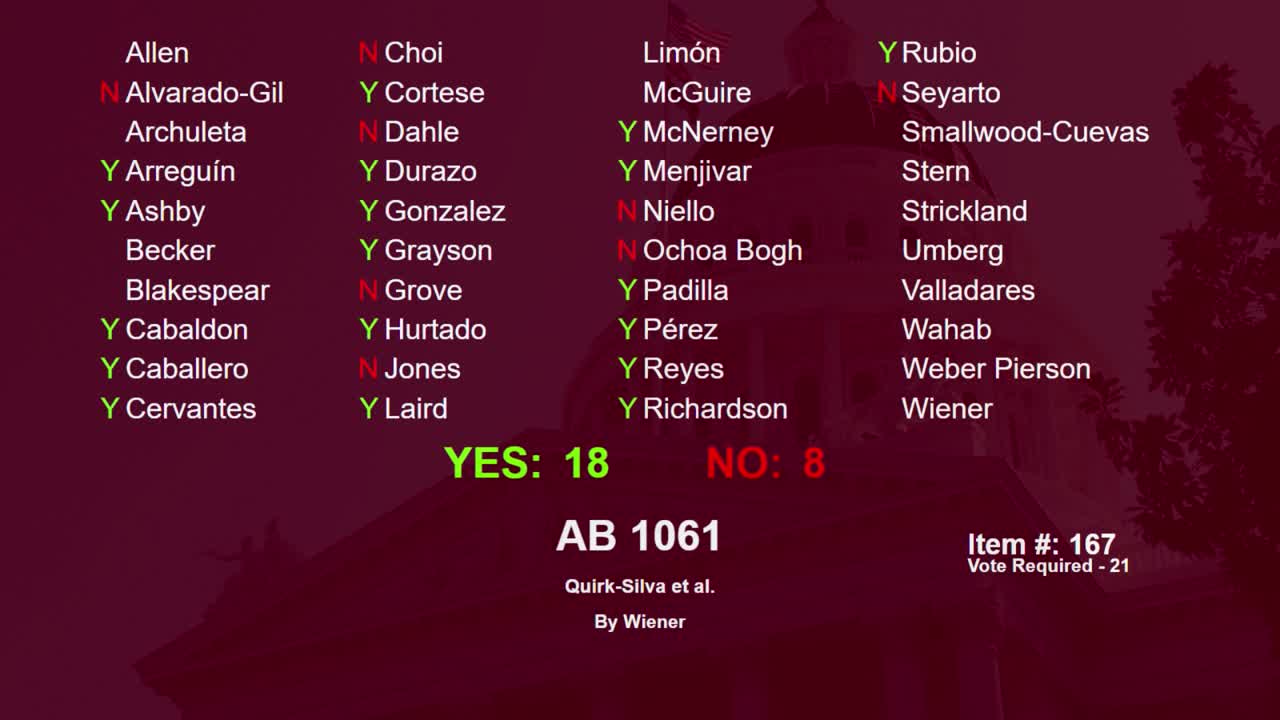 1MIN
Senate Floor
 7MIN
Senate Standing Committee on Judiciary
 8MIN
Senate Standing Committee on Environmental Quality
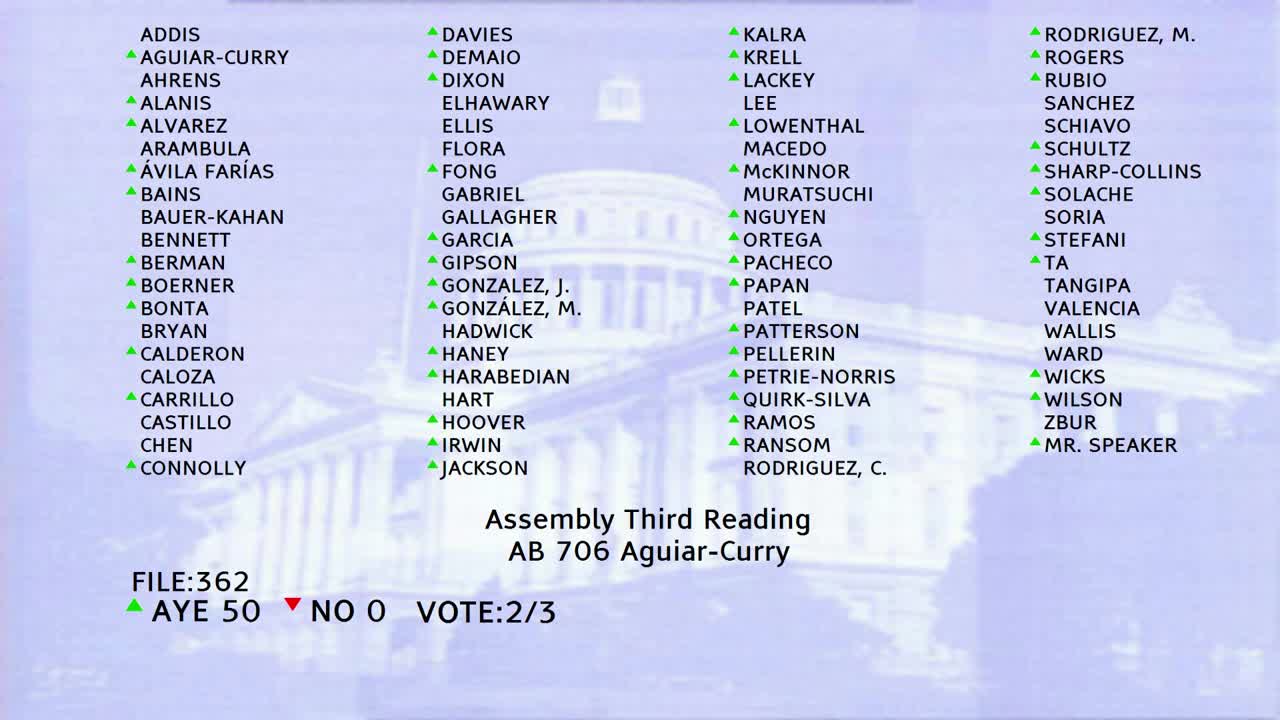 2MIN
Assembly Floor
 17MIN
Assembly Standing Committee on Environmental Safety and Toxic Materials
 31MIN
Assembly Standing Committee on Natural Resources
Bill Author

Bill Co-Author(s):