AB 893: Housing development projects: objective standards: campus development zone.
- Session Year: 2025-2026
- House: Assembly
- Latest Version Date: 2025-10-10
Current Status:
Passed
(2025-10-10: Chaptered by Secretary of State - Chapter 500, Statutes of 2025.)
Introduced
In Committee
Awaiting First Chamber Vote
Passed First Chamber
In Committee
Awaiting Second Chamber Vote
Passed Second Chamber
Enacted
What does this bill do?
The bill lets certain affordable and mixed‑income housing projects near college and university main campuses (inside a new “campus development zone” within a half‑mile) use the state's faster, ministerial approval process and changes affordability, density, height, and parking rules for those projects (for example, only aboveground parking must be set back 25 feet). It also limits what local governments may review to only the parts of a site the developer says will be physically disturbed, says easements for roads or utilities cannot make a site ineligible for the faster approval, and requires reporting on campus‑zone project outcomes in the 2031 study.
The summary is provided by generative AI which can make mistakes. For original language, please view the details in the table below.
Existing law, the Affordable Housing and High Road Jobs Act of 2022 (act), until January 1, 2033, authorizes a development proponent to submit an application for an affordable housing development or a mixed-income housing development that meets specified objective standards and affordability and site criteria, including being located within a zone where office, retail, or parking are a principally permitted use. The act makes a development that meets those objective standards and affordability and site criteria a use by right and subject to one of 2 streamlined, ministerial review processes depending on, among other things, the affordability requirements applicable to the project. The act requires the Department of Housing and Community Development to undertake at least 2 studies, one completed on or before January 1, 2027, and one completed on or before January 1, 2031, on the outcomes of the act.
This bill would provide that, for purposes of determining whether a property or site satisfies the criteria, objective development standards, or other requirements for receiving streamlined, ministerial review under the act, a local governments review of the property or site is limited to the area described as being physically disturbed by construction in the application for streamlined, ministerial review and does not include, unless expressly stated otherwise, other contiguous or noncontiguous areas even if under the ownership or control of the project proponent. The bill would provide that easements for public right-of-way, public or private utilities, or other public improvements in, under, or over the property shall not make the property ineligible to receive streamlined, ministerial review for either affordable or mixed-income housing developments.
This bill would also expand the eligibility for the above-described streamlined, ministerial review for mixed-income housing developments to include developments located in a campus development zone, as defined, as long as the development meets certain affordability requirements and objective standards, as provided. The bill would require the outcomes of projects built under campus development zones to be reported in the January 1, 2031, outcomes report. The bill would also make related findings and declarations.
The California Environmental Quality Act (CEQA) requires a lead agency, as defined, to prepare, or cause to be prepared, and certify the completion of, an environmental impact report on a project that it proposes to carry out or approve that may have a significant effect on the environment or to adopt a negative declaration if it finds that the project will not have that effect. CEQA also requires a lead agency to prepare a mitigated negative declaration for a project that may have a significant effect on the environment if revisions in the project would avoid or mitigate that effect and there is no substantial evidence that the project, as revised, would have a significant effect on the environment. CEQA does not apply to the approval of ministerial projects.
By expanding the scope of projects eligible for streamlined, ministerial approval as described above, this bill would expand the scope of the exemption from CEQA for ministerial projects.
Existing law includes certain setback requirements in the objective standards that a mixed-income development project must meet to be subject to the above-referenced streamlined, ministerial review process. In this regard, existing law requires all parking to be set back at least 25 feet.
This bill would instead impose that setback requirement only on parking that is aboveground.
By changing the criteria local agencies must follow for the approval of certain development projects, this bill would impose a state-mandated local program.
The California Constitution requires the state to reimburse local agencies and school districts for certain costs mandated by the state. Statutory provisions establish procedures for making that reimbursement.
This bill would provide that no reimbursement is required by this act for a specified reason.
Existing law, the Affordable Housing and High Road Jobs Act of 2022 (act), until January 1, 2033, authorizes a development proponent to submit an application for an affordable housing development or a mixed-income housing development that meets specified objective standards and affordability and site criteria, including being located within a zone where office, retail, or parking are a principally permitted use. The act makes a development that meets those objective standards and affordability and site criteria a use by right and subject to one of 2 streamlined, ministerial review processes depending on, among other things, the affordability requirements applicable to the project. The act requires the Department of Housing and Community Development to undertake at least 2 studies, one completed on or before January 1, 2027, and one completed on or before January 1, 2031, on the outcomes of the act.
This bill would provide that, for purposes of determining whether a property or site satisfies the criteria, objective development standards, or other requirements for receiving streamlined, ministerial review under the act, a local governments review of the property or site is limited to the area described as being physically disturbed by construction in the application for streamlined, ministerial review and does not include, unless expressly stated otherwise, other contiguous or noncontiguous areas even if under the ownership or control of the project proponent. The bill would provide that easements for public right-of-way, public or private utilities, or other public improvements in, under, or over the property shall not make the property ineligible to receive streamlined, ministerial review for either affordable or mixed-income housing developments.
This bill would also expand the eligibility for the above-described streamlined, ministerial review for mixed-income housing developments to include developments located in a campus development zone, as defined, as long as the development meets certain affordability requirements and objective standards, as provided. The bill would require the outcomes of projects built under campus development zones to be reported in the January 1, 2031, outcomes report. The bill would also make related findings and declarations.
The California Environmental Quality Act (CEQA) requires a lead agency, as defined, to prepare, or cause to be prepared, and certify the completion of, an environmental impact report on a project that it proposes to carry out or approve that may have a significant effect on the environment or to adopt a negative declaration if it finds that the project will not have that effect. CEQA also requires a lead agency to prepare a mitigated negative declaration for a project that may have a significant effect on the environment if revisions in the project would avoid or mitigate that effect and there is no substantial evidence that the project, as revised, would have a significant effect on the environment. CEQA does not apply to the approval of ministerial projects.
By expanding the scope of projects eligible for streamlined, ministerial approval as described above, this bill would expand the scope of the exemption from CEQA for ministerial projects.
Existing law includes certain setback requirements in the objective standards that a development project must meet to be subject to the above-referenced streamlined, ministerial review process. In this regard, existing law requires all parking to be set back at least 25 feet.
This bill would instead impose that setback requirement only on parking that is aboveground.
By changing the criteria local agencies must follow for the approval of certain development projects, this bill would impose a state-mandated local program.
The California Constitution requires the state to reimburse local agencies and school districts for certain costs mandated by the state. Statutory provisions establish procedures for making that reimbursement.
This bill would provide that no reimbursement is required by this act for a specified reason.
Existing law, the Affordable Housing and High Road Jobs Act of 2022 (act), until January 1, 2033, authorizes a development proponent to submit an application for an affordable housing development or a mixed-income housing development that meets specified objective standards and affordability and site criteria, including being located within a zone where office, retail, or parking are a principally permitted use. The act makes a development that meets those objective standards and affordability and site criteria a use by right and subject to one of 2 streamlined, ministerial review processes depending on, among other things, the affordability requirements applicable to the project. The act requires the Department of Housing and Community Development to undertake at least 2 studies, one completed on or before January 1, 2027, and one completed on or before January 1, 2031, on the outcomes of the act.
This bill would provide that, for purposes of determining whether a property or site satisfies the criteria, objective development standards, or other requirements for receiving streamlined, ministerial review under the act, a local governments review of the property or site is limited to the area described in the application for streamlined, ministerial review and does not include, unless expressly stated otherwise, other contiguous or noncontiguous areas even if under the ownership or control of the project proponent. The bill would provide that easements for public right-of-way, public or private utilities, or other public improvements in, under, or over the property shall not make the property ineligible to receive streamlined, ministerial review for either affordable or mixed-income housing developments.
This bill would also expand the eligibility for the above-described streamlined, ministerial review for mixed-income housing developments to include developments located in a campus development zone, as defined, as long as the development meets certain affordability requirements and objective standards, as provided. The bill would require the outcomes of projects built under campus development zones to be reported in the January 1, 2031, outcomes report. The bill would also make related findings and declarations.
The California Environmental Quality Act (CEQA) requires a lead agency, as defined, to prepare, or cause to be prepared, and certify the completion of, an environmental impact report on a project that it proposes to carry out or approve that may have a significant effect on the environment or to adopt a negative declaration if it finds that the project will not have that effect. CEQA also requires a lead agency to prepare a mitigated negative declaration for a project that may have a significant effect on the environment if revisions in the project would avoid or mitigate that effect and there is no substantial evidence that the project, as revised, would have a significant effect on the environment. CEQA does not apply to the approval of ministerial projects.
By expanding the scope of projects eligible for streamlined, ministerial approval as described above, this bill would expand the scope of the exemption from CEQA for ministerial projects.
Existing law includes certain setback requirements in the objective standards that a development project must meet to be subject to the above-referenced streamlined, ministerial review process. In this regard, existing law requires all parking to be set back at least 25 feet.
This bill would instead impose that setback requirement only on parking that is aboveground.
By changing the criteria local agencies must follow for the approval of certain development projects, this bill would impose a state-mandated local program.
The California Constitution requires the state to reimburse local agencies and school districts for certain costs mandated by the state. Statutory provisions establish procedures for making that reimbursement.
This bill would provide that no reimbursement is required by this act for a specified reason.
Existing law, the Affordable Housing and High Road Jobs Act of 2022, 2022 (act), until January 1, 2033, authorizes a development proponent to submit an application for an affordable housing development or a mixed-income housing development that meets specified objective standards and affordability and site criteria, including being located within a zone where office, retail, or parking are a principally permitted use. The act makes a development that meets those objective standards and affordability and site criteria a use by right and subject to one of 2 streamlined, ministerial review processes depending on, among other things, the affordability requirements applicable to the project. The act requires the Department of Housing and Community Development to undertake at least 2 studies, one completed on or before January 1, 2027, and one completed on or before January 1, 2031, on the outcomes of the act.
This bill would provide that, for purposes of determining whether a property or site satisfies the criteria, objective development standards, or other requirements for receiving streamlined, ministerial review under the act, a local governments review of the property or site is limited to the area described in the application for streamlined, ministerial review and does not include, unless expressly stated otherwise, other contiguous or noncontiguous areas even if under the ownership or control of the project proponent.
This bill would also expand the eligibility for the above-described streamlined, ministerial approval review for mixed-income housing developments to include developments located in a campus development zone, as defined, as long as the development meets certain affordability requirements and objective standards, as provided. The bill would require the outcomes of projects built under campus development zones to be reported in the January 1, 2031, outcomes report. The bill would also make related findings and declarations.
The California Environmental Quality Act (CEQA) requires a lead agency, as defined, to prepare, or cause to be prepared, and certify the completion of, an environmental impact report on a project that it proposes to carry out or approve that may have a significant effect on the environment or to adopt a negative declaration if it finds that the project will not have that effect. CEQA also requires a lead agency to prepare a mitigated negative declaration for a project that may have a significant effect on the environment if revisions in the project would avoid or mitigate that effect and there is no substantial evidence that the project, as revised, would have a significant effect on the environment. CEQA does not apply to the approval of ministerial projects.
By expanding the scope of projects eligible for streamlined, ministerial approval as described above, this bill would expand the scope of the exemption from CEQA for ministerial projects.
Existing law includes certain setback requirements in the objective standards that a development project must meet to be subject to the above-referenced streamlined, ministerial review process. In this regard, existing law requires all parking to be set back at least 25 feet.
This bill would instead impose that setback requirement only on parking that is aboveground.
By changing the criteria local agencies must follow for the approval of certain development projects, this bill would impose a state-mandated local program.
The California Constitution requires the state to reimburse local agencies and school districts for certain costs mandated by the state. Statutory provisions establish procedures for making that reimbursement.
This bill would provide that no reimbursement is required by this act for a specified reason.
Existing law, the Affordable Housing and High Road Jobs Act of 2022, until January 1, 2033, authorizes a development proponent to submit an application for an affordable housing development or a mixed-income housing development that meets specified objective standards and affordability and site criteria, including being located within a zone where office, retail, or parking are a principally permitted use. The act makes a development that meets those objective standards and affordability and site criteria a use by right and subject to one of 2 streamlined, ministerial review processes depending on, among other things, the affordability requirements applicable to the project. The act requires the Department of Housing and Community Development to undertake at least 2 studies, one completed on or before January 1, 2027, and one completed on or before January 1, 2031, on the outcomes of the act.
This bill would expand the eligibility for the above-described streamlined, ministerial approval to include developments located in a campus development zone, as defined, as long as the development meets certain affordability requirements and objective standards, as provided. The bill would require the outcomes of projects built under campus development zones to be reported in the January 1, 2031, outcomes report. The bill would also make related findings and declarations.
The California Environmental Quality Act (CEQA) requires a lead agency, as defined, to prepare, or cause to be prepared, and certify the completion of, an environmental impact report on a project that it proposes to carry out or approve that may have a significant effect on the environment or to adopt a negative declaration if it finds that the project will not have that effect. CEQA also requires a lead agency to prepare a mitigated negative declaration for a project that may have a significant effect on the environment if revisions in the project would avoid or mitigate that effect and there is no substantial evidence that the project, as revised, would have a significant effect on the environment. CEQA does not apply to the approval of ministerial projects.
By expanding the scope of projects eligible for streamlined, ministerial approval as described above, this bill would expand the scope of the exemption from CEQA for ministerial projects.
By changing the criteria local agencies must follow for the approval of certain development projects, this bill would impose a state-mandated local program.
The California Constitution requires the state to reimburse local agencies and school districts for certain costs mandated by the state. Statutory provisions establish procedures for making that reimbursement.
This bill would provide that no reimbursement is required by this act for a specified reason.
(a)The Legislature finds and declares all of the following:
(1)The state is experiencing a widespread student housing crisis, which has been caused by the shortage of housing units on and around university and college campuses.
(2)Housing costs represent a significant proportion of the cost of attendance of Californias public and private higher education institutions, and the lack of housing for students represents a significant barrier to academic achievement.
(3)Efforts to promote the development of off-campus housing to help address the states student housing crisis are not intended to supplant planning, financing, and facilitating on-campus housing developments.
(b)It is the intent of the Legislature to continue to promote the development of housing units for students and faculty of Californias colleges and universities, in order to address the ongoing student housing crisis.
SEC. 2.Section 65912.101 of the Government Code is amended to read:65912.101.For purposes of this chapter:
(a)Base units has the same meaning as total units as defined in subparagraph (A) of paragraph (8) of subdivision (o) of Section 65915.
(b)Campus development zone means the set of parcels that are contained either wholly or partially within a one-half mile radius of a main campus, as defined by Section 94849 of the Education Code, of the University of California, the California State University, or the California Community Colleges.
(c)Commercial corridor means a street that is not a freeway and that has a right-of-way of at least 70 and not greater than 150 feet.
(d)Development proponent means a developer who submits a housing development project application to a local government under the streamlined, ministerial review process pursuant to this chapter.
(e)Extremely low income faculty or staff means an employee of the University of California, the California State University, or the California Community Colleges who satisfies the requirements of Section 50106 of the Health and Safety Code.
(f)Extremely low income households has the same meaning as defined in Section 50106 of the Health and Safety Code.
(g)Freeway has the same meaning as defined in Section 332 of the Vehicle Code, except it does not include the portion of a freeway that is an on ramp or off ramp that serves as a connector between the freeway and other roadways that are not freeways.
(h)Health care expenditures include contributions under Sections 501(c) or (d) or 401(a) of the Internal Revenue Code and payments toward medical care as defined under Section 213(d)(1) of the Internal Revenue Code.
(i)Housing development project has the same meaning as defined in Section 65589.5.
(j)Industrial use means utilities, manufacturing, transportation storage and maintenance facilities, warehousing uses, and any other use that is a source that is subject to permitting by a district, as defined in Section 39025 of the Health and Safety Code, pursuant to Division 26 (commencing with Section 39000) of the Health and Safety Code or the federal Clean Air Act (42 U.S.C. Sec. 7401 et seq.). Industrial use does not include any of the following:
(1)Power substations or utility conveyances such as power lines, broadband wires, and pipes.
(2)A use where the only source permitted by a district is an emergency backup generator.
(3)Self-storage for the residents of a building.
(k)Local affordable housing requirement means either of the following:
(1)A local government requirement, as a condition of development of residential units, that a housing development project include a certain percentage of units affordable to, and occupied by, extremely low, very low, lower, or moderate-income households as a condition of development of residential units.
(2)A local government requirement allowing a housing development project to be a use by right if the project includes a certain percentage of units affordable to, and occupied by, extremely low, very low, lower, or moderate-income households as a condition of development of residential units.
(l)Local government means a city, including a charter city, a county, including a charter county, or a city and county, including a charter city and county.
(m)Lower income faculty or staff means an employee of the University of California, the California State University, or the California Community Colleges who satisfies the requirements of Section 50079.5 of the Health and Safety Code.
(n)Lower income households has the same meaning as defined in Section 50079.5 of the Health and Safety Code.
(o)(1)Lower income student means any of the following:
(A)A student who has a household income and asset level that does not exceed either of the following:
(i)The level for Cal Grant A or Cal Grant B award recipients as set forth in subdivision (k) of Section 69432.7 of the Education Code.
(ii)The level for the California College Promise Grant as set forth in clause (ii) of subparagraph (B) of paragraph (1) of subdivision (g) of Section 76300 of the Education Code.
(B)A student who otherwise qualifies for the California College Promise Grant as set forth in subparagraph (B) of paragraph (1) of subdivision (g) of Section 76300 of the Education Code.
(C)A student who qualifies for Federal Pell Grant financial aid pursuant to Section 1070a of Title 20 of the United States Code.
(D)A student who qualifies for an exemption from paying nonresident tuition pursuant to Section 68130.5 of the Education Code, provided that the student also meets income criteria in subparagraph (A) or (B).
(E)A graduate student with income and asset levels that would qualify for one or more of the benefits in subparagraphs (A) to (D), inclusive, as determined by the campus at which the student is enrolled.
(2)The eligibility of a student to occupy a unit for lower income students under this subdivision shall be verified by an affidavit, award letter, or letter of eligibility demonstrating that the student is eligible for financial aid, including an institutional grant or fee waiver, provided by the institution of higher education in which the student is enrolled, by the Student Aid Commission, or by the federal government.
(p)Major transit stop has the same meaning as defined in subdivision (b) of Section 21155 of the Public Resources Code.
(q)Minimum efficiency reporting value or MERV means the measurement scale developed by the American Society of Heating, Refrigerating and Air-Conditioning Engineers used to report the effectiveness of air filters.
(r)Moderate-income households means households of persons and families of moderate income, as defined in Section 50093 of the Health and Safety Code.
(s)Multifamily means a property with five or more housing units for sale or for rent.
(t)Neighborhood plan means a specific plan adopted pursuant to Article 8 (commencing with Section 65450) of Chapter 3, an area plan, precise plan, community plan, urban village plan, or master plan. To qualify as a neighborhood plan, the plan must have been adopted by a local government before January 1, 2024, and within 25 years of the date that a development proponent submits an application pursuant to this chapter. A neighborhood plan does not include a community plan or plans where the cumulative area covered by the community plans in the jurisdiction is more than one-half of the area of the jurisdiction.
(u)Principally permitted use means a use that, as of January 1, 2023, or thereafter, may occupy more than one-third of the square footage of designated use on the site and does not require a conditional use permit, except that parking uses are considered principally permitted whether or not they require a conditional use permit.
(v)Regional mall means a site that meets all of the following criteria on the date that a development proponent submits an application pursuant to this chapter:
(1)The permitted uses on the site include at least 250,000 square feet of retail use.
(2)At least two-thirds of the permitted uses on the site are retail uses.
(3)At least two of the permitted retail uses on the site are at least 10,000 square feet.
(w)Street has the same meaning as defined in Section 590 of the Vehicle Code, and includes sidewalks, as defined in Section 555 of the Vehicle Code.
(x)Urban uses means any current or former residential, commercial, public institutional, public park that is surrounded by other urban uses, parking lot or structure, transit or transportation passenger facility, or retail use, or any combination of those uses.
(y)Use by right means a development project for which both of the following are true:
(1)The development project is not subject to a conditional use permit, planned unit development permit, or any other discretionary local government approval, permit, or review process.
(2)No aspect of the development project, including any permits required for the development project, is a project for purposes of Division 13 (commencing with Section 21000) of the Public Resources Code.
(z)Very low income faculty or staff means an employee of the University of California, the California State University, or the California Community Colleges who satisfies the requirements of Section 50105 of the Health and Safety Code.
(aa)Very low income households has the same meaning as defined in Section 50105 of the Health and Safety Code.
(ab)Very low vehicle travel area has the same meaning as defined in subdivision (h) of Section 65589.5.
SEC. 3.Section 65912.103.5 is added to the Government Code, to read:65912.103.5.For purposes of determining whether a property or site satisfies the criteria, objective development standards, or other requirements for receiving streamlined, ministerial review under this chapter, a local governments review of the property or site shall be limited to the area described as being physically disturbed by construction in the application for streamlined, ministerial review and shall not include, unless expressly stated otherwise, other contiguous or noncontiguous areas even if under the ownership or control of the project proponent.
SEC. 4.Section 65912.104 of the Government Code is amended to read:65912.104.(a)The department shall undertake at least two studies of the outcomes of this chapter. One study shall be completed on or before January 1, 2027, and one shall be completed on or before January 1, 2031.
(b)The studies required by subdivision (a) shall include, but not be limited to, the number of projects built, the number of units built, the jurisdictional and regional location of the housing, the relative wealth and access to resources of the communities in which they are built, the level of affordability, the effect on greenhouse gas emissions, and the creation of construction jobs that pay the prevailing wage.
(c)(1)The department shall publish a report of the findings of a study required by subdivision (a), post the report on its internet website, and submit the report to the Legislature pursuant to Section 9795.
(2)The outcomes of projects built under campus development zones shall be reported in the January 1, 2031, report.
SEC. 5.Section 65912.114 of the Government Code is amended to read:65912.114.(a)(1)A local government shall determine, in writing, whether a development submitted pursuant to this article is consistent or inconsistent with the objective planning standards specified in this article within the following timeframes:
(A)Within 60 days of submittal of the development proposal to the local government if the development contains 150 or fewer housing units.
(B)Within 90 days of submittal of the development proposal to the local government if the development contains more than 150 housing units.
(C)Within 30 days of submittal of any development proposal that was resubmitted to address written feedback provided by the local government pursuant to paragraph (2).
(2)(A)If a local government determines that a development submitted pursuant to this article is in conflict with any of the objective planning standards specified in this article, it shall provide the development proponent, in writing, with an exhaustive list of the standard or standards the development conflicts with, and an explanation for the reason or reasons the development conflicts with that standard or standards, within the timeframes specified in paragraph (1).
(B)In any subsequent review of the application determined to be in conflict with the objective planning standards specified in this article, the local government shall not request the development proponent to provide any new information that was not stated in the initial list of items that were determined to be in conflict.
(3)Once the local government determines that a development submitted pursuant to this article is consistent with the objective planning standards specified in this article, it shall approve the development within the following timeframes:
(A)Within 60 days of the date that the development is determined to be consistent with the objective planning standards specified in this article, if the development contains 150 or fewer housing units.
(B)Within 90 days of the date that the development is determined to be consistent with the objective planning standards specified in this article, if the development contains more than 150 housing units.
(4)If the local government fails to provide the required documentation pursuant to paragraph (2), the development shall be deemed to satisfy the required objective planning standards.
(b)(1)For purposes of this section, a development is consistent with the objective planning standards if there is substantial evidence that would allow a reasonable person to conclude that the development is consistent with the objective planning standards.
(2)For purposes of this section, a development is not in conflict with the objective planning standards solely on the basis that application materials are not included, if the application contains substantial evidence that would allow a reasonable person to conclude that the development is consistent with the objective planning standards.
(c)The determination of whether a proposed project submitted pursuant to this section is or is not in conflict with the objective planning standards is not a project as defined in Section 21065 of the Public Resources Code.
(d)Design review of the development may be conducted by the local governments planning commission or any equivalent board or commission responsible for design review. That design review shall be objective and be strictly focused on assessing compliance with criteria required for streamlined, ministerial review of projects, as well as any reasonable objective design standards published and adopted by ordinance or resolution by a local jurisdiction before submittal of the development to the local government, and shall be broadly applicable to developments within the jurisdiction. That design review shall not in any way inhibit, chill, or preclude the ministerial approval provided by this section.
(e)If a development is located within an area of the coastal zone that is not excluded under clause (i), (ii), (iii), or (v) of subparagraph (A) of paragraph (6) of subdivision (a) of Section 65913.4, the development shall require a coastal development permit pursuant to Chapter 7 (commencing with Section 30600) of Division 20 of the Public Resources Code. A public agency with coastal development permitting authority shall approve a coastal development permit if it determines that the development is consistent with all objective standards of the local governments certified local coastal program or, for areas that are not subject to a fully certified local coastal program, the certified land use plan of that area.
(f)(1)A development proposed pursuant to this article shall be eligible for a density bonus, incentives or concessions, waivers or reductions of development standards, and parking ratios pursuant to Section 65915.
(2)The utilization by a development proponent of incentives, concessions, and waivers or reductions of development standards allowed pursuant to Section 65915 shall not cause the project to be subject to a local discretionary government review process, or be considered a project under Division 13 (commencing with Section 21000) of the Public Resources Code, even if that incentive, concession, or waiver or reduction of development standards is not specified in a local ordinance.
(3)For purposes of this section, receipt of any density bonus, concession, incentive, waiver or reduction of development standards, and parking ratios to which the applicant is entitled under Section 65915 shall not constitute a basis to find the project inconsistent with the local coastal program.
(g)If a development proposed pursuant to this article demolishes or changes an existing use, the amount of a fee, as defined in Section 66000, imposed on the development shall be offset to account for the demolition or change so that the amount of the fee is attributable only to the developments incremental impact on public facilities or services. For purposes of this subdivision, an offset amount that exceeds the fee amount shall not be refundable or used to offset any other fee. This subdivision does not supersede or in any way alter or lessen the effect of the Mitigation Fee Act (Chapter 5 (commencing with Section 66000), Chapter 6 (commencing with Section 66010), Chapter 7 (commencing with Section 66012), Chapter 7.5 (commencing with Section 66015), Chapter 8 (commencing with Section 66016), and Chapter 9 (commencing with Section 66020)). For the purpose of this subdivision, changes an existing use means no demolition is proposed, but a current office, commercial, or similar use changes to residential use.
(h)The local government shall ensure that the project satisfies the requirements specified in Article 2 (commencing with Section 66300.5) of Chapter 12, regardless of whether the development is within or not within an affected city or within or not within an affected county.
(i)If the development is consistent with all objective subdivision standards in the local subdivision ordinance, an application for a subdivision pursuant to the Subdivision Map Act (Division 2 (commencing with Section 66410)) shall be exempt from the requirements of the California Environmental Quality Act (Division 13 (commencing with Section 21000) of the Public Resources Code).
(j)A local government may, by ordinance adopted to implement this article, exempt a parcel from this section before a development proponent submits a development application on a parcel pursuant to this article if the local government makes written findings establishing all of the following:
(1)The local government has identified one or more parcels that meet the criteria described in subdivisions (b) through (f) of Section 65912.111.
(2)(A)If a parcel identified in paragraph (1) would not otherwise be eligible for development pursuant to this chapter, the implementing ordinance authorizes the parcel to be developed pursuant to the requirements of this chapter. A parcel reclassified for development pursuant to this subparagraph shall be suitable for residential development. For purposes of this subparagraph, a parcel suitable for residential development shall have the same meaning as land suitable for residential development, as defined in Section 65583.2.
(B)If a parcel identified in paragraph (1) would otherwise be eligible for development pursuant to this chapter, the implementing ordinance authorizes the parcel to be developed ministerially at residential densities above the residential density required in subdivision (b) of Section 65912.113.
(3)The substitution of the parcel or parcels identified in this subdivision for parcels reclassified pursuant to paragraph (2) will result in all of the following:
(A)No net loss of the total potential residential capacity in the jurisdiction relative to the total capacity that existed in the jurisdiction through the combined effect of this chapter and local law as of the date of the adoption of the ordinance. In making the no net loss calculation specified by this subparagraph, the local government need only factor in the parcels substituted and reclassified pursuant to this subdivision.
(B)No net loss of the total potential residential capacity of housing affordable to lower income households in the jurisdiction relative to the total capacity that existed in the jurisdiction through the combined effect of this chapter and local law as of the date of the adoption of the ordinance. In making the no net loss calculation specified by this subparagraph, the local government need only factor in the parcels substituted and reclassified pursuant to this subdivision.
(C)Affirmative furthering of fair housing.
(4)A parcel or parcels reclassified for development pursuant to subparagraph (A) of paragraph (2) shall be eligible for development pursuant to this chapter notwithstanding any contrary provision of the local governments charter, general plan, or ordinances, and a parcel or parcels reclassified for development pursuant to subparagraph (B) of paragraph (2) shall be developed ministerially at the densities and heights specified in the ordinance notwithstanding any contrary provision of the local governments charter, general plan, or ordinances.
(5)The local government has completed all of the rezonings required pursuant to subdivision (c) of Section 65583 for the sixth revision of its housing element.
(6)The local government has designated on its zoning maps which parcels have been exempted from this chapter and which parcels have been reclassified for development pursuant to this chapter. This information shall be made publicly available through the local governments internet website.
(k)(1)The local government shall, as a condition of approval of the development, require the development proponent to complete a phase I environmental assessment, as defined in Section 78090 of the Health and Safety Code.
(2)If a recognized environmental condition is found, the development proponent shall undertake a preliminary endangerment assessment, as defined in Section 78095 of the Health and Safety Code, prepared by an environmental assessor to determine the existence of any release of a hazardous substance on the site and to determine the potential for exposure of future occupants to significant health hazards from any nearby property or activity.
(A)If a release of a hazardous substance is found to exist on the site, before the local government issues a certificate of occupancy, the release shall be removed, or any significant effects of the release shall be mitigated to a level of insignificance in compliance with current state and federal requirements.
(B)If a potential for exposure to significant hazards from surrounding properties or activities is found to exist, before the local government issues a certificate of occupancy, the effects of the potential exposure shall be mitigated to a level of insignificance in compliance with current state and federal requirements.
(l)A local governments approval of a development pursuant to this section shall, notwithstanding any other law, be subject to the expiration timeframes specified in subdivision (g) of Section 65913.4.
(m)Any proposed modifications to a development project approved pursuant to this section shall be undertaken pursuant to subdivision (h) of Section 65913.4.
(n)A local government shall not adopt or impose any requirement, including, but not limited to, increased fees or inclusionary housing requirements, that applies to a project solely or partially on the basis that the project is eligible to receive streamlined, ministerial review pursuant to this section.
(o)A local government shall issue a subsequent permit required for a development approved under this section pursuant to paragraph (2) of subdivision (i) of Section 65913.4.
(p)A public improvement that is necessary to implement a development that is approved pursuant to this section shall be undertaken pursuant to paragraph (3) of subdivision (i) of Section 65913.4.
(q)Easements for public right-of-way, public or private utilities, or other public improvements in, under, or over the property shall not make the property ineligible to receive streamlined, ministerial review pursuant to this section.
(r)A local government may adopt an ordinance to implement the provisions of this article. An ordinance adopted to implement this section shall not be considered a project under Division 13 (commencing with Section 21000) of the Public Resources Code.
(s)Section 65589.5 applies to a development proceeding pursuant to this article.
SEC. 6.Section 65912.121 of the Government Code is amended to read:65912.121.A development project shall not be subject to the streamlined, ministerial review process provided by Section 65912.124 unless the development project is on a site that satisfies all of the following criteria:
(a)It is located within a zone where office, retail, or parking are a principally permitted use.
(b)It is located on a legal parcel, or parcels, that meet either of the following:
(1)It is within a city where the city boundaries include some portion of an urbanized area, as designated by the United States Census Bureau.
(2)It is in an unincorporated area, and the legal parcel, or parcels, are wholly within the boundaries of an urbanized area, as designated by the United States Census Bureau.
(c)It satisfies either of the following criteria:
(1)The project site abuts a commercial corridor and has a frontage along the commercial corridor of a minimum of 50 feet.
(2)The site is in a campus development zone.
(d)The site is not greater than 20 acres, unless the site is a regional mall, in which case the site is not greater than 100 acres.
(e)At least 75 percent of the perimeter of the site adjoins parcels that are developed with urban uses. For purposes of this subdivision, parcels that are only separated by a street, pedestrian path, or bicycle path shall be considered to be adjoined.
(f)(1)It is not on a site or adjoined to any site where more than one-third of the square footage on the site is dedicated to industrial use.
(2)For purposes of this subdivision, parcels only separated by a street shall be considered to be adjoined.
(3)For purposes of this subdivision, dedicated to industrial use means any of the following:
(A)The square footage is currently being used as an industrial use.
(B)The most recently permitted use of the square footage is an industrial use, and the site has been occupied within the past three years.
(C)The site was designated for industrial use in the latest version of a local governments general plan adopted before January 1, 2022, and residential uses are not principally permitted on the site.
(g)It satisfies the requirements specified in paragraph (6) of subdivision (a) of Section 65913.4, exclusive of clause (iv) of subparagraph (A) of paragraph (6) of subdivision (a) of Section 65913.4.
(h)The development is not located on a site where any of the following apply:
(1)The development would require the demolition of the following types of housing:
(A)Housing that is subject to a recorded covenant, ordinance, or law that restricts rents to levels affordable to persons and families of moderate, low, or very low income.
(B)Housing that is subject to any form of rent or price control through a public entitys valid exercise of its police power.
(C)Housing that has been occupied by tenants within the past 10 years, excluding any managers units.
(2)The site was previously used for permanent housing that was occupied by tenants, excluding any managers units, that was demolished within 10 years before the development proponent submits an application under this article.
(3)The development would require the demolition of a historic structure that was placed on a national, state, or local historic register.
(4)The property contains one to four dwelling units.
(5)The property is vacant and zoned for housing but not for multifamily residential use.
(6)The existing parcel of land or site is governed under the Mobilehome Residency Law (Chapter 2.5 (commencing with Section 798) of Title 2 of Part 2 of Division 2 of the Civil Code), the Recreational Vehicle Park Occupancy Law (Chapter 2.6 (commencing with Section 799.20) of Title 2 of Part 2 of Division 2 of the Civil Code), the Mobilehome Parks Act (Part 2.1 (commencing with Section 18200) of Division 13 of the Health and Safety Code), or the Special Occupancy Parks Act (Part 2.3 (commencing with Section 18860) of Division 13 of the Health and Safety Code).
(i)For a site within a neighborhood plan area, the neighborhood plan applicable to the site permitted multifamily housing development on the site.
(j)For a vacant site, the site satisfies both of the following:
(1)It does not contain tribal cultural resources, as defined by Section 21074 of the Public Resources Code, that could be affected by the development that were found pursuant to a consultation as described by Section 21080.3.1 of the Public Resources Code and the effects of which cannot be mitigated pursuant to the process described in Section 21080.3.2 of the Public Resources Code.
(2)It is not within a very high fire hazard severity zone, as indicated on maps adopted by the Department of Forestry and Fire Protection pursuant to Section 4202 of the Public Resources Code or as designated pursuant to subdivisions (a) and (b) of Section 51179.
SEC. 7.Section 65912.122 of the Government Code is amended to read:65912.122.A development project shall not be subject to the streamlined, ministerial review process provided by Section 65912.124 unless the new housing units created by the development project meet all of the following affordability criteria:
(a)(1)Except as provided in paragraph (2), a rental housing development shall include either of the following:
(A)Eight percent of the base units for very low income households and 5 percent of the units for extremely low income households.
(B)Fifteen percent of the base units for lower income households.
(2)Notwithstanding paragraph (1), a rental housing development in a campus development zone shall include either of the following:
(A)(i)Both of the following:
(I)Five percent of the base units for extremely low income households, extremely low income faculty or staff, or students experiencing homelessness.
(II)Eight percent of the base units for very low income households, very low income faculty or staff, or students experiencing homelessness.
(ii)For the purposes of this subparagraph, a homeless services provider, as defined in paragraph (3) of subdivision (e) of Section 103577 of the Health and Safety Code, or institution of higher education that has knowledge of a persons homelessness status may verify a persons status as homeless.
(B)Fifteen percent of the base units for lower income households, lower income students, or lower income faculty or staff.
(3)The development proponent shall agree to, and the local government shall ensure, the continued affordability of all affordable rental units included pursuant to this subdivision for 55 years. Rents shall be set at an affordable rent, as defined in Section 50053 of the Health and Safety Code.
(b)(1)Except as provided in paragraph (2), an owner-occupied housing development shall include either of the following:
(A)Thirty percent of the base units must be offered at an affordable housing cost, as defined in Section 50052.5 of the Health and Safety Code, to moderate-income households.
(B)Fifteen percent of the base units must be offered at an affordable housing cost, as defined in Section 50052.5 of the Health and Safety Code, to lower income households.
(2)Notwithstanding paragraph (1), an owner-occupied housing development in a campus development zone shall include either of the following:
(A)Thirty percent of the base units must be offered at an affordable housing cost, as defined in Section 50052.5 of the Health and Safety Code, to moderate-income households.
(B)Fifteen percent of the base units must be offered at an affordable housing cost, as defined in Section 50052.5 of the Health and Safety Code, to lower income households, lower income students, or lower income faculty or staff.
(3)The development proponent shall agree to, and the local government shall ensure, the continued affordability of all affordable ownership units for a period of 45 years.
(c)If the local government has a local affordable housing requirement, the housing development project shall comply with all of the following:
(1)The development project shall include the percentage of affordable units required by this section or the local requirement, whichever is higher.
(2)The development project shall meet the affordability level of a local affordable housing requirement if it is a deeper affordability level than required by this section.
(3)If the local affordable housing requirement requires greater than 15 percent of the units to be dedicated for lower income households and does not require the inclusion of units affordable to very low and extremely low income households, then the rental housing development shall do both of the following:
(A)Include 8 percent of the units for very low income households and 5 percent of the units for extremely low income households.
(B)Fifteen percent of units affordable to lower income households shall be subtracted from the percentage of units required by the local policy at the highest required affordability level.
(d)Affordable units in the development project shall have the same bedroom and bathroom count ratio as the market rate units, be equitably distributed within the project, and have the same type or quality of appliances, fixtures, and finishes.
SEC. 8.Section 65912.123 of the Government Code is amended to read:65912.123.A development project shall not be subject to the streamlined, ministerial review process provided by Section 65912.124 unless the development project meets all of the following objective development standards:
(a)The development shall be a multifamily housing development project.
(b)The residential density for the development, prior to the award of any eligible density bonus pursuant to Section 65915, shall be determined as follows:
(1)In a metropolitan jurisdiction, as determined pursuant to subdivisions (d) and (e) of Section 65583.2, the allowable residential density for the development shall be the greater of the following:
(A)The maximum allowable residential density, as defined in paragraph (6) of subdivision (o) of Section 65915, allowed on the parcel by the local government.
(B)For sites of less than one acre in size, 30 units per acre.
(C)For sites of one acre in size or greater located on a commercial corridor of less than 100 feet in width, 40 units per acre.
(D)For sites of one acre in size or greater located on a commercial corridor of 100 feet in width or greater, 60 units per acre.
(E)Notwithstanding subparagraph (B), (C), or (D), for sites within a very low vehicle travel area, within one-half mile of a major transit stop, or within a campus development zone, 80 units per acre.
(2)In a jurisdiction that is not a metropolitan jurisdiction, as determined pursuant to subdivisions (d) and (e) of Section 65583.2, the allowable residential density for the development shall be the greater of the following:
(A)The maximum allowable residential density, as defined in paragraph (6) of subdivision (o) of Section 65915, allowed on the parcel by the local government.
(B)For sites of less than one acre in size, 20 units per acre.
(C)For sites of one acre in size or greater located on a commercial corridor of less than 100 feet in width, 30 units per acre.
(D)For sites of one acre in size or greater located on a commercial corridor of 100 feet in width or greater, 50 units per acre.
(E)Notwithstanding subparagraph (B), (C), or (D), for sites within a very low vehicle travel area, within one-half mile of a major transit stop, or within a campus development zone, 70 units per acre.
(3)(A)For a housing development project application that has been determined to be consistent with the objective planning standards specified in this article, pursuant to subdivision (a) of Section 65912.124, before January 1, 2027, the development project shall be developed at a density as follows:
(i)Except as provided in clause (ii), 50 percent or greater of the applicable allowable residential density contained in subparagraphs (B) to (E), inclusive, of paragraph (1) or subparagraphs (B) to (E), inclusive, of paragraph (2), as applicable.
(ii)For a site within one-half mile of an existing passenger rail or bus rapid transit station, 75 percent or greater of the applicable allowable residential density contained in subparagraphs (B) to (E), inclusive, of paragraph (1) or subparagraphs (B) to (E), inclusive, of paragraph (2), as applicable.
(iii)For a site within a campus development zone, 75 percent or greater of the applicable allowable residential density contained in subparagraph (E) of paragraph (2).
(B)For a housing development project application that has been determined to be consistent with the objective planning standards specified in this article, pursuant to subdivision (a) of Section 65912.124, on or after January 1, 2027, the development project shall be developed at a density that is 75 percent or greater of the applicable allowable residential density contained in subparagraphs (B) to (E), inclusive, of paragraph (1) or subparagraphs (B) to (E), inclusive, of paragraph (2), as applicable.
(4)Notwithstanding paragraphs (1) and (2), a development project shall not be subject to any density limitation if the development project is a conversion of existing buildings into residential use, unless the development project includes additional new square footage that is more than 20 percent of the overall square footage of the project.
(c)The height limit applicable to the housing development shall be the greater of the following:
(1)The height allowed on the parcel by the local government.
(2)For sites on a commercial corridor of less than 100 feet in width, 35 feet.
(3)For sites on a commercial corridor of 100 feet in width or greater, 45 feet.
(4)Notwithstanding paragraphs (2) and (3), 65 feet for sites that meet all of the following criteria:
(A)They are within one-half mile of a major transit stop.
(B)They are within a city with a population of greater than 100,000.
(C)They are not within a coastal zone, as defined in Division 20 (commencing with Section 30000) of the Public Resources Code.
(5)For sites in a campus development zone, either of the following:
(A)Forty-five feet, if not located in a metropolitan jurisdiction, as determined pursuant to subdivisions (d) and (e) of Section 65583.2.
(B)Sixty-five feet, if located in a metropolitan jurisdiction, as determined pursuant to subdivisions (d) and (e) of Section 65583.2.
(d)The property meets the following standards:
(1)For the portion of the property that fronts a commercial corridor or for a property in a campus development zone, the following shall occur:
(A)No setbacks shall be required.
(B)All aboveground parking must be set back at least 25 feet.
(C)On the ground floor, a building or buildings must abut within 10 feet of the street for at least 80 percent of the frontage.
(2)For the portion of the property that abuts an adjoining property that also abuts the same commercial corridor as the property, no setbacks are required unless the adjoining property contains a residential use that was constructed prior to the enactment of this chapter, in which case the requirements of subparagraph (A) of paragraph (3) apply.
(3)For the portion of the property line that does not abut or lie within a commercial corridor, or an adjoining property that also abuts the same commercial corridor as the property, the following shall occur:
(A)Along property lines that abut a property that contains a residential use, the following shall occur:
(i)The ground floor of the development project shall be set back at 10 feet. The amount required to be set back may be decreased by the local government.
(ii)Starting with the second floor of the property, each subsequent floor of the development project shall be stepped back in an amount equal to seven feet multiplied by the floor number. For purposes of this paragraph, the ground floor counts as the first floor. The amount required to be stepped back may be decreased by the local government.
(B)Along property lines that abut a property that does not contain a residential use, the development shall be set back 15 feet. The amount required to be stepped back may be decreased by the local government.
(4)For a development project at a regional mall, all of the following requirements apply:
(A)The average size of a block shall not exceed three acres. For purposes of this subparagraph, a block means an area fully surrounded by streets, pedestrian paths, or a combination of streets and pedestrian paths that are each at least 40 feet in width.
(B)At least 5 percent of the site shall be dedicated to open space.
(C)For the portion of the property that fronts a street that is newly created by the project and is not a commercial corridor, a building shall abut within 10 feet of the street for at least 60 percent of the frontage.
(e)No parking shall be required, including replacement parking, except that this article shall not reduce, eliminate, or preclude the enforcement of any requirement imposed on a new multifamily residential or nonresidential development to provide bicycle parking, electric vehicle supply equipment installed parking spaces, or parking spaces that are accessible to persons with disabilities that would have otherwise applied to the development if this article did not apply.
(f)For any housing on the site located within 500 feet of a freeway, all of the following shall apply:
(1)The building shall have a centralized heating, ventilation, and air-conditioning system.
(2)The outdoor air intakes for the heating, ventilation, and air-conditioning system shall face away from the freeway.
(3)The building shall provide air filtration media for outside and return air that provide a minimum efficiency reporting value of 16.
(4)The air filtration media shall be replaced at the manufacturers designated interval.
(5)The building shall not have any balconies facing the freeway.
(g)None of the housing on the site is located within 3,200 feet of a facility that actively extracts or refines oil or natural gas.
(h)(1)The development proponent shall provide written notice of the pending application to each commercial tenant on the parcel when the application is submitted.
(2)The development proponent shall provide relocation assistance to each eligible commercial tenant located on the site as follows:
(A)For a commercial tenant operating on the site for at least one year but less than five years, the relocation assistance shall be equivalent to six months rent.
(B)For a commercial tenant operating on the site for at least 5 years but less than 10 years, the relocation assistance shall be equivalent to nine months rent.
(C)For a commercial tenant operating on the site for at least 10 years but less than 15 years, the relocation assistance shall be equivalent to 12 months rent.
(D)For a commercial tenant operating on the site for at least 15 years but less than 20 years, the relocation assistance shall be equivalent to 15 months rent.
(E)For a commercial tenant operating on the site for at least 20 years, the relocation assistance shall be equivalent to 18 months rent.
(3)The relocation assistance shall be provided to an eligible commercial tenant upon expiration of the lease of that commercial tenant.
(4)For purposes of this subdivision, a commercial tenant is eligible for relocation assistance if the commercial tenant meets all of the following criteria:
(A)The commercial tenant is an independently owned and operated business with its principal office located in the county in which the property on the site that is leased by the commercial tenant is located.
(B)The commercial tenants lease expired and was not renewed by the property owner.
(C)The commercial tenants lease expired within the three years following the development proponents submission of the application for a housing development pursuant to this article.
(D)The commercial tenant employs 20 or fewer employees and has annual average gross receipts under one million dollars ($1,000,000) for the three-taxable-year period ending with the taxable year that precedes the expiration of their lease.
(E)The commercial tenant is still in operation on the site at the time of the expiration of its lease.
(5)Notwithstanding paragraph (4), for purposes of this subdivision, a commercial tenant is ineligible for relocation assistance if the commercial tenant meets both of the following criteria:
(A)The commercial tenant entered into a lease on the site after the development proponents submission of the application for a housing development pursuant to this article.
(B)The commercial tenant had not previously entered into a lease on the site.
(6)(A)The commercial tenant shall utilize the funds provided by the development proponent to relocate the business or for costs of a new business.
(B)Notwithstanding paragraph (2), if the commercial tenant elects not to use the funds provided as required by subparagraph (A), the development proponent shall provide only assistance equal to three months rent, regardless of the duration of the commercial tenants lease.
(7)For purposes of this subdivision, monthly rent is equal to one-twelfth of the total amount of rent paid by the commercial tenant in the last 12 months.
(i)For any project that is the conversion of an existing building for nonresidential use building to residential use, the local government shall not require the provision of common open space beyond what is required for the existing project site.
(j)Objective zoning standards, objective subdivision standards, and objective design review standards not specified elsewhere in this section, as follows:
(1)The applicable objective standards shall be those for the closest zone in the city, county, or city and county that allows multifamily residential use at the residential density proposed by the project. If no zone exists that allows the residential density proposed by the project, the applicable objective standards shall be those for the zone that allows the greatest density within the city, county, or city and county.
(2)The applicable objective standards shall be those in effect at the time that the development application is submitted to the local government pursuant to this article.
(3)The objective standards shall not preclude a development from being built at the residential density required pursuant to subdivision (b) and shall not require the development to reduce unit size to meet the objective standards.
(4)The applicable objective standards may include a requirement that up to one-half of the ground floor of the housing development project be dedicated to retail use.
(5)For purposes of this section, objective zoning standards, objective subdivision standards, and objective design review standards mean standards that involve no personal or subjective judgment by a public official and are uniformly verifiable by reference to an external and uniform benchmark or criterion available and knowable by both the development applicant or proponent and the public official before submittal. These standards may be embodied in alternative objective land use specifications adopted by a city or county, and may include, but are not limited to, housing overlay zones, specific plans, inclusionary zoning ordinances, and density bonus ordinances. In the event that objective zoning, general plan, subdivision, or design review standards are mutually inconsistent, a development shall be deemed consistent with the objective zoning and subdivision standards pursuant to this subdivision if the development is consistent with the standards set forth in the general plan.
SEC. 9.Section 65912.124 of the Government Code is amended to read:65912.124.(a)(1)A local government shall determine, in writing, whether a development submitted pursuant to this article is consistent or is not consistent with the objective planning standards specified in this article within the following timeframes:
(A)Within 60 days of submittal of the development proposal to the local government if the development contains 150 or fewer housing units.
(B)Within 90 days of submittal of the development proposal to the local government if the development contains more than 150 housing units.
(C)Within 30 days of submittal of any development proposal that was resubmitted to address written feedback provided by the local government pursuant to this subdivision.
(2)(A)If a local government determines that a development submitted pursuant to this article is in conflict with any of the objective planning standards specified in this article, it shall provide the development proponent, in writing, with an exhaustive list of the standard or standards the development conflicts with, and an explanation for the reason or reasons the development conflicts with that standard or standards, within the timeframes specified in paragraph (1).
(B)In any subsequent review of the application determined to be in conflict with the objective planning standards specified in this article, the local government shall not request the development proponent to provide any new information that was not stated in the initial list of items that were determined to be in conflict.
(3)Once the local government determines that a development submitted pursuant to this article is consistent with the objective planning standards specified in this article, it shall approve the development within the following timeframes:
(A)Within 60 days of the date that the development is determined to be consistent with the objective planning standards specified in this article, if the development contains 150 or fewer housing units.
(B)Within 90 days of the date that the development is determined to be consistent with the objective planning standards specified in this article, if the development contains more than 150 housing units.
(4)If the local government fails to provide the required documentation pursuant to paragraph (2), the development shall be deemed to satisfy the required objective planning standards.
(b)(1)For purposes of this section, a development is consistent with the objective planning standards if there is substantial evidence that would allow a reasonable person to conclude that the development is consistent with the objective planning standards.
(2)For purposes of this section, a development is not in conflict with the objective planning standards solely on the basis that application materials are not included, if the application contains substantial evidence that would allow a reasonable person to conclude that the development is consistent with the objective planning standards.
(c)The determination of whether a proposed project submitted pursuant to this section is or is not in conflict with the objective planning standards is not a project as defined in Section 21065 of the Public Resources Code.
(d)Design review of the development may be conducted by the local governments planning commission or any equivalent board or commission responsible for design review. That design review shall be objective and be strictly focused on assessing compliance with criteria required for streamlined, ministerial review of projects, as well as any reasonable objective design standards published and adopted by ordinance or resolution by a local jurisdiction before submittal of the development to the local government, and shall be broadly applicable to developments within the jurisdiction. That design review shall not in any way inhibit, chill, or preclude the ministerial approval provided by this section.
(e)If a development is located within an area of the coastal zone that is not excluded under clause (i), (ii), (iii), or (v) of subparagraph (A) of paragraph (6) of subdivision (a) of Section 65913.4, the development shall require a coastal development permit pursuant to Chapter 7 (commencing with Section 30600) of Division 20 of the Public Resources Code. A public agency with coastal development permitting authority shall approve a coastal development permit if it determines that the development is consistent with all objective standards of the local governments certified local coastal program or, for areas that are not subject to a fully certified local coastal program, the certified land use plan of that area.
(f)(1)A housing development proposed pursuant to this article shall be eligible for a density bonus, incentives or concessions, waivers or reductions of development standards, and parking ratios pursuant to Section 65915, except that the project shall not use a concession to reduce a local government requirement for the provision of ground floor retail that is consistent with the allowance contained in paragraph (3) of subdivision (j) of Section 65912.123.
(2)A development proponent may use incentives, concessions, and waivers or reductions of development standards allotted pursuant to subdivisions (d) and (e) of Section 65915 to deviate from the objective standards contained in subdivision (c) and paragraphs (2) and (3) of subdivision (d) of Section 65912.123.
(3)The utilization by a development proponent of incentives, concessions, and waivers or reductions of development standards allowed pursuant to Section 65915 shall not cause the project to be subject to a local discretionary government review process, or be considered a project under Division 13 (commencing with Section 21000) of the Public Resources Code, even if that incentive, concession, or waiver or reduction of development standards is not specified in a local ordinance.
(4)For purposes of this section, receipt of any density bonus, concession, incentive, waiver or reduction of development standards, and parking ratios to which the applicant is entitled under Section 65915 shall not constitute a basis to find the project inconsistent with the local coastal program.
(5)Notwithstanding paragraph (6) of subdivision (o) of Section 65915, for purposes of this subdivision, the maximum allowable residential density means the allowable density as determined pursuant to paragraphs (1) and (2) of subdivision (b) of Section 65912.123.
(g)If a development proposed pursuant to this article demolishes or changes an existing use, the amount of a fee, as defined in Section 66000, imposed on the development shall be offset to account for the demolition or change so that the amount of the fee is attributable only to the developments incremental impact on public facilities or services. For purposes of this subdivision, an offset amount that exceeds the fee amount shall not be refundable or used to offset any other fee. This subdivision does not supersede or in any way alter or lessen the effect of the Mitigation Fee Act (Chapter 5 (commencing with Section 66000), Chapter 6 (commencing with Section 66010), Chapter 7 (commencing with Section 66012), Chapter 7.5 (commencing with Section 66015), Chapter 8 (commencing with Section 66016), and Chapter 9 (commencing with Section 66020)). For the purpose of this subdivision, changes an existing use means no demolition is proposed, but a current office, commercial, or similar use changes to residential use.
(h)The local government shall ensure that the project satisfies the requirements specified in Article 2 (commencing with Section 66300.5) of Chapter 12, regardless of whether the development is within or not within an affected city or within or not within an affected county.
(i)If the development is consistent with all objective subdivision standards in the local subdivision ordinance, an application for a subdivision pursuant to the Subdivision Map Act (Division 2 (commencing with Section 66410)) shall be exempt from the requirements of the California Environmental Quality Act (Division 13 (commencing with Section 21000) of the Public Resources Code).
(j)A local government may, by ordinance adopted to implement this article, exempt a parcel from this section before a development proponent submits a development application on a parcel pursuant to this article if the local government makes written findings establishing all of the following:
(1)The local government has identified a parcel or parcels that meet the criteria described in subdivisions (b) and (e) to (h), inclusive, of Section 65912.121.
(2)(A)If a parcel identified in paragraph (1) would not otherwise be eligible for development pursuant to this chapter, the implementing ordinance authorizes the parcel to be developed pursuant to the requirements of this chapter. A parcel reclassified for development pursuant to this subparagraph shall be suitable for residential development. For purposes of this subparagraph, a parcel suitable for residential development shall have the same meaning as land suitable for residential development, as defined in Section 65583.2.
(B)If a parcel identified in paragraph (1) would otherwise be eligible for development pursuant to this chapter, the implementing ordinance authorizes the parcel to be developed ministerially at residential densities above the residential density required in subdivision (b) of Section 65912.123 and heights required in subdivision (c) of Section 65912.123.
(3)The substitution of the parcel or parcels identified in this subdivision for parcels reclassified pursuant to paragraph (2) will result in all of the following:
(A)No net loss of the total potential residential capacity in the jurisdiction relative to the total capacity that existed in the jurisdiction through the combined effect of local and state law as of the date of the adoption of the ordinance. In making the no net loss calculation specified by this subparagraph, the local government need only factor in the parcels substituted and reclassified pursuant to this subdivision.
(B)No net loss of the total potential residential capacity of housing affordable to lower income households in the jurisdiction relative to the total capacity that existed in the jurisdiction through the combined effect of this chapter and local law as of the date of the adoption of the ordinance. In making the no net loss calculation specified by this subparagraph, the local government need only factor in the parcels substituted and reclassified pursuant to this subdivision.
(C)Affirmative furthering of fair housing.
(4)A parcel or parcels reclassified for development pursuant to subparagraph (A) of paragraph (2) shall be eligible for development pursuant to this chapter notwithstanding any contrary provision of the local governments charter, general plan, or ordinances, and a parcel or parcels reclassified for development pursuant to subparagraph (B) of paragraph (2) shall be developed ministerially at the densities and heights specified in the ordinance notwithstanding any contrary provision of the local governments charter, general plan, or ordinances.
(5)The local government has completed all of the rezonings required pursuant to subdivision (c) of Section 65583 for the sixth revision of its housing element.
(6)The local government has designated on its zoning maps which parcels have been exempted from this chapter and which parcels have been reclassified for development pursuant to this chapter. This information must be made publicly available through the local governments internet website.
(k)(1)The local government shall, as a condition of approval of the development, require the development proponent to complete a phase I environmental assessment, as defined in Section 78090 of the Health and Safety Code.
(2)If a recognized environmental condition is found, the development proponent shall undertake a preliminary endangerment assessment, as defined in Section 78095 of the Health and Safety Code, prepared by an environmental assessor to determine the existence of any release of a hazardous substance on the site and to determine the potential for exposure of future occupants to significant health hazards from any nearby property or activity.
(A)If a release of a hazardous substance is found to exist on the site, before the local government issues a certificate of occupancy, the release shall be removed, or any significant effects of the release shall be mitigated to a level of insignificance in compliance with current state and federal requirements.
(B)If a potential for exposure to significant hazards from surrounding properties or activities is found to exist, before the local government issues a certificate of occupancy, the effects of the potential exposure shall be mitigated to a level of insignificance in compliance with current state and federal requirements.
(l)A local governments approval of a development pursuant to this section shall, notwithstanding any other law, be subject to the expiration timeframes specified in subdivision (g) of Section 65913.4.
(m)Any proposed modifications to a development project approved pursuant to this section shall be undertaken pursuant to subdivision (h) of Section 65913.4.
(n)A local government shall not adopt or impose any requirement, including, but not limited to, increased fees or inclusionary housing requirements, that applies to a project solely or partially on the basis that the project is eligible to receive streamlined, ministerial review pursuant to this section.
(o)A local government shall issue a subsequent permit required for a development approved under this section pursuant to paragraph (2) of subdivision (i) of Section 65913.4.
(p)A public improvement that is necessary to implement a development that is approved pursuant to this section shall be undertaken pursuant to paragraph (3) of subdivision (i) of Section 65913.4.
(q)Easements for public right-of-way, public or private utilities, or other public improvements in, under, or over the property shall not make the property ineligible to receive streamlined, ministerial review pursuant to this section.
(r)A local government may adopt an ordinance to implement the provisions of this article. An ordinance adopted to implement this section shall not be considered a project under Division 13 (commencing with Section 21000) of the Public Resources Code.
(s)Section 65589.5 applies to a development proceeding pursuant to this article.
SEC. 10.No reimbursement is required by this act pursuant to Section 6 of Article XIIIB of the California Constitution because a local agency or school district has the authority to levy service charges, fees, or assessments sufficient to pay for the program or level of service mandated by this act, within the meaning of Section 17556 of the Government Code.
(a)The Legislature finds and declares all of the following:
(1)The state is experiencing a widespread student housing crisis, which has been caused by the shortage of housing units on and around university and college campuses.
(2)Housing costs represent a significant proportion of the cost of attendance of Californias public and private higher education institutions, and the lack of housing for students represents a significant barrier to academic achievement.
(3)Efforts to promote the development of off-campus housing to help address the states student housing crisis are not intended to supplant planning, financing, and facilitating on-campus housing developments.
(b)It is the intent of the Legislature to continue to promote the development of housing units for students and faculty of Californias colleges and universities, in order to address the ongoing student housing crisis.
SEC. 2.Section 65912.101 of the Government Code is amended to read:65912.101.For purposes of this chapter:
(a)Base units has the same meaning as total units as defined in subparagraph (A) of paragraph (8) of subdivision (o) of Section 65915.
(b)Campus development zone means the set of parcels that are contained either wholly or partially within a one-half mile radius of a main campus, as defined by Section 94849 of the Education Code, of the University of California, the California State University, or the California Community Colleges.
(c)Commercial corridor means a street that is not a freeway and that has a right-of-way of at least 70 and not greater than 150 feet.
(d)Development proponent means a developer who submits a housing development project application to a local government under the streamlined, ministerial review process pursuant to this chapter.
(e)Extremely low income faculty or staff means an employee of the University of California, the California State University, or the California Community Colleges who satisfies the requirements of Section 50106 of the Health and Safety Code.
(f)Extremely low income households has the same meaning as defined in Section 50106 of the Health and Safety Code.
(g)Freeway has the same meaning as defined in Section 332 of the Vehicle Code, except it does not include the portion of a freeway that is an on ramp or off ramp that serves as a connector between the freeway and other roadways that are not freeways.
(h)Health care expenditures include contributions under Sections 501(c) or (d) or 401(a) of the Internal Revenue Code and payments toward medical care as defined under Section 213(d)(1) of the Internal Revenue Code.
(i)Housing development project has the same meaning as defined in Section 65589.5.
(j)Industrial use means utilities, manufacturing, transportation storage and maintenance facilities, warehousing uses, and any other use that is a source that is subject to permitting by a district, as defined in Section 39025 of the Health and Safety Code, pursuant to Division 26 (commencing with Section 39000) of the Health and Safety Code or the federal Clean Air Act (42 U.S.C. Sec. 7401 et seq.). Industrial use does not include any of the following:
(1)Power substations or utility conveyances such as power lines, broadband wires, and pipes.
(2)A use where the only source permitted by a district is an emergency backup generator.
(3)Self-storage for the residents of a building.
(k)Local affordable housing requirement means either of the following:
(1)A local government requirement, as a condition of development of residential units, that a housing development project include a certain percentage of units affordable to, and occupied by, extremely low, very low, lower, or moderate-income households as a condition of development of residential units.
(2)A local government requirement allowing a housing development project to be a use by right if the project includes a certain percentage of units affordable to, and occupied by, extremely low, very low, lower, or moderate-income households as a condition of development of residential units.
(l)Local government means a city, including a charter city, a county, including a charter county, or a city and county, including a charter city and county.
(m)Lower income faculty or staff means an employee of the University of California, the California State University, or the California Community Colleges who satisfies the requirements of Section 50079.5 of the Health and Safety Code.
(n)Lower income households has the same meaning as defined in Section 50079.5 of the Health and Safety Code.
(o)(1)Lower income student means any of the following:
(A)A student who has a household income and asset level that does not exceed either of the following:
(i)The level for Cal Grant A or Cal Grant B award recipients as set forth in subdivision (k) of Section 69432.7 of the Education Code.
(ii)The level for the California College Promise Grant as set forth in clause (ii) of subparagraph (B) of paragraph (1) of subdivision (g) of Section 76300 of the Education Code.
(B)A student who otherwise qualifies for the California College Promise Grant as set forth in subparagraph (B) of paragraph (1) of subdivision (g) of Section 76300 of the Education Code.
(C)A student who qualifies for Federal Pell Grant financial aid pursuant to Section 1070a of Title 20 of the United States Code.
(D)A student who qualifies for an exemption from paying nonresident tuition pursuant to Section 68130.5 of the Education Code, provided that the student also meets income criteria applicable to the California Dream Act application. in subparagraph (A) or (B).
(E)A graduate student with income and asset levels that would qualify for one or more of the benefits in subparagraphs (A) to (D), inclusive, as determined by the campus at which the student is enrolled.
(2)The eligibility of a student to occupy a unit for lower income students under this subdivision shall be verified by an affidavit, award letter, or letter of eligibility demonstrating that the student is eligible for financial aid, including an institutional grant or fee waiver, provided by the institution of higher education in which the student is enrolled, by the Student Aid Commission, or by the federal government.
(p)Major transit stop has the same meaning as defined in subdivision (b) of Section 21155 of the Public Resources Code.
(q)Minimum efficiency reporting value or MERV means the measurement scale developed by the American Society of Heating, Refrigerating and Air-Conditioning Engineers used to report the effectiveness of air filters.
(r)Moderate-income households means households of persons and families of moderate income, as defined in Section 50093 of the Health and Safety Code.
(s)Multifamily means a property with five or more housing units for sale or for rent.
(t)Neighborhood plan means a specific plan adopted pursuant to Article 8 (commencing with Section 65450) of Chapter 3, an area plan, precise plan, community plan, urban village plan, or master plan. To qualify as a neighborhood plan, the plan must have been adopted by a local government before January 1, 2024, and within 25 years of the date that a development proponent submits an application pursuant to this chapter. A neighborhood plan does not include a community plan or plans where the cumulative area covered by the community plans in the jurisdiction is more than one-half of the area of the jurisdiction.
(u)Principally permitted use means a use that, as of January 1, 2023, or thereafter, may occupy more than one-third of the square footage of designated use on the site and does not require a conditional use permit, except that parking uses are considered principally permitted whether or not they require a conditional use permit.
(v)Regional mall means a site that meets all of the following criteria on the date that a development proponent submits an application pursuant to this chapter:
(1)The permitted uses on the site include at least 250,000 square feet of retail use.
(2)At least two-thirds of the permitted uses on the site are retail uses.
(3)At least two of the permitted retail uses on the site are at least 10,000 square feet.
(w)Street has the same meaning as defined in Section 590 of the Vehicle Code, and includes sidewalks, as defined in Section 555 of the Vehicle Code.
(x)Urban uses means any current or former residential, commercial, public institutional, public park that is surrounded by other urban uses, parking lot or structure, transit or transportation passenger facility, or retail use, or any combination of those uses.
(y)Use by right means a development project for which both of the following are true:
(1)The development project is not subject to a conditional use permit, planned unit development permit, or any other discretionary local government approval, permit, or review process.
(2)No aspect of the development project, including any permits required for the development project, is a project for purposes of Division 13 (commencing with Section 21000) of the Public Resources Code.
(z)Very low income faculty or staff means an employee of the University of California, the California State University, or the California Community Colleges who satisfies the requirements of Section 50105 of the Health and Safety Code.
(aa)Very low income households has the same meaning as defined in Section 50105 of the Health and Safety Code.
(ab)Very low vehicle travel area has the same meaning as defined in subdivision (h) of Section 65589.5.
SEC. 3.Section 65912.103.5 is added to the Government Code, to read:65912.103.5.For purposes of determining whether a property or site satisfies the criteria, objective development standards, or other requirements for receiving streamlined, ministerial review under this chapter, a local governments review of the property or site shall be limited to the area described in the application for streamlined, ministerial review and shall not include, unless expressly stated otherwise, other contiguous or noncontiguous areas even if under the ownership or control of the project proponent.
SEC. 4.Section 65912.104 of the Government Code is amended to read:65912.104.(a)The department shall undertake at least two studies of the outcomes of this chapter. One study shall be completed on or before January 1, 2027, and one shall be completed on or before January 1, 2031.
(b)The studies required by subdivision (a) shall include, but not be limited to, the number of projects built, the number of units built, the jurisdictional and regional location of the housing, the relative wealth and access to resources of the communities in which they are built, the level of affordability, the effect on greenhouse gas emissions, and the creation of construction jobs that pay the prevailing wage.
(c)(1)The department shall publish a report of the findings of a study required by subdivision (a), post the report on its internet website, and submit the report to the Legislature pursuant to Section 9795.
(2)The outcomes of projects built under campus development zones shall be reported in the January 1, 2031, report.
SEC. 5.Section 65912.114 of the Government Code is amended to read:65912.114.(a)(1)A local government shall determine, in writing, whether a development submitted pursuant to this article is consistent or inconsistent with the objective planning standards specified in this article within the following timeframes:
(A)Within 60 days of submittal of the development proposal to the local government if the development contains 150 or fewer housing units.
(B)Within 90 days of submittal of the development proposal to the local government if the development contains more than 150 housing units.
(C)Within 30 days of submittal of any development proposal that was resubmitted to address written feedback provided by the local government pursuant to paragraph (2).
(2)(A)If a local government determines that a development submitted pursuant to this article is in conflict with any of the objective planning standards specified in this article, it shall provide the development proponent, in writing, with an exhaustive list of the standard or standards the development conflicts with, and an explanation for the reason or reasons the development conflicts with that standard or standards, within the timeframes specified in paragraph (1).
(B)In any subsequent review of the application determined to be in conflict with the objective planning standards specified in this article, the local government shall not request the development proponent to provide any new information that was not stated in the initial list of items that were determined to be in conflict.
(3)Once the local government determines that a development submitted pursuant to this article is consistent with the objective planning standards specified in this article, it shall approve the development within the following timeframes:
(A)Within 60 days of the date that the development is determined to be consistent with the objective planning standards specified in this article, if the development contains 150 or fewer housing units.
(B)Within 90 days of the date that the development is determined to be consistent with the objective planning standards specified in this article, if the development contains more than 150 housing units.
(4)If the local government fails to provide the required documentation pursuant to paragraph (2), the development shall be deemed to satisfy the required objective planning standards.
(b)(1)For purposes of this section, a development is consistent with the objective planning standards if there is substantial evidence that would allow a reasonable person to conclude that the development is consistent with the objective planning standards.
(2)For purposes of this section, a development is not in conflict with the objective planning standards solely on the basis that application materials are not included, if the application contains substantial evidence that would allow a reasonable person to conclude that the development is consistent with the objective planning standards.
(c)The determination of whether a proposed project submitted pursuant to this section is or is not in conflict with the objective planning standards is not a project as defined in Section 21065 of the Public Resources Code.
(d)Design review of the development may be conducted by the local governments planning commission or any equivalent board or commission responsible for design review. That design review shall be objective and be strictly focused on assessing compliance with criteria required for streamlined, ministerial review of projects, as well as any reasonable objective design standards published and adopted by ordinance or resolution by a local jurisdiction before submittal of the development to the local government, and shall be broadly applicable to developments within the jurisdiction. That design review shall not in any way inhibit, chill, or preclude the ministerial approval provided by this section.
(e)If a development is located within an area of the coastal zone that is not excluded under clause (i), (ii), (iii), or (v) of subparagraph (A) of paragraph (6) of subdivision (a) of Section 65913.4, the development shall require a coastal development permit pursuant to Chapter 7 (commencing with Section 30600) of Division 20 of the Public Resources Code. A public agency with coastal development permitting authority shall approve a coastal development permit if it determines that the development is consistent with all objective standards of the local governments certified local coastal program or, for areas that are not subject to a fully certified local coastal program, the certified land use plan of that area.
(f)(1)A development proposed pursuant to this article shall be eligible for a density bonus, incentives or concessions, waivers or reductions of development standards, and parking ratios pursuant to Section 65915.
(2)The utilization by a development proponent of incentives, concessions, and waivers or reductions of development standards allowed pursuant to Section 65915 shall not cause the project to be subject to a local discretionary government review process, or be considered a project under Division 13 (commencing with Section 21000) of the Public Resources Code, even if that incentive, concession, or waiver or reduction of development standards is not specified in a local ordinance.
(3)For purposes of this section, receipt of any density bonus, concession, incentive, waiver or reduction of development standards, and parking ratios to which the applicant is entitled under Section 65915 shall not constitute a basis to find the project inconsistent with the local coastal program.
(g)If a development proposed pursuant to this article demolishes or changes an existing use, the amount of a fee, as defined in Section 66000, imposed on the development shall be offset to account for the demolition or change so that the amount of the fee is attributable only to the developments incremental impact on public facilities or services. For purposes of this subdivision, an offset amount that exceeds the fee amount shall not be refundable or used to offset any other fee. This subdivision does not supersede or in any way alter or lessen the effect of the Mitigation Fee Act (Chapter 5 (commencing with Section 66000), Chapter 6 (commencing with Section 66010), Chapter 7 (commencing with Section 66012), Chapter 7.5 (commencing with Section 66015), Chapter 8 (commencing with Section 66016), and Chapter 9 (commencing with Section 66020)). For the purpose of this subdivision, changes an existing use means no demolition is proposed, but a current office, commercial, or similar use changes to residential use.
(h)The local government shall ensure that the project satisfies the requirements specified in Article 2 (commencing with Section 66300.5) of Chapter 12, regardless of whether the development is within or not within an affected city or within or not within an affected county.
(i)If the development is consistent with all objective subdivision standards in the local subdivision ordinance, an application for a subdivision pursuant to the Subdivision Map Act (Division 2 (commencing with Section 66410)) shall be exempt from the requirements of the California Environmental Quality Act (Division 13 (commencing with Section 21000) of the Public Resources Code).
(j)A local government may, by ordinance adopted to implement this article, exempt a parcel from this section before a development proponent submits a development application on a parcel pursuant to this article if the local government makes written findings establishing all of the following:
(1)The local government has identified one or more parcels that meet the criteria described in subdivisions (b) through (f) of Section 65912.111.
(2)(A)If a parcel identified in paragraph (1) would not otherwise be eligible for development pursuant to this chapter, the implementing ordinance authorizes the parcel to be developed pursuant to the requirements of this chapter. A parcel reclassified for development pursuant to this subparagraph shall be suitable for residential development. For purposes of this subparagraph, a parcel suitable for residential development shall have the same meaning as land suitable for residential development, as defined in Section 65583.2.
(B)If a parcel identified in paragraph (1) would otherwise be eligible for development pursuant to this chapter, the implementing ordinance authorizes the parcel to be developed ministerially at residential densities above the residential density required in subdivision (b) of Section 65912.113.
(3)The substitution of the parcel or parcels identified in this subdivision for parcels reclassified pursuant to paragraph (2) will result in all of the following:
(A)No net loss of the total potential residential capacity in the jurisdiction relative to the total capacity that existed in the jurisdiction through the combined effect of this chapter and local law as of the date of the adoption of the ordinance. In making the no net loss calculation specified by this subparagraph, the local government need only factor in the parcels substituted and reclassified pursuant to this subdivision.
(B)No net loss of the total potential residential capacity of housing affordable to lower income households in the jurisdiction relative to the total capacity that existed in the jurisdiction through the combined effect of this chapter and local law as of the date of the adoption of the ordinance. In making the no net loss calculation specified by this subparagraph, the local government need only factor in the parcels substituted and reclassified pursuant to this subdivision.
(C)Affirmative furthering of fair housing.
(4)A parcel or parcels reclassified for development pursuant to subparagraph (A) of paragraph (2) shall be eligible for development pursuant to this chapter notwithstanding any contrary provision of the local governments charter, general plan, or ordinances, and a parcel or parcels reclassified for development pursuant to subparagraph (B) of paragraph (2) shall be developed ministerially at the densities and heights specified in the ordinance notwithstanding any contrary provision of the local governments charter, general plan, or ordinances.
(5)The local government has completed all of the rezonings required pursuant to subdivision (c) of Section 65583 for the sixth revision of its housing element.
(6)The local government has designated on its zoning maps which parcels have been exempted from this chapter and which parcels have been reclassified for development pursuant to this chapter. This information shall be made publicly available through the local governments internet website.
(k)(1)The local government shall, as a condition of approval of the development, require the development proponent to complete a phase I environmental assessment, as defined in Section 78090 of the Health and Safety Code.
(2)If a recognized environmental condition is found, the development proponent shall undertake a preliminary endangerment assessment, as defined in Section 78095 of the Health and Safety Code, prepared by an environmental assessor to determine the existence of any release of a hazardous substance on the site and to determine the potential for exposure of future occupants to significant health hazards from any nearby property or activity.
(A)If a release of a hazardous substance is found to exist on the site, before the local government issues a certificate of occupancy, the release shall be removed, or any significant effects of the release shall be mitigated to a level of insignificance in compliance with current state and federal requirements.
(B)If a potential for exposure to significant hazards from surrounding properties or activities is found to exist, before the local government issues a certificate of occupancy, the effects of the potential exposure shall be mitigated to a level of insignificance in compliance with current state and federal requirements.
(l)A local governments approval of a development pursuant to this section shall, notwithstanding any other law, be subject to the expiration timeframes specified in subdivision (g) of Section 65913.4.
(m)Any proposed modifications to a development project approved pursuant to this section shall be undertaken pursuant to subdivision (h) of Section 65913.4.
(n)A local government shall not adopt or impose any requirement, including, but not limited to, increased fees or inclusionary housing requirements, that applies to a project solely or partially on the basis that the project is eligible to receive streamlined, ministerial review pursuant to this section.
(o)A local government shall issue a subsequent permit required for a development approved under this section pursuant to paragraph (2) of subdivision (i) of Section 65913.4.
(p)A public improvement that is necessary to implement a development that is approved pursuant to this section shall be undertaken pursuant to paragraph (3) of subdivision (i) of Section 65913.4.
(q)Easements for public right-of-way, public or private utilities, or other public improvements in, under, or over the property shall not make the property ineligible to receive streamlined, ministerial review pursuant to this section.
(q)(r)A local government may adopt an ordinance to implement the provisions of this article. An ordinance adopted to implement this section shall not be considered a project under Division 13 (commencing with Section 21000) of the Public Resources Code.
(r)(s)Section 65589.5 applies to a development proceeding pursuant to this article.
SEC. 5.SEC. 6.Section 65912.121 of the Government Code is amended to read:65912.121.A development project shall not be subject to the streamlined, ministerial review process provided by Section 65912.124 unless the development project is on a site that satisfies all of the following criteria:
(a)It is located within a zone where office, retail, or parking are a principally permitted use.
(b)It is located on a legal parcel, or parcels, that meet either of the following:
(1)It is within a city where the city boundaries include some portion of an urbanized area, as designated by the United States Census Bureau.
(2)It is in an unincorporated area, and the legal parcel, or parcels, are wholly within the boundaries of an urbanized area, as designated by the United States Census Bureau.
(c)It satisfies either of the following criteria:
(1)The project site abuts a commercial corridor and has a frontage along the commercial corridor of a minimum of 50 feet.
(2)The site is in a campus development zone.
(d)The site is not greater than 20 acres, unless the site is a regional mall, in which case the site is not greater than 100 acres.
(e)At least 75 percent of the perimeter of the site adjoins parcels that are developed with urban uses. For purposes of this subdivision, parcels that are only separated by a street, pedestrian path, or bicycle path shall be considered to be adjoined.
(f)(1)It is not on a site or adjoined to any site where more than one-third of the square footage on the site is dedicated to industrial use.
(2)For purposes of this subdivision, parcels only separated by a street shall be considered to be adjoined.
(3)For purposes of this subdivision, dedicated to industrial use means any of the following:
(A)The square footage is currently being used as an industrial use.
(B)The most recently permitted use of the square footage is an industrial use, and the site has been occupied within the past three years.
(C)The site was designated for industrial use in the latest version of a local governments general plan adopted before January 1, 2022, and residential uses are not principally permitted on the site.
(g)It satisfies the requirements specified in paragraph (6) of subdivision (a) of Section 65913.4, exclusive of clause (iv) of subparagraph (A) of paragraph (6) of subdivision (a) of Section 65913.4.
(h)The development is not located on a site where any of the following apply:
(1)The development would require the demolition of the following types of housing:
(A)Housing that is subject to a recorded covenant, ordinance, or law that restricts rents to levels affordable to persons and families of moderate, low, or very low income.
(B)Housing that is subject to any form of rent or price control through a public entitys valid exercise of its police power.
(C)Housing that has been occupied by tenants within the past 10 years, excluding any managers units.
(2)The site was previously used for permanent housing that was occupied by tenants, excluding any managers units, that was demolished within 10 years before the development proponent submits an application under this article.
(3)The development would require the demolition of a historic structure that was placed on a national, state, or local historic register.
(4)The property contains one to four dwelling units.
(5)The property is vacant and zoned for housing but not for multifamily residential use.
(6)The existing parcel of land or site is governed under the Mobilehome Residency Law (Chapter 2.5 (commencing with Section 798) of Title 2 of Part 2 of Division 2 of the Civil Code), the Recreational Vehicle Park Occupancy Law (Chapter 2.6 (commencing with Section 799.20) of Title 2 of Part 2 of Division 2 of the Civil Code), the Mobilehome Parks Act (Part 2.1 (commencing with Section 18200) of Division 13 of the Health and Safety Code), or the Special Occupancy Parks Act (Part 2.3 (commencing with Section 18860) of Division 13 of the Health and Safety Code).
(i)For a site within a neighborhood plan area, the neighborhood plan applicable to the site permitted multifamily housing development on the site.
(j)For a vacant site, the site satisfies both of the following:
(1)It does not contain tribal cultural resources, as defined by Section 21074 of the Public Resources Code, that could be affected by the development that were found pursuant to a consultation as described by Section 21080.3.1 of the Public Resources Code and the effects of which cannot be mitigated pursuant to the process described in Section 21080.3.2 of the Public Resources Code.
(2)It is not within a very high fire hazard severity zone, as indicated on maps adopted by the Department of Forestry and Fire Protection pursuant to Section 4202 of the Public Resources Code or as designated pursuant to subdivisions (a) and (b) of Section 51179.
SEC. 6.SEC. 7.Section 65912.122 of the Government Code is amended to read:65912.122.A development project shall not be subject to the streamlined, ministerial review process provided by Section 65912.124 unless the new housing units created by the development project meet all of the following affordability criteria:
(a)(1)Except as provided in paragraph (2), a rental housing development shall include either of the following:
(A)Eight percent of the base units for very low income households and 5 percent of the units for extremely low income households.
(B)Fifteen percent of the base units for lower income households.
(2)Notwithstanding paragraph (1), a rental housing development in a campus development zone shall include either of the following:
(A)(i)Both of the following:
(I)Five percent of the base units for extremely low income households, extremely low income faculty or staff, or students experiencing homelessness.
(II)Eight percent of the base units for very low income households, very low income faculty or staff, or students experiencing homelessness.
(ii)For the purposes of this subparagraph, a homeless services provider, as defined in paragraph (3) of subdivision (e) of Section 103577 of the Health and Safety Code, or institution of higher education that has knowledge of a persons homelessness status may verify a persons status as homeless.
(B)Fifteen percent of the base units for lower income households, lower income students, or lower income faculty or staff.
(3)The development proponent shall agree to, and the local government shall ensure, the continued affordability of all affordable rental units included pursuant to this subdivision for 55 years. Rents shall be set at an affordable rent, as defined in Section 50053 of the Health and Safety Code.
(b)(1)Except as provided in paragraph (2), an owner-occupied housing development shall include either of the following:
(A)Thirty percent of the base units must be offered at an affordable housing cost, as defined in Section 50052.5 of the Health and Safety Code, to moderate-income households.
(B)Fifteen percent of the base units must be offered at an affordable housing cost, as defined in Section 50052.5 of the Health and Safety Code, to lower income households.
(2)Notwithstanding paragraph (1), an owner-occupied housing development in a campus development zone shall include either of the following:
(A)Thirty percent of the base units must be offered at an affordable housing cost, as defined in Section 50052.5 of the Health and Safety Code, to moderate-income households.
(B)Fifteen percent of the base units must be offered at an affordable housing cost, as defined in Section 50052.5 of the Health and Safety Code, to lower income households, lower income students, or lower income faculty or staff.
(3)The development proponent shall agree to, and the local government shall ensure, the continued affordability of all affordable ownership units for a period of 45 years.
(c)If the local government has a local affordable housing requirement, the housing development project shall comply with all of the following:
(1)The development project shall include the percentage of affordable units required by this section or the local requirement, whichever is higher.
(2)The development project shall meet the affordability level of a local affordable housing requirement if it is a deeper affordability level than required by this section.
(3)If the local affordable housing requirement requires greater than 15 percent of the units to be dedicated for lower income households and does not require the inclusion of units affordable to very low and extremely low income households, then the rental housing development shall do both of the following:
(A)Include 8 percent of the units for very low income households and 5 percent of the units for extremely low income households.
(B)Fifteen percent of units affordable to lower income households shall be subtracted from the percentage of units required by the local policy at the highest required affordability level.
(d)Affordable units in the development project shall have the same bedroom and bathroom count ratio as the market rate units, be equitably distributed within the project, and have the same type or quality of appliances, fixtures, and finishes.
SEC. 7.SEC. 8.Section 65912.123 of the Government Code is amended to read:65912.123.A development project shall not be subject to the streamlined, ministerial review process provided by Section 65912.124 unless the development project meets all of the following objective development standards:
(a)The development shall be a multifamily housing development project.
(b)The residential density for the development, prior to the award of any eligible density bonus pursuant to Section 65915, shall be determined as follows:
(1)In a metropolitan jurisdiction, as determined pursuant to subdivisions (d) and (e) of Section 65583.2, the allowable residential density for the development shall be the greater of the following:
(A)The maximum allowable residential density, as defined in paragraph (6) of subdivision (o) of Section 65915, allowed on the parcel by the local government.
(B)For sites of less than one acre in size, 30 units per acre.
(C)For sites of one acre in size or greater located on a commercial corridor of less than 100 feet in width, 40 units per acre.
(D)For sites of one acre in size or greater located on a commercial corridor of 100 feet in width or greater, 60 units per acre.
(E)Notwithstanding subparagraph (B), (C), or (D), for sites within a very low vehicle travel area, within one-half mile of a major transit stop, or within a campus development zone, 80 units per acre.
(2)In a jurisdiction that is not a metropolitan jurisdiction, as determined pursuant to subdivisions (d) and (e) of Section 65583.2, the allowable residential density for the development shall be the greater of the following:
(A)The maximum allowable residential density, as defined in paragraph (6) of subdivision (o) of Section 65915, allowed on the parcel by the local government.
(B)For sites of less than one acre in size, 20 units per acre.
(C)For sites of one acre in size or greater located on a commercial corridor of less than 100 feet in width, 30 units per acre.
(D)For sites of one acre in size or greater located on a commercial corridor of 100 feet in width or greater, 50 units per acre.
(E)Notwithstanding subparagraph (B), (C), or (D), for sites within a very low vehicle travel area, within one-half mile of a major transit stop, or within a campus development zone, 70 units per acre.
(3)(A)For a housing development project application that has been determined to be consistent with the objective planning standards specified in this article, pursuant to subdivision (a) of Section 65912.124, before January 1, 2027, the development project shall be developed at a density as follows:
(i)Except as provided in clause (ii), 50 percent or greater of the applicable allowable residential density contained in subparagraphs (B) to (E), inclusive, of paragraph (1) or subparagraphs (B) to (E), inclusive, of paragraph (2), as applicable.
(ii)For a site within one-half mile of an existing passenger rail or bus rapid transit station, 75 percent or greater of the applicable allowable residential density contained in subparagraphs (B) to (E), inclusive, of paragraph (1) or subparagraphs (B) to (E), inclusive, of paragraph (2), as applicable.
(iii)For a site within a campus development zone, 75 percent or greater of the applicable allowable residential density contained in subparagraph (E) of paragraph (2).
(B)For a housing development project application that has been determined to be consistent with the objective planning standards specified in this article, pursuant to subdivision (a) of Section 65912.124, on or after January 1, 2027, the development project shall be developed at a density that is 75 percent or greater of the applicable allowable residential density contained in subparagraphs (B) to (E), inclusive, of paragraph (1) or subparagraphs (B) to (E), inclusive, of paragraph (2), as applicable.
(4)Notwithstanding paragraphs (1) and (2), a development project shall not be subject to any density limitation if the development project is a conversion of existing buildings into residential use, unless the development project includes additional new square footage that is more than 20 percent of the overall square footage of the project.
(c)The height limit applicable to the housing development shall be the greater of the following:
(1)The height allowed on the parcel by the local government.
(2)For sites on a commercial corridor of less than 100 feet in width, 35 feet.
(3)For sites on a commercial corridor of 100 feet in width or greater, 45 feet.
(4)Notwithstanding paragraphs (2) and (3), 65 feet for sites that meet all of the following criteria:
(A)They are within one-half mile of a major transit stop.
(B)They are within a city with a population of greater than 100,000.
(C)They are not within a coastal zone, as defined in Division 20 (commencing with Section 30000) of the Public Resources Code.
(5)For sites in a campus development zone, either of the following:
(A)Forty-five feet, if not located in a metropolitan jurisdiction, as determined pursuant to subdivisions (d) and (e) of Section 65583.2.
(B)Sixty-five feet, if located in a metropolitan jurisdiction, as determined pursuant to subdivisions (d) and (e) of Section 65583.2.
(d)The property meets the following standards:
(1)For the portion of the property that fronts a commercial corridor or for a property in a campus development zone, the following shall occur:
(A)No setbacks shall be required.
(B)All aboveground parking must be set back at least 25 feet.
(C)On the ground floor, a building or buildings must abut within 10 feet of the street for at least 80 percent of the frontage.
(2)For the portion of the property that abuts an adjoining property that also abuts the same commercial corridor as the property, no setbacks are required unless the adjoining property contains a residential use that was constructed prior to the enactment of this chapter, in which case the requirements of subparagraph (A) of paragraph (3) apply.
(3)For the portion of the property line that does not abut or lie within a commercial corridor, or an adjoining property that also abuts the same commercial corridor as the property, the following shall occur:
(A)Along property lines that abut a property that contains a residential use, the following shall occur:
(i)The ground floor of the development project shall be set back at 10 feet. The amount required to be set back may be decreased by the local government.
(ii)Starting with the second floor of the property, each subsequent floor of the development project shall be stepped back in an amount equal to seven feet multiplied by the floor number. For purposes of this paragraph, the ground floor counts as the first floor. The amount required to be stepped back may be decreased by the local government.
(B)Along property lines that abut a property that does not contain a residential use, the development shall be set back 15 feet. The amount required to be stepped back may be decreased by the local government.
(4)For a development project at a regional mall, all of the following requirements apply:
(A)The average size of a block shall not exceed three acres. For purposes of this subparagraph, a block means an area fully surrounded by streets, pedestrian paths, or a combination of streets and pedestrian paths that are each at least 40 feet in width.
(B)At least 5 percent of the site shall be dedicated to open space.
(C)For the portion of the property that fronts a street that is newly created by the project and is not a commercial corridor, a building shall abut within 10 feet of the street for at least 60 percent of the frontage.
(e)No parking shall be required, including replacement parking, except that this article shall not reduce, eliminate, or preclude the enforcement of any requirement imposed on a new multifamily residential or nonresidential development to provide bicycle parking, electric vehicle supply equipment installed parking spaces, or parking spaces that are accessible to persons with disabilities that would have otherwise applied to the development if this article did not apply.
(f)For any housing on the site located within 500 feet of a freeway, all of the following shall apply:
(1)The building shall have a centralized heating, ventilation, and air-conditioning system.
(2)The outdoor air intakes for the heating, ventilation, and air-conditioning system shall face away from the freeway.
(3)The building shall provide air filtration media for outside and return air that provide a minimum efficiency reporting value of 16.
(4)The air filtration media shall be replaced at the manufacturers designated interval.
(5)The building shall not have any balconies facing the freeway.
(g)None of the housing on the site is located within 3,200 feet of a facility that actively extracts or refines oil or natural gas.
(h)(1)The development proponent shall provide written notice of the pending application to each commercial tenant on the parcel when the application is submitted.
(2)The development proponent shall provide relocation assistance to each eligible commercial tenant located on the site as follows:
(A)For a commercial tenant operating on the site for at least one year but less than five years, the relocation assistance shall be equivalent to six months rent.
(B)For a commercial tenant operating on the site for at least 5 years but less than 10 years, the relocation assistance shall be equivalent to nine months rent.
(C)For a commercial tenant operating on the site for at least 10 years but less than 15 years, the relocation assistance shall be equivalent to 12 months rent.
(D)For a commercial tenant operating on the site for at least 15 years but less than 20 years, the relocation assistance shall be equivalent to 15 months rent.
(E)For a commercial tenant operating on the site for at least 20 years, the relocation assistance shall be equivalent to 18 months rent.
(3)The relocation assistance shall be provided to an eligible commercial tenant upon expiration of the lease of that commercial tenant.
(4)For purposes of this subdivision, a commercial tenant is eligible for relocation assistance if the commercial tenant meets all of the following criteria:
(A)The commercial tenant is an independently owned and operated business with its principal office located in the county in which the property on the site that is leased by the commercial tenant is located.
(B)The commercial tenants lease expired and was not renewed by the property owner.
(C)The commercial tenants lease expired within the three years following the development proponents submission of the application for a housing development pursuant to this article.
(D)The commercial tenant employs 20 or fewer employees and has annual average gross receipts under one million dollars ($1,000,000) for the three-taxable-year period ending with the taxable year that precedes the expiration of their lease.
(E)The commercial tenant is still in operation on the site at the time of the expiration of its lease.
(5)Notwithstanding paragraph (4), for purposes of this subdivision, a commercial tenant is ineligible for relocation assistance if the commercial tenant meets both of the following criteria:
(A)The commercial tenant entered into a lease on the site after the development proponents submission of the application for a housing development pursuant to this article.
(B)The commercial tenant had not previously entered into a lease on the site.
(6)(A)The commercial tenant shall utilize the funds provided by the development proponent to relocate the business or for costs of a new business.
(B)Notwithstanding paragraph (2), if the commercial tenant elects not to use the funds provided as required by subparagraph (A), the development proponent shall provide only assistance equal to three months rent, regardless of the duration of the commercial tenants lease.
(7)For purposes of this subdivision, monthly rent is equal to one-twelfth of the total amount of rent paid by the commercial tenant in the last 12 months.
(i)For any project that is the conversion of an existing building for nonresidential use building to residential use, the local government shall not require the provision of common open space beyond what is required for the existing project site.
(j)Objective zoning standards, objective subdivision standards, and objective design review standards not specified elsewhere in this section, as follows:
(1)The applicable objective standards shall be those for the closest zone in the city, county, or city and county that allows multifamily residential use at the residential density proposed by the project. If no zone exists that allows the residential density proposed by the project, the applicable objective standards shall be those for the zone that allows the greatest density within the city, county, or city and county.
(2)The applicable objective standards shall be those in effect at the time that the development application is submitted to the local government pursuant to this article.
(3)The objective standards shall not preclude a development from being built at the residential density required pursuant to subdivision (b) and shall not require the development to reduce unit size to meet the objective standards.
(4)The applicable objective standards may include a requirement that up to one-half of the ground floor of the housing development project be dedicated to retail use.
(5)For purposes of this section, objective zoning standards, objective subdivision standards, and objective design review standards mean standards that involve no personal or subjective judgment by a public official and are uniformly verifiable by reference to an external and uniform benchmark or criterion available and knowable by both the development applicant or proponent and the public official before submittal. These standards may be embodied in alternative objective land use specifications adopted by a city or county, and may include, but are not limited to, housing overlay zones, specific plans, inclusionary zoning ordinances, and density bonus ordinances. In the event that objective zoning, general plan, subdivision, or design review standards are mutually inconsistent, a development shall be deemed consistent with the objective zoning and subdivision standards pursuant to this subdivision if the development is consistent with the standards set forth in the general plan.
SEC. 8.SEC. 9.Section 65912.124 of the Government Code is amended to read:65912.124.(a)(1)A local government shall determine, in writing, whether a development submitted pursuant to this article is consistent or is not consistent with the objective planning standards specified in this article within the following timeframes:
(A)Within 60 days of submittal of the development proposal to the local government if the development contains 150 or fewer housing units.
(B)Within 90 days of submittal of the development proposal to the local government if the development contains more than 150 housing units.
(C)Within 30 days of submittal of any development proposal that was resubmitted to address written feedback provided by the local government pursuant to this subdivision.
(2)(A)If a local government determines that a development submitted pursuant to this article is in conflict with any of the objective planning standards specified in this article, it shall provide the development proponent, in writing, with an exhaustive list of the standard or standards the development conflicts with, and an explanation for the reason or reasons the development conflicts with that standard or standards, within the timeframes specified in paragraph (1).
(B)In any subsequent review of the application determined to be in conflict with the objective planning standards specified in this article, the local government shall not request the development proponent to provide any new information that was not stated in the initial list of items that were determined to be in conflict.
(3)Once the local government determines that a development submitted pursuant to this article is consistent with the objective planning standards specified in this article, it shall approve the development within the following timeframes:
(A)Within 60 days of the date that the development is determined to be consistent with the objective planning standards specified in this article, if the development contains 150 or fewer housing units.
(B)Within 90 days of the date that the development is determined to be consistent with the objective planning standards specified in this article, if the development contains more than 150 housing units.
(4)If the local government fails to provide the required documentation pursuant to paragraph (2), the development shall be deemed to satisfy the required objective planning standards.
(b)(1)For purposes of this section, a development is consistent with the objective planning standards if there is substantial evidence that would allow a reasonable person to conclude that the development is consistent with the objective planning standards.
(2)For purposes of this section, a development is not in conflict with the objective planning standards solely on the basis that application materials are not included, if the application contains substantial evidence that would allow a reasonable person to conclude that the development is consistent with the objective planning standards.
(c)The determination of whether a proposed project submitted pursuant to this section is or is not in conflict with the objective planning standards is not a project as defined in Section 21065 of the Public Resources Code.
(d)Design review of the development may be conducted by the local governments planning commission or any equivalent board or commission responsible for design review. That design review shall be objective and be strictly focused on assessing compliance with criteria required for streamlined, ministerial review of projects, as well as any reasonable objective design standards published and adopted by ordinance or resolution by a local jurisdiction before submittal of the development to the local government, and shall be broadly applicable to developments within the jurisdiction. That design review shall not in any way inhibit, chill, or preclude the ministerial approval provided by this section.
(e)If a development is located within an area of the coastal zone that is not excluded under clause (i), (ii), (iii), or (v) of subparagraph (A) of paragraph (6) of subdivision (a) of Section 65913.4, the development shall require a coastal development permit pursuant to Chapter 7 (commencing with Section 30600) of Division 20 of the Public Resources Code. A public agency with coastal development permitting authority shall approve a coastal development permit if it determines that the development is consistent with all objective standards of the local governments certified local coastal program or, for areas that are not subject to a fully certified local coastal program, the certified land use plan of that area.
(f)(1)A housing development proposed pursuant to this article shall be eligible for a density bonus, incentives or concessions, waivers or reductions of development standards, and parking ratios pursuant to Section 65915, except that the project shall not use a concession to reduce a local government requirement for the provision of ground floor retail that is consistent with the allowance contained in paragraph (3) of subdivision (j) of Section 65912.123.
(2)A development proponent may use incentives, concessions, and waivers or reductions of development standards allotted pursuant to subdivisions (d) and (e) of Section 65915 to deviate from the objective standards contained in subdivision (c) and paragraphs (2) and (3) of subdivision (d) of Section 65912.123.
(3)The utilization by a development proponent of incentives, concessions, and waivers or reductions of development standards allowed pursuant to Section 65915 shall not cause the project to be subject to a local discretionary government review process, or be considered a project under Division 13 (commencing with Section 21000) of the Public Resources Code, even if that incentive, concession, or waiver or reduction of development standards is not specified in a local ordinance.
(4)For purposes of this section, receipt of any density bonus, concession, incentive, waiver or reduction of development standards, and parking ratios to which the applicant is entitled under Section 65915 shall not constitute a basis to find the project inconsistent with the local coastal program.
(5)Notwithstanding paragraph (6) of subdivision (o) of Section 65915, for purposes of this subdivision, the maximum allowable residential density means the allowable density as determined pursuant to paragraphs (1) and (2) of subdivision (b) of Section 65912.123.
(g)If a development proposed pursuant to this article demolishes or changes an existing use, the amount of a fee, as defined in Section 66000, imposed on the development shall be offset to account for the demolition or change so that the amount of the fee is attributable only to the developments incremental impact on public facilities or services. For purposes of this subdivision, an offset amount that exceeds the fee amount shall not be refundable or used to offset any other fee. This subdivision does not supersede or in any way alter or lessen the effect of the Mitigation Fee Act (Chapter 5 (commencing with Section 66000), Chapter 6 (commencing with Section 66010), Chapter 7 (commencing with Section 66012), Chapter 7.5 (commencing with Section 66015), Chapter 8 (commencing with Section 66016), and Chapter 9 (commencing with Section 66020)). For the purpose of this subdivision, changes an existing use means no demolition is proposed, but a current office, commercial, or similar use changes to residential use.
(h)The local government shall ensure that the project satisfies the requirements specified in Article 2 (commencing with Section 66300.5) of Chapter 12, regardless of whether the development is within or not within an affected city or within or not within an affected county.
(i)If the development is consistent with all objective subdivision standards in the local subdivision ordinance, an application for a subdivision pursuant to the Subdivision Map Act (Division 2 (commencing with Section 66410)) shall be exempt from the requirements of the California Environmental Quality Act (Division 13 (commencing with Section 21000) of the Public Resources Code).
(j)A local government may, by ordinance adopted to implement this article, exempt a parcel from this section before a development proponent submits a development application on a parcel pursuant to this article if the local government makes written findings establishing all of the following:
(1)The local government has identified a parcel or parcels that meet the criteria described in subdivisions (b) and (e) to (h), inclusive, of Section 65912.121.
(2)(A)If a parcel identified in paragraph (1) would not otherwise be eligible for development pursuant to this chapter, the implementing ordinance authorizes the parcel to be developed pursuant to the requirements of this chapter. A parcel reclassified for development pursuant to this subparagraph shall be suitable for residential development. For purposes of this subparagraph, a parcel suitable for residential development shall have the same meaning as land suitable for residential development, as defined in Section 65583.2.
(B)If a parcel identified in paragraph (1) would otherwise be eligible for development pursuant to this chapter, the implementing ordinance authorizes the parcel to be developed ministerially at residential densities above the residential density required in subdivision (b) of Section 65912.123 and heights required in subdivision (c) of Section 65912.123.
(3)The substitution of the parcel or parcels identified in this subdivision for parcels reclassified pursuant to paragraph (2) will result in all of the following:
(A)No net loss of the total potential residential capacity in the jurisdiction relative to the total capacity that existed in the jurisdiction through the combined effect of local and state law as of the date of the adoption of the ordinance. In making the no net loss calculation specified by this subparagraph, the local government need only factor in the parcels substituted and reclassified pursuant to this subdivision.
(B)No net loss of the total potential residential capacity of housing affordable to lower income households in the jurisdiction relative to the total capacity that existed in the jurisdiction through the combined effect of this chapter and local law as of the date of the adoption of the ordinance. In making the no net loss calculation specified by this subparagraph, the local government need only factor in the parcels substituted and reclassified pursuant to this subdivision.
(C)Affirmative furthering of fair housing.
(4)A parcel or parcels reclassified for development pursuant to subparagraph (A) of paragraph (2) shall be eligible for development pursuant to this chapter notwithstanding any contrary provision of the local governments charter, general plan, or ordinances, and a parcel or parcels reclassified for development pursuant to subparagraph (B) of paragraph (2) shall be developed ministerially at the densities and heights specified in the ordinance notwithstanding any contrary provision of the local governments charter, general plan, or ordinances.
(5)The local government has completed all of the rezonings required pursuant to subdivision (c) of Section 65583 for the sixth revision of its housing element.
(6)The local government has designated on its zoning maps which parcels have been exempted from this chapter and which parcels have been reclassified for development pursuant to this chapter. This information must be made publicly available through the local governments internet website.
(k)(1)The local government shall, as a condition of approval of the development, require the development proponent to complete a phase I environmental assessment, as defined in Section 78090 of the Health and Safety Code.
(2)If a recognized environmental condition is found, the development proponent shall undertake a preliminary endangerment assessment, as defined in Section 78095 of the Health and Safety Code, prepared by an environmental assessor to determine the existence of any release of a hazardous substance on the site and to determine the potential for exposure of future occupants to significant health hazards from any nearby property or activity.
(A)If a release of a hazardous substance is found to exist on the site, before the local government issues a certificate of occupancy, the release shall be removed, or any significant effects of the release shall be mitigated to a level of insignificance in compliance with current state and federal requirements.
(B)If a potential for exposure to significant hazards from surrounding properties or activities is found to exist, before the local government issues a certificate of occupancy, the effects of the potential exposure shall be mitigated to a level of insignificance in compliance with current state and federal requirements.
(l)A local governments approval of a development pursuant to this section shall, notwithstanding any other law, be subject to the expiration timeframes specified in subdivision (g) of Section 65913.4.
(m)Any proposed modifications to a development project approved pursuant to this section shall be undertaken pursuant to subdivision (h) of Section 65913.4.
(n)A local government shall not adopt or impose any requirement, including, but not limited to, increased fees or inclusionary housing requirements, that applies to a project solely or partially on the basis that the project is eligible to receive streamlined, ministerial review pursuant to this section.
(o)A local government shall issue a subsequent permit required for a development approved under this section pursuant to paragraph (2) of subdivision (i) of Section 65913.4.
(p)A public improvement that is necessary to implement a development that is approved pursuant to this section shall be undertaken pursuant to paragraph (3) of subdivision (i) of Section 65913.4.
(q)Easements for public right-of-way, public or private utilities, or other public improvements in, under, or over the property shall not make the property ineligible to receive streamlined, ministerial review pursuant to this section.
(r)A local government may adopt an ordinance to implement the provisions of this article. An ordinance adopted to implement this section shall not be considered a project under Division 13 (commencing with Section 21000) of the Public Resources Code.
(s)Section 65589.5 applies to a development proceeding pursuant to this article.
SEC. 9.SEC. 10.No reimbursement is required by this act pursuant to Section 6 of Article XIIIB of the California Constitution because a local agency or school district has the authority to levy service charges, fees, or assessments sufficient to pay for the program or level of service mandated by this act, within the meaning of Section 17556 of the Government Code.
(a)The Legislature finds and declares all of the following:
(1)The state is experiencing a widespread student housing crisis, which has been caused by the shortage of housing units on and around university and college campuses.
(2)Housing costs represent a significant proportion of the cost of attendance of Californias public and private higher education institutions, and the lack of housing for students represents a significant barrier to academic achievement.
(3)Efforts to promote the development of off-campus housing to help address the states student housing crisis are not intended to supplant planning, financing, and facilitating on-campus housing developments.
(b)It is the intent of the Legislature to continue to promote the development of housing units for students and faculty of Californias colleges and universities, in order to address the ongoing student housing crisis.
SEC. 2.Section 65912.101 of the Government Code is amended to read:65912.101.For purposes of this chapter:
(a)Base units has the same meaning as total units as defined in subparagraph (A) of paragraph (8) of subdivision (o) of Section 65915.
(b)Campus development zone means the set of parcels that are contained either wholly or partially within a one-half mile radius of a main campus, as defined by Section 94849 of the Education Code, of the University of California, the California State University, or the California Community Colleges.
(c)Commercial corridor means a street that is not a freeway and that has a right-of-way of at least 70 and not greater than 150 feet.
(d)Development proponent means a developer who submits a housing development project application to a local government under the streamlined, ministerial review process pursuant to this chapter.
(e)Extremely low income faculty or staff means an employee of the University of California, the California State University, or the California Community Colleges who satisfies the requirements of Section 50106 of the Health and Safety Code.
(f)Extremely low income households has the same meaning as defined in Section 50106 of the Health and Safety Code.
(g)Freeway has the same meaning as defined in Section 332 of the Vehicle Code, except it does not include the portion of a freeway that is an on ramp or off ramp that serves as a connector between the freeway and other roadways that are not freeways.
(h)Health care expenditures include contributions under Sections 501(c) or (d) or 401(a) of the Internal Revenue Code and payments toward medical care as defined under Section 213(d)(1) of the Internal Revenue Code.
(i)Housing development project has the same meaning as defined in Section 65589.5.
(j)Industrial use means utilities, manufacturing, transportation storage and maintenance facilities, warehousing uses, and any other use that is a source that is subject to permitting by a district, as defined in Section 39025 of the Health and Safety Code, pursuant to Division 26 (commencing with Section 39000) of the Health and Safety Code or the federal Clean Air Act (42 U.S.C. Sec. 7401 et seq.). Industrial use does not include any of the following:
(1)Power substations or utility conveyances such as power lines, broadband wires, and pipes.
(2)A use where the only source permitted by a district is an emergency backup generator.
(3)Self-storage for the residents of a building.
(k)Local affordable housing requirement means either of the following:
(1)A local government requirement, as a condition of development of residential units, that a housing development project include a certain percentage of units affordable to, and occupied by, extremely low, very low, lower, or moderate-income households as a condition of development of residential units.
(2)A local government requirement allowing a housing development project to be a use by right if the project includes a certain percentage of units affordable to, and occupied by, extremely low, very low, lower, or moderate-income households as a condition of development of residential units.
(l)Local government means a city, including a charter city, a county, including a charter county, or a city and county, including a charter city and county.
(m)Lower income faculty or staff means an employee of the University of California, the California State University, or the California Community Colleges who satisfies the requirements of Section 50079.5 of the Health and Safety Code.
(n)Lower income households has the same meaning as defined in Section 50079.5 of the Health and Safety Code.
(o)(1)Lower income student means any of the following:
(A)A student who has a household income and asset level that does not exceed either of the following:
(i)The level for Cal Grant A or Cal Grant B award recipients as set forth in subdivision (k) of Section 69432.7 of the Education Code.
(ii)The level for the California College Promise Grant as set forth in clause (ii) of subparagraph (B) of paragraph (1) of subdivision (g) of Section 76300 of the Education Code.
(B)A student who otherwise qualifies for the California College Promise Grant as set forth in subparagraph (B) of paragraph (1) of subdivision (g) of Section 76300 of the Education Code.
(C)A student who qualifies for Federal Pell Grant financial aid pursuant to Section 1070a of Title 20 of the United States Code.
(D)A student who qualifies for an exemption from paying nonresident tuition pursuant to Section 68130.5 of the Education Code, provided that the student also meets income criteria applicable to the California Dream Act application.
(E)A graduate student with income and asset levels that would qualify for one or more of the benefits in subparagraphs (A) to (D), inclusive, as determined by the campus at which the student is enrolled.
(2)The eligibility of a student to occupy a unit for lower income students under this subdivision shall be verified by an affidavit, award letter, or letter of eligibility demonstrating that the student is eligible for financial aid, including an institutional grant or fee waiver, provided by the institution of higher education in which the student is enrolled, by the Student Aid Commission, or by the federal government.
(p)Major transit stop has the same meaning as defined in subdivision (b) of Section 21155 of the Public Resources Code.
(q)Minimum efficiency reporting value or MERV means the measurement scale developed by the American Society of Heating, Refrigerating and Air-Conditioning Engineers used to report the effectiveness of air filters.
(r)Moderate-income households means households of persons and families of moderate income, as defined in Section 50093 of the Health and Safety Code.
(s)Multifamily means a property with five or more housing units for sale or for rent.
(t)Neighborhood plan means a specific plan adopted pursuant to Article 8 (commencing with Section 65450) of Chapter 3, an area plan, precise plan, community plan, urban village plan, or master plan. To qualify as a neighborhood plan, the plan must have been adopted by a local government before January 1, 2024, and within 25 years of the date that a development proponent submits an application pursuant to this chapter. A neighborhood plan does not include a community plan or plans where the cumulative area covered by the community plans in the jurisdiction is more than one-half of the area of the jurisdiction.
(u)Principally permitted use means a use that, as of January 1, 2023, or thereafter, may occupy more than one-third of the square footage of designated use on the site and does not require a conditional use permit, except that parking uses are considered principally permitted whether or not they require a conditional use permit.
(v)Regional mall means a site that meets all of the following criteria on the date that a development proponent submits an application pursuant to this chapter:
(1)The permitted uses on the site include at least 250,000 square feet of retail use.
(2)At least two-thirds of the permitted uses on the site are retail uses.
(3)At least two of the permitted retail uses on the site are at least 10,000 square feet.
(w)Street has the same meaning as defined in Section 590 of the Vehicle Code, and includes sidewalks, as defined in Section 555 of the Vehicle Code.
(x)Urban uses means any current or former residential, commercial, public institutional, public park that is surrounded by other urban uses, parking lot or structure, transit or transportation passenger facility, or retail use, or any combination of those uses.
(y)Use by right means a development project for which both of the following are true:
(1)The development project is not subject to a conditional use permit, planned unit development permit, or any other discretionary local government approval, permit, or review process.
(2)No aspect of the development project, including any permits required for the development project, is a project for purposes of Division 13 (commencing with Section 21000) of the Public Resources Code.
(z)Very low income faculty or staff means an employee of the University of California, the California State University, or the California Community Colleges who satisfies the requirements of Section 50105 of the Health and Safety Code.
(aa)Very low income households has the same meaning as defined in Section 50105 of the Health and Safety Code.
(ab)Very low vehicle travel area has the same meaning as defined in subdivision (h) of Section 65589.5.
SEC. 3.Section 65912.103.5 is added to the Government Code, to read:65912.103.5.For purposes of determining whether a property or site satisfies the criteria, objective development standards, or other requirements for receiving streamlined, ministerial review under this chapter, a local governments review of the property or site shall be limited to the area described in the application for streamlined, ministerial review and shall not include, unless expressly stated otherwise, other contiguous or noncontiguous areas even if under the ownership or control of the project proponent.
SEC. 3.SEC. 4.Section 65912.104 of the Government Code is amended to read:65912.104.(a)The department shall undertake at least two studies of the outcomes of this chapter. One study shall be completed on or before January 1, 2027, and one shall be completed on or before January 1, 2031.
(b)The studies required by subdivision (a) shall include, but not be limited to, the number of projects built, the number of units built, the jurisdictional and regional location of the housing, the relative wealth and access to resources of the communities in which they are built, the level of affordability, the effect on greenhouse gas emissions, and the creation of construction jobs that pay the prevailing wage.
(c)(1)The department shall publish a report of the findings of a study required by subdivision (a), post the report on its internet website, and submit the report to the Legislature pursuant to Section 9795.
(2)The outcomes of projects built under campus development zones shall be reported in the January 1, 2031, report.
SEC. 4.SEC. 5.Section 65912.121 of the Government Code is amended to read:65912.121.A development project shall not be subject to the streamlined, ministerial review process provided by Section 65912.124 unless the development project is on a site that satisfies all of the following criteria:
(a)It is located within a zone where office, retail, or parking are a principally permitted use.
(b)It is located on a legal parcel, or parcels, that meet either of the following:
(1)It is within a city where the city boundaries include some portion of an urbanized area, as designated by the United States Census Bureau.
(2)It is in an unincorporated area, and the legal parcel, or parcels, are wholly within the boundaries of an urbanized area, as designated by the United States Census Bureau.
(c)It satisfies either of the following criteria:
(1)The project site abuts a commercial corridor and has a frontage along the commercial corridor of a minimum of 50 feet.
(2)The site is in a campus development zone.
(d)The site is not greater than 20 acres, unless the site is a regional mall, in which case the site is not greater than 100 acres.
(e)At least 75 percent of the perimeter of the site adjoins parcels that are developed with urban uses. For purposes of this subdivision, parcels that are only separated by a street, pedestrian path, or bicycle path shall be considered to be adjoined.
(f)(1)It is not on a site or adjoined to any site where more than one-third of the square footage on the site is dedicated to industrial use.
(2)For purposes of this subdivision, parcels only separated by a street shall be considered to be adjoined.
(3)For purposes of this subdivision, dedicated to industrial use means any of the following:
(A)The square footage is currently being used as an industrial use.
(B)The most recently permitted use of the square footage is an industrial use, and the site has been occupied within the past three years.
(C)The site was designated for industrial use in the latest version of a local governments general plan adopted before January 1, 2022, and residential uses are not principally permitted on the site.
(g)It satisfies the requirements specified in paragraph (6) of subdivision (a) of Section 65913.4, exclusive of clause (iv) of subparagraph (A) of paragraph (6) of subdivision (a) of Section 65913.4.
(h)The development is not located on a site where any of the following apply:
(1)The development would require the demolition of the following types of housing:
(A)Housing that is subject to a recorded covenant, ordinance, or law that restricts rents to levels affordable to persons and families of moderate, low, or very low income.
(B)Housing that is subject to any form of rent or price control through a public entitys valid exercise of its police power.
(C)Housing that has been occupied by tenants within the past 10 years, excluding any managers units.
(2)The site was previously used for permanent housing that was occupied by tenants, excluding any managers units, that was demolished within 10 years before the development proponent submits an application under this article.
(3)The development would require the demolition of a historic structure that was placed on a national, state, or local historic register.
(4)The property contains one to four dwelling units.
(5)The property is vacant and zoned for housing but not for multifamily residential use.
(6)The existing parcel of land or site is governed under the Mobilehome Residency Law (Chapter 2.5 (commencing with Section 798) of Title 2 of Part 2 of Division 2 of the Civil Code), the Recreational Vehicle Park Occupancy Law (Chapter 2.6 (commencing with Section 799.20) of Title 2 of Part 2 of Division 2 of the Civil Code), the Mobilehome Parks Act (Part 2.1 (commencing with Section 18200) of Division 13 of the Health and Safety Code), or the Special Occupancy Parks Act (Part 2.3 (commencing with Section 18860) of Division 13 of the Health and Safety Code).
(i)For a site within a neighborhood plan area, the neighborhood plan applicable to the site permitted multifamily housing development on the site.
(j)For a vacant site, the site satisfies both of the following:
(1)It does not contain tribal cultural resources, as defined by Section 21074 of the Public Resources Code, that could be affected by the development that were found pursuant to a consultation as described by Section 21080.3.1 of the Public Resources Code and the effects of which cannot be mitigated pursuant to the process described in Section 21080.3.2 of the Public Resources Code.
(2)It is not within a very high fire hazard severity zone, as indicated on maps adopted by the Department of Forestry and Fire Protection pursuant to Section 4202 of the Public Resources Code or as designated pursuant to subdivisions (a) and (b) of Section 51179.
SEC. 5.SEC. 6.Section 65912.122 of the Government Code is amended to read:65912.122.A development project shall not be subject to the streamlined, ministerial review process provided by Section 65912.124 unless the new housing units created by the development project meet all of the following affordability criteria:
(a)(1)Except as provided in paragraph (2), a rental housing development shall include either of the following:
(A)Eight percent of the base units for very low income households and 5 percent of the units for extremely low income households.
(B)Fifteen percent of the base units for lower income households.
(2)Notwithstanding paragraph (1), a rental housing development in a campus development zone shall include either of the following:
(A)(i)Both of the following:
(I)Five percent of the base units for extremely low income households, extremely low income faculty or staff, or students experiencing homelessness.
(II)Eight percent of the base units for very low income households, very low income faculty or staff, or students experiencing homelessness.
(ii)For the purposes of this subparagraph, a homeless services provider, as defined in paragraph (3) of subdivision (e) of Section 103577 of the Health and Safety Code, or institution of higher education that has knowledge of a persons homelessness status may verify a persons status as homeless.
(B)Fifteen percent of the base units for lower income households, lower income students, or lower income faculty or staff.
(3)The development proponent shall agree to, and the local government shall ensure, the continued affordability of all affordable rental units included pursuant to this subdivision for 55 years. Rents shall be set at an affordable rent, as defined in Section 50053 of the Health and Safety Code.
(b)(1)Except as provided in paragraph (2), an owner-occupied housing development shall include either of the following:
(A)Thirty percent of the base units must be offered at an affordable housing cost, as defined in Section 50052.5 of the Health and Safety Code, to moderate-income households.
(B)Fifteen percent of the base units must be offered at an affordable housing cost, as defined in Section 50052.5 of the Health and Safety Code, to lower income households.
(2)Notwithstanding paragraph (1), an owner-occupied housing development in a campus development zone shall include either of the following:
(A)Thirty percent of the base units must be offered at an affordable housing cost, as defined in Section 50052.5 of the Health and Safety Code, to moderate-income households.
(B)Fifteen percent of the base units must be offered at an affordable housing cost, as defined in Section 50052.5 of the Health and Safety Code, to lower income households, lower income students, or lower income faculty or staff.
(3)The development proponent shall agree to, and the local government shall ensure, the continued affordability of all affordable ownership units for a period of 45 years.
(c)If the local government has a local affordable housing requirement, the housing development project shall comply with all of the following:
(1)The development project shall include the percentage of affordable units required by this section or the local requirement, whichever is higher.
(2)The development project shall meet the affordability level of a local affordable housing requirement if it is a deeper affordability level than required by this section.
(3)If the local affordable housing requirement requires greater than 15 percent of the units to be dedicated for lower income households and does not require the inclusion of units affordable to very low and extremely low income households, then the rental housing development shall do both of the following:
(A)Include 8 percent of the units for very low income households and 5 percent of the units for extremely low income households.
(B)Fifteen percent of units affordable to lower income households shall be subtracted from the percentage of units required by the local policy at the highest required affordability level.
(d)Affordable units in the development project shall have the same bedroom and bathroom count ratio as the market rate units, be equitably distributed within the project, and have the same type or quality of appliances, fixtures, and finishes.
SEC. 6.SEC. 7.Section 65912.123 of the Government Code is amended to read:65912.123.A development project shall not be subject to the streamlined, ministerial review process provided by Section 65912.124 unless the development project meets all of the following objective development standards:
(a)The development shall be a multifamily housing development project.
(b)The residential density for the development, prior to the award of any eligible density bonus pursuant to Section 65915, shall be determined as follows:
(1)In a metropolitan jurisdiction, as determined pursuant to subdivisions (d) and (e) of Section 65583.2, the allowable residential density for the development shall be the greater of the following:
(A)The maximum allowable residential density, as defined in paragraph (6) of subdivision (o) of Section 65915, allowed on the parcel by the local government.
(B)For sites of less than one acre in size, 30 units per acre.
(C)For sites of one acre in size or greater located on a commercial corridor of less than 100 feet in width, 40 units per acre.
(D)For sites of one acre in size or greater located on a commercial corridor of 100 feet in width or greater, 60 units per acre.
(E)Notwithstanding subparagraph (B), (C), or (D), for sites within a very low vehicle travel area, within one-half mile of a major transit stop, or within a campus development zone, 80 units per acre.
(2)In a jurisdiction that is not a metropolitan jurisdiction, as determined pursuant to subdivisions (d) and (e) of Section 65583.2, the allowable residential density for the development shall be the greater of the following:
(A)The maximum allowable residential density, as defined in paragraph (6) of subdivision (o) of Section 65915, allowed on the parcel by the local government.
(B)For sites of less than one acre in size, 20 units per acre.
(C)For sites of one acre in size or greater located on a commercial corridor of less than 100 feet in width, 30 units per acre.
(D)For sites of one acre in size or greater located on a commercial corridor of 100 feet in width or greater, 50 units per acre.
(E)Notwithstanding subparagraph (B), (C), or (D), for sites within a very low vehicle travel area, within one-half mile of a major transit stop, or within a campus development zone, 70 units per acre.
(3)(A)For a housing development project application that has been determined to be consistent with the objective planning standards specified in this article, pursuant to subdivision (a) of Section 65912.124, before January 1, 2027, the development project shall be developed at a density as follows:
(i)Except as provided in clause (ii), 50 percent or greater of the applicable allowable residential density contained in subparagraphs (B) to (E), inclusive, of paragraph (1) or subparagraphs (B) to (E), inclusive, of paragraph (2), as applicable.
(ii)For a site within one-half mile of an existing passenger rail or bus rapid transit station, 75 percent or greater of the applicable allowable residential density contained in subparagraphs (B) to (E), inclusive, of paragraph (1) or subparagraphs (B) to (E), inclusive, of paragraph (2), as applicable.
(iii)For a site within a campus development zone, 75 percent or greater of the applicable allowable residential density contained in subparagraph (E) of paragraph (2).
(B)For a housing development project application that has been determined to be consistent with the objective planning standards specified in this article, pursuant to subdivision (a) of Section 65912.124, on or after January 1, 2027, the development project shall be developed at a density that is 75 percent or greater of the applicable allowable residential density contained in subparagraphs (B) to (E), inclusive, of paragraph (1) or subparagraphs (B) to (E), inclusive, of paragraph (2), as applicable.
(4)Notwithstanding paragraphs (1) and (2), a development project shall not be subject to any density limitation if the development project is a conversion of existing buildings into residential use, unless the development project includes additional new square footage that is more than 20 percent of the overall square footage of the project.
(c)The height limit applicable to the housing development shall be the greater of the following:
(1)The height allowed on the parcel by the local government.
(2)For sites on a commercial corridor of less than 100 feet in width, 35 feet.
(3)For sites on a commercial corridor of 100 feet in width or greater, 45 feet.
(4)Notwithstanding paragraphs (2) and (3), 65 feet for sites that meet all of the following criteria:
(A)They are within one-half mile of a major transit stop.
(B)They are within a city with a population of greater than 100,000.
(C)They are not within a coastal zone, as defined in Division 20 (commencing with Section 30000) of the Public Resources Code.
(5)For sites in a campus development zone, either of the following:
(A)Forty-five feet, if not located in a metropolitan jurisdiction, as determined pursuant to subdivisions (d) and (e) of Section 65583.2.
(B)Sixty-five feet, if located in a metropolitan jurisdiction, as determined pursuant to subdivisions (d) and (e) of Section 65583.2.
(d)The property meets the following standards:
(1)For the portion of the property that fronts a commercial corridor or for a property in a campus development zone, the following shall occur:
(A)No setbacks shall be required.
(B)All aboveground parking must be set back at least 25 feet.
(C)On the ground floor, a building or buildings must abut within 10 feet of the street for at least 80 percent of the frontage.
(2)For the portion of the property that abuts an adjoining property that also abuts the same commercial corridor as the property, no setbacks are required unless the adjoining property contains a residential use that was constructed prior to the enactment of this chapter, in which case the requirements of subparagraph (A) of paragraph (3) apply.
(3)For the portion of the property line that does not abut or lie within a commercial corridor, or an adjoining property that also abuts the same commercial corridor as the property, the following shall occur:
(A)Along property lines that abut a property that contains a residential use, the following shall occur:
(i)The ground floor of the development project shall be set back at 10 feet. The amount required to be set back may be decreased by the local government.
(ii)Starting with the second floor of the property, each subsequent floor of the development project shall be stepped back in an amount equal to seven feet multiplied by the floor number. For purposes of this paragraph, the ground floor counts as the first floor. The amount required to be stepped back may be decreased by the local government.
(B)Along property lines that abut a property that does not contain a residential use, the development shall be set back 15 feet. The amount required to be stepped back may be decreased by the local government.
(4)For a development project at a regional mall, all of the following requirements apply:
(A)The average size of a block shall not exceed three acres. For purposes of this subparagraph, a block means an area fully surrounded by streets, pedestrian paths, or a combination of streets and pedestrian paths that are each at least 40 feet in width.
(B)At least 5 percent of the site shall be dedicated to open space.
(C)For the portion of the property that fronts a street that is newly created by the project and is not a commercial corridor, a building shall abut within 10 feet of the street for at least 60 percent of the frontage.
(e)No parking shall be required, including replacement parking, except that this article shall not reduce, eliminate, or preclude the enforcement of any requirement imposed on a new multifamily residential or nonresidential development to provide bicycle parking, electric vehicle supply equipment installed parking spaces, or parking spaces that are accessible to persons with disabilities that would have otherwise applied to the development if this article did not apply.
(f)For any housing on the site located within 500 feet of a freeway, all of the following shall apply:
(1)The building shall have a centralized heating, ventilation, and air-conditioning system.
(2)The outdoor air intakes for the heating, ventilation, and air-conditioning system shall face away from the freeway.
(3)The building shall provide air filtration media for outside and return air that provide a minimum efficiency reporting value of 16.
(4)The air filtration media shall be replaced at the manufacturers designated interval.
(5)The building shall not have any balconies facing the freeway.
(g)None of the housing on the site is located within 3,200 feet of a facility that actively extracts or refines oil or natural gas.
(h)(1)The development proponent shall provide written notice of the pending application to each commercial tenant on the parcel when the application is submitted.
(2)The development proponent shall provide relocation assistance to each eligible commercial tenant located on the site as follows:
(A)For a commercial tenant operating on the site for at least one year but less than five years, the relocation assistance shall be equivalent to six months rent.
(B)For a commercial tenant operating on the site for at least 5 years but less than 10 years, the relocation assistance shall be equivalent to nine months rent.
(C)For a commercial tenant operating on the site for at least 10 years but less than 15 years, the relocation assistance shall be equivalent to 12 months rent.
(D)For a commercial tenant operating on the site for at least 15 years but less than 20 years, the relocation assistance shall be equivalent to 15 months rent.
(E)For a commercial tenant operating on the site for at least 20 years, the relocation assistance shall be equivalent to 18 months rent.
(3)The relocation assistance shall be provided to an eligible commercial tenant upon expiration of the lease of that commercial tenant.
(4)For purposes of this subdivision, a commercial tenant is eligible for relocation assistance if the commercial tenant meets all of the following criteria:
(A)The commercial tenant is an independently owned and operated business with its principal office located in the county in which the property on the site that is leased by the commercial tenant is located.
(B)The commercial tenants lease expired and was not renewed by the property owner.
(C)The commercial tenants lease expired within the three years following the development proponents submission of the application for a housing development pursuant to this article.
(D)The commercial tenant employs 20 or fewer employees and has annual average gross receipts under one million dollars ($1,000,000) for the three-taxable-year period ending with the taxable year that precedes the expiration of their lease.
(E)The commercial tenant is still in operation on the site at the time of the expiration of its lease.
(5)Notwithstanding paragraph (4), for purposes of this subdivision, a commercial tenant is ineligible for relocation assistance if the commercial tenant meets both of the following criteria:
(A)The commercial tenant entered into a lease on the site after the development proponents submission of the application for a housing development pursuant to this article.
(B)The commercial tenant had not previously entered into a lease on the site.
(6)(A)The commercial tenant shall utilize the funds provided by the development proponent to relocate the business or for costs of a new business.
(B)Notwithstanding paragraph (2), if the commercial tenant elects not to use the funds provided as required by subparagraph (A), the development proponent shall provide only assistance equal to three months rent, regardless of the duration of the commercial tenants lease.
(7)For purposes of this subdivision, monthly rent is equal to one-twelfth of the total amount of rent paid by the commercial tenant in the last 12 months.
(i)For any project that is the conversion of an existing building for nonresidential use building to residential use, the local government shall not require the provision of common open space beyond what is required for the existing project site.
(j)Objective zoning standards, objective subdivision standards, and objective design review standards not specified elsewhere in this section, as follows:
(1)The applicable objective standards shall be those for the closest zone in the city, county, or city and county that allows multifamily residential use at the residential density proposed by the project. If no zone exists that allows the residential density proposed by the project, the applicable objective standards shall be those for the zone that allows the greatest density within the city, county, or city and county.
(2)The applicable objective standards shall be those in effect at the time that the development application is submitted to the local government pursuant to this article.
(3)The objective standards shall not preclude a development from being built at the residential density required pursuant to subdivision (b) and shall not require the development to reduce unit size to meet the objective standards.
(4)The applicable objective standards may include a requirement that up to one-half of the ground floor of the housing development project be dedicated to retail use.
(5)For purposes of this section, objective zoning standards, objective subdivision standards, and objective design review standards mean standards that involve no personal or subjective judgment by a public official and are uniformly verifiable by reference to an external and uniform benchmark or criterion available and knowable by both the development applicant or proponent and the public official before submittal. These standards may be embodied in alternative objective land use specifications adopted by a city or county, and may include, but are not limited to, housing overlay zones, specific plans, inclusionary zoning ordinances, and density bonus ordinances. In the event that objective zoning, general plan, subdivision, or design review standards are mutually inconsistent, a development shall be deemed consistent with the objective zoning and subdivision standards pursuant to this subdivision if the development is consistent with the standards set forth in the general plan.
SEC. 8.Section 65912.124 of the Government Code is amended to read:65912.124.(a)(1)A local government shall determine, in writing, whether a development submitted pursuant to this article is consistent or is not consistent with the objective planning standards specified in this article within the following timeframes:
(A)Within 60 days of submittal of the development proposal to the local government if the development contains 150 or fewer housing units.
(B)Within 90 days of submittal of the development proposal to the local government if the development contains more than 150 housing units.
(C)Within 30 days of submittal of any development proposal that was resubmitted to address written feedback provided by the local government pursuant to this subdivision.
(2)(A)If a local government determines that a development submitted pursuant to this article is in conflict with any of the objective planning standards specified in this article, it shall provide the development proponent, in writing, with an exhaustive list of the standard or standards the development conflicts with, and an explanation for the reason or reasons the development conflicts with that standard or standards, within the timeframes specified in paragraph (1).
(B)In any subsequent review of the application determined to be in conflict with the objective planning standards specified in this article, the local government shall not request the development proponent to provide any new information that was not stated in the initial list of items that were determined to be in conflict.
(3)Once the local government determines that a development submitted pursuant to this article is consistent with the objective planning standards specified in this article, it shall approve the development within the following timeframes:
(A)Within 60 days of the date that the development is determined to be consistent with the objective planning standards specified in this article, if the development contains 150 or fewer housing units.
(B)Within 90 days of the date that the development is determined to be consistent with the objective planning standards specified in this article, if the development contains more than 150 housing units.
(4)If the local government fails to provide the required documentation pursuant to paragraph (2), the development shall be deemed to satisfy the required objective planning standards.
(b)(1)For purposes of this section, a development is consistent with the objective planning standards if there is substantial evidence that would allow a reasonable person to conclude that the development is consistent with the objective planning standards.
(2)For purposes of this section, a development is not in conflict with the objective planning standards solely on the basis that application materials are not included, if the application contains substantial evidence that would allow a reasonable person to conclude that the development is consistent with the objective planning standards.
(c)The determination of whether a proposed project submitted pursuant to this section is or is not in conflict with the objective planning standards is not a project as defined in Section 21065 of the Public Resources Code.
(d)Design review of the development may be conducted by the local governments planning commission or any equivalent board or commission responsible for design review. That design review shall be objective and be strictly focused on assessing compliance with criteria required for streamlined, ministerial review of projects, as well as any reasonable objective design standards published and adopted by ordinance or resolution by a local jurisdiction before submittal of the development to the local government, and shall be broadly applicable to developments within the jurisdiction. That design review shall not in any way inhibit, chill, or preclude the ministerial approval provided by this section.
(e)If a development is located within an area of the coastal zone that is not excluded under clause (i), (ii), (iii), or (v) of subparagraph (A) of paragraph (6) of subdivision (a) of Section 65913.4, the development shall require a coastal development permit pursuant to Chapter 7 (commencing with Section 30600) of Division 20 of the Public Resources Code. A public agency with coastal development permitting authority shall approve a coastal development permit if it determines that the development is consistent with all objective standards of the local governments certified local coastal program or, for areas that are not subject to a fully certified local coastal program, the certified land use plan of that area.
(f)(1)A housing development proposed pursuant to this article shall be eligible for a density bonus, incentives or concessions, waivers or reductions of development standards, and parking ratios pursuant to Section 65915, except that the project shall not use a concession to reduce a local government requirement for the provision of ground floor retail that is consistent with the allowance contained in paragraph (3) of subdivision (j) of Section 65912.123.
(2)A development proponent may use incentives, concessions, and waivers or reductions of development standards allotted pursuant to subdivisions (d) and (e) of Section 65915 to deviate from the objective standards contained in subdivision (c) and paragraphs (2) and (3) of subdivision (d) of Section 65912.123.
(3)The utilization by a development proponent of incentives, concessions, and waivers or reductions of development standards allowed pursuant to Section 65915 shall not cause the project to be subject to a local discretionary government review process, or be considered a project under Division 13 (commencing with Section 21000) of the Public Resources Code, even if that incentive, concession, or waiver or reduction of development standards is not specified in a local ordinance.
(4)For purposes of this section, receipt of any density bonus, concession, incentive, waiver or reduction of development standards, and parking ratios to which the applicant is entitled under Section 65915 shall not constitute a basis to find the project inconsistent with the local coastal program.
(5)Notwithstanding paragraph (6) of subdivision (o) of Section 65915, for purposes of this subdivision, the maximum allowable residential density means the allowable density as determined pursuant to paragraphs (1) and (2) of subdivision (b) of Section 65912.123.
(g)If a development proposed pursuant to this article demolishes or changes an existing use, the amount of a fee, as defined in Section 66000, imposed on the development shall be offset to account for the demolition or change so that the amount of the fee is attributable only to the developments incremental impact on public facilities or services. For purposes of this subdivision, an offset amount that exceeds the fee amount shall not be refundable or used to offset any other fee. This subdivision does not supersede or in any way alter or lessen the effect of the Mitigation Fee Act (Chapter 5 (commencing with Section 66000), Chapter 6 (commencing with Section 66010), Chapter 7 (commencing with Section 66012), Chapter 7.5 (commencing with Section 66015), Chapter 8 (commencing with Section 66016), and Chapter 9 (commencing with Section 66020)). For the purpose of this subdivision, changes an existing use means no demolition is proposed, but a current office, commercial, or similar use changes to residential use.
(h)The local government shall ensure that the project satisfies the requirements specified in Article 2 (commencing with Section 66300.5) of Chapter 12, regardless of whether the development is within or not within an affected city or within or not within an affected county.
(i)If the development is consistent with all objective subdivision standards in the local subdivision ordinance, an application for a subdivision pursuant to the Subdivision Map Act (Division 2 (commencing with Section 66410)) shall be exempt from the requirements of the California Environmental Quality Act (Division 13 (commencing with Section 21000) of the Public Resources Code).
(j)A local government may, by ordinance adopted to implement this article, exempt a parcel from this section before a development proponent submits a development application on a parcel pursuant to this article if the local government makes written findings establishing all of the following:
(1)The local government has identified a parcel or parcels that meet the criteria described in subdivisions (b) and (e) to (h), inclusive, of Section 65912.121.
(2)(A)If a parcel identified in paragraph (1) would not otherwise be eligible for development pursuant to this chapter, the implementing ordinance authorizes the parcel to be developed pursuant to the requirements of this chapter. A parcel reclassified for development pursuant to this subparagraph shall be suitable for residential development. For purposes of this subparagraph, a parcel suitable for residential development shall have the same meaning as land suitable for residential development, as defined in Section 65583.2.
(B)If a parcel identified in paragraph (1) would otherwise be eligible for development pursuant to this chapter, the implementing ordinance authorizes the parcel to be developed ministerially at residential densities above the residential density required in subdivision (b) of Section 65912.123 and heights required in subdivision (c) of Section 65912.123.
(3)The substitution of the parcel or parcels identified in this subdivision for parcels reclassified pursuant to paragraph (2) will result in all of the following:
(A)No net loss of the total potential residential capacity in the jurisdiction relative to the total capacity that existed in the jurisdiction through the combined effect of local and state law as of the date of the adoption of the ordinance. In making the no net loss calculation specified by this subparagraph, the local government need only factor in the parcels substituted and reclassified pursuant to this subdivision.
(B)No net loss of the total potential residential capacity of housing affordable to lower income households in the jurisdiction relative to the total capacity that existed in the jurisdiction through the combined effect of this chapter and local law as of the date of the adoption of the ordinance. In making the no net loss calculation specified by this subparagraph, the local government need only factor in the parcels substituted and reclassified pursuant to this subdivision.
(C)Affirmative furthering of fair housing.
(4)A parcel or parcels reclassified for development pursuant to subparagraph (A) of paragraph (2) shall be eligible for development pursuant to this chapter notwithstanding any contrary provision of the local governments charter, general plan, or ordinances, and a parcel or parcels reclassified for development pursuant to subparagraph (B) of paragraph (2) shall be developed ministerially at the densities and heights specified in the ordinance notwithstanding any contrary provision of the local governments charter, general plan, or ordinances.
(5)The local government has completed all of the rezonings required pursuant to subdivision (c) of Section 65583 for the sixth revision of its housing element.
(6)The local government has designated on its zoning maps which parcels have been exempted from this chapter and which parcels have been reclassified for development pursuant to this chapter. This information must be made publicly available through the local governments internet website.
(k)(1)The local government shall, as a condition of approval of the development, require the development proponent to complete a phase I environmental assessment, as defined in Section 78090 of the Health and Safety Code.
(2)If a recognized environmental condition is found, the development proponent shall undertake a preliminary endangerment assessment, as defined in Section 78095 of the Health and Safety Code, prepared by an environmental assessor to determine the existence of any release of a hazardous substance on the site and to determine the potential for exposure of future occupants to significant health hazards from any nearby property or activity.
(A)If a release of a hazardous substance is found to exist on the site, before the local government issues a certificate of occupancy, the release shall be removed, or any significant effects of the release shall be mitigated to a level of insignificance in compliance with current state and federal requirements.
(B)If a potential for exposure to significant hazards from surrounding properties or activities is found to exist, before the local government issues a certificate of occupancy, the effects of the potential exposure shall be mitigated to a level of insignificance in compliance with current state and federal requirements.
(l)A local governments approval of a development pursuant to this section shall, notwithstanding any other law, be subject to the expiration timeframes specified in subdivision (g) of Section 65913.4.
(m)Any proposed modifications to a development project approved pursuant to this section shall be undertaken pursuant to subdivision (h) of Section 65913.4.
(n)A local government shall not adopt or impose any requirement, including, but not limited to, increased fees or inclusionary housing requirements, that applies to a project solely or partially on the basis that the project is eligible to receive streamlined, ministerial review pursuant to this section.
(o)A local government shall issue a subsequent permit required for a development approved under this section pursuant to paragraph (2) of subdivision (i) of Section 65913.4.
(p)A public improvement that is necessary to implement a development that is approved pursuant to this section shall be undertaken pursuant to paragraph (3) of subdivision (i) of Section 65913.4.
(q)Easements for public right-of-way, public or private utilities, or other public improvements in, under, or over the property shall not make the property ineligible to receive streamlined, ministerial review pursuant to this section.
(q)(r)A local government may adopt an ordinance to implement the provisions of this article. An ordinance adopted to implement this section shall not be considered a project under Division 13 (commencing with Section 21000) of the Public Resources Code.
(r)(s)Section 65589.5 applies to a development proceeding pursuant to this article.
SEC. 7.SEC. 9.No reimbursement is required by this act pursuant to Section 6 of Article XIIIB of the California Constitution because a local agency or school district has the authority to levy service charges, fees, or assessments sufficient to pay for the program or level of service mandated by this act, within the meaning of Section 17556 of the Government Code.
(a)The Legislature finds and declares all of the following:
(1)The state is experiencing a widespread student housing crisis, which has been caused by the shortage of housing units on and around university and college campuses.
(2)Housing costs represent a significant proportion of the cost of attendance of Californias public and private higher education institutions, and the lack of housing for students represents a significant barrier to academic achievement.
(3)Efforts to promote the development of off-campus housing to help address the states student housing crisis are not intended to supplant planning, financing, and facilitating on-campus housing developments.
(b)It is the intent of the Legislature to continue to promote the development of housing units for students and faculty of Californias colleges and universities, in order to address the ongoing student housing crisis.
SEC. 2.Section 65912.101 of the Government Code is amended to read:65912.101.For purposes of this chapter:
(a)Base units has the same meaning as total units as defined in subparagraph (A) of paragraph (8) of subdivision (o) of Section 65915.
(b)Campus development zone means the set of parcels that are contained either wholly or partially within a one-half mile radius of a main campus, as defined by Section 94849 of the Education Code, of the University of California, the California State University, or the California Community Colleges.
(c)Commercial corridor means a street that is not a freeway and that has a right-of-way of at least 70 and not greater than 150 feet.
(d)Development proponent means a developer who submits a housing development project application to a local government under the streamlined, ministerial review process pursuant to this chapter.
(e)Extremely low income faculty or staff means an employee of the University of California, the California State University, or the California Community Colleges who satisfies the requirements of Section 50106 of the Health and Safety Code.
(f)Extremely low income households has the same meaning as defined in Section 50106 of the Health and Safety Code.
(g)Freeway has the same meaning as defined in Section 332 of the Vehicle Code, except it does not include the portion of a freeway that is an on ramp or off ramp that serves as a connector between the freeway and other roadways that are not freeways.
(h)Health care expenditures include contributions under Sections 501(c) or (d) or 401(a) of the Internal Revenue Code and payments toward medical care as defined under Section 213(d)(1) of the Internal Revenue Code.
(i)Housing development project has the same meaning as defined in Section 65589.5.
(j)Industrial use means utilities, manufacturing, transportation storage and maintenance facilities, warehousing uses, and any other use that is a source that is subject to permitting by a district, as defined in Section 39025 of the Health and Safety Code, pursuant to Division 26 (commencing with Section 39000) of the Health and Safety Code or the federal Clean Air Act (42 U.S.C. Sec. 7401 et seq.). Industrial use does not include any of the following:
(1)Power substations or utility conveyances such as power lines, broadband wires, and pipes.
(2)A use where the only source permitted by a district is an emergency backup generator.
(3)Self-storage for the residents of a building.
(k)Local affordable housing requirement means either of the following:
(1)A local government requirement, as a condition of development of residential units, that a housing development project include a certain percentage of units affordable to, and occupied by, extremely low, very low, lower, or moderate-income households as a condition of development of residential units.
(2)A local government requirement allowing a housing development project to be a use by right if the project includes a certain percentage of units affordable to, and occupied by, extremely low, very low, lower, or moderate-income households as a condition of development of residential units.
(l)Local government means a city, including a charter city, a county, including a charter county, or a city and county, including a charter city and county.
(m)Lower income faculty or staff means an employee of the University of California, the California State University, or the California Community Colleges who satisfies the requirements of Section 50079.5 of the Health and Safety Code.
(n)Lower income households has the same meaning as defined in Section 50079.5 of the Health and Safety Code.
(o)(1)Lower income student means any of the following:
(A)A student who has a household income and asset level that does not exceed either of the following:
(i)The level for Cal Grant A or Cal Grant B award recipients as set forth in subdivision (k) of Section 69432.7 of the Education Code.
(ii)The level for the California College Promise Grant as set forth in clause (ii) of subparagraph (B) of paragraph (1) of subdivision (g) of Section 76300 of the Education Code.
(B)A student who otherwise qualifies for the California College Promise Grant as set forth in subparagraph (B) of paragraph (1) of subdivision (g) of Section 76300 of the Education Code.
(C)A student who qualifies for Federal Pell Grant financial aid pursuant to Section 1070a of Title 20 of the United States Code.
(D)A student who qualifies for an exemption from paying nonresident tuition pursuant to Section 68130.5 of the Education Code, provided that the student also meets income criteria applicable to the California Dream Act application.
(E)A graduate student with income and asset levels that would qualify for one or more of the benefits in subparagraphs (A) to (D), inclusive, as determined by the campus at which the student is enrolled.
(2)The eligibility of a student to occupy a unit for lower income students under this subdivision shall be verified by an affidavit, award letter, or letter of eligibility demonstrating that the student is eligible for financial aid, including an institutional grant or fee waiver, provided by the institution of higher education in which the student is enrolled, by the Student Aid Commission, or by the federal government.
(p)Major transit stop has the same meaning as defined in subdivision (b) of Section 21155 of the Public Resources Code.
(q)Minimum efficiency reporting value or MERV means the measurement scale developed by the American Society of Heating, Refrigerating and Air-Conditioning Engineers used to report the effectiveness of air filters.
(r)Moderate-income households means households of persons and families of moderate income, as defined in Section 50093 of the Health and Safety Code.
(s)Multifamily means a property with five or more housing units for sale or for rent.
(t)Neighborhood plan means a specific plan adopted pursuant to Article 8 (commencing with Section 65450) of Chapter 3, an area plan, precise plan, community plan, urban village plan, or master plan. To qualify as a neighborhood plan, the plan must have been adopted by a local government before January 1, 2024, and within 25 years of the date that a development proponent submits an application pursuant to this chapter. A neighborhood plan does not include a community plan or plans where the cumulative area covered by the community plans in the jurisdiction is more than one-half of the area of the jurisdiction.
(u)Principally permitted use means a use that, as of January 1, 2023, or thereafter, may occupy more than one-third of the square footage of designated use on the site and does not require a conditional use permit, except that parking uses are considered principally permitted whether or not they require a conditional use permit.
(v)Regional mall means a site that meets all of the following criteria on the date that a development proponent submits an application pursuant to this chapter:
(1)The permitted uses on the site include at least 250,000 square feet of retail use.
(2)At least two-thirds of the permitted uses on the site are retail uses.
(3)At least two of the permitted retail uses on the site are at least 10,000 square feet.
(w)Street has the same meaning as defined in Section 590 of the Vehicle Code, and includes sidewalks, as defined in Section 555 of the Vehicle Code.
(x)Urban uses means any current or former residential, commercial, public institutional, public park that is surrounded by other urban uses, parking lot or structure, transit or transportation passenger facility, or retail use, or any combination of those uses.
(y)Use by right means a development project for which both of the following are true:
(1)The development project is not subject to a conditional use permit, planned unit development permit, or any other discretionary local government approval, permit, or review process.
(2)No aspect of the development project, including any permits required for the development project, is a project for purposes of Division 13 (commencing with Section 21000) of the Public Resources Code.
(z)Very low income faculty or staff means an employee of the University of California, the California State University, or the California Community Colleges who satisfies the requirements of Section 50105 of the Health and Safety Code.
(aa)Very low income households has the same meaning as defined in Section 50105 of the Health and Safety Code.
(ab)Very low vehicle travel area has the same meaning as defined in subdivision (h) of Section 65589.5.
SEC. 3.Section 65912.104 of the Government Code is amended to read:65912.104.(a)The department shall undertake at least two studies of the outcomes of this chapter. One study shall be completed on or before January 1, 2027, and one shall be completed on or before January 1, 2031.
(b)The studies required by subdivision (a) shall include, but not be limited to, the number of projects built, the number of units built, the jurisdictional and regional location of the housing, the relative wealth and access to resources of the communities in which they are built, the level of affordability, the effect on greenhouse gas emissions, and the creation of construction jobs that pay the prevailing wage.
(c)(1)The department shall publish a report of the findings of a study required by subdivision (a), post the report on its internet website, and submit the report to the Legislature pursuant to Section 9795.
(2)The outcomes of projects built under campus development zones shall be reported in the January 1, 2031, report.
SEC. 4.Section 65912.121 of the Government Code is amended to read:65912.121.A development project shall not be subject to the streamlined, ministerial review process provided by Section 65912.124 unless the development project is on a site that satisfies all of the following criteria:
(a)It is located within a zone where office, retail, or parking are a principally permitted use.
(b)It is located on a legal parcel, or parcels, that meet either of the following:
(1)It is within a city where the city boundaries include some portion of an urbanized area, as designated by the United States Census Bureau.
(2)It is in an unincorporated area, and the legal parcel, or parcels, are wholly within the boundaries of an urbanized area, as designated by the United States Census Bureau.
(c)It satisfies either of the following criteria:
(1)The project site abuts a commercial corridor and has a frontage along the commercial corridor of a minimum of 50 feet.
(2)The site is in a campus development zone.
(d)The site is not greater than 20 acres, unless the site is a regional mall, in which case the site is not greater than 100 acres.
(e)At least 75 percent of the perimeter of the site adjoins parcels that are developed with urban uses. For purposes of this subdivision, parcels that are only separated by a street, pedestrian path, or bicycle path shall be considered to be adjoined.
(f)(1)It is not on a site or adjoined to any site where more than one-third of the square footage on the site is dedicated to industrial use.
(2)For purposes of this subdivision, parcels only separated by a street shall be considered to be adjoined.
(3)For purposes of this subdivision, dedicated to industrial use means any of the following:
(A)The square footage is currently being used as an industrial use.
(B)The most recently permitted use of the square footage is an industrial use, and the site has been occupied within the past three years.
(C)The site was designated for industrial use in the latest version of a local governments general plan adopted before January 1, 2022, and residential uses are not principally permitted on the site.
(g)It satisfies the requirements specified in paragraph (6) of subdivision (a) of Section 65913.4, exclusive of clause (iv) of subparagraph (A) of paragraph (6) of subdivision (a) of Section 65913.4.
(h)The development is not located on a site where any of the following apply:
(1)The development would require the demolition of the following types of housing:
(A)Housing that is subject to a recorded covenant, ordinance, or law that restricts rents to levels affordable to persons and families of moderate, low, or very low income.
(B)Housing that is subject to any form of rent or price control through a public entitys valid exercise of its police power.
(C)Housing that has been occupied by tenants within the past 10 years, excluding any managers units.
(2)The site was previously used for permanent housing that was occupied by tenants, excluding any managers units, that was demolished within 10 years before the development proponent submits an application under this article.
(3)The development would require the demolition of a historic structure that was placed on a national, state, or local historic register.
(4)The property contains one to four dwelling units.
(5)The property is vacant and zoned for housing but not for multifamily residential use.
(6)The existing parcel of land or site is governed under the Mobilehome Residency Law (Chapter 2.5 (commencing with Section 798) of Title 2 of Part 2 of Division 2 of the Civil Code), the Recreational Vehicle Park Occupancy Law (Chapter 2.6 (commencing with Section 799.20) of Title 2 of Part 2 of Division 2 of the Civil Code), the Mobilehome Parks Act (Part 2.1 (commencing with Section 18200) of Division 13 of the Health and Safety Code), or the Special Occupancy Parks Act (Part 2.3 (commencing with Section 18860) of Division 13 of the Health and Safety Code).
(i)For a site within a neighborhood plan area, the neighborhood plan applicable to the site permitted multifamily housing development on the site.
(j)For a vacant site, the site satisfies both of the following:
(1)It does not contain tribal cultural resources, as defined by Section 21074 of the Public Resources Code, that could be affected by the development that were found pursuant to a consultation as described by Section 21080.3.1 of the Public Resources Code and the effects of which cannot be mitigated pursuant to the process described in Section 21080.3.2 of the Public Resources Code.
(2)It is not within a very high fire hazard severity zone, as indicated on maps adopted by the Department of Forestry and Fire Protection pursuant to Section 4202 of the Public Resources Code or as designated pursuant to subdivisions (a) and (b) of Section 51179.
SEC. 5.Section 65912.122 of the Government Code is amended to read:65912.122.A development project shall not be subject to the streamlined, ministerial review process provided by Section 65912.124 unless the new housing units created by the development project meet all of the following affordability criteria:
(a)(1)Except as provided in paragraph (2), a rental housing development shall include either of the following:
(A)Eight percent of the base units for very low income households and 5 percent of the units for extremely low income households.
(B)Fifteen percent of the base units for lower income households.
(2)Notwithstanding paragraph (1), a rental housing development in a campus development zone shall include either of the following:
(A)(i)Both of the following:
(I)Five percent of the base units for extremely low income households, extremely low income faculty or staff, or students experiencing homelessness.
(II)Eight percent of the base units for very low income households, very low income faculty or staff, or students experiencing homelessness.
(ii)For the purposes of this subparagraph, a homeless services provider, as defined in paragraph (3) of subdivision (e) of Section 103577 of the Health and Safety Code, or institution of higher education that has knowledge of a persons homelessness status may verify a persons status as homeless.
(B)Fifteen percent of the base units for lower income households, lower income students, or lower income faculty or staff.
(3)The development proponent shall agree to, and the local government shall ensure, the continued affordability of all affordable rental units included pursuant to this subdivision for 55 years. Rents shall be set at an affordable rent, as defined in Section 50053 of the Health and Safety Code.
(b)(1)Except as provided in paragraph (2), an owner-occupied housing development shall include either of the following:
(A)Thirty percent of the base units must be offered at an affordable housing cost, as defined in Section 50052.5 of the Health and Safety Code, to moderate-income households.
(B)Fifteen percent of the base units must be offered at an affordable housing cost, as defined in Section 50052.5 of the Health and Safety Code, to lower income households.
(2)Notwithstanding paragraph (1), an owner-occupied housing development in a campus development zone shall include either of the following:
(A)Thirty percent of the base units must be offered at an affordable housing cost, as defined in Section 50052.5 of the Health and Safety Code, to moderate-income households.
(B)Fifteen percent of the base units must be offered at an affordable housing cost, as defined in Section 50052.5 of the Health and Safety Code, to lower income households, lower income students, or lower income faculty or staff.
(3)The development proponent shall agree to, and the local government shall ensure, the continued affordability of all affordable ownership units for a period of 45 years.
(c)If the local government has a local affordable housing requirement, the housing development project shall comply with all of the following:
(1)The development project shall include the percentage of affordable units required by this section or the local requirement, whichever is higher.
(2)The development project shall meet the affordability level of a local affordable housing requirement if it is a deeper affordability level than required by this section.
(3)If the local affordable housing requirement requires greater than 15 percent of the units to be dedicated for lower income households and does not require the inclusion of units affordable to very low and extremely low income households, then the rental housing development shall do both of the following:
(A)Include 8 percent of the units for very low income households and 5 percent of the units for extremely low income households.
(B)Fifteen percent of units affordable to lower income households shall be subtracted from the percentage of units required by the local policy at the highest required affordability level.
(d)Affordable units in the development project shall have the same bedroom and bathroom count ratio as the market rate units, be equitably distributed within the project, and have the same type or quality of appliances, fixtures, and finishes.
SEC. 6.Section 65912.123 of the Government Code is amended to read:65912.123.A development project shall not be subject to the streamlined, ministerial review process provided by Section 65912.124 unless the development project meets all of the following objective development standards:
(a)The development shall be a multifamily housing development project.
(b)The residential density for the development, prior to the award of any eligible density bonus pursuant to Section 65915, shall be determined as follows:
(1)In a metropolitan jurisdiction, as determined pursuant to subdivisions (d) and (e) of Section 65583.2, the allowable residential density for the development shall be the greater of the following:
(A)The maximum allowable residential density, as defined in paragraph (6) of subdivision (o) of Section 65915, allowed on the parcel by the local government.
(B)For sites of less than one acre in size, 30 units per acre.
(C)For sites of one acre in size or greater located on a commercial corridor of less than 100 feet in width, 40 units per acre.
(D)For sites of one acre in size or greater located on a commercial corridor of 100 feet in width or greater, 60 units per acre.
(E)Notwithstanding subparagraph (B), (C), or (D), for sites within a very low vehicle travel area, within one-half mile of a major transit stop, or within a campus development zone, 80 units per acre.
(2)In a jurisdiction that is not a metropolitan jurisdiction, as determined pursuant to subdivisions (d) and (e) of Section 65583.2, the allowable residential density for the development shall be the greater of the following:
(A)The maximum allowable residential density, as defined in paragraph (6) of subdivision (o) of Section 65915, allowed on the parcel by the local government.
(B)For sites of less than one acre in size, 20 units per acre.
(C)For sites of one acre in size or greater located on a commercial corridor of less than 100 feet in width, 30 units per acre.
(D)For sites of one acre in size or greater located on a commercial corridor of 100 feet in width or greater, 50 units per acre.
(E)Notwithstanding subparagraph (B), (C), or (D), for sites within a very low vehicle travel area, within one-half mile of a major transit stop, or within a campus development zone, 70 units per acre.
(3)(A)For a housing development project application that has been determined to be consistent with the objective planning standards specified in this article, pursuant to subdivision (a) of Section 65912.124, before January 1, 2027, the development project shall be developed at a density as follows:
(i)Except as provided in clause (ii), 50 percent or greater of the applicable allowable residential density contained in subparagraphs (B) to (E), inclusive, of paragraph (1) or subparagraphs (B) to (E), inclusive, of paragraph (2), as applicable.
(ii)For a site within one-half mile of an existing passenger rail or bus rapid transit station, 75 percent or greater of the applicable allowable residential density contained in subparagraphs (B) to (E), inclusive, of paragraph (1) or subparagraphs (B) to (E), inclusive, of paragraph (2), as applicable.
(iii)For a site within a campus development zone, 75 percent or greater of the applicable allowable residential density contained in subparagraph (E) of paragraph (2).
(B)For a housing development project application that has been determined to be consistent with the objective planning standards specified in this article, pursuant to subdivision (a) of Section 65912.124, on or after January 1, 2027, the development project shall be developed at a density that is 75 percent or greater of the applicable allowable residential density contained in subparagraphs (B) to (E), inclusive, of paragraph (1) or subparagraphs (B) to (E), inclusive, of paragraph (2), as applicable.
(4)Notwithstanding paragraphs (1) and (2), a development project shall not be subject to any density limitation if the development project is a conversion of existing buildings into residential use, unless the development project includes additional new square footage that is more than 20 percent of the overall square footage of the project.
(c)The height limit applicable to the housing development shall be the greater of the following:
(1)The height allowed on the parcel by the local government.
(2)For sites on a commercial corridor of less than 100 feet in width, 35 feet.
(3)For sites on a commercial corridor of 100 feet in width or greater, 45 feet.
(4)Notwithstanding paragraphs (2) and (3), 65 feet for sites that meet all of the following criteria:
(A)They are within one-half mile of a major transit stop.
(B)They are within a city with a population of greater than 100,000.
(C)They are not within a coastal zone, as defined in Division 20 (commencing with Section 30000) of the Public Resources Code.
(5)For sites in a campus development zone, either of the following:
(A)Forty-five feet, if not located in a metropolitan jurisdiction, as determined pursuant to subdivisions (d) and (e) of Section 65583.2.
(B)Sixty-five feet, if located in a metropolitan jurisdiction, as determined pursuant to subdivisions (d) and (e) of Section 65583.2.
(d)The property meets the following standards:
(1)For the portion of the property that fronts a commercial corridor or for a property in a campus development zone, the following shall occur:
(A)No setbacks shall be required.
(B)All aboveground parking must be set back at least 25 feet.
(C)On the ground floor, a building or buildings must abut within 10 feet of the street for at least 80 percent of the frontage.
(2)For the portion of the property that abuts an adjoining property that also abuts the same commercial corridor as the property, no setbacks are required unless the adjoining property contains a residential use that was constructed prior to the enactment of this chapter, in which case the requirements of subparagraph (A) of paragraph (3) apply.
(3)For the portion of the property line that does not abut or lie within a commercial corridor, or an adjoining property that also abuts the same commercial corridor as the property, the following shall occur:
(A)Along property lines that abut a property that contains a residential use, the following shall occur:
(i)The ground floor of the development project shall be set back at 10 feet. The amount required to be set back may be decreased by the local government.
(ii)Starting with the second floor of the property, each subsequent floor of the development project shall be stepped back in an amount equal to seven feet multiplied by the floor number. For purposes of this paragraph, the ground floor counts as the first floor. The amount required to be stepped back may be decreased by the local government.
(B)Along property lines that abut a property that does not contain a residential use, the development shall be set back 15 feet. The amount required to be stepped back may be decreased by the local government.
(4)For a development project at a regional mall, all of the following requirements apply:
(A)The average size of a block shall not exceed three acres. For purposes of this subparagraph, a block means an area fully surrounded by streets, pedestrian paths, or a combination of streets and pedestrian paths that are each at least 40 feet in width.
(B)At least 5 percent of the site shall be dedicated to open space.
(C)For the portion of the property that fronts a street that is newly created by the project and is not a commercial corridor, a building shall abut within 10 feet of the street for at least 60 percent of the frontage.
(e)No parking shall be required, including replacement parking, except that this article shall not reduce, eliminate, or preclude the enforcement of any requirement imposed on a new multifamily residential or nonresidential development to provide bicycle parking, electric vehicle supply equipment installed parking spaces, or parking spaces that are accessible to persons with disabilities that would have otherwise applied to the development if this article did not apply.
(f)For any housing on the site located within 500 feet of a freeway, all of the following shall apply:
(1)The building shall have a centralized heating, ventilation, and air-conditioning system.
(2)The outdoor air intakes for the heating, ventilation, and air-conditioning system shall face away from the freeway.
(3)The building shall provide air filtration media for outside and return air that provide a minimum efficiency reporting value of 16.
(4)The air filtration media shall be replaced at the manufacturers designated interval.
(5)The building shall not have any balconies facing the freeway.
(g)None of the housing on the site is located within 3,200 feet of a facility that actively extracts or refines oil or natural gas.
(h)(1)The development proponent shall provide written notice of the pending application to each commercial tenant on the parcel when the application is submitted.
(2)The development proponent shall provide relocation assistance to each eligible commercial tenant located on the site as follows:
(A)For a commercial tenant operating on the site for at least one year but less than five years, the relocation assistance shall be equivalent to six months rent.
(B)For a commercial tenant operating on the site for at least 5 years but less than 10 years, the relocation assistance shall be equivalent to nine months rent.
(C)For a commercial tenant operating on the site for at least 10 years but less than 15 years, the relocation assistance shall be equivalent to 12 months rent.
(D)For a commercial tenant operating on the site for at least 15 years but less than 20 years, the relocation assistance shall be equivalent to 15 months rent.
(E)For a commercial tenant operating on the site for at least 20 years, the relocation assistance shall be equivalent to 18 months rent.
(3)The relocation assistance shall be provided to an eligible commercial tenant upon expiration of the lease of that commercial tenant.
(4)For purposes of this subdivision, a commercial tenant is eligible for relocation assistance if the commercial tenant meets all of the following criteria:
(A)The commercial tenant is an independently owned and operated business with its principal office located in the county in which the property on the site that is leased by the commercial tenant is located.
(B)The commercial tenants lease expired and was not renewed by the property owner.
(C)The commercial tenants lease expired within the three years following the development proponents submission of the application for a housing development pursuant to this article.
(D)The commercial tenant employs 20 or fewer employees and has annual average gross receipts under one million dollars ($1,000,000) for the three-taxable-year period ending with the taxable year that precedes the expiration of their lease.
(E)The commercial tenant is still in operation on the site at the time of the expiration of its lease.
(5)Notwithstanding paragraph (4), for purposes of this subdivision, a commercial tenant is ineligible for relocation assistance if the commercial tenant meets both of the following criteria:
(A)The commercial tenant entered into a lease on the site after the development proponents submission of the application for a housing development pursuant to this article.
(B)The commercial tenant had not previously entered into a lease on the site.
(6)(A)The commercial tenant shall utilize the funds provided by the development proponent to relocate the business or for costs of a new business.
(B)Notwithstanding paragraph (2), if the commercial tenant elects not to use the funds provided as required by subparagraph (A), the development proponent shall provide only assistance equal to three months rent, regardless of the duration of the commercial tenants lease.
(7)For purposes of this subdivision, monthly rent is equal to one-twelfth of the total amount of rent paid by the commercial tenant in the last 12 months.
(i)For any project that is the conversion of an existing building for nonresidential use building to residential use, the local government shall not require the provision of common open space beyond what is required for the existing project site.
(j)Objective zoning standards, objective subdivision standards, and objective design review standards not specified elsewhere in this section, as follows:
(1)The applicable objective standards shall be those for the closest zone in the city, county, or city and county that allows multifamily residential use at the residential density proposed by the project. If no zone exists that allows the residential density proposed by the project, the applicable objective standards shall be those for the zone that allows the greatest density within the city, county, or city and county.
(2)The applicable objective standards shall be those in effect at the time that the development application is submitted to the local government pursuant to this article.
(3)The objective standards shall not preclude a development from being built at the residential density required pursuant to subdivision (b) and shall not require the development to reduce unit size to meet the objective standards.
(4)The applicable objective standards may include a requirement that up to one-half of the ground floor of the housing development project be dedicated to retail use.
(5)For purposes of this section, objective zoning standards, objective subdivision standards, and objective design review standards mean standards that involve no personal or subjective judgment by a public official and are uniformly verifiable by reference to an external and uniform benchmark or criterion available and knowable by both the development applicant or proponent and the public official before submittal. These standards may be embodied in alternative objective land use specifications adopted by a city or county, and may include, but are not limited to, housing overlay zones, specific plans, inclusionary zoning ordinances, and density bonus ordinances. In the event that objective zoning, general plan, subdivision, or design review standards are mutually inconsistent, a development shall be deemed consistent with the objective zoning and subdivision standards pursuant to this subdivision if the development is consistent with the standards set forth in the general plan.
SEC. 7.No reimbursement is required by this act pursuant to Section 6 of Article XIIIB of the California Constitution because a local agency or school district has the authority to levy service charges, fees, or assessments sufficient to pay for the program or level of service mandated by this act, within the meaning of Section 17556 of the Government Code.
(a)The Legislature finds and declares all of the following:
(1)The state is experiencing a widespread student housing crisis, which has been caused by the shortage of housing units on and around university and college campuses.
(2)Housing costs represent a significant proportion of the cost of attendance of Californias public and private higher education institutions, and the lack of housing for students represents a significant barrier to academic achievement.
(3)Efforts to promote the development of off-campus housing to help address the states student housing crisis are not intended to supplant planning, financing, and facilitating on-campus housing developments.
(b)It is the intent of the Legislature to continue to promote the development of housing units for students and faculty of Californias colleges and universities, in order to address the ongoing student housing crisis.
SEC. 2.Section 65912.101 of the Government Code is amended to read:65912.101.For purposes of this chapter:
(a)Base units has the same meaning as total units as defined in subparagraph (A) of paragraph (8) of subdivision (o) of Section 65915.
(b)Campus development zone means the set of parcels that are contained either wholly or partially within a one-mile one-half mile radius of a main campus, as defined by Section 94849 of the Education Code, of the University of California, the California State University, or the California Community Colleges, or of a private postsecondary educational institution as defined by Section 94858 of the Education Code. Colleges.
(c)Commercial corridor means a street that is not a freeway and that has a right-of-way of at least 70 and not greater than 150 feet.
(d)Development proponent means a developer who submits a housing development project application to a local government under the streamlined, ministerial review process pursuant to this chapter.
(e)Extremely low income faculty or staff means an employee of the University of California, the California State University, or the California Community Colleges, or a private postsecondary educational institution, as defined by Section 94858 of the Education Code, Colleges who satisfies the requirements of Section 50106 of the Health and Safety Code.
(f)Extremely low income households has the same meaning as defined in Section 50106 of the Health and Safety Code.
(g)Freeway has the same meaning as defined in Section 332 of the Vehicle Code, except it does not include the portion of a freeway that is an on ramp or off ramp that serves as a connector between the freeway and other roadways that are not freeways.
(h)Health care expenditures include contributions under Sections 501(c) or (d) or 401(a) of the Internal Revenue Code and payments toward medical care as defined under Section 213(d)(1) of the Internal Revenue Code.
(i)Housing development project has the same meaning as defined in Section 65589.5.
(j)Industrial use means utilities, manufacturing, transportation storage and maintenance facilities, warehousing uses, and any other use that is a source that is subject to permitting by a district, as defined in Section 39025 of the Health and Safety Code, pursuant to Division 26 (commencing with Section 39000) of the Health and Safety Code or the federal Clean Air Act (42 U.S.C. Sec. 7401 et seq.). Industrial use does not include any of the following:
(1)Power substations or utility conveyances such as power lines, broadband wires, and pipes.
(2)A use where the only source permitted by a district is an emergency backup generator.
(3)Self-storage for the residents of a building.
(k)Local affordable housing requirement means either of the following:
(1)A local government requirement, as a condition of development of residential units, that a housing development project include a certain percentage of units affordable to, and occupied by, extremely low, very low, lower, or moderate-income households as a condition of development of residential units.
(2)A local government requirement allowing a housing development project to be a use by right if the project includes a certain percentage of units affordable to, and occupied by, extremely low, very low, lower, or moderate-income households as a condition of development of residential units.
(l)Local government means a city, including a charter city, a county, including a charter county, or a city and county, including a charter city and county.
(m)Lower income faculty or staff means an employee of the University of California, the California State University, or the California Community Colleges, or a private postsecondary educational institution, as defined by Section 94858 of the Education Code, Colleges who satisfies the requirements of Section 50079.5 of the Health and Safety Code.
(n)Lower income households has the same meaning as defined in Section 50079.5 of the Health and Safety Code.
(o)(1)Lower income student means any of the following:
(A)A student who has a household income and asset level that does not exceed either of the following:
(i)The level for Cal Grant A or Cal Grant B award recipients as set forth in subdivision (k) of Section 69432.7 of the Education Code.
(ii)The level for the California College Promise Grant as set forth in clause (ii) of subparagraph (B) of paragraph (1) of subdivision (g) of Section 76300 of the Education Code.
(B)A student who otherwise qualifies for the California College Promise Grant as set forth in subparagraph (B) of paragraph (1) of subdivision (g) of Section 76300 of the Education Code.
(C)A student who qualifies for Federal Pell Grant financial aid pursuant to Section 1070a of Title 20 of the United States Code.
(D)A student who qualifies for an exemption from paying nonresident tuition pursuant to Section 68130.5 of the Education Code, provided that the student also meets income criteria applicable to the California Dream Act application.
(E)A graduate student with income and asset levels that would qualify for one or more of the benefits in subparagraphs (A) to (D), inclusive, as determined by the campus at which the student is enrolled.
(2)The eligibility of a student to occupy a unit for lower income students under this subdivision shall be verified by an affidavit, award letter, or letter of eligibility demonstrating that the student is eligible for financial aid, including an institutional grant or fee waiver, provided by the institution of higher education in which the student is enrolled, by the Student Aid Commission, or by the federal government.
(p)Major transit stop has the same meaning as defined in subdivision (b) of Section 21155 of the Public Resources Code.
(q)Minimum efficiency reporting value or MERV means the measurement scale developed by the American Society of Heating, Refrigerating and Air-Conditioning Engineers used to report the effectiveness of air filters.
(r)Moderate-income households means households of persons and families of moderate income, as defined in Section 50093 of the Health and Safety Code.
(s)Multifamily means a property with five or more housing units for sale or for rent.
(t)Neighborhood plan means a specific plan adopted pursuant to Article 8 (commencing with Section 65450) of Chapter 3, an area plan, precise plan, community plan, urban village plan, or master plan. To qualify as a neighborhood plan, the plan must have been adopted by a local government before January 1, 2024, and within 25 years of the date that a development proponent submits an application pursuant to this chapter. A neighborhood plan does not include a community plan or plans where the cumulative area covered by the community plans in the jurisdiction is more than one-half of the area of the jurisdiction.
(u)Principally permitted use means a use that, as of January 1, 2023, or thereafter, may occupy more than one-third of the square footage of designated use on the site and does not require a conditional use permit, except that parking uses are considered principally permitted whether or not they require a conditional use permit.
(v)Regional mall means a site that meets all of the following criteria on the date that a development proponent submits an application pursuant to this chapter:
(1)The permitted uses on the site include at least 250,000 square feet of retail use.
(2)At least two-thirds of the permitted uses on the site are retail uses.
(3)At least two of the permitted retail uses on the site are at least 10,000 square feet.
(w)Street has the same meaning as defined in Section 590 of the Vehicle Code, and includes sidewalks, as defined in Section 555 of the Vehicle Code.
(x)Urban uses means any current or former residential, commercial, public institutional, public park that is surrounded by other urban uses, parking lot or structure, transit or transportation passenger facility, or retail use, or any combination of those uses.
(y)Use by right means a development project for which both of the following are true:
(1)The development project is not subject to a conditional use permit, planned unit development permit, or any other discretionary local government approval, permit, or review process.
(2)No aspect of the development project, including any permits required for the development project, is a project for purposes of Division 13 (commencing with Section 21000) of the Public Resources Code.
(z)Very low income faculty or staff means an employee of the University of California, the California State University, or the California Community Colleges, or a private postsecondary educational institution, as defined by Section 94858 of the Education Code, Colleges who satisfies the requirements of Section 50105 of the Health and Safety Code.
(aa)Very low income households has the same meaning as defined in Section 50105 of the Health and Safety Code.
(ab)Very low vehicle travel area has the same meaning as defined in subdivision (h) of Section 65589.5.
SEC. 3.Section 65912.104 of the Government Code is amended to read:65912.104.(a)The department shall undertake at least two studies of the outcomes of this chapter. One study shall be completed on or before January 1, 2027, and one shall be completed on or before January 1, 2031.
(b)The studies required by subdivision (a) shall include, but not be limited to, the number of projects built, the number of units built, the jurisdictional and regional location of the housing, the relative wealth and access to resources of the communities in which they are built, the level of affordability, the effect on greenhouse gas emissions, and the creation of construction jobs that pay the prevailing wage.
(c)(1)The department shall publish a report of the findings of a study required by subdivision (a), post the report on its internet website, and submit the report to the Legislature pursuant to Section 9795.
(2)The outcomes of projects built under campus development zones shall be reported in the January 1, 2031, report.
SEC. 4.Section 65912.121 of the Government Code is amended to read:65912.121.A development project shall not be subject to the streamlined, ministerial review process provided by Section 65912.124 unless the development project is on a site that satisfies all of the following criteria:
(a)It is located within a zone where office, retail, or parking are a principally permitted use.
(b)It is located on a legal parcel, or parcels, that meet either of the following:
(1)It is within a city where the city boundaries include some portion of an urbanized area, as designated by the United States Census Bureau.
(2)It is in an unincorporated area, and the legal parcel, or parcels, are wholly within the boundaries of an urbanized area, as designated by the United States Census Bureau.
(c)It satisfies either of the following criteria:
(1)The project site abuts a commercial corridor and has a frontage along the commercial corridor of a minimum of 50 feet.
(2)The site is in a campus development zone.
(d)The site is not greater than 20 acres, unless the site is a regional mall, in which case the site is not greater than 100 acres.
(e)At least 75 percent of the perimeter of the site adjoins parcels that are developed with urban uses. For purposes of this subdivision, parcels that are only separated by a street, pedestrian path, or bicycle path shall be considered to be adjoined.
(f)(1)It is not on a site or adjoined to any site where more than one-third of the square footage on the site is dedicated to industrial use.
(2)For purposes of this subdivision, parcels only separated by a street shall be considered to be adjoined.
(3)For purposes of this subdivision, dedicated to industrial use means any of the following:
(A)The square footage is currently being used as an industrial use.
(B)The most recently permitted use of the square footage is an industrial use, and the site has been occupied within the past three years.
(C)The site was designated for industrial use in the latest version of a local governments general plan adopted before January 1, 2022, and residential uses are not principally permitted on the site.
(g)It satisfies the requirements specified in paragraph (6) of subdivision (a) of Section 65913.4, exclusive of clause (iv) of subparagraph (A) of paragraph (6) of subdivision (a) of Section 65913.4.
(h)The development is not located on a site where any of the following apply:
(1)The development would require the demolition of the following types of housing:
(A)Housing that is subject to a recorded covenant, ordinance, or law that restricts rents to levels affordable to persons and families of moderate, low, or very low income.
(B)Housing that is subject to any form of rent or price control through a public entitys valid exercise of its police power.
(C)Housing that has been occupied by tenants within the past 10 years, excluding any managers units.
(2)The site was previously used for permanent housing that was occupied by tenants, excluding any managers units, that was demolished within 10 years before the development proponent submits an application under this article.
(3)The development would require the demolition of a historic structure that was placed on a national, state, or local historic register.
(4)The property contains one to four dwelling units.
(5)The property is vacant and zoned for housing but not for multifamily residential use.
(6)The existing parcel of land or site is governed under the Mobilehome Residency Law (Chapter 2.5 (commencing with Section 798) of Title 2 of Part 2 of Division 2 of the Civil Code), the Recreational Vehicle Park Occupancy Law (Chapter 2.6 (commencing with Section 799.20) of Title 2 of Part 2 of Division 2 of the Civil Code), the Mobilehome Parks Act (Part 2.1 (commencing with Section 18200) of Division 13 of the Health and Safety Code), or the Special Occupancy Parks Act (Part 2.3 (commencing with Section 18860) of Division 13 of the Health and Safety Code).
(i)For a site within a neighborhood plan area, the neighborhood plan applicable to the site permitted multifamily housing development on the site.
(j)For a vacant site, the site satisfies both of the following:
(1)It does not contain tribal cultural resources, as defined by Section 21074 of the Public Resources Code, that could be affected by the development that were found pursuant to a consultation as described by Section 21080.3.1 of the Public Resources Code and the effects of which cannot be mitigated pursuant to the process described in Section 21080.3.2 of the Public Resources Code.
(2)It is not within a very high fire hazard severity zone, as indicated on maps adopted by the Department of Forestry and Fire Protection pursuant to Section 4202 of the Public Resources Code or as designated pursuant to subdivisions (a) and (b) of Section 51179.
SEC. 5.Section 65912.122 of the Government Code is amended to read:65912.122.A development project shall not be subject to the streamlined, ministerial review process provided by Section 65912.124 unless the new housing units created by the development project meet all of the following affordability criteria:
(a)(1)Except as provided in paragraph (2), a rental housing development shall include either of the following:
(A)Eight percent of the base units for very low income households and 5 percent of the units for extremely low income households.
(B)Fifteen percent of the base units for lower income households.
(2)Notwithstanding paragraph (1), a rental housing development in a campus development zone shall include either of the following:
(A)(i)Both of the following:
(I)Five percent of the base units for extremely low income households, extremely low income faculty or staff, or students experiencing homelessness.
(II)Eight percent of the base units for very low income households, very low income faculty or staff, or students experiencing homelessness.
(ii)For the purposes of this subparagraph, a homeless services provider, as defined in paragraph (3) of subdivision (e) of Section 103577 of the Health and Safety Code, or institution of higher education that has knowledge of a persons homelessness status may verify a persons status as homeless.
(B)Fifteen percent of the base units for lower income households, lower income students, or lower income faculty or staff.
(3)The development proponent shall agree to, and the local government shall ensure, the continued affordability of all affordable rental units included pursuant to this subdivision for 55 years. Rents shall be set at an affordable rent, as defined in Section 50053 of the Health and Safety Code.
(b)(1)Except as provided in paragraph (2), an owner-occupied housing development shall include either of the following:
(A)Thirty percent of the base units must be offered at an affordable housing cost, as defined in Section 50052.5 of the Health and Safety Code, to moderate-income households.
(B)Fifteen percent of the base units must be offered at an affordable housing cost, as defined in Section 50052.5 of the Health and Safety Code, to lower income households.
(2)Notwithstanding paragraph (1), an owner-occupied housing development in a campus development zone shall include either of the following:
(A)Thirty percent of the base units must be offered at an affordable housing cost, as defined in Section 50052.5 of the Health and Safety Code, to moderate-income households.
(B)Fifteen percent of the base units must be offered at an affordable housing cost, as defined in Section 50052.5 of the Health and Safety Code, to lower income households, lower income students, or lower income faculty or staff.
(3)The development proponent shall agree to, and the local government shall ensure, the continued affordability of all affordable ownership units for a period of 45 years.
(c)If the local government has a local affordable housing requirement, the housing development project shall comply with all of the following:
(1)The development project shall include the percentage of affordable units required by this section or the local requirement, whichever is higher.
(2)The development project shall meet the affordability level of a local affordable housing requirement if it is a deeper affordability level than required by this section.
(3)If the local affordable housing requirement requires greater than 15 percent of the units to be dedicated for lower income households and does not require the inclusion of units affordable to very low and extremely low income households, then the rental housing development shall do both of the following:
(A)Include 8 percent of the units for very low income households and 5 percent of the units for extremely low income households.
(B)Fifteen percent of units affordable to lower income households shall be subtracted from the percentage of units required by the local policy at the highest required affordability level.
(d)Affordable units in the development project shall have the same bedroom and bathroom count ratio as the market rate units, be equitably distributed within the project, and have the same type or quality of appliances, fixtures, and finishes.
SEC. 6.Section 65912.123 of the Government Code is amended to read:65912.123.A development project shall not be subject to the streamlined, ministerial review process provided by Section 65912.124 unless the development project meets all of the following objective development standards:
(a)The development shall be a multifamily housing development project.
(b)The residential density for the development, prior to the award of any eligible density bonus pursuant to Section 65915, shall be determined as follows:
(1)In a metropolitan jurisdiction, as determined pursuant to subdivisions (d) and (e) of Section 65583.2, the allowable residential density for the development shall be the greater of the following:
(A)The maximum allowable residential density, as defined in paragraph (6) of subdivision (o) of Section 65915, allowed on the parcel by the local government.
(B)For sites of less than one acre in size, 30 units per acre.
(C)For sites of one acre in size or greater located on a commercial corridor of less than 100 feet in width, 40 units per acre.
(D)For sites of one acre in size or greater located on a commercial corridor of 100 feet in width or greater, 60 units per acre.
(E)Notwithstanding subparagraph (B), (C), or (D), for sites within a very low vehicle travel area, within one-half mile of a major transit stop, or within a campus development zone, 80 units per acre.
(2)In a jurisdiction that is not a metropolitan jurisdiction, as determined pursuant to subdivisions (d) and (e) of Section 65583.2, the allowable residential density for the development shall be the greater of the following:
(A)The maximum allowable residential density, as defined in paragraph (6) of subdivision (o) of Section 65915, allowed on the parcel by the local government.
(B)For sites of less than one acre in size, 20 units per acre.
(C)For sites of one acre in size or greater located on a commercial corridor of less than 100 feet in width, 30 units per acre.
(D)For sites of one acre in size or greater located on a commercial corridor of 100 feet in width or greater, 50 units per acre.
(E)Notwithstanding subparagraph (B), (C), or (D), for sites within a very low vehicle travel area, within one-half mile of a major transit stop, or within a campus development zone, 70 units per acre.
(3)(A)For a housing development project application that has been determined to be consistent with the objective planning standards specified in this article, pursuant to subdivision (a) of Section 65912.124, before January 1, 2027, the development project shall be developed at a density as follows:
(i)Except as provided in clause (ii), 50 percent or greater of the applicable allowable residential density contained in subparagraphs (B) to (E), inclusive, of paragraph (1) or subparagraphs (B) to (E), inclusive, of paragraph (2), as applicable.
(ii)For a site within one-half mile of an existing passenger rail or bus rapid transit station, 75 percent or greater of the applicable allowable residential density contained in subparagraphs (B) to (E), inclusive, of paragraph (1) or subparagraphs (B) to (E), inclusive, of paragraph (2), as applicable.
(iii)For a site within a campus development zone, 75 percent or greater of the applicable allowable residential density contained in subparagraph (E) of paragraph (2).
(B)For a housing development project application that has been determined to be consistent with the objective planning standards specified in this article, pursuant to subdivision (a) of Section 65912.124, on or after January 1, 2027, the development project shall be developed at a density that is 75 percent or greater of the applicable allowable residential density contained in subparagraphs (B) to (E), inclusive, of paragraph (1) or subparagraphs (B) to (E), inclusive, of paragraph (2), as applicable.
(4)Notwithstanding paragraphs (1) and (2), a development project shall not be subject to any density limitation if the development project is a conversion of existing buildings into residential use, unless the development project includes additional new square footage that is more than 20 percent of the overall square footage of the project.
(c)The height limit applicable to the housing development shall be the greater of the following:
(1)The height allowed on the parcel by the local government.
(2)For sites on a commercial corridor of less than 100 feet in width, 35 feet.
(3)For sites on a commercial corridor of 100 feet in width or greater, 45 feet.
(4)Notwithstanding paragraphs (2) and (3), 65 feet for sites that meet all of the following criteria:
(A)They are within one-half mile of a major transit stop.
(B)They are within a city with a population of greater than 100,000.
(C)They are not within a coastal zone, as defined in Division 20 (commencing with Section 30000) of the Public Resources Code.
(5)For sites in a campus development zone, 65 feet. either of the following:
(A)Forty-five feet, if not located in a metropolitan jurisdiction, as determined pursuant to subdivisions (d) and (e) of Section 65583.2.
(B)Sixty-five feet, if located in a metropolitan jurisdiction, as determined pursuant to subdivisions (d) and (e) of Section 65583.2.
(d)The property meets the following standards:
(1)For the portion of the property that fronts a commercial corridor or for a property in a campus development zone, the following shall occur:
(A)No setbacks shall be required.
(B)All parking must be set back at least 25 feet.
(C)On the ground floor, a building or buildings must abut within 10 feet of the street for at least 80 percent of the frontage.
(2)For the portion of the property that abuts an adjoining property that also abuts the same commercial corridor as the property, no setbacks are required unless the adjoining property contains a residential use that was constructed prior to the enactment of this chapter, in which case the requirements of subparagraph (A) of paragraph (3) apply.
(3)For the portion of the property line that does not abut or lie within a commercial corridor, or an adjoining property that also abuts the same commercial corridor as the property, the following shall occur:
(A)Along property lines that abut a property that contains a residential use, the following shall occur:
(i)The ground floor of the development project shall be set back at 10 feet. The amount required to be set back may be decreased by the local government.
(ii)Starting with the second floor of the property, each subsequent floor of the development project shall be stepped back in an amount equal to seven feet multiplied by the floor number. For purposes of this paragraph, the ground floor counts as the first floor. The amount required to be stepped back may be decreased by the local government.
(B)Along property lines that abut a property that does not contain a residential use, the development shall be set back 15 feet. The amount required to be stepped back may be decreased by the local government.
(4)For a development project at a regional mall, all of the following requirements apply:
(A)The average size of a block shall not exceed three acres. For purposes of this subparagraph, a block means an area fully surrounded by streets, pedestrian paths, or a combination of streets and pedestrian paths that are each at least 40 feet in width.
(B)At least 5 percent of the site shall be dedicated to open space.
(C)For the portion of the property that fronts a street that is newly created by the project and is not a commercial corridor, a building shall abut within 10 feet of the street for at least 60 percent of the frontage.
(e)No parking shall be required, including replacement parking, except that this article shall not reduce, eliminate, or preclude the enforcement of any requirement imposed on a new multifamily residential or nonresidential development to provide bicycle parking, electric vehicle supply equipment installed parking spaces, or parking spaces that are accessible to persons with disabilities that would have otherwise applied to the development if this article did not apply.
(f)For any housing on the site located within 500 feet of a freeway, all of the following shall apply:
(1)The building shall have a centralized heating, ventilation, and air-conditioning system.
(2)The outdoor air intakes for the heating, ventilation, and air-conditioning system shall face away from the freeway.
(3)The building shall provide air filtration media for outside and return air that provide a minimum efficiency reporting value of 16.
(4)The air filtration media shall be replaced at the manufacturers designated interval.
(5)The building shall not have any balconies facing the freeway.
(g)None of the housing on the site is located within 3,200 feet of a facility that actively extracts or refines oil or natural gas.
(h)(1)The development proponent shall provide written notice of the pending application to each commercial tenant on the parcel when the application is submitted.
(2)The development proponent shall provide relocation assistance to each eligible commercial tenant located on the site as follows:
(A)For a commercial tenant operating on the site for at least one year but less than five years, the relocation assistance shall be equivalent to six months rent.
(B)For a commercial tenant operating on the site for at least 5 years but less than 10 years, the relocation assistance shall be equivalent to nine months rent.
(C)For a commercial tenant operating on the site for at least 10 years but less than 15 years, the relocation assistance shall be equivalent to 12 months rent.
(D)For a commercial tenant operating on the site for at least 15 years but less than 20 years, the relocation assistance shall be equivalent to 15 months rent.
(E)For a commercial tenant operating on the site for at least 20 years, the relocation assistance shall be equivalent to 18 months rent.
(3)The relocation assistance shall be provided to an eligible commercial tenant upon expiration of the lease of that commercial tenant.
(4)For purposes of this subdivision, a commercial tenant is eligible for relocation assistance if the commercial tenant meets all of the following criteria:
(A)The commercial tenant is an independently owned and operated business with its principal office located in the county in which the property on the site that is leased by the commercial tenant is located.
(B)The commercial tenants lease expired and was not renewed by the property owner.
(C)The commercial tenants lease expired within the three years following the development proponents submission of the application for a housing development pursuant to this article.
(D)The commercial tenant employs 20 or fewer employees and has annual average gross receipts under one million dollars ($1,000,000) for the three-taxable-year period ending with the taxable year that precedes the expiration of their lease.
(E)The commercial tenant is still in operation on the site at the time of the expiration of its lease.
(5)Notwithstanding paragraph (4), for purposes of this subdivision, a commercial tenant is ineligible for relocation assistance if the commercial tenant meets both of the following criteria:
(A)The commercial tenant entered into a lease on the site after the development proponents submission of the application for a housing development pursuant to this article.
(B)The commercial tenant had not previously entered into a lease on the site.
(6)(A)The commercial tenant shall utilize the funds provided by the development proponent to relocate the business or for costs of a new business.
(B)Notwithstanding paragraph (2), if the commercial tenant elects not to use the funds provided as required by subparagraph (A), the development proponent shall provide only assistance equal to three months rent, regardless of the duration of the commercial tenants lease.
(7)For purposes of this subdivision, monthly rent is equal to one-twelfth of the total amount of rent paid by the commercial tenant in the last 12 months.
(i)For any project that is the conversion of an existing building for nonresidential use building to residential use, the local government shall not require the provision of common open space beyond what is required for the existing project site.
(j)Objective zoning standards, objective subdivision standards, and objective design review standards not specified elsewhere in this section, as follows:
(1)The applicable objective standards shall be those for the closest zone in the city, county, or city and county that allows multifamily residential use at the residential density proposed by the project. If no zone exists that allows the residential density proposed by the project, the applicable objective standards shall be those for the zone that allows the greatest density within the city, county, or city and county.
(2)The applicable objective standards shall be those in effect at the time that the development application is submitted to the local government pursuant to this article.
(3)The objective standards shall not preclude a development from being built at the residential density required pursuant to subdivision (b) and shall not require the development to reduce unit size to meet the objective standards.
(4)The applicable objective standards may include a requirement that up to one-half of the ground floor of the housing development project be dedicated to retail use.
(5)For purposes of this section, objective zoning standards, objective subdivision standards, and objective design review standards mean standards that involve no personal or subjective judgment by a public official and are uniformly verifiable by reference to an external and uniform benchmark or criterion available and knowable by both the development applicant or proponent and the public official before submittal. These standards may be embodied in alternative objective land use specifications adopted by a city or county, and may include, but are not limited to, housing overlay zones, specific plans, inclusionary zoning ordinances, and density bonus ordinances. In the event that objective zoning, general plan, subdivision, or design review standards are mutually inconsistent, a development shall be deemed consistent with the objective zoning and subdivision standards pursuant to this subdivision if the development is consistent with the standards set forth in the general plan.
SEC. 7.No reimbursement is required by this act pursuant to Section 6 of Article XIIIB of the California Constitution because a local agency or school district has the authority to levy service charges, fees, or assessments sufficient to pay for the program or level of service mandated by this act, within the meaning of Section 17556 of the Government Code.
(a)The Legislature finds and declares all of the following:
(1)The state is experiencing a widespread student housing crisis, which has been caused by the shortage of housing units on and around university and college campuses.
(2)Housing costs represent a significant proportion of the cost of attendance of Californias public and private higher education institutions, and the lack of housing for students represents a significant barrier to academic achievement.
(3)Efforts to promote the development of off-campus housing to help address the states student housing crisis are not intended to supplant planning, financing, and facilitating on-campus housing developments.
(b)It is the intent of the Legislature to continue to promote the development of housing units for students and faculty of Californias colleges and universities, in order to address the ongoing student housing crisis.
SEC. 2.Section 65912.101 of the Government Code is amended to read:65912.101.For purposes of this chapter:
(a)Base units has the same meaning as total units as defined in subparagraph (A) of paragraph (8) of subdivision (o) of Section 65915.
(b)Campus development zone means the set of parcels that are contained either wholly or partially within a one-mile radius of a main campus, as defined by Section 94849 of the Education Code, of the University of California, the California State University, or the California Community Colleges, or of a private postsecondary educational institution as defined by Section 94858 of the Education Code.
(b)(c)Commercial corridor means a street that is not a freeway and that has a right-of-way of at least 70 and not greater than 150 feet.
(c)(d)Development proponent means a developer who submits a housing development project application to a local government under the streamlined, ministerial review process pursuant to this chapter.
(e)Extremely low income faculty or staff means an employee of the University of California, the California State University, or the California Community Colleges, or a private postsecondary educational institution, as defined by Section 94858 of the Education Code, who satisfies the requirements of Section 50106 of the Health and Safety Code.
(d)(f)Extremely low income households has the same meaning as defined in Section 50106 of the Health and Safety Code.
(e)(g)Freeway has the same meaning as defined in Section 332 of the Vehicle Code, except it does not include the portion of a freeway that is an on ramp or off ramp that serves as a connector between the freeway and other roadways that are not freeways.
(f)(h)Health care expenditures include contributions under Sections 501(c) or (d) or 401(a) of the Internal Revenue Code and payments toward medical care as defined under Section 213(d)(1) of the Internal Revenue Code.
(g)(i)Housing development project has the same meaning as defined in Section 65589.5.
(h)(j)Industrial use means utilities, manufacturing, transportation storage and maintenance facilities, warehousing uses, and any other use that is a source that is subject to permitting by a district, as defined in Section 39025 of the Health and Safety Code, pursuant to Division 26 (commencing with Section 39000) of the Health and Safety Code or the federal Clean Air Act (42 U.S.C. Sec. 7401 et seq.). Industrial use does not include any of the following:
(1)Power substations or utility conveyances such as power lines, broadband wires, and pipes.
(2)A use where the only source permitted by a district is an emergency backup generator.
(3)Self-storage for the residents of a building.
(i)(k)Local affordable housing requirement means either of the following:
(1)A local government requirement, as a condition of development of residential units, that a housing development project include a certain percentage of units affordable to, and occupied by, extremely low, very low, lower, or moderate-income households as a condition of development of residential units.
(2)A local government requirement allowing a housing development project to be a use by right if the project includes a certain percentage of units affordable to, and occupied by, extremely low, very low, lower, or moderate-income households as a condition of development of residential units.
(j)(l)Local government means a city, including a charter city, a county, including a charter county, or a city and county, including a charter city and county.
(m)Lower income faculty or staff means an employee of the University of California, the California State University, or the California Community Colleges, or a private postsecondary educational institution, as defined by Section 94858 of the Education Code, who satisfies the requirements of Section 50079.5 of the Health and Safety Code.
(k)(n)Lower income households has the same meaning as defined in Section 50079.5 of the Health and Safety Code.
(o)(1)Lower income student means any of the following:
(A)A student who has a household income and asset level that does not exceed either of the following:
(i)The level for Cal Grant A or Cal Grant B award recipients as set forth in subdivision (k) of Section 69432.7 of the Education Code.
(ii)The level for the California College Promise Grant as set forth in clause (ii) of subparagraph (B) of paragraph (1) of subdivision (g) of Section 76300 of the Education Code.
(B)A student who otherwise qualifies for the California College Promise Grant as set forth in subparagraph (B) of paragraph (1) of subdivision (g) of Section 76300 of the Education Code.
(C)A student who qualifies for Federal Pell Grant financial aid pursuant to Section 1070a of Title 20 of the United States Code.
(D)A student who qualifies for an exemption from paying nonresident tuition pursuant to Section 68130.5 of the Education Code, provided that the student also meets income criteria applicable to the California Dream Act application.
(E)A graduate student with income and asset levels that would qualify for one or more of the benefits in subparagraphs (A) to (D), inclusive, as determined by the campus at which the student is enrolled.
(2)The eligibility of a student to occupy a unit for lower income students under this subdivision shall be verified by an affidavit, award letter, or letter of eligibility demonstrating that the student is eligible for financial aid, including an institutional grant or fee waiver, provided by the institution of higher education in which the student is enrolled, by the Student Aid Commission, or by the federal government.
(l)(p)Major transit stop has the same meaning as defined in subdivision (b) of Section 21155 of the Public Resources Code.
(m)(q)Minimum efficiency reporting value or MERV means the measurement scale developed by the American Society of Heating, Refrigerating and Air-Conditioning Engineers used to report the effectiveness of air filters.
(n)(r)Moderate-income households means households of persons and families of moderate income, as defined in Section 50093 of the Health and Safety Code.
(o)(s)Multifamily means a property with five or more housing units for sale or for rent.
(p)(t)Neighborhood plan means a specific plan adopted pursuant to Article 8 (commencing with Section 65450) of Chapter 3, an area plan, precise plan, community plan, urban village plan, or master plan. To qualify as a neighborhood plan, the plan must have been adopted by a local government before January 1, 2024, and within 25 years of the date that a development proponent submits an application pursuant to this chapter. A neighborhood plan does not include a community plan or plans where the cumulative area covered by the community plans in the jurisdiction is more than one-half of the area of the jurisdiction.
(q)(u)Principally permitted use means a use that, as of January 1, 2023, or thereafter, may occupy more than one-third of the square footage of designated use on the site and does not require a conditional use permit, except that parking uses are considered principally permitted whether or not they require a conditional use permit.
(r)(v)Regional mall means a site that meets all of the following criteria on the date that a development proponent submits an application pursuant to this chapter:
(1)The permitted uses on the site include at least 250,000 square feet of retail use.
(2)At least two-thirds of the permitted uses on the site are retail uses.
(3)At least two of the permitted retail uses on the site are at least 10,000 square feet.
(s)(w)Street has the same meaning as defined in Section 590 of the Vehicle Code, and includes sidewalks, as defined in Section 555 of the Vehicle Code.
(t)(x)Urban uses means any current or former residential, commercial, public institutional, public park that is surrounded by other urban uses, parking lot or structure, transit or transportation passenger facility, or retail use, or any combination of those uses.
(u)(y)Use by right means a development project for which both of the following are true:
(1)The development project is not subject to a conditional use permit, planned unit development permit, or any other discretionary local government approval, permit, or review process.
(2)No aspect of the development project, including any permits required for the development project, is a project for purposes of Division 13 (commencing with Section 21000) of the Public Resources Code.
(z)Very low income faculty or staff means an employee of the University of California, the California State University, or the California Community Colleges, or a private postsecondary educational institution, as defined by Section 94858 of the Education Code, who satisfies the requirements of Section 50105 of the Health and Safety Code.
(v)(aa)Very low income households has the same meaning as defined in Section 50105 of the Health and Safety Code.
(w)(ab)Very low vehicle travel area has the same meaning as defined in subdivision (h) of Section 65589.5.
SEC. 3.Section 65912.104 of the Government Code is amended to read:65912.104.(a)The department shall undertake at least two studies of the outcomes of this chapter. One study shall be completed on or before January 1, 2027, and one shall be completed on or before January 1, 2031.
(b)The studies required by subdivision (a) shall include, but not be limited to, the number of projects built, the number of units built, the jurisdictional and regional location of the housing, the relative wealth and access to resources of the communities in which they are built, the level of affordability, the effect on greenhouse gas emissions, and the creation of construction jobs that pay the prevailing wage.
(c)(1)The department shall publish a report of the findings of a study required by subdivision (a), post the report on its internet website, and submit the report to the Legislature pursuant to Section 9795.
(2)The outcomes of projects built under campus development zones shall be reported in the January 1, 2031, report.
SEC. 4.Section 65912.121 of the Government Code is amended to read:65912.121.A development project shall not be subject to the streamlined, ministerial review process provided by Section 65912.124 unless the development project is on a site that satisfies all of the following criteria:
(a)It is located within a zone where office, retail, or parking are principally permitted use.
(b)It is located on a legal parcel, or parcels, that meet either of the following:
(1)It is within a city where the city boundaries include some portion of an urbanized area, as designated by the United States Census Bureau.
(2)It is in an unincorporated area, and the legal parcel, or parcels, are wholly within the boundaries of an urbanized area, as designated by the United States Census Bureau.
(c)The It satisfies either of the following criteria:
(1)The project site abuts a commercial corridor and has a frontage along the commercial corridor of a minimum of 50 feet.
(2)The site is in a campus development zone.
(d)The site is not greater than 20 acres, unless the site is a regional mall, in which case the site is not greater than 100 acres.
(e)At least 75 percent of the perimeter of the site adjoins parcels that are developed with urban uses. For purposes of this subdivision, parcels that are only separated by a street, pedestrian path, or bicycle path shall be considered to be adjoined.
(f)(1)It is not on a site or adjoined to any site where more than one-third of the square footage on the site is dedicated to industrial use.
(2)For purposes of this subdivision, parcels only separated by a street shall be considered to be adjoined.
(3)For purposes of this subdivision, dedicated to industrial use means any of the following:
(A)The square footage is currently being used as an industrial use.
(B)The most recently permitted use of the square footage is an industrial use, and the site has been occupied within the past three years.
(C)The site was designated for industrial use in the latest version of a local governments general plan adopted before January 1, 2022, and residential uses are not principally permitted on the site.
(g)It satisfies the requirements specified in paragraph (6) of subdivision (a) of Section 65913.4, exclusive of clause (iv) of subparagraph (A) of paragraph (6) of subdivision (a) of Section 65913.4.
(h)The development is not located on a site where any of the following apply:
(1)The development would require the demolition of the following types of housing:
(A)Housing that is subject to a recorded covenant, ordinance, or law that restricts rents to levels affordable to persons and families of moderate, low, or very low income.
(B)Housing that is subject to any form of rent or price control through a public entitys valid exercise of its police power.
(C)Housing that has been occupied by tenants within the past 10 years, excluding any managers units.
(2)The site was previously used for permanent housing that was occupied by tenants, excluding any managers units, that was demolished within 10 years before the development proponent submits an application under this article.
(3)The development would require the demolition of a historic structure that was placed on a national, state, or local historic register.
(4)The property contains one to four dwelling units.
(5)The property is vacant and zoned for housing but not for multifamily residential use.
(6)The existing parcel of land or site is governed under the Mobilehome Residency Law (Chapter 2.5 (commencing with Section 798) of Title 2 of Part 2 of Division 2 of the Civil Code), the Recreational Vehicle Park Occupancy Law (Chapter 2.6 (commencing with Section 799.20) of Title 2 of Part 2 of Division 2 of the Civil Code), the Mobilehome Parks Act (Part 2.1 (commencing with Section 18200) of Division 13 of the Health and Safety Code), or the Special Occupancy Parks Act (Part 2.3 (commencing with Section 18860) of Division 13 of the Health and Safety Code).
(i)For a site within a neighborhood plan area, the neighborhood plan applicable to the site permitted multifamily housing development on the site.
(j)For a vacant site, the site satisfies both of the following:
(1)It does not contain tribal cultural resources, as defined by Section 21074 of the Public Resources Code, that could be affected by the development that were found pursuant to a consultation as described by Section 21080.3.1 of the Public Resources Code and the effects of which cannot be mitigated pursuant to the process described in Section 21080.3.2 of the Public Resources Code.
(2)It is not within a very high fire hazard severity zone, as indicated on maps adopted by the Department of Forestry and Fire Protection pursuant to Section 4202 of the Public Resources Code or as designated pursuant to subdivisions (a) and (b) of Section 51179.
SEC. 5.Section 65912.122 of the Government Code is amended to read:65912.122.A development project shall not be subject to the streamlined, ministerial review process provided by Section 65912.124 unless the new housing units created by the development project meet all of the following affordability criteria:
(a)(1)A Except as provided in paragraph (2), a rental housing development shall include either of the following:
(A)Eight percent of the base units for very low income households and 5 percent of the units for extremely low income households.
(B)Fifteen percent of the base units for lower income households.
(2)Notwithstanding paragraph (1), a rental housing development in a campus development zone shall include either of the following:
(A)(i)Both of the following:
(I)Five percent of the base units for extremely low income households, extremely low income faculty or staff, or students experiencing homelessness.
(II)Eight percent of the base units for very low income households, very low income faculty or staff, or students experiencing homelessness.
(ii)For the purposes of this subparagraph, a homeless services provider, as defined in paragraph (3) of subdivision (e) of Section 103577 of the Health and Safety Code, or institution of higher education that has knowledge of a persons homelessness status may verify a persons status as homeless.
(B)Fifteen percent of the base units for lower income households, lower income students, or lower income faculty or staff.
(2)(3)The development proponent shall agree to, and the local government shall ensure, the continued affordability of all affordable rental units included pursuant to this subdivision for 55 years. Rents shall be set at an affordable rent, as defined in Section 50053 of the Health and Safety Code.
(b)(1)An Except as provided in paragraph (2), an owner-occupied housing development shall include either of the following:
(A)Thirty percent of the base units must be offered at an affordable housing cost, as defined in Section 50052.5 of the Health and Safety Code, to moderate-income households.
(B)Fifteen percent of the base units must be offered at an affordable housing cost, as defined in Section 50052.5 of the Health and Safety Code, to lower income households.
(2)Notwithstanding paragraph (1), an owner-occupied housing development in a campus development zone shall include either of the following:
(A)Thirty percent of the base units must be offered at an affordable housing cost, as defined in Section 50052.5 of the Health and Safety Code, to moderate-income households.
(B)Fifteen percent of the base units must be offered at an affordable housing cost, as defined in Section 50052.5 of the Health and Safety Code, to lower income households, lower income students, or lower income faculty or staff.
(2)(3)The development proponent shall agree to, and the local government shall ensure, the continued affordability of all affordable ownership units for a period of 45 years.
(c)If the local government has a local affordable housing requirement, the housing development project shall comply with all of the following:
(1)The development project shall include the percentage of affordable units required by this section or the local requirement, whichever is higher.
(2)The development project shall meet the affordability level of a local affordable housing requirement if it is a deeper affordability level than required by this section.
(3)If the local affordable housing requirement requires greater than 15 percent of the units to be dedicated for lower income households and does not require the inclusion of units affordable to very low and extremely low income households, then the rental housing development shall do both of the following:
(A)Include 8 percent of the units for very low income households and 5 percent of the units for extremely low income households.
(B)Fifteen percent of units affordable to lower income households shall be subtracted from the percentage of units required by the local policy at the highest required affordability level.
(d)Affordable units in the development project shall have the same bedroom and bathroom count ratio as the market rate units, be equitably distributed within the project, and have the same type or quality of appliances, fixtures, and finishes.
SEC. 6.Section 65912.123 of the Government Code is amended to read:65912.123.A development project shall not be subject to the streamlined, ministerial review process provided by Section 65912.124 unless the development project meets all of the following objective development standards:
(a)The development shall be a multifamily housing development project.
(b)The residential density for the development, prior to the award of any eligible density bonus pursuant to Section 65915, shall be determined as follows:
(1)In a metropolitan jurisdiction, as determined pursuant to subdivisions (d) and (e) of Section 65583.2, the allowable residential density for the development shall be the greater of the following:
(A)The maximum allowable residential density, as defined in paragraph (6) of subdivision (o) of Section 65915, allowed on the parcel by the local government.
(B)For sites of less than one acre in size, 30 units per acre.
(C)For sites of one acre in size or greater located on a commercial corridor of less than 100 feet in width, 40 units per acre.
(D)For sites of one acre in size or greater located on a commercial corridor of 100 feet in width or greater, 60 units per acre.
(E)Notwithstanding subparagraph (B), (C), or (D), for sites within a very low vehicle travel area or area, within one-half mile of a major transit stop, or within a campus development zone, 80 units per acre.
(2)In a jurisdiction that is not a metropolitan jurisdiction, as determined pursuant to subdivisions (d) and (e) of Section 65583.2, the allowable residential density for the development shall be the greater of the following:
(A)The maximum allowable residential density, as defined in paragraph (6) of subdivision (o) of Section 65915, allowed on the parcel by the local government.
(B)For sites of less than one acre in size, 20 units per acre.
(C)For sites of one acre in size or greater located on a commercial corridor of less than 100 feet in width, 30 units per acre.
(D)For sites of one acre in size or greater located on a commercial corridor of 100 feet in width or greater, 50 units per acre.
(E)Notwithstanding subparagraph (B), (C), or (D), for sites within a very low vehicle travel area or area, within one-half mile of a major transit stop, or within a campus development zone, 70 units per acre.
(3)(A)For a housing development project application that has been determined to be consistent with the objective planning standards specified in this article, pursuant to subdivision (a) of Section 65912.124, before January 1, 2027, the development project shall be developed at a density as follows:
(i)Except as provided in clause (ii), 50 percent or greater of the applicable allowable residential density contained in subparagraphs (B) to (E), inclusive, of paragraph (1) or subparagraphs (B) to (E), inclusive, of paragraph (2), as applicable.
(ii)For a site within one-half mile of an existing passenger rail or bus rapid transit station, 75 percent or greater of the applicable allowable residential density contained in subparagraphs (B) to (E), inclusive, of paragraph (1) or subparagraphs (B) to (E), inclusive, of paragraph (2), as applicable.
(iii)For a site within a campus development zone, 75 percent or greater of the applicable allowable residential density contained in subparagraph (E) of paragraph (2).
(B)For a housing development project application that has been determined to be consistent with the objective planning standards specified in this article, pursuant to subdivision (a) of Section 65912.124, on or after January 1, 2027, the development project shall be developed at a density that is 75 percent or greater of the applicable allowable residential density contained in subparagraphs (B) to (E), inclusive, of paragraph (1) or subparagraphs (B) to (E), inclusive, of paragraph (2), as applicable.
(4)Notwithstanding paragraphs (1) and (2), a development project shall not be subject to any density limitation if the development project is a conversion of existing buildings into residential use, unless the development project includes additional new square footage that is more than 20 percent of the overall square footage of the project.
(c)The height limit applicable to the housing development shall be the greater of the following:
(1)The height allowed on the parcel by the local government.
(2)For sites on a commercial corridor of less than 100 feet in width, 35 feet.
(3)For sites on a commercial corridor of 100 feet in width or greater, 45 feet.
(4)Notwithstanding paragraphs (2) and (3), 65 feet for sites that meet all of the following criteria:
(A)They are within one-half mile of a major transit stop.
(B)They are within a city with a population of greater than 100,000.
(C)They are not within a coastal zone, as defined in Division 20 (commencing with Section 30000) of the Public Resources Code.
(5)For sites in a campus development zone, 65 feet.
(d)The property meets the following standards:
(1)For the portion of the property that fronts a commercial corridor, corridor or for a property in a campus development zone, the following shall occur:
(A)No setbacks shall be required.
(B)All parking must be set back at least 25 feet.
(C)On the ground floor, a building or buildings must abut within 10 feet of the street for at least 80 percent of the frontage.
(2)For the portion of the property that abuts an adjoining property that also abuts the same commercial corridor as the property, no setbacks are required unless the adjoining property contains a residential use that was constructed prior to the enactment of this chapter, in which case the requirements of subparagraph (A) of paragraph (3) apply.
(3)For the portion of the property line that does not abut or lie within a commercial corridor, or an adjoining property that also abuts the same commercial corridor as the property, the following shall occur:
(A)Along property lines that abut a property that contains a residential use, the following shall occur:
(i)The ground floor of the development project shall be set back at 10 feet. The amount required to be set back may be decreased by the local government.
(ii)Starting with the second floor of the property, each subsequent floor of the development project shall be stepped back in an amount equal to seven feet multiplied by the floor number. For purposes of this paragraph, the ground floor counts as the first floor. The amount required to be stepped back may be decreased by the local government.
(B)Along property lines that abut a property that does not contain a residential use, the development shall be set back 15 feet. The amount required to be stepped back may be decreased by the local government.
(4)For a development project at a regional mall, all of the following requirements apply:
(A)The average size of a block shall not exceed three acres. For purposes of this subparagraph, a block means an area fully surrounded by streets, pedestrian paths, or a combination of streets and pedestrian paths that are each at least 40 feet in width.
(B)At least 5 percent of the site shall be dedicated to open space.
(C)For the portion of the property that fronts a street that is newly created by the project and is not a commercial corridor, a building shall abut within 10 feet of the street for at least 60 percent of the frontage.
(e)No parking shall be required, including replacement parking, except that this article shall not reduce, eliminate, or preclude the enforcement of any requirement imposed on a new multifamily residential or nonresidential development to provide bicycle parking, electric vehicle supply equipment installed parking spaces, or parking spaces that are accessible to persons with disabilities that would have otherwise applied to the development if this article did not apply.
(f)For any housing on the site located within 500 feet of a freeway, all of the following shall apply:
(1)The building shall have a centralized heating, ventilation, and air-conditioning system.
(2)The outdoor air intakes for the heating, ventilation, and air-conditioning system shall face away from the freeway.
(3)The building shall provide air filtration media for outside and return air that provide a minimum efficiency reporting value of 16.
(4)The air filtration media shall be replaced at the manufacturers designated interval.
(5)The building shall not have any balconies facing the freeway.
(g)None of the housing on the site is located within 3,200 feet of a facility that actively extracts or refines oil or natural gas.
(h)(1)The development proponent shall provide written notice of the pending application to each commercial tenant on the parcel when the application is submitted.
(2)The development proponent shall provide relocation assistance to each eligible commercial tenant located on the site as follows:
(A)For a commercial tenant operating on the site for at least one year but less than five years, the relocation assistance shall be equivalent to six months rent.
(B)For a commercial tenant operating on the site for at least 5 years but less than 10 years, the relocation assistance shall be equivalent to nine months rent.
(C)For a commercial tenant operating on the site for at least 10 years but less than 15 years, the relocation assistance shall be equivalent to 12 months rent.
(D)For a commercial tenant operating on the site for at least 15 years but less than 20 years, the relocation assistance shall be equivalent to 15 months rent.
(E)For a commercial tenant operating on the site for at least 20 years, the relocation assistance shall be equivalent to 18 months rent.
(3)The relocation assistance shall be provided to an eligible commercial tenant upon expiration of the lease of that commercial tenant.
(4)For purposes of this subdivision, a commercial tenant is eligible for relocation assistance if the commercial tenant meets all of the following criteria:
(A)The commercial tenant is an independently owned and operated business with its principal office located in the county in which the property on the site that is leased by the commercial tenant is located.
(B)The commercial tenants lease expired and was not renewed by the property owner.
(C)The commercial tenants lease expired within the three years following the development proponents submission of the application for a housing development pursuant to this article.
(D)The commercial tenant employs 20 or fewer employees and has annual average gross receipts under one million dollars ($1,000,000) for the three-taxable-year period ending with the taxable year that precedes the expiration of their lease.
(E)The commercial tenant is still in operation on the site at the time of the expiration of its lease.
(5)Notwithstanding paragraph (4), for purposes of this subdivision, a commercial tenant is ineligible for relocation assistance if the commercial tenant meets both of the following criteria:
(A)The commercial tenant entered into a lease on the site after the development proponents submission of the application for a housing development pursuant to this article.
(B)The commercial tenant had not previously entered into a lease on the site.
(6)(A)The commercial tenant shall utilize the funds provided by the development proponent to relocate the business or for costs of a new business.
(B)Notwithstanding paragraph (2), if the commercial tenant elects not to use the funds provided as required by subparagraph (A), the development proponent shall provide only assistance equal to three months rent, regardless of the duration of the commercial tenants lease.
(7)For purposes of this subdivision, monthly rent is equal to one-twelfth of the total amount of rent paid by the commercial tenant in the last 12 months.
(i)For any project that is the conversion of an existing building for nonresidential use building to residential use, the local government shall not require the provision of common open space beyond what is required for the existing project site.
(j)Objective zoning standards, objective subdivision standards, and objective design review standards not specified elsewhere in this section, as follows:
(1)The applicable objective standards shall be those for the closest zone in the city, county, or city and county that allows multifamily residential use at the residential density proposed by the project. If no zone exists that allows the residential density proposed by the project, the applicable objective standards shall be those for the zone that allows the greatest density within the city, county, or city and county.
(2)The applicable objective standards shall be those in effect at the time that the development application is submitted to the local government pursuant to this article.
(3)The objective standards shall not preclude a development from being built at the residential density required pursuant to subdivision (b) and shall not require the development to reduce unit size to meet the objective standards.
(4)The applicable objective standards may include a requirement that up to one-half of the ground floor of the housing development project be dedicated to retail use.
(5)For purposes of this section, objective zoning standards, objective subdivision standards, and objective design review standards mean standards that involve no personal or subjective judgment by a public official and are uniformly verifiable by reference to an external and uniform benchmark or criterion available and knowable by both the development applicant or proponent and the public official before submittal. These standards may be embodied in alternative objective land use specifications adopted by a city or county, and may include, but are not limited to, housing overlay zones, specific plans, inclusionary zoning ordinances, and density bonus ordinances. In the event that objective zoning, general plan, subdivision, or design review standards are mutually inconsistent, a development shall be deemed consistent with the objective zoning and subdivision standards pursuant to this subdivision if the development is consistent with the standards set forth in the general plan.
SEC. 7.No reimbursement is required by this act pursuant to Section 6 of Article XIIIB of the California Constitution because a local agency or school district has the authority to levy service charges, fees, or assessments sufficient to pay for the program or level of service mandated by this act, within the meaning of Section 17556 of the Government Code.
|
Date
|
Status
|
|---|---|
| Oct 10, 2025 | Chaptered by Secretary of State - Chapter 500, Statutes of 2025. |
| Oct 10, 2025 | Approved by the Governor. |
| Sep 15, 2025 | Enrolled and presented to the Governor at 4:30 p.m. |
| Sep 8, 2025 | Senate amendments concurred in. To Engrossing and Enrolling. (Ayes 62. Noes 5. Page 3018.). |
| Sep 3, 2025 | In Assembly. Concurrence in Senate amendments pending. |
| Sep 3, 2025 | Read third time. Passed. Ordered to the Assembly. (Ayes 31. Noes 9. Page 2437.). |
| Aug 26, 2025 | Read second time. Ordered to third reading. |
| Aug 25, 2025 | Read third time and amended. Ordered to second reading. |
| Aug 20, 2025 | Read second time. Ordered to third reading. |
| Aug 19, 2025 | From committee: Be ordered to second reading pursuant to Senate Rule 28.8. |
| Jul 16, 2025 | From committee: Do pass and re-refer to Com. on APPR. (Ayes 5. Noes 2.) (July 16). Re-referred to Com. on APPR. |
| Jul 3, 2025 | Read second time and amended. Re-referred to Com. on L. GOV. |
| Jul 2, 2025 | From committee: Amend, and do pass as amended and re-refer to Com. on L. GOV. (Ayes 9. Noes 1.) (July 1). |
| Jun 11, 2025 | Referred to Coms. on HOUSING and L. GOV. |
| Jun 3, 2025 | In Senate. Read first time. To Com. on RLS. for assignment. |
| Jun 2, 2025 | Read third time. Passed. Ordered to the Senate. (Ayes 65. Noes 5. Page 1813.) |
| May 27, 2025 | Read third time and amended. Ordered to third reading. (Page 1745.) |
| May 15, 2025 | Read second time. Ordered to third reading. |
| May 14, 2025 | From committee: Do pass. (Ayes 10. Noes 0.) (May 14). |
| May 1, 2025 | From committee: Do pass and re-refer to Com. on APPR. (Ayes 9. Noes 0.) (April 30). Re-referred to Com. on APPR. |
| Apr 22, 2025 | Re-referred to Com. on L. GOV. |
| Apr 21, 2025 | Re-referred to Com. on L. GOV. |
| Apr 21, 2025 | From committee chair, with author's amendments: Amend, and re-refer to Com. on L. GOV. Read second time and amended. |
| Apr 10, 2025 | From committee chair, with author's amendments: Amend, and re-refer to Com. on L. GOV. Read second time and amended. |
| Apr 9, 2025 | From committee: Do pass and re-refer to Com. on L. GOV. (Ayes 10. Noes 1.) (April 9). Re-referred to Com. on L. GOV. |
| Mar 10, 2025 | Referred to Coms. on H. & C.D. and L. GOV. |
| Feb 20, 2025 | From printer. May be heard in committee March 22. |
| Feb 19, 2025 | Read first time. To print. |
|
Date
|
Description
|
Location
|
Votes
|
|
|---|---|---|---|---|
| Sep 8, 2025 | AB 893 Fong Concurrence in Senate Amendments | Assembly Floor |
Passed |
|
| Sep 3, 2025 | Assembly 3rd Reading AB893 Fong et al. By Cabaldon | Senate Floor |
Passed |
|
| Jul 16, 2025 | Do pass, but first be re-referred to the Committee on [Appropriations] | Senate Standing Committee on Local Government |
Passed |
|
| Jul 1, 2025 | Do pass as amended, but first amend, and re-refer to the Committee on [Local Government] | Senate Standing Committee on Housing |
Passed |
|
| Jun 2, 2025 | AB 893 Fong Assembly Third Reading | Assembly Floor |
Passed |
|
| May 14, 2025 | Do pass. | Assembly Standing Committee on Appropriations |
Passed |
|
| Apr 30, 2025 | Do pass and be re-referred to the Committee on [Appropriations] | Assembly Standing Committee on Local Government |
Passed |
|
| Apr 9, 2025 | Do pass and be re-referred to the Committee on [Local Government] | Assembly Standing Committee on Housing and Community Development |
Passed |
This list shows positions taken on this bill by organizations on the date displayed, which is linked to the original source.
Positions by individuals are not included.
|
Organization
|
Position
|
Date
|
|---|---|---|
| Abode Housing Development | ** Support | |
| Abundant Housing LA | ** Support | |
| Associated General Contractors, California Chapters | ** Support | |
| California Apartment Association | ** Support | |
| california college democrats | ** Support | |
| California community builders | ** Support | |
| California Community Colleges Chancellor's Office | ** Support | |
| California Council For Affordable Housing | ** Support | |
| California School Employees Association | ** Support | |
| California State University, Office Of The Chancellor | ** Support | |
| California YIMBY | ** Support | |
| CFT- a Union of Educators & Classified Professionals, Aft, Afl-cio | ** Support | |
| City of San Marcos | ** Against | |
| City of Santa Clarita | ** Against | |
| Construction Employers' Association | ** Support | |
| East Bay for Everyone | ** Support | |
| East Bay YIMBY | ** Support | |
| Fieldstead And Company, Inc. | ** Support | |
| GENup | ** Support | |
| Grow the Richmond | ** Support | |
| Housing Action Coalition | ** Support | |
| League Of California Cities | ** Against | |
| Lieutenant Governor Eleni Kounalakis | ** Support | |
| Lisc San Diego | ** Support | |
| Mountain View YIMBY | ** Support | |
| Napa-Solano for Everyone | ** Support | |
| Northern Neighbors Sf | ** Support | |
| Orange County United Way | ** Support | |
| Our Time to Act | ** Support | |
| Out Time to Act | ** Support | |
| Peninsula for Everyone | ** Support | |
| People For Housing Orange County | ** Support | |
| Power California Action | ** Support | |
| San Clemente Affordable Housing Coalition | ** Support | |
| San Francisco Yimby | ** Support | |
| Santa Cruz Yimby | ** Support | |
| Santa Rosa Yimby | ** Support | |
| SLOCo YIMBY | ** Support | |
| South Bay Council of Governments | ** Against | |
| South Bay Yimby | ** Support | |
| South Pasadena Residents for Responsible Growth | ** Support | |
| SPUR | ** Support | |
| Streets for All | ** Support | |
| Student Homes Coalition | ** Support | |
| Student Senate for California Community Colleges | ** Support | |
| The Central Valley Urban Institute | ** Support | |
| The Kennedy Commission | ** Support | |
| UC San Diego Associated Students Office of Local Affairs | ** Support | |
| UC San Diego Housing Commission | ** Support | |
| UCSB Campus Democrats | ** Support | |
| United to End Homelessness | ** Support | |
| United Ways Of California | ** Support | |
| University of California | ** Support | |
| University Of California Student Association | ** Support | |
| University of California Student Association (co-source) | ** Support | |
| University of California Student Association (Source) | ** Support | |
| Ventura County YIMBY | ** Support | |
| Welcoming Neighbors Home | ** Support | |
| Yimby Action | ** Support | |
| YIMBY Los Angeles | ** Support | |
| Youthbridge Housing | ** Support |
CONCURRENCE IN SENATE AMENDMENTS
CSA1 Bill Id:AB 893
Author:(Fong)
As Amended Ver:August 25, 2025
Majority vote
SUMMARY
Expands the Affordable Housing and High Road Jobs Act of 2022, established by AB 2011 (Wicks) of 2022, to apply to campus development zones, as defined.
Senate Amendments
Amendments taken in the Senate:
- Provide that easements for public right-of-way, public or private utilities, or other public improvements in, under, or over the property shall not make the property ineligible to receive streamlined, ministerial review for either affordable or mixed-income housing developments under AB 2011.
- Clarify that a local agency's review of whether a development project meets specified streamlining criteria under AB 2011 is limited to a review of the area of the site that would be physically disturbed by the construction.
COMMENTS
Student Housing Need: California's housing crisis is a half-century in the making. After decades of underproduction, supply is far behind need, and housing and rental costs are soaring. As a result, millions of Californians must make hard decisions about paying for housing at the expense of food, health care, child care, and transportation, directly impacting the quality of life in the state. One in three households in the state doesn't earn enough money to meet their basic needs. In 2024, over 187,000 Californians experienced homelessness on a given night.
To meet this housing need, the Department of Housing and Community Development (HCD) determined that California must plan for more than 2.5 million new homes, and no less than one million of those homes must be affordable to lower-income households, in the 6th Regional Housing Needs Allocation (RHNA). By contrast, housing production in the past decade has been under 100,000 units per year – including less than 10,000 units of affordable housing per year.
A recent report from the Public Policy Institute of California (PPIC) shows that students spend more on housing than tuition while attending public university. While public colleges have made significant efforts to house students on campus in recent years, the vast majority of California's college students still rely on a limited number of increasingly unaffordable and inaccessible off-campus housing units available through the private market. Public universities are not required to obtain approval to build student housing on their own land, so long as they have a master plan in place. Furthermore, student housing need is not accounted for in the RHNA process by HCD, so Californians attending university may be underserved by our current production pipeline.
According to a 2023 survey from the California Student Aid Commission, a majority of California college students experience rent burdens and housing insecurity due to high housing costs. Nearly 24% of CCC, 11% of CSU, and 8% of UC students are unable to keep up with the high cost of housing and are forced into homelessness in a given year. The largest representative study of homelessness since the 1990s found that the most common reason for leaseholders leaving their last housing was economic.
This bill seeks to expand housing options for college students through the private market. Acknowledging that there is not enough dorm space to meet student housing needs, this bill provides a streamlined and ministerial approval process for developments within a campus development zone, as defined. This bill builds on the already established framework of AB 2011, as described below.
AB 2011 and Campus Development Zones: In response to the housing affordability crisis, the Legislature passed AB 2011 (Wicks), Chapter 647, Statutes of 2022, also known as the Affordable Housing and High Road Jobs Act of 2022. AB 2011 streamlines the approval process for certain housing developments along commercial corridors and in commercial zones, while ensuring labor standards for construction workers and facilitating the development of affordable housing units. The law allows for by-right approval of mixed-income and 100% affordable housing projects on sites currently zoned for office, retail, or parking uses, provided they meet specific affordability, labor, and environmental criteria. This means qualifying projects can bypass certain discretionary local approvals, such as conditional use permits, making it easier and faster to build housing.
This bill seeks to expand both market-rate and affordable housing options near colleges across the state by building upon the framework established by AB 2011. It would do so by establishing "campus development zones," defined as areas within a ½ mile radius of a UC, CSU, or CCC, and applying the same framework of AB 2011 to those zones, with some exceptions. As is the case with AB 2011, this bill would not allow for development on residential parcels, it would be limited to commercially-zoned parcels. Specifically, this bill would amend AB 2011 as follows:
- Allowing lower-income students and faculty to qualify for affordable units in the campus development zone;
- Establishing a 65' height limit for developments in the campus development zone; and
- Establishing a density limit ranging from 52.5 – 80 dwelling units per acre within the campus development zone.
According to the Author
"California continues to be plagued by its housing crisis, short millions of the units needed to reduce the burden of housing costs. This has contributed to homelessness, eroded our quality of life, and stifled our economy. Recent changes in housing law have shown some results but we have yet to turn the tide on housing affordability. Student housing insecurity and student homelessness in particular affects millions of students in our city colleges, CSUs, and UCs. Additionally, students are excluded from many affordable housing units due to policies that don't reflect current conditions and current student demographics. AB 893 addresses these pressing issues by expanding the streamlined, ministerial review process created by AB 2011 to commercially zoned parcels that are within a one-half mile of universities' main campuses. It expands and streamlines eligibility for affordable units to students who would be able to demonstrate need via their financial aid awards. AB 893 builds on existing momentum and sets the groundwork for California to move the needle on the housing costs that are disproportionately affecting students, and it does this while increasing the vitality of the campus communities we know and love."
Arguments in Support
The Student HOMES Coalition, the bill sponsor, writes in support: "The shortage of student housing has led to skyrocketing rental prices, forcing many students to decide between financial stress, lengthy commutes, or substandard living conditions. At UCs, for example, the average cost of living off-campus increased by 54% between 2014 and 2022. Thousands of students are unable to keep up with the rising rents, and thus UCLA reports that 20% of California community college students, 11% of CSU students, and 4% of UC students experience homelessness in a given academic year. Restrictive zoning laws and lengthy permitting processes exacerbate the crisis and contribute to student homelessness, making it difficult to build the high-density housing necessary to accommodate growing student populations. By streamlining the approval process and allowing for higher-density development within campus development zones, AB 893 will remove unnecessary barriers to housing construction and ensure students have access to safe, affordable housing."
Arguments in Opposition
The South Bay Council of Governments writes in opposition: "Unfortunately, AB 893 would disregard the state-mandated planning processing and instead force cities to ministerially approve housing on nearly all parcels within a half-mile of a university campus without any regard to the existing zoning or local conditions.
By-right and one-size-fits-all approaches will not solve the housing crisis. The state should work with, and provide funding to, cities and counties to prevent and reduce homelessness and spur affordable housing development in a way that makes sense for their individual communities, which would also address the needs of students, faculty, and staff at these important educational institutions."
FISCAL COMMENTS
According to the Assembly Committee on Appropriations:
- HCD anticipates negligible costs.
- This bill imposes new costs on affected local agencies to revise planning requirements for developments in a campus development zone. These costs are not state-reimbursable because local agencies have general authority to charge and adjust planning and permitting fees to offset increased costs associated with the provisions of this bill.
VOTES:
ASM HOUSING AND COMMUNITY DEVELOPMENT: 10-1-1
YES: Haney, Patterson, Ávila Farías, Caloza, Garcia, Kalra, Lee, Quirk-Silva, Wicks, Wilson
NO: Gallagher
ABS, ABST OR NV: Ta
ASM LOCAL GOVERNMENT: 9-0-1
YES: Carrillo, Hoover, Pacheco, Ramos, Ransom, Blanca Rubio, Stefani, Ward, Wilson
ABS, ABST OR NV: Ta
ASM APPROPRIATIONS: 10-0-5
YES: Wicks, Arambula, Calderon, Caloza, Elhawary, Fong, Mark González, Pacheco, Pellerin, Solache
ABS, ABST OR NV: Sanchez, Dixon, Hart, Ta, Tangipa
ASSEMBLY FLOOR: 65-5-9
YES: Addis, Aguiar-Curry, Ahrens, Alanis, Alvarez, Arambula, Ávila Farías, Bains, Bauer-Kahan, Bennett, Berman, Boerner, Bonta, Bryan, Calderon, Caloza, Carrillo, Connolly, Davies, Dixon, Elhawary, Ellis, Fong, Gabriel, Garcia, Gipson, Mark González, Haney, Harabedian, Hoover, Jackson, Kalra, Krell, Lee, Lowenthal, Macedo, McKinnor, Muratsuchi, Nguyen, Ortega, Pacheco, Papan, Patel, Patterson, Pellerin, Petrie-Norris, Quirk-Silva, Ramos, Ransom, Celeste Rodriguez, Michelle Rodriguez, Rogers, Blanca Rubio, Schultz, Sharp-Collins, Solache, Soria, Stefani, Valencia, Wallis, Ward, Wicks, Wilson, Zbur, Rivas
NO: DeMaio, Gallagher, Jeff Gonzalez, Hadwick, Irwin
ABS, ABST OR NV: Castillo, Chen, Flora, Hart, Lackey, Sanchez, Schiavo, Ta, Tangipa
SENATE FLOOR: 31-9-0
YES: Allen, Archuleta, Arreguín, Ashby, Becker, Blakespear, Cabaldon, Caballero, Cervantes, Cortese, Durazo, Gonzalez, Grayson, Hurtado, Laird, Limón, McGuire, McNerney, Menjivar, Ochoa Bogh, Padilla, Pérez, Reyes, Richardson, Rubio, Smallwood-Cuevas, Stern, Umberg, Wahab, Weber Pierson, Wiener
NO: Alvarado-Gil, Choi, Dahle, Grove, Jones, Niello, Seyarto, Strickland, Valladares
UPDATED
VERSION: August 25, 2025
CONSULTANT: Dori Ganetsos / H. & C.D. / (916) 319-2085 FN: 0001585
SENATE RULES COMMITTEE Office of Senate Floor Analyses (916) 651-1520 Fax: (916) 327-4478 | AB 893 |
THIRD READING
Bill No: AB 893
Author: Fong (D), et al.
Amended: 8/25/25 in Senate
Vote: 21
SENATE HOUSING COMMITTEE: 9-1, 7/1/25
AYES: Wahab, Arreguín, Cabaldon, Caballero, Cortese, Durazo, Gonzalez, Grayson, Padilla
NOES: Seyarto
NO VOTE RECORDED: Ochoa Bogh
SENATE LOCAL GOVERNMENT COMMITTEE: 5-2, 7/16/25
AYES: Durazo, Arreguín, Cabaldon, Laird, Wiener
NOES: Choi, Seyarto
SENATE APPROPRIATIONS COMMITTEE: Senate Rule 28.8
ASSEMBLY FLOOR: 65-5, 6/2/25 - See last page for vote
SUBJECT: Housing development projects: objective standards: campus development zone
SOURCE: Student Homes Coalition
University of California Student Association
DIGEST:
This bill expands the scope of the Affordable Housing and High Road Jobs Act of 2022, enacted by AB 2011 (Wicks, Chapter 647, Statutes of 2022) to include campus development zones.
Senate Floor Amendments of 8/25/25 clarify that a local agency’s review of whether a development project meets specified streamlining criteria is limited to a review of the site physically disturbed by the construction.
ANALYSIS:
Existing law:
- Establishes the Affordable Housing and High Road Jobs Act of 2022 (AB 2011), which allows the development of 100% affordable and qualifying mixed-income housing development projects in commercial zones and corridors.
- Requires the Department of Housing and Community Development (HCD) to produce studies in 2027 and 2031 on the outcomes of the Affordable Housing and High Road Jobs Act of 2022.
This bill:
- Amends the Affordable Housing and High Road Jobs Act of 2022 as follows:
- Allows for the streamlined, ministerial review process established in the Affordable Housing and High Road Jobs Act of 2022 to be used for housing development projects in campus development zones, provided that the following requirements are met:
- The housing development in a campus development zone will meet affordability requirements that are functionally equivalent to the standards established for mixed-income affordable developments in the Affordable Housing and High Road Jobs Act of 2022.
- Provides that the eligibility of a student to occupy an affordable unit shall be verified by an affidavit, award letter, or letter of eligibility demonstrating that the student is eligible for financial aid, including an institutional grant or fee waiver, provided by: the institution of higher education in which the student is enrolled, by the Student Aid Commission, or by the federal government. For students experiencing homelessness, a homeless services provider or institution of higher education that has knowledge of a person's homelessness status may verify a person's status as homeless.
- Establishes density limits in campus development zones that are equivalent to the density limits applicable to low vehicle travel areas under the Affordable Housing and High Road Jobs Act of 2022; specifically, housing development projects in campus development zones are subject to the following density requirements:
- For metropolitan jurisdictions: the greater of the local allowable density or 80 units per acre;
- For nonmetropolitan jurisdictions: the greater of the local allowable density or 70 units per acre; and
- A minimum density of 52.5 units per acre if the housing development application is deemed consistent with objective standards before January 1, 2027.
- Establishes the following height limits for developments in campus development zones:
- Forty-five feet, if not located in a metropolitan jurisdiction.
- Sixty-five feet, if located in a metropolitan jurisdiction.
- Establishes the following objective standards for developments in campus development zones:
- No setbacks shall be required;
- All aboveground parking must be set back at least 25 feet; and
- On the ground floor, a building must have at least 80% of the street frontage within 10 feet of the street.
- Amends the 25-foot parking setback requirement applicable to mixed-income affordable housing developments that front commercial corridors to specify that it is only applicable to aboveground parking.
- Provides that easements for public right-of-way, public or private utilities, or other public improvements in, under, or over the property shall not make the property ineligible for streamlined, ministerial review for a mixed-income affordable housing development.
- Adds the following definitions:
- "Campus development zone" means the set of parcels that are contained either wholly or partially within one-half mile of a "main campus" of the University of California (UC), California State University (CSU), or California Community College (CCC);
- "Extremely low income faculty or staff" means an employee of a UC, CSU, or CCC earning less than 30% of the Area Median Income (AMI), adjusted for family size and geographic area, or as defined by the federal government.
- "Lower income faculty or staff" means an employee of a UC, CSU, or CCC earning less than 80% of the AMI, adjusted for family size and geographic area, or as defined by the federal government.
- "Lower income student" means a student or graduate student who meets any of the following:
- Has a household income or asset level not exceeding the level for a Cal Grant A or Cal Grant B award recipient or California College Promise Grant (Promise Grant).
- Qualifies for a Promise Grant, a Federal Pell Grant, or for an exemption from paying nonresident tuition as long as the student also meets the income criteria for CalGrant or the Promise Grant.
- "Very low income faculty or staff" means an employee of a UC, CSU, or CCC earning less than 50% of the AMI, adjusted for family size and geographic area, or as defined by the federal government.
- Provides that for purposes of determining whether a property or site satisfies the criteria of the Affordable Housing and High Road Jobs Act of 2022, a local government's review shall be limited to the area described in the application and shall not include, unless expressly stated otherwise, other contiguous or noncontiguous areas even if under the ownership or control of the project proponent.
- Requires the study HCD will conduct in 2031 to assess the outcomes of the Affordable Housing and High Road Jobs Act of 2022 to include an assessment of outcomes related to the provisions added by this bill.
Comments
- Author statement. “California continues to be plagued by its housing crisis, short millions of the units needed to reduce the burden of housing costs. This has contributed to homelessness, eroded our quality of life, and stifled our economy. Recent changes in housing law have shown some results but we have yet to turn the tide on housing affordability. Student housing insecurity and student homelessness in particular affects millions of students in our city colleges, CSUs, and UCs. Additionally, students are excluded from many affordable housing units due to policies that don’t reflect current conditions and current student demographics. AB 893 addresses these pressing issues by expanding the streamlined, ministerial review process created by AB 2011 to commercially zoned parcels that are within a one-half mile of universities’ main campuses. It expands and streamlines eligibility for affordable units to students who would be able to demonstrate need via their financial aid awards. AB 893 builds on existing momentum and sets the groundwork for California to move the needle on the housing costs that are disproportionately affecting students, and it does this while increasing the vitality of the campus communities we know and love.”
- Legislative Analyst’s Office (LAO) on student housing. According to the May 2024 Update on Student Housing Assistance by the LAO, “Housing insecurity can refer to a range of challenges related to student’s living arrangements. At California’s higher education segments, students are commonly described as housing insecure if they face challenges such as difficulty paying rent or utilities, living in overcrowded units, or needing to move frequently. The higher education segments tend to use ‘homelessness’ to refer more specifically to lacking a stable place to stay at night. The segments’ definitions of homelessness typically include students without a permanent home who are temporarily staying with relatives or friends (‘couch surfing’), at hotels or motels, in emergency shelters or transitional housing, and in places not meant for habitation (such as cars or tents)…
“Despite a high degree of legislative interest in student housing insecurity, the state does not have a definitive count of the number of higher education students experiencing housing insecurity or a reliable measure of changes over time. To derive estimates, UC, CSU, CCC, and the California Student Aid Commission have all begun conducting surveys. The data from these surveys, however, have limitations. Most of the surveys had low response rates, such that the respondents might not be representative of the broader student population. Moreover, some surveys limited their sample to specific student groups (such as financial aid applicants) that might have a different likelihood of experiencing housing challenges. Additionally, all of the surveys were administered electronically, which might have resulted in certain students (such as those with less technology access) being less likely to respond. Furthermore, few of the surveys have been undertaken regularly, with results tracked over time to determine whether student housing insecurity is increasing or decreasing.
“Recognizing these data limitations, a notable share of students surveyed at each segment have reported experiencing housing insecurity and homelessness… Rates of students reporting homelessness at some point over the past 12 months ranged from 8 percent of respondents at UC to 24 percent of respondents at CCC. (These results may not be directly comparable across the segments due to differences across surveys in methodology, questions, and when they were conducted.) Rates of reported housing insecurity or homelessness varied among certain student groups. For example, surveys at all three segments found that Black students and students receiving Pell Grants (federal financial aid for low-income students) reported higher-than-average rates of homelessness. In addition, the CCC and UC surveys disaggregated the data by sexual orientation and found that students who are lesbian, gay, bisexual, transgender, or queer (LGBTQ) reported higher-than-average rates of homelessness. The CCC survey also disaggregated the data by age group and found that reported rates of homelessness were highest among students age 26 to 30.”
- Expanding AB 2011’s scope to student housing. While AB 2011 requires local governments to ministerially approve certain types of affordable housing projects, it included an extensive list of site-specific and development criteria that a housing development project must meet to qualify for ministerial approval. This bill will expand where AB 2011 projects can occur to include parcels located within one-half mile of a public university, without substantively changing any other features an AB 2011 project or project site must comply with such as affordability and environmental standards. This bill also will not alter the requirements a developer must meet, such as workforce and labor standards, in order to enjoy the streamlined ministerial approval provided to AB 2011 projects.
FISCAL EFFECT: Appropriation: No Fiscal Com.: Yes Local: Yes
SUPPORT: (Verified 8/26/25)
Student Homes Coalition (co-source) |
University of California Student Association (co-source) |
Lieutenant Governor Eleni Kounalakis Abode Housing Development |
Abundant Housing LA |
Associated General Contractors, California Chapters |
California Apartment Association |
California Community Builders |
California Community Colleges Chancellor's Office |
California Council for Affordable Housing |
California School Employees Association |
California State University, Office of the Chancellor |
California YIMBY |
Cft- a Union of Educators & Classified Professionals, Aft, Afl-cio |
Construction Employers' Association |
East Bay YIMBY |
Fieldstead and Company, INC. |
Genup |
Grow the Richmond |
Housing Action Coalition |
LISC San Diego |
Mountain View YIMBY |
Napa-Solano for Everyone |
Northern Neighbors SF |
Orange County United Way |
Our Time to ACT |
Peninsula for Everyone |
People for Housing - Orange County |
Power California Action |
San Clemente Affordable Housing Coalition |
San Francisco YIMBY |
Santa Cruz YIMBY |
Santa Rosa YIMBY |
Sloco YIMBY |
South Bay YIMBY |
SPUR |
Student Senate for California Community Colleges |
The Central Valley Urban Institute |
The Kennedy Commission |
UC San Diego Housing Commission |
United to End Homelessness |
United Ways of California |
University of California |
Ventura County YIMBY |
Welcoming Neighbors Home |
YIMBY Action |
YIMBY Los Angeles |
OPPOSITION: (Verified 8/26/25)
City of Santa Clarita City of San Marcos |
League of California Cities |
South Bay Cities Council of Governments |
ARGUMENTS IN SUPPORT: The University of California Student Association writes in support, “Existing streamlining laws like AB 2011 have opened up some commercial land for development around college universities, but have not reached the scale needed to address the ongoing crisis. In addition, students are often barred from accessing the affordable units that are built under existing streamlining laws. By streamlining eligibility for affordable units by verifying income status based on Cal Grant, Pell Grant, and Promise Grant eligibility, AB 893 will ensure that students, staff, and faculty in need are able to access affordable units by their campuses.”
ARGUMENTS IN OPPOSITION: The South Bay Cities Council of Governments writes in opposition, “AB 893 would disregard the state-mandated planning processing and instead force cities to ministerially approve housing on nearly all parcels within a half-mile of a university campus without any regard to the existing zoning or local conditions.”
ASSEMBLY FLOOR: 65-5, 6/2/25
AYES: Addis, Aguiar-Curry, Ahrens, Alanis, Alvarez, Arambula, Ávila Farías, Bains, Bauer-Kahan, Bennett, Berman, Boerner, Bonta, Bryan, Calderon, Caloza, Carrillo, Connolly, Davies, Dixon, Elhawary, Ellis, Fong, Gabriel, Garcia, Gipson, Mark González, Haney, Harabedian, Hoover, Jackson, Kalra, Krell, Lee, Lowenthal, Macedo, McKinnor, Muratsuchi, Nguyen, Ortega, Pacheco, Papan, Patel, Patterson, Pellerin, Petrie-Norris, Quirk-Silva, Ramos, Ransom, Celeste Rodriguez, Michelle Rodriguez, Rogers, Blanca Rubio, Schultz, Sharp-Collins, Solache, Soria, Stefani, Valencia, Wallis, Ward, Wicks, Wilson, Zbur, Rivas
NOES: DeMaio, Gallagher, Jeff Gonzalez, Hadwick, Irwin
NO VOTE RECORDED: Castillo, Chen, Flora, Hart, Lackey, Sanchez, Schiavo, Ta, Tangipa
Prepared by: Hank Brady / HOUSING / (916) 651-4124
8/27/25 10:55:39
**** END ****
SENATE RULES COMMITTEE Office of Senate Floor Analyses (916) 651-1520 Fax: (916) 327-4478 | AB 893 |
THIRD READING
Bill No: AB 893
Author: Fong (D), et al.
Amended: 7/3/25 in Senate
Vote: 21
SENATE HOUSING COMMITTEE: 9-1, 7/1/25
AYES: Wahab, Arreguín, Cabaldon, Caballero, Cortese, Durazo, Gonzalez, Grayson, Padilla
NOES: Seyarto
NO VOTE RECORDED: Ochoa Bogh
SENATE LOCAL GOVERNMENT COMMITTEE: 5-2, 7/16/25
AYES: Durazo, Arreguín, Cabaldon, Laird, Wiener
NOES: Choi, Seyarto
SENATE APPROPRIATIONS COMMITTEE: Senate Rule 28.8
ASSEMBLY FLOOR: 65-5, 6/2/25 - See last page for vote
SUBJECT: Housing development projects: objective standards: campus development zone
SOURCE: Student Homes Coalition and the University of California Student Association.
DIGEST:
This bill expands the scope of the Affordable Housing and High Road Jobs Act of 2022, enacted by AB 2011 (Wicks, Chapter 647, Statutes of 2022) to include campus development zones.
ANALYSIS:
Existing law:
- Establishes the Affordable Housing and High Road Jobs Act of 2022 (AB 2011), which allows the development of 100% affordable and qualifying mixed-income housing development projects in commercial zones and corridors.
- Requires the Department of Housing and Community Development (HCD) to produce studies in 2027 and 2031 on the outcomes of the Affordable Housing and High Road Jobs Act of 2022.
This bill:
- Amends the Affordable Housing and High Road Jobs Act of 2022 as follows:
- Allows for the streamlined, ministerial review process established in the Affordable Housing and High Road Jobs Act of 2022 to be used for housing development projects in campus development zones, provided that the following requirements are met:
- The housing development in a campus development zone will meet affordability requirements that are functionally equivalent to the standards established for mixed-income affordable developments in the Affordable Housing and High Road Jobs Act of 2022.
- Provides that the eligibility of a student to occupy an affordable unit shall be verified by an affidavit, award letter, or letter of eligibility demonstrating that the student is eligible for financial aid, including an institutional grant or fee waiver, provided by: the institution of higher education in which the student is enrolled, by the Student Aid Commission, or by the federal government. For students experiencing homelessness, a homeless services provider or institution of higher education that has knowledge of a person's homelessness status may verify a person's status as homeless.
- Establishes density limits in campus development zones that are equivalent to the density limits applicable to low vehicle travel areas under the Affordable Housing and High Road Jobs Act of 2022; specifically, housing development projects in campus development zones are subject to the following density requirements:
- For metropolitan jurisdictions: the greater of the local allowable density or 80 units per acre;
- For nonmetropolitan jurisdictions: the greater of the local allowable density or 70 units per acre; and
- A minimum density of 52.5 units per acre if the housing development application is deemed consistent with objective standards before January 1, 2027.
- Establishes the following height limits for developments in campus development zones:
- Forty-five feet, if not located in a metropolitan jurisdiction.
- Sixty-five feet, if located in a metropolitan jurisdiction.
- Establishes the following objective standards for developments in campus development zones:
- No setbacks shall be required;
- All aboveground parking must be set back at least 25 feet; and
- On the ground floor, a building must have at least 80% of the street frontage within 10 feet of the street.
- Amends the 25-foot parking setback requirement applicable to mixed-income affordable housing developments that front commercial corridors to specify that it is only applicable to aboveground parking.
- Provides that easements for public right-of-way, public or private utilities, or other public improvements in, under, or over the property shall not make the property ineligible for streamlined, ministerial review for a mixed-income affordable housing development.
- Adds the following definitions:
- "Campus development zone" means the set of parcels that are contained either wholly or partially within one-half mile of a "main campus" of the University of California (UC), California State University (CSU), or California Community College (CCC);
- "Extremely low income faculty or staff" means an employee of a UC, CSU, or CCC earning less than 30% of the Area Median Income (AMI), adjusted for family size and geographic area, or as defined by the federal government.
- "Lower income faculty or staff" means an employee of a UC, CSU, or CCC earning less than 80% of the AMI, adjusted for family size and geographic area, or as defined by the federal government.
- "Lower income student" means a student or graduate student who meets any of the following:
- Has a household income or asset level not exceeding the level for a Cal Grant A or Cal Grant B award recipient or California College Promise Grant (Promise Grant).
- Qualifies for a Promise Grant, a Federal Pell Grant, or for an exemption from paying nonresident tuition as long as the student also meets the income criteria for CalGrant or the Promise Grant.
- "Very low income faculty or staff" means an employee of a UC, CSU, or CCC earning less than 50% of the AMI, adjusted for family size and geographic area, or as defined by the federal government.
- Provides that for purposes of determining whether a property or site satisfies the criteria of the Affordable Housing and High Road Jobs Act of 2022, a local government's review shall be limited to the area described in the application and shall not include, unless expressly stated otherwise, other contiguous or noncontiguous areas even if under the ownership or control of the project proponent.
- Requires the study HCD will conduct in 2031 to assess the outcomes of the Affordable Housing and High Road Jobs Act of 2022 to include an assessment of outcomes related to the provisions added by this bill.
Comments
- Author statement. “California continues to be plagued by its housing crisis, short millions of the units needed to reduce the burden of housing costs. This has contributed to homelessness, eroded our quality of life, and stifled our economy. Recent changes in housing law have shown some results but we have yet to turn the tide on housing affordability. Student housing insecurity and student homelessness in particular affects millions of students in our city colleges, CSUs, and UCs. Additionally, students are excluded from many affordable housing units due to policies that don’t reflect current conditions and current student demographics. AB 893 addresses these pressing issues by expanding the streamlined, ministerial review process created by AB 2011 to commercially zoned parcels that are within a one-half mile of universities’ main campuses. It expands and streamlines eligibility for affordable units to students who would be able to demonstrate need via their financial aid awards. AB 893 builds on existing momentum and sets the groundwork for California to move the needle on the housing costs that are disproportionately affecting students, and it does this while increasing the vitality of the campus communities we know and love.”
- Legislative Analyst’s Office (LAO) on student housing. According to the May 2024 Update on Student Housing Assistance by the LAO, “Housing insecurity can refer to a range of challenges related to student’s living arrangements. At California’s higher education segments, students are commonly described as housing insecure if they face challenges such as difficulty paying rent or utilities, living in overcrowded units, or needing to move frequently. The higher education segments tend to use ‘homelessness’ to refer more specifically to lacking a stable place to stay at night. The segments’ definitions of homelessness typically include students without a permanent home who are temporarily staying with relatives or friends (‘couch surfing’), at hotels or motels, in emergency shelters or transitional housing, and in places not meant for habitation (such as cars or tents)…
“Despite a high degree of legislative interest in student housing insecurity, the state does not have a definitive count of the number of higher education students experiencing housing insecurity or a reliable measure of changes over time. To derive estimates, UC, CSU, CCC, and the California Student Aid Commission have all begun conducting surveys. The data from these surveys, however, have limitations. Most of the surveys had low response rates, such that the respondents might not be representative of the broader student population. Moreover, some surveys limited their sample to specific student groups (such as financial aid applicants) that might have a different likelihood of experiencing housing challenges. Additionally, all of the surveys were administered electronically, which might have resulted in certain students (such as those with less technology access) being less likely to respond. Furthermore, few of the surveys have been undertaken regularly, with results tracked over time to determine whether student housing insecurity is increasing or decreasing.
“Recognizing these data limitations, a notable share of students surveyed at each segment have reported experiencing housing insecurity and homelessness… Rates of students reporting homelessness at some point over the past 12 months ranged from 8 percent of respondents at UC to 24 percent of respondents at CCC. (These results may not be directly comparable across the segments due to differences across surveys in methodology, questions, and when they were conducted.) Rates of reported housing insecurity or homelessness varied among certain student groups. For example, surveys at all three segments found that Black students and students receiving Pell Grants (federal financial aid for low-income students) reported higher-than-average rates of homelessness. In addition, the CCC and UC surveys disaggregated the data by sexual orientation and found that students who are lesbian, gay, bisexual, transgender, or queer (LGBTQ) reported higher-than-average rates of homelessness. The CCC survey also disaggregated the data by age group and found that reported rates of homelessness were highest among students age 26 to 30.”
- Expanding AB 2011’s scope to student housing. While AB 2011 requires local governments to ministerially approve certain types of affordable housing projects, it included an extensive list of site-specific and development criteria that a housing development project must meet to qualify for ministerial approval. This bill will expand where AB 2011 projects can occur to include parcels located within one-half mile of a public university, without substantively changing any other features an AB 2011 project or project site must comply with such as affordability and environmental standards. This bill also will not alter the requirements a developer must meet, such as workforce and labor standards, in order to enjoy the streamlined ministerial approval provided to AB 2011 projects.
FISCAL EFFECT: Appropriation: No Fiscal Com.: Yes Local: Yes
SUPPORT: (Verified 8/19/25)
Student Homes Coalition (Source) |
University of California Student Association (Source) |
Abode Housing Development |
Abundant Housing LA |
Associated General Contractors, California Chapters |
California Apartment Association |
California Community Builders |
California Community Colleges Chancellor's Office |
California Council for Affordable Housing |
California School Employees Association |
California State University, Office of the Chancellor |
California YIMBY |
Cft- a Union of Educators & Classified Professionals, Aft, Afl-cio |
Construction Employers' Association |
East Bay YIMBY |
Fieldstead and Company, INC. |
Genup |
Grow the Richmond |
Housing Action Coalition |
Lieutenant Governor Eleni Kounalakis |
LISC San Diego |
Mountain View YIMBY |
Napa-Solano for Everyone |
Northern Neighbors SF |
Orange County United Way |
Our Time to ACT |
Peninsula for Everyone |
People for Housing - Orange County |
Power California Action |
San Clemente Affordable Housing Coalition |
San Francisco YIMBY |
Santa Cruz YIMBY |
Santa Rosa YIMBY |
Sloco YIMBY |
South Bay YIMBY |
SPUR |
Student Senate for California Community Colleges |
The Central Valley Urban Institute |
The Kennedy Commission |
UC San Diego Housing Commission |
United to End Homelessness |
United Ways of California |
University of California |
Ventura County YIMBY |
Welcoming Neighbors Home |
YIMBY Action |
YIMBY Los Angeles |
OPPOSITION: (Verified 8/19/25)
City of Santa Clarita City of San Marcos |
League of California Cities |
South Bay Cities Council of Governments |
ARGUMENTS IN SUPPORT: The University of California Student Association writes in support, “Existing streamlining laws like AB 2011 have opened up some commercial land for development around college universities, but have not reached the scale needed to address the ongoing crisis. In addition, students are often barred from accessing the affordable units that are built under existing streamlining laws. By streamlining eligibility for affordable units by verifying income status based on Cal Grant, Pell Grant, and Promise Grant eligibility, AB 893 will ensure that students, staff, and faculty in need are able to access affordable units by their campuses.”
ARGUMENTS IN OPPOSITION: The South Bay Cities Council of Governments writes in opposition, “AB 893 would disregard the state-mandated planning processing and instead force cities to ministerially approve housing on nearly all parcels within a half-mile of a university campus without any regard to the existing zoning or local conditions.”
ASSEMBLY FLOOR: 65-5, 6/2/25
AYES: Addis, Aguiar-Curry, Ahrens, Alanis, Alvarez, Arambula, Ávila Farías, Bains, Bauer-Kahan, Bennett, Berman, Boerner, Bonta, Bryan, Calderon, Caloza, Carrillo, Connolly, Davies, Dixon, Elhawary, Ellis, Fong, Gabriel, Garcia, Gipson, Mark González, Haney, Harabedian, Hoover, Jackson, Kalra, Krell, Lee, Lowenthal, Macedo, McKinnor, Muratsuchi, Nguyen, Ortega, Pacheco, Papan, Patel, Patterson, Pellerin, Petrie-Norris, Quirk-Silva, Ramos, Ransom, Celeste Rodriguez, Michelle Rodriguez, Rogers, Blanca Rubio, Schultz, Sharp-Collins, Solache, Soria, Stefani, Valencia, Wallis, Ward, Wicks, Wilson, Zbur, Rivas
NOES: DeMaio, Gallagher, Jeff Gonzalez, Hadwick, Irwin
NO VOTE RECORDED: Castillo, Chen, Flora, Hart, Lackey, Sanchez, Schiavo, Ta, Tangipa
Prepared by: Hank Brady / HOUSING / (916) 651-4124
8/20/25 23:22:50
**** END ****
SENATE COMMITTEE ON LOCAL GOVERNMENT
Senator María Elena Durazo, Chair
2025 - 2026 Regular
Bill No: | AB 893 | Hearing Date: | 7/16/25 |
Author: | Fong | Fiscal: | Yes |
Version: | 7/3/25 | Consultant: | Peterson |
Housing development projects: objective standards: campus development zone
Expands provisions to allow for the use of the streamlined, ministerial review process for housing development projects to campus development zones.
Background
The California Constitution allows cities and counties to “make and enforce within its limits, all local, police, sanitary and other ordinances and regulations not in conflict with general laws.” It is from this fundamental power (commonly called the police power) that cities and counties derive their authority to regulate behavior to preserve the health, safety, and welfare of the public—including land use authority.
Planning and Zoning Law. State law provides additional powers and duties for cities and counties regarding land use. The Planning and Zoning Law requires every county and city to adopt a general plan that sets out planned uses for all of the area covered by the plan. A general plan must include specified mandatory “elements,” including a housing element that establishes the locations and densities of housing, and a land use element that describes the general categories of uses (such as multifamily residential, single family residential, retail commercial, and open space) that are allowed in specific portions of a jurisdiction. Cities’ and counties’ major land use decisions—including zoning ordinances and other aspects of development permitting—must be consistent with their general plans. General plans also include policies, standards, and mitigation measures that developments must comply with, to protect against flood hazards, fire hazards, and climate change, and to further environmental justice, among other state goals.
Local governments use their police power to enact zoning ordinances that establish the types of land uses that are allowed or authorized in an area. Zoning ordinances also contain provisions to physically shape development and impose other requirements, such as setting maximum heights and densities for housing units, minimum numbers of required parking spaces, setbacks, and lot coverage ratios. These ordinances can also include conditions on development to address aesthetics, community impacts, or other particular site-specific considerations.
Affordable Housing and High Road Jobs Act of 2022. One focus of housing legislation in recent years has been on allowing residential development on commercial sites. Development on these sites can draw less concern from local communities relative to development in residential areas because there are fewer existing residents. One significant measure the Legislature enacted to facilitate this development was the Affordable Housing and High Road Jobs Act of 2022 (AB 2011, Wicks).
AB 2011 allows, until January 1, 2033, a development proponent to submit an application for an affordable housing development or a mixed-income housing development that meets specified objective standards, affordability and site criteria, including being located within a zone where office, retail, or parking are a principally permitted use. It also makes a development that meets those objective standards, affordability and site criteria a use by right and subject to one of two streamlined, ministerial review processes depending on, among other things, the affordability requirements applicable to the project.
To qualify for AB 2011, a project must meet or exceed one of the following affordability requirements:
- For rental units either of the following: (1) 15%of the units are affordable to lower-income households for 55 years; or (2) 8% of the units for very low-income households and 5% for extremely low income households for 55 years.
- For owner-occupied units, 30% of the units are affordable to moderate-income or 15% affordable to lower-income households for 45 years.
A local government can apply local affordable housing requirements, and in that case, the affordable units required to qualify for AB 2011 count towards meeting the local requirement, as specified.
AB 2011 requires the Department of Housing and Community Development (HCD) to produce studies in 2027 and 2031 on the outcomes of the Affordable Housing and High Road Jobs Act of 2022.
Housing challenges at colleges and universities. While many Californians are experiencing the state’s housing crisis firsthand, students at colleges and universities face particularly acute challenges given that housing and education costs stretch their incomes thin. According to the May 2024 Update on Student Housing Assistance by the LAO, “Rates of students reporting homelessness at some point over the past 12 months ranged from 8 percent of respondents at UC to 24 percent of respondents at CCC.” These rates were even greater for Black students, students qualifying for federal student aid, and LGBTQ students.
The Student Homes Coalition and the University of California Student Association want to streamline housing production near campuses using the AB 2011 streamlined review process as a model.
Proposed Law
Assembly Bill 893 expands AB 2011’s provisions to “campus development zones,” and makes changes to AB 2011 generally.
Campus development zones. AB 893 allows for the use of the AB 2011 streamlined, ministerial review process for housing development projects in provided that:
- The housing development in a campus development zone will meet affordability requirements similar to those in AB 2011, except that instead of applying just to lower income households, the affordability requirements also apply to lower income students, faculty, and staff;
- Provides that the eligibility of a student to occupy an affordable unit shall be verified by an affidavit, award letter, or letter of eligibility demonstrating that the student is eligible for financial aid or experiencing homelessness.
- The project meets the same requirements as properties that front commercial corridors, including that the local agency cannot require setbacks unless otherwise specified, and on the ground floor, a building or buildings must be within 10 feet of the street for at least 80 percent of the frontage.
The measure establishes the following height limits for developments in campus development zones:
- Forty-five feet, if not located in a metropolitan jurisdiction, as defined in existing law; and
- Sixty-five feet, if located in a metropolitan jurisdiction.
Similarly, the measure establishes the following densities for developments in campus development zones:
- For metropolitan jurisdictions, allows density up to the greater of the local allowable density or 80 units per acre;
- For nonmetropolitan jurisdictions: allows density up to the greater of the local allowable density or 70 units per acre; and
- A minimum density of 52.5 units per acre if the local agency deems the housing development application consistent with objective standards before January 1, 2027.
AB 893 requires the 2031 HCD report to include an assessment of outcomes related to the provisions added by this bill.
General AB 2011 changes. The measure also makes changes that apply to all AB 2011 projects, not just those in campus development zones:
- Provides that easements for public right-of-way, public or private utilities, or other public improvements in, under, or over the property cannot make the property ineligible for streamlined, ministerial review for a mixed-income affordable housing development;
- Provides that a local government's review must be limited to the area described in the application and cannot include, unless expressly stated otherwise, other contiguous or noncontiguous areas even if under the ownership or control of the project proponent; and
- Amends the 25-foot parking setback requirement applicable to housing developments that front commercial corridors to specify that it is only applicable to aboveground parking, and applies the modified requirement to housing developments in campus development zones.
Finally, the measure defines its terms.
Comments
1. Purpose of the bill. According to the author, “California continues to be plagued by its housing crisis, short millions of the units needed to reduce the burden of housing costs. This has contributed to homelessness, eroded our quality of life, and stifled our economy. Recent changes in housing law have shown some results but we have yet to turn the tide on housing affordability. Student housing insecurity and student homelessness in particular affects millions of students in our city colleges, CSUs, and UCs. Additionally, students are excluded from many affordable housing units due to policies that don’t reflect current conditions and current student demographics. AB 893 addresses these pressing issues by expanding the streamlined, ministerial review process created by AB 2011 to commercially zoned parcels that are within a one-half mile of universities’ main campuses. It expands and streamlines eligibility for affordable units to students who would be able to demonstrate need via their financial aid awards. AB 893 builds on existing momentum and sets the groundwork for California to move the needle on the housing costs that are disproportionately affecting students, and it does this while increasing the vitality of the campus communities we know and love.”
2. One size fits all? California is a geographically and demographically diverse state, and that is reflected in its 482 cities and 58 counties. Local elected officials for each of those municipalities are charged by the California Constitution with protecting their citizens’ welfare. One chief way local governments do this is by exercising control over what gets built in their community. Local officials weigh the need for additional housing against the concerns and desires of their constituents. Where appropriate, those officials enact ordinances to shape their communities based on local conditions and desires. Moreover, these planning actions and decisions take place within the confines of state laws that require local governments to plan and zone for new housing, subject to approval by HCD, and under threat of fines for improper denial as a result of recent legislation on the Housing Accountability Act. Like AB 2011 before it, AB 893 disregards these efforts and the unique features of California’s communities by imposing the same zoning standards statewide. It uniformly imposes prescriptive standards for height, setbacks, and density regardless of the specific characteristics of the community. While the density metrics in the bill nod to metropolitan and non-metropolitan jurisdictions, the bill treats cities as disparate as Los Angeles and Eureka the same.
3. Gotta keep ‘em separated. A fundamental principle of zoning since the United States Supreme Court upheld an early zoning ordinance in 1926 (Village of Euclid v. Ambler Realty Co., 272 U.S. 365 (1926)) has been that allowing some uses in one area but prohibiting others can be integral to protecting the public welfare. Local governments have historically separated uses to avoid siting incompatible activities, such as agriculture and residential activity, near one another. It also mitigates potential public health issues, such as air pollution impacts from heavy industrial uses on nearby residents. Like AB 2011 before it, AB 893 makes housing a use by right on properties that are zoned instead for office and retail uses within ½ mile of a campus, which contravenes this principle. It also undermines the planning decisions made by local officials, who established which uses are allowed and at what intensity. Since AB 893 establishes housing as a use by right on many parcels through state legislative action, which does not require analysis under the California Environmental Quality Act (CEQA). However, if local agencies were to enact an ordinance accomplishing the same rezoning as in AB 893, that ordinance would likely be considered a project under CEQA and therefore undergo environmental review that won’t occur under AB 893. Should the state allow this type of residential use in places where local governments have decided it is not appropriate?
4. Tailor made. AB 893 raises many of the same questions that AB 2011 did. When the Legislature enacted AB 2011, it allowed these projects throughout the state, which may already include some parcels in campus development zones. AB 893 tailors AB 2011’s provisions to focus on projects that include housing for lower-income students, faculty, and staff. However, the measure does not guarantee that developers offer housings units to students, faculty, and staff before they open the development up to the broader community. Is AB 893 sufficiently tailored to meaningfully address the specific housing problems that students, faculty, and staff face?
5. Related legislation. The Legislature is considering other measures related to AB 893:
- AB 648 (Zbur) makes the construction of a faculty, staff, and/or student housing project exempt from local zoning if constructed on property the community college districts owns or leases if the parcel is within ½ mile of a main or satellite community college campus. The measure is also scheduled for the Committee’s July 16th meeting.
- AB 1021 (Wicks), which this Committee passed at its July 2nd meeting on a 6-1 vote, makes numerous changes to the provisions that make housing developments an allowable use on land owned by a local educational agency and exempts these housing developments from the California Environmental Quality Act. The measure is currently pending in the Committee on Housing.
6. Incoming! The Senate Rules Committee has ordered a double referral of AB 893: first to the Committee on Housing, which approved AB 893 at its July 1st hearing on a vote of 9-1, and second to the Committee on Local Government.
Assembly Actions
Assembly Housing and Community Development Committee: 10-1
Assembly Local Government Committee: 9-0
Assembly Appropriations Committee: 10-0
Assembly Floor: 65-5
Support and Opposition
(7/11/25)
Support: Power California Action (Co-Sponsor)
Student Homes Coalition (Co-Sponsor)
Abode Housing Development
Abundant Housing LA
Associated General Contractors, California Chapters
California Apartment Association
California Community Builders
California Community Colleges Chancellor's Office
California School Employees Association
California State University, Office of the Chancellor
California Yimby
Cft- a Union of Educators & Classified Professionals, Aft, Afl-cio
Construction Employers' Association
East Bay Yimby
Fieldstead and Company, INC.
Genup
Grow the Richmond
Housing Action Coalition
Lieutenant Governor Eleni Kounalakis
Lisc San Diego
Mountain View Yimby
Napa-solano for Everyone
Northern Neighbors Sf
Orange County United Way
Our Time to ACT
Peninsula for Everyone
People for Housing - Orange County
San Clemente Affordable Housing Coalition
San Francisco Yimby
Santa Cruz Yimby
Santa Rosa Yimby
Sloco Yimby
South Bay Yimby
Spur
Student Senate for California Community Colleges
The Central Valley Urban Institute
The Kennedy Commission
UC San Diego Housing Commission
United to End Homelessness
United Ways of California (UWCA)
University of California
University of California Student Association
Ventura County Yimby
Welcoming Neighbors Home
Yimby Action
Yimby Los Angeles
Opposition: City of San Marcos
City of Santa Clarita
-- END --
SENATE COMMITTEE ON HOUSING
Senator Aisha Wahab, Chair
2025 - 2026 Regular
Bill No: AB 893 Hearing Date: 7/1/2025
Author: | Fong | ||
Version: | 5/27/2025 Amended | ||
Urgency: | No | Fiscal: | Yes |
Consultant: | Hank Brady | ||
SUBJECT: Housing development projects: objective standards: campus development zone
DIGEST: This bill expands the scope of the Affordable Housing and High Road Jobs Act of 2022, enacted by AB 2011 (Wicks, Chapter 647, Statutes of 2022) to include campus development zones.
ANALYSIS:
Existing law:
- Establishes the Affordable Housing and High Road Jobs Act of 2022 (AB 2011), which allows the development of 100% affordable and qualifying mixed-income housing development projects in commercial zones and corridors. Specifically, AB 2011 established the following:
Affordable Housing Developments in Commercial Zones
- Deems 100% affordable housing development projects to be a use by right and requires local agencies to approve these projects ministerially, as specified, if they comply with the following standards and criteria:
- Affordability Standards. The development project makes 100% of the units, excluding the managers’ units, affordable to lower-income households, as defined, and subjects the units to a recorded deed restriction for a period of 45-55 years depending on the occupancy type.
- Location Criteria. The development project shall be located on a site that complies with specified criteria, including but not limited to the following:
- The site is located in a zone where office, retail or parking are principally permitted uses, as specified.
- The site is located on an infill parcel, as specified.
- The site is not dedicated to industrial use and is not adjoined to a site where more than one-third of the square footage of the site is dedicated to industrial use, as specified.
- The site is not in an environmentally sensitive area, as specified.
- The site, if it is located within a neighborhood plan area, permits multifamily development on the site.
- The site does not contain a historic structure that must be demolished to facilitate the development, as defined.
- The site, if vacant, satisfies both of the following:
- The site is not located within a very high fire hazard severity zone, as defined; and,
- The site does not contain tribal cultural resources.
- Objective Development Standards. In order to qualify as a use by right, an affordable housing development project must additionally comply with the following objective development standards:
- The development must be a multifamily housing development, and meet specified density requirements.
- The development must be subject to an environmental assessment related to hazardous materials conducted by the local government, as specified.
- The development must meet specified air quality and filtration standards for any housing in the development that will be located within 500 feet of a freeway.
- None of the housing in the development will be located within 3,200 feet of a facility that actively extracts or refines oil or natural gas.
- The development will comply with objective zoning standards, subdivision standards, and design review standards adopted by the local government that are applicable to the parcel, as specified.
- Deems 100% affordable housing development projects to be a use by right and requires local agencies to approve these projects ministerially, as specified, if they comply with the following standards and criteria:
Mixed-Income Housing Developments along Commercial Corridors
- Deems mixed-income affordable housing development projects to be a use by right and requires local agencies to approve these projects ministerially, as specified, if they comply with the following standards and criteria:
- Affordability Standards. The development project must meet or exceed specified affordability requirements.
- Location Criteria. The development project shall be located on a site that complies with specified criteria, including but not limited to:
- The site is located in a zone where office, retail or parking are principally permitted uses, as specified.
- The site is located on an infill parcel, as specified.
- The project site abuts a commercial corridor, as specified.
- The site is not dedicated to industrial use and it is not adjoined to a site where more than one-third of the square footage of the site is dedicated to industrial use, as specified.
- The site is not in an environmentally sensitive area, as specified.
- The site does not contain residential units affordable to moderate, low, or very low income housing that must be demolished to facilitate the development.
- The site does not contain a historic structure that must be demolished to facilitate the development, as defined.
- The site, if it is located within a neighborhood plan area, permits multifamily development on the site.
- The site, if it is vacant, satisfies all of the following:
- The site is zoned for multifamily residential use;
- The site is not located within a very high fire hazard severity zone, as defined; and,
- The site does not contain tribal cultural resources.
- Objective Development Standards. In order to qualify as a use by right, a mixed-income affordable housing development project must additionally comply with objective development standards, including but not limited to:
- The development must be a multifamily housing development and meet specified density requirements.
- The development must be subject to an environmental assessment related to hazardous materials conducted by the local government, as specified.
- The development must meet specified air quality and filtration standards for any housing in the development that will be located within 500 feet of a freeway.
- None of the housing in the development will be located within 3,200 feet of a facility that actively extracts or refines oil or natural gas.
- The development will comply with objective zoning standards, subdivision standards, and design review standards adopted by the local government that are applicable to the parcel, as specified.
- Height limits that may exceed those adopted by the local government, as specified.
- Setback requirement, as specified.
- The development is only required to provide bike parking, electrical vehicle parking, or parking spaces accessible for persons with disabilities, as specified.
- Requires the Department of Housing and Community Development (HCD) to produce a studies in 2027 and 2031 on the outcomes of the Affordable Housing and High Road Jobs Act of 2022.
- Establishes the California Environmental Quality Act (CEQA), which requires public agencies with the principal responsibility for carrying out or approving a proposed project to prepare a negative declaration, mitigated negative declaration, or an environmental impact report (EIR) for this action, unless the project is exempt from CEQA.
This bill:
- Amends the Affordable Housing and High Road Jobs Act of 2022 as follows:
- Adds the following definitions:
- "Campus development zone" means the set of parcels that are contained either wholly or partially within one-half mile of a "main campus" of the University of California (UC), California State University (CSU), or California Community College (CCC);
- "Extremely low income faculty or staff" means an employee of a UC, CSU, or CCC earning less than 30% of the Area Median Income (AMI), adjusted for family size and geographic area, or as defined by the federal government.
- "Lower income faculty or staff" means an employee of a UC, CSU, or CCC earning less than 80% of the AMI, adjusted for family size and geographic area, or as defined by the federal government.
- "Lower income student" means a student or graduate student who meets any of the following:
- Has a household income or asset level not exceeding the level for a Cal Grant A or Cal Grant B award recipient or California College Promise Grant (Promise Grant).
- Qualifies for a Promise Grant, a Federal Pell Grant, or for an exemption from paying nonresident tuition as long as the student also meets the income criteria applicable to the California Dream Act application.
- "Very low income faculty or staff" means an employee of a UC, CSU, or CCC earning less than 50% of the AMI, adjusted for family size and geographic area, or as defined by the federal government.
- Provides that for purposes of determining whether a property or site satisfies the criteria of the Affordable Housing and High Road Jobs Act of 2022, a local government's review shall be limited to the area described in the application and shall not include, unless expressly stated otherwise, other contiguous or noncontiguous areas even if under the ownership or control of the project proponent.
- Allows for the streamlined, ministerial review process established in the Affordable Housing and High Road Jobs Act of 2022 to be used for housing development projects in campus development zones, provided that the following requirements are met:
- The housing development in a campus development zone will meet affordability requirements that are functionally equivalent to the standards established for mixed-income affordable developments in the Affordable Housing and High Road Jobs Act of 2022.
- Provides that the eligibility of a student to occupy an affordable unit shall be verified by an affidavit, award letter, or letter of eligibility demonstrating that the student is eligible for financial aid, including an institutional grant or fee waiver, provided by: the institution of higher education in which the student is enrolled, by the Student Aid Commission, or by the federal government. For students experiencing homelessness, a homeless services provider or institution of higher education that has knowledge of a person's homelessness status may verify a person's status as homeless.
- Establishes density limits in campus development zones that are equivalent to the density limits applicable to low vehicle travel areas under the Affordable Housing and High Road Jobs Act of 2022; specifically, housing development projects in campus development zones are subject to the following density requirements:
- For metropolitan jurisdictions: the greater of the local allowable density or 80 units per acre;
- For nonmetropolitan jurisdictions: the greater of the local allowable density or 70 units per acre; and
- A minimum density of 52.5 units per acre if the housing development application is deemed consistent with objective standards before January 1, 2027.
- Establishes the following height limits for developments in campus development zones:
- Forty-five feet, if not located in a metropolitan jurisdiction.
- Sixty-five feet, if located in a metropolitan jurisdiction.
- Establishes the following objective standards for developments in campus development zones:
- No setbacks shall be required;
- All aboveground parking must be set back at least 25 feet; and
- On the ground floor, a building must have at least 80% of the street frontage within 10 feet of the street.
- Amends the 25-foot parking setback requirement applicable to mixed-income affordable housing developments that front commercial corridors to specify that it is only applicable to aboveground parking.
- Provides that easements for public right-of-way, public or private utilities, or other public improvements in, under, or over the property shall not make the property ineligible for streamlined, ministerial review for a mixed-income affordable housing development.
- Requires the study HCD will conduct in 2031 to assess the outcomes of the Affordable Housing and High Road Jobs Act of 2022 to include an assessment of outcomes related to the provisions added by this bill.
Background
The Affordable Housing and High Road Jobs Act of 2022. In response to the housing affordability crisis, the Legislature passed AB 2011 (Wicks, Chapter 647, Statutes of 2022), also known as the Affordable Housing and High Road Jobs Act of 2022. AB 2011 streamlines the approval process for certain housing developments along commercial corridors and in commercial zones, while ensuring labor standards for construction workers and facilitating the development of affordable housing units. The law allows for by-right approval of mixed-income and 100% affordable housing projects on sites currently zoned for office, retail, or parking uses, provided they meet specific affordability, labor, and environmental criteria. This means qualifying projects can bypass certain discretionary local approvals, such as conditional use permits, making it easier and faster to build housing.
Comments
- Author statement. “California continues to be plagued by its housing crisis, short millions of the units needed to reduce the burden of housing costs. This has contributed to homelessness, eroded our quality of life, and stifled our economy. Recent changes in housing law have shown some results but we have yet to turn the tide on housing affordability. Student housing insecurity and student homelessness in particular affects millions of students in our city colleges, CSUs, and UCs. Additionally, students are excluded from many affordable housing units due to policies that don’t reflect current conditions and current student demographics. AB 893 addresses these pressing issues by expanding the streamlined, ministerial review process created by AB 2011 to commercially zoned parcels that are within a one-half mile of universities’ main campuses. It expands and streamlines eligibility for affordable units to students who would be able to demonstrate need via their financial aid awards. AB 893 builds on existing momentum and sets the groundwork for California to move the needle on the housing costs that are disproportionately affecting students, and it does this while increasing the vitality of the campus communities we know and love.”
- Legislative Analyst’s Office (LAO) on student housing. According to the May 2024 Update on Student Housing Assistance by the LAO, “Housing insecurity can refer to a range of challenges related to student’s living arrangements. At California’s higher education segments, students are commonly described as housing insecure if they face challenges such as difficulty paying rent or utilities, living in overcrowded units, or needing to move frequently. The higher education segments tend to use ‘homelessness’ to refer more specifically to lacking a stable place to stay at night. The segments’ definitions of homelessness typically include students without a permanent home who are temporarily staying with relatives or friends (‘couch surfing’), at hotels or motels, in emergency shelters or transitional housing, and in places not meant for habitation (such as cars or tents)…
“Despite a high degree of legislative interest in student housing insecurity, the state does not have a definitive count of the number of higher education students experiencing housing insecurity or a reliable measure of changes over time. To derive estimates, UC, CSU, CCC, and the California Student Aid Commission have all begun conducting surveys. The data from these surveys, however, have limitations. Most of the surveys had low response rates, such that the respondents might not be representative of the broader student population. Moreover, some surveys limited their sample to specific student groups (such as financial aid applicants) that might have a different likelihood of experiencing housing challenges. Additionally, all of the surveys were administered electronically, which might have resulted in certain students (such as those with less technology access) being less likely to respond. Furthermore, few of the surveys have been undertaken regularly, with results tracked over time to determine whether student housing insecurity is increasing or decreasing.
“Recognizing these data limitations, a notable share of students surveyed at each segment have reported experiencing housing insecurity and homelessness… Rates of students reporting homelessness at some point over the past 12 months ranged from 8 percent of respondents at UC to 24 percent of respondents at CCC. (These results may not be directly comparable across the segments due to differences across surveys in methodology, questions, and when they were conducted.) Rates of reported housing insecurity or homelessness varied among certain student groups. For example, surveys at all three segments found that Black students and students receiving Pell Grants (federal financial aid for low-income students) reported higher-than-average rates of homelessness. In addition, the CCC and UC surveys disaggregated the data by sexual orientation and found that students who are lesbian, gay, bisexual, transgender, or queer (LGBTQ) reported higher-than-average rates of homelessness. The CCC survey also disaggregated the data by age group and found that reported rates of homelessness were highest among students age 26 to 30.”
- Zoning codes and designations. Zoning codes are generally adopted by cities and counties to identify allowable activities (e.g., office, retail, housing, etc.) as well as the allowed intensity of those activities (e.g., height, density, etc.) in specific areas of their jurisdiction. Zoning codes are as varied as cities and counties themselves. Some jurisdictions opt for broad, all-encompassing zoning designations that allow multiple uses. Others adopt remarkably specific zoning designations that regulate allowable uses to a fine degree of detail. In addition to identifying the types of uses allowed (and not allowed) within a specific zone, cities and counties may denote the conditions under which a use is allowed. For example, a city may allow single-family housing construction as a use by right in a low density residential zone, but require a conditional use permit for multifamily developments of more than five units in that same zone.
Cities and counties may also grant variances from strict application of the code to allow developments that otherwise would not comply with the strict interpretation of the zoning code. The process for granting a variance may be embedded in the zoning code and is typically subject to a hearing by the zoning administrator or the legislative body of the city or county.
- Zoning ordinances and CEQA. CEQA establishes a process for evaluating the environmental effects of a project. Under CEQA, a local agency carrying out a discretionary project must first determine if the project may have a significant effect on the environment. Projects can include jurisdiction-wide efforts such as the update of a general plan, approval of jurisdiction-wide contracts (e.g., waste hauling contracts or water service), and zoning ordinance amendments. A project can also include individual development actions such as the approval of housing developments, stadiums, gas storage facilities, and other types of developments. In the case of any discretionary project, if a local agency finds that the potential for significant environmental impacts exists, CEQA requires the agency to prepare and certify the completion of an environmental impact report (EIR). While CEQA includes certain statutory and categorical exemptions, the provisions of CEQA explicitly apply to “discretionary projects proposed to be carried out or approved by public agencies, including, but not limited to, the enactment and amendment of zoning ordinances, the issuance of zoning variances, the issuance of conditional use permits, and the approval of tentative subdivision maps unless the project is exempt from this division.” (Emphasis added).
- Housing development projects and CEQA. In light of the state’s ongoing housing crisis, the Legislature created several statutory exemptions from CEQA for specific types of housing development projects in order to increase the production of housing. The Legislature also created several statutory schemes that require local governments to approve specified housing development projects ministerially. Ministerial approvals remove a project from all discretionary decisions of a public agency, and thus are not subject to CEQA which only applies to discretionary approvals.
Bypassing CEQA can provide a tremendous benefit to property owners, developers, local governments, and other parties involved in the approval of a project as it allows for the project to be completed in an expedited fashion. The Legislature balances the risk of allowing projects to proceed without a full environmental review by ensuring that these projects comply with scores of objective standards and criteria and that they are not located on environmentally sensitive sites. These standards and criteria are an expression of the state’s values and ensure that exempt projects do not result in harm to public health and safety and the environment.
- Authorizing residential development in commercial zones. In addition to streamlining CEQA review at the project level for specific types of housing developments, the Legislature recently enacted several bills to facilitate the production of more housing by increasing the sites available for residential development. Notably, AB 2011 (Wicks) --- the provisions of which were substantively amended by AB 2243 (Wicks) --- and the Middle Class Housing Act of 2022 (SB 6, Caballero, Chapter 659, Statutes of 2022) both made certain types of housing developments an allowable use on land zoned for commercial uses; these bills effectively rezoned eligible parcels statutorily and increased the stock of land that could be developed into housing in California. These bills obviated the need for a local government to conduct a CEQA review in order to rezone certain commercial parcels to allow housing development on these parcels.
Additionally, AB 2011 required local governments to ministerially approve housing developments on these parcels if they included specific levels of affordable housing and met other development criteria. Working in tandem, AB 2011’s statutory rezoning of commercial parcels, and its requirement for local governments to approve affordable housing projects ministerially, can dramatically expedite the approval and development of much needed housing in California.
- Expanding AB 2011’s scope to student housing. While AB 2011 requires local governments to ministerially approve certain types of affordable housing projects, it included an extensive list of site-specific and development criteria that a housing development project must meet to qualify for ministerial approval. This bill will expand where AB 2011 projects can occur to include parcels located within one-half mile of a public university, without substantively changing any other features an AB 2011 project or project site must comply with such as affordability and environmental standards. This bill also will not alter the requirements a developer must meet, such as workforce and labor standards, in order to enjoy the streamlined ministerial approval provided to AB 2011 projects.
- Committee amendments. In order to address several technical issues, the author has agreed to accept the following amendments.
- Section 65912.114 of the Government Code establishes approval conditions for 100% affordable projects that meet the other requirements of AB 2011, and Section 65912.124 of the Government Code establishes nearly identical approval conditions for mixed-income affordable projects that meet the other requirements of AB 2011. This bill adds a new subdivision to Government Code Section 65912.124 to specify that certain public and private easements do not render a project ineligible for the ministerial review provided by AB 2011. To maintain consistency between Government Code Sections 65912.114 and 65912.124, identical language should be added to Section 65912.114.
- The definition of “lower income student” includes a reference to income criteria in the California Dream Act Application. This reference should be updated to reference income criteria for Cal Grant and the California College Promise Grant.
- Double Referral. This bill is also referred to the Local Government Committee.
Related/Prior Legislation
AB 2243 (Wicks, Chapter 272, Statutes of 2024) — made changes to the Affordable Housing and High Road Jobs Act.
SB 4 (Weiner, Chapter 771, Statutes of 2023) — establishes the Affordable Housing on Faith and Higher Education Lands Act of 2023, which, until January 1, 2036, enables 100% affordable housing to be a use by right on land owned by religious institutions and independent institution of higher education.
AB 2011 (Wicks, Chapter 647, Statutes of 2022) — established the Affordable Housing and High Roads Jobs Act, which required specified housing development projects to be a use by right on specified sites zoned for retail, office, or parking, as specified.
FISCAL EFFECT: Appropriation: Fiscal Com.: Local:
POSITIONS: (Communicated to the committee before noon on Wednesday, June 25, 2025.)
SUPPORT:
Student Homes Coalition (Sponsor)
University of California Student Association (Sponsor)
Abode Housing Development
Abundant Housing LA
Associated General Contractors, California Chapters
California Apartment Association
California Community Builders
California Community Colleges Chancellor's Office
California State University, Office of the Chancellor
California YIMBY
Cft- a Union of Educators & Classified Professionals, Aft, Afl-cio
Construction Employers' Association
East Bay YIMBY
Fieldstead and Company, INC.
Genup
Grow the Richmond
Housing Action Coalition
Lieutenant Governor Eleni Kounalakis
LISC San Diego
Mountain View YIMBY
Napa-Solano for Everyone
Northern Neighbors SF
Orange County United Way
Peninsula for Everyone
People for Housing - Orange County
Power California Action
San Francisco YIMBY
Santa Cruz YIMBY
Santa Rosa YIMBY
Sloco YIMBY
South Bay YIMBY
SPUR
Student Senate for California Community Colleges
The Central Valley Urban Institute
The Kennedy Commission
UC San Diego Housing Commission
United to End Homelessness
United Ways of California (UWCA)
University of California
Ventura County YIMBY
Welcoming Neighbors Home
YIMBY Action
YIMBY Los Angeles
OPPOSITION:
League of California Cities
-- END --
ASSEMBLY THIRD READING
ATR Bill Id:AB 893
Author:(Fong)
As Amended Ver:May 27, 2025
Majority vote
SUMMARY
Expands the Affordable Housing and High Road Jobs Act of 2022, established by AB 2011 (Wicks) of 2022, to apply to campus development zones, as defined.
Major Provisions
- Provides the following definitions for purposes of this bill:
- "Campus development zone" means the set of parcels that are contained either wholly or partially within one-half mile of a "main campus" of the University of California (UC), California State University (CSU), or California Community College (CCC);
- "Extremely low income faculty or staff" means an employee of a UC, CSU, or CCC earning less than 30% of the Area Median Income (AMI), adjusted for family size and geographic area, or as defined by the federal government.
- "Very low income faculty or staff" means an employee of a UC, CSU, or CCC earning less than 50% of the AMI, adjusted for family size and geographic area, or as defined by the federal government.
- "Lower income faculty or staff" means an employee of a UC, CSU, or CCC earning less than 80% of the AMI, adjusted for family size and geographic area, or as defined by the federal government.
- "Lower income student" means a student who has a household income or asset level not exceeding the level for a Cal Grant A or Cal Grant B award recipient or California College Promise Grant (Promise Grant), otherwise qualifies for a Promise Grant, qualifies for a Federal Pell Grant, qualifies for an exemption from paying nonresident tuition, as long as the student also meets the income criteria applicable to the California Dream Act, or is s a graduate student with an income and asset level that would make them eligible for the benefits described above.
- Provides that for purposes of determining whether a property or site is eligible for AB 2011, a local government's review of shall be limited to the area described in the application and shall not include, unless expressly stated otherwise, other contiguous or noncontiguous areas even if under the ownership or control of the project proponent.
- Allows for the streamlined, ministerial review process established in AB 2011 to be used for housing development projects in campus development zones, provided that they meet the following requirements:
- Requires a rental-occupied housing development in a campus development zone to meet certain affordability requirements. Provides that the eligibility of a student to occupy an affordable unit shall be verified by an affidavit, award letter, or letter of eligibility demonstrating that the student is eligible for financial aid, including an institutional grant or fee waiver, provided by: the institution of higher education in which the student is enrolled, by the Student Aid Commission, or by the federal government. For students experiencing homelessness, a homeless services provider or institution of higher education that has knowledge of a person's homelessness status may verify a person's status as homeless.
- Establishes the following density limits in campus development zones:
- For metropolitan jurisdictions: the greater of the local allowable density or 80 units per acre;
- For nonmetropolitan jurisdictions: the greater of the local allowable density or 70 units per acre; and
- A minimum density of 52.5 units per acre if the housing development application is deemed consistent with objective standards before January 1, 2027.
- Establishes the following height limits for developments in campus development zones:
- Forty-five feet, if not located in a metropolitan jurisdiction.
- Sixty-five feet, if located in a metropolitan jurisdiction.
- Establishes the following objective standards for developments in campus development zones:
- No setbacks shall be required;
- All parking must be set back at least 25 feet; and
- On the ground floor, a building must have at least 80% of the street frontage within 10 feet of the street.
- Specifies that the requirement for parking to be set back at least 25 feet applies only to aboveground parking for a development project to be subject to the streamlined, ministerial review process.
- Provides that easements for public right-of-way, public or private utilities, or other public improvements in, under, or over the property shall not make the property ineligible to receive streamlined, ministerial review pursuant to AB 2011.
COMMENTS
Student Housing Need: California's housing crisis is a half-century in the making. After decades of underproduction, supply is far behind need, and housing and rental costs are soaring. As a result, millions of Californians must make hard decisions about paying for housing at the expense of food, health care, child care, and transportation, directly impacting the quality of life in the state. One in three households in the state doesn't earn enough money to meet their basic needs. In 2024, over 187,000 Californians experienced homelessness on a given night.
To meet this housing need, the Department of Housing and Community Development (HCD) determined that California must plan for more than 2.5 million new homes, and no less than one million of those homes must be affordable to lower-income households, in the 6th Regional Housing Needs Allocation (RHNA). By contrast, housing production in the past decade has been under 100,000 units per year – including less than 10,000 units of affordable housing per year.
A recent report from the Public Policy Institute of California (PPIC) shows that students spend more on housing than tuition while attending public university. While public colleges have made significant efforts to house students on campus in recent years, the vast majority of California's college students still rely on a limited number of increasingly unaffordable and inaccessible off-campus housing units available through the private market. Public universities are not required to obtain approval to build student housing on their own land, so long as they have a master plan in place. Furthermore, student housing need is not accounted for in the RHNA process by HCD, so Californians attending university may be underserved by our current production pipeline.
According to a 2023 survey from the California Student Aid Commission, a majority of California college students experience rent burdens and housing insecurity due to high housing costs. Nearly 24% of CCC, 11% of CSU, and 8% of UC students are unable to keep up with the high cost of housing and are forced into homelessness in a given year. The largest representative study of homelessness since the 1990s found that the most common reason for leaseholders leaving their last housing was economic.
This bill seeks to expand housing options for college students through the private market. Acknowledging that there is not enough dorm space to meet student housing needs, this bill provides a streamlined and ministerial approval process for developments within a campus development zone, as defined. This bill builds on the already established framework of AB 2011, as described below.
AB 2011 and Campus Development Zones: In response to the housing affordability crisis, the Legislature passed AB 2011 (Wicks), Chapter 647, Statutes of 2022, also known as the Affordable Housing and High Road Jobs Act of 2022. AB 2011 streamlines the approval process for certain housing developments along commercial corridors and in commercial zones, while ensuring labor standards for construction workers and facilitating the development of affordable housing units. The law allows for by-right approval of mixed-income and 100% affordable housing projects on sites currently zoned for office, retail, or parking uses, provided they meet specific affordability, labor, and environmental criteria. This means qualifying projects can bypass certain discretionary local approvals, such as conditional use permits, making it easier and faster to build housing.
This bill seeks to expand both market-rate and affordable housing options near colleges across the state by building upon the framework established by AB 2011. It would do so by establishing "campus development zones," defined as areas within a one-mile radius of a UC, CSU, or CCC, and applying the same framework of AB 2011 to those zones, with some exceptions. As is the case with AB 2011, this bill would not allow for development on residential parcels, it would be limited to commercially-zoned parcels. Specifically, this bill would amend AB 2011 as follows:
- Allowing lower-income students and faculty to qualify for affordable units in the campus development zone;
- Establishing a 65' height limit for developments in the campus development zone; and
- Establishing a density limit ranging from 52.5 – 80 dwelling units per acre within the campus development zone.
According to the Author
"California continues to be plagued by its housing crisis, short millions of the units needed to reduce the burden of housing costs. This has contributed to homelessness, eroded our quality of life, and stifled our economy. Recent changes in housing law have shown some results but we have yet to turn the tide on housing affordability. Furthermore, student housing insecurity and student homelessness affects millions of students in our city colleges, CSUs, and UCs. Students are excluded from many affordable housing units due to policies that don't reflect current conditions and current student demographics.
AB 893 addresses these pressing issues by expanding the streamlined, ministerial review process created by AB 2011 to commercially zoned parcels that are within 1 mile of universities' main campuses. It expands and streamlines eligibility for affordable units to students who would be able to demonstrate need via their financial aid awards. AB 893 builds on existing momentum and sets the groundwork for California to move the needle on the housing costs that all our communities are feeling but are disproportionately affecting students. AB 893 does this while increasing the vitality and productivity of the campus communities we love. Any student homelessness is unacceptable - we must continue to address the economic conditions that put our current and future students at risk, so they can graduate and contribute to our communities."
Arguments in Support
The Student HOMES Coalition, the bill sponsor, writes in support: "The shortage of student housing has led to skyrocketing rental prices, forcing many students to decide between financial stress, lengthy commutes, or substandard living conditions. At UCs, for example, the average cost of living off-campus increased by 54% between 2014 and 2022. Thousands of students are unable to keep up with the rising rents, and thus UCLA reports that 20% of California community college students, 11% of CSU students, and 4% of UC students experience homelessness in a given academic year. Restrictive zoning laws and lengthy permitting processes exacerbate the crisis and contribute to student homelessness, making it difficult to build the high-density housing necessary to accommodate growing student populations. By streamlining the approval process and allowing for higher-density development within campus development zones, AB 893 will remove unnecessary barriers to housing construction and ensure students have access to safe, affordable housing."
Arguments in Opposition
The League of California Cities writes in an Oppose Unless Amended position: "California cannot by-right its way out of the housing crisis. That is why Cal Cities is calling on the Governor and lawmakers to include an annual investment in the state budget to help cities prevent and reduce homelessness and spur housing development, including housing for students and faculty and staff. Targeted, ongoing funding is the only way cities can find community-based solutions that produce housing at all income levels."
FISCAL COMMENTS
According to the Assembly Committee on Appropriations:
- HCD anticipates negligible costs.
- This bill imposes new costs on affected local agencies to revise planning requirements for developments in a campus development zone. These costs are not state-reimbursable because local agencies have general authority to charge and adjust planning and permitting fees to offset increased costs associated with the provisions of this bill.
VOTES
ASM HOUSING AND COMMUNITY DEVELOPMENT: 10-1-1
YES: Haney, Patterson, Ávila Farías, Caloza, Garcia, Kalra, Lee, Quirk-Silva, Wicks, Wilson
NO: Gallagher
ABS, ABST OR NV: Ta
ASM LOCAL GOVERNMENT: 9-0-1
YES: Carrillo, Hoover, Pacheco, Ramos, Ransom, Blanca Rubio, Stefani, Ward, Wilson
ABS, ABST OR NV: Ta
ASM APPROPRIATIONS: 10-0-5
YES: Wicks, Arambula, Calderon, Caloza, Elhawary, Fong, Mark González, Pacheco, Pellerin, Solache
ABS, ABST OR NV: Sanchez, Dixon, Hart, Ta, Tangipa
UPDATED
VERSION: May 27, 2025
CONSULTANT: Dori Ganetsos / H. & C.D. / (916) 319-2085 FN: 0000932
ASSEMBLY THIRD READING
ATR Bill Id:AB 893
Author:(Fong)
As Amended Ver:April 21, 2025
Majority vote
SUMMARY
Expands the Affordable Housing and High Road Jobs Act of 2022, established by AB 2011 (Wicks) of 2022, to apply to campus development zones, as defined.
Major Provisions
- Provides the following definitions for purposes of this bill:
- "Campus development zone" means the set of parcels that are contained either wholly or partially within one-half mile of a "main campus" of the University of California (UC), California State University (CSU), or California Community College (CCC);
- "Extremely low income faculty or staff" means an employee of a UC, CSU, or CCC earning less than 30% of the Area Median Income (AMI), adjusted for family size and geographic area, or as defined by the federal government.
- "Very low income faculty or staff" means an employee of a UC, CSU, or CCC earning less than 50% of the AMI, adjusted for family size and geographic area, or as defined by the federal government.
- "Lower income faculty or staff" means an employee of a UC, CSU, or CCC earning less than 80% of the AMI, adjusted for family size and geographic area, or as defined by the federal government.
- "Lower income student" means a student who has a household income or asset level not exceeding the level for a Cal Grant A or Cal Grant B award recipient or California College Promise Grant (Promise Grant), otherwise qualifies for a Promise Grant, qualifies for a Federal Pell Grant, qualifies for an exemption from paying nonresident tuition, as long as the student also meets the income criteria applicable to the California Dream Act, or is s a graduate student with an income and asset level that would make them eligible for the benefits described above.
- Allows for the streamlined, ministerial review process established in AB 2011 to be used for housing development projects in campus development zones, provided that they meet the following requirements:
- Requires a rental-occupied housing development in a campus development zone to meet certain affordability requirements. Provides that the eligibility of a student to occupy an affordable unit shall be verified by an affidavit, award letter, or letter of eligibility demonstrating that the student is eligible for financial aid, including an institutional grant or fee waiver, provided by: the institution of higher education in which the student is enrolled, by the Student Aid Commission, or by the federal government. For students experiencing homelessness, a homeless services provider or institution of higher education that has knowledge of a person’s homelessness status may verify a person’s status as homeless.
- Establishes the following density limits in campus development zones:
- For metropolitan jurisdictions: the greater of the local allowable density or 80 units per acre;
- For nonmetropolitan jurisdictions: the greater of the local allowable density or 70 units per acre; and
- A minimum density of 52.5 units per acre if the housing development application is deemed consistent with objective standards before January 1, 2027.
- Establishes the following height limits for developments in campus development zones:
- Forty-five feet, if not located in a metropolitan jurisdiction.
- Sixty-five feet, if located in a metropolitan jurisdiction.
- Establishes the following objective standards for developments in campus development zones:
- No setbacks shall be required;
- All parking must be set back at least 25 feet; and
- On the ground floor, a building must have at least 80% of the street frontage within 10 feet of the street.
- Specifies that the requirement for parking to be set back at least 25 feet applies only to aboveground parking for a development project to be subject to the streamlined, ministerial review process.
COMMENTS
Student Housing Need: California's housing crisis is a half-century in the making. After decades of underproduction, supply is far behind need, and housing and rental costs are soaring. As a result, millions of Californians must make hard decisions about paying for housing at the expense of food, health care, child care, and transportation, directly impacting the quality of life in the state. One in three households in the state doesn’t earn enough money to meet their basic needs. In 2024, over 187,000 Californians experienced homelessness on a given night.
To meet this housing need, the Department of Housing and Community Development (HCD) determined that California must plan for more than 2.5 million new homes, and no less than one million of those homes must be affordable to lower-income households, in the 6th Regional Housing Needs Allocation (RHNA). By contrast, housing production in the past decade has been under 100,000 units per year – including less than 10,000 units of affordable housing per year.
A recent report from the Public Policy Institute of California (PPIC) shows that students spend more on housing than tuition while attending public university. While public colleges have made significant efforts to house students on campus in recent years, the vast majority of California's college students still rely on a limited number of increasingly unaffordable and inaccessible off-campus housing units available through the private market. Public universities are not required to obtain approval to build student housing on their own land, so long as they have a master plan in place. Furthermore, student housing need is not accounted for in the RHNA process by HCD, so Californians attending university may be underserved by our current production pipeline.
According to a 2023 survey from the California Student Aid Commission, a majority of California college students experience rent burdens and housing insecurity due to high housing costs. Nearly 24% of CCC, 11% of CSU, and 8% of UC students are unable to keep up with the high cost of housing and are forced into homelessness in a given year. The largest representative study of homelessness since the 1990s found that the most common reason for leaseholders leaving their last housing was economic.
This bill seeks to expand housing options for college students through the private market. Acknowledging that there is not enough dorm space to meet student housing needs, this bill provides a streamlined and ministerial approval process for developments within a campus development zone, as defined. This bill builds on the already established framework of AB 2011, as described below.
AB 2011 and Campus Development Zones: In response to the housing affordability crisis, the Legislature passed AB 2011 (Wicks), Chapter 647, Statutes of 2022, also known as the Affordable Housing and High Road Jobs Act of 2022. AB 2011 streamlines the approval process for certain housing developments along commercial corridors and in commercial zones, while ensuring labor standards for construction workers and facilitating the development of affordable housing units. The law allows for by-right approval of mixed-income and 100% affordable housing projects on sites currently zoned for office, retail, or parking uses, provided they meet specific affordability, labor, and environmental criteria. This means qualifying projects can bypass certain discretionary local approvals, such as conditional use permits, making it easier and faster to build housing.
This bill seeks to expand both market-rate and affordable housing options near colleges across the state by building upon the framework established by AB 2011. It would do so by establishing "campus development zones," defined as areas within a one-mile radius of a UC, CSU, or CCC, and applying the same framework of AB 2011 to those zones, with some exceptions. As is the case with AB 2011, this bill would not allow for development on residential parcels, it would be limited to commercially-zoned parcels. Specifically, this bill would amend AB 2011 as follows:
- Allowing lower-income students and faculty to qualify for affordable units in the campus development zone;
- Establishing a 65' height limit for developments in the campus development zone; and
- Establishing a density limit ranging from 52.5 – 80 dwelling units per acre within the campus development zone.
According to the Author
"California continues to be plagued by its housing crisis, short millions of the units needed to reduce the burden of housing costs. This has contributed to homelessness, eroded our quality of life, and stifled our economy. Recent changes in housing law have shown some results but we have yet to turn the tide on housing affordability. Furthermore, student housing insecurity and student homelessness affects millions of students in our city colleges, CSUs, and UCs. Students are excluded from many affordable housing units due to policies that don’t reflect current conditions and current student demographics.
AB 893 addresses these pressing issues by expanding the streamlined, ministerial review process created by AB 2011 to commercially zoned parcels that are within 1 mile of universities’ main campuses. It expands and streamlines eligibility for affordable units to students who would be able to demonstrate need via their financial aid awards. AB 893 builds on existing momentum and sets the groundwork for California to move the needle on the housing costs that all our communities are feeling but are disproportionately affecting students. AB 893 does this while increasing the vitality and productivity of the campus communities we love. Any student homelessness is unacceptable - we must continue to address the economic conditions that put our current and future students at risk, so they can graduate and contribute to our communities."
Arguments in Support
The Student HOMES Coalition, the bill sponsor, writes in support: "The shortage of student housing has led to skyrocketing rental prices, forcing many students to decide between financial stress, lengthy commutes, or substandard living conditions. At UCs, for example, the average cost of living off-campus increased by 54% between 2014 and 2022. Thousands of students are unable to keep up with the rising rents, and thus UCLA reports that 20% of California community college students, 11% of CSU students, and 4% of UC students experience homelessness in a given academic year. Restrictive zoning laws and lengthy permitting processes exacerbate the crisis and contribute to student homelessness, making it difficult to build the high-density housing necessary to accommodate growing student populations. By streamlining the approval process and allowing for higher-density development within campus development zones, AB 893 will remove unnecessary barriers to housing construction and ensure students have access to safe, affordable housing."
Arguments in Opposition
The League of California Cities writes in an Oppose Unless Amended position: "California cannot by-right its way out of the housing crisis. That is why Cal Cities is calling on the Governor and lawmakers to include an annual investment in the state budget to help cities prevent and reduce homelessness and spur housing development, including housing for students and faculty and staff. Targeted, ongoing funding is the only way cities can find community-based solutions that produce housing at all income levels."
FISCAL COMMENTS
- HCD anticipates negligible costs.
- This bill imposes new costs on affected local agencies to revise planning requirements for developments in a campus development zone. These costs are not state-reimbursable because local agencies have general authority to charge and adjust planning and permitting fees to offset increased costs associated with the provisions of this bill.
VOTES
ASM HOUSING AND COMMUNITY DEVELOPMENT: 10-1-1
YES: Haney, Patterson, Ávila Farías, Caloza, Garcia, Kalra, Lee, Quirk-Silva, Wicks, Wilson
NO: Gallagher
ABS, ABST OR NV: Ta
ASM LOCAL GOVERNMENT: 9-0-1
YES: Carrillo, Hoover, Pacheco, Ramos, Ransom, Blanca Rubio, Stefani, Ward, Wilson
ABS, ABST OR NV: Ta
ASM APPROPRIATIONS: 10-0-5
YES: Wicks, Arambula, Calderon, Caloza, Elhawary, Fong, Mark González, Pacheco, Pellerin, Solache
ABS, ABST OR NV: Sanchez, Dixon, Hart, Ta, Tangipa
UPDATED
VERSION: April 21, 2025
CONSULTANT: Dori Ganetsos / H. & C.D. / (916) 319-2085 FN: 0000437
Date of Hearing: May 14, 2025
ASSEMBLY COMMITTEE ON APPROPRIATIONS
Buffy Wicks, Chair
ABPCA Bill Id:AB 893
Author:(Fong) – As Amended Ver:April 21, 2025
Policy Committee: | Housing and Community Development | Vote: | 10 - 1 |
Local Government | 9 - 0 | ||
|
|
Urgency: No State Mandated Local Program: Yes Reimbursable: No
SUMMARY:
This bill expands eligibility for the ministerial approval process established under AB 2011 (Wicks), Chapter 647, Statutes of 2022, to include housing developments located in a campus development zone.
Specifically, this bill:
- Defines a “campus development zone” as the set of parcels contained wholly or partially within a one-half mile radius of a “main campus" of the University of California (UC), the California State University (CSU), or the California Community Colleges (CCC).
- Expands existing California Environmental Quality Act (CEQA) exemptions for ministerial approval established in AB 2011 to be used for a qualified housing development project in a campus development zone, provided the project meets specified affordability, owner-occupancy, student eligibility, density limit, height limit, and objective standards requirements, specific to campus development zones.
- Requires the Department of Housing and Community Development (HCD) to report on the outcomes of projects built in campus development zones on its website and in HCD’s existing report to the Legislature due by January 1, 2031.
FISCAL EFFECT:
- HCD anticipates negligible costs.
- This bill imposes new costs on affected local agencies to revise planning requirements for developments in a campus development zone. These costs are not state-reimbursable because local agencies have general authority to charge and adjust planning and permitting fees to offset increased costs associated with the provisions of this bill.
COMMENTS:
- Purpose. According to the author:
Student housing insecurity and student homelessness affects millions of students in our city colleges, CSUs, and UCs. Students are excluded from many affordable housing units due to policies that don’t reflect current conditions and current student demographics. [This bill] addresses these pressing issues by expanding the streamlined, ministerial review process created by AB 2011 to commercially zoned parcels that are within [1/2] mile of universities’ main campuses. It expands and streamlines eligibility for affordable units to students who would be able to demonstrate need via their financial aid awards. [This bill] builds on existing momentum and sets the groundwork for California to move the needle on the housing costs that all our communities are feeling but are disproportionately affecting students.
- Background. According to a 2023 survey from the California Student Aid Commission, a majority of California college students experience rent burdens and housing insecurity due to high housing costs. Unable to keep up with rising rents, nearly 24% of CCC, 11% of CSU, and 8% of UC students experience homelessness in a given academic year.
AB 2011, also known as the Affordable Housing and High Road Jobs Act of 2022, streamlined the approval process for certain housing developments along commercial corridors and in commercial zones. The law allows for by-right approval of mixed-income and 100% affordable housing projects on sites currently zoned for office, retail, or parking uses, provided they meet specific affordability, labor, and environmental criteria. This means qualifying projects can bypass certain discretionary local approvals, such as CEQA, making it easier and faster to build housing.
This bill expands the eligibility the for the ministerial approval process established under AB 2011 to include developments located in a campus development zone, defined as parcels within a one-half mile radius of a main campus of a UC, CSU, or CCC. A development must also meet certain affordability requirements and objective standards, including density and height limits, that align with those set forth in AB 2011.
- Arguments in Support. The Student HOMES Coalition, sponsor of the bill, asserts:
The shortage of student housing has led to skyrocketing rental prices, forcing many students to decide between financial stress, lengthy commutes, or substandard living conditions. Restrictive zoning laws and lengthy permitting processes exacerbate the crisis and contribute to student homelessness, making it difficult to build the high-density housing necessary to accommodate growing student populations. By streamlining the approval process and allowing for higher-density development within campus development zones, [this bill] will remove unnecessary barriers to housing construction and ensure students have access to safe, affordable housing.
- Arguments in Opposition. The South Bay Cities Council of Governments asserts:
Unfortunately, [this bill] would disregard the state-mandated planning processing and instead force cities to ministerially approve housing on nearly all parcels within a half-mile of a university campus without any regard to the existing zoning or local conditions. By-right and one-size-fits-all approaches will not solve the housing crisis. The state should work with, and provide funding to, cities and counties to prevent and reduce homelessness and spur affordable housing development in a way that makes sense for their individual communities.
Analysis Prepared by: Jennifer Swenson / APPR. / (916) 319-2081
Date of Hearing: April 30, 2025
ASSEMBLY COMMITTEE ON LOCAL GOVERNMENT
Juan Carrillo, Chair
ABPCA Bill Id:AB 893 (
Author:Fong) – As Amended Ver:April 21, 2025
SUBJECT: Housing development projects: objective standards: campus development zone
SUMMARY: Expands the Affordable Housing and High Road Jobs Act of 2022, established by AB 2011 (Wicks) of 2022, to apply to campus development zones, as defined. Specifically, this bill:
- Provides the following definitions for purposes of this bill:
- “Campus development zone” means the set of parcels that are contained either wholly or partially within one-half mile of a “main campus" of the University of California (UC), California State University (CSU), or California Community College (CCC);
- “Extremely low income faculty or staff” means an employee of a UC, CSU, or CCC earning less than 30% of the Area Median Income (AMI), adjusted for family size and geographic area, or as defined by the federal government.
- “Very low income faculty or staff” means an employee of a UC, CSU, or CCC earning less than 50% of the AMI, adjusted for family size and geographic area, or as defined by the federal government.
- “Lower income faculty or staff” means an employee of a UC, CSU, or CCC earning less than 80% of the AMI, adjusted for family size and geographic area, or as defined by the federal government.
- “Lower income student” means a student who meets any of the following criteria:
- Has a household income or asset level not exceeding the level for a:
- Cal Grant A or Cal Grant B award recipient; or
- California College Promise Grant (Promise Grant).
- Otherwise qualifies for a Promise Grant;
- Qualifies for a Federal Pell Grant;
- Qualifies for an exemption from paying nonresident tuition, as long as the student also meets the income criteria applicable to the California Dream Act; or
- Is a graduate student with an income and asset level that would make them eligible for the benefits described in (e)(i)-(iv), above.
- Has a household income or asset level not exceeding the level for a:
- Requires the Department of Housing and Community Development (HCD) to report on the outcomes of projects built in campus development zones in its January 1, 2031 report, which is required to be posted on HCD’s website and submitted to the Legislature.
- Allows for the streamlined, ministerial review process established in AB 2011 to be used for housing development projects in campus development zones, provided that they meet the following requirements:
- Requires a rental-occupied housing development in a campus development zone to include either of the following affordability requirements:
- Five percent of the base units for extremely low income households, extremely low income faculty or staff, or students experiencing homelessness; and 8% of the base units for very low income households, very low income faculty or staff, or students experiencing homelessness; or
- Fifteen percent of the base units for lower income households, lower income students, or lower income faculty or staff.
- Requires owner-occupied housing developments to include either of the following:
- Thirty percent of the base units for moderate-income households; or
- Fifteen percent of the base units for lower income households, lower income students, or lower income faculty or staff.
- Provides that the eligibility of a student to occupy an affordable unit, as described in (3)(a) and (3)(b), shall be verified by an affidavit, award letter, or letter of eligibility demonstrating that the student is eligible for financial aid, including an institutional grant or fee waiver, provided by: the institution of higher education in which the student is enrolled, by the Student Aid Commission, or by the federal government. For students experiencing homelessness, a homeless services provider or institution of higher education that has knowledge of a person’s homelessness status may verify a person’s status as homeless.
- Establishes the following density limits in campus development zones:
- For metropolitan jurisdictions: the greater of the local allowable density or 80 units per acre;
- For nonmetropolitan jurisdictions: the greater of the local allowable density or 70 units per acre; and
- A minimum density of 52.5 units per acre if the housing development application is deemed consistent with objective standards before January 1, 2027.
- Establishes the following height limits for developments in campus development zones:
- Forty-five feet, if not located in a metropolitan jurisdiction.
- Sixty-five feet, if located in a metropolitan jurisdiction.
- Establishes the following objective standards for developments in campus development zones:
- No setbacks shall be required;
- All parking must be set back at least 25 feet; and
- On the ground floor, a building must have at least 80% of the street frontage within 10 feet of the street.
- Requires a rental-occupied housing development in a campus development zone to include either of the following affordability requirements:
- Specifies that the requirement for parking to be set back at least 25 feet applies only to aboveground parking for a development project to be subject to the streamlined, ministerial review process.
- Provides that no reimbursement is required by this act because a local agency or school district has the authority to levy services charges, fees, or assessments sufficient to pay for the program or level of service mandated by this bill.
- Makes related findings and declarations.
EXISTING LAW:
- Establishes the Affordable Housing and High Road Jobs Act of 2022 (AB 2011), which deems the development of 100% affordable and qualifying mixed-income housing development projects that are located in commercial corridors and zoning districts to be a use by right and requires local agencies to approve these projects ministerially if certain development and workforce criteria are met, including: (Government Code § § 65912.100-65912.140)
- Requires the site on which the development is proposed to either abut a commercial corridor or be in a commercial zoning district; (Government Code § § 65912.114 & 65912.121)
- Applies the greater of the following height limits: (Government Code § 65912.123)
- The height allowed by the local government;
- For sites on a commercial corridor of less than 100 feet wide, 35 feet;
- For sites on a commercial corridor of 100 feet wide or greater, 45 feet; or
- 65 feet for sites that meet all of the following criteria:
- They are within one-half mile of a major transit stop.
- They are within a city with a population of greater than 100,000.
- They are not within a coastal zone.
- Applies the following affordability standards, or the standards required by the local government, whichever is higher: (Government Code § 65912.122)
- For rental housing:
- Eight percent of the units for very low income households and 5% of the units for extremely low income households; or,
- Fifteen percent of the units for lower income households.
- For owner-occupied housing:
- Thirty percent of the units for moderate-income households; or,
- Fifteen percent of the units for lower income households.
- For rental housing:
- Requires the following base density limits: (Government Code § 65912.123)
- For metropolitan jurisdictions, the greater of:
- The maximum allowable residential density permitted by the local government.
- For sites less than 1 acre: 30 units/acre.
- For sites greater than, or equal to, 1 acre on a commercial corridor that is greater than100 feet wide: 40 units/acre.
- For sites greater than or equal to 1 acre on a commercial corridor that is greater than or equal to 100 feet wide: 60 units/acre.
- Notwithstanding (1)-(4), for sites in a very low vehicle travel area or within ½ mile of a major transit stop, 80 units/acre.
- For non-metropolitan jurisdictions, the greater of:
- The maximum allowable residential density permitted by the local government.
- For sites less than 1 acre: 20 units/acre.
- For sites greater than, or equal to, 1 acre on a commercial corridor that is greater than 100 feet wide: 30 units/acre.
- For sites greater than or equal to 1 acre on a commercial corridor that is greater than or equal to 100 feet wide: 50 units/acre.
- Notwithstanding (1)-(4), for sites in a very low vehicle travel area or within ½ mile of a major transit stop, 70 units/acre.
- For metropolitan jurisdictions, the greater of:
- Applies the following objective standards: (Government Code § 65912.123)
- No setbacks shall be required;
- All parking must be set back at least 25 feet; and
- On the ground floor, a building must have at least 80% of the street frontage within 10 feet of the street.
- Defines “use by right” as a development project that satisfies both of the following conditions: (Government Code § 65912.101)
- The development project does not require a conditional use permit, planned unit development permit, or other discretionary local government review.
- The development project is not a “project” for purposes of the California Environmental Quality Act (CEQA).
- Defines a “main campus” as the institution’s sole or primary teaching location. (Education Code § 94849)
FISCAL EFFECT: This bill is keyed fiscal and contains a state-mandated local program.
COMMENTS:
- Author’s Statement. According to the author, “California continues to be plagued by its housing crisis, short millions of the units needed to reduce the burden of housing costs. This has contributed to homelessness, eroded our quality of life, and stifled our economy. Recent changes in housing law have shown some results but we have yet to turn the tide on housing affordability. Furthermore, student housing insecurity and student homelessness affects millions of students in our city colleges, CSUs, and UCs. Students are excluded from many affordable housing units due to policies that don’t reflect current conditions and current student demographics.
“AB 893 addresses these pressing issues by expanding the streamlined, ministerial review process created by AB 2011 to commercially zoned parcels that are within 1 mile of universities’ main campuses. It expands and streamlines eligibility for affordable units to students who would be able to demonstrate need via their financial aid awards. AB 893 builds on existing momentum and sets the groundwork for California to move the needle on the housing costs that all our communities are feeling but are disproportionately affecting students. AB 893 does this while increasing the vitality and productivity of the campus communities we love.
“Any student homelessness is unacceptable - we must continue to address the economic conditions that put our current and future students at risk, so they can graduate and contribute to our communities.”
- Police Power. The California Constitution allows cities and counties to “make and enforce within its limits, all local, police, sanitary and other ordinances and regulations not in conflict with general laws.” It is from this fundamental power (commonly called the police power) that cities and counties derive their authority to regulate behavior to preserve the health, safety, and welfare of the public—including land use authority.
- Planning and Zoning Law. State law provides additional powers and duties for counties and cities regarding land use. Each city and county must prepare and periodically update a comprehensive, long-range general plan to guide future planning decisions. A general plan must contain seven mandatory elements, including a land use element and a housing element. Most of cities’ and counties’ major land use decisions – subdivisions, zoning, public works projects, use permits, etc. – must be consistent with their general plans. Development decisions must carry out and not obstruct a general plan’s policies.
The California Supreme Court has called the general plan “the constitution for all future development” because it presents a vision and a set of principles for future growth in the community. It serves an important role in shaping the location and type of development that will occur, ensuring that there is adequate infrastructure to support that development, providing adequate open space, and mitigating future risks from fire, floods, and climate change. Zoning ordinances then effectuate the requirements in the housing element and general plan. Those ordinances are specific where the general plan is not.
- Local Zoning. Local governments use their police power to enact zoning ordinances that establish the types of land uses that are allowed or authorized in an area. Local zoning laws are a foundational tool that cities and counties use to ensure compatible land uses that are in alignment with their general plan. By designating specific areas for residential, commercial, industrial, and other uses, zoning helps maintain public health, safety, and quality of life—such as by preventing a factory from being sited next to a school or a nightclub next to a quiet residential block. These local controls also allow communities to plan infrastructure, transportation, and public services in a coherent way. A use “by right” is a use permitted in a zoning district and is therefore not subject to special review and approval by a local government. For example, the operation of a shoe store on property zoned for commercial uses would be considered a use “by right.”
Zoning often identifies a primary use for parcels in the area, as well as other uses that are allowed if they meet conditions imposed by the local government. For example, an agricultural area may be zoned to allow agricultural uses “by right”—without local discretion—but also allow development of a single family home as an ancillary use, so that the farmer has a house to inhabit. Zoning ordinances also contain provisions to physically shape development and impose other requirements, such as setting maximum heights and densities for housing units, minimum numbers of required parking spaces, setbacks, and lot coverage ratios. These ordinances can also include conditions on development to address aesthetics, community impacts, or other particular site-specific considerations.
- The California Environmental Quality Act. CEQA requires the state and local governments to study and mitigate, to the extent feasible, the environmental impacts of proposed projects, providing a key protection for the environment and residents of California. CEQA requires lead agencies with the principal responsibility for carrying out or approving a proposed project to prepare a negative declaration, mitigated negative declaration, or environmental impact report (EIR) for this action, unless the project is exempt from CEQA. CEQA includes several statutory exemptions, as well as categorical exemptions in the CEQA guidelines, for housing projects.
In the housing context, CEQA applies when a development project requires discretionary approval from a local government agency. When a local agency has the discretion to approve a project, its CEQA evaluation begins with deciding whether an activity qualifies as a “project” subject to CEQA review. Most housing projects that require discretionary review and approval are subject to review under the CEQA, while projects permitted ministerially generally are not.
- Student Housing Crisis. According to the May 2024 Update on Student Housing Assistance by the Legislative Analyst’s Office (LAO), “Housing insecurity can refer to a range of challenges related to student’s living arrangements. At California’s higher education segments, students are commonly described as housing insecure if they face challenges such as difficulty paying rent or utilities, living in overcrowded units, or needing to move frequently. The higher education segments tend to use ‘homelessness’ to refer more specifically to lacking a stable place to stay at night. The segments’ definitions of homelessness typically include students without a permanent home who are temporarily staying with relatives or friends (‘couch surfing’), at hotels or motels, in emergency shelters or transitional housing, and in places not meant for habitation (such as cars or tents)…
“Despite a high degree of legislative interest in student housing insecurity, the state does not have a definitive count of the number of higher education students experiencing housing insecurity or a reliable measure of changes over time. To derive estimates, UC, CSU, CCC, and the California Student Aid Commission have all begun conducting surveys. The data from these surveys, however, have limitations. Most of the surveys had low response rates, such that the respondents might not be representative of the broader student population. Moreover, some surveys limited their sample to specific student groups (such as financial aid applicants) that might have a different likelihood of experiencing housing challenges. Additionally, all of the surveys were administered electronically, which might have resulted in certain students (such as those with less technology access) being less likely to respond. Furthermore, few of the surveys have been undertaken regularly, with results tracked over time to determine whether student housing insecurity is increasing or decreasing.
“Recognizing these data limitations, a notable share of students surveyed at each segment have reported experiencing housing insecurity and homelessness… Rates of students reporting homelessness at some point over the past 12 months ranged from 8 percent of respondents at UC to 24 percent of respondents at CCC. (These results may not be directly comparable across the segments due to differences across surveys in methodology, questions, and when they were conducted.) Rates of reported housing insecurity or homelessness varied among certain student groups. For example, surveys at all three segments found that Black students and students receiving Pell Grants (federal financial aid for low-income students) reported higher-than-average rates of homelessness. In addition, the CCC and UC surveys disaggregated the data by sexual orientation and found that students who are lesbian, gay, bisexual, transgender, or queer (LGBTQ) reported higher-than-average rates of homelessness. The CCC survey also disaggregated the data by age group and found that reported rates of homelessness were highest among students age 26 to 30.”
- AB 2011 of 2022. In response to the housing affordability crisis, the Legislature passed AB 2011 (Wicks), Chapter 647, Statutes of 2022, also known as the Affordable Housing and High Road Jobs Act of 2022. AB 2011 streamlines the approval process for certain housing developments along commercial corridors and in commercial zones, while ensuring labor standards for construction workers and facilitating the development of affordable housing units. The law allows for by-right approval of mixed-income and 100% affordable housing projects on sites currently zoned for office, retail, or parking uses, provided they meet specific affordability, labor, and environmental criteria. This means qualifying projects can bypass certain discretionary local approvals, such as conditional use permits, making it easier and faster to build housing.
- Bill Summary. This bill expands the eligibility for the streamlined, ministerial approval process established under AB 2011 (Wicks) of 2022 to include developments located in a campus development zone, defined as the set of parcels within a one-half mile radius of a main campus of a UC, CSU, or CCC. The development must also meet certain affordability requirements and objective standards, including density and height limits, which align with those set forth in AB 2011. This bill requires the outcomes of projects built under campus development zones to be reported in HCD’s January 1, 2031 outcomes report.
This bill is sponsored by the Student HOMES Coalition and the University of California Student Association.
- Arguments in Support. The Student HOMES Coalition, sponsor of this bill, states, “The shortage of student housing has led to skyrocketing rental prices, forcing many students to decide between financial stress, lengthy commutes, or substandard living conditions. At UCs, for example, the average cost of living off-campus increased by 54% between 2014 and 2022.1 Thousands of students are unable to keep up with the rising rents, and thus UCLA reports that 20% of California community college students, 11% of CSU students, and 4% of UC students experience homelessness in a given academic year. 2 Restrictive zoning laws and lengthy permitting processes exacerbate the crisis and contribute to student homelessness, making it difficult to build the high-density housing necessary to accommodate growing student populations. By streamlining the approval process and allowing for higher-density development within campus development zones, AB 893 will remove unnecessary barriers to housing construction and ensure students have access to safe, affordable housing.
“Existing streamlining laws like AB 2011 have opened up some commercial land for development around college universities, but have not reached the scale needed to address the ongoing crisis. In addition, students are often barred from accessing the affordable units that are built under existing streamlining laws. By creating a new system for verifying income status based on Cal Grant, Pell Grant, and Promise Grant eligibility, AB 893 will ensure that students in need are able to access affordable units by their campuses.
“The shortage of housing near California’s campuses also exacerbates the broader affordability crisis by increasing competition for limited rental units in surrounding communities. With a limited number of university-affiliated housing bedspaces available, most students are forced into the private rental market, driving up rents for residents of the broader community. By facilitating the construction of housing through a ministerial approval process, AB 893 will alleviate pressure on local rental markets and contribute to a more equitable housing landscape…”
- Arguments in Opposition. The South Bay Cities Council of Governments states, “Unfortunately, AB 893 would disregard the state-mandated planning processing and instead force cities to ministerially approve housing on nearly all parcels within a half-mile of a university campus without any regard to the existing zoning or local conditions.
“By-right and one-size-fits-all approaches will not solve the housing crisis. The state should work with, and provide funding to, cities and counties to prevent and reduce homelessness and spur affordable housing development in a way that makes sense for their individual communities, which would also address the needs of students, faculty, and staff at these important educational institutions…”
The League of California Cities, in opposition to a previous version of the bill, states, “California cannot by-right its way out of the housing crisis. That is why Cal Cities is calling on the Governor and lawmakers to include an annual investment in the state budget to help cities prevent and reduce homelessness and spur housing development, including housing for students and faculty and staff. Targeted, ongoing funding is the only way cities can find community-based solutions that produce housing at all income levels.”
- Related Legislation. AB 648 (Zbur) exempts from a city’s or county’s local zoning regulations the construction of faculty, staff, and student housing projects when constructed on property owned or leased by a community college district (CCD). This bill is pending in this Committee.
AB 1021 (Wicks) makes a number of changes to AB 2295 (Bloom), Chapter 652, Statutes of 2022, which authorized a housing development project as an allowable use on any real property owned by a local educational agency (LEA), and exempts these housing development projects from CEQA. This bill is pending in this Committee.
- Previous Legislation. AB 2243 (Wicks), Chapter 272, Statutes of 2024, made changes to the Affordable Housing and High Road Jobs Act.
AB 2011 (Wicks), Chapter 647, Statutes of 2022, created the Affordable Housing and High Road Jobs Act, which deemed the development of 100% affordable and qualifying mixed-income housing development projects that are located in commercial corridors and zoning districts to be a use by right and required local agencies to approve these projects ministerially if certain development and workforce criteria are met.
SB 35 (Wiener), Chapter 366, Statutes of 2017, established a streamlined, ministerial review process for certain multifamily affordable housing projects that are proposed in local jurisdictions that have not met regional housing needs, among other things. That provision is repealed as of January 1, 2026.
SB 9 (Atkins), Chapter 162, Statutes of 2021, required ministerial approval of housing developments with two units (duplexes) and subdivision maps that meet certain conditions, and increases the length of time that cities and counties can extend the validity of existing subdivision maps.
SB 10 (Wiener), Chapter 163, Statutes of 2021, authorized a city or county to pass an ordinance that is not subject to CEQA to upzone any parcel for up to ten units of residential density if the parcel is located in a transit-rich area or an urban infill site.
- Double-Referral. This bill is double-referred to the Assembly Committee on Housing and Community Development, where it passed on a vote of 10-1 on April 9, 2025.
REGISTERED SUPPORT / OPPOSITION:
Support
Student HOMES Coalition [SPONSOR] (prior version)
University of California Student Association [SPONSOR]
Associated General Contractors of California
California Apartment Association (prior version)
California College Democrats
California Community Builders (prior version)
California Yimby (prior version)
CFT- A Union of Educators & Classified Professionals
Construction Employers' Association (prior version)
East Bay for Everyone (prior version)
East Bay Yimby (prior version)
Genup (prior version)
Grow the Richmond (prior version)
Mountain View Yimby (prior version)
Napa-solano for Everyone (prior version)
Northern Neighbors (prior version)
Our Time to Act (prior version)
Peninsula for Everyone (prior version)
Santa Cruz Yimby (prior version)
Santa Rosa Yimby (prior version)
SF Yimby (prior version)
South Bay Yimby (prior version)
South Pasadena Residents for Responsible Growth (prior version)
Streets for All (prior version)
Student Senate for California Community Colleges
UC San Diego Associated Students Office of Local Affairs (prior version)
UC San Diego Housing Commission (prior version)
UCSB Campus Democrats (prior version)
Ventura County Yimby (prior version)
Welcoming Neighbors Home (prior version)
Yimby Action (prior version)
Yimby LA (prior version)
Yimby SLO (prior version)
Youthbridge Housing (prior version)
Opposition
South Bay Cities Council of Governments
League of California Cities (unless amended) (prior version)
Analysis Prepared by: Julia Mouat / L. GOV. / (916) 319-3958
Date of Hearing: April 9, 2025
ASSEMBLY COMMITTEE ON HOUSING AND COMMUNITY DEVELOPMENT
Matt Haney, Chair
ABPCA Bill Id:AB 893 (
Author:Fong) – As Introduced Ver:February 19, 2025
SUBJECT: Housing development projects: objective standards: campus development zone
SUMMARY: Allows the Affordable Housing and High Road Jobs Act of 2022, established by AB 2011 (Wicks), Chapter 647, Statutes of 2022 (AB 2011) to be used within campus development zones, as defined. Specifically, this bill:
- Adds the following definitions to AB 2011:
- Defines a “campus development zone” as properties located within a mile of a “main campus" of the University of California (UC), California State University (CSU), California Community College (CCC), or private postsecondary educational institution (private university);
- Defines “extremely low income faculty or staff” as an employee of a UC, CSU, CCC, or private university earning less than 30% of the Area Median Income (AMI), adjusted for family size and geographic area.
- Defines “lower income faculty or staff” as an employee of a UC, CSU, CCC, or private university earning less than 80% of the Area Median Income (AMI), adjusted for family size and geographic area.
- Defines “lower income student” as a student that:
- Has a household income or asset level not exceeding the level for a:
- Cal Grant A or Cal Grant B award recipient, as established in Education Code (EDC) Section 659432.7; or
- California College Promise Grant (Promise Grant), as established in EDC 76300;
- Otherwise qualifies for a Promise Grant;
- Qualifies for a Federal Pell Grant;
- Qualifies for an exemption from paying nonresident tuition, as long as the student also meets the income criteria applicable to the California Dream Act; or
- Is a graduate student with an income and asset level that would make them eligible for the benefits described in (d)(i)-( iv), above.
- Has a household income or asset level not exceeding the level for a:
- Defines “very low income faculty or staff” as an employee of a UC, CSU, CCC, or private university earning less than 50% of the area median income.
- Requires the Department of Housing and Community Development (HCD) to report on projects built in campus development zones on its website and to the Legislature by January 1, 2031.
- Allows for the streamlined, ministerial, review process established in AB 2011 to be used for housing development projects in campus development zones, provided that they meet the following requirements:
- Requires rental-occupied housing developments to include either of the following affordability requirements:
- Five percent of the base units for extremely low income households, extremely low income faculty or staff, or students experiencing homelessness; and 8% of the base units for very low income households, very low income faculty or staff, or students experiencing homelessness; or
- Fifteen percent of the base units for lower income households, lower income students, or lower income faculty or staff.
- Requires owner-occupied housing developments to include either of the following:
- Thirty percent of the base units for moderate-income households; or
- Fifteen percent of the base units for lower income households, lower income students, or lower income faculty or staff.
- Provides that the eligibility of a student to occupy an affordable unit, as described in (3)(a) and (3)(b), shall be verified by an affidavit, award letter, or letter of eligibility demonstrating that the student is eligible for financial aid, including an institutional grant or fee waiver, provided by: the institution of higher education in which the student is enrolled, by the Student Aid Commission, or by the federal government. For students experiencing homelessness, a homeless services provider or institution of higher education that has knowledge of a person’s homelessness status may verify a person’s status as homeless.
- Establishes the following density limits in campus development zones:
- For metropolitan jurisdictions: the greater of the local allowable density or 80 units per acre;
- For nonmetropolitan jurisdictions: the greater of the local allowable density or 70 units per acre; and
- A minimum density of 52.5 units per acre if the housing development application is deemed consistent with objective standards before January 1, 2027.
- Establishes a height limit of 65 feet for developments in campus development zones.
- Establishes the following objective standards for developments in campus development zones:
- No setbacks shall be required;
- All parking must be set back at least 25 feet; and
- On the ground floor, a building must have at least 80% of the street frontage within 10 feet of the street.
- Requires rental-occupied housing developments to include either of the following affordability requirements:
EXISTING LAW:
- Establishes the Affordable Housing and High Road Jobs Act of 2022 (AB 2011), which deems the development of 100% affordable and qualifying mixed-income housing development projects that are located in commercial corridors and zoning districts to be a use by right and requires local agencies to approve these projects ministerially if certain development and workforce criteria are met, including: (Government Code (GOV) 65912.100-65912.140)
- Requires the site on which the development is proposed to either abut a commercial corridor or be in a commercial zoning district; (GOV 65912.114 & 65912.121)
- Applies the greater of the following height limits:
- The height allowed by the local government;
- For sites on a commercial corridor of less than 100 feet wide, 35 feet;
- For sites on a commercial corridor of 100 feet wide or greater, 45 feet; or
- 65 feet for sites that meet all of the following criteria:
- They are within one-half mile of a major transit stop.
- They are within a city with a population of greater than 100,000.
- They are not within a coastal zone. (GOV 65912.123)
- Applies the following affordability standards, or the standards required by the local government, whichever is higher:
- For rental housing:
- Eight percent of the units for very low income households and 5% of the units for extremely low income households; or,
- Fifteen percent of the units for lower income households. (GOV 65912.122)
- For owner-occupied housing:
- Thirty percent of the units for moderate-income households; or,
- Fifteen percent of the units for lower income households. (GOV 65912.122)
- For rental housing:
- Requires the following base density limits:
- For metropolitan jurisdictions, the greater of:
- The maximum allowable residential density permitted by the local government.
- For sites less than 1 acre: 30 units/acre.
- For sites greater than, or equal to, 1 acre on a commercial corridor that is greater than100 feet wide: 40 units/acre.
- For sites greater than or equal to 1 acre on a commercial corridor that is greater than or equal to 100 feet wide: 60 units/acre. (65912.123)
- Notwithstanding (1)-(4), for sites in a very low vehicle travel area or within ½ mile of a major transit stop, 80 units/acre.
- For non-metropolitan jurisdictions, the greater of:
- The maximum allowable residential density permitted by the local government.
- For sites less than 1 acre: 20 units/acre.
- For sites greater than, or equal to, 1 acre on a commercial corridor that is greater than 100 feet wide: 30 units/acre.
- For sites greater than or equal to 1 acre on a commercial corridor that is greater than or equal to 100 feet wide: 50 units/acre.
- Notwithstanding (1)-(4), for sites in a very low vehicle travel area or within ½ mile of a major transit stop, 70 units/acre. (65912.123)
- For metropolitan jurisdictions, the greater of:
- Applies the following objective standards:
- No setbacks shall be required;
- All parking must be set back at least 25 feet; and
- On the ground floor, a building must have at least 80% of the street frontage within 10 feet of the street. (65912.123)
FISCAL EFFECT: Unknown.
COMMENTS:
Author’s Statement: According to the author, “California continues to be plagued by its housing crisis, short millions of the units needed to reduce the burden of housing costs. This has contributed to homelessness, eroded our quality of life, and stifled our economy. Recent changes in housing law have shown some results but we have yet to turn the tide on housing affordability. Furthermore, student housing insecurity and student homelessness affects millions of students in our city colleges, CSUs, and UCs. Students are excluded from many affordable housing units due to policies that don’t reflect current conditions and current student demographics.
AB 893 addresses these pressing issues by expanding the streamlined, ministerial review process created by AB 2011 to commercially zoned parcels that are within 1 mile of universities’ main campuses. It expands and streamlines eligibility for affordable units to students who would be able to demonstrate need via their financial aid awards. AB 893 builds on existing momentum and sets the groundwork for California to move the needle on the housing costs that all our communities are feeling but are disproportionately affecting students. AB 893 does this while increasing the vitality and productivity of the campus communities we love.
Any student homelessness is unacceptable - we must continue to address the economic conditions that put our current and future students at risk, so they can graduate and contribute to our communities.”
Student Housing Need: California’s housing crisis is a half-century in the making. [1] After decades of underproduction, supply is far behind need and housing and rental costs are soaring. As a result, millions of Californians must make hard decisions about paying for housing at the expense of food, health care, child care, and transportation, directly impacting the quality of life in the state. One in three households in the state doesn’t earn enough money to meet their basic needs. In 2024, over 187,000 Californians experienced homelessness on a given night.[2]
To meet this housing need, the Department of Housing and Community Development (HCD) determined that California must plan for more than 2.5 million new homes, and no less than one million of those homes must be affordable to lower-income households, in the 6th Regional Housing Needs Allocation (RHNA). By contrast, housing production in the past decade has been under 100,000 units per year – including less than 10,000 units of affordable housing per year.[3]
A recent report from the Public Policy Institute of California (PPIC) shows that students spend more on housing than tuition while attending public university.[4] While public colleges have made significant efforts to house students on campus in recent years, the vast majority of California’s college students still rely on a limited number of increasingly unaffordable and inaccessible off-campus housing units available through the private market. While public universities are not required to obtain approval to build student housing on their own land, so long as they have a master plan in place, private developers building housing near college campuses must undergo an often lengthy and costly approval process. Furthermore, student housing need is not accounted for in the RHNA process by HCD, so Californians attending university may be underserved by our current production pipeline.
According to a 2023 survey from the California Student Aid Commission, a majority of California college students experience rent burdens and housing insecurity due to high housing costs.[5] Nearly 24% of CCC, 11% of CSU, and 8% of UC students are unable to keep up with the high cost of housing and are forced into homelessness in a given year.[6] The largest representative study of homelessness since the 1990s found that the most common reason for leaseholders leaving their last housing was economic.[7]
This bill seeks to expand housing options for college students through the private market. Acknowledging that there is not enough dorm space to meet student housing needs, this bill provides a streamlined and ministerial approval process for developments within a campus development zone, as defined. This bill builds on the already established framework of AB 2011, as described below.
AB 2011 and Campus Development Zones: In response to the housing affordability crisis, the Legislature passed AB 2011 (Wicks), Chapter 647, Statutes of 2022, also known as the Affordable Housing and High Road Jobs Act of 2022. AB 2011 streamlines the approval process for certain housing developments along commercial corridors and in commercial zones, while ensuring labor standards for construction workers and facilitating the development of affordable housing units. The law allows for by-right approval of mixed-income and 100% affordable housing projects on sites currently zoned for office, retail, or parking uses, provided they meet specific affordability, labor, and environmental criteria. This means qualifying projects can bypass certain discretionary local approvals, such as conditional use permits, making it easier and faster to build housing.
This bill seeks to expand both market rate and affordable housing options near colleges across the state by building upon the framework established by AB 2011. It would do so by establishing “campus development zones,” defined as areas within a one-mile radius of a UC, CSU, CCC, or private university, and applying the same framework of AB 2011 to those zones, with some exceptions. As is the case with AB 2011, this bill would not allow for development on residential parcels, it would be limited to commercially-zoned parcels. Specifically, this bill would amend AB 2011 as follows:
- Allowing lower-income students and faculty to qualify for affordable units in the campus development zone;
- Establishing a 65’ height limit for developments in the campus development zone; and
- Establishing a density limit ranging from 52.5 – 80 dwelling units per acre within the campus development zone.
Historically, the Legislature has applied a ½ mile radius to land use bills, such as AB 2097 (Friedman), Chapter 459, Statutes of 2022, and AB 2011 (Wicks), Chapter 647, Statutes of 2022. A half-mile radius is generally considered the optimal distance for promoting walkability and transit-oriented development because it represents the distance most people are willing to walk, about 10 minutes, to access public transportation or essential services, such as their university. Research shows that when housing is located within this range of their destination, residents are significantly more likely to walk, bike, or take transit rather than drive, reducing congestion and lowering greenhouse gas emissions. This distance also supports mixed-use communities, where people can easily reach jobs, shops, and amenities, like their university, without relying on cars. As such, the Committee may wish to consider amending this bill to define “campus development zones” as the area within a ½ mile radius of a university, rather than a 1-mile radius.
Additionally, the Committee may wish to consider amending the bill to remove the area around private universities from campus development zones. Unlike a UC, CSU, or CCC, the state is not directly involved in approving the physical location of private colleges. Furthermore, the state does not have control over the number of dormitories or student housing units made available to students attending private universities. Tuition at a public university is also much cheaper than that of a private university. While students attending public universities spend more of their income on housing costs than on tuition, the same is not the case for those attending a private university. As such, there is less of a nexus between student housing availability and state-level streamlining measures for housing serving students attending a private university, and the Committee may wish to exclude private universities from the definition of a campus development zone.
Committee Amendments: The Committee may wish to consider the following amendments:
- Changing the radius of a campus development zone from 1 mile to ½ mile, to better reflect the areas where students and faculty will be living and walking to campus, and to align with prior streamlining measures.
- Removing private universities from the definition of campus development zone, and limiting these zones to areas surrounding UCs, CSUs, and CCCs.
- Reducing the height limit from 65’ to 45’ if the campus is not located in a metropolitan jurisdiction, as determined pursuant to subdivisions (d) and (e) of Section 65583.2.
Arguments in Support: The Student HOMES Coalition, the bill sponsor, writes in support: “The shortage of student housing has led to skyrocketing rental prices, forcing many students to decide between financial stress, lengthy commutes, or substandard living conditions. At UCs, for example, the average cost of living off-campus increased by 54% between 2014 and 2022.1 Thousands of students are unable to keep up with the rising rents, and thus UCLA reports that 20% of California community college students, 11% of CSU students, and 4% of UC students experience homelessness in a given academic year.2 Restrictive zoning laws and lengthy permitting processes exacerbate the crisis and contribute to student homelessness, making it difficult to build the high-density housing necessary to accommodate growing student populations. By streamlining the approval process and allowing for higher-density development within campus development zones, AB 893 will remove unnecessary barriers to housing construction and ensure students have access to safe, affordable housing.”
Arguments in Opposition: The League of California Cities writes in an Oppose Unless Amended position: “California cannot by-right its way out of the housing crisis. That is why Cal Cities is calling on the Governor and lawmakers to include an annual investment in the state budget to help cities prevent and reduce homelessness and spur housing development, including housing for students and faculty and staff. Targeted, ongoing funding is the only way cities can find community-based solutions that produce housing at all income levels.”
Related Legislation:
Alvarez 357 (Alvarez) of this legislative session, would exclude student and staff housing development projects in the Coastal Zone from the requirement to obtain a Coastal Development Permit.
AB 1021 (Wicks) of this legislative session, would deem housing developments an allowable use on any real property owned by a local educational agency satisfying certain requirements.
AB 2243 (Wicks), Chapter 272, Statutes of 2024. Made changes to the Affordable Housing and High Road Jobs Act.
AB 2011 (Wicks), Chapter 647, Statutes of 2022. Created the Affordable Housing and High Road Jobs Act, which deems the development of 100% affordable and qualifying mixed-income housing development projects that are located in commercial corridors and zoning districts to be a use by right and requires local agencies to approve these projects ministerially if certain development and workforce criteria are met.
Double Referred: This bill was also referred to the Committee on Local Government, where it will be heard should it pass out of this Committee.
REGISTERED SUPPORT / OPPOSITION:
Support
Student Homes Coalition (Co-Sponsor)
University of California Student Association (Co-Sponsor)
California Apartment Association
California Community Builders
California YIMBY
CFT- a Union of Educators & Classified Professionals, AFT, AFL-CIO
Construction Employers' Association
East Bay for Everyone
GENup
Out Time to Act
Streets for All
UC San Diego Associated Students Office of Local Affairs
UC San Diego Housing Commission
UCSB Campus Democrats
Welcoming Neighbors Home
YouthBridge Housing
Opposition
League of California Cities (Oppose Unless Amended)
Analysis Prepared by: Dori Ganetsos / H. & C.D. / (916) 319-2085
California Department of Housing and Community Development, A Home for Every Californian: 2022 Statewide Housing Plan. March 2022, https://storymaps.arcgis.com/stories/94729ab1648d43b1811c1698a748c136 ↑
U.S. Department of Housing and Urban Development, Point in Time Counts. https://www.huduser.gov/portal/datasets/ahar/2023-ahar-part-1-pit-estimates-of-homelessness-in-the-us.html ↑
https://www.hcd.ca.gov/policy-research/housing-challenges.shtml ↑
https://www.ppic.org/publication/keeping-college-affordable-for-california-students/#:~:text=In%20fact%2C%20for%20a%20majority,community%20college%20(Figure%201). ↑
https://www.csac.ca.gov/sites/main/files/file-attachments/food_and_housing_basic_needs_survey_2023.pdf?1700100691&utm_medium=email&utm_source=ActiveCampaign&utm_medium=email&utm_content=California+Democrats+gather+to+pick+favorites+-+and+party&utm_campaign=WhatMatters ↑
https://lao.ca.gov/reports/2024/4898/Update-on-Student-Housing-Assistance-050724.pdf ↑
https://homelessness.ucsf.edu/our-impact/studies/california-statewide-study-people-experiencing-homelessness ↑
Discussed in Hearing
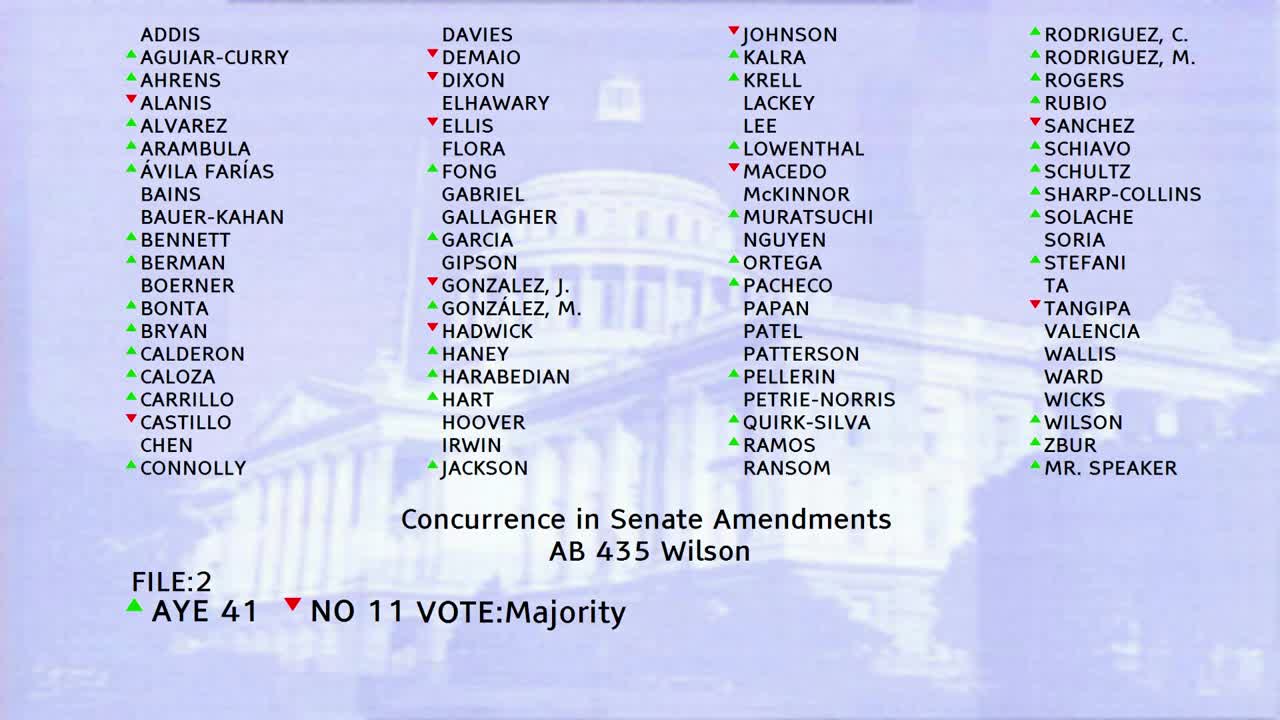 1MIN
Assembly Floor
 9MIN
Senate Floor
 7MIN
Senate Standing Committee on Local Government
 12MIN
Senate Standing Committee on Housing
 1MIN
Assembly Floor
 3MIN
Assembly Standing Committee on Appropriations
 9MIN
Assembly Standing Committee on Local Government
 14MIN
Assembly Standing Committee on Housing and Community Development
Bill Author





