ACA 8: Congressional redistricting.
- Session Year: 2025-2026
- House: Assembly
- Latest Version Date: 2025-08-21
Current Status:
Passed
(2025-08-21: Chaptered by Secretary of State - Res. Chapter 156, Statutes of 2025.)
Introduced
In Committee
Awaiting First Chamber Vote
Passed First Chamber
In Committee
Awaiting Second Chamber Vote
Passed Second Chamber
Enacted
What does this bill do?
This proposed constitutional amendment would require California to use the congressional district map set out in Assembly Bill 604 for all U.S. House elections until the state's Citizens Redistricting Commission draws new maps in 2031, affecting California voters and congressional candidates. It also gives the Attorney General sole authority to defend those maps in court and makes the California Supreme Court the only court that can hear challenges first.
The summary is provided by generative AI which can make mistakes. For original language, please view the details in the table below.
The California Constitution establishes the Citizens Redistricting Commission, which is required to adjust the boundary lines of congressional, Senate, Assembly, and State Board of Equalization districts in the year following the year in which the national census is taken at the beginning of each decade.
This measure, which would include a legislative finding that it is in response to redistricting in Texas in 2025, would, notwithstanding the authority of the Citizens Redistricting Commission, require the state to temporarily use the congressional districts reflected in AB 604 of the 202526 Regular Session for every congressional election until the new congressional boundary lines are drawn by the commission in 2031.
The California Constitution establishes the Citizens Redistricting Commission, which is required to adjust the boundary lines of congressional, Senate, Assembly, and State Board of Equalization districts in the year following the year in which the national census is taken at the beginning of each decade.
This measure, which would include a legislative finding that it is in response to redistricting in Texas in 2025, would, notwithstanding the authority of the Citizens Redistricting Commission, would require the state to temporarily use the congressional districts reflected in AB 604 of the 202526 Regular Session for every congressional election until the new congressional boundary lines are drawn by the commission in 2031. This measure would make the congressional districts reflected in AB 604 operative only if Texas, Florida, or another state adopts a new congressional district map that takes effect after August 1, 2025, and before January 1, 2031, and such redistricting is not required by a federal court order.
The California Constitution establishes the Citizens Redistricting Commission, which is required to adjust the boundary lines of congressional, Senate, Assembly, and State Board of Equalization districts in the year following the year in which the national census is taken at the beginning of each decade.
This measure, notwithstanding the authority of the Citizens Redistricting Commission, would require the state to temporarily use the congressional districts reflected in AB 604 of the 202526 Regular Session for every congressional election until the new congressional boundary lines are drawn by the commission in 2031. This measure would make the congressional districts reflected in AB 604 operative only if Texas, Florida, or another state adopts a new congressional district map that takes effect after August 1, 2025, and before January 1, 2031, and such redistricting is not required by a federal court order.
Under the California Constitution, an incumbent judge of the Supreme Court or a court of appeal who seeks a successive term in office must file a declaration of candidacy. If a declaration is not filed, the Governor must nominate a candidate. At the next general election, the name of the candidate that is declared or nominated will appear on the ballot, which must present the question of whether the candidate should be elected.This measure would authorize the Legislature to enact a statute providing that if an incumbent judge of the Supreme Court or a court of appeal files a declaration of candidacy, the judges name will not appear on the ballot and the judge will instead be deemed elected, unless a petition is filed by a requisite number of voters requesting that the judges name appear on the ballot for a vote.Under the California Constitution, an incumbent judge of the Supreme Court or a court of appeal who seeks a successive term in office must file a declaration of candidacy. If a declaration is not filed, the Governor must nominate a candidate. At the next general election, the name of the candidate that is declared or nominated will appear on the ballot, which must present the question of whether the candidate should be elected.
This measure would authorize the Legislature to enact a statute providing that if an incumbent judge of the Supreme Court or a court of appeal files a declaration of candidacy, the judges name will not appear on the ballot and the judge will instead be deemed elected, unless a petition is filed by a requisite number of voters requesting that the judges name appear on the ballot for a vote.
Resolved by the Assembly, the Senate concurring, That the Legislature of the State of California at its 202526 Regular Session, commencing on the second day of December 2024, two-thirds of the membership of each house concurring, hereby proposes to the people of the State of California that the Constitution of the State be amended as follows:
This measure shall be known, and may be cited, as the Election Rigging Response Act.
The people of the State of California find and declare all of the following:
(a)President Donald Trump has called on Republican-led states to undertake an unprecedented mid-decade redistricting of congressional seats to rig the 2026 United States midterm elections before voting begins.
(b)The State of Texas has convened a special session of its Legislature to redraw congressional district maps to unfairly advantage Republicans.
(c)The Legislature of the State of Florida has established a select committee to advance an extraordinary mid-decade redistricting to unfairly advantage Republicans.
(d)Republicans have urged the State of Ohio to conduct its mid-decade redistricting to unfairly produce more Republican seats in Congress.
(e)Republican officials in the States of Indiana, Missouri, New Hampshire, Nebraska, and South Carolina are also considering President Trumps call for the mid-decade redistricting of congressional seats to unfairly advantage Republicans.
(f)President Trump and Republicans are attempting to gain enough seats through redistricting to rig the outcome of the 2026 United States midterm elections regardless of how the people vote.
(g)President Trumps election-rigging scheme is an emergency for our democracy.
(h)The 2026 United States midterm elections are voters only chance to provide an essential check and balance against President Trumps dangerous agenda.
(i)California has long stood as a national leader for fair, independent, and nonpartisan redistricting.
(j)California calls on all other states to commit to fair and impartial drawing of maps.
(k)California has a duty to defend democracy.
(l)The 2026 United States midterm elections for Congress must be conducted on a level playing field without an extreme and unfair advantage for Republicans.
(m)The people of California, not politicians, should have the power to approve temporary congressional district maps in response to President Trumps election-rigging scheme.
(n)It is the intent of the people that Californias temporary maps be designed to neutralize the partisan gerrymandering being threatened by Republican-led states without eroding fair representation for all communities.
(a)It is the policy of the State of California to support the use of fair, independent, and nonpartisan redistricting commissions nationwide. The people of the State of California call on the Congress of the United States to pass federal legislation and propose an amendment of the United States Constitution to require the use of fair, independent, and nonpartisan redistricting commissions nationwide.
(b)In response to the congressional redistricting in Texas in 2025, and notwithstanding any other provision of this Constitution or existing law, the single-member districts for Congress reflected in Assembly Bill 604 of the 202526 Regular Session pursuant to the requirements of Chapter 5 (commencing with Section 21400) of Division 21 of the Elections Code shall temporarily be used for every congressional election for a term of office commencing on or after the date this subdivision becomes operative and before the certification of new congressional boundary lines drawn by the Citizens Redistricting Commission pursuant to subdivision (d).
(c)(1)The Attorney General has the sole legal standing to defend any action regarding a congressional district map adopted pursuant to subdivision (b).
(2)The California Supreme Court has original and exclusive jurisdiction in all proceedings in which a congressional district map adopted pursuant to subdivision (b) is challenged.
(d)The Citizens Redistricting Commission established pursuant to Section 1 shall continue to adjust the boundary lines of the congressional, State Senatorial, Assembly, and Board of Equalization districts in conformance with the standards and process set forth in Section 2 in 2031, and every 10 years thereafter as provided in Section 1.
The provisions of this measure are severable. If any portion, section, subdivision, paragraph, clause, sentence, phrase, word, or application of this measure is for any reason held to be invalid by a decision of any court of competent jurisdiction, that decision shall not affect the validity of the remaining portions of this measure. The Legislature hereby declares that it would have proposed, and the voters hereby declare that they would have adopted, this measure and every portion, section, subdivision, paragraph, clause, sentence, phrase, word, and application not declared invalid or unconstitutional without regard to whether any portion of this measure or application of this measure would be subsequently declared invalid.
Resolved by the Assembly, the Senate concurring, That the Legislature of the State of California at its 202526 Regular Session, commencing on the second day of December 2024, two-thirds of the membership of each house concurring, hereby proposes to the people of the State of California that the Constitution of the State be amended as follows:
This measure shall be known, and may be cited, as the Election Rigging Response Act.
The people of the State of California find and declare all of the following:
(a)President Donald Trump has called on Republican-led states to undertake an unprecedented mid-decade redistricting of congressional seats to rig the 2026 United States midterm elections before voting begins.
(b)The State of Texas has convened a special session of its Legislature to redraw congressional district maps to unfairly advantage Republicans.
(c)The Legislature of the State of Florida has established a select committee to advance an extraordinary mid-decade redistricting to unfairly advantage Republicans.
(d)Republicans have urged the State of Ohio to conduct its mid-decade redistricting to unfairly produce more Republican seats in Congress.
(e)Republican officials in the States of Indiana, Missouri, New Hampshire, Nebraska, and South Carolina are also considering President Trumps call for the mid-decade redistricting of congressional seats to unfairly advantage Republicans.
(f)President Trump and Republicans are attempting to gain enough seats through redistricting to rig the outcome of the 2026 United States midterm elections regardless of how the people vote.
(g)President Trumps election-rigging scheme is an emergency for our democracy.
(h)The 2026 United States midterm elections are voters only chance to provide an essential check and balance against President Trumps dangerous agenda.
(i)California has long stood as a national leader for fair, independent, and nonpartisan redistricting.
(j)California calls on all other states to commit to fair and impartial drawing of maps.
(k)California has a duty to defend democracy.
(l)The 2026 United States midterm elections for Congress must be conducted on a level playing field without an extreme and unfair advantage for Republicans.
(m)The people of California, not politicians, should have the power to approve temporary congressional district maps in response to President Trumps election-rigging scheme.
(n)It is the intent of the people that Californias temporary maps be designed to neutralize the partisan gerrymandering being threatened by Republican-led states without eroding fair representation for all communities.
(a)It is the policy of the State of California to support the use of fair, independent, and nonpartisan redistricting commissions nationwide. The people of the State of California call on the Congress of the United States to pass federal legislation and propose an amendment of the United States Constitution to require the use of fair, independent, and nonpartisan redistricting commissions nationwide.
(b)Notwithstanding In response to the congressional redistricting in Texas in 2025, and notwithstanding any other provision of this Constitution or existing law, the single-member districts for Congress reflected in Assembly Bill 604 of the 202526 Regular Session pursuant to the requirements of Chapter 5 (commencing with Section 21400) of Division 21 of the Elections Code shall temporarily be used for every congressional election for a term of office commencing on or after the date this subdivision becomes operative and before the certification of new congressional boundary lines drawn by the Citizens Redistricting Commission pursuant to subdivision (e). (d).
(c)(1)Subdivision (b) shall become operative only if Texas, Florida, or another state adopts a new congressional district map that takes effect after August 1, 2025, and before January 1, 2031, and such redistricting is not required by a federal court order.(2)The condition described in paragraph (1) shall include a new congressional district map adopted by the State of Ohio only if the map is adopted pursuant to division (F)(3) of Section 1 of Article XIX of the Ohio Constitution.(d)(c)(1)The Attorney General has the sole legal standing to defend any action regarding a congressional district map adopted pursuant to subdivision (b).
(2)The California Supreme Court has original and exclusive jurisdiction in all proceedings in which a congressional district map adopted pursuant to subdivision (b) is challenged.
(e)(d)The Citizens Redistricting Commission established pursuant to Section 1 shall continue to adjust the boundary lines of the congressional, State Senatorial, Assembly, and Board of Equalization districts in conformance with the standards and process set forth in Section 2 in 2031, and every 10 years thereafter as provided in Section 1.
The provisions of this measure are severable. If any portion, section, subdivision, paragraph, clause, sentence, phrase, word, or application of this measure is for any reason held to be invalid by a decision of any court of competent jurisdiction, that decision shall not affect the validity of the remaining portions of this measure. The Legislature hereby declares that it would have proposed, and the voters hereby declare that they would have adopted, this measure and every portion, section, subdivision, paragraph, clause, sentence, phrase, word, and application not declared invalid or unconstitutional without regard to whether any portion of this measure or application of this measure would be subsequently declared invalid.
Resolved by the Assembly, the Senate concurring, That the Legislature of the State of California at its 202526 Regular Session, commencing on the second day of December 2024, two-thirds of the membership of each house concurring, hereby proposes to the people of the State of California that the Constitution of the State be amended as follows:
This measure shall be known, and may be cited, as the Election Rigging Response Act.
The people of the State of California find and declare all of the following:
(a)President Donald Trump has called on Republican-led states to undertake an unprecedented mid-decade redistricting of congressional seats to rig the 2026 United States midterm elections before voting begins.
(b)The State of Texas has convened a special session of its Legislature to redraw congressional district maps to unfairly advantage Republicans.
(c)The Legislature of the State of Florida has established a select committee to advance an extraordinary mid-decade redistricting to unfairly advantage Republicans.
(d)Republicans have urged the State of Ohio to conduct its mid-decade redistricting to unfairly produce more Republican seats in Congress.
(e)Republican officials in the States of Indiana, Missouri, New Hampshire, Nebraska, and South Carolina are also considering President Trumps call for the mid-decade redistricting of congressional seats to unfairly advantage Republicans.
(f)President Trump and Republicans are attempting to gain enough seats through redistricting to rig the outcome of the 2026 United States midterm elections regardless of how the people vote.
(g)President Trumps election-rigging scheme is an emergency for our democracy.
(h)The 2026 United States midterm elections are voters only chance to provide an essential check and balance against President Trumps dangerous agenda.
(i)California has long stood as a national leader for fair, independent, and nonpartisan redistricting.
(j)California calls on all other states to commit to fair and impartial drawing of maps.
(k)California has a duty to defend democracy.
(l)The 2026 United States midterm elections for Congress must be conducted on a level playing field without an extreme and unfair advantage for Republicans.
(m)The people of California, not politicians, should have the power to approve temporary congressional district maps in response to President Trumps election-rigging scheme.
(n)It is the intent of the people that Californias temporary maps be designed to neutralize the partisan gerrymandering being threatened by Republican-led states without eroding fair representation for all communities.
(a)It is the policy of the State of California to support the use of fair, independent, and nonpartisan redistricting commissions nationwide. The people of the State of California call on the Congress of the United States to pass federal legislation and propose an amendment of the United States Constitution to require the use of fair, independent, and nonpartisan redistricting commissions nationwide.
(b)Notwithstanding any other provision of this Constitution or existing law, the single-member districts for Congress reflected in Assembly Bill 604 of the 202526 Regular Session shall temporarily be used for every congressional election for a term of office commencing on or after the date this subdivision becomes operative and before the certification of new congressional boundary lines drawn by the Citizens Redistricting Commission pursuant to subdivision (e).
(c)(1)Subdivision (b) shall become operative only if Texas, Florida, or another state adopts a new congressional district map that takes effect after August 1, 2025, and before January 1, 2031, and such redistricting is not required by a federal court order.
(2)The condition described in paragraph (1) shall include a new congressional district map adopted by the State of Ohio only if the map is adopted pursuant to division (F)(3) of Section 1 of Article XIX of the Ohio Constitution.
(d)(1)The Attorney General has the sole legal standing to defend any action regarding a congressional district map adopted pursuant to subdivision (b).
(2)The California Supreme Court has original and exclusive jurisdiction in all proceedings in which a congressional district map adopted pursuant to subdivision (b) is challenged.
(e)The Citizens Redistricting Commission established pursuant to Section 1 shall continue to adjust the boundary lines of the congressional, State Senatorial, Assembly, and Board of Equalization districts in conformance with the standards and process set forth in Section 2 in 2031, and every 10 years thereafter as provided in Section 1.
The provisions of this measure are severable. If any portion, section, subdivision, paragraph, clause, sentence, phrase, word, or application of this measure is for any reason held to be invalid by a decision of any court of competent jurisdiction, that decision shall not affect the validity of the remaining portions of this measure. The Legislature hereby declares that it would have proposed, and the voters hereby declare that they would have adopted, this measure and every portion, section, subdivision, paragraph, clause, sentence, phrase, word, and application not declared invalid or unconstitutional without regard to whether any portion of this measure or application of this measure would be subsequently declared invalid.
(a)Judges of the Supreme Court shall be elected at large and judges of courts of appeal shall be elected in their districts at general elections at the same time and places as the Governor. Their terms are 12 years beginning the Monday after January 1 following their election, except that a judge elected to an unexpired term serves the remainder of the term. In creating a new court of appeal district or division the Legislature shall provide that the first elective terms are 4, 8, and 12 years.(b)Judges of superior courts shall be elected in their counties at general elections except as otherwise necessary to meet the requirements of federal law. In the latter case the Legislature, by two-thirds vote of the membership of each house thereof, with the advice of judges within the affected court, may provide for their election by the system prescribed in subdivision (d), or by any other arrangement. The Legislature may provide that an unopposed incumbents name not appear on the ballot.(c)Terms of judges of superior courts are six years beginning the Monday after January 1 following their election. A vacancy shall be filled by election to a full term at the next general election after the second January 1 following the vacancy, but the Governor shall appoint a person to fill the vacancy temporarily until the elected judges term begins.(d)(1)Within 30 days before August 16 preceding the expiration of the judges term, a judge of the Supreme Court or a court of appeal may file a declaration of candidacy to succeed to the office presently held by the judge. If the declaration is not filed, the Governor before September 16 shall nominate a candidate. Except as provided in paragraph (2), at the next general election, only the candidate so declared or nominated may appear on the ballot, which shall present the question whether the candidate shall be elected. The candidate shall be elected upon receiving a majority of the votes on the question. A candidate not elected may not be appointed to that court but later may be nominated and elected.(2)The Legislature may provide by statute that the name of a judge of the Supreme Court or a court of appeal who files a declaration of candidacy shall not appear on the ballot, and instead the judge shall be deemed elected, unless a petition requesting that the judges name appear on the ballot is filed by a requisite number of registered voters qualified to vote for the office. (3)The Governor shall fill vacancies in those courts by appointment. An appointee holds office until the Monday after January 1 following the first general election at which the appointee had the right to become a candidate or until an elected judge qualifies. A nomination or appointment by the Governor is effective when confirmed by the Commission on Judicial Appointments.(4)Electors of a county, by majority of those voting and in a manner the Legislature shall provide, may make this system of selection applicable to judges of superior courts.Resolved by the Assembly, the Senate concurring, That the Legislature of the State of California at its 202526 Regular Session, commencing on the second day of December 2024, two-thirds of the membership of each house concurring, hereby proposes to the people of the State of California that the Constitution of the State be amended as follows:
(a)Judges of the Supreme Court shall be elected at large and judges of courts of appeal shall be elected in their districts at general elections at the same time and places as the Governor. Their terms are 12 years beginning the Monday after January 1 following their election, except that a judge elected to an unexpired term serves the remainder of the term. In creating a new court of appeal district or division the Legislature shall provide that the first elective terms are 4, 8, and 12 years.
(b)Judges of superior courts shall be elected in their counties at general elections except as otherwise necessary to meet the requirements of federal law. In the latter case the Legislature, by two-thirds vote of the membership of each house thereof, with the advice of judges within the affected court, may provide for their election by the system prescribed in subdivision (d), or by any other arrangement. The Legislature may provide that an unopposed incumbents name not appear on the ballot.
(c)Terms of judges of superior courts are six years beginning the Monday after January 1 following their election. A vacancy shall be filled by election to a full term at the next general election after the second January 1 following the vacancy, but the Governor shall appoint a person to fill the vacancy temporarily until the elected judges term begins.
(d)(1)Within 30 days before August 16 preceding the expiration of the judges term, a judge of the Supreme Court or a court of appeal may file a declaration of candidacy to succeed to the office presently held by the judge. If the declaration is not filed, the Governor before September 16 shall nominate a candidate. At Except as provided in paragraph (2), at the next general election, only the candidate so declared or nominated may appear on the ballot, which shall present the question whether the candidate shall be elected. The candidate shall be elected upon receiving a majority of the votes on the question. A candidate not elected may not be appointed to that court but later may be nominated and elected.
(2)The Legislature may provide by statute that the name of a judge of the Supreme Court or a court of appeal who files a declaration of candidacy shall not appear on the ballot, and instead the judge shall be deemed elected, unless a petition requesting that the judges name appear on the ballot is filed by a requisite number of registered voters qualified to vote for the office.
(2)(3)The Governor shall fill vacancies in those courts by appointment. An appointee holds office until the Monday after January 1 following the first general election at which the appointee had the right to become a candidate or until an elected judge qualifies. A nomination or appointment by the Governor is effective when confirmed by the Commission on Judicial Appointments.
(3)(4)Electors of a county, by majority of those voting and in a manner the Legislature shall provide, may make this system of selection applicable to judges of superior courts.
|
Date
|
Status
|
|---|---|
| Aug 21, 2025 | Chaptered by Secretary of State - Res. Chapter 156, Statutes of 2025. |
| Aug 21, 2025 | Enrolled and filed with the Secretary of State at 3:45 p.m. |
| Aug 21, 2025 | In Assembly. Ordered to Engrossing and Enrolling. |
| Aug 21, 2025 | Senate Rule 19 suspended. (Ayes 30. Noes 9. Page 2226.) |
| Aug 21, 2025 | Joint Rule 10.5 suspended. (Ayes 30. Noes 9. Page 2227.) |
| Aug 21, 2025 | In Senate. To Com. on RLS. |
| Aug 21, 2025 | From committee: Ordered to third reading. |
| Aug 21, 2025 | Adopted and to Assembly. (Ayes 30. Noes 8. Page 2231.) |
| Aug 21, 2025 | Assembly Rule 69(b)(1) suspended. (Ayes 58. Noes 19. Page 2683.) |
| Aug 21, 2025 | Assembly Rule 63 suspended. (Ayes 58. Noes 20. Page 2684.) |
| Aug 21, 2025 | Amended. Ordered to third reading. |
| Aug 21, 2025 | Adopted and to Senate. (Ayes 57. Noes 20. Page 2688.) |
| Aug 20, 2025 | From committee: Be adopted. Ordered to Third Reading. (Ayes 11. Noes 4.) (August 20). |
| Aug 19, 2025 | From committee: Be adopted, and re-refer to Com. on APPR. Re-referred. (Ayes 5. Noes 2.) (August 19). Re-referred to Com. on APPR. |
| Aug 18, 2025 | Re-referred to Com. on ELECTIONS. pursuant to Assembly Rule 96. |
| Aug 18, 2025 | Joint Rule 62(a), file notice suspended. (Ayes 58. Noes 18. Page 2644.) |
| Aug 18, 2025 | Joint Rule 62(a), file notice suspended. (Ayes 57. Noes 18. Page 2645.) |
| Aug 18, 2025 | From committee chair, with author's amendments: Amend, and re-refer to Com. on APPR. Read second time and amended. |
| Aug 18, 2025 | Assembly Rule 66 suspended. (Ayes 57. Noes 18. Page 2646.) |
| Aug 18, 2025 | Assembly Rule 63 suspended. (Ayes 57. Noes 18. Page 2646.) |
| Aug 18, 2025 | Assembly Rule 56 suspended. (Ayes 57. Noes 18. Page 2645.) |
| Aug 18, 2025 | (Ayes 57. Noes 18. Page 2644.) |
| Jul 16, 2025 | From committee: Be adopted, and re-refer to Com. on APPR. Re-referred. (Ayes 4. Noes 2.) (July 16). Re-referred to Com. on APPR. |
| Jun 16, 2025 | Referred to Coms. on ELECTIONS and APPR. |
| Feb 21, 2025 | From printer. May be heard in committee March 23. |
| Feb 20, 2025 | Introduced. To print. |
|
Date
|
Description
|
Location
|
Votes
|
|
|---|---|---|---|---|
| Aug 21, 2025 | ACA 8 RIVAS Assembly Third Reading By BERMAN | Assembly Floor |
Passed |
|
| Aug 21, 2025 | Assembly 3rd Reading ACA8 Rivas et al. By McGuire | Senate Floor |
Passed |
|
| Aug 20, 2025 | Be adopted. | Assembly Standing Committee on Appropriations |
Passed |
|
| Aug 19, 2025 | Be adopted and re-referred to the Committee on [Appropriations] | Assembly Standing Committee on Elections |
Passed |
|
| Jul 16, 2025 | Be adopted and re-referred to the Committee on [Appropriations] | Assembly Standing Committee on Elections |
Passed |
This list shows positions taken on this bill by organizations on the date displayed, which is linked to the original source.
Positions by individuals are not included.
|
Organization
|
Position
|
Date
|
|---|---|---|
| AAPI Equity Alliance | ** Support | |
| AFSCME California | ** Support | |
| Alliance for A Better Community | ** Support | |
| Alliance San Diego | ** Against | |
| Altadena Chamber of Commerce | ** Support | |
| Arab Resource & Organizing Center Action | ** Support | |
| Asian American Drug Abuse Program | ** Support | |
| Battleground California | ** Support | |
| Black Women Organizing for Political Action | ** Support | |
| Borderlands for Equity | ** Support | |
| CA Church IMPACT | ** Support | |
| California Business Roundtable | ** Against | |
| California Common Cause | ** Against | |
| California Consumer Advocates for Affordability and Safety | ** Against | |
| California Donor Table | ** Support | |
| California Federation of Labor Unions, Afl-cio | ** Support | |
| California Hispanic Chamber Of Commerce | ** Against | |
| California Judges Association | ** Support | |
| California Manufacturers And Technology Association | ** Against | |
| California Nurses Association | ** Support | |
| California Professional Firefighters | ** Support | |
| California Teachers Association | ** Support | |
| CalTax | ** Against | |
| CAUSE Action Fund | ** Support | |
| Central Valley Immigrant Integration Collaborative | ** Support | |
| Child Care Providers United | ** Support | |
| Climate Action Campaign | ** Support | |
| Compass Family Services | ** Support | |
| Costa Mesa Democrats | ** Support | |
| Democracy Strategy Partners | ** Support | |
| Democratic Party of Orange County | ** Support | |
| DEMOCRATIC PARTY OF SAN FERNANDO VALLEY | ** Support | |
| El Concilio California | ** Support | |
| Election Integrity Project California | ** Against | |
| Eleni Kounalakis, California Lieutenant Governor | ** Support | |
| Govern for California | ** Against | |
| Greater High Desert Chamber of Commerce | ** Against | |
| Greater San Fernando Valley Chamber of Commerce | ** Against | |
| HB Huddle | ** Support | |
| Imperial Valley Equity and Justice | ** Support | |
| Independent Voter Education | ** Against | |
| Independent Voter Project | ** Against | |
| Indivisible California: Statestrong | ** Support | |
| Indivisible El Dorado | ** Support | |
| Indivisible Stanislaus | ** Support | |
| Inland Empire United | ** Support | |
| Jose Medina, Riverside County Supervisor, District 1 | ** Support | |
| Kevin W. Crye, Shasta County Supervisor, District 1 | ** Against | |
| League Of Women Voters Of California | ** Against | |
| Little Manila Rising | ** Support | |
| LOS ANGELES COUNTY YOUNG DEMOCRATS | ** Support | |
| NFIB | ** Against | |
| Outdoor Outreach | ** Support | |
| Paloma Aguirre, San Diego County Supervisor, District 1 | ** Support | |
| Planned Parenthood Affiliates Of California | ** Support | |
| Protect the Voters FIRST Act | ** Against | |
| Reproductive Freedom for All California | ** Support | |
| San Francisco Democratic Party | ** Support | |
| Search To Involve Pilipino Americans | ** Support | |
| Secretary of State Shirley N. Weber, Ph.D. | ** Support | |
| SEIU California | ** Support | |
| Simi Valley Chamber of Commerce | ** Against | |
| South Asian Network | ** Support | |
| Starting Over Strong | ** Support | |
| Teamsters California | ** Support | |
| Terra Lawson-Remer, San Diego County Supervisor, District 3 | ** Support | |
| The Two Hundred for Homeownership | ** Against | |
| The Unity Council | ** Support | |
| Thousands of individuals | ** Against | |
| Thousands of individuals | ** Support | |
| TruEvolution | ** Support | |
| UDW/AFSCME Local 3930 | ** Support | |
| United Food And Commercial Workers Western States Council | ** Support | |
| United Latinos Action | ** Against | |
| United Way Santa Cruz County | ** Support | |
| Unity Party of California | ** Against | |
| Voices for Progress | ** Support | |
| WDN Action | ** Support | |
| Women's March Foundation | ** Support | |
| Women’s March Foundation | ** Support |
ASSEMBLY THIRD READING
ATR Bill Id:ACA 8
Author:(Rivas and McGuire)
As Amended Ver:August 21, 2025
2/3 vote
SUMMARY
Provides for the temporary use of new congressional district maps for elections held through 2030 if Texas, Florida, or other states voluntarily put a new congressional map into effect, as specified, and if voters approve this measure.
Major Provisions
- States the policy of the state to support the use of fair, independent, and nonpartisan redistricting commissions nationwide, and declares that the people of California call on Congress to pass federal legislation and propose an amendment to the United States Constitution to require the use of fair, independent, and nonpartisan redistricting commissions nationwide.
- Requires the single-member districts for Congress reflected in AB 604 (Aguiar-Curry and Lena Gonzalez) of the current legislative session to temporarily be used for every congressional election for a term of office commencing after this measure becomes operative, pursuant to the requirements of specified provisions of the Elections Code, and prior to the operative date of new congressional boundary lines drawn by the Citizens Redistricting Commission (CRC) pursuant to the state constitution.
- Gives the Attorney General the sole legal standing to defend any action, and gives the California Supreme Court original and exclusive jurisdiction in all proceedings, related to a congressional map adopted pursuant to this measure.
- Specifies that the CRC shall continue to adjust the boundary lines of the congressional, State Senatorial, Assembly, and Board of Equalization (BOE) districts in conformance with the standards and process set forth in the California Constitution in 2031 and every 10 years thereafter.
COMMENTS
"Redistricting" is the process by which the boundaries of districts of a governmental body are adjusted. Redistricting generally occurs at the beginning of each decade following the decennial federal census, when new district lines are adopted based on the census data so that the populations of each district of a governmental body are roughly equal.
The California Legislature last redrew the boundary lines of the congressional, State Senatorial, Assembly, and BOE districts in 2001 based on the results of the 2000 census. Those district lines were finalized and approved in September 2001.
In 2008, California voters approved Proposition 11, which created the CRC, and gave it the responsibility for drawing district lines for the state Senate, Assembly, and the BOE. It also changed the criteria used when drawing those lines. In 2010, voters approved Proposition 20, which expanded the CRC's duties to include drawing California's congressional districts, and made additional changes to the procedures and criteria to be used by the CRC. The passage of Propositions 11 and 20 meant that the California Legislature did not play a direct role in adopting district boundaries for congressional, legislative, and BOE districts following the 2010 and 2020 federal censuses.
Under current law, the districts drawn by the CRC after the 2020 census are scheduled to remain in place until the CRC adopts new maps following the 2030 census. Those new districts would take effect for regularly-scheduled elections in 2032 and beyond.
If this ACA is approved by voters, California could use different districts for its congressional elections as soon as the 2026 statewide elections. Those district boundaries are provided for in AB 604 (Aguiar-Curry and Lena Gonzalez) of the current legislative session. Pursuant to AB 40 (Bryan and Berman) of the current legislative session, those district boundaries would become operative only if this measure is approved by the electors and another state adopts a new congressional district map that takes effect after August 1, 2025, and before January 1, 2031, and that was not required by a federal court order, as specified.
As noted above, redistricting normally takes place once a decade, following the federal census. After new maps are adopted, they may be challenged in court. Aside from court-ordered redistricting efforts in response to such challenges, it has historically been rare for jurisdictions to undertake major redistricting before the next decennial census.
On July 9, 2025, Texas Governor Greg Abbott called a special session of the Texas Legislature to begin on July 21. One of the topics for that session was "[l]egislation that provides a revised congressional redistricting plan." Press reports indicate that this topic was added after aides to President Donald Trump urged Texas to redraw its congressional map, following allegations from the United States Justice Department that the existing map could be illegal. President Trump was later quoted as saying that Republicans were "entitled to five more seats" in Texas.
Following Texas' push for mid-decade redistricting, press reports suggest that leaders in several other states are considering mid-decade congressional redistricting in time for the 2026 elections, including California, Florida, Illinois, Indiana, Maryland, Missouri, Nebraska, and South Carolina.
As a constitutional amendment, this measure requires the approval of the voters to take effect.
Please see the policy committee analysis for a full discussion of this measure.
According to the Author
"President Trump and Republicans in Texas and other states are attempting to redraw congressional districts mid-decade in an effort to rig the upcoming election to keep their own party in power in Washington. Californians deserve better and demand a response to this undemocratic and un-American power grab. ACA 8 is that response.
"ACA 8, also known as the Election Rigging Response Act, would allow for the temporary use of voter-approved congressional district boundaries through the 2030 congressional term if—and only if—Texas or another state chooses to partisanly gerrymander its congressional districts before the 2030 census. With the next census, ACA 8 would return all congressional district line drawing powers back to the Citizens Redistricting Commission. Importantly, ACA 8 would empower the voters to decide whether to use these temporary congressional district lines if another state decides to redraw its congressional map mid-decade. Additionally, through ACA 8, the voters would call on Congress to pass federal legislation and an amendment to the U.S. Constitution to require fair, nonpartisan, and independent redistricting nationwide.
"The Election Rigging Response Act sends a strong message to other states that they cannot play by different rules when it comes to redistricting. It upholds California's values by neutralizing partisan gerrymandering by other states, all while giving voters the final say on the matter."
Arguments in Support
In support of this measure, a coalition of groups including SEIU California wrote:
"The threats coming out of Texas are clear: gerrymandered districts designed to lock in one-party control and marginalize the very communities—Black, Latino, Asian American, Indigenous, young, and urban voters—that have powered the state's growth. These actions are not just attacks on Texans. They are an attack on all Americans who believe in fair elections and equal representation. If states like Texas redraw their maps with the explicit goal of rigging national outcomes, then the rest of the country cannot simply stand by and do nothing—especially not California. We live in a national democracy. Every congressional district affects the laws we all live under, the courts we are governed by, and the rights we are guaranteed…California must be prepared to act—not in retaliation, but in defense. Allowing California to redraw congressional lines may become necessary to protect the broader democratic equilibrium. This is not about replicating bad behavior—it is about responding to a broken system with the seriousness it demands…If we believe in equal representation, then we cannot allow a handful of states, under the direction of authoritarian-aligned leaders, to tip the scales unchecked."
Arguments in Opposition
In opposition to this measure, California Business Roundtable and CalTax wrote:
"California should lead the nation by continuing to defend voter-enacted reforms that created a fair, transparent, citizen-led redistricting. For more than a decade, California's independent redistricting system has been the national gold standard. Created by voters through Proposition 11 in 2008, expanded through Proposition 20 in 2010, and protected against repeal through the defeat of Proposition 27 that same year, our model has been tested at the ballot box multiple times—and each time, voters have chosen non-partisan citizen-led fairness over partisan and self-interested politics…Any changes to voter-enacted constitutional provisions must undergo rigorous analysis, transparent vetting, and a genuine public-participation process. Yet ACA 8, AB 604, and SB 280 were made public only hours ago and [had] their first hearings set for 9:30 a.m. on Tuesday, August 19—less than 24 hours later…This is not a robust public discussion and silences the views of countless constituents who are directly impacted by these new maps. To label this timeline or process robust and with meaningful public input is to deny voters the deliberation and participation they are owed. Rushing a constitutional change is incompatible with responsible governance."
FISCAL COMMENTS
- One-time costs in the high hundreds of thousands of dollars to the Secretary of State (SOS) for printing and mailing expenses associated with including this measure in the Voter Information Guide for the November 4, 2025, special election (General Fund (GF)). The SOS estimates such expenses to be approximately $123,000 per page. Actual costs related to this measure will depend on the length of the title and summary, analysis by the Legislative Analyst's Office, proponent and opponent arguments, and text of the proposal for publication in the Voter Information Guide. SB 280 (Cervantes), of the 2025-26 Legislative Session, appropriates funds to the SOS for the actual and reasonably necessary costs to administer the special election.
- Possible cost pressures of an unknown amount to the AG to defend an action related to the maps, and to the California Supreme Court to hear such proceedings (GF or special fund).
VOTES
ASM ELECTIONS: 5-2-0
YES: Pellerin, Bennett, Berman, Solache, Stefani
NO: Macedo, Tangipa
ASM APPROPRIATIONS: 11-4-0
YES: Wicks, Arambula, Calderon, Caloza, Elhawary, Fong, Mark González, Hart, Pacheco, Pellerin, Solache
NO: Dixon, Jeff Gonzalez, Ta, Tangipa
ASM ELECTIONS: Vote not relevant
YES:
NO:
ABS, ABST OR NV:
UPDATED
VERSION: August 21, 2025
CONSULTANT: Ethan Jones / ELECTIONS / (916) 319-2094 FN: 0001211
SENATE RULES COMMITTEE Office of Senate Floor Analyses (916) 651-1520 Fax: (916) 327-4478 | ACA 8 |
THIRD READING
Bill No: ACA 8
Author: Rivas (D) and McGuire (D), et al.
Amended: 8/21/25 in Assembly
Vote: 27
ASSEMBLY ELECTIONS COMMITTEE: 4-2, 7/16/25
AYES: Pellerin, Bennett, Berman, Solache
NOES: Macedo, Tangipa
NO VOTE RECORDED: Stefani
ASSEMBLY ELECTIONS COMMITTEE: 5-2, 8/19/25
AYES: Pellerin, Bennett, Berman, Solache, Stefani
NOES: Macedo, Tangipa
ASSEMBLY APPROPRIATIONS COMMITTEE: 11-4, 8/20/25
AYES: Wicks, Arambula, Calderon, Caloza, Elhawary, Fong, Mark Gonzalez, Hart, Pacheco, Pellerin, Solache
NOES: Dixon, Jeff Gonzalez, Ta, Tangipa
ASSEMBLY FLOOR: 57-20, 8/21/25 – Roll call not available
SUBJECT: Congressional redistricting.
SOURCE: Author
DIGEST:
This proposed constitutional amendment would, if approved by the voters, implement new congressional districts pursuant to AB 604 (Aguiar-Curry and Gonzalez) of 2025 that could take effect as soon as the 2026 elections. These districts would remain in force until the 2032 election.
ANALYSIS:
Existing law contained in Article XXI of the California Constitution:
- Requires that in the year following the year in which a national census is taken under the direction of Congress at the start of a decade, the Citizens Redistricting Commission (CRC) adjusts the lines of congressional, State Senatorial, Assembly and Board of Equalization districts, pursuant to specified standards and procedures.
- Creates the CRC in each year ending in the number zero to consist of 14 members, five who are registered with the largest political party in the state; five who are registered with the second largest political party in the state; four who are not registered to either of those parties.
- Specifies that the CRC shall create single-member districts that comply with the U.S. Constitution and the federal Voting Rights Act, among other requirements.
- Requires the CRC to issue both map of districts and a report explaining how the maps comply with the constitutional requirements for districts.
- Places original and exclusive jurisdiction for legal challenges to a map with the California Supreme Court.
This measure asks the people of the State of California to amend Article XXI of the California Constitution to:
- State the policy of the State of California to support the use of fair, nonpartisan redistricting commissions nationwide and also calls on the Congress of the U.S. to pass federal legislation and to propose an amendment of the U.S. Constitution to require the use of fair, nonpartisan, and independent redistricting commissions nationwide.
- Adopt, in response to the congressional redistricting in Texas in 2025, the maps for congressional districts described in AB 604 to temporarily be used for every congressional election for a term of office commencing on or after the date this measure becomes operative and prior to the operative date of new congressional boundary lines drawn by the CRC following the 2030 national census.
- Give the California Attorney General sole legal standing to defend any action regarding a congressional district map adopted pursuant to its provisions.
- Retain with the California Supreme Court original and exclusive jurisdiction for all proceedings in which a congressional map adopted under this measure is challenged.
- Make clear that the CRC shall continue to adjust the boundary lines of the congressional, State Senatorial, Assembly, and Board of Equalization districts pursuant to its existing standards and processes in 2031, for first use in the 2032 election, and every 10 years thereafter.
- Make the provisions of this measure severable.
Background
Prior to 2011, Article XXI of the California Constitution gave the California Legislature the power to establish district maps for congressional and state offices once every ten years following a U.S. Census.
In November 2008, the voters passed Proposition 11, which amended Article XXI to the California Constitution to create an independent redistricting commission, the CRC, to redistrict State Senatorial, Assembly, and Board of Equalization districts every ten years following a U.S. Census. In November 2010, Proposition 20 passed and added establishing congressional district maps to the duties of the CRC.
The CRC created congressional, State Senatorial, Assembly, and Board of Equalization districts for the first time in 2011 and then again in 2021.
Comments
- Author’s Statement. President Trump and Republicans in Texas are redrawing congressional districts mid-decade in an effort to rig the upcoming election to keep their own party in power in Washington. Californians deserve better and demand a response to this undemocratic and un-American power grab. This measure is that response.
This measure, also known as the Election Rigging Response Act, would allow for the temporary use of voter-approved congressional district boundaries through the 2030 congressional term now that Texas and quite possibly other states choose to partisanly gerrymander their congressional districts before the 2030 census. With the next census, this measure would return all congressional district line drawing powers back to the Citizens Redistricting Commission. Importantly, this measure would empower the voters to decide whether to use these temporary congressional district lines in response to Texas redrawing its congressional map mid-decade. Additionally, through this measure, the voters would call on Congress to pass federal legislation and an amendment to the U.S. Constitution to require fair, nonpartisan, and independent redistricting nationwide.
The Election Rigging Response Act sends a strong message to other states that they cannot play by different rules when it comes to redistricting. It upholds California’s values by neutralizing partisan gerrymandering by other states, all while giving voters the final say on the matter.
- Effective Date. This proposed constitutional amendment would appear on the ballot as Proposition 50 at a special election called by SB 280 (Cervantes and Pellerin) for November 4, 2025. Should this measure pass at that election, the new maps for congressional districts contained in AB 604 would be used if, pursuant to AB 40 (Bryan and Berman) of 2025, another state puts into use its own new congressional districts that are not required by a federal court order or a specific partisan process in Ohio. Thus, California’s new congressional district maps could be triggered any time between now and the 2030 election.
- Support and Opposition. Communications of support and opposition received relate to mid-decade redistricting in general, and not to a specific measure within this legislative package. Supporters in general assert that this legislation is a needed response to the actions others states, specifically Texas, are taking at the urging of President Trump. They also point out that this legislation asks the voters of the state to decide on whether to approve new congressional districts, rather than politicians making the decision. Supporters further note that the legislation reaffirms California’s support of independent redistricting commissions both here and nationwide.
Opponents’ concerns center on the financial burden of the special election, the short timeframe for public comment on this legislative package, and that California’s congressional delegation already includes relatively few Republican members. The League of Women Voters of California (LWV) notes that it stands “entirely apart from political parties on mid-cycle redistricting and squarely in the fight against President Trump’s authoritarian and dangerous policies that threaten the civil rights and liberties of all Americans.” The LWV here and in other states, however, opposes all attempts to gerrymander congressional lines on a partisan basis.
Related/Prior Legislation
AB 604 (Aguiar-Curry and Gonzalez) of 2025 contains the legal descriptions of California congressional districts that would be adopted pursuant to this proposed constitutional amendment.
AB 40 (Bryan and Berman) of 2025 provides that the provisions in AB 604 become operative if ACA 8 is approved by voters and if Texas, Florida, or another state adopts a new congressional district map after August 1, 2025, and prior to January 1, 2031, and such redistricting is not required by a federal court order, as specified.
SB 280 (Cervantes and Pellerin) of 2025 calls a special election for November 4, 2025, requires the Secretary of State to submit ACA 8 to the voters at that election as Proposition 50, and provides for the conduct of that election.
FISCAL EFFECT: Appropriation: No Fiscal Com.: Yes Local: No
SUPPORT: (Verified 8/21/25)
Please see comment #3 for more details about support and opposition.
Eleni Kounalakis, California Lieutenant Governor
Jose Medina, Riverside County Supervisor, District 1
Paloma Aguirre, San Diego County Supervisor, District 1
Terra Lawson-Remer, San Diego County Supervisor, District 3
AAPI Equity Alliance
AFSCME California
Alliance for a Better Community
Altadena Chamber of Commerce
Arab Resource & Organizing Center Action
Asian American Drug Abuse Program
Battleground California
Black Women Organizing for Political Action
Borderlands for Equity
CA Church IMPACT
CAUSE Action Fund
California Donor Table
California Federation of Labor Unions, AFL-CIO
California Nurses Association
California Professional Firefighters
California Teachers Association
Central Valley Immigrant Integration Collaborative
Child Care Providers United
Climate Action Campaign
Compass Family Services
Costa Mesa Democrats
Democracy Strategy Partners
Democratic Party of Orange County
Democratic Party of San Fernando Valley
El Concilio California
HB Huddle
Imperial Valley Equity and Justice
Indivisible California: StateStrong
Indivisible El Dorado
Indivisible Stanislaus
Inland Empire United
Little Manila Rising
Los Angeles County Young Democrats
Outdoor Outreach
Planned Parenthood Affiliates of California
Reproductive Freedom for All California
San Francisco Democratic Party
Search to Involve Pilipino Americans
SEIU California
South Asian Network
Starting Over Strong
Teamsters California
TruEvolution
UDW/AFSCME Local 3930
United Food and Commercial Workers Western States Council
United Way Santa Cruz County
The Unity Council
Voices for Progress
WDN Action
Women’s March Foundation
Thousands of individuals
OPPOSITION: (Verified 8/21/25)
Please see comment #3 for more details about support and opposition.
Kevin W. Crye, Shasta County Supervisor, District 1
Alliance San Diego
California Business Roundtable
California Common Cause
California Consumer Advocates for Affordability and Safety
California Hispanic Chamber of Commerce
California Manufacturers and Technology Association
CalTax
Greater High Desert Chamber of Commerce
Govern for California
Greater San Fernando Valley Chamber of Commerce
Independent Voter Education
Independent Voter Project
NFIB
Protect the Voters FIRST Act
Simi Valley Chamber of Commerce
The Two Hundred for Homeownership
United Latinos Action
Unity Party of California
Prepared by: Scott Matsumoto and Carrie Cornwell / E. & C.A. / (916) 651-4106
8/21/25 12:28:37
**** END ****
SENATE COMMITTEE ON
ELECTIONS AND CONSTITUTIONAL AMENDMENTS
Senator Sabrina Cervantes, Chair
2025 - 2026 Regular
Bill No: 8 Hearing Date: 8/19/25
Author: | Rivas and McGuire | ||
Version: |
| ||
Urgency: | Fiscal: | ||
Consultant: | |||
Subject:
DIGEST
This proposed constitutional amendment would, if approved by the voters, implement new congressional districts pursuant to AB 604 (Aguiar-Curry and Gonzalez) that could take effect as soon as the 2026 elections, if Texas or another state redistricts its congressional seats absent a federal court order to do so. These districts would remain in force until the 2032 election.
ANALYSIS
Existing law contained in Article XXI of the California Constitution:
- Requires that in the year following the year in which a national census is taken under the direction of Congress at the start of a decade, the Citizens Redistricting Commission (CRC) adjusts the lines of congressional, State Senatorial, Assembly and Board of Equalization districts, pursuant to specified standards and procedures.
- Creates the CRC in each year ending in the number zero to consist of 14 members, five who are registered with the largest political party in the state; five who are registered with the second largest political party in the state; four who are not registered to either of those parties.
- Specifies that the CRC shall create single-member districts that comply with the U.S. Constitution and the federal Voting Rights Act, among other requirements.
- Requires the CRC to issue both map of districts and a report explaining how the maps comply with the constitutional requirements for districts.
- Places original and exclusive jurisdiction for legal challenges to a map with the California Supreme Court.
This measure asks the people of the State of California to amend Article XXI of the California Constitution to:
- State the policy of the State of California to support the use of fair, nonpartisan redistricting commissions nationwide and also calls on the Congress of the United States to pass federal legislation and to propose an amendment of the United States Constitution to require the use of fair, nonpartisan, and independent redistricting commissions nationwide.
- Adopt the maps for congressional districts described in AB 604 (Aguiar-Curry and Gonzalez) to temporarily be used for every congressional election for a term of office commencing on or after the date this measure becomes operative and prior to the operative date of new congressional boundary lines drawn by the CRC following the 2030 national census.
- Make this provision on the constitution operative only if Texas, Florida, or another state adopts a new congressional district map after August 1, 2025, and prior to January 1, 2031, and such redistricting is not required by a federal court order. A mid-decade congressional redistricting in the State of Ohio will only trigger this measure to take effect if that redistricting creates new congressional districts pursuant to a specified partisan process prescribed in the Ohio State Constitution.
- Give the California Attorney General sole legal standing to defend any action regarding a congressional district map adopted pursuant to its provisions.
- Retain with the California Supreme Court original and exclusive jurisdiction for all proceedings in which a congressional map adopted under this measure is challenged.
- Make clear that the CRC shall continue to adjust the boundary lines of the congressional, State Senatorial, Assembly, and Board of Equalization districts pursuant to its existing standards and processes in 2031, for first use in the 2032 election, and every 10 years thereafter.
- Make the provisions of this measure severable.
BACKGROUND
Prior to 2011, Article XXI of the California Constitution gave the California Legislature the power to establish district maps for congressional and state offices once every ten years following a U.S. Census.
In November 2008, the voters passed Proposition 11, which amended Article XXI to the California Constitution to create an independent redistricting commission, the CRC, to redistrict State Senatorial, Assembly, and Board of Equalization districts every ten years following a U.S. Census. In November 2010, Proposition 20 passed and added establishing congressional district maps to the duties of the CRC.
The CRC created congressional, State Senatorial, Assembly, and Board of Equalization districts for the first time in 2011 and then again in 2021.
COMMENTS
- Author’s Statement. President Trump and Republicans in Texas and other states are attempting to redraw congressional districts mid-decade in an effort to rig the upcoming election to keep their own party in power in Washington. Californians deserve better and demand a response to this undemocratic and un-American power grab. This measure is that response.
This measure, also known as the Election Rigging Response Act, would allow for the temporary use of voter-approved congressional district boundaries through the 2030 congressional term if—and only if—Texas or another state chooses to gerrymander its congressional districts before the 2030 census. With the next census, this measure would return all congressional district line drawing powers back to the Citizens Redistricting Commission. Importantly, this measure would empower the voters to decide whether to use these temporary congressional district lines if another state decides to redraw its congressional map mid-decade. Additionally, through this proposed constitutional amendment, the voters would call on Congress to pass federal legislation and an amendment to the U.S. Constitution to require fair, nonpartisan, and independent redistricting nationwide.
The Election Rigging Response Act sends a strong message to other states that they cannot play by different rules when it comes to redistricting. It upholds California’s values by neutralizing partisan gerrymandering by other states, all while giving voters the final say on the matter.
- Effective Date. This proposed constitutional amendment would appear on the ballot as Proposition 50 at a special election called by SB 280 (Cervantes and Pellerin) for November 4, 2025. Should this measure pass at that election, the new maps for congressional districts contained in AB 604 would only be used if another state puts into use its own new congressional districts that are not required by a court order or a specific partisan process in Ohio. Thus, California’s new congressional district maps could be triggered any time between now and the 2030 election.
- Support and Opposition. Communications of support and opposition received relate to mid-decade redistricting in general, and not to a specific measure within this legislative package. Supporters in general assert that this legislation is a needed response to the actions others states, specifically Texas, are taking at the urging of President Trump. They also point out that this legislation asks the voters of the state to decide on whether to approve new congressional districts, rather than politicians making the decision. Supporters further note that the legislation reaffirms California’s support of independent redistricting commissions both here and nationwide.
Opponents’ concerns center on the financial burden of the special election, the short timeframe for public comment on this legislative package, and that California’s congressional delegation already includes relatively few Republican members. The League of Women Voters of California (LWV) notes that it stands “entirely apart from political parties on mid-cycle redistricting and squarely in the fight against President Trump’s authoritarian and dangerous policies that threaten the civil rights and liberties of all Americans.” The LWV here and in other states, however, opposes all attempts to gerrymander congressional lines on a partisan basis.
RELATED/PRIOR LEGISLATION
AB 604 (Aguiar-Curry and Gonzalez) contains the legal descriptions of California congressional districts that would be adopted pursuant to this proposed constitutional amendment.
SB 280 (Cervantes and Pellerin) calls a special election for November 4, 2025, requires the Secretary of State to submit ACA 8 to the voters at that election as Proposition 50, and provides for the conduct of that election.
POSITIONS
Please see comment #3 for more details about support and opposition.
Support: AAPI Equity Alliance
AFSCME California
Alliance for a Better Community
Altadena Chamber of Commerce
Arab Resource & Organizing Center Action
Asian American Drug Abuse Program
Battleground California
CA Church IMPACT
CAUSE Action Fund
California Donor Table
California Federation of Labor Unions, AFL-CIO
California Professional Firefighters
California Teachers Association
Central Valley Immigrant Integration Collaborative
Climate Action Campaign
Democracy Strategy Partners
Democratic Party of Orange County
Democratic Party of San Fernando Valley
Indivisible California: StateStrong (CASS)
Little Manila Rising
Los Angeles County Young Democrats
Outdoor Outreach
Planned Parenthood Affiliates of California
Reproductive Freedom for All California
San Francisco Democratic Party
SEIU California
TruEvolution
UDW/AFSCME Local 3930
United Way Santa Cruz County
The Unity Council
Voices for Progress
WDN Action
Women’s March Foundation
Thousands of individuals
Oppose: California Business Roundtable
California Consumer Advocates for Affordability and Safety
California Hispanic Chamber of Commerce
California Manufacturers and Technology Association
Govern for California
Greater San Fernando Valley Chamber of Commerce
Independent Voter Education
Independent Voter Project
NFIB
Protect the Voters FIRST Act
Simi Valley Chamber of Commerce
The Two Hundred for Homeownership
United Latinos Action
Unity Party of California
Thousands of individuals
-- END --
ASSEMBLY THIRD READING
ATR Bill Id:ACA 8
Author:(Rivas and McGuire)
As Amended Ver:August 18, 2025
2/3 vote
SUMMARY
Provides for the temporary use of new congressional district maps for elections held through 2030 if Texas, Florida, or other states voluntarily put a new congressional map into effect, as specified, and if voters approve this measure.
Major Provisions
- States the policy of the state to support the use of fair, independent, and nonpartisan redistricting commissions nationwide, and declares that the people of California call on Congress to pass federal legislation and propose an amendment to the United States Constitution to require the use of fair, independent, and nonpartisan redistricting commissions nationwide.
- Requires the single-member districts for Congress reflected in AB 604 (Aguiar-Curry and Lena Gonzalez) of the current legislative session to temporarily be used for every congressional election for a term of office commencing after this measure becomes operative, and prior to the operative date of new congressional boundary lines drawn by the Citizens Redistricting Commission (CRC) pursuant to the state constitution. Provides that this provision becomes operative only if Texas, Florida, or another state adopts a new congressional district map that takes effect after August 1, 2025, and before January 1, 2031, and such redistricting is not required by a federal court order. Provides that this provision becomes operative if Ohio adopts a new congressional district map only if that map is not approved with bipartisan support, as specified.
- Gives the Attorney General the sole legal standing to defend any action, and gives the California Supreme Court original and exclusive jurisdiction in all proceedings, related to a congressional map adopted pursuant to this measure.
- Specifies that the CRC shall continue to adjust the boundary lines of the congressional, State Senatorial, Assembly, and Board of Equalization (BOE) districts in conformance with the standards and process set forth in the California Constitution in 2031 and every 10 years thereafter.
COMMENTS
"Redistricting" is the process by which the boundaries of districts of a governmental body are adjusted. Redistricting generally occurs at the beginning of each decade following the decennial federal census, when new district lines are adopted based on the census data so that the populations of each district of a governmental body are roughly equal.
The California Legislature last redrew the boundary lines of the congressional, State Senatorial, Assembly, and BOE districts in 2001 based on the results of the 2000 census. Those district lines were finalized and approved in September 2001.
In 2008, California voters approved Proposition 11, which created the CRC, and gave it the responsibility for drawing district lines for the state Senate, Assembly, and the BOE. It also changed the criteria used when drawing those lines. In 2010, voters approved Proposition 20, which expanded the CRC's duties to include drawing California's congressional districts, and made additional changes to the procedures and criteria to be used by the CRC. The passage of Propositions 11 and 20 meant that the California Legislature did not play a direct role in adopting district boundaries for congressional, legislative, and BOE districts following the 2010 and 2020 federal censuses.
Under current law, the districts drawn by the CRC after the 2020 census are scheduled to remain in place until the CRC adopts new maps following the 2030 census. Those new districts would take effect for regularly-scheduled elections in 2032 and beyond.
If this ACA is approved by voters, California could use different districts for its congressional elections as soon as the 2026 statewide elections. Those districts, which are provided for in AB 604 (Aguiar-Curry and Lena Gonzalez) of the current legislative session, would only go into effect if one or more other states also voluntarily conducted mid-decade congressional redistricting.
As noted above, redistricting normally takes place once a decade, following the federal census. After new maps are adopted, they may be challenged in court. Aside from court-ordered redistricting efforts in response to such challenges, it has historically been rare for jurisdictions to undertake major redistricting before the next decennial census.
On July 9, 2025, Texas Governor Greg Abbott called a special session of the Texas Legislature to begin on July 21. One of the topics for that session was "[l]egislation that provides a revised congressional redistricting plan." Press reports indicate that this topic was added after aides to President Donald Trump urged Texas to redraw its congressional map, following allegations from the United States Justice Department that the existing map could be illegal. President Trump was later quoted as saying that Republicans were "entitled to five more seats" in Texas.
Following Texas' push for mid-decade redistricting, press reports suggest that leaders in several other states are considering mid-decade congressional redistricting in time for the 2026 elections, including California, Florida, Illinois, Indiana, Maryland, Missouri, Nebraska, and South Carolina.
As a constitutional amendment, this measure requires the approval of the voters to take effect.
Please see the policy committee analysis for a full discussion of this measure.
According to the Author
"President Trump and Republicans in Texas and other states are attempting to redraw congressional districts mid-decade in an effort to rig the upcoming election to keep their own party in power in Washington. Californians deserve better and demand a response to this undemocratic and un-American power grab. ACA 8 is that response.
"ACA 8, also known as the Election Rigging Response Act, would allow for the temporary use of voter-approved congressional district boundaries through the 2030 congressional term if—and only if—Texas or another state chooses to partisanly gerrymander its congressional districts before the 2030 census. With the next census, ACA 8 would return all congressional district line drawing powers back to the Citizens Redistricting Commission. Importantly, ACA 8 would empower the voters to decide whether to use these temporary congressional district lines if another state decides to redraw its congressional map mid-decade. Additionally, through ACA 8, the voters would call on Congress to pass federal legislation and an amendment to the U.S. Constitution to require fair, nonpartisan, and independent redistricting nationwide.
"The Election Rigging Response Act sends a strong message to other states that they cannot play by different rules when it comes to redistricting. It upholds California's values by neutralizing partisan gerrymandering by other states, all while giving voters the final say on the matter."
Arguments in Support
In support of this measure, a coalition of groups including SEIU California wrote:
"The threats coming out of Texas are clear: gerrymandered districts designed to lock in one-party control and marginalize the very communities—Black, Latino, Asian American, Indigenous, young, and urban voters—that have powered the state's growth. These actions are not just attacks on Texans. They are an attack on all Americans who believe in fair elections and equal representation. If states like Texas redraw their maps with the explicit goal of rigging national outcomes, then the rest of the country cannot simply stand by and do nothing—especially not California. We live in a national democracy. Every congressional district affects the laws we all live under, the courts we are governed by, and the rights we are guaranteed…California must be prepared to act—not in retaliation, but in defense. Allowing California to redraw congressional lines may become necessary to protect the broader democratic equilibrium. This is not about replicating bad behavior—it is about responding to a broken system with the seriousness it demands…If we believe in equal representation, then we cannot allow a handful of states, under the direction of authoritarian-aligned leaders, to tip the scales unchecked."
Arguments in Opposition
In opposition to this measure, California Business Roundtable and CalTax wrote:
"California should lead the nation by continuing to defend voter-enacted reforms that created a fair, transparent, citizen-led redistricting. For more than a decade, California's independent redistricting system has been the national gold standard. Created by voters through Proposition 11 in 2008, expanded through Proposition 20 in 2010, and protected against repeal through the defeat of Proposition 27 that same year, our model has been tested at the ballot box multiple times—and each time, voters have chosen non-partisan citizen-led fairness over partisan and self-interested politics…Any changes to voter-enacted constitutional provisions must undergo rigorous analysis, transparent vetting, and a genuine public-participation process. Yet ACA 8, AB 604, and SB 280 were made public only hours ago and [had] their first hearings set for 9:30 a.m. on Tuesday, August 19—less than 24 hours later…This is not a robust public discussion and silences the views of countless constituents who are directly impacted by these new maps. To label this timeline or process robust and with meaningful public input is to deny voters the deliberation and participation they are owed. Rushing a constitutional change is incompatible with responsible governance."
FISCAL COMMENTS
- One-time costs in the high hundreds of thousands of dollars to the Secretary of State (SOS) for printing and mailing expenses associated with including this measure in the Voter Information Guide for the November 4, 2025, special election (General Fund (GF)). The SOS estimates such expenses to be approximately $123,000 per page. Actual costs related to this measure will depend on the length of the title and summary, analysis by the Legislative Analyst's Office, proponent and opponent arguments, and text of the proposal for publication in the Voter Information Guide. SB 280 (Cervantes), of the 2025-26 Legislative Session, appropriates funds to the SOS for the actual and reasonably necessary costs to administer the special election.
- Possible cost pressures of an unknown amount to the AG to defend an action related to the maps, and to the California Supreme Court to hear such proceedings (GF or special fund).
VOTES
ASM ELECTIONS: 5-2-0
YES: Pellerin, Bennett, Berman, Solache, Stefani
NO: Macedo, Tangipa
ASM APPROPRIATIONS: 11-4-0
YES: Wicks, Arambula, Calderon, Caloza, Elhawary, Fong, Mark González, Hart, Pacheco, Pellerin, Solache
NO: Dixon, Jeff Gonzalez, Ta, Tangipa
ASM ELECTIONS: Vote not relevant
YES:
NO:
ABS, ABST OR NV:
UPDATED
VERSION: August 18, 2025
CONSULTANT: Ethan Jones / ELECTIONS / (916) 319-2094 FN: 0001180
Date of Hearing: August 20, 2025
ASSEMBLY COMMITTEE ON APPROPRIATIONS
Buffy Wicks, Chair
ABPCA Bill Id:ACA 8
Author:(Rivas) – As Amended Ver:August 18, 2025
Policy Committee: | Elections | Vote: | 4-2 |
|
| ||
|
|
Urgency: State Mandated Local Program: No Reimbursable: No
SUMMARY:
This measure, if approved by voters, requires the state to temporarily use certain new congressional district maps for each congressional election if another state voluntarily conducts mid-decade congressional redistricting.
Specifically, this measure:
- States the policy of the State of California to support the use of fair, independent, and nonpartisan redistricting commissions nationwide, and that the people of the State of California call on Congress to pass federal legislation and propose an amendment to the United States Constitution to require the use of such redistricting commissions nationwide.
- Requires the temporary use of congressional district maps reflected in AB 604 (Aguiar-Curry), of the 2025-26 Legislative Session, for each congressional election until the certification of new boundary lines drawn by the Citizens Redistricting Commission (CRC) in 2031.
- Requires the new congressional districts become operative only if Texas, Florida, or another state adopts a new congressional district map that takes effect after August 1, 2025, and before January 1, 2031, and such redistricting is not required by a federal court order.
- Provides that the Attorney General (AG) has the sole legal standing to defend an action regarding the new congressional district maps, and the California Supreme Court has original and exclusive jurisdiction in all such proceedings.
FISCAL EFFECT:
- One-time costs in the high hundreds of thousands of dollars to the Secretary of State (SOS) for printing and mailing expenses associated with including this measure in the Voter Information Guide for the November 4, 2025, special election (General Fund (GF)). The SOS estimates such expenses to be approximately $123,000 per page. Actual costs related to this measure will depend on the length of the title and summary, analysis by the Legislative Analyst’s Office, proponent and opponent arguments, and text of the proposal for publication in the Voter Information Guide. SB 280 (Cervantes), of the 2025-26 Legislative Session, appropriates funds to the SOS for the actual and reasonably necessary costs to administer the special election.
- Possible cost pressures of an unknown amount to the AG to defend an action related to the maps, and to the California Supreme Court to hear such proceedings (GF or special fund).
COMMENTS:
- Purpose. According to the author:
President Trump and Republicans in Texas and other states are attempting to redraw congressional districts mid-decade in an effort to rig the upcoming election to keep their own party in power in Washington. Californians deserve better and demand a response to this undemocratic and un-American power grab. ACA 8 is that response.
ACA 8, also known as the Election Rigging Response Act, would allow for the temporary use of voter-approved congressional district boundaries through the 2030 congressional term if—and only if—Texas or another state chooses to partisanly gerrymander its congressional districts before the 2030 census. With the next census, ACA 8 would return all congressional district line drawing powers back to the Citizens Redistricting Commission. Importantly, ACA 8 would empower the voters to decide whether to use these temporary congressional district lines if another state decides to redraw its congressional map mid-decade. Additionally, through ACA 8, the voters would call on Congress to pass federal legislation and an amendment to the U.S. Constitution to require fair, nonpartisan, and independent redistricting nationwide.
- Redistricting and the CRC. Redistricting is the process by which a governmental body’s district boundaries are adjusted. Redistricting generally occurs at the beginning of each decade following the decennial federal census to ensure the population of each district remains roughly equal.
Proposition 11 (2008) created the CRC to draw district lines for the state Senate, Assembly, and Board of Equalization. Proposition 20 (2010) expanded the CRC’s duties to include drawing congressional district lines. Under current law, the districts most recently drawn by the CRC after the 2020 census are scheduled to remain in place until the CRC adopts new maps following the 2030 census, with new district maps taking effect in 2032.
If this measure is approved by voters, California may use different districts for its congressional elections as soon as the 2026 statewide election. Those districts, outlined in AB 604, would go into effect only if another state voluntarily conducts mid-decade congressional redistricting.
- Related Legislation. AB 604 (Aguiar-Curry) specifies the boundaries for California’s congressional districts that would take effect if voters approve this measure and if another state voluntarily conducts mid-decade congressional redistricting. AB 604 is pending hearing by the Senate Appropriations Committee.
SB 280 (Cervantes) calls a statewide special election on November 4, 2025, appropriates funds for the administration of that election, and requires this measure be submitted to voters at that election. SB 280 is pending hearing by this committee.
Analysis Prepared by: Irene Ho / APPR. / (916) 319-2081
SENATE COMMITTEE ON
ELECTIONS AND CONSTITUTIONAL AMENDMENTS
Senator Sabrina Cervantes, Chair
2025 - 2026 Regular
Bill No: ACA Hearing Date: 8/19/25
Author: | |||
Version: | 8/18/25 | ||
Urgency: |
| Fiscal: | Yes |
Consultant: | Carrie Cornwell | ||
Subject: Congressional redistricting.
DIGEST
This proposed constitutional amendment would, if approved by the voters, implement new congressional districts pursuant to AB 604 (Aguiar-Curry and Gonzalez) that could take effect as soon as the 2026 elections, if Texas or another state redistricts its congressional seats absent a court order to do so. These districts would remain in force until the 2032 election.
ANALYSIS
- Requires that in the year following the year in which a national census is taken under the direction of Congress at the start of a decade, the Citizens Redistricting Commission (CRC) adjusts the lines of congressional, State Senatorial, Assembly and Board of Equalization districts, pursuant to specified standards and procedures.
- Creates the CRC in each year ending in the number zero to consist of 14 members, five who are registered with the largest political party in the state; five who are registered with the second largest political party in the state; four who are not registered to either of those parties.
- Specifies that the CRC shall create single-member districts that comply with the U.S. Constitution and the federal Voting Rights Act, among other requirements.
- Requires the CRC to issue both map of districts and a report explaining how the maps comply with the constitutional requirements for districts.
- Places original and exclusive jurisdiction for legal challenges to a map with the California Supreme Court.
This measure asks the people of the State of California to amend Article XXI of the California Constitution to:
- State the policy of the State of California to support the use of fair, nonpartisan redistricting commissions nationwide and also calls on the Congress of the United States to pass federal legislation and to propose an amendment of the United States Constitution to require the use of fair, nonpartisan, and independent redistricting commissions nationwide.
- Adopt the maps for congressional districts described in AB 604 (Aguiar-Curry and Gonzalez) to temporarily be used for every congressional election for a term of office commencing on or after the date this measure becomes operative and prior to the operative date of new congressional boundary lines drawn by the CRC following the 2030 national census.
- Make this provision on the constitution operative only if Texas, Florida, or another state adopts a new congressional district map after August 1, 2025, and prior to January 1, 2031, and such redistricting is not required by a federal court order. A mid-decade congressional redistricting in the State of Ohio will only trigger this measure to take effect if that redistricting creates new congressional districts pursuant to a specified partisan process prescribed in the Ohio State Constitution.
- Give the California Attorney General sole legal standing to defend any action regarding a congressional district map adopted pursuant to its provisions.
- Retain with the California Supreme Court original and exclusive jurisdiction for all proceedings in which a congressional map adopted under this measure is challenged.
- Make clear that the CRC shall continue to adjust the boundary lines of the congressional, State Senatorial, Assembly, and Board of Equalization districts pursuant to its existing standards and processes in 2031, for first use in the 2032 election, and every 10 years thereafter.
- Make the provisions of this measure severable.
BACKGROUND
Prior to 2011, Article XXI of the California Constitution gave the California Legislature the power to establish district maps for congressional and state offices once every ten years following a U.S. Census.
In November 2008, the voters passed Proposition 11, which amended Article XXI to the California Constitution to create an independent redistricting commission, the CRC, to redistrict State Senatorial, Assembly, and Board of Equalization districts every ten years following a U.S. Census. In November 2010, Proposition 20 passed and added establishing congressional district maps to the duties of the CRC.
The CRC created congressional, State Senatorial, Assembly, and Board of Equalization districts for the first time in 2011 and then again in 2021.
COMMENTS
- Author’s Statement. President Trump and Republicans in Texas and other states are attempting to redraw congressional districts mid-decade in an effort to rig the upcoming election to keep their own party in power in Washington. Californians deserve better and demand a response to this undemocratic and un-American power grab. This measure is that response.
This measure, also known as the Election Rigging Response Act, would allow for the temporary use of voter-approved congressional district boundaries through the 2030 congressional term if—and only if—Texas or another state chooses to gerrymander its congressional districts before the 2030 census. With the next census, this measure would return all congressional district line drawing powers back to the Citizens Redistricting Commission. Importantly, this measure would empower the voters to decide whether to use these temporary congressional district lines if another state decides to redraw its congressional map mid-decade. Additionally, through this proposed constitutional amendment, the voters would call on Congress to pass federal legislation and an amendment to the U.S. Constitution to require fair, nonpartisan, and independent redistricting nationwide.
The Election Rigging Response Act sends a strong message to other states that they cannot play by different rules when it comes to redistricting. It upholds California’s values by neutralizing partisan gerrymandering by other states, all while giving voters the final say on the matter.
- Effective Date. This proposed constitutional amendment would appear on the ballot as Proposition 50 at a special election called by SB 280 (Cervantes and Pellerin) for November 4, 2025. Should this measure pass at that election, the new maps for congressional districts contained in AB 604 would only be used if another state puts into use its own new congressional districts that are not required by a court order or a specific partisan process in Ohio. Thus, California’s new congressional district maps could be triggered any time between now and the 2030 election.
- Support and Opposition. Communications of support and opposition received relate to mid-decade redistricting in general, and not to a specific measure within this legislative package. Supporters in general assert that this legislation is a needed response to the actions others states, specifically Texas, are taking at the urging of President Trump. They also point out that this legislation asks the voters of the state to decide on whether to approve new congressional districts, rather than politicians making the decision. Supporters further note that the legislation reaffirms California’s support of independent redistricting commissions both here and nationwide.
Opponents’ concerns center on the financial burden of the special election, the short timeframe for public comment on this legislative package, and that California’s congressional delegation already includes relatively few Republican members. The League of Women Voters of California (LWV) notes that it stands “entirely apart from political parties on mid-cycle redistricting and squarely in the fight against President Trump’s authoritarian and dangerous policies that threaten the civil rights and liberties of all Americans.” The LWV here and in other states, however, opposes all attempts to gerrymander congressional lines on a partisan basis.
RELATED/PRIOR LEGISLATION
AB 604 (Aguiar-Curry and Gonzalez) contains the legal descriptions of California congressional districts that would be adopted pursuant to this proposed constitutional amendment.
SB 280 (Cervantes and Pellerin) calls a special election for November 4, 2025, requires the Secretary of State to submit ACA 8 to the voters at that election as Proposition 50, and provides for the conduct of that election.
POSITIONS
Please see comment #3 for more details about support and opposition.
Support: AAPI Equity Alliance
AFSCME California
Alliance for a Better Community
Altadena Chamber of Commerce
Arab Resource & Organizing Center Action
Asian American Drug Abuse Program
Battleground California
CA Church IMPACT
CAUSE Action Fund
California Donor Table
California Federation of Labor Unions, AFL-CIO
California Professional Firefighters
California Teachers Association
Central Valley Immigrant Integration Collaborative
Climate Action Campaign
Democracy Strategy Partners
Democratic Party of Orange County
Democratic Party of San Fernando Valley
Indivisible California: StateStrong (CASS)
Little Manila Rising
Los Angeles County Young Democrats
Outdoor Outreach
Planned Parenthood Affiliates of California
Reproductive Freedom for All California
San Francisco Democratic Party
SEIU California
TruEvolution
UDW/AFSCME Local 3930
United Way Santa Cruz County
The Unity Council
Voices for Progress
WDN Action
Women’s March Foundation
Thousands of individuals
Oppose: California Business Roundtable
California Consumer Advocates for Affordability and Safety
California Hispanic Chamber of Commerce
California Manufacturers and Technology Association
Govern for California
Greater San Fernando Valley Chamber of Commerce
Independent Voter Education
Independent Voter Project
NFIB
Protect the Voters FIRST Act
Simi Valley Chamber of Commerce
The Two Hundred for Homeownership
United Latinos Action
Unity Party of California
Thousands of individuals
-- END --
Date of Hearing: August 19, 2025
ASSEMBLY COMMITTEE ON ELECTIONS
Gail Pellerin, Chair
ABPCA Bill Id:ACA 8 (
Author:Rivas and McGuire) – As Amended Ver:August 18, 2025
SUBJECT: Congressional redistricting.
SUMMARY: Provides for the use of new congressional district maps for elections held through 2030 if Texas, Florida, or other states voluntarily put a new congressional map into effect, as specified, and if voters approve this measure. Specifically, this measure:
- Provides that this measure shall be known and may be cited as “The Election Rigging Response Act.”
- Makes various findings and declarations, including the following:
- President Donald Trump has called on Republican-led states to undertake an unprecedented mid-decade redistricting of congressional seats to rig the 2026 election before voting begins.
- President Trump and Republicans are attempting to gain enough seats through redistricting to rig the 2026 election outcome regardless of how the people vote.
- California has long stood as a national leader for fair independent, nonpartisan redistricting.
- California calls on all other states to commit to fair and impartial drawing of maps.
- The 2026 midterm elections for Congress must be conducted on a level playing field without an extreme and unfair advantage for Republicans.
- The people of California, not politicians, should have the power to approve temporary congressional district maps in response to President Trump’s election-rigging scheme.
- It is the intent of the people that California’s temporary maps be designed to neutralize the partisan gerrymandering being threatened by Republican-led states without eroding fair representation for all communities.
- President Donald Trump has called on Republican-led states to undertake an unprecedented mid-decade redistricting of congressional seats to rig the 2026 election before voting begins.
- States the policy of the State of California to support the use of fair, independent, and nonpartisan redistricting commissions nationwide, and declares that the people of California call on Congress to pass federal legislation and propose an amendment to the United States Constitution to require the use of fair, independent, and nonpartisan redistricting commissions nationwide.
- Requires the single-member districts for Congress reflected in AB 604 (Aguiar-Curry and Lena Gonzalez) to temporarily be used for every congressional election for a term of office commencing after this measure becomes operative, and prior to the operative date of new congressional boundary lines drawn by the Citizens Redistricting Commission (CRC) pursuant to the state constitution. Provides that this provision becomes operative only if Texas, Florida, or another state adopts a new congressional district map that takes effect after August 1, 2025, and before January 1, 2031, and such redistricting is not required by a federal court order. Provides that this provision becomes operative if Ohio adopts a new congressional district map only if that map is not approved with bipartisan support, as specified.
- Gives the Attorney General the sole legal standing to defend any action, and gives the California Supreme Court original and exclusive jurisdiction in all proceedings, related to a congressional map adopted pursuant to this measure.
- Specifies that the CRC shall continue to adjust the boundary lines of the congressional, State Senatorial, Assembly, and Board of Equalization (BOE) districts in conformance with the standards and process set forth in the California Constitution in 2031 and every 10 years thereafter.
- Contains a severability clause.
EXISTING LAW:
- Establishes the CRC, and requires it to adjust the boundary lines of the congressional, State Senatorial, Assembly, and BOE districts in the year following the year in which the national census is taken under the direction of Congress at the beginning of each decade, as specified. (California Constitution, Article XXI, §§1 & 2)
- Provides that the California Supreme Court has original and exclusive jurisdiction in all proceedings in which a CRC-drawn map is challenged. (California Constitution, Article XXI, §3)
- Permits the Legislature to propose an amendment or revision of the Constitution by a two-thirds vote of each house of the Legislature. Provides that a proposed amendment or revision shall be submitted to the electors and takes effect if approved by a majority of votes cast thereon, as specified. (California Constitution, Article XVIII, §§1 & 4)
FISCAL EFFECT: Unknown.
COMMENTS:
- Purpose of the Measure: According to the author:
President Trump and Republicans in Texas and other states are attempting to redraw congressional districts mid-decade in an effort to rig the upcoming election to keep their own party in power in Washington. Californians deserve better and demand a response to this undemocratic and un-American power grab. ACA 8 is that response.
ACA 8, also known as the Election Rigging Response Act, would allow for the temporary use of voter-approved congressional district boundaries through the 2030 congressional term if—and only if—Texas or another state chooses to partisanly gerrymander its congressional districts before the 2030 census. With the next census, ACA 8 would return all congressional district line drawing powers back to the Citizens Redistricting Commission. Importantly, ACA 8 would empower the voters to decide whether to use these temporary congressional district lines if another state decides to redraw its congressional map mid-decade. Additionally, through ACA 8, the voters would call on Congress to pass federal legislation and an amendment to the U.S. Constitution to require fair, nonpartisan, and independent redistricting nationwide.
The Election Rigging Response Act sends a strong message to other states that they cannot play by different rules when it comes to redistricting. It upholds California’s values by neutralizing partisan gerrymandering by other states, all while giving voters the final say on the matter.
- Redistricting Overview: “Redistricting” is the process by which the boundaries of districts of a governmental body are adjusted. Redistricting generally occurs at the beginning of each decade following the decennial federal census, when new district lines are adopted based on the census data so that the populations of each district of a governmental body are roughly equal. Over the course of the decade, districts can become significantly unequal in population due to differential growth rates in various locations of a jurisdiction. Redistricting is the way this inequality is corrected.
- California Redistricting and the Citizens Redistricting Commission: The California Legislature last redrew the boundary lines of the congressional, State Senatorial, Assembly, and BOE districts in 2001 based on the results of the 2000 census. Those district lines were finalized and approved in September 2001.
In 2008, California voters approved Proposition 11, which created the CRC, and gave it the responsibility for drawing district lines for the state Senate, Assembly, and the BOE. It also changed the criteria used when drawing those lines. In 2010, voters approved Proposition 20, which expanded the CRC’s duties to include drawing California's congressional districts, and made additional changes to the procedures and criteria to be used by the CRC. The passage of Propositions 11 and 20 meant that the California Legislature did not play a direct role in adopting district boundaries for congressional, legislative, and BOE districts following the 2010 and 2020 federal censuses.
Under current law, the districts drawn by the CRC after the 2020 census are scheduled to remain in place until the CRC adopts new maps following the 2030 census. Those new districts would take effect for regularly-scheduled elections in 2032 and beyond.
If this ACA is approved by voters, California could use different districts for its congressional elections as soon as the 2026 statewide elections. Those districts, which are provided for in AB 604 (Aguiar-Curry and Lena Gonzalez) of the current legislative session, would only go into effect if one or more other states also voluntarily conducted mid-decade congressional redistricting. States required to redraw districts because of a federal court order would not trigger California’s new congressional district maps. (Ohio must redraw its congressional district maps this year under its state constitution. Ohio’s action would trigger the use of California’s AB 604 maps only if Ohio adopts its new district maps without bipartisan support, as provided in a specific provision of the Ohio Constitution.)
- Mid-Decade Redistricting Efforts in Other States: As noted above, redistricting normally takes place once a decade, following the federal census. After new maps are adopted, they may be challenged in court. These lawsuits can take years to resolve, and result in revised maps or entirely new plans. Aside from these court-ordered redistricting efforts, it has historically been rare for jurisdictions to undertake major redistricting before the next decennial census.
On July 9, 2025, Texas Governor Greg Abbott called a special session of the Texas Legislature to begin on July 21. One of the topics for that session was “[l]egislation that provides a revised congressional redistricting plan.” Press reports indicate that this topic was added after aides to President Donald Trump urged Texas to redraw its congressional map, following allegations from the United States Justice Department that the existing map could be illegal. President Trump was later quoted as saying that Republicans were “entitled to five more seats” in Texas.[1]
The Texas Constitution (Article III, Section 40), limits special sessions to 30 days, meaning that the session that began on July 21 could not extend beyond this week. According to news reports, dozens of Democratic legislators left the state to deny the Texas House a quorum, stalling the redistricting effort. The special session was adjourned sine die on August 15 without a new congressional map being adopted, but Governor Abbott immediately called a second special session to begin later the same day. Earlier in the week, Governor Abbott announced that if the special session ended without a quorum, he would “continue to call special session after special session” until the agenda for the special session is enacted.[2]
Following Texas’ push for mid-decade redistricting, press reports suggest that leaders in several other states are considering mid-decade congressional redistricting in time for the 2026 elections, including California, Florida, Illinois, Indiana, Maryland, Missouri, Nebraska, and South Carolina. - Support and Opposition: At the time this analysis was prepared, the committee had not received position letters specifically addressing this measure. However, the committee has received significant public input through a Redistricting Public Comment portal that was made available on the Committee’s website on August 13, 2025. As of 8:00 AM on August 18, 2025, the committee has received more than 13,100 comments through the portal. Many of these submissions cannot be clearly categorized as either supportive of or opposed to the effort to provide new congressional district maps for elections if this measure is approved by voters and other states voluntarily put a new congressional map into effect.
The arguments summarized below reflect public comments that generally expressed support for, or opposition to, the proposal for California to use new congressional district maps for elections through 2030 if Texas, Florida, or other states voluntarily implement new congressional maps. The positions of organizations and individuals to that proposal generally, however, may not necessarily be the same as their positions on this specific measure, or on other related legislation identified below. For that reason, this analysis refers to those perspectives as arguments for or against the broader “Congressional Redistricting Proposal.”- Arguments in Support of Congressional Redistricting Proposal: Organizations and individuals that have submitted public comment in support argue that it is a necessary response to efforts by President Trump, Texas Republicans, and other Republican-led states to redraw congressional maps mid-decade for partisan advantage. They contend that these moves are designed to rig the outcome of the 2026 midterm elections, regardless of how people actually vote, and pose an existential threat to American democracy.
Backers also emphasize that California voters—not politicians—would ultimately decide whether to approve the proposed new congressional districts. Furthermore, those maps would take effect only if one or more other states voluntarily engages in mid-decade redistricting.
Finally, many supporters stress their strong commitment to the CRC and to expanding independent redistricting commissions nationwide. They view this proposal as a temporary safeguard, and support it because it preserves the CRC’s role in future redistricting efforts.
The following organizations have submitted public comment in support of the congressional redistricting proposal: AAPI Equity Alliance, Alliance for a Better Community, Altadena Chamber of Commerce, Arab Resource & Organizing Center Action, California Donor Table, Democracy Strategy Partners, Democratic Party of Orange County, Democratic Party of San Fernando Valley, Little Manila Rising, Los Angeles County Young Democrats, Outdoor Outreach, Planned Parenthood Affiliates of California, San Francisco Democratic Party, SEIU California, The Unity Council, TruEvolution, Voices for Progress, and WDN Action.
Based on submissions that have been reviewed and categorized by committee staff, thousands of public comments have been submitted by individuals in support of the congressional redistricting proposal. - Arguments in Opposition to Congressional Redistricting Proposal: Organizations and individuals that have submitted public comment in opposition warn that overriding the work of the CRC would set a dangerous precedent and weaken California’s commitment to independent redistricting. They stress that political gerrymandering erodes democracy, even when done in response to partisan moves in other states.
Opponents also raise concerns about the financial burden of a special election, arguing it would strain an already challenged state budget. Many argue that Republicans are already underrepresented in California’s congressional delegation compared to the Party’s share of the statewide vote. Others indicate that they feel disenfranchised and unrepresented under our current system, and believe that this proposal would exacerbate those issues.
Finally, critics point out that the proposed maps were released only recently, leaving little time for meaningful public review, analysis, or input on the new district lines before consideration by the Legislature.
- Arguments in Support of Congressional Redistricting Proposal: Organizations and individuals that have submitted public comment in support argue that it is a necessary response to efforts by President Trump, Texas Republicans, and other Republican-led states to redraw congressional maps mid-decade for partisan advantage. They contend that these moves are designed to rig the outcome of the 2026 midterm elections, regardless of how people actually vote, and pose an existential threat to American democracy.
The League of Women Voters of California submitted public comment in opposition to the proposal to provide new congressional district maps for elections. Additionally, in late July, prior to the announcement of more details about the congressional redistricting proposal, the following organizations submitted a letter in opposition to an effort that would “dismantle California’s Independent Citizens Redistricting Commission and return control over congressional maps to elected officials”: California Business Roundtable, California Consumer Advocates for Affordability and Safety, California Hispanic Chamber of Commerce, California Manufacturers and Technology Association, Govern for California, Greater San Fernando Valley Chamber of Commerce, Independent Voter Education, Independent Voter Project, NFIB, Protect the Voters FIRST Act, Simi Valley Chamber of Commerce, The Two Hundred for Homeownership, and United Latinos Action.
Based on submissions that have been reviewed and categorized by committee staff, thousands of public comments have been submitted by individuals in opposition to the congressional redistricting proposal.
- Related Legislation: SB 280 (Cervantes and Pellerin), which is also being heard in this committee today, calls a special statewide election to be held on November 4, 2025, provides for the administration of that election, and provides for this constitutional amendment to be submitted to voters at that election, among other provisions.
AB 604 (Aguiar-Curry and Lena Gonzalez), which is pending in the Senate Elections & Constitutional Amendments Committee, and which this committee is discussing as an informational item at today’s hearing, specifies the boundaries for California’s congressional districts that will take effect if the voters approve this measure and if another state voluntary engages in mid-decade congressional redistricting, as specified. - Approval by Voters: As a constitutional amendment, this measure requires the approval of the voters to take effect.
REGISTERED SUPPORT / OPPOSITION:
See comment #5 above for an explanation about support for and opposition to this measure.
Analysis Prepared by: Ethan Jones / ELECTIONS / (916) 319-2094
Date of Hearing: July 16, 2025
ASSEMBLY COMMITTEE ON ELECTIONS
Gail Pellerin, Chair
ABPCA Bill Id:ACA 8 (
Author:Pellerin) – As Introduced Ver:February 20, 2025
SUBJECT: Elections: incumbent judges of the Supreme Court and courts of appeal.
SUMMARY: Permits Supreme Court and Appellate Court justices to be reelected without appearing on the ballot unless voters sign a petition requesting that a judge’s name appear on the ballot. Specifically, this measure permits the Legislature to provide by statute that the name of a judge of the Supreme Court or a court of appeal who files a declaration of candidacy shall not appear on the ballot, and instead the judge shall be deemed elected, unless a petition requesting that the judge’s name appear on the ballot is filed by a requisite number of registered voters qualified to vote for the office.
EXISTING LAW:
- Provides that Supreme Court judges shall be elected at large, and judges of courts of appeal shall be elected in their districts at general elections at the same time and places as the Governor. Provides that those judges serve 12 year terms, except that a judge elected to an unexpired term serves the remainder of the term. (California Constitution Article VI, §16(a))
- Permits a judge of the Supreme Court or a court of appeal to file a declaration of candidacy to succeed to the office presently held by the judge within 30 days before August 16 preceding the expiration of the judge’s term. Provides that if a declaration is not filed, the Governor shall nominate a candidate before September 16. Provides that only the candidate so declared or nominated appears on the ballot, with the question of whether the candidate should be elected. Provides that the candidate is elected if the majority of the votes on the question are “yes.” (California Constitution Article VI, §16(d))
- Provides that if the incumbent is the only person who files nomination papers for a superior court judge seat, that person’s name shall not appear on the ballot unless a petition is filed with the elections official indicating that a write-in campaign will be conducted for the office, signed by at least 0.1 percent of the registered voters qualified to vote with respect to the office, provided that the petition shall contain at least 100 signatures but need not contain more than 600 signatures, as specified. (Elections Code §8203)
FISCAL EFFECT: Unknown. Although this measure is keyed non-fiscal, it has been double-referred to the Assembly Appropriations Committee.
COMMENTS:
- Purpose of the Measure: According to the author:
California’s general election ballots are lengthy—particularly in gubernatorial elections, when judicial retention elections appear on the ballot at the same time as races for statewide offices. In some counties, judicial retention elections regularly add more than a dozen additional contests to the ballot. Lengthy ballots contribute to voter fatigue and make the electoral process more daunting, especially for new and infrequent voters, while adding to election costs.
Voters skip participating in judicial elections at high levels compared to other contests. The percentage of ballots that are left blank in California judicial retention elections regularly exceeds 25%. Furthermore, judicial retention elections are rarely seriously opposed in California. Justices were retained in 794 of the 797 retention elections held in the state’s history (99.6%).
ACA 8 asks California voters whether they want to amend the California Constitution to provide that Court of Appeals and Supreme Court justices will appear on the ballot for a retention election only if a petition is filed by registered voters. If no petition is filed, the justice would be retained without appearing on the ballot. This process is modeled after the process that currently exists for Superior Court elections.
ACA 8 is a targeted approach to address challenges posed by California’s lengthy ballots and save money for county elections officials while protecting judicial accountability by maintaining voters’ ability to remove Appellate and Supreme Court justices when desired.
- Judicial Elections Overview: Judges in California are elected officials, but judicial elections differ from those for other offices. Superior court judges are elected to six-year terms by county voters. The Governor fills vacancies that occur by appointment. While individuals are sometimes elected without having served as a judge, the vast majority of superior court judges initially reach the bench via appointment.
When an incumbent superior court judge is unopposed for reelection, that contest does not appear on the ballot; instead, the judge is deemed reelected. However, voters can force the incumbent on the ballot to conduct a write-in campaign by filing a petition containing signatures of 100-600 voters, depending on the number of registered voters in the county. Most superior court judges are reelected without appearing on the ballot. In Los Angeles County, 157 of 159 judges running for reelection in 2024 were reelected without appearing on the ballot.
Elections for Court of Appeals and Supreme Court justices are different. The Governor nominates candidates, subject to confirmation by the Commission on Judicial Appointments. Confirmed justices are subject to voter approval at the next gubernatorial election, and at the end of each 12-year term. These are called retention elections.
In retention elections, justices do not run against opposing candidates. Instead, ballots ask voters whether the justice shall be retained. If a justice receives more “yes” votes, the justice remains in their position. If a justice receives more “no” votes, a new justice is appointed by the Governor.
This constitutional amendment, if approved by the voters, would permit the Legislature to adopt a policy for retention elections that is similar to the policy that currently exists for forcing an uncontested superior court judge onto the ballot so that a write-in campaign can be conducted. - Historical Judicial Retention Results: Judicial retention elections for Court of Appeals and Supreme Court justices occur at the same time as gubernatorial general elections. The exact number of retention contests that appear on a voter’s ballot depends on the number of justices up for retention at a given election and the Appellate district in which the voter resides. In the last 20 years, California voters have faced between four and 20 retention contests on the ballot at gubernatorial general elections. In the state’s most populous Court of Appeals district, made up of Los Angeles, San Luis Obispo, Santa Barbara, and Ventura Counties, at least 14 retention contests have appeared on the ballot in each of the last five gubernatorial general elections.
Since the state’s retention election process was created in 1934, no Court of Appeals justice has ever been defeated in a retention election, while three Supreme Court justices were defeated (all in 1986). In all, justices were retained in 794 of the 797 retention elections held in the state’s history (99.6%). In the last 20 years, 242 retention contests have appeared on the ballot throughout the state. In all but two of those contests, more than 60% of votes cast were in favor of retaining the justice.
Voters skip voting on retention elections at high levels. The percentage of ballots that are left blank (commonly referred to as “drop-off”) in retention elections regularly exceeds 25%, and has been more than 40% in some recent retention elections. By contrast, drop-off in elections for statewide office during the same time period typically has ranged from 2%-6%, though drop-off has been higher (17%-20%) in contests for Superintendent of Public Instruction (a non-partisan office) and in statewide contests where the general election ballot for an office did not feature a candidate from each of the two largest political parties (8%-18%). - Implementing Legislation Required: If this measure is approved by the voters, legislation would need to be enacted by the Legislature in order for the policy envisioned by this measure to be implemented. In the absence of such implementing legislation, the procedure for retention of Supreme Court and appellate court justices would remain unchanged. Such implementing legislation would need to specify the number of signatures needed on a petition requesting that the judge’s name appear on the ballot and the timeline and procedure for filing such a petition.
- Arguments in Support: In support of this measure, Secretary of State Shirley N. Weber, Ph.D., writes:
ACA 8 streamlines the process for retaining appellate and Supreme Court justices by aligning state law with existing practice in the lower courts, ensuring a more cost-effective judicial election system. ACA 8 would allow the Legislature to specify that the names of incumbent Supreme Court justices and appellate judges who are running uncontested to not appear on the ballot unless a petition is filed requesting inclusion. This reduces unnecessary election clutter and helps focus voter attention on contested races.
ACA 8 improves the integrity and efficiency of California’s electoral system while minimizing voter confusion and preserving transparency.
- Arguments in Opposition: In opposition to this measure, Election Integrity Project California writes, “The people should ALWAYS be heard. By providing a path for judges to remain in office without the approbation of the people through the electoral process, ACA 8 strikes at the very heart of ‘our democracy’ and paves the way to tyranny.”
- Double Referral: Although this measure is keyed non-fiscal by the Legislative Counsel, it has been double referred to the Assembly Appropriations Committee. Historically, non-fiscal measures that propose placing a measure on the ballot for voter approval have been referred to the Assembly Appropriations Committee because the state can incur costs to add additional pages to the state ballot pamphlet whenever it places a measure on the ballot.
- Approval by Voters: As a constitutional amendment, this measure requires the approval of the voters to take effect
REGISTERED SUPPORT / OPPOSITION:
Support
California Common Cause
California Judges Association
Secretary of State Shirley N. Weber, Ph.D.
Opposition
Election Integrity Project California
1 individual
Analysis Prepared by: Ethan Jones / ELECTIONS / (916) 319-2094
Discussed in Hearing
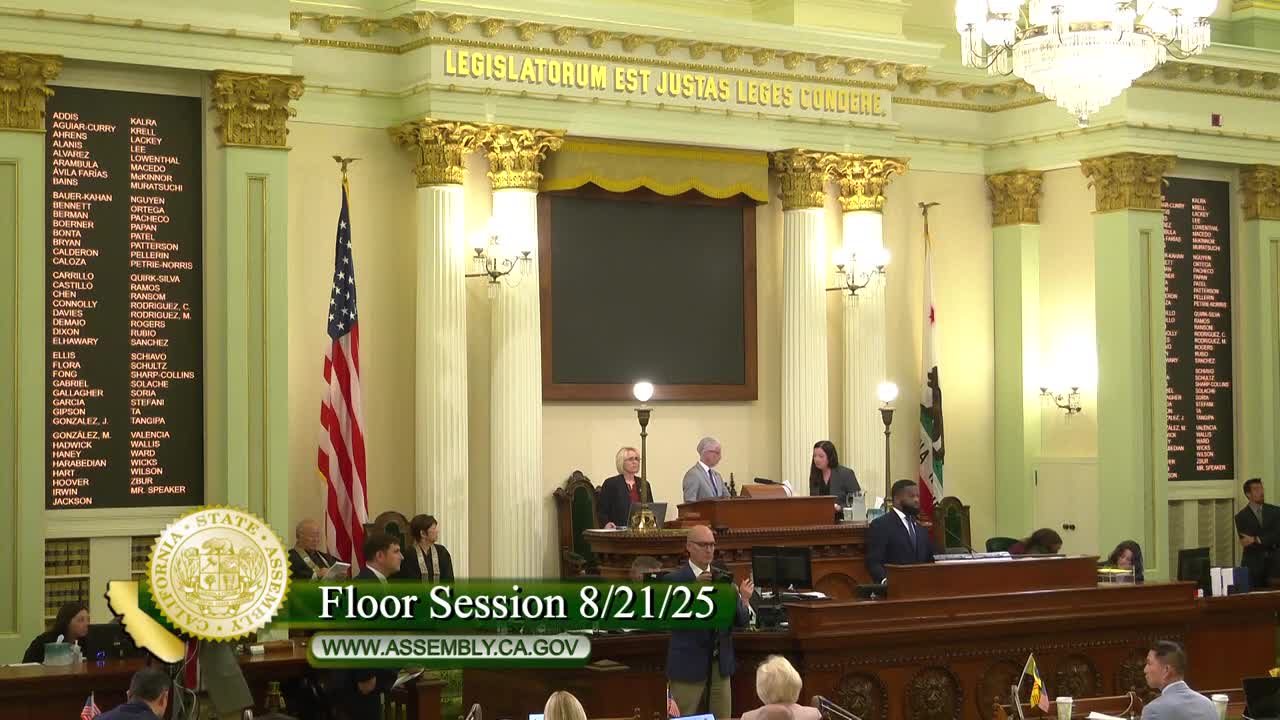 2H
Assembly Floor
 1H
Senate Floor
 38MIN
Assembly Standing Committee on Appropriations
 1H
Senate Standing Committee on Elections and Constitutional Amendments
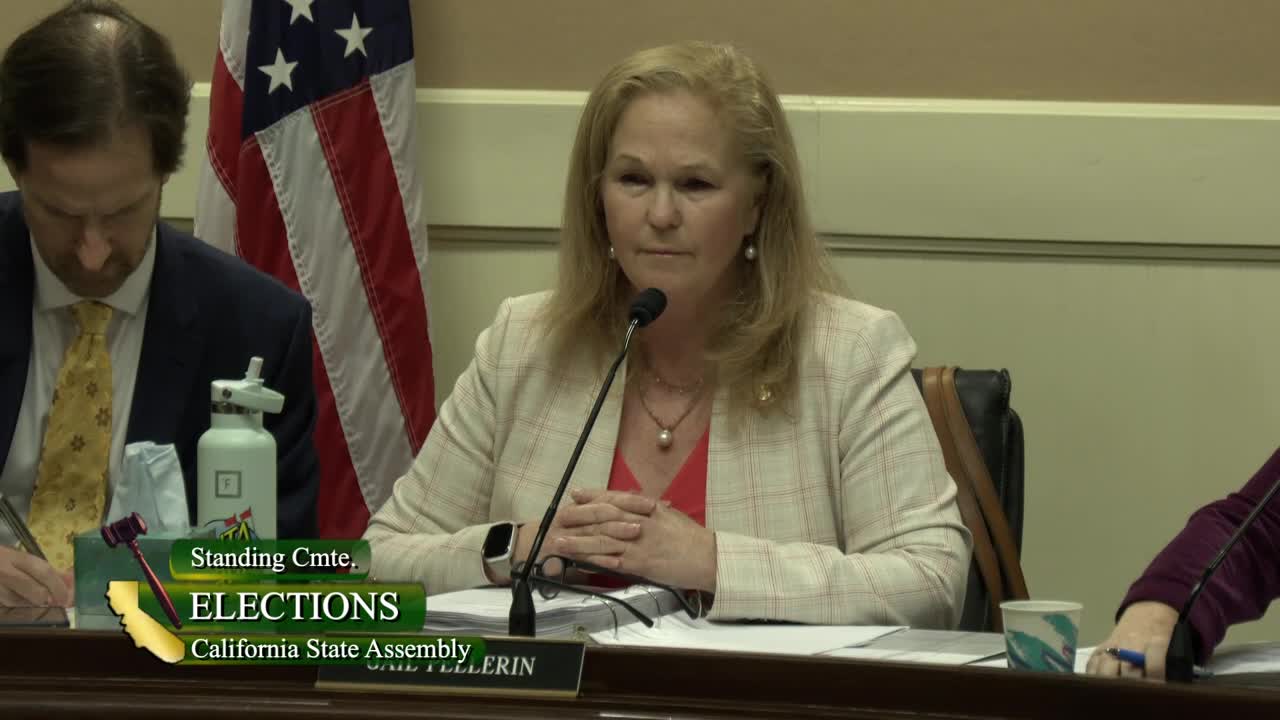 2H
Assembly Standing Committee on Elections
 9MIN
Assembly Standing Committee on Elections


Bill Co-Author(s):