SB 312: Dog importation: health certificates.
- Session Year: 2025-2026
- House: Senate
- Latest Version Date: 2025-10-09
Current Status:
Passed
(2025-10-09: Chaptered by Secretary of State. Chapter 480, Statutes of 2025.)
Introduced
In Committee
Awaiting First Chamber Vote
Passed First Chamber
In Committee
Awaiting Second Chamber Vote
Passed Second Chamber
Enacted
Existing law requires a person seeking to bring a dog into this state, or importing a dog into this state, for the purpose of resale or change of ownership to obtain a health certificate with respect to the dog that has been completed by a licensed veterinarian and is dated within 10 days before the date on which the dog is brought into the state. Existing law requires the person to submit the health certificate to the applicable county health department, as specified.
This bill would repeal the above-described requirements, and would instead require a person selling, transporting, or importing a dog into the state for the purpose of resale or change of ownership to obtain, and submit to the Department of Food and Agriculture and the buyer, a health certificate for the dog that has been completed by a licensed veterinarian and is dated no more than 10 days before the date on which the dog is brought into the state, as specified. The bill would require that the health certificate contain specified information. The bill would designate the health certificate as a public record, and require the department to retain a health certificate for 5 years.
Under existing law, a violation of the Food and Agricultural Code is a misdemeanor, except as specified.
Because the requirements of this bill would be part of the Food and Agricultural Code, the violation of which would be a crime, the bill would create a state-mandated local program.
The California Constitution requires the state to reimburse local agencies and school districts for certain costs mandated by the state. Statutory provisions establish procedures for making that reimbursement.
This bill would provide that no reimbursement is required by this act for a specified reason.
Existing law requires a person seeking to bring a dog into this state, or importing a dog into this state, for the purpose of resale or change of ownership to obtain a health certificate with respect to the dog that has been completed by a licensed veterinarian and is dated within 10 days before the date on which the dog is brought into the state. Existing law requires the person to submit the health certificate to the applicable county health department, as specified.
This bill would repeal the above-described requirements, and would instead require a person selling, transporting, or importing a dog into the state for the purpose of resale or change of ownership to obtain, and submit to the Department of Food and Agriculture and the buyer, a health certificate for the dog that has been completed by a licensed veterinarian and is dated no more than 10 days before the date on which the dog is brought into the state, as specified. The bill would require that the health certificate contain specified information. The bill would designate the health certificate as a public record, and require the department to retain a health certificate for 5 years.
The bill would require the department to develop, maintain, and make available to the public an internet website that contains the information it receives on every submitted health certificate, as specified.Under existing law, a violation of the Food and Agricultural Code is a misdemeanor, except as specified.
Because the requirements of this bill would be part of the Food and Agricultural Code, the violation of which would be a crime, the bill would create a state-mandated local program.
The California Constitution requires the state to reimburse local agencies and school districts for certain costs mandated by the state. Statutory provisions establish procedures for making that reimbursement.
This bill would provide that no reimbursement is required by this act for a specified reason.
Existing law requires a person seeking to bring a dog into this state, or importing a dog into this state, for the purpose of resale or change of ownership to obtain a health certificate with respect to the dog that has been completed by a licensed veterinarian and is dated within 10 days before the date on which the dog is brought into the state. Existing law requires the person to submit the health certificate to the applicable county health department, as specified. Existing law makes it a crime to violate specified provisions of the Food and Agricultural Code related to dogs.
This bill would repeal the above-described requirements, and would instead require a person selling, transporting, or importing a dog into the state for the purpose of resale or change of ownership to obtain, and submit to the Department of Food and Agriculture and the buyer, a health certificate for the dog that has been completed by a licensed veterinarian and is dated no more than 10 days before the date on which the dog is brought into the state, as specified. The bill would require that the health certificate to contain specified information. By expanding the scope of a crime by requiring dog health certificate to be submitted to the department, this bill would create a state-mandated local program.
The bill would require the department to develop, maintain, and make available to the public an internet website that contains the information it receives on every submitted health certificate that is submitted, without redaction, and the actual health certificates, and to make each health certificate available to the public as a public record, as specified. certificate, as specified.
Under existing law, a violation of the Food and Agricultural Code is a misdemeanor, except as specified.
Because the requirements of this bill would be part of the Food and Agricultural Code, the violation of which would be a crime, the bill would create a state-mandated local program.
The California Constitution requires the state to reimburse local agencies and school districts for certain costs mandated by the state. Statutory provisions establish procedures for making that reimbursement.
This bill would provide that no reimbursement is required by this act for a specified reason.
Existing law requires a person seeking to bring a dog into this state, or importing a dog into this state, for the purpose of resale or change of ownership to obtain a health certificate with respect to the dog that has been completed by a licensed veterinarian and is dated within 10 days before the date on which the dog is brought into the state. Existing law requires the person to submit the health certificate to the applicable county health department, as specified. Existing law makes it a crime to violate specified provisions of the Food and Agricultural Code related to dogs.
This bill would repeal the above-described requirements, and would instead require a person selling, transporting, or importing a dog into the state for the purpose of resale or change of ownership to obtain obtain, and submit a health certificate to the Department of Food and Agriculture with respect to that and the buyer, a health certificate for the dog that has been completed by a licensed veterinarian and is dated no more than 10 days before the date on which the dog is brought into the state, as specified. The bill would require the health certificate to contain specified information. By expanding the scope of a crime by requiring dog health certificate to be submitted to the department, this bill would create a state-mandated local program.
The bill would require the department to develop, maintain, and make available to the public an internet website that contains the information it receives on every health certificate that is submitted, without redaction, and the actual health certificates, and to make each health certificate available to the public as a public record, as specified.
The California Constitution requires the state to reimburse local agencies and school districts for certain costs mandated by the state. Statutory provisions establish procedures for making that reimbursement.
This bill would provide that no reimbursement is required by this act for a specified reason.
Existing law requires a person seeking to bring a dog into this state, or importing a dog into this state, for the purpose of resale or change of ownership to obtain a health certificate with respect to the dog that has been completed by a licensed veterinarian and is dated within 10 days before the date on which the dog is brought into the state. Existing law requires the person to submit the health certificate to the applicable county health department, as specified. Existing law makes it a crime to violate specified provisions of the Food and Agricultural Code related to dogs.
This bill would repeal the above-described requirements, and would instead require a person selling, transporting, or importing a dog into the state for the purpose of resale or change of ownership to obtain and submit a health certificate to the Department of Food and Agriculture with respect to that dog that has been completed by a licensed veterinarian and is dated no more than 10 days before the date on which the dog is brought into the state, as specified. The bill would require the health certificate to contain specified information. By expanding the scope of a crime by requiring dog health certificate to be submitted to the department, this bill would create a state-mandated local program.
The bill would require the department to develop, maintain, and make available to the public an internet website that contains the information it receives on every health certificate that is submitted, without redaction, and the actual health certificates, and to make each health certificate available to the public as a public record, as specified.
The California Constitution requires the state to reimburse local agencies and school districts for certain costs mandated by the state. Statutory provisions establish procedures for making that reimbursement.
This bill would provide that no reimbursement is required by this act for a specified reason.
(a)A person selling, transporting, or importing a dog into the state for the purpose of resale or change of ownership shall obtain, and submit to the department and the buyer, a health certificate for the dog that has been completed by a licensed veterinarian and is dated no more than 10 days before the date on which the dog is brought into the state.
(b)The health certificate shall include, but not be limited to, all of the following information:
(1)The date of the examination.
(2)A statement that the examination revealed no clinical evidence of infectious or communicable disease, including external parasites and fungi, and that, to the best of the licensed veterinarians knowledge, the dog has not recently been exposed to such infectious or communicable disease.
(3)Any vaccinations, treatments, or tests, and the results of such administered to the dog.
(4)(A)A statement that the dog has been properly immunized against rabies by a vaccine approved by the United States Department of Agriculture within 12 months before the date of importation into the State of California.
(B)This immunization requirement shall not apply if the dog is under three months old or if a licensed veterinarian certifies in writing that because of old age, or another reason, the life of the dog would be endangered by the administration of the rabies vaccine.
(5)The number of dogs in the shipment.
(6)A description of each dog in the shipment, including breed, age, and sex.
(7)If microchipped, the microchip number for each dog in the shipment.
(8)The physical address for both the origin and destination of the dog in the shipment. A post office box, airport, parking lot, or other public or nonfixed location shall not be used as the physical address. The physical address shall correspond to a verifiable, permanent residence or business location where the animal resides or is housed.
(9)The signature, printed name, physical address, and state license number of the licensed veterinarian who examined the dogs in the shipment.
(10)The full name, physical address, email address, and telephone number of the consignor and the full name, physical address, email address, and telephone number of the buyer.
(11)The United States Department of Agriculture license number associated with the breeder of the dog, if applicable.
(c)Completion of a United States Department of Agriculture Animal and Plant Health Inspection Service Form 7001, known as the United States Interstate and International Certificate of Health Examination for Small Animals, may be used to satisfy the requirements of subdivision (a) if the minimum requirements described in subdivision (b) are satisfied by the form. A different form of health certificate acceptable to the department may also be used to satisfy the requirements of subdivision (a) if the minimum requirements described in subdivision (b) are satisfied by the form.
(d)The person selling, transporting, or importing the dog into this state for the purpose of resale or change of ownership shall submit the health certificate to the department and the buyer via an electronic transmission.
(e)For purposes of this section, consignor means a person, business, or organization that ships or sends goods to another party for sale or storage, retaining ownership until the goods are paid for.
31002.(a)A health certificate received by the department pursuant to this chapter is a public record subject to disclosure, without redaction, under the California Public Records Act (Division 10 (commencing with Section 7920.000) of Title 1 of the Government Code).
(b)The department shall make the health certificates it receives pursuant to this chapter available upon request and without requiring a person to submit a request under the California Public Records Act (Division 10 (commencing with Section 7920.000) of Title 1 of the Government Code).
(c)The department shall retain a health certificate for five years.
SEC. 2.Chapter 1.5 (commencing with Section 121720) of Part 6 of Division 105 of the Health and Safety Code is repealed.SEC. 3.No reimbursement is required by this act pursuant to Section 6 of Article XIIIB of the California Constitution because the only costs that may be incurred by a local agency or school district will be incurred because this act creates a new crime or infraction, eliminates a crime or infraction, or changes the penalty for a crime or infraction, within the meaning of Section 17556 of the Government Code, or changes the definition of a crime within the meaning of Section 6 of Article XIIIB of the California Constitution.
(a)A person selling, transporting, or importing a dog into the state for the purpose of resale or change of ownership shall obtain, and submit to the department and the buyer, a health certificate for the dog that has been completed by a licensed veterinarian and is dated no more than 10 days before the date on which the dog is brought into the state.
(b)The health certificate shall include, but not be limited to, all of the following information:
(1)The date of the examination.
(2)A statement that the examination revealed no clinical evidence of infectious or communicable disease, including external parasites and fungi, and that, to the best of the licensed veterinarians knowledge, the dog has not recently been exposed to such infectious or communicable disease.
(3)Any vaccinations, treatments, or tests, and the results of such administered to the dog.
(4)(A)A statement that the dog has been properly immunized against rabies by a vaccine approved by the United States Department of Agriculture within 12 months before the date of importation into the State of California.
(B)This immunization requirement shall not apply if the dog is under three months old or if a licensed veterinarian certifies in writing that because of old age, or another reason, the life of the dog would be endangered by the administration of the rabies vaccine.
(5)The number of dogs in the shipment.
(6)A description of each dog in the shipment, including breed, age, and sex.
(7)If microchipped, the microchip number for each dog in the shipment.
(8)The physical address for both the origin and destination of the dog in the shipment. A post office box, airport, parking lot, or other public or nonfixed location shall not be used as the physical address. The physical address shall correspond to a verifiable, permanent residence or business location where the animal resides or is housed.
(9)The signature, printed name, physical address, and state license number of the accredited licensed veterinarian who examined the dogs in the shipment.
(10)The full name, physical address, email address, and telephone number of the consignor and the full name, physical address, email address, and telephone number of the buyer.
(11)The United States Department of Agriculture license number associated with the breeder of the dog, if applicable.
(c)Completion of a United States Department of Agriculture Animal and Plant Health Inspection Service Form 7001, known as the United States Interstate and International Certificate of Health Examination for Small Animals, may be used to satisfy the requirements of subdivision (a) if the minimum requirements described in subdivision (a) (b) are satisfied by the form. A different form of health certificate acceptable to the department may also be used to satisfy the requirements of subdivision (a) if the minimum requirements described in subdivision (b) are satisfied by the form.
(d)The person selling, transporting, or importing the dog into this state for the purpose of resale or change of ownership shall submit the health certificate to the department and the buyer via an electronic transmission.
(e)For purposes of this section, consignor means a person, business, or organization that ships or sends goods to another party for sale or storage, retaining ownership until the goods are paid for.
31001.The department shall develop, maintain, and make available to the public an internet website that contains the information it receives on every health certificate submitted pursuant to this chapter, and is searchable by each item required by Section 31000, except street names, address numbers, and telephone numbers.31002.(a)A health certificate received by the department pursuant to this chapter is a public record subject to disclosure, without redaction, under the California Public Records Act (Division 10 (commencing with Section 7920.000) of Title 1 of the Government Code).
(b)The department shall make the health certificates it receives pursuant to this chapter available upon request and without requiring a person to submit a request under the California Public Records Act (Division 10 (commencing with Section 7920.000) of Title 1 of the Government Code).
(c)The department shall retain a health certificate for five years.
SEC. 2.Chapter 1.5 (commencing with Section 121720) of Part 6 of Division 105 of the Health and Safety Code is repealed.SEC. 3.No reimbursement is required by this act pursuant to Section 6 of Article XIIIB of the California Constitution because the only costs that may be incurred by a local agency or school district will be incurred because this act creates a new crime or infraction, eliminates a crime or infraction, or changes the penalty for a crime or infraction, within the meaning of Section 17556 of the Government Code, or changes the definition of a crime within the meaning of Section 6 of Article XIIIB of the California Constitution.
(a)A person selling, transporting, or importing a dog into the state for the purpose of resale or change of ownership shall obtain, and submit to the department and the buyer, a health certificate for the dog that has been completed by a licensed veterinarian and is dated no more than 10 days before the date on which the dog is brought into the state.
(b)The health certificate shall include, but not be limited to, all of the following information:
(1)The date of the examination.
(2)A statement that the examination revealed no clinical evidence of infectious or communicable disease, including external parasites and fungi, and that, to the best of the veterinarians knowledge, the dog has not recently been exposed to such infectious or communicable disease.
(3)Any vaccinations, treatments, or tests, and the results of such administered to the dog.
(4)(A)A statement that the dog has been properly immunized against rabies by a vaccine approved by the United States Department of Agriculture within 12 months before the date of importation into the State of California.
(B)This immunization requirement shall not apply if the dog is under three months old or if a veterinarian certifies in writing that because of old age age, or other reason another reason, the life of the dog would be endangered by the administration of the rabies vaccine.
(5)The number of dogs in the shipment.
(6)A description of each dog in the shipment, including breed, age, and sex.
(7)If microchipped, the microchip number for each dog in the shipment.
(8)The physical address for both the origin and destination of the dog in the shipment. A post office box, airport, parking lot, or other public or nonfixed location shall not be used as the physical address. The physical address shall correspond to a verifiable, permanent residence or business location where the animal resides or is housed.
(9)The signature, printed name, physical address, and state license number of the accredited veterinarian who examined the dogs in the shipment.
(10)The full name, physical address, email address, and telephone number of the consignor and the full name, physical address, email address, and telephone number of the buyer.
(11)The United States Department of Agriculture license number associated with the breeder of the dog, if applicable.
(c)Completion of a United States Department of Agriculture Animal and Plant Health Inspection Service Form 7001, known as the United States Interstate and International Certificate of Health Examination for Small Animals, may be used to satisfy the requirements of subdivision (a) if the minimum requirements described in subdivision (a) are satisfied by the form. A different form of health certificate acceptable to the department may also be used to satisfy the requirements of subdivision (a) if the minimum requirements described in subdivision (b) are satisfied by the form.
(d)The person selling, transporting, or importing the dog into this state for the purpose of resale or change of ownership shall submit the health certificate to the department and the buyer via an electronic transmission.
(e)For purposes of this section, consignor means a person, business, or organization that ships or sends goods to another party for sale or storage, retaining ownership until the goods are paid for.
31001.The department shall develop, maintain, and make available to the public an internet website that contains the information it receives on every health certificate submitted pursuant to this chapter, without redaction, and the actual health certificates, and is searchable by each item required by Section 31000. 31000, except street names, address numbers, and telephone numbers.
31002.(a)A health certificate received by the department pursuant to this chapter is a public record subject to disclosure, without redaction, under the California Public Records Act (Division 10 (commencing with Section 7920.000) of Title 1 of the Government Code).
(b)The department shall make the health certificates it receives pursuant to this chapter available upon request and without requiring a person to submit a request under the California Public Records Act (Division 10 (commencing with Section 7920.000) of Title 1 of the Government Code).
SEC. 2.Chapter 1.5 (commencing with Section 121720) of Part 6 of Division 105 of the Health and Safety Code is repealed.SEC. 3.No reimbursement is required by this act pursuant to Section 6 of Article XIIIB of the California Constitution because the only costs that may be incurred by a local agency or school district will be incurred because this act creates a new crime or infraction, eliminates a crime or infraction, or changes the penalty for a crime or infraction, within the meaning of Section 17556 of the Government Code, or changes the definition of a crime within the meaning of Section 6 of Article XIIIB of the California Constitution.
(a)A person selling, transporting, or importing a dog into the state for the purpose of resale or change of ownership shall obtain obtain, and submit a health certificate to the department with respect to that and the buyer, a health certificate for the dog that has been completed by a licensed veterinarian and is dated no more than 10 days before the date on which the dog is brought into the state.
(b)The health certificate shall include, but not be limited to, all of the following information:
(1)The date of the examination.
(2)A statement that the examination revealed no clinical evidence of infectious or communicable disease, including external parasites and fungi, and that, to the best of the veterinarians knowledge, the dog has not recently been exposed to such infectious or communicable disease.
(3)Any vaccinations, treatments, or tests, and the results of such administered to the dog.
(4)(A)A statement that the dog has been properly immunized against rabies by a vaccine approved by the United States Department of Agriculture within 12 months before the date of importation into the State of California.
(B)This immunization requirement shall not apply if the dog is under three months old or if a veterinarian certifies in writing that because of old age or other reason the life of the dog would be endangered by the administration of the rabies vaccine.
(5)The number of dogs in the consignment. shipment.
(6)A description of each dog in the consignment, shipment, including breed, age, and sex.
(7)If microchipped, the microchip number for each dog in the consignment. shipment.
(8)The physical address for both the origin and destination of the dog in the consignment. shipment. A post office box, airport, parking lot, or other public or nonfixed location shall not be used as the physical address. The physical address shall correspond to a verifiable, permanent residence or business location where the animal resides or is housed.
(9)The signature, printed name, physical address, and state license number of the accredited veterinarian who examined the dogs in the consignment. shipment.
(10)The full name, physical address, email address, and telephone number of the consignor and consignee. the full name, physical address, email address, and telephone number of the buyer.
(11)The United States Department of Agriculture license number associated with the breeder of the dog, if applicable.
(c)Completion of a United States Department of Agriculture Animal and Plant Health Inspection Service Form 7001, known as the United States Interstate and International Certificate of Health Examination for Small Animals, shall may be used to satisfy the requirements of subdivision (a). (a) if the minimum requirements described in subdivision (a) are satisfied by the form. A different form of canine health certificate acceptable to the receiving agency shall department may also be used to satisfy the requirement requirements of subdivision (a) if the minimum requirements described in subdivision (b) are satisfied by the form.
(d)The person selling, transporting, or importing the dog into this state for the purpose of resale or change of ownership shall submit the health certificate to the department and the buyer via an electronic transmission.
(e)A dog that is passing through the state to other destinations located outside of the state, a dog that is brought into the state for temporary residence for purposes of exhibition, or a dog that enters the state for delivery to research institutions, dealers, or other persons registered or licensed and regulated by the United States Department of Agriculture pursuant to the federal Animal Welfare Act (Public Law 89-544), as amended, is exempt from this chapter if the dog is, at all times, properly restrained and under the immediate control of the owner or custodian, accompanied with proof of proper immunization against rabies, and, for a dog entering the state pursuant to the federal Animal Welfare Act (Public Law 89-544), as amended, remains subject to the act.(e)For purposes of this section, consignor means a person, business, or organization that ships or sends goods to another party for sale or storage, retaining ownership until the goods are paid for.
31001.The department shall develop, maintain, and make available to the public an internet website that contains the information it receives on every health certificate submitted pursuant to this chapter, without redaction, and the actual health certificates, and is searchable by each item required by Section 31000.
31002.(a)A health certificate received by the department pursuant to this chapter is a public record subject to disclosure, without redaction, under the California Public Records Act (Division 10 (commencing with Section 7920.000) of Title 1 of the Government Code).
(b)The department shall make the health certificates it receives pursuant to this chapter available upon request and without requiring a person to submit a request under the California Public Records Act (Division 10 (commencing with Section 7920.000) of Title 1 of the Government Code).
SEC. 2.Chapter 1.5 (commencing with Section 121720) of Part 6 of Division 105 of the Health and Safety Code is repealed.SEC. 3.No reimbursement is required by this act pursuant to Section 6 of Article XIIIB of the California Constitution because the only costs that may be incurred by a local agency or school district will be incurred because this act creates a new crime or infraction, eliminates a crime or infraction, or changes the penalty for a crime or infraction, within the meaning of Section 17556 of the Government Code, or changes the definition of a crime within the meaning of Section 6 of Article XIIIB of the California Constitution.
(a)A person selling, transporting, or importing a dog into the state for the purpose of resale or change of ownership shall obtain and submit a health certificate to the department with respect to that dog that has been completed by a licensed veterinarian and is dated no more than 10 days before the date on which the dog is brought into the state.
(b)The health certificate shall include, but not be limited to, all of the following information:
(1)The date of the examination.
(2)A statement that the examination revealed no clinical evidence of infectious or communicable disease, including external parasites and fungi, and that, to the best of the veterinarians knowledge, the dog has not recently been exposed to such infectious or communicable disease.
(3)Any vaccinations, treatments, or tests, and the results of such administered to the dog.
(4)(A)A statement that the dog has been properly immunized against rabies by a vaccine approved by the United States Department of Agriculture within 12 months before the date of importation into the State of California.
(B)This immunization requirement shall not apply if the dog is under three months old or if a veterinarian certifies in writing that because of old age or other reason the life of the dog would be endangered by the administration of the rabies vaccine.
(5)The number of dogs in the consignment.
(6)A description of each dog in the consignment, including breed, age, and sex.
(7)If microchipped, the microchip number for each dog in the consignment.
(8)The physical address for both the origin and destination of the dog in the consignment.
(9)The signature, printed name, physical address, and state license number of the accredited veterinarian who examined the dogs in the consignment.
(10)The full name, physical address, email address, and telephone number of the consignor and consignee.
(c)Completion of a United States Department of Agriculture Animal and Plant Health Inspection Service Form 7001, known as the United States Interstate and International Certificate of Health Examination for Small Animals, shall satisfy the requirements of subdivision (a). A different form of canine health certificate acceptable to the receiving agency shall also satisfy the requirement of subdivision (a) if the minimum requirements described in subdivision (b) are satisfied by the form.
(d)The person selling, transporting, or importing the dog into this state for the purpose of resale or change of ownership shall submit the health certificate to the department via an electronic transmission.
(e)A dog that is passing through the state to other destinations located outside of the state, a dog that is brought into the state for temporary residence for purposes of exhibition, or a dog that enters the state for delivery to research institutions, dealers, or other persons registered or licensed and regulated by the United States Department of Agriculture pursuant to the federal Animal Welfare Act (Public Law 89-544), as amended, is exempt from this chapter if the dog is, at all times, properly restrained and under the immediate control of the owner or custodian, accompanied with proof of proper immunization against rabies, and, for a dog entering the state pursuant to the federal Animal Welfare Act (Public Law 89-544), as amended, remains subject to the act.
31001.The department shall develop, maintain, and make available to the public an internet website that contains the information it receives on every health certificate submitted pursuant to this chapter, without redaction, and the actual health certificates, and is searchable by each item required by Section 31000.
31002.(a)A health certificate received by the department pursuant to this chapter is a public record subject to disclosure, without redaction, under the California Public Records Act (Division 10 (commencing with Section 7920.000) of Title 1 of the Government Code).
(b)The department shall make the health certificates it receives pursuant to this chapter available upon request and without requiring a person to submit a request under the California Public Records Act (Division 10 (commencing with Section 7920.000) of Title 1 of the Government Code).
SEC. 2.Chapter 1.5 (commencing with Section 121720) of Part 6 of Division 105 of the Health and Safety Code is repealed.SEC. 3.No reimbursement is required by this act pursuant to Section 6 of Article XIIIB of the California Constitution because the only costs that may be incurred by a local agency or school district will be incurred because this act creates a new crime or infraction, eliminates a crime or infraction, or changes the penalty for a crime or infraction, within the meaning of Section 17556 of the Government Code, or changes the definition of a crime within the meaning of Section 6 of Article XIIIB of the California Constitution.
|
Date
|
Status
|
|---|---|
| Oct 9, 2025 | Chaptered by Secretary of State. Chapter 480, Statutes of 2025. |
| Oct 9, 2025 | Approved by the Governor. |
| Sep 17, 2025 | Enrolled and presented to the Governor at 2 p.m. |
| Sep 10, 2025 | Assembly amendments concurred in. (Ayes 40. Noes 0. Page 2829.) Ordered to engrossing and enrolling. |
| Sep 8, 2025 | In Senate. Concurrence in Assembly amendments pending. |
| Sep 8, 2025 | Read third time. Passed. (Ayes 78. Noes 0. Page 3000.) Ordered to the Senate. |
| Sep 3, 2025 | Read second time. Ordered to third reading. |
| Sep 2, 2025 | Read second time and amended. Ordered to second reading. |
| Aug 29, 2025 | From committee: Do pass as amended. (Ayes 11. Noes 0.) (August 29). |
| Jul 16, 2025 | July 16 set for first hearing. Placed on APPR. suspense file. |
| Jul 3, 2025 | From committee: Do pass and re-refer to Com. on APPR. (Ayes 8. Noes 0.) (July 2). Re-referred to Com. on APPR. |
| Jun 24, 2025 | From committee: Do pass and re-refer to Com. on AGRI. (Ayes 16. Noes 0.) (June 24). Re-referred to Com. on AGRI. |
| Jun 5, 2025 | Referred to Coms. on B. & P. and AGRI. |
| May 28, 2025 | In Assembly. Read first time. Held at Desk. |
| May 28, 2025 | Read third time. Passed. (Ayes 38. Noes 0. Page 1301.) Ordered to the Assembly. |
| May 23, 2025 | Read second time. Ordered to third reading. |
| May 23, 2025 | From committee: Do pass. (Ayes 6. Noes 0. Page 1195.) (May 23). |
| May 20, 2025 | Set for hearing May 23. |
| May 19, 2025 | May 19 hearing: Placed on APPR. suspense file. |
| May 9, 2025 | Set for hearing May 19. |
| May 5, 2025 | Read second time and amended. Re-referred to Com. on APPR. |
| May 1, 2025 | From committee: Do pass as amended and re-refer to Com. on APPR. (Ayes 4. Noes 0. Page 932.) (April 29). |
| Apr 10, 2025 | Set for hearing April 29. |
| Apr 7, 2025 | From committee: Do pass and re-refer to Com. on AGRI. (Ayes 10. Noes 0. Page 680.) (April 7). Re-referred to Com. on AGRI. |
| Mar 26, 2025 | From committee with author's amendments. Read second time and amended. Re-referred to Com. on B. P. & E.D. |
| Mar 18, 2025 | Set for hearing April 7. |
| Feb 19, 2025 | Referred to Coms. on B. P. & E.D. and AGRI. |
| Feb 11, 2025 | From printer. May be acted upon on or after March 13. |
| Feb 10, 2025 | Introduced. Read first time. To Com. on RLS. for assignment. To print. |
|
Date
|
Description
|
Location
|
Votes
|
|
|---|---|---|---|---|
| Sep 10, 2025 | Unfinished Business SB312 Umberg et al. Concurrence | Senate Floor |
Passed |
|
| Sep 8, 2025 | SB 312 Umberg Senate Third Reading By Bennett | Assembly Floor |
Passed |
|
| Aug 29, 2025 | Do pass as amended. | Assembly Standing Committee on Appropriations |
Passed |
|
| Jul 2, 2025 | Do pass and be re-referred to the Committee on [Appropriations] | Assembly Standing Committee on Agriculture |
Passed |
|
| Jun 24, 2025 | Do pass and be re-referred to the Committee on [Agriculture] | Assembly Standing Committee on Business and Professions |
Passed |
|
| May 28, 2025 | Senate 3rd Reading SB312 Umberg et al. | Senate Floor |
Passed |
|
| May 23, 2025 | Do pass | Senate Standing Committee on Appropriations |
Passed |
|
| May 19, 2025 | Placed on suspense file | Senate Standing Committee on Appropriations |
Passed |
|
| Apr 29, 2025 | Do pass as amended, but first amend, and re-refer to the Committee on [Appropriations] | Senate Standing Committee on Agriculture |
Passed |
|
| Apr 7, 2025 | Do pass, but first be re-referred to the Committee on [Agriculture] | Senate Standing Committee on Business, Professions and Economic Development |
Passed |
This list shows positions taken on this bill by organizations on the date displayed, which is linked to the original source.
Positions by individuals are not included.
|
Organization
|
Position
|
Date
|
|---|---|---|
| American Kennel Club, INC. | ** Support | |
| Animal Legal Defense Fund | ** Support | |
| ASPCA | ** Support | |
| California Animal Welfare Association | ** Support | |
| Honorable Rob Bonta, Attorney General, State of California | ** Support | |
| Humane Society of San Bernardino Valley | ** Support | |
| Humane World for Animals | ** Support | |
| Inland Valley Humane Society & S.P.C.A | ** Support | |
| Michelson Center For Public Policy | ** Support | |
| Pet Advocacy Network | ** Support | |
| Pets Lifeline | ** Support | |
| San Diego Humane Society | ** Support | |
| San Francisco Spca | ** Support | |
| Social Compassion In Legislation | ** Support | |
| Valley Humane Society | ** Support |
SENATE RULES COMMITTEE Office of Senate Floor Analyses (916) 651-1520 Fax: (916) 327-4478 | SB 312 |
UNFINISHED BUSINESS
Bill No: SB 312
Author: Umberg (D), et al.
Amended: 9/2/25
Vote: 21
SENATE BUS., PROF. & ECON. DEV. COMMITTEE: 10-0, 4/7/25
AYES: Ashby, Choi, Archuleta, Arreguín, Grayson, Menjivar, Niello, Smallwood-Cuevas, Umberg, Weber Pierson
NO VOTE RECORDED: Strickland
SENATE AGRICULTURE COMMITTEE: 4-0, 4/29/25
AYES: Hurtado, Alvarado-Gil, Cortese, McNerney
NO VOTE RECORDED: Padilla
SENATE APPROPRIATIONS COMMITTEE: 6-0, 5/23/25
AYES: Caballero, Seyarto, Cabaldon, Grayson, Richardson, Wahab
NO VOTE RECORDED: Dahle
SENATE FLOOR: 38-0, 5/28/25
AYES: Allen, Alvarado-Gil, Archuleta, Arreguín, Ashby, Becker, Blakespear, Cabaldon, Caballero, Cervantes, Choi, Cortese, Dahle, Durazo, Gonzalez, Grayson, Grove, Hurtado, Jones, Laird, McGuire, McNerney, Menjivar, Niello, Ochoa Bogh, Padilla, Pérez, Richardson, Rubio, Seyarto, Smallwood-Cuevas, Stern, Strickland, Umberg, Valladares, Wahab, Weber Pierson, Wiener
NO VOTE RECORDED: Limón, Reyes
ASSEMBLY FLOOR: 78-0, 9/8/25 - See last page for vote
SUBJECT: Dog importation: health certificates
SOURCE: ASPCA
San Diego Humane Society
DIGEST:
This bill revises and recasts the requirements for the submission of health certificates (HC) for dogs imported into California; requires additional information be included on a HC and that it be submitted to the California Department of Food and Agriculture (CDFA) instead of the county in which the dog is imported into, requires the CDFA to retain the HC for five years; requires the HC to be submitted electronically; and, makes a HC received by the CDFA a public record, as specified.
Assembly Amendments
Delete the requirement for the CDFA to develop and maintain a website that contains information on every HC, and requires the CDFA to retain a HC for five years.
ANALYSIS:
Existing law:
- Requires a person who brings a dog, or imports dogs into this state for the purpose of resale or change of ownership, to obtain a “HC” or “certificate” that has been completed by a licensed veterinarian and is dated within 10 days prior to the date on which the dog is brought into this state. (Health and Safety Code (HSC) § 121720(a)(1))
- Requires the “HC” to be provided to a county health department and submitted to the county health department by any means acceptable to the receiving agency, as specified. (HSC § 121720(a)(2)
- Authorizes the agency receiving the HC to use the information on the certificate as it deems appropriate and allows an entity to charge a fee for accepting the certificate as required. (HSC §§ 121720(d), 121722)
- Makes a person who violates the requirement to provide a HC guilty of an infraction, punishable by a $250 fine, and authorizes enforcement personnel to issue an administrative fine or a correction warning, as specified. (HSC § 121723)
This bill:
- Revises the requirements for a person selling, transporting, or importing a dog into this state for the purpose of resale or change of ownership to obtain and submit a HC, completed by a licensed veterinarian dated no more than 10 days before the date on which the dog is brought into this state.
- Requires the HC to include, but not be limited to, all of the following:
- The date of the examination;
- A statement that the examination revealed no clinical evidence of infectious or communicable disease, including external parasites and fungi, and that, to the best of the veterinarian’s knowledge the dog has not recently been exposed to such infectious or communicable disease;
- Any vaccinations, treatments, or tests, and the results;
- A statement that the dog has been properly immunized by a rabies vaccination within 12 months before the date of importation into the state, unless the dog is under three months old or a veterinarian certifies in writing that specified circumstances would endanger the life of the dog;
- The number of dogs in the shipment and a description of each dog, including breed, sex, and age;
- Microchip number for each dog, if microchipped;
- Physical address for both the origin and destination of the dog in the shipment and a post office box, airport, parking lot, or other non-fixed location cannot be used as the physical address, as specified;
- Signature, printed name, physical address, and state license number of the licensed veterinarian who examined the dogs in the shipment;
- Full name and physical address, email address, and telephone number of the consignor and the buyer; and,
- The United States Department of Agriculture license number associated with the breeder of the dog, if applicable.
- Makes the completion of the APHIS Form 7001 to satisfy the requirements in 1) above, if all of the information in a-j) above is included on the APHIS Form 7001; and a different form can be used if accepted by the CDFA.
- Requires the submission of a HC to the department and the buyer to be completed electronically.
- Defines “consignor” to mean a person, business, or organization that ships or sends good to another party for sale or storage, retaining ownership until the goods are paid for.
- Makes a HC received by the CDFA a public record, as specified, and requires the CDFA to make the HCs received available upon request, without a public records request, as specified.
- Requires the CDFA to retain a HC for five years.
- Repeals the existing requirements in the HSC related to HCs.
Background
Animal Importation and Health Certificates. HCs, also referred to as a “certificate of veterinary inspection” (CVI) are required by the majority of states. One of the main purposes of these certificates is to help prevent the spread of animal diseases across state lines. Many state departments of agriculture and other state agencies have created rules and regulations which govern the importation of livestock, companion animals, equines, and other animals. Current law requires a HC be filed with the county where the dog is offered for sale or the county where the individual resides who is acquiring the dog. However, current law does not require a county to create a standardized HC form or require counties to make HCs available on a county website.
As noted by the sponsors of this bill, counties have various procedures for collecting the HCs. In addition, the HCs are not always available to the public, and it’s otherwise generally unclear what the counties are doing with the information from the certificates once received. The varied collection of HC data coupled with the lack of a single point of access for consumers, renders the collection of this data inaccessible and not as useful as intended. This bill seeks to increase consumer access to HCs, by transferring the collection of HCs from individual counties to the CDFA. Current law requires HCs be sent to county jurisdictions where the animal was to be delivered; however, because many out of state filers were not always able to locate or identify the correct county, they would send the HCs to CDFA. Because the CDFA receives CVIs for agriculture animals and livestock, and already had a system in place, it was likely the destination that made the most sense for people. However, because the CDFA was not the designated agency for the collection of the - HCs, they were not maintaining the records. Although current law provides an enforcement tool for not complying with the HC requirements, the landscape of non-compliance is difficult to assess. To date, the number of fines assessed through each county is unknown.
CDFA. The CDFA is responsible for a number of programs which oversee the important agricultural systems in California, including plant and animal health, animal health and food services, fairs, dairy programs, and measurement standards. The animal health branch, under the CDFA is the State's organized, professional veterinary medical unit that protects livestock populations, consumers, and California's economy from catastrophic animal diseases, disasters that impact animals, and other health or agricultural problems. This bill will require the CDFA to retain a HC for five years.
This bill is one of several bills this legislative year intended to address issues raised in a September 12, 2024, Los Angeles Times article which highlighted the underground puppy and dog market in California. The article noted that often time buyers purchase animals online from what they believe to be a breeder in California, when in reality the animal is from another state where puppy mills are rampant, and offered for sale through a California broker with little knowledge from the prospective buyer, that the dog was not actually bred in California. There were instances in the article which noted that some of those animals were sick or otherwise unhealthy.
This bill aims to enhance transparency on HCs by enhancing the information required for a HC, including a physical address (that is not a parking lot or similar place), an email address, along with information about the seller and the buyer of the dog. This information may help consumers research the source of a dog-i.e. does the dog have a HC on file, which would indicate the dog was not born in California. Additionally, a consumer should be able find information about past dog sales from the person they are seeking to purchase a dog from.
Comments
The American Kennel Club, Inc. supports this bill if it is amended and notes, “The AKC supports making public information related to the health of animals along with the state in which the animal is being transported from. This can give the public assurance that the animals being brought into the state are healthy along with identifying the types of animals that are being brought into the state and where they come from. However, listing home addresses of buyers and sellers creates privacy concerns—including the risk of malicious actors being able to target specific people with easily accessible data.”
FISCAL EFFECT: Appropriation: No Fiscal Com.: Yes Local: Yes
According to the Assembly Committee on Appropriations, “CDFA estimates costs of $1.54 million in the first year, $1.17 million in the second year, and $322,000 annually thereafter to develop, launch, and maintain a searchable website (General Fund). CDFA notes significant costs associated with the need for optical character recognition tools to process HC data, which are not submitted in a standardized format.”
SUPPORT: (Verified 9/8/25)
ASPCA (co-source)
San Diego Humane Society (co-source)
Honorable Rob Bonta, Attorney General, State of California
Animal Legal Defense Fund
California Animal Welfare Association
Humane Society of San Bernardino Valley
Humane World for Animals
Inland Valley Humane Society & S.P.C.A.
Michelson Center for Public Policy
Pet Advocacy Network
Pets Lifeline
San Francisco SPCA
Social Compassion in Legislation
Valley Humane Society
OPPOSITION: (Verified 9/8/25)
None received
ARGUMENTS IN SUPPORT: Supporters note generally that this bill will increase consumer protection and allow greater transparency around those puppies brought into California.
ASSEMBLY FLOOR: 78-0, 9/8/25
AYES: Addis, Aguiar-Curry, Ahrens, Alanis, Alvarez, Arambula, Ávila Farías, Bains, Bauer-Kahan, Bennett, Berman, Boerner, Bonta, Bryan, Calderon, Caloza, Carrillo, Castillo, Chen, Connolly, Davies, DeMaio, Dixon, Elhawary, Ellis, Fong, Gabriel, Gallagher, Garcia, Gipson, Jeff Gonzalez, Mark González, Hadwick, Haney, Harabedian, Hart, Hoover, Irwin, Jackson, Johnson, Kalra, Krell, Lackey, Lee, Lowenthal, Macedo, McKinnor, Muratsuchi, Ortega, Pacheco, Papan, Patel, Patterson, Pellerin, Petrie-Norris, Quirk-Silva, Ramos, Ransom, Celeste Rodriguez, Michelle Rodriguez, Rogers, Blanca Rubio, Sanchez, Schiavo, Schultz, Sharp-Collins, Solache, Soria, Stefani, Ta, Tangipa, Valencia, Wallis, Ward, Wicks, Wilson, Zbur, Rivas
NO VOTE RECORDED: Flora, Nguyen
Prepared by: Elissa Silva / B., P. & E.D. / 916-651-4104
9/8/25 19:46:31
SENATE THIRD READING
STR Bill Id:SB 312
Author:(Umberg)
As Amended Ver:September 02, 2025
Majority vote
SUMMARY
Requires individuals to obtain and submit a health certificate to the Department of Food and Agriculture (CDFA), and to the buyer, when selling or importing dogs into California, and requires the CDFA to retain and make available to the public, upon request, specified information related to the health certificates.
Major Provisions
- Repeals current law contained in the HSC, and places and expands laws in the Food and Agriculture Code related to health certificates for a person selling, transporting, or importing a dog into California for the purpose of resale or change of ownership.
- Requires that a person selling, transporting, or importing a dog into California for the purpose of resale or change of ownership obtain and submit a health certificate, completed by a licensed veterinarian dated no more than 10 days before the date on which the dog is brought into this state.
- Requires that health certificates be submitted directly to the CDFA and the buyer of the dog.
- Requires that a health certificate must include, but is not limited to, the following information:
- The date of the examination;
- A statement that the examination revealed no clinical evidence of infectious or communicable disease, including external parasites and fungi, and that, to the best of the veterinarian's knowledge the dog has not recently been exposed to such infectious or communicable disease;
- Any vaccinations, treatments, or tests, and the results;
- A statement that the dog has been properly immunized by a rabies vaccination within 12 months before the date of importation into the state, unless the dog is under three months old or a veterinarian certifies in writing that specified circumstances would endanger the life of the dog;
- The number of dogs in the shipment;
- A description of each dog, including breed, sex, and age;
- The microchip number for each dog, if microchipped;
- The physical address for both the origin and destination of the dog in the shipment which shall not be a post office box, airport, parking lot, or other non-fixed location, as specified;
- The signature, printed name, physical address, and state license number of the accredited veterinarian who examined the dogs in the shipment;
- The full name and physical address, email address, and telephone number of the consignor, as defined, and the buyer; and
- The United States Department of Agriculture license number associated with the breeder of the dog, if applicable.
- Specifies that completion of a United States Department of Agriculture Form 7001 satisfies the health certificate requirements so long as it is completed within 10 days prior to import and contains all required information above.
- Authorizes the CDFA to utilize a different form of health certificate so long as it is completed within 10 days prior to import and contains all required information above.
- Requires that the person selling, transporting, or importing the dog into California submit the health certificate to the CDFA and the buyer via an electronic transmission.
- Makes a health certificate received by the CDFA a public record, as specified.
- Requires the CDFA to make the submitted health certificates available upon request, without first requiring the submission of a public records request, as specified.
COMMENTS
Interstate Dog Importation. In order to prevent the spread of communicable diseases and parasites, states across the country require some form of a health certificate, or "certificate of veterinary inspection" (CVI) for animals that are imported or travel across state lines. In many states, respective agriculture departments or other state agencies regulate CVIs and health requirements for out-of-state animals. While every state requires some sort of CVI for livestock and poultry, not all—but many—require CVIs for dogs, and some even require CVIs for other companion animals like cats and rabbits. While CVIs vary somewhat state-by-state, all require minimum information such as the animal's place of origin, veterinary identification, and proof of certain vaccinations. Notably, in recent years some states like New York and California have adopted and encouraged the use of electronic CVIs where applicable, citing greater accuracy and security.
In California, CVIs or similar health certificates are required for most animals coming into the state, with many being directly administered by, and submitted to, the state's Department of Food and Agriculture (CDFA). Respective to dogs, current law established by AB 1809 (Maeinschein, Ch. 498, Stats. of 2014) requires that individuals who import dogs intended for resale or change in ownership obtain a health certificate from a licensed veterinarian in their state or country of origin within 10 days prior to the dog being brought into California. These certificates are required to be submitted to the public health department of the relevant county where the dog will be sold or received, and failure to comply with these requirements is punishable by a $250 infraction per dog.
While current law is vague as to what specific information must be included in this certificate, it deems that submission of the U.S. Department of Agriculture (USDA) Animal and Plant Health Inspection Service (APHIS) Form 7001 to the county health department is satisfactory for meeting California CVI requirements. This form is provided by the USDA as a certifiable, consistent resource to meet various international and national pet import and export requirements, and includes important information such as the origin of the animal, age and breed descriptors, any vaccines or treatments administered, the license number of the examining veterinarian, and more. Additionally, current law allows each county to develop their own canine health certificate as they deem appropriate, and to use the information they receive as they see fit.
State Regulation of Pet Sales. California has a long history of regulating pet sales in the state beyond federal standards, with a number of laws that oversee pet dealers and their businesses, and aim to protect the wellbeing of the animals they sell. The Lockyer-Polanco-Farr Pet Protection Act (Pet Protection Act) establishes requirements on pet dealers in California. When selling a pet to a consumer, pet dealers must provide purchasers with written information about the animal's health, including any known illnesses or conditions. Additionally, before any dog or cat is sold, it must be examined by a licensed veterinarian to ensure it is free from contagious diseases and fit for sale. The Pet Protection Act also outlines consumer remedies in the event a purchased animal is found to be ill or affected by a congenital or hereditary condition within 15 days of sale, in which case the consumer may be entitled to a refund, an exchange, or reimbursement for veterinary costs. The law also imposes recordkeeping requirements, obligating dealers to retain documentation regarding the source of animals, veterinary treatments, and sales transactions for a specified period. Enforcement of the Pet Protection Act is delegated to local animal control agencies and humane officers, who are authorized to conduct inspections and enforce compliance, and violations of the law may result in civil penalties and administrative actions.
Beyond pet sales that occur in retail settings, California regulates the sale of dogs by dog breeders through the Polanco-Lockyer Pet Breeder Warranty Act (Warranty Act). Under the Warranty Act, "dog breeders" are defined as a person, firm, partnership, corporation, or other association that has sold, transferred, or given away all or part of three or more litters or 20 or more dogs during the preceding 12 months that were bred and reared on the premises of the person, firm, partnership, corporation, or other association. Much like the Pet Protection Act, the Warranty Act allows a consumer to receive a refund or reimbursement should they purchase a sick pet, or a pet that is found to have a hereditary or congenital condition requiring surgery or hospitalization. The Warranty Act further regulates California dog breeders by requiring breeders to provide specific written disclosures, including the breeder's name, address, information on the dog, and signed statements that the dog has no known diseases or illnesses, as well as a notice of the purchaser's rights to obtain a refund or reimbursement.
Further Legislative Reforms. Building off existing federal and state laws, the Legislature has made additional reforms in recent years to the sale of animals coming from large-scale animal "mills" and other cruel commercial operations. In an effort to reduce the flow of pets sourced from breeder mills, AB 485 (O'Donnell, Chapter 740, Statutes of 2017) was enacted in 2018 to prohibit pet store operators from selling a live cat, dog, or rabbit unless the animal is offered through a public animal control agency or shelter, specified nonprofit, or animal rescue or adoption organization. Pet store operators who violate these provisions are subject to a civil penalty of up to $500 for each animal offered for sale.
To address loopholes that resulted from the implementation of AB 485, in which commercial breeders guised their businesses as nonprofit organizations to circumvent prohibitions, further legislation enacted in 2021 (AB 2152, Gloria & O'Donnell, Chapter 96, Statutes of 2020) specifically defined the type of animal rescue organizations that pet stores could source animals from. Additionally, AB 2152 prohibited pet stores from displaying animals except for cases of providing display space for nonprofit partners. In 2023, AB 2380 (Maienschein, Chapter 548, Statutes of 2022) was enacted to further curb the importation of commercially-bred pets into California, and address unscrupulous and predatory lending practices in the pet market by prohibiting online pet retailers from offering or brokering a loan or other financing option for the adoption or sale of a dog, cat, or rabbit.
LA Times Exposé. Despite California's many past efforts to promote transparency and animal welfare in pet sales, a 2024 investigative report by the Los Angeles Times titled "Inside California's Brutal Underground Market for Puppies" exposed that some breeders and pet sellers were exploiting loopholes that allow them to circumvent state laws, reselling or arranging the sale of dogs bred in "puppy mills." Through analysis of more than 88,000 CVIs from states throughout the country, the Times identified that more than 71,000 were imported into California. Individual pet dealers and businesses then rebrand and resell these imported dogs as "California-bred" to unknowing consumers. According to the report, many of these pets develop future health problems and consumers are left with little knowledge as to the original source of their pet, nor recourse for the fraudulent sale.
In attempting to procure and research CVIs as part of their investigation, Times reporters highlighted the inconsistent and severely lacking nature of animal health certificate submission and retention across California. Since state law requires that CVIs be submitted to county health departments, and defers to each county to determine specific required information and method of submission, CVIs vary wildly from county-to-county in their accessibility, disclosed information, and recordkeeping methodology. Additionally, since CVIs are typically for sales that involve an out-of-state seller, these sellers are often unaware of specific county requirements and default to transmitting CVIs directly to the CDFA, since they are the state agency that typically receives CVIs for other types of animals and in many other states, their respective agriculture departments regulate interstate dog commerce directly.
In response to this investigative report, the author and sponsors have put forward this measure to provide greater consumer transparency in dog sales and align California's CVI requirements for dogs with those in other states. Specifically, this bill strikes current law contained in the Health and Safety Code that outlines CVI requirements and places regulation under the authority of county health departments, and instead recasts and expands these requirements in the Food and Agriculture Code and places authority directly under the CDFA. Specifically, this bill requires that any person selling or transporting a dog into California for resale or ownership transfer must obtain a CVI within 10 days prior to the dog being brought into the state, and that it must be submitted directly to the CDFA and the buyer of the dog. Unlike current law, this bill specifically outlines what information must be included in the CVI, including the date of the examination, a statement that the dog did not present any clinical evidence of infectious disease, records of vaccinations or treatments, and certain information about the seller, consigner, and buyer. The bill notes that an APHIS Form 7001 is satisfactory for meeting the CVI requirement so long as it is dated within the required 10 days prior to import. Finally, the bill requires the CDFA to make any CVI it obtains available upon request, without requiring a person to submit a request under the California Public Records Act.
Notably, this bill is part of a wider "Close the Puppy Mill Pipeline" legislative package put forward by the sponsors to address issues raised in the Times investigation. In addition to this bill, which requires CDFA to retain and make available information related to certificates of veterinary inspection, the package also contains AB 519 (Berman), which expressly bans pet brokers, and AB 506 (Bennett), which would establish specific contract stipulations and consumer restitution measures related to pet sales. AB 519 and AB 506 were both approved by this committee earlier this year and are currently under consideration in the Senate Business, Professions, and Economic Development Committee.
According to the Author
"California has been a longstanding leader in animal welfare, becoming the first state to prohibit the sale of purpose-bred puppies (typically acquired from puppy mills) in pet stores. However, dishonest sellers continue to exploit consumers through deceptive internet marketing practices and/or by posing as reputable local breeders. In reality, they import thousands of puppies from cruel out-of-state breeding operations, deceiving buyers and perpetuating the horrific puppy mill pipeline. Almost every state requires a health certificate for imported dogs to be uploaded to their state department of agriculture but California has never mandated sending these forms to the California Department of Agriculture, which has received and destroyed them for years. This health certificate information is crucial for consumers to confirm information about their dog, and for humane law enforcement agencies who work to investigate fraud during these transactions"
Arguments in Support
This bill is co-sponsored by the San Diego Humane Society (SDHS) and the American Society for the Prevention of Cruelty to Animals (ASPCA). In a joint letter co-signed by several animal welfare organizations, they write: "Transparency around the health, sources, flow, and volume of puppies being sold into California that SB 312 will afford is a critical step that will increase consumer protections and allow for better oversight and policymaking with respect to puppies being imported from puppy mills and breeders in other states."
Arguments in Opposition
None on file.
FISCAL COMMENTS
General Fund costs of an unknown amount, possibly approximately $150,000 per year for CDFA to maintain the health certificates for five years and respond to requests for health certificates.
VOTES
SENATE FLOOR: 38-0-2
YES: Allen, Alvarado-Gil, Archuleta, Arreguín, Ashby, Becker, Blakespear, Cabaldon, Caballero, Cervantes, Choi, Cortese, Dahle, Durazo, Gonzalez, Grayson, Grove, Hurtado, Jones, Laird, McGuire, McNerney, Menjivar, Niello, Ochoa Bogh, Padilla, Pérez, Richardson, Rubio, Seyarto, Smallwood-Cuevas, Stern, Strickland, Umberg, Valladares, Wahab, Weber Pierson, Wiener
ABS, ABST OR NV: Limón, Reyes
ASM BUSINESS AND PROFESSIONS: 16-0-2
YES: Berman, Flora, Ahrens, Alanis, Caloza, Chen, Elhawary, Hadwick, Haney, Irwin, Jackson, Krell, Lowenthal, Ellis, Nguyen, Pellerin
ABS, ABST OR NV: Bains, Bauer-Kahan
ASM AGRICULTURE: 8-0-0
YES: Soria, Alanis, Aguiar-Curry, Connolly, Jeff Gonzalez, Hadwick, Irwin, Ransom
ASM APPROPRIATIONS: 11-0-4
YES: Wicks, Arambula, Calderon, Caloza, Elhawary, Fong, Mark González, Ahrens, Pacheco, Pellerin, Solache
ABS, ABST OR NV: Sanchez, Dixon, Ta, Tangipa
UPDATED
VERSION: September 02, 2025
CONSULTANT: Edward Franco / B. & P. / (916) 319-3301 FN: 0001305
Date of Hearing: July 16, 2025
ASSEMBLY COMMITTEE ON APPROPRIATIONS
Buffy Wicks, Chair
SBPCA Bill Id:SB 312
Author:(Umberg) – As Amended Ver:May 5, 2025
Policy Committee: | Business and Professions | Vote: | 16 - 0 |
Agriculture | 8 - 0 | ||
|
|
Urgency: No State Mandated Local Program: Yes Reimbursable: No
SUMMARY:
This bill requires a person selling, transporting, or importing a dog into the state obtain and submit a health certificate (HC) to the Department of Food and Agriculture (CDFA) and the buyer. This bill also requires CDFA develop and maintain a public website that contains information from every submitted HC.
Specifically, this bill:
- Requires a person selling, transporting, or importing a dog into the state for the purpose of resale or change of ownership obtain and submit to CDFA and the buyer, via electronic transmission, an HC. Requires the HC be completed by a licensed veterinarian no more than 10 days before the date the dog is brought into this state.
- Requires the HC include the following information:
- The date of the examination and a statement that the examination revealed no clinical evidence of infectious or communicable disease, and that, to the best of the veterinarian’s knowledge, the dog has not recently been exposed to such infectious or communicable disease.
- Any vaccinations, treatments, or tests administered to the dog, and test results.
- A statement that the dog has been properly immunized against rabies within 12 months before the date of importation into the state, unless the dog is under three months old or a veterinarian certifies the vaccination would endanger the life of the dog, as specified.
- The number of dogs in the shipment.
- A description of each dog, including breed, sex, and age.
- The microchip number for each dog, if microchipped.
- The physical address for both the origin and destination of the dog in the shipment, as specified.
- The signature, printed name, physical address, and state license number of the veterinarian who examined the dogs in the shipment.
- Specified contact information for the person or entity that ships or sends the dog, as specified, and the buyer.
- The U.S. Department of Agriculture (USDA) license number associated with the breeder of the dog, if applicable.
- Specifies that completion of a USDA Animal and Plant Health Inspection Services (APHIS) Form 7001 or another form may be used to satisfy the HC requirements if the form meets the requirements under item 2, above.
- Requires CDFA to develop, maintain, and make public a searchable website that contains the information for every submitted HC, except for street names, address numbers, and telephone numbers.
- Makes an HC received by CDFA a public record, subject to disclosure, without redaction, as specified.
- Requires CDFA to make the submitted HCs available upon request, without first requiring the submission of a California Public Records Act request, as specified.
- Repeals statutes related to dog importation and HCs in the Health and Safety Code.
FISCAL EFFECT:
CDFA estimates costs of $1.54 million in the first year, $1.17 million in the second year, and $322,000 annually thereafter to develop, launch, and maintain a searchable website (General Fund). CDFA notes significant costs associated with the need for optical character recognition tools to process HC data, which are not submitted in a standardized format.
COMMENTS:
- Purpose. This bill is sponsored by the San Diego Humane Society and the American Society for the Prevention of Cruelty to Animals. According to the author:
California has been a longstanding leader in animal welfare, becoming the first state to prohibit the sale of purpose-bred puppies (typically acquired from puppy mills) in pet stores. However, dishonest sellers continue to exploit consumers through deceptive internet marketing practices and/or by posing as reputable local breeders. In reality, they import thousands of puppies from cruel out-of-state breeding operations, deceiving buyers and perpetuating the horrific puppy mill pipeline. Almost every state requires a health certificate for imported dogs to be uploaded to their state department of agriculture but California has never mandated sending these forms to the California Department of Agriculture, which has received and destroyed them for years. This health certificate information is crucial for consumers to confirm information about their dog, and for humane law enforcement agencies who work to investigate fraud during these transactions.
- Background. To prevent the spread of communicable diseases and parasites, states typically require some form of HC (also known as a certificate of veterinary inspection) for animals moved across state lines. In many states, agriculture departments regulate HCs and other health requirements for importation of out-of-state animals. California requires HCs or similar certificates for most animals coming into the state. Importers of dogs intended for resale or change in ownership must obtain an HC from a licensed veterinarian in the state or country of origin within 10 days prior to the dog being brought into California. The importer must submit the HC to the public health department of the county where the dog will be sold or received, and failure to comply with this requirement is punishable by $250 per dog.
Existing law is vague as to the specific information that must be included in the HC, although it deems the USDA APHIS Form 7001 satisfactory for meeting California HC requirements. The USDA APHIC Form 7001 meets various international and national pet import and export requirements, and includes important information such as the origin of the animal, age and breed descriptors, vaccines or treatments administered, and the license number of the examining veterinarian. Additionally each county may develop its own canine HC as it deems appropriate, and use the information as it sees fit. - Related Legislation.
AB 506 (Bennett) specifies information that must be included in a contract between a buyer and pet seller, as defined, prohibits such contracts from requiring a nonrefundable deposit, and provides consumer remedies and rights of action for contracts. AB 506 is pending in Senate Appropriations Committee.
AB 519 (Berman) prohibits a broker from selling, offering for sale, or making available for adoption a dog under one year of age, a cat, or a rabbit, except as specified. AB 519 is pending on the Senate floor.
Analysis Prepared by: Allegra Kim / APPR. / (916) 319-2081
Date of Hearing: June 24, 2025
ASSEMBLY COMMITTEE ON BUSINESS AND PROFESSIONS
Marc Berman, Chair
SBPCA Bill Id:SB 312
Author:(Umberg) – As Amended Ver:May 5, 2025
NOTE: This bill is double referred and if passed by this Committee will be re-referred to the Assembly Agriculture Committee.
SENATE VOTE: 38-0
SUBJECT: Dog importation: health certificates
SUMMARY: Requires individuals to obtain and submit a health certificate to the Department of Food and Agriculture (CDFA), and to the buyer, when selling or importing dogs into California, and requires the CDFA to retain, make available to the public, and post on the internet specified information related to the health certificates.
EXISTING LAW:
- Requires a person who brings a dog, or imports dogs into this state for the purpose of resale or change of ownership, to obtain a health certificate that has been completed by a licensed veterinarian and is dated within 10 days prior to the date on which the dog is brought into this state. (Health and Safety Code (HSC) § 121720(a)(1))
- Requires the health certificate to be provided to a county health department and submitted to the county health department by any means acceptable to the receiving agency, as specified. (HSC § 121720(a)(2))
- States that the completion of a United States Department of Agriculture (USDA) Animal and Plant Health Inspection Services (APHIS) Form 7001 satisfies the health certificate requirement. (HSC § 121720(b))
- Authorizes county agencies to use the information on submitted health certificates as it deems appropriate, and allows an entity to charge a fee for accepting the certificate, as required. (HSC §§ 121720(d), 121722)
- Exempts a person who brings a dog into the state that will not be offered for resale, or if the ownership of the dog is not expected to change, from being subject to the health certificate requirements. (HSC § 121721(a))
- Exempts the following sales or transfers from being subject to the health certificate requirements:
- The import of a dog used for law enforcement or military work,
- A guide dog, as defined by subdivision (d) of Section 365.5 of the Penal Code,
- A dog imported as a result of a declared emergency as described by Section 8558 of the Government Code, or
- An investigation by law enforcement of an alleged violation of state or federal animal fighting or animal cruelty laws.
- (HSC § 121721(b))
- Makes a person who violates the requirement to provide a health certificate guilty of an infraction, punishable by a $250 fine, and authorizes enforcement personnel to issue an administrative fine or a correction warning, as specified. (HSC § 121723)
THIS BILL:
- Repeals current law contained in the HSC, and places and expands laws in the Food and Agriculture Code related to health certificates for a person selling, transporting, or importing a dog into California for the purpose of resale or change of ownership.
- Requires that a person selling, transporting, or importing a dog into California for the purpose of resale or change of ownership obtain and submit a health certificate, completed by a licensed veterinarian dated no more than 10 days before the date on which the dog is brought into this state.
- Requires that health certificates be submitted directly to the CDFA and the buyer of the dog.
- Requires that a health certificate must include, but is not limited to, the following information:
- The date of the examination;
- A statement that the examination revealed no clinical evidence of infectious or communicable disease, including external parasites and fungi, and that, to the best of the veterinarian’s knowledge the dog has not recently been exposed to such infectious or communicable disease;
- Any vaccinations, treatments, or tests, and the results;
- A statement that the dog has been properly immunized by a rabies vaccination within 12 months before the date of importation into the state, unless the dog is under three months old or a veterinarian certifies in writing that specified circumstances would endanger the life of the dog;
- The number of dogs in the shipment;
- A description of each dog, including breed, sex, and age;
- The microchip number for each dog, if microchipped;
- The physical address for both the origin and destination of the dog in the shipment which shall not be a post office box, airport, parking lot, or other non-fixed location, as specified;
- The signature, printed name, physical address, and state license number of the accredited veterinarian who examined the dogs in the shipment;
- The full name and physical address, email address, and telephone number of the consignor, as defined, and the buyer; and
- The United States Department of Agriculture license number associated with the breeder of the dog, if applicable.
- Specifies that completion of an APHIS Form 7001 satisfies the health certificate requirements so long as it is completed within 10 days prior to import and contains all required information above.
- Authorizes the CDFA to utilize a different form of health certificate so long as it is completed within 10 days prior to import and contains all required information above.
- Requires that the person selling, transporting, or importing the dog into California submit the health certificate to the CDFA and the buyer via an electronic transmission.
- Requires the CDFA to develop, maintain, and make available to the public a searchable internet website that contains the information it receives on every submitted health certificate, except for street names, address numbers, and telephone numbers.
- Makes a health certificate received by the CDFA a public record, as specified.
- Requires the CDFA to make the submitted health certificates available upon request, without first requiring the submission of a public records request, as specified.
FISCAL EFFECT: According to an analysis by the Senate Appropriations Committee, CDFA reports one-time contracting costs of $520,395 to develop and launch a searchable web system and ongoing annual costs of approximately $125,000 for software licensing and maintenance (General Fund and special fund). CDFA notes this IT project is anticipated to take approximately six months to complete.
COMMENTS:
Purpose. This bill is co-sponsored by the San Diego Humane Society (SDHS) and the American Society for the Prevention of Cruelty to Animals (ASPCA). According to the author:
“California has been a longstanding leader in animal welfare, becoming the first state to prohibit the sale of purpose-bred puppies (typically acquired from puppy mills) in pet stores. However, dishonest sellers continue to exploit consumers through deceptive internet marketing practices and/or by posing as reputable local breeders. In reality, they import thousands of puppies from cruel out-of-state breeding operations, deceiving buyers and perpetuating the horrific puppy mill pipeline. Almost every state requires a health certificate for imported dogs to be uploaded to their state department of agriculture but California has never mandated sending these forms to the California Department of Agriculture, which has received and destroyed them for years. This health certificate information is crucial for consumers to confirm information about their dog, and for humane law enforcement agencies who work to investigate fraud during these transactions”
Background.
Interstate Dog Importation. In order to prevent the spread of communicable diseases and parasites, states across the country require some form of a health certificate, or “certificate of veterinary inspection” (CVI) for animals that are imported or travel across state lines. In many states, respective agriculture departments or other state agencies regulate CVIs and health requirements for out-of-state animals. While every state requires some sort of CVI for livestock and poultry, not all—but many—require CVIs for dogs, and some even require CVIs for other companion animals like cats and rabbits. While CVIs vary somewhat state-by-state, all require minimum information such as the animal’s place of origin, veterinary identification, and proof of certain vaccinations. Notably, in recent years some states like New York and California have adopted and encouraged the use of electronic CVIs where applicable, citing greater accuracy and security.
In California, CVIs or similar health certificates are required for most animals coming into the state, with many being directly administered by, and submitted to, the state’s Department of Food and Agriculture (CDFA). Respective to dogs, current law established by AB 1809 (Maeinschein, Ch. 498, Stats. of 2014) requires that individuals who import dogs intended for resale or change in ownership obtain a health certificate from a licensed veterinarian in their state or country of origin within 10 days prior to the dog being brought into California. These certificates are required to be submitted to the public health department of the relevant county where the dog will be sold or received, and failure to comply with these requirements is punishable by a $250 infraction per dog.
While current law is vague as to what specific information must be included in this certificate, it deems that submission of the U.S. Department of Agriculture (USDA) Animal and Plant Health Inspection Service (APHIS) Form 7001 to the county health department is satisfactory for meeting California CVI requirements. This form is provided by the USDA as a certifiable, consistent resource to meet various international and national pet import and export requirements, and includes important information such as the origin of the animal, age and breed descriptors, any vaccines or treatments administered, the license number of the examining veterinarian, and more. Additionally, current law allows each county to develop their own canine health certificate as they deem appropriate, and to use the information they receive as they see fit.
State Regulation of Pet Sales. California has a long history of regulating pet sales in the state beyond federal standards, with a number of laws that oversee pet dealers and their businesses, and aim to protect the wellbeing of the animals they sell. The Lockyer-Polanco-Farr Pet Protection Act (Pet Protection Act) establishes requirements on pet dealers in California. When selling a pet to a consumer, pet dealers must provide purchasers with written information about the animal's health, including any known illnesses or conditions. Additionally, before any dog or cat is sold, it must be examined by a licensed veterinarian to ensure it is free from contagious diseases and fit for sale. The Pet Protection Act also outlines consumer remedies in the event a purchased animal is found to be ill or affected by a congenital or hereditary condition within 15 days of sale, in which case the consumer may be entitled to a refund, an exchange, or reimbursement for veterinary costs. The law also imposes recordkeeping requirements, obligating dealers to retain documentation regarding the source of animals, veterinary treatments, and sales transactions for a specified period. Enforcement of the Pet Protection Act is delegated to local animal control agencies and humane officers, who are authorized to conduct inspections and enforce compliance, and violations of the law may result in civil penalties and administrative actions.
Beyond pet sales that occur in retail settings, California regulates the sale of dogs by dog breeders through the Polanco-Lockyer Pet Breeder Warranty Act (Warranty Act). Under the Warranty Act, “dog breeders” are defined as a person, firm, partnership, corporation, or other association that has sold, transferred, or given away all or part of three or more litters or 20 or more dogs during the preceding 12 months that were bred and reared on the premises of the person, firm, partnership, corporation, or other association. Much like the Pet Protection Act, the Warranty Act allows a consumer to receive a refund or reimbursement should they purchase a sick pet, or a pet that is found to have a hereditary or congenital condition requiring surgery or hospitalization. The Warranty Act further regulates California dog breeders by requiring breeders to provide specific written disclosures, including the breeder’s name, address, information on the dog, and signed statements that the dog has no known diseases or illnesses, as well as a notice of the purchaser’s rights to obtain a refund or reimbursement.
Further Legislative Reforms. Building off existing federal and state laws, the Legislature has made additional reforms in recent years to the sale of animals coming from large-scale animal “mills” and other cruel commercial operations. In an effort to reduce the flow of pets sourced from breeder mills, AB 485 (O’Donnell, Chapter 740, Statutes of 2017) was enacted in 2018 to prohibit pet store operators from selling a live cat, dog, or rabbit unless the animal is offered through a public animal control agency or shelter, specified nonprofit, or animal rescue or adoption organization. Pet store operators who violate these provisions are subject to a civil penalty of up to $500 for each animal offered for sale.
To address loopholes that resulted from the implementation of AB 485, in which commercial breeders guised their businesses as nonprofit organizations to circumvent prohibitions, further legislation enacted in 2021 (AB 2152, Gloria & O’Donnell, Chapter 96, Statutes of 2020) specifically defined the type of animal rescue organizations that pet stores could source animals from. Additionally, AB 2152 prohibited pet stores from displaying animals except for cases of providing display space for nonprofit partners. In 2023, AB 2380 (Maienschein, Chapter 548, Statutes of 2022) was enacted to further curb the importation of commercially-bred pets into California, and address unscrupulous and predatory lending practices in the pet market by prohibiting online pet retailers from offering or brokering a loan or other financing option for the adoption or sale of a dog, cat, or rabbit.
LA Times Exposé. Despite California’s many past efforts to promote transparency and animal welfare in pet sales, a 2024 investigative report by the Los Angeles Times titled “Inside California’s Brutal Underground Market for Puppies” exposed that some breeders and pet sellers were exploiting loopholes that allow them to circumvent state laws, reselling or arranging the sale of dogs bred in “puppy mills.” Through analysis of more than 88,000 CVIs from states throughout the country, the Times identified that more than 71,000 were imported into California. Individual pet dealers and businesses then rebrand and resell these imported dogs as “California-bred” to unknowing consumers. According to the report, many of these pets develop future health problems and consumers are left with little knowledge as to the original source of their pet, nor recourse for the fraudulent sale.
In attempting to procure and research CVIs as part of their investigation, Times reporters highlighted the inconsistent and severely lacking nature of animal health certificate submission and retention across California. Since state law requires that CVIs be submitted to county health departments, and defers to each county to determine specific required information and method of submission, CVIs vary wildly from county-to-county in their accessibility, disclosed information, and recordkeeping methodology. Additionally, since CVIs are typically for sales that involve an out-of-state seller, these sellers are often unaware of specific county requirements and default to transmitting CVIs directly to the CDFA, since they are the state agency that typically receives CVIs for other types of animals and in many other states, their respective agriculture departments regulate interstate dog commerce directly.
In response to this investigative report, the author and sponsors have put forward this measure to provide greater consumer transparency in dog sales and align California’s CVI requirements for dogs with those in other states. Specifically, this bill strikes current law contained in the Health and Safety Code that outlines CVI requirements and places regulation under the authority of county health departments, and instead recasts and expands these requirements in the Food and Agriculture Code and places authority directly under the CDFA. Specifically, this bill requires that any person selling or transporting a dog into California for resale or ownership transfer must obtain a CVI within 10 days prior to the dog being brought into the state, and that it must be submitted directly to the CDFA and the buyer of the dog. Unlike current law, this bill specifically outlines what information must be included in the CVI, including the date of the examination, a statement that the dog did not present any clinical evidence of infectious disease, records of vaccinations or treatments, and certain information about the seller, consigner, and buyer. The bill notes that an APHIS Form 7001 is satisfactory for meeting the CVI requirement so long as it is dated within the required 10 days prior to import. Furthermore, this bill requires the CDFA to develop and maintain a searchable, public internet website that contains a database of all CVIs submitted to the department, with certain identifying personal information such as street names, address numbers, and telephone numbers. Finally, the bill requires the CDFA to make any CVI it obtains available upon request, without requiring a person to submit a request under the California Public Records Act.
Notably, this bill is part of a wider “Close the Puppy Mill Pipeline” legislative package put forward by the sponsors to address issues raised in the Times investigation. In addition to this bill, which requires CDFA to retain and make available information related to certificates of veterinary inspection, the package also contains AB 519 (Berman), which expressly bans pet brokers, and AB 506 (Bennett), which would establish specific contract stipulations and consumer restitution measures related to pet sales. AB 519 and AB 506 were both approved by this committee earlier this year and are currently under consideration in the Senate Business, Professions, and Economic Development Committee.
Current Related Legislation. AB 506 (Bennett) would specify information that must be included in a contract between a buyer and pet seller, as defined, prohibit such contracts from requiring a nonrefundable deposit, and provide consumer remedies and rights of action for contracts. This bill is pending consideration in the Senate Business, Professions and Economic Development Committee.
AB 519 (Berman) would prohibit brokers from selling, offering for sale, or making available for adoption a dog, cat, or rabbit, subject to specified exemptions. This bill is pending consideration in the Senate Business, Professions and Economic Development Committee.
Prior Related Legislation. AB 1809 (Maeinschein), Ch. 498, Stats. of 2014, requires that individuals who import dogs intended for resale or change in ownership obtain a health certificate from a licensed veterinarian in their state or country of origin within 10 days prior to the dog being brought into California, and submit them to the health department of the respective county of import.
ARGUMENTS IN SUPPORT:
This bill is co-sponsored by the San Diego Humane Society (SDHS) and the American Society for the Prevention of Cruelty to Animals (ASPCA). In a joint letter co-signed by several animal welfare organizations, they write: “Transparency around the health, sources, flow, and volume of puppies being sold into California that SB 312 will afford is a critical step that will increase consumer protections and allow for better oversight and policymaking with respect to puppies being imported from puppy mills and breeders in other states.”
IMPLEMENTATION ISSUES:
Future Consistency with Federal Law. The required information under subdivision (b) of this bill models what is currently required under the federal USDA’s APHIS Form 7001. The sponsors have noted that this is intended to address any potential future changes to the APHIS Form or wider USDA animal programs, and ensure the current standard of information that is widely used and understood in interstate animal commerce is maintained. APHIS Form 7001 allows a seller to include required information about multiple dogs in a shipment on a single certificate. However, as currently drafted, subdivision (a) of the bill requires a health certificate for “a dog” brought into the state, whereas subdivisions (b)(5) and (b)(6) make reference to noting the “number of dogs” and “shipment of dogs” on a singular certificate. It is unclear whether the author intends for an individual health certificate to be required for each dog in a shipment, or if a singular certificate covering an entire dog shipment is sufficient. Should the bill move forward, the author and sponsors should consider revisions that clarify the intended certificate requirement for shipments.
REGISTERED SUPPORT:
American Society for the Prevention of Cruelty to Animals (ASPCA) (Co-Sponsor)
San Diego Humane Society (Co-Sponsor)
American Kennel Club, Inc.
Animal Legal Defense Fund
California Animal Welfare Association
Humane Society of San Bernardino Valley
Humane World for Animals
Inland Valley Humane Society & SPCA
Michelson Center for Public Policy
Pet Advocacy Network
Pets Lifeline
San Francisco SPCA
Social Compassion in Legislation
Valley Humane Society
REGISTERED OPPOSITION:
None on file.
Analysis Prepared by: Edward Franco / B. & P. / (916) 319-3301
SENATE RULES COMMITTEE Office of Senate Floor Analyses (916) 651-1520 Fax: (916) 327-4478 | SB 312 |
THIRD READING
Bill No: SB 312
Author: Umberg (D), et al.
Amended: 5/5/25
Vote: 21
SENATE BUS., PROF. & ECON. DEV. COMMITTEE: 10-0, 4/7/25
AYES: Ashby, Choi, Archuleta, Arreguín, Grayson, Menjivar, Niello, Smallwood-Cuevas, Umberg, Weber Pierson
NO VOTE RECORDED: Strickland
SENATE AGRICULTURE COMMITTEE: 4-0, 4/29/25
AYES: Hurtado, Alvarado-Gil, Cortese, McNerney
NO VOTE RECORDED: Padilla
SENATE APPROPRIATIONS COMMITTEE: 6-0, 5/23/25
AYES: Caballero, Seyarto, Cabaldon, Grayson, Richardson, Wahab
NO VOTE RECORDED: Dahle
SUBJECT: Dog importation: health certificates
SOURCE: San Diego Humane Society
ASPCA
DIGEST:
This bill revises and recasts the requirements for the submission of health certificates (HC) for dogs imported into California; requires additional information be included on a HC and that it be submitted to the California Department of Food and Agriculture (CDFA) instead of the county in which the dog is imported into, requires the CDFA to make the information available on its website; requires the HC to be submitted electronically; and, makes a HC received by the CDFA a public record, as specified.
ANALYSIS:
Existing law:
- Requires a person who brings a dog, or imports dogs into this state for the purpose of resale or change of ownership, to obtain a “HC” or “certificate” that has been completed by a licensed veterinarian and is dated within 10 days prior to the date on which the dog is brought into this state. (Health and Safety Code (HSC) § 121720(a)(1))
- Requires the “HC” to be provided to a county health department and submitted to the county health department by any means acceptable to the receiving agency, as specified. (HSC § 121720(a)(2)
- States that the completion of a United States Department of Agriculture Animal and Plant Health Inspection Services Form 7001 (APHIS Form 7001) satisfies the requirement in 1) above. (HSC § 121720(b))
- Authorizes the agency receiving the HC to use the information on the certificate as it deems appropriate and allows an entity to charge a fee for accepting the certificate as required. (HSC §§ 121720(d), 121722)
- Makes a person who violates the requirement to provide a HC guilty of an infraction, punishable by a $250 fine, and authorizes enforcement personnel to issue an administrative fine or a correction warning, as specified. (HSC § 121723)
This bill:
- Revises the requirements for a person selling, transporting, or importing a dog into this state for the purpose of resale or change of ownership to obtain and submit a HC, completed by a licensed veterinarian dated no more than 10 days before the date on which the dog is brought into this state.
- Requires the HC to include, but not be limited to, all of the following:
- The date of the examination;
- A statement that the examination revealed no clinical evidence of infectious or communicable disease, including external parasites and fungi, and that, to the best of the veterinarian’s knowledge the dog has not recently been exposed to such infectious or communicable disease;
- Any vaccinations, treatments, or tests, and the results;
- A statement that the dog has been properly immunized by a rabies vaccination within 12 months before the date of importation into the state, unless the dog is under three months old or a veterinarian certifies in writing that specified circumstances would endanger the life of the dog;
- The number of dogs in the shipment and a description of each dog, including breed, sex, and age;
- Microchip number for each dog, if microchipped;
- Physical address for both the origin and destination of the dog in the shipment and a post office box, airport, parking lot, or other non-fixed location cannot be used as the physical address, as specified;
- Signature, printed name, physical address, and state license number of the accredited veterinarian who examined the dogs in the shipment;
- Full name and physical address, email address, and telephone number of the consignor and the buyer; and,
- The United States Department of Agriculture license number associated with the breeder of the dog, if applicable.
- Makes the completion of the APHIS Form 7001 to satisfy the requirements in 1) above, if all of the information in a-j) above is included on the APHIS Form 7001; and a different form can be used if accepted by the CDFA.
- Requires the submission of a HC to the department and the buyer to be completed electronically.
- Defines “consignor” to mean a person, business, or organization that ships or sends good to another party for sale or storage, retaining ownership until the goods are paid for.
- Requires the CDFA to develop, maintain, and make available to the public an internet website that contains the information it receives on every HC submitted, without redaction, as well as the actual HCs, and is searchable by each item required.
- Makes a HC received by the CDFA a public record, as specified, and requires the CDFA to make the HCs received available upon request, without a public records request, as specified.
- Repeals the existing requirements in the HSC related to HCs.
Background
Animal Importation and Health Certificates. HCs, also referred to as a “certificate of veterinary inspection” (CVI) are required by the majority of states. One of the main purposes of these certificates is to help prevent the spread of animal diseases across state lines. Many state departments of agriculture and other state agencies have created rules and regulations which govern the importation of livestock, companion animals, equines, and other animals. Current law requires a HC be filed with the county where the dog is offered for sale or the county where the individual resides who is acquiring the dog. However, current law does not require a county to create a standardized HC form or require counties to make HCs available on a county website.
As noted by the sponsors of this bill, counties have various procedures for collecting the HCs. In addition, the HCs are not always available to the public, and it’s otherwise generally unclear what the counties are doing with the information from the certificates once received. The varied collection of HC data coupled with the lack of a single point of access for consumers, renders the collection of this data inaccessible and not as useful as intended. This bill seeks to increase consumer access to HCs, by transferring the collection of HCs from individual counties to the CDFA. Current law requires HCs be sent to county jurisdictions where the animal was to be delivered; however, because many out of state filers were not always able to locate or identify the correct county, they would send the HCs to CDFA. Because the CDFA receives CVIs for agriculture animals and livestock, and already had a system in place, it was likely the destination that made the most sense for people. However, because the CDFA was not the designated agency for the collection of the - HCs, they were not maintaining the records. Although current law provides an enforcement tool for not complying with the HC requirements, the landscape of non-compliance is difficult to assess. To date, the number of fines assessed through each county is unknown.
CDFA. The CDFA is responsible for a number of programs which oversee the important agricultural systems in California, including plant and animal health, animal health and food services, fairs, dairy programs, and measurement standards. The animal health branch, under the CDFA is the State's organized, professional veterinary medical unit that protects livestock populations, consumers, and California's economy from catastrophic animal diseases, disasters that impact animals, and other health or agricultural problems. This bill will require the CDFA to make information on the HCs available to the public, including the disclosure of seller and buyer information. As currently drafted, it is unclear if this will be through a searchable database or simply pictures of completed HCs.
This bill is one of several bills this legislative year intended to address issues raised in a September 12, 2024, Los Angeles Times article which highlighted the underground puppy and dog market in California. The article noted that often time buyers purchase animals online from what they believe to be a breeder in California, when in reality the animal is from another state where puppy mills are rampant, and offered for sale through a California broker with little knowledge from the prospective buyer, that the dog was not actually bred in California. There were instances in the article which noted that some of those animals were sick or otherwise unhealthy.
This bill aims to enhance transparency on the HCs by enhancing the information required for a HC, including a physical address (that is not a parking lot or similar place), an email address, information about the seller and the buyer of the dog, and mandating the information be searchable and available on the CDFA’s website. This information may help consumers research the source of a dog-i.e. does the dog have a HC on file, which would indicate the dog was not born in California. Additionally, a consumer should be able find information about past dog sales from the person they are seeking to purchase a dog from.
Comments
The American Kennel Club, Inc. supports this bill if it is amended and notes, “The AKC supports making public information related to the health of animals along with the state in which the animal is being transported from. This can give the public assurance that the animals being brought into the state are healthy along with identifying the types of animals that are being brought into the state and where they come from. However, listing home addresses of buyers and sellers creates privacy concerns—including the risk of malicious actors being able to target specific people with easily accessible data.”
FISCAL EFFECT: Appropriation: No Fiscal Com.: Yes Local: Yes
According to the Senate Committee on Appropriations Committee, CDFA reports one-time contracting costs of $520,395 to develop and launch a searchable web system and ongoing annual costs of approximately $125,000 for software licensing and maintenance (General Fund and special fund). CDFA notes this IT project is anticipated to take approximately six months to complete.
SUPPORT: (Verified 5/23/25)
San Diego Humane Society (co-source)
ASPCA (co-source)
Animal Legal Defense Fund
California Animal Welfare Association
Humane Society of San Bernardino Valley
Humane World for Animals
Inland Valley Humane Society & S.P.C.A.
Michelson Center for Public Policy
Pet Advocacy Network
Pets Lifeline
San Francisco SPCA
Social Compassion in Legislation
Valley Humane Society
OPPOSITION: (Verified 5/23/25)
None received
ARGUMENTS IN SUPPORT: Supporters note generally that SB 312 will increase consumer protection and allow greater transparency around those puppies brought into California.
Prepared by: Elissa Silva / B., P. & E.D. / 916-651-4104
5/25/25 15:42:10
**** END ****
SENATE COMMITTEE ON APPROPRIATIONS
Senator Anna Caballero, Chair
2025 - 2026 Regular Session
SB 312 (Umberg) - Dog importation: health certificates
Version: May 5, 2025 | Policy Vote: B., P. & E.D. 10 - 0, AGRI. 4 - 0 |
Urgency: No | Mandate: Yes |
Hearing Date: May 19, 2025 | Consultant: Janelle Miyashiro |
Bill Summary:
SB 312 requires persons selling, transporting, or importing dogs into the state for resale or change of ownership to obtain and submit to the California Department of Food and Agriculture (CDFA) and the buyer, a health certificate (HC) completed by a licensed veterinarian within 10 days the dog it is brought into the state, and requires the CDFA to post HC information on each dog on its website, as specified.
Fiscal Impact:
CDFA reports one-time contracting costs of $520,395 to develop and launch a searchable web system and ongoing annual costs of approximately $125,000 for software licensing and maintenance (General Fund and special fund). CDFA notes this IT project is anticipated to take approximately six months to complete.
Background:
The majority of states requires HCs, also referred to as a “certificate of veterinary inspection” (CVI). One of the main purposes of these certificates is to help prevent the spread of animal diseases across state lines. Many state departments of agriculture and other state agencies have created rules and regulations that govern the importation of livestock, companion animals, equines, and other animals. While all states have set forth stringent requirements for the importation and movement of livestock, not all states have stringent requirements for the importation of companion animals. Texas and North Carolina do not require a HC for dogs, but establish rabies and other health related requirements for animals entering into those states. Maine does not require a HC for privately owned dogs.
California currently requires a HC to be filed with a county. AB 1809 (Maienschein, Chapter, 498 Statutes of 2014) required any person bringing a dog into California for resale or change of ownership, to obtain a “HC” from a licensed veterinarian dated 10-days prior to the dog’s arrival in California. That bill included a penalty for non-compliance, a fine of up to $250 for each violation. The goal at the time was to enhance the collection of information about the origination of a dog brought into California in order to protect consumers from purchasing sick animals and further prevent imported dogs who may unknowingly be carrying contagious diseases.
Current law requires a HC be filed with the county where the dog is offered for sale or the county where the individual resides who is acquiring the dog. However, current law does not require a county to create a standardized HC form or require counties to make HCs available on a county website. Counties are authorized to use the information on a HC as they deem appropriate.
Proposed Law:
- Requires a person selling, transporting, or importing a dog into the state for resale or change of ownership to obtain and submit a HC, completed by a licensed veterinarian within 10 days the dog is brought into the state, to the CDFA and buyer.
- Requires the HC to include: the date of the examination; statement that the exam did not reveal clinical evidence of infectious or communicable disease; any vaccinations, treatments, or tests administered to the dog; rabies vaccination attestation; number and description of dogs in the shipment; microchip number for each dog in the shipment, if applicable; physical address for the origin and destination of the dog in the shipment; information of the veterinarian who examined the dogs; information of the buyer; and the U.S. Department of Agriculture license number associated with the dog breeder, if applicable.
- Provides that the information included in a U.S. Department of Agriculture Animal and Plant Health Inspection Service Form 7001 (known as the U.S. Interstate and International Certificate of Health Examination for Small Animals) may be used to satisfy the above HC requirements.
- Requires a person selling, transporting, or importing the dog into this state for the purpose of resale or change of ownership to submit the HC to CDFA electronically.
- Requires CDFA to develop, maintain, and make available a website that contains the information it receives on every HC submitted, and make this information publicly available and searchable by each HC item, except street names, address numbers, and telephone numbers.
-- END --
SENATE COMMITTEE ON AGRICULTURE
Senator Melissa Hurtado, Chair
2025 - 2026 Regular
Bill No: SB 312 Hearing Date: 4/29/25
Author: | Umberg | ||
Version: | 3/26/25 | ||
Urgency: | No | Fiscal: | Yes |
Consultant: | Reichel Everhart | ||
Subject: Dog importation: health certificates
SUMMARY
:
Under the Food and Agricultural Code, this bill establishes the requirements for a person selling, transporting, or importing a dog into the state for resale or to change ownership to obtain and submit to the California Department of Food and Agriculture (CDFA) and the buyer, a health certificate that has been completed by a licensed veterinarian and is dated no more than ten days before the date on which the dog is brought into the state, as specified.
BACKGROUND AND EXISTING LAW
:
- Establishes a certificate procedure for a person selling, transporting, or importing a dog into California for the purpose of resale or change of ownership (Health and Safety Code Section 121720).
- The California Public Records Act gives everyone the right to access public records held by government agencies in California (Government Code Sections 7920 – 7931).
PROPOSED LAW
:
This bill:
- Removes the certificate procedure for a person selling, transporting, or importing a dog into California for the purpose of resale or change of ownership from the Health and Safety Code and recasts it within the Food and Agricultural Code.
- Clarifies the information that shall be provided in the certificate to include, but not be limited to the following:
- The date of the examination.
- A statement that the examination revealed no clinical evidence of infectious or communicable disease, including external parasites and fungi, and that, to the best of the veterinarian’s knowledge, the dog has not recently been exposed to such infectious or communicable disease.
- Any vaccinations, treatments, or tests, and the results of such administered to the dog.
- A statement that the dog has been properly immunized against rabies by a vaccine approved by the United States Department of Agriculture (USDA) within 12 months before the date of importation into the State of California.
- The number of dogs in the shipment.
- A description of each dog in the shipment, including breed, age, and sex.
- If microchipped, the microchip number for each dog in the shipment.
- The physical address for both the origin and destination of the dog in the shipment.
- A post office box, airport, parking lot, or other public or non-fixed location shall not be used as the physical address.
- The physical address shall correspond to a verifiable, permanent residence or business location where the animal resides or is housed.
- The signature, printed name, physical address, and state license number of the accredited veterinarian who examined the dogs in the shipment.
- The full name, physical address, email address, and telephone number of the consignor and the full name, physical address, email address, and telephone number of the buyer.
- The USDA license number associated with the breeder of the dog, if applicable.
- Requires the completion of a USDA Animal and Plant Health Inspection Service Form 7001.
- Requires the person selling, transporting, or importing the dog into this state for the purpose of resale or change of ownership to submit the health certificate to the department and the buyer via an electronic transmission.
- Defines “consignor” to mean a person, business, or organization that ships or sends goods to another party for sale or storage, retaining ownership until the goods are paid for.
- States CDFA shall develop, maintain, and make available to the public an internet website that contains the information it receives on every health certificate submitted pursuant to this chapter, without redaction, and the actual health certificates and is searchable by each item required in section 31000 of this bill.
- States a health certificate received by CDFA shall be made available to the public via an internet website of all the information it receives on every health certificate without redaction. The website shall be searchable by each item required by this bill.
- States CDFA shall make the health certificates it receives pursuant to this chapter available upon request and without requiring a person to submit a request under the California Public Records Act.
ARGUMENTS IN SUPPORT: According to the author:
California has been a longstanding leader in animal welfare, becoming the first state to prohibit the sale of purpose-bred puppies (typically acquired from puppy mills) in pet stores. However, dishonest sellers continue to exploit consumers through deceptive internet marketing practices and/or by posing as reputable local breeders. In reality, they import thousands of puppies from cruel out-of-state breeding operations, deceiving buyers and perpetuating the horrific puppy mill pipeline. Almost every state requires a health certificate for imported dogs to be uploaded to their state department of agriculture but California has never mandated sending these forms to the California Department of Agriculture, which has received and destroyed them for years. This health certificate information is crucial for consumers to confirm information about their dog, and for humane law enforcement agencies who work to investigate fraud during these transactions.
The San Diego Humane Society and the Western Division of the American Society for the Prevention of Cruelty to Animals (ASPCA), co-sponsors of the legislation, along with other stakeholders, wrote in support of the legislation stating that the “transparency around the health, sources, flow, and volume of puppies being sold into California that SB 312 will afford is a critical step that will increase consumer protections and allow for better oversight and policymaking with respect to puppies being imported from puppy mills and breeders in other states.”
ARGUMENTS IN OPPOSITION:
None received.
COMMENTS
:
Under Health and Safety Code Section 121720 a person seeking to bring a dog into this state or importing dogs into this state for the purpose of resale or change of ownership is required to obtain a health certificate with respect to the dog, to be completed by a licensed veterinarian and is dated within 10 days prior to the date on which the dog is brought into the state. The code section does not address the redaction of information. This bill addresses this issue by saying that no information on the health certificate filed with CDFA shall be redacted.
In 2022, more than 1,000 beehives were reported stolen in California, with some incidents involving the loss of several hundred hives at once. In response, many beekeepers have voiced concerns about publicly disclosing the precise locations of their hives, citing fears of further theft. This has prompted the beekeeping community to seek a balance between regulatory transparency and the need to protect their assets. Similar considerations should be considered for dog breeders, who face comparable concerns regarding the potential theft of animals.
There have also been ongoing concerns about the inclusion of personal information—such as a veterinarian’s address and signature—on official documents, which in some cases has led to targeted harassment of individuals or businesses. Likewise, importers may be reluctant to disclose home addresses or contact details due to similar privacy and safety concerns. Health certificates can contain sensitive data, including signatures, license numbers, and other identifiable information that could be exploited to forge documents or create counterfeit credentials. Redacting such information could serve as a necessary safeguard against misuse and identity fraud.
The American Kennel Club wrote in support of the bill if amended to address privacy concerns. In their letter dated March 31, 2025, they wrote:
The AKC supports Senate Bill 312’s goal to fix the system of record keeping for the importation of dogs into the state for resale or change of ownership. As has been detailed extensively in media reports, the current regulatory regime is broken and in need of changes that ensure animals brought into California are, in fact, healthy.
That being said, the AKC has privacy concerns that the current language in the bill could see people’s personal information made public in ways that are both concerning and unnecessary. The AKC supports making public information related to the health of animals along with the state in which the animal is being transported from. This can give the public assurance that the animals being brought into the state are healthy along with identifying the types of animals that are being brought into the state and where they come from. However, listing home addresses of buyers and sellers creates privacy concerns—including the risk of malicious actors being able to target specific people with easily accessible data.
To address these concerns, the author has worked with stakeholders and has agreed to the following amendments:
Amendment One:
On Page Four, line 26-27, strike “without redaction, and the actual health certificates, and” and insert “that”.
Amendment Two:
On Page Four, line 28, insert “except street names, address numbers, and phone numbers.”
A mock-up of this amendment will read:
31001. The department shall develop, maintain, and make available to the public an internet website that contains the information it receives on every health certificate submitted pursuant to this chapter that is searchable by each item required by Section 31000, except street names, address numbers, and phone numbers.
RELATED LEGISLATION
:
AB 161 (Maddox, Chapter 350, Statutes of 2001): Requires all dog breeders to provide a written disclosure upon the sale of any dog with information such as the breeder’s name and address, the dog’s birth date, breed, sex, color, a veterinarian record, and a signed statement from the breeder that the dog has no known diseases.
AB 1809 (Maienschein, Chapter 498, Statutes of 2014): Requires importers of puppies purchased from out of state sources to file health certificates with their local county health department.
SUPPORT
:
ASPCA (Co-Sponsor)
San Diego Humane Society (Co-Sponsor)
Animal Legal Defense Fund
CalAnimals
Humane Society of San Bernardino Valley
Humane World for Animals
Inland Valley Humane Society & S.P.C.A.
Michelson Center for Public Policy
Pets Lifeline
San Francisco SPCA
Social Compassion in Legislation
Valley Humane Society
-- END --
SENATE COMMITTEE ON
BUSINESS, PROFESSIONS AND ECONOMIC DEVELOPMENT
Senator Angelique Ashby, Chair
2025 - 2026 Regular
Bill No: Hearing Date: April 7, 2025
Author: | |||
Version: |
| ||
Urgency: | Fiscal: | ||
Consultant: | |||
Subject:
SUMMARY:
Revises and recasts the requirements for the submission of health certificates (HC) for dogs imported into California; requires additional information be included on a HC and that it be submitted to the California Department of Food and Agriculture (CDFA) instead of the county in which the dog is imported in to, requires the CDFA to make the information available on its website; requires the HC to be submitted electronically; and, makes a HC received by the CDFA to be a public record, as specified.
NOTE:
This measure is double-referred to the Senate Committee on Agriculture, second.
Existing law:
- Requires a person who brings a dog, or imports dogs into this state for the purpose of resale or change of ownership, to obtain a “HC” or “certificate” that has been completed by a licensed veterinarian and is dated within 10 days prior to the date on which the dog is brought into this state. (Health and Safety Code (HSC) § 121720(a)(1))
- Requires the “HC” to be provided to a county health department and submitted to the county health department by any means acceptable to the receiving agency, as specified. (HSC § 121720(a)(2)
- States that the completion of a United States Department of Agriculture Animal and Plant Health Inspection Services Form 7001 (APHIS Form 7001) satisfies the requirement in 1) above. (HSC § 121720(b))
- Authorizes the agency receiving the HC to use the information on the certificate as it deems appropriate and allows an entity to charge a fee for accepting the certificate as required. (HSC §§ 121720(d), 121722)
- Makes a person who violates the requirement to provide a HC guilty of an infraction, punishable by a $250 fine, and authorizes enforcement personnel to issue an administrative fine or a correction warning, as specified. (HSC § 121723)
This bill:
- Revises the requirements for a person selling, transporting, or importing a dog into this state for the purpose of resale or change of ownership to obtain and submit a HC, completed by a licensed veterinarian dated no more than 10 days before the date on which the dog is brought into this state.
- Requires the HC to include, but not be limited to, all of the following:
- The date of the examination;
- A statement that the examination revealed no clinical evidence of infectious or communicable disease, including external parasites and fungi, and that, to the best of the veterinarian’s knowledge the dog has not recently been exposed to such infectious or communicable disease;
- Any vaccinations, treatments, or tests, and the results;
- A statement that the dog has been properly immunized by a rabies vaccination within 12 months before the date of importation into the state, unless the dog is under three months old or a veterinarian certifies in writing that specified circumstances would endanger the life of the dog;
- The number of dogs in the shipment and a description of each dog, including breed, sex, and age.
- Microchip number for each dog, if microchipped;
- Physical address for both the origin and destination of the dog in the shipment and a post office box, airport, parking lot, or other non-fixed location cannot be used as the physical address, as specified;
- Signature, printed name, physical address, and state license number of the accredited veterinarian who examined the dogs in the shipment;
- Full name and physical address, email address, and telephone number of the consignor and the buyer.
- The United States Department of Agriculture license number associated with the breeder of the dog, if applicable.
- Makes the completion of the APHIS Form 7001 to satisfy the requirements in 1) above, if all of the information in a-j) above is included on the APHIS Form 7001; and a different form can be used if accepted by the CDFA.
- Requires the submission of a HC to the department and the buyer to be completed electronically.
- Defines “consignor” to mean a person, business, or organization that ships or sends good to another party for sale or storage, retaining ownership until the goods are paid for.
- Requires the CDFA to develop, maintain, and make available to the public an internet website that contains the information it receives on every HC submitted, without redaction, as well as the actual HCs, and is searchable by each item required.
- Makes a HC received by the CDFA a public record, as specified.
- Requires the CDFA to make the HCs it receives, available upon request, without a public records request, as specified.
- Repeals the existing requirements in the HSC related to HCs.
FISCAL EFFECT:
Unknown. This bill is keyed fiscal by Legislative Counsel.
COMMENTS:
- Purpose. This bill revises and recasts current law requiring a person who is selling, transporting, or importing a dog into this state for resale or change of ownership, to complete a health inspection form and file that form with the CDFA and the buyer, instead of a county health department. The San Diego Humane Society and the ASPCA are the sponsors of this bill. According to the author, “California has been a longstanding leader in animal welfare, becoming the first state to prohibit the sale of purpose-bred puppies (typically acquired from puppy mills) in pet stores. However, dishonest sellers continue to exploit consumers through deceptive internet marketing practices and/or by posing as reputable local breeders. In reality, they import thousands of puppies from cruel out-of-state breeding operations, deceiving buyers and perpetuating the horrific puppy mill pipeline. Almost every state requires a HC for imported dogs to be uploaded to their state department of agriculture but California has never mandated sending these forms to the California Department of Agriculture, which has received and destroyed them for years. This HC information is crucial for consumers to confirm information about their dog, and for humane law enforcement agencies who work to investigate fraud during these transactions.”
- Background.
Animal Importation and Health Certificates. HCs, also referred to as a “certificate of veterinary inspection” (CVI) are required by the majority of states. One of the main purposes of these certificates is to help prevent the spread of animal diseases across state lines. Many state departments of agriculture and other state agencies have created rules and regulations which govern the importation of livestock, companion animals, equines, and other animals. While all states have set forth stringent requirements for the importation and movement of livestock, not all states have stringent requirements for the importation of companion animals. Texas and North Carolina do not require a HC for dogs, but establish rabies and other health related requirements for animals entering into those states. Maine does not require a HC for privately owned dogs.
California currently requires a HC to be filed with a county. AB 1809 (Maienschein, Chapter, 498 Statutes of 2014) required any person bringing a dog into California for resale or change of ownership, to obtain a “HC” from a licensed veterinarian dated 10-days prior to the dog’s arrival in California. That bill included a penalty for non-compliance, a fine of up to $250 for each violation. The goal at the time was to enhance the collection of information about the origination of a dog brought into California in order to protect consumers from purchasing sick animals and further prevent imported dogs who may unknowingly be carrying contagious diseases.
Current law requires a HC be filed with the county where the dog is offered for sale or the county where the individual resides who is acquiring the dog. However, current law does not require a county to create a standardized HC form or require counties to make HCs available on a county website. Counties are authorized to use the information on a HC as they deem appropriate.
As noted by the sponsors of this bill, counties have various procedures for collecting the HCs. In addition, the HCs are not always available to the public, and it’s otherwise generally unclear what the counties are doing with the information from the certificates once received. The varied collection of HC data coupled with the lack of a single point of access for consumers, renders the collection of this data inaccessible and not as useful as intended. This bill seeks to increase consumer access to HCs, by transferring the collection of HCs from individual counties to the CDFA. AB 1809 required HCs be sent to county jurisdictions where the animal was to be delivered; however, because many out of state filers were not always able to locate or identify the correct county, they would send the HCs to CDFA. Because the CDFA receives CVIs for agriculture animals and livestock, and already had a system in place, it was likely the destination that made the most sense for people. However, because the CDFA was not the designated agency for the collection of the - HCs, they were not maintaining the records. Although current law provides an enforcement tool for not complying with the HC requirements, the landscape of non-compliance is difficult to assess. To date, the number of fines assessed through each county is unknown.
For consumers who acquire dogs from in-state breeders, the Polanco-Lockyer Pet Breeder Warranty Act requires pet dealers to have dogs examined by a California-licensed veterinarian before they are offered for sale, specifies the examinations which must occur, the timeframe for each examination, and provides consumer recourse should the animal be sick or die within a certain timeframe of the consumer receiving the animal. Consumers do not have such recourse with animals purchased out of state.
APHIS Form 7001. Under current law, the federal APHIS Form 7001 is deemed satisfactory for purposes of completing the HC, and counties may charge a fee for submission. The APHIS Form 7001 is an official document issued and signed by a licensed veterinarian providing verification that an animal, or group of animals, was inspected and found to be healthy and showing no signs of contagious or communicable disease on the date of inspection. Information required on the document includes the type of animal, number of animals in the shipment, breed, age, sex, color or distinctive marks, names, address and license number of the signing veterinarian. This information is considered an essential element in a disease outbreak to identify the source of a disease and to locate potentially exposed animals and people. The veterinary certification section of the form contains specific statements regarding the veterinarian’s examination, as well as the veterinarian contact information, license number and signature, and are valid for use for 30 days after animal examination.
This bill allows the APHIS Form 7001 if the information on the APHIS Form 7001 contains all of the information required by this bill. The current APHIS Form 7001 does not require: 1) an email address, 2) a statement that the examination revealed no clinical evidence of a communicable disease, or a microchip number. This bill would allow the information to be provided on a different form, approved by the CDFA. At this time, the CDFA does not offer a separate form for collecting the information required by this bill.
As part of the bill that established the HC requirements, AB 1809 provided an exemption to complete a HC if the imported dog is used for law enforcement or military work, a guide dog, as defined, or a dog imported as a result of a declared emergency, or an investigation by law enforcement of an alleged violation of state or federal animal fighting or animal cruelty laws. This bill deletes the current exemptions for filing a HC.
California Department of Food and Agriculture (CDFA). The CDFA is responsible for a number of programs which oversee the important agricultural systems in California, including plant and animal health, animal health and food services, fairs, dairy programs, and measurement standards. The animal health branch, under the CDFA is the State's organized, professional veterinary medical unit that protects livestock populations, consumers, and California's economy from catastrophic animal diseases, disasters that impact animals, and other health or agricultural problems. This bill will require the CDFA to make information on the HCs available to the public, including the disclosure of seller and buyer information. As currently drafted, it is unclear if this will be through a searchable database or simply pictures of completed HCs.
This bill is one of several bills this legislative year intended to address issues raised in a September 12, 2024, Los Angeles Times article which highlighted the underground puppy and dog market in California. The article noted that often time buyers purchase animals online from what they believe to be a breeder in California, when in reality the animal is from another state where puppy mills are rampant, and offered for sale through a California broker with little knowledge from the prospective buyer, that the dog was not actually bred in California. There were instances in the article which noted that some of those animals were sick or otherwise unhealthy.
In 2017, AB 485 (O’Donnell, Chapter 740, Statutes of 2017) prohibited pet stores in California from selling a live dog, cat or rabbit in the store unless they were sourced from a rescue or shelter group by January 1, 2019. Unfortunately, that bill was not able to address the online retail market, which over the years has increased the transactions of pet sales into California. The Los Angeles Times investigation reported that since 2019, after reviewing a number of the HCs that had been submitted, it found that more than 71,000 animals were shipped into California. The article does note that many of the animals did have HCs on record, but the information provided on the HC was not always accurate and was sometimes misleading. This bill aims to enhance transparency on the HCs by enhancing the information required for a HC, including a physical address (that is not a parking lot or similar place), an email address, information about the seller and the buyer of the dog, and mandating the information be searchable and available on the CDFA’s website. This information may help consumers research the source of a dog-i.e. does the dog have a HC on file, which would indicate the dog was not born in California. Additionally, a consumer should be able find information about past dog sales from the person they are seeking to purchase a dog from.
- Related Legislation. AB 519 (Berman of 2025) additionally prohibits a broker from making a dog available for adoption, as specified. (Status: This bill is pending in the Assembly Committee on Business and Professions).
AB 506 (Bennett of 2025) prohibits offering and makes void contracts that transfer ownership of a dog or cat where such contract requires a nonrefundable deposit or fails to identify the source of the dog or cat, among others. (Status: This bill is pending in the Assembly Committee on Judiciary)
AB 1809 (Maienschein, Statutes 498, Chapter 2014) requires a person seeking to bring a dog into California for resale or change -of ownership to obtain a HC from a licensed veterinarian, dated within 10 days prior to the dog’s arrival, and submit the certificate to the county health department, as specified.
AB 1939 (Pan of 2012), would have created a pilot project in specified counties which would have required pet dealers, and others as specified, to submit a report once a month to the city or county responsible for licensing dogs with information regarding dog sales and adoptions; sunsets the pilot project provisions as of January 1, 2018; and, allows licensing agencies to issue puppy licenses, as defined. (Status: This measure was referred to the Senate Business, Professions and Economic Development Committee but the hearing of the measure was cancelled by the Author.)
SB 702 (Lieu of 2011), would have prohibited any public animal control agency or shelter, society for the prevention of cruelty to animals shelter, humane society shelter, or rescue group from releasing to an owner seeking to reclaim his or her dog or cat, or selling or giving away to a new owner, a dog or cat that has not been microchipped, except under a specified circumstance. (Status: This measure was vetoed by the Governor.)
- Arguments in Support. Supporters note “The health certificate information required by Senate Bill 312 is crucial for individual consumers to confirm important health and origin information about their purchased puppy and is also helpful to animal protection and humane law enforcement agencies as they work to investigate fraud, public health, and keep tabs on the flow of puppies into the state.”
Animal Legal Defense Fund writes in support, “Transparency around the health, sources, flow, and volume of puppies being sold into California that SB 312 will afford is a critical step that will increase consumer protections and allow for better oversight and policymaking with respect to puppies being imported from puppy mills and breeders in other states.”
- Comments. The American Kennel Club writes in support if amended and notes, “The AKC supports Senate Bill 312’s goal to fix the system of record keeping for the importation of dogs into the state for resale or change of ownership. As has been detailed extensively in media reports, the current regulatory regime is broken and in need of changes that ensure animals brought into California are, in fact, healthy.
That being said, the AKC has privacy concerns that the current language in the bill could see people’s personal information made public in ways that are both concerning and unnecessary. The AKC supports making public information related to the health of animals along with the state in which the animal is being transported from. This can give the public assurance that the animals being brought into the state are healthy along with identifying the types of animals that are being brought into the state and where they come from. However, listing home addresses of buyers and sellers creates privacy concerns—including the risk of malicious actors being able to target specific people with easily accessible data.”
- Policy Issues for Consideration.
Lack of enforcement. Current law includes a fine of up to $250 for a not submitting the required HC, and further provided a local jurisdiction with authority to issue a correction warning in lieu of a monetary penalty. As currently drafted, this bill does not incorporate a similar penalty provision and fails to provide an enforcement mechanism for non-compliance. The author may wish to consider including a provision to enhance the enforcement capability of the CDFA against those individuals who do not comply with the requirements of this bill.
Are there dogs that should continue to be exempt from the HC submission requirements or should entities importing these dogs be provided additional time to comply with HC submission requirements they have never been subject to? AB 1809 provided an exemption from the requirement to complete a HC for a dog brought into California for law enforcement or military work, a guide dog, or a dog imported as a result of a declared emergency or an investigation by law enforcement of an alleged violation of state or federal animal fighting or animal cruelty laws. The intent of this bill is to help identify the sellers and buyers of dogs which may be from puppy mill or other bad actor breeders, but military dogs, police dogs and guide dogs are not comparable to consumer transactions and the path to acquire these animals is already a rigorous process that is not accessible to all consumers. In addition, in the midst of a natural disaster or a law enforcement investigation of animal cruelty or dog fighting, there might not be sufficient time to complete HCs. Likely, these dogs are being transferred to rescue or shelter groups or other animal welfare organizations and not related to a sale. However, because this bill requires a HC for a change of ownership, this could unintentionally include dogs this bill is not intended to address. The author should continue to work with stakeholders to determine if the current exemption for guide dogs, military dogs, police dogs, or dogs transported into this state as part of a natural disaster or part of a law enforcement investigation of animal cruelty, should be maintained or revised.
Information Provided by the CDFA on the Website. As currently drafted, this bill requires CDFA to make the information included on a HC available on a website and to also post the actual completed HC form, potentially creating duplication. It’s unclear why the CDFA would need to make both versions of information available. The author should continue to work with stakeholders and the CDFA to ensure that the relevant information is provided on CDFA’s website, the information is used only as intended, and is accessible to consumers.
SUPPORT AND OPPOSITION:
Support:
ASPCA (co-sponsor)
San Diego Humane Society (co-sponsor)
Animal Legal Defense Fund
California Animal Welfare Association
Humane Society of San Bernardino Valley
Humane World for Animals
Inland Valley Humane Society & S.P.C.A
Michelson Center for Public Policy
Pets Lifeline
San Francisco SPCA
Social Compassion in Legislation
Valley Humane Society
Opposition:
None received.
-- END --
Discussed in Hearing
 1MIN
Senate Floor
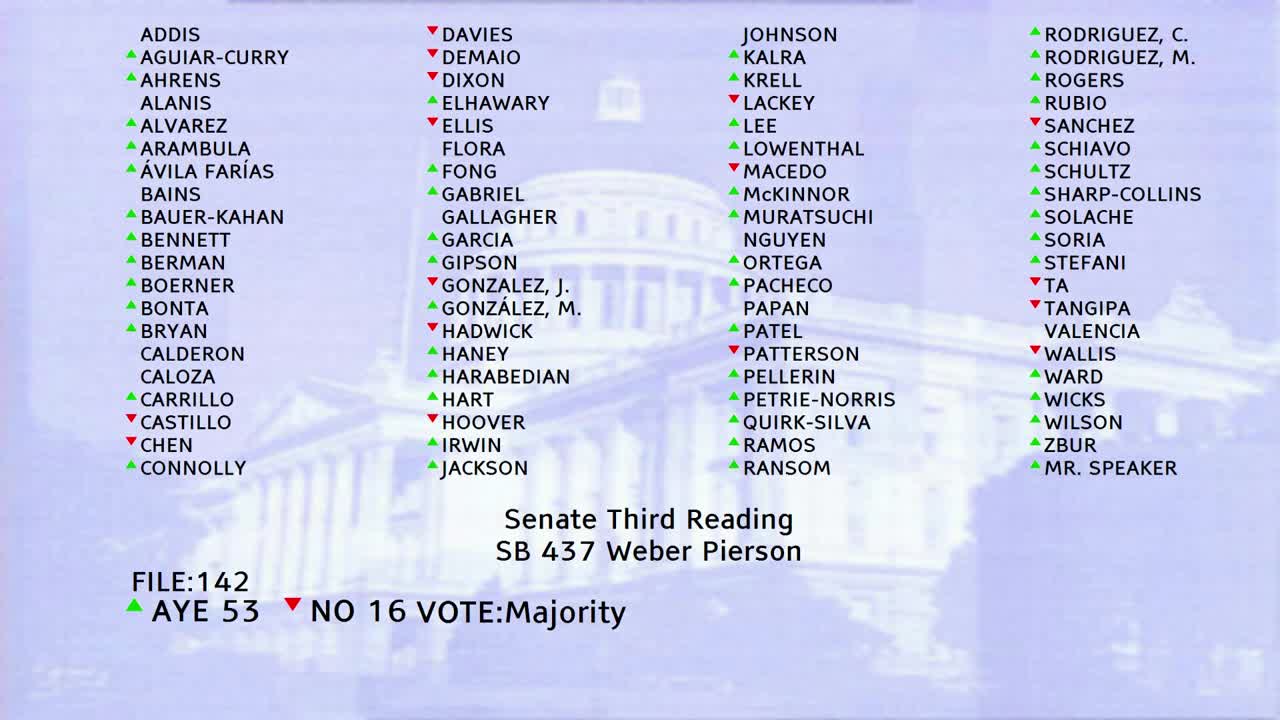 2MIN
Assembly Floor
 9MIN
Assembly Standing Committee on Agriculture
 9MIN
Assembly Standing Committee on Business and Professions
 2MIN
Senate Floor
 4SEC
Senate Standing Committee on Appropriations
 15MIN
Senate Standing Committee on Agriculture
Bill Author









