SB 398: Election crimes: payment based on voting or voter registration.
- Session Year: 2025-2026
- House: Senate
- Latest Version Date: 2025-10-02
Current Status:
Passed
(2025-10-02: Chaptered by Secretary of State. Chapter 246, Statutes of 2025.)
Introduced
In Committee
Awaiting First Chamber Vote
Passed First Chamber
In Committee
Awaiting Second Chamber Vote
Passed Second Chamber
Enacted
Under existing law, it is a crime for a person to receive money or other valuable consideration to assist another to register to vote by receiving the completed affidavit of registration if the person fails to sign the affidavit and include certain other information, including the name and telephone number of the person, company, or organization, if any, that has agreed to pay the money or other valuable consideration.
This bill would make it a crime, punishable by a fine of up to $10,000, imprisonment for up to 3 years, or both, for a person to knowingly or willfully pay or offer to pay money or other valuable consideration to another person with the intent to induce the person to vote or to register to vote, or where the payment is contingent upon whether the person voted or the persons voter registration status. By creating a new crime, this bill would impose a state-mandated local program.
The California Constitution requires the state to reimburse local agencies and school districts for certain costs mandated by the state. Statutory provisions establish procedures for making that reimbursement.
This bill would provide that no reimbursement is required by this act for a specified reason.
Under existing law, it is a crime for a person to receive money or other valuable consideration to assist another to register to vote by receiving the completed affidavit of registration if the person fails to sign the affidavit and include certain other information, including the name and telephone number of the person, company, or organization, if any, that has agreed to pay the money or other valuable consideration.
This bill would make it a crime, punishable by imprisonment for up to 5 years, a fine of up to $10,000, imprisonment for up to 3 years, or both, for a person to knowingly or willfully pay or offer to pay money or other valuable consideration for another person to register to vote. to another person with the intent to induce the person to vote or to register to vote, or where the payment is contingent upon whether the person voted or the persons voter registration status. By creating a new crime, this bill would impose a state-mandated local program.
The California Constitution requires the state to reimburse local agencies and school districts for certain costs mandated by the state. Statutory provisions establish procedures for making that reimbursement.
This bill would provide that no reimbursement is required by this act for a specified reason.
Under existing law, it is a crime for a person to receive money or other valuable consideration to assist another to register to vote by receiving the completed affidavit of registration if the person fails to sign the affidavit and include certain other information, including the name and telephone number of the person, company, or organization, if any, that has agreed to pay the money or other valuable consideration.
This bill would make it a crime, punishable by imprisonment for up to 5 years, a fine of up to $10,000, or both, for a person to knowingly or willfully pay or offer to pay money or other valuable consideration for another person to register to vote. By creating a new crime, this bill would impose a state-mandated local program.
The California Constitution requires the state to reimburse local agencies and school districts for certain costs mandated by the state. Statutory provisions establish procedures for making that reimbursement.
This bill would provide that no reimbursement is required by this act for a specified reason.
(a)(1)A person who knowingly or willfully pays or offers to pay money or other valuable consideration to another person with the intent to induce the person to vote or to register to vote, or where the payment is contingent upon whether the person voted or the persons voter registration status, is guilty of a crime.
(2)For purposes of paragraph (1), other valuable consideration includes, but is not limited to, a chance to win a lottery or similar prize-drawing contest.
(3)This section does not apply to any of the following:
(A)Transportation to or from a voting location.
(B)Compensation provided to an individual by a governmental entity.
(C)Granting time off to an employee to vote.
(b)A violation of subdivision (a) shall be punishable by a fine of up to ten thousand dollars ($10,000), by imprisonment pursuant to subdivision (h) of Section 1170 of the Penal Code for 16 months or two or three years, or in a county jail not exceeding one year, or by both that fine and imprisonment.
SEC. 2.No reimbursement is required by this act pursuant to Section 6 of Article XIIIB of the California Constitution because the only costs that may be incurred by a local agency or school district will be incurred because this act creates a new crime or infraction, eliminates a crime or infraction, or changes the penalty for a crime or infraction, within the meaning of Section 17556 of the Government Code, or changes the definition of a crime within the meaning of Section 6 of Article XIIIB of the California Constitution.
REVISIONS: HeadingLine 3.(a)(1)A person who knowingly or willfully pays or offers to pay money or other valuable consideration for another person to register to vote to another person with the intent to induce the person to vote or to register to vote, or where the payment is contingent upon whether the person voted or the persons voter registration status, is guilty of a crime.
(2)For purposes of paragraph (1), other valuable consideration includes, but is not limited to, a chance to win a lottery or similar prize-drawing contest.
(b)A violation of subdivision (a) shall be punishable by imprisonment for up to five years, a fine of up to ten thousand dollars ($10,000), or both. by imprisonment pursuant to subdivision (h) of Section 1170 of the Penal Code for 16 months or two or three years, or in a county jail not exceeding one year, or by both that fine and imprisonment.
SEC. 2.No reimbursement is required by this act pursuant to Section 6 of Article XIIIB of the California Constitution because the only costs that may be incurred by a local agency or school district will be incurred because this act creates a new crime or infraction, eliminates a crime or infraction, or changes the penalty for a crime or infraction, within the meaning of Section 17556 of the Government Code, or changes the definition of a crime within the meaning of Section 6 of Article XIIIB of the California Constitution.
(a)(1)A person who knowingly or willfully pays or offers to pay money or other valuable consideration for another person to register to vote is guilty of a crime.
(2)For purposes of paragraph (1), other valuable consideration includes, but is not limited to, a chance to win a lottery or similar prize-drawing contest.
(b)A violation of subdivision (a) shall be punishable by imprisonment for up to five years, a fine of up to ten thousand dollars ($10,000), or both.
SEC. 2.No reimbursement is required by this act pursuant to Section 6 of Article XIIIB of the California Constitution because the only costs that may be incurred by a local agency or school district will be incurred because this act creates a new crime or infraction, eliminates a crime or infraction, or changes the penalty for a crime or infraction, within the meaning of Section 17556 of the Government Code, or changes the definition of a crime within the meaning of Section 6 of Article XIIIB of the California Constitution.
|
Date
|
Status
|
|---|---|
| Oct 2, 2025 | Chaptered by Secretary of State. Chapter 246, Statutes of 2025. |
| Oct 2, 2025 | Approved by the Governor. |
| Sep 17, 2025 | Enrolled and presented to the Governor at 2 p.m. |
| Sep 10, 2025 | Assembly amendments concurred in. (Ayes 40. Noes 0. Page 2829.) Ordered to engrossing and enrolling. |
| Sep 8, 2025 | In Senate. Concurrence in Assembly amendments pending. |
| Sep 8, 2025 | Read third time. Passed. (Ayes 79. Noes 0. Page 2993.) Ordered to the Senate. |
| Sep 2, 2025 | Read second time. Ordered to third reading. |
| Aug 29, 2025 | From committee: Do pass. (Ayes 15. Noes 0.) (August 29). |
| Aug 29, 2025 | Coauthors revised. |
| Aug 20, 2025 | August 20 set for first hearing. Placed on APPR. suspense file. |
| Jul 16, 2025 | From committee: Do pass and re-refer to Com. on APPR. (Ayes 9. Noes 0.) (July 15). Re-referred to Com. on APPR. |
| Jul 3, 2025 | Read second time and amended. Re-referred to Com. on PUB. S. |
| Jul 2, 2025 | From committee: Do pass as amended and re-refer to Com. on PUB. S. (Ayes 7. Noes 0.) (July 2). |
| Jun 5, 2025 | Referred to Coms. on ELECTIONS and PUB. S. |
| May 29, 2025 | In Assembly. Read first time. Held at Desk. |
| May 29, 2025 | Read third time. Passed. (Ayes 38. Noes 0. Page 1335.) Ordered to the Assembly. |
| May 23, 2025 | Read second time. Ordered to third reading. |
| May 23, 2025 | From committee: Do pass. (Ayes 6. Noes 0. Page 1199.) (May 23). |
| May 16, 2025 | Set for hearing May 23. |
| May 5, 2025 | May 5 hearing: Placed on APPR. suspense file. |
| Apr 25, 2025 | Set for hearing May 5. |
| Apr 23, 2025 | From committee: Do pass and re-refer to Com. on APPR. (Ayes 6. Noes 0. Page 841.) (April 22). Re-referred to Com. on APPR. |
| Apr 21, 2025 | From committee with author's amendments. Read second time and amended. Re-referred to Com. on PUB. S. |
| Apr 9, 2025 | Set for hearing April 22. |
| Apr 1, 2025 | From committee: Do pass and re-refer to Com. on PUB. S. (Ayes 5. Noes 0. Page 609.) (April 1). Re-referred to Com. on PUB. S. |
| Mar 20, 2025 | Set for hearing April 1. |
| Feb 26, 2025 | Referred to Coms. on E. & C.A. and PUB. S. |
| Feb 18, 2025 | From printer. May be acted upon on or after March 17. |
| Feb 14, 2025 | Introduced. Read first time. To Com. on RLS. for assignment. To print. |
|
Date
|
Description
|
Location
|
Votes
|
|
|---|---|---|---|---|
| Sep 10, 2025 | Unfinished Business SB398 Umberg et al. Concurrence | Senate Floor |
Passed |
|
| Sep 8, 2025 | SB 398 Umberg Senate Third Reading By Berman | Assembly Floor |
Passed |
|
| Aug 29, 2025 | Do pass. | Assembly Standing Committee on Appropriations |
Passed |
|
| Jul 15, 2025 | Do pass and be re-referred to the Committee on [Appropriations] | Assembly Standing Committee on Public Safety |
Passed |
|
| Jul 2, 2025 | Do pass as amended and be re-referred to the Committee on [Public Safety] | Assembly Standing Committee on Elections |
Passed |
|
| May 29, 2025 | Senate 3rd Reading SB398 Umberg et al. | Senate Floor |
Passed |
|
| May 23, 2025 | Do pass | Senate Standing Committee on Appropriations |
Passed |
|
| May 5, 2025 | Placed on suspense file | Senate Standing Committee on Appropriations |
Passed |
|
| Apr 22, 2025 | Do pass, but first be re-referred to the Committee on [Appropriations] | Senate Standing Committee on Public Safety |
Passed |
|
| Apr 1, 2025 | Do pass, but first be re-referred to the Committee on [Public Safety] | Senate Standing Committee on Elections and Constitutional Amendments |
Passed |
This list shows positions taken on this bill by organizations on the date displayed, which is linked to the original source.
Positions by individuals are not included.
|
Organization
|
Position
|
Date
|
|---|---|---|
| California Civil Liberties Advocacy | ** Support | |
| California Clean Money Campaign | ** Support | |
| Election Integrity Project California | ** Support | |
| elections transparency groups | ** Support | |
| Indivisible Ca Statestrong | ** Support | |
| One individual | ** Support | |
| san francisco public defender's office | ** Against |
SENATE RULES COMMITTEE Office of Senate Floor Analyses (916) 651-1520 Fax: (916) 327-4478 | SB 398 |
UNFINISHED BUSINESS
Bill No: SB 398
Author: Umberg (D), et al.
Amended: 7/3/25 in Assembly
Vote: 21
SENATE ELECTIONS & C.A. COMMITTEE: 5-0, 4/1/25
AYES: Cervantes, Choi, Allen, Limón, Umberg
SENATE PUBLIC SAFETY COMMITTEE: 6-0, 4/22/25
AYES: Arreguín, Seyarto, Caballero, Gonzalez, Pérez, Wiener
SENATE APPROPRIATIONS COMMITTEE: 6-0, 5/23/25
AYES: Caballero, Seyarto, Cabaldon, Grayson, Richardson, Wahab
NO VOTE RECORDED: Dahle
SENATE FLOOR: 38-0, 5/29/25
AYES: Allen, Alvarado-Gil, Archuleta, Arreguín, Ashby, Becker, Blakespear, Cabaldon, Caballero, Cervantes, Choi, Cortese, Dahle, Durazo, Gonzalez, Grayson, Grove, Hurtado, Jones, Laird, McGuire, McNerney, Menjivar, Niello, Ochoa Bogh, Padilla, Pérez, Richardson, Rubio, Seyarto, Smallwood-Cuevas, Stern, Strickland, Umberg, Valladares, Wahab, Weber Pierson, Wiener
NO VOTE RECORDED: Limón, Reyes
ASSEMBLY FLOOR: 79-0, 9/8/25 - See last page for vote
SUBJECT: Election crimes: payment based on voting or voter registration
SOURCE: Author
DIGEST:
This bill prohibits a person from paying or offering to pay money or other valuable consideration to another person to register to vote or vote.
Assembly Amendments
of 7/3/25 provided exceptions to the provisions of this bill and added a coauthor.
ANALYSIS:
Existing federal law prohibits a person from paying or offering to pay another person to register to vote, or from accepting payment to register to vote in a federal election.
Existing state law:
- Requires any person who, in exchange for money or other valuable consideration, assists another person to register to vote to provide identifying information about the person, company, or organization, if any, that agrees to pay money or other valuable consideration for the completed affidavit of registration.
- Requires, under state law, a person, company, or other organization that agrees to pay money or other valuable consideration to a person who assists another person to register to vote by assisting to register or by receiving the completed affidavit of registration to maintain records and ensure that the provisions in 1) of existing state law are being followed.
This bill:
- Provides any person who knowingly or willfully pays or offers to pay money or other valuable consideration to another person with the intent to induce the person to vote or to register to vote, or where the payment is contingent upon whether the person voted or the person’s voter registration status, is guilty or a crime.
- Defines “other valuable consideration” to include, but is not limited to, a chance to win a lottery or similar prize-drawing contest.
- Provides that the provisions of this bill do not apply to the following:
- Transportation to or from a voting location.
- Compensation provided to an individual by a governmental entity.
- Granting time off to an employee to vote.
- Provides that a violation is punishable by a fine of up to $10,000, by imprisonment for 16 months or two or three years, or in a county jail not exceeding one year, or by both that fine and imprisonment.
Background
Federal Law. Existing federal law prohibits a person from paying another person for registering to vote in federal elections. This includes elections where a federal office is being considered at a primary, general, or special election.
Generally, a person’s voter registration is valid for every election after following the initial registration if all the other pertinent information (name, address, etc.) remains the same. Voter registrations in California include federal elections because a voter’s registration is maintained beyond one election. As federal law prohibits the payment to a person registering to vote, it is already illegal for this type of transaction to take place.
State Law. Existing state law consists of provisions relating to a person, organization, or other entity paying another person to register voters. This includes what information is collected by the person registering others to vote, how that information is separated, and the timeliness of submitting voter registration affidavits. The law also includes penalties for entities that misrepresent themselves when registering voters or do not comply with the provisions previously mentioned. There is nothing in state law that explicitly prohibits a person from providing compensation to another person to register to vote.
While California does not currently have a crime directed at paying someone to register to vote, it is a crime to pay or provide valuable consideration to a person to induce them to vote for a particular person or measure or to reward them for voting for a particular person or ballot measure. It is also a crime to pay or receive any money or other valuable consideration in order to reward a person or as a reward for voting for or against or agreeing to vote for or against the election or endorsement of any other person as the nominee or candidate of any caucus, convention, organized assemblage of delegates, or other body representing or claiming to represent a political party, candidate, or principle, or any club, society, or association. Both offenses are punishable by imprisonment in the county jail for 16 months, two years, or three years.
America PAC and Recent Elections. During the 2024 presidential election, America PAC announced that it was awarding $1 million per day until Election Day to a voter who signed America PAC’s petition to support the United States Constitution. This was open to registered voters in seven states - Arizona, Georgia, Michigan, Nevada, North Carolina, Pennsylvania, and Wisconsin.
In Pennsylvania, Philadelphia District Attorney Larry Krasner sued to block the effort, alleging that the payouts were an illegal lottery. Judge Angelo J. Foglietta ruled that Krasner failed to establish the three required elements that constitute a lottery: 1) a prize to be won, 2) a winner determined by chance, and 3) a payment of consideration by the player. Judge Foglietta ruled that those selected earned their compensation by agreeing to be a spokesperson for America PAC. It was noted that America PAC selected people using a multi-step process that included reviewing social media posts and meeting in-person to see if the person was a good fit for the role.
In 2025, America PAC used a similar approach in the weeks prior to a state Supreme Court election offering $100 to Wisconsin voters to sign a petition in opposition to “activist judges.”
Comments
Author’s Statement. In October 2024, Elon Musk's America PAC announced a $1 million lottery for individuals in swing states who signed a petition supporting the First and Second Amendments. Despite vote buying being illegal, Musk and the PAC argued that they weren't directly paying people to vote in a specific way. Musk and America PAC claimed legality on the basis that they weren’t technically paying someone to vote in a particular manner. However, it can still be inferred that America PAC created an alluring offer that likely incentivized constituents to register to vote if they had not already done so with a designated swing state.
Related/Prior Legislation
SB 1348 (Battin, Chapter 377, Statutes of 2006) made it a misdemeanor offense, with punishment by a fine of up to $1,000, imprisonment up to six months in county jail, or both for any person to knowingly misrepresent themselves while providing assistance when registering another person to vote, unless certain conditions are met.
SB 1077 (Schiff, Chapter 456, Statutes of 1997) among other provisions, requires individuals or organizations paying to register people to vote to identify and separate submitted affidavits into groups that do and do not comply with specified provisions relating to the completeness of voter registration affidavits. The bill also established penalties for failure to comply.
FISCAL EFFECT: Appropriation: No Fiscal Com.: Yes Local: Yes
According to the Assembly Committee on Appropriations:
- One-time costs of approximately $120,000 to the Secretary of State (SOS) to add and translate information about the new crime to the SOS’s “Guide to Voter Registration Drives” and notices about a voter’s right to time off to vote (General Fund (GF)).
- Ongoing cost pressures (GF or Trial Court Trust Fund (TCTF)) of an unknown, but potentially significant amount, to the trial courts in increased workload, as this bill creates a new crime. A criminal defendant is entitled to no-cost legal representation and a jury trial. It is unclear how many new charges may be filed statewide, but the estimated workload cost of one hour of court time is $1,000. Although courts are not funded on the basis of workload, increased pressure on staff and the TCTF may create a demand for increased court funding from the GF to perform existing duties. The Budget Act of 2025 provides $82 million ongoing GF to the TCTF for court operations.
- Potential ongoing costs to the California Department of Corrections and Rehabilitation (CDCR) (GF) and non-reimbursable costs to county jails, to the extent this bill results in additional incarcerations. Actual costs depend on the number of charges and convictions, defendants’ criminal histories, and judicial discretion, all of which is unknown. The average annual cost to incarcerate a person is approximately $133,000 for CDCR and $29,000 for a county jail. California county jails are increasingly overcrowded. Although new crimes are not considered reimbursable state mandates, overcrowding in county jails creates cost pressure on the GF because the state has historically granted new funding to counties to offset overcrowding after the 2011 Realignment Act.
SUPPORT: (Verified 9/8/25)
California Civil Liberties Advocacy
California Clean Money Campaign
One individual
OPPOSITION: (Verified 9/8/25)
AYES: Addis, Aguiar-Curry, Ahrens, Alanis, Alvarez, Arambula, Ávila Farías, Bains, Bauer-Kahan, Bennett, Berman, Boerner, Bonta, Bryan, Calderon, Caloza, Carrillo, Castillo, Chen, Connolly, Davies, DeMaio, Dixon, Elhawary, Ellis, Flora, Fong, Gabriel, Gallagher, Garcia, Gipson, Jeff Gonzalez, Mark González, Hadwick, Haney, Harabedian, Hart, Hoover, Irwin, Jackson, Johnson, Kalra, Krell, Lackey, Lee, Lowenthal, Macedo, McKinnor, Muratsuchi, Ortega, Pacheco, Papan, Patel, Patterson, Pellerin, Petrie-Norris, Quirk-Silva, Ramos, Ransom, Celeste Rodriguez, Michelle Rodriguez, Rogers, Blanca Rubio, Sanchez, Schiavo, Schultz, Sharp-Collins, Solache, Soria, Stefani, Ta, Tangipa, Valencia, Wallis, Ward, Wicks, Wilson, Zbur, Rivas
NO VOTE RECORDED: Nguyen
Prepared by: Scott Matsumoto / E. & C.A. / (916) 651-4106
9/8/25 19:42:25
**** END ****
SENATE THIRD READING
STR Bill Id:SB 398
Author:(Umberg)
As Amended Ver:July 3, 2025
Majority vote
SUMMARY
Makes it a crime for a person to pay or offer to pay money or other valuable consideration with the intent to induce another person to vote or register to vote, or where the payment is contingent upon whether the person voted or the person's voter registration status.
Major Provisions
- Makes it a crime for a person to knowingly or willfully pay or offer to pay money or other valuable consideration to another person with the intent to induce the person to vote or to register to vote, or where the payment is contingent upon whether the person voted or the person's voter registration status.
- Defines "other valuable consideration," for the purposes of this bill, to include a chance to win a lottery or similar prize-drawing contest, and to exclude certain acts, such as transportation to or from a voting location, compensation provided to an individual by a governmental entity, and granting time off to an employee to vote.
- Provides that a violation of this prohibition is punishable by a fine of up to $10,000, imprisonment for 16 months or two or three years, or in a county jail not exceeding one year, or by both a fine and imprisonment.
COMMENTS
Existing federal law prohibits paying or providing anything of value to any person to register to vote or to vote, or for accepting payment for registering to vote or voting in a federal election. State law prohibits paying or providing anything of value to any person to vote or refrain from voting for a particular candidate or measure. State law does not expressly prohibit providing someone with a thing of value (e.g., a dozen donuts; a chicken dinner) for voting in a local or state election where no federal offices are on the ballot.
A 2017 United States Department of Justice manual on prosecuting election crimes provides that the federal law prohibition on paying or providing anything of value for a person to register to vote or to vote includes any payment "having monetary value, including cash, liquor, lottery chances, and welfare benefits such as food stamps…However, offering free rides to the polls or providing employees paid leave while they vote are not prohibited…Such things are given to make it easier for people to vote, not to induce them to do so. This distinction is important. For an offer or a payment to violate [federal law] it must have been intended to induce or reward the voter for engaging in one or more acts necessary to cast a ballot. [Federal law] does not prohibit offering or giving things having pecuniary value, such as a ride to the polls or time off from work, to help individuals who have already made up their minds to vote to do so."
According to the author, federal law does not expressly prohibit the use of lotteries as a registration incentive and currently no such crime exists at the state level, limiting enforcement only through federal prosecution.
The language of the bill is broad as it not only makes it a crime to pay someone with the intent of inducing them to vote or register to vote, but also where the payment is contingent upon whether the person voted or the person's voter registration status. The broad nature of the prohibition could result in unintended consequences.
Please see the policy committee analysis for a full discussion of this bill.
According to the Author
"In October 2024, Elon Musk's "America PAC" announced a $1 million lottery for individuals in swing states who signed a petition supporting the First and Second Amendments. Despite vote buying being illegal, Musk and the PAC argued that they weren't directly paying people to vote in a specific way. Musk and America PAC claimed legality on the basis that they weren't technically paying someone to vote in a particular manner. However, it can still be inferred that America PAC created an alluring offer that likely incentivized constituents to register to vote if they had not already done so with a designated swing state. Federal law explicitly prohibits anyone from knowingly or willingly paying or offering to pay or accepting payment either for registration to vote or for voting. At the very least, what Elon Musk has done is spit in the face of our forefathers, longstanding campaign ethics, and federal election law. At least we know he's consistent in his blatant disregard for the rule of law. Californians should not tolerate such blatant interference with our elections by wealthy oligarchs like Elon Musk. We need to hold those who seek to bend our institutions to their own selfish whims, accountable. If Mr. Musk wants to muck around in elections ethics, he can try that in Texas. My bill, SB 398 will make it clear that such electioneering is not welcome in California."
Arguments in Support
In support of this bill, California Civil Liberties Advocacy, writes: "SB 398…smartly aligns California law with long-standing federal prohibitions on vote buying (52 U.S.C Section 10307), codifying a consistent legal standard across jurisdictions. The inclusion of calibrated penalties under Penal Code Section 1170(h) reflects a proportionate and practical enforcement model that will not burden counties or over-penalize marginal conduct. By targeting only knowing and willful conduct that crosses the line from civic participation into inducement or conditional compensation, SB 398 preserves the space for nonprofit organizations, educators, and community leaders to promote voter participation through outreach, education, and engagement—without fear of running afoul of vague or overly broad laws."
Arguments in Opposition
In opposition to a previous version of this bill, the San Francisco Public Defender's Office, wrote: "The United States has the highest rate of incarceration in the world – with this nation making up less than 5% of the world's population, but nearly 25% of the world's total prison population. While California has recently made some progress in reducing its incarceration rate, that progress cannot continue if proposals for creating new felonies are passed. California must invest in effective and less expensive ways to ensure that billionaires do not buy elections, such as championing campaign finance reform, increasing transparency, and passing laws that amplify the voices of everyday Californians."
FISCAL COMMENTS
According to the Assembly Appropriations Committee:
- One-time costs of approximately $120,000 to the Secretary of State (SOS) to add and translate information about the new crime to the SOS's "Guide to Voter Registration Drives" and notices about a voter's right to time off to vote (General Fund).
- Ongoing cost pressures (General Fund (GF) or Trial Court Trust Fund (TCTF)) of an unknown, but potentially significant amount, to the trial courts in increased workload, as this bill creates a new crime. A criminal defendant is entitled to no-cost legal representation and a jury trial. It is unclear how many new charges may be filed statewide, but the estimated workload cost of one hour of court time is $1,000. Although courts are not funded on the basis of workload, increased pressure on staff and the TCTF may create a demand for increased court funding from the GF to perform existing duties. The Budget Act of 2025 provides $82 million ongoing GF to the TCTF for court operations.
- Potential ongoing costs to the California Department of Corrections and Rehabilitation (CDCR) (GF) and non-reimbursable costs to county jails, to the extent this bill results in additional incarcerations. Actual costs depend on the number of charges and convictions, defendants’ criminal histories, and judicial discretion, all of which is unknown. The average annual cost to incarcerate a person is approximately $133,000 for CDCR and $29,000 for a county jail. California county jails are increasingly overcrowded. Although new crimes are not considered reimbursable state mandates, overcrowding in county jails creates cost pressure on the GF because the state has historically granted new funding to counties to offset overcrowding after the 2011 Realignment Act.
VOTES
SENATE FLOOR: 38-0-2
YES: Allen, Alvarado-Gil, Archuleta, Arreguín, Ashby, Becker, Blakespear, Cabaldon, Caballero, Cervantes, Choi, Cortese, Dahle, Durazo, Gonzalez, Grayson, Grove, Hurtado, Jones, Laird, McGuire, McNerney, Menjivar, Niello, Ochoa Bogh, Padilla, Pérez, Richardson, Rubio, Seyarto, Smallwood-Cuevas, Stern, Strickland, Umberg, Valladares, Wahab, Weber Pierson, Wiener
ABS, ABST OR NV: Limón, Reyes
ASM ELECTIONS: 7-0-0
YES: Pellerin, Macedo, Bennett, Berman, Solache, Stefani, Tangipa
ASM PUBLIC SAFETY: 9-0-0
YES: Schultz, Alanis, Mark González, Haney, Harabedian, Lackey, Nguyen, Ramos, Sharp-Collins
ASM APPROPRIATIONS: 15-0-0
YES: Wicks, Sanchez, Arambula, Calderon, Caloza, Dixon, Elhawary, Fong, Mark González, Ahrens, Pacheco, Pellerin, Solache, Ta, Tangipa
UPDATED
VERSION: July 3, 2025
CONSULTANT: Nichole Becker / ELECTIONS / (916) 319-2094 FN: 0001364
Date of Hearing: August 20, 2025
ASSEMBLY COMMITTEE ON APPROPRIATIONS
Buffy Wicks, Chair
SBPCA Bill Id:SB 398
Author:(Umberg) – As Amended Ver:July 3, 2025
Policy Committee: | Elections | Vote: | 7 - 0 |
Public Safety | 9 - 0 | ||
|
|
Urgency: No State Mandated Local Program: Yes Reimbursable: No
SUMMARY:
This bill makes it a crime for a person to pay money or other valuable consideration to another person with the intent to induce that person to vote or register to vote.
This bill defines “other valuable consideration” to include a chance to win a lottery or similar prize-drawing contest and exclude certain acts, such as granting time off to an employee to vote. This bill makes the crime punishable by a fine of up to $10,000, imprisonment for up to three years, or both.
FISCAL EFFECT:
- One-time costs of approximately $120,000 to the Secretary of State (SOS) to add and translate information about the new crime to the SOS’s “Guide to Voter Registration Drives” and notices about a voter’s right to time off to vote (General Fund).
- Ongoing cost pressures (General Fund (GF) or Trial Court Trust Fund (TCTF)) of an unknown, but potentially significant amount, to the trial courts in increased workload, as this bill creates a new crime. A criminal defendant is entitled to no-cost legal representation and a jury trial. It is unclear how many new charges may be filed statewide, but the estimated workload cost of one hour of court time is $1,000. Although courts are not funded on the basis of workload, increased pressure on staff and the TCTF may create a demand for increased court funding from the GF to perform existing duties. The Budget Act of 2025 provides $82 million ongoing GF to the TCTF for court operations.
- Potential ongoing costs to the California Department of Corrections and Rehabilitation (CDCR) (GF) and non-reimbursable costs to county jails, to the extent this bill results in additional incarcerations. Actual costs depend on the number of charges and convictions, defendants’ criminal histories, and judicial discretion, all of which is unknown. The average annual cost to incarcerate a person is approximately $133,000 for CDCR and $29,000 for a county jail. California county jails are increasingly overcrowded. Although new crimes are not considered reimbursable state mandates, overcrowding in county jails creates cost pressure on the GF because the state has historically granted new funding to counties to offset overcrowding after the 2011 Realignment Act.
COMMENTS:
- Purpose. According to the author:
In October 2024, Elon Musk’s “America PAC” announced a $1 million lottery for individuals in swing states who signed a petition supporting the First and Second Amendments. Despite vote buying being illegal, Musk and the PAC argued that they weren’t directly paying people to vote in a specific way…However, it can still be inferred that America PAC created an alluring offer that likely incentivized constituents to register to vote if they had not already done so with a designated swing state…My bill, SB 398 will make it clear that such electioneering is not welcome in California.
- Value of a Vote. Existing federal law prohibits paying or providing anything of value to a person to vote or register to vote in a federal election, or accepting any such payment. Existing state law prohibits paying or providing anything of value to a person to vote or refrain from voting for a particular candidate or measure. Thus, state law does not expressly prohibit such payment to a person to generally vote in a local or state election where there is no federal office on the ballot. This bill expands state law to more broadly prohibit a person from paying money or other valuable consideration to another person with the intent to induce the person to vote or register to vote, and specifies that “other valuable consideration” includes a lottery or similar prize-drawing contest.
- Support and Opposition. This bill is co-sponsored by California Civil Liberties Advocacy, which argues this bill “addresses a troubling and increasingly sophisticated trend in electoral politics” that “distort[s] the voluntary nature of civic participation and raise[s] serious questions about fairness, equity, and the potential commodification of voting rights.” This bill is also supported by elections transparency groups.
This bill is opposed by the San Francisco Public Defender’s Office, which argues, “While the bill may be well-intentioned, it creates an unnecessary, new felony within our criminal legal system.”
Analysis Prepared by: Irene Ho / APPR. / (916) 319-2081
Date of Hearing: July 15, 2025
Counsel: Dustin Weber
ASSEMBLY COMMITTEE ON PUBLIC SAFETY
Nick Schultz, Chair
SBPCA Bill Id:SB 398
Author:(Umberg) – As Amended Ver:July 3, 2025
SUMMARY: Makes it a crime for a person to pay money or other valuable consideration to another person in exchange for that person to voting or registering to vote. Specifically, this bill:
- Makes it a crime for a person to knowingly or willfully pay or offer to pay money or other valuable consideration to another person with the intent to induce the person to vote or to register to vote, or where the payment is contingent upon whether the person voted or the person’s voter registration status.
- Makes this crime punishable for 16 months, two years, or three years, or in county jail for up to one year, by a fine of up to $10,000, or by both fine and imprisonment.
- Defines “other valuable consideration” to include, but not be limited to, a chance to win a lottery or similar prize-drawing contest.
- Establishes that this law does not apply to a person transporting someone or from a voting location, compensation provided to an individual by a governmental entity, and granting time off to an employee to vote.
EXISTING FEDERAL LAW:
- Provides that whoever knowingly or willfully pays or offers to pay any person to register to vote or to vote, or accepts payment for registering to vote or voting, shall be fined not more than $10,000, imprisoned not more than five years, or both. (52 U.S.C. § 10307(c).)
- Provides that whoever makes or offers to make an expenditure to any person, either to vote or withhold their vote, or to vote for or against any candidate; and whoever solicits, accepts, or receives any such expenditure in consideration of his vote or the withholding of his vote, shall be fined or imprisoned not more than one year, or both; and if the violation was willful, shall be fined or imprisoned not more than two years, or both. (18 U.S.C. § 597.)
EXISTING STATE LAW:
- Provides that any person who, in exchange for money or other valuable consideration, assists another to register to vote, must provide their identifying information on the affidavit of registration, as well as the identifying information of the person, company, or organization, if any, that agrees to pay money or other valuable consideration for the completed affidavit of registration. (Elec. Code, § 2159, subd. (a).)
- Requires a person, company, or other organization that agrees to pay money or other valuable consideration, to assist another person to register to vote by receiving or assisting with the submission of a completed affidavit to maintain records, as specified. (Elec. Code, § 2159.5.)
- Authorizes the court, for a conviction for any crime punishable by imprisonment in jail or prison in which no fine is prescribed, to impose a fine of up to $1,000 for a misdemeanor or up to $25,000 for a felony, in addition any imprisonment. (Elec. Code, § 18001.)
- Establishes that every person who, in the person’s official capacity, knowingly and fraudulently acts in contravention or violation of any laws relating to elections, is, unless a different punishment is prescribed, punishable by fine not exceeding $1,000 or by imprisonment for 16 months or two or three years, or by both. (Elec. Code, § 18002.)
- States that every person who willfully causes, procures, or allows himself or herself or any other person to be registered as a voter, knowing that they are not entitled to registration, is punishable by an alternate felony/misdemeanor. (Elec. Code, § 18100, subd. (a).)
- Provides that a person who knowingly and willfully signs, or causes or procures the signing of, an affidavit of registration of a nonexistent person, and who mails or delivers, or causes or procures the mailing or delivery of, that affidavit to a county elections official is guilty of a crime punishable as an alternate felony/misdemeanor. (Elec. Code, § 18100, subd. (b).)
- States that every person who knowingly and willfully completes, or causes or procures the completion of, in whole or in part, an affidavit of registration or a voter registration card, with the intent to cause the registration or reregistration as a voter of a fictitious person or of any person who has not requested registration or reregistration as a voter, is guilty of a crime punishable as an alternate felony/misdemeanor. (Elec. Code, § 18101.)
- Provides that knowingly or negligently interfering with the prompt transfer of a completed affidavit of registration to the county elections official, retaining a voter’s completed registration card, without the voter’s authorization, under specified circumstances, or denying a voter the right to return to their completed registration card, is guilty of a misdemeanor punishable by a fine not to exceed $1,000. (Elec. Code, § 18103.)
- Specifies that every person is punishable by an alternate felony/misdemeanor who, without the specific consent of the affiant, willfully and with the intent to affect the affiant’s voting rights, causes, procures, or allows the completion, alteration, or defacement of the affiant’s party affiliation declaration contained in an executed, or partially executed, affidavit of registration, as defined. (Elec. Code, § 18106.)
- States that a person who receives money or other valuable consideration to assist another to register to vote by receiving the completed affidavit of registration from the elector, except as defined, and fails to sign in his or her handwriting and affix directly on the affidavit of registration specified information, is guilty of a misdemeanor punishable by a fine not exceeding $1,000 or by up to one year in county, or both. (Elec. Code, § 18108, subd. (a).)
- Provides that a third or subsequent conviction for the above is punishable by up to $10,000, by up to one year in county jail, or by both. (Elec. Code, § 18108, subd. (b).)
- States that a person who receives money or other valuable consideration to assist another to register to vote by receiving the completed affidavit of registration from the elector, except as defined, and knowingly misrepresents himself or herself as having helped register another to vote on a registration form, as defined, is guilty of a misdemeanor punishable by a fine of up to $1,000, by up to six months in county jail, or by both. (Elec. Code, § 18108.1, subd. (a).)
- Provides that a third or subsequent conviction for the above is punishable by a fine of up to $10,000, by up to one year in county jail, or by both. (Elec. Code, § 18108.1, subd. (b).)
- Provides that a person, company, or other organization that agrees to pay money or other valuable consideration, whether on a per-affidavit basis or otherwise, to a person who assists another person to register to vote by receiving the completed affidavit of registration, or by assisting with the submission of an affidavit of registration electronically, who fails to sign in his or her handwriting and affix directly on the affidavit of registration specified information, is guilty of a misdemeanor punishable by a fine of up to $1,000, by up to one year in county jail, or by both. (Elec. Code, § 18108.5, subd. (a).)
- Specifies that a third or subsequent conviction of the above is punishable by a fine of up to $10,000, by up to one year in county jail, or by both. (Elec. Code, § 18108.5, subd. (b).)
- States that any person who commits fraud or attempts to commit fraud, and any person who aids or abets fraud or attempts to aid or abet fraud, in connection with any vote cast, to be cast, or attempted to be cast, is guilty of a felony punishable by imprisonment for 16 months or two years or three years. (Elec. Code, § 18500.)
- Makes it an alternate felony/misdemeanor for a person to directly or through another person give, offer, or promise any office, place, or employment, or promise to procure or endeavor to procure any office, place, or employment to or for any voter, or to or for any other person, in order to induce that voter at any election to refrain from voting, vote for any particular person, or refrain from voting for any particular person. (Elec. Code, § 18520.)
- Makes it an alternate felony/misdemeanor for a person to directly or through any other person receive, agree, or contract for, before, during or after an election, any money, gift, loan, or other valuable consideration, office, place, or employment for himself or any other person because he or any other person voted, agreed to vote, refrained from voting, or agreed to refrain from voting; remained away from the polls; refrained or agreed to refrain from voting; or induced any other person from any of the above. (Elec. Code, § 18521.)
- Makes it an alternate felony/misdemeanor for a person or a controlled committee to directly or through any other person or controlled committee pay, lend, or contribute, or offer or promise to pay, lend, or contribute, any money or other valuable consideration to or for any voter or to or for any other person to induce or reward any voter for refraining from voting at any election, voting or refraining from voting at an election for any particular person or measure, or remaining away from the polls at an election. (Elec. Code, § 18522.)
- Makes it an alternate felony/misdemeanor for a person to directly or through any other person advance or pay, or cause to be paid, any money or other valuable thing to or for the use of any other person, with the intent that it, or any part thereof, shall be used in bribery at any election, or knowingly pay or cause to be paid any money or other valuable thing to any person in discharge or repayment of any money, wholly or in part, expended in bribery at any election. (Elec. Code, § 18523.)
- Makes it an alternate felony/misdemeanor for a person to directly or through any other person advance or pay, or cause to be paid, any money or other valuable thing to or for the use of any other person, with the intent that it, or any part thereof, will be used for boarding, lodging, or maintaining a person at any place or domicile in any election precinct, ward, or district, with intent to secure the vote of that person or to induce that person to vote for any particular person or measure. (Elec. Code, § 18524.)
FISCAL EFFECT: Unknown.
COMMENTS:
- Author’s Statement: According to the author, “In October 2024, Elon Musk's ‘America PAC’ announced a $1 million lottery for individuals in swing states who signed a petition supporting the First and Second Amendments. Despite vote buying being illegal, Musk and the PAC argued that they weren't directly paying people to vote in a specific way. Musk and America PAC claimed legality on the basis that they weren’t technically paying someone to vote in a particular manner. However, it can still be inferred that America PAC created an alluring offer that likely incentivized constituents to register to vote if they had not already done so with a designated swing state. Federal law explicitly prohibits anyone from knowingly or willingly paying or offering to pay or accepting payment either for registration to vote or for voting. At the very least, what Elon Musk has done is spit in the face of our forefathers, longstanding campaign ethics, and federal election law. At least we know he’s consistent in his blatant disregard for the rule of law. Californians should not tolerate such blatant interference with our elections by wealthy oligarchs like Elon Musk. We need to hold those who seek to bend our institutions to their own selfish whims, accountable. If Mr. Musk wants to muck around in elections ethics, he can try that in Texas. My bill, SB 398 will make it clear that such electioneering is not welcome in California.”
- Effect of the Bill: This bill would clarify that existing prohibitions against providing consideration to a person as a means of inducing them to vote or for actually voting includes lotteries or other prize-drawing style contests.
The ability for the American people to choose their leaders through a confidential and secure voting process is sacrosanct. Despite attacks on this process by some officials, including some elected through our democratic process, we had a relatively long history of confidence in the veracity of the outcomes and mostly peaceful transfers of power.[1] At the dawn of Civil Rights era, in 1960, President Dwight Eisenhower said, “In the long perspective of history, the right to vote has been one of the strongest pillars of a free society. Our first duty is to protect this right against all encroachment.”[2] Restoring voter confidence in elections is essential to the success of our experiment in self-government.[3] This bill attempts to protect Californians’ right to freely and securely vote by prohibiting rewarding actual or likely voters through a lottery or contest.
During the 2024 U.S. Presidential Election, billionaire Elon Musk’s political action committee “America PAC” announced that it was giving away $1 million per day to registered voters in swing states who signed his petition supporting the First and Second Amendments.[4] As one scholar noted, “The law prohibits paying people to vote, to register to vote, or to vote in a particular way or not in a federal election. This is none of those things.”[5] In Pennsylvania, the Philadelphia District Attorney tried suing to block America PAC’s effort alleging that the payouts were an illegal lottery, but he was unsuccessful.[6] Two weeks prior to a state Supreme Court election, Musk’s group was using a nearly identical tactic, offering $100 to Wisconsin voters to sign a petition in opposition to “activist judges.”[7]
According to information provided by the author’s office: “Musk and America PAC claimed legality on the basis that they weren’t technically paying someone to vote in a particular manner. However, it can still be inferred that the America PAC created an alluring offer that likely incentivized constituents to register to vote if they had not already done so with a designated swing state . . . Currently, the problem is that no such crime exists at the state level, limiting enforcements only through federal prosecution.”
While California does not currently have a crime on the books squarely directed at prohibiting the type of behavior engaged in by Elon Musk, under California law it is a crime to pay or provide valuable consideration to a person to induce them to vote for a particular person or measure or to reward them for voting for a particular person or measure. (Elec. Code, §§ 18520-18521.) It is also a crime to pay or receive any money or other valuable consideration in order to reward a person or as a reward for voting for or against or agreeing to vote for or against the election or endorsement of any other person as the nominee or candidate of any caucus, convention, organized assemblage of delegates, or other body representing or claiming to represent a political party, candidate, or principle, or any club, society, or association. (Elec. Code, § 18522.) Both offenses are punishable by imprisonment in the county jail for 16 months, two years, or three years. (Ibid.)
This bill expands on these provisions to prohibit paying money or other valuable consideration to a person with the intent to induce them to vote or where the payment is contingent upon them voting, irrespective of whether they vote for a particular person or measure. This bill also prohibits paying money or valuable consideration to a person with the intent to induce them to register to vote or where the payment is contingent on them registering to vote. This bill would, however, would not apply to a person transporting someone or from a voting location, compensation provided to an individual by a governmental entity, or an employer granting time off to an employee to vote. While this bill expands current prohibitions on paying someone to vote and prohibits paying someone to register to vote, to capture what Musk and America-PAC did under this bill, it will be necessary to show it was done with the intent to induce someone to vote or register to vote.
Also, while this bill specifies that a “lottery or similar prize-drawing contest” is valuable consideration for purposes of inducing votes or registration, as noted above, a Philadelphia judge concluded that what Musk and America PAC did was not an illegal lottery.[8]
- Argument in Support: According to California Clean Money Campaign, “I am writing to express strong support for SB 398 (Umberg) to criminalize the use of lotteries or similar prize-drawing contests as incentives for voter registration.
“One of the cornerstones of our democracy is the principle that no one should be allowed to buy votes. Federal law prohibits offering payments in exchange for registering to vote or for voting. However, it does not explicitly ban the use of lotteries as incentives for voter registration. This loophole has recently been exploited.
“During the 2024 U.S. Presidential Election, Elon Musk’s “America PAC” conducted a $1 million lottery for individuals in swing states who signed a petition under the guise of supporting the First and Second Amendments of the U.S. Constitution. Voter registration in a swing state was a prerequisite for entry. In March, America PAC offered Wisconsin registered voters entry into another $1 million lottery for signing a petition against “activist judges” in a transparent attempt to influence voter registration ahead of Wisconsin’s highly contested Supreme Court race. Elon Musk then tweeted (but took down) that anyone who voted in the election would be eligible to attend his event where they would be eligible for two more $1 million lottery prizes.
“SB 398 closes these loopholes in California by making offering to pay money or other valuable consideration for another person to register to vote a crime in California and by explicitly counting giving voters “a chance to win a lottery or similar prize-drawing contest” as a violation.
“As now amended, SB 398 also includes offering such monetary compensation based on whether the person voted or the person’s voter registration status, which addresses the types of petitions and offers made by America PAC and Elon Musk. Under SB 398, knowingly or willfully offering such incentives for voter registration would be punishable by imprisonment for up to three years and/or a fine of up to $10,000, conforming to Section 1170 of the Penal Code.
“Neither billionaires nor anyone else should be able to circumvent federal bans on payments for voter registration by offering lotteries or prize-drawing contests to individuals likely to hold certain political views. SB 398 is thus a critical addition to California law to ensure this practice is prohibited.”
- Argument in Opposition: According to the San Francisco Public Defender’s Office, “I write in respectful opposition to SB 398 (Umberg). While the bill may be well-intentioned, it creates an unnecessary, new felony within our criminal legal system…
“The United States has the highest rate of incarceration in the world – with this nation making up less than 5% of the world’s population, but nearly 25% of the world’s total prison population. While California has recently made some progress in reducing its incarceration rate, that progress cannot continue if proposals for creating new felonies are passed.
“California must invest in effective and less expensive ways to ensure that billionaires do not buy elections, such as championing campaign finance reform, increasing transparency, and passing laws that amplify the voices of everyday Californians.”
- Prior Legislation:
- AB 2839 (Pellerin), Chapter 262, Statutes of 2024, would prohibit a person, committee, or other entity from knowingly distributing an advertisement or other election communication that contains certain materially deceptive content with malice, as defined, subject to specified exemptions.
- AB 2642 (Berman), Chapter 533, Statutes of 2024, would prohibit a person from intimidating, threatening, or coercing, or attempting to intimidate, threaten, or coerce, any other person for engaging in specified election-related activities.
REGISTERED SUPPORT / OPPOSITION:
Support
California Civil Liberties Advocacy
California Clean Money Campaign
Election Integrity Project California
Indivisible CA Statestrong
Oppose
San Francisco Public Defender
Analysis Prepared by: Dustin Weber / PUB. S. / (916) 319-3744
See The 2020-21 Presidential Transition: Lessons Learned and Recommendations (Jan. 20, 2022) Center for Presidential Transition <https://presidentialtransition.org/reports-publications/2020-21-lessons-learned/> [as of June 30, 2025]. ↑
Annual Message to the Congress on the State of the Union, The American Presidency Project (Jan. 7, 1960) < https://www.presidency.ucsb.edu/documents/annual-message-the-congress-the-state-the-union-6> [as of June 5, 2025]. ↑
See Cain and Ginsberg, Restoring Confidence in American Elections (June 2024) Hoover Institution at Stanford University <https://www.hoover.org/sites/default/files/research/docs/Restoring_Confidence_in_American_Elections.pdf> [as of June 30, 2024]. ↑
Renshaw, Elon Musk’s Election promise of $1 million daily giveaway sparks call for probe (Oct. 20, 2024) Reuters <https://www.reuters.com/world/us/elon-musk-promises-award-1-mln-each-day-signer-his-petition-2024-10-20/> [as of June 30, 2025]. ↑
Tenbarge, Elon Musk’s PAC offers $47 payouts to refer swing state voters to sign petition <https://www.nbcnews.com/tech/tech-news/musk-pac-signature-47-pay-refer-swing-state-voters-sign-petition-rcna174310> [as of June 30, 2025]. ↑
Tanenbaum, Judge dismisses Philly DA Larry Krasner’s lawsuit challenging Elon Musk’s $1 million giveaways <https://www.phillyvoice.com/elon-musk-lottery-america-pac-random-court-philadelphia-krasner/> [as of June 30, 2025]. ↑
Bauer, Musk group offers $100 to Wisconsin voters ahead of pivotal state Supreme Court election <https://apnews.com/article/wisconsin-supreme-court-musk-trump-b9be6119d500bdacc9c6341be013cd62> [as of June 30, 2025]. ↑
Dale, Philly DA failed to show that Elon Musk's voter sweepstakes was illegal: Judge (Nov. 13, 2024) NBC News Philadelphia <https://www.nbcphiladelphia.com/news/local/philly-da-failed-to-show-that-elon-musks-voter-sweepstakes-was-illegal-judge/4027537/> [as of June 30, 2025]. ↑
SENATE RULES COMMITTEE Office of Senate Floor Analyses (916) 651-1520 Fax: (916) 327-4478 | SB 398 |
THIRD READING
Bill No: SB 398
Author: Umberg (D), et al.
Amended: 4/21/25
Vote: 21
SENATE ELECTIONS & C.A. COMMITTEE: 5-0, 4/1/25
AYES: Cervantes, Choi, Allen, Limón, Umberg
SENATE PUBLIC SAFETY COMMITTEE: 6-0, 4/22/25
AYES: Arreguín, Seyarto, Caballero, Gonzalez, Pérez, Wiener
SENATE APPROPRIATIONS COMMITTEE: 6-0, 5/23/25
AYES: Caballero, Seyarto, Cabaldon, Grayson, Richardson, Wahab
NO VOTE RECORDED: Dahle
SUBJECT: Election crimes: payment based on voting or voter registration
SOURCE: Author
DIGEST:
This bill prohibits a person from paying or offering to pay money or other valuable consideration to another person to register to vote or vote.
ANALYSIS:
Existing federal law:
- Prohibits a person from paying or offering to pay another person to register to vote, or from accepting payment to register to vote in a federal election.
Existing state law:
- Requires any person who, in exchange for money or other valuable consideration, assists another person to register to vote to provide identifying information about the person, company, or organization, if any, that agrees to pay money or other valuable consideration for the completed affidavit of registration.
- Requires, under state law, a person, company, or other organization that agrees to pay money or other valuable consideration to a person who assists another person to register to vote by assisting to register or by receiving the completed affidavit of registration to maintain records and ensure that the provisions in existing state law 1) are being followed.
This bill:
- Provides any person who knowingly or willfully pays or offers to pay money or other valuable consideration for another person with the intent to induce the person to vote or to register to vote, or where the payment is contingent upon whether the person voted or the person’s voter registration status, is guilty or a crime.
- Defines “other valuable consideration” to include, but is not limited to, a chance to win a lottery or similar prize-drawing contest.
- Provides that a violation is punishable by a fine of up to $10,000, by imprisonment for 16 months or two or three years, or in a county jail not exceeding one year, or by both that fine and imprisonment.
Background
Federal Law. Existing federal law prohibits a person from paying another person for registering to vote in federal elections. This includes elections where a federal office is being considered at a primary, general, or special election.
Generally, a person’s voter registration is valid for every election after following the initial registration if all the other pertinent information (name, address, etc.) remains the same. Voter registrations in California include federal elections because a voter’s registration is maintained beyond one election. As federal law prohibits the payment to a person registering to vote, it is already illegal for this type of transaction to take place.
State Law. Existing state law consists of provisions relating to a person, organization, or other entity paying another person to register voters. This includes what information is collected by the person registering others to vote, how that information is separated, and the timeliness of submitting voter registration affidavits. The law also includes penalties for entities that misrepresent themselves when registering voters or do not comply with the provisions previously mentioned. There is nothing in state law that explicitly prohibits a person from providing compensation to another person to register to vote.
While California does not currently have a crime directed at paying someone to register to vote, it is a crime to pay or provide valuable consideration to a person to induce them to vote for a particular person or measure or to reward them for voting for a particular person or ballot measure. It is also a crime to pay or receive any money or other valuable consideration in order to reward a person or as a reward for voting for or against or agreeing to vote for or against the election or endorsement of any other person as the nominee or candidate of any caucus, convention, organized assemblage of delegates, or other body representing or claiming to represent a political party, candidate, or principle, or any club, society, or association. Both offenses are punishable by imprisonment in the county jail for 16 months, two years, or three years.
America PAC and Recent Elections. During the 2024 presidential election, America PAC announced that it was awarding $1 million per day until Election Day to a voter who signed America PAC’s petition to support the United States Constitution. This was open to registered voters in seven states - Arizona, Georgia, Michigan, Nevada, North Carolina, Pennsylvania, and Wisconsin.
In Pennsylvania, Philadelphia District Attorney Larry Krasner sued to block the effort, alleging that the payouts were an illegal lottery. Judge Angelo J. Foglietta ruled that Krasner failed to establish the three required elements that constitute a lottery: 1) a prize to be won, 2) a winner determined by chance, and 3) a payment of consideration by the player. Judge Foglietta ruled that those selected earned their compensation by agreeing to be a spokesperson for America PAC. It was noted that America PAC selected people using a multi-step process that included reviewing social media posts and meeting in-person to see if the person was a good fit for the role.
In 2025, America PAC used a similar approach in the weeks prior to a state Supreme Court election offering $100 to Wisconsin voters to sign a petition in opposition to “activist judges.”
Comments
Author’s Statement. In October 2024, Elon Musk's America PAC announced a $1 million lottery for individuals in swing states who signed a petition supporting the First and Second Amendments. Despite vote buying being illegal, Musk and the PAC argued that they weren't directly paying people to vote in a specific way. Musk and America PAC claimed legality on the basis that they weren’t technically paying someone to vote in a particular manner. However, it can still be inferred that America PAC created an alluring offer that likely incentivized constituents to register to vote if they had not already done so with a designated swing state.
Related/Prior Legislation
SB 1348 (Battin, Chapter 377, Statutes of 2006) made it a misdemeanor offense, with punishment by a fine of up to $1,000, imprisonment up to six months in county jail, or both for any person to knowingly misrepresent themselves while providing assistance when registering another person to vote, unless certain conditions are met.
SB 1077 (Schiff, Chapter 456, Statutes of 1997) among other provisions, requires individuals or organizations paying to register people to vote to identify and separate submitted affidavits into groups that do and do not comply with specified provisions relating to the completeness of voter registration affidavits. The bill also established penalties for failure to comply.
FISCAL EFFECT: Appropriation: No Fiscal Com.: Yes Local: Yes
According to the Senate Committee on Appropriations:
- The Secretary of State (SOS) indicates that this bill could potentially result in a one-time cost of $107,000 from increased printing costs. SOS indicates that it would have to add the punitive provisions and specific restrictions for lotteries and contests for prize giveaways to the Guide to Voter Registration Drives to ensure that anyone conducting outreach events is aware of the new restrictions.
If this update occurred during the course of normal operations due to other legislative changes, the bill would not result in new costs. However, if no other changes were required, and SOS has to replace the existing publication stock to notify voters of the bill’s changes, then publication costs would be $107,000 (General Fund).
- Violations of this bill’s provisions could result in an increase in penalty revenue; the magnitude is unknown.
- Violations could also result in unknown, potentially significant costs (local funds, General Fund) to the counties to incarcerate people for the crime created by this bill. The average annual cost to incarcerate one person in county jail is approximately $77,000 per year. Actual incarceration costs to counties would depend on the number of convictions and the length of each sentence. Although county incarceration costs are generally not considered reimbursable state mandates pursuant to Proposition 30 (2012), overcrowding in county jails creates cost pressure on the General Fund because the State has historically granted new funding to counties to offset overcrowding resulting from 2011 public safety realignment.
SUPPORT: (Verified 5/23/25)
California Civil Liberties Advocacy
California Clean Money Campaign
OPPOSITION: (Verified 5/23/25)
Prepared by: Scott Matsumoto / E. & C.A. / (916) 651-4106
5/25/25 16:47:47
**** END ****
SENATE COMMITTEE ON
Senator Anna Caballero, Chair
2025 - 2026 Regular Session
SB 398 (Umberg) - Election crimes: payment based on voting or voter registration
Version: | Policy Vote: |
Urgency: | Mandate: |
Hearing Date: | Consultant: |
Bill Summary:
SB 398 would prohibit a person from paying another person to register to vote.
Fiscal Impact:
- The Secretary of State (SOS) indicates that this bill could potentially result in a one-time cost of $107,000 from increased printing costs. SOS indicates that it would have to add the punitive provisions and specific restrictions for lotteries and contests for prize giveaways to the Guide to Voter Registration Drives to ensure that anyone conducting outreach events is aware of the new restrictions.
If this update occurred during the course of normal operations due to other legislative changes, the bill would not result in new costs. However, if no other changes were required, and SOS has to replace the existing publication stock to notify voters of the bill’s changes, then publication costs would be $107,000 (General Fund).
- Violations of this bill’s provisions could result in an increase in penalty revenue; the magnitude is unknown.
- Violations could also result in unknown, potentially significant costs (local funds, General Fund) to the counties to incarcerate people for the crime created by this bill. The average annual cost to incarcerate one person in county jail is approximately $77,000 per year. Actual incarceration costs to counties would depend on the number of convictions and the length of each sentence. Although county incarceration costs are generally not considered reimbursable state mandates pursuant to Proposition 30 (2012), overcrowding in county jails creates cost pressure on the General Fund because the State has historically granted new funding to counties to offset overcrowding resulting from 2011 public safety realignment.
Background:
Under federal law, a person is prohibited from paying or offering to pay another person to register to vote, or from accepting payment to register to vote in a federal election. This includes elections where a federal office is being considered at a primary, general, or special election. State law does not explicitly prohibit a person from providing compensation to another person to register to vote.
During the 2024 presidential election, America PAC announced that it was awarding $1 million per day until Election Day to a voter who signed its petition to support the United States Constitution. This was open to registered voters in seven states - Arizona, Georgia, Michigan, Nevada, North Carolina, Pennsylvania, and Wisconsin.
Proposed Law:
This bill would do the following:
- Provide any person who knowingly or willfully pays or offers to pay money or other valuable consideration to another person with the intent to induce the person to vote or to register to vote, or where the payment is contingent upon whether the person voted or the person’s voter registration status, is guilty of a crime.
- Define "other valuable consideration" to include, but is not limited to, a chance to win a lottery or similar prize-drawing contest.
- Provide that a violation is punishable by imprisonment for up to three years, a fine of up to $10,000, or both.
Related Legislation:
- SB 1348 (Battin, Chapter 377, Statutes of 2006) made it a misdemeanor offense, with punishment by a fine of up to $1,000, imprisonment up to six months in county jail, or both for any person to knowingly misrepresent themselves while providing assistance when registering another person to vote, unless certain conditions are met.
- SB 1077 (Schiff, Chapter 456, Statutes of 1997), among other provisions, requires individuals or organizations paying to register people to vote to identify and separate submitted affidavits into groups that do and do not comply with specified provisions relating to the completeness of voter registration affidavits. The bill also established penalties for failure to comply.
Staff Comments:
Any local government costs resulting from the mandate in this measure are not state-reimbursable because the mandate only involves the definition of a crime or the penalty for conviction of a crime.
-- END --
SENATE COMMITTEE ON PUBLIC SAFETY
Senator Jesse Arreguín, Chair
2025 - 2026 Regular
Bill No: SB 398 Hearing Date: April 22, 2025
Author: | Umberg | ||
Version: | April 21, 2025 | ||
Urgency: | No | Fiscal: | Yes |
Consultant: | CA | ||
Subject: Voter registration
HISTORY
Source: California Civil Liberties Advocacy
Prior Legislation: SB 1348 (Battin), Ch. 377, Stats. of 2006
SB 1077 (Schiff), Ch. 456, Stats. of 1997
Support: California Clean Money Campaign
Opposition: San Francisco Public Defender
PURPOSE
The purpose of this bill is to prohibit a person from paying or offering to pay money or other valuable consideration with the intent to induce another person to vote or register to vote.
Existing federal law provides that whoever knowingly or willfully pays or offers to pay any person to register to vote or to vote, or accepts payment for registering to vote or voting, shall be fined not more than $10,000, imprisoned not more than five years, or both. This provision is applicable only to general, special, or primary elections held solely or in part for the purpose of selecting or electing any candidate for the office of President, Vice President, presidential elector, Member of the United States Senate, Member of the United States House of Representatives, Delegate from the District of Columbia, Guam, or the Virgin Islands, or Resident Commissioner of the Commonwealth of Puerto Rico. (52 U.S.C.S. § 10307, subd. (c) (former 42 U.S.C.S. § 1973i, subd. (c)).)
Existing federal law provides that whoever makes or offers to make an expenditure to any person, either to vote or withhold their vote, or to vote for or against any candidate; and whoever solicits, accepts, or receives any such expenditure in consideration of his vote or the withholding of his vote shall be fined or imprisoned not more than one year, or both; and if the violation was willful, shall be fined or imprisoned not more than two years, or both. (18 U.S.C.S. § 597.)
Existing law prohibits a person from directly or through any other person receiving, agreeing, or contracting for, before, during or after an election, any money, gift, loan, or other valuable consideration, office, place, or employment for themselves or any other person because they or any other person:
- Voted, agreed to vote, refrained from voting, or agreed to refrain from voting for any particular person or measure;
- Remained away from the polls;
- Refrained or agreed to refrain from voting; or,
- Induced any other person to:
- Remain away from the polls;
- Refrain from voting; or,
- Vote or refrain from voting for any particular person or measure. (Elec. Code, § 18521.)
Existing law makes the above offense punishable by imprisonment in a county jail for 16 months, two, or three years. (Elec. Code, § 18521.)
Existing law prohibits a person from directly or through another person giving, offering, or promising any office, place, or employment, or promise to procure or endeavor to procure any office, place, or employment to or for any voter, or to or for any other person, in order to induce that voter at any election to:
- Refrain from voting;
- Vote for a particular person; or,
- Refrain from voting for any particular person. (Elec. Code, § 18520.)
Existing law makes the above offense punishable by imprisonment in a county jail for 16 months, two, or three years. (Elec. Code, § 18520.)
Existing law prohibits a person or controlled committee from directly or through any other person or controlled committee paying, lending, or contributing, or offering or promising to pay, lend, or contribute, any money or other valuable consideration to or for any voter or to or for any other person to:
- Induce any voter to:
- Refrain from voting at any election;
- Vote or refrain from voting at an election for any particular person or measure; or,
- Remain away from polls at an election; or,
- Reward any voter for having:
- Voted for any particular person or measure;
- Refrained from voting for any particular person or measure; or,
- Remand away from the polls at an election. (Elec. Code, § 18522.)
Existing law makes the above offense punishable by imprisonment in a county jail for 16 months, two, or three years. (Elec. Code, § 18522.)
Existing law provides that any person who, in exchange for money or other valuable consideration, assists another to register to vote, must provide their identifying information on the affidavit of registration, as well as the identifying information of the person, company, or organization, if any, that agrees to pay money or other valuable consideration for the completed affidavit of registration. Failure to comply does not invalidate the voter registration. (Elec. Code, § 2159, subd. (a).)
Existing law provides that any person, who in exchange for money or other valuable consideration, assists another to register to vote by receiving the completed affidavit of registration and knowingly misrepresents themselves as having helped register another on a registration form is guilty of a misdemeanor punishable by a fine not exceeding $1,000 dollars, by imprisonment in the county jail not exceeding six months, or by both upon a first or second conviction, and by a fine of up to $10,000, by imprisonment in the county jail not exceeding one year, or both upon a third or subsequent conviction. (Elec. Code, §§ 2159, subd. (b), 18108.1, subds. (a) & (b).)
Existing law exempts from the above prohibition a public agency or its employees that is designated as a voter registration agency pursuant to the federal National Voter Registration Act of 1993 (52 U.S.C. Sec. 20501 et seq.), if an elector asks for assistance to register to vote during the course and scope of the agency’s normal business. (Elec. Code, § 18108.1, subd. (c).)
Existing law requires a person, company, or other organization that agrees to pay money or other valuable consideration, to assist another person to register to vote by receiving or assisting with submitting the completed affidavit to maintain records, as specified. Failure to comply does not invalidate the voter registration. (Elec. Code, § 2159.5.)
This bill provides that any person who knowingly or willfully pays or offers to pay money or other valuable consideration for another person with the intent to induce the person to vote or to register to vote, or where the payment is contingent upon whether the person voted or the person’s voter registration status, is guilty of a crime.
This bill states “other valuable consideration” includes, but is not limited to, a chance to win a lottery or similar prize-draying contest.
This bill makes the offense punishable by a fine up to $10,000, or by imprisonment in the county jail not exceeding one year, or by imprisonment in the county jail for 16 months, two years, or three years, or by both that fine and imprisonment.
COMMENTS
- Need for This Bill
According to the Author:
In October 2024, Elon Musk's "America PAC" announced a $1 million lottery for individuals in swing states who signed a petition supporting the First and Second Amendments. Despite vote buying being illegal, Musk and the PAC argued that they weren't directly paying people to vote in a specific way. Musk and America PAC claimed legality on the basis that they weren’t technically paying someone to vote in a particular manner. However, it can still be inferred that America PAC created an alluring offer that likely incentivized constituents to register to vote if they had not already done so with a designated swing state. Federal law explicitly prohibits anyone from knowingly or willingly paying or offering to pay or accepting payment either for registration to vote or for voting. At the very least, what Elon Musk has done is spit in the face of our forefathers, longstanding campaign ethics, and federal election law. At least we know he’s consistent in his blatant disregard for the rule of law. Californians should not tolerate such blatant interference with our elections by wealthy oligarchs like Elon Musk. We need to hold those who seek to bend our institutions to their own selfish whims, accountable. If Mr. Musk wants to muck around in elections ethics, he can try that in Texas. My bill, SB 398 will make it clear that such electioneering is not welcome in California.
- America PAC and the 2024 Presidential Election
During the 2024 U.S. Presidential Election, billionaire Elon Musk’s political action committee “America PAC” announced that it was giving away $1 million per day until election day to registered voters in swing states who signed his petition supporting the First and Second Amendments. (https://www.reuters.com/world/us/elon-musk-promises-award-1-mln-each-day-signer-his-petition-2024-10-20/ [as of April 10, 2025].)
As noted by a UCLA law professor, “‘The law prohibits paying people to vote, to register to vote, or to vote in a particular way or not in a federal election. This is none of those things.’” (https://www.nbcnews.com/tech/tech-news/musk-pac-signature-47-pay-refer-swing-state-voters-sign-petition-rcna174310 [as of April 10, 2025].)
In Pennsylvania, the Philadelphia District Attorney tried suing to block America PAC’s effort alleging that the payouts were an illegal lottery. The judge ruled that the district attorney had failed to establish the three required elements that constitute a lottery: 1) a prize to be won, 2) a winner determined by chance, and 3) a payment of consideration by the player. The judge ruled that those selected earned their compensation by agreeing to be a spokesperson for America PAC. It was noted that America PAC selected people using a multi-step process that included reviewing social media posts and meeting in-person to see if the person was a good fit for the role. (https://www.phillyvoice.com/elon-musk-lottery-america-pac-random-court-philadelphia-krasner/ [as of April 10, 2025]; file:///C:/Users/anderscr/Downloads/183454-krasnervmusketalfindingsoffactandconclusionsoflaw.pdf [as of April 10, 2025].)
Two weeks prior to a state Supreme Court election, Musk’s group was using a nearly identical tactic, offering $100 to Wisconsin voters to sign a petition in opposition to “activist judges.” (https://apnews.com/article/wisconsin-supreme-court-musk-trump-b9be6119d500bdacc9c6341be013cd62 [as of April 10, 2025].)
According to information provided by the author’s office: “Musk and America PAC claimed legality on the basis that they weren’t technically paying someone to vote in a particular manner. However, it can still be inferred that the America PAC created an alluring offer that likely incentivized constituents to register to vote if they had not already done so with a designated swing state. Federal law explicitly prohibits anyone from knowingly or willingly paying or offering to pay or accepting payment either for registration to vote or for voting. Currently, the problem is that no such crime exists at the state level, limiting enforcements only through federal prosecution. Federal law also does not expressly prohibit the use of lotteries as registration incentives which creates room for error like what Elon did.”
While California does not currently have a crime directed at paying someone to register to vote, it is a crime to pay or provide valuable consideration to a person to induce them to vote for a particular person or measure or to reward them for voting for a particular person or measure. It is also a crime to pay or receive any money or other valuable consideration in order to reward a person or as a reward for voting for or against or agreeing to vote for or against the election or endorsement of any other person as the nominee or candidate of any caucus, convention, organized assemblage of delegates, or other body representing or claiming to represent a political party, candidate, or principle, or any club, society, or association. Both offenses are punishable by imprisonment in the county jail for 16 months, two years, or three years. (Elec. Code, § 18522; see also https://www.sos.ca.gov/elections/publications-and-resources/elections-officers-digest/penalty-provisions [as of April 14, 2025].)
This bill expands on these provisions to more broadly prohibit paying money or other valuable consideration to a person with the intent to induce them to vote or where the payment is contingent upon them voting, irrespective of whether they vote for a particular person or measure.
This bill also prohibits paying money or valuable consideration to a person with the intent to induce them to register to vote or where the payment is contingent on them registering to vote.
Lastly, this bill defines “valuable consideration” as including a lottery or similar prize-drawing contest. The Penal Code defines lottery as any scheme for the disposal or distribution of property by chance, among persons who have paid or promised to pay any valuable consideration for the chance of obtaining such property or a portion of it, or for any share or any interest in such property, upon any agreement, understanding, or expectation that it is to be distributed or disposed of by lot or chance, whether calleda lottery, raffle, or gift enterprise, or by whatever name the same may be known. (Pen. Code § 319.)
While this bill expands current prohibitions on paying someone to vote and prohibits paying someone to register to vote, to capture what Musk and America-PAC did under this bill, it will be necessary to show it was done with the intent to induce someone to vote or register to vote. And while this bill specifies that a “lottery or similar prize-drawing contest” is valuable consideration for purposes of inducing votes or registration, as noted above, a Philadelphia judge concluded that what Musk and America PAC did was not a lottery.
- Argument in Support
According to the California Clean Money Campaign:
One of the cornerstones of our democracy is the principle that no one should be allowed to buy votes. Federal law prohibits offering payments in exchange for registering to vote or for voting. However, it does not explicitly ban the use of lotteries as incentives for voter registration. This loophole has recently been exploited.
During the 2024 U.S. Presidential Election, Elon Musk’s “America PAC” conducted a $1 million lottery for individuals in swing states who signed a petition under the guise of supporting the First and Second Amendments of the U.S. Constitution. Voter registration in a swing state was a prerequisite for entry. Now, America PAC is offering Wisconsin registered voters entry into another $1 million lottery for signing a petition against “activist judges” in a transparent attempt to influence voter registration ahead of Wisconsin’s highly contested Supreme Court race.
SB 398 closes this loophole in California by making offering to pay money or other valuable consideration for another person to register to vote a crime in California and by explicitly counting giving voters “a chance to win a lottery or similar prize-drawing contest” as a violation. Under SB 398, knowingly or willfully offering such incentives for voter registration would be punishable by imprisonment for up to five years or a fine of up to $10,000, conforming to federal law.
Neither billionaires nor anyone else should be able to circumvent federal bans on payments for voter registration by offering lotteries or prize-drawing contests to individuals likely to hold certain political views. SB 398 is thus a critical addition to California law to ensure this practice is prohibited.
- Argument in Opposition
According to the San Francisco Public Defender:
…While the bill may be well-intentioned, it creates an unnecessary, new felony within our criminal legal system.
For 100 years, the San Francisco Public Defender’s Office has provided dedicated and passionate legal representation to people who are charged with a crime and unable to afford an attorney. Our mission is to protect and defend the rights of our clients through effective, vigorous, compassionate, and creative legal advocacy.
The United States has the highest rate of incarceration in the world – with this nation making up less than 5% of the world’s population, but nearly 25% of the world’s total prison population. While California has recently made some progress in reducing its incarceration rate, that progress cannot continue if proposals for creating new felonies are passed.
California must invest in effective and less expensive ways to ensure that billionaires do not buy elections, such as championing campaign finance reform, increasing transparency, and passing laws that amplify the voices of everyday Californians [footnotes omitted]….
-- END –
SENATE COMMITTEE ON
ELECTIONS AND CONSTITUTIONAL AMENDMENTS
Senator Sabrina Cervantes, Chair
2025 - 2026 Regular
Bill No: SB Hearing Date: 4/1/25
Author: | |||
Version: | 2/14/25 | ||
Urgency: | No | Fiscal: | Yes |
Consultant: | Scott Matsumoto | ||
Subject: Voter registration
DIGEST
This bill prohibits a person from paying another person to register to vote.
ANALYSIS
Existing law:
- Prohibits, under federal law, a person from paying or offering to pay another person to register to vote, or from accepting payment to register to vote in a federal election.
- Requires, under state law, any person who, in exchange for money or other valuable consideration, assists another person to register to vote to provide identifying information about the person, company, or organization, if any, that agrees to pay money or other valuable consideration for the completed affidavit of registration.
- Requires, under state law, a person, company, or other organization that agrees to pay money or other valuable consideration to a person who assists another person to register to vote by assisting to register or by receiving the completed affidavit of registration to maintain records and ensure that the provisions in 2) are being followed.
This bill:
- Provides any person who knowingly or willfully pays or offers to pay money or other valuable consideration for another person to register to vote is guilty of a crime.
- Defines “other valuable consideration” to include, but is not limited to, a chance to win a lottery or similar prize-drawing contest.
- Provides that a violation is punishable by imprisonment for up to five years, a fine of up to $10,000, or both.
BACKGROUND
Federal Law. Existing federal law prohibits a person from paying another person for registering to vote in federal elections. This includes elections where a federal office is being considered at a primary, general, or special election.
Generally, a person’s voter registration is valid for every election after following the initial registration if all the other pertinent information (name, address, etc.) remains the same. Voter registrations in California include federal elections because a voter’s registration is maintained beyond one election. As federal law prohibits the payment to a person registering to vote, it is already illegal for this type of transaction to take place.
State Law. Existing state law consists of provisions relating to a person, organization, or other entity paying another person to register voters. This includes what information is collected by the person registering others to vote, how that information is separated, and the timeliness of submitting voter registration affidavits. The law also includes penalties for entities that misrepresent themselves when registering voters or do not comply with the provisions previously mentioned. There is nothing in state law that explicitly prohibits a person from providing compensation to another person to register to vote.
Standalone State or Local Elections. While federal law covers the bulk of elections in California as it pertains to voter registration, a person could be paid to register to vote, vote in a standalone state or local election, and then unregister to vote. The committee has not heard of instances of this occurring, especially since, generally, a person’s voter registration remains intact beyond a single election.
America PAC and the 2024 Presidential Election. During the 2024 presidential election, America PAC announced that it was awarding $1 million per day until Election Day to a voter who signed America PAC’s petition to support the United States Constitution. This was open to registered voters in seven states - Arizona, Georgia, Michigan, Nevada, North Carolina, Pennsylvania, and Wisconsin.
In Pennsylvania, Philadelphia District Attorney Larry Krasner sued to block the effort, alleging that the payouts were an illegal lottery. Judge Angelo J. Foglietta ruled that Krasner failed to establish the three required elements that constitute a lottery: 1) a prize to be won, 2) a winner determined by chance, and 3) a payment of consideration by the player. Judge Foglietta ruled that those selected earned their compensation by agreeing to be a spokesperson for America PAC. It was noted that America PAC selected people using a multi-step process that included reviewing social media posts and meeting in-person to see if the person was a good fit for the role.
COMMENTS
- Author’s Statement. In October 2024, Elon Musk’s America PAC announced a $1 million lottery for individuals in swing states who signed a petition supporting the First and Second Amendments. Despite vote buying being illegal, Musk and the PAC argued that they were not directly paying people to vote in a specific way. Musk and America PAC claimed legality on the basis that they were not technically paying someone to vote in a particular manner. It can still be inferred that America PAC created an alluring offer that likely incentivized constituents to register to vote if they had not already done so in a designated swing state.
- Petitions and Voter Registration. The provisions of this bill explicitly prohibit a person from paying another person to register to vote. The author contends that this bill is a response to America PAC’s effort to pay selected registered voters for signing a petition. Signing a petition by a non-governmental, but political, entity does not necessarily always require a person to be a registered voter before signing. This bill closes a potential loophole for paying someone to become registered to vote, but it does not directly address the issue raised by the author as it relates to America PAC and its activities.
- Double Referral. If approved by this committee, SB 398 will be referred to the Committee on Public Safety for further consideration.
RELATED/PRIOR LEGISLATION
SB 1348 (Battin), Chapter 377, Statutes of 2006, made it a misdemeanor offense, with punishment by a fine of up to $1,000, imprisonment up to six months in county jail, or both for any person to knowingly misrepresent themselves while providing assistance when registering another person to vote, unless certain conditions are met.
SB 1077 (Schiff), Chapter 456, Statutes of 1997, among other provisions, requires individuals or organizations paying to register people to vote to identify and separate submitted affidavits into groups that do and do not comply with specified provisions relating to the completeness of voter registration affidavits. The bill also established penalties for failure to comply.
POSITIONS
Sponsor: Author
Support: California Civil Liberties Advocacy
California Clean Money Campaign
Oppose: None received
-- END --
Discussed in Hearing
 1MIN
Senate Floor
 3MIN
Assembly Floor
 3MIN
Assembly Standing Committee on Public Safety
 6MIN
Assembly Standing Committee on Elections
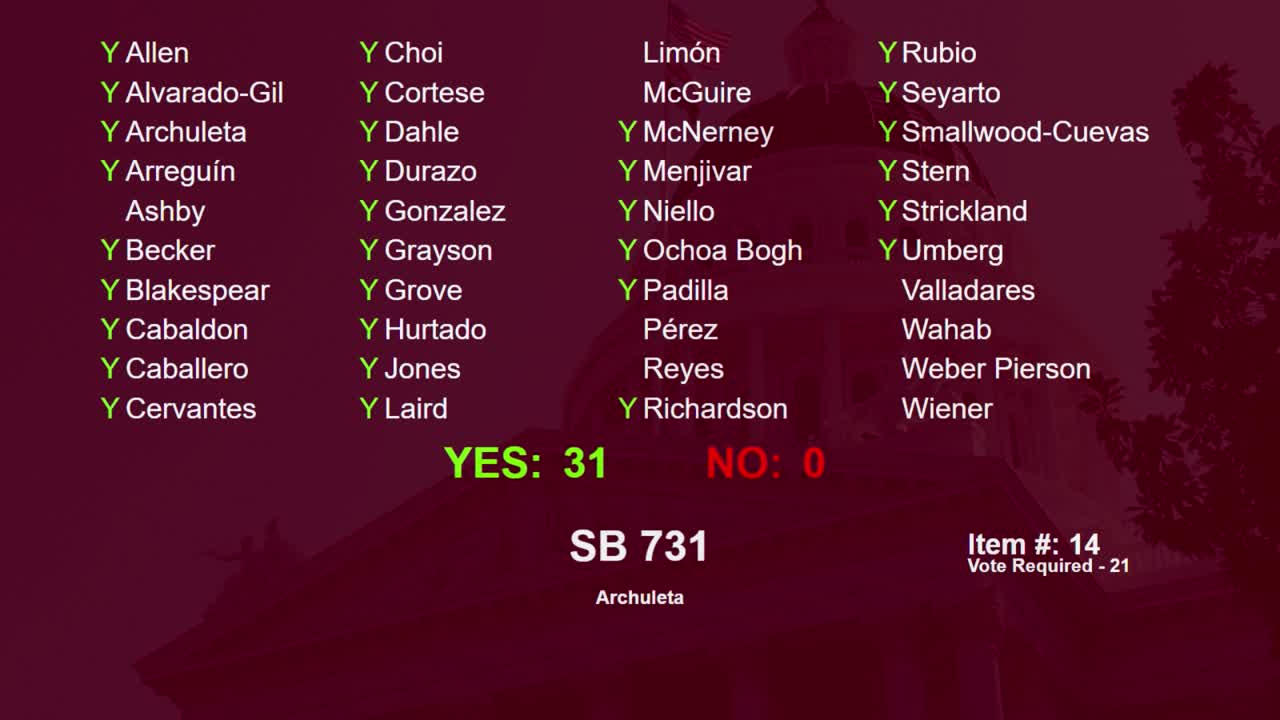 1MIN
Senate Floor
 5MIN
Senate Standing Committee on Public Safety
 7MIN
Senate Standing Committee on Elections and Constitutional Amendments
Bill Author