SB 470: Bagley-Keene Open Meeting Act: teleconferencing.
- Session Year: 2025-2026
- House: Senate
- Latest Version Date: 2025-10-01
Current Status:
Passed
(2025-10-01: Chaptered by Secretary of State. Chapter 222, Statutes of 2025.)
Introduced
In Committee
Awaiting First Chamber Vote
Passed First Chamber
In Committee
Awaiting Second Chamber Vote
Passed Second Chamber
Enacted
Existing law, the Bagley-Keene Open Meeting Act, requires, with specified exceptions, that all meetings of a state body be open and public and all persons be permitted to attend any meeting of a state body. The act authorizes meetings through teleconference subject to specified requirements, including, among others, that the state body post agendas at all teleconference locations, that each teleconference location be identified in the notice and agenda of the meeting or proceeding, that each teleconference location be accessible to the public, that the agenda provide an opportunity for members of the public to address the state body directly at each teleconference location, and that at least one member of the state body be physically present at the location specified in the notice of the meeting.
The act authorizes an additional, alternative set of provisions under which a state body may hold a meeting by teleconference subject to specified requirements, including, among others, that at least one member of the state body is physically present at each teleconference location, as defined, that a majority of the members of the state body are physically present at the same teleconference location, except as specified, and that members of the state body visibly appear on camera during the open portion of a meeting that is publicly accessible via the internet or other online platform, except as specified. The act authorizes, under specified circumstances, a member of the state body to participate pursuant to these provisions from a remote location, which would not be required to be accessible to the public and which the act prohibits the notice and agenda from disclosing. The act repeals these provisions on January 1, 2026.
This bill would instead repeal these provisions on January 1, 2030.
The act authorizes a multimember state advisory body to hold an open meeting by teleconference pursuant to an alternative set of provisions that are in addition to the above-described provisions generally applicable to state bodies. These alternative provisions specify requirements, including, among others, that the multimember state advisory body designates the primary physical meeting location in the notice of the meeting where members of the public may physically attend the meeting and participate.
Until January 1, 2026, the act requires that at least one staff member of the state body is present at the primary physical meeting location during the meeting, and that the members of the state body visibly appear on camera during the open portion of a meeting that is publicly accessible via the internet or other online platform, except as specified.
The act, beginning January 1, 2026, instead requires that a quorum of the members of the state body be in attendance at the primary physical meeting location, as described above, and that all decisions taken during the teleconference be by rollcall, and modifies certain of the above requirements related to the primary physical meeting location.
This bill would extend the former provisions to January 1, 2030, and would make the latter provisions operative on January 1, 2030.
Existing constitutional provisions require that a statute that limits the right of access to the meetings of public bodies or the writings of public officials and agencies be adopted with findings demonstrating the interest protected by the limitation and the need for protecting that interest.
This bill would make legislative findings to that effect.
Existing law, the Bagley-Keene Open Meeting Act, requires, with specified exceptions, that all meetings of a state body be open and public and all persons be permitted to attend any meeting of a state body. The act authorizes meetings through teleconference subject to specified requirements, including, among others, that the state body post agendas at all teleconference locations, that each teleconference location be identified in the notice and agenda of the meeting or proceeding, that each teleconference location be accessible to the public, that the agenda provide an opportunity for members of the public to address the state body directly at each teleconference location, and that at least one member of the state body be physically present at the location specified in the notice of the meeting.
The act authorizes an additional, alternative set of provisions under which a state body may hold a meeting by teleconference subject to specified requirements, including, among others, that at least one member of the state body is physically present at each teleconference location, as defined, that a majority of the members of the state body are physically present at the same teleconference location, except as specified, and that members of the state body visibly appear on camera during the open portion of a meeting that is publicly accessible via the internet or other online platform, except as specified. The act authorizes, under specified circumstances, a member of the state body to participate pursuant to these provisions from a remote location, which would not be required to be accessible to the public and which the act prohibits the notice and agenda from disclosing. The act repeals these provisions on January 1, 2026.
This bill would delete the January 1, 2026 repeal date, thereby authorizing the above-described additional, alternative set of teleconferencing provisions indefinitely. instead repeal these provisions on January 1, 2030.
The act authorizes a multimember state advisory body to hold an open meeting by teleconference pursuant to an alternative set of provisions that are in addition to the above-described provisions generally applicable to state bodies. These alternative provisions specify requirements, including, among others, that the multimember state advisory body designates the primary physical meeting location in the notice of the meeting where members of the public may physically attend the meeting, observe and hear the meeting, and participate, that at least one staff member of the state body to be present at the primary physical meeting location during the meeting, and that the members of the state body visibly appear on camera during the open portion of a meeting that is publicly accessible via the internet or other online platform, except as specified. Existing law The act repeals these provisions on January 1, 2026.
This bill would delete the January 1, 2026 repeal date, thereby authorizing the above-described alternative set of teleconferencing provisions for multimember state advisory bodies indefinitely. instead repeal these provisions on January 1, 2030.
The act, beginning January 1, 2026, removes the above-described requirements for the alternative set of teleconferencing provisions for multimember state advisory bodies, and, instead, requires, among other things, that the multimember state advisory body designates the primary physical meeting location in the notice of the meeting where members of the public may physically attend the meeting and participate.
This bill would repeal those provisions. instead make these provisions operative on January 1, 2030.
Existing constitutional provisions require that a statute that limits the right of access to the meetings of public bodies or the writings of public officials and agencies be adopted with findings demonstrating the interest protected by the limitation and the need for protecting that interest.
This bill would make legislative findings to that effect.
Existing law, the Bagley-Keene Open Meeting Act, requires, with specified exceptions, that all meetings of a state body be open and public and all persons be permitted to attend any meeting of a state body. The act authorizes meetings through teleconference subject to specified requirements, including, among others, that the state body post agendas at all teleconference locations, that each teleconference location be identified in the notice and agenda of the meeting or proceeding, that each teleconference location be accessible to the public, that the agenda provide an opportunity for members of the public to address the state body directly at each teleconference location, and that at least one member of the state body be physically present at the location specified in the notice of the meeting.
The act authorizes an additional, alternative set of provisions under which a state body may hold a meeting by teleconference subject to specified requirements, including, among others, that at least one member of the state body is physically present at each teleconference location, as defined, that a majority of the members of the state body are physically present at the same teleconference location, except as specified, and that members of the state body visibly appear on camera during the open portion of a meeting that is publicly accessible via the internet or other online platform, except as specified. The act authorizes, under specified circumstances, a member of the state body to participate pursuant to these provisions from a remote location, which would not be required to be accessible to the public and which the act prohibits the notice and agenda from disclosing. The act repeals these provisions on January 1, 2026.
This bill would delete the January 1, 2026 repeal date, thereby authorizing the above-described additional, alternative set of teleconferencing provisions indefinitely.
The act authorizes a multimember state advisory body to hold an open meeting by teleconference pursuant to an alternative set of provisions that are in addition to the above-described provisions generally applicable to state bodies. These alternative provisions specify requirements, including, among others, that the multimember state advisory body designates the primary physical meeting location in the notice of the meeting where members of the public may physically attend the meeting, observe and hear the meeting, and participate, that at least one staff member of the state body to be present at the primary physical meeting location during the meeting, and that the members of the state body visibly appear on camera during the open portion of a meeting that is publicly accessible via the internet or other online platform, except as specified. Existing law repeals these provisions on January 1, 2026.
This bill would delete the January 1, 2026 repeal date, thereby authorizing the above-described alternative set of teleconferencing provisions for multimember state advisory bodies indefinitely.
The act, beginning January 1, 2026, removes the above-described requirements for the alternative set of teleconferencing provisions for multimember state advisory bodies, and, instead, requires, among other things, that the multimember state advisory body designates the primary physical meeting location in the notice of the meeting where members of the public may physically attend the meeting and participate.
This bill would repeal those provisions.
Existing constitutional provisions require that a statute that limits the right of access to the meetings of public bodies or the writings of public officials and agencies be adopted with findings demonstrating the interest protected by the limitation and the need for protecting that interest.
This bill would make legislative findings to that effect.
(a)For purposes of this section, the following definitions apply:
(1)Teleconference means a meeting of a state body, the members of which are at different locations, connected by electronic means, through either audio or both audio and video.
(2)Teleconference location means a physical location that is accessible to the public and from which members of the public may participate in the meeting.
(3)Remote location means a location from which a member of a state body participates in a meeting other than a teleconference location.
(4)Participate remotely means participation by a member of the body in a meeting at a remote location other than a teleconference location designated in the notice of the meeting.
(b)(1)In addition to the authorization to hold a meeting by teleconference pursuant to subdivision (b) of Section 11123 and Section 11123.5, a state body may hold an open or closed meeting by teleconference as described in this section, provided the meeting complies with all of this sections requirements and, except as set forth in this section, it also complies with all other applicable requirements of this article relating to the specific type of meeting.
(2)This section does not limit or affect the ability of a state body to hold a teleconference meeting under another provision of this article, including Sections 11123 and 11123.5.
(c)The portion of the teleconferenced meeting that is required to be open to the public shall be visible and audible to the public at each teleconference location.
(d)(1)The state body shall provide a means by which the public may remotely hear audio of the meeting, remotely observe the meeting, remotely address the body, or attend the meeting by providing on the posted agenda a teleconference telephone number, an internet website or other online platform, and a physical address for each teleconference location. The telephonic or online means provided to the public to access the meeting shall be equivalent to the telephonic or online means provided to a member of the state body participating remotely.
(2)The applicable teleconference telephone number, internet website or other online platform, and physical address of each teleconference location, as well as any other information indicating how the public can access the meeting remotely and in person, shall be specified in any notice required by this article.
(3)If the state body allows members of the public to observe and address the meeting telephonically or otherwise electronically, the state body shall do both of the following:
(A)Implement a procedure for receiving and swiftly resolving requests for reasonable modification or accommodation from individuals with disabilities, consistent with the federal Americans with Disabilities Act of 1990 (42 U.S.C. Sec. 12101 et seq.), and resolving any doubt whatsoever in favor of accessibility.
(B)Advertise that procedure each time notice is given of the means by which members of the public may observe the meeting and offer public comment.
(e)This section does not prohibit a state body from providing members of the public with additional locations from which the public may observe or address the state body by electronic means, through either audio or both audio and video.
(f)(1)The agenda shall provide an opportunity for members of the public to address the state body directly pursuant to Section 11125.7.
(2)Members of the public shall be entitled to exercise their right to directly address the state body during the teleconferenced meeting without being required to submit public comments before the meeting or in writing.
(g)The state body shall post the agenda on its internet website and, on the day of the meeting, at each teleconference location.
(h)This section does not affect the requirement prescribed by this article that the state body post an agenda of a meeting in accordance with the applicable notice requirements of this article, including Section 11125, requiring the state body to post an agenda of a meeting at least 10 days in advance of the meeting, Section 11125.4, applicable to special meetings, and Sections 11125.5 and 11125.6, applicable to emergency meetings.
(i)At least one member of the state body shall be physically present at each teleconference location.
(j)(1)Except as provided in paragraph (2), a majority of the members of the state body shall be physically present at the same teleconference location. Additional members of the state body in excess of a majority of the members may attend and participate in the meeting from a remote location. A remote location is not required to be accessible to the public. The notice and agenda shall not disclose information regarding a remote location.
(2)A member attending and participating from a remote location may count toward the majority required to hold a teleconference if both of the following conditions are met:
(A)The member has a need related to a physical or mental disability, as those terms are defined in Sections 12926 and 12926.1, that is not otherwise reasonably accommodated pursuant to the federal Americans with Disability Act of 1990 (42 U.S.C. Sec. 12101 et seq.).
(B)The member notifies the state body at the earliest opportunity possible, including at the start of a meeting, of their need to participate remotely, including providing a general description of the circumstances relating to their need to participate remotely at the given meeting.
(3)If a member notifies the body of the members need to attend and participate remotely pursuant to paragraph (2), the body shall take action to approve the exception and shall request a general description of the circumstances relating to the members need to participate remotely at the meeting, for each meeting in which the member seeks to participate remotely. The body shall not require the member to provide a general description that exceeds 20 words or to disclose any medical diagnosis or disability, or any personal medical information that is already exempt under existing law, such as the Confidentiality of Medical Information Act (Part 2.6 (commencing with Section 56) of Division 1 of the Civil Code).
(4)If a member of the state body attends the meeting by teleconference from a remote location, the member shall disclose whether any other individuals 18 years of age or older are present in the room at the remote location with the member, and the general nature of the members relationship with any such individuals.
(k)(1)Except as provided in paragraph (2), the members of the state body shall visibly appear on camera during the open portion of a meeting that is publicly accessible via the internet or other online platform.
(2)The visual appearance of a member of the state body on camera may cease only when the appearance would be technologically impracticable, including, but not limited to, when the member experiences a lack of reliable broadband or internet connectivity that would be remedied by joining without video, or when the visual display of meeting materials, information, or speakers on the internet or other online platform requires the visual appearance of a member of a state body on camera to cease.
(3)If a member of the state body does not appear on camera due to challenges with internet connectivity, the member shall announce the reason for their nonappearance when they turn off their camera.
(l)All votes taken during the teleconferenced meeting shall be by rollcall.
(m)The state body shall publicly report any action taken and the vote or abstention on that action of each member present for the action.
(n)The portion of the teleconferenced meeting that is closed to the public shall not include the consideration of any agenda item being heard pursuant to Section 11125.5.
(o)Upon discovering that a means of remote public access and participation required by subdivision (d) has failed during a meeting and cannot be restored, the state body shall end or adjourn the meeting in accordance with Section 11128.5. In addition to any other requirements that may apply, the state body shall provide notice of the meetings end or adjournment on the state bodys internet website and by email to any person who has requested notice of meetings of the state body by email under this article. If the meeting will be adjourned and reconvened on the same day, further notice shall be provided by an automated message on a telephone line posted on the state bodys agenda, internet website, or by a similar means, that will communicate when the state body intends to reconvene the meeting and how a member of the public may hear audio of the meeting or observe the meeting.
(p)This section shall remain in effect only until January 1, 2030, and as of that date is repealed.
SEC. 2.Section 11123.5 of the Government Code, as amended by Section 2 of Chapter 216 of the Statutes of 2023, is amended to read:11123.5.(a)For purposes of this section, the following definitions apply:
(1)Participate remotely means participation in a meeting at a location other than the physical location designated in the agenda of the meeting.
(2)Remote location means a location other than the primary physical location designated in the agenda of a meeting.
(3)Teleconference has the same meaning as in Section 11123.
(b)In addition to the authorization to hold a meeting by teleconference pursuant to subdivision (b) of Section 11123 or Section 11123.2, any state body that is an advisory board, advisory commission, advisory committee, advisory subcommittee, or similar multimember advisory body may hold an open meeting by teleconference as described in this section, provided the meeting complies with all of the sections requirements and, except as set forth in this section, it also complies with all other applicable requirements of this article.
(c)A member of a state body as described in subdivision (b) who participates in a teleconference meeting from a remote location subject to this sections requirements shall be listed in the minutes of the meeting.
(d)The state body shall provide notice to the public at least 24 hours before the meeting that identifies any member who will participate remotely by posting the notice on its internet website and by emailing notice to any person who has requested notice of meetings of the state body under this article. The location of a member of a state body who will participate remotely is not required to be disclosed in the public notice or email and need not be accessible to the public. The notice of the meeting shall also identify the primary physical meeting location designated pursuant to subdivision (f).
(e)This section does not affect the requirement prescribed by this article that the state body post an agenda of a meeting at least 10 days in advance of the meeting. The agenda shall include information regarding the physical meeting location designated pursuant to subdivision (f), but is not required to disclose information regarding any remote location.
(f)A state body described in subdivision (b) shall designate the primary physical meeting location in the notice of the meeting where members of the public may physically attend the meeting, observe and hear the meeting, and participate. At least one staff member of the state body shall be present at the primary physical meeting location during the meeting. The state body shall post the agenda at the primary physical meeting location, but need not post the agenda at a remote location.
(g)When a member of a state body described in subdivision (b) participates remotely in a meeting subject to this sections requirements, the state body shall provide a means by which the public may remotely hear audio of the meeting or remotely observe the meeting, including, if available, equal access equivalent to members of the state body participating remotely. The applicable teleconference phone number or internet website, or other information indicating how the public can access the meeting remotely, shall be in the 24-hour notice described in subdivision (b) that is available to the public.
(h)(1)Except as provided in paragraph (2), the members of the state body shall visibly appear on camera during the open portion of a meeting that is publicly accessible via the internet or other online platform.
(2)The visual appearance of a member of a state body on camera may cease only when the appearance would be technologically impracticable, including, but not limited to, when the member experiences a lack of reliable broadband or internet connectivity that would be remedied by joining without video, or when the visual display of meeting materials, information, or speakers on the internet or other online platform requires the visual appearance of a member of a state body on camera to cease.
(3)If a member of the body does not appear on camera due to challenges with internet connectivity, the member shall announce the reason for their nonappearance when they turn off their camera.
(i)Upon discovering that a means of remote access required by subdivision (g) has failed during a meeting, the state body described in subdivision (b) shall end or adjourn the meeting in accordance with Section 11128.5. In addition to any other requirements that may apply, the state body shall provide notice of the meetings end or adjournment on its internet website and by email to any person who has requested notice of meetings of the state body under this article. If the meeting will be adjourned and reconvened on the same day, further notice shall be provided by an automated message on a telephone line posted on the state bodys agenda, or by a similar means, that will communicate when the state body intends to reconvene the meeting and how a member of the public may hear audio of the meeting or observe the meeting.
(j)This section does not limit or affect the ability of a state body to hold a teleconference meeting under another provision of this article.
(k)This section shall remain in effect only until January 1, 2030, and as of that date is repealed.
SEC. 3.Section 11123.5 of the Government Code, as added by Section 3 of Chapter 216 of the Statutes of 2023, is amended to read:11123.5.(a)In addition to the authorization to hold a meeting by teleconference pursuant to subdivision (b) of Section 11123, any state body that is an advisory board, advisory commission, advisory committee, advisory subcommittee, or similar multimember advisory body may hold an open meeting by teleconference as described in this section, provided the meeting complies with all of the sections requirements and, except as set forth in this section, it also complies with all other applicable requirements of this article.
(b)A member of a state body as described in subdivision (a) who participates in a teleconference meeting from a remote location subject to this sections requirements shall be listed in the minutes of the meeting.
(c)The state body shall provide notice to the public at least 24 hours before the meeting that identifies any member who will participate remotely by posting the notice on its internet website and by emailing notice to any person who has requested notice of meetings of the state body under this article. The location of a member of a state body who will participate remotely is not required to be disclosed in the public notice or email and need not be accessible to the public. The notice of the meeting shall also identify the primary physical meeting location designated pursuant to subdivision (e).
(d)This section does not affect the requirement prescribed by this article that the state body post an agenda of a meeting at least 10 days in advance of the meeting. The agenda shall include information regarding the physical meeting location designated pursuant to subdivision (e), but is not required to disclose information regarding any remote location.
(e)A state body described in subdivision (a) shall designate the primary physical meeting location in the notice of the meeting where members of the public may physically attend the meeting and participate. A quorum of the members of the state body shall be in attendance at the primary physical meeting location, and members of the state body participating remotely shall not count towards establishing a quorum. All decisions taken during a meeting by teleconference shall be by rollcall vote. The state body shall post the agenda at the primary physical meeting location, but need not post the agenda at a remote location.
(f)When a member of a state body described in subdivision (a) participates remotely in a meeting subject to this sections requirements, the state body shall provide a means by which the public may remotely hear audio of the meeting or remotely observe the meeting, including, if available, equal access equivalent to members of the state body participating remotely. The applicable teleconference phone number or internet website, or other information indicating how the public can access the meeting remotely, shall be in the 24-hour notice described in subdivision (a) that is available to the public.
(g)Upon discovering that a means of remote access required by subdivision (f) has failed during a meeting, the state body described in subdivision (a) shall end or adjourn the meeting in accordance with Section 11128.5. In addition to any other requirements that may apply, the state body shall provide notice of the meetings end or adjournment on its internet website and by email to any person who has requested notice of meetings of the state body under this article. If the meeting will be adjourned and reconvened on the same day, further notice shall be provided by an automated message on a telephone line posted on the state bodys agenda, or by a similar means, that will communicate when the state body intends to reconvene the meeting and how a member of the public may hear audio of the meeting or observe the meeting.
(h)For purposes of this section:
(1)Participate remotely means participation in a meeting at a location other than the physical location designated in the agenda of the meeting.
(2)Remote location means a location other than the primary physical location designated in the agenda of a meeting.
(3)Teleconference has the same meaning as in Section 11123.
(i)This section does not limit or affect the ability of a state body to hold a teleconference meeting under another provision of this article.
(j)This section shall become operative on January 1, 2030.
SEC. 4.The Legislature finds and declares that Section 1 of this act, which amends Section 11123.2 of the Government Code, and Sections 2 and 3 of this act, which amend and repeal Section 11123.5 of the Government Code, modify the publics right of access to the meetings of public bodies or the writings of public officials and agencies within the meaning of Section 3 of Article I of the California Constitution. Pursuant to that constitutional provision, the Legislature makes the following findings to demonstrate the interest protected by this limitation and the need for protecting that interest:
(a)By continuing to ensure that agendas are not required to be posted at, and that agendas and notices do not disclose information regarding, the location of each public official participating in a public meeting remotely, including from the members private home or hotel room, this act protects the personal, private information of public officials and their families while preserving the publics right to access information concerning the conduct of the peoples business.
(b)During the COVID-19 public health emergency, audio and video teleconference were widely used to conduct public meetings in lieu of physical location meetings, and those public meetings have been productive, increased public participation by all members of the public regardless of their location and ability to travel to physical meeting locations, increased the pool of people who are able to serve on these bodies, protected the health and safety of civil servants and the public, and have reduced travel costs incurred by members of state bodies and reduced work hours spent traveling to and from meetings.
(c)Conducting audio and video teleconference meetings enhances public participation and the publics right of access to meetings of the public bodies by improving access for individuals who often face barriers to physical attendance.
(a)For purposes of this section, the following definitions apply:
(1)Teleconference means a meeting of a state body, the members of which are at different locations, connected by electronic means, through either audio or both audio and video.
(2)Teleconference location means a physical location that is accessible to the public and from which members of the public may participate in the meeting.
(3)Remote location means a location from which a member of a state body participates in a meeting other than a teleconference location.
(4)Participate remotely means participation by a member of the body in a meeting at a remote location other than a teleconference location designated in the notice of the meeting.
(b)(1)In addition to the authorization to hold a meeting by teleconference pursuant to subdivision (b) of Section 11123 and Section 11123.5, a state body may hold an open or closed meeting by teleconference as described in this section, provided the meeting complies with all of this sections requirements and, except as set forth in this section, it also complies with all other applicable requirements of this article relating to the specific type of meeting.
(2)This section does not limit or affect the ability of a state body to hold a teleconference meeting under another provision of this article, including Sections 11123 and 11123.5.
(c)The portion of the teleconferenced meeting that is required to be open to the public shall be visible and audible to the public at each teleconference location.
(d)(1)The state body shall provide a means by which the public may remotely hear audio of the meeting, remotely observe the meeting, remotely address the body, or attend the meeting by providing on the posted agenda a teleconference telephone number, an internet website or other online platform, and a physical address for each teleconference location. The telephonic or online means provided to the public to access the meeting shall be equivalent to the telephonic or online means provided to a member of the state body participating remotely.
(2)The applicable teleconference telephone number, internet website or other online platform, and physical address of each teleconference location, as well as any other information indicating how the public can access the meeting remotely and in person, shall be specified in any notice required by this article.
(3)If the state body allows members of the public to observe and address the meeting telephonically or otherwise electronically, the state body shall do both of the following:
(A)Implement a procedure for receiving and swiftly resolving requests for reasonable modification or accommodation from individuals with disabilities, consistent with the federal Americans with Disabilities Act of 1990 (42 U.S.C. Sec. 12101 et seq.), and resolving any doubt whatsoever in favor of accessibility.
(B)Advertise that procedure each time notice is given of the means by which members of the public may observe the meeting and offer public comment.
(e)This section does not prohibit a state body from providing members of the public with additional locations from which the public may observe or address the state body by electronic means, through either audio or both audio and video.
(f)(1)The agenda shall provide an opportunity for members of the public to address the state body directly pursuant to Section 11125.7.
(2)Members of the public shall be entitled to exercise their right to directly address the state body during the teleconferenced meeting without being required to submit public comments before the meeting or in writing.
(g)The state body shall post the agenda on its internet website and, on the day of the meeting, at each teleconference location.
(h)This section does not affect the requirement prescribed by this article that the state body post an agenda of a meeting in accordance with the applicable notice requirements of this article, including Section 11125, requiring the state body to post an agenda of a meeting at least 10 days in advance of the meeting, Section 11125.4, applicable to special meetings, and Sections 11125.5 and 11125.6, applicable to emergency meetings.
(i)At least one member of the state body shall be physically present at each teleconference location.
(j)(1)Except as provided in paragraph (2), a majority of the members of the state body shall be physically present at the same teleconference location. Additional members of the state body in excess of a majority of the members may attend and participate in the meeting from a remote location. A remote location is not required to be accessible to the public. The notice and agenda shall not disclose information regarding a remote location.
(2)A member attending and participating from a remote location may count toward the majority required to hold a teleconference if both of the following conditions are met:
(A)The member has a need related to a physical or mental disability, as those terms are defined in Sections 12926 and 12926.1, that is not otherwise reasonably accommodated pursuant to the federal Americans with Disability Act of 1990 (42 U.S.C. Sec. 12101 et seq.).
(B)The member notifies the state body at the earliest opportunity possible, including at the start of a meeting, of their need to participate remotely, including providing a general description of the circumstances relating to their need to participate remotely at the given meeting.
(3)If a member notifies the body of the members need to attend and participate remotely pursuant to paragraph (2), the body shall take action to approve the exception and shall request a general description of the circumstances relating to the members need to participate remotely at the meeting, for each meeting in which the member seeks to participate remotely. The body shall not require the member to provide a general description that exceeds 20 words or to disclose any medical diagnosis or disability, or any personal medical information that is already exempt under existing law, such as the Confidentiality of Medical Information Act (Part 2.6 (commencing with Section 56) of Division 1 of the Civil Code).
(4)If a member of the state body attends the meeting by teleconference from a remote location, the member shall disclose whether any other individuals 18 years of age or older are present in the room at the remote location with the member, and the general nature of the members relationship with any such individuals.
(k)(1)Except as provided in paragraph (2), the members of the state body shall visibly appear on camera during the open portion of a meeting that is publicly accessible via the internet or other online platform.
(2)The visual appearance of a member of the state body on camera may cease only when the appearance would be technologically impracticable, including, but not limited to, when the member experiences a lack of reliable broadband or internet connectivity that would be remedied by joining without video, or when the visual display of meeting materials, information, or speakers on the internet or other online platform requires the visual appearance of a member of a state body on camera to cease.
(3)If a member of the state body does not appear on camera due to challenges with internet connectivity, the member shall announce the reason for their nonappearance when they turn off their camera.
(l)All votes taken during the teleconferenced meeting shall be by rollcall.
(m)The state body shall publicly report any action taken and the vote or abstention on that action of each member present for the action.
(n)The portion of the teleconferenced meeting that is closed to the public shall not include the consideration of any agenda item being heard pursuant to Section 11125.5.
(o)Upon discovering that a means of remote public access and participation required by subdivision (d) has failed during a meeting and cannot be restored, the state body shall end or adjourn the meeting in accordance with Section 11128.5. In addition to any other requirements that may apply, the state body shall provide notice of the meetings end or adjournment on the state bodys internet website and by email to any person who has requested notice of meetings of the state body by email under this article. If the meeting will be adjourned and reconvened on the same day, further notice shall be provided by an automated message on a telephone line posted on the state bodys agenda, internet website, or by a similar means, that will communicate when the state body intends to reconvene the meeting and how a member of the public may hear audio of the meeting or observe the meeting.
(p)This section shall remain in effect only until January 1, 2030, and as of that date is repealed.
SEC. 2.Section 11123.5 of the Government Code, as amended by Section 2 of Chapter 216 of the Statutes of 2023, is amended to read:11123.5.(a)For purposes of this section, the following definitions apply:
(1)Participate remotely means participation in a meeting at a location other than the physical location designated in the agenda of the meeting.
(2)Remote location means a location other than the primary physical location designated in the agenda of a meeting.
(3)Teleconference has the same meaning as in Section 11123.
(b)In addition to the authorization to hold a meeting by teleconference pursuant to subdivision (b) of Section 11123 or Section 11123.2, any state body that is an advisory board, advisory commission, advisory committee, advisory subcommittee, or similar multimember advisory body may hold an open meeting by teleconference as described in this section, provided the meeting complies with all of the sections requirements and, except as set forth in this section, it also complies with all other applicable requirements of this article.
(c)A member of a state body as described in subdivision (b) who participates in a teleconference meeting from a remote location subject to this sections requirements shall be listed in the minutes of the meeting.
(d)The state body shall provide notice to the public at least 24 hours before the meeting that identifies any member who will participate remotely by posting the notice on its internet website and by emailing notice to any person who has requested notice of meetings of the state body under this article. The location of a member of a state body who will participate remotely is not required to be disclosed in the public notice or email and need not be accessible to the public. The notice of the meeting shall also identify the primary physical meeting location designated pursuant to subdivision (f).
(e)This section does not affect the requirement prescribed by this article that the state body post an agenda of a meeting at least 10 days in advance of the meeting. The agenda shall include information regarding the physical meeting location designated pursuant to subdivision (f), but is not required to disclose information regarding any remote location.
(f)A state body described in subdivision (b) shall designate the primary physical meeting location in the notice of the meeting where members of the public may physically attend the meeting, observe and hear the meeting, and participate. At least one staff member of the state body shall be present at the primary physical meeting location during the meeting. The state body shall post the agenda at the primary physical meeting location, but need not post the agenda at a remote location.
(g)When a member of a state body described in subdivision (b) participates remotely in a meeting subject to this sections requirements, the state body shall provide a means by which the public may remotely hear audio of the meeting or remotely observe the meeting, including, if available, equal access equivalent to members of the state body participating remotely. The applicable teleconference phone number or internet website, or other information indicating how the public can access the meeting remotely, shall be in the 24-hour notice described in subdivision (b) that is available to the public.
(h)(1)Except as provided in paragraph (2), the members of the state body shall visibly appear on camera during the open portion of a meeting that is publicly accessible via the internet or other online platform.
(2)The visual appearance of a member of a state body on camera may cease only when the appearance would be technologically impracticable, including, but not limited to, when the member experiences a lack of reliable broadband or internet connectivity that would be remedied by joining without video, or when the visual display of meeting materials, information, or speakers on the internet or other online platform requires the visual appearance of a member of a state body on camera to cease.
(3)If a member of the body does not appear on camera due to challenges with internet connectivity, the member shall announce the reason for their nonappearance when they turn off their camera.
(i)Upon discovering that a means of remote access required by subdivision (g) has failed during a meeting, the state body described in subdivision (b) shall end or adjourn the meeting in accordance with Section 11128.5. In addition to any other requirements that may apply, the state body shall provide notice of the meetings end or adjournment on its internet website and by email to any person who has requested notice of meetings of the state body under this article. If the meeting will be adjourned and reconvened on the same day, further notice shall be provided by an automated message on a telephone line posted on the state bodys agenda, or by a similar means, that will communicate when the state body intends to reconvene the meeting and how a member of the public may hear audio of the meeting or observe the meeting.
(j)This section does not limit or affect the ability of a state body to hold a teleconference meeting under another provision of this article.
(k)This section shall remain in effect only until January 1, 2030, and as of that date is repealed.
SEC. 3.Section 11123.5 of the Government Code, as added by Section 3 of Chapter 216 of the Statutes of 2023, is repealed.SEC. 3.Section 11123.5 of the Government Code, as added by Section 3 of Chapter 216 of the Statutes of 2023, is amended to read:11123.5.(a)In addition to the authorization to hold a meeting by teleconference pursuant to subdivision (b) of Section 11123, any state body that is an advisory board, advisory commission, advisory committee, advisory subcommittee, or similar multimember advisory body may hold an open meeting by teleconference as described in this section, provided the meeting complies with all of the sections requirements and, except as set forth in this section, it also complies with all other applicable requirements of this article.
(b)A member of a state body as described in subdivision (a) who participates in a teleconference meeting from a remote location subject to this sections requirements shall be listed in the minutes of the meeting.
(c)The state body shall provide notice to the public at least 24 hours before the meeting that identifies any member who will participate remotely by posting the notice on its internet website and by emailing notice to any person who has requested notice of meetings of the state body under this article. The location of a member of a state body who will participate remotely is not required to be disclosed in the public notice or email and need not be accessible to the public. The notice of the meeting shall also identify the primary physical meeting location designated pursuant to subdivision (e).
(d)This section does not affect the requirement prescribed by this article that the state body post an agenda of a meeting at least 10 days in advance of the meeting. The agenda shall include information regarding the physical meeting location designated pursuant to subdivision (e), but is not required to disclose information regarding any remote location.
(e)A state body described in subdivision (a) shall designate the primary physical meeting location in the notice of the meeting where members of the public may physically attend the meeting and participate. A quorum of the members of the state body shall be in attendance at the primary physical meeting location, and members of the state body participating remotely shall not count towards establishing a quorum. All decisions taken during a meeting by teleconference shall be by rollcall vote. The state body shall post the agenda at the primary physical meeting location, but need not post the agenda at a remote location.
(f)When a member of a state body described in subdivision (a) participates remotely in a meeting subject to this sections requirements, the state body shall provide a means by which the public may remotely hear audio of the meeting or remotely observe the meeting, including, if available, equal access equivalent to members of the state body participating remotely. The applicable teleconference phone number or internet website, or other information indicating how the public can access the meeting remotely, shall be in the 24-hour notice described in subdivision (a) that is available to the public.
(g)Upon discovering that a means of remote access required by subdivision (f) has failed during a meeting, the state body described in subdivision (a) shall end or adjourn the meeting in accordance with Section 11128.5. In addition to any other requirements that may apply, the state body shall provide notice of the meetings end or adjournment on its internet website and by email to any person who has requested notice of meetings of the state body under this article. If the meeting will be adjourned and reconvened on the same day, further notice shall be provided by an automated message on a telephone line posted on the state bodys agenda, or by a similar means, that will communicate when the state body intends to reconvene the meeting and how a member of the public may hear audio of the meeting or observe the meeting.
(h)For purposes of this section:
(1)Participate remotely means participation in a meeting at a location other than the physical location designated in the agenda of the meeting.
(2)Remote location means a location other than the primary physical location designated in the agenda of a meeting.
(3)Teleconference has the same meaning as in Section 11123.
(i)This section does not limit or affect the ability of a state body to hold a teleconference meeting under another provision of this article.
(j)This section shall become operative on January 1, 2026. 2030.
SEC. 4.The Legislature finds and declares that Section 1 of this act, which amends Section 11123.2 of the Government Code, and Sections 2 and 3 of this act, which amend and repeal Section 11123.5 of the Government Code, modify the publics right of access to the meetings of public bodies or the writings of public officials and agencies within the meaning of Section 3 of Article I of the California Constitution. Pursuant to that constitutional provision, the Legislature makes the following findings to demonstrate the interest protected by this limitation and the need for protecting that interest:
(a)By continuing to ensure that agendas are not required to be posted at, and that agendas and notices do not disclose information regarding, the location of each public official participating in a public meeting remotely, including from the members private home or hotel room, this act protects the personal, private information of public officials and their families while preserving the publics right to access information concerning the conduct of the peoples business.
(b)During the COVID-19 public health emergency, audio and video teleconference were widely used to conduct public meetings in lieu of physical location meetings, and those public meetings have been productive, increased public participation by all members of the public regardless of their location and ability to travel to physical meeting locations, increased the pool of people who are able to serve on these bodies, protected the health and safety of civil servants and the public, and have reduced travel costs incurred by members of state bodies and reduced work hours spent traveling to and from meetings.
(c)Conducting audio and video teleconference meetings enhances public participation and the publics right of access to meetings of the public bodies by improving access for individuals who often face barriers to physical attendance.
(a)For purposes of this section, the following definitions apply:
(1)Teleconference means a meeting of a state body, the members of which are at different locations, connected by electronic means, through either audio or both audio and video.
(2)Teleconference location means a physical location that is accessible to the public and from which members of the public may participate in the meeting.
(3)Remote location means a location from which a member of a state body participates in a meeting other than a teleconference location.
(4)Participate remotely means participation by a member of the body in a meeting at a remote location other than a teleconference location designated in the notice of the meeting.
(b)(1)In addition to the authorization to hold a meeting by teleconference pursuant to subdivision (b) of Section 11123 and Section 11123.5, a state body may hold an open or closed meeting by teleconference as described in this section, provided the meeting complies with all of this sections requirements and, except as set forth in this section, it also complies with all other applicable requirements of this article relating to the specific type of meeting.
(2)This section does not limit or affect the ability of a state body to hold a teleconference meeting under another provision of this article, including Sections 11123 and 11123.5.
(c)The portion of the teleconferenced meeting that is required to be open to the public shall be visible and audible to the public at each teleconference location.
(d)(1)The state body shall provide a means by which the public may remotely hear audio of the meeting, remotely observe the meeting, remotely address the body, or attend the meeting by providing on the posted agenda a teleconference telephone number, an internet website or other online platform, and a physical address for each teleconference location. The telephonic or online means provided to the public to access the meeting shall be equivalent to the telephonic or online means provided to a member of the state body participating remotely.
(2)The applicable teleconference telephone number, internet website or other online platform, and physical address of each teleconference location, as well as any other information indicating how the public can access the meeting remotely and in person, shall be specified in any notice required by this article.
(3)If the state body allows members of the public to observe and address the meeting telephonically or otherwise electronically, the state body shall do both of the following:
(A)Implement a procedure for receiving and swiftly resolving requests for reasonable modification or accommodation from individuals with disabilities, consistent with the federal Americans with Disabilities Act of 1990 (42 U.S.C. Sec. 12101 et seq.), and resolving any doubt whatsoever in favor of accessibility.
(B)Advertise that procedure each time notice is given of the means by which members of the public may observe the meeting and offer public comment.
(e)This section does not prohibit a state body from providing members of the public with additional locations from which the public may observe or address the state body by electronic means, through either audio or both audio and video.
(f)(1)The agenda shall provide an opportunity for members of the public to address the state body directly pursuant to Section 11125.7.
(2)Members of the public shall be entitled to exercise their right to directly address the state body during the teleconferenced meeting without being required to submit public comments before the meeting or in writing.
(g)The state body shall post the agenda on its internet website and, on the day of the meeting, at each teleconference location.
(h)This section does not affect the requirement prescribed by this article that the state body post an agenda of a meeting in accordance with the applicable notice requirements of this article, including Section 11125, requiring the state body to post an agenda of a meeting at least 10 days in advance of the meeting, Section 11125.4, applicable to special meetings, and Sections 11125.5 and 11125.6, applicable to emergency meetings.
(i)At least one member of the state body shall be physically present at each teleconference location.
(j)(1)Except as provided in paragraph (2), a majority of the members of the state body shall be physically present at the same teleconference location. Additional members of the state body in excess of a majority of the members may attend and participate in the meeting from a remote location. A remote location is not required to be accessible to the public. The notice and agenda shall not disclose information regarding a remote location.
(2)A member attending and participating from a remote location may count toward the majority required to hold a teleconference if both of the following conditions are met:
(A)The member has a need related to a physical or mental disability, as those terms are defined in Sections 12926 and 12926.1, that is not otherwise reasonably accommodated pursuant to the federal Americans with Disability Act of 1990 (42 U.S.C. Sec. 12101 et seq.).
(B)The member notifies the state body at the earliest opportunity possible, including at the start of a meeting, of their need to participate remotely, including providing a general description of the circumstances relating to their need to participate remotely at the given meeting.
(3)If a member notifies the body of the members need to attend and participate remotely pursuant to paragraph (2), the body shall take action to approve the exception and shall request a general description of the circumstances relating to the members need to participate remotely at the meeting, for each meeting in which the member seeks to participate remotely. The body shall not require the member to provide a general description that exceeds 20 words or to disclose any medical diagnosis or disability, or any personal medical information that is already exempt under existing law, such as the Confidentiality of Medical Information Act (Part 2.6 (commencing with Section 56) of Division 1 of the Civil Code).
(4)If a member of the state body attends the meeting by teleconference from a remote location, the member shall disclose whether any other individuals 18 years of age or older are present in the room at the remote location with the member, and the general nature of the members relationship with any such individuals.
(k)(1)Except as provided in paragraph (2), the members of the state body shall visibly appear on camera during the open portion of a meeting that is publicly accessible via the internet or other online platform.
(2)The visual appearance of a member of the state body on camera may cease only when the appearance would be technologically impracticable, including, but not limited to, when the member experiences a lack of reliable broadband or internet connectivity that would be remedied by joining without video, or when the visual display of meeting materials, information, or speakers on the internet or other online platform requires the visual appearance of a member of a state body on camera to cease.
(3)If a member of the state body does not appear on camera due to challenges with internet connectivity, the member shall announce the reason for their nonappearance when they turn off their camera.
(l)All votes taken during the teleconferenced meeting shall be by rollcall.
(m)The state body shall publicly report any action taken and the vote or abstention on that action of each member present for the action.
(n)The portion of the teleconferenced meeting that is closed to the public shall not include the consideration of any agenda item being heard pursuant to Section 11125.5.
(o)Upon discovering that a means of remote public access and participation required by subdivision (d) has failed during a meeting and cannot be restored, the state body shall end or adjourn the meeting in accordance with Section 11128.5. In addition to any other requirements that may apply, the state body shall provide notice of the meetings end or adjournment on the state bodys internet website and by email to any person who has requested notice of meetings of the state body by email under this article. If the meeting will be adjourned and reconvened on the same day, further notice shall be provided by an automated message on a telephone line posted on the state bodys agenda, internet website, or by a similar means, that will communicate when the state body intends to reconvene the meeting and how a member of the public may hear audio of the meeting or observe the meeting.
(p)This section shall remain in effect only until January 1, 2026, and as of that date is repealed.SEC. 2.Section 11123.5 of the Government Code, as amended by Section 2 of Chapter 216 of the Statutes of 2023, is amended to read:11123.5.(a)For purposes of this section, the following definitions apply:
(1)Participate remotely means participation in a meeting at a location other than the physical location designated in the agenda of the meeting.
(2)Remote location means a location other than the primary physical location designated in the agenda of a meeting.
(3)Teleconference has the same meaning as in Section 11123.
(b)In addition to the authorization to hold a meeting by teleconference pursuant to subdivision (b) of Section 11123 or Section 11123.2, any state body that is an advisory board, advisory commission, advisory committee, advisory subcommittee, or similar multimember advisory body may hold an open meeting by teleconference as described in this section, provided the meeting complies with all of the sections requirements and, except as set forth in this section, it also complies with all other applicable requirements of this article.
(c)A member of a state body as described in subdivision (b) who participates in a teleconference meeting from a remote location subject to this sections requirements shall be listed in the minutes of the meeting.
(d)The state body shall provide notice to the public at least 24 hours before the meeting that identifies any member who will participate remotely by posting the notice on its internet website and by emailing notice to any person who has requested notice of meetings of the state body under this article. The location of a member of a state body who will participate remotely is not required to be disclosed in the public notice or email and need not be accessible to the public. The notice of the meeting shall also identify the primary physical meeting location designated pursuant to subdivision (f).
(e)This section does not affect the requirement prescribed by this article that the state body post an agenda of a meeting at least 10 days in advance of the meeting. The agenda shall include information regarding the physical meeting location designated pursuant to subdivision (f), but is not required to disclose information regarding any remote location.
(f)A state body described in subdivision (b) shall designate the primary physical meeting location in the notice of the meeting where members of the public may physically attend the meeting, observe and hear the meeting, and participate. At least one staff member of the state body shall be present at the primary physical meeting location during the meeting. The state body shall post the agenda at the primary physical meeting location, but need not post the agenda at a remote location.
(g)When a member of a state body described in subdivision (b) participates remotely in a meeting subject to this sections requirements, the state body shall provide a means by which the public may remotely hear audio of the meeting or remotely observe the meeting, including, if available, equal access equivalent to members of the state body participating remotely. The applicable teleconference phone number or internet website, or other information indicating how the public can access the meeting remotely, shall be in the 24-hour notice described in subdivision (b) that is available to the public.
(h)(1)Except as provided in paragraph (2), the members of the state body shall visibly appear on camera during the open portion of a meeting that is publicly accessible via the internet or other online platform.
(2)The visual appearance of a member of a state body on camera may cease only when the appearance would be technologically impracticable, including, but not limited to, when the member experiences a lack of reliable broadband or internet connectivity that would be remedied by joining without video, or when the visual display of meeting materials, information, or speakers on the internet or other online platform requires the visual appearance of a member of a state body on camera to cease.
(3)If a member of the body does not appear on camera due to challenges with internet connectivity, the member shall announce the reason for their nonappearance when they turn off their camera.
(i)Upon discovering that a means of remote access required by subdivision (g) has failed during a meeting, the state body described in subdivision (b) shall end or adjourn the meeting in accordance with Section 11128.5. In addition to any other requirements that may apply, the state body shall provide notice of the meetings end or adjournment on its internet website and by email to any person who has requested notice of meetings of the state body under this article. If the meeting will be adjourned and reconvened on the same day, further notice shall be provided by an automated message on a telephone line posted on the state bodys agenda, or by a similar means, that will communicate when the state body intends to reconvene the meeting and how a member of the public may hear audio of the meeting or observe the meeting.
(j)This section does not limit or affect the ability of a state body to hold a teleconference meeting under another provision of this article.
(k)This section shall remain in effect only until January 1, 2026, and as of that date is repealed.SEC. 3.Section 11123.5 of the Government Code, as added by Section 3 of Chapter 216 of the Statutes of 2023, is repealed.11123.5.(a)In addition to the authorization to hold a meeting by teleconference pursuant to subdivision (b) of Section 11123, any state body that is an advisory board, advisory commission, advisory committee, advisory subcommittee, or similar multimember advisory body may hold an open meeting by teleconference as described in this section, provided the meeting complies with all of the sections requirements and, except as set forth in this section, it also complies with all other applicable requirements of this article.(b)A member of a state body as described in subdivision (a) who participates in a teleconference meeting from a remote location subject to this sections requirements shall be listed in the minutes of the meeting.(c)The state body shall provide notice to the public at least 24 hours before the meeting that identifies any member who will participate remotely by posting the notice on its internet website and by emailing notice to any person who has requested notice of meetings of the state body under this article. The location of a member of a state body who will participate remotely is not required to be disclosed in the public notice or email and need not be accessible to the public. The notice of the meeting shall also identify the primary physical meeting location designated pursuant to subdivision (e).(d)This section does not affect the requirement prescribed by this article that the state body post an agenda of a meeting at least 10 days in advance of the meeting. The agenda shall include information regarding the physical meeting location designated pursuant to subdivision (e), but is not required to disclose information regarding any remote location.(e)A state body described in subdivision (a) shall designate the primary physical meeting location in the notice of the meeting where members of the public may physically attend the meeting and participate. A quorum of the members of the state body shall be in attendance at the primary physical meeting location, and members of the state body participating remotely shall not count towards establishing a quorum. All decisions taken during a meeting by teleconference shall be by rollcall vote. The state body shall post the agenda at the primary physical meeting location, but need not post the agenda at a remote location.(f)When a member of a state body described in subdivision (a) participates remotely in a meeting subject to this sections requirements, the state body shall provide a means by which the public may remotely hear audio of the meeting or remotely observe the meeting, including, if available, equal access equivalent to members of the state body participating remotely. The applicable teleconference phone number or internet website, or other information indicating how the public can access the meeting remotely, shall be in the 24-hour notice described in subdivision (a) that is available to the public.(g)Upon discovering that a means of remote access required by subdivision (f) has failed during a meeting, the state body described in subdivision (a) shall end or adjourn the meeting in accordance with Section 11128.5. In addition to any other requirements that may apply, the state body shall provide notice of the meetings end or adjournment on its internet website and by email to any person who has requested notice of meetings of the state body under this article. If the meeting will be adjourned and reconvened on the same day, further notice shall be provided by an automated message on a telephone line posted on the state bodys agenda, or by a similar means, that will communicate when the state body intends to reconvene the meeting and how a member of the public may hear audio of the meeting or observe the meeting.(h)For purposes of this section:(1)Participate remotely means participation in a meeting at a location other than the physical location designated in the agenda of the meeting.(2)Remote location means a location other than the primary physical location designated in the agenda of a meeting.(3)Teleconference has the same meaning as in Section 11123.(i)This section does not limit or affect the ability of a state body to hold a teleconference meeting under another provision of this article.(j)This section shall become operative on January 1, 2026.SEC. 4.The Legislature finds and declares that Section 1 of this act, which amends Section 11123.2 of the Government Code, and Sections 2 and 3 of this act, which amend and repeal Section 11123.5 of the Government Code, modify the publics right of access to the meetings of public bodies or the writings of public officials and agencies within the meaning of Section 3 of Article I of the California Constitution. Pursuant to that constitutional provision, the Legislature makes the following findings to demonstrate the interest protected by this limitation and the need for protecting that interest:
(a)By continuing to ensure that agendas are not required to be posted at, and that agendas and notices do not disclose information regarding, the location of each public official participating in a public meeting remotely, including from the members private home or hotel room, this act protects the personal, private information of public officials and their families while preserving the publics right to access information concerning the conduct of the peoples business.
(b)During the COVID-19 public health emergency, audio and video teleconference were widely used to conduct public meetings in lieu of physical location meetings, and those public meetings have been productive, increased public participation by all members of the public regardless of their location and ability to travel to physical meeting locations, increased the pool of people who are able to serve on these bodies, protected the health and safety of civil servants and the public, and have reduced travel costs incurred by members of state bodies and reduced work hours spent traveling to and from meetings.
(c)Conducting audio and video teleconference meetings enhances public participation and the publics right of access to meetings of the public bodies by improving access for individuals who often face barriers to physical attendance.
|
Date
|
Status
|
|---|---|
| Oct 1, 2025 | Chaptered by Secretary of State. Chapter 222, Statutes of 2025. |
| Oct 1, 2025 | Approved by the Governor. |
| Sep 16, 2025 | Enrolled and presented to the Governor at 3 p.m. |
| Sep 8, 2025 | In Senate. Ordered to engrossing and enrolling. |
| Sep 8, 2025 | Read third time. Passed. (Ayes 57. Noes 13. Page 2985.) Ordered to the Senate. |
| Aug 21, 2025 | Read second time. Ordered to third reading. |
| Aug 20, 2025 | From committee: Do pass. (Ayes 12. Noes 2.) (August 20). |
| Jul 10, 2025 | From committee: Do pass and re-refer to Com. on APPR. (Ayes 17. Noes 5.) (July 9). Re-referred to Com. on APPR. |
| Jun 9, 2025 | Referred to Com. on G.O. |
| Jun 3, 2025 | In Assembly. Read first time. Held at Desk. |
| Jun 2, 2025 | Read third time. Passed. (Ayes 28. Noes 5. Page 1386.) Ordered to the Assembly. |
| Apr 29, 2025 | Read second time. Ordered to third reading. |
| Apr 28, 2025 | From committee: Be ordered to second reading pursuant to Senate Rule 28.8. |
| Apr 17, 2025 | Set for hearing April 28. |
| Apr 10, 2025 | Read second time and amended. Re-referred to Com. on APPR. |
| Apr 9, 2025 | From committee: Do pass as amended and re-refer to Com. on APPR. (Ayes 10. Noes 1. Page 706.) (April 8). |
| Mar 27, 2025 | Set for hearing April 8. |
| Mar 25, 2025 | From committee: Do pass and re-refer to Com. on JUD. (Ayes 9. Noes 1. Page 530.) (March 25). Re-referred to Com. on JUD. |
| Mar 12, 2025 | Set for hearing March 25. |
| Feb 26, 2025 | Referred to Coms. on G.O. and JUD. |
| Feb 20, 2025 | From printer. May be acted upon on or after March 22. |
| Feb 19, 2025 | Introduced. Read first time. To Com. on RLS. for assignment. To print. |
|
Date
|
Description
|
Location
|
Votes
|
|
|---|---|---|---|---|
| Sep 8, 2025 | SB 470 Laird Senate Third Reading By Hart | Assembly Floor |
Passed |
|
| Aug 20, 2025 | Do pass. | Assembly Standing Committee on Appropriations |
Passed |
|
| Jul 9, 2025 | Do pass and be re-referred to the Committee on [Appropriations] | Assembly Standing Committee on Governmental Organization |
Passed |
|
| Jun 2, 2025 | Senate 3rd Reading SB470 Laird | Senate Floor |
Passed |
|
| Apr 8, 2025 | Do pass as amended, but first amend, and re-refer to the Committee on [Appropriations] | Senate Standing Committee on Judiciary |
Passed |
|
| Mar 25, 2025 | Do pass, but first be re-referred to the Committee on [Judiciary] | Senate Standing Committee on Governmental Organization |
Passed |
This list shows positions taken on this bill by organizations on the date displayed, which is linked to the original source.
Positions by individuals are not included.
|
Organization
|
Position
|
Date
|
|---|---|---|
| A coalition of opponents | ** Against | |
| AARP California | ** Support | |
| Aclu California Action | ** Against | |
| Alzheimer's Association | ** Support | |
| alzheimer's greater los angeles | ** Support | |
| alzheimer's orange county | ** Support | |
| Alzheimer'S San Diego | ** Support | |
| Association of California State Employees with Disabilities | ** Support | |
| Association Of Regional Center Agencies | ** Support | |
| Board of Behavioral Sciences | ** Support | |
| California Alliance For Retired Americans | ** Support | |
| California Association Of Licensed Investigators | ** Support | |
| California Board of Psychology | ** Support | |
| California Broadcasters Association | ** Against | |
| California Chamber Of Commerce | ** Against | |
| California Coalition on Family Caregiving | ** Support | |
| California Collaborative for Long-Term Services and Supports | ** Support | |
| California Commission on Aging | ** Support | |
| California Common Cause | ** Against | |
| California Foundation For Independent Living Centers | ** Support | |
| California Long Term Care Ombudsman Association | ** Support | |
| California News Publishers Association | ** Against | |
| California Privacy Protection Agency | ** Support | |
| California State Council on Developmental Disabilities | ** Support | |
| California Transportation Commission | ** Support | |
| CCNMA Latino Journalists of California | ** Against | |
| Court Reporters Board | ** Support | |
| Dental Board of California | ** Support | |
| Dental Hygiene Board of California | ** Support | |
| Disability Rights California | ** Support | |
| DMS Registered Service Agency Advisory Committee | ** Support | |
| Easterseals Northern California | ** Support | |
| Family Caregiver Alliance | ** Support | |
| First Amendment Coalition | ** Against | |
| Freedom Of The Press Foundation | ** Against | |
| Howard Jarvis Taxpayers Association | ** Against | |
| Indivisible Ca Statestrong | ** Support | |
| LeadingAge | ** Support | |
| LeadingAge California | ** Support | |
| League Of Women Voters Of California | ** Against | |
| Little Hoover Commission | ** Support | |
| Media Guild of the West | ** Against | |
| Medical Board of California | ** Support | |
| National Press Photographers Association | ** Against | |
| Orange County Press Club | ** Against | |
| Pacific Media Workers Guild | ** Against | |
| Physician Assistant Board | ** Support | |
| Radio Television Digital News Association | ** Against | |
| Society of Professional Journalists, Northern California Chapter | ** Against |
SENATE THIRD READING
STR Bill Id:SB 470
Author:(Laird)
As Amended Ver:April 10, 2025
Majority vote
SUMMARY
This bill extends, for another four years, until January 1, 2030, alternative teleconference rules under the Bagley-Keene Open Meeting Act (Bagley-Keene or Act), as specified.
Major Provisions
- Extends the January 1, 2026, repeal date on the authorization of an alternative set of provisions under which a state body may hold a meeting by teleconference until January 1, 2030. Specifically, a state body may hold a meeting by teleconference where a majority of the members of the state body are physically present at the same teleconference location, but the remaining members may join the meeting from a remote location not accessible to the public following certain requirements, as defined. The notice and agenda shall not disclose information regarding a remote location. The bill authorizes a member's remote participation, if the member has a need related to a disability and notifies the state body, as specified. All votes taken during the teleconferenced meeting shall be by rollcall. The state body shall publicly report any action taken and the vote or abstention on that action of each member present for the action. Members of the state body visibly appear on camera during the open portion of a meeting that is publicly accessible via the internet or other online platform, except as specified.
- The portion of the teleconferenced meeting that is required to be open to the public shall be visible and audible to the public at each teleconference location. Provides upon discovering that a means of remote public access and participation required has failed during a meeting and cannot be restored, the state body shall end or adjourn the meeting, as defined. This bill does not prohibit a state body from providing members of the public with additional locations from which the public may observe or address the state body by electronic means, through either audio or both audio and video. Members of the public shall be entitled to exercise their right to directly address the state body during the teleconferenced meeting without being required to submit public comments before the meeting or in writing.
- Contains the following definitions:
- "Teleconference" to mean a meeting of a state body, the members of which are at different locations, connected by electronic means, through either audio or both audio and video.
- "Teleconference location" to mean a physical location that is accessible to the public and from which members of the public may participate in the meeting.
- "Remote location" to mean a location from which a member of a state body participates in a meeting other than a teleconference location.
- "Participate remotely" to mean participation by a member of the body in a meeting at a remote location other than a teleconference location designated in the notice of the meeting.
- Extends the January 1, 2026, repeal date on the authorization for a multimember state advisory body to hold an open meeting by teleconference pursuant to an alternative set of provisions until January 1, 2030. Specifically, an advisory board, advisory commission, advisory subcommittee, or similar advisory entity may hold a meeting by teleconference where all members of the advisory body may participate from a remote location not accessible to the public. However, the advisory body must designate a primary physical meeting location where a staff member of the body must be present during the meeting and members of the public may physically participate in the meeting, as specified. This bill does not limit or affect the ability of a state body to hold a teleconference meeting under another provision of the Act.
- Restates current provisions of the Bagley-Keene when the above-described requirements sunset on January 1, 2030.
- Includes related legislative findings and declarations.
COMMENTS
Background.
The Bagley-Keene Open Meeting Act of 1967. Bagley-Keene originated as a response to growing concerns about transparency and public involvement in the decision-making process of state agencies. Bagley-Keene aims to ensure that state boards, commissions, and agencies conduct their business openly and transparently, allowing the public to be informed and participate in the decision-making process.
The Act generally requires state bodies to conduct their meetings openly and make them accessible to the public. The law also requires state bodies to provide advance notice of their meetings and agendas and to allow public comments on matters under consideration. The Act includes certain exceptions, such as closed sessions for discussing personnel issues or pending litigation, to protect the privacy and legal interests of individuals and the state.
The Act applies to state bodies, including: every state board, or commission created by statute or required by law to conduct official meetings and every commission created by executive order; any board, commission, or committee exercising the authority of a state body delegated to it; an advisory board, advisory commission, advisory committee or subcommittee created by formal action of the state body; and any board, commission, or committee on which a member of a body that is a state body serves in his or her official capacity as a representative of the state body, as specified. The law does not apply to individual officials or the California State Legislature.
COVID-19 and Executive Order N-29-20. On March 4, 2020, Governor Newsom proclaimed a State of Emergency in California as a result of what at the time was a novel and rapidly growing COVID-19 pandemic. Despite early efforts, the virus continued to spread. On March 17, 2020, Governor Newsom issued Executive Order (EO) N-29-20 citing the fact that strict compliance with various statutes and regulations on open meetings of state bodies would have prevented, hindered, or delayed appropriate actions to prevent and mitigate the effects of the COVID-19 pandemic. The EO, among other things, required public meetings be accessible telephonically or otherwise electronically to all members of the public seeking to observe and to address the local legislative body or state body. The last related EO was in effect through March 31, 2022.
Temporary Teleconferencing Extensions in 2022 and 2023. SB 189 (Committee on Budget and Fiscal Review), Chapter 48, Statutes of 2022, among other things, provided a temporary statutory extension for state bodies in California to hold public meetings through teleconferencing, such as phone or video calls, instead of in-person gatherings. The law suspended certain requirements that would typically apply to in-person meetings, such as having a physical location for the public to attend and providing access to all remote teleconference locations until July 1, 2023. State bodies were encouraged to exercise discretion when conducting teleconferenced meetings and to make a good-faith effort to adhere to the other provisions of the Act as closely as possible. These practices aimed to maintain transparency and public accessibility in remote meetings.
SB 544 (Laird), Chapter 216, Statutes of 2023 further granted, until January 1, 2026, state bodies an additional option to conduct meetings via teleconference provided that at each teleconference location at least one member of the state body is physically present. In specified circumstances, individual members may participate remotely without being in a public location, such as when a majority of members at a given teleconference site are physically present or if the member has a disability-related need. Public participation must be ensured: meetings must be visible and audible at each teleconference location, and the public must be able to attend remotely through equivalent audio or video access provided to members. State bodies must also provide accommodations for individuals with disabilities and prominently advertise those procedures. Members participating remotely must disclose if other adults are present at their location and appear on camera during open meetings unless there are technological barriers. Voting must be conducted by roll call, and all actions taken must be publicly reported. If remote public access fails during a meeting and cannot be restored, the meeting must be adjourned, and notice must be promptly provided online and via email to interested parties.
SB 544 of 2023 also authorized advisory state bodies (like advisory boards, advisory commissions, advisory committees, or advisory subcommittees) to hold meetings by teleconference, allowing members to participate remotely under specific conditions. Members participating remotely must be identified in the meeting minutes, and public notice must be given at least 24 hours in advance, though the remote location of participating members does not have to be disclosed. The notice and agenda must include a designated primary physical meeting location where the public can attend, observe, and participate, with at least one staff member present at that site. Public remote access must also be provided by phone or internet, with the access information included in the 24-hour notice. During meetings, members of advisory bodies must appear on camera unless doing so is technologically impracticable. In such cases, the reason must be publicly announced.
SB 544 of 2023 was intended to supplement—not replace—existing teleconferencing provisions. It preserves the 10-day public posting requirement for agendas under broader open meeting laws.
This bill would extend the January 1, 2026, repeal date on the above discussed teleconferencing authorizations in Bagley-Keene until January 1, 2030.
Report by Little Hoover Commission. In June 2021, The Little Hoover Commission issued a report #261 titled, "The Government of Tomorrow: Online Meetings." In its report, the Commission found that California can make its public meetings more accessible and inclusive by requiring that boards and commissions give the public remote access to every meeting. This change would especially benefit those who traditionally face obstacles in interacting with state government, such as low-income people, rural Californians, or people with physical disabilities.
The report stated that, "Our survey of Bagley-Keene agencies affirms that such meetings offer substantial benefits to the public, including reduced travel costs, a broadening of potential board members and commissioners who are able to serve, and the ability to meet more often and in a timely way. The year of the pandemic has proven that state government can take advantage of modern technology to hold meetings that are more accessible, more affordable, and more efficient. Remote access to all public meetings unquestionably increases the public's ability to monitor state government. The practical ability of board and commission members to participate remotely from their homes or private offices allows for this important segment of state government to increase efficiency, inclusion and flexibility."
According to the Author
According to the author's office, "when the Bagley-Keene Act was adopted in 1967, no one envisioned the computer age. The Americans with Disabilities Act had not been adopted. The idea that citizens could participate in public meetings remotely was not common.
The COVID pandemic demonstrated the need to address those changes. The state conducted meetings remotely to continue the public process, and learned of the benefits and drawbacks of virtual participation."
Additionally, "SB 470 builds upon the successful implementation of SB 544 of 2023 by [extending] the January 1, 2026 sunset to enshrine public and disability access in state board and commission meetings, while preserving transparency in the decision-making process. The provisions provide that boards and commissions must have a quorum present in public at one location, require that remote public officials have their camera on, and require remote testimony options for public hearings."
Arguments in Support
AARP California writes that, "Limiting participation to those who can attend to in-person only (or to an approved physical location) poses a barrier to equitable participation in public debate and discussion for many older Californians, persons with disabilities, and Californians living in remote areas. AARP views this as an issue of both equity and access, and our policy supports removing unnecessary barriers to participation on boards and commissions for individuals representing under-served communities."
LeadingAge writes in support, "SB 470 is a necessary step in modernizing California's public meetings by extending the alternative teleconferencing provisions initially authorized under SB 544 (Laird, 2023). This bill ensures that advisory bodies can continue leveraging teleconferencing technology to promote inclusivity, enhance diversity among participants, and improve efficiency while maintaining full transparency and public access.
Arguments in Opposition
A coalition of opponents jointly write, "[t]he stated goal of being able to attract more people to serve in public office is no reason to remove accountability protections. These multi-member bodies, including those that are advisory, wield immense power, influencing policy and priorities in our state. The coalition seeks amendments to align the bill with AB 2449 (B. Rubio, Chapter 285, Statutes of 2022), which provided a more narrow framework for teleconferencing by local agencies subject to the Brown Act which tied use of teleconferencing to "specific hardships, such as health issues or caregiving needs, subject to reasonable caps and other modest provisions that serve the public interest."
FISCAL COMMENTS
According to the Assembly Committee on Appropriations analysis, "Likely cost savings of an unknown amount across state bodies to be able to continue utilizing alternative teleconference rules (General Fund or special fund). The magnitude of cost savings depends on the number of meetings held through this alternative process each year and the variable composition of each meeting due to the choices of individual members. For example, cost savings from a ten-member board utilizing the alternative teleconference rules would stem from one to four of the members participating remotely in the meeting instead of incurring travel, equipment, and other related in-person meeting costs. However, to the extent any one of those four members would instead choose to be absent from the meeting if the alternative teleconference rules expired, cost savings from that particular meeting would be of a lesser amount."
VOTES
SENATE FLOOR: 28-5-7
YES: Allen, Archuleta, Arreguín, Ashby, Becker, Blakespear, Cabaldon, Cervantes, Cortese, Dahle, Durazo, Gonzalez, Grove, Laird, Limón, McGuire, McNerney, Ochoa Bogh, Padilla, Pérez, Richardson, Rubio, Smallwood-Cuevas, Stern, Umberg, Wahab, Weber Pierson, Wiener
NO: Alvarado-Gil, Jones, Niello, Seyarto, Strickland
ABS, ABST OR NV: Caballero, Choi, Grayson, Hurtado, Menjivar, Reyes, Valladares
ASM GOVERNMENTAL ORGANIZATION: 17-5-0
YES: Blanca Rubio, Davies, Alvarez, Berman, Bryan, Carrillo, Fong, Gabriel, Gipson, McKinnor, Nguyen, Pacheco, Ramos, Michelle Rodriguez, Solache, Soria, Valencia
NO: Dixon, Macedo, Sanchez, Ta, Wallis
ASM APPROPRIATIONS: 12-2-1
YES: Wicks, Arambula, Calderon, Caloza, Elhawary, Fong, Mark González, Hart, Pacheco, Pellerin, Solache, Tangipa
NO: Dixon, Ta
ABS, ABST OR NV: Jeff Gonzalez
UPDATED
VERSION: April 10, 2025
CONSULTANT: Eric Johnson / G.O. / (916) 319-2531 FN: 0001225
Date of Hearing: August 20, 2025
ASSEMBLY COMMITTEE ON APPROPRIATIONS
Buffy Wicks, Chair
SBPCA Bill Id:SB 470
Author:(Laird) – As Amended Ver:April 10, 2025
Policy Committee: | Governmental Organization | Vote: | 17 - 5 |
|
| ||
|
|
Urgency: No State Mandated Local Program: No Reimbursable: No
SUMMARY:
This bill extends, for another four years, until January 1, 2030, alternative teleconference rules under the Bagley-Keene Open Meeting Act (Act).
Specifically, this bill extends the rules set by SB 544 (Laird), Chapter 216, Statutes of 2023. SB 544 allows, as an alternative to holding a meeting by teleconference pursuant to longstanding Act provisions:
- A state body to hold a meeting by teleconference where a majority of the members of the state body are physically present at the same teleconference location, but the remaining members may join the meeting from a remote location not accessible to the public following certain requirements.
- An advisory board, advisory commission, advisory subcommittee, or similar advisory entity to hold a meeting by teleconference where all members of the advisory body may participate from a remote location not accessible to the public. However, the advisory body must designate a primary physical meeting location where a staff member of the body must be present during the meeting and members of the public may physically participate in the meeting.
FISCAL EFFECT:
Likely cost savings of an unknown amount across state bodies to be able to continue utilizing alternative teleconference rules (General Fund or special fund). The magnitude of cost savings depends on the number of meetings held through this alternative process each year and the variable composition of each meeting due to the choices of individual members. For example, cost savings from a ten-member board utilizing the alternative teleconference rules would stem from one to four of the members participating remotely in the meeting instead of incurring travel, equipment, and other related in-person meeting costs. However, to the extent any one of those four members would instead choose to be absent from the meeting if the alternative teleconference rules expired, cost savings from that particular meeting would be of a lesser amount.
COMMENTS:
- Purpose. According to the author:
[W]hen the Bagley-Keene Act was adopted in 1967, no one envisioned the computer age. The Americans with Disabilities Act had not been adopted. The idea that citizens could participate in public meetings remotely was not common. The COVID pandemic demonstrated the need to address those changes. The state conducted meetings remotely to continue the public process, and learned of the benefits and drawbacks of virtual participation.
[This bill] builds upon the successful implementation of SB 544 of 2023 by [extending] the January 1, 2026 sunset to enshrine public and disability access in state board and commission meetings, while preserving transparency in the decision-making process.
- Background. Bagley-Keene Act. The Act requires a state body to publish, at least 10 days in advance of the meeting, an agenda with the time, place, and all items to be discussed or acted upon during the meeting. The state body must provide an opportunity for the public to directly address the body before or during the discussion on each agenda item. Existing law allows a meeting to take place by teleconference, which can include audio only or both audio and video. However, the teleconference must be audible at the location specified in the meeting notice, where at least one member of the body must be physically present, and all teleconferencing members must permit public access at their individual locations.
COVID-19 Pandemic Teleconference Meetings. During the COVID-19 pandemic, Governor Newsom issued several executive orders to grant state and local bodies the flexibility to meet remotely. For example, Executive Order N-29-20 ordered that requirements “expressly or impliedly requiring the physical presence of members, the clerk or other personnel of the body, or of the public as a condition of participation in or quorum for a public meeting are hereby waived.” The last such executive order was in effect through March 31, 2022, after which SB 189 (Committee on Budget and Fiscal Review), Chapter 48, Statutes of 2022, extended the waiver to hold meetings under the Act entirely remotely via teleconferencing, with no members of the body required to meet in-person, through July 1, 2023. SB 544 modified teleconference requirements under the Act, until January 1, 2026, to provide more flexibility for state body members to participate remotely, such as not requiring public access at each remote participant’s location, while attempting to balance the right of the public to directly address decision makers, such as by still requiring a physical quorum for each meeting. This bill extends SB 544’s provisions another four years, until January 1, 2030.
Analysis Prepared by: Irene Ho / APPR. / (916) 319-2081
Date of Hearing: July 9, 2025
ASSEMBLY COMMITTEE ON GOVERNMENTAL ORGANIZATION
Blanca Rubio, Chair
SBPCA Bill Id:SB 470
Author:(Laird) – As Amended Ver:April 10, 2025
SENATE VOTE: 28-5
SUBJECT: Bagley-Keene Open Meeting Act: teleconferencing
SUMMARY: This bill would extend the January 1, 2026, repeal date for certain provisions in the Bagley-Keene Open Meeting Act (Bagley-Keene or Act) until January 1, 2030, authorizing and specifying conditions under which a state body may hold a meeting by teleconference, as specified. Specifically, this bill:
1) Extends the January 1, 2026, repeal date on the authorization of an alternative set of provisions under which a state body may hold a meeting by teleconference until January 1, 2030.
2) Extends the January 1, 2026, repeal date on the authorization for a multimember state advisory body to hold an open meeting by teleconference pursuant to an alternative set of provisions until January 1, 2030.
Specific details of SB 470:
1) Provides, in addition to the authorization to hold a meeting by teleconference pursuant to current Bagley-Keene provisions, a state body may hold an open or closed meeting by teleconference, as described, provided the meeting complies with specified requirements:
- A majority of the members of the state body shall be physically present at the same teleconference location. Additional members of the state body in excess of a majority of the members may attend and participate in the meeting from a remote location. A remote location is not required to be accessible to the public. The notice and agenda shall not disclose information regarding a remote location.
- Authorize a member's remote participation, if the member has a need related to a disability and notifies the state body, as specified. Under the bill, that member would be counted toward the majority of members required to be physically present at the same teleconference location.
- If a member of the state body attends the meeting by teleconference from a remote location, the member shall disclose whether any other individuals 18 years of age or older are present in the room at the remote location with the member, and the general nature of the member's relationship with any such individuals.
- The members of the state body shall visibly appear on camera during the open portion of a meeting that is publicly accessible via the internet or other online platform, as provided.
- All votes taken during the teleconferenced meeting shall be by rollcall. The state body shall publicly report any action taken and the vote or abstention on that action of each member present for the action.
- Upon discovering that a means of remote public access and participation required has failed during a meeting and cannot be restored, the state body shall end or adjourn the meeting, as defined.
- Defines "Teleconference" to mean a meeting of a state body, the members of which are at different locations, connected by electronic means, through either audio or both audio and video.
- Defines "Teleconference location" to mean a physical location that is accessible to the public and from which members of the public may participate in the meeting.
- Defines "Remote location" to mean a location from which a member of a state body participates in a meeting other than a teleconference location.
- Defines "Participate remotely" to mean participation by a member of the body in a meeting at a remote location other than a teleconference location designated in the notice of the meeting.
- These specified requirements, as described, shall remain in effect until January 1, 2030, and as of that date is repealed.
2) Authorizes an additional means of holding a meeting by teleconference by an advisory board, advisory commission, advisory committee, advisory subcommittee, or similar multimember advisory body, as prescribed, under specified requirements:
- The location of a member of a state body who will participate remotely is not required to be disclosed in the public notice or email and need not be accessible to the public.
- Provides the state body shall designate the primary physical meeting location in the notice of the meeting where members of the public may physically attend the meeting, observe and hear the meeting, and participate.
- Provides, at least one staff member of the state body shall be present at the primary physical meeting location during the meeting. The state body shall post the agenda at the primary physical meeting location, but need not post the agenda at a remote location.
- States when a member of a state body participates remotely in a meeting, as defined, the state body shall provide a means by which the public may remotely hear audio of the meeting or remotely observe the meeting, including, if available, equal access equivalent to members of the state body participating remotely.
- Provides that the applicable teleconference phone number or internet website, or other information indicating how the public can access the meeting remotely, shall be in the 24-hour notice, as described.
- Provides, the members of the state body shall visibly appear on camera during the open portion of a meeting that is publicly accessible via the internet or other online platform.
- Defines "Participate remotely" to mean participation in a meeting at a location other than the physical location designated in the agenda of the meeting.
- Defines "Remote location" to means a location other than the primary physical location designated in the agenda of a meeting.
- Defines "Teleconference" to mean a meeting of a state body, the members of which are at different locations, connected by electronic means, through either audio or both audio and video.
- The state body shall provide notice to the public at least 24 hours before the meeting that identifies any member who will participate remotely by posting the notice on its internet website, as specified. A member of a state body who participates in a teleconference meeting from a remote location subject to this section's requirements shall be listed in the minutes of the meeting.
- This bill does not limit or affect the ability of a state body to hold a teleconference meeting under another provision of the Act.
- These specified requirements, as described, shall remain in effect until January 1, 2030, and as of that date is repealed.
3) Restates current provisions of the Bagley-Keene when the above-described requirements sunset on January 1, 2030.
4) Includes related legislative findings and declarations.
EXISTING LAW:
1) Affirms that the people have the right of access to information concerning the conduct of the people's business, and, therefore, the meetings of public bodies and the writings of public officials and agencies shall be open to public scrutiny. (California Constitution Article I, Section 3(b)(1).)
2) Establishes the Bagley-Keene Act, which requires state bodies to conduct their business in open public meetings, except as provided by the Act, and establishes requirements and procedures for such meetings. (California Government Code, Title 2, Division 3, Article 9, Sections 11120 et seq.)
- "State bodies" covered by the Act include every state board, commission or body created by statute or required by law to conduct official meetings, every commission created by executive order, a board, commission, committee, or similar multimember body that exercises any authority of a state body delegated to it by that state body, any advisory body created by formal action of a state body, anybody supported by public funds and which a member of a state body serves in their official capacity, and the State Bar of California. (California Government Code Section 11121.)
- "State bodies" do not include specified legislative agencies (except the State Bar of California), agencies subject to the Brown Act, and certain educational and health-related agencies. (California Government Code Section 11121.1.)
3) Authorizes meetings through teleconference subject to specified requirements, including, among other things, that the state body post agendas at all teleconference locations, that each teleconference location be identified in the notice and agenda of the meeting or proceeding, that each teleconference location be accessible to the public, that the agenda provide an opportunity for members of the public to address the state body directly at each teleconference location, and that at least one member of the state body be physically present at the location specified in the notice of the meeting.
4) Authorizes an additional, alternative set of provisions under which a state body may hold a meeting by teleconference subject to specified requirements, including, among others, that at least one member of the state body is physically present at each teleconference location, as defined, that a majority of the members of the state body are physically present at the same teleconference location, except as specified, and that members of the state body visibly appear on camera during the open portion of a meeting that is publicly accessible via the internet or other online platform, except as specified. The Act authorizes, a member of the state body to participate from a remote location, which would not be required to be accessible to the public and which the Act prohibits the notice and agenda from disclosing. The Act repeals these provisions on January 1, 2026.
5) Authorizes a multimember state advisory body to hold an open meeting by teleconference pursuant to an alternative set of provisions that specify requirements, including, among others, that the advisory body designates the primary physical meeting location in the notice of the meeting where members of the public may physically attend the meeting, observe and hear the meeting, and participate, that at least one staff member of the advisory body be present at the primary physical meeting location during the meeting, and that the members of the advisory body appear on camera during the open portion of a meeting, as specified. Existing law repeals these provisions on January 1, 2026.
6) Repeals, on January 1, 2026, the above-described requirements for the alternative set of teleconferencing provisions for multimember state advisory bodies, and, instead, requires, among other things, that the advisory body designates the primary physical meeting location in the notice of the meeting where members of the public may physically attend the meeting and participate.
FISCAL EFFECT: This bill is keyed fiscal by Legislative Counsel.
COMMENTS:
Purpose of the bill. According to the author’s office, “when the Bagley-Keene Act was adopted in 1967, no one envisioned the computer age. The Americans with Disabilities Act had not been adopted. The idea that citizens could participate in public meetings remotely was not common. The COVID pandemic demonstrated the need to address those changes. The state conducted meetings remotely to continue the public process, and learned of the benefits and drawbacks of virtual participation.”
Additionally, “Senate Bill 470 builds upon the successful implementation of SB 544 of 2023 by [extending] the January 1, 2026 sunset to enshrine public and disability access in state board and commission meetings, while preserving transparency in the decision-making process. The provisions provide that boards and commissions must have a quorum present in public at one location, require that remote public officials have their camera on, and require remote testimony options for public hearings.”
Background.
The Bagley-Keene Open Meeting Act of 1967. Bagley-Keene originated as a response to growing concerns about transparency and public involvement in the decision-making process of state agencies. Bagley-Keene aims to ensure that state boards, commissions, and agencies conduct their business openly and transparently, allowing the public to be informed and participate in the decision-making process.
Bagley-Keene generally requires state bodies to conduct their meetings openly and make them accessible to the public. The law also requires state bodies to provide advance notice of their meetings and agendas and to allow public comments on matters under consideration. The Act includes certain exceptions, such as closed sessions for discussing personnel issues or pending litigation, to protect the privacy and legal interests of individuals and the state.
The Act applies to state bodies, including: every state board, or commission created by statute or required by law to conduct official meetings and every commission created by executive order; any board, commission, or committee exercising the authority of a state body delegated to it; an advisory board, advisory commission, advisory committee or subcommittee created by formal action of the state body; and any board, commission, or committee on which a member of a body that is a state body serves in his or her official capacity as a representative of the state body, as specified. The law does not apply to individual officials or the California State Legislature.
COVID-19 and Executive Order N-29-20. On March 4, 2020, Governor Newsom proclaimed a State of Emergency in California as a result of what at the time was a novel and rapidly growing COVID-19 pandemic. Despite early efforts, the virus continued to spread. On March 17, 2020, Governor Newsom issued Executive Order (EO) N-29-20 citing the fact that strict compliance with various statutes and regulations on open meetings of state bodies would have prevented, hindered, or delayed appropriate actions to prevent and mitigate the effects of the COVID-19 pandemic. The executive order, among other things, required public meetings be accessible telephonically or otherwise electronically to all members of the public seeking to observe and to address the local legislative body or state body.
Temporary Teleconferencing Extensions in 2022 and 2023. SB 189 (Committee on Budget and Fiscal Review, Chapter 48, Statutes of 2022), among other things, provided a temporary statutory extension for state bodies in California to hold public meetings through teleconferencing, such as phone or video calls, instead of in-person gatherings. The law suspended certain requirements that would typically apply to in-person meetings, such as having a physical location for the public to attend and providing access to all remote teleconference locations until July 1, 2023. State bodies were encouraged to exercise discretion when conducting teleconferenced meetings and to make a good-faith effort to adhere to the other provisions of the Bagley-Keene Act as closely as possible. These practices aimed to maintain transparency and public accessibility in remote meetings. This temporary provision was set to expire on July 1, 2023.
SB 544 (Laird, Chapter 216, Statutes of 2023) granted, until January 1, 2026, state bodies an additional option to conduct meetings via teleconference provided that at each teleconference location at least one member of the state body is physically present. In specified circumstances, individual members may participate remotely without being in a public location, such as when a majority of members at a given teleconference site are physically present or if the member has a disability-related need.
Public participation must be ensured: meetings must be visible and audible at each teleconference location, and the public must be able to attend remotely through equivalent audio or video access provided to members. The agenda must list all teleconference locations, internet or telephone access information, and physical addresses, and members of the public must be allowed to provide public comment live (not just in writing beforehand). State bodies must also provide accommodations for individuals with disabilities and prominently advertise those procedures.
SB 544 (2023) sets specific rules for member participation: a majority of members must generally be physically present at a single teleconference location, though exceptions are allowed for members with qualifying disabilities. Members participating remotely must disclose if other adults are present at their location and appear on camera during open meetings unless there are technological barriers. Voting must be conducted by roll call, and all actions taken must be publicly reported. If remote public access fails during a meeting and cannot be restored, the meeting must be adjourned, and notice must be promptly provided online and via email to interested parties.
SB 544 (2023) also authorized advisory state bodies (like advisory boards, advisory commissions, advisory committees, or advisory subcommittees) to hold meetings by teleconference, allowing members to participate remotely under specific conditions. Members participating remotely must be identified in the meeting minutes, and public notice must be given at least 24 hours in advance, though the remote location of participating members does not have to be disclosed. The notice and agenda must include a designated primary physical meeting location where the public can attend, observe, and participate, with at least one staff member present at that site. Public remote access must also be provided by phone or internet, with the access information included in the 24-hour notice.
During meetings, members of advisory bodies must appear on camera unless doing so is technologically impracticable. In such cases, the reason must be publicly announced. If remote public access fails and cannot be restored, the meeting must be adjourned, with appropriate notice provided both online and via email.
Senate Bill 544 (2023) was intended to supplement—not replace—existing teleconferencing provisions. It preserves the 10-day public posting requirement for agendas under broader open meeting laws. Notably, the remote participation framework established by SB 544 was tailored specifically for advisory bodies, allowing greater flexibility than the teleconferencing rules applicable to general state bodies.
SB 470 of 2025 would extend the January 1, 2026, repeal date on the above discussed teleconferencing authorizations in Bagley-Keene until January 1, 2030.
The Americans with Disabilities Act of 1990 (ADA). The ADA is a federal civil rights law that prohibits discrimination against individuals with disabilities in everyday activities. The ADA prohibits discrimination on the basis of disability just as other civil rights laws prohibit discrimination on the basis of race, color, sex, national origin, age, and religion. The ADA guarantees that those with disabilities have equal opportunities to pursue employment, purchase goods and services, and participate in state and local government programs. The ADA contains specific requirements for state and local governments to ensure equal access for people with disabilities.
Report by Little Hoover Commission. In June 2021, The Little Hoover Commission issued a report #261 titled, "The Government of Tomorrow: Online Meetings." In its report, the Commission found that California can make its public meetings more accessible and inclusive by requiring that boards and commissions give the public remote access to every meeting. This change would especially benefit those who traditionally face obstacles in interacting with state government, such as low-income people, rural Californians, or people with physical disabilities.
The report stated that, "Our survey of Bagley-Keene agencies affirms that such meetings offer substantial benefits to the public, including reduced travel costs, a broadening of potential board members and commissioners who are able to serve, and the ability to meet more often and in a timely way. The year of the pandemic has proven that state government can take advantage of modern technology to hold meetings that are more accessible, more affordable, and more efficient. Remote access to all public meetings unquestionably increases the public's ability to monitor state government. The practical ability of board and commission members to participate remotely from their homes or private offices allows for this important segment of state government to increase efficiency, inclusion and flexibility."
In Support. AARP California writes that, “Limiting participation to those who can attend to in-person only (or to an approved physical location) poses a barrier to equitable participation in public debate and discussion for many older Californians, persons with disabilities, and Californians living in remote areas. AARP views this as an issue of both equity and access, and our policy supports removing unnecessary barriers to participation on boards and commissions for individuals representing under-served communities.”
LeadingAge writes in support, “SB 470 is a necessary step in modernizing California’s public meetings by extending the alternative teleconferencing provisions initially authorized under SB 544 (Laird, 2023). This bill ensures that advisory bodies can continue leveraging teleconferencing technology to promote inclusivity, enhance diversity among participants, and improve efficiency while maintaining full transparency and public access.
In opposition. A coalition of opponents jointly write, “[t]he stated goal of being able to attract more people to serve in public office is no reason to remove accountability protections. These multi-member bodies, including those that are advisory, wield immense power, influencing policy and priorities in our state. The coalition seeks amendments to align the bill with AB 2449 (B. Rubio, Ch. 285, Stats. 2022), which provided a more narrow framework for teleconferencing by local agencies subject to the Brown Act which tied use of teleconferencing to “specific hardships, such as health issues or caregiving needs, subject to reasonable caps and other modest provisions that serve the public interest.”
Related legislation. AB 259 (B. Rubio) of 2025. This bill would extend, until January 1, 2030, the sunset date of January 1, 2026, on provisions of law enacted by AB 2449 (Blanca Rubio), Chapter 285, Statutes of 2022, which allowed members of a legislative body of a local agency to use teleconferencing without identifying each teleconference location in the notice and agenda of the meeting, and without making each teleconference location accessible to the public, under specified conditions. (Senate Committee on Local Government)
AB 409 (Arambula) of 2025. This bill would extend, until January 1, 2030, the sunset date on the provisions of law enacted by AB 1855 (Arambula), Chapter 232, Statutes of 2024, which allowed a community college student body association or any other student-run community college organization to teleconference without meeting all of the teleconferencing requirements of the Brown Act. (Senate Committee on Local Government)
AB 467 (Fong) of 2025. This bill would extend, until January 1, 2030, the sunset date of January 1, 2026, on provisions of law enacted by SB 411 (Portantino), Chapter 605, Statutes of 2023, which allowed a neighborhood council in the City of Los Angeles to teleconference without meeting all of the teleconferencing requirements of the Brown Act. (Senate Committee on Local Government)
SB 707 (Durazo) of 2025. This bill would, until January 1, 2030, require government bodies, as defined, to comply with additional meeting requirements, including that, except as specified, all open and public meetings include an opportunity for members of the public to attend via a 2-way telephonic service or a 2-way audiovisual platform, as defined, and that the eligible legislative body take specified actions to encourage residents to participate in public meetings, as specified. (Assembly Committee on Local Government)
Prior legislation. SB 544 (Laird), Chapter 216 of 2023. Authorized, until January 1, 2026, state bodies to meet via teleconferencing without requiring each teleconference location to be identified in the notice and agenda, agendas be posted at all teleconference locations, and each teleconference location being accessible to the public if certain requirements are met.
AB 557 (Hart), Chapter 534 of 2023. Eliminated the sunset date for allowing local agencies to use teleconferencing without complying with specified teleconferencing requirements during a proclaimed state of emergency.
SB 189 (Committee on Budget and Fiscal Review), Chapter. 48 of 2022. Among other things, provided a temporary statutory extension for state bodies in California to hold public meetings through teleconferencing, such as phone or video calls, instead of in-person gatherings, as specified.
AB 1733 (Quirk) of 2022. This bill would have updated Bagley-Keene to accommodate teleconferenced meetings as a standard practice, as provided. This bill was never set for a hearing in the Assembly Governmental Organization Committee.
AB 2449 (Rubio), Chapter 285 of 2022. Allowed, until January 1, 2026, members of a legislative body of a local agency to use teleconferencing without noticing their teleconference locations and making them publicly accessible under certain conditions.
REGISTERED SUPPORT / OPPOSITION:
Support
AARP
Alzheimer's Association
Alzheimer's Greater Los Angeles
Alzheimer's Orange County
Alzheimer's San Diego
Association of California State Employees With Disabilities
Association of Regional Center Agencies
Board of Behavioral Sciences
California Alliance for Retired Americans
California Association of Licensed Investigators
California Board of Psychology
California Coalition on Family Caregiving
California Collaborative for Long-Term Services and Supports (CCLTSS)
California Commission on Aging
California Foundation for Independent Living Centers
California Long Term Care Ombudsman Association (CLTCOA)
California Privacy Protection Agency
California Transportation Commission
Court Reporters Board
Dental Board of California
Dental Hygiene Board of California
Disability Rights California
DMS Registered Service Agency Advisory Committee
Easterseals Northern California
Family Caregiver Alliance (FCA)
LeadingAge California
Little Hoover Commission (org & Economy Comm.)
Medical Board of California
Physician Assistant Board
California State Council on Developmental Disabilities (SCDD)
Support If Amended
Indivisible CA Statestrong
Oppose
ACLU California Action
California Broadcasters Association
California Chamber of Commerce
California Common CAUSE
California News Publishers Association
CCNMA: Latino Journalists of California
First Amendment Coalition
Freedom of the Press Foundation
Howard Jarvis Taxpayers Association
Howard Jarvis Taxpayers Association (HJTA)
League of Women Voters of California
Media Guild of the West (NewsGuild-CWA Local 39213)
National Press Photographers Association
Orange County Press Club
Pacific Media Workers Guild (NewsGuild-CWA Local 39521)
Radio Television Digital News Association
Society of Professional Journalists, Northern California Chapter
Analysis Prepared by: Eric Johnson / G.O. / (916) 319-2531
SENATE RULES COMMITTEE Office of Senate Floor Analyses (916) 651-1520 Fax: (916) 327-4478 | SB 470 |
THIRD READING
Bill No: SB 470
Author: Laird (D)
Amended: 4/10/25
Vote: 21
SENATE GOVERNMENTAL ORG. COMMITTEE: 9-1, 3/25/25
AYES: Padilla, Archuleta, Ashby, Blakespear, Cervantes, Hurtado, Richardson, Wahab, Weber Pierson
NOES: Jones
NO VOTE RECORDED: Valladares, Dahle, Ochoa Bogh, Rubio, Smallwood-Cuevas
SENATE JUDICIARY COMMITTEE: 10-1, 4/8/25
AYES: Umberg, Allen, Arreguín, Ashby, Durazo, Laird, Stern, Wahab, Weber Pierson, Wiener
NOES: Niello
NO VOTE RECORDED: Caballero, Valladares
SENATE APPROPRIATIONS COMMITTEE: Senate Rule 28.8
SUBJECT: Bagley-Keene Open Meeting Act: teleconferencing
SOURCE: Author
DIGEST:
This bill extends the January 1, 2026, repeal date for certain provisions in the Bagley-Keene Open Meeting Act (Bagley-Keene) until January 1, 2030, authorizing and specifying conditions under which a state body may hold a meeting by teleconference, as specified.
ANALYSIS:
Existing law:
- Requires, pursuant to Bagley-Keene, and with specified exceptions, that all meetings of a state body be open and public and all persons be permitted to attend any meeting of a state body.
- Authorizes meetings through teleconference subject to specified requirements, including, among other things, that the state body post agendas at all teleconference locations, that each teleconference location be identified in the notice and agenda of the meeting or proceeding, that each teleconference location be accessible to the public, that the agenda provide an opportunity for members of the public to address the state body directly at each teleconference location, and that at least one member of the state body be physically present at the location specified in the notice of the meeting.
- Authorizes an additional, alternative set of provisions under which a state body may hold a meeting by teleconference subject to specified requirements, including, among others, that at least one member of the state body is physically present at each teleconference location, and that members of the state body visibly appear on camera during the open portion of a meeting that is publicly accessible, as specified. Existing law repeals these provisions on January 1, 2026.
- Authorizes a multimember state advisory body to hold an open meeting by teleconference pursuant to an alternative set of provisions that specify requirements, including, among others, that the advisory body designates the primary physical meeting location in the notice of the meeting where members of the public may physically attend the meeting, observe and hear the meeting, and participate, that at least one staff member of the advisory body be present at the primary physical meeting location during the meeting, and that the members of the advisory body appear on camera during the open portion of a meeting, as specified. Existing law repeals these provisions on January 1, 2026.
- Repeals, on January 1, 2026, the above-described requirements for the alternative set of teleconferencing provisions for multimember state advisory bodies, and, instead, requires, among other things, that the advisory body designates the primary physical meeting location in the notice of the meeting where members of the public may physically attend the meeting and participate.
This bill:
- Extends the January 1, 2026, repeal date on the authorization of an alternative set of provisions under which a state body may hold a meeting by teleconference until January 1, 2030.
- Extends the January 1, 2026, repeal date on the authorization for a multimember state advisory body to hold an open meeting by teleconference pursuant to an alternative set of provisions until January 1, 2030.
- Includes related legislative findings and declarations.
Background
Author Statement. According to the author’s office, “when the Bagley-Keene Act was adopted in 1967, no one envisioned the computer age. The Americans with Disabilities Act had not been adopted. The idea that citizens could participate in public meetings remotely was not common. The COVID pandemic demonstrated the need to address those changes. The state conducted meetings remotely to continue the public process, and learned of the benefits and drawbacks of virtual participation.”
Further, “Senate Bill 470 builds upon the successful implementation of [last year’s] SB 544 by [extending] the January 1, 2026 sunset to enshrine public and disability access in state board and commission meetings, while preserving transparency in the decision-making process. The provisions provide that boards and commissions must have a quorum present in public at one location, require that remote public officials have their camera on, and require remote testimony options for public hearings.”
The Bagley-Keene Open Meeting Act of 1967. Bagley-Keene originated as a response to growing concerns about transparency and public involvement in the decision-making process of state agencies. Bagley-Keene aims to ensure that state boards, commissions, and agencies conduct their business openly and transparently, allowing the public to be informed and participate in the decision-making process.
Bagley-Keene generally requires state bodies to conduct their meetings openly and make them accessible to the public. The law also requires state bodies to provide advance notice of their meetings and agendas and to allow public comments on matters under consideration. The act includes certain exceptions, such as closed sessions for discussing personnel issues or pending litigation, to protect the privacy and legal interests of individuals and the state.
The act applies to state bodies, including: every state board, or commission created by statute or required by law to conduct official meetings and every commission created by executive order; any board, commission, or committee exercising the authority of a state body delegated to it; an advisory board, advisory commission, advisory committee or subcommittee created by formal action of the state body; and any board, commission, or committee on which a member of a body that is a state body serves in his or her official capacity as a representative of the state body, as specified. The law does not apply to individual officials or the California State Legislature.
The Americans with Disabilities Act of 1990 (ADA). The ADA is a federal civil rights law that prohibits discrimination against individuals with disabilities in everyday activities. The ADA prohibits discrimination on the basis of disability just as other civil rights laws prohibit discrimination on the basis of race, color, sex, national origin, age, and religion. The ADA guarantees that those with disabilities have equal opportunities to pursue employment, purchase goods and services, and participate in state and local government programs. The ADA contains specific requirements for state and local governments to ensure equal access for people with disabilities.
COVID-19 and Executive Order N-29-20. On March 4, 2020, Governor Newsom proclaimed a State of Emergency in California as a result of what at the time was a novel and rapidly growing COVID-19 pandemic. Despite early efforts, the virus continued to spread. On March 17, 2020, Governor Newsom issued Executive Order (EO) N-29-20 citing the fact that strict compliance with various statutes and regulations on open meetings of state bodies would have prevented, hindered, or delayed appropriate actions to prevent and mitigate the effects of the COVID-19 pandemic. The executive order, among other things, required public meetings be accessible telephonically or otherwise electronically to all members of the public seeking to observe and to address the local legislative body or state body.
Temporary Teleconferencing Extensions in 2022 and 2023. SB 189 (Committee on Budget and Fiscal Review, Chapter 48, Statutes of 2022), among other things, provided a temporary statutory extension for state bodies in California to hold public meetings through teleconferencing, such as phone or video calls, instead of in-person gatherings. The law suspended certain requirements that would typically apply to in-person meetings, such as having a physical location for the public to attend and providing access to all remote teleconference locations until July 1, 2023.
State bodies are encouraged to use their best judgment when holding teleconferenced meetings, and to make an effort to follow the other provisions of Bagley-Keene as closely as possible. This helps ensure that these remote meetings remain transparent and accessible to the public. This section of the law was temporary, set to expire on July 1, 2023.
SB 544 (Laird, Chapter 216, Statutes of 2023) authorized, until January 1, 2026, granted state bodies an additional option to conduct meetings via teleconference provided that at each teleconference location—defined as a physical site accessible to the public—at least one member of the state body is physically present. In specified circumstances, individual members may participate remotely without being in a public location, such as when a majority of members at a given teleconference site are physically present or if the member has a disability-related need.
Public participation must be ensured: meetings must be visible and audible at each teleconference location, and the public must be able to attend remotely through equivalent audio or video access provided to members. The agenda must list all teleconference locations, internet or telephone access information, and physical addresses, and members of the public must be allowed to provide public comment live (not just in writing beforehand). State bodies must also provide accommodations for individuals with disabilities and prominently advertise those procedures.
SB 544 sets specific rules for member participation: a majority of members must generally be physically present at a single teleconference location, though exceptions are allowed for members with qualifying disabilities. Members participating remotely must disclose if other adults are present at their location and appear on camera during open meetings unless there are technological barriers. Voting must be conducted by roll call, and all actions taken must be publicly reported. If remote public access fails during a meeting and cannot be restored, the meeting must be adjourned, and notice must be promptly provided online and via email to interested parties.
SB 544 authorizes advisory state bodies (like advisory boards, advisory commissions, advisory committees, or advisory subcommittees) to hold meetings by teleconference, allowing members to participate remotely under specific conditions. Members participating remotely must be identified in the meeting minutes, and public notice must be given at least 24 hours in advance, though the remote location of participating members does not have to be disclosed. The notice and agenda must include a designated primary physical meeting location where the public can attend, observe, and participate, with at least one staff member present at that site. Public remote access must also be provided by phone or internet, with the access information included in the 24-hour notice.
During meetings, advisory body members must appear on camera unless doing so is technologically impracticable, in which case the reason must be announced. If remote public access fails and cannot be restored, the meeting must be adjourned with appropriate public notice online and by email. This section complements, but does not replace, other teleconference provisions in existing law and retains the 10-day public posting requirement for agendas under broader open meeting rules. Importantly, the remote participation framework here is designed specifically for advisory bodies, offering more flexibility than general state body teleconferencing rules.
The teleconference exemptions in Bagley-Keene limit the public’s access to public meetings of state bodies by allowing a state body to hold a teleconference meeting without allowing the public to access the locations of where members are participating from, providing notice of where they are participating from, and also not requiring any member of the state body to be present at the one physical location required to be provided to the public for any state body that is an advisory board, advisory commission, advisory committee, advisory subcommittee, or similar multimember advisory body. For other state bodies, only one member of the state body is required to be present at the one physical location required to be provided to the public. This bill includes legislative findings and declarations regarding the need to limit access of public meetings.
This bill extends the January 1, 2026, repeal date on the above discussed teleconferencing authorizations in Bagley-Keene until January 1, 2030.
Related/Prior Legislation
SB 544 (Laird, Chapter 216, Statutes of 2023) revised and repealed, until January 1, 2026, certain teleconference requirements under Bagley-Keene, which requires all meetings of a state body be open and public, as specified.
SB 189 (Committee on Budget and Fiscal Review, Chapter 48, Statutes of 2022) among other things, provided a temporary statutory extension (July 1, 2023) for state bodies in California to hold public meetings through teleconferencing, such as phone or video calls, instead of in-person gatherings, as specified.
FISCAL EFFECT: Appropriation: No Fiscal Com.: Yes Local: No
SUPPORT: (Verified 4/28/25)
AARP
Alzheimer's Association
Alzheimer's Greater Los Angeles
Alzheimer's Orange County
Alzheimer's San Diego
Association of California State Employees With Disabilities
Association of Regional Center Agencies
California Association of Licensed Investigators
California Coalition on Family Caregiving
California Commission on Aging
California Foundation for Independent Living Centers
California Long Term Care Ombudsman Association
Disability Rights California
DMS Registered Service Agency Advisory Committee
Easterseals Northern California
Family Caregiver Alliance
LeadingAge California
Little Hoover Commission
State Council on Developmental Disabilities
OPPOSITION: (Verified 4/28/25)
ACLU California Action
California Broadcasters Association
California Chamber of Commerce
California Common CAUSE
California News Publishers Association
CCNMA: Latino Journalists of California
First Amendment Coalition
Freedom of the Press Foundation
Howard Jarvis Taxpayers Association
League of Women Voters of California
Media Guild of the West
National Press Photographers Association
Orange County Press Club
Pacific Media Workers Guild
Radio Television Digital News Association
Society of Professional Journalists, Northern California Chapter
ARGUMENTS IN SUPPORT: In support of this bill, AARP California writes that, “[l]imiting participation to those who can attend to in-person only (or to an approved physical location) poses a barrier to equitable participation in public debate and discussion for many older Californians, persons with disabilities, and Californians living in remote areas. AARP views this as an issue of both equity and access, and our policy supports removing unnecessary barriers to participation on boards and commissions for individuals representing under-served communities.”
ARGUMENTS IN OPPOSITION: A coalition of opponents jointly write, “[t]he stated goal of being able to attract more people to serve in public office is no reason to remove accountability protections. These multi-member bodies, including those that are advisory, wield immense power, influencing policy and priorities in our state.
“For example, the Peace Officer Standards Accountability Advisory Board created by SB 2, signed into law in 2021 to bring more accountability to policing in California, is tasked with reviewing and recommending when law enforcement officers should be stripped of their badges. This is a process that all stakeholders – impacted families, officers, and the leadership of the agencies that employ them – should be able to observe and engage in. But by virtue of being ‘advisory’ in nature, this important board could arguably avail itself to these relaxed rules and hold these decertification investigations entirely virtually. That which deprives the public a chance to attend, engage, and interact face-to-face with members of that body and those who testify. That is just one example of the types of weighty subject matters handled by state legislative bodies governed by Bagely-Keene.”
Further, “[w]e urge you to consider a more narrowly tailored approach, such as the framework introduced by Assemblymember Blanca Rubio in AB 2449 of 2022,
Brown Act legislation that allows members of local government bodies to participate virtually from private locations when the need for that flexibility is tied to specific hardships, such as health issues or caregiving needs, subject to reasonable caps and other modest provisions that serve the public interest.”
Prepared by: Brian Duke / G.O. / (916) 651-1530
4/30/25 16:52:55
**** END ****
Senator Thomas Umberg, Chair
2025-2026 Regular Session
Bill No: SB 470 (Author:Laird)
Version: February 19, 2025
Hearing Date: April 8, 2025
Fiscal: Yes
Urgency: No
Consultant: AM
SUBJECT
Bagley-Keene Open Meeting Act: teleconferencing
DIGEST
This bill removes the January 1, 2026 sunset date on certain provisions of law that authorize a state body to meet via teleconference, if specified conditions are met, without requiring each teleconference location to be identified in the notice and agenda and accessible to the public or requiring agendas be posted at all teleconference locations, thereby extending these provisions indefinitely. The bill, by extending these provisions indefinitely, would also remove the requirement that any state body that is an advisory board, advisory commission, advisory committee, advisory subcommittee, or similar multimember advisory body to meet via teleconferencing if a quorum of the members are physically present at the primary physical location for the meeting, and instead only require at least one staff member of the state body to be present.
EXECUTIVE SUMMARY
The California Constitution and the Bagley-Keene Open Meeting Act (Bagley-Keene) protects public access to meetings of state bodies. During the COVID-19 pandemic, the need for social distancing made the usual practices for public meetings under Bagley-Keene—in particular, having people group together in indoor spaces—impossible to continue. Governor Newsom, as part of a slew of emergency orders issued in response to the pandemic, suspended many of the requirements under Bagley-Keene for teleconferenced meetings. These teleconference provisions were extended through July 1, 2023 in SB 189 (Committee on Budget, Ch. 48, Stats. 2022), and then extended again in a substantially similar manner, until January 1, 2026, in SB 544 (Laird, Ch. 216, Stats. 2023). This bill seeks to indefinitely remove the sunset date on SB 544, thereby extending them indefinitely. The bill is author sponsored and supported by various organizations that advocate for older adults, caregivers, persons with disabilities, and the California Commission on Aging. The bill is opposed a coalition of diverse organizations representing journalists, businesses, taxpayers, women voters, and first amendment rights advocates, and is also opposed by the California Chamber of Commerce. The bill passed the Senate Governmental Organization Committee on a vote of 9 to 1.
PROPOSED CHANGES TO THE LAW
Existing law:
- Provides, pursuant to the California Constitution, that the people have the right of access to information concerning the conduct of the people’s business, and, therefore, the meetings of public bodies and the writings of public officials and agencies are required to be open to public scrutiny. (Cal. const. art. I, § 3(b)(1).)
- Requires a statute to be broadly construed if it furthers the people’s right of access, and narrowly construed if it limits the right of access. (Cal. const. art. I, § 3(b)(1).)
- Requires a statute that limits the public’s right of access to be adopted with findings demonstrating the interest protected by the limitation and the need for protecting that interest. (Cal. const. art. I, § 3(b)(1).)
- Establishes the Bagley-Keene Act, which requires state bodies to conduct their business in open public meetings, except as provided by the Act, and establishes requirements and procedures for such meetings. (Gov. Code § 11120 et seq.)[1]
- “State bodies” covered by the Bagley-Keene Act include every state board, commission, or body created by statute or required by law to conduct official meetings, every commission created by executive order, any board or body exercising the authority of a state body by delegation, any advisory body created by formal action of a state body, any state body that is supported by public funds and which a member of a state body serves in their official capacity, and the State Bar of California. (§ 11121.)
- “State bodies” do not include specified legislative agencies, agencies subject to the Brown Act, and certain educational and health-related agencies. (§ 11121.1.)
- Authorizes state bodies subject to the Bagley-Keene Act to provide a teleconferencing option—which may be via audio or audiovisual means—for its meetings for the benefit of the public, subject to certain requirements including that:
- agendas must be posted at all teleconference locations;
- the teleconference meeting must be conducted in a manner that protects the rights of any party or member of the public appearing before the state body;
- each teleconference location must be identified in the notice and agenda of the meeting or proceeding;
- each teleconference location must be accessible to the public;
- the open portion of the meeting must be audible to the public at the location specified in the notice of the meeting;
- the agenda must provide an opportunity for members of the public to address the legislative body at each teleconference location;
- all votes must be taken via rollcall;
- at least one member of the state body must be physically present at the location specified in the notice of the meeting; and
- the state body must publicly report any action taken and the vote or abstention on that action of each member present for the action (§ 11123.)
- Authorized, until January 1, 2026, an additional option to provide a teleconferencing option for state bodies subject to the Bagley-Keene Act.
- Meetings under this option are required to be visible and audible at each teleconference location.
- Requires a means by which the public may remotely hear audio of the meeting, remotely observe the meeting, remotely address the body, or attend the meeting by providing on the posted agenda a teleconference telephone number, an internet website or other online platform, and a physical address for each teleconference location. The telephonic or online means provided to the public to access the meeting must be equivalent to the telephonic or online means provided to a member of the state body participating remotely.
- Members of the public are to be entitled to exercise their right to directly address the state body during the teleconferenced meeting without being required to submit public comments before the meeting or in writing.
- At least one member of the state body shall be physically present at each teleconference location.
- A remote location is not required to be accessible to the public and the notice and agenda is prohibited from disclosing information regarding a remote location.
- If a member of the state body attends the meeting by teleconference from a remote location, the member is required to disclose whether any other individuals 18 years of age or older are present in the room at the remote location with the member, and the general nature of the member’s relationship with any such individuals.
- A member attending and participating from a remote location may count toward the majority required to hold a teleconference if both of the following conditions are met: (i) the member has a need related to a physical or mental disability that is not otherwise reasonably accommodated pursuant to the federal Americans with Disability Act of 1990; or (ii) the member notifies the state body at the earliest opportunity possible, including at the start of a meeting, of their need to participate remotely, including providing a general description of the circumstances relating to their need to participate remotely at the given meeting.
- Members of the state body shall visibly appear on camera during the open portion of a meeting that is publicly accessible via the internet or other online platform, except when the appearance would be technologically impracticable or when the visual display of meeting materials, information, or speakers requires the visual appearance of a member of a state body on camera to cease.
- All votes must be taken via rollcall.
- Upon discovering that a means of remote public access and participation has failed during a meeting and cannot be restored, the state body must end or adjourn the meeting in accordance with Government Code Section 11128.5. In addition to any other requirements that apply, the state body must provide notice of the meeting’s end or adjournment on the state body’s website and by email to any person who has requested notice of meetings of the state body by email. If the meeting will be adjourned and reconvened on the same day, further notice must be provided by an automated message on a telephone line posted on the state body’s agenda, internet website, or by a similar means, that will communicate when the state body intends to reconvene the meeting and how a member of the public may hear audio of the meeting or observe the meeting.
- “Teleconference” means a meeting of a state body, the members of which are at different locations, connected by electronic means, through either audio or both audio and video.
- “Teleconference location” means a physical location that is accessible to the public and from which members of the public may participate in the meeting.
- “Remote location” means a location from which a member of a state body participates in a meeting other than a teleconference location.
- “Participate remotely” means participation by a member of the body in a meeting at a remote location other than a teleconference location designated in the notice of the meeting. (§ 11123.2)
- Authorizes, until January 1, 2026 and in addition to 3) and 4) above, any state body that is an advisory board, advisory commission, advisory committee, advisory subcommittee, or similar multimember advisory body to meet via teleconferencing if certain conditions are met.
- Members who participate in a teleconference meeting from a remote location must be listed in the minutes of the meeting.
- Notice to the public at least 24 hours before the meeting must be provided that identifies any member who will participate remotely by posting the notice on its website and by emailing notice to any person who has requested notice of meetings of the state body under this article. The location of a member of a state body who will participate remotely is not required to be disclosed in the public notice or email and need not be accessible to the public.
- A primary physical meeting location where the public can attend must be provided and the location must be included in the agenda. One staff member of the state body must be present at the primary physical meeting location during the meeting and an agenda must be posted at the primary physical location. An agenda is not required to be posted at a remote location.
- Means by which the public may remotely hear audio of the meeting or remotely observe the meeting must be provided, including, if available, equal access equivalent to members of the state body participating remotely.
- The applicable teleconference phone number or internet website, or other information indicating how the public can access the meeting remotely, must be in the 24-hour notice described in subdivision b), above.
- Members of the state body shall visibly appear on camera during the open portion of a meeting that is publicly accessible via the internet or other online platform, except when the appearance would be technologically impracticable or when the visual display of meeting materials, information, or speakers requires the visual appearance of a member of a state body on camera to cease.
- Upon discovering that a means of remote public access and participation has failed during a meeting and cannot be restored, the state body must end or adjourn the meeting in accordance with Government Code Section 11128.5. In addition to any other requirements that apply, the state body must provide notice of the meeting’s end or adjournment on the state body’s website and by email to any person who has requested notice of meetings of the state body by email. If the meeting will be adjourned and reconvened on the same day, further notice must be provided by an automated message on a telephone line posted on the state body’s agenda, internet website, or by a similar means, that will communicate when the state body intends to reconvene the meeting and how a member of the public may hear audio of the meeting or observe the meeting. (§ 11123.5.)
This bill:
- Removes the January 1, 2026 sunset date on the provisions of 4) and 5), above, thereby indefinitely extending those alternate teleconference meeting provisions for state bodies.
- Makes legislative findings and declarations about why this limitation on the right to access public meetings is needed.
COMMENTS
- Stated need for the bill
The author writes:
When the Bagley-Keene Act was adopted in 1967, no one envisioned the computer age. The Americans with Disabilities Act had not been adopted. The idea that citizens could participate in public meetings remotely was not common. The COVID pandemic demonstrated the need to address those changes. The state conducted meetings remotely to continue the public process, and learned of the benefits and drawbacks of virtual participation.
Senate Bill 470 builds upon the successful implementation of SB 544 by removing the January 1, 2026 sunset to enshrine public and disability access in state board and commission meetings, while preserving transparency in the decision-making process. The provisions provide that boards and commissions must have a quorum present in public at one location, require that remote public officials have their camera on, and require remote testimony options for public hearings.
- Bagley-Keene guarantees public access to the open and public meetings of state bodies
Bagley-Keene generally requires state bodies to conduct their meetings openly and make them accessible to the public. A state body includes boards, commissions, committees, councils, and any other public agency created by state statute or executive order, with some exceptions, and the State Bar. (§ 11121.) The law does not apply to individual officials, advisory committees with no decision-making authority, or the California State Legislature. The law also requires state bodies to provide advance notice of their meetings and agendas and to allow public comments on matters under consideration. (§ 11125.) The law includes certain exceptions, such as closed sessions for discussing personnel issues or pending litigation in order to protect the privacy and legal interests of individuals and the state. (§ 11126.)
State bodies must provide at least ten days' notice before a meeting, specifying the time and location, and post an agenda containing a brief description of each item to be discussed or acted upon. (§ 11125.) The agenda must be made available to the public, and state bodies cannot discuss or take action on items not listed on the agenda, with limited exceptions for emergency situations. (§ 11125.) State bodies must conduct their meetings openly, ensuring that members of the public can attend and participate without any restrictions based on race, gender, disability, or other discriminatory factors. (§ 11123.) The act also requires state bodies to provide reasonable accommodations for individuals with disabilities, ensuring accessibility to meetings and materials. (§ 11123.1.) The public has the right to address state bodies on any agenda item before or during the meeting. (§ 11125.7.) State bodies must provide opportunities for public comment and cannot prohibit criticism of their policies, procedures, or actions. (Id.) They may, however, impose reasonable time limits on public comments to maintain order and facilitate the conduct of business. (Id. at subd. (b).)
In 2004, the right of public access was enshrined in the California Constitution with the passage of Proposition 59 (Nov. 3, 2004, statewide general election),[2] which amended the California Constitution to specifically protect the right of the public to access the meetings of public bodies: “The people have the right of access to information concerning the conduct of the people’s business, and therefore the meetings of public bodies and the writings of public officials and agencies shall be open to public scrutiny.” (Cal. Const., art. I, sec. 3 (b)(1).) The California Constitution requires a statute to be broadly construed if it furthers the people’s right of access, and narrowly construed if it limits the right of access, and requires a statute that limits the public’s right of access to be adopted with findings demonstrating the interest protected by the limitation and the need for protecting that interest. (Cal. const. art. I, § 3(b)(1).)
- COVID-19 changes to how a state body can conduct meetings via teleconference and extension of those changes
In response to the COVID-19 pandemic, Governor Newsom issued an executive order in March 2020 permitting state bodies to hold meetings virtually without requiring a physical location or the posting of the addresses of the teleconference location of all those attending – as is generally required under Bagley-Keene. The waiver of these requirements was extended through July 1, 2023 in SB 189 (Senate Committee on Budget, Ch. 48, Stats. 2022). In 2023, SB 544 (Laird, Ch. 216, Stats. 2023) was enacted and removed the requirements that each teleconference location be identified in the notice and agenda, that agendas be posted at all teleconference locations, and that each teleconference location be accessible to the public. SB 544 built in certain additional guardrails that a state body had to meet if it wanted to use these teleconference provisions.
The argument for why SB 544 was needed centered on concerns with having to post the physical location of all members attending via teleconference and providing public access to that location, as was required pre-COVID. The author and sponsor of SB 544 argued that these existing requirements potentially put members of state bodies at risk by exposing their private addresses to the public and requiring public access the member’s private residence or hotel. This bill seeks to make the changes enacted in SB 544 apply indefinitely. By extending these provisions indefinitely, the bill authorizes a state body to meet via teleconference without requiring each teleconference location to be identified in the notice and agenda and accessible to the public or requiring agendas be posted at all teleconference locations if the guardrails described above are met. The bill would also remove the requirement that any state body that is an advisory board, advisory commission, advisory committee, advisory subcommittee, or similar multimember advisory body to meet via teleconferencing if a quorum of the members are physically present at the primary physical location for the meeting, and instead only require at least one staff member of the state body to be present.
- Limitation on access to public meetings
The bill’s provisions would limit the public’s access to public meetings of state bodies by allowing a state body to hold a teleconference meeting without allowing the public to access the locations of where members are participating from, providing notice of where they are participating from, and also not requiring any member of the state body to be present at the one physical location required to be provided to the public for any state body that is an advisory board, advisory commission, advisory committee, advisory subcommittee, or similar multimember advisory body. For other state bodies, only one member of the state body is required to be present at the one physical location required to be provided to the public.
- Legislative findings and declarations for the limitation to the access of public meetings
The bill provides the following legislative findings and declarations about why this limitation on the right to access public meetings is needed:
- By removing the requirement for agendas to be placed at the location of each public official participating in a public meeting remotely, including from the member’s private home or hotel room, this act protects the personal, private information of public officials and their families while preserving the public’s right to access information concerning the conduct of the people’s business.
- During the COVID-19 public health emergency, audio and video teleconference were widely used to conduct public meetings in lieu of physical location meetings, and those public meetings have been productive, increased public participation by all members of the public regardless of their location and ability to travel to physical meeting locations, increased the pool of people who are able to serve on these bodies, protected the health and safety of civil servants and the public, and have reduced travel costs incurred by members of state bodies and reduced work hours spent traveling to and from meetings.
- Conducting audio and video teleconference meetings enhances public participation and the public’s right of access to meetings of the public bodies by improving access for individuals who often face barriers to physical attendance.
- Author and support’s arguments why this limitation is needed
The author and sponsor of SB 544 argued that the Governor’s executive order was productive, increased public participation by all members of the public regardless of their location and ability to travel to physical meeting locations, increased the pool of people who are able to serve on these bodies, protected the health and safety of civil servants and the public, reduced travel costs incurred by members of state bodies, and reduced work hours spent traveling to and from meetings. They also argued that conducting audio and video teleconference meetings enhances public participation and the public’s right of access to meetings of the public bodies by improving access for individuals that often face barriers to physical attendance. These same arguments are made by the author and supporters of this bill. The Little Hoover Commission, a supporter of the bill, notes that they made similar recommendations on changing Bagley-Keene—allowing for both remote and teleconference access and allowing remote participation by board members without public disclosure of their location—in their 2021 report entitled The Government of Tomorrow: Online Meetings.[3] LeadingAge California, one of the supporters of the bill, writes that:
“California is expected to have over 10.8 million individuals over the age of 60 by 2030. It is essential to remove obstacles that hinder engagement from older adults and stakeholders in geographically diverse regions. Remote participation allows individuals with mobility challenges, caregiving responsibilities, or limited transportation options to contribute to important policy discussions. These teleconferencing provisions have already proven invaluable in expanding civic engagement and ensuring broad representation in state decision-making processes.”
c. Opposition concerns to limiting public’s right of access to public meetings
There is a large and diverse coalition of opposition to the bill, which includes organizations representing journalists, taxpayers, and first amendment rights advocates. They argue that these changes permanently weaken the right to access public meetings as enshrined in the California Constitution and provided for under Bagley-Keene. They are seeking a sunset date of January 1, 20230, so that Bagley-Keene remains more in line with the changes being made to the Brown Act in SB 707 (Durazo, 2024), which amends various teleconferencing provisions under the Brown Act but includes a January 1, 2020 sunset date for those provisions. They note that they are supportive of increased use of teleconferencing when it is used to benefit the public, but that these changes benefit members of state bodies at the expense of the public they are meant to be serving. For example they write:
The stated goal of being able to attract more people to serve in public office is no reason to remove accountability protections. These multi-member bodies, including those that are advisory, wield immense power, influencing policy and priorities in our state. For example, the Peace Officer Standards Accountability Advisory Board created by SB 2, signed into law in 2021 to bring more accountability to policing in California, is tasked with reviewing and recommending when law enforcement officers should be stripped of their badges. This is a process that all stakeholders – impacted families, officers, and the leadership of the agencies that employ them – should be able to observe and engage in. But by virtue of being “advisory” in nature, this important board could arguably avail itself to these relaxed rules and hold these decertification investigations entirely virtually. That which deprives the public a chance to attend, engage, and interact face-to-face with members of that body and those who testify.
They also expressed concerns with the current standard in the bill that a member of the body may cease being on camera if appearance would be technologically impracticable writing:
SB 470 permits public officials to “phone it in” and meet entirely telephonically, because it allows a member of the body to avoid being on video when it is “impracticable.” This creates the potential for the viewing public to tune into a screen filled entirely with empty boxes, leaving people with zero visual cues, forcing them to guess speakers’ voices and addressing public officials by audio only.
The opposition coalition seeks amendments to align the bill with AB 2449 (2022, Ch. 285, Stats. 2022), which provided a more narrow framework for teleconferencing by local agencies subject to the Brown Act which tied use of teleconferencing to “specific hardships, such as health issues or caregiving needs, subject to reasonable caps and other modest provisions that serve the public interest.”
- Committee amendment
The author has agreed to amend in a sunset date of January 1, 2030, instead of removing the sunset date indefinitely, to address some of the concerns raised by the opposition.
- Statements in support
The California Commission on Aging (CCoA) writes in support stating:
In 2023, the Legislature recognized the critical need for increased flexibility in public meetings by passing SB 544 (Laird), which provided a pathway for advisory bodies to meet virtually while maintaining transparency and public participation. This was a significant step in modernizing California’s approach to open meetings. SB 470 builds upon that progress by making these provisions permanent, ensuring that public bodies can continue operating in a manner that is both inclusive and efficient.
California’s aging population is rapidly growing, and it is essential that appointments to these statewide bodies include older adults and adults with disabilities to ensure policies reflect their needs and experiences. Remote participation removes significant barriers for those with mobility challenges, caregiving responsibilities, or limited transportation options. For the CCoA, a body representing stakeholders from across the state, these teleconferencing provisions have been invaluable in increasing engagement, ensuring diverse representation, and improving overall governmental transparency SB 470 maintains strong safeguards to ensure accountability and public access, including:
- Requiring a primary physical location for public participation;
- Mandating visible on-camera participation by members during open meetings; and
- Ensuring staff presence at the designated physical location to facilitate public engagement.
By making these provisions permanent, California will avoid unnecessary disruptions to established meeting structures and uphold the principles of open governance while embracing the practical benefits of technology. Passage of this bill is budget neutral and will likely lead to cost savings for the state through reductions in advisory board member travel.
- Statements in opposition
The opposition coalition, including ACLU California Action, the California News Publishers Association, the First Amendment Coalition, and the League of Women Voters of California, write:
[…] SB 470 prioritizes public officials over the public being served. It gives officials who serve on state bodies and boards the ability to participate in public meetings from secret, remote locations, off camera, untethered to any specific need for an accommodation. Additionally, SB 470 creates an even lower standard of transparency for appointees who serve on so-called “advisory” boards, commissions, committees, and subcommittees, which could meet entirely virtually for all of their meetings, without regard to an emergency or any individuals’ personal hardship, depriving the press and public the guarantee of a physical meeting location. […]
Look to any civil rights or social justice movement in history to see the importance of government doing legislative business in physical meeting places. People can amplify their views through First Amendment-protected activities, such as wearing matching clothing, holding signs, speaking to the press, and connecting with like-minded or fellow impacted community members. That can’t happen during a meeting held entirely in the cloud. This kind of robust public engagement helps appointees to better assess the true human impact of government decisions. Public appointees who are in the same room as a concerned citizen can’t just turn down the volume on criticism.
Meetings conducted by videoconferencing or that take place with large numbers of public officials being in the cloud deprive Californians – including seniors, people with disabilities and those from marginalized communities – of the ability to engage in ways that level the playing field and ensure their voices are heard in meaningful ways.[…]
SUPPORT
AARP
Alzheimer's Association
California Association of Licensed Investigators
California Coalition on Family Caregiving
California Commission on Aging
California Foundation for Independent Living Centers
California Long Term Care Ombudsman Association
Disability Rights California
Family Caregiver Alliance
LeadingAge California
Little Hoover Commission
OPPOSITION
ACLU California Action
California Broadcasters Association
California Chamber of Commerce
California Common Cause
California News Publishers Association
CCNMA: Latino Journalists of California
First Amendment Coalition
Freedom of the Press Foundation
Howard Jarvis Taxpayers Association
League of Women Voters of California
Media Guild of the West
National Press Photographers Association
Orange County Press Club
Pacific Media Workers Guild, Local 39521
Radio Television Digital News Association
Society of Professional Journalists of Northern California Chapter
RELATED LEGISLATION
Pending Legislation:
SB 707 (Durazo, 2025) makes various changes to the Ralph M. Brown Act, including authorizing provisions relating to teleconferencing of local state agencies until January 1, 2030.
AB 259 (Blanca Rubio, 2025) makes various changes to the Ralph M. Brown Act, including removing the sunset date in certain teleconferencing provisions, thereby extending them indefinitely.
Prior Legislation:
SB 544 (Laird, Ch. 216, Stats. 2023) authorized, until January 1, 2026, state bodies to meet via teleconferencing without requiring each teleconference location to be identified in the notice and agenda, agendas be posted at all teleconference locations, and each teleconference location being accessible to the public if certain requirements are met.
AB 557 (Hart, Ch. 534, Stats. 2023) eliminated the sunset date for allowing local agencies to use teleconferencing without complying with specified teleconferencing requirements during a proclaimed state of emergency.
SB 189 (Committee on Budget and Fiscal Review, Ch. 48, Stats. 2022) among other things, provided a temporary statutory extension for state bodies in California to hold public meetings through teleconferencing, such as phone or video calls, instead of in-person gatherings, as specified.
AB 1733 (Quirk, 2022) would have updated Bagley-Keene to accommodate teleconferenced meetings as a standard practice, as provided. This bill was never set for a hearing in the Assembly Governmental Organization Committee.
AB 2449 (Rubio, Ch. 285, Stats. 2022) allows, until January 1, 2026, members of a legislative body of a local agency to use teleconferencing without noticing their teleconference locations and making them publicly accessible under certain conditions.
PRIOR VOTES:
Senate Governmental Organization Committee (Ayes 9, Noes 1)
**************
All further references are to the Government Code unless specified otherwise. ↑
Prop. 59 was placed on the ballot by a unanimous vote of both houses of the Legislature. (SCA 1 (Burton, Ch. 1, Stats. 2004). ↑
The Government of Tomorrow: Online Meetings, Little Hoover Comm. (Jun. 2021), available at https://lhc.ca.gov/wp-content/uploads/sites/lhc.ca.gov/files/Reports/261/Report261.pdf. ↑
SENATE COMMITTEE ON GOVERNMENTAL ORGANIZATION
Senator Steve Padilla
Chair
2025 - 2026 Regular
Bill No: SB Hearing Date: 3/25/2025
Author: | Laird | ||
Version: | Introduced | ||
Urgency: | Fiscal: | ||
Consultant: | |||
SUBJECT:
DIGEST: This bill deletes the January 1, 2026, repeal date for certain provisions in the Bagley-Keene Open Meeting Act (Bagley-Keene) that authorize and specify the conditions under which a state body may hold a meeting by teleconference, making those provisions permanent.
ANALYSIS:
Existing law:
- Bagley-Keene requires, with specified exceptions, that all meetings of a state body be open and public and all persons be permitted to attend any meeting of a state body.
- Authorizes meetings through teleconference subject to specified requirements, including, among others, that the state body post agendas at all teleconference locations, that each teleconference location be identified in the notice and agenda of the meeting or proceeding, that each teleconference location be accessible to the public, that the agenda provide an opportunity for members of the public to address the state body directly at each teleconference location, and that at least one member of the state body be physically present at the location specified in the notice of the meeting.
- Authorizes an additional, alternative set of provisions under which a state body may hold a meeting by teleconference subject to specified requirements, including, among others, that at least one member of the state body is physically present at each teleconference location, and that members of the state body visibly appear on camera during the open portion of a meeting that is publicly accessible, as specified. Existing law repeals these provisions on January 1, 2026.
- Authorizes a multimember state advisory body to hold an open meeting by teleconference pursuant to an alternative set of provisions that specify requirements, including, among others, that the advisory body designates the primary physical meeting location in the notice of the meeting where members of the public may physically attend the meeting, observe and hear the meeting, and participate, that at least one staff member of the advisory body be present at the primary physical meeting location during the meeting, and that the members of the advisory body appear on camera during the open portion of a meeting, as specified. Existing law repeals these provisions on January 1, 2026.
- Repeals, on January 1, 2026, the above-described requirements for the alternative set of teleconferencing provisions for multimember state advisory bodies, and, instead, requires, among other things, that the advisory body designates the primary physical meeting location in the notice of the meeting where members of the public may physically attend the meeting and participate.
This bill:
- Deletes the January 1, 2026, repeal date on the authorization of an alternative set of provisions under which a state body may hold a meeting by teleconference subject to specified requirements, making the authorization permanent.
- Deletes the January 1, 2026, repeal date on the authorization for a multimember state advisory body to hold an open meeting by teleconference pursuant to an alternative set of provisions that specify requirements, making the authorization permanent.
- Repeals statute which would otherwise have taken effect starting on January 1, 2026, but will be rendered unnecessary by the passage of this bill.
- Includes related legislative findings and declarations.
Background
Author Statement. According to the author’s office, “when the Bagley-Keene Act was adopted in 1967, no one envisioned the computer age. The Americans with Disabilities Act had not been adopted. The idea that citizens could participate in public meetings remotely was not common. The COVID pandemic demonstrated the need to address those changes. The state conducted meetings remotely to continue the public process, and learned of the benefits and drawbacks of virtual participation.”
Further, “Senate Bill 470 builds upon the successful implementation of [last year’s] SB 544 by removing the January 1, 2026 sunset to enshrine public and disability access in state board and commission meetings, while preserving transparency in the decision-making process. The provisions provide that boards and commissions must have a quorum present in public at one location, require that remote public officials have their camera on, and require remote testimony options for public hearings.”
The Bagley-Keene Open Meeting Act of 1967. Bagley-Keene originated as a response to growing concerns about transparency and public involvement in the decision-making process of state agencies. Bagley-Keene aims to ensure that state boards, commissions, and agencies conduct their business openly and transparently, allowing the public to be informed and participate in the decision-making process.
Bagley-Keene generally requires state bodies to conduct their meetings openly and make them accessible to the public. The law also requires state bodies to provide advance notice of their meetings and agendas and to allow public comments on matters under consideration. The act includes certain exceptions, such as closed sessions for discussing personnel issues or pending litigation, to protect the privacy and legal interests of individuals and the state.
The act applies to state bodies, which include boards, commissions, committees, councils, and any other public agencies created by statute or executive order, with some exceptions. The law does not apply to individual officials, advisory committees with no decision-making authority, or the California State Legislature.
The Ralph M. Brown Act (Brown Act) governs meetings conducted by local legislative bodies, such as boards of supervisors, city councils, and school boards. On March 19 of this year, the Senate Committee on Local Government held an informational hearing titled “Meeting the Moment: Strengthening Community Voices in Local Government Meetings.” Four Panels addressed the committee, specifically: Starting line: Outline of the Brown Act, recent major legislation, and what makes effective public meetings; Learning from experience: How Los Angeles communicated with community throughout the fires; Local agency perspectives: What works well and what challenges do local agencies face?; and Digging Deeper: Identifying strategies to improve public meetings for local governments and the public.
The Americans with Disabilities Act of 1990 (ADA). The ADA is a federal civil rights law that prohibits discrimination against individuals with disabilities in everyday activities. The ADA prohibits discrimination on the basis of disability just as other civil rights laws prohibit discrimination on the basis of race, color, sex, national origin, age, and religion. The ADA guarantees that those with disabilities have equal opportunities to pursue employment, purchase goods and services, and participate in state and local government programs. The ADA contains specific requirements for state and local governments to ensure equal access for people with disabilities.
COVID-19 and Executive Order N-29-20. On March 4, 2020, Governor Newsom proclaimed a State of Emergency in California as a result of what at the time was a novel and rapidly growing COVID-19 pandemic. Despite early efforts, the virus continued to spread. On March 17, 2020, Governor Newsom issued Executive Order (EO) N-29-20 citing the fact that strict compliance with various statutes and regulations on open meetings of state bodies would have prevented, hindered, or delayed appropriate actions to prevent and mitigate the effects of the COVID-19 pandemic.
In order to practice social distancing, facilitate remote work, and protect the population against the COVID-19 pandemic, EO N-29-20 authorized a state body to hold public meetings via teleconferencing. The executive order required public meetings be accessible telephonically or otherwise electronically to all members of the public seeking to observe and to address the local legislative body or state body. All requirements in both the Bagley-Keene and the Brown Act expressly or impliedly requiring the physical presence of members, the clerk or other personnel of the body, or of the public as a condition of participation in or quorum for a public meeting were temporarily waived.
Temporary Teleconferencing Extensions in 2022 and 2023. SB 189 (Committee on Budget and Fiscal Review, Chapter 48, Statutes of 2022), among other things, provided a temporary statutory extension for state bodies in California to hold public meetings through teleconferencing, such as phone or video calls, instead of in-person gatherings. The law suspended certain requirements that would typically apply to in-person meetings, such as having a physical location for the public to attend and providing access to all remote teleconference locations until July 1, 2023.
State bodies are encouraged to use their best judgment when holding teleconferenced meetings, and to make an effort to follow the other provisions of Bagley-Keene as closely as possible. This helps ensure that these remote meetings remain transparent and accessible to the public. This section of the law was temporary, set to expire on July 1, 2023.
SB 544 (Laird, Chapter 216, Statutes of 2023) authorized, until January 1, 2026, granted state bodies an additional option to conduct meetings via teleconference provided that at each teleconference location—defined as a physical site accessible to the public—at least one member of the state body is physically present. In specified circumstances, individual members may participate remotely without being in a public location, such as when a majority of members at a given teleconference site are physically present or if the member has a disability-related need. The bill also set out strict requirements for public accessibility: agendas and meeting notices must include teleconference locations and access details, members must appear on camera (with exceptions for technical issues, which require explanation), the public must have equivalent remote access options to hear, observe, and address the meeting, and requires remote members to announce when someone else over 18 years old is in the room with them.
SB 544 allows for physical members to count towards a quorum and specifies that remote members with a physical or mental disability can participate from a private location, and will count towards the quorum. The state body must take action to approve this exception for a member, and request a general description of circumstances that does not disclose any personal medical information. It also permits online platforms to require login information without affecting the public's right to attend and participate. In case the technical means for remote participation fail, the bill mandates that the meeting be adjourned or ended according to prescribed rules.
According to the California Association of Licensed Investigators, Inc., “[d]uring the COVID-19 public health emergency, audio and video teleconference were widely used to conduct public meetings in lieu of physical location meetings, and those public meetings have been productive, increased public participation by all members of the public regardless of their location and ability to travel to physical meeting locations, increased the pool of people who are able to serve on these bodies, protected the health and safety of civil servants and the public, and have reduced travel costs incurred by members of state bodies and reduced work hours spent traveling to and from meetings.”
This bill deletes the January 1, 2026, repeal date on the above mentioned alternative teleconferencing authorizations in Bagley-Keene, making those authorizations permanent.
Prior/Related Legislation
SB 707 (Durazo, 2025) amends the Brown Act requiring two-way telephonic or audiovisual participation, multilingual agendas and interpretation services, broader public-comment opportunities, and updated teleconferencing provisions, as specified. (Pending in the Senate Local Government Committee)
SB 411 (Portantino, Chapter 605, Statutes of 2023) authorizes a neighborhood council, as specified, to use alternate teleconferencing provisions related to notice, agenda, and public participation, subject to certain requirements and restrictions, if the city council has adopted an authorizing resolution and two-thirds of an eligible legislative body votes to use the alternate teleconferencing provisions, as specified.
SB 544 (Laird, Chapter 216, Statutes of 2023) revised and repealed, until January 1, 2026, certain teleconference requirements under Bagley-Keene, which requires all meetings of a state body be open and public, as specified.
SB 189 (Committee on Budget and Fiscal Review, Chapter 48, Statutes of 2022) among other things, provided a temporary statutory extension (July 1, 2023) for state bodies in California to hold public meetings through teleconferencing, such as phone or video calls, instead of in-person gatherings, as specified.
FISCAL EFFECT: Appropriation: No Fiscal Com.: Yes Local: No
SUPPORT:
Alzheimer's Association
California Association of Licensed Investigators
California Commission on Aging
Little Hoover Commission
OPPOSITION:
ACLU California Action
California Chamber of Commerce
First Amendment Coalition
ARGUMENTS IN SUPPORT: In support of the bill, the Little Hoover Commission writes that, “[i]n its 2021 report, The Government of Tomorrow: Online Meetings, the Commission urged the Governor and the Legislature to increase access to public meetings and remove barriers to remote participation. The Commission recommended that the Bagley-Keene Act be amended to require that state boards and commissions provide public access to their meetings in both a physical location and a teleconferencing option; and allow for the remote participation of board and commission members without required public disclosure to those locations.”
ARGUMENTS IN OPPOSITION: In opposition to the bill, the First Amendment Coalition and ACLU California Action write that, “[m]eetings conducted by videoconferencing or that take place with large numbers of public officials being in the cloud deprive Californians – including seniors, people with disabilities and those from marginalized communities – of the ability to engage in ways that level the playing field and ensure their voices are heard in meaningful ways.
Further, “SB 470 permits public officials to ‘phone it in’ and potentially meet entirely telephonically, because it allows a member of the body to avoid being on video when it is ‘impracticable.’ This creates the potential for the viewing public to tune into a screen filled entirely with empty boxes, leaving people with zero visual cues, guessing at speakers’ voices and addressing public officials by audio only.”
And, “[c]urrent law gives public officials sufficient flexibility. Any member of a body can elect to use traditional teleconferencing provisions, without providing a reason or being subject to caps, so long as they follow longstanding protections designed for public accountability. Additionally, the governor can suspend open-meeting provisions during states of emergency, as we saw during the COVID-19 pandemic. Additionally, California has obligations to make reasonable accommodations, pursuant to the Americans with Disabilities Act.”
DUAL REFERRAL: Senate Committee on Governmental Organization & Senate Committee on Judiciary
Discussed in Hearing
 1MIN
Assembly Floor
 5MIN
Assembly Standing Committee on Appropriations
 23MIN
Assembly Standing Committee on Governmental Organization
 3MIN
Senate Floor
 22MIN
Senate Standing Committee on Judiciary
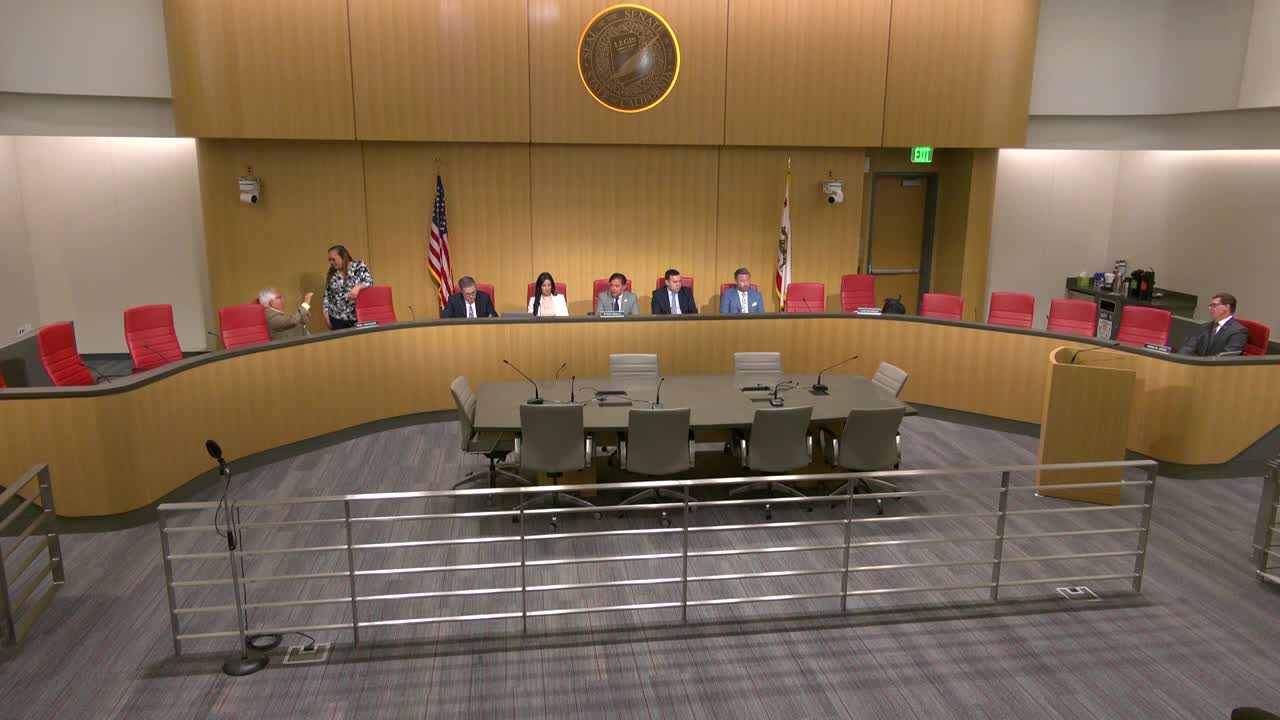 27MIN
Senate Standing Committee on Governmental Organization
Bill Author

Bill Co-Author(s):