SB 525: California FAIR Plan: manufactured homes.
- Session Year: 2025-2026
- House: Senate
- Latest Version Date: 2025-10-09
Current Status:
Passed
(2025-10-09: Chaptered by Secretary of State. Chapter 476, Statutes of 2025.)
Introduced
In Committee
Awaiting First Chamber Vote
Passed First Chamber
In Committee
Awaiting Second Chamber Vote
Passed Second Chamber
Enacted
What does this bill do?
The bill adds manufactured homes and mobile homes to the California FAIR Plan’s definition of basic property insurance. Owners of those homes would be eligible for the same coverage terms as other residential dwellings under the FAIR Plan.
The summary is provided by generative AI which can make mistakes. For original language, please view the details in the table below.
Existing law creates the California FAIR Plan Association, a joint reinsurance association formed by insurers licensed to write and engaged in writing basic property insurance within this state, to assist persons in securing basic property insurance, and to formulate and administer a program for the equitable apportionment among insurers of basic property insurance. Existing law defines basic property insurance for these purposes.
This bill would define basic property insurance offered through the FAIR Plan to include insurance for manufactured homes and mobilehomes under the same terms and conditions as basic property insurance sold for other residential dwellings.
Existing law creates the California FAIR Plan Association, a joint reinsurance association formed by insurers licensed to write and engaged in writing basic property insurance within this state, to assist persons in securing basic property insurance, and to formulate and administer a program for the equitable apportionment among insurers of basic property insurance. Existing law defines basic property insurance for these purposes.
This bill would define basic property insurance offered through the FAIR Plan to include insurance for manufactured homes and mobilehomes that is comparable to under the same terms and conditions as basic property insurance sold for other residential dwellings.
Existing law creates the California FAIR Plan Association, a joint reinsurance association formed by insurers licensed to write and engaged in writing basic property insurance within this state, to assist persons in securing basic property insurance, and to formulate and administer a program for the equitable apportionment among insurers of basic property insurance. Existing law defines basic property insurance for these purposes.
This bill would define basic property insurance offered through the FAIR Plan to include insurance for manufactured homes insurance and mobilehomes that is comparable to basic property insurance sold for residential dwellings.
Existing law creates the California FAIR Plan Association, a joint reinsurance association formed by insurers licensed to write and engaged in writing basic property insurance within this state, to assist persons in securing basic property insurance, and to formulate and administer a program for the equitable apportionment among insurers of basic property insurance. Existing law defines basic property insurance for these purposes.
This bill would define basic property insurance offered through the FAIR Plan to include manufactured homes insurance that is comparable to basic property insurance sold for residential dwellings.
Unless the provision or context otherwise requires, the following definitions govern the construction of this chapter:
(a)Association, industry placement facility, or facility, means a joint reinsurance association, the California FAIR Plan Association, formed by insurers licensed to write and engaged in writing basic property insurance within this state to assist persons in securing basic property insurance and to formulate and administer a program for the equitable apportionment among insurers of basic property insurance.
(b)Commissioner means the Insurance Commissioner of this state.
(c)(1)Basic property insurance means insurance against direct loss to real or tangible personal property at a fixed location in those geographic or urban areas, as designated by the commissioner, from perils insured under the standard fire policy and extended coverage endorsement, from vandalism and malicious mischief, and includes other insurance coverages as may be added with respect to that property by the industry placement facility with the approval of the commissioner or by the commissioner. Basic property insurance includes insurance for manufactured homes and mobilehomes under the same terms and conditions as basic property insurance sold for other residential dwellings. Basic property insurance does not include insurance on automobile risks, commercial agricultural commodities or livestock, or equipment used to cultivate or transport agricultural commodities or livestock.
(2)For the purposes of earthquake coverage that is provided as a component of basic property insurance, the association shall sell only the policy described in Section 10089. In force policies of basic property insurance that include earthquake coverage shall be renewed with the coverage specified in Section 10089, and the association shall comply with the notice requirements of paragraph (2) of subdivision (a) of Section 10086.
(d)Inspection bureau means the organization or organizations designated by the association with the approval of the commissioner to make inspections to determine the condition of the properties for which basic property insurance is sought and to perform other duties as may be authorized by the association.
(e)Premiums written means gross direct premiums charged with respect to property in this state on all policies of basic property insurance and the basic property insurance premium components of all multiperil policies, less return premiums, dividends paid or credited to policyholders, or the unused or unabsorbed portions of premium deposits.
(f)Insurer means a person who undertakes to indemnify another against loss, damage, or liability arising from a contingent or unknown event, and shall include reciprocals and interinsurance exchanges.
(g)Manufactured home shall have the same meaning as defined in Section 18007 of the Health and Safety Code.
(h)Mobilehome shall have the same meaning as defined in Section 18008 of the Health and Safety Code.
Unless the provision or context otherwise requires, the following definitions govern the construction of this chapter:
(a)Association, industry placement facility, or facility, means a joint reinsurance association, the California FAIR Plan Association, formed by insurers licensed to write and engaged in writing basic property insurance within this state to assist persons in securing basic property insurance and to formulate and administer a program for the equitable apportionment among insurers of basic property insurance.
(b)Commissioner means the Insurance Commissioner of this state.
(c)(1)Basic property insurance means insurance against direct loss to real or tangible personal property at a fixed location in those geographic or urban areas, as designated by the commissioner, from perils insured under the standard fire policy and extended coverage endorsement, from vandalism and malicious mischief, and includes other insurance coverages as may be added with respect to that property by the industry placement facility with the approval of the commissioner or by the commissioner. Basic property insurance includes insurance for manufactured homes and mobilehomes that is comparable to under the same terms and conditions as basic property insurance sold for other residential dwellings. Basic property insurance does not include insurance on automobile risks, commercial agricultural commodities or livestock, or equipment used to cultivate or transport agricultural commodities or livestock.
(2)For the purposes of earthquake coverage that is provided as a component of basic property insurance, the association shall sell only the policy described in Section 10089. In force policies of basic property insurance that include earthquake coverage shall be renewed with the coverage specified in Section 10089, and the association shall comply with the notice requirements of paragraph (2) of subdivision (a) of Section 10086.
(d)Inspection bureau means the organization or organizations designated by the association with the approval of the commissioner to make inspections to determine the condition of the properties for which basic property insurance is sought and to perform other duties as may be authorized by the association.
(e)Premiums written means gross direct premiums charged with respect to property in this state on all policies of basic property insurance and the basic property insurance premium components of all multiperil policies, less return premiums, dividends paid or credited to policyholders, or the unused or unabsorbed portions of premium deposits.
(f)Insurer means a person who undertakes to indemnify another against loss, damage, or liability arising from a contingent or unknown event, and shall include reciprocals and interinsurance exchanges.
(g)Manufactured home shall have the same meaning as defined in Section 18007 of the Health and Safety Code.
(h)Mobilehome shall have the same meaning as defined in Section 18008 of the Health and Safety Code.
Unless the provision or context otherwise requires, the following definitions govern the construction of this chapter:
(a)Association, industry placement facility, or facility, means a joint reinsurance association, the California FAIR Plan Association, formed by insurers licensed to write and engaged in writing basic property insurance within this state to assist persons in securing basic property insurance and to formulate and administer a program for the equitable apportionment among insurers of basic property insurance.
(b)Commissioner means the Insurance Commissioner of this state.
(c)(1)Basic property insurance means insurance against direct loss to real or tangible personal property at a fixed location in those geographic or urban areas, as designated by the commissioner, from perils insured under the standard fire policy and extended coverage endorsement, from vandalism and malicious mischief, and includes other insurance coverages as may be added with respect to that property by the industry placement facility with the approval of the commissioner or by the commissioner. Basic property insurance includes insurance for manufactured homes and mobilehomes that is comparable to basic property insurance sold for residential dwellings. Basic property insurance does not include insurance on automobile risks, commercial agricultural commodities or livestock, or equipment used to cultivate or transport agricultural commodities or livestock.
(2)For the purposes of earthquake coverage that is provided as a component of basic property insurance, the association shall sell only the policy described in Section 10089. In force policies of basic property insurance that include earthquake coverage shall be renewed with the coverage specified in Section 10089, and the association shall comply with the notice requirements of paragraph (2) of subdivision (a) of Section 10086.
(d)Inspection bureau means the organization or organizations designated by the association with the approval of the commissioner to make inspections to determine the condition of the properties for which basic property insurance is sought and to perform other duties as may be authorized by the association.
(e)Premiums written means gross direct premiums charged with respect to property in this state on all policies of basic property insurance and the basic property insurance premium components of all multiperil policies, less return premiums, dividends paid or credited to policyholders, or the unused or unabsorbed portions of premium deposits.
(f)Insurer means a person who undertakes to indemnify another against loss, damage, or liability arising from a contingent or unknown event, and shall include reciprocals and interinsurance exchanges.
Unless the provision or context otherwise requires, the following definitions govern the construction of this chapter:
(a)Association, industry placement facility, or facility, means a joint reinsurance association, the California FAIR Plan Association, formed by insurers licensed to write and engaged in writing basic property insurance within this state to assist persons in securing basic property insurance and to formulate and administer a program for the equitable apportionment among insurers of basic property insurance.
(b)Commissioner means the Insurance Commissioner of this state.
(c)(1)Basic property insurance means insurance against direct loss to real or tangible personal property at a fixed location in those geographic or urban areas, as designated by the commissioner, from perils insured under the standard fire policy and extended coverage endorsement, from vandalism and malicious mischief, and includes other insurance coverages as may be added with respect to that property by the industry placement facility with the approval of the commissioner or by the commissioner, but shall commissioner. Basic property insurance includes insurance for manufactured homes that is comparable to basic property insurance sold for residential dwellings. Basic property insurance does not include insurance on automobile risks, commercial agricultural commodities or livestock, or equipment used to cultivate or transport agricultural commodities or livestock.
(2)For the purposes of earthquake coverage that is provided as a component of basic property insurance, the association shall sell only the policy described in Section 10089. In force policies of basic property insurance that include earthquake coverage shall be renewed with the coverage specified in Section 10089, and the association shall comply with the notice requirements of paragraph (2) of subdivision (a) of Section 10086.
(d)Inspection bureau means the organization or organizations designated by the association with the approval of the commissioner to make inspections to determine the condition of the properties for which basic property insurance is sought and to perform other duties as may be authorized by the association.
(e)Premiums written means gross direct premiums charged with respect to property in this state on all policies of basic property insurance and the basic property insurance premium components of all multiperil policies, less return premiums, dividends paid or credited to policyholders, or the unused or unabsorbed portions of premium deposits.
(f)Insurer means a person who undertakes to indemnify another against loss, damage, or liability arising from a contingent or unknown event, and shall include reciprocals and interinsurance exchanges.
|
Date
|
Status
|
|---|---|
| Oct 9, 2025 | Chaptered by Secretary of State. Chapter 476, Statutes of 2025. |
| Oct 9, 2025 | Approved by the Governor. |
| Sep 16, 2025 | Enrolled and presented to the Governor at 3 p.m. |
| Sep 8, 2025 | In Senate. Ordered to engrossing and enrolling. |
| Sep 8, 2025 | Read third time. Passed. (Ayes 79. Noes 0. Page 2995.) Ordered to the Senate. |
| Sep 2, 2025 | Read second time. Ordered to third reading. |
| Aug 29, 2025 | From committee: Do pass. (Ayes 15. Noes 0.) (August 29). |
| Aug 20, 2025 | August 20 set for first hearing. Placed on APPR. suspense file. |
| Jul 9, 2025 | From committee: Do pass and re-refer to Com. on APPR. (Ayes 15. Noes 0.) (July 9). Re-referred to Com. on APPR. |
| Jun 9, 2025 | Referred to Com. on INS. |
| Jun 3, 2025 | In Assembly. Read first time. Held at Desk. |
| Jun 2, 2025 | Read third time. Passed. (Ayes 37. Noes 0. Page 1403.) Ordered to the Assembly. |
| Apr 28, 2025 | Read second time. Ordered to third reading. |
| Apr 24, 2025 | From committee: Do pass. (Ayes 4. Noes 0. Page 869.) (April 23). |
| Apr 8, 2025 | From committee with author's amendments. Read second time and amended. Re-referred to Com. on INS. |
| Apr 4, 2025 | Set for hearing April 23. |
| Mar 28, 2025 | April 9 set for first hearing canceled at the request of author. |
| Mar 26, 2025 | Set for hearing April 9. |
| Mar 24, 2025 | From committee with author's amendments. Read second time and amended. Re-referred to Com. on INS. |
| Mar 5, 2025 | Referred to Com. on INS. |
| Feb 21, 2025 | From printer. May be acted upon on or after March 23. |
| Feb 20, 2025 | Introduced. Read first time. To Com. on RLS. for assignment. To print. |
|
Date
|
Description
|
Location
|
Votes
|
|
|---|---|---|---|---|
| Sep 8, 2025 | SB 525 Jones Senate Third Reading By Wallis | Assembly Floor |
Passed |
|
| Aug 29, 2025 | Do pass. | Assembly Standing Committee on Appropriations |
Passed |
|
| Jul 9, 2025 | Do pass and be re-referred to the Committee on [Appropriations] | Assembly Standing Committee on Insurance |
Passed |
|
| Jun 2, 2025 | Senate 3rd Reading SB525 Jones | Senate Floor |
Passed |
|
| Apr 23, 2025 | Do pass | Senate Standing Committee on Insurance |
Passed |
This list shows positions taken on this bill by organizations on the date displayed, which is linked to the original source.
Positions by individuals are not included.
|
Organization
|
Position
|
Date
|
|---|---|---|
| a consumer group | ** Support | |
| American Property Casualty Insurance Association | ** Against | |
| California FAIR Plan Association (FAIR Plan) | ** Against | |
| City of San Marcos | ** Support | |
| Golden State Manufactured-home Owners League, Inc. | ** Support | |
| insurer associations | ** Against | |
| manufactured housing associations | ** Support | |
| Pacific Association Of Domestic Insurance Companies | ** Against | |
| Ricardo Lara, California Insurance Commissioner | ** Support | |
| United Policyholders | ** Support | |
| Western Manufactured Housing Communities Association | ** Support |
SENATE THIRD READING
STR Bill Id:SB 525
Author:(Jones)
As Amended Ver:April 8, 2025
Majority vote
SUMMARY
Requires the California Fair Access to Insurance Requirements (FAIR) Plan to cover manufactured homes and mobile homes.
Major Provisions
COMMENTS
- The FAIR Plan: The California FAIR Plan – "Fair Access to Insurance Requirements" – is an "association" of all insurance companies licensed by the California Department of Insurance (CDI) that provide basic property and casualty insurance in California. It was created in 1968, following urban disturbances, notably the Watts Riots in Los Angeles.
Simply stated, the purpose of the FAIR Plan is to be the "insurer of last resort" for "basic" property insurance in the event of a market failure. At inception, that was essentially urban commercial property. Ultimately, it has expanded to include homeowners' insurance anywhere in the state, provided that insurance "cannot be obtained" in the normal manner in the market.
FAIR Plan policies are capped at $3.3 million for residential properties and $20 million per structure (up to $100 million) for commercial properties. These caps were increased by the Insurance Commissioner in 2020 for residential and in 2023 for commercial. Commercial went from $8.4 million per location in 2021, to $20 million per location in 2023, to $20 million per structure subsequently in 2023 (but finalized in 2024).
FAIR Plan commercial policies can cover homeowners associations, condo associations, farms, and businesses.
By statute, the FAIR Plan policy is not as broad as traditional homeowners' policies, it is nonetheless a fully sound and guaranteed policy that satisfies lenders' security requirements and protects the property against the primary risk factor faced by homeowners, which is [wild]fire. Other coverages are readily available in the market (typically through the purchase of a "difference-in-conditions" or "DIC" policy), which provide wraparound coverage that, coupled with a FAIR Plan policy, results in the same protection provided by a standard homeowner's policy. Because the FAIR Plan's role is to provide coverage when the regular market won't, it is not necessarily the role of the FAIR Plan to provide DIC policies when there is a healthy market for those policies.
According to the FAIR Plan, as of March 2025 (FAIR Plan updates quarterly on their website), the FAIR Plan's total exposure in California is $599 billion, reflecting a 31% increase since September 2024 and a 259% increase since September 2021.
As of March, 2025, the FAIR Plan's policies in force reached 573,739, a 23% increase since September 2024 and a 139% increase since September 2021.
Homeowners are required to conduct a diligent search of the private market for new coverage before resorting to the FAIR Plan. After receiving a non-renewal notice, some homeowners will find coverage from the admitted market in the course of that diligent search. However, where there are significant increases in FAIR Plan policy counts, it is a sound assumption that there has been an increase in the number of non-renewal notices sent to homeowners.
- Recent Expansion of the FAIR Plan:
In the last seven years, primarily in response to catastrophic wildfires and admitted market withdrawal, legislation and actions taken by CDI has resulted in the FAIR Plan going through a complete transformation/expansion. These actions include:
- Increasing FAIR Plan residential limits to $3.3 million.
- Increasing FAIR Plan commercial limits to $8.4 million per location, to $20 million per location to the $20 million per structure.
- Potential expansion and requirement to offer homeowners a more comprehensive coverage aka HO-3 light policy (pending litigation).
- Expanding commercial coverage to farms, ranches and other agricultural businesses.
- Developing residential and commercial clearinghouse programs.
- Implementing "Safer from Wildfire" discounts to FAIR Plan policyholders.
- Area of Concern: As part of the Insurance Commissioner's Sustainable Insurance Strategy (SIS), a provision of the SIS is to depopulate the FAIR Plan.
"Transitioning homeowners and businesses from the FAIR Plan back into the normal insurance market with commitments from insurance companies to cover all parts of California by writing no less than 85% of their statewide market share in high wildfire risk communities. "
Expanding the FAIR Plan is counter-intuitive to depopulating the FAIR Plan. That being said, this committee is sensitive to the fact that the SIS is not fully implemented, therefore insurance availability is still lacking.
According to the Author
According to the Author: "There is ongoing confusion within the FAIR Plan and among its participating insurers as to why owners of manufactured homes are not being offered the same basic property insurance, including full replacement cost coverage, that is available for standard residential dwellings.
As a result, many manufactured homeowners are being denied or are unable to obtain full replacement cost coverage. Instead, these homeowners can only secure insurance based on the initial purchase price of their home, rather than its present-day replacement value, leaving them drastically underinsured—especially in California's increasingly fire-prone environment.
SB 525 clarifies that the California FAIR Plan Association must offer owners of manufactured homes (also known as "mobilehomes") the same basic property insurance, including full replacement cost coverage, that it already provides for standard residential dwellings."
Arguments in Support
According to California's Insurance Commissioner Ricardo Lara, "Some stakeholders worry that expanding coverage under SB 525 could put additional strain on the FAIR Plan's resources, especially while we are implementing my Sustainable Insurance Strategy. However, this bill is not creating a brand-new mandate but clarifying that manufactured homeowners, that are forced into the FAIR Plan, deserve access to the same basic property insurance as other homeowners. Because the FAIR Plan has the authority to adjust its rates to reflect any new exposures, it can maintain financial health while extending equitable coverage.
Arguments in Opposition
None on file.
FISCAL COMMENTS
According to the Assembly Appropriations Committee, possible costs of an unknown, but potentially significant amount, in excess of $150,000, to the CDI to update informational materials and consumer communications and review adjusted FAIR Plan rates (Insurance Fund). CDI reports no fiscal impact from this bill. However, CDI has previously indicated significant costs associated with legislation that may result in FAIR Plan consumer complaints, assuming that a percentage of policyholders will contact CDI for assistance.
VOTES
SENATE FLOOR: 37-0-3
YES: Allen, Alvarado-Gil, Archuleta, Arreguín, Ashby, Becker, Blakespear, Cabaldon, Caballero, Cervantes, Choi, Cortese, Dahle, Durazo, Gonzalez, Grayson, Grove, Jones, Laird, Limón, McGuire, McNerney, Menjivar, Niello, Ochoa Bogh, Padilla, Pérez, Richardson, Seyarto, Smallwood-Cuevas, Stern, Strickland, Umberg, Valladares, Wahab, Weber Pierson, Wiener
ABS, ABST OR NV: Hurtado, Reyes, Rubio
ASM INSURANCE: 15-0-2
YES: Calderon, Wallis, Addis, Alvarez, Ávila Farías, Berman, Chen, Ellis, Gipson, Hadwick, Harabedian, Nguyen, Ortega, Petrie-Norris, Michelle Rodriguez
ABS, ABST OR NV: Krell, Valencia
ASM APPROPRIATIONS: 15-0-0
YES: Wicks, Sanchez, Arambula, Calderon, Caloza, Dixon, Elhawary, Fong, Mark González, Ahrens, Pacheco, Pellerin, Solache, Ta, Tangipa
UPDATED
VERSION: April 8, 2025
CONSULTANT: Kathleen O'Malley / INS. / (916) 319-2086 FN: 0001366
Date of Hearing: August 20, 2025
ASSEMBLY COMMITTEE ON APPROPRIATIONS
Buffy Wicks, Chair
SBPCA Bill Id:SB 525
Author:(Jones) – As Amended Ver:April 8, 2025
Policy Committee: | Insurance | Vote: | 15 - 0 |
|
| ||
|
|
Urgency: No State Mandated Local Program: No Reimbursable: No
SUMMARY:
This bill requires the California FAIR Plan Association (FAIR Plan) to insure manufactured homes and mobile homes under the same terms and conditions as basic property insurance sold for other residential dwellings.
FISCAL EFFECT:
Possible costs of an unknown, but potentially significant amount, in excess of $150,000, to the Department of Insurance (CDI) to update informational materials and consumer communications and review adjusted FAIR Plan rates (Insurance Fund). CDI reports no fiscal impact from this bill. However, CDI has previously indicated significant costs associated with legislation that may result in FAIR Plan consumer complaints, assuming that a percentage of policyholders will contact CDI for assistance.
COMMENTS:
- Purpose. According to the author:
There is ongoing confusion within the FAIR Plan and among its participating insurers as to why owners of manufactured homes are not being offered the same basic property insurance, including full replacement cost coverage, that is available for standard residential dwellings.
As a result, many manufactured homeowners are being denied or are unable to obtain full replacement cost coverage. Instead, these homeowners can only secure insurance based on the initial purchase price of their home, rather than its present-day replacement value, leaving them drastically underinsured – especially in California’s increasingly fire-prone environment.
- Background. Evolution of the FAIR Plan. The FAIR Plan is a private association of all licensed insurance companies created by the Legislature in 1968 to serve as the “insurer of last resort” for basic property insurance in the event of a market failure. Although originally envisioned to cover urban commercial property following the Watts Riots, the FAIR Plan expanded to include homeowners’ insurance across the state and, more recently, due to the continued risk of catastrophic wildfires and admitted market withdrawal, expanded to commercial coverage of farms, ranches, and other agricultural businesses. According to the FAIR Plan, as of December 2024, it has more than 516,000 policies in force, reflecting an 11.1% increase since September 2024, and a 115% increase since September 2021. Depopulating the FAIR Plan is a key provision of the Insurance Commissioner’s (IC’s) Sustainable Insurance Strategy (SIS) to stabilize the state’s insurance market.
FAIR Plan Coverage. A policy under the FAIR Plan is a fully sound and guaranteed policy that satisfies a lender’s security requirements, but is not as broad as a traditional homeowners’ policy. There are other coverage options in the market, generally through the purchase of a “difference-in-conditions” (DIC) policy, to provide a FAIR Plan policyholder with wraparound coverage resulting in the same protection as a standard homeowners’ policy. As noted in the Assembly Insurance Committee’s analysis of this bill, “Because the FAIR Plan’s role is to provide coverage when the regular market won’t, it is not necessarily the role of the FAIR Plan to provide DIC policies when there is a healthy market for those policies.” Despite the differences between manufactured or mobile homes and secured residential property, this bill requires the FAIR Plan to insure manufactured homes and mobile homes under the same terms and conditions as basic property insurance sold for other residential dwellings.
- Support and Opposition. This bill is supported by IC Ricardo Lara, a consumer group, and manufactured housing associations, with IC Lara arguing, “this bill is not creating a brand-new mandate but clarifying that manufactured homeowners, that are forced into the FAIR Plan, deserve access to the same basic property insurance as other homeowners.”
This bill is opposed by insurer associations, which argue, “the bill needs language making the new coverage limits contingent on the FAIR Plan being able to make a rate filing and adjust their rates to reflect the new exposure.” Additionally, the FAIR Plan cites concerns with this bill, noting that setting actuarially sound rates will mean the “replacement cost for manufactured and mobile homes would be expensive if such coverage becomes available from the FAIR Plan,” as well as “the need to depopulate the FAIR Plan, consistent with the SIS, and that replacement coverage is currently available to consumers through the voluntary and surplus lines markets.”
- Related Legislation. AB 69 (Calderon) requires a broker of record of an insurance policy placed in the FAIR Plan to determine, before renewal of the policy, whether the policy can be moved to a voluntary market insurance company. AB 69’s hearing by the Senate Insurance Committee was canceled at the request of the author.
Analysis Prepared by: Irene Ho / APPR. / (916) 319-2081
Date of Hearing: July 9, 2025
ASSEMBLY COMMITTEE ON INSURANCE
Lisa Calderon, Chair
SBPCA Bill Id:SB 525
Author:(Jones) – As Amended Ver:April 8, 2025
SENATE VOTE: 37-0
SUBJECT: California FAIR Plan: manufactured homes
SUMMARY: Requires the California Fair Access to Insurance Requirements (FAIR) Plan to cover manufactured homes and mobile homes.
EXISTING LAW:
- States that the FAIR Plan was established to assure stability, to assure the availability, to encourage maximum use, and to provide for equitable distribution among admitted insurers of the responsibility for insuring qualified property for which basic property insurance cannot be obtained through the normal insurance market. (Insurance (Ins.) Code, Section 10090)
- Specifies that rates for the FAIR Plan shall not be excessive, inadequate, or unfairly discriminatory, and shall be actuarially sound so that premiums are adequate to cover expected losses, expenses and taxes, and shall reflect investment income of the plan. (Ins. Code, Section 10100.2)
- Allows the FAIR Plan, with approval from the Insurance Commissioner, to assess all members in amounts sufficient to operate the facility. (Ins. Code, Section 10094)
- Requires all members of the FAIR Plan to participate in the writings, expenses, profits, and losses of the FAIR Plan in the proportion that its premiums written during the second preceding calendar year bear to the aggregate premiums written by all insurers. (Ins. Code, Section 10095)
- Defines “Basic property insurance” as insurance against direct loss to real or tangible personal property at a fixed location in those geographic or urban areas, as designated by the commissioner, from perils insured under the standard fire policy and extended coverage endorsement, from vandalism and malicious mischief, and includes other insurance coverages as may be added with respect to that property by the industry placement facility with the approval of the commissioner or by the commissioner, but shall not include insurance on automobile risks, commercial agricultural commodities or livestock, or equipment used to cultivate or transport agricultural commodities or livestock. (Ins. Code, Section 10091)
- Defines “manufactured home” as a structure that was constructed on or after June 15, 1976, is transportable in one or more sections, is eight body feet or more in width, or 40 body feet or more in length, in the traveling mode, or, when erected on site, is 320 or more square feet, is built on a permanent chassis and designed to be used as a single-family dwelling with or without a foundation when connected to the required utilities, and includes the plumbing, heating, air conditioning, and electrical systems contained therein. (Health and Safety Code, Section 18007)
- Defines “mobile home” as a structure that was constructed prior to June 15, 1976, is transportable in one or more sections, is eight body feet or more in width, or 40 body feet or more in length, in the traveling mode, or, when erected onsite, is 320 or more square feet, is built on a permanent chassis and designed to be used as a single-family dwelling with or without a foundation system when connected to the required utilities, and includes the plumbing, heating, air conditioning, and electrical systems contained therein. (Health and Safety Code, Section 18008)
FISCAL EFFECT: None.
COMMENTS:
- Purpose of the bill: According to the Author: “There is ongoing confusion within the FAIR Plan and among its participating insurers as to why owners of manufactured homes are not being offered the same basic property insurance, including full replacement cost coverage, that is available for standard residential dwellings.
As a result, many manufactured homeowners are being denied or are unable to obtain full replacement cost coverage. Instead, these homeowners can only secure insurance based on the initial purchase price of their home, rather than its present-day replacement value, leaving them drastically underinsured—especially in California’s increasingly fire-prone environment.
SB 525 clarifies that the California FAIR Plan Association must offer owners of manufactured homes (also known as “mobilehomes”) the same basic property insurance, including full replacement cost coverage, that it already provides for standard residential dwellings.”
- The FAIR Plan: The California FAIR Plan – “Fair Access to Insurance Requirements” – is an “association” of all insurance companies licensed by the California Department of Insurance (CDI) that provide basic property and casualty insurance in California. It was created in 1968, following urban disturbances, notably the Watts Riots in Los Angeles.
Simply stated, the purpose of the FAIR Plan is to be the “insurer of last resort” for “basic” property insurance in the event of a market failure. At inception, that was essentially urban commercial property. Ultimately, it has expanded to include homeowners’ insurance anywhere in the state, provided that insurance “cannot be obtained” in the normal manner in the market.
FAIR Plan policies are capped at $3.3 million for residential properties and $20 million per structure (up to $100 million) for commercial properties. These caps were increased by the Insurance Commissioner in 2020 for residential and in 2023 for commercial. Commercial went from $8.4 million per location in 2021, to $20 million per location in 2023, to $20 million per structure subsequently in 2023 (but finalized in 2024).
FAIR Plan commercial policies can cover homeowners associations, condo associations, farms, and businesses.
By statute, the FAIR Plan policy is not as broad as traditional homeowners’ policies, it is nonetheless a fully sound and guaranteed policy that satisfies lenders’ security requirements and protects the property against the primary risk factor faced by homeowners, which is [wild]fire. Other coverages are readily available in the market (typically through the purchase of a “difference-in-conditions” or “DIC” policy), which provide wraparound coverage that, coupled with a FAIR Plan policy, results in the same protection provided by a standard homeowner’s policy. Because the FAIR Plan’s role is to provide coverage when the regular market won’t, it is not necessarily the role of the FAIR Plan to provide DIC policies when there is a healthy market for those policies.
According to the FAIR Plan, as of March 2025 (FAIR Plan updates quarterly on their website), the FAIR Plan’s total exposure in California is $599 billion, reflecting a 31% increase since September 2024 and a 259% increase since September 2021.
As of March, 2025, the FAIR Plan’s policies in force reached 573,739, a 23% increase since September 2024 and a 139% increase since September 2021.
Homeowners are required to conduct a diligent search of the private market for new coverage before resorting to the FAIR Plan. After receiving a non-renewal notice, some homeowners will find coverage from the admitted market in the course of that diligent search. However, where there are significant increases in FAIR Plan policy counts, it is a sound assumption that there has been an increase in the number of non-renewal notices sent to homeowners.
- Recent Expansion of the FAIR Plan:
In the last 7 years, primarily in response to catastrophic wildfires and admitted market withdrawal, legislation and actions taken by CDI has resulted in the FAIR Plan going through a complete transformation/expansion. These actions include:
- Increasing FAIR Plan residential limits to $3.3 million.
- Increasing FAIR Plan commercial limits to $8.4 million per location, to $20 million per location to the $20 million per structure.
- Potential expansion and requirement to offer homeowners a more comprehensive coverage aka HO-3 light policy (pending litigation).
- Expanding commercial coverage to farms, ranches and other agricultural businesses.
- Developing residential and commercial clearinghouse programs.
- Implementing “Safer from Wildfire” discounts to FAIR Plan policyholders.
- Area of Concern: As part of the Insurance Commissioner’s Sustainable Insurance Strategy (SIS), a provision of the SIS is to depopulate the FAIR Plan.
“Transitioning homeowners and businesses from the FAIR Plan back into the normal insurance market with commitments from insurance companies to cover all parts of California by writing no less than 85% of their statewide market share in high wildfire risk communities. “
Expanding the FAIR Plan is counter-intuitive to depopulating the FAIR Plan. That being said, this committee is sensitive to the fact that the SIS is not fully implemented, therefore insurance availability is still lacking.
- Previous Legislation: SB 11 (Rubio) Chapter 128, Statues of 2021, expanded the FAIR Plan by allowing the FAIR Plan to sell commercial coverage to farms.
REGISTERED SUPPORT / OPPOSITION:
Support
City of San Marcos
Insurance Commissioner Ricardo Lara / California Department of Insurance
Western Manufactured Housing Communities Association
Opposition
None on file.
Analysis Prepared by: Kathleen O'Malley / INS. / (916) 319-2086
SENATE RULES COMMITTEE Office of Senate Floor Analyses (916) 651-1520 Fax: (916) 327-4478 | SB 525 |
THIRD READING
Bill No: SB 525
Author: Jones (R)
Amended: 4/8/25
Vote: 21
SENATE INSURANCE COMMITTEE: 4-0, 4/23/25
AYES: Niello, Caballero, Jones, Padilla
NO VOTE RECORDED: Rubio, Becker, Wahab
SUBJECT: California FAIR Plan: manufactured homes
SOURCE: Author
DIGEST:
This bill includes manufactured homes and mobilehomes in the definition of “basic property insurance” offered through the California Fair Access to Insurance Requirements Plan Association (FAIR Plan) in order to provide coverage matching insurance sold for other residential dwellings.
ANALYSIS:
Existing law:
1) Establishes the FAIR Plan to assure the stability of the property insurance market, to assure the availability of basic property insurance, as defined, to encourage maximum use of the normal insurance market in obtaining basic property insurance provided by admitted insurers and licensed surplus line brokers.
2) Provides, as part of the FAIR Plan, for the equitable distribution among admitted insurers of the responsibility for insuring qualified property for which basic property insurance cannot be obtained through the normal insurance market.
3) Defines, under the FAIR Plan, “basic property insurance” to mean insurance against direct loss to personal property, at a fixed location, from perils insured under a standard fire policy, among other specifications.
4) Defines a “manufactured home” as a structure that was constructed on or after June 15, 1976, is transportable in one or more sections, is eight feet or more in width, or 40 feet or more in length, in the traveling mode, or, when set up, is 320 or more square feet, is built on a permanent chassis and designed to be used as a single-family dwelling with or without a foundation when connected to the required utilities, and includes the plumbing, heating, air conditioning, and electrical systems contained therein, among other specifications.
5) Defines a “mobilehome” as a structure that was constructed prior to June 15, 1976, is transportable in one or more sections, is eight feet or more in width, or 40 feet or more in length, in the traveling mode, or, when set up, is 320 or more square feet, is built on a permanent chassis and designed to be used as a single-family dwelling with or without a foundation system when connected to the required utilities, and includes the plumbing, heating, air conditioning, and electrical systems contained therein, among other specifications.
This bill:
1) Provides that the meaning of manufactured homes and mobilehomes for the bill’s provisions shall be the same as those described above, which are defined in the Health and Safety Code.
2) Specifies that basic property insurance offered under the FAIR Plan must also include manufactured homes and mobilehomes under the same terms and conditions as other covered residential dwellings.
Background
Status of the FAIR Plan’s Exposure and Policy Count. As of March 2025, the
FAIR Plan’s total exposure, or total potential for loss, is $599 billion, reflecting a
31% increase since September 2024 (prior fiscal year-end) and a 259% increase
since September 2021 (Fiscal Year End 2021). Furthermore, as of March 2025, the
FAIR Plan’s total number of dwelling and commercial policies is 573,739
reflecting a 23% increase since September 2024 (prior fiscal year-end) and a 139%
increase since September 2021 (Fiscal Year End 2021).
Actual Cash Value versus Replacement Cost Value. “Actual Cash Value” means a
policy will pay the cost to repair or replace a home or personal property based on
its value, considering depreciation, which includes things like age, as well as wear
and tear. The FAIR Plan currently offers actual cash value coverage for
manufactured homes and mobilehomes. “Replacement Cost Value” means a policy
will pay the cost to repair or replace damaged property using new items or
materials of a like kind and quality, without considering depreciation.
FISCAL EFFECT: Appropriation: No Fiscal Com.: No Local: No
SUPPORT: (Verified 4/30/25)
Ricardo Lara, California Insurance Commissioner
Golden State Manufactured-home Owners League, INC.
United Policyholders
Western Manufactured Housing Communities Association
OPPOSITION: (Verified 4/30/25)
American Property Casualty Insurance Association
Pacific Association of Domestic Insurance Companies
ARGUMENTS IN SUPPORT:
The United Policyholders, among others, state:
“There are only a limited number of insurers that sell coverage for manufactured homes, and in the current marketplace, Californians who own them are having a harder time finding options to stay financially protected. SB 525 will provide an important relief valve for those property owners by allowing them to access coverage through the state’s insurer of last resort.
Manufactured homes are a vital housing option for many individuals and families, and an increasingly attractive option for those who lose homes in wildfires and are underinsured or uninsured. By explicitly including manufactured homes within the FAIR Plan’s scope, this legislation ensures that these homeowners have access to insurance policies comparable to those available for traditional residential dwellings, promoting fairness and stability in California’s insurance market.”
ARGUMENTS IN OPPOSITION:
According to the American Property Casualty Insurance Association and the Pacific Association of Domestic Insurance Companies:
“We appreciate the author’s intent to have a conversation about California’s insurance crisis and look for ways to improve the market, but to place additional coverage mandates, and exposure, on the California FAIR Plan at this particular time is difficult. The Insurance Commissioner is also working to implement the Sustainable Insurance Strategy (SIS), and a critical component of this strategy is depopulating the FAIR Plan and returning customers to the voluntary market, which can provide more insurance options. Efforts to expand FAIR Plan coverage could run counter to this initiative.
If the Legislature wishes to change the manner in which the FAIR Plan covers manufactured housing, the bill needs language making the new coverage limits contingent on the FAIR Plan being able to make a rate filing and adjust their rates to reflect the new exposure. The FAIR Plan should not be expected to cover exposure it has not had the opportunity to collect premium for.”
Prepared by: Brandon Seto / INS. / (916) 651-4110
6/2/25 18:28:34
**** END ****
SENATE RULES COMMITTEE Office of Senate Floor Analyses (916) 651-1520 Fax: (916) 327-4478 | SB 525 |
THIRD READING
Bill No: SB 525
Author: Jones (R)
Amended: 4/8/25
Vote: 21
SENATE INSURANCE COMMITTEE: 4-0, 4/23/25
AYES: Niello, Caballero, Jones, Padilla
NO VOTE RECORDED: Rubio, Becker, Wahab
SUBJECT: California FAIR Plan: manufactured homes
SOURCE: Author
DIGEST:
This bill includes manufactured homes and mobilehomes in the definition of “basic property insurance” offered through the California Fair Access to Insurance Requirements Plan Association (FAIR Plan) in order to provide coverage matching insurance sold for other residential dwellings.
ANALYSIS:
Existing law:
1) Establishes the FAIR Plan to assure the stability of the property insurance market, to assure the availability of basic property insurance, as defined, to encourage maximum use of the normal insurance market in obtaining basic property insurance provided by admitted insurers and licensed surplus line brokers.
2) Provides, as part of the FAIR Plan, for the equitable distribution among admitted insurers of the responsibility for insuring qualified property for which basic property insurance cannot be obtained through the normal insurance market.
3) Defines, under the FAIR Plan, “basic property insurance” to mean insurance against direct loss to personal property, at a fixed location, from perils insured under a standard fire policy, among other specifications.
4) Defines a “manufactured home” as a structure that was constructed on or after June 15, 1976, is transportable in one or more sections, is eight feet or more in width, or 40 feet or more in length, in the traveling mode, or, when set up, is 320 or more square feet, is built on a permanent chassis and designed to be used as a single-family dwelling with or without a foundation when connected to the required utilities, and includes the plumbing, heating, air conditioning, and electrical systems contained therein, among other specifications.
5) Defines a “mobilehome” as a structure that was constructed prior to June 15, 1976, is transportable in one or more sections, is eight feet or more in width, or 40 feet or more in length, in the traveling mode, or, when set up, is 320 or more square feet, is built on a permanent chassis and designed to be used as a single-family dwelling with or without a foundation system when connected to the required utilities, and includes the plumbing, heating, air conditioning, and electrical systems contained therein, among other specifications.
This bill:
1) Provides that the meaning of manufactured homes and mobilehomes for the bill’s provisions shall be the same as those described above, which are defined in the Health and Safety Code.
2) Specifies that basic property insurance offered under the FAIR Plan must also include manufactured homes and mobilehomes under the same terms and conditions as other covered residential dwellings.
Background
Status of the FAIR Plan’s Exposure and Policy Count. As of March 2025, the
FAIR Plan’s total exposure, or total potential for loss, is $599 billion, reflecting a
31% increase since September 2024 (prior fiscal year-end) and a 259% increase
since September 2021 (Fiscal Year End 2021). Furthermore, as of March 2025, the
FAIR Plan’s total number of dwelling and commercial policies is 573,739
reflecting a 23% increase since September 2024 (prior fiscal year-end) and a 139%
increase since September 2021 (Fiscal Year End 2021).
Actual Cash Value versus Replacement Cost Value. “Actual Cash Value” means a
policy will pay the cost to repair or replace a home or personal property based on
its value, considering depreciation, which includes things like age, as well as wear
and tear. The FAIR Plan currently offers actual cash value coverage for
manufactured homes and mobilehomes. “Replacement Cost Value” means a policy
will pay the cost to repair or replace damaged property using new items or
materials of a like kind and quality, without considering depreciation.
FISCAL EFFECT: Appropriation: No Fiscal Com.: No Local: No
SUPPORT: (Verified 4/30/25)
Golden State Manufactured-home Owners League, INC.
United Policyholders
Western Manufactured Housing Communities Association
OPPOSITION: (Verified 4/30/25)
American Property Casualty Insurance Association
Pacific Association of Domestic Insurance Companies
ARGUMENTS IN SUPPORT:
The United Policyholders, among others, state:
“There are only a limited number of insurers that sell coverage for manufactured homes, and in the current marketplace, Californians who own them are having a harder time finding options to stay financially protected. SB 525 will provide an important relief valve for those property owners by allowing them to access coverage through the state’s insurer of last resort.
Manufactured homes are a vital housing option for many individuals and families, and an increasingly attractive option for those who lose homes in wildfires and are underinsured or uninsured. By explicitly including manufactured homes within the FAIR Plan’s scope, this legislation ensures that these homeowners have access to insurance policies comparable to those available for traditional residential dwellings, promoting fairness and stability in California’s insurance market.”
ARGUMENTS IN OPPOSITION:
According to the American Property Casualty Insurance Association and the Pacific Association of Domestic Insurance Companies:
“We appreciate the author’s intent to have a conversation about California’s insurance crisis and look for ways to improve the market, but to place additional coverage mandates, and exposure, on the California FAIR Plan at this particular time is difficult. The Insurance Commissioner is also working to implement the Sustainable Insurance Strategy (SIS), and a critical component of this strategy is depopulating the FAIR Plan and returning customers to the voluntary market, which can provide more insurance options. Efforts to expand FAIR Plan coverage could run counter to this initiative.
If the Legislature wishes to change the manner in which the FAIR Plan covers manufactured housing, the bill needs language making the new coverage limits contingent on the FAIR Plan being able to make a rate filing and adjust their rates to reflect the new exposure. The FAIR Plan should not be expected to cover exposure it has not had the opportunity to collect premium for.”
Prepared by: Brandon Seto / INS. / (916) 651-4110
4/30/25 16:52:56
**** END ****
SENATE RULES COMMITTEE Office of Senate Floor Analyses (916) 651-1520 Fax: (916) 327-4478 | SB 525 |
THIRD READING
Bill No: SB 525
Author: Jones (R)
Amended: 4/8/25
Vote: 21
SENATE INSURANCE COMMITTEE: 4-0, 4/23/25
AYES: Niello, Caballero, Jones, Padilla
NO VOTE RECORDED: Rubio, Becker, Wahab
SUBJECT: California FAIR Plan: manufactured homes
SOURCE: Author
DIGEST:
This bill includes manufactured homes and mobilehomes in the definition of “basic property insurance” offered through the California Fair Access to Insurance Requirements Plan Association (FAIR Plan) in order to provide coverage matching insurance sold for other residential dwellings.
ANALYSIS:
Existing law:
1) Establishes the FAIR Plan to assure the stability of the property insurance market, to assure the availability of basic property insurance, as defined, to encourage maximum use of the normal insurance market in obtaining basic property insurance provided by admitted insurers and licensed surplus line brokers.
2) Provides, as part of the FAIR Plan, for the equitable distribution among admitted insurers of the responsibility for insuring qualified property for which basic property insurance cannot be obtained through the normal insurance market.
3) Defines, under the FAIR Plan, “basic property insurance” to mean insurance against direct loss to personal property, at a fixed location, from perils insured under a standard fire policy, among other specifications.
4) Defines a “manufactured home” as a structure that was constructed on or after June 15, 1976, is transportable in one or more sections, is eight feet or more in width, or 40 feet or more in length, in the traveling mode, or, when set up, is 320 or more square feet, is built on a permanent chassis and designed to be used as a single-family dwelling with or without a foundation when connected to the required utilities, and includes the plumbing, heating, air conditioning, and electrical systems contained therein, among other specifications.
5) Defines a “mobilehome” as a structure that was constructed prior to June 15, 1976, is transportable in one or more sections, is eight feet or more in width, or 40 feet or more in length, in the traveling mode, or, when set up, is 320 or more square feet, is built on a permanent chassis and designed to be used as a single-family dwelling with or without a foundation system when connected to the required utilities, and includes the plumbing, heating, air conditioning, and electrical systems contained therein, among other specifications.
This bill:
1) Provides that the meaning of manufactured homes and mobilehomes for the bill’s provisions shall be the same as those described above, which are defined in the Health and Safety Code.
2) Specifies that basic property insurance offered under the FAIR Plan must also include manufactured homes and mobilehomes under the same terms and conditions as other covered residential dwellings.
Background
Status of the FAIR Plan’s Exposure and Policy Count. As of March 2025, the
FAIR Plan’s total exposure, or total potential for loss, is $599 billion, reflecting a
31% increase since September 2024 (prior fiscal year-end) and a 259% increase
since September 2021 (Fiscal Year End 2021). Furthermore, as of March 2025, the
FAIR Plan’s total number of dwelling and commercial policies is 573,739
reflecting a 23% increase since September 2024 (prior fiscal year-end) and a 139%
increase since September 2021 (Fiscal Year End 2021).
Actual Cash Value versus Replacement Cost Value. “Actual Cash Value” means a
policy will pay the cost to repair or replace a home or personal property based on
its value, considering depreciation, which includes things like age, as well as wear
and tear. The FAIR Plan currently offers actual cash value coverage for
manufactured homes and mobilehomes. “Replacement Cost Value” means a policy
will pay the cost to repair or replace damaged property using new items or
materials of a like kind and quality, without considering depreciation.
FISCAL EFFECT: Appropriation: No Fiscal Com.: No Local: No
SUPPORT: (Verified 4/24/25)
United Policyholders
Western Manufactured Housing Communities Association
OPPOSITION: (Verified 4/24/25)
American Property Casualty Insurance Association
Pacific Association of Domestic Insurance Companies
ARGUMENTS IN SUPPORT:
The United Policyholders, among others, state:
There are only a limited number of insurers that sell coverage for manufactured homes, and in the current marketplace, Californians who own them are having a harder time finding options to stay financially protected. SB 525 will provide an important relief valve for those property owners by allowing them to access coverage through the state’s insurer of last resort.
Manufactured homes are a vital housing option for many individuals and families, and an increasingly attractive option for those who lose homes in wildfires and are underinsured or uninsured. By explicitly including manufactured homes within the FAIR Plan’s scope, this legislation ensures that these homeowners have access to insurance policies comparable to those available for traditional residential dwellings, promoting fairness and stability in California’s insurance market.
ARGUMENTS IN OPPOSITION:
According to the American Property Casualty Insurance Association and the Pacific Association of Domestic Insurance Companies:
We appreciate the author’s intent to have a conversation about California’s insurance crisis and look for ways to improve the market, but to place additional coverage mandates, and exposure, on the California FAIR Plan at this particular time is difficult. The Insurance Commissioner is also working to implement the Sustainable Insurance Strategy (SIS), and a critical component of this strategy is depopulating the FAIR Plan and returning customers to the voluntary market, which can provide more insurance options. Efforts to expand FAIR Plan coverage could run counter to this initiative.
If the Legislature wishes to change the manner in which the FAIR Plan covers manufactured housing, the bill needs language making the new coverage limits contingent on the FAIR Plan being able to make a rate filing and adjust their rates to reflect the new exposure. The FAIR Plan should not be expected to cover exposure it has not had the opportunity to collect premium for.
Prepared by: Brandon Seto / INS. / (916) 651-4110
4/25/25 10:13:47
**** END ****
SENATE COMMITTEE ON INSURANCE
Senator Susan Rubio, Chair
2025 - 2026 Regular
Bill No: SB 525 Hearing Date: April 23, 2025
Author: | Jones | ||
Version: | April 8, 2025 Amended | ||
Urgency: | No | Fiscal: | No |
Consultant: | Brandon Seto | ||
SUBJECT: California FAIR Plan: manufactured homes
DIGEST:
Includes manufactured homes and mobilehomes in the definition of “basic property insurance” offered through the FAIR Plan in order to provide coverage matching insurance sold for other residential dwellings.
ANALYSIS:
Existing law:
- Establishes the California Fair Access to Insurance Requirements Plan Association (FAIR Plan) to assure the stability of the property insurance market, to assure the availability of basic property insurance, as defined, to encourage maximum use of the normal insurance market in obtaining basic property insurance provided by admitted insurers and licensed surplus line brokers.
- Provides, as part of the FAIR Plan, for the equitable distribution among admitted insurers of the responsibility for insuring qualified property for which basic property insurance cannot be obtained through the normal insurance market.
- Defines, under the FAIR Plan, “basic property insurance” to mean insurance against direct loss to personal property, at a fixed location, from perils insured under a standard fire policy, among other specifications.
- Defines a “manufactured home” as a structure that was constructed on or after June 15, 1976, is transportable in one or more sections, is eight feet or more in width, or 40 feet or more in length, in the traveling mode, or, when set up, is 320 or more square feet, is built on a permanent chassis and designed to be used as a single-family dwelling with or without a foundation when connected to the required utilities, and includes the plumbing, heating, air conditioning, and electrical systems contained therein, among other specifications.
- Defines a “mobilehome” as a structure that was constructed prior to June 15, 1976, is transportable in one or more sections, is eight feet or more in width, or 40 feet or more in length, in the traveling mode, or, when set up, is 320 or more square feet, is built on a permanent chassis and designed to be used as a single-family dwelling with or without a foundation system when connected to the required utilities, and includes the plumbing, heating, air conditioning, and electrical systems contained therein, among other specifications.
This bill:
- Provides that the meaning of manufactured homes and mobilehomes for the bill’s provisions shall be the same as those described above, which are defined in the Health and Safety Code.
- Specifies that basic property insurance offered under the FAIR Plan must also include manufactured homes and mobilehomes under the same terms and conditions as other covered residential dwellings.
Background
According to the author:
There is ongoing confusion within the FAIR Plan, among its participating insurers, and within the Office of the California Insurance Commissioner—which regulates both the insurance industry and the FAIR Plan—regarding why owners of manufactured homes are not being offered the same basic property insurance, including full replacement cost coverage, that is available for standard residential dwellings.
As a result, many manufactured homeowners are being denied or are unable to obtain full replacement cost coverage. Instead, these homeowners can only secure insurance based on the initial purchase price of their home, rather than its present-day replacement value, leaving them drastically underinsured—especially in California’s increasingly fire-prone environment.
SB 525 clarifies that the California FAIR Plan Association must offer owners of manufactured homes (also known as “mobilehomes”) the same basic property insurance, including full replacement cost coverage, that it already provides for standard residential dwellings.
Status of the FAIR Plan’s Exposure and Policy Count
As of March 2025, the FAIR Plan’s total exposure, or total potential for loss, is $599 billion, reflecting a 31% increase since September 2024 (prior fiscal year-end) and a 259% increase since September 2021 (Fiscal Year End 2021). Furthermore, as of March 2025, the FAIR Plan’s total number of dwelling and commercial policies is 573,739 reflecting a 23% increase since September 2024 (prior fiscal year-end) and a 139% increase since September 2021 (Fiscal Year End 2021).[1]
Actual Cash Value versus Replacement Cost Value
“Actual Cash Value” means a policy will pay the cost to repair or replace a home or personal property based on its value, considering depreciation, which includes things like age, as well as wear and tear. The FAIR Plan currently offers actual cash value coverage for manufactured homes and mobilehomes.
“Replacement Cost Value” means a policy will pay the cost to repair or replace damaged property using new items or materials of a like kind and quality, without considering depreciation.
ARGUMENTS IN SUPPORT:
Supporters state:
There are only a limited number of insurers that sell coverage for manufactured homes, and in the current marketplace, Californians who own them are having a harder time finding options to stay financially protected. SB 525 will provide an important relief valve for those property owners by allowing them to access coverage through the state’s insurer of last resort.
Manufactured homes are a vital housing option for many individuals and families, and an increasingly attractive option for those who lose homes in wildfires and are underinsured or uninsured. By explicitly including manufactured homes within the FAIR Plan’s scope, this legislation ensures that these homeowners have access to insurance policies comparable to those available for traditional residential dwellings, promoting fairness and stability in California’s insurance market.
ARGUMENTS IN OPPOSITION:
Opponents state:
We appreciate the author’s intent to have a conversation about California’s insurance crisis and look for ways to improve the market, but to place additional coverage mandates, and exposure, on the California FAIR Plan at this particular time is difficult. The Insurance Commissioner is also working to implement the Sustainable Insurance Strategy (SIS), and a critical component of this strategy is depopulating the FAIR Plan and returning customers to the voluntary market, which can provide more insurance options. Efforts to expand FAIR Plan coverage could run counter to this initiative.
If the Legislature wishes to change the manner in which the FAIR Plan covers manufactured housing, the bill needs language making the new coverage limits contingent on the FAIR Plan being able to make a rate filing and adjust their rates to reflect the new exposure. The FAIR Plan should not be expected to cover exposure it has not had the opportunity to collect premium for.
SUPPORT:
United Policyholders
Western Manufactured Housing Communities Association
OPPOSITION:
American Property Casualty Insurance Association
Pacific Association of Domestic Insurance Companies
-- END --
https://www.cfpnet.com/key-statistics-data/ ↑
Discussed in Hearing
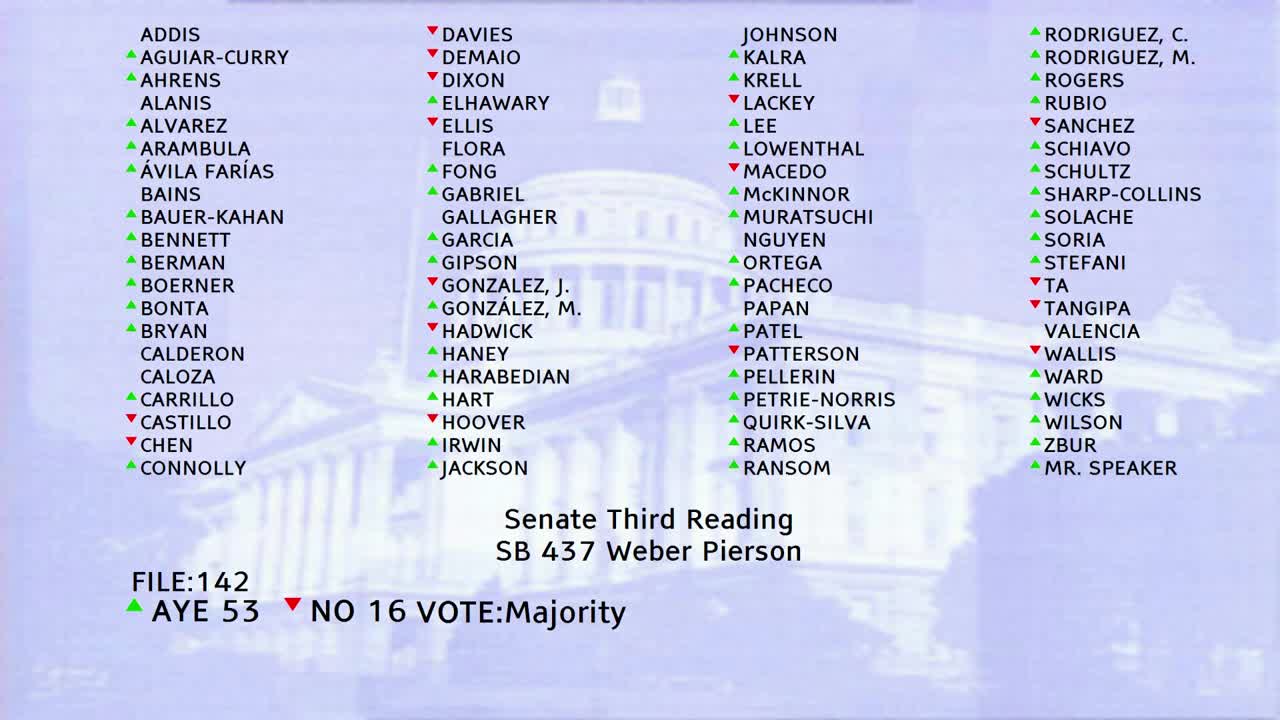 1MIN
Assembly Floor
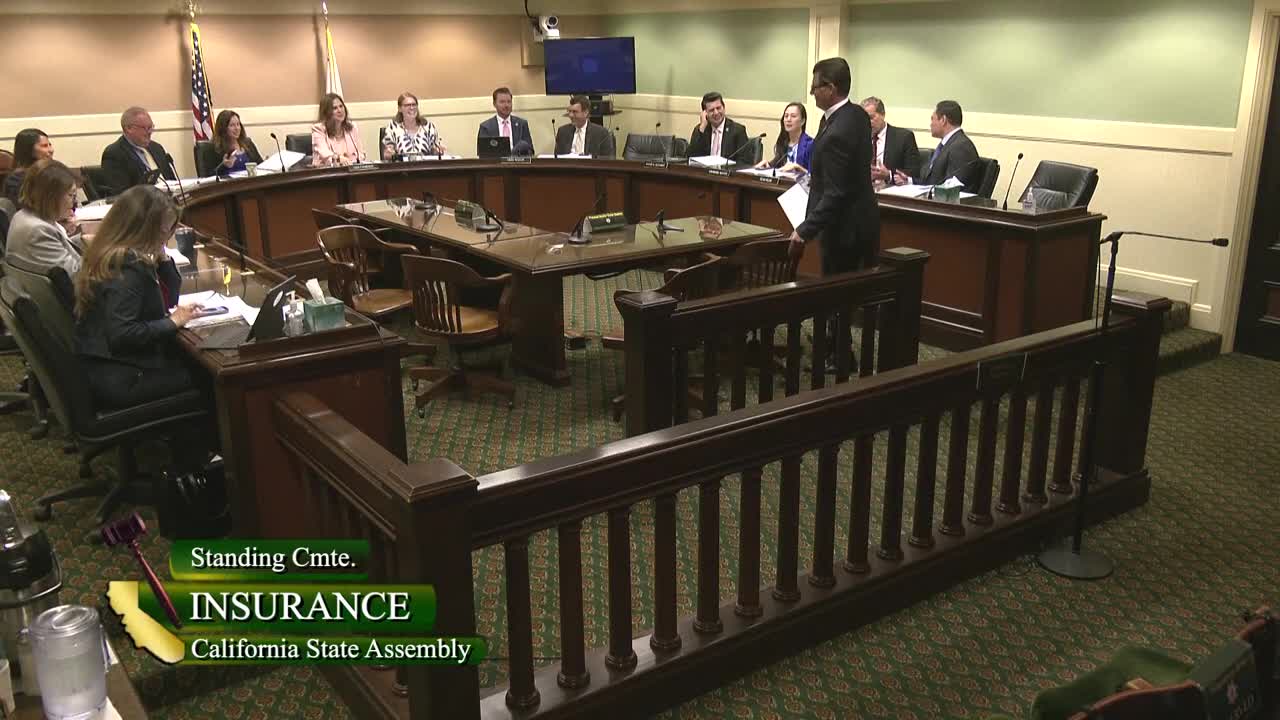 5MIN
Assembly Standing Committee on Insurance
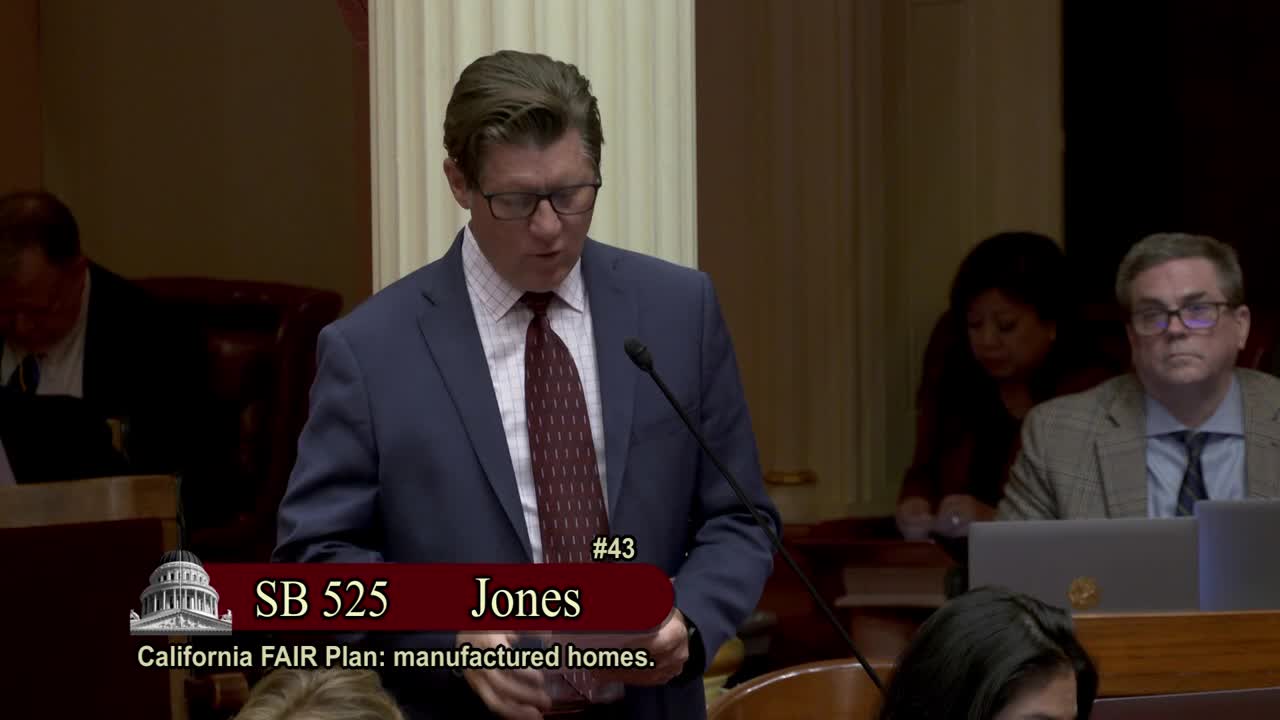 3MIN
Senate Floor
 28MIN
Senate Standing Committee on Insurance
Bill Author

Bill Co-Author(s):