SB 543: Accessory dwelling units and junior accessory dwelling units.
- Session Year: 2025-2026
- House: Senate
- Latest Version Date: 2025-10-10
Current Status:
Passed
(2025-10-10: Chaptered by Secretary of State. Chapter 520, Statutes of 2025.)
Introduced
In Committee
Awaiting First Chamber Vote
Passed First Chamber
In Committee
Awaiting Second Chamber Vote
Passed Second Chamber
Enacted
Existing law, the Planning and Zoning Law, among other things, provides for the creation by ordinance, or by ministerial approval if the local agency has not adopted an ordinance, of an accessory dwelling unit (ADU) or a junior accessory dwelling unit (JADU) in accordance with specified standards and conditions. Existing law defines the term junior accessory dwelling unit for these purposes to mean a unit that is no more than 500 square feet in size and contained entirely within a single-family structure.
This bill would revise the definition of a junior accessory dwelling unit to require the size of a JADU to be no more than 500 square feet of interior livable space.
Existing law makes certain declarations of the Legislatures intent regarding the effect of an ADU ordinance. Existing law authorizes the Department of Housing and Community Development to review, adopt, amend, or repeal guidelines to implement uniform standards or criteria that supplement or clarify the terms, references, and standards for an ADU.
This bill would revise the above-described declaration of legislative intent to additionally apply with respect to a JADU ordinance. The bill would also expand the departments authority to review, adopt, amend, or repeal guidelines to additionally grant that authority with respect to terms, references, and standards for JADUs.
Existing law requires a local agency to submit an ADU ordinance to the Department of Housing and Community Development within 60 days after the adoption for department review, as specified. Under existing law, the standards applicable to an ADU under these provisions supersede a conflicting local ordinance, except as specified.
This bill would similarly require a local agency to submit a JADU ordinance to the department within 60 days after adoption for department review and would require the department to notify the local agency if the ordinance is noncompliant with JADU ordinance requirements, as specified. The bill would nullify and void that ordinance if the local agency fails to submit a copy of that ordinance or respond to the departments findings that the ordinance is noncompliant, as specified. The bill would also specify that the standards applicable to a JADU supersede any conflicting local ordinance, except as specified.
Existing law requires a local agency to consider ministerially a permit application for an ADU or a JADU within 60 days, as specified. If a local agency has not adopted an ADU ordinance, existing law requires a permit application for an ADU to be considered pursuant to this ministerial approval provision. Existing law prohibits a local ordinance, policy, or regulation, other than an ADU ordinance consistent with the laws governing approvals of ADUs, from being the basis for the delay or denial of a building permit or a use permit under this ministerial approval provision.
If a local agency has not adopted a JADU ordinance, this bill would additionally require a permit application for a JADU to be considered pursuant to this ministerial approval provision, and would prohibit a local ordinance, policy, or regulation, other than a JADU ordinance consistent with the laws governing approvals of JADUs, from being the basis for the delay or denial of a building permit or a use permit under this ministerial approval provision. This bill would additionally require a permitting agency to determine whether an application for ADU or JADU is complete and provide written notice of the determination not later than 15 business days after the permitting agency received the application. If the permitting agency determines that an application is incomplete, the bill would require the permitting agency to provide the applicant with a list of incomplete items and a description of how the application can be made complete in the written notice and authorize the applicant to cure and address the application, as specified. The bill would require the permitting agency, if a permit application is determined to be incomplete or is denied, to provide a process for the applicant to appeal that decision, as provided, and would require the permitting agency to provide a final written determination by not later than 60 business days after receipt of the written appeal.
Existing law imposes limits on construction, connection, and impact fees and capacity charges imposed on an ADU, including prohibiting impact fees upon the development of an ADU based on if the ADU is 750 square feet and requiring that any impact fee on an ADU of 750 square feet or more be charged proportionately in relation to the square footage of the primary dwelling unit. Existing law prohibits a local agency, special district, or water corporation from requiring the applicant to install a new or separate utility connection between an ADU and the utility or imposing a related connection fee or capacity charge for specified ADUs, except as specified.
This bill would revise these provisions to additionally apply to construction, connection, and impact fees and capacity charges imposed on a JADU. The bill would revise the above-described limitation on impact fees to, instead, prohibit impact fees upon the development of an ADU that has 750 square feet of interior livable space or less or JADU that has 500 square feet of interior livable space or less, and to require that any impact fee on an ADU that has more than 750 square feet of interior livable space be charged proportionately in relation to the square footage of the primary dwelling unit.
Existing law authorizes the governing board of a school district to levy a fee, charge, dedication, or other requirement against construction within the boundaries of the school district for the purpose of funding the construction or reconstruction of a school facility, subject to specified limitations. Under existing law, the fee, charge, dedication, or other requirement may only apply to specified constructions, including residential construction if the resulting assessable space exceeds 500 square feet.
This bill would specify that an ADU or a JADU that contains less than 500 square feet of interior livable space does not increase assessable space by 500 square feet under these provisions.
Existing law prohibits a local agency from establishing by ordinance a maximum square footage for an attached or detached ADU that is either less than 850 square feet or 1,000 square feet for an ADU that provides more than one bedroom. Existing law also prohibits a local agency from establishing by ordinance any requirement for a zoning clearance or separate zoning review or any other minimum or maximum size for an ADU, size based upon a percentage of the proposed or existing primary dwelling, or limits on lot coverage, floor area ratio, open space, front setbacks, and minimum lot size, for attached or detached dwellings that does not permit at least an 800-square foot ADU with four-foot side and rear yard setbacks.
This bill would revise these size limitations to be based on the square feet of interior living space of the ADU.
Existing law requires a local agency to ministerially approve a building permit application within a residential or mixed-use zone for specified ADUs or JADUs, including one detached, new construction, ADU that does not exceed 4-foot side and rear yard setbacks for a lot with a proposed or existing single-family dwelling. For these ADUs and JADUs, existing law authorizes a local agency to impose specified height limitations and total floor area limitations of no more than 800 square feet. Existing law prohibits a local agency from imposing a requirement that an ADU install a fire sprinkler if a sprinkler is not required for the primary residence.
This bill would require a local agency to ministerially approve a building permit application for a combination of the specified ADUs or JADUs and revise the total area limitation to be based on the square feet of interior livable space. The bill would revise the prohibition on requiring fire sprinkler installation, as described above, to additionally apply to a JADU.
This bill would make other technical and conforming changes to the provisions governing the review and approval of ADUs and JADUs.
By imposing additional duties on local planning officials, this bill would impose a state-mandated local program.
The California Constitution requires the state to reimburse local agencies and school districts for certain costs mandated by the state. Statutory provisions establish procedures for making that reimbursement.
This bill would provide that no reimbursement is required by this act for a specified reason.
Existing law, the Planning and Zoning Law, among other things, provides for the creation by ordinance, or by ministerial approval if the local agency has not adopted an ordinance, of an accessory dwelling unit (ADU) or a junior accessory dwelling unit (JADU) in accordance with specified standards and conditions. Existing law defines the term junior junior accessory dwelling unit for these purposes to mean a unit that is no more than 500 square feet in size and contained entirely within a single-family structure.
This bill would revise the definition of a junior accessory dwelling unit to require the size of a JADU to be no more than 500 square feet of interior livable space.
Existing law makes certain declarations of the Legislatures intent regarding the effect of an ADU ordinance. Existing law authorizes the Department of Housing and Community Development to review, adopt, amend, or repeal guidelines to implement uniform standards or criteria that supplement or clarify the terms, references, and standards for an ADU.
This bill would revise the above-described declaration of legislative intent to additionally apply with respect to a JADU ordinance. The bill would also expand the departments authority to review, adopt, amend, or repeal guidelines to additionally grant that authority with respect to terms, references, and standards for JADUs.
Existing law requires a local agency to submit an ADU ordinance to the Department of Housing and Community Development within 60 days after the adoption for department review, as specified. Under existing law, the standards applicable to an ADU under these provisions supersede a conflicting local ordinance, except as specified.
This bill would similarly require a local agency to submit a JADU ordinance to the department within 60 days after adoption for department review. review and would require the department to notify the local agency if the ordinance is noncompliant with JADU ordinance requirements, as specified. The bill would nullify and void that ordinance if the local agency fails to submit a copy of that ordinance or respond to the departments findings that the ordinance is noncompliant, as specified. The bill would also specify that the standards applicable to a JADU supersede any conflicting local ordinance, except as specified.
Existing law requires a local agency to consider ministerially a permit application for an ADU or a JADU within 60 days, as specified. If a local agency has not adopted an ADU ordinance, existing law requires a permit application for an ADU to be considered pursuant to this ministerial approval provision. Existing law prohibits a local ordinance, policy, or regulation, other than an ADU ordinance consistent with the laws governing approvals of ADUs, from being the basis for the delay or denial of a building permit or a use permit under this ministerial approval provision.
If a local agency has not adopted a JADU ordinance, this bill would additionally require that a permit application for a JADU to be considered pursuant to this ministerial approval provision. provision, and would prohibit a local ordinance, policy, or regulation, other than a JADU ordinance consistent with the laws governing approvals of JADUs, from being the basis for the delay or denial of a building permit or a use permit under this ministerial approval provision. This bill would additionally require a permitting agency to determine whether an application for ADU or JADU is complete and provide written notice of the determination not later than 15 business days after the permitting agency received the application. If the permitting agency determines that an application is incomplete, the bill would require the permitting agency to provide the applicant with a list of incomplete items and a description of how the application can be made complete in the written notice and authorize the applicant to cure and address the application, as specified. The bill would require the permitting agency, if a permit application is determined to be incomplete or is denied, to provide a process for the applicant to appeal that decision, as provided, and would require the permitting agency to provide a final written determination by not later than 60 business days after receipt of the written appeal.
Existing law imposes limits on construction, connection, and impact fees and capacity charges imposed on an ADU, including prohibiting impact fees upon the development of an ADU based on if the ADU is 750 square feet and requiring that any impact fee on an ADU of 750 square feet or more be charged proportionately in relation to the square footage of the primary dwelling unit. Existing law prohibits a local agency, special district, or water corporation from requiring the applicant to install a new or separate utility connection between an ADU and the utility or imposing a related connection fee or capacity charge for specified ADUs, except as specified.
This bill would revise these provisions to additionally apply to construction, connection, and impact fees and capacity charges imposed on a JADU. The bill would revise the above-described limitation on impact fees to, instead, prohibit impact fees upon the development of an ADU that has 750 square feet of interior livable space or less or JADU that has 500 square feet of interior livable space or less, and to require that any impact fee on an ADU that has more than 750 square feet of interior livable space be charged proportionately in relation to the square footage of the primary dwelling unit.
Existing law authorizes the governing board of a school district to levy a fee, charge, dedication, or other requirement against construction within the boundaries of the school district for the purpose of funding the construction or reconstruction of a school facility, subject to specified limitations. Under existing law, the fee, charge, dedication, or other requirement may only apply to specified constructions, including residential construction if the resulting assessable space exceeds 500 square feet.
This bill would specify that an ADU or a JADU that contains less than 500 square feet of interior livable space does not increase assessable space by 500 square feet under these provisions.
Existing law prohibits a local agency from establishing by ordinance a maximum square footage for an attached or detached ADU that is either less than 800 850 square feet or 1,000 square feet for an ADU that provides more than one bedroom. Existing law also prohibits a local agency from establishing by ordinance any requirement for a zoning clearance or separate zoning review or any other minimum or maximum size for an ADU, size based upon a percentage of the proposed or existing primary dwelling, or limits on lot coverage, floor area ratio, open space, front setbacks, and minimum lot size, for attached or detached dwellings that does not permit at least an 800-square foot ADU with four-foot side and rear yard setbacks.
This bill would revise these size limitations to be based on the square feet of interior living space of the ADU.
Existing law requires a local agency to ministerially approve a building permit application within a residential or mixed-use zone for specified ADUs or JADUs, including one detached, new construction, ADU that does not exceed 4-foot side and rear yard setbacks for a lot with a proposed or existing single-family dwelling. For these ADUs and JADUs, existing law authorizes a local agency to impose specified height limitations and total floor area limitations of no more than 800 square feet. Existing law prohibits a local agency from imposing a requirement that an ADU install a fire sprinkler if a sprinkler is not required for the primary residence.
This bill would require a local agency to ministerially approve a building permit application for a combination of the specified ADUs or JADUs and revise the total area limitation to be based on the square feet of interior livable space. The bill would revise the prohibition on requiring fire sprinkler installation, as described above, to additionally apply to a JADU.
This bill would make other technical and conforming changes to the provisions governing the review and approval of ADUs and JADUs.
By imposing additional duties on local planning officials, this bill would impose a state-mandated local program.
The California Constitution requires the state to reimburse local agencies and school districts for certain costs mandated by the state. Statutory provisions establish procedures for making that reimbursement.
This bill would provide that no reimbursement is required by this act for a specified reason.
Existing law, the Planning and Zoning Law, among other things, provides for the creation by ordinance, or by ministerial approval if the local agency has not adopted an ordinance, of an accessory dwelling unit (ADU) or a junior accessory dwelling unit (JADU) in accordance with specified standards and conditions. Existing law defines the term junior accessory dwelling unit for these purposes to mean a unit that is no more than 500 square feet in size and contained entirely within a single-family structure.
This bill would revise the definition of a junior accessory dwelling unit to require the size of a JADU to be no more than 500 square feet of interior livable space.
Existing law makes certain declarations of the Legislatures intent regarding the effect of an ADU ordinance. Existing law authorizes the Department of Housing and Community Development to review, adopt, amend, or repeal guidelines to implement uniform standards or criteria that supplement or clarify the terms, references, and standards for an ADU.
This bill would revise the above-described declaration of legislative intent to additionally apply with respect to a JADU ordinance. The bill would also expand the departments authority to review, adopt, amend, or repeal guidelines to additionally grant that authority with respect to terms, references, and standards for JADUs.
Existing law requires a local agency to submit an ADU ordinance to the Department of Housing and Community Development within 60 days after the adoption for department review, as specified. Under existing law, the standards applicable to an ADU under these provisions supersede a conflicting local ordinance, except as specified.
This bill would similarly require a local agency to submit a JADU ordinance to the department within 60 days after adoption for department review. The bill would also specify that the standards applicable to a JADU supersede any conflicting local ordinance, except as specified.
Existing law requires a local agency to consider ministerally a permit application for an ADU or a JADU within 60 days, as specified. If a local agency has not adopted an ADU ordinance, existing law requires a permit application for an ADU to be considered ministerially within 60 days, as specified. Existing law requires a local agency to determine whether an application for a postentitlement phase permit is complete and provide a written notice of this determination to the applicant within 15 business days after receiving the application, as specified.If a local agency has not adopted a JADU ordinance, this bill would additionally require that a permit application for a JADU to be considered ministerially in a manner similar to the above-described requirement for ADUs. For the purposes of these provisions, the bill would require an application for an ADU or a JADU to be deemed complete in the same form and manner as an application for a postentitlement permit.Existing law requires a local agency to consider ministerially a permit application for an ADU or a JADU within 60 days, as specified. If a local agency has not adopted an ADU ordinance, existing law requires a permit application for an ADU to be considered pursuant to this ministerial approval provision.
If a local agency has not adopted a JADU ordinance, this bill would additionally require that a permit application for a JADU to be considered pursuant to this ministerial approval provision. This bill would additionally require a permitting agency to determine whether an application for ADU or JADU is complete and provide written notice of the determination not later than 15 business days after the permitting agency received the application. If the permitting agency determines that an application is incomplete, the bill would require the permitting agency to provide the applicant with a list of incomplete items and a description of how the application can be made complete in the written notice and authorize the applicant to cure and address the application, as specified.
Existing law imposes limits on construction, connection, and impact fees and capacity charges imposed on an ADU, including prohibiting impact fees upon the development of an ADU based on if the ADU is 750 square feet and requiring that any impact fee on an ADU of 750 square feet or more be charged proportionately in relation to the square footage of the primary dwelling unit. Existing law prohibits a local agency, special district, or water corporation from requiring the applicant to install a new or separate utility connection between an ADU and the utility or imposing a related connection fee or capacity charge for specified ADUs, except as specified.
This bill would revise these provisions to additionally apply to construction, connection, and impact fees and capacity charges imposed on a JADU. The bill would revise the above-described limitation on impact fees to, instead, prohibit impact fees upon the development of an ADU that has 750 square feet of interior livable space or less or JADU that has 750 500 square feet of interior livable space or less, and to require that any impact fee on an ADU or JADU that has more than 750 square feet of interior livable space be charged proportionately in relation to the square footage of the primary dwelling unit.
Existing law authorizes the governing board of a school district to levy a fee, charge, dedication, or other requirement against construction within the boundaries of the school district for the purpose of funding the construction or reconstruction of a school facility, subject to specified limitations. Under existing law, the fee, charge, dedication, or other requirement may only apply to specified constructions, including residential construction if the resulting assessable space exceeds 500 square feet.
This bill would specify that an ADU or a JADU that contains less than 500 square feet of interior livable space does not increase assessable space by 500 square feet under these provisions.
Existing law prohibits a local agency from establishing by ordinance a maximum square footage for an attached or detached ADU that is either less than 800 square feet or 1,000 square feet for an ADU that provides more than one bedroom. Existing law also prohibits a local agency from establishing by ordinance any requirement for a zoning clearance or separate zoning review or any other minimum or maximum size for an ADU, size based upon a percentage of the proposed or existing primary dwelling, or limits on lot coverage, floor area ratio, open space, front setbacks, and minimum lot size, for attached or detached dwellings that does not permit at least an 800-square foot ADU with four-foot side and rear yard setbacks.
This bill would revise these size limitations to be based on the square feet of interior living space of the ADU.
Existing law requires a local agency to ministerially approve a building permit application within a residential or mixed-use zone for specified ADUs or JADUs, including one detached, new construction, ADU that does not exceed 4-foot side and rear yard setbacks for a lot with a proposed or existing single-family dwelling. For these ADUs and JADUs, existing law authorizes a local agency to impose specified height limitations and total floor area limitations of no more than 800 square feet. Existing law prohibits a local agency from imposing a requirement that an ADU install a fire sprinkler if a sprinkler is not required for the primary residence.
This bill would require a local agency to ministerially approve a building permit application for a combination of the specified ADUs or JADUs and revise the total area limitation to be based on the square feet of interior livable space. The bill would revise the prohibition on requiring fire sprinkler installation, as described above, to additionally apply to a JADU.
This bill would make other technical and conforming changes to the provisions governing the review and approval of ADUs and JADUs.
By imposing additional duties on local planning officials, this bill would impose a state-mandated local program.
The California Constitution requires the state to reimburse local agencies and school districts for certain costs mandated by the state. Statutory provisions establish procedures for making that reimbursement.
This bill would provide that no reimbursement is required by this act for a specified reason.
Existing law, the Planning and Zoning Law, among other things, provides for the creation by ordinance, or by ministerial approval if the local agency has not adopted an ordinance, of an accessory dwelling unit (ADU) or a junior accessory dwelling unit (JADU) in accordance with specified standards and conditions. Existing law defines the term junior accessory dwelling unit for these purposes to mean a unit that is no more than 500 square feet in size and contained entirely within a single-family structure.
This bill would revise the definition of a junior accessory dwelling unit to require the size of a JADU to be no more than 500 square feet of interior livable space.
Existing law makes certain declarations of the Legislatures intent regarding the effect of an ADU ordinance. Existing law authorizes the Department of Housing and Community Development to review, adopt, amend, or repeal guidelines to implement uniform standards or criteria that supplement or clarify the terms, references, and standards for an ADU.
This bill would revise the above-described declaration of legislative intent to additionally apply with respect to a JADU ordinance. The bill would also expand the departments authority to review, adopt, amend, or repeal guidelines to additionally grant that authority with respect to terms, references, and standards for JADUs.
Existing law requires a local agency to submit an ADU ordinance to the Department of Housing and Community Development within 60 days after the adoption for department review, as specified. Under existing law, the standards applicable to an ADU under these provisions supersede a conflicting local ordinance, except as specified.
This bill would similarly require a local agency to submit a JADU ordinance to the department within 60 days after adoption for department review. The bill would also specify that the standards applicable to a JADU supersede any conflicting local ordinance, except as specified.
Existing law requires a local agency to consider ministerally a permit application for an ADU or a JADU within 60 days, as specified. If a local agency has not adopted an ADU ordinance, existing law requires a permit application for an ADU to be considered ministerially within 60 days, as specified. Existing law requires a local agency to determine whether an application for a postentitlement phase permit is complete and provide a written notice of this determination to the applicant within 15 business days after receiving the application, as specified.
If a local agency has not adopted a JADU ordinance, this bill would additionally require that a permit application for a JADU to be considered ministerially in a manner similar to the above-described requirement for ADUs. For the purposes of these provisions, the bill would require an application for an ADU or a JADU to be deemed complete in the same form and manner as an application for a postentitlement permit.
Existing law imposes limits on construction, connection, and impact fees and capacity charges imposed on an ADU, including prohibiting impact fees upon the development of an ADU based on if the ADU is 750 square feet and requiring that any impact fee on an ADU of 750 square feet or more be charged proportionately in relation to the square footage of the primary dwelling unit. Existing law prohibits a local agency, special district, or water corporation from requiring the applicant to install a new or separate utility connection between an ADU and the utility or imposing a related connection fee or capacity charge for specified ADUs, except as specified.
This bill would revise these provisions to additionally apply to construction, connection, and impact fees and capacity charges imposed on a JADU. The bill would revise the above-described limitation on impact fees to, instead, prohibit impact fees upon the development of an ADU or JADU that has 750 square feet of interior livable space or less, and to require that any impact fee on an ADU or JADU that has more than 750 square feet of interior livable space be charged proportionately in relation to the square footage of the primary dwelling unit.
Existing law authorizes the governing board of a school district to levy a fee, charge, dedication, or other requirement against construction within the boundaries of the school district for the purpose of funding the construction or reconstruction of a school facility, subject to specified limitations. Under existing law, the fee, charge, dedication, or other requirement may only apply to specified constructions, including residential construction if the resulting assessable space exceeds 500 square feet.
This bill would specify that an ADU or a JADU that contains less than 500 square feet of interior livable space does not increase assessable space by 500 square feet under these provisions.
Existing law prohibits a local agency from establishing by ordinance a maximum square footage for an attached or detached ADU that is either less than 800 square feet or 1,000 square feet for an ADU that provides more than one bedroom. Existing law also prohibits a local agency from establishing by ordinance any requirement for a zoning clearance or separate zoning review or any other minimum or maximum size for an ADU, size based upon a percentage of the proposed or existing primary dwelling, or limits on lot coverage, floor area ratio, open space, front setbacks, and minimum lot size, for attached or detached dwellings that does not permit at least an 800-square foot ADU with four-foot side and rear yard setbacks.
This bill would revise these size limitations to be based on the square feet of interior living space of the ADU.
Existing law requires a local agency to ministerially approve a building permit application within a residential or mixed-use zone for specified ADUs or JADUs, including one detached, new construction, ADU that does not exceed 4-foot side and rear yard setbacks for a lot with a proposed or existing single-family dwelling. For these ADUs and JADUs, existing law authorizes a local agency to impose specified height limitations and total floor area limitations of no more than 800 square feet. Existing law prohibits a local agency from imposing a requirement that an ADU install a fire sprinkler if a sprinkler is not required for the primary residence.
This bill would require a local agency to ministerially approve a building permit application for a combination of the specified ADUs or JADUs and revise the total area limitation to be based on the square feet of interior livable space. The bill would revise the prohibition on requiring fire sprinkler installation, as described above, to additionally apply to a JADU.
This bill would make other technical and conforming changes to the provisions governing the review and approval of ADUs and JADUs.
(3)ByBy imposing additional duties on local planning officials, this bill would impose a state-mandated local program.
The California Constitution requires the state to reimburse local agencies and school districts for certain costs mandated by the state. Statutory provisions establish procedures for making that reimbursement.
This bill would provide that no reimbursement is required by this act for a specified reason.
(1)Existing law requires a public agency that received an application for a development project to determine whether the application is complete within 30 days and, if the public agency determines the application to be incomplete, to provide the applicant an exhaustive list of items that were not complete, as provided. Existing law deems an applicant for a housing development project to have submitted a preliminary application upon providing specified information about the proposed project to the city, county, or city and county from which approval for the project is being sought and payment of the permit processing fee. Existing law requires the development proponent to submit an application containing specified information within 180 days after submitting a preliminary application and, if the public agency determines that the application is not complete, requires the development proponent to submit the specified information needed to complete the application within 90 days of receiving the agencys written identification of necessary information. Under existing law, if the development proponent does not submit this information within 90 days, the preliminary application expires and has no further force or effect.
This bill would require that the 90-day period described above reset each time the development proponent resubmits the information. The bill would authorize the public agency and the development proponent to mutually agree to extend the 90-day period.
(2)Existing law, the Planning and Zoning Law, among other things, provides for the creation by ordinance, or by ministerial approval if the local agency has not adopted an ordinance, of an accessory dwelling unit (ADU) or a junior accessory dwelling unit (JADU) in accordance with specified standards and conditions. Existing law defines the term junior accessory dwelling unit for these purposes to mean a unit that is no more than 500 square feet in size and contained entirely within a single-family structure.
This bill would revise the definition of a junior accessory dwelling unit to require the size of a JADU to be no more than 500 square feet of interior livable space.
Existing law makes certain declarations of the Legislatures intent regarding the effect of an ADU ordinance. Existing law authorizes the Department of Housing and Community Development to review, adopt, amend, or repeal guidelines to implement uniform standards or criteria that supplement or clarify the terms, references, and standards for an ADU.
This bill would revise the above-described declaration of legislative intent to additionally apply with respect to a JADU ordinance. The bill would also expand the departments authority to review, adopt, amend, or repeal guidelines to additionally grant that authority with respect to terms, references, and standards for JADUs.
Existing law requires a local agency to submit an ADU ordinance to the Department of Housing and Community Development within 60 days after the adoption for department review, as specified. Under existing law, the standards applicable to an ADU under these provisions supersede a conflicting local ordinance, except as specified.
This bill would similarly require a local agency to submit a JADU ordinance to the department within 60 days after adoption for department review. The bill would also specify that the standards applicable to a JADU supersede any conflicting local ordinance, except as specified.
Existing law requires a local agency to consider ministerally a permit application for an ADU or a JADU within 60 days, as specified. If a local agency has not adopted an ADU ordinance, existing law requires a permit application for an ADU to be considered ministerially within 60 days, as specified. Existing law requires a local agency to determine whether an application for a postentitlement phase permit is complete and provide a written notice of this determination to the applicant within 15 business days after receiving the application, as specified.
If a local agency has not adopted a JADU ordinance, this bill would additionally require that a permit application for a JADU to be considered ministerially in a manner similar to the above-described requirement for ADUs. For the purposes of these provisions, the bill would require an application for an ADU or a JADU to be deemed complete in the same form and manner as an application for a postentitlement permit.
Existing law imposes limits on construction, connection, and impact fees and capacity charges imposed on an ADU, including prohibiting impact fees upon the development of an ADU based on if the ADU is 750 square feet and requiring that any impact fee on an ADU of 750 square feet or more be charged proportionately in relation to the square footage of the primary dwelling unit. Existing law prohibits a local agency, special district, or water corporation from requiring the applicant to install a new or separate utility connection between an ADU and the utility or imposing a related connection fee or capacity charge for specified ADUs, except as specified.
This bill would revise these provisions to additionally apply to construction, connection, and impact fees and capacity charges imposed on a JADU. The bill would revise the above-described limitation on impact fees to, instead, prohibit impact fees upon the development of an ADU or JADU that has 750 square feet of interior livable space or less, and to require that any impact fee on an ADU or JADU that has more than 750 square feet of interior livable space be charged proportionately in relation to the square footage of the primary dwelling unit.
Existing law authorizes the governing board of a school district to levy a fee, charge, dedication, or other requirement against construction within the boundaries of the school district for the purpose of funding the construction or reconstruction of a school facility, subject to specified limitations. Under existing law, the fee, charge, dedication, or other requirement may only apply to specified constructions, including residential construction if the resulting assessable space exceeds 500 square feet.
This bill would specify that an ADU or a JADU that contains less than 500 square feet of interior livable space does not increase assessable space by 500 square feet under these provisions.
Existing law prohibits a local agency from establishing by ordinance a maximum square footage for an attached or detached ADU that is either less than 800 square feet or 1,000 square feet for an ADU that provides more than one bedroom. Existing law also prohibits a local agency from establishing by ordinance any requirement for a zoning clearance or separate zoning review or any other minimum or maximum size for an ADU, size based upon a percentage of the proposed or existing primary dwelling, or limits on lot coverage, floor area ratio, open space, front setbacks, and minimum lot size, for attached or detached dwellings that does not permit at least an 800-square foot ADU with four-foot side and rear yard setbacks.
This bill would revise these size limitations to be based on the square feet of interior living space of the ADU.
Existing law requires a local agency to ministerially approve a building permit application within a residential or mixed-use zone for specified ADUs or JADUs, including one detached, new construction, ADU that does not exceed 4-foot side and rear yard setbacks for a lot with a proposed or existing single-family dwelling. For these ADUs and JADUs, existing law authorizes a local agency to impose specified height limitations and total floor area limitations of no more than 800 square feet. Existing law prohibits a local agency from imposing a requirement that an ADU install a fire sprinkler if a sprinkler is not required for the primary residence.
This bill would require a local agency to ministerially approve a building permit application for a combination of the specified ADUs or JADUs and revise the total area limitation to be based on the square feet of interior livable space. The bill would revise the prohibition on requiring fire sprinkler installation, as described above, to additionally apply to a JADU.
This bill would make other technical and conforming changes to the provisions governing the review and approval of ADUs and JADUs.
(3)By imposing additional duties on local planning officials, this bill would impose a state-mandated local program.
The California Constitution requires the state to reimburse local agencies and school districts for certain costs mandated by the state. Statutory provisions establish procedures for making that reimbursement.
This bill would provide that no reimbursement is required by this act for a specified reason.
Existing law authorizes an applicant for a permit for a development project, if any provision of law requires a lead agency or responsible agency to provide public notice of the development project or to hold a public hearing on the development project and the agency has not done so at least 60 days before the expiration of specified time limits, to file an action to compel the agency to provide the public notice or hold the hearing, as specified.This bill would make nonsubstantive changes to the provision described above relating to providing public notice of a development project or holding a hearing relating to a development project.Existing law authorizes an applicant for a permit for a development project, if any provision of law requires a lead agency or responsible agency to provide public notice of the development project or to hold a public hearing on the development project and the agency has not done so at least 60 days before the expiration of specified time limits, to file an action to compel the agency to provide the public notice or hold the hearing, as specified.
This bill would make nonsubstantive changes to the provision described above relating to providing public notice of a development project or holding a hearing relating to a development project.
It is the intent of the Legislature that an accessory dwelling unit or a junior accessory dwelling unit ordinance adopted by a local agency has the effect of providing for the creation of accessory dwelling units or a junior accessory dwelling unit and that provisions in this ordinance relating to matters including unit size, parking, fees, and other requirements, are not so arbitrary, excessive, or burdensome so as to unreasonably restrict the ability of homeowners to create accessory dwelling units or junior accessory dwelling units in zones in which they are authorized by local ordinance.
SEC. 2.Section 66313 of the Government Code is amended to read:66313.For purposes of this chapter:
(a)Accessory dwelling unit means an attached or a detached residential dwelling unit that provides complete independent living facilities for one or more persons and is located on a lot with a proposed or existing primary residence. It shall include permanent provisions for living, sleeping, eating, cooking, and sanitation on the same parcel as the single-family or multifamily dwelling is or will be situated. An accessory dwelling unit also includes the following:
(1)An efficiency unit.
(2)A manufactured home, as defined in Section 18007 of the Health and Safety Code.
(b)Accessory structure means a structure that is accessory and incidental to a dwelling located on the same lot.
(c)Efficiency unit has the same meaning as defined in Section 17958.1 of the Health and Safety Code.
(d)Junior accessory dwelling unit means a unit that is no more than 500 square feet of interior livable space in size and contained entirely within a single-family residence. A junior accessory dwelling unit may include separate sanitation facilities, or may share sanitation facilities with the existing structure.
(e)Livable space means a space in a dwelling intended for human habitation, including living, sleeping, eating, cooking, or sanitation.
(f)Living area means the interior habitable area of a dwelling unit, including basements and attics, but does not include a garage or any accessory structure.
(g)Local agency means a city, county, or city and county, whether general law or chartered.
(h)Nonconforming zoning condition means a physical improvement on a property that does not conform to current zoning standards.
(i)Objective standards means standards that involve no personal or subjective judgment by a public official and are uniformly verifiable by reference to an external and uniform benchmark or criterion available and knowable by both the development applicant or proponent and the public official prior to submittal.
(j)Passageway means a pathway that is unobstructed clear to the sky and extends from a street to one entrance of the accessory dwelling unit.
(k)Permitting agency means any entity that is involved in the review of a permit for an accessory dwelling unit or junior accessory dwelling unit and for which there is no substitute, including, but not limited to, applicable planning departments, building departments, utilities, and special districts.
(l)Proposed dwelling means a dwelling that is the subject of a permit application and that meets the requirements for permitting.
(m)Public transit means a location, including, but not limited to, a bus stop or train station, where the public may access buses, trains, subways, and other forms of transportation that charge set fares, run on fixed routes, and are available to the public.
(n)Tandem parking means that two or more automobiles are parked on a driveway or in any other location on a lot, lined up behind one another.
SEC. 3.Section 66317 of the Government Code is amended to read:66317.(a)(1)A permit application for an accessory dwelling unit shall be considered and approved ministerially without discretionary review or a hearing, notwithstanding Section 65901 or 65906 or any local ordinance regulating the issuance of variances or special use permits.
(2)(A)A permitting agency shall determine whether an application to create or serve an accessory dwelling unit is complete and provide written notice of this determination to the applicant not later than 15 business days after the permitting agency received the application.
(B)If the permitting agency determines an application is incomplete, the permitting agency shall provide the applicant with a list of incomplete items and a description of how the application can be made complete. The list and description shall be provided with the written notice required by subparagraph (A).
(C)After receiving a notice that the application was incomplete, an applicant may cure and address the items that are deemed to be incomplete by the permitting agency.
(D)In the review of an application submitted pursuant to subparagraph (C), the permitting agency shall not require the application to include an item that was not included in the list required by subparagraph (B).
(E)If an applicant submits an application pursuant to subparagraph (C), the permitting agency shall determine whether the additional application has remedied all incomplete items listed in the determination issued pursuant to subparagraph (B). This additional application is subject to the timelines and requirements specified in subparagraph (A).
(F)If a permitting agency does not make a timely determination as required by this paragraph, the application or resubmitted application shall be deemed to be complete for the purposes of this section.
(3)The permitting agency shall either approve or deny the application to create or serve an accessory dwelling unit within 60 days from the date the permitting agency receives a completed application if there is an existing single-family or multifamily dwelling on the lot. If the permit application to create or serve an accessory dwelling unit is submitted with a permit application to create a new single-family or multifamily dwelling on the lot, the permitting agency may delay approving or denying the permit application for the accessory dwelling unit until the permitting agency approves or denies the permit application to create the new single-family or multifamily dwelling, but the application to create or serve the accessory dwelling unit shall be considered without discretionary review or hearing. If the applicant requests a delay, the 60-day time period shall be tolled for the period of the delay. If the local agency has not approved or denied the completed application within 60 days, the application shall be deemed approved. A local agency may charge a fee to reimburse it for costs incurred to implement this section, including the costs of adopting or amending any ordinance that provides for the creation of an accessory dwelling unit.
(b)If a permitting agency denies an application for an accessory dwelling unit pursuant to subdivision (a), the permitting agency shall, within the time period described in subdivision (a), return in writing a full set of comments to the applicant with a list of items that are defective or deficient and a description of how the application can be remedied by the applicant.
(c)No local ordinance, policy, or regulation, other than an accessory dwelling unit ordinance consistent with this article shall be the basis for the delay or denial of a building permit or a use permit under this section.
(d)(1)If a permit application is determined to be incomplete under paragraph (2) of subdivision (a) or denied under paragraph (3) of subdivision (a), the permitting agency shall provide a process for the applicant to appeal that decision in writing to the governing body of the agency or, if there is no governing body, to the director of the agency, as provided by that agency. A city or county shall provide that the right of appeal is to the governing body or, at their option, the planning commission, or both.
(2)A permitting agency on the appeal shall provide a final written determination by not later than 60 business days after receipt of the applicants written appeal. The fact that an appeal is permitted to both the planning commission and to the governing body does not extend the 60-business-day period.
SEC. 4.Section 66320 of the Government Code is amended to read:66320.When a local agency that has not adopted an ordinance governing accessory dwelling units in accordance with Section 66314 receives an application for a permit to create or serve an accessory dwelling unit pursuant to this article, the local agency shall approve or disapprove the application ministerially without discretionary review pursuant to Section 66317.
SEC. 5.Section 66321 of the Government Code is amended to read:66321.(a)Subject to subdivision (b), a local agency may establish minimum and maximum unit size requirements for both attached and detached accessory dwelling units.
(b)Notwithstanding subdivision (a), a local agency shall not establish by ordinance any of the following:
(1)A minimum square footage requirement for either an attached or detached accessory dwelling unit that prohibits an efficiency unit.
(2)A maximum square footage requirement for either an attached or detached accessory dwelling unit that is less than either of the following:
(A)Eight hundred fifty square feet of interior livable space.
(B)One thousand square feet of interior livable space for an accessory dwelling unit that provides more than one bedroom.
(3)Any requirement for a zoning clearance or separate zoning review or any other minimum or maximum size for an accessory dwelling unit, size based upon a percentage of the proposed or existing primary dwelling, or limits on lot coverage, floor area ratio, open space, front setbacks, and minimum lot size, for either attached or detached dwellings that does not permit an accessory dwelling unit with at least 800 square feet of interior livable space and with four-foot side and rear yard setbacks to be constructed in compliance with all other local development standards.
(4)Any height limitation that does not allow at least the following, as applicable:
(A)A height of 16 feet for a detached accessory dwelling unit on a lot with an existing or proposed single family or multifamily dwelling unit.
(B)A height of 18 feet for a detached accessory dwelling unit on a lot with an existing or proposed single family or multifamily dwelling unit that is within one-half of one mile walking distance of a major transit stop or a high-quality transit corridor, as those terms are defined in Section 21155 of the Public Resources Code. A local agency shall also allow an additional two feet in height to accommodate a roof pitch on the accessory dwelling unit that is aligned with the roof pitch of the primary dwelling unit.
(C)A height of 18 feet for a detached accessory dwelling unit on a lot with an existing or proposed multifamily, multistory dwelling.
(D)A height of 25 feet or the height limitation in the local zoning ordinance that applies to the primary dwelling, whichever is lower, for an accessory dwelling unit that is attached to a primary dwelling. This subparagraph shall not require a local agency to allow an accessory dwelling unit to exceed two stories.
SEC. 6.Section 66323 of the Government Code is amended to read:66323.(a)Notwithstanding Sections 66314 to 66322, inclusive, a local agency shall ministerially approve an application for a building permit within a residential or mixed-use zone to create any of the following units, or any combination of the following units:
(1)One accessory dwelling unit and one junior accessory dwelling unit per lot with a proposed or existing single-family dwelling if all of the following apply:
(A)The accessory dwelling unit or junior accessory dwelling unit is within the proposed space of a single-family dwelling or existing space of a single-family dwelling or accessory structure and may include an expansion of not more than 150 square feet beyond the same physical dimensions as the existing accessory structure. An expansion beyond the physical dimensions of the existing accessory structure shall be limited to accommodating ingress and egress.
(B)The space has exterior access from the proposed or existing single-family dwelling.
(C)The side and rear setbacks are sufficient for fire and safety.
(D)The junior accessory dwelling unit complies with the requirements of Article 3 (commencing with Section 66333).
(2)One detached, new construction, accessory dwelling unit that does not exceed four-foot side and rear yard setbacks for a lot with a proposed or existing single-family dwelling. A local agency may impose the following conditions on the accessory dwelling unit:
(A)A total floor area limitation of not more than 800 square feet of livable space.
(B)A height limitation as provided in subparagraph (A), (B), or (C) of paragraph (4) of subdivision (b) of Section 66321, as applicable.
(3)(A)Multiple accessory dwelling units within the portions of existing multifamily dwelling structures that are not used as livable space, including, but not limited to, storage rooms, boiler rooms, passageways, attics, basements, or garages, if each unit complies with state building standards for dwellings.
(B)A local agency shall allow at least one accessory dwelling unit within an existing multifamily dwelling and shall allow up to 25 percent of the existing multifamily dwelling units.
(4)(A)(i)Multiple accessory dwelling units, not to exceed the number specified in clause (ii) or (iii), as applicable, that are located on a lot that has an existing or proposed multifamily dwelling, but are detached from that multifamily dwelling and are subject to a height limitation in subparagraph (A), (B), or (C) of paragraph (4) of subdivision (b) of Section 66321, as applicable, and rear yard and side setbacks of no more than four feet.
(ii)On a lot with an existing multifamily dwelling, not more than eight detached accessory dwelling units. However, the number of accessory dwelling units allowable pursuant to this clause shall not exceed the number of existing units on the lot.
(iii)On a lot with a proposed multifamily dwelling, not more than two detached accessory dwelling units.
(B)If the existing multifamily dwelling has a rear or side setback of less than four feet, the local agency shall not require any modification of the existing multifamily dwelling as a condition of approving the application to construct an accessory dwelling unit that satisfies the requirements of this paragraph.
(b)A local agency shall not impose any objective development or design standard that is not authorized by this section upon any unit that meets the requirements of any of paragraphs (1) to (4), inclusive, of subdivision (a).
(c)A local agency shall not require, as a condition for ministerial approval of a permit application for the creation of an accessory dwelling unit or a junior accessory dwelling unit, the correction of nonconforming zoning conditions.
(d)The installation of fire sprinklers shall not be required in an accessory dwelling unit or a junior accessory dwelling unit if sprinklers are not required for the primary residence. The construction of an accessory dwelling unit or a junior accessory dwelling unit shall not trigger a requirement for fire sprinklers to be installed in the existing multifamily dwelling.
(e)A local agency shall require that a rental of the accessory dwelling unit created pursuant to this section be for a term longer than 30 days.
(f)A local agency may require, as part of the application for a permit to create an accessory dwelling unit connected to an onsite wastewater treatment system, a percolation test completed within the last five years, or, if the percolation test has been recertified, within the last 10 years.
SEC. 7.Section 66324 of the Government Code is amended and renumbered to read:66311.5.(a)Fees charged for the construction of accessory dwelling units or junior accessory dwelling units shall be determined in accordance with Chapter 5 (commencing with Section 66000) and Chapter 7 (commencing with Section 66012).
(b)An accessory dwelling unit or junior accessory dwelling unit shall not be considered by a local agency, special district, or water corporation to be a new residential use for purposes of calculating connection fees or capacity charges for utilities, including water and sewer service, unless the unit was constructed with a new single-family dwelling.
(c)(1)A local agency, special district, or water corporation shall not impose any impact fee upon the development of an accessory dwelling unit that has 750 square feet of interior livable space or less or a junior accessory dwelling unit that has 500 square feet of interior livable space or less. Any impact fees charged for an accessory dwelling unit that has more than 750 square feet of interior livable space shall be charged proportionately in relation to the square footage of the primary dwelling unit.
(2)For purposes of this subdivision, impact fee has the same meaning as the term fee is defined in subdivision (b) of Section 66000, except that it also includes fees specified in Section 66477. Impact fee does not include any connection fee or capacity charge charged by a local agency, special district, or water corporation.
(3)For the purposes of this section and Section 17620 of the Education Code, an accessory dwelling unit or junior accessory dwelling unit that contains less than 500 square feet of interior livable space shall, for the purpose of subparagraph (C) of paragraph (1) of subdivision (a) of Section 17620 of the Education Code, be considered other residential construction that does not increase assessable space by 500 square feet.
(d)For an accessory dwelling unit or a junior accessory dwelling unit described in paragraph (1) of subdivision (a) of Section 66323, a local agency, special district, or water corporation shall not require the applicant to install a new or separate utility connection directly between the unit and the utility or impose a related connection fee or capacity charge, unless the unit was constructed with a new single-family dwelling, or upon separate conveyance of the accessory dwelling unit pursuant to Section 66342.
(e)For an accessory dwelling unit that is not described in paragraph (1) of subdivision (a) of Section 66323, a local agency, special district, or water corporation may require a new or separate utility connection directly between the accessory dwelling unit and the utility. Consistent with Section 66013, the connection may be subject to a connection fee or capacity charge that shall be proportionate to the burden of the proposed accessory dwelling unit, based upon either its square feet or the number of its drainage fixture unit (DFU) values, as defined in the Uniform Plumbing Code adopted and published by the International Association of Plumbing and Mechanical Officials, upon the water or sewer system. This fee or charge shall not exceed the reasonable cost of providing this service.
SEC. 8.Section 66327 of the Government Code is amended and renumbered to read:66313.5.The department may review, adopt, amend, or repeal guidelines to implement uniform standards or criteria that supplement or clarify the terms, references, and standards set forth in this chapter. The guidelines adopted pursuant to this section are not subject to Chapter 3.5 (commencing with Section 11340) of Part 1 of Division 3 of Title 2.
SEC. 9.Section 66332 of the Government Code is amended and renumbered to read:66311.7.(a)Notwithstanding any other law, and except as otherwise provided in subdivision (b), a local agency shall not deny a permit for an unpermitted accessory dwelling unit or an unpermitted junior accessory dwelling unit that was constructed before January 1, 2020, due to either of the following:
(1)The accessory dwelling unit or junior accessory dwelling unit is in violation of building standards pursuant to Article 1 (commencing with Section 17960) of Chapter 5 of Part 1.5 of Division 13 of the Health and Safety Code.
(2)The accessory dwelling unit or junior accessory dwelling unit does not comply with this article or Article 3 (commencing with Section 66333), as applicable, or any local ordinance regulating accessory dwelling units or junior accessory dwelling units.
(b)Notwithstanding subdivision (a), a local agency may deny a permit for an accessory dwelling unit or junior accessory dwelling unit subject to subdivision (a) if the local agency makes a finding that correcting the violation is necessary to comply with the standards specified in Section 17920.3 of the Health and Safety Code.
(c)This section shall not apply to a building that is deemed substandard pursuant to Section 17920.3 of the Health and Safety Code.
(d)A local agency shall inform the public about the provisions of this section through public information resources, including permit checklists and the local agencys internet website, which shall include both of the following:
(1)A checklist of the conditions specified in Section 17920.3 of the Health and Safety Code that would deem a building substandard.
(2)Informing homeowners that, before submitting an application for a permit, the homeowner may obtain a confidential third-party code inspection from a licensed contractor to determine the units existing condition or potential scope of building improvements before submitting an application for a permit.
(e)A homeowner applying for a permit for a previously unpermitted accessory dwelling unit or junior accessory dwelling unit constructed before January 1, 2020, shall not be required to pay impact fees or connection or capacity charges except when utility infrastructure is required to comply with Section 17920.3 of the Health and Safety Code and when the fee is authorized by subdivision (e) of Section 66311.5.
(f)Subject to subdivision (c), upon receiving an application to permit a previously unpermitted accessory dwelling unit or junior accessory dwelling unit constructed before January 1, 2020, an inspector from the local agency may inspect the unit for compliance with health and safety standards and provide recommendations to comply with health and safety standards necessary to obtain a permit. If the inspector finds noncompliance with health and safety standards, the local agency shall not penalize an applicant for having the unpermitted accessory dwelling unit or junior accessory dwelling unit and shall approve necessary permits to correct noncompliance with health and safety standards.
SEC. 10.Section 66333.5 is added to the Government Code, to read:66333.5.(a)A local agency shall submit a copy of the ordinance adopted pursuant to Section 66333 to the Department of Housing and Community Development within 60 days after adoption. After adoption of an ordinance, the department may submit written findings to the local agency as to whether the ordinance complies with this article.
(b)(1)If the department finds that the local agencys ordinance does not comply with this article, the department shall notify the local agency and shall provide the local agency with a reasonable time, no longer than 30 days, to respond to the findings before taking any other action authorized by this article.
(2)The local agency shall consider the findings made by the department pursuant to paragraph (1) and shall do one of the following:
(A)Amend the ordinance to comply with this article.
(B)Adopt the ordinance without changes. The local agency shall include findings in its resolution adopting the ordinance that explain the reasons the local agency believes that the ordinance complies with this article despite the findings of the department.
(c)(1)If the local agency does not amend its ordinance in response to the departments findings or does not adopt a resolution with findings explaining the reason the ordinance complies with this article and addressing the departments findings, the department shall notify the local agency and may notify the Attorney General that the local agency is in violation of state law.
(2)Before notifying the Attorney General that the local agency is in violation of state law, the department may consider whether a local agency adopted an ordinance in compliance with this article between January 1, 2017, and January 1, 2020.
(d)If a local agency fails to submit a copy of its ordinance to the department within 60 days of adoption pursuant to this section or fails to respond to the departments findings that the local ordinance does not comply with this article within 30 days pursuant to this section, that ordinance shall be null and void. The local agency shall thereafter apply the standards established in this article for the approval of junior accessory dwelling units, unless and until the agency adopts an ordinance that complies with this article, including, but not limited to, the submittal requirements of this section.
SEC. 11.Section 66335 of the Government Code is amended to read:66335.(a)(1)An application for a permit pursuant to this article shall, notwithstanding Section 65901 or 65906 or any local ordinance regulating the issuance of variances or special use permits, be considered ministerially, without discretionary review or a hearing.
(2)(A)A permitting agency shall determine whether an application to create or serve a junior accessory dwelling unit is complete and provide written notice of this determination to the applicant not later than 15 business days after the permitting agency received the application.
(B)If the permitting agency determines an application is incomplete, the permitting agency shall provide the applicant with a list of incomplete items and a description of how the application can be made complete. The list and description shall be provided with the written notice required by subparagraph (A).
(C)After receiving a notice that the application was incomplete, an applicant may cure and address the items that are deemed to be incomplete by the permitting agency.
(D)In the review of an application submitted pursuant to subparagraph (C), the permitting agency shall not require the application to include an item that was not included in the list required by subparagraph (B).
(E)If an applicant submits an application pursuant to subparagraph (C), the permitting agency shall determine whether the additional application has remedied all incomplete items listed in the determination issued pursuant to subparagraph (B). This additional application is subject to the timelines and requirements specified in subparagraph (A).
(F)If a permitting agency does not make a timely determination as required by this paragraph, the application or resubmitted application shall be deemed to be complete for the purposes of this section.
(3)The permitting agency shall either approve or deny the application to create or serve a junior accessory dwelling unit within 60 days from the date the local agency receives a completed application if there is an existing single-family dwelling on the lot.
(4)If the permit application to create or serve a junior accessory dwelling unit is submitted with a permit application to create or serve a new single-family dwelling on the lot, the permitting agency may delay approving or denying the permit application for the junior accessory dwelling unit until the permitting agency approves or denies the permit application to create or serve the new single-family dwelling, but the application to create or serve the junior accessory dwelling unit shall still be considered ministerially without discretionary review or a hearing.
(5)If the applicant requests a delay, the 60-day time period shall be tolled for the period of the delay.
(b)If a permitting agency denies an application for a junior accessory dwelling unit pursuant to subdivision (a), the permitting agency shall, within the time period described in subdivision (a), return in writing a full set of comments to the applicant with a list of items that are defective or deficient and a description of how the application can be remedied by the applicant.
(c)A local agency may charge a fee to reimburse the local agency for costs incurred in connection with the issuance of a permit pursuant to this article.
(d)No local ordinance, policy, or regulation, other than a junior accessory dwelling unit ordinance consistent with this article, shall be the basis for the delay or denial of a building permit or a use permit under this section.
(e)(1)If a permit application is determined to be incomplete under paragraph (2) of subdivision (a) or denied under paragraph (3) of subdivision (a), the permitting agency shall provide a process for the applicant to appeal that decision in writing to the governing body of the agency or, if there is no governing body, to the director of the agency, as provided by that agency. A city or county shall provide that the right of appeal is to the governing body or, at their option, the planning commission, or both.
(2)A permitting agency on the appeal shall provide a final written determination by not later than 60 business days after receipt of the applicants written appeal. The fact that an appeal is permitted to both the planning commission and to the governing body does not extend the 60-business-day period.
SEC. 12.Section 66335.5 is added to the Government Code, to read:66335.5.When a local agency that has not adopted an ordinance governing junior accessory dwelling units in accordance with Section 66333 receives an application for a permit to create or serve a junior accessory dwelling unit pursuant to this article, the local agency shall approve or disapprove the application ministerially without discretionary review pursuant to Section 66335.
SEC. 13.Section 66339.5 is added to the Government Code, to read:66339.5.(a)Except as provided in subdivision (b), this article shall supersede a conflicting local ordinance.
(b)This article does not limit the authority of local agencies to adopt less restrictive requirements for the creation of a junior accessory dwelling unit.
SEC. 14.No reimbursement is required by this act pursuant to Section 6 of Article XIIIB of the California Constitution because a local agency or school district has the authority to levy service charges, fees, or assessments sufficient to pay for the program or level of service mandated by this act, within the meaning of Section 17556 of the Government Code.
It is the intent of the Legislature that an accessory dwelling unit or a junior accessory dwelling unit ordinance adopted by a local agency has the effect of providing for the creation of accessory dwelling units or a junior accessory dwelling unit and that provisions in this ordinance relating to matters including unit size, parking, fees, and other requirements, are not so arbitrary, excessive, or burdensome so as to unreasonably restrict the ability of homeowners to create accessory dwelling units or junior accessory dwelling units in zones in which they are authorized by local ordinance.
SEC. 2.Section 66313 of the Government Code is amended to read:66313.For purposes of this chapter:
(a)Accessory dwelling unit means an attached or a detached residential dwelling unit that provides complete independent living facilities for one or more persons and is located on a lot with a proposed or existing primary residence. It shall include permanent provisions for living, sleeping, eating, cooking, and sanitation on the same parcel as the single-family or multifamily dwelling is or will be situated. An accessory dwelling unit also includes the following:
(1)An efficiency unit.
(2)A manufactured home, as defined in Section 18007 of the Health and Safety Code.
(b)Accessory structure means a structure that is accessory and incidental to a dwelling located on the same lot.
(c)Efficiency unit has the same meaning as defined in Section 17958.1 of the Health and Safety Code.
(d)Junior accessory dwelling unit means a unit that is no more than 500 square feet of interior livable space in size and contained entirely within a single-family residence. A junior accessory dwelling unit may include separate sanitation facilities, or may share sanitation facilities with the existing structure.
(e)Livable space means a space in a dwelling intended for human habitation, including living, sleeping, eating, cooking, or sanitation.
(f)Living area means the interior habitable area of a dwelling unit, including basements and attics, but does not include a garage or any accessory structure.
(g)Local agency means a city, county, or city and county, whether general law or chartered.
(h)Nonconforming zoning condition means a physical improvement on a property that does not conform to current zoning standards.
(i)Objective standards means standards that involve no personal or subjective judgment by a public official and are uniformly verifiable by reference to an external and uniform benchmark or criterion available and knowable by both the development applicant or proponent and the public official prior to submittal.
(j)Passageway means a pathway that is unobstructed clear to the sky and extends from a street to one entrance of the accessory dwelling unit.
(k)Permitting agency means any entity that is involved in the review of a permit for an accessory dwelling unit or junior accessory dwelling unit and for which there is no substitute, including, but not limited to, applicable planning departments, building departments, utilities, and special districts.
(l)Proposed dwelling means a dwelling that is the subject of a permit application and that meets the requirements for permitting.
(m)Public transit means a location, including, but not limited to, a bus stop or train station, where the public may access buses, trains, subways, and other forms of transportation that charge set fares, run on fixed routes, and are available to the public.
(n)Tandem parking means that two or more automobiles are parked on a driveway or in any other location on a lot, lined up behind one another.
SEC. 3.Section 66317 of the Government Code is amended to read:66317.(a)(1)A permit application for an accessory dwelling unit shall be considered and approved ministerially without discretionary review or a hearing, notwithstanding Section 65901 or 65906 or any local ordinance regulating the issuance of variances or special use permits.
(2)(A)A permitting agency shall determine whether an application to create or serve an accessory dwelling unit is complete and provide written notice of this determination to the applicant not later than 15 business days after the permitting agency received the application.
(B)If the permitting agency determines an application is incomplete, the permitting agency shall provide the applicant with a list of incomplete items and a description of how the application can be made complete. The list and description shall be provided with the written notice required by subparagraph (A).
(C)After receiving a notice that the application was incomplete, an applicant may cure and address the items that are deemed to be incomplete by the permitting agency.
(D)In the review of an application submitted pursuant to subparagraph (C), the permitting agency shall not require the application to include an item that was not included in the list required by subparagraph (B).
(E)If an applicant submits an application pursuant to subparagraph (C), the permitting agency shall determine whether the additional application has remedied all incomplete items listed in the determination issued pursuant to subparagraph (B). This additional application is subject to the timelines and requirements specified in subparagraph (A).
(F)If a permitting agency does not make a timely determination as required by this paragraph, the application or resubmitted application shall be deemed to be complete for the purposes of this section.
(3)The permitting agency shall either approve or deny the application to create or serve an accessory dwelling unit within 60 days from the date the permitting agency receives a completed application if there is an existing single-family or multifamily dwelling on the lot. If the permit application to create or serve an accessory dwelling unit is submitted with a permit application to create a new single-family or multifamily dwelling on the lot, the permitting agency may delay approving or denying the permit application for the accessory dwelling unit until the permitting agency approves or denies the permit application to create the new single-family or multifamily dwelling, but the application to create or serve the accessory dwelling unit shall be considered without discretionary review or hearing. If the applicant requests a delay, the 60-day time period shall be tolled for the period of the delay. If the local agency has not approved or denied the completed application within 60 days, the application shall be deemed approved. A local agency may charge a fee to reimburse it for costs incurred to implement this section, including the costs of adopting or amending any ordinance that provides for the creation of an accessory dwelling unit.
(b)If a permitting agency denies an application for an accessory dwelling unit pursuant to subdivision (a), the permitting agency shall, within the time period described in subdivision (a), return in writing a full set of comments to the applicant with a list of items that are defective or deficient and a description of how the application can be remedied by the applicant.
(c)No local ordinance, policy, or regulation, other than an accessory dwelling unit ordinance consistent with this article shall be the basis for the delay or denial of a building permit or a use permit under this section.
(d)(1)If a permit application is determined to be incomplete under paragraph (2) of subdivision (a) or denied under paragraph (3) of subdivision (a), the permitting agency shall provide a process for the applicant to appeal that decision in writing to the governing body of the agency or, if there is no governing body, to the director of the agency, as provided by that agency. A city or county shall provide that the right of appeal is to the governing body or, at their option, the planning commission, or both.
(2)A permitting agency on the appeal shall provide a final written determination by not later than 60 business days after receipt of the applicants written appeal. The fact that an appeal is permitted to both the planning commission and to the governing body does not extend the 60-business-day period.
SEC. 4.Section 66320 of the Government Code is amended to read:66320.When a local agency that has not adopted an ordinance governing accessory dwelling units in accordance with Section 66314 receives an application for a permit to create or serve an accessory dwelling unit pursuant to this article, the local agency shall approve or disapprove the application ministerially without discretionary review pursuant to Section 66317.
SEC. 5.Section 66321 of the Government Code is amended to read:66321.(a)Subject to subdivision (b), a local agency may establish minimum and maximum unit size requirements for both attached and detached accessory dwelling units.
(b)Notwithstanding subdivision (a), a local agency shall not establish by ordinance any of the following:
(1)A minimum square footage requirement for either an attached or detached accessory dwelling unit that prohibits an efficiency unit.
(2)A maximum square footage requirement for either an attached or detached accessory dwelling unit that is less than either of the following:
(A)Eight hundred fifty square feet of interior livable space.
(B)One thousand square feet of interior livable space for an accessory dwelling unit that provides more than one bedroom.
(3)Any requirement for a zoning clearance or separate zoning review or any other minimum or maximum size for an accessory dwelling unit, size based upon a percentage of the proposed or existing primary dwelling, or limits on lot coverage, floor area ratio, open space, front setbacks, and minimum lot size, for either attached or detached dwellings that does not permit an accessory dwelling unit with at least 800 square feet of interior livable space and with four-foot side and rear yard setbacks to be constructed in compliance with all other local development standards.
(4)Any height limitation that does not allow at least the following, as applicable:
(A)A height of 16 feet for a detached accessory dwelling unit on a lot with an existing or proposed single family or multifamily dwelling unit.
(B)A height of 18 feet for a detached accessory dwelling unit on a lot with an existing or proposed single family or multifamily dwelling unit that is within one-half of one mile walking distance of a major transit stop or a high-quality transit corridor, as those terms are defined in Section 21155 of the Public Resources Code. A local agency shall also allow an additional two feet in height to accommodate a roof pitch on the accessory dwelling unit that is aligned with the roof pitch of the primary dwelling unit.
(C)A height of 18 feet for a detached accessory dwelling unit on a lot with an existing or proposed multifamily, multistory dwelling.
(D)A height of 25 feet or the height limitation in the local zoning ordinance that applies to the primary dwelling, whichever is lower, for an accessory dwelling unit that is attached to a primary dwelling. This subparagraph shall not require a local agency to allow an accessory dwelling unit to exceed two stories.
SEC. 6.Section 66323 of the Government Code is amended to read:66323.(a)Notwithstanding Sections 66314 to 66322, inclusive, a local agency shall ministerially approve an application for a building permit within a residential or mixed-use zone to create any of the following units, or any combination of the following units:(1)One accessory dwelling unit and one junior accessory dwelling unit per lot with a proposed or existing single-family dwelling if all of the following apply:(A)The accessory dwelling unit or junior accessory dwelling unit is within the proposed space of a single-family dwelling or existing space of a single-family dwelling or accessory structure and may include an expansion of not more than 150 square feet beyond the same physical dimensions as the existing accessory structure. An expansion beyond the physical dimensions of the existing accessory structure shall be limited to accommodating ingress and egress.(B)The space has exterior access from the proposed or existing single-family dwelling.(C)The side and rear setbacks are sufficient for fire and safety.(D)The junior accessory dwelling unit complies with the requirements of Article 3 (commencing with Section 66333).(2)One detached, new construction, accessory dwelling unit that does not exceed four-foot side and rear yard setbacks for a lot with a proposed or existing single-family dwelling. A local agency may impose the following conditions on the accessory dwelling unit:(A)A total floor area limitation of not more than 800 square feet of livable space.(B)A height limitation as provided in subparagraph (A), (B), or (C) of paragraph (4) of subdivision (b) of Section 66321, as applicable.(3)(A)Multiple accessory dwelling units within the portions of existing multifamily dwelling structures that are not used as livable space, including, but not limited to, storage rooms, boiler rooms, passageways, attics, basements, or garages, if each unit complies with state building standards for dwellings.(B)A local agency shall allow at least one accessory dwelling unit within an existing multifamily dwelling and shall allow up to 25 percent of the existing multifamily dwelling units.(4)(A)(i)Multiple accessory dwelling units, not to exceed the number specified in clause (ii) or (iii), as applicable, that are located on a lot that has an existing or proposed multifamily dwelling, but are detached from that multifamily dwelling and are subject to a height limitation in subparagraph (A), (B), or (C) of paragraph (4) of subdivision (b) of Section 66321, as applicable, and rear yard and side setbacks of no more than four feet.(ii)On a lot with an existing multifamily dwelling, not more than eight detached accessory dwelling units. However, the number of accessory dwelling units allowable pursuant to this clause shall not exceed the number of existing units on the lot.(iii)On a lot with a proposed multifamily dwelling, not more than two detached accessory dwelling units.(B)If the existing multifamily dwelling has a rear or side setback of less than four feet, the local agency shall not require any modification of the existing multifamily dwelling as a condition of approving the application to construct an accessory dwelling unit that satisfies the requirements of this paragraph.(b)A local agency shall not impose any objective development or design standard that is not authorized by this section upon any unit that meets the requirements of any of paragraphs (1) to (4), inclusive, of subdivision (a).(c)A local agency shall not require, as a condition for ministerial approval of a permit application for the creation of an accessory dwelling unit or a junior accessory dwelling unit, the correction of nonconforming zoning conditions.(d)The installation of fire sprinklers shall not be required in an accessory dwelling unit or a junior accessory dwelling unit if sprinklers are not required for the primary residence. The construction of an accessory dwelling unit or a junior accessory dwelling unit shall not trigger a requirement for fire sprinklers to be installed in the existing multifamily dwelling.(e)A local agency shall require that a rental of the accessory dwelling unit created pursuant to this section be for a term longer than 30 days.(f)A local agency may require, as part of the application for a permit to create an accessory dwelling unit connected to an onsite wastewater treatment system, a percolation test completed within the last five years, or, if the percolation test has been recertified, within the last 10 years.(g)Notwithstanding Section 66321 and subdivision (a) a local agency that has adopted an ordinance by July 1, 2018, providing for the approval of accessory dwelling units in multifamily dwelling structures shall ministerially consider a permit application to construct an accessory dwelling unit that is described in subdivision (a), and may impose objective standards including, but not limited to, design, development, and historic standards on said accessory dwelling units. These standards shall not include requirements on minimum lot size.SEC. 6.Section 66323 of the Government Code is amended to read:66323.(a)Notwithstanding Sections 66314 to 66322, inclusive, a local agency shall ministerially approve an application for a building permit within a residential or mixed-use zone to create any of the following: following units, or any combination of the following units:
(1)One accessory dwelling unit and one junior accessory dwelling unit per lot with a proposed or existing single-family dwelling if all of the following apply:
(A)The accessory dwelling unit or junior accessory dwelling unit is within the proposed space of a single-family dwelling or existing space of a single-family dwelling or accessory structure and may include an expansion of not more than 150 square feet beyond the same physical dimensions as the existing accessory structure. An expansion beyond the physical dimensions of the existing accessory structure shall be limited to accommodating ingress and egress.
(B)The space has exterior access from the proposed or existing single-family dwelling.
(C)The side and rear setbacks are sufficient for fire and safety.
(D)The junior accessory dwelling unit complies with the requirements of Article 3 (commencing with Section 66333).
(2)One detached, new construction, accessory dwelling unit that does not exceed four-foot side and rear yard setbacks for a lot with a proposed or existing single-family dwelling. The accessory dwelling unit may be combined with a junior accessory dwelling unit described in paragraph (1). A local agency may impose the following conditions on the accessory dwelling unit:
(A)A total floor area limitation of not more than 800 square feet. feet of livable space.
(B)A height limitation as provided in subparagraph (A), (B), or (C) of paragraph (4) of subdivision (b) of Section 66321, as applicable.
(3)(A)Multiple accessory dwelling units within the portions of existing multifamily dwelling structures that are not used as livable space, including, but not limited to, storage rooms, boiler rooms, passageways, attics, basements, or garages, if each unit complies with state building standards for dwellings.
(B)A local agency shall allow at least one accessory dwelling unit within an existing multifamily dwelling and shall allow up to 25 percent of the existing multifamily dwelling units.
(4)(A)(i)Multiple accessory dwelling units, not to exceed the number specified in clause (ii) or (iii), as applicable, that are located on a lot that has an existing or proposed multifamily dwelling, but are detached from that multifamily dwelling and are subject to a height limitation in subparagraph (A), (B), or (C) of paragraph (4) of subdivision (b) of Section 66321, as applicable, and rear yard and side setbacks of no more than four feet.
(ii)On a lot with an existing multifamily dwelling, not more than eight detached accessory dwelling units. However, the number of accessory dwelling units allowable pursuant to this clause shall not exceed the number of existing units on the lot.
(iii)On a lot with a proposed multifamily dwelling, not more than two detached accessory dwelling units.
(B)If the existing multifamily dwelling has a rear or side setback of less than four feet, the local agency shall not require any modification of the existing multifamily dwelling as a condition of approving the application to construct an accessory dwelling unit that satisfies the requirements of this paragraph.
(b)A local agency shall not impose any objective development or design standard that is not authorized by this section upon any accessory dwelling unit that meets the requirements of any of paragraphs (1) to (4), inclusive, of subdivision (a).
(c)A local agency shall not require, as a condition for ministerial approval of a permit application for the creation of an accessory dwelling unit or a junior accessory dwelling unit, the correction of nonconforming zoning conditions.
(d)The installation of fire sprinklers shall not be required in an accessory dwelling unit or a junior accessory dwelling unit if sprinklers are not required for the primary residence. The construction of an accessory dwelling unit or a junior accessory dwelling unit shall not trigger a requirement for fire sprinklers to be installed in the existing multifamily dwelling.
(e)A local agency shall require that a rental of the accessory dwelling unit created pursuant to this section be for a term longer than 30 days.
(f)A local agency may require, as part of the application for a permit to create an accessory dwelling unit connected to an onsite wastewater treatment system, a percolation test completed within the last five years, or, if the percolation test has been recertified, within the last 10 years.
SEC. 7.Section 66324 of the Government Code is amended and renumbered to read:66311.5.(a)Fees charged for the construction of accessory dwelling units or junior accessory dwelling units shall be determined in accordance with Chapter 5 (commencing with Section 66000) and Chapter 7 (commencing with Section 66012).
(b)An accessory dwelling unit or junior accessory dwelling unit shall not be considered by a local agency, special district, or water corporation to be a new residential use for purposes of calculating connection fees or capacity charges for utilities, including water and sewer service, unless the unit was constructed with a new single-family dwelling.
(c)(1)A local agency, special district, or water corporation shall not impose any impact fee upon the development of an accessory dwelling unit that has 750 square feet of interior livable space or less or a junior accessory dwelling unit that has 500 square feet of interior livable space or less. Any impact fees charged for an accessory dwelling unit that has more than 750 square feet of interior livable space shall be charged proportionately in relation to the square footage of the primary dwelling unit.
(2)For purposes of this subdivision, impact fee has the same meaning as the term fee is defined in subdivision (b) of Section 66000, except that it also includes fees specified in Section 66477. Impact fee does not include any connection fee or capacity charge charged by a local agency, special district, or water corporation.
(3)For the purposes of this section and Section 17620 of the Education Code, an accessory dwelling unit or junior accessory dwelling unit that contains less than 500 square feet of interior livable space shall, for the purpose of subparagraph (C) of paragraph (1) of subdivision (a) of Section 17620 of the Education Code, be considered other residential construction that does not increase assessable space by 500 square feet.
(d)For an accessory dwelling unit or a junior accessory dwelling unit described in paragraph (1) of subdivision (a) of Section 66323, a local agency, special district, or water corporation shall not require the applicant to install a new or separate utility connection directly between the unit and the utility or impose a related connection fee or capacity charge, unless the unit was constructed with a new single-family dwelling, or upon separate conveyance of the accessory dwelling unit pursuant to Section 66342.
(e)For an accessory dwelling unit that is not described in paragraph (1) of subdivision (a) of Section 66323, a local agency, special district, or water corporation may require a new or separate utility connection directly between the accessory dwelling unit and the utility. Consistent with Section 66013, the connection may be subject to a connection fee or capacity charge that shall be proportionate to the burden of the proposed accessory dwelling unit, based upon either its square feet or the number of its drainage fixture unit (DFU) values, as defined in the Uniform Plumbing Code adopted and published by the International Association of Plumbing and Mechanical Officials, upon the water or sewer system. This fee or charge shall not exceed the reasonable cost of providing this service.
SEC. 8.Section 66327 of the Government Code is amended and renumbered to read:66313.5.The department may review, adopt, amend, or repeal guidelines to implement uniform standards or criteria that supplement or clarify the terms, references, and standards set forth in this chapter. The guidelines adopted pursuant to this section are not subject to Chapter 3.5 (commencing with Section 11340) of Part 1 of Division 3 of Title 2.
SEC. 9.Section 66332 of the Government Code is amended and renumbered to read:66311.7.(a)Notwithstanding any other law, and except as otherwise provided in subdivision (b), a local agency shall not deny a permit for an unpermitted accessory dwelling unit or an unpermitted junior accessory dwelling unit that was constructed before January 1, 2020, due to either of the following:
(1)The accessory dwelling unit or junior accessory dwelling unit is in violation of building standards pursuant to Article 1 (commencing with Section 17960) of Chapter 5 of Part 1.5 of Division 13 of the Health and Safety Code.
(2)The accessory dwelling unit or junior accessory dwelling unit does not comply with this article or Article 3 (commencing with Section 66333), as applicable, or any local ordinance regulating accessory dwelling units or junior accessory dwelling units.
(b)Notwithstanding subdivision (a), a local agency may deny a permit for an accessory dwelling unit or junior accessory dwelling unit subject to subdivision (a) if the local agency makes a finding that correcting the violation is necessary to comply with the standards specified in Section 17920.3 of the Health and Safety Code.
(c)This section shall not apply to a building that is deemed substandard pursuant to Section 17920.3 of the Health and Safety Code.
(d)A local agency shall inform the public about the provisions of this section through public information resources, including permit checklists and the local agencys internet website, which shall include both of the following:
(1)A checklist of the conditions specified in Section 17920.3 of the Health and Safety Code that would deem a building substandard.
(2)Informing homeowners that, before submitting an application for a permit, the homeowner may obtain a confidential third-party code inspection from a licensed contractor to determine the units existing condition or potential scope of building improvements before submitting an application for a permit.
(e)A homeowner applying for a permit for a previously unpermitted accessory dwelling unit or junior accessory dwelling unit constructed before January 1, 2020, shall not be required to pay impact fees or connection or capacity charges except when utility infrastructure is required to comply with Section 17920.3 of the Health and Safety Code and when the fee is authorized by subdivision (e) of Section 66311.5.
(f)Subject to subdivision (c), upon receiving an application to permit a previously unpermitted accessory dwelling unit or junior accessory dwelling unit constructed before January 1, 2020, an inspector from the local agency may inspect the unit for compliance with health and safety standards and provide recommendations to comply with health and safety standards necessary to obtain a permit. If the inspector finds noncompliance with health and safety standards, the local agency shall not penalize an applicant for having the unpermitted accessory dwelling unit or junior accessory dwelling unit and shall approve necessary permits to correct noncompliance with health and safety standards.
SEC. 10.Section 66333.5 is added to the Government Code, to read:66333.5.(a)A local agency shall submit a copy of the ordinance adopted pursuant to Section 66333 to the Department of Housing and Community Development within 60 days after adoption. After adoption of an ordinance, the department may submit written findings to the local agency as to whether the ordinance complies with this article.
(b)(1)If the department finds that the local agencys ordinance does not comply with this article, the department shall notify the local agency and shall provide the local agency with a reasonable time, no longer than 30 days, to respond to the findings before taking any other action authorized by this article.
(2)The local agency shall consider the findings made by the department pursuant to paragraph (1) and shall do one of the following:
(A)Amend the ordinance to comply with this article.
(B)Adopt the ordinance without changes. The local agency shall include findings in its resolution adopting the ordinance that explain the reasons the local agency believes that the ordinance complies with this article despite the findings of the department.
(c)(1)If the local agency does not amend its ordinance in response to the departments findings or does not adopt a resolution with findings explaining the reason the ordinance complies with this article and addressing the departments findings, the department shall notify the local agency and may notify the Attorney General that the local agency is in violation of state law.
(2)Before notifying the Attorney General that the local agency is in violation of state law, the department may consider whether a local agency adopted an ordinance in compliance with this article between January 1, 2017, and January 1, 2020.
(d)If a local agency fails to submit a copy of its ordinance to the department within 60 days of adoption pursuant to this section or fails to respond to the departments findings that the local ordinance does not comply with this article within 30 days pursuant to this section, that ordinance shall be null and void. The local agency shall thereafter apply the standards established in this article for the approval of junior accessory dwelling units, unless and until the agency adopts an ordinance that complies with this article, including, but not limited to, the submittal requirements of this section.
SEC. 11.Section 66335 of the Government Code is amended to read:66335.(a)(1)An application for a permit pursuant to this article shall, notwithstanding Section 65901 or 65906 or any local ordinance regulating the issuance of variances or special use permits, be considered ministerially, without discretionary review or a hearing.
(2)(A)A permitting agency shall determine whether an application to create or serve a junior accessory dwelling unit is complete and provide written notice of this determination to the applicant not later than 15 business days after the permitting agency received the application.
(B)If the permitting agency determines an application is incomplete, the permitting agency shall provide the applicant with a list of incomplete items and a description of how the application can be made complete. The list and description shall be provided with the written notice required by subparagraph (A).
(C)After receiving a notice that the application was incomplete, an applicant may cure and address the items that are deemed to be incomplete by the permitting agency.
(D)In the review of an application submitted pursuant to subparagraph (C), the permitting agency shall not require the application to include an item that was not included in the list required by subparagraph (B).
(E)If an applicant submits an application pursuant to subparagraph (C), the permitting agency shall determine whether the additional application has remedied all incomplete items listed in the determination issued pursuant to subparagraph (B). This additional application is subject to the timelines and requirements specified in subparagraph (A).
(F)If a permitting agency does not make a timely determination as required by this paragraph, the application or resubmitted application shall be deemed to be complete for the purposes of this section.
(3)The permitting agency shall either approve or deny the application to create or serve a junior accessory dwelling unit within 60 days from the date the local agency receives a completed application if there is an existing single-family dwelling on the lot.
(4)If the permit application to create or serve a junior accessory dwelling unit is submitted with a permit application to create or serve a new single-family dwelling on the lot, the permitting agency may delay approving or denying the permit application for the junior accessory dwelling unit until the permitting agency approves or denies the permit application to create or serve the new single-family dwelling, but the application to create or serve the junior accessory dwelling unit shall still be considered ministerially without discretionary review or a hearing.
(5)If the applicant requests a delay, the 60-day time period shall be tolled for the period of the delay.
(b)If a permitting agency denies an application for a junior accessory dwelling unit pursuant to subdivision (a), the permitting agency shall, within the time period described in subdivision (a), return in writing a full set of comments to the applicant with a list of items that are defective or deficient and a description of how the application can be remedied by the applicant.
(c)A local agency may charge a fee to reimburse the local agency for costs incurred in connection with the issuance of a permit pursuant to this article.
(d)No local ordinance, policy, or regulation, other than a junior accessory dwelling unit ordinance consistent with this article, shall be the basis for the delay or denial of a building permit or a use permit under this section.
(e)(1)If a permit application is determined to be incomplete under paragraph (2) of subdivision (a) or denied under paragraph (3) of subdivision (a), the permitting agency shall provide a process for the applicant to appeal that decision in writing to the governing body of the agency or, if there is no governing body, to the director of the agency, as provided by that agency. A city or county shall provide that the right of appeal is to the governing body or, at their option, the planning commission, or both.
(2)A permitting agency on the appeal shall provide a final written determination by not later than 60 business days after receipt of the applicants written appeal. The fact that an appeal is permitted to both the planning commission and to the governing body does not extend the 60-business-day period.
SEC. 12.Section 66335.5 is added to the Government Code, to read:66335.5.When a local agency that has not adopted an ordinance governing junior accessory dwelling units in accordance with Section 66333 receives an application for a permit to create or serve a junior accessory dwelling unit pursuant to this article, the local agency shall approve or disapprove the application ministerially without discretionary review pursuant to Section 66335.
SEC. 13.Section 66339.5 is added to the Government Code, to read:66339.5.(a)Except as provided in subdivision (b), this article shall supersede a conflicting local ordinance.
(b)This article does not limit the authority of local agencies to adopt less restrictive requirements for the creation of a junior accessory dwelling unit.
SEC. 14.No reimbursement is required by this act pursuant to Section 6 of Article XIIIB of the California Constitution because a local agency or school district has the authority to levy service charges, fees, or assessments sufficient to pay for the program or level of service mandated by this act, within the meaning of Section 17556 of the Government Code.
It is the intent of the Legislature that an accessory dwelling unit or a junior accessory dwelling unit ordinance adopted by a local agency has the effect of providing for the creation of accessory dwelling units or a junior accessory dwelling unit and that provisions in this ordinance relating to matters including unit size, parking, fees, and other requirements, are not so arbitrary, excessive, or burdensome so as to unreasonably restrict the ability of homeowners to create accessory dwelling units or junior accessory dwelling units in zones in which they are authorized by local ordinance.
SEC. 2.Section 66313 of the Government Code is amended to read:66313.For purposes of this chapter:
(a)Accessory dwelling unit means an attached or a detached residential dwelling unit that provides complete independent living facilities for one or more persons and is located on a lot with a proposed or existing primary residence. It shall include permanent provisions for living, sleeping, eating, cooking, and sanitation on the same parcel as the single-family or multifamily dwelling is or will be situated. An accessory dwelling unit also includes the following:
(1)An efficiency unit.
(2)A manufactured home, as defined in Section 18007 of the Health and Safety Code.
(b)Accessory structure means a structure that is accessory and incidental to a dwelling located on the same lot.
(c)Efficiency unit has the same meaning as defined in Section 17958.1 of the Health and Safety Code.
(d)Junior accessory dwelling unit means a unit that is no more than 500 square feet of interior livable space in size and contained entirely within a single-family residence. A junior accessory dwelling unit may include separate sanitation facilities, or may share sanitation facilities with the existing structure.
(e)Livable space means a space in a dwelling intended for human habitation, including living, sleeping, eating, cooking, or sanitation.
(f)Living area means the interior habitable area of a dwelling unit, including basements and attics, but does not include a garage or any accessory structure.
(g)Local agency means a city, county, or city and county, whether general law or chartered.
(h)Nonconforming zoning condition means a physical improvement on a property that does not conform to current zoning standards.
(i)Objective standards means standards that involve no personal or subjective judgment by a public official and are uniformly verifiable by reference to an external and uniform benchmark or criterion available and knowable by both the development applicant or proponent and the public official prior to submittal.
(j)Passageway means a pathway that is unobstructed clear to the sky and extends from a street to one entrance of the accessory dwelling unit.
(k)Permitting agency means any entity that is involved in the review of a permit for an accessory dwelling unit or junior accessory dwelling unit and for which there is no substitute, including, but not limited to, applicable planning departments, building departments, utilities, and special districts.
(l)Proposed dwelling means a dwelling that is the subject of a permit application and that meets the requirements for permitting.
(m)Public transit means a location, including, but not limited to, a bus stop or train station, where the public may access buses, trains, subways, and other forms of transportation that charge set fares, run on fixed routes, and are available to the public.
(n)Tandem parking means that two or more automobiles are parked on a driveway or in any other location on a lot, lined up behind one another.
SEC. 3.Section 66317 of the Government Code is amended to read:66317.(a)(1)A permit application for an accessory dwelling unit shall be considered and approved ministerially without discretionary review or a hearing, notwithstanding Section 65901 or 65906 or any local ordinance regulating the issuance of variances or special use permits.
(2)(A)A permitting agency shall determine whether an application to create or serve an accessory dwelling unit is complete and provide written notice of this determination to the applicant not later than 15 business days after the permitting agency received the application.
(B)If the permitting agency determines an application is incomplete, the permitting agency shall provide the applicant with a list of incomplete items and a description of how the application can be made complete. The list and description shall be provided with the written notice required by subparagraph (A).
(C)After receiving a notice that the application was incomplete, an applicant may cure and address the items that are deemed to be incomplete by the permitting agency.
(D)In the review of an application submitted pursuant to subparagraph (C), the permitting agency shall not require the application to include an item that was not included in the list required by subparagraph (B).
(E)If an applicant submits an application pursuant to subparagraph (C), the permitting agency shall determine whether the additional application has remedied all incomplete items listed in the determination issued pursuant to subparagraph (B). This additional application is subject to the timelines and requirements specified in subparagraph (A).
(F)If a permitting agency does not make a timely determination as required by this paragraph, the application or resubmitted application shall be deemed to be complete for the purposes of this section.
(3)The permitting agency shall either approve or deny the application to create or serve an accessory dwelling unit within 60 days from the date the permitting agency receives a completed application if there is an existing single-family or multifamily dwelling on the lot. If the permit application to create or serve an accessory dwelling unit is submitted with a permit application to create a new single-family or multifamily dwelling on the lot, the permitting agency may delay approving or denying the permit application for the accessory dwelling unit until the permitting agency approves or denies the permit application to create the new single-family or multifamily dwelling, but the application to create or serve the accessory dwelling unit shall be considered without discretionary review or hearing. If the applicant requests a delay, the 60-day time period shall be tolled for the period of the delay. If the local agency has not approved or denied the completed application within 60 days, the application shall be deemed approved. A local agency may charge a fee to reimburse it for costs incurred to implement this section, including the costs of adopting or amending any ordinance that provides for the creation of an accessory dwelling unit.
(b)If a permitting agency denies an application for an accessory dwelling unit pursuant to subdivision (a), the permitting agency shall, within the time period described in subdivision (a), return in writing a full set of comments to the applicant with a list of items that are defective or deficient and a description of how the application can be remedied by the applicant.
(c)No local ordinance, policy, or regulation, other than an accessory dwelling unit ordinance consistent with this article shall be the basis for the delay or denial of a building permit or a use permit under this section.
(d)(1)If a permit application is determined to be incomplete under paragraph (2) of subdivision (a) or denied under paragraph (3) of subdivision (a), the permitting agency shall provide a process for the applicant to appeal that decision in writing to the governing body of the agency or, if there is no governing body, to the director of the agency, as provided by that agency. A city or county shall provide that the right of appeal is to the governing body or, at their option, the planning commission, or both.
(2)A permitting agency on the appeal shall provide a final written determination by not later than 60 business days after receipt of the applicants written appeal. The fact that an appeal is permitted to both the planning commission and to the governing body does not extend the 60-business-day period.
SEC. 4.Section 66320 of the Government Code is amended to read:66320.When a local agency that has not adopted an ordinance governing accessory dwelling units in accordance with Section 66314 receives an application for a permit to create or serve an accessory dwelling unit pursuant to this article, the local agency shall approve or disapprove the application ministerially without discretionary review pursuant to Section 66317.
SEC. 5.Section 66321 of the Government Code is amended to read:66321.(a)Subject to subdivision (b), a local agency may establish minimum and maximum unit size requirements for both attached and detached accessory dwelling units.
(b)Notwithstanding subdivision (a), a local agency shall not establish by ordinance any of the following:
(1)A minimum square footage requirement for either an attached or detached accessory dwelling unit that prohibits an efficiency unit.
(2)A maximum square footage requirement for either an attached or detached accessory dwelling unit that is less than either of the following:
(A)Eight hundred fifty square feet of interior livable space.
(B)One thousand square feet of interior livable space for an accessory dwelling unit that provides more than one bedroom.
(3)Any requirement for a zoning clearance or separate zoning review or any other minimum or maximum size for an accessory dwelling unit, size based upon a percentage of the proposed or existing primary dwelling, or limits on lot coverage, floor area ratio, open space, front setbacks, and minimum lot size, for either attached or detached dwellings that does not permit an accessory dwelling unit with at least 800 square feet of interior livable space and with four-foot side and rear yard setbacks to be constructed in compliance with all other local development standards.
(4)Any height limitation that does not allow at least the following, as applicable:
(A)A height of 16 feet for a detached accessory dwelling unit on a lot with an existing or proposed single family or multifamily dwelling unit.
(B)A height of 18 feet for a detached accessory dwelling unit on a lot with an existing or proposed single family or multifamily dwelling unit that is within one-half of one mile walking distance of a major transit stop or a high-quality transit corridor, as those terms are defined in Section 21155 of the Public Resources Code. A local agency shall also allow an additional two feet in height to accommodate a roof pitch on the accessory dwelling unit that is aligned with the roof pitch of the primary dwelling unit.
(C)A height of 18 feet for a detached accessory dwelling unit on a lot with an existing or proposed multifamily, multistory dwelling.
(D)A height of 25 feet or the height limitation in the local zoning ordinance that applies to the primary dwelling, whichever is lower, for an accessory dwelling unit that is attached to a primary dwelling. This subparagraph shall not require a local agency to allow an accessory dwelling unit to exceed two stories.
SEC. 6.Section 66323 of the Government Code is amended to read:66323.(a)Notwithstanding Sections 66314 to 66322, inclusive, a local agency shall ministerially approve an application for a building permit within a residential or mixed-use zone to create any of the following units, or any combination of the following units:
(1)One accessory dwelling unit and one junior accessory dwelling unit per lot with a proposed or existing single-family dwelling if all of the following apply:
(A)The accessory dwelling unit or junior accessory dwelling unit is within the proposed space of a single-family dwelling or existing space of a single-family dwelling or accessory structure and may include an expansion of not more than 150 square feet beyond the same physical dimensions as the existing accessory structure. An expansion beyond the physical dimensions of the existing accessory structure shall be limited to accommodating ingress and egress.
(B)The space has exterior access from the proposed or existing single-family dwelling.
(C)The side and rear setbacks are sufficient for fire and safety.
(D)The junior accessory dwelling unit complies with the requirements of Article 3 (commencing with Section 66333).
(2)One detached, new construction, accessory dwelling unit that does not exceed four-foot side and rear yard setbacks for a lot with a proposed or existing single-family dwelling. A local agency may impose the following conditions on the accessory dwelling unit:
(A)A total floor area limitation of not more than 800 square feet of livable space.
(B)A height limitation as provided in subparagraph (A), (B), or (C) of paragraph (4) of subdivision (b) of Section 66321, as applicable.
(3)(A)Multiple accessory dwelling units within the portions of existing multifamily dwelling structures that are not used as livable space, including, but not limited to, storage rooms, boiler rooms, passageways, attics, basements, or garages, if each unit complies with state building standards for dwellings.
(B)A local agency shall allow at least one accessory dwelling unit within an existing multifamily dwelling and shall allow up to 25 percent of the existing multifamily dwelling units.
(4)(A)(i)Multiple accessory dwelling units, not to exceed the number specified in clause (ii) or (iii), as applicable, that are located on a lot that has an existing or proposed multifamily dwelling, but are detached from that multifamily dwelling and are subject to a height limitation in subparagraph (A), (B), or (C) of paragraph (4) of subdivision (b) of Section 66321, as applicable, and rear yard and side setbacks of no more than four feet.
(ii)On a lot with an existing multifamily dwelling, not more than eight detached accessory dwelling units. However, the number of accessory dwelling units allowable pursuant to this clause shall not exceed the number of existing units on the lot.
(iii)On a lot with a proposed multifamily dwelling, not more than two detached accessory dwelling units.
(B)If the existing multifamily dwelling has a rear or side setback of less than four feet, the local agency shall not require any modification of the existing multifamily dwelling as a condition of approving the application to construct an accessory dwelling unit that satisfies the requirements of this paragraph.
(b)A local agency shall not impose any objective development or design standard that is not authorized by this section upon any unit that meets the requirements of any of paragraphs (1) to (4), inclusive, of subdivision (a).
(c)A local agency shall not require, as a condition for ministerial approval of a permit application for the creation of an accessory dwelling unit or a junior accessory dwelling unit, the correction of nonconforming zoning conditions.
(d)The installation of fire sprinklers shall not be required in an accessory dwelling unit or a junior accessory dwelling unit if sprinklers are not required for the primary residence. The construction of an accessory dwelling unit or a junior accessory dwelling unit shall not trigger a requirement for fire sprinklers to be installed in the existing multifamily dwelling.
(e)A local agency shall require that a rental of the accessory dwelling unit created pursuant to this section be for a term longer than 30 days.
(f)A local agency may require, as part of the application for a permit to create an accessory dwelling unit connected to an onsite wastewater treatment system, a percolation test completed within the last five years, or, if the percolation test has been recertified, within the last 10 years.
(g)Notwithstanding Section 66321 and subdivision (a) a local agency that has adopted an ordinance by July 1, 2018, providing for the approval of accessory dwelling units in multifamily dwelling structures shall ministerially consider a permit application to construct an accessory dwelling unit that is described in subdivision (a), and may impose objective standards including, but not limited to, design, development, and historic standards on said accessory dwelling units. These standards shall not include requirements on minimum lot size.
SEC. 7.Section 66324 of the Government Code is amended and renumbered to read:66311.5.(a)Fees charged for the construction of accessory dwelling units or junior accessory dwelling units shall be determined in accordance with Chapter 5 (commencing with Section 66000) and Chapter 7 (commencing with Section 66012).
(b)An accessory dwelling unit or junior accessory dwelling unit shall not be considered by a local agency, special district, or water corporation to be a new residential use for purposes of calculating connection fees or capacity charges for utilities, including water and sewer service, unless the unit was constructed with a new single-family dwelling.
(c)(1)A local agency, special district, or water corporation shall not impose any impact fee upon the development of an accessory dwelling unit that has 750 square feet of interior livable space or less or a junior accessory dwelling unit that has 500 square feet of interior livable space or less. Any impact fees charged for an accessory dwelling unit that has more than 750 square feet of interior livable space shall be charged proportionately in relation to the square footage of the primary dwelling unit.
(2)For purposes of this subdivision, impact fee has the same meaning as the term fee is defined in subdivision (b) of Section 66000, except that it also includes fees specified in Section 66477. Impact fee does not include any connection fee or capacity charge charged by a local agency, special district, or water corporation.
(3)For the purposes of this section and Section 17620 of the Education Code, an accessory dwelling unit or junior accessory dwelling unit that contains less than 500 square feet of interior livable space shall, for the purpose of subparagraph (C) of paragraph (1) of subdivision (a) of Section 17620 of the Education Code, be considered other residential construction that does not increase assessable space by 500 square feet.
(d)For an accessory dwelling unit or a junior accessory dwelling unit described in paragraph (1) of subdivision (a) of Section 66323, a local agency, special district, or water corporation shall not require the applicant to install a new or separate utility connection directly between the unit and the utility or impose a related connection fee or capacity charge, unless the unit was constructed with a new single-family dwelling, or upon separate conveyance of the accessory dwelling unit pursuant to Section 66342.
(e)For an accessory dwelling unit that is not described in paragraph (1) of subdivision (a) of Section 66323, a local agency, special district, or water corporation may require a new or separate utility connection directly between the accessory dwelling unit and the utility. Consistent with Section 66013, the connection may be subject to a connection fee or capacity charge that shall be proportionate to the burden of the proposed accessory dwelling unit, based upon either its square feet or the number of its drainage fixture unit (DFU) values, as defined in the Uniform Plumbing Code adopted and published by the International Association of Plumbing and Mechanical Officials, upon the water or sewer system. This fee or charge shall not exceed the reasonable cost of providing this service.
SEC. 8.Section 66327 of the Government Code is amended and renumbered to read:66313.5.The department may review, adopt, amend, or repeal guidelines to implement uniform standards or criteria that supplement or clarify the terms, references, and standards set forth in this chapter. The guidelines adopted pursuant to this section are not subject to Chapter 3.5 (commencing with Section 11340) of Part 1 of Division 3 of Title 2.
SEC. 9.Section 66332 of the Government Code is amended and renumbered to read:66311.7.(a)Notwithstanding any other law, and except as otherwise provided in subdivision (b), a local agency shall not deny a permit for an unpermitted accessory dwelling unit or an unpermitted junior accessory dwelling unit that was constructed before January 1, 2020, due to either of the following:
(1)The accessory dwelling unit or junior accessory dwelling unit is in violation of building standards pursuant to Article 1 (commencing with Section 17960) of Chapter 5 of Part 1.5 of Division 13 of the Health and Safety Code.
(2)The accessory dwelling unit or junior accessory dwelling unit does not comply with this article or Article 3 (commencing with Section 66333), as applicable, or any local ordinance regulating accessory dwelling units or junior accessory dwelling units.
(b)Notwithstanding subdivision (a), a local agency may deny a permit for an accessory dwelling unit or junior accessory dwelling unit subject to subdivision (a) if the local agency makes a finding that correcting the violation is necessary to comply with the standards specified in Section 17920.3 of the Health and Safety Code.
(c)This section shall not apply to a building that is deemed substandard pursuant to Section 17920.3 of the Health and Safety Code.
(d)A local agency shall inform the public about the provisions of this section through public information resources, including permit checklists and the local agencys internet website, which shall include both of the following:
(1)A checklist of the conditions specified in Section 17920.3 of the Health and Safety Code that would deem a building substandard.
(2)Informing homeowners that, before submitting an application for a permit, the homeowner may obtain a confidential third-party code inspection from a licensed contractor to determine the units existing condition or potential scope of building improvements before submitting an application for a permit.
(e)A homeowner applying for a permit for a previously unpermitted accessory dwelling unit or junior accessory dwelling unit constructed before January 1, 2020, shall not be required to pay impact fees or connection or capacity charges except when utility infrastructure is required to comply with Section 17920.3 of the Health and Safety Code and when the fee is authorized by subdivision (e) of Section 66324. 66311.5.
(f)Subject to subdivision (c), upon receiving an application to permit a previously unpermitted accessory dwelling unit or junior accessory dwelling unit constructed before January 1, 2020, an inspector from the local agency may inspect the unit for compliance with health and safety standards and provide recommendations to comply with health and safety standards necessary to obtain a permit. If the inspector finds noncompliance with health and safety standards, the local agency shall not penalize an applicant for having the unpermitted accessory dwelling unit or junior accessory dwelling unit and shall approve necessary permits to correct noncompliance with health and safety standards.
SEC. 10.Section 66333.5 is added to the Government Code, to read:66333.5.(a)A local agency shall submit a copy of the ordinance adopted pursuant to Section 66333 to the Department of Housing and Community Development within 60 days after adoption. After adoption of an ordinance, the department may submit written findings to the local agency as to whether the ordinance complies with this article.
(b)(1)If the department finds that the local agencys ordinance does not comply with this article, the department shall notify the local agency and shall provide the local agency with a reasonable time, no longer than 30 days, to respond to the findings before taking any other action authorized by this article.
(2)The local agency shall consider the findings made by the department pursuant to paragraph (1) and shall do one of the following:
(A)Amend the ordinance to comply with this article.
(B)Adopt the ordinance without changes. The local agency shall include findings in its resolution adopting the ordinance that explain the reasons the local agency believes that the ordinance complies with this article despite the findings of the department.
(c)(1)If the local agency does not amend its ordinance in response to the departments findings or does not adopt a resolution with findings explaining the reason the ordinance complies with this article and addressing the departments findings, the department shall notify the local agency and may notify the Attorney General that the local agency is in violation of state law.
(2)Before notifying the Attorney General that the local agency is in violation of state law, the department may consider whether a local agency adopted an ordinance in compliance with this article between January 1, 2017, and January 1, 2020.
(d)If a local agency fails to submit a copy of its ordinance to the department within 60 days of adoption pursuant to this section or fails to respond to the departments findings that the local ordinance does not comply with this article within 30 days pursuant to this section, that ordinance shall be null and void. The local agency shall thereafter apply the standards established in this article for the approval of junior accessory dwelling units, unless and until the agency adopts an ordinance that complies with this article, including, but not limited to, the submittal requirements of this section.
SEC. 11.Section 66335 of the Government Code is amended to read:66335.(a)(1)An application for a permit pursuant to this article shall, notwithstanding Section 65901 or 65906 or any local ordinance regulating the issuance of variances or special use permits, be considered ministerially, without discretionary review or a hearing.
(2)(A)A permitting agency shall determine whether an application to create or serve a junior accessory dwelling unit is complete and provide written notice of this determination to the applicant not later than 15 business days after the permitting agency received the application.
(B)If the permitting agency determines an application is incomplete, the permitting agency shall provide the applicant with a list of incomplete items and a description of how the application can be made complete. The list and description shall be provided with the written notice required by subparagraph (A).
(C)After receiving a notice that the application was incomplete, an applicant may cure and address the items that are deemed to be incomplete by the permitting agency.
(D)In the review of an application submitted pursuant to subparagraph (C), the permitting agency shall not require the application to include an item that was not included in the list required by subparagraph (B).
(E)If an applicant submits an application pursuant to subparagraph (C), the permitting agency shall determine whether the additional application has remedied all incomplete items listed in the determination issued pursuant to subparagraph (B). This additional application is subject to the timelines and requirements specified in subparagraph (A).
(F)If a permitting agency does not make a timely determination as required by this paragraph, the application or resubmitted application shall be deemed to be complete for the purposes of this section.
(3)The permitting agency shall either approve or deny the application to create or serve a junior accessory dwelling unit within 60 days from the date the local agency receives a completed application if there is an existing single-family dwelling on the lot.
(4)If the permit application to create or serve a junior accessory dwelling unit is submitted with a permit application to create or serve a new single-family dwelling on the lot, the permitting agency may delay approving or denying the permit application for the junior accessory dwelling unit until the permitting agency approves or denies the permit application to create or serve the new single-family dwelling, but the application to create or serve the junior accessory dwelling unit shall still be considered ministerially without discretionary review or a hearing.
(5)If the applicant requests a delay, the 60-day time period shall be tolled for the period of the delay.
(b)If a permitting agency denies an application for a junior accessory dwelling unit pursuant to subdivision (a), the permitting agency shall, within the time period described in subdivision (a), return in writing a full set of comments to the applicant with a list of items that are defective or deficient and a description of how the application can be remedied by the applicant.
(c)A local agency may charge a fee to reimburse the local agency for costs incurred in connection with the issuance of a permit pursuant to this article.
(d)No local ordinance, policy, or regulation, other than a junior accessory dwelling unit ordinance consistent with this article, shall be the basis for the delay or denial of a building permit or a use permit under this section.
(e)(1)If a permit application is determined to be incomplete under paragraph (2) of subdivision (a) or denied under paragraph (3) of subdivision (a), the permitting agency shall provide a process for the applicant to appeal that decision in writing to the governing body of the agency or, if there is no governing body, to the director of the agency, as provided by that agency. A city or county shall provide that the right of appeal is to the governing body or, at their option, the planning commission, or both.
(2)A permitting agency on the appeal shall provide a final written determination by not later than 60 business days after receipt of the applicants written appeal. The fact that an appeal is permitted to both the planning commission and to the governing body does not extend the 60-business-day period.
SEC. 12.Section 66335.5 is added to the Government Code, to read:66335.5.When a local agency that has not adopted an ordinance governing junior accessory dwelling units in accordance with Section 66333 receives an application for a permit to create or serve a junior accessory dwelling unit pursuant to this article, the local agency shall approve or disapprove the application ministerially without discretionary review pursuant to Section 66335.
SEC. 13.Section 66339.5 is added to the Government Code, to read:66339.5.(a)Except as provided in subdivision (b), this article shall supersede a conflicting local ordinance.
(b)This article does not limit the authority of local agencies to adopt less restrictive requirements for the creation of a junior accessory dwelling unit.
SEC. 14.No reimbursement is required by this act pursuant to Section 6 of Article XIIIB of the California Constitution because a local agency or school district has the authority to levy service charges, fees, or assessments sufficient to pay for the program or level of service mandated by this act, within the meaning of Section 17556 of the Government Code.
It is the intent of the Legislature that an accessory dwelling unit or a junior accessory dwelling unit ordinance adopted by a local agency has the effect of providing for the creation of accessory dwelling units or a junior accessory dwelling unit and that provisions in this ordinance relating to matters including unit size, parking, fees, and other requirements, are not so arbitrary, excessive, or burdensome so as to unreasonably restrict the ability of homeowners to create accessory dwelling units or junior accessory dwelling units in zones in which they are authorized by local ordinance.
SEC. 2.Section 66313 of the Government Code is amended to read:66313.For purposes of this chapter:
(a)Accessory dwelling unit means an attached or a detached residential dwelling unit that provides complete independent living facilities for one or more persons and is located on a lot with a proposed or existing primary residence. It shall include permanent provisions for living, sleeping, eating, cooking, and sanitation on the same parcel as the single-family or multifamily dwelling is or will be situated. An accessory dwelling unit also includes the following:
(1)An efficiency unit.
(2)A manufactured home, as defined in Section 18007 of the Health and Safety Code.
(b)Accessory structure means a structure that is accessory and incidental to a dwelling located on the same lot.
(c)Efficiency unit has the same meaning as defined in Section 17958.1 of the Health and Safety Code.
(d)Junior accessory dwelling unit means a unit that is no more than 500 square feet of interior livable space in size and contained entirely within a single-family residence. A junior accessory dwelling unit may include separate sanitation facilities, or may share sanitation facilities with the existing structure.
(e)Livable space means a space in a dwelling intended for human habitation, including living, sleeping, eating, cooking, or sanitation.
(f)Living area means the interior habitable area of a dwelling unit, including basements and attics, but does not include a garage or any accessory structure.
(g)Local agency means a city, county, or city and county, whether general law or chartered.
(h)Nonconforming zoning condition means a physical improvement on a property that does not conform to current zoning standards.
(i)Objective standards means standards that involve no personal or subjective judgment by a public official and are uniformly verifiable by reference to an external and uniform benchmark or criterion available and knowable by both the development applicant or proponent and the public official prior to submittal.
(j)Passageway means a pathway that is unobstructed clear to the sky and extends from a street to one entrance of the accessory dwelling unit.
(k)Permitting agency means any entity that is involved in the review of a permit for an accessory dwelling unit or junior accessory dwelling unit and for which there is no substitute, including, but not limited to, applicable planning departments, building departments, utilities, and special districts.
(l)Proposed dwelling means a dwelling that is the subject of a permit application and that meets the requirements for permitting.
(m)Public transit means a location, including, but not limited to, a bus stop or train station, where the public may access buses, trains, subways, and other forms of transportation that charge set fares, run on fixed routes, and are available to the public.
(n)Tandem parking means that two or more automobiles are parked on a driveway or in any other location on a lot, lined up behind one another.
SEC. 3.Section 66317 of the Government Code is amended to read:66317.(a)(1)A permit application for an accessory dwelling unit shall be considered and approved ministerially without discretionary review or a hearing, notwithstanding Section 65901 or 65906 or any local ordinance regulating the issuance of variances or special use permits. The
(2)(A)A permitting agency shall determine whether an application to create or serve an accessory dwelling unit is complete and provide written notice of this determination to the applicant not later than 15 business days after the permitting agency received the application.
(B)If the permitting agency determines an application is incomplete, the permitting agency shall provide the applicant with a list of incomplete items and a description of how the application can be made complete. The list and description shall be provided with the written notice required by subparagraph (A).
(C)After receiving a notice that the application was incomplete, an applicant may cure and address the items that are deemed to be incomplete by the permitting agency.
(D)In the review of an application submitted pursuant to subparagraph (C), the permitting agency shall not require the application to include an item that was not included in the list required by subparagraph (B).
(E)If an applicant submits an application pursuant to subparagraph (C), the permitting agency shall determine whether the additional application has remedied all incomplete items listed in the determination issued pursuant to subparagraph (B). This additional application is subject to the timelines and requirements specified in subparagraph (A).
(F)If a permitting agency does not make a timely determination as required by this paragraph, the application or resubmitted application shall be deemed to be complete for the purposes of this section.
(3)The permitting agency shall either approve or deny the application to create or serve an accessory dwelling unit within 60 days from the date the permitting agency receives a completed application if there is an existing single-family or multifamily dwelling on the lot. If the permit application to create or serve an accessory dwelling unit is submitted with a permit application to create a new single-family or multifamily dwelling on the lot, the permitting agency may delay approving or denying the permit application for the accessory dwelling unit until the permitting agency approves or denies the permit application to create the new single-family or multifamily dwelling, but the application to create or serve the accessory dwelling unit shall be considered without discretionary review or hearing. If the applicant requests a delay, the 60-day time period shall be tolled for the period of the delay. If the local agency has not approved or denied the completed application within 60 days, the application shall be deemed approved. A local agency may charge a fee to reimburse it for costs incurred to implement this section, including the costs of adopting or amending any ordinance that provides for the creation of an accessory dwelling unit.
(b)If a permitting agency denies an application for an accessory dwelling unit pursuant to subdivision (a), the permitting agency shall, within the time period described in subdivision (a), return in writing a full set of comments to the applicant with a list of items that are defective or deficient and a description of how the application can be remedied by the applicant.
(c)No local ordinance, policy, or regulation, other than an accessory dwelling unit ordinance consistent with this article shall be the basis for the delay or denial of a building permit or a use permit under this section.
(d)For the purposes of this section, an application for an accessory dwelling unit shall be deemed complete in the same form and manner as specified in subdivision (b) of Section 65913.3.SEC. 4.Section 66320 of the Government Code is amended to read:66320.(a)When a local agency that has not adopted an ordinance governing accessory dwelling units in accordance with Section 66314 receives an application for a permit to create or serve an accessory dwelling unit pursuant to this article, the local agency shall approve or disapprove the application ministerially without discretionary review pursuant to Section 66317. The permitting agency shall either approve or deny the application to create or serve an accessory dwelling unit within 60 days from the date the permitting agency receives a completed application if there is an existing single-family or multifamily dwelling on the lot. If the permit application to create or serve an accessory dwelling unit is submitted with a permit application to create or serve a new single-family or multifamily dwelling on the lot, the permitting agency may delay approving or denying the permit application for the accessory dwelling unit until the permitting agency approves or denies the permit application to create or serve the new single-family or multifamily dwelling, but the application to create or serve the accessory dwelling unit shall still be considered ministerially without discretionary review or a hearing. If the applicant requests a delay, the 60-day time period shall be tolled for the period of the delay. If the local agency has not approved or denied the completed application within 60 days, the application shall be deemed approved.
(b)If a permitting agency denies an application for an accessory dwelling unit pursuant to subdivision (a), the permitting agency shall, within the time period described in subdivision (a), return in writing a full set of comments to the applicant with a list of items that are defective or deficient and a description of how the application can be remedied by the applicant.(c)For the purposes of this section, an application for an accessory dwelling unit shall be deemed complete in the same form and manner as specified in subdivision (b) of Section 65913.3. SEC. 5.Section 66321 of the Government Code is amended to read:66321.(a)Subject to subdivision (b), a local agency may establish minimum and maximum unit size requirements for both attached and detached accessory dwelling units.
(b)Notwithstanding subdivision (a), a local agency shall not establish by ordinance any of the following:
(1)A minimum square footage requirement for either an attached or detached accessory dwelling unit that prohibits an efficiency unit.
(2)A maximum square footage requirement for either an attached or detached accessory dwelling unit that is less than either of the following:
(A)Eight hundred fifty square feet of interior livable space.
(B)One thousand square feet of interior livable space for an accessory dwelling unit that provides more than one bedroom.
(3)Any requirement for a zoning clearance or separate zoning review or any other minimum or maximum size for an accessory dwelling unit, size based upon a percentage of the proposed or existing primary dwelling, or limits on lot coverage, floor area ratio, open space, front setbacks, and minimum lot size, for either attached or detached dwellings that does not permit an accessory dwelling unit with at least 800 square feet of interior livable space and with four-foot side and rear yard setbacks to be constructed in compliance with all other local development standards.
(4)Any height limitation that does not allow at least the following, as applicable:
(A)A height of 16 feet for a detached accessory dwelling unit on a lot with an existing or proposed single family or multifamily dwelling unit.
(B)A height of 18 feet for a detached accessory dwelling unit on a lot with an existing or proposed single family or multifamily dwelling unit that is within one-half of one mile walking distance of a major transit stop or a high-quality transit corridor, as those terms are defined in Section 21155 of the Public Resources Code. A local agency shall also allow an additional two feet in height to accommodate a roof pitch on the accessory dwelling unit that is aligned with the roof pitch of the primary dwelling unit.
(C)A height of 18 feet for a detached accessory dwelling unit on a lot with an existing or proposed multifamily, multistory dwelling.
(D)A height of 25 feet or the height limitation in the local zoning ordinance that applies to the primary dwelling, whichever is lower, for an accessory dwelling unit that is attached to a primary dwelling. This subparagraph shall not require a local agency to allow an accessory dwelling unit to exceed two stories.
SEC. 6.Section 66323 of the Government Code is amended to read:66323.(a)Notwithstanding Sections 66314 to 66322, inclusive, a local agency shall ministerially approve an application for a building permit within a residential or mixed-use zone to create any of the following units, or any combination of the following units:
(1)One accessory dwelling unit and one junior accessory dwelling unit per lot with a proposed or existing single-family dwelling if all of the following apply:
(A)The accessory dwelling unit or junior accessory dwelling unit is within the proposed space of a single-family dwelling or existing space of a single-family dwelling or accessory structure and may include an expansion of not more than 150 square feet beyond the same physical dimensions as the existing accessory structure. An expansion beyond the physical dimensions of the existing accessory structure shall be limited to accommodating ingress and egress.
(B)The space has exterior access from the proposed or existing single-family dwelling.
(C)The side and rear setbacks are sufficient for fire and safety.
(D)The junior accessory dwelling unit complies with the requirements of Article 3 (commencing with Section 66333).
(2)One detached, new construction, accessory dwelling unit that does not exceed four-foot side and rear yard setbacks for a lot with a proposed or existing single-family dwelling. A local agency may impose the following conditions on the accessory dwelling unit:
(A)A total floor area limitation of not more than 800 square feet of livable space.
(B)A height limitation as provided in subparagraph (A), (B), or (C) of paragraph (4) of subdivision (b) of Section 66321, as applicable.
(3)(A)Multiple accessory dwelling units within the portions of existing multifamily dwelling structures that are not used as livable space, including, but not limited to, storage rooms, boiler rooms, passageways, attics, basements, or garages, if each unit complies with state building standards for dwellings.
(B)A local agency shall allow at least one accessory dwelling unit within an existing multifamily dwelling and shall allow up to 25 percent of the existing multifamily dwelling units.
(4)(A)(i)Multiple accessory dwelling units, not to exceed the number specified in clause (ii) or (iii), as applicable, that are located on a lot that has an existing or proposed multifamily dwelling, but are detached from that multifamily dwelling and are subject to a height limitation in subparagraph (A), (B), or (C) of paragraph (4) of subdivision (b) of Section 66321, as applicable, and rear yard and side setbacks of no more than four feet.
(ii)On a lot with an existing multifamily dwelling, not more than eight detached accessory dwelling units. However, the number of accessory dwelling units allowable pursuant to this clause shall not exceed the number of existing units on the lot.
(iii)On a lot with a proposed multifamily dwelling, not more than two detached accessory dwelling units.
(B)If the existing multifamily dwelling has a rear or side setback of less than four feet, the local agency shall not require any modification of the existing multifamily dwelling as a condition of approving the application to construct an accessory dwelling unit that satisfies the requirements of this paragraph.
(b)A local agency shall not impose any objective development or design standard that is not authorized by this section upon any unit that meets the requirements of any of paragraphs (1) to (4), inclusive, of subdivision (a).
(c)A local agency shall not require, as a condition for ministerial approval of a permit application for the creation of an accessory dwelling unit or a junior accessory dwelling unit, the correction of nonconforming zoning conditions.
(d)The installation of fire sprinklers shall not be required in an accessory dwelling unit or a junior accessory dwelling unit if sprinklers are not required for the primary residence. The construction of an accessory dwelling unit or a junior accessory dwelling unit shall not trigger a requirement for fire sprinklers to be installed in the existing multifamily dwelling.
(e)A local agency shall require that a rental of the accessory dwelling unit created pursuant to this section be for a term longer than 30 days.
(f)A local agency may require, as part of the application for a permit to create an accessory dwelling unit connected to an onsite wastewater treatment system, a percolation test completed within the last five years, or, if the percolation test has been recertified, within the last 10 years.
(g)Notwithstanding Section 66321 and subdivision (a) a local agency that has adopted an ordinance by July 1, 2018, providing for the approval of accessory dwelling units in multifamily dwelling structures shall ministerially consider a permit application to construct an accessory dwelling unit that is described in subdivision (a), and may impose objective standards including, but not limited to, design, development, and historic standards on said accessory dwelling units. These standards shall not include requirements on minimum lot size.
SEC. 7.Section 66324 of the Government Code is amended and renumbered to read:66311.5.(a)Fees charged for the construction of accessory dwelling units or junior accessory dwelling units shall be determined in accordance with Chapter 5 (commencing with Section 66000) and Chapter 7 (commencing with Section 66012).
(b)An accessory dwelling unit or junior accessory dwelling unit shall not be considered by a local agency, special district, or water corporation to be a new residential use for purposes of calculating connection fees or capacity charges for utilities, including water and sewer service, unless the unit was constructed with a new single-family dwelling.
(c)(1)A local agency, special district, or water corporation shall not impose any impact fee upon the development of an accessory dwelling unit that has 750 square feet of interior livable space or less or a junior accessory dwelling unit that has 750 500 square feet of interior livable space or less. Any impact fees charged for an accessory dwelling unit that has more than 750 square feet of interior livable space shall be charged proportionately in relation to the square footage of the primary dwelling unit.
(2)For purposes of this subdivision, impact fee has the same meaning as the term fee is defined in subdivision (b) of Section 66000, except that it also includes fees specified in Section 66477. Impact fee does not include any connection fee or capacity charge charged by a local agency, special district, or water corporation.
(3)For the purposes of this section and Section 17620 of the Education Code, an accessory dwelling unit or junior accessory dwelling unit that contains less than 500 square feet of interior livable space shall, for the purpose of subparagraph (C) of paragraph (1) of subdivision (a) of Section 17620 of the Education Code, be considered other residential construction that does not increase assessable space by 500 square feet.
(d)For an accessory dwelling unit or a junior accessory dwelling unit described in paragraph (1) of subdivision (a) of Section 66323, a local agency, special district, or water corporation shall not require the applicant to install a new or separate utility connection directly between the unit and the utility or impose a related connection fee or capacity charge, unless the unit was constructed with a new single-family dwelling, or upon separate conveyance of the accessory dwelling unit pursuant to Section 66342.
(e)For an accessory dwelling unit that is not described in paragraph (1) of subdivision (a) of Section 66323, a local agency, special district, or water corporation may require a new or separate utility connection directly between the accessory dwelling unit and the utility. Consistent with Section 66013, the connection may be subject to a connection fee or capacity charge that shall be proportionate to the burden of the proposed accessory dwelling unit, based upon either its square feet or the number of its drainage fixture unit (DFU) values, as defined in the Uniform Plumbing Code adopted and published by the International Association of Plumbing and Mechanical Officials, upon the water or sewer system. This fee or charge shall not exceed the reasonable cost of providing this service.
SEC. 8.Section 66327 of the Government Code is amended and renumbered to read:66313.5.The department may review, adopt, amend, or repeal guidelines to implement uniform standards or criteria that supplement or clarify the terms, references, and standards set forth in this chapter. The guidelines adopted pursuant to this section are not subject to Chapter 3.5 (commencing with Section 11340) of Part 1 of Division 3 of Title 2.
SEC. 9.Section 66332 of the Government Code is amended and renumbered to read:66311.7.(a)Notwithstanding any other law, and except as otherwise provided in subdivision (b), a local agency shall not deny a permit for an unpermitted accessory dwelling unit or an unpermitted junior accessory dwelling unit that was constructed before January 1, 2020, due to either of the following:
(1)The accessory dwelling unit or junior accessory dwelling unit is in violation of building standards pursuant to Article 1 (commencing with Section 17960) of Chapter 5 of Part 1.5 of Division 13 of the Health and Safety Code.
(2)The accessory dwelling unit or junior accessory dwelling unit does not comply with this article or Article 3 (commencing with Section 66333), as applicable, or any local ordinance regulating accessory dwelling units or junior accessory dwelling units.
(b)Notwithstanding subdivision (a), a local agency may deny a permit for an accessory dwelling unit or junior accessory dwelling unit subject to subdivision (a) if the local agency makes a finding that correcting the violation is necessary to comply with the standards specified in Section 17920.3 of the Health and Safety Code.
(c)This section shall not apply to a building that is deemed substandard pursuant to Section 17920.3 of the Health and Safety Code.
(d)A local agency shall inform the public about the provisions of this section through public information resources, including permit checklists and the local agencys internet website, which shall include both of the following:
(1)A checklist of the conditions specified in Section 17920.3 of the Health and Safety Code that would deem a building substandard.
(2)Informing homeowners that, before submitting an application for a permit, the homeowner may obtain a confidential third-party code inspection from a licensed contractor to determine the units existing condition or potential scope of building improvements before submitting an application for a permit.
(e)A homeowner applying for a permit for a previously unpermitted accessory dwelling unit or junior accessory dwelling unit constructed before January 1, 2020, shall not be required to pay impact fees or connection or capacity charges except when utility infrastructure is required to comply with Section 17920.3 of the Health and Safety Code and when the fee is authorized by subdivision (e) of Section 66324.
(f)Subject to subdivision (c), upon receiving an application to permit a previously unpermitted accessory dwelling unit or junior accessory dwelling unit constructed before January 1, 2020, an inspector from the local agency may inspect the unit for compliance with health and safety standards and provide recommendations to comply with health and safety standards necessary to obtain a permit. If the inspector finds noncompliance with health and safety standards, the local agency shall not penalize an applicant for having the unpermitted accessory dwelling unit or junior accessory dwelling unit and shall approve necessary permits to correct noncompliance with health and safety standards.
SEC. 10.Section 66333.5 is added to the Government Code, to read:66333.5.(a)A local agency shall submit a copy of the ordinance adopted pursuant to Section 66333 to the Department of Housing and Community Development within 60 days after adoption. After adoption of an ordinance, the department may submit written findings to the local agency as to whether the ordinance complies with this article.
(b)(1)If the department finds that the local agencys ordinance does not comply with this article, the department shall notify the local agency and shall provide the local agency with a reasonable time, no longer than 30 days, to respond to the findings before taking any other action authorized by this article.
(2)The local agency shall consider the findings made by the department pursuant to paragraph (1) and shall do one of the following:
(A)Amend the ordinance to comply with this article.
(B)Adopt the ordinance without changes. The local agency shall include findings in its resolution adopting the ordinance that explain the reasons the local agency believes that the ordinance complies with this article despite the findings of the department.
(c)(1)If the local agency does not amend its ordinance in response to the departments findings or does not adopt a resolution with findings explaining the reason the ordinance complies with this article and addressing the departments findings, the department shall notify the local agency and may notify the Attorney General that the local agency is in violation of state law.
(2)Before notifying the Attorney General that the local agency is in violation of state law, the department may consider whether a local agency adopted an ordinance in compliance with this article between January 1, 2017, and January 1, 2020.
SEC. 11.Section 66335 of the Government Code is amended to read:66335.(a)(1)An application for a permit pursuant to this article shall, notwithstanding Section 65901 or 65906 or any local ordinance regulating the issuance of variances or special use permits, be considered ministerially, without discretionary review or a hearing.
(2)(A)A permitting agency shall determine whether an application to create or serve a junior accessory dwelling unit is complete and provide written notice of this determination to the applicant not later than 15 business days after the permitting agency received the application.
(B)If the permitting agency determines an application is incomplete, the permitting agency shall provide the applicant with a list of incomplete items and a description of how the application can be made complete. The list and description shall be provided with the written notice required by subparagraph (A).
(C)After receiving a notice that the application was incomplete, an applicant may cure and address the items that are deemed to be incomplete by the permitting agency.
(D)In the review of an application submitted pursuant to subparagraph (C), the permitting agency shall not require the application to include an item that was not included in the list required by subparagraph (B).
(E)If an applicant submits an application pursuant to subparagraph (C), the permitting agency shall determine whether the additional application has remedied all incomplete items listed in the determination issued pursuant to subparagraph (B). This additional application is subject to the timelines and requirements specified in subparagraph (A).
(F)If a permitting agency does not make a timely determination as required by this paragraph, the application or resubmitted application shall be deemed to be complete for the purposes of this section.
(2)(3)The permitting agency shall either approve or deny the application to create or serve a junior accessory dwelling unit within 60 days from the date the local agency receives a completed application if there is an existing single-family dwelling on the lot.
(3)(4)If the permit application to create or serve a junior accessory dwelling unit is submitted with a permit application to create or serve a new single-family dwelling on the lot, the permitting agency may delay approving or denying the permit application for the junior accessory dwelling unit until the permitting agency approves or denies the permit application to create or serve the new single-family dwelling, but the application to create or serve the junior accessory dwelling unit shall still be considered ministerially without discretionary review or a hearing.
(4)(5)If the applicant requests a delay, the 60-day time period shall be tolled for the period of the delay.
(b)If a permitting agency denies an application for a junior accessory dwelling unit pursuant to subdivision (a), the permitting agency shall, within the time period described in subdivision (a), return in writing a full set of comments to the applicant with a list of items that are defective or deficient and a description of how the application can be remedied by the applicant.
(c)A local agency may charge a fee to reimburse the local agency for costs incurred in connection with the issuance of a permit pursuant to this article.
(d)For the purposes of this section, an application for a junior accessory dwelling unit shall be deemed complete in the same form and manner as specified in subdivision (b) of Section 65913.3.SEC. 12.Section 66335.5 is added to the Government Code, to read:66335.5.(a)When a local agency that has not adopted an ordinance governing junior accessory dwelling units in accordance with Section 66333 receives an application for a permit to create or serve a junior accessory dwelling unit pursuant to this article, the local agency shall approve or disapprove the application ministerially without discretionary review pursuant to Section 66335. The permitting agency shall either approve or deny the application to create or serve a junior accessory dwelling unit within 60 days from the date the permitting agency receives a completed application if there is an existing single-family dwelling on the lot. If the permit application to create or serve a junior accessory dwelling unit is submitted with a permit application to create or serve a new single-family dwelling on the lot, the permitting agency may delay approving or denying the permit application for the junior accessory dwelling unit until the permitting agency approves or denies the permit application to create or serve the new single-family dwelling, but the application to create or serve the junior accessory dwelling unit shall still be considered ministerially without discretionary review or a hearing. If the applicant requests a delay, the 60-day time period shall be tolled for the period of the delay. If the local agency has not approved or denied the completed application within 60 days, the application shall be deemed approved.
(b)If a permitting agency denies an application for a junior accessory dwelling unit pursuant to subdivision (a), the permitting agency shall, within the time period described in subdivision (a), return in writing a full set of comments to the applicant with a list of items that are defective or deficient and a description of how the application can be remedied by the applicant.(c)For the purposes of this section, an application for a junior accessory dwelling unit shall be deemed complete in the same form and manner as specified in subdivision (b) of Section 65913.3.SEC. 13.Section 66339.5 is added to the Government Code, to read:66339.5.(a)Except as provided in subdivision (b), this article shall supersede a conflicting local ordinance.
(b)This article does not limit the authority of local agencies to adopt less restrictive requirements for the creation of a junior accessory dwelling unit.
SEC. 14.No reimbursement is required by this act pursuant to Section 6 of Article XIIIB of the California Constitution because a local agency or school district has the authority to levy service charges, fees, or assessments sufficient to pay for the program or level of service mandated by this act, within the meaning of Section 17556 of the Government Code.
It is the intent of the Legislature that an accessory dwelling unit or a junior accessory dwelling unit ordinance adopted by a local agency has the effect of providing for the creation of accessory dwelling units or a junior accessory dwelling unit and that provisions in this ordinance relating to matters including unit size, parking, fees, and other requirements, are not so arbitrary, excessive, or burdensome so as to unreasonably restrict the ability of homeowners to create accessory dwelling units or junior accessory dwelling units in zones in which they are authorized by local ordinance.
SEC. 3.SEC. 2.Section 66313 of the Government Code is amended to read:66313.For purposes of this chapter:
(a)Accessory dwelling unit means an attached or a detached residential dwelling unit that provides complete independent living facilities for one or more persons and is located on a lot with a proposed or existing primary residence. It shall include permanent provisions for living, sleeping, eating, cooking, and sanitation on the same parcel as the single-family or multifamily dwelling is or will be situated. An accessory dwelling unit also includes the following:
(1)An efficiency unit.
(2)A manufactured home, as defined in Section 18007 of the Health and Safety Code.
(b)Accessory structure means a structure that is accessory and incidental to a dwelling located on the same lot.
(c)Efficiency unit has the same meaning as defined in Section 17958.1 of the Health and Safety Code.
(d)Junior accessory dwelling unit means a unit that is no more than 500 square feet of interior livable space in size and contained entirely within a single-family residence. A junior accessory dwelling unit may include separate sanitation facilities, or may share sanitation facilities with the existing structure.
(e)Livable space means a space in a dwelling intended for human habitation, including living, sleeping, eating, cooking, or sanitation.
(f)Living area means the interior habitable area of a dwelling unit, including basements and attics, but does not include a garage or any accessory structure.
(g)Local agency means a city, county, or city and county, whether general law or chartered.
(h)Nonconforming zoning condition means a physical improvement on a property that does not conform to current zoning standards.
(i)Objective standards means standards that involve no personal or subjective judgment by a public official and are uniformly verifiable by reference to an external and uniform benchmark or criterion available and knowable by both the development applicant or proponent and the public official prior to submittal.
(j)Passageway means a pathway that is unobstructed clear to the sky and extends from a street to one entrance of the accessory dwelling unit.
(k)Permitting agency means any entity that is involved in the review of a permit for an accessory dwelling unit or junior accessory dwelling unit and for which there is no substitute, including, but not limited to, applicable planning departments, building departments, utilities, and special districts.
(l)Proposed dwelling means a dwelling that is the subject of a permit application and that meets the requirements for permitting.
(m)Public transit means a location, including, but not limited to, a bus stop or train station, where the public may access buses, trains, subways, and other forms of transportation that charge set fares, run on fixed routes, and are available to the public.
(n)Tandem parking means that two or more automobiles are parked on a driveway or in any other location on a lot, lined up behind one another.
SEC. 4.SEC. 3.Section 66317 of the Government Code is amended to read:66317.(a)A permit application for an accessory dwelling unit shall be considered and approved ministerially without discretionary review or a hearing, notwithstanding Section 65901 or 65906 or any local ordinance regulating the issuance of variances or special use permits. The permitting agency shall either approve or deny the application to create or serve an accessory dwelling unit within 60 days from the date the permitting agency receives a completed application if there is an existing single-family or multifamily dwelling on the lot. If the permit application to create or serve an accessory dwelling unit is submitted with a permit application to create a new single-family or multifamily dwelling on the lot, the permitting agency may delay approving or denying the permit application for the accessory dwelling unit until the permitting agency approves or denies the permit application to create the new single-family or multifamily dwelling, but the application to create or serve the accessory dwelling unit shall be considered without discretionary review or hearing. If the applicant requests a delay, the 60-day time period shall be tolled for the period of the delay. If the local agency has not approved or denied the completed application within 60 days, the application shall be deemed approved. A local agency may charge a fee to reimburse it for costs incurred to implement this section, including the costs of adopting or amending any ordinance that provides for the creation of an accessory dwelling unit.
(b)If a permitting agency denies an application for an accessory dwelling unit pursuant to subdivision (a), the permitting agency shall, within the time period described in subdivision (a), return in writing a full set of comments to the applicant with a list of items that are defective or deficient and a description of how the application can be remedied by the applicant.
(c)No local ordinance, policy, or regulation, other than an accessory dwelling unit ordinance consistent with this article shall be the basis for the delay or denial of a building permit or a use permit under this section.
(d)For the purposes of this section, an application for an accessory dwelling unit shall be deemed complete in the same form and manner as specified in subdivision (b) of Section 65913.3.
SEC. 5.SEC. 4.Section 66320 of the Government Code is amended to read:66320.(a)When a local agency that has not adopted an ordinance governing accessory dwelling units in accordance with Section 66314 receives an application for a permit to create or serve an accessory dwelling unit pursuant to this article, the local agency shall approve or disapprove the application ministerially without discretionary review pursuant to Section 66317. The permitting agency shall either approve or deny the application to create or serve an accessory dwelling unit within 60 days from the date the permitting agency receives a completed application if there is an existing single-family or multifamily dwelling on the lot. If the permit application to create or serve an accessory dwelling unit is submitted with a permit application to create or serve a new single-family or multifamily dwelling on the lot, the permitting agency may delay approving or denying the permit application for the accessory dwelling unit until the permitting agency approves or denies the permit application to create or serve the new single-family or multifamily dwelling, but the application to create or serve the accessory dwelling unit shall still be considered ministerially without discretionary review or a hearing. If the applicant requests a delay, the 60-day time period shall be tolled for the period of the delay. If the local agency has not approved or denied the completed application within 60 days, the application shall be deemed approved.
(b)If a permitting agency denies an application for an accessory dwelling unit pursuant to subdivision (a), the permitting agency shall, within the time period described in subdivision (a), return in writing a full set of comments to the applicant with a list of items that are defective or deficient and a description of how the application can be remedied by the applicant.
(c)For the purposes of this section, an application for an accessory dwelling unit shall be deemed complete in the same form and manner as specified in subdivision (b) of Section 65913.3.
SEC. 6.SEC. 5.Section 66321 of the Government Code is amended to read:66321.(a)Subject to subdivision (b), a local agency may establish minimum and maximum unit size requirements for both attached and detached accessory dwelling units.
(b)Notwithstanding subdivision (a), a local agency shall not establish by ordinance any of the following:
(1)A minimum square footage requirement for either an attached or detached accessory dwelling unit that prohibits an efficiency unit.
(2)A maximum square footage requirement for either an attached or detached accessory dwelling unit that is less than either of the following:
(A)Eight hundred fifty square feet of interior livable space.
(B)One thousand square feet of interior livable space for an accessory dwelling unit that provides more than one bedroom.
(3)Any requirement for a zoning clearance or separate zoning review or any other minimum or maximum size for an accessory dwelling unit, size based upon a percentage of the proposed or existing primary dwelling, or limits on lot coverage, floor area ratio, open space, front setbacks, and minimum lot size, for either attached or detached dwellings that does not permit an accessory dwelling unit with at least 800 square feet of interior livable space and with four-foot side and rear yard setbacks to be constructed in compliance with all other local development standards.
(4)Any height limitation that does not allow at least the following, as applicable:
(A)A height of 16 feet for a detached accessory dwelling unit on a lot with an existing or proposed single family or multifamily dwelling unit.
(B)A height of 18 feet for a detached accessory dwelling unit on a lot with an existing or proposed single family or multifamily dwelling unit that is within one-half of one mile walking distance of a major transit stop or a high-quality transit corridor, as those terms are defined in Section 21155 of the Public Resources Code. A local agency shall also allow an additional two feet in height to accommodate a roof pitch on the accessory dwelling unit that is aligned with the roof pitch of the primary dwelling unit.
(C)A height of 18 feet for a detached accessory dwelling unit on a lot with an existing or proposed multifamily, multistory dwelling.
(D)A height of 25 feet or the height limitation in the local zoning ordinance that applies to the primary dwelling, whichever is lower, for an accessory dwelling unit that is attached to a primary dwelling. This subparagraph shall not require a local agency to allow an accessory dwelling unit to exceed two stories.
SEC. 7.SEC. 6.Section 66323 of the Government Code is amended to read:66323.(a)Notwithstanding Sections 66314 to 66322, inclusive, a local agency shall ministerially approve an application for a building permit within a residential or mixed-use zone to create any of the following units, or any combination of the following units:
(1)One accessory dwelling unit and one junior accessory dwelling unit per lot with a proposed or existing single-family dwelling if all of the following apply:
(A)The accessory dwelling unit or junior accessory dwelling unit is within the proposed space of a single-family dwelling or existing space of a single-family dwelling or accessory structure and may include an expansion of not more than 150 square feet beyond the same physical dimensions as the existing accessory structure. An expansion beyond the physical dimensions of the existing accessory structure shall be limited to accommodating ingress and egress.
(B)The space has exterior access from the proposed or existing single-family dwelling.
(C)The side and rear setbacks are sufficient for fire and safety.
(D)The junior accessory dwelling unit complies with the requirements of Article 3 (commencing with Section 66333).
(2)One detached, new construction, accessory dwelling unit that does not exceed four-foot side and rear yard setbacks for a lot with a proposed or existing single-family dwelling. A local agency may impose the following conditions on the accessory dwelling unit:
(A)A total floor area limitation of not more than 800 square feet of livable space.
(B)A height limitation as provided in subparagraph (A), (B), or (C) of paragraph (4) of subdivision (b) of Section 66321, as applicable.
(3)(A)Multiple accessory dwelling units within the portions of existing multifamily dwelling structures that are not used as livable space, including, but not limited to, storage rooms, boiler rooms, passageways, attics, basements, or garages, if each unit complies with state building standards for dwellings.
(B)A local agency shall allow at least one accessory dwelling unit within an existing multifamily dwelling and shall allow up to 25 percent of the existing multifamily dwelling units.
(4)(A)(i)Multiple accessory dwelling units, not to exceed the number specified in clause (ii) or (iii), as applicable, that are located on a lot that has an existing or proposed multifamily dwelling, but are detached from that multifamily dwelling and are subject to a height limitation in subparagraph (A), (B), or (C) of paragraph (4) of subdivision (b) of Section 66321, as applicable, and rear yard and side setbacks of no more than four feet.
(ii)On a lot with an existing multifamily dwelling, not more than eight detached accessory dwelling units. However, the number of accessory dwelling units allowable pursuant to this clause shall not exceed the number of existing units on the lot.
(iii)On a lot with a proposed multifamily dwelling, not more than two detached accessory dwelling units.
(B)If the existing multifamily dwelling has a rear or side setback of less than four feet, the local agency shall not require any modification of the existing multifamily dwelling as a condition of approving the application to construct an accessory dwelling unit that satisfies the requirements of this paragraph.
(b)A local agency shall not impose any objective development or design standard that is not authorized by this section upon any unit that meets the requirements of any of paragraphs (1) to (4), inclusive, of subdivision (a).
(c)A local agency shall not require, as a condition for ministerial approval of a permit application for the creation of an accessory dwelling unit or a junior accessory dwelling unit, the correction of nonconforming zoning conditions.
(d)The installation of fire sprinklers shall not be required in an accessory dwelling unit or a junior accessory dwelling unit if sprinklers are not required for the primary residence. The construction of an accessory dwelling unit or a junior accessory dwelling unit shall not trigger a requirement for fire sprinklers to be installed in the existing multifamily dwelling.
(e)A local agency shall require that a rental of the accessory dwelling unit created pursuant to this section be for a term longer than 30 days.
(f)A local agency may require, as part of the application for a permit to create an accessory dwelling unit connected to an onsite wastewater treatment system, a percolation test completed within the last five years, or, if the percolation test has been recertified, within the last 10 years.
(g)Notwithstanding Section 66321 and subdivision (a) a local agency that has adopted an ordinance by July 1, 2018, providing for the approval of accessory dwelling units in multifamily dwelling structures shall ministerially consider a permit application to construct an accessory dwelling unit that is described in subdivision (a), and may impose objective standards including, but not limited to, design, development, and historic standards on said accessory dwelling units. These standards shall not include requirements on minimum lot size.
SEC. 8.SEC. 7.Section 66324 of the Government Code is amended and renumbered to read:66311.5.(a)Fees charged for the construction of accessory dwelling units or junior accessory dwelling units shall be determined in accordance with Chapter 5 (commencing with Section 66000) and Chapter 7 (commencing with Section 66012).
(b)An accessory dwelling unit or junior accessory dwelling unit shall not be considered by a local agency, special district, or water corporation to be a new residential use for purposes of calculating connection fees or capacity charges for utilities, including water and sewer service, unless the unit was constructed with a new single-family dwelling.
(c)(1)A local agency, special district, or water corporation shall not impose any impact fee upon the development of an accessory dwelling unit or a junior accessory dwelling unit that has 750 square feet of interior livable space or less. Any impact fees charged for an accessory dwelling unit that has more than 750 square feet of interior livable space shall be charged proportionately in relation to the square footage of the primary dwelling unit.
(2)For purposes of this subdivision, impact fee has the same meaning as the term fee is defined in subdivision (b) of Section 66000, except that it also includes fees specified in Section 66477. Impact fee does not include any connection fee or capacity charge charged by a local agency, special district, or water corporation.
(3)For the purposes of this section and Section 17620 of the Education Code, an accessory dwelling unit or junior accessory dwelling unit that contains less than 500 square feet of interior livable space shall, for the purpose of subparagraph (C) of paragraph (1) of subdivision (a) of Section 17620 of the Education Code, be considered other residential construction that does not increase assessable space by 500 square feet.
(d)For an accessory dwelling unit or a junior accessory dwelling unit described in paragraph (1) of subdivision (a) of Section 66323, a local agency, special district, or water corporation shall not require the applicant to install a new or separate utility connection directly between the unit and the utility or impose a related connection fee or capacity charge, unless the unit was constructed with a new single-family dwelling, or upon separate conveyance of the accessory dwelling unit pursuant to Section 66342.
(e)For an accessory dwelling unit that is not described in paragraph (1) of subdivision (a) of Section 66323, a local agency, special district, or water corporation may require a new or separate utility connection directly between the accessory dwelling unit and the utility. Consistent with Section 66013, the connection may be subject to a connection fee or capacity charge that shall be proportionate to the burden of the proposed accessory dwelling unit, based upon either its square feet or the number of its drainage fixture unit (DFU) values, as defined in the Uniform Plumbing Code adopted and published by the International Association of Plumbing and Mechanical Officials, upon the water or sewer system. This fee or charge shall not exceed the reasonable cost of providing this service.
SEC. 9.SEC. 8.Section 66327 of the Government Code is amended and renumbered to read:66313.5.The department may review, adopt, amend, or repeal guidelines to implement uniform standards or criteria that supplement or clarify the terms, references, and standards set forth in this chapter. The guidelines adopted pursuant to this section are not subject to Chapter 3.5 (commencing with Section 11340) of Part 1 of Division 3 of Title 2.
SEC. 10.SEC. 9.Section 66332 of the Government Code is amended and renumbered to read:66311.7.(a)Notwithstanding any other law, and except as otherwise provided in subdivision (b), a local agency shall not deny a permit for an unpermitted accessory dwelling unit or an unpermitted junior accessory dwelling unit that was constructed before January 1, 2020, due to either of the following:
(1)The accessory dwelling unit or junior accessory dwelling unit is in violation of building standards pursuant to Article 1 (commencing with Section 17960) of Chapter 5 of Part 1.5 of Division 13 of the Health and Safety Code.
(2)The accessory dwelling unit or junior accessory dwelling unit does not comply with this article or Article 3 (commencing with Section 66333), as applicable, or any local ordinance regulating accessory dwelling units or junior accessory dwelling units.
(b)Notwithstanding subdivision (a), a local agency may deny a permit for an accessory dwelling unit or junior accessory dwelling unit subject to subdivision (a) if the local agency makes a finding that correcting the violation is necessary to comply with the standards specified in Section 17920.3 of the Health and Safety Code.
(c)This section shall not apply to a building that is deemed substandard pursuant to Section 17920.3 of the Health and Safety Code.
(d)A local agency shall inform the public about the provisions of this section through public information resources, including permit checklists and the local agencys internet website, which shall include both of the following:
(1)A checklist of the conditions specified in Section 17920.3 of the Health and Safety Code that would deem a building substandard.
(2)Informing homeowners that, before submitting an application for a permit, the homeowner may obtain a confidential third-party code inspection from a licensed contractor to determine the units existing condition or potential scope of building improvements before submitting an application for a permit.
(e)A homeowner applying for a permit for a previously unpermitted accessory dwelling unit or junior accessory dwelling unit constructed before January 1, 2020, shall not be required to pay impact fees or connection or capacity charges except when utility infrastructure is required to comply with Section 17920.3 of the Health and Safety Code and when the fee is authorized by subdivision (e) of Section 66324.
(f)Subject to subdivision (c), upon receiving an application to permit a previously unpermitted accessory dwelling unit or junior accessory dwelling unit constructed before January 1, 2020, an inspector from the local agency may inspect the unit for compliance with health and safety standards and provide recommendations to comply with health and safety standards necessary to obtain a permit. If the inspector finds noncompliance with health and safety standards, the local agency shall not penalize an applicant for having the unpermitted accessory dwelling unit or junior accessory dwelling unit and shall approve necessary permits to correct noncompliance with health and safety standards.
SEC. 11.SEC. 10.Section 66333.5 is added to the Government Code, to read:66333.5.(a)A local agency shall submit a copy of the ordinance adopted pursuant to Section 66333 to the Department of Housing and Community Development within 60 days after adoption. After adoption of an ordinance, the department may submit written findings to the local agency as to whether the ordinance complies with this article.
(b)(1)If the department finds that the local agencys ordinance does not comply with this article, the department shall notify the local agency and shall provide the local agency with a reasonable time, no longer than 30 days, to respond to the findings before taking any other action authorized by this article.
(2)The local agency shall consider the findings made by the department pursuant to paragraph (1) and shall do one of the following:
(A)Amend the ordinance to comply with this article.
(B)Adopt the ordinance without changes. The local agency shall include findings in its resolution adopting the ordinance that explain the reasons the local agency believes that the ordinance complies with this article despite the findings of the department.
(c)(1)If the local agency does not amend its ordinance in response to the departments findings or does not adopt a resolution with findings explaining the reason the ordinance complies with this article and addressing the departments findings, the department shall notify the local agency and may notify the Attorney General that the local agency is in violation of state law.
(2)Before notifying the Attorney General that the local agency is in violation of state law, the department may consider whether a local agency adopted an ordinance in compliance with this article between January 1, 2017, and January 1, 2020.
SEC. 12.SEC. 11.Section 66335 of the Government Code is amended to read:66335.(a)(1)An application for a permit pursuant to this article shall, notwithstanding Section 65901 or 65906 or any local ordinance regulating the issuance of variances or special use permits, be considered ministerially, without discretionary review or a hearing.
(2)The permitting agency shall either approve or deny the application to create or serve a junior accessory dwelling unit within 60 days from the date the local agency receives a completed application if there is an existing single-family dwelling on the lot.
(3)If the permit application to create or serve a junior accessory dwelling unit is submitted with a permit application to create or serve a new single-family dwelling on the lot, the permitting agency may delay approving or denying the permit application for the junior accessory dwelling unit until the permitting agency approves or denies the permit application to create or serve the new single-family dwelling, but the application to create or serve the junior accessory dwelling unit shall still be considered ministerially without discretionary review or a hearing.
(4)If the applicant requests a delay, the 60-day time period shall be tolled for the period of the delay.
(b)If a permitting agency denies an application for a junior accessory dwelling unit pursuant to subdivision (a), the permitting agency shall, within the time period described in subdivision (a), return in writing a full set of comments to the applicant with a list of items that are defective or deficient and a description of how the application can be remedied by the applicant.
(c)A local agency may charge a fee to reimburse the local agency for costs incurred in connection with the issuance of a permit pursuant to this article.
(d)For the purposes of this section, an application for a junior accessory dwelling unit shall be deemed complete in the same form and manner as specified in subdivision (b) of Section 65913.3.
SEC. 13.SEC. 12.Section 66335.5 is added to the Government Code, to read:66335.5.(a)When a local agency that has not adopted an ordinance governing junior accessory dwelling units in accordance with Section 66333 receives an application for a permit to create or serve a junior accessory dwelling unit pursuant to this article, the local agency shall approve or disapprove the application ministerially without discretionary review pursuant to Section 66335. The permitting agency shall either approve or deny the application to create or serve a junior accessory dwelling unit within 60 days from the date the permitting agency receives a completed application if there is an existing single-family dwelling on the lot. If the permit application to create or serve a junior accessory dwelling unit is submitted with a permit application to create or serve a new single-family dwelling on the lot, the permitting agency may delay approving or denying the permit application for the junior accessory dwelling unit until the permitting agency approves or denies the permit application to create or serve the new single-family dwelling, but the application to create or serve the junior accessory dwelling unit shall still be considered ministerially without discretionary review or a hearing. If the applicant requests a delay, the 60-day time period shall be tolled for the period of the delay. If the local agency has not approved or denied the completed application within 60 days, the application shall be deemed approved.
(b)If a permitting agency denies an application for a junior accessory dwelling unit pursuant to subdivision (a), the permitting agency shall, within the time period described in subdivision (a), return in writing a full set of comments to the applicant with a list of items that are defective or deficient and a description of how the application can be remedied by the applicant.
(c)For the purposes of this section, an application for a junior accessory dwelling unit shall be deemed complete in the same form and manner as specified in subdivision (b) of Section 65913.3.
SEC. 14.SEC. 13.Section 66339.5 is added to the Government Code, to read:66339.5.(a)Except as provided in subdivision (b), this article shall supersede a conflicting local ordinance.
(b)This article does not limit the authority of local agencies to adopt less restrictive requirements for the creation of a junior accessory dwelling unit.
SEC. 15.SEC. 14.No reimbursement is required by this act pursuant to Section 6 of Article XIIIB of the California Constitution because a local agency or school district has the authority to levy service charges, fees, or assessments sufficient to pay for the program or level of service mandated by this act, within the meaning of Section 17556 of the Government Code.
(a)An applicant for a housing development project, as defined in paragraph (3) of subdivision (b) of Section 65905.5, shall be deemed to have submitted a preliminary application upon providing all of the following information about the proposed project to the city, county, or city and county from which approval for the project is being sought and upon payment of the permit processing fee:
(1)The specific location, including parcel numbers, a legal description, and site address, if applicable.
(2)The existing uses on the project site and identification of major physical alterations to the property on which the project is to be located.
(3)A site plan showing the location on the property, elevations showing design, color, and material, and the massing, height, and approximate square footage, of each building that is to be occupied.
(4)The proposed land uses by number of units and square feet of residential and nonresidential development using the categories in the applicable zoning ordinance.
(5)The proposed number of parking spaces.
(6)Any proposed point sources of air or water pollutants.
(7)Any species of special concern known to occur on the property.
(8)Whether a portion of the property is located within any of the following:
(A)A very high fire hazard severity zone, as determined by the Department of Forestry and Fire Protection pursuant to Section 51178.
(B)Wetlands, as defined in the United States Fish and Wildlife Service Manual, Part 660 FW 2 (June 21, 1993).
(C)A hazardous waste site that is listed pursuant to Section 65962.5 or a hazardous waste site designated by the Department of Toxic Substances Control pursuant to Article 5 (commencing with Section 78760) of Chapter 4 of Part 2 of Division 45 of the Health and Safety Code.
(D)A special flood hazard area subject to inundation by the 1 percent annual chance flood (100-year flood) as determined by the Federal Emergency Management Agency in any official maps published by the Federal Emergency Management Agency.
(E)A delineated earthquake fault zone as determined by the State Geologist in any official maps published by the State Geologist, unless the development complies with applicable seismic protection building code standards adopted by the California Building Standards Commission under the California Building Standards Law (Part 2.5 (commencing with Section 18901) of Division 13 of the Health and Safety Code), and by any local building department under Chapter 12.2 (commencing with Section 8875) of Division 1 of Title 2.
(F)A stream or other resource that may be subject to a streambed alteration agreement pursuant to Chapter 6 (commencing with Section 1600) of Division 2 of the Fish and Game Code.
(9)Any historic or cultural resources known to exist on the property.
(10)The number of proposed below market rate units and their affordability levels.
(11)The number of bonus units and any incentives, concessions, waivers, or parking reductions requested pursuant to Section 65915.
(12)Whether any approvals under the Subdivision Map Act, including, but not limited to, a parcel map, a tentative map, or a condominium map, are being requested.
(13)The applicants contact information and, if the applicant does not own the property, consent from the property owner to submit the application.
(14)For a housing development project proposed to be located within the coastal zone, whether any portion of the property contains any of the following:
(A)Wetlands, as defined in subdivision (b) of Section 13577 of Title 14 of the California Code of Regulations.
(B)Environmentally sensitive habitat areas, as defined in Section 30240 of the Public Resources Code.
(C)A tsunami run-up zone.
(D)Use of the site for public access to or along the coast.
(15)The number of existing residential units on the project site that will be demolished and whether each existing unit is occupied or unoccupied.
(16)A site map showing a stream or other resource that may be subject to a streambed alteration agreement pursuant to Chapter 6 (commencing with Section 1600) of Division 2 of the Fish and Game Code and an aerial site photograph showing existing site conditions of environmental site features that would be subject to regulations by a public agency, including creeks and wetlands.
(17)The location of any recorded public easement, such as easements for storm drains, water lines, and other public rights of way.
(b)(1)A development proponent that submits a preliminary application providing the information required by subdivision (a) may include in its preliminary application a request for a preliminary fee and exaction estimate, which the city, county, or city and county shall provide within 30 business days of the submission of the preliminary application.
(2)For development fees imposed by an agency other than a city, county, or city and county, including fees levied by a school district or a special district, the development proponent shall request the fee schedule from the agency that imposes the fee, and the agency that imposes the fee shall provide the fee schedule to the development proponent without delay.
(3)For purposes of this subdivision:
(A)Exaction has the same meaning as defined in Section 65940.1.
(B)(i)Fee means a fee or charge described in the Mitigation Fee Act (Chapter 5 (commencing with Section 66000), Chapter 6 (commencing with Section 66010), Chapter 8 (commencing with Section 66016), and Chapter 9 (commencing with Section 66020)).
(ii)Notwithstanding clause (i), fee does not include either of the following:
(I)The cost of providing electrical or gas service from a local publicly owned utility.
(II)A charge imposed on a housing development project to comply with the California Environmental Quality Act (Division 13 (commencing with Section 21000) of the Public Resources Code).
(C)Fee and exaction estimate means a good faith estimate of the total amount of fees and exactions expected to be imposed in connection with the project.
(4)Except for the provision of the fee and exaction estimate by the local agency, nothing in this subdivision shall create or affect any rights or obligations with respect to fees or exactions.
(5)The fee and exaction estimate shall be for informational purposes only and shall not be legally binding or otherwise affect the scope, amount, or time of payment of any fee or exaction that is determined by other provisions of law.
(6)A development proponent may request a fee schedule from a city, county, or special district for fees described in Chapter 7 (commencing with Section 66012), or for the cost of providing electrical or gas service from a local publicly owned utility. The city, county, special district, or local publicly owned utility shall provide the fee schedule upon request.
(c)(1)Each local agency shall compile a checklist and application form that applicants for housing development projects may use for the purpose of satisfying the requirements for submittal of a preliminary application.
(2)The Department of Housing and Community Development shall adopt a standardized form that applicants for housing development projects may use for the purpose of satisfying the requirements for submittal of a preliminary application if a local agency has not developed its own application form pursuant to paragraph (1). Adoption of the standardized form shall not be subject to Chapter 3.5 (commencing with Section 11340) of Part 1 of Division 3 of Title 2 of the Government Code.
(3)A checklist or form shall not require or request any information beyond that expressly identified in subdivision (a).
(d)After submittal of all of the information required by subdivision (a), if the development proponent revises the project such that the number of residential units or square footage of construction changes by 20 percent or more, exclusive of any increase resulting from the receipt of a density bonus, incentive, concession, waiver, or similar provision, the housing development project shall not be deemed to have submitted a preliminary application that satisfies this section until the development proponent resubmits the information required by subdivision (a) so that it reflects the revisions. For purposes of this subdivision, square footage of construction means the building area, as defined by the California Building Standards Code (Title 24 of the California Code of Regulations).
(e)(1)Within 180 calendar days after submitting a preliminary application with all of the information required by subdivision (a) to a city, county, or city and county, the development proponent shall submit an application for a development project that includes all of the information required to process the development application consistent with Sections 65940, 65941, and 65941.5.
(2)(A)If the public agency determines that the application for the development project is not complete pursuant to Section 65943, the development proponent shall submit the specific information needed to complete the application within 90 days of receiving the agencys written identification of the necessary information. If the development proponent does not submit this information within the 90-day period, then the preliminary application shall expire and have no further force or effect.
(B)The 90-day period shall reset each time the development proponent resubmits the information. The public agency and the development proponent may mutually agree to extend the 90-day period.
(3)This section shall not require an affirmative determination by a city, county, or city and county regarding the completeness of a preliminary application or a development application for purposes of compliance with this section.
(f)Notwithstanding any other law, submission of a preliminary application in accordance with this section shall not preclude the listing of a tribal cultural resource on a national, state, tribal, or local historic register list on or after the date that the preliminary application is submitted. For purposes of Section 65589.5 or any other law, the listing of a tribal cultural site on a national, state, tribal, or local historic register on or after the date the preliminary application was submitted shall not be deemed to be a change to the ordinances, policies, and standards adopted and in effect at the time that the preliminary application was submitted.
(g)This section shall remain in effect only until January 1, 2030, and as of that date is repealed.
SEC. 2.Section 66311 of the Government Code is amended to read:66311.It is the intent of the Legislature that an accessory dwelling unit or a junior accessory dwelling unit ordinance adopted by a local agency has the effect of providing for the creation of accessory dwelling units or a junior accessory dwelling unit and that provisions in this ordinance relating to matters including unit size, parking, fees, and other requirements, are not so arbitrary, excessive, or burdensome so as to unreasonably restrict the ability of homeowners to create accessory dwelling units or junior accessory dwelling units in zones in which they are authorized by local ordinance.
SEC. 3.Section 66313 of the Government Code is amended to read:66313.For purposes of this chapter:
(a)Accessory dwelling unit means an attached or a detached residential dwelling unit that provides complete independent living facilities for one or more persons and is located on a lot with a proposed or existing primary residence. It shall include permanent provisions for living, sleeping, eating, cooking, and sanitation on the same parcel as the single-family or multifamily dwelling is or will be situated. An accessory dwelling unit also includes the following:
(1)An efficiency unit.
(2)A manufactured home, as defined in Section 18007 of the Health and Safety Code.
(b)Accessory structure means a structure that is accessory and incidental to a dwelling located on the same lot.
(c)Efficiency unit has the same meaning as defined in Section 17958.1 of the Health and Safety Code.
(d)Junior accessory dwelling unit means a unit that is no more than 500 square feet of interior livable space in size and contained entirely within a single-family residence. A junior accessory dwelling unit may include separate sanitation facilities, or may share sanitation facilities with the existing structure.
(e)Livable space means a space in a dwelling intended for human habitation, including living, sleeping, eating, cooking, or sanitation.
(f)Living area means the interior habitable area of a dwelling unit, including basements and attics, but does not include a garage or any accessory structure.
(g)Local agency means a city, county, or city and county, whether general law or chartered.
(h)Nonconforming zoning condition means a physical improvement on a property that does not conform to current zoning standards.
(i)Objective standards means standards that involve no personal or subjective judgment by a public official and are uniformly verifiable by reference to an external and uniform benchmark or criterion available and knowable by both the development applicant or proponent and the public official prior to submittal.
(j)Passageway means a pathway that is unobstructed clear to the sky and extends from a street to one entrance of the accessory dwelling unit.
(k)Permitting agency means any entity that is involved in the review of a permit for an accessory dwelling unit or junior accessory dwelling unit and for which there is no substitute, including, but not limited to, applicable planning departments, building departments, utilities, and special districts.
(l)Proposed dwelling means a dwelling that is the subject of a permit application and that meets the requirements for permitting.
(m)Public transit means a location, including, but not limited to, a bus stop or train station, where the public may access buses, trains, subways, and other forms of transportation that charge set fares, run on fixed routes, and are available to the public.
(n)Tandem parking means that two or more automobiles are parked on a driveway or in any other location on a lot, lined up behind one another.
SEC. 4.Section 66317 of the Government Code is amended to read:66317.(a)A permit application for an accessory dwelling unit or a junior accessory dwelling unit shall be considered and approved ministerially without discretionary review or a hearing, notwithstanding Section 65901 or 65906 or any local ordinance regulating the issuance of variances or special use permits. The permitting agency shall either approve or deny the application to create or serve an accessory dwelling unit or a junior accessory dwelling unit within 60 days from the date the permitting agency receives a completed application if there is an existing single-family or multifamily dwelling on the lot. If the permit application to create or serve an accessory dwelling unit or a junior accessory dwelling unit is submitted with a permit application to create a new single-family or multifamily dwelling on the lot, the permitting agency may delay approving or denying the permit application for the accessory dwelling unit or the junior accessory dwelling unit until the permitting agency approves or denies the permit application to create the new single-family or multifamily dwelling, but the application to create or serve the accessory dwelling unit or junior accessory dwelling unit shall be considered without discretionary review or hearing. If the applicant requests a delay, the 60-day time period shall be tolled for the period of the delay. If the local agency has not approved or denied the completed application within 60 days, the application shall be deemed approved. A local agency may charge a fee to reimburse it for costs incurred to implement this section, including the costs of adopting or amending any ordinance that provides for the creation of an accessory dwelling unit.
(b)If a permitting agency denies an application for an accessory dwelling unit or junior accessory dwelling unit pursuant to subdivision (a), the permitting agency shall, within the time period described in subdivision (a), return in writing a full set of comments to the applicant with a list of items that are defective or deficient and a description of how the application can be remedied by the applicant.
(c)No local ordinance, policy, or regulation, other than an accessory dwelling unit ordinance consistent with this article shall be the basis for the delay or denial of a building permit or a use permit under this section.
(d)For the purposes of this section, an application for an accessory dwelling unit shall be deemed complete in the same form and manner as specified in subdivision (b) of Section 65913.3.
SEC. 5.Section 66320 of the Government Code is amended to read:66320.(a)When a local agency that has not adopted an ordinance governing accessory dwelling units in accordance with Section 66314 receives an application for a permit to create or serve an accessory dwelling unit pursuant to this article, the local agency shall approve or disapprove the application ministerially without discretionary review pursuant to Section 66317. The permitting agency shall either approve or deny the application to create or serve an accessory dwelling unit or a junior accessory dwelling unit within 60 days from the date the permitting agency receives a completed application if there is an existing single-family or multifamily dwelling on the lot. If the permit application to create or serve an accessory dwelling unit or a junior accessory dwelling unit is submitted with a permit application to create or serve a new single-family or multifamily dwelling on the lot, the permitting agency may delay approving or denying the permit application for the accessory dwelling unit or the junior accessory dwelling unit until the permitting agency approves or denies the permit application to create or serve the new single-family or multifamily dwelling, but the application to create or serve the accessory dwelling unit or junior accessory dwelling unit shall still be considered ministerially without discretionary review or a hearing. If the applicant requests a delay, the 60-day time period shall be tolled for the period of the delay. If the local agency has not approved or denied the completed application within 60 days, the application shall be deemed approved.
(b)If a permitting agency denies an application for an accessory dwelling unit or junior accessory dwelling unit pursuant to subdivision (a), the permitting agency shall, within the time period described in subdivision (a), return in writing a full set of comments to the applicant with a list of items that are defective or deficient and a description of how the application can be remedied by the applicant.
(c)For the purposes of this section, an application for an accessory dwelling unit shall be deemed complete in the same form and manner as specified in subdivision (b) of Section 65913.3.
SEC. 6.Section 66321 of the Government Code is amended to read:66321.(a)Subject to subdivision (b), a local agency may establish minimum and maximum unit size requirements for both attached and detached accessory dwelling units.
(b)Notwithstanding subdivision (a), a local agency shall not establish by ordinance any of the following:
(1)A minimum square footage requirement for either an attached or detached accessory dwelling unit that prohibits an efficiency unit.
(2)A maximum square footage requirement for either an attached or detached accessory dwelling unit that is less than either of the following:
(A)Eight hundred fifty square feet. feet of interior livable space.
(B)One thousand square feet of interior livable space for an accessory dwelling unit that provides more than one bedroom.
(3)Any requirement for a zoning clearance or separate zoning review or any other minimum or maximum size for an accessory dwelling unit, size based upon a percentage of the proposed or existing primary dwelling, or limits on lot coverage, floor area ratio, open space, front setbacks, and minimum lot size, for either attached or detached dwellings that does not permit at least an accessory dwelling unit with at least 800 square foot accessory dwelling unit feet of interior livable space and with four-foot side and rear yard setbacks to be constructed in compliance with all other local development standards.
(4)Any height limitation that does not allow at least the following, as applicable:
(A)A height of 16 feet for a detached accessory dwelling unit on a lot with an existing or proposed single family or multifamily dwelling unit.
(B)A height of 18 feet for a detached accessory dwelling unit on a lot with an existing or proposed single family or multifamily dwelling unit that is within one-half of one mile walking distance of a major transit stop or a high-quality transit corridor, as those terms are defined in Section 21155 of the Public Resources Code. A local agency shall also allow an additional two feet in height to accommodate a roof pitch on the accessory dwelling unit that is aligned with the roof pitch of the primary dwelling unit.
(C)A height of 18 feet for a detached accessory dwelling unit on a lot with an existing or proposed multifamily, multistory dwelling.
(D)A height of 25 feet or the height limitation in the local zoning ordinance that applies to the primary dwelling, whichever is lower, for an accessory dwelling unit that is attached to a primary dwelling. This subparagraph shall not require a local agency to allow an accessory dwelling unit to exceed two stories.
SEC. 7.Section 66323 of the Government Code is amended to read:66323.(a)Notwithstanding Sections 66314 to 66322, inclusive, a local agency shall ministerially approve an application for a building permit within a residential or mixed-use zone to create any of the following: following units, or any combination of the following units:
(1)One accessory dwelling unit and one junior accessory dwelling unit per lot with a proposed or existing single-family dwelling if all of the following apply:
(A)The accessory dwelling unit or junior accessory dwelling unit is within the proposed space of a single-family dwelling or existing space of a single-family dwelling or accessory structure and may include an expansion of not more than 150 square feet beyond the same physical dimensions as the existing accessory structure. An expansion beyond the physical dimensions of the existing accessory structure shall be limited to accommodating ingress and egress.
(B)The space has exterior access from the proposed or existing single-family dwelling.
(C)The side and rear setbacks are sufficient for fire and safety.
(D)The junior accessory dwelling unit complies with the requirements of Article 3 (commencing with Section 66333).
(2)One detached, new construction, accessory dwelling unit that does not exceed four-foot side and rear yard setbacks for a lot with a proposed or existing single-family dwelling. The accessory dwelling unit may be combined with a junior accessory dwelling unit described in paragraph (1). A local agency may impose the following conditions on the accessory dwelling unit:
(A)A total floor area limitation of not more than 800 square feet. feet of livable space.
(B)A height limitation as provided in subparagraph (A), (B), or (C) of paragraph (4) of subdivision (b) of Section 66321, as applicable.
(3)(A)Multiple accessory dwelling units within the portions of existing multifamily dwelling structures that are not used as livable space, including, but not limited to, storage rooms, boiler rooms, passageways, attics, basements, or garages, if each unit complies with state building standards for dwellings.
(B)A local agency shall allow at least one accessory dwelling unit within an existing multifamily dwelling and shall allow up to 25 percent of the existing multifamily dwelling units.
(4)(A)(i)Multiple accessory dwelling units, not to exceed the number specified in clause (ii) or (iii), as applicable, that are located on a lot that has an existing or proposed multifamily dwelling, but are detached from that multifamily dwelling and are subject to a height limitation in subparagraph (A), (B), or (C) of paragraph (4) of subdivision (b) of Section 66321, as applicable, and rear yard and side setbacks of no more than four feet.
(ii)On a lot with an existing multifamily dwelling, not more than eight detached accessory dwelling units. However, the number of accessory dwelling units allowable pursuant to this clause shall not exceed the number of existing units on the lot.
(iii)On a lot with a proposed multifamily dwelling, not more than two detached accessory dwelling units.
(B)If the existing multifamily dwelling has a rear or side setback of less than four feet, the local agency shall not require any modification of the existing multifamily dwelling as a condition of approving the application to construct an accessory dwelling unit that satisfies the requirements of this paragraph.
(b)A local agency shall not impose any objective development or design standard that is not authorized by this section upon any accessory dwelling unit that meets the requirements of any of paragraphs (1) to (4), inclusive, of subdivision (a).
(c)A local agency shall not require, as a condition for ministerial approval of a permit application for the creation of an accessory dwelling unit or a junior accessory dwelling unit, the correction of nonconforming zoning conditions.
(d)The installation of fire sprinklers shall not be required in an accessory dwelling unit or a junior accessory dwelling unit if sprinklers are not required for the primary residence. The construction of an accessory dwelling unit or a junior accessory dwelling unit shall not trigger a requirement for fire sprinklers to be installed in the existing multifamily dwelling.
(e)A local agency shall require that a rental of the accessory dwelling unit created pursuant to this section be for a term longer than 30 days.
(f)A local agency may require, as part of the application for a permit to create an accessory dwelling unit connected to an onsite wastewater treatment system, a percolation test completed within the last five years, or, if the percolation test has been recertified, within the last 10 years.
(g)Notwithstanding Section 66321 and subdivision (a) a local agency that has adopted an ordinance by July 1, 2018, providing for the approval of accessory dwelling units in multifamily dwelling structures shall ministerially consider a permit application to construct an accessory dwelling unit that is described in subdivision (a), and may impose objective standards including, but not limited to, design, development, and historic standards on said accessory dwelling units. These standards shall not include requirements on minimum lot size.
SEC. 8.Section 66324 of the Government Code is amended and renumbered to read:66324.66311.5.(a)Fees charged for the construction of accessory dwelling units or junior accessory dwelling units shall be determined in accordance with Chapter 5 (commencing with Section 66000) and Chapter 7 (commencing with Section 66012).
(b)An accessory dwelling unit or junior accessory dwelling unit shall not be considered by a local agency, special district, or water corporation to be a new residential use for purposes of calculating connection fees or capacity charges for utilities, including water and sewer service, unless the accessory dwelling unit was constructed with a new single-family dwelling.
(c)(1)A local agency, special district, or water corporation shall not impose any impact fee upon the development of an accessory dwelling unit less than or a junior accessory dwelling unit that has 750 square feet. feet of interior livable space or less. Any impact fees charged for an accessory dwelling unit of that has more than 750 square feet or more of interior livable space shall be charged proportionately in relation to the square footage of the primary dwelling unit.
(2)For purposes of this subdivision, impact fee has the same meaning as the term fee is defined in subdivision (b) of Section 66000, except that it also includes fees specified in Section 66477. Impact fee does not include any connection fee or capacity charge charged by a local agency, special district, or water corporation.
(3)For the purposes of this section and Section 17620 of the Education Code, an accessory dwelling unit or junior accessory dwelling unit that contains less than 500 square feet of interior livable space shall, for the purpose of subparagraph (C) of paragraph (1) of subdivision (a) of Section 17620 of the Education Code, be considered other residential construction that does not increase assessable space by 500 square feet.
(d)For an accessory dwelling unit or a junior accessory dwelling unit described in paragraph (1) of subdivision (a) of Section 66323, a local agency, special district, or water corporation shall not require the applicant to install a new or separate utility connection directly between the accessory dwelling unit and the utility or impose a related connection fee or capacity charge, unless the accessory dwelling unit was constructed with a new single-family dwelling, or upon separate conveyance of the accessory dwelling unit pursuant to Section 66342.
(e)For an accessory dwelling unit that is not described in paragraph (1) of subdivision (a) of Section 66323, a local agency, special district, or water corporation may require a new or separate utility connection directly between the accessory dwelling unit and the utility. Consistent with Section 66013, the connection may be subject to a connection fee or capacity charge that shall be proportionate to the burden of the proposed accessory dwelling unit, based upon either its square feet or the number of its drainage fixture unit (DFU) values, as defined in the Uniform Plumbing Code adopted and published by the International Association of Plumbing and Mechanical Officials, upon the water or sewer system. This fee or charge shall not exceed the reasonable cost of providing this service.
SEC. 9.Section 66327 of the Government Code is amended and renumbered to read:66327.66313.5.The department may review, adopt, amend, or repeal guidelines to implement uniform standards or criteria that supplement or clarify the terms, references, and standards set forth in this article. chapter. The guidelines adopted pursuant to this section are not subject to Chapter 3.5 (commencing with Section 11340) of Part 1 of Division 3 of Title 2.
SEC. 10.Section 66332 of the Government Code is amended and renumbered to read:66332.66311.7.(a)Notwithstanding any other law, and except as otherwise provided in subdivision (b), a local agency shall not deny a permit for an unpermitted accessory dwelling unit or an unpermitted junior accessory dwelling unit that was constructed before January 1, 2020, due to either of the following:
(1)The accessory dwelling unit or junior accessory dwelling unit is in violation of building standards pursuant to Article 1 (commencing with Section 17960) of Chapter 5 of Part 1.5 of Division 13 of the Health and Safety Code.
(2)The accessory dwelling unit or junior accessory dwelling unit does not comply with this article or Article 3 (commencing with Section 66333), as applicable, or any local ordinance regulating accessory dwelling units or junior accessory dwelling units.
(b)Notwithstanding subdivision (a), a local agency may deny a permit for an accessory dwelling unit or junior accessory dwelling unit subject to subdivision (a) if the local agency makes a finding that correcting the violation is necessary to comply with the standards specified in Section 17920.3 of the Health and Safety Code.
(c)This section shall not apply to a building that is deemed substandard pursuant to Section 17920.3 of the Health and Safety Code.
(d)A local agency shall inform the public about the provisions of this section through public information resources, including permit checklists and the local agencys internet website, which shall include both of the following:
(1)A checklist of the conditions specified in Section 17920.3 of the Health and Safety Code that would deem a building substandard.
(2)Informing homeowners that, before submitting an application for a permit, the homeowner may obtain a confidential third-party code inspection from a licensed contractor to determine the units existing condition or potential scope of building improvements before submitting an application for a permit.
(e)A homeowner applying for a permit for a previously unpermitted accessory dwelling unit or junior accessory dwelling unit constructed before January 1, 2020, shall not be required to pay impact fees or connection or capacity charges except when utility infrastructure is required to comply with Section 17920.3 of the Health and Safety Code and when the fee is authorized by subdivision (e) of Section 66324.
(f)Subject to subdivision (c), upon receiving an application to permit a previously unpermitted accessory dwelling unit or junior accessory dwelling unit constructed before January 1, 2020, an inspector from the local agency may inspect the unit for compliance with health and safety standards and provide recommendations to comply with health and safety standards necessary to obtain a permit. If the inspector finds noncompliance with health and safety standards, the local agency shall not penalize an applicant for having the unpermitted accessory dwelling unit or junior accessory dwelling unit and shall approve necessary permits to correct noncompliance with health and safety standards.
SEC. 11.Section 66333.5 is added to the Government Code, to read:66333.5.(a)A local agency shall submit a copy of the ordinance adopted pursuant to Section 66333 to the Department of Housing and Community Development within 60 days after adoption. After adoption of an ordinance, the department may submit written findings to the local agency as to whether the ordinance complies with this article.
(b)(1)If the department finds that the local agencys ordinance does not comply with this article, the department shall notify the local agency and shall provide the local agency with a reasonable time, no longer than 30 days, to respond to the findings before taking any other action authorized by this article.
(2)The local agency shall consider the findings made by the department pursuant to paragraph (1) and shall do one of the following:
(A)Amend the ordinance to comply with this article.
(B)Adopt the ordinance without changes. The local agency shall include findings in its resolution adopting the ordinance that explain the reasons the local agency believes that the ordinance complies with this article despite the findings of the department.
(c)(1)If the local agency does not amend its ordinance in response to the departments findings or does not adopt a resolution with findings explaining the reason the ordinance complies with this article and addressing the departments findings, the department shall notify the local agency and may notify the Attorney General that the local agency is in violation of state law.
(2)Before notifying the Attorney General that the local agency is in violation of state law, the department may consider whether a local agency adopted an ordinance in compliance with this article between January 1, 2017, and January 1, 2020.
SEC. 12.Section 66335 of the Government Code is amended to read:66335.(a)(1)An application for a permit pursuant to this article shall, notwithstanding Section 65901 or 65906 or any local ordinance regulating the issuance of variances or special use permits, be considered ministerially, without discretionary review or a hearing.
(2)The permitting agency shall either approve or deny the application to create or serve a junior accessory dwelling unit within 60 days from the date the local agency receives a completed application if there is an existing single-family dwelling on the lot.
(3)If the permit application to create or serve a junior accessory dwelling unit is submitted with a permit application to create or serve a new single-family dwelling on the lot, the permitting agency may delay approving or denying the permit application for the junior accessory dwelling unit until the permitting agency approves or denies the permit application to create or serve the new single-family dwelling, but the application to create or serve the junior accessory dwelling unit shall still be considered ministerially without discretionary review or a hearing.
(4)If the applicant requests a delay, the 60-day time period shall be tolled for the period of the delay.
(b)If a permitting agency denies an application for a junior accessory dwelling unit pursuant to subdivision (a), the permitting agency shall, within the time period described in subdivision (a), return in writing a full set of comments to the applicant with a list of items that are defective or deficient and a description of how the application can be remedied by the applicant.
(c)A local agency may charge a fee to reimburse the local agency for costs incurred in connection with the issuance of a permit pursuant to this article.
(d)For the purposes of this section, an application for a junior accessory dwelling unit shall be deemed complete in the same form and manner as specified in subdivision (b) of Section 65913.3.
SEC. 13.Section 66335.5 is added to the Government Code, to read:66335.5.(a)When a local agency that has not adopted an ordinance governing junior accessory dwelling units in accordance with Section 66333 receives an application for a permit to create or serve a junior accessory dwelling unit pursuant to this article, the local agency shall approve or disapprove the application ministerially without discretionary review pursuant to Section 66335. The permitting agency shall either approve or deny the application to create or serve a junior accessory dwelling unit within 60 days from the date the permitting agency receives a completed application if there is an existing single-family dwelling on the lot. If the permit application to create or serve a junior accessory dwelling unit is submitted with a permit application to create or serve a new single-family dwelling on the lot, the permitting agency may delay approving or denying the permit application for the junior accessory dwelling unit until the permitting agency approves or denies the permit application to create or serve the new single-family dwelling, but the application to create or serve the junior accessory dwelling unit shall still be considered ministerially without discretionary review or a hearing. If the applicant requests a delay, the 60-day time period shall be tolled for the period of the delay. If the local agency has not approved or denied the completed application within 60 days, the application shall be deemed approved.
(b)If a permitting agency denies an application for a junior accessory dwelling unit pursuant to subdivision (a), the permitting agency shall, within the time period described in subdivision (a), return in writing a full set of comments to the applicant with a list of items that are defective or deficient and a description of how the application can be remedied by the applicant.
(c)For the purposes of this section, an application for a junior accessory dwelling unit shall be deemed complete in the same form and manner as specified in subdivision (b) of Section 65913.3.
SEC. 14.Section 66339.5 is added to the Government Code, to read:66339.5.(a)Except as provided in subdivision (b), this article shall supersede a conflicting local ordinance.
(b)This article does not limit the authority of local agencies to adopt less restrictive requirements for the creation of a junior accessory dwelling unit.
SEC. 15.No reimbursement is required by this act pursuant to Section 6 of Article XIIIB of the California Constitution because a local agency or school district has the authority to levy service charges, fees, or assessments sufficient to pay for the program or level of service mandated by this act, within the meaning of Section 17556 of the Government Code.
SECTION 1.Section 65956 of the Government Code is amended to read:65956.(a)If any provision of law requires the lead agency or responsible agency to provide public notice of the development project or to hold a public hearing, or both, on the development project and the agency has not provided the public notice or held the hearing, or both, at least 60 days before the expiration of the time limits established by Sections 65950 and 65952, the applicant or their representative may file an action pursuant to Section 1085 of the Code of Civil Procedure to compel the agency to provide the public notice or hold the hearing, or both, and the court shall give the proceedings preference over all other civil actions or proceedings, except older matters of the same character.(b)In the event that a lead agency or a responsible agency fails to act to approve or to disapprove a development project within the time limits required by this article, the failure to act shall be deemed approval of the permit application for the development project. However, the permit shall be deemed approved only if the public notice required by law has occurred. If the applicant has provided seven days advance notice to the permitting agency of the intent to provide public notice, then no earlier than 60 days from the expiration of the time limits established by Sections 65950 and 65952, an applicant may provide the required public notice using the distribution information provided pursuant to Section 65941.5. If the applicant chooses to provide public notice, that notice shall include a description of the proposed development substantially similar to the descriptions which are commonly used in public notices by the permitting agency, the location of the proposed development, the permit application number, the name and address of the permitting agency, and a statement that the project shall be deemed approved if the permitting agency has not acted within 60 days. If the applicant has provided the public notice required by this section, the time limit for action by the permitting agency shall be extended to 60 days after the public notice is provided. If the applicant provides notice pursuant to this section, the permitting agency shall refund to the applicant any fees which were collected for providing notice and which were not used for that purpose.(c)Failure of an applicant to submit complete or adequate information pursuant to Sections 65943 to 65944, inclusive, may constitute grounds for disapproving a development project.(d)Nothing in this section shall diminish the permitting agencys legal responsibility to provide, where applicable, public notice and hearing before acting on a permit application.(a)If any provision of law requires the lead agency or responsible agency to provide public notice of the development project or to hold a public hearing, or both, on the development project and the agency has not provided the public notice or held the hearing, or both, at least 60 days prior to before the expiration of the time limits established by Sections 65950 and 65952, the applicant or his or her their representative may file an action pursuant to Section 1085 of the Code of Civil Procedure to compel the agency to provide the public notice or hold the hearing, or both, and the court shall give the proceedings preference over all other civil actions or proceedings, except older matters of the same character.
(b)In the event that a lead agency or a responsible agency fails to act to approve or to disapprove a development project within the time limits required by this article, the failure to act shall be deemed approval of the permit application for the development project. However, the permit shall be deemed approved only if the public notice required by law has occurred. If the applicant has provided seven days advance notice to the permitting agency of the intent to provide public notice, then no earlier than 60 days from the expiration of the time limits established by Sections 65950 and 65952, an applicant may provide the required public notice using the distribution information provided pursuant to Section 65941.5. If the applicant chooses to provide public notice, that notice shall include a description of the proposed development substantially similar to the descriptions which are commonly used in public notices by the permitting agency, the location of the proposed development, the permit application number, the name and address of the permitting agency, and a statement that the project shall be deemed approved if the permitting agency has not acted within 60 days. If the applicant has provided the public notice required by this section, the time limit for action by the permitting agency shall be extended to 60 days after the public notice is provided. If the applicant provides notice pursuant to this section, the permitting agency shall refund to the applicant any fees which were collected for providing notice and which were not used for that purpose.
(c)Failure of an applicant to submit complete or adequate information pursuant to Sections 65943 to 65944, inclusive, may constitute grounds for disapproving a development project.
(d)Nothing in this section shall diminish the permitting agencys legal responsibility to provide, where applicable, public notice and hearing before acting on a permit application.
|
Date
|
Status
|
|---|---|
| Oct 10, 2025 | Chaptered by Secretary of State. Chapter 520, Statutes of 2025. |
| Oct 10, 2025 | Approved by the Governor. |
| Sep 9, 2025 | Enrolled and presented to the Governor at 2 p.m. |
| Sep 2, 2025 | Assembly amendments concurred in. (Ayes 40. Noes 0. Page 2408.) Ordered to engrossing and enrolling. |
| Aug 28, 2025 | In Senate. Concurrence in Assembly amendments pending. |
| Aug 28, 2025 | Read third time. Passed. (Ayes 75. Noes 0. Page 2773.) Ordered to the Senate. |
| Aug 21, 2025 | Read second time. Ordered to third reading. |
| Aug 20, 2025 | From committee: Do pass. (Ayes 15. Noes 0.) (August 20). |
| Jul 17, 2025 | From committee: Do pass and re-refer to Com. on APPR. (Ayes 10. Noes 0.) (July 16). Re-referred to Com. on APPR. |
| Jul 8, 2025 | From committee with author's amendments. Read second time and amended. Re-referred to Com. on L. GOV. |
| Jun 19, 2025 | Read second time and amended. Re-referred to Com. on L. GOV. |
| Jun 18, 2025 | From committee: Do pass as amended and re-refer to Com. on L. GOV. (Ayes 11. Noes 0.) (June 18). |
| Jun 5, 2025 | Referred to Coms. on H. & C.D. and L. GOV. |
| May 28, 2025 | In Assembly. Read first time. Held at Desk. |
| May 27, 2025 | Read third time. Passed. (Ayes 39. Noes 0. Page 1250.) Ordered to the Assembly. |
| May 13, 2025 | Read second time. Ordered to third reading. |
| May 12, 2025 | From committee: Be ordered to second reading pursuant to Senate Rule 28.8. |
| May 2, 2025 | Set for hearing May 12. |
| Apr 30, 2025 | From committee: Do pass and re-refer to Com. on APPR. (Ayes 7. Noes 0. Page 968.) (April 30). Re-referred to Com. on APPR. |
| Apr 23, 2025 | From committee: Do pass and re-refer to Com. on L. GOV. (Ayes 11. Noes 0. Page 832.) (April 22). Re-referred to Com. on L. GOV. |
| Apr 23, 2025 | From committee with author's amendments. Read second time and amended. Re-referred to Com. on L. GOV. |
| Apr 22, 2025 | Set for hearing April 30 in L. GOV. pending receipt. |
| Apr 9, 2025 | From committee with author's amendments. Read second time and amended. Re-referred to Com. on HOUSING. |
| Apr 4, 2025 | Set for hearing April 22. |
| Apr 2, 2025 | Re-referred to Coms. on HOUSING and L. GOV. |
| Mar 25, 2025 | From committee with author's amendments. Read second time and amended. Re-referred to Com. on RLS. |
| Mar 5, 2025 | Referred to Com. on RLS. |
| Feb 21, 2025 | From printer. May be acted upon on or after March 23. |
| Feb 20, 2025 | Introduced. Read first time. To Com. on RLS. for assignment. To print. |
|
Date
|
Description
|
Location
|
Votes
|
|
|---|---|---|---|---|
| Sep 2, 2025 | The committee(s) on WAM recommend(s) that the measure be PASSED, UNAMENDED | Senate Floor |
Passed |
|
| Aug 28, 2025 | SB 543 McNerney Senate Third Reading By Carrillo | Assembly Floor |
Passed |
|
| Aug 20, 2025 | Do pass. | Assembly Standing Committee on Appropriations |
Passed |
|
| Jul 16, 2025 | Do pass and be re-referred to the Committee on [Appropriations] | Assembly Standing Committee on Local Government |
Passed |
|
| Jun 18, 2025 | Do pass as amended and be re-referred to the Committee on [Local Government] | Assembly Standing Committee on Housing and Community Development |
Passed |
|
| May 27, 2025 | Senate 3rd Reading SB543 McNerney | Senate Floor |
Passed |
|
| Apr 30, 2025 | Do pass, but first be re-referred to the Committee on [Appropriations] | Senate Standing Committee on Local Government |
Passed |
|
| Apr 22, 2025 | Do pass, but first be re-referred to the Committee on [Local Government] | Senate Standing Committee on Housing |
Passed |
This list shows positions taken on this bill by organizations on the date displayed, which is linked to the original source.
Positions by individuals are not included.
|
Organization
|
Position
|
Date
|
|---|---|---|
| California YIMBY | ** Support | |
| Casita Coalition | ** Support | |
| Neighbors for a Better San Diego | ** Against | |
| New Livable California Dba Livable California | ** Against | |
| Unidosus | ** Support | |
| UnisdosUS | ** Support |
SENATE RULES COMMITTEE Office of Senate Floor Analyses (916) 651-1520 Fax: (916) 327-4478 | SB 543 |
UNFINISHED BUSINESS
Bill No: SB 543
Author: McNerney (D), et al.
Amended: 7/8/25 in Assemby
Vote: 21
SENATE HOUSING COMMITTEE: 11-0, 4/22/25
AYES: Wahab, Seyarto, Arreguín, Cabaldon, Caballero, Cortese, Durazo, Gonzalez, Grayson, Ochoa Bogh, Padilla
SENATE LOCAL GOVERNMENT COMMITTEE: 7-0, 4/30/25
AYES: Durazo, Choi, Arreguín, Cabaldon, Laird, Seyarto, Wiener
SENATE APPROPRIATIONS COMMITTEE: Senate Rule 28.8
SENATE FLOOR: 39-0, 5/27/25
AYES: Allen, Alvarado-Gil, Archuleta, Arreguín, Ashby, Becker, Blakespear, Cabaldon, Caballero, Cervantes, Choi, Cortese, Dahle, Durazo, Gonzalez, Grayson, Grove, Hurtado, Jones, Laird, Limón, McGuire, McNerney, Menjivar, Niello, Ochoa Bogh, Padilla, Pérez, Richardson, Rubio, Seyarto, Smallwood-Cuevas, Stern, Strickland, Umberg, Valladares, Wahab, Weber Pierson, Wiener
NO VOTE RECORDED: Reyes
ASSEMBLY FLOOR: 75-0, 8/28/25 - See last page for vote
SUBJECT: Accessory dwelling units and junior accessory dwelling units
SOURCE: Casita Coalition
DIGEST:
Makes numerous organizational, technical and clarifying changes to Accessory Dwelling Unit (ADU) Law and Junior ADU (JADU) Law.
Assembly Amendments of 7/8/25
- Clarify the process for a developer to appeal a local decision on an ADU by adding language, currently contained in GOV 65913.3 as it pertains to the processing of postentitlement phase permits for housing development projects, to ADU Law and JADU Law, respectively.
- Add language pertaining to the processing of JADU permits, to mirror the existing statutory requirements of ADU permit processing.
- Add language regarding the adoption and HCD review of JADU ordinances, to clarify that local governments must resubmit subsequent ordinances to HCD and follow existing statutory adoption procedures. This aligns JADU Law with a proposal currently contained for ADU Law in SB 9 (Arreguín) of this Legislative Session.
ANALYSIS:
Existing law:
- Governs the creation of ADUs and JADUs and related ordinances. Four articles in Planning and Zoning Law comprise ADU and JADU law and govern the creation of ADUs and JADUs and related ordinances, specifically:
- Article 1. General Provisions. Establishes definitions and provisions that are applicable to ADUs and JADUs.
- Article 2. ADU Approvals. Governs the creation of ADUs and related ordinances.
- Article 3. JADU Approvals. Governs the creation of JADUs and related ordinances.
- Article 4. ADU Sales. Governs the ability of a property owner to sell an ADUs separately from the primary residence on the property.
- Establishes standards and requirements for local agencies to review non-discretionary post entitlement phase permits (PePPS), including time limits within which local agencies must either approve or disapprove PePPS.
This bill:
- Makes the following organizational changes to ADU and JADU Law:
- Removes references to JADUs from statutes in "Article 2. ADU Approvals" that specifically govern the creation of ADUs;
- Recasts provisions in "Article 2. ADU Approvals" that have JADU references removed, as new statutes specific to JADU approvals in "Article 3. JADU Approvals;"
- Renumbers statutes located in "Article 2. ADU Approvals" that contain provisions that are applicable to ADUs and JADUs and recasts those statutes in "Article 1. General Provisions;" and
- Adds references to JADUs, in "Article 1. General Provisions."
- Makes the following clarifying changes:
- Specifies that statutory references to the allowed square footage of an ADU or JADU are referring to square footage of "interior livable space;"
- Specifies that the obligation of a local agency to ministerially approve an application for a building permit for an ADU or JADU applies to any combination of ADU or JADU, as specified;
- Specifies that an ADU or JADU that contains less than 500 square feet of livable space constitutes "other residential construction" for the purposes of Section 17620 of the Education Code, clarifying that these developments are not subject to school impact fees; and
Specifies that ADUs and JADU approval are subject to postentitlement permitting time limits governing local government reviews and approval of housing development permits.
Background
ADUs and JADU Law. ADU and JADU law has evolved over the years to lower barriers to development which has resulted in a surge in ADUs and JADUs built in California. In 2024, SB 477 (Committee on Housing, Chapter 7, Statutes of 2024) reorganized ADU and JADU law into a single chapter with distinct articles governing ADUs and JADUs.
Comments
Author’s Statement. “Over the past decade, the Legislature has passed numerous laws designed to increase the supply and affordability of housing. However, many such laws contain vague and unclear provisions, causing conflict and confusion over fee levels, permitting timelines, and other aspects of the homebuilding process. Many of the most frequently misinterpreted laws pertain the construction of low-cost housing, specifically accessory dwelling units (ADUs) and junior accessory dwelling units (JADUs). The Department of Housing and Community Development (HCD) reports that over fifty local governments have incorrectly applied state laws for ADUs and JADUs. SB 543 is a clean-up bill that clarifies existing state laws for ADUs and JADUs to align with interpretations and guidance issued by HCD. The legislation also codifies specific HCD guidance pertaining to the 90-day permitting rule for all housing types. The amendments made by this bill would not constitute a change in, but are declaratory of, existing law.”
Reorganizing ADU and JADU Law. Prior to the enactment of legislation in 2024 that reorganized ADU law into a single chapter, ADU law was spread across five sections of the Government Code. ADU law was amended 26 times from 2016 to 2024, making the law difficult to navigate. Across the five code sections governing ADU law, the law inconsistently referenced ADUs and JADUs. JADUs are implicitly considered a type of ADU, but inconsistent references made it difficult to verify which aspects of the law pertained to ADUs, which aspects pertained to JADUs, and which pertained to both. In 2024 ADU law was moved into a new chapter with distinct articles establishing standards unique to ADUs and standards unique to JADUs. However several references to JADUs remain strewn throughout the new sections specific to ADUs. This bill clarifies and recasts aspects of ADU and JADU law to clarify which provisions of law that apply to both ADUs and JADUs, and which provisions of law are unique to ADUs and JADUs respectively.
Clarifying floor area standards. ADU law provides that impact fees cannot be assessed on ADUs that are less than 750 square feet in size. This definition should be interpreted in a manner consistent with the California Building Code, which defines floor area as specific to the interior perimeter of the exterior walls, or the livable space in the ADU. Several jurisdictions have adopted ordinances interpreting the 750 square foot limitation as applying to the footprint of the ADU, This bill will clarify that that the 750 square foot limitation should be measured against the livable space contained in the ADU.
FISCAL EFFECT: Appropriation: No Fiscal Com.: Yes Local: Yes
According to the Assembly Appropriations Committee:
- HCD anticipates minor and absorbable costs to update existing guidelines, provide technical assistance, and more closely monitor local compliance.
- Costs to local agencies to implement the changes in this bill are not state-reimbursable because local agencies have general authority to charge and adjust planning and permitting fees to offset any increased costs associated with new planning mandates.
SUPPORT: (Verified 8/28/25)
California Yimby
Casita Coalition
Unidosus
OPPOSITION: (Verified 8/28/25)
Neighbors for a Better San Diego
New Livable California Dba Livable California
ARGUMENTS IN SUPPORT: Casita Coalition, the sponsor of this bill, writes, “…[S]ome of the new state housing laws, including those on ADUs and JADUs, contain provisions that have led to confusion and conflicts among some cities and counties. HCD has circulated interpretations of these provisions in an effort to ensure the statutes are applied consistently across municipalities. Yet some local agencies have rejected these interpretations in favor of their own, resulting in conflicts over fee levels, permitting timelines, and other aspects of the homebuilding process. According to HCD, over 50 local governments have incorrectly applied state laws for ADUs and JADUs.
“SB 543 cleans up existing state laws governing ADUs and JADUs to eliminate confusion and conflicts at the local level.”
ARGUMENTS IN OPPOSITION: Livable California has an ‘oppose unless amended’ position and writes, “This law would revise the requirements applicable to approval of an Accessory Dwelling Unit (ADU) or Junior Accessory Dwelling Unit (JADU) to require the local agency to determine if any application is complete and notify the applicant within fifteen (15) business days. If such notification is not provided, the application is to be deemed complete and subject to ministerial approval.
“LC believes the rigid fifteen day deadline is unduly oppressive. Public agencies can be understaffed and overworked. The bill should recognize this, and provide that if the agency timely notifies the applicant of the need for more time, and provides a reasonable explanation for the delay, the review period be extended by an additional fifteen days.”
ASSEMBLY FLOOR: 75-0, 8/28/25
AYES: Addis, Aguiar-Curry, Ahrens, Alanis, Arambula, Ávila Farías, Bains, Bauer-Kahan, Bennett, Boerner, Bonta, Bryan, Calderon, Caloza, Carrillo, Castillo, Chen, Connolly, Davies, Dixon, Elhawary, Ellis, Flora, Fong, Gabriel, Gallagher, Garcia, Gipson, Jeff Gonzalez, Mark González, Hadwick, Haney, Harabedian, Hart, Hoover, Irwin, Jackson, Kalra, Krell, Lackey, Lee, Lowenthal, Macedo, McKinnor, Muratsuchi, Nguyen, Ortega, Pacheco, Papan, Patel, Patterson, Pellerin, Petrie-Norris, Quirk-Silva, Ramos, Ransom, Celeste Rodriguez, Michelle Rodriguez, Rogers, Blanca Rubio, Sanchez, Schiavo, Schultz, Sharp-Collins, Solache, Soria, Stefani, Ta, Tangipa, Wallis, Ward, Wicks, Wilson, Zbur, Rivas
NO VOTE RECORDED: Alvarez, Berman, DeMaio, Valencia
Prepared by: Hank Brady / HOUSING / (916) 651-4124
8/28/25 16:50:11
**** END ****
SENATE THIRD READING
STR Bill Id:SB 543
Author:(McNerney)
As Amended Ver:July 8, 2025
Majority vote
SUMMARY
Makes numerous organizational, technical, and clarifying changes to Accessory Dwelling Unit (ADU) Law and Junior ADU (JADU) Law.
Major Provisions
- Makes the following organizational changes to ADU and JADU Law:
- Removes references to JADUs from statutes in "Article 2. ADU Approvals" that specifically govern the creation of ADUs;
- Recasts provisions in "Article 2. ADU Approvals" that have JADU references removed, as new statutes specific to JADU approvals in "Article 3. JADU Approvals;"
- Renumbers statutes located in "Article 2. ADU Approvals" that contain provisions that are applicable to ADUs and JADUs and recasts those statutes in "Article 1. General Provisions;" and
- Adds references to JADUs, in "Article 1. General Provisions."
- Makes the following clarifying changes:
- Specifies that statutory references to the allowed square footage of an ADU or JADU are referring to square footage of "interior livable space;"
- Specifies that the obligation of a local agency to ministerially approve an application for a building permit for an ADU or JADU applies to any combination of ADU or JADU, as specified;
- Specifies that an ADU or JADU that contains less than 500 square feet of livable space constitutes "other residential construction" for the purposes of Section 17620 of the Education Code, clarifying that these developments are not subject to school impact fees; and
- Specifies that ADUs and JADU approval are subject to postentitlement permitting time limits governing local government reviews and approval of housing development permits.
COMMENTS
ADUs and JADUs: ADUs and JADUs are both secondary housing units that the Legislature has allowed to be built on virtually any single-family lot in the state, but they differ in size, configuration, and regulatory requirements. ADUs can be up to 1,200 square feet and may be detached, attached, or converted from existing space, such as a garage or basement. In contrast, JADUs are limited to 500 square feet and must be created within an existing or proposed single-family home, often by converting a bedroom. ADUs must include a full kitchen with a sink, cooking appliances, and counter space, while JADUs only require an efficiency kitchen, which includes a sink, a cooking appliance, and a food prep area. Additionally, ADUs must have a separate bathroom, whereas JADUs can share a bathroom with the main home or have their own.
ADU and JADU Laws have evolved over the years to lower barriers to development, resulting in a surge of ADUs and JADUs built in California. By permitting attached ADUs, detached ADUs, and JADUs on all residential lots, ADU and JADU Laws have facilitated the construction of "missing middle" housing in exclusionary single-family zones and across all residential neighborhoods in the state. As a result, ADUs have gone from representing less than 1% of new housing construction before 2017 to approximately 20% today, with more than 23,000 ADUs legally completed in 2023. [1] Their numbers are expected to continue growing as the ADU construction and financing industry matures, helping meet an estimated market potential of 1.8 million units in California. [2] Because ADUs are not dependent on state funding allocations, they are poised to remain a significant and growing part of the state's new housing stock.
ADU and JADU Law Reorganization: In 2024, SB 477 (Committee on Housing), Chapter 7, Statutes of 2024 reorganized ADU and JADU Law into a single chapter with distinct articles governing ADUs and JADUs. Prior to the enactment of SB 477, ADU Law was spread across five sections of the Government Code. ADU Law was amended 26 times from 2016 to 2024, making the law difficult to navigate. Across the five code sections governing ADU Law, statute inconsistently referenced ADUs and JADUs. JADUs are implicitly considered a type of ADU, but inconsistent references to JADUs, specifically, made it difficult to verify which aspects of the Law pertained to ADUs, which aspects pertained to JADUs, and which pertained to both. In 2024, ADU Law was moved into a new chapter with distinct articles establishing standards unique to ADUs, standards unique to JADUs, and standards that apply to both. However, several references to JADUs remain strewn throughout the new sections specific to ADUs, and some provisions of statute meant to cover both ADUs and JADUs only reference ADUs.
This bill clarifies and recasts aspects of ADU and JADU Law to specify which statutory provisions apply to both ADUs and JADUs, and which provisions apply uniquely to each
Floor Area Standards Clarification: ADU Law provides that impact fees cannot be assessed on ADUs that are less than 750 square feet in size. This definition should be interpreted in a manner consistent with the California Building Code, which defines floor area as specific to the interior perimeter of the exterior walls, or the livable space in the ADU. However, several jurisdictions have adopted local ordinances interpreting the 750 square foot limitation as applying to the entire footprint of the ADU, rather than the livable area. In doing so, local governments have adopted standards and interpretations that differ from the original intent of the law, which may limit the size of ADUs or increase the cost of building one.
This bill specifies that the 750 square foot limitation should be measured against the livable space contained in the ADU, rather than the entire ADU footprint. In doing so, it will increase consistency in local interpretation of ADU Law and will ensure that impact fees are assessed correctly for ADU developments.
Postentitlement Phase Review Processes: AB 2234 (Rivas), Chapter 651, Statutes of 2022, established procedures and timelines for the review of nondiscretionary postentitlement phase permits. This bill clarifies that those requirements also apply to applications to build ADUs and JADUs. Specifically, a permitting agency must notify an ADU applicant within 15 business days whether the application is complete. If the application is incomplete, the agency must provide a list of missing items with instructions for correction. Upon resubmittal, the agency may not request new items and must again respond within 15 business days. If the agency fails to act within either timeframe, the application is deemed complete by default.
According to the Author
"Over the past decade, the Legislature has passed numerous laws designed to increase the supply and affordability of housing. However, many such laws contain vague and unclear provisions, causing conflict and confusion over fee levels, permitting timelines, and other aspects of the homebuilding process. Many of the most frequently misinterpreted laws pertain the construction of low-cost housing, specifically accessory dwelling units (ADUs) and junior accessory dwelling units (JADUs). The Department of Housing and Community Development (HCD) reports that over fifty local governments have incorrectly applied state laws for ADUs and JADUs. SB 543 is a clean-up bill that clarifies existing state laws for ADUs and JADUs to align with interpretations and guidance issued by HCD. The legislation also codifies specific HCD guidance pertaining to the 90-day permitting rule for all housing types. The amendments made by this bill would not constitute a change in, but are declaratory of, existing law."
Arguments in Support
The Casita Coalition, the bill sponsor, writes in support: "Some of the new state housing laws, including those on ADUs and JADUs, contain provisions that have led to confusion and conflicts among some cities and counties. HCD has circulated interpretations of these provisions in an eff ort to ensure the statutes are applied consistently across municipalities. Yet some local agencies have rejected these interpretations in favor of their own, resulting in conflicts over fee levels, permitting timelines, and other aspects of the homebuilding process. According to HCD, over 50 local governments have incorrectly applied state laws for ADUs and JADUs.
SB 543 cleans up existing state laws governing ADUs and JADUs to eliminate confusion and conflicts at the local level."
Arguments in Opposition
None on file for current bill version.
FISCAL COMMENTS
- HCD anticipates minor and absorbable costs to update existing guidelines, provide technical assistance, and more closely monitor local compliance.
- Costs to local agencies to implement the changes in this bill are not state-reimbursable because local agencies have general authority to charge and adjust planning and permitting fees to offset any increased costs associated with new planning mandates.
VOTES
SENATE FLOOR: 39-0-1
YES: Allen, Alvarado-Gil, Archuleta, Arreguín, Ashby, Becker, Blakespear, Cabaldon, Caballero, Cervantes, Choi, Cortese, Dahle, Durazo, Gonzalez, Grayson, Grove, Hurtado, Jones, Laird, Limón, McGuire, McNerney, Menjivar, Niello, Ochoa Bogh, Padilla, Pérez, Richardson, Rubio, Seyarto, Smallwood-Cuevas, Stern, Strickland, Umberg, Valladares, Wahab, Weber Pierson, Wiener
ABS, ABST OR NV: Reyes
ASM HOUSING AND COMMUNITY DEVELOPMENT: 11-0-1
YES: Haney, Patterson, Ávila Farías, Caloza, Garcia, Lee, Quirk-Silva, Ta, Tangipa, Wicks, Wilson
ABS, ABST OR NV: Kalra
ASM LOCAL GOVERNMENT: 10-0-0
YES: Carrillo, Ta, Hoover, Pacheco, Ramos, Ransom, Blanca Rubio, Stefani, Ward, Wilson
ASM APPROPRIATIONS: 15-0-0
YES: Wicks, Arambula, Calderon, Caloza, Dixon, Elhawary, Fong, Mark González, Hart, Pacheco, Pellerin, Jeff Gonzalez, Solache, Ta, Tangipa
UPDATED
VERSION: July 8, 2025
CONSULTANT: Dori Ganetsos / H. & C.D. / (916) 319-2085 FN: 0001200
Per HCDs "APR Dashboard" https://www.hcd.ca.gov/planning-and-community-development/housing-open-data-tools/housing-element-implementation-and-apr-dashboard. Complete data for 2023 will be made available by June 30, 2024. This statistic relies on data pulled on May 28, 2024. ↑
Monkonnen et al, 2020, One to Four: The Market Potential of Fourplexes in California's Single-Family Neighborhoods, UCLA Working Paper Series: https://www.lewis.ucla.edu/research/market-potential-fourplexes/ ↑
Date of Hearing: August 20, 2025
ASSEMBLY COMMITTEE ON APPROPRIATIONS
Buffy Wicks, Chair
SBPCA Bill Id:SB 543
Author:(McNerney) – As Amended Ver:July 8, 2025
Policy Committee: | Housing and Community Development | Vote: | 11 - 0 |
Local Government | 10 - 0 | ||
|
|
Urgency: No State Mandated Local Program: Yes Reimbursable: No
SUMMARY:
This bill makes substantive, technical, and clarifying changes to Accessory Dwelling Unit (ADU) Law and Junior ADU (JADU) Law.
Specifically, this bill:
- Applies existing-law postentitlement permitting time limits governing local government review and approval of housing development permits to ADU and JADU approvals, including to the appeals process for an application that is denied, determined incomplete, or determined to be noncompliant.
- Specifies an ADU or JADU that contains less than 500 square feet of interior livable space constitutes “other residential construction” for the purposes of Section 17620 of the Education Code, clarifying that these developments are not subject to school impact fees.
- Renders a local JADU ordinance null and void if a local agency fails to submit a copy of its ordinance to the Department of Housing and Community Development (HCD) within 60 days of adoption, or fails to respond within 30 days to HCD’s finding that the local ordinance does not comply with the requirements of this bill. In either case, requires the local agency to apply the standards established in state law for the approval of JADUs, unless and until the agency adopts an ordinance that complies with this bill.
- Consistent with existing ADU law, prohibits a local ordinance, policy, or regulation, other than a JADU ordinance consistent with JADU law, from being the basis for the delay or denial of a building permit or a use permit.
- Clarifies that statutory references to the allowed square footage of an ADU or JADU are referring to square footage of “interior livable space.”
- Clarifies the obligation of a local agency to ministerially approve an ADU or JADU application for a building permit applies to any combination of ADU or JADU, as specified.
- Makes numerous technical changes.
FISCAL EFFECT:
- HCD anticipates minor and absorbable costs to update existing guidelines, provide technical assistance, and more closely monitor local compliance.
- Costs to local agencies to implement the changes in this bill are not state-reimbursable because local agencies have general authority to charge and adjust planning and permitting fees to offset any increased costs associated with new planning mandates.
COMMENTS:
- Purpose. According to the author:
Over the past decade, the Legislature has passed numerous laws designed to increase the supply and affordability of housing. Many of the most frequently misinterpreted laws pertain to the construction of low-cost housing, specifically ADUs and JADUs. HCD reports that over fifty local governments have incorrectly applied state laws for ADUs and JADUs. [This bill] is a clean-up bill that clarifies existing state laws for ADUs and JADUs to align with interpretations and guidance issued by HCD.
- Background. ADU and JADU Law Reorganization. In 2024, to alleviate confusion and conflicts, SB 477 (Committee on Housing), Chapter 7, Statutes of 2024, reorganized ADU and JADU Law into a single chapter in the Government Code with distinct articles for ADU|s and JADUs. This bill, among other things, cleans up remaining inconsistencies.
Postentitlement Phase Review Processes. AB 2234 (Rivas), Chapter 651, Statutes of 2022, established procedures and timelines for the review of nondiscretionary postentitlement phase permits. Specifically, a permitting agency must notify an applicant within 15 business days whether the application is complete. If the application is incomplete, the agency must provide a list of missing items with instructions for correction. Upon resubmittal, the agency may not request new items and must again respond within 15 business days. If the agency fails to act within either timeframe, the application is deemed complete. This bill applies these requirements to permit applications for ADUs and JADUs.
Floor Area Standards Clarification. ADU Law prohibits impact fees on the development of an ADUs less than 750 square feet in size. Existing law does not specify the square footage is based on the “livable space.” The California Building Code defines floor area as specific to the interior perimeter of the exterior walls, or the “livable space” inside the housing unit. This bill prohibits impact fees on an ADU with 750 square feet of interior livable space or less or a JADU with 500 square feet of interior livable space or less.
- Arguments in Support. The sponsor of the bill, Casita Coalition, and other supporters assert “[This bill] cleans up existing state laws governing ADUs and JADUs to eliminate confusion and conflicts at the local level.”
- Arguments in Opposition. Livable California is opposed unless amended, and asserts:
[This bill] requires the local agency to determine if an [ADU or JADU] application is complete and notify the applicant within fifteen (15) business days. If such notification is not provided, the application is to be deemed complete and subject to ministerial approval. LC believes the rigid fifteen-day deadline is unduly oppressive. The bill should provide that if the agency timely notifies the applicant of the need for more time, and provides a reasonable explanation for the delay, the review period be extended by an additional fifteen days.
- Related Legislation. SB 9 (Arreguin), of this legislative session, renders a local ADU ordinance null and void if a local agency fails to submit a copy of its ordinance to HCD within 60 days of adoption, as specified, similar to a provision in this bill for JADUs. SB 9 is pending on the Assembly Floor.
Analysis Prepared by: Jennifer Swenson / APPR. / (916) 319-2081
Date of Hearing: July 16, 2025
ASSEMBLY COMMITTEE ON LOCAL GOVERNMENT
Juan Carrillo, Chair
SBPCA Bill Id:SB 543
Author:(McNerney) – As Amended Ver:June 19, 2025
SENATE VOTE: 39-0
SUBJECT: Accessory dwelling units and junior accessory dwelling units
SUMMARY: Makes numerous organizational, technical, and clarifying changes to Accessory Dwelling Unit (ADU) Law and Junior ADU (JADU) Law. Specifically, this bill:
- Makes the following organizational changes to ADU and JADU Law:
- Removes references to JADUs from statutes in “Article 2. ADU Approvals” that specifically govern the creation of ADUs.
- Recasts provisions in “Article 2. ADU Approvals” that have JADU references removed, as new statutes specific to JADU approvals in “Article 3. JADU Approvals.”
- Renumbers statutes located in “Article 2. ADU Approvals” that contain provisions that are applicable to ADUs and JADUs and recasts those statutes in “Article 1. General Provisions.”
- Adds references to JADUs, in “Article 1. General Provisions.”
- Specifies that ADU and JADU approvals are subject to postentitlement permitting time limits governing local government reviews and approval of housing development permits, including the appeals process for an application that is denied, determined incomplete, or determined to be noncompliant.
- Specifies that an ADU or JADU that contains less than 500 square feet of interior livable space constitutes “other residential construction” for the purposes of Section 17620 of the Education Code, clarifying that these developments are not subject to school impact fees.
- Provides that, for the purposes of JADU law, if a local agency fails to submit a copy of its ordinance to the Department of Housing and Community Development (HCD) within 60 days of adoption or fails to respond to the department’s finding that the local ordinance does not comply with the provision of ADU and JADU law within 30 days, the ordinance shall be null and void. In that case, the local agency shall apply the standards established in state law for the approval of JADUs, unless and until the agency adopts an ordinance that complies with this bill, including, but not limited to, the submittal requirements.
- Provides that no local ordinance, policy, or regulation, other than a JADU ordinance consistent with JADU law shall be the basis for the delay or denial of a building permit or a use permit.
- Makes the following clarifying changes:
- Specifies that statutory references to the allowed square footage of an ADU or JADU are referring to square footage of “interior livable space.”
- Specifies that the obligation of a local agency to ministerially approve an application for a building permit for an ADU or JADU applies to any combination of ADU or JADU, as specified.
- Provides that no reimbursement is required by this bill pursuant to Section 6 of Article XIII B of the California Constitution because a local agency or school district has the authority to levy service charges, fees, or assessments sufficient to pay for the program or level of service mandated by this bill.
EXISTING LAW:
- Governs the creation of ADUs and JADUs and related local ordinances. Four articles in Planning and Zoning Law comprise ADU and JADU law and govern the creation of ADUs and JADUs and related local ordinances, specifically:
- “Article 1. General Provisions”: Establishes definitions and provisions that are applicable to ADUs and JADUs; (Government Code (GOV) §66311)
- “Article 2. ADU Approvals”. Governs the creation of ADUs and related local ordinances; (GOV §66314-66332)
- “Article 3. JADU Approvals”. Governs the creation of JADUs and related local ordinances; and (GOV §66333-66339)
- “Article 4. ADU Sales”. Governs the ability of a property owner to sell an ADUs separately from the primary residence on the property. (GOV §66340-66342)
- Establishes standards and requirements for local agencies to review non-discretionary postentitlement phase permits, including time limits under which local agencies must either approve or disapprove them. (GOV §65913.3)
- Requires a local agency to provide a process for the applicant to appeal a decision that a postentitlement phase permit was denied, determined to be incomplete, or determined to be noncompliant. (GOV §65913.3)
FISCAL EFFECT: According to the Senate Appropriations Committee, pursuant to Senate Rule 28.8, negligible state costs.
COMMENTS:
- Bill Summary. This bill makes organizational changes to ADU and JADU law. The bill adds mention of JADUs to provisions of law that apply to both ADUs and JADUs. While the bill also takes out mention of JADUs in provisions of ADU law, the bill copies those provisions and adds them to statutes governing JADUs. The bill specifies that the square footage of an ADU or JADU shall be determined by the livable space of the interior of the unit, including for the purposes of impact fee exemptions. Recent amendments to this bill, align provisions relating to noncompliant local JADU ordinances with the provisions of SB 9 (Arreguin), currently in this Committee, relating to noncompliant ADU ordinances.
This bill is sponsored by the Casita Coalition.
- Author’s Statement. According to the author, “Over the past decade, the Legislature has passed numerous laws designed to increase the supply and affordability of housing. However, many such laws contain vague and unclear provisions, causing conflict and confusion over fee levels, permitting timelines, and other aspects of the homebuilding process. Many of the most frequently misinterpreted laws pertain to the construction of low-cost housing, specifically accessory dwelling units (ADUs) and junior accessory dwelling units (JADUs). The Department of Housing and Community Development (HCD) reports that over fifty local governments have incorrectly applied state laws for ADUs and JADUs. SB 543 is a clean-up bill that clarifies existing state laws for ADUs and JADUs to align with interpretations and guidance issued by HCD. The legislation also codifies specific HCD guidance pertaining to the 90-day permitting rule for all housing types. The amendments made by this bill would not constitute a change in, but are declaratory of, existing law.”
- A Short History on ADUs and JADUs. The Legislature has long identified ADUs, also known as second units, in-law apartments, or “granny flats,” as a valuable form of housing for family members, students, the elderly, in-home health care providers, the disabled, and others, at below-market prices within existing neighborhoods. In 1982, the Legislature first provided a framework for local governments to enact ordinances that permit the construction of ADUs, while preserving local government flexibility to regulate the units as necessary. When fewer ADUs than anticipated were developed, the Legislature significantly amended ADU law to address some of the barriers property owners encountered while trying to develop them (AB 1866, Wright, 2002).
Legislators have enacted a flurry of changes to ADU laws in recent years. Beginning in 2016, the Legislature revised ADU laws to address some of the barriers to ADU creation that local governments had adopted (SB 1069, Wieckowski and AB 2299, Bloom). These changes prohibited local ordinances from banning ADUs and required a local agency to, among other provisions:- Designate areas within the jurisdiction where ADUs may be permitted.
- Permit ADUs that do not exceed various zoning requirements set in statute, such as minimum lot sizes and distances from property lines (“setbacks”).
- Limit parking to one space per ADU.
- Approve or disapprove an application for an ADU ministerially without discretionary review if the local government does not have an ADU ordinance when it receives a permit application.
- Approve building permits to create an ADU ministerially if the ADU is within an existing residence, has independent exterior access, and meets certain fire safety requirements.
These bills also limited the cases when local agencies could require new utility connections for water and sewer, and limited those fees to be proportionate to the burden created by the ADU. AB 2408 (Thurmond, 2016) also allowed local agencies to adopt an ordinance regulating JADUs, which are smaller ADUs under 500 square feet, are contained entirely within an existing single-family residence, and may or may not have separate sanitation facilities. In 2017, the Legislature clarified portions of the law (SB 229, Wieckowski and AB 494, Bloom).
In 2019, the Legislature expanded on many aspects of ADU law through three bills: SB 13 (Wieckowski), AB 68 (Ting), and AB 881 (Bloom). The most significant provisions of these bills:
- Require local governments to allow ADUs to be at least 800 square feet.
- Require local governments to allow one ADU and one JADU on a single-family parcel.
- Allow up to two detached units on the same site as an existing or proposed multifamily dwelling and the ministerial creation of multiple ADUs within the portions of existing multifamily buildings, as specified.
- Exempt ADUs under 750 square feet from impact fees and require impact fees for larger ADUs to be proportional to the square footage of the primary unit.
- Give HCD enforcement authority over ADU ordinances.
Next, in 2022, the Legislature made further changes to many aspects of ADU law through two bills: SB 897 (Wieckowski) and AB 2221 (Quirk-Silva). The most significant provisions of these bills:
- Increase the minimum height for ADUs to 16 feet for most ADUs.
- Require a permitting agency to approve or deny an application for an ADU or JADU within 60 days of receiving it. If a permitting agency denies an application, it must return in writing a full set of comments on how the application can be remedied.
In 2023, the Legislature permanently prohibited local governments from requiring owner-occupancy for ADUs (AB 976, Ting) and authorized local governments to adopt ordinances that permit property owners to sell or otherwise convey their ADU separately from the primary residence (AB 1033, Ting).
Most recently, SB 477 (Committee on Housing, 2024) was chaptered as an urgency measure to relocate and renumber ADU statutes to make them clearer and more readable. SB 1211 (Skinner, 2024) increased the allowable number of detached ADUs on a lot with an existing multifamily dwelling from no more than two to eight, provided that the number of ADUs does not exceed the number of existing units on the lot, and up to 2 detached ADUs on a lot with a proposed multifamily dwelling. AB 2533 (Carrillo, 2024) extended and expanded an existing ADU amnesty program.
ADU law inconsistently references ADUs and JADUs. JADUs are implicitly considered a type of ADU, but inconsistent references made it difficult to verify which aspects of the law pertained to ADUs, which aspects pertained to JADUs, and which pertained to both. In 2024, SB 477 reorganized ADU law with distinct provisions establishing standards unique to ADUs and standards unique to JADUs. However several references to JADUs remain strewn throughout the new sections specific to ADUs.
- ADU and JADU Law Reorganization. In 2024, SB 477 (Committee on Housing), Chapter 7, Statutes of 2024 reorganized ADU and JADU Law into a single chapter with distinct articles governing ADUs and JADUs. Prior to the enactment of SB 477, ADU Law was spread across five sections of the Government Code. ADU Law was amended 26 times from 2016 to 2024, making the law difficult to navigate. Across the five code sections governing ADU Law, statute inconsistently referenced ADUs and JADUs. JADUs are implicitly considered a type of ADU, but inconsistent references to JADUs, specifically, made it difficult to verify which aspects of the Law pertained to ADUs, which aspects pertained to JADUs, and which pertained to both. In 2024, ADU Law was moved into a new chapter with distinct articles establishing standards unique to ADUs, standards unique to JADUs, and standards that apply to both. However, several references to JADUs remain strewn throughout the new sections specific to ADUs, and some provisions of statute meant to cover both ADUs and JADUs only reference ADUs.
- Post-Entitlement Permits. A development proposal that is approved and entitled by a local agency must also obtain approval of objective permits associated with the development proposal. This ensures the proposal is compliant with state and local building codes and other measures that protect public health, safety and the environment. Post-entitlement phase permits include permits to prepare the site for new development, including demolition permits and grading permits. Post-entitlement phase permits also include all the building permits for the new construction. This stage of the review process is often ministerial, as these postentitlement permits are typically objective in nature.
Generally, once a local agency invests the time and effort to approve and entitle a development proposal, there is an incentive for the agency to process the postentitlement permits in a timely fashion. In order to expedite this stage of the development approval process, AB 2234 (Robert Rivas), Chapter 651, Statutes of 2022, established parameters for a local agency’s review of non-discretionary post-entitlement phase permits, including requiring a local agency to determine whether an application for a post-entitlement building permit is complete within 15 days of the agency receiving the application. Post-entitlement building permits must be approved by local agencies within 30 days for small housing development projects and 60 days for large housing development projects.
AB 1114 (Haney), Chapter 753, Statutes of 2023, expanded the postentitlement permits subject to the expedited review process and timelines established by AB 2234 to include all building permits and other permits issued under the California Building Standards Code, or any applicable local building code for the construction, demolition, or alteration of buildings, whether discretionary or nondiscretionary. - Floor Area Standards. ADU Law provides that impact fees cannot be assessed on ADUs that are less than 750 square feet in size. Existing law does not specify that the square footage is based on the “livable space” and several jurisdictions have adopted local ordinances interpreting the 750 square foot limitation as applying to the entire footprint of the ADU, rather than the livable area. However, the California Building Code defines floor area as specific to the interior perimeter of the exterior walls, or the “livable space” inside the housing unit. In doing so, local governments have adopted standards and interpretations that differ from the original intent of the law, which may limit the size of ADUs or increase the cost of building one.
This bill specifies that livable space contained in the ADU, rather than the entire ADU footprint, counts toward the 750 square foot threshold.
- Related Legislation. AB 1154 (Carrillo) amends statutory requirements related to small ADUs and JADUs. The bill is in the Senate Local Government Committee.
SB 9 (Arreguin) prohibits a local agency from imposing an owner-occupant requirement for a proposed or existing ADU. The bill is currently being considered by this Committee.
- Arguments in Support. Casita Coalition, the sponsor of the bill, writes, “…[S]ome of the new state housing laws, including those on ADUs and JADUs, contain provisions that have led to confusion and conflicts among some cities and counties. HCD has circulated interpretations of these provisions in an effort to ensure the statutes are applied consistently across municipalities. Yet some local agencies have rejected these interpretations in favor of their own, resulting in conflicts over fee levels, permitting timelines, and other aspects of the homebuilding process. According to HCD, over 50 local governments have incorrectly applied state laws for ADUs and JADUs.
“SB 543 cleans up existing state laws governing ADUs and JADUs to eliminate confusion and conflicts at the local level.” - Arguments in Opposition. Livable California has an ‘oppose unless amended’ position and writes, “This law would revise the requirements applicable to approval of an Accessory Dwelling Unit (ADU) or Junior Accessory Dwelling Unit (JADU) to require the local agency to determine if any application is complete and notify the applicant within fifteen (15) business days. If such notification is not provided, the application is to be deemed complete and subject to ministerial approval.
“LC believes the rigid fifteen day deadline is unduly oppressive. Public agencies can be understaffed and overworked. The bill should recognize this, and provide that if the agency timely notifies the applicant of the need for more time, and provides a reasonable explanation for the delay, the review period be extended by an additional fifteen days.” - Double-Referral. This bill is double-referred to the Assembly Housing and Community Development Committee, where it passed on an 11-0 vote on June 18, 2025.
REGISTERED SUPPORT / OPPOSITION:
Support
Casita Coalition (Sponsor)
California YIMBY
UnidosUS
Opposition
Livable California (Unless Amended)
Neighbors for a Livable San Diego (Unless Amended)
Analysis Prepared by: Linda Rios / L. GOV. / (916) 319-3958
Date of Hearing: June 18, 2025
ASSEMBLY COMMITTEE ON HOUSING AND COMMUNITY DEVELOPMENT
Matt Haney, Chair
SBPCA Bill Id:SB 543
Author:(McNerney) – As Amended Ver:April 23, 2025
SENATE VOTE: 39-0
SUBJECT: Accessory dwelling units and junior accessory dwelling units
SUMMARY: Makes numerous organizational, technical, and clarifying changes to Accessory Dwelling Unit (ADU) Law and Junior ADU (JADU) Law. Specifically, this bill:
- Makes the following organizational changes to ADU and JADU Law:
- Removes references to JADUs from statutes in “Article 2. ADU Approvals” that specifically govern the creation of ADUs;
- Recasts provisions in “Article 2. ADU Approvals” that have JADU references removed, as new statutes specific to JADU approvals in “Article 3. JADU Approvals;”
- Renumbers statutes located in “Article 2. ADU Approvals” that contain provisions that are applicable to ADUs and JADUs and recasts those statutes in “Article 1. General Provisions;” and
- Adds references to JADUs, in “Article 1. General Provisions.”
- Makes the following clarifying changes:
- Specifies that statutory references to the allowed square footage of an ADU or JADU are referring to square footage of “interior livable space;”
- Specifies that the obligation of a local agency to ministerially approve an application for a building permit for an ADU or JADU applies to any combination of ADU or JADU, as specified;
- Specifies that an ADU or JADU that contains less than 500 square feet of interior livable space constitutes “other residential construction” for the purposes of Section 17620 of the Education Code, clarifying that these developments are not subject to school impact fees; and
- Specifies that ADUs and JADU approval are subject to postentitlement permitting time limits governing local government reviews and approval of housing development permits.
EXISTING LAW:
- Governs the creation of ADUs and JADUs and related local ordinances. Four articles in Planning and Zoning Law comprise ADU and JADU law and govern the creation of ADUs and JADUs and related local ordinances, specifically:
- “Article 1. General Provisions”: Establishes definitions and provisions that are applicable to ADUs and JADUs; (Government Code (GOV) Section 66311)
- “Article 2. ADU Approvals”. Governs the creation of ADUs and related local ordinances; (GOV 66314-66332)
- “Article 3. JADU Approvals”. Governs the creation of JADUs and related local ordinances; and (GOV 66333-66339)
- “Article 4. ADU Sales”. Governs the ability of a property owner to sell an ADUs separately from the primary residence on the property. (GOV 66340-66342)
- Establishes standards and requirements for local agencies to review non-discretionary postentitlement phase permits, including time limits under which local agencies must either approve or disapprove them. (GOV 65913.3)
FISCAL EFFECT: Unknown.
COMMENTS:
Author’s Statement: According to the author, “Over the past decade, the Legislature has passed numerous laws designed to increase the supply and affordability of housing. However, many such laws contain vague and unclear provisions, causing conflict and confusion over fee levels, permitting timelines, and other aspects of the homebuilding process. Many of the most frequently misinterpreted laws pertain the construction of low-cost housing, specifically accessory dwelling units (ADUs) and junior accessory dwelling units (JADUs). The Department of Housing and Community Development (HCD) reports that over fifty local governments have incorrectly applied state laws for ADUs and JADUs. SB 543 is a clean-up bill that clarifies existing state laws for ADUs and JADUs to align with interpretations and guidance issued by HCD. The legislation also codifies specific HCD guidance pertaining to the 90-day permitting rule for all housing types. The amendments made by this bill would not constitute a change in, but are declaratory of, existing law.”
ADUs and JADUs: ADUs and JADUs are both secondary housing units that the Legislature has allowed to be built on virtually any single-family lot in the state, but they differ in size, configuration, and regulatory requirements. ADUs can be up to 1,200 square feet and may be detached, attached, or converted from existing space, such as a garage or basement. In contrast, JADUs are limited to 500 square feet and must be created within an existing or proposed single-family home, often by converting a bedroom. ADUs must include a full kitchen with a sink, cooking appliances, and counter space, while JADUs only require an efficiency kitchen, which includes a sink, a cooking appliance, and a food prep area. Additionally, ADUs must have a separate bathroom, whereas JADUs can share a bathroom with the main home or have their own.
ADU and JADU Laws have evolved over the years to lower barriers to development, resulting in a surge of ADUs and JADUs built in California. By permitting attached ADUs, detached ADUs, and JADUs on all residential lots, ADU and JADU Laws have facilitated the construction of "missing middle" housing in exclusionary single-family zones and across all residential neighborhoods in the state. As a result, ADUs have gone from representing less than 1% of new housing construction before 2017 to approximately 20% today, with more than 23,000 ADUs legally completed in 2023. [1] Their numbers are expected to continue growing as the ADU construction and financing industry matures, helping meet an estimated market potential of 1.8 million units in California. [2] Because ADUs are not dependent on state funding allocations, they are poised to remain a significant and growing part of the state’s new housing stock.
ADU and JADU Law Reorganization: In 2024, SB 477 (Committee on Housing) , Chapter 7, Statutes of 2024 reorganized ADU and JADU Law into a single chapter with distinct articles governing ADUs and JADUs. Prior to the enactment of SB 477, ADU Law was spread across five sections of the Government Code. ADU Law was amended 26 times from 2016 to 2024, making the law difficult to navigate. Across the five code sections governing ADU Law, statute inconsistently referenced ADUs and JADUs. JADUs are implicitly considered a type of ADU, but inconsistent references to JADUs, specifically, made it difficult to verify which aspects of the Law pertained to ADUs, which aspects pertained to JADUs, and which pertained to both. In 2024, ADU Law was moved into a new chapter with distinct articles establishing standards unique to ADUs, standards unique to JADUs, and standards that apply to both. However, several references to JADUs remain strewn throughout the new sections specific to ADUs, and some provisions of statute meant to cover both ADUs and JADUs only reference ADUs.
This bill clarifies and recasts aspects of ADU and JADU Law to specify which statutory provisions apply to both ADUs and JADUs, and which provisions apply uniquely to each
Floor Area Standards Clarification: ADU Law provides that impact fees cannot be assessed on ADUs that are less than 750 square feet in size. This definition should be interpreted in a manner consistent with the California Building Code, which defines floor area as specific to the interior perimeter of the exterior walls, or the livable space in the ADU. However, several jurisdictions have adopted local ordinances interpreting the 750 square foot limitation as applying to the entire footprint of the ADU, rather than the livable area. In doing so, local governments have adopted standards and interpretations that differ from the original intent of the law, which may limit the size of ADUs or increase the cost of building one.
This bill specifies that the 750 square foot limitation should be measured against the livable space contained in the ADU, rather than the entire ADU footprint. In doing so, it will increase consistency in local interpretation of ADU Law and will ensure that impact fees are assessed correctly for ADU developments.
Postentitlement Phase Review Processes: AB 2234 (Rivas), Chapter 651, Statutes of 2022, established procedures and timelines for the review of nondiscretionary postentitlement phase permits. This bill clarifies that those requirements also apply to applications to build ADUs and JADUs. Specifically, a permitting agency must notify an ADU applicant within 15 business days whether the application is complete. If the application is incomplete, the agency must provide a list of missing items with instructions for correction. Upon resubmittal, the agency may not request new items and must again respond within 15 business days. If the agency fails to act within either timeframe, the application is deemed complete by default.
AB 2243 also established a process through which applicants can appeal decisions made by the permitting agency, which are not currently included in this bill. The Committee may wish to consider amendments to include that appeals process in the relevant sections of ADU and JADU Law.
Arguments in Support: The Casita Coalition, the bill sponsor, writes in support: “Some of the new state housing laws, including those on ADUs and JADUs, contain provisions that have led to confusion and conflicts among some cities and counties. HCD has circulated interpretations of these provisions in an eff ort to ensure the statutes are applied consistently across municipalities. Yet some local agencies have rejected these interpretations in favor of their own, resulting in conflicts over fee levels, permitting timelines, and other aspects of the homebuilding process. According to HCD, over 50 local governments have incorrectly applied state laws for ADUs and JADUs.
SB 543 cleans up existing state laws governing ADUs and JADUs to eliminate confusion and conflicts at the local level.”
Arguments in Opposition: Livable California writes an oppose unless amended letter: “Livable California must oppose SB 543 (McNerney) unless amended. This law would revise the requirements applicable to approval of an Accessory Dwelling Unit (ADU) or Junior Accessory Dwelling Unit (JADU) to require the local agency to determine if any application is complete and notify the applicant within fifteen (15) business days. If such notification is not provided, the application is to be deemed complete and subject to ministerial approval. LC believes the rigid fifteen day deadline is unduly oppressive. Public agencies can be understaffed and overworked. The bill should recognize this, and provide that if the agency timely notifies the applicant of the need for more time, and provides a reasonable explanation for the delay, the review period be extended by an additional fifteen days.”
Committee Amendments:
The Committee may wish to consider the following amendments:
- Add the following appeals language, currently contained in GOV 65913.3 as it pertains to the processing of postentitlement phase permits for housing development projects, to ADU (GOV 66317) and JADU (GOV 6635) Law, respectively:
(1) If a permit application is determined to be incomplete under paragraph (2) of subdivision (a) or denied under paragraph (3) of subdivision (a) the permitting agency shall provide a process for the applicant to appeal that decision in writing to the governing body of the agency or, if there is no governing body, to the director of the agency, as provided by that agency. A city or county shall provide that the right of appeal is to the governing body or, at their option, the planning commission, or both.
(2)A permitting agency on the appeal shall provide a final written determination by not later than 60 business days after receipt of the applicant's written appeal. The fact that an appeal is permitted to both the planning commission and to the governing body does not extend the 60-business-day period.
- Add language to GOV 66335, pertaining to the processing of JADU permits, to mirror the existing statutory requirements of ADU permit processing:
(d) No local ordinance, policy, or regulation, other than a junior accessory dwelling unit ordinance consistent with this article shall be the basis for the delay or denial of a building permit or a use permit under this section. - Add language to GOV 66333.5, regarding the adoption and HCD review of JADU ordinances, to clarify that local governments must resubmit subsequent ordinances to HCD and follow existing statutory adoption procedures. This would align JADU Law with a proposal currently contained for ADU Law in SB 9 (Arreguín) of this Legislative Session.
(d) If a local agency fails to submit a copy of its ordinance to the department within 60 days of adoption pursuant to this section or fails to respond to the department’s findings that the local ordinance does not comply with this article within 30 days pursuant to this section, that ordinance shall be null and void. The local agency shall thereafter apply the standards established in this article for the approval of junior accessory dwelling units, unless and until the agency adopts an ordinance that complies with this article, including, but not limited to, the submittal requirements of this section.
Related Legislation:
SB 9 (Arreguín) of this current Legislative Session proposes to make the change proposed in Committee Amendment #3 to ADU ordinance processing.
SB 477 (Committee on Housing), Chapter 7, Statutes of 2024, reorganized sections of housing law relating to ADUs and JADUs into a single chapter and updated cross references to new sections of law.
AB 2234 (Rivas), Chapter 651, Statutes of 2022, established the same timeframes as proposed in this bill for the review of postentitlement permits conducted by local governments.
AB 2299 (Bloom), Chapter 735, Statutes of 2016, and SB 1069 (Wieckowski), Chapter 720, Statutes of 2016, collectively, these bills substantially amended GOV 65852.150, which provides legislative intent re ADUs, and GOV 65852.2, which provided requirements and authorizations for entitlement of ADUs.
AB 2406 (Thurmond), Chapter 755, Statutes of 2016, established JADU Law.
Double Referred: This bill was also referred to the Committee on Local Government, where it will be heard should it pass out of this Committee.
REGISTERED SUPPORT / OPPOSITION:
Support
Casita Coalition (Sponsor)
California YIMBY
UnisdosUS
Opposition
Livable California (oppose unless amended)
Analysis Prepared by: Dori Ganetsos / H. & C.D. / (916) 319-2085
Per HCDs “APR Dashboard” https://www.hcd.ca.gov/planning-and-community-development/housing-open-data-tools/housing-element-implementation-and-apr-dashboard. Complete data for 2023 will be made available by June 30, 2024. This statistic relies on data pulled on May 28, 2024. ↑
Monkonnen et al, 2020, One to Four: The Market Potential of Fourplexes in California’s Single-Family Neighborhoods, UCLA Working Paper Series: https://www.lewis.ucla.edu/research/market-potential-fourplexes/ ↑
SENATE RULES COMMITTEE Office of Senate Floor Analyses (916) 651-1520 Fax: (916) 327-4478 | SB 543 |
THIRD READING
Bill No: SB 543
Author: McNerney (D)
Amended: 4/23/25
Vote: 21
SENATE HOUSING COMMITTEE: 11-0, 4/22/25
AYES: Wahab, Seyarto, Arreguín, Cabaldon, Caballero, Cortese, Durazo, Gonzalez, Grayson, Ochoa Bogh, Padilla
SENATE LOCAL GOVERNMENT COMMITTEE: 7-0, 4/30/25
AYES: Durazo, Choi, Arreguín, Cabaldon, Laird, Seyarto, Wiener
SENATE APPROPRIATIONS COMMITTEE: Senate Rule 28.8
SUBJECT: Accessory dwelling units and junior accessory dwelling units
SOURCE: Author
DIGEST:
This bill makes a series of organizational, technical, and clarifying changes to Accessory Dwelling Unit (ADU) Law, and Junior Accessory Dwelling Unit (JADU) Law.
ANALYSIS:
Existing law:
- Governs the creation of ADUs and JADUs and related ordinances. Four articles in Planning and Zoning Law comprise ADU and JADU law and govern the creation of ADUs and JADUs and related ordinances, specifically:
- Article 1. General Provisions. Establishes definitions and provisions that are applicable to ADUs and JADUs.
- Article 2. ADU Approvals. Governs the creation of ADUs and related ordinances.
- Article 3. JADU Approvals. Governs the creation of JADUs and related ordinances.
- Article 4. ADU Sales. Governs the ability of a property owner to sell an ADUs separately from the primary residence on the property.
- Establishes standards and requirements for local agencies to review non-discretionary post entitlement phase permits (PePPS), including time limits within which local agencies must either approve or disapprove PePPS.
This bill:
- Makes the following organizational changes to ADU and JADU Law:
- Removes references to JADUs from statutes in Article 2. ADU Approvals that specifically govern the creation of ADUs;
- Recasts provisions in Article 2. ADU Approvals that have JADU references removed as new statutes specific to JADU approval in Article 3. JADU Approvals;
- Renumbers statutes located in Article 2. ADU Approvals that contain provisions that are applicable to ADUs and JADUs and recasts those statutes in Article 1. General Provisions; and,
- Adds references to JADUs, in Article 1. General Provisions.
- Makes the following clarifying changes:
- Specifies that statutory references to the allowed square footage of an ADU or JADU are referring to square footage of “interior livable space”;
- Specifies that the obligation of a local agency to ministerially approve an application for a building permit for an ADU or JADU apply to any combination of ADU or JADU, as specified;
- Specifies that an ADU or JADU that contains less than 500 square feet of interior livable space constitutes “other residential construction” for the purposes of Section 17620 of the Education Code, clarifying that these developments are not subject to school impact fees; and,
- Specifies that ADUs and JADU approval is subject to PePP time limits governing local government review and approval of housing development permits.
Background
ADUs and JADU Law. ADU and JADU law has evolved over the years to lower barriers to development which has resulted in a surge in ADUs and JADUs built in California. In 2024, SB 477 (Committee on Housing, Chapter 7, Statutes of 2024) reorganized ADU and JADU law into a single chapter with distinct articles governing ADUs and JADUs.
Comments
- Author’s Statement. “Over the past decade, the Legislature has passed numerous laws designed to increase the supply and affordability of housing. However, many such laws contain vague and unclear provisions, causing conflict and confusion over fee levels, permitting timelines, and other aspects of the homebuilding process. Many of the most frequently misinterpreted laws pertain the construction of low-cost housing, specifically accessory dwelling units (ADUs) and junior accessory dwelling units (JADUs). The Department of Housing and Community Development (HCD) reports that over fifty local governments have incorrectly applied state laws for ADUs and JADUs. SB 543 is a clean-up bill that clarifies existing state laws for ADUs and JADUs to align with interpretations and guidance issued by HCD. The legislation also codifies specific HCD guidance pertaining to the 90-day permitting rule for all housing types. The amendments made by this bill would not constitute a change in, but are declaratory of, existing law.”
- Reorganizing ADU and JADU Law. Prior to the enactment of legislation in 2024 that reorganized ADU law into a single chapter, ADU law was spread across five sections of the Government Code. ADU law was amended 26 times from 2016 to 2024, making the law difficult to navigate. Across the five code sections governing ADU law, the law inconsistently referenced ADUs and JADUs. JADUs are implicitly considered a type of ADU, but inconsistent references made it difficult to verify which aspects of the law pertained to ADUs, which aspects pertained to JADUs, and which pertained to both. In 2024 ADU law was moved into a new chapter with distinct articles establishing standards unique to ADUs and standards unique to JADUs. However several references to JADUs remain strewn throughout the new sections specific to ADUs. This bill clarifies and recasts aspects of ADU and JADU law to clarify which provisions of law that apply to both ADUs and JADUs, and which provisions of law are unique to ADUs and JADUs respectively.
- Clarifying floor area standards. ADU law provides that impact fees cannot be assessed on ADUs that are less than 750 square feet in size. This definition should be interpreted in a manner consistent with the California Building Code, which defines floor area as specific to the interior perimeter of the exterior walls, or the livable space in the ADU. Several jurisdictions have adopted ordinances interpreting the 750 square foot limitation as applying to the footprint of the ADU, This bill will clarify that that the 750 square foot limitation should be measured against the livable space contained in the ADU.
FISCAL EFFECT: Appropriation: No Fiscal Com.: Yes Local: Yes
SUPPORT: (Verified 5/13/25)
Casita Coalition (Sponsor)
California YIMBY
OPPOSITION: (Verified 5/13/25)
Neighbors for a better San Diego
Prepared by: Hank Brady / HOUSING / (916) 651-4124
5/14/25 12:30:02
**** END ****
SENATE COMMITTEE ON LOCAL GOVERNMENT
Senator María Elena Durazo, Chair
2025 - 2026 Regular
Bill No: | SB 543 | Hearing Date: | 4/30/25 |
Author: | McNerney | Fiscal: | Yes |
Version: | 4/23/25 | Consultant: | Favorini-Csorba |
Accessory dwelling units and junior accessory dwelling units
Establishes procedures for determining completeness of an application for an accessory dwelling unit (ADU) or junior ADU and makes clarifying changes to ADU law.
Background
The Legislature has long identified accessory dwelling units (ADUs), also known as second units, in-law apartments, or “granny flats,” as a valuable form of housing for family members, students, the elderly, in-home health care providers, the disabled, and others, at below-market prices within existing neighborhoods. In 1982, the Legislature first provided a framework for local governments to enact ordinances that permit the construction of ADUs, while preserving local government flexibility to regulate the units as necessary. When fewer ADUs than anticipated were developed, the Legislature significantly amended ADU law to address some of the barriers property owners encountered while trying to develop them (AB 1866, Wright, 2002).
Legislators have enacted a flurry of changes to ADU laws in recent years. Beginning in 2016, the Legislature revised ADU laws to address some of the barriers to ADU creation that local governments had adopted (SB 1069, Wieckowski and AB 2299, Bloom). These changes prohibited local ordinances from banning ADUs and required a local agency to, among other provisions:
- Designate areas within the jurisdiction where ADUs may be permitted;
- Permit ADUs that do not exceed various zoning requirements set in statute, such as minimum lot sizes and distances from property lines (“setbacks”);
- Limit parking to one space per ADU;
- Approve or disapprove an application for an ADU ministerially without discretionary review if the local government does not have an ADU ordinance when it receives a permit application; and
- Approve building permits to create an ADU ministerially if the ADU is within an existing residence, has independent exterior access, and meets certain fire safety requirements.
These bills also limited the cases when local agencies could require new utility connections for water and sewer, and limited those fees to be proportionate to the burden created by the ADU. AB 2408 (Thurmond, 2016) also allowed local agencies to adopt an ordinance regulating Junior ADUs (JADUs), which are smaller ADUs under 500 square feet, are contained entirely within an existing single-family residence, and may or may not have separate sanitation facilities. In 2017, the Legislature clarified portions of the law (SB 229, Wieckowski and AB 494, Bloom).
In 2019, the Legislature expanded on many aspects of ADU law through three bills: SB 13 (Wieckowski), AB 68 (Ting), and AB 881 (Bloom). The most significant provisions of these bills:
- Require local governments to allow ADUs to be at least 800 square feet;
- Require local governments to allow one ADU and one JADU on a single-family parcel;
- Allow up to two detached units on the same site as an existing or proposed multifamily dwelling and the ministerial creation of multiple ADUs within the portions of existing multifamily buildings, as specified;
- Exempt ADUs under 750 square feet from impact fees and require impact fees for larger ADUs to be proportional to the square footage of the primary unit;
- Gave the Department of Housing and Community Development (HCD) enforcement authority over ADU ordinances.
Next, in 2022, the Legislature made further changes to many aspects of ADU law through two bills: SB 897 (Wieckowski) and AB 2221 (Quirk-Silva). The most significant provisions of these bills:
- Increase the minimum height for ADUs to 16 feet for most ADUs; and
- Require a permitting agency to approve or deny an application for an ADU or JADU within 60 days of receiving it. If a permitting agency denies an application, it must return in writing a full set of comments on how the application can be remedied.
In 2023, the Legislature permanently prohibited local governments from requiring owner-occupancy for ADUs (AB 976, Ting) and authorized local governments to adopt ordinances that permit property owners to sell or otherwise convey their ADU separately from the primary residence (AB 1033, Ting).
Most recently, SB 477 (Committee on Housing, 2024) was chaptered as an urgency measure to relocate and renumber ADU statutes to make them clearer and more readable. SB 1211 (Skinner, 2024) increased the allowable number of detached ADUs on a lot with an existing multifamily dwelling from no more than two to eight, provided that the number of ADUs does not exceed the number of existing units on the lot, and up to 2 detached ADUs on a lot with a proposed multifamily dwelling. AB 2533 (Carrillo, 2024) extended and expanded an existing ADU amnesty program.
ADU law inconsistently references ADUs and JADUs. JADUs are implicitly considered a type of ADU, but inconsistent references made it difficult to verify which aspects of the law pertained to ADUs, which aspects pertained to JADUs, and which pertained to both. In 2024, SB 477 reorganized ADU law with distinct provisions establishing standards unique to ADUs and standards unique to JADUs. However several references to JADUs remain strewn throughout the new sections specific to ADUs.
The Casita Coalition wants the Legislature to clean up ADU law and make clarifying changes to improve its operation.
Proposed Law
Senate Bill 543 establishes procedures for determining completeness of an application for an ADU or JADU, specifically:
- A permitting agency must determine whether an application to create or serve an ADU or JADU is complete and provide written notice of this determination to the applicant not later than 15 business days after the permitting agency received the application;
- If the permitting agency determines an application is incomplete, it must provide the applicant with a list of incomplete items and a description of how the application can be made complete when it notifies the applicant that the application is not complete;
- After receiving a notice that the application was incomplete, an applicant may cure and address the items that are deemed to be incomplete by the permitting agency.
- If an applicant resubmits an application, the permitting agency must determine whether the additional application has remedied all incomplete items listed in the notice. The permitting agency cannot require the revised application to include an item that was not included in the list of incomplete items. This starts a new 15 day clock;
- If a permitting agency does not make a completeness determination within the required time, the application or resubmitted application is deemed to be complete.
SB 543 also makes various clarifying changes, including to:
- Specify that statutory references to the allowed square footage of an ADU or JADU are referring to square footage of “interior livable space”;
- Clarify that the obligation of a local agency to ministerially approve an application for a building permit for an ADU or JADU apply to any combination of ADU or JADU, as specified;
- Clarify that the prohibition on fees on ADUs also applies to JADUs, and specifies that an ADU or JADU that contains less than 500 square feet of interior livable space constitutes “other residential construction” for the purposes of school fees, clarifying that these developments are not subject to school impact fees; and
- Makes other technical changes.
Comments
1. Purpose of the bill. According to the author, “Over the past decade, numerous state laws have aimed to increase the supply and affordability of housing. However, many such laws contain vague and unclear provisions, causing conflict and confusion over fee levels, permitting timelines, and other aspects of the homebuilding process. Many of the most frequently misinterpreted laws pertain to the construction of low-cost housing, specifically accessory dwelling units (ADUs) and junior accessory dwelling units (JADUs). HCD reports that over fifty local governments have incorrectly applied state laws for ADUs and JADUs.
“SB 543 is a clean-up bill that clarifies existing state laws for ADUs and JADUs, thereby mitigating confusion and conflict among local governments, homebuilders, and state agencies.
2. Uncle! Local planning officials must update their zoning codes or procedures every year to reflect new state laws. As the volume of changes grows, so does the workload. After nearly a decade of multiple changes a year to ADU law, SB 543 proposes additional changes. While these changes are minor, they are not without cost at a time when local governments face budgetary challenges. For example, the City of Los Angeles faces a budget deficit of nearly $1 billion and has proposed 1,600 layoffs, including 114 staff from the city planning department. The Committee may wish to consider whether SB 543’s changes are sufficiently important to merit the added workload on local planning officials.
3. Mandate. The California Constitution requires the state to reimburse local governments for the costs of new or expanded state mandated local programs. Because SB 543 imposes new duties on local planning officials, Legislative Counsel says it imposes a new state mandate. SB 543 disclaims the state’s responsibility for providing reimbursement by citing local governments’ authority to charge for the costs of implementing the bill’s provisions.
4. Incoming! The Senate Committee on Housing approved SB 543 at its April 22nd meeting on a vote of 11-0. The Senate Committee on Local Government is hearing SB 543 as the committee of second reference.
Support and Opposition
(4/25/2025)
Support: Casita Coalition (Sponsor)
California Yimby
Opposition: Neighbors for a Better San Diego
-- END --
SENATE COMMITTEE ON HOUSING
Senator Aisha Wahab, Chair
2025 - 2026 Regular
Bill No: SB 543 Hearing Date: 4/22/2025
Author: | McNerney | ||
Version: | 4/9/2025 Amended | ||
Urgency: | No | Fiscal: | Yes |
Consultant: | Hank Brady | ||
SUBJECT: Accessory dwelling units and junior accessory dwelling units.
DIGEST: This bill makes a series of organizational, technical, and clarifying changes to Accessory Dwelling Unit (ADU) Law, and Junior Accessory Dwelling Unit (JADU) Law.
ANALYSIS:
Existing law:
- Governs the creation of ADUs and JADUs and related ordinances. Four articles in Planning and Zoning Law comprise ADU and JADU law and govern the creation of ADUs and JADUs and related ordinances, specifically:
- Article 1. General Provisions. Establishes definitions and provisions that are applicable to ADUs and JADUs.
- Article 2. ADU Approvals. Governs the creation of ADUs and related ordinances.
- Article 3. JADU Approvals. Governs the creation of JADUs and related ordinances.
- Article 4. ADU Sales. Governs the ability of a property owner to sell an ADUs separately from the primary residence on the property.
- Establishes standards and requirements for local agencies to review non-discretionary post entitlement phase permits (PePPS), including time limits within which local agencies must either approve or disapprove PePPS.
This bill:
- Makes the following organizational changes to ADU and JADU Law:
- Removes references to JADUs from statutes in Article 2. ADU Approvals that specifically govern the creation of ADUs;
- Recasts provisions in Article 2. ADU Approvals that have JADU references removed as new statutes specific to JADU approval in Article 3. JADU Approvals;
- Renumbers statutes located in Article 2. ADU Approvals that contain provisions that are applicable to ADUs and JADUs and recasts those statutes in Article 1. General Provisions; and,
- Adds references to JADUs, in Article 1. General Provisions.
- Makes the following clarifying changes:
- Specifies that statutory references to the allowed square footage of an ADU or JADU are referring to square footage of “interior livable space;”
- Specifies that the obligation of a local agency to ministerially approve an application for a building permit for an ADU or JADU apply to any combination of ADU or JADU, as specified;
- Specifies that an ADU or JADU that contains less than 500 square feet of interior livable space constitutes “other residential construction” for the purposes of Section 17620 of the Education Code, clarifying that these developments are not subject to school impact fees; and,
- Specifies that ADUs and JADU approval is subject to PePP time limits governing local government review and approval of housing development permits.
Background
ADUs and JADU Law. ADU and JADU law has evolved over the years to lower barriers to development which has resulted in a surge in ADUs and JADUs built in California. In 2024, SB 477 (Committee on Housing, Chapter 7, Statutes of 2024) reorganized ADU and JADU law into a single chapter with distinct articles governing ADUs and JADUs.
Comments
- Author’s Statement. “Over the past decade, the Legislature has passed numerous laws designed to increase the supply and affordability of housing. However, many such laws contain vague and unclear provisions, causing conflict and confusion over fee levels, permitting timelines, and other aspects of the homebuilding process. Many of the most frequently misinterpreted laws pertain the construction of low-cost housing, specifically accessory dwelling units (ADUs) and junior accessory dwelling units (JADUs). The Department of Housing and Community Development (HCD) reports that over fifty local governments have incorrectly applied state laws for ADUs and JADUs. SB 543 is a clean-up bill that clarifies existing state laws for ADUs and JADUs to align with interpretations and guidance issued by HCD. The legislation also codifies specific HCD guidance pertaining to the 90-day permitting rule for all housing types. The amendments made by this bill would not constitute a change in, but are declaratory of, existing law.”
- Reorganizing ADU and JADU Law. Prior to the enactment of legislation in 2024 that reorganized ADU law into a single chapter, ADU law was spread across five sections of the Government Code. ADU law was amended 26 times from 2016 to 2024, making the law difficult to navigate. Across the five code sections governing ADU law, the law inconsistently referenced ADUs and JADUs. JADUs are implicitly considered a type of ADU, but inconsistent references made it difficult to verify which aspects of the law pertained to ADUs, which aspects pertained to JADUs, and which pertained to both. In 2024 ADU law was moved into a new chapter with distinct articles establishing standards unique to ADUS and standards unique to JADUs. However several references to JADUs remain strewn throughout the new sections specific to ADUs. This bill clarifies and recasts aspects of ADU and JADU law to clarify which provisions of law that apply to both ADUs and JADUs, and which provisions of law are unique to ADUs and JADUs respectively.
- Clarifying floor area standards. ADU law provides that impact fees cannot be assessed on ADUs that are less than 750 square feet in size. This definition should be interpreted in a manner consistent with the California Building Code, which defines floor area as specific to the interior perimeter of the exterior walls, or the livable space in the ADU. Several jurisdictions have adopted ordinances interpreting the 750 square foot limitation as applying to the footprint of the ADU, This bill will clarify that that the 750 square foot limitation should be measured against the livable space contained in the ADU.
- Double-referral. This bill was also referred to the Senate Local Government Committee.
Related/Prior Legislation
SB 477 (Committee on Housing, Chapter 7, Statutes of 2024) —reorganized sections of housing law relating to accessory dwelling units (ADUs) and junior accessory dwelling units (JADUs) into a single chapter and updated cross references to new sections of law.
AB 587 (Friedman Chapter 657, Statutes of 2019) — allowed an ADU to be sold or conveyed separately from the primary residence to a qualified buyer under specified circumstances.
AB 2299 (Bloom, Chapter 735, Statutes of 2016) and SB 1069 (Wieckowski), Chapter 720, Statutes of 2016— collectively, these bills substantially amended GC 65852.150, which provides legislative intent re ADUs, and GC 65852.2, which provided requirements and authorizations for entitlement of ADUs.
AB 2406 (Thurmond, Chapter 755, Statutes of 2016) — established JADU law.
FISCAL EFFECT: Appropriation: Fiscal Com.: Local:
POSITIONS: (Communicated to the committee before noon on Wednesday, April 16, 2025
SUPPORT:
Casita Coalition (Sponsor)
California YIMBY
OPPOSITION:
None on file.
-- END --
Discussed in Hearing
 1MIN
Senate Floor
 1MIN
Assembly Floor
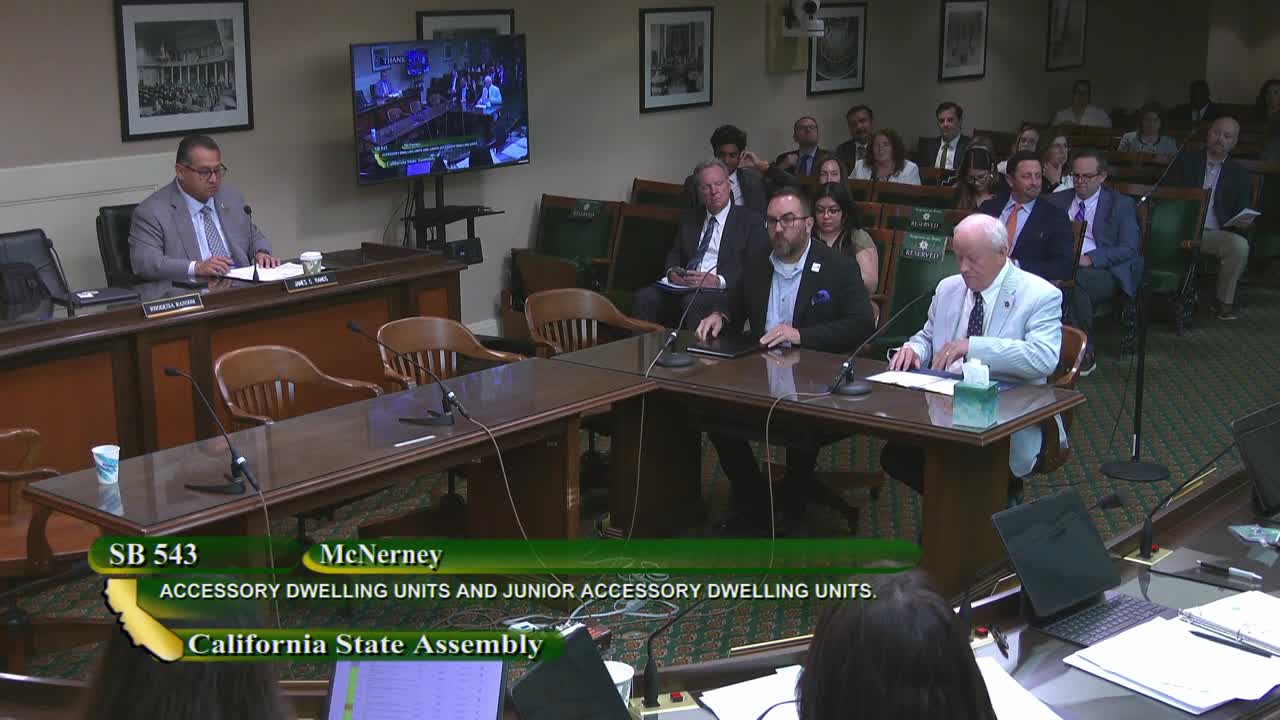 5MIN
Assembly Standing Committee on Local Government
 6MIN
Assembly Standing Committee on Housing and Community Development
 2MIN
Senate Floor
 11MIN
Senate Standing Committee on Local Government
 7MIN
Senate Standing Committee on Housing
Bill Author

Bill Co-Author(s):