SB 551: Corrections and rehabilitation: state policy.
- Session Year: 2025-2026
- House: Senate
- Latest Version Date: 2025-10-01
Current Status:
Passed
(2025-10-01: Chaptered by Secretary of State. Chapter 225, Statutes of 2025.)
Introduced
In Committee
Awaiting First Chamber Vote
Passed First Chamber
In Committee
Awaiting Second Chamber Vote
Passed Second Chamber
Enacted
Under existing law, the Legislature finds and declares that the purpose of sentencing is public safety achieved through punishment, rehabilitation, and restorative justice, and that programs should be available for incarcerated persons, including educational, rehabilitative, and restorative justice programs that are designed to promote behavioral change and to prepare all incarcerated persons for successful reentry into the community. Existing law directs the Department of Corrections and Rehabilitation to maintain a mission statement consistent with these principles.
This bill would make legislative findings and declarations relating to corrections and rehabilitation, including, among others, that the Legislature recognizes that life in prison can never be the same as life in a free society, and that active steps should be taken to make conditions in prison as close to normal life as possible, aside from loss of liberty, to ensure that this normalization does not lead to inhumane prison conditions. The bill would direct the department to maintain a mission statement consistent with the principles of normalization and dynamic security, and would require the department to facilitate access for community-based programs.
Existing law provides that the primary objective of adult incarceration is to facilitate the successful reintegration of the individuals in the departments care back to their communities equipped with the tools to be drug-free, healthy, and employable members of society by providing education, treatment, and rehabilitative and restorative justice programs in a safe and humane environment.
This bill would include that the primary objective of adult incarceration is to promote personal growth for all residents in the departments care. The bill would also provide that the department should develop training for all correctional staff on the principles of normalization and dynamic security in order to meaningfully effectuate these principles.
Under existing law, the Legislature finds and declares that the purpose of sentencing is public safety achieved through punishment, rehabilitation, and restorative justice, and that programs should be available for incarcerated persons, including educational, rehabilitative, and restorative justice programs that are designed to promote behavioral change and to prepare all incarcerated persons for successful reentry into the community. Existing law directs the Department of Corrections and Rehabilitation to maintain a mission statement consistent with these principles.
This bill would make legislative findings and declarations relating to corrections and rehabilitation, including, among others, that the Legislature recognizes that life in prison can never be the same as life in a free society, and that active steps should be taken to make conditions in prison as close to normal life as possible, aside from loss of liberty, to ensure that this normalization does not lead to inhumane prison conditions. The bill would direct the department to maintain a mission statement consistent with the principles of normalization and dynamic security. security, and would require the department to facilitate access for community-based programs.
Existing law provides that the primary objective of adult incarceration is to facilitate the successful reintegration of the individuals in the departments care back to their communities equipped with the tools to be drug-free, healthy, and employable members of society by providing education, treatment, and rehabilitative and restorative justice programs in a safe and humane environment.
This bill would include that the primary objective of adult incarceration is to promote personal growth for all residents in the departments care. The bill would also provide that the department should develop training for all correctional staff on the principles of normalization and dynamic security in order to meaningfully effectuate these principles.
Under existing law, the Legislature finds and declares that the purpose of sentencing is public safety achieved through punishment, rehabilitation, and restorative justice, and that programs should be available for incarcerated persons, including educational, rehabilitative, and restorative justice programs that are designed to promote behavioral change and to prepare all incarcerated persons for successful reentry into the community. Existing law directs the Department of Corrections and Rehabilitation to maintain a mission statement consistent with these principles.
This bill would make legislative findings and declarations relating to corrections and rehabilitation, including, among others, that the Legislature recognizes that life in prison can never be the same as life in a free society, and that active steps should be taken to make conditions in prison as close to normal life as possible, aside from loss of liberty, to ensure that this normalization does not lead to inhumane prison conditions. The bill would prohibit the prison system from aggravating the suffering inherent in imprisonment, except as incidental to justifiable separation or the maintenance of discipline. The bill would direct the department to maintain a mission statement consistent with the principles of normality normalization and dynamic security.
Existing law provides that the primary objective of adult incarceration is to facilitate the successful reintegration of the individuals in the departments care back to their communities equipped with the tools to be drug-free, healthy, and employable members of society by providing education, treatment, and rehabilitative and restorative justice programs in a safe and humane environment.
This bill would include that the primary objective of adult incarceration is to promote personal growth for all residents in the departments care.
Under existing law, the Legislature finds and declares that the purpose of sentencing is public safety achieved through punishment, rehabilitation, and restorative justice, and that programs should be available for incarcerated persons, including educational, rehabilitative, and restorative justice programs that are designed to promote behavioral change and to prepare all incarcerated persons for successful reentry into the community. Existing law directs the Department of Corrections and Rehabilitation to maintain a mission statement consistent with these principles.
This bill would make legislative findings and declarations relating to corrections and rehabilitation, including, among others, that the Legislature recognizes that life in prison can never be the same as life in a free society, and that active steps should be taken to make conditions in prison as close to normal life as possible, aside from loss of liberty, to ensure that this normalization does not lead to inhumane prison conditions. The bill would prohibit the prison system from aggravating the suffering inherent in imprisonment, except as incidental to justifiable separation or the maintenance of discipline. The bill would direct the department to maintain a mission statement consistent with the principles of normality and dynamic security.
The Legislature finds and declares all of the following:
(a)Incarceration has had negative physical and mental health impacts on correctional officers, Department of Corrections and Rehabilitation staff, and incarcerated individuals. Nationally, the average life expectancy of a correctional officer is 59 years of age, which is 16 years shorter than those who do not work in corrections. Further, suicide rates for correctional officers are 39 percent higher than the national working age population. For incarcerated people, each year spent in prison can take two years off of an individuals life expectancy, and the rate of suicide is 31.2 deaths per 100,000 incarcerated persons.
(b)In 2023, Assembly Bill 1104 (Chapter 560, Statutes of 2023) stated that the purpose of incarceration is to provide rehabilitative services to incarcerated people so they can be successfully and safely reintegrated into the community.
(c)The principle of dynamic security, which is the direct, ongoing, and respectful communication between correctional staff and incarcerated persons is a key component of the safest prisons.
(d)Dynamic security promotes a healthier environment for correctional officers, staff, and individuals within a correctional facility by improving the relationship between incarcerated individuals and staff. Improved communication, mentorship, and normalization improves health outcomes for department staff and incarcerated individuals by reducing risks such as violent behavior, recidivism, and stress. Access to training for correctional staff to be respectful, fair, and flexible in the use of their authority, and opportunities to study law, ethics, human rights, and behavior change can assist in lowering the mortality rate of correctional officers. Officers who regularly socialize with incarcerated persons and participate in activities to promote open communication and foster relationships create a safer environment for both incarcerated persons and staff.
(e)The principle of normalization, which states that life inside prison should be as close to life outside of prison as much as possible, prepares incarcerated persons to be productive and contributing members of society upon their release. Incarcerated persons are encouraged to gain skills and provide for their own needs as much as possible to prepare them to be good neighbors.
(f)Importing services into prisons from the community to provide medical, mental health, educational, skill building, and library access are imperative to rehabilitative and individual success.
(g)Creating opportunities for incarcerated persons to maintain their social roles such as father, mother, son, daughter, and friend through in-person and online visits as well as other channels of communication, provides space to practice healthy relationships and motivation for self-development.
(h)This comprehensive strategy aligns with the goal of creating individuals capable of positive contributions to their communities upon reintegration while simultaneously addressing crucial factors that impact staff well-being.
(i)It is essential to further amend the Penal Code to clarify that, when the sentence for a crime includes a term of incarceration, the resulting deprivation of liberty satisfies the punishment purposes of sentencing and that the additional purpose of incarceration is rehabilitation and successful reentry back into the community.
(j)According to the United States Bureau of Justice Statistics, 95 percent of incarcerated people will be released from prison back into the community.
(k)Effective rehabilitation increases public safety and builds stronger communities. In order to achieve these goals, it is essential that incarcerated people are able to live with dignity, are treated humanely, are able to maintain and build strong family and community connections, and have access to varied, high-quality educational and rehabilitative programs.
(l)The Department of Corrections and Rehabilitation is encouraged to allow all incarcerated persons the opportunity to enroll in programs that promote successful return to the community. The Legislature finds and declares that community-based organizations are an integral part of achieving the states objective of ensuring that all people incarcerated in a state prison have access to rehabilitative programs.
SEC. 2.Section 1170 of the Penal Code is amended to read:1170.(a)(1)The Legislature finds and declares that the purpose of sentencing is public safety and to reduce recidivism achieved through punishment, rehabilitation, and restorative justice. When a sentence includes incarceration, the deprivation of liberty satisfies the punishment purpose of sentencing. Therefore, the carceral system should not, except as incidental to justifiable separation or the maintenance of discipline, aggravate the suffering inherent while experiencing imprisonment. The essential purpose of incarceration is rehabilitation and successful community reintegration achieved through education, treatment, and active participation in rehabilitative and restorative justice programs. This purpose is best served by terms that are proportionate to the seriousness of the offense with provision for uniformity in the sentences of people incarcerated for committing the same offense under similar circumstances. These purposes can be achieved only if the period of imprisonment is used to ensure, so far as possible, the promotion of personal growth for all residents and the reintegration of a person into society upon release so that they can lead a law-abiding and self-supporting life, reducing recidivism.
(2)The Legislature further finds and declares that programs should be available for incarcerated persons, including, but not limited to, educational, rehabilitative, and restorative justice programs that are designed to promote behavioral change and to prepare all incarcerated persons for successful reentry into the community. The Legislature encourages the development of policies and programs designed to educate and rehabilitate all incarcerated persons. These programs, activities, and services should be delivered in line with the individual treatment needs of incarcerated persons.
(3)In any case in which the sentence prescribed by statute for a person convicted of a public offense is a term of imprisonment in the state prison, or a term pursuant to subdivision (h), of any specification of three time periods, the court shall sentence the defendant to one of the terms of imprisonment specified unless the convicted person is given any other disposition provided by law, including a fine, jail, probation, or the suspension of imposition or execution of sentence or is sentenced pursuant to subdivision (b) of Section 1168 because they had committed their crime prior to July 1, 1977. In sentencing the convicted person, the court shall apply the sentencing rules of the Judicial Council. The court, unless it determines that there are circumstances in mitigation of the sentence prescribed, shall also impose any other term that it is required by law to impose as an additional term. Nothing in this article shall affect any provision of law that imposes the death penalty, that authorizes or restricts the granting of probation or suspending the execution or imposition of sentence, or expressly provides for imprisonment in the state prison for life, except as provided in subdivision (d). In any case in which the amount of preimprisonment credit under Section 2900.5 or any other provision of law is equal to or exceeds any sentence imposed pursuant to this chapter, except for a remaining portion of mandatory supervision imposed pursuant to subparagraph (B) of paragraph (5) of subdivision (h), the entire sentence shall be deemed to have been served, except for the remaining period of mandatory supervision, and the defendant shall not be actually delivered to the custody of the secretary or the county correctional administrator. The court shall advise the defendant that they shall serve an applicable period of parole, postrelease community supervision, or mandatory supervision and order the defendant to report to the parole or probation office closest to the defendants last legal residence, unless the in-custody credits equal the total sentence, including both confinement time and the period of parole, postrelease community supervision, or mandatory supervision. The sentence shall be deemed a separate prior prison term or a sentence of imprisonment in a county jail under subdivision (h) for purposes of Section 667.5, and a copy of the judgment and other necessary documentation shall be forwarded to the secretary.
(b)(1)When a judgment of imprisonment is to be imposed and the statute specifies three possible terms, the court shall, in its sound discretion, order imposition of a sentence not to exceed the middle term, except as otherwise provided in paragraph (2).
(2)The court may impose a sentence exceeding the middle term only when there are circumstances in aggravation of the crime that justify the imposition of a term of imprisonment exceeding the middle term and the facts underlying those circumstances have been stipulated to by the defendant or have been found true beyond a reasonable doubt at trial by the jury or by the judge in a court trial. Except where evidence supporting an aggravating circumstance is admissible to prove or defend against the charged offense or enhancement at trial, or it is otherwise authorized by law, upon request of a defendant, trial on the circumstances in aggravation alleged in the indictment or information shall be bifurcated from the trial of charges and enhancements. The jury shall not be informed of the bifurcated allegations until there has been a conviction of a felony offense.
(3)Notwithstanding paragraphs (1) and (2), the court may consider the defendants prior convictions in determining sentencing based on a certified record of conviction without submitting the prior convictions to a jury. This paragraph does not apply to enhancements imposed on prior convictions.
(4)At least four days prior to the time set for imposition of judgment, either party or the victim, or the family of the victim if the victim is deceased, may submit a statement in aggravation or mitigation to dispute facts in the record or the probation officers report or to present additional facts. The court may consider the record in the case, the probation officers report, other reports, including reports received pursuant to Section 1203.03, and statements in aggravation or mitigation submitted by the prosecution, the defendant, or the victim, or the family of the victim if the victim is deceased, and any further evidence introduced at the sentencing hearing.
(5)The court shall set forth on the record the facts and reasons for choosing the sentence imposed. The court may not impose an upper term by using the fact of any enhancement upon which sentence is imposed under any provision of law. A term of imprisonment shall not be specified if imposition of sentence is suspended.
(6)Notwithstanding paragraph (1), and unless the court finds that the aggravating circumstances outweigh the mitigating circumstances that imposition of the lower term would be contrary to the interests of justice, the court shall order imposition of the lower term if any of the following was a contributing factor in the commission of the offense:
(A)The person has experienced psychological, physical, or childhood trauma, including, but not limited to, abuse, neglect, exploitation, or sexual violence.
(B)The person is a youth or was a youth as defined under subdivision (b) of Section 1016.7 at the time of the commission of the offense.
(C)Prior to the instant offense, or at the time of the commission of the offense, the person is or was a victim of intimate partner violence or human trafficking.
(7)Paragraph (6) does not preclude the court from imposing the lower term even if there is no evidence of those circumstances listed in paragraph (6) present.
(c)The court shall state the reasons for its sentence choice on the record at the time of sentencing. The court shall also inform the defendant that as part of the sentence after expiration of the term they may be on parole for a period as provided in Section 3000 or 3000.08 or postrelease community supervision for a period as provided in Section 3451.
(d)(1)(A)When a defendant who was under 18 years of age at the time of the commission of the offense for which the defendant was sentenced to imprisonment for life without the possibility of parole has been incarcerated for at least 15 years, the defendant may submit to the sentencing court a petition for recall and resentencing.
(B)Notwithstanding subparagraph (A), this paragraph shall not apply to defendants sentenced to life without parole for an offense where it was pled and proved that the defendant tortured, as described in Section 206, their victim or the victim was a public safety official, including any law enforcement personnel mentioned in Chapter 4.5 (commencing with Section 830) of Title 3, or any firefighter as described in Section 245.1, as well as any other officer in any segment of law enforcement who is employed by the federal government, the state, or any of its political subdivisions.
(2)The defendant shall file the original petition with the sentencing court. A copy of the petition shall be served on the agency that prosecuted the case. The petition shall include the defendants statement that the defendant was under 18 years of age at the time of the crime and was sentenced to life in prison without the possibility of parole, the defendants statement describing their remorse and work towards rehabilitation, and the defendants statement that one of the following is true:
(A)The defendant was convicted pursuant to felony murder or aiding and abetting murder provisions of law.
(B)The defendant does not have juvenile felony adjudications for assault or other felony crimes with a significant potential for personal harm to victims prior to the offense for which the sentence is being considered for recall.
(C)The defendant committed the offense with at least one adult codefendant.
(D)The defendant has performed acts that tend to indicate rehabilitation or the potential for rehabilitation, including, but not limited to, availing themselves of rehabilitative, educational, or vocational programs, if those programs have been available at their classification level and facility, using self-study for self-improvement, or showing evidence of remorse.
(3)If any of the information required in paragraph (2) is missing from the petition, or if proof of service on the prosecuting agency is not provided, the court shall return the petition to the defendant and advise the defendant that the matter cannot be considered without the missing information.
(4)A reply to the petition, if any, shall be filed with the court within 60 days of the date on which the prosecuting agency was served with the petition unless a continuance is granted for good cause.
(5)If the court finds by a preponderance of the evidence that one or more of the statements specified in subparagraphs (A) to (D), inclusive, of paragraph (2) is true, the court shall recall the sentence and commitment previously ordered and hold a hearing to resentence the defendant in the same manner as if the defendant had not previously been sentenced, provided that the new sentence, if any, is not greater than the initial sentence. Victims, or victim family members if the victim is deceased, shall retain the rights to participate in the hearing.
(6)The factors that the court may consider when determining whether to resentence the defendant to a term of imprisonment with the possibility of parole include, but are not limited to, the following:
(A)The defendant was convicted pursuant to felony murder or aiding and abetting murder provisions of law.
(B)The defendant does not have juvenile felony adjudications for assault or other felony crimes with a significant potential for personal harm to victims prior to the offense for which the defendant was sentenced to life without the possibility of parole.
(C)The defendant committed the offense with at least one adult codefendant.
(D)Prior to the offense for which the defendant was sentenced to life without the possibility of parole, the defendant had insufficient adult support or supervision and had suffered from psychological or physical trauma or significant stress.
(E)The defendant suffers from cognitive limitations due to mental illness, developmental disabilities, or other factors that did not constitute a defense but influenced the defendants involvement in the offense.
(F)The defendant has performed acts that tend to indicate rehabilitation or the potential for rehabilitation, including, but not limited to, availing themselves of rehabilitative, educational, or vocational programs, if those programs have been available at their classification level and facility, using self-study for self-improvement, or showing evidence of remorse.
(G)The defendant has maintained family ties or connections with others through letter writing, calls, or visits or has eliminated contact with individuals outside of prison who are currently involved with crime.
(H)The defendant has had no disciplinary actions for violent activities in the last five years in which the defendant was determined to be the aggressor.
(7)The court shall have the discretion to resentence the defendant in the same manner as if the defendant had not previously been sentenced, provided that the new sentence, if any, is not greater than the initial sentence. The discretion of the court shall be exercised in consideration of the criteria in paragraph (6). Victims, or victim family members if the victim is deceased, shall be notified of the resentencing hearing and shall retain their rights to participate in the hearing.
(8)Notwithstanding paragraph (7), the court may also resentence the defendant to a term that is less than the initial sentence if any of the following were a contributing factor in the commission of the alleged offense:
(A)The person has experienced psychological, physical, or childhood trauma, including, but not limited to, abuse, neglect, exploitation, or sexual violence.
(B)The person is a youth or was a youth as defined under subdivision (b) of Section 1016.7 at the time of the commission of the offense.
(C)Prior to the instant offense, or at the time of the commission of the offense, the person is or was a victim of intimate partner violence or human trafficking.
(9)Paragraph (8) does not prohibit the court from resentencing the defendant to a term that is less than the initial sentence, even if none of the circumstances listed in paragraph (8) are present.
(10)If the sentence is not recalled or the defendant is resentenced to imprisonment for life without the possibility of parole, the defendant may submit another petition for recall and resentencing to the sentencing court when the defendant has been committed to the custody of the department for at least 20 years. If the sentence is not recalled or the defendant is resentenced to imprisonment for life without the possibility of parole under that petition, the defendant may file another petition after having served 24 years. The final petition may be submitted, and the response to that petition shall be determined, during the 25th year of the defendants sentence.
(11)In addition to the criteria in paragraph (6), the court may consider any other criteria that the court deems relevant to its decision, so long as the court identifies them on the record, provides a statement of reasons for adopting them, and states why the defendant does or does not satisfy the criteria.
(12)This subdivision shall have retroactive application.
(13)Nothing in this paragraph is intended to diminish or abrogate any rights or remedies otherwise available to the defendant.
(e)Notwithstanding subdivision (a), the court may recall and resentence an incarcerated person pursuant to the compassionate release program set forth in Section 1172.2.
(f)Notwithstanding any other provision of this section, for purposes of paragraph (3) of subdivision (h), an allegation that a defendant is eligible for state prison due to a prior or current conviction, sentence enhancement, or because the defendant is required to register as a sex offender shall not be subject to dismissal pursuant to Section 1385.
(g)A sentence to the state prison for a determinate term for which only one term is specified is a sentence to state prison under this section.
(h)(1)Except as provided in paragraph (3), a felony punishable pursuant to this subdivision where the term is not specified in the underlying offense shall be punishable by a term of imprisonment in a county jail for 16 months, or two or three years.
(2)Except as provided in paragraph (3), a felony punishable pursuant to this subdivision shall be punishable by imprisonment in a county jail for the term described in the underlying offense.
(3)Notwithstanding paragraphs (1) and (2), where the defendant (A) has a prior or current felony conviction for a serious felony described in subdivision (c) of Section 1192.7 or a prior or current conviction for a violent felony described in subdivision (c) of Section 667.5, (B) has a prior felony conviction in another jurisdiction for an offense that has all the elements of a serious felony described in subdivision (c) of Section 1192.7 or a violent felony described in subdivision (c) of Section 667.5, (C) is required to register as a sex offender pursuant to Chapter 5.5 (commencing with Section 290) of Title 9 of Part 1, or (D) is convicted of a crime and as part of the sentence an enhancement pursuant to Section 186.11 is imposed, an executed sentence for a felony punishable pursuant to this subdivision shall be served in the state prison.
(4)Nothing in this subdivision shall be construed to prevent other dispositions authorized by law, including pretrial diversion, deferred entry of judgment, or an order granting probation pursuant to Section 1203.1.
(5)(A)Unless the court finds, in the interest of justice, that it is not appropriate in a particular case, the court, when imposing a sentence pursuant to paragraph (1) or (2), shall suspend execution of a concluding portion of the term for a period selected at the courts discretion.
(B)The portion of a defendants sentenced term that is suspended pursuant to this paragraph shall be known as mandatory supervision, and, unless otherwise ordered by the court, shall commence upon release from physical custody or an alternative custody program, whichever is later. During the period of mandatory supervision, the defendant shall be supervised by the county probation officer in accordance with the terms, conditions, and procedures generally applicable to persons placed on probation for the remaining unserved portion of the sentence imposed by the court. The period of supervision shall be mandatory and may not be earlier terminated, except by court order. Any proceeding to revoke or modify mandatory supervision under this subparagraph shall be conducted pursuant to either subdivisions (a) and (b) of Section 1203.2 or Section 1203.3. During the period when the defendant is under that supervision, unless in actual custody related to the sentence imposed by the court, the defendant shall be entitled to only actual time credit against the term of imprisonment imposed by the court. Any time period that is suspended because a person has absconded shall not be credited toward the period of supervision. A defendant who is subject to search or seizure as part of the terms and conditions of mandatory supervision, is subject to search or seizure only by a probation officer or other peace officer.
(6)When the court is imposing a judgment pursuant to this subdivision concurrent or consecutive to a judgment or judgments previously imposed pursuant to this subdivision in another county or counties, the court rendering the second or other subsequent judgment shall determine the county or counties of incarceration and supervision of the defendant.
(7)The sentencing changes made by the act that added this subdivision shall be applied prospectively to any person sentenced on or after October 1, 2011.
(8)The sentencing changes made to paragraph (5) by the act that added this paragraph shall become effective and operative on January 1, 2015, and shall be applied prospectively to any person sentenced on or after January 1, 2015.
(9)Notwithstanding the separate punishment for any enhancement, any enhancement shall be punishable in a county jail or state prison as required by the underlying offense and not as would be required by the enhancement. The intent of the Legislature in enacting this paragraph is to abrogate the holding in People v. Vega (2014) 222 Cal.App.4th 1374, that if an enhancement specifies service of sentence in state prison, the entire sentence is served in state prison, even if the punishment for the underlying offense is a term of imprisonment in the county jail.
SEC. 3.Section 5000 of the Penal Code is amended to read:5000.(a)Any reference to the Department of Corrections in this or any other code refers to the Department of Corrections and Rehabilitation, Division of Adult Operations.
(b)The primary objective of adult incarceration in the Department of Corrections and Rehabilitation shall be to facilitate the successful reintegration of the individuals in the departments care back to their communities equipped with the tools to be drug-free, healthy, and employable members of society by providing education, treatment, and rehabilitative and restorative justice programs, all in a safe and humane environment to promote personal growth for all residents, as set forth in the findings and declarations set forth in Sections 1170 and 5000.5. In implementing this objective, the Department of Corrections and Rehabilitation is encouraged to allow all incarcerated persons the opportunity to enroll in programs that promote successful return to the community.
SEC. 4.Section 5000.5 is added to the Penal Code, to read:5000.5.(a)The Legislature hereby finds and declares that the purpose of incarceration is rehabilitation accomplished only if the period of imprisonment is used to maximize personal growth for all residents and facilitate their reintegration into society upon release, enabling them to lead law-abiding and self-sufficient lives, reducing recidivism. The Legislature finds and declares that community-based organizations are an integral part of achieving the states objective of ensuring that all people incarcerated in a state prison have access to rehabilitative programs.
(b)The Legislature recognizes that life in prison can never be the same as life in a free society. However, active steps should be taken to make conditions in prison as close to normal life as possible, aside from loss of liberty, and to ensure that this normalization does not lead to inhumane prison conditions.
(c)It is the intent of the Legislature that the Department of Corrections and Rehabilitation integrate, to the extent possible, the principles of normalization and dynamic security to establish safer conditions for incarcerated persons and correctional staff. The Legislature recognizes that the principle of dynamic security promotes a healthier environment for correctional officers, staff, and individuals within a correctional facility by improving the relationship between incarcerated individuals and staff. Improved communication, mentorship, and normalization improve health outcomes for department staff and incarcerated individuals by reducing risks such as violent behavior, recidivism, and stress. The Legislature also recognizes the principle of normalization, which states that life inside prison should be as close to life outside of prison as possible, and should prepare incarcerated persons to be productive and contributing members of society upon their release.
(d)The Department of Corrections and Rehabilitation is directed to maintain a mission statement consistent with the principles of normalization and dynamic security, shall facilitate access for community-based programs, and should develop training for all correctional staff on the principles of normalization and dynamic security in order to meaningfully effectuate the principles set forth in this section.
The Legislature finds and declares all of the following:
(a)Incarceration has had negative physical and mental health impacts on correctional officers, Department of Corrections and Rehabilitation staff, and incarcerated individuals. Nationally, the average life expectancy of a correctional officer is 59 years of age, which is 16 years shorter than those who do not work in corrections. Further, suicide rates for correctional officers are 39 percent higher than the national working age population. For incarcerated people, each year spent in prison can take two years off of an individuals life expectancy, and the rate of suicide is 19.6 31.2 deaths per 100,000 incarcerated persons.
(b)In 2023, Assembly Bill 1104 (Chapter 560, Statutes of 2023) stated that the purpose of incarceration is to provide rehabilitative services to incarcerated people so they can be successfully and safely reintegrated into the community.
(c)The principle of dynamic security, which is the direct, ongoing, and respectful communication between correctional staff and incarcerated persons is a key component of the safest prisons.
(d)Dynamic security promotes a healthier environment for correctional officers, staff, and individuals within a correction correctional facility by improving the relationship between incarcerated individuals and staff. Improved communication, mentorship, and normalization improves health outcomes for department staff and incarcerated individuals by reducing risks such as violent behavior, recidivism, and stress. Access to training for correctional staff to be respectful, fair, and flexible in the use of their authority, and opportunities to study law, ethics, human rights, and behavior change can assist in lowering the mortality rate of correctional officers. Officers who regularly socialize with incarcerated persons and participate in activities to promote open communication and foster relationships create a safer environment for both incarcerated persons and staff.
(e)The principle of normalization, which states that life inside prison should be as close to life outside of prison as much as possible, prepares incarcerated persons to be productive and contributing members of society upon their release. Incarcerated persons are encouraged to gain skills and provide for their own needs as much as possible to prepare them to be good neighbors.
(f)Importing services into prisons from the community to provide medical, mental health, educational, skill building, and library access are imperative to rehabilitative and individual success.
(g)Creating opportunities for incarcerated persons to maintain their social roles such as father, mother, son, daughter, and friend through in-person and online visits as well as other channels of communication, provides space to practice healthy relationships and motivation for self-development.
(h)This comprehensive strategy aligns with the goal of creating individuals capable of positive contributions to their communities upon reintegration while simultaneously addressing crucial factors that impact staff well-being.
(i)It is essential to further amend the Penal Code to clarify that, when the sentence for a crime includes a term of incarceration, the resulting deprivation of liberty satisfies the punishment purposes of sentencing and that the additional purpose of incarceration is rehabilitation and successful reentry back into the community.
(j)According to the United States Bureau of Justice Statistics, 95 percent of incarcerated people will be released from prison back into the community.
(k)Effective rehabilitation increases public safety and builds stronger communities. In order to achieve these goals, it is essential that incarcerated people are able to live with dignity, are treated humanely, are able to maintain and build strong family and community connections, and have access to varied, high-quality educational and rehabilitative programs.
(l)The Department of Corrections and Rehabilitation is encouraged to allow all incarcerated persons the opportunity to enroll in programs that promote successful return to the community. The Legislature finds and declares that community-based organizations are an integral part of achieving the states objective of ensuring that all people incarcerated in a state prison have access to rehabilitative programs.
SEC. 2.Section 1170 of the Penal Code is amended to read:1170.(a)(1)The Legislature finds and declares that the purpose of sentencing is public safety and to reduce recidivism achieved through punishment, rehabilitation, and restorative justice. The Legislature recognizes that life in prison can never be the same as life in a free society. However, active steps should be taken to make conditions in prison as close to normal life as possible, aside from loss of liberty, and to ensure that this normalization does not lead to inhumane prison conditions. When a sentence includes incarceration, the deprivation of liberty satisfies the punishment purpose of sentencing. Therefore Therefore, the prison carceral system should not, except as incidental to justifiable separation or the maintenance of discipline, aggravate the suffering inherent while experiencing imprisonment. The essential purpose of incarceration is rehabilitation and successful community reintegration achieved through education, treatment, and active participation in rehabilitative and restorative justice programs. This purpose is best served by terms that are proportionate to the seriousness of the offense with provision for uniformity in the sentences of people incarcerated for committing the same offense under similar circumstances. These purposes can be achieved only if the period of imprisonment is used to ensure, so far as possible, the promotion of personal growth for all residents and the reintegration of a person into society upon release so that they can lead a law-abiding and self-supporting life, reducing recidivism.
(2)The Legislature recognizes that the principle of dynamic security promotes a healthier environment for correctional officers, staff, and individuals within a correction facility by improving the relationship between incarcerated individuals and staff. Improved communication, mentorship, and normalization improves health outcomes for department staff and incarcerated individuals by reducing risks such as violent behavior, recidivism, and stress. The Legislature also recognizes the principle of normalization, which states that life inside prison should be as close to life outside of prison as much as possible, and prepares incarcerated persons to be productive and contributing members of society upon their release.(3)(2)The Legislature further finds and declares that programs should be available for incarcerated persons, including, but not limited to, educational, rehabilitative, and restorative justice programs that are designed to promote behavioral change and to prepare all incarcerated persons for successful reentry into the community. The Legislature encourages the development of policies and programs designed to educate and rehabilitate all incarcerated persons. These programs, activities, and services should be delivered in line with the individual treatment needs of incarcerated persons. In implementing this section, the Department of Corrections and Rehabilitation is encouraged to allow all incarcerated persons the opportunity to enroll in programs that promote successful return to the community. The Legislature finds and declares that community-based organizations are an integral part of achieving the states objective of ensuring that all people incarcerated in a state prison have access to rehabilitative programs. The Department of Corrections and Rehabilitation is directed to maintain a mission statement consistent with the principles of normalization and dynamic security, shall facilitate access for community-based programs, and should develop training for all correctional staff on the principles of normalization and dynamic security in order to meaningfully effectuate the principles set forth in this section.
(4)(3)In any case in which the sentence prescribed by statute for a person convicted of a public offense is a term of imprisonment in the state prison, or a term pursuant to subdivision (h), of any specification of three time periods, the court shall sentence the defendant to one of the terms of imprisonment specified unless the convicted person is given any other disposition provided by law, including a fine, jail, probation, or the suspension of imposition or execution of sentence or is sentenced pursuant to subdivision (b) of Section 1168 because they had committed their crime prior to July 1, 1977. In sentencing the convicted person, the court shall apply the sentencing rules of the Judicial Council. The court, unless it determines that there are circumstances in mitigation of the sentence prescribed, shall also impose any other term that it is required by law to impose as an additional term. Nothing in this article shall affect any provision of law that imposes the death penalty, that authorizes or restricts the granting of probation or suspending the execution or imposition of sentence, or expressly provides for imprisonment in the state prison for life, except as provided in subdivision (d). In any case in which the amount of preimprisonment credit under Section 2900.5 or any other provision of law is equal to or exceeds any sentence imposed pursuant to this chapter, except for a remaining portion of mandatory supervision imposed pursuant to subparagraph (B) of paragraph (5) of subdivision (h), the entire sentence shall be deemed to have been served, except for the remaining period of mandatory supervision, and the defendant shall not be actually delivered to the custody of the secretary or the county correctional administrator. The court shall advise the defendant that they shall serve an applicable period of parole, postrelease community supervision, or mandatory supervision and order the defendant to report to the parole or probation office closest to the defendants last legal residence, unless the in-custody credits equal the total sentence, including both confinement time and the period of parole, postrelease community supervision, or mandatory supervision. The sentence shall be deemed a separate prior prison term or a sentence of imprisonment in a county jail under subdivision (h) for purposes of Section 667.5, and a copy of the judgment and other necessary documentation shall be forwarded to the secretary.
(b)(1)When a judgment of imprisonment is to be imposed and the statute specifies three possible terms, the court shall, in its sound discretion, order imposition of a sentence not to exceed the middle term, except as otherwise provided in paragraph (2).
(2)The court may impose a sentence exceeding the middle term only when there are circumstances in aggravation of the crime that justify the imposition of a term of imprisonment exceeding the middle term and the facts underlying those circumstances have been stipulated to by the defendant or have been found true beyond a reasonable doubt at trial by the jury or by the judge in a court trial. Except where evidence supporting an aggravating circumstance is admissible to prove or defend against the charged offense or enhancement at trial, or it is otherwise authorized by law, upon request of a defendant, trial on the circumstances in aggravation alleged in the indictment or information shall be bifurcated from the trial of charges and enhancements. The jury shall not be informed of the bifurcated allegations until there has been a conviction of a felony offense.
(3)Notwithstanding paragraphs (1) and (2), the court may consider the defendants prior convictions in determining sentencing based on a certified record of conviction without submitting the prior convictions to a jury. This paragraph does not apply to enhancements imposed on prior convictions.
(4)At least four days prior to the time set for imposition of judgment, either party or the victim, or the family of the victim if the victim is deceased, may submit a statement in aggravation or mitigation to dispute facts in the record or the probation officers report or to present additional facts. The court may consider the record in the case, the probation officers report, other reports, including reports received pursuant to Section 1203.03, and statements in aggravation or mitigation submitted by the prosecution, the defendant, or the victim, or the family of the victim if the victim is deceased, and any further evidence introduced at the sentencing hearing.
(5)The court shall set forth on the record the facts and reasons for choosing the sentence imposed. The court may not impose an upper term by using the fact of any enhancement upon which sentence is imposed under any provision of law. A term of imprisonment shall not be specified if imposition of sentence is suspended.
(6)Notwithstanding paragraph (1), and unless the court finds that the aggravating circumstances outweigh the mitigating circumstances that imposition of the lower term would be contrary to the interests of justice, the court shall order imposition of the lower term if any of the following was a contributing factor in the commission of the offense:
(A)The person has experienced psychological, physical, or childhood trauma, including, but not limited to, abuse, neglect, exploitation, or sexual violence.
(B)The person is a youth or was a youth as defined under subdivision (b) of Section 1016.7 at the time of the commission of the offense.
(C)Prior to the instant offense, or at the time of the commission of the offense, the person is or was a victim of intimate partner violence or human trafficking.
(7)Paragraph (6) does not preclude the court from imposing the lower term even if there is no evidence of those circumstances listed in paragraph (6) present.
(c)The court shall state the reasons for its sentence choice on the record at the time of sentencing. The court shall also inform the defendant that as part of the sentence after expiration of the term they may be on parole for a period as provided in Section 3000 or 3000.08 or postrelease community supervision for a period as provided in Section 3451.
(d)(1)(A)When a defendant who was under 18 years of age at the time of the commission of the offense for which the defendant was sentenced to imprisonment for life without the possibility of parole has been incarcerated for at least 15 years, the defendant may submit to the sentencing court a petition for recall and resentencing.
(B)Notwithstanding subparagraph (A), this paragraph shall not apply to defendants sentenced to life without parole for an offense where it was pled and proved that the defendant tortured, as described in Section 206, their victim or the victim was a public safety official, including any law enforcement personnel mentioned in Chapter 4.5 (commencing with Section 830) of Title 3, or any firefighter as described in Section 245.1, as well as any other officer in any segment of law enforcement who is employed by the federal government, the state, or any of its political subdivisions.
(2)The defendant shall file the original petition with the sentencing court. A copy of the petition shall be served on the agency that prosecuted the case. The petition shall include the defendants statement that the defendant was under 18 years of age at the time of the crime and was sentenced to life in prison without the possibility of parole, the defendants statement describing their remorse and work towards rehabilitation, and the defendants statement that one of the following is true:
(A)The defendant was convicted pursuant to felony murder or aiding and abetting murder provisions of law.
(B)The defendant does not have juvenile felony adjudications for assault or other felony crimes with a significant potential for personal harm to victims prior to the offense for which the sentence is being considered for recall.
(C)The defendant committed the offense with at least one adult codefendant.
(D)The defendant has performed acts that tend to indicate rehabilitation or the potential for rehabilitation, including, but not limited to, availing themselves of rehabilitative, educational, or vocational programs, if those programs have been available at their classification level and facility, using self-study for self-improvement, or showing evidence of remorse.
(3)If any of the information required in paragraph (2) is missing from the petition, or if proof of service on the prosecuting agency is not provided, the court shall return the petition to the defendant and advise the defendant that the matter cannot be considered without the missing information.
(4)A reply to the petition, if any, shall be filed with the court within 60 days of the date on which the prosecuting agency was served with the petition unless a continuance is granted for good cause.
(5)If the court finds by a preponderance of the evidence that one or more of the statements specified in subparagraphs (A) to (D), inclusive, of paragraph (2) is true, the court shall recall the sentence and commitment previously ordered and hold a hearing to resentence the defendant in the same manner as if the defendant had not previously been sentenced, provided that the new sentence, if any, is not greater than the initial sentence. Victims, or victim family members if the victim is deceased, shall retain the rights to participate in the hearing.
(6)The factors that the court may consider when determining whether to resentence the defendant to a term of imprisonment with the possibility of parole include, but are not limited to, the following:
(A)The defendant was convicted pursuant to felony murder or aiding and abetting murder provisions of law.
(B)The defendant does not have juvenile felony adjudications for assault or other felony crimes with a significant potential for personal harm to victims prior to the offense for which the defendant was sentenced to life without the possibility of parole.
(C)The defendant committed the offense with at least one adult codefendant.
(D)Prior to the offense for which the defendant was sentenced to life without the possibility of parole, the defendant had insufficient adult support or supervision and had suffered from psychological or physical trauma or significant stress.
(E)The defendant suffers from cognitive limitations due to mental illness, developmental disabilities, or other factors that did not constitute a defense but influenced the defendants involvement in the offense.
(F)The defendant has performed acts that tend to indicate rehabilitation or the potential for rehabilitation, including, but not limited to, availing themselves of rehabilitative, educational, or vocational programs, if those programs have been available at their classification level and facility, using self-study for self-improvement, or showing evidence of remorse.
(G)The defendant has maintained family ties or connections with others through letter writing, calls, or visits or has eliminated contact with individuals outside of prison who are currently involved with crime.
(H)The defendant has had no disciplinary actions for violent activities in the last five years in which the defendant was determined to be the aggressor.
(7)The court shall have the discretion to resentence the defendant in the same manner as if the defendant had not previously been sentenced, provided that the new sentence, if any, is not greater than the initial sentence. The discretion of the court shall be exercised in consideration of the criteria in paragraph (6). Victims, or victim family members if the victim is deceased, shall be notified of the resentencing hearing and shall retain their rights to participate in the hearing.
(8)Notwithstanding paragraph (7), the court may also resentence the defendant to a term that is less than the initial sentence if any of the following were a contributing factor in the commission of the alleged offense:
(A)The person has experienced psychological, physical, or childhood trauma, including, but not limited to, abuse, neglect, exploitation, or sexual violence.
(B)The person is a youth or was a youth as defined under subdivision (b) of Section 1016.7 at the time of the commission of the offense.
(C)Prior to the instant offense, or at the time of the commission of the offense, the person is or was a victim of intimate partner violence or human trafficking.
(9)Paragraph (8) does not prohibit the court from resentencing the defendant to a term that is less than the initial sentence, even if none of the circumstances listed in paragraph (8) are present.
(10)If the sentence is not recalled or the defendant is resentenced to imprisonment for life without the possibility of parole, the defendant may submit another petition for recall and resentencing to the sentencing court when the defendant has been committed to the custody of the department for at least 20 years. If the sentence is not recalled or the defendant is resentenced to imprisonment for life without the possibility of parole under that petition, the defendant may file another petition after having served 24 years. The final petition may be submitted, and the response to that petition shall be determined, during the 25th year of the defendants sentence.
(11)In addition to the criteria in paragraph (6), the court may consider any other criteria that the court deems relevant to its decision, so long as the court identifies them on the record, provides a statement of reasons for adopting them, and states why the defendant does or does not satisfy the criteria.
(12)This subdivision shall have retroactive application.
(13)Nothing in this paragraph is intended to diminish or abrogate any rights or remedies otherwise available to the defendant.
(e)Notwithstanding subdivision (a), the court may recall and resentence an incarcerated person pursuant to the compassionate release program set forth in Section 1172.2.
(f)Notwithstanding any other provision of this section, for purposes of paragraph (3) of subdivision (h), an allegation that a defendant is eligible for state prison due to a prior or current conviction, sentence enhancement, or because the defendant is required to register as a sex offender shall not be subject to dismissal pursuant to Section 1385.
(g)A sentence to the state prison for a determinate term for which only one term is specified is a sentence to state prison under this section.
(h)(1)Except as provided in paragraph (3), a felony punishable pursuant to this subdivision where the term is not specified in the underlying offense shall be punishable by a term of imprisonment in a county jail for 16 months, or two or three years.
(2)Except as provided in paragraph (3), a felony punishable pursuant to this subdivision shall be punishable by imprisonment in a county jail for the term described in the underlying offense.
(3)Notwithstanding paragraphs (1) and (2), where the defendant (A) has a prior or current felony conviction for a serious felony described in subdivision (c) of Section 1192.7 or a prior or current conviction for a violent felony described in subdivision (c) of Section 667.5, (B) has a prior felony conviction in another jurisdiction for an offense that has all the elements of a serious felony described in subdivision (c) of Section 1192.7 or a violent felony described in subdivision (c) of Section 667.5, (C) is required to register as a sex offender pursuant to Chapter 5.5 (commencing with Section 290) of Title 9 of Part 1, or (D) is convicted of a crime and as part of the sentence an enhancement pursuant to Section 186.11 is imposed, an executed sentence for a felony punishable pursuant to this subdivision shall be served in the state prison.
(4)Nothing in this subdivision shall be construed to prevent other dispositions authorized by law, including pretrial diversion, deferred entry of judgment, or an order granting probation pursuant to Section 1203.1.
(5)(A)Unless the court finds, in the interest of justice, that it is not appropriate in a particular case, the court, when imposing a sentence pursuant to paragraph (1) or (2), shall suspend execution of a concluding portion of the term for a period selected at the courts discretion.
(B)The portion of a defendants sentenced term that is suspended pursuant to this paragraph shall be known as mandatory supervision, and, unless otherwise ordered by the court, shall commence upon release from physical custody or an alternative custody program, whichever is later. During the period of mandatory supervision, the defendant shall be supervised by the county probation officer in accordance with the terms, conditions, and procedures generally applicable to persons placed on probation for the remaining unserved portion of the sentence imposed by the court. The period of supervision shall be mandatory and may not be earlier terminated, except by court order. Any proceeding to revoke or modify mandatory supervision under this subparagraph shall be conducted pursuant to either subdivisions (a) and (b) of Section 1203.2 or Section 1203.3. During the period when the defendant is under that supervision, unless in actual custody related to the sentence imposed by the court, the defendant shall be entitled to only actual time credit against the term of imprisonment imposed by the court. Any time period that is suspended because a person has absconded shall not be credited toward the period of supervision. A defendant who is subject to search or seizure as part of the terms and conditions of mandatory supervision, is subject to search or seizure only by a probation officer or other peace officer.
(6)When the court is imposing a judgment pursuant to this subdivision concurrent or consecutive to a judgment or judgments previously imposed pursuant to this subdivision in another county or counties, the court rendering the second or other subsequent judgment shall determine the county or counties of incarceration and supervision of the defendant.
(7)The sentencing changes made by the act that added this subdivision shall be applied prospectively to any person sentenced on or after October 1, 2011.
(8)The sentencing changes made to paragraph (5) by the act that added this paragraph shall become effective and operative on January 1, 2015, and shall be applied prospectively to any person sentenced on or after January 1, 2015.
(9)Notwithstanding the separate punishment for any enhancement, any enhancement shall be punishable in a county jail or state prison as required by the underlying offense and not as would be required by the enhancement. The intent of the Legislature in enacting this paragraph is to abrogate the holding in People v. Vega (2014) 222 Cal.App.4th 1374, that if an enhancement specifies service of sentence in state prison, the entire sentence is served in state prison, even if the punishment for the underlying offense is a term of imprisonment in the county jail.
SEC. 3.Section 5000 of the Penal Code is amended to read:5000.(a)Any reference to the Department of Corrections in this or any other code refers to the Department of Corrections and Rehabilitation, Division of Adult Operations.
(b)The primary objective of adult incarceration in the Department of Corrections and Rehabilitation shall be to promote personal growth for all residents and facilitate the successful reintegration of the individuals in the departments care back to their communities equipped with the tools to be drug-free, healthy, and employable members of society by providing education, treatment, and rehabilitative and restorative justice programs, all in a safe and humane environment, environment to promote personal growth for all residents, as set forth in the findings and declarations set forth in Section 1170. Sections 1170 and 5000.5. In implementing this objective, the Department of Corrections and Rehabilitation is encouraged to allow all incarcerated persons the opportunity to enroll in programs that promote successful return to the community.
SEC. 4.Section 5000.5 is added to the Penal Code, to read:5000.5.(a)The Legislature hereby finds and declares that the purpose of incarceration is rehabilitation accomplished only if the period of imprisonment is used to maximize personal growth for all residents and facilitate their reintegration into society upon release, enabling them to lead law-abiding and self-sufficient lives, reducing recidivism. The Legislature finds and declares that community-based organizations are an integral part of achieving the states objective of ensuring that all people incarcerated in a state prison have access to rehabilitative programs.
(b)The Legislature recognizes that life in prison can never be the same as life in a free society. However, active steps should be taken to make conditions in prison as close to normal life as possible, aside from loss of liberty, and to ensure that this normalization does not lead to inhumane prison conditions.
(c)It is the intent of the Legislature that the Department of Corrections and Rehabilitation integrate, to the extent possible, the principles of normalization and dynamic security to establish safer conditions for incarcerated persons and correctional staff. The Legislature recognizes that the principle of dynamic security promotes a healthier environment for correctional officers, staff, and individuals within a correctional facility by improving the relationship between incarcerated individuals and staff. Improved communication, mentorship, and normalization improve health outcomes for department staff and incarcerated individuals by reducing risks such as violent behavior, recidivism, and stress. The Legislature also recognizes the principle of normalization, which states that life inside prison should be as close to life outside of prison as possible, and should prepare incarcerated persons to be productive and contributing members of society upon their release.
(d)The Department of Corrections and Rehabilitation is directed to maintain a mission statement consistent with the principles of normalization and dynamic security, shall facilitate access for community-based programs, and should develop training for all correctional staff on the principles of normalization and dynamic security in order to meaningfully effectuate the principles set forth in this section.
REVISIONS: HeadingLine 3.The Legislature finds and declares all of the following:
(a)Incarceration has had negative physical and mental health impacts on correctional officers, Department of Corrections and Rehabilitation staff, and incarcerated individuals. Nationally, the average life expectancy of a correctional officer is 59 years of age, which is 16 years shorter than those who do not work in corrections. Further, suicide rates for correctional officers are 39 percent higher than the national working age population. For incarcerated people, each year spent in prison can take two years off of an individuals life expectancy, and the rate of suicide is 19.6 deaths per 100,000 incarcerated persons.
(b)In 2023, Assembly Bill 1104 (Chapter 560, Statutes of 2023) stated that the purpose of incarceration is to provide rehabilitative services to incarcerated people so they can be successfully and safely reintegrated into the community.
(c)The principle of dynamic security, which is the direct, ongoing, and respectful communication between correctional staff and incarcerated persons is a key component of the safest prisons.
(d)Dynamic security promotes a healthier environment for correctional officers, staff, and individuals within a correction facility by improving the relationship between incarcerated individuals and staff. Improved communication, mentorship, and normalization improves health outcomes for department staff and incarcerated individuals by reducing risks such as violent behavior, recidivism, and stress. Access to training for correctional staff to be respectful, fair, and flexible in the use of their authority, and opportunities to study law, ethics, human rights, and behavior change can assist in lowering the mortality rate of correctional officers. Officers who regularly socialize with incarcerated persons and participate in activities to promote open communication and foster relationships create a safer environment for both incarcerated persons and staff.
(e)The principle of normality, normalization, which states that life inside prison should be as close to life outside of prison as much as possible, prepares incarcerated persons to be productive and contributing members of society upon their release. Incarcerated persons are encouraged to gain skills and provide for their own needs as much as possible to prepare them to be good neighbors.
(f)Importing services into prisons from the community to provide medical, mental health, educational, skill building, and library access are imperative to rehabilitative and individual success.
(g)Creating opportunities for incarcerated persons to maintain their social roles such as father, mother, son, daughter, and friend through in-person and online visits as well as other channels of communication, provides space to practice healthy relationships and motivation for self-development.
(h)This comprehensive strategy aligns with the goal of creating individuals capable of positive contributions to their communities upon reintegration while simultaneously addressing crucial factors that impact staff well-being.
(i)It is essential to further amend the Penal Code to clarify that, when the sentence for a crime includes a term of incarceration, the resulting deprivation of liberty satisfies the punishment purposes of sentencing and that the additional purpose of incarceration is rehabilitation and successful reentry back into the community.
(j)According to the United States Bureau of Justice Statistics, 95 percent of incarcerated people will be released from prison back into the community.
(k)Effective rehabilitation increases public safety and builds stronger communities. In order to achieve these goals, it is essential that incarcerated people are able to live with dignity, are treated humanely, are able to maintain and build strong family and community connections, and have access to varied, high-quality educational and rehabilitative programs.
SEC. 2.Section 1170 of the Penal Code is amended to read:1170.(a)(1)The Legislature finds and declares that the purpose of sentencing is public safety and to reduce recidivism achieved through punishment, rehabilitation, and restorative justice. The Legislature recognizes that life in prison can never be the same as life in a free society. However, active steps should be taken to make conditions in prison as close to normal life as possible, aside from loss of liberty, and to ensure that this normalization does not lead to inhumane prison conditions. When a sentence includes incarceration, the deprivation of liberty satisfies the punishment purpose of sentencing. Therefore the prison system shall should not, except as incidental to justifiable separation or the maintenance of discipline, aggravate the suffering inherent while experiencing imprisonment. The essential purpose of incarceration is rehabilitation and successful community reintegration achieved through education, treatment, and active participation in rehabilitative and restorative justice programs. This purpose is best served by terms that are proportionate to the seriousness of the offense with provision for uniformity in the sentences of people incarcerated for committing the same offense under similar circumstances. These purposes can be achieved only if the period of imprisonment is used to ensure, so far as possible, the promotion of personal growth for all residents and the reintegration of a person into society upon release so that they can lead a law-abiding and self-supporting life, reducing recidivism.
(2)The Legislature recognizes that the principle of dynamic security promotes a healthier environment for correctional officers, staff, and individuals within a correction facility by improving the relationship between incarcerated individuals and staff. Improved communication, mentorship, and normalization improves health outcomes for department staff and incarcerated individuals by reducing risks such as violent behavior, recidivism, and stress. The Legislature also recognizes the principle of normalization, which states that life inside prison should be as close to life outside of prison as much as possible, and prepares incarcerated persons to be productive and contributing members of society upon their release.
(2)(3)The Legislature further finds and declares that programs should be available for incarcerated persons, including, but not limited to, educational, rehabilitative, and restorative justice programs that are designed to promote behavioral change and to prepare all incarcerated persons for successful reentry into the community. The Legislature encourages the development of policies and programs designed to educate and rehabilitate all incarcerated persons. These programs, activities, and services should be delivered in line with the individual treatment needs of incarcerated persons. In implementing this section, the Department of Corrections and Rehabilitation is encouraged to allow all incarcerated persons the opportunity to enroll in programs that promote successful return to the community. The Legislature finds and declares that community-based organizations are an integral part of achieving the states objective of ensuring that all people incarcerated in a state prison have access to rehabilitative programs. The Department of Corrections and Rehabilitation is directed to maintain a mission statement consistent with the principles of normality normalization and dynamic security, and shall facilitate access for community-based programs programs, and should develop training for all correctional staff on the principles of normalization and dynamic security in order to meaningfully effectuate the principles set forth in this section.
(3)(4)In any case in which the sentence prescribed by statute for a person convicted of a public offense is a term of imprisonment in the state prison, or a term pursuant to subdivision (h), of any specification of three time periods, the court shall sentence the defendant to one of the terms of imprisonment specified unless the convicted person is given any other disposition provided by law, including a fine, jail, probation, or the suspension of imposition or execution of sentence or is sentenced pursuant to subdivision (b) of Section 1168 because they had committed their crime prior to July 1, 1977. In sentencing the convicted person, the court shall apply the sentencing rules of the Judicial Council. The court, unless it determines that there are circumstances in mitigation of the sentence prescribed, shall also impose any other term that it is required by law to impose as an additional term. Nothing in this article shall affect any provision of law that imposes the death penalty, that authorizes or restricts the granting of probation or suspending the execution or imposition of sentence, or expressly provides for imprisonment in the state prison for life, except as provided in subdivision (d). In any case in which the amount of preimprisonment credit under Section 2900.5 or any other provision of law is equal to or exceeds any sentence imposed pursuant to this chapter, except for a remaining portion of mandatory supervision imposed pursuant to subparagraph (B) of paragraph (5) of subdivision (h), the entire sentence shall be deemed to have been served, except for the remaining period of mandatory supervision, and the defendant shall not be actually delivered to the custody of the secretary or the county correctional administrator. The court shall advise the defendant that they shall serve an applicable period of parole, postrelease community supervision, or mandatory supervision and order the defendant to report to the parole or probation office closest to the defendants last legal residence, unless the in-custody credits equal the total sentence, including both confinement time and the period of parole, postrelease community supervision, or mandatory supervision. The sentence shall be deemed a separate prior prison term or a sentence of imprisonment in a county jail under subdivision (h) for purposes of Section 667.5, and a copy of the judgment and other necessary documentation shall be forwarded to the secretary.
(b)(1)When a judgment of imprisonment is to be imposed and the statute specifies three possible terms, the court shall, in its sound discretion, order imposition of a sentence not to exceed the middle term, except as otherwise provided in paragraph (2).
(2)The court may impose a sentence exceeding the middle term only when there are circumstances in aggravation of the crime that justify the imposition of a term of imprisonment exceeding the middle term and the facts underlying those circumstances have been stipulated to by the defendant or have been found true beyond a reasonable doubt at trial by the jury or by the judge in a court trial. Except where evidence supporting an aggravating circumstance is admissible to prove or defend against the charged offense or enhancement at trial, or it is otherwise authorized by law, upon request of a defendant, trial on the circumstances in aggravation alleged in the indictment or information shall be bifurcated from the trial of charges and enhancements. The jury shall not be informed of the bifurcated allegations until there has been a conviction of a felony offense.
(3)Notwithstanding paragraphs (1) and (2), the court may consider the defendants prior convictions in determining sentencing based on a certified record of conviction without submitting the prior convictions to a jury. This paragraph does not apply to enhancements imposed on prior convictions.
(4)At least four days prior to the time set for imposition of judgment, either party or the victim, or the family of the victim if the victim is deceased, may submit a statement in aggravation or mitigation to dispute facts in the record or the probation officers report or to present additional facts. The court may consider the record in the case, the probation officers report, other reports, including reports received pursuant to Section 1203.03, and statements in aggravation or mitigation submitted by the prosecution, the defendant, or the victim, or the family of the victim if the victim is deceased, and any further evidence introduced at the sentencing hearing.
(5)The court shall set forth on the record the facts and reasons for choosing the sentence imposed. The court may not impose an upper term by using the fact of any enhancement upon which sentence is imposed under any provision of law. A term of imprisonment shall not be specified if imposition of sentence is suspended.
(6)Notwithstanding paragraph (1), and unless the court finds that the aggravating circumstances outweigh the mitigating circumstances that imposition of the lower term would be contrary to the interests of justice, the court shall order imposition of the lower term if any of the following was a contributing factor in the commission of the offense:
(A)The person has experienced psychological, physical, or childhood trauma, including, but not limited to, abuse, neglect, exploitation, or sexual violence.
(B)The person is a youth or was a youth as defined under subdivision (b) of Section 1016.7 at the time of the commission of the offense.
(C)Prior to the instant offense, or at the time of the commission of the offense, the person is or was a victim of intimate partner violence or human trafficking.
(7)Paragraph (6) does not preclude the court from imposing the lower term even if there is no evidence of those circumstances listed in paragraph (6) present.
(c)The court shall state the reasons for its sentence choice on the record at the time of sentencing. The court shall also inform the defendant that as part of the sentence after expiration of the term they may be on parole for a period as provided in Section 3000 or 3000.08 or postrelease community supervision for a period as provided in Section 3451.
(d)(1)(A)When a defendant who was under 18 years of age at the time of the commission of the offense for which the defendant was sentenced to imprisonment for life without the possibility of parole has been incarcerated for at least 15 years, the defendant may submit to the sentencing court a petition for recall and resentencing.
(B)Notwithstanding subparagraph (A), this paragraph shall not apply to defendants sentenced to life without parole for an offense where it was pled and proved that the defendant tortured, as described in Section 206, their victim or the victim was a public safety official, including any law enforcement personnel mentioned in Chapter 4.5 (commencing with Section 830) of Title 3, or any firefighter as described in Section 245.1, as well as any other officer in any segment of law enforcement who is employed by the federal government, the state, or any of its political subdivisions.
(2)The defendant shall file the original petition with the sentencing court. A copy of the petition shall be served on the agency that prosecuted the case. The petition shall include the defendants statement that the defendant was under 18 years of age at the time of the crime and was sentenced to life in prison without the possibility of parole, the defendants statement describing their remorse and work towards rehabilitation, and the defendants statement that one of the following is true:
(A)The defendant was convicted pursuant to felony murder or aiding and abetting murder provisions of law.
(B)The defendant does not have juvenile felony adjudications for assault or other felony crimes with a significant potential for personal harm to victims prior to the offense for which the sentence is being considered for recall.
(C)The defendant committed the offense with at least one adult codefendant.
(D)The defendant has performed acts that tend to indicate rehabilitation or the potential for rehabilitation, including, but not limited to, availing themselves of rehabilitative, educational, or vocational programs, if those programs have been available at their classification level and facility, using self-study for self-improvement, or showing evidence of remorse.
(3)If any of the information required in paragraph (2) is missing from the petition, or if proof of service on the prosecuting agency is not provided, the court shall return the petition to the defendant and advise the defendant that the matter cannot be considered without the missing information.
(4)A reply to the petition, if any, shall be filed with the court within 60 days of the date on which the prosecuting agency was served with the petition unless a continuance is granted for good cause.
(5)If the court finds by a preponderance of the evidence that one or more of the statements specified in subparagraphs (A) to (D), inclusive, of paragraph (2) is true, the court shall recall the sentence and commitment previously ordered and hold a hearing to resentence the defendant in the same manner as if the defendant had not previously been sentenced, provided that the new sentence, if any, is not greater than the initial sentence. Victims, or victim family members if the victim is deceased, shall retain the rights to participate in the hearing.
(6)The factors that the court may consider when determining whether to resentence the defendant to a term of imprisonment with the possibility of parole include, but are not limited to, the following:
(A)The defendant was convicted pursuant to felony murder or aiding and abetting murder provisions of law.
(B)The defendant does not have juvenile felony adjudications for assault or other felony crimes with a significant potential for personal harm to victims prior to the offense for which the defendant was sentenced to life without the possibility of parole.
(C)The defendant committed the offense with at least one adult codefendant.
(D)Prior to the offense for which the defendant was sentenced to life without the possibility of parole, the defendant had insufficient adult support or supervision and had suffered from psychological or physical trauma or significant stress.
(E)The defendant suffers from cognitive limitations due to mental illness, developmental disabilities, or other factors that did not constitute a defense but influenced the defendants involvement in the offense.
(F)The defendant has performed acts that tend to indicate rehabilitation or the potential for rehabilitation, including, but not limited to, availing themselves of rehabilitative, educational, or vocational programs, if those programs have been available at their classification level and facility, using self-study for self-improvement, or showing evidence of remorse.
(G)The defendant has maintained family ties or connections with others through letter writing, calls, or visits or has eliminated contact with individuals outside of prison who are currently involved with crime.
(H)The defendant has had no disciplinary actions for violent activities in the last five years in which the defendant was determined to be the aggressor.
(7)The court shall have the discretion to resentence the defendant in the same manner as if the defendant had not previously been sentenced, provided that the new sentence, if any, is not greater than the initial sentence. The discretion of the court shall be exercised in consideration of the criteria in paragraph (6). Victims, or victim family members if the victim is deceased, shall be notified of the resentencing hearing and shall retain their rights to participate in the hearing.
(8)Notwithstanding paragraph (7), the court may also resentence the defendant to a term that is less than the initial sentence if any of the following were a contributing factor in the commission of the alleged offense:
(A)The person has experienced psychological, physical, or childhood trauma, including, but not limited to, abuse, neglect, exploitation, or sexual violence.
(B)The person is a youth or was a youth as defined under subdivision (b) of Section 1016.7 at the time of the commission of the offense.
(C)Prior to the instant offense, or at the time of the commission of the offense, the person is or was a victim of intimate partner violence or human trafficking.
(9)Paragraph (8) does not prohibit the court from resentencing the defendant to a term that is less than the initial sentence, even if none of the circumstances listed in paragraph (8) are present.
(10)If the sentence is not recalled or the defendant is resentenced to imprisonment for life without the possibility of parole, the defendant may submit another petition for recall and resentencing to the sentencing court when the defendant has been committed to the custody of the department for at least 20 years. If the sentence is not recalled or the defendant is resentenced to imprisonment for life without the possibility of parole under that petition, the defendant may file another petition after having served 24 years. The final petition may be submitted, and the response to that petition shall be determined, during the 25th year of the defendants sentence.
(11)In addition to the criteria in paragraph (6), the court may consider any other criteria that the court deems relevant to its decision, so long as the court identifies them on the record, provides a statement of reasons for adopting them, and states why the defendant does or does not satisfy the criteria.
(12)This subdivision shall have retroactive application.
(13)Nothing in this paragraph is intended to diminish or abrogate any rights or remedies otherwise available to the defendant.
(e)Notwithstanding subdivision (a), the court may recall and resentence an incarcerated person pursuant to the compassionate release program set forth in Section 1172.2.
(f)Notwithstanding any other provision of this section, for purposes of paragraph (3) of subdivision (h), an allegation that a defendant is eligible for state prison due to a prior or current conviction, sentence enhancement, or because the defendant is required to register as a sex offender shall not be subject to dismissal pursuant to Section 1385.
(g)A sentence to the state prison for a determinate term for which only one term is specified is a sentence to state prison under this section.
(h)(1)Except as provided in paragraph (3), a felony punishable pursuant to this subdivision where the term is not specified in the underlying offense shall be punishable by a term of imprisonment in a county jail for 16 months, or two or three years.
(2)Except as provided in paragraph (3), a felony punishable pursuant to this subdivision shall be punishable by imprisonment in a county jail for the term described in the underlying offense.
(3)Notwithstanding paragraphs (1) and (2), where the defendant (A) has a prior or current felony conviction for a serious felony described in subdivision (c) of Section 1192.7 or a prior or current conviction for a violent felony described in subdivision (c) of Section 667.5, (B) has a prior felony conviction in another jurisdiction for an offense that has all the elements of a serious felony described in subdivision (c) of Section 1192.7 or a violent felony described in subdivision (c) of Section 667.5, (C) is required to register as a sex offender pursuant to Chapter 5.5 (commencing with Section 290) of Title 9 of Part 1, or (D) is convicted of a crime and as part of the sentence an enhancement pursuant to Section 186.11 is imposed, an executed sentence for a felony punishable pursuant to this subdivision shall be served in the state prison.
(4)Nothing in this subdivision shall be construed to prevent other dispositions authorized by law, including pretrial diversion, deferred entry of judgment, or an order granting probation pursuant to Section 1203.1.
(5)(A)Unless the court finds, in the interest of justice, that it is not appropriate in a particular case, the court, when imposing a sentence pursuant to paragraph (1) or (2), shall suspend execution of a concluding portion of the term for a period selected at the courts discretion.
(B)The portion of a defendants sentenced term that is suspended pursuant to this paragraph shall be known as mandatory supervision, and, unless otherwise ordered by the court, shall commence upon release from physical custody or an alternative custody program, whichever is later. During the period of mandatory supervision, the defendant shall be supervised by the county probation officer in accordance with the terms, conditions, and procedures generally applicable to persons placed on probation for the remaining unserved portion of the sentence imposed by the court. The period of supervision shall be mandatory and may not be earlier terminated, except by court order. Any proceeding to revoke or modify mandatory supervision under this subparagraph shall be conducted pursuant to either subdivisions (a) and (b) of Section 1203.2 or Section 1203.3. During the period when the defendant is under that supervision, unless in actual custody related to the sentence imposed by the court, the defendant shall be entitled to only actual time credit against the term of imprisonment imposed by the court. Any time period that is suspended because a person has absconded shall not be credited toward the period of supervision. A defendant who is subject to search or seizure as part of the terms and conditions of mandatory supervision, is subject to search or seizure only by a probation officer or other peace officer.
(6)When the court is imposing a judgment pursuant to this subdivision concurrent or consecutive to a judgment or judgments previously imposed pursuant to this subdivision in another county or counties, the court rendering the second or other subsequent judgment shall determine the county or counties of incarceration and supervision of the defendant.
(7)The sentencing changes made by the act that added this subdivision shall be applied prospectively to any person sentenced on or after October 1, 2011.
(8)The sentencing changes made to paragraph (5) by the act that added this paragraph shall become effective and operative on January 1, 2015, and shall be applied prospectively to any person sentenced on or after January 1, 2015.
(9)Notwithstanding the separate punishment for any enhancement, any enhancement shall be punishable in a county jail or state prison as required by the underlying offense and not as would be required by the enhancement. The intent of the Legislature in enacting this paragraph is to abrogate the holding in People v. Vega (2014) 222 Cal.App.4th 1374, that if an enhancement specifies service of sentence in state prison, the entire sentence is served in state prison, even if the punishment for the underlying offense is a term of imprisonment in the county jail.
SEC. 3.Section 5000 of the Penal Code is amended to read:5000.(a)Any reference to the Department of Corrections in this or any other code refers to the Department of Corrections and Rehabilitation, Division of Adult Operations.
(b)The primary objective of adult incarceration in the Department of Corrections and Rehabilitation shall be to promote personal growth for all residents and facilitate the successful reintegration of the individuals in the departments care back to their communities equipped with the tools to be drug-free, healthy, and employable members of society by providing education, treatment, and rehabilitative and restorative justice programs, all in a safe and humane environment, as set forth in the findings and declarations set forth in Section 1170.
The Legislature finds and declares all of the following:
(a)Incarceration has had negative physical and mental health impacts on correctional officers, Department of Corrections and Rehabilitation staff, and incarcerated individuals. Nationally, the average life expectancy of a correctional officer is 59 years of age, which is 16 years shorter than those who do not work in corrections. Further, suicide rates for correctional officers are 39 percent higher than the national working age population. For incarcerated people, each year spent in prison can take two years off of an individuals life expectancy, and the rate of suicide is 19.6 deaths per 100,000 incarcerated persons.
(b)In 2023, Assembly Bill 1104 (Chapter 560, Statutes of 2023) stated that the purpose of incarceration is to provide rehabilitative services to incarcerated people so they can be successfully and safely reintegrated into the community.
(c)The principle of dynamic security, which is the direct, ongoing, and respectful communication between correctional staff and incarcerated persons is a key component of the safest prisons.
(d)Dynamic security promotes a healthier environment for correctional officers, staff, and individuals within a correction facility by improving the relationship between incarcerated individuals and staff. Improved communication, mentorship, and normalization improves health outcomes for department staff and incarcerated individuals by reducing risks such as violent behavior, recidivism, and stress. Access to training for correctional staff to be respectful, fair, and flexible in the use of their authority, and opportunities to study law, ethics, human rights, and behavior change can assist in lowering the mortality rate of correctional officers. Officers who regularly socialize with incarcerated persons and participate in activities to promote open communication and foster relationships create a safer environment for both incarcerated persons and staff.
(e)The principle of normality, which states that life inside prison should be as close to life outside of prison as much as possible, prepares incarcerated persons to be productive and contributing members of society upon their release. Incarcerated persons are encouraged to gain skills and provide for their own needs as much as possible to prepare them to be good neighbors.
(f)Importing services into prisons from the community to provide medical, mental health, educational, skill building, and library access are imperative to rehabilitative and individual success.
(g)Creating opportunities for incarcerated persons to maintain their social roles such as father, mother, son, daughter, and friend through in-person and online visits as well as other channels of communication, provides space to practice healthy relationships and motivation for self-development.
(h)This comprehensive strategy aligns with the goal of creating individuals capable of positive contributions to their communities upon reintegration while simultaneously addressing crucial factors that impact staff well-being.
(i)It is essential to further amend the Penal Code to clarify that, when the sentence for a crime includes a term of incarceration, the resulting deprivation of liberty satisfies the punishment purposes of sentencing and that the additional purpose of incarceration is rehabilitation and successful reentry back into the community.
(j)According to the United States Bureau of Justice Statistics, 95 percent of incarcerated people will be released from prison back into the community.
(k)Effective rehabilitation increases public safety and builds stronger communities. In order to achieve these goals, it is essential that incarcerated people are able to live with dignity, are treated humanely, are able to maintain and build strong family and community connections, and have access to varied, high-quality educational and rehabilitative programs.
SEC. 2.Section 1170 of the Penal Code is amended to read:1170.(a)(1)The Legislature finds and declares that the purpose of sentencing is public safety and to reduce recidivism achieved through punishment, rehabilitation, and restorative justice. The Legislature recognizes that life in prison can never be the same as life in a free society. However, active steps should be taken to make conditions in prison as close to normal life as possible, aside from loss of liberty, and to ensure that this normalization does not lead to inhumane prison conditions. When a sentence includes incarceration, the deprivation of liberty satisfies the punishment purpose of sentencing. Therefore the prison system shall not, except as incidental to justifiable separation or the maintenance of discipline, aggravate the suffering inherent while experiencing imprisonment. The essential purpose of incarceration is rehabilitation and successful community reintegration achieved through education, treatment, and active participation in rehabilitative and restorative justice programs. This purpose is best served by terms that are proportionate to the seriousness of the offense with provision for uniformity in the sentences of people incarcerated for committing the same offense under similar circumstances. These purposes can be achieved only if the period of imprisonment is used to ensure, so far as possible, the reintegration of a person into society upon release so that they can lead a law-abiding and self-supporting life, reducing recidivism.
(2)The Legislature further finds and declares that programs should be available for incarcerated persons, including, but not limited to, educational, rehabilitative, and restorative justice programs that are designed to promote behavioral change and to prepare all incarcerated persons for successful reentry into the community. The Legislature encourages the development of policies and programs designed to educate and rehabilitate all incarcerated persons. These programs, activities, and services should be delivered in line with the individual treatment needs of incarcerated persons. In implementing this section, the Department of Corrections and Rehabilitation is encouraged to allow all incarcerated persons the opportunity to enroll in programs that promote successful return to the community. The Legislature finds and declares that community-based organizations are an integral part of achieving the states objective of ensuring that all people incarcerated in a state prison have access to rehabilitative programs. The Department of Corrections and Rehabilitation is directed to maintain a mission statement consistent with these the principles of normality and dynamic security, and shall facilitate access for community-based programs in order to meaningfully effectuate the principles set forth in this section.
(3)In any case in which the sentence prescribed by statute for a person convicted of a public offense is a term of imprisonment in the state prison, or a term pursuant to subdivision (h), of any specification of three time periods, the court shall sentence the defendant to one of the terms of imprisonment specified unless the convicted person is given any other disposition provided by law, including a fine, jail, probation, or the suspension of imposition or execution of sentence or is sentenced pursuant to subdivision (b) of Section 1168 because they had committed their crime prior to July 1, 1977. In sentencing the convicted person, the court shall apply the sentencing rules of the Judicial Council. The court, unless it determines that there are circumstances in mitigation of the sentence prescribed, shall also impose any other term that it is required by law to impose as an additional term. Nothing in this article shall affect any provision of law that imposes the death penalty, that authorizes or restricts the granting of probation or suspending the execution or imposition of sentence, or expressly provides for imprisonment in the state prison for life, except as provided in subdivision (d). In any case in which the amount of preimprisonment credit under Section 2900.5 or any other provision of law is equal to or exceeds any sentence imposed pursuant to this chapter, except for a remaining portion of mandatory supervision imposed pursuant to subparagraph (B) of paragraph (5) of subdivision (h), the entire sentence shall be deemed to have been served, except for the remaining period of mandatory supervision, and the defendant shall not be actually delivered to the custody of the secretary or the county correctional administrator. The court shall advise the defendant that they shall serve an applicable period of parole, postrelease community supervision, or mandatory supervision and order the defendant to report to the parole or probation office closest to the defendants last legal residence, unless the in-custody credits equal the total sentence, including both confinement time and the period of parole, postrelease community supervision, or mandatory supervision. The sentence shall be deemed a separate prior prison term or a sentence of imprisonment in a county jail under subdivision (h) for purposes of Section 667.5, and a copy of the judgment and other necessary documentation shall be forwarded to the secretary.
(b)(1)When a judgment of imprisonment is to be imposed and the statute specifies three possible terms, the court shall, in its sound discretion, order imposition of a sentence not to exceed the middle term, except as otherwise provided in paragraph (2).
(2)The court may impose a sentence exceeding the middle term only when there are circumstances in aggravation of the crime that justify the imposition of a term of imprisonment exceeding the middle term and the facts underlying those circumstances have been stipulated to by the defendant or have been found true beyond a reasonable doubt at trial by the jury or by the judge in a court trial. Except where evidence supporting an aggravating circumstance is admissible to prove or defend against the charged offense or enhancement at trial, or it is otherwise authorized by law, upon request of a defendant, trial on the circumstances in aggravation alleged in the indictment or information shall be bifurcated from the trial of charges and enhancements. The jury shall not be informed of the bifurcated allegations until there has been a conviction of a felony offense.
(3)Notwithstanding paragraphs (1) and (2), the court may consider the defendants prior convictions in determining sentencing based on a certified record of conviction without submitting the prior convictions to a jury. This paragraph does not apply to enhancements imposed on prior convictions.
(4)At least four days prior to the time set for imposition of judgment, either party or the victim, or the family of the victim if the victim is deceased, may submit a statement in aggravation or mitigation to dispute facts in the record or the probation officers report or to present additional facts. The court may consider the record in the case, the probation officers report, other reports, including reports received pursuant to Section 1203.03, and statements in aggravation or mitigation submitted by the prosecution, the defendant, or the victim, or the family of the victim if the victim is deceased, and any further evidence introduced at the sentencing hearing.
(5)The court shall set forth on the record the facts and reasons for choosing the sentence imposed. The court may not impose an upper term by using the fact of any enhancement upon which sentence is imposed under any provision of law. A term of imprisonment shall not be specified if imposition of sentence is suspended.
(6)Notwithstanding paragraph (1), and unless the court finds that the aggravating circumstances outweigh the mitigating circumstances that imposition of the lower term would be contrary to the interests of justice, the court shall order imposition of the lower term if any of the following was a contributing factor in the commission of the offense:
(A)The person has experienced psychological, physical, or childhood trauma, including, but not limited to, abuse, neglect, exploitation, or sexual violence.
(B)The person is a youth or was a youth as defined under subdivision (b) of Section 1016.7 at the time of the commission of the offense.
(C)Prior to the instant offense, or at the time of the commission of the offense, the person is or was a victim of intimate partner violence or human trafficking.
(7)Paragraph (6) does not preclude the court from imposing the lower term even if there is no evidence of those circumstances listed in paragraph (6) present.
(c)The court shall state the reasons for its sentence choice on the record at the time of sentencing. The court shall also inform the defendant that as part of the sentence after expiration of the term they may be on parole for a period as provided in Section 3000 or 3000.08 or postrelease community supervision for a period as provided in Section 3451.
(d)(1)(A)When a defendant who was under 18 years of age at the time of the commission of the offense for which the defendant was sentenced to imprisonment for life without the possibility of parole has been incarcerated for at least 15 years, the defendant may submit to the sentencing court a petition for recall and resentencing.
(B)Notwithstanding subparagraph (A), this paragraph shall not apply to defendants sentenced to life without parole for an offense where it was pled and proved that the defendant tortured, as described in Section 206, their victim or the victim was a public safety official, including any law enforcement personnel mentioned in Chapter 4.5 (commencing with Section 830) of Title 3, or any firefighter as described in Section 245.1, as well as any other officer in any segment of law enforcement who is employed by the federal government, the state, or any of its political subdivisions.
(2)The defendant shall file the original petition with the sentencing court. A copy of the petition shall be served on the agency that prosecuted the case. The petition shall include the defendants statement that the defendant was under 18 years of age at the time of the crime and was sentenced to life in prison without the possibility of parole, the defendants statement describing their remorse and work towards rehabilitation, and the defendants statement that one of the following is true:
(A)The defendant was convicted pursuant to felony murder or aiding and abetting murder provisions of law.
(B)The defendant does not have juvenile felony adjudications for assault or other felony crimes with a significant potential for personal harm to victims prior to the offense for which the sentence is being considered for recall.
(C)The defendant committed the offense with at least one adult codefendant.
(D)The defendant has performed acts that tend to indicate rehabilitation or the potential for rehabilitation, including, but not limited to, availing themselves of rehabilitative, educational, or vocational programs, if those programs have been available at their classification level and facility, using self-study for self-improvement, or showing evidence of remorse.
(3)If any of the information required in paragraph (2) is missing from the petition, or if proof of service on the prosecuting agency is not provided, the court shall return the petition to the defendant and advise the defendant that the matter cannot be considered without the missing information.
(4)A reply to the petition, if any, shall be filed with the court within 60 days of the date on which the prosecuting agency was served with the petition unless a continuance is granted for good cause.
(5)If the court finds by a preponderance of the evidence that one or more of the statements specified in subparagraphs (A) to (D), inclusive, of paragraph (2) is true, the court shall recall the sentence and commitment previously ordered and hold a hearing to resentence the defendant in the same manner as if the defendant had not previously been sentenced, provided that the new sentence, if any, is not greater than the initial sentence. Victims, or victim family members if the victim is deceased, shall retain the rights to participate in the hearing.
(6)The factors that the court may consider when determining whether to resentence the defendant to a term of imprisonment with the possibility of parole include, but are not limited to, the following:
(A)The defendant was convicted pursuant to felony murder or aiding and abetting murder provisions of law.
(B)The defendant does not have juvenile felony adjudications for assault or other felony crimes with a significant potential for personal harm to victims prior to the offense for which the defendant was sentenced to life without the possibility of parole.
(C)The defendant committed the offense with at least one adult codefendant.
(D)Prior to the offense for which the defendant was sentenced to life without the possibility of parole, the defendant had insufficient adult support or supervision and had suffered from psychological or physical trauma or significant stress.
(E)The defendant suffers from cognitive limitations due to mental illness, developmental disabilities, or other factors that did not constitute a defense but influenced the defendants involvement in the offense.
(F)The defendant has performed acts that tend to indicate rehabilitation or the potential for rehabilitation, including, but not limited to, availing themselves of rehabilitative, educational, or vocational programs, if those programs have been available at their classification level and facility, using self-study for self-improvement, or showing evidence of remorse.
(G)The defendant has maintained family ties or connections with others through letter writing, calls, or visits or has eliminated contact with individuals outside of prison who are currently involved with crime.
(H)The defendant has had no disciplinary actions for violent activities in the last five years in which the defendant was determined to be the aggressor.
(7)The court shall have the discretion to resentence the defendant in the same manner as if the defendant had not previously been sentenced, provided that the new sentence, if any, is not greater than the initial sentence. The discretion of the court shall be exercised in consideration of the criteria in paragraph (6). Victims, or victim family members if the victim is deceased, shall be notified of the resentencing hearing and shall retain their rights to participate in the hearing.
(8)Notwithstanding paragraph (7), the court may also resentence the defendant to a term that is less than the initial sentence if any of the following were a contributing factor in the commission of the alleged offense:
(A)The person has experienced psychological, physical, or childhood trauma, including, but not limited to, abuse, neglect, exploitation, or sexual violence.
(B)The person is a youth or was a youth as defined under subdivision (b) of Section 1016.7 at the time of the commission of the offense.
(C)Prior to the instant offense, or at the time of the commission of the offense, the person is or was a victim of intimate partner violence or human trafficking.
(9)Paragraph (8) does not prohibit the court from resentencing the defendant to a term that is less than the initial sentence, even if none of the circumstances listed in paragraph (8) are present.
(10)If the sentence is not recalled or the defendant is resentenced to imprisonment for life without the possibility of parole, the defendant may submit another petition for recall and resentencing to the sentencing court when the defendant has been committed to the custody of the department for at least 20 years. If the sentence is not recalled or the defendant is resentenced to imprisonment for life without the possibility of parole under that petition, the defendant may file another petition after having served 24 years. The final petition may be submitted, and the response to that petition shall be determined, during the 25th year of the defendants sentence.
(11)In addition to the criteria in paragraph (6), the court may consider any other criteria that the court deems relevant to its decision, so long as the court identifies them on the record, provides a statement of reasons for adopting them, and states why the defendant does or does not satisfy the criteria.
(12)This subdivision shall have retroactive application.
(13)Nothing in this paragraph is intended to diminish or abrogate any rights or remedies otherwise available to the defendant.
(e)Notwithstanding subdivision (a), the court may recall and resentence an incarcerated person pursuant to the compassionate release program set forth in Section 1172.2.
(f)Notwithstanding any other provision of this section, for purposes of paragraph (3) of subdivision (h), an allegation that a defendant is eligible for state prison due to a prior or current conviction, sentence enhancement, or because the defendant is required to register as a sex offender shall not be subject to dismissal pursuant to Section 1385.
(g)A sentence to the state prison for a determinate term for which only one term is specified is a sentence to state prison under this section.
(h)(1)Except as provided in paragraph (3), a felony punishable pursuant to this subdivision where the term is not specified in the underlying offense shall be punishable by a term of imprisonment in a county jail for 16 months, or two or three years.
(2)Except as provided in paragraph (3), a felony punishable pursuant to this subdivision shall be punishable by imprisonment in a county jail for the term described in the underlying offense.
(3)Notwithstanding paragraphs (1) and (2), where the defendant (A) has a prior or current felony conviction for a serious felony described in subdivision (c) of Section 1192.7 or a prior or current conviction for a violent felony described in subdivision (c) of Section 667.5, (B) has a prior felony conviction in another jurisdiction for an offense that has all the elements of a serious felony described in subdivision (c) of Section 1192.7 or a violent felony described in subdivision (c) of Section 667.5, (C) is required to register as a sex offender pursuant to Chapter 5.5 (commencing with Section 290) of Title 9 of Part 1, or (D) is convicted of a crime and as part of the sentence an enhancement pursuant to Section 186.11 is imposed, an executed sentence for a felony punishable pursuant to this subdivision shall be served in the state prison.
(4)Nothing in this subdivision shall be construed to prevent other dispositions authorized by law, including pretrial diversion, deferred entry of judgment, or an order granting probation pursuant to Section 1203.1.
(5)(A)Unless the court finds, in the interest of justice, that it is not appropriate in a particular case, the court, when imposing a sentence pursuant to paragraph (1) or (2), shall suspend execution of a concluding portion of the term for a period selected at the courts discretion.
(B)The portion of a defendants sentenced term that is suspended pursuant to this paragraph shall be known as mandatory supervision, and, unless otherwise ordered by the court, shall commence upon release from physical custody or an alternative custody program, whichever is later. During the period of mandatory supervision, the defendant shall be supervised by the county probation officer in accordance with the terms, conditions, and procedures generally applicable to persons placed on probation for the remaining unserved portion of the sentence imposed by the court. The period of supervision shall be mandatory and may not be earlier terminated, except by court order. Any proceeding to revoke or modify mandatory supervision under this subparagraph shall be conducted pursuant to either subdivisions (a) and (b) of Section 1203.2 or Section 1203.3. During the period when the defendant is under that supervision, unless in actual custody related to the sentence imposed by the court, the defendant shall be entitled to only actual time credit against the term of imprisonment imposed by the court. Any time period that is suspended because a person has absconded shall not be credited toward the period of supervision. A defendant who is subject to search or seizure as part of the terms and conditions of mandatory supervision, is subject to search or seizure only by a probation officer or other peace officer.
(6)When the court is imposing a judgment pursuant to this subdivision concurrent or consecutive to a judgment or judgments previously imposed pursuant to this subdivision in another county or counties, the court rendering the second or other subsequent judgment shall determine the county or counties of incarceration and supervision of the defendant.
(7)The sentencing changes made by the act that added this subdivision shall be applied prospectively to any person sentenced on or after October 1, 2011.
(8)The sentencing changes made to paragraph (5) by the act that added this paragraph shall become effective and operative on January 1, 2015, and shall be applied prospectively to any person sentenced on or after January 1, 2015.
(9)Notwithstanding the separate punishment for any enhancement, any enhancement shall be punishable in a county jail or state prison as required by the underlying offense and not as would be required by the enhancement. The intent of the Legislature in enacting this paragraph is to abrogate the holding in People v. Vega (2014) 222 Cal.App.4th 1374, that if an enhancement specifies service of sentence in state prison, the entire sentence is served in state prison, even if the punishment for the underlying offense is a term of imprisonment in the county jail.
|
Date
|
Status
|
|---|---|
| Oct 1, 2025 | Chaptered by Secretary of State. Chapter 225, Statutes of 2025. |
| Oct 1, 2025 | Approved by the Governor. |
| Sep 17, 2025 | Enrolled and presented to the Governor at 2 p.m. |
| Sep 9, 2025 | Assembly amendments concurred in. (Ayes 30. Noes 9. Page 2706.) Ordered to engrossing and enrolling. |
| Sep 3, 2025 | In Senate. Concurrence in Assembly amendments pending. |
| Sep 3, 2025 | Read third time. Passed. (Ayes 57. Noes 20. Page 2868.) Ordered to the Senate. |
| Sep 2, 2025 | Read second time. Ordered to third reading. |
| Aug 29, 2025 | From committee: Do pass. (Ayes 11. Noes 4.) (August 29). |
| Jul 16, 2025 | July 16 set for first hearing. Placed on APPR. suspense file. |
| Jun 17, 2025 | From committee: Do pass and re-refer to Com. on APPR. (Ayes 7. Noes 2.) (June 17). Re-referred to Com. on APPR. |
| Jun 17, 2025 | Coauthors revised. |
| Jun 10, 2025 | From committee with author's amendments. Read second time and amended. Re-referred to Com. on PUB. S. |
| Jun 5, 2025 | Referred to Com. on PUB. S. |
| May 28, 2025 | In Assembly. Read first time. Held at Desk. |
| May 28, 2025 | Read third time. Passed. (Ayes 28. Noes 10. Page 1293.) Ordered to the Assembly. |
| May 6, 2025 | Read second time. Ordered to third reading. |
| May 5, 2025 | From committee: Be ordered to second reading pursuant to Senate Rule 28.8. |
| Apr 25, 2025 | Set for hearing May 5. |
| Apr 23, 2025 | From committee: Do pass and re-refer to Com. on APPR. (Ayes 5. Noes 1. Page 841.) (April 22). Re-referred to Com. on APPR. |
| Apr 9, 2025 | Set for hearing April 22. |
| Apr 2, 2025 | Re-referred to Com. on PUB. S. |
| Mar 24, 2025 | From committee with author's amendments. Read second time and amended. Re-referred to Com. on RLS. |
| Mar 5, 2025 | Referred to Com. on RLS. |
| Feb 21, 2025 | From printer. May be acted upon on or after March 23. |
| Feb 20, 2025 | Introduced. Read first time. To Com. on RLS. for assignment. To print. |
|
Date
|
Description
|
Location
|
Votes
|
|
|---|---|---|---|---|
| Sep 9, 2025 | Unfinished Business SB551 Cortese et al. Concurrence | Senate Floor |
Passed |
|
| Sep 3, 2025 | SB 551 Cortese Senate Third Reading By Schultz | Assembly Floor |
Passed |
|
| Aug 29, 2025 | Do pass. | Assembly Standing Committee on Appropriations |
Passed |
|
| Jun 17, 2025 | Do pass and be re-referred to the Committee on [Appropriations] | Assembly Standing Committee on Public Safety |
Passed |
|
| May 28, 2025 | Senate 3rd Reading SB551 Cortese et al. | Senate Floor |
Passed |
|
| Apr 22, 2025 | Do pass, but first be re-referred to the Committee on [Appropriations] | Senate Standing Committee on Public Safety |
Passed |
This list shows positions taken on this bill by organizations on the date displayed, which is linked to the original source.
Positions by individuals are not included.
|
Organization
|
Position
|
Date
|
|---|---|---|
| Amnesty International USA | ** Support | |
| California Civil Liberties Advocacy | ** Against | |
| California Public Defenders Association | ** Support | |
| Carry the Vision | ** Support | |
| Center for Employment Opportunities | ** Support | |
| Courage California | ** Support | |
| Creative Acts | ** Support | |
| Defy Ventures | ** Support | |
| Ella Baker Center For Human Rights | ** Support | |
| Felony Murder Elimination Project | ** Support | |
| Grip Training Institute | ** Support | |
| Initiate Justice | ** Support | |
| Initiate Justice Action | ** Support | |
| National Association Of Social Workers, California Chapter | ** Support | |
| Oakland Privacy | ** Support | |
| Opportunities for Change | ** Support | |
| Prison From the Inside Out | ** Support | |
| Prison From-theinside-out INC | ** Support | |
| San Francisco Public Defender | ** Support | |
| Smart Justice California | ** Support | |
| The Place4grace | ** Support | |
| Transformative Programming Works | ** Support | |
| Valor US | ** Support |
SENATE RULES COMMITTEE Office of Senate Floor Analyses (916) 651-1520 Fax: (916) 327-4478 | SB 551 |
UNFINISHED BUSINESS
Bill No: SB 551
Author: Cortese (D), et al.
Amended: 6/10/25 in Assembly
Vote: 21
SENATE PUBLIC SAFETY COMMITTEE: 5-1, 4/22/25
AYES: Arreguín, Caballero, Gonzalez, Pérez, Wiener
NOES: Seyarto
SENATE APPROPRIATIONS COMMITTEE: Senate Rule 28.8
SENATE FLOOR: 28-10, 5/28/25
AYES: Allen, Archuleta, Arreguín, Ashby, Becker, Blakespear, Cabaldon, Caballero, Cervantes, Cortese, Durazo, Gonzalez, Grayson, Hurtado, Laird, McGuire, McNerney, Menjivar, Padilla, Pérez, Richardson, Rubio, Smallwood-Cuevas, Stern, Umberg, Wahab, Weber Pierson, Wiener
NOES: Alvarado-Gil, Choi, Dahle, Grove, Jones, Niello, Ochoa Bogh, Seyarto, Strickland, Valladares
NO VOTE RECORDED: Limón, Reyes
ASSEMBLY FLOOR: 57-20, 9/3/25 - See last page for vote
SUBJECT: Corrections and rehabilitation: state policy
SOURCE: Author
DIGEST:
This bill codifies the Legislature’s intent that the California Department of Corrections and Rehabilitation (CDCR) integrate the principles of normalization and dynamic security to create safer conditions for incarcerated people and correctional staff.
Assembly Amendments
6/10/25 move several of the provisions of this bill to a new Penal Code section.
ANALYSIS:
Existing law:
- Declares that California must reinvest its criminal justice resources to support community-based corrections programs and evidence-based practices that will achieve improved public safety returns on this state’s substantial investment in its criminal justice system. (Penal (Pen.) Code, § 17.5, subd. (a)(4).)
- Declares that strategies supporting reentering offenders, such as standardized risk and needs assessments, transitional housing, treatment, medical and mental health services, and employment, have been demonstrated to significantly reduce recidivism among offenders in other states. (Pen. Code, § 17.7, subd. (a).)
- Finds and declares that the purpose of sentencing is public safety, which is achieved through punishment, rehabilitation, and restorative justice. (Pen. Code, § 1170, subd. (a)(1).)
- States that when a sentence includes incarceration, the deprivation of liberty satisfies the punishment purpose of sentencing. (Pen. Code, § 1170, subd. (a)(1).)
- States that the purpose of incarceration is rehabilitation and successful community reintegration achieved through education, treatment, and active participation in rehabilitative and restorative justice programs. (Pen. Code, § 1170, subd. (a)(1).)
- Finds and declares that programs should be available for incarcerated persons, including, but not limited to, educational, rehabilitative, and restorative justice programs that are designed to promote behavioral change and to prepare all incarcerated persons for successful reentry into the community. (Pen. Code, § 1170, subd. (a)(2).)
- Encourages CDCR to allow all incarcerated persons the opportunity to enroll in programs that promote successful return to the community. (Pen. Code, § 1170, subd. (a)(2).)
- Directs CDCR to maintain a mission statement consistent with these principles and shall facilitate access for community-based programs in order to meaningfully effectuate these principles. (Pen. Code, § 1170, subd. (a)(2).)
- Provides that the primary objective of adult incarceration in CDCR is to facilitate the successful reintegration of the individuals in the department’s care back to their communities equipped with the tools to be drug-free, healthy, and employable members of society by providing education, treatment, and rehabilitative and restorative justice programs, all in a safe and humane environment. (Pen. Code, § 5000, subd. (b).)
This bill:
- Finds and declares that an additional purpose of criminal sentencing is to reduce recidivism.
- States that the Legislature recognizes the principle of normalization, which states that life inside prison should be as close to life outside of prison as much as possible, and prepares incarcerated persons to be productive and contributing members of society upon their release.
- States that while the Legislature recognizes that life in prison can never be the same as life in a free society, active steps should be taken to make conditions in prison as close to normal life as possible, aside from loss of liberty, and to ensure that this normalization does not lead to inhumane prison conditions.
- States that the Legislature also recognizes that the principle of dynamic security promotes a healthier environment for correctional officers, staff, and individuals within a correction facility by improving the relationship between incarcerated individuals and staff.
- States that rehabilitative programs, activities, and services should be delivered in line with the individual treatment needs of incarcerated persons.
- Directs CDCR to maintain a mission statement consistent with the principles of normalization and dynamic security.
- States that CDCR should develop training for all correctional staff on the principles of normalization and dynamic security.
- States that another primary objective of adult incarceration at CDCR is to promote personal growth for all residents.
- Contains other legislative findings and declarations.
Background
The California Model. In March 2023, Governor Gavin Newsom announced a historic commitment to safety and justice, “the California Model,” to include the transformation of the San Quentin Rehabilitation Center. In April 2023, the Secretary of CDCR and the federal Receiver who oversees prison medical care issued a joint memorandum expressing their concern that prison environments can be unfavorable to the health and well-being of the people who live and work in them and operate at cross purposes to rehabilitative efforts. A multi-disciplinary Advisory Council was tasked with drafting and presenting recommendations to achieve cultural and transformational change within the prison and help inform CDCR’s California Model.
Working with these multidisciplinary experts and drawing from international best practices, CDCR has since begun implementing the California Model to transform the experience of living and working in CDCR facilities. The California Model is based on four foundational pillars meant to improve the health and well-being of people who live and work within CDCR institutions: dynamic security, normalization, peer-mentorship, and becoming a trauma-informed organization. Dynamic security is an approach that promotes positive relationships between staff and incarcerated people accomplished through purposeful activities and professional, positive, and respectful communication. Normalization aims to bring life in prison as close as possible to life outside of prison because the more life in prison resembles life in the community, the easier it will be for people to transition and adjust to life in the community upon release. Peer mentorship seeks to train incarcerated individuals to use their lived experiences to mentor and support their peers. And the goal of becoming a trauma informed organization is to educate staff at all levels to recognize the impacts of trauma to ensure the physical and emotional safety of all staff and incarcerated individuals. CDCR has partnered with the University of California San Francisco Amend program to transform correctional culture. This has included sending prison leadership, California policy makers, other government officials, and advocates to Norway’s prisons to study how their approach to normalcy and dynamic security in corrections is lowering recidivism and expanding employee wellness.
This bill focuses on two of the California Model pillars, normalization and dynamic security. This bill would recognize and codify these principles. This bill directs CDCR to include the principles of normalization and dynamic security in its mission statement. This bill would also direct CDCR to develop training for all correctional staff to teach these principles.
FISCAL EFFECT: Appropriation: No Fiscal Com.: Yes Local: No
According to the Assembly Appropriations Committee:
Cost pressures (General Fund) of an unknown but potentially significant amount to CDCR. CDCR reports no significant fiscal impact resulting from the bill; the department believes its existing staff trainings fulfill its obligations under the bill and reports it already “works to remove barriers to accessing rehabilitative programming through the use dynamic security and strives to create institutional conditions that closely resemble life in the community.” However, to the extent CDCR must change it facilities, practices, and policies to meet the goals of normalization and dynamic security codified by this bill, the department will likely incur significant future costs given the scope of its operations.
SUPPORT: (Verified 9/02/2025)
Amnesty International USA
California Public Defenders Association
Carry the Vision
Center for Employment Opportunities
Courage California
Creative Acts
Defy Ventures
Ella Baker Center for Human Rights
Felony Murder Elimination Project
Grip Training Institute
Initiate Justice
Initiate Justice Action
National Association of Social Workers, California Chapter
Oakland Privacy
Opportunities for Change
Prison From-theinside-out, INC.
San Francisco Public Defender
Smart Justice California
The Place4grace
Transformative Programming Works
Valor US
OPPOSITION: (Verified 9/02/2025)
California Civil Liberties Advocacy
ARGUMENTS IN SUPPORT:
The Transformative Programming Works (TPW) writes:
TPW represents over 100 organizations that provide rehabilitative in-prison programs in all of CDCR’s prisons. TPW believes that the purpose of incarceration should be to provide rehabilitative services to incarcerated people so they can be successfully and safely reintegrated into the community.
National research shows the average life expectancy of correctional officers is 59 years old, 16 years shorter than those not working in corrections. Additionally, suicide rates of correctional officers are 39% higher than the national working age population. Among incarcerated individuals, every year of imprisonment decreases their life expectancy by two years. Further, in 2022, the suicide rate of incarcerated people increased 4.6 points.
SB 551 introduces the principles of Normality and Dynamic Security to CDCR. Normality not only emulates life outside of a facility on the inside, in the most secure manner possible, but prepares individuals for adequate civic engagement. Moreover, Dynamic Security creates a healthier prison environment through the use of ongoing, respectful communication between staff and residents—reducing the risk of stress, violence, and recidivism for greater public safety.
ARGUMENTS IN OPPOSITION:
According to California Civil Liberties Advocacy:
We respectfully object to one particular policy statement found in both the legislative findings and amended Penal Code §1170(a)(1), which reads:
“Active steps should be taken to make conditions in prison as close to normal life as possible, aside from loss of liberty.”
This sentence, in our view, is vague, overbroad, and utopian in character. While well-meaning, it lacks definitional guardrails and measurable standards, leaving open a wide range of interpretations. The phrase “as close to normal life as possible” really is begging the question since the metric by which a “normal life” may be very different, depending on a person’s individual background, economic status, housing, employment, geographical location, and et cetera.
ASSEMBLY FLOOR: 57-20, 9/3/25
AYES: Addis, Aguiar-Curry, Alvarez, Arambula, Ávila Farías, Bauer-Kahan, Bennett, Berman, Boerner, Bonta, Bryan, Calderon, Caloza, Carrillo, Connolly, Elhawary, Fong, Gabriel, Garcia, Gipson, Mark González, Haney, Harabedian, Hart, Irwin, Jackson, Kalra, Krell, Lee, Lowenthal, McKinnor, Muratsuchi, Nguyen, Ortega, Pacheco, Papan, Patel, Pellerin, Petrie-Norris, Quirk-Silva, Ramos, Ransom, Celeste Rodriguez, Michelle Rodriguez, Rogers, Blanca Rubio, Schiavo, Schultz, Sharp-Collins, Solache, Soria, Stefani, Ward, Wicks, Wilson, Zbur, Rivas
NOES: Ahrens, Alanis, Castillo, Chen, Davies, DeMaio, Dixon, Ellis, Flora, Gallagher, Jeff Gonzalez, Hadwick, Hoover, Lackey, Macedo, Patterson, Sanchez, Ta, Tangipa, Wallis
NO VOTE RECORDED: Bains, Valencia
Prepared by: Sandy Uribe / PUB. S. /
9/3/25 18:38:14
**** END ****
SENATE THIRD READING
STR Bill Id:SB 551
Author:(Cortese)
As Amended Ver:June 10, 2025
Majority vote
SUMMARY
Codifies the principles of normalization and dynamic security, two of the four pillars of the California Department of Corrections and Rehabilitation's (CDCR) California Model.
Major Provisions
- States that the Legislature finds and declares that the purpose of incarceration is rehabilitation accomplished only if the period of imprisonment is used to maximize personal growth for all residents and facilitate their reintegration into society upon release, enabling them to lead law-abiding and self-sufficient lives, reducing recidivism.
- States that the Legislature finds and declares that community-based organizations are an integral part of achieving the state's objective of ensuring that all people incarcerated in a state prison have access to rehabilitative programs.
- States that the Legislature recognizes that life in prison can never be the same as life in a free society. However, active steps should be taken to make conditions in prison as close to normal life as possible, aside from loss of liberty, and to ensure that this normalization does not lead to inhumane prison conditions.
- Provides that it is the intent of the Legislature that CDCR integrate, to the extent possible, the principles of normalization and dynamic security to establish safer conditions for incarcerated persons and correctional staff.
- Provides that the Legislature recognizes that the principle of dynamic security promotes a healthier environment for correctional officers, staff, and individuals within a correctional facility by improving the relationship between incarcerated individuals and staff. Improved communication, mentorship, and normalization improve health outcomes for department staff and incarcerated individuals by reducing risks such as violent behavior, recidivism, and stress.
- Provides that the Legislature recognizes the principle of normalization, which states that life inside prison should be as close to life outside of prison as possible, and should prepare incarcerated persons to be productive and contributing members of society upon their release.
- Requires CDCR to maintain a mission statement consistent with the principles of normalization and dynamic security, and to facilitate access for community-based programs.
- Provides that CDCR should develop training for all correctional staff on the principles of normalization and dynamic security in order to meaningfully effectuate the principles set forth in this section.
- Provides that, in implementing the objective of facilitating the successful reintegration of individuals in CDCR's care back into their communities, CDCR is encouraged to allow all incarcerated persons the opportunity to enroll in programs that promote successful return to the community.
- Contains other legislative findings and declarations.
COMMENTS
The California Model: On March 17, 2023, Governor Gavin Newsom announced a historic commitment to safety and justice, "the California Model," to include the transformation of San Quentin Rehabilitation Center. On April 4, 2023, the Secretary of CDCR and the federal Receiver who oversees prison medical care issued a joint memorandum expressing their concern that prison environments can be unfavorable to the health and well-being of the people who live and work in them and operate at cross purposes to rehabilitative efforts. A multi-disciplinary Advisory Council was tasked with drafting and presenting recommendations to achieve cultural and transformational change within the prison and help inform CDCR's California Model.
Working with these multidisciplinary experts and drawing from international best practices, CDCR has since begun implementing the California Model to transform the experience of living and working in CDCR facilities. The California Model is based on four foundational pillars meant to improve the health and well-being of people who live and work within CDCR institutions. These pillars are: dynamic security, normalization, peer-mentorship, and becoming a trauma-informed organization. Dynamic security is an approach that promotes positive relationships between staff and incarcerated people accomplished through purposeful activities and professional, positive, and respectful communication. Normalization aims to bring life in prison as close as possible to life outside of prison because the more life in prison resembles life in the community, the easier it will be for people to transition and adjust to life in the community upon release. Peer mentorship seeks to train incarcerated individuals to use their lived experiences to mention and support their peers. Finally, the goal of becoming a trauma informed organization is to educate staff at all levels to recognize the impacts of trauma to ensure the physical and emotional safety of all staff and incarcerated individuals. CDCR has partnered with the Amend program at the University of California, San Francisco, and has sent people in leadership positions to Norway to learn how their approach to normalcy and dynamic security in corrections and rehabilitation is lowering recidivism and expanding employee wellness.
This bill focuses on two of the California Model pillars, normalization and dynamic security. This bill would recognize and codify these principles. This bill directs CDCR to include the principles of normalization and dynamic security in its mission statement. This bill would also direct CDCR to develop training for all correctional staff to teach these principles.
In August 2023, staff from CA Model test sites received extensive introductory Resource Team training to develop operational skills and understand California Model safety requirements. In March 2024, all Resource Teams began activities with high-risk populations to reduce violence against staff and provide a safer environment for both the staff and population. The concepts of dynamic security, normalization, and progression were incorporated into required training for all staff in January 2024. CDCR is also currently rolling out "contact staff training" which gives staff with tools, knowledge, and skills to more effectively engage in healthy communications and dynamic security. CDCR began contact staff training in January of 2025 and it will continue throughout the calendar year.
With regards to normalization, one of the California Model goals currently being is to house more incarcerated in individual cells. This approach allows for greater privacy, less interpersonal conflict, and better conditions for reflection and rehabilitation. The Governor's January budget proposes that CDCR offer increased levels of single-celled housing at the San Quentin Rehabilitation Center, the California Correctional Women's Facility, and the California Institution for Women. CDCR believes that single-celled housing will directly enhance the well-being of the incarcerated population by lessening the density housed within the prison and increasing access to programming opportunities. Other ongoing normalization efforts include beautification projects, activities where staff and the population can participate together, improving visiting facilities, and construction of a new education center at San Quentin State Prison in order to expand rehabilitative programming opportunities.
As noted above, this bill would codify the principles of dynamic security and normalization. It is unclear why the two remaining pillars, peer mentorship and becoming a trauma-informed organization are not being codified. For example, many of the community based organizations who run programs within CDCR are peer mentors and that is one of the reasons why these programs can be so effective. In addition, CDCR has created a Peer Support Specialist certification managed by the California Mental Health Services Authority. CDCR is training and paying incarcerated individuals to obtain that certification to support their peers as they cope with life in prison. These principles also seem to be in line with the goals of this bill—to promote personal growth for all residents and ultimately reduce recidivism. [citations omitted]
According to the Author
"National research has shown that incarceration negatively impacts the physical and mental health of correctional officers, department of corrections staff, and incarcerated individuals. These effects are apparent in correctional officers whose average life expectancy is just 59 years old, 16 years shorter than those not working in corrections; for every year of imprisonment, an incarcerated individual's life expectancy decreases by two years.
"It is imperative that we improve our correctional system to promote well-being and harm reduction. As 95% of incarcerated individuals are released from prison back into the community, we must work towards replicating conditions as close to normal life as possible to achieve safe reentry and reduce recidivism. SB 551 codifies the principles of normalization and dynamic security to foster a safer rehabilitative culture within California's Department of Corrections and Rehabilitation (CDCR). These principles are key components of the safest prisons in the world and encourage a healthier environment for both correctional staff and incarcerated individuals."
Arguments in Support
According to Initiate Justice, "National research shows the average life expectancy of correctional officers is 59 years old, 16 years shorter than those not working in corrections. Additionally, suicide rates of correctional officers are 39% higher than the national working age population. Among incarcerated individuals, every year of imprisonment decreases their life expectancy by two years. Further, in 2022, the suicide rate of incarcerated people increased 4.6 points.
"SB 551 introduces the principles of Normality and Dynamic Security to CDCR. Normality not only emulates life outside of a facility on the inside, in the most secure manner possible, but prepares individuals for adequate civic engagement. Moreover, Dynamic Security creates a healthier prison environment through the use of ongoing, respectful communication between staff and residents—reducing the risk of stress, violence, and recidivism for greater public safety."
Arguments in Opposition
According to California Civil Liberties Advocacy, "We respectfully object to one particular policy statement found in both the legislative findings and amended Penal Code §1170(a)(1), which reads:
"Active steps should be taken to make conditions in prison as close to normal life as possible, aside from loss of liberty."
"This sentence, in our view, is vague, overbroad, and utopian in character. While well-meaning, it lacks definitional guardrails and measurable standards, leaving open a wide range of interpretations. The phrase "as close to normal life as possible" really is begging the question since the metric by which a "normal life" may be very different, depending on a person's individual background, economic status, housing, employment, geographical location, and et cetera.
"Life outside prison in the modern era could include watching TikTok or Instagram videos, engaging on other social media platforms, planning social outings with friends, or participating in consumer-driven lifestyles that are inherently incompatible with correctional settings. Without clarification, the statement risks conflating rehabilitation with comfort or entitlement and may inadvertently erode public trust in the very legitimacy or purpose of incarceration itself.
"Another critical concern raised by the broad phrasing to "to make conditions in the prison as close to normal life as possible" is whether this aspirational policy would apply equally and without distinction to individuals convicted of the most serious and violent offenses, including murder, rape, kidnapping, and serial crimes. The bill does not make clear whether normalization principles would be tiered based on offense severity, custody level, or demonstrated rehabilitation progress. This opens the door to potential policy extensions that could normalize prison life even for high-risk offenders - many of whom pose ongoing safety concerns or have inflicted irreversible harm on victims and their families.
"While we affirm the right of all incarcerated individuals to basic human dignity, not all inmates are similarly situated, and the public has a right to expect that individuals convicted of the gravest offenses will face conditions appropriately distinct from everyday civilian life. Failing to draw this line risks undermining proportionality in sentencing and diminishing the seriousness with which our justice system treats the most egregious harms.
"We do not believe that prison should emulate civilian life broadly. We believe rehabilitation and accountability are compatible, but prison is still a form of consequence and should not become indistinguishable from freedom except in physical movement. Stripping liberty in not the only consequence of a criminal sentence – it is the organizing principle around which other consequences follow. To suggest that all other conditions should normalized minimizes the serious nature of the underlying offenses that led to incarceration."
FISCAL COMMENTS
According to the Assembly Appropriations Committee, "Cost pressures (General Fund) of an unknown but potentially significant amount to CDCR. CDCR reports no significant fiscal impact resulting from the bill; the department believes its existing staff trainings fulfill its obligations under the bill and reports it already "works to remove barriers to accessing rehabilitative programming through the use dynamic security and strives to create institutional conditions that closely resemble life in the community." However, to the extent CDCR must change it facilities, practices, and policies to meet the goals of normalization and dynamic security codified by this bill, the department will likely incur significant future costs given the scope of its operations."
VOTES
SENATE FLOOR: 28-10-2
YES: Allen, Archuleta, Arreguín, Ashby, Becker, Blakespear, Cabaldon, Caballero, Cervantes, Cortese, Durazo, Gonzalez, Grayson, Hurtado, Laird, McGuire, McNerney, Menjivar, Padilla, Pérez, Richardson, Rubio, Smallwood-Cuevas, Stern, Umberg, Wahab, Weber Pierson, Wiener
NO: Alvarado-Gil, Choi, Dahle, Grove, Jones, Niello, Ochoa Bogh, Seyarto, Strickland, Valladares
ABS, ABST OR NV: Limón, Reyes
ASM PUBLIC SAFETY: 7-2-0
YES: Schultz, Mark González, Haney, Harabedian, Nguyen, Ramos, Sharp-Collins
NO: Alanis, Lackey
ASM APPROPRIATIONS: 11-4-0
YES: Wicks, Arambula, Calderon, Caloza, Elhawary, Fong, Mark González, Ahrens, Pacheco, Pellerin, Solache
NO: Sanchez, Dixon, Ta, Tangipa
UPDATED
VERSION: June 10, 2025
CONSULTANT: Andrew Ironside / PUB. S. / (916) 319-3744 FN: 0001316
Date of Hearing: July 16, 2025
ASSEMBLY COMMITTEE ON APPROPRIATIONS
Buffy Wicks, Chair
SBPCA Bill Id:SB 551
Author:(Cortese) – As Amended Ver:June 10, 2025
Policy Committee: | Public Safety | Vote: | 7 - 2 |
|
| ||
|
|
Urgency: No State Mandated Local Program: No Reimbursable: No
SUMMARY:
This bill codifies the Legislature’s intent that the California Department of Corrections and Rehabilitation (CDCR) integrate the principles of normalization and dynamic security to create safer conditions for incarcerated people and correctional staff.
Specifically, this bill:
- Includes findings and declarations about, among other topics, the role of dynamic security in maintaining a safe prison environment, the role of normalization in preparing incarcerated people for reintegration into society upon their release from prison, and the importance of effective rehabilitation to public safety.
- States the Legislature recognizes that life in prison can never be the same as life in a free society, but that active steps should be taken to make conditions in prison as close to normal life as possible, aside from loss of liberty, and to ensure that this normalization does not lead to inhumane prison conditions.
- States it is the intent of the Legislature that CDCR integrate, to the extent possible, the principles of normalization and dynamic security to establish safer conditions for incarcerated persons, correctional officers, and prison staff.
- Requires CDCR to maintain a mission statement consistent with the principles of normalization and dynamic security and to facilitate access for community-based programs.
- States CDCR should develop training for all correctional staff on the principles of normalization and dynamic security to meaningfully effectuate the principles in the bill.
FISCAL EFFECT:
Cost pressures (General Fund) of an unknown but potentially significant amount to CDCR. CDCR reports no significant fiscal impact resulting from the bill; the department believes its existing staff trainings fulfill its obligations under the bill and reports it already “works to remove barriers to accessing rehabilitative programming through the use dynamic security and strives to create institutional conditions that closely resemble life in the community.” However, to the extent CDCR must change it facilities, practices, and policies to meet the goals of normalization and dynamic security codified by this bill, the department will likely incur significant future costs given the scope of its operations.
COMMENTS:
In 2023, Governor Newsom unveiled the “California Model” of incarceration and rehabilitation. According to CDCR, the California Model is a collection of international best practices based on four “foundational pillars” that promote the well-being of incarcerated people and prison staff: dynamic security, normalization, peer mentorship, and becoming a trauma-informed organization. This bill focuses primarily on dynamic security and normalization.
Dynamic security is an approach to institutional security that relies on professional and positive relationships between prison staff and incarcerated people. Under this approach, personal relationships between staff and incarcerated people promote information-sharing and help resolve conflicts before they escalate. A correctional officer who knows the incarcerated people on the yard or housing unit where they work can better identify behavioral changes and security threats. Incarcerated people may be more comfortable sharing concerns and simmering problems with a correctional officer with whom they have a positive rapport.
Normalization is the idea that – aside from necessary security measures and separation from the outside community – daily life during incarceration should closely mirror daily life in the community. Most people incarcerated in California’s prisons will ultimately be released back into the community. Proponents of normalization believe it makes an incarcerated person’s reintegration into society easier because the contrast between incarceration and the community is not as stark as in traditional prison environments. Normalization can include job assignments that are similar to work opportunities in the community, housing facilities that provide more privacy than prison dorms or cell blocks, permitting incarcerated people to wear street clothes instead of prison uniforms, or providing incarcerated people with more choices about the food they eat.
Dynamic security and normalization are integrated into the northern European methods of incarceration that have served as models for other countries and California in recent years. These approaches are a significant departure from the traditional model of incarceration, which has instead emphasized physical and procedural security, environmental control, and impersonal interactions between prison staff and incarcerated people. Proponents of dynamic security and normalization argue they make prisons safer and more pleasant work environments for prison staff, in addition to providing benefits for incarcerated people and for public safety at large when people are released from prison.
As described in more detail in the analysis of this bill by the Assembly Committee on Public Safety, CDCR has already taken steps to incorporate the pillars of the California Model into the department’s operations. Additionally, the 2025-26 state budget includes significant appropriations that support integration of these principles at the San Quentin Rehabilitation Center (formerly known as San Quentin State Prison), including $7.8 million General Fund in fiscal year (FY) 2025-26 and $13 million in 2026-27 and ongoing for increased staffing and to add and expand rehabilitative programs, professional development, and dynamic security elements. The budget also includes $1.6 million one-time General Fund in FY 2025-26 to renovate San Quentin’s death row housing facility to instead accommodate lower security honor dorm housing. To the extent this bill prompts CDCR to make similar changes in its other prisons and facilities to further incorporate principles of dynamic security and normalization, the bill will result in significant cost pressures to the department.
Analysis Prepared by: Annika Carlson / APPR. / (916) 319-2081
Date of Hearing: June 17, 2025
Chief Counsel: Andrew Ironside
ASSEMBLY COMMITTEE ON PUBLIC SAFETY
Nick Schultz, Chair
SBPCA Bill Id:SB 551
Author:(Cortese) – As Amended Ver:June 10, 2025
SUMMARY: Codifies the principles of normalization and dynamic security, two of the four pillars of the California Department of Corrections and Rehabilitation’s (CDCR) California Model. Specifically, this bill:
- States that the Legislature finds and declares that the purpose of incarceration is rehabilitation accomplished only if the period of imprisonment is used to maximize personal growth for all residents and facilitate their reintegration into society upon release, enabling them to lead law-abiding and self-sufficient lives, reducing recidivism.
- States that the Legislature finds and declares that community-based organizations are an integral part of achieving the state’s objective of ensuring that all people incarcerated in a state prison have access to rehabilitative programs.
- States that the Legislature recognizes that life in prison can never be the same as life in a free society. However, active steps should be taken to make conditions in prison as close to normal life as possible, aside from loss of liberty, and to ensure that this normalization does not lead to inhumane prison conditions.
- Provides that it is the intent of the Legislature that CDCR integrate, to the extent possible, the principles of normalization and dynamic security to establish safer conditions for incarcerated persons and correctional staff.
- Provides that the Legislature recognizes that the principle of dynamic security promotes a healthier environment for correctional officers, staff, and individuals within a correctional facility by improving the relationship between incarcerated individuals and staff. Improved communication, mentorship, and normalization improve health outcomes for department staff and incarcerated individuals by reducing risks such as violent behavior, recidivism, and stress.
- Provides that the Legislature recognizes the principle of normalization, which states that life inside prison should be as close to life outside of prison as possible, and should prepare incarcerated persons to be productive and contributing members of society upon their release.
- Requires CDCR to maintain a mission statement consistent with the principles of normalization and dynamic security, and to facilitate access for community-based programs.
- Provides that CDCR should develop training for all correctional staff on the principles of normalization and dynamic security in order to meaningfully effectuate the principles set forth in this section.
- Provides that, in implementing the objective of facilitating the successful reintegration of individuals in CDCR’s care back into their communities, CDCR is encouraged to allow all incarcerated persons the opportunity to enroll in programs that promote successful return to the community.
- Contains other legislative findings and declarations.
EXISTING LAW:
- Reaffirms a commitment to reducing recidivism among criminal offenders by reinvesting criminal justice resources to support community-based corrections programs and evidence-based practices. (Pen. Code, § 17.5, subd. (a)(1).)
- Finds and declares that criminal justice policies that rely on building and operating more prisons to address community safety concerns are not sustainable, and will not result in improved public safety. (Pen. Code, § 17.5, subd. (a)(3).)
- Declares that California must reinvest its criminal justice resources to support community-based corrections programs and evidence-based practices that will achieve improved public safety returns on this state’s substantial investment in its criminal justice system. (Pen. Code, § 17.5, subd. (a)(4).)
- Declares that strategies supporting reentering offenders, such as standardized risk and needs assessments, transitional housing, treatment, medical and mental health services, and employment, have been demonstrated to significantly reduce recidivism among offenders in other states. (Pen. Code, § 17.7, subd. (a).)
- Declares that improving outcomes among offenders reentering the community after serving time in a correctional facility will promote public safety and will reduce California’s prison and jail populations. (Pen. Code, § 17.7, subd. (b).)
- Finds and declares that the purpose of sentencing is public safety, which is achieved through punishment, rehabilitation, and restorative justice. (Pen. Code, § 1170, subd. (a)(1).)
- States that when a sentence includes incarceration, the deprivation of liberty satisfies the punishment purpose of sentencing. (Pen. Code, § 1170, subd. (a)(1).)
- States that the purpose of incarceration is rehabilitation and successful community reintegration achieved through education, treatment, and active participation in rehabilitative and restorative justice programs. (Pen. Code, § 1170, subd. (a)(1).)
- Finds and declares that programs should be available for incarcerated persons, including, but not limited to, educational, rehabilitative, and restorative justice programs that are designed to promote behavioral change and to prepare all incarcerated persons for successful reentry into the community. (Pen. Code, § 1170, subd. (a)(2).)
- Encourages CDCR to allow all incarcerated persons the opportunity to enroll in programs that promote successful return to the community. (Pen. Code, § 1170, subd. (a)(2).)
- Directs CDCR to maintain a mission statement consistent with these principles and shall facilitate access for community-based programs in order to meaningfully effectuate these principles. (Pen. Code, § 1170, subd. (a)(2).)
- Provides that the primary objective of adult incarceration in CDCR is to facilitate the successful reintegration of the individuals in the department’s care back to their communities equipped with the tools to be drug-free, healthy, and employable members of society by providing education, treatment, and rehabilitative and restorative justice programs, all in a safe and humane environment. (Pen. Code, § 5000, subd. (b).)
FISCAL EFFECT: Unknown.
COMMENTS:
- Author's Statement: According to the author, “National research has shown that incarceration negatively impacts the physical and mental health of correctional officers, department of corrections staff, and incarcerated individuals. These effects are apparent in correctional officers whose average life expectancy is just 59 years old, 16 years shorter than those not working in corrections; for every year of imprisonment, an incarcerated individual’s life expectancy decreases by two years.
“It is imperative that we improve our correctional system to promote well-being and harm reduction. As 95 percent of incarcerated individuals are released from prison back into the community, we must work towards replicating conditions as close to normal life as possible to achieve safe reentry and reduce recidivism. SB 551 codifies the principles of normalization and dynamic security to foster a safer rehabilitative culture within California's Department of Corrections and Rehabilitation (CDCR). These principles are key components of the safest prisons in the world and encourage a healthier environment for both correctional staff and incarcerated individuals.” - The California Model: On March 17, 2023, Governor Gavin Newsom announced a historic commitment to safety and justice, “the California Model,” to include the transformation of San Quentin Rehabilitation Center. On April 4, 2023, the Secretary of CDCR and the federal Receiver who oversees prison medical care issued a joint memorandum expressing their concern that prison environments can be unfavorable to the health and well-being of the people who live and work in them and operate at cross purposes to rehabilitative efforts.[1] A multi-disciplinary Advisory Council was tasked with drafting and presenting recommendations to achieve cultural and transformational change within the prison and help inform CDCR’s California Model.
Working with these multidisciplinary experts and drawing from international best practices, CDCR has since begun implementing the California Model to transform the experience of living and working in CDCR facilities. The California Model is based on four foundational pillars meant to improve the health and well-being of people who live and work within CDCR institutions. These pillars are: dynamic security, normalization, peer-mentorship, and becoming a trauma-informed organization. Dynamic security is an approach that promotes positive relationships between staff and incarcerated people accomplished through purposeful activities and professional, positive, and respectful communication. Normalization aims to bring life in prison as close as possible to life outside of prison because the more life in prison resembles life in the community, the easier it will be for people to transition and adjust to life in the community upon release. Peer mentorship seeks to train incarcerated individuals to use their lived experiences to mention and support their peers. Finally, the goal of becoming a trauma informed organization is to educate staff at all levels to recognize the impacts of trauma to ensure the physical and emotional safety of all staff and incarcerated individuals.[2] CDCR has partnered with the Amend program at the University of California, San Francisco, and has sent people in leadership positions to Norway to learn how their approach to normalcy and dynamic security in corrections and rehabilitation is lowering recidivism and expanding employee wellness.
This bill focuses on two of the California Model pillars, normalization and dynamic security. This bill would recognize and codify these principles. This bill directs CDCR to include the principles of normalization and dynamic security in its mission statement. This bill would also direct CDCR to develop training for all correctional staff to teach these principles.
In August 2023, staff from CA Model test sites received extensive introductory Resource Team training to develop operational skills and understand California Model safety requirements. In March 2024, all Resource Teams began activities with high-risk populations to reduce violence against staff and provide a safer environment for both the staff and population. The concepts of dynamic security, normalization, and progression were incorporated into required training for all staff in January 2024.[3] CDCR is also currently rolling out “contact staff training” which gives staff with tools, knowledge, and skills to more effectively engage in healthy communications and dynamic security. CDCR began contact staff training in January of 2025 and it will continue throughout the calendar year.
With regards to normalization, one of the California Model goals currently being is to house more incarcerated in individual cells. This approach allows for greater privacy, less interpersonal conflict, and better conditions for reflection and rehabilitation. The Governor’s January budget proposes that CDCR offer increased levels of single-celled housing at the San Quentin Rehabilitation Center, the California Correctional Women’s Facility, and the California Institution for Women. CDCR believes that single-celled housing will directly enhance the well-being of the incarcerated population by lessening the density housed within the prison and increasing access to programming opportunities.[4] Other ongoing normalization efforts include beautification projects, activities where staff and the population can participate together, improving visiting facilities, and construction of a new education center at San Quentin State Prison in order to expand rehabilitative programming opportunities.
As noted above, this bill would codify the principles of dynamic security and normalization. It is unclear why the two remaining pillars, peer mentorship and becoming a trauma-informed organization are not being codified. For example, many of the community based organizations who run programs within CDCR are peer mentors and that is one of the reasons why these programs can be so effective. In addition, CDCR has created a Peer Support Specialist certification managed by the California Mental Health Services Authority. CDCR is training and paying incarcerated individuals to obtain that certification to support their peers as they cope with life in prison.[5] These principles also seem to be in line with the goals of this bill—to promote personal growth for all residents and ultimately reduce recidivism. - Primary Objectives of Incarceration in State Prison: Existing law provides that the primary objective of adult incarceration in CDCR is to facilitate the successful reintegration of the individuals in the department’s care back to their communities equipped with the tools to be drug-free, healthy, and employable members of society by providing education, treatment, and rehabilitative and restorative justice programs, all in a safe and humane environment. (Pen. Code, § 5000, subd. (b).)
This bill would provide that an additional primary objective is to promote personal growth for all CDCR residents. - Argument in Support: According to Initiate Justice, “National research shows the average life expectancy of correctional officers is 59 years old, 16 years shorter than those not working in corrections. Additionally, suicide rates of correctional officers are 39% higher than the national working age population. Among incarcerated individuals, every year of imprisonment decreases their life expectancy by two years. Further, in 2022, the suicide rate of incarcerated people increased 4.6 points.
“SB 551 introduces the principles of Normality and Dynamic Security to CDCR. Normality not only emulates life outside of a facility on the inside, in the most secure manner possible, but prepares individuals for adequate civic engagement. Moreover, Dynamic Security creates a healthier prison environment through the use of ongoing, respectful communication between staff and residents—reducing the risk of stress, violence, and recidivism for greater public safety.” - Argument in Opposition: According to California Civil Liberties Advocacy, “We respectfully object to one particular policy statement found in both the legislative findings and amended Penal Code §1170(a)(1), which reads:
“Active steps should be taken to make conditions in prison as close to normal life as possible, aside from loss of liberty.”
“This sentence, in our view, is vague, overbroad, and utopian in character. While well-meaning, it lacks definitional guardrails and measurable standards, leaving open a wide range of interpretations. The phrase “as close to normal life as possible” really is begging the question since the metric by which a “normal life” may be very different, depending on a person’s individual background, economic status, housing, employment, geographical location, and et cetera.
“Life outside prison in the modern era could include watching TikTok or Instagram videos, engaging on other social media platforms, planning social outings with friends, or participating in consumer-driven lifestyles that are inherently incompatible with correctional settings. Without clarification, the statement risks conflating rehabilitation with comfort or entitlement and may inadvertently erode public trust in the very legitimacy or purpose of incarceration itself.
“Another critical concern raised by the broad phrasing to “to make conditions in the prison as close to normal life as possible” is whether this aspirational policy would apply equally and without distinction to individuals convicted of the most serious and violent offenses, including murder, rape, kidnapping, and serial crimes. The bill does not make clear whether normalization principles would be tiered based on offense severity, custody level, or demonstrated rehabilitation progress. This opens the door to potential policy extensions that could normalize prison life even for high-risk offenders - many of whom pose ongoing safety concerns or have inflicted irreversible harm on victims and their families.
“While we affirm the right of all incarcerated individuals to basic human dignity, not all inmates are similarly situated, and the public has a right to expect that individuals convicted of the gravest offenses will face conditions appropriately distinct from everyday civilian life. Failing to draw this line risks undermining proportionality in sentencing and diminishing the seriousness with which our justice system treats the most egregious harms.
“We do not believe that prison should emulate civilian life broadly. We believe rehabilitation and accountability are compatible, but prison is still a form of consequence and should not become indistinguishable from freedom except in physical movement. Stripping liberty in not the only consequence of a criminal sentence – it is the organizing principle around which other consequences follow. To suggest that all other conditions should normalized minimizes the serious nature of the underlying offenses that led to incarceration.”
- Related Legislation:
- AB 475 (Wilson) would have eliminated mandatory work assignments for most people incarcerated by the CDCR and instead require CDCR to develop a voluntary work program. AB 475 was held in suspense in the Assembly Appropriations Committee.
- AB 701 (Ortega) would have required the Department of Justice (DOJ) to study the use of solitary confinement in all jails, prisons, and private detention facilities operating within the State of California. AB 701 was held in suspense in the Assembly Appropriations Committee.
- AB 1140 (Connolly) would require the Secretary of CDCR to develop and implement a pilot program to house people who are incarcerated at four adult prison facilities in single-occupancy cells by January 1, 2027. AB 1140 is pending referral in the Senate Rules Committee.
- AB 475 (Wilson) would have eliminated mandatory work assignments for most people incarcerated by the CDCR and instead require CDCR to develop a voluntary work program. AB 475 was held in suspense in the Assembly Appropriations Committee.
- Prior Legislation:
- AB 628 (Wilson), Chapter 54, Statutes of 2024, was substantially the same as AB 475, but was contingent upon approval of ACA 8, of the 2023-24 Legislative Session, by the voters. ACA 8 would have amended the California constitution to prohibit slavery in all forms, but the measure was rejected by the voters in November 2024.
- AB 1104 (Bonta), Chapter 560, Statutes of 2023, stated that the deprivation of liberty to due to incarceration, in and of itself, satisfies the punishment aspect of sentencing, and that the purpose of incarceration is to rehabilitate a person so they can be successfully reintegrated into the community.
- ACA 3 (Kamlager), of the 2021-2022 Legislative Session, the “End Slavery for All Act” would have prohibited all forms of involuntary servitude, including those for punishment purposes.
- AB 2590 (S. Weber), Chapter 696, Statutes of 2016, revised existing legislative declarations concerning the purpose of punishment to instead state that the purpose of sentencing is public safety achieved through accountability, rehabilitation, and restorative justice, as specified.
REGISTERED SUPPORT / OPPOSITION:
Support
Amnesty International USA
California Public Defenders Association (CPDA)
Carry the Vision
Center for Employment Opportunities
Courage California
Creative Acts
Defy Ventures
Ella Baker Center for Human Rights
Felony Murder Elimination Project
Grip Training Institute
Initiate Justice
Initiate Justice Action
National Association of Social Workers, California Chapter
Oakland Privacy
Opportunities for Change
Prison From-theinside-out, INC.
San Francisco Public Defender
Smart Justice California, a Project of Tides Advocacy
The Place4grace
Transformative Programming Works (TPW)
Opposition
California Civil Liberties Advocacy
Analysis Prepared by: Andrew Ironside / PUB. S. / (916) 319-3744
See The California Model Magazine, Summer 2024, Issue No. 1, p. 5, <https://www.cdcr.ca.gov/wp-content/uploads/2024/09/CA-Model-Magazine_08212024-CR-v3.7.pdf> [as of June 12, 2025]. ↑
See https://www.cdcr.ca.gov/the-california-model/, [as of June 12, 2025]. ↑
See The California Model Magazine, supra, p. 6. ↑
See Governor’s Budget Summary 2025-26, at p. 62, <https://ebudget.ca.gov/2025-26/pdf/BudgetSummary/CriminalJusticeandJudicialBranch.pdf> [as of June 12, 2025]. ↑
The California Model Magazine, supra, p. 10. ↑
SENATE RULES COMMITTEE Office of Senate Floor Analyses (916) 651-1520 Fax: (916) 327-4478 | SB 551 |
THIRD READING
Bill No: SB 551
Author: Cortese (D), et al.
Amended: 3/24/25
Vote: 21
SENATE PUBLIC SAFETY COMMITTEE: 5-1, 4/22/25
AYES: Arreguín, Caballero, Gonzalez, Pérez, Wiener
NOES: Seyarto
SENATE APPROPRIATIONS COMMITTEE: Senate Rule 28.8
SUBJECT: Corrections and rehabilitation: state policy
SOURCE: Author
DIGEST:
This bill codifies the principles of normalization and dynamic security, two of the four pillars of the California Department of Corrections and Rehabilitation’s (CDCR) California Model.
ANALYSIS:
Existing law:
- Declares that California must reinvest its criminal justice resources to support community-based corrections programs and evidence-based practices that will achieve improved public safety returns on this state’s substantial investment in its criminal justice system. (Penal (Pen.) Code, § 17.5, subd. (a)(4).)
- Declares that strategies supporting reentering offenders, such as standardized risk and needs assessments, transitional housing, treatment, medical and mental health services, and employment, have been demonstrated to significantly reduce recidivism among offenders in other states. (Pen. Code, § 17.7, subd. (a).)
- Finds and declares that the purpose of sentencing is public safety, which is achieved through punishment, rehabilitation, and restorative justice. (Pen. Code, § 1170, subd. (a)(1).)
- States that when a sentence includes incarceration, the deprivation of liberty satisfies the punishment purpose of sentencing. (Pen. Code, § 1170, subd. (a)(1).)
- States that the purpose of incarceration is rehabilitation and successful community reintegration achieved through education, treatment, and active participation in rehabilitative and restorative justice programs. (Pen. Code, § 1170, subd. (a)(1).)
- Finds and declares that programs should be available for incarcerated persons, including, but not limited to, educational, rehabilitative, and restorative justice programs that are designed to promote behavioral change and to prepare all incarcerated persons for successful reentry into the community. (Pen. Code, § 1170, subd. (a)(2).)
- Encourages CDCR to allow all incarcerated persons the opportunity to enroll in programs that promote successful return to the community. (Pen. Code, § 1170, subd. (a)(2).)
- Directs CDCR to maintain a mission statement consistent with these principles and shall facilitate access for community-based programs in order to meaningfully effectuate these principles. (Pen. Code, § 1170, subd. (a)(2).)
- Provides that the primary objective of adult incarceration in CDCR is to facilitate the successful reintegration of the individuals in the department’s care back to their communities equipped with the tools to be drug-free, healthy, and employable members of society by providing education, treatment, and rehabilitative and restorative justice programs, all in a safe and humane environment. (Pen. Code, § 5000, subd. (b).)
This bill:
- Finds and declares that an additional purpose of criminal sentencing is to reduce recidivism.
- States that the Legislature recognizes the principle of normalization, which states that life inside prison should be as close to life outside of prison as much as possible, and prepares incarcerated persons to be productive and contributing members of society upon their release.
- States that while the Legislature recognizes that life in prison can never be the same as life in a free society, active steps should be taken to make conditions in prison as close to normal life as possible, aside from loss of liberty, and to ensure that this normalization does not lead to inhumane prison conditions.
- States that the Legislature also recognizes that the principle of dynamic security promotes a healthier environment for correctional officers, staff, and individuals within a correction facility by improving the relationship between incarcerated individuals and staff.
- States that rehabilitative programs, activities, and services should be delivered in line with the individual treatment needs of incarcerated persons.
- Directs CDCR to maintain a mission statement consistent with the principles of normalization and dynamic security.
- States that CDCR should develop training for all correctional staff on the principles of normalization and dynamic security.
- States that another primary objective of adult incarceration at CDCR is to promote personal growth for all residents.
- Contains other legislative findings and declarations.
Background
The California Model. In March 2023, Governor Gavin Newsom announced a historic commitment to safety and justice, “the California Model,” to include the transformation of the San Quentin Rehabilitation Center. In April 2023, the Secretary of CDCR and the federal Receiver who oversees prison medical care issued a joint memorandum expressing their concern that prison environments can be unfavorable to the health and well-being of the people who live and work in them and operate at cross purposes to rehabilitative efforts. A multi-disciplinary Advisory Council was tasked with drafting and presenting recommendations to achieve cultural and transformational change within the prison and help inform CDCR’s California Model.
Working with these multidisciplinary experts and drawing from international best practices, CDCR has since begun implementing the California Model to transform the experience of living and working in CDCR facilities. The California Model is based on four foundational pillars meant to improve the health and well-being of people who live and work within CDCR institutions: dynamic security, normalization, peer-mentorship, and becoming a trauma-informed organization. Dynamic security is an approach that promotes positive relationships between staff and incarcerated people accomplished through purposeful activities and professional, positive, and respectful communication. Normalization aims to bring life in prison as close as possible to life outside of prison because the more life in prison resembles life in the community, the easier it will be for people to transition and adjust to life in the community upon release. Peer mentorship seeks to train incarcerated individuals to use their lived experiences to mentor and support their peers. And the goal of becoming a trauma informed organization is to educate staff at all levels to recognize the impacts of trauma to ensure the physical and emotional safety of all staff and incarcerated individuals. CDCR has partnered with the University of California San Francisco Amend program to transform correctional culture. This has included sending prison leadership, California policy makers, other government officials, and advocates to Norway’s prisons to study how their approach to normalcy and dynamic security in corrections is lowering recidivism and expanding employee wellness.
This bill focuses on two of the California Model pillars, normalization and dynamic security. This bill would recognize and codify these principles. This bill directs CDCR to include the principles of normalization and dynamic security in its mission statement. This bill would also direct CDCR to develop training for all correctional staff to teach these principles.
FISCAL EFFECT: Appropriation: No Fiscal Com.: Yes Local: No
SUPPORT: (Verified 5/5/25)
Amnesty International USA
California Public Defenders Association
Carry the Vision
Center for Employment Opportunities
Courage California
Creative Acts
Defy Ventures
Ella Baker Center for Human Rights
Felony Murder Elimination Project
Grip Training Institute
Initiate Justice
Initiate Justice Action
National Association of Social Workers, California Chapter
Oakland Privacy
Opportunities for Change
Prison from the Inside Out
San Francisco Public Defender
Smart Justice California
The Place4Grace
Transformative Programming Works
OPPOSITION: (Verified 5/5/25)
California Civil Liberties Advocacy
ARGUMENTS IN SUPPORT:
The Transformative Programming Works (TPW) writes:
TPW represents over 100 organizations that provide rehabilitative in-prison programs in all of CDCR’s prisons. TPW believes that the purpose of incarceration should be to provide rehabilitative services to incarcerated people so they can be successfully and safely reintegrated into the community.
National research shows the average life expectancy of correctional officers is 59 years old, 16 years shorter than those not working in corrections. Additionally, suicide rates of correctional officers are 39% higher than the national working age population. Among incarcerated individuals, every year of imprisonment decreases their life expectancy by two years. Further, in 2022, the suicide rate of incarcerated people increased 4.6 points.
SB 551 introduces the principles of Normality and Dynamic Security to CDCR. Normality not only emulates life outside of a facility on the inside, in the most secure manner possible, but prepares individuals for adequate civic engagement. Moreover, Dynamic Security creates a healthier prison environment through the use of ongoing, respectful communication between staff and residents—reducing the risk of stress, violence, and recidivism for greater public safety.
ARGUMENTS IN OPPOSITION:
According to California Civil Liberties Advocacy:
We respectfully object to one particular policy statement found in both the legislative findings and amended Penal Code §1170(a)(1), which reads:
“Active steps should be taken to make conditions in prison as close to normal life as possible, aside from loss of liberty.”
This sentence, in our view, is vague, overbroad, and utopian in character. While well-meaning, it lacks definitional guardrails and measurable standards, leaving open a wide range of interpretations. The phrase “as close to normal life as possible” really is begging the question since the metric by which a “normal life” may be very different, depending on a person’s individual background, economic status, housing, employment, geographical location, and et cetera.
Prepared by: Sandy Uribe / PUB. S. /
5/7/25 16:05:29
**** END ****
SENATE COMMITTEE ON PUBLIC SAFETY
Senator Jesse Arreguín, Chair
2025 - 2026 Regular
Bill No: SB 551 Hearing Date: April 22, 2025
Author: | Cortese | ||
Version: | March 24, 2025 | ||
Urgency: | No | Fiscal: | Yes |
Consultant: | SU | ||
Subject: Corrections and rehabilitation: state policy
HISTORY
Source: Author
Prior Legislation: AB 1104 (M. Bonta), Ch. 560, Stats. of 2023
AB 2590 (S. Weber), Ch. 696, Stats. of 2016
Support: Amnesty International USA; California Public Defenders Association; Carry the Vision; Center for Employment Opportunities; Courage California; Creative Acts; Defy Ventures; Ella Baker Center for Human Rights; Felony Murder Elimination Project; Grip Training Institute; Initiate Justice; Initiate Justice Action; National Association of Social Workers, California Chapter; Oakland Privacy; Opportunities for Change; Prison from the Inside Out; San Francisco Public Defender; Smart Justice California; The Place4Grace; Transformative Programming Works
Opposition: California Civil Liberties Advocacy
PURPOSE
The purpose of this bill is to codify the principles of normalization and dynamic security, two of the four pillars of the California Department of Corrections and Rehabilitation’s (CDCR) California Model.
Existing law reaffirms a commitment to reducing recidivism among criminal offenders by reinvesting criminal justice resources to support community-based corrections programs and evidence-based practices. (Pen. Code, § 17.5, subd. (a)(1).)
Existing law finds and declares that Criminal justice policies that rely on building and operating more prisons to address community safety concerns are not sustainable, and will not result in improved public safety. (Pen. Code, § 17.5, subd. (a)(3).)
Existing law declares that California must reinvest its criminal justice resources to support community-based corrections programs and evidence-based practices that will achieve improved public safety returns on this state’s substantial investment in its criminal justice system. (Pen. Code, § 17.5, subd. (a)(4).)
Existing law declares that strategies supporting reentering offenders, such as standardized risk and needs assessments, transitional housing, treatment, medical and mental health services, and employment, have been demonstrated to significantly reduce recidivism among offenders in other states. (Pen. Code, § 17.7, subd. (a).)
Existing law declares that improving outcomes among offenders reentering the community after serving time in a correctional facility will promote public safety and will reduce California’s prison and jail populations. (Pen. Code, § 17.7, subd. (b).)
Existing law finds and declares that the purpose of sentencing is public safety, which is achieved through punishment, rehabilitation, and restorative justice. (Pen. Code, § 1170, subd. (a)(1).)
Existing law states that when a sentence includes incarceration, the deprivation of liberty satisfies the punishment purpose of sentencing. (Pen. Code, § 1170, subd. (a)(1).)
Existing law states that the purpose of incarceration is rehabilitation and successful community reintegration achieved through education, treatment, and active participation in rehabilitative and restorative justice programs. (Pen. Code, § 1170, subd. (a)(1).)
Existing law finds and declares that programs should be available for incarcerated persons, including, but not limited to, educational, rehabilitative, and restorative justice programs that are designed to promote behavioral change and to prepare all incarcerated persons for successful reentry into the community. (Pen. Code, § 1170, subd. (a)(2).)
Existing law encourages CDCR to allow all incarcerated persons the opportunity to enroll in programs that promote successful return to the community. (Pen. Code, § 1170, subd. (a)(2).)
Existing law directs CDCR to maintain a mission statement consistent with these principles and shall facilitate access for community-based programs in order to meaningfully effectuate these principles. (Pen. Code, § 1170, subd. (a)(2).)
Existing law provides that the primary objective of adult incarceration in CDCR is to facilitate the successful reintegration of the individuals in the department’s care back to their communities equipped with the tools to be drug-free, healthy, and employable members of society by providing education, treatment, and rehabilitative and restorative justice programs, all in a safe and humane environment. (Pen. Code, § 5000, subd. (b).)
This bill finds and declares that an additional purpose of criminal sentencing is to reduce recidivism.
This bill states that the Legislature recognizes the principle of normalization, which states that life inside prison should be as close to life outside of prison as much as possible, and prepares incarcerated persons to be productive and contributing members of society upon their release.
This bill states that while the Legislature recognizes that life in prison can never be the same as life in a free society, active steps should be taken to make conditions in prison as close to normal life as possible, aside from loss of liberty, and to ensure that this normalization does not lead to inhumane prison conditions.
This bill states that the Legislature also recognizes that the principle of dynamic security promotes a healthier environment for correctional officers, staff, and individuals within a correction facility by improving the relationship between incarcerated individuals and staff.
This bill states that rehabilitative programs, activities, and services should be delivered in line with the individual treatment needs of incarcerated persons.
This bill directs CDCR to maintain a mission statement consistent with the principles of normalization and dynamic security.
This bill states that CDCR should develop training for all correctional staff on the principles of normalization and dynamic security.
This bill states that another primary objective of adult incarceration at CDCR is to promote personal growth for all residents.
This bill contains other legislative findings and declarations.
COMMENTS
- Need for This Bill
According to the Author:
National research has shown that incarceration negatively impacts the physical and mental health of correctional officers, department of corrections staff and incarcerated individuals. It is imperative that we work towards promoting well-being and harm reduction within our correctional system. SB 551 codifies the principles of Normalization and Dynamic Security to foster a safer rehabilitative culture within California's Department of Corrections and Rehabilitation (CDCR). These principles are key components of the safest prisons in the world and encourage an overall healthier environment. By codifying principles already known to, and practiced by, some of our prison institutions, SB 551 supports successful personal growth and the reintegration of individuals back into society through rehabilitation, respect for human dignity, and encouraging positive behavior.
- The California Model
On March 17, 2023, Governor Gavin Newsom announced a historic commitment to safety and justice, “the California Model,” to include the transformation of San Quentin Rehabilitation Center. On April 4, 2023, the Secretary of CDCR and the federal Receiver who oversees prison medical care issued a joint memorandum expressing their concern that prison environments can be unfavorable to the health and well-being of the people who live and work in them and operate at cross purposes to rehabilitative efforts. (See The California Model Magazine, Summer 2024, Issue No. 1, p. 5, <https://www.cdcr.ca.gov/wp-content/uploads/2024/09/CA-Model-Magazine_08212024-CR-v3.7.pdf> [as of April 6, 2025].) A multi-disciplinary Advisory Council was tasked with drafting and presenting recommendations to achieve cultural and transformational change within the prison and help inform CDCR’s California Model.
Working with these multidisciplinary experts and drawing from international best practices, CDCR has since begun implementing the California Model to transform the experience of living and working in CDCR facilities. The California Model is based on four foundational pillars meant to improve the health and well-being of people who live and work within CDCR institutions. These pillars are: dynamic security, normalization, peer-mentorship, and becoming a trauma-informed organization. Dynamic security is an approach that promotes positive relationships between staff and incarcerated people accomplished through purposeful activities and professional, positive, and respectful communication. Normalization aims to bring life in prison as close as possible to life outside of prison because the more life in prison resembles life in the community, the easier it will be for people to transition and adjust to life in the community upon release. Peer mentorship seeks to train incarcerated individuals to use their lived experiences to mention and support their peers. Finally, the goal of becoming a trauma informed organization is to educate staff at all levels to recognize the impacts of trauma to ensure the physical and emotional safety of all staff and incarcerated individuals. (See https://www.cdcr.ca.gov/the-california-model/, [as of April 6, 2025].) CDCR has partnered with the Amend program at the University of California, San Francisco, and has sent people in leadership positions to Norway to learn how their approach to normalcy and dynamic security in corrections and rehabilitation is lowering recidivism and expanding employee wellness.
This bill focuses on two of the California Model pillars, normalization and dynamic security. This bill would recognize and codify these principles. This bill directs CDCR to include the principles of normalization and dynamic security in its mission statement. This bill would also direct CDCR to develop training for all correctional staff to teach these principles.
In August 2023, staff from CA Model test sites received extensive introductory Resource Team training to develop operational skills and understand California Model safety requirements. In March 2024, all Resource Teams began activities with high-risk populations to reduce violence against staff and provide a safer environment for both the staff and population. The concepts of dynamic security, normalization, and progression were incorporated into required training for all staff in January 2024. (See The California Model Magazine, supra, p. 6.) CDCR is also currently rolling out “contact staff training” which gives staff with tools, knowledge, and skills to more effectively engage in healthy communications and dynamic security. CDCR began contact staff training in January of 2025 and it will continue throughout the calendar year.
With regards to normalization, one of the California Model goals currently being is to house more incarcerated in individual cells. This approach allows for greater privacy, less interpersonal conflict, and better conditions for reflection and rehabilitation. The Governor’s January budget proposes that CDCR offer increased levels of single-celled housing at the San Quentin Rehabilitation Center, the California Correctional Women’s Facility, and the California Institution for Women. CDCR believes that single-celled housing will directly enhance the well-being of the incarcerated population by lessening the density housed within the prison and increasing access to programming opportunities. (See Governor’s Budget Summary 2025-26, at p. 62, <https://ebudget.ca.gov/2025-26/pdf/BudgetSummary/CriminalJusticeandJudicialBranch.pdf> [as of April 6, 2025].) Other ongoing normalization efforts include beautification projects, activities where staff and the population can participate together, improving visiting facilities, and construction of a new education center at San Quentin State Prison in order to expand rehabilitative programming opportunities.
As noted above, this bill would codify the principles of dynamic security and normalization. It is unclear why the two remaining pillars, peer mentorship and becoming a trauma-informed organization are not being codified. For example, many of the community based organizations who run programs within CDCR are peer mentors and that is one of the reasons why these programs can be so effective. In addition, CDCR has created a Peer Support Specialist certification managed by the California Mental Health Services Authority. CDCR is training and paying incarcerated individuals to obtain that certification to support their peers as they cope with life in prison. (The California Model Magazine, supra, p. 10.) These principles also seem to be in line with the goals of this bill- to promote personal growth for all residents and ultimately reduce recidivism.
- Primary Objectives of Incarceration in State Prison
Existing law provides that the primary objective of adult incarceration in CDCR is to facilitate the successful reintegration of the individuals in the department’s care back to their communities equipped with the tools to be drug-free, healthy, and employable members of society by providing education, treatment, and rehabilitative and restorative justice programs, all in a safe and humane environment. (Pen. Code, § 5000, subd. (b.)
This bill would provide that an additional primary objective is to promote personal growth for all CDCR residents.
- Argument in Support
According to Transformative Programming Works (TPW):
TPW represents over 100 organizations that provide rehabilitative in-prison programs in all of CDCR’s prisons. TPW believes that the purpose of incarceration should be to provide rehabilitative services to incarcerated people so they can be successfully and safely reintegrated into the community.
National research shows the average life expectancy of correctional officers is 59 years old, 16 years shorter than those not working in corrections. Additionally, suicide rates of correctional officers are 39% higher than the national working age population. Among incarcerated individuals, every year of imprisonment decreases their life expectancy by two years. Further, in 2022, the suicide rate of incarcerated people increased 4.6 points.
SB 551 introduces the principles of Normality and Dynamic Security to CDCR. Normality not only emulates life outside of a facility on the inside, in the most secure manner possible, but prepares individuals for adequate civic engagement. Moreover, Dynamic Security creates a healthier prison environment through the use of ongoing, respectful communication between staff and residents—reducing the risk of stress, violence, and recidivism for greater public safety.
- Argument in Opposition
According to California Civil Liberties Advocacy:
We respectfully object to one particular policy statement found in both the legislative findings and amended Penal Code §1170(a)(1), which reads:
“Active steps should be taken to make conditions in prison as close to normal life as possible, aside from loss of liberty.”
This sentence, in our view, is vague, overbroad, and utopian in character. While well-meaning, it lacks definitional guardrails and measurable standards, leaving open a wide range of interpretations. The phrase “as close to normal life as possible” really is begging the question since the metric by which a “normal life” may be very different, depending on a person’s individual background, economic status, housing, employment, geographical location, and et cetera.
Life outside prison in the modern era could include watching TikTok or Instagram videos, engaging on other social media platforms, planning social outings with friends, or participating in consumer-driven lifestyles that are inherently incompatible with correctional settings. Without clarification, the statement risks conflating rehabilitation with comfort or entitlement and may inadvertently erode public trust in the very legitimacy or purpose of incarceration itself.
Another critical concern raised by the broad phrasing to “to make conditions in the prison as close to normal life as possible” is whether this aspirational policy would apply equally and without distinction to individuals convicted of the most serious and violent offenses, including murder, rape, kidnapping, and serial crimes. The bill does not make clear whether normalization principles would be tiered based on offense severity, custody level, or demonstrated rehabilitation progress. This opens the door to potential policy extensions that could normalize prison life even for high-risk offenders - many of whom pose ongoing safety concerns or have inflicted irreversible harm on victims and their families.
While we affirm the right of all incarcerated individuals to basic human dignity, not all inmates are similarly situated, and the public has a right to expect that individuals convicted of the gravest offenses will face conditions appropriately distinct from everyday civilian life. Failing to draw this line risks undermining proportionality in sentencing and diminishing the seriousness with which our justice system treats the most egregious harms.
We do not believe that prison should emulate civilian life broadly. We believe rehabilitation and accountability are compatible, but prison is still a form of consequence and should not become indistinguishable from freedom except in physical movement. Stripping liberty in not the only consequence of a criminal sentence – it is the organizing principle around which other consequences follow. To suggest that all other conditions should normalized minimizes the serious nature of the underlying offenses that led to incarceration.
-- END --

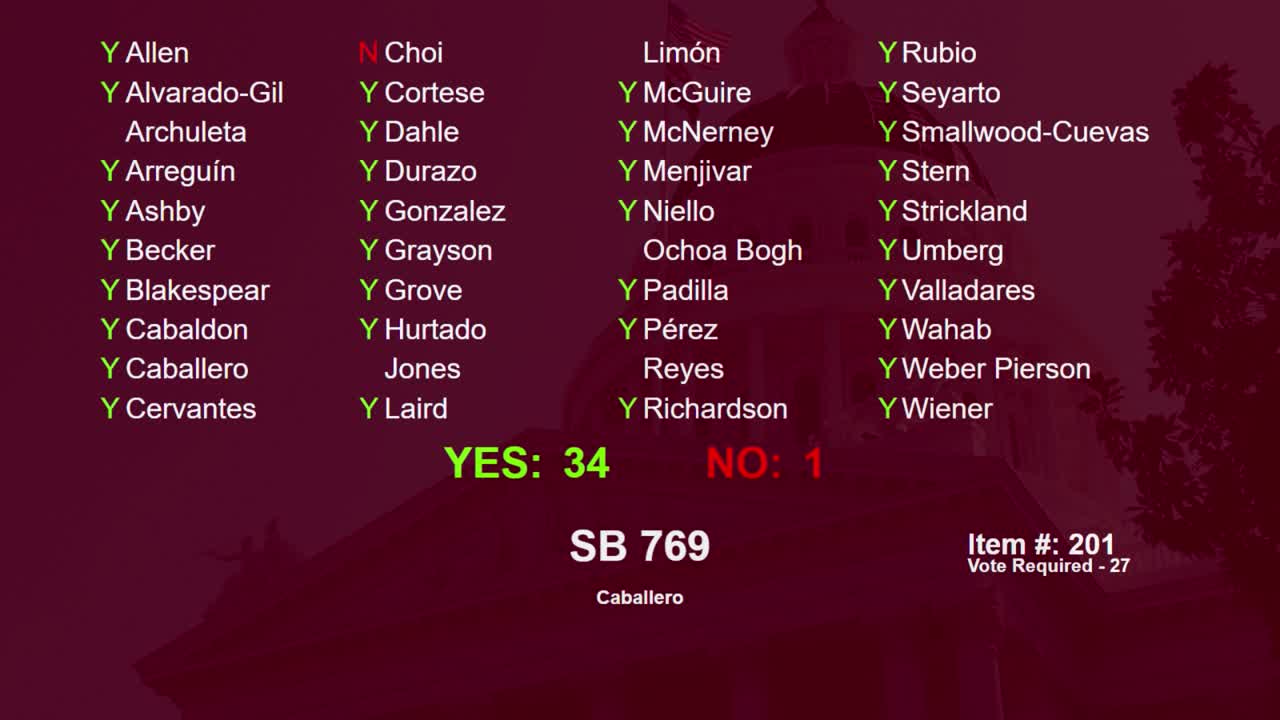
Bill Author