SB 568: Pupil health: epinephrine delivery systems: schoolsites and childcare programs.
- Session Year: 2025-2026
- House: Senate
- Latest Version Date: 2025-10-03
Current Status:
Passed
(2025-10-03: Chaptered by Secretary of State. Chapter 322, Statutes of 2025.)
Introduced
In Committee
Awaiting First Chamber Vote
Passed First Chamber
In Committee
Awaiting Second Chamber Vote
Passed Second Chamber
Enacted
What does this bill do?
The bill requires school districts, county offices of education, and charter schools to provide and store emergency epinephrine delivery systems (single‑use devices that give a measured dose of epinephrine) at each schoolsite, including state or federally subsidized childcare programs, and allows school nurses, trained staff, and trained childcare employees to use them for suspected life‑threatening allergic reactions. It also lets students carry and self‑administer a prescribed epinephrine delivery system, allows pharmacies to furnish these devices to local educational agencies and their childcare programs, and adds related training, stocking, and recordkeeping duties.
The summary is provided by generative AI which can make mistakes. For original language, please view the details in the table below.
(1)Existing law prohibits specified medical professionals, including nurses, not employed in that capacity by the State Department of Health Care Services, and any other person, from being employed or permitted to supervise the health and physical development of pupils unless that person holds a services credential with a specialization in health or a valid credential, as provided.
Notwithstanding that provision, existing law authorizes any pupil who is required to take, during the regular schoolday, medication prescribed for them by a physician and surgeon or ordered for them by a physician assistant, to be assisted by the school nurse or other designated school personnel, and to carry and self-administer, prescription auto-injectable epinephrine if the school district receives the appropriate written statements, as specified.
This bill would revise and recast that latter provision by authorizing assistance with, and the carrying and self-administration of, emergency epinephrine delivery systems, instead of auto-injectors, and making its provisions also apply to county offices of education and charter schools.
Notwithstanding any other law, existing law requires school districts, county offices of education, and charter schools to provide emergency epinephrine auto-injectors, to be stored in an accessible location upon need for emergency use, to school nurses or trained volunteer personnel, and authorizes school nurses and trained personnel to use epinephrine auto-injectors to provide emergency medical aid to persons suffering, or reasonably believed to be suffering, from an anaphylactic reaction, as provided.
This bill would revise and recast those provisions by requiring local educational agencies, defined as a school district, county office of education, or charter school, to provide emergency epinephrine delivery systems, instead of auto-injectors, as provided, to be stored at each schoolsite, including at the location of any state or federally subsidized childcare program operated by or under contract with the local educational agency, and by expanding the definition of volunteer or trained personnel to include certain employees of childcare programs, as provided.
To the extent that this bill would impose additional duties on local educational agencies, the bill would impose a state-mandated local program.
(2)Existing law authorizes a pharmacy to furnish epinephrine auto-injectors to a school district, county office of education, or charter school for purposes of the requirements described in paragraph (1) above if specified requirements are met, including that the auto-injectors are furnished exclusively for use at a school district site, county office of education, or charter school.
This bill would authorize a pharmacy to furnish epinephrine delivery systems, instead of auto-injectors, to those local educational agencies, subject to the same requirements, except that the delivery systems may also be furnished exclusively for use at any state or federally subsidized childcare program operated by or under contract with one of those local educational agencies.
(3)The California Constitution requires the state to reimburse local agencies and school districts for certain costs mandated by the state. Statutory provisions establish procedures for making that reimbursement.
This bill would provide that, if the Commission on State Mandates determines that the bill contains costs mandated by the state, reimbursement for those costs shall be made pursuant to the statutory provisions noted above.
(1)Existing law prohibits specified medical professionals, including nurses, not employed in that capacity by the State Department of Health Care Services, and any other person, from being employed or permitted to supervise the health and physical development of pupils unless that person holds a services credential with a specialization in health or a valid credential, as provided.
Notwithstanding that provision, existing law authorizes any pupil who is required to take, during the regular schoolday, medication prescribed for them by a physician and surgeon or ordered for them by a physician assistant, to be assisted by the school nurse or other designated school personnel, and to carry and self-administer, prescription auto-injectable epinephrine if the school district receives the appropriate written statements, as specified.
This bill would revise and recast that latter provision by authorizing assistance with, and the carrying and self-administration of, emergency epinephrine delivery systems, instead of auto-injectors, and making its provisions also apply to county offices of education and charter schools.
Notwithstanding any other law, existing law requires school districts, county offices of education, and charter schools to provide emergency epinephrine auto-injectors, to be stored in an accessible location upon need for emergency use, to school nurses or trained volunteer personnel, and authorizes school nurses and trained personnel to use epinephrine auto-injectors to provide emergency medical aid to persons suffering, or reasonably believed to be suffering, from an anaphylactic reaction, as provided.
This bill would revise and recast those provisions by requiring local educational agencies, defined as a school district, county office of education, or charter school, to provide emergency epinephrine delivery systems, instead of auto-injectors, as provided, to be stored at each schoolsite, including at the location of any state or federally subsidized childcare program operated by or under contract with the local educational agency, and by expanding the definition of volunteer or trained personnel to include certain employees of childcare programs, as provided.
To the extent that this bill would impose additional duties on local educational agencies, the bill would impose a state-mandated local program.
(2)Existing law authorizes a pharmacy to furnish epinephrine auto-injectors to a school district, county office of education, or charter school for purposes of the requirements described in paragraph (1) above if specified requirements are met. met, including that the auto-injectors are furnished exclusively for use at a school district site, county office of education, or charter school.
This bill would authorize a pharmacy to furnish epinephrine delivery systems, instead of auto-injectors, to those local educational agencies, subject to the same requirements, as provided. except that the delivery systems may also be furnished exclusively for use at any state or federally subsidized childcare program operated by or under contract with one of those local educational agencies.
(3)The California Constitution requires the state to reimburse local agencies and school districts for certain costs mandated by the state. Statutory provisions establish procedures for making that reimbursement.
This bill would provide that, if the Commission on State Mandates determines that the bill contains costs mandated by the state, reimbursement for those costs shall be made pursuant to the statutory provisions noted above.
(1)Existing law prohibits specified medical professionals, including nurses, not employed in that capacity by the State Department of Health Care Services, and any other person, from being employed or permitted to supervise the health and physical development of pupils unless that person holds a services credential with a specialization in health or a valid credential, as provided.
Notwithstanding that provision, existing law authorizes any pupil who is required to take, during the regular schoolday, medication prescribed for them by a physician and surgeon or ordered for them by a physician assistant, to be assisted by the school nurse or other designated school personnel, and to carry and self-administer, prescription auto-injectable epinephrine if the school district receives the appropriate written statements, as specified.
This bill would revise and recast that latter provision by authorizing assistance with, and the carrying and self-administration of, emergency epinephrine delivery systems, instead of auto-injectors, and making its provisions also apply to county offices of education and charter schools.
Notwithstanding any other law, existing law requires school districts, county offices of education, and charter schools to provide emergency epinephrine auto-injectors, to be stored in an accessible location upon need for emergency use, to school nurses or trained volunteer personnel, and authorizes school nurses and trained personnel to use epinephrine auto-injectors to provide emergency medical aid to persons suffering, or reasonably believed to be suffering, from an anaphylactic reaction, as provided.
This bill would revise and recast those provisions by requiring local educational agencies, defined as a school district, county office of education, or charter school school, to provide emergency epinephrine delivery systems, instead of auto-injectors, as provided, to be stored at each public school, as defined. The bill also would make conforming changes to related provisions. To schoolsite, including at the location of any program operated by or under contract with the local educational agency, as provided.
To the extent that this bill would create new duties for public schools or local officials, it impose additional duties on local educational agencies, the bill would constitute impose a state-mandated local program.
(2)Existing law authorizes a pharmacy to furnish epinephrine auto-injectors to a school district, county office of education, or charter school for purposes of the requirements described in paragraph (1) above if specified requirements are met.
This bill would authorize a pharmacy to furnish epinephrine delivery systems, instead of auto-injectors, to those local educational agencies, subject to the same requirements, as provided.
(3)The California Constitution requires the state to reimburse local agencies and school districts for certain costs mandated by the state. Statutory provisions establish procedures for making that reimbursement.
This bill would provide that, if the Commission on State Mandates determines that the bill contains costs mandated by the state, reimbursement for those costs shall be made pursuant to the statutory provisions noted above.
(1)Existing law requires school districts, county offices of education, and charter schools to provide emergency epinephrine auto-injectors, to be stored in an accessible location upon need for emergency use, to school nurses or trained volunteer personnel, and authorizes school nurses and trained personnel to use epinephrine auto-injectors to provide emergency medical aid to persons suffering, or reasonably believed to be suffering, from an anaphylactic reaction, as provided.
This bill would revise and recast those provisions by requiring a school district, county office of education, or charter school to provide emergency epinephrine delivery systems, instead of auto-injectors, as provided, to be stored at each public school, as defined. The bill also would make conforming changes to related provisions. To the extent that this bill would create new duties for public schools or local officials, it would constitute a state-mandated local program.
(2)Existing law authorizes a pharmacy to furnish epinephrine auto-injectors to a school district, county office of education, or charter school for purposes of the requirements described in paragraph (1) above if specified requirements are met.
This bill would authorize a pharmacy to furnish epinephrine delivery systems, instead of auto-injectors, to those local educational agencies, subject to the same requirements, as provided.
(3)The California Constitution requires the state to reimburse local agencies and school districts for certain costs mandated by the state. Statutory provisions establish procedures for making that reimbursement.
This bill would provide that, if the Commission on State Mandates determines that the bill contains costs mandated by the state, reimbursement for those costs shall be made pursuant to the statutory provisions noted above.
(1)Existing law requires school districts, county offices of education, and charter schools to provide emergency epinephrine auto-injectors, to be stored in an accessible location upon need for emergency use, to school nurses or trained volunteer personnel, and authorizes school nurses and trained personnel to use epinephrine auto-injectors to provide emergency medical aid to persons suffering, or reasonably believed to be suffering, from an anaphylactic reaction, as provided.
This bill would make nonsubstantive changes to that provision.This bill would revise and recast those provisions by requiring a school district, county office of education, or charter school to provide emergency epinephrine delivery systems, instead of auto-injectors, as provided, to be stored at each public school, as defined. The bill also would make conforming changes to related provisions. To the extent that this bill would create new duties for public schools or local officials, it would constitute a state-mandated local program.
(2)Existing law authorizes a pharmacy to furnish epinephrine auto-injectors to a school district, county office of education, or charter school for purposes of the requirements described in paragraph (1) above if specified requirements are met.
This bill would authorize a pharmacy to furnish epinephrine delivery systems, instead of auto-injectors, to those local educational agencies, subject to the same requirements, as provided.
(3)The California Constitution requires the state to reimburse local agencies and school districts for certain costs mandated by the state. Statutory provisions establish procedures for making that reimbursement.
This bill would provide that, if the Commission on State Mandates determines that the bill contains costs mandated by the state, reimbursement for those costs shall be made pursuant to the statutory provisions noted above.
Existing law requires school districts, county offices of education, and charter schools to provide emergency epinephrine auto-injectors, to be stored in an accessible location upon need for emergency use, to school nurses or trained volunteer personnel, and authorizes school nurses and trained personnel to use epinephrine auto-injectors to provide emergency medical aid to persons suffering, or reasonably believed to be suffering, from an anaphylactic reaction, as provided.
This bill would make nonsubstantive changes to that provision.
(a)Notwithstanding any other law, a pharmacy may furnish epinephrine delivery systems to a local educational agency pursuant to Section 49414 of the Education Code if all of the following are met:
(1)The epinephrine delivery systems are furnished exclusively for use at a local educational agency, as that term is defined in Section 49414 of the Education Code, including at any state or federally subsidized childcare program operated by or under contract with the local educational agency.
(2)A physician and surgeon provides a written order that specifies the quantity of epinephrine delivery systems to be furnished.
(b)Records regarding the acquisition and disposition of epinephrine delivery systems furnished pursuant to subdivision (a) shall be maintained by the local educational agency for a period of three years from the date the records were created. The local educational agency shall be responsible for monitoring the supply of epinephrine delivery systems and ensuring the destruction of expired epinephrine delivery systems.
SEC. 2.Section 49414 of the Education Code is amended to read:49414.(a)Local educational agencies shall provide emergency epinephrine delivery systems, to be stored at each schoolsite, including at the location of any childcare program operated by or under contract with the local educational agency, in an accessible location upon need for emergency use, to school nurses or trained personnel who have volunteered pursuant to subdivision (d), or to childcare employees who have volunteered, received training, and are subject to liability limitations pursuant to Section 1596.7985 of the Health and Safety Code, and school nurses, trained personnel, and childcare employees may use epinephrine delivery systems to provide emergency medical aid to persons suffering, or reasonably believed to be suffering, from an anaphylactic reaction.
(b)For purposes of this section, the following definitions apply:
(1)Anaphylaxis means a potentially life-threatening hypersensitivity to a substance.
(A)Symptoms of anaphylaxis may include shortness of breath, wheezing, difficulty breathing, difficulty talking or swallowing, hives, itching, swelling, shock, or asthma.
(B)Causes of anaphylaxis may include, but are not limited to, an insect sting, a food allergy, a drug reaction, or exercise.
(2)Authorizing physician and surgeon may include, but is not limited to, a physician and surgeon employed by, or contracting with, a local educational agency, a medical director of the local health department, or a local emergency medical services director.
(3)Childcare program means a state or federally subsidized childcare program operated by, or under contract with, the local educational agency, including, but not limited to, a California state preschool program or Head Start program pursuant to Chapter 2 (commencing with Section 8200) of Part 6 of Division 1 of Title 1, or a childcare program, including, but not limited to, general childcare and development programs pursuant to Part 1.8 (commencing with Section 10207) of Division 9 of the Welfare and Institutions Code.
(4)Epinephrine delivery system means a disposable delivery system designed for the delivery of a premeasured dose of epinephrine into the human body to prevent or treat a life-threatening allergic reaction.
(5)Local educational agency means a school operated by a school district, county office of education, or charter school.
(6)Qualified supervisor of health may include, but is not limited to, a school nurse.
(7)Volunteer or trained personnel means an employee or a holder of an Activity Supervisor Clearance Certificate pursuant to subdivision (f) of Section 44258.7, who has volunteered to administer epinephrine delivery systems to a person if the person is suffering, or reasonably believed to be suffering, from anaphylaxis, has been designated by a school, and has received training pursuant to subdivision (d), or employees of a childcare program operated by or under contract with a local educational agency, who have volunteered, received training, and are subject to liability limitations pursuant to Section 1596.7985 of the Health and Safety Code.
(c)Each private school in the state may voluntarily determine whether or not to make emergency epinephrine delivery systems and trained personnel available at its school. In making this determination, a school shall evaluate the emergency medical response time to the school and determine whether initiating emergency medical services is an acceptable alternative to epinephrine delivery systems and trained personnel. A private school choosing to exercise the authority provided under this subdivision shall not receive state funds specifically for purposes of this subdivision.
(d)Each public and private school in the state may designate one or more volunteers to receive initial and annual refresher training, based on the standards developed pursuant to subdivision (e), regarding the storage and emergency use of an epinephrine delivery system from the school nurse or other qualified person designated by an authorizing physician and surgeon.
(e)(1)Every five years, or sooner as deemed necessary by the Superintendent, the Superintendent shall review minimum standards of training for the administration of epinephrine delivery systems that satisfy the requirements of paragraph (2). For purposes of this subdivision, the Superintendent shall consult with organizations and providers with expertise in administering epinephrine delivery systems and administering medication in a school environment, including, but not limited to, the State Department of Public Health, the Emergency Medical Services Authority, the American Academy of Allergy, Asthma and Immunology, the California School Nurses Organization, the California Medical Association, the American Academy of Pediatrics, Food Allergy Research and Education, the California Society of Allergy, Asthma and Immunology, the American College of Allergy, Asthma and Immunology, the Sean N. Parker Center for Allergy Research, and others.
(2)Training established pursuant to this subdivision shall include all of the following:
(A)Techniques for recognizing symptoms of anaphylaxis.
(B)Standards and procedures for the storage, restocking, and emergency use of epinephrine delivery systems.
(C)Emergency followup procedures, including calling the emergency 911 telephone number and contacting, if possible, the pupils parent and physician.
(D)Recommendations on the necessity of instruction and certification in cardiopulmonary resuscitation.
(E)Instruction on how to determine which epinephrine delivery system to use, which shall include consideration of the age of the person suffering, or reasonably believed to be suffering, from an anaphylactic reaction as a guideline of equivalency for the persons weight determination.
(F)Written materials covering the information required under this subdivision.
(3)Training established pursuant to this subdivision shall be consistent with the most recent Voluntary Guidelines for Managing Food Allergies In Schools and Early Care and Education Programs published by the federal Centers for Disease Control and Prevention and the most recent guidelines for medication administration issued by the department.
(4)A school shall retain for reference the written materials prepared under subparagraph (F) of paragraph (2). A copy of these written materials shall be made accessible, such as through publicly posting at the location of the epinephrine delivery systems.
(f)A local educational agency shall distribute a notice at least once per school year to all staff that contains the following information:
(1)A description of the volunteer request stating that the request is for volunteers to be trained to administer an epinephrine delivery system to a person if the person is suffering, or reasonably believed to be suffering, from anaphylaxis, as specified in subdivision (b).
(2)A description of the training that the volunteer will receive pursuant to subdivision (d).
(3)The location of the epinephrine delivery system at each schoolsite.
(g)(1)A qualified supervisor of health at a local educational agency shall obtain from an authorizing physician and surgeon a prescription for each schoolsite for epinephrine delivery systems that, at a minimum, includes appropriate doses of available epinephrine delivery systems for the ages and weights of individuals at the schoolsite and those participating in any childcare program operated by or under contract with the local educational agency. A qualified supervisor of health at a local educational agency shall be responsible for stocking the epinephrine delivery system and restocking it if it is used.
(2)If a local educational agency does not have a qualified supervisor of health, an administrator at the local educational agency shall carry out the duties specified in paragraph (1).
(3)A prescription pursuant to this subdivision may be filled by local or mail order pharmacies or epinephrine delivery system manufacturers.
(4)An authorizing physician and surgeon shall not be subject to professional review, be liable in a civil action, or be subject to criminal prosecution for the issuance of a prescription or order pursuant to this section, unless the physician and surgeons issuance of the prescription or order constitutes gross negligence or willful or malicious conduct.
(h)A school nurse or, if the schoolsite does not have a school nurse or the school nurse is not onsite or available, a volunteer, may administer an epinephrine delivery system to a person exhibiting potentially life-threatening symptoms of anaphylaxis at school or a school activity or program operated by or under contract with the local educational agency when a physician is not immediately available. If an epinephrine delivery system is used, it shall be restocked as soon as reasonably possible, but no later than two weeks after it is used. Epinephrine delivery systems shall be restocked before their expiration date.
(i)A volunteer shall initiate emergency medical services or other appropriate medical followup in accordance with the training materials retained pursuant to paragraph (4) of subdivision (e).
(j)A local educational agency shall ensure that each employee who volunteers under this section will be provided defense and indemnification by the local educational agency for any and all civil liability, in accordance with, but not limited to, that provided in Division 3.6 (commencing with Section 810) of Title 1 of the Government Code. This information shall be reduced to writing, provided to the volunteer, and retained in the volunteers personnel file.
(k)A state agency, the department, or a local educational agency may accept gifts, grants, and donations from any source for the support of the local educational agency carrying out the provisions of this section, including, but not limited to, the acceptance of epinephrine delivery systems from a manufacturer or wholesaler.
SEC. 3.Section 49423 of the Education Code is amended to read:49423.(a)Notwithstanding Section 49422, any pupil who is required to take, during the regular schoolday, medication prescribed for the pupil by a physician and surgeon or ordered for the pupil by a physician assistant practicing in compliance with Chapter 7.7 (commencing with Section 3500) of Division 2 of the Business and Professions Code, may be assisted by the school nurse or other designated school personnel, or may carry and self-administer a prescription epinephrine delivery system, if the local educational agency receives the appropriate written statements identified in subdivision (b).
(b)(1)In order for a pupil to be assisted by a school nurse or other designated school personnel pursuant to subdivision (a), the local educational agency shall obtain both a written statement from the physician and surgeon or physician assistant detailing the name of the medication, method, amount, and time schedules by which the medication is to be taken and a written statement from the parent, foster parent, or guardian of the pupil indicating the desire that the local educational agency assist the pupil in the matters set forth in the statement of the physician and surgeon or physician assistant.
(2)In order for a pupil to carry and self-administer a prescription epinephrine delivery system pursuant to subdivision (a), the local educational agency shall obtain both a written statement from the physician and surgeon or physician assistant detailing the name of the medication, method, amount, and time schedules by which the medication is to be taken, and confirming that the pupil is able to self-administer the epinephrine delivery system, and a written statement from the parent, foster parent, or guardian of the pupil consenting to the self-administration, providing a release for the school nurse or other designated school personnel to consult with the health care provider of the pupil regarding any questions that may arise with regard to the medication, and releasing the local educational agency and school personnel from civil liability if the self-administering pupil suffers an adverse reaction as a result of self-administering medication pursuant to this paragraph.
(3)The written statements specified in this subdivision shall be provided at least annually and more frequently if the medication, dosage, frequency of administration, or reason for administration changes.
(c)A pupil may be subject to disciplinary action pursuant to Section 48900 if that pupil uses an epinephrine delivery system in a manner other than as prescribed.
(d)For purposes of this section, local educational agency means a school district, county office of education, or charter school.
SEC. 4.If the Commission on State Mandates determines that this act contains costs mandated by the state, reimbursement to local agencies and school districts for those costs shall be made pursuant to Part 7 (commencing with Section 17500) of Division 4 of Title 2 of the Government Code.
(a)Notwithstanding any other law, a pharmacy may furnish epinephrine delivery systems to a local educational agency pursuant to Section 49414 of the Education Code if all of the following are met:
(1)The epinephrine delivery systems are furnished exclusively for use at a local educational agency, as that term is defined in Section 49414 of the Education Code, including at any state or federally subsidized childcare program operated by or under contract with the local educational agency.
(2)A physician and surgeon provides a written order that specifies the quantity of epinephrine delivery systems to be furnished.
(b)Records regarding the acquisition and disposition of epinephrine delivery systems furnished pursuant to subdivision (a) shall be maintained by the local educational agency for a period of three years from the date the records were created. The local educational agency shall be responsible for monitoring the supply of epinephrine delivery systems and ensuring the destruction of expired epinephrine delivery systems.
SEC. 2.Section 49414 of the Education Code is amended to read:49414.(a)Local educational agencies shall provide emergency epinephrine delivery systems, to be stored at each schoolsite, including at the location of any childcare program operated by or under contract with the local educational agency, in an accessible location upon need for emergency use, to school nurses or trained personnel who have volunteered pursuant to subdivision (d), or to childcare employees who have volunteered, received training, and are subject to liability limitations pursuant to Section 1596.7985 of the Health and Safety Code, and school nurses, trained personnel, and childcare employees may use epinephrine delivery systems to provide emergency medical aid to persons suffering, or reasonably believed to be suffering, from an anaphylactic reaction.
(b)For purposes of this section, the following definitions apply:
(1)Anaphylaxis means a potentially life-threatening hypersensitivity to a substance.
(A)Symptoms of anaphylaxis may include shortness of breath, wheezing, difficulty breathing, difficulty talking or swallowing, hives, itching, swelling, shock, or asthma.
(B)Causes of anaphylaxis may include, but are not limited to, an insect sting, a food allergy, a drug reaction, or exercise.
(2)Authorizing physician and surgeon may include, but is not limited to, a physician and surgeon employed by, or contracting with, a local educational agency, a medical director of the local health department, or a local emergency medical services director.
(3)Childcare program means a state or federally subsidized childcare program operated by, or under contract with, the local educational agency, including, but not limited to, a California state preschool program or Head Start program pursuant to Chapter 2 (commencing with Section 8200) of Part 6 of Division 1 of Title 1, or a childcare program, including, but not limited to, general childcare and development programs pursuant to Part 1.8 (commencing with Section 10207) of Division 9 of the Welfare and Institutions Code.
(4)Epinephrine delivery system means a disposable delivery device system designed for the delivery of a premeasured dose of epinephrine into the human body to prevent or treat a life-threatening allergic reaction.
(5)Local educational agency means a school operated by a school district, county office of education, or charter school.
(6)Qualified supervisor of health may include, but is not limited to, a school nurse.
(7)Volunteer or trained personnel means an employee or a holder of an Activity Supervisor Clearance Certificate pursuant to subdivision (f) of Section 44258.7, who has volunteered to administer epinephrine delivery systems to a person if the person is suffering, or reasonably believed to be suffering, from anaphylaxis, has been designated by a school, and has received training pursuant to subdivision (d), or employees of a childcare program operated by or under contract with a local educational agency, who have volunteered, received training, and are subject to liability limitations pursuant to Section 1596.7985 of the Health and Safety Code.
(c)Each private school in the state may voluntarily determine whether or not to make emergency epinephrine delivery systems and trained personnel available at its school. In making this determination, a school shall evaluate the emergency medical response time to the school and determine whether initiating emergency medical services is an acceptable alternative to epinephrine delivery systems and trained personnel. A private school choosing to exercise the authority provided under this subdivision shall not receive state funds specifically for purposes of this subdivision.
(d)Each public and private school in the state may designate one or more volunteers to receive initial and annual refresher training, based on the standards developed pursuant to subdivision (e), regarding the storage and emergency use of an epinephrine delivery system from the school nurse or other qualified person designated by an authorizing physician and surgeon.
(e)(1)Every five years, or sooner as deemed necessary by the Superintendent, the Superintendent shall review minimum standards of training for the administration of epinephrine delivery systems that satisfy the requirements of paragraph (2). For purposes of this subdivision, the Superintendent shall consult with organizations and providers with expertise in administering epinephrine delivery systems and administering medication in a school environment, including, but not limited to, the State Department of Public Health, the Emergency Medical Services Authority, the American Academy of Allergy, Asthma and Immunology, the California School Nurses Organization, the California Medical Association, the American Academy of Pediatrics, Food Allergy Research and Education, the California Society of Allergy, Asthma and Immunology, the American College of Allergy, Asthma and Immunology, the Sean N. Parker Center for Allergy Research, and others.
(2)Training established pursuant to this subdivision shall include all of the following:
(A)Techniques for recognizing symptoms of anaphylaxis.
(B)Standards and procedures for the storage, restocking, and emergency use of epinephrine delivery systems.
(C)Emergency followup procedures, including calling the emergency 911 telephone number and contacting, if possible, the pupils parent and physician.
(D)Recommendations on the necessity of instruction and certification in cardiopulmonary resuscitation.
(E)Instruction on how to determine which epinephrine delivery system to use, which shall include consideration of the age of the person suffering, or reasonably believed to be suffering, from an anaphylactic reaction as a guideline of equivalency for the persons weight determination.
(F)Written materials covering the information required under this subdivision.
(3)Training established pursuant to this subdivision shall be consistent with the most recent Voluntary Guidelines for Managing Food Allergies In Schools and Early Care and Education Programs published by the federal Centers for Disease Control and Prevention and the most recent guidelines for medication administration issued by the department.
(4)A school shall retain for reference the written materials prepared under subparagraph (F) of paragraph (2). A copy of these written materials shall be made accessible, such as through publicly posting at the location of the epinephrine delivery systems.
(f)A local educational agency shall distribute a notice at least once per school year to all staff that contains the following information:
(1)A description of the volunteer request stating that the request is for volunteers to be trained to administer an epinephrine delivery system to a person if the person is suffering, or reasonably believed to be suffering, from anaphylaxis, as specified in subdivision (b).
(2)A description of the training that the volunteer will receive pursuant to subdivision (d).
(3)The location of the epinephrine delivery system at each schoolsite.
(g)(1)A qualified supervisor of health at a local educational agency shall obtain from an authorizing physician and surgeon a prescription for each schoolsite for epinephrine delivery systems that, at a minimum, includes appropriate doses of available epinephrine delivery systems for the ages and weights of individuals at the schoolsite and those participating in any childcare program operated by or under contract with the local educational agency. A qualified supervisor of health at a local educational agency shall be responsible for stocking the epinephrine delivery system and restocking it if it is used.
(2)If a local educational agency does not have a qualified supervisor of health, an administrator at the local educational agency shall carry out the duties specified in paragraph (1).
(3)A prescription pursuant to this subdivision may be filled by local or mail order pharmacies or epinephrine delivery system manufacturers.
(4)An authorizing physician and surgeon shall not be subject to professional review, be liable in a civil action, or be subject to criminal prosecution for the issuance of a prescription or order pursuant to this section, unless the physician and surgeons issuance of the prescription or order constitutes gross negligence or willful or malicious conduct.
(h)A school nurse or, if the schoolsite does not have a school nurse or the school nurse is not onsite or available, a volunteer, may administer an epinephrine delivery system to a person exhibiting potentially life-threatening symptoms of anaphylaxis at school or a school activity or program operated by or under contract with the local educational agency when a physician is not immediately available. If an epinephrine delivery system is used, it shall be restocked as soon as reasonably possible, but no later than two weeks after it is used. Epinephrine delivery systems shall be restocked before their expiration date.
(i)A volunteer shall initiate emergency medical services or other appropriate medical followup in accordance with the training materials retained pursuant to paragraph (4) of subdivision (e).
(j)A local educational agency shall ensure that each employee who volunteers under this section will be provided defense and indemnification by the local educational agency for any and all civil liability, in accordance with, but not limited to, that provided in Division 3.6 (commencing with Section 810) of Title 1 of the Government Code. This information shall be reduced to writing, provided to the volunteer, and retained in the volunteers personnel file.
(k)A state agency, the department, or a local educational agency may accept gifts, grants, and donations from any source for the support of the local educational agency carrying out the provisions of this section, including, but not limited to, the acceptance of epinephrine delivery systems from a manufacturer or wholesaler.
SEC. 3.Section 49423 of the Education Code is amended to read:49423.(a)Notwithstanding Section 49422, any pupil who is required to take, during the regular schoolday, medication prescribed for the pupil by a physician and surgeon or ordered for the pupil by a physician assistant practicing in compliance with Chapter 7.7 (commencing with Section 3500) of Division 2 of the Business and Professions Code, may be assisted by the school nurse or other designated school personnel, or may carry and self-administer a prescription epinephrine delivery system, if the local educational agency receives the appropriate written statements identified in subdivision (b).
(b)(1)In order for a pupil to be assisted by a school nurse or other designated school personnel pursuant to subdivision (a), the local educational agency shall obtain both a written statement from the physician and surgeon or physician assistant detailing the name of the medication, method, amount, and time schedules by which the medication is to be taken and a written statement from the parent, foster parent, or guardian of the pupil indicating the desire that the local educational agency assist the pupil in the matters set forth in the statement of the physician and surgeon or physician assistant.
(2)In order for a pupil to carry and self-administer a prescription epinephrine delivery system pursuant to subdivision (a), the local educational agency shall obtain both a written statement from the physician and surgeon or physician assistant detailing the name of the medication, method, amount, and time schedules by which the medication is to be taken, and confirming that the pupil is able to self-administer the epinephrine delivery system, and a written statement from the parent, foster parent, or guardian of the pupil consenting to the self-administration, providing a release for the school nurse or other designated school personnel to consult with the health care provider of the pupil regarding any questions that may arise with regard to the medication, and releasing the local educational agency and school personnel from civil liability if the self-administering pupil suffers an adverse reaction as a result of self-administering medication pursuant to this paragraph.
(3)The written statements specified in this subdivision shall be provided at least annually and more frequently if the medication, dosage, frequency of administration, or reason for administration changes.
(c)A pupil may be subject to disciplinary action pursuant to Section 48900 if that pupil uses an epinephrine delivery system in a manner other than as prescribed.
(d)For purposes of this section, local educational agency means a school district, county office of education, or charter school.
SEC. 4.If the Commission on State Mandates determines that this act contains costs mandated by the state, reimbursement to local agencies and school districts for those costs shall be made pursuant to Part 7 (commencing with Section 17500) of Division 4 of Title 2 of the Government Code.
(a)Notwithstanding any other law, a pharmacy may furnish epinephrine delivery systems to a local educational agency pursuant to Section 49414 of the Education Code if all of the following are met:
(1)The epinephrine delivery systems are furnished exclusively for use at a local educational agency, as that term is defined in Section 49414 of the Education Code, including at any state or federally subsidized childcare program operated by or under contract with the local educational agency.
(2)A physician and surgeon provides a written order that specifies the quantity of epinephrine delivery systems to be furnished.
(b)Records regarding the acquisition and disposition of epinephrine delivery systems furnished pursuant to subdivision (a) shall be maintained by the local educational agency for a period of three years from the date the records were created. The local educational agency shall be responsible for monitoring the supply of epinephrine delivery systems and ensuring the destruction of expired epinephrine delivery systems.
SEC. 2.Section 49414 of the Education Code is amended to read:49414.(a)Local educational agencies shall provide emergency epinephrine delivery systems, to be stored at each schoolsite, including at the location of any childcare program operated by or under contract with the local educational agency, in an accessible location upon need for emergency use, to school nurses or trained personnel who have volunteered pursuant to subdivision (d), or to childcare employees who have volunteered, received training, and are subject to liability limitations pursuant to Section 1596.7985 of the Health and Safety Code, and school nurses or nurses, trained personnel personnel, and childcare employees may use epinephrine delivery systems to provide emergency medical aid to persons suffering, or reasonably believed to be suffering, from an anaphylactic reaction.
(b)For purposes of this section, the following definitions apply:
(1)Anaphylaxis means a potentially life-threatening hypersensitivity to a substance.
(A)Symptoms of anaphylaxis may include shortness of breath, wheezing, difficulty breathing, difficulty talking or swallowing, hives, itching, swelling, shock, or asthma.
(B)Causes of anaphylaxis may include, but are not limited to, an insect sting, a food allergy, a drug reaction, or exercise.
(2)Authorizing physician and surgeon may include, but is not limited to, a physician and surgeon employed by, or contracting with, a local educational agency, a medical director of the local health department, or a local emergency medical services director.
(3)Childcare program means a state or federally subsidized childcare program operated by, or under contract with, the local educational agency, including, but not limited to, a California state preschool program or Head Start program pursuant to Chapter 2 (commencing with Section 8200) of Part 6 of Division 1 of Title 1, or a childcare program, including, but not limited to, general childcare and development programs pursuant to Part 1.8 (commencing with Section 10207) of Division 9 of the Welfare and Institutions Code.
(3)(4)Epinephrine delivery system means a disposable delivery device designed for the delivery of a premeasured dose of epinephrine into the human body to prevent or treat a life-threatening allergic reaction.
(4)(5)Local educational agency means a school operated by a school district, county office of education, or charter school.
(5)(6)Qualified supervisor of health may include, but is not limited to, a school nurse.
(6)(7)Volunteer or trained personnel means an employee or a holder of an Activity Supervisor Clearance Certificate pursuant to subdivision (f) of Section 44258.7, or an employee of a child daycare facility operated by or under contract with a local educational agency, who has volunteered to administer epinephrine delivery systems to a person if the person is suffering, or reasonably believed to be suffering, from anaphylaxis, has been designated by a school, and has received training pursuant to subdivision (d) (d), or for employees of a child daycare facility childcare program operated by or under contract with a local educational agency, who have volunteered, received training, and are subject to liability limitations pursuant to Section 1596.7985 of the Health and Safety Code.
(c)Each private school in the state may voluntarily determine whether or not to make emergency epinephrine delivery systems and trained personnel available at its school. In making this determination, a school shall evaluate the emergency medical response time to the school and determine whether initiating emergency medical services is an acceptable alternative to epinephrine delivery systems and trained personnel. A private school choosing to exercise the authority provided under this subdivision shall not receive state funds specifically for purposes of this subdivision.
(d)Each public and private school in the state may designate one or more volunteers to receive initial and annual refresher training, based on the standards developed pursuant to subdivision (e), regarding the storage and emergency use of an epinephrine delivery system from the school nurse or other qualified person designated by an authorizing physician and surgeon.
(e)(1)Every five years, or sooner as deemed necessary by the Superintendent, the Superintendent shall review minimum standards of training for the administration of epinephrine delivery systems that satisfy the requirements of paragraph (2). For purposes of this subdivision, the Superintendent shall consult with organizations and providers with expertise in administering epinephrine delivery systems and administering medication in a school environment, including, but not limited to, the State Department of Public Health, the Emergency Medical Services Authority, the American Academy of Allergy, Asthma and Immunology, the California School Nurses Organization, the California Medical Association, the American Academy of Pediatrics, Food Allergy Research and Education, the California Society of Allergy, Asthma and Immunology, the American College of Allergy, Asthma and Immunology, the Sean N. Parker Center for Allergy Research, and others.
(2)Training established pursuant to this subdivision shall include all of the following:
(A)Techniques for recognizing symptoms of anaphylaxis.
(B)Standards and procedures for the storage, restocking, and emergency use of epinephrine delivery systems.
(C)Emergency followup procedures, including calling the emergency 911 telephone number and contacting, if possible, the pupils parent and physician.
(D)Recommendations on the necessity of instruction and certification in cardiopulmonary resuscitation.
(E)Instruction on how to determine which epinephrine delivery system to use, which shall include consideration of the age of the person suffering, or reasonably believed to be suffering, from an anaphylactic reaction as a guideline of equivalency for the persons weight determination.
(F)Written materials covering the information required under this subdivision.
(3)Training established pursuant to this subdivision shall be consistent with the most recent Voluntary Guidelines for Managing Food Allergies In Schools and Early Care and Education Programs published by the federal Centers for Disease Control and Prevention and the most recent guidelines for medication administration issued by the department.
(4)A school shall retain for reference the written materials prepared under subparagraph (F) of paragraph (2). A copy of these written materials shall be made accessible, such as through publicly posting at the location of the epinephrine delivery systems.
(f)A local educational agency shall distribute a notice at least once per school year to all staff that contains the following information:
(1)A description of the volunteer request stating that the request is for volunteers to be trained to administer an epinephrine delivery system to a person if the person is suffering, or reasonably believed to be suffering, from anaphylaxis, as specified in subdivision (b).
(2)A description of the training that the volunteer will receive pursuant to subdivision (d).
(3)The location of the epinephrine delivery system at each schoolsite.
(g)(1)A qualified supervisor of health at a local educational agency shall obtain from an authorizing physician and surgeon a prescription for each schoolsite for epinephrine delivery systems that, at a minimum, includes appropriate doses of available epinephrine delivery systems for the ages and weights of individuals at the schoolsite and those participating in any childcare program operated by or under contract with the local educational agency. A qualified supervisor of health at a local educational agency shall be responsible for stocking the epinephrine delivery system and restocking it if it is used.
(2)If a local educational agency does not have a qualified supervisor of health, an administrator at the local educational agency shall carry out the duties specified in paragraph (1).
(3)A prescription pursuant to this subdivision may be filled by local or mail order pharmacies or epinephrine delivery system manufacturers.
(4)An authorizing physician and surgeon shall not be subject to professional review, be liable in a civil action, or be subject to criminal prosecution for the issuance of a prescription or order pursuant to this section, unless the physician and surgeons issuance of the prescription or order constitutes gross negligence or willful or malicious conduct.
(h)A school nurse or, if the schoolsite does not have a school nurse or the school nurse is not onsite or available, a volunteer, may administer an epinephrine delivery system to a person exhibiting potentially life-threatening symptoms of anaphylaxis at school or a school activity or program operated by or under contract with the local educational agency when a physician is not immediately available. If an epinephrine delivery system is used, it shall be restocked as soon as reasonably possible, but no later than two weeks after it is used. Epinephrine delivery systems shall be restocked before their expiration date.
(i)A volunteer shall initiate emergency medical services or other appropriate medical followup in accordance with the training materials retained pursuant to paragraph (4) of subdivision (e).
(j)A local educational agency shall ensure that each employee who volunteers under this section will be provided defense and indemnification by the local educational agency for any and all civil liability, in accordance with, but not limited to, that provided in Division 3.6 (commencing with Section 810) of Title 1 of the Government Code. This information shall be reduced to writing, provided to the volunteer, and retained in the volunteers personnel file.
(k)A state agency, the department, or a local educational agency may accept gifts, grants, and donations from any source for the support of the local educational agency carrying out the provisions of this section, including, but not limited to, the acceptance of epinephrine delivery systems from a manufacturer or wholesaler.
SEC. 3.Section 49423 of the Education Code is amended to read:49423.(a)Notwithstanding Section 49422, any pupil who is required to take, during the regular schoolday, medication prescribed for the pupil by a physician and surgeon or ordered for the pupil by a physician assistant practicing in compliance with Chapter 7.7 (commencing with Section 3500) of Division 2 of the Business and Professions Code, may be assisted by the school nurse or other designated school personnel personnel, or may carry and self-administer a prescription epinephrine delivery systems system, if the local educational agency receives the appropriate written statements identified in subdivision (b).
(b)(1)In order for a pupil to be assisted by a school nurse or other designated school personnel pursuant to subdivision (a), the local educational agency shall obtain both a written statement from the physician and surgeon or physician assistant detailing the name of the medication, method, amount, and time schedules by which the medication is to be taken and a written statement from the parent, foster parent, or guardian of the pupil indicating the desire that the local educational agency assist the pupil in the matters set forth in the statement of the physician and surgeon or physician assistant.
(2)In order for a pupil to carry and self-administer a prescription epinephrine delivery systems system pursuant to subdivision (a), the local educational agency shall obtain both a written statement from the physician and surgeon or physician assistant detailing the name of the medication, method, amount, and time schedules by which the medication is to be taken, and confirming that the pupil is able to self-administer the epinephrine delivery system, and a written statement from the parent, foster parent, or guardian of the pupil consenting to the self-administration, providing a release for the school nurse or other designated school personnel to consult with the health care provider of the pupil regarding any questions that may arise with regard to the medication, and releasing the local educational agency and school personnel from civil liability if the self-administering pupil suffers an adverse reaction as a result of self-administering medication pursuant to this paragraph.
(3)The written statements specified in this subdivision shall be provided at least annually and more frequently if the medication, dosage, frequency of administration, or reason for administration changes.
(c)A pupil may be subject to disciplinary action pursuant to Section 48900 if that pupil uses an epinephrine delivery system in a manner other than as prescribed.
(d)For purposes of this section, local educational agency means a school district, county office of education, or charter school.
SEC. 4.If the Commission on State Mandates determines that this act contains costs mandated by the state, reimbursement to local agencies and school districts for those costs shall be made pursuant to Part 7 (commencing with Section 17500) of Division 4 of Title 2 of the Government Code.
(a)Notwithstanding any other law, a pharmacy may furnish epinephrine delivery systems to a school district, county office of education, or charter school local educational agency pursuant to Section 49414 of the Education Code if all of the following are met:
(1)The epinephrine delivery systems are furnished exclusively for use at a public school, local educational agency, as that term is defined in Section 49414 of the Education Code. Code, including at any program operated by or under contract with the local educational agency.
(2)A physician and surgeon provides a written order that specifies the quantity of epinephrine delivery systems to be furnished.
(b)Records regarding the acquisition and disposition of epinephrine delivery systems furnished pursuant to subdivision (a) shall be maintained by the school district, county office of education, or charter school local educational agency for a period of three years from the date the records were created. The school district, county office of education, or charter school local educational agency shall be responsible for monitoring the supply of epinephrine delivery systems and ensuring the destruction of expired epinephrine delivery systems.
SEC. 2.Section 49414 of the Education Code is amended to read:49414.(a)School districts, county offices of education, and charter schools Local educational agencies shall provide emergency epinephrine delivery systems, to be stored at each public school schoolsite, including at the location of any program operated by or under contract with the local educational agency, in an accessible location upon need for emergency use, to school nurses or trained personnel who have volunteered pursuant to subdivision (d), and school nurses or trained personnel may use epinephrine delivery systems to provide emergency medical aid to persons suffering, or reasonably believed to be suffering, from an anaphylactic reaction.
(b)For purposes of this section, the following definitions apply:
(1)Anaphylaxis means a potentially life-threatening hypersensitivity to a substance.
(A)Symptoms of anaphylaxis may include shortness of breath, wheezing, difficulty breathing, difficulty talking or swallowing, hives, itching, swelling, shock, or asthma.
(B)Causes of anaphylaxis may include, but are not limited to, an insect sting, a food allergy, a drug reaction, or exercise.
(2)Authorizing physician and surgeon may include, but is not limited to, a physician and surgeon employed by, or contracting with, a local educational agency, a medical director of the local health department, or a local emergency medical services director.
(3)Epinephrine delivery system means a disposable delivery device designed for the delivery of a premeasured dose of epinephrine into the human body to prevent or treat a life-threatening allergic reaction.
(4)Public school Local educational agency means a school operated by a school district or district, county office of education or a education, or charter school, including, but not limited to, any program operated by or under contract with a school district, county office of education, or charter school. school.
(5)Qualified supervisor of health may include, but is not limited to, a school nurse.
(6)Volunteer or trained personnel means an employee or a holder of an Activity Supervisor Clearance Certificate pursuant to subdivision (f) of Section 44258.7 44258.7, or an employee of a child daycare facility operated by or under contract with a local educational agency, who has volunteered to administer epinephrine delivery systems to a person if the person is suffering, or reasonably believed to be suffering, from anaphylaxis, has been designated by a school, and has received training pursuant to subdivision (d). (d) or for employees of a child daycare facility operated by or under contract with a local educational agency, pursuant to Section 1596.7985 of the Health and Safety Code.
(c)Each private school in the state may voluntarily determine whether or not to make emergency epinephrine delivery systems and trained personnel available at its school. In making this determination, a school shall evaluate the emergency medical response time to the school and determine whether initiating emergency medical services is an acceptable alternative to epinephrine delivery systems and trained personnel. A private school choosing to exercise the authority provided under this subdivision shall not receive state funds specifically for purposes of this subdivision.
(d)Each public and private school in the state may designate one or more volunteers to receive initial and annual refresher training, based on the standards developed pursuant to subdivision (e), regarding the storage and emergency use of an epinephrine delivery system from the school nurse or other qualified person designated by an authorizing physician and surgeon.
(e)(1)Every five years, or sooner as deemed necessary by the Superintendent, the Superintendent shall review minimum standards of training for the administration of epinephrine delivery systems that satisfy the requirements of paragraph (2). For purposes of this subdivision, the Superintendent shall consult with organizations and providers with expertise in administering epinephrine delivery systems and administering medication in a school environment, including, but not limited to, the State Department of Public Health, the Emergency Medical Services Authority, the American Academy of Allergy, Asthma and Immunology, the California School Nurses Organization, the California Medical Association, the American Academy of Pediatrics, Food Allergy Research and Education, the California Society of Allergy, Asthma and Immunology, the American College of Allergy, Asthma and Immunology, the Sean N. Parker Center for Allergy Research, and others.
(2)Training established pursuant to this subdivision shall include all of the following:
(A)Techniques for recognizing symptoms of anaphylaxis.
(B)Standards and procedures for the storage, restocking, and emergency use of epinephrine delivery systems.
(C)Emergency followup procedures, including calling the emergency 911 telephone number and contacting, if possible, the pupils parent and physician.
(D)Recommendations on the necessity of instruction and certification in cardiopulmonary resuscitation.
(E)Instruction on how to determine which epinephrine delivery system to use, which shall include consideration of the age of the person suffering, or reasonably believed to be suffering, from an anaphylactic reaction as a guideline of equivalency for the persons weight determination.
(F)Written materials covering the information required under this subdivision.
(3)Training established pursuant to this subdivision shall be consistent with the most recent Voluntary Guidelines for Managing Food Allergies In Schools and Early Care and Education Programs published by the federal Centers for Disease Control and Prevention and the most recent guidelines for medication administration issued by the department.
(4)A school shall retain for reference the written materials prepared under subparagraph (F) of paragraph (2). A copy of these written materials shall be made accessible, such as through publicly posting at the location of the epinephrine delivery systems.
(f)A school district, county office of education, or charter school local educational agency shall distribute a notice at least once per school year to all staff that contains the following information:
(1)A description of the volunteer request stating that the request is for volunteers to be trained to administer an epinephrine delivery system to a person if the person is suffering, or reasonably believed to be suffering, from anaphylaxis, as specified in subdivision (b).
(2)A description of the training that the volunteer will receive pursuant to subdivision (d).
(3)The location of the epinephrine delivery system at each public school. schoolsite.
(g)(1)A qualified supervisor of health at a school district, county office of education, or charter school local educational agency shall obtain from an authorizing physician and surgeon a prescription for each public school schoolsite for epinephrine delivery systems that, at a minimum, includes appropriate doses of available epinephrine delivery systems for the ages and weights of individuals at the public school. schoolsite and those participating in any program operated by or under contract with the local educational agency. A qualified supervisor of health at a public school local educational agency shall be responsible for stocking the epinephrine delivery system and restocking it if it is used.
(2)If a public school local educational agency does not have a qualified supervisor of health, an administrator at the public school local educational agency shall carry out the duties specified in paragraph (1).
(3)A prescription pursuant to this subdivision may be filled by local or mail order pharmacies or epinephrine delivery system manufacturers.
(4)An authorizing physician and surgeon shall not be subject to professional review, be liable in a civil action, or be subject to criminal prosecution for the issuance of a prescription or order pursuant to this section, unless the physician and surgeons issuance of the prescription or order constitutes gross negligence or willful or malicious conduct.
(h)A school nurse or, if the public school schoolsite does not have a school nurse or the school nurse is not onsite or available, a volunteer volunteer, may administer an epinephrine delivery system to a person exhibiting potentially life-threatening symptoms of anaphylaxis at school or a school activity or program operated by or under contract with the local educational agency when a physician is not immediately available. If an epinephrine delivery system is used, it shall be restocked as soon as reasonably possible, but no later than two weeks after it is used. Epinephrine delivery systems shall be restocked before their expiration date.
(i)A volunteer shall initiate emergency medical services or other appropriate medical followup in accordance with the training materials retained pursuant to paragraph (4) of subdivision (e).
(j)A school district, county office of education, or charter school local educational agency shall ensure that each employee who volunteers under this section will be provided defense and indemnification by the school district, county office of education, or charter school local educational agency for any and all civil liability, in accordance with, but not limited to, that provided in Division 3.6 (commencing with Section 810) of Title 1 of the Government Code. This information shall be reduced to writing, provided to the volunteer, and retained in the volunteers personnel file.
(k)A state agency, the department, or a public school local educational agency may accept gifts, grants, and donations from any source for the support of the public school local educational agency carrying out the provisions of this section, including, but not limited to, the acceptance of epinephrine delivery systems from a manufacturer or wholesaler.
SEC. 3.Section 49423 of the Education Code is amended to read:49423.(a)Notwithstanding Section 49422, any pupil who is required to take, during the regular schoolday, medication prescribed for the pupil by a physician and surgeon or ordered for the pupil by a physician assistant practicing in compliance with Chapter 7.7 (commencing with Section 3500) of Division 2 of the Business and Professions Code, may be assisted by the school nurse or other designated school personnel or may carry and self-administer prescription epinephrine delivery systems if the school district local educational agency receives the appropriate written statements identified in subdivision (b).
(b)(1)In order for a pupil to be assisted by a school nurse or other designated school personnel pursuant to subdivision (a), the school district local educational agency shall obtain both a written statement from the physician and surgeon or physician assistant detailing the name of the medication, method, amount, and time schedules by which the medication is to be taken and a written statement from the parent, foster parent, or guardian of the pupil indicating the desire that the school district local educational agency assist the pupil in the matters set forth in the statement of the physician and surgeon or physician assistant.
(2)In order for a pupil to carry and self-administer prescription epinephrine delivery systems pursuant to subdivision (a), the school district local educational agency shall obtain both a written statement from the physician and surgeon or physician assistant detailing the name of the medication, method, amount, and time schedules by which the medication is to be taken, and confirming that the pupil is able to self-administer the epinephrine delivery system, and a written statement from the parent, foster parent, or guardian of the pupil consenting to the self-administration, providing a release for the school nurse or other designated school personnel to consult with the health care provider of the pupil regarding any questions that may arise with regard to the medication, and releasing the school district local educational agency and school personnel from civil liability if the self-administering pupil suffers an adverse reaction as a result of self-administering medication pursuant to this paragraph.
(3)The written statements specified in this subdivision shall be provided at least annually and more frequently if the medication, dosage, frequency of administration, or reason for administration changes.
(c)A pupil may be subject to disciplinary action pursuant to Section 48900 if that pupil uses an epinephrine delivery system in a manner other than as prescribed.
(d)For purposes of this section, local educational agency means a school district, county office of education, or charter school.
SEC. 4.If the Commission on State Mandates determines that this act contains costs mandated by the state, reimbursement to local agencies and school districts for those costs shall be made pursuant to Part 7 (commencing with Section 17500) of Division 4 of Title 2 of the Government Code.
(a)Notwithstanding any other law, a pharmacy may furnish epinephrine delivery systems to a school district, county office of education, or charter school pursuant to Section 49414 of the Education Code if all of the following are met:
(1)The epinephrine delivery systems are furnished exclusively for use at a public school, as that term is defined in Section 49414 of the Education Code.
(2)A physician and surgeon provides a written order that specifies the quantity of epinephrine delivery systems to be furnished.
(b)Records regarding the acquisition and disposition of epinephrine delivery systems furnished pursuant to subdivision (a) shall be maintained by the school district, county office of education, or charter school for a period of three years from the date the records were created. The school district, county office of education, or charter school shall be responsible for monitoring the supply of epinephrine delivery systems and ensuring the destruction of expired epinephrine delivery systems.
SEC. 2.Section 49414 of the Education Code is amended to read:49414.(a)School districts, county offices of education, and charter schools shall provide emergency epinephrine delivery systems, to be stored at each public school in an accessible location upon need for emergency use, to school nurses or trained personnel who have volunteered pursuant to subdivision (d), and school nurses or trained personnel may use epinephrine delivery systems to provide emergency medical aid to persons suffering, or reasonably believed to be suffering, from an anaphylactic reaction.
(b)For purposes of this section, the following definitions apply:
(1)Anaphylaxis means a potentially life-threatening hypersensitivity to a substance.
(A)Symptoms of anaphylaxis may include shortness of breath, wheezing, difficulty breathing, difficulty talking or swallowing, hives, itching, swelling, shock, or asthma.
(B)Causes of anaphylaxis may include, but are not limited to, an insect sting, a food allergy, a drug reaction, or exercise.
(2)Authorizing physician and surgeon may include, but is not limited to, a physician and surgeon employed by, or contracting with, a local educational agency, a medical director of the local health department, or a local emergency medical services director.
(3)Epinephrine delivery system means a disposable delivery device designed for the delivery of a premeasured dose of epinephrine into the human body to prevent or treat a life-threatening allergic reaction.
(4)Public school means a school operated by a school district or county office of education or a charter school, including, but not limited to, any program operated by or under contract with a school district, county office of education, or charter school.
(5)Qualified supervisor of health may include, but is not limited to, a school nurse.
(6)Volunteer or trained personnel means an employee or a holder of an Activity Supervisor Clearance Certificate pursuant to subdivision (f) of Section 44258.7 who has volunteered to administer epinephrine delivery systems to a person if the person is suffering, or reasonably believed to be suffering, from anaphylaxis, has been designated by a school, and has received training pursuant to subdivision (d).
(c)Each private school in the state may voluntarily determine whether or not to make emergency epinephrine delivery systems and trained personnel available at its school. In making this determination, a school shall evaluate the emergency medical response time to the school and determine whether initiating emergency medical services is an acceptable alternative to epinephrine delivery systems and trained personnel. A private school choosing to exercise the authority provided under this subdivision shall not receive state funds specifically for purposes of this subdivision.
(d)Each public and private school in the state may designate one or more volunteers to receive initial and annual refresher training, based on the standards developed pursuant to subdivision (e), regarding the storage and emergency use of an epinephrine delivery system from the school nurse or other qualified person designated by an authorizing physician and surgeon.
(e)(1)Every five years, or sooner as deemed necessary by the Superintendent, the Superintendent shall review minimum standards of training for the administration of epinephrine delivery systems that satisfy the requirements of paragraph (2). For purposes of this subdivision, the Superintendent shall consult with organizations and providers with expertise in administering epinephrine delivery systems and administering medication in a school environment, including, but not limited to, the State Department of Public Health, the Emergency Medical Services Authority, the American Academy of Allergy, Asthma and Immunology, the California School Nurses Organization, the California Medical Association, the American Academy of Pediatrics, Food Allergy Research and Education, the California Society of Allergy, Asthma and Immunology, the American College of Allergy, Asthma and Immunology, the Sean N. Parker Center for Allergy Research, and others.
(2)Training established pursuant to this subdivision shall include all of the following:
(A)Techniques for recognizing symptoms of anaphylaxis.
(B)Standards and procedures for the storage, restocking, and emergency use of epinephrine delivery systems.
(C)Emergency followup procedures, including calling the emergency 911 telephone number and contacting, if possible, the pupils parent and physician.
(D)Recommendations on the necessity of instruction and certification in cardiopulmonary resuscitation.
(E)Instruction on how to determine which epinephrine delivery system to use, which shall include consideration of the age of the person suffering, or reasonably believed to be suffering, from an anaphylactic reaction as a guideline of equivalency for the persons weight determination.
(F)Written materials covering the information required under this subdivision.
(3)Training established pursuant to this subdivision shall be consistent with the most recent Voluntary Guidelines for Managing Food Allergies In Schools and Early Care and Education Programs published by the federal Centers for Disease Control and Prevention and the most recent guidelines for medication administration issued by the department.
(4)A school shall retain for reference the written materials prepared under subparagraph (F) of paragraph (2). A copy of these written materials shall be made accessible, such as through publicly posting at the location of the epinephrine delivery systems.
(f)A school district, county office of education, or charter school shall distribute a notice at least once per school year to all staff that contains the following information:
(1)A description of the volunteer request stating that the request is for volunteers to be trained to administer an epinephrine delivery system to a person if the person is suffering, or reasonably believed to be suffering, from anaphylaxis, as specified in subdivision (b).
(2)A description of the training that the volunteer will receive pursuant to subdivision (d).
(3)The location of the epinephrine delivery system at each public school.
(g)(1)A qualified supervisor of health at a school district, county office of education, or charter school shall obtain from an authorizing physician and surgeon a prescription for each public school for epinephrine delivery systems that, at a minimum, includes appropriate doses of available epinephrine delivery systems for the ages and weights of individuals at the public school. A qualified supervisor of health at a public school shall be responsible for stocking the epinephrine delivery system and restocking it if it is used.
(2)If a public school does not have a qualified supervisor of health, an administrator at the public school shall carry out the duties specified in paragraph (1).
(3)A prescription pursuant to this subdivision may be filled by local or mail order pharmacies or epinephrine delivery system manufacturers.
(4)An authorizing physician and surgeon shall not be subject to professional review, be liable in a civil action, or be subject to criminal prosecution for the issuance of a prescription or order pursuant to this section, unless the physician and surgeons issuance of the prescription or order constitutes gross negligence or willful or malicious conduct.
(h)A school nurse or, if the public school does not have a school nurse or the school nurse is not onsite or available, a volunteer may administer an epinephrine delivery system to a person exhibiting potentially life-threatening symptoms of anaphylaxis at school or a school activity when a physician is not immediately available. If an epinephrine delivery system is used, it shall be restocked as soon as reasonably possible, but no later than two weeks after it is used. Epinephrine delivery systems shall be restocked before their expiration date.
(i)A volunteer shall initiate emergency medical services or other appropriate medical followup in accordance with the training materials retained pursuant to paragraph (4) of subdivision (e).
(j)A school district, county office of education, or charter school shall ensure that each employee who volunteers under this section will be provided defense and indemnification by the school district, county office of education, or charter school for any and all civil liability, in accordance with, but not limited to, that provided in Division 3.6 (commencing with Section 810) of Title 1 of the Government Code. This information shall be reduced to writing, provided to the volunteer, and retained in the volunteers personnel file.
(k)A state agency, the department, or a public school may accept gifts, grants, and donations from any source for the support of the public school carrying out the provisions of this section, including, but not limited to, the acceptance of epinephrine delivery systems from a manufacturer or wholesaler.
SEC. 3.Section 49423 of the Education Code is amended to read:49423.(a)Notwithstanding Section 49422, any pupil who is required to take, during the regular schoolday, medication prescribed for him or her the pupil by a physician and surgeon or ordered for him or her the pupil by a physician assistant practicing in compliance with Chapter 7.7 (commencing with Section 3500) of Division 2 of the Business and Professions Code, may be assisted by the school nurse or other designated school personnel or may carry and self-administer prescription auto-injectable epinephrine delivery systems if the school district receives the appropriate written statements identified in subdivision (b).
(b)(1)In order for a pupil to be assisted by a school nurse or other designated school personnel pursuant to subdivision (a), the school district shall obtain both a written statement from the physician and surgeon or physician assistant detailing the name of the medication, method, amount, and time schedules by which the medication is to be taken and a written statement from the parent, foster parent, or guardian of the pupil indicating the desire that the school district assist the pupil in the matters set forth in the statement of the physician and surgeon or physician assistant.
(2)In order for a pupil to carry and self-administer prescription auto-injectable epinephrine delivery systems pursuant to subdivision (a), the school district shall obtain both a written statement from the physician and surgeon or physician assistant detailing the name of the medication, method, amount, and time schedules by which the medication is to be taken, and confirming that the pupil is able to self-administer auto-injectable epinephrine, the epinephrine delivery system, and a written statement from the parent, foster parent, or guardian of the pupil consenting to the self-administration, providing a release for the school nurse or other designated school personnel to consult with the health care provider of the pupil regarding any questions that may arise with regard to the medication, and releasing the school district and school personnel from civil liability if the self-administering pupil suffers an adverse reaction as a result of self-administering medication pursuant to this paragraph.
(3)The written statements specified in this subdivision shall be provided at least annually and more frequently if the medication, dosage, frequency of administration, or reason for administration changes.
(c)A pupil may be subject to disciplinary action pursuant to Section 48900 if that pupil uses auto-injectable an epinephrine delivery system in a manner other than as prescribed.
SEC. 3.SEC. 4.If the Commission on State Mandates determines that this act contains costs mandated by the state, reimbursement to local agencies and school districts for those costs shall be made pursuant to Part 7 (commencing with Section 17500) of Division 4 of Title 2 of the Government Code.
(a)Notwithstanding any other law, a pharmacy may furnish epinephrine auto-injectors delivery systems to a school district, county office of education, or charter school pursuant to Section 49414 of the Education Code if all of the following are met:
(1)The epinephrine auto-injectors delivery systems are furnished exclusively for use at a school district site, county office of education, or charter school. public school, as that term is defined in Section 49414 of the Education Code.
(2)A physician and surgeon provides a written order that specifies the quantity of epinephrine auto-injectors delivery systems to be furnished.
(b)Records regarding the acquisition and disposition of epinephrine auto-injectors delivery systems furnished pursuant to subdivision (a) shall be maintained by the school district, county office of education, or charter school for a period of three years from the date the records were created. The school district, county office of education, or charter school shall be responsible for monitoring the supply of epinephrine auto-injectors delivery systems and ensuring the destruction of expired epinephrine auto-injectors. delivery systems.
SECTION 1.SEC. 2.Section 49414 of the Education Code is amended to read:49414.(a)School districts, county offices of education, and charter schools shall provide emergency epinephrine auto-injectors, delivery systems, to be stored at each public school in an accessible location upon need for emergency use, to school nurses or trained personnel who have volunteered pursuant to subdivision (d), and school nurses or trained personnel may use epinephrine auto-injectors delivery systems to provide emergency medical aid to persons suffering, or reasonably believed to be suffering, from an anaphylactic reaction.
(b)For purposes of this section, the following definitions apply:
(1)Anaphylaxis means a potentially life-threatening hypersensitivity to a substance.
(A)Symptoms of anaphylaxis may include shortness of breath, wheezing, difficulty breathing, difficulty talking or swallowing, hives, itching, swelling, shock, or asthma.
(B)Causes of anaphylaxis may include, but are not limited to, an insect sting, a food allergy, a drug reaction, or exercise.
(2)Authorizing physician and surgeon may include, but is not limited to, a physician and surgeon employed by, or contracting with, a local educational agency, a medical director of the local health department, or a local emergency medical services director.
(3)Epinephrine auto-injector delivery system means a disposable delivery device designed for the automatic injection delivery of a premeasured dose of epinephrine into the human body to prevent or treat a life-threatening allergic reaction.
(4)Public school means a school operated by a school district or county office of education or a charter school, including, but not limited to, any program operated by or under contract with a school district, county office of education, or charter school.
(4)(5)Qualified supervisor of health may include, but is not limited to, a school nurse.
(5)(6)Volunteer or trained personnel means an employee or a holder of an Activity Supervisor Clearance Certificate pursuant to subdivision (f) of Section 44258.7 who has volunteered to administer epinephrine auto-injectors delivery systems to a person if the person is suffering, or reasonably believed to be suffering, from anaphylaxis, has been designated by a school, and has received training pursuant to subdivision (d).
(c)Each private elementary and secondary school in the state may voluntarily determine whether or not to make emergency epinephrine auto-injectors delivery systems and trained personnel available at its school. In making this determination, a school shall evaluate the emergency medical response time to the school and determine whether initiating emergency medical services is an acceptable alternative to epinephrine auto-injectors delivery systems and trained personnel. A private elementary or secondary school choosing to exercise the authority provided under this subdivision shall not receive state funds specifically for purposes of this subdivision.
(d)Each public and private elementary and secondary school in the state may designate one or more volunteers to receive initial and annual refresher training, based on the standards developed pursuant to subdivision (e), regarding the storage and emergency use of an epinephrine auto-injector delivery system from the school nurse or other qualified person designated by an authorizing physician and surgeon.
(e)(1)Every five years, or sooner as deemed necessary by the Superintendent, the Superintendent shall review minimum standards of training for the administration of epinephrine auto-injectors delivery systems that satisfy the requirements of paragraph (2). For purposes of this subdivision, the Superintendent shall consult with organizations and providers with expertise in administering epinephrine auto-injectors delivery systems and administering medication in a school environment, including, but not limited to, the State Department of Public Health, the Emergency Medical Services Authority, the American Academy of Allergy, Asthma and Immunology, the California School Nurses Organization, the California Medical Association, the American Academy of Pediatrics, Food Allergy Research and Education, the California Society of Allergy, Asthma and Immunology, the American College of Allergy, Asthma and Immunology, the Sean N. Parker Center for Allergy Research, and others.
(2)Training established pursuant to this subdivision shall include all of the following:
(A)Techniques for recognizing symptoms of anaphylaxis.
(B)Standards and procedures for the storage, restocking, and emergency use of epinephrine auto-injectors. delivery systems.
(C)Emergency followup procedures, including calling the emergency 911 telephone number and contacting, if possible, the pupils parent and physician.
(D)Recommendations on the necessity of instruction and certification in cardiopulmonary resuscitation.
(E)Instruction on how to determine whether to use an adult which epinephrine auto-injector or a junior epinephrine auto-injector, delivery system to use, which shall include consideration of a pupils grade level or the age of the person suffering, or reasonably believed to be suffering, from an anaphylactic reaction as a guideline of equivalency for the appropriate pupil persons weight determination.
(F)Written materials covering the information required under this subdivision.
(3)Training established pursuant to this subdivision shall be consistent with the most recent Voluntary Guidelines for Managing Food Allergies In Schools and Early Care and Education Programs published by the federal Centers for Disease Control and Prevention and the most recent guidelines for medication administration issued by the department.
(4)A school shall retain for reference the written materials prepared under subparagraph (F) of paragraph (2). A copy of these written materials shall be made accessible, such as through publicly posting at the location of the epinephrine auto-injectors. delivery systems.
(f)A school district, county office of education, or charter school shall distribute a notice at least once per school year to all staff that contains the following information:
(1)A description of the volunteer request stating that the request is for volunteers to be trained to administer an epinephrine auto-injector delivery system to a person if the person is suffering, or reasonably believed to be suffering, from anaphylaxis, as specified in subdivision (b).
(2)A description of the training that the volunteer will receive pursuant to subdivision (d).
(3)The location of the epinephrine auto-injectors on campus. delivery system at each public school.
(g)(1)A qualified supervisor of health at a school district, county office of education, or charter school shall obtain from an authorizing physician and surgeon a prescription for each public school for epinephrine auto-injectors delivery systems that, at a minimum, includes, for elementary schools, one regular epinephrine auto-injector and one junior epinephrine auto-injector, and for junior high schools, middle schools, and high schools, if there are no pupils who require a junior epinephrine auto-injector, one regular epinephrine auto-injector. includes appropriate doses of available epinephrine delivery systems for the ages and weights of individuals at the public school. A qualified supervisor of health at a school district, county office of education, or charter public school shall be responsible for stocking the epinephrine auto-injector delivery system and restocking it if it is used.
(2)If a school district, county office of education, or charter public school does not have a qualified supervisor of health, an administrator at the school district, county office of education, or charter public school shall carry out the duties specified in paragraph (1).
(3)A prescription pursuant to this subdivision may be filled by local or mail order pharmacies or epinephrine auto-injector delivery system manufacturers.
(4)An authorizing physician and surgeon shall not be subject to professional review, be liable in a civil action, or be subject to criminal prosecution for the issuance of a prescription or order pursuant to this section, unless the physician and surgeons issuance of the prescription or order constitutes gross negligence or willful or malicious conduct.
(h)A school nurse or, if the public school does not have a school nurse or the school nurse is not onsite or available, a volunteer may administer an epinephrine auto-injector delivery system to a person exhibiting potentially life-threatening symptoms of anaphylaxis at school or a school activity when a physician is not immediately available. If an epinephrine auto-injector delivery system is used, it shall be restocked as soon as reasonably possible, but no later than two weeks after it is used. Epinephrine auto-injectors delivery systems shall be restocked before their expiration date.
(i)A volunteer shall initiate emergency medical services or other appropriate medical followup in accordance with the training materials retained pursuant to paragraph (4) of subdivision (e).
(j)A school district, county office of education, or charter school shall ensure that each employee who volunteers under this section will be provided defense and indemnification by the school district, county office of education, or charter school for any and all civil liability, in accordance with, but not limited to, that provided in Division 3.6 (commencing with Section 810) of Title 1 of the Government Code. This information shall be reduced to writing, provided to the volunteer, and retained in the volunteers personnel file.
(k)A state agency, the department, or a public school may accept gifts, grants, and donations from any source for the support of the public school carrying out the provisions of this section, including, but not limited to, the acceptance of epinephrine auto-injectors delivery systems from a manufacturer or wholesaler.
SEC. 3.If the Commission on State Mandates determines that this act contains costs mandated by the state, reimbursement to local agencies and school districts for those costs shall be made pursuant to Part 7 (commencing with Section 17500) of Division 4 of Title 2 of the Government Code.
(a)School districts, county offices of education, and charter schools shall provide emergency epinephrine auto-injectors, to be stored in an accessible location upon need for emergency use, to school nurses or trained personnel who have volunteered pursuant to subdivision (d), and school nurses or trained personnel may use epinephrine auto-injectors to provide emergency medical aid to persons suffering, or reasonably believed to be suffering, from an anaphylactic reaction.
(b)For purposes of this section, the following terms have the following meanings: definitions apply:
(1)Anaphylaxis means a potentially life-threatening hypersensitivity to a substance.
(A)Symptoms of anaphylaxis may include shortness of breath, wheezing, difficulty breathing, difficulty talking or swallowing, hives, itching, swelling, shock, or asthma.
(B)Causes of anaphylaxis may include, but are not limited to, an insect sting, a food allergy, a drug reaction, and or exercise.
(2)Authorizing physician and surgeon may include, but is not limited to, a physician and surgeon employed by, or contracting with, a local educational agency, a medical director of the local health department, or a local emergency medical services director.
(3)Epinephrine auto-injector means a disposable delivery device designed for the automatic injection of a premeasured dose of epinephrine into the human body to prevent or treat a life-threatening allergic reaction.
(4)Qualified supervisor of health may include, but is not limited to, a school nurse.
(5)Volunteer or trained personnel means an employee or a holder of an Activity Supervisor Clearance Certificate pursuant to subdivision (f) of Section 44258.7 who has volunteered to administer epinephrine auto-injectors to a person if the person is suffering, or reasonably believed to be suffering, from anaphylaxis, has been designated by a school, and has received training pursuant to subdivision (d).
(c)Each private elementary and secondary school in the state may voluntarily determine whether or not to make emergency epinephrine auto-injectors and trained personnel available at its school. In making this determination, a school shall evaluate the emergency medical response time to the school and determine whether initiating emergency medical services is an acceptable alternative to epinephrine auto-injectors and trained personnel. A private elementary or secondary school choosing to exercise the authority provided under this subdivision shall not receive state funds specifically for purposes of this subdivision.
(d)Each public and private elementary and secondary school in the state may designate one or more volunteers to receive initial and annual refresher training, based on the standards developed pursuant to subdivision (e), regarding the storage and emergency use of an epinephrine auto-injector from the school nurse or other qualified person designated by an authorizing physician and surgeon.
(e)(1)Every five years, or sooner as deemed necessary by the Superintendent, the Superintendent shall review minimum standards of training for the administration of epinephrine auto-injectors that satisfy the requirements of paragraph (2). For purposes of this subdivision, the Superintendent shall consult with organizations and providers with expertise in administering epinephrine auto-injectors and administering medication in a school environment, including, but not limited to, the State Department of Public Health, the Emergency Medical Services Authority, the American Academy of Allergy, Asthma and Immunology, the California School Nurses Organization, the California Medical Association, the American Academy of Pediatrics, Food Allergy Research and Education, the California Society of Allergy, Asthma and Immunology, the American College of Allergy, Asthma and Immunology, the Sean N. Parker Center for Allergy Research, and others.
(2)Training established pursuant to this subdivision shall include all of the following:
(A)Techniques for recognizing symptoms of anaphylaxis.
(B)Standards and procedures for the storage, restocking, and emergency use of epinephrine auto-injectors.
(C)Emergency followup procedures, including calling the emergency 911 telephone number and contacting, if possible, the pupils parent and physician.
(D)Recommendations on the necessity of instruction and certification in cardiopulmonary resuscitation.
(E)Instruction on how to determine whether to use an adult epinephrine auto-injector or a junior epinephrine auto-injector, which shall include consideration of a pupils grade level or age as a guideline of equivalency for the appropriate pupil weight determination.
(F)Written materials covering the information required under this subdivision.
(3)Training established pursuant to this subdivision shall be consistent with the most recent Voluntary Guidelines for Managing Food Allergies In Schools and Early Care and Education Programs published by the federal Centers for Disease Control and Prevention and the most recent guidelines for medication administration issued by the department.
(4)A school shall retain for reference the written materials prepared under subparagraph (F) of paragraph (2). A copy of these written materials shall be made accessible, such as through publicly posting at the location of the epinephrine auto-injectors.
(f)A school district, county office of education, or charter school shall distribute a notice at least once per school year to all staff that contains the following information:
(1)A description of the volunteer request stating that the request is for volunteers to be trained to administer an epinephrine auto-injector to a person if the person is suffering, or reasonably believed to be suffering, from anaphylaxis, as specified in subdivision (b).
(2)A description of the training that the volunteer will receive pursuant to subdivision (d).
(3)The location of the epinephrine auto-injectors on campus.
(g)(1)A qualified supervisor of health at a school district, county office of education, or charter school shall obtain from an authorizing physician and surgeon a prescription for each school for epinephrine auto-injectors that, at a minimum, includes, for elementary schools, one regular epinephrine auto-injector and one junior epinephrine auto-injector, and for junior high schools, middle schools, and high schools, if there are no pupils who require a junior epinephrine auto-injector, one regular epinephrine auto-injector. A qualified supervisor of health at a school district, county office of education, or charter school shall be responsible for stocking the epinephrine auto-injector and restocking it if it is used.
(2)If a school district, county office of education, or charter school does not have a qualified supervisor of health, an administrator at the school district, county office of education, or charter school shall carry out the duties specified in paragraph (1).
(3)A prescription pursuant to this subdivision may be filled by local or mail order pharmacies or epinephrine auto-injector manufacturers.
(4)An authorizing physician and surgeon shall not be subject to professional review, be liable in a civil action, or be subject to criminal prosecution for the issuance of a prescription or order pursuant to this section, unless the physician and surgeons issuance of the prescription or order constitutes gross negligence or willful or malicious conduct.
(h)A school nurse or, if the school does not have a school nurse or the school nurse is not onsite or available, a volunteer may administer an epinephrine auto-injector to a person exhibiting potentially life-threatening symptoms of anaphylaxis at school or a school activity when a physician is not immediately available. If the an epinephrine auto-injector is used used, it shall be restocked as soon as reasonably possible, but no later than two weeks after it is used. Epinephrine auto-injectors shall be restocked before their expiration date.
(i)A volunteer shall initiate emergency medical services or other appropriate medical followup in accordance with the training materials retained pursuant to paragraph (4) of subdivision (e).
(j)A school district, county office of education, or charter school shall ensure that each employee who volunteers under this section will be provided defense and indemnification by the school district, county office of education, or charter school for any and all civil liability, in accordance with, but not limited to, that provided in Division 3.6 (commencing with Section 810) of Title 1 of the Government Code. This information shall be reduced to writing, provided to the volunteer, and retained in the volunteers personnel file.
(k)A state agency, the department, or a public school may accept gifts, grants, and donations from any source for the support of the public school carrying out the provisions of this section, including, but not limited to, the acceptance of epinephrine auto-injectors from a manufacturer or wholesaler.
|
Date
|
Status
|
|---|---|
| Oct 3, 2025 | Chaptered by Secretary of State. Chapter 322, Statutes of 2025. |
| Oct 3, 2025 | Approved by the Governor. |
| Sep 23, 2025 | Enrolled and presented to the Governor at 2 p.m. |
| Sep 12, 2025 | Assembly amendments concurred in. (Ayes 37. Noes 0. Page 3002.) Ordered to engrossing and enrolling. |
| Sep 8, 2025 | In Senate. Concurrence in Assembly amendments pending. |
| Sep 8, 2025 | Read third time. Passed. (Ayes 76. Noes 1. Page 2995.) Ordered to the Senate. |
| Sep 4, 2025 | Read third time and amended. |
| Sep 4, 2025 | Ordered to third reading. |
| Sep 2, 2025 | Read second time. Ordered to third reading. |
| Aug 29, 2025 | From committee: Do pass. (Ayes 15. Noes 0.) (August 29). |
| Aug 20, 2025 | August 20 set for first hearing. Placed on APPR. suspense file. |
| Jul 17, 2025 | Read second time and amended. Re-referred to Com. on APPR. |
| Jul 17, 2025 | From committee: Do pass as amended and re-refer to Com. on APPR. (Ayes 8. Noes 0.) (July 16). |
| Jul 17, 2025 | Assembly Rule 63 suspended. (Ayes 49. Noes 15. Page 2578.) |
| Jul 7, 2025 | From committee with author's amendments. Read second time and amended. Re-referred to Com. on ED. |
| Jun 5, 2025 | Referred to Com. on ED. |
| May 29, 2025 | In Assembly. Read first time. Held at Desk. |
| May 29, 2025 | Read third time. Passed. (Ayes 38. Noes 0. Page 1327.) Ordered to the Assembly. |
| May 27, 2025 | Ordered to special consent calendar. |
| May 23, 2025 | Read second time. Ordered to third reading. |
| May 23, 2025 | From committee: Do pass. (Ayes 6. Noes 0. Page 1204.) (May 23). |
| May 16, 2025 | Set for hearing May 23. |
| Apr 28, 2025 | April 28 hearing: Placed on APPR. suspense file. |
| Apr 17, 2025 | Set for hearing April 28. |
| Apr 10, 2025 | Read second time and amended. Re-referred to Com. on APPR. |
| Apr 9, 2025 | From committee: Do pass as amended and re-refer to Com. on APPR. with recommendation: To consent calendar. (Ayes 7. Noes 0. Page 735.) (April 9). |
| Apr 4, 2025 | Set for hearing April 9. |
| Apr 2, 2025 | Re-referred to Com. on ED. |
| Mar 24, 2025 | From committee with author's amendments. Read second time and amended. Re-referred to Com. on RLS. |
| Mar 5, 2025 | Referred to Com. on RLS. |
| Feb 21, 2025 | From printer. May be acted upon on or after March 23. |
| Feb 20, 2025 | Introduced. Read first time. To Com. on RLS. for assignment. To print. |
|
Date
|
Description
|
Location
|
Votes
|
|
|---|---|---|---|---|
| Sep 12, 2025 | Unfinished Business SB568 Niello Concurrence | Senate Floor |
Passed |
|
| Sep 8, 2025 | SB 568 Niello Senate Third Reading By Wallis | Assembly Floor |
Passed |
|
| Aug 29, 2025 | Do pass. | Assembly Standing Committee on Appropriations |
Passed |
|
| Jul 16, 2025 | Do pass as amended and be re-referred to the Committee on [Appropriations] | Assembly Standing Committee on Education |
Passed |
|
| May 29, 2025 | Special Consent SB568 Niello | Senate Floor |
Passed |
|
| May 23, 2025 | Do pass | Senate Standing Committee on Appropriations |
Passed |
|
| Apr 28, 2025 | Placed on suspense file | Senate Standing Committee on Appropriations |
Passed |
|
| Apr 9, 2025 | Do pass as amended, but first amend, and re-refer to the Committee on [Appropriations] with the recommendation: To Consent Calendar | Senate Standing Committee on Education |
Passed |
This list shows positions taken on this bill by organizations on the date displayed, which is linked to the original source.
Positions by individuals are not included.
|
Organization
|
Position
|
Date
|
|---|---|---|
| Alameda County School Nurse Network | ** Support | |
| American Academy Of Pediatrics, California | ** Support | |
| American College of Allergy, Asthma and Immunology | ** Support | |
| Association Of Regional Center Agencies | ** Support | |
| Asthma and Allergy Foundation of America | ** Support | |
| California Academy of Physician Assistants | ** Support | |
| California Association of School Police Chiefs | ** Support | |
| California Coalition of School Safety Professionals | ** Support | |
| California School Nurses Organization | ** Support | |
| California Society for Allergy, Asthma and Immunology | ** Support | |
| California State PTA | ** Support | |
| California State University, East Bay Department of Nursing | ** Support | |
| cleanearth4kids.org | ** Support | |
| Elijah-alavi Foundation | ** Support | |
| Food Allergy & Anaphylaxis Connection Team | ** Support | |
| Food Allergy and Anaphylaxis Connection Team | ** Support | |
| Food Allergy Nurses Association | ** Support | |
| Los Angeles School Police Management Association | ** Support | |
| los angeles school police officers association | ** Support | |
| Natalie Giorgi Sunshine Foundation | ** Support | |
| National Association of Pediatric Nurse Practitioners | ** Support | |
| RIVERSIDE POLICE OFFICERS ASSOCIATION | ** Support | |
| Riverside Sheriffs' Association | ** Support | |
| San Francisco State University | ** Support |
SENATE RULES COMMITTEE Office of Senate Floor Analyses (916) 651-1520 Fax: (916) 327-4478 | SB 568 |
UNFINISHED BUSINESS
Bill No: SB 568
Author: Niello (R)
Amended: 9/4/25 in Assembly
Vote: 21
SENATE EDUCATION COMMITTEE: 7-0, 4/9/25
AYES: Pérez, Ochoa Bogh, Cabaldon, Choi, Cortese, Gonzalez, Laird
SENATE APPROPRIATIONS COMMITTEE: 6-0, 5/23/25
AYES: Caballero, Seyarto, Cabaldon, Grayson, Richardson, Wahab
NO VOTE RECORDED: Dahle
SENATE FLOOR: 38-0, 5/29/25
AYES: Allen, Alvarado-Gil, Archuleta, Arreguín, Ashby, Becker, Blakespear, Cabaldon, Caballero, Cervantes, Choi, Cortese, Dahle, Durazo, Gonzalez, Grayson, Grove, Hurtado, Jones, Laird, McGuire, McNerney, Menjivar, Niello, Ochoa Bogh, Padilla, Pérez, Richardson, Rubio, Seyarto, Smallwood-Cuevas, Stern, Strickland, Umberg, Valladares, Wahab, Weber Pierson, Wiener
NO VOTE RECORDED: Limón, Reyes
ASSEMBLY FLOOR: 76-1, 9/8/25 - See last page for vote
SUBJECT: Pupil health: epinephrine delivery systems: schoolsites and childcare programs
SOURCE: Author
DIGEST:
This bill (1) updates terminology from “epinephrine auto-injectors” to “epinephrine delivery systems” relative to the authority for a pharmacy to furnish epinephrine to local educational agencies (LEAs), the requirement that LEAs provide emergency epinephrine to school nurses or trained personnel, and the authority for school nurses or trained personnel to use epinephrine to provide emergency medical aid to a person suffering from an anaphylactic reaction; (2) specifically includes programs operated by or under contract with LEAs in existing provisions; and, (3) expands existing provisions to also apply to state or federally subsidized child care programs operated by or under contract with LEAs.
Assembly Amendments
of 9/4/25 (1) specifically include programs operated by or under contract with LEAs in existing provisions; (2) expand existing provisions to also apply to state or federally subsidized child care programs operated by or under contract with LEAs; (3) changes references from “school districts, county offices of education, and charter schools” to instead reference “local educational agencies.”
ANALYSIS:
Existing law:
- Requires school districts, county offices of education, and charter schools to provide emergency epinephrine auto-injectors, to be stored in an accessible location upon need for emergency use, to school nurses or trained personnel who have volunteered, to provide emergency medical aid to persons suffering, or reasonably believed to be suffering, from an anaphylactic reaction. (Education Code (EC) § 49414)
- Authorizes school nurses or trained personnel to use epinephrine auto-injectors to provide emergency medical aid to persons suffering, or reasonably believed to be suffering, from an anaphylactic reaction. (EC § 49414)
- Authorizes each private elementary and secondary school in the state to voluntarily determine whether or not to make emergency epinephrine auto-injectors and trained personnel available at its school. In making this determination, a school shall evaluate the emergency medical response time to the school and determine whether initiating emergency medical services is an acceptable alternative to epinephrine auto-injectors and trained personnel. A private elementary or secondary school choosing to exercise the authority provided under this subdivision shall not receive state funds specifically for purposes of this subdivision. (EC § 49414)
- Defines “epinephrine auto-injector” as a disposable delivery device designed for the automatic injection of a pre-measured dose of epinephrine into the human body to prevent or treat a life-threatening allergic reaction. (EC § 49414)
- Authorizes a pharmacy to furnish epinephrine auto-injectors to a school district, county office of education, or charter school if all of the following are met:
- The epinephrine auto-injectors are furnished exclusively for use at a school district site, county office of education, or charter school.
- A physician and surgeon provides a written order that specifies the quantity of epinephrine auto-injectors to be furnished. (Business and Professions Code (BPC) § 4119.2)
- Requires school districts, county offices of education, or charter schools to maintain records regarding the acquisition and disposition of epinephrine auto-injectors furnished by a pharmacy, for a period of three years from the date the records were created. The school district, county office of education, or charter school shall be responsible for monitoring the supply of epinephrine auto-injectors and ensuring the destruction of expired epinephrine auto-injectors. (BPC § 4119.2)
This bill:
- Updates terminology from “epinephrine auto-injectors” to “epinephrine delivery systems” relative to the authority for a pharmacy to furnish epinephrine to LEAs, the requirement that LEAs provide emergency epinephrine to school nurses or trained personnel, and the authority for school nurses or trained personnel to use epinephrine to provide emergency medical aid to a person suffering from an anaphylactic reaction.
- Updates terminology from “auto-injectable epinephrine” to “epinephrine delivery systems” relative to the authority for a student to be assisted by the school nurse or other designated school personnel, or to carry and self-administer prescription epinephrine.
- Clarifies that the requirement to provide emergency epinephrine delivery systems, and the associated responsibilities, applies to each schoolsite of an LEA, including any program operated by or under contract with an LEA, and expands the responsibilities to any state or federally subsidized childcare program operated by or under contract with the LEA.
- Clarifies and simplifies existing references to dosage, by striking language relating to “regular” and “junior” epinephrine auto-injectors and instead reference consideration of the ages and weights of individuals at the public school.
- Amends the definition of volunteer or trained personnel, authorized to administer epinephrine under specified conditions, to include employees of a childcare program who have volunteered, received training, and are subject to liability limitations pursuant to existing law.
- Changes references from “school district site, county office of education, or charter school” to “local educational agency.”
Comments
Need for this bill. According to the author, “In 2014, the Legislature passed, on a bi-partisan basis, SB 1266 (Huff) which required epinephrine in public schools. This measure has helped safeguard children (saving countless lives to date) and has ensured our school health professionals have the necessary medication on hand at school to provide lifesaving treatment.
“According to Food Allergy Research Education (FARE), as many as 33 million Americans suffer from life threatening allergies. It is estimated that nearly 6 million of these people are children under the age of 18 – that is one in every 13 children - or 2 in every classroom. Many first time allergic reactions that require epinephrine happen at school.
“Anaphylaxis is a potentially lethal allergic reaction. It can happen when a person is stung by a bee, ingests food such as shellfish or nuts, or maybe even just comes in contact with something as simple as latex. Epinephrine is the first line of treatment for someone who is experiencing anaphylaxis. It can be easily administered and has very little side-effect. Allergic reactions can be severe, even fatal, without prompt administration of epinephrine.
“Since the passage of SB 1266, the state has made access to preschool a priority and is now expanding to Universal Preschool. State preschool was not contemplated under the original bill although the intent of the author was to provide access to all students. It is now necessary to not only modernize the code with medication delivery system language changes (as new and improved medication has come to market), but to also address the potential gap that preschoolers may have by not being specifically called out in the original bill.
“Some districts have expressed confusion if they are supposed to be providing the epinephrine in their preschool programs. This clarity is needed for schools to ensure they do not have any exposed liability for their preschool students.”
Auto-injector vs delivery system. On August 9, 2024, the United States Food and Drug Administration (FDA) approved an epinephrine nasal spray for the emergency treatment of allergic reactions, including those involving anaphylaxis in adults and children weighing at least 66 pounds. This is the first epinephrine product that is not administered by injection. The FDA noted that “anaphylaxis is life-threatening, and some people, particularly children, may delay or avoid treatment due to fear of injections. The availability of epinephrine nasal spray may reduce barriers to rapid treatment of anaphylaxis.” As a result, it is necessary to broaden references in statute to enable the use of epinephrine nasal sprays in schools.
Related/Prior Legislation
AB 228 (Sanchez, 2025), an urgency measure, replaces references to “emergency epinephrine auto-injectors” to “emergency epinephrine delivery systems,” and modifies the requirement that LEAs provide emergency epinephrine auto-injectors to instead reference at least one type of FDA-approved emergency epinephrine delivery system. AB 228 was held in the Assembly Appropriations Committee.
AB 2714 (Wallis, 2024) was substantially similar to this bill. AB 2714 was held in the Assembly Appropriations Committee.
FISCAL EFFECT: Appropriation: No Fiscal Com.: Yes Local: Yes
According to the Assembly Appropriations Committee, this bill would impose the following costs:
- One-time Proposition 98 General Fund costs of an unknown but potentially significant amount, possibly in the hundreds of thousands of dollars, for LEAs to stock emergency epinephrine delivery systems at each schoolsite. If each of the state′s approximately 10,000 schools now purchase one system, which may cost $50 per unit, then statewide costs would be $500,000. However, many programs exist that provide epinephrine delivery systems to schools at no cost and many LEAs already stock them at each schoolsite as a best practice. Therefore, actual costs to LEAs statewide may be significantly lower.
- Minor and absorbable costs for the California Department of Education to revise their existing periodic training review to include emergency epinephrine delivery systems beyond auto-injectors.
SUPPORT: (Verified 9/8/25)
Alameda County School Nurse Network
American Academy of Pediatrics, California
American College of Allergy, Asthma and Immunology
Association of Regional Center Agencies
Asthma and Allergy Foundation of America
California Academy of Physician Assistants
California Association of School Police Chiefs
California Coalition of School Safety Professionals
California School Nurses Organization
California Society for Allergy, Asthma and Immunology
California State University, East Bay Department of Nursing
CleanEarth4Kids.org
Elijah-Alavi Foundation
Food Allergy & Anaphylaxis Connection Team
Food Allergy Nurses Association
Los Angeles School Police Management Association
Los Angeles School Police Officers Association
Natalie Giorgi Sunshine Foundation
National Association of Pediatric Nurse Practitioners
Riverside Police Officers Association
Riverside Sheriffs' Association
San Francisco State University
OPPOSITION: (Verified 9/8/25)
None received
AYES: Addis, Aguiar-Curry, Ahrens, Alanis, Alvarez, Arambula, Bains, Bauer-Kahan, Bennett, Berman, Boerner, Bryan, Calderon, Caloza, Carrillo, Castillo, Chen, Connolly, Davies, DeMaio, Dixon, Elhawary, Ellis, Flora, Fong, Gabriel, Gallagher, Garcia, Gipson, Jeff Gonzalez, Mark González, Hadwick, Haney, Harabedian, Hart, Hoover, Irwin, Jackson, Johnson, Kalra, Krell, Lackey, Lowenthal, Macedo, McKinnor, Muratsuchi, Ortega, Pacheco, Papan, Patel, Patterson, Pellerin, Petrie-Norris, Quirk-Silva, Ramos, Ransom, Celeste Rodriguez, Michelle Rodriguez, Rogers, Blanca Rubio, Sanchez, Schiavo, Schultz, Sharp-Collins, Solache, Soria, Stefani, Ta, Tangipa, Valencia, Wallis, Ward, Wicks, Wilson, Zbur, Rivas
NOES: Ávila Farías
NO VOTE RECORDED: Bonta, Lee, Nguyen
Prepared by: Lynn Lorber / ED. / (916) 651-4105
9/8/25 19:42:28
**** END ****
SENATE THIRD READING
STR Bill Id:SB 568
Author:(Niello)
As Amended Ver:September 04, 2025
Majority vote
SUMMARY
Replaces references to ″epinephrine auto-injectors″ with ″epinephrine delivery systems″ as it relates to the authority of local education agencies (LEAs), including contracted programs, to store the medication, to have trained volunteers available to administer it to students suffering from anaphylaxis, and for students to carry and self-administer the medication, as appropriate.
Major Provisions
- Replaces references to ″epinephrine auto-injectors″ to ″epinephrine delivery systems″ with respect to the authority of LEAs to store the medication, to have trained volunteers available to administer it to students suffering from anaphylaxis, and for students to carry and self-administer the medication.
- Clarifies that the requirement to provide emergency epinephrine delivery systems, and the associated responsibilities, applies to each schoolsite of an LEA, and expands the responsibilities to any state or federally subsidized childcare program operated by or under contract with the LEA.
- Requires an LEA to obtain a prescription for epinephrine delivery systems from an authorizing physician for each schoolsite, including appropriate doses for the ages and weights of the individuals at the schoolsite, including those participating in any childcare program operated by or under contract with the LEA.
- Removes references to adult and junior epinephrine auto-injectors in the content of the training and requires a determination of which epinephrine delivery system to maintain and use based upon the age of the person suffering from an anaphylactic reaction, as a guideline of equivalency for the person′s weight determination.
- Replaces the authorization for a student to carry and self-administer auto-injectable epinephrine with epinephrine delivery systems, subject to specified conditions.
- Defines an ″epinephrine delivery system″ as a disposable delivery system designed for the delivery of a premeasured dose of epinephrine into the human body to prevent or treat a life-threatening allergic reaction.
- Defines ″local educational agency″ as a school operated by a school district, county office of education (COE), or a charter school.
- Defines ″childcare program″ to mean a state or federally subsidized childcare program operated by, or under contract with, an LEA, including, but not limited to, a California state preschool program or Head Start program, or a childcare program, including, but not limited to, general childcare and development programs.
- Amends the definition of volunteer or trained personnel, authorized to administer epinephrine under specified conditions, to include employees of a childcare program who have volunteered, received training, and are subject to liability limitations pursuant to Section 1596.7985 of the Health and Safety Code, as specified.
- Makes technical and conforming changes.
COMMENTS
This bill would authorize schools and specified child care programs to meet the existing requirement to stock an emergency epinephrine auto-injector by providing at least one type of emergency epinephrine delivery system, which could include the recently approved nasal spray. Current California law permits school districts, COEs, and charter schools to provide emergency epinephrine auto-injectors to trained personnel and to permit trained personnel to utilize the auto-injectors to respond to a person suffering from anaphylaxis. This bill changes the references to LEAs and extends the authorization to include other types of epinephrine delivery systems.
Alternative to epinephrine auto-injector. In August 2024, the U.S. Food and Drug Administration (FDA) approved an epinephrine nasal spray for the emergency treatment of allergic reactions, including those involving anaphylaxis in adults and children weighing at least 66 pounds. This is the first epinephrine product that is not administered by injection. The FDA noted that ″anaphylaxis is life-threatening, and some people, particularly children, may delay or avoid treatment due to fear of injections. The availability of epinephrine nasal spray may reduce barriers to rapid treatment of anaphylaxis.″ This bill authorizes, but does not require LEAs to stock an alternative form of epinephrine to meet the needs of individuals on the schoolsite, including those participating in a contracted program.
Incidence of severe food allergy among children and youth. According to the Asthma and Allergy Foundation of America, approximately 5.6 million children, or 7.6%, have food allergies. In 2018, 4.8 million children under 18 years of age had food allergies over the previous 12 months. Milk is the most common allergen for children, followed by egg and peanut. (Gupta, 2018)
According to the CDC, food allergies among children increased by 50% between 1997 and 2011. Today, one in 13 children has food allergies, and nearly 40% of these children have already experienced a severe allergic reaction. Many of these reactions happen at school.
An international study of food allergies concluded that the best available evidence indicates that food allergy has increased in many Westernized countries. The authors note that of greatest concern is the apparent escalation in prevalence in older children and teenagers, a group in which the risk of death due to food anaphylaxis is highest. (Tang, 2016)
According to the Author
″In 2014, the Legislature passed on a bi-partisan basis SB 1266 (Huff) which required epinephrine in public schools. This measure has helped safeguard children (saving countless lives to date) and has ensured our school health professionals have the necessary medication on hand at school to provide lifesaving treatment.
According to Food Allergy Research Education (FARE), as many as 33 million Americans suffer from life threatening allergies. It is estimated that nearly six million of these people are children under the age of 18, that is one in every 13 children, or two in every classroom. Many first time allergic reactions that require epinephrine happen at school.
Anaphylaxis is a potentially lethal allergic reaction. It can happen when a person is stung by a bee, ingests food such as shellfish or nuts, or maybe even just comes in contact with something as simple as latex. Epinephrine is the first line of treatment for someone who is experiencing anaphylaxis. It can be easily administered and has very little side-effect. Allergic reactions can be severe, even fatal, without prompt administration of epinephrine.
Since the passage of SB 1266, the state has made access to preschool a priority and is now expanding to universal preschool. State preschool was not contemplated under the original bill although the intent of the author was to provide access to all students. It is now necessary to not only modernize the code with medication delivery system language changes (as new and improved medication has come to market), but to also address the potential gap that preschoolers may have by not being specifically called out in the original bill.
Some districts have expressed confusion if they are supposed to be providing the epinephrine in their preschool programs. SB 568 provides clarity that is needed for schools to ensure they do not have any exposed liability for their preschool students.″
Arguments in Support
The American Academy of Pediatrics California writes, ″Given that many allergic reactions happen for the first time while a child is at school, it is critical that school personnel have immediate access to epinephrine in all its forms. SB 568 ensures that schools are not restricted to the use of auto-injectors, which may be expensive and subject to supply shortages. By broadening the requirement to ″epinephrine delivery systems″, this legislation enables schools to use more flexible, cost-effective options that can still be administered safely by trained staff.
Moreover, SB 568 aligns with efforts to ensure equitable access to emergency care for all students, regardless of socioeconomic status or prior medical diagnoses. Low-income communities often struggle to provide every student with an auto-injector, and this bill helps close that gap by allowing for a range of delivery methods, such as pre-filled syringes, which are often more affordable.
California has been a leader in protecting student health, and SB 568 is a commonsense update that strengthens this commitment by addressing practical barriers to epinephrine access and use in schools. For these reasons, we respectfully urge your colleagues in the Legislature to support SB 568 and ensure its passage into law.″
Arguments in Opposition
None on file
FISCAL COMMENTS
According to the Assembly Appropriations Committee:
- One-time Proposition 98 General Fund costs of an unknown but potentially significant amount, possibly in the hundreds of thousands of dollars, for LEAs to stock emergency epinephrine delivery systems at each schoolsite. If each of the state′s approximately 10,000 schools now purchase one system, which may cost $50 per unit, then statewide costs would be $500,000. However, many programs exist that provide epinephrine delivery systems to schools at no cost and many LEAs already stock them at each schoolsite as a best practice. Therefore, actual costs to LEAs statewide may be significantly lower.
- Minor and absorbable costs for the California Department of Education to revise their existing periodic training review to include emergency epinephrine delivery systems beyond auto-injectors.
If the Commission on State Mandates determines the bill′s requirements to be a reimbursable state mandate, the state would need to reimburse these costs to LEAs or provide funding through the K-12 Mandate Block Grant.
VOTES
SENATE FLOOR: 38-0-2
YES: Allen, Alvarado-Gil, Archuleta, Arreguín, Ashby, Becker, Blakespear, Cabaldon, Caballero, Cervantes, Choi, Cortese, Dahle, Durazo, Gonzalez, Grayson, Grove, Hurtado, Jones, Laird, McGuire, McNerney, Menjivar, Niello, Ochoa Bogh, Padilla, Pérez, Richardson, Rubio, Seyarto, Smallwood-Cuevas, Stern, Strickland, Umberg, Valladares, Wahab, Weber Pierson, Wiener
ABS, ABST OR NV: Limón, Reyes
ASM EDUCATION: 8-0-1
YES: Muratsuchi, Hoover, Addis, Alvarez, Castillo, Garcia, Lowenthal, Patel
ABS, ABST OR NV: Bonta
ASM APPROPRIATIONS: 15-0-0
YES: Wicks, Sanchez, Arambula, Calderon, Caloza, Dixon, Elhawary, Fong, Mark González, Ahrens, Pacheco, Pellerin, Solache, Ta, Tangipa
UPDATED
VERSION: September 04, 2025
CONSULTANT: Debbie Look / ED. / (916) 319-2087 FN: 0001569
SENATE THIRD READING
STR Bill Id:SB 568
Author:(Niello)
As Amended Ver:July 17, 2025
Majority vote
SUMMARY
Replaces references to "epinephrine auto-injectors" with "epinephrine delivery systems" as it relates to the authority of local education agencies (LEAs), including contracted programs, to store the medication, to have trained volunteers available to administer it to students suffering from anaphylaxis, and for students to carry and self-administer the medication, as appropriate.
Major Provisions
- Replaces references to "epinephrine auto-injectors" to "epinephrine delivery systems" with respect to the authority of LEAs to store the medication, to have trained volunteers available to administer it to students suffering from anaphylaxis, and for students to carry and self-administer the medication.
- Clarifies that the requirement to provide emergency epinephrine delivery systems, and the associated responsibilities, applies to each schoolsite of an LEA, and expands the responsibilities to any state or federally subsidized childcare program operated by or under contract with the LEA.
- Requires an LEA to obtain a prescription for epinephrine delivery systems from an authorizing physician for each schoolsite, including appropriate doses for the ages and weights of the individuals at the schoolsite, including those participating in any childcare program operated by or under contract with the LEA.
- Removes references to adult and junior epinephrine auto-injectors in the content of the training and requires a determination of which epinephrine delivery system to maintain and use based upon the age of the person suffering from an anaphylactic reaction, as a guideline of equivalency for the person's weight determination.
- Replaces the authorization for a student to carry and self-administer auto-injectable epinephrine with epinephrine delivery systems, subject to specified conditions.
- Defines an "epinephrine delivery system" as a disposable delivery system designed for the delivery of a premeasured dose of epinephrine into the human body to prevent or treat a life-threatening allergic reaction.
- Defines "local educational agency" as a school operated by a school district, county office of education (COE), or a charter school.
- Defines "childcare program" to mean a state or federally subsidized childcare program operated by, or under contract with, an LEA, including, but not limited to, a California state preschool program or Head Start program, or a childcare program, including, but not limited to, general childcare and development programs.
- Amends the definition of volunteer or trained personnel, authorized to administer epinephrine under specified conditions, to include employees of a childcare program who have volunteered, received training, and are subject to liability limitations pursuant to Section 1596.7985 of the Health and Safety Code, as specified.
- Makes technical and conforming changes.
COMMENTS
This bill would authorize schools and specified child care programs to meet the existing requirement to stock an emergency epinephrine auto-injector by providing at least one type of emergency epinephrine delivery system, which could include the recently approved nasal spray. Current California law permits school districts, COEs, and charter schools to provide emergency epinephrine auto-injectors to trained personnel and to permit trained personnel to utilize the auto-injectors to respond to a person suffering from anaphylaxis. This bill changes the references to LEAs and extends the authorization to include other types of epinephrine delivery systems.
Alternative to epinephrine auto-injector. In August 2024, the U.S. Food and Drug Administration (FDA) approved an epinephrine nasal spray for the emergency treatment of allergic reactions, including those involving anaphylaxis in adults and children weighing at least 66 pounds. This is the first epinephrine product that is not administered by injection. The FDA noted that "anaphylaxis is life-threatening, and some people, particularly children, may delay or avoid treatment due to fear of injections. The availability of epinephrine nasal spray may reduce barriers to rapid treatment of anaphylaxis." This bill authorizes, but does not require LEAs to stock an alternative form of epinephrine to meet the needs of individuals on the schoolsite, including those participating in a contracted program.
Incidence of severe food allergy among children and youth. According to the Asthma and Allergy Foundation of America, approximately 5.6 million children, or 7.6%, have food allergies. In 2018, 4.8 million children under 18 years of age had food allergies over the previous 12 months. Milk is the most common allergen for children, followed by egg and peanut. (Gupta, 2018)
According to the CDC, food allergies among children increased by 50% between 1997 and 2011. Today, one in 13 children has food allergies, and nearly 40% of these children have already experienced a severe allergic reaction. Many of these reactions happen at school.
An international study of food allergies concluded that the best available evidence indicates that food allergy has increased in many Westernized countries. The authors note that of greatest concern is the apparent escalation in prevalence in older children and teenagers, a group in which the risk of death due to food anaphylaxis is highest. (Tang, 2016)
According to the Author
"In 2014, the Legislature passed on a bi-partisan basis SB 1266 (Huff) [Chapter 321, Statutes of 2014] which required epinephrine in public schools. This measure has helped safeguard children (saving countless lives to date) and has ensured our school health professionals have the necessary medication on hand at school to provide lifesaving treatment.
According to Food Allergy Research Education (FARE), as many as 33 million Americans suffer from life threatening allergies. It is estimated that nearly six million of these people are children under the age of 18, that is one in every 13 children, or two in every classroom. Many first time allergic reactions that require epinephrine happen at school.
Anaphylaxis is a potentially lethal allergic reaction. It can happen when a person is stung by a bee, ingests food such as shellfish or nuts, or maybe even just comes in contact with something as simple as latex. Epinephrine is the first line of treatment for someone who is experiencing anaphylaxis. It can be easily administered and has very little side-effect. Allergic reactions can be severe, even fatal, without prompt administration of epinephrine.
Since the passage of SB 1266, the state has made access to preschool a priority and is now expanding to universal preschool. State preschool was not contemplated under the original bill although the intent of the author was to provide access to all students. It is now necessary to not only modernize the code with medication delivery system language changes (as new and improved medication has come to market), but to also address the potential gap that preschoolers may have by not being specifically called out in the original bill.
Some districts have expressed confusion if they are supposed to be providing the epinephrine in their preschool programs. SB 568 provides clarity that is needed for schools to ensure they do not have any exposed liability for their preschool students."
Arguments in Support
The American Academy of Pediatrics California writes, "Given that many allergic reactions happen for the first time while a child is at school, it is critical that school personnel have immediate access to epinephrine in all its forms. SB 568 ensures that schools are not restricted to the use of auto-injectors, which may be expensive and subject to supply shortages. By broadening the requirement to "epinephrine delivery systems", this legislation enables schools to use more flexible, cost-effective options that can still be administered safely by trained staff.
Moreover, SB 568 aligns with efforts to ensure equitable access to emergency care for all students, regardless of socioeconomic status or prior medical diagnoses. Low-income communities often struggle to provide every student with an auto-injector, and this bill helps close that gap by allowing for a range of delivery methods, such as pre-filled syringes, which are often more affordable.
California has been a leader in protecting student health, and SB 568 is a commonsense update that strengthens this commitment by addressing practical barriers to epinephrine access and use in schools. For these reasons, we respectfully urge your colleagues in the Legislature to support SB 568 and ensure its passage into law."
Arguments in Opposition
None on file
FISCAL COMMENTS
According to the Assembly Appropriations Committee:
- One-time Proposition 98 General Fund costs of an unknown but potentially significant amount, possibly in the hundreds of thousands of dollars, for LEAs to stock emergency epinephrine delivery systems at each schoolsite. If each of the state's approximately 10,000 schools now purchase one system, which may cost $50 per unit, then statewide costs would be $500,000. However, many programs exist that provide epinephrine delivery systems to schools at no cost and many LEAs already stock them at each schoolsite as a best practice. Therefore, actual costs to LEAs statewide may be significantly lower.
- Minor and absorbable costs for the California Department of Education to revise their existing periodic training review to include emergency epinephrine delivery systems beyond auto-injectors.
If the Commission on State Mandates determines the bill's requirements to be a reimbursable state mandate, the state would need to reimburse these costs to LEAs or provide funding through the K-12 Mandate Block Grant.
VOTES
SENATE FLOOR: 38-0-2
YES: Allen, Alvarado-Gil, Archuleta, Arreguín, Ashby, Becker, Blakespear, Cabaldon, Caballero, Cervantes, Choi, Cortese, Dahle, Durazo, Gonzalez, Grayson, Grove, Hurtado, Jones, Laird, McGuire, McNerney, Menjivar, Niello, Ochoa Bogh, Padilla, Pérez, Richardson, Rubio, Seyarto, Smallwood-Cuevas, Stern, Strickland, Umberg, Valladares, Wahab, Weber Pierson, Wiener
ABS, ABST OR NV: Limón, Reyes
ASM EDUCATION: 8-0-1
YES: Muratsuchi, Hoover, Addis, Alvarez, Castillo, Garcia, Lowenthal, Patel
ABS, ABST OR NV: Bonta
ASM APPROPRIATIONS: 15-0-0
YES: Wicks, Sanchez, Arambula, Calderon, Caloza, Dixon, Elhawary, Fong, Mark González, Ahrens, Pacheco, Pellerin, Solache, Ta, Tangipa
UPDATED
VERSION: July 17, 2025
CONSULTANT: Debbie Look / ED. / (916) 319-2087 FN: 0001349
Date of Hearing: August 20, 2025
ASSEMBLY COMMITTEE ON APPROPRIATIONS
Buffy Wicks, Chair
SBPCA Bill Id:SB 568
Author:(Niello) – As Amended Ver:July 17, 2025
Policy Committee: | Education | Vote: | 8 - 0 |
|
| ||
|
|
Urgency: No State Mandated Local Program: Yes Reimbursable: Yes
SUMMARY:
This bill replaces all references in the Education Code to “emergency epinephrine auto-injectors” with reference, instead, to “emergency epinephrine delivery systems,” and requires each schoolsite of a local educational agency (LEA) to provide emergency epinephrine delivery systems.
In addition, this bill clarifies the associated responsibilities of an LEA with regard to emergency epinephrine delivery systems and expands the responsibilities to any childcare program operated by or under contract with the LEA.
FISCAL EFFECT:
- One-time Proposition 98 General Fund costs of an unknown but potentially significant amount, possibly in the hundreds of thousands of dollars, for LEAs to stock emergency epinephrine delivery systems at each schoolsite. If each of the state’s approximately 10,000 schools now purchase one system, which may cost $50 per unit, then statewide costs would be $500,000. However, many programs exist that provide epinephrine delivery systems to schools at no cost and many LEAs already stock them at each schoolsite as a best practice. Therefore, actual costs to LEAs statewide may be significantly lower.
- Minor and absorbable costs for the California Department of Education to revise their existing periodic training review to include emergency epinephrine delivery systems beyond auto-injectors.
If the Commission on State Mandates determines the bill’s requirements to be a reimbursable state mandate, the state would need to reimburse these costs to LEAs or provide funding through the K-12 Mandate Block Grant.
COMMENTS:
- Purpose. According to the author:
In 2014, the Legislature passed on a bi-partisan basis SB 1266 (Huff) which required epinephrine in public schools. This measure has helped safeguard children (saving countless lives to date) and has ensured our school health professionals have the necessary medication on hand at school to provide lifesaving treatment.
Since the passage of SB 1266, the state has made access to preschool a priority and is now expanding to universal preschool. State preschool was not contemplated under the original bill although the intent of the author was to provide access to all students. It is now necessary to not only modernize the code with medication delivery system language changes (as new and improved medication has come to market), but to also address the potential gap that preschoolers may have by not being specifically called out in the original bill.
Some districts have expressed confusion if they are supposed to be providing the epinephrine in their preschool programs. SB 568 provides clarity that is needed for schools to ensure they do not have any exposed liability for their preschool students.
- Background. Emergency epinephrine auto-injectors, commonly known as EpiPens, contain medication to be used in emergencies to treat very serious allergic reactions. Current law requires every LEA to provide emergency epinephrine auto-injectors, to be stored in an accessible location, upon need for emergency use by school nurses or other trained personal. The law also requires CDE to review, at least every five years, minimum standards of training for the administration of standards on emergency epinephrine auto-injectors. Before 2024, there were no FDA-approved needle-free alternatives. However, the FDA recently approved nasal spray as a treatment for anaphylactic shock, following a study, published in 2024, that determined nasal spray to be an effective treatment for anaphylactic symptoms in adults and children weighing at least 66 pounds.
Current law requires an LEA to provide emergency epinephrine auto-injectors stored in an accessible location upon need for emergency use, to school nurses or trained personnel and volunteers. This bill authorizes the use of emergency epinephrine delivery systems other than solely auto-injectors and requires every schoolsite within an LEA, including childcare program operated by or under contract with an LEA, to stock a delivery system. The bill also authorizes an employee of such a childcare program, if properly trained, to provide emergency medical aid via an epinephrine delivery system.
- Related Legislation. AB 228 (Sanchez), of the current legislative session, was substantially similar to this bill but did not include provisions relating to LEA childcare programs. The bill was held in this committee on the suspense file.
Analysis Prepared by: Aaron Heredia / APPR. / (916) 319-2081
Date of Hearing: July 16, 2025
ASSEMBLY COMMITTEE ON EDUCATION
Al Muratsuchi, Chair
SBPCA Bill Id:SB 568
Author:(Niello) – As Amended Ver:July 7, 2025
SENATE VOTE:
SUBJECT: Pupil health: epinephrine delivery systems: public schools and programs
SUMMARY: Replaces references to “epinephrine auto-injectors” with “epinephrine delivery systems” as it relates to the authority of local education agencies (LEAs), including contracted programs, to store the medication, to have trained volunteers available to administer it to students suffering from anaphylaxis, and for students to carry and self-administer the medication, as appropriate. Specifically, this bill:
- Replaces references to “epinephrine auto-injectors” to “epinephrine delivery systems” with respect to the authority of LEAs to store the medication, to have trained volunteers available to administer it to students suffering from anaphylaxis, and for students to carry and self-administer the medication.
- Clarifies that the requirement to provide emergency epinephrine delivery systems, and the associated responsibilities, applies to each schoolsite of an LEA, and expands the responsibilities to any program operated by or under contract with the LEA.
- Requires an LEA to obtain a prescription for epinephrine delivery systems from an authorizing physician for each schoolsite, including appropriate doses for the ages and weights of the individuals at the schoolsite, including those participating in any program operated by or under contract with the LEA.
- Removes references to adult and junior epinephrine auto-injectors in the content of the training and requires a determination of which epinephrine delivery system to maintain and use based upon the age of the person suffering from an anaphylactic reaction, as a guideline of equivalency for the person’s weight determination.
- Replaces the authorization for a student to carry and self-administer auto-injectable epinephrine with epinephrine delivery systems, subject to specified conditions.
- Defines an “epinephrine delivery system” as a disposable delivery system designed for the delivery of a premeasured dose of epinephrine into the human body to prevent or treat a life-threatening allergic reaction.
- Defines “local educational agency” as a school operated by a school district, county office of education (COE), or a charter school.
- Amends the definition of volunteer or trained personnel, authorized to administer epinephrine under specified conditions, to include employees of a program operated by or under contract with the LEA, as specified.
- Makes technical and conforming changes.
EXISTING LAW:
- Requires the governing board of any school district to give diligent care to the health and physical development of pupils, which may include employing properly certified persons for the work. (Education Code (EC) Section 49400)
- Requires a school district, COE, and charter school to provide emergency epinephrine auto-injectors to school nurses or trained volunteers, and allows those individuals to utilize epinephrine auto-injectors to provide emergency medical aid to persons suffering from an anaphylactic reaction. (EC 49414)
- Authorizes each public and private elementary and secondary school in the state to voluntarily determine, as specified, whether or not to make emergency epinephrine auto-injectors and trained personnel available at its school. (EC 49414)
- Permits each public and private school to designate one or more volunteers to receive initial and annual refresher training, based on specified standards, regarding the storage and emergency use of an epinephrine auto-injector from the school nurse or other qualified person designated by an authorizing physician or surgeon. (EC 49414)
- Requires a school nurse, or if the school does not have a school nurse or the school nurse is not onsite or available, a school administrator, to obtain from the school district physician, the medical director of the local health department, or the local emergency medical services director a prescription for epinephrine auto-injectors. (EC 49414)
- Requires the Superintendent of Public Instruction (SPI) to review, every five years or sooner, standards of training for the administration of epinephrine auto-injectors by consulting with organizations and providers with expertise in administering epinephrine auto-injectors and administering medication in a school environment. (EC 49414)
- Sets minimum requirements for the training described above, requiring certain topics about anaphylaxis and procedures for rendering emergency treatment to be included in the training, and for the training to be consistent with guidelines of the federal Centers for Disease Control and Prevention (CDC). (EC 49414)
- Requires a school district, COE, or charter school to ensure that each employee who volunteers will be provided defense and indemnification by the school district, COE, or charter school for any and all civil liability, as specified, and requires that this information be provided in writing and retained in the volunteer’s personnel file. (EC 49414)
- Defines “volunteer” and “trained personnel” as an employee who has volunteered to administer epinephrine auto-injectors to a person suffering, or reasonably believed to be suffering, from anaphylaxis and who has been designated by a school and has received training. (EC 49414)
- Authorizes a student to carry and self-administer a prescription auto-injectable epinephrine provided that the school district receives a written statement from the student’s physician and a written statement from the parent or guardian releasing school personnel from civil liability if the self-administering student suffers an adverse reaction. (EC 49423)
FISCAL EFFECT: According to the Senate Appropriations Committee:
- This bill could result in additional, unknown Proposition 98 General Fund costs for LEAs to stock emergency epinephrine delivery systems. While some LEAs may choose to stock epinephrine delivery systems along with auto-injectors, some LEAs may replace them altogether. A precise estimate will depend on how many schools elect to purchase the epinephrine delivery systems, which may cost about $50 each. Assuming that each of the state’s 10,000 school purchases one system, statewide costs would be approximately $500,000. To the extent that the Commission on State Mandates determines the bill’s requirements to be a reimbursable state mandate, the state would need to reimburse these costs or there could be pressure to increase funding for the K-12 Mandate Block Grant.
- Any costs for the California Department of Education (CDE) to review training for emergency epinephrine delivery systems, in addition to auto-injectors, at least every five years, should be minor and absorbable within existing resources.
COMMENTS:
Need for the bill. According to the author, “In 2014, the Legislature passed on a bi-partisan basis SB 1266 (Huff) which required epinephrine in public schools. This measure has helped safeguard children (saving countless lives to date) and has ensured our school health professionals have the necessary medication on hand at school to provide lifesaving treatment.
According to Food Allergy Research Education (FARE), as many as 33 million Americans suffer from life threatening allergies. It is estimated that nearly 6 million of these people are children under the age of 18, that is one in every 13 children, or 2 in every classroom. Many first time allergic reactions that require epinephrine happen at school.
Anaphylaxis is a potentially lethal allergic reaction. It can happen when a person is stung by a bee, ingests food such as shellfish or nuts, or maybe even just comes in contact with something as simple as latex. Epinephrine is the first line of treatment for someone who is experiencing anaphylaxis. It can be easily administered and has very little side-effect. Allergic reactions can be severe, even fatal, without prompt administration of epinephrine.
Since the passage of SB 1266, the state has made access to preschool a priority and is now expanding to universal preschool. State preschool was not contemplated under the original bill although the intent of the author was to provide access to all students. It is now necessary to not only modernize the code with medication delivery system language changes (as new and improved medication has come to market), but to also address the potential gap that preschoolers may have by not being specifically called out in the original bill.
Some districts have expressed confusion if they are supposed to be providing the epinephrine in their preschool programs. SB 568 provides clarity that is needed for schools to ensure they do not have any exposed liability for their preschool students.”
This bill would authorize schools to meet the existing requirement to stock an emergency epinephrine auto-injector by providing at least one type of emergency epinephrine delivery system, which could include the recently approved nasal spray. Current California law permits school districts, COEs, and charter schools to provide emergency epinephrine auto-injectors to trained personnel and to permit trained personnel to utilize the auto-injectors to respond to a person suffering from anaphylaxis. This bill changes the references to LEAs and extends the authorization to include other types of epinephrine delivery systems.
The bill also adds the requirement that the emergency epinephrine be made available through any programs operated by or under contract with the LEA. The bill does not clearly define what is meant with the inclusion of “any program operated by or under contract with the LEA.” The author has stated that their intent was to ensure that childcare programs on the schoolsite, including preschool programs, have access to epinephrine that is available on the schoolsite. The Committee may wish to consider whether it would provide clarity to specify which contracted programs are being included.
Current law ensures that school employees designated to administer to individuals suffering from anaphylaxis be given the opportunity to volunteer to do so, to receive training, and to be indemnified from civil liability. The Committee may wish to consider making it clear that these requirements also apply to employees of a childcare program being designated to administer epinephrine.
Alternative to epinephrine auto-injector. In August 2024, the U.S. Food and Drug Administration (FDA) approved an epinephrine nasal spray for the emergency treatment of allergic reactions, including those involving anaphylaxis in adults and children weighing at least 66 pounds. This is the first epinephrine product that is not administered by injection. The FDA noted that “anaphylaxis is life-threatening, and some people, particularly children, may delay or avoid treatment due to fear of injections. The availability of epinephrine nasal spray may reduce barriers to rapid treatment of anaphylaxis.” This bill authorizes, but does not require LEAs to stock an alternative form of epinephrine to meet the needs of individuals on the schoolsite, including those participating in a contracted program.
Serving younger children requires consideration of dosages required. The dosage of epinephrine to be administered is typically associated with the weight of the individual. The epinephrine auto-injectors generally include a junior dosage of .15 mg designed for children weighing between 22 to 44 pounds, and a full dosage of .3 mg for those weighing 55 pounds or more (Simons, 2002). At least one company produces a third dosage of 1. Mg for infants and toddlers.
This bill expands the responsibility of LEAs to provide epinephrine to those participating in a contracted program, including a childcare program. The bill also requires the LEA, in consultation with the physician authorizing the prescription of epinephrine to be stocked at the schoolsite, to consider the appropriate doses of available epinephrine delivery system for the ages and weights of individuals at the schoolsite, including the contracted programs. The bill also requires that the training provided to those volunteering to administer epinephrine include instruction on how to determine which epinephrine delivery system to use, with consideration of the age of the person suffering from an anaphylactic reaction as a guideline of equivalency for the person’s weight determination.
Anaphylaxis is a potentially lethal allergic reaction. Anaphylaxis can happen within minutes when a person is stung by a bee, ingests food such as shellfish or nuts, or comes in contact with something as simple as latex. Reactions can be severe or even fatal without prompt use of epinephrine. According to the Mayo Clinic, anaphylaxis requires an injection of epinephrine and a follow-up trip to an emergency room. If untreated, anaphylaxis can be fatal.
Children sometimes do not exhibit overt and visible symptoms after ingesting an allergen,
making early diagnosis difficult. Some children may not be able to communicate their
symptoms clearly because of their age or developmental challenges. Complaints such as
abdominal pain, itchiness, or other discomforts may be the first signs of an allergic reaction.
Signs and symptoms can become evident within a few minutes or up to 1–2 hours after
ingestion of the allergen, and rarely, several hours after ingestion. Symptoms of breathing
difficulty, voice hoarseness, or faintness associated with a change in mood or alertness or rapid
progression of symptoms that involve a combination of the skin, gastrointestinal tract, or
cardiovascular symptoms signal a more severe allergic reaction (anaphylaxis) and require
immediate attention. (CDC, 2013)
What is a food allergy? According to the CDC, a food allergy is defined as an adverse health effect arising from a specific immune response that occurs on exposure to a given food. The immune response can be severe and life-threatening. Although the immune system normally protects people from germs, in people with food allergies, the immune system mistakenly responds to food as if it were harmful. One way that the immune system causes food allergies is by making a protein antibody called immunoglobulin E (IgE) in response to the ingested food. The substance in foods that causes this reaction is called the food allergen. When exposed to the food allergen, the IgE antibodies alert cells to release powerful substances, such as histamine, that cause symptoms that can affect the respiratory system, gastrointestinal tract, skin, or cardiovascular system and lead to a life-threatening reaction called anaphylaxis.
Incidence of severe food allergy among children and youth. According to the Asthma and Allergy Foundation of America, approximately 5.6 million children, or 7.6%, have food allergies. In 2018, 4.8 million children under 18 years of age had food allergies over the previous 12 months. Milk is the most common allergen for children, followed by egg and peanut. (Gupta, 2018)
According to the CDC, food allergies among children increased by 50% between 1997 and 2011. Today, one in 13 children has food allergies, and nearly 40% of these children have already experienced a severe allergic reaction. Many of these reactions happen at school.
An international study of food allergies concluded that the best available evidence indicates that food allergy has increased in many Westernized countries. The authors note that of greatest concern is the apparent escalation in prevalence in older children and teenagers, a group in which the risk of death due to food anaphylaxis is highest. (Tang, 2016)
Arguments in support. The American Academy of Pediatrics California writes, “Given that many allergic reactions happen for the first time while a child is at school, it is critical that school personnel have immediate access to epinephrine in all its forms. SB 568 ensures that schools are not restricted to the use of auto-injectors, which may be expensive and subject to supply shortages. By broadening the requirement to "epinephrine delivery systems", this legislation enables schools to use more flexible, cost-effective options that can still be administered safely by trained staff.
Moreover, SB 568 aligns with efforts to ensure equitable access to emergency care for all students, regardless of socioeconomic status or prior medical diagnoses. Low-income communities often struggle to provide every student with an auto-injector, and this bill helps close that gap by allowing for a range of delivery methods, such as pre-filled syringes, which are often more affordable.
California has been a leader in protecting student health, and SB 568 is a commonsense update that strengthens this commitment by addressing practical barriers to epinephrine access and use in schools. For these reasons, we respectfully urge your colleagues in the Legislature to support SB 568 and ensure its passage into law.”
Recommended Committee Amendments. Staff recommends that the bill be amended as follows:
- Clarify that the references to any program, operated by or under contract with an LEA, for the purposes of this section is a childcare program.
- Define a childcare program, for these purposes, as a state or federally subsidized childcare program operated by, or under contract with the LEA, including but not limited to a California State Preschool Program (CSPP), Head Start program, or general childcare and development program, as specified.
- Clarify the requirement that those designated to administer epinephrine be given the opportunity to volunteer, to be trained, and to be provided with indemnification applies to employees of childcare programs operated by or under contract with the LEA.
Related legislation. AB 228 (Sanchez) of the 2025-26 Session, replaces all references in the Education Code to “emergency epinephrine auto-injectors” with reference, instead, to FDA-approved “emergency epinephrine delivery systems.” The bill takes effect immediately as an urgency statute. The bill was held in the Assembly Appropriations Committee.
AB 2714 (Wallis) of the 2023-24 Session would have replaced references to “emergency epinephrine auto-injectors” with “emergency epinephrine delivery systems.” This bill was held in the Assembly Appropriations Committee.
AB 1651 (Sanchez) Chapter 588, Statutes of 2023, extends the definition of “volunteer” and “trained personnel” to include the holder of an Activity Supervisor Clearance Certificate (ASCC) who may administer an emergency epinephrine auto-injector, as specified, and requires a local educational agency (LEA), COE, and charter schools to store epinephrine auto-injectors in an accessible location upon the need for emergency use.
AB 2640 (Valladares) Chapter 794, Statutes of 2022, requires the CDE to create the “California Food Allergy Resource Guide” for voluntary use by LEAs to protect pupils with food allergies.
AB 2042 (Villapudua) of the 2021-22 Session would have required the Department of Social Services (DSS), by July 1, 2023, to establish an anaphylactic policy, including guidelines and procedures to be followed by child daycare personnel to prevent a child from suffering from anaphylaxis and to be used during a medical emergency resulting from anaphylaxis; also required the DSS to create informational materials on the anaphylactic policy by September 1, 2023 and distribute the materials to child daycare facilities and to post them on the DSS website. This bill was vetoed by the Governor with the following message:
It is important for all children in a child care setting to be cared for by staff who are trained to assist with their unique needs, including being able to recognize and respond to symptoms of anaphylaxis. While I appreciate the author's attention to this important matter, the bill before me creates a number of implementation concerns, including establishing multiple processes and expanding the memorandum of understanding (MOU) between the State and the CCPU.
I encourage the Legislature to work with the DSS and the Emergency Medical Services Authority, who have the expertise to develop health and safety standards, on a workable alternative that is uniform and addresses these issues.
AB 3342 (Bauer-Kahan) of the 2019-20 Session would have required the DSS to authorize child daycare facilities to keep emergency epinephrine auto-injectors onsite to be administered by trained, volunteer personnel to provide emergency medical aid to a person who is suffering, or reasonably believed to be suffering, from an anaphylactic reaction; would also have required the DSS to develop a training program for the participating personnel, which would include components, including, but not limited to, techniques for recognizing symptoms of anaphylaxis and emergency follow-up procedures. This bill was held in the Assembly Human Services Committee.
AB 1386 (Low) Chapter 374, Statutes of 2016, permits a pharmacy to furnish epinephrine auto-injectors to an authorized entity if they are furnished exclusively for use at or in connection with an authorized entity; an authorized health care provider provides a prescription; and the records are maintained by the authorized entity for three years. Requires the authorized entity to create and maintain an operations plan related to its use; and contains specified immunity provisions.
SB 738 (Huff) Chapter 132, Statutes of 2015, provides qualified immunity to a physician who issues a prescription for an epinephrine auto-injector to a school district, COE, or charter school.
SB 1266 (Huff) Chapter 321, Statutes of 2014, requires school districts, COEs, and charter schools to provide emergency epinephrine auto-injectors to school nurses or trained personnel who have volunteered, as specified. Authorizes school nurses or trained personnel to use the epinephrine auto-injectors to provide emergency medical aid to persons suffering, or reasonably believed to be suffering, from an anaphylactic reaction.
REGISTERED SUPPORT / OPPOSITION:
Support
Alameda County School Nurse Network
American Academy of Pediatrics, California
American College of Allergy, Asthma and Immunology
Association of Regional Center Agencies
Asthma and Allergy Foundation of America
California Academy of Physician Assistants
California School Nurses Organization
California Society for Allergy, Asthma and Immunology
California State PTA
California State University, East Bay Department of Nursing
Elijah-Alavi Foundation
Food Allergy and Anaphylaxis Connection Team
Food Allergy Nurses Association
Natalie Giorgi Sunshine Foundation
National Association of Pediatric Nurse Practitioners
San Francisco State University
Opposition
None on file
Analysis Prepared by: Debbie Look / ED. / (916) 319-2087
SENATE RULES COMMITTEE Office of Senate Floor Analyses (916) 651-1520 Fax: (916) 327-4478 | SB 568 |
THIRD READING
Bill No: SB 568
Author: Niello (R)
Amended: 4/10/25
Vote: 21
SENATE EDUCATION COMMITTEE: 7-0, 4/9/25
AYES: Pérez, Ochoa Bogh, Cabaldon, Choi, Cortese, Gonzalez, Laird
SENATE APPROPRIATIONS COMMITTEE: 6-0, 5/23/25
AYES: Caballero, Seyarto, Cabaldon, Grayson, Richardson, Wahab
NO VOTE RECORDED: Dahle
SUBJECT: Pupil health: epinephrine delivery systems: public schools and programs
SOURCE: Author
DIGEST:
This bill updates terminology from “epinephrine auto-injectors” to “epinephrine delivery systems” relative to the authority for a pharmacy to furnish epinephrine to local educational agencies (LEAs), the requirement that LEAs provide emergency epinephrine to school nurses or trained personnel, and the authority for school nurses or trained personnel to use epinephrine to provide emergency medical aid to a person suffering from an anaphylactic reaction.
ANALYSIS:
Existing law:
- Requires school districts, county offices of education, and charter schools to provide emergency epinephrine auto-injectors, to be stored in an accessible location upon need for emergency use, to school nurses or trained personnel who have volunteered, to provide emergency medical aid to persons suffering, or reasonably believed to be suffering, from an anaphylactic reaction. (Education Code (EC) § 49414)
- Authorizes school nurses or trained personnel to use epinephrine auto-injectors to provide emergency medical aid to persons suffering, or reasonably believed to be suffering, from an anaphylactic reaction. (EC § 49414)
- Authorizes each private elementary and secondary school in the state to voluntarily determine whether or not to make emergency epinephrine auto-injectors and trained personnel available at its school. In making this determination, a school shall evaluate the emergency medical response time to the school and determine whether initiating emergency medical services is an acceptable alternative to epinephrine auto-injectors and trained personnel. A private elementary or secondary school choosing to exercise the authority provided under this subdivision shall not receive state funds specifically for purposes of this subdivision. (EC § 49414)
- Defines “epinephrine auto-injector” as a disposable delivery device designed for the automatic injection of a pre-measured dose of epinephrine into the human body to prevent or treat a life-threatening allergic reaction. (EC § 49414)
- Authorizes a pharmacy to furnish epinephrine auto-injectors to a school district, county office of education, or charter school if all of the following are met:
- The epinephrine auto-injectors are furnished exclusively for use at a school district site, county office of education, or charter school.
- A physician and surgeon provides a written order that specifies the quantity of epinephrine auto-injectors to be furnished. (Business and Professions Code (BPC) § 4119.2)
6) Requires school districts, county offices of education, or charter schools to maintain records regarding the acquisition and disposition of epinephrine auto-injectors furnished by a pharmacy, for a period of three years from the date the records were created. The school district, county office of education, or charter school shall be responsible for monitoring the supply of epinephrine auto-injectors and ensuring the destruction of expired epinephrine auto-injectors. (BPC § 4119.2)
ANALYSIS
This bill:
- Updates terminology from “epinephrine auto-injectors” to “epinephrine delivery systems” relative to the authority for a pharmacy to furnish epinephrine to LEAs, the requirement that LEAs provide emergency epinephrine to school nurses or trained personnel, and the authority for school nurses or trained personnel to use epinephrine to provide emergency medical aid to a person suffering from an anaphylactic reaction.
- Updates terminology from “auto-injectable epinephrine” to “epinephrine delivery systems” relative to the authority for a student to be assisted by the school nurse or other designated school personnel, or to carry and self-administer prescription epinephrine.
- Clarifies and simplifies existing references to dosage, by striking language relating to “regular” and “junior” epinephrine auto-injectors and instead reference consideration of the ages and weights of individuals at the public school.
- Changes references from “school district site, county office of education, or charter school” to “public school,” and defines “public school” as a school operated by a school district or county office of education or a charter school, including but not limited to, any program operated by or under contract with a school district, county office of education, or charter school. (This also clarifies that preschools operated by a LEA are covered under these provisions.)
Comments
Need for the bill. According to the author, “In 2014, the Legislature passed, on a bi-partisan basis, SB 1266 (Huff) which required epinephrine in public schools. This measure has helped safeguard children (saving countless lives to date) and has ensured our school health professionals have the necessary medication on hand at school to provide lifesaving treatment.
“According to Food Allergy Research Education (FARE), as many as 33 million Americans suffer from life threatening allergies. It is estimated that nearly 6 million of these people are children under the age of 18 – that is one in every 13 children - or 2 in every classroom. Many first time allergic reactions that require epinephrine happen at school.
“Anaphylaxis is a potentially lethal allergic reaction. It can happen when a person is stung by a bee, ingests food such as shellfish or nuts, or maybe even just comes in contact with something as simple as latex. Epinephrine is the first line of treatment for someone who is experiencing anaphylaxis. It can be easily administered and has very little side-effect. Allergic reactions can be severe, even fatal, without prompt administration of epinephrine.
“Since the passage of SB 1266, the state has made access to preschool a priority and is now expanding to Universal Preschool. State preschool was not contemplated under the original bill although the intent of the author was to provide access to all students. It is now necessary to not only modernize the code with medication delivery system language changes (as new and improved medication has come to market), but to also address the potential gap that preschoolers may have by not being specifically called out in the original bill.
“Some districts have expressed confusion if they are supposed to be providing the epinephrine in their preschool programs. This clarity is needed for schools to ensure they do not have any exposed liability for their preschool students.”
Auto-injector vs delivery system. On August 9, 2024, the United States Food and Drug Administration (FDA) approved an epinephrine nasal spray for the emergency treatment of allergic reactions, including those involving anaphylaxis in adults and children weighing at least 66 pounds. This is the first epinephrine product that is not administered by injection. The FDA noted that “anaphylaxis is life-threatening, and some people, particularly children, may delay or avoid treatment due to fear of injections. The availability of epinephrine nasal spray may reduce barriers to rapid treatment of anaphylaxis.” As a result, it is necessary to broaden references in statute to enable the use of epinephrine nasal sprays in schools.
Related/Prior Legislation
AB 228 (Sanchez, 2025), an urgency measure, replaces references to “emergency epinephrine auto-injectors” to “emergency epinephrine delivery systems,” and modifies the requirement that LEAs provide emergency epinephrine auto-injectors to instead reference at least one type of FDA-approved emergency epinephrine delivery system. AB 228 is pending in the Assembly Appropriations Committee.
AB 2714 (Wallis, 2024) was substantially similar to this bill. AB 2714 was held in the Assembly Appropriations Committee.
FISCAL EFFECT: Appropriation: No Fiscal Com.: Yes Local: Yes
According to the Senate Appropriations Committee:
- This bill could result in additional, unknown Proposition 98 General Fund costs for local educational agencies (LEAs) to stock emergency epinephrine delivery systems. While some LEAs may choose to stock epinephrine delivery systems along with auto-injectors, some LEAs may replace them altogether. A precise estimate will depend on how many schools elect to purchase the epinephrine delivery systems which may costs about $50 each. Assuming that each of the state’s 10,000 school purchases one system, statewide costs would be approximately $500,000. To the extent that the Commission on State Mandates determines the bill’s requirements to be a reimbursable state mandate, the state would need to reimburse these costs or there could be pressure to increase funding for the K-12 Mandate Block Grant.
- Any costs for CDE to review training for emergency epinephrine delivery systems, in addition to auto-injectors, at least every five years should be minor and absorbable within existing resources.
SUPPORT: (Verified 5/23/25)
Alameda County School Nurse Network
American Academy of Pediatrics, California
American College of Allergy, Asthma and Immunology
Association of Regional Center Agencies
Asthma and Allergy Foundation of America
California Academy of Physician Assistants
California School Nurses Organization
California Society for Allergy, Asthma and Immunology
California State University, East Bay Department of Nursing
Elijah-Alavi Foundation
Food Allergy & Anaphylaxis Connection Team
Food Allergy Nurses Association
Natalie Giorgi Sunshine Foundation
National Association of Pediatric Nurse Practitioners
San Francisco State University
OPPOSITION: (Verified 5/23/25)
None received
Prepared by: Lynn Lorber / ED. / (916) 651-4105
5/25/25 18:19:27
**** END ****
SENATE COMMITTEE ON APPROPRIATIONS
Senator Anna Caballero, Chair
2025 - 2026 Regular Session
SB 568 (Niello) - Pupil health: epinephrine delivery systems: public schools and programs
Version: April 10, 2025 | Policy Vote: ED. 7 - 0 |
Urgency: No | Mandate: Yes |
Hearing Date: April 28, 2025 | Consultant: Lenin Del Castillo |
Bill Summary:
This bill updates terminology in statute regarding the use of “epinephrine auto-injectors” by replacing it with “epinephrine delivery systems” and clarifying that “public schools” include preschools for these purposes.
Fiscal Impact:
- This bill could result in additional, unknown Proposition 98 General Fund costs for local educational agencies (LEAs) to stock emergency epinephrine delivery systems. While some LEAs may choose to stock epinephrine delivery systems along with auto-injectors, some LEAs may replace them altogether. A precise estimate will depend on how many schools elect to purchase the epinephrine delivery systems which may costs about $50 each. Assuming that each of the state’s 10,000 school purchases one system, statewide costs would be approximately $500,000. To the extent that the Commission on State Mandates determines the bill’s requirements to be a reimbursable state mandate, the state would need to reimburse these costs or there could be pressure to increase funding for the K-12 Mandate Block Grant.
- Any costs for CDE to review training for emergency epinephrine delivery systems, in addition to auto-injectors, at least every five years should be minor and absorbable within existing resources.
Background:
Existing law requires school districts, county offices of education, and charter schools to provide emergency epinephrine auto-injectors, to be stored in an accessible location upon need for emergency use, to school nurses or trained personnel who have volunteered, to provide emergency medical aid to persons suffering, or reasonably believed to be suffering, from an anaphylactic reaction. It authorizes school nurses or trained personnel to use epinephrine auto-injectors to provide emergency medical aid to persons suffering, or reasonably believed to be suffering, from an anaphylactic reaction.
Existing law authorizes each private elementary and secondary school in the state to voluntarily determine whether or not to make emergency epinephrine auto-injectors and trained personnel available at its school. In making this determination, a school shall evaluate the emergency medical response time to the school and determine whether initiating emergency medical services is an acceptable alternative to epinephrine auto-injectors and trained personnel. A private elementary or secondary school choosing to exercise the authority provided under this subdivision shall not receive state funds specifically for purposes of this subdivision.
Existing law defines “epinephrine auto-injector” as a disposable delivery device designed for the automatic injection of a pre-measured dose of epinephrine into the human body to prevent or treat a life-threatening allergic reaction. The law authorizes a pharmacy to furnish epinephrine auto-injectors to a school district, county office of education, or charter school if specified conditions are met.
Proposed Law:
This bill updates terminology from “epinephrine auto-injectors” to “epinephrine delivery systems” relative to the authority for a pharmacy to furnish epinephrine to LEAs, the requirement that LEAs provide emergency epinephrine to school nurses or trained personnel, and the authority for school nurses or trained personnel to use epinephrine to provide emergency medical aid to a person suffering from an anaphylactic reaction.
This bill clarifies existing references to dosage by striking language relating to “regular” and “junior” epinephrine auto-injectors and instead reference consideration of the ages and weights of individuals at the public school.
This bill changes references from “school district site, county office of education, or charter school” to “public school,” and defines “public school” as a school operated by a school district or county office of education or a charter school, including but not limited to, any program operated by or under contract with a school district, county office of education, or charter school. This change would clarify that preschools operated by LEAs are covered under these provisions.
Related Legislation:
AB 228 (Sanchez, 2025), an urgency measure, replaces references to “emergency epinephrine auto-injectors” to “emergency epinephrine delivery systems,” and modifies the requirement that LEAs provide emergency epinephrine auto-injectors to instead reference at least one type of FDA-approved emergency epinephrine delivery system. AB 228 is pending in the Assembly Appropriations Committee.
AB 2714 (Wallis, 2024) was substantially similar to this bill and held in the Assembly Appropriations Committee.
Staff Comments:
On August 9, 2024, the United States Food and Drug Administration (FDA) approved an epinephrine nasal spray for the emergency treatment of allergic reactions, including those involving anaphylaxis in adults and children weighing at least 66 pounds. This is the first epinephrine product that is not administered by injection. The FDA notes that “anaphylaxis is life-threatening, and some people, particularly children, may delay or avoid treatment due to fear of injections. The availability of epinephrine nasal spray may reduce barriers to rapid treatment of anaphylaxis.” This bill is intended to broaden references in statute to enable the use of epinephrine nasal sprays in schools. It also changes references to public schools to clarify that preschools operated by LEAs would be covered under the bill’s provisions.
-- END --
SENATE COMMITTEE ON EDUCATION
Senator Sasha Renée Pérez, Chair
2025 - 2026 Regular
Bill No: Hearing Date: April 9, 2025
Author: | Niello | ||
Version: |
| ||
Urgency: | Fiscal: | ||
Consultant: | |||
Subject:
SUMMARY
This bill updates terminology from “epinephrine auto-injectors” to “epinephrine delivery systems” relative to the authority for a pharmacy to furnish epinephrine to local educational agencies (LEAs), the requirement that LEAs provide emergency epinephrine to school nurses or trained personnel, and the authority for school nurses or trained personnel to use epinephrine to provide emergency medical aid to a person suffering from an anaphylactic reaction.
BACKGROUND
Existing law:
- Requires school districts, county offices of education, and charter schools to provide emergency epinephrine auto-injectors, to be stored in an accessible location upon need for emergency use, to school nurses or trained personnel who have volunteered, to provide emergency medical aid to persons suffering, or reasonably believed to be suffering, from an anaphylactic reaction. (Education Code (EC) § 49414)
- Authorizes school nurses or trained personnel to use epinephrine auto-injectors to provide emergency medical aid to persons suffering, or reasonably believed to be suffering, from an anaphylactic reaction. (EC § 49414)
- Authorizes each private elementary and secondary school in the state to voluntarily determine whether or not to make emergency epinephrine auto-injectors and trained personnel available at its school. In making this determination, a school shall evaluate the emergency medical response time to the school and determine whether initiating emergency medical services is an acceptable alternative to epinephrine auto-injectors and trained personnel. A private elementary or secondary school choosing to exercise the authority provided under this subdivision shall not receive state funds specifically for purposes of this subdivision. (EC § 49414)
- Defines “epinephrine auto-injector” as a disposable delivery device designed for the automatic injection of a pre-measured dose of epinephrine into the human body to prevent or treat a life-threatening allergic reaction. (EC § 49414)
- Authorizes a pharmacy to furnish epinephrine auto-injectors to a school district, county office of education, or charter school if all of the following are met:
- The epinephrine auto-injectors are furnished exclusively for use at a school district site, county office of education, or charter school.
- A physician and surgeon provides a written order that specifies the quantity of epinephrine auto-injectors to be furnished. (Business and Professions Code (BPC) § 4119.2)
6) Requires school districts, county offices of education, or charter schools to maintain records regarding the acquisition and disposition of epinephrine auto-injectors furnished by a pharmacy, for a period of three years from the date the records were created. The school district, county office of education, or charter school shall be responsible for monitoring the supply of epinephrine auto-injectors and ensuring the destruction of expired epinephrine auto-injectors. (BPC § 4119.2)
ANALYSIS
This bill:
- Updates terminology from “epinephrine auto-injectors” to “epinephrine delivery systems” relative to the authority for a pharmacy to furnish epinephrine to LEAs, the requirement that LEAs provide emergency epinephrine to school nurses or trained personnel, and the authority for school nurses or trained personnel to use epinephrine to provide emergency medical aid to a person suffering from an anaphylactic reaction.
- Clarifies and simplifies existing references to dosage, by striking language relating to “regular” and “junior” epinephrine auto-injectors and instead reference consideration of the ages and weights of individuals at the public school.
- Changes references from “school district site, county office of education, or charter school” to “public school,” and defines “public school” as a school operated by a school district or county office of education or a charter school, including but not limited to, any program operated by or under contract with a school district, county office of education, or charter school. (This also clarifies that preschools operated by a LEA are covered under these provisions).
STAFF COMMENTS
- Need for the bill. According to the author, “In 2014, the Legislature passed, on a bi-partisan basis, SB 1266 (Huff) which required epinephrine in public schools. This measure has helped safeguard children (saving countless lives to date) and has ensured our school health professionals have the necessary medication on hand at school to provide lifesaving treatment.
“According to Food Allergy Research Education (FARE), as many as 33 million Americans suffer from life threatening allergies. It is estimated that nearly 6 million of these people are children under the age of 18 – that is one in every 13 children - or 2 in every classroom. Many first time allergic reactions that require epinephrine happen at school.
“Anaphylaxis is a potentially lethal allergic reaction. It can happen when a person is stung by a bee, ingests food such as shellfish or nuts, or maybe even just comes in contact with something as simple as latex. Epinephrine is the first line of treatment for someone who is experiencing anaphylaxis. It can be easily administered and has very little side-effect. Allergic reactions can be severe, even fatal, without prompt administration of epinephrine.
“Since the passage of SB 1266, the state has made access to preschool a priority and is now expanding to Universal Preschool. State preschool was not contemplated under the original bill although the intent of the author was to provide access to all students. It is now necessary to not only modernize the code with medication delivery system language changes (as new and improved medication has come to market), but to also address the potential gap that preschoolers may have by not being specifically called out in the original bill.
“Some districts have expressed confusion if they are supposed to be providing the epinephrine in their preschool programs. This clarity is needed for schools to ensure they do not have any exposed liability for their preschool students.” - Auto-injector vs delivery system. On August 9, 2024, the United States Food and Drug Administration (FDA) approved an epinephrine nasal spray for the emergency treatment of allergic reactions, including those involving anaphylaxis in adults and children weighing at least 66 pounds. This is the first epinephrine product that is not administered by injection. The FDA noted that “anaphylaxis is life-threatening, and some people, particularly children, may delay or avoid treatment due to fear of injections. The availability of epinephrine nasal spray may reduce barriers to rapid treatment of anaphylaxis.” As a result, it is necessary to broaden references in statute to enable the use of epinephrine nasal sprays in schools.
- Additional references to auto-injectors. In addition to the provisions affected by this bill, the Education Code authorizes a school nurse or other designated school personnel to assist a student in administering prescribed auto-injectable epinephrine, and allows students to carry and self-administer prescription auto-injectable epinephrine. Staff recommends an amendment to also update that code section to strike reference to “auto-injectable epinephrine” and instead reference “epinephrine delivery systems.”
The Health and Safety Code includes references to training for the administration of epinephrine auto-injectors, in relation to child care settings. The author wishes to limit the scope of this bill to K-12 schools; this bill modifies the same sections of law that first authorized the use of epinephrine auto-injectors in educational settings. Committee staff notes that the requirement for child care providers to receive training on the administration of epinephrine auto-injectors was enacted well after provisions were put into place affecting K-12 schools (therefore it appears appropriate to update terminology to other areas of law in a piecemeal approach). - Related legislation.
AB 228 (Sanchez, 2025), an urgency measure, replaces references to “emergency epinephrine auto-injectors” to “emergency epinephrine delivery systems,” and modifies the requirement that LEAs provide emergency epinephrine auto-injectors to instead reference at least one type of FDA-approved emergency epinephrine delivery system. AB 228 is pending in the Assembly Appropriations Committee. - Prior legislation.
AB 2714 (Wallis, 2024) was substantially similar to this bill. AB 2714 was held in the Assembly Appropriations Committee.
SUPPORT
Alameda County School Nurse Network
American College of Allergy, Asthma and Immunology
Asthma and Allergy Foundation of America
California Academy of Physician Assistants
California Society for Allergy, Asthma and Immunology
California State University, East Bay Department of Nursing
Elijah-Alavi Foundation
Food Allergy & Anaphylaxis Connection Team
National Association of Pediatric Nurse Practitioners
San Francisco State University
OPPOSITION
None received
-- END --
Discussed in Hearing
 3MIN
Senate Floor
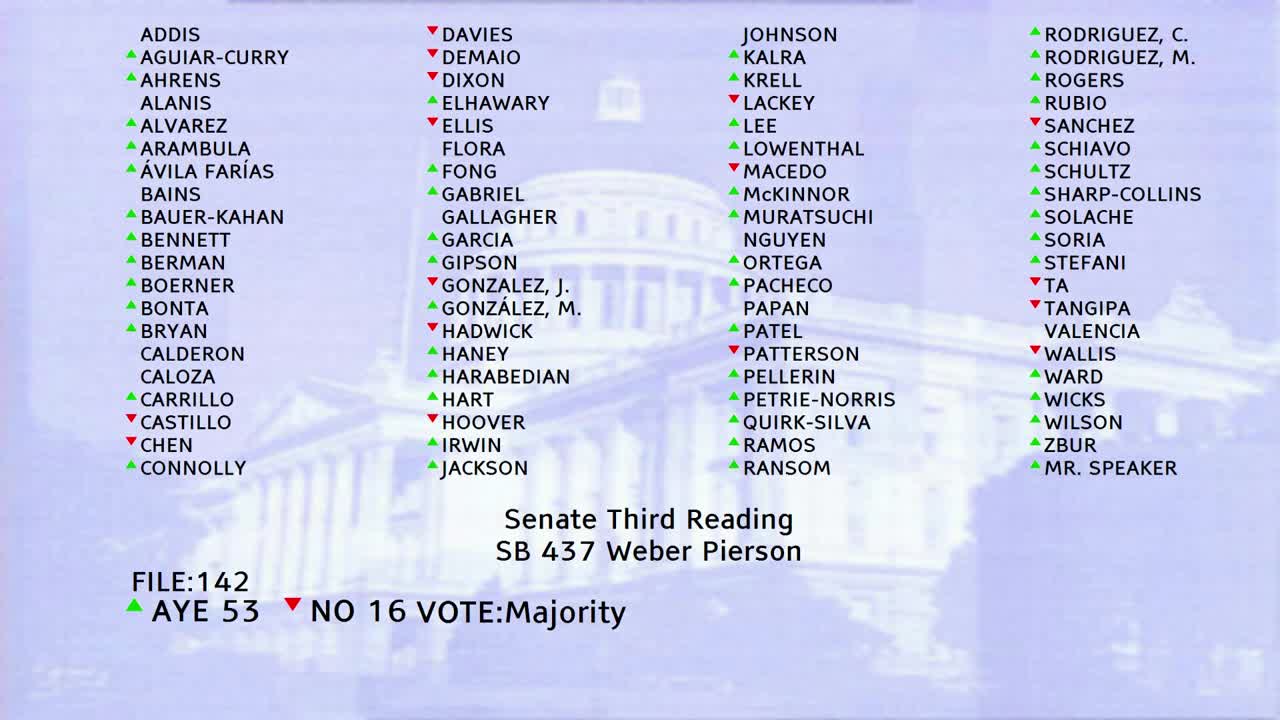 1MIN
Assembly Floor
 14MIN
Assembly Standing Committee on Education
Bill Author

Bill Co-Author(s):