SB 593: Electrical corporations: significant voltage-related incidents: studies.
- Session Year: 2025-2026
- House: Senate
- Latest Version Date: 2025-10-06
Current Status:
Passed
(2025-10-06: Chaptered by Secretary of State. Chapter 420, Statutes of 2025.)
Introduced
In Committee
Awaiting First Chamber Vote
Passed First Chamber
In Committee
Awaiting Second Chamber Vote
Passed Second Chamber
Enacted
Existing law vests the Public Utilities Commission with regulatory jurisdiction over public utilities, including electrical corporations. Existing law requires each public utility to furnish and maintain adequate, efficient, just, and reasonable service, instrumentalities, equipment, and facilities, as are necessary to promote the safety, health, comfort, and convenience of its patrons, employees, and the public.
Existing law requires the commission to annually publish a report, pursuant to commission requirements, as provided.
This bill would require the commission, on or before January 1, 2027, to require each large electrical corporation, as defined, to commence a study to evaluate significant voltage-related incidents, as defined, across its residential, commercial, and industrial customers that resulted in damage to customer-owned equipment, appliances, or property totaling $5,000 or more, as provided. The bill would require the commission, on or before July 1, 2027, to publish hyperlinks on its internet website to the studies, and to report on the studies to the Legislature.
Under existing law, a violation of any order, decision, rule, direction, demand, or requirement of the commission is a crime.
Because a violation of a commission action implementing this bills requirements would be a crime, the bill would impose a state-mandated local program.
The California Constitution requires the state to reimburse local agencies and school districts for certain costs mandated by the state. Statutory provisions establish procedures for making that reimbursement.
This bill would provide that no reimbursement is required by this act for a specified reason.
Existing law vests the Public Utilities Commission with regulatory jurisdiction over public utilities, including electrical corporations, while local publicly owned electric utilities are under the direction of their governing boards. corporations. Existing law requires each public utility to furnish and maintain adequate, efficient, just, and reasonable service, instrumentalities, equipment, and facilities, as are necessary to promote the safety, health, comfort, and convenience of its patrons, employees, and the public.
Existing law requires the commission to annually publish a report that includes all investigations into gas or electric service safety incidents reported, report, pursuant to commission requirements, by any gas corporation or electrical corporation, as provided.
This bill would require that annual report to also include the number of significant voltage-related service incidents that damaged customer equipment and appliances, the number of claims submitted, and the number and total dollar amount of the resolved claims.Existing law also requires the commission to develop, publish, and annually update a report that contains specified information, including a summary of the staff safety investigations concluded during the prior calendar year and the staff safety investigations that remain open for any gas corporation or electrical corporation, as specified.This bill would require the annual report that includes the summary described above to also include, for each investigation into an incident that is included in the annual report related to investigations, an explanation of why the investigation remains open if the investigation remains open for 12 or more months after a claim was filed.The bill would require the commission to conduct a study, on or before July 1, 2026, to evaluate voltage-related service incidents that resulted in significant damage and associated consumer protections within the service territories of public utilities, as specified, and to submit a report on the study to the Legislature on or before July 1, 2027.This bill would require the commission, on or before January 1, 2027, to require each large electrical corporation, as defined, to commence a study to evaluate significant voltage-related incidents, as defined, across its residential, commercial, and industrial customers that resulted in damage to customer-owned equipment, appliances, or property totaling $5,000 or more, as provided. The bill would require the commission, on or before July 1, 2027, to publish hyperlinks on its internet website to the studies, and to report on the studies to the Legislature.
Under existing law, a violation of any order, decision, rule, direction, demand, or requirement of the commission is a crime.
Because a violation of a commission action implementing this bills requirements would be a crime, the bill would impose a state-mandated local program.
The California Constitution requires the state to reimburse local agencies and school districts for certain costs mandated by the state. Statutory provisions establish procedures for making that reimbursement.
This bill would provide that no reimbursement is required by this act for a specified reason.
Existing law vests the Public Utilities Commission with regulatory jurisdiction over public utilities, including electrical corporations, while local publicly owned electric utilities are under the direction of their governing boards.
This bill would require the commission, on or before January 1, 2027, to require electrical corporations to adjust their consumer protections to better protect customers from significant voltage changes that can result in damage to customers equipment and appliances if the commission determines adjustments to the consumer protections are necessary. The bill would specify the factors that the commission would be required to evaluate when determining when to adjust the consumer protections, as provided.The bill would also require the governing boards of local publicly owned electric utilities, on or before January 1, 2027, to adopt policies to protect customers from voltage changes that result in damage to customers equipment and appliances. The bill would require each local publicly owned electric utility to post its policy, including its claims process to address damage caused by voltage changes, on its internet website.Existing law requires the commission to annually publish a report that includes all investigations into gas or electric service safety incidents reported, pursuant to commission requirements, by any gas corporation or electrical corporation, as provided.
This bill would require that annual report to also include the number of significant voltage events voltage-related service incidents that damaged customer equipment and appliances, the number of claims submitted, and the number and total dollar amount of the resolved claims.
Existing law also requires the commission to develop, publish, and annually update a report that contains specified information, including a summary of the staff safety investigations concluded during the prior calendar year and the staff safety investigations that remain open for any gas corporation or electrical corporation, as specified.
This bill would require the annual report that includes the summary described above to also include, for each investigation into an incident that is included in the annual report related to investigations, an explanation of why the investigation remains open if the investigation remains open for 12 or more months after a claim was filed.
The bill would require the commission to conduct a study, on or before July 1, 2026, to evaluate voltage-related service incidents that resulted in significant damage and associated consumer protections within the service territories of public utilities, as specified, and to submit a report on the study to the Legislature on or before July 1, 2027.
Under existing law, a violation of any order, decision, rule, direction, demand, or requirement of the commission is a crime.
Because a violation of a commission action implementing this bills requirements would be a crime, the bill would impose a state-mandated local program.
Additionally, by imposing new duties on local publicly owned electric utilities, the bill would impose a state-mandated local program.The California Constitution requires the state to reimburse local agencies and school districts for certain costs mandated by the state. Statutory provisions establish procedures for making that reimbursement.This bill would provide that no reimbursement is required by this act for specified reasons.The California Constitution requires the state to reimburse local agencies and school districts for certain costs mandated by the state. Statutory provisions establish procedures for making that reimbursement.
This bill would provide that no reimbursement is required by this act for a specified reason.
Existing law vests the Public Utilities Commission with regulatory jurisdiction over public utilities, including electrical corporations, while local publicly owned electric utilities are under the direction of their governing boards.
This bill would require the commission, on or before July 1, 2026, January 1, 2027, to require electrical corporations to adjust their consumer protections to better protect customers from significant voltage changes that can result in damage to customers equipment and appliances if the commission determines adjustments to the consumer protections are necessary. The bill would specify the factors that the commission would be required to evaluate when determining whether when to adjust the consumer protections, as provided.
The bill would also require the governing boards of local publicly owned electric utilities, on or before January 1, 2027, to adopt policies to protect customers from voltage changes that result in damage to customers equipment and appliances. The bill would require each local publicly owned electric utility to post its policy, including its claims process to address damage caused by voltage changes, on its internet website.
Existing law requires the commission to annually publish a report that includes all investigations into gas or electric service safety incidents reported, pursuant to commission requirements, by any gas corporation or electrical corporation, as provided.
This bill would require the commission to also include in the annual report, that annual report to also include the number of significant voltage events that damaged customer equipment and appliances, the number of claims submitted, and the number and total dollar amount of the resolved claims.
Existing law also requires the commission to develop, publish, and annually update a report that contains specified information, including a summary of the staff safety investigations concluded during the prior calendar year and the staff safety investigations that remain open for any gas corporation or electrical corporation, as specified.
This bill would require the annual report that includes the summary described above to also include, for each investigation into an incident that is included in the annual report related to investigations, an explanation of why the investigation remains open if the investigation remains open for 12 or more months after a claim was filed.
Under existing law, a violation of any order, decision, rule, direction, demand, or requirement of the commission is a crime.
Because a violation of a commission action implementing this bills requirements would be a crime, the bill would impose a state-mandated local program.
Additionally, by imposing new duties on local publicly owned electric utilities, the bill would impose a state-mandated local program.
The California Constitution requires the state to reimburse local agencies and school districts for certain costs mandated by the state. Statutory provisions establish procedures for making that reimbursement.
This bill would provide that no reimbursement is required by this act for specified reasons.
Existing law vests the Public Utilities Commission with regulatory jurisdiction over public utilities, including electrical corporations, while local publicly owned electric utilities are under the direction of their governing boards.
This bill would require the commission, on or before July 1, 2026, to require electrical corporations to adjust their consumer protections to better protect customers from significant voltage changes that can result in damage to customers equipment and appliances if the commission determines adjustments to the consumer protections are necessary. The bill would specify the factors that the commission would be required to evaluate when determining whether to adjust the consumer protections, as provided.
The bill would also require the governing boards of local publicly owned electric utilities, on or before January 1, 2027, to adopt policies to protect customers from voltage changes that result in damage to customers equipment and appliances. The bill would require each local publicly owned electric utility to post its policy, including its claims process to address damage caused by voltage changes, on its internet website.
Existing law requires the commission to annually publish a report that includes all investigations into gas or electric service safety incidents reported, pursuant to commission requirements, by any gas corporation or electrical corporation, as provided.
This bill would require the commission to also include in the annual report, the number of significant voltage events that damaged customer equipment and appliances, the number of claims submitted, and the number and total dollar amount of the resolved claims.
Under existing law, a violation of any order, decision, rule, direction, demand, or requirement of the commission is a crime.
Because a violation of a commission action implementing this bills requirements would be a crime, the bill would impose a state-mandated local program.
Additionally, by imposing new duties on local publicly owned electric utilities, the bill would impose a state-mandated local program.
The California Constitution requires the state to reimburse local agencies and school districts for certain costs mandated by the state. Statutory provisions establish procedures for making that reimbursement.
This bill would provide that no reimbursement is required by this act for specified reasons.
Existing law vests the Public Utilities Commission with regulatory jurisdiction over public utilities, including electrical corporations, while local publicly owned electric utilities are under the direction of their governing board.This bill would require a utility, which includes a community choice aggregator, an electrical corporation, and a local publicly owned electric utility, to develop and implement a system to notify a ratepayer of a power surge, as defined. The bill would require the notification to be transmitted within 5 minutes of detecting a power surge and to include specified information. The bill would also require a preemptive warning of a power surge, as provided, under specified circumstances. The bill would require a utility to install and maintain equipment capable of detecting power surges and to submit quarterly reports to the commission regarding power surges, as provided. The bill would require a utility to compensate a ratepayer for damages to electrical systems, appliances, or devices caused by a power surge if the power surge resulted from utility equipment failure or negligence, to process claims for compensation within 30 days of receipt, and to offer financial incentives or rebates for the installation of whole-house surge protection systems by ratepayers.The bill would require the commission to adopt rules and regulations to implement these requirements and monitor compliance, authorize the commission to impose penalties for the failure to comply, and require the commission to submit a report to the Legislature by January 1 of each year regarding the implementation and effectiveness of power surge notifications and the impact of these requirements on reducing damages from power surges. The bill would require each utility to submit an implementation plan to the commission within 6 months of the effective date of the bill and to fully implement these requirements within 18 months of the effective date, and would authorize a utility to apply to the commission for approval to recover reasonable costs associated with complying with these requirements through rate adjustments.Under existing law, a violation of any order, decision, rule, direction, demand, or requirement of the commission is a crime.Because a violation of a commission action implementing this bills requirements would be a crime, the bill would impose a state-mandated local program.Additionally, by imposing new duties on local publicly owned electric utilities, the bill would impose a state-mandated local program.The California Constitution requires the state to reimburse local agencies and school districts for certain costs mandated by the state. Statutory provisions establish procedures for making that reimbursement.This bill would provide that no reimbursement is required by this act for specified reasons.This bill would declare that it is to take effect immediately as an urgency statute.Existing law vests the Public Utilities Commission with regulatory jurisdiction over public utilities, including electrical corporations, while local publicly owned electric utilities are under the direction of their governing board.
This bill would require a utility, which includes a community choice aggregator, an electrical corporation, and a local publicly owned electric utility, to develop and implement a system to notify a ratepayer of a power surge, as defined. The bill would require the notification to be transmitted within 5 minutes of detecting a power surge and to include specified information. The bill would also require a preemptive warning of a power surge, as provided, under specified circumstances. The bill would require a utility to install and maintain equipment capable of detecting power surges and to submit quarterly reports to the commission regarding power surges, as provided. The bill would require a utility to compensate a ratepayer for damages to electrical systems, appliances, or devices caused by a power surge if the power surge resulted from utility equipment failure or negligence, to process claims for compensation within 30 days of receipt, and to offer financial incentives or rebates for the installation of whole-house surge protection systems by ratepayers.
The bill would require the commission to adopt rules and regulations to implement these requirements and monitor compliance, authorize the commission to impose penalties for the failure to comply, and require the commission to submit a report to the Legislature by January 1 of each year regarding the implementation and effectiveness of power surge notifications and the impact of these requirements on reducing damages from power surges. The bill would require each utility to submit an implementation plan to the commission within 6 months of the effective date of the bill and to fully implement these requirements within 18 months of the effective date, and would authorize a utility to apply to the commission for approval to recover reasonable costs associated with complying with these requirements through rate adjustments.
Under existing law, a violation of any order, decision, rule, direction, demand, or requirement of the commission is a crime.
Because a violation of a commission action implementing this bills requirements would be a crime, the bill would impose a state-mandated local program.
Additionally, by imposing new duties on local publicly owned electric utilities, the bill would impose a state-mandated local program.
The California Constitution requires the state to reimburse local agencies and school districts for certain costs mandated by the state. Statutory provisions establish procedures for making that reimbursement.
This bill would provide that no reimbursement is required by this act for specified reasons.
This bill would declare that it is to take effect immediately as an urgency statute.
The Legislature finds and declares all of the following:
(a)Voltage changes can result in significant damage to electrical systems, appliances, and devices, causing financial hardship and safety concerns for residential, commercial, and industrial ratepayers.
(b)Voltage changes are a frequent occurrence in electrical grid operations. Voltage changes can be caused by multiple factors, including, but not limited to, lightning strikes, downed electrical lines, or sudden shifts in electrical demand.
(c)It is the responsibility of the Public Utilities Commission to publish public disclosures and information on the adequacy of large electrical corporations consumer protections related to significant voltage-related incidents.
SEC. 2.Section 913.14 is added to the Public Utilities Code, to read:913.14.(a)For purposes of this section, both of the following definitions apply:
(1)Large electrical corporation has the same meaning as defined in Section 3280.
(2)Significant voltage-related incident means a deviation in electrical service voltage delivered by an electrical corporation to a customer that falls outside the standard electrical service voltage range of plus or minus 5 percent of nominal voltage and that results in damage to customer-owned equipment, appliances, or property.
(b)(1)On or before January 1, 2027, the commission shall require each large electrical corporation to commence a study to evaluate significant voltage-related incidents across its residential, commercial, and industrial customers that resulted in damage to customer-owned equipment, appliances, or property totaling five thousand dollars ($5,000) or more.
(2)Each study shall, at a minimum, do all of the following:
(A)Evaluate associated consumer protections within the service territory of the large electrical corporation.
(B)Quantify the frequency and causes of significant voltage-related incidents that resulted in property damage, including, but not limited to, the number and geographic distribution of significant voltage-related incidents reported from January 1, 2024, to December 31, 2026, inclusive.
(C)Identify the causes of significant voltage-related incidents, including electrical grid instability, system failures, or natural disasters such as wildfires and storms, reported from January 1, 2024, to December 31, 2026, inclusive.
(D)Evaluate the impacts of, and damage caused by, significant voltage-related incidents on the large electrical corporations operations and service reliability and customer-owned equipment, appliances, or property, including, but not limited to, the frequency of high- and low-voltage changes by voltage class across different customer classes, including residential, commercial, and industrial customer classes.
(E)Quantify the extent of reported property damage, including total monetary claims filed, approved, and denied, to different customer classes, including residential, commercial, and industrial customer classes, resulting from significant voltage-related incidents.
(F)Evaluate any trends in customer complaints related to significant voltage-related incidents.
(G)Examine response times and management and resolution of complaints or claims related to significant voltage-related incidents that resulted in damage to customer-owned equipment, appliances, or property.
(H)Describe consumer protections from significant voltage-related incidents in the large electrical corporations service territory.
(I)Evaluate the adequacy of the consumer protections related to reporting and public disclosure of significant voltage-related incidents that resulted in damage to customer-owned equipment, appliances, or property.
(J)Identify current outreach and support related to significant voltage-related incidents, including, but not limited to, whether current practices adequately serve low-income, rural, and limited English proficiency customers seeking reimbursement for damage to customer-owned equipment, appliances, or property.
(c)On or before July 1, 2027, the commission shall publish hyperlinks on its internet website to the studies conducted by the large electrical corporations, and report on the studies to the Legislature.
(d)Pursuant to Section 10231.5 of the Government Code, this section is repealed on January 1, 2031.
SEC. 3.No reimbursement is required by this act pursuant to Section 6 of Article XIIIB of the California Constitution because the only costs that may be incurred by a local agency or school district will be incurred because this act creates a new crime or infraction, eliminates a crime or infraction, or changes the penalty for a crime or infraction, within the meaning of Section 17556 of the Government Code, or changes the definition of a crime within the meaning of Section 6 of Article XIIIB of the California Constitution.
The Legislature finds and declares both all of the following:
(a)Voltage changes can result in significant damage to electrical systems, appliances, and devices, causing financial hardship and safety concerns for residential, commercial, and industrial ratepayers.
(b)Voltage changes are a frequent occurrence in electrical grid operations. Voltage changes can be caused by multiple factors, including, but not limited to, lightning strikes, downed electrical lines, or sudden shifts in electrical demand.
(b)(c)It is the responsibility of the Public Utilities Commission to ensure that public utilities maintain adequate publish public disclosures and information on the adequacy of large electrical corporations consumer protections in response related to significant voltage-related service incidents. These protections should include, in the customers relevant language, timely outreach to affected customers and clear guidance on how to navigate the public utilitys claim process.
SEC. 2.Section 911 of the Public Utilities Code is amended to read:911.(a)Beginning February 1, 2016, the commission shall annually publish a report that includes all investigations into gas or electric service safety incidents reported, pursuant to commission requirements, including claims of property damage totaling five thousand dollars ($5,000) or more, by any gas corporation or electrical corporation. The report shall succinctly describe each safety investigation concluded during the prior calendar year and each investigation that remains open. The categories within the description shall include the month of the safety incident, the reason for the investigation, the facility type involved, and the owner of the facility.(b)The commission shall include in its report required pursuant to Section 910, a summary of the staff safety investigations concluded during the prior calendar year and the staff safety investigations that remain open for any gas corporation or electrical corporation, with a link to the internet website with the report that contains the information required pursuant to subdivision (a), and, for each investigation into an incident that is included in the report published pursuant to subdivision (a), an explanation of why the investigation remains open if the investigation remains open for 12 or more months after a claim was filed.(c)The commission shall include in its annual report published pursuant to subdivision (a), the number of significant voltage-related service incidents that damaged customers equipment and appliances, the number of claims submitted, and the number and total dollar amount of the resolved claims.SEC. 3.Section 913.14 is added to the Public Utilities Code, to read:913.14.(a)On or before July 1, 2026, the commission shall conduct a study to evaluate voltage-related service incidents that resulted in significant damage, including, but not limited to, damage to electrical systems, and associated consumer protections within the service territories of public utilities. This study shall do, at a minimum, all of the following:SEC. 2.Section 913.14 is added to the Public Utilities Code, to read:913.14.(a)For purposes of this section, both of the following definitions apply:
(1)Large electrical corporation has the same meaning as defined in Section 3280.
(2)Significant voltage-related incident means a deviation in electrical service voltage delivered by an electrical corporation to a customer that falls outside the standard electrical service voltage range of plus or minus 5 percent of nominal voltage and that results in damage to customer-owned equipment, appliances, or property.
(b)(1)On or before January 1, 2027, the commission shall require each large electrical corporation to commence a study to evaluate significant voltage-related incidents across its residential, commercial, and industrial customers that resulted in damage to customer-owned equipment, appliances, or property totaling five thousand dollars ($5,000) or more.
(2)Each study shall, at a minimum, do all of the following:
(A)Evaluate associated consumer protections within the service territory of the large electrical corporation.
(1)(B)Quantify the frequency and causes of significant voltage changes, voltage-related incidents that resulted in property damage, including, but not limited to, the number and geographic distribution of significant voltage changes voltage-related incidents reported by public utilities over the past three years. from January 1, 2024, to December 31, 2026, inclusive.
(2)(C)Identify the causes of significant voltage changes, voltage-related incidents, including electrical grid instability, system failures, or natural disasters such as wildfires and storms. storms, reported from January 1, 2024, to December 31, 2026, inclusive.
(3)(D)Evaluate the impacts of of, and damage caused by, significant voltage changes voltage-related incidents on customers, the large electrical corporations operations and service reliability and customer-owned equipment, appliances, or property, including, but not limited to, the frequency of high- and low-voltage changes by voltage class across different customer classes, including residential, commercial, and industrial customer classes, and their impacts on equipment, operations, and service reliability. classes.
(4)Estimate(E)Quantify the extent of reported damage or loss to customers property damage, including total monetary claims filed, approved, and denied, to different customer classes, including residential, commercial, and industrial customer classes, resulting from significant voltage changes, including total monetary claims filed, approved, and denied. voltage-related incidents.
(5)(F)Evaluate any trends in customer complaints to determine whether voltage-related service disruptions reflect broader systemic issues. related to significant voltage-related incidents.
(6)Evaluate consumer protections, including, but not limited to, the accessibility, clarity, and effectiveness of claim procedures offered by public utilities.(7)Assess customers awareness of consumer protections, especially among limited English proficiency, low-income, or medically vulnerable customers.(8)Examine the adequacy and timeliness of public utility responses to, and resolutions of, voltage-related complaints or claims.(9)Evaluate public utility accountability and oversight, including, but not limited to, how public utilities report on, and respond to, voltage-related service incidents and customer complaints, and whether gaps in regulatory oversight or public utility reporting practices limit public visibility into how public utilities respond to, and manage, voltage-related service incidents.(10)Evaluate reporting requirements, including, but not limited to, reporting on electrical safety incidents, and determine whether additional reporting or public disclosure is warranted for voltage-related service incidents that result in property damage.(G)Examine response times and management and resolution of complaints or claims related to significant voltage-related incidents that resulted in damage to customer-owned equipment, appliances, or property.
(H)Describe consumer protections from significant voltage-related incidents in the large electrical corporations service territory.
(I)Evaluate the adequacy of the consumer protections related to reporting and public disclosure of significant voltage-related incidents that resulted in damage to customer-owned equipment, appliances, or property.
(11)(J)Identify current outreach and support, support related to significant voltage-related incidents, including, but not limited to, whether current practices adequately serve low-income, rural, or and limited English proficiency customers who may face additional barriers in accessing protections or seeking recourse. seeking reimbursement for damage to customer-owned equipment, appliances, or property.
(b)(c)On or before July 1, 2027, the commission shall submit a report on this study, including the studys findings and recommendations, to the Legislature. publish hyperlinks on its internet website to the studies conducted by the large electrical corporations, and report on the studies to the Legislature.
(c)(d)Pursuant to Section 10231.5 of the Government Code, this section is repealed on January 1, 2031.
SEC. 4.SEC. 3.No reimbursement is required by this act pursuant to Section 6 of Article XIIIB of the California Constitution because the only costs that may be incurred by a local agency or school district will be incurred because this act creates a new crime or infraction, eliminates a crime or infraction, or changes the penalty for a crime or infraction, within the meaning of Section 17556 of the Government Code, or changes the definition of a crime within the meaning of Section 6 of Article XIIIB of the California Constitution.
(a)The Legislature finds and declares that voltage both of the following:
(a)Voltage changes can result in significant damage to electrical systems, appliances, and devices, causing financial hardship and safety concerns for residential, commercial, and industrial ratepayers.
(b)It is the intent of the Legislature that the Public Utilities Commission ensures that existing consumer protections to address voltage changes that can damage customers properties are adequate, including, upon a voltage change occurring, an electrical corporations outreach to affected customers in the relevant languages and with adequate information to navigate the electrical corporations claim procedures.(b)It is the responsibility of the Public Utilities Commission to ensure that public utilities maintain adequate consumer protections in response to significant voltage-related service incidents. These protections should include, in the customers relevant language, timely outreach to affected customers and clear guidance on how to navigate the public utilitys claim process.
SEC. 2.Section 911 of the Public Utilities Code is amended to read:911.(a)Beginning February 1, 2016, the commission shall annually publish a report that includes all investigations into gas or electric service safety incidents reported, pursuant to commission requirements, including claims of property damage totaling five thousand dollars ($5,000) or more, by any gas corporation or electrical corporation. The report shall succinctly describe each safety investigation concluded during the prior calendar year and each investigation that remains open. The categories within the description shall include the month of the safety incident, the reason for the investigation, the facility type involved, and the owner of the facility.
(b)The commission shall include in its report required pursuant to Section 910, a summary of the staff safety investigations concluded during the prior calendar year and the staff safety investigations that remain open for any gas corporation or electrical corporation, with a link to the internet website with the report that contains the information required pursuant to subdivision (a), and, for each investigation into an incident that is included in the report published pursuant to subdivision (a), an explanation of why the investigation remains open if the investigation remains open for 12 or more months after a claim was filed.
(c)The commission shall include in its annual report published pursuant to subdivision (a), the number of significant voltage events voltage-related service incidents that damaged customers equipment and appliances, the number of claims submitted, and the number and total dollar amount of the resolved claims.
SEC. 3.Section 2774.8 is added to the Public Utilities Code, to read:2774.8.(a)On or before January 1, 2027, the commission shall require each electrical corporation to adjust its consumer protections to better protect customers from significant voltage changes that can result in damage to customers equipment and appliances, if the commission determines an adjustment to those consumer protections is necessary.(b)In determining when to adjust those consumer protections, the commission shall evaluate the electrical corporations existing consumer protections, including, but not limited to, the electrical corporations claims process, the electrical corporations notification procedures for customers previously affected by significant voltage changes that damaged the customers property, the electrical corporations outreach to customers in relevant languages pursuant to existing commission rules and guidelines, the electrical corporations process to identify the cause of the significant voltage changes, the customers ability to appeal to the commission for additional review, and any necessary additional reporting by the electrical corporation to the commission concerning significant voltage changes.SEC. 4.Part 3 (commencing with Section 9530) is added to Division 4.8 of the Public Utilities Code, to read:3.Voltage Changes9530.(a)On or before January 1, 2027, the governing board of each local publicly owned electric utility shall adopt a policy to protect its customers from voltage changes that result in damage to customers equipment and appliances.(b)Each local publicly owned electric utility shall post its policy, including its claims process to address damage caused by voltage changes, on its internet website.SEC. 5.No reimbursement is required by this act pursuant to Section 6 of Article XIIIB of the California Constitution because a local agency or school district has the authority to levy service charges, fees, or assessments sufficient to pay for the program or level of service mandated by this act or because costs that may be incurred by a local agency or school district will be incurred because this act creates a new crime or infraction, eliminates a crime or infraction, or changes the penalty for a crime or infraction, within the meaning of Section 17556 of the Government Code, or changes the definition of a crime within the meaning of Section 6 of Article XIIIB of the California Constitution.SEC. 3.Section 913.14 is added to the Public Utilities Code, to read:913.14.(a)On or before July 1, 2026, the commission shall conduct a study to evaluate voltage-related service incidents that resulted in significant damage, including, but not limited to, damage to electrical systems, and associated consumer protections within the service territories of public utilities. This study shall do, at a minimum, all of the following:
(1)Quantify the frequency and causes of significant voltage changes, including, but not limited to, the number and geographic distribution of significant voltage changes reported by public utilities over the past three years.
(2)Identify the causes of significant voltage changes, including electrical grid instability, system failures, or natural disasters such as wildfires and storms.
(3)Evaluate the impacts of significant voltage changes on customers, including, but not limited to, the frequency of high- and low-voltage changes by voltage class across different customer classes, including residential, commercial, and industrial customer classes, and their impacts on equipment, operations, and service reliability.
(4)Estimate the extent of reported damage or loss to customers resulting from significant voltage changes, including total monetary claims filed, approved, and denied.
(5)Evaluate any trends in customer complaints to determine whether voltage-related service disruptions reflect broader systemic issues.
(6)Evaluate consumer protections, including, but not limited to, the accessibility, clarity, and effectiveness of claim procedures offered by public utilities.
(7)Assess customers awareness of consumer protections, especially among limited English proficiency, low-income, or medically vulnerable customers.
(8)Examine the adequacy and timeliness of public utility responses to, and resolutions of, voltage-related complaints or claims.
(9)Evaluate public utility accountability and oversight, including, but not limited to, how public utilities report on, and respond to, voltage-related service incidents and customer complaints, and whether gaps in regulatory oversight or public utility reporting practices limit public visibility into how public utilities respond to, and manage, voltage-related service incidents.
(10)Evaluate reporting requirements, including, but not limited to, reporting on electrical safety incidents, and determine whether additional reporting or public disclosure is warranted for voltage-related service incidents that result in property damage.
(11)Identify current outreach and support, including, but not limited to, whether current practices adequately serve low-income, rural, or limited English proficiency customers who may face additional barriers in accessing protections or seeking recourse.
(b)On or before July 1, 2027, the commission shall submit a report on this study, including the studys findings and recommendations, to the Legislature.
(c)Pursuant to Section 10231.5 of the Government Code, this section is repealed on January 1, 2031.
SEC. 4.No reimbursement is required by this act pursuant to Section 6 of Article XIIIB of the California Constitution because the only costs that may be incurred by a local agency or school district will be incurred because this act creates a new crime or infraction, eliminates a crime or infraction, or changes the penalty for a crime or infraction, within the meaning of Section 17556 of the Government Code, or changes the definition of a crime within the meaning of Section 6 of Article XIIIB of the California Constitution.
(a)The Legislature finds and declares that power surges voltage changes can result in significant damage to electrical systems, appliances, and devices, causing financial hardship and safety concerns for residential, commercial, and industrial ratepayers.
(b)It is the intent of the Legislature that the Public Utilities Commission ensures that existing consumer protections to address power surges voltage changes that can damage customers properties are adequate, including, upon a power surge voltage change occurring, an electrical corporations outreach to affected customers in the relevant languages and with adequate information to navigate the electrical corporations claims claim procedures.
SEC. 2.Section 911 of the Public Utilities Code is amended to read:911.(a)Beginning February 1, 2016, the commission shall annually publish a report that includes all investigations into gas or electric service safety incidents reported, pursuant to commission requirements, including claims of property damage totaling five thousand dollars ($5,000) or more, by any gas corporation or electrical corporation. The report shall succinctly describe each safety investigation concluded during the prior calendar year and each investigation that remains open. The categories within the description shall include the month of the safety incident, the reason for the investigation, the facility type involved, and the owner of the facility.
(b)The commission shall include in its report required pursuant to Section 910, a summary of the staff safety investigations concluded during the prior calendar year and the staff safety investigations that remain open for any gas corporation or electrical corporation, with a link to the internet website with the report that contains the information required pursuant to subdivision (a). (a), and, for each investigation into an incident that is included in the report published pursuant to subdivision (a), an explanation of why the investigation remains open if the investigation remains open for 12 or more months after a claim was filed.
(c)The commission shall include in its annual report published pursuant to subdivision (a), the number of significant voltage events that damaged customers equipment and appliances, the number of claims submitted, and the number and total dollar amount of the resolved claims.
SEC. 3.Section 2774.8 is added to the Public Utilities Code, to read:2774.8.(a)On or before July 1, 2026, January 1, 2027, the commission shall require each electrical corporation to adjust its consumer protections to better protect customers from significant voltage changes that can result in damage to customers equipment and appliances, if the commission determines an adjustment to those consumer protections is necessary.
(b)In determining whether when to adjust those consumer protections, the commission shall evaluate the electrical corporations existing consumer protections, including, but not limited to, the electrical corporations claims process, the electrical corporations notification procedures for customers previously affected by significant voltage changes that damaged the customers property, the electrical corporations outreach to customers in relevant languages pursuant to existing commission rules and guidelines, the electrical corporations process to identify the cause of the significant voltage changes, the customers ability to appeal to the commission for additional review, and any necessary additional reporting by the electrical corporation to the commission concerning significant voltage changes.
SEC. 4.Part 3 (commencing with Section 9530) is added to Division 4.8 of the Public Utilities Code, to read:3.Voltage Changes9530.(a)On or before January 1, 2027, the governing board of each local publicly owned electric utility shall adopt a policy to protect its customers from voltage changes that result in damage to customers equipment and appliances.
(b)Each local publicly owned electric utility shall post its policy, including its claims process to address damage caused by voltage changes, on its internet website.
SEC. 5.No reimbursement is required by this act pursuant to Section 6 of Article XIIIB of the California Constitution because a local agency or school district has the authority to levy service charges, fees, or assessments sufficient to pay for the program or level of service mandated by this act or because costs that may be incurred by a local agency or school district will be incurred because this act creates a new crime or infraction, eliminates a crime or infraction, or changes the penalty for a crime or infraction, within the meaning of Section 17556 of the Government Code, or changes the definition of a crime within the meaning of Section 6 of Article XIIIB of the California Constitution.
(a)The Legislature finds and declares that power surges can result in significant damage to electrical systems, appliances, and devices, causing financial hardship and safety concerns for residential, commercial, and industrial ratepayers.
(b)It is the intent of the Legislature that the Public Utilities Commission ensures that existing consumer protections to address power surges that can damage customers properties are adequate, including, upon a power surge occurring, an electrical corporations outreach to affected customers in the relevant languages and with adequate information to navigate the electrical corporations claims procedures.
SEC. 2.Section 911 of the Public Utilities Code is amended to read:911.(a)Beginning February 1, 2016, the commission shall annually publish a report that includes all investigations into gas or electric service safety incidents reported, pursuant to commission requirements, by any gas corporation or electrical corporation. The report shall succinctly describe each safety investigation concluded during the prior calendar year and each investigation that remains open. The categories within the description shall include the month of the safety incident, the reason for the investigation, the facility type involved, and the owner of the facility.
(b)The commission shall include in its report required pursuant to Section 910, a summary of the staff safety investigations concluded during the prior calendar year and the staff safety investigations that remain open for any gas corporation or electrical corporation, with a link to the Internet Web site internet website with the report that contains the information required pursuant to subdivision (a).
(c)The commission shall include in its annual report published pursuant to subdivision (a), the number of significant voltage events that damaged customers equipment and appliances, the number of claims submitted, and the number and total dollar amount of the resolved claims.
SEC. 3.Section 2774.8 is added to the Public Utilities Code, to read:2774.8.(a)On or before July 1, 2026, the commission shall require each electrical corporation to adjust its consumer protections to better protect customers from significant voltage changes that can result in damage to customers equipment and appliances, if the commission determines an adjustment to those consumer protections is necessary.
(b)In determining whether to adjust those consumer protections, the commission shall evaluate the electrical corporations existing consumer protections, including, but not limited to, the electrical corporations claims process, the electrical corporations notification procedures for customers previously affected by significant voltage changes that damaged the customers property, the electrical corporations outreach to customers in relevant languages pursuant to existing commission rules and guidelines, the electrical corporations process to identify the cause of the significant voltage changes, the customers ability to appeal to the commission for additional review, and any necessary additional reporting by the electrical corporation to the commission concerning significant voltage changes.
SEC. 4.Part 3 (commencing with Section 9530) is added to Division 4.8 of the Public Utilities Code, to read:3.Voltage Changes9530.(a)On or before January 1, 2027, the governing board of each local publicly owned electric utility shall adopt a policy to protect its customers from voltage changes that result in damage to customers equipment and appliances.
(b)Each local publicly owned electric utility shall post its policy, including its claims process to address damage caused by voltage changes, on its internet website.
SEC. 5.No reimbursement is required by this act pursuant to Section 6 of Article XIIIB of the California Constitution because a local agency or school district has the authority to levy service charges, fees, or assessments sufficient to pay for the program or level of service mandated by this act or because costs that may be incurred by a local agency or school district will be incurred because this act creates a new crime or infraction, eliminates a crime or infraction, or changes the penalty for a crime or infraction, within the meaning of Section 17556 of the Government Code, or changes the definition of a crime within the meaning of Section 6 of Article XIIIB of the California Constitution.
SECTION 1.Section 910.9 is added to the Public Utilities Code, to read:910.9.On or before January 1 of each year, the commission shall submit a report to the Legislature evaluating both of the following:(a)The implementation and effectiveness of power surge notifications sent to ratepayers pursuant to Chapter 8 (commencing with Section 8395) of Division 4.1.(b)The impact of Chapter 8 (commencing with Section 8395) of Division 4.1 on reducing damages to the property of ratepayers resulting from power surges.SEC. 2.Chapter 8 (commencing with Section 8395) is added to Division 4.1 of the Public Utilities Code, to read:8.Power Surges: ratepayer Protection8395.The Legislature finds and declares all of the following:(a)Power surges can result in significant damage to electrical systems, appliances, and devices, causing financial hardship and safety concerns for residential, commercial, and industrial ratepayers.(b)Ratepayers currently receive notification of power outages from utilities, but are not similarly informed of power surges, limiting their ability to take preventative measures to protect their property.(c)Establishing a notification system for power surges will enhance ratepayer protection, reduce damages, and increase utility accountability.8395.1.For purposes of this chapter, the following definitions apply:(a)Community choice aggregator has the same meaning as defined in Section 331.1.(b)Electrical corporation has the same meaning as defined in Section 218.(c)Local publicly owned electric utility has the same meaning as defined in Section 224.3.(d)Power surge means a transient increase in electrical voltage that exceeds the standard operating range of an electrical system.(e)Ratepayer means the person named on the utility account as the person responsible for bill payment to the utility.(f)Utility means a community choice aggregator, an electrical corporation, or a local publicly owned electric utility.8395.2.(a)Each utility shall develop and implement a system to notify a ratepayer of a power surge on the utilitys electrical distribution grid occurring in the utilitys service territory.(b)Notifications required pursuant to this section shall be transmitted within five minutes of detecting a power surge and shall include all of the following:(1)A description of the power surge event.(2)Guidance on recommended actions a ratepayer may take to minimize or prevent damage to the ratepayers property.(3)Contact information for utility ratepayer service assistance.(c)Each utility shall notify a ratepayer who is affected by a power surge on the utilitys electrical distribution grid occurring in the utilitys service territory by one or more of the following methods:(1)Text message.(2)Email.(3)Mobile application alert.(4)Any other method approved by the commission as reasonably designed to promptly reach a ratepayer.8395.3.(a)If maintenance activities or environmental conditions increase the likelihood of a power surge, a utility shall issue a preemptive warning to a ratepayer in the utilitys service territory at least 24 hours in advance, whenever feasible.(b)Preemptive warnings shall include information about the potential for power surges and recommendations for precautionary measures. 8395.4.(a)A utility shall install and maintain equipment capable of detecting power surges within its service territory.(b)A utility shall quarterly submit a report to the commission that details all of the following:(1)The frequency and duration of power surges detected.(2)The number of notifications sent.(3)Ratepayer complaints or claims related to power surges.8395.5.(a)A utility shall compensate a ratepayer for damages to an electrical system, appliance, or device caused by a power surge if the power surge in the utilitys service territory resulted from utility equipment failure or negligence.(b)The utility shall process claims for compensation pursuant to subdivision (a) within 30 days of receipt.(c)A utility shall offer financial incentives or rebates for the installation of whole-house surge protection systems by ratepayers.8395.6.(a)The commission shall adopt rules and regulations to implement this chapter and monitor compliance by utilities.(b)The commission may impose penalties for a utilitys failure to comply with this chapter, including, but not limited to, fines and orders to implement corrective measures.8395.7.(a)Within six months of the effective date of this chapter, a utility shall submit an implementation plan to the commission.(b)A utility shall fully implement the requirements of this chapter within 18 months of the effective date of this chapter.8395.8.(a)A utility may apply to the commission for approval to recover reasonable costs associated with compliance with this chapter through rate adjustments.(b)A rate adjustment authorized pursuant to subdivision (a) shall be minimized to ensure affordability for ratepayers and subject to oversight by the commission.SEC. 3.The provisions of this chapter are severable. If any provision of this chapter or its application is held invalid, that invalidity shall not affect other provisions or applications that can be given effect without the invalid provision or application.SEC. 4.No reimbursement is required by this act pursuant to Section 6 of Article XIIIB of the California Constitution because a local agency or school district has the authority to levy service charges, fees, or assessments sufficient to pay for the program or level of service mandated by this act or because costs that may be incurred by a local agency or school district will be incurred because this act creates a new crime or infraction, eliminates a crime or infraction, or changes the penalty for a crime or infraction, within the meaning of Section 17556 of the Government Code, or changes the definition of a crime within the meaning of Section 6 of Article XIIIB of the California Constitution.SEC. 5.This act is an urgency statute necessary for the immediate preservation of the public peace, health, or safety within the meaning of Article IV of the California Constitution and shall go into immediate effect. The facts constituting the necessity are:In order to ensure that customers of electrical utilities receive the protection from, and compensation for, damages due to power surges, it is necessary that this act take effect immediately.On or before January 1 of each year, the commission shall submit a report to the Legislature evaluating both of the following:
(a)The implementation and effectiveness of power surge notifications sent to ratepayers pursuant to Chapter 8 (commencing with Section 8395) of Division 4.1.
(b)The impact of Chapter 8 (commencing with Section 8395) of Division 4.1 on reducing damages to the property of ratepayers resulting from power surges.
SEC. 2.Chapter 8 (commencing with Section 8395) is added to Division 4.1 of the Public Utilities Code, to read:8.Power Surges: ratepayer Protection8395.The Legislature finds and declares all of the following:
(a)Power surges can result in significant damage to electrical systems, appliances, and devices, causing financial hardship and safety concerns for residential, commercial, and industrial ratepayers.
(b)Ratepayers currently receive notification of power outages from utilities, but are not similarly informed of power surges, limiting their ability to take preventative measures to protect their property.
(c)Establishing a notification system for power surges will enhance ratepayer protection, reduce damages, and increase utility accountability.
8395.1.For purposes of this chapter, the following definitions apply:
(a)Community choice aggregator has the same meaning as defined in Section 331.1.
(b)Electrical corporation has the same meaning as defined in Section 218.
(c)Local publicly owned electric utility has the same meaning as defined in Section 224.3.
(d)Power surge means a transient increase in electrical voltage that exceeds the standard operating range of an electrical system.
(e)Ratepayer means the person named on the utility account as the person responsible for bill payment to the utility.
(f)Utility means a community choice aggregator, an electrical corporation, or a local publicly owned electric utility.
8395.2.(a)Each utility shall develop and implement a system to notify a ratepayer of a power surge on the utilitys electrical distribution grid occurring in the utilitys service territory.
(b)Notifications required pursuant to this section shall be transmitted within five minutes of detecting a power surge and shall include all of the following:
(1)A description of the power surge event.
(2)Guidance on recommended actions a ratepayer may take to minimize or prevent damage to the ratepayers property.
(3)Contact information for utility ratepayer service assistance.
(c)Each utility shall notify a ratepayer who is affected by a power surge on the utilitys electrical distribution grid occurring in the utilitys service territory by one or more of the following methods:
(1)Text message.
(2)Email.
(3)Mobile application alert.
(4)Any other method approved by the commission as reasonably designed to promptly reach a ratepayer.
8395.3.(a)If maintenance activities or environmental conditions increase the likelihood of a power surge, a utility shall issue a preemptive warning to a ratepayer in the utilitys service territory at least 24 hours in advance, whenever feasible.
(b)Preemptive warnings shall include information about the potential for power surges and recommendations for precautionary measures.
8395.4.(a)A utility shall install and maintain equipment capable of detecting power surges within its service territory.
(b)A utility shall quarterly submit a report to the commission that details all of the following:
(1)The frequency and duration of power surges detected.
(2)The number of notifications sent.
(3)Ratepayer complaints or claims related to power surges.
8395.5.(a)A utility shall compensate a ratepayer for damages to an electrical system, appliance, or device caused by a power surge if the power surge in the utilitys service territory resulted from utility equipment failure or negligence.
(b)The utility shall process claims for compensation pursuant to subdivision (a) within 30 days of receipt.
(c)A utility shall offer financial incentives or rebates for the installation of whole-house surge protection systems by ratepayers.
8395.6.(a)The commission shall adopt rules and regulations to implement this chapter and monitor compliance by utilities.
(b)The commission may impose penalties for a utilitys failure to comply with this chapter, including, but not limited to, fines and orders to implement corrective measures.
8395.7.(a)Within six months of the effective date of this chapter, a utility shall submit an implementation plan to the commission.
(b)A utility shall fully implement the requirements of this chapter within 18 months of the effective date of this chapter.
8395.8.(a)A utility may apply to the commission for approval to recover reasonable costs associated with compliance with this chapter through rate adjustments.
(b)A rate adjustment authorized pursuant to subdivision (a) shall be minimized to ensure affordability for ratepayers and subject to oversight by the commission.
SEC. 3.The provisions of this chapter are severable. If any provision of this chapter or its application is held invalid, that invalidity shall not affect other provisions or applications that can be given effect without the invalid provision or application.
SEC. 4.No reimbursement is required by this act pursuant to Section 6 of Article XIIIB of the California Constitution because a local agency or school district has the authority to levy service charges, fees, or assessments sufficient to pay for the program or level of service mandated by this act or because costs that may be incurred by a local agency or school district will be incurred because this act creates a new crime or infraction, eliminates a crime or infraction, or changes the penalty for a crime or infraction, within the meaning of Section 17556 of the Government Code, or changes the definition of a crime within the meaning of Section 6 of Article XIIIB of the California Constitution.
SEC. 5.This act is an urgency statute necessary for the immediate preservation of the public peace, health, or safety within the meaning of Article IV of the California Constitution and shall go into immediate effect. The facts constituting the necessity are:
In order to ensure that customers of electrical utilities receive the protection from, and compensation for, damages due to power surges, it is necessary that this act take effect immediately.
|
Date
|
Status
|
|---|---|
| Oct 6, 2025 | Chaptered by Secretary of State. Chapter 420, Statutes of 2025. |
| Oct 6, 2025 | Approved by the Governor. |
| Sep 22, 2025 | Enrolled and presented to the Governor at 11 a.m. |
| Sep 10, 2025 | Assembly amendments concurred in. (Ayes 40. Noes 0. Page 2839.) Ordered to engrossing and enrolling. |
| Sep 8, 2025 | In Senate. Concurrence in Assembly amendments pending. |
| Sep 8, 2025 | Read third time. Passed. (Ayes 78. Noes 0. Page 3006.) Ordered to the Senate. |
| Sep 3, 2025 | Read second time. Ordered to third reading. |
| Sep 2, 2025 | Read second time and amended. Ordered to second reading. |
| Aug 29, 2025 | From committee: Do pass as amended. (Ayes 11. Noes 0.) (August 29). |
| Aug 20, 2025 | August 20 set for first hearing. Placed on APPR. suspense file. |
| Jun 30, 2025 | Read second time and amended. Re-referred to Com. on APPR. |
| Jun 27, 2025 | From committee: Do pass as amended and re-refer to Com. on APPR. with recommendation: To consent calendar. (Ayes 18. Noes 0.) (June 25). |
| Jun 16, 2025 | From committee with author's amendments. Read second time and amended. Re-referred to Com. on U. & E. |
| Jun 5, 2025 | Referred to Com. on U. & E. |
| May 29, 2025 | In Assembly. Read first time. Held at Desk. |
| May 29, 2025 | Read third time. Passed. (Ayes 38. Noes 0. Page 1333.) Ordered to the Assembly. |
| May 13, 2025 | Read second time. Ordered to third reading. |
| May 12, 2025 | From committee: Be ordered to second reading pursuant to Senate Rule 28.8. |
| May 6, 2025 | Set for hearing May 12. |
| May 5, 2025 | May 5 hearing postponed by committee. |
| Apr 25, 2025 | Set for hearing May 5. |
| Apr 21, 2025 | Withdrawn from committee. |
| Apr 21, 2025 | Re-referred to Com. on APPR. |
| Apr 11, 2025 | Set for hearing April 29. |
| Apr 10, 2025 | Read second time and amended. Re-referred to Com. on JUD. |
| Apr 9, 2025 | From committee: Do pass as amended and re-refer to Com. on JUD. (Ayes 13. Noes 3. Page 681.) (April 7). |
| Mar 24, 2025 | Set for hearing April 7. |
| Mar 5, 2025 | Referred to Coms. on E., U & C. and JUD. |
| Feb 21, 2025 | From printer. May be acted upon on or after March 23. |
| Feb 20, 2025 | Introduced. Read first time. To Com. on RLS. for assignment. To print. |
|
Date
|
Description
|
Location
|
Votes
|
|
|---|---|---|---|---|
| Sep 10, 2025 | Unfinished Business SB593 Hurtado Concurrence | Senate Floor |
Passed |
|
| Sep 8, 2025 | SB 593 Hurtado Senate Third Reading By Bains | Assembly Floor |
Passed |
|
| Aug 29, 2025 | Do pass as amended. | Assembly Standing Committee on Appropriations |
Passed |
|
| Jun 25, 2025 | Do pass as amended, and be re-referred to the Committee on [Appropriations] with recommendation: To Consent Calendar | Assembly Standing Committee on Utilities and Energy |
Passed |
|
| May 29, 2025 | Senate 3rd Reading SB593 Hurtado | Senate Floor |
Passed |
|
| Apr 7, 2025 | Do pass as amended, but first amend, and re-refer to the Committee on [Judiciary] | Senate Standing Committee on Energy, Utilities and Communications |
Passed |
This list shows positions taken on this bill by organizations on the date displayed, which is linked to the original source.
Positions by individuals are not included.
|
Organization
|
Position
|
Date
|
|---|---|---|
| Allensworth Progressive Association | ** Support | |
| City of Burbank/Burbank Redevelopment Agency | ** Against | |
| Other | ** Against | |
| Pacific Gas and Electric | ** Against | |
| San Diego Gas and Electric Company | ** Against | |
| Southern California Edison | ** Against | |
| The Utility Reform Network | ** Support |
SENATE RULES COMMITTEE Office of Senate Floor Analyses (916) 651-1520 Fax: (916) 327-4478 | SB 593 |
UNFINISHED BUSINESS
Bill No: SB 593
Author: Hurtado (D)
Amended: 9/2/25 in Assembly
Vote: 21
SENATE ENERGY, U. & C. COMMITTEE: 13-3, 4/7/25
AYES: Becker, Allen, Archuleta, Arreguín, Ashby, Caballero, Gonzalez, Hurtado, Limón, McNerney, Rubio, Stern, Wahab
NOES: Ochoa Bogh, Dahle, Grove
NO VOTE RECORDED: Strickland
SENATE APPROPRIATIONS COMMITTEE: Senate Rule 28.8
SENATE FLOOR: 38-0, 5/29/25
AYES: Allen, Alvarado-Gil, Archuleta, Arreguín, Ashby, Becker, Blakespear, Cabaldon, Caballero, Cervantes, Choi, Cortese, Dahle, Durazo, Gonzalez, Grayson, Grove, Hurtado, Jones, Laird, McGuire, McNerney, Menjivar, Niello, Ochoa Bogh, Padilla, Pérez, Richardson, Rubio, Seyarto, Smallwood-Cuevas, Stern, Strickland, Umberg, Valladares, Wahab, Weber Pierson, Wiener
NO VOTE RECORDED: Limón, Reyes
ASSEMBLY FLOOR: 78-0, 9/8/25 - See last page for vote
SUBJECT: Electrical corporations: significant voltage-related incidents: studies
SOURCE: Author
DIGEST:
This bill requires the California Public Utilities Commission (CPUC), by July 1, 2027, to require large electric corporations to commence a study to evaluate significant voltage-related incidents that resulted in damage to customer-owned equipment, appliances, or property totaling $5,000 or more.
Assembly Amendments
replaced the language requiring the CPUC to require adjustments to consumer protections for voltage-related customer impacts with the requirement that the CPUC require large electrical corporations to commence a study; deleted requirements on local electric publicly owned utilities to adopt policies for consumer protections from voltage-related impacts.
ANALYSIS:
Existing law:
- Establishes the CPUC with regulatory authority over public utilities, including electrical corporations. (Article XII of the California Constitution)
- Requires every public utility to furnish and maintain adequate, efficient, just, and reasonable service, instrumentalities, equipment, and facilities, as are necessary to promote the safety, health, comfort, and convenience of its patrons, employees, and the public. (Public Utilities Code §451)
- Establishes the policy of the state that each electrical corporation is required to continue to operate its electric distribution grid in its service territory and to do so in a safe, reliable, efficient, and cost-effective manner. (Public Utilities Code §399.2(a))
- Authorizes the CPUC to supervise and regulate every public utility in the state and to do all things necessary and convenient in the exercise of such power and jurisdiction. (Public Utilities Code §701)
- Requires the CPUC to annually publish a report that includes all investigations into gas or electric service safety incidents reported, pursuant to CPUC requirements, by any gas corporation or electrical corporation, including customer claims exceeding $50,000 for damage caused by unbalanced voltage. (Public Utilities Code §911)
- Provides that no court of this State, except the Supreme Court and the court of appeal, shall have jurisdiction to review, reverse, correct, or annul any order or decision of the CPUC or to suspend or delay the execution or operation thereof, or to enjoin, restrain, or interfere with the CPUC in the performance of its official duties, as provided by law and the rules of court. (Public Utilities Code §1759)
- Provides that any public utility which does, causes to be done, or permits any act, matter, or thing prohibited or declared unlawful either by the Constitution, any law of this State, or any order or decision of the CPUC, shall be liable to the persons or corporations affected thereby for all loss, damages, or injury caused thereby or resulting therefrom. Provides that if the court finds that the act or omission was willful, it may award exemplary damages, in addition to actual damages. (Public Utilities Code §2106)
This bill:
- Finds and declares the intent of the Legislature that voltage changes can result in significant damage and states it is the CPUC’s responsibility to publish information on the adequacy of electrical corporations’ consumer protections related to significant voltage-related incidents.
- Defines “significant voltage-related incident” to mean a deviation in electrical service voltage delivered by an electrical corporation to a customer that falls outside the standard electrical service voltage range of plus or minus 5 percent of nominal voltage and that results in damage to customer-owned equipment, appliances, or property.
- Requires the CPUC, on or before July 1, 2027, to require large electrical corporations to commence a study to evaluate significant voltage-related incidents across its residential, commercial, and industrial customers that resulted in damage to customer-owned equipment, appliances, or property totaling $5,000 or more.
- Requires each study to include, but not be limited to, specified information, including requirements to: evaluate associated consumer protections, quantify the frequency and causes of significant voltage-related incidents that resulted in property damage; identify the causes of significant voltage-related incidents, evaluate the impacts and damage caused; quantify property damage; and examine response times and trends in customer complaints.
- Requires the CPUC, on or before July 1, 2027, to publish hyperlinks on its internet website to the studies, and to report on the studies to the Legislature.
Background
Electrical power surges. A power surge is generally defined as a sudden, temporary (sometimes split second) increase in electrical voltage (usually exceeding the normal operating levels). Power surges can be caused by many factors, including power outages, faulty wiring, sudden damage to electrical infrastructure (such as from a car colliding into an electrical pole, a natural disaster, or lightning strike), and other factors. Electric power surges can damage and destroy electronic devices connected to electrical outlets, including electric appliances. While it’s unclear exactly how pervasive damaging power surges occur, there have been surge events reported by the media, including a power surge in Lincoln, California in 2021 that affected multiple customers when a utility crew was upgrading a transformer, and another in Long Beach in 2023. In both these media stories, customers relayed frustrations with the extent of the damages caused by power surges and the challenges with the respective utility’s claims procedures in attempting to replace their damaged appliances and equipment. Additionally, a review of the most recent annual report of safety incidents by electric corporations notes various customer claims against electrical corporations (Public Utilities Code Section 911 report), of the 200 incidents reported in 2024 by electrical corporations (though not necessarily all occurring in 2024), at least 22 were for claims associated with damages that exceed $50,000 related to unbalanced voltage or power surges – roughly just over one in every 10 incident reported.
Surge protections. Customers can install surge protectors to help reduce the risks with power surges from voltage changes damaging their appliances and devices. These are available for individual outlets (e.g. surge protector power strips) or for whole house/building surge protectors. During lightning events, residents are often encouraged to disconnect devices that may not be needed to prevent a lightning strike or power outage from damaging sensitive devices. When damages occur from power surges or voltage changes, customers can file claims with their utility, generally through a claims process overseen by the utility. The utilities may pay for fair market value for items that were damaged, and not full replacement cost. Additionally, utilities can deny the claims if the utility believes the surge event was caused by events beyond their control (including lightening or other causes). Depending on a customer’s homeowner’s or commercial insurance coverage, a customer may be able to file a claim through their insurance provider. Lastly, customers can also seek damage claims through a public right of action, provided under Public Utilities Code §2106. However, those efforts can be limited by the broad authority granted to the CPUC to regulate utilities, including the authority in Public Utilities Code §1759 that bars actions that would interfere with the CPUC in the performance of its official duties.
Current protections. Under existing CPUC-approved electric tariff rules, investor-owned utilities must supply electricity service at the point of delivery to the customer under the applicable distribution and transmission voltages. These requirements contain minimum and maximum deviations in secondary voltages of up to five percent that a customer can experience. This means a customer receiving 120-volt service through a normal two-wire service can experience no less than 114 volts and no more than 126 volts at the point of delivery. However, the rules note exemptions, including for causes beyond the control of the utility. The rules further stipulate that for customers who require stable voltage regulation, beyond these operating limits, the customer is responsible for installing their own equipment on the customer’s side of the service delivery point.
Comments
Need for this bill. According to the author:
California ratepayers deserve transparency, accountability, and protection when it comes to power surges that can cause significant financial burdens. Too often, families and businesses are left unaware when a surge occurs, only discovering the damage when their appliances, electronics, and electrical systems stop working. These unexpected costs add financial stress to already high monthly expenses, leaving ratepayers with little recourse or support from utilities.
The author’s office has stated there have been ongoing issues in parts of their district with power surge voltage incidents affecting customers in small rural areas and resulting in damages to customers’ home appliances. The author’s office notes that many of these customers are of limited income, and may have limited English fluency and understanding of the utility claims processes. The loss of appliances, including refrigerators and air conditioning units, can be particularly challenging for these customers as the replacement costs for these appliances can be cost prohibited for residents with limited incomes.
Flooding in Allensworth. Both Pacific Gas & Electric (PG&E) and Southern California Edison (SCE) have informed the Senate Energy, Utilities and Communications Committee they are aware of customer claims about power surges in Allensworth over the last two years in both utility areas. However, PG&E has found that various momentary outages in the community were linked to the abnormal configuration of the PG&E circuit due to the Tulare Lake Flood event of 2023. The area experienced significant flooding caused by winter storms. In order to serve the area, PG&E relocated significant electrical equipment and re-routed power to feed the community of Allensworth. According to PG&E, under the abnormal arrangement, the circuit experienced several momentary outages while under peak load when the circuit exceeded its available capacity with the additional temporary load. The impacted circuit was placed back in normal configuration as soon as possible in September 2024 and PG&E has not identified any abnormalities since. PG&E contends they received only one claim from a customer for damages, which was resolved in less than 30 days.
Bill requires further study. This bill requires the CPUC, by January 1, 2027, to require large electrical corporations to commence a study to evaluate significant voltage-related incidents across its residential, commercial, and industrial customers that resulted in damage to customer-owned equipment, appliances, or property totaling $5,000 or more. As such, Pacific Gas & Electric, San Diego Gas & Electric, and Southern California Edison will be required to begin a study by January 1, 2027 with specified requirements, including evaluating the existing policies, practices, impacts, and realities of these significant voltage events, including identifying the causes of any events reported from January 1, 2024 to December 31, 2026. The bill requires the CPUC to publish hyperlinks on it internet website to the studies conducted by the utilities by July 1, 2027 in order to better understand the level of impacts from these incidents, their causes, related customer claims, utilities’ processes and practices related to outreach, and support for low-income, rural, and limited English proficiency customers seeking reimbursement for damage to customer-owned equipment. Given that the annual report on safety incidents by electrical corporations is limited to incidents with damages of $50,000 or more, the intent of the required study by this bill is to better help the Legislature, CPUC, and public understand the current level of impacts form significant voltage events and whether electrical corporations’ practices and procedures are sufficiently addressing these incidents.
FISCAL EFFECT: Appropriation: No Fiscal Com.: Yes Local: Yes
According to the Assembly Appropriations Committee:
This bill places substantial new responsibilities on the CPUC. Accordingly, the CPUC would need substantial new resources to implement the bill. Because the work the bill creates if finite, costs to the CPUC should be limited to the time it takes to conduct the study and produce the report.
For its part, the CPUC contends this bill would put “a significant strain” on staff resources and estimates implementation costs of $1 million (Public Utilities Commission Utilities Reimbursement Account). The CPUC notes that there may be thousands of voltage-related incidents statewide that result in damage of $5,000 or more and that the CPUC has no knowledge of such incidents or their causes.
SUPPORT: (Verified 9/8/25)
Allensworth Progressive Association
The Utility Reform Network
An Individual
OPPOSITION: (Verified 9/8/25)
Pacific Gas and Electric
Southern California Edison
ARGUMENTS IN SUPPORT: According to The Utility Reform Network (TURN):
Unexpected fluctuations in voltage can happen without warning, damaging HVAC systems, refrigerators, medical devices, and other lifesaving electronics. This leaves many families with expensive repairs or replacements in the aftermath. These unforeseen expenses can cause extreme financial stress as they add to already high monthly costs for families. …there is no statewide requirement for utilities to track or report fluctuations in voltage that can damage property, nor are they required to compensate customers for damages caused by their equipment failures. This lack of accountability leaves many households and businesses to bear the financial burden of unexpected damage even when it is the utility’s infrastructure that is responsible.
TURN further contends: ensuring that the CPUC takes “…greater oversight and accountability will not only give residents protection and peace of mind, but also help reestablish the broken trust with utility companies and the communities they serve.”
ARGUMENTS IN OPPOSITION: The electrical corporations opposed to this bill raise concerns about the feasibility of this bill’s requirements as it was heard in the Senate policy committee and the increased costs to implement those requirements, including changes to the claims processes and installation of sensors across their distribution system. PG&E has shared they view this bill as unnecessary.
Assembly Floor, 78-0, 9/8/25
Ayes: Addis, Aguiar-Curry, Ahrens, Alanis, Alvarez, Arambula, Ávila Farías, Bains, Bauer-Kahan, Bennett, Berman, Boerner, Bonta, Bryan, Calderon, Caloza, Carrillo, Castillo, Chen, Connolly, Davies, DeMaio, Dixon, Elhawary, Ellis, Flora, Fong, Gabriel, Gallagher, Garcia, Gipson, Jeff Gonzalez, Mark González, Hadwick, Haney, Harabedian, Hart, Hoover, Irwin, Jackson, Johnson, Kalra, Krell, Lackey, Lee, Lowenthal, Macedo, McKinnor, Muratsuchi, Ortega, Pacheco, Papan, Patel, Patterson, Pellerin, Petrie-Norris, Quirk-Silva, Ransom, Celeste Rodriguez, Michelle Rodriguez, Rogers, Blanca Rubio, Sanchez, Schiavo, Schultz, Sharp-Collins, Solache, Soria, Stefani, Ta, Tangipa, Valencia, Wallis, Ward, Wicks, Wilson, Zbur, Rivas
No Vote Recorded: Nguyen, Ramos
Prepared by: Nidia Bautista / E., U. & C. / (916) 651-4107
9/8/25 19:51:45
SENATE THIRD READING
STR Bill Id:SB 593
Author:(Hurtado)
As Amended Ver: September 02, 2025
Majority vote
SUMMARY
Requires the California Public Utilities Commission (CPUC), by January 1, 2027, to require each investor-owned utility (IOU) to commence a study to evaluate significant voltage-related incidents, across its residential, commercial, and industrial customers that resulted in damage to customer-owned equipment, appliances, or property totaling $5,000 or more, as provided. The bill also requires the CPUC, on or before July 1, 2027, to publish hyperlinks on its internet website to the studies, and to report on the studies to the Legislature.
Major Provisions
COMMENTS
Voltage-Related Incidents. A ″voltage-related incident″ occurs when the electrical voltage delivered by a utility deviates abnormally from the standard operating range—for example, a spike (overvoltage) or a dip (undervoltage). Residential service is nominally 120 volts, with an allowable variation of ±5%, meaning voltage should generally remain between 114 and 126 volts. As such, service outside this range can damage appliances, disrupt operations, and pose safety risks. Under current rules, IOUs must notify the CPUC′s Safety and Enforcement Division within two hours of becoming aware of a reportable incident involving a fatality, serious injury, or property damage exceeding $50,000. These reports must include information such as the date and location of the incident, the voltage level of the facilities involved, and the estimated damages.
Power Outages in Allensworth. In 2023, severe winter storms led to the reemergence of Tulare Lake, causing significant flooding and disruptions to electric infrastructure in the region. To maintain service to the community of Allensworth during the flood event, PG&E implemented an emergency reconfiguration of its distribution circuit, which involved relocating key equipment and rerouting power through a temporary arrangement. According to PG&E, this temporary configuration placed added strain on the system, leading to several momentary outages during periods of peak demand, when the circuit exceeded its available capacity. The circuit was restored to its normal configuration in September 2024, and PG&E reports that no further abnormalities have been observed since. While residents have raised concerns about repeated power surges and related damage to appliances, PG&E has reported that it received only one formal damage claim, which was resolved within 30 days.
Current Claim Processes. The IOUs have established claims processes through which customers can seek compensation for property damage. Claims are reviewed on a case-by-case basis, and utilities provide a decision within 30 days from the date of submission; however, more complex cases may require additional time. Compensation is limited to the lesser of the item′s fair market value or the cost of repair. Customers may also be eligible for reimbursement through their insurance providers, which often cover such losses. If a customer is dissatisfied with the outcome of a claim submitted to an IOU—for example, if the claim is denied, delayed, or only partially compensated—they may file a complaint with the CPUC.
According to the Author
According to the author, ″California ratepayers deserve transparency, accountability, and protection when it comes to voltage fluctuations that can cause significant damage and financial burdens for families already struggling with the high cost of living. Too often, families and businesses are left unaware when a damaging fluctuation in voltage occurs, only discovering the damage when their appliances, electronics, and other lifesaving systems stop working. These expensive repairs or replacements add unnecessary financial stress while leaving ratepayers with little recourse or support from utilities. SB 593 changes this by requiring the Public Utilities Commission and Publicly Owned Utilities to review electrical corporation′s existing consumer protections related to these voltage events. SB 593 will provide much-needed additional consumer protections and by holding utilities accountable and ensuring transparency; provides peace of mind to millions of Californians who rely on HVAC systems, refrigerators, and other lifesaving medical devices.″
Arguments in Support
This bill is supported by The Utility Reform Network (TURN) and the Allensworth Progressive Association, which both emphasize that the legislation will increase accountability and strengthen oversight of utility safety practices.
Arguments in Opposition
None on file.
FISCAL COMMENTS
According to the Assembly Committee on Appropriations, the CPUC may need new resources to implement the bill. Because the work the bill creates is finite, costs to the CPUC should be limited to the time it takes the electric utilities to conduct the studies, to which the CPUC must provide electronic links.
VOTES
SENATE FLOOR: 38-0-2
YES: Allen, Alvarado-Gil, Archuleta, Arreguín, Ashby, Becker, Blakespear, Cabaldon, Caballero, Cervantes, Choi, Cortese, Dahle, Durazo, Gonzalez, Grayson, Grove, Hurtado, Jones, Laird, McGuire, McNerney, Menjivar, Niello, Ochoa Bogh, Padilla, Pérez, Richardson, Rubio, Seyarto, Smallwood-Cuevas, Stern, Strickland, Umberg, Valladares, Wahab, Weber Pierson, Wiener
ABS, ABST OR NV: Limón, Reyes
ASM UTILITIES AND ENERGY: 18-0-0
YES: Petrie-Norris, Patterson, Boerner, Calderon, Chen, Davies, Mark González, Harabedian, Hart, Irwin, Kalra, Papan, Rogers, Schiavo, Schultz, Ta, Wallis, Zbur
ASM APPROPRIATIONS: 11-0-4
YES: Wicks, Arambula, Calderon, Caloza, Elhawary, Fong, Mark González, Ahrens, Pacheco, Pellerin, Solache
ABS, ABST OR NV: Sanchez, Dixon, Ta, Tangipa
UPDATED
VERSION: September 02, 2025
CONSULTANT: Lina V. Malova / U. & E. / (916) 319-2083 FN: 0001485
Date of Hearing: August 20, 2025
ASSEMBLY COMMITTEE ON APPROPRIATIONS
Buffy Wicks, Chair
SBPCA Bill Id:SB 593
Author:(Hurtado) – As Amended Ver:June 30, 2025
Policy Committee: | Utilities and Energy | Vote: | 18 - 0 |
|
| ||
|
|
Urgency: No State Mandated Local Program: Yes Reimbursable: No
SUMMARY:
This bill requires the California Public Utilities Commission (CPUC), by July 1, 2026, to conduct a study to evaluate voltage-related service incidents that resulted in significant damage, including damage to electrical systems, and associated consumer protections within the service territories of investor-owned utilities (IOUs).
The bill directs the CPUC to submit a report on the study to the Legislature by July 1, 2027.
The bill also includes the following in its statutorily mandated annual report to the Legislature: (a) all investigations into gas or electric service safety incidents reported to the CPUC that involve claims of property damage totaling $5,000 or more and (b), for any staff safety investigations that remain open for any gas corporation or electrical corporation, an explanation of why the investigation remains open if the investigation remains open for 12 or more months after a claim was filed.
FISCAL EFFECT:
This bill places substantial new responsibilities on the CPUC. Accordingly, the CPUC would need substantial new resources to implement the bill. Because the work the bill creates if finite, costs to the CPUC should be limited to the time it takes to conduct the study and produce the report.
For its part, the CPUC contends this bill would put “a significant strain” on staff resources and estimates implementation costs of $1 million (Public Utilities Commission Utilities Reimbursement Account). The CPUC notes that there may be thousands of voltage-related incidents statewide that result in damage of $5,000 or more and that the CPUC has no knowledge of such incidents or their causes.
COMMENTS:
- Purpose. The author views fluctuations in voltage as a too-common occurrence that unfairly, and sometimes dangerously, saddles utility customers with unexpected costs and inconvenience. The author describes this bill as providing “much-needed additional consumer protections” and providing “peace of mind to millions of Californians who rely on HVAC systems, refrigerators, and other lifesaving medical devices.”
- Background. State law and CPUC regulations require each electric IOU to provide electric service within its service territory, and to do so safely, reliably, efficiently and cost-effectively. And the state constitution and California law charge the CPUC with ensuring the IOUs do so. Nonetheless, electric IOUs regularly fail to provide electrical service to all of their customer, sometimes in order to maintain overall public safety and other times for reasons beyond the IOU’s control. The law provides that an electric IOU that acts contrary to the law or CPUC order shall be liable for any resulting loss, damage or injury.
CPUC rules requires an IOU to report an incident to the CPUC, generally within two working hours of the incident, when the incident results in any of the following:
- Fatality or personal injury rising to the level of in-patient hospitalization.
- Significant public attention or media coverage.
- Damage to property of the IOU or others estimated to exceed $200,000.
In addition, state law directs the CPUC to annually publish a report that includes all CPUC staff investigations into gas or electric service safety incidents and the status of those investigations.
The author’s office asserts there have been many incidents of voltage fluctuations within the author’s district that have resulted in damage to property but, because each incident caused less than $200,000 in harm, such incidents are not captured by CPUC’s reporting and rarely subject to CPUC investigation.
The CPUC indicates it is developing potential changes to the bill, to recommend to the author, that clarify the statute’s limited, one-time purpose and direct IOUs to report relevant information to the CPUC, rather than directing the CPUC to initiate a new program.
Analysis Prepared by: Jay Dickenson / APPR. / (916) 319-2081
Date of Hearing: June 25, 2025
ASSEMBLY COMMITTEE ON UTILITIES AND ENERGY
Cottie Petrie-Norris, Chair
SBPCA Bill Id:SB 593
Author:(Hurtado) – As Amended Ver:June 16, 2025
SENATE VOTE: 38-0
SUBJECT: Voltage changes: consumer protection
SUMMARY: Directs the CPUC to require electrical corporations to modify their consumer protection policies, if deemed necessary, to better protect customers from significant voltage changes that may result in damage to customer equipment and appliances.
Specifically, this bill:
- Requires the CPUC, on or before July 1, 2027, to require electrical corporations to adjust their consumer protections to better protect customers from significant voltage changes that can result in damage to customers’ equipment and appliances if the CPUC determines adjustments to the consumer protections are necessary.
- Specifies the factors the CPUC would be required to evaluate when determining when to adjust consumer protections, including: the utility’s claims process and notification procedures for customers affected by significant voltage changes resulting in property damage; the adequacy of customer outreach in relevant languages; and the customer’s ability to appeal to the CPUC for further review.
- Requires the governing boards of local publicly owned electric utilities, on or before January 1, 2027, to adopt policies to protect customers from voltage changes that cause damage to equipment and appliances. Also, requires each local publicly owned electric utility to post its policy—including its claims process for addressing such damage caused by voltage changes—on its internet website.
- Requires the CPUC to annually publish a report that includes all investigations into gas or electric service safety incidents reported by any gas or electrical corporation, including claims of property damage of $5,000 or more by any gas corporation or electrical corporation.
- Requires the CPUC to annually publish a report that includes a summary of staff safety investigations concluded during the prior calendar year and those that remain open for any gas or electrical corporation, with a link to the internet website with the report, and for each investigation, an explanation of why the investigation remains open if the investigation remains open for 12 or more months after a claim was filed.
EXISTING LAW:
- Establishes the California Public Utilities Commission (CPUC) with regulatory authority over public utilities, including electrical corporations. (Article XII of the California Constitution)
- Requires every public utility to furnish and maintain adequate, efficient, just, and reasonable service, instrumentalities, equipment, and facilities, as are necessary to promote the safety, health, comfort, and convenience of its patrons, employees, and the public. (Public Utilities Code §451)
- Establishes the policy of the state that each electrical corporation is required to continue operating its electric distribution grid in its service territory and to do so in a safe, reliable, efficient, and cost-effective manner. (Public Utilities Code §399.2(a))
- Authorizes the CPUC to supervise and regulate every public utility in the state and to do all things necessary and convenient in the exercise of such power and jurisdiction. (Public Utilities Code §701)
- Requires the CPUC, beginning February 1, 2016, to annually publish a report that includes all investigations into gas or electric service safety incidents reported—pursuant to CPUC’s requirements—by any gas or electrical corporation. The report must succinctly describe each investigation concluded during the prior calendar year, as well as those that remain open. (Public Utilities Code §911)
- Provides that any public utility which does, causes to be done, or permits any act, matter, or thing prohibited or declared unlawful either by the Constitution, any law of this State, or any order or decision of the CPUC, shall be liable to the persons or corporations affected thereby for all loss, damages, or injury caused thereby or resulting therefrom. Provides that if the court finds that the act or omission was willful, it may award exemplary damages, in addition to actual damages. (Public Utilities Code §2106)
FISCAL EFFECT: Pursuant to Senate Rule 28.8, the Senate Appropriations Committee has determined that this bill is not expected to incur significant state costs.
CUSTOMER COST IMPACTS: Unknown.
BACKGROUND:
Electric Rule 2 – Electric 2, as approved by the CPUC, establishes the standards that govern the quality and reliability of electric service that IOUs must provide to customers.[1] The rule establishes the applicable transmission and distribution voltages that must be maintained at the point of delivery, typically where the utility’s system connects to a customer’s meter. As part of these requirements, utilities must maintain voltage levels within ±5% of the nominal value. For instance, customers receiving standard 120-volt service through a typical two-wire residential connection must be supplied with voltage between 114 and 126 volts.[2] These standards are designed to ensure safety and prevent equipment malfunction. However, Rule 2 also recognizes that deviations outside these limits may occur due to events beyond the utility’s control—such as severe weather, and equipment failure —and exempts utilities from liability in such circumstances. Additionally, the rule provides that if a customer requires more precise or constant voltage regulation than what is provided within the standard range, the customer is responsible for installing and maintaining voltage-regulating equipment—such as a constant voltage transformer on their side of the delivery point.
CPUC’s Annual Safety and Enforcement Report – Existing law requires the CPUC to annually publish a report that includes all investigations into gas or electric service safety incidents reported, pursuant to the commission requirements, by IOUs.[3] The report is required to describe each safety investigation concluded during the prior calendar year and each investigation that remains open. For each incident, the report must include key details such as the month of occurrence, the type of facility involved, the reason for the investigation, and the owner of the facility. Incidents typically meet a reporting threshold of $5,000 or more in property damage, or a potential threat to public or employee safety. Additionally, the CPUC is required to provide a summary of all staff-conducted safety investigations, highlighting patterns or trends in utility safety performance. The report is required to include a link to the CPUC’s website where the detailed data is posted, and made publicly accessible to ensure regulatory oversight and public transparency.
COMMENTS:
- Author’s statement. According to the author, “California ratepayers deserve transparency, accountability, and protection when it comes to voltage fluctuations that can cause significant damage and financial burdens for families already struggling with the high cost of living. Too often, families and businesses are left unaware when a damaging fluctuation in voltage occurs, only discovering the damage when their appliances, electronics, and other lifesaving systems stop working. These expensive repairs or replacements add unnecessary financial stress while leaving ratepayers with little recourse or support from utilities. SB 593 changes this by requiring the Public Utilities Commission and Publicly Owned Utilities to review electrical corporation’s existing consumer protections related to these voltage events. SB 593 will provide much-needed additional consumer protections and by holding utilities accountable and ensuring transparency; provides peace of mind to millions of Californians who rely on HVAC systems, refrigerators, and other lifesaving medical devices.”
- Highlighting Voltage-Related Incidents. A “voltage-related incident” refers to an abnormal deviation in the electrical voltage delivered by a utility—such as a spike (overvoltage) or dip (undervoltage)—that exceeds the standard operating range. As noted earlier, the nominal residential service voltage at 120 volts, with an allowable variation of ±5%, meaning voltage should typically remain between 114 and 126 volts. When service falls outside this range, it can damage appliances, disrupt service, and pose safety risks. Currently, IOUs are required to file Electric Safety Incident Reports with CPUC’s Safety and Enforcement Branch when an incident is reportable—typically within two hours during business hours or four hours otherwise—if it involves serious injury, fatality, serious injury or property damage exceeding $50,000. These reports must include details such as the date, location, voltage level of the facilities involved, and estimated damages. However, these reports do not clearly indicate whether the incident was caused by anomalies in voltage levels. This bill seeks to enhance consumer protections and improve transparency by requiring the CPUC to track and report “significant voltage events” that result in customer equipment or appliance damage of $5,000 or more—highlighting visibility into voltage related incidents that often go unreported under current thresholds.
- Current Claim Processes. The IOUs have established claims processes through which customers can seek compensation for property damage. Claims are reviewed on a case-by-case basis, and utilities provide a decision within 30 days from the date of submission; however, more complex cases may require additional time. Under California Law, compensation is limited to the lesser of the item’s fair market value or the cost of repair. Customers may also be eligible for reimbursement through their insurance providers, which often cover such losses. If a customer is dissatisfied with the outcome of a claim submitted to an IOU—for example, if the claim is denied, delayed, or only partially compensated—they may file a complaint with the CPUC.
- Power Outages in Allensworth. In 2023, severe winter storms led to the reemergence of Tulare Lake, causing significant flooding and disruptions to electric infrastructure in the region.[4] To maintain service to the community of Allensworth during the flood event, PG&E implemented an emergency reconfiguration of its distribution circuit, which involved relocating key equipment and rerouting power through a temporary arrangement. According to PG&E, this temporary configuration placed added strain on the system, leading to several momentary outages during periods of peak demand, when the circuit exceeded its available capacity. The circuit was restored to its normal configuration in September 2024, and PG&E reports that no further abnormalities have been observed since. While residents have raised concerns about repeated power surges and related damage to appliances, PG&E has reported that it received only one formal damage claim, which was resolved within 30 days.
- Tracking Delays. This legislation requires the CPUC to annually publish a summary of staff safety investigations—both concluded and ongoing—into incidents reported by gas or electric corporations. For any investigation still open 12 months after a claim was filed, the report must include an explanation for the delay, along with a link to the full report on the CPUC’s website. By requiring the CPUC to annually publish a summary of both concluded and ongoing staff investigations into safety incidents reported by gas or electric corporations, this provision ensures that such cases are subject to public and legislative oversight. Notably, the requirement to explain why any investigation remains unresolved more than 12 months after a claim was filed promotes accountability for prolonged delays. It also encourages the CPUC to prioritize timely resolution and avoid leaving investigations open indefinitely. More so, this reporting can help identify whether certain types of incidents—such as voltage-related damages—are sporadic or reflective of underlying infrastructure issues.
- Bill Requirements. This measure directs the CPUC to require IOUs to adjust their consumer protections —if deemed necessary—to better safeguard customers from significant voltage changes that may damage customer equipment and appliances. However, the legislation does not define what constitutes a “significant voltage change,” including measurable thresholds for voltage deviation, duration, or frequency. Without clear parameters, the directive may result in regulatory ambiguity, inconsistent implementation across IOUs, and challenges in enforcement.
In addition, this bill seems to primarily address concerns raised in communities such as Allensworth, where residents have reported repeated voltage fluctuations and equipment damage. However, it does not provide statewide data on the frequency, geographic distribution, or overall prevalence of significant voltage changes. In the absence of comprehensive reporting, it remains unclear whether these events are isolated incidents or indicative of broader systemic issues—raising questions about whether a uniform statewide mandate is warranted at this time.
This legislation also requires the governing boards of publicly owned electric utilities to adopt, by January 1, 2027, a policy to protect customers from voltage changes that result in damage to equipment and appliances. While well-intentioned, this provision could be interpreted as extending utility responsibility beyond the meter and into private property—holding POUs accountable for infrastructure and appliances that have traditionally fallen outside their jurisdiction. This change would depart from the well-established boundary between utility and customer responsibility, which has historically guided utility regulation and liability. Therefore, POUs may face increased litigation risk for damages traditionally outside their operational scope. For smaller or resource-constrained utilities, the resulting costs could fall on ratepayers—despite absence of documented data indicating that significant voltage-related damage is a widespread or systemic issue across POUs.
In light of these considerations, the committee recommends deleting the operative provisions in Section 27748.8—which would include requiring IOUs to adopt new protections for customers affected by voltage changes—as well as the provisions in Section 9530, which include directing POUs to adopt voltage protection policies and post them publicly online. Instead, the committee recommends amendments directing the CPUC by July 1, 2026 to conduct a comprehensive study on voltage-related service incidents and the effectiveness of consumer protections within IOU territories. In summary, the study will quantify the frequency and geographic distribution of voltage changes over the past three years and identify their causes, including system failures, and natural disasters. It will assess how these events affect residential, commercial, and industrial customers—examining equipment damage, operational disruptions, and monetary losses. The CPUC will also evaluate customer complaints to identify potential systemic issues, review the clarity and accessibility of claims procedures, and assess how well IOUs serve low-income, limited-English-proficient, and medically vulnerable populations. In addition, the study will examine the timeliness and adequacy of utility responses, the transparency of reporting practices, and whether current regulatory oversight sufficiently addresses voltage-related incidents. Furthermore, the study will determine whether additional reporting or outreach is needed to ensure all customers can access protections and seek recourse. Subsequently, the CPUC shall provide a one-time report documenting its findings and recommendations to the Legislature no later than July 1, 2027.
- Prior Legislation.
SB 705 (Hill) required the CPUC to annually publish a report that includes all investigations into gas or electric service safety incidents reported, pursuant to commission requirements, by investor-owned utilities (IOUs). Status: Chapter 552, Statutes of 2015.
REGISTERED SUPPORT / OPPOSITION:
Support
Allensworth Progressive Association
The Utility Reform Network (TURN)
Opposition
City of Burbank/Burbank Redevelopment Agency
Other
San Diego Gas and Electric Company
Analysis Prepared by: Lina V. Malova / U. & E. / (916) 319-2083
Electric Rule 2 is a utility-specific tariff that outlines electric service quality and reliability standards, including voltage requirements. It is not adopted as a statewide regulation but is approved by the CPUC through formal processes, such as advice letter filings or resolutions, in accordance with General Order 96-B. Once approved, these tariffs become binding on investor-owned utilities such as PG&E, SCE, and SDG&E ↑
CPUC, Energy Division, “Voltage Reduction Experience and Potential.”; Docket No. G000/M209/K031/209031026; February 2020; Accessed June 20, 2025 ↑
SB 705 (Hill, Chapter 552, Statutes of 2015) ↑
Los Angeles Times, “Worry and suspicion reign as once-dry Tulare Lake drowns California farmland. “March 24, 2023; Accessed June 20, 2025. ↑
SENATE RULES COMMITTEE Office of Senate Floor Analyses (916) 651-1520 Fax: (916) 327-4478 | SB 593 |
THIRD READING
Bill No: SB 593
Author: Hurtado (D)
Amended: 4/10/25
Vote: 21
SENATE ENERGY, U. & C. COMMITTEE: 13-3, 4/7/25
AYES: Becker, Allen, Archuleta, Arreguín, Ashby, Caballero, Gonzalez, Hurtado, Limón, McNerney, Rubio, Stern, Wahab
NOES: Ochoa Bogh, Dahle, Grove
NO VOTE RECORDED: Strickland
SENATE APPROPRIATIONS COMMITTEE: Senate Rule 28.8
SUBJECT: Voltage changes: consumer protection
SOURCE: Author
DIGEST:
This bill requires electric corporations to adjust their consumer protection policies to better protect customers from power surges that can result in damage to customer property and requires specified reporting of power surge incidents.
ANALYSIS:
Existing law:
- Establishes the California Public Utilities Commission (CPUC) with regulatory authority over public utilities, including electrical corporations. (Article XII of the California Constitution)
- Requires every public utility to furnish and maintain adequate, efficient, just, and reasonable service, instrumentalities, equipment, and facilities, as are necessary to promote the safety, health, comfort, and convenience of its patrons, employees, and the public. (Public Utilities Code §451)
- Establishes the policy of the state that each electrical corporation is required to continue to operate its electric distribution grid in its service territory and to do so in a safe, reliable, efficient, and cost-effective manner. (Public Utilities Code §399.2(a))
- Authorizes the CPUC to supervise and regulate every public utility in the state and to do all things necessary and convenient in the exercise of such power and jurisdiction. (Public Utilities Code §701)
- Requires the CPUC to annually publish a report that includes all investigations into gas or electric service safety incidents reported, pursuant to CPUC requirements, by any gas corporation or electrical corporation, including customer claims exceeding $50,000 for damage caused by unbalanced voltage. (Public Utilities Code §911)
- Provides that no court of this State, except the Supreme Court and the court of appeal, shall have jurisdiction to review, reverse, correct, or annul any order or decision of the CPUC or to suspend or delay the execution or operation thereof, or to enjoin, restrain, or interfere with the CPUC in the performance of its official duties, as provided by law and the rules of court. (Public Utilities Code §1759)
- Provides that any public utility which does, causes to be done, or permits any act, matter, or thing prohibited or declared unlawful either by the Constitution, any law of this State, or any order or decision of the CPUC, shall be liable to the persons or corporations affected thereby for all loss, damages, or injury caused thereby or resulting therefrom. Provides that if the court finds that the act or omission was willful, it may award exemplary damages, in addition to actual damages. (Public Utilities Code §2106)
This bill:
- Finds and declares the intent of the Legislature that the CPUC ensures the adequacy of existing consumer protections to address power surges that can damage customers’ properties, including an electrical corporation’s outreach to affected customers in the relevant languages and with information to navigate the claims procedures.
- Requires the CPUC, on or before July 1, 2026, to require electrical corporations to adjust their consumer protections to better protect customers from significant voltage changes that can result in damage to customers’ equipment and appliances if the CPUC determines adjustments to the consumer protections are necessary. Specifies the factors that the CPUC would be required to evaluate when determining whether to adjust the consumer protections, including: the utility’s claims process and notification procedures for customers affected by significant voltage changes that damaged their property, the outreach to the customers in the relevant languages, the customer’s ability to appeal to the CPUC for additional review.
- Requires the governing boards of local publicly owned electric utilities, on or before January 1, 2027, to adopt policies to protect customers from voltage changes that result in damage to customers’ equipment and appliances. Requires each local publicly owned electric utility to post its policy, including its claims process to address damage caused by voltage changes, on its internet website.
- Requires the CPUC to include, in the annual report on all investigations into gas or electric service safety incidents reported, the number of significant voltage events that damaged customer equipment and appliances, the number of claims submitted, and the number and total dollar amount of the resolved claims.
Background
Electrical power surges. A power surge is generally defined as a sudden, temporary (sometimes split second) increase in electrical voltage (usually exceeding the normal operating levels). Power surges can be caused by many factors, including power outages, faulty wiring, sudden damage to electrical infrastructure (such as from a car colliding into an electrical pole, a natural disaster, or lightning strike), and other factors. Electric power surges can damage and destroy electronic devices connected to electrical outlets, including electric appliances. While it’s unclear exactly how pervasive damaging power surges occur, there have been surge events reported by the media, including a power surge in Lincoln, California in 2021 that affected multiple customers when a utility crew was upgrading a transformer,[https://www.kcra.com/article/pgande-power-surge-leaves-lincoln-residents-damaged-appliances/38072486] and another in Long Beach in 2023 [https://www.cbsnews.com/losangeles/news/on-your-side-several-long-beach-small-businesses-deal-with-outages/]. In both these media stories, customers relayed frustrations with the extent of the damages caused by power surges and the challenges with the respective utility’s claims procedures in attempting to replace their damaged appliances and equipment. Additionally, a review of the most recent annual report of safety incidents by electric corporations notes various customer claims against electrical corporations (Public Utilities Code Section 911 report), of the 200 incidents reported in 2024 by electrical corporations (though not necessarily all occurring in 2024), at least 22 were for claims associated with damages that exceed $50,000 related to unbalanced voltage or power surges – roughly just over one in every 10 incident reported.
Surge protections. Customers can install surge protectors to help reduce the risks with power surges damaging their appliances and devices. These are available for individual outlets (e.g. surge protector power strips) or for whole house/building surge protectors. During lightning events, residents are often encouraged to disconnect devices that may not be needed to prevent a lightning strike or power outage from damaging sensitive devices. When damages occur from power surges, customers can file claims with their utility, generally through a claims process overseen by the utility. The utilities may pay for fair market value for items that were damaged, and not full replacement cost. Additionally, utilities can deny the claims if the utility believes the surge event was caused by events beyond their control. Depending on a customer’s homeowner’s or commercial insurance coverage, a customer may be able to file a claim through their insurance provider. Lastly, customers can also seek damage claims through a public right of action, provided under Public Utilities Code §2106. However, those efforts can be limited by the broad authority granted to the CPUC to regulate utilities, including the authority in Public Utilities Code §1759 that bars actions that would interfere with the CPUC in the performance of official duties.
Current protections. Under existing CPUC-approved electric tariff rules, investor-owned utilities must supply electricity service at the point of delivery to the customer under the applicable distribution and transmission voltages. [https://www.pge.com/tariffs/assets/pdf/tariffbook/ELEC_RULES_2.pdf]. These requirements contain minimum and maximum deviations in secondary voltages of up to five percent that a customer can experience. This means a customer receiving 120-volt service through a normal two-wire service can experience no less than 114 volts and no more than 126 volts at the point of delivery. However, the rules note exemptions, including for causes beyond the control of the utility. The rules further stipulate that for customers who require stable voltage regulation beyond these operating limits, the customer is responsible for installing their own equipment on the customer side of service delivery point.
Comments
Need for this bill. The author’s office has stated there have been ongoing issues in parts of their district with power surge events affecting customers in small rural areas and resulting in damages to their appliances. The office notes that many of these customers are of limited income and also may have limited English fluency and understanding of the utility claims processes. The loss of appliances, including refrigerators and air conditioning units, can be particularly challenging for these customers as the replacement costs for these appliances can be cost prohibited for residents with limited incomes.
Flooding in Allensworth. Both Pacific Gas & Electric (PG&E) and Southern California Edison have informed the Senate Energy, Utilities and Communications Committee they are aware of customer claims about power surges in Allensworth over the last two years in both utility areas. However, PG&E has found that various momentary outages in the community were linked to the abnormal configuration of the PG&E circuit due to the Tulare Lake Flood event of 2023. The area experienced significant flooding caused by winter storms. In order to serve the area, PG&E relocated significant electrical equipment and re-routed power to feed the community of Allensworth. According to PG&E, under the abnormal arrangement, the circuit experienced several momentary outages while under peak load when the circuit exceeded its available capacity with the additional temporary load. The impacted circuit was placed back in normal configuration as soon as possible in September 2024 and PG&E has not identified any abnormalities since. PG&E contends they received only one claim from a customer for damages, which was resolved in less than 30 days.
Costs to ratepayers. This bill requires the CPUC to evaluate the electrical corporations’ existing consumer protections related to addressing power surges. These include the utility’s claims process, notification procedures for customers previously affected by significant voltage changes, the utility’s outreach to customers about these policies (including in the relevant languages). If in evaluating these policies, the CPUC may require electrical corporations to adjust their policies to better protect customers from power surge events. This bill also requires reporting of significant incidents of power surge events as part of the existing annual report of safety incidents. In many ways, this bill largely reflects the existing claims and reporting processes, but provides stakeholders the opportunity to further shape and enhance these policies at the CPUC, including the outreach to communities such as those that may be affected in the author’s district. As such, the CPUC has relayed that any costs associated with these changes are absorbable. For publicly owned electric utilities, this bill requires they post their respective internet websites the claims policies related to power surges.
FISCAL EFFECT: Appropriation: No Fiscal Com.: Yes Local: Yes
SUPPORT: (Verified 5/12/25)
1 Individual
OPPOSITION: (Verified 5/12/25)
Pacific Gas and Electric Company
Southern California Edison
ARGUMENTS IN SUPPORT: According to the author:
California ratepayers deserve transparency, accountability, and protection when it comes to power surges that can cause significant financial burdens. Too often, families and businesses are left unaware when a surge occurs, only discovering the damage when their appliances, electronics, and electrical systems stop working. These unexpected costs add financial stress to already high monthly expenses, leaving ratepayers with little recourse or support from utilities.
Currently, no statewide requirement ensures that utilities notify customers of power surges, track incidents, or provide compensation when infrastructure failures cause damage.
ARGUMENTS IN OPPOSITION: The electrical corporations opposed to this bill raise concerns about the feasibility of this bill’s requirements as it was heard in policy committee and the increased costs to implement those requirements, including changes to the claims processes and installation of sensors across their distribution system. PG&E has shared they view this bill as unnecessary.
Prepared by: Nidia Bautista / E., U. & C. / (916) 651-4107
5/14/25 12:30:03
**** END ****
SENATE COMMITTEE ON ENERGY, UTILITIES AND COMMUNICATIONS
Senator Josh Becker, Chair
2025 - 2026 Regular
Bill No: Hearing Date: 4/7/2025
Author: | |||
Version: | Introduced | ||
Urgency: | Fiscal: | ||
Consultant: | |||
SUBJECT:
DIGEST: This bill requires electric utilities, as defined, to provide customer notifications, compliance, and reporting related to electric utility power surges that can result in damage to customer property.
ANALYSIS:
Existing law:
- Establishes the California Public Utilities Commission (CPUC) with regulatory authority over public utilities, including electrical corporations. (Article XII of the California Constitution)
- Requires every public utility to furnish and maintain adequate, efficient, just, and reasonable service, instrumentalities, equipment, and facilities, as are necessary to promote the safety, health, comfort, and convenience of its patrons, employees, and the public. (Public Utilities Code §451)
- Establishes the policy of the state that each electrical corporation is required to continue operate its electric distribution grid in its service territory and to do so in a safe, reliable, efficient, and cost-effective manner. (Public Utilities Code §399.2(a))
- Authorizes the CPUC to supervise and regulate every public utility in the state and to do all things necessary and convenient in the exercise of such power and jurisdiction. (Public Utilities Code §701)
This bill:
- Makes specified findings and declarations related to power surges.
- Defines “utility” to mean a community choice aggregator (CCA), an electrical corporation, and a local publicly owned electric utility (POU).
- Requires a utility to develop and implement a system to notify a ratepayer of a power surge on the electrical distribution grid.
- Requires the notification to be transmitted within five minutes of detecting a power surge and to include specified information, including guidance on recommended actions a ratepayer may take to minimize or prevent damage to their property.
- Requires a preemptive warning of a power surge within 24 hours if maintenance activities or environmental conditions increase the likelihood of a power surge.
- Requires a utility to install and maintain equipment capable of detecting power surges and to submit quarterly reports to the CPUC regarding power surges with specified information.
- Requires a utility to compensate a ratepayer for damages to electrical systems, appliances, or devices caused by a power surge if the power surge resulted from utility equipment failure or negligence, to process claims for compensation within 30 days of receipt, and to offer financial incentives or rebates for the installation of whole-house surge protection systems by ratepayers.
- Requires the CPUC to adopt rules and regulations to implement these requirements and monitor compliance and authorizes the CPUC to impose penalties for the failure to comply by utilities.
- Requires the CPUC to submit a report to the Legislature by January 1st of each year regarding the implementation and effectiveness of power surge notifications and the impact of these requirements on reducing damages from power surges.
- Requires each utility to submit an implementation plan to the CPUC within six months of the effective date of this bill and to fully implement these requirements within 18 months of the effective date, and authorizes a utility to apply to the CPUC for approval to recover reasonable costs associated with complying with these requirements through rate adjustments.
- Imposes a state mandated program by imposing new duties on local publicly owned electric utilities.
- Declares this bill is to take effect immediately as an urgency statute in order to ensure customers of electrical utilities receive the protection from, and compensation for, damages due to power surges.
Background
Electrical power surges. A power surge is generally defined as a sudden, temporary (sometimes split second) increase in electrical voltage (usually exceeding the normal operating levels). Power surges can be caused by many factors, including power outages, faulty wiring, sudden damage to electrical infrastructure (such as from a car colliding into an electrical pole, a natural disaster, or lightning strike), and other factors. Electric power surges can damage and destroy electronic devices connected to electrical outlets, including electric appliances. While it’s unclear exactly how pervasive damaging power surges occur, there have been surge events reported by the media, including a power surge in Lincoln, California in 2021 that affected multiple customers when a utility crew was upgrading a transformer,[1] and another in Long Beach in 2023.[2] In both these media stories, customers relayed frustrations with the extent of the damages caused by power surges and the challenges with the respective utility’s claims procedures in attempting to replace their damaged appliances and equipment.
Surge protections. Customers can install surge protectors to help reduce the risks with power surges damaging their appliances and devices. These are available for individual outlets (e.g. surge protector power strips) or for whole house/building surge protectors. During lighting events, residents are often encouraged to disconnect devices that may not be needed to prevent a lightning strike or power outage from damaging sensitive devices. When damages occur from power surges, customers can file claims with their utility. However, the utility may not pay for replacement costs but fair market value, and can deny the claims if the utility believes the surge event was caused by events beyond their control. Depending on a customer’s homeowner’s or commercial insurance coverage, a customer may be able to file a claim through their insurance provider.
Current protections. Under existing CPUC-approved electric tariff rules, investor-owned utilities must supply electricity service at the point of delivery to the customer under the applicable distribution and transmission voltages.[3] These requirements contain minimum and maximum deviations in secondary voltages of up to five percent that a customer can experience. This means a customer receiving 120-volt service through a normal two-wire service can experience no less than 114 volts and no more than 126 volts at the point of delivery. However, the rules note exemptions, including for causes beyond the control of the utility. The rules further stipulate that for customers who require stable voltage regulation beyond these operating limits, the customer is responsible for installing their own equipment on the customer side of service delivery point.
Comments
Need for this bill. The author’s office has stated there have been ongoing issues in parts of their district with power surge events affecting customers in small rural areas and resulting in damages to their appliances. The office notes that many of these customers are of limited income and also may have limited English fluency and understanding of the utility claims processes. The loss of appliances, including refrigerators and air conditioning units, can be particularly challenging for these customers.
Flooding in Allensworth. Both Pacific Gas & Electric (PG&E) and Southern California Edison (SCE) have informed this committee they are aware of customer claims about power surges in Allensworth over the last two years in both utility areas. However, PG&E has found that various momentary outages in the community were linked to the abnormal configuration of the PG&E circuit due to the Tulare Lake Flood event of 2023. The area experienced significant flooding caused by winter storms. In order to serve the area, PG&E relocated significant electrical equipment and re-routed power to feed the community of Allensworth. According to PG&E, under the abnormal arrangement, the circuit experienced several momentary outages while under peak load when the circuit exceeded its available capacity with the additional temporary load. The impacted circuit was placed back in normal configuration as soon as possible in September 2024 and PG&E has not identified any abnormalities since. PG&E contends they received only one claim from a customer for damages, which was resolved in less than 30 days.
Costs to ratepayers. This bill prescribes numerous requirements on electric utilities (both investor-owned utility (IOU) and POUs, as well as, CCAs), including requiring advanced notifications to customers of power surges and installation of sensor technology to detect surges. These requirements may not be feasible given surges often occur abruptly and the costs of installing the sensors could compete with other safety priorities and additional concerns about affordability of electric utility bills. San Diego Gas & Electric (SDG&E) notes that they recently underwent a Customer Information System Replacement Program, which was approved by the CPUC in 2018, with total costs of $245.9 million. They contend that the costs imposed by this bill, given the thousands of miles of distribution lines in their service territory, would be exponentially greater than that program.
Amendments needed. In order to minimize costs to customers and ensure the feasibility of the intended protections, the author and committee may wish to amend this bill to:
- Recast this bill to require the CPUC, in a new or existing proceeding, by July 1, 2026, to consider whether additional consumer protections are necessary to better address power surge events affecting customers of electric IOUs.
- Require the governing boards of electric POUs’ to adopt policies to address power surge events and post this information on their respective websites.
- Delete reference CCAs who do not manage distribution infrastructure.
- Remove all requirements related to advance notifications or technology installations.
Dual Referral. Should this bill be approved by this committee, it will be re-referred to the Senate Judiciary Committee.
FISCAL EFFECT: Appropriation: Fiscal Com.: Local:
SUPPORT:
None received
OPPOSITION:
Pacific Gas and Electric Company
San Diego Gas and Electric Company
Southern California Edison
ARGUMENTS IN SUPPORT: According to the author:
California ratepayers deserve transparency, accountability, and protection when it comes to power surges that can cause significant financial burdens. Too often, families and businesses are left unaware when a surge occurs, only discovering the damage when their appliances, electronics, and electrical systems stop working. These unexpected costs add financial stress to already high monthly expenses, leaving ratepayers with little recourse or support from utilities.
Currently, no statewide requirement ensures that utilities notify customers of power surges, track incidents, or provide compensation when infrastructure failures cause damage. Without real-time alerts or preventive measures, ratepayers remain vulnerable to costly and avoidable losses. Meanwhile, utilities face no mandatory accountability for failing to prevent or respond to these events.
SB 593 changes this by requiring utilities to notify customers within five minutes of detecting a power surge, giving them the chance to take immediate protective action. The bill also mandates the installation of surge detection equipment, regular reporting on incidents, and financial compensation for customers when surges result from utility negligence or equipment failure. By holding utilities accountable and ensuring real-time communication, SB 593 will provide much-needed consumer protection and peace of mind to millions of Californians.
ARGUMENTS IN OPPOSITION: The three electric IOUs opposed to this bill raise concerns about the feasibility of this bill’s requirements and the increased costs to implement these requirements, including changes to the claims processes and installation of sensors across their distribution system.
San Diego Gas & Electric states:
San Diego Gas & Electric Company (SDG&E) must respectfully oppose SB 593 (Hurtado), due to significant concerns regarding its operational feasibility, disproportionate cost impacts, and conflicts with existing grid modernization priorities. While we share the author’s goal to enhance grid reliability and customer protections, the bill’s prescriptive mandates would exacerbate affordability challenges and divert critical resources from high-priority safety investments.
-- END --
Discussed in Hearing
 2MIN
Senate Floor
 1MIN
Assembly Floor
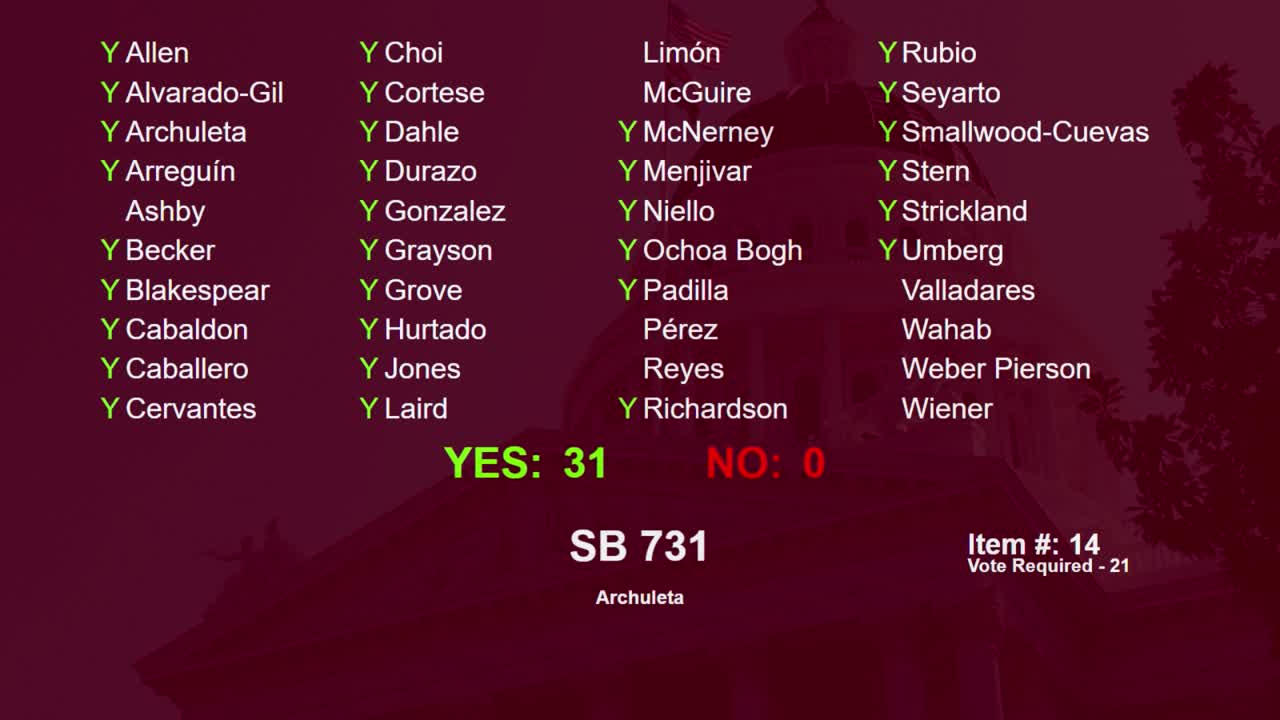 2MIN
Senate Floor
 19MIN
Senate Standing Committee on Energy, Utilities and Communications
Bill Author

Bill Co-Author(s):