SB 68: Major food allergens.
- Session Year: 2025-2026
- House: Senate
- Latest Version Date: 2025-10-13
Current Status:
Passed
(2025-10-13: Chaptered by Secretary of State. Chapter 741, Statutes of 2025.)
Introduced
In Committee
Awaiting First Chamber Vote
Passed First Chamber
In Committee
Awaiting Second Chamber Vote
Passed Second Chamber
Enacted
Existing law, the California Retail Food Code, establishes uniform health and sanitation standards for, and provides for regulation by the State Department of Public Health of, retail food facilities, and requires local health agencies to enforce those provisions. Existing law makes a person who violates a provision of the code guilty of a misdemeanor.
Existing law requires the person in charge of a food facility to have adequate knowledge of major food allergens, as defined, foods identified as major food allergens, and the symptoms that a major food allergen could cause in a sensitive individual who has an allergic reaction and to educate food facility employees regarding those matters. Existing law requires a food handler to obtain a food handler card from a specified training provider after completing a food handler training course and examination that covers, among other things, major food allergens and symptoms of allergic reactions.
This bill would add sesame to the list of major food allergens.
Existing law, the Federal Food, Drug, and Cosmetic Act, requires certain restaurants and similar retail food establishments that are part of a chain with 20 or more locations doing business under the same name and offering for sale substantially the same menu items to disclose nutrient content information, as specified.
This bill, commencing July 1, 2026, would require a food facility that is subject to the federal disclosure provisions for nutrient content information to provide written notification of the major food allergens that the food facility knows or reasonably should know are contained as an ingredient in each menu item, either directly on its menu or in a digital format, as specified. The bill would specify that its provisions requiring a food facility to provide the above-described notifications do not apply to compact mobile food operations or nonpermanent food facilities.
By expanding the scope of existing crimes and by imposing new duties on local health officials, this bill would impose a state-mandated local program.
The California Constitution requires the state to reimburse local agencies and school districts for certain costs mandated by the state. Statutory provisions establish procedures for making that reimbursement.
This bill would provide that with regard to certain mandates no reimbursement is required by this act for a specified reason.
With regard to any other mandates, this bill would provide that, if the Commission on State Mandates determines that the bill contains costs so mandated by the state, reimbursement for those costs shall be made pursuant to the statutory provisions noted above.
Existing law, the California Retail Food Code, establishes uniform health and sanitation standards for, and provides for regulation by the State Department of Public Health of, retail food facilities, and requires local health agencies to enforce those provisions. Existing law makes a person who violates a provision of the code guilty of a misdemeanor.
Existing law requires the person in charge of a food facility to have adequate knowledge of major food allergens, as defined, foods identified as major food allergens, and the symptoms that a major food allergen could cause in a sensitive individual who has an allergic reaction and to educate food facility employees regarding those matters. Existing law requires a food handler to obtain a food handler card from a specified training provider after completing a food handler training course and examination that covers, among other things, major food allergens and symptoms of allergic reactions.
This bill would add sesame to the list of major food allergens. The
Existing law, the Federal Food, Drug, and Cosmetic Act, requires certain restaurants and similar retail food establishments that are part of a chain with 20 or more locations doing business under the same name and offering for sale substantially the same menu items to disclose nutrient content information, as specified.
This bill, commencing July 1, 2026, would require a large chain restaurant or medium chain restaurant, as defined, that serves or sells restaurant-type food to the consumer food facility that is subject to the federal disclosure provisions for nutrient content information to provide written notification of the major food allergens that the large chain restaurant or medium chain restaurant food facility knows or reasonably should know are contained as an ingredient in each menu item, either directly on its menu or in a digital format, as specified. The bill, commencing July 1, 2026, would require a small chain restaurant or independent restaurant, as defined, that serves or sells restaurant-type food to the consumer to provide written notification of major food allergens that the small chain restaurant or independent restaurant knows or reasonably should know are contained as ingredients in each menu item in a manner that is readily available and accessible to its customers. The bill would specify that its provisions requiring a large chain restaurant, medium chain restaurant, small chain restaurant, or independent restaurant food facility to provide the above-described notifications do not apply to compact mobile food operations or nonpermanent food facilities. By
By expanding the scope of existing crimes and by imposing new duties on local health officials, this bill would impose a state-mandated local program.
The California Constitution requires the state to reimburse local agencies and school districts for certain costs mandated by the state. Statutory provisions establish procedures for making that reimbursement.
This bill would provide that with regard to certain mandates no reimbursement is required by this act for a specified reason.
With regard to any other mandates, this bill would provide that, if the Commission on State Mandates determines that the bill contains costs so mandated by the state, reimbursement for those costs shall be made pursuant to the statutory provisions noted above.
Existing law, the California Retail Food Code, establishes uniform health and sanitation standards for, and provides for regulation by the State Department of Public Health of, retail food facilities, and requires local health agencies to enforce those provisions. Existing law makes a person who violates a provision of the code guilty of a misdemeanor.
Existing law requires the person in charge of a food facility to have adequate knowledge of major food allergens, as defined, foods identified as major food allergens, and the symptoms that a major food allergen could cause in a sensitive individual who has an allergic reaction and to educate food facility employees regarding those matters. Existing law requires a food handler to obtain a food handler card from a specified training provider after completing a food handler training course and examination that covers, among other things, major food allergens and symptoms of allergic reactions.
This bill would add sesame to the list of major food allergens. The bill, commencing July 1, 2026, would require a food facility, except as specified, large chain restaurant or medium chain restaurant, as defined, that serves or sells restaurant-type food to the consumer to provide written notification of the major food allergens that the large chain restaurant or medium chain restaurant knows or reasonably should know are contained as an ingredient in each menu item, either directly on the food facilitys its menu or in a digital format, as specified. The bill, commencing July 1, 2026, would require a small chain restaurant or independent restaurant, as defined, that serves or sells restaurant-type food to the consumer to provide written notification of major food allergens that the small chain restaurant or independent restaurant knows or reasonably should know are contained as ingredients in each menu item in a manner that is readily available and accessible to its customers. The bill would specify that its provisions requiring a large chain restaurant, medium chain restaurant, small chain restaurant, or independent restaurant to provide the above-described notifications do not apply to compact mobile food operations or nonpermanent food facilities. By expanding the scope of existing crimes and by imposing new duties on local health officials, this bill would impose a state-mandated local program.
The California Constitution requires the state to reimburse local agencies and school districts for certain costs mandated by the state. Statutory provisions establish procedures for making that reimbursement.
This bill would provide that with regard to certain mandates no reimbursement is required by this act for a specified reason.
With regard to any other mandates, this bill would provide that, if the Commission on State Mandates determines that the bill contains costs so mandated by the state, reimbursement for those costs shall be made pursuant to the statutory provisions noted above.
Existing law, the California Retail Food Code, establishes uniform health and sanitation standards for, and provides for regulation by the State Department of Public Health of, retail food facilities, and requires local health agencies to enforce those provisions. Existing law makes a person who violates a provision of the code guilty of a misdemeanor.
Existing law requires the person in charge of a food facility to have adequate knowledge of major food allergens, as defined, foods identified as major food allergens, and the symptoms that a major food allergen could cause in a sensitive individual who has an allergic reaction and to educate food facility employees regarding those matters. Existing law requires a food handler to obtain a food handler card from a specified training provider after completing a food handler training course and examination that covers, among other things, major food allergens and symptoms of allergic reactions.
This bill would add sesame to the list of major food allergens. The bill, commencing July 1, 2026, would require a food facility facility, except as specified, that serves or sells restaurant-type food to the consumer to include on all of its menus provide written notification of the major food allergens contained as an ingredient in each menu item, as specified. item, either directly on the food facilitys menu or in a digital format, as specified. By expanding the scope of existing crimes and by imposing new duties on local health officials, this bill would impose a state-mandated local program.
The California Constitution requires the state to reimburse local agencies and school districts for certain costs mandated by the state. Statutory provisions establish procedures for making that reimbursement.
This bill would provide that with regard to certain mandates no reimbursement is required by this act for a specified reason.
With regard to any other mandates, this bill would provide that, if the Commission on State Mandates determines that the bill contains costs so mandated by the state, reimbursement for those costs shall be made pursuant to the statutory provisions noted above.
Existing law, the California Retail Food Code, establishes uniform health and sanitation standards for, and provides for regulation by the State Department of Public Health of, retail food facilities, and requires local health agencies to enforce those provisions. Existing law makes a person who violates a provision of the code guilty of a misdemeanor.
Existing law requires the person in charge of a food facility to have adequate knowledge of major food allergens, as defined, foods identified as major food allergens, and the symptoms that a major food allergen could cause in a sensitive individual who has an allergic reaction and to educate food facility employees regarding those matters. Existing law requires a food handler to obtain a food handler card from a specified training provider after completing a food handler training course and examination that covers, among other things, major food allergens and symptoms of allergic reactions.
This bill would add sesame to the list of major food allergens. The bill, commencing July 1, 2026, would require a food facility that serves or sells restaurant-type food to the consumer to include on all of its menus written notification of the major food allergens contained as an ingredient in each menu item, as specified. By expanding the scope of existing crimes and by imposing new duties on local health officials, this bill would impose a state-mandated local program.
The California Constitution requires the state to reimburse local agencies and school districts for certain costs mandated by the state. Statutory provisions establish procedures for making that reimbursement.
This bill would provide that with regard to certain mandates no reimbursement is required by this act for a specified reason.
With regard to any other mandates, this bill would provide that, if the Commission on State Mandates determines that the bill contains costs so mandated by the state, reimbursement for those costs shall be made pursuant to the statutory provisions noted above.
(a)Major food allergen means all of the following:
(1)Milk.
(2)Eggs.
(3)Fish, including, but not limited to, bass, flounder, and cod.
(4)Crustacean shellfish, including, but not limited to, crab, lobster, and shrimp.
(5)Tree nuts, including, but not limited to, almonds, pecans, and walnuts.
(6)Wheat.
(7)Peanuts.
(8)Soybeans.
(9)Sesame.
(10)A food ingredient that contains protein derived from a food listed in paragraphs (1) to (9), inclusive.
(b)Major food allergen does not include either of the following:
(1)A highly refined oil derived from a food specified in paragraphs (1) to (9), inclusive, of subdivision (a) and any ingredient derived from that highly refined oil.
(2)An ingredient that is exempt under the petition or notification process specified in the federal Food Allergen Labeling and Consumer Protection Act of 2004 (Public Law 108-282).
SEC. 2.Section 114093.5 is added to the Health and Safety Code, to read:114093.5.(a)Commencing July 1, 2026, a food facility that is subject to Section 343(q)(5)(H) of Title 21 of the United States Code that serves or sells food to the consumer shall provide written notification of major food allergens that the food facility knows or reasonably should know are contained as ingredients in each menu item. The food facility shall provide this information in either of the following manners:
(1)Directly on the food facilitys menu. If the food facility elects to provide major food allergen information directly on its menu, the menu item shall be followed by a written statement below or immediately adjacent to the menu item indicating the major food allergens contained in the menu item.
(2)(A)In a digital format, including, but not limited to, using a quick response (QR) code that links to the food facilitys digital menu.
(B)If a food facility elects to provide the major food allergen information in a digital format, the food facility shall also use an alternative method to provide the information to customers who are not able to access the information in the digital format. For purposes of this subparagraph, alternative method includes, but is not limited to, any of the following:
(i)A separate allergen-specific menu.
(ii)An allergen chart.
(iii)An allergen grid.
(iv)An allergen booklet.
(v)Other written materials.
(b)A food facility required to provide major food allergen information pursuant to this section shall use either of the following when providing the information:
(1)Common or usual names of the major food allergens.
(2)Standardized pictograms to communicate the presence of major food allergens.
(c)An enforcement agency may utilize either of the following methods to evaluate a food facilitys compliance with this section:
(1)Visual verification of allergen disclosure. An enforcement officer may confirm that required allergen statements are displayed on printed menus, digital menus, or the alternative methods described in subparagraph (B) of paragraph (2) of subdivision (a).
(2)Other reasonable methods of verification consistent with the intent of this section.
(d)For purposes of this section, the following definitions apply:
(1)Major food allergen has the same meaning as defined in Section 113820.5.
(2)Menu has the same meaning as menu or menu board, as defined in Section 101.11 of Title 21 of the Code of Federal Regulations.
(e)This section does not apply to prepackaged foods that are subject to federal labeling requirements for major food allergens pursuant to Section 343 of Title 21 of the United States Code.
(f)This section does not apply to compact mobile food operations, as defined in Section 113831, or nonpermanent food facilities, as defined in Section 113839.
(g)This section does not alter any duty that a food facility may have under existing law to reasonably ensure the safety of its patrons.
SEC. 3.No reimbursement is required by this act pursuant to Section 6 of Article XIIIB of the California Constitution for certain costs that may be incurred by a local agency or school district because, in that regard, this act creates a new crime or infraction, eliminates a crime or infraction, or changes the penalty for a crime or infraction, within the meaning of Section 17556 of the Government Code, or changes the definition of a crime within the meaning of Section 6 of Article XIIIB of the California Constitution.
However, if the Commission on State Mandates determines that this act contains other costs mandated by the state, reimbursement to local agencies and school districts for those costs shall be made pursuant to Part 7 (commencing with Section 17500) of Division 4 of Title 2 of the Government Code.
(a)Major food allergen means all of the following:
(1)Milk.
(2)Eggs.
(3)Fish, including, but not limited to, bass, flounder, and cod.
(4)Crustacean shellfish, including, but not limited to, crab, lobster, and shrimp.
(5)Tree nuts, including, but not limited to, almonds, pecans, and walnuts.
(6)Wheat.
(7)Peanuts.
(8)Soybeans.
(9)Sesame.
(10)A food ingredient that contains protein derived from a food listed in paragraphs (1) to (9), inclusive.
(b)Major food allergen does not include either of the following:
(1)A highly refined oil derived from a food specified in paragraphs (1) to (9), inclusive, of subdivision (a) and any ingredient derived from that highly refined oil.
(2)An ingredient that is exempt under the petition or notification process specified in the federal Food Allergen Labeling and Consumer Protection Act of 2004 (Public Law 108-282).
SEC. 2.Section 114093.5 is added to the Health and Safety Code, to read:114093.5.(a)Commencing July 1, 2026, a large chain restaurant or medium chain restaurant food facility that is subject to Section 343(q)(5)(H) of Title 21 of the United States Code that serves or sells restaurant-type food to the consumer shall provide written notification of major food allergens that the large chain restaurant or medium chain restaurant food facility knows or reasonably should know are contained as ingredients in each menu item. The large chain restaurant or medium chain restaurant food facility shall provide this information in either of the following manners:
(1)Directly on the large chain restaurants or medium chain restaurants food facilitys menu. If the large chain restaurant or medium chain restaurant food facility elects to provide major food allergen information directly on its menu, the menu item shall be followed by a written statement below or immediately adjacent to the menu item indicating the major food allergens contained in the menu item.
(2)(A)In a digital format, including, but not limited to, using a quick response (QR) code that links to the large chain restaurants or medium chain restaurants food facilitys digital menu.
(B)If a large chain restaurant or medium chain restaurant food facility elects to provide the major food allergen information in a digital format, the large chain restaurant or medium chain restaurant food facility shall also use an alternative method to provide the information to customers who are not able to access the information in the digital format. For purposes of this subparagraph, alternative method includes, but is not limited to, any of the following:
(i)A separate allergen-specific menu.
(ii)An allergen chart.
(iii)An allergen grid.
(iv)An allergen booklet.
(v)Other written materials.
(b)Commencing July 1, 2026, a small chain restaurant or independent restaurant that serves or sells restaurant-type food to the consumer shall provide written notification of major food allergens that the small chain restaurant or independent restaurant knows or reasonably should know are contained as ingredients in each menu item in a manner that is readily available and accessible to its customers, including, but not limited to, any of the following means of disclosure:(1)Directly on the small chain restaurants or independent restaurants menu. If the small chain restaurant or independent restaurant elects to provide major food allergen information directly on its menu, the menu item shall be followed by a written statement below or immediately adjacent to the menu item indicating the major food allergens contained in the menu item.(2)In a digital format, including, but not limited to, using a quick response (QR) code that links to the small chain restaurants or independent restaurants digital menu.(3)A separate allergen-specific menu.(4)An allergen chart.(5)An allergen grid.(6)An allergen booklet.(7)Other written materials. (c)(b)A large chain restaurant, medium chain restaurant, small chain restaurant, or independent restaurant food facility required to provide major food allergen information pursuant to this section shall use either of the following when providing the information:
(1)Common or usual names of the major food allergens.
(2)Standardized pictograms to communicate the presence of major food allergens.
(c)An enforcement agency may utilize either of the following methods to evaluate a food facilitys compliance with this section:
(1)Visual verification of allergen disclosure. An enforcement officer may confirm that required allergen statements are displayed on printed menus, digital menus, or the alternative methods described in subparagraph (B) of paragraph (2) of subdivision (a).
(2)Other reasonable methods of verification consistent with the intent of this section.
(d)For purposes of this section, the following definitions apply:
(1)Independent restaurant means a retail food establishment that prepares, serves, and vends food directly to the consumer and has only one location doing business in the state, regardless of the type of ownership of the location.(2)Large chain restaurant means a retail food establishment that prepares, serves, and vends food directly to the consumer and that is part of a chain with 20 or more locations doing business under the same name in the state, regardless of the type of ownership of the locations, and offering for sale substantially the same menu items. (3)(1)Major food allergen has the same meaning as defined in Section 113820.5.
(4)Medium chain restaurant means a retail food establishment that prepares, serves, and vends food directly to the consumer and that is part of a chain with 6 to 19 locations, inclusive, doing business under the same name in the state, regardless of the type of ownership of the locations, and offering for sale substantially the same menu items. (5)(2)Menu has the same meaning as menu or menu board, as defined in Section 101.11 of Title 21 of the Code of Federal Regulations.
(6)Restaurant-type food has the same meaning as defined in Section 101.11 of Title 21 of the Code of Federal Regulations. (7)Small chain restaurant means a retail food establishment that prepares, serves, and vends food directly to the consumer and that is part of a chain with two to five locations, inclusive, doing business under the same name in the state, regardless of the type of ownership of the locations, and offering for sale substantially the same menu items.(e)This section does not apply to prepackaged foods that are subject to federal labeling requirements for major food allergens pursuant to Section 343 of Title 21 of the United States Code.
(f)This section does not apply to compact mobile food operations, as defined in Section 113831, or nonpermanent food facilities, as defined in Section 113839.
(g)This section does not alter any duty that a large chain restaurant, medium chain restaurant, small chain restaurant, or independent restaurant food facility may have under existing law to reasonably ensure the safety of its patrons.
SEC. 3.No reimbursement is required by this act pursuant to Section 6 of Article XIIIB of the California Constitution for certain costs that may be incurred by a local agency or school district because, in that regard, this act creates a new crime or infraction, eliminates a crime or infraction, or changes the penalty for a crime or infraction, within the meaning of Section 17556 of the Government Code, or changes the definition of a crime within the meaning of Section 6 of Article XIIIB of the California Constitution.
However, if the Commission on State Mandates determines that this act contains other costs mandated by the state, reimbursement to local agencies and school districts for those costs shall be made pursuant to Part 7 (commencing with Section 17500) of Division 4 of Title 2 of the Government Code.
(a)Major food allergen means all of the following:
(1)Milk.
(2)Eggs.
(3)Fish, including, but not limited to, bass, flounder, and cod.
(4)Crustacean shellfish, including, but not limited to, crab, lobster, and shrimp.
(5)Tree nuts, including, but not limited to, almonds, pecans, and walnuts.
(6)Wheat.
(7)Peanuts.
(8)Soybeans.
(9)Sesame.
(10)A food ingredient that contains protein derived from a food listed in paragraphs (1) to (9), inclusive.
(b)Major food allergen does not include either of the following:
(1)A highly refined oil derived from a food specified in paragraphs (1) to (9), inclusive, of subdivision (a) and any ingredient derived from that highly refined oil.
(2)An ingredient that is exempt under the petition or notification process specified in the federal Food Allergen Labeling and Consumer Protection Act of 2004 (Public Law 108-282).
SEC. 2.Section 114093.5 is added to the Health and Safety Code, to read:114093.5.(a)Commencing July 1, 2026, a food facility large chain restaurant or medium chain restaurant that serves or sells restaurant-type food to the consumer shall provide written notification of major food allergens that the large chain restaurant or medium chain restaurant knows or reasonably should know are contained as an ingredient ingredients in each menu item. The food facility large chain restaurant or medium chain restaurant shall provide this information in either of the following manners:
(1)Directly on the food facilitys large chain restaurants or medium chain restaurants menu. If the food facility large chain restaurant or medium chain restaurant elects to provide major food allergen information directly on its menu, the menu item shall be followed by a written statement below or immediately adjacent to the menu item indicating the major food allergens contained in the menu item.
(2)(A)In a digital format, including, but not limited to, using a quick response (QR) code that links to the food facilitys large chain restaurants or medium chain restaurants digital menu.
(B)If a food facility large chain restaurant or medium chain restaurant elects to provide the major food allergen information in a digital format, the food facility large chain restaurant or medium chain restaurant shall also use an alternative method to provide the information to customers who are not able to access the information in the digital format. For purposes of this subparagraph, alternative method includes, but is not limited to, any of the following:
(i)A separate allergen-specific menu.
(ii)An allergen chart.
(iii)An allergen grid.
(iv)An allergen booklet.
(v)Other written materials.
(b)Commencing July 1, 2026, a small chain restaurant or independent restaurant that serves or sells restaurant-type food to the consumer shall provide written notification of major food allergens that the small chain restaurant or independent restaurant knows or reasonably should know are contained as ingredients in each menu item in a manner that is readily available and accessible to its customers, including, but not limited to, any of the following means of disclosure:
(1)Directly on the small chain restaurants or independent restaurants menu. If the small chain restaurant or independent restaurant elects to provide major food allergen information directly on its menu, the menu item shall be followed by a written statement below or immediately adjacent to the menu item indicating the major food allergens contained in the menu item.
(2)In a digital format, including, but not limited to, using a quick response (QR) code that links to the small chain restaurants or independent restaurants digital menu.
(3)A separate allergen-specific menu.
(4)An allergen chart.
(5)An allergen grid.
(6)An allergen booklet.
(7)Other written materials.
(b)(c)A food facility large chain restaurant, medium chain restaurant, small chain restaurant, or independent restaurant required to provide major food allergen information pursuant to this section shall use either of the following when providing the information:
(1)Common or usual names of the major food allergens.
(2)Standardized pictograms to communicate the presence of major food allergens.
(c)(d)For purposes of this section, the following definitions apply:
(1)Independent restaurant means a retail food establishment that prepares, serves, and vends food directly to the consumer and has only one location doing business in the state, regardless of the type of ownership of the location.
(2)Large chain restaurant means a retail food establishment that prepares, serves, and vends food directly to the consumer and that is part of a chain with 20 or more locations doing business under the same name in the state, regardless of the type of ownership of the locations, and offering for sale substantially the same menu items.
(1)(3)Major food allergen has the same meaning as defined in Section 113820.5.
(4)Medium chain restaurant means a retail food establishment that prepares, serves, and vends food directly to the consumer and that is part of a chain with 6 to 19 locations, inclusive, doing business under the same name in the state, regardless of the type of ownership of the locations, and offering for sale substantially the same menu items.
(2)(5)Menu has the same meaning as menu or menu board, as defined in Section 101.11 of Title 21 of the Code of Federal Regulations.
(3)(6)Restaurant-type food has the same meaning as defined in Section 101.11 of Title 21 of the Code of Federal Regulations.
(7)Small chain restaurant means a retail food establishment that prepares, serves, and vends food directly to the consumer and that is part of a chain with two to five locations, inclusive, doing business under the same name in the state, regardless of the type of ownership of the locations, and offering for sale substantially the same menu items.
(d)(e)This section does not apply to prepackaged foods that are subject to federal labeling requirements for major food allergens pursuant to Section 343 of Title 21 of the United States Code.
(e)(f)This section does not apply to compact mobile food operations, as defined in Section 113831. 113831, or nonpermanent food facilities, as defined in Section 113839.
(g)This section does not alter any duty that a large chain restaurant, medium chain restaurant, small chain restaurant, or independent restaurant may have under existing law to reasonably ensure the safety of its patrons.
SEC. 3.No reimbursement is required by this act pursuant to Section 6 of Article XIIIB of the California Constitution for certain costs that may be incurred by a local agency or school district because, in that regard, this act creates a new crime or infraction, eliminates a crime or infraction, or changes the penalty for a crime or infraction, within the meaning of Section 17556 of the Government Code, or changes the definition of a crime within the meaning of Section 6 of Article XIIIB of the California Constitution.
However, if the Commission on State Mandates determines that this act contains other costs mandated by the state, reimbursement to local agencies and school districts for those costs shall be made pursuant to Part 7 (commencing with Section 17500) of Division 4 of Title 2 of the Government Code.
(a)Major food allergen means all of the following:
(1)Milk.
(2)Eggs.
(3)Fish, including, but not limited to, bass, flounder, and cod.
(4)Crustacean shellfish, including, but not limited to, crab, lobster, and shrimp.
(5)Tree nuts, including, but not limited to, almonds, pecans, and walnuts.
(6)Wheat.
(7)Peanuts.
(8)Soybeans.
(9)Sesame.
(10)A food ingredient that contains protein derived from a food listed in paragraphs (1) to (9), inclusive.
(b)Major food allergen does not include either of the following:
(1)A highly refined oil derived from a food specified in paragraphs (1) to (9), inclusive, of subdivision (a) and any ingredient derived from that highly refined oil.
(2)An ingredient that is exempt under the petition or notification process specified in the federal Food Allergen Labeling and Consumer Protection Act of 2004 (Public Law 108-282).
SEC. 2.Section 114093.5 is added to the Health and Safety Code, to read:114093.5.(a)Commencing July 1, 2026, a food facility that serves or sells restaurant-type food to the consumer shall include on all of its menus provide written notification of major food allergens contained as an ingredient in each menu item in accordance with both of the following requirements: item. The food facility shall provide this information in either of the following manners:
(1)If one or more major food allergens are contained in a menu item, Directly on the food facilitys menu. If the food facility elects to provide major food allergen information directly on its menu, the menu item shall be followed by a written statement below or immediately adjacent to the menu item indicating the major food allergens contained in the menu item.
(2)Written statements required by paragraph (1) shall use common or usual names of the major food allergens.(2)(A)In a digital format, including, but not limited to, using a quick response (QR) code that links to the food facilitys digital menu.
(B)If a food facility elects to provide the major food allergen information in a digital format, the food facility shall also use an alternative method to provide the information to customers who are not able to access the information in the digital format. For purposes of this subparagraph, alternative method includes, but is not limited to, any of the following:
(i)A separate allergen-specific menu.
(ii)An allergen chart.
(iii)An allergen grid.
(iv)An allergen booklet.
(v)Other written materials.
(b)A food facility required to provide major food allergen information pursuant to this section shall use either of the following when providing the information:
(1)Common or usual names of the major food allergens.
(2)Standardized pictograms to communicate the presence of major food allergens.
(b)(c)For purposes of this section, the following definitions apply:
(1)Major food allergen has the same meaning as defined in Section 113820.5.
(2)Menu has the same meaning as menu or menu board, as defined in Section 101.11 of Title 21 of the Code of Federal Regulations.
(3)Restaurant-type food has the same meaning as defined in Section 101.11 of Title 21 of the Code of Federal Regulations.
(c)(d)This section does not apply to prepackaged foods that are subject to federal labeling requirements for major food allergens pursuant to Section 343 of Title 21 of the United States Code.
(e)This section does not apply to compact mobile food operations, as defined in Section 113831.
SEC. 3.No reimbursement is required by this act pursuant to Section 6 of Article XIIIB of the California Constitution for certain costs that may be incurred by a local agency or school district because, in that regard, this act creates a new crime or infraction, eliminates a crime or infraction, or changes the penalty for a crime or infraction, within the meaning of Section 17556 of the Government Code, or changes the definition of a crime within the meaning of Section 6 of Article XIIIB of the California Constitution.
However, if the Commission on State Mandates determines that this act contains other costs mandated by the state, reimbursement to local agencies and school districts for those costs shall be made pursuant to Part 7 (commencing with Section 17500) of Division 4 of Title 2 of the Government Code.
(a)Major food allergen means all of the following:
(1)Milk.
(2)Eggs.
(3)Fish, including, but not limited to, bass, flounder, and cod.
(4)Crustacean shellfish, including, but not limited to, crab, lobster, and shrimp.
(5)Tree nuts, including, but not limited to, almonds, pecans, and walnuts.
(6)Wheat.
(7)Peanuts.
(8)Soybeans.
(9)Sesame.
(9)(10)A food ingredient that contains protein derived from a food listed in paragraphs (1) to (8), (9), inclusive.
(b)Major food allergen does not include either of the following:
(1)A highly refined oil derived from a food specified in paragraphs (1) to (8), (9), inclusive, of subdivision (a) and any ingredient derived from that highly refined oil.
(2)An ingredient that is exempt under the petition or notification process specified in the federal Food Allergen Labeling and Consumer Protection Act of 2004 (Public Law 108-282).
SEC. 2.Section 114093.5 is added to the Health and Safety Code, to read:114093.5.(a)Commencing July 1, 2026, a food facility that serves or sells restaurant-type food to the consumer shall include on all of its menus written notification of major food allergens contained as an ingredient in each menu item in accordance with both of the following requirements:
(1)If one or more major food allergens are contained in a menu item, the menu item shall be followed by a written statement below the menu item indicating the major food allergens contained in the menu item.
(2)Written statements required by paragraph (1) shall use common or usual names of the major food allergens.
(b)For purposes of this section, the following definitions apply:
(1)Major food allergen has the same meaning as defined in Section 113820.5.
(2)Menu has the same meaning as menu or menu board, as defined in Section 101.11 of Title 21 of the Code of Federal Regulations.
(3)Restaurant-type food has the same meaning as defined in Section 101.11 of Title 21 of the Code of Federal Regulations.
(c)This section does not apply to prepackaged foods that are subject to federal labeling requirements for major food allergens pursuant to Section 343 of Title 21 of the United States Code.
SEC. 3.No reimbursement is required by this act pursuant to Section 6 of Article XIIIB of the California Constitution for certain costs that may be incurred by a local agency or school district because, in that regard, this act creates a new crime or infraction, eliminates a crime or infraction, or changes the penalty for a crime or infraction, within the meaning of Section 17556 of the Government Code, or changes the definition of a crime within the meaning of Section 6 of Article XIIIB of the California Constitution.
However, if the Commission on State Mandates determines that this act contains other costs mandated by the state, reimbursement to local agencies and school districts for those costs shall be made pursuant to Part 7 (commencing with Section 17500) of Division 4 of Title 2 of the Government Code.
|
Date
|
Status
|
|---|---|
| Oct 13, 2025 | Chaptered by Secretary of State. Chapter 741, Statutes of 2025. |
| Oct 13, 2025 | Approved by the Governor. |
| Sep 16, 2025 | Enrolled and presented to the Governor at 3 p.m. |
| Sep 9, 2025 | Assembly amendments concurred in. (Ayes 39. Noes 0. Page 2709.) Ordered to engrossing and enrolling. |
| Sep 8, 2025 | In Senate. Concurrence in Assembly amendments pending. |
| Sep 8, 2025 | Read third time. Passed. (Ayes 66. Noes 1. Page 2982.) Ordered to the Senate. |
| Sep 4, 2025 | Read third time and amended. |
| Sep 4, 2025 | Ordered to third reading. |
| Aug 21, 2025 | Read second time. Ordered to third reading. |
| Aug 20, 2025 | From committee: Do pass. (Ayes 11. Noes 2.) (August 20). |
| Jul 10, 2025 | Read second time and amended. Re-referred to Com. on APPR. |
| Jul 9, 2025 | From committee: Do pass as amended and re-refer to Com. on APPR. (Ayes 14. Noes 1.) (July 8). |
| Jul 1, 2025 | July 1 hearing postponed by committee. |
| Jun 5, 2025 | Referred to Com. on HEALTH. |
| May 28, 2025 | In Assembly. Read first time. Held at Desk. |
| May 28, 2025 | Read third time. Passed. (Ayes 32. Noes 0. Page 1281.) Ordered to the Assembly. |
| May 27, 2025 | Read second time. Ordered to third reading. |
| May 23, 2025 | Read second time and amended. Ordered to second reading. |
| May 23, 2025 | From committee: Do pass as amended. (Ayes 5. Noes 0. Page 1190.) (May 23). |
| May 16, 2025 | Set for hearing May 23. |
| Apr 28, 2025 | April 28 hearing: Placed on APPR. suspense file. |
| Apr 17, 2025 | Set for hearing April 28. |
| Apr 10, 2025 | From committee: Do pass and re-refer to Com. on APPR. (Ayes 11. Noes 0. Page 736.) (April 9). Re-referred to Com. on APPR. |
| Mar 26, 2025 | Set for hearing April 9. |
| Jan 29, 2025 | Referred to Com. on HEALTH. |
| Jan 14, 2025 | From printer. May be acted upon on or after February 13. |
| Jan 13, 2025 | Introduced. Read first time. To Com. on RLS. for assignment. To print. |
|
Date
|
Description
|
Location
|
Votes
|
|
|---|---|---|---|---|
| Sep 9, 2025 | Unfinished Business SB68 Menjivar Concurrence | Senate Floor |
Passed |
|
| Sep 8, 2025 | SB 68 Menjivar Senate Third Reading By Elhawary | Assembly Floor |
Passed |
|
| Aug 20, 2025 | Do pass. | Assembly Standing Committee on Appropriations |
Passed |
|
| Jul 8, 2025 | Do pass as amended and be re-referred to the Committee on [Appropriations] | Assembly Standing Committee on Health |
Passed |
|
| May 28, 2025 | Senate 3rd Reading SB68 Menjivar | Senate Floor |
Passed |
|
| May 23, 2025 | Do pass as amended | Senate Standing Committee on Appropriations |
Passed |
|
| Apr 28, 2025 | Placed on suspense file | Senate Standing Committee on Appropriations |
Passed |
|
| Apr 9, 2025 | Do pass, but first be re-referred to the Committee on [Appropriations] | Senate Standing Committee on Health |
Passed |
This list shows positions taken on this bill by organizations on the date displayed, which is linked to the original source.
Positions by individuals are not included.
|
Organization
|
Position
|
Date
|
|---|---|---|
| A Voice for Choice Advocacy | ** Support | |
| Accreditation Council for Continuing Medical Education | ** Support | |
| Addie Lao | ** Support | |
| Advocacy Council of the American College of Allergy, Asthma and Immunology | ** Support | |
| Allergic Living | ** Support | |
| Allergy & Asthma Network | ** Support | |
| AllergyStrong | ** Support | |
| American Academy Of Pediatrics, California | ** Support | |
| American College of Allergy, Asthma, & Immunology | ** Support | |
| American Nurses Association/California | ** Support | |
| Asthma and Allergy Foundation (AAF) | ** Support | |
| Asthma and Allergy Foundation of America | ** Support | |
| Atomic Workshop Group | ** Against | |
| Ben's Allergy and Restaurant Reviews | ** Support | |
| Ben’s Allergy & Restaurant Reviews | ** Support | |
| Black Women For Wellness Action Project | ** Support | |
| California Academy of Nutrition and Dietetics | ** Support | |
| California Association for Nurse Practitioners | ** Support | |
| California Association of Physician Associates | ** Support | |
| California ChildrenS Hospital Association | ** Support | |
| California Medical Association | ** Support | |
| California Restaurant Association | ** Against | |
| California Society for Allergy, Asthma and Immunology | ** Support | |
| California State PTA | ** Support | |
| Campaign Urging Research for Eosinophilic Disease | ** Support | |
| Center for Food Allergy & Asthma Research | ** Support | |
| Center for Science in the Public Interest | ** Support | |
| CertiStar | ** Support | |
| cleanearth4kids.org | ** Support | |
| Cured | ** Support | |
| Elijah-alavi Foundation | ** Support | |
| Events Management | ** Against | |
| Food Allergy & Anaphylaxis Connection Team | ** Support | |
| Food Allergy Nurses Association | ** Support | |
| Food Allergy Nursing Association | ** Support | |
| Food Allergy Psychologist, Don't Feed the Fear Podcast | ** Support | |
| Food Allergy Research Education | ** Support | |
| Food Allergy Support Team of the East Bay | ** Support | |
| Food is Good | ** Support | |
| Food Is Good, Inc. | ** Support | |
| Foodini | ** Support | |
| Golden Gate Restaurant Association | ** Against | |
| Green Policy Initiative | ** Support | |
| Harborview Restaurant & Bar | ** Against | |
| Lauren’s Hope Medical ID | ** Support | |
| Lauren’s Hope Medical ID Jewelry | ** Support | |
| Living Allergic | ** Support | |
| McCalls Catering and Events | ** Against | |
| Mei Hua Collective | ** Against | |
| Mei Hua Collective Inc. | ** Against | |
| MenuTrinfo | ** Support | |
| Menutrinfo, LLC | ** Support | |
| Napnap California | ** Support | |
| Natalie Giorgi Sunshine Foundation | ** Support | |
| National Action Network | ** Support | |
| National Association of Pediatric Nurse Practitioners, California | ** Support | |
| National Association Of Social Workers, California Chapter | ** Support | |
| National Celiac Association | ** Support | |
| No Nut Traveler | ** Support | |
| No Nut Traveler INC | ** Support | |
| Numerous individuals | ** Support | |
| Perbacco | ** Against | |
| Portco, Inc. DBA Cioppino’s on the Wharf Restaurant | ** Against | |
| Rady ChildrenS Hospital | ** Support | |
| Red Sneakers for Oakley | ** Support | |
| Robyn Huey Lao | ** Support | |
| Robyn Huey Lao and Addie Lao | ** Support | |
| Several individuals | ** Support | |
| Sierra Sacramento Valley Medical Society | ** Support | |
| Snack Safely | ** Support | |
| SnackSafely.com | ** Support | |
| Stanford Medicine Children's Health | ** Support | |
| The Boardroom | ** Against | |
| The Chieftan Irish Pub & Restaurant | ** Against | |
| The FPIES Foundation | ** Support | |
| The Greater Los Angeles Hospitality Association | ** Against | |
| Thrive! Meetings & Events | ** Support | |
| Tiger and Crane LLC | ** Against | |
| Translational Pulmonary and Immunology Research Center | ** Support | |
| Vitality Bowls | ** Support | |
| Western Fairs Association | ** Against |
SENATE RULES COMMITTEE Office of Senate Floor Analyses (916) 651-1520 Fax: (916) 327-4478 | SB 68 |
UNFINISHED BUSINESS
Bill No: SB 68
Author: Menjivar (D)
Amended: 9/4/25
Vote: 21
SENATE HEALTH COMMITTEE: 11-0, 4/9/25
AYES: Menjivar, Valladares, Durazo, Gonzalez, Grove, Limón, Padilla, Richardson, Rubio, Weber Pierson, Wiener
SENATE APPROPRIATIONS COMMITTEE: 5-0, 5/23/25
AYES: Caballero, Cabaldon, Grayson, Richardson, Wahab
NO VOTE RECORDED: Seyarto, Dahle
SENATE FLOOR: 32-0, 5/28/25
AYES: Allen, Alvarado-Gil, Archuleta, Arreguín, Ashby, Becker, Blakespear, Cabaldon, Caballero, Cortese, Durazo, Gonzalez, Grayson, Grove, Hurtado, Laird, McGuire, McNerney, Menjivar, Niello, Padilla, Pérez, Richardson, Rubio, Seyarto, Smallwood-Cuevas, Stern, Umberg, Valladares, Wahab, Weber Pierson, Wiener
NO VOTE RECORDED: Cervantes, Choi, Dahle, Jones, Limón, Ochoa Bogh, Reyes, Strickland
ASSEMBLY FLOOR: 66-1, 9/8/25 - See last page for vote
SUBJECT: Major food allergens
SOURCE: Asthma and Allergy Foundation of America
Robyn Huey Lao and Addie Lao
DIGEST:
This bill requires a chain restaurant with 20 or more locations to provide written notification of major food allergens contained as an ingredient in each menu item.
Assembly Amendments
limit the requirements in this bill to chain restaurants with 20 or more locations, and clarifies that it requires allergen disclosure when the restaurant knows or reasonably should know that the menu item contains allergen ingredients.
ANALYSIS:
Existing federal law:
- Requires the label of packaged food that contains a major food allergen to include the word “Contains” followed by the name of the food source from which the major allergen is derived, printed immediately after or is adjacent to the list of ingredients, in a type size no smaller than the type size used in the list of ingredients. [21 United States Code (USC) §343]
- Defines “major food allergen,” for purposes of federal packaged food labeling requirements, as meaning milk, egg, fish, crustacean shellfish, tree nuts, wheat, peanuts, soybeans, and sesame; and, a food ingredient that contains protein derived from one of the these listed foods, except for any highly refined oil derived from one of these listed foods. [21 USC §321(qq)]
- Defines “menu or menu board,” for purposes of federal requirements regarding nutrition labeling of standard menu items in chain restaurants, as the primary writing of the restaurant from which a customer makes an order selection, including, but not limited to, breakfast, lunch, and dinner menus; dessert menus; beverage menus; children’s menus; other specialty menus; electronic menus; and menus on the Internet. The menus may be in different forms, e.g., booklets, pamphlets, or single sheets of paper. Menu boards include those inside a restaurant as well as drive-through menu boards at covered establishments. [21Code of Federal Regulations (CFR) §101.11(a)]
Existing state law:
- Establishes the California Retail Food Code (CalCode) to provide for the regulation of retail food facilities. Health and sanitation standards are established at the state level through the CalCode, while enforcement is charged to local agencies, carried out by the 58 county environmental health departments, and four city environmental health departments (Berkeley, Long Beach, Pasadena, and Vernon). [Health and Safety Code (HSC) §113700, et seq.]
- Establishes misdemeanor penalties for violations of the CalCode, with a fine of up to $1,000, or up to six months in the county jail, or both, unless otherwise specified. Permits a permit to be suspended or revoked by a local enforcement officer for violations, under a specified process that includes the ability for a permit holder to request a hearing. [HSC §114395 and §114405]
- Defines a “food facility” as an operation that stores, prepares, packages, serves, vends, or otherwise provides food for human consumption at the retail level. Excludes various entities from the definition of a “food facility,” including a cottage food operation, and a church, private club, or other nonprofit association that gives or sells food to its members and guests, and not to the general public, at an event that occurs no more than three days in any 90-day period. [HSC §113789]
- Defines “major food allergen” as all of the following: milk, eggs, fish, crustacean shellfish, tree nuts, wheat, peanuts, soybeans, or a food ingredient that contains protein derived from one of these foods. [HSC §113820.5]
- Requires a food facility to designate a “person in charge” and requires a person in charge to be present at the food facility during all hours of operation. Among other responsibilities, the person in charge is required to have adequate knowledge of major food allergens, foods identified as major food allergens, and the symptoms that a major food allergen could cause in a sensitive individual who has an allergic reaction. Requires the person in charge to educate the employees at the food facility regarding food allergens, which the person in charge is permitted to accomplish by using a poster or job aid to which the employee can refer. [HSC §113947]
- Defines “food handler” as an individual who is involved in the preparation, storage, or service of food in a food facility. [HSC §113790]
- Requires all food handlers to obtain a “food handler card” within 30 days from the date of hire, and to maintain a valid food handler card for the duration of employment. Requires the food handler course to provide basic, introductory instructions on specified elements of knowledge, including foodborne illness, the relationship between personal hygiene and food safety, methods of preventing food contamination, and procedures for cleaning and sanitizing equipment. Additionally, requires the course to contain elements of knowledge regarding major food allergens and the symptoms they could cause in an individual who has an allergic reaction, and safe handling practices for major food allergens, including training on the avoidance of cross-contamination. [HSC §113948]
- Requires food facilities to have at least one person who has successfully passed an approved and accredited food safety certification examination, but does not require this person to be present at the food facility during all hours of operation. Specifies the requirements for the food safety certification examination, which, in addition to a more detailed version of all of the elements of knowledge for the food handler card specified in 6) above, is required to include problems and potential solutions associated with facility and equipment design, and describing foods identified as major food allergens and the symptoms that a major food allergen could cause in a sensitive individual. [HSC §113947.1 and §113947.2]
- Requires a food facility, as defined in federal law as a chain restaurant with 20 or more locations, to comply with federal menu labeling requirements that provide calorie and other nutritional information. Provides for local enforcement of the menu labeling requirement, and provides for a fine of between $50 and $500 for a first violation, between $100 and $1,000 for a second violation in a five-year period, and a fine of between $250 and $2,500 for subsequent violations. [HSC §114094]
This bill:
- Requires, beginning on July 1, 2026, a food facility that is part of a chain with 20 or more locations doing business under the same name and offering for sale substantially the same menu items to provide written notification of major food allergens that the food facility knows or reasonably should know are contained as an ingredient in each menu item in either of the following manners:
- Directly on the food facility’s menu, by following each menu item with a written statement below or immediately adjacent to the menu item indicating the major food allergens contained in the menu item; or
- In a digital format, including, but not limited to, using a quick response (QR) code that links to the food facility’s digital menu.
- Requires a food facility, if it elects to provide the major food allergen information in a digital format, to also use an alternative method to provide the information to customers who are not able to access the information in the digital format. Specifies that “alternative method” includes, but is not limited to, any of the following:
- A separate allergen-specific menu;
- An allergen chart;
- An allergen grid;
- An allergen booklet; or,
- Other written materials.
- Requires a food facility, when providing allergen information pursuant to this bill, to use either the common or usual names of the major food allergens, or standardized pictograms to communicate the presence of major food allergens.
- Permits an enforcement agency to utilize either of the following methods to evaluate a food facility’s compliance with this bill: a visual verification of allergen disclosure, as specified, or other reasonable methods of verification consistent with the intent of this bill.
- Defines “menu” as having the same meaning as that term is defined in federal regulations pertaining to chain restaurant nutrition labeling requirements (see existing federal law above).
- Excludes prepackaged foods that are subject to federal labeling requirements for major food allergens from the provisions of this bill.
- Exempts compact mobile food operations, as defined, from the provisions of this bill.
- Revises the definition of “major food allergen,” for purposes of the CalCode, to add sesame to the list of major food allergens.
Comments
According to the author of this bill:
Even though eating at restaurants poses a risk of allergic reactions for people with food allergies, there exists an inadequate and/or inconsistent labeling of allergens in foods. Currently, restaurants are not required to label significant food allergens on their menus, even though they do need to be aware of the symptoms that a significant food allergen could cause in a sensitive individual who has an allergic reaction and to educate food facility employees regarding those matters. Frankly, that is not enough, considering that the Centers for Disease Control and Prevention (CDC) has found that half of all fatal allergic reactions occur from restaurant food, and 75% of allergic reactions occur at restaurants. As someone who is allergic to several food groups, I have been sent to the emergency room twice after eating food at a restaurant that was not properly labeled. In 2014, the European Union mandated that all restaurants would be required to label 14 allergens in restaurants. We can follow suit and create a win-win solution for the food allergy community and restaurants by making it safer to consume meals. This bill would mandate universal allergen disclosures for the nine federally recognized allergens such as milk, eggs, fish, shellfish, tree nuts, peanuts, wheat, sesame, and soybeans on all restaurant menus. This bill will ensure that all adults and children are able to enjoy a meal comfortably without the fear that consuming this meal would lead to a severe or tragic experience.
Background
Background on food allergies. According to the National Institute of Allergy and Infectious Diseases (NIAID), food allergies develop when a person comes in contact with their allergen, and the immune system makes an antibody called immunoglobulin E, or IgE. The initial exposure does not cause an allergic reaction, however subsequent contact with the same allergen may allow previously created IgE antibodies to recognize it, which launches an immune response that can result in a severe allergic reaction. Investigators have discovered those who already have a food allergy or other allergic diseases are more likely to develop food allergies. Young children are also more likely to develop food allergies compared with older children or adults. Genetics are also likely to play a role, with people who come from a family in which allergic diseases are common, such as food allergies, eczema, hay fever, or asthma, are more likely to develop food allergies. According to a 2019 study in the Journal of the American Medical Association, entitled “Prevalence and Severity of Food Allergies Among US Adults,” in a population-based survey study of 40,443 U.S. adults, an estimated 10.8% of these adults were food allergic at the time of the survey (nearly 19% believed that they were food allergic). Nearly half of food-allergic adults had at least one adult-onset food allergy, and 38% reported at least one food allergy-related emergency department visit in their lifetime. The findings suggested that food allergies are common and severe among U.S. adults, often starting in adulthood. The CDC estimates that 5.8% of children have a food allergy.
According to NIAID, allergic reactions to foods can range from mild gastrointestinal symptoms or skin rashes to severe reactions that can be fatal to children and adults with food allergy. The most severe reaction, anaphylaxis, can lead to respiratory problems, a dangerous drop in blood pressure, and other symptoms. Swelling of the airways can make it difficult or impossible for a person to breathe and low blood pressure reduces the amount of blood going to vital organs, resulting in a life-threatening medical emergency. In order to avoid these episodes, people with food allergy must be vigilant about the foods they eat and the environments they enter, and this is not always easy because sometimes allergens are present in foods one would not normally associate with them, such as peanut in the coating of a fruit-flavored jelly bean. Allergens can also cross-contaminate foods or objects an allergic person may eat or touch. Precautions such as thoroughly reading food labels, calling ahead to restaurants, or avoiding prepared foods at social events can be isolating, exhausting, and expensive for those affected.
Nutrition information on menus of chain restaurants. SB 1420 (Padilla, Chapter 600, Statutes of 2008) required every food facility, which is part of a chain of at least 20 with the same name that sell substantially the same menu items, to disclose to consumers specified nutritional information, including the calorie content, for all standard menu items. Subsequently, as part of the Patient Protection and Affordable Care Act of 2010 (ACA), the federal government enacted a similar requirement. Following the enactment of the ACA, the state menu labeling law was repealed (contingent on enactment of the federal implementing regulations) in order to have California conform to the very similar federal requirements. However, local enforcement was retained, with state-specific penalties for violations of the menu labeling requirements, as described in existing law 8) above. Under the federal regulations, chain restaurants must disclose the number of calories contained in standard items on menus and menu boards. For self-service foods and foods on display, the calories must be listed in close proximity and clearly associated with the standard menu item. The restaurants must also provide, upon request, the following written information for standard menu items: total calories; total fat; saturated fat; trans-fat; cholesterol; sodium; total carbohydrates; sugars; fiber; and protein. In addition, two statements must be displayed – one indicating this written information is available upon request, and the other about daily calorie intake, indicating that 2,000 calories a day is used for general nutrition advice, but calorie needs may vary.
Europe requires allergen disclosure in restaurants. The European Union enacted a regulation that has been in effect since 2014 that, among other provisions, requires mandatory allergen information for non-prepackaged food, including in restaurants. The regulation lists 14 allergens that are required to be disclosed in Europe, and include the following ingredients, which are not among the major allergens required to be disclosed on packaged food labels in the U.S.: celery, mustard, sesame seeds, and sulphur dioxide. While the European Union regulations require the 14 allergens to be disclosed at restaurants, the regulations permit member countries to adopt national measures concerning the means through which the allergen information is to be made available and their form of expression and presentation. In the absence of national measures, the regulations require the information about allergens to be easily visible, clearly legible, and, where appropriate, provided in written form. The regulations do not permit restaurants to comply with this requirement simply by providing allergen information only upon the request of the consumer.
The United Kingdom has adopted best practices for restaurants and other food businesses that serve non-prepackaged food to comply with the European Union requirements. These best practices specify that food businesses should make allergen information easily available in writing for consumers and ensure staff are able to support this with a conversation. Written allergen information should be readily available, if possible, without consumers having to ask for it, such as on the main menu (paper or digital), allergen booklet on a counter, or matrix displayed on a wall in a consumer accessible area. If the information is not on the main menu, food businesses should let consumers know where allergen information can be found with a clear message on the menu. Food businesses who do not use a menu should display this message where they display their food options such as on a board or next to food in a counter.
National model food code updated in 2022 to recommend written allergen disclosure. The federal Food and Drug Administration (FDA) publishes the Food Code, which is a model food law that assists food control jurisdictions at all levels of government by providing them with a scientifically sound technical and legal basis for regulating the retail and food service segment of the industry. Local, state, tribal, and federal regulators use the FDA Food Code as a model to develop or update their own food safety rules and to be consistent with national food regulatory policy. It is updated on a four-year interval, and in the most recent edition (2022 Food Code), language was added that recommended requiring permit holders to “notify consumers by written notification of the presence of major food allergens as an ingredient in unpackaged food items that are served or sold to the consumer.”
FISCAL EFFECT: Appropriation: No Fiscal Com.: Yes Local: Yes
According to the Assembly Appropriations Committee, CDPH estimates minor and absorbable costs to conduct initial training and create and post on its website a Frequently Asked Questions document, which DPH can complete with existing resources. The California Association of Environmental Health Administrators (CAEHA) states local governments will need to update inspection forms, brief staff on the new law, and monitor the presence or absence of the required allergy labeling, with minor cost impacts on local governments. CAEHA states local jurisdictions do not seek state reimbursement for updating forms and local training
SUPPORT: (Verified 9/8/25)
Asthma and Allergy Foundation of America (co-source)
Robyn Huey Lao and Addie Lao (co-source)
A Voice for Choice Advocacy
Allergic Living
AllergyStrong
Accreditation Council for Continuing Medical Education
Advocacy Council of the American College of Allergy, Asthma and Immunology
Allergy & Asthma Network
American Academy of Pediatrics, California
American College of Allergy, Asthma, & Immunology
American Nurses Association\California
Ben’s Allergy & Restaurant Reviews
Black Women for Wellness Action Project
California Academy of Nutrition and Dietetics
California Association for Nurse Practitioners
California Association of Physician Associates
California Children’s Hospital Association
California Medical Association
California Society for Allergy, Asthma, and Immunology
California State PTA
Campaign Urging Research for Eosinophilic Disease
Center for Food Allergy & Asthma Research
Center for Science in the Public Interest
CertiStar
CleanEarth4Kids.org
CURED
Elijah-Alavi Foundation
Food Allergy & Anaphylaxis Connection Team
Food Allergy Nursing Association
Food Allergy Research & Education
Food Allergy Support Team of the East Bay
Food is Good
Foodini
Green Policy Initiative
Lauren’s Hope Medical ID
Living Allergic
MenuTrinfo
Natalie Giorgi Sunshine Foundation
National Action Network
National Association of Pediatric Nurse Practitioners, California
National Association of Social Workers, California Chapter
National Celiac Association
No Nut Traveler
Rady Children’s Hospital
Red Sneakers for Oakley
Sierra Sacramento Valley Medical Society
SnackSafely.com
Stanford Medicine Children’s Health
The FPIES Foundation
Thrive! Meetings & Events
Translational Pulmonary and Immunology Research Center
Vitality Bowls
70 individuals
OPPOSITION: (Verified 9/8/25)
Atomic Workshop Group
California Restaurant Association
Golden Gate Restaurant Association
Harborview Restaurant & Bar
Mei Hua Collective
McCalls Catering and Events
Perbacco
Portco, Inc. DBA Cioppino’s on the Wharf Restaurant
The Chieftan Irish Pub & Restaurant
The Greater Los Angeles Hospitality Association
Western Fairs Association
10 individuals
ARGUMENTS IN SUPPORT: This bill is co-sponsored by Robyn Huey Lao and her daughter Addie Lao, as well as the Asthma and Allergy Foundation of America (AAFA). Ms. Huey Lao states that as the mother of Addie, who has anaphylactic food allergies, and as a pediatric nurse practitioner who has witnessed devastating medical outcomes in children that could have easily been prevented, she is sponsoring this bill to provide a safeguard in the prevention of devastating food allergy reactions. Ms. Huey Lao states that the fear of death from her daughter’s multiple food allergies is constant, and that without allergen labeling, dining at restaurants is very high risk. Ms. Huey Lao states that only 9% of restaurants currently include allergen information, and that without labeling, a study found that 54% of allergic reactions occurred despite communicating their food allergies with restaurant staff, while only 13% of reactions occurred when there was both allergen labeling and communication with staff. Ms. Huey Lao states that this bill would be a monumental step forward in the prevention of food allergy related deaths and reactions in California. AAFA states that children and adults with food allergies want to participate in the special occasions and everyday social engagements that take place at restaurants. In its 2019 survey report, My Life With Food Allergy, AAFA’s research team found that more than half of parents have left a restaurant in the middle of dining as a result of an allergy and nearly 90% of parents have avoided certain restaurants due to their child’s allergy. Surveyed parents communicated the need for greater availability of information about the contents of restaurant meals and asked regulators to prioritize better food labeling inside restaurants.
Numerous organizations submitted letters of support. The American Academy of Pediatrics states that requiring food facilities to include written allergen information on menus enhances the training and accountability of restaurant staff, complementing existing food safety measures. While California has made commendable strides in food allergen education, this bill strengthens those efforts by ensuring that critical information is readily available to consumers at the point of purchase. The Advocacy Council of the American College of Allergy, Asthma and Immunology states that while federal laws have made it easier for individuals to avoid allergens in packaged foods, the labeling of restaurant food remains a significant gap in consumer safety.
ARGUMENTS IN OPPOSITION: The California Restaurant Association (CRA) opposes this bill, arguing that by mandating a static, one-size-fits-all menu labeling system, this bill could inadvertently create a false sense of security for food allergy guests – suggesting that menu labels alone provide full protection when they often cannot capture the complexity of restaurant operations, cross-contact risks, or frequent ingredient changes. CRA states they fear this bill’s burdensome compliance model could lead some restaurants to stop serving food allergy guests altogether out of fear of liability or difficulty maintaining up-to-date disclosures. The Golden Gate Restaurant Association (GGRA) states in opposition that menus cannot capture completely the allergen risks introduced through sourcing, manufacturing, or cross-contact during prep in kitchens and that this could lead to liability issues for businesses. GGRA also has concerns that this law would require menu redesign and reprinting and/or reproduction costs for all California restaurants during this challenging time for the industry. Finally, GGRA states that that the short timeline for implementation may create imperfect fixes rather than making dining safer for all Californians.
ASSEMBLY FLOOR: 66-1, 9/8/25
AYES: Addis, Aguiar-Curry, Ahrens, Alanis, Alvarez, Arambula, Ávila Farías, Bains, Bauer-Kahan, Bennett, Berman, Boerner, Bonta, Bryan, Calderon, Caloza, Carrillo, Chen, Connolly, Davies, Elhawary, Fong, Gabriel, Garcia, Gipson, Mark González, Haney, Harabedian, Hart, Hoover, Irwin, Jackson, Kalra, Krell, Lackey, Lee, Lowenthal, McKinnor, Muratsuchi, Ortega, Pacheco, Papan, Patel, Patterson, Pellerin, Petrie-Norris, Quirk-Silva, Ramos, Ransom, Celeste Rodriguez, Michelle Rodriguez, Rogers, Blanca Rubio, Sanchez, Schiavo, Schultz, Sharp-Collins, Solache, Soria, Stefani, Valencia, Wallis, Wicks, Wilson, Zbur, Rivas
NOES: Johnson
NO VOTE RECORDED: Castillo, DeMaio, Dixon, Ellis, Flora, Gallagher, Jeff Gonzalez, Hadwick, Macedo, Nguyen, Ta, Tangipa, Ward
Prepared by: Vincent D. Marchand / HEALTH / (916) 651-4111
9/8/25 19:36:03
**** END ****
SENATE THIRD READING
STR Bill Id:SB 68
Author:(Menjivar)
As Amended Ver:September 4, 2025
Majority vote
SUMMARY
Adds sesame to the list of major food allergens in California Retail Food Code (CRFC) and requires, commencing July 1, 2026, a food facility that is subject to federal menu labeling requirements to provide written notification of the major food allergens that the food facility knows or reasonably should know are contained in each menu item.
Major Provisions
- Adds sesame to the definition of major food allergen in the CFRC.
- Requires, commencing July 1, 2026, a food facility that is subject to federal menu labeling requirements to provide written notification of major food allergens that the restaurant knows or reasonably should know are contained as ingredients in each menu item, in either of the following manners:
- Directly on the food facility's menu, followed by a written statement immediately below or adjacent to the menu item indicating the major food allergens contained in the menu item; or,
- In a digital format, including a quick response (QR) code that links to the food facility's digital menu. If the food facility provides information in a digital format, the restaurant must also provide an alternative method, such as a separate, allergen-specific menu, an allergen chart or grid, an allergen booklet, or other written materials.
- Authorizes an enforcement agency to use either of the following methods to evaluate a food facility's compliance with this bill:
- Visual verification of allergen disclosure. An enforcement officer is authorized to confirm the presence of required allergen statements on printed menus, digital menus, or the alternative methods described in 2) b) above; or,
- Other reasonable methods of verification consistent with the intent of this bill.
- Clarifies this bill does not apply to prepackaged foods, compact mobile operations, or nonpermanent food facilities, as defined.
- Clarifies this bill does not alter any duty that a food facility may have under existing law to reasonably ensure the safety of its patrons.
COMMENTS
Prevalence of Food Allergies. According to the California Department of Public Health (DPH), allergic reactions associated with the consumption of specific foods are a growing public health concern. DPH indicates that an estimated 15 million people in the United States (US), including 4% to 6% of children, are affected by food allergies. Symptoms can range from a minor rash, hives, and swelling of the facial area to anaphylaxis, a life-threatening condition. Anaphylaxis can lead to constricted airways and a severe lowering of blood pressure and is estimated to result in 30,000 emergency room visits and 150 deaths in the US annually.
There are many types of foods that cause allergic reactions. However, 90% of the reactions are caused by nine foods: Cow's milk; Eggs; Fish; Peanuts; Shellfish; Soy; Tree nuts; Wheat; and, Sesame. Sesame is not currently on the list of major food allergens in the CRFC. This bill adds sesame to the list.
Food Allergies in Restaurants. A 2014 report published on the federal Centers for Disease Control and Prevention (CDC) Morbidity and Mortality Weekly report, examined 13 years of data and found that nearly half of reported fatal food allergy reactions were from food from a restaurant or food establishment. According to a 2020 report in the Allergy Clinical Immunology Practice Journal titled "Characteristics of Food Allergic Reactions in United States Restaurants", these common occurrences that could end up being deadly were cut in half when allergens were declared on menus and even more so when patrons had a conversation in addition to labeling. Of the allergic reactions, 53.9% occurred despite the conveyance of food allergy to restaurant staff, and 26.6% occurred when allergens were declared on the menu. However, when restaurant staff was informed of a food allergy and the allergens were declared on the menu that percentage dropped to 13.7%.
European Union (EU). The EU enacted a regulation that has been in effect since 2014 that, among other provisions, requires mandatory allergen information for non-prepackaged food, including in restaurants. The regulations permit member countries to adopt national measures concerning the means through which the allergen information is to be made available and their form of expression and presentation. In the absence of national measures, the regulations require the information about allergens to be easily visible, clearly legible, and, where appropriate, provided in written form. The regulations do not permit restaurants to comply with this requirement simply by providing allergen information only upon the request of the consumer.
Federal Model Food Code. The Food and Drug Administration (FDA) maintains a model Food Code, which does not have the force of law or regulation and is not preemptive. Rather, it represents FDA's best advice for a uniform system of regulation to ensure that food at retail is safe and properly protected and presented. The provisions are designed to be consistent with federal food laws and regulations, and are written for ease of legal adoption at all levels of government. The model Food Code was last updated in 2022, and includes sesame as a major food allergen and requires written notification of major food allergens as ingredients in unpackaged food, including restaurant meals. The model Food Code states "written notification" of top allergens can be provided in many forms such as physical or electronic means, including brochures, deli case or menu notifications, label statements, table tents, placards, or other effective written means.
Federal Menu Labeling Requirements. According to DPH's website, California Health and Safety Code Section 114094, establishes provisions for menu labeling requirements in California that conform with the existing federal law and FDA menu labeling regulations that were promulgated under the Patient Protection and Affordable Care Act. The federal menu labeling requirements in Title 21, United States Code (USC) Section 343(q)(5)(H), requires chain restaurants with 20 or more locations operating under the same business name with substantially the same menu, and "other similar" eating establishments, to provide nutrition information related to standard menu items.
Under the United States Food and Drug Administration (FDA) menu labeling requirements, chain restaurants and similar retail food establishments were required to comply with the menu labeling requirements beginning May 7, 2018. This rule applies to restaurants and similar retail food establishments if they are part of a chain of 20 or more locations, doing business under the same name, offering for sale substantially the same menu items and offering for sale restaurant-type foods. The total number of establishments is based on number located within the United States. Chains with less than 20 locations in California but 20 or more throughout the United States are subject to the rule and enforceable in California.
Please see the Assembly Health Committee analysis for additional background.
According to the Author
Even though eating at restaurants poses a risk of allergic reactions for people with food allergies, there is an inadequate and/or inconsistent labeling of allergens in foods. The author states that restaurants are not required to label significant food allergens on their menus, even though they do need to be aware of the symptoms that a significant food allergen could cause in a sensitive individual who has an allergic reaction and to educate food facility employees regarding those matters. The author contends that current practice is not enough, considering that the CDC has found that half of all fatal allergic reactions occur from restaurant food, and 75% of allergic reactions occur at restaurants. The author states that as someone who is allergic to several food groups, the author has been sent to the emergency room twice after eating food at a restaurant that was not properly labeled. The author states this bill would mandate universal allergen disclosures for the nine federally recognized allergens such as milk, eggs, fish, shellfish, tree nuts, peanuts, wheat, sesame, and soybeans on all restaurant menus. The author concludes that this bill will ensure that all adults and children are able to enjoy a meal comfortably without the fear that consuming this meal would lead to a severe or tragic experience.
Arguments in Support
This bill is co-sponsored by Robyn Huey Lao and Addie Lao and the Asthma and Allergy Foundation (AAF). AAF states that an estimated 2.5 million California residents live with food allergies. AAF continues that exposure to allergens can lead to severe reactions, including anaphylaxis and, in some cases, death. AAF continues that because food allergies have no treatment beyond strict avoidance, access to clear allergen information is critical. AAF continues that while federal laws have made it easier for individuals to avoid allergens in packaged foods, the labeling of restaurant food remains a significant gap in consumer safety. AAF notes that dining in restaurants represents the highest risk setting for food allergy reactions. AAF continues that without menu disclosures and food-allergy trained staff, individuals with allergies must rely on verbal assurances from staff and spend significant amounts of time researching safe places to dine. AAF contends that allergen disclosures take up minimal space on a menu and serve a vital public health function by helping consumers avoid potentially fatal allergic reactions.
Arguments in Opposition
The Golden Gate Restaurant Association (GGRA) writes in opposition, stating that restaurants never want their guests to be in a situation where they are surprised by a potentially problematic ingredient in a dish. GGRA continues that the current practice at most restaurants is for servers to discuss allergies with diners as part of the ordering process, allowing for a detailed discussion of all ingredients in menu items and is crucial to the safety of guests. GGRA is concerned that menus cannot capture completely the allergen risks introduced through sourcing, manufacturing, or cross-contact during prep in kitchens and that this could lead to liability issues for businesses. GGRA also has significant concerns that this law would require menu redesign and reprinting and/or reproduction costs for all California restaurants during this challenging time for the industry. GGRA concludes that as written, this bill is also unclear as to requirements and states that the short timeline for implementation may create imperfect fixes rather than making dining safer for all Californians. The California Restaurant Association opposes this bill unless amended and states by mandating a static, one-size-fits-all menu labeling system, this bill could inadvertently create a false sense of security for food allergy guests, suggesting that menu labels alone provide full protection when they often cannot capture the complexity of restaurant operations, cross-contact risks, or frequent ingredient changes.
FISCAL COMMENTS
According to the Assembly Committee on Appropriations, DPH estimates minor and absorbable costs to conduct initial training and create and post on its website a Frequently Asked Questions document, which DPH can complete with existing resources. The California Association of Environmental Health Administrators (CAEHA) states local governments will need to update inspection forms, brief staff on the new law, and monitor the presence or absence of the required allergy labeling, with minor cost impacts on local governments. CAEHA states local jurisdictions do not seek state reimbursement for updating forms and local training.
VOTES
SENATE FLOOR: 32-0-8
YES: Allen, Alvarado-Gil, Archuleta, Arreguín, Ashby, Becker, Blakespear, Cabaldon, Caballero, Cortese, Durazo, Gonzalez, Grayson, Grove, Hurtado, Laird, McGuire, McNerney, Menjivar, Niello, Padilla, Pérez, Richardson, Rubio, Seyarto, Smallwood-Cuevas, Stern, Umberg, Valladares, Wahab, Weber Pierson, Wiener
ABS, ABST OR NV: Cervantes, Choi, Dahle, Jones, Limón, Ochoa Bogh, Reyes, Strickland
ASM HEALTH: 14-1-1
YES: Bonta, Addis, Aguiar-Curry, Caloza, Rogers, Flora, Mark González, Elhawary, Patel, Celeste Rodriguez, Sanchez, Schiavo, Sharp-Collins, Stefani
NO: Ellis
ABS, ABST OR NV: Chen
ASM APPROPRIATIONS: 11-2-2
YES: Wicks, Arambula, Calderon, Caloza, Elhawary, Fong, Mark González, Hart, Pacheco, Pellerin, Solache
NO: Dixon, Tangipa
ABS, ABST OR NV: Jeff Gonzalez, Ta
UPDATED
VERSION: September 4, 2025
CONSULTANT: Eliza Brooks / HEALTH / (916) 319-2097 FN: 0001722
SENATE THIRD READING
STR Bill Id:SB 68
Author:(Menjivar)
As Amended Ver:July 10, 2025
Majority vote
SUMMARY
Adds sesame to the list of major food allergens in California Retail Food Code (CRFC) and requires, commencing July 1, 2026, restaurants to provide written notification of the major food allergens that the restaurant knows or reasonably should know are contained in each menu item.
Major Provisions
- Adds sesame to the definition of major food allergen in the CFRC.
- Defines "large chain restaurant" to mean a retail food establishment that prepares, serves, and vends food directly to the consumer and that is part of a chain with 20 or more locations doing business under the same name in the state, regardless of the type of ownership of the locations, and offering for sale substantially the same menu items.
- Defines "medium chain restaurant" as in 2) above, except with six to 19 locations.
- Defines "small chain restaurant" as in 2) above, except with two to five locations.
- Defines "independent restaurant" as in 2) above, except with only one location.
- Requires, commencing July 1, 2026, a large chain restaurant or medium chain restaurant to provide written notification of major food allergens that the restaurant knows or reasonably should know are contained as ingredients in each menu item, in either of the following manners:
- Directly on the restaurant's menu, followed by a written statement immediately below or adjacent to the menu item indicating the major food allergens contained in the menu item; or,
- In a digital format, including a quick response (QR) code that links to the restaurant’s digital menu. If the restaurant provides information in a digital format, the restaurant must also provide an alternative method, such as a separate, allergen-specific menu, an allergen chart or grid, an allergen booklet, or other written materials.
- Requires, commencing July 1, 2026, a small chain restaurant or independent restaurant to provide written notification of major food allergens that the restaurant knows or reasonably should know are contained as ingredients in each menu item, in a manner that is readily available and accessible to its customers, including any of the following:
- Directly on the restaurant's menu, with the menu item followed by a written statement below or immediately adjacent to the menu item, indicating the major food allergens contained in the menu item;
- In a digital format, including, but not limited to, using a QR code that links to the restaurant's digital menu;
- A separate allergen-specific menu;
- An allergen chart or grid;
- An allergen booklet; or,
- Other written materials.
- Clarifies the bill does not apply to prepackaged foods, compact mobile operations, or nonpermanent food facilities, as defined.
- Clarifies the bill does not alter any duty that a large, medium, or small chain or independent restaurant may have under existing law to reasonably ensure the safety of its patrons.
COMMENTS
Prevalence of Food Allergies. According to the California Department of Public Health (DPH), allergic reactions associated with the consumption of specific foods are a growing public health concern. DPH indicates that an estimated 15 million people in the United States (US), including 4% to 6% of children, are affected by food allergies. Symptoms can range from a minor rash, hives, and swelling of the facial area to anaphylaxis, a life-threatening condition. Anaphylaxis can lead to constricted airways and a severe lowering of blood pressure and is estimated to result in 30,000 emergency room visits and 150 deaths in the US annually.
There are many types of foods that cause allergic reactions. However, 90% of the reactions are caused by nine foods: Cow's milk; Eggs; Fish; Peanuts; Shellfish; Soy; Tree nuts; Wheat; and, Sesame. Sesame is not currently on the list of major food allergens in the CRFC. This bill adds sesame to the list.
Food Allergies in Restaurants. A 2014 report published on the federal Centers for Disease Control and Prevention (CDC) Morbidity and Mortality Weekly report, examined 13 years of data and found that nearly half of reported fatal food allergy reactions were from food from a restaurant or food establishment. According to a 2020 report in the Allergy Clinical Immunology Practice Journal titled "Characteristics of Food Allergic Reactions in United States Restaurants", these common occurrences that could end up being deadly were cut in half when allergens were declared on menus and even more so when patrons had a conversation in addition to labeling. Of the allergic reactions, 53.9% occurred despite the conveyance of food allergy to restaurant staff, and 26.6% occurred when allergens were declared on the menu. However, when restaurant staff was informed of a food allergy and the allergens were declared on the menu that percentage dropped to 13.7%.
European Union (EU). The EU enacted a regulation that has been in effect since 2014 that, among other provisions, requires mandatory allergen information for non-prepackaged food, including in restaurants. The regulations permit member countries to adopt national measures concerning the means through which the allergen information is to be made available and their form of expression and presentation. In the absence of national measures, the regulations require the information about allergens to be easily visible, clearly legible, and, where appropriate, provided in written form. The regulations do not permit restaurants to comply with this requirement simply by providing allergen information only upon the request of the consumer.
Federal Model Food Code. The Food and Drug Administration (FDA) maintains a model Food Code, which does not have the force of law or regulation and is not preemptive. Rather, it represents FDA's best advice for a uniform system of regulation to ensure that food at retail is safe and properly protected and presented. The provisions are designed to be consistent with federal food laws and regulations, and are written for ease of legal adoption at all levels of government. The model Food Code was last updated in 2022, and includes sesame as a major food allergen and requires written notification of major food allergens as ingredients in unpackaged food, including restaurant meals. The model Food Code states "written notification" of top allergens can be provided in many forms such as physical or electronic means, including brochures, deli case or menu notifications, label statements, table tents, placards, or other effective written means.
Please see the Assembly Health Committee analysis for additional background.
According to the Author
Even though eating at restaurants poses a risk of allergic reactions for people with food allergies, there is an inadequate and/or inconsistent labeling of allergens in foods. The author states that restaurants are not required to label significant food allergens on their menus, even though they do need to be aware of the symptoms that a significant food allergen could cause in a sensitive individual who has an allergic reaction and to educate food facility employees regarding those matters. The author contends that current practice is not enough, considering that the CDC has found that half of all fatal allergic reactions occur from restaurant food, and 75% of allergic reactions occur at restaurants. The author states that as someone who is allergic to several food groups, the author has been sent to the emergency room twice after eating food at a restaurant that was not properly labeled. The author states this bill would mandate universal allergen disclosures for the nine federally recognized allergens such as milk, eggs, fish, shellfish, tree nuts, peanuts, wheat, sesame, and soybeans on all restaurant menus. The author concludes that this bill will ensure that all adults and children are able to enjoy a meal comfortably without the fear that consuming this meal would lead to a severe or tragic experience.
Arguments in Support
This bill is co-sponsored by Robyn Huey Lao and Addie Lao and the Asthma and Allergy Foundation (AAF). AAF states that an estimated 2.5 million California residents live with food allergies. AAF continues that exposure to allergens can lead to severe reactions, including anaphylaxis and, in some cases, death. AAF continues that because food allergies have no treatment beyond strict avoidance, access to clear allergen information is critical. AAF continues that while federal laws have made it easier for individuals to avoid allergens in packaged foods, the labeling of restaurant food remains a significant gap in consumer safety. AAF notes that dining in restaurants represents the highest risk setting for food allergy reactions. AAF continues that without menu disclosures and food-allergy trained staff, individuals with allergies must rely on verbal assurances from staff and spend significant amounts of time researching safe places to dine. AAF contends that allergen disclosures take up minimal space on a menu and serve a vital public health function by helping consumers avoid potentially fatal allergic reactions.
Arguments in Opposition
The Golden Gate Restaurant Association (GGRA) writes in opposition, stating that restaurants never want their guests to be in a situation where they are surprised by a potentially problematic ingredient in a dish. GGRA continues that the current practice at most restaurants is for servers to discuss allergies with diners as part of the ordering process, allowing for a detailed discussion of all ingredients in menu items and is crucial to the safety of guests. GGRA is concerned that menus cannot capture completely the allergen risks introduced through sourcing, manufacturing, or cross-contact during prep in kitchens and that this could lead to liability issues for businesses. GGRA also has significant concerns that this law would require menu redesign and reprinting and/or reproduction costs for all California restaurants during this challenging time for the industry. GGRA concludes that as written, this bill is also unclear as to requirements and states that the short timeline for implementation may create imperfect fixes rather than making dining safer for all Californians. The California Restaurant Association opposes this bill unless amended and states by mandating a static, one-size-fits-all menu labeling system, this bill could inadvertently create a false sense of security for food allergy guests, suggesting that menu labels alone provide full protection when they often cannot capture the complexity of restaurant operations, cross-contact risks, or frequent ingredient changes.
FISCAL COMMENTS
According to the Assembly Committee on Appropriations, DPH estimates minor and absorbable costs to conduct initial training and create and post on its website a Frequently Asked Questions document, which DPH can complete with existing resources. The California Association of Environmental Health Administrators (CAEHA) states local governments will need to update inspection forms, brief staff on the new law, and monitor the presence or absence of the required allergy labeling, with minor cost impacts on local governments. CAEHA states local jurisdictions do not seek state reimbursement for updating forms and local training.
VOTES
SENATE FLOOR: 32-0-8
YES: Allen, Alvarado-Gil, Archuleta, Arreguín, Ashby, Becker, Blakespear, Cabaldon, Caballero, Cortese, Durazo, Gonzalez, Grayson, Grove, Hurtado, Laird, McGuire, McNerney, Menjivar, Niello, Padilla, Pérez, Richardson, Rubio, Seyarto, Smallwood-Cuevas, Stern, Umberg, Valladares, Wahab, Weber Pierson, Wiener
ABS, ABST OR NV: Cervantes, Choi, Dahle, Jones, Limón, Ochoa Bogh, Reyes, Strickland
ASM HEALTH: 14-1-1
YES: Bonta, Addis, Aguiar-Curry, Caloza, Rogers, Flora, Mark González, Elhawary, Patel, Celeste Rodriguez, Sanchez, Schiavo, Sharp-Collins, Stefani
NO: Ellis
ABS, ABST OR NV: Chen
ASM APPROPRIATIONS: 11-2-2
YES: Wicks, Arambula, Calderon, Caloza, Elhawary, Fong, Mark González, Hart, Pacheco, Pellerin, Solache
NO: Dixon, Tangipa
ABS, ABST OR NV: Jeff Gonzalez, Ta
UPDATED
VERSION: July 10, 2025
CONSULTANT: Eliza Brooks / HEALTH / (916) 319-2097 FN: 0001212
Date of Hearing: August 20, 2025
ASSEMBLY COMMITTEE ON APPROPRIATIONS
Buffy Wicks, Chair
SBPCA Bill Id:SB 68
Author:(Menjivar) – As Amended Ver:July 10, 2025
Policy Committee: | Health | Vote: | 14 - 1 |
|
| ||
|
|
Urgency: No State Mandated Local Program: Yes Reimbursable: Yes
SUMMARY:
This bill adds sesame to the list of major food allergens in the California Retail Food Code (CalCode) and requires restaurants to provide written notification of the major food allergens that the restaurant knows or reasonably should know are contained in each menu item.
Specifically, this bill:
- Adds sesame to the definition of major food allergen in the CalCode.
- Defines “large chain restaurant” to mean a retail food establishment that prepares, serves, and vends food directly to the consumer and that is part of a chain with 20 or more locations doing business under the same name in the state, regardless of the type of ownership of the locations, and offering for sale substantially the same menu items.
- Defines “medium chain restaurant” as in item 2, above, except with six to 19 locations.
- Defines “small chain restaurant” as in item 2, above, except with two to five locations.
- Defines “independent restaurant” as in item 2, above, except with only one location.
- Requires, commencing July 1, 2026, a large chain restaurant or medium chain restaurant provide written notification of major food allergens that the restaurant knows or reasonably should know are contained as ingredients in each menu item, in either of the following manners:
- Directly on the restaurant’s menu, followed by a written statement immediately below or adjacent to the menu item indicating the major food allergens contained in the menu item.
- In a digital format, including a quick response (QR) code that links to the restaurant’s digital menu. If the restaurant provides information in a digital format, the restaurant must also use an alternative method, such as a separate, allergen-specific menu, an allergen chart or grid, an allergen booklet, or other written materials.
- Requires, commencing July 1, 2026, a small chain restaurant or independent restaurant provide written notification of major food allergens that the restaurant knows or reasonably should know are contained as ingredients in each menu item, in a manner that is readily available and accessible to its customers, including any of the following means of disclosure:
- Directly on the restaurant’s menu, with the menu item followed by a written statement below or immediately adjacent to the menu item, indicating the major food allergens contained in the menu item.
- In a digital format, including, but not limited to, using a QR code that links to the restaurant’s digital menu.
- A separate allergen-specific menu.
- An allergen chart or grid.
- An allergen booklet.
- Other written materials.
- Directly on the restaurant’s menu, with the menu item followed by a written statement below or immediately adjacent to the menu item, indicating the major food allergens contained in the menu item.
- Clarifies the bill does not apply to prepackaged foods, compact mobile operations, or nonpermanent food facilities, as defined.
- Clarifies the bill does not alter any duty that a large, medium, or small chain or independent restaurant may have under existing law to reasonably ensure the safety of its patrons.
FISCAL EFFECT:
The California Department of Public Health (CDPH) estimates minor and absorbable costs to conduct initial training and create and post on its website a Frequently Asked Questions document, which CDPH can complete with existing resources.
The California Association of Environmental Health Administrators (CAEHA) states local governments will need to update inspection forms, brief staff on the new law, and monitor the presence or absence of the required allergy labeling, with minor cost impacts on local governments. CAEHA states local jurisdictions do not seek state reimbursement for updating forms and local training.
COMMENTS:
- Purpose. This bill is sponsored by the Asthma and Allergy Foundation of America. According to the author:
Currently, restaurants are not required to label significant food allergens on their menus, even though they do need to be aware of the symptoms that a significant food allergen could cause in a sensitive individual who has an allergic reaction and to educate food facility employees regarding those matters. Frankly, that is not enough, considering that the Centers for Disease Control and Prevention [CDC] has found that half of all fatal allergic reactions occur from restaurant food, and 75% of allergic reactions occur at restaurants.
As someone who is allergic to several food groups, I have been sent to the emergency room twice after eating food at a restaurant that was not properly labeled. In 2014, the European Union mandated that all restaurants would be required to label 14 allergens in restaurants. We can follow suit and create a win-win solution for the food allergy community and restaurants by making it safer to consume meals.
- Background. Food Allergies. According to CDPH, allergic reactions associated with the consumption of specific foods are a growing public health concern, with an estimated 15 million people in the U.S., including 4% to 6% of children, affected by food allergies. Symptoms can range from a minor rash, hives, and swelling of the facial area to anaphylaxis, a life-threatening condition that can lead to constricted airways and a severe lowering of blood pressure. Anaphylaxis results in approximately 30,000 emergency room visits and 150 deaths in the U.S. annually.
Food Allergies in Restaurants. A 2014 study in the CDC Morbidity and Mortality Weekly report found that nearly half of reported fatal food allergy reactions were from food from a food establishment. According to a 2021 report in the Journal of Allergy and Clinical Immunology: In Practice, allergic reactions were cut in half when allergens were declared on menus and even more so when patrons had a conversation in addition to labeling. Of the allergic reactions, 53.9% occurred despite the communication of food allergy to restaurant staff, 26.6% occurred when allergens were declared on the menu, and 13.7% occurred when allergens were declared on the menu and restaurant staff were informed of the food allergy.
Other Countries. Since 2014, the European Union (EU) has required mandatory allergen information for non-prepackaged food, including in restaurants. A restaurant must disclose 14 allergens, including sesame and the major allergens listed in the CalCode. The EU regulations permit member countries to adopt national measures concerning the means through which the allergen information is to be made available. In the absence of national measures, the regulations require allergen information be easily visible, clearly legible, and, where appropriate, provided in written form. The EU regulations do not allow a restaurant to provide allergen information only upon the request of the consumer.
Federal Model Food Code. The Food and Drug Administration (FDA) maintains a model Food Code, which does not have the force of law or regulation and is not preemptive. The purpose of the model food code is to provide food control jurisdictions a scientifically sound technical and legal basis for regulating the retail segment of the food industry. The model Food code was last updated in 2022, and includes sesame as a major food allergen and requires written notification of major food allergens as ingredients in unpackaged food, including restaurant meals. The model Food Code states “written notification” of top allergens can be provided in many forms such as physical or electronic means, including brochures, deli case or menu notifications, label statements, table tents, placards, or other effective written means.
Analysis Prepared by: Allegra Kim / APPR. / (916) 319-2081
Date of Hearing: July 1, 2025
ASSEMBLY COMMITTEE ON HEALTH
Mia Bonta, Chair
SBPCA Bill Id:SB 68
Author:(Menjivar) – As Amended Ver:May 23, 2025
SENATE VOTE: 32-0
SUBJECT: Major food allergens.
SUMMARY: Adds sesame to the list of major food allergens in California Retail Food Code. Requires, commencing July 1, 2026, a food facility that serves or sells restaurant-type food to the consumer to include on all of its menus written notification of the major food allergens contained as an ingredient in each menu item. Specifically, this bill:
- Requires the food facility to provide major food allergen information in either of the following manners:
- Directly on the food facility’s menu. Requires, if the food facility to elects to provide major food allergen information directly on its menu, the menu item to be followed by a written statement below or immediately adjacent to the menu item indicating the major food allergens contained in the menu item.
- In a digital format, including, but not limited to, using a quick response (QR) code that links directly to the food facility’s digital menu.
- Requires, if the food facility elects to provide the major food allergen information in a digital format, the food facility to also use an alternative method to provide the information to customers who are not able to access the information in the digital format.
- Provides that the alternative method described in 2) includes, but is not limited to, any of the following:
- A separate allergen-specific menu;
- An allergen chart;
- An allergen grid;
- An allergen booklet; or,
- Other written materials.
- Requires the written statements required by 1) above to use either of the following when providing the information:
- Common or usual names of the major food allergens.
- Standardized pictograms to communicate the presence of major food allergens.
- Exempts prepackaged foods that are subject to federal labeling requirements for major food allergens pursuant to 10) in existing law below.
- Exempts compact mobile food operations, as defined in existing law.
- Defines, for purposes of this bill:
- “Major food allergen” to have the same meaning as defined in 4) in existing law below, with the inclusion of sesame.
- “Menu” to have the same meaning as “menu or menu board,” as defined in 12) in existing law below.
- “Restaurant-type food” to have the same meaning as defined in 13) in existing law below.
EXISTING LAW:
State Law:
- Establishes the California Retail Food Code (CalCode) to provide for the regulation of retail food facilities. Establishes health and sanitation standards at the state level through the CalCode, while enforcement is charged to local agencies, carried out by the 58 county environmental health departments, and four city environmental health departments (Berkeley, Long Beach, Pasadena, and Vernon). [Health and Safety Code (HSC) §113700, et seq.]
- Establishes misdemeanor penalties for violations of the CalCode, with a fine of up to $1,000, or up to six months in the county jail, or both, unless otherwise specified. Allows a permit to be suspended or revoked by a local enforcement officer for violations, under a specified process that includes the ability for a permit holder to request a hearing. [HSC § 114395 and § 114405]
- Defines a “food facility” as an operation that stores, prepares, packages, serves, vends, or otherwise provides food for human consumption at the retail level. Excludes various entities from the definition of a “food facility,” including a cottage food operation, a church, private club, or other nonprofit association that gives or sells food to its members and guests, and not to the general public, at an event that occurs no more than three days in any 90-day period. [HSC § 113789]
- Defines “major food allergen” as all of the following: milk, eggs, fish, crustacean shellfish, tree nuts, wheat, peanuts, soybeans, or a food ingredient that contains protein derived from one of these foods. [HSC § 113820.5]
- Requires a food facility to designate a “person in charge” and requires a person in charge to be present at the food facility during all hours of operation. Among other responsibilities, the person in charge is required to have adequate knowledge of major food allergens, foods identified as major food allergens, and the symptoms that a major food allergen could cause in a sensitive individual who has an allergic reaction. Requires the person in charge to educate the employees at the food facility regarding food allergens, which the person in charge is permitted to accomplish by using a poster or job aid to which the employee can refer. [HSC § 113947]
- Defines “food handler” as an individual who is involved in the preparation, storage, or service of food in a food facility. [HSC § 113790]
- Requires all food handlers to obtain a “food handler card” within 30 days from the date of hire, and to maintain a valid food handler card for the duration of employment. Requires the food handler course to provide basic, introductory instructions on specified elements of knowledge, including foodborne illness, the relationship between personal hygiene and food safety, methods of preventing food contamination, and procedures for cleaning and sanitizing equipment. Requires the course to contain elements of knowledge regarding major food allergens and the symptoms they could cause in an individual who has an allergic reaction, and safe handling practices for major food allergens, including training on the avoidance of cross-contamination. [HSC § 113948]
- Requires food facilities to have at least one person who has successfully passed an approved and accredited food safety certification examination, but does not require this person to be present at the food facility during all hours of operation. Specifies the requirements for the food safety certification examination, which, in addition to a more detailed version of all of the elements of knowledge for the food handler card specified in 6) above, is required to include problems and potential solutions associated with facility and equipment design, and describing foods identified as major food allergens and the symptoms that a major food allergen could cause in a sensitive individual. [HSC § 113947.1 and § 113947.2]
- Requires a food facility, as defined in federal law as a chain restaurant with 20 or more locations, to comply with federal menu labeling requirements that provide calorie and other nutritional information. Provides for local enforcement of the menu labeling requirement, and provides for a fine of between $50 and $500 for a first violation, between $100 and $1,000 for a second violation in a five-year period, and a fine of between $250 and $2,500 for subsequent violations. [HSC § 114094]
Federal Law:
- Requires in federal law the label of packaged food that contains a major food allergen to include the word “Contains” followed by the name of the food source from which the major allergen is derived, printed immediately after or is adjacent to the list of ingredients, in a type size no smaller than the type size used in the list of ingredients. [21 United States Code (USC) § 343]
- Defines “major food allergen,” for purposes of federal packaged food labeling requirements, as meaning milk, egg, fish, crustacean shellfish, tree nuts, wheat, peanuts, soybeans, and sesame; and, a food ingredient that contains protein derived from one of the these listed foods, except for any highly refined oil derived from one of these listed foods. [21 USC § 321(qq)]
- Defines “menu or menu board,” for purposes of federal requirements regarding nutrition labeling of standard menu items in chain restaurants, as the primary writing of the restaurant from which a customer makes an order selection, including, but not limited to, breakfast, lunch, and dinner menus; dessert menus; beverage menus; children's menus; other specialty menus; electronic menus; and menus on the Internet. Determining whether a writing is or is part of the primary writing of the restaurant from which a customer makes an order selection depends on a number of factors, including whether the writing lists the name of a standard menu item, and whether the writing can be used by a customer to make an order selection at the time the customer is viewing the writing. The menus may be in different forms, e.g., booklets, pamphlets, or single sheets of paper. Menu boards include those inside a restaurant as well as drive-through menu boards at covered establishments. [21 Code of Federal Regulations (CFR) § 101.11(a)]
- Defines “restaurant type food,” for purposes of federal requirements regarding nutrition labeling of standard menu items in chain restaurants, as food that is usually eaten on the premises, while walking away, or soon after arriving at another location; and, that is either a) served in restaurants or other establishments in which food is served for immediate human consumption, or b) processed and prepared primarily in a retail establishment, ready for human consumption, and offered for sale to consumers but not for immediate human consumption and which is not offered for sale outside of such establishment. [21 CFR § 101.11(a)]
FISCAL EFFECT: According to the Senate Committee on Appropriations analysis, minor and absorbable costs for the California Department of Public Health (DPH) for state operations (Food Safety Fund). Unknown, potential ongoing General Fund costs to reimburse local environmental health agencies for increased enforcement workload. Cost to local agencies for administration would be potentially reimbursable by the state, subject to a determination by the Commission on State Mandates.
COMMENTS:
- PURPOSE OF THIS BILL. According to the author, even though eating at restaurants poses a risk of allergic reactions for people with food allergies, there exists an inadequate and/or inconsistent labeling of allergens in foods. The author continues that restaurants are not required to label significant food allergens on their menus, even though they do need to be aware of the symptoms that a significant food allergen could cause in a sensitive individual who has an allergic reaction and to educate food facility employees regarding those matters. The author contends that current practice is not enough, considering that the Centers for Disease Control and Prevention (CDC) has found that half of all fatal allergic reactions occur from restaurant food, and 75% of allergic reactions occur at restaurants. The author states that as someone who is allergic to several food groups, the author has been sent to the emergency room twice after eating food at a restaurant that was not properly labeled. The author notes that in 2014, the European Union (EU) mandated that all restaurants would be required to label 14 allergens in restaurants. The author contends that California can follow suit and create a win-win solution for the food allergy community and restaurants by making it safer to consume meals. The author states this bill would mandate universal allergen disclosures for the nine federally recognized allergens such as milk, eggs, fish, shellfish, tree nuts, peanuts, wheat, sesame, and soybeans on all restaurant menus. The author concludes that this bill will ensure that all adults and children are able to enjoy a meal comfortably without the fear that consuming this meal would lead to a severe or tragic experience.
- BACKGROUND.
- Prevalence of Food Allergies. According to the American Academy of Allergy, Asthma and Immunology, when someone has a food allergy, their immune system overreacts to a particular protein found in that food. Many food allergies are first diagnosed in young children, though they may also appear in older children and adults.
According to DPH, allergic reactions associated with the consumption of specific foods are a growing public health concern. DPH indicates that an estimated 15 million people in the United States (US), including 4% to 6% of children, are affected by food allergies. Symptoms can range from a minor rash, hives, and swelling of the facial area to anaphylaxis, a life-threatening condition. Anaphylaxis can lead to constricted airways and a severe lowering of blood pressure and is estimated to result in 30,000 emergency room visits and 150 deaths in the US annually. DPH notes that while scientific advances in the treatment of food allergies continue to be made, no cure has been developed. In order to prevent serious health outcomes, consumers must avoid consumption of foods containing the allergen and seek medical attention for the symptoms as soon as they start to develop.
There are many types of foods that cause allergic reactions. However, 90% of the reactions are caused by nine foods: Cow’s milk; Eggs; Fish; Peanuts; Shellfish; Soy; Tree nuts; Wheat; and, Sesame. Sesame is not currently on the list of major food allergens in the CalCode. This bill adds sesame to the list.
- Food Allergies in Restaurants. A 2014 report published on the CDC Morbidity and Mortality Weekly report, examined 13 years of data and found that nearly half of reported fatal food allergy reactions were from food from a restaurant or food establishment. According to a 2020 report in the Allergy Clinical Immunology Practice Journal titled “Characteristics of Food Allergic Reactions in United States Restaurants”, these common occurrences that could end up being deadly were cut in half when allergens were declared on menus and even more so when patrons had a conversation in addition to labeling. Of the allergic reactions, 53.9% occurred despite the conveyance of food allergy to restaurant staff, and 26.6% occurred when allergens were declared on the menu. However, when restaurant staff was informed of a food allergy and the allergens were declared on the menu that percentage dropped to 13.7%.
- Other countries. The EU enacted a regulation that has been in effect since 2014 that, among other provisions, requires mandatory allergen information for non-prepackaged food, including in restaurants. The regulation lists 14 allergens that are required to be disclosed in Europe, and include the following ingredients, which are not among the major allergens required to be disclosed on packaged food labels in the US: celery, mustard, sesame seeds, and sulphur dioxide. While the EU regulations require the 14 allergens to be disclosed at restaurants, the regulations permit member countries to adopt national measures concerning the means through which the allergen information is to be made available and their form of expression and presentation. In the absence of national measures, the regulations require the information about allergens to be easily visible, clearly legible, and, where appropriate, provided in written form. The regulations do not permit restaurants to comply with this requirement simply by providing allergen information only upon the request of the consumer.
The United Kingdom has adopted best practices for restaurants and other food businesses that serve non-prepackaged food to comply with the EU requirements. These best practices specify that food businesses should make allergen information easily available in writing for consumers and ensure staff are able to support this with a conversation. Written allergen information should be readily available, if possible, without consumers having to ask for it, such as on the main menu (paper or digital), allergen booklet on a counter, or matrix displayed on a wall in a consumer accessible area. If the information is not on the main menu, food businesses should let consumers know where allergen information can be found with a clear message on the menu. Food businesses who do not use a menu should display this message where they display their food options such as on a board or next to food in a counter.
- Efforts related allergens at the federal level. The Food and Drug Administration (FDA) maintains a model Food Code, which does not have the force of law or regulation and is not preemptive. The FDA's purpose in maintaining an updated model food code is to assist food control jurisdictions at all levels of government by providing them with a scientifically sound technical and legal basis for regulating the retail segment of the food industry. The retail segment includes those establishments or locations in the food distribution chain where the consumer takes possession of the food.
Rather, it represents FDA's best advice for a uniform system of regulation to ensure that food at retail is safe and properly protected and presented. The provisions are designed to be consistent with federal food laws and regulations, and are written for ease of legal adoption at all levels of government.
The model Food code was last updated in 2022. Some of the significant changes to the 2022 Food Code include: Adding sesame as the ninth major food allergen and requiring written notification to consumers of major food allergens as ingredients in unpackaged food and labeling of major food allergens in bulk food that is available for consumer self-dispensing. Written notification of food allergens in unpackaged foods includes allergen labeling for restaurant meals, as well as food sold in grocery stores’ delis and bakeries, sandwich shops, ice cream parlors, and by caterers and food trucks. The FDA defines these and more as “food establishments.” The 2022 model Food Code says that “written notification” of top allergens can be provided in many forms such as physical or electronic means, but not limited to, brochures, deli case or menu notifications, label statements, table tents, placards, or other effective written means.
The FDA provided further guidance that the written notification could be provided in physical or electronic form, including but not limited to: brochures, deli case or menu notifications, label statements, table tents, placards, or "other effective written means."
- Federal Food Traceability Rule. The FDA final rule on Requirements for Additional Traceability Records for Certain Foods (Food Traceability Final Rule) establishes traceability recordkeeping requirements, beyond those in existing regulations, for persons who manufacture, process, pack, or hold foods included on the Food Traceability List (FTL). The final rule is a key component of FDA’s New Era of Smarter Food Safety Blueprint and implements Section 204(d) of the FDA Food Safety Modernization Act (FSMA). The new requirements identified in the final rule will allow for faster identification and rapid removal of potentially contaminated food from the market, resulting in fewer foodborne illnesses and/or deaths. Several foods containing major food allergens are on the list including but not limited to certain types of cheeses, shell eggs, nut butters, certain types of fish and crustaceans.
- SUPPORT. This bill is co-sponsored by Robyn Huey Lao and Addie Lao and the Asthma and Allergy Foundation (AAF). AAF writes in support, an estimated 2.5 million California residents live with food allergies. AAF continues that exposure to allergens can lead to severe reactions, including anaphylaxis and, in some cases, death. AAF continues that because food allergies have no treatment beyond strict avoidance, access to clear allergen information is critical. AAF continues that while federal laws have made it easier for individuals to avoid allergens in packaged foods, the labeling of restaurant food remains a significant gap in consumer safety. AAF notes that dining in restaurants represents the highest risk setting for food allergy reactions. AAF continues that nearly 50% of reported fatal food allergy reactions are a result of food consumed from a restaurant or food establishment, and 75% of all food allergy reactions occur in a restaurant setting. AAF continues that without menu disclosures and food-allergy trained staff, individuals with allergies must rely on verbal assurances from staff and spend significant amounts of time researching safe places to dine. AAF contends that allergen disclosures take up minimal space on a menu and serve a vital public health function by helping consumers avoid potentially fatal allergic reactions. AAF concludes by urging the legislature to pass this bill into law and take an important step toward preventing needless allergic reactions and deaths.
- OPPOSITION. The Golden Gate Restaurant Association (GGRA) writes in opposition, stating that restaurants never want their guests to be in a situation where they are surprised by a potentially problematic ingredient in a dish. GGRA continues that the current practice at most restaurants is for servers to discuss allergies with diners as part of the ordering process, allowing for a detailed discussion of all ingredients in menu items and is crucial to the safety of guests. GGRA is concerned that menus cannot capture completely the allergen risks introduced through sourcing, manufacturing, or cross-contact during prep in kitchens and that this could lead to liability issues for businesses. GGRA also has significant concerns that this law would require menu redesign and reprinting and/or reproduction costs for all California restaurants during this challenging time for the industry. GGRA concludes that as written, this bill is also unclear as to requirements and states that the short timeline for implementation may create imperfect fixes rather than making dining safer for all Californians.
- OPPOSE UNLESS AMENDED. The California Restaurant Association (CRA) opposes this bill unless it is amended and states, by mandating a static, one-size-fits-all menu labeling system, this bill could inadvertently create a false sense of security for food allergy guests, suggesting that menu labels alone provide full protection when they often cannot capture the complexity of restaurant operations, cross-contact risks, or frequent ingredient changes. The CRA fears this bill’s burdensome compliance model could lead some restaurants to stop serving food allergy guests altogether, out of fear of liability or difficulty maintaining up-to-date disclosures. To address this threat, CRA asks for amendments that clarify that the bill does not alter any duty that a food facility may have under common law to reasonably ensure the safety of its patrons or consumers. CRA concludes that this bill should require allergen disclosure from all entities selling and serving food to the general public and ensure that those covered by this bill are not subject to any new legal liabilities for good faith compliance efforts.
- RELATED LEGISLATION. SB 764 (Weber Pierson) would require a chain restaurant that sells a children’s meal to offer at least one children’s meal that meets specified nutritional requirements. SB 764 is pending in the Assembly Health Committee.
- PREVIOUS LEGISLATION.
- AB 1532 (Bauer-Kahan), Chapter 131, Statutes of 2019 enacts the Natalie Giorgi Sunshine Act to require the food handler training course to include instructions on safe handling food practices for major food allergens.
- SB 1192 (Monning), Chapter 608, Statutes of 2018 requires restaurants that sell children’s meals to make either water, milk, or a nondairy milk alternative the default beverage that is offered with the children’s meal.
- SB 1067 (Huff), Chapter 195, Statutes of 2016, among other provisions, requires the food safety certification examination, which must be completed by at least one person at every retail food facility, to include major food allergens and the symptoms that these allergens could cause in individuals who have allergic reactions.
- SB 1420 (Padilla and Migden), Chapter 600, Statutes of 2008 requires every food facility in the state that operates under common ownership or control or operates as a franchised outlet of a parent company, with at least 19 other food facilities or franchises with the same name that sell substantially the same menu items, to disclose to consumers specified nutritional information for all standard menu items. SB 1420 excludes specified facilities, such as grocery stores, convenience stores, public and private school cafeterias, and vending machines from these requirements. SB 1420 also provides definitions for calorie content information, drive-through, menu board, and others, for the purpose of the bill, and describes nutritional information to include total number of calories, grams of carbohydrates, grams of saturated fat; and milligrams of sodium.
- AMENDMENTS. To address stakeholder concerns and provide additional flexibility to restaurants, The Committee may wish to amend this bill to require a food facility that serves or sells restaurant-type food to the consumer to provide written notification of major food allergens that the restaurant knows or reasonably should know are contained as an ingredient in each menu item in a manner that is readily available and accessible to its customers. This may include any of the following means of disclosure: a digital format, a separate allergen-specific menu, allergen chart, an allergen grid, an allergen booklet, or other written materials.
REGISTERED SUPPORT / OPPOSITION:
Support
Asthma and Allergy Foundation of America (sponsor)
A Voice for Choice Advocacy
Advocacy Council of the American College of Allergy, Asthma and Immunology
Allergy & Asthma Network
American Academy of Pediatrics, California
American Nurses Association/California
Ben's Allergy and Restaurant Reviews
California Association for Nurse Practitioners
California Medical Association (CMA)
California Society for Allergy, Asthma and Immunology (CSAAI)
California State PTA
Center for Science in the Public Interest
CertiStar
Cured
Elijah-Alavi Foundation
Food Allergy & Anaphylaxis Connection Team (FAACT)
Food Allergy Nurses Association
Food Allergy Psychologist, Don't Feed the Fear Podcast
Food Allergy Support Team of the East Bay
Food Is Good, Inc.
Foodini
Green Policy Initiative
Lauren’s Hope Medical ID Jewelry
Menutrinfo, LLC
Napnap California
Natalie Giorgi Sunshine Foundation
National Association of Pediatric Nurse Practitioners (NAPNAP)
National Association of Social Workers, California Chapter
No Nut Traveler Inc.
Rady Children's Hospital
Red Sneakers for Oakley
Sierra Sacramento Valley Medical Society
Snack Safely
Stanford Medicine Children's Health
Thrive! Meetings & Events
Translational Pulmonary and Immunology Research Center
Several individuals
Opposition
Events Management
Golden Gate Restaurant Association (GGRA)
Mei Hua Collective Inc.
The Boardroom
Tiger and Crane LLC
Analysis Prepared by: Eliza Brooks / HEALTH / (916) 319-2097
SENATE RULES COMMITTEE Office of Senate Floor Analyses (916) 651-1520 Fax: (916) 327-4478 | SB 68 |
THIRD READING
Bill No: SB 68
Author: Menjivar (D)
Amended: 5/23/25
Vote: 21
SENATE HEALTH COMMITTEE: 11-0, 4/9/25
AYES: Menjivar, Valladares, Durazo, Gonzalez, Grove, Limón, Padilla, Richardson, Rubio, Weber Pierson, Wiener
SENATE APPROPRIATIONS COMMITTEE: 5-0, 5/23/25
AYES: Caballero, Cabaldon, Grayson, Richardson, Wahab
NO VOTE RECORDED: Seyarto, Dahle
SUBJECT: Major food allergens
SOURCE: Robyn Huey Lao and Addie Lao (co-source)
Asthma and Allergy Foundation of America (co-source)
DIGEST: This bill requires a food facility to provide written notification of major food allergens contained as an ingredient in each menu item.
ANALYSIS:
Existing federal law:
- Requires the label of packaged food that contains a major food allergen to include the word “Contains” followed by the name of the food source from which the major allergen is derived, printed immediately after or is adjacent to the list of ingredients, in a type size no smaller than the type size used in the list of ingredients. [21 United States Code (USC) §343]
- Defines “major food allergen,” for purposes of federal packaged food labeling requirements, as meaning milk, egg, fish, crustacean shellfish, tree nuts, wheat, peanuts, soybeans, and sesame; and, a food ingredient that contains protein derived from one of the these listed foods, except for any highly refined oil derived from one of these listed foods. [21 USC §321(qq)]
- Defines “menu or menu board,” for purposes of federal requirements regarding nutrition labeling of standard menu items in chain restaurants, as the primary writing of the restaurant from which a customer makes an order selection, including, but not limited to, breakfast, lunch, and dinner menus; dessert menus; beverage menus; children’s menus; other specialty menus; electronic menus; and menus on the Internet. Determining whether a writing is or is part of the primary writing of the restaurant from which a customer makes an order selection depends on a number of factors, including whether the writing lists the name of a standard menu item, and whether the writing can be used by a customer to make an order selection at the time the customer is viewing the writing. The menus may be in different forms, e.g., booklets, pamphlets, or single sheets of paper. Menu boards include those inside a restaurant as well as drive-through menu boards at covered establishments. [21Code of Federal Regulations (CFR) §101.11(a)]
- Defines “restaurant type food,” for purposes of federal requirements regarding nutrition labeling of standard menu items in chain restaurants, as food that is usually eaten on the premises, while walking away, or soon after arriving at another location; and, that is either a) served in restaurants or other establishments in which food is served for immediate human consumption, or b) processed and prepared primarily in a retail establishment, ready for human consumption, and offered for sale to consumers but not for immediate human consumption and which is not offered for sale outside of such establishment. [21 CFR §101.11(a)]
Existing state law:
- Establishes the California Retail Food Code (CalCode) to provide for the regulation of retail food facilities. Health and sanitation standards are established at the state level through the CalCode, while enforcement is charged to local agencies, carried out by the 58 county environmental health departments, and four city environmental health departments (Berkeley, Long Beach, Pasadena, and Vernon). [Health and Safety Code (HSC) §113700, et seq.]
- Establishes misdemeanor penalties for violations of the CalCode, with a fine of up to $1,000, or up to six months in the county jail, or both, unless otherwise specified. Permits a permit to be suspended or revoked by a local enforcement officer for violations, under a specified process that includes the ability for a permit holder to request a hearing. [HSC §114395 and §114405]
- Defines a “food facility” as an operation that stores, prepares, packages, serves, vends, or otherwise provides food for human consumption at the retail level. Excludes various entities from the definition of a “food facility,” including a cottage food operation, and a church, private club, or other nonprofit association that gives or sells food to its members and guests, and not to the general public, at an event that occurs no more than three days in any 90-day period. [HSC §113789]
- Defines “compact mobile food operations” as a mobile food facility that operates from an individual or from a pushcart, stand, display, pedal-driven cart, wagon, showcase, rack, or other nonmotorized conveyance. [HSC §113831(c)]
- Defines “major food allergen” as all of the following: milk, eggs, fish, crustacean shellfish, tree nuts, wheat, peanuts, soybeans, or a food ingredient that contains protein derived from one of these foods. [HSC §113820.5]
- Requires a food facility to designate a “person in charge” and requires a person in charge to be present at the food facility during all hours of operation. Among other responsibilities, the person in charge is required to have adequate knowledge of major food allergens, foods identified as major food allergens, and the symptoms that a major food allergen could cause in a sensitive individual who has an allergic reaction. Requires the person in charge to educate the employees at the food facility regarding food allergens, which the person in charge is permitted to accomplish by using a poster or job aid to which the employee can refer. [HSC §113947]
- Defines “food handler” as an individual who is involved in the preparation, storage, or service of food in a food facility. [HSC §113790]
- Requires all food handlers to obtain a “food handler card” within 30 days from the date of hire, and to maintain a valid food handler card for the duration of employment. Requires the food handler course to provide basic, introductory instructions on specified elements of knowledge, including foodborne illness, the relationship between personal hygiene and food safety, methods of preventing food contamination, and procedures for cleaning and sanitizing equipment. Additionally, requires the course to contain elements of knowledge regarding major food allergens and the symptoms they could cause in an individual who has an allergic reaction, and safe handling practices for major food allergens, including training on the avoidance of cross-contamination. [HSC §113948]
- Requires food facilities to have at least one person who has successfully passed an approved and accredited food safety certification examination, but does not require this person to be present at the food facility during all hours of operation. Specifies the requirements for the food safety certification examination, which, in addition to a more detailed version of all of the elements of knowledge for the food handler card specified in 6) above, is required to include problems and potential solutions associated with facility and equipment design, and describing foods identified as major food allergens and the symptoms that a major food allergen could cause in a sensitive individual. [HSC §113947.1 and §113947.2]
- Requires a food facility, as defined in federal law as a chain restaurant with 20 or more locations, to comply with federal menu labeling requirements that provide calorie and other nutritional information. Provides for local enforcement of the menu labeling requirement, and provides for a fine of between $50 and $500 for a first violation, between $100 and $1,000 for a second violation in a five-year period, and a fine of between $250 and $2,500 for subsequent violations. [HSC §114094]
This bill:
- Requires, beginning on July 1, 2026, a food facility that serves or sells restaurant-type food, as defined in federal regulations, to the consumer, to provide written notification of major food allergens contained as an ingredient in each menu item in either of the following manners:
- Directly on the food facility’s menu, by following each menu item with a written statement below or immediately adjacent to the menu item indicating the major food allergens contained in the menu item; or
- In a digital format, including, but not limited to, using a quick response (QR) code that links to the food facility’s digital menu.
- Requires a food facility, if it elects to provide the major food allergen information in a digital format, to also use an alternative method to provide the information to customers who are not able to access the information in the digital format. Specifies that “alternative method” includes, but is not limited to, any of the following:
- A separate allergen-specific menu;
- An allergen chart;
- An allergen grid;
- An allergen booklet; or,
- Other written materials.
- Requires a food facility, when providing allergen information pursuant to this bill, to use either the common or usual names of the major food allergens, or standardized pictograms to communicate the presence of major food allergens.
- Defines “menu” and “restaurant type food” as having the same meaning as those terms are defined in federal regulations pertaining to chain restaurant nutrition labeling requirements (see existing federal law above).
- Excludes prepackaged foods that are subject to federal labeling requirements for major food allergens from the provisions of this bill.
- Exempts compact mobile food operations, as defined, from the provisions of this bill.
- Revises the definition of “major food allergen,” for purposes of the CalCode, to add sesame to the list of major food allergens.
Comments
Author’s statement. According to the author, even though eating at restaurants poses a risk of allergic reactions for people with food allergies, there exists an inadequate and/or inconsistent labeling of allergens in foods. Currently, restaurants are not required to label significant food allergens on their menus, even though they do need to be aware of the symptoms that a significant food allergen could cause in a sensitive individual who has an allergic reaction and to educate food facility employees regarding those matters. Frankly, that is not enough, considering that the Centers for Disease Control and Prevention (CDC) has found that half of all fatal allergic reactions occur from restaurant food, and 75% of allergic reactions occur at restaurants. As someone who is allergic to several food groups, I have been sent to the emergency room twice after eating food at a restaurant that was not properly labeled. In 2014, the European Union mandated that all restaurants would be required to label 14 allergens in restaurants. We can follow suit and create a win-win solution for the food allergy community and restaurants by making it safer to consume meals. This bill would mandate universal allergen disclosures for the nine federally recognized allergens such as milk, eggs, fish, shellfish, tree nuts, peanuts, wheat, sesame, and soybeans on all restaurant menus. This bill will ensure that all adults and children are able to enjoy a meal comfortably without the fear that consuming this meal would lead to a severe or tragic experience.
Background on food allergies. According to the National Institute of Allergy and Infectious Diseases (NIAID), food allergies develop when a person comes in contact with their allergen, and the immune system makes an antibody called immunoglobulin E, or IgE. The initial exposure does not cause an allergic reaction, however subsequent contact with the same allergen may allow previously created IgE antibodies to recognize it, which launches an immune response that can result in a severe allergic reaction. Investigators have discovered those who already have a food allergy or other allergic diseases are more likely to develop food allergies. Young children are also more likely to develop food allergies compared with older children or adults. Genetics are also likely to play a role, with people who come from a family in which allergic diseases are common, such as food allergies, eczema, hay fever, or asthma, are more likely to develop food allergies. According to a 2019 study in the Journal of the American Medical Association, entitled “Prevalence and Severity of Food Allergies Among US Adults,” in a population-based survey study of 40,443 U.S. adults, an estimated 10.8% of these adults were food allergic at the time of the survey (nearly 19% believed that they were food allergic). Nearly half of food-allergic adults had at least one adult-onset food allergy, and 38% reported at least one food allergy-related emergency department visit in their lifetime. The findings suggested that food allergies are common and severe among U.S. adults, often starting in adulthood. The CDC estimates that 5.8% of children have a food allergy.
According to NIAID, allergic reactions to foods can range from mild gastrointestinal symptoms or skin rashes to severe reactions that can be fatal to children and adults with food allergy. The most severe reaction, anaphylaxis, can lead to respiratory problems, a dangerous drop in blood pressure, and other symptoms. Swelling of the airways can make it difficult or impossible for a person to breathe and low blood pressure reduces the amount of blood going to vital organs, resulting in a life-threatening medical emergency. In order to avoid these episodes, people with food allergy must be vigilant about the foods they eat and the environments they enter, and this is not always easy because sometimes allergens are present in foods one would not normally associate with them, such as peanut in the coating of a fruit-flavored jelly bean. Allergens can also cross-contaminate foods or objects an allergic person may eat or touch. Precautions such as thoroughly reading food labels, calling ahead to restaurants, or avoiding prepared foods at social events can be isolating, exhausting, and expensive for those affected.
Nutrition information on menus of chain restaurants. SB 1420 (Padilla, Chapter 600, Statutes of 2008) required every food facility, which is part of a chain of at least 20 with the same name that sell substantially the same menu items, to disclose to consumers specified nutritional information, including the calorie content, for all standard menu items. Subsequently, as part of the Patient Protection and Affordable Care Act of 2010 (ACA), the federal government enacted a similar requirement. Following the enactment of the ACA, the state menu labeling law was repealed (contingent on enactment of the federal implementing regulations) in order to have California conform to the very similar federal requirements. However, local enforcement was retained, with state-specific penalties for violations of the menu labeling requirements, as described in existing law 8) above. Under the federal regulations, chain restaurants must disclose the number of calories contained in standard items on menus and menu boards. For self-service foods and foods on display, the calories must be listed in close proximity and clearly associated with the standard menu item. The restaurants must also provide, upon request, the following written information for standard menu items: total calories; total fat; saturated fat; trans-fat; cholesterol; sodium; total carbohydrates; sugars; fiber; and protein. In addition, two statements must be displayed – one indicating this written information is available upon request, and the other about daily calorie intake, indicating that 2,000 calories a day is used for general nutrition advice, but calorie needs may vary.
Europe requires allergen disclosure in restaurants. The European Union enacted a regulation that has been in effect since 2014 that, among other provisions, requires mandatory allergen information for non-prepackaged food, including in restaurants. The regulation lists 14 allergens that are required to be disclosed in Europe, and include the following ingredients, which are not among the major allergens required to be disclosed on packaged food labels in the U.S.: celery, mustard, sesame seeds, and sulphur dioxide. While the European Union regulations require the 14 allergens to be disclosed at restaurants, the regulations permit member countries to adopt national measures concerning the means through which the allergen information is to be made available and their form of expression and presentation. In the absence of national measures, the regulations require the information about allergens to be easily visible, clearly legible, and, where appropriate, provided in written form. The regulations do not permit restaurants to comply with this requirement simply by providing allergen information only upon the request of the consumer.
The United Kingdom has adopted best practices for restaurants and other food businesses that serve non-prepackaged food to comply with the European Union requirements. These best practices specify that food businesses should make allergen information easily available in writing for consumers and ensure staff are able to support this with a conversation. Written allergen information should be readily available, if possible, without consumers having to ask for it, such as on the main menu (paper or digital), allergen booklet on a counter, or matrix displayed on a wall in a consumer accessible area. If the information is not on the main menu, food businesses should let consumers know where allergen information can be found with a clear message on the menu. Food businesses who do not use a menu should display this message where they display their food options such as on a board or next to food in a counter.
National model food code updated in 2022 to recommend written allergen disclosure. The federal Food and Drug Administration (FDA) publishes the Food Code, which is a model food law that assists food control jurisdictions at all levels of government by providing them with a scientifically sound technical and legal basis for regulating the retail and food service segment of the industry. Local, state, tribal, and federal regulators use the FDA Food Code as a model to develop or update their own food safety rules and to be consistent with national food regulatory policy. It is updated on a four-year interval, and in the most recent edition (2022 Food Code), language was added that recommended requiring permit holders to “notify consumers by written notification of the presence of major food allergens as an ingredient in unpackaged food items that are served or sold to the consumer.”
FISCAL EFFECT: Appropriation: No Fiscal Com.: Yes Local: Yes
According to the Senate Appropriations Committee:
- Minor and absorbable costs for CDPH for state operations (Food Safety Fund).
- Unknown, potential ongoing General Fund costs to reimburse local environmental health agencies for increased enforcement workload. Cost to local agencies for administration would be potentially reimbursable by the state, subject to a determination by the Commission on State Mandates.
SUPPORT: (Verified 5/8/25)
Robyn Huey Lao and Addie Lao (co-source)
Asthma and Allergy Foundation of America (co-source)
Allergic Living
AllergyStrong
A Voice for Choice Advocacy
Accreditation Council for Continuing Medical Education
Advocacy Council of the American College of Allergy, Asthma and Immunology
Allergy & Asthma Network
American Academy of Pediatrics, California
American College of Allergy, Asthma, & Immunology
American Nurses Association\California
Black Women for Wellness Action Project
California Academy of Nutrition and Dietetics
California Association for Nurse Practitioners
California Association of Physician Associates
California Society for Allergy, Asthma, and Immunology
Campaign Urging Research for Eosinophilic Disease
Center for Science in the Public Interest
Elijah-Alavi Foundation
Food Allergy & Anaphylaxis Connection Team
Food Allergy Support Team of the East Bay
Food is Good
Lauren’s Hope Medical ID
Living Allergic
MenuTrinfo
Natalie Giorgi Sunshine Foundation
National Action Network
National Association of Pediatric Nurse Practitioners
National Association of Pediatric Nurse Practitioners, California
National Association of Social Workers, California Chapter
National Celiac Association
Rady Children’s Hospital
Red Sneakers for Oakley
Sierra Sacramento Valley Medical Society
The FPIES Foundation
Translational Pulmonary and Immunology Research Center
Vitality Bowls
58 individuals
OPPOSITION: (Verified 5/8/25)
California Restaurant Association
Food Allergy & Research Education
Golden Gate Restaurant Association
Mei Hua Collective
McCalls Catering and Events
Six individuals
ARGUMENTS IN SUPPORT: This bill is co-sponsored by Robyn Huey Lao and her daughter Addie Lao, as well as the Asthma and Allergy Foundation of America (AAFA). Ms. Huey Lao states that as the mother of Addie, who has anaphylactic food allergies, and as a pediatric nurse practitioner who has witnessed devastating medical outcomes in children that could have easily been prevented, she is sponsoring this bill to provide a safeguard in the prevention of devastating food allergy reactions. Ms. Huey Lao states that the fear of death from her daughter’s multiple food allergies is constant, and that without allergen labeling, dining at restaurants is very high risk. Ms. Huey Lao states that only 9% of restaurants currently include allergen information, and that without labeling, a study found that 54% of allergic reactions occurred despite communicating their food allergies with restaurant staff, while only 13% of reactions occurred when there was both allergen labeling and communication with staff. Ms. Huey Lao states that this bill would be a monumental step forward in the prevention of food allergy related deaths and reactions in California. AAFA states that children and adults with food allergies want to participate in the special occasions and everyday social engagements that take place at restaurants. In its 2019 survey report, My Life With Food Allergy, AAFA’s research team found that more than half of parents have left a restaurant in the middle of dining as a result of an allergy and nearly 90% of parents have avoided certain restaurants due to their child’s allergy. Surveyed parents communicated the need for greater availability of information about the contents of restaurant meals and asked regulators to prioritize better food labeling inside restaurants.
Numerous organizations submitted letters of support. The American Academy of Pediatrics states that requiring food facilities to include written allergen information on menus enhances the training and accountability of restaurant staff, complementing existing food safety measures. While California has made commendable strides in food allergen education, this bill strengthens those efforts by ensuring that critical information is readily available to consumers at the point of purchase. The Advocacy Council of the American College of Allergy, Asthma and Immunology states that while federal laws have made it easier for individuals to avoid allergens in packaged foods, the labeling of restaurant food remains a significant gap in consumer safety.
ARGUMENTS IN OPPOSITION: The Food Allergy Research & Education (FARE) and the California Restaurant Association (CRA) submitted a joint letter of opposition, stating that by mandating a static, one-size-fits-all menu labeling system, this bill could inadvertently create a false sense of security for food allergy guests – suggesting that menu labels alone provide full protection when they often cannot capture the complexity of restaurant operations, cross-contact risks, or frequent ingredient changes. FARE and CRA state they fear this bill’s burdensome compliance model could lead some restaurants to stop serving food allergy guests altogether out of fear of liability or difficulty maintaining up-to-date disclosures. FARE and CRA state that instead of offering a false sense of security, we should promote a system that is reliable, adaptive, and aligned with the modern needs of those affected by food allergy. FARE and CRA state they have come together to promote technology-driven, systems-based approaches that enable restaurants to deliver real-time allergen transparency. When implemented thoughtfully, these tools and processes can lead to greater transparency to diners with food allergies and give restaurants the flexibility to communicate accurately across dine-in, online, and mobile channels.
The Golden Gate Restaurant Association (GGRA) states in opposition that menus cannot capture completely the allergen risks introduced through sourcing, manufacturing, or cross-contact during prep in kitchens and that this could lead to liability issues for businesses. GGRA also has concerns that this law would require menu redesign and reprinting and/or reproduction costs for all California restaurants during this challenging time for the industry. Finally, GGRA states that that the short timeline for implementation may create imperfect fixes rather than making dining safer for all Californians.
Prepared by: Vincent D. Marchand / HEALTH / (916) 651-4111
5/27/25 12:38:26
**** END ****
SENATE COMMITTEE ON
Senator Anna Caballero, Chair
2025 - 2026 Regular Session
SB 68 (Menjivar) - Major food allergens
Version: | Policy Vote: |
Urgency: | Mandate: |
Hearing Date: | Consultant: |
Bill Summary:
SB 68 would require a food facility to include on all of its menus, written notification of major food allergens contained as an ingredient in each menu item.
*********** ANALYSIS ADDENDUM – SUSPENSE FILE ***********
The following information is revised to reflect amendments
adopted by the committee on May 23, 2025
Fiscal Impact:
- Minor and absorbable costs for the California Department of Public Health (CDPH) for state operations (Food Safety Fund).
- Unknown, potential ongoing General Fund costs to reimburse local environmental health agencies for increased enforcement workload. Cost to local agencies for administration would be potentially reimbursable by the state, subject to a determination by the Commission on State Mandates.
Author Amendments:
Allow a food facility that would be required to provide major food allergen information in each menu to provide the information in a digital format, including, but not limited to, using a quick response (QR) code that links to the food facility’s digital menu; and clarify that the bill’s provisions do not apply to compact mobile food operations, as defined.
-- END --
SENATE COMMITTEE ON APPROPRIATIONS
Senator Anna Caballero, Chair
2025 - 2026 Regular Session
SB 68 (Menjivar) - Major food allergens
Version: January 13, 2025 | Policy Vote: HEALTH 11 - 0 |
Urgency: No | Mandate: Yes |
Hearing Date: April 28, 2025 | Consultant: Agnes Lee |
Bill Summary:
SB 68 would require a food facility to include on all of its menus, written notification of major food allergens contained as an ingredient in each menu item.
Fiscal Impact:
- The California Department of Public Health (CDPH) estimates minor and absorbable costs for state operations to conduct initial training and create a Frequently Asked Questions (FAQ) document that would be posted on its website (Food Safety Fund).
- Unknown, potential ongoing General Fund costs to reimburse local environmental health agencies for increased enforcement workload. Cost to local agencies for administration would be potentially reimbursable by the state, subject to a determination by the Commission on State Mandates.
Background:
The California Retail Food Code provides for the regulation of retail food facilities. Health and sanitation standards are established at the state level, while enforcement is charged to local agencies, carried out by the 58 county environmental health departments, and four city environmental health departments. State law defines “major food allergen” as all of the following: milk, eggs, fish, crustacean shellfish, tree nuts, wheat, peanuts, soybeans, or a food ingredient that contains protein derived from one of these foods.
State law requires a food facility to designate a “person in charge” and requires a person in charge to be present at the food facility during all hours of operation. Among other responsibilities, the person in charge is required to have adequate knowledge of major food allergens, foods identified as major food allergens, and the symptoms that a major food allergen could cause in a sensitive individual who has an allergic reaction. The person in charge must educate the employees at the food facility regarding food allergens, which the person in charge is permitted to accomplish by using a poster or job aid to which the employee can refer.
State law defines “food handler” as an individual who is involved in the preparation, storage, or service of food in a food facility and requires all food handlers to obtain a “food handler card” within 30 days from the date of hire, and to maintain a valid food handler card for the duration of employment. The food handler course must include, among other elements, knowledge regarding major food allergens and the symptoms they could cause in an individual who has an allergic reaction, and safe handling practices for major food allergens, including training on the avoidance of cross-contamination.
Federal law requires the label of packaged food that contains a major food allergen, as defined, to include the word “Contains” followed by the name of the food source from which the major allergen is derived, printed immediately after or is adjacent to the list of ingredients, in a type size no smaller than the type size used in the list of ingredients.
State law requires a food facility, as defined in federal law as a chain restaurant with 20 or more locations, to comply with federal menu labeling requirements that provide calorie and other nutritional information.
Proposed Law:
Specific provisions of the bill would:
- Add sesame to the list of major food allergens.
- Require, commencing July 1, 2026, a food facility that serves or sells restaurant-type food to the consumer to include on all of its menus written notification of major food allergens contained as an ingredient in each menu item, as specified.
- Provide that the bill’s provisions do not apply to prepackaged foods that are subject to federal labeling requirements for major food allergens, as specified.
-- END --
SENATE COMMITTEE ON HEALTH
Senator Caroline Menjivar, Chair
BILL NO: SB 68
AUTHOR: | Menjivar | ||
VERSION: | January 13, 2025 | ||
HEARING DATE: | April 9, 2025 | ||
CONSULTANT: | Vincent D. Marchand | ||
SUBJECT: Major food allergens
SUMMARY:
Requires a food facility to include on all of its menus, written notification of major food allergens contained as an ingredient in each menu item.
Existing state law:
- Establishes the California Retail Food Code (CalCode) to provide for the regulation of retail food facilities. Health and sanitation standards are established at the state level through the CalCode, while enforcement is charged to local agencies, carried out by the 58 county environmental health departments, and four city environmental health departments (Berkeley, Long Beach, Pasadena, and Vernon). [HSC §113700, et seq.]
- Establishes misdemeanor penalties for violations of the CalCode, with a fine of up to $1,000, or up to six months in the county jail, or both, unless otherwise specified. Permits a permit to be suspended or revoked by a local enforcement officer for violations, under a specified process that includes the ability for a permit holder to request a hearing. [HSC §114395 and §114405]
- Defines a “food facility” as an operation that stores, prepares, packages, serves, vends, or otherwise provides food for human consumption at the retail level. Excludes various entities from the definition of a “food facility,” including a cottage food operation, and a church, private club, or other nonprofit association that gives or sells food to its members and guests, and not to the general public, at an event that occurs no more than three days in any 90-day period. [HSC §113789]
- Defines “major food allergen” as all of the following: milk, eggs, fish, crustacean shellfish, tree nuts, wheat, peanuts, soybeans, or a food ingredient that contains protein derived from one of these foods. [HSC §113820.5]
- Requires a food facility to designate a “person in charge” and requires a person in charge to be present at the food facility during all hours of operation. Among other responsibilities, the person in charge is required to have adequate knowledge of major food allergens, foods identified as major food allergens, and the symptoms that a major food allergen could cause in a sensitive individual who has an allergic reaction. Requires the person in charge to educate the employees at the food facility regarding food allergens, which the person in charge is permitted to accomplish by using a poster or job aid to which the employee can refer. [HSC §113947]
- Defines “food handler” as an individual who is involved in the preparation, storage, or service of food in a food facility. [HSC §113790]
- Requires all food handlers to obtain a “food handler card” within 30 days from the date of hire, and to maintain a valid food handler card for the duration of employment. Requires the food handler course to provide basic, introductory instructions on specified elements of knowledge, including foodborne illness, the relationship between personal hygiene and food safety, methods of preventing food contamination, and procedures for cleaning and sanitizing equipment. Additionally, requires the course to contain elements of knowledge regarding major food allergens and the symptoms they could cause in an individual who has an allergic reaction, and safe handling practices for major food allergens, including training on the avoidance of cross-contamination. [HSC §113948]
- Requires food facilities to have at least one person who has successfully passed an approved and accredited food safety certification examination, but does not require this person to be present at the food facility during all hours of operation. Specifies the requirements for the food safety certification examination, which, in addition to a more detailed version of all of the elements of knowledge for the food handler card specified in 6) above, is required to include problems and potential solutions associated with facility and equipment design, and describing foods identified as major food allergens and the symptoms that a major food allergen could cause in a sensitive individual. [HSC §113947.1 and §113947.2]
- Requires a food facility, as defined in federal law as a chain restaurant with 20 or more locations, to comply with federal menu labeling requirements that provide calorie and other nutritional information. Provides for local enforcement of the menu labeling requirement, and provides for a fine of between $50 and $500 for a first violation, between $100 and $1,000 for a second violation in a five-year period, and a fine of between $250 and $2,500 for subsequent violations. [HSC §114094]
Existing federal law:
- Requires the label of packaged food that contains a major food allergen to include the word “Contains” followed by the name of the food source from which the major allergen is derived, printed immediately after or is adjacent to the list of ingredients, in a type size no smaller than the type size used in the list of ingredients. [21 USC §343]
- Defines “major food allergen,” for purposes of federal packaged food labeling requirements, as meaning milk, egg, fish, crustacean shellfish, tree nuts, wheat, peanuts, soybeans, and sesame; and, a food ingredient that contains protein derived from one of the these listed foods, except for any highly refined oil derived from one of these listed foods. [21 USC §321(qq)]
- Defines “menu or menu board,” for purposes of federal requirements regarding nutrition labeling of standard menu items in chain restaurants, as the primary writing of the restaurant from which a customer makes an order selection, including, but not limited to, breakfast, lunch, and dinner menus; dessert menus; beverage menus; children's menus; other specialty menus; electronic menus; and menus on the Internet. Determining whether a writing is or is part of the primary writing of the restaurant from which a customer makes an order selection depends on a number of factors, including whether the writing lists the name of a standard menu item, and whether the writing can be used by a customer to make an order selection at the time the customer is viewing the writing. The menus may be in different forms, e.g., booklets, pamphlets, or single sheets of paper. Menu boards include those inside a restaurant as well as drive-through menu boards at covered establishments. [21 CFR §101.11(a)]
- Defines “restaurant type food,” for purposes of federal requirements regarding nutrition labeling of standard menu items in chain restaurants, as food that is usually eaten on the premises, while walking away, or soon after arriving at another location; and, that is either a) served in restaurants or other establishments in which food is served for immediate human consumption, or b) processed and prepared primarily in a retail establishment, ready for human consumption, and offered for sale to consumers but not for immediate human consumption and which is not offered for sale outside of such establishment. [21 CFR §101.11(a)]
This bill:
- Requires, beginning on July 1, 2026, a food facility that serves or sells restaurant-type food, as defined in federal regulations, to the consumer, to include on all of its menus written notification of major food allergens contained as an ingredient in each menu item in accordance with both of the following:
- If one or more major food allergens are contained in a menu item, requires the menu item to be followed by a written statement below the menu item indicating the major food allergens contained in the menu item; and,
- Requires the written statements to use common or usual names of the major food allergens.
- Defines “menu” and “restaurant type food” as having the same meaning as those terms are defined in federal regulations pertaining to chain restaurant nutrition labeling requirements (see existing federal law above).
- Excludes prepackaged foods that are subject to federal labeling requirements for major food allergens from the provisions of this bill.
- Revises the definition of “major food allergen,” for purposes of the CalCode, to add sesame to the list of major food allergens.
FISCAL EFFECT:
This bill has not been analyzed by a fiscal committee.
COMMENTS:
- Author’s statement. According to the author, even though eating at restaurants poses a risk of allergic reactions for people with food allergies, there exists an inadequate and/or inconsistent labeling of allergens in foods. Currently, restaurants are not required to label significant food allergens on their menus, even though they do need to be aware of the symptoms that a significant food allergen could cause in a sensitive individual who has an allergic reaction and to educate food facility employees regarding those matters. Frankly, that is not enough, considering that the Centers for Disease Control and Prevention (CDC) has found that half of all fatal allergic reactions occur from restaurant food, and 75% of allergic reactions occur at restaurants. As someone who is allergic to several food groups, I have been sent to the emergency room twice after eating food at a restaurant that was not properly labeled. In 2014, the European Union mandated that all restaurants would be required to label 14 allergens in restaurants. We can follow suit and create a win-win solution for the food allergy community and restaurants by making it safer to consume meals. This bill would mandate universal allergen disclosures for the nine federally recognized allergens such as milk, eggs, fish, shellfish, tree nuts, peanuts, wheat, sesame, and soybeans on all restaurant menus. This bill will ensure that all adults and children are able to enjoy a meal comfortably without the fear that consuming this meal would lead to a severe or tragic experience.
- Background on food allergies. According to the National Institute of Allergy and Infectious Diseases (NIAID), food allergies develop when a person comes in contact with their allergen, and the immune system makes an antibody called immunoglobulin E, or IgE. The initial exposure does not cause an allergic reaction, however subsequent contact with the same allergen may allow previously created IgE antibodies to recognize it, which launches an immune response that can result in a severe allergic reaction. Investigators have discovered those who already have a food allergy or other allergic diseases are more likely to develop food allergies. Young children are also more likely to develop food allergies compared with older children or adults. Genetics are also likely to play a role, with people who come from a family in which allergic diseases are common, such as food allergies, eczema, hay fever, or asthma, are more likely to develop food allergies. According to a 2019 study in the Journal of the American Medical Association, entitled “Prevalence and Severity of Food Allergies Among US Adults,” in a population-based survey study of 40,443 U.S. adults, an estimated 10.8% of these adults were food allergic at the time of the survey (nearly 19% believed that they were food allergic). Nearly half of food-allergic adults had at least one adult-onset food allergy, and 38% reported at least one food allergy-related emergency department visit in their lifetime. The findings suggested that food allergies are common and severe among U.S. adults, often starting in adulthood. The CDC estimates that 5.8% of children have a food allergy.
According to NIAID, allergic reactions to foods can range from mild gastrointestinal symptoms or skin rashes to severe reactions that can be fatal to children and adults with food allergy. The most severe reaction, anaphylaxis, can lead to respiratory problems, a dangerous drop in blood pressure, and other symptoms. Swelling of the airways can make it difficult or impossible for a person to breathe and low blood pressure reduces the amount of blood going to vital organs, resulting in a life-threatening medical emergency. In order to avoid these episodes, people with food allergy must be vigilant about the foods they eat and the environments they enter, and this is not always easy because sometimes allergens are present in foods one would not normally associate with them, such as peanut in the coating of a fruit-flavored jelly bean. Allergens can also cross-contaminate foods or objects an allergic person may eat or touch. Precautions such as thoroughly reading food labels, calling ahead to restaurants, or avoiding prepared foods at social events can be isolating, exhausting, and expensive for those affected.
- What is anaphylaxis? According to the National Institutes of Health, anaphylaxis is a severe, whole-body allergic reaction to a chemical that has become an allergen. After being exposed to a substance such as bee sting venom or a food allergen, the person's immune system becomes sensitized to it. When the person is exposed to that allergen again, an allergic reaction may occur. Anaphylaxis happens quickly after the exposure, is severe, and involves the whole body. Tissues in different parts of the body release histamine and other substances. This causes the airways to tighten and leads to other symptoms. Some drugs (morphine, x-ray dye, aspirin, and others) may cause an anaphylactic-like reaction (anaphylactoid reaction) when people are first exposed to them. These reactions are not the same as the immune system response that occurs with "true" anaphylaxis. However, the symptoms, risk for complications, and treatment are the same for both types of reactions. Anaphylaxis can occur in response to any allergen. Anaphylaxis is life-threatening and can occur at any time. Risks include a history of any type of allergic reaction.
According to a 2018 study published in the journal Pediatric Allergy and Immunology, entitled “National trends in emergency department visits and hospitalizations for food-induced anaphylaxis in US children,” food is the leading cause of anaphylaxis in children seen in emergency departments. An observation study was conducted using a claims database from 2005 through 2014. During the study period, there were 7,310 food-induced anaphylaxis emergency department visits for people under 18 years of age. The number of emergency department visits increased by 214% over the time period of the study. The highest rates were in infants and toddlers between 0-2 years of age. Peanuts accounted for the highest rates (5.85 per 100,000 in 2014) followed by tree nuts/seeds (4.62 per 100,000 in 2014). The study concluded that the incidence of food-induced anaphylaxis has significantly increased over time in children of all ages, and is an important national public health concern. - Nutrition information on menus of chain restaurants. SB 1420 (Padilla, Chapter 600, Statutes of 2008) required every food facility, which is part of a chain of at least 20 with the same name that sell substantially the same menu items, to disclose to consumers specified nutritional information, including the calorie content, for all standard menu items. Subsequently, as part of the Patient Protection and Affordable Care Act of 2010 (ACA), the federal government enacted a similar requirement. Following the enactment of the ACA, the state menu labeling law was repealed (contingent on enactment of the federal implementing regulations) in order to have California conform to the very similar federal requirements. However, local enforcement was retained, with state-specific penalties for violations of the menu labeling requirements, as described in existing law 8) above. Under the federal regulations, chain restaurants must disclose the number of calories contained in standard items on menus and menu boards. For self-service foods and foods on display, the calories must be listed in close proximity and clearly associated with the standard menu item. The restaurants must also provide, upon request, the following written information for standard menu items: total calories; total fat; saturated fat; trans-fat; cholesterol; sodium; total carbohydrates; sugars; fiber; and protein. In addition, two statements must be displayed – one indicating this written information is available upon request, and the other about daily calorie intake, indicating that 2,000 calories a day is used for general nutrition advice, but calorie needs may vary.
- Europe requires allergen disclosure in restaurants. The European Union enacted a regulation that has been in effect since 2014 that, among other provisions, requires mandatory allergen information for non-prepackaged food, including in restaurants. The regulation lists 14 allergens that are required to be disclosed in Europe, and include the following ingredients, which are not among the major allergens required to be disclosed on packaged food labels in the U.S.: celery, mustard, sesame seeds, and sulphur dioxide. While the European Union regulations require the 14 allergens to be disclosed at restaurants, the regulations permit member countries to adopt national measures concerning the means through which the allergen information is to be made available and their form of expression and presentation. In the absence of national measures, the regulations require the information about allergens to be easily visible, clearly legible, and, where appropriate, provided in written form. The regulations do not permit restaurants to comply with this requirement simply by providing allergen information only upon the request of the consumer.
The United Kingdom has adopted best practices for restaurants and other food businesses that serve non-prepackaged food to comply with the European Union requirements. These best practices specify that food businesses should make allergen information easily available in writing for consumers and ensure staff are able to support this with a conversation. Written allergen information should be readily available, if possible, without consumers having to ask for it, such as on the main menu (paper or digital), allergen booklet on a counter, or matrix displayed on a wall in a consumer accessible area. If the information is not on the main menu, food businesses should let consumers know where allergen information can be found with a clear message on the menu. Food businesses who do not use a menu should display this message where they display their food options such as on a board or next to food in a counter. - National model food code updated in 2022 to recommend written allergen disclosure. The federal Food and Drug Administration (FDA) publishes the Food Code, which is a model food law that assists food control jurisdictions at all levels of government by providing them with a scientifically sound technical and legal basis for regulating the retail and food service segment of the industry. Local, state, tribal, and federal regulators use the FDA Food Code as a model to develop or update their own food safety rules and to be consistent with national food regulatory policy. It is updated on a four-year interval, and in the most recent edition (2022 Food Code), language was added that recommended requiring permit holders to “notify consumers by written notification of the presence of major food allergens as an ingredient in unpackaged food items that are served or sold to the consumer.”
- Related legislation. SB 764 (Weber Pierson) requires a chain restaurant that sells a children’s meal to offer at least one children’s meal that meets specified nutritional requirements.
SB 764 is set for hearing on April 9, 2025 in this Committee.
- Prior legislation. AB 1532 (Bauer-Kahan, Chapter 131, Statutes of 2019) enacted the Natalie Giorgi Sunshine Act to require the food handler training course to include instructions on safe handling food practices for major food allergens.
SB 1192 (Monning, Chapter 608, Statutes of 2018) requires restaurants that sell children’s meals to make either water, milk, or a nondairy milk alternative the default beverage that is offered with the children’s meal.
SB 1067 (Huff, Chapter 195, Statutes of 2016), among other provisions, requires the food safety certification examination, which must be completed by at least one person at every retail food facility, to include major food allergens and the symptoms that these allergens could cause in individuals who have allergic reactions.
SB 1420 (Padilla and Migden, Chapter 600, Statutes of 2008) required every food facility in the state that operates under common ownership or control or operates as a franchised outlet of a parent company, with at least 19 other food facilities or franchises with the same name that sell substantially the same menu items, to disclose to consumers specified nutritional information for all standard menu items. SB 1420 excluded specified facilities, such as grocery stores, convenience stores, public and private school cafeterias, and vending machines from these requirements. SB 1420 also provided definitions for calorie content information, drive-through, menu board, and others, for the purpose of the bill, and describes nutritional information to include total number of calories, grams of carbohydrates, grams of saturated fat; and milligrams of sodium. - Support. This bill is co-sponsored by Robyn Huey Lao and her daughter Addie Lao, as well as the Asthma and Allergy Foundation of America (AAFA). Ms. Huey Lao states that as the mother of Addie, who has anaphylactic food allergies, and as a pediatric nurse practitioner who has witnessed devastating medical outcomes in children that could have easily been prevented, she is sponsoring this bill to provide a safeguard in the prevention of devastating food allergy reactions. Ms. Huey Lao states that the fear of death from her daughter’s multiple food allergies is constant, and that without allergen labeling, dining at restaurants is very high risk. Ms. Huey Lao states that only 9% of restaurants currently include allergen information, and that without labeling, a study found that 54% of allergic reactions occurred despite communicating their food allergies with restaurant staff, while only 13% of reactions occurred when there was both allergen labeling and communication with staff. Ms. Huey Lao states that this bill would be a monumental step forward in the prevention of food allergy related deaths and reactions in California. AAFA states that children and adults with food allergies want to participate in the special occasions and everyday social engagements that take place at restaurants. In its 2019 survey report, My Life With Food Allergy, AAFA’s research team found that more than half of parents have left a restaurant in the middle of dining as a result of an allergy and nearly 90% of parents have avoided certain restaurants due to their child’s allergy. Surveyed parents communicated the need for greater availability of information about the contents of restaurant meals and asked regulators to prioritize better food labeling inside restaurants.
Numerous organizations submitted letters of support. The American Academy of Pediatrics states that requiring food facilities to include written allergen information on menus enhances the training and accountability of restaurant staff, complementing existing food safety measures. While California has made commendable strides in food allergen education, this bill strengthens those efforts by ensuring that critical information is readily available to consumers at the point of purchase. The Advocacy Council of the American College of Allergy, Asthma and Immunology states that while federal laws have made it easier for individuals to avoid allergens in packaged foods, the labeling of restaurant food remains a significant gap in consumer safety. - Opposition. The Food Allergy Research & Education (FARE) and the California Restaurant Association (CRA) submitted a joint letter of opposition, stating that by mandating a static, one-size-fits-all menu labeling system, this bill could inadvertently create a false sense of security for food allergy guests – suggesting that menu labels alone provide full protection when they often cannot capture the complexity of restaurant operations, cross-contact risks, or frequent ingredient changes. FARE and CRA state they fear this bill’s burdensome compliance model could lead some restaurants to stop serving food allergy guests altogether out of fear of liability or difficulty maintaining up-to-date disclosures. FARE and CRA state that instead of offering a false sense of security, we should promote a system that is reliable, adaptive, and aligned with the modern needs of those affected by food allergy. FARE and CRA state they have come together to promote technology-driven, systems-based approaches that enable restaurants to deliver real-time allergen transparency. When implemented thoughtfully, these tools and processes can lead to greater transparency to diners with food allergies and give restaurants the flexibility to communicate accurately across dine-in, online, and mobile channels.
One individual, who identifies himself as a registered environmental health specialist (who are the professionals that work under local environmental health enforcement agencies and inspect restaurants), submitted a letter of opposition. This individual states that the restaurant industry and the food delivery system in the U.S. is not set up for retail restaurants to be able to control for food allergens without a considerable amount of time and training. The food distribution world that delivers foods, produce, dry goods and beverages to the restaurants routinely swap out brands, manufacturers, and suppliers. Each food can have different allergens in them. The individual states that if they don’t get it right and the allergen is in their food but not on the menu label, then someone will get injured or die, and puts potential liability on the restaurant. This individual states that the work to educate, enforce, and spend time with the restaurants would fall on the registered environmental health specialists, and the individual doubts whether they could fully inspect a restaurant to be compliant.
SUPPORT AND OPPOSITION:
Support: Robyn Huey Lao and Addie Lao (co-sponsor)
Asthma and Allergy Foundation of America (co-sponsor)
Allergic Living
AllergyStrong
A Voice for Choice Advocacy
Accreditation Council for Continuing Medical Education
Advocacy Council of the American College of Allergy, Asthma and Immunology
Allergy & Asthma Network
American Academy of Pediatrics, California
American College of Allergy, Asthma, & Immunology
Black Women for Wellness Action Project
California Academy of Nutrition and Dietetics
California Association for Nurse Practitioners
California Association of Physician Associates
California Society for Allergy, Asthma, and Immunology
Campaign Urging Research for Eosinophilic Disease
Center for Science in the Public Interest
Elijah-Alavi Foundation
Food Allergy & Anaphylaxis Connection Team
Food Allergy Support Team of the East Bay
Food is Good
Lauren’s Hope Medical ID
Living Allergic
MenuTrinfo
Natalie Giorgi Sunshine Foundation
National Action Network
National Association of Pediatric Nurse Practitioners
National Association of Pediatric Nurse Practitioners, California
National Association of Social Workers, California Chapter
National Celiac Association
Rady Children’s Hospital
Red Sneakers for Oakley
The FPIES Foundation
Translational Pulmonary and Immunology Research Center
Vitality Bowls
Numerous individuals
Oppose: California Restaurant Association
Food Allergy & Research Education
One individual
-- END --
Discussed in Hearing
 2MIN
Senate Floor
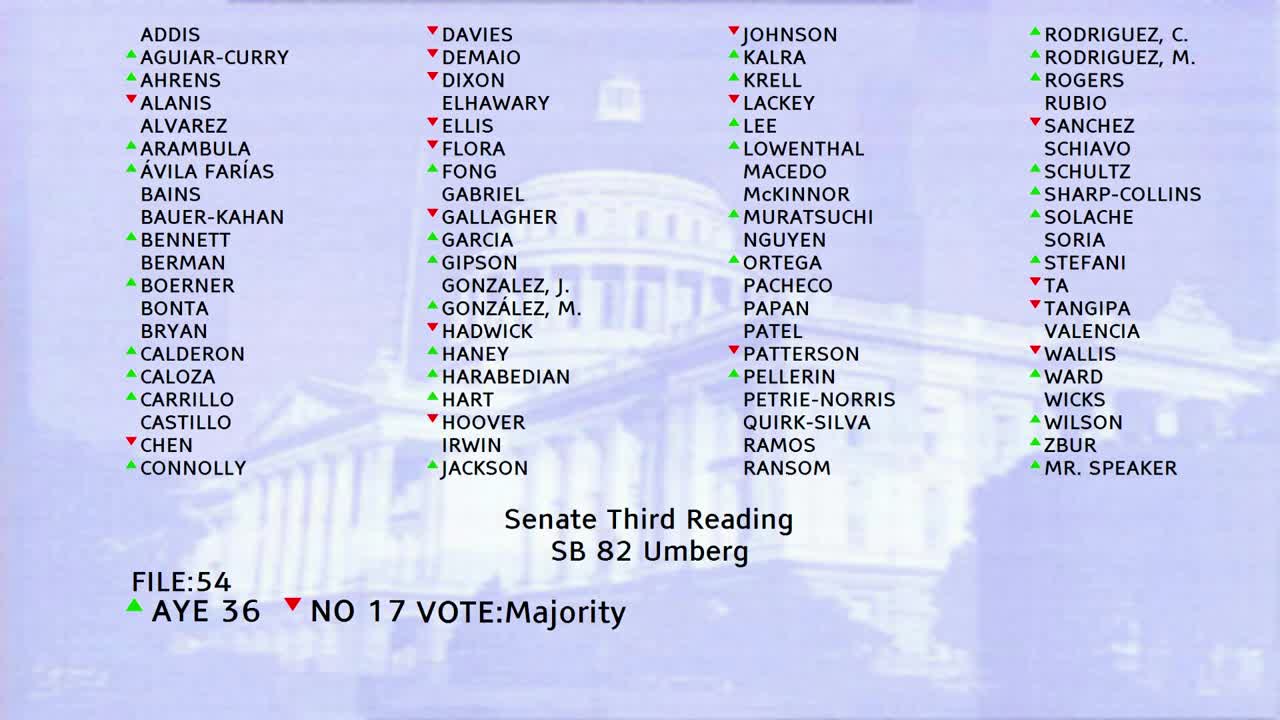 1MIN
Assembly Floor
 14MIN
Assembly Standing Committee on Appropriations
 31MIN
Assembly Standing Committee on Health
 4MIN
Senate Floor
 30MIN
Senate Standing Committee on Health
Bill Author

Bill Co-Author(s):