SB 748: Encampment Resolution Funding program: safe parking sites: reporting.
- Session Year: 2025-2026
- House: Senate
- Latest Version Date: 2025-10-10
Current Status:
Passed
(2025-10-10: Chaptered by Secretary of State. Chapter 524, Statutes of 2025.)
Introduced
In Committee
Awaiting First Chamber Vote
Passed First Chamber
In Committee
Awaiting Second Chamber Vote
Passed Second Chamber
Enacted
What does this bill do?
The bill changes rules for applicants to the state’s Encampment Resolution Funding by requiring any applicant that plans to run safe parking sites for people living in vehicles or RVs to explain how they will find and operate sites, provide services there, and increase site hours. It also changes reporting and evaluation: the Department of Housing and Community Development must include a summary of recent grantee data in its annual report, evaluate program outcomes from that report, and no longer send a separate report to legislative committee chairs.
The summary is provided by generative AI which can make mistakes. For original language, please view the details in the table below.
Existing law establishes the Encampment Resolution Funding program, administered by the Department of Housing and Community Development, to, upon appropriation of the Legislature, increase collaboration between the department, local jurisdictions, and continuums of care for, among other things, providing encampment resolution grants to local jurisdictions and continuums of care to resolve critical encampment concerns and transition individuals into safe and stable housing. Existing law authorizes a continuum of care or a local jurisdiction to submit a specified application to the department for a program grant. Existing law, for additional rounds moneys, defined as moneys appropriated for the program in or after the 202122 fiscal year, requires that an applicant submit an application for a program grant that includes a description of how the applicant intends to use the funds to connect all individuals living in encampments to services and housing, among other things.
This bill would, as part of this description, additionally require the applicant to include specified information about safe parking sites, when the application includes operating safe parking sites while locating interim or permanent housing for people experiencing homelessness living in vehicles or recreational vehicles.
Existing law requires grant recipients to report specified data to their local Homeless Management Information System and as required by the department. Existing law requires the department to evaluate the data and outcomes reported by recipients to assess efficacy of programs and identify scalable best practices for encampment resolution that can be replicated across the state. Existing law requires the department to report to the chairs of the relevant fiscal and policy committees of the Legislature on the outcomes, learnings, and best practices models identified through the program. Existing law requires a recipient of program funding appropriated in the 202425 and 202526 fiscal years to submit to the department a final report of certain data elements no later than April 1 of the year following the expiration of the encumbrance period of funds, as provided. Existing law requires the department to submit an annual report to the Governor and both houses of the Legislature on the operations and accomplishments during the previous fiscal year of the housing programs administered by the department, as specified.
This bill would remove the requirement that the department report to the chairs of the relevant fiscal and policy committees of the Legislature. The bill would require the department to report in the annual report to the Governor and both houses of the Legislature a summary of the data elements required in the final report submitted by recipients of program funding appropriated in the 202425 and 202526 fiscal years, as provided. The bill would require the department to evaluate the data and outcomes reported by the department in the annual report, instead of reported by recipients, to assess efficacy to assess the efficacy of programs and identify scalable best practices for encampment resolution that can be replicated across the state.
Existing law establishes the Encampment Resolution Funding program, administered by the Department of Housing and Community Development, to, upon appropriation of the Legislature, increase collaboration between the department, local jurisdictions, and continuums of care for, among other things, providing encampment resolution grants to local jurisdictions and continuums of care to resolve critical encampment concerns and transition individuals into safe and stable housing. Existing law authorizes a continuum of care or a local jurisdiction to submit a specified application to the department for a program grant. Existing law, for additional rounds moneys, defined as moneys appropriated for the program in or after the 202122 fiscal year, requires that an applicant submit an application for a program grant that includes a description of how the applicant intends to use the funds to connect all individuals living in encampments to services and housing, among other things.
This bill would, as part of this description, additionally require the applicant to include specified information about safe parking sites, when the application includes operating safe parking sites while locating interim or permanent housing for people experiencing homelessness living in vehicles or recreational vehicles.
Existing law requires grant recipients to report specified data to their local Homeless Management Information System and as required by the department. Existing law requires the department to evaluate the data and outcomes reported by recipients to assess efficacy of programs and identify scalable best practices for encampment resolution that can be replicated across the state. Existing law requires the department to report to the chairs of the relevant fiscal and policy committees of the Legislature on the outcomes, learnings, and best practices models identified through the program. Existing law requires a recipient of program funding appropriated in the 202425 and 202526 fiscal years to submit to the department a final report of certain data elements no later than April 1 of the year following the expiration of the encumbrance period of funds, as provided. Existing law requires the department to submit an annual report to the Governor and both houses of the Legislature on the operations and accomplishments during the previous fiscal year of the housing programs administered by the department, as specified.
Beginning on April 1, 2026, and quarterly thereafter, this bill would require the department to report to the chairs of certain Senate and Assembly committees on the funding distributed pursuant to the additional rounds of funding, as specified. The bill, instead of requiring the department to evaluate the reported data and outcomes, as described above,This bill would remove the requirement that the department report to the chairs of the relevant fiscal and policy committees of the Legislature. The bill would require the department to report in the annual report to the Governor and both houses of the Legislature a summary of the data elements required in the final report submitted by recipients of program funding appropriated in the 202425 and 202526 fiscal years, as provided. The bill would instead require the Legislative Analysts Office department to evaluate the data and outcomes reported by the department to these committees in the annual report, instead of reported by recipients, to assess efficacy to assess the efficacy of programs and identify scalable best practices for encampment resolution that can be replicated across the state.
Existing law establishes the Encampment Resolution Funding program, administered by the Department of Housing and Community Development, to to, upon appropriation of the Legislature, increase collaboration between the department, local jurisdictions, and continuums of care for, among other things, providing encampment resolution grants to local jurisdictions and continuums of care to resolve critical encampment concerns and transition individuals into safe and stable housing. Existing law authorizes a continuum of care or a local jurisdiction to submit a specified application to the department for a program grant. Existing law, for additional rounds moneys, defined as moneys appropriated for the program in or after the 202122 fiscal year, requires that an applicant submit an application for a program grant that includes a description of how the applicant intends to use the funds to connect all individuals living in encampments to services and housing, among other things.
This bill would additionally include, as purposes of the program, assisting local jurisdictions with operating safe parking sites while locating interim or permanent housing for people experiencing homelessness living in vehicles or recreational vehicles.This bill would, as part of this description, additionally require the applicant to include specified information about safe parking sites, when the application includes operating safe parking sites while locating interim or permanent housing for people experiencing homelessness living in vehicles or recreational vehicles.
Existing law requires grant recipients to report specified data to their local Homeless Management Information System and as required by the department. Existing law requires the department to evaluate the data and outcomes reported by recipients to assess efficacy of programs and identify scalable best practices for encampment resolution that can be replicated across the state. Existing law requires the department to report to the chairs of the relevant fiscal and policy committees of the Legislature on the outcomes, learnings, and best practices models identified through the program.
Beginning on April 1, 2026, and quarterly thereafter, the this bill would require the department to report to the chairs of certain Senate and Assembly committees on the funding distributed for each of the programs purposes, as specified. pursuant to the additional rounds of funding, as specified. The bill, instead of requiring the department to evaluate the reported data and outcomes, as described above, would instead require the Legislative Analysts Office to evaluate the data and outcomes reported by the department to these committees to assess efficacy to assess the efficacy of programs and identify scalable best practices for encampment resolution that can be replicated across the state.
Existing law establishes the Encampment Resolution Funding program, administered by the Department of Housing and Community Development, to increase collaboration between the department, local jurisdictions, and continuums of care for, among other things, providing encampment resolution grants to local jurisdictions and continuums of care to resolve critical encampment concerns and transition individuals into safe and stable housing.
This bill would additionally include, as purposes of the program, assisting local jurisdictions that are urban communities within a county with operating safe parking sites while locating interim or permanent housing. housing for people experiencing homelessness living in vehicles or recreational vehicles.
Existing law requires the department to report to the chairs of the relevant fiscal and policy committees of the Legislature on the outcomes, learnings, and best practices models identified through the program.
Beginning on April 1, 2026, and quarterly thereafter, the bill would require the department to report to the chairs of certain Senate and Assembly committees on the funding distributed for each of the programs purposes, as specified.
Existing law establishes the Encampment Resolution Funding program, administered by the Department of Housing and Community Development, to increase collaboration between the department, local jurisdictions, and continuums of care for, among other things, providing encampment resolution grants to local jurisdictions and continuums of care to resolve critical encampment concerns and transition individuals into safe and stable housing.
This bill would additionally include, as purposes of the program, assisting local jurisdictions that are urban communities within a county with operating safe parking sites while locating interim or permanent housing.
Existing law requires the department to report to the chairs of the relevant fiscal and policy committees of the Legislature on the outcomes, learnings, and best practices models identified through the program.
This bill would additionally include assisting specified local jurisdictions with, among other things, removing and storing cars and recreational vehicles, as specified, acquiring property for safe parking sites, and increasing safe parking site hours, as purposes of the program.Beginning on April 1, 2026, and quarterly thereafter, the bill would require the department to report to the chairs of the Senate and Assembly Committees on Local Government, the Senate and Assembly Committees on Transportation, the Senate Committee on Housing, and the Assembly Committee on Housing and Community Development certain Senate and Assembly committees on the funding distributed for each of the programs purposes, as specified.
Existing law establishes the Encampment Resolution Funding program, administered by the Department of Housing and Community Development, to increase collaboration between the department, local jurisdictions, and continuums of care for, among other things, providing encampment resolution grants to local jurisdictions and continuums of care to resolve critical encampment concerns and transition individuals into safe and stable housing.
Existing law requires the department to report to the chairs of the relevant fiscal and policy committees of the Legislature on the outcomes, learnings, and best practices models identified through the program.
This bill would define encampments to include people using recreational vehicles for temporary shelter along public roads. TheThis bill would additionally include assisting specified local jurisdictions with, among other things, removing and storing cars and recreational vehicles, as specified, acquiring property for safe parking sites, and increasing safe parking site hours hours, as purposes of the program.
Beginning on April 1, 2026, and quarterly thereafter, the bill would require the department to report to the chairs of the Senate and Assembly Committees on Local Government, the Senate and Assembly Committees on Transportation, the Senate Committee on Housing, and the Assembly Committee on Housing and Community Development on the funding distributed for each of the programs purposes, as specified.
This bill would require a recipient of funding that removes recreational vehicles with grant funds from the program to comply with specified minimum requirements, including towing the recreational vehicle to a safe parking site and providing the owner 60 days to remove the recreational vehicle from the safe parking site. The bill would authorize the recipient to auction or demolish the recreational vehicle if the owner does not remove the recreational vehicle from the safe parking site within the provided 60 days or the owner retrieves the recreational vehicle within the 60 days and the recreational vehicle is towed again to the safe parking site. If the recipient auctions the recreational vehicle, the bill would grant local jurisdictions the right of first refusal. If the recipient auctions or demolishes the recreational vehicle, the bill would entitle the owner to 50% of the proceeds and the recipient to 50% of the proceeds.Existing law establishes the Encampment Resolution Funding program, administered by the Department of Housing and Community Development, to increase collaboration between the council, department, local jurisdictions, and continuums of care for, among other things, assisting local jurisdictions in ensuring the safety and wellness of people experiencing homelessness in encampments. providing encampment resolution grants to local jurisdictions and continuums of care to resolve critical encampment concerns and transition individuals into safe and stable housing.
Existing law requires the department to report to the chairs of the relevant fiscal and policy committees of the Legislature on the outcomes, learnings, and best practices models identified through the program.
This bill would define encampments to include people using recreational vehicles for temporary shelter along public roads. The bill would additionally include, as a program purpose, include assisting specified local jurisdictions with the removal with, among other things, removing and storage of cars and storing recreational vehicles, as specified, and assisting local jurisdictions with acquiring property for safe parking sites, and increasing safe parking site hours, hours as purposes of the program. The bill would define encampments to include people using cars and recreational vehicles for temporary shelter along public roads.
Beginning on April 1, 2026, and quarterly thereafter, the bill would require the department to report to the chairs of the Senate and Assembly Committees on Local Government, the Senate and Assembly Committees on Transportation, the Senate Committee on Housing, and the Assembly Committee on Housing and Community Development on the funding distributed for each of the programs purposes, as specified.
This bill would require a recipient of funding that removes recreational vehicles with grant funds from the program to comply with specified minimum requirements, including towing the recreational vehicle to a safe parking site and providing the owner 60 days to remove the recreational vehicle from the safe parking site. The bill would authorize the recipient to auction or demolish the recreational vehicle if the owner does not remove the recreational vehicle from the safe parking site within the provided 60 days or the owner retrieves the recreational vehicle within the 60 days and the recreational vehicle is towed again to the safe parking site. If the recipient auctions the recreational vehicle, the bill would grant local jurisdictions the right of first refusal. If the recipient auctions or demolishes the recreational vehicle, the bill would entitle the owner to 50% of the proceeds and the recipient to 50% of the proceeds.
Existing law establishes the Encampment Resolution Funding program, administered by the Department of Housing and Community Development, to increase collaboration between the council, local jurisdictions, and continuums of care for, among other things, assisting local jurisdictions in ensuring the safety and wellness of people experiencing homelessness in encampments.
This bill would additionally include, as a program purpose, assisting local jurisdictions with the removal and storage of cars and recreational vehicles, as specified, and assisting local jurisdictions with increasing safe parking site hours, as purposes of the program. The bill would define encampments to include people using cars and recreational vehicles for temporary shelter along public roads.
The Legislature finds and declares all of the following:
(a)In January 2024, the United States Department of Housing and Urban Development (HUD) reported 187,084 people experiencing homelessness, and a significant portion of these individuals are living in recreational vehicles (RV).
(b)Further startling statistics are:
(1)Two-thirds of people experiencing homelessness (124,537) in the state, the highest in the country, sleep outside.
(2)Twenty-five percent, that is one in four, of the people experiencing homelessness in America, are homeless here in California.
(3)Forty-four percent, on average, that are homeless are chronically homeless, meaning individuals may have a long medical or mental disability and are homeless for more than one year.
(c)Homelessness may be defined as an individual or family who lacks a fixed, regular, and adequate nighttime permanent residence.
(d)According to longstanding law, Section 18010 of the Health and Safety Code, an RV means a motor home, travel trailer, truck camper, or camping trailer, with or without motive power, designed for human habitation for recreational, emergency, or other occupancy.
(e)In California, RVs are intended for temporary recreational or emergency occupancy, not for long-term living or habitation on private property outside of designated areas like RV parks, campgrounds, or mobilehome parks.
(f)RVs are designed for leisure travel, camping, and temporary living, not as permanent residences.
SEC. 2.Section 50252.1 of the Health and Safety Code is amended to read:50252.1.(a)This section only applies to additional funding round moneys and does not apply to funding round 1 moneys.
(b)The council shall award additional funding round moneys first to fund projects from prior funding rounds that the council determined satisfied applicable program requirements but were not funded in the prior round.
(c)(1)Any funds remaining after the awards required by subdivision (b) shall be awarded on a rolling basis in accordance with this subdivision.
(2)The council shall begin accepting new applications for a program grant by five months after the appropriation in the given fiscal year is made.
(3)The council shall cease accepting new applications for a program grant by the earlier of the end of the fiscal year in which the appropriation is made or the date the funds from the appropriation have been expended.
(4)Applicants shall submit an application for a program grant to the council in a form and manner specified by the council. The application shall include, at a minimum, all of the following:
(A)Information on the number and demographics of the individuals living in the encampment that the applicant is requesting funding to help resolve.
(B)A description of why the specific encampment is being prioritized for resolution support.
(C)A description of how the applicant intends to collaborate with state and local partners to mitigate risk and address safety concerns while ensuring a pathway for individuals living in encampments to move into safe and stable housing.
(D)A description of how the applicant intends to use these funds to connect all individuals living in the encampment to services and housing. When an application includes operating safe parking sites while locating interim or permanent housing for people experiencing homelessness living in vehicles or recreational vehicles, a description of how the applicant intends to acquire sites for safe parking, operate the site, provide services at the safe parking site, and increase safe parking site hours.
(E)A description of other local resources and funding streams that will be used to ensure the ongoing availability of services and housing support for people who are moved out of encampments into permanent housing.
(F)A goal for the number of individuals the program will support transitioning from encampments into temporary shelters.
(G)A goal for the number of individuals the program will support transitioning from encampments into permanent housing.
(5)In awarding grants, funding shall be prioritized for both of the following:
(A)Jurisdictions that can demonstrate a commitment to cross-systems collaboration, including collaborations with state entities, and innovative efforts to resolve encampment issues, while focusing on protecting the health and well-being of the individuals living in those encampments.
(B)Applicants that represent the diversity of communities across the state, including, but not limited to, rural, urban, and suburban communities.
(d)The council may do any of the following:
(1)Monitor grantee performance.
(2)Require a grantee not meeting goals to accept technical assistance from the council.
(3)Limit the allowable uses of program funds for a grantee that is not meeting goals.
(e)The council may use up to 5 percent of money appropriated in a given fiscal year for administration of the program, including capacity building and technical assistance activities in support of program goals.
SEC. 3.Section 50254 of the Health and Safety Code is amended to read:50254.(a)Notwithstanding any other law, all recipients of funds pursuant to this chapter shall provide data elements, including, but not limited to, health information, in a manner consistent with state and federal law, to their local Homeless Management Information System for tracking in the statewide Homeless Data Integration System.
(b)(1)The council shall specify the form and substance of the required data elements.
(2)The council may, as required by operational necessity, amend or modify data elements, disclosure formats, or disclosure frequency.
(3)Grantees shall report individual, client-level data for persons served by grant funding to the council, in addition to any data reported through the local Homeless Management Information System, as required by the council for the purposes of research and evaluation of grant performance, service pathways, and outcomes for people served.
(4)Council staff may use information reported directly from grantees and through the statewide Homeless Data Integration System for the purposes of research and evaluation of grant performance, service pathways, and outcomes for people served.
(c)Any health information or personal identifying information provided to or maintained within the statewide Homeless Data Integration System pursuant to this section shall not be subject to public inspection or disclosure under the California Public Records Act (Division 10 (commencing with Section 7920.000) of Title 1 of the Government Code).
(d)For purposes of this paragraph, health information includes protected health information, as defined in Part 160.103 of Title 45 of the Code of Federal Regulations, and medical information, as defined in subdivision (j) of Section 56.05 of the Civil Code.
(e)All recipients shall provide information and products developed with grant funds on service delivery models in support of the overall program goal to mitigate risk and address safety concerns in encampments, while ensuring a pathway for individuals living in encampments to move into safe and stable housing, in a format and timeframe specified by the council.
(f)The council shall evaluate the data and outcomes reported by the council pursuant to subdivision (g) to assess efficacy of programs and identify scalable best practices for encampment resolution that can be replicated across the state.
(g)(1)The department shall, in its annual report submitted pursuant to Section 50408, report a summary of the data elements described in paragraph (6) of subdivision (b) of Section 50254.5, disaggregated by funding round.
(2)The requirement of submitting data imposed under paragraph (1) is inoperative after the department publishes the final report covering the final round of program funds.
(h)Contracts entered into to implement this chapter shall be exempt from all of the following:
(1)Chapter 6 (commencing with Section 14825) of Part 5.5 of Division 3 of Title 2 of the Government Code.
(2)The personal services contracting requirements of Article 4 (commencing with Section 19130) of Chapter 5 of Part 2 of Division 5 of Title 2 of the Government Code.
(3)Part 2 (commencing with Section 10100) of Division 2 of the Public Contract Code and the State Contracting Manual.
(4)Notwithstanding Section 11546 of the Government Code, from review or approval of any division of the Department of Technology, upon approval from the Department of Finance.
(5)From the review or approval of any division of the Department of General Services.
The Legislature finds and declares all of the following:
(a)In January 2024, the United States Department of Housing and Urban Development (HUD) reported 187,084 people experiencing homelessness, and a significant portion of these individuals are living in recreational vehicles (RV).
(b)Further startling statistics are:
(1)Two-thirds of people experiencing homelessness (124,537) in the state, the highest in the country, sleep outside.
(2)Twenty-five percent, that is one in four, of the people experiencing homelessness in America, are homeless here in California.
(3)Forty-four percent, on average, that are homeless are chronically homeless, meaning individuals may have a long medical or mental disability and are homeless for more than one year.
(c)Homelessness may be defined as an individual or family who lacks a fixed, regular, and adequate nighttime permanent residence.
(d)According to longstanding law, Section 18010 of the Health and Safety Code, an RV means a motor home, travel trailer, truck camper, or camping trailer, with or without motive power, designed for human habitation for recreational, emergency, or other occupancy.
(e)In California, RVs are intended for temporary recreational or emergency occupancy, not for long-term living or habitation on private property outside of designated areas like RV parks, campgrounds, or mobilehome parks.
(f)RVs are designed for leisure travel, camping, and temporary living, not as permanent residences.
SEC. 2.Section 50252.1 of the Health and Safety Code is amended to read:50252.1.(a)This section only applies to additional funding round moneys and does not apply to funding round 1 moneys.
(b)The council shall award additional funding round moneys first to fund projects from prior funding rounds that the council determined satisfied applicable program requirements but were not funded in the prior round.
(c)(1)Any funds remaining after the awards required by subdivision (b) shall be awarded on a rolling basis in accordance with this subdivision.
(2)The council shall begin accepting new applications for a program grant by five months after the appropriation in the given fiscal year is made.
(3)The council shall cease accepting new applications for a program grant by the earlier of the end of the fiscal year in which the appropriation is made or the date the funds from the appropriation have been expended.
(4)Applicants shall submit an application for a program grant to the council in a form and manner specified by the council. The application shall include, at a minimum, all of the following:
(A)Information on the number and demographics of the individuals living in the encampment that the applicant is requesting funding to help resolve.
(B)A description of why the specific encampment is being prioritized for resolution support.
(C)A description of how the applicant intends to collaborate with state and local partners to mitigate risk and address safety concerns while ensuring a pathway for individuals living in encampments to move into safe and stable housing.
(D)A description of how the applicant intends to use these funds to connect all individuals living in the encampment to services and housing. When an application includes operating safe parking sites while locating interim or permanent housing for people experiencing homelessness living in vehicles or recreational vehicles, a description of how the applicant intends to acquire sites for safe parking, operate the site, provide services at the safe parking site, and increase safe parking site hours.
(E)A description of other local resources and funding streams that will be used to ensure the ongoing availability of services and housing support for people who are moved out of encampments into permanent housing.
(F)A goal for the number of individuals the program will support transitioning from encampments into temporary shelters.
(G)A goal for the number of individuals the program will support transitioning from encampments into permanent housing.
(5)In awarding grants, funding shall be prioritized for both of the following:
(A)Jurisdictions that can demonstrate a commitment to cross-systems collaboration, including collaborations with state entities, and innovative efforts to resolve encampment issues, while focusing on protecting the health and well-being of the individuals living in those encampments.
(B)Applicants that represent the diversity of communities across the state, including, but not limited to, rural, urban, and suburban communities.
(d)The council may do any of the following:
(1)Monitor grantee performance.
(2)Require a grantee not meeting goals to accept technical assistance from the council.
(3)Limit the allowable uses of program funds for a grantee that is not meeting goals.
(e)The council may use up to 5 percent of money appropriated in a given fiscal year for administration of the program, including capacity building and technical assistance activities in support of program goals.
SEC. 3.Section 50254 of the Health and Safety Code is amended to read:50254.(a)Notwithstanding any other law, all recipients of funds pursuant to this chapter shall provide data elements, including, but not limited to, health information, in a manner consistent with state and federal law, to their local Homeless Management Information System for tracking in the statewide Homeless Data Integration System.
(b)(1)The council shall specify the form and substance of the required data elements.
(2)The council may, as required by operational necessity, amend or modify data elements, disclosure formats, or disclosure frequency.
(3)Grantees shall report individual, client-level data for persons served by grant funding to the council, in addition to any data reported through the local Homeless Management Information System, as required by the council for the purposes of research and evaluation of grant performance, service pathways, and outcomes for people served.
(4)Council staff may use information reported directly from grantees and through the statewide Homeless Data Integration System for the purposes of research and evaluation of grant performance, service pathways, and outcomes for people served.
(c)Any health information or personal identifying information provided to or maintained within the statewide Homeless Data Integration System pursuant to this section shall not be subject to public inspection or disclosure under the California Public Records Act (Division 10 (commencing with Section 7920.000) of Title 1 of the Government Code).
(d)For purposes of this paragraph, health information includes protected health information, as defined in Part 160.103 of Title 45 of the Code of Federal Regulations, and medical information, as defined in subdivision (j) of Section 56.05 of the Civil Code.
(e)All recipients shall provide information and products developed with grant funds on service delivery models in support of the overall program goal to mitigate risk and address safety concerns in encampments, while ensuring a pathway for individuals living in encampments to move into safe and stable housing, in a format and timeframe specified by the council.
(f)The Legislative Analysts Office council shall evaluate the data and outcomes reported by the council pursuant to subdivision (g) to assess efficacy of programs and identify scalable best practices for encampment resolution that can be replicated across the state.
(g)The council shall report as follows:(1)To the chairs of the relevant fiscal and policy committees in both houses on the outcomes, learnings, and best practices models identified through this program. The report shall be submitted in compliance with Section 9795 of the Government Code.(2)(A)Beginning on April 1, 2026, and quarterly thereafter, to the chairs of the Senate Committee on Budget and Fiscal Review, the Assembly Committee on Budget, the Senate Committee on Housing, the Assembly Committee on Housing and Community Development, and the Senate and Assembly Committees on Human Services on the funding distributed pursuant to Section 50252.1. The reports shall include, at minimum, a point-in-time accounting for all of the following:(i)The number of people transitioned from an encampment or safe parking site to permanent housing.(ii)The number of people transitioned from an encampment or safe parking site to temporary shelters.(iii)A description of the types of services offered and whether the individuals were connected to them.(B)The requirement for submitting a report imposed under subparagraph (A) is inoperative on April 1, 2030, pursuant to Section 10231.5 of the Government Code.(C)A report to be submitted pursuant to subparagraph (A) shall be submitted in compliance with Section 9795 of the Government Code.(g)(1)The department shall, in its annual report submitted pursuant to Section 50408, report a summary of the data elements described in paragraph (6) of subdivision (b) of Section 50254.5, disaggregated by funding round.
(2)The requirement of submitting data imposed under paragraph (1) is inoperative after the department publishes the final report covering the final round of program funds.
(h)Contracts entered into to implement this chapter shall be exempt from all of the following:
(1)Chapter 6 (commencing with Section 14825) of Part 5.5 of Division 3 of Title 2 of the Government Code.
(2)The personal services contracting requirements of Article 4 (commencing with Section 19130) of Chapter 5 of Part 2 of Division 5 of Title 2 of the Government Code.
(3)Part 2 (commencing with Section 10100) of Division 2 of the Public Contract Code and the State Contracting Manual.
(4)Notwithstanding Section 11546 of the Government Code, from review or approval of any division of the Department of Technology, upon approval from the Department of Finance.
(5)From the review or approval of any division of the Department of General Services.
The Legislature finds and declares all of the following:
(a)In January 2024, the United States Department of Housing and Urban Development (HUD) reported 187,084 people experiencing homelessness, and a significant portion of these individuals are living in recreational vehicles (RV).
(b)Further startling statistics are:
(1)Two-thirds of people experiencing homelessness (124,537) in the state, the highest in the country, sleep outside.
(2)Twenty-five percent, that is one in four, of the people experiencing homelessness in America, are homeless here in California.
(3)Forty-four percent, on average, that are homeless are chronically homeless, meaning individuals may have a long medical or mental disability and are homeless for more than one year.
(c)Homelessness may be defined as an individual or family who lacks a fixed, regular, and adequate nighttime permanent residence.. residence.
(d)According to long-standing longstanding law, Section 18010 of the Health and Safety Code, an RV means a motor home, travel trailer, truck camper, or camping trailer, with or without motive power, designed for human habitation for recreational, emergency, or other occupancy.
(e)In California, RVs are intended for temporary recreational or emergency occupancy, not for long-term living or habitation on private property outside of designated areas like RV parks, campgrounds, or mobilehome parks.
(f)RVs are designed for leisure travel, camping, and temporary living, not as permanent residences.
SEC. 2.Section 50251 of the Health and Safety Code is amended to read:50251.(a)The Encampment Resolution Funding program is hereby established to, upon appropriation by the Legislature, increase collaboration between the council, local jurisdictions, and continuums of care for the following purposes:(1)Assist local jurisdictions in ensuring the safety and wellness of people experiencing homelessness in encampments.(2)Provide encampment resolution grants to local jurisdictions and continuums of care to resolve critical encampment concerns and transition individuals into safe and stable housing.(3)Encourage a data-informed, coordinated approach to address encampment concerns.(4)Assist local jurisdictions with operating safe parking sites while locating interim or permanent housing for people experiencing homelessness living in vehicles or recreational vehicles. This includes the acquisition of sites for safe parking, operation of the site, services to the safe parking site, and increasing safe parking site hours.(b)(1)The council shall administer the program.(2)Notwithstanding paragraph (1), the council may consult with and designate a state agency or department to support the administration of the program.(c)(1)The councils decision to approve or deny an application and the determination of the amount of funding to be provided shall be final and not subject to appeal.(2)In determining which applications to approve, the council shall evaluate and score proposals based on all of the following criteria:(A)The applicants capacity to carry out the proposal.(B)Whether the site selected for services aligns with the proposed service delivery model.(C)Whether the demographics and needs of service recipients align with the proposed service delivery model.(D)The applicants ability to develop a detailed service delivery plan, including a description of how individuals will be served with permanent housing solutions.(E)The applicants ability to coordinate with other systems to increase services and housing options.(F)The applicants capacity to involve people with lived experience and local community partners in the implementation of its project.(G)The applicants ability to recruit and deploy personnel with experience and expertise needed to support the success of their proposal.(H)The applicants ability to demonstrate a prudent and effective use of requested funding relative to the number of people it seeks to serve and the types of services to be provided in the proposal.(d)The council shall maintain records of the following:(1)The number of applications for program grants received by the council.(2)The number of applications for program grants denied by the council.(3)The name of each recipient of a program grant.(4)The amount of funds allocated to each applicant.(e)The council may adopt regulations to implement this chapter. The adoption, amendment, or repeal of a regulation authorized by this subdivision is hereby exempted from the rulemaking provisions of the Administrative Procedure Act (Chapter 3.5 (commencing with Section 11340) of Part 1 of Division 3 of Title 2 of the Government Code).SEC. 2.Section 50252.1 of the Health and Safety Code is amended to read:50252.1.(a)This section only applies to additional funding round moneys and does not apply to funding round 1 moneys.
(b)The council shall award additional funding round moneys first to fund projects from prior funding rounds that the council determined satisfied applicable program requirements but were not funded in the prior round.
(c)(1)Any funds remaining after the awards required by subdivision (b) shall be awarded on a rolling basis in accordance with this subdivision.
(2)The council shall begin accepting new applications for a program grant by five months after the appropriation in the given fiscal year is made.
(3)The council shall cease accepting new applications for a program grant by the earlier of the end of the fiscal year in which the appropriation is made or the date the funds from the appropriation have been expended.
(4)Applicants shall submit an application for a program grant to the council in a form and manner specified by the council. The application shall include, at a minimum, all of the following:
(A)Information on the number and demographics of the individuals living in the encampment that the applicant is requesting funding to help resolve.
(B)A description of why the specific encampment is being prioritized for resolution support.
(C)A description of how the applicant intends to collaborate with state and local partners to mitigate risk and address safety concerns while ensuring a pathway for individuals living in encampments to move into safe and stable housing.
(D)A description of how the applicant intends to use these funds to connect all individuals living in the encampment to services and housing. When an application includes operating safe parking sites while locating interim or permanent housing for people experiencing homelessness living in vehicles or recreational vehicles, a description of how the applicant intends to acquire sites for safe parking, operate the site, provide services at the safe parking site, and increase safe parking site hours.
(E)A description of other local resources and funding streams that will be used to ensure the ongoing availability of services and housing support for people who are moved out of encampments into permanent housing.
(F)A goal for the number of individuals the program will support transitioning from encampments into temporary shelters.
(G)A goal for the number of individuals the program will support transitioning from encampments into permanent housing.
(5)In awarding grants, funding shall be prioritized for both of the following:
(A)Jurisdictions that can demonstrate a commitment to cross-systems collaboration, including collaborations with state entities, and innovative efforts to resolve encampment issues, while focusing on protecting the health and well-being of the individuals living in those encampments.
(B)Applicants that represent the diversity of communities across the state, including, but not limited to, rural, urban, and suburban communities.
(d)The council may do any of the following:
(1)Monitor grantee performance.
(2)Require a grantee not meeting goals to accept technical assistance from the council.
(3)Limit the allowable uses of program funds for a grantee that is not meeting goals.
(e)The council may use up to 5 percent of money appropriated in a given fiscal year for administration of the program, including capacity building and technical assistance activities in support of program goals.
SEC. 3.Section 50254 of the Health and Safety Code is amended to read:50254.(a)Notwithstanding any other law, all recipients of funds pursuant to this chapter shall provide data elements, including, but not limited to, health information, in a manner consistent with state and federal law, to their local Homeless Management Information System for tracking in the statewide Homeless Data Integration System.
(b)(1)The council shall specify the form and substance of the required data elements.
(2)The council may, as required by operational necessity, amend or modify data elements, disclosure formats, or disclosure frequency.
(3)Grantees shall report individual, client-level data for persons served by grant funding to the council, in addition to any data reported through the local Homeless Management Information System, as required by the council for the purposes of research and evaluation of grant performance, service pathways, and outcomes for people served.
(4)Council staff may use information reported directly from grantees and through the statewide Homeless Data Integration System for the purposes of research and evaluation of grant performance, service pathways, and outcomes for people served.
(c)Any health information or personal identifying information provided to or maintained within the statewide Homeless Data Integration System pursuant to this section shall not be subject to public inspection or disclosure under the California Public Records Act (Division 10 (commencing with Section 7920.000) of Title 1 of the Government Code).
(d)For purposes of this paragraph, health information includes protected health information, as defined in Part 160.103 of Title 45 of the Code of Federal Regulations, and medical information, as defined in subdivision (j) of Section 56.05 of the Civil Code.
(e)All recipients shall provide information and products developed with grant funds on service delivery models in support of the overall program goal to mitigate risk and address safety concerns in encampments, while ensuring a pathway for individuals living in encampments to move into safe and stable housing, in a format and timeframe specified by the council.
(f)The council Legislative Analysts Office shall evaluate the data and outcomes reported by recipients the council pursuant to subdivision (g) to assess efficacy of programs and identify scalable best practices for encampment resolution that can be replicated across the state.
(g)The council shall report as follows:
(1)To the chairs of the relevant fiscal and policy committees in both houses on the outcomes, learnings, and best practices models identified through this program. The report shall be submitted in compliance with Section 9795 of the Government Code.
(2)(A)Beginning on April 1, 2026, and quarterly thereafter, to the chairs of the Senate Committee on Budget and Fiscal Review, the Assembly Committee on Budget, the Senate Committee on Housing, the Assembly Committee on Housing and Community Development, and the Senate and Assembly Committees on Human Services on the funding distributed for each of the purposes described in subdivision (a) of Section 50251. pursuant to Section 50252.1. The reports shall include, at minimum, a point-in-time accounting for all of the following:
(i)The number of people transitioned from an encampment or safe parking site to permanent housing.
(ii)The number of people transitioned from an encampment or safe parking site to temporary shelters.
(iii)A description of the types of services offered and whether the individuals were connected to them.
(B)The requirement for submitting a report imposed under subparagraph (A) is inoperative on April 1, 2030, pursuant to Section 10231.5 of the Government Code.
(C)A report to be submitted pursuant to subparagraph (A) shall be submitted in compliance with Section 9795 of the Government Code.
(h)Contracts entered into to implement this chapter shall be exempt from all of the following:
(1)Chapter 6 (commencing with Section 14825) of Part 5.5 of Division 3 of Title 2 of the Government Code.
(2)The personal services contracting requirements of Article 4 (commencing with Section 19130) of Chapter 5 of Part 2 of Division 5 of Title 2 of the Government Code.
(3)Part 2 (commencing with Section 10100) of Division 2 of the Public Contract Code and the State Contracting Manual.
(4)Notwithstanding Section 11546 of the Government Code, from review or approval of any division of the Department of Technology, upon approval from the Department of Finance.
(5)From the review or approval of any division of the Department of General Services.
The Legislature finds and declares all of the following:
(a)In January 2024, the United States Department of Housing and Urban Development (HUD) reported 187,084 people experiencing homelessness, and a significant portion of these individuals are living in recreational vehicles (RV).
(b)Further startling statistics are:
(1)Two-thirds of reported homeless people experiencing homelessness (124,537) in the state, the highest in the country, sleep outside.
(2)Twenty-five percent, that is one in four, of the homeless people experiencing homelessness in America, are homeless here in California.
(3)Forty-four percent, on average, that are homeless are chronically homeless, meaning individuals may have a long medical or mental disability and are homeless for more than one year.
(c)Homelessness may be defined as an individual or family who lacks a fixed, regular, and adequate nighttime permanent residence. A man, woman, or child that sleeps on the street, in front of a store, or in an RV for more than 14 days is considered to be experiencing homelessness.
(d)According to long-standing law, Section 18010 of the Health and Safety Code, an RV means a motor home, travel trailer, truck camper, or camping trailer, with or without motive power, designed for human habitation for recreational, emergency, or other occupancy.
(e)In California, RVs are intended for temporary recreational or emergency occupancy, not for long-term living or habitation on private property outside of designated areas like RV parks, campgrounds, or mobilehome parks.
(f)RVs are designed for leisure travel, camping, and temporary living, not as permanent residences.
SEC. 2.Section 50251 of the Health and Safety Code is amended to read:50251.(a)The Encampment Resolution Funding program is hereby established to, upon appropriation by the Legislature, increase collaboration between the council, local jurisdictions, and continuums of care for the following purposes:
(1)Assist local jurisdictions in ensuring the safety and wellness of people experiencing homelessness in encampments.
(2)Provide encampment resolution grants to local jurisdictions and continuums of care to resolve critical encampment concerns and transition individuals into safe and stable housing.
(3)Encourage a data-informed, coordinated approach to address encampment concerns.
(4)Assist local jurisdictions that are urban communities within a county with operating safe parking sites while locating interim or permanent housing. housing for people experiencing homelessness living in vehicles or recreational vehicles. This includes the acquisition of sites for safe parking, operation of the site, services to the safe parking site, and increasing safe parking site hours.
(b)(1)The council shall administer the program.
(2)Notwithstanding paragraph (1), the council may consult with and designate a state agency or department to support the administration of the program.
(c)(1)The councils decision to approve or deny an application and the determination of the amount of funding to be provided shall be final and not subject to appeal.
(2)In determining which applications to approve, the council shall evaluate and score proposals based on all of the following criteria:
(A)The applicants capacity to carry out the proposal.
(B)Whether the site selected for services aligns with the proposed service delivery model.
(C)Whether the demographics and needs of service recipients align with the proposed service delivery model.
(D)The applicants ability to develop a detailed service delivery plan, including a description of how individuals will be served with permanent housing solutions.
(E)The applicants ability to coordinate with other systems to increase services and housing options.
(F)The applicants capacity to involve people with lived experience and local community partners in the implementation of its project.
(G)The applicants ability to recruit and deploy personnel with experience and expertise needed to support the success of their proposal.
(H)The applicants ability to demonstrate a prudent and effective use of requested funding relative to the number of people it seeks to serve and the types of services to be provided in the proposal.
(d)The council shall maintain records of the following:
(1)The number of applications for program grants received by the council.
(2)The number of applications for program grants denied by the council.
(3)The name of each recipient of a program grant.
(4)The amount of funds allocated to each applicant.
(e)The council may adopt regulations to implement this chapter. The adoption, amendment, or repeal of a regulation authorized by this subdivision is hereby exempted from the rulemaking provisions of the Administrative Procedure Act (Chapter 3.5 (commencing with Section 11340) of Part 1 of Division 3 of Title 2 of the Government Code).
SEC. 3.Section 50254 of the Health and Safety Code is amended to read:50254.(a)Notwithstanding any other law, all recipients of funds pursuant to this chapter shall provide data elements, including, but not limited to, health information, in a manner consistent with state and federal law, to their local Homeless Management Information System for tracking in the statewide Homeless Data Integration System.
(b)(1)The council shall specify the form and substance of the required data elements.
(2)The council may, as required by operational necessity, amend or modify data elements, disclosure formats, or disclosure frequency.
(3)Grantees shall report individual, client-level data for persons served by grant funding to the council, in addition to any data reported through the local Homeless Management Information System, as required by the council for the purposes of research and evaluation of grant performance, service pathways, and outcomes for people served.
(4)Council staff may use information reported directly from grantees and through the statewide Homeless Data Integration System for the purposes of research and evaluation of grant performance, service pathways, and outcomes for people served.
(c)Any health information or personal identifying information provided to or maintained within the statewide Homeless Data Integration System pursuant to this section shall not be subject to public inspection or disclosure under the California Public Records Act (Division 10 (commencing with Section 7920.000) of Title 1 of the Government Code).
(d)For purposes of this paragraph, health information includes protected health information, as defined in Part 160.103 of Title 45 of the Code of Federal Regulations, and medical information, as defined in subdivision (j) of Section 56.05 of the Civil Code.
(e)All recipients shall provide information and products developed with grant funds on service delivery models in support of the overall program goal to mitigate risk and address safety concerns in encampments, while ensuring a pathway for individuals living in encampments to move into safe and stable housing, in a format and timeframe specified by the council.
(f)The council shall evaluate the data and outcomes reported by recipients to assess efficacy of programs and identify scalable best practices for encampment resolution that can be replicated across the state.
(g)The council shall report as follows:
(1)To the chairs of the relevant fiscal and policy committees in both houses on the outcomes, learnings, and best practices models identified through this program. The report shall be submitted in compliance with Section 9795 of the Government Code.
(2)(A)Beginning on April 1, 2026, and quarterly thereafter, to the chairs of the Senate Committee on Budget and Fiscal Review, the Assembly Committee on Budget, the Senate Committee on Housing, the Assembly Committee on Housing and Community Development, and the Senate and Assembly Committees on Human Services on the funding distributed for each of the purposes described in subdivision (a) of Section 50251.
(B)The requirement for submitting a report imposed under subparagraph (A) is inoperative on April 1, 2030, pursuant to Section 10231.5 of the Government Code.
(C)A report to be submitted pursuant to subparagraph (A) shall be submitted in compliance with Section 9795 of the Government Code.
(h)Contracts entered into to implement this chapter shall be exempt from all of the following:
(1)Chapter 6 (commencing with Section 14825) of Part 5.5 of Division 3 of Title 2 of the Government Code.
(2)The personal services contracting requirements of Article 4 (commencing with Section 19130) of Chapter 5 of Part 2 of Division 5 of Title 2 of the Government Code.
(3)Part 2 (commencing with Section 10100) of Division 2 of the Public Contract Code and the State Contracting Manual.
(4)Notwithstanding Section 11546 of the Government Code, from review or approval of any division of the Department of Technology, upon approval from the Department of Finance.
(5)From the review or approval of any division of the Department of General Services.
The Legislature finds and declares all of the following:
(a)In January 2024, the United States Department of Housing and Urban Development (HUD) reported 187,084 people experiencing homelessness, and a significant portion of these individuals are living in recreational vehicles (RV).
(b)Further startling statistics are:
(1)Two-thirds of reported homeless (124,537) in the state, the highest in the country, sleep outside.
(2)Twenty-five percent, that is one in four, of the homeless in America, are homeless here in California.
(3)Forty-four percent, on average, that are homeless are chronically homeless, meaning individuals may have a long medical or mental disability and are homeless for more than one year.
(c)Homelessness may be defined as an individual or family who lacks a fixed, regular, and adequate nighttime permanent residence. A man, woman, or child that sleeps on the street, in front of a store, or in an RV for more than 14 days is considered to be experiencing homelessness.
(d)According to long-standing law, Section 18010 of the Health and Safety Code, an RV means a motor home, travel trailer, truck camper, or camping trailer, with or without motive power, designed for human habitation for recreational, emergency, or other occupancy.
(e)In California, RVs are intended for temporary recreational or emergency occupancy, not for long-term living or habitation on private property outside of designated areas like RV parks, campgrounds, or mobile home mobilehome parks.
(f)RVs are designed for leisure travel, camping, and temporary living, not as permanent residences.
SEC. 2.Section 50250 of the Health and Safety Code is amended to read:50250.For purposes of this chapter, the following definitions shall apply:(a)Additional funding round moneys means moneys appropriated for the program in or after fiscal year 202223.(b)Agency means the Business, Consumer Services, and Housing Agency.(c)Applicant means a continuum of care or local jurisdiction(d)Continuum of care has the same meaning as in Section 578.3 of Title 24 of the Code of Federal Regulations.(e)(1)Subject to paragraph (2), council, unless context requires otherwise, means the California Interagency Council on Homelessness, previously known as the Homeless Coordinating and Financing Council created pursuant to Section 8257 of the Welfare and Institutions Code.(2)Unless context requires otherwise, council, with respect to the administration of this chapter on or after the effective date of the act adding this paragraph, means the department.(f)County includes, but is not limited to, a city and county.(g)Department means the Department of Housing and Community Development.(h)Funding round 1 moneys means moneys appropriated for the program in fiscal year 202122.(i)Homeless has the same meaning as in Section 578.3 of Title 24 of the Code of Federal Regulations.(j)Local jurisdiction means a city, including a charter city, a county, including a charter county, or a city and county, including a charter city and county.(k)Program means the Encampment Resolution Funding program established pursuant to this chapter.(l)Recipient means an applicant that receives grant funds from the council for the purposes of the program.(m)Recreational vehicle has the same meaning as in Section 18010.(n) State right-of-way means real property held in title by the State of California.SEC. 3.SEC. 2.Section 50251 of the Health and Safety Code is amended to read:50251.(a)The Encampment Resolution Funding program is hereby established to, upon appropriation by the Legislature, increase collaboration between the council, local jurisdictions, and continuums of care for the following purposes:
(1)Assist local jurisdictions in ensuring the safety and wellness of people experiencing homelessness in encampments.
(2)Provide encampment resolution grants to local jurisdictions and continuums of care to resolve critical encampment concerns and transition individuals into safe and stable housing.
(3)Encourage a data-informed, coordinated approach to address encampment concerns.
(4)Assist local jurisdictions that are urban communities within a county that offer temporary shelters and safe parking sites with the removal and storage of cars and recreational vehicles while locating temporary shelter for people experiencing homelessness in encampments.(5)Assist local jurisdictions that are urban communities within a county that offer temporary shelters and safe parking sites with the code enforcement of the parking, storage, inspection, and towing of cars and recreational vehicles.(6)Assist local jurisdictions that are urban communities within a county that offer temporary shelters and safe parking sites with acquiring property for safe parking sites and increasing safe parking site hours.(4)Assist local jurisdictions that are urban communities within a county with operating safe parking sites while locating interim or permanent housing. This includes the acquisition of sites for safe parking, operation of the site, services to the safe parking site, and increasing safe parking site hours.
(b)(1)The council shall administer the program.
(2)Notwithstanding paragraph (1), the council may consult with and designate a state agency or department to support the administration of the program.
(c)(1)The councils decision to approve or deny an application and the determination of the amount of funding to be provided shall be final and not subject to appeal.
(2)In determining which applications to approve, the council shall evaluate and score proposals based on all of the following criteria:
(A)The applicants capacity to carry out the proposal.
(B)Whether the site selected for services aligns with the proposed service delivery model.
(C)Whether the demographics and needs of service recipients align with the proposed service delivery model.
(D)The applicants ability to develop a detailed service delivery plan, including a description of how individuals will be served with permanent housing solutions.
(E)The applicants ability to coordinate with other systems to increase services and housing options.
(F)The applicants capacity to involve people with lived experience and local community partners in the implementation of its project.
(G)The applicants ability to recruit and deploy personnel with experience and expertise needed to support the success of their proposal.
(H)The applicants ability to demonstrate a prudent and effective use of requested funding relative to the number of people it seeks to serve and the types of services to be provided in the proposal.
(d)The council shall maintain records of the following:
(1)The number of applications for program grants received by the council.
(2)The number of applications for program grants denied by the council.
(3)The name of each recipient of a program grant.
(4)The amount of funds allocated to each applicant.
(e)The council may adopt regulations to implement this chapter. The adoption, amendment, or repeal of a regulation authorized by this subdivision is hereby exempted from the rulemaking provisions of the Administrative Procedure Act (Chapter 3.5 (commencing with Section 11340) of Part 1 of Division 3 of Title 2 of the Government Code).
SEC. 4.SEC. 3.Section 50254 of the Health and Safety Code is amended to read:50254.(a)Notwithstanding any other law, all recipients of funds pursuant to this chapter shall provide data elements, including, but not limited to, health information, in a manner consistent with state and federal law, to their local Homeless Management Information System for tracking in the statewide Homeless Data Integration System.
(b)(1)The council shall specify the form and substance of the required data elements.
(2)The council may, as required by operational necessity, amend or modify data elements, disclosure formats, or disclosure frequency.
(3)Grantees shall report individual, client-level data for persons served by grant funding to the council, in addition to any data reported through the local Homeless Management Information System, as required by the council for the purposes of research and evaluation of grant performance, service pathways, and outcomes for people served.
(4)Council staff may use information reported directly from grantees and through the statewide Homeless Data Integration System for the purposes of research and evaluation of grant performance, service pathways, and outcomes for people served.
(c)Any health information or personal identifying information provided to or maintained within the statewide Homeless Data Integration System pursuant to this section shall not be subject to public inspection or disclosure under the California Public Records Act (Division 10 (commencing with Section 7920.000) of Title 1 of the Government Code).
(d)For purposes of this paragraph, health information includes protected health information, as defined in Part 160.103 of Title 45 of the Code of Federal Regulations, and medical information, as defined in subdivision (j) of Section 56.05 of the Civil Code.
(e)All recipients shall provide information and products developed with grant funds on service delivery models in support of the overall program goal to mitigate risk and address safety concerns in encampments, while ensuring a pathway for individuals living in encampments to move into safe and stable housing, in a format and timeframe specified by the council.
(f)The council shall evaluate the data and outcomes reported by recipients to assess efficacy of programs and identify scalable best practices for encampment resolution that can be replicated across the state.
(g)The council shall report as follows:
(1)To the chairs of the relevant fiscal and policy committees in both houses on the outcomes, learnings, and best practices models identified through this program. The report shall be submitted in compliance with Section 9795 of the Government Code.
(2)(A)Beginning on April 1, 2026, and quarterly thereafter, to the chairs of the Senate and Assembly Committees on Local Government, the Senate and Assembly Committees on Transportation, the Senate Committee on Housing, and Senate Committee on Budget and Fiscal Review, the Assembly Committee on Budget, the Senate Committee on Housing, the Assembly Committee on Housing and Community Development Development, and the Senate and Assembly Committees on Human Services on the funding distributed for each of the purposes described in subdivision (a) of Section 50251.
(B)The requirement for submitting a report imposed under subparagraph (A) is inoperative on April 1, 2030, pursuant to Section 10231.5 of the Government Code.
(C)A report to be submitted pursuant to subparagraph (A) shall be submitted in compliance with Section 9795 of the Government Code.
(h)Contracts entered into to implement this chapter shall be exempt from all of the following:
(1)Chapter 6 (commencing with Section 14825) of Part 5.5 of Division 3 of Title 2 of the Government Code.
(2)The personal services contracting requirements of Article 4 (commencing with Section 19130) of Chapter 5 of Part 2 of Division 5 of Title 2 of the Government Code.
(3)Part 2 (commencing with Section 10100) of Division 2 of the Public Contract Code and the State Contracting Manual.
(4)Notwithstanding Section 11546 of the Government Code, from review or approval of any division of the Department of Technology, upon approval from the Department of Finance.
(5)From the review or approval of any division of the Department of General Services.
The Legislature finds and declares all of the following:
(a)In January 2024, the United States Department of Housing and Urban Development (HUD) reported 187,084 people experiencing homelessness, and a significant portion of these individuals are living in recreational vehicles (RV).
(b)Further startling statistics are:
(1)Two-thirds of reported homeless (124,537) in the state, the highest in the country, sleep outside.
(2)Twenty-five percent, that is one in four, of the homeless in America, are homeless here in California.
(3)Forty-four percent, on average, that are homeless are chronically homeless, meaning individuals may have a long medical or mental disability and are homeless for more than one year.
(c)Homelessness may be defined as an individual or family who lacks a fixed, regular, and adequate nighttime permanent residence. A man, woman, or child that sleeps on the street, in front of a store, or in an RV for more than 14 days is considered to be experiencing homelessness.
(d)According to long-standing law, Section 18010 of the Health and Safety Code, an RV means a motor home, travel trailer, truck camper, or camping trailer, with or without motive power, designed for human habitation for recreational, emergency, or other occupancy.
(e)In California, RVs are intended for temporary recreational or emergency occupancy, not for long-term living or habitation on private property outside of designated areas like RV parks, campgrounds, or mobile home parks.
(f)RVs are designed for leisure travel, camping, and temporary living, not as permanent residences.
SEC. 2.Section 50250 of the Health and Safety Code is amended to read:50250.For purposes of this chapter, the following definitions shall apply:
(a)Additional funding round moneys means moneys appropriated for the program in or after fiscal year 202223.
(b)Agency means the Business, Consumer Services, and Housing Agency.
(c)Applicant means a continuum of care or local jurisdiction
(d)Continuum of care has the same meaning as in Section 578.3 of Title 24 of the Code of Federal Regulations.
(e)(1)Subject to paragraph (2), council, unless context requires otherwise, means the California Interagency Council on Homelessness, previously known as the Homeless Coordinating and Financing Council created pursuant to Section 8257 of the Welfare and Institutions Code.
(2)Unless context requires otherwise, council, with respect to the administration of this chapter on or after the effective date of the act adding this paragraph, means the department.
(f)County includes, but is not limited to, a city and county.
(g)Department means the Department of Housing and Community Development.
(h)Encampment includes, but is not limited to, people using recreational vehicles for temporary shelter along public roads.(i)(h)Funding round 1 moneys means moneys appropriated for the program in fiscal year 202122.
(j)(i)Homeless has the same meaning as in Section 578.3 of Title 24 of the Code of Federal Regulations.
(k)(j)Local jurisdiction means a city, including a charter city, a county, including a charter county, or a city and county, including a charter city and county.
(l)(k)Program means the Encampment Resolution Funding program established pursuant to this chapter.
(m)(l)Recipient means an applicant that receives grant funds from the council for the purposes of the program.
(n)(m)Recreational vehicle has the same meaning as in Section 18010.
(o)(n)State right-of-way means real property held in title by the State of California.
SEC. 3.Section 50251 of the Health and Safety Code is amended to read:50251.(a)The Encampment Resolution Funding program is hereby established to, upon appropriation by the Legislature, increase collaboration between the council, local jurisdictions, and continuums of care for the following purposes:
(1)Assist local jurisdictions in ensuring the safety and wellness of people experiencing homelessness in encampments.
(2)Provide encampment resolution grants to local jurisdictions and continuums of care to resolve critical encampment concerns and transition individuals into safe and stable housing.
(3)Encourage a data-informed, coordinated approach to address encampment concerns.
(4)Assist local jurisdictions that are urban communities within a county that offer temporary shelters and safe parking sites with the removal and storage of cars and recreational vehicles while locating temporary shelter for people experiencing homelessness in encampments.
(5)Assist local jurisdictions that are urban communities within a county that offer temporary shelters and safe parking sites with the code enforcement of the parking, storage, inspection, and towing of cars and recreational vehicles.
(6)Assist local jurisdictions that are urban communities within a county that offer temporary shelters and safe parking sites with acquiring property for safe parking sites and increasing safe parking site hours.
(b)(1)The council shall administer the program.
(2)Notwithstanding paragraph (1), the council may consult with and designate a state agency or department to support the administration of the program.
(c)(1)The councils decision to approve or deny an application and the determination of the amount of funding to be provided shall be final and not subject to appeal.
(2)In determining which applications to approve, the council shall evaluate and score proposals based on all of the following criteria:
(A)The applicants capacity to carry out the proposal.
(B)Whether the site selected for services aligns with the proposed service delivery model.
(C)Whether the demographics and needs of service recipients align with the proposed service delivery model.
(D)The applicants ability to develop a detailed service delivery plan, including a description of how individuals will be served with permanent housing solutions.
(E)The applicants ability to coordinate with other systems to increase services and housing options.
(F)The applicants capacity to involve people with lived experience and local community partners in the implementation of its project.
(G)The applicants ability to recruit and deploy personnel with experience and expertise needed to support the success of their proposal.
(H)The applicants ability to demonstrate a prudent and effective use of requested funding relative to the number of people it seeks to serve and the types of services to be provided in the proposal.
(d)The council shall maintain records of the following:
(1)The number of applications for program grants received by the council.
(2)The number of applications for program grants denied by the council.
(3)The name of each recipient of a program grant.
(4)The amount of funds allocated to each applicant.
(e)The council may adopt regulations to implement this chapter. The adoption, amendment, or repeal of a regulation authorized by this subdivision is hereby exempted from the rulemaking provisions of the Administrative Procedure Act (Chapter 3.5 (commencing with Section 11340) of Part 1 of Division 3 of Title 2 of the Government Code).
SEC. 4.Section 50254 of the Health and Safety Code is amended to read:50254.(a)Notwithstanding any other law, all recipients of funds pursuant to this chapter shall provide data elements, including, but not limited to, health information, in a manner consistent with state and federal law, to their local Homeless Management Information System for tracking in the statewide Homeless Data Integration System.
(b)(1)The council shall specify the form and substance of the required data elements.
(2)The council may, as required by operational necessity, amend or modify data elements, disclosure formats, or disclosure frequency.
(3)Grantees shall report individual, client-level data for persons served by grant funding to the council, in addition to any data reported through local Homeless Management Information System, as required by the council for the purposes of research and evaluation of grant performance, service pathways, and outcomes for people served.
(4)Council staff may use information reported directly from grantees and through statewide Homeless Data Integration System for the purposes of research and evaluation of grant performance, service pathways, and outcomes for people served.
(c)Any health information or personal identifying information provided to or maintained within the statewide Homeless Data Integration System pursuant to this section shall not be subject to public inspection or disclosure under the California Public Records Act (Division 10 (commencing with Section 7920.000) of Title 1 of the Government Code).
(d)For purposes of this paragraph, health information includes protected health information, as defined in Part 160.103 of Title 45 of the Code of Federal Regulations, and medical information, as defined in subdivision (j) of Section 56.05 of the Civil Code.
(e)All recipients shall provide information and products developed with grant funds on service delivery models in support of the overall program goal to mitigate risk and address safety concerns in encampments, while ensuring a pathway for individuals living in encampments to move into safe and stable housing, in a format and timeframe specified by the council.
(f)The council shall evaluate the data and outcomes reported by recipients to assess efficacy of programs and identify scalable best practices for encampment resolution that can be replicated across the state.
(g)The council shall report as follows:
(1)To the chairs of the relevant fiscal and policy committees in both houses on the outcomes, learnings, and best practices models identified through this program. The report shall be submitted in compliance with Section 9795 of the Govenment Government Code.
(2)(A)Beginning on April 1, 2026, and quarterly thereafter, to the chairs of the Senate and Assembly Committees on Local Government, the Senate and Assembly Committees on Transportation, the Senate Committee on Housing, and the Assembly Committee on Housing and Community Development on the funding distributed for each of the purposes described in subdivision (a) of Section 50251.
(B)The requirement for submitting a report imposed under subparagraph (A) is inoperative on April 1, 2030, pursuant to Section 10231.5 of the Government Code.
(C)A report to be submitted pursuant to subparagraph (A) shall be submitted in compliance with Section 9795 of the Government Code.
(h)Contracts entered into to implement this chapter shall be exempt from all of the following:
(1)Chapter 6 (commencing with Section 14825) of Part 5.5 of Division 3 of Title 2 of the Government Code.
(2)The personal services contracting requirements of Article 4 (commencing with Section 19130) of Chapter 5 of Part 2 of Division 5 of Title 2 of the Government Code.
(3)Part 2 (commencing with Section 10100) of Division 2 of the Public Contract Code and the State Contracting Manual.
(4)Notwithstanding Section 11546 of the Government Code, from review or approval of any division of the Department of Technology, upon approval from the Department of Finance.
(5)From the review or approval of any division of the Department of General Services.
SEC. 5.Section 50254.7 is added to the Health and Safety Code, to read:50254.7.A recipient of funding that removes recreational vehicles with grant funds shall comply, at a minimum, with all of the following:(a)After providing any required notifications, the recreational vehicle shall be towed to a safe parking site.(b)Once the recreational vehicle is towed to a safe parking site, the recipient shall provide written notification to the owner of the recreational vehicle that the recreational vehicle is at the safe parking site.(c)The recipient shall provide the owner of the recreational vehicle 60 days to remove the recreational vehicle from the safe parking site.(d)(1)The recipient may auction or demolish a recreational vehicle if any of the following apply:(A)The owner does not remove the recreational vehicle from the safe parking site within the provided 60 days described in subdivision (c).(B)After the owner retrieves the recreational vehicle within the provided 60 days, as described in subdivision (c), the recreational vehicle is towed again to a safe parking site.(2)If the recipient auctions a recreational vehicle pursuant to paragraph (1), the recipient shall provide a right to first refusal to local jurisdictions.(3)If the recipient auctions or demolishes a recreational vehicle pursuant to paragraph (1), the owner of the recreational vehicle shall receive 50 percent of the proceeds and the recipient shall receive 50 percent of the proceeds.The Legislature finds and declares all of the following:
(a)In January 2024, the United States Department of Housing and Urban Development (HUD) reported 187,084 people experiencing homelessness, and a significant portion of these individuals are living in recreational vehicles (RV).
(b)Further startling statistics are:
(1)Two-thirds of reported homeless (124,537) in the state, the highest in the country, sleep outside.
(2)Twenty-five percent, that is one in four, of the homeless in America, are homeless here in California.
(3)Forty-four percent, on average, that are homeless are chronically homeless, meaning individuals may have a long medical or mental disability and are homeless for more than one year.
(c)Homelessness may be defined as an individual or family who lacks a fixed, regular, and adequate nighttime permanent residence. A man, woman, or child that sleeps on the street, in front of a store, or in an RV for more than 14 days is considered to be experiencing homelessness.
(d)According to long-standing law, Section 18010 of the Health and Safety Code, an RV means a motor home, travel trailer, truck camper, or camping trailer, with or without motive power, designed for human habitation for recreational, emergency, or other occupancy.
(e)In California, RVs are intended for temporary recreational or emergency occupancy, not for long-term living or habitation on private property outside of designated areas like RV parks, campgrounds, or mobile home parks.
(f)RVs are designed for leisure travel, camping, and temporary living, not as permanent residences.
SECTION 1.SEC. 2.Section 50250 of the Health and Safety Code is amended to read:50250.For purposes of this chapter, the following definitions shall apply:
(a)Additional funding round moneys means moneys appropriated for the program in or after fiscal year 202223.
(b)Agency means the Business, Consumer Services, and Housing Agency.
(c)Applicant means a continuum of care or local jurisdiction
(d)Continuum of care has the same meaning as in Section 578.3 of Title 24 of the Code of Federal Regulations.
(e)(1)Subject to paragraph (2), council, unless context requires otherwise, means the California Interagency Council on Homelessness, previously known as the Homeless Coordinating and Financing Council created pursuant to Section 8257 of the Welfare and Institutions Code.
(2)Unless context requires otherwise, council, with respect to the administration of this chapter on or after the effective date of the act adding this paragraph, means the department.
(f)County includes, but is not limited to, a city and county.
(g)Department means the Department of Housing and Community Development.
(h)Encampment includes, but is not limited to, people using cars and recreational vehicles for temporary shelter along public roads.
(i)Funding round 1 moneys means moneys appropriated for the program in fiscal year 202122.
(j)Homeless has the same meaning as in Section 578.3 of Title 24 of the Code of Federal Regulations.
(k)Local jurisdiction means a city, including a charter city, a county, including a charter county, or a city and county, including a charter city and county.
(l)Program means the Encampment Resolution Funding program established pursuant to this chapter.
(m)Recipient means an applicant that receives grant funds from the council for the purposes of the program.
(n)Recreational vehicle has the same meaning as in Section 18010.
(n)(o)State right-of-way means real property held in title by the State of California.
SEC. 2.SEC. 3.Section 50251 of the Health and Safety Code is amended to read:50251.(a)The Encampment Resolution Funding program is hereby established to, upon appropriation by the Legislature, increase collaboration between the council, local jurisdictions, and continuums of care for the following purposes:
(1)Assist local jurisdictions in ensuring the safety and wellness of people experiencing homelessness in encampments.
(2)Provide encampment resolution grants to local jurisdictions and continuums of care to resolve critical encampment concerns and transition individuals into safe and stable housing.
(3)Encourage a data-informed, coordinated approach to address encampment concerns.
(4)Assist local jurisdictions that are urban communities within a county that offer temporary shelters and safe parking sites with the removal and storage of cars and recreational vehicles while locating temporary shelter for people experiencing homelessness in encampments.
(5)Assist local jurisdictions that are urban communities within a county that offer temporary shelters and safe parking sites with the code enforcement of the parking, storage, inspection, and towing of recreational vehicles.
(5)(6)Assist local jurisdictions that are urban communities within a county that offer temporary shelters and safe parking sites with acquiring property for safe parking sites and increasing safe parking site hours.
(b)(1)The council shall administer the program.
(2)Notwithstanding paragraph (1), the council may consult with and designate a state agency or department to support the administration of the program.
(c)(1)The councils decision to approve or deny an application and the determination of the amount of funding to be provided shall be final and not subject to appeal.
(2)In determining which applications to approve, the council shall evaluate and score proposals based on all of the following criteria:
(A)The applicants capacity to carry out the proposal.
(B)Whether the site selected for services aligns with the proposed service delivery model.
(C)Whether the demographics and needs of service recipients align with the proposed service delivery model.
(D)The applicants ability to develop a detailed service delivery plan, including a description of how individuals will be served with permanent housing solutions.
(E)The applicants ability to coordinate with other systems to increase services and housing options.
(F)The applicants capacity to involve people with lived experience and local community partners in the implementation of its project.
(G)The applicants ability to recruit and deploy personnel with experience and expertise needed to support the success of their proposal.
(H)The applicants ability to demonstrate a prudent and effective use of requested funding relative to the number of people it seeks to serve and the types of services to be provided in the proposal.
(d)The council shall maintain records of the following:
(1)The number of applications for program grants received by the council.
(2)The number of applications for program grants denied by the council.
(3)The name of each recipient of a program grant.
(4)The amount of funds allocated to each applicant.
(e)The council may adopt regulations to implement this chapter. The adoption, amendment, or repeal of a regulation authorized by this subdivision is hereby exempted from the rulemaking provisions of the Administrative Procedure Act (Chapter 3.5 (commencing with Section 11340) of Part 1 of Division 3 of Title 2 of the Government Code).
SEC. 4.Section 50254 of the Health and Safety Code is amended to read:50254.(a)Notwithstanding any other law, all recipients of funds pursuant to this chapter shall provide data elements, including, but not limited to, health information, in a manner consistent with state and federal law, to their local Homeless Management Information System for tracking in the statewide Homeless Data Integration System.
(b)(1)The council shall specify the form and substance of the required data elements.
(2)The council may, as required by operational necessity, amend or modify data elements, disclosure formats, or disclosure frequency.
(3)Grantees shall report individual, client-level data for persons served by grant funding to the council, in addition to any data reported through local Homeless Management Information System, as required by the council for the purposes of research and evaluation of grant performance, service pathways, and outcomes for people served.
(4)Council staff may use information reported directly from grantees and through statewide Homeless Data Integration System for the purposes of research and evaluation of grant performance, service pathways, and outcomes for people served.
(c)Any health information or personal identifying information provided to or maintained within the statewide Homeless Data Integration System pursuant to this section shall not be subject to public inspection or disclosure under the California Public Records Act (Division 10 (commencing with Section 7920.000) of Title 1 of the Government Code).
(d)For purposes of this paragraph, health information includes protected health information, as defined in Part 160.103 of Title 45 of the Code of Federal Regulations, and medical information, as defined in subdivision (j) of Section 56.05 of the Civil Code.
(e)All recipients shall provide information and products developed with grant funds on service delivery models in support of the overall program goal to mitigate risk and address safety concerns in encampments, while ensuring a pathway for individuals living in encampments to move into safe and stable housing, in a format and timeframe specified by the council.
(f)The council shall evaluate the data and outcomes reported by recipients to assess efficacy of programs and identify scalable best practices for encampment resolution that can be replicated across the state.
(g)The council shall report to as follows:
(1)To the chairs of the relevant fiscal and policy committees in both houses on the outcomes, learnings, and best practice practices models identified through this program. The report shall be submitted in compliance with Section 9795. 9795 of the Govenment Code.
(2)(A)Beginning on April 1, 2026, and quarterly thereafter, to the chairs of the Senate and Assembly Committees on Local Government, the Senate and Assembly Committees on Transportation, the Senate Committee on Housing, and the Assembly Committee on Housing and Community Development on the funding distributed for each of the purposes described in subdivision (a) of Section 50251.
(B)The requirement for submitting a report imposed under subparagraph (A) is inoperative on April 1, 2030, pursuant to Section 10231.5 of the Government Code.
(C)A report to be submitted pursuant to subparagraph (A) shall be submitted in compliance with Section 9795 of the Government Code.
(h)Contracts entered into to implement this chapter shall be exempt from all of the following:
(1)Chapter 6 (commencing with Section 14825) of Part 5.5 of Division 3 of Title 2 of the Government Code.
(2)The personal services contracting requirements of Article 4 (commencing with Section 19130) of Chapter 5 of Part 2 of Division 5 of Title 2 of the Government Code.
(3)Part 2 (commencing with Section 10100) of Division 2 of the Public Contract Code and the State Contracting Manual.
(4)Notwithstanding Section 11546 of the Government Code, from review or approval of any division of the Department of Technology, upon approval from the Department of Finance.
(5)From the review or approval of any division of the Department of General Services.
SEC. 5.Section 50254.7 is added to the Health and Safety Code, to read:50254.7.A recipient of funding that removes recreational vehicles with grant funds shall comply, at a minimum, with all of the following:
(a)After providing any required notifications, the recreational vehicle shall be towed to a safe parking site.
(b)Once the recreational vehicle is towed to a safe parking site, the recipient shall provide written notification to the owner of the recreational vehicle that the recreational vehicle is at the safe parking site.
(c)The recipient shall provide the owner of the recreational vehicle 60 days to remove the recreational vehicle from the safe parking site.
(d)(1)The recipient may auction or demolish a recreational vehicle if any of the following apply:
(A)The owner does not remove the recreational vehicle from the safe parking site within the provided 60 days described in subdivision (c).
(B)After the owner retrieves the recreational vehicle within the provided 60 days, as described in subdivision (c), the recreational vehicle is towed again to a safe parking site.
(2)If the recipient auctions a recreational vehicle pursuant to paragraph (1), the recipient shall provide a right to first refusal to local jurisdictions.
(3)If the recipient auctions or demolishes a recreational vehicle pursuant to paragraph (1), the owner of the recreational vehicle shall receive 50 percent of the proceeds and the recipient shall receive 50 percent of the proceeds.
For purposes of this chapter, the following definitions shall apply:
(a)Additional funding round moneys means moneys appropriated for the program in or after fiscal year 202223.
(b)Agency means the Business, Consumer Services, and Housing Agency.
(c)Applicant means a continuum of care or local jurisdiction
(d)Continuum of care has the same meaning as in Section 578.3 of Title 24 of the Code of Federal Regulations.
(e)(1)Subject to paragraph (2), council, unless context requires otherwise, means the California Interagency Council on Homelessness, previously known as the Homeless Coordinating and Financing Council created pursuant to Section 8257 of the Welfare and Institutions Code.
(2)Unless context requires otherwise, council, with respect to the administration of this chapter on or after the effective date of the act adding this paragraph, means the department.
(f)County includes, but is not limited to, a city and county.
(g)Department means the Department of Housing and Community Development.
(h)Encampment includes, but is not limited to, people using cars and recreational vehicles for temporary shelter along public roads.
(h)(i)Funding round 1 moneys means moneys appropriated for the program in fiscal year 202122.
(i)(j)Homeless has the same meaning as in Section 578.3 of Title 24 of the Code of Federal Regulations.
(j)(k)Local jurisdiction means a city, including a charter city, a county, including a charter county, or a city and county, including a charter city and county.
(k)(l)Program means the Encampment Resolution Funding program established pursuant to this chapter.
(l)(m)Recipient means an applicant that receives grant funds from the council for the purposes of the program.
(m)(n)State right-of-way means real property held in title by the State of California.
SEC. 2.Section 50251 of the Health and Safety Code is amended to read:50251.(a)The Encampment Resolution Funding program is hereby established to, upon appropriation by the Legislature, increase collaboration between the council, local jurisdictions, and continuums of care for the following purposes:
(1)Assist local jurisdictions in ensuring the safety and wellness of people experiencing homelessness in encampments.
(2)Provide encampment resolution grants to local jurisdictions and continuums of care to resolve critical encampment concerns and transition individuals into safe and stable housing.
(3)Encourage a data-informed, coordinated approach to address encampment concerns.
(4)Assist local jurisdictions with the removal and storage of cars and recreational vehicles while locating temporary shelter for people experiencing homelessness in encampments.
(5)Assist local jurisdictions with increasing safe parking site hours.
(b)(1)The council shall administer the program.
(2)Notwithstanding paragraph (1), the council may consult with and designate a state agency or department to support the administration of the program.
(c)(1)The councils decision to approve or deny an application and the determination of the amount of funding to be provided shall be final and not subject to appeal.
(2)In determining which applications to approve, the council shall evaluate and score proposals based on all of the following criteria:
(A)The applicants capacity to carry out the proposal.
(B)Whether the site selected for services aligns with the proposed service delivery model.
(C)Whether the demographics and needs of service recipients align with the proposed service delivery model.
(D)The applicants ability to develop a detailed service delivery plan, including a description of how individuals will be served with permanent housing solutions.
(E)The applicants ability to coordinate with other systems to increase services and housing options.
(F)The applicants capacity to involve people with lived experience and local community partners in the implementation of its project.
(G)The applicants ability to recruit and deploy personnel with experience and expertise needed to support the success of their proposal.
(H)The applicants ability to demonstrate a prudent and effective use of requested funding relative to the number of people it seeks to serve and the types of services to be provided in the proposal.
(d)The council shall maintain records of the following:
(1)The number of applications for program grants received by the council.
(2)The number of applications for program grants denied by the council.
(3)The name of each recipient of a program grant.
(4)The amount of funds allocated to each applicant.
(e)The council may adopt regulations to implement this chapter. The adoption, amendment, or repeal of a regulation authorized by this subdivision is hereby exempted from the rulemaking provisions of the Administrative Procedure Act (Chapter 3.5 (commencing with Section 11340) of Part 1 of Division 3 of Title 2 of the Government Code).
|
Date
|
Status
|
|---|---|
| Oct 10, 2025 | Chaptered by Secretary of State. Chapter 524, Statutes of 2025. |
| Oct 10, 2025 | Approved by the Governor. |
| Sep 22, 2025 | Enrolled and presented to the Governor at 11 a.m. |
| Sep 10, 2025 | Assembly amendments concurred in. (Ayes 39. Noes 0. Page 2835.) Ordered to engrossing and enrolling. |
| Sep 8, 2025 | In Senate. Concurrence in Assembly amendments pending. |
| Sep 8, 2025 | Read third time. Passed. (Ayes 76. Noes 1. Page 3009.) Ordered to the Senate. |
| Sep 3, 2025 | Read second time. Ordered to third reading. |
| Sep 2, 2025 | Read second time and amended. Ordered to second reading. |
| Aug 29, 2025 | From committee: Do pass as amended. (Ayes 11. Noes 0.) (August 29). |
| Aug 20, 2025 | August 20 set for first hearing. Placed on APPR. suspense file. |
| Jul 17, 2025 | Read second time and amended. Re-referred to Com. on APPR. |
| Jul 16, 2025 | From committee: Do pass as amended and re-refer to Com. on APPR. (Ayes 7. Noes 0.) (July 15). |
| Jul 2, 2025 | July 1 hearing postponed by committee. |
| Jun 19, 2025 | Read second time and amended. Re-referred to Com. on HUM. S. |
| Jun 18, 2025 | From committee: Do pass as amended and re-refer to Com. on HUM. S. (Ayes 11. Noes 0.) (June 18). |
| Jun 5, 2025 | Referred to Coms. on H. & C.D. and HUM. S. |
| May 28, 2025 | In Assembly. Read first time. Held at Desk. |
| May 28, 2025 | Read third time. Passed. (Ayes 38. Noes 0. Page 1273.) Ordered to the Assembly. |
| May 13, 2025 | Read second time. Ordered to third reading. |
| May 12, 2025 | From committee: Be ordered to second reading pursuant to Senate Rule 28.8. |
| May 6, 2025 | Set for hearing May 12. |
| May 1, 2025 | Read second time and amended. Re-referred to Com. on APPR. |
| Apr 30, 2025 | From committee: Do pass as amended and re-refer to Com. on APPR. (Ayes 11. Noes 0. Page 937.) (April 29). |
| Apr 24, 2025 | Set for hearing April 29. |
| Apr 9, 2025 | Read second time and amended. Re-referred to Com. on HOUSING. |
| Apr 8, 2025 | From committee: Do pass as amended and re-refer to Com. on HOUSING. (Ayes 5. Noes 0. Page 682.) (April 7). |
| Mar 27, 2025 | From committee with author's amendments. Read second time and amended. Re-referred to Com. on HUMAN S. |
| Mar 13, 2025 | Set for hearing April 7. |
| Mar 12, 2025 | Referred to Coms. on HUMAN S. and HOUSING. |
| Feb 24, 2025 | Read first time. |
| Feb 24, 2025 | From printer. May be acted upon on or after March 24. |
| Feb 21, 2025 | Introduced. To Com. on RLS. for assignment. To print. |
|
Date
|
Description
|
Location
|
Votes
|
|
|---|---|---|---|---|
| Sep 10, 2025 | Unfinished Business SB748 Richardson et al. Concurrence | Senate Floor |
Passed |
|
| Sep 8, 2025 | SB 748 Richardson Senate Third Reading By Jackson | Assembly Floor |
Passed |
|
| Aug 29, 2025 | Do pass as amended. | Assembly Standing Committee on Appropriations |
Passed |
|
| Jul 15, 2025 | Do pass as amended and be re-referred to the Committee on [Appropriations] | Assembly Standing Committee on Human Services |
Passed |
|
| Jun 18, 2025 | Do pass as amended and be re-referred to the Committee on [Human Services] | Assembly Standing Committee on Housing and Community Development |
Passed |
|
| May 28, 2025 | Senate 3rd Reading SB748 Richardson | Senate Floor |
Passed |
|
| Apr 29, 2025 | Do pass as amended, but first amend, and re-refer to the Committee on [Appropriations] | Senate Standing Committee on Housing |
Passed |
|
| Apr 7, 2025 | Do pass as amended, but first amend, and re-refer to the Committee on [Housing] | Senate Standing Committee on Human Services |
Passed |
This list shows positions taken on this bill by organizations on the date displayed, which is linked to the original source.
Positions by individuals are not included.
|
Organization
|
Position
|
Date
|
|---|---|---|
| Aclu California Action | ** Against | |
| Alliance San Diego | ** Against | |
| Anti-racist Action Los Angeles | ** Against | |
| Bay Area Doula Project | ** Against | |
| Berkeley Homeless Union | ** Against | |
| Bonny Doon Resist | ** Against | |
| California Coalition for Housing and Survivor Justice | ** Against | |
| California Homeless Union Statewide Organizing Council | ** Against | |
| California Nurses Association | ** Against | |
| California Poor People's Campaign | ** Against | |
| California United for a Responsible Budget | ** Against | |
| Cd1 Coalition for Human Rights | ** Against | |
| Center for Independent Living | ** Against | |
| Change Begins With Me | ** Against | |
| City of Alameda | ** Support | |
| City of Compton | ** Support | |
| City Of San Diego | ** Support | |
| City of Santa Barbara | ** Support | |
| Climate Reality Project San Diego | ** Against | |
| Coalition on Homelessness | ** Against | |
| Coalition on Homelessness, San Francisco | ** Against | |
| Communities United for Restorative Youth Justice | ** Against | |
| Corporation For Supportive Housing | ** Against | |
| Covertaction Magazine | ** Against | |
| Disability Rights California | ** Against | |
| Equal Rights for Every Neighbor | ** Against | |
| Family Service Alliance | ** Against | |
| Felony Murder Elimination Project | ** Against | |
| Food Not Bombs | ** Against | |
| Freedom Socialist Party | ** Against | |
| Fremont for Everyone | ** Against | |
| Fresno Homeless Union | ** Against | |
| Friends Committee on National Legislation - Los Angeles | ** Against | |
| Friends Committee on National Legislation - Santa Monica | ** Against | |
| Glide Foundation | ** Against | |
| Gray Panthers of San Francisco | ** Against | |
| Homeless Action Center | ** Against | |
| Homeless Prenatal Program | ** Against | |
| Homeless Union for Friendship and Freedom | ** Against | |
| Housing California | ** Against | |
| Housing Is a Human Right - Orange County | ** Against | |
| Imaginarte | ** Against | |
| Initiate Justice | ** Against | |
| Initiate Justice Action | ** Against | |
| Kalfen Law Corporation | ** Against | |
| LA Raza Community Resource Center | ** Against | |
| Lawyers' Committee for Civil Rights of San Francisco | ** Against | |
| League Of California Cities | ** Support | |
| Legal Services for Prisoners with Children | ** Against | |
| Lived Experience Advisers | ** Against | |
| Love and Justice in The Streets | ** Against | |
| Mar Vista Voice | ** Against | |
| MLK Coalition of Greater Los Angeles | ** Against | |
| National Alliance to End Homelessness | ** Against | |
| National Homelessness Law Center | ** Against | |
| National Nurses United | ** Against | |
| National Vehicle Residency Collective | ** Against | |
| Neighborhood Organizing Circle | ** Against | |
| Orange County Equality Coalition | ** Against | |
| People's Tribune | ** Against | |
| Public Advocates | ** Against | |
| Public Interest Law Project | ** Against | |
| Racial Justice Coalition of San Diego | ** Against | |
| Sacramento Homeless Union | ** Against | |
| Sacred Heart Community Service | ** Against | |
| Salinas/Monterey County Homeless Union | ** Against | |
| San Clemente Affordable Housing Coalition | ** Against | |
| san francisco public defender's office | ** Against | |
| Santa Cruz Cares | ** Against | |
| Santa Cruz Fulltimers | ** Against | |
| Shared Living Resource Center | ** Against | |
| Solidarity of Unhoused People INC. | ** Against | |
| Sonoma Valley Housing Group | ** Against | |
| South County Homeless Task Force | ** Against | |
| Standing Up for Racial Justice National | ** Against | |
| Standing Up for Racial Justice Santa Cruz County | ** Against | |
| Starlight Elementary School | ** Against | |
| Starting Over Inc. | ** Against | |
| Sustainable Economies Law Center | ** Against | |
| Tapestry Unitarian Universalist Congregation | ** Against | |
| Together We Stand | ** Against | |
| Topanga Peace Alliance | ** Against | |
| University of the Pacific McGeorge School of Law Homeless Advocacy Clinic | ** Against | |
| Up North Harm Reduction | ** Against | |
| Urban Habitat | ** Against | |
| Venice Community Housing Corporation | ** Against | |
| Venice Justice Committee | ** Against | |
| Vital Arts | ** Against | |
| We Are Not Invisible | ** Against | |
| We Hope | ** Against | |
| Welcoming Neighbors Home | ** Against | |
| Welcoming Neighbors Home Initiative | ** Against | |
| western center on law and poverty | ** Against | |
| Western Manufactured Housing Communities Association | ** Support | |
| Western Regional Advocacy Project | ** Against | |
| Wood Street Commons | ** Against |
SENATE RULES COMMITTEE Office of Senate Floor Analyses (916) 651-1520 Fax: (916) 327-4478 | SB 748 |
UNFINISHED BUSINESS
Bill No: SB 748
Author: Richardson (D), et al.
Amended: 9/2/25
Vote: 21
SENATE HUMAN SERVICES COMMITTEE: 5-0, 4/7/25
AYES: Arreguín, Ochoa Bogh, Becker, Limón, Pérez
SENATE HOUSING COMMITTEE: 11-0, 4/29/25
AYES: Wahab, Seyarto, Arreguín, Cabaldon, Caballero, Cortese, Durazo, Gonzalez, Grayson, Ochoa Bogh, Padilla
SENATE APPROPRIATIONS COMMITTEE: Senate Rule 28.8
SENATE FLOOR: 38-0, 5/28/25
AYES: Allen, Alvarado-Gil, Archuleta, Arreguín, Ashby, Becker, Blakespear, Cabaldon, Caballero, Choi, Cortese, Dahle, Durazo, Gonzalez, Grayson, Grove, Hurtado, Jones, Laird, Limón, McGuire, McNerney, Menjivar, Niello, Ochoa Bogh, Padilla, Pérez, Richardson, Rubio, Seyarto, Smallwood-Cuevas, Stern, Strickland, Umberg, Valladares, Wahab, Weber Pierson, Wiener
NO VOTE RECORDED: Cervantes, Reyes
ASSEMBLY FLOOR: 76-1, 9/8/25 - See last page for vote
SUBJECT: Encampment Resolution Funding program: safe parking sites: reporting
SOURCE: Author
DIGEST:
This bill allows the Encampment Resolution Funding (ERF) program to apply to safe parking sites and creates additional reporting requirements for the ERF program by requiring local jurisdictions that include safe parking sites in their application to describe specified details.
Assembly Amendments
change the findings of the bill to include people centered language, moves the bill language to a new section and requires applicants to include a description of how they plan to use the funds for safe parking sites. Amendments also expand the bill to apply to all local jurisdictions beyond urban communities, removes the requirement that Cal-ICH to report on a quarterly to the chairs of specified legislative committees on the funding distributed for the ERF program and instead require the information to be included in the annual report by HCD. Amendments also require the Legislative Analyst’s Office to evaluate the data reported by HCD in their annual ERF report.
ANALYSIS:
Existing law:
- Establishes the ERF program to provide competitive grants to local jurisdictions to support homeless encampment resolution and rehousing efforts. (Health and Safety Code [HSC] 50250 et seq.)
- Defines “local jurisdiction” as a city, including a charter city, a county, including a charter county, or a city and county, including a charter city and county, for the purposes of the ERF Program. (HSC 50250(j))
- States the goal of the ERF Program is to increase collaboration between the council, local jurisdictions, and continuums of care in order to:
- Assist local jurisdictions in ensuring the safety and wellness of people experiencing homelessness in encampments.
- Provide grants to resolve critical encampment concerns and transition individuals into safe and stable housing.
- Encourage addressing encampment concerns with data- informed, coordinated efforts. (HSC 50251 (a))
- Requires California Interagency Council on Homelessness (Cal-ICH) to approve grant applications based on specified criteria including the applicant’s ability to carry out the proposal and applicant’s ability to develop a detailed service delivery plan, including a description of how individuals will be served with permanent housing solutions. (HSC 50251(c))
- Requires Cal-ICH report to the chairs of the relevant fiscal and policy committees in both houses on the outcomes, learnings, and best practice models identified through this program. (HSC 50254(g))
- Requires each grant recipient to submit a final report on the use of funds no later than April 1 of the year following the expiration of the encumbrance period of funds. (HSC 50254.5)
This bill:
- Makes findings and declarations about the use of recreational vehicles (RVs) by people experiencing homelessness.
- Requires local jurisdictions that plan to include safe parking sites for people living in cars and RVs while interim or permanent housing is being located in their ERF applications to describe how the applicant will acquire sites for safe parking, operate the site, provide services as the site and increase safe parking sit hours.
- Requires the Department of Housing and Community Development, in its annual report to the Governor and Legislature to include all of the data as currently required by law for funding appropriated in 2024-25 and 2025- 26 fiscal years. Makes the report requirement inoperative after the final round of program funds are reported.
Comments
According to the author, “In January 2024, the U.S. Department of Housing and Urban Development (HUD) reported 187,084 people experiencing homelessness and a significant portion of these individuals are living in recreational vehicles (RVs). In the U.S., 25%, or 1 in 4 of the homeless are unhoused here in California.
In a recent Supreme Court ruling (City of Grants Pass v. Johnson), the justices ruled that cities have the legal authority to more easily clear or ban homeless encampments. In California, RVs are intended for temporary recreational or emergency occupancy, not for long-term living or habitation on private property, outside of designated areas like RV parks, campgrounds, or mobile home parks.
SB 748 is designed to assist local jurisdictions with acquiring additional locations for temporary housing and safe parking sites as well as extend the hours of safe parking sites through the expanded use of the Encampment Resolution Funding program.”
Homelessness in California. Since 2016, homelessness in the United States, and particularly in California, has been growing at an increasing rate. Homelessness has been correlated with a number of negative effects, including high rates of chronic disease and acute illness, a broad range of mental health and substance use issues, greater exposure to violence, malnutrition, extreme weather, and criminal charges. The health, personal, and economic challenges that chronically homeless individuals and families face and the lack of effective, coordinated services to address these problems often lead to a cycle of housing instability and health deterioration. Persistent homelessness impedes access to needed health and employment services. Additionally, the conditions of homelessness often make it more difficult to exit homelessness, by creating barriers to the resources necessary to obtain income through training, education, and employment.
Each January, the U.S. Department of Housing and Urban Development (HUD) has local community Continuums of Care conduct a Point in Time count of people experiencing homelessness. HUD defines homelessness as either “sheltered” or “unsheltered”. Sheltered homelessness is when a person is living in a temporary place, such as a temporary shelter and unsheltered homelessness is living out in the open or in places not designated for, or ordinarily used as, a regular sleeping accommodation for people (i.e., the streets, vehicles, or parks). The Point in Time count is required by HUD as a condition of receiving federal funding. According to the 2023 Point in Time count, 181,399 people experienced homelessness in California, representing 28 percent of the nation’s homelessness population. Additionally, California accounted for 49 percent of all people experiencing unsheltered homelessness in the nation.
Encampment Resolution Funding Program (ERF). The ERF program was created in response to the growing number of encampments and funds efforts that resolve critical encampment concerns, and transition individuals into interim shelter with clear pathways to permanent housing or directly into permanent housing, using data informed, non-punitive, low-barrier, person-centered, Housing First, and coordinated approaches. Funds are distributed through a competitive grant program administered by the Department of Housing and Community Development that provides funds to Continuums of Care, cities, and counties to fund actionable, person-centered local proposals that resolve the experience of unsheltered homelessness for people residing in encampments. Applicants of ERF grants may apply for funds to mitigate homeless encampments. Local jurisdictions must demonstrate how they intend to use the funds to connect all of the individuals living in an encampment to services, supports, and housing and also demonstrate how they will coordinate with local partners to transition those living in encampments into permanent housing solutions. Funds must be used to transition people to interim housing with a clear path to permanent housing or directly to permanent housing.
Safe Parking Sites. According to the United States Interagency Council on Homelessness, there was significant increase in cars RVs being used for temporary housing during the housing crisis. People choose to live in their cars when they have no other option for permanent shelters, and temporary or congregate living shelters are not an option due to feeling safer in a vehicle, keeping a family together or staying with a pet. It may also be easier to hold on to belongings when living in a vehicle. While it is difficult to obtain data about people experiencing homelessness who live in their cars, there is data from Los Angeles that shows many in safe parking sites are families with children or over the age of 55 years old. Also “in Los Angeles, as of 2020, people living in vehicles make up almost half of the city’s unsheltered population experiencing homelessness. In Oakland, as of February 2022, an estimated 1,031 people were living in cars and vans; and another 907 were sleeping in RVs—altogether representing more than half (58%) of Oakland’s unsheltered population (up from 45% in 2019).”[1]
In areas where multiple people congregate to park their RVs and live in them, cities have raised concerns about sanitation and for those that have been abandoned, they are difficult to move because a special tow truck is needed. Also, due to the size, there are safe parking sites that do not allow RVs to conserve space.
As a way to address the growing use of cars and RVs, for housing, safe parking sites, including ones specific to RVs, are being established across the state. Safe parking sites often include services like: sanitation (portable or indoor toilets, handwashing, showering, changing stations), Food, Wi-Fi, Child Care/Tutoring, Documentation Services, Counseling and Financial Help for Housing and/or Vehicle Issues.
An example is the Los Angeles County Pathway Home RV Interim Housing Pilot Program which provides a legal place to park and live in an RV as well as wraparound services and case management. The goal is not only to provide a safe place to live but to help people transition from living in their RVs to living in more permanent shelter.
This bill allows ERF to be used to fund the operation of safe parking sites which includes funding acquisition of safe parking sites, services, and extensions of operational hours.
Related/Prior Legislation
AB 2525 (Zbur, Chapter 721, Statutes of 2024) expands the number and purpose of Department of Transportation (Caltrans) leases of airspace under a freeway, or certain real property acquired for highway purposes, in Los Angeles to include a secure vehicle lot program.
AB 1413 (Ting, Chapter 265, Statutes of 2023) removes the administration of all housing homeless grant programs from Cal ICH to the Department of Housing and Community Development, and eliminates the bonus pot in HHAP and makes it available in round four and five of the Homeless Housing, Assistance and Prevention Program.
AB 1220 (Luz Rivas, Chapter 398, Statutes of 2021) renamed Homeless Coordinating and Financing Council to Cal-ICH, named the Secretary of CalHHS as co-chair, reconstituted the Cal-ICH membership, and required the Cal-ICH to meet at least twice yearly with an advisory committee, among other things, and as provided.
FISCAL EFFECT: Appropriation: No Fiscal Com.: Yes Local: No
- HCD estimates General Fund costs of $211,000 annually until April 1, 2030, for one position to meet the quarterly reporting requirements in the bill.
- The LAO indicates the required report on the effectiveness of the ERF program will likely take 25% to 50% of an LAO analyst’s time over the course of a year to complete, with additional staff time needed to review and publish the report. The LAO’s budget is contained within the Legislature’s fixed expenditure cap and historically it does not receive additional funding for new statutorily-required reports. For this reason, the new reporting requirement will not directly increase state spending, but instead, will reduce the LAO’s capacity to serve the Legislature in other ways, such as responding to other legislative requests and completing other LAO reports.
Of note, there are multiple bills moving through the Legislative process requiring the LAO to analyze and report on various issues. Taken in totality, the requirements in these bills could, over time, diminish the time and capacity of LAO staff to not only respond to other legislative needs and priorities but also complete other core office responsibilities.
SUPPORT: (Verified 9/8/25)
City of Alameda
OPPOSITION: (Verified 9/8/25)
None received
ASSEMBLY FLOOR: 76-1, 9/8/25
AYES: Addis, Aguiar-Curry, Ahrens, Alanis, Alvarez, Arambula, Ávila Farías, Bains, Bauer-Kahan, Bennett, Berman, Boerner, Bonta, Bryan, Calderon, Caloza, Carrillo, Castillo, Chen, Connolly, Davies, Dixon, Elhawary, Ellis, Flora, Fong, Gabriel, Gallagher, Garcia, Gipson, Jeff Gonzalez, Mark González, Hadwick, Haney, Harabedian, Hart, Hoover, Irwin, Jackson, Kalra, Krell, Lackey, Lowenthal, Macedo, McKinnor, Muratsuchi, Ortega, Pacheco, Papan, Patel, Patterson, Pellerin, Petrie-Norris, Quirk-Silva, Ramos, Ransom, Celeste Rodriguez, Michelle Rodriguez, Rogers, Blanca Rubio, Sanchez, Schiavo, Schultz, Sharp-Collins, Solache, Soria, Stefani, Ta, Tangipa, Valencia, Wallis, Ward, Wicks, Wilson, Zbur, Rivas
NOES: Lee
NO VOTE RECORDED: DeMaio, Johnson, Nguyen
Prepared by: Naima Ford Antal / HUMAN S. / (916) 651-1524
9/8/25 19:52:59
**** END ****
USICH Report on How Communities Are Responding to Vehicular Homelessness. September 2022. ↑
SENATE THIRD READING
STR Bill Id:SB 748
Author:(Richardson)
As Amended Ver:September 2, 2025
Majority vote
SUMMARY
Authorizes the use of Encampment Resolution Funding (ERF) Program to assist local jurisdictions that are urban communities within a county with operating safe parking sites while locating interim or permanent housing.
Major Provisions
- Allows funding to be used for the acquisition of sites for safe parking, operation of the site, services to the safe parking site, and increasing safe parking site hours.
- Requires California Interagency Council on Homelessness (Cal-ICH) to submit quarterly reports on the distribution of funds for the purposes of ERF to the chairs of the committees of the Senate Committee on Budget and Fiscal Review, the Assembly Committee on Budget, the Senate Committee on Housing, the Assembly Committee on Housing and Community Development, and the Senate and Assembly Committees on Human Services starting April 1, 2026. Sunsets this requirement on April 1, 2030.
COMMENTS
California Statewide Study of People Experiencing Homelessness (CASPEH): The University of California, San Francisco Benioff Housing and Homelessness Institute conducted the CASPEH, the largest representative study of homelessness since the mid-1990s and the first large-scale representative study to use mixed methods (surveys and in-depth interviews). They administered questionnaires to nearly 3,200 participants and conducted in-depth interviews with 365 participants. Their report provides evidence to help shape the state's policy response to homelessness. The median age of participants was 47 (range 18-89). Participants who report a Black (26%) or Native American or Indigenous identity (12%) were overrepresented compared to the overall California population. Thirty-five percent of participants identified as Latino/x
The report found that people experiencing homelessness in California are Californians. Nine out of ten participants lost their last housing in California; 75% of participants lived in the same county as their last housing.
The median monthly household income in the six months prior to homelessness across all CASPEH participants was $960. Almost all participants met the criteria to be considered "extremely low-income" or making less than 30% of the Area Median Income. Participants' inability to afford housing was both the underlying cause of homelessness and the primary barrier to their returning to housing. Evidence and interviews with people who are experiencing homelessness show that a small amount of shallow subsidy could keep people from falling into homelessness. This finding was true throughout California, not only in the high-cost coastal regions.
Twenty percent of participants who reported current regular substance use indicated that they wanted treatment, but were unable to receive it. Evidence shows that substance use treatment is most effective among those who choose to engage with it. A higher proportion of individuals who used substances regularly live in unsheltered environments. There is a need for increased access for those who want it, particularly those in unsheltered settings. Promising models for low-barrier, outreach-focused services (including medication treatment) should be expanded.
Safe Parking Sites: According to the United States Interagency Council on Homelessness, there has been a significant increase in cars and RVs being used for temporary housing during the housing crisis. People choose to live in their cars when they have no other option for permanent shelters, and temporary or congregate living shelters are not an option due to feeling safer in a vehicle, keeping a family together, or staying with a pet. It may also be easier to hold on to belongings when living in a vehicle. In areas where multiple people congregate to park their RVs and live in them, cities have raised concerns about sanitation and abandoned vehicles that are difficult to move because a special tow truck is needed. Also, due to the size, some safe parking sites do not allow RVs. As a way to address the growing use of cars and RVs for housing, safe parking sites, including ones specific to RVs, are being established across the state. Safe parking sites can, but may not necessarily, include services like sanitation (e.g., portable or indoor toilets, handwashing, showering, changing stations), food, child care/tutoring, documentation services, counseling, financial help for housing or vehicle issues, or both, and housing placement services.
ERF: ERF was created in response to the growing number of encampments. ERF funds efforts that resolve critical encampment concerns, and transition individuals into interim shelter with clear pathways to permanent housing or directly into permanent housing, using data informed, non-punitive, low-barrier, person-centered, Housing First, and coordinated approaches. HCD administers ERF as a competitive grant program for CoCs, cities, and counties to fund actionable, person-centered local proposals that resolve the experience of unsheltered homelessness for people residing in encampments. Applicants utilizing ERF must demonstrate how they intend to use the funds to connect all of the individuals living in an encampment to services, supports, and housing, and also demonstrate how they will coordinate with local partners to transition those living in encampments into permanent housing solutions. Funds must be used to transition people to interim housing with a clear path to permanent housing or directly to permanent housing.
This bill would specify that local jurisdictions and CoCs can use ERF to support safe parking sits that move people living in RVs and vehicles into interim and permanent housing. The bill also adds additional reporting requirements on the use of ERF to allow the Legislature to evaluate the program and its impact on homelessness.
According to the Author
According to the author: "SB 748 is designed to assist local jurisdictions with acquiring additional locations for temporary housing and safe parking sites as well as extend the hours of safe parking sites through the expanded use of the Encampment Resolution Funding program."
Arguments in Support
Several cities are in support of this bill because it explicitly allows the use of ERF for safe parking sites and to move people living in RVs temporarily into permanent housing.
Arguments in Opposition
None on file.
FISCAL COMMENTS
According to the Assembly Committee on Appropriations: HCD estimates minor and absorbable costs.
VOTES
SENATE FLOOR: 38-0-2
YES: Allen, Alvarado-Gil, Archuleta, Arreguín, Ashby, Becker, Blakespear, Cabaldon, Caballero, Choi, Cortese, Dahle, Durazo, Gonzalez, Grayson, Grove, Hurtado, Jones, Laird, Limón, McGuire, McNerney, Menjivar, Niello, Ochoa Bogh, Padilla, Pérez, Richardson, Rubio, Seyarto, Smallwood-Cuevas, Stern, Strickland, Umberg, Valladares, Wahab, Weber Pierson, Wiener
ABS, ABST OR NV: Cervantes, Reyes
ASM HOUSING AND COMMUNITY DEVELOPMENT: 11-0-1
YES: Haney, Patterson, Ávila Farías, Caloza, Garcia, Lee, Quirk-Silva, Ta, Tangipa, Wicks, Wilson
ABS, ABST OR NV: Kalra
ASM HUMAN SERVICES: 7-0-0
YES: Lee, Castillo, Calderon, Elhawary, Jackson, Celeste Rodriguez, Tangipa
ASM APPROPRIATIONS: 11-0-4
YES: Wicks, Arambula, Calderon, Caloza, Elhawary, Fong, Mark González, Ahrens, Pacheco, Pellerin, Solache
ABS, ABST OR NV: Sanchez, Dixon, Ta, Tangipa
UPDATED
VERSION: September 2, 2025
CONSULTANT: Lisa Engel / H. & C.D. / (916) 319-2085 FN: 0001327
Date of Hearing: August 20, 2025
ASSEMBLY COMMITTEE ON APPROPRIATIONS
Buffy Wicks, Chair
SBPCA Bill Id:SB 748
Author:(Richardson) – As Amended Ver:July 17, 2025
Policy Committee: | Housing and Community Development | Vote: | 11 - 0 |
Human Services | 7 - 0 | ||
|
|
Urgency: No State Mandated Local Program: No Reimbursable: No
SUMMARY:
This bill, for purposes of Encampment Resolution Funding (ERF) program grants, requires an applicant to include specified information about safe parking sites when relevant to their application.
This bill also requires the Department of Housing and Community Development (HCD) to submit quarterly reports to specified legislative committees on additional rounds of funding and on encampment and safe parking site information, and requires the Legislative Analysist’s Office (LAO) to evaluate the data and outcomes reported by HCD to these committees, as specified.
Specifically, this bill:
- Additionally requires an applicant to include a description of how they intend to acquire sites for safe parking, operate such sites, provide services at these safe parking sites, and increase safe parking site hours, when their application for an ERF program grant includes operating safe parking sites while locating housing for people experiencing homelessness living in vehicles or recreational vehicles.
- Beginning April 1, 2026, and quarterly thereafter until April 1, 2030, requires HCD to report to the chairs of the Senate Committee on Budget and Fiscal Review, the Assembly Committee on Budget, the Senate Committee on Housing, the Assembly Committee on Housing and Community Development, and the Senate and Assembly Committees on Human Services on the funding distributed pursuant to additional rounds of funding. The report must include at a minimum:
- The number of people transitioned from an encampment or safe parking site to permanent housing.
- The number of people transitioned from an encampment or safe parking site to temporary shelters.
- A description of the types of services offered and whether the individuals were connected to these services.
- Requires the LAO, rather than HCD, to evaluate the data and outcomes reported by HCD to the above-mentioned Legislative committees to assess efficacy of programs and identify scalable best practices for encampment resolution that can be replicated across the state.
FISCAL EFFECT:
- HCD estimates General Fund costs of $211,000 annually until April 1, 2030, for one position to meet the quarterly reporting requirements in the bill.
- The LAO indicates the required report on the effectiveness of the ERF program will likely take 25% to 50% of an LAO analyst’s time over the course of a year to complete, with additional staff time needed to review and publish the report. The LAO’s budget is contained within the Legislature’s fixed expenditure cap and historically it does not receive additional funding for new statutorily-required reports. For this reason, the new reporting requirement will not directly increase state spending, but instead, will reduce the LAO’s capacity to serve the Legislature in other ways, such as responding to other legislative requests and completing other LAO reports.
Of note, there are multiple bills moving through the Legislative process requiring the LAO to analyze and report on various issues. Taken in totality, the requirements in these bills could, over time, diminish the time and capacity of LAO staff to not only respond to other legislative needs and priorities but also complete other core office responsibilities.
COMMENTS:
- Purpose. According to the author:
[This bill] is designed to assist local jurisdictions with acquiring additional locations for temporary housing and safe parking sites as well as extend the hours of safe parking sites through the expanded use of the Encampment Resolution Funding program.
- Background. ERF Program. Existing law establishes the ERF program, administered by HCD, to provide competitive grants to local jurisdictions to support homeless encampment resolution and rehousing efforts. Existing law authorizes a continuum of care or a local jurisdiction to submit a specified application to HCD for a program grant. Existing law, for additional rounds of moneys, defined as moneys appropriated for the program in or after the 2021–22 fiscal year, requires an applicant submit an application for a program grant that includes a description of how the applicant intends to use the funds to connect all individuals living in encampments to services and housing, among other things.
This bill requires an applicant to also include a description with specified information about safe parking sites, when the application includes operating safe parking sites.
Existing law requires HCD, as part of the ERF program, to evaluate the data and outcomes reported by recipients to assess efficacy of programs and identify scalable best practices. Additionally, HCD is required to report to relevant fiscal and policy committees in both houses on the outcomes, learnings, and best practice models identified through this program.
The Legislative Analyst’s Office (LAO) reported earlier this year that, despite nearly $1 billion being allocated over five rounds to the ERF program, there was not sufficient data to evaluate whether the program is effective. The 2024-25 budget package included trailer bill language with new reporting requirements for all grantees receiving program funding and a requirement that all award recipients provide an annual progress report to HCD beginning on April 1, 2025.
This bill requires HCD, beginning April 1, 2026, to quarterly report to specified Legislative committees on the funding distributed for the purposes of the ERF program. The bill also requires the LAO to provide an additional and largely duplicative report using the same data. The LAO, in its normal course of business, may review information and prepare reports, either informally or at the request of any state legislator. Statutory authorization is not necessary.
Safe Parking Sites. In response to the growing use of cars and RVs for housing, local jurisdictions are establishing safe parking sites, including ones specific to RVs, across the state. Safe parking sites in California are designated lots where people experiencing vehicular homelessness can park overnight legally and safely often with access to basic services and pathways to housing. These sites vary by jurisdiction, but typically offer secure overnight parking, restrooms, access to food, and protection from ticketing or towing.
Analysis Prepared by: Jennifer Swenson / APPR. / (916) 319-2081
Date of Hearing: July 15, 2025
ASSEMBLY COMMITTEE ON HUMAN SERVICES
Alex Lee, Chair
SBPCA Bill Id:SB 748
Author:(Richardson) – As Amended Ver: June 19, 2025
SENATE VOTE: 38-0
SUBJECT: Encampment Resolution Funding program: safe parking sites: reporting
SUMMARY: Adds the operation of safe parking sites to the purposes of the Encampment Resolution Funding (ERF) program, and requires the California Department of Housing and Community Development (HCD) to submit quarterly reports to legislative budget and policy committee chairs on the funding distributed for each of the purposes of the ERF program. Specifically, this bill:
- Specifies that the ERF program’s purposes include assisting local jurisdictions with operating safe parking sites while locating interim or permanent housing for people experiencing homelessness living in vehicles or recreational vehicles (RVs), including the acquisition of sites for safe parking, operation of the site, services to the safe parking site, and increasing safe parking site hours.
- Requires HCD beginning on April 1, 2026, and quarterly thereafter, to report the chairs of the Senate Committee on Budget and Fiscal Review, the Assembly Committee on Budget, the Senate Committee on Housing, the Assembly Committee on Housing and Community Development, and the Senate and Assembly Committees on Human Services on the funding distributed for the following purposes:
- To assist local jurisdictions in ensuring the safety and wellness of people experiencing homelessness in encampments;
- To provide encampment resolution grants to local jurisdictions and continuums of care to resolve critical encampment concerns and transition individuals into safe and stable housing;
- To encourage a data-informed, coordinated approach to address encampment concerns; and,
- To assist local jurisdictions with operating safe parking sites while locating interim or permanent housing for people experiencing homelessness living in vehicles or recreational vehicles, including the acquisition of sites for safe parking, operation of the site, services to the safe parking site, and increasing safe parking site hours.
- Makes the following findings and declarations: In January 2024, the United States Department of Housing and Urban Development (HUD) reported 187,084 people experiencing homelessness, and a significant portion of these individuals are living in RVs. Further startling statistics are:
- Two-thirds of people experiencing homelessness (124,537) in the state, the highest in the country, sleep outside;
- 25%, that is one in four, of the people experiencing homelessness in America, are homeless here in California; and,
- 44%, on average, that are homeless are “chronically homeless,” meaning individuals may have a long medical or mental disability and are homeless for more than one year;
- Homelessness may be defined as an individual or family who lacks a “fixed, regular, and adequate” nighttime permanent residence;
- According to long-standing law, an RV means a motor home, travel trailer, truck camper, or camping trailer, with or without motive power, designed for human habitation for recreational, emergency, or other occupancy;
- In California, RVs are intended for temporary recreational or emergency occupancy, not for long-term living or habitation on private property outside of designated areas like RV parks, campgrounds, or mobilehome parks; and,
- RVs are designed for leisure travel, camping, and temporary living, not as permanent residences.
EXISTING LAW:
- Establishes the ERF program under HCD, which provides competitive grants to local jurisdictions to support homeless encampment resolution and rehousing efforts. (Health and Safety Code [HSC] § 50251)
- Provides that unless context requests otherwise, “council,” with respect to the administration of the ERF program, means HCD. (HSC § 50250)
- Requires HCD to evaluate the data and outcomes reported by ERF recipients to assess efficacy of programs and identify scalable best practices for encampment resolution that can be replicated across the state. (HSC § 50254(g))
- Requires HCD to report to the chairs of the relevant fiscal and policy committees in both houses on the outcomes, learnings, and best practice models identified through the ERF program. (HSC § 50254(g))
- Defines, upon a declaration of a shelter crisis by a city, county, or city and county, “homeless shelter” to mean a facility with overnight sleeping accommodations, the primary purpose of which is to provide temporary shelter for the homeless that is not in existence after the declared shelter crisis. Permits a temporary homeless shelter community to include supportive and self-sufficiency development services. Specifies that a “homeless shelter” includes a parking lot owned or leased by a city, county, or city and county specifically identified as one allowed for safe parking by homeless and unstably housed individuals. (Government Code § 8698.4)
FISCAL EFFECT: According to the Senate Committee on Appropriations, pursuant to Senate Rule 28.8, May 1, 2025, version of the bill would result in negligible costs.
COMMENTS: This analysis only discusses policy issues germane to the jurisdiction of the Assembly Human Services Committee.
Background: The California Interagency Council on Homelessness (Cal ICH) and Its Shift away from Program Administration. AB 1220 (L. Rivas), Chapter 398, Statutes of 2021, renamed the Homeless Coordinating and Financing Council to Cal ICH, named the secretaries of the Business, Consumer Services, and Housing Agency (BCSH) and California Health and Human Services Agency as co-chairs of Cal ICH, and changed the membership composition from one that included a mix of state and local agencies, persons who previously experienced homelessness, and homeless advocacy groups to one composed of state departments' and offices' directorates, including the Departments of Rehabilitation, Aging, Social Services, State Hospitals, and the state's Medicaid Director.
Cal ICH was created to oversee the implementation of "Housing First" policies, guidelines, and regulations to reduce the prevalence and duration of homelessness in California. Housing First is an evidence-based model that focuses on the idea that unhoused individuals should be provided shelter and stability before underlying issues can be successfully addressed. As the state's homelessness crisis worsened, the role of Cal ICH significantly increased, and they were charged with administering several programs dedicated to addressing homelessness, including the ERF program, which was created in 2021 to assist local governments in resolving homeless encampments and transitioning individuals into housing.
In their capacity as the state’s facilitator, coordinator, and leader for policy development and research to support state and local jurisdictions in their work to prevent and end homelessness in California, in December 2024, Cal ICH approved an Action Plan for Preventing and Ending Homelessness in California for 2025- 2027. The plan includes five core goals that include measurable targets to track progress in helping more people move into permanent housing and preventing more people from becoming homeless.
In an effort to return Cal ICH to its core mission of coordinating the state's overall response to homelessness, beginning with the 2024-25 cycle, administration of the ERF program was formally transferred from Cal ICH to HCD under the same BCSH Agency umbrella. Prior to the shift, Cal ICH was charged with administering the ERF program and compiling detailed reports for the Legislature that cover program finances, grantee performance, and outcome achievements. Cal ICH administered ERF through the 2023-24 grant round.
This change has transitioned Cal ICH from an operational role to one that focuses on oversight and policy analysis. As such, Cal ICH no longer directly collects ERF grantee performance and fiscal reports. Beginning in the 2024-25 cycle, HCD is tasked with all quarterly and monthly data intake for the ERF program, and submissions that previously flowed through Cal ICH’s systems are now routed to HCD. Instead of reviewing raw expenditure and performance metrics, Cal ICH now relies on consolidated summaries and dashboards produced by HCD. ERF data are now presented as high‐level tables and a narrative provided by HCD rather than as direct grantee submissions.
Current Reporting Requirements. Existing law requires grantees to report individual, client-level data for persons served by grant funding to HCD, in addition to any data reported through the local Homeless Management Information System (HMIS), for the purposes of research and evaluation of grant performance, service pathways, and outcomes for people served. HMIS is a database that complies with HUD data collection, management, and reporting standards and is used by service providers to track and coordinate care for people experiencing or at risk of becoming homeless. Programs receiving federal funding through the Continuum of Care (CoC) must use HMIS to report outcomes and service delivery.
HCD then uses information reported directly from grantees and through the statewide Homeless Data Integration System (HDIS) for the purposes of research and evaluation of grant performance, service pathways, and outcomes for people served. HDIS is a statewide data warehouse overseen by Cal ICH designed to centralize information about homelessness and integrate data from California’s 44 CoCs that coordinate homelessness services. Programs receiving state funding are required to report data into HDIS to ensure performance tracking.
As part of the ERF program, HCD is required to evaluate the data and outcomes reported by recipients to assess efficacy of programs and identify scalable best practices for encampment resolution that can be replicated across the state. Additionally, HCD is required to report to the chairs of the relevant fiscal and policy committees in both houses on the outcomes, learnings, and best practice models identified through this program.
The Legislative Analyst’s Office (LAO) published a March 5, 2025, report entitled “The 2025-26 Budget: Oversight of Encampment Resolution Funding,” highlighting that despite nearly $1 billion being allocated over five rounds, there was not sufficient data to evaluate whether the ERF program is effective. The report stated, in part, that:
Specifically, the Legislature is not yet able to determine whether—and where—the funds are achieving their intended goal of encampment resolution (as opposed to encampment sweeps or other actions inconsistent with the program’s statutory intent). In addition, without data such as the number of people transitioned from an encampment to permanent housing, the Legislature is unable to assess the cost-effectiveness of the program. (The State Auditor reached a similar conclusion in its April 2024 report, which attempted to evaluate ERF’s cost-effectiveness based on Round 1 grants.)
The LAO recommended that the Legislature wait to decide on funding another ERF round until it had received compelling evidence that program goals were being met.
None of the existing reporting requirements have a due date or frequency of submission attached to them. However, as noted by the LAO, as part of the 2024 agreement to provide two more years of funding for ERF, the 2024-25 budget package included trailer bill language with new reporting requirements for all grantees receiving program funding with a stated deadline. According to the LAO, “all award recipients must provide an annual progress report to HCD with information such as their spending during the previous calendar year, program outcomes and accomplishments, and the status of remaining funds. These annual reports are due to HCD beginning on April 1, 2025. . .After receiving grantees’ April 1 progress and final reports, HCD has 30 days to post them on its website and notify the Legislature.” In addition, HCD has indicated they are working on a public-facing dashboard that will show data on the number of persons served in the ERF program.
This bill would require HCD beginning on April 1, 2026, and quarterly thereafter, to report the chairs of the Senate Committee on Budget and Fiscal Review, the Assembly Committee on Budget, the Senate Committee on Housing, the Assembly Committee on Housing and Community Development, and the Senate and Assembly Committees on Human Services on the funding distributed for the purposes of the ERF program.
Controversy over ERF Funding and Corresponding Sweeps. Encampment resolution is distinct from encampment “sweeps,” in which people are moved from an encampment where they can lose their personal effects and still remain homeless and unsheltered, but just in a different neighborhood. Some communities have reported that ERF funding is being used to conduct sweeps instead of providing individuals with the services enumerated in their ERF application. For example, the City of Oakland announced a $7.2 million ERF grant in April of 2024 to address more than 150 people residing in different encampments throughout the city. As part of the grant, according to the city’s statement, people living in the encampment were going to receive wraparound supportive services and temporary shelter before being transitioned to permanent supportive housing. However, according to Street Spirit, a monthly publication that reports on homelessness, at least one of the encampments named in the proposal was included in a sweep without providing the promised services to the residents.
What are Safe Parking Sites and Why Should They Be Included in the ERF Program? Safe parking sites in California are designated lots where people experiencing vehicular homelessness can park overnight legally and safely often with access to basic services and pathways to housing. These sites vary by jurisdiction, but typically offer secure overnight parking, restrooms, access to food, and protection from ticketing or towing. The City of Sacramento operates a safe parking site with both city staff and case managers onsite. Safe Parking LA is the largest program in Los Angeles County, operating sites in various underutilized lots throughout the county. Because it can be illegal in many parts of California to sleep on the street in a parked vehicle, safe parking sites can offer a lifeline to the working homeless who are attempting to avoid suffering additional penalties in the form of fines and tickets or unwanted law enforcement contact. Stakeholders report that many applicants to safe parking sites find themselves homeless for the first time and many are employed. According to the 2022 Homeless Count, 69,144 people are experiencing homelessness in Los Angeles County and people experiencing vehicular homelessness comprise 39% of Los Angeles County’s unsheltered homeless population. Safe parking sites seek to bridge a gap in services for those whose only source of shelter is their vehicle while providing a roadmap to enter into permanent housing.
This bill would include assisting local jurisdictions with operating safe parking sites while locating interim or permanent housing for people experiencing homelessness living in vehicles or RVs, including the acquisition of sites for safe parking, operation of the site, services to the safe parking site, and increasing safe parking site hours, to the purposes of the ERF program.
Author’s Statement: According to the Author, “[This bill] is designed to assist local jurisdictions with acquiring additional locations for temporary housing and safe parking sites as well as extend the hours of safe parking sites through the expanded use of the Encampment Resolution Funding program.”
Equity Implications: The provisions of this bill seek to expand the purposes of the ERF program to specify that local jurisdictions can apply for grants to help operate safe parking sites for those experiencing vehicular homelessness. Data show that in West Coast cities, between 40 to 50% of unsheltered homeless individuals are living in vehicles. In Santa Clara County, the number of people living in vehicles rose 146% between 2015 and 2019. When compared to the overall homeless population, those experiencing vehicular homelessness skew older, with 50% of people being over 50 years of age in some areas. While people living in their vehicles are often missed in counts, there are reports of at least 20% of vehicle dwellers being comprised of families. This vulnerable population is an important component of the homeless population that could benefit from additional resources being provided to safe parking sites throughout the state.
Policy Considerations: This bill requires HCD to report on a quarterly basis to the chairs of specified legislative committees on the funding distributed for each of the stated purposes of the ERF program.
Should this bill move forward, the Author may wish to consider also including point-in-time data on persons served by the ERF program in the quarterly reports.
Existing law requires HCD to evaluate the data and outcomes reported by recipients to assess efficacy of programs and identify scalable best practices for encampment resolution that can be replicated across the state.
Should this bill move forward, the Author may wish to consider requiring the LAO to conduct the program evaluation in lieu of HCD.
This bill specifies, under the purposes of the ERF program, that ERF grants can be used to assist in operating safe parking sites.
Should this bill move forward, the Author may wish to consider to provide clarity by moving this provision to the code section that enumerates what information is required of applicants seeking ERF program grants.
Proposed Committee Amendments: The Committee proposes amendments to address policy considerations states above to do the following:
- Require the quarterly report to include, at a minimum, a point-in-time accounting for the number of people transitioned from an encampment or safe parking site to permanent housing; the number of people transitioned from an encampment or safe parking site to temporary shelters; and, a description of the types of services offered and whether the individuals were connected to them.
- Require the LAO to evaluate the data and outcomes reported by HCD to assess efficacy of programs and identify scalable best practices for encampment resolution that can be replicated across the state.
- Move provisions specifying that the ERF program applies to safe parking sites from HSC § 50251 to HSC § 50252.1 and specify that the applicant must include a description of how the applicant intends to acquire sites for safe parking, operate the site, provide services at the safe parking site, and increase safe parking site hours.
Double referral: This bill was previously heard in the Assembly Housing and Community Development Committee on June 18, 2025, and was approved on an 11-0 vote.
RELATED AND PRIOR LEGISLATION:
AB 977 (Gabriel), Chapter 397, Statutes of 2021, established standardized data collection for state-funded homelessness programs.
AB 1220 (L. Rivas), Chapter 398, Statutes of 2021, see comments above.
REGISTERED SUPPORT / OPPOSITION:
Support
City of Alameda
City of San Diego
Opposition
None on file.
Analysis Prepared by: Jessica Langtry / HUM. S. / (916) 319-2089
Date of Hearing: June 18, 2025
ASSEMBLY COMMITTEE ON HOUSING AND COMMUNITY DEVELOPMENT
Matt Haney, Chair
SBPCA Bill Id:SB 748
Author:(Richardson) – As Amended Ver:May 1, 2025
SENATE VOTE: 38-0
SUBJECT: Encampment Resolution Funding program: safe parking sites: reporting
SUMMARY: Authorizes the use of Encampment Resolution Funding (ERF) Program to assist local jurisdictions that are urban communities within a county with operating safe parking sites while locating interim or permanent housing. Specifically, this bill:
- Allows funding to be used for the acquisition of sites for safe parking, operation of the site, services to the safe parking site, and increasing safe parking site hours.
- Requires California Interagency Council on Homelessness (Cal-ICH) to submit quarterly reports on the distribution of funds for the purposes of ERF to the chairs of the committees of the Senate Committee on Budget and Fiscal Review, the Assembly Committee on Budget, the Senate Committee on Housing, the Assembly Committee on Housing and Community Development, and the Senate and Assembly Committees on Human Services starting April 1, 2026. Sunsets this requirement on April 1, 2030.
EXISTING LAW:
- Establishes the ERF Program, under the Department of Housing and Community Development (HCD), which provides competitive grants to local jurisdictions to support homeless encampment resolution and rehousing efforts. (Health and Safety Code (HSC) Section 50251)
- States that the goal of the ERF Program is to increase collaboration between Cal-ICH, local jurisdictions, and Continuums of Care (CoCs) in order to:
- Assist local jurisdictions in ensuring the safety and wellness of people experiencing homelessness in encampments;
- Provide grants to resolve critical encampment concerns and transition individuals into safe and stable housing; and
- Encourage addressing encampment concerns with data-informed, coordinated efforts. (HSC 50251)
- Requires the Cal-ICH to approve grant applications based on specified criteria, including the applicant’s ability to carry out the proposal and the applicant’s ability to develop a detailed service delivery plan, including a description of how individuals will be served with permanent housing solutions. (HSC 50251)
- Requires Cal-ICH to report to the chairs of the relevant fiscal and policy committees in both houses on the outcomes, learnings, and best practice models identified through the ERF program.
- Requires each grant recipient to submit a final report on the use of funds no later than April 1 of the year following the expiration of the encumbrance period of funds. (HSC 50254)
- Defines “recreational vehicle” to mean a park trailer and a motor home, travel trailer, truck camper, or camping trailer, with or without motive power, designed for human habitation for recreational, emergency, or other occupancy, that meets all of the following criteria:
- It contains less than 320 square feet of internal living room area, excluding built-in equipment, including, but not limited to, wardrobe, closets, cabinets, kitchen units or fixtures, and bath or toilet rooms;
- It contains 400 square feet or less of gross area measured at maximum horizontal projections;
- It is built on a single chassis; and
- It is either self-propelled, truck-mounted, or permanently towable on the highway without a permit. (HSC 18010)
FISCAL EFFECT: Unknown.
COMMENTS:
Author’s Statement: According to the author: “SB 748 is designed to assist local jurisdictions with acquiring additional locations for temporary housing and safe parking sites as well as extend the hours of safe parking sites through the expanded use of the Encampment Resolution Funding program.”
The High Cost of Housing: The high cost of housing is the cause of homelessness in California. Other states with higher rates of overdose but lower costs of housing report much lower rates of homelessness. West Virginia leads in overdose deaths per capita, but has one of the lowest homelessness rates in the country. A study by the National Low Income Housing Coalition found that West Virginia has 50 affordable and available rental homes for every 100 extremely-low-income households, more than double the number that California has. A family in West Virginia can afford a two-bedroom rental on less than $17 an hour – the second-lowest figure in the nation. In California, a family would need to earn more than $40 per hour to be able to afford an average two-bedroom rental.
California needs an additional 2.5 million units of housing to meet the state’s need, including 643,352 for very low-income households and 394,910 for lower income households. Since 2018, California has permitted 890,000 units of new housing, with 126,000 of those being low- and very low-income units. The Legislature has passed major legislation in recent years to allow affordable housing to be built on almost any site in the state. However, the lack of housing overall, and in particular the continued lack of sufficient affordable housing, is a problem that is decades in the making.
Millions of Californians, who are disproportionately lower income and people of color, must make hard decisions about paying for housing at the expense of food, health care, child care, and transportation—one in three households in the state doesn't earn enough money to meet their basic needs. Currently, according to HDIS data, for every five individuals who access homelessness services in California, only one is housed each year, leaving four unhoused.
California Statewide Study of People Experiencing Homelessness (CASPEH): The University of California, San Francisco Benioff Housing and Homelessness Institute conducted the CASPEH, the largest representative study of homelessness since the mid-1990s and the first large-scale representative study to use mixed methods (surveys and in-depth interviews). They administered questionnaires to nearly 3,200 participants and conducted in-depth interviews with 365 participants. Their report provides evidence to help shape the state’s policy response to homelessness. The median age of participants was 47 (range 18-89). Participants who report a Black (26%) or Native American or Indigenous identity (12%) were overrepresented compared to the overall California population. Thirty-five percent of participants identified as Latino/x
The report found that people experiencing homelessness in California are Californians. Nine out of ten participants lost their last housing in California; 75% of participants lived in the same county as their last housing.
The median monthly household income in the six months prior to homelessness across all CASPEH participants was $960. Almost all participants met the criteria to be considered “extremely low-income” or making less than 30% of the Area Median Income. Participants’ inability to afford housing was both the underlying cause of homelessness and the primary barrier to their returning to housing. Evidence and interviews with people who are experiencing homelessness show that a small amount of shallow subsidy could keep people from falling into homelessness. This finding was true throughout California, not only in the high-cost coastal regions.
Twenty percent of participants who reported current regular substance use indicated that they wanted treatment, but were unable to receive it. Evidence shows that substance use treatment is most effective among those who choose to engage with it. A higher proportion of individuals who used substances regularly live in unsheltered environments. There is a need for increased access for those who want it, particularly those in unsheltered settings. Promising models for low-barrier, outreach-focused services (including medication treatment) should be expanded.
Safe Parking Sites: According to the United States Interagency Council on Homelessness, there has been a significant increase in cars and RVs being used for temporary housing during the housing crisis. People choose to live in their cars when they have no other option for permanent shelters, and temporary or congregate living shelters are not an option due to feeling safer in a vehicle, keeping a family together, or staying with a pet. It may also be easier to hold on to belongings when living in a vehicle. In areas where multiple people congregate to park their RVs and live in them, cities have raised concerns about sanitation and abandoned vehicles that are difficult to move because a special tow truck is needed. Also, due to the size, some safe parking sites do not allow RVs. As a way to address the growing use of cars and RVs for housing, safe parking sites, including ones specific to RVs, are being established across the state. Safe parking sites can, but may not necessarily, include services like sanitation (e.g., portable or indoor toilets, handwashing, showering, changing stations), food, child care/tutoring, documentation services, counseling, financial help for housing or vehicle issues, or both, and housing placement services.
ERF: ERF was created in response to the growing number of encampments. ERF funds efforts that resolve critical encampment concerns, and transition individuals into interim shelter with clear pathways to permanent housing or directly into permanent housing, using data informed, non-punitive, low-barrier, person-centered, Housing First, and coordinated approaches. HCD administers ERF as a competitive grant program for CoCs, cities, and counties to fund actionable, person-centered local proposals that resolve the experience of unsheltered homelessness for people residing in encampments. Applicants utilizing ERF must demonstrate how they intend to use the funds to connect all of the individuals living in an encampment to services, supports, and housing, and also demonstrate how they will coordinate with local partners to transition those living in encampments into permanent housing solutions. Funds must be used to transition people to interim housing with a clear path to permanent housing or directly to permanent housing.
This bill would specify that local jurisdictions and CoCs can use ERF to support safe parking sits that move people living in RVs and vehicles into interim and permanent housing. The bill also adds additional reporting requirements on the use of ERF to allow the Legislature to evaluate the program and its impact on homelessness.
Arguments in support: Several cities are in support of this bill because it explicitly allows the use of ERF for safe parking sites and to move people living in RVs temporarily into permanent housing.
Arguments in opposition: None on file.
Committee amendments: The following amendments make changes to the findings of the bill and remove the limitation on using ERF funding in urban communities within a county.
SECTION 1.
The Legislature finds and declares all of the following:
(a) In January 2024, the United States Department of Housing and Urban Development (HUD) reported 187,084 people experiencing homelessness, and a significant portion of these individuals are living in recreational vehicles (RV).
(b) Further startling statistics are:
(1) Two-thirds of reported people experiencing homelessness homeless (124,537) in the state, the highest in the country, sleep outside.
(2) Twenty-five percent, that is one in four, of the people experiencing homelessness homeless homeless in America, are homeless here in California.
(3) Forty-four percent, on average, that are homeless are “chronically homeless,” meaning individuals may have a long medical or mental disability and are homeless for more than one year.
(c) Homelessness may be defined as an individual or family who lacks a “fixed, regular, and adequate” nighttime permanent residence. A man, woman, or child that sleeps on the street, in front of a store, or in an RV for more than 14 days is considered to be experiencing homelessness.
(d) According to long-standing law, Section 18010 of the Health and Safety Code, an RV means a motor home, travel trailer, truck camper, or camping trailer, with or without motive power, designed for human habitation for recreational, emergency, or other occupancy.
(e) In California, RVs are intended for temporary recreational or emergency occupancy, not for long-term living or habitation on private property outside of designated areas like RV parks, campgrounds, or mobilehome parks.
(f) RVs are designed for leisure travel, camping, and temporary living, not as permanent residences.
SEC. 2.
Section 50251 of the Health and Safety Code is amended to read:
50251.
(a) The Encampment Resolution Funding program is hereby established to, upon appropriation by the Legislature, increase collaboration between the council, local jurisdictions, and continuums of care for the following purposes:
(1) Assist local jurisdictions in ensuring the safety and wellness of people experiencing homelessness in encampments.
(2) Provide encampment resolution grants to local jurisdictions and continuums of care to resolve critical encampment concerns and transition individuals into safe and stable housing.
(3) Encourage a data-informed, coordinated approach to address encampment concerns.
(4) Assist local jurisdictions that are urban communities within a county with operating safe parking sites while locating interim or permanent housing for people experiencing homelessness living in vehicles or recreational vehicles. This includes the acquisition of sites for safe parking, operation of the site, services to the safe parking site, and increasing safe parking site hours.
(b) (1) The council shall administer the program.
(2) Notwithstanding paragraph (1), the council may consult with and designate a state agency or department to support the administration of the program.
(c) (1) The council’s decision to approve or deny an application and the determination of the amount of funding to be provided shall be final and not subject to appeal.
(2) In determining which applications to approve, the council shall evaluate and score proposals based on all of the following criteria:
(A) The applicant’s capacity to carry out the proposal.
(B) Whether the site selected for services aligns with the proposed service delivery model.
(C) Whether the demographics and needs of service recipients align with the proposed service delivery model.
(D) The applicant’s ability to develop a detailed service delivery plan, including a description of how individuals will be served with permanent housing solutions.
(E) The applicant’s ability to coordinate with other systems to increase services and housing options.
(F) The applicant’s capacity to involve people with lived experience and local community partners in the implementation of its project.
(G) The applicant’s ability to recruit and deploy personnel with experience and expertise needed to support the success of their proposal.
(H) The applicant’s ability to demonstrate a prudent and effective use of requested funding relative to the number of people it seeks to serve and the types of services to be provided in the proposal.
(d) The council shall maintain records of the following:
(1) The number of applications for program grants received by the council.
(2) The number of applications for program grants denied by the council.
(3) The name of each recipient of a program grant.
(4) The amount of funds allocated to each applicant.
(e) The council may adopt regulations to implement this chapter. The adoption, amendment, or repeal of a regulation authorized by this subdivision is hereby exempted from the rulemaking provisions of the Administrative Procedure Act (Chapter 3.5 (commencing with Section 11340) of Part 1 of Division 3 of Title 2 of the Government Code).
Double-referred: This bill was also referred to the Assembly Committee on Human Services, where it will be heard should it pass out of this committee.
REGISTERED SUPPORT / OPPOSITION:
Support
City of Compton
City of Santa Barbara
Western Manufactured Housing Communities Association
Support If Amended
League of California Cities
Opposition
None on file.
Analysis Prepared by: Lisa Engel / H. & C.D. / (916) 319-2085
SENATE RULES COMMITTEE Office of Senate Floor Analyses (916) 651-1520 Fax: (916) 327-4478 | SB 748 |
THIRD READING
Bill No: SB 748
Author: Richardson (D)
Amended: 5/1/25
Vote: 21
SENATE HUMAN SERVICES COMMITTEE: 5-0, 4/7/25
AYES: Arreguín, Ochoa Bogh, Becker, Limón, Pérez
SENATE HOUSING COMMITTEE: 11-0, 4/29/25
AYES: Wahab, Seyarto, Arreguín, Cabaldon, Caballero, Cortese, Durazo, Gonzalez, Grayson, Ochoa Bogh, Padilla
SENATE APPROPRIATIONS COMMITTEE: Senate Rule 28.8
SUBJECT: Encampment Resolution Funding program: safe parking sites: reporting
SOURCE: Author
DIGEST:
This bill (1) expands the Encampment Resolution Funding (ERF) program by allowing local jurisdictions that are urban communities within a county with safe parking sites to use ERF to operate safe parking sites while locating interim or permanent housing. It also (2) creates additional reporting requirements.
ANALYSIS:
Existing Law:
- Establishes the ERF program to provide competitive grants to local jurisdictions to support homeless encampment resolution and rehousing efforts. (Health and Safety Code [HSC] 50250 et seq.)
- Defines “local jurisdiction” as a city, including a charter city, a county, including a charter county, or a city and county, including a charter city and county, for the purposes of the ERF Program. (HSC 50250(j))
- States the goal of the ERF Program is to increase collaboration between the council, local jurisdictions, and continuums of care in order to:
- Assist local jurisdictions in ensuring the safety and wellness of people experiencing homelessness in encampments.
- Provide grants to resolve critical encampment concerns and transition individuals into safe and stable housing.
- Encourage addressing encampment concerns with data- informed, coordinated efforts. (HSC 50251 (a))
- Requires California Interagency Council on Homelessness (Cal-ICH) to approve grant applications based on specified criteria including the applicant’s ability to carry out the proposal and applicant’s ability to develop a detailed service delivery plan, including a description of how individuals will be served with permanent housing solutions. (HSC 50251(c))
- Requires Cal-ICH report to the chairs of the relevant fiscal and policy committees in both houses on the outcomes, learnings, and best practice models identified through this program. (HSC 50254(g))
- Requires each grant recipient to submit a final report on the use of funds no later than April 1 of the year following the expiration of the encumbrance period of funds. (HSC 50254.5)
This bill:
- Makes findings and declarations about the use of recreational vehicles (RVs) by people experiencing homelessness.
- Adds to the purposes of the ERF program, assisting local jurisdictions that are urban communities within a county that offer safe parking sites while interim or permanent housing is being located with the operation of the safe parking site. Assistance can include acquisition of sites for safe parking, operation of the site, services for the safe parking site, and increasing safe parking site hours.
- Requires Cal-ICH to submit quarterly reports on the distribution of funds for the purposes of ERF to the chairs of the committees of the Senate Committee on Budget and Fiscal Review, the Assembly Committee on Budget, the Senate Committee on Housing, the Assembly Committee on Housing and Community Development, and the Senate and Assembly Committees on Human Services starting April 1, 2026. This bill sunsets this requirement on April 1, 2030.
Comments
According to the author, “In January 2024, the U.S. Department of Housing and Urban Development (HUD) reported 187,084 people experiencing homelessness and a significant portion of these individuals are living in RVs. In the U.S., 25%, or 1 in 4 of the homeless are unhoused here in California.
In a recent Supreme Court ruling (City of Grants Pass v. Johnson), the justices ruled that cities have the legal authority to more easily clear or ban homeless encampments. In California, RVs are intended for temporary recreational or emergency occupancy, not for long-term living or habitation on private property, outside of designated areas like RV parks, campgrounds, or mobile home parks.
SB 748 is designed to assist local jurisdictions with acquiring additional locations for temporary housing and safe parking sites as well as extend the hours of safe parking sites through the expanded use of the Encampment Resolution Funding program.”
Homelessness in California. Since 2016, homelessness in the United States, and particularly in California, has been growing at an increasing rate. Homelessness has been correlated with a number of negative effects, including high rates of chronic disease and acute illness, a broad range of mental health and substance use issues, greater exposure to violence, malnutrition, extreme weather, and criminal charges. The health, personal, and economic challenges that chronically homeless individuals and families face and the lack of effective, coordinated services to address these problems often lead to a cycle of housing instability and health deterioration. Persistent homelessness impedes access to needed health and employment services. Additionally, the conditions of homelessness often make it more difficult to exit homelessness, by creating barriers to the resources necessary to obtain income through training, education, and employment.
Each January, the U.S. Department of Housing and Urban Development (HUD) has local community Continuums of Care conduct a Point in Time count of people experiencing homelessness. HUD defines homelessness as either “sheltered” or “unsheltered”. Sheltered homelessness is when a person is living in a temporary place, such as a temporary shelter and unsheltered homelessness is living out in the open or in places not designated for, or ordinarily used as, a regular sleeping accommodation for people (i.e., the streets, vehicles, or parks). The Point in Time count is required by HUD as a condition of receiving federal funding. According to the 2023 Point in Time count, 181,399 people experienced homelessness in California, representing 28% of the nation’s homelessness population. Additionally, California accounted for 49% of all people experiencing unsheltered homelessness in the nation.
Encampment Resolution Funding Program (ERF). The ERF program was created in response to the growing number of encampments and funds efforts that resolve critical encampment concerns, and transition individuals into interim shelter with clear pathways to permanent housing or directly into permanent housing, using data informed, non-punitive, low-barrier, person-centered, Housing First, and coordinated approaches. Funds are distributed through a competitive grant program administered by the Department of Housing and Community Development that provides funds to Continuums of Care, cities, and counties to fund actionable, person-centered local proposals that resolve the experience of unsheltered homelessness for people residing in encampments. Applicants of ERF grants may apply for funds to mitigate homeless encampments. Local jurisdictions must demonstrate how they intend to use the funds to connect all of the individuals living in an encampment to services, supports, and housing and also demonstrate how they will coordinate with local partners to transition those living in encampments into permanent housing solutions. Funds must be used to transition people to interim housing with a clear path to permanent housing or directly to permanent housing.
This bill allows ERF to be used to operate safe parking sites as temporary shelter while interim or permanent housing is being identified.
Safe Parking Sites. According to the United States Interagency Council on Homelessness, there was significant increase in cars and RVs being used for temporary housing during the housing crisis. People choose to live in their cars when they have no other option for permanent shelters, and temporary or congregate living shelters are not an option due to feeling safer in a vehicle, keeping a family together or staying with a pet. It may also be easier to hold on to belongings when living in a vehicle. While it is difficult to obtain data about people experiencing homelessness who live in their cars, there is data from Los Angeles that shows many in safe parking sites are families with children or over the age of 55 years old. Also “in Los Angeles, as of 2020, people living in vehicles make up almost half of the city’s unsheltered population experiencing homelessness. In Oakland, as of February 2022, an estimated 1,031 people were living in cars and vans; and another 907 were sleeping in RVs—altogether representing more than half (58%) of Oakland’s unsheltered population (up from 45% in 2019).”[1]
In areas where multiple people congregate to park their RVs and live in them, cities have raised concerns about sanitation and for those that have been abandoned, they are difficult to move because a special tow truck is needed. Also, due to the size, there are safe parking sites that do not allow RVs to conserve space.
As a way to address the growing use of cars and RVs, for housing, safe parking sites, including ones specific to RVs, are being established across the state. Safe parking sites often include services like: sanitation (portable or indoor toilets, handwashing, showering, changing stations), Food, Wi-Fi, Child Care/Tutoring, Documentation Services, Counseling and Financial Help for Housing and/or Vehicle Issues.
An example is the Los Angeles County Pathway Home RV Interim Housing Pilot Program which provides a legal place to park and live in an RV as well as wraparound services and case management. The goal is not only to provide a safe place to live but to help people transition from living in their RVs to living in more permanent shelter.
This bill allows ERF to be used to fund the operation of safe parking sites which includes funding acquisition of safe parking sites, services, and extensions of operational hours.
Related/Prior Legislation:
AB 2525 (Zbur, Chapter 721, Statutes of 2024) expands the number and purpose of Department of Transportation leases of airspace under a freeway, or certain real property acquired for highway purposes, in Los Angeles to include a secure vehicle lot program.
AB 1413 (Ting, Chapter 265, Statutes of 2023) removes the administration of all housing homeless grant programs from Cal-ICH to the Department of Housing and Community Development, and eliminates the bonus pot in Homeless Housing, Assistance and Prevention Program (HHAP) and makes it available in round four and five of the HHAP.
AB 1220 (Luz Rivas, Chapter 398, Statutes of 2021) renamed Homeless Coordinating and Financing Council to Cal-ICH, named the Secretary of the California Health and Human Services Agency as co-chair, reconstituted the Cal-ICH membership, and required the Cal-ICH to meet at least twice yearly with an advisory committee, among other things, and as provided.
FISCAL EFFECT: Appropriation: No Fiscal Com.: Yes Local: No
SUPPORT: (Verified 5/13/25)
None
OPPOSITION: (Verified 5/12/25)
Prepared by: Naima Ford Antal / HUMAN S. / (916) 651-1524
5/14/25 12:30:09
**** END ****
USICH Report on How Communities Are Responding to Vehicular Homelessness. September 2022. ↑
SENATE COMMITTEE ON HOUSING
Senator Aisha Wahab, Chair
2025 - 2026 Regular
Bill No: SB 748 Hearing Date: April 29, 2025
Author: | Richardson | ||
Version: | 4/9/2025 Amended | ||
Urgency: | No | Fiscal: | Yes |
Consultant: | Alison Hughes | ||
SUBJECT: Encampment Resolution Funding program: cars and recreational vehicles: reporting
DIGEST: This bill expands the Encampment Resolution Funding (ERF) Program by defining to allow local jurisdictions in urban communities within a county that offer temporary shelters to use ERF funds for the removal and storage, as well as the enforcement of the illegal parking and towing of cars and RVs, and for acquiring safe parking sites and increasing safe parking site hours.
ANALYSIS:
Existing law:
- Establishes the ERF Program, under the Department of Housing and Community Development (HCD), which provides competitive grants to local jurisdictions to support homeless encampment resolution and rehousing efforts.
- States the goal of the ERF Program is to increase collaboration between the council, local jurisdictions, and continuums of care in order to:
- Assist local jurisdictions in ensuring the safety and wellness of people experiencing homelessness in encampments.
- Provide grants to resolve critical encampment concerns and transition individuals into safe and stable housing.
- Encourage addressing encampment concerns with data- informed, coordinated efforts.
- Requires the California Interagency Council on Homelessness (Cal-ICH) to approve grant applications based on specified criteria including the applicant’s ability to carry out the proposal and applicant’s ability to develop a detailed service delivery plan, including a description of how individuals will be served with permanent housing solutions.
- Requires Cal-ICH to report to the chairs of the relevant fiscal and policy committees in both houses on the outcomes, learnings, and best practice models identified through this program.
- Requires each grant recipient to submit a final report on the use of funds no later than April 1 of the year following the expiration of the encumbrance period of funds.
- Defines “recreational vehicle” to mean a park trailer and a motor home, travel trailer, truck camper, or camping trailer, with or without motive power, designed for human habitation for recreational, emergency, or other occupancy, that meets all of the following criteria:
- It contains less than 320 square feet of internal living room area, excluding built-in equipment, including, but not limited to, wardrobe, closets, cabinets, kitchen units or fixtures, and bath or toilet rooms;
- It contains 400 square feet or less of gross area measured at maximum horizontal projections;
- It is built on a single chassis; and
- It is either self-propelled, truck-mounted, or permanently towable on the highway without a permit.
This bill:
- Adds the following to the purposes of the ERF program:
- Assist local jurisdictions that are urban communities within a county that offer temporary shelters and safe parking sites with the removal and storage of RVs while locating temporary shelter for people experiencing homelessness in encampments.
- Assist local jurisdictions that are urban communities within a county that offer temporary shelters and safe parking sites with the code enforcement of the parking, storage, inspection, and towing of RVs.
- Assist local jurisdictions that are urban communities within a county that offer temporary shelters and safe parking sites with acquiring property for safe parking sites and increasing safe parking site hours.
- In addition to reporting to the chairs of the relevant fiscal and policy committees in both houses, requires Cal-ICH to report to on outcomes, learnings and best practices of the ERF to chairs of the Senate and Assembly Committees on Local Government, the Senate and Assembly Committees on Transportation, the Senate Committee on Housing, and the Assembly Committee on Housing and Community Development about how funding was distributed beginning April 1, 2026.
Background
Homelessness: stats and causes. According to the most recent point in time (PIT) count, 187,084 people were experiencing homelessness in California—representing 30% of the nation’s homeless population. Two-thirds of the homeless population in California is unsheltered. Over half (51%) of all unsheltered people in the United States were in California. A lack of affordable housing is the biggest contributor to homelessness. As housing costs continue to rise, rent becomes less affordable for lower-income households, who are forced to live beyond their means (paying more than 30% of income on housing costs) or are pushed out of their homes, leading to rapid increases in homelessness. Variation in rates of homelessness cannot be explained by variation in rates of individual factors such as poverty or mental illness; however, cities with higher rents and lower rental vacancy rates (i.e., tighter housing markets) are directly linked to higher per capita rates of homelessness.
The lack of affordable housing plays a significant role in causing individuals to become homeless or creates obstacles for individuals experiencing homeless to transition into stable housing. The need for and costs of housing have consistently outpaced the development of affordable housing for over 30 years. As of 2022, working at the minimum wage of $15/hour, a renter has to work 83 hours each week to afford a modest one-bedroom rental home at Fair Market Rent in California. The lack of supply is the primary factor underlying California’s housing crunch. To keep up with demand, HCD estimates that California must plan for the development of more than 2.5 million homes over the next eight years, and no less than one million of those homes must meet the needs of lower-income households (more than 640,000 very low-income and 385,000 low-income units are needed). For decades, not enough housing was constructed to meet need, resulting in a severe undersupply of housing. New construction of housing, both single family homes and apartments, continues to lag behind historical averages, and lags further behind the number of new units needed to meet housing demand.
Comments
1) Author’s statement. “In January 2024, the U.S. Department of Housing and Urban Development (HUD) reported 187,084 people experiencing homelessness and a significant portion of these individuals are living in recreational vehicles (RVs). In the U.S., 25%, or 1 in 4 of the homeless are unhoused here in California. In a recent Supreme Court ruling (City of Grants Pass v. Johnson), the justices ruled that cities have the legal authority to more easily clear or ban homeless encampments. In California, RVs are intended for temporary recreational or emergency occupancy, not for long-term living or habitation on private property, outside of designated areas like RV parks, campgrounds, or mobile home parks. SB 748 is designed to assist local jurisdictions with acquiring additional locations for temporary housing and safe parking sites as well as extend the hours of safe parking sites through the expanded use of the Encampment Resolution Funding program.”
2) The solutions to California’s homelessness crisis. The overwhelming evidence shows that the solution to homelessness is providing more habitable, stable, and permanent housing at all income levels, and in particular, more housing affordable to the lowest income earners. While increasing the supply of affordable housing is the priority solution to the homelessness crisis, there is a spectrum of housing solutions that different levels of governments should offer, depending on the specific needs of the individual or family experiencing homelessness. For example, many families merely require temporary rental assistance to maintain housing or rapid rehousing in order to reconnect to permanent housing. Some populations require more intensive services in conjunction with permanent housing options. For those living on the streets or in encampments, a shelter can provide short-term, temporary respite. Shelters generally have very low rates of exiting to permanent housing. Interim solutions, such as bridge housing communities and low barrier navigation centers, provide a spectrum of housing and healthcare services, particularly to marginalized communities and those with pets, and may be necessary while a more permanent solution (such as rental assistance or the construction of a new unit) can be attained. The end goal should always be connections to housing that is truly affordable, low barrier, permanent, safe, and habitable as quickly as possible.
Last year, homelessness increased 18% across the country; in California, however, homelessness only increased by 3%. While there is still much work to be done, this indicates a slow-down in an upward trend. Additionally, two particular data points stick out:
- Between 2023 and 2024, California had the largest reduction in the number of veterans experiencing homelessness in the nation, with 1,279 fewer veterans experiencing homelessness on a single night in January in 2024 than in 2023 (8% reduction year over year).
- Between 2023 and 2024, California had the largest reduction in the number of unaccompanied youths experiencing homelessness in the nation, with 1,121 fewer unaccompanied youth experiencing homelessness on a single night in January 2024 than in January 2023.
According to the UCSF Benioff Homelessness and Housing Initiative (UCSF Benioff), the reason for the reduction in veteran homelessness is because the state has adequately scaled the evidence-based responses — which include Housing First, or housing subsidies paired with appropriate services[1]. The same can likely be said for homeless youth, given consistent set asides within Homekey and HHAPP for this population. Additionally, UCSF Benioff states that while the overall increase in homelessness numbers are lower than the national trend, the enormous number of people experiencing homelessness in California reflects the ongoing crisis caused by the lack of affordable housing in California. Given the successes in overall reductions for veterans and homeless youth, we know how to address homelessness —which is to provide more permanent affordable housing options — but these actions must be scaled adequately and for all populations.
3) Encampment Resolution Funding Program (ERF). The ERF was created in response to the growing number of encampments and funds efforts that resolve critical encampment concerns, and transition individuals into interim shelter with clear pathways to permanent housing or directly into permanent housing, using data informed, non-punitive, low-barrier, person-centered, Housing First, and coordinated approaches. The ERF is a competitive grant program administered by HCD that provides funds to Continuums of Care, cities, and counties to fund actionable, person-centered local proposals that resolve the experience of unsheltered homelessness for people residing in encampments. ERF grants funds may be used for mitigation of homeless encampments. The ERF requires cities to demonstrate how they intend to use the funds to connect all of the individuals living in an encampment to services, supports, and housing and also demonstrate how they will coordinate with local partners to transition those living in encampments into permanent housing solutions. Funds must be used to transition people to interim housing with a clear path to permanent housing or directly to permanent housing.
4) Safe Parking Sites. According to the United States Interagency Council on Homelessness, there has been a significant increase in cars and RVs being used for temporary housing during the housing crisis. People choose to live in their cars when they have no other option for permanent shelters, and temporary or congregate living shelters are not an option due to feeling safer in a vehicle, keeping a family together or staying with a pet. It may also be easier to hold on to belongings when living in a vehicle.
In areas where multiple people congregate to park their RVs and live in them, cities have raised concerns about sanitation and abandoned vehicles that are difficult to move because a special tow truck is needed. Also, due to the size, some safe parking sites do not allow RVs.
As a way to address the growing use of cars and RVs, for housing, safe parking sites, including ones specific to RVs, are being established across the state. Safe parking sites can, but may not necessarily include services like sanitation (e.g., portable or indoor toilets, handwashing, showering, changing stations), food, child care/tutoring, documentation services, counseling, financial help for housing or vehicle issues, or both, and housing placement services.
5) Expanded uses for ERF funds. This bill would allow ERF funds to be used in new ways for enforcing laws related to illegally parked cars and RVs and the financing safe parking sites. The ERF was created to address the growing number of encampments and give local jurisdictions the tools to “provide services and supports to people experiencing homelessness in encampments that results in meaningful paths to safe and stable housing.” While RVs and vehicles were not originally explicitly mentioned in the law, some local jurisdictions have found that groups of people living in RVs as temporary shelters present similar challenges to other encampments. And, as noted above, in some cases, RVs present a lower-barrier option than temporary shelters for people experiencing homelessness to keep a roof over their heads so they can keep their families together and even work.
In addition to financing safe parking sites, however this bill would also allow ERF fund to finance punitive measures associated with living in a car or RV, including “remove and store cars and RVs,” and “code enforcement of the parking, storage, inspection, and towing of cars and vehicles.” In other words, it would pay for the enforcement of illegal parking, which could result in towing of vehicles and imposing fines and penalties who are experiencing homelessness. It’s not clear how a person experiencing homelessness would be contacted about a towed vehicle, let alone how they would travel to and retrieve their vehicle. According to the opposition, these fines and penalties can amount to hundreds or even thousands of dollars, money these individuals do not possess and could be used to pay to secure other housing options. Rather than solving RV encampments, it could actually result in more people living in tents, in the doorways of businesses, on public right of ways, or along rivers and streams!
The opposition note that relocating people who are temporarily residing in their vehicles may harm their self-sufficiency, quality of life, and progress towards stable housing. To that effect, towing and storing their car or RV could separate an individual from their one barrier from the elements and jeopardize an individuals’ ability to work, as they often depend on their vehicle for transportation and storage of personal belongings, such as medications, identification, clothing, and other essentials. These kinds of actions are antithetical to the intent of ERF, and could instead further exacerbate a family’s homelessness.
For that reason, the author has agreed to remove the ability for ERF funds to be utilized for towing cars and RVs and the code enforcement of cars and RV parking (i.e., punitive measures that could increase street homelessness), and instead allow ERF funds to assist with financing safe parking sites for cars and RVs for people experiencing homelessness. This can include financing the acquisition of the property for safe parking sites, increasing safe parking site hours, and any services connected to the occupants of the safe parking site.
Allowing a local government to operate a safe parking site would address concerns over illegally parked vehicles and instead connect people experiencing homelessness to services and supports that could connect them to longer-term housing solutions.
6) Updating jurisdictional lines. This bill also requires Cal-ICH to submit a report to the following committees about how the funding from ERF is being used under the provisions of this bill: Senate and Assembly Committees on Local Government, the Senate and Assembly Committees on Transportation, the Senate Committee on Housing, and the Assembly Committee on Housing and Community Development. The author has agreed change that the report be sent to the relevant fiscal and policy committees, which include: the Senate and Assembly Budget Committees, the Senate Housing Committee, the Assembly Committee on Housing and Community Development, and the Senate and Assembly Human Services Committees.
7) Opposition. According to the opposition, writing as a coalition, “ERF funding should remain limited to funding solutions that actually work to end people’s homelessness. Enabling ERF money to remove and store vehicles and relocate their residents does not in any way result in meaningful paths to housing, and is likely to erode the effectiveness of ERF at reducing homelessness in the jurisdictions where it is used. Moreover, making code enforcement of parking, storing, inspecting, and towing of cars and vehicles an eligible use of ERF only serves to punish and police people who temporarily reside in their vehicles, including and especially code enforcement that is divorced of any efforts to bring vehicles into compliance to facilitate access to safe parking. Many cities have parking laws that negatively impact unhoused individuals temporarily residing in their vehicles, including parking fines that disproportionately impact unhoused individuals residing in their vehicles and laws that force individuals to frequently move their vehicles, which make it more difficult for individuals to access services. These laws do not facilitate access to safe, affordable housing, and instead penalize individuals for living in their vehicles. Cities should not be able to divert ERF money away from paths to stable housing and towards enforcing these unfair parking laws….”
8) Incoming! This bill was heard in the Senate Human Services Committee on April 7th and passed out on a 5-0 vote.
FISCAL EFFECT: Appropriation: Fiscal Com.: Local:
POSITIONS: (Communicated to the committee before noon on Wednesday,
April 23, 2025.)
SUPPORT:
None received.
OPPOSITION:
ACLU California Action
Alliance San Diego
Anti-racist Action Los Angeles
Bay Area Doula Project
Berkeley Homeless Union
Bonny Doon Resist
California Coalition for Housing and Survivor Justice
California Homeless Union Statewide Organizing Council
California Nurses Association
California Poor People's Campaign
California United for A Responsible Budget (CURB)
Cd11 Coalition for Human Rights
Center for Independent Living
Change Begins With Me (INDIVISIBLE)
Climate Reality Project San Diego
Coalition on Homelessness
Coalition on Homelessness, San Francisco
Communities United for Restorative Youth Justice
Corporation for Supportive Housing
Covertaction Magazine
Disability Rights California
Equal Rights for Every Neighbor
Family Service Alliance
Felony Murder Elimination Project
Food Not Bombs
Freedom Socialist Party
Fremont for Everyone
Fresno Homeless Union
Friends Committee on National Legislation - Los Angeles
Friends Committee on National Legislation - Santa Monica
Glide Foundation
Gray Panthers of San Francisco
Homeless Action Center
Homeless Prenatal Program
Homeless Union for Friendship and Freedom
Housing California
Housing Is a Human Right - Orange County
Imaginarte
Initiate Justice
Initiate Justice Action
Kalfen Law Corporation
LA Raza Community Resource Center
Lawyers' Committee for Civil Rights San Francisco
Legal Services for Prisoners With Children
Lived Experience Advisers
Love and Justice in The Streets
Mar Vista Voice
Mlk Coalition of Greater Los Angeles
National Alliance to End Homelessness
National Homelessness Law Center
National Nurses United
National Vehicle Residency Collective
Neighborhood Organizing Circle
Orange County Equality Coalition
People's Tribune
Public Advocates
Public Interest Law Project
Racial Justice Coalition of San Diego
Sacramento Homeless Union
Sacred Heart Community Service
Salinas/monterey County Homeless Union
San Clemente Affordable Housing Coalition
San Francisco Public Defender's Office
Santa Cruz Cares
Santa Cruz Fulltimers
Shared Living Resource Center
Solidarity of Unhoused People INC.
Sonoma Valley Housing Group
South County Homeless Task Force
Standing Up for Racial Justice (SURJ) National
Standing Up for Racial Justice (SURJ) Santa Cruz County
Starlight Elementary School
Starting Over INC.
Sustainable Economies Law Center
Tapestry, a Unitarian Universalist Congregation
Together We Stand
Topanga Peace Alliance
University of The Pacific Mcgeorge School of Law Homeless Advocacy Clinic
Up North Harm Reduction
Urban Habitat
Venice Community Housing Corporation
Venice Justice Committee
Vital Arts
We are Not Invisible
We Hope
Welcoming Neighbors Home
Welcoming Neighbors Home Initiative
Western Center on Law and Poverty
Western Regional Advocacy Project
Wood Street Commons
-- END --
Margot Kushel. Statement by UCSF Benioff Homelessness and Housing Initiative Director Dr. Margot Kushel on 2024 Point-In-Time Homeless Count. December 28, 2024. Accessible here: https://homelessness.ucsf.edu/resources/press-release/statement-Kushel-PIT-count ↑
SENATE COMMITTEE ON HUMAN SERVICES
Senator Arreguín, Chair
2025 - 2026 Regular
Bill No: | SB 748 | ||
Author: | Richardson | ||
Version: | March 27, 2025 | Hearing Date: | April 7, 2025 |
Urgency: | No | Fiscal: | Yes |
Consultant: | Naima Ford Antal | ||
Subject: Encampment Resolution Funding program: recreational vehicles: reporting
SUMMARY
This bill expands the Encampment Resolution Funding (ERF) Program by defining encampment to include recreational vehicles (RVs) used for temporary shelter along public roads. Allows local jurisdictions in urban communities within a county that offer temporary shelters to use ERF for the removal, storage, code enforcement of the parking, storage, inspection, and towing of RVs and for acquiring safe parking sites and increasing safe parking site hours. Requires local jurisdictions that remove RVs with ERF to abide by a number of notice and disposal requirements. Also requires reports on the ERF program to go to specified policy committees.
ABSTRACT
Existing Law:
- Establishes the ERF Program provides competitive grants to local jurisdictions to support homeless encampment resolution and rehousing efforts. (Health and Safety Code [HSC] 50250 et seq.)
- Defines “local jurisdiction” as a city, including a charter city, a county, including a charter county, or a city and county, including a charter city and county, for the purposes of the ERF Program. (HSC 50250(j))
- States the goal of the ERF Program is to increase collaboration between the council, local jurisdictions, and continuums of care in order to:
- Assist local jurisdictions in ensuring the safety and wellness of people experiencing homelessness in encampments.
- Provide grants to resolve critical encampment concerns and transition individuals into safe and stable housing.
- Encourage addressing encampment concerns with data- informed, coordinated efforts. (HSC 50251 (a))
- Requires California Interagency Council on Homelessness (Cal-ICH) to approve grant applications based on specified criteria including the applicant’s ability to carry out the proposal and applicant’s ability to develop a detailed service delivery plan, including a description of how individuals will be served with permanent housing solutions. (HSC 50251(c))
- Requires Cal-ICH report to the chairs of the relevant fiscal and policy committees in both houses on the outcomes, learnings, and best practice models identified through this program. (HSC 50254(g))
- Requires each grant recipient to submit a final report on the use of funds no later than April 1 of the year following the expiration of the encumbrance period of funds. (HSC 50254.5)
- Defines “recreational vehicle” to mean a park trailer, as defined in HSC 18009.3, and a motor home, travel trailer, truck camper, or camping trailer, with or without motive power, designed for human habitation for recreational, emergency, or other occupancy, that meets all of the following criteria:
- It contains less than 320 square feet of internal living room area, excluding built-in equipment, including, but not limited to, wardrobe, closets, cabinets, kitchen units or fixtures, and bath or toilet rooms.
- It contains 400 square feet or less of gross area measured at maximum horizontal projections.
- It is built on a single chassis.
- It is either self-propelled, truck-mounted, or permanently towable on the highway without a permit. (HSC 18010)
- Defines, for purposed of declaring a shelter crisis, “homeless shelter” as facility with overnight sleeping accommodations, the primary purpose of which is to provide temporary shelter for the homeless that is not in existence after the declared shelter crisis and shall include a parking lot owned or leased by a city, county, or city and county specifically identified as one allowed for safe parking by homeless and unstably housed individuals. (Government Code 8698.4)
- Defines “secure vehicle lot program” as leased CalTrans property to store a vehicle, including, but not limited to, a recreational vehicle belonging to a person receiving services from the lessee or other governmental agency for the purpose of relieving homelessness. (Streets and Highways Code, 104.26(d)).
This Bill:
- States findings and declarations about the use of RVs by people experiencing homelessness.
- Defines “encampment” to include but not be limited to people using RVs for temporary shelter along public roads.
- Defines “recreational vehicle” as having the same meaning as in HSC 18010.
- Adds the following to the purposes of the ERF program:
- Assist local jurisdictions that are urban communities within a county that offer temporary shelters and safe parking sites with the removal and storage of RVs while locating temporary shelter for people experiencing homelessness in encampments.
- Assist local jurisdictions that are urban communities within a county that offer temporary shelters and safe parking sites with the code enforcement of the parking, storage, inspection, and towing of RVs.
- Assist local jurisdictions that are urban communities within a county that offer temporary shelters and safe parking sites with acquiring property for safe parking sites and increasing safe parking site hours.
- In addition to reporting to the chairs of the relevant fiscal and policy committees in both houses, requires Cal-ICH to report to on outcomes, learnings and best practices of the ERF to chairs of the Senate and Assembly Committees on Local Government, the Senate and Assembly Committees on Transportation, the Senate Committee on Housing, and the Assembly Committee on Housing and Community Development about how funding was distributed for each of the purposes outlined in subdivision (a) of HSC 50251, beginning April 1, 2026. Requires the report to be submitted in compliance with Section 9795 of the Government Code.
- Requires a ERF recipient that uses the funds to remove RVs comply with the following:
- After providing any required notifications, the RV shall be towed to a safe parking site.
- Once the RV is towed to a safe parking site, the recipient shall provide written notification to the owner of the RV that the RV is at the safe parking site.
- The recipient shall provide the owner of the RV 60 days to remove the RV from the safe parking site.
- Auctioning or demolishing the vehicle with ERF is permitted if:
- The owner does not remove the RV from the safe parking site within the provided 60 days.
- After the owner retrieves the RV within the provided 60 days, the RV is towed again to a safe parking site.
- If the recipient auctions an RV, the recipient shall provide a right to first refusal to local jurisdictions.
- If the recipient auctions or demolishes a RV, the owner of the RV shall receive 50 percent of the proceeds and the recipient shall receive 50 percent of the proceeds.
FISCAL IMPACT
This bill has not been analyzed by a fiscal committee.
BACKGROUND AND DISCUSSION
Purpose of the Bill:
According to the author, “In January 2024, the U.S. Department of Housing and Urban Development (HUD) reported 187,084 people experiencing homelessness and a significant portion of these individuals are living in recreational vehicles (RVs). In the U.S., 25%, or 1 in 4 of the homeless are unhoused here in California.
In a recent Supreme Court ruling (City of Grants Pass v. Johnson), the justices ruled that cities have the legal authority to more easily clear or ban homeless encampments.
In California, RVs are intended for temporary recreational or emergency occupancy, not for long-term living or habitation on private property, outside of designated areas like RV parks, campgrounds, or mobile home parks.
SB 748 is designed to assist local jurisdictions with acquiring additional locations for temporary housing and safe parking sites as well as extend the hours of safe parking sites through the expanded use of the Encampment Resolution Funding program.”
Homelessness in California
Since 2016, homelessness in the United States, and particularly in California, has been growing at an increasing rate. Homelessness has been correlated with a number of negative effects, including high rates of chronic disease and acute illness, a broad range of mental health and substance use issues, greater exposure to violence, malnutrition, extreme weather, and criminal charges. The health, personal, and economic challenges that chronically homeless individuals and families face and the lack of effective, coordinated services to address these problems often lead to a cycle of housing instability and health deterioration. Persistent homelessness impedes access to needed health and employment services. Additionally, the conditions of homelessness often make it more difficult to exit homelessness, by creating barriers to the resources necessary to obtain income through training, education, and employment.
Each January, the U.S. Department of Housing and Urban Development (HUD) has local community Continuums of Care conduct a Point in Time count of people experiencing homelessness. HUD defines homelessness as either “sheltered” or “unsheltered”. Sheltered homelessness is when a person is living in a temporary place, such as a temporary shelter and unsheltered homelessness is living out in the open or in places not designated for, or ordinarily used as, a regular sleeping accommodation for people (i.e., the streets, vehicles, or parks). The Point in Time count is required by HUD as a condition of receiving federal funding. According to the 2023 Point in Time count, 181,399 people experienced homelessness in California, representing 28 percent of the nation’s homelessness population. Additionally, California accounted for 49 percent of all people experiencing unsheltered homelessness in the nation.
California Homelessness Programs
Historically, local jurisdictions have provided most of the homelessness assistance in their communities. More recently, the state has taken a larger role in funding and supporting local governments’ efforts to address homelessness. The state has increased its role in addressing homelessness by providing significant funding to local entities. Not all programs are still receiving funding but recent programs include:
- The Homeless Housing, Assistance and Prevention Program, administered by the Cal-ICH, provides jurisdictions with one-time grant funds to support regional coordination and expand or develop local capacity to address their immediate homelessness challenges informed by a best-practices framework focused on moving homeless individuals and families into permanent housing and supporting the efforts of those individuals and families to maintain their permanent housing.
- The Encampment Resolution Program, a competitive program administered by the Cal-ICH, provides funds to Continuums of Care, cities, and counties to fund actionable, person-centered local proposals that resolve the experience of unsheltered homelessness for people residing in encampments.
- The Family Homelessness Challenge Grants and Technical Assistance Program, administered by the Cal-ICH, provides one-time grants and technical assistance to local jurisdictions in order to address and end family homelessness.
- The Homekey Program, administered by the Department of Housing and Community Development, provides for the acquisition of hotels, motels, residential care facilities, and other facilities that can be converted and rehabilitated to provide permanent housing for persons experiencing homelessness or at risk of homelessness, and who also are impacted by COVID-19. Homekey provides grants to local entities to acquire these properties, which are owned and operated at the local level.
- The Bridge Funding Program for behavioral health housing, administered by the Department of Health Care Services, aims to address the immediate housing and treatment needs of people with complex behavioral health conditions.
- The Community Care Expansion Program, administered by the California Department of Social Services, aims to expand and preserve residential facilities serving vulnerable adults and seniors, including adults and seniors at risk of or experiencing homelessness.
Grants Pass v. Johnson
In 2024, the Supreme Court ruled on Grants Pass v. Johnson to allow local jurisdictions to create laws that bans camping on public property, commonly referred to as encampments. The case came from a lawsuit by two people who experienced homelessness challenging the constitutionality of a City of Grants Pass ordinance that fined people for sleeping on public property. In subsequent appeals by the city the U.S. County of Appeals sided with the Johnsons, saying punishing people for sleeping outside when no shelter is available is “cruel and unusual punishment.” The Supreme Court reversed that decision by saying the ordinance was not cruel and unusual because the law in and of itself is was not punishment. After the Supreme Court decision, Governor Gavin Newsom issued an executive order requiring state agencies to create policies that address encampments, including their removal. The order described encampments as “dangerous encampments, which subject unsheltered individuals living in them to extreme weather, fires, predatory and criminal activity, and widespread substance use, harming their health, safety, and well-being, and which also threaten the safety and viability of nearby businesses and neighborhoods and undermine the cleanliness and usability of parks, water supplies, and other public resources.”
Encampment Resolution Funding Program (ERF)
The ERF was also created in response to the growing number of encampments and funds efforts that resolve critical encampment concerns, and transition individuals into interim shelter with clear pathways to permanent housing or directly into permanent housing, using data informed, non-punitive, low-barrier, person-centered, Housing First, and coordinated approaches. The ERF is a competitive grant program administered by the Department of Housing and Community Development that provides funds to Continuums of Care, cities, and counties to fund actionable, person-centered local proposals that resolve the experience of unsheltered homelessness for people residing in encampments. Applicants of ERF grants may apply for funds to mitigate homeless encampments. The ERF requires cities to demonstrate how they intend to use the funds to connect all of the individuals living in an encampment to services, supports, and housing and also demonstrate how they will coordinate with local partners to transition those living in encampments into permanent housing solutions. Funds must be used to transition people to interim housing with a clear path to permanent housing or directly to permanent housing.
This bill would allow ERF to be used for safe parking sites and allowing strict rules at these sites like only allowing RVs to stay for 60 days. It also allows funds to be used for removing RVs and towing if the owners violate these rules.
Safe Parking Sites
According to the United States Interagency Council on Homelessness, there was is significant increase in cars RVs being used for temporary housing during the housing crisis. People choose to live in their cars when they have no other option for permanent shelters, and temporary or congregate living shelters are not an option due to feeling safer in a vehicle, keeping a family together or staying, with a pet. It may also be easier to hold on to belongings when living in a vehicle. While it is difficult to obtain data about people experiencing homelessness who live in their cars, there is data from Los Angeles that shows many in safe parking sites are families with children or over the age of 55 years old. Also “in Los Angeles, as of 2020, people living in vehicles make up almost half of the city’s unsheltered population experiencing homelessness. In Oakland, as of February 2022, an estimated 1,031 people were living in cars and vans; and another 907 were sleeping in RVs—altogether representing more than half (58%) of Oakland’s unsheltered population (up from 45% in 2019).”[1]
In areas where multiple people congregate to park their RVs and live in them, cities have raised concerns about sanitation and for those that have been abandoned, they are difficult to move because a special tow truck is needed. Also, due to the size, there are safe parking sites that do not allow RVs to conserve space.
As a way to address the growing use of cars and RVs, for housing, safe parking sites, including ones specific to RVs, are being established across the state. Safe parking sites often include services like:
- Sanitation (Portable or Indoor Toilets, Handwashing, Showering, Changing Stations)
- Food
- Wi-Fi
- Child Care/Tutoring
- Documentation Services
- Counseling
- Financial Help for Housing and/or Vehicle Issues
- Housing Placement Services
An example is the Los Angeles County Pathway Home RV Interim Housing Pilot Program which provides a legal place to park and live in an RV as well as wraparound services and case management. The goal is not only to provide a safe place to live but to help people transition from living in their RVs to living in more permanent shelter.
This bill allows ERF to the used to fund acquisition of safe parking sites, which are temporary housing, but does not explicitly fund the services those sites provide.
Related/Prior Legislation:
AB 2525 (Zbur, Chapter 721, Statutes of 2024) expands the number and purpose of Department of Transportation (Caltrans) leases of airspace under a freeway, or certain real property acquired for highway purposes, in Los Angeles to include a secure vehicle lot program.
AB 1413 (Ting, Chapter 265, Statutes of 2023) removes the administration of all housing homeless grant programs from Cal ICH to the Department of Housing and Community Development, and eliminates the bonus pot in HHAP and makes it available in round four and five of the Homeless Housing, Assistance and Prevention Program.
AB 1220 (Luz Rivas, Chapter 398, Statutes of 2021) renamed Homeless Coordinating and Financing Council to Cal-ICH, named the Secretary of CalHHS as co-chair, reconstituted the Cal-ICH membership, and required the Cal-ICH to meet at least twice yearly with an advisory committee, among other things, and as provided.
COMMENTS
This bill would allow ERF funds to be used in new ways for RVs and safe parking sites. The ERF was created to address the growing number of encampments and give local jurisdictions the tools to help people transition from encampments to permanent housing in a humane way. While RVs and vehicles were not originally explicitly mentioned in the law, some local jurisdictions have found that groups of people living in RVs as temporary shelters present similar challenges to other encampments. However, the author may want to consider whether using funds meant for helping people transition to permanent housing, like ERF does, should be used for removing vehicles and other actions that effectively displace people without ensuring that appropriate services are connected to that action. For example, the bill allows ERF to be used to remove and store RVs while locating temporary shelter for someone, but temporary shelters do not align with another requirement of the program to connect people with permanent housing or interim housing with a path to permanent housing.
Proposed Amendments: The author has agreed to committee amendments to: (1) remove the definition of encampments, (2) include cars in Sec. 3 and (3) strike section five about the towing and auction of RVs.
SECTION 1. The Legislature finds and declares all of the following:
(a) In January 2024, the United States Department of Housing and Urban Development (HUD) reported 187,084 people experiencing homelessness, and a significant portion of these individuals are living in recreational vehicles (RV).
(b) Further startling statistics are:
(1) Two-thirds of reported homeless (124,537) in the state, the highest in the country, sleep outside.
(2) Twenty-five percent, that is one in four, of the homeless in America, are homeless here in California.
(3) Forty-four percent, on average, that are homeless are “chronically homeless,” meaning individuals may have a long medical or mental disability and are homeless for more than one year.
(c) Homelessness may be defined as an individual or family who lacks a “fixed, regular, and adequate” nighttime permanent residence. A man, woman, or child that sleeps on the street, in front of a store, or in an RV for more than 14 days is considered to be experiencing homelessness.
(d) According to long-standing law, Section 18010 of the Health and Safety Code, an RV means a motor home, travel trailer, truck camper, or camping trailer, with or without motive power, designed for human habitation for recreational, emergency, or other occupancy.
(e) In California, RVs are intended for temporary recreational or emergency occupancy, not for long-term living or habitation on private property outside of designated areas like RV parks, campgrounds, or mobile home parks.
(f) RVs are designed for leisure travel, camping, and temporary living, not as permanent residences.
SECTION 1.SEC. 2. Section 50250 of the Health and Safety Code is amended to read:
50250. For purposes of this chapter, the following definitions shall apply:
(a) “Additional funding round moneys” means moneys appropriated for the program in or after fiscal year 2022–23.
(b) “Agency” means the Business, Consumer Services, and Housing Agency.
(c) “Applicant” means a continuum of care or local jurisdiction
(d) “Continuum of care” has the same meaning as in Section 578.3 of Title 24 of the Code of Federal Regulations.
(e) (1) Subject to paragraph (2), ”council,” unless context requires otherwise, means the California Interagency Council on Homelessness, previously known as the Homeless Coordinating and Financing Council created pursuant to Section 8257 of the Welfare and Institutions Code.
(2) Unless context requires otherwise, “council,” with respect to the administration of this chapter on or after the effective date of the act adding this paragraph, means the department.
(f) “County” includes, but is not limited to, a city and county.
(g) “Department” means the Department of Housing and Community Development.
(h) “Encampment” includes, but is not limited to, people using cars and recreational vehicles for temporary shelter along public roads.
(i) “Funding round 1 moneys” means moneys appropriated for the program in fiscal year 2021–22.
(j) “Homeless” has the same meaning as in Section 578.3 of Title 24 of the Code of Federal Regulations.
(k) “Local jurisdiction” means a city, including a charter city, a county, including a charter county, or a city and county, including a charter city and county.
(l) “Program” means the Encampment Resolution Funding program established pursuant to this chapter.
(m) “Recipient” means an applicant that receives grant funds from the council for the purposes of the program.
(n) “Recreational vehicle” has the same meaning as in Section 18010.
(o) “State right-of-way” means real property held in title by the State of California.
SEC. 2.SEC. 3. Section 50251 of the Health and Safety Code is amended to read:
50251. (a) The Encampment Resolution Funding program is hereby established to, upon appropriation by the Legislature, increase collaboration between the council, local jurisdictions, and continuums of care for the following purposes:
(1) Assist local jurisdictions in ensuring the safety and wellness of people experiencing homelessness in encampments.
(2) Provide encampment resolution grants to local jurisdictions and continuums of care to resolve critical encampment concerns and transition individuals into safe and stable housing.
(3) Encourage a data-informed, coordinated approach to address encampment concerns.
(4) Assist local jurisdictions that are urban communities within a county that offer temporary shelters and safe parking sites with the removal and storage of cars and recreational vehicles while locating temporary shelter for people experiencing homelessness in encampments.
(5) Assist local jurisdictions that are urban communities within a county that offer temporary shelters and safe parking sites with the code enforcement of the parking, storage, inspection, and towing of cars and recreational vehicles.
(6) Assist local jurisdictions that are urban communities within a county that offer temporary shelters and safe parking sites with acquiring property for safe parking sites and increasing safe parking site hours.
(b) (1) The council shall administer the program.
(2) Notwithstanding paragraph (1), the council may consult with and designate a state agency or department to support the administration of the program.
(c) (1) The council’s decision to approve or deny an application and the determination of the amount of funding to be provided shall be final and not subject to appeal.
(2) In determining which applications to approve, the council shall evaluate and score proposals based on all of the following criteria:
(A) The applicant’s capacity to carry out the proposal.
(B) Whether the site selected for services aligns with the proposed service delivery model.
(C) Whether the demographics and needs of service recipients align with the proposed service delivery model.
(D) The applicant’s ability to develop a detailed service delivery plan, including a description of how individuals will be served with permanent housing solutions.
(E) The applicant’s ability to coordinate with other systems to increase services and housing options.
(F) The applicant’s capacity to involve people with lived experience and local community partners in the implementation of its project.
(G) The applicant’s ability to recruit and deploy personnel with experience and expertise needed to support the success of their proposal.
(H) The applicant’s ability to demonstrate a prudent and effective use of requested funding relative to the number of people it seeks to serve and the types of services to be provided in the proposal.
(d) The council shall maintain records of the following:
(1) The number of applications for program grants received by the council.
(2) The number of applications for program grants denied by the council.
(3) The name of each recipient of a program grant.
(4) The amount of funds allocated to each applicant.
(e) The council may adopt regulations to implement this chapter. The adoption, amendment, or repeal of a regulation authorized by this subdivision is hereby exempted from the rulemaking provisions of the Administrative Procedure Act (Chapter 3.5 (commencing with Section 11340) of Part 1 of Division 3 of Title 2 of the Government Code).
SEC. 4. Section 50254 of the Health and Safety Code is amended to read:
50254. (a) Notwithstanding any other law, all recipients of funds pursuant to this chapter shall provide data elements, including, but not limited to, health information, in a manner consistent with state and federal law, to their local Homeless Management Information System for tracking in the statewide Homeless Data Integration System.
(b) (1) The council shall specify the form and substance of the required data elements.
(2) The council may, as required by operational necessity, amend or modify data elements, disclosure formats, or disclosure frequency.
(3) Grantees shall report individual, client-level data for persons served by grant funding to the council, in addition to any data reported through local Homeless Management Information System, as required by the council for the purposes of research and evaluation of grant performance, service pathways, and outcomes for people served.
(4) Council staff may use information reported directly from grantees and through statewide Homeless Data Integration System for the purposes of research and evaluation of grant performance, service pathways, and outcomes for people served.
(c) Any health information or personal identifying information provided to or maintained within the statewide Homeless Data Integration System pursuant to this section shall not be subject to public inspection or disclosure under the California Public Records Act (Division 10 (commencing with Section 7920.000) of Title 1 of the Government Code).
(d) For purposes of this paragraph, “health information” includes “protected health information,” as defined in Part 160.103 of Title 45 of the Code of Federal Regulations, and “medical information,” as defined in subdivision (j) of Section 56.05 of the Civil Code.
(e) All recipients shall provide information and products developed with grant funds on service delivery models in support of the overall program goal to mitigate risk and address safety concerns in encampments, while ensuring a pathway for individuals living in encampments to move into safe and stable housing, in a format and timeframe specified by the council.
(f) The council shall evaluate the data and outcomes reported by recipients to assess efficacy of programs and identify scalable best practices for encampment resolution that can be replicated across the state.
(g) The council shall report to as follows:
(1) To the chairs of the relevant fiscal and policy committees in both houses on the outcomes, learnings, and best practices models identified through this program. The report shall be submitted in compliance with Section 9795 of the Govenment Code.
(2) (A) Beginning on April 1, 2026, and quarterly thereafter, to the chairs of the Senate and Assembly Committees on Local Government, the Senate and Assembly Committees on Transportation, the Senate Committee on Housing, and the Assembly Committee on Housing and Community Development on the funding distributed for each of the purposes described in subdivision (a) of Section 50251.
(B) The requirement for submitting a report imposed under subparagraph (A) is inoperative on April 1, 2030, pursuant to Section 10231.5 of the Government Code.
(C) A report to be submitted pursuant to subparagraph (A) shall be submitted in compliance with Section 9795 of the Government Code.
(h) Contracts entered into to implement this chapter shall be exempt from all of the following:
(1) Chapter 6 (commencing with Section 14825) of Part 5.5 of Division 3 of Title 2 of the Government Code.
(2) The personal services contracting requirements of Article 4 (commencing with Section 19130) of Chapter 5 of Part 2 of Division 5 of Title 2 of the Government Code.
(3) Part 2 (commencing with Section 10100) of Division 2 of the Public Contract Code and the State Contracting Manual.
(4) Notwithstanding Section 11546 of the Government Code, from review or approval of any division of the Department of Technology, upon approval from the Department of Finance.
(5) From the review or approval of any division of the Department of General Services.
SEC. 5. Section 50254.7 is added to the Health and Safety Code, to read:
50254.7. A recipient of funding that removes recreational vehicles with grant funds shall comply, at a minimum, with all of the following:
(a) After providing any required notifications, the recreational vehicle shall be towed to a safe parking site.
(b) Once the recreational vehicle is towed to a safe parking site, the recipient shall provide written notification to the owner of the recreational vehicle that the recreational vehicle is at the safe parking site.
(c) The recipient shall provide the owner of the recreational vehicle 60 days to remove the recreational vehicle from the safe parking site.
(d) (1) The recipient may auction or demolish a recreational vehicle if any of the following apply:
(A) The owner does not remove the recreational vehicle from the safe parking site within the provided 60 days described in subdivision (c).
(B) After the owner retrieves the recreational vehicle within the provided 60 days, as described in subdivision (c), the recreational vehicle is towed again to a safe parking site.
(2) If the recipient auctions a recreational vehicle pursuant to paragraph (1), the recipient shall provide a right to first refusal to local jurisdictions.
(3) If the recipient auctions or demolishes a recreational vehicle pursuant to paragraph (1), the owner of the recreational vehicle shall receive 50 percent of the proceeds and the recipient shall receive 50 percent of the proceeds.
SUPPORT/OPPOSITION
Arguments in Support:
The City of Compton says “As housing costs continue to rise and shelter space remains limited, a significant number of unhoused individuals and families in Compton have turned to vehicles for temporary shelter. These informal encampments—often located along public roads or in vacant lots—raise complex public health, safety, and environmental concerns that cannot be resolved without dedicated, targeted resources. However, existing state homelessness funding programs often do not explicitly recognize or support strategies tailored to vehicle-based homelessness. These tools [in SB 748] will be especially valuable for communities like Compton that are actively seeking collaborative, humane solutions to encampments while also protecting public space and promoting access to services and permanent housing.
In recent years, the City of Compton has worked diligently to engage with unhoused residents, connect individuals with housing and services, and maintain clean and safe neighborhoods. However, our ability to assist those living in vehicles remains constrained by limited funding and statutory authority. SB 748 provides a clear and compassionate framework to address these challenges and will ensure that cities are better equipped to serve one of the most visible and vulnerable segments of California's homeless population.
Arguments in Opposition:
According to ACLU California Action and coalition of advocates “Enabling Encampment Resolution Fund money to remove and store RVs and relocate their residents, and expanding the definition of encampments, does not in any way result in meaningful paths to housing, and is likely to erode the effectiveness of ERF at reducing homelessness in the jurisdictions where it is used. Relocating people who are temporarily residing in their vehicles to congregate shelters is likely to harm their self-sufficiency, quality of life, and progress towards stable housing. A 2022 study based in LA found that people living in RVs tend to be more employable and likely to be working, and less likely to be chronically unhoused, than people living in shelters or unsheltered places, making them better candidates for housing programs like rapid rehousing.¹ Towing and storing their RV would jeopardize individuals’ ability to work, as they may depend on their vehicle for transportation.² In addition, unhoused individuals often rely on their vehicle as a place to store their essential personal belongings. Removal and storage of an RV can therefore separate an individual from their medical supplies, identification documents, clothing (including work uniforms), and other important items – endangering their health and safety, and obstructing their efforts to get back on their feet… In addition, storing an RV typically results in storage fees. The bill does not clarify the party responsible for these storage fees, which means that the unhoused individual will have to incur the cost of having their vehicle involuntarily towed and stored…. SB 748 would also introduce a vague new process for handling towed vehicles that lacks the due process protections guaranteed under Civil Code § 3067 et seq.
POSITIONS
Support:
City of Compton
Western Manufactured Housing Communities Association
Oppose:
ACLU California Action
Alliance San Diego
Anti-racist Action Los Angeles
Bay Area Doula Project
Berkeley Homeless Union
Bonny Doon Resist
California Coalition for Housing and Survivor Justice
California Homeless Union Statewide Organizing Council
California Nurses Association
California Poor People's Campaign
California United for A Responsible Budget (CURB)
Cd11 Coalition for Human Rights
Center for Independent Living
Change Begins With Me (INDIVISIBLE)
Climate Reality Project San Diego
Coalition on Homelessness
Coalition on Homelessness, San Francisco
Communities United for Restorative Youth Justice
Corporation for Supportive Housing
Covertaction Magazine
Disability Rights California
Equal Rights for Every Neighbor
Family Service Alliance
Felony Murder Elimination Project
Food Not Bombs
Freedom Socialist Party
Fremont for Everyone
Fresno Homeless Union
Friends Committee on National Legislation - Los Angeles
Friends Committee on National Legislation - Santa Monica
Glide Foundation
Gray Panthers of San Francisco
Homeless Action Center
Homeless Prenatal Program
Homeless Union for Friendship and Freedom
Housing California
Housing Is a Human Right - Orange County
Imaginarte
Initiate Justice
Initiate Justice Action
Kalfen Law Corporation
LA Raza Community Resource Center
Lawyers' Committee for Civil Rights San Francisco
Legal Services for Prisoners With Children
Lived Experience Advisers
Love and Justice in The Streets
Mar Vista Voice
Mlk Coalition of Greater Los Angeles
National Alliance to End Homelessness
National Homelessness Law Center
National Nurses United
National Vehicle Residency Collective
Neighborhood Organizing Circle
Orange County Equality Coalition
People's Tribune
Public Advocates
Public Interest Law Project
Racial Justice Coalition of San Diego
Sacramento Homeless Union
Sacred Heart Community Service
Salinas/monterey County Homeless Union
San Clemente Affordable Housing Coalition
San Francisco Public Defender's Office
Santa Cruz Cares
Santa Cruz Fulltimers
Shared Living Resource Center
Solidarity of Unhoused People INC.
Sonoma Valley Housing Group
South County Homeless Task Force
Standing Up for Racial Justice (SURJ) National
Standing Up for Racial Justice (SURJ) Santa Cruz County
Starlight Elementary School
Starting Over INC.
Sustainable Economies Law Center
Tapestry, a Unitarian Universalist Congregation
Together We Stand
Topanga Peace Alliance
University of The Pacific Mcgeorge School of Law Homeless Advocacy Clinic
Up North Harm Reduction
Urban Habitat
Venice Community Housing Corporation
Venice Justice Committee
Vital Arts
We are Not Invisible
We Hope
Welcoming Neighbors Home
Welcoming Neighbors Home Initiative
Western Center on Law and Poverty
Western Regional Advocacy Project
Wood Street Commons
-- END --
USICH Report on How Communities Are Responding to Vehicular Homelessness. September 2022. ↑
Discussed in Hearing
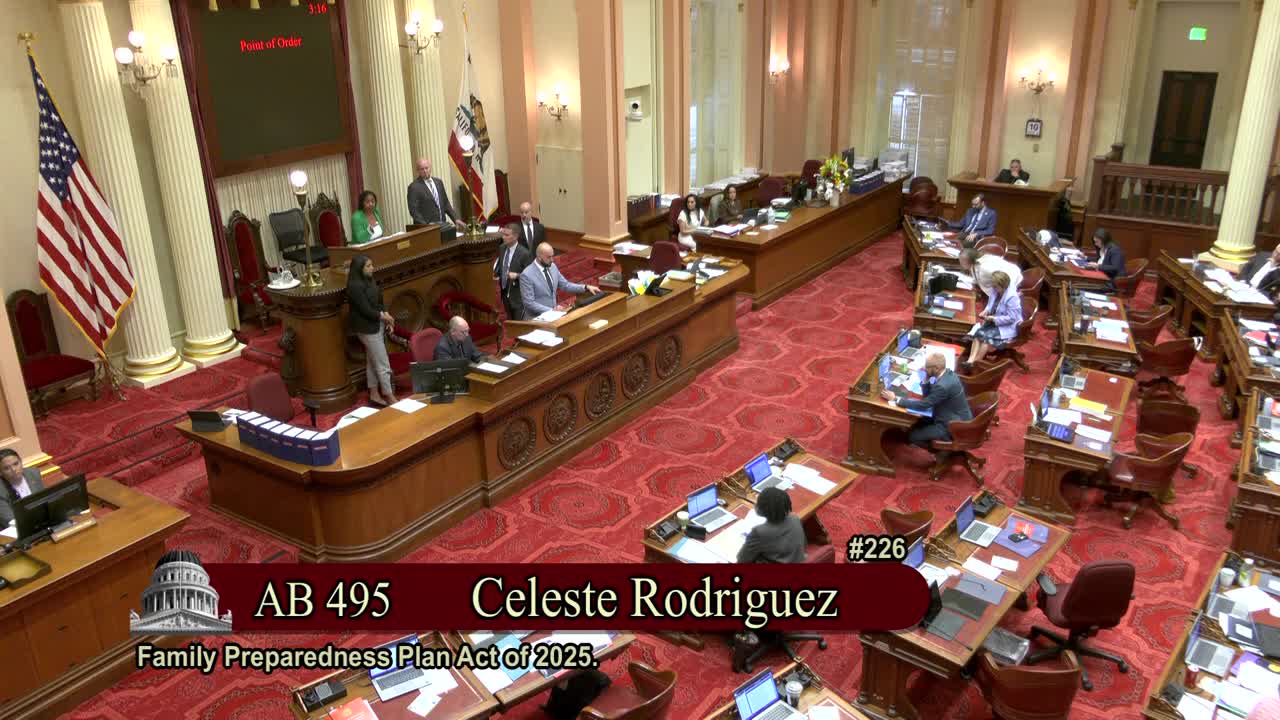 2MIN
Senate Floor
 1MIN
Assembly Floor
 10MIN
Assembly Standing Committee on Human Services
 16MIN
Assembly Standing Committee on Housing and Community Development
 2MIN
Senate Floor
 21MIN
Senate Standing Committee on Housing
 22MIN
Senate Standing Committee on Human Services
Bill Author