SB 786: Planning and zoning: general plan: judicial challenges.
- Session Year: 2025-2026
- House: Senate
- Latest Version Date: 2025-10-10
Current Status:
Passed
(2025-10-10: Chaptered by Secretary of State. Chapter 526, Statutes of 2025.)
Introduced
In Committee
Awaiting First Chamber Vote
Passed First Chamber
In Committee
Awaiting Second Chamber Vote
Passed Second Chamber
Enacted
The Planning and Zoning Law requires each county and city to adopt a comprehensive, long-term general plan for the physical development of the county or city, and of certain land outside its boundaries, and requires the general plan to contain specified mandatory elements. Existing law specifies that these provisions generally do not apply to a charter city, but requires a charter city to adopt a general plan that contains the mandatory elements, among other things. Existing law prescribes a process to challenge the validity of a general plan. Among other things, existing law requires a petitioner to request a hearing or trial, as specified. Existing law requires a court to set a date for the hearing or trial to be heard no later than 120 days after the filing of the request, as specified. Existing law authorizes a court to continue for a reasonable time the date of the hearing or trial upon written motion and finding of good cause. Existing law requires a court to grant the petitioner temporary relief if the court grants a continuance to a respondent, as specified.
This bill would apply to the above-described process to challenge the validity of a general plan to a charter city and state that this is declaratory of existing law. The bill would limit the period for which a court may continue a trial or hearing, as described above, to no more than 60 days and would additionally authorize a court to grant a continuance on the courts own motion. The bill would extend the requirement that a court grant temporary relief, as described above, in any instance in which the court orders a continuance, rather than only if the court grants a continuance to a respondent. The bill would require the court to consider ordering additional temporary relief if the court has already granted temporary relief.
Existing law requires the general plan to contain specified mandatory elements, including a housing element. Existing law requires the housing element to consist of an identification and analysis of existing and projected housing needs and a statement of goals, policies, quantified objectives, financial resources, and scheduled programs for the preservation, improvement, and development of housing. Existing law also requires the housing element to, among other things, identify adequate sites for housing, as provided, and to make adequate provision for the existing and projected needs of all economic segments of the community. In preparation of the housing element, existing law requires the city and county to consider certain guidelines adopted by the department. Existing law requires the department to review, according to a specified procedure, any action or failure to act by the city, county, or city and county that it determines is inconsistent with an adopted housing element or certain other requirements, including any failure to implement any program actions included in the housing element.
This bill would require, to the extent that a quantified development standard, as defined, in a general plan element is inconsistent with a quantified development standard in another element, the provisions of the most recently adopted element to supersede the previously adopted element. If a local agency has established a specific deadline to amend a local ordinance, development standard, condition, or policy applicable to quantified development standards, or timelines or processes relating to entitlement and permitting decisions, and the local agency has failed to make that amendment by the specified deadline, the bill would require the department to undertake the above-described review procedure.
Existing law requires each city, county, or city and county to bring its housing element into conformity with certain requirements by a specified deadline. Existing law also requires a city, county, or city and county, upon a finding by a court that an action of a city, county, or city and county, which is required to be consistent with its general plan, does not comply with its housing element, to bring its action into compliance within 60 days. Existing law requires the court to retain jurisdiction throughout the period for compliance to enforce its decision and authorizes the court to extend the time period for compliance by an additional 60 days upon a determination that the 60-day period for compliance would place an undue hardship on the city, county, or city and county.
This bill would extend the amount of time a city, county, or city and county has to bring its action into compliance to 120 days and would remove the above-described extension provision. The bill would also require the court to retain jurisdiction throughout the period for compliance with its order and to conform to certain requirements. The bill would authorize the court to grant a reasonable extension of time for the city, county, or city and county to comply if review by the Department of Housing and Community Development is required as part of the court order and that review is not timely completed, as specified.
Existing law requires a court, if that court finds that a city, county, or city and county failed to complete a specified rezoning by a certain deadline, to issue an order or judgment, after considering the equities of the circumstances presented by all parties, compelling the local government to complete the rezoning within 60 days or the earliest time consistent with public hearing notice requirements in existence at the time the action was filed. Existing law also requires the court, if that court determines that its order or judgment is not carried out, to issue further orders to ensure that certain purposes and policies are fulfilled, including ordering, after considering the equities of the circumstances presented by all parties, that any required rezoning be completed within 60 days or the earliest time consistent with public hearing notice requirements in existence at the time the action was filed. Existing law also authorizes the court to impose sanctions on the city, county, or city and county if the court determines that its order or judgment is not carried out.
This bill would extend the amount of time a local government has to complete the above-described rezoning under a court order or judgment to 120 days. The bill would also remove the requirement that a court issue further orders that any required rezoning be completed within 60 days or the earliest time consistent with public hearing notice requirements in existence at the time the action was filed. The bill would instead require that the court impose sanctions on the city, county, or city and county if the court determines that its order or judgment is not carried out.
Existing law requires a county or city to bring the general plan or relevant mandatory element into compliance with state law within 120 days of a court issuing a final order or judgment in favor of a petitioner in any action brought to challenge the validity of that plan or element. Existing law also requires a county or city to bring its zoning ordinance into consistency with its general plan or relevant mandatory element within 120 days of bringing the general plan or relevant mandatory element into compliance with state law. Existing law authorizes a court to grant a county or city 2 extensions of time, as specified, to bring the general plan, relevant mandatory element, or zoning ordinance into compliance or consistency. Existing law requires a court, in the order or judgment, to include one or more specified remedies. Existing law also authorizes a court to grant these remedies as temporary relief, during a pendency of a challenge to the validity of a general plan, upon a showing of probable success on the merits, as specified.
This bill would instead require, in any order or judgment issued in an action brought to challenge the validity of the general plan of any city, county, or city and county, or any mandatory element thereof that resolves whether those plans or elements substantially comply with certain requirements, that order or judgment to be immediately appealable, regardless of whether any final judgment has been issued. The bill would instead require a county or city to comply with the above-described requirements if the court finds that the general plan or mandatory element does not substantially comply with certain requirements. The bill would remove a courts above-described authority to grant a city or county 2 extensions of time. The bill would specify that the above-described remedies are not stayed during the pendency of an appeal of the order or judgment, but would authorize a court to stay remedies if there is a showing by a county or city that it would suffer irreparable harm. The bill would require, rather than authorize, a court to grant these remedies as temporary relief during a pendency of a challenge to the validity of the general plan. The bill would require that request for temporary relief to be made by noticed motion or application, as specified.
The bill would include findings that changes proposed by this bill address a matter of statewide concern rather than a municipal affair and, therefore, apply to all cities, including charter cities.
The Planning and Zoning Law requires each county and city to adopt a comprehensive, long-term general plan for the physical development of the county or city, and of certain land outside its boundaries, and requires the general plan to contain specified mandatory elements. Existing law specifies that these provisions generally do not apply to a charter city, but requires a charter city to adopt a general plan that contains the mandatory elements, among other things. Existing law prescribes a process to challenge the validity of a general plan. Among other things, existing law requires a petitioner to request a hearing or trial, as specified. Existing law requires a court to set a date for the hearing or trial to be heard no later than 120 days after the filing of the request, as specified. Existing law authorizes a court to continue for a reasonable time the date of the hearing or trial upon written motion and finding of good cause. Existing law requires a court to grant the petitioner temporary relief if the court grants a continuance to a respondent, as specified.
This bill would apply to the above-described process to challenge the validity of a general plan to a charter city and state that this is declaratory of existing law. The bill would limit the period for which a court may continue a trial or hearing, as described above, to no more than 60 days and would additionally authorize a court to grant a continuance on the courts own motion. The bill would extend the requirement that a court grant temporary relief, as described above, in any instance in which the court orders a continuance, rather than only if the court grants a continuance to a respondent. The bill would require the court to consider ordering additional temporary relief if the court has already granted temporary relief.
Existing law requires the general plan to contain specified mandatory elements, including a housing element. Existing law requires the housing element to consist of an identification and analysis of existing and projected housing needs and a statement of goals, policies, quantified objectives, financial resources, and scheduled programs for the preservation, improvement, and development of housing. Existing law also requires the housing element to, among other things, identify adequate sites for housing, as provided, and to make adequate provision for the existing and projected needs of all economic segments of the community. In preparation of the housing element, existing law requires the city and county to consider certain guidelines adopted by the department. Existing law requires the department to review, according to a specified procedure, any action or failure to act by the city, county, or city and county that it determines is inconsistent with an adopted housing element or certain other requirements, including any failure to implement any program actions included in the housing element.
This bill would require, to the extent that a quantified development standard, as defined, in a general plan element is inconsistent with a quantified development standard in another element, the provisions of the most recently adopted element to supersede the previously adopted element. If a local agency has established a specific deadline to amend a local ordinance, development standard, condition, or policy applicable to housing development projects, quantified development standards, or timelines or processes relating to entitlement and permitting decisions, and the local agency has failed to make that amendment by the specified deadline, the bill would require the department to undertake the above-described review procedure.
Existing law requires each city, county, or city and county to bring its housing element into conformity with certain requirements by a specified deadline. Existing law also requires a city, county, or city and county, upon a finding by a court that an action of a city, county, or city and county, which is required to be consistent with its general plan, does not comply with its housing element, to bring its action into compliance within 60 days. Existing law requires the court to retain jurisdiction throughout the period for compliance to enforce its decision and authorizes the court to extend the time period for compliance by an additional 60 days upon a determination that the 60-day period for compliance would place an undue hardship on the city, county, or city and county.
This bill would extend the amount of time a city, county, or city and county has to bring its action into compliance to 120 days and would remove the above-described extension provision. The bill would also require the court to retain jurisdiction throughout the period for compliance with its order and to conform to certain requirements. The bill would authorize the court to grant a reasonable extension of time for the city, county, or city and county to comply if review by the Department of Housing and Community Development is required as part of the court order and that review is not timely completed, as specified.
Existing law requires a court, if that court finds that a city, county, or city and county failed to complete a specified rezoning by a certain deadline, to issue an order or judgment, after considering the equities of the circumstances presented by all parties, compelling the local government to complete the rezoning within 60 days or the earliest time consistent with public hearing notice requirements in existence at the time the action was filed. Existing law also requires the court, if that court determines that its order or judgment is not carried out, to issue further orders to ensure that certain purposes and policies are fulfilled, including ordering, after considering the equities of the circumstances presented by all parties, that any required rezoning be completed within 60 days or the earliest time consistent with public hearing notice requirements in existence at the time the action was filed. Existing law also authorizes the court to impose sanctions on the city, county, or city and county if the court determines that its order or judgment is not carried out.
This bill would extend the amount of time a local government has to complete the above-described rezoning under a court order or judgment to 120 days. The bill would also remove the requirement that a court issue further orders that any required rezoning be completed within 60 days or the earliest time consistent with public hearing notice requirements in existence at the time the action was filed. The bill would instead require that the court impose sanctions on the city, county, or city and county if the court determines that its order or judgment is not carried out.
Existing law requires a county or city to bring the general plan or relevant mandatory element into compliance with state law within 120 days of a court issuing a final order or judgment in favor of a petitioner in any action brought to challenge the validity of that plan or element. Existing law also requires a county or city to bring its zoning ordinance into consistency with its general plan or relevant mandatory element within 120 days of bringing the general plan or relevant mandatory element into compliance with state law. Existing law authorizes a court to grant a county or city 2 extensions of time, as specified, to bring the general plan, relevant mandatory element, or zoning ordinance into compliance or consistency. Existing law requires a court, in the order or judgment, to include one or more specified remedies. Existing law also authorizes a court to grant these remedies as temporary relief, during a pendency of a challenge to the validity of a general plan, upon a showing of probable success on the merits, as specified.
This bill would instead require, in any order or judgment issued in an action brought to challenge the validity of the general plan of any city, county, or city and county, or any mandatory element thereof that resolves whether the those plans or elements substantially comply with certain requirements, that order or judgment to be immediately appealable, regardless of whether any final judgment has been issued. The bill would instead require a county or city to comply with the above-described requirements if the court finds that the general plan or mandatory element does not substantially comply with certain requirements. The bill would remove a courts above-described authority to grant a city or county 2 extensions of time. The bill would specify that the above-described remedies are not stayed during the pendency of an appeal of the order or judgment, but would authorize a court to stay remedies if there is a showing by a county or city that it would suffer irreparable harm. The bill would require, rather than authorize, a court to grant these remedies as temporary relief during a pendency of a challenge to the validity of the general plan. The bill would require a court to set a date for the request for temporary relief to be heard no later than 30 days after the filing of a request for temporary relief, as specified. If the court does not hear the motion by those deadlines, the bill would authorize the petitioner to file an ex parte application requesting temporary relief, as specified. that request for temporary relief to be made by noticed motion or application, as specified.
The bill would include findings that changes proposed by this bill address a matter of statewide concern rather than a municipal affair and, therefore, apply to all cities, including charter cities.
The Planning and Zoning Law requires each county and city to adopt a comprehensive, long-term general plan for the physical development of the county or city, and of certain land outside its boundaries, and requires the general plan to contain specified mandatory elements. Existing law specifies that these provisions generally do not apply to a charter city, but requires a charter city to adopt a general plan that contains the mandatory elements, among other things. Existing law prescribes a process to challenge the validity of a general plan. Among other things, existing law requires a petitioner to request a hearing or trial, as specified. Existing law requires a court to set a date for the hearing or trial to be heard no later than 120 days after the filing of the request, as specified. Existing law authorizes a court to continue for a reasonable time the date of the hearing or trial upon written motion and finding of good cause. Existing law requires a court to grant the petitioner temporary relief if the court grants a continuance to a respondent, as specified.
This bill would apply to the above-described process to challenge the validity of a general plan to a charter city and state that this is declaratory of existing law. The bill would limit the period for which a court may continue a trial or hearing, as described above, to no more than 60 days and would additionally authorize a court to grant a continuance on the courts own motion. The bill would extend the requirement that a court grant temporary relief, as described above, in any instance in which the court orders a continuance, rather than only if the court grants a continuance to a respondent. The bill would require the court to consider ordering additional temporary relief if the court has already granted temporary relief.
Existing law requires the general plan to contain specified mandatory elements, including a housing element. Existing law requires the housing element to consist of an identification and analysis of existing and projected housing needs and a statement of goals, policies, quantified objectives, financial resources, and scheduled programs for the preservation, improvement, and development of housing. Existing law also requires the housing element to, among other things, identify adequate sites for housing, as provided, and to make adequate provision for the existing and projected needs of all economic segments of the community. In preparation of the housing element, existing law requires the city and county to consider certain guidelines adopted by the department. Existing law requires the department to review, according to a specified procedure, any action or failure to act by the city, county, or city and county that it determines is inconsistent with an adopted housing element or certain other requirements, including any failure to implement any program actions included in the housing element.
This bill would require, to the extent that a quantified development standard, as defined, in a general plan element is inconsistent with a quantified development standard in another element or a local ordinance, development standard, condition, or policy applicable to housing development projects, element, the provisions of the most recently adopted element that is substantially compliant under the above-described provisions to supersede the previously adopted element or local ordinance, development standard, condition, or policy, as of the date that the adopted element is deemed substantially compliant or the date specifically provided in the adopted element, as provided, whichever is later. element. If a local agency has established a specific deadline to amend a local ordinance, development standard, condition, or policy applicable to housing development projects, and the local agency has failed to make that amendment by the specified deadline, the bill would require the local agencys housing element or amendment to be immediately deemed not to be in substantial compliance on the date specified, without further action from the department, if the local agency has failed to make that amendment. The bill would also require a local housing agencys housing element or amendment to not be deemed to be in substantial compliance with the above-described provisions under certain conditions. department to undertake the above-described review procedure.
Existing law requires each city, county, or city and county to bring its housing element into conformity with certain requirements by a specified deadline. Existing law also requires a city, county, or city and county, upon a finding by a court that an action of a city, county, or city and county, which is required to be consistent with its general plan, does not comply with its housing element, to bring its action into compliance within 60 days. Existing law requires the court to retain jurisdiction throughout the period for compliance to enforce its decision and authorizes the court to extend the time period for compliance by an additional 60 days upon a determination that the 60-day period for compliance would place an undue hardship on the city, county, or city and county.
This bill would extend the amount of time a city, county, or city and county has to bring its action into compliance to 120 days and would remove the above-described extension provision. The bill would also require the court to retain jurisdiction throughout the period for compliance with its order and to conform to certain requirements. The bill would authorize the court to grant a reasonable extension of time for the city, county, or city and county to comply if review by the Department of Housing and Community Development is required as part of the court order and that review is not timely completed, as specified.
Existing law requires a court, if that court finds that a city, county, or city and county failed to complete a specified rezoning by a certain deadline, to issue an order or judgment, after considering the equities of the circumstances presented by all parties, compelling the local government to complete the rezoning within 60 days or the earliest time consistent with public hearing notice requirements in existence at the time the action was filed. Existing law also requires the court, if that court determines that its order or judgment is not carried out, to issue further orders to ensure that certain purposes and policies are fulfilled, including ordering, after considering the equities of the circumstances presented by all parties, that any required rezoning be completed within 60 days or the earliest time consistent with public hearing notice requirements in existence at the time the action was filed. Existing law also authorizes the court to impose sanctions on the city, county, or city and county if the court determines that its order or judgment is not carried out.
This bill would extend the amount of time a local government has to complete the above-described rezoning under a court order or judgment to 120 days. The bill would also remove the requirement that a court issue further orders that any required rezoning be completed within 60 days or the earliest time consistent with public hearing notice requirements in existence at the time the action was filed. The bill would instead require that the court impose sanctions on the city, county, or city and county if the court determines that its order or judgment is not carried out.
Existing law requires a county or city to bring the general plan or relevant mandatory element into compliance with state law within 120 days of a court issuing a final order or judgment in favor of a petitioner in any action brought to challenge the validity of that plan or element. Existing law also requires a county or city to bring its zoning ordinance into consistency with its general plan or relevant mandatory element within 120 days of bringing the general plan or relevant mandatory element into compliance with state law. Existing law authorizes a court to grant a county or city 2 extensions of time, as specified, to bring the general plan, relevant mandatory element, or zoning ordinance into compliance or consistency. Existing law requires a court, in the order or judgment, to include one or more specified remedies. Existing law also authorizes a court to grant these remedies as temporary relief, during a pendency of a challenge to the validity of a general plan, upon a showing of probable success on the merits, as specified.
This bill would instead require, in any order or judgment issued in an action brought to challenge the validity of the general plan of any city, county, or city and county, or any mandatory element thereof that resolves whether the those plans or elements substantially comply with certain requirements, that order or judgment to be immediately appealable, regardless of whether any final judgment has been issued. The bill would instead require a county or city to comply with the above-described requirements if the court finds that the general plan or mandatory element does not substantially comply with certain requirements, regardless of whether a final judgment has been issued. requirements. The bill would remove a courts above-described authority to grant a city or county 2 extensions of time. The bill would specify that the above-described remedies are not stayed during the pendency of an appeal of the order or judgment, but would authorize a court to stay remedies if there is a showing by a county or city that it would suffer irreparable harm. The bill would require, rather than authorize, a court to grant these remedies as temporary relief during a pendency of a challenge to the validity of the general plan. The bill would require a court to set a date for the request for temporary relief to be heard no later than 30 days after the filing of a request for temporary relief, as specified. If the court does not hear the motion by those deadlines, the bill would authorize the petitioner to file an ex parte application requesting temporary relief, as specified.
The bill would include findings that changes proposed by this bill address a matter of statewide concern rather than a municipal affair and, therefore, apply to all cities, including charter cities.
The Planning and Zoning Law requires each county and city to adopt a comprehensive, long-term general plan for the physical development of the county or city, and of certain land outside its boundaries, and requires the general plan to contain specified mandatory elements. Existing law specifies that these provisions generally do not apply to a charter city, but requires a charter city to adopt a general plan that contains the mandatory elements, among other things. Existing law prescribes a process to challenge the validity of a general plan. Among other things, existing law requires a petitioner to request a hearing or trial, as specified. Existing law requires a court to set a date for the hearing or trial to be heard no later than 120 days after the filing of the request, as specified. Existing law authorizes a court to continue for a reasonable time the date of the hearing or trial upon written motion and finding of good cause. Existing law requires a court to grant the petitioner temporary relief if the court grants a continuance to a respondent, as specified.
This bill would apply to the above-described process to challenge the validity of a general plan to a charter city and state that this is declaratory of existing law. The bill would limit the period for which a court may continue a trial or hearing, as described above, to no more than 60 days and would additionally authorize a court to grant a continuance on the courts own motion. The bill would extend the requirement that a court grant temporary relief, as described above, in any instance in which the court orders a continuance, rather than only if the court grants a continuance to a respondent. The bill would require the court to consider ordering additional temporary relief if the court has already granted temporary relief.
Existing law requires the general plan to contain specified mandatory elements, including a housing element. Existing law requires the housing element to consist of an identification and analysis of existing and projected housing needs and a statement of goals, policies, quantified objectives, financial resources, and scheduled programs for the preservation, improvement, and development of housing. Existing law also requires the housing element to, among other things, identify adequate sites for housing, as provided, and to make adequate provision for the existing and projected needs of all economic segments of the community. In preparation of the housing element, existing law requires the city and county to consider certain guidelines adopted by the department.
This bill would require, to the extent that a general plan element is inconsistent with another element or a local ordinance, development standard, condition, or policy applicable to housing development projects, the provisions of the most recently adopted element that is substantially compliant under the above-described provisions to supersede the previously adopted element or local ordinance, development standard, condition, or policy, as of the date that the adopted element is deemed substantially compliant or the date specifically provided in the adopted element, as provided, whichever is later. If a local agency has established a deadline to amend a local ordinance, development standard, condition, or policy applicable to housing development projects, the bill would require the local agencys housing element or amendment to be immediately deemed not to be in substantial compliance on the date specified, without further action from the department, if the local agency has failed to make that amendment. The bill would also require a local housing agencys housing element or amendment to not be deemed to be in substantial compliance with the above-described provisions under certain conditions.
Existing law requires each city, county, or city and county to bring its housing element into conformity with certain requirements by a specified deadline. Existing law also requires a city, county, or city and county, upon a finding by a court that an action of a city, county, or city and county, which is required to be consistent with its general plan, does not comply with its housing element, to bring its action into compliance within 60 days. Existing law requires the court to retain jurisdiction throughout the period for compliance to enforce its decision and authorizes the court to extend the time period for compliance by an additional 60 days upon a determination that the 60-day period for compliance would place an undue hardship on the city, county, or city and county.
This bill would extend the amount of time a city, county, or city and county has to bring its action into compliance to 120 days and would remove the above-described extension provision. The bill would also require the court to retain jurisdiction throughout the period for compliance with its order and to conform to certain requirements.
Existing law requires a court, if that court finds that a city, county, or city and county failed to complete a specified rezoning by a certain deadline, to issue an order or judgment, after considering the equities of the circumstances presented by all parties, compelling the local government to complete the rezoning within 60 days or the earliest time consistent with public hearing notice requirements in existence at the time the action was filed. Existing law also requires the court, if that court determines that its order or judgment is not carried out, to issue further orders to ensure that certain purposes and policies are fulfilled, including ordering, after considering the equities of the circumstances presented by all parties, that any required rezoning be completed within 60 days or the earliest time consistent with public hearing notice requirements in existence at the time the action was filed. Existing law also authorizes the court to impose sanctions on the city, county, or city and county if the court determines that its order or judgment is not carried out.
This bill would extend the amount of time a local government has to complete the above-described rezoning under a court order or judgment to 120 days. The bill would also remove the requirement that a court issue further orders that any required rezoning be completed within 60 days or the earliest time consistent with public hearing notice requirements in existence at the time the action was filed. The bill would instead require that the court impose sanctions on the city, county, or city and county if the court determines that its order or judgment is not carried out.
Existing law requires a county or city to bring the general plan or relevant mandatory element into compliance with state law within 120 days of a court issuing a final order or judgment in favor of a petitioner in any action brought to challenge the validity of that plan or element. Existing law also requires a county or city to bring its zoning ordinance into consistency with its general plan or relevant mandatory element within 120 days of bringing the general plan or relevant mandatory element into compliance with state law. Existing law authorizes a court to grant a county or city 2 extensions of time, as specified, to bring the general plan, relevant mandatory element, or zoning ordinance into compliance or consistency. Existing law requires a court, in the order or judgment, to include one or more specified remedies. Existing law also authorizes a court to grant these remedies as temporary relief, during a pendency of a challenge to the validity of a general plan, upon a showing of probable success on the merits, as specified.
This bill would instead require, in any order or judgment issued in an action brought to challenge the validity of the general plan of any city, county, or city and county, or any mandatory element thereof that resolves whether the those plans or elements substantially comply with certain requirements, that order or judgment to be immediately appealable, regardless of whether any final judgment has been issued. The bill would instead require a county or city to comply with the above-described requirements if the court finds that the general plan or mandatory element does not substantially comply with certain requirements, regardless of whether a final judgment has been issued. The bill would remove a courts above-described authority to grant a city or county 2 extensions of time. The bill would specify that the above-described remedies are not stayed during the pendency of an appeal of the order or judgment, but would authorize a court to stay remedies if there is a showing by a county or city that it would suffer irreparable harm. The bill would require, rather than authorize, a court to grant these remedies as temporary relief during a pendency of a challenge to the validity of the general plan. The bill would require a court to set a date for the request for temporary relief to be heard no later than 30 days after the filing of a request for temporary relief, as specified.
The bill would include findings that changes proposed by this bill address a matter of statewide concern rather than a municipal affair and, therefore, apply to all cities, including charter cities.
Existing law, the Planning and Zoning Law, requires a city or county to adopt a general plan for land use development within its boundaries that includes, among other things, a housing element. Existing law specifies the required contents of the housing element but also specifies that in so doing, nothing in those provisions requires a city, county, or city and county to expend local revenues on the construction of housing, housing subsidies, or land acquisition, or to disapprove any residential development that is consistent with the general plan.This bill would make nonsubstantive changes to the provision described above.Existing law, the Planning and Zoning Law, requires a city or county to adopt a general plan for land use development within its boundaries that includes, among other things, a housing element. Existing law specifies the required contents of the housing element but also specifies that in so doing, nothing in those provisions requires a city, county, or city and county to expend local revenues on the construction of housing, housing subsidies, or land acquisition, or to disapprove any residential development that is consistent with the general plan.
This bill would make nonsubstantive changes to the provision described above.
(a)For purposes of this section, quantified development standard means a sites maximum density or requirements for a height limit, setback, maximum or minimum unit size, lot coverage, or floor area ratio.
(b)To the extent that a quantified development standard contained in a general plan element is inconsistent with a quantified development standard contained in another element, the provisions of the most recently adopted element shall supersede inconsistent provisions of the previously adopted element.
(c)If a local agency has established a specific deadline under subdivision (c) of Section 65583 to amend a local ordinance, development standard, condition, or policy applicable to quantified development standards, or timelines or processes relating to entitlement and permitting decisions, and the local agency has failed to make that amendment by the specified deadline, the department shall undertake the review described in subdivision (i) of Section 65585.
SEC. 2.Section 65587 of the Government Code is amended to read:65587.(a)Each city, county, or city and county shall bring its housing element, as required by subdivision (c) of Section 65302, into conformity with the requirements of this article on or before October 1, 1981, and the deadlines set by Section 65588. Except as specifically provided in subdivision (b) of Section 65361, the Director of Planning and Research shall not grant an extension of time from these requirements.
(b)Any action brought by any interested party to review the conformity with the provisions of this article of any housing element or portion thereof or revision thereto shall be brought pursuant to Section 1085 of the Code of Civil Procedure; the courts review of compliance with the provisions of this article shall extend to whether the housing element or portion thereof or revision thereto substantially complies with the requirements of this article.
(c)(1)If a court finds that an action of a city, county, or city and county, which is required to be consistent with its general plan, does not comply with its housing element, the city, county, or city and county shall bring its action into compliance within 120 days. However, the court shall retain jurisdiction throughout the period for compliance with its order and to conform to the requirements of Article 14 (commencing with Section 65750).
(2)If review by the Department of Housing and Community Development is required, as part of a court order pursuant to Article 14 (commencing with Section 65750), and the review is not timely completed to allow a city, county, or city and county to comply with a court order to bring their housing element into compliance within 120 days, the court may grant a reasonable extension of time for the city, county, or city and county to comply.
(d)(1)If a court finds that a city, county, or city and county failed to complete the rezoning required by subparagraph (A) of paragraph (1) of subdivision (c) of Section 65583, as that deadline may be modified by the extension provided for in subdivision (f) of that section, the court shall issue an order or judgment, after considering the equities of the circumstances presented by all parties, compelling the local government to complete the rezoning within 120 days or the earliest time consistent with public hearing notice requirements in existence at the time the action was filed. The court shall retain jurisdiction to ensure that its order or judgment is carried out. If the court determines that its order or judgment is not carried out, the court shall issue further orders to ensure that the purposes and policies of this article are fulfilled, including ordering, after considering the equities of the circumstances presented by all parties, sanctions on the city, county, or city and county until the rezoning is complete and in effect.
(2)Any interested person may bring an action to compel compliance with the deadlines and requirements of paragraphs (1), (2), and (3) of subdivision (c) of Section 65583. The action shall be brought pursuant to Section 1085 of the Code of Civil Procedure. In any such action, the city, county, or city and county shall bear the burden of proof.
SEC. 3.Section 65700 of the Government Code is amended to read:65700.(a)This chapter shall not apply to a charter city, except to the extent that the same may be adopted by charter or ordinance of the city and except that charter cities shall adopt general plans in any case. General plans of a charter city shall be adopted by resolution of the legislative body of the city, or the planning commission if the charter so provides. These general plans shall contain the mandatory elements required by Article 5 (commencing with Section 65300) of Chapter 3 of this title.
(b)Notwithstanding subdivision (a), paragraph (2) of subdivision (a) of Section 65400, Sections 65300.5, 65301.5, 65359, 65450, 65454, 65455, 65460.8, 65590, and 65590.1, and Article 10.6 (commencing with Section 65580) shall be applicable to charter cities.
(c)Notwithstanding subdivision (a), in order to enforce the requirements of Article 5 (commencing with Section 65300), Article 14 (commencing with Section 65750) shall be applicable to charter cities. This subdivision is declaratory of existing law.
SEC. 4.Section 65753 of the Government Code is amended to read:65753.(a)The petitioner shall request a hearing or trial on the alternative writ or peremptory writ of mandate, and any other party may request a hearing or trial, within 90 days of the date the petitioner files the petition for a writ of mandate pursuant to Section 65751. If no request for a hearing or trial is filed within 90 days of the date that petition is filed, the action or proceeding may be set for hearing or trial or dismissed on the motion of any party other than the petitioner or may be dismissed on the courts own motion.
(b)Within 30 days of the filing of the request for a hearing or trial pursuant to subdivision (a), the court shall set a date for a hearing or trial on the action or part of an action brought pursuant to Section 65751. The hearing or trial shall be set to be heard at the earliest possible date that the business of the court permits, but not more than 120 days after the filing of a request for hearing under this section. The court may continue the date of the hearing or trial upon written motion and a finding of good cause, or upon the courts own motion, for no more than 60 days. However, if the court orders a continuance, it shall, upon the written motion of the petitioner and upon the petitioner meeting the requirements of Section 65757, grant the relief provided in Section 65757 as temporary relief. If temporary relief has already been granted, the court shall consider ordering additional temporary relief in light of the continuance. In any order granting temporary relief, the court shall not enjoin any housing developments that comply with applicable provisions of law and that may be developed without having an impact on the ability of the city, county, or city and county to properly adopt and implement an adequate housing element.
SEC. 5.Section 65754 of the Government Code is amended to read:65754.In any order or judgment issued in an action brought to challenge the validity of the general plan of any city, county, or city and county, or any mandatory element thereof, that resolves whether the general plan or any mandatory element of the general plan thereof substantially complies with the requirements of Article 5 (commencing with Section 65300):
(a)The order or judgment shall be immediately appealable, regardless of whether any final judgment has been issued.
(b)If the court finds that the general plan or mandatory element does not substantially comply with the requirements of Article 5 (commencing with Section 65300), the city, county, or city and county shall bring its general plan or relevant mandatory element or elements thereof into compliance with the requirements of Article 5 (commencing with Section 65300) within 120 days.
Notwithstanding the provisions of subdivision (b) of Section 65585, the planning agency of the city, county, or city and county shall submit a draft of its revised housing element or housing element amendment at least 45 days prior to its adoption to the Department of Housing and Community Development for its review, notifying the department that the element is subject to the review procedure set forth in this section.
The department shall review the draft element or amendment and report its findings to the planning agency within 45 days of receipt of the draft. The legislative body shall consider the departments findings prior to final adoption of the housing element or amendment if the departments findings are reported to the planning agency within 45 days after the department receives that draft element or amendment.
(c)The city or county, including the chartered cities specified in subdivision (d) of Section 65860, shall, in accordance with Section 65860, bring its zoning ordinance into consistency with its general plan or relevant mandatory element or elements thereof within 120 days after the general plan has been amended in accordance with subdivision (b).
SEC. 6.Section 65755 of the Government Code is amended to read:65755.(a)The court shall include, in the order or judgment rendered pursuant to Section 65754, one or more of the following provisions for any or all types or classes of developments or any or all geographic segments of the city, county, or city and county until the city, county, or city and county has substantially complied with the requirements of Article 5 (commencing with Section 65300):
(1)Suspend the authority of the city, county, or city and county pursuant to Division 13 (commencing with Section 17910) of the Health and Safety Code, to issue building permits, or any category of building permits, and all other related permits, except that the city, county, or city and county shall continue to function as an enforcement agency for review of permit applications for appropriate codes and standards compliance, prior to the issuance of building permits and other related permits for residential housing for that city, county, or city and county.
(2)Suspend the authority of the city, county, or city and county, pursuant to Chapter 4 (commencing with Section 65800) to grant any and all categories of zoning changes, variances, or both.
(3)Suspend the authority of the city, county, or city and county, pursuant to Division 2 (commencing with Section 66410), to grant subdivision map approvals for any and all categories of subdivision map approvals.
(4)Mandate the approval of all applications for building permits, or other related construction permits, for residential housing where a final subdivision map, parcel map, or plot plan has been approved for the project, where the approval will not impact on the ability of the city, county, or city and county to properly adopt and implement an adequate housing element, and where the permit application conforms to all code requirements and other applicable provisions of law except those zoning laws held to be invalid by the final court order, and changes to the zoning ordinances adopted after such final court order which were enacted for the purpose of preventing the construction of a specific residential development.
(5)Mandate the approval of any or all final subdivision maps for residential housing projects which have previously received a tentative map approval from the city, county, or city and county pursuant to Division 2 (commencing with Section 66410) when the final map conforms to the approved tentative map, the tentative map has not expired, and where approval will not impact on the ability of the city, county, or city and county to properly adopt and implement an adequate housing element.
(6)Mandate that notwithstanding the provisions of Sections 66473.5 and 66474, any tentative subdivision map for a residential housing project shall be approved if all of the following requirements are met:
(A)The approval of the map will not significantly impair the ability of the city, county, or city and county to adopt and implement those elements or portions thereof of the general plan which have been held to be inadequate.
(B)The map complies with all of the provisions of Division 2 (commencing with Section 66410), except those parts which would require disapproval of the project due to the inadequacy of the general plan.
(C)The approval of the map will not affect the ability of the city, county, or city and county to adopt and implement an adequate housing element.
(D)The map is consistent with the portions of the general plan not found inadequate and the proposed revisions, if applicable, to the part of the plan held inadequate.
(b)Any order or judgment of a court which includes the remedies described in paragraphs (1), (2), or (3) of subdivision (a) shall exclude from the operation of that order or judgment any action, program, or project required by law to be consistent with a general or specific plan if the court finds that the approval or undertaking of the action, program, or project complies with both of the following requirements:
(1)That it will not significantly impair the ability of the city, county, or city and county to adopt or amend all or part of the applicable plan as may be necessary to make the plan substantially comply with the requirements of Article 5 (commencing with Section 65300) in the case of a general plan, or Article 8 (commencing with Section 65450) in the case of a specific plan.
(2)That it is consistent with those portions of the plan challenged in the action or proceeding and found by the court to substantially comply with applicable provisions of law.
The party seeking exclusion from any order or judgment of a court pursuant to this subdivision shall have the burden of showing that the action, program, or project complies with paragraphs (1) and (2).
(c)Notwithstanding Section 65754.4 or subdivisions (a) and (b), in any action or proceeding brought pursuant to subdivision (d) of Section 65009, no remedy pursuant to this section or injunction pursuant to Section 65754.5 shall abrogate, impair, or otherwise interfere with the full exercise of the rights and protections granted to (1) an applicant for a tentative map pursuant to Section 66474.2, or (2) a developer pursuant to Sections 65866 and 66498.1.
(d)(1)Notwithstanding Sections 916 and 1110b of the Code of Civil Procedure, or any other law, remedies ordered pursuant to this section shall not be stayed during the pendency of an appeal of an order or judgment rendered pursuant to Section 65754.
(2)The court may stay remedies ordered pursuant to this section upon a showing made by the city, county, or city and county that the city, county, or city and county will suffer irreparable harm.
SEC. 7.Section 65757 of the Government Code is amended to read:65757.(a)During the pendency of any action described in Section 65754, the court shall, upon a showing of probable success on the merits, grant the relief provided in Section 65755 as temporary relief. In any order granting temporary relief, the court shall not enjoin during the pendency of the action any housing developments which comply with applicable provisions of law and which may be developed without having an impact on the ability of the city, county, or city and county to properly adopt and implement an adequate housing element. Any housing developments permitted to proceed during the pendency of the action shall not be subject to the restrictions specified in subdivision (b) or (c) of Section 65754 as part of any final judgment.
(b)Any request for temporary relief under this section shall be made by noticed motion or application.
(1)If by noticed motion, the court shall set the hearing for the earliest possible date that the business of the court permits, consistent with Section 1005 of the Code of Civil Procedure, but not more than 60 days after the notice of motion was filed. The court may grant a continuance only on an affirmative showing of good cause requiring the continuance. Circumstances indicating good cause shall be those relevant to whether good cause exists to continue a trial under the California Rules of Court.
(2)Alternatively, the court may order temporary relief upon application and, if the application for temporary relief is granted, issue an order to show cause as to why temporary relief should not remain while a hearing on the merits of the entire action is pending.
SEC. 8.Section 65759 of the Government Code is amended to read:65759.(a)In any action brought under this section, the California Environmental Quality Act (Division 13 (commencing with Section 21000) of the Public Resources Code) does not apply to any action necessary to bring its general plan or relevant mandatory elements of the plan into compliance with any court order or judgment under this article.
(b)Notwithstanding subdivision (a), the local agency shall prepare an initial study, within the time limitations specified in Section 65754, to determine the environmental effects of the proposed action necessary to comply with the court order. The initial study shall contain substantially the same information as is required for an initial study pursuant to subdivision (c) of Section 15080 of Title 14 of the California Code of Regulations.
(c)If as a result of the initial study described in subdivision (b), the local agency determines that the action may have a significant effect on the environment, the local agency shall prepare, within the time limitations specified in Section 65754, an environmental assessment, the content of which substantially conforms to the required content for a draft environmental impact report set forth in Article 9 (commencing with Section 15140) of Title 14 of the California Code of Regulations. The local agency shall include notice of the preparation of the environmental assessment in all notices provided for the amendments to the general plan proposed to comply with the court order.
(d)The environmental assessment described in subdivision (c) shall be deemed to be a part of the general plan and shall only be reviewable as provided in this article.
(e)The local agency may comply with the provisions of the California Environmental Quality Act (Division 13 (commencing with Section 21000) of the Public Resources Code) in any action necessary to bring its general plan or the plans relevant mandatory elements into compliance with any court order or judgment under this section so long as it does so within the time limitations specified in Section 65754.
SEC. 9.The Legislature finds and declares that Sections 1 and 3 of this act, adding Section 65585.02 to, and amending Section 65700 of, the Government Code, respectively, address a matter of statewide concern rather than a municipal affair as that term is used in Section 5 of Article XI of the California Constitution. Therefore, Sections 1 and 3 of this act apply to all cities, including charter cities.
(a)For purposes of this section, quantified development standard means a sites maximum density or requirements for a height limit, setback, maximum or minimum unit size, lot coverage, or floor area ratio.
(b)To the extent that a quantified development standard contained in a general plan element is inconsistent with a quantified development standard contained in another element, the provisions of the most recently adopted element shall supersede inconsistent provisions of the previously adopted element.
(c)If a local agency has established a specific deadline under subdivision (c) of Section 65583 to amend a local ordinance, development standard, condition, or policy applicable to housing development projects, quantified development standards, or timelines or processes relating to entitlement and permitting decisions, and the local agency has failed to make that amendment by the specified deadline, the department shall undertake the review described in subdivision (i) of Section 65585.
SEC. 2.Section 65587 of the Government Code is amended to read:65587.(a)Each city, county, or city and county shall bring its housing element, as required by subdivision (c) of Section 65302, into conformity with the requirements of this article on or before October 1, 1981, and the deadlines set by Section 65588. Except as specifically provided in subdivision (b) of Section 65361, the Director of Planning and Research shall not grant an extension of time from these requirements.
(b)Any action brought by any interested party to review the conformity with the provisions of this article of any housing element or portion thereof or revision thereto shall be brought pursuant to Section 1085 of the Code of Civil Procedure; the courts review of compliance with the provisions of this article shall extend to whether the housing element or portion thereof or revision thereto substantially complies with the requirements of this article.
(c)(1)If a court finds that an action of a city, county, or city and county, which is required to be consistent with its general plan, does not comply with its housing element, the city, county, or city and county shall bring its action into compliance within 120 days. However, the court shall retain jurisdiction throughout the period for compliance with its order and to conform to the requirements of Article 14 (commencing with Section 65750).
(2)If review by the Department of Housing and Community Development is required, as part of a court order pursuant to Article 14 (commencing with Section 65750), and the review is not timely completed to allow a city, county, or city and county to comply with a court order to bring their housing element into compliance within 120 days, the court may grant a reasonable extension of time for the city, county, or city and county to comply.
(d)(1)If a court finds that a city, county, or city and county failed to complete the rezoning required by subparagraph (A) of paragraph (1) of subdivision (c) of Section 65583, as that deadline may be modified by the extension provided for in subdivision (f) of that section, the court shall issue an order or judgment, after considering the equities of the circumstances presented by all parties, compelling the local government to complete the rezoning within 120 days or the earliest time consistent with public hearing notice requirements in existence at the time the action was filed. The court shall retain jurisdiction to ensure that its order or judgment is carried out. If the court determines that its order or judgment is not carried out, the court shall issue further orders to ensure that the purposes and policies of this article are fulfilled, including ordering, after considering the equities of the circumstances presented by all parties, sanctions on the city, county, or city and county until the rezoning is complete and in effect.
(2)Any interested person may bring an action to compel compliance with the deadlines and requirements of paragraphs (1), (2), and (3) of subdivision (c) of Section 65583. The action shall be brought pursuant to Section 1085 of the Code of Civil Procedure. In any such action, the city, county, or city and county shall bear the burden of proof.
SEC. 3.Section 65700 of the Government Code is amended to read:65700.(a)This chapter shall not apply to a charter city, except to the extent that the same may be adopted by charter or ordinance of the city and except that charter cities shall adopt general plans in any case. General plans of a charter city shall be adopted by resolution of the legislative body of the city, or the planning commission if the charter so provides. These general plans shall contain the mandatory elements required by Article 5 (commencing with Section 65300) of Chapter 3 of this title.
(b)Notwithstanding subdivision (a), paragraph (2) of subdivision (a) of Section 65400, Sections 65300.5, 65301.5, 65359, 65450, 65454, 65455, 65460.8, 65590, and 65590.1, and Article 10.6 (commencing with Section 65580) shall be applicable to charter cities.
(c)Notwithstanding subdivision (a), in order to enforce the requirements of Article 5 (commencing with Section 65300), Article 14 (commencing with Section 65750) shall be applicable to charter cities. This subdivision is declaratory of existing law.
SEC. 4.Section 65753 of the Government Code is amended to read:65753.(a)The petitioner shall request a hearing or trial on the alternative writ or peremptory writ of mandate, and any other party may request a hearing or trial, within 90 days of the date the petitioner files the petition for a writ of mandate pursuant to Section 65751. If no request for a hearing or trial is filed within 90 days of the date that petition is filed, the action or proceeding may be set for hearing or trial or dismissed on the motion of any party other than the petitioner or may be dismissed on the courts own motion.
(b)Within 30 days of the filing of the request for a hearing or trial pursuant to subdivision (a), the court shall set a date for a hearing or trial on the action or part of an action brought pursuant to Section 65751. The hearing or trial shall be set to be heard at the earliest possible date that the business of the court permits, but not more than 120 days after the filing of a request for hearing under this section. The court may continue the date of the hearing or trial upon written motion and a finding of good cause, or upon the courts own motion, for no more than 60 days. However, if the court orders a continuance, it shall, upon the written motion of the petitioner and upon the petitioner meeting the requirements of Section 65757, grant the relief provided in Section 65757 as temporary relief. If temporary relief has already been granted, the court shall consider ordering additional temporary relief in light of the continuance. In any order granting temporary relief, the court shall not enjoin any housing developments that comply with applicable provisions of law and that may be developed without having an impact on the ability of the city, county, or city and county to properly adopt and implement an adequate housing element.
SEC. 5.Section 65754 of the Government Code is amended to read:65754.In any order or judgment issued in an action brought to challenge the validity of the general plan of any city, county, or city and county, or any mandatory element thereof, that resolves whether the general plan or any mandatory element of the general plan thereof substantially complies with the requirements of Article 5 (commencing with Section 65300):
(a)The order or judgment shall be immediately appealable, regardless of whether any final judgment has been issued.
(b)If the court finds that the general plan or mandatory element does not substantially comply with the requirements of Article 5 (commencing with Section 65300), the city, county, or city and county shall bring its general plan or relevant mandatory element or elements thereof into compliance with the requirements of Article 5 (commencing with Section 65300) within 120 days.
Notwithstanding the provisions of subdivision (b) of Section 65585, the planning agency of the city, county, or city and county shall submit a draft of its revised housing element or housing element amendment at least 45 days prior to its adoption to the Department of Housing and Community Development for its review, notifying the department that the element is subject to the review procedure set forth in this section.
The department shall review the draft element or amendment and report its findings to the planning agency within 45 days of receipt of the draft. The legislative body shall consider the departments findings prior to final adoption of the housing element or amendment if the departments findings are reported to the planning agency within 45 days after the department receives that draft element or amendment.
(c)The city or county, including the chartered cities specified in subdivision (d) of Section 65860, shall, in accordance with Section 65860, bring its zoning ordinance into consistency with its general plan or relevant mandatory element or elements thereof within 120 days after the general plan has been amended in accordance with subdivision (b).
SEC. 6.Section 65755 of the Government Code is amended to read:65755.(a)The court shall include, in the order or judgment rendered pursuant to Section 65754, one or more of the following provisions for any or all types or classes of developments or any or all geographic segments of the city, county, or city and county until the city, county, or city and county has substantially complied with the requirements of Article 5 (commencing with Section 65300):
(1)Suspend the authority of the city, county, or city and county pursuant to Division 13 (commencing with Section 17910) of the Health and Safety Code, to issue building permits, or any category of building permits, and all other related permits, except that the city, county, or city and county shall continue to function as an enforcement agency for review of permit applications for appropriate codes and standards compliance, prior to the issuance of building permits and other related permits for residential housing for that city, county, or city and county.
(2)Suspend the authority of the city, county, or city and county, pursuant to Chapter 4 (commencing with Section 65800) to grant any and all categories of zoning changes, variances, or both.
(3)Suspend the authority of the city, county, or city and county, pursuant to Division 2 (commencing with Section 66410), to grant subdivision map approvals for any and all categories of subdivision map approvals.
(4)Mandate the approval of all applications for building permits, or other related construction permits, for residential housing where a final subdivision map, parcel map, or plot plan has been approved for the project, where the approval will not impact on the ability of the city, county, or city and county to properly adopt and implement an adequate housing element, and where the permit application conforms to all code requirements and other applicable provisions of law except those zoning laws held to be invalid by the final court order, and changes to the zoning ordinances adopted after such final court order which were enacted for the purpose of preventing the construction of a specific residential development.
(5)Mandate the approval of any or all final subdivision maps for residential housing projects which have previously received a tentative map approval from the city, county, or city and county pursuant to Division 2 (commencing with Section 66410) when the final map conforms to the approved tentative map, the tentative map has not expired, and where approval will not impact on the ability of the city, county, or city and county to properly adopt and implement an adequate housing element.
(6)Mandate that notwithstanding the provisions of Sections 66473.5 and 66474, any tentative subdivision map for a residential housing project shall be approved if all of the following requirements are met:
(A)The approval of the map will not significantly impair the ability of the city, county, or city and county to adopt and implement those elements or portions thereof of the general plan which have been held to be inadequate.
(B)The map complies with all of the provisions of Division 2 (commencing with Section 66410), except those parts which would require disapproval of the project due to the inadequacy of the general plan.
(C)The approval of the map will not affect the ability of the city, county, or city and county to adopt and implement an adequate housing element.
(D)The map is consistent with the portions of the general plan not found inadequate and the proposed revisions, if applicable, to the part of the plan held inadequate.
(b)Any order or judgment of a court which includes the remedies described in paragraphs (1), (2), or (3) of subdivision (a) shall exclude from the operation of that order or judgment any action, program, or project required by law to be consistent with a general or specific plan if the court finds that the approval or undertaking of the action, program, or project complies with both of the following requirements:
(1)That it will not significantly impair the ability of the city, county, or city and county to adopt or amend all or part of the applicable plan as may be necessary to make the plan substantially comply with the requirements of Article 5 (commencing with Section 65300) in the case of a general plan, or Article 8 (commencing with Section 65450) in the case of a specific plan.
(2)That it is consistent with those portions of the plan challenged in the action or proceeding and found by the court to substantially comply with applicable provisions of law.
The party seeking exclusion from any order or judgment of a court pursuant to this subdivision shall have the burden of showing that the action, program, or project complies with paragraphs (1) and (2).
(c)Notwithstanding Section 65754.4 or subdivisions (a) and (b), in any action or proceeding brought pursuant to subdivision (d) of Section 65009, no remedy pursuant to this section or injunction pursuant to Section 65754.5 shall abrogate, impair, or otherwise interfere with the full exercise of the rights and protections granted to (1) an applicant for a tentative map pursuant to Section 66474.2, or (2) a developer pursuant to Sections 65866 and 66498.1.
(d)(1)Notwithstanding Sections 916 and 1110b of the Code of Civil Procedure, or any other law, remedies ordered pursuant to this section shall not be stayed during the pendency of an appeal of an order or judgment rendered pursuant to Section 65754.
(2)The court may stay remedies ordered pursuant to this section upon a showing made by the city, county, or city and county that the city, county, or city and county will suffer irreparable harm.
SEC. 7.Section 65757 of the Government Code is amended to read:65757.(a)During the pendency of any action described in Section 65754, the court shall, upon a showing of probable success on the merits, grant the relief provided in Section 65755 as temporary relief. In any order granting temporary relief, the court shall not enjoin during the pendency of the action any housing developments which comply with applicable provisions of law and which may be developed without having an impact on the ability of the city, county, or city and county to properly adopt and implement an adequate housing element. Any housing developments permitted to proceed during the pendency of the action shall not be subject to the restrictions specified in subdivision (b) or (c) of Section 65754 as part of any final judgment.
(b)The court shall set a date for a hearing within 15 days of the filing of a request for temporary relief pursuant to subdivision (a). The court shall set the hearing for the earliest possible date that the business of the court permits, but not more than 30 days after the filing of the request for temporary relief pursuant to subdivision (a). The court may continue for no more than 30 days the date of the hearing, but shall not grant more than one continuance. If the court does not hear the motion by the deadlines provided by this subdivision, the petitioner may file an ex parte application requesting temporary relief on the 61st day after the initial filing of a request for temporary relief.(b)Any request for temporary relief under this section shall be made by noticed motion or application.
(1)If by noticed motion, the court shall set the hearing for the earliest possible date that the business of the court permits, consistent with Section 1005 of the Code of Civil Procedure, but not more than 60 days after the notice of motion was filed. The court may grant a continuance only on an affirmative showing of good cause requiring the continuance. Circumstances indicating good cause shall be those relevant to whether good cause exists to continue a trial under the California Rules of Court.
(2)Alternatively, the court may order temporary relief upon application and, if the application for temporary relief is granted, issue an order to show cause as to why temporary relief should not remain while a hearing on the merits of the entire action is pending.
SEC. 8.Section 65759 of the Government Code is amended to read:65759.(a)In any action brought under this section, the California Environmental Quality Act (Division 13 (commencing with Section 21000) of the Public Resources Code) does not apply to any action necessary to bring its general plan or relevant mandatory elements of the plan into compliance with any court order or judgment under this article.
(b)Notwithstanding subdivision (a), the local agency shall prepare an initial study, within the time limitations specified in Section 65754, to determine the environmental effects of the proposed action necessary to comply with the court order. The initial study shall contain substantially the same information as is required for an initial study pursuant to subdivision (c) of Section 15080 of Title 14 of the California Code of Regulations.
(c)If as a result of the initial study described in subdivision (b), the local agency determines that the action may have a significant effect on the environment, the local agency shall prepare, within the time limitations specified in Section 65754, an environmental assessment, the content of which substantially conforms to the required content for a draft environmental impact report set forth in Article 9 (commencing with Section 15140) of Title 14 of the California Code of Regulations. The local agency shall include notice of the preparation of the environmental assessment in all notices provided for the amendments to the general plan proposed to comply with the court order.
(d)The environmental assessment described in subdivision (c) shall be deemed to be a part of the general plan and shall only be reviewable as provided in this article.
(e)The local agency may comply with the provisions of the California Environmental Quality Act (Division 13 (commencing with Section 21000) of the Public Resources Code) in any action necessary to bring its general plan or the plans relevant mandatory elements into compliance with any court order or judgment under this section so long as it does so within the time limitations specified in Section 65754.
SEC. 9.The Legislature finds and declares that Sections 1 and 3 of this act, adding Section 65585.02 to, and amending Section 65700 of, the Government Code, respectively, address a matter of statewide concern rather than a municipal affair as that term is used in Section 5 of Article XI of the California Constitution. Therefore, Sections 1 and 3 of this act apply to all cities, including charter cities.
(a)For purposes of this section, quantified development standard means a sites maximum density or requirements for a height limit, setback, maximum or minimum unit size, lot coverage, or floor area ratio.
(b)To the extent that a quantified development standard contained in a general plan element is inconsistent with a quantified development standard contained in another element, the provisions of the most recently adopted element shall supersede inconsistent provisions of the previously adopted element.
(c)If a local agency has established a specific deadline under subdivision (c) of Section 65583 to amend a local ordinance, development standard, condition, or policy applicable to housing development projects, and the local agency has failed to make that amendment by the specified deadline, the department shall undertake the review described in subdivision (i) of Section 65585.
SEC. 2.Section 65587 of the Government Code is amended to read:65587.(a)Each city, county, or city and county shall bring its housing element, as required by subdivision (c) of Section 65302, into conformity with the requirements of this article on or before October 1, 1981, and the deadlines set by Section 65588. Except as specifically provided in subdivision (b) of Section 65361, the Director of Planning and Research shall not grant an extension of time from these requirements.
(b)Any action brought by any interested party to review the conformity with the provisions of this article of any housing element or portion thereof or revision thereto shall be brought pursuant to Section 1085 of the Code of Civil Procedure; the courts review of compliance with the provisions of this article shall extend to whether the housing element or portion thereof or revision thereto substantially complies with the requirements of this article.
(c)(1)If a court finds that an action of a city, county, or city and county, which is required to be consistent with its general plan, does not comply with its housing element, the city, county, or city and county shall bring its action into compliance within 120 days. However, the court shall retain jurisdiction throughout the period for compliance with its order and to conform to the requirements of Article 14 (commencing with Section 65750).
(2)If review by the Department of Housing and Community Development is required, as part of a court order pursuant to Article 14 (commencing with Section 65750), and the review is not timely completed to allow a city, county, or city and county to comply with a court order to bring their housing element into compliance within 120 days, the court may grant a reasonable extension of time for the city, county, or city and county to comply.
(d)(1)If a court finds that a city, county, or city and county failed to complete the rezoning required by subparagraph (A) of paragraph (1) of subdivision (c) of Section 65583, as that deadline may be modified by the extension provided for in subdivision (f) of that section, the court shall issue an order or judgment, after considering the equities of the circumstances presented by all parties, compelling the local government to complete the rezoning within 120 days or the earliest time consistent with public hearing notice requirements in existence at the time the action was filed. The court shall retain jurisdiction to ensure that its order or judgment is carried out. If the court determines that its order or judgment is not carried out, the court shall issue further orders to ensure that the purposes and policies of this article are fulfilled, including ordering, after considering the equities of the circumstances presented by all parties, sanctions on the city, county, or city and county until the rezoning is complete and in effect.
(2)Any interested person may bring an action to compel compliance with the deadlines and requirements of paragraphs (1), (2), and (3) of subdivision (c) of Section 65583. The action shall be brought pursuant to Section 1085 of the Code of Civil Procedure. In any such action, the city, county, or city and county shall bear the burden of proof.
SEC. 3.Section 65700 of the Government Code is amended to read:65700.(a)This chapter shall not apply to a charter city, except to the extent that the same may be adopted by charter or ordinance of the city and except that charter cities shall adopt general plans in any case. General plans of a charter city shall be adopted by resolution of the legislative body of the city, or the planning commission if the charter so provides. These general plans shall contain the mandatory elements required by Article 5 (commencing with Section 65300) of Chapter 3 of this title.
(b)Notwithstanding subdivision (a), paragraph (2) of subdivision (a) of Section 65400, Sections 65300.5, 65301.5, 65359, 65450, 65454, 65455, 65460.8, 65590, and 65590.1, and Article 10.6 (commencing with Section 65580) shall be applicable to charter cities.
(c)Notwithstanding subdivision (a), in order to enforce the requirements of Article 5 (commencing with Section 65300), Article 14 (commencing with Section 65750) shall be applicable to charter cities. This subdivision is declaratory of existing law.
SEC. 4.Section 65753 of the Government Code is amended to read:65753.(a)The petitioner shall request a hearing or trial on the alternative writ or peremptory writ of mandate, and any other party may request a hearing or trial, within 90 days of the date the petitioner files the petition for a writ of mandate pursuant to Section 65751. If no request for a hearing or trial is filed within 90 days of the date that petition is filed, the action or proceeding may be set for hearing or trial or dismissed on the motion of any party other than the petitioner or may be dismissed on the courts own motion.
(b)Within 30 days of the filing of the request for a hearing or trial pursuant to subdivision (a), the court shall set a date for a hearing or trial on the action or part of an action brought pursuant to Section 65751. The hearing or trial shall be set to be heard at the earliest possible date that the business of the court permits, but not more than 120 days after the filing of a request for hearing under this section. The court may continue the date of the hearing or trial upon written motion and a finding of good cause, or upon the courts own motion, for no more than 60 days. However, if the court orders a continuance, it shall, upon the written motion of the petitioner and upon the petitioner meeting the requirements of Section 65757, grant the relief provided in Section 65757 as temporary relief. If temporary relief has already been granted, the court shall consider ordering additional temporary relief in light of the continuance. In any order granting temporary relief, the court shall not enjoin any housing developments that comply with applicable provisions of law and that may be developed without having an impact on the ability of the city, county, or city and county to properly adopt and implement an adequate housing element.
SEC. 5.Section 65754 of the Government Code is amended to read:65754.In any order or judgment issued in an action brought to challenge the validity of the general plan of any city, county, or city and county, or any mandatory element thereof, that resolves whether the general plan or any mandatory element of the general plan thereof substantially complies with the requirements of Article 5 (commencing with Section 65300):
(a)The order or judgment shall be immediately appealable, regardless of whether any final judgment has been issued.
(b)If the court finds that the general plan or mandatory element does not substantially comply with the requirements of Article 5 (commencing with Section 65300), the city, county, or city and county shall bring its general plan or relevant mandatory element or elements thereof into compliance with the requirements of Article 5 (commencing with Section 65300) within 120 days, regardless of whether any final judgment has been issued. days.
Notwithstanding the provisions of subdivision (b) of Section 65585, the planning agency of the city, county, or city and county shall submit a draft of its revised housing element or housing element amendment at least 45 days prior to its adoption to the Department of Housing and Community Development for its review, notifying the department that the element is subject to the review procedure set forth in this section.
The department shall review the draft element or amendment and report its findings to the planning agency within 45 days of receipt of the draft. The legislative body shall consider the departments findings prior to final adoption of the housing element or amendment if the departments findings are reported to the planning agency within 45 days after the department receives that draft element or amendment.
(c)The city or county, including the chartered cities specified in subdivision (d) of Section 65860, shall, in accordance with Section 65860, bring its zoning ordinance into consistency with its general plan or relevant mandatory element or elements thereof within 120 days after the general plan has been amended in accordance with subdivision (b).
SEC. 6.Section 65755 of the Government Code is amended to read:65755.(a)The court shall include, in the order or judgment rendered pursuant to Section 65754, one or more of the following provisions for any or all types or classes of developments or any or all geographic segments of the city, county, or city and county until the city, county, or city and county has substantially complied with the requirements of Article 5 (commencing with Section 65300):
(1)Suspend the authority of the city, county, or city and county pursuant to Division 13 (commencing with Section 17910) of the Health and Safety Code, to issue building permits, or any category of building permits, and all other related permits, except that the city, county, or city and county shall continue to function as an enforcement agency for review of permit applications for appropriate codes and standards compliance, prior to the issuance of building permits and other related permits for residential housing for that city, county, or city and county.
(2)Suspend the authority of the city, county, or city and county, pursuant to Chapter 4 (commencing with Section 65800) to grant any and all categories of zoning changes, variances, or both.
(3)Suspend the authority of the city, county, or city and county, pursuant to Division 2 (commencing with Section 66410), to grant subdivision map approvals for any and all categories of subdivision map approvals.
(4)Mandate the approval of all applications for building permits, or other related construction permits, for residential housing where a final subdivision map, parcel map, or plot plan has been approved for the project, where the approval will not impact on the ability of the city, county, or city and county to properly adopt and implement an adequate housing element, and where the permit application conforms to all code requirements and other applicable provisions of law except those zoning laws held to be invalid by the final court order, and changes to the zoning ordinances adopted after such final court order which were enacted for the purpose of preventing the construction of a specific residential development.
(5)Mandate the approval of any or all final subdivision maps for residential housing projects which have previously received a tentative map approval from the city, county, or city and county pursuant to Division 2 (commencing with Section 66410) when the final map conforms to the approved tentative map, the tentative map has not expired, and where approval will not impact on the ability of the city, county, or city and county to properly adopt and implement an adequate housing element.
(6)Mandate that notwithstanding the provisions of Sections 66473.5 and 66474, any tentative subdivision map for a residential housing project shall be approved if all of the following requirements are met:
(A)The approval of the map will not significantly impair the ability of the city, county, or city and county to adopt and implement those elements or portions thereof of the general plan which have been held to be inadequate.
(B)The map complies with all of the provisions of Division 2 (commencing with Section 66410), except those parts which would require disapproval of the project due to the inadequacy of the general plan.
(C)The approval of the map will not affect the ability of the city, county, or city and county to adopt and implement an adequate housing element.
(D)The map is consistent with the portions of the general plan not found inadequate and the proposed revisions, if applicable, to the part of the plan held inadequate.
(b)Any order or judgment of a court which includes the remedies described in paragraphs (1), (2), or (3) of subdivision (a) shall exclude from the operation of that order or judgment any action, program, or project required by law to be consistent with a general or specific plan if the court finds that the approval or undertaking of the action, program, or project complies with both of the following requirements:
(1)That it will not significantly impair the ability of the city, county, or city and county to adopt or amend all or part of the applicable plan as may be necessary to make the plan substantially comply with the requirements of Article 5 (commencing with Section 65300) in the case of a general plan, or Article 8 (commencing with Section 65450) in the case of a specific plan.
(2)That it is consistent with those portions of the plan challenged in the action or proceeding and found by the court to substantially comply with applicable provisions of law.
The party seeking exclusion from any order or judgment of a court pursuant to this subdivision shall have the burden of showing that the action, program, or project complies with paragraphs (1) and (2).
(c)Notwithstanding Section 65754.4 or subdivisions (a) and (b), in any action or proceeding brought pursuant to subdivision (d) of Section 65009, no remedy pursuant to this section or injunction pursuant to Section 65754.5 shall abrogate, impair, or otherwise interfere with the full exercise of the rights and protections granted to (1) an applicant for a tentative map pursuant to Section 66474.2, or (2) a developer pursuant to Sections 65866 and 66498.1.
(d)(1)Notwithstanding Sections 916 and 1110b of the Code of Civil Procedure, or any other law, remedies ordered pursuant to this section shall not be stayed during the pendency of an appeal of an order or judgment rendered pursuant to Section 65754.
(2)The court may stay remedies ordered pursuant to this section upon a showing made by the city, county, or city and county that the city, county, or city and county will suffer irreparable harm.
SEC. 7.Section 65757 of the Government Code is amended to read:65757.(a)During the pendency of any action described in Section 65754, the court shall, upon a showing of probable success on the merits, grant the relief provided in Section 65755 as temporary relief. In any order granting temporary relief, the court shall not enjoin during the pendency of the action any housing developments which comply with applicable provisions of law and which may be developed without having an impact on the ability of the city, county, or city and county to properly adopt and implement an adequate housing element. Any housing developments permitted to proceed during the pendency of the action shall not be subject to the restrictions specified in subdivision (a) or (b) (b) or (c) of Section 65754 as part of any final judgment.
(b)The court shall set a date for a hearing within 15 days of the filing of a request for temporary relief pursuant to subdivision (a). The court shall set the hearing for the earliest possible date that the business of the court permits, but not more than 30 days after the filing of the request for temporary relief pursuant to subdivision (a). The court may continue for no more than 30 days the date of the hearing, but shall not grant more than one continuance. If the court does not hear the motion by the deadlines provided by this subdivision, the relief in the motion shall become effective by operation of law on the 61st day after the filing of the request for the hearing until the court enters an order ruling on the motion. the petitioner may file an ex parte application requesting temporary relief on the 61st day after the initial filing of a request for temporary relief.
SEC. 8.Section 65759 of the Government Code is amended to read:65759.(a)In any action brought under this section, the California Environmental Quality Act (Division 13 (commencing with Section 21000) of the Public Resources Code) does not apply to any action necessary to bring its general plan or relevant mandatory elements of the plan into compliance with any court order or judgment under this article.
(b)Notwithstanding subdivision (a), the local agency shall prepare an initial study, within the time limitations specified in Section 65754, to determine the environmental effects of the proposed action necessary to comply with the court order. The initial study shall contain substantially the same information as is required for an initial study pursuant to subdivision (c) of Section 15080 of Title 14 of the California Code of Regulations.
(c)If as a result of the initial study described in subdivision (b), the local agency determines that the action may have a significant effect on the environment, the local agency shall prepare, within the time limitations specified in Section 65754, an environmental assessment, the content of which substantially conforms to the required content for a draft environmental impact report set forth in Article 9 (commencing with Section 15140) of Title 14 of the California Code of Regulations. The local agency shall include notice of the preparation of the environmental assessment in all notices provided for the amendments to the general plan proposed to comply with the court order.
(d)The environmental assessment described in subdivision (c) shall be deemed to be a part of the general plan and shall only be reviewable as provided in this article.
(e)The local agency may comply with the provisions of the California Environmental Quality Act (Division 13 (commencing with Section 21000) of the Public Resources Code) in any action necessary to bring its general plan or the plans relevant mandatory elements into compliance with any court order or judgment under this section so long as it does so within the time limitations specified in Section 65754.
SEC. 9.The Legislature finds and declares that Section Sections 1 and 3 of this act act, adding Section 65585.02 to, and amending Section 65700 of of, the Government Code addresses Code, respectively, address a matter of statewide concern rather than a municipal affair as that term is used in Section 5 of Article XI of the California Constitution. Therefore, Section Sections 1 and 3 of this act applies apply to all cities, including charter cities.
REVISIONS: HeadingLine 2.(a)To the extent that a general plan element is inconsistent with another element or a local ordinance, development standard, condition, or policy applicable to housing development projects, the provisions of the most recently adopted element that is substantially compliant under Section 65585 shall supersede the previously adopted element or local ordinance, development standard, condition, or policy, as of the date that the adopted element is deemed substantially compliant under Section 65585 or the date specifically provided in the adopted element pursuant to subdivision (c) of Section 65583, whichever is later. If a local agency has established a deadline under subdivision (c) of Section 65583 to amend a local ordinance, development standard, condition, or policy applicable to housing development projects, the local agencys housing element or amendment shall be immediately deemed not to be in substantial compliance on the date specified, without further action from the department, if the local agency has failed to make that amendment.
(b)(1)To the extent that a local agencys housing element or amendment, which has been certified by the department as substantially compliant, is required to be ratified or otherwise approved by a vote of the local agencys electorate, that element or amendment shall, without any further action, be deemed not to be in substantial compliance with this article immediately upon certification of an election declining to approve, repealing, or otherwise choosing not to ratify the element or amendment.
(2)If a local agencys housing element or amendment has been certified by the department as substantially compliant, but is required to be ratified or otherwise approved by a vote of the local agencys electorate, that element or amendment shall, without any further action, be deemed not to be in substantial compliance with this article if any required approval has not been obtained and become effective by July 31, 2026, or 180 days after the department certified the element or amendment, whichever is later.
SEC. 2.Section 65587 of the Government Code is amended to read:65587.(a)Each city, county, or city and county shall bring its housing element, as required by subdivision (c) of Section 65302, into conformity with the requirements of this article on or before October 1, 1981, and the deadlines set by Section 65588. Except as specifically provided in subdivision (b) of Section 65361, the Director of Planning and Research shall not grant an extension of time from these requirements.
(b)Any action brought by any interested party to review the conformity with the provisions of this article of any housing element or portion thereof or revision thereto shall be brought pursuant to Section 1085 of the Code of Civil Procedure; the courts review of compliance with the provisions of this article shall extend to whether the housing element or portion thereof or revision thereto substantially complies with the requirements of this article.
(c)If a court finds that an action of a city, county, or city and county, which is required to be consistent with its general plan, does not comply with its housing element, the city, county, or city and county shall bring its action into compliance within 60 120 days. However, the court shall retain jurisdiction throughout the period for compliance to enforce its decision. Upon the courts determination that the 60-day period for compliance would place an undue hardship on the city, county, or city and county, the court may extend the time period for compliance by an additional 60 days. with its order and to conform to the requirements of Article 14 (commencing with Section 65750).
(d)(1)If a court finds that a city, county, or city and county failed to complete the rezoning required by subparagraph (A) of paragraph (1) of subdivision (c) of Section 65583, as that deadline may be modified by the extension provided for in subdivision (f) of that section, the court shall issue an order or judgment, after considering the equities of the circumstances presented by all parties, compelling the local government to complete the rezoning within 60 120 days or the earliest time consistent with public hearing notice requirements in existence at the time the action was filed. The court shall retain jurisdiction to ensure that its order or judgment is carried out. If the court determines that its order or judgment is not carried out, the court shall issue further orders to ensure that the purposes and policies of this article are fulfilled, including ordering, after considering the equities of the circumstances presented by all parties, that any rezoning required by subparagraph (A) of paragraph (1) of subdivision (c) of Section 65583 be completed within 60 days or the earliest time consistent with public hearing notice requirements in existence at the time the action was filed and may impose sanctions on the city, county, or city and county. county until the rezoning is complete and in effect.
(2)Any interested person may bring an action to compel compliance with the deadlines and requirements of paragraphs (1), (2), and (3) of subdivision (c) of Section 65583. The action shall be brought pursuant to Section 1085 of the Code of Civil Procedure. In any such action, the city, county, or city and county shall bear the burden of proof.
SEC. 3.Section 65700 of the Government Code is amended to read:65700.(a)This chapter shall not apply to a charter city, except to the extent that the same may be adopted by charter or ordinance of the city and except that charter cities shall adopt general plans in any case. General plans of a charter city shall be adopted by resolution of the legislative body of the city, or the planning commission if the charter so provides. These general plans shall contain the mandatory elements required by Article 5 (commencing with Section 65300) of Chapter 3 of this title.
(b)Notwithstanding subdivision (a), paragraph (2) of subdivision (a) of Section 65400, Sections 65300.5, 65301.5, 65359, 65450, 65454, 65455, 65460.8, 65590, and 65590.1, and Article 10.6 (commencing with Section 65580) shall be applicable to charter cities.
(c)Notwithstanding subdivision (a), in order to enforce the requirements of Article 5 (commencing with Section 65300), Article 14 (commencing with Section 65750) shall be applicable to charter cities. This subdivision is declaratory of existing law.
SEC. 4.Section 65753 of the Government Code is amended to read:65753.(a)The petitioner shall request a hearing or trial on the alternative writ or peremptory writ of mandate, and any other party may request a hearing or trial, within 90 days of the date the petitioner files the petition for a writ of mandate pursuant to Section 65751. If no request for a hearing or trial is filed within 90 days of the date that petition is filed, the action or proceeding may be set for hearing or trial or dismissed on the motion of any party other than the petitioner or may be dismissed on the courts own motion.
(b)Within 30 days of the filing of the request for a hearing or trial pursuant to subdivision (a), the court shall set a date for a hearing or trial on the action or part of an action brought pursuant to Section 65751. The hearing or trial shall be set to be heard at the earliest possible date that the business of the court permits, but not more than 120 days after the filing of a request for hearing under this section. The court may continue for a reasonable time the date of the hearing or trial upon written motion and a finding of good cause. cause, or upon the courts own motion, for no more than 60 days. However, if the court grants orders a continuance to a respondent, continuance, it shall, upon the written motion of the petitioner and upon the petitioner meeting the requirements of Section 65757, grant the relief provided in Section 65757 as temporary relief but relief. If temporary relief has already been granted, the court shall consider ordering additional temporary relief in light of the continuance. In any order granting temporary relief, the court shall not enjoin any housing developments which that comply with applicable provisions of law and which that may be developed without having an impact on the ability of the city, county, or city and county to properly adopt and implement an adequate housing element.
SEC. 5.Section 65754 of the Government Code is amended to read:65754.In any order or judgment issued in an action brought to challenge the validity of the general plan of any city, county, or city and county, or any mandatory element thereof, if the court, in a final judgment in favor of the plaintiff or petitioner, finds that thereof, that resolves whether the general plan or any mandatory element of the general plan does not thereof substantially comply complies with the requirements of Article 5 (commencing with Section 65300):
(a)The order or judgment shall be immediately appealable, regardless of whether any final judgment has been issued.
(a)The(b)If the court finds that the general plan or mandatory element does not substantially comply with the requirements of Article 5 (commencing with Section 65300), the city, county, or city and county shall bring its general plan or relevant mandatory element or elements thereof into compliance with the requirements of Article 5 (commencing with Section 65300) within 120 days. days, regardless of whether any final judgment has been issued.
Notwithstanding the provisions of subdivision (b) of Section 65585, the planning agency of the city, county, or city and county shall submit a draft of its revised housing element or housing element amendment at least 45 days prior to its adoption to the Department of Housing and Community Development for its review, notifying the department that the element is subject to the review procedure set forth in this section.
The department shall review the draft element or amendment and report its findings to the planning agency within 45 days of receipt of the draft. The legislative body shall consider the departments findings prior to final adoption of the housing element or amendment if the departments findings are reported to the planning agency within 45 days after the department receives that draft element or amendment.
(b)(c)The city or county, including the chartered cities specified in subdivision (d) of Section 65860, shall, in accordance with Section 65860, bring its zoning ordinance into consistency with its general plan or relevant mandatory element or elements thereof within 120 days after the general plan has been amended in accordance with subdivision (a). (b).
SEC. 6.Section 65755 of the Government Code is amended to read:65755.(a)The court shall include, in the order or judgment rendered pursuant to Section 65754, one or more of the following provisions for any or all types or classes of developments or any or all geographic segments of the city, county, or city and county until the city, county, or city and county has substantially complied with the requirements of Article 5 (commencing with Section 65300):
(1)Suspend the authority of the city, county, or city and county pursuant to Division 13 (commencing with Section 17910) of the Health and Safety Code, to issue building permits, or any category of building permits, and all other related permits, except that the city, county, or city and county shall continue to function as an enforcement agency for review of permit applications for appropriate codes and standards compliance, prior to the issuance of building permits and other related permits for residential housing for that city, county, or city and county.
(2)Suspend the authority of the city, county, or city and county, pursuant to Chapter 4 (commencing with Section 65800) to grant any and all categories of zoning changes, variances, or both.
(3)Suspend the authority of the city, county, or city and county, pursuant to Division 2 (commencing with Section 66410), to grant subdivision map approvals for any and all categories of subdivision map approvals.
(4)Mandate the approval of all applications for building permits, or other related construction permits, for residential housing where a final subdivision map, parcel map, or plot plan has been approved for the project, where the approval will not impact on the ability of the city, county, or city and county to properly adopt and implement an adequate housing element, and where the permit application conforms to all code requirements and other applicable provisions of law except those zoning laws held to be invalid by the final court order, and changes to the zoning ordinances adopted after such final court order which were enacted for the purpose of preventing the construction of a specific residential development.
(5)Mandate the approval of any or all final subdivision maps for residential housing projects which have previously received a tentative map approval from the city, county, or city and county pursuant to Division 2 (commencing with Section 66410) when the final map conforms to the approved tentative map, the tentative map has not expired, and where approval will not impact on the ability of the city, county, or city and county to properly adopt and implement an adequate housing element.
(6)Mandate that notwithstanding the provisions of Sections 66473.5 and 66474, any tentative subdivision map for a residential housing project shall be approved if all of the following requirements are met:
(A)The approval of the map will not significantly impair the ability of the city, county, or city and county to adopt and implement those elements or portions thereof of the general plan which have been held to be inadequate.
(B)The map complies with all of the provisions of Division 2 (commencing with Section 66410), except those parts which would require disapproval of the project due to the inadequacy of the general plan.
(C)The approval of the map will not affect the ability of the city, county, or city and county to adopt and implement an adequate housing element.
(D)The map is consistent with the portions of the general plan not found inadequate and the proposed revisions, if applicable, to the part of the plan held inadequate.
(b)Any order or judgment of a court which includes the remedies described in paragraphs (1), (2), or (3) of subdivision (a) shall exclude from the operation of that order or judgment any action, program, or project required by law to be consistent with a general or specific plan if the court finds that the approval or undertaking of the action, program, or project complies with both of the following requirements:
(1)That it will not significantly impair the ability of the city, county, or city and county to adopt or amend all or part of the applicable plan as may be necessary to make the plan substantially comply with the requirements of Article 5 (commencing with Section 65300) in the case of a general plan, or Article 8 (commencing with Section 65450) in the case of a specific plan.
(2)That it is consistent with those portions of the plan challenged in the action or proceeding and found by the court to substantially comply with applicable provisions of law.
The party seeking exclusion from any order or judgment of a court pursuant to this subdivision shall have the burden of showing that the action, program, or project complies with paragraphs (1) and (2).
(c)Notwithstanding Section 65754.4 or subdivisions (a) and (b), in any action or proceeding brought pursuant to subdivision (d) of Section 65009, no remedy pursuant to this section or injunction pursuant to Section 65754.5 shall abrogate, impair, or otherwise interfere with the full exercise of the rights and protections granted to (1) an applicant for a tentative map pursuant to Section 66474.2, or (2) a developer pursuant to Sections 65866 and 66498.1.
(d)(1)Notwithstanding Sections 916 and 1110b of the Code of Civil Procedure, or any other law, remedies ordered pursuant to this section shall not be stayed during the pendency of an appeal of an order or judgment rendered pursuant to Section 65754.
(2)The court may stay remedies ordered pursuant to this section upon a showing made by the city, county, or city and county that the city, county, or city and county will suffer irreparable harm.
SEC. 7.Section 65757 of the Government Code is amended to read:65757.(a) During the pendency of any action described in Section 65754, the court may, shall, upon a showing of probable success on the merits, grant the relief provided in Section 65755 as temporary relief. In any order granting temporary relief, the court shall not enjoin during the pendency of the action any housing developments which comply with applicable provisions of law and which may be developed without having an impact on the ability of the city, county, or city and county to properly adopt and implement an adequate housing element. Any housing developments permitted to proceed during the pendency of the action shall not be subject to the restrictions specified in subdivision (a) or (b) of Section 65754 as part of any final judgment.
(b)The court shall set a date for a hearing within 15 days of the filing of a request for temporary relief pursuant to subdivision (a). The court shall set the hearing for the earliest possible date that the business of the court permits, but not more than 30 days after the filing of the request for temporary relief pursuant to subdivision (a). The court may continue for no more than 30 days the date of the hearing, but shall not grant more than one continuance. If the court does not hear the motion by the deadlines provided by this subdivision, the relief in the motion shall become effective by operation of law on the 61st day after the filing of the request for the hearing until the court enters an order ruling on the motion.
SEC. 8.Section 65759 of the Government Code is amended to read:65759.(a)In any action brought under this section:
(a)Thesection, the California Environmental Quality Act, Division Act (Division 13 (commencing with Section 21000) of the Public Resources Code, Code) does not apply to any action necessary to bring its general plan or relevant mandatory elements of the plan into compliance with any court order or judgment under this article.
(1)The(b)Notwithstanding subdivision (a), the local agency shall, however, shall prepare an initial study, within the time limitations specified in Section 65754, to determine the environmental effects of the proposed action necessary to comply with the court order. The initial study shall contain substantially the same information as is required for an initial study pursuant to subdivision (c) of Section 15080 of Title 14 of the California Code of Regulations.
(2)(c)If as a result of the initial study, study described in subdivision (b), the local agency determines that the action may have a significant effect on the environment, the local agency shall prepare, within the time limitations specified in Section 65754, an environmental assessment, the content of which substantially conforms to the required content for a draft environmental impact report set forth in Article 9 (commencing with Section 15140) of Title 14 of the California Code of Regulations. The local agency shall include notice of the preparation of the environmental assessment in all notices provided for the amendments to the general plan proposed to comply with the court order.
(3)(d)The environmental assessment described in subdivision (c) shall be deemed to be a part of the general plan and shall only be reviewable as provided in this article.
(4)(e)The local agency may comply with the provisions of the California Environmental Quality Act, Division Act (Division 13 (commencing with Section 21000) of the Public Resources Code, Code) in any action necessary to bring its general plan or the plans relevant mandatory elements into compliance with any court order or judgment under this section so long as it does so within the time limitations specified in Section 65754.
(b)The court for good cause shown may grant not more than two extensions of time, not to exceed a total of 240 days, in order to meet the requirements imposed by Section 65754.SEC. 9.The Legislature finds and declares that Section 3 of this act amending Section 65700 of the Government Code addresses a matter of statewide concern rather than a municipal affair as that term is used in Section 5 of Article XI of the California Constitution. Therefore, Section 3 of this act applies to all cities, including charter cities.
SECTION 1.Section 65589 of the Government Code is amended to read:65589.(a)Nothing in this article shall require a city, county, or city and county to do any of the following:(1)Expend local revenues for the construction of housing, housing subsidies, or land acquisition.(2)Disapprove any residential development that is consistent with the general plan.(b)Nothing in this article shall be construed to be a grant of authority or a repeal of any authority that may exist of a local government to impose rent controls or restrictions on the sale of real property.(c)Nothing in this article shall be construed to be a grant of authority or a repeal of any authority that may exist of a local government with respect to measures that may be undertaken or required by a local government to be undertaken to implement the housing element of the local general plan.(d)The provisions of this article shall be construed consistent with, and in promotion of, the statewide goal of a sufficient supply of decent housing to meet the needs of all Californians.(a)Nothing in this article shall require a city, county, or city and county to do any of the following:
(1)Expend local revenues for the construction of housing, housing subsidies, or land acquisition.
(2)Disapprove any residential development which that is consistent with the general plan.
(b)Nothing in this article shall be construed to be a grant of authority or a repeal of any authority which that may exist of a local government to impose rent controls or restrictions on the sale of real property.
(c)Nothing in this article shall be construed to be a grant of authority or a repeal of any authority which that may exist of a local government with respect to measures that may be undertaken or required by a local government to be undertaken to implement the housing element of the local general plan.
(d)The provisions of this article shall be construed consistent with, and in promotion of, the statewide goal of a sufficient supply of decent housing to meet the needs of all Californians.
|
Date
|
Status
|
|---|---|
| Oct 10, 2025 | Chaptered by Secretary of State. Chapter 526, Statutes of 2025. |
| Oct 10, 2025 | Approved by the Governor. |
| Sep 17, 2025 | Enrolled and presented to the Governor at 2 p.m. |
| Sep 9, 2025 | Assembly amendments concurred in. (Ayes 30. Noes 10. Page 2719.) Ordered to engrossing and enrolling. |
| Sep 8, 2025 | In Senate. Concurrence in Assembly amendments pending. |
| Sep 8, 2025 | Read third time. Passed. (Ayes 58. Noes 19. Page 3010.) Ordered to the Senate. |
| Sep 3, 2025 | Read second time. Ordered to third reading. |
| Sep 2, 2025 | Read second time and amended. Ordered to second reading. |
| Aug 29, 2025 | From committee: Do pass as amended. (Ayes 11. Noes 4.) (August 29). |
| Aug 20, 2025 | August 20 set for first hearing. Placed on APPR. suspense file. |
| Jul 16, 2025 | From committee: Do pass and re-refer to Com. on APPR. (Ayes 9. Noes 3.) (July 15). Re-referred to Com. on APPR. |
| Jul 16, 2025 | Coauthors revised. |
| Jul 3, 2025 | From committee: Do pass and re-refer to Com. on JUD. (Ayes 7. Noes 3.) (July 2). Re-referred to Com. on JUD. |
| Jun 16, 2025 | Referred to Coms. on H. & C.D. and JUD. |
| May 29, 2025 | In Assembly. Read first time. Held at Desk. |
| May 29, 2025 | Read third time. Passed. (Ayes 28. Noes 10. Page 1334.) Ordered to the Assembly. |
| May 20, 2025 | Read second time. Ordered to third reading. |
| May 19, 2025 | From committee: Be ordered to second reading pursuant to Senate Rule 28.8. |
| May 9, 2025 | Set for hearing May 19. |
| May 1, 2025 | Read second time and amended. Re-referred to Com. on APPR. |
| Apr 30, 2025 | From committee: Do pass as amended and re-refer to Com. on APPR. (Ayes 11. Noes 2. Page 943.) (April 29). |
| Apr 23, 2025 | From committee: Do pass and re-refer to Com. on JUD. (Ayes 5. Noes 2. Page 871.) (April 23). Re-referred to Com. on JUD. |
| Apr 10, 2025 | Set for hearing April 29 in JUD. pending receipt. |
| Apr 4, 2025 | Set for hearing April 23. |
| Apr 2, 2025 | Re-referred to Coms. on L. GOV., JUD., and APPR. |
| Mar 25, 2025 | From committee with author's amendments. Read second time and amended. Re-referred to Com. on RLS. |
| Mar 12, 2025 | Referred to Com. on RLS. |
| Feb 24, 2025 | Read first time. |
| Feb 24, 2025 | From printer. May be acted upon on or after March 24. |
| Feb 21, 2025 | Introduced. To Com. on RLS. for assignment. To print. |
|
Date
|
Description
|
Location
|
Votes
|
|
|---|---|---|---|---|
| Sep 9, 2025 | Unfinished Business SB786 Arreguín et al. Concurrence | Senate Floor |
Passed |
|
| Sep 8, 2025 | SB 786 Arreguín Senate Third Reading By Bryan | Assembly Floor |
Passed |
|
| Aug 29, 2025 | Do pass as amended. | Assembly Standing Committee on Appropriations |
Passed |
|
| Jul 15, 2025 | Do pass and be re-referred to the Committee on [Appropriations] | Assembly Standing Committee on Judiciary |
Passed |
|
| Jul 2, 2025 | Do pass and be re-referred to the Committee on [Judiciary] | Assembly Standing Committee on Housing and Community Development |
Passed |
|
| May 29, 2025 | Senate 3rd Reading SB786 Arreguín | Senate Floor |
Passed |
|
| Apr 29, 2025 | Do pass as amended, but first amend, and re-refer to the Committee on [Appropriations] | Senate Standing Committee on Judiciary |
Passed |
|
| Apr 23, 2025 | Do pass, but first be re-referred to the Committee on [Judiciary] | Senate Standing Committee on Local Government |
Passed |
This list shows positions taken on this bill by organizations on the date displayed, which is linked to the original source.
Positions by individuals are not included.
|
Organization
|
Position
|
Date
|
|---|---|---|
| Abundant Housing LA | ** Support | |
| Attorney General Rob Bonta | ** Support | |
| California Housing Partnership | ** Support | |
| California Rural Legal Assistance Foundation | ** Support | |
| California YIMBY | ** Support | |
| Circulate San Diego | ** Support | |
| East Bay YIMBY | ** Support | |
| Grow the Richmond | ** Support | |
| Habitat For Humanity California | ** Support | |
| Housing Action Coalition | ** Support | |
| housing advocacy organizations | ** Support | |
| Housing California | ** Support | |
| Inner City Law Center | ** Support | |
| Judicial Council of California | ** Against | |
| League Of Women Voters Of California | ** Support | |
| Mountain View YIMBY | ** Support | |
| Napa-Solano for Everyone | ** Support | |
| Northern Neighbors | ** Support | |
| Peninsula for Everyone | ** Support | |
| Public Interest Law Project | ** Support | |
| Santa Cruz Yimby | ** Support | |
| Santa Rosa Yimby | ** Support | |
| Sf Yimby | ** Support | |
| South Bay Yimby | ** Support | |
| South Pasadena Residents for Responsible Growth | ** Support | |
| SPUR | ** Support | |
| State of California Attorney General (Source) | ** Support | |
| The Two Hundred | ** Support | |
| Ventura County YIMBY | ** Support | |
| Yimby Action | ** Support | |
| YIMBY LA | ** Support | |
| Yimby SLO | ** Support |
SENATE THIRD READING
STR Bill Id:SB 786
Author:(Arreguín)
As Amended Ver:September 2, 2025
Majority vote
SUMMARY
Makes various changes to existing procedures and remedies for judicial challenges of whether or not a local jurisdiction′s general plan, or any element thereof, complies with existing law.
Major Provisions
- Provides that, to the extent that a quantified development standard contained in a general plan element is inconsistent with a quantified development standard contained in another element, the provisions of the most recently adopted element supersede inconsistent provisions of the previously adopted element. Defines ″quantified development standard″ to mean a site′s maximum density or requirements for a height limit, setback, maximum or minimum unit size, lot coverage, or floor area ratio.
- Requires the Department of Housing and Community Development (HCD) to undertake a housing element substantial compliance review if a local agency has established a specific deadline under specified housing element law to amend a local ordinance, development standard, condition, or policy applicable to quantified development standards or timelines or processes relating to entitlement and permitting decisions, and the local agency has failed to make that amendment by the specified deadline.
- If a court finds that an action of a city or county that is required to be consistent with its general plan does not comply with its housing element, requires the local government to bring its action into compliance within 120 days, rather than 60 days. Deletes the option for the court to extend the time period for compliance by an additional 60 days.
- If a court finds an action of a city or county does not comply with the local housing element, and if bringing such an action into compliance requires review by HCD, and HCD′s review is not timely completed, authorizes the court to grant the city or county a reasonable extension of time to bring the action into compliance.
- If a court finds that a city or county failed to complete a rezoning required to comply with the Planning and Zoning law, requires the court to issue an order or judgment, after considering the equities of the circumstances presented by all parties, compelling the local government to complete the rezoning within 120 days, rather than 60 days.
- Applies to charter cities the provisions of Article 14 of the Government Code, which governs challenges to general plans or elements, and specifies that this provision is declaratory of existing law.
- Modifies a court′s ability to continue for a reasonable time the date of a hearing or trial relating to an action to challenge a general plan or any element thereof, by limiting the court to continuing the date upon written motion and finding of good cause, or upon the court′s own motion, for no more than 60 days. Requires a court, if it has granted temporary relief, to consider ordering additional temporary relief in light of a continuance.
- Makes immediately appealable any order or judgment issued in an action brought to challenge the validity of the general plan of any local government that resolves whether the general plan or any mandatory element of the general plan substantially complies with the Planning and Zoning laws, regardless of whether any final judgment has been issued.
- Prohibits any relief provided, as specified in existing law, to a petitioner as a result of a non-compliant general plan from being stayed during an appeal, except upon a local government making a showing that the local government will suffer irreparable harm.
- Requires any request for temporary relief in an action brought to challenge the validity of the general plan or any mandatory element to be made by noticed motion or application and establishes timelines for such hearings and continuances.
COMMENTS
Housing Enforcement: Over the past several years the Legislature has passed numerous bills to address the housing crisis, including strengthening the state′s housing element law to ensure that local governments plan to meet their fair share of the housing needs in their jurisdiction, and various ministerial approval laws with the goal of streamlining and expediting housing development throughout the state. Existing law allows the AG to enforce state housing laws in the AG′s independent capacity and on behalf of other entities, such as HCD. The AG has recently brought several actions against local jurisdictions for violating state housing laws, such as the City of Elk Grove for failure to approve an affordable housing project. Additionally, the Attorney General and HCD have sued the City of Huntington Beach for failure to adopt a housing plan compliant with state law. The AG, the sponsor of the bill, states that the bill is intended to address several ambiguities that have complicated housing element litigation and have led to confusion among courts and parties.
General Plans and Housing Elements: The Planning and Zoning Law sets the general plan at the top of the land use regulation hierarchy – meaning the general plan and the elements comprising it set out high-level policies and objectives. Each level down in the hierarchy has narrower applicability and greater specificity (such as detailed standards that development must meet). Cities and counties must adopt a housing element as part of the general plan every eight years, or every five years for some rural areas. Each city or county receives a total number of housing units to plan for in its housing element, broken down by income category. The housing element must also contain specified information, programs, and objectives, including:
- An assessment of housing needs, and an inventory of resources and constraints relevant to the meeting of these needs;
- A statement of the community′s goals, quantified objectives, and policies relative to affirmatively furthering fair housing and to the maintenance, preservation, improvement, and development of housing; and
- A program that sets forth a schedule of actions to implement the goals, objectives, and policies in housing element during the planning period, and timelines for implementation.
Housing elements contain general policies that are intended to further housing development, but are not self-executing because they lack sufficient detail to be implementable on their own. At times, the policies in an adopted housing element conflict with higher-level provisions in the General Plan, which may not have been updated concurrently. To the extent a quantified development standard contained in a general plan element is inconsistent with a quantified development standard contained in another element, this bill would specify that the provisions of the most recently adopted element supersede inconsistent provisions of the previous element.
Actions to Challenge the Validity of the General Plan or Elements: Existing law requires any action to challenge a general plan, or any element thereof, on the grounds that the plan or element does not substantially comply with the general planning law to be brought as a writ pursuant to Section 1085 of the Code of Civil Procedure. The court is required to set a date for a hearing or trial on the action within 30 days of the filing of the request for a hearing or trial. A hearing is to be set and heard at the earliest possible date that the business of the court permits, but not more than 120 days after the filing of the request. The court may continue, for a reasonable time, the date of the hearing or trial; however, if the court grants a continuance to a respondent, the court is required to grant temporary relief upon the written motion of the petitioner. If the court finds in a final judgement that the local jurisdiction does not substantially comply with the planning law, a local jurisdiction is required to bring its general plan into compliance within 120 days. Additionally, if a court finds that an action of a local jurisdiction, which is required to be consistent with its general plan, does not comply with its housing element, the local jurisdiction is required to bring that action into compliance within 60 days. The court may extend that time for an additional 60 days upon a showing that complying in 60 days places an undue hardship on the local jurisdiction. If a court issues an order of judgment that a local jurisdiction is not in compliance, the court is required to include one or more specified remedies, including suspension of permitting authority and mandating approval of certain housing permits and subdivision maps.
Existing law authorizes the court, upon a showing of probable success on the merits, to grant the relief described above as temporary relief. In any order granting temporary relief, the court is prohibited from enjoining, during the pendency of the action, any housing developments that comply with existing law and which may be developed without having an impact on the ability of the local jurisdiction to properly adopt and implement an adequate housing element.
This bill makes several changes to the procedure above. First, it makes the timelines to comply with an order related to a non-compliant action of a local jurisdiction 120 days. Second, the bill removes the ability of the court to grant a continuance for a reasonable time, and instead allows a continuance for no more than 60 days. If temporary relief has already been granted, the court is required to consider ordering additional temporary relief in light of the continuance. The bill also deletes the authority for the court to grant two extensions of time, not to exceed a total of 240 days, but allows for a reasonable extension if HCD review is necessary. Lastly, the bill would require the court, instead of merely authorizing the court, to grant the temporary relief sought above if a showing is made of probable success on the merits.
Appeals: This bill further states that the remedies ordered by a court under GOV 65755 – i.e. suspension of the authority for a local jurisdiction to grant building permits, zoning changes, or map approval and mandates certain actions, such as approval of specified maps or permits – are not stayed during the pendency of an appeal of an order or judgment issued in an action brought to challenge the validity of a local jurisdiction′s general plan, including any mandatory element. The bill provides that the court may stay the granted remedies pending appeal if the local jurisdiction makes a showing that it will suffer irreparable harm.
This bill would provide that any order or judgment in an action challenging the validity of a general plan that resolves whether the general plan, or element thereof, substantially complies with the general plan law is immediately appealable, regardless of whether any final judgment has been issued. The reason for this change stems from the AG′s experience in litigation with the City of Huntington Beach. In that case, the superior court held that the housing element law did not apply to charter cities; however, the AG sought an appeal via writ of mandate on that matter. The appellate court eventually decided to take the issue up on appeal and found that the superior court decision was in error and that the housing element law did apply to charter cities. (People of Cal. v. Superior Court of San Diego County (Cal. Ct. App. 4th Dist. Jan. 1, 2024) No. D083339.) This change will provide for a quicker resolution of whether or not a local jurisdiction′s general plan complies with existing law, which is beneficial to all parties.
According to the Author
″Californians need more housing, at more affordable price-points, to be built as soon as possible. The best path to that outcome is for every city and county to plan to meet the community′s housing needs by adopting and implementing a valid housing element. In 2017 and 2018, the Legislature strengthened the state′s housing element law to ensure that local governments would each do their part to plan to meet their fair share of their region′s housing needs. Implementation and enforcement during this first cycle of housing elements under the revised rules have revealed some ambiguities in the law, which has led to administrative friction, litigation, and, most importantly, delays in realizing the goal of facilitating robust home building at all income levels. SB 786 would resolve several ambiguities in housing element law to provide clarity for local governments, project applicants, and courts to ensure that housing is developed as planned for.″
Arguments in Support
According to AG Bonta, the bill′s sponsor, ″SB 786 would resolve several ambiguities in housing element law with sensible, bright line rules. First, when there are conflicting development standards in the housing element and another general plan element, the most recently adopted element would control. Second, when local governments commit to removing constraints on housing development by a specific deadline, this bill would clarify the consequence for failing to meet that deadline by directing the Department of Housing and Community Development to review the housing element for potential decertification. This will encourage local governments to keep their commitments to remove housing constraints that muddy the rules and development standards for builders. Setting clear rules benefits all parties and will facilitate implementation and avoid litigation and project delays. The bill will also address procedural shortcomings in existing law and ensure that court orders deliver fair and effective relief. The bill will clarify when compliance with trial court orders is required, reduce delays in the adoption of compliant housing elements, align the procedural statutes with current practice, and harmonize the timelines in overlapping existing laws. These amendments would address several ambiguities that have complicated housing element litigation and have led to confusion among courts and the parties.″
Arguments in Opposition
According to the Judicial Council of California, ″The Judicial Council opposes Senate Bill 786, because the bill (1) requires—rather than allows—a judge to grant temporary relief upon a showing of probable success on the merits in a case litigating general plan compliance; (2) requires a court clerk to set a date for a hearing within 15 days and no more than 30 days after the filing of any request; (3) limits the court′s ability to grant any continuance for more than 60 days, and; (4) requires a court to further manage an ex parte application, requesting temporary relief after the 60 days, all of which impacts limited court resources. When everything is a priority, nothing is a priority. Placing strict timelines on the judicial branch in this fashion constrains finite staff resources and forces the courts to prioritize some cases over other worthy matters. The branch′s judicial officers and court employees are already overwhelmed with managing complicated calendars with myriad cases. As with other legislation that continues to add to the growing list of calendar preferences, SB 786 will likely have an adverse impact on other cases in the courts, including other cases with statutorily mandated calendar preferences, such as juvenile cases, criminal cases, civil cases in which a party is at risk of dying, wage theft cases, and election integrity issues. These equally meritorious case types will likely be pushed to the back of the line and take longer to be adjudicated.″
FISCAL COMMENTS
According to the Assembly Committee on Appropriations:
- Cost pressures (Trial Court Trust Fund, General Fund) of an unknown amount to the courts for staff resources to meet the bill′s expedited processes, including hearing timelines. It generally costs approximately $1,000 to operate a courtroom for one hour. Although courts are not funded on the basis of workload, increased pressure on the Trial Court Trust Fund may create a demand for increased funding for courts from the General Fund. The fiscal year 2025-26 state budget provides $82 million ongoing General Fund to the Trial Court Trust Fund for court operations. The Judicial Counsel notes the volume of recent legislation granting calendar preference to some types of cases over others has already strained finite resources.
- HCD anticipates minor and absorbable costs.
VOTES
SENATE FLOOR: 28-10-2
YES: Allen, Archuleta, Arreguín, Ashby, Becker, Blakespear, Cabaldon, Caballero, Cervantes, Cortese, Durazo, Gonzalez, Grayson, Hurtado, Laird, McGuire, McNerney, Menjivar, Padilla, Pérez, Richardson, Rubio, Smallwood-Cuevas, Stern, Umberg, Wahab, Weber Pierson, Wiener
NO: Alvarado-Gil, Choi, Dahle, Grove, Jones, Niello, Ochoa Bogh, Seyarto, Strickland, Valladares
ABS, ABST OR NV: Limón, Reyes
ASM HOUSING AND COMMUNITY DEVELOPMENT: 7-3-2
YES: Haney, Ávila Farías, Ward, Garcia, Kalra, Lee, Wilson
NO: Patterson, Ta, Tangipa
ABS, ABST OR NV: Quirk-Silva, Wicks
ASM JUDICIARY: 9-3-0
YES: Kalra, Bauer-Kahan, Bryan, Connolly, Harabedian, Pacheco, Papan, Stefani, Zbur
NO: Dixon, Macedo, Sanchez
ASM APPROPRIATIONS: 11-4-0
YES: Wicks, Arambula, Calderon, Caloza, Elhawary, Fong, Mark González, Ahrens, Pacheco, Pellerin, Solache
NO: Sanchez, Dixon, Ta, Tangipa
UPDATED
VERSION: September 2, 2025
CONSULTANT: Nicole Restmeyer / H. & C.D. / (916) 319-2085 FN: 0001471
SENATE RULES COMMITTEE Office of Senate Floor Analyses (916) 651-1520 Fax: (916) 327-4478 | SB 786 |
UNFINISHED BUSINESS
Bill No: SB 786
Author: Arreguín (D), et al.
Amended: 9/2/25
Vote: 21
SENATE LOCAL GOVERNMENT COMMITTEE: 5-2, 4/23/25
AYES: Durazo, Arreguín, Cabaldon, Laird, Wiener
NOES: Choi, Seyarto
SENATE JUDICIARY COMMITTEE: 11-2, 4/29/25
AYES: Umberg, Allen, Arreguín, Ashby, Caballero, Durazo, Laird, Stern, Wahab, Weber Pierson, Wiener
NOES: Niello, Valladares
SENATE APPROPRIATIONS COMMITTEE: Senate Rule 28.8
SENATE FLOOR: 28-10, 5/29/25
AYES: Allen, Archuleta, Arreguín, Ashby, Becker, Blakespear, Cabaldon, Caballero, Cervantes, Cortese, Durazo, Gonzalez, Grayson, Hurtado, Laird, McGuire, McNerney, Menjivar, Padilla, Pérez, Richardson, Rubio, Smallwood-Cuevas, Stern, Umberg, Wahab, Weber Pierson, Wiener
NOES: Alvarado-Gil, Choi, Dahle, Grove, Jones, Niello, Ochoa Bogh, Seyarto, Strickland, Valladares
NO VOTE RECORDED: Limón, Reyes
ASSEMBLY FLOOR: 58-19, 9/8/25 - See last page for vote
SUBJECT: Planning and zoning: general plan: judicial challenges
SOURCE: State of California Attorney General Rob Bonta
DIGEST:
This bill makes changes to when local governments are considered to have a compliant housing element and the processes for challenging general plans in court.
Assembly Amendments
revise the circumstances under which temporary relief can be granted and make other clarifying changes.
ANALYSIS:
Existing law:
- Allows, pursuant to the California Constitution, cities and counties to “make and enforce within its limits, all local, police, sanitary and other ordinances and regulations not in conflict with general laws.” It is from this fundamental power (commonly called the police power) that cities and counties derive their authority to regulate behavior to preserve the health, safety, and welfare of the public—including land use authority.
- Requires every county and city to adopt a general plan with seven mandatory elements: land use, circulation, housing, conservation, open space, noise, and safety. General plans must also either include an eighth element on environmental justice, or incorporate environmental justice concerns throughout the other elements.
- Requires the general plan to be “internally consistent,” which means the various elements cannot have conflicting information or assumptions. Additionally, cities’ and counties’ major land use decisions—including zoning ordinances and development permitting—must be consistent with their general plans.
- Requires every city and county to develop a housing element as part of the general plan every eight years (every five years for some rural areas). Each city or county receives a total number of housing units to plan for in its housing element, broken down by income category. The housing element must also contain specified information, programs, and objectives, including:
- An assessment of housing needs, and an inventory of resources and constraints relevant to the meeting of these needs;
- A statement of the community’s goals, quantified objectives, and policies relative to affirmatively furthering fair housing and to the maintenance, preservation, improvement, and development of housing; and
- A program that sets forth a schedule of actions to implement the goals, objectives, and policies in housing element during the planning period, and timelines for implementation.
- Spells out in detail the process for cities and counties to adopt a housing element that complies with the law, including a schedule for adopting housing elements and deadlines for each step in the process, as well as the review process by the Department of Housing and Community Development (HCD).
- Prescribes how general plans, including housing elements, are litigated if challenged for being out of compliance with state law. Existing law requires any order related to general plan litigation to include one or more of the following remedies for any or all types of developments or any or all geographic segments of the city or county until the city or county has complied with general plan law, specifically:
- Suspension of the city or county's authority to issue building permits;
- Suspension of the city or county's authority to grant zoning changes or variances;
- Suspension of the city or county's authority to grant subdivision map approvals;
- Mandating the approval of building permits for residential housing that don’t impair the ability to adopt or implement an adequate housing element and meet additional criteria;
- Mandating the approval of final subdivision maps for housing projects that meet specified criteria; and
- Mandating the approval of tentative subdivision maps for residential housing projects that meet specified criteria.
- States that, if a court suspends the ability to issue building permits, grant zoning changes or variances, and approve subdivision maps, it must exclude from that order any action that both:
- Will not significantly impair the ability of the city or county to adopt a compliant general plan; and
- Is consistent with those portions of the plan challenged in the action or proceeding and found by the court to substantially comply with applicable provisions of law.
This bill:
- Provides, to the extent that a quantified development standard contained in a general plan element is inconsistent with a quantified development standard contained in another element, the provisions of the most recently adopted element shall supersede inconsistent provisions of the previously adopted element.
- Requires that, if a local agency has established a specific deadline to amend a local ordinance, development standard, condition, or policy applicable in its housing element, and the local agency has failed to make that amendment by the specified deadline, HCD must initiate a review of that failure to act.
- Extends to 120 days (from 60 days) the deadline to bring an action by a city or county into compliance with its housing element or to complete a rezoning to comply with its housing element, and provides that if HCD is required to review the action and that hasn’t completed a required review in time, the court may grant a reasonable extension to the city or county..
- Requires a court to impose sanctions if a local government has not carried out actions to rezone in accordance with a court’s order.
- Provides that the laws establishing procedures for the litigation of general plans apply to charter cities and states that this is declaratory of existing law.
- Limits to no more than 60 days a continuance ordered by a court in litigation regarding a general plan.
- Allows an order or judgment in such litigation to be immediately appealed, regardless of whether it is final.
- Provides, notwithstanding provisions of existing law, that remedies ordered because a city or county has not complied with general plan law cannot be stayed during appeal, unless the city or county can show it will suffer irreparable harm.
- Requires (rather than allows, under current law) a court to grant temporary relief upon a showing of probable success on the merits in a case litigating general plan compliance.
- Provides that any request for temporary relief under this section shall be made by noticed motion or application.
- If by noticed motion, the court shall set the hearing for the earliest possible date that the business of the court permits, consistent with Section 1005 of the Code of Civil Procedure, but not more than 60 days after the notice of motion was filed. The court may grant a continuance only on an affirmative showing of good cause requiring the continuance. Circumstances indicating good cause shall be those relevant to whether good cause exists to continue a trial under the California Rules of Court.
- Alternatively, the court may order temporary relief upon application and, if the application for temporary relief is granted, issue an order to show cause as to why temporary relief should not remain while a hearing on the merits of the entire action is pending.
- Repeals the ability of a court to grant extensions (up to 240 days) to bring a noncompliant general plan into compliance.
- Makes other technical and clarifying changes.
Comments
- Purpose of this bill. According to the author, “Californians need more housing, at more affordable price-points, to be built as soon as possible. The best path to that outcome is for every city and county to plan to meet the community’s housing needs by adopting and implementing a valid housing element. In 2017 and 2018, the Legislature strengthened the state’s housing element law to ensure that local governments would each do their part to plan to meet their fair share of their region’s housing needs. Implementation and enforcement during this first cycle of housing elements under the revised rules have revealed some ambiguities in the law, which has led to administrative friction, litigation, and, most importantly, delays in realizing the goal of facilitating robust home building at all income levels. SB 786 would resolve several ambiguities in housing element law to provide clarity for local governments, project applicants, and courts to ensure that housing is developed as planned for.”
- Sledgehammer vs. scalpel. Existing law currently requires a city or county to bring its general plan (including a housing element) into compliance when a court finds that it does not comply with the law, and allows a court to appoint a receiver to bring a housing element into compliance if a city or county takes too long to do it themselves. This bill doesn’t change those requirements: it simply imposes penalties on cities and counties earlier in the process if they attempt to defend themselves against a legal challenge of their general plan. Moreover, This bill follows enhanced penalties the Legislature enacted last year for jurisdictions with noncompliant housing elements: the imposition of additional fines and a beefier “builder’s remedy,” which allows residential development to proceed even if it’s not consistent with the general plan and zoning in a jurisdiction, as long as it includes some affordable housing. Given these other remedies, it is unclear whether further punitive measures are necessary to bring local governments into compliance with housing element law.
FISCAL EFFECT: Appropriation: No Fiscal Com.: Yes Local: No
According to the Assembly Appropriations Committee:
- Cost pressures (Trial Court Trust Fund, General Fund) of an unknown but potentially significant amount to the courts for staff resources to meet the bill’s expedited processes, including hearing timelines. It generally costs approximately $1,000 to operate a courtroom for one hour. Although courts are not funded on the basis of workload, increased pressure on the Trial Court Trust Fund may create a demand for increased funding for courts from the General Fund. The fiscal year 2025-26 state budget provides $82 million ongoing General Fund to the Trial Court Trust Fund for court operations. The Judicial Counsel notes the volume of recent legislation granting calendar preference to some types of cases over others has already strained finite resources.
- HCD anticipates minor and absorbable costs.
SUPPORT: (Verified 9/8/25)
State of California Attorney General (Source)
Abundant Housing LA
California Housing Partnership
California Rural Legal Assistance Foundation
California Yimby
Circulate San Diego
East Bay Yimby
Grow the Richmond
Habitat for Humanity California
Housing Action Coalition
Housing California
Inner City Law Center
League of Women Voters of California
Mountain View Yimby
Napa-solano for Everyone
Northern Neighbors
Peninsula for Everyone
Public Interest Law Project
Santa Cruz Yimby
Santa Rosa Yimby
Sf Yimby
South Bay Yimby
South Pasadena Residents for Responsible Growth
Spur
The Two Hundred
Ventura County Yimby
Yimby Action
Yimby LA
Yimby Slo
OPPOSITION: (Verified 9/8/25)
None received
ASSEMBLY FLOOR: 58-19, 9/8/25
AYES: Addis, Aguiar-Curry, Ahrens, Alvarez, Arambula, Ávila Farías, Bains, Bauer-Kahan, Bennett, Berman, Boerner, Bonta, Bryan, Calderon, Caloza, Carrillo, Connolly, Elhawary, Fong, Gabriel, Garcia, Gipson, Mark González, Haney, Harabedian, Hart, Irwin, Jackson, Kalra, Krell, Lee, Lowenthal, McKinnor, Muratsuchi, Ortega, Pacheco, Papan, Patel, Pellerin, Petrie-Norris, Quirk-Silva, Ramos, Ransom, Celeste Rodriguez, Michelle Rodriguez, Rogers, Schiavo, Schultz, Sharp-Collins, Solache, Soria, Stefani, Valencia, Ward, Wicks, Wilson, Zbur, Rivas
NOES: Alanis, Castillo, Chen, Davies, DeMaio, Dixon, Ellis, Gallagher, Jeff Gonzalez, Hadwick, Hoover, Johnson, Lackey, Macedo, Patterson, Sanchez, Ta, Tangipa, Wallis
NO VOTE RECORDED: Flora, Nguyen, Blanca Rubio
Prepared by: Anton Favorini-Csorba / L. GOV. / (916) 651-4119
9/8/25 19:53:01
**** END ****
SENATE THIRD READING
STR Bill Id:SB 786
Author:(Arreguín)
As Amended Ver:September 2, 2025
Majority vote
SUMMARY
Makes various changes to existing procedures and remedies for judicial challenges of whether or not a local jurisdiction′s general plan, or any element thereof, complies with existing law.
Major Provisions
- Provides that, to the extent that a quantified development standard contained in a general plan element is inconsistent with a quantified development standard contained in another element, the provisions of the most recently adopted element supersede inconsistent provisions of the previously adopted element. Defines ″quantified development standard″ to mean a site′s maximum density or requirements for a height limit, setback, maximum or minimum unit size, lot coverage, or floor area ratio.
- Requires the Department of Housing and Community Development (HCD) to undertake a housing element substantial compliance review if a local agency has established a specific deadline under specified housing element law to amend a local ordinance, development standard, condition, or policy applicable to quantified development standards or timelines or processes relating to entitlement and permitting decisions, and the local agency has failed to make that amendment by the specified deadline.
- If a court finds that an action of a city or county that is required to be consistent with its general plan does not comply with its housing element, requires the local government to bring its action into compliance within 120 days, rather than 60 days. Deletes the option for the court to extend the time period for compliance by an additional 60 days.
- If a court finds an action of a city or county does not comply with the local housing element, and if bringing such an action into compliance requires review by HCD, and HCD′s review is not timely completed, authorizes the court to grant the city or county a reasonable extension of time to bring the action into compliance.
- If a court finds that a city or county failed to complete a rezoning required to comply with the Planning and Zoning law, requires the court to issue an order or judgment, after considering the equities of the circumstances presented by all parties, compelling the local government to complete the rezoning within 120 days, rather than 60 days.
- Applies to charter cities the provisions of Article 14 of the Government Code, which governs challenges to general plans or elements, and specifies that this provision is declaratory of existing law.
- Modifies a court′s ability to continue for a reasonable time the date of a hearing or trial relating to an action to challenge a general plan or any element thereof, by limiting the court to continuing the date upon written motion and finding of good cause, or upon the court′s own motion, for no more than 60 days. Requires a court, if it has granted temporary relief, to consider ordering additional temporary relief in light of a continuance.
- Makes immediately appealable any order or judgment issued in an action brought to challenge the validity of the general plan of any local government that resolves whether the general plan or any mandatory element of the general plan substantially complies with the Planning and Zoning laws, regardless of whether any final judgment has been issued.
- Prohibits any relief provided, as specified in existing law, to a petitioner as a result of a non-compliant general plan from being stayed during an appeal, except upon a local government making a showing that the local government will suffer irreparable harm.
- Requires any request for temporary relief in an action brought to challenge the validity of the general plan or any mandatory element to be made by noticed motion or application and establishes timelines for such hearings and continuances.
COMMENTS
Housing Enforcement: Over the past several years the Legislature has passed numerous bills to address the housing crisis, including strengthening the state′s housing element law to ensure that local governments plan to meet their fair share of the housing needs in their jurisdiction, and various ministerial approval laws with the goal of streamlining and expediting housing development throughout the state. Existing law allows the AG to enforce state housing laws in the AG′s independent capacity and on behalf of other entities, such as HCD. The AG has recently brought several actions against local jurisdictions for violating state housing laws, such as the City of Elk Grove for failure to approve an affordable housing project. Additionally, the Attorney General and HCD have sued the City of Huntington Beach for failure to adopt a housing plan compliant with state law. The AG, the sponsor of the bill, states that the bill is intended to address several ambiguities that have complicated housing element litigation and have led to confusion among courts and parties.
General Plans and Housing Elements: The Planning and Zoning Law sets the general plan at the top of the land use regulation hierarchy – meaning the general plan and the elements comprising it set out high-level policies and objectives. Each level down in the hierarchy has narrower applicability and greater specificity (such as detailed standards that development must meet). Cities and counties must adopt a housing element as part of the general plan every eight years, or every five years for some rural areas. Each city or county receives a total number of housing units to plan for in its housing element, broken down by income category. The housing element must also contain specified information, programs, and objectives, including:
- An assessment of housing needs, and an inventory of resources and constraints relevant to the meeting of these needs;
- A statement of the community′s goals, quantified objectives, and policies relative to affirmatively furthering fair housing and to the maintenance, preservation, improvement, and development of housing; and
- A program that sets forth a schedule of actions to implement the goals, objectives, and policies in housing element during the planning period, and timelines for implementation.
Housing elements contain general policies that are intended to further housing development, but are not self-executing because they lack sufficient detail to be implementable on their own. At times, the policies in an adopted housing element conflict with higher-level provisions in the General Plan, which may not have been updated concurrently. To the extent a quantified development standard contained in a general plan element is inconsistent with a quantified development standard contained in another element, this bill would specify that the provisions of the most recently adopted element supersede inconsistent provisions of the previous element.
Actions to Challenge the Validity of the General Plan or Elements: Existing law requires any action to challenge a general plan, or any element thereof, on the grounds that the plan or element does not substantially comply with the general planning law to be brought as a writ pursuant to Section 1085 of the Code of Civil Procedure. The court is required to set a date for a hearing or trial on the action within 30 days of the filing of the request for a hearing or trial. A hearing is to be set and heard at the earliest possible date that the business of the court permits, but not more than 120 days after the filing of the request. The court may continue, for a reasonable time, the date of the hearing or trial; however, if the court grants a continuance to a respondent, the court is required to grant temporary relief upon the written motion of the petitioner. If the court finds in a final judgement that the local jurisdiction does not substantially comply with the planning law, a local jurisdiction is required to bring its general plan into compliance within 120 days. Additionally, if a court finds that an action of a local jurisdiction, which is required to be consistent with its general plan, does not comply with its housing element, the local jurisdiction is required to bring that action into compliance within 60 days. The court may extend that time for an additional 60 days upon a showing that complying in 60 days places an undue hardship on the local jurisdiction. If a court issues an order of judgment that a local jurisdiction is not in compliance, the court is required to include one or more specified remedies, including suspension of permitting authority and mandating approval of certain housing permits and subdivision maps.
Existing law authorizes the court, upon a showing of probable success on the merits, to grant the relief described above as temporary relief. In any order granting temporary relief, the court is prohibited from enjoining, during the pendency of the action, any housing developments that comply with existing law and which may be developed without having an impact on the ability of the local jurisdiction to properly adopt and implement an adequate housing element.
This bill makes several changes to the procedure above. First, it makes the timelines to comply with an order related to a non-compliant action of a local jurisdiction 120 days. Second, the bill removes the ability of the court to grant a continuance for a reasonable time, and instead allows a continuance for no more than 60 days. If temporary relief has already been granted, the court is required to consider ordering additional temporary relief in light of the continuance. The bill also deletes the authority for the court to grant two extensions of time, not to exceed a total of 240 days, but allows for a reasonable extension if HCD review is necessary. Lastly, the bill would require the court, instead of merely authorizing the court, to grant the temporary relief sought above if a showing is made of probable success on the merits.
Appeals: This bill further states that the remedies ordered by a court under GOV 65755 – i.e. suspension of the authority for a local jurisdiction to grant building permits, zoning changes, or map approval and mandates certain actions, such as approval of specified maps or permits – are not stayed during the pendency of an appeal of an order or judgment issued in an action brought to challenge the validity of a local jurisdiction′s general plan, including any mandatory element. The bill provides that the court may stay the granted remedies pending appeal if the local jurisdiction makes a showing that it will suffer irreparable harm.
This bill would provide that any order or judgment in an action challenging the validity of a general plan that resolves whether the general plan, or element thereof, substantially complies with the general plan law is immediately appealable, regardless of whether any final judgment has been issued. The reason for this change stems from the AG′s experience in litigation with the City of Huntington Beach. In that case, the superior court held that the housing element law did not apply to charter cities; however, the AG sought an appeal via writ of mandate on that matter. The appellate court eventually decided to take the issue up on appeal and found that the superior court decision was in error and that the housing element law did apply to charter cities. (People of Cal. v. Superior Court of San Diego County (Cal. Ct. App. 4th Dist. Jan. 1, 2024) No. D083339.) This change will provide for a quicker resolution of whether or not a local jurisdiction′s general plan complies with existing law, which is beneficial to all parties.
According to the Author
″Californians need more housing, at more affordable price-points, to be built as soon as possible. The best path to that outcome is for every city and county to plan to meet the community′s housing needs by adopting and implementing a valid housing element. In 2017 and 2018, the Legislature strengthened the state′s housing element law to ensure that local governments would each do their part to plan to meet their fair share of their region′s housing needs. Implementation and enforcement during this first cycle of housing elements under the revised rules have revealed some ambiguities in the law, which has led to administrative friction, litigation, and, most importantly, delays in realizing the goal of facilitating robust home building at all income levels. SB 786 would resolve several ambiguities in housing element law to provide clarity for local governments, project applicants, and courts to ensure that housing is developed as planned for.″
Arguments in Support
According to AG Bonta, the bill′s sponsor, ″SB 786 would resolve several ambiguities in housing element law with sensible, bright line rules. First, when there are conflicting development standards in the housing element and another general plan element, the most recently adopted element would control. Second, when local governments commit to removing constraints on housing development by a specific deadline, this bill would clarify the consequence for failing to meet that deadline by directing the Department of Housing and Community Development to review the housing element for potential decertification. This will encourage local governments to keep their commitments to remove housing constraints that muddy the rules and development standards for builders. Setting clear rules benefits all parties and will facilitate implementation and avoid litigation and project delays. The bill will also address procedural shortcomings in existing law and ensure that court orders deliver fair and effective relief. The bill will clarify when compliance with trial court orders is required, reduce delays in the adoption of compliant housing elements, align the procedural statutes with current practice, and harmonize the timelines in overlapping existing laws. These amendments would address several ambiguities that have complicated housing element litigation and have led to confusion among courts and the parties.″
Arguments in Opposition
According to the Judicial Council of California, ″The Judicial Council opposes Senate Bill 786, because the bill (1) requires—rather than allows—a judge to grant temporary relief upon a showing of probable success on the merits in a case litigating general plan compliance; (2) requires a court clerk to set a date for a hearing within 15 days and no more than 30 days after the filing of any request; (3) limits the court′s ability to grant any continuance for more than 60 days, and; (4) requires a court to further manage an ex parte application, requesting temporary relief after the 60 days, all of which impacts limited court resources. When everything is a priority, nothing is a priority. Placing strict timelines on the judicial branch in this fashion constrains finite staff resources and forces the courts to prioritize some cases over other worthy matters. The branch′s judicial officers and court employees are already overwhelmed with managing complicated calendars with myriad cases. As with other legislation that continues to add to the growing list of calendar preferences, SB 786 will likely have an adverse impact on other cases in the courts, including other cases with statutorily mandated calendar preferences, such as juvenile cases, criminal cases, civil cases in which a party is at risk of dying, wage theft cases, and election integrity issues. These equally meritorious case types will likely be pushed to the back of the line and take longer to be adjudicated.″
FISCAL COMMENTS
According to the Assembly Committee on Appropriations:
- Cost pressures (Trial Court Trust Fund, General Fund) of an unknown amount to the courts for staff resources to meet the bill′s expedited processes, including hearing timelines. It generally costs approximately $1,000 to operate a courtroom for one hour. Although courts are not funded on the basis of workload, increased pressure on the Trial Court Trust Fund may create a demand for increased funding for courts from the General Fund. The fiscal year 2025-26 state budget provides $82 million ongoing General Fund to the Trial Court Trust Fund for court operations. The Judicial Counsel notes the volume of recent legislation granting calendar preference to some types of cases over others has already strained finite resources.
- HCD anticipates minor and absorbable costs.
VOTES
SENATE FLOOR: 28-10-2
YES: Allen, Archuleta, Arreguín, Ashby, Becker, Blakespear, Cabaldon, Caballero, Cervantes, Cortese, Durazo, Gonzalez, Grayson, Hurtado, Laird, McGuire, McNerney, Menjivar, Padilla, Pérez, Richardson, Rubio, Smallwood-Cuevas, Stern, Umberg, Wahab, Weber Pierson, Wiener
NO: Alvarado-Gil, Choi, Dahle, Grove, Jones, Niello, Ochoa Bogh, Seyarto, Strickland, Valladares
ABS, ABST OR NV: Limón, Reyes
ASM HOUSING AND COMMUNITY DEVELOPMENT: 7-3-2
YES: Haney, Ávila Farías, Ward, Garcia, Kalra, Lee, Wilson
NO: Patterson, Ta, Tangipa
ABS, ABST OR NV: Quirk-Silva, Wicks
ASM JUDICIARY: 9-3-0
YES: Kalra, Bauer-Kahan, Bryan, Connolly, Harabedian, Pacheco, Papan, Stefani, Zbur
NO: Dixon, Macedo, Sanchez
ASM APPROPRIATIONS: 11-4-0
YES: Wicks, Arambula, Calderon, Caloza, Elhawary, Fong, Mark González, Ahrens, Pacheco, Pellerin, Solache
NO: Sanchez, Dixon, Ta, Tangipa
UPDATED
VERSION: September 2, 2025
CONSULTANT: Nicole Restmeyer / H. & C.D. / (916) 319-2085 FN: 0001471
Date of Hearing: August 20, 2025
ASSEMBLY COMMITTEE ON APPROPRIATIONS
Buffy Wicks, Chair
SBPCA Bill Id:SB 786
Author:(Arreguín) – As Amended Ver:May 1, 2025
Policy Committee: | Housing and Community Development | Vote: | 7 - 3 |
Judiciary | 9 - 3 | ||
|
|
Urgency: No State Mandated Local Program: No Reimbursable: No
SUMMARY:
This bill revises and streamlines judicial review procedures for challenges to a local government’s general plan, housing element, and related zoning ordinances.
Specifically, this bill:
- Requires, to the extent that a quantified development standard in a general plan element is inconsistent with a quantified development standard contained in another element, the provisions of the most recently adopted element to supersede inconsistent provisions of the previously adopted element.
- If a court finds that an action of a city or county that is required to be consistent with its general plan does not comply with its housing element, requires the local government to bring its action into compliance within 120 days, rather than 60 days. Deletes the option for the court to extend the time period for compliance by an additional 60 days.
- If a court finds an action of a city or county does not comply with the local housing element, as described in item 2, above, and if bringing such an action into compliance requires review by the Department of Housing and Community Development (HCD) and HCD’s review is not timely completed, authorizes the court to grant the city or county a reasonable extension of time to bring the action into compliance.
- If a court finds that a city or county failed to complete a rezoning required to comply with the Planning and Zoning law, requires the court to issue an order or judgment, after considering the equities of the circumstances presented by all parties, compelling the local government to complete the rezoning within 120 days, rather than 60 days.
- Modifies a court’s ability to continue for a reasonable time the date of a hearing or trial relating to an action to challenge a general plan or any element thereof, by limiting the court to continuing the date upon written motion and finding of good cause, or upon the court’s own motion, for no more than 60 days. Requires a court, if it has granted temporary relief, to consider ordering additional temporary relief in light of a continuance.
- Makes immediately appealable any order or judgment issued in an action brought to challenge the validity of the general plan of any local government that resolves whether the general plan or any mandatory element of the general plan substantially complies with the Planning and Zoning laws, regardless of whether any final judgment has been issued.
- Prohibits any relief provided, as specified in existing law, to a petitioner as a result of a non-compliant general plan from being stayed during an appeal, except upon a local government making a showing that the local government will suffer irreparable harm.
- Requires the court to set a date for a hearing within 15 days of the filing of a request for temporary relief under item 5, above, and requires the court to set the hearing for the earliest possible date that the business of the court permits, but not more than 30 days after the filing of the request for temporary relief. Allows a court to continue for no more than 30 days the date of the hearing, and prohibits the court from granting more than one continuance.
- If the court does not hear the motion by the deadlines provided by item 8, above, authorizes the petitioner to file an ex parte application requesting temporary relief on the 61st day after the initial filing of a request for temporary relief.
FISCAL EFFECT:
- Cost pressures (Trial Court Trust Fund, General Fund) of an unknown but potentially significant amount to the courts for staff resources to meet the bill’s expedited processes, including hearing timelines. It generally costs approximately $1,000 to operate a courtroom for one hour. Although courts are not funded on the basis of workload, increased pressure on the Trial Court Trust Fund may create a demand for increased funding for courts from the General Fund. The fiscal year 2025-26 state budget provides $82 million ongoing General Fund to the Trial Court Trust Fund for court operations. The Judicial Counsel notes the volume of recent legislation granting calendar preference to some types of cases over others has already strained finite resources.
- HCD anticipates minor and absorbable costs.
COMMENTS:
- Purpose. This bill is sponsored by Attorney General (AG) Rob Bonta. According to the author:
In 2017 and 2018, the Legislature strengthened the state’s housing element law to ensure that local governments would each do their part to plan to meet their fair share of their region’s housing needs. Implementation and enforcement during this first cycle of housing elements under the revised rules have revealed some ambiguities in the law, which has led to administrative friction, litigation, and, most importantly, delays in realizing the goal of facilitating robust home building at all income levels. [This bill] would resolve several ambiguities in housing element law to provide clarity for local governments, project applicants, and courts to ensure that housing is developed as planned for.
- Background. Existing law prescribes a process to challenge the validity of a city or county’s general plan, or any element thereof, on the grounds the plan or element does not substantially comply with the general planning law. Among other things, existing law requires a petitioner to request a hearing or trial, as specified, and requires the court to set a date for a hearing or trial to be heard at the earliest possible date that the business of the court permits, but not more than 120 days after the filing of the request. The court may continue, for a reasonable time, the date of the hearing or trial. If the court grants a continuance to a respondent, the court is required to grant temporary relief to the petitioner.
If the court finds in a final judgement that the local jurisdiction does not substantially comply with the planning law, a local jurisdiction has 120 days to bring its general plan into compliance. Additionally, if a court finds that an action of a local jurisdiction, which is required to be consistent with its general plan, does not comply with its housing element, the local jurisdiction has 60 days to bring that action into compliance. The court may extend that time for an additional 60 days upon a showing that complying in 60 days places an undue hardship on the local jurisdiction. If a court finds a local jurisdiction is not in compliance, the court is required to include one or more specified remedies, including suspension of permitting authority and mandating approval of certain housing permits and subdivision maps.
The author asserts the changes in this bill to the above procedure will expedite judicial review of general plan challenges.
- Support and Opposition. In support, the AG and housing advocacy organizations assert this bill resolves ambiguities in existing law that result in delays of housing element litigation. The Judicial Council opposes this bill because of the potential impacts of the expedited hearing timelines on the court’s limited resources, and the likely adverse impact on other cases in the courts, including cases with statutorily mandated calendar preferences.
Analysis Prepared by: Jennifer Swenson / APPR. / (916) 319-2081
Date of Hearing: July 15, 2025
ASSEMBLY COMMITTEE ON JUDICIARY
Ash Kalra, Chair
SBPCA Bill Id:SB 786
Author:(Arreguín) – As Amended Ver:May 1, 2025
SENATE VOTE: 28-10
SUBJECT: Planning and zoning: general plan: judicial challenges
KEY ISSUE: should petitions for a writ of mandate to review the legality of a general plan be provided expedited judicial review?
SYNOPSIS
In recent years, the Legislature has enacted a series of reforms designed to boost housing production and ensure that local agencies cannot avoid their legal obligations to approve and develop necessary housing units. A significant portion of the prior legislation focused on providing new legal tools to developers, as well as the state, to hold local governments accountable. Despite the ambitious nature of several of these bills, they did not reform the underlining court procedures for judicial review of these cases. The author and proponents of this bill now contend that court delays are undercutting the effectiveness of California’s housing reform laws. One such area of delay, identified by the author of this bill, relates to judicial challenges to general plans and housing elements. Given that these documents represent the foundation of all local housing policy, the proponents of this measure contend that resolving legal issues surrounding general plans in an expeditious manner is critical to building more housing.
This measure would streamline court review of challenges to general plans and various implementing activities. The bill would require these cases to get calendar preference and require courts to issue certain remedies should it appear that a case has a high likelihood of success, even before reaching a final judgment. The bill limits the court’s ability to order continuances in order to keep the proceedings moving in an expeditious manner. The bill also adopts various rules regarding appeals of these matters. Finally, the bill clarifies that these procedures, as well as the existing law they build upon, apply to both general law and charter cities.
This bill is sponsored by Attorney General Rob Bonta and is supported by over one dozen housing advocacy organizations. The proponents argue that this bill is necessary to resolve ambiguities in existing law that result in delays of general plan litigation. This bill is opposed by the Judicial Council of California who contend that the flurry of litigation calendaring preference bills passed by the Legislature in recent years risk overwhelming court staff and rendering the totality of these bills ineffective. The Council also contends that the mandatory consideration of statutorily prescribed early relief measures unnecessarily, and potential improperly usurps the trial judge’s discretion to manage pending litigation on a case-by-case basis. This bill was previously heard and approved by the Committee on Housing and Community Development by a vote of 7 to 3.
SUMMARY: Updates judicial review procedures for challenges to a local government’s general plan, housing element therein, and related zoning ordinances. Specifically, this bill:
- Requires, if a court finds that an action of a city, county, or city and county, which is required to be consistent with its general plan, does not comply with its housing element, the city, county, or city and county to bring its action into compliance within 120 days.
- Requires the court to retain jurisdiction over a matter specified in 1) until the city, county, or city and county comes into compliance.
- Provides that if bringing an action into compliance in a matter specified in 1) requires review by the Department of Housing and Community Development, and the Department’s review is not timely completed to allow a city, county, or city and county to comply with a court order to bring their housing element into compliance within 120 days, the court may grant a reasonable extension of time for the city, county, or city and county to comply.
- Requires, if a court finds that a city, county, or city and county failed to complete a rezoning required to comply with the Planning and Zoning law, the court to issue an order or judgment, after considering the equities of the circumstances presented by all parties, compelling the local government to complete the rezoning within 120 days or the earliest time consistent with public hearing notice requirements in existence at the time the action was filed.
- Requires the court to retain jurisdiction over a matter specified in 4) until the city, county, or city and county completes the rezoning.
- Requires the court, within 30 days of the filing of the request for a hearing or trial pursuant to the filing of a petition for a writ of mandate related to a local government’s non compliance with the Planning and Zoning law, the court to set a date for a hearing or trial on the action at the earliest possible date that the business of the court permits, but not more than 120 days after the filing of a request for hearing.
- Authorizes the court to continue the date of the hearing or trial requested in 6) upon written motion and a finding of good cause, or upon the court’s own motion, for no more than 60 days.
- Requires, if requested by the petitioner, the court to adopt any one of more means of temporary relief provided in existing law in light of a continuance issued pursuant to 7), as specified.
- Requires that any order or judgment issued in an action brought to challenge the validity of the general plan of any city, county, or city and county, or any mandatory element thereof that resolves whether the general plan or any mandatory element of the general plan substantially complies with the Planning and Zoning laws is immediately appealable.
- Requires, if the court finds that the general plan or mandatory element does not substantially comply with the requirements of the Planning and Zoning law, the general plan to be brought into compliance within 120 days.
- Prohibits any relief provided, as specified in existing law, to a petitioner as a result of a non-compliant general plan from being stayed during the pendency of an appeal, except as specified.
- Provides that, notwithstanding 11), relief may only be stayed upon a showing made by the city, county, or city and county that the city, county, or city and county will suffer irreparable harm.
- Requires the court, when a petition seeking temporary relief for a noncompliant general plan, to set a date for a hearing within 15 days of the filing of a request for temporary relief and that the hearing must commence at the earliest possible date that the business of the court permits, but not more than 30 days after the filing of the request for temporary relief.
- Authorizes, if the court does not hear the motion by the deadlines provided by 13), the petitioner to file an ex parte application requesting temporary relief on the 61st day after the initial filing of a request for temporary relief.
- Requires, to the extent that a quantified development standard contained in a general plan element is inconsistent with a quantified development standard contained in another element, the provisions of the most recently adopted element to supersede inconsistent provisions of the previously adopted element.
- Defines for the purpose of 15), “quantified development standard” means a site’s maximum density or requirements for a height limit, setback, maximum or minimum unit size, lot coverage, or floor area ratio.
- Applies the above provisions to charter cities.
- Makes various technical and conforming changes.
EXISTING LAW:
- Requires any action brought by any interested party to review the conformity to the Planning and Zoning law of any housing element or portion thereof or revision thereto to be brought as a petition for a writ of mandate; the court’s review of compliance is to extend to whether the housing element or portion thereof or revision thereto substantially complies with the requirements of the Planning and Zoning law. (Government Code Section 65587 (b).)
- Provides that a writ of mandate may be issued by any court to any inferior tribunal, corporation, board, or person, to compel the performance of an act which the law specially enjoins, as a duty resulting from an office, trust, or station, or to compel the admission of a party to the use and enjoyment of a right or office to which the party is entitled, and from which the party is unlawfully precluded by that inferior tribunal, corporation, board, or person. (Code of Civil Procedure Section 1085 (a).)
- Requires, if a court finds that an action of a city, county, or city and county, which is required to be consistent with its general plan, does not comply with its housing element, the city, county, or city and county to bring its action into compliance within 60 days. (Government Code Section 65587 (c).)
- Requires the court to retain jurisdiction throughout the period for compliance to enforce its decision rendered pursuant to 3), and if the court’s determines that the 60-day period for compliance would place an undue hardship on the city, county, or city and county, the court may extend the time period for compliance by an additional 60 days. (Ibid.)
- Requires, if a court finds that a city, county, or city and county failed to complete the rezoning necessary to bring its housing element into compliance with the Planning and Zoning law, the court to issue an order or judgment, after considering the equities of the circumstances presented by all parties, compelling the local government to complete the rezoning within 60 days or the earliest time consistent with public hearing notice requirements in existence at the time the action was filed, as specified. (Government Code Section 65587 (d).)
- Requires a petitioner to request a hearing or trial on the alternative writ or peremptory writ of mandate, and any other party may request a hearing or trial, within 90 days of the date the petitioner files the petition for a writ of mandate as provided in 1). (Government Code Section 65753 (a).)
- Requires the court, within 30 days of the filing of the request for a hearing or trial pursuant to 6), to set a date for a hearing or trial on the action or part of an action brought pursuant to 1), and that the hearing or trial is to be set to be heard at the earliest possible date that the business of the court permits, but not more than 120 days after the filing of a request for hearing. (Government Code Section 65753 (b).)
- Authorizes a court to grant a continuance of the hearing or trial specified in 7), upon written motion and a finding of good cause, however, the court cannot enjoin any housing developments which comply with applicable provisions of law and which may be developed without having an impact on the ability of the city, county, or city and county to properly adopt and implement an adequate housing element. (Ibid.)
- Requires, if a court in a final judgment in favor of the plaintiff or petitioner, finds that the general plan or any mandatory element of the general plan does not substantially comply with the Planning and Zoning law, the city, county, or city and county to bring its general plan or relevant mandatory element or elements thereof into compliance within 120 days. (Government Code Section 65754 (a).)
- Requires the planning agency of the city, county, or city and county required to bring a housing element into compliance with the Planning and Zoning law to submit a draft of its revised housing element or housing element amendment at least 45 days prior to its adoption to the Department of Housing and Community Development for its review, notifying the Department that the element is subject to judicial review. (Ibid.)
- Requires a court, if it finds any portion of a general plan, including a housing element, out of compliance with the Planning and Zoning law, to include within its order or judgment one or more of the following remedies for any or all types of developments or any or all geographic segments of the city or county until the city or county has complied with the law, including:
- Suspension of the city’s or county's authority to issue building permits;
- Suspension of the city’s or county's authority to grant zoning changes or variances;
- Suspension of the city’s or county's authority to grant subdivision map approvals;
- Mandating the approval of building permits for residential housing that meet specified criteria;
- Mandating the approval of final subdivision maps for housing projects that meet specified criteria; or
- Mandating the approval of tentative subdivision maps for residential housing projects that meet specified criteria. (Government Code Section 65755.)
- Authorizes the court, during the pendency of any action described in 9), upon a showing of probable success on the merits, grant the relief provided in 11) as temporary relief. (Government Code Section 65757 (a).)
- Exempts any local government’s actions to bring its General Plan into compliance with the Planning and Zoning law following a court order issued pursuant to 9) from the provisions of the California Environmental Quality Act, as specified. (Government Code Section 65759.)
FISCAL EFFECT: As currently in print this bill is keyed fiscal.
COMMENTS: In recent years, the Legislature has approved a number of bills seeking to streamline housing development and ensure that local governments comply with their obligations to approve housing projects under the law. Despite the new legal authority provided by those measures, the author and proponents of this measure note that court processes are slowing down litigation of housing disputes. This bill expedites several court processes related to challenges to general plans and the housing element within a general plan. In support of this bill, the author states:
Californians need more housing, at more affordable price-points, to be built as soon as possible. The best path to that outcome is for every city and county to plan to meet the community’s housing needs by adopting and implementing a valid housing element. In 2017 and 2018, the Legislature strengthened the state’s housing element law to ensure that local governments would each do their part to plan to meet their fair share of their region’s housing needs. Implementation and enforcement during this first cycle of housing elements under the revised rules have revealed some ambiguities in the law, which has led to administrative friction, litigation, and, most importantly, delays in realizing the goal of facilitating robust home building at all income levels. SB 786 would resolve several ambiguities in housing element law to provide clarity for local governments, project applicants, and courts to ensure that housing is developed as planned for.
In recent years, the Legislature has focused on expanding enforcement of other state housing laws. In 2017, the Legislature authorized the Department of Housing and Community Development to unilaterally enforce most state housing laws without requiring the intervention of the Attorney General. (AB 72 (Santiago) Chap. 370, Stats. 2017.) Similarly, in 2023, the Legislature provided the Department of Housing and Community Development and the Attorney General with an unconditional right to intervene in private litigation to enforce state housing laws whenever the state’s interests are at issue in the case. (AB 1485 (Haney) Chap. 762, Stats. 2023.) In addition to expanding the state’s role in policing local agency decision-making regarding housing development, the Legislature dramatically strengthened two critical housing laws last year. First, the Legislature Act enacted AB 1893 (Wicks) Chap. 268, Stats. 2024, which dramatically strengthened the “builders remedy” within the Housing Accountability Act. Second, the Legislature moved to significantly strengthen the fine and fee recovery provisions of the housing element law whenever actions are brought by the Department of Housing and Community Development, or the Attorney General. (SB 1037 (Wiener) Chap. 293, Stats. 2024.) While these efforts have significantly strengthened the state’s ability to enforce housing laws, the lengthy court processes required to force local governments to comply with their obligations under the law can significantly impede the construction of new housing.
Enforcement of the Planning and Zoning law, despite being the foundation of California’s local land use decision-making, has not been addressed in recent housing related legislation. California’s Planning and Zoning law outlines the procedures local agencies must take in order to ensure the orderly development of a municipality. The guiding document for local planning is the General Plan which has been described as a local government’s “constitution” for development. (Lesher Communications, Inc. v. City of Walnut Creek (1990) 52 Cal.3d 531, 540.) A general plan, which consists of nine individual “elements” outlining various aspects of local planning consists of a statement of policies to guide local planning as well as maps, diagrams, and other exhibits detailing how development is to occur in a municipality. A city or county’s land use decisions, including development, siting, and permitting, must be consistent with the general plan. (See DeVita v. County of Napa (1995) 9 Cal.4th 763, 772.) Once a general plan has been adopted, a local government may adopt specific plans, community plans, and zoning ordinances to add further detail to the local planning process.
One of the most critical aspects of a general plan is the housing element. The housing element of a general plan is typically one of the most detailed aspects of a general plan. The housing element is required to contain an identification and analysis of existing and projected housing needs and a statement of goals, policies, quantified objectives, financial resources, and scheduled programs for the preservation, improvement, and development of housing. The housing element must also identify adequate sites for housing, including rental housing, factory-built housing, mobilehomes, and emergency shelters, and make adequate provision for the existing and projected needs of all economic segments of the community. Because housing needs change far more rapidly than other aspects of a municipal planning, for example new roadway construction, the housing element must be updated every five years.
Although many of the above-described bills, including the Housing Accountability Act, modified the housing element laws and provided new avenues to enforce the requirements of the housing element in court, they did not change the underlying procedures utilized by the courts when reviewing challenges to the general plan itself. While municipal government’s noncompliance with their own stated housing goals was the focus of earlier legislation, inadequate housing elements play just as much of a role in undermining efforts to solve California’s housing crisis.
This bill seeks to speed up court reviews of general plan challenges. This bill seeks to expedite judicial review of general plan challenges in several ways. First, if a court determines that a local government is taking an action in defiance of a valid general plan, or the local government must revise a zoning ordinance to comply with a general plan, or the local government adopted a noncompliant general plan, the local agency must remedy the issue within 120 days. Although the compliance timeline is longer than the 60 days in existing law, the bill deletes the existing law’s provisions permitting a court to award a local agency greater time to come into compliance with the court order if the court determines compliance within the statutory timeline would cause undue hardship to the local government. By removing the court’s flexibility, the bill seeks to eliminate local government’s ability to utilize a sympathetic court to delay compliance, no matter how meritorious such a delay may be. The bill permits additional time only if the Department of Housing and Community Development is required to review the local agency’s actions.
Additionally, while existing law requires a court to calendar all writ of mandate proceedings attacking a local government’s general plan and related actions within 120 days, the law does not limit continuances. This bill permits the court to order a continuance for only 60 days. The bill also requires the court to set a hearing date within 15 days of receiving a petition for a writ of mandate. The bill provides that if a court orders temporary relief at the outset of the petition, in accordance with existing law (i.e. temporarily suspending a local government’s ability to issue building permits or approve subdivision maps during the pendency of the litigation), the court must consider ordering additional temporary relief in light of any continuance. Additionally, the bill requires, instead of merely authorizing, the court to grant the temporary relief sought above if a showing is made of probable success on the merits. If the court fails to meet the timelines for hearing a request for this relief, the petitioner may seek an ex parte hearing on the matter.
This bill also amends several provisions of the law regarding appeals of cases arising out of general plan challenges. First, this bill prohibits any of the relief measures discussed above from being stayed during an appeal. The bill provides a narrow exemption to the strict imposition of remedies during an appeal only if the local government can demonstrate that the municipality will suffer irreparable harm as a result of the remedy; for example, not being able to issue building permits in the wake of a natural disaster. Secondly, the bill requires any order or judgment in an action challenging the validity of a general plan that resolves whether the general plan, or element thereof, substantially complies with the general plan law to be immediately appealable, regardless of whether any final judgment has been issued. Finally, the bill clarifies ambiguity in existing law and codifies aspects of the courts holding in People of California. v. Superior Court of San Diego County (Cal. Ct. App. 4th Dist. Jan. 1, 2024) No. D083339.), by applying the provisions of this bill to charter cities.
The Judicial Council of California rightfully notes that this bill may be difficult for courts to implement without delaying justice for other Californians. Like many expedited judicial review measures considered by this Committee, this bill is opposed by the Judicial Council of California. Of note, the Judicial Council objects to the strict hearing timelines and the removal of discretion from a judicial officer to order continuances based upon the individualized circumstances of a given case.
Any time the Legislature begins to strictly prescribe litigations timelines that must be adhered to by judicial officers, as opposed to counsel in discovery, the Legislature risks overstepping its constitutional role under California’s system of governmental checks and balances. California’s Constitution recognizes an explicit separation of powers between the three branches of government. Article III, section 3, of the California Constitution provides, "The powers of State government are legislative, executive, and judicial. Persons charged with the exercise of one power may not exercise either of the others except as permitted by this Constitution." While California courts have declined to adopt strict demarcations between the three branches of government, and as it relates to the interplay between the courts and the Legislature, the Supreme Court has generally upheld Legislative mandates to the court so long as those mandates do not "defeat" or "materially impair" the core constitutional functions of the courts. (People v. Bunn (2002) 27 Cal.4th 1, 16.)
Although courts have held that statutes that provide aspirational timelines for deciding cases are constitutional (see, Saltonstall v. City of Sacramento (2014) 231 Cal.App.4th 837, 855-856), the lack of clear case law regarding legislation imposing mandatory deadlines on courts means that such bills are on much shakier constitutional ground. Not only does this bill impose rigid deadlines on the court for calendaring actions, the measure also limits a judicial officer’s ability to grant continuances. While the bill permits continuances to be provided in some cases, the measure adopts one-size-fits-all continuance timelines, thus stripping the court of the authority to provide continuances in a manner that takes into account the specifics of a given case. While it is understandable that the bill’s sponsor, the Attorney General, may wish to limit recalcitrant local governments from utilizing continuances to prolong litigation and avoid complying with state law, the rigid framework adopted by this bill removes nearly all judicial discretion. Accordingly, should the Attorney General seek more continuances than allowed by this bill, they too would be harmed by the bill’s strict elimination of judicial discretion.
The Judicial Council also raises concerns regarding the imposition of remedies against a local government. This bill requires the imposition of this relief if the court determines that a petition is likely to succeed on the merits unless a local government can demonstrate that the relief would cause an undue hardship. The Council is concerned, again, this replaces a judicial officer’s ability to evaluate cases on an individualized basis with a one-sized-fits-all remedy. To the extent all of these provisions strip judicial officers of discretion, this bill risks violating the separation of powers doctrine. Given that the ultimate decision regarding on the constitutionality of this bill rests with the very judicial officers whose discretion is being severely limited by this bill, the author and proponents are encouraged to work with the Judicial Council to reach an agreement on workable case timelines.
Finally, the Judicial Council contends that given the volume of recent legislation granting some case types calendar preference over others, these bills are pushing average Californians to the back of the line in civil cases, and taken together, essentially cancelling out the effectiveness of one another. In light of California’s housing shortage, cases involving recalcitrant local governments refusing to comply with housing laws may well deserve calendar preferences in court. However, the Judicial Council is correct in stating that such calendar preferences bump litigation around wage theft, person injuries, and other important civil matters to the back of the line. Accordingly, the author and sponsors of this bill may wish to adopt a sunset clause to better enable the courts and the Legislature to evaluate the impact of this measure on the ability of everyday Californians to access the civil justice system.
ARGUMENTS IN SUPPORT: This bill is sponsored by Attorney General Rob Bonta and is supported by over a dozen housing advocates. In support of the bill, the Attorney General states:
California is facing a severe housing shortage, and millions of California families struggle to afford housing and the high cost of living. Californians are counting on their elected officials to tackle housing affordability. The Legislature has passed a number of important laws in recent years to address this crisis and facilitate housing production, including strengthening the state Housing Element Law in 2017 and 2018 to ensure that local governments would plan to meet their fair share of the region’s housing needs.
More than 400 jurisdictions have adopted updated housing elements under the new regulatory regime. But hundreds of local rules that were designed to limit population growth remain on the books. Many of these population control measures are now out of sync with state law and can conflict with important programs in subsequently adopted local housing elements. These conflicts can lead to confusion for project applicants, local governments, and courts. We can’t build housing more quickly if project applicants and local governments don’t share a common understanding of the blueprint – in this case the locally adopted housing element.
SB 786 would resolve several ambiguities in housing element law with sensible, bright line rules. First, when there are conflicting development standards in the housing element and another general plan element, the most recently adopted element would control. Second, when local governments commit to removing constraints on housing development by a specific deadline, this bill would clarify the consequence for failing to meet that deadline by directing the Department of Housing and Community Development to review the housing element for potential decertification. This will encourage local governments to keep their commitments to remove housing constraints that muddy the rules and development standards for builders. Setting clear rules benefits all parties and will facilitate implementation and avoid litigation and project delays.
The bill will also address procedural shortcomings in existing law and ensure that court orders deliver fair and effective relief. The bill will clarify when compliance with trial court orders is required, reduce delays in the adoption of compliant housing elements, align the procedural statutes with current practice, and harmonize the timelines in overlapping existing laws. These amendments would address several ambiguities that have complicated housing element litigation and have led to confusion among courts and the parties.
ARGUMENTS IN OPPOSITION: As noted, this bill is opposed by the Judicial Council. In opposition the Council argues:
The Judicial Council opposes Senate Bill 786, because the bill (1) requires—rather than allows—a judge to grant temporary relief upon a showing of probable success on the merits in a case litigating general plan compliance; (2) requires a court clerk to set a date for a hearing within 15 days and no more than 30 days after the filing of any request; (3) limits the court’s ability to grant any continuance for more than 60 days, and; (4) requires a court to further manage an ex parte application, requesting temporary relief after the 60 days, all of which impacts limited court resources.
When everything is a priority, nothing is a priority. Placing strict timelines on the judicial branch in this fashion constrains finite staff resources and forces the courts to prioritize some cases over other worthy matters. The branch’s judicial officers and court employees are already overwhelmed with managing complicated calendars with myriad cases. As with other legislation that continues to add to the growing list of calendar preferences, SB 786 will likely have an adverse impact on other cases in the courts, including other cases with statutorily mandated calendar preferences, such as juvenile cases, criminal cases, civil cases in which a party is at risk of dying, wage theft cases, and election integrity issues. These equally meritorious case types will likely be pushed to the back of the line and take longer to be adjudicated.
REGISTERED SUPPORT / OPPOSITION:
Support
Attorney General Rob Bonta (sponsor)
Abundant Housing LA
California Housing Partnership
California Rural Legal Assistance Foundation
California YIMBY
Circulate San Diego
East Bay YIMBY
Grow the Richmond
Habitat for Humanity California
Housing Action Coalition
Housing California
Inner City Law Center
Mountain View YIMBY
Napa-Solano for Everyone
Northern Neighbors
Peninsula for Everyone
Public Interest Law Project
Santa Cruz YIMBY
Santa Rosa YIMBY
SF YIMBY
South Bay YIMBY
South Pasadena Residents for Responsible Growth
SPUR
The Two Hundred
The Two Hundred for Homeownership
Ventura County YIMBY
YIMBY Action
YIMBY LA
YIMBY SLO
Opposition
Judicial Council of California
Analysis Prepared by: Nicholas Liedtke / JUD. / (916) 319-2334
SENATE RULES COMMITTEE Office of Senate Floor Analyses (916) 651-1520 Fax: (916) 327-4478 | SB 786 |
THIRD READING
Bill No: SB 786
Author: Arreguín (D)
Amended: 5/1/25
Vote: 21
SENATE LOCAL GOVERNMENT COMMITTEE: 5-2, 4/23/25
AYES: Durazo, Arreguín, Cabaldon, Laird, Wiener
NOES: Choi, Seyarto
SENATE JUDICIARY COMMITTEE: 11-2, 4/29/25
AYES: Umberg, Allen, Arreguín, Ashby, Caballero, Durazo, Laird, Stern, Wahab, Weber Pierson, Wiener
NOES: Niello, Valladares
SENATE APPROPRIATIONS COMMITTEE: Senate Rule 28.8
SUBJECT: Planning and zoning: general plan: judicial challenges
SOURCE: State of California Attorney General Rob Bonta
DIGEST:
This bill makes changes to when local governments are considered to have a compliant housing element and the processes for challenging general plans in court.
ANALYSIS:
Existing law:
- Allows, pursuant to the California Constitution, cities and counties to “make and enforce within its limits, all local, police, sanitary and other ordinances and regulations not in conflict with general laws.” It is from this fundamental power (commonly called the police power) that cities and counties derive their authority to regulate behavior to preserve the health, safety, and welfare of the public—including land use authority.
- Requires every county and city to adopt a general plan with seven mandatory elements: land use, circulation, housing, conservation, open space, noise, and safety. General plans must also either include an eighth element on environmental justice, or incorporate environmental justice concerns throughout the other elements.
- Requires the general plan to be “internally consistent,” which means the various elements cannot have conflicting information or assumptions. Additionally, cities’ and counties’ major land use decisions—including zoning ordinances and development permitting—must be consistent with their general plans.
- Requires every city and county to develop a housing element as part of the general plan every eight years (every five years for some rural areas). Each city or county receives a total number of housing units to plan for in its housing element, broken down by income category. The housing element must also contain specified information, programs, and objectives, including:
- An assessment of housing needs, and an inventory of resources and constraints relevant to the meeting of these needs;
- A statement of the community’s goals, quantified objectives, and policies relative to affirmatively furthering fair housing and to the maintenance, preservation, improvement, and development of housing; and
- A program that sets forth a schedule of actions to implement the goals, objectives, and policies in housing element during the planning period, and timelines for implementation.
- Spells out in detail the process for cities and counties to adopt a housing element that complies with the law, including a schedule for adopting housing elements and deadlines for each step in the process, as well as the review process by the Department of Housing and Community Development (HCD).
- Prescribes how general plans, including housing elements, are litigated if challenged for being out of compliance with state law. Existing law requires any order related to general plan litigation to include one or more of the following remedies for any or all types of developments or any or all geographic segments of the city or county until the city or county has complied with general plan law, specifically:
- Suspension of the city or county's authority to issue building permits;
- Suspension of the city or county's authority to grant zoning changes or variances;
- Suspension of the city or county's authority to grant subdivision map approvals;
- Mandating the approval of building permits for residential housing that don’t impair the ability to adopt or implement an adequate housing element and meet additional criteria;
- Mandating the approval of final subdivision maps for housing projects that meet specified criteria; and
- Mandating the approval of tentative subdivision maps for residential housing projects that meet specified criteria.
- However, if a court suspends the ability to issue building permits, grant zoning changes or variances, and approve subdivision maps, it must exclude from that order any action that both:
- Will not significantly impair the ability of the city or county to adopt a compliant general plan; and
- Is consistent with those portions of the plan challenged in the action or proceeding and found by the court to substantially comply with applicable provisions of law.
This bill:
- Provides, to the extent that a quantified development standard contained in a general plan element is inconsistent with a quantified development standard contained in another element, the provisions of the most recently adopted element shall supersede inconsistent provisions of the previously adopted element.
- Requires that, if a local agency has established a specific deadline to amend a local ordinance, development standard, condition, or policy applicable to housing development projects in its housing element, and the local agency has failed to make that amendment by the specified deadline, HCD must initiate a review of that failure to act.
- Extends to 120 days (from 60 days) the deadline to bring an action by a city or county into compliance with its housing element or to complete a rezoning to comply with its housing element, and provides that if HCD is required to review the action and that hasn’t completed a required review in time, the court may grant a reasonable extension to the city or county..
- Requires a court to impose sanctions if a local government has not carried out actions to rezone in accordance with a court’s order.
- Provides that the laws establishing procedures for the litigation of general plans apply to charter cities and states that this is declaratory of existing law.
- Limits to no more than 60 days a continuance ordered by a court in litigation regarding a general plan.
- Allows an order or judgment in such litigation to be immediately appealed, regardless of whether it is final.
- Provides, notwithstanding provisions of existing law, that remedies ordered because a city or county has not complied with general plan law cannot be stayed during appeal, unless the city or county can show it will suffer irreparable harm.
- Requires (rather than allows, under current law) a court to grant temporary relief upon a showing of probable success on the merits in a case litigating general plan compliance.
- Requires a court to set a date for a hearing within 15 days of the filing of a request for temporary relief. The court must set the hearing for the earliest possible date that the business of the court permits, but not more than 30 days after the filing of the request. The court may continue for no more than 30 days the date of the hearing, but cannot grant more than one continuance. If the court does not hear the motion by these deadlines, the petitioner may file an ex parte application requesting temporary relief on the 61st day after the initial filing of a request for temporary relief.
- Repeals the ability of a court to grant extensions (up to 240 days) to bring a noncompliant general plan into compliance.
- Makes other technical and clarifying changes.
Comments
Purpose of this bill. According to the author, “Californians need more housing, at more affordable price-points, to be built as soon as possible. The best path to that outcome is for every city and county to plan to meet the community’s housing needs by adopting and implementing a valid housing element. In 2017 and 2018, the Legislature strengthened the state’s housing element law to ensure that local governments would each do their part to plan to meet their fair share of their region’s housing needs. Implementation and enforcement during this first cycle of housing elements under the revised rules have revealed some ambiguities in the law, which has led to administrative friction, litigation, and, most importantly, delays in realizing the goal of facilitating robust home building at all income levels. SB 786 would resolve several ambiguities in housing element law to provide clarity for local governments, project applicants, and courts to ensure that housing is developed as planned for.”
Sledgehammer vs. scalpel. Existing law currently requires a city or county to bring its general plan (including a housing element) into compliance when a court finds that it does not comply with the law, and allows a court to appoint a receiver to bring a housing element into compliance if a city or county takes too long to do it themselves. SB 786 doesn’t change those requirements: it simply imposes penalties on cities and counties earlier in the process if they attempt to defend themselves against a legal challenge of their general plan. Moreover, SB 786 follows enhanced penalties the Legislature enacted last year for jurisdictions with noncompliant housing elements: the imposition of additional fines and a beefier “builder’s remedy,” which allows residential development to proceed even if it’s not consistent with the general plan and zoning in a jurisdiction, as long as it includes some affordable housing. Given these other remedies, it is unclear whether further punitive measures are necessary to bring local governments into compliance with housing element law.
FISCAL EFFECT: Appropriation: No Fiscal Com.: Yes Local: No
SUPPORT: (Verified 5/20/25)
State of California Attorney General Rob Bonta (source)
California Housing Partnership
California Yimby
Circulate San Diego
East Bay Yimby
Grow the Richmond
Habitat for Humanity California
Housing California
Inner City Law Center
Mountain View Yimby
Napa-solano for Everyone
Northern Neighbors
Peninsula for Everyone
Santa Cruz Yimby
Santa Rosa Yimby
Sf Yimby
South Bay Yimby
South Pasadena Residents for Responsible Growth
Spur
The Two Hundred
Ventura County Yimby
Yimby Action
Yimby LA
Yimby Slo
OPPOSITION: (Verified 5/20/25)
None received
Prepared by: Anton Favorini-Csorba / L. GOV. / (916) 651-4119
5/20/25 16:51:18
**** END ****
Senator Thomas Umberg, Chair
2025-2026 Regular Session
Bill No: SB 786 (Author:Arreguín)
Version: March 25, 2025
Hearing Date: April 29, 2025
Fiscal: No
Urgency: No
Consultant: AM
SUBJECT
Planning and zoning: general plan: judicial challenges
DIGEST
This bill makes various changes to existing procedures and remedies for judicial challenges of whether or not a local jurisdiction’s general plan, or any element thereof, complies with existing law.
EXECUTIVE SUMMARY
This bill is brought in response to the housing crisis and affordability crisis California is currently facing. According to the author and sponsor, this bill is needed to address ambiguities in existing law to provide clarity for local government, project applicants, and courts to ensure timely enforcement of state housing law. The author agreed to amend the bill in the Senate Local Government Committee, due timing, is taking the amends in this Committee. (see Comment 3), below.) This bill is sponsored by the Attorney General, Rob Bonta and supported by various housing advocacy organizations. The Committee received no timely opposition. The bill passed the Senate Local Government Committee on a vote of 5 to 2. Should this bill pass this Committee, it will next be heard in the Senate Appropriations Committee.
PROPOSED CHANGES TO THE LAW
Existing law:
- Authorizes cities and counties to make and enforce within its limits, all local, police, sanitary, and other ordinances and regulations not in conflict with general laws. (Cal. const. art. XI, § 7.)
- Requires every county and city to adopt a general plan with seven mandatory elements: land use, circulation, housing, conservation, open space, noise, and safety. General plans must also include an eighth element on environmental justice or, in the alternative, incorporate environmental justice concerns throughout the other elements. (Gov. Code §§ 65300 & 65302.)
- Provides that the Legislature intends that the general plan and elements and parts thereof comprise an integrated, internally consistent and compatible statement of policies for the adopting agency. (Gov. Code § 65300.5.)
- Requires each city and county to adopt a housing element, which must contain specified information, programs, and objectives, including:
- an assessment of housing needs and an inventory of resources and constraints relevant to the meeting of these needs;
- a statement of the community’s goals, quantified objectives, and policies relative to affirmatively furthering fair housing and to the maintenance, preservation, improvement, and development of housing; and
- a program that sets forth a schedule of actions during the planning period, and timelines for implementation, that the local government is undertaking to implement the policies and achieve the goals and objectives of the housing element. (Gov. Code § 65583(a)-(c).)
- Requires, generally, the housing element to be updated every eight years, except some local jurisdictions are required to do so every five years. (Gov. Code § 65588(e)(2)(D) & (e)(3)(A).)
- Requires the Housing and Community Development Department (HCD) to review draft housing element revisions that local jurisdictions are required to submit to HCD and requires HCD to make specified written findings. (Gov. Code § 65585(c).)
- HCD is required to determine whether the draft housing element of amendment substantially complies with the housing element law. (Gov. Code § 65585(d) &(h).)
- Requires HCD to notify the local jurisdiction, and authorizes HCD to notify the Attorney General (AG), that the local jurisdiction is in violation of state law if the department finds that the housing element or an amendment to the element, or any action or failure to act, as specified, does not substantially comply with housing element law or other enumerated statutes. (Gov. Code § 65585(j).
- Authorizes any interested party to bring an action to review the conformity of any housing element or portion thereof or revision thereto with the housing element law.
- If a court finds that an action of a local jurisdiction, which is required to be consistent with its general plan, does not comply with its housing element, the jurisdiction must bring its action into compliance within 60 days.
- Provides the court shall retain jurisdiction throughout the period for compliance to enforce its decision
- If the court finds that the 60-day period for compliance places an undue hardship on the local jurisdiction, the court may extend the period for compliance by an additional 60 days. (Gov. Code § 65587(b)&(v).)
- Provides various procedures that must be followed prior to the AG bringing any suit for violation of the housing element law, including that HCD must offer the local jurisdiction the opportunity for two meetings in person or via telephone to discuss the violation. (Gov. Code § 65588(k).)
- Authorizes the AG, if a court finds that the local jurisdiction’s housing element does not substantially comply with the requirements under the housing element law, to request the court to issue an order or judgment directing the jurisdiction to bring its housing element into substantial compliance.
- The court shall retain jurisdiction to ensure that its order or judgment is carried out.
- Provides for various fines to be assessed if the local jurisdiction does not comply with the court order in specified time frames, and requires the court to conduct status conferences at certain intervals. (Gov. Code § 65588(l).)
- Requires any action to challenge a general plan or any element thereof on the grounds that the plan or element does not substantially comply with the general planning law to be brought as a writ pursuant to Section 1085 of the Code of Civil Procedure. (Gov. Code § 65751.)
- Requires the court to set a date for a hearing or trial on the action within 30 days of the filing of the request for a hearing or trial.
- Requires the hearing to be set and heard at the earliest possible date that the business of the court permits, but not more than 120 days after the filing of a request for a hearing or trial.
- The Court may continue for a reasonable time the date of the hearing or trial. However, if the court grants a continuance to a respondent, the court shall grant the temporary relief, as specified, upon the written motion of the petitioner. (Gov. Code § 65753.)
- Requires a local jurisdiction to bring its general plan into compliance within 120 days if the court finds that the local jurisdiction does not substantially comply with the planning law in a final judgment in favor of the plaintiff. (Gov. Code § 65754.)
- Requires a court, if it finds any portion of a general plan, including a housing element, out of compliance with the law, to include within its order or judgment one or more of the following remedies for any or all types of developments or any or all geographic segments of the city or county until the city or county has complied with the law, including;
- suspension of the city’s or county's authority to issue building permits;
- suspension of the city’s or county's authority to grant zoning changes or variances;
- suspension of the city’s or county's authority to grant subdivision map approvals;
- mandating the approval of building permits for residential housing that meet specified criteria;
- mandating the approval of final subdivision maps for housing projects that meet specified criteria; and
- mandating the approval of tentative subdivision maps for residential housing projects that meet specified criteria. (Gov. Code § 65755.)
- Authorizes the court, in any action challenging the validity of a local jurisdiction’s general plan or element thereof, to grant the relief described in 11, above, as temporary relief upon a showing of probable success on the merits.
- In any order granting temporary relief, the court is not to enjoin during the pendency of the action any housing developments that comply with existing law and which may be developed without having an impact on the ability of the local jurisdiction to properly adopt and implement an adequate housing element. (Gov. Coe § 65757.)
This bill:
- Provides that, to the extent a quantified development standard contained in a general plan element is inconsistent with a quantified development standard contained in another element, the most recently adopted element will supersede inconsistent provisions of the previously adopted element.
- If a local agency has established a specific deadline to amend a local ordinance, development standard, condition, or policy applicable to housing development projects, and the local agency has failed to make that amendment by the specified deadline, HCD must undertake review as provided under existing law.
- Defines “quantified development standard” to mean a site’s maximum density or requirements for a height limit, setback, maximum or minimum unit size, lot coverage, or floor area ratio.
- Requires a local jurisdiction to bring any action that was found by a court to not comply with its housing element into compliance within 120 days, instead of 60 days.
- Removes the authority of the court to grant not more than two extensions of time to comply, not to exceed 240 days, for good cause shown.
- Provides that, in order to enforce the general plan law and the housing element law, the statutes governing challenges to general plans apply to charter cities. States that this is declaratory of existing law.
- Authorizes the court to continue a hearing or trial upon its own motion, in addition to upon a finding of good cause, for nor more than 60 days, instead of for a reasonable time.
- Provides that if temporary relief has already been granted, the court must consider ordering additional temporary relief in light of the continuance.
- Provides that any order or judgment issued in an action challenging the validity of a general plan or mandatory element thereof that resolves the issue of whether the general plan or element substantially complies with the general plan is immediately appealable, regardless of whether any final judgment has been issued.
- Provides that if the court finds the plan or element does not comply, the local jurisdiction must come into compliance within 120 days, regardless of whether any final judgment has been issued.
- Provides that remedies ordered under 11), above, are not to be stayed during the pendency of an appeal.
- Authorizes the court to stay the remedies ordered upon a showing by the local jurisdiction that the local jurisdiction will suffer irreparable harm.
- Requires, instead of authorizes the court, in any action challenging the validity of a local jurisdictions general plan or element thereof, to grant the relief described in 11), above, as temporary relief upon a showing of probable success on the merits.
- Requires the court to set a date for a hearing within 15 days of filing a request for temporary relief.
- Requires the court to set the hearing at the earliest possible date that the business of the court permits, but not more than 30 days after the filing of the request for temporary relief.
- Authorizes the court to continue for no more than 30 days the date of the hearing, but prohibits the granting of more than one continuance.
- Specifies that, if the court does not hear the motion by the deadlines provided, the relief in the motion becomes effective by operation of law on the 61st day after the filing of the request for the hearing until the court enters an order ruling on the motion.
COMMENTS
- Stated need for the bill
The author writes:
Californians need more housing, at more affordable price-points, to be built as soon as possible. The best path to that outcome is for every city and county to plan to meet the community’s housing needs by adopting and implementing a valid housing element. In 2017 and 2018, the Legislature strengthened the state’s housing element law to ensure that local governments would each do their part to plan to meet their fair share of their region’s housing needs. Implementation and enforcement during this first cycle of housing elements under the revised rules have revealed some ambiguities in the law, which has led to administrative friction, litigation, and, most importantly, delays in realizing the goal of facilitating robust home building at all income levels. SB 786 would resolve several ambiguities in housing element law to provide clarity for local governments, project applicants, and courts to ensure that housing is developed as planned for.
Attorney General Rob Bonta, the sponsor of the bill, writes:
California is facing a severe housing shortage, and millions of California families struggle to afford housing and the high cost of living. Californians are counting on their elected officials to tackle housing affordability. The Legislature has passed a number of important laws in recent years to address this crisis and facilitate housing production, including strengthening the state Housing Element Law in 2017 and 2018 to ensure that local governments would plan to meet their fair share of the region’s housing needs.
More than 400 jurisdictions have adopted updated housing elements under the new regulatory regime. But hundreds of local rules that were designed to limit population growth remain on the books. Many of these population control measures are now out of sync with state law and can conflict with important programs in subsequently adopted local housing elements. These conflicts can lead to confusion for project applicants, local governments, and courts. We can’t build housing more quickly if project applicants and local governments don’t share a common understanding of the blueprint – in this case the locally adopted housing element.
SB 786 would resolve several ambiguities in housing element law with sensible, bright line rules. First, when there are conflicting development standards in the housing element and another general plan element, the most recently adopted element would control. Second, when local governments commit to removing constraints on housing development by a specific deadline, this bill would clarify the consequence for failing to meet that deadline by directing the Department of Housing and Community Development to review the housing element for potential decertification. This will encourage local governments to keep their commitments to remove housing constraints that muddy the rules and development standards for builders. Setting clear rules benefits all parties and will facilitate implementation and avoid litigation and project delays.
The bill will also address procedural shortcomings in existing law and ensure that court orders deliver fair and effective relief. The bill will clarify when compliance with trial court orders is required, reduce delays in the adoption of compliant housing elements, align the procedural statutes with current practice, and harmonize the timelines in overlapping existing laws. These amendments would address several ambiguities that have complicated housing element litigation and have led to confusion among courts and the parties.
- Addressing the housing crisis
Over the past several years the Legislature has passed numerous bills to address the housing crisis the state currently faces, including strengthening the state’s housing element law to ensure that local governments plan to meet their fair share of the housing needs in their jurisdiction, and various ministerial approval laws with the goal of streamlining and expediting housing development throughout the state. (See Prior Legislation, below.) Existing law allows the AG to enforce state housing laws in the AG’s independent capacity and on behalf of other entities, such as the California Department of Housing and Community Development (HCD). The AG has recently brought several actions against local jurisdictions for violating state housing laws, such as the City of Elk Grove for failure to approve a housing proposal that would create 66 apartments for lower-income households at risk of homelessness.[1] Additionally, the Attorney General and HCD have sued Huntington Beach for failure to adopt a housing plan compliant with state law.[2]
The AG, the sponsor of the bill, states that the bill is intended to address several ambiguities that have complicated housing element litigation and have led to confusion among courts and the parties. The provisions of the bill in this Committee’s jurisdiction relate to judicial proceedings to enforce compliance with the general plan law and the housing element law.
- Actions to challenge the validity of the general plan, or any mandatory element thereof, of a local jurisdiction
Existing law requires any action to challenge a general plan, or any element thereof, on the grounds that the plan or element does not substantially comply with the general planning law to be brought as a writ pursuant to Section 1085 of the Code of Civil Procedure. (Gov. Code § 65751.) The court is required to set a date for a hearing or trial on the action within 30 days of the filing of the request for a hearing or trial. A hearing is to be set and heard at the earliest possible date that the business of the court permits, but not more than 120 days after the filing of the request. (Gov. Code § 65753.) The court may continue, for a reasonable time, the date of the hearing or trial; however, if the court grants a continuance to a respondent, the court is required to grant temporary relief upon the written motion of the petitioner. (Ibid.) If the court finds in a final judgement that the local jurisdiction does not substantially comply with the planning law, a local jurisdiction is required to bring its general plan into compliance within 120 days. (Gov. Code § 65754.) Additionally, if a court finds that an action of a local jurisdiction, which is required to be consistent with its general plan, does not comply with its housing element, the local jurisdiction is required to bring that action into compliance within 60 days. (Gov. Code § 65587.) The court may extend that time for an additional 60 days upon a showing that complying in 60 days places an undue hardship on the local jurisdiction. (Id.)
If a court issues an order of judgment that a local jurisdiction is not in compliance, the court is to include one or more specified remedies, including:
- suspension of the city’s or county's authority to issue building permits;
- suspension of the city’s or county's authority to grant zoning changes or variances;
- suspension of the city’s or county's authority to grant subdivision map approvals;
- mandating the approval of building permits for residential housing that meet specified criteria;
- mandating the approval of final subdivision maps for housing projects that meet specified criteria; and
- mandating the approval of tentative subdivision maps for residential housing projects that meet specified criteria. (Gov. Code § 65755.)
Existing law authorizes the court to, upon a showing of probable success on the merits, grant the relief described above as temporary relief. In any order granting temporary relief, the court is prohibited from enjoining, during the pendency of the action, any housing developments that comply with existing law and which may be developed without having an impact on the ability of the local jurisdiction to properly adopt and implement an adequate housing element. (Gov. Code § 65757.)
This bill makes several changes to the procedure above. First, it makes the timelines to comply with an order related to a non-compliant action of a local jurisdiction 120 days. Second, the bill removes the ability of the court to grant a continuance for a reasonable time, and instead allows a continuance for no more than 60 days. If temporary relief has already been granted, the court is required to consider ordering additional temporary relief in light of the continuance. The bill also deletes the authority for the court to grant two extensions of time, not to exceed a total of 240 days. Lastly, the bill would require the court, instead of merely authorizing the curt, to grant the temporary relief sought above if a showing is made of probable success on the merits.
The author has agreed to take an amendment that would allow a court to grant a reasonable extension of time for a local jurisdiction to comply with a court order beyond 120 days, if review by HCD is required as part of a court order and that review is not timely completed to allow the local to comply within the 120 day compliance period. The specific amendment is below in Comment 4.
- Stay Pending Appeal
Section 916 of the Code of Civil Procedure provides a default rule that matters embraced upon an appeal of a trial court order are to be stayed during the pendency of the appeal, except as specified in Sections 917.1 through 917.9, and Section 116.810. Section 1110b of the Code of Civil Procedure provides that if an appeal is made from an order or judgment granting a writ of mandate, the court granting the writ, or the appellate court, may direct that the appeal not be stayed if it is satisfied upon the showing made by the petitioner that the petitioner will suffer irreparable damage in the petitioner’s business or profession if the order is stayed.
The California Supreme Court has held that if the “statutory conditions have been met and a stay on appeal is prescribed, the courts lack discretion to deny it except as other statutes may authorize.”[3] The Court has stated that “the Legislature may always, if it chooses, reexamine California's statutory law governing stays pending appeal and decide whether the law would be better served by an approach that permits courts to take account of a wider array of equitable considerations than does present law.”
This bill takes the Court up on its proposal, and states that the remedies ordered by a court under Section 65755 of the Government Code are not stayed during the pendency of an appeal of an order or judgment issued in an action brought to challenge the validity of a local jurisdiction’s general plan, including any mandatory element. The bill provides that the court may stay the granted remedies pending appeal if the local jurisdiction makes a showing that it will suffer irreparable harm. The remedies authorized under Section 65755 of the Government Code include suspension of the authority for a local jurisdiction to grant building permits, zoning changes, or map approval and mandates certain actions, such as approval of specified maps or permits.
- Temporary Relief
Under the bill, the court is required to grant temporary relief sought by a petitioner if a showing is made of probable success on the merits. Petitioners can be the AG or also private individuals. The bill requires the court to set a date for a hearing within 15 days of filing a request for temporary relief. The hearing is to be set at the earliest possible date that the business of the court permits, but not more than 30 days after the filing of the request for temporary relief. The court may continue for no more than 30 days the date of the hearing, but prohibits the granting of more than one continuance. If the court does not hear the motion by the deadlines provided, the relief in the motion is to become effective by operation of law on the 61st day after the filing of the request for the hearing until the court enters an order ruling on the motion.
This provision is very troubling as it lacks one of the basic elements of due process—an opportunity to be heard. Under the bill, a request for temporary relief would be granted—not because the petitioner was able to make the required showing under existing law—but because the court was unable to set the hearing in time. In light of these concerns, the author has agreed to amend the bill to instead allow a petitioner to seek an ex parte application requesting the temporary relief on the 61st day after the filing of the request for hearing. The specific amendment is below in Comment 4.
- Appeal of a judgment
Under California law, the power to appeal is wholly statutory and is generally from a final judgment or order. Existing law does authorize appeals in civil actions to the Court of Appeal of specified orders and judgments as a matter of right and for which a final judgement is not required. (Code Civ. Proc. § 904.1.) This bill seeks to provide that any order or judgment in an action challenging the validity of a general plan that resolves whether the general plan, or element thereof, substantially complies with the general plan law is immediately appealable, regardless of whether any final judgment has issued.
The reason for this amendment stems from the AG’s experience in the litigation with Huntington Beach. In that case, the superior court held that the housing element law did not apply to charter cities; however, the AG sought an appeal via writ of mandate on that matter. Staff for the AG told this Committee that the appellate court was unsure if it could hear this issue on appeal or if it had to wait for a final order before taking the issue up. The appellate court eventually decided to take the issue up on appeal and found that the superior court decision was in error and that the housing element law did apply to charter cities. (People of Cal. v. Superior Court of San Diego County (Cal. Ct. App. 4th Dist. Jan. 1, 2024) No. D083339.) This amendment will provide for a quicker resolution of whether or not a local jurisdiction’s general plan complies with existing law, which is beneficial to both parties.
The bill also provides that if a court finds that the general plan or mandatory element does not substantially comply with existing law, then the local jurisdiction has to comply within 120 days, regardless of whether any final judgment has been issued. This provision would not afford a local jurisdiction the opportunity to exhaust their right to appeal before having to comply with a court order. This provision also seems to raise due process concerns about not being afforded an opportunity to be heard. In light of these concerns. The author has agreed to remove this provision from the bill. The specific amendment is below in Comment 4.
- Charter city
The California Constitution allows cities that adopt charters to control their own “municipal affairs.” In all other matters, charter cities must follow the general, statewide laws. The Constitution does not define “municipal affairs,” so it has been left to the courts to determine whether a statute covers an issue that is a municipal affair or whether it is an issue of statewide concern. This bill seeks to provide that that in order to enforce the general plan law and the housing element law the statutes governing challenges to general plans apply to charter cities. The bill states that this is declaratory of existing law.
The court has held that “if the courts have not yet finally and conclusively interpreted a statute and are in the process of doing so, a declaration of a later Legislature as to what an earlier Legislature intended is entitled to consideration. But even then, ‘a legislative declaration of an existing statute's meaning’ is but a factor for a court to consider and ‘is neither binding nor conclusive in construing the statute.” (McCLung v. Empl. Dev. Dept. (2004) 34 Cal.4th 467, 473.) In Garat v. City of Riverside, the appellate court held that the provisions of the housing element law “serve as the primary judicial remedy” to address noncompliance with general plan requirements and applied it in an action against a charter city. (Garat v. City of Riverside (1991) 2 Cal.App 4th 259, 303-304.) Committee staff was unable to find any California Supreme Court decisions directly on point regarding this issue. The writ decision issued by the Fourth Appellate District of California noted above also concluded that charter cities had to comply with housing element law, though that decision only applies to that specific case.[4] As this issue seems to be one where the courts have not “finally and conclusively interpreted a statute,” the statement that this change is declaratory of existing law seems permissible.
- Senate Local Government Committee Amendments
The author agreed to take the following amendments in Senate Local Government Committee, which, due to timing, will be processed in this Committee:
Amendment 1
SECTION 1. Section 65585.02 is added to the Government Code, to read:
65585.02. (a) To the extent that a general plan element is inconsistent with another element or a local ordinance, development standard, condition, or policy applicable to housing development projects, the provisions of the most recently adopted element that is substantially compliant under Section 65585 shall supersede the previously adopted element or local ordinance, development standard, condition, or policy, as of the date that the adopted element is deemed substantially compliant under Section 65585 or the date specifically provided in the adopted element pursuant to subdivision (c) of Section 65583, whichever is later. If a local agency has established a deadline under subdivision (c) of Section 65583 to amend a local ordinance, development standard, condition, or policy applicable to housing development projects, the local agency’s housing element or amendment shall be immediately deemed not to be in substantial compliance on the date specified, without further action from the department, if the local agency has failed to make that amendment.
(b) (1) To the extent that a local agency’s housing element or amendment, which has been certified by the department as substantially compliant, is required to be ratified or otherwise approved by a vote of the local agency’s electorate, that element or amendment shall, without any further action, be deemed not to be in substantial compliance with this article immediately upon certification of an election declining to approve, repealing, or otherwise choosing not to ratify the element or amendment.
(2) If a local agency’s housing element or amendment has been certified by the department as substantially compliant, but is required to be ratified or otherwise approved by a vote of the local agency’s electorate, that element or amendment shall, without any further action, be deemed not to be in substantial compliance with this article if any required approval has not been obtained and become effective by July 31, 2026, or 180 days after the department certified the element or amendment, whichever is later.
Amendment 2
SECTION 1. Section 65585.02 is added to the Government Code, to read:
65585.02. (a) For purposes of this section, “quantified development standard” means a site’s maximum density or requirements for a height limit, setback, maximum or minimum unit size, lot coverage, or floor area ratio.
(b) To the extent that a quantified development standard contained in a general plan element is inconsistent with a quantified development standard contained in another element, the provisions of the most recently adopted element shall supersede inconsistent provisions of the previously adopted element.
(c) If a local agency has established a specific deadline under subdivision (c) of Section 65583 to amend a local ordinance, development standard, condition, or policy applicable to housing development projects, and the local agency has failed to make that amendment by the specified deadline, the department shall undertake the review described in subdivision (i) of Section 65585.
- Senate Judiciary Committee Amendments
The specific amendments to address the issues raised in the comments above are as follows:[5]
Amendment 1
Section 65587 of the Government Code is amended to read:
65587. (a) Each city, county, or city and county shall bring its housing element, as required by subdivision (c) of Section 65302, into conformity with the requirements of this article on or before October 1, 1981, and the deadlines set by Section 65588. Except as specifically provided in subdivision (b) of Section 65361, the Director of Planning and Research shall not grant an extension of time from these requirements.
(b) Any action brought by any interested party to review the conformity with the provisions of this article of any housing element or portion thereof or revision thereto shall be brought pursuant to Section 1085 of the Code of Civil Procedure; the court’s review of compliance with the provisions of this article shall extend to whether the housing element or portion thereof or revision thereto substantially complies with the requirements of this article.
(c)(1) If a court finds that an action of a city, county, or city and county, which is required to be consistent with its general plan, does not comply with its housing element, the city, county, or city and county shall bring its action into compliance within 120 days. However, the court shall retain jurisdiction throughout the period for compliance with its order and to conform to the requirements of Article 14 (commencing with Section 65750).
(2) If review by the Department of Housing and Community Development is required, as part of a court order pursuant to Article 14 (commencing with Section 65750), and the review is not timely completed to allow a city, county, or city and county to comply with a court order to bring their housing element into compliance within 120 days, the court may grant a reasonable extension of time for the city, county, or city and county to comply.
(d) (1) If a court finds that a city, county, or city and county failed to complete the rezoning required by subparagraph (A) of paragraph (1) of subdivision (c) of Section 65583, as that deadline may be modified by the extension provided for in subdivision (f) of that section, the court shall issue an order or judgment, after considering the equities of the circumstances presented by all parties, compelling the local government to complete the rezoning within 120 days or the earliest time consistent with public hearing notice requirements in existence at the time the action was filed. The court shall retain jurisdiction to ensure that its order or judgment is carried out. If the court determines that its order or judgment is not carried out, the court shall issue further orders to ensure that the purposes and policies of this article are fulfilled, including ordering, after considering the equities of the circumstances presented by all parties, sanctions on the city, county, or city and county until the rezoning is complete and in effect.
(2) Any interested person may bring an action to compel compliance with the deadlines and requirements of paragraphs (1), (2), and (3) of subdivision (c) of Section 65583. The action shall be brought pursuant to Section 1085 of the Code of Civil Procedure. In any such action, the city, county, or city and county shall bear the burden of proof.
Amendment 2
SEC. 5. Section 65754 of the Government Code is amended to read:
65754. In any order or judgment issued in an action brought to challenge the validity of the general plan of any city, county, or city and county, or any mandatory element thereof, that resolves whether the general plan or any mandatory element of the general plan thereof substantially complies with the requirements of Article 5 (commencing with Section 65300):
(a) The order or judgment shall be immediately appealable, regardless of whether any final judgment has been issued.
(b) If the court finds that the general plan or mandatory element does not substantially comply with the requirements of Article 5 (commencing with Section 65300), the city, county, or city and county shall bring its general plan or relevant mandatory element or elements thereof into compliance with the requirements of Article 5 (commencing with Section 65300) within 120 days, regardless of whether any final judgment has been issued. days.
Notwithstanding the provisions of subdivision (b) of Section 65585, the planning agency of the city, county, or city and county shall submit a draft of its revised housing element or housing element amendment at least 45 days prior to its adoption to the Department of Housing and Community Development for its review, notifying the department that the element is subject to the review procedure set forth in this section.
The department shall review the draft element or amendment and report its findings to the planning agency within 45 days of receipt of the draft. The legislative body shall consider the department’s findings prior to final adoption of the housing element or amendment if the department’s findings are reported to the planning agency within 45 days after the department receives that draft element or amendment.
(c) The city or county, including the chartered cities specified in subdivision (d) of Section 65860, shall, in accordance with Section 65860, bring its zoning ordinance into consistency with its general plan or relevant mandatory element or elements thereof within 120 days after the general plan has been amended in accordance with subdivision (b).
Amendment 3
Section 65757 of the Government Code is amended to read:
65757. (a) During the pendency of any action described in Section 65754, the court shall, upon a showing of probable success on the merits, grant the relief provided in Section 65755 as temporary relief. In any order granting temporary relief, the court shall not enjoin during the pendency of the action any housing developments which comply with applicable provisions of law and which may be developed without having an impact on the ability of the city, county, or city and county to properly adopt and implement an adequate housing element. Any housing developments permitted to proceed during the pendency of the action shall not be subject to the restrictions specified in subdivision (a) or (b) of Section 65754 as part of any final judgment.
(b) The court shall set a date for a hearing within 15 days of the filing of a request for temporary relief pursuant to subdivision (a). The court shall set the hearing for the earliest possible date that the business of the court permits, but not more than 30 days after the filing of the request for temporary relief pursuant to subdivision (a). The court may continue for no more than 30 days the date of the hearing, but shall not grant more than one continuance. If the court does not hear the motion by the deadlines provided by this subdivision, the relief in the motion shall become effective by operation of law on the 61st day after the filing of the request for the hearing until the court enters an order ruling on the motion. the petitioner may file an ex parte application requesting temporary relief on the 61st day after the initial filing of a request for temporary relief.
SUPPORT
Attorney General, Rob Bonta (sponsor)
California YIMBY
Circulate San Diego
Habitat for Humanity California
Inner City Law Center
South Pasadena Residents for Responsible Growth
SPUR
The Two Hundred
OPPOSITION
None received
RELATED LEGISLATION
Pending Legislation: None known.
Prior Legislation:
SB 1037 (Wiener, Ch. 293, Stats. 2024), among other things, increased penalties for not adopting housing element revisions, as specified, or ministerially approving any planning or permitting application related to a housing development project, as required under existing law.
AB 1485 (Haney, Ch. 763, Stats. 2023), among other things, granted HCD and the AG the unconditional right to intervene in any suit brought to enforce specified housing laws.
AB 215 (Chiu, Ch. 342, Stats. 2021) specified that the AG has the authority to bring a suit to enforce state law in an independent capacity and can seek all remedies available under existing law.
AB 101 (Committee on Budget, Ch. 159, Stats. 2019) authorized the AG to bring suit for a violation of specified housing laws related to housing element compliance, authorized the court to issue an order or judgment directing the jurisdiction to bring its housing element into compliance, and authorized the court to assess specified civil penalties as a result of failure to comply with that order or judgment.
AB 2162 (Chiu, Ch. 753, Stats. 2018), among other things, required that affordable housing projects with a supportive housing component be permitted through a ministerial process in zones where multifamily and mixed uses are permitted, including nonresidential zones permitting multifamily uses.
AB 72 (Santiago, Ch. 370, Stats. 2017) authorized HCD to find a local government’s housing element is out of substantial compliance if it determines that the local government acts, or fails to act, in compliance with its housing element, and authorized HCD to refer violations to the AG.
PRIOR VOTES:
Senate Local Government Committee (5 Ayes, 2 Noes)
**************
Attorney General Bonta Issues Statement on City of Elk Grove's Failure to Approve Affordable Housing Proposal, Cal. Dept. of Justice, (Sept. 28, 2023), available at https://oag.ca.gov/news/press-releases/attorney-general-bonta-issues-statement-city-elk-groves-failure-approve. ↑
People of California v. City of Huntington Beach (Super. Ct. County of Orange, 2024, No. 30-2023-01312235-CU-WM-CJC). ↑
Ibid. ↑
People of Cal. v. Superior Court of San Diego County (Cal. Ct. App. 4th Dist. Jan, 1, 2024) No. D083339. ↑
The amendments may also include technical, nonsubstantive changes recommended by the Office of Legislative Counsel. ↑
SENATE COMMITTEE ON LOCAL GOVERNMENT
Senator María Elena Durazo, Chair
2025 - 2026 Regular
Bill No: | SB 786 | Hearing Date: | 4/23/25 |
Author: | Arreguín | Fiscal: | No |
Version: | 3/25/25 | Consultant: | Favorini-Csorba |
Planning and zoning: general plan: judicial challenges
Makes changes to when local governments are considered to have a compliant housing element and the processes for challenging general plans in court.
Background
General plans. The California Constitution allows cities and counties to “make and enforce within its limits, all local, police, sanitary and other ordinances and regulations not in conflict with general laws.” It is from this fundamental power (commonly called the police power) that cities and counties derive their authority to regulate behavior to preserve the health, safety, and welfare of the public—including land use authority.
Every county and city must adopt a general plan with seven mandatory elements: land use, circulation, housing, conservation, open space, noise, and safety. General plans must also either include an eighth element on environmental justice, or incorporate environmental justice concerns throughout the other elements.
The general plan must be “internally consistent,” which means the various elements cannot have conflicting information or assumptions. Additionally, cities’ and counties’ major land use decisions—including zoning ordinances and development permitting—must be consistent with their general plans. In this way, the general plan is a blueprint for future development.
Housing element. Cities and counties must develop a housing element as part of the general plan every eight years (every five years for some rural areas). Each city or county receives a total number of housing units to plan for in its housing element, broken down by income category. The housing element must also contain specified information, programs, and objectives, including:
- An assessment of housing needs, and an inventory of resources and constraints relevant to the meeting of these needs;
- A statement of the community’s goals, quantified objectives, and policies relative to affirmatively furthering fair housing and to the maintenance, preservation, improvement, and development of housing; and
- A program that sets forth a schedule of actions to implement the goals, objectives, and policies in housing element during the planning period, and timelines for implementation.
Housing element compliance. Housing element law spells out in detail the process for cities and counties to adopt a housing element that complies with the law, including a schedule for adopting housing elements and deadlines for each step in the process.
First, a city or county must send a draft housing element to the Department of Housing and Community Development (HCD) for review and comment. HCD must make written findings as to whether the draft element substantially complies with housing element law. If HCD finds that the housing element does not substantially comply, a city or county must either:
- Change the draft element or draft amendment to substantially comply; or
- Adopt the draft element or draft amendment without changes, in which case the city or county must explain the reasons it believes that the draft element or draft amendment substantially complies with housing element law despite HCD’s findings.
Cities and counties must also submit a copy of an adopted housing element promptly to HCD following adoption, which then reviews it for compliance and reports back to the city or county within 60 days.
Last year, the Legislature enacted AB 1886 (Alvarez), which eliminated the ability of cities and counties to “self-certify” their housing elements by deeming them compliant with the law, and instead said that a housing element is only considered compliant when either HCD or a court determines that the housing element is compliant.
Housing element implementation. Local governments that have adopted a compliant housing element have three years after adoption to rezone sufficient sites to accommodate their share of regional housing need, including to adopt minimum density and development standards. Local governments that still haven’t adopted a compliant housing element 120 days after the statutory deadline only have one year from that statutory deadline to complete the rezoning.
Decertification of housing elements. HCD can decertify a formerly compliant housing element. HCD must review any action or failure to act by a local government that HCD determines is inconsistent with an adopted housing element or housing element law (AB 72, Santiago, 2017). These actions include any failure to implement any program actions included in the housing element.
If HCD issues written findings saying the action or failure to act does not comply with a city or county’s approved housing element or with housing element law, the city or county has up to 30 days to respond to the findings before HCD takes other action. If the city or county does not cure the issue, HCD must notify the local government and can notify the office of the Attorney General that the local government is in violation of state law.
Litigating general plans. The Planning and Zoning Law spells out how general plans, including housing elements, are litigated if challenged for being out of compliance with state law. Existing law requires any order related to general plan litigation to include one or more of the following remedies for any or all types of developments or any or all geographic segments of the city or county until the city or county has complied with general plan law, specifically:
- Suspension of the city or county's authority to issue building permits;
- Suspension of the city or county's authority to grant zoning changes or variances;
- Suspension of the city or county's authority to grant subdivision map approvals;
- Mandating the approval of building permits for residential housing that don’t impair the ability to adopt or implement an adequate housing element and meet additional criteria;
- Mandating the approval of final subdivision maps for housing projects that meet specified criteria; and
- Mandating the approval of tentative subdivision maps for residential housing projects that meet specified criteria.
However, if a court suspends the ability to issue building permits, grant zoning changes or variances, and approve subdivision maps, it must exclude from that order any action that both:
- Will not significantly impair the ability of the city or county to adopt a compliant general plan; and
- Is consistent with those portions of the plan challenged in the action or proceeding and found by the court to substantially comply with applicable provisions of law.
Additional penalties for housing element noncompliance. Over the last several years, the Legislature has strengthened the consequences for cities and counties that are out of compliance with housing element law. Local agencies cannot qualify for state funding for affordable housing, or infrastructure for affordable housing without a compliant housing element. Both the Attorney General and HCD have units with dedicated staff to enforce housing element law and other land use laws passed by the legislature. The Attorney General can also sue a city for non-compliance and ask the court to order the city or county to bring its housing element into compliance. The court can issue fines up to $100,000 a month after the local agency fails to comply for 12 months. After an additional six months of non-compliance, the court may increase the fines by six times and appoint a receiver to take all actions necessary to bring the jurisdiction’s housing element into compliance.
A local government also immediately becomes subject to the “builder’s remedy” when it fails to have a compliant housing element. The builder’s remedy, as strengthened last year by AB 1893 (Wicks), prohibits a local government from denying a housing project, even if the project doesn’t meet local general plan, zoning, and other standards, if the project meets one of the following:
- Contains 7% extremely low income, 10% very low income, or 13% low income units;
- Is 100% moderate income; or
- Contains 10 units or fewer.
Builder’s remedy projects also receive significant additional benefits and can’t be required to comply with many other local policies and standards, including some inclusionary zoning requirements.
Attorney General Rob Bonta wants to further enhance the remedies that apply to a local government without a general plan that complies with state law.
Proposed Law
Senate Bill 786 makes changes to when local governments are considered to have a compliant housing element and the processes for challenging general plans in court.
Housing element changes. SB 786 provides that a compliant housing element supersedes any inconsistent land use regulations on the date that the element is deemed compliant or on the date specified in the program to implement the housing element, whichever is later. The land use regulations that the housing element supersedes are any inconsistent elements of the general plan, ordinances, development standards, conditions, or policies.
SB 786 also automatically deems a local agency’s housing element out of compliance without action by HCD on the date either of the following occurs:
- The local agency misses a deadline to amend a land use regulation that was established in the adopted housing element; or
- Voter approval of a housing element is required, but voters failed to ratify the housing element at an election or the city or county does not place the measure on the ballot by July 31, 2026, or within 180 days of the department certifying the housing element or amendment, whichever is later.
General plan litigation changes. Current law requires a city to bring its general plan into compliance with state law within 120 days of a court issuing a final order or judgment in favor of a petitioner in any action brought to challenge the validity of that plan or element. SB 786 moves the start of that 120 day-clock up to when a court first finds that it does not comply with general plan law, regardless of whether any final judgment has been issued. Current law allows the court to grant up to two extensions of time, of up to 240 days, to come into compliance. SB 786 repeals these optional extensions. SB 786 also provides that any order or judgment where a judge resolves whether the general plan complies with state law is immediately appealable, without having to wait for final judgment.
Existing law requires any order related to general plan litigation to include one or more of the types of relief listed above (such as suspending or mandating the approval of building permits) until the city or county has complied with general plan law. Under existing law, a court must grant this relief as part of a final judgment, but can choose whether to grant this relief as temporary relief (while it is hearing the case) upon a showing of probable success on the merits. SB 786 instead requires the court to grant temporary relief in that circumstance, choosing from the list of remedies above.
SB 786 also requires a court to set a date for hearing within 15 days of the filing of a request for temporary relief in a case related to general plan law, and to set the date at the earliest possible date that the business of the court permits, but no more than 30 days after the request for temporary relief. The bill allows the court to grant one continuance for up to 30 days. If the court doesn’t hear the request in that time, SB 786 makes the relief in the motion becomes effective by operation of law until the court rules on the motion.
Current law generally automatically stays enforcement of judgments or orders when a party appeals the ruling. SB 786 prohibits, notwithstanding existing law, the court from staying remedies when an appeal is pending for litigation regarding general plan compliance, although it allows a court to stay remedies if the city or county shows that there will be irreparable harm.
Current law allows a court to impose sanctions on a city or county if the court ordered a rezoning to comply with housing element law, but the city or county fails to complete that rezoning. SB 786 instead requires the court to impose sanctions until the rezoning is complete and in effect.
SB 786 makes other changes to:
- Require courts to give cities and counties 120 days to complete a rezoning or bring an action that is challenged into compliance with its housing element, instead of 60 days with optional additional time at the discretion of the court as provided in existing law.
- Limits the time a court can delay hearing or trial of a challenge to a general plan to 60 days (rather than a reasonable period of time as in current law), and requires the court to consider ordering additional temporary relief when ordering a continuance.
- State that the laws governing challenges to general plans apply to charter cities, and state that this is declaratory of existing law.
- Make technical and conforming changes.
Comments
1. Purpose of the bill. According to the author, “Californians need more housing, at more affordable price-points, to be built as soon as possible. The best path to that outcome is for every city and county to plan to meet the community’s housing needs by adopting and implementing a valid housing element. In 2017 and 2018, the Legislature strengthened the state’s housing element law to ensure that local governments would each do their part to plan to meet their fair share of their region’s housing needs. Implementation and enforcement during this first cycle of housing elements under the revised rules have revealed some ambiguities in the law, which has led to administrative friction, litigation, and, most importantly, delays in realizing the goal of facilitating robust home building at all income levels. SB 786 would resolve several ambiguities in housing element law to provide clarity for local governments, project applicants, and courts to ensure that housing is developed as planned for.”
2. Be careful what you wish for. General plan law establishes stiff penalties for a city or county with a general plan that doesn’t meet statutory requirements, ranging from mandating approval of building permits all the way to the other end of the spectrum by suspending the ability of the city or county to approve building permits or change zoning. However, under current law, it’s relatively rare for courts to impose these sanctions as temporary relief because they must balance the likelihood of success on the merits against the harm that would occur or be stopped by granting the relief.[1] In the land use arena, these consequences are concrete and often irreversible—buildings get built, or, on the other hand, projects get stopped—and so courts are cautious about ordering relief before they have decided a case. SB 786 lowers the bar for imposing these sanctions and others on local governments, by mandating that a court impose them before deciding a case, and automatically granting the relief that someone suing a local government over their general plan asks for if the court doesn’t act quickly enough. Those suing a local government over their general plan could include NIMBY groups or others whose only goal is to stop development, not encourage compliance with the law or build more housing. As a result, development of all kinds may get harder in the state.
3. Sledgehammer vs. scalpel. The legal system establishes broadly applicable requirements to ensure that all parties play by the same rules, and that no party receives an advantage because of process. It also includes deliberate steps to ensure that the court doesn’t rush to judgment and heavy-handedly impose unjust penalties on losing parties. But repealing some of these procedures, SB 786 changes the rules to tip litigation in favor of parties suing cities and counties, upending the balance that gives all parties a fair chance to prevail in any litigation related to general plans, not just housing element law. Moreover, the bill’s changes do not ensure that a city or county adopts a compliant housing element. Existing law already requires a city or county to bring its general plan (including a housing element) into compliance when a court finds that it does not comply with the law, and allows a court to appoint a receiver to bring a housing element into compliance if a city or county takes too long to do it themselves. SB 786 doesn’t change those requirements: it simply imposes penalties on all cities and counties earlier in the process if they attempt to defend themselves against a legal challenge of their general plan. Moreover, SB 786 follows enhanced penalties the Legislature enacted last year for noncompliant jurisdictions: the imposition of additional fines and a beefier builder’s remedy. These changes appear targeted to litigation with the City of Huntington Beach, but no other city or county has used the court system to attempt to delay housing element compliance similarly. Accordingly, it is unclear whether this bill addresses a widespread problem. Further punitive measures may not be necessary for the vast majority of cities and counties. To the extent that additional encouragement is needed for cities and counties to adopt compliant housing elements, should the Legislature take more focused and direct action to ensure that housing elements are compliant for truly bad actors that resist adopting a housing element for years?
4. Order of operations. The Planning and Zoning Law sets the general plan at the top of the land use regulation hierarchy—it is “the constitution for future development.”[2] The general plan and the elements comprising it set out high-level policies and objectives. Each level down in the hierarchy has narrower applicability (for example, geographic limitations) and greater specificity (such as detailed standards that development must meet). Housing elements contain general policies that are intended to further housing development, but they aren’t self-executing because they don’t contain sufficient detail to be implementable on their own. For example, a housing element may include a policy to adopt an inclusionary ordinance, but it likely won’t include details such as the required percentage of affordable units, whether there’s an in-lieu fee option for developers, the types of developments are covered, and others that determine how the policy works. Additionally, housing elements do not include specific dates by which they must adopt their actions: in fact, state law explicitly recognizes that some programs are “ongoing.” Despite this lack of detail in housing elements, SB 786 proposes to make policies contained in adopted housing elements automatically enforceable upon adoption or upon whatever deadlines the housing element itself specifies, without requiring separate implementation actions by local governments. It is unclear how these policies would be implemented, leading to confusion for local governments and developers alike. The Committee may wish to consider amending SB 786 to instead focus this provision on clear conflicts between quantifiable standards included in the general plan.
5. Housing element compliance. Housing element law establishes specific procedures for determining when jurisdictions are in compliance, when they fall out of compliance, and how they come back into compliance. The law provides clear timelines and processes that HCD follows when evaluating local housing elements and monitoring implementation. The premise of recent laws, including AB 1886, which was enacted last year, is that HCD decides if a housing element is in or out of compliance. Enter SB 786, which overrides this process. Instead, the bill deems a city or county out of compliance automatically for failing to take an action, even if they are making a good-faith effort to comply and HCD wants to give them a chance to retain their compliance status by taking the necessary actions to implement their housing element. The bill also fails to include provisions for local governments to come back into compliance. By automatically deeming local governments out of compliance with Housing Element Law, SB 786 impairs the ability of HCD to work with local governments and potentially subjects good-faith actors to penalties without appropriate consideration of their progress toward housing goals. The Committee may wish to consider deleting the provisions of the bill that automatically deem local governments out of compliance with housing element law or amending the bill to instead specify that a failure to act triggers HCD review under existing law.
6. Do voters actually have a say? Despite hefty penalties for noncompliance, some jurisdictions retain voter approval requirements for their housing elements. In practice, voter approval is ill-suited to the process of developing a housing element—it doesn’t allow for the sort of deliberative process that is needed to ensure that all the pieces of the housing element fall into place and frustrates adoption of a compliant housing element. To solve this issue, SB 786 deems housing elements out of compliance if voters don’t approve the housing element. However, that doesn’t help local governments adopt a compliant housing element. Additionally, various parties, including HCD, builders, and housing equity groups believe that housing element law may already preclude local voter approval requirements for housing elements because local voter initiatives are limited to the powers that the governing body of the local agency can exercise under state law.[3] This question has yet to be definitively litigated. But by including a provision that specifies what happens when voters do not approve, SB 786 may imply that the Legislature has tacitly approved voter ratification requirements and affect future cases on this matter. The Committee may wish to consider amending SB 786 to remove references to voter approval.
7. Charter city. The California Constitution allows cities that adopt charters to control their own “municipal affairs.” In all other matters, charter cities must follow the general, statewide laws. Because the Constitution doesn’t define municipal affairs, the courts determine whether a topic is a municipal affair or whether it’s an issue of statewide concern. SB 786 says that its statutory provisions apply to charter cities but does not include supporting findings.
8. Mandate. The California Constitution requires the state to reimburse local governments for the costs of new or expanded state mandated local programs. Because SB 786 imposes new duties on local planners, Legislative Counsel says it imposes a new state mandate. The measure states that if the Commission on State Mandates determines that the bill imposes a reimbursable mandate, then reimbursement must be made pursuant to existing statutory provisions.
9. Coming and going. The Senate Rules Committee has ordered a double referral of SB 786: first to the Committee on Local Government hear issues related to land use planning, and second to the Committee on Judiciary.
Support and Opposition
(4/18/2025)
Support: State of California Attorney General Rob Bonta (Sponsor)
California Yimby
Circulate San Diego
Habitat for Humanity California
Inner City Law Center
South Pasadena Residents for Responsible Growth
Spur
The Two Hundred
Opposition: None Submitted
-- END --
“[The California Supreme Court] has traditionally held that trial courts should evaluate two interrelated factors when deciding whether or not to issue a preliminary injunction. The first is the likelihood that the plaintiff will prevail on the merits at trial. The second is the interim harm that the plaintiff is likely to sustain if the injunction were denied as compared to the harm that the defendant is likely to suffer if the preliminary injunction were issued.” IT Corp. v. County of Imperial, (1983) Cal. LEXIS 258. ↑
Citizens of Goleta Valley v. Board of Supervisors (1990) Cal. LEXIS 5658. ↑
DeVita v. County of Napa (1995) Cal. LEXIS 706. ↑
Discussed in Hearing
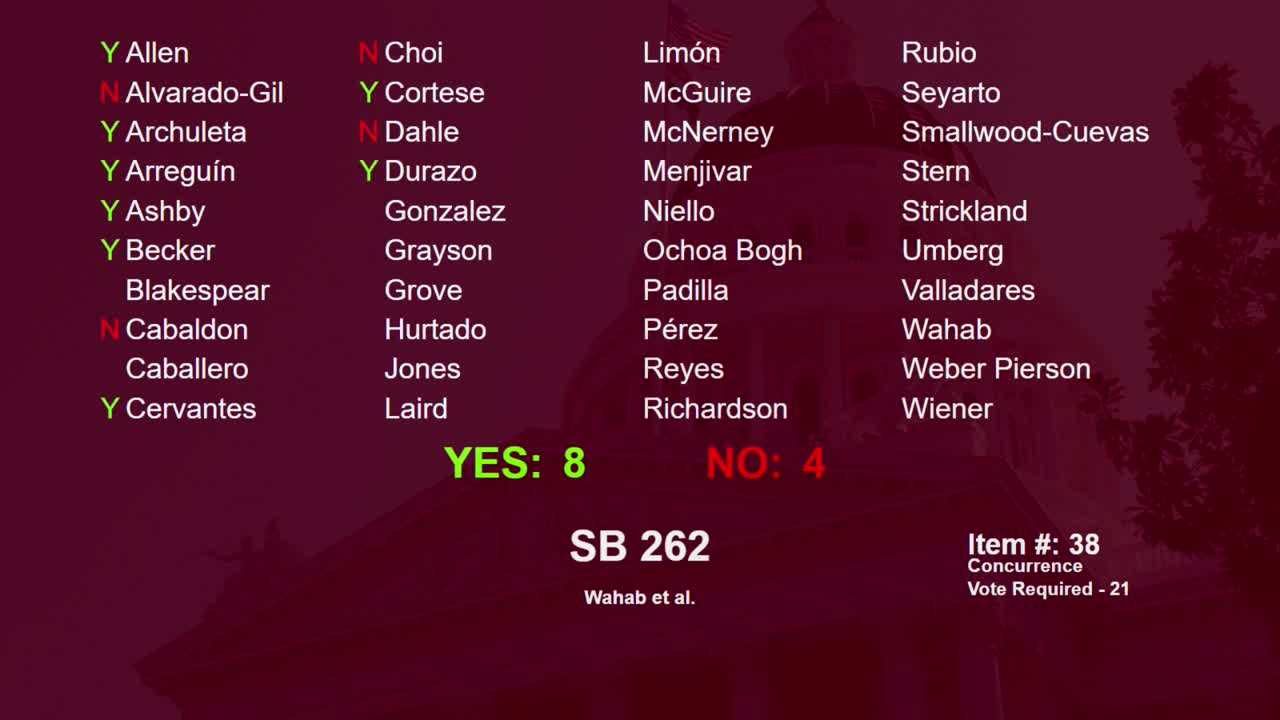 2MIN
Senate Floor
 1MIN
Assembly Floor
 19MIN
Assembly Standing Committee on Judiciary
 6MIN
Assembly Standing Committee on Housing and Community Development
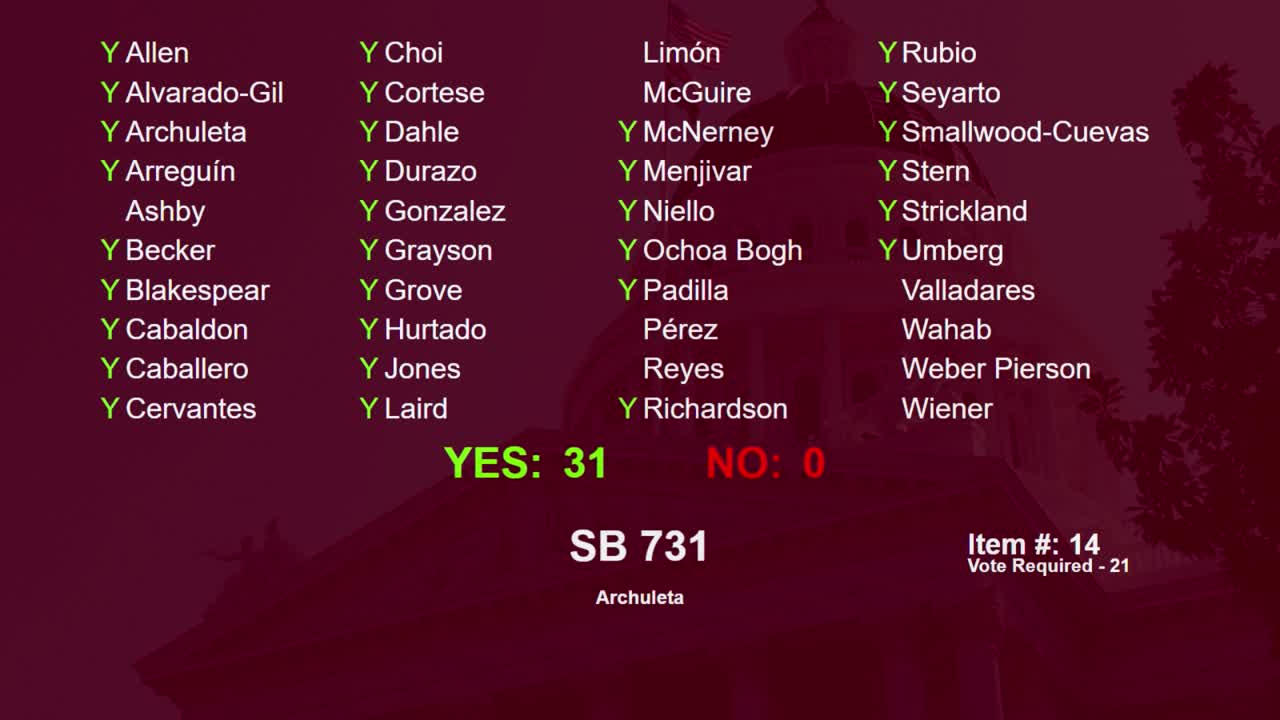 2MIN
Senate Floor
 6MIN
Senate Standing Committee on Judiciary
 15MIN
Senate Standing Committee on Local Government
Bill Author