AB 1005: Drowning prevention: public schools: informational materials.
- Session Year: 2025-2026
- House: Assembly
- Latest Version Date: 2025-10-06
Current Status:
Passed
(2025-10-06: Chaptered by Secretary of State - Chapter 387, Statutes of 2025.)
Introduced
In Committee
Awaiting First Chamber Vote
Passed First Chamber
In Committee
Awaiting Second Chamber Vote
Passed Second Chamber
Enacted
(1)Existing law authorizes specified drowning or injury prevention organizations (DIP organization) to provide informational materials, in electronic or hardcopy form, to a public school regarding specified topics relating to drowning prevention. Existing law requires a DIP organization that chooses to provide informational materials to provide, upon request by a public school, the informational materials in the 3 most commonly spoken languages associated with the population attending the school.
This bill would instead require a DIP organization that chooses to provide informational materials to provide, upon request by a public school, the informational materials in English and would encourage the DIP organization to provide informational materials in the other most commonly spoken languages associated with the population attending the school. The bill would require a DIP organization that chooses to provide informational materials to a public school to provide those materials at no cost to the public school, allow the school to offer copies of the materials to pupils and parents, and provide written evidence to a school administrator that demonstrates that the informational materials provided by the DIP organization align with the drowning, drowning prevention, water safety, rescue, and swim skills lesson information found on the drowning prevention web page of the federal Centers for Disease Control and Prevention, as provided. The bill also would require the State Department of Education, in consultation with the State Department of Developmental Services and the State Department of Public Health, to gather and make available on its internet website school-based water safety and drowning prevention education resources and curriculum, as provided. The bill would authorize public schools to provide to their pupils those water safety informational materials identified by the department and provided by a DIP organization, as provided.
(2)Existing law requires the State Department of Public Health to adopt and enforce regulations relating to public swimming pools, as defined.
This bill would expressly authorize the State Department of Public Health to review and evaluate existing statutes and regulations under its jurisdiction recommended by the California Unintentional Injury Prevention Strategic Plan Project to ensure clarity, consistency, and alignment with current public health practices, as provided, and would authorize the department to recommend to the Legislature updates or nonsubstantive technical corrections to support effective implementation and regulatory compliance.
(1)Existing law authorizes specified drowning or injury prevention organizations (DIP organization) to provide informational materials, in electronic or hardcopy form, to a public school regarding specified topics relating to drowning prevention. Existing law requires a DIP organization that chooses to provide informational materials to provide, upon request by a public school, the informational materials in the 3 most commonly spoken languages associated with the population attending the school.
This bill would instead require a DIP organization that chooses to provide informational materials to provide, upon request by a public school, the informational materials in English and would encourage the DIP organization to provide informational materials in the other most commonly spoken languages associated with the population attending the school. The bill would require a DIP organization that chooses to provide informational materials to a public school to provide those materials at no cost to the public school, allow the school to offer copies of the materials to pupils and parents, and provide written evidence to a school administrator that demonstrates that the informational materials provided by the DIP organization align with the drowning, drowning prevention, water safety, rescue, and swim skills lesson information found on the drowning prevention web page of the federal Centers for Disease Control and Prevention, as provided. The bill also would require the State Department of Education, in consultation with the State Department of Developmental Services and the State Department of Public Health, to gather and make available on its internet website school-based water safety and drowning prevention education resources and curriculum, as provided. The bill would authorize public schools to provide to their pupils those water safety informational materials identified by the department and provided by a DIP organization, as provided.
(2)Existing law requires the State Department of Public Health to adopt and enforce regulations relating to public swimming pools, as defined.
This bill would establish the Swim Lesson Voucher and Swim Lesson Directory Development Plan Partnership as a stakeholder advisory group within the Injury and Violence Prevention Branch of the State Department of Public Health and in consultation with the State Department of Developmental Services. The bill would establish that the purposes of the partnership are to increase water safety in this state by offering vouchers for swim lessons at no cost to children under 18 years of age whose families have limited income to pay for swim lessons and making it easier for parents, caregivers, and guardians to access swim lessons for their children, as provided. The bill would require the partnership to consist of no more than 10 members and be composed of representatives of Californias local parks and recreation district leadership, the State Department of Public Health, the State Department of Developmental Services, and other state agencies with experience in water safety or drowning prevention, and experts in drowning prevention identified by water safety and drowning prevention stakeholder organizations, including the Drowning Prevention Foundation. The bill would require the partnership, on or before July 1, 2027, to, among other things, (A) develop model written agreements to establish a network of public and private swim lesson programs and swim lesson vendors that accept vouchers in exchange for providing swim lessons, (B) establish a model application method and eligibility criteria for swim lesson vouchers, (C) develop, in consultation with other organizations, a free and publicly accessible online statewide directory of swim lesson programs, listed by county, and (D) make recommendations and an action plan to seek various contributors that will fund or match funds to cover the cost of the voucher programs and the development of the online statewide directory. The bill would require the partnership to provide directions and options for administering the voucher program and swim lesson directory through a combination of state and regional public or private partners. The bill would make implementation of these provisions contingent upon an appropriation for these purposes in the annual Budget Act or another statute or as otherwise provided.The bill would make these provisions inoperative on July 1, 2028, and would repeal them as of January 1, 2029.This bill would expressly authorize the State Department of Public Health to review and evaluate existing statutes and regulations under its jurisdiction recommended by the California Unintentional Injury Prevention Strategic Plan Project to ensure clarity, consistency, and alignment with current public health practices, as provided, and would authorize the department to recommend to the Legislature updates or nonsubstantive technical corrections to support effective implementation and regulatory compliance.
(1)Existing law authorizes specified drowning or injury prevention organizations (DIP organization) to provide informational materials, in electronic or hardcopy form, to a public school regarding specified topics relating to drowning prevention. Existing law requires a DIP organization that chooses to provide informational materials to provide, upon request by a public school, the informational materials in the 3 most commonly spoken languages associated with the population attending the school.
This bill would instead require a DIP organization that chooses to provide informational materials to provide, upon request by a public school, the informational materials in English and would encourage the DIP organization to provide informational materials in the other most commonly spoken languages associated with the population attending the school. The bill would require a DIP organization that chooses to provide informational materials to a public school to provide those materials at no cost to the public school, allow the school to offer copies of the materials to pupils and parents, and provide written evidence to a school administrator that demonstrates that the informational materials provided by the DIP organization align with the drowning, drowning prevention, water safety, rescue, and swim skills lesson information found on the drowning prevention web page of the federal Centers for Disease Control and Prevention, as provided. The bill also would require the State Department of Education Education, in consultation with the State Department of Developmental Services and the State Department of Public Health, to gather and make available on its internet website school-based water safety and drowning prevention education resources and curriculum, as provided. The bill would authorize public schools to provide to their pupils those water safety informational materials identified by the department and provided by a DIP organization, as provided.
(2)Existing law requires the State Department of Public Health to adopt and enforce regulations relating to public swimming pools, as defined.
This bill would establish the Swim Lesson Voucher and Swim Lesson Directory Development Plan Partnership for the purposes as a stakeholder advisory group within the Injury and Violence Prevention Branch of the State Department of Public Health and in consultation with the State Department of Developmental Services. The bill would establish that the purposes of increasing the partnership are to increase water safety in this state by offering vouchers for swim lessons at no cost to children under 18 years of age whose families have an income of no more than 250% of the federal poverty level limited income to pay for swim lessons and making it easier for parents, caregivers, and guardians to access swim lessons for their children, as provided. The bill would require the partnership to consist of no more than 10 members and be composed of representatives of Californias local parks and recreation district leadership, as identified by the California Association of Recreation and Park Districts and appointed by the Governor, the State Department of Public Health, the State Department of Developmental Services, and other state agencies with experience in water safety or drowning prevention, as appointed by the Governor, and experts in drowning prevention identified by water safety and drowning prevention stakeholder organizations, including the Drowning Prevention Foundation and appointed by the Governor. Foundation. The bill would require the partnership partnership, on or before July 1, 2027, to, among other things, (A) develop model written agreements to establish a network of public and private swim lesson programs and swim lesson vendors that accept vouchers in exchange for providing swim lessons, (B) establish a model application method and eligibility criteria for swim lesson vouchers, (C) develop, in consultation with other organizations, a free and publicly accessible online statewide directory of swim lesson programs, listed by county, and (D) make recommendations and an action plan to seek various contributors that will fund or match funds to cover the cost of the voucher programs and the development of the online statewide directory. The bill would require the partnership to provide directions and options for administering the voucher program and swim lesson directory through a combination of state and regional public or private partners. The bill would make implementation of these provisions contingent upon an appropriation for these purposes in the annual Budget Act or another statute or as otherwise provided.The bill would make these provisions inoperative on July 1, 2028, and would repeal them as of January 1, 2029.
(1)Existing law authorizes specified drowning or injury prevention organizations (DIP organization) to provide informational materials, in electronic or hardcopy form, to a public school regarding specified topics relating to drowning prevention. Existing law requires a DIP organization that chooses to provide informational materials to provide, upon request by a public school, the informational materials in the 3 most commonly spoken languages associated with the population attending the school.
This bill would instead require a DIP organization that chooses to provide informational materials to provide, upon request by a public school, the informational materials in English and would encourage the DIP organization to provide informational materials in the other most commonly spoken languages associated with the population attending the school. The bill would require a DIP organization that chooses to provide informational materials to a public school to provide those materials at no cost to the public school school, allow the school to offer copies of the materials to pupils and parents, and to provide written evidence to a school administrator that demonstrates that the informational materials provided by the DIP organization align with the drowning, drowning prevention, water safety, rescue, and swim skills lesson information found on the drowning prevention web page of the federal Centers for Disease Control and Prevention, as provided. The bill also would require the State Department of Education to gather and make available on its internet website school-based water safety and drowning prevention education resources and curriculum, as provided. The bill would authorize public schools to provide to their pupils those water safety informational materials identified by the department and provided by a DIP organization, as provided.
(2)Existing law requires the State Department of Public Health to adopt and enforce regulations relating to public swimming pools, as defined.
This bill would establish the Swim Lesson Voucher and Swim Lesson Directory Development Plan Partnership for the purposes of increasing water safety in this state by offering vouchers for swim lessons at no cost to children under 18 years of age whose families have an income of no more than 250% of the federal poverty level and making it easier for parents, caregivers, and guardians to access swim lessons for their children, as provided. The bill would require the partnership to consist of no more than 10 members and be composed of representatives of Californias local parks and recreation district leadership, as identified by the California Association of Recreation and Park Districts and appointed by the Governor, state agencies with experience in water safety or drowning prevention, as appointed by the Governor, and experts in drowning prevention identified by the Drowning Prevention Foundation and appointed by the Governor. The bill would require the partnership to, among other things, (A) develop model written agreements to establish a network of public and private swim lesson programs and swim lesson vendors that accept vouchers in exchange for providing swim lessons, (B) establish a model application method and eligibility criteria for swim lesson vouchers, (C) develop, in consultation with other organizations, a free and publicly accessible online statewide directory of swim lesson programs, listed by county, and (D) make recommendations and an action plan to seek various contributors that will fund or match funds to cover the cost of the voucher programs and the development of the online statewide directory. The bill would require the partnership to provide directions and options for administering the voucher program and swim lesson directory through a combination of state and regional public or private partners. The bill would make implementation of these provisions contingent upon an appropriation for these purposes in the annual Budget Act or another statute or as otherwise provided.
(1)Existing law authorizes specified drowning or injury prevention organizations (DIP organization) to provide informational materials, in electronic or hardcopy form, to a public school regarding specified topics relating to drowning prevention. Existing law expressly authorizes, beginning with the 202425 school year, upon receipt of the informational materials, a public school to provide the informational materials to parents, legal guardians, or caregivers of pupils at the time the pupil enrolls at the school and at the beginning of each school year. requires a DIP organization that chooses to provide informational materials to provide, upon request by a public school, the informational materials in the 3 most commonly spoken languages associated with the population attending the school.
This bill, beginning with the 202627 school year, would expressly authorize a public school to also provide those informational materials to parents, legal guardians, or caregivers of pupils at a period of time agreed upon between the public school and the DIP organization, except that the materials are prohibited from being provided later than the first week of May, as provided. The bill would provide restrictions on bill would instead require a DIP organization that chooses to provide informational materials to provide, upon request by a public school, the informational materials in English and would encourage the DIP organization to provide informational materials in the other most commonly spoken languages associated with the population attending the school. The bill would require a DIP organization that chooses to provide informational materials to a public school, including, among other things, that the DIP organization correspond only with a school administrator or school entity authorized by a school district or school, as provided, to request to work with the public school and that the DIP organization school to provide those materials at no cost to the public school and to provide written evidence to the a school administrator that demonstrates that the informational materials provided by the DIP organization align with the drowning, drowning prevention, water safety, rescue, and swim skills lesson information found on the drowning prevention web page of the federal Centers for Disease Control and Prevention, as provided. The bill would provide that a school administrator who receives informational materials from multiple DIP organizations may consider specified factors when selecting which DIP organization to work with, as provided. The bill would provide that if a school administrator selects informational materials from a DIP organization for a given school year, other DIP organizations are prohibited from contesting those informational materials, as provided. also would require the State Department of Education to gather and make available on its internet website school-based water safety and drowning prevention education resources and curriculum, as provided.
(2)Existing law requires the State Department of Education to prepare and distribute to school districts guidelines for the preparation of comprehensive health education plans, as provided. Existing law defines a comprehensive health education programs as all educational programs offered in kindergarten and grades 1 to 12, inclusive, in the public school system, including in-class and out-of-class activities designed to, among other things, ensure that pupils receive instruction to aid them in making decisions in matters of personal, family, and community health, including, among other subjects, environmental health and safety and community health, as provided.This bill would add water safety and drowning prevention to the list of the above-described subjects. The bill would require the department to gather and make available on its internet website, school-based water safety and prevention education resources and curriculum, as provided.(3)(2)Existing law requires the State Department of Public Health to adopt and enforce regulations relating to public swimming pools, as defined.
This bill would establish the Swim Lesson Voucher and Swim Lesson Directory Development Plan Partnership for the purposes of increasing water safety in this state by offering vouchers for swim lessons at no cost to children under 18 years of age whose families have an income of no more than 250% of the federal poverty level and making it easier for parents, caregivers, and guardians to access swim lessons for their children, as provided. The bill would require the partnership to consist of no more than 10 members and be composed of representatives of Californias local parks and recreation district leadership, as identified by the California Association of Recreation and Park Districts and appointed by the Governor, state agencies with experience in water safety or drowning prevention, as appointed by the Governor, and experts in drowning prevention identified by the Drowning Prevention Foundation and appointed by the Governor. The bill would require the partnership to, among other things, (A) develop model written agreements to establish a network of public and private swim lesson programs and swim lesson vendors that accept vouchers in exchange for providing swim lessons, (B) establish a model application method and eligibility criteria for swim lesson vouchers, (C) develop, in consultation with other organizations, a free and publicly accessible online statewide directory of swim lesson programs, listed by county, and (D) make recommendations and an action plan to seek various contributors that will fund or match funds to cover the cost of the voucher programs and the development of the online statewide directory. The bill would require the partnership to provide directions and options for administering the voucher program and swim lesson directory through a combination of state and regional public or private partners. The bill would make implementation of these provisions contingent upon an appropriation for these purposes in the annual Budget Act or another statute or as otherwise provided.
(1)Existing law authorizes specified drowning or injury prevention organizations (DIP organization) to provide informational materials, in electronic or hardcopy form, to a public school regarding specified topics relating to drowning prevention. Existing law expressly authorizes, beginning with the 202425 school year, upon receipt of the informational materials, a public school to provide the informational materials to parents, legal guardians, or caregivers of pupils at the time the pupil enrolls at the school and at the beginning of each school year.
This bill, beginning with the 202627 school year, would expressly authorize a public school to also provide those informational materials to parents, legal guardians, or caregivers of pupils at a period of time agreed upon between the public school and the DIP organization, except that the materials are prohibited from being provided later than the first week of May, as provided. The bill would provide restrictions on a DIP organization that chooses to provide informational materials to a public school, including, among other things, that the DIP organization correspond only with a school administrator or school entity authorized by a school district or school, as provided, to request to work with the public school and that the DIP organization provide written evidence to the school administrator that demonstrates that the informational materials provided by the DIP organization align with the drowning, drowning prevention, water safety, rescue, and swim skills lesson information of at least one expert organization, as defined. found on the drowning prevention web page of the federal Centers for Disease Control and Prevention, as provided. The bill would provide that a school administrator who receives informational materials from multiple DIP organizations may consider specified factors when selecting which DIP organization to work with, as provided. The bill would provide that if a school administrator selects informational materials from a DIP organization for a given school year, other DIP organizations are prohibited from contesting those informational materials, as provided.
(2)Existing law requires the State Department of Education to prepare and distribute to school districts guidelines for the preparation of comprehensive health education plans, as provided. Existing law defines a comprehensive health education programs as all educational programs offered in kindergarten and grades 1 to 12, inclusive, in the public school system, including in-class and out-of-class activities designed to, among other things, ensure that pupils receive instruction to aid them in making decisions in matters of personal, family, and community health, including, among other subjects, environmental health and safety and community health, as provided.
This bill would add water safety and drowning prevention to the list of the above-described subjects. The bill would require the department to gather and make available on its internet website, school-based water safety and prevention education resources and curriculum, as provided.
(3)Existing law establishes the Natural Resources Agency, which consists of various departments, including the Department of Parks and Recreation. Existing law requires the Director of Parks and Recreation to establish the Outdoor Equity Grants Program to increase the ability of underserved and at-risk populations to participate in outdoor environmental educational experiences at state parks and other public lands where outdoor environmental education programs take place. requires the State Department of Public Health to adopt and enforce regulations relating to public swimming pools, as defined.This bill would establish the Swimming Swim Lesson Voucher Pilot Program and require the department to administer the program, and Swim Lesson Directory Development Plan Partnership for the purpose purposes of increasing water safety in this state by offering vouchers for swimming swim lessons at no cost to children under 18 years of age whose families have an income of no more than 250% of the federal poverty level. level and making it easier for parents, caregivers, and guardians to access swim lessons for their children, as provided. The bill would require the partnership to consist of no more than 10 members and be composed of representatives of Californias local parks and recreation district leadership, as identified by the California Association of Recreation and Park Districts and appointed by the Governor, state agencies with experience in water safety or drowning prevention, as appointed by the Governor, and experts in drowning prevention identified by the Drowning Prevention Foundation and appointed by the Governor. The bill would require the department, in administering the program, partnership to, among other things, (A) develop model written agreements with, and to establish a network of, swimming of public and private swim lesson programs and swim lesson vendors that accept swimming lesson vouchers offered by the program in exchange for providing swimming swim lessons, (B) establish the a model application method and eligibility criteria for swimming swim lesson vouchers, (C) develop, in consultation with a specified foundation, other organizations, a free and publicly accessible online statewide directory of swim lesson programs, listed by county, and (D) make recommendations and an action plan to seek various contributors that will fund or match funds to cover the cost of the program voucher programs and the development of the online statewide directory. The bill would authorize require the department partnership to administer provide directions and options for administering the voucher program and swim lesson directory through regional a combination of state and regional public or private partners, or both. partners. The bill would make implementation of these provisions contingent upon an appropriation for these purposes in the annual Budget Act or another statute or as otherwise provided.
(1)Existing law authorizes specified drowning or injury prevention organizations (DIP organization) to provide informational materials, in electronic or hardcopy form, to a public school regarding specified topics relating to drowning prevention. Existing law expressly authorizes, beginning with the 202425 school year, upon receipt of the informational materials, a public school to provide the informational materials to parents, legal guardians, or caregivers of pupils at the time the pupil enrolls at the school and at the beginning of each school year.
This bill, beginning with the 202627 school year, would expressly authorize a public school to also provide those informational materials to parents, legal guardians, or caregivers of pupils at a period of time agreed upon between the public school and the DIP organization, except that the materials are prohibited from being provided later than the first week of May, as provided. The bill would provide restrictions on a DIP organization that chooses to provide informational materials to a public school, including, among other things, that the DIP organization correspond only with a school administrator to request to work with the public school and that the DIP organization provide written evidence to the school administrator that demonstrates that the informational materials provided by the DIP organization align with the drowning, drowning prevention, water safety, and swim skills lesson information of at least one expert organization, as defined. The bill would provide that a school administrator who receives informational materials from multiple DIP organizations may consider specified factors when selecting which DIP organization to work with, as provided. The bill would provide that if a school administrator selects informational materials from a DIP organization for a given school year, other DIP organizations are prohibited from contesting those informational materials, as provided.
(2)Existing law requires the State Department of Education to prepare and distribute to school districts guidelines for the preparation of comprehensive health education plans, as provided. Existing law defines a comprehensive health education programs as all educational programs offered in kindergarten and grades 1 to 12, inclusive, in the public school system, including in-class and out-of-class activities designed to, among other things, ensure that pupils receive instruction to aid them in making decisions in matters of personal, family, and community health, including, among other subjects, environmental health and safety and community health, as provided.
This bill would add water safety and drowning prevention to the list of the above-described subjects. The bill would require the department to gather and make available on its internet website, school-based water safety and prevention education resources and curriculum, as provided.
(3)Existing law establishes the Natural Resources Agency, which consists of various departments, including the Department of Parks and Recreation. Existing law requires the Director of Parks and Recreation to establish the Outdoor Equity Grants Program to increase the ability of underserved and at-risk populations to participate in outdoor environmental educational experiences at state parks and other public lands where outdoor environmental education programs take place.
This bill would establish the Swimming Lesson Voucher Pilot Program and require the department to administer the program, for the purpose of increasing water safety in this state by offering vouchers for swimming lessons at no cost to children under 18 years of age whose families have an income of no more than 250% of the federal poverty level. The bill would require the department, in administering the program, to, among other things, (A) develop written agreements with, and establish a network of, swimming lesson vendors that accept swimming lesson vouchers offered by the program in exchange for providing swimming lessons, (B) establish the application method and eligibility criteria for swimming lesson vouchers, (C) develop, in consultation with a specified foundation, a free and publicly accessible online statewide directory of swim lesson programs, listed by county, and (D) seek various contributors that will fund or match funds to cover the cost of the program and the development of the online statewide directory. The bill would authorize the department to administer the program through regional public or private partners, or both. The bill would make implementation of these provisions contingent upon an appropriation for these purposes in the annual Budget Act or another statute or as otherwise provided.
The Legislature finds and declares all of the following:
(a)In California, drowning is the leading cause of death for children 1 to 4 years of age, inclusive, the second leading cause of death for children 5 to 14 years of age, inclusive, and the third leading cause of death for teenagers and youth 15 to 24 years of age, inclusive.
(b)Drowning can be prevented by increasing the knowledge of parents, caregivers, and pupils regarding water safety and competency in swimming skills. National and international research shows that water safety and swimming skills are up to 88 percent effective in preventing drowning.
(c)A critical step in the statewide strategic plan to make drowning a rare and survivable event is to increase access to swim lessons to achieve an end goal of making everyone in California a swimmer and knowledgeable about drowning, drowning prevention, and water safety.
(d)Partnering Californias public schools with the states many local, state, and national swim lesson programs and drowning prevention organizations provides a cost-effective means of reaching all California parents, guardians, caregivers, and children with lifesaving drowning prevention and water safety knowledge.
(e)Drowning prevention classes, including swim lessons with certified instructors, increase swim skills and water competency. The development of swim skills and water competency is well established through evidence-based research to have an impact of reducing drowning and is declared an essential component of Californias actions toward preventing drowning for all ages of children and adults.
SEC. 2.Section 51139 is added to the Education Code, immediately preceding Section 51140, to read:51139.For purposes of this article, all of the following definitions apply:
(a)Public school means a school operated by a school district, county office of education, or a charter school.
(b)Water safety means age-appropriate education intended (1) to promote safety in, on, and around bodies of water, including residential and public pools and spas, home water sources such as bathtubs, and open bodies of water such as lakes, rivers, canals, and the ocean, and (2) to reduce the risk of injury or drowning.
SEC. 3.Section 51140 of the Education Code is amended to read:51140.(a)(1)A drowning or injury prevention organization may provide informational materials, in electronic or hardcopy form, to a public school that serves pupils in kindergarten or any of grades 1 to 12, inclusive, in accordance with the requirements of this article, regarding all of the following topics:
(A)The role that water safety education courses and swim lessons play in drowning prevention and saving lives.
(B)Local water safety and swimming skills programs in the county and communities served by the public school, including free or reduced-price programs, and how to access information about age-appropriate public or private water safety courses and swimming skills programs that result in a certificate indicating successful completion.
(C)Contact information of the organization to receive further water safety education information.
(2)The informational materials shall not be used to solicit funding or donations for the organization.
(3)It is the intent of the Legislature that public schools that receive information pursuant to paragraph (1) facilitate the sharing of that information with the parents, caregivers, or guardians of pupils.
(b)(1)Upon receipt of the informational materials described in subdivision (a), a public school is authorized to provide the informational materials to parents, legal guardians, or caregivers of pupils at the time the pupil enrolls at the public school and at the beginning of each school year, and are encouraged to provide the materials described in subdivision (a) during the first week of May in the year that the informational materials were provided.
(2)In recognition of the importance of drowning as a public health issue impacting the lives of many pupils, public schools are authorized to, and are encouraged to, provide to their pupils water safety informational materials through multiple means, including, but not limited to, school assemblies, classroom instruction, or library programs. These informational materials shall meet the following criteria:
(A)Be age and grade appropriate.
(B)Be aligned with the information from the federal Centers for Disease Control and Prevention, as described in paragraph (1) of subdivision (a) of Section 51141, and identified by the department pursuant to Section 51900.1.
(C)Be provided for free by drowning prevention or children safety organizations.
(c)Upon request by a public school, a drowning or injury prevention organization that elects to provide informational materials shall provide the informational materials in English and is encouraged to provide informational materials in the other most commonly spoken languages associated with the population attending the school based on available data from the department.
SEC. 4.Section 51141 is added to the Education Code, immediately following Section 51140, to read:51141.(a)A drowning or injury prevention organization that provides informational materials to a public school pursuant to this article shall adhere to both of the following:
(1)Provide written evidence, in the form of a letter or document, either of which shall be no longer than one page, to a school administrator that demonstrates that the informational materials provided by the drowning or injury prevention organization align with the drowning, drowning prevention, water safety, rescue, and swim skills lesson information found on the drowning prevention web page of the federal Centers for Disease Control and Prevention, which includes evidence-based water safety and drowning prevention information vetted through such authorities on drowning and drowning prevention as the American Academy of Pediatrics and the American Red Cross, among other sources.
(2)Provide informational materials at no cost to the public school and allow the school to offer copies of the materials to pupils and parents and decide how the materials are made available.
(b)A school administrator or school entity authorized by the school district or school, which also may include the schools parent-teacher association or an equivalent association, that engages with a drowning or injury prevention organization pursuant to this article shall not be responsible for confirming the drowning or injury prevention organizations compliance with paragraph (1) of subdivision (a).
SEC. 5.Section 51900.1 is added to the Education Code, to read:51900.1.The department, in consultation with the State Department of Developmental Services and the State Department of Public Health, shall gather and make available on its internet website school-based water safety and drowning prevention education resources and curriculum that are age appropriate to pupils of different grade levels and adaptable for public school use. The department is encouraged to refer to the existing, freely accessible, age- and grade-appropriate curriculum that has been identified by relevant water safety and drowning prevention stakeholder organizations and that can be used in school settings.
SEC. 6.Section 116036 is added to the Health and Safety Code, to read:116036.The Legislature finds and declares both of the following:
(a)In California, drowning is the leading cause of death for children 4 years of age and younger, the second leading cause of death for children 5 to 14 years of age, inclusive, and the third leading cause of death for teenagers and youth 15 to 24 years of age, inclusive.
(b)Swim instruction provided by persons who are qualified and certified pursuant to Section 116033 increases swim skills and water competency, the development of which is both well established through evidence-based research to have an impact on reducing drowning and is declared an essential component of Californias actions toward preventing drowning for all ages of children and adults.
SEC. 7.Chapter 4.6 (commencing with Section 131359) is added to Part 1 of Division 112 of the Health and Safety Code, to read:4.6.Regulatory Review131359.To further drowning prevention and as a component of Californias drowning prevention strategic plans, the State Department of Public Health may review and evaluate existing statutes and regulations under its jurisdiction recommended by the California Unintentional Injury Prevention Strategic Plan Project to ensure clarity, consistency, and alignment with current public health practices. The review may include provisions adopted between 2010 and 2025, including those within Title 22 of the California Code of Regulations, to determine whether updates are warranted for effective implementation and compliance. The department may recommend to the Legislature, in compliance with Section 9795 of the Government Code, updates or nonsubstantive technical corrections to support effective implementation and regulatory compliance.
The Legislature finds and declares all of the following:
(a)In California, drowning is the leading cause of death for children 1 to 4 years of age, inclusive, the second leading cause of death for children 5 to 14 years of age, inclusive, and the third leading cause of death for teenagers and youth 15 to 24 years of age, inclusive.
(b)Drowning can be prevented by increasing the knowledge of parents, caregivers, and pupils regarding water safety and competency in swimming skills. National and international research shows that water safety and swimming skills are up to 88 percent effective in preventing drowning.
(c)A critical step in the statewide strategic plan to make drowning a rare and survivable event is to increase access to swim lessons to achieve an end goal of making everyone in California a swimmer and knowledgeable about drowning, drowning prevention, and water safety.
(d)Partnering Californias public schools with the states many local, state, and national swim lesson programs and drowning prevention organizations provides a cost-effective means of reaching all California parents, guardians, caregivers, and children with lifesaving drowning prevention and water safety knowledge.
(e)Drowning prevention classes, including swim lessons with certified instructors, increase swim skills and water competency. The development of swim skills and water competency is well established through evidence-based research to have an impact of reducing drowning and is declared an essential component of Californias actions toward preventing drowning for all ages of children and adults.
SEC. 2.Section 51139 is added to the Education Code, immediately preceding Section 51140, to read:51139.For purposes of this article, all of the following definitions apply:
(a)Public school means a school operated by a school district, county office of education, or a charter school.
(b)Water safety means age-appropriate education intended (1) to promote safety in, on, and around bodies of water, including residential and public pools and spas, home water sources such as bathtubs, and open bodies of water such as lakes, rivers, canals, and the ocean, and (2) to reduce the risk of injury or drowning.
SEC. 3.Section 51140 of the Education Code is amended to read:51140.(a)(1)A drowning or injury prevention organization may provide informational materials, in electronic or hardcopy form, to a public school that serves pupils in kindergarten or any of grades 1 to 12, inclusive, in accordance with the requirements of this article, regarding all of the following topics:
(A)The role that water safety education courses and swim lessons play in drowning prevention and saving lives.
(B)Local water safety and swimming skills programs in the county and communities served by the public school, including free or reduced-price programs, and how to access information about age-appropriate public or private water safety courses and swimming skills programs that result in a certificate indicating successful completion.
(C)Contact information of the organization to receive further water safety education information.
(2)The informational materials shall not be used to solicit funding or donations for the organization.
(3)It is the intent of the Legislature that public schools that receive information pursuant to paragraph (1) facilitate the sharing of that information with the parents, caregivers, or guardians of pupils.
(b)(1)Upon receipt of the informational materials described in subdivision (a), a public school is authorized to provide the informational materials to parents, legal guardians, or caregivers of pupils at the time the pupil enrolls at the public school and at the beginning of each school year, and are encouraged to provide the materials described in subdivision (a) during the first week of May in the year that the informational materials were provided.
(2)In recognition of the importance of drowning as a public health issue impacting the lives of many pupils, public schools are authorized to, and are encouraged to, provide to their pupils water safety informational materials through multiple means, including, but not limited to, school assemblies, classroom instruction, or library programs. These informational materials shall meet the following criteria:
(A)Be age and grade appropriate.
(B)Be aligned with the information from the federal Centers for Disease Control and Prevention, as described in paragraph (1) of subdivision (a) of Section 51141, and identified by the department pursuant to Section 51900.1.
(C)Be provided for free by drowning prevention or children safety organizations.
(c)Upon request by a public school, a drowning or injury prevention organization that elects to provide informational materials shall provide the informational materials in English and is encouraged to provide informational materials in the other most commonly spoken languages associated with the population attending the school based on available data from the department.
SEC. 4.Section 51141 is added to the Education Code, immediately following Section 51140, to read:51141.(a)A drowning or injury prevention organization that provides informational materials to a public school pursuant to this article shall adhere to both of the following:
(1)Provide written evidence, in the form of a letter or document, either of which shall be no longer than one page, to a school administrator that demonstrates that the informational materials provided by the drowning or injury prevention organization align with the drowning, drowning prevention, water safety, rescue, and swim skills lesson information found on the drowning prevention web page of the federal Centers for Disease Control and Prevention, which includes evidence-based water safety and drowning prevention information vetted through such authorities on drowning and drowning prevention as the American Academy of Pediatrics and the American Red Cross, among other sources.
(2)Provide informational materials at no cost to the public school and allow the school to offer copies of the materials to pupils and parents and decide how the materials are made available.
(b)A school administrator or school entity authorized by the school district or school, which also may include the schools parent-teacher association or an equivalent association, that engages with a drowning or injury prevention organization pursuant to this article shall not be responsible for confirming the drowning or injury prevention organizations compliance with paragraph (1) of subdivision (a).
SEC. 5.Section 51900.1 is added to the Education Code, to read:51900.1.The department, in consultation with the State Department of Developmental Services and the State Department of Public Health, shall gather and make available on its internet website school-based water safety and drowning prevention education resources and curriculum that are age appropriate to pupils of different grade levels and adaptable for public school use. The department is encouraged to refer to the existing, freely accessible, age- and grade-appropriate curriculum that has been identified by relevant water safety and drowning prevention stakeholder organizations and that can be used in school settings.
SEC. 6.Section 116036 is added to the Health and Safety Code, to read:116036.The Legislature finds and declares both of the following:
(a)In California, drowning is the leading cause of death for children 4 years of age and younger, the second leading cause of death for children 5 to 14 years of age, inclusive, and the third leading cause of death for teenagers and youth 15 to 24 years of age, inclusive.
(b)Swim instruction provided by persons who are qualified and certified pursuant to Section 116033 increases swim skills and water competency, the development of which is both well established through evidence-based research to have an impact on reducing drowning and is declared an essential component of Californias actions toward preventing drowning for all ages of children and adults.
SEC. 7.Chapter 4.5 (commencing with Section 131357) is added to Part 1 of Division 112 of the Health and Safety Code, to read:4.5.Swim Lesson Voucher and Swim Lesson Directory Development Plan Partnership131357.(a)For purposes of this chapter, partnership means the Swim Lesson Voucher and Swim Lesson Directory Development Plan Partnership established pursuant to subdivision (b).(b)The Swim Lesson Voucher and Swim Lesson Directory Development Plan Partnership is hereby established as a stakeholder advisory group within the Injury and Violence Prevention Branch of the State Department of Public Health and in consultation with the State Department of Developmental Services. The partnership shall develop guidelines for establishing a swim lesson voucher program and swim lesson directory in California, both of which may include initial pilot programs. The purpose of the swim lesson voucher program, and associated pilot programs, is to increase water safety by offering vouchers for swim lessons at no cost to children under 18 years of age whose families have limited income to pay for swim lessons. The purpose of the swim lesson directory, and associated pilot programs, is to make it easier for parents, caregivers, and guardians to access swim lessons for their children at all ages.(c)The partnership shall consist of no more than 10 members and shall be composed of representatives from the following entities:(1)Californias local parks and recreation district leadership with experience in water safety or drowning prevention.(2)Representatives of the State Department of Public Health, the State Department of Developmental Services, and other state agencies with experience in water safety or drowning prevention.(3)Up to four experts in drowning prevention identified by relevant water safety and drowning prevention stakeholder organizations, including the Drowning Prevention Foundation.(d)The partnership shall, by July 1, 2027, do all of the following:(1)Develop model written agreements to establish a network of public and private swim lesson programs and swim lesson vendors that accept vouchers in exchange for providing swim lessons. To the extent feasible, the model written agreements shall be developed taking into account the different public and private models of swim lesson programs or vendors.(2)Encourage the establishment of at least one public or private swim lesson program or swim lesson vendor in each county, and at least one public or private swim lesson program or swim lesson vendor within a five-mile radius of those metropolitan areas with populations of 50,000 or higher.(3)Verify that participating public and private swim lesson programs and swim lesson vendors have adequate and appropriately trained instructors to provide swim lessons for a voucher recipient.(4)Establish a model application method and eligibility criteria for swim lesson vouchers, including, but not limited to, all of the following:(A)The voucher recipient shall be a California resident under 18 years of age.(B)The voucher recipients family income shall not exceed 250 percent of the federal poverty level, as demonstrated by showing proof of current income, or the voucher recipient or recipients household is a beneficiary of the Medi-Cal, CalFresh (Chapter 10 (commencing with Section 18900) of the Welfare and Institutions Code), CalWORKs (Chapter 2 (commencing with Section 11200) of Part 3 of Division 9 of the Welfare and Institutions Code), or the federal Low-Income Home Energy Assistance Program (LIHEAP) (42 U.S.C. Sec. 8621 et seq.) programs, which may be shown by proof of program participation.(C)Proof of the voucher recipients residency in this state shall be required.(5)Issue swim lesson vouchers for eligible children.(6)Adopt guidelines necessary to administer the swim lesson voucher program.(7)(A)In consultation with other California or national organizations with experience in developing a swim lesson directory, develop a free and publicly accessible online statewide directory of swim lesson programs, listed by county, including public and private programs that do not discriminate based on ethnicity, gender, economic status, or any other protected category.(B)The directory shall include all of the following information about each program listed:(i)The name of the program and the name of the parent organization, if applicable.(ii)The contact information, including the telephone number, physical address, and internet website, if any.(iii)The age groups the program serves.(iv)The qualifications of the swim lesson instructors and the lifeguards.(v)Information about signing up for a program.(C)The directory may have, and the Legislature encourages the directory to have, links to local public and private transportation systems for pupils to use to travel to and from swim lessons, including vouchers, subsidies, or fee waivers provided by a local government or transportation agency.(D)The directory shall be made available upon request from a local educational agency or school to share with parents or guardians and pupils and the directory may be shared by the local educational agency or school on its internet website.(8)Make recommendations and an action plan to seek various contributors, including, but not limited to, the Drowning Prevention Foundation, other recognized foundations, corporate donors, or individuals that will fund or match funds to cover the cost of the voucher programs and the development of the directory described in paragraph (7).(e)The partnership shall provide directions and options for administering the voucher program and swim lesson directory using a combination of state and regional public or private partners.(f)The implementation of this section is contingent upon an appropriation for these purposes in the annual Budget Act or another statute or upon sufficient funds being provided by a foundation, corporation, or other funding benefactor to the partnership for these purposes.131357.5.This chapter shall become inoperative on July 1, 2028, and, as of January 1, 2029, is repealed.SEC. 7.Chapter 4.6 (commencing with Section 131359) is added to Part 1 of Division 112 of the Health and Safety Code, to read:4.6.Regulatory Review131359.To further drowning prevention and as a component of Californias drowning prevention strategic plans, the State Department of Public Health may review and evaluate existing statutes and regulations under its jurisdiction recommended by the California Unintentional Injury Prevention Strategic Plan Project to ensure clarity, consistency, and alignment with current public health practices. The review may include provisions adopted between 2010 and 2025, including those within Title 22 of the California Code of Regulations, to determine whether updates are warranted for effective implementation and compliance. The department may recommend to the Legislature, in compliance with Section 9795 of the Government Code, updates or nonsubstantive technical corrections to support effective implementation and regulatory compliance.
The Legislature finds and declares all of the following:
(a)In California, drowning is the leading cause of death for children 1 to 4 years of age, inclusive, the second leading cause of death for children 5 to 14 years of age, inclusive, and the third leading cause of death for teenagers and youth 15 to 24 years of age, inclusive.
(b)Drowning can be prevented by increasing the knowledge of parents, caregivers, and pupils regarding water safety and competency in swimming skills. National and international research shows that water safety and swimming skills are up to 88 percent effective in preventing drowning.
(c)A critical step in the statewide strategic plan to make drowning a rare and survivable event is to increase access to swim lessons to achieve an end goal of making everyone in California a swimmer and knowledgeable about drowning, drowning prevention, and water safety.
(d)Partnering Californias public schools with the states many local, state, and national swim lesson programs and drowning prevention organizations provides a cost-effective means of reaching all California parents, guardians, caregivers, and children with lifesaving drowning prevention and water safety knowledge.
(e)Drowning prevention classes, including swim lessons with certified instructors, increase swim skills and water competency. The development of swim skills and water competency is well established through evidence-based research to have an impact of reducing drowning and is declared an essential component of Californias actions toward preventing drowning for all ages of children and adults.
SEC. 2.Section 51139 is added to the Education Code, immediately preceding Section 51140, to read:51139.For purposes of this article, all of the following definitions apply:
(a)Public school means a school operated by a school district, county office of education, or a charter school.
(b)Water safety means age-appropriate education intended (1) to promote safety in, on, and around bodies of water, including residential and public pools and spas, home water sources such as bathtubs, and open bodies of water such as lakes, rivers, canals, and the ocean, and (2) to reduce the risk of injury or drowning.
SEC. 3.Section 51140 of the Education Code is amended to read:51140.(a)(1)A drowning or injury prevention organization may provide informational materials, in electronic or hardcopy form, to a public school that serves pupils in kindergarten or any of grades 1 to 12, inclusive, in accordance with the requirements of this article, regarding all of the following topics:
(A)The role that water safety education courses and swim lessons play in drowning prevention and saving lives.
(B)Local water safety and swimming skills programs in the county and communities served by the public school, including free or reduced-price programs, and how to access information about age-appropriate public or private water safety courses and swimming skills programs that result in a certificate indicating successful completion.
(C)Contact information of the organization to receive further water safety education information.
(2)The informational materials shall not be used to solicit funding or donations for the organization.
(3)It is the intent of the Legislature that public schools that receive information pursuant to paragraph (1) facilitate the sharing of that information with the parents, caregivers, or guardians of pupils.
(b)(1)Upon receipt of the informational materials described in subdivision (a), a public school is authorized to provide the informational materials to parents, legal guardians, or caregivers of pupils at the time the pupil enrolls at the public school and at the beginning of each school year, and are encouraged to provide the materials described in subdivision (a) during the first week of May in the year that the informational materials were provided.
(2)In recognition of the importance of drowning as a public health issue impacting the lives of many pupils, public schools are authorized to, and are encouraged to, provide to their pupils water safety informational materials through multiple means, including, but not limited to, school assemblies, classroom instruction, or library programs. These informational materials shall meet the following criteria:
(A)Be age- and grade-appropriate. age and grade appropriate.
(B)Be aligned with the information from the federal Centers for Disease Control and Prevention, as described in paragraph (1) of subdivision (a) of Section 51141, and identified by the department pursuant to Section 51900.1.
(C)Be provided for free by drowning prevention or children safety organizations.
(c)Upon request by a public school, a drowning or injury prevention organization that elects to provide informational materials shall provide the informational materials in English and is encouraged to provide informational materials in the other most commonly spoken languages associated with the population attending the school based on available data from the department.
SEC. 4.Section 51141 is added to the Education Code, immediately following Section 51140, to read:51141.(a)A drowning or injury prevention organization that provides informational materials to a public school pursuant to this article shall adhere to both of the following:
(1)Provide written evidence, in the form of a letter or document, either of which shall be no longer than one page, to a school administrator that demonstrates that the informational materials provided by the drowning or injury prevention organization align with the drowning, drowning prevention, water safety, rescue, and swim skills lesson information found on the drowning prevention web page of the federal Centers for Disease Control and Prevention, which includes evidence-based water safety and drowning prevention information vetted through such authorities on drowning and drowning prevention as the American Academy of Pediatrics and the American Red Cross, among other sources.
(2)Provide informational materials at no cost to the public school and allow the school to offer copies of the materials to pupils and parents and decide how the materials are made available.
(b)A school administrator or school entity authorized by the school district or school, which also may include the schools parent-teacher association or an equivalent association, that engages with a drowning or injury prevention organization pursuant to this article shall not be responsible for confirming the drowning or injury prevention organizations compliance with paragraph (1) of subdivision (a).
SEC. 5.Section 51900.1 is added to the Education Code, to read:51900.1.The department department, in consultation with the State Department of Developmental Services and the State Department of Public Health, shall gather and make available on its internet website school-based water safety and drowning prevention education resources and curriculum that are age appropriate to pupils of different grade levels and adaptable for public school use. The department is encouraged to refer to the existing, freely accessible, age- and grade-appropriate curriculum that has been identified by the Drowning Prevention Foundation relevant water safety and drowning prevention stakeholder organizations and that can be used in school settings.
SEC. 6.Section 116036 is added to the Health and Safety Code, to read:116036.The Legislature finds and declares both of the following:
(a)In California, drowning is the leading cause of death for children 4 years of age and younger, the second leading cause of death for children 5 to 14 years of age, inclusive, and the third leading cause of death for teenagers and youth 15 to 24 years of age, inclusive.
(b)Swim instruction provided by persons who are qualified and certified pursuant to Section 116033 increases swim skills and water competency, the development of which is both well established through evidence-based research to have an impact on reducing drowning and is declared an essential component of Californias actions toward preventing drowning for all ages of children and adults.
SEC. 7.Section 116064.3 is added to the Health and Safety Code, to read:116064.3.(a)For purposes of this section, partnership means the Swim Lesson Voucher and Swim Lesson Directory Development Plan Partnership established pursuant to subdivision (b).(b)The Swim Lesson Voucher and Swim Lesson Directory Development Plan Partnership is hereby established. The partnership shall develop guidelines for establishing a swim lesson voucher program and swim lesson directory in California, both of which may include initial pilot programs. The purpose of the swim lesson voucher program, and associated pilot programs, is to increase water safety by offering vouchers for swim lessons at no cost to children under 18 years of age whose families have an income of no more than 250 percent of the federal poverty level. The purpose of the swim lesson directory, and associated pilot programs, is to make it easier for parents, caregivers, and guardians to access swim lessons for their children at all ages.(c)The partnership shall consist of no more than 10 members and shall be composed of representatives from the following entities:(1)Californias local parks and recreation district leadership with experience in water safety or drowning prevention, as identified by the California Association of Recreation and Park Districts and appointed by the Governor.(2)State agencies with experience in water safety or drowning prevention, as appointed by the Governor.(3)Up to four experts in drowning prevention identified by the Drowning Prevention Foundation and appointed by the Governor.(d)The partnership shall do all of the following:(1)Develop model written agreements to establish a network of public and private swim lesson programs and swim lesson vendors that accept vouchers in exchange for providing swim lessons. To the extent feasible, the model written agreements shall be established with at least one public or private swim lesson program or swim lesson vendor in each county, and at least one public or private swim lesson program or swim lesson vendor within a five-mile radius of those metropolitan areas with populations of 50,000 or higher.(2)Verify that public and private swim lesson programs and swim lesson vendors have adequate and appropriately trained instructors to provide swim lessons for a voucher recipient.(3)Establish a model application method and eligibility criteria for swim lesson vouchers, including, but not limited to, all of the following:(A)The voucher recipient shall be a California resident under 18 years of age.(B)The voucher recipients family income shall not exceed 250 percent of the federal poverty level, which may be shown by proof of receiving income-based federal or state benefits.(C)Proof of the voucher recipients residency in this state shall be required.(4)Issue swim lesson vouchers for eligible children.(5)Adopt guidelines necessary to administer the swim lesson voucher program.(6)(A)In consultation with other California or national organizations with experience in developing a swim lesson directory, develop a free and publicly accessible online statewide directory of swim lesson programs, listed by county, including public and private programs that do not discriminate based on ethnicity, gender, economic status, or any other protected category.(B)The directory shall include all of the following information about each program listed:(i)The name of the program and the name of the parent organization, if applicable.(ii)The contact information, including the telephone number, physical address, and internet website, if any.(iii)The age groups the program serves.(iv)The qualifications of the swim lesson instructors and the lifeguards.(v)Information about signing up for a program.(C)The directory may have, and the Legislature encourages the directory to have, links to local public and private transportation systems for pupils to use to travel to and from swim lessons, including vouchers, subsidies, or fee waivers provided by a local government or transportation agency.(D)The directory shall be made available upon request from a local educational agency or school to share with parents or guardians and pupils and the directory may be shared by the local educational agency or school on its internet website.(7)Make recommendations and an action plan to seek various contributors, including, but not limited to, the Drowning Prevention Foundation, other recognized foundations, corporate donors, or individuals that will fund or match funds to cover the cost of the voucher programs and the development of the directory described in paragraph (6).(e)The partnership shall provide directions and options for administering the voucher program and swim lesson directory using a combination of state and regional public or private partners.(f)The implementation of this section is contingent upon an appropriation for these purposes in the annual Budget Act or another statute or upon sufficient funds being provided by a foundation, corporation, or other funding benefactor to the partnership for these purposes.SEC. 7.Chapter 4.5 (commencing with Section 131357) is added to Part 1 of Division 112 of the Health and Safety Code, to read:4.5.Swim Lesson Voucher and Swim Lesson Directory Development Plan Partnership131357.(a)For purposes of this chapter, partnership means the Swim Lesson Voucher and Swim Lesson Directory Development Plan Partnership established pursuant to subdivision (b).
(b)The Swim Lesson Voucher and Swim Lesson Directory Development Plan Partnership is hereby established as a stakeholder advisory group within the Injury and Violence Prevention Branch of the State Department of Public Health and in consultation with the State Department of Developmental Services. The partnership shall develop guidelines for establishing a swim lesson voucher program and swim lesson directory in California, both of which may include initial pilot programs. The purpose of the swim lesson voucher program, and associated pilot programs, is to increase water safety by offering vouchers for swim lessons at no cost to children under 18 years of age whose families have limited income to pay for swim lessons. The purpose of the swim lesson directory, and associated pilot programs, is to make it easier for parents, caregivers, and guardians to access swim lessons for their children at all ages.
(c)The partnership shall consist of no more than 10 members and shall be composed of representatives from the following entities:
(1)Californias local parks and recreation district leadership with experience in water safety or drowning prevention.
(2)Representatives of the State Department of Public Health, the State Department of Developmental Services, and other state agencies with experience in water safety or drowning prevention.
(3)Up to four experts in drowning prevention identified by relevant water safety and drowning prevention stakeholder organizations, including the Drowning Prevention Foundation.
(d)The partnership shall, by July 1, 2027, do all of the following:
(1)Develop model written agreements to establish a network of public and private swim lesson programs and swim lesson vendors that accept vouchers in exchange for providing swim lessons. To the extent feasible, the model written agreements shall be developed taking into account the different public and private models of swim lesson programs or vendors.
(2)Encourage the establishment of at least one public or private swim lesson program or swim lesson vendor in each county, and at least one public or private swim lesson program or swim lesson vendor within a five-mile radius of those metropolitan areas with populations of 50,000 or higher.
(3)Verify that participating public and private swim lesson programs and swim lesson vendors have adequate and appropriately trained instructors to provide swim lessons for a voucher recipient.
(4)Establish a model application method and eligibility criteria for swim lesson vouchers, including, but not limited to, all of the following:
(A)The voucher recipient shall be a California resident under 18 years of age.
(B)The voucher recipients family income shall not exceed 250 percent of the federal poverty level, as demonstrated by showing proof of current income, or the voucher recipient or recipients household is a beneficiary of the Medi-Cal, CalFresh (Chapter 10 (commencing with Section 18900) of the Welfare and Institutions Code), CalWORKs (Chapter 2 (commencing with Section 11200) of Part 3 of Division 9 of the Welfare and Institutions Code), or the federal Low-Income Home Energy Assistance Program (LIHEAP) (42 U.S.C. Sec. 8621 et seq.) programs, which may be shown by proof of program participation.
(C)Proof of the voucher recipients residency in this state shall be required.
(5)Issue swim lesson vouchers for eligible children.
(6)Adopt guidelines necessary to administer the swim lesson voucher program.
(7)(A)In consultation with other California or national organizations with experience in developing a swim lesson directory, develop a free and publicly accessible online statewide directory of swim lesson programs, listed by county, including public and private programs that do not discriminate based on ethnicity, gender, economic status, or any other protected category.
(B)The directory shall include all of the following information about each program listed:
(i)The name of the program and the name of the parent organization, if applicable.
(ii)The contact information, including the telephone number, physical address, and internet website, if any.
(iii)The age groups the program serves.
(iv)The qualifications of the swim lesson instructors and the lifeguards.
(v)Information about signing up for a program.
(C)The directory may have, and the Legislature encourages the directory to have, links to local public and private transportation systems for pupils to use to travel to and from swim lessons, including vouchers, subsidies, or fee waivers provided by a local government or transportation agency.
(D)The directory shall be made available upon request from a local educational agency or school to share with parents or guardians and pupils and the directory may be shared by the local educational agency or school on its internet website.
(8)Make recommendations and an action plan to seek various contributors, including, but not limited to, the Drowning Prevention Foundation, other recognized foundations, corporate donors, or individuals that will fund or match funds to cover the cost of the voucher programs and the development of the directory described in paragraph (7).
(e)The partnership shall provide directions and options for administering the voucher program and swim lesson directory using a combination of state and regional public or private partners.
(f)The implementation of this section is contingent upon an appropriation for these purposes in the annual Budget Act or another statute or upon sufficient funds being provided by a foundation, corporation, or other funding benefactor to the partnership for these purposes.
131357.5.This chapter shall become inoperative on July 1, 2028, and, as of January 1, 2029, is repealed.
The Legislature finds and declares all of the following:
(a)In California, drowning is the leading cause of death for children 1 to 4 years of age, inclusive, the second leading cause of death for children 5 to 14 years of age, inclusive, and the third leading cause of death for teenagers and youth 15 to 24 years of age, inclusive.
(b)Drowning can be prevented by increasing the knowledge of parents, caregivers, and pupils regarding water safety and competency in swimming skills. National and international research shows that water safety and swimming skills are up to 88 percent effective in preventing drowning.
(c)A critical step in the statewide strategic plan to make drowning a rare and survivable event is to increase access to swim lessons to achieve an end goal of making everyone in California a swimmer and knowledgeable about drowning, drowning prevention, and water safety.
(d)Partnering Californias public schools with the states many local, state, and national swim lesson programs and drowning prevention organizations provides a cost-effective means of reaching all California parents, guardians, caregivers, and children with lifesaving drowning prevention and water safety knowledge.
(e)Drowning prevention classes, including swim lessons with certified instructors, have been declared essential public health services by the Secretary of California Health and Human Services and the State Department of Public Health because of the impact that swim skills have on drowning prevention. increase swim skills and water competency. The development of swim skills and water competency is well established through evidence-based research to have an impact of reducing drowning and is declared an essential component of Californias actions toward preventing drowning for all ages of children and adults.
SEC. 2.Section 51139 is added to the Education Code, immediately preceding Section 51140, to read:51139.For purposes of this article, all of the following definitions apply:
(a)Public school means a school operated by a school district, county office of education, or a charter school.
(b)Water safety means age-appropriate education intended (1) to promote safety in, on, and around bodies of water, including residential and public pools and spas, home water sources such as bathtubs, and open bodies of water such as lakes, rivers, canals, and the ocean, and (2) to reduce the risk of injury or drowning.
SEC. 3.Section 51140 of the Education Code is amended to read:51140.(a)(1)A drowning or injury prevention organization may provide informational materials, in electronic or hardcopy form, to a public school that serves pupils in kindergarten or any of grades 1 to 12, inclusive, in accordance with the requirements of this article, regarding all of the following topics:
(A)The role that water safety education courses and swim lessons play in drowning prevention and saving lives.
(B)Local water safety and swimming skills programs in the county and communities served by the public school, including free or reduced-price programs, and how to access information about age-appropriate public or private water safety courses and swimming skills programs that result in a certificate indicating successful completion.
(C)Contact information of the organization to receive further water safety education information.
(2)The informational materials shall not be used to solicit funding or donations for the organization.
(3)It is the intent of the Legislature that public schools that receive information pursuant to paragraph (1) facilitate the sharing of that information with the parents, caregivers, or guardians of pupils.
(b)(1)Upon receipt of the informational materials described in subdivision (a), a public school may is authorized to provide the informational materials to parents, legal guardians, or caregivers of pupils at the time the pupil enrolls at the public school and at the beginning of each school year, and are encouraged to provide the materials described in subdivision (a) during the first week of May in the year that the informational materials were provided.
(2)In recognition of the importance of drowning as a public health issue impacting the lives of many pupils, public schools are authorized to, and are encouraged to, provide to their pupils water safety informational materials through multiple means, including, but not limited to, school assemblies, classroom instruction, or library programs. These informational materials shall meet the following criteria:
(A)Be age- and grade-appropriate.
(B)Be aligned with the information from the federal Centers for Disease Control and Prevention, as described in paragraph (1) of subdivision (a) of Section 51141, and identified by the department pursuant to Section 51900.1.
(C)Be provided for free by drowning prevention or children safety organizations.
(c)Upon request by a public school, a drowning or injury prevention organization that elects to provide informational materials shall provide the informational materials in English and is encouraged to provide informational materials in the other most commonly spoken languages associated with the population attending the school based on available data from the department.
SEC. 4.Section 51141 is added to the Education Code, immediately following Section 51140, to read:51141.(a)A drowning or injury prevention organization that provides informational materials to a public school pursuant to this article shall adhere to both of the following:
(1)Provide written evidence, in the form of a letter or document, either of which shall be no longer than one page, to a school administrator that demonstrates that the informational materials provided by the drowning or injury prevention organization align with the drowning, drowning prevention, water safety, rescue, and swim skills lesson information found on the drowning prevention web page of the federal Centers for Disease Control and Prevention, which includes evidence-based water safety and drowning prevention information vetted through such authorities on drowning and drowning prevention as the American Academy of Pediatrics and the American Red Cross, among other sources.
(2)Provide informational materials at no cost to the public school. school and allow the school to offer copies of the materials to pupils and parents and decide how the materials are made available.
(b)A school administrator or school entity authorized by the school district or school, which also may include the schools parent-teacher association or an equivalent association, that engages with a drowning or injury prevention organization pursuant to this article shall not be responsible for confirming the drowning or injury prevention organizations compliance with paragraph (1) of subdivision (a).
SEC. 5.Section 51900.1 is added to the Education Code, to read:51900.1.The department shall gather and make available on its internet website school-based water safety and drowning prevention education resources and curriculum that are age appropriate to pupils of different grade levels and adaptable for public school use. The department is encouraged to refer to the existing, freely accessible, age- and grade-appropriate curriculum that has been identified by the Drowning Prevention Foundation and that can be used in school settings.
SEC. 6.Section 116036 is added to the Health and Safety Code, to read:116036.The Legislature finds and declares both of the following:
(a)In California, drowning is the leading cause of death for children 4 years of age and younger, the second leading cause of death for children 5 to 14 years of age, inclusive, and the third leading cause of death for teenagers and youth 15 to 24 years of age, inclusive.
(b)Swim instruction provided by persons who are qualified and certified pursuant to Section 116033 and open to children of all ages is an essential public health service. increases swim skills and water competency, the development of which is both well established through evidence-based research to have an impact on reducing drowning and is declared an essential component of Californias actions toward preventing drowning for all ages of children and adults.
SEC. 7.Section 116064.3 is added to the Health and Safety Code, to read:116064.3.(a)For purposes of this section, partnership means the Swim Lesson Voucher and Swim Lesson Directory Development Plan Partnership established pursuant to subdivision (b).
(b)The Swim Lesson Voucher and Swim Lesson Directory Development Plan Partnership is hereby established. The partnership shall develop guidelines for establishing a swim lesson voucher program and swim lesson directory in California, both of which may include initial pilot programs. The purpose of the swim lesson voucher program, and associated pilot programs, is to increase water safety by offering vouchers for swim lessons at no cost to children under 18 years of age whose families have an income of no more than 250 percent of the federal poverty level. The purpose of the swim lesson directory, and associated pilot programs, is to make it easier for parents, caregivers, and guardians to access swim lessons for their children at all ages.
(c)The partnership shall consist of no more than 10 members and shall be composed of representatives from the following entities:
(1)Californias local parks and recreation district leadership with experience in water safety or drowning prevention, as identified by the California Association of Recreation and Park Districts and appointed by the Governor.
(2)State agencies with experience in water safety or drowning prevention, as appointed by the Governor.
(3)Up to four experts in drowning prevention identified by the Drowning Prevention Foundation and appointed by the Governor.
(d)The partnership shall do all of the following:
(1)Develop model written agreements to establish a network of public and private swim lesson programs and swim lesson vendors that accept vouchers in exchange for providing swim lessons. To the extent feasible, the model written agreements shall be established with at least one public or private swim lesson program or swim lesson vendor in each county, and at least one public or private swim lesson program or swim lesson vendor within a five-mile radius of those metropolitan areas with populations of 50,000 or higher.
(2)Verify that public and private swim lesson programs and swim lesson vendors have adequate and appropriately trained instructors to provide swim lessons for a voucher recipient.
(3)Establish a model application method and eligibility criteria for swim lesson vouchers, including, but not limited to, all of the following:
(A)The voucher recipient shall be a California resident under 18 years of age.
(B)The voucher recipients family income shall not exceed 250 percent of the federal poverty level, which may be shown by proof of receiving income-based federal or state benefits.
(C)Proof of the voucher recipients residency in this state shall be required.
(4)Issue swim lesson vouchers for eligible children.
(5)Adopt guidelines necessary to administer the swim lesson voucher program.
(6)(A)In consultation with other California or national organizations with experience in developing a swim lesson directory, develop a free and publicly accessible online statewide directory of swim lesson programs, listed by county, including public and private programs that do not discriminate based on ethnicity, gender, economic status, or any other protected category.
(B)The directory shall include all of the following information about each program listed:
(i)The name of the program and the name of the parent organization, if applicable.
(ii)The contact information, including the telephone number, physical address, and internet website, if any.
(iii)The age groups the program serves.
(iv)The qualifications of the swim lesson instructors and the lifeguards.
(v)Information about signing up for a program.
(C)The directory may have, and the Legislature encourages the directory to have, links to local public and private transportation systems for pupils to use to travel to and from swim lessons, including vouchers, subsidies, or fee waivers provided by a local government or transportation agency.
(D)The directory shall be made available upon request from a local educational agency or school to share with parents or guardians and pupils and the directory may be shared by the local educational agency or school on its internet website.
(7)Make recommendations and an action plan to seek various contributors, including, but not limited to, the Drowning Prevention Foundation, other recognized foundations, corporate donors, or individuals that will fund or match funds to cover the cost of the voucher programs and the development of the directory described in paragraph (6).
(e)The partnership shall provide directions and options for administering the voucher program and swim lesson directory using a combination of state and regional public or private partners.
(f)The implementation of this section is contingent upon an appropriation for these purposes in the annual Budget Act or another statute or upon sufficient funds being provided by a foundation, corporation, or other funding benefactor to the partnership for these purposes.
The Legislature finds and declares all of the following:
(a)In California, drowning is the leading cause of death for children 1 to 4 years of age, inclusive, the second leading cause of death for children 5 to 14 years of age, inclusive, and the third leading cause of death for teenagers and youth 15 to 24 years of age, inclusive.
(b)Drowning can be prevented by increasing the knowledge of parents, caregivers, and pupils regarding water safety and competency in swimming skills. National and international research shows that water safety and swimming skills are up to 88 percent effective in preventing drowning.
(c)A critical step in the statewide strategic plan to make drowning a rare and survivable event is to increase access to swim lessons to achieve an end goal of making everyone in California a swimmer and knowledgeable about drowning, drowning prevention, and water safety.
(d)Partnering Californias public schools with the states many local, state, and national swim lesson programs and drowning prevention organizations provides a cost-effective means of reaching all California parents, guardians, caregivers, and children with lifesaving drowning prevention and water safety knowledge.
(e)Drowning prevention classes, including swim lessons with certified instructors, have been declared essential public health services by the Secretary of California Health and Human Services and the State Department of Public Health because of the impact that swim skills have on drowning prevention.
SEC. 2.Section 51139 is added to the Education Code, immediately preceding Section 51140, to read:51139.For purposes of this article, all of the following definitions apply:
(a)Public school means a school operated by a school district, county office of education, or a charter school.
(b)Water safety means age-appropriate education intended (1) to promote safety in, on, and around bodies of water, including residential and public pools and spas, home water sources such as bathtubs, and open bodies of water such as lakes, rivers, canals, and the ocean, and (2) to reduce the risk of injury or drowning.
SEC. 3.Section 51140 of the Education Code is amended to read:51140.(a)(1)A drowning or injury prevention organization may provide informational materials, in electronic or hardcopy form, to a public school that serves pupils in kindergarten or any of grades 1 to 12, inclusive, in accordance with the requirements of this article, regarding all of the following topics:
(A)The role that water safety education courses and swim lessons play in drowning prevention and saving lives.
(B)Local water safety and swimming skills programs in the county and communities served by the public school, including free or reduced-price programs, and how to access information about age-appropriate public or private water safety courses and swimming skills programs that result in a certificate indicating successful completion.
(C)Contact information of the organization to receive further water safety education information.
(2)The informational materials shall not be used to solicit funding or donations for the organization.
(3)It is the intent of the Legislature that public schools that receive information pursuant to paragraph (1) facilitate the sharing of that information with the parents, caregivers, or guardians of pupils.
(b)(1)For the 202425 and 202526 school years, upon Upon receipt of the informational materials described in subdivision (a), a public school may provide the informational materials to parents, legal guardians, or caregivers of pupils at the time the pupil enrolls at the public school and at the beginning of each school year. year, and are encouraged to provide the materials described in subdivision (a) during the first week of May in the year that the informational materials were provided.
(2)(A)Beginning with the 202627 school year, upon receipt of the informational materials described in subdivision (a), a public school is authorized to provide the informational materials to parents, legal guardians, or caregivers of pupils at the time the pupil enrolls at the public school and at the beginning of each school year, or at a period of time agreed upon between the public school and the drowning or injury prevention organization, except as provided in subparagraph (B).(B)The informational materials described in subdivision (a) shall not be provided later than the first week of May in the year that the informational materials were provided.(c)Upon request by a public school, a drowning or injury prevention organization that elects to provide informational materials shall provide the informational materials in English and is encouraged to provide informational materials in the other most commonly spoken languages associated with the population attending the school based on available data from the department.
SEC. 4.Section 51141 is added to the Education Code, immediately following Section 51140, to read:51141.(a)A drowning or injury prevention organization that provides informational materials to a public school pursuant to this article shall adhere to all both of the following:
(1)Correspond only with a school administrator or school entity authorized by the school district or school, which also may include the schools parent-teacher association or an equivalent association, to request to work with the public school.(2)Approach the public school only during regular business hours or at a time outside of regular business hours as specified by a school administrator.(3)(1)Provide written evidence, in the form of a letter or document, either of which shall be no longer than one page, to a school administrator that demonstrates that the informational materials provided by the drowning or injury prevention organization align with the drowning, drowning prevention, water safety, rescue, and swim skills lesson information found on the drowning prevention web page of the federal Centers for Disease Control and Prevention, which includes evidence-based water safety and drowning prevention information vetted through such authorities on drowning and drowning prevention as the American Academy of Pediatrics and the American Red Cross, among other sources.
(4)Provide printed informational materials, for any language, that are no larger than a legal size paper or are in a folded pamphlet format, or online informational materials.(5)(2)Provide informational materials at no cost to the public school.
(b)A school administrator or school entity authorized by the school district or school, which also may include the schools parent-teacher association or an equivalent association, that engages with a drowning or injury prevention organization pursuant to this article shall not be responsible for confirming the drowning or injury prevention organizations compliance with paragraphs (3) and (4) paragraph (1) of subdivision (a).
SEC. 5.Section 51142 is added to the Education Code, immediately following Section 51141, to read:51142.(a)A school administrator who receives informational materials from multiple drowning or injury prevention organizations pursuant to this article may consider both of the following factors when selecting which drowning or injury prevention organization to work with:(1)Which drowning or injury prevention organization provides informational materials that are best suited for the public schools parent, guardian, and caregiver population and the families served by the public school.(2)Which drowning or injury prevention organization can distribute informational materials in a manner that reduces the public schools role in distributing the informational materials, including, among other things, whether the proposed informational materials are in a printed or electronic format.(b)If a school administrator selects informational materials pursuant to this article for a given school year, other drowning or injury prevention organizations shall not contest those informational materials but may submit their own informational materials the following school year for the school administrators consideration.(c)This article shall not be construed to require a school administrator to work with any drowning or injury prevention organization.SEC. 6.Section 51890 of the Education Code is amended to read:51890.(a)For the purposes of this chapter, comprehensive health education programs are defined as all educational programs offered in kindergarten and grades 1 to 12, inclusive, in the public school system, including in-class and out-of-class activities designed to ensure that:(1)Pupils will receive instruction to aid them in making decisions in matters of personal, family, and community health, to include the following subjects:(A)The use of health care services and products.(B)Mental and emotional health and development.(C)Drug use and misuse, including the misuse of tobacco and alcohol.(D)Family health and child development, including the legal and financial aspects and responsibilities of marriage and parenthood.(E)Oral health, vision, and hearing.(F)Nutrition, which may include related topics such as obesity and diabetes.(G)Exercise, rest, and posture.(H)Diseases and disorders, including sickle cell anemia and related genetic diseases and disorders.(I)Environmental health and safety.(J)Community health.(K)Water safety and drowning prevention education.(2)To the maximum extent possible, the instruction in health is structured to provide comprehensive education in health that includes all the subjects in paragraph (1).(3)The community actively participates in the teaching of health including classroom participation by practicing professional health and safety personnel in the community.(4)Pupils gain appreciation for the importance and value of lifelong health and the need for each individual to take responsibility for the individuals own health.(5)School districts may voluntarily provide pupils with instruction on preventative health care, including obesity and diabetes prevention through nutrition education.(b)Health care professionals, health care service plans, health care providers, and other entities participating in a voluntary initiative with a school district may not market their services when undertaking activities related to the initiative. For purposes of this subdivision, marketing is defined as making a communication about a product or service that is intended to encourage recipients of the communication to purchase or use the product or service. Health care or health education information provided in a brochure or pamphlet that contains the logo or name of a health care service plan or health care organization is not considered marketing if provided in coordination with the voluntary initiative. The marketing prohibitions contained in this subdivision do not apply to outreach, application assistance, and enrollment activities relating to federal, state, or county sponsored health care insurance programs that are conducted by health care professionals, health care service plans, health care providers, and other entities if the activities are conducted in compliance with the statutory, regulatory, and programmatic guidelines applicable to those programs.SEC. 7.SEC. 5.Section 51900.1 is added to the Education Code, to read:51900.1.The department shall gather and make available on its internet website, website school-based water safety and drowning prevention education resources and curriculum that are age appropriate to pupils of different grade levels and adaptable for public school use. The department is encouraged to refer to the existing, freely accessible, age- and grade-appropriate curriculum that has been identified by the Drowning Prevention Foundation and that can be used in school settings.
SEC. 8.SEC. 6.Section 116036 is added to the Health and Safety Code, to read:116036.The Legislature finds and declares both of the following:
(a)In California, drowning is the leading cause of death for children 4 years of age and younger, the second leading cause of death for children 5 to 14 years of age, inclusive, and the third leading cause of death for teenagers and youth 15 to 24 years of age, inclusive.
(b)Swim instruction provided by persons who are qualified and certified pursuant to Section 116033 and open to children of all ages is an essential public health service.
SEC. 9.SEC. 7.Section 116064.3 is added to the Health and Safety Code, to read:116064.3.(a)For purposes of this section, partnership means the Swim Lesson Voucher and Swim Lesson Directory Development Plan Partnership established pursuant to subdivision (b).
(b)The Swim Lesson Voucher and Swim Lesson Directory Development Plan Partnership is hereby established. The partnership shall develop guidelines for establishing a swim lesson voucher program and swim lesson directory in California, both of which may include initial pilot programs. The purpose of the swim lesson voucher program, and associated pilot programs, is to increase water safety by offering vouchers for swim lessons at no cost to children under 18 years of age whose families have an income of no more than 250 percent of the federal poverty level. The purpose of the swim lesson directory, and associated pilot programs, is to make it easier for parents, caregivers, and guardians to access swim lessons for their children at all ages.
(c)The partnership shall consist of no more than 10 members and shall be composed of representatives from the following entities:
(1)Californias local parks and recreation district leadership with experience in water safety or drowning prevention, as identified by the California Association of Recreation and Park Districts and appointed by the Governor.
(2)State agencies with experience in water safety or drowning prevention, as appointed by the Governor.
(3)Up to four experts in drowning prevention identified by the Drowning Prevention Foundation and appointed by the Governor.
(d)The partnership shall do all of the following:
(1)Develop model written agreements to establish a network of public and private swim lesson programs and swim lesson vendors that accept vouchers in exchange for providing swim lessons. To the extent feasible, the model written agreements shall be established with at least one public or private swim lesson program or swim lesson vendor in each county, and at least one public or private swim lesson program or swim lesson vendor within a five-mile radius of those metropolitan areas with populations of 50,000 or higher.
(2)Verify that public and private swim lesson programs and swim lesson vendors have adequate and appropriately trained instructors to provide swim lessons for a voucher recipient.
(3)Establish a model application method and eligibility criteria for swim lesson vouchers, including, but not limited to, all of the following:
(A)The voucher recipient shall be a California resident under 18 years of age.
(B)The voucher recipients family income shall not exceed 250 percent of the federal poverty level, which may be shown by proof of receiving income-based federal or state benefits.
(C)Proof of the voucher recipients residency in this state shall be required.
(4)Issue swim lesson vouchers for eligible children.
(5)Adopt guidelines necessary to administer the swim lesson voucher program.
(6)(A)In consultation with other California or national organizations with experience in developing a swim lesson directory, develop a free and publicly accessible online statewide directory of swim lesson programs, listed by county, including public and private programs that do not discriminate based on ethnicity, gender, economic status, or any other protected category.
(B)The directory shall include all of the following information about each program listed:
(i)The name of the program and the name of the parent organization, if applicable.
(ii)The contact information, including the telephone number, physical address, and internet website, if any.
(iii)The age groups the program serves.
(iv)The qualifications of the swim lesson instructors and the lifeguards.
(v)Information about signing up for a program.
(C)The directory may have, and the Legislature encourages the directory to have, links to local public and private transportation systems for pupils to use to travel to and from swim lessons, including vouchers, subsidies, or fee waivers provided by a local government or transportation agency.
(D)The directory shall be made available upon request from a local educational agency or school to share with parents or guardians and pupils and the directory may be shared by the local educational agency or school on its internet website.
(7)Make recommendations and an action plan to seek various contributors, including, but not limited to, the Drowning Prevention Foundation, other recognized foundations, corporate donors, or individuals that will fund or match funds to cover the cost of the voucher programs and the development of the directory described in paragraph (6).
(e)The partnership shall provide directions and options for administering the voucher program and swim lesson directory using a combination of state and regional public or private partners.
(f)The implementation of this section is contingent upon an appropriation for these purposes in the annual Budget Act or another statute or upon sufficient funds being provided by a foundation, corporation, or other funding benefactor to the partnership for these purposes.
The Legislature finds and declares all of the following:
(a)In California, drowning is a the leading cause of death and hospitalizations for children 1 to 4 years of age, inclusive, the second leading cause of death for children 5 to 14 years of age, inclusive, and the third leading cause of death for teenagers and youth 15 to 24 years of age, inclusive.
(b)Drowning can be prevented by increasing the knowledge of parents, caregivers, and pupils regarding water safety and competency in swimming skills. National and international research shows that water safety and swimming skills are up to 88 percent effective in preventing drowning.
(c)A critical step in the statewide strategic plan to make drowning a rare and survivable event is to increase access to swim lessons to achieve an end goal of making everyone in California a swimmer and knowledgeable about drowning, drowning prevention, and water safety.
(d)Partnering Californias public schools with the states many local, state, and national swim lesson programs and drowning prevention organizations provides a cost-effective means of reaching all California parents, guardians, caregivers, and children with lifesaving drowning prevention and water safety knowledge.
(e)Drowning prevention classes, including swim lessons with certified instructors, have been declared essential public health services by the Secretary of California Health and Human Services and the State Department of Public Health because of the impact that swim skills have on drowning prevention.
SEC. 2.Section 51139 is added to the Education Code, immediately preceding Section 51140, to read:51139.For purposes of this article, all of the following definitions apply:
(a)Drowning or injury prevention organization means a local, state, or national drowning or injury prevention organization that is affiliated with one or more expert organizations.(b)Expert organization means any of the following entities:(1)The United States Coast Guard.(2)The United States Consumer Product Safety Commission.(3)The United States Lifesaving Association.(4)The National Drowning Prevention Alliance.(5)The American Academy of Pediatrics.(6)The USA Swimming Foundation.(7)Safe Kids Worldwide.(8)The Pool & Hot Tub Alliance.(9)Stop Drowning Now.(10)The Drowning Prevention Foundation.(11)The Jasper Ray Foundation.(12)The Prevent Drowning Foundation of San Diego.(c)(a)Public school means a school operated by a school district, county office of education, or a charter school.
(d)(b)Water safety means age-appropriate education intended (1) to promote safety in, on, and around bodies of water, including residential and public pools and spas, home water sources such as bathtubs, and open bodies of water such as lakes, rivers, canals, and the ocean, and (2) to reduce the risk of injury or drowning.
SEC. 3.Section 51140 of the Education Code is amended to read:51140.(a)(1)A drowning or injury prevention organization may provide informational materials, in electronic or hardcopy form, to a public school that serves pupils in kindergarten or any of grades 1 to 12, inclusive, in accordance with the requirements of this article, regarding all of the following topics:
(A)The role that water safety education courses and swimming swim lessons play in drowning prevention and saving lives.
(B)Local water safety and swimming skills programs in the county and communities served by the public school, including free or reduced-price programs, and how to access information about age-appropriate public or private water safety courses and swimming skills programs that result in a certificate indicating successful completion.
(C)Contact information of the organization to receive further water safety education information.
(2)The informational materials shall not be used to solicit funding or donations for the organization.
(3)It is the intent of the Legislature that public schools that receive information pursuant to paragraph (1) facilitate the sharing of that information with the parents, caregivers, or guardians of pupils.
(b)(1)For the 202425 and 202526 school years, upon receipt of the informational materials described in subdivision (a), a public school may provide the informational materials to parents, legal guardians, or caregivers of pupils at the time the pupil enrolls at the public school and at the beginning of each school year.
(2)(A)Beginning with the 202627 school year, upon receipt of the informational materials described in subdivision (a), a public school is authorized to provide the informational materials to parents, legal guardians, or caregivers of pupils at the time the pupil enrolls at the public school and at the beginning of each school year, or at a period of time agreed upon between the public school and the drowning or injury prevention organization, except as provided in subparagraph (B).
(B)The informational materials described in subdivision (a) shall not be provided later than the first week of May in the year that the informational materials were provided.
(c)Upon request by a public school, a drowning or injury prevention organization that elects to provide informational materials shall provide the informational materials in English and is encouraged to provide informational materials in the three other most commonly spoken languages associated with the population attending the school. school based on available data from the department.
SEC. 4.Section 51141 is added to the Education Code, immediately following Section 51140, to read:51141.(a)A drowning or injury prevention organization that provides informational materials to a public school pursuant to this article shall adhere to all of the following:
(1)Correspond only with a school administrator or school entity authorized by the school district or school, which also may include the schools parent-teacher association or an equivalent association, to request to work with the public school.
(2)Approach the public school only during regular business hours or at a time outside of regular business hours as specified by a school administrator.
(3)Provide written evidence evidence, in the form of a letter or document, either of which shall be no longer than one page, to a school administrator that demonstrates that the informational materials provided by the drowning or injury prevention organization align with the drowning, drowning prevention, water safety, rescue, and swim skills lesson information of at least one expert organization. found on the drowning prevention web page of the federal Centers for Disease Control and Prevention, which includes evidence-based water safety and drowning prevention information vetted through such authorities on drowning and drowning prevention as the American Academy of Pediatrics and the American Red Cross, among other sources.
(4)Provide printed informational materials, for any language, that are no larger than a legal size paper or are in a folded pamphlet format. format, or online informational materials.
(5)Provide informational materials at no cost to the public school.
(b)A school administrator or school entity authorized by the school district or school, which also may include the schools parent-teacher association or an equivalent association, that engages with a drowning or injury prevention organization pursuant to this article shall not be responsible for confirming the drowning or injury prevention organizations compliance with paragraphs (3) and (4) of subdivision (a).
SEC. 5.Section 51142 is added to the Education Code, immediately following Section 51141, to read:51142.(a)A school administrator who receives informational materials from multiple drowning or injury prevention organizations pursuant to this article may consider both of the following factors when selecting which drowning or injury prevention organization to work with:
(1)Which drowning or injury prevention organization provides informational materials that are best suited for the public schools parent, guardian, and caregiver population and the families served by the public school.
(2)Which drowning or injury prevention organization can distribute informational materials in a manner that reduces the public schools role in distributing the informational materials, including, among other things, whether the proposed informational materials are in a printed or electronic format.
(b)If a school administrator selects informational materials pursuant to this article for a given school year, other drowning or injury prevention organizations shall not contest those informational materials but may submit their own informational materials the following school year for the school administrators consideration.
(c)This article shall not be construed to require a school administrator to work with any drowning or injury prevention organization.
SEC. 6.Section 51890 of the Education Code is amended to read:51890.(a)For the purposes of this chapter, comprehensive health education programs are defined as all educational programs offered in kindergarten and grades 1 to 12, inclusive, in the public school system, including in-class and out-of-class activities designed to ensure that:
(1)Pupils will receive instruction to aid them in making decisions in matters of personal, family, and community health, to include the following subjects:
(A)The use of health care services and products.
(B)Mental and emotional health and development.
(C)Drug use and misuse, including the misuse of tobacco and alcohol.
(D)Family health and child development, including the legal and financial aspects and responsibilities of marriage and parenthood.
(E)Oral health, vision, and hearing.
(F)Nutrition, which may include related topics such as obesity and diabetes.
(G)Exercise, rest, and posture.
(H)Diseases and disorders, including sickle cell anemia and related genetic diseases and disorders.
(I)Environmental health and safety.
(J)Community health.
(K)Water safety and drowning prevention education.
(2)To the maximum extent possible, the instruction in health is structured to provide comprehensive education in health that includes all the subjects in paragraph (1).
(3)The community actively participates in the teaching of health including classroom participation by practicing professional health and safety personnel in the community.
(4)Pupils gain appreciation for the importance and value of lifelong health and the need for each individual to take responsibility for the individuals own health.
(5)School districts may voluntarily provide pupils with instruction on preventative health care, including obesity and diabetes prevention through nutrition education.
(b)Health care professionals, health care service plans, health care providers, and other entities participating in a voluntary initiative with a school district may not market their services when undertaking activities related to the initiative. For purposes of this subdivision, marketing is defined as making a communication about a product or service that is intended to encourage recipients of the communication to purchase or use the product or service. Health care or health education information provided in a brochure or pamphlet that contains the logo or name of a health care service plan or health care organization is not considered marketing if provided in coordination with the voluntary initiative. The marketing prohibitions contained in this subdivision do not apply to outreach, application assistance, and enrollment activities relating to federal, state, or county sponsored health care insurance programs that are conducted by health care professionals, health care service plans, health care providers, and other entities if the activities are conducted in compliance with the statutory, regulatory, and programmatic guidelines applicable to those programs.
SEC. 7.Section 51900.1 is added to the Education Code, to read:51900.1.The department shall gather and make available on its internet website, school-based water safety and prevention education resources and curriculum that are age appropriate to pupils of different grade levels and adaptable for public school use. The department is encouraged to refer to the existing, freely accessible, age- and grade-appropriate curriculum that has been identified by the Drowning Prevention Foundation and Stop Drowning Now for existing resources and curriculum. that can be used in school settings.
SEC. 8.Section 116036 is added to the Health and Safety Code, to read:116036.The Legislature finds and declares both of the following:
(a)In California, drowning is the leading cause of death for children 4 years of age and younger, the second leading cause of death for children 5 to 14 years of age, inclusive, and the third leading cause of death for teenagers and youth 15 to 24 years of age, inclusive.
(b)Swim instruction provided by persons who are qualified and certified pursuant to Section 116033 and open to children of all ages is an essential public health service.
SEC. 9.Section 515 is added to the Public Resources Code, to read:515.(a)The Swimming Lesson Voucher Pilot Program is hereby established and shall be administered by the department. The purpose of the pilot program is to increase water safety by offering vouchers for swimming lessons at no cost to children under 18 years of age whose families have an income of no more than 250 percent of the federal poverty level.(b)In administering the program, the department shall do all of the following:(1) Develop written agreements with, and establish a network of, swimming lesson vendors that accept swimming lesson vouchers offered by the program in exchange for providing swimming lessons. To the extent feasible, a written agreement shall be established with at least one swimming lesson vendor in each county.(2)Verify that swimming lesson vendors have adequate and appropriate training to provide swimming lessons for a voucher recipient.(3)Establish the application method and eligibility criteria for swimming lesson vouchers, including, but not limited to, all of the following:(A)The voucher recipient shall be a California resident under 18 years of age.(B)The voucher recipients family income shall not exceed 250 percent of the federal poverty level, which may be shown by proof of receiving state benefits.(C)Proof of the voucher recipients residency in this state shall be required.(4)Issue swimming lesson vouchers for eligible children.(5)Adopt rules and regulations necessary to administer the program.(6)(A)In consultation with the Drowning Prevention Foundation, develop a free and publicly accessible online statewide directory of swim lesson programs, listed by county, including public and private programs that do not discriminate based on ethnicity, gender, economic status, or any other protected category.(B)The directory shall include all of the following information about each program listed:(i)The name of the program and the name of the parent organization, if applicable.(ii)The contact information, including the telephone number, physical address, and internet website, if any.(iii)The age groups the program serves.(iv)The qualifications of the swim lesson instructors and the life guards.(v)Information about signing up for a program.(C)The directory may have links to local public and private transportation systems for pupils to use to travel to and from swim lessons, including vouchers, subsidies, or fee waivers provided by a local government.(D)The directory shall be made available upon request from a local educational agency to share with parents or guardians and pupils and the directory may be shared by the local educational agency on its internet website.(7)Seek various contributors, including, but not limited to, the Drowning Prevention Foundation, other recognized foundations, corporate donors, or individuals that will fund or match funds to cover the cost of the program and the development of the directory described in paragraph (6).(c)The department may administer the program through regional public or private partners, or both.(d)The implementation of this section is contingent upon an appropriation for these purposes in the annual Budget Act or another statute or if sufficient funds are provided by a foundation, corporation, or other funding benefactor for these purposes.SEC. 9.Section 116064.3 is added to the Health and Safety Code, to read:116064.3.(a)For purposes of this section, partnership means the Swim Lesson Voucher and Swim Lesson Directory Development Plan Partnership established pursuant to subdivision (b).
(b)The Swim Lesson Voucher and Swim Lesson Directory Development Plan Partnership is hereby established. The partnership shall develop guidelines for establishing a swim lesson voucher program and swim lesson directory in California, both of which may include initial pilot programs. The purpose of the swim lesson voucher program, and associated pilot programs, is to increase water safety by offering vouchers for swim lessons at no cost to children under 18 years of age whose families have an income of no more than 250 percent of the federal poverty level. The purpose of the swim lesson directory, and associated pilot programs, is to make it easier for parents, caregivers, and guardians to access swim lessons for their children at all ages.
(c)The partnership shall consist of no more than 10 members and shall be composed of representatives from the following entities:
(1)Californias local parks and recreation district leadership with experience in water safety or drowning prevention, as identified by the California Association of Recreation and Park Districts and appointed by the Governor.
(2)State agencies with experience in water safety or drowning prevention, as appointed by the Governor.
(3)Up to four experts in drowning prevention identified by the Drowning Prevention Foundation and appointed by the Governor.
(d)The partnership shall do all of the following:
(1)Develop model written agreements to establish a network of public and private swim lesson programs and swim lesson vendors that accept vouchers in exchange for providing swim lessons. To the extent feasible, the model written agreements shall be established with at least one public or private swim lesson program or swim lesson vendor in each county, and at least one public or private swim lesson program or swim lesson vendor within a five-mile radius of those metropolitan areas with populations of 50,000 or higher.
(2)Verify that public and private swim lesson programs and swim lesson vendors have adequate and appropriately trained instructors to provide swim lessons for a voucher recipient.
(3)Establish a model application method and eligibility criteria for swim lesson vouchers, including, but not limited to, all of the following:
(A)The voucher recipient shall be a California resident under 18 years of age.
(B)The voucher recipients family income shall not exceed 250 percent of the federal poverty level, which may be shown by proof of receiving income-based federal or state benefits.
(C)Proof of the voucher recipients residency in this state shall be required.
(4)Issue swim lesson vouchers for eligible children.
(5)Adopt guidelines necessary to administer the swim lesson voucher program.
(6)(A)In consultation with other California or national organizations with experience in developing a swim lesson directory, develop a free and publicly accessible online statewide directory of swim lesson programs, listed by county, including public and private programs that do not discriminate based on ethnicity, gender, economic status, or any other protected category.
(B)The directory shall include all of the following information about each program listed:
(i)The name of the program and the name of the parent organization, if applicable.
(ii)The contact information, including the telephone number, physical address, and internet website, if any.
(iii)The age groups the program serves.
(iv)The qualifications of the swim lesson instructors and the lifeguards.
(v)Information about signing up for a program.
(C)The directory may have, and the Legislature encourages the directory to have, links to local public and private transportation systems for pupils to use to travel to and from swim lessons, including vouchers, subsidies, or fee waivers provided by a local government or transportation agency.
(D)The directory shall be made available upon request from a local educational agency or school to share with parents or guardians and pupils and the directory may be shared by the local educational agency or school on its internet website.
(7)Make recommendations and an action plan to seek various contributors, including, but not limited to, the Drowning Prevention Foundation, other recognized foundations, corporate donors, or individuals that will fund or match funds to cover the cost of the voucher programs and the development of the directory described in paragraph (6).
(e)The partnership shall provide directions and options for administering the voucher program and swim lesson directory using a combination of state and regional public or private partners.
(f)The implementation of this section is contingent upon an appropriation for these purposes in the annual Budget Act or another statute or upon sufficient funds being provided by a foundation, corporation, or other funding benefactor to the partnership for these purposes.
The Legislature finds and declares all of the following:
(a)In California, drowning is a leading cause of death and hospitalizations for children 1 to 4 years of age, inclusive, the second leading cause of death for children 5 to 14 years of age, inclusive, and the third leading cause of death for teenagers and youth 15 to 24 years of age, inclusive.
(b)Drowning can be prevented by increasing the knowledge of parents, caregivers, and pupils regarding water safety and competency in swimming skills. National and international research shows that water safety and swimming skills are up to 88 percent effective in preventing drowning.
(c)A critical step in the statewide strategic plan to make drowning a rare and survivable event is to increase access to swim lessons to achieve an end goal of making everyone in California a swimmer and knowledgeable about drowning, drowning prevention, and water safety.
(d)Partnering Californias public schools with the states many local, state, and national swim lesson programs and drowning prevention organizations provides a cost-effective means of reaching all California parents, guardians, caregivers, and children with lifesaving drowning prevention and water safety knowledge.
(e)Drowning prevention classes, including swim lessons with certified instructors, have been declared essential public health services by the Secretary of California Health and Human Services and the State Department of Public Health because of the impact that swim skills have on drowning prevention.
SEC. 2.Section 51139 is added to the Education Code, immediately preceding Section 51140, to read:51139.For purposes of this article, all of the following definitions apply:
(a)Drowning or injury prevention organization means a local, state, or national drowning or injury prevention organization that is affiliated with one or more expert organizations.
(b)Expert organization means any of the following entities:
(1)The United States Coast Guard.
(2)The United States Consumer Product Safety Commission.
(3)The United States Lifesaving Association.
(4)The National Drowning Prevention Alliance.
(5)The American Academy of Pediatrics.
(6)The USA Swimming Foundation.
(7)Safe Kids Worldwide.
(8)The Pool & Hot Tub Alliance.
(9)Stop Drowning Now.
(10)The Drowning Prevention Foundation.
(11)The Jasper Ray Foundation.
(12)The Prevent Drowning Foundation of San Diego.
(c)Public school means a school operated by a school district, county office of education, or a charter school.
(d)Water safety means age-appropriate education intended (1) to promote safety in, on, and around bodies of water, including residential and public pools and spas, home water sources such as bathtubs, and open bodies of water such as lakes, rivers, canals, and the ocean, and (2) to reduce the risk of injury or drowning.
SEC. 3.Section 51140 of the Education Code is amended to read:51140.(a)(1)A local, state, or national drowning or injury prevention organization affiliated with one or more drowning prevention organizations may provide informational materials, in electronic or hardcopy form, to a public school that serves pupils in kindergarten or any of grades 1 to 12, inclusive, in accordance with the requirements of this article, regarding all of the following topics:
(A)The role that water safety education courses and swimming lessons play in drowning prevention and saving lives.
(B)Local water safety and swimming skills programs in the county and communities served by the public school, including free or reduced-price programs, and how to access information about age-appropriate public or private water safety courses and swimming skills programs that result in a certificate indicating successful completion.
(C)Contact information of the organization to receive further water safety education information.
(2)The informational materials shall not be used to solicit funding or donations for the organization.
(b)Beginning with (1)For the 202425 and 202526 school year, years, upon receipt of the informational materials described in subdivision (a), a public school may provide the informational materials to parents, legal guardians, or caregivers of pupils at the time the pupil enrolls at the public school and at the beginning of each school year.
(2)(A)Beginning with the 202627 school year, upon receipt of the informational materials described in subdivision (a), a public school is authorized to provide the informational materials to parents, legal guardians, or caregivers of pupils at the time the pupil enrolls at the public school and at the beginning of each school year, or at a period of time agreed upon between the public school and the drowning or injury prevention organization, except as provided in subparagraph (B).
(B)The informational materials described in subdivision (a) shall not be provided later than the first week of May in the year that the informational materials were provided.
(c)Upon request by a public school, an organization described in subdivision (a) a drowning or injury prevention organization that elects to provide informational materials shall provide the informational materials in the three most commonly spoken languages associated with the population attending the school.
(d)For purposes of this section, the following definitions apply:(1)Public school means a school operated by a school district, county office of education, or a charter school.(2)Water safety means age-appropriate education intended to promote safety in, on, and around bodies of water, including residential and public pools and spas, home water sources such as bathtubs, and open bodies of water such as lakes, rivers, canals, and the ocean, and to reduce the risk of injury or drowning.SEC. 4.Section 51141 is added to the Education Code, immediately following Section 51140, to read:51141.(a)A drowning or injury prevention organization that provides informational materials to a public school pursuant to this article shall adhere to all of the following:
(1)Correspond only with a school administrator to request to work with the public school.
(2)Approach the public school only during regular business hours or at a time outside of regular business hours as specified by a school administrator.
(3)Provide written evidence to a school administrator that demonstrates that the informational materials provided by the drowning or injury prevention organization align with the drowning, drowning prevention, water safety, and swim skills lesson information of at least one expert organization.
(4)Provide printed informational materials, for any language, that are no larger than a legal size paper or are in a folded pamphlet format.
(5)Provide informational materials at no cost to the public school.
(b)A school administrator that engages with a drowning or injury prevention organization pursuant to this article shall not be responsible for confirming the drowning or injury prevention organizations compliance with paragraphs (3) and (4) of subdivision (a).
SEC. 5.Section 51142 is added to the Education Code, immediately following Section 51141, to read:51142.(a)A school administrator who receives informational materials from multiple drowning or injury prevention organizations pursuant to this article may consider both of the following factors when selecting which drowning or injury prevention organization to work with:
(1)Which drowning or injury prevention organization provides informational materials that are best suited for the public schools parent, guardian, and caregiver population and the families served by the public school.
(2)Which drowning or injury prevention organization can distribute informational materials in a manner that reduces the public schools role in distributing the informational materials, including, among other things, whether the proposed informational materials are in a printed or electronic format.
(b)If a school administrator selects informational materials pursuant to this article for a given school year, other drowning or injury prevention organizations shall not contest those informational materials but may submit their own informational materials the following school year for the school administrators consideration.
(c)This article shall not be construed to require a school administrator to work with any drowning or injury prevention organization.
SEC. 6.Section 51890 of the Education Code is amended to read:51890.(a)For the purposes of this chapter, comprehensive health education programs are defined as all educational programs offered in kindergarten and grades 1 to 12, inclusive, in the public school system, including in-class and out-of-class activities designed to ensure that:
(1)Pupils will receive instruction to aid them in making decisions in matters of personal, family, and community health, to include the following subjects:
(A)The use of health care services and products.
(B)Mental and emotional health and development.
(C)Drug use and misuse, including the misuse of tobacco and alcohol.
(D)Family health and child development, including the legal and financial aspects and responsibilities of marriage and parenthood.
(E)Oral health, vision, and hearing.
(F)Nutrition, which may include related topics such as obesity and diabetes.
(G)Exercise, rest, and posture.
(H)Diseases and disorders, including sickle cell anemia and related genetic diseases and disorders.
(I)Environmental health and safety.
(J)Community health.
(K)Water safety and drowning prevention education.
(2)To the maximum extent possible, the instruction in health is structured to provide comprehensive education in health that includes all the subjects in paragraph (1).
(3)The community actively participates in the teaching of health including classroom participation by practicing professional health and safety personnel in the community.
(4)Pupils gain appreciation for the importance and value of lifelong health and the need for each individual to take responsibility for his or her the individuals own health.
(5)School districts may voluntarily provide pupils with instruction on preventative health care, including obesity and diabetes prevention through nutrition education.
(b)Health care professionals, health care service plans, health care providers, and other entities participating in a voluntary initiative with a school district may not market their services when undertaking activities related to the initiative. For purposes of this subdivision, marketing is defined as making a communication about a product or service that is intended to encourage recipients of the communication to purchase or use the product or service. Health care or health education information provided in a brochure or pamphlet that contains the logo or name of a health care service plan or health care organization is not considered marketing if provided in coordination with the voluntary initiative. The marketing prohibitions contained in this subdivision do not apply to outreach, application assistance, and enrollment activities relating to federal, state, or county sponsored health care insurance programs that are conducted by health care professionals, health care service plans, health care providers, and other entities if the activities are conducted in compliance with the statutory, regulatory, and programmatic guidelines applicable to those programs.
SEC. 7.Section 51900.1 is added to the Education Code, to read:51900.1.The department shall gather and make available on its internet website, school-based water safety and prevention education resources and curriculum that are age appropriate to pupils of different grade levels and adaptable for public school use. The department is encouraged to refer to the Drowning Prevention Foundation and Stop Drowning Now for existing resources and curriculum.
SEC. 8.Section 116036 is added to the Health and Safety Code, to read:116036.The Legislature finds and declares both of the following:
(a)In California, drowning is the leading cause of death for children 4 years of age and younger, the second leading cause of death for children 5 to 14 years of age, inclusive, and the third leading cause of death for teenagers and youth 15 to 24 years of age, inclusive.
(b)Swim instruction provided by persons who are qualified and certified pursuant to Section 116033 and open to children of all ages is an essential public health service.
SEC. 9.Section 515 is added to the Public Resources Code, to read:515.(a)The Swimming Lesson Voucher Pilot Program is hereby established and shall be administered by the department. The purpose of the pilot program is to increase water safety by offering vouchers for swimming lessons at no cost to children under 18 years of age whose families have an income of no more than 250 percent of the federal poverty level.
(b)In administering the program, the department shall do all of the following:
(1)Develop written agreements with, and establish a network of, swimming lesson vendors that accept swimming lesson vouchers offered by the program in exchange for providing swimming lessons. To the extent feasible, a written agreement shall be established with at least one swimming lesson vendor in each county.
(2)Verify that swimming lesson vendors have adequate and appropriate training to provide swimming lessons for a voucher recipient.
(3)Establish the application method and eligibility criteria for swimming lesson vouchers, including, but not limited to, all of the following:
(A)The voucher recipient shall be a California resident under 18 years of age.
(B)The voucher recipients family income shall not exceed 250 percent of the federal poverty level, which may be shown by proof of receiving state benefits.
(C)Proof of the voucher recipients residency in this state shall be required.
(4)Issue swimming lesson vouchers for eligible children.
(5)Adopt rules and regulations necessary to administer the program.
(6)(A)In consultation with the Drowning Prevention Foundation, develop a free and publicly accessible online statewide directory of swim lesson programs, listed by county, including public and private programs that do not discriminate based on ethnicity, gender, economic status, or any other protected category.
(B)The directory shall include all of the following information about each program listed:
(i)The name of the program and the name of the parent organization, if applicable.
(ii)The contact information, including the telephone number, physical address, and internet website, if any.
(iii)The age groups the program serves.
(iv)The qualifications of the swim lesson instructors and the life guards.
(v)Information about signing up for a program.
(C)The directory may have links to local public and private transportation systems for pupils to use to travel to and from swim lessons, including vouchers, subsidies, or fee waivers provided by a local government.
(D)The directory shall be made available upon request from a local educational agency to share with parents or guardians and pupils and the directory may be shared by the local educational agency on its internet website.
(7)Seek various contributors, including, but not limited to, the Drowning Prevention Foundation, other recognized foundations, corporate donors, or individuals that will fund or match funds to cover the cost of the program and the development of the directory described in paragraph (6).
(c)The department may administer the program through regional public or private partners, or both.
(d)The implementation of this section is contingent upon an appropriation for these purposes in the annual Budget Act or another statute or if sufficient funds are provided by a foundation, corporation, or other funding benefactor for these purposes.
|
Date
|
Status
|
|---|---|
| Oct 6, 2025 | Chaptered by Secretary of State - Chapter 387, Statutes of 2025. |
| Oct 6, 2025 | Approved by the Governor. |
| Sep 24, 2025 | Enrolled and presented to the Governor at 3 p.m. |
| Sep 12, 2025 | Senate amendments concurred in. To Engrossing and Enrolling. (Ayes 79. Noes 0. Page 3397.). |
| Sep 12, 2025 | In Assembly. Concurrence in Senate amendments pending. |
| Sep 11, 2025 | Read third time. Passed. Ordered to the Assembly. (Ayes 40. Noes 0. Page 2931.). |
| Sep 9, 2025 | Ordered to special consent calendar. |
| Sep 2, 2025 | Read second time. Ordered to third reading. |
| Aug 29, 2025 | Read second time and amended. Ordered returned to second reading. |
| Aug 29, 2025 | From committee: Amend, and do pass as amended. (Ayes 7. Noes 0.) (August 29). |
| Aug 18, 2025 | In committee: Referred to suspense file. |
| Jul 17, 2025 | Read second time and amended. Re-referred to Com. on APPR. |
| Jul 17, 2025 | From committee: Amend, and do pass as amended and re-refer to Com. on APPR. with recommendation: To Consent Calendar. (Ayes 10. Noes 0.) . |
| Jul 9, 2025 | From committee: Do pass and re-refer to Com. on HEALTH. (Ayes 7. Noes 0.) (July 9). Re-referred to Com. on HEALTH. |
| Jun 18, 2025 | Referred to Coms. on ED. and HEALTH. |
| Jun 4, 2025 | In Senate. Read first time. To Com. on RLS. for assignment. |
| Jun 3, 2025 | Read third time. Passed. Ordered to the Senate. (Ayes 77. Noes 0. Page 2027.) |
| May 27, 2025 | Read second time. Ordered to third reading. |
| May 23, 2025 | Read second time and amended. Ordered returned to second reading. |
| May 23, 2025 | From committee: Amend, and do pass as amended. (Ayes 14. Noes 0.) (May 23). |
| May 23, 2025 | Assembly Rule 63 suspended. (Ayes 51. Noes 16. Page 1644.) |
| Apr 30, 2025 | In committee: Set, first hearing. Referred to suspense file. |
| Apr 22, 2025 | Re-referred to Com. on APPR. |
| Apr 21, 2025 | Read second time and amended. |
| Apr 10, 2025 | From committee: Amend, and do pass as amended and re-refer to Com. on APPR. (Ayes 9. Noes 0.) (April 9). |
| Mar 26, 2025 | Re-referred to Com. on ED. |
| Mar 25, 2025 | From committee chair, with author's amendments: Amend, and re-refer to Com. on ED. Read second time and amended. |
| Mar 24, 2025 | Referred to Coms. on ED. and W. P., & W. |
| Feb 21, 2025 | From printer. May be heard in committee March 23. |
| Feb 20, 2025 | Read first time. To print. |
|
Date
|
Description
|
Location
|
Votes
|
|
|---|---|---|---|---|
| Sep 12, 2025 | AB 1005 Davies Concurrence in Senate Amendments | Assembly Floor |
Passed |
|
| Sep 11, 2025 | Special Consent AB1005 Davies et al. By Blakespear | Senate Floor |
Passed |
|
| Aug 29, 2025 | Do pass as amended | Senate Standing Committee on Appropriations |
Passed |
|
| Aug 18, 2025 | Placed on suspense file | Senate Standing Committee on Appropriations |
Passed |
|
| Jul 16, 2025 | Do pass as amended, but first amend, and re-refer to the Committee on [Appropriations] with the recommendation: To Consent Calendar | Senate Standing Committee on Health |
Passed |
|
| Jul 9, 2025 | Do pass, but first be re-referred to the Committee on [Health] | Senate Standing Committee on Education |
Passed |
|
| Jun 3, 2025 | AB 1005 Davies Assembly Third Reading | Assembly Floor |
Passed |
|
| May 23, 2025 | Do pass as amended. | Assembly Standing Committee on Appropriations |
Passed |
|
| Apr 9, 2025 | Do pass as amended and be re-referred to the Committee on [Appropriations] | Assembly Standing Committee on Education |
Passed |
This list shows positions taken on this bill by organizations on the date displayed, which is linked to the original source.
Positions by individuals are not included.
|
Organization
|
Position
|
Date
|
|---|---|---|
| ARCADIA POLICE OFFICERS ASSOCIATION | ** Support | |
| Brea Police Association | ** Support | |
| Burbank Police Officers Association | ** Support | |
| California Association of School Police Chiefs | ** Support | |
| California Coalition for Childrens Safety and Health | ** Support | |
| California Coalition for Children’s Safety and Health (source) | ** Support | |
| California Coalition of School Safety Professionals | ** Support | |
| California Narcotic Officers Association | ** Support | |
| California Pool & Spa Association | ** Support | |
| California Reserve Peace Officers Association | ** Support | |
| California Special Districts Association | ** Support | |
| California State PTA | ** Support | |
| CLAREMONT POLICE OFFICERS ASSOCIATION | ** Support | |
| Corona Police Officers Association | ** Support | |
| Culver City Police Officers' Association | ** Support | |
| Drowning Prevention Foundation | ** Support | |
| Emergency Medical Service Administrators Association of California | ** Support | |
| FULLERTON POLICE OFFICERS ASSOCIATION | ** Support | |
| Los Angeles School Police Management Association | ** Support | |
| los angeles school police officers association | ** Support | |
| MURRIETA POLICE OFFICERS ASSOCIATION | ** Support | |
| National Marine Manufacturers Association | ** Support | |
| Newport Beach Police Association | ** Support | |
| Orange County Fire Authority | ** Support | |
| Palos Verdes Police Officers Association | ** Support | |
| Placer County Deputy Sheriffs’ Association | ** Support | |
| POMONA POLICE OFFICERS ASSOCIATION | ** Support | |
| Rady Children's Hospital | ** Support | |
| RIVERSIDE POLICE OFFICERS ASSOCIATION | ** Support | |
| Riverside Sheriffs' Association | ** Support | |
| San Diego County Medical Society | ** Support |
CONCURRENCE IN SENATE AMENDMENTS
CSA1 Bill Id:AB 1005
Author:(Davies)
As Amended Ver:August 29, 2025
Majority vote
SUMMARY
Makes several changes to the authorizations and requirements of drowning or injury prevention organizations that provide informational materials to local educational agencies. Requires the California Department of Education (CDE) to compile and make available on its website school-based water safety and drowning prevention educational resources for public use.
Senate Amendments
- Remove a requirement to establish the Swim Lesson Voucher and Swim Lesson Directory Development Plan Partnership, a stakeholder advisory group, within the Injury and Violence Prevention Branch of the California Department of Public Health (CDPH).
- Authorize, in order to further drowning prevention and as a component of California's drowning prevention strategic plans, the CDPH to review and evaluate existing statutes and regulations under its jurisdiction as recommended by the California Unintentional Injury Prevention Strategic Plan Project to ensure clarity, consistency, and alignment with current public health practices.
- Require the California Department of Developmental Services (DDS) and CDPH to consult with the CDE to gather and make available on its website school-based water safety and drowning prevention education resources and curriculum that are age appropriate to pupils of different grade levels and adaptable for public school use.
COMMENTS
Child and adolescent drowning. According to the American Academy of Pediatrics, drowning is the leading cause of injury death in US children one to four years of age and the third leading cause of unintentional injury death among US children and adolescents five to 19 years of age. In 2018, almost 900 US children and youth under 20 years died of drowning, and more than 7,200 were seen at a hospital emergency department for a drowning event, with 35% of those children either hospitalized or transferred for further care. The rate of drowning death varies with age, sex, and race; those at the most significant risk are toddlers and male adolescents.
DDS Pool Safety. According to the DSS, drowning is a leading cause of injury-related deaths among children under five in California. Drowning takes the lives of more California toddlers than any other kind of accident. Children who survive a "near drowning" often suffer permanent or long-term consequences such as brain damage and motor and cognitive disorders due to a lack of oxygen. Children one to four years old are at most significant risk. According to the Client Development and Evaluation Report (CDER) at the DDS, 691 children under the age of 10 in the home of a parent or guardian nearly drowned in December 2024 alone. DSS provides a safety guide for home swimming pools and spas to ensure child safety and gives tips on providing adult supervision and safety barriers. Posters can be found on their website in multiple languages, including drowning prevention videos and public service announcements.
In 2006, California passed the Swimming Pool and Spa Safety Act, which requires new and remodeled pools and spas to provide at least one safety feature from a list of eligible features, adds mesh fences and swimming pool alarms to the list of enumerated drowning prevention safety features, and requires remodeled pools and spas to cover drains with an anti-entrapment grate. California has continued to build on pool safety standards through legislation such as SB 442 (Newman) Chapter 670, Statutes of 2017, requires two of seven safety barriers to keep children from accessing pools, and AB 1020 (Emmerson) Chapter 267, Statutes of 2009, establishes the United States Consumer Product Safety Act, increasing requirements and standards for pool safety equipment.
CDPH Childhood Drowning Data Collection Pilot Program and the California Water Safety Action Plan for Children. In 2022, California passed SB 855 (Newman) Chapter 817, Statutes of 2022) requires the CDPH to administer the Childhood Drowning Data Collection Pilot Program to track and collect data on fatal and nonfatal childhood drownings by January 1, 2024. The CDPH is also required to submit a report to the Legislature that includes recommendations related to improving pool safety on a state and local level by January 1, 2026, and develop a California Water Safety Action Plan for Children, as well as a standardized form for counties to use in reporting drowning statistics by January 1, 2027. The CDPH recently concluded their public comment period for the draft interim legislative report on progress and findings of the data collection program as well as a review of pool safety guidelines.
Currently, the CDPH also hosts a dedicated page on toddler pool and spa safety, providing tips for improving adult supervision and the use of safety barriers, as well as a communication resources page to assist local health jurisdictions and community-based organizations in drowning prevention and water safety messaging.
According to the Author
"Drowning is completely preventable, but every year we have families across our State losing loved ones to unintentional drowning. With so many barriers to entry in swimming, it's hard for families to get the resources they need. By providing drowning prevention education in schools we can ensure that students and their families are receiving information from professionals on best practices. Also by developing a swim lesson voucher program we will eventually be able to ensure than any kid who wants to swim will be able to learn, and we can finally end drowning in California."
Arguments in Support
The Drowning Prevention Foundation writes, "Increasing all parents and students' knowledge about water safety and drowning prevention, as well as how to access swim lessons for all ages of children, including children living in lower income families, is a critical piece of the drowning prevention strategic plan for California. AB 1005 provisions will help move California toward making drowning rare rather than common on the road to achieving zero fatal drownings in our state. AB 1005 addresses five actions necessary for us to bring about this critical public health and safety goal."
Arguments in Opposition
None on file
FISCAL COMMENTS
According to the Senate Appropriations Committee:
- The California Department of Education (CDE) estimates one-time General Fund costs of $300,000 over a three-year period to develop school-based water safety and drowning prevention education curriculum and resources and make them available on its website.
- The California Department of Public Health (DPH) may incur additional, unknown General Fund costs to review and evaluate existing statutes and regulations regarding drowning prevention.
VOTES:
ASM EDUCATION: 9-0-0
YES: Muratsuchi, Hoover, Addis, Alvarez, Bonta, Castillo, Garcia, Lowenthal, Patel
ASM APPROPRIATIONS: 14-0-1
YES: Wicks, Arambula, Calderon, Caloza, Dixon, Elhawary, Fong, Mark González, Hart, Pacheco, Pellerin, Solache, Ta, Tangipa
ABS, ABST OR NV: Sanchez
ASSEMBLY FLOOR: 77-0-2
YES: Addis, Aguiar-Curry, Ahrens, Alanis, Alvarez, Arambula, Ávila Farías, Bains, Bauer-Kahan, Bennett, Berman, Boerner, Bonta, Bryan, Calderon, Caloza, Carrillo, Castillo, Chen, Connolly, Davies, DeMaio, Dixon, Elhawary, Ellis, Flora, Fong, Gabriel, Gallagher, Garcia, Gipson, Jeff Gonzalez, Mark González, Hadwick, Haney, Harabedian, Hart, Hoover, Irwin, Jackson, Kalra, Krell, Lackey, Lowenthal, Macedo, Muratsuchi, Nguyen, Ortega, Pacheco, Papan, Patel, Patterson, Pellerin, Petrie-Norris, Quirk-Silva, Ramos, Ransom, Celeste Rodriguez, Michelle Rodriguez, Rogers, Blanca Rubio, Sanchez, Schiavo, Schultz, Sharp-Collins, Solache, Soria, Stefani, Ta, Tangipa, Valencia, Wallis, Ward, Wicks, Wilson, Zbur, Rivas
ABS, ABST OR NV: Lee, McKinnor
UPDATED
VERSION: August 29, 2025
CONSULTANT: Marguerite Ries / ED. / (916) 319-2087 FN: 0002052
SENATE RULES COMMITTEE Office of Senate Floor Analyses (916) 651-1520 Fax: (916) 327-4478 | AB 1005 |
THIRD READING
Bill No: AB 1005
Author: Davies (R), et al.
Amended: 8/29/25 in Senate
Vote: 21
SENATE EDUCATION COMMITTEE: 7-0, 7/9/25
AYES: Pérez, Ochoa Bogh, Cabaldon, Choi, Cortese, Gonzalez, Laird
SENATE HEALTH COMMITTEE: 10-0, 7/16/25
AYES: Menjivar, Valladares, Durazo, Gonzalez, Limón, Padilla, Richardson, Rubio, Weber Pierson, Wiener
NO VOTE RECORDED: Grove
SENATE APPROPRIATIONS COMMITTEE: 7-0, 8/29/25
AYES: Caballero, Seyarto, Cabaldon, Dahle, Grayson, Richardson, Wahab
ASSEMBLY FLOOR: 77-0, 6/3/25 - See last page for vote
SUBJECT: Drowning prevention: public schools: informational materials
SOURCE: California Coalition for Children’s Safety and Health
DIGEST:
This bill makes several changes to the authorizations and requirements of drowning or injury prevention organizations that provide informational materials to local educational agencies. This bill also requires the California Department of Education (CDE) to compile and make available on its website, school-based water safety and drowning prevention educational resources for public use.
ANALYSIS:
Existing law:
- Authorizes a local, state, or national drowning or injury prevention organization affiliated with one or more drowning prevention organizations to provide informational materials, in electronic or hardcopy form, to a public school regarding the following topics:
- The role that water safety education courses and swimming lessons play in drowning prevention and saving lives;
- Local water safety and swimming skills programs in the county and communities served by the school, including free or reduced-price programs, and how to access information about age-appropriate public or private water safety courses and swimming skills programs that result in a certificate indicating successful completion; and
- Contact information of the organization to receive further water safety education information. (Education Code (EC) § 51140)
- Prohibits the informational materials from being used to solicit funding or donations for the organization. (EC § 51140)
- Authorizes, beginning with the 2024–25 school year, upon receipt of the informational materials, a public school to provide the informational materials to parents, legal guardians, or caregivers of pupils at the time the pupil enrolls at the school and at the beginning of each school year. (EC § 51140)
- Requires, upon request by a public school, a drowning or injury prevention organization to provide the informational materials in the three most commonly spoken languages associated with the population attending the school. (EC § 51140)
- Defines the following terms:
- “Public school” to mean a school operated by a school district, county office of education, or a charter school; and
- “Water safety” to mean age-appropriate education intended to promote safety in, on, and around bodies of water, including residential and public pools and spas, home water sources such as bathtubs, and open bodies of water such as lakes, rivers, canals, and the ocean, and to reduce the risk of injury or drowning.
- Requires persons providing aquatic instruction, including, but not limited to, swimming instruction, water safety instruction, water contact activities, and competitive aquatic sports, at a public swimming pool to possess current certificates from an American Red Cross or YMCA of the U.S.A. lifeguard training program, or have equivalent qualifications as determined by the California Department of Public Health (CDPH). Additionally, it requires these persons to be certified in standard first aid and CPR. (Health and Safety Code § 116033)
This bill:
- Authorizes public schools, upon receipt of drowning prevention informational materials, to provide said materials to parents, legal guardians, or caregivers of students at the time the student enrolls in said public school and at the beginning of each school year.
- Encourages public schools to also provide the above informational materials to parents, legal guardians, or caregivers of students during the first week of May in the year the informational materials were provided.
- Encourages public schools to provide students with water safety informational materials through multiple means, including but not limited to school assemblies, class room instruction, or library programs. Requires informational materials to meet the following criteria:
- Be age- and grade- appropriate;
- Be aligned with the information from the federal Centers for Disease Control and Prevention, pursuant to #3 below, as well as the information identified by the CDE, pursuant to #5 below; and
- Be provided for free by drowning prevention or children safety organizations.
- Requires drowning or injury prevention organization that provides information to a public school do the following:
- Provide written evidence, in the form of a letter or document no longer than one page, to a school administrator, demonstrating that the informational materials provided by the drowning or injury prevention organization aligns with the drowning, drowning prevention, water safety, rescue, and swim skill lesson information found on the drowning prevention web page of the Federal Centers for Disease Control and Prevention; and
- Provide informational materials at no cost to the public school and allow the school to offer copies of the materials to pupils and parents, and determine how said materials are made available.
- Specifies that a school administrator or school entity authorized by the school district that engages with a drowning or injury prevention organization shall not be responsible for confirming the drowning or injury prevention organization’s compliance with the requirements listed in #3 above.
- Requires the CDE, in consultation with the CDPH and the California Department of Developmental Services to gather and make available on its website, school-based water safety and drowning prevention educational resources and curriculum that are age appropriate to students of different grade levels and adaptable for public school use.
- Encourages CDE to refer to the existing, freely accessible, age- and grade- appropriate curriculum that has been identified by relevant water safety and drowning prevention stakeholder organizations and that can be used in school settings.
- Makes several findings and declarations related to drowning prevention in the Education Code.
- Authorizes the CDPH to review and evaluate existing statutes and regulations under its jurisdiction recommended by the California Unintentional Injury Prevention Strategic Plan Project to ensure clarity, consistency, and alignment with current public health practices.
- Authorizes the CDPH to recommend to the Legislature updates or nonsubstantive technical corrections to the California Unintentional Injury Prevention Strategic Plan Project to support effective implementation and regulatory compliance.
Comments
- Need for this bill. According to the author, “Drowning is completely preventable, but every year we have families across our State losing loved ones to unintentional drowning. With so many barriers to entry in swimming, it’s hard for families to get the resources they need. By providing drowning prevention education in schools we can ensure that students and their families are receiving information from professionals on best practices. Also by developing a swim lesson voucher program we will eventually be able to ensure than any kid who wants to swim will be able to learn, and we can finally end drowning in California.”
- Drowning Among Adolescence. According to the American Academy of Pediatrics, drowning is the leading cause of injury death in US children 1 to 4 years of age and the third leading cause of unintentional injury death among US children and adolescents 5 to 19 years of age. In 2018, almost 900 US children and youth under 20 years died of drowning, and more than 7,200 were seen at a hospital emergency department for a drowning event, with 35% of those children either hospitalized or transferred for further care. The rate of drowning death varies with age, sex, and race; those at the most significant risk are toddlers and male adolescents.
- California Department of Developmental Services (DDS): Pool Safety. According to the DSS, drowning is a leading cause of injury-related deaths among children under 5 in California. Drowning takes the lives of more California toddlers than any other kind of accident. Children who survive a “near drowning” often suffer permanent or long-term consequences such as brain damage and motor and cognitive disorders due to a lack of oxygen. Children 1 to 4 years old are at most significant risk. According to the Client Development and Evaluation Report (CDER) at the DDS, 691 children under the age of 10 in the home of a parent or guardian nearly drowned in December 2024 alone. DSS provides a safety guide for home swimming pools and spas to ensure child safety and gives tips on providing adult supervision and safety barriers. Posters can be found on their website in multiple languages, including drowning prevention videos and public service announcements.
In 2006, California passed the Swimming Pool and Spa Safety Act, which requires new and remodeled pools and spas to provide at least one safety feature from a list of eligible features, adds mesh fences and swimming pool alarms to the list of enumerated drowning prevention safety features, and requires remodeled pools and spas to cover drains with an anti-entrapment grate. California has continued to build on pool safety standards through legislation such as SB 442 (Newman, Chapter 670, Statutes of 2017), which requires two of seven safety barriers to keep children from accessing pools, and AB 1020 (Emmerson, Chapter 267, Statutes of 2009), which established the United States Consumer Product Safety Act that improved pool safety equipment.
- California Department of Public Health : Childhood Drowning Data Collection Pilot Program and the California Water Safety Action Plan for Children. In 2022, California passed SB 855 (Newman, Chapter 817, Statutes of 2022), which tasked the CDPH with administering the Childhood Drowning Data Collection Pilot Program to track and collect data on fatal and nonfatal childhood drownings, by January 1, 2024. The bill also requires CDPH to submit a report to the Legislature that includes recommendations related to improving pool safety on a state and local level, by January 1, 2026. Finally, the bill requires CDPH to develop a California Water Safety Action Plan for Children, as well as a standardized form for counties to use in reporting drowning statistics by January 1, 2027.
According to the California Water Safety Coalition’s website, CDPH recently concluded their public comment period for the draft interim legislative report on progress and findings of the data collection program as well as a review of pool safety guidelines.
Currently, CDPH also hosts a dedicated page on toddler pool and spa safety, providing tips for improving adult supervision and the use of safety barriers, as well as a communication resources page to assist local health jurisdictions and community-based organizations in drowning prevention and water safety messaging.
FISCAL EFFECT: Appropriation: No Fiscal Com.: Yes Local: No
According to the Senate Appropriations Committee:
- The CDE estimates one-time General Fund costs of $300,000 over a three-year period to develop school-based water safety and drowning prevention education curriculum and resources and make them available on its website.
- The CDPH may incur additional, unknown General Fund costs to review and evaluate existing statutes and regulations regarding drowning prevention.
SUPPORT: (Verified 8/29/25)
California Coalition for Children’s Safety and Health (source)
Arcadia Police Officers’ Association
Brea Police Association
Burbank Police Officers’ Association
California Association of School Police Chiefs
California Coalition of School Safety Professionals
California Narcotic Officers’ Association
California Pool & Spa Association
California Reserve Peace Officers Association
California Special Districts Association
California State PTA
Claremont Police Officers Association
Corona Police Officers Association
Culver City Police Officers’ Association
Emergency Medical Services Administrators’ Association of California
Fullerton Police Officers’ Association
Los Angeles School Police Management Association
Los Angeles School Police Officers Association
Murrieta Police Officers’ Association
National Marine Manufacturers Association
Newport Beach Police Association
Palos Verdes Police Officers Association
Placer County Deputy Sheriffs’ Association
Pomona Police Officers’ Association
Riverside Police Officers Association
Riverside Sheriffs' Association
OPPOSITION: (Verified 8/29/25)
None received
ASSEMBLY FLOOR: 77-0, 6/3/25
AYES: Addis, Aguiar-Curry, Ahrens, Alanis, Alvarez, Arambula, Ávila Farías, Bains, Bauer-Kahan, Bennett, Berman, Boerner, Bonta, Bryan, Calderon, Caloza, Carrillo, Castillo, Chen, Connolly, Davies, DeMaio, Dixon, Elhawary, Ellis, Flora, Fong, Gabriel, Gallagher, Garcia, Gipson, Jeff Gonzalez, Mark González, Hadwick, Haney, Harabedian, Hart, Hoover, Irwin, Jackson, Kalra, Krell, Lackey, Lowenthal, Macedo, Muratsuchi, Nguyen, Ortega, Pacheco, Papan, Patel, Patterson, Pellerin, Petrie-Norris, Quirk-Silva, Ramos, Ransom, Celeste Rodriguez, Michelle Rodriguez, Rogers, Blanca Rubio, Sanchez, Schiavo, Schultz, Sharp-Collins, Solache, Soria, Stefani, Ta, Tangipa, Valencia, Wallis, Ward, Wicks, Wilson, Zbur, Rivas
NO VOTE RECORDED: Lee, McKinnor
Prepared by: Therresa Austin / ED. / (916) 651-4105
9/2/25 18:13:14
SENATE COMMITTEE ON
Senator Anna Caballero, Chair
2025 - 2026 Regular Session
AB 1005 (Davies) - Drowning prevention: public schools: informational materials: swim lesson vouchers and swim lesson directory
Version: | Policy Vote: |
Urgency: | Mandate: |
Hearing Date: | Consultant: |
Bill Summary:
This bill modifies the authorizations and requirements of drowning or injury prevention organizations that provide informational materials to local educational agencies (LEAs). The bill also establishes the Swim Lesson Voucher and Swim Lesson Directory Development Plan Partnership to develop guidelines for the establishment of a swim lesson voucher program and swim lesson directory in California.
*********** ANALYSIS ADDENDUM – SUSPENSE FILE ***********
The following information is revised to reflect amendments
adopted by the committee on August 29, 2025
Fiscal Impact:
- The California Department of Education (CDE) estimates one-time General Fund costs of $300,000 over a three-year period to develop school-based water safety and drowning prevention education curriculum and resources and make them available on its website.
- The California Department of Public Health (DPH) may incur additional, unknown General Fund costs to review and evaluate existing statutes and regulations regarding drowning prevention.
Author Amendments:
Authorize DPH to evaluate existing statutes and regulations recommended by the Unintentional Injury Prevention Strategic Plan Project for consistency with current public health practices.
Committee Amendments:
Remove the provisions regarding the Swim Lesson Voucher and Swim Lesson Directory Development Plan Partnership.
-- END --
SENATE COMMITTEE ON
Senator Anna Caballero, Chair
2025 - 2026 Regular Session
AB 1005 (Davies) - Drowning prevention: public schools: informational materials: swim lesson vouchers and swim lesson directory
Version: | Policy Vote: |
Urgency: | Mandate: |
Hearing Date: | Consultant: |
Bill Summary:
This bill modifies the authorizations and requirements of drowning or injury prevention organizations that provide informational materials to local educational agencies (LEAs). The bill also establishes the Swim Lesson Voucher and Swim Lesson Directory Development Plan Partnership to develop guidelines for the establishment of a swim lesson voucher program and swim lesson directory in California.
Fiscal Impact:
- The California Department of Public Health (CDPH) estimates General Fund costs of $780,000 for fiscal year 2026-27, $1.9 million for fiscal year 2027-2028, and $2.3 million for fiscal year 2028-2029 to implement the bill’s provisions. This estimate includes the cost for 4.0 positions to manage consultations with Partnership members, implement Partnership decisions, assist vendors, maintain a drowning prevention directory, and process invoices and contracts. This estimate also includes various costs that may result from the bill’s IT requirements which can vary depending on the responsibility and eligibility-vetting requirements defined for individuals receiving vouchers.
- The California Department of Education (CDE) estimates one-time General Fund costs of $300,000 over a three-year period to develop school-based water safety and drowning prevention education curriculum and resources and make them available on its website.
- The Department of Developmental Services indicates that any workload increases as a result of this bill would be minor and absorbable within existing resources.
Background:
Existing law authorizes a local, state, or national drowning or injury prevention organization affiliated with one or more drowning prevention organizations to provide informational materials, in electronic or hardcopy form, to a public school regarding the following topics:
- The role that water safety education courses and swimming lessons play in drowning prevention and saving lives;
- Local water safety and swimming skills programs in the county and communities served by the school, including free or reduced-price programs, and how to access information about age-appropriate public or private water safety courses and swimming skills programs that result in a certificate indicating successful completion; and
- Contact information of the organization to receive further water safety education information.
Existing law prohibits the informational materials from being used to solicit funding or donations for the organization. Beginning with the 2024–25 school year, upon receipt of the informational materials, a public school shall provide the informational materials to parents, legal guardians, or caregivers of pupils at the time the pupil enrolls at the school and at the beginning of each school year. Existing law requires, upon request by a public school, a drowning or injury prevention organization to provide the informational materials in the three most commonly spoken languages associated with the population attending the school.
Proposed Law:
This bill authorizes public schools, upon receipt of drowning prevention informational materials, to provide the materials to parents, legal guardians, or caregivers of students at the time the student enrolls in said public school and at the beginning of each school year. The bill also encourages public schools to provide these materials to parents, legal guardians, or caregivers of students during the first week of May in the year the informational materials were provided.
This bill encourages public schools to provide students with water safety informational materials through multiple means, including but not limited to school assemblies, class room instruction, or library programs. It requires the informational materials to meet the following criteria: age- and grade- appropriate; aligned with the information from the federal Centers for Disease Control and Prevention and information identified by the CDE, as specified; and provided for free by drowning prevention or children safety organizations.
This bill requires a drowning or injury prevention organization that provides information to a public school do the following:
- Provide written evidence, in the form of a letter or document no longer than one page, to a school administrator, demonstrating that the informational materials provided by the drowning or injury prevention organization aligns with the drowning, drowning prevention, water safety, rescue, and swim skill lesson information found on the drowning prevention web page of the Federal Centers for Disease Control and Prevention; and
- Provide informational materials at no cost to the public school and allow the school to offer copies of the materials to pupils and parents, and determine how said materials are made available.
This bill specifies that a school administrator or school entity authorized by the school district that engages with a drowning or injury prevention organization shall not be responsible for confirming the drowning or injury prevention organization’s compliance with the requirements.
This bill requires CDE, in consultation with the California Department of Public Health and the Department of Developmental Services, to gather and make available on its website, school-based water safety and drowning prevention educational resources and curriculum that are age appropriate to students of different grade levels and adaptable for public school use.
This bill establishes the Swim Lesson Voucher and Swim Lesson Directory Development Plan Partnership (Partnership) to increase water safety by offering vouchers for swim lessons at no cost to children under 18 years of age whose families have an income of no more than 250% of the federal poverty level; and make it easier for parents, caregivers, and guardians to access swim lessons for their children at all ages.
This bill requires the Partnership to develop guidelines for establishing a swim lesson voucher program and swim lesson directory in California, both of which may include initial pilot programs. It specifies that the Partnership shall consist of no more than 10 members with representatives from the following entities: California’s local parks and recreation district leadership with experience in water safety or drowning prevention, as identified by the California Association of Recreation and Park Districts and appointed by the Governor; state agencies with experience in water safety or drowning prevention, as appointed by the Governor; and up to four experts in drowning prevention identified by the Drowning Prevention Foundation and appointed by the Governor.
This bill requires the Partnership to do the following:
- Develop model written agreements to establish a network of public and private swim lesson programs and swim lesson vendors that accept vouchers in exchange for providing swim lessons.
- Verify that public and private swim lesson programs and swim lesson vendors have adequate and appropriately trained instructors to provide swim lessons for a voucher recipient.
- Establish a model application method and eligibility criteria for swim lesson vouchers.
- Issue swim lesson vouchers for eligible children.
- Adopt guidelines necessary to administer the swim lesson voucher program.
- Develop a free and publicly accessible online statewide directory of swim lesson programs, as specified.
- Make recommendations and an action plan to seek various contributors to fund or match funds to cover the cost of the voucher programs and the development of the directory.
Related Legislation:
AB 1445 (Arambula, Chapter 370, Statutes of 2023) authorizes a drowning or injury prevention organization to provide informational materials to a public school, and authorizes, beginning with the 2024-25 school year and upon receipt of the materials, a public school to provide the materials to parents of pupils.
SB 855 (Newman, Chapter 817, Statutes of 2022) requires the California Department of Public Health to track and collect data on fatal and nonfatal childhood drownings, by January 1, 2024.
Staff Comments:
According to the Department of Social Services, drowning is a leading cause of injury-related deaths among children under 5 in California. Drowning takes the lives of more California toddlers than any other kind of accident. Current law authorizes public schools to distribute informational materials, provided by a drowning or injury prevention organization, regarding water safety education courses and swim lessons. This bill establishes additional procedures for schools and the drowning or injury prevention organization to provide the informational materials. The bill also establishes the Partnership, which shall include members with experience in water safety or drowning prevention and experts in drowning prevention, to develop guidelines for a swim lesson voucher program and swim lesson directory. According to the author, “Drowning is completely preventable, but every year we have families across our State losing loved ones to unintentional drowning. With so many barriers to entry in swimming, it’s hard for families to get the resources they need. By providing drowning prevention education in schools we can ensure that students and their families are receiving information from professionals on best practices. Also by developing a swim lesson voucher program we will eventually be able to ensure than any kid who wants to swim will be able to learn, and we can finally end drowning in California.”
-- END --
SENATE COMMITTEE ON HEALTH
Senator Caroline Menjivar, Chair
BILL NO: AB 1005
AUTHOR: | Davies | ||
VERSION: | May 23, 2025 | ||
HEARING DATE: | July 16, 2025 | ||
CONSULTANT: | Jen Flory | ||
SUBJECT: Drowning prevention: public schools: informational materials: swim lesson vouchers and swim lesson directory
SUMMARY:
Establishes the Swim Lesson Voucher and Swim Lesson Directory Development Plan Partnership (partnership). Requires the partnership to develop guidelines for establishing a swim lesson voucher program for children in households earning less than 250% of the federal poverty level and a swim lesson directory in California, both of which may include initial pilot programs.
Existing law:
- Defines “public swimming pool” to mean any public swimming pool, bathhouse, public swimming and bathing place, and all related appurtenances. Designates the Department of Public Health (CDPH) as the department with that has supervision of sanitation, healthfulness, and safety of public swimming pools. [HSC §116025 and §116035]
- Requires lifeguard service to be provided for any public swimming pool that is of wholly artificial construction and which charges a direct fee for use. “Direct fee” is defined as a separately stated fee or charge for using a public swimming pool to the exclusion of any other service, facility, or amenity. Requires all other public swimming pools to either have lifeguard service or to have signs clearly indicating that the service is not provided. [HSC §116045]
- Establishes the Swimming Pool Safety Act, which requires, when a building permit is used for the construction of a new swimming pool or spa or the remodeling of an existing swimming pool or spa at a private single-family home, for the swimming pool or spa to be equipped with at least two of the following seven drowning prevention safety features:
- An enclosure with specified characteristics that isolates the swimming pool or spa from the private single-family home;
- Removable mesh fencing that meets specified standards in conjunction with a gate that is self-closing and self-latching and can accommodate a key lockable device;
- An approved safety pool cover;
- Exit alarms on the private single family home’s doors that provide direct access to the swimming pool or spa;
- A self-closing, self-latching device with a release mechanism placed no lower than 54 inches above the floor on the private single family home’s doors providing direct access to the swimming pool or spa;
- An alarm that, when placed in a swimming pool or spa, will sound upon detection of accidental or unauthorized entrance into the water; and,
- Other means of protection if the protection afforded is greater or equal to that afforded by the features above and has been independently verified by an appropriate laboratory as meeting standards for those features established by a nationally recognized standards development organization and is labeled as such. [HSC §115922]
- Allows a drowning or injury prevention organization to provide informational materials to a public school regarding the role that water safety education courses and swim lessons play in drowning prevention and local water safety and swim skills programs in the communities served by the school, including free or reduced-price programs. Allows a public school to provide the informational materials to parents and caregivers at the time of enrollment and the beginning of each school year. [EDC §51140]
This bill:
Swim Lesson Voucher and Swim Lesson Directory Development Plan Partnership
- Establishes the Swim Lesson Voucher and Swim Lesson Directory Development Plan Partnership (partnership). Requires the partnership to develop guidelines for establishing a swim lesson voucher program and swim lesson directory in California, both of which may include initial pilot programs. States that the purpose of the partnership is to increase water safety by offering vouchers for swim lessons at no cost to children under 18 years old whose families have incomes of no more than 250% of the federal poverty level and to make it easier for parents and guardians to access swim lessons for their children at all ages.
- Requires the partnership to consist of no more than ten members, appointed by the Governor, and to include representatives of the following entities: California’s local parks and recreation district leadership with experience in water safety as identified by the California Association of Recreation and Park Districts; State agencies with experience in water safety or drowning prevention; and, up to four experts in drowning prevention identified by the Drowning Prevention Foundation.
- Requires the partnership to develop model written agreements to establish a network of public and private swim lesson programs that accept vouchers for swim lessons. Requires model written agreements to be established with at least one public or private swim lesson program in each county and at least one within a five-mile radius of those metropolitan areas with populations of 50,000 or higher.
- Requires the partnership to verify that public and private swim lesson programs have adequate and appropriately trained instructors to provide swim lessons for a voucher recipient.
- Requires the partnership to establish a model application method and eligibility criteria for swim lesson vouchers that includes documentation of California residency and documentation of income below 250% of the federal poverty level, which may be shown by proof of receiving income-based federal or state benefits.
- Requires the partnership to issue the vouchers and adopt the necessary guidelines to administer the swim lesson voucher program.
- Requires the partnership to develop a free online statewide directory of swim lesson programs, listed by county, including public and private programs that do not discriminate based on ethnicity, gender, economic status, or any other protected category, in consultation with other organizations with experience in developing a swim lesson directory.
- Requires the directory to include the following information about each swim program listed: name of the program and parent organization; contact information; age groups the program serves; qualifications of the instructors and lifeguards; and, information about signing up.
- Authorizes and encourages the directory to include links to public and private transportation systems to travel to and from swim lessons and information regarding vouchers, subsidies, or fee waivers provided by a local government or transportation agency.
- Requires the directory to be made available upon request from a local education agency or school to share with parents or guardians and allows the directory to be posted on a local education agency or school’s website.
- Requires the partnership to make recommendations and an action plan to seek contributions from recognized foundations, including the Drowning Prevention Foundation, corporate donors, or individuals that will fund or match funds to cover the cost of the voucher program and the development of the directory.
- Requires the partnership to provide directions and options for administering the voucher program and swim lesson directory through state and regional public or private partners.
- Conditions implementation of the partnership and directory provisions upon an appropriation in the annual Budget Act or another statute, or upon sufficient funds being provided by a foundation, corporation, or other funding benefactor to the partnership for these purposes.
- States legislative findings that drowning is a leading cause of death for children, can be prevented by increasing water safety knowledge and swim skills, and that drowning prevention classes, including swim lessons with certified instructors, increase swim skills and competency. Declares swim skills and water competency an essential component of California’s drowning prevention actions.
Education provisions
- Encourages public schools to provide students with water safety informational materials specified in existing law through multiple means, including but not limited to school assemblies, class room instruction, or library programs.
- Requires a drowning or injury prevention organization that provides information to a public school to demonstrate that the informational materials provided by the drowning or injury prevention organization aligns with the information found on the drowning prevention webpage of the Centers for Disease Control and Prevention and provide informational materials at no cost to the public school and allow the school to offer copies of the materials to pupils and parents, and determine how said materials are made available. Specifies that a school administrator or school entity authorized by the school district that engages with a drowning or injury prevention organization shall not be responsible for confirming the drowning or injury prevention organization’s compliance with these requirements.
- Requires the California Department of Education (CDE) to gather and make available on its website, school-based water safety and drowning prevention educational resources and curriculum that are age appropriate to students of different grade levels and adaptable for public school use.
FISCAL EFFECT:
According to the Assembly Appropriations Committee, one-time General Fund costs of up to approximately $300,000 for the CDE to review and make available existing and freely accessible school-based water safety and drowning prevention education curriculum and resources on its website. One-time General Fund cost pressures likely in the tens of thousands to hundreds of thousands of dollars for funding to facilitate creation of the partnership's swim lesson voucher program guidelines and directory.
PRIOR VOTES:
Senate Education Committee Assembly Floor: | 7 - 0 77 - 0 |
Assembly Appropriations Committee: | 14 - 0 |
Assembly Education Committee: | 9 - 0 |
COMMENTS:
- Author’s statement. According to the author, drowning is completely preventable, but every year we have families across our State losing loved ones to unintentional drowning. With so many barriers to entry in swimming, it is hard for families to get the resources they need. By providing drowning prevention education in schools, we can ensure that students and their families are receiving information from professionals on best practices. Also by developing a swim lesson voucher program, we will eventually be able to ensure than any kid who wants to swim will be able to learn, and we can finally end drowning in California.
- Childhood drowning incidents. According to a 2021 technical report published by the American Academy of Pediatrics (AAP), drowning is the leading cause of unintentional injury–related death in U.S. children aged one to four years and, as of 2018, has surpassed birth defects as the most common cause of death among this age group. Drowning is the third leading cause of unintentional injury-related death among U.S. children and adolescents aged five through 19 years. In 2018, almost 900 U.S. children and youth under age 20 died of drowning and more than 7,200 were seen at a hospital emergency department for a drowning event, with 35% of those children either hospitalized or transferred for further care. Rates of drowning death vary with age, sex, and race; those at greatest risk are toddlers and male adolescents. Fortunately, childhood unintentional drowning fatality rates have decreased steadily from 2.68 per 100,000 in 1985 to 1.09 per 100,000 in 2018. Most victims of nonfatal drowning do well, but severe long-term neurologic deficits are seen with extended submersion times, prolonged resuscitation efforts, and lack of early bystander-initiated cardiopulmonary resuscitation.
According to the CDPH website, drowning takes the lives of more California toddlers than any other kind of accident. CDPH’s Injury and Violence Prevention Branch statistics show that approximately 50 children under five die every year; however, how child drowning data is collected is currently under review by CDPH, pursuant to SB 855 (Newman, Chapter 817, Statutes of 2022), and this may be an undercount. Children who manage to survive a near drowning often suffer permanent brain damage from lack of oxygen. Most of these drownings take place at the homes of parents, relatives, or neighbors. CDPH recommends a combination of adult supervision and safety barriers for preventing drownings and states that, when around water, children must be kept in direct sight at all times, as children in water or next to water can drown immediately and silently, so there is no room for error.
- Role of swim lessons in preventing drowning. The aforementioned report by the AAP states that although swim lessons provide one layer of protection from drowning, swim lessons do not “drown proof” a child, and parents must continue to provide barriers to prevent unintended access when not in the water and closely supervise children when in and around water. AAP recommends swim lessons to all children when they are developmentally ready, and when to start such lessons depends on a variety of factors such as comfort with being in water, health status, emotional maturity, and physical and cognitive limitations, but generally no sooner than age one. They also caution that swim skills developed in one aquatic environment do not necessarily transfer to another, and achieving basic water-competency requires multiple lessons. That said, there is evidence that swim lessons do lower drowning rates among children, including for very young children. AAP also notes that in order for children to learn to swim, lessons must be affordable, convenient, and culturally appropriate.
- Double referral. This bill was heard in the Senate Education Committee on July 9, 2025, and passed with a 7-0 vote.
- Prior legislation. AB 1445 (Arambula, Chapter 370, Statutes of 2023) authorizes a drowning or injury prevention organization to provide informational materials to a public school, and authorizes, beginning with the 2024-25 school year and upon receipt of the materials, a public school to provide the materials to parents of pupils.
AB 2650 (Arambula of 2022) would have authorized a drowning or injury prevention organization to provide informational materials to a public elementary school, and would have required beginning with the 2022-23 school year, upon receipt of the materials, a public elementary school to provide the materials to parents of pupils in kindergarten to grade three, inclusive. AB 2650 was held in the Assembly Education Committee.
SB 855 (Newman, Chapter 817, Statutes of 2022) establishes a data collection pilot program, until January 1, 2029, to be administered by the CDPH for the purposes of tracking and collecting data on fatal and nonfatal childhood drownings; and, requires CDPH to use the collected data to develop a water safety action plan and standardized electronic forms for data collection.
AB 768 (Holden of 2021) would have required the CDPH, in cooperation with the CDE and other entities, to develop an aquatic and pool safety program to be made available for use at school districts, county offices of education, and charter schools that serve pupils in kindergarten through grade 12, as a model policy. AB 768 was held in the Assembly Education Committee.
SB 442 (Newman, Chapter 670, Statutes of 2017) requires two of seven specified safety barriers to keep children from accessing pools.
- Support. With regards to the swim lesson voucher and directory portions of this bill in particular, co-sponsor the Drowning Prevention Foundation writes that this bill establishes in statute the importance of swim skills and swim lessons as an essential part of California’s drowning prevention strategic plan. Having swim skills has been shown through research to have a major impact on reducing drowning. This bill raises swim lessons to the same level of public importance as other child safety issues such as passenger safety seats, prohibiting leaving young children in parked cars alone, banning sales of unsafe sleeping cribs, requiring all playgrounds be safe, requiring all first-time teenage drivers having driver education, requiring smoke and carbon-monoxide alarms, etc. It is long overdue to elevate and acknowledge the importance of swim skills and swim lessons to prevent drowning.
They state that this bill creates the strategic process for developing a statewide swim lesson voucher plan so children of all ages and all economic backgrounds can afford and have access to swim lessons and for developing a statewide swim lesson directory to make it far easier for all parents, grandparents, caregivers, and guardians to locate swim lesson options where they live. Co-sponsor California Coalition for Children’s Safety and Health write that even though swim skills have been shown through research to reduce drowning by up to 88%, California law does not acknowledge swim lessons for all ages of children as being a critical public health issue.
- Policy comments. The partnership responsible for developing the swim lesson voucher program and directory is not housed within a department, which will make staffing the work and entering into contracts challenging. Additionally, while offering organizations that the Governor may consult with to find the appropriate members for the partnership may be appropriate, tasking specific organizations with identifying members for the Governor may be a step too far in infringing on the role of government, even if meant to be helpful. The author should consider locating this work in the CDPH and including those drowning experts that are already involved in the development of materials or have experience with local voucher programs as stakeholders. Any concerns regarding whether the work will actually get done can be addressed through specific timelines.
Additionally, the swim lesson voucher program could use some minor modifications to make it easier to implement. The author may consider tying the income eligibility to receipt of specified public programs or a showing that the household income is below 250% of the poverty level so families can demonstrate eligibility in the easiest manner available. The number of model contracts can also be significantly reduced. A separate model is not needed for each county or municipality over 50,000, but rather for the basic types of swim programs that exist – e.g. public, private, etc.
- Amendments. The author agreed to the following amendments in Senate Education Committee; however, given the short time between committees, the Author has agreed to take them in this committee:
51900.1. The department, in consultation with the State Department of Developmental Services and the State Department of Public Health, shall gather and make available on its internet website school-based water safety and drowning prevention education resources and curriculum that are age appropriate to pupils of different grade levels and adaptable for public school use. The department is encouraged to refer to the existing, freely accessible, age- and grade-appropriate curriculum that has been identified by relevant water safety and drowning prevention stakeholder organizations the Drowning Prevention Foundation and that can be used in school settings.
The author and this committee have agreed to the following amendments to address the policy comments above:
- Recast the partnership responsible for developing the swim lesson voucher program and directory as a stakeholder advisory committee to be housed in CDPH, in consultation with the Department of Developmental Services (DDS is currently involved in drowning prevention efforts as well due to the large number of drowning survivors who then need DDS services);
- Add a deadline for the partnership to complete its activities by July 1, 2027 and to sunset this portion of the bill by July 1, 2028; and,
- Make various clarifying changes to the swim lesson voucher program.
SUPPORT AND OPPOSITION:
Support: California Coalition for Children’s Safety and Health (co-sponsor)
Drowning Prevention Foundation (co-sponsor)
California Association of School Police Chiefs
California Coalition of School Safety Professionals
California Pool & Spa Association
California Special Districts Association
California State PTA
Emergency Medical Services Administrators' Association of California
Los Angeles School Police Management Association
Los Angeles School Police Officers Association
National Marine Manufacturers Association
Orange County Fire Authority
Rady Children's Hospital
Riverside Police Officers Association
Riverside Sheriffs' Association
San Diego County Medical Society
Oppose: None received.
-- END --
SENATE COMMITTEE ON EDUCATION
Senator Sasha Renée Pérez, Chair
2025 - 2026 Regular
Bill No: Hearing Date: July 9, 2025
Author: | |||
Version: |
| ||
Urgency: | Fiscal: | ||
Consultant: | |||
Subject: .
NOTE: This bill has been referred to the Committees on Education and Health. A “do pass” motion should include referral to the Committee on Health.
SUMMARY
This bill makes several changes to the authorizations and requirements of drowning or injury prevention organizations that provide informational materials to local educational agencies (LEAs). The bill also requires the California Department of Education (CDE) to compile and make available on its website, school-based water safety and drowning prevention educational resources for public use. Finally, the bill establishes the Swim Lesson Voucher and Swim Lesson Directory Development Plan Partnership in order to develop guidelines for establishing a swim lesson voucher program and swim lesson directory in California.
BACKGROUND
Existing law:
- Authorizes a local, state, or national drowning or injury prevention organization affiliated with one or more drowning prevention organizations to provide informational materials, in electronic or hardcopy form, to a public school regarding the following topics:
- The role that water safety education courses and swimming lessons play in drowning prevention and saving lives;
- Local water safety and swimming skills programs in the county and communities served by the school, including free or reduced-price programs, and how to access information about age-appropriate public or private water safety courses and swimming skills programs that result in a certificate indicating successful completion; and
- Contact information of the organization to receive further water safety education information. (Education Code (EC) § 51140)
- Prohibits the informational materials from being used to solicit funding or donations for the organization. (EC § 51140)
- Authorizes, beginning with the 2024–25 school year, upon receipt of the informational materials, a public school to provide the informational materials to parents, legal guardians, or caregivers of pupils at the time the pupil enrolls at the school and at the beginning of each school year. (EC § 51140)
- Requires, upon request by a public school, a drowning or injury prevention organization to provide the informational materials in the three most commonly spoken languages associated with the population attending the school. (EC § 51140)
- Defines the following terms:
- “Public school” to mean a school operated by a school district, county office of education (COE), or a charter school; and
- “Water safety” to mean age-appropriate education intended to promote safety in, on, and around bodies of water, including residential and public pools and spas, home water sources such as bathtubs, and open bodies of water such as lakes, rivers, canals, and the ocean, and to reduce the risk of injury or drowning.
- Requires a coach of an athletic activity to complete the coach’s sudden cardiac arrest training course and to retake the training course every two years thereafter. States that a coach of an athletic activity shall not be eligible to coach an athletic activity until the coach completes the training course required. (EC § 33479.6)
- Requires, if a school district or charter school elects to sponsor or host, in or around a swimming pool, an on-campus event that is not part of an interscholastic athletic program, the school district or charter school to require at least one adult with a valid certification of cardiopulmonary resuscitation (CPR) training to be present throughout the duration of the event. Authorizes the presence of an adult with CPR training, as mandated by the California Interscholastic Federation (CIF) coaching education program requirements, to satisfy this requirement. (EC § 35179.6 (b))
- Requires persons providing aquatic instruction, including, but not limited to, swimming instruction, water safety instruction, water contact activities, and competitive aquatic sports, at a public swimming pool to possess current certificates from an American Red Cross or YMCA of the U.S.A. lifeguard training program, or have equivalent qualifications as determined by the California Department of Public Health. Additionally, it requires these persons to be certified in standard first aid and CPR. (Health and Safety Code § 116033)
ANALYSIS
This bill:
Drowning prevention informational materials for schools
- Authorizes public schools, upon receipt of drowning prevention informational materials, to provide said materials to parents, legal guardians, or caregivers of students at the time the student enrolls in said public school and at the beginning of each school year.
- Encourages public schools to also provide the above informational materials to parents, legal guardians, or caregivers of students during the first week of May in the year the informational materials were provided.
- Encourages public schools to provide students with water safety informational materials through multiple means, including but not limited to school assemblies, class room instruction, or library programs. Requires informational materials to meet the following criteria:
- Be age- and grade- appropriate;
- Be aligned with the information from the federal Centers for Disease Control and Prevention, pursuant to #3 below, as well as the information identified by the CDE, pursuant to #5 below; and
- Be provided for free by drowning prevention or children safety organizations.
- Requires drowning or injury prevention organization that provides information to a public school do the following:
- Provide written evidence, in the form of a letter or document no longer than one page, to a school administrator, demonstrating that the informational materials provided by the drowning or injury prevention organization aligns with the drowning, drowning prevention, water safety, rescue, and swim skill lesson information found on the drowning prevention web page of the Federal Centers for Disease Control and Prevention; and
- Provide informational materials at no cost to the public school and allow the school to offer copies of the materials to pupils and parents, and determine how said materials are made available.
- Specifies that a school administrator or school entity authorized by the school district that engages with a drowning or injury prevention organization shall not be responsible for confirming the drowning or injury prevention organization’s compliance with the requirements listed in #3 above.
- Requires the CDE to gather and make available on its website, school-based water safety and drowning prevention educational resources and curriculum that are age appropriate to students of different grade levels and adaptable for public school use.
- Encourages CDE to refer to the existing, freely accessible, age- and grade- appropriate curriculum that has been identified by the Drowning Prevention Foundation.
- Makes several findings and declarations related to drowning prevention in the Education Code.
The Swim Lesson Voucher and Swim Lesson Directory Development Plan Partnership
- Establishes the Swim Lesson Voucher and Swim Lesson Directory Development Plan Partnership (Partnership) for the purposes of the following:
- To increase water safety by offering vouchers for swim lessons at no cost to children under 18 years of age whose families have an income of no more than 250% of the federal poverty level; and
- To make it easier for parents, caregivers, and guardians to access swim lessons for their children at all ages.
- Requires the Partnership to develop guidelines for establishing a swim lesson voucher program and swim lesson directory in California, both of which may include initial pilot programs.
- Specifies that the Partnership shall consist of no more than 10 members with representatives from the following entities:
- California’s local parks and recreation district leadership with experience in water safety or drowning prevention, as identified by the California Association of Recreation and Park Districts and appointed by the Governor.
- State agencies with experience in water safety or drowning prevention, as appointed by the Governor.
- Up to four experts in drowning prevention identified by the Drowning Prevention Foundation and appointed by the Governor.
- Requires the Partnership to do the following:
- Develop model written agreements to establish a network of public and private swim lesson programs and swim lesson vendors that accept vouchers in exchange for providing swim lessons.
- Verify that public and private swim lesson programs and swim lesson vendors have adequate and appropriately trained instructors to provide swim lessons for a voucher recipient.
- Establish a model application method and eligibility criteria for swim lesson vouchers.
- Issue swim lesson vouchers for eligible children.
- Adopt guidelines necessary to administer the swim lesson voucher program.
- Develop a free and publicly accessible online statewide directory of swim lesson programs, as specified.
- Make recommendations and an action plan to seek various contributors to fund or match funds to cover the cost of the voucher programs and the development of the directory.
- Makes several findings and declarations related to drowning prevention in the Health and Safety Code.
STAFF COMMENTS
- Need for the bill. According to the author, “Drowning is completely preventable, but every year we have families across our State losing loved ones to unintentional drowning. With so many barriers to entry in swimming, it’s hard for families to get the resources they need. By providing drowning prevention education in schools we can ensure that students and their families are receiving information from professionals on best practices. Also by developing a swim lesson voucher program we will eventually be able to ensure than any kid who wants to swim will be able to learn, and we can finally end drowning in California.”
- Drowning Among Adolescence. According to the American Academy of Pediatrics, drowning is the leading cause of injury death in US children 1 to 4 years of age and the third leading cause of unintentional injury death among US children and adolescents 5 to 19 years of age. In 2018, almost 900 US children and youth under 20 years died of drowning, and more than 7,200 were seen at a hospital emergency department for a drowning event, with 35% of those children either hospitalized or transferred for further care. The rate of drowning death varies with age, sex, and race; those at the most significant risk are toddlers and male adolescents.
- Department of Developmental Services (DDS): Pool Safety. According to the DSS, drowning is a leading cause of injury-related deaths among children under 5 in California. Drowning takes the lives of more California toddlers than any other kind of accident. Children who survive a “near drowning” often suffer permanent or long-term consequences such as brain damage and motor and cognitive disorders due to a lack of oxygen. Children 1 to 4 years old are at most significant risk. According to the Client Development and Evaluation Report (CDER) at the DDS, 691 children under the age of 10 in the home of a parent or guardian nearly drowned in December 2024 alone. DSS provides a safety guide for home swimming pools and spas to ensure child safety and gives tips on providing adult supervision and safety barriers. Posters can be found on their website in multiple languages, including drowning prevention videos and public service announcements.
In 2006, California passed the Swimming Pool and Spa Safety Act, which requires new and remodeled pools and spas to provide at least one safety feature from a list of eligible features, adds mesh fences and swimming pool alarms to the list of enumerated drowning prevention safety features, and requires remodeled pools and spas to cover drains with an anti-entrapment grate. California has continued to build on pool safety standards through legislation such as SB 442 (Newman, Chapter 670, Statutes of 2017) which requires two of seven safety barriers to keep children from accessing pools, and AB 1020 (Emmerson, Chapter 267, Statutes of 2009) which established the United States Consumer Product Safety Act that improved pool safety equipment.
- Department of Public Health (CDPH): Childhood Drowning Data Collection Pilot Program and the California Water Safety Action Plan for Children. In 2022, California passed SB 855 (Newman, Chapter 817, Statutes of 2022), which tasked the CDPH with administering the Childhood Drowning Data Collection Pilot Program to track and collect data on fatal and nonfatal childhood drownings, by January 1, 2024. The bill also requires CDPH to submit a report to the Legislature that includes recommendations related to improving pool safety on a state and local level, by January 1, 2026. Finally, the bill requires CDPH to develop a California Water Safety Action Plan for Children, as well as a standardized form for counties to use in reporting drowning statistics by January 1, 2027.
According to the California Water Safety Coalition’s website, CDPH recently concluded their public comment period for the draft interim legislative report on progress and findings of the data collection program as well as a review of pool safety guidelines.
Currently, CDPH also hosts a dedicated page on toddler pool and spa safety, providing tips for improving adult supervision and the use of safety barriers, as well as a communication resources page to assist local health jurisdictions and community-based organizations in drowning prevention and water safety messaging.
- Committee amendments to be taken in Senate Health Committee. In order to ensure alignment with existing state efforts and the forthcoming California Water Safety Action Plan for Children, the committee recommends the bill be amended in the following ways:
- Require to work in consultation with the CDPH and the DDS to gather water safety and drowning prevention education resources for its website.
- Strike language related to the Drowning Prevention Foundation identifying water safety and drowning prevention curriculum and instead encourage CDE to more broadly refer to relevant drowning prevention and water safety stakeholders.
- Prior and related legislation.
AB 1445 (Arambula, Chapter 370, Statutes of 2023) authorizes a drowning or injury prevention organization to provide informational materials to a public school, and authorizes, beginning with the 2024-25 school year and upon receipt of the materials, a public school to provide the materials to parents of pupils.
SB 855 (Newman, Chapter 817, Statutes of 2022) establishes a data collection pilot program, until January 1, 2029, to be administered by the CDPH for the purposes of tracking and collecting specified data on fatal and nonfatal childhood drownings; and requires CDPH to use the collected data to develop a water safety action plan and standardized electronic forms for data collection, as specified.
AB 768 (Holden, 2021) would have required the CDPH, in cooperation with the CDE and other specified entities, to develop an aquatic and pool safety program to be made available for use at school districts, COEs, and charter schools that serve pupils in kindergarten or any of grades 1 to 12, inclusive, as a model policy at no expense. The bill would have also required the CDE to notify school districts, COEs, and charter schools of the availability of the aquatic and pool safety program model policy once it is developed and to establish a deadline for them to adopt an aquatic and pool safety program that is based on the model policy. This bill was held in the Assembly Education Committee.
AB 2650 (Arambula, 2022) would have authorized a drowning or injury prevention organization to provide informational materials to a public elementary school, and would have required beginning with the 2022-23 school year, upon receipt of the materials, a public elementary school to provide the materials to parents of pupils in kindergarten to grade three, inclusive. This bill was held in the Assembly Education Committee.
SB 722 (Melendez, Chapter 679, Statutes of 2021) requires a school district or charter school, if it elects to host or sponsor an event that is in or around a swimming pool, to have at least one adult with a valid certification of CPR training to be present throughout the duration of the event.
AB 1214 (Melendez, 2020) would have required an LEA to offer a course in CPR for school staff. The Governor vetoed the bill with the following message:
“While I support efforts to ensure the safety of students involved in local activities, the requirements of this bill exceed that goal and create new, potentially significant costs for LEAs by requiring them to make CPR training available to all school staff rather than only the staff involved with the interscholastic athletic programs. For this reason, I am unable to sign this bill.”
AB 1766 (Maienschein, Chapter 270, Statutes of 2018) requires public swimming pools, as defined, that are required to provide lifeguard services and that charge a direct fee to additionally provide an Automated External Defibrillator (AED) during pool operations. Also requires the CDE, in consultation with the CDPH, to issue best practices guidelines related to pool safety at K–12 schools.
AB 2009 (Maienschein, Chapter 646, Statutes of 2018) requires school districts or charter schools that choose to offer any interscholastic athletic program to ensure that there is a written emergency action plan in place that describes the location and procedures to be followed in the event of sudden cardiac arrest and other medical emergencies related to the athletic program’s activities or events.
SB 442 (Newman, Chapter 670, Statutes of 2017) requires two of seven specified safety barriers to keep children from accessing pools.
AB 1719 (Rodriguez, Chapter 556, Statutes of 2016) requires school districts and charter schools that require a course in health education for graduation from high school to include instruction in performing compression-only CPR. Requires the CDE to provide guidance on how to implement these provisions, including, but not limited to, who may provide instruction.
SB 658 (Hill, Chapter 264, Statutes of 2015) requires, when an AED is placed in a public or private K–12 school, the principal to ensure that the school administrators and staff annually receive information that describes sudden cardiac arrest, the school’s emergency response plan, and the proper use of an AED. Further requires the principal to also ensure that instructions, in no less than 14-point type, on how to use the AED are posted next to every AED. The principal must, at least annually, notify school employees as to the location of all AED units on the campus.
SUPPORT
California Coalition for Children’s Safety and Health (sponsor)
California Association of School Police Chiefs
California Coalition of School Safety Professionals
California Pool & Spa Association
California Special Districts Association
Emergency Medical Services Administrators’ Association of California
Los Angeles School Police Management Association
Los Angeles School Police Officers Association
National Marine Manufacturers Association
Riverside Police Officers Association
Riverside Sheriffs’ Association
OPPOSITION
None received
-- END --
ASSEMBLY THIRD READING
ATR Bill Id:AB 1005
Author:(Davies)
As Amended Ver:May 23, 2025
Majority vote
SUMMARY
Makes numerous changes to the authorization for the distribution of informational materials in public schools provided by drowning or injury prevention organizations, and requires the California Department of Education (CDE) to gather and post on its website school-based water safety and drowning prevention education resources and curriculum for public use. Establishes the Swim Lesson Voucher and Swim Lesson Directory Development Plan Partnership in order to develop guidelines for establishing a swim lesson voucher program and swim lesson directory in California.
Major Provisions
- Places additional requirements on a drowning or injury prevention organization providing informational materials to public schools.
- Requires the CDE to gather and post on its website school-based water safety and drowning prevention education resources and curriculum for public school use.
- Establishes the Swim Lesson Voucher and Swim Lesson Directory Development Plan Partnership (Partnership) and specifies representatives to serve on the Partnership.
- Directs the Partnership to develop guidelines for establishing a swim lesson voucher program and swim lesson directory but only if the Partnership receives an appropriation in the state budget or funding from a private source.
- Requires the Partnership to provide the directory to a local educational agency (LEA), upon request, for sharing with parents or guardians and students.
COMMENTS
Background. Current law authorizes public schools to distribute informational materials, provided by a drowning or injury prevention organization, regarding water safety education courses and swim lessons. This bill would establish additional procedures for the communication between a public school and the drowning or injury prevention organization that provides informational materials. The bill also would establish the Partnership, which the bill specifies is to include no more than 10 Governor appointed members from California's local parks and recreation district leadership, state agencies with experience in water safety or drowning prevention, and experts in drowning prevention identified by the Drowning Prevention Foundation. The bill requires the Partnership develop guidelines for a swim lesson voucher program and swim lesson directory. However, the bill only specifies required members within the Partnership but does not designate a specific entity responsible for overseeing its work or implementing its recommendations.
Child drowning. According to the California Department of Developmental Services, in California, drowning is a leading cause of injury-related deaths among children under the age of five. Each year, near-drowning incidents result in life-long disabilities.
According to a 2019 policy statement by the American Academy of Pediatrics (AAP) Council on Injury, Violence, and Poison Prevention, Prevention of Drowning, rates of drowning death vary with sex, race, and/or ethnicity, with toddlers and male adolescents at highest risk. After 1 year of age, male children of all ages are at greater risk of drowning than female children. Overall, African American children have the highest drowning fatality rates, followed in order by American Indian and/or Alaskan native, white, Asian American and/or Pacific Islander, and Hispanic children.
Drowning is also a significant source of morbidity for children. In 2017, an estimated 8,700 children younger than 20 years of age visited a hospital emergency department for a drowning event, and 25% of those children were hospitalized or transferred for further care. Most victims of nonfatal drowning recover fully with no neurologic deficits, but severe long-term neurologic deficits are seen with extended submersion times (>6 minutes), prolonged resuscitation efforts, and lack of early bystander-initiated CPR.
Drowning prevention strategies. According to the AAP, five major drowning prevention interventions are evidence based: 4-sided pool fencing, life jackets, swim lessons, supervision, and lifeguards (with descending levels of evidence). The installation of 4-sided fencing (at
least 4 feet tall) with self-closing and self-latching gates that completely isolates the pool from the house and yard is the most studied and effective drowning-prevention strategy for young children, preventing more than 50% of swimming-pool drownings of young children. Life jackets are now also well proven to prevent drowning fatalities. Some data reveal that swimming lessons may lower drowning rates among children, including those 1 to 4 years of age.
Lifeguards and CPR training also appear to be effective.
According to the Author
"Drowning is completely preventable, but every year we have families across our State losing loved ones to unintentional drowning. With so many barriers to entry in swimming, it's hard for families to get the resources they need. By providing drowning prevention education in schools we can ensure that students and their families are receiving information from professionals on best practices. Also by developing a swim lesson voucher program we will eventually be able to ensure than any kid who wants to swim will be able to learn, and we can finally end drowning in California."
Arguments in Support
The Drowning Prevention Foundation writes, "Increasing all parents and students' knowledge about water safety and drowning prevention, as well as how to access swim lessons for all ages of children, including children living in lower income families, is a critical piece of the drowning prevention strategic plan for California. AB 1005 provisions will help move California toward making drowning rare rather than common on the road to achieving zero fatal drownings in our state. AB 1005 addresses five actions necessary for us to bring about this critical public health and safety goal."
Arguments in Opposition
None on file
FISCAL COMMENTS
According to the Assembly Appropriations Committee:
- One-time General Fund costs of up to approximately $300,000 for the CDE to review and make available existing and freely accessible school-based water safety and drowning prevention education curriculum and resources on its internet website.
- One-time General Fund cost pressures likely in the tens of thousands to hundreds of thousands of dollars for funding to facilitate creation of the Partnership's swim lesson voucher program guidelines and directory.
VOTES
ASM EDUCATION: 9-0-0
YES: Muratsuchi, Hoover, Addis, Alvarez, Bonta, Castillo, Garcia, Lowenthal, Patel
ASM APPROPRIATIONS: 14-0-1
YES: Wicks, Arambula, Calderon, Caloza, Dixon, Elhawary, Fong, Mark González, Hart, Pacheco, Pellerin, Solache, Ta, Tangipa
ABS, ABST OR NV: Sanchez
UPDATED
VERSION: April 21, 2025
CONSULTANT: Marguerite Ries / ED. / (916) 319-2087 FN: 0000895
Date of Hearing: April 30, 2025
ASSEMBLY COMMITTEE ON APPROPRIATIONS
Buffy Wicks, Chair
ABPCA Bill Id:AB 1005
Author:(Davies) – As Amended Ver:April 21, 2025
Policy Committee: | Education | Vote: | 9 - 0 |
|
| ||
|
|
Urgency: No State Mandated Local Program: No Reimbursable: No
SUMMARY:
This bill places additional requirements on a drowning or injury prevention organization providing informational materials to public schools and requires the California Department of Education (CDE) to gather and post on its internet website school-based water safety and drowning prevention education resources and curriculum for public school use.
Specifically, the bill establishes the Swim Lesson Voucher and Swim Lesson Directory Development Plan Partnership (Partnership) and specifies representatives to serve on the Partnership. The bill directs the Partnership to develop guidelines for establishing a swim lesson voucher program and swim lesson directory but only if the Partnership receives an appropriation in the state budget or funding from a private source. Finally, the bill requires the Partnership to provide the directory to a local educational agency (LEA), upon request, for sharing with parents or guardians and students.
FISCAL EFFECT:
- One-time General Fund costs of approximately $300,000 for the CDE to review and make available school-based water safety and drowning prevention education curriculum and resources on its internet website.
- One-time General Fund cost pressures likely in the tens of thousands to hundreds of thousands of dollars for funding to facilitate creation of the Partnership’s swim lesson voucher program guidelines and directory.
COMMENTS:
- Purpose. According to the author:
Drowning is completely preventable, but every year we have families across our State losing loved ones to unintentional drowning. With so many barriers to entry in swimming, it’s hard for families to get the resources they need. By providing drowning prevention education in schools we can ensure that students and their families are receiving information from professionals on best practices. Also by developing a swim lesson voucher program we will eventually be able to ensure than any kid who wants to swim will be able to learn, and we can finally end drowning in California.
- Background. According to the American Association of Pediatricians, there are five major evidence-based drowning prevention interventions: four-sided pool fencing, life jackets, swim lessons, supervision, and lifeguards (with descending levels of evidence). The installation of four-sided fencing (at least four feet tall) with self-closing and self-latching gates that completely isolates the pool from the house and yard is the most studied and most effective drowning-prevention strategy for young children, preventing more than 50% of swimming-pool drownings of young children. Life jackets are now also well proven to prevent drowning fatalities. Some data reveal that swimming lessons may lower drowning rates among children, including those one to four years of age. Lifeguards and CPR training also appear to be effective.
Current law authorizes public schools to distribute informational materials, provided by a drowning or injury prevention organization, regarding water safety education courses and swim lessons. This bill establishes additional procedures for the communication between a public school and the drowning or injury prevention organization that provides informational materials. The bill also establishes the Partnership, which the bill specifies is to include no more than 10 Governor appointed members from California’s local parks and recreation district leadership, state agencies with experience in water safety or drowning prevention, and experts in drowning prevention identified by the Drowning Prevention Foundation. The bill requires the Partnership develop guidelines for a swim lesson voucher program and swim lesson directory. However, the bill only specifies required members within the Partnership but does not designate a specific entity responsible for overseeing its work or implementing its recommendations.
Analysis Prepared by: Aaron Heredia / APPR. / (916) 319-2081
Date of Hearing: April 9, 2025
ASSEMBLY COMMITTEE ON EDUCATION
Al Muratsuchi, Chair
ABPCA Bill Id:AB 1005 (
Author:Davies) – As Introduced Ver:February 20, 2025
[Note: This bill was double referred to the Assembly Water, Parks and Wildlife Committee and will be heard by that Committee as it relates to issues under its jurisdiction.]
SUBJECT: Drowning prevention: public schools: informational materials: swimming lesson vouchers
SUMMARY: Makes numerous changes to the authorization for the distribution of informational materials in public schools provided by drowning or injury prevention organizations. Establishes the Swim Lesson Voucher and Swim Lesson Directory Development Plan Partnership in order to develop guidelines for establishing a swim lesson voucher program and swim lesson directory in California. Specifically, this bill:
- Authorizes, for the 2025–26 school year, upon receipt of the informational materials, a public school to provide the informational materials to parents, legal guardians, or caregivers of pupils at the time the pupil enrolls at the public school and at the beginning of each school year.
- Authorizes, beginning with the 2026–27 school year, upon receipt of the informational materials, a public school to provide the informational materials to parents, legal guardians, or caregivers of pupils at the time the pupil enrolls at the public school and at the beginning of each school year, or at a period of time agreed upon between the public school and the drowning or injury prevention organization. Requires, beginning with the 2026-27 school year, the informational materials to not be provided later than the first week of May in the year that the informational materials were provided.
- Requires, upon request by a public school, a drowning or injury prevention organization that elects to provide informational materials to provide the informational materials in English and encourages drowning or injury prevention organization to provide informational materials in the other most commonly spoken languages associated with the population attending the school based on available data from the California Department of Education (CDE).
- Requires a drowning or injury prevention organization that provides informational materials to a public school to adhere to all of the following:
- Correspond only with a school administrator or school entity authorized by the school district or school, which also may include the school’s parent-teacher association or an equivalent association, to request to work with the public school;
- Approach the public school only during regular business hours or at a time outside of regular business hours as specified by a school administrator;
- Provide written evidence, in the form of a letter or document, either of which is required to be no longer than one page, to a school administrator that demonstrates that the informational materials provided by the drowning or injury prevention organization align with the drowning, drowning prevention, water safety, rescue, and swim skills lesson information found on the drowning prevention web page of the federal Centers for Disease Control and Prevention, which includes evidence-based water safety and drowning prevention information vetted through such authorities on drowning and drowning prevention as the American Academy of Pediatrics and the American Red Cross, among other sources;
- Provide printed informational materials, for any language, that are no larger than a legal size paper or are in a folded pamphlet format, or online informational materials; and
- Provide informational materials at no cost to the public school.
- States that a school administrator or school entity authorized by the school district or school, which also may include the school’s parent-teacher association or an equivalent association, that engages with a drowning or injury prevention organization is not responsible for confirming the drowning or injury prevention organization’s compliance with the requirements of this bill.
- Authorizes a school administrator who receives informational materials from multiple drowning or injury prevention organizations to consider both of the following factors when selecting which drowning or injury prevention organization to work with:
- Which drowning or injury prevention organization provides informational materials that are best suited for the public school’s parent, guardian, and caregiver population and the families served by the public school; and
- Which drowning or injury prevention organization can distribute informational materials in a manner that reduces the public school’s role in distributing the informational materials, including, among other things, whether the proposed informational materials are in a printed or electronic format.
- Prohibits, if a school administrator selects informational materials for a given school year, other drowning or injury prevention organizations to not contest those informational materials but are authorized to submit their own informational materials the following school year for the school administrator’s consideration.
- States that the requirement to provide drowning prevention informational materials shall not be construed to require a school administrator to work with any drowning or injury prevention organization.
- Adds “water safety and drowning prevention education” to the list of subjects pupils will receive instruction in comprehensive health education programs, in order to aid them in making decisions in matters of personal, family, and community health.
- Requires the CDE to gather and make available on its website, school-based water safety and prevention education resources and curriculum that are age appropriate to pupils of different grade levels and adaptable for public school use. Encourages the CDE to refer to the existing, freely accessible, age- and grade-appropriate curriculum that has been identified by the Drowning Prevention Foundation and that can be used in school settings.
- States the findings and declarations of the Legislature in Health and Safety Code:
- In California, drowning is the leading cause of death for children 4 years of age and younger, the second leading cause of death for children 5 to 14 years of age, inclusive, and the third leading cause of death for teenagers and youth 15 to 24 years of age, inclusive; and
- Swim instruction provided by persons who are qualified and certified, as specified, and open to children of all ages is an essential public health service.
- Defines the following:
- “Public school” to mean a school operated by a school district, county office of education (COE), or a charter school; and
- “Water safety” to mean age-appropriate education intended 1) to promote safety in, on, and around bodies of water, including residential and public pools and spas, home water sources such as bathtubs, and open bodies of water such as lakes, rivers, canals, and the ocean, and 2) to reduce the risk of injury or drowning.
- Establishes the Swim Lesson Voucher and Swim Lesson Directory Development Plan Partnership. Requires the partnership to develop guidelines for establishing a swim lesson voucher program and swim lesson directory in California, both of which may include initial pilot programs. States the purpose of the swim lesson voucher program and associated pilot programs is to increase water safety by offering vouchers for swim lessons at no cost to children under 18 years of age whose families have an income of no more than 250% of the federal poverty level. States the purpose of the swim lesson directory, and associated pilot programs, is to make it easier for parents, caregivers, and guardians to access swim lessons for their children at all ages.
- Includes various technical clean up provisions.
EXISTING LAW:
- Authorizes a local, state, or national drowning or injury prevention organization affiliated with one or more drowning prevention organizations to provide informational materials, in electronic or hardcopy form, to a public school regarding the following topics:
- The role that water safety education courses and swimming lessons play in drowning prevention and saving lives;
- Local water safety and swimming skills programs in the county and communities served by the school, including free or reduced-price programs, and how to access information about age-appropriate public or private water safety courses and swimming skills programs that result in a certificate indicating successful completion; and
- Contact information of the organization to receive further water safety education information. (Education Code (EC) 51140)
- Requires the informational materials to not be used to solicit funding or donations for the organization. (EC 51140)
- Authorizes, beginning with the 2024–25 school year, upon receipt of the informational materials, a public school to provide the informational materials to parents, legal guardians, or caregivers of pupils at the time the pupil enrolls at the school and at the beginning of each school year. (EC 51140)
- Requires, upon request by a public school, a drowning or injury prevention organization to provide the informational materials in the three most commonly spoken languages associated with the population attending the school. (EC 51140)
- Defines the following terms:
- “Public school” to mean a school operated by a school district, county office of education, or a charter school; and
- “Water safety” to mean age-appropriate education intended to promote safety in, on, and around bodies of water, including residential and public pools and spas, home water sources such as bathtubs, and open bodies of water such as lakes, rivers, canals, and the ocean, and to reduce the risk of injury or drowning.
- Requires a coach of an athletic activity to complete the coach’s sudden cardiac arrest training course and to retake the training course every two years thereafter. States that a coach of an athletic activity shall not be eligible to coach an athletic activity until the coach completes the training course required. (EC) 33479.6)
- Requires, if a school district or charter school elects to sponsor or host, in or around a swimming pool, an on-campus event that is not part of an interscholastic athletic program, the school district or charter school to require at least one adult with a valid certification of cardiopulmonary resuscitation (CPR) training to be present throughout the duration of the event. Authorizes the presence of an adult with CPR training, as mandated by the California Interscholastic Federation coaching education program requirements, to satisfy this requirement. (EC 35179.6 (b))
FISCAL EFFECT: Unknown
COMMENTS:
Need for the bill. According to the author, “Drowning is completely preventable, but every year we have families across our State losing loved ones to unintentional drowning. With so many barriers to entry in swimming, it’s hard for families to get the resources they need. By providing drowning prevention education in schools we can ensure that students and their families are receiving information from professionals on best practices. Also by developing a swim lesson voucher program we will eventually be able to ensure than any kid who wants to swim will be able to learn, and we can finally end drowning in California.”
Key provisions of the bill. Current law authorizes public schools to distribute informational materials regarding water safety education courses and swim lessons provided by a drowning or injury prevention organization. The bill seeks to clarify and provide technical clean-up to several provisions, including that the materials shall be distributed in the month of May. Current law requires that the informational materials be provided in three of the most commonly spoken languages associated with the population of the schools, and this bill would require the informational materials be provided in English, and encourage the materials to be provide in the other most commonly spoken languages. The bill establishes additional procedures for the communication between a public school and the drowning or injury prevention organization that provides informational materials.
The bill adds “water safety and drowning prevention education” to the list of subjects pupils will receive instruction in comprehensive health education programs, in order to aid them in making decisions in matters of personal, family, and community health.
The bill requires the CDE to gather and make available on its website, school-based water safety and prevention education resources and curriculum that are age appropriate to pupils of different grade levels and adaptable for public school use and encourages the CDE to refer to the existing, freely accessible, age- and grade-appropriate curriculum that has been identified by the Drowning Prevention Foundation and that can be used in school settings.
Finally, the bill establishes the Swim Lesson Voucher and Swim Lesson Directory Development Plan Partnership (partnership). The partnership would be required develop guidelines for establishing a swim lesson voucher program and swim lesson directory in California, both of which may include initial pilot programs. States that the purpose of the swim lesson voucher program, and associated pilot programs is to increase water safety by offering vouchers for swim lessons at no cost to children under 18 years of age whose families have an income of no more than 250% of the federal poverty level. States that the purpose of the swim lesson directory, and associated pilot programs, is to make it easier for parents, caregivers, and guardians to access swim lessons for their children at all ages. The Committee may wish to consider that the bill does not specify which public entity or agency will be charged with participating in and developing the plan partnership.
Child drowning. According to the California Department of Developmental Services, in California, drowning is a leading cause of injury-related deaths among children under the age of five. Each year, near-drowning incidents result in life-long disabilities.
According to a 2019 policy statement by the American Academy of Pediatrics (AAP) Council on Injury, Violence, and Poison Prevention, Prevention of Drowning, rates of drowning death vary with sex, race, and/or ethnicity, with toddlers and male adolescents at highest risk. After 1 year of age, male children of all ages are at greater risk of drowning than female children. Overall, African American children have the highest drowning fatality rates, followed in order by American Indian and/or Alaskan native, white, Asian American and/or Pacific Islander, and Hispanic children.
Drowning is also a significant source of morbidity for children. In 2017, an estimated 8,700 children younger than 20 years of age visited a hospital emergency department for a drowning event, and 25% of those children were hospitalized or transferred for further care. Most victims of nonfatal drowning recover fully with no neurologic deficits, but severe long-term neurologic deficits are seen with extended submersion times (>6 minutes), prolonged resuscitation efforts, and lack of early bystander-initiated CPR.
Drowning prevention strategies. According to the AAP, five major drowning prevention interventions are evidence based: 4-sided pool fencing, life jackets, swim lessons, supervision, and lifeguards (with descending levels of evidence). The installation of 4-sided fencing (at
least 4 feet tall) with self-closing and self-latching gates that completely isolates the pool from the house and yard is the most studied and effective drowning-prevention strategy for young children, preventing more than 50% of swimming-pool drownings of young children. Life jackets are now also well proven to prevent drowning fatalities. Some data reveal that swimming lessons may lower drowning rates among children, including those 1 to 4 years of age.
Lifeguards and CPR training also appear to be effective.
Arguments in support. The Drowning Prevention Foundation writes, “Increasing all parents and students’ knowledge about water safety and drowning prevention, as well as how to access swim lessons for all ages of children, including children living in lower income families, is a critical piece of the drowning prevention strategic plan for California. AB 1005 provisions will help move California toward making drowning rare rather than common on the road to achieving zero fatal drownings in our state. AB 1005 addresses five actions necessary for us to bring about this critical public health and safety goal.”
Recommended Committee Amendments. Staff recommends that the bill be amended as follows:
- Encourage, rather than require, drowning prevention materials to be distributed during the first week of May in the year that the informational materials were provided.
- Remove the requirement for a drowning prevention organization that provides informational materials to a public school to correspond only with a school administrator or school entity authorized by the school district or school, and remove the requirement to only approach the public school during regular business hours or at a time outside of regular business hours as specified by a school administrator.
- Remove the requirement for drowning prevention organizations to provide printed informational materials, for any language, that are no larger than a legal size paper or are in a folded pamphlet format, or online informational materials.
- Remove the language in the bill establishing authorized procedures for superintendents to consider when reviewing informational materials provided by a drowning prevention organization.
- Remove “water safety and drowning prevention education” from the list of subjects pupils will receive instruction in comprehensive health education programs.
The Committee may wish to consider that although the bill establishes, in the Health and Safety Code, the Swim Lesson Voucher and Swim Lesson Directory Development Plan Partnership in order to develop guidelines for establishing a swim lesson voucher program and swim lesson directory in California, the bill does not specify which agency or entity would be charged with the implementation of the Partnership.
Related legislation. AB 1445 (Arambula), Chapter 370, Statutes of 2023, authorizes a drowning or injury prevention organization to provide informational materials to a public school, and authorizes, beginning with the 2024-25 school year and upon receipt of the materials, a public school to provide the materials to parents of pupils.
AB 768 (Holden) of the 2021-22 Session would have required the California Department of Public Health (CDPH), in cooperation with the CDE and other specified entities, to develop an aquatic and pool safety program to be made available for use at school districts, COEs, and charter schools that serve pupils in kindergarten or any of grades 1 to 12, inclusive, as a model policy at no expense. The bill would have also required the CDE to notify school districts, COEs, and charter schools of the availability of the aquatic and pool safety program model policy once it is developed and to establish a deadline for them to adopt an aquatic and pool safety program that is based on the model policy. This bill was held in the Assembly Education Committee.
AB 2650 (Arambula) of the 2021-22 Session would have authorized a drowning or injury prevention organization to provide informational materials to a public elementary school, and would have required beginning with the 2022-23 school year, upon receipt of the materials, a public elementary school to provide the materials to parents of pupils in kindergarten to grade three, inclusive. This bill was held in the Assembly Education Committee.
SB 722 (Melendez), Chapter 679, Statutes of 2021, requires a school district or charter school, if it elects to host or sponsor an event that is in or around a swimming pool, to have at least one adult with a valid certification of CPR training to be present throughout the duration of the event.
AB 1214 (Melendez) of the 2019-20 Session would have required a local educational agency (LEA) to offer a course in CPR for school staff. The Governor vetoed the bill with the following message:
While I support efforts to ensure the safety of students involved in local activities, the requirements of this bill exceed that goal and create new, potentially significant costs for LEAs by requiring them to make CPR training available to all school staff rather than only the staff involved with the interscholastic athletic programs. For this reason, I am unable to sign this bill.
AB 1766 (Maienschein), Chapter 270, Statutes of 2018, requires public swimming pools, as defined, that are required to provide lifeguard services and that charge a direct fee to additionally provide an AED during pool operations. Also requires the CDE, in consultation with the CDPH, to issue best practices guidelines related to pool safety at K–12 schools.
AB 2009 (Maienschein), Chapter 646, Statutes of 2018, requires school districts or charter schools that choose to offer any interscholastic athletic program to ensure that there is a written emergency action plan in place that describes the location and procedures to be followed in the event of sudden cardiac arrest and other medical emergencies related to the athletic program’s activities or events. The written emergency action plan must be posted in compliance with the most recent pertinent guidelines of the National Federation of State High School Associations. Further requires the school districts or charter schools to acquire at least one AED for each school within the school district or the charter school.
SB 442 (Newman), Chapter 670, Statutes of 2017, requires two of seven specified safety barriers to keep children from accessing pools. The new law makes the Pool Safety Act uniform across the state and affects new pools, pools being updated, and pools associated with a home sale.
AB 1719 (Rodriguez), Chapter 556, Statutes of 2016, requires school districts and charter schools that require a course in health education for graduation from high school to include instruction in performing compression-only CPR. Requires the CDE to provide guidance on how to implement these provisions, including, but not limited to, who may provide instruction. Provides that a local agency, entity of state or local government, or other public or private organization that sponsors, authorizes, supports, finances, or supervises, and a public employee who provides or facilitates, the instruction of pupils in compression-only cardiopulmonary resuscitation or the use of an AED pursuant to the bill will not be liable for any civil damages alleged to result from the acts or omissions of an individual who received such instruction.
SB 658 (Hill), Chapter 264, Statutes of 2015, requires, when an Automated External Defibrillator (AED) is placed in a public or private K–12 school, the principal to ensure that the school administrators and staff annually receive information that describes sudden cardiac arrest, the school’s emergency response plan, and the proper use of an AED. Further requires the principal to also ensure that instructions, in no less than 14-point type, on how to use the AED are posted next to every AED. The principal must, at least annually, notify school employees as to the location of all AED units on the campus.
REGISTERED SUPPORT / OPPOSITION:
Support
California Association of School Police Chiefs
California Coalition of School Safety Professionals
California Pool & Spa Association
Drowning Prevention Foundation
Emergency Medical Services Administrators' Association of California (EMSAAC)
Los Angeles School Police Management Association
Los Angeles School Police Officers Association
National Marine Manufacturers Association
Rady Children's Hospital
Riverside Police Officers Association
Riverside Sheriffs' Association
Opposition
None on file
Analysis Prepared by: Marguerite Ries / ED. / (916) 319-2087
Date of Hearing: April 9, 2025
ASSEMBLY COMMITTEE ON EDUCATION
Al Muratsuchi, Chair
ABPCA Bill Id:AB 1005 (
Author:Davies) – As Introduced Ver:February 20, 2025
[Note: This bill was double referred to the Assembly Health Committee and will be heard by that Committee as it relates to issues under its jurisdiction.]
SUBJECT: Drowning prevention: public schools: informational materials: swimming lesson vouchers
SUMMARY: Makes numerous changes to the authorization for the distribution of informational materials in public schools provided by drowning or injury prevention organizations. Establishes the Swim Lesson Voucher and Swim Lesson Directory Development Plan Partnership in order to develop guidelines for establishing a swim lesson voucher program and swim lesson directory in California. Specifically, this bill:
- Authorizes, for the 2025–26 school year, upon receipt of the informational materials, a public school to provide the informational materials to parents, legal guardians, or caregivers of pupils at the time the pupil enrolls at the public school and at the beginning of each school year.
- Authorizes, beginning with the 2026–27 school year, upon receipt of the informational materials, a public school to provide the informational materials to parents, legal guardians, or caregivers of pupils at the time the pupil enrolls at the public school and at the beginning of each school year, or at a period of time agreed upon between the public school and the drowning or injury prevention organization. Requires, beginning with the 2026-27 school year, the informational materials to not be provided later than the first week of May in the year that the informational materials were provided.
- Requires, upon request by a public school, a drowning or injury prevention organization that elects to provide informational materials to provide the informational materials in English and encourages drowning or injury prevention organization to provide informational materials in the other most commonly spoken languages associated with the population attending the school based on available data from the California Department of Education (CDE).
- Requires a drowning or injury prevention organization that provides informational materials to a public school to adhere to all of the following:
- Correspond only with a school administrator or school entity authorized by the school district or school, which also may include the school’s parent-teacher association or an equivalent association, to request to work with the public school;
- Approach the public school only during regular business hours or at a time outside of regular business hours as specified by a school administrator;
- Provide written evidence, in the form of a letter or document, either of which is required to be no longer than one page, to a school administrator that demonstrates that the informational materials provided by the drowning or injury prevention organization align with the drowning, drowning prevention, water safety, rescue, and swim skills lesson information found on the drowning prevention web page of the federal Centers for Disease Control and Prevention, which includes evidence-based water safety and drowning prevention information vetted through such authorities on drowning and drowning prevention as the American Academy of Pediatrics and the American Red Cross, among other sources;
- Provide printed informational materials, for any language, that are no larger than a legal size paper or are in a folded pamphlet format, or online informational materials; and
- Provide informational materials at no cost to the public school.
- States that a school administrator or school entity authorized by the school district or school, which also may include the school’s parent-teacher association or an equivalent association, that engages with a drowning or injury prevention organization is not responsible for confirming the drowning or injury prevention organization’s compliance with the requirements of this bill.
- Authorizes a school administrator who receives informational materials from multiple drowning or injury prevention organizations to consider both of the following factors when selecting which drowning or injury prevention organization to work with:
- Which drowning or injury prevention organization provides informational materials that are best suited for the public school’s parent, guardian, and caregiver population and the families served by the public school; and
- Which drowning or injury prevention organization can distribute informational materials in a manner that reduces the public school’s role in distributing the informational materials, including, among other things, whether the proposed informational materials are in a printed or electronic format.
- Prohibits, if a school administrator selects informational materials for a given school year, other drowning or injury prevention organizations to not contest those informational materials but are authorized to submit their own informational materials the following school year for the school administrator’s consideration.
- States that the requirement to provide drowning prevention informational materials shall not be construed to require a school administrator to work with any drowning or injury prevention organization.
- Adds “water safety and drowning prevention education” to the list of subjects pupils will receive instruction in comprehensive health education programs, in order to aid them in making decisions in matters of personal, family, and community health.
- Requires the CDE to gather and make available on its website, school-based water safety and prevention education resources and curriculum that are age appropriate to pupils of different grade levels and adaptable for public school use. Encourages the CDE to refer to the existing, freely accessible, age- and grade-appropriate curriculum that has been identified by the Drowning Prevention Foundation and that can be used in school settings.
- States the findings and declarations of the Legislature in Health and Safety Code:
- In California, drowning is the leading cause of death for children 4 years of age and younger, the second leading cause of death for children 5 to 14 years of age, inclusive, and the third leading cause of death for teenagers and youth 15 to 24 years of age, inclusive; and
- Swim instruction provided by persons who are qualified and certified, as specified, and open to children of all ages is an essential public health service.
- Defines the following:
- “Public school” to mean a school operated by a school district, county office of education (COE), or a charter school; and
- “Water safety” to mean age-appropriate education intended 1) to promote safety in, on, and around bodies of water, including residential and public pools and spas, home water sources such as bathtubs, and open bodies of water such as lakes, rivers, canals, and the ocean, and 2) to reduce the risk of injury or drowning.
- Establishes the Swim Lesson Voucher and Swim Lesson Directory Development Plan Partnership. Requires the partnership to develop guidelines for establishing a swim lesson voucher program and swim lesson directory in California, both of which may include initial pilot programs. States the purpose of the swim lesson voucher program and associated pilot programs is to increase water safety by offering vouchers for swim lessons at no cost to children under 18 years of age whose families have an income of no more than 250% of the federal poverty level. States the purpose of the swim lesson directory, and associated pilot programs, is to make it easier for parents, caregivers, and guardians to access swim lessons for their children at all ages.
- Includes various technical clean up provisions.
EXISTING LAW:
- Authorizes a local, state, or national drowning or injury prevention organization affiliated with one or more drowning prevention organizations to provide informational materials, in electronic or hardcopy form, to a public school regarding the following topics:
- The role that water safety education courses and swimming lessons play in drowning prevention and saving lives;
- Local water safety and swimming skills programs in the county and communities served by the school, including free or reduced-price programs, and how to access information about age-appropriate public or private water safety courses and swimming skills programs that result in a certificate indicating successful completion; and
- Contact information of the organization to receive further water safety education information. (Education Code (EC) 51140)
- Requires the informational materials to not be used to solicit funding or donations for the organization. (EC 51140)
- Authorizes, beginning with the 2024–25 school year, upon receipt of the informational materials, a public school to provide the informational materials to parents, legal guardians, or caregivers of pupils at the time the pupil enrolls at the school and at the beginning of each school year. (EC 51140)
- Requires, upon request by a public school, a drowning or injury prevention organization to provide the informational materials in the three most commonly spoken languages associated with the population attending the school. (EC 51140)
- Defines the following terms:
- “Public school” to mean a school operated by a school district, county office of education, or a charter school; and
- “Water safety” to mean age-appropriate education intended to promote safety in, on, and around bodies of water, including residential and public pools and spas, home water sources such as bathtubs, and open bodies of water such as lakes, rivers, canals, and the ocean, and to reduce the risk of injury or drowning.
- Requires a coach of an athletic activity to complete the coach’s sudden cardiac arrest training course and to retake the training course every two years thereafter. States that a coach of an athletic activity shall not be eligible to coach an athletic activity until the coach completes the training course required. (EC) 33479.6)
- Requires, if a school district or charter school elects to sponsor or host, in or around a swimming pool, an on-campus event that is not part of an interscholastic athletic program, the school district or charter school to require at least one adult with a valid certification of cardiopulmonary resuscitation (CPR) training to be present throughout the duration of the event. Authorizes the presence of an adult with CPR training, as mandated by the California Interscholastic Federation coaching education program requirements, to satisfy this requirement. (EC 35179.6 (b))
FISCAL EFFECT: Unknown
COMMENTS:
Need for the bill. According to the author, “Drowning is completely preventable, but every year we have families across our State losing loved ones to unintentional drowning. With so many barriers to entry in swimming, it’s hard for families to get the resources they need. By providing drowning prevention education in schools we can ensure that students and their families are receiving information from professionals on best practices. Also by developing a swim lesson voucher program we will eventually be able to ensure than any kid who wants to swim will be able to learn, and we can finally end drowning in California.”
Key provisions of the bill. Current law authorizes public schools to distribute informational materials regarding water safety education courses and swim lessons provided by a drowning or injury prevention organization. The bill seeks to clarify and provide technical clean-up to several provisions, including that the materials shall be distributed in the month of May. Current law requires that the informational materials be provided in three of the most commonly spoken languages associated with the population of the schools, and this bill would require the informational materials be provided in English, and encourage the materials to be provide in the other most commonly spoken languages. The bill establishes additional procedures for the communication between a public school and the drowning or injury prevention organization that provides informational materials.
The bill adds “water safety and drowning prevention education” to the list of subjects pupils will receive instruction in comprehensive health education programs, in order to aid them in making decisions in matters of personal, family, and community health.
The bill requires the CDE to gather and make available on its website, school-based water safety and prevention education resources and curriculum that are age appropriate to pupils of different grade levels and adaptable for public school use and encourages the CDE to refer to the existing, freely accessible, age- and grade-appropriate curriculum that has been identified by the Drowning Prevention Foundation and that can be used in school settings.
Finally, the bill establishes the Swim Lesson Voucher and Swim Lesson Directory Development Plan Partnership (partnership). The partnership would be required develop guidelines for establishing a swim lesson voucher program and swim lesson directory in California, both of which may include initial pilot programs. States that the purpose of the swim lesson voucher program, and associated pilot programs is to increase water safety by offering vouchers for swim lessons at no cost to children under 18 years of age whose families have an income of no more than 250% of the federal poverty level. States that the purpose of the swim lesson directory, and associated pilot programs, is to make it easier for parents, caregivers, and guardians to access swim lessons for their children at all ages. The Committee may wish to consider that the bill does not specify which public entity or agency will be charged with participating in and developing the plan partnership.
Child drowning. According to the California Department of Developmental Services, in California, drowning is a leading cause of injury-related deaths among children under the age of five. Each year, near-drowning incidents result in life-long disabilities.
According to a 2019 policy statement by the American Academy of Pediatrics (AAP) Council on Injury, Violence, and Poison Prevention, Prevention of Drowning, rates of drowning death vary with sex, race, and/or ethnicity, with toddlers and male adolescents at highest risk. After 1 year of age, male children of all ages are at greater risk of drowning than female children. Overall, African American children have the highest drowning fatality rates, followed in order by American Indian and/or Alaskan native, white, Asian American and/or Pacific Islander, and Hispanic children.
Drowning is also a significant source of morbidity for children. In 2017, an estimated 8,700 children younger than 20 years of age visited a hospital emergency department for a drowning event, and 25% of those children were hospitalized or transferred for further care. Most victims of nonfatal drowning recover fully with no neurologic deficits, but severe long-term neurologic deficits are seen with extended submersion times (>6 minutes), prolonged resuscitation efforts, and lack of early bystander-initiated CPR.
Drowning prevention strategies. According to the AAP, five major drowning prevention interventions are evidence based: 4-sided pool fencing, life jackets, swim lessons, supervision, and lifeguards (with descending levels of evidence). The installation of 4-sided fencing (at
least 4 feet tall) with self-closing and self-latching gates that completely isolates the pool from the house and yard is the most studied and effective drowning-prevention strategy for young children, preventing more than 50% of swimming-pool drownings of young children. Life jackets are now also well proven to prevent drowning fatalities. Some data reveal that swimming lessons may lower drowning rates among children, including those 1 to 4 years of age.
Lifeguards and CPR training also appear to be effective.
Arguments in support. The Drowning Prevention Foundation writes, “Increasing all parents and students’ knowledge about water safety and drowning prevention, as well as how to access swim lessons for all ages of children, including children living in lower income families, is a critical piece of the drowning prevention strategic plan for California. AB 1005 provisions will help move California toward making drowning rare rather than common on the road to achieving zero fatal drownings in our state. AB 1005 addresses five actions necessary for us to bring about this critical public health and safety goal.”
Recommended Committee Amendments. Staff recommends that the bill be amended as follows:
- Encourage, rather than require, drowning prevention materials to be distributed during the first week of May in the year that the informational materials were provided.
- Remove the requirement for a drowning prevention organization that provides informational materials to a public school to correspond only with a school administrator or school entity authorized by the school district or school, and remove the requirement to only approach the public school during regular business hours or at a time outside of regular business hours as specified by a school administrator.
- Remove the requirement for drowning prevention organizations to provide printed informational materials, for any language, that are no larger than a legal size paper or are in a folded pamphlet format, or online informational materials.
- Remove the language in the bill establishing authorized procedures for superintendents to consider when reviewing informational materials provided by a drowning prevention organization.
- Remove “water safety and drowning prevention education” from the list of subjects pupils will receive instruction in comprehensive health education programs.
The Committee may wish to consider that although the bill establishes, in the Health and Safety Code, the Swim Lesson Voucher and Swim Lesson Directory Development Plan Partnership in order to develop guidelines for establishing a swim lesson voucher program and swim lesson directory in California, the bill does not specify which agency or entity would be charged with the implementation of the Partnership.
Related legislation. AB 1445 (Arambula), Chapter 370, Statutes of 2023, authorizes a drowning or injury prevention organization to provide informational materials to a public school, and authorizes, beginning with the 2024-25 school year and upon receipt of the materials, a public school to provide the materials to parents of pupils.
AB 768 (Holden) of the 2021-22 Session would have required the California Department of Public Health (CDPH), in cooperation with the CDE and other specified entities, to develop an aquatic and pool safety program to be made available for use at school districts, COEs, and charter schools that serve pupils in kindergarten or any of grades 1 to 12, inclusive, as a model policy at no expense. The bill would have also required the CDE to notify school districts, COEs, and charter schools of the availability of the aquatic and pool safety program model policy once it is developed and to establish a deadline for them to adopt an aquatic and pool safety program that is based on the model policy. This bill was held in the Assembly Education Committee.
AB 2650 (Arambula) of the 2021-22 Session would have authorized a drowning or injury prevention organization to provide informational materials to a public elementary school, and would have required beginning with the 2022-23 school year, upon receipt of the materials, a public elementary school to provide the materials to parents of pupils in kindergarten to grade three, inclusive. This bill was held in the Assembly Education Committee.
SB 722 (Melendez), Chapter 679, Statutes of 2021, requires a school district or charter school, if it elects to host or sponsor an event that is in or around a swimming pool, to have at least one adult with a valid certification of CPR training to be present throughout the duration of the event.
AB 1214 (Melendez) of the 2019-20 Session would have required a local educational agency (LEA) to offer a course in CPR for school staff. The Governor vetoed the bill with the following message:
While I support efforts to ensure the safety of students involved in local activities, the requirements of this bill exceed that goal and create new, potentially significant costs for LEAs by requiring them to make CPR training available to all school staff rather than only the staff involved with the interscholastic athletic programs. For this reason, I am unable to sign this bill.
AB 1766 (Maienschein), Chapter 270, Statutes of 2018, requires public swimming pools, as defined, that are required to provide lifeguard services and that charge a direct fee to additionally provide an AED during pool operations. Also requires the CDE, in consultation with the CDPH, to issue best practices guidelines related to pool safety at K–12 schools.
AB 2009 (Maienschein), Chapter 646, Statutes of 2018, requires school districts or charter schools that choose to offer any interscholastic athletic program to ensure that there is a written emergency action plan in place that describes the location and procedures to be followed in the event of sudden cardiac arrest and other medical emergencies related to the athletic program’s activities or events. The written emergency action plan must be posted in compliance with the most recent pertinent guidelines of the National Federation of State High School Associations. Further requires the school districts or charter schools to acquire at least one AED for each school within the school district or the charter school.
SB 442 (Newman), Chapter 670, Statutes of 2017, requires two of seven specified safety barriers to keep children from accessing pools. The new law makes the Pool Safety Act uniform across the state and affects new pools, pools being updated, and pools associated with a home sale.
AB 1719 (Rodriguez), Chapter 556, Statutes of 2016, requires school districts and charter schools that require a course in health education for graduation from high school to include instruction in performing compression-only CPR. Requires the CDE to provide guidance on how to implement these provisions, including, but not limited to, who may provide instruction. Provides that a local agency, entity of state or local government, or other public or private organization that sponsors, authorizes, supports, finances, or supervises, and a public employee who provides or facilitates, the instruction of pupils in compression-only cardiopulmonary resuscitation or the use of an AED pursuant to the bill will not be liable for any civil damages alleged to result from the acts or omissions of an individual who received such instruction.
SB 658 (Hill), Chapter 264, Statutes of 2015, requires, when an Automated External Defibrillator (AED) is placed in a public or private K–12 school, the principal to ensure that the school administrators and staff annually receive information that describes sudden cardiac arrest, the school’s emergency response plan, and the proper use of an AED. Further requires the principal to also ensure that instructions, in no less than 14-point type, on how to use the AED are posted next to every AED. The principal must, at least annually, notify school employees as to the location of all AED units on the campus.
REGISTERED SUPPORT / OPPOSITION:
Support
California Association of School Police Chiefs
California Coalition of School Safety Professionals
California Pool & Spa Association
Drowning Prevention Foundation
Emergency Medical Services Administrators' Association of California (EMSAAC)
Los Angeles School Police Management Association
Los Angeles School Police Officers Association
National Marine Manufacturers Association
Rady Children's Hospital
Riverside Police Officers Association
Riverside Sheriffs' Association
Opposition
None on file
Analysis Prepared by: Marguerite Ries / ED. / (916) 319-2087
Discussed in Hearing
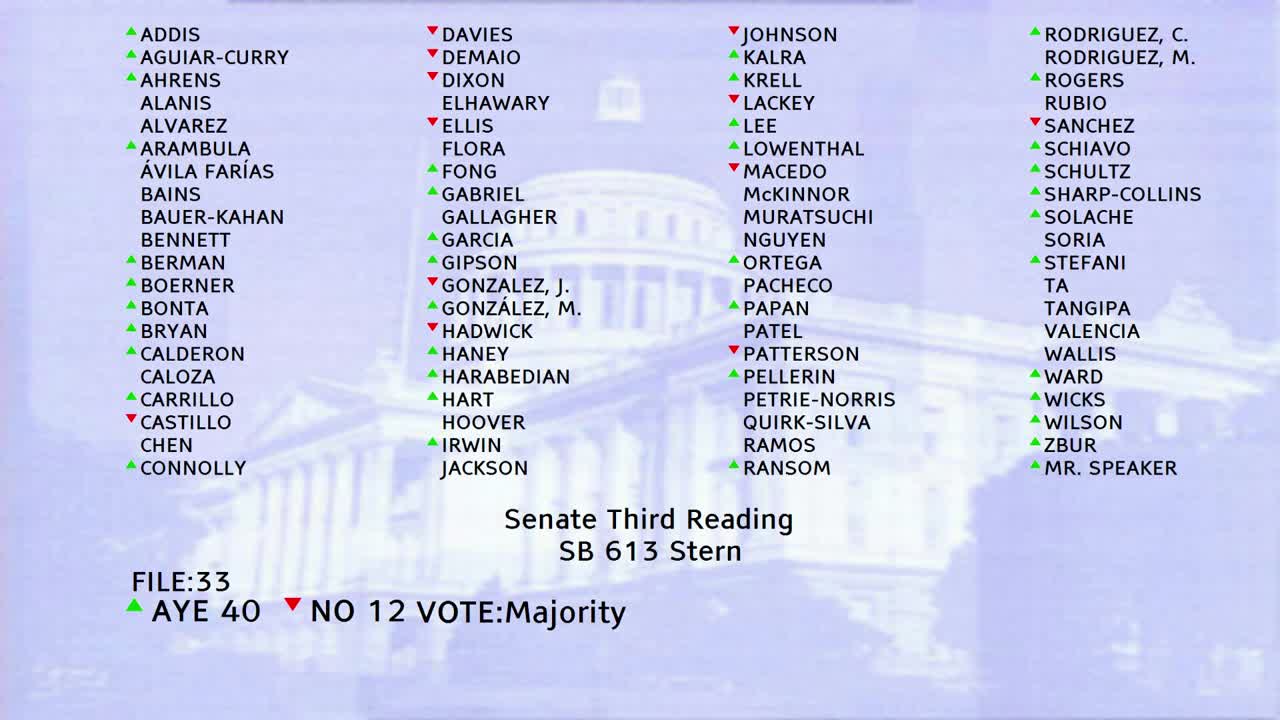 2MIN
Assembly Floor
 1MIN
Assembly Floor
 9MIN
Assembly Standing Committee on Education
Bill Author



