AB 1037: Public health: substance use disorder.
- Session Year: 2025-2026
- House: Assembly
- Latest Version Date: 2025-10-10
Current Status:
Passed
(2025-10-10: Chaptered by Secretary of State - Chapter 569, Statutes of 2025.)
Introduced
In Committee
Awaiting First Chamber Vote
Passed First Chamber
In Committee
Awaiting Second Chamber Vote
Passed Second Chamber
Enacted
(1)Under existing law, a licensed health care provider who is authorized by law to prescribe an opioid antagonist may issue standing orders for the distribution of an opioid antagonist to a person at risk of an opioid-related overdose or to a family member, friend, or other person in a position to assist a person at risk of an opioid-related overdose. Existing law exempts a health care provider who acts with reasonable care in issuing a prescription or order for an opioid antagonist from professional review, civil action, or criminal prosecution, under certain circumstances. Existing law requires that a person who receives an opioid antagonist pursuant to a standing order or otherwise possesses an opioid antagonist receive training, as specified. Existing law provides that a person who is trained in the use of an opioid antagonist and acts with reasonable care and in good faith is not subject to professional review, liable in a civil action, or subject to criminal prosecution.
This bill would expand the above-described authorizations to those who are at risk of or any person who may be in a position to assist a person experiencing any overdose and would strike the requirement that those who receive and possess opioid antagonists receive training. The bill would authorize a person in a position to assist a person at risk of an overdose to possess an opioid antagonist and subsequently dispense or distribute an opioid antagonist to a person at risk of an overdose or another person in a position to assist a person at risk of an overdose. The bill would instead exempt a person who administers an opioid antagonist in good faith, whether or not they were trained, from liability for civil damages, as specified, and would instead exempt a health care provider who acts with reasonable care from liability in a civil action for any injuries or damages relating to or resulting from the acts or omissions of any person who administers the opioid antagonist in good faith, as specified.
(2)Existing law imposes a drug program fee for each separate controlled substance offense, as specified, to be deposited by the county treasurer in a drug program fund. Existing law requires that a portion of the fund be allocated to primary prevention programs in the community.
This bill would state that primary prevention programs may include those activities aligned with evidence-based best practices, as specified.
(3)Existing law requires the State Department of Health Care Services to license and regulate facilities that provide residential nonmedical services to adults who are recovering from problems related to alcohol, drug, or alcohol and drug misuse or abuse, and who need alcohol, drug, or alcohol and drug recovery treatment or detoxification services. Existing law authorizes a licensed alcohol or other drug recovery or treatment facility to permit incidental medical services, as defined, to be provided to a resident at the facility premises by a licensed physician and surgeon or other health care practitioner under specified limited circumstances, including that the resident has signed an admission agreement. Existing law requires a licensee to develop a plan to address when a resident relapses, including when a resident is on the licensed premises after consuming alcohol or using illicit drugs.
This bill would require the department, on or before January 1, 2027, to offer a combined application for entities seeking licensure as an alcohol or other drug recovery or treatment facility and to provide incidental medical services, as defined. The bill would prohibit the department from requiring an admission agreement to require a person to be abstinent and not intoxicated in order to be admitted to care or continue treatment. The bill would require a licensee to prioritize the individual maintaining some level of connection to treatment, following a relapse.
(4)Existing law defines drug- or alcohol-related program as any program designed to reduce the unlawful use of, or assist those who engage in the unlawful use of, drugs or alcohol, through various means, such as intervention, treatment, and enforcement, among others. Existing law prohibits the encumbrance of state funds for a drug- or alcohol-related program unless it contains a component that explains that there is no unlawful use of drugs or alcohol and requires all aspects of a drug- or alcohol-related program receiving state funds to be consistent with the no lawful use message.
This bill would redefine that term to mean any program designed to assist persons with substance use disorders and would strike enforcement from the specified means. The bill would repeal the above-described provisions related to the no lawful use message.
(1)Under existing law, a licensed health care provider who is authorized by law to prescribe an opioid antagonist may issue standing orders for the distribution of an opioid antagonist to a person at risk of an opioid-related overdose or to a family member, friend, or other person in a position to assist a person at risk of an opioid-related overdose. Existing law exempts a health care provider who acts with reasonable care in issuing a prescription or order for an opioid antagonist from professional review, civil action, or criminal prosecution, under certain circumstances. Existing law requires that a person who receives an opioid antagonist pursuant to a standing order or otherwise possesses an opioid antagonist receive training, as specified. Existing law provides that a person who is trained in the use of an opioid antagonist and acts with reasonable care and in good faith is not subject to professional review, liable in a civil action, or subject to criminal prosecution.
This bill would expand the above-described authorizations to those who are at risk of or any person who may be in a position to assist a person experiencing any overdose and would strike the requirement that those who receive and possess opioid antagonists receive training. The bill would authorize a person in a position to assist a person at risk of an overdose to possess an opioid antagonist and subsequently dispense or distribute an opioid antagonist to a person at risk of an overdose or another person in a position to assist a person at risk of an overdose. The bill would instead exempt a person who administers an opioid antagonist in good faith, whether or not they were trained, from liability for civil damages, as specified, and would instead exempt a health care provider who acts with reasonable care from liability in a civil action for any injuries or damages relating to or resulting from the acts or omissions of any person who administers the opioid antagonist in good faith, as specified.
(2)Existing law imposes a drug program fee for each separate controlled substance offense, as specified, to be deposited by the county treasurer in a drug program fund. Existing law requires that a portion of the fund be allocated to primary prevention programs in the community.
This bill would state that primary prevention programs may include those activities aligned with evidence-based best practices, as specified.
(3)Existing law requires the State Department of Health Care Services to license and regulate facilities that provide residential nonmedical services to adults who are recovering from problems related to alcohol, drug, or alcohol and drug misuse or abuse, and who need alcohol, drug, or alcohol and drug recovery treatment or detoxification services. Existing law authorizes a licensed alcohol or other drug recovery or treatment facility to permit incidental medical services, as defined, to be provided to a resident at the facility premises by a licensed physician and surgeon or other health care practitioner under specified limited circumstances, including that the resident has signed an admission agreement. Existing law requires a licensee to develop a plan to address when a resident relapses, including when a resident is on the licensed premises after consuming alcohol or using illicit drugs.
This bill would require the department, on or before January 1, 2027, to offer a combined application for entities seeking licensure as an alcohol or other drug recovery or treatment facility and to provide incidental medical services, as defined. The bill would prohibit the department from requiring an admission agreement to require a person to be abstinent and not intoxicated in order to be admitted to care or continue treatment. The bill would require a licensee to prioritize the individual maintaining some level of connection to treatment, following a relapse.
(4)Existing law defines drug- or alcohol-related program as any program designed to reduce the unlawful use of, or assist those who engage in the unlawful use of, drugs or alcohol, through various means, such as intervention, treatment, and enforcement, among others. Existing law prohibits the encumbrance of state funds for a drug- or alcohol-related program unless it contains a component that explains that there is no unlawful use of drugs or alcohol and requires all aspects of a drug- or alcohol-related program receiving state funds to be consistent with the no lawful use message.
This bill would redefine that term to mean any program designed to assist persons with substance use disorders and would strike enforcement from the specified means. The bill would repeal the above-described provisions related to the no lawful use message.
(1)Under existing law, a licensed health care provider who is authorized by law to prescribe an opioid antagonist may issue standing orders for the distribution of an opioid antagonist to a person at risk of an opioid-related overdose or to a family member, friend, or other person in a position to assist a person at risk of an opioid-related overdose. Existing law exempts a health care provider who acts with reasonable care in issuing a prescription or order for an opioid antagonist from professional review, civil action, or criminal prosecution, under certain circumstances. Existing law requires that a person who receives an opioid antagonist pursuant to a standing order or otherwise possesses an opioid antagonist receive training, as specified. Existing law provides that a person who is trained in the use of an opioid antagonist and acts with reasonable care and in good faith is not subject to professional review, liable in a civil action, or subject to criminal prosecution.
This bill would expand the above-described authorizations to those who are at risk of or any person who may be in a position to assist a person experiencing any overdose and would strike the requirement that those who receive and possess opioid antagonists receive training. The bill would authorize a person in a position to assist a person at risk of an overdose to possess an opioid antagonist and subsequently dispense or distribute an opioid antagonist to a person at risk of an overdose or another person in a position to assist a person at risk of an overdose. The bill would instead exempt a person who administers an opioid antagonist in good faith, whether or not they were trained, from liability for civil damages, as specified, and would instead exempt a health care provider who acts with reasonable care from liability in a civil action for any injuries or damages relating to or resulting from the acts or omissions of any person who administers the opioid antagonist in good faith, as specified.
(2)Existing law imposes a drug program fee for each separate controlled substance offense, as specified, to be deposited by the county treasurer in a drug program fund. Existing law requires that a portion of the fund be allocated to primary prevention programs in the community.
This bill would state that primary prevention programs may include those activities aligned with evidence-based best practices, as specified.
(3)Existing law requires the State Department of Health Care Services to license and regulate facilities that provide residential nonmedical services to adults who are recovering from problems related to alcohol, drug, or alcohol and drug misuse or abuse, and who need alcohol, drug, or alcohol and drug recovery treatment or detoxification services. Existing law authorizes a licensed alcohol or other drug recovery or treatment facility to permit incidental medical services, as defined, to be provided to a resident at the facility premises by a licensed physician and surgeon or other health care practitioner under specified limited circumstances, including that the resident has signed an admission agreement. Existing law requires a licensee to develop a plan to address when a resident relapses, including when a resident is on the licensed premises after consuming alcohol or using illicit drugs.
This bill would require the department, on or before January 1, 2027, to offer a combined application for entities seeking licensure as an alcohol or other drug recovery or treatment facility and to provide incidental medical services, as defined. The bill would prohibit an admission agreement from requiring the department from requiring an admission agreement to require a person to be abstinent and not intoxicated in order to be admitted to care or continue treatment. The bill would require a licensee to prioritize the individual maintaining some level of connection to treatment, following a relapse.
(4)Existing law defines drug- or alcohol-related program as any program designed to reduce the unlawful use of, or assist those who engage in the unlawful use of, drugs or alcohol, through various means, such as intervention, treatment, and enforcement, among others. Existing law prohibits the encumbrance of state funds for a drug- or alcohol-related program unless it contains a component that explains that there is no unlawful use of drugs or alcohol and requires all aspects of a drug- or alcohol-related program receiving state funds to be consistent with the no lawful use message.
This bill would redefine that term to mean any program designed to assist persons with substance use disorders and would strike enforcement from the specified means. The bill would repeal the above-described provisions related to the no lawful use message.
(1)Under existing law, a licensed health care provider who is authorized by law to prescribe an opioid antagonist may issue standing orders for the distribution of an opioid antagonist to a person at risk of an opioid-related overdose or to a family member, friend, or other person in a position to assist a person at risk of an opioid-related overdose. Existing law exempts a health care provider who acts with reasonable care in issuing a prescription or order for an opioid antagonist from professional review, civil action, or criminal prosecution, under certain circumstances. Existing law requires that a person who receives an opioid antagonist pursuant to a standing order or otherwise possesses an opioid antagonist receive training, as specified. Existing law provides that a person who is trained in the use of an opioid antagonist and acts with reasonable care and in good faith is not subject to professional review, liable in a civil action, or subject to criminal prosecution.
This bill would expand the above-described authorizations to those who are at risk of or any person who may be in a position to assist a person experiencing any overdose and would strike the requirement that those who receive and possess opioid antagonists receive training. The bill would authorize a person in a position to assist a person at risk of an overdose to possess an opioid antagonist and subsequently dispense or distribute an opioid antagonist to a person at risk of an overdose or another person in a position to assist a person at risk of an overdose. The bill would instead exempt a person who administers an opioid antagonist in good faith, whether or not they were trained, from liability for civil damages, as specified, and would instead exempt a health care provider who acts with reasonable care from liability in a civil action for any injuries or damages relating to or resulting from the acts or omissions of any person who administers the opioid antagonist in good faith, as specified.
(2)Existing law imposes a drug program fee for each separate controlled substance offense, as specified, to be deposited by the county treasurer in a drug program fund. Existing law requires that a portion of the fund be allocated to primary prevention programs in the community.
This bill would state that primary prevention programs may include those activities aligned with evidence-based best practices, as specified.
(3)Existing law requires the State Department of Health Care Services to license and regulate facilities that provide residential nonmedical services to adults who are recovering from problems related to alcohol, drug, or alcohol and drug misuse or abuse, and who need alcohol, drug, or alcohol and drug recovery treatment or detoxification services. Existing law authorizes a licensed alcohol or other drug recovery or treatment facility to permit incidental medical services, as defined, to be provided to a resident at the facility premises by a licensed physician and surgeon or other health care practitioner under specified limited circumstances, including that the resident has signed an admission agreement. Existing law requires a licensee to develop a plan to address when a resident relapses, including when a resident is on the licensed premises after consuming alcohol or using illicit drugs.
This bill would require the department, on or before January 1, 2027, to offer a combined application for entities seeking licensure as an alcohol or other drug recovery or treatment facility and to provide incidental medical services, as defined. The bill would prohibit the department from requiring an admission agreement to require from requiring a person to be abstinent and not intoxicated in order to be admitted to care or continue treatment. The bill would require a licensee to prioritize the individual maintaining some level of connection to treatment, following a relapse.
(4)Existing law defines drug- or alcohol-related program as any program designed to reduce the unlawful use of, or assist those who engage in the unlawful use of, drugs or alcohol, through various means, such as intervention, treatment, and enforcement, among others. Existing law prohibits the encumbrance of state funds for a drug- or alcohol-related program unless it contains a component that explains that there is no unlawful use of drugs or alcohol and requires all aspects of a drug- or alcohol-related program receiving state funds to be consistent with the no lawful use message.
This bill would redefine that term to mean any program designed to assist persons with substance use disorders and would strike enforcement from the specified means. The bill would repeal the above-described provisions related to the no lawful use message.
(1)Under existing law, a licensed health care provider who is authorized by law to prescribe an opioid antagonist may issue standing orders for the distribution of an opioid antagonist to a person at risk of an opioid-related overdose or to a family member, friend, or other person in a position to assist a person at risk of an opioid-related overdose. Existing law exempts a health care provider who acts with reasonable care in issuing a prescription or order for an opioid antagonist from professional review, civil action, or criminal prosecution, under certain circumstances. Existing law requires that a person who receives an opioid antagonist pursuant to a standing order or otherwise possesses an opioid antagonist receive training, as specified. Existing law provides that a person who is trained in the use of an opioid antagonist and acts with reasonable care and in good faith is not subject to professional review, liable in a civil action, or subject to criminal prosecution.
This bill would expand the above-described authorizations to those who are at risk of or any person who may be in a position to assist a person experiencing any overdose and would strike the requirement that those who receive and possess opioid antagonists receive training. The bill would authorize a person in a position to assist a person at risk of an overdose to possess an opioid antagonist and subsequently dispense or distribute an opioid antagonist to a person at risk of an overdose or another person in a position to assist a person at risk of an overdose. The bill would instead exempt a person who administers an opioid antagonist in good faith, whether or not they were trained, from liability for civil damages, as specified, and would instead exempt a health care provider who acts with reasonable care from liability in a civil action for any injuries or damages relating to or resulting from the acts or omissions of any person who administers the opioid antagonist in good faith, as specified.
(2)Existing law imposes a drug program fee for each separate controlled substance offense, as specified, to be deposited by the county treasurer in a drug program fund. Existing law requires that a portion of the fund be allocated to primary prevention programs in the community.
This bill would state that primary prevention programs may include those activities aligned with evidence-based best practices, as specified.
(3)Existing law requires the State Department of Health Care Services to license and regulate facilities that provide residential nonmedical services to adults who are recovering from problems related to alcohol, drug, or alcohol and drug misuse or abuse, and who need alcohol, drug, or alcohol and drug recovery treatment or detoxification services. Existing law authorizes a licensed alcohol or other drug recovery or treatment facility to permit incidental medical services, as defined, to be provided to a resident at the facility premises by a licensed physician and surgeon or other health care practitioner under specified limited circumstances, including that the resident has signed an admission agreement. Existing law requires a licensee to develop a plan to address when a resident relapses, including when a resident is on the licensed premises after consuming alcohol or using illicit drugs.
This bill would require the department, on or before January 1, 2027, to offer a combined application for entities seeking licensure as an alcohol or other drug recovery or treatment facility and to provide incidental medical services, as defined. The bill would prohibit the department from requiring an admission agreement to require a person to be abstinent and not intoxicated in order to be admitted to care or continue treatment. The bill would require a licensee to prioritize the individual maintaining some level of connection to treatment, following a relapse.
(4)Existing law defines drug- or alcohol-related program as any program designed to reduce the unlawful use of, or assist those who engage in the unlawful use of, drugs or alcohol, through various means, such as intervention, treatment, and enforcement, among others. Existing law prohibits the encumbrance of state funds for a drug- or alcohol-related program unless it contains a component that explains that there is no unlawful use of drugs or alcohol and requires all aspects of a drug- or alcohol-related program receiving state funds to be consistent with the no lawful use message.
This bill would redefine that term to mean any program designed to assist persons with substance use disorders and would strike enforcement from the specified means. The bill would repeal the above-described provisions related to the no lawful use message and would instead require that a drug- or alcohol-related program be consistent with evidence-based best clinical practices in order to receive state funds. message.
(1)Under existing law, a licensed health care provider who is authorized by law to prescribe an opioid antagonist may issue standing orders for the distribution of an opioid antagonist to a person at risk of an opioid-related overdose or to a family member, friend, or other person in a position to assist a person at risk of an opioid-related overdose. Existing law exempts a health care provider who acts with reasonable care in issuing a prescription or order for an opioid antagonist from professional review, civil action, or criminal prosecution, under certain circumstances. Existing law requires that a person who receives an opioid antagonist pursuant to a standing order or otherwise possesses an opioid antagonist receive training, as specified. Existing law provides that a person who is trained in the use of an opioid antagonist and acts with reasonable care and in good faith is not subject to professional review, liable in a civil action, or subject to criminal prosecution.
This bill would expand the above-described authorizations to those who are at risk of or any person who may be in a position to assist a person experiencing any overdose and would strike the requirement that those who receive and possess opioid antagonists receive training. The bill would authorize a person in a position to assist a person at risk of an overdose to possess an opioid antagonist and subsequently dispense or distribute an opioid antagonist to a person at risk of an overdose or another person in a position to assist a person at risk of an overdose. The bill would instead exempt a person who administers an opioid antagonist with reasonable care and in good faith, whether or not they were trained, from professional review, liability in a civil action, or criminal prosecution. liability for civil damages, as specified, and would instead exempt a health care provider who acts with reasonable care from liability in a civil action for any injuries or damages relating to or resulting from the acts or omissions of any person who administers the opioid antagonist in good faith, as specified.
(2)Existing law imposes a drug program fee for each separate controlled substance offense, as specified, to be deposited by the county treasurer in a drug program fund. Existing law requires that a portion of the fund be allocated to primary prevention programs in the community.
This bill would state that primary prevention programs may include those activities aligned with evidence-based best practices, as specified.
(3)Existing law requires the State Department of Health Care Services to license and regulate facilities that provide residential nonmedical services to adults who are recovering from problems related to alcohol, drug, or alcohol and drug misuse or abuse, and who need alcohol, drug, or alcohol and drug recovery treatment or detoxification services. Existing law authorizes a licensed alcohol or other drug recovery or treatment facility to permit incidental medical services, as defined, to be provided to a resident at the facility premises by a licensed physician and surgeon or other health care practitioner under specified limited circumstances, including that the resident has signed an admission agreement. Existing law requires a licensee to develop a plan to address when a resident relapses, including when a resident is on the licensed premises after consuming alcohol or using illicit drugs.
This bill would require the department, on or before January 1, 2027, to offer a combined application for entities seeking licensure as an alcohol or other drug recovery or treatment facility and to provide incidental medical services, as defined. The bill would prohibit the department from requiring an admission agreement to require a person to be abstinent and not intoxicated in order to be admitted to care or continue treatment. The bill would require a licensee to prioritize the individual maintaining some level of connection to treatment, following a relapse.
(4)Existing law defines drug- or alcohol-related program as any program designed to reduce the unlawful use of, or assist those who engage in the unlawful use of, drugs or alcohol, through various means, such as intervention, treatment, and enforcement, among others. Existing law prohibits the encumbrance of state funds for a drug- or alcohol-related program unless it contains a component that explains that there is no unlawful use of drugs or alcohol and requires all aspects of a drug- or alcohol-related program receiving state funds to be consistent with the no lawful use message.
This bill would redefine that term to mean any program designed to assist persons with substance use disorders and would strike enforcement from the specified means. The bill would repeal the above-described provisions related to the no lawful use message and would instead require that a drug- or alcohol-related program be consistent with evidence-based best clinical practices in order to receive state funds.
(1)Under existing law, a licensed health care provider who is authorized by law to prescribe an opioid antagonist may issue standing orders for the distribution of an opioid antagonist to a person at risk of an opioid-related overdose or to a family member, friend, or other person in a position to assist a person at risk of an opioid-related overdose. Existing law requires that a person who receives an opioid antagonist pursuant to a standing order or otherwise possesses an opioid antagonist receive training, as specified. Existing law provides that a person who is trained in the use of an opioid antagonist and acts with reasonable care and in good faith is not subject to professional review, liable in a civil action, or subject to criminal prosecution.
This bill would expand the above-described authorizations to those who are at risk of or who may be in a position to assist a person experiencing any overdose and would strike the requirement that those who receive and possess opioid antagonists receive training. The bill would authorize a person in a position to assist a person at risk of an overdose to possess an opioid antagonist and subsequently dispense or distribute an opioid antagonist to a person at risk of an overdose or another person in a position to assist a person at risk of an overdose. The bill would instead exempt a person who administers an opioid antagonist with reasonable care and in good faith, whether or not they were trained, from professional review, liability in a civil action, or criminal prosecution.
(3)Existing law defines drug paraphernalia to include testing equipment designed for use or marketed for use in identifying, or in analyzing the strength, effectiveness, or purity of, controlled substances, subject to exceptions, and prohibits, among other things, the manufacture, sale, and possession, as specified, of drug paraphernalia. Existing law exempts from these prohibitions specified professionals, such as pharmacists, manufacturers, and dentists, under certain circumstances. Existing law authorizes a court, in determining whether an object is drug paraphernalia, to consider specified facts and circumstances, such as the expert testimony.This bill would remove testing equipment from the definition of drug paraphernalia and would expand the group of individuals exempt from drug paraphernalia prohibition to include a person who is at risk of overdose, a family member, friend, or other person in a position to assist a person at risk of overdose, in order to reduce the spread of HIV, viral hepatitis, and other bloodborne infections among the intravenous drug user population within California. The bill would additionally authorize a court, in determining whether an object is paraphernalia, to consider whether the possession of an object is related to or a result of a substance use disorder treatment or recovery program, harm reduction program, syringe exchange program, or consistent with best clinical practices, as specified. (4)(2)Existing law imposes a drug program fee for each separate controlled substance offense, as specified, to be deposited by the county treasurer in a drug program fund. Existing law requires that a portion of the fund be allocated to primary prevention programs in the community.
This bill would state that primary prevention programs may include those activities as determined by the Substance Abuse and Mental Health Services Administration. aligned with evidence-based best practices, as specified.
(5)(3)Existing law requires the State Department of Health Care Services to license and regulate facilities that provide residential nonmedical services to adults who are recovering from problems related to alcohol, drug, or alcohol and drug misuse or abuse, and who need alcohol, drug, or alcohol and drug recovery treatment or detoxification services. Existing law requires these programs to be certified, except as specified. Existing law authorizes a licensed alcohol or other drug recovery or treatment facility to permit incidental medical services, as defined, to be provided to a resident at the facility premises by a licensed physician and surgeon or other health care practitioner under specified limited circumstances, including that the resident has signed an admission agreement. Existing law requires a licensee to develop a plan to address when a resident relapses, including when a resident is on the licensed premises after consuming alcohol or using illicit drugs.
This bill would require the department, on or before July 1, 2026, January 1, 2027, to offer a combined application for entities to be certified as an alcohol or other drug program seeking licensure as an alcohol or other drug recovery or treatment facility and to provide incidental medical services, as defined. The bill would prohibit an admission agreement from requiring the department from requiring an admission agreement to require a person to be abstinent and not intoxicated in order to be admitted to care or continue treatment. The bill would require a licensee to prioritize the individual maintaining some level of connection to treatment, rather than disconnection from treatment, following a relapse.
Existing(4)Existing law defines drug- or alcohol-related program as any program designed to reduce the unlawful use of, or assist those who engage in the unlawful use of, drugs or alcohol, through various means, such as intervention, treatment, and enforcement, among others. Existing law prohibits the encumbrance of state funds for a drug- or alcohol-related program unless it contains a component that explains that there is no unlawful use of drugs or alcohol and requires all aspects of a drug- or alcohol-related program receiving state funds to be consistent with the no lawful use message.
This bill would redefine that term to mean any program designed to assist persons with substance use disorders and would strike enforcement from the specified means. The bill would repeal the above-described provisions related to the no lawful use message and would instead require that a drug- or alcohol-related program be consistent with the best clinical practices as determined by the Substance Abuse and Mental Health Services Administration and the American Society of Addiction Medicine evidence-based best clinical practices in order to receive state funds.
(6)Existing law authorizes a public entity, as defined, that receives General Fund money from the Office of AIDS in the State Department of Public Health for HIV prevention and education to use that money to support clean needle and syringe exchange projects authorized by the public entity. Existing law authorizes the money to be used for the purchase of sterile hypodermic needles and syringes, subject to specified conditions, such as the portion of funds used for purchasing sterile hypodermic needles and syringes does not exceed 7.5% of the total amount of the funds received by the entity for HIV prevention. Existing law requires that an entity apply for authorization to provide hypodermic needle and syringe exchange services and requires that an entity demonstrate in its application that it complies with certain minimum standards, including that it has adequate funding to provide certain services at reasonably projected program participation levels.This bill would expand the diseases that a public entity receiving this General Fund money may focus on to include viral hepatitis and other bloodborne diseases and would strike the above-described specified conditions to instead authorize that the money may be used for the purchase of sterile hypodermic needles and syringes as part of a clean needle and syringe exchange program in alignment with primary prevention activities as determined by the Substance Abuse and Mental Health Services Administration in the course of administering the Substance Use Prevention, Treatment, and Recovery Services Block Grant. The bill would require an entity applying for authorization to provide hypodermic needle and syringe exchange services to demonstrate in its application that it complies with certain minimum standards, including that it has the ability to provide certain services at reasonably projected program participation levels within 3 months of authorization.(1)Existing law, until January 1, 2026, authorizes a physician or pharmacist, without a prescription or permit, to furnish hypodermic needles and syringes for human use to a person 18 years of age or older, and authorizes a person 18 years of age or older to, without a prescription or license, obtain hypodermic needles and syringes solely for personal use from a physician or pharmacist, as a public health measure, as specified. Existing law requires a pharmacist that provides nonprescription syringes to provide information on access to testing and treatment for HIV and hepatitis C.
This bill would extend this authority indefinitely and would additionally require a pharmacist to provide information on other bloodborne diseases.
(2)Under existing law, a licensed health care provider who is authorized by law to prescribe an opioid antagonist may issue standing orders for the distribution of an opioid antagonist to a person at risk of an opioid-related overdose or to a family member, friend, or other person in a position to assist a person at risk of an opioid-related overdose. Existing law requires that a person who receives an opioid antagonist pursuant to a standing order or otherwise possesses an opioid antagonist receive training, as specified. Existing law provides that a person who is trained in the use of an opioid antagonist and acts with reasonable care and in good faith is not subject to professional review, liable in a civil action, or subject to criminal prosecution.
This bill would expand the above-described authorizations to those who are at risk of or who may be in a position to assist a person experiencing any overdose and would strike the requirement that those who receive and possess opioid antagonists receive training. The bill would authorize a person in a position to assist a person at risk of an overdose to possess an opioid antagonist and subsequently dispense or distribute an opioid antagonist to a person at risk of an overdose or another person in a position to assist a person at risk of an overdose. The bill would instead exempt a person who administers an opioid antagonist with reasonable care and in good faith, whether or not they were trained, from professional review, liability in a civil action, or criminal prosecution.
(3)Existing law defines drug paraphernalia to include testing equipment designed for use or marketed for use in identifying, or in analyzing the strength, effectiveness, or purity of, controlled substances, subject to exceptions, and prohibits, among other things, the manufacture, sale, and possession, as specified, of drug paraphernalia. Existing law exempts from these prohibitions specified professionals, such as pharmacists, manufacturers, and dentists, under certain circumstances. Existing law authorizes a court, in determining whether an object is drug paraphernalia, to consider specified facts and circumstances, such as the expert testimony.
This bill would remove testing equipment from the definition of drug paraphernalia and would expand the group of individuals exempt from drug paraphernalia prohibition to include a person who is at risk of overdose, a family member, friend, or other person in a position to assist a person at risk of overdose, in order to reduce the spread of HIV, viral hepatitis, and other bloodborne infections among the intravenous drug user population within California. The bill would additionally authorize a court, in determining whether an object is paraphernalia, to consider whether the possession of an object is related to or a result of a substance use disorder treatment or recovery program, harm reduction program, syringe exchange program, or consistent with best clinical practices, as specified.
(4)Existing law imposes a drug program fee for each separate controlled substance offense, as specified, to be deposited by the county treasurer in a drug program fund. Existing law requires that a portion of the fund be allocated to primary prevention programs in the community.
This bill would state that primary prevention programs may include those activities as determined by the Substance Abuse and Mental Health Services Administration.
(5)Existing law requires the State Department of Health Care Services to license and regulate facilities that provide residential nonmedical services to adults who are recovering from problems related to alcohol, drug, or alcohol and drug misuse or abuse, and who need alcohol, drug, or alcohol and drug recovery treatment or detoxification services. Existing law requires these programs to be certified, except as specified. Existing law authorizes a licensed alcohol or other drug recovery or treatment facility to permit incidental medical services, as defined, to be provided to a resident at the facility premises by a licensed physician and surgeon or other health care practitioner under specified limited circumstances, including that the resident has signed an admission agreement. Existing law requires a licensee to develop a plan to address when a resident relapses, including when a resident is on the licensed premises after consuming alcohol or using illicit drugs.
This bill would require the department, on or before July 1, 2026, to offer a combined application for entities to be certified as an alcohol or other drug program and to provide incidental medical services, as defined. The bill would prohibit an admission agreement from requiring a person to be abstinent and not intoxicated in order to be admitted to care or continue treatment. The bill would require a licensee to prioritize the individual maintaining some level of connection to treatment, rather than disconnection from treatment, following a relapse.
Existing law defines drug- or alcohol-related program as any program designed to reduce the unlawful use of, or assist those who engage in the unlawful use of, drugs or alcohol, through various means, such as intervention, treatment, and enforcement, among others. Existing law prohibits the encumbrance of state funds for a drug- or alcohol-related program unless it contains a component that explains that there is no unlawful use of drugs or alcohol and requires all aspects of a drug- or alcohol-related program receiving state funds to be consistent with the no lawful use message.
This bill would redefine that term to mean any program designed to assist persons with substance use disorders and would strike enforcement from the specified means. The bill would repeal the above-described provisions related to the no lawful use message and would instead require that a drug- or alcohol-related program be consistent with the best clinical practices as determined by the Substance Abuse and Mental Health Services Administration and the American Society of Addiction Medicine in order to receive state funds.
(6)Existing law authorizes a public entity, as defined, that receives General Fund money from the Office of AIDS in the State Department of Public Health for HIV prevention and education to use that money to support clean needle and syringe exchange projects authorized by the public entity. Existing law authorizes the money to be used for the purchase of sterile hypodermic needles and syringes, subject to specified conditions, such as the portion of funds used for purchasing sterile hypodermic needles and syringes does not exceed 7.5% of the total amount of the funds received by the entity for HIV prevention. Existing law requires that an entity apply for authorization to provide hypodermic needle and syringe exchange services and requires that an entity demonstrate in its application that it complies with certain minimum standards, including that it has adequate funding to provide certain services at reasonably projected program participation levels.
This bill would expand the diseases that a public entity receiving this General Fund money may focus on to include viral hepatitis and other bloodborne diseases and would strike the above-described specified conditions to instead authorize that the money may be used for the purchase of sterile hypodermic needles and syringes as part of a clean needle and syringe exchange program in alignment with primary prevention activities as determined by the Substance Abuse and Mental Health Services Administration in the course of administering the Substance Use Prevention, Treatment, and Recovery Services Block Grant. The bill would require an entity applying for authorization to provide hypodermic needle and syringe exchange services to demonstrate in its application that it complies with certain minimum standards, including that it has the ability to provide certain services at reasonably projected program participation levels within 3 months of authorization.
(a)For purposes of this section, the following definitions apply:
(1)Opioid antagonist means naloxone hydrochloride or any other opioid antagonist that is approved by the United States Food and Drug Administration for the treatment of an opioid overdose.
(2)Opioid overdose prevention and treatment training program means any program operated by a local health jurisdiction or that is registered by a local health jurisdiction to train individuals to prevent, recognize, and respond to an opiate overdose, and that provides, at a minimum, training in all of the following:
(A)The causes of an opiate overdose.
(B)Basic life support.
(C)How to contact appropriate emergency medical services.
(D)How to administer an opioid antagonist.
(b)A licensed health care provider who is authorized by law to prescribe an opioid antagonist may, if acting with reasonable care, prescribe and subsequently dispense or distribute an opioid antagonist to a person at risk of an overdose or to a family member, friend, or other person in a position to assist a person at risk of an overdose.
(c)(1)A licensed health care provider who is authorized by law to prescribe an opioid antagonist may issue standing orders for the distribution of an opioid antagonist to a person at risk of an overdose or to a family member, friend, or other person in a position to assist a person at risk of an overdose.
(2)A licensed health care provider who is authorized by law to prescribe an opioid antagonist may issue standing orders for the administration of an opioid antagonist to a person at risk of an overdose by a family member, friend, or other person in a position to assist a person experiencing or reasonably suspected of experiencing an overdose.
(3)A person who is at risk of an overdose or any person in a position to assist a person at risk of an overdose may possess an opioid antagonist and subsequently dispense or distribute an opioid antagonist to a person at risk of an overdose or to any other person in a position to assist a person at risk of an overdose.
(d)A licensed health care provider who acts with reasonable care shall not be subject to professional review or subject to criminal prosecution for issuing a prescription or order or for possessing, administering, or distributing an opioid antagonist pursuant to subdivision (b) or (c), or for liability in a civil action for any injuries or damages relating to or resulting from the acts or omissions of any person who administers the opioid antagonist in good faith and not for compensation pursuant to this section.
(e)(1)Notwithstanding any other law, a person who possesses or distributes an opioid antagonist for the purposes specified in subdivision (b) or (c) shall not be subject to professional review or be subject to criminal prosecution for their possession or distribution.
(2)Consistent with Section 1799.102 of the Health and Safety Code, any person who administers an opioid antagonist, in good faith and not for compensation, to a person who is experiencing or is suspected of experiencing an overdose is not liable for civil damages resulting from any act or omission relating to such administration, other than an act or omission constituting gross negligence or willful or wanton misconduct.
SEC. 2.Section 1797.197 of the Health and Safety Code is amended to read:1797.197.(a)The authority shall establish training and standards for all prehospital emergency medical care personnel, as defined in paragraph (2) of subdivision (a) of Section 1797.189, regarding the characteristics and method of assessment and treatment of anaphylactic reactions and the use of epinephrine. The authority shall promulgate regulations regarding these matters for use by all prehospital emergency medical care personnel.
(b)(1)The authority shall develop and, after approval by the commission pursuant to Section 1799.50, adopt training and standards for all prehospital emergency medical care personnel, as defined in paragraph (2) of subdivision (a) of Section 1797.189, regarding the use and administration of naloxone hydrochloride and other opioid antagonists. The authority shall promulgate regulations regarding these matters for use by all prehospital emergency medical care personnel. The authority may adopt existing training and standards for prehospital emergency medical care personnel regarding the statewide use and administration of naloxone hydrochloride or another opioid antagonist to satisfy the requirements of this section.
(2)The medical director of a local EMS agency may, pursuant to Section 1797.221, approve or conduct a trial study of the use and administration of naloxone hydrochloride or other opioid antagonists by any level of prehospital emergency medical care personnel. Training received by prehospital emergency medical care personnel specific to the use and administration of naloxone hydrochloride or another opioid antagonist during this trial study may be used towards satisfying the training requirements established pursuant to paragraph (1) regarding the use and administration of naloxone hydrochloride and other opioid antagonists by prehospital emergency medical care personnel.
SEC. 3.Section 11372.7 of the Health and Safety Code is amended to read:11372.7.(a)Except as otherwise provided in subdivision (b) or (e), each person who is convicted of a violation of this chapter shall pay a drug program fee in an amount not to exceed one hundred fifty dollars ($150) for each separate offense. The court shall increase the total fine, if necessary, to include this increment, which shall be in addition to any other penalty prescribed by law.
(b)The court shall determine whether or not the person who is convicted of a violation of this chapter has the ability to pay a drug program fee. If the court determines that the person has the ability to pay, the court may set the amount to be paid and order the person to pay that sum to the county in a manner that the court believes is reasonable and compatible with the persons financial ability. In its determination of whether a person has the ability to pay, the court shall take into account the amount of any fine imposed upon that person and any amount that person has been ordered to pay in restitution. If the court determines that the person does not have the ability to pay a drug program fee, the person shall not be required to pay a drug program fee.
(c)The county treasurer shall maintain a drug program fund. For every drug program fee assessed and collected pursuant to subdivisions (a) and (b), an amount equal to this assessment shall be deposited into the fund for every conviction pursuant to this chapter, in addition to fines, forfeitures, and other moneys that are transmitted by the courts to the county treasurer pursuant to Sections 11372.5 and 11502. These deposits shall be made prior to any transfer pursuant to Section 11502. Amounts deposited in the drug program fund shall be allocated by the administrator of the countys drug program to drug abuse programs in the schools and the community, subject to the approval of the board of supervisors, as follows:
(1)The moneys in the fund shall be allocated through the planning process established pursuant to Sections 11983, 11983.1, 11983.2, and 11983.3.
(2)A minimum of 33 percent of the fund shall be allocated to primary prevention programs in the schools and the community. Primary prevention programs developed and implemented under this article shall emphasize cooperation in planning and program implementation among schools and community drug abuse agencies, and shall demonstrate coordination through an interagency agreement among county offices of education, school districts, and the county drug program administrator. These primary prevention programs may include:
(A)School- and classroom-oriented programs, including, but not limited to, programs designed to encourage sound decisionmaking, an awareness of values, an awareness of drugs and their effects, enhanced self-esteem, social and practical skills that will assist students toward maturity, enhanced or improved school climate and relationships among all school personnel and students, and furtherance of cooperative efforts of school- and community-based personnel.
(B)School- or community-based nonclassroom alternative programs, or both, including, but not limited to, positive peer group programs, programs involving youth and adults in constructive activities designed as alternatives to drug use, and programs for special target groups, such as women, ethnic minorities, and other high-risk, high-need populations.
(C)Family-oriented programs, including, but not limited to, programs aimed at improving family relationships and involving parents constructively in the education and nurturing of their children, as well as in specific activities aimed at preventing substance use disorders.
(D)Primary prevention activities aligned with evidence-based best practices or identified in the Substance Use Prevention, Treatment, and Recovery Services Block Grant, authorized by Section 1921 of Subparts II and III of Part B of Title XIX of the Public Health Service Act.
(d)Moneys deposited into a county drug program fund pursuant to this section shall supplement, and shall not supplant, any local funds made available to support the countys drug abuse prevention and treatment efforts.
(e)This section shall not apply to any person convicted of a violation of subdivision (b) of Section 11357 of the Health and Safety Code.
SEC. 4.The heading of Division 10.5 (commencing with Section 11750) of the Health and Safety Code is amended to read:10.5.ALCOHOL AND OTHER DRUG PROGRAMSSEC. 5.Section 11834.01 of the Health and Safety Code is amended to read:11834.01.The department has the sole authority in state government to license adult alcohol or other drug recovery or treatment facilities.
(a)In administering this chapter, the department shall issue new licenses for a period of two years to those programs that meet the criteria for licensure set forth in Section 11834.03.
(b)Onsite program visits for compliance shall be conducted at least once during the license period.
(c)The department may conduct announced or unannounced site visits to facilities licensed pursuant to this chapter for the purpose of reviewing for compliance with all applicable statutes and regulations.
(d)The department shall, on or before January 1, 2027, offer a combined application for entities seeking licensure as an alcohol or other drug recovery or treatment facility to simultaneously apply to provide incidental medical services as defined in Section 11834.026.
(e)An additional fee shall not be charged for the combined application described in subdivision (d) in excess of the charges established in accordance with Sections 11833.02 and 11834.03.
(f)Any necessary rules and regulations for the purpose of implementing this section may be adopted as emergency regulations in accordance with the Administrative Procedure Act (Chapter 3.5 (commencing with Section 11340) of Part 1 of Division 3 of Title 2 of the Government Code). The adoption of emergency regulations pursuant to this section shall be deemed to be an emergency and necessary for the immediate preservation of the public peace, health and safety, or general welfare.
SEC. 6.Section 11834.026 of the Health and Safety Code is amended to read:11834.026.(a)As used in this section, incidental medical services means services that are in compliance with the community standard of practice and are not required to be performed in a licensed clinic or licensed health facility, as defined by Section 1200 or 1250, respectively, to address medical issues associated with either detoxification from alcohol or other drugs or the provision of alcohol or other drug recovery or treatment services, including all of the following categories of services that the department shall further define by regulation:
(1)Obtaining medical histories.
(2)Monitoring health status to determine whether the health status warrants transfer of the patient in order to receive urgent or emergent care.
(3)Testing associated with detoxification from alcohol or other drugs.
(4)Providing alcohol or other drug recovery or treatment services.
(5)Overseeing patient self-administered medications.
(6)Treating substance use disorders, including detoxification.
(b)Incidental medical services do not include the provision of general primary medical care.
(c)Notwithstanding any other law, a licensed alcohol or other drug recovery or treatment facility may permit incidental medical services to be provided to a resident at the facility premises by, or under the supervision of, one or more physicians and surgeons licensed by the Medical Board of California or the Osteopathic Medical Board who are knowledgeable about addiction medicine, or one or more other health care practitioners acting within the scope of practice of their license and under the direction of a physician and surgeon, and who are also knowledgeable about addiction medicine, if all of the following conditions are met:
(1)The facility, in the judgment of the department, has the ability to comply with the requirements of this chapter and all other applicable laws and regulations to meet the needs of a resident receiving incidental medical services pursuant to this chapter. The department shall specify in regulations the minimum requirements that a facility shall meet in order to be approved to permit the provision of incidental medical services on its premises. The license of a facility approved to permit the provision of incidental medical services shall reflect that those services are permitted at the facility premises.
(2)The physician and surgeon and any other health care practitioner has signed an acknowledgment on a form provided by the department that they have been advised of and understand the statutory and regulatory limitations on the services that may legally be provided at a licensed alcohol or other drug recovery or treatment facility and the statutory and regulatory requirements and limitations for the physician and surgeon or other health care practitioner and for the facility, related to providing incidental medical services. The licensee shall maintain a copy of the signed form at the facility for a physician and surgeon or other health care practitioner providing incidental medical services at the facility premises.
(3)A physician and surgeon or other health care practitioner shall assess a resident, prior to that resident receiving incidental medical services, to determine whether it is medically appropriate for that resident to receive these services at the premises of the licensed facility. A copy of the form provided by the department shall be signed by the physician and surgeon and maintained in the residents file at the facility.
(4)The resident has signed an admission agreement.
(A)The admission agreement, at a minimum, shall describe the incidental medical services that the facility may permit to be provided and shall state that the permitted incidental medical services will be provided by, or under the supervision of, a physician and surgeon.
(B)The department shall not require an admission agreement to require a person to have been abstinent, to not be intoxicated, or to otherwise not be under the influence in order to be admitted into care, be considered for treatment, or continue treatment.
(C)The department shall specify in regulations, at a minimum, the content and manner of providing the admission agreement, and any other information that the department deems appropriate. The facility shall maintain a copy of the signed admission agreement in the residents file.
(5)Once incidental medical services are initiated for a resident, the physician and surgeon and facility shall monitor the resident to ensure that the resident remains appropriate to receive those services. If the physician and surgeon determines that a change in the residents medical condition requires other medical services or that a higher level of care is required, the facility shall immediately arrange for the other medical services or higher level of care, as appropriate.
(6)The facility maintains in its files a copy of the relevant professional license or other written evidence of licensure to practice medicine or perform medical services in the state for the physician and surgeon and any other health care practitioner providing incidental medical services at the facility.
(d)The department is not required to evaluate or have any responsibility or liability with respect to evaluating the incidental medical services provided by a physician and surgeon or other health care practitioner at a licensed facility. This section does not limit the departments ability to report suspected misconduct by a physician and surgeon or other health care practitioner to the appropriate licensing entity or to law enforcement.
(e)A facility licensed and approved by the department to allow provision of incidental medical services shall not by offering approved incidental medical services be deemed a clinic or health facility within the meaning of Section 1200 or 1250, respectively.
(f)Other than incidental medical services permitted to be provided or any urgent or emergent care required in the case of a life-threatening emergency, including the administration of naloxone hydrochloride, or any other opioid antagonist that is approved by the United States Food and Drug Administration for treatment of an opioid overdose, this section does not authorize the provision at the premises of the facility of any medical or health care services or any other services that require a higher level of care than the care that may be provided within a licensed alcohol or other drug recovery or treatment facility.
(g)This section does not require a residential treatment facility licensed by the department to provide incidental medical services or any services not otherwise permitted by law.
(h)(1)On or before July 1, 2024, the department shall adopt regulations to implement this section in accordance with the Administrative Procedure Act (Chapter 3.5 (commencing with Section 11340) of Part 1 of Division 3 of Title 2 of the Government Code).
(2)Notwithstanding the rulemaking provisions of the Administrative Procedure Act, the department may, if it deems appropriate, implement, interpret, or make specific this section by means of provider bulletins, written guidelines, or similar instructions from the department until regulations are adopted.
SEC. 7.Section 11834.26 of the Health and Safety Code is amended to read:11834.26.(a)The licensee shall provide at least one of the following nonmedical services:
(1)Recovery services.
(2)Treatment services.
(3)Detoxification services.
(b)The department shall adopt regulations requiring records and procedures that are appropriate for each of the services specified in subdivision (a). The records and procedures may include all of the following:
(1)Admission criteria.
(2)Intake process.
(3)Assessments.
(4)Recovery, treatment, or detoxification planning.
(5)Referral.
(6) Documentation of provision of recovery, treatment, or detoxification services.
(7)Discharge and continuing care planning.
(8)Indicators of recovery, treatment, or detoxification outcomes.
(c)A licensee shall not deny admission to any individual based solely on either of the following:
(1)The individual having a valid prescription from a licensed health care professional for a medication approved by the federal Food and Drug Administration for the purpose of narcotic replacement treatment or medication-assisted treatment of substance use disorders.
(2)The individual having consumed, used, or otherwise been under the influence of alcohol or other drugs, as these circumstances represent symptoms of the condition of substance use disorders.
(d)A licensee shall develop a plan to address when a resident relapses, including when a resident is on the licensed premises after using alcohol or other drugs.
(1)The plan shall include details of how the treatment stay and treatment plan of the resident will be adjusted to address the relapse episode and how the resident will be treated and supervised while under the influence of alcohol or other drugs, as well as discharge and continuing care planning, including when a licensee determines that a resident requires services beyond the scope of the licensee.
(2)This subdivision does not require a licensee to discharge a resident, as relapse, lapses, and momentary reengagement with alcohol or other drugs are symptoms of the condition of substance use disorders.
(3)In developing a plan pursuant to this subdivision, the licensee shall prioritize the individual maintaining some level of connection to treatment and shall consider options to avoid complete disconnection of the resident from treatment.
(e)The department shall have the authority to implement subdivisions (d) and (f) by bulletin or all-county or all-provider letter, after stakeholder input, until regulations are promulgated. The department shall promulgate regulations to implement subdivisions (d) and (f) no later than July 1, 2027.
(f)(1)A licensee shall, at all times, maintain at least two unexpired doses of naloxone hydrochloride, or any other opioid antagonist that is approved by the United States Food and Drug Administration for treatment of an opioid overdose, on the premises and shall, at all times, have at least one staff member on the premises who knows the specific location of the naloxone hydrochloride, or other opioid antagonist that is approved by the United States Food and Drug Administration for treatment of an opioid overdose, and who has been trained on the administration of naloxone hydrochloride, or the other opioid antagonist that is approved by the United States Food and Drug Administration for treatment of an opioid overdose, in accordance with the training requirements set forth by the department. Proof of completion of training on the administration of naloxone hydrochloride, or other opioid antagonist that is approved by the United States Food and Drug Administration for treatment of an opioid overdose, shall be documented in the staff members individual personnel file.
(2)A trained staff member shall not be liable for damages in a civil action or subject to criminal prosecution for the administration, in good faith, of naloxone hydrochloride, or any other opioid antagonist that is approved by the United States Food and Drug Administration for treatment of an opioid overdose, to a person appearing to experience an overdose. This paragraph shall not apply in a case where the person who renders emergency care treatment by the use of naloxone hydrochloride, or any other opioid antagonist that is approved by the United States Food and Drug Administration for treatment of an overdose, acts with gross negligence or engages in willful and wanton misconduct.
(g)In the development of regulations implementing this section, the written record requirements shall be modified or adapted for social model programs.
SEC. 8.The heading of Division 10.7 (commencing with Section 11999) of the Health and Safety Code is repealed.SEC. 9.The heading of Division 10.7 (commencing with Section 11999) is added to the Health and Safety Code, to read:10.7.SUBSTANCE USE DISORDER PREVENTION, TREATMENT, AND RECOVERY PROGRAMSSEC. 10.Section 11999 of the Health and Safety Code is amended to read:11999.The Legislature finds and declares all of the following:
(a)The Legislature has established various drug- and alcohol-related programs which provide for education, prevention, intervention, treatment, or enforcement.
(b)The Legislature has classified certain substances as controlled substances and has defined the lawful and unlawful use of controlled substances which are commonly referred to as, but not limited to, anabolic steroids, marijuana, and cocaine.
(c)The Legislature has classified certain substances as imitation controlled substances which are commonly referred to as, but not limited to, designer drugs.
(d)The Legislature has determined that the possession with the intent to be under the influence, or being under the influence of toluene, or any substance or material containing toluene, or any substance with similar toxic qualities, is unlawful. Some substances or materials containing toluene, or substances with similar toxic qualities are commonly referred to, but not limited to, inhalants such as cement, glue, and paint thinner.
(e)The Legislature has determined that the purchase, possession, or use of alcohol by persons under 21 years of age is unlawful.
(f)Substance use disorder should be viewed and treated as a health problem, as well as a public safety problem as described in Section 11760.5.
(g)Comprehensive prevention and treatment services for individuals experiencing or recovering from substance use disorders must be medically accurate, culturally congruent, and evidence based.
(h)Naloxone, a life-saving opioid antagonist medication used to reverse an opioid overdose, including heroin, fentanyl, and prescription opioid medications, is safe and easy to use, works almost immediately, and is not addictive. Naloxone has very few negative effects, and has no effect if opioids are not in a persons system.
(i)With the establishment of the Naloxone Distribution Program and the United States Food and Drug Administrations approval for over-the-counter, nonprescription use of naloxone for the reversal of an opioid overdose, the Legislature further finds that carrying naloxone provides an extra layer of protection for those at a higher risk for overdose. Although most professional first responders and emergency departments carry naloxone, they may not arrive in time to reverse an opioid overdose. Anyone can carry naloxone, give it to someone having an overdose, and potentially save a life. Bystanders such as friends, family, non-health care providers, and persons who use drugs can reverse an opioid overdose with naloxone.
SEC. 11.Section 11999.1 of the Health and Safety Code is amended to read:11999.1.For the purpose of this division, the following definitions apply:
(a)Drug means all of the following:
(1)Any controlled substance as defined in Division 10 (commencing with Section 11000).
(2)Any imitation controlled substance as defined in Chapter 1 (commencing with Section 11670) of Division 10.1.
(3)Toluene or any substance or material containing toluene or any substance with similar toxic qualities as set forth in Sections 380 and 381 of the Penal Code.
(b)Drug- or alcohol-related program means any program designed to assist persons with substance use disorders whether through education, prevention, intervention, treatment, or other means.
(c)Local agency shall include, but is not limited to, a county, a city, a city and county, and school district.
(d)State agency shall include the State Department of Health Care Services, the State Department of Education, the Department of Justice, the Office of Criminal Justice Planning, and the Office of Traffic Safety. Any other state agency or department may comply with this division.
SEC. 12.Section 11999.2 of the Health and Safety Code is repealed.(a)For purposes of this section, the following definitions apply:
(1)Opioid antagonist means naloxone hydrochloride or any other opioid antagonist that is approved by the United States Food and Drug Administration for the treatment of an opioid overdose.
(2)Opioid overdose prevention and treatment training program means any program operated by a local health jurisdiction or that is registered by a local health jurisdiction to train individuals to prevent, recognize, and respond to an opiate overdose, and that provides, at a minimum, training in all of the following:
(A)The causes of an opiate overdose.
(B)Basic life support.
(C)How to contact appropriate emergency medical services.
(D)How to administer an opioid antagonist.
(b)A licensed health care provider who is authorized by law to prescribe an opioid antagonist may, if acting with reasonable care, prescribe and subsequently dispense or distribute an opioid antagonist to a person at risk of an overdose or to a family member, friend, or other person in a position to assist a person at risk of an overdose.
(c)(1)A licensed health care provider who is authorized by law to prescribe an opioid antagonist may issue standing orders for the distribution of an opioid antagonist to a person at risk of an overdose or to a family member, friend, or other person in a position to assist a person at risk of an overdose.
(2)A licensed health care provider who is authorized by law to prescribe an opioid antagonist may issue standing orders for the administration of an opioid antagonist to a person at risk of an overdose by a family member, friend, or other person in a position to assist a person experiencing or reasonably suspected of experiencing an overdose.
(3)A person who is at risk of an overdose or any person in a position to assist a person at risk of an overdose may possess an opioid antagonist and subsequently dispense or distribute an opioid antagonist to a person at risk of an overdose or to any other person in a position to assist a person at risk of an overdose.
(d)A licensed health care provider who acts with reasonable care shall not be subject to professional review or subject to criminal prosecution for issuing a prescription or order or for possessing, administering, or distributing an opioid antagonist pursuant to subdivision (b) or (c), or for liability in a civil action for any injuries or damages relating to or resulting from the acts or omissions of any person who administers the opioid antagonist in good faith and not for compensation pursuant to this section.
(e)(1)Notwithstanding any other law, a person who possesses or distributes an opioid antagonist for the purposes specified in subdivision (b) or (c) shall not be subject to professional review or be subject to criminal prosecution for their possession or distribution.
(2)Consistent with Section 1799.102 of the Health and Safety Code, any person who administers an opioid antagonist, in good faith and not for compensation, to a person who is experiencing or is suspected of experiencing an overdose is not liable for civil damages resulting from any act or omission relating to such administration, other than an act or omission constituting gross negligence or willful or wanton misconduct.
SEC. 2.Section 1797.197 of the Health and Safety Code is amended to read:1797.197.(a)The authority shall establish training and standards for all prehospital emergency medical care personnel, as defined in paragraph (2) of subdivision (a) of Section 1797.189, regarding the characteristics and method of assessment and treatment of anaphylactic reactions and the use of epinephrine. The authority shall promulgate regulations regarding these matters for use by all prehospital emergency medical care personnel.
(b)(1)The authority shall develop and, after approval by the commission pursuant to Section 1799.50, adopt training and standards for all prehospital emergency medical care personnel, as defined in paragraph (2) of subdivision (a) of Section 1797.189, regarding the use and administration of naloxone hydrochloride and other opioid antagonists. The authority shall promulgate regulations regarding these matters for use by all prehospital emergency medical care personnel. The authority may adopt existing training and standards for prehospital emergency medical care personnel regarding the statewide use and administration of naloxone hydrochloride or another opioid antagonist to satisfy the requirements of this section.
(2)The medical director of a local EMS agency may, pursuant to Section 1797.221, approve or conduct a trial study of the use and administration of naloxone hydrochloride or other opioid antagonists by any level of prehospital emergency medical care personnel. Training received by prehospital emergency medical care personnel specific to the use and administration of naloxone hydrochloride or another opioid antagonist during this trial study may be used towards satisfying the training requirements established pursuant to paragraph (1) regarding the use and administration of naloxone hydrochloride and other opioid antagonists by prehospital emergency medical care personnel.
SEC. 3.Section 11372.7 of the Health and Safety Code is amended to read:11372.7.(a)Except as otherwise provided in subdivision (b) or (e), each person who is convicted of a violation of this chapter shall pay a drug program fee in an amount not to exceed one hundred fifty dollars ($150) for each separate offense. The court shall increase the total fine, if necessary, to include this increment, which shall be in addition to any other penalty prescribed by law.
(b)The court shall determine whether or not the person who is convicted of a violation of this chapter has the ability to pay a drug program fee. If the court determines that the person has the ability to pay, the court may set the amount to be paid and order the person to pay that sum to the county in a manner that the court believes is reasonable and compatible with the persons financial ability. In its determination of whether a person has the ability to pay, the court shall take into account the amount of any fine imposed upon that person and any amount that person has been ordered to pay in restitution. If the court determines that the person does not have the ability to pay a drug program fee, the person shall not be required to pay a drug program fee.
(c)The county treasurer shall maintain a drug program fund. For every drug program fee assessed and collected pursuant to subdivisions (a) and (b), an amount equal to this assessment shall be deposited into the fund for every conviction pursuant to this chapter, in addition to fines, forfeitures, and other moneys that are transmitted by the courts to the county treasurer pursuant to Sections 11372.5 and 11502. These deposits shall be made prior to any transfer pursuant to Section 11502. Amounts deposited in the drug program fund shall be allocated by the administrator of the countys drug program to drug abuse programs in the schools and the community, subject to the approval of the board of supervisors, as follows:
(1)The moneys in the fund shall be allocated through the planning process established pursuant to Sections 11983, 11983.1, 11983.2, and 11983.3.
(2)A minimum of 33 percent of the fund shall be allocated to primary prevention programs in the schools and the community. Primary prevention programs developed and implemented under this article shall emphasize cooperation in planning and program implementation among schools and community drug abuse agencies, and shall demonstrate coordination through an interagency agreement among county offices of education, school districts, and the county drug program administrator. These primary prevention programs may include:
(A)School- and classroom-oriented programs, including, but not limited to, programs designed to encourage sound decisionmaking, an awareness of values, an awareness of drugs and their effects, enhanced self-esteem, social and practical skills that will assist students toward maturity, enhanced or improved school climate and relationships among all school personnel and students, and furtherance of cooperative efforts of school- and community-based personnel.
(B)School- or community-based nonclassroom alternative programs, or both, including, but not limited to, positive peer group programs, programs involving youth and adults in constructive activities designed as alternatives to drug use, and programs for special target groups, such as women, ethnic minorities, and other high-risk, high-need populations.
(C)Family-oriented programs, including, but not limited to, programs aimed at improving family relationships and involving parents constructively in the education and nurturing of their children, as well as in specific activities aimed at preventing substance use disorders.
(D)Primary prevention activities aligned with evidence-based best practices or identified in the Substance Use Prevention, Treatment, and Recovery Services Block Grant, authorized by Section 1921 of Subparts II and III of Part B of Title XIX of the Public Health Service Act.
(d)Moneys deposited into a county drug program fund pursuant to this section shall supplement, and shall not supplant, any local funds made available to support the countys drug abuse prevention and treatment efforts.
(e)This section shall not apply to any person convicted of a violation of subdivision (b) of Section 11357 of the Health and Safety Code.
SEC. 4.The heading of Division 10.5 (commencing with Section 11750) of the Health and Safety Code is amended to read:10.5.ALCOHOL AND OTHER DRUG PROGRAMSSEC. 5.Section 11834.01 of the Health and Safety Code is amended to read:11834.01.The department has the sole authority in state government to license adult alcohol or other drug recovery or treatment facilities.
(a)In administering this chapter, the department shall issue new licenses for a period of two years to those programs that meet the criteria for licensure set forth in Section 11834.03.
(b)Onsite program visits for compliance shall be conducted at least once during the license period.
(c)The department may conduct announced or unannounced site visits to facilities licensed pursuant to this chapter for the purpose of reviewing for compliance with all applicable statutes and regulations.
(d)The department shall, on or before January 1, 2027, offer a combined application for entities seeking licensure as an alcohol or other drug recovery or treatment facility to simultaneously apply to provide incidental medical services as defined in Section 11834.026.
(e)An additional fee shall not be charged for the combined application described in subdivision (d) in excess of the charges established in accordance with Sections 11833.02 and 11834.03.
(f)Any necessary rules and regulations for the purpose of implementing this section may be adopted as emergency regulations in accordance with the Administrative Procedure Act (Chapter 3.5 (commencing with Section 11340) of Part 1 of Division 3 of Title 2 of the Government Code). The adoption of emergency regulations pursuant to this section shall be deemed to be an emergency and necessary for the immediate preservation of the public peace, health and safety, or general welfare.
SEC. 6.Section 11834.026 of the Health and Safety Code is amended to read:11834.026.(a)As used in this section, incidental medical services means services that are in compliance with the community standard of practice and are not required to be performed in a licensed clinic or licensed health facility, as defined by Section 1200 or 1250, respectively, to address medical issues associated with either detoxification from alcohol or other drugs or the provision of alcohol or other drug recovery or treatment services, including all of the following categories of services that the department shall further define by regulation:
(1)Obtaining medical histories.
(2)Monitoring health status to determine whether the health status warrants transfer of the patient in order to receive urgent or emergent care.
(3)Testing associated with detoxification from alcohol or other drugs.
(4)Providing alcohol or other drug recovery or treatment services.
(5)Overseeing patient self-administered medications.
(6)Treating substance use disorders, including detoxification.
(b)Incidental medical services do not include the provision of general primary medical care.
(c)Notwithstanding any other law, a licensed alcohol or other drug recovery or treatment facility may permit incidental medical services to be provided to a resident at the facility premises by, or under the supervision of, one or more physicians and surgeons licensed by the Medical Board of California or the Osteopathic Medical Board who are knowledgeable about addiction medicine, or one or more other health care practitioners acting within the scope of practice of their license and under the direction of a physician and surgeon, and who are also knowledgeable about addiction medicine, if all of the following conditions are met:
(1)The facility, in the judgment of the department, has the ability to comply with the requirements of this chapter and all other applicable laws and regulations to meet the needs of a resident receiving incidental medical services pursuant to this chapter. The department shall specify in regulations the minimum requirements that a facility shall meet in order to be approved to permit the provision of incidental medical services on its premises. The license of a facility approved to permit the provision of incidental medical services shall reflect that those services are permitted at the facility premises.
(2)The physician and surgeon and any other health care practitioner has signed an acknowledgment on a form provided by the department that they have been advised of and understand the statutory and regulatory limitations on the services that may legally be provided at a licensed alcohol or other drug recovery or treatment facility and the statutory and regulatory requirements and limitations for the physician and surgeon or other health care practitioner and for the facility, related to providing incidental medical services. The licensee shall maintain a copy of the signed form at the facility for a physician and surgeon or other health care practitioner providing incidental medical services at the facility premises.
(3)A physician and surgeon or other health care practitioner shall assess a resident, prior to that resident receiving incidental medical services, to determine whether it is medically appropriate for that resident to receive these services at the premises of the licensed facility. A copy of the form provided by the department shall be signed by the physician and surgeon and maintained in the residents file at the facility.
(4)The resident has signed an admission agreement.
(A)The admission agreement, at a minimum, shall describe the incidental medical services that the facility may permit to be provided and shall state that the permitted incidental medical services will be provided by, or under the supervision of, a physician and surgeon.
(B)The department shall not require an admission agreement to require a person to have been abstinent, to not be intoxicated, or to otherwise not be under the influence in order to be admitted into care, be considered for treatment, or continue treatment.
(C)The department shall specify in regulations, at a minimum, the content and manner of providing the admission agreement, and any other information that the department deems appropriate. The facility shall maintain a copy of the signed admission agreement in the residents file.
(5)Once incidental medical services are initiated for a resident, the physician and surgeon and facility shall monitor the resident to ensure that the resident remains appropriate to receive those services. If the physician and surgeon determines that a change in the residents medical condition requires other medical services or that a higher level of care is required, the facility shall immediately arrange for the other medical services or higher level of care, as appropriate.
(6)The facility maintains in its files a copy of the relevant professional license or other written evidence of licensure to practice medicine or perform medical services in the state for the physician and surgeon and any other health care practitioner providing incidental medical services at the facility.
(d)The department is not required to evaluate or have any responsibility or liability with respect to evaluating the incidental medical services provided by a physician and surgeon or other health care practitioner at a licensed facility. This section does not limit the departments ability to report suspected misconduct by a physician and surgeon or other health care practitioner to the appropriate licensing entity or to law enforcement.
(e)A facility licensed and approved by the department to allow provision of incidental medical services shall not by offering approved incidental medical services be deemed a clinic or health facility within the meaning of Section 1200 or 1250, respectively.
(f)Other than incidental medical services permitted to be provided or any urgent or emergent care required in the case of a life-threatening emergency, including the administration of naloxone hydrochloride, or any other opioid antagonist that is approved by the United States Food and Drug Administration for treatment of an opioid overdose, this section does not authorize the provision at the premises of the facility of any medical or health care services or any other services that require a higher level of care than the care that may be provided within a licensed alcohol or other drug recovery or treatment facility.
(g)This section does not require a residential treatment facility licensed by the department to provide incidental medical services or any services not otherwise permitted by law.
(h)(1)On or before July 1, 2024, the department shall adopt regulations to implement this section in accordance with the Administrative Procedure Act (Chapter 3.5 (commencing with Section 11340) of Part 1 of Division 3 of Title 2 of the Government Code).
(2)Notwithstanding the rulemaking provisions of the Administrative Procedure Act, the department may, if it deems appropriate, implement, interpret, or make specific this section by means of provider bulletins, written guidelines, or similar instructions from the department until regulations are adopted.
SEC. 7.Section 11834.26 of the Health and Safety Code is amended to read:11834.26.(a)The licensee shall provide at least one of the following nonmedical services:
(1)Recovery services.
(2)Treatment services.
(3)Detoxification services.
(b)The department shall adopt regulations requiring records and procedures that are appropriate for each of the services specified in subdivision (a). The records and procedures may include all of the following:
(1)Admission criteria.
(2)Intake process.
(3)Assessments.
(4)Recovery, treatment, or detoxification planning.
(5)Referral.
(6) Documentation of provision of recovery, treatment, or detoxification services.
(7)Discharge and continuing care planning.
(8)Indicators of recovery, treatment, or detoxification outcomes.
(c)A licensee shall not deny admission to any individual based solely on either of the following:
(1)The individual having a valid prescription from a licensed health care professional for a medication approved by the federal Food and Drug Administration for the purpose of narcotic replacement treatment or medication-assisted treatment of substance use disorders.
(2)The individual having consumed, used, or otherwise been under the influence of alcohol or other drugs, as these circumstances represent symptoms of the condition of substance use disorders.
(d)A licensee shall develop a plan to address when a resident relapses, including when a resident is on the licensed premises after using alcohol or other drugs.
(1)The plan shall include details of how the treatment stay and treatment plan of the resident will be adjusted to address the relapse episode and how the resident will be treated and supervised while under the influence of alcohol or other drugs, as well as discharge and continuing care planning, including when a licensee determines that a resident requires services beyond the scope of the licensee.
(2)This subdivision does not require a licensee to discharge a resident, as relapse, lapses, and momentary reengagement with alcohol or other drugs are symptoms of the condition of substance use disorders.
(3)In developing a plan pursuant to this subdivision, the licensee shall prioritize the individual maintaining some level of connection to treatment and shall consider options to avoid complete disconnection of the resident from treatment.
(e)The department shall have the authority to implement subdivisions (d) and (f) by bulletin or all-county or all-provider letter, after stakeholder input, until regulations are promulgated. The department shall promulgate regulations to implement subdivisions (d) and (f) no later than July 1, 2027.
(f)(1)A licensee shall, at all times, maintain at least two unexpired doses of naloxone hydrochloride, or any other opioid antagonist that is approved by the United States Food and Drug Administration for treatment of an opioid overdose, on the premises and shall, at all times, have at least one staff member on the premises who knows the specific location of the naloxone hydrochloride, or other opioid antagonist that is approved by the United States Food and Drug Administration for treatment of an opioid overdose, and who has been trained on the administration of naloxone hydrochloride, or the other opioid antagonist that is approved by the United States Food and Drug Administration for treatment of an opioid overdose, in accordance with the training requirements set forth by the department. Proof of completion of training on the administration of naloxone hydrochloride, or other opioid antagonist that is approved by the United States Food and Drug Administration for treatment of an opioid overdose, shall be documented in the staff members individual personnel file.
(2)A trained staff member shall not be liable for damages in a civil action or subject to criminal prosecution for the administration, in good faith, of naloxone hydrochloride, or any other opioid antagonist that is approved by the United States Food and Drug Administration for treatment of an opioid overdose, to a person appearing to experience an overdose. This paragraph shall not apply in a case where the person who renders emergency care treatment by the use of naloxone hydrochloride, or any other opioid antagonist that is approved by the United States Food and Drug Administration for treatment of an overdose, acts with gross negligence or engages in willful and wanton misconduct.
(g)In the development of regulations implementing this section, the written record requirements shall be modified or adapted for social model programs.
SEC. 8.The heading of Division 10.7 (commencing with Section 11999) of the Health and Safety Code is repealed.SEC. 9.The heading of Division 10.7 (commencing with Section 11999) is added to the Health and Safety Code, to read:10.7.SUBSTANCE USE DISORDER PREVENTION, TREATMENT, AND RECOVERY PROGRAMSSEC. 10.Section 11999 of the Health and Safety Code is amended to read:11999.The Legislature finds and declares all of the following:
(a)The Legislature has established various drug- and alcohol-related programs which provide for education, prevention, intervention, treatment, or enforcement.
(b)The Legislature has classified certain substances as controlled substances and has defined the lawful and unlawful use of controlled substances which are commonly referred to as, but not limited to, anabolic steroids, marijuana, and cocaine.
(c)The Legislature has classified certain substances as imitation controlled substances which are commonly referred to as, but not limited to, designer drugs.
(d)The Legislature has determined that the possession with the intent to be under the influence, or being under the influence of toluene, or any substance or material containing toluene, or any substance with similar toxic qualities, is unlawful. Some substances or materials containing toluene, or substances with similar toxic qualities are commonly referred to, but not limited to, inhalants such as cement, glue, and paint thinner.
(e)The Legislature has determined that the purchase, possession, or use of alcohol by persons under 21 years of age is unlawful.
(f)Substance use disorder should be viewed and treated as a health problem, as well as a public safety problem as described in Section 11760.5.
(g)Comprehensive prevention and treatment services for individuals experiencing or recovering from substance use disorders must be medically accurate, culturally congruent, and evidence based.
(h)Naloxone, a life-saving opioid antagonist medication used to reverse an opioid overdose, including heroin, fentanyl, and prescription opioid medications, is safe and easy to use, works almost immediately, and is not addictive. Naloxone has very few negative effects, and has no effect if opioids are not in a persons system.
(i)With the establishment of the Naloxone Distribution Program and the United States Food and Drug Administrations approval for over-the-counter, nonprescription use of naloxone for the reversal of an opioid overdose, the Legislature further finds that carrying naloxone provides an extra layer of protection for those at a higher risk for overdose. Although most professional first responders and emergency departments carry naloxone, they may not arrive in time to reverse an opioid overdose. Anyone can carry naloxone, give it to someone having an overdose, and potentially save a life. Bystanders such as friends, family, non-health care providers, and persons who use drugs can reverse an opioid overdose with naloxone.
SEC. 11.Section 11999.1 of the Health and Safety Code is amended to read:11999.1.For the purpose of this division, the following definitions apply:
(a)Drug means all of the following:
(1)Any controlled substance as defined in Division 10 (commencing with Section 11000).
(2)Any imitation controlled substance as defined in Chapter 1 (commencing with Section 11670) of Division 10.1.
(3)Toluene or any substance or material containing toluene or any substance with similar toxic qualities as set forth in Sections 380 and 381 of the Penal Code.
(b)Drug- or alcohol-related program means any program designed to assist persons with substance use disorders whether through education, prevention, intervention, treatment, or other means.
(c)Local agency shall include, but is not limited to, a county, a city, a city and county, and school district.
(d)State agency shall include the State Department of Health Care Services, the State Department of Education, the Department of Justice, the Office of Criminal Justice Planning, and the Office of Traffic Safety. Any other state agency or department may comply with this division.
SEC. 12.Section 11999.2 of the Health and Safety Code is repealed.(a)For purposes of this section, the following definitions apply:
(1)Opioid antagonist means naloxone hydrochloride or any other opioid antagonist that is approved by the United States Food and Drug Administration for the treatment of an opioid overdose.
(2)Opioid overdose prevention and treatment training program means any program operated by a local health jurisdiction or that is registered by a local health jurisdiction to train individuals to prevent, recognize, and respond to an opiate overdose, and that provides, at a minimum, training in all of the following:
(A)The causes of an opiate overdose.
(B)Basic life support.
(C)How to contact appropriate emergency medical services.
(D)How to administer an opioid antagonist.
(b)A licensed health care provider who is authorized by law to prescribe an opioid antagonist may, if acting with reasonable care, prescribe and subsequently dispense or distribute an opioid antagonist to a person at risk of an overdose or to a family member, friend, or other person in a position to assist a person at risk of an overdose.
(c)(1)A licensed health care provider who is authorized by law to prescribe an opioid antagonist may issue standing orders for the distribution of an opioid antagonist to a person at risk of an overdose or to a family member, friend, or other person in a position to assist a person at risk of an overdose.
(2)A licensed health care provider who is authorized by law to prescribe an opioid antagonist may issue standing orders for the administration of an opioid antagonist to a person at risk of an overdose by a family member, friend, or other person in a position to assist a person experiencing or reasonably suspected of experiencing an overdose.
(3)A person who is at risk of an overdose or any person in a position to assist a person at risk of an overdose may possess an opioid antagonist and subsequently dispense or distribute an opioid antagonist to a person at risk of an overdose or to any other person in a position to assist a person at risk of an overdose.
(d)A licensed health care provider who acts with reasonable care shall not be subject to professional review or subject to criminal prosecution for issuing a prescription or order or for possessing, administering, or distributing an opioid antagonist pursuant to subdivision (b) or (c), or for liability in a civil action for any injuries or damages relating to or resulting from the acts or omissions of any person who administers the opioid antagonist in good faith and not for compensation pursuant to this section.
(e)(1)Notwithstanding any other law, a person who possesses or distributes an opioid antagonist for the purposes specified in subdivision (b) or (c) shall not be subject to professional review or be subject to criminal prosecution for their possession or distribution.
(2)Consistent with Section 1799.102 of the Health and Safety Code, any person who administers an opioid antagonist, in good faith and not for compensation, to a person who is experiencing or is suspected of experiencing an overdose is not liable for civil damages resulting from any act or omission relating to such administration, other than an act or omission constituting gross negligence or willful or wanton misconduct.
SEC. 2.Section 1797.197 of the Health and Safety Code is amended to read:1797.197.(a)The authority shall establish training and standards for all prehospital emergency medical care personnel, as defined in paragraph (2) of subdivision (a) of Section 1797.189, regarding the characteristics and method of assessment and treatment of anaphylactic reactions and the use of epinephrine. The authority shall promulgate regulations regarding these matters for use by all prehospital emergency medical care personnel.
(b)(1)The authority shall develop and, after approval by the commission pursuant to Section 1799.50, adopt training and standards for all prehospital emergency medical care personnel, as defined in paragraph (2) of subdivision (a) of Section 1797.189, regarding the use and administration of naloxone hydrochloride and other opioid antagonists. The authority shall promulgate regulations regarding these matters for use by all prehospital emergency medical care personnel. The authority may adopt existing training and standards for prehospital emergency medical care personnel regarding the statewide use and administration of naloxone hydrochloride or another opioid antagonist to satisfy the requirements of this section.
(2)The medical director of a local EMS agency may, pursuant to Section 1797.221, approve or conduct a trial study of the use and administration of naloxone hydrochloride or other opioid antagonists by any level of prehospital emergency medical care personnel. Training received by prehospital emergency medical care personnel specific to the use and administration of naloxone hydrochloride or another opioid antagonist during this trial study may be used towards satisfying the training requirements established pursuant to paragraph (1) regarding the use and administration of naloxone hydrochloride and other opioid antagonists by prehospital emergency medical care personnel.
SEC. 3.Section 11372.7 of the Health and Safety Code is amended to read:11372.7.(a)Except as otherwise provided in subdivision (b) or (e), each person who is convicted of a violation of this chapter shall pay a drug program fee in an amount not to exceed one hundred fifty dollars ($150) for each separate offense. The court shall increase the total fine, if necessary, to include this increment, which shall be in addition to any other penalty prescribed by law.
(b)The court shall determine whether or not the person who is convicted of a violation of this chapter has the ability to pay a drug program fee. If the court determines that the person has the ability to pay, the court may set the amount to be paid and order the person to pay that sum to the county in a manner that the court believes is reasonable and compatible with the persons financial ability. In its determination of whether a person has the ability to pay, the court shall take into account the amount of any fine imposed upon that person and any amount that person has been ordered to pay in restitution. If the court determines that the person does not have the ability to pay a drug program fee, the person shall not be required to pay a drug program fee.
(c)The county treasurer shall maintain a drug program fund. For every drug program fee assessed and collected pursuant to subdivisions (a) and (b), an amount equal to this assessment shall be deposited into the fund for every conviction pursuant to this chapter, in addition to fines, forfeitures, and other moneys that are transmitted by the courts to the county treasurer pursuant to Sections 11372.5 and 11502. These deposits shall be made prior to any transfer pursuant to Section 11502. Amounts deposited in the drug program fund shall be allocated by the administrator of the countys drug program to drug abuse programs in the schools and the community, subject to the approval of the board of supervisors, as follows:
(1)The moneys in the fund shall be allocated through the planning process established pursuant to Sections 11983, 11983.1, 11983.2, and 11983.3.
(2)A minimum of 33 percent of the fund shall be allocated to primary prevention programs in the schools and the community. Primary prevention programs developed and implemented under this article shall emphasize cooperation in planning and program implementation among schools and community drug abuse agencies, and shall demonstrate coordination through an interagency agreement among county offices of education, school districts, and the county drug program administrator. These primary prevention programs may include:
(A)School- and classroom-oriented programs, including, but not limited to, programs designed to encourage sound decisionmaking, an awareness of values, an awareness of drugs and their effects, enhanced self-esteem, social and practical skills that will assist students toward maturity, enhanced or improved school climate and relationships among all school personnel and students, and furtherance of cooperative efforts of school- and community-based personnel.
(B)School- or community-based nonclassroom alternative programs, or both, including, but not limited to, positive peer group programs, programs involving youth and adults in constructive activities designed as alternatives to drug use, and programs for special target groups, such as women, ethnic minorities, and other high-risk, high-need populations.
(C)Family-oriented programs, including, but not limited to, programs aimed at improving family relationships and involving parents constructively in the education and nurturing of their children, as well as in specific activities aimed at preventing substance use disorders.
(D)Primary prevention activities aligned with evidence-based best practices or identified in the Substance Use Prevention, Treatment, and Recovery Services Block Grant, authorized by Section 1921 of Subparts II and III of Part B of Title XIX of the Public Health Service Act.
(d)Moneys deposited into a county drug program fund pursuant to this section shall supplement, and shall not supplant, any local funds made available to support the countys drug abuse prevention and treatment efforts.
(e)This section shall not apply to any person convicted of a violation of subdivision (b) of Section 11357 of the Health and Safety Code.
SEC. 4.The heading of Division 10.5 (commencing with Section 11750) of the Health and Safety Code is amended to read:10.5.ALCOHOL AND OTHER DRUG PROGRAMSSEC. 5.Section 11834.01 of the Health and Safety Code is amended to read:11834.01.The department has the sole authority in state government to license adult alcohol or other drug recovery or treatment facilities.
(a)In administering this chapter, the department shall issue new licenses for a period of two years to those programs that meet the criteria for licensure set forth in Section 11834.03.
(b)Onsite program visits for compliance shall be conducted at least once during the license period.
(c)The department may conduct announced or unannounced site visits to facilities licensed pursuant to this chapter for the purpose of reviewing for compliance with all applicable statutes and regulations.
(d)The department shall, on or before January 1, 2027, offer a combined application for entities seeking licensure as an alcohol or other drug recovery or treatment facility to simultaneously apply to provide incidental medical services as defined in Section 11834.026.
(e)An additional fee shall not be charged for the combined application described in subdivision (d) in excess of the charges established in accordance with Sections 11833.02 and 11834.03.
(f)Any necessary rules and regulations for the purpose of implementing this section may be adopted as emergency regulations in accordance with the Administrative Procedure Act (Chapter 3.5 (commencing with Section 11340) of Part 1 of Division 3 of Title 2 of the Government Code). The adoption of emergency regulations pursuant to this section shall be deemed to be an emergency and necessary for the immediate preservation of the public peace, health and safety, or general welfare.
SEC. 6.Section 11834.026 of the Health and Safety Code is amended to read:11834.026.(a)As used in this section, incidental medical services means services that are in compliance with the community standard of practice and are not required to be performed in a licensed clinic or licensed health facility, as defined by Section 1200 or 1250, respectively, to address medical issues associated with either detoxification from alcohol or other drugs or the provision of alcohol or other drug recovery or treatment services, including all of the following categories of services that the department shall further define by regulation:
(1)Obtaining medical histories.
(2)Monitoring health status to determine whether the health status warrants transfer of the patient in order to receive urgent or emergent care.
(3)Testing associated with detoxification from alcohol or other drugs.
(4)Providing alcohol or other drug recovery or treatment services.
(5)Overseeing patient self-administered medications.
(6)Treating substance use disorders, including detoxification.
(b)Incidental medical services do not include the provision of general primary medical care.
(c)Notwithstanding any other law, a licensed alcohol or other drug recovery or treatment facility may permit incidental medical services to be provided to a resident at the facility premises by, or under the supervision of, one or more physicians and surgeons licensed by the Medical Board of California or the Osteopathic Medical Board who are knowledgeable about addiction medicine, or one or more other health care practitioners acting within the scope of practice of their license and under the direction of a physician and surgeon, and who are also knowledgeable about addiction medicine, if all of the following conditions are met:
(1)The facility, in the judgment of the department, has the ability to comply with the requirements of this chapter and all other applicable laws and regulations to meet the needs of a resident receiving incidental medical services pursuant to this chapter. The department shall specify in regulations the minimum requirements that a facility shall meet in order to be approved to permit the provision of incidental medical services on its premises. The license of a facility approved to permit the provision of incidental medical services shall reflect that those services are permitted at the facility premises.
(2)The physician and surgeon and any other health care practitioner has signed an acknowledgment on a form provided by the department that they have been advised of and understand the statutory and regulatory limitations on the services that may legally be provided at a licensed alcohol or other drug recovery or treatment facility and the statutory and regulatory requirements and limitations for the physician and surgeon or other health care practitioner and for the facility, related to providing incidental medical services. The licensee shall maintain a copy of the signed form at the facility for a physician and surgeon or other health care practitioner providing incidental medical services at the facility premises.
(3)A physician and surgeon or other health care practitioner shall assess a resident, prior to that resident receiving incidental medical services, to determine whether it is medically appropriate for that resident to receive these services at the premises of the licensed facility. A copy of the form provided by the department shall be signed by the physician and surgeon and maintained in the residents file at the facility.
(4)The resident has signed an admission agreement.
(A)The admission agreement, at a minimum, shall describe the incidental medical services that the facility may permit to be provided and shall state that the permitted incidental medical services will be provided by, or under the supervision of, a physician and surgeon.
(B)The admission agreement shall not require a person to be abstinent, sober, or not be The department shall not require an admission agreement to require a person to have been abstinent, to not be intoxicated, or to otherwise not be under the influence in order to be admitted, admitted into care, be considered for treatment, or continue treatment.
(C)The department shall specify in regulations, at a minimum, the content and manner of providing the admission agreement, and any other information that the department deems appropriate. The facility shall maintain a copy of the signed admission agreement in the residents file.
(5)Once incidental medical services are initiated for a resident, the physician and surgeon and facility shall monitor the resident to ensure that the resident remains appropriate to receive those services. If the physician and surgeon determines that a change in the residents medical condition requires other medical services or that a higher level of care is required, the facility shall immediately arrange for the other medical services or higher level of care, as appropriate.
(6)The facility maintains in its files a copy of the relevant professional license or other written evidence of licensure to practice medicine or perform medical services in the state for the physician and surgeon and any other health care practitioner providing incidental medical services at the facility.
(d)The department is not required to evaluate or have any responsibility or liability with respect to evaluating the incidental medical services provided by a physician and surgeon or other health care practitioner at a licensed facility. This section does not limit the departments ability to report suspected misconduct by a physician and surgeon or other health care practitioner to the appropriate licensing entity or to law enforcement.
(e)A facility licensed and approved by the department to allow provision of incidental medical services shall not by offering approved incidental medical services be deemed a clinic or health facility within the meaning of Section 1200 or 1250, respectively.
(f)Other than incidental medical services permitted to be provided or any urgent or emergent care required in the case of a life-threatening emergency, including the administration of naloxone hydrochloride, or any other opioid antagonist that is approved by the United States Food and Drug Administration for treatment of an opioid overdose, this section does not authorize the provision at the premises of the facility of any medical or health care services or any other services that require a higher level of care than the care that may be provided within a licensed alcohol or other drug recovery or treatment facility.
(g)This section does not require a residential treatment facility licensed by the department to provide incidental medical services or any services not otherwise permitted by law.
(h)(1)On or before July 1, 2024, the department shall adopt regulations to implement this section in accordance with the Administrative Procedure Act (Chapter 3.5 (commencing with Section 11340) of Part 1 of Division 3 of Title 2 of the Government Code).
(2)Notwithstanding the rulemaking provisions of the Administrative Procedure Act, the department may, if it deems appropriate, implement, interpret, or make specific this section by means of provider bulletins, written guidelines, or similar instructions from the department until regulations are adopted.
SEC. 7.Section 11834.26 of the Health and Safety Code is amended to read:11834.26.(a)The licensee shall provide at least one of the following nonmedical services:
(1)Recovery services.
(2)Treatment services.
(3)Detoxification services.
(b)The department shall adopt regulations requiring records and procedures that are appropriate for each of the services specified in subdivision (a). The records and procedures may include all of the following:
(1)Admission criteria.
(2)Intake process.
(3)Assessments.
(4)Recovery, treatment, or detoxification planning.
(5)Referral.
(6) Documentation of provision of recovery, treatment, or detoxification services.
(7)Discharge and continuing care planning.
(8)Indicators of recovery, treatment, or detoxification outcomes.
(c)A licensee shall not deny admission to any individual based solely on either of the following:
(1)The individual having a valid prescription from a licensed health care professional for a medication approved by the federal Food and Drug Administration for the purpose of narcotic replacement treatment or medication-assisted treatment of substance use disorders.
(2)The individual having consumed, used, or otherwise been under the influence of alcohol or other drugs, as these circumstances represent symptoms of the condition of substance use disorders.
(d)A licensee shall develop a plan to address when a resident relapses, including when a resident is on the licensed premises after using alcohol or other drugs.
(1)The plan shall include details of how the treatment stay and treatment plan of the resident will be adjusted to address the relapse episode and how the resident will be treated and supervised while under the influence of alcohol or other drugs, as well as discharge and continuing care planning, including when a licensee determines that a resident requires services beyond the scope of the licensee.
(2)This subdivision does not require a licensee to discharge a resident, as relapse, lapses, and momentary reengagement with alcohol or other drugs are symptoms of the condition of substance use disorders.
(3)In developing a plan pursuant to this subdivision, the licensee shall prioritize the individual maintaining some level of connection to treatment and shall consider options to avoid complete disconnection of the resident from treatment.
(e)The department shall have the authority to implement subdivisions (d) and (f) by bulletin or all-county or all-provider letter, after stakeholder input, until regulations are promulgated. The department shall promulgate regulations to implement subdivisions (d) and (f) no later than July 1, 2027.
(f)(1)A licensee shall, at all times, maintain at least two unexpired doses of naloxone hydrochloride, or any other opioid antagonist that is approved by the United States Food and Drug Administration for treatment of an opioid overdose, on the premises and shall, at all times, have at least one staff member on the premises who knows the specific location of the naloxone hydrochloride, or other opioid antagonist that is approved by the United States Food and Drug Administration for treatment of an opioid overdose, and who has been trained on the administration of naloxone hydrochloride, or the other opioid antagonist that is approved by the United States Food and Drug Administration for treatment of an opioid overdose, in accordance with the training requirements set forth by the department. Proof of completion of training on the administration of naloxone hydrochloride, or other opioid antagonist that is approved by the United States Food and Drug Administration for treatment of an opioid overdose, shall be documented in the staff members individual personnel file.
(2)A trained staff member shall not be liable for damages in a civil action or subject to criminal prosecution for the administration, in good faith, of naloxone hydrochloride, or any other opioid antagonist that is approved by the United States Food and Drug Administration for treatment of an opioid overdose, to a person appearing to experience an overdose. This paragraph shall not apply in a case where the person who renders emergency care treatment by the use of naloxone hydrochloride, or any other opioid antagonist that is approved by the United States Food and Drug Administration for treatment of an overdose, acts with gross negligence or engages in willful and wanton misconduct.
(g)In the development of regulations implementing this section, the written record requirements shall be modified or adapted for social model programs.
SEC. 8.The heading of Division 10.7 (commencing with Section 11999) of the Health and Safety Code is repealed.SEC. 9.The heading of Division 10.7 (commencing with Section 11999) is added to the Health and Safety Code, to read:10.7.SUBSTANCE USE DISORDER PREVENTION, TREATMENT, AND RECOVERY PROGRAMSSEC. 10.Section 11999 of the Health and Safety Code is amended to read:11999.The Legislature finds and declares all of the following:
(a)The Legislature has established various drug- and alcohol-related programs which provide for education, prevention, intervention, treatment, or enforcement.
(b)The Legislature has classified certain substances as controlled substances and has defined the lawful and unlawful use of controlled substances which are commonly referred to as, but not limited to, anabolic steroids, marijuana, and cocaine.
(c)The Legislature has classified certain substances as imitation controlled substances which are commonly referred to as, but not limited to, designer drugs.
(d)The Legislature has determined that the possession with the intent to be under the influence, or being under the influence of toluene, or any substance or material containing toluene, or any substance with similar toxic qualities, is unlawful. Some substances or materials containing toluene, or substances with similar toxic qualities are commonly referred to, but not limited to, inhalants such as cement, glue, and paint thinner.
(e)The Legislature has determined that the purchase, possession, or use of alcohol by persons under 21 years of age is unlawful.
(f)Substance use disorder should be viewed and treated as a health problem, as well as a public safety problem as described in Section 11760.5.
(g)Comprehensive prevention and treatment services for individuals experiencing or recovering from substance use disorders must be medically accurate, culturally congruent, and evidence based.
(h)Naloxone, a life-saving opioid antagonist medication used to reverse an opioid overdose, including heroin, fentanyl, and prescription opioid medications, is safe and easy to use, works almost immediately, and is not addictive. Naloxone has very few negative effects, and has no effect if opioids are not in a persons system.
(i)With the establishment of the Naloxone Distribution Program and the United States Food and Drug Administrations approval for over-the-counter, nonprescription use of naloxone for the reversal of an opioid overdose, the Legislature further finds that carrying naloxone provides an extra layer of protection for those at a higher risk for overdose. Although most professional first responders and emergency departments carry naloxone, they may not arrive in time to reverse an opioid overdose. Anyone can carry naloxone, give it to someone having an overdose, and potentially save a life. Bystanders such as friends, family, non-health care providers, and persons who use drugs can reverse an opioid overdose with naloxone.
SEC. 11.Section 11999.1 of the Health and Safety Code is amended to read:11999.1.For the purpose of this division, the following definitions apply:
(a)Drug means all of the following:
(1)Any controlled substance as defined in Division 10 (commencing with Section 11000).
(2)Any imitation controlled substance as defined in Chapter 1 (commencing with Section 11670) of Division 10.1.
(3)Toluene or any substance or material containing toluene or any substance with similar toxic qualities as set forth in Sections 380 and 381 of the Penal Code.
(b)Drug- or alcohol-related program means any program designed to assist persons with substance use disorders whether through education, prevention, intervention, treatment, or other means.
(c)Local agency shall include, but is not limited to, a county, a city, a city and county, and school district.
(d)State agency shall include the State Department of Health Care Services, the State Department of Education, the Department of Justice, the Office of Criminal Justice Planning, and the Office of Traffic Safety. Any other state agency or department may comply with this division.
SEC. 12.Section 11999.2 of the Health and Safety Code is repealed.(a)For purposes of this section, the following definitions apply:
(1)Opioid antagonist means naloxone hydrochloride or any other opioid antagonist that is approved by the United States Food and Drug Administration for the treatment of an opioid overdose.
(2)Opioid overdose prevention and treatment training program means any program operated by a local health jurisdiction or that is registered by a local health jurisdiction to train individuals to prevent, recognize, and respond to an opiate overdose, and that provides, at a minimum, training in all of the following:
(A)The causes of an opiate overdose.
(B)Basic life support.
(C)How to contact appropriate emergency medical services.
(D)How to administer an opioid antagonist.
(b)A licensed health care provider who is authorized by law to prescribe an opioid antagonist may, if acting with reasonable care, prescribe and subsequently dispense or distribute an opioid antagonist to a person at risk of an overdose or to a family member, friend, or other person in a position to assist a person at risk of an overdose.
(c)(1)A licensed health care provider who is authorized by law to prescribe an opioid antagonist may issue standing orders for the distribution of an opioid antagonist to a person at risk of an overdose or to a family member, friend, or other person in a position to assist a person at risk of an overdose.
(2)A licensed health care provider who is authorized by law to prescribe an opioid antagonist may issue standing orders for the administration of an opioid antagonist to a person at risk of an overdose by a family member, friend, or other person in a position to assist a person experiencing or reasonably suspected of experiencing an overdose.
(3)A person who is at risk of an overdose or any person in a position to assist a person at risk of an overdose may possess an opioid antagonist and subsequently dispense or distribute an opioid antagonist to a person at risk of an overdose or to any other person in a position to assist a person at risk of an overdose.
(d)A licensed health care provider who acts with reasonable care shall not be subject to professional review or subject to criminal prosecution for issuing a prescription or order or for possessing, administering, or distributing an opioid antagonist pursuant to subdivision (b) or (c), or for liability in a civil action for any injuries or damages relating to or resulting from the acts or omissions of any person who administers the opioid antagonist in good faith and not for compensation pursuant to this section.
(e)(1)Notwithstanding any other law, a person who possesses or distributes an opioid antagonist for the purposes specified in subdivision (b) or (c) shall not be subject to professional review or be subject to criminal prosecution for their possession or distribution.
(2)Consistent with Section 1799.102 of the Health and Safety Code, any person who administers an opioid antagonist, in good faith and not for compensation, to a person who is experiencing or is suspected of experiencing an overdose is not liable for civil damages resulting from any act or omission relating to such administration, other than an act or omission constituting gross negligence or willful or wanton misconduct.
SEC. 2.Section 1797.197 of the Health and Safety Code is amended to read:1797.197.(a)The authority shall establish training and standards for all prehospital emergency medical care personnel, as defined in paragraph (2) of subdivision (a) of Section 1797.189, regarding the characteristics and method of assessment and treatment of anaphylactic reactions and the use of epinephrine. The authority shall promulgate regulations regarding these matters for use by all prehospital emergency medical care personnel.
(b)(1)The authority shall develop and, after approval by the commission pursuant to Section 1799.50, adopt training and standards for all prehospital emergency medical care personnel, as defined in paragraph (2) of subdivision (a) of Section 1797.189, regarding the use and administration of naloxone hydrochloride and other opioid antagonists. The authority shall promulgate regulations regarding these matters for use by all prehospital emergency medical care personnel. The authority may adopt existing training and standards for prehospital emergency medical care personnel regarding the statewide use and administration of naloxone hydrochloride or another opioid antagonist to satisfy the requirements of this section.
(2)The medical director of a local EMS agency may, pursuant to Section 1797.221, approve or conduct a trial study of the use and administration of naloxone hydrochloride or other opioid antagonists by any level of prehospital emergency medical care personnel. Training received by prehospital emergency medical care personnel specific to the use and administration of naloxone hydrochloride or another opioid antagonist during this trial study may be used towards satisfying the training requirements established pursuant to paragraph (1) regarding the use and administration of naloxone hydrochloride and other opioid antagonists by prehospital emergency medical care personnel.
SEC. 3.Section 11372.7 of the Health and Safety Code is amended to read:11372.7.(a)Except as otherwise provided in subdivision (b) or (e), each person who is convicted of a violation of this chapter shall pay a drug program fee in an amount not to exceed one hundred fifty dollars ($150) for each separate offense. The court shall increase the total fine, if necessary, to include this increment, which shall be in addition to any other penalty prescribed by law.
(b)The court shall determine whether or not the person who is convicted of a violation of this chapter has the ability to pay a drug program fee. If the court determines that the person has the ability to pay, the court may set the amount to be paid and order the person to pay that sum to the county in a manner that the court believes is reasonable and compatible with the persons financial ability. In its determination of whether a person has the ability to pay, the court shall take into account the amount of any fine imposed upon that person and any amount that person has been ordered to pay in restitution. If the court determines that the person does not have the ability to pay a drug program fee, the person shall not be required to pay a drug program fee.
(c)The county treasurer shall maintain a drug program fund. For every drug program fee assessed and collected pursuant to subdivisions (a) and (b), an amount equal to this assessment shall be deposited into the fund for every conviction pursuant to this chapter, in addition to fines, forfeitures, and other moneys that are transmitted by the courts to the county treasurer pursuant to Sections 11372.5 and 11502. These deposits shall be made prior to any transfer pursuant to Section 11502. Amounts deposited in the drug program fund shall be allocated by the administrator of the countys drug program to drug abuse programs in the schools and the community, subject to the approval of the board of supervisors, as follows:
(1)The moneys in the fund shall be allocated through the planning process established pursuant to Sections 11983, 11983.1, 11983.2, and 11983.3.
(2)A minimum of 33 percent of the fund shall be allocated to primary prevention programs in the schools and the community. Primary prevention programs developed and implemented under this article shall emphasize cooperation in planning and program implementation among schools and community drug abuse agencies, and shall demonstrate coordination through an interagency agreement among county offices of education, school districts, and the county drug program administrator. These primary prevention programs may include:
(A)School- and classroom-oriented programs, including, but not limited to, programs designed to encourage sound decisionmaking, an awareness of values, an awareness of drugs and their effects, enhanced self-esteem, social and practical skills that will assist students toward maturity, enhanced or improved school climate and relationships among all school personnel and students, and furtherance of cooperative efforts of school- and community-based personnel.
(B)School- or community-based nonclassroom alternative programs, or both, including, but not limited to, positive peer group programs, programs involving youth and adults in constructive activities designed as alternatives to drug use, and programs for special target groups, such as women, ethnic minorities, and other high-risk, high-need populations.
(C)Family-oriented programs, including, but not limited to, programs aimed at improving family relationships and involving parents constructively in the education and nurturing of their children, as well as in specific activities aimed at preventing substance use disorders.
(D)Primary prevention activities aligned with evidence-based best practices or identified in the Substance Use Prevention, Treatment, and Recovery Services Block Grant, authorized by Section 1921 of Subparts II and III of Part B of Title XIX of the Public Health Service Act.
(d)Moneys deposited into a county drug program fund pursuant to this section shall supplement, and shall not supplant, any local funds made available to support the countys drug abuse prevention and treatment efforts.
(e)This section shall not apply to any person convicted of a violation of subdivision (b) of Section 11357 of the Health and Safety Code.
SEC. 4.The heading of Division 10.5 (commencing with Section 11750) of the Health and Safety Code is amended to read:10.5.ALCOHOL AND OTHER DRUG PROGRAMSSEC. 5.Section 11834.01 of the Health and Safety Code is amended to read:11834.01.The department has the sole authority in state government to license adult alcohol or other drug recovery or treatment facilities.
(a)In administering this chapter, the department shall issue new licenses for a period of two years to those programs that meet the criteria for licensure set forth in Section 11834.03.
(b)Onsite program visits for compliance shall be conducted at least once during the license period.
(c)The department may conduct announced or unannounced site visits to facilities licensed pursuant to this chapter for the purpose of reviewing for compliance with all applicable statutes and regulations.
(d)The department shall, on or before January 1, 2027, offer a combined application for entities seeking licensure as an alcohol or other drug recovery or treatment facility to simultaneously apply to provide incidental medical services as defined in Section 11834.026.
(e)An additional fee shall not be charged for the combined application described in subdivision (d) in excess of the charges established in accordance with Sections 11833.02 and 11834.03.
(f)The department shall post on its internet website a timeline with the relative dates of key milestones in the permit application review process and the average processing times for the department of each stage of key milestones in the permit application review process. The department shall note on its internet website that these times are estimates and shall update the times as necessary.(g)The department shall provide written notices of estimated dates of key milestones in the permit application review process to the applicant and the local continuum of care.(h)Key milestones in the permit application review process shall include, but not be limited to, all of the following:(1)Initial indication of whether the application is complete or incomplete within 45 working days of receipt of the application.(A)If the application is incomplete, the department shall specify the information or documentation that is missing in a notice to the applicant within 45 working days of receipt of the application.(B)The applicant shall have 60 working days from the date of the notification to provide the missing information or documentation.(2)Indication of whether the application for certification to provide incidental medical services is complete or incomplete within 45 working days of receipt of the application.(A)If the application for certification to provide incidental medical services is incomplete, the department shall specify the information or documentation that is missing in a notice to the applicant within 45 working days of receipt of the application.(B)The applicant shall have 60 working days from the date of the notification to provide the missing information or documentation.(3)Issuance of a certification to provide incidental medical services or a written notification of denial of certification within 120 working days of determining that the application is complete.(4)Issuance of a license by certified mail or a written notification of denial of licensure within 120 working days of determining that the application is complete.(i)On or before June 1, 2027, the department shall post on its internet website the average processing times, as described in subdivision (f), for each application under review by the department.(j)(f)Any necessary rules and regulations for the purpose of implementing this section may be adopted as emergency regulations in accordance with the Administrative Procedure Act (Chapter 3.5 (commencing with Section 11340) of Part 1 of Division 3 of Title 2 of the Government Code). The adoption of emergency regulations pursuant to this section shall be deemed to be an emergency and necessary for the immediate preservation of the public peace, health and safety, or general welfare.
SEC. 6.Section 11834.026 of the Health and Safety Code is amended to read:11834.026.(a)As used in this section, incidental medical services means services that are in compliance with the community standard of practice and are not required to be performed in a licensed clinic or licensed health facility, as defined by Section 1200 or 1250, respectively, to address medical issues associated with either detoxification from alcohol or other drugs or the provision of alcohol or other drug recovery or treatment services, including all of the following categories of services that the department shall further define by regulation:
(1)Obtaining medical histories.
(2)Monitoring health status to determine whether the health status warrants transfer of the patient in order to receive urgent or emergent care.
(3)Testing associated with detoxification from alcohol or other drugs.
(4)Providing alcohol or other drug recovery or treatment services.
(5)Overseeing patient self-administered medications.
(6)Treating substance use disorders, including detoxification.
(b)Incidental medical services do not include the provision of general primary medical care.
(c)Notwithstanding any other law, a licensed alcohol or other drug recovery or treatment facility may permit incidental medical services to be provided to a resident at the facility premises by, or under the supervision of, one or more physicians and surgeons licensed by the Medical Board of California or the Osteopathic Medical Board who are knowledgeable about addiction medicine, or one or more other health care practitioners acting within the scope of practice of their license and under the direction of a physician and surgeon, and who are also knowledgeable about addiction medicine, if all of the following conditions are met:
(1)The facility, in the judgment of the department, has the ability to comply with the requirements of this chapter and all other applicable laws and regulations to meet the needs of a resident receiving incidental medical services pursuant to this chapter. The department shall specify in regulations the minimum requirements that a facility shall meet in order to be approved to permit the provision of incidental medical services on its premises. The license of a facility approved to permit the provision of incidental medical services shall reflect that those services are permitted at the facility premises.
(2)The physician and surgeon and any other health care practitioner has signed an acknowledgment on a form provided by the department that they have been advised of and understand the statutory and regulatory limitations on the services that may legally be provided at a licensed alcohol or other drug recovery or treatment facility and the statutory and regulatory requirements and limitations for the physician and surgeon or other health care practitioner and for the facility, related to providing incidental medical services. The licensee shall maintain a copy of the signed form at the facility for a physician and surgeon or other health care practitioner providing incidental medical services at the facility premises.
(3)A physician and surgeon or other health care practitioner shall assess a resident, prior to that resident receiving incidental medical services, to determine whether it is medically appropriate for that resident to receive these services at the premises of the licensed facility. A copy of the form provided by the department shall be signed by the physician and surgeon and maintained in the residents file at the facility.
(4)The resident has signed an admission agreement.
(A)The admission agreement, at a minimum, shall describe the incidental medical services that the facility may permit to be provided and shall state that the permitted incidental medical services will be provided by, or under the supervision of, a physician and surgeon.
(B)The department shall not require an admission agreement to require a person to have been abstinent, to not be intoxicated, or to otherwise not be The admission agreement shall not require a person to be abstinent, sober, or not be under the influence in order to be admitted into care, admitted, be considered for treatment, or continue treatment.
(C)The department shall specify in regulations, at a minimum, the content and manner of providing the admission agreement, and any other information that the department deems appropriate. The facility shall maintain a copy of the signed admission agreement in the residents file.
(5)Once incidental medical services are initiated for a resident, the physician and surgeon and facility shall monitor the resident to ensure that the resident remains appropriate to receive those services. If the physician and surgeon determines that a change in the residents medical condition requires other medical services or that a higher level of care is required, the facility shall immediately arrange for the other medical services or higher level of care, as appropriate.
(6)The facility maintains in its files a copy of the relevant professional license or other written evidence of licensure to practice medicine or perform medical services in the state for the physician and surgeon and any other health care practitioner providing incidental medical services at the facility.
(d)The department is not required to evaluate or have any responsibility or liability with respect to evaluating the incidental medical services provided by a physician and surgeon or other health care practitioner at a licensed facility. This section does not limit the departments ability to report suspected misconduct by a physician and surgeon or other health care practitioner to the appropriate licensing entity or to law enforcement.
(e)A facility licensed and approved by the department to allow provision of incidental medical services shall not by offering approved incidental medical services be deemed a clinic or health facility within the meaning of Section 1200 or 1250, respectively.
(f)Other than incidental medical services permitted to be provided or any urgent or emergent care required in the case of a life-threatening emergency, including the administration of naloxone hydrochloride, or any other opioid antagonist that is approved by the United States Food and Drug Administration for treatment of an opioid overdose, this section does not authorize the provision at the premises of the facility of any medical or health care services or any other services that require a higher level of care than the care that may be provided within a licensed alcohol or other drug recovery or treatment facility.
(g)This section does not require a residential treatment facility licensed by the department to provide incidental medical services or any services not otherwise permitted by law.
(h)(1)On or before July 1, 2024, the department shall adopt regulations to implement this section in accordance with the Administrative Procedure Act (Chapter 3.5 (commencing with Section 11340) of Part 1 of Division 3 of Title 2 of the Government Code).
(2)Notwithstanding the rulemaking provisions of the Administrative Procedure Act, the department may, if it deems appropriate, implement, interpret, or make specific this section by means of provider bulletins, written guidelines, or similar instructions from the department until regulations are adopted.
SEC. 7.Section 11834.26 of the Health and Safety Code is amended to read:11834.26.(a)The licensee shall provide at least one of the following alcohol- or other drug-related nonmedical services:
(1)Recovery services.
(2)Treatment services.
(3)Detoxification services.
(b)The department shall adopt regulations requiring records and procedures that are appropriate for each of the services specified in subdivision (a). The records and procedures may include all of the following:
(1)Admission criteria.
(2)Intake process.
(3)Assessments.
(4)Recovery, treatment, or detoxification planning.
(5)Referral.
(6) Documentation of provision of recovery, treatment, or detoxification services.
(7)Discharge and continuing care planning.
(8)Indicators of recovery, treatment, or detoxification outcomes.
(c)(1)A licensee shall not deny admission to any individual based solely on the either of the following:
(1)The individual having a valid prescription from a licensed health care professional for a medication approved by the federal Food and Drug Administration for the purpose of narcotic replacement treatment or medication-assisted treatment of substance use disorders.
(2)The department shall not require a licensee to prohibit the admission of an individual for individual having consumed, used, or otherwise been under the influence of alcohol or other drugs, as these circumstances represent symptoms of the condition of substance use disorders.
(d)A licensee shall develop a plan to address when a resident relapses, including when a resident is on the licensed premises after using alcohol or other drugs.
(1)The plan shall include details of how the treatment stay and treatment plan of the resident will be adjusted to address the relapse episode and how the resident will be treated and supervised while under the influence of alcohol or other drugs, as well as discharge and continuing care planning, including when a licensee determines that a resident requires services beyond the scope of the licensee.
(2)This subdivision does not require a licensee to discharge a resident, as relapse, lapses, and momentary reengagement with alcohol or other drugs are symptoms of the condition of substance use disorders.
(3)In developing a plan pursuant to this subdivision, the licensee shall prioritize the individual maintaining some level of connection to treatment and shall consider options to avoid complete disconnection of the resident from treatment.
(e)The department shall have the authority to implement subdivisions (d) and (f) by bulletin or all-county or all-provider letter, after stakeholder input, until regulations are promulgated. The department shall promulgate regulations to implement subdivisions (d) and (f) no later than July 1, 2027.
(f)(1)A licensee shall, at all times, maintain at least two unexpired doses of naloxone hydrochloride, or any other opioid antagonist that is approved by the United States Food and Drug Administration for treatment of an opioid overdose, on the premises and shall, at all times, have at least one staff member on the premises who knows the specific location of the naloxone hydrochloride, or other opioid antagonist that is approved by the United States Food and Drug Administration for treatment of an opioid overdose, and who has been trained on the administration of naloxone hydrochloride, or the other opioid antagonist that is approved by the United States Food and Drug Administration for treatment of an opioid overdose, in accordance with the training requirements set forth by the department. Proof of completion of training on the administration of naloxone hydrochloride, or other opioid antagonist that is approved by the United States Food and Drug Administration for treatment of an opioid overdose, shall be documented in the staff members individual personnel file.
(2)A trained staff member shall not be liable for damages in a civil action or subject to criminal prosecution for the administration, in good faith, of naloxone hydrochloride, or any other opioid antagonist that is approved by the United States Food and Drug Administration for treatment of an opioid overdose, to a person appearing to experience an overdose. This paragraph shall not apply in a case where the person who renders emergency care treatment by the use of naloxone hydrochloride, or any other opioid antagonist that is approved by the United States Food and Drug Administration for treatment of an overdose, acts with gross negligence or engages in willful and wanton misconduct.
(g)In the development of regulations implementing this section, the written record requirements shall be modified or adapted for social model programs.
SEC. 8.The heading of Division 10.7 (commencing with Section 11999) of the Health and Safety Code is repealed.SEC. 9.The heading of Division 10.7 (commencing with Section 11999) is added to the Health and Safety Code, to read:10.7.SUBSTANCE USE DISORDER PREVENTION, TREATMENT, AND RECOVERY PROGRAMSSEC. 10.Section 11999 of the Health and Safety Code is amended to read:11999.The Legislature finds and declares all of the following:
(a)The Legislature has established various drug- and alcohol-related programs which provide for education, prevention, intervention, treatment, or enforcement.
(b)The Legislature has classified certain substances as controlled substances and has defined the lawful and unlawful use of controlled substances which are commonly referred to as, but not limited to, anabolic steroids, marijuana, and cocaine.
(c)The Legislature has classified certain substances as imitation controlled substances which are commonly referred to as, but not limited to, designer drugs.
(d)The Legislature has determined that the possession with the intent to be under the influence, or being under the influence of toluene, or any substance or material containing toluene, or any substance with similar toxic qualities, is unlawful. Some substances or materials containing toluene, or substances with similar toxic qualities are commonly referred to, but not limited to, inhalants such as cement, glue, and paint thinner.
(e)The Legislature has determined that the purchase, possession, or use of alcohol by persons under 21 years of age is unlawful.
(f)Substance use disorder should be viewed and treated as a health problem, as well as a public safety problem as described in Section 11760.5.
(g)Comprehensive prevention and treatment services for individuals experiencing or recovering from substance use disorders must be medically accurate, culturally congruent, and evidence based.
(h)Naloxone, a life-saving opioid antagonist medication used to reverse an opioid overdose, including heroin, fentanyl, and prescription opioid medications, is safe and easy to use, works almost immediately, and is not addictive. Naloxone has very few negative effects, and has no effect if opioids are not in a persons system.
(i)With the establishment of the Naloxone Distribution Program and the United States Food and Drug Administrations approval for over-the-counter, nonprescription use of naloxone for the reversal of an opioid overdose, the Legislature further finds that carrying naloxone provides an extra layer of protection for those at a higher risk for overdose. Although most professional first responders and emergency departments carry naloxone, they may not arrive in time to reverse an opioid overdose. Anyone can carry naloxone, give it to someone having an overdose, and potentially save a life. Bystanders such as friends, family, non-health care providers, and persons who use drugs can reverse an opioid overdose with naloxone.
SEC. 11.Section 11999.1 of the Health and Safety Code is amended to read:11999.1.For the purpose of this division, the following definitions apply:
(a)Drug means all of the following:
(1)Any controlled substance as defined in Division 10 (commencing with Section 11000).
(2)Any imitation controlled substance as defined in Chapter 1 (commencing with Section 11670) of Division 10.1.
(3)Toluene or any substance or material containing toluene or any substance with similar toxic qualities as set forth in Sections 380 and 381 of the Penal Code.
(b)Drug- or alcohol-related program means any program designed to assist persons with substance use disorders whether through education, prevention, intervention, treatment, or other means.
(c)Local agency shall include, but is not limited to, a county, a city, a city and county, and school district.
(d)State agency shall include the State Department of Health Care Services, the State Department of Education, the Department of Justice, the Office of Criminal Justice Planning, and the Office of Traffic Safety. Any other state agency or department may comply with this division.
SEC. 12.Section 11999.2 of the Health and Safety Code is repealed.(a)For purposes of this section, the following definitions apply:
(1)Opioid antagonist means naloxone hydrochloride or any other opioid antagonist that is approved by the United States Food and Drug Administration for the treatment of an opioid overdose.
(2)Opioid overdose prevention and treatment training program means any program operated by a local health jurisdiction or that is registered by a local health jurisdiction to train individuals to prevent, recognize, and respond to an opiate overdose, and that provides, at a minimum, training in all of the following:
(A)The causes of an opiate overdose.
(B)Basic life support.
(C)How to contact appropriate emergency medical services.
(D)How to administer an opioid antagonist.
(b)A licensed health care provider who is authorized by law to prescribe an opioid antagonist may, if acting with reasonable care, prescribe and subsequently dispense or distribute an opioid antagonist to a person at risk of an overdose or to a family member, friend, or other person in a position to assist a person at risk of an overdose.
(c)(1)A licensed health care provider who is authorized by law to prescribe an opioid antagonist may issue standing orders for the distribution of an opioid antagonist to a person at risk of an overdose or to a family member, friend, or other person in a position to assist a person at risk of an overdose.
(2)A licensed health care provider who is authorized by law to prescribe an opioid antagonist may issue standing orders for the administration of an opioid antagonist to a person at risk of an overdose by a family member, friend, or other person in a position to assist a person experiencing or reasonably suspected of experiencing an overdose.
(3)A person who is at risk of an overdose or any person in a position to assist a person at risk of an overdose may possess an opioid antagonist and subsequently dispense or distribute an opioid antagonist to a person at risk of an overdose or to any other person in a position to assist a person at risk of an overdose.
(d)A licensed health care provider who acts with reasonable care shall not be subject to professional review or subject to criminal prosecution for issuing a prescription or order or for possessing, administering, or distributing an opioid antagonist pursuant to subdivision (b) or (c), or for liability in a civil action for any injuries or damages relating to or resulting from the acts or omissions of any person who administers the opioid antagonist in good faith and not for compensation pursuant to this section.
(e)(1)Notwithstanding any other law, a person who possesses or distributes an opioid antagonist for the purposes specified in subdivision (b) or (c) shall not be subject to professional review or be subject to criminal prosecution for their possession or distribution.
(2)Consistent with Section 1799.102 of the Health and Safety Code, any person who administers an opioid antagonist, in good faith and not for compensation, to a person who is experiencing or is suspected of experiencing an overdose is not liable for civil damages resulting from any act or omission relating to such administration, other than an act or omission constituting gross negligence or willful or wanton misconduct.
SEC. 2.Section 1797.197 of the Health and Safety Code is amended to read:1797.197.(a)The authority shall establish training and standards for all prehospital emergency medical care personnel, as defined in paragraph (2) of subdivision (a) of Section 1797.189, regarding the characteristics and method of assessment and treatment of anaphylactic reactions and the use of epinephrine. The authority shall promulgate regulations regarding these matters for use by all prehospital emergency medical care personnel.
(b)(1)The authority shall develop and, after approval by the commission pursuant to Section 1799.50, adopt training and standards for all prehospital emergency medical care personnel, as defined in paragraph (2) of subdivision (a) of Section 1797.189, regarding the use and administration of naloxone hydrochloride and other opioid antagonists. The authority shall promulgate regulations regarding these matters for use by all prehospital emergency medical care personnel. The authority may adopt existing training and standards for prehospital emergency medical care personnel regarding the statewide use and administration of naloxone hydrochloride or another opioid antagonist to satisfy the requirements of this section.
(2)The medical director of a local EMS agency may, pursuant to Section 1797.221, approve or conduct a trial study of the use and administration of naloxone hydrochloride or other opioid antagonists by any level of prehospital emergency medical care personnel. Training received by prehospital emergency medical care personnel specific to the use and administration of naloxone hydrochloride or another opioid antagonist during this trial study may be used towards satisfying the training requirements established pursuant to paragraph (1) regarding the use and administration of naloxone hydrochloride and other opioid antagonists by prehospital emergency medical care personnel.
SEC. 3.Section 11372.7 of the Health and Safety Code is amended to read:11372.7.(a)Except as otherwise provided in subdivision (b) or (e), each person who is convicted of a violation of this chapter shall pay a drug program fee in an amount not to exceed one hundred fifty dollars ($150) for each separate offense. The court shall increase the total fine, if necessary, to include this increment, which shall be in addition to any other penalty prescribed by law.
(b)The court shall determine whether or not the person who is convicted of a violation of this chapter has the ability to pay a drug program fee. If the court determines that the person has the ability to pay, the court may set the amount to be paid and order the person to pay that sum to the county in a manner that the court believes is reasonable and compatible with the persons financial ability. In its determination of whether a person has the ability to pay, the court shall take into account the amount of any fine imposed upon that person and any amount that person has been ordered to pay in restitution. If the court determines that the person does not have the ability to pay a drug program fee, the person shall not be required to pay a drug program fee.
(c)The county treasurer shall maintain a drug program fund. For every drug program fee assessed and collected pursuant to subdivisions (a) and (b), an amount equal to this assessment shall be deposited into the fund for every conviction pursuant to this chapter, in addition to fines, forfeitures, and other moneys that are transmitted by the courts to the county treasurer pursuant to Sections 11372.5 and 11502. These deposits shall be made prior to any transfer pursuant to Section 11502. Amounts deposited in the drug program fund shall be allocated by the administrator of the countys drug program to drug abuse programs in the schools and the community, subject to the approval of the board of supervisors, as follows:
(1)The moneys in the fund shall be allocated through the planning process established pursuant to Sections 11983, 11983.1, 11983.2, and 11983.3.
(2)A minimum of 33 percent of the fund shall be allocated to primary prevention programs in the schools and the community. Primary prevention programs developed and implemented under this article shall emphasize cooperation in planning and program implementation among schools and community drug abuse agencies, and shall demonstrate coordination through an interagency agreement among county offices of education, school districts, and the county drug program administrator. These primary prevention programs may include:
(A)School- and classroom-oriented programs, including, but not limited to, programs designed to encourage sound decisionmaking, an awareness of values, an awareness of drugs and their effects, enhanced self-esteem, social and practical skills that will assist students toward maturity, enhanced or improved school climate and relationships among all school personnel and students, and furtherance of cooperative efforts of school- and community-based personnel.
(B)School- or community-based nonclassroom alternative programs, or both, including, but not limited to, positive peer group programs, programs involving youth and adults in constructive activities designed as alternatives to drug use, and programs for special target groups, such as women, ethnic minorities, and other high-risk, high-need populations.
(C)Family-oriented programs, including, but not limited to, programs aimed at improving family relationships and involving parents constructively in the education and nurturing of their children, as well as in specific activities aimed at preventing substance use disorders.
(D)Primary prevention activities aligned with evidence-based best practices or identified in the Substance Use Prevention, Treatment, and Recovery Services Block Grant, authorized by Section 1921 of Subparts II and III of Part B of Title XIX of the Public Health Service Act.
(d)Moneys deposited into a county drug program fund pursuant to this section shall supplement, and shall not supplant, any local funds made available to support the countys drug abuse prevention and treatment efforts.
(e)This section shall not apply to any person convicted of a violation of subdivision (b) of Section 11357 of the Health and Safety Code.
SEC. 4.The heading of Division 10.5 (commencing with Section 11750) of the Health and Safety Code is amended to read:10.5.ALCOHOL AND OTHER DRUG PROGRAMSSEC. 5.Section 11834.01 of the Health and Safety Code is amended to read:11834.01.The department has the sole authority in state government to license adult alcohol or other drug recovery or treatment facilities.
(a)In administering this chapter, the department shall issue new licenses for a period of two years to those programs that meet the criteria for licensure set forth in Section 11834.03.
(b)Onsite program visits for compliance shall be conducted at least once during the license period.
(c)The department may conduct announced or unannounced site visits to facilities licensed pursuant to this chapter for the purpose of reviewing for compliance with all applicable statutes and regulations.
(d)The department shall, on or before January 1, 2027, offer a combined application for entities seeking licensure as an alcohol or other drug recovery or treatment facility to simultaneously apply to provide incidental medical services as defined in Section 11834.026.
(e)An additional fee shall not be charged for the combined application described in subdivision (d) in excess of the charges established in accordance with Sections 11833.02 and 11834.03.
(f)The department shall post on its internet website a timeline with the relative dates of key milestones in the permit application review process and the average processing times for the department of each stage of key milestones in the permit application review process. The department shall note on its internet website that these times are estimates and shall update the times as necessary.
(g)The department shall provide written notices of estimated dates of key milestones in the permit application review process to the applicant and the local continuum of care.
(h)Key milestones in the permit application review process shall include, but not be limited to, all of the following:
(1)Initial indication of whether the application is complete or incomplete within 45 working days of receipt of the application.
(A)If the application is incomplete, the department shall specify the information or documentation that is missing in a notice to the applicant within 45 working days of receipt of the application.
(B)The applicant shall have 60 working days from the date of the notification to provide the missing information or documentation.
(2)Indication of whether the application for certification to provide incidental medical services is complete or incomplete within 45 working days of receipt of the application.
(A)If the application for certification to provide incidental medical services is incomplete, the department shall specify the information or documentation that is missing in a notice to the applicant within 45 working days of receipt of the application.
(B)The applicant shall have 60 working days from the date of the notification to provide the missing information or documentation.
(3)Issuance of a certification to provide incidental medical services or a written notification of denial of certification within 120 working days of determining that the application is complete.
(4)Issuance of a license by certified mail or a written notification of denial of licensure within 120 working days of determining that the application is complete.
(i)On or before June 1, 2027, the department shall post on its internet website the average processing times, as described in subdivision (f), for each application under review by the department.
(j)Any necessary rules and regulations for the purpose of implementing this section may be adopted as emergency regulations in accordance with the Administrative Procedure Act (Chapter 3.5 (commencing with Section 11340) of Part 1 of Division 3 of Title 2 of the Government Code). The adoption of emergency regulations pursuant to this section shall be deemed to be an emergency and necessary for the immediate preservation of the public peace, health and safety, or general welfare.
SEC. 6.Section 11834.026 of the Health and Safety Code is amended to read:11834.026.(a)As used in this section, incidental medical services means services that are in compliance with the community standard of practice and are not required to be performed in a licensed clinic or licensed health facility, as defined by Section 1200 or 1250, respectively, to address medical issues associated with either detoxification from alcohol or other drugs or the provision of alcohol or other drug recovery or treatment services, including all of the following categories of services that the department shall further define by regulation:
(1)Obtaining medical histories.
(2)Monitoring health status to determine whether the health status warrants transfer of the patient in order to receive urgent or emergent care.
(3)Testing associated with detoxification from alcohol or other drugs.
(4)Providing alcohol or other drug recovery or treatment services.
(5)Overseeing patient self-administered medications.
(6)Treating substance use disorders, including detoxification.
(b)Incidental medical services do not include the provision of general primary medical care.
(c)Notwithstanding any other law, a licensed alcohol or other drug recovery or treatment facility may permit incidental medical services to be provided to a resident at the facility premises by, or under the supervision of, one or more physicians and surgeons licensed by the Medical Board of California or the Osteopathic Medical Board who are knowledgeable about addiction medicine, or one or more other health care practitioners acting within the scope of practice of their license and under the direction of a physician and surgeon, and who are also knowledgeable about addiction medicine, if all of the following conditions are met:
(1)The facility, in the judgment of the department, has the ability to comply with the requirements of this chapter and all other applicable laws and regulations to meet the needs of a resident receiving incidental medical services pursuant to this chapter. The department shall specify in regulations the minimum requirements that a facility shall meet in order to be approved to permit the provision of incidental medical services on its premises. The license of a facility approved to permit the provision of incidental medical services shall reflect that those services are permitted at the facility premises.
(2)The physician and surgeon and any other health care practitioner has signed an acknowledgment on a form provided by the department that they have been advised of and understand the statutory and regulatory limitations on the services that may legally be provided at a licensed alcohol or other drug recovery or treatment facility and the statutory and regulatory requirements and limitations for the physician and surgeon or other health care practitioner and for the facility, related to providing incidental medical services. The licensee shall maintain a copy of the signed form at the facility for a physician and surgeon or other health care practitioner providing incidental medical services at the facility premises.
(3)A physician and surgeon or other health care practitioner shall assess a resident, prior to that resident receiving incidental medical services, to determine whether it is medically appropriate for that resident to receive these services at the premises of the licensed facility. A copy of the form provided by the department shall be signed by the physician and surgeon and maintained in the residents file at the facility.
(4)The resident has signed an admission agreement.
(A)The admission agreement, at a minimum, shall describe the incidental medical services that the facility may permit to be provided and shall state that the permitted incidental medical services will be provided by, or under the supervision of, a physician and surgeon.
(B)The department shall not require an admission agreement to require a person to have been abstinent, to not be intoxicated, or to otherwise not be under the influence in order to be admitted into care, be considered for treatment, or continue treatment.
(C)The department shall specify in regulations, at a minimum, the content and manner of providing the admission agreement, and any other information that the department deems appropriate. The facility shall maintain a copy of the signed admission agreement in the residents file.
(5)Once incidental medical services are initiated for a resident, the physician and surgeon and facility shall monitor the resident to ensure that the resident remains appropriate to receive those services. If the physician and surgeon determines that a change in the residents medical condition requires other medical services or that a higher level of care is required, the facility shall immediately arrange for the other medical services or higher level of care, as appropriate.
(6)The facility maintains in its files a copy of the relevant professional license or other written evidence of licensure to practice medicine or perform medical services in the state for the physician and surgeon and any other health care practitioner providing incidental medical services at the facility.
(d)The department is not required to evaluate or have any responsibility or liability with respect to evaluating the incidental medical services provided by a physician and surgeon or other health care practitioner at a licensed facility. This section does not limit the departments ability to report suspected misconduct by a physician and surgeon or other health care practitioner to the appropriate licensing entity or to law enforcement.
(e)A facility licensed and approved by the department to allow provision of incidental medical services shall not by offering approved incidental medical services be deemed a clinic or health facility within the meaning of Section 1200 or 1250, respectively.
(f)Other than incidental medical services permitted to be provided or any urgent or emergent care required in the case of a life-threatening emergency, including the administration of naloxone hydrochloride, or any other opioid antagonist that is approved by the United States Food and Drug Administration for treatment of an opioid overdose, this section does not authorize the provision at the premises of the facility of any medical or health care services or any other services that require a higher level of care than the care that may be provided within a licensed alcohol or other drug recovery or treatment facility.
(g)This section does not require a residential treatment facility licensed by the department to provide incidental medical services or any services not otherwise permitted by law.
(h)(1)On or before July 1, 2024, the department shall adopt regulations to implement this section in accordance with the Administrative Procedure Act (Chapter 3.5 (commencing with Section 11340) of Part 1 of Division 3 of Title 2 of the Government Code).
(2)Notwithstanding the rulemaking provisions of the Administrative Procedure Act, the department may, if it deems appropriate, implement, interpret, or make specific this section by means of provider bulletins, written guidelines, or similar instructions from the department until regulations are adopted.
SEC. 7.Section 11834.26 of the Health and Safety Code is amended to read:11834.26.(a)The licensee shall provide at least one of the following alcohol- or other drug-related nonmedical services:
(1)Recovery services.
(2)Treatment services.
(3)Detoxification services.
(b)The department shall adopt regulations requiring records and procedures that are appropriate for each of the services specified in subdivision (a). The records and procedures may include all of the following:
(1)Admission criteria.
(2)Intake process.
(3)Assessments.
(4)Recovery, treatment, or detoxification planning.
(5)Referral.
(6) Documentation of provision of recovery, treatment, or detoxification services.
(7)Discharge and continuing care planning.
(8)Indicators of recovery, treatment, or detoxification outcomes.
(c)(1)A licensee shall not deny admission to any individual based solely on the individual having a valid prescription from a licensed health care professional for a medication approved by the federal Food and Drug Administration for the purpose of narcotic replacement treatment or medication-assisted treatment of substance use disorders.
(2)The department shall not require a licensee to prohibit the admission of an individual for having consumed, used, or otherwise been under the influence of alcohol or other drugs, as these circumstances represent symptoms of the condition of substance use disorders.
(d)A licensee shall develop a plan to address when a resident relapses, including when a resident is on the licensed premises after using alcohol or other drugs.
(1)The plan shall include details of how the treatment stay and treatment plan of the resident will be adjusted to address the relapse episode and how the resident will be treated and supervised while under the influence of alcohol or other drugs, as well as discharge and continuing care planning, including when a licensee determines that a resident requires services beyond the scope of the licensee.
(2)This subdivision does not require a licensee to discharge a resident, as relapse, lapses, and momentary reengagement with alcohol or other drugs are symptoms of the condition of substance use disorders.
(3)In developing a plan pursuant to this subdivision, the licensee shall prioritize the individual maintaining some level of connection to treatment and shall consider options to avoid complete disconnection of the resident from treatment.
(e)The department shall have the authority to implement subdivisions (d) and (f) by bulletin or all-county or all-provider letter, after stakeholder input, until regulations are promulgated. The department shall promulgate regulations to implement subdivisions (d) and (f) no later than July 1, 2027.
(f)(1)A licensee shall, at all times, maintain at least two unexpired doses of naloxone hydrochloride, or any other opioid antagonist that is approved by the United States Food and Drug Administration for treatment of an opioid overdose, on the premises and shall, at all times, have at least one staff member on the premises who knows the specific location of the naloxone hydrochloride, or other opioid antagonist that is approved by the United States Food and Drug Administration for treatment of an opioid overdose, and who has been trained on the administration of naloxone hydrochloride, or the other opioid antagonist that is approved by the United States Food and Drug Administration for treatment of an opioid overdose, in accordance with the training requirements set forth by the department. Proof of completion of training on the administration of naloxone hydrochloride, or other opioid antagonist that is approved by the United States Food and Drug Administration for treatment of an opioid overdose, shall be documented in the staff members individual personnel file.
(2)A trained staff member shall not be liable for damages in a civil action or subject to criminal prosecution for the administration, in good faith, of naloxone hydrochloride, or any other opioid antagonist that is approved by the United States Food and Drug Administration for treatment of an opioid overdose, to a person appearing to experience an overdose. This paragraph shall not apply in a case where the person who renders emergency care treatment by the use of naloxone hydrochloride, or any other opioid antagonist that is approved by the United States Food and Drug Administration for treatment of an overdose, acts with gross negligence or engages in willful and wanton misconduct.
(g)In the development of regulations implementing this section, the written record requirements shall be modified or adapted for social model programs.
SEC. 8.The heading of Division 10.7 (commencing with Section 11999) of the Health and Safety Code is repealed.SEC. 9.The heading of Division 10.7 (commencing with Section 11999) is added to the Health and Safety Code, to read:10.7.SUBSTANCE USE DISORDER PREVENTION, TREATMENT, AND RECOVERY PROGRAMSSEC. 10.Section 11999 of the Health and Safety Code is amended to read:11999.The Legislature finds and declares all of the following:
(a)The Legislature has established various drug- and alcohol-related programs which provide for education, prevention, intervention, treatment, or enforcement.
(b)The Legislature has classified certain substances as controlled substances and has defined the lawful and unlawful use of controlled substances which are commonly referred to as, but not limited to, anabolic steroids, marijuana, and cocaine.
(c)The Legislature has classified certain substances as imitation controlled substances which are commonly referred to as, but not limited to, designer drugs.
(d)The Legislature has determined that the possession with the intent to be under the influence, or being under the influence of toluene, or any substance or material containing toluene, or any substance with similar toxic qualities, is unlawful. Some substances or materials containing toluene, or substances with similar toxic qualities are commonly referred to, but not limited to, inhalants such as cement, glue, and paint thinner.
(e)The Legislature has determined that the purchase, possession, or use of alcohol by persons under 21 years of age is unlawful.
(f)Substance use disorder should be viewed and treated as a health problem, as well as a public safety problem as described in Section 11760.5.
(g)Comprehensive prevention and treatment services for individuals experiencing or recovering from substance use disorders must be medically accurate, culturally congruent, and evidence based.
(h)Naloxone, a life-saving opioid antagonist medication used to reverse an opioid overdose, including heroin, fentanyl, and prescription opioid medications, is safe and easy to use, works almost immediately, and is not addictive. Naloxone has very few negative effects, and has no effect if opioids are not in a persons system.
(i)With the establishment of the Naloxone Distribution Program and the United States Food and Drug Administrations approval for over-the-counter, nonprescription use of naloxone for the reversal of an opioid overdose, the Legislature further finds that carrying naloxone provides an extra layer of protection for those at a higher risk for overdose. Although most professional first responders and emergency departments carry naloxone, they may not arrive in time to reverse an opioid overdose. Anyone can carry naloxone, give it to someone having an overdose, and potentially save a life. Bystanders such as friends, family, non-health care providers, and persons who use drugs can reverse an opioid overdose with naloxone.
SEC. 11.Section 11999.1 of the Health and Safety Code is amended to read:11999.1.For the purpose of this division, the following definitions apply:
(a)Drug means all of the following:
(1)Any controlled substance as defined in Division 10 (commencing with Section 11000).
(2)Any imitation controlled substance as defined in Chapter 1 (commencing with Section 11670) of Division 10.1.
(3)Toluene or any substance or material containing toluene or any substance with similar toxic qualities as set forth in Sections 380 and 381 of the Penal Code.
(b)Drug- or alcohol-related program means any program designed to assist persons with substance use disorders whether through education, prevention, intervention, treatment, or other means.
(c)Local agency shall include, but is not limited to, a county, a city, a city and county, and school district.
(d)State agency shall include the State Department of Health Care Services, the State Department of Education, the Department of Justice, the Office of Criminal Justice Planning, and the Office of Traffic Safety. Any other state agency or department may comply with this division.
SEC. 12.Section 11999.2 of the Health and Safety Code is repealed.SEC. 13.Section 11999.2 is added to the Health and Safety Code, to read:11999.2.(a)Notwithstanding any other law, an alcohol or other drug-related program shall be consistent with evidence-based best clinical practices in order for state funds to be encumbered by a state agency for allocation to any entity, whether public or private. (b)This section includes any program funded by the state that provides education and prevention outreach to persons at risk of HIV-infection, viral hepatitis, or other bloodborne infections through intravenous drug use, or an opioid overdose prevention and treatment training program as defined in paragraph (2) of subdivision (a) of Section 1714.22 of the Civil Code.(a)For purposes of this section, the following definitions apply:
(1)Opioid antagonist means naloxone hydrochloride or any other opioid antagonist that is approved by the United States Food and Drug Administration for the treatment of an opioid overdose.
(2)Opioid overdose prevention and treatment training program means any program operated by a local health jurisdiction or that is registered by a local health jurisdiction to train individuals to prevent, recognize, and respond to an opiate overdose, and that provides, at a minimum, training in all of the following:
(A)The causes of an opiate overdose.
(B)Basic life support.
(C)How to contact appropriate emergency medical services.
(D)How to administer an opioid antagonist.
(b)A licensed health care provider who is authorized by law to prescribe an opioid antagonist may, if acting with reasonable care, prescribe and subsequently dispense or distribute an opioid antagonist to a person at risk of an overdose or to a family member, friend, or other person in a position to assist a person at risk of an overdose.
(c)(1)A licensed health care provider who is authorized by law to prescribe an opioid antagonist may issue standing orders for the distribution of an opioid antagonist to a person at risk of an overdose or to a family member, friend, or other person in a position to assist a person at risk of an overdose.
(2)A licensed health care provider who is authorized by law to prescribe an opioid antagonist may issue standing orders for the administration of an opioid antagonist to a person at risk of an overdose by a family member, friend, or other person in a position to assist a person experiencing or reasonably suspected of experiencing an overdose.
(3)A person who is at risk of an overdose, a family member, friend, or other overdose or any person in a position to assist a person at risk of an overdose may possess an opioid antagonist and subsequently dispense or distribute an opioid antagonist to a person at risk of an overdose or to a family member, friend, or any other person in a position to assist a person at risk of an overdose.
(d)A licensed health care provider or a person who is at risk of an overdose, or a family member, friend, or other person in a position to assist a person at risk of an overdose who acts with reasonable care shall not be subject to professional review, be liable in a civil action, or be review or subject to criminal prosecution for issuing a prescription or order or for possession possessing, administering, or distributing an opioid antagonist pursuant to subdivision (b) or (c). (c), or for liability in a civil action for any injuries or damages relating to or resulting from the acts or omissions of any person who administers the opioid antagonist in good faith and not for compensation pursuant to this section.
(e)(1)Notwithstanding any other law, a person who possesses or distributes an opioid antagonist for the purposes specified in subdivision (b) or (c) shall not be subject to professional review, be liable in a civil action, review or be subject to criminal prosecution for this their possession or distribution. Notwithstanding any other law, a person not otherwise licensed to administer an opioid antagonist who acts with reasonable care in administering an
(2)Consistent with Section 1799.102 of the Health and Safety Code, any person who administers an opioid antagonist, in good faith and not for compensation, to a person who is experiencing or is suspected of experiencing an overdose shall not be subject to professional review, be liable in a civil action, or be subject to criminal prosecution for this administration. is not liable for civil damages resulting from any act or omission relating to such administration, other than an act or omission constituting gross negligence or willful or wanton misconduct.
SEC. 2.Section 1797.197 of the Health and Safety Code is amended to read:1797.197.(a)The authority shall establish training and standards for all prehospital emergency medical care personnel, as defined in paragraph (2) of subdivision (a) of Section 1797.189, regarding the characteristics and method of assessment and treatment of anaphylactic reactions and the use of epinephrine. The authority shall promulgate regulations regarding these matters for use by all prehospital emergency medical care personnel.
(b)(1)The authority shall develop and, after approval by the commission pursuant to Section 1799.50, adopt training and standards for all prehospital emergency medical care personnel, as defined in paragraph (2) of subdivision (a) of Section 1797.189, regarding the use and administration of naloxone hydrochloride and other opioid antagonists. The authority shall promulgate regulations regarding these matters for use by all prehospital emergency medical care personnel. The authority may adopt existing training and standards for prehospital emergency medical care personnel regarding the statewide use and administration of naloxone hydrochloride or another opioid antagonist to satisfy the requirements of this section.
(2)The medical director of a local EMS agency may, pursuant to Section 1797.221, approve or conduct a trial study of the use and administration of naloxone hydrochloride or other opioid antagonists by any level of prehospital emergency medical care personnel. Training received by prehospital emergency medical care personnel specific to the use and administration of naloxone hydrochloride or another opioid antagonist during this trial study may be used towards satisfying the training requirements established pursuant to paragraph (1) regarding the use and administration of naloxone hydrochloride and other opioid antagonists by prehospital emergency medical care personnel.
SEC. 3.Section 11372.7 of the Health and Safety Code is amended to read:11372.7.(a)Except as otherwise provided in subdivision (b) or (e), each person who is convicted of a violation of this chapter shall pay a drug program fee in an amount not to exceed one hundred fifty dollars ($150) for each separate offense. The court shall increase the total fine, if necessary, to include this increment, which shall be in addition to any other penalty prescribed by law.
(b)The court shall determine whether or not the person who is convicted of a violation of this chapter has the ability to pay a drug program fee. If the court determines that the person has the ability to pay, the court may set the amount to be paid and order the person to pay that sum to the county in a manner that the court believes is reasonable and compatible with the persons financial ability. In its determination of whether a person has the ability to pay, the court shall take into account the amount of any fine imposed upon that person and any amount that person has been ordered to pay in restitution. If the court determines that the person does not have the ability to pay a drug program fee, the person shall not be required to pay a drug program fee.
(c)The county treasurer shall maintain a drug program fund. For every drug program fee assessed and collected pursuant to subdivisions (a) and (b), an amount equal to this assessment shall be deposited into the fund for every conviction pursuant to this chapter, in addition to fines, forfeitures, and other moneys that are transmitted by the courts to the county treasurer pursuant to Sections 11372.5 and 11502. These deposits shall be made prior to any transfer pursuant to Section 11502. Amounts deposited in the drug program fund shall be allocated by the administrator of the countys drug program to drug abuse programs in the schools and the community, subject to the approval of the board of supervisors, as follows:
(1)The moneys in the fund shall be allocated through the planning process established pursuant to Sections 11983, 11983.1, 11983.2, and 11983.3.
(2)A minimum of 33 percent of the fund shall be allocated to primary prevention programs in the schools and the community. Primary prevention programs developed and implemented under this article shall emphasize cooperation in planning and program implementation among schools and community drug abuse agencies, and shall demonstrate coordination through an interagency agreement among county offices of education, school districts, and the county drug program administrator. These primary prevention programs may include:
(A)School- and classroom-oriented programs, including, but not limited to, programs designed to encourage sound decisionmaking, an awareness of values, an awareness of drugs and their effects, enhanced self-esteem, social and practical skills that will assist students toward maturity, enhanced or improved school climate and relationships among all school personnel and students, and furtherance of cooperative efforts of school- and community-based personnel.
(B)School- or community-based nonclassroom alternative programs, or both, including, but not limited to, positive peer group programs, programs involving youth and adults in constructive activities designed as alternatives to drug use, and programs for special target groups, such as women, ethnic minorities, and other high-risk, high-need populations.
(C)Family-oriented programs, including, but not limited to, programs aimed at improving family relationships and involving parents constructively in the education and nurturing of their children, as well as in specific activities aimed at preventing substance use disorders.
(D)Primary prevention activities aligned with evidence-based best practices or identified in the Substance Use Prevention, Treatment, and Recovery Services Block Grant, authorized by Section 1921 of Subparts II and III of Part B of Title XIX of the Public Health Service Act.
(d)Moneys deposited into a county drug program fund pursuant to this section shall supplement, and shall not supplant, any local funds made available to support the countys drug abuse prevention and treatment efforts.
(e)This section shall not apply to any person convicted of a violation of subdivision (b) of Section 11357 of the Health and Safety Code.
SEC. 4.The heading of Division 10.5 (commencing with Section 11750) of the Health and Safety Code is amended to read:10.5.ALCOHOL AND OTHER DRUG PROGRAMSSEC. 5.Section 11834.01 of the Health and Safety Code is amended to read:11834.01.The department has the sole authority in state government to license adult alcohol or other drug recovery or treatment facilities.
(a)In administering this chapter, the department shall issue new licenses for a period of two years to those programs that meet the criteria for licensure set forth in Section 11834.03.
(b)Onsite program visits for compliance shall be conducted at least once during the license period.
(c)The department may conduct announced or unannounced site visits to facilities licensed pursuant to this chapter for the purpose of reviewing for compliance with all applicable statutes and regulations.
(d)The department shall, on or before January 1, 2027, offer a combined application for entities seeking licensure as an alcohol or other drug recovery or treatment facility to simultaneously apply to provide incidental medical services as defined in Section 11834.026.
(e)An additional fee shall not be charged for the combined application described in subdivision (d) in excess of the charges established in accordance with Sections 11833.02 and 11834.03.
(f)The department shall post on its internet website a timeline with the relative dates of key milestones in the permit application review process and the average processing times for the department of each stage of key milestones in the permit application review process. The department shall note on its internet website that these times are estimates and shall update the times as necessary.
(g)The department shall provide written notices of estimated dates of key milestones in the permit application review process to the applicant and the local continuum of care.
(h)Key milestones in the permit application review process shall include, but not be limited to, all of the following:
(1)Initial indication of whether the application is complete or incomplete within 45 working days of receipt of the application.
(A)If the application is incomplete, the department shall specify the information or documentation that is missing in a notice to the applicant within 45 working days of receipt of the application.
(B)The applicant shall have 60 working days from the date of the notification to provide the missing information or documentation.
(2)Indication of whether the application for certification to provide incidental medical services is complete or incomplete within 45 working days of receipt of the application.
(A)If the application for certification to provide incidental medical services is incomplete, the department shall specify the information or documentation that is missing in a notice to the applicant within 45 working days of receipt of the application.
(B)The applicant shall have 60 working days from the date of the notification to provide the missing information or documentation.
(3)Issuance of a certification to provide incidental medical services or a written notification of denial of certification within 120 working days of determining that the application is complete.
(4)Issuance of a license by certified mail or a written notification of denial of licensure within 120 working days of determining that the application is complete.
(i)On or before June 1, 2027, the department shall post on its internet website the average processing times, as described in subdivision (f), for each application under review by the department.
(j)Any necessary rules and regulations for the purpose of implementing this section may be adopted as emergency regulations in accordance with the Administrative Procedure Act (Chapter 3.5 (commencing with Section 11340) of Part 1 of Division 3 of Title 2 of the Government Code). The adoption of emergency regulations pursuant to this section shall be deemed to be an emergency and necessary for the immediate preservation of the public peace, health and safety, or general welfare.
SEC. 6.Section 11834.026 of the Health and Safety Code is amended to read:11834.026.(a)As used in this section, incidental medical services means services that are in compliance with the community standard of practice and are not required to be performed in a licensed clinic or licensed health facility, as defined by Section 1200 or 1250, respectively, to address medical issues associated with either detoxification from alcohol or other drugs or the provision of alcohol or other drug recovery or treatment services, including all of the following categories of services that the department shall further define by regulation:
(1)Obtaining medical histories.
(2)Monitoring health status to determine whether the health status warrants transfer of the patient in order to receive urgent or emergent care.
(3)Testing associated with detoxification from alcohol or other drugs.
(4)Providing alcohol or other drug recovery or treatment services.
(5)Overseeing patient self-administered medications.
(6)Treating substance use disorders, including detoxification.
(b)Incidental medical services do not include the provision of general primary medical care.
(c)Notwithstanding any other law, a licensed alcohol or other drug recovery or treatment facility may permit incidental medical services to be provided to a resident at the facility premises by, or under the supervision of, one or more physicians and surgeons licensed by the Medical Board of California or the Osteopathic Medical Board who are knowledgeable about addiction medicine, or one or more other health care practitioners acting within the scope of practice of their license and under the direction of a physician and surgeon, and who are also knowledgeable about addiction medicine, if all of the following conditions are met:
(1)The facility, in the judgment of the department, has the ability to comply with the requirements of this chapter and all other applicable laws and regulations to meet the needs of a resident receiving incidental medical services pursuant to this chapter. The department shall specify in regulations the minimum requirements that a facility shall meet in order to be approved to permit the provision of incidental medical services on its premises. The license of a facility approved to permit the provision of incidental medical services shall reflect that those services are permitted at the facility premises.
(2)The physician and surgeon and any other health care practitioner has signed an acknowledgment on a form provided by the department that they have been advised of and understand the statutory and regulatory limitations on the services that may legally be provided at a licensed alcohol or other drug recovery or treatment facility and the statutory and regulatory requirements and limitations for the physician and surgeon or other health care practitioner and for the facility, related to providing incidental medical services. The licensee shall maintain a copy of the signed form at the facility for a physician and surgeon or other health care practitioner providing incidental medical services at the facility premises.
(3)A physician and surgeon or other health care practitioner shall assess a resident, prior to that resident receiving incidental medical services, to determine whether it is medically appropriate for that resident to receive these services at the premises of the licensed facility. A copy of the form provided by the department shall be signed by the physician and surgeon and maintained in the residents file at the facility.
(4)The resident has signed an admission agreement.
(A)The admission agreement, at a minimum, shall describe the incidental medical services that the facility may permit to be provided and shall state that the permitted incidental medical services will be provided by, or under the supervision of, a physician and surgeon.
(B)The department shall not require an admission agreement to require a person to have been abstinent, to not be intoxicated, or to otherwise not be under the influence in order to be admitted into care, be considered for treatment, or continue treatment.
(C)The department shall specify in regulations, at a minimum, the content and manner of providing the admission agreement, and any other information that the department deems appropriate. The facility shall maintain a copy of the signed admission agreement in the residents file.
(5)Once incidental medical services are initiated for a resident, the physician and surgeon and facility shall monitor the resident to ensure that the resident remains appropriate to receive those services. If the physician and surgeon determines that a change in the residents medical condition requires other medical services or that a higher level of care is required, the facility shall immediately arrange for the other medical services or higher level of care, as appropriate.
(6)The facility maintains in its files a copy of the relevant professional license or other written evidence of licensure to practice medicine or perform medical services in the state for the physician and surgeon and any other health care practitioner providing incidental medical services at the facility.
(d)The department is not required to evaluate or have any responsibility or liability with respect to evaluating the incidental medical services provided by a physician and surgeon or other health care practitioner at a licensed facility. This section does not limit the departments ability to report suspected misconduct by a physician and surgeon or other health care practitioner to the appropriate licensing entity or to law enforcement.
(e)A facility licensed and approved by the department to allow provision of incidental medical services shall not by offering approved incidental medical services be deemed a clinic or health facility within the meaning of Section 1200 or 1250, respectively.
(f)Other than incidental medical services permitted to be provided or any urgent or emergent care required in the case of a life-threatening emergency, including the administration of naloxone hydrochloride, or any other opioid antagonist that is approved by the United States Food and Drug Administration for treatment of an opioid overdose, this section does not authorize the provision at the premises of the facility of any medical or health care services or any other services that require a higher level of care than the care that may be provided within a licensed alcohol or other drug recovery or treatment facility.
(g)This section does not require a residential treatment facility licensed by the department to provide incidental medical services or any services not otherwise permitted by law.
(h)(1)On or before July 1, 2024, the department shall adopt regulations to implement this section in accordance with the Administrative Procedure Act (Chapter 3.5 (commencing with Section 11340) of Part 1 of Division 3 of Title 2 of the Government Code).
(2)Notwithstanding the rulemaking provisions of the Administrative Procedure Act, the department may, if it deems appropriate, implement, interpret, or make specific this section by means of provider bulletins, written guidelines, or similar instructions from the department until regulations are adopted.
SEC. 7.Section 11834.26 of the Health and Safety Code is amended to read:11834.26.(a)The licensee shall provide at least one of the following alcohol- or other drug-related nonmedical services:
(1)Recovery services.
(2)Treatment services.
(3)Detoxification services.
(b)The department shall adopt regulations requiring records and procedures that are appropriate for each of the services specified in subdivision (a). The records and procedures may include all of the following:
(1)Admission criteria.
(2)Intake process.
(3)Assessments.
(4)Recovery, treatment, or detoxification planning.
(5)Referral.
(6) Documentation of provision of recovery, treatment, or detoxification services.
(7)Discharge and continuing care planning.
(8)Indicators of recovery, treatment, or detoxification outcomes.
(c)(1)A licensee shall not deny admission to any individual based solely on the individual having a valid prescription from a licensed health care professional for a medication approved by the federal Food and Drug Administration for the purpose of narcotic replacement treatment or medication-assisted treatment of substance use disorders.
(2)The department shall not require a licensee to prohibit the admission of an individual for having consumed, used, or otherwise been under the influence of alcohol or other drugs, as these circumstances represent symptoms of the condition of substance use disorders.
(d)A licensee shall develop a plan to address when a resident relapses, including when a resident is on the licensed premises after using alcohol or other drugs.
(1)The plan shall include details of how the treatment stay and treatment plan of the resident will be adjusted to address the relapse episode and how the resident will be treated and supervised while under the influence of alcohol or other drugs, as well as discharge and continuing care planning, including when a licensee determines that a resident requires services beyond the scope of the licensee.
(2)This subdivision does not require a licensee to discharge a resident, as relapse, lapses, and momentary reengagement with alcohol or other drugs are symptoms of the condition of substance use disorders.
(3)In developing a plan pursuant to this subdivision, the licensee shall prioritize the individual maintaining some level of connection to treatment and shall consider options to avoid complete disconnection of the resident from treatment.
(e)The department shall have the authority to implement subdivisions (d) and (f) by bulletin or all-county or all-provider letter, after stakeholder input, until regulations are promulgated. The department shall promulgate regulations to implement subdivisions (d) and (f) no later than July 1, 2027.
(f)(1)A licensee shall, at all times, maintain at least two unexpired doses of naloxone hydrochloride, or any other opioid antagonist that is approved by the United States Food and Drug Administration for treatment of an opioid overdose, on the premises and shall, at all times, have at least one staff member on the premises who knows the specific location of the naloxone hydrochloride, or other opioid antagonist that is approved by the United States Food and Drug Administration for treatment of an opioid overdose, and who has been trained on the administration of naloxone hydrochloride, or the other opioid antagonist that is approved by the United States Food and Drug Administration for treatment of an opioid overdose, in accordance with the training requirements set forth by the department. Proof of completion of training on the administration of naloxone hydrochloride, or other opioid antagonist that is approved by the United States Food and Drug Administration for treatment of an opioid overdose, shall be documented in the staff members individual personnel file.
(2)A trained staff member shall not be liable for damages in a civil action or subject to criminal prosecution for the administration, in good faith, of naloxone hydrochloride, or any other opioid antagonist that is approved by the United States Food and Drug Administration for treatment of an opioid overdose, to a person appearing to experience an overdose. This paragraph shall not apply in a case where the person who renders emergency care treatment by the use of naloxone hydrochloride, or any other opioid antagonist that is approved by the United States Food and Drug Administration for treatment of an overdose, acts with gross negligence or engages in willful and wanton misconduct.
(g)In the development of regulations implementing this section, the written record requirements shall be modified or adapted for social model programs.
SEC. 8.The heading of Division 10.7 (commencing with Section 11999) of the Health and Safety Code is repealed.SEC. 9.The heading of Division 10.7 (commencing with Section 11999) is added to the Health and Safety Code, to read:10.7.SUBSTANCE USE DISORDER PREVENTION, TREATMENT, AND RECOVERY PROGRAMSSEC. 10.Section 11999 of the Health and Safety Code is amended to read:11999.The Legislature finds and declares all of the following:
(a)The Legislature has established various drug- and alcohol-related programs which provide for education, prevention, intervention, treatment, or enforcement.
(b)The Legislature has classified certain substances as controlled substances and has defined the lawful and unlawful use of controlled substances which are commonly referred to as, but not limited to, anabolic steroids, marijuana, and cocaine.
(c)The Legislature has classified certain substances as imitation controlled substances which are commonly referred to as, but not limited to, designer drugs.
(d)The Legislature has determined that the possession with the intent to be under the influence, or being under the influence of toluene, or any substance or material containing toluene, or any substance with similar toxic qualities, is unlawful. Some substances or materials containing toluene, or substances with similar toxic qualities are commonly referred to, but not limited to, inhalants such as cement, glue, and paint thinner.
(e)The Legislature has determined that the purchase, possession, or use of alcohol by persons under 21 years of age is unlawful.
(f)Substance use disorder should be viewed and treated as a health problem, as well as a public safety problem as described in Section 11760.5.
(g)Comprehensive prevention and treatment services for individuals experiencing or recovering from substance use disorders must be medically accurate, culturally congruent, and evidence based.
(h)Naloxone, a life-saving opioid antagonist medication used to reverse an opioid overdose, including heroin, fentanyl, and prescription opioid medications, is safe and easy to use, works almost immediately, and is not addictive. Naloxone has very few negative effects, and has no effect if opioids are not in a persons system.
(i)With the establishment of the Naloxone Distribution Program and the United States Food and Drug Administrations approval for over-the-counter, nonprescription use of naloxone for the reversal of an opioid overdose, the Legislature further finds that carrying naloxone provides an extra layer of protection for those at a higher risk for overdose. Although most professional first responders and emergency departments carry naloxone, they may not arrive in time to reverse an opioid overdose. Anyone can carry naloxone, give it to someone having an overdose, and potentially save a life. Bystanders such as friends, family, non-health care providers, and persons who use drugs can reverse an opioid overdose with naloxone.
SEC. 11.Section 11999.1 of the Health and Safety Code is amended to read:11999.1.For the purpose of this division, the following definitions apply:
(a)Drug means all of the following:
(1)Any controlled substance as defined in Division 10 (commencing with Section 11000).
(2)Any imitation controlled substance as defined in Chapter 1 (commencing with Section 11670) of Division 10.1.
(3)Toluene or any substance or material containing toluene or any substance with similar toxic qualities as set forth in Sections 380 and 381 of the Penal Code.
(b)Drug- or alcohol-related program means any program designed to assist persons with substance use disorders whether through education, prevention, intervention, treatment, or other means.
(c)Local agency shall include, but is not limited to, a county, a city, a city and county, and school district.
(d)State agency shall include the State Department of Health Care Services, the State Department of Education, the Department of Justice, the Office of Criminal Justice Planning, and the Office of Traffic Safety. Any other state agency or department may comply with this division.
SEC. 12.Section 11999.2 of the Health and Safety Code is repealed.SEC. 13.Section 11999.2 is added to the Health and Safety Code, to read:11999.2.(a)Notwithstanding any other law, an alcohol or other drug-related program shall be consistent with evidence-based best clinical practices in order for state funds to be encumbered by a state agency for allocation to any entity, whether public or private.
(b)This section includes any program funded by the state that provides education and prevention outreach to persons at risk of HIV-infection, viral hepatitis, or other bloodborne infections through intravenous drug use, or an opioid overdose prevention and treatment training program as defined in paragraph (2) of subdivision (a) of Section 1714.22 of the Civil Code.
(a)For purposes of this section, the following definitions apply:
(1)Opioid antagonist means naloxone hydrochloride or any other opioid antagonist that is approved by the United States Food and Drug Administration for the treatment of an opioid overdose.
(2)Opioid overdose prevention and treatment training program means any program operated by a local health jurisdiction or that is registered by a local health jurisdiction to train individuals to prevent, recognize, and respond to an opiate overdose, and that provides, at a minimum, training in all of the following:
(A)The causes of an opiate overdose.
(B)Basic life support.
(C)How to contact appropriate emergency medical services.
(D)How to administer an opioid antagonist.
(b)A licensed health care provider who is authorized by law to prescribe an opioid antagonist may, if acting with reasonable care, prescribe and subsequently dispense or distribute an opioid antagonist to a person at risk of an overdose or to a family member, friend, or other person in a position to assist a person at risk of an overdose.
(c)(1)A licensed health care provider who is authorized by law to prescribe an opioid antagonist may issue standing orders for the distribution of an opioid antagonist to a person at risk of an overdose or to a family member, friend, or other person in a position to assist a person at risk of an overdose.
(2)A licensed health care provider who is authorized by law to prescribe an opioid antagonist may issue standing orders for the administration of an opioid antagonist to a person at risk of an overdose by a family member, friend, or other person in a position to assist a person experiencing or reasonably suspected of experiencing an overdose.
(3)A person who is at risk of an overdose, a family member, friend, or other person in a position to assist a person at risk of an overdose may possess an opioid antagonist and subsequently dispense or distribute an opioid antagonist to a person at risk of an overdose or to a family member, friend, or other person in a position to assist a person at risk of an overdose.
(d)A licensed health care provider or a person who is at risk of an overdose, or a family member, friend, or other person in a position to assist a person at risk of an overdose who acts with reasonable care shall not be subject to professional review, be liable in a civil action, or be subject to criminal prosecution for issuing a prescription or order or for possession or distributing an opioid antagonist pursuant to subdivision (b) or (c).
(e)Notwithstanding any other law, a person who possesses or distributes an opioid antagonist shall not be subject to professional review, be liable in a civil action, or be subject to criminal prosecution for this possession or distribution. Notwithstanding any other law, a person not otherwise licensed to administer an opioid antagonist who acts with reasonable care in administering an opioid antagonist, in good faith and not for compensation, to a person who is experiencing or is suspected of experiencing an overdose shall not be subject to professional review, be liable in a civil action, or be subject to criminal prosecution for this administration.
SEC. 3.SEC. 2.Section 1797.197 of the Health and Safety Code is amended to read:1797.197.(a)The authority shall establish training and standards for all prehospital emergency medical care personnel, as defined in paragraph (2) of subdivision (a) of Section 1797.189, regarding the characteristics and method of assessment and treatment of anaphylactic reactions and the use of epinephrine. The authority shall promulgate regulations regarding these matters for use by all prehospital emergency medical care personnel.
(b)(1)The authority shall develop and, after approval by the commission pursuant to Section 1799.50, adopt training and standards for all prehospital emergency medical care personnel, as defined in paragraph (2) of subdivision (a) of Section 1797.189, regarding the use and administration of naloxone hydrochloride and other opioid antagonists. The authority shall promulgate regulations regarding these matters for use by all prehospital emergency medical care personnel. The authority may adopt existing training and standards for prehospital emergency medical care personnel regarding the statewide use and administration of naloxone hydrochloride or another opioid antagonist to satisfy the requirements of this section.
(2)The medical director of a local EMS agency may, pursuant to Section 1797.221, approve or conduct a trial study of the use and administration of naloxone hydrochloride or other opioid antagonists by any level of prehospital emergency medical care personnel. Training received by prehospital emergency medical care personnel specific to the use and administration of naloxone hydrochloride or another opioid antagonist during this trial study may be used towards satisfying the training requirements established pursuant to paragraph (1) regarding the use and administration of naloxone hydrochloride and other opioid antagonists by prehospital emergency medical care personnel.
SEC. 4.Section 11364 of the Health and Safety Code is amended to read:11364.(a)It is unlawful to possess an opium pipe or any device, contrivance, instrument, or paraphernalia used for unlawfully injecting or smoking (1) a controlled substance specified in subdivision (b), (c), or (e) or paragraph (1) of subdivision (f) of Section 11054, specified in paragraph (14), (15), or (20) of subdivision (d) of Section 11054, specified in subdivision (b) or (c) of Section 11055, or specified in paragraph (2) of subdivision (d) of Section 11055, or (2) a controlled substance that is a narcotic drug classified in Schedule III, IV, or V.(b)This section does not apply to hypodermic needles or syringes that have been containerized for safe disposal in a container that meets state and federal standards for disposal of sharps waste.(c)This section does not apply to an individual obtaining controlled substance checking services, as described in Article 5 (commencing with Section 11300) of Chapter 5.(d)As a public health measure intended to prevent the transmission of HIV, viral hepatitis, and other bloodborne diseases among persons who use syringes and hypodermic needles, and to prevent subsequent infection of sexual partners, newborn children, or other persons, this section does not apply to the possession solely for personal use of hypodermic needles, syringes, and controlled substance checking equipment, as described in Article 5 (commencing with Section 11300) of Chapter 5. This section does not apply to overdose prevention or treatment programs, or individuals in possession of hypodermic needles or syringes or controlled substance checking equipment related to an overdose prevention or treatment training program, as described in Article 5 (commencing with Section 11300) of Chapter 5.SEC. 5.Section 11364.5 of the Health and Safety Code is amended to read:11364.5.(a)Except as authorized by law, a person shall not maintain or operate a place of business in which drug paraphernalia is kept, displayed, or offered in any manner, sold, furnished, transferred, or given away unless that drug paraphernalia is completely and wholly kept, displayed, or offered within a separate room or enclosure to which persons under 18 years of age who are not accompanied by a parent or legal guardian are excluded. Each entrance to such a room or enclosure shall be signposted in reasonably visible and legible words to the effect that drug paraphernalia is kept, displayed, or offered in the room or enclosure and that minors, unless accompanied by a parent or legal guardian, are excluded.(b)Except as authorized by law, an owner, manager, proprietor, or other person in charge of a room or enclosure, within a place of business, in which drug paraphernalia is kept, displayed, or offered in any manner, sold, furnished, transferred, or given away shall not permit or allow a person under 18 years of age to enter, be in, remain in, or visit the room or enclosure unless that minor person is accompanied by their parent or legal guardian.(c)Unless authorized by law, a person under 18 years of age shall not enter, be in, remain in, or visit a room or enclosure in a place of business in which drug paraphernalia is kept, displayed, or offered in any manner, sold, furnished, transferred, or given away unless accompanied by their parent or legal guardian.(d)As used in this section, drug paraphernalia means all equipment, products, and materials of any kind which are intended for use or designed for use, in planting, propagating, cultivating, growing, harvesting, manufacturing, compounding, converting, producing, processing, preparing, packaging, repackaging, storing, containing, concealing, injecting, ingesting, inhaling, or otherwise introducing into the human body a controlled substance. Drug paraphernalia includes, but is not limited to, all of the following:(1)Kits intended for use or designed for use in planting, propagating, cultivating, growing, or harvesting of any species of plant that is a controlled substance or from which a controlled substance can be derived.(2)Kits intended for use or designed for use in manufacturing, compounding, converting, producing, processing, or preparing controlled substances.(3)Isomerization devices intended for use or designed for use in increasing the potency of any species of plant that is a controlled substance.(4)Scales and balances intended for use or designed for use in weighing or measuring controlled substances.(5)Diluents and adulterants, such as quinine hydrochloride, mannitol, mannite, dextrose, and lactose, intended for use or designed for use in cutting controlled substances.(6)Separation gins and sifters intended for use or designed for use in removing twigs and seeds from, or in otherwise cleaning or refining, cannabis.(7)Blenders, bowls, containers, spoons, and mixing devices intended for use or designed for use in compounding controlled substances.(8)Capsules, balloons, envelopes, and other containers intended for use or designed for use in packaging small quantities of controlled substances.(9)Containers and other objects intended for use or designed for use in storing or concealing controlled substances.(10)Hypodermic syringes, needles, and other objects used in parenterally injecting controlled substances into the human body.(11)Objects intended for use or designed for use in ingesting, inhaling, or otherwise introducing cannabis, cocaine, hashish, or hashish oil into the human body, such as the following:(A)Metal, wooden, acrylic, glass, stone, plastic, or ceramic pipes with or without screens, permanent screens, hashish heads, or punctured metal bowls.(B)Water pipes.(C)Carburetion tubes and devices.(D)Smoking and carburetion masks.(E)Roach clips, meaning objects used to hold burning material, such as a cannabis cigarette that has become too small or too short to be held in the hand.(F)Miniature cocaine spoons, and cocaine vials.(G)Chamber pipes.(H)Carburetor pipes.(I)Electric pipes.(J)Air-driven pipes.(K)Chillums.(L)Bongs.(M)Ice pipes or chillers.(e)In determining whether an object is drug paraphernalia, a court or other authority may consider, in addition to all other logically relevant factors, the following:(1)Statements by an owner or by anyone in control of the object concerning its use.(2)Prior convictions, if any, of an owner, or of anyone in control of the object, under any state or federal law relating to any controlled substance.(3)Direct or circumstantial evidence of the intent of an owner, or of anyone in control of the object, to deliver it to persons whom they know, or should reasonably know, intend to use the object to facilitate a violation of this section. The innocence of an owner, or of anyone in control of the object, as to a direct violation of this section shall not prevent a finding that the object is intended for use, or designed for use, as drug paraphernalia.(4)Instructions, oral or written, provided with the object concerning its use.(5)Descriptive materials, accompanying the object that explain or depict its use.(6)National and local advertising concerning its use.(7)The manner in which the object is displayed for sale.(8)Whether the owner or anyone in control of the object is a legitimate supplier of like or related items to the community, such as a licensed distributor or dealer of tobacco products.(9)The existence and scope of legitimate uses for the object in the community.(10)Expert testimony concerning its use.(11)If the possession of the object is related to, or is a result of, a substance use disorder treatment or recovery program, harm reduction program, syringe exchange program or syringe services program, or consistent with best clinical practices in alignment with the Substance Abuse and Mental Health Services Administration and the American Society of Addiction Medicine.(f)This section shall not apply to any of the following:(1)Any pharmacist or other authorized person who sells or furnishes drug paraphernalia described in paragraph (10) of subdivision (d) upon the prescription of a physician, dentist, podiatrist, or veterinarian.(2)Any physician, dentist, podiatrist, or veterinarian who furnishes or prescribes drug paraphernalia described in paragraph (10) of subdivision (d) to a patient.(3)Any manufacturer, wholesaler, or retailer licensed by the California State Board of Pharmacy to sell or transfer drug paraphernalia described in paragraph (10) of subdivision (d).(4)A person who is at risk of overdose, a family member, friend, or other person in a position to assist a person at risk of overdose, in order to reduce the spread of HIV, viral hepatitis, and other bloodborne infections among the intravenous drug user population within California.(g)Drug paraphernalia does not include any testing equipment designed, marketed, intended to be used, or used, to test a substance for the presence of contaminants, toxic substances, hazardous compounds, or other adulterants, or controlled substances that include, without limitation, fentanyl, ketamine, gamma hydroxybutyric acid, or any analog of fentanyl.(h)Notwithstanding any other law, including Section 11374, violation of this section shall not constitute a criminal offense, but operation of a business in violation of the provisions of this section shall be grounds for revocation or nonrenewal of any license, permit, or other entitlement previously issued by a city, county, or city and county for the privilege of engaging in such business and shall be grounds for denial of any future license, permit, or other entitlement authorizing the conduct of such business or any other business, if the business includes the sale of drug paraphernalia.SEC. 6.Section 11364.7 of the Health and Safety Code is amended to read:11364.7.(a)(1)Except as authorized by law, a person who delivers, furnishes, or transfers, possesses with intent to deliver, furnish, or transfer, or manufactures with the intent to deliver, furnish, or transfer, drug paraphernalia, knowing, or under circumstances where one reasonably should know, that it will be used to plant, propagate, cultivate, grow, harvest, compound, convert, produce, process, prepare, pack, repack, store, contain, conceal, inject, ingest, inhale, or otherwise introduce into the human body a controlled substance, except as provided in subdivision (b), in violation of this division, is guilty of a misdemeanor.(2)A public entity, its agents, or employees shall not be subject to criminal prosecution for distribution of hypodermic needles or syringes or any materials deemed by a local or state health department to be necessary to prevent the spread of communicable diseases, or to prevent drug overdose, injury, or disability to participants in clean needle and syringe exchange projects authorized by the public entity pursuant to Chapter 18 (commencing with Section 121349) of Part 4 of Division 105.(b)Except as authorized by law, a person who manufactures with intent to deliver, furnish, or transfer drug paraphernalia knowing, or under circumstances where one reasonably should know, that it will be used to plant, propagate, cultivate, grow, harvest, manufacture, compound, convert, produce, process, prepare, pack, repack, store, contain, conceal, inject, ingest, inhale, or otherwise introduce into the human body cocaine, cocaine base, heroin, phencyclidine, or methamphetamine in violation of this division shall be punished by imprisonment in a county jail for not more than one year, or in the state prison.(c)Except as authorized by law, a person, 18 years of age or over, who violates subdivision (a) by delivering, furnishing, or transferring drug paraphernalia to a person under 18 years of age who is at least three years their junior, or who, upon the grounds of a public or private elementary, vocational, junior high, or high school, possesses a hypodermic needle, as defined in Section 11014.5, with the intent to deliver, furnish, or transfer the hypodermic needle, knowing, or under circumstances where one reasonably should know, that it will be used by a person under 18 years of age to inject into the human body a controlled substance, is guilty of a misdemeanor and shall be punished by imprisonment in a county jail for not more than one year, by a fine of not more than one thousand dollars ($1,000), or by both that imprisonment and fine.(d)The violation, or the causing or the permitting of a violation, of subdivision (a), (b), or (c) by a holder of a business or liquor license issued by a city, county, or city and county, or by the State of California, and in the course of the licensees business shall be grounds for the revocation of that license.(e)All drug paraphernalia defined in Section 11014.5 is subject to forfeiture and may be seized by any peace officer pursuant to Section 11471 unless its distribution has been authorized pursuant to subdivision (a).(f)If any provision of this section or the application thereof to any person or circumstance is held invalid, it is the intent of the Legislature that the invalidity shall not affect other provisions or applications of this section that can be given effect without the invalid provision or application and to this end the provisions of this section are severable.SEC. 7.SEC. 3.Section 11372.7 of the Health and Safety Code is amended to read:11372.7.(a)Except as otherwise provided in subdivision (b) or (e), each person who is convicted of a violation of this chapter shall pay a drug program fee in an amount not to exceed one hundred fifty dollars ($150) for each separate offense. The court shall increase the total fine, if necessary, to include this increment, which shall be in addition to any other penalty prescribed by law.
(b)The court shall determine whether or not the person who is convicted of a violation of this chapter has the ability to pay a drug program fee. If the court determines that the person has the ability to pay, the court may set the amount to be paid and order the person to pay that sum to the county in a manner that the court believes is reasonable and compatible with the persons financial ability. In its determination of whether a person has the ability to pay, the court shall take into account the amount of any fine imposed upon that person and any amount that person has been ordered to pay in restitution. If the court determines that the person does not have the ability to pay a drug program fee, the person shall not be required to pay a drug program fee.
(c)The county treasurer shall maintain a drug program fund. For every drug program fee assessed and collected pursuant to subdivisions (a) and (b), an amount equal to this assessment shall be deposited into the fund for every conviction pursuant to this chapter, in addition to fines, forfeitures, and other moneys that are transmitted by the courts to the county treasurer pursuant to Sections 11372.5 and 11502. These deposits shall be made prior to any transfer pursuant to Section 11502. Amounts deposited in the drug program fund shall be allocated by the administrator of the countys drug program to drug abuse programs in the schools and the community, subject to the approval of the board of supervisors, as follows:
(1)The moneys in the fund shall be allocated through the planning process established pursuant to Sections 11983, 11983.1, 11983.2, and 11983.3.
(2)A minimum of 33 percent of the fund shall be allocated to primary prevention programs in the schools and the community. Primary prevention programs developed and implemented under this article shall emphasize cooperation in planning and program implementation among schools and community drug abuse agencies, and shall demonstrate coordination through an interagency agreement among county offices of education, school districts, and the county drug program administrator. These primary prevention programs may include:
(A)School- and classroom-oriented programs, including, but not limited to, programs designed to encourage sound decisionmaking, an awareness of values, an awareness of drugs and their effects, enhanced self-esteem, social and practical skills that will assist students toward maturity, enhanced or improved school climate and relationships among all school personnel and students, and furtherance of cooperative efforts of school- and community-based personnel.
(B)School- or community-based nonclassroom alternative programs, or both, including, but not limited to, positive peer group programs, programs involving youth and adults in constructive activities designed as alternatives to drug use, and programs for special target groups, such as women, ethnic minorities, and other high-risk, high-need populations.
(C)Family-oriented programs, including, but not limited to, programs aimed at improving family relationships and involving parents constructively in the education and nurturing of their children, as well as in specific activities aimed at preventing substance use disorders.
(D)Primary prevention activities identified by the Substance Abuse and Mental Health Services Administration in the course of administering aligned with evidence-based best practices or identified in the Substance Use Prevention, Treatment, and Recovery Services Block Grant, authorized by Section 1921 of Subparts II and III of Part B of Title XIX of the Public Health Service Act.
(d)Moneys deposited into a county drug program fund pursuant to this section shall supplement, and shall not supplant, any local funds made available to support the countys drug abuse prevention and treatment efforts.
(e)This section shall not apply to any person convicted of a violation of subdivision (b) of Section 11357 of the Health and Safety Code.
SEC. 8.SEC. 4.The heading of Division 10.5 (commencing with Section 11750) of the Health and Safety Code is amended to read:10.5.ALCOHOL AND OTHER DRUG PROGRAMSSEC. 9.Section 11832 of the Health and Safety Code is amended to read:11832.(a)The department has the sole authority in state government to certify alcohol or other drug programs.(b)In administering this chapter, the department shall issue certifications for a period of two years to those alcohol or other drug programs that meet the requirements set forth in this chapter.(c)The department shall, on or before July 1, 2026, offer a combined application for entities seeking certification as an alcohol or other drug program to simultaneously apply for certification to provide incidental medical services as defined in Section 11834.026.(d)An additional fee shall not be charged for the combined application described in subdivision (c) in excess of the charge authorized in Sections 11832.1 and 11832.4.(e)The department shall post on its internet website a timeline with the relative dates of key milestones in the permit application review process and the average processing times for the department of each stage of key milestones in the permit application review process. The department shall note on its internet website that these times are estimates, and shall update the times as necessary.(f)The department shall provide written notices of estimated dates of key milestones in the permit application review process to the applicant and the local continuum of care.(g)Key milestones in the permit application review process shall include, but are not limited to, all of the following:(1)Initial indication of whether the application is complete or incomplete within 45 working days of receipt of the application.(A)If the application is incomplete, the department shall specify the information or documentation that is missing in a notice to the applicant within 45 working days of receipt of the application.(B)The applicant shall have 60 working days from the date of the notification to provide the missing information or documentation.(2)Indication of whether the application for certification to provide incidental medical services is complete or incomplete within 45 working days of receipt of the application.(A)If the application for certification to provide incidental medical services is incomplete, the department shall specify the information or documentation that is missing in a notice to the applicant within 45 working days of receipt of the application.(B)The applicant shall have 60 working days from the date of the notification to provide the missing information or documentation.(3)Issuance of a certification to provide incidental medical services or a written notification of denial of certification within 120 working days of determining that the application is complete.(4)Issuance of a license by certified mail or a written notification of denial of licensure within 120 working days of determining that the application is complete.(h)On or before December 31, 2026, the department shall post to its internet website the average processing times, as described in subdivision (e), for each application under review by the department.(i)Any necessary rules and regulations for the purpose of implementing this section may be adopted as emergency regulations in accordance with the Administrative Procedure Act (Chapter 3.5 (commencing with Section 11340) of Part 1 of Division 3 of Title 2 of the Government Code). The adoption of emergency regulations pursuant to this section shall be deemed to be an emergency and necessary for the immediate preservation of the public peace, health and safety, or general welfare.SEC. 5.Section 11834.01 of the Health and Safety Code is amended to read:11834.01.The department has the sole authority in state government to license adult alcohol or other drug recovery or treatment facilities.
(a)In administering this chapter, the department shall issue new licenses for a period of two years to those programs that meet the criteria for licensure set forth in Section 11834.03.
(b)Onsite program visits for compliance shall be conducted at least once during the license period.
(c)The department may conduct announced or unannounced site visits to facilities licensed pursuant to this chapter for the purpose of reviewing for compliance with all applicable statutes and regulations.
(d)The department shall, on or before January 1, 2027, offer a combined application for entities seeking licensure as an alcohol or other drug recovery or treatment facility to simultaneously apply to provide incidental medical services as defined in Section 11834.026.
(e)An additional fee shall not be charged for the combined application described in subdivision (d) in excess of the charges established in accordance with Sections 11833.02 and 11834.03.
(f)The department shall post on its internet website a timeline with the relative dates of key milestones in the permit application review process and the average processing times for the department of each stage of key milestones in the permit application review process. The department shall note on its internet website that these times are estimates and shall update the times as necessary.
(g)The department shall provide written notices of estimated dates of key milestones in the permit application review process to the applicant and the local continuum of care.
(h)Key milestones in the permit application review process shall include, but not be limited to, all of the following:
(1)Initial indication of whether the application is complete or incomplete within 45 working days of receipt of the application.
(A)If the application is incomplete, the department shall specify the information or documentation that is missing in a notice to the applicant within 45 working days of receipt of the application.
(B)The applicant shall have 60 working days from the date of the notification to provide the missing information or documentation.
(2)Indication of whether the application for certification to provide incidental medical services is complete or incomplete within 45 working days of receipt of the application.
(A)If the application for certification to provide incidental medical services is incomplete, the department shall specify the information or documentation that is missing in a notice to the applicant within 45 working days of receipt of the application.
(B)The applicant shall have 60 working days from the date of the notification to provide the missing information or documentation.
(3)Issuance of a certification to provide incidental medical services or a written notification of denial of certification within 120 working days of determining that the application is complete.
(4)Issuance of a license by certified mail or a written notification of denial of licensure within 120 working days of determining that the application is complete.
(i)On or before June 1, 2027, the department shall post on its internet website the average processing times, as described in subdivision (f), for each application under review by the department.
(j)Any necessary rules and regulations for the purpose of implementing this section may be adopted as emergency regulations in accordance with the Administrative Procedure Act (Chapter 3.5 (commencing with Section 11340) of Part 1 of Division 3 of Title 2 of the Government Code). The adoption of emergency regulations pursuant to this section shall be deemed to be an emergency and necessary for the immediate preservation of the public peace, health and safety, or general welfare.
SEC. 10.SEC. 6.Section 11834.026 of the Health and Safety Code is amended to read:11834.026.(a)As used in this section, incidental medical services means services that are in compliance with the community standard of practice and are not required to be performed in a licensed clinic or licensed health facility, as defined by Section 1200 or 1250, respectively, to address medical issues associated with either detoxification from alcohol or other drugs or the provision of alcohol or other drug recovery or treatment services, including all of the following categories of services that the department shall further define by regulation:
(1)Obtaining medical histories.
(2)Monitoring health status to determine whether the health status warrants transfer of the patient in order to receive urgent or emergent care.
(3)Testing associated with detoxification from alcohol or other drugs.
(4)Providing alcohol or other drug recovery or treatment services.
(5)Overseeing patient self-administered medications.
(6)Treating substance use disorders, including detoxification.
(b)Incidental medical services do not include the provision of general primary medical care.
(c)Notwithstanding any other law, a licensed alcohol or other drug recovery or treatment facility may permit incidental medical services to be provided to a resident at the facility premises by, or under the supervision of, one or more physicians and surgeons licensed by the Medical Board of California or the Osteopathic Medical Board who are knowledgeable about addiction medicine, or one or more other health care practitioners acting within the scope of practice of their license and under the direction of a physician and surgeon, and who are also knowledgeable about addiction medicine, if all of the following conditions are met:
(1)The facility, in the judgment of the department, has the ability to comply with the requirements of this chapter and all other applicable laws and regulations to meet the needs of a resident receiving incidental medical services pursuant to this chapter. The department shall specify in regulations the minimum requirements that a facility shall meet in order to be approved to permit the provision of incidental medical services on its premises. The license of a facility approved to permit the provision of incidental medical services shall reflect that those services are permitted at the facility premises.
(2)The physician and surgeon and any other health care practitioner has signed an acknowledgment on a form provided by the department that they have been advised of and understand the statutory and regulatory limitations on the services that may legally be provided at a licensed alcohol or other drug recovery or treatment facility and the statutory and regulatory requirements and limitations for the physician and surgeon or other health care practitioner and for the facility, related to providing incidental medical services. The licensee shall maintain a copy of the signed form at the facility for a physician and surgeon or other health care practitioner providing incidental medical services at the facility premises.
(3)A physician and surgeon or other health care practitioner shall assess a resident, prior to that resident receiving incidental medical services, to determine whether it is medically appropriate for that resident to receive these services at the premises of the licensed facility. A copy of the form provided by the department shall be signed by the physician and surgeon and maintained in the residents file at the facility.
(4)The resident has signed an admission agreement.
(A)The admission agreement, at a minimum, shall describe the incidental medical services that the facility may permit to be provided and shall state that the permitted incidental medical services will be provided by, or under the supervision of, a physician and surgeon.
(B)The admission agreement shall not department shall not require an admission agreement to require a person to have been abstinent, to not be intoxicated, or to otherwise not be under the influence in order to be admitted into care, be considered for treatment, or continue treatment.
(C)The department shall specify in regulations, at a minimum, the content and manner of providing the admission agreement, and any other information that the department deems appropriate. The facility shall maintain a copy of the signed admission agreement in the residents file.
(5)Once incidental medical services are initiated for a resident, the physician and surgeon and facility shall monitor the resident to ensure that the resident remains appropriate to receive those services. If the physician and surgeon determines that a change in the residents medical condition requires other medical services or that a higher level of care is required, the facility shall immediately arrange for the other medical services or higher level of care, as appropriate.
(6)The facility maintains in its files a copy of the relevant professional license or other written evidence of licensure to practice medicine or perform medical services in the state for the physician and surgeon and any other health care practitioner providing incidental medical services at the facility.
(d)The department is not required to evaluate or have any responsibility or liability with respect to evaluating the incidental medical services provided by a physician and surgeon or other health care practitioner at a licensed facility. This section does not limit the departments ability to report suspected misconduct by a physician and surgeon or other health care practitioner to the appropriate licensing entity or to law enforcement.
(e)A facility licensed and approved by the department to allow provision of incidental medical services shall not by offering approved incidental medical services be deemed a clinic or health facility within the meaning of Section 1200 or 1250, respectively.
(f)Other than incidental medical services permitted to be provided or any urgent or emergent care required in the case of a life-threatening emergency, including the administration of naloxone hydrochloride, or any other opioid antagonist that is approved by the United States Food and Drug Administration for treatment of an opioid overdose, this section does not authorize the provision at the premises of the facility of any medical or health care services or any other services that require a higher level of care than the care that may be provided within a licensed alcohol or other drug recovery or treatment facility.
(g)This section does not require a residential treatment facility licensed by the department to provide incidental medical services or any services not otherwise permitted by law.
(h)(1)On or before July 1, 2024, the department shall adopt regulations to implement this section in accordance with the Administrative Procedure Act (Chapter 3.5 (commencing with Section 11340) of Part 1 of Division 3 of Title 2 of the Government Code).
(2)Notwithstanding the rulemaking provisions of the Administrative Procedure Act, the department may, if it deems appropriate, implement, interpret, or make specific this section by means of provider bulletins, written guidelines, or similar instructions from the department until regulations are adopted.
SEC. 11.SEC. 7.Section 11834.26 of the Health and Safety Code is amended to read:11834.26.(a)The licensee shall provide at least one of the following alcohol- or other drug-related nonmedical services:
(1)Recovery services.
(2)Treatment services.
(3)Detoxification services.
(b)The department shall adopt regulations requiring records and procedures that are appropriate for each of the services specified in subdivision (a). The records and procedures may include all of the following:
(1)Admission criteria.
(2)Intake process.
(3)Assessments.
(4)Recovery, treatment, or detoxification planning.
(5)Referral.
(6) Documentation of provision of recovery, treatment, or detoxification services.
(7)Discharge and continuing care planning.
(8)Indicators of recovery, treatment, or detoxification outcomes.
(c)(1)A licensee shall not deny admission to any individual based solely on either of the following:
(1)The the individual having a valid prescription from a licensed health care professional for a medication approved by the federal Food and Drug Administration for the purpose of narcotic replacement treatment or medication-assisted treatment of substance use disorders.
(2)The individual department shall not require a licensee to prohibit the admission of an individual for having consumed, used, or otherwise been under the influence of alcohol or other drugs, as these circumstances represent symptoms of the condition of substance use disorders.
(d)A licensee shall develop a plan to address when a resident relapses, including when a resident is on the licensed premises after using alcohol or other drugs.
(1)The plan shall include details of how the treatment stay and treatment plan of the resident will be adjusted to address the relapse episode and how the resident will be treated and supervised while under the influence of alcohol or other drugs, as well as discharge and continuing care planning, including when a licensee determines that a resident requires services beyond the scope of the licensee.
(2)This subdivision does not require a licensee to discharge a resident, as relapse, lapses, and momentary reengagement with alcohol or other drugs are symptoms of the condition of substance use disorders.
(3)In developing a plan pursuant to this subdivision, the licensee shall consider options to avoid disconnection of the resident from treatment and shall prioritize the individual maintaining some level of connection to treatment, rather than a complete disconnection from treatment. prioritize the individual maintaining some level of connection to treatment and shall consider options to avoid complete disconnection of the resident from treatment.
(e)The department shall have the authority to implement subdivisions (d) and (f) by bulletin or all-county or all-provider letter, after stakeholder input, until regulations are promulgated. The department shall promulgate regulations to implement subdivisions (d) and (f) no later than July 1, 2024. 2027.
(f)(1)A licensee shall, at all times, maintain at least two unexpired doses of naloxone hydrochloride, or any other opioid antagonist that is approved by the United States Food and Drug Administration for treatment of an opioid overdose, on the premises and shall, at all times, have at least one staff member on the premises who knows the specific location of the naloxone hydrochloride, or other opioid antagonist that is approved by the United States Food and Drug Administration for treatment of an opioid overdose, and who has been trained on the administration of naloxone hydrochloride, or the other opioid antagonist that is approved by the United States Food and Drug Administration for treatment of an opioid overdose, in accordance with the training requirements set forth by the department. Proof of completion of training on the administration of naloxone hydrochloride, or other opioid antagonist that is approved by the United States Food and Drug Administration for treatment of an opioid overdose, shall be documented in the staff members individual personnel file.
(2)A trained staff member shall not be liable for damages in a civil action or subject to criminal prosecution for the administration, in good faith, of naloxone hydrochloride, or any other opioid antagonist that is approved by the United States Food and Drug Administration for treatment of an opioid overdose, to a person appearing to experience an overdose. This paragraph shall not apply in a case where the person who renders emergency care treatment by the use of naloxone hydrochloride, or any other opioid antagonist that is approved by the United States Food and Drug Administration for treatment of an overdose, acts with gross negligence or engages in willful and wanton misconduct.
(g)In the development of regulations implementing this section, the written record requirements shall be modified or adapted for social model programs.
SEC. 12.SEC. 8.The heading of Division 10.7 (commencing with Section 11999) of the Health and Safety Code is repealed.SEC. 13.SEC. 9.The heading of Division 10.7 (commencing with Section 11999) is added to the Health and Safety Code, to read:10.7.SUBSTANCE USE DISORDER PREVENTION, TREATMENT, AND RECOVERY PROGRAMSSEC. 14.SEC. 10.Section 11999 of the Health and Safety Code is amended to read:11999.The Legislature finds and declares all of the following:
(a)The Legislature has established various drug- and alcohol-related programs which provide for education, prevention, intervention, treatment, or enforcement.
(b)The Legislature has classified certain substances as controlled substances and has defined the lawful and unlawful use of controlled substances which are commonly referred to as, but not limited to, anabolic steroids, marijuana, and cocaine.
(c)The Legislature has classified certain substances as imitation controlled substances which are commonly referred to as, but not limited to, designer drugs.
(d)The Legislature has determined that the possession with the intent to be under the influence, or being under the influence of toluene, or any substance or material containing toluene, or any substance with similar toxic qualities, is unlawful. Some substances or materials containing toluene, or substances with similar toxic qualities are commonly referred to, but not limited to, inhalants such as cement, glue, and paint thinner.
(e)The Legislature has determined that the purchase, possession, or use of alcohol by persons under 21 years of age is unlawful.
(f)Substance use disorder should be viewed and treated as a health problem, as well as a public safety problem as described in Section 11760.5.
(g)Comprehensive prevention and treatment services for individuals experiencing or recovering from substance use disorders must be medically accurate, culturally congruent, and evidence based.
(h)Naloxone, a life-saving opioid antagonist medication used to reverse an opioid overdose, including heroin, fentanyl, and prescription opioid medications, is safe and easy to use, works almost immediately, and is not addictive. Naloxone has very few negative effects, and has no effect if opioids are not in a persons system.
(i)With the establishment of the Naloxone Distribution Program and the United States Food and Drug Administrations approval for over-the-counter, nonprescription use of naloxone for the reversal of an opioid overdose, the Legislature further finds that carrying naloxone provides an extra layer of protection for those at a higher risk for overdose. Although most professional first responders and emergency departments carry naloxone, they may not arrive in time to reverse an opioid overdose. Anyone can carry naloxone, give it to someone having an overdose, and potentially save a life. Bystanders such as friends, family, non-health care providers, and persons who use drugs can reverse an opioid overdose with naloxone.
SEC. 15.SEC. 11.Section 11999.1 of the Health and Safety Code is amended to read:11999.1.For the purpose of this division, the following definitions apply:
(a)Drug means all of the following:
(1)Any controlled substance as defined in Division 10 (commencing with Section 11000).
(2)Any imitation controlled substance as defined in Chapter 1 (commencing with Section 11670) of Division 10.1.
(3)Toluene or any substance or material containing toluene or any substance with similar toxic qualities as set forth in Sections 380 and 381 of the Penal Code.
(b)Drug- or alcohol-related program means any program designed to assist persons with substance use disorders whether through education, prevention, intervention, treatment, or other means.
(c)Local agency shall include, but is not limited to, a county, a city, a city and county, and school district.
(d)State agency shall include the State Department of Health Care Services, the State Department of Education, the Department of Justice, the Office of Criminal Justice Planning, and the Office of Traffic Safety. Any other state agency or department may comply with this division.
SEC. 16.SEC. 12.Section 11999.2 of the Health and Safety Code is repealed.SEC. 17.SEC. 13.Section 11999.2 is added to the Health and Safety Code, to read:11999.2.(a)Notwithstanding any other law, an alcohol or other drug-related program shall be consistent with best clinical practices in alignment with the Substance Abuse and Mental Health Services Administration and the American Society of Addiction Medicine evidence-based best clinical practices in order for state funds to be encumbered by a state agency for allocation to any entity, whether public or private.
(b)This section includes any program funded by the state that provides education and prevention outreach to persons at risk of HIV-infection, viral hepatitis, or other bloodborne infections through intravenous drug use, or an opioid overdose prevention and treatment training program as defined in paragraph (2) of subdivision (a) of Section 1714.22 of the Civil Code.
SEC. 18.The heading of Part 4 (commencing with Section 120775) of Division 105 of the Health and Safety Code is amended to read:4.HUMAN IMMUNODEFICIENCY VIRUS (HIV) AND OTHER BLOODBORNE DISEASESSEC. 19.The heading of Chapter 1.5 (commencing with Section 120780) of Part 4 of Division 105 of the Health and Safety Code is amended to read:1.5.State HIV, Viral Hepatitis, and Other Bloodborne Disease Prevention and Education FundsSEC. 20.Section 120780.1 of the Health and Safety Code is amended to read:120780.1.A public entity that receives General Fund money from the State Department of Public Health for HIV, viral hepatitis, and other bloodborne disease prevention and education may use that money to support clean needle and syringe exchange programs authorized pursuant to existing law. The money may be used for, but is not limited to, the purchase of sterile hypodermic needles and syringes as part of a clean needle and syringe exchange program in alignment with primary prevention activities as determined by the Substance Abuse and Mental Health Services Administration for the purposes of the administration of the Substance Use Prevention, Treatment, and Recovery Services Block Grant, authorized by Section 1921 of Subparts II and III of Part B of Title XIX of the Public Health Service Act.SEC. 21.Section 120780.2 of the Health and Safety Code is amended to read:120780.2.In order to reduce the spread of HIV, viral hepatitis, and other potentially deadly bloodborne pathogens, the State Department of Public Health may purchase sterile hypodermic needles and syringes, and other supplies, for distribution to syringe exchange programs authorized pursuant to law and support any costs associated with distribution of supplies. Supplies provided to programs, including those administered by local health departments, are not subject to the formulas and limits of Section 120780.1.SEC. 22.Section 120780.5 of the Health and Safety Code is amended to read:120780.5.(a)Upon an appropriation in the annual Budget Act, the State Department of Public Health shall award funding, on a competitive basis, to community-based organizations or local health jurisdictions to provide comprehensive HIV prevention and control activities for the most vulnerable and underserved individuals living with, or at high risk for, HIV infection. Applicants may include individual community-based organizations and local health jurisdictions, as well as collaborations between community-based organizations and local health jurisdictions.(b)Entities located in any county are eligible to receive grant funding.(c)Comprehensive HIV, viral hepatitis, and other bloodborne disease prevention and control activities may include, but are not limited to, any of the following:(1)HIV testing, including the purchase of HIV test kits.(2)Linkage to and retention in care for people living with HIV.(3)Pre-exposure prophylaxis (PrEP)-related and post-exposure prophylaxis (PEP)-related activities.(4)Syringe services programs.(d)The department shall determine the funding levels of each award based on scope and geographic area. Priority for grants shall be given to community-based organizations or local health jurisdictions that, through their applications, demonstrate expertise, history, and credibility at working successfully in engaging the most vulnerable and underserved individuals living with, or at high risk for, HIV, viral hepatitis, or other bloodborne infections.(e)Funds shall be allocated in a manner that balances the need to spread funding to as many local health jurisdictions and community-based organizations as possible and the need to provide meaningful activities to each recipient. Not less than 50 percent of the funds allocated shall be provided to community-based organizations, for purposes consistent with this section.(f)The department shall determine the application process, selection criteria, and any reporting requirements for the grant, consistent with this section.(g)The department shall develop measures for each local health jurisdiction and community-based organization funded pursuant to this section to demonstrate accountability.(h)This section shall be operative only if funds are explicitly appropriated in the annual Budget Act specifically for purposes of this section.SEC. 23.Section 121349 of the Health and Safety Code is amended to read:121349.(a)The Legislature finds and declares that scientific data from needle exchange programs in the United States and in Europe have shown that the exchange of used hypodermic needles and syringes for clean hypodermic needles and syringes does not increase drug use in the population, can serve as an important bridge to treatment and recovery from substance use disorder, and can curtail the spread of human immunodeficiency virus (HIV) infection among the intravenous drug user population.(b)In order to reduce the spread of HIV infection and bloodborne hepatitis among the intravenous drug user population within California, the Legislature hereby authorizes a clean needle and syringe exchange project pursuant to this chapter in any city, county, or city and county upon the action of a county board of supervisors and the local health officer or health commission of that county, or upon the action of the city council, the mayor, and the local health officer of a city with a health department, or upon the action of the city council and the mayor of a city without a health department.(c)In order to reduce the spread of HIV infection, viral hepatitis, and other potentially deadly bloodborne infections, the State Department of Public Health may, notwithstanding any other law, authorize entities that provide services set forth in paragraph (1) of subdivision (d), and that have sufficient staff and capacity to provide the services described in Section 121349.1, as determined by the department, to apply for authorization under this chapter to provide hypodermic needle and syringe exchange services consistent with state standards in any location where the department determines that the conditions exist for the rapid spread of HIV, viral hepatitis, or any other potentially deadly or disabling infections that are spread through the sharing of used hypodermic needles and syringes. Authorization shall be made after consultation with the local health officer and local law enforcement leadership, and after a period of public comment, as described in subdivision (e). In making the determination, the department shall balance the concerns of law enforcement with the public health benefits. The authorization shall not be for more than two years. Before the end of the two-year period, the department may reauthorize the program in consultation with the local health officer and local law enforcement leadership.(d)In order for an entity to be authorized to conduct a project pursuant to this chapter, its application to the department shall demonstrate that the entity complies with all of the following minimum standards:(1)The entity provides, directly or through referral, all of the following services:(A)Substance use disorder treatment services.(B)HIV or hepatitis screening.(C)Hepatitis A and hepatitis B vaccination.(D)Screening for sexually transmitted infections.(E)Housing services for the homeless, for victims of domestic violence, or other similar housing services.(F)Services related to provision of education and materials for the reduction of sexual risk behaviors, including, but not limited to, the distribution of condoms.(2)The entity has the capacity to commence needle and syringe exchange services within three months of authorization.(3)The entity can demonstrate that it has the ability to do all of the following at reasonably projected program participation levels within three months of authorization:(A)Provide needles and syringe exchange services for all of its participants.(B)Provide HIV and viral hepatitis prevention education services for all of its participants.(C)Provide for the safe recovery and disposal of used syringes and sharps waste from all of its participants.(4)The entity has the capacity, and an established plan, to collect evaluative data in order to assess program impact, including, but not limited to, all of the following:(A)The total number of persons served.(B)The total number of needles and syringes distributed, recovered, and disposed of.(C)The total numbers and types of referrals to drug treatment and other services.(e)If the application is provisionally deemed appropriate by the department, the department shall, at least 45 days prior to approval of the application, provide for a period of public comment as follows:(1)Post on the departments internet website the name of the applicant, the nature of the services, and the location where the applying entity will provide the services.(2)Send a written and an email notice to the local health officer of the affected jurisdiction.(3)Send a written and an email notice to the chief of police, the sheriff, or both, as appropriate, of the jurisdictions in which the program will operate.(f)The department shall establish and maintain on its internet website the address and contact information of programs providing hypodermic needle and syringe exchange services pursuant to this chapter.(g)The authorization provided under this section is only for a clean needle and syringe exchange project as described in Section 121349.1.(h)(1)Needle and syringe exchange services application submissions, authorizations, and operations performed pursuant to this chapter shall be exempt from review under the California Environmental Quality Act, Division 13 (commencing with Section 21000) of the Public Resources Code.(2)This subdivision is intended to be declaratory of existing law.(i)If the department, in its discretion, determines that a state authorized syringe exchange program continues to meet all standards set forth in subdivision (d) and that a public health need exists, it may administratively approve amendments to a programs operations including, but not limited to, modifications to the time, location, and type of services provided, including the designation as a fixed site or a mobile site. The amendment approval is not subject to the noticing requirements of subdivision (e).(j)The department shall have 30 business days to review and respond to the applicants request for amendment of the authorization. If the department does not respond in writing within 30 business days, the request shall be deemed denied.(k)The provisions of this section are severable. If any provision of this section or its application is held invalid, that invalidity shall not affect other provisions or applications that can be given effect without the invalid provision or application.(a)Notwithstanding any other provision of law, a pharmacist or physician may, without a prescription or a permit, furnish hypodermic needles and syringes for human use, and a person may, without a prescription or license, obtain hypodermic needles and syringes from a pharmacist or physician for human use, if the furnisher has previously been provided a prescription or other proof of a legitimate medical need requiring a hypodermic needle or syringe to administer a medicine or treatment.
(b)Notwithstanding any other provision of law, and until January 1, 2026, law, as a public health measure intended to prevent the transmission of HIV, viral hepatitis, and other bloodborne diseases among persons who use syringes and hypodermic needles, and to prevent subsequent infection of sexual partners, newborn children, or other persons, a physician or pharmacist may, without a prescription or a permit, furnish hypodermic needles and syringes for human use to a person 18 years of age or older, and a person 18 years of age or older may, without a prescription or license, obtain hypodermic needles and syringes solely for personal use from a physician or pharmacist.
(c)Notwithstanding any other provision of law, a pharmacist, veterinarian, or person licensed pursuant to Section 4141 may, without a prescription or license, furnish hypodermic needles and syringes for use on animals, and a person may, without a prescription or license, obtain hypodermic needles and syringes from a pharmacist, veterinarian, or person licensed pursuant to Section 4141 for use on animals.
(d)A pharmacy that furnishes nonprescription hypodermic needles and syringes shall store hypodermic needles and syringes in a manner that ensures that they are available only to authorized personnel, and are not accessible to other persons.
(e)In order to provide for the safe disposal of hypodermic needles and syringes, a pharmacy or hypodermic needle and syringe exchange program that furnishes nonprescription hypodermic needles and syringes shall counsel consumers on safe disposal and provide consumers with one or more of the following disposal options:
(1)It shall establish an onsite, safe, hypodermic needle and syringe collection and disposal program that meets applicable state and federal standards for collection and disposal of medical sharps waste.
(2)It shall furnish, or make available, mail-back sharps containers authorized by the United States Postal Service that meet applicable state and federal requirements for the transport of medical sharps waste, and shall provide tracking forms to verify destruction at a certified disposal facility.
(3)It shall furnish, or make available, a sharps container that meets applicable state and federal standards for collection and disposal of medical sharps waste.
(f)Until January 1, 2026, a A pharmacy that furnishes nonprescription syringes shall provide written information or verbal counseling to consumers at the time of furnishing or sale of nonprescription hypodermic needles or syringes on how to do the following:
(1)Access drug treatment.
(2)Access testing and treatment for HIV and hepatitis C. HIV, viral hepatitis, and other bloodborne diseases.
(3)Safely dispose of sharps waste.
SEC. 2.Section 1714.22 of the Civil Code is amended to read:1714.22.(a)For purposes of this section, the following definitions apply:
(1)Opioid antagonist means naloxone hydrochloride or any other opioid antagonist that is approved by the United States Food and Drug Administration for the treatment of an opioid overdose.
(2)Opioid overdose prevention and treatment training program means any program operated by a local health jurisdiction or that is registered by a local health jurisdiction to train individuals to prevent, recognize, and respond to an opiate overdose, and that provides, at a minimum, training in all of the following:
(A)The causes of an opiate overdose.
(B)Mouth to mouth resuscitation.(B)Basic life support.
(C)How to contact appropriate emergency medical services.
(D)How to administer an opioid antagonist.
(b)A licensed health care provider who is authorized by law to prescribe an opioid antagonist may, if acting with reasonable care, prescribe and subsequently dispense or distribute an opioid antagonist to a person at risk of an opioid-related overdose or to a family member, friend, or other person in a position to assist a person at risk of an opioid-related overdose.
(c)(1)A licensed health care provider who is authorized by law to prescribe an opioid antagonist may issue standing orders for the distribution of an opioid antagonist to a person at risk of an opioid-related overdose or to a family member, friend, or other person in a position to assist a person at risk of an opioid-related overdose.
(2)A licensed health care provider who is authorized by law to prescribe an opioid antagonist may issue standing orders for the administration of an opioid antagonist to a person at risk of an opioid-related overdose by a family member, friend, or other person in a position to assist a person experiencing or reasonably suspected of experiencing an opioid overdose.
(d)(1)A person who is prescribed or possesses an opioid antagonist pursuant to a standing order shall receive the training provided by an opioid overdose prevention and treatment training program.(2)A person who is prescribed an opioid antagonist directly from a licensed prescriber shall not be required to receive training from an opioid prevention and treatment training program.(3)A person who is at risk of an overdose, a family member, friend, or other person in a position to assist a person at risk of an overdose may possess an opioid antagonist and subsequently dispense or distribute an opioid antagonist to a person at risk of an overdose or to a family member, friend, or other person in a position to assist a person at risk of an overdose.
(e)(d)A licensed health care provider or a person who is at risk of an overdose, or a family member, friend, or other person in a position to assist a person at risk of an overdose who acts with reasonable care shall not be subject to professional review, be liable in a civil action, or be subject to criminal prosecution for issuing a prescription or order or for possession or distributing an opioid antagonist pursuant to subdivision (b) or (c).
(f)(e)Notwithstanding any other law, a person who possesses or distributes an opioid antagonist pursuant to a prescription or standing order shall not be subject to professional review, be liable in a civil action, or be subject to criminal prosecution for this possession or distribution. Notwithstanding any other law, a person not otherwise licensed to administer an opioid antagonist, but trained as required under paragraph (1) of subdivision (d), antagonist who acts with reasonable care in administering an opioid antagonist, in good faith and not for compensation, to a person who is experiencing or is suspected of experiencing an overdose shall not be subject to professional review, be liable in a civil action, or be subject to criminal prosecution for this administration.
SEC. 3.Section 1797.197 of the Health and Safety Code is amended to read:1797.197.(a)The authority shall establish training and standards for all prehospital emergency medical care personnel, as defined in paragraph (2) of subdivision (a) of Section 1797.189, regarding the characteristics and method of assessment and treatment of anaphylactic reactions and the use of epinephrine. The authority shall promulgate regulations regarding these matters for use by all prehospital emergency medical care personnel.
(b)(1)The authority shall develop and, after approval by the commission pursuant to Section 1799.50, adopt training and standards for all prehospital emergency medical care personnel, as defined in paragraph (2) of subdivision (a) of Section 1797.189, regarding the use and administration of naloxone hydrochloride and other opioid antagonists. The authority shall promulgate regulations regarding these matters for use by all prehospital emergency medical care personnel. The authority may adopt existing training and standards for prehospital emergency medical care personnel regarding the statewide use and administration of naloxone hydrochloride or another opioid antagonist to satisfy the requirements of this section.
(2)The medical director of a local EMS agency may, pursuant to Section 1797.221, approve or conduct a trial study of the use and administration of naloxone hydrochloride or other opioid antagonists by any level of prehospital emergency medical care personnel. Training received by prehospital emergency medical care personnel specific to the use and administration of naloxone hydrochloride or another opioid antagonist during this trial study may be used towards satisfying the training requirements established pursuant to paragraph (1) regarding the use and administration of naloxone hydrochloride and other opioid antagonists by prehospital emergency medical care personnel.
(3)The training described in paragraphs (1) and (2) shall satisfy the requirements of paragraph (1) of subdivision (d) of Section 1714.22 of the Civil Code.SEC. 4.Section 11364 of the Health and Safety Code is amended to read:11364.(a)It is unlawful to possess an opium pipe or any device, contrivance, instrument, or paraphernalia used for unlawfully injecting or smoking (1) a controlled substance specified in subdivision (b), (c), or (e) or paragraph (1) of subdivision (f) of Section 11054, specified in paragraph (14), (15), or (20) of subdivision (d) of Section 11054, specified in subdivision (b) or (c) of Section 11055, or specified in paragraph (2) of subdivision (d) of Section 11055, or (2) a controlled substance that is a narcotic drug classified in Schedule III, IV, or V.
(b)This section shall does not apply to hypodermic needles or syringes that have been containerized for safe disposal in a container that meets state and federal standards for disposal of sharps waste.
(c)This section does not apply to an individual obtaining controlled substance checking services, as described in Article 5 (commencing with Section 11300) of Chapter 5.
(d)Until January 1, 2026, as As a public health measure intended to prevent the transmission of HIV, viral hepatitis, and other bloodborne diseases among persons who use syringes and hypodermic needles, and to prevent subsequent infection of sexual partners, newborn children, or other persons, this section shall does not apply to the possession solely for personal use of hypodermic needles or syringes. needles, syringes, and controlled substance checking equipment, as described in Article 5 (commencing with Section 11300) of Chapter 5. This section does not apply to overdose prevention or treatment programs, or individuals in possession of hypodermic needles or syringes or controlled substance checking equipment related to an overdose prevention or treatment training program, as described in Article 5 (commencing with Section 11300) of Chapter 5.
SEC. 5.Section 11364.5 of the Health and Safety Code is amended to read:11364.5.(a)Except as authorized by law, a person shall not maintain or operate a place of business in which drug paraphernalia is kept, displayed, or offered in any manner, sold, furnished, transferred, or given away unless that drug paraphernalia is completely and wholly kept, displayed, or offered within a separate room or enclosure to which persons under 18 years of age who are not accompanied by a parent or legal guardian are excluded. Each entrance to such a room or enclosure shall be signposted in reasonably visible and legible words to the effect that drug paraphernalia is kept, displayed, or offered in the room or enclosure and that minors, unless accompanied by a parent or legal guardian, are excluded.
(b)Except as authorized by law, an owner, manager, proprietor, or other person in charge of a room or enclosure, within a place of business, in which drug paraphernalia is kept, displayed, or offered in any manner, sold, furnished, transferred, or given away shall not permit or allow a person under 18 years of age to enter, be in, remain in, or visit the room or enclosure unless that minor person is accompanied by their parent or legal guardian.
(c)Unless authorized by law, a person under 18 years of age shall not enter, be in, remain in, or visit a room or enclosure in a place of business in which drug paraphernalia is kept, displayed, or offered in any manner, sold, furnished, transferred, or given away unless accompanied by their parent or legal guardian.
(d)As used in this section, drug paraphernalia means all equipment, products, and materials of any kind which are intended for use or designed for use, in planting, propagating, cultivating, growing, harvesting, manufacturing, compounding, converting, producing, processing, preparing, packaging, repackaging, storing, containing, concealing, injecting, ingesting, inhaling, or otherwise introducing into the human body a controlled substance. Drug paraphernalia includes, but is not limited to, all of the following:
(1)Kits intended for use or designed for use in planting, propagating, cultivating, growing, or harvesting of any species of plant that is a controlled substance or from which a controlled substance can be derived.
(2)Kits intended for use or designed for use in manufacturing, compounding, converting, producing, processing, or preparing controlled substances.
(3)Isomerization devices intended for use or designed for use in increasing the potency of any species of plant that is a controlled substance.
(4)Scales and balances intended for use or designed for use in weighing or measuring controlled substances.
(5)Diluents and adulterants, such as quinine hydrochloride, mannitol, mannite, dextrose, and lactose, intended for use or designed for use in cutting controlled substances.
(6)Separation gins and sifters intended for use or designed for use in removing twigs and seeds from, or in otherwise cleaning or refining, cannabis.
(7)Blenders, bowls, containers, spoons, and mixing devices intended for use or designed for use in compounding controlled substances.
(8)Capsules, balloons, envelopes, and other containers intended for use or designed for use in packaging small quantities of controlled substances.
(9)Containers and other objects intended for use or designed for use in storing or concealing controlled substances.
(10)Hypodermic syringes, needles, and other objects intended for use or designed for use used in parenterally injecting controlled substances into the human body.
(11)Objects intended for use or designed for use in ingesting, inhaling, or otherwise introducing cannabis, cocaine, hashish, or hashish oil into the human body, such as the following:
(A)Metal, wooden, acrylic, glass, stone, plastic, or ceramic pipes with or without screens, permanent screens, hashish heads, or punctured metal bowls.
(B)Water pipes.
(C)Carburetion tubes and devices.
(D)Smoking and carburetion masks.
(E)Roach clips, meaning objects used to hold burning material, such as a cannabis cigarette that has become too small or too short to be held in the hand.
(F)Miniature cocaine spoons, and cocaine vials.
(G)Chamber pipes.
(H)Carburetor pipes.
(I)Electric pipes.
(J)Air-driven pipes.
(K)Chillums.
(L)Bongs.
(M)Ice pipes or chillers.
(12)Testing equipment designed for use or marketed for use in identifying, or in analyzing the strength, effectiveness, or purity of, controlled substances, except as otherwise provided in subdivision (g).(e)In determining whether an object is drug paraphernalia, a court or other authority may consider, in addition to all other logically relevant factors, the following:
(1)Statements by an owner or by anyone in control of the object concerning its use.
(2)Prior convictions, if any, of an owner, or of anyone in control of the object, under any state or federal law relating to any controlled substance.
(3)Direct or circumstantial evidence of the intent of an owner, or of anyone in control of the object, to deliver it to persons whom they know, or should reasonably know, intend to use the object to facilitate a violation of this section. The innocence of an owner, or of anyone in control of the object, as to a direct violation of this section shall not prevent a finding that the object is intended for use, or designed for use, as drug paraphernalia.
(4)Instructions, oral or written, provided with the object concerning its use.
(5)Descriptive materials, accompanying the object which that explain or depict its use.
(6)National and local advertising concerning its use.
(7)The manner in which the object is displayed for sale.
(8)Whether the owner or anyone in control of the object is a legitimate supplier of like or related items to the community, such as a licensed distributor or dealer of tobacco products.
(9)The existence and scope of legitimate uses for the object in the community.
(10)Expert testimony concerning its use.
(11)If the possession of the object is related to, or is a result of, a substance use disorder treatment or recovery program, harm reduction program, syringe exchange program or syringe services program, or consistent with best clinical practices in alignment with the Substance Abuse and Mental Health Services Administration and the American Society of Addiction Medicine.
(f)This section shall not apply to any of the following:
(1)Any pharmacist or other authorized person who sells or furnishes drug paraphernalia described in paragraph (10) of subdivision (d) upon the prescription of a physician, dentist, podiatrist, or veterinarian.
(2)Any physician, dentist, podiatrist, or veterinarian who furnishes or prescribes drug paraphernalia described in paragraph (10) of subdivision (d) to a patient.
(3)Any manufacturer, wholesaler, or retailer licensed by the California State Board of Pharmacy to sell or transfer drug paraphernalia described in paragraph (10) of subdivision (d).
(4)A person who is at risk of overdose, a family member, friend, or other person in a position to assist a person at risk of overdose, in order to reduce the spread of HIV, viral hepatitis, and other bloodborne infections among the intravenous drug user population within California.
(g)Notwithstanding paragraph (12) of subdivision (a), drug paraphernalia Drug paraphernalia does not include any testing equipment designed, marketed, intended to be used, or used, to test a substance for the presence of contaminants, toxic substances, hazardous compounds, or other adulterants, or controlled substances that include, without limitation, fentanyl, ketamine, gamma hydroxybutyric acid, or any analog of fentanyl.
(h)Notwithstanding any other law, including Section 11374, violation of this section shall not constitute a criminal offense, but operation of a business in violation of the provisions of this section shall be grounds for revocation or nonrenewal of any license, permit, or other entitlement previously issued by a city, county, or city and county for the privilege of engaging in such business and shall be grounds for denial of any future license, permit, or other entitlement authorizing the conduct of such business or any other business, if the business includes the sale of drug paraphernalia.
SEC. 6.Section 11364.7 of the Health and Safety Code is amended to read:11364.7.(a)(1)Except as authorized by law, a person who delivers, furnishes, or transfers, possesses with intent to deliver, furnish, or transfer, or manufactures with the intent to deliver, furnish, or transfer, drug paraphernalia, knowing, or under circumstances where one reasonably should know, that it will be used to plant, propagate, cultivate, grow, harvest, compound, convert, produce, process, prepare, test, analyze, pack, repack, store, contain, conceal, inject, ingest, inhale, or otherwise introduce into the human body a controlled substance, except as provided in subdivision (b), in violation of this division, is guilty of a misdemeanor.
(2)A public entity, its agents, or employees shall not be subject to criminal prosecution for distribution of hypodermic needles or syringes or any materials deemed by a local or state health department to be necessary to prevent the spread of communicable diseases, or to prevent drug overdose, injury, or disability to participants in clean needle and syringe exchange projects authorized by the public entity pursuant to Chapter 18 (commencing with Section 121349) of Part 4 of Division 105.
(b)Except as authorized by law, a person who manufactures with intent to deliver, furnish, or transfer drug paraphernalia knowing, or under circumstances where one reasonably should know, that it will be used to plant, propagate, cultivate, grow, harvest, manufacture, compound, convert, produce, process, prepare, test, analyze, pack, repack, store, contain, conceal, inject, ingest, inhale, or otherwise introduce into the human body cocaine, cocaine base, heroin, phencyclidine, or methamphetamine in violation of this division shall be punished by imprisonment in a county jail for not more than one year, or in the state prison.
(c)Except as authorized by law, a person, 18 years of age or over, who violates subdivision (a) by delivering, furnishing, or transferring drug paraphernalia to a person under 18 years of age who is at least three years their junior, or who, upon the grounds of a public or private elementary, vocational, junior high, or high school, possesses a hypodermic needle, as defined in Section 11014.5, with the intent to deliver, furnish, or transfer the hypodermic needle, knowing, or under circumstances where one reasonably should know, that it will be used by a person under 18 years of age to inject into the human body a controlled substance, is guilty of a misdemeanor and shall be punished by imprisonment in a county jail for not more than one year, by a fine of not more than one thousand dollars ($1,000), or by both that imprisonment and fine.
(d)The violation, or the causing or the permitting of a violation, of subdivision (a), (b), or (c) by a holder of a business or liquor license issued by a city, county, or city and county, or by the State of California, and in the course of the licensees business shall be grounds for the revocation of that license.
(e)All drug paraphernalia defined in Section 11014.5 is subject to forfeiture and may be seized by any peace officer pursuant to Section 11471 unless its distribution has been authorized pursuant to subdivision (a).
(f)If any provision of this section or the application thereof to any person or circumstance is held invalid, it is the intent of the Legislature that the invalidity shall not affect other provisions or applications of this section that can be given effect without the invalid provision or application and to this end the provisions of this section are severable.
SEC. 7.Section 11372.7 of the Health and Safety Code is amended to read:11372.7.(a)Except as otherwise provided in subdivision (b) or (e), each person who is convicted of a violation of this chapter shall pay a drug program fee in an amount not to exceed one hundred fifty dollars ($150) for each separate offense. The court shall increase the total fine, if necessary, to include this increment, which shall be in addition to any other penalty prescribed by law.
(b)The court shall determine whether or not the person who is convicted of a violation of this chapter has the ability to pay a drug program fee. If the court determines that the person has the ability to pay, the court may set the amount to be paid and order the person to pay that sum to the county in a manner that the court believes is reasonable and compatible with the persons financial ability. In its determination of whether a person has the ability to pay, the court shall take into account the amount of any fine imposed upon that person and any amount that person has been ordered to pay in restitution. If the court determines that the person does not have the ability to pay a drug program fee, the person shall not be required to pay a drug program fee.
(c)The county treasurer shall maintain a drug program fund. For every drug program fee assessed and collected pursuant to subdivisions (a) and (b), an amount equal to this assessment shall be deposited into the fund for every conviction pursuant to this chapter, in addition to fines, forfeitures, and other moneys which that are transmitted by the courts to the county treasurer pursuant to Sections 11372.5 and 11502. These deposits shall be made prior to any transfer pursuant to Section 11502. Amounts deposited in the drug program fund shall be allocated by the administrator of the countys drug program to drug abuse programs in the schools and the community, subject to the approval of the board of supervisors, as follows:
(1)The moneys in the fund shall be allocated through the planning process established pursuant to Sections 11983, 11983.1, 11983.2, and 11983.3.
(2)A minimum of 33 percent of the fund shall be allocated to primary prevention programs in the schools and the community. Primary prevention programs developed and implemented under this article shall emphasize cooperation in planning and program implementation among schools and community drug abuse agencies, and shall demonstrate coordination through an interagency agreement among county offices of education, school districts, and the county drug program administrator. These primary prevention programs may include:
(A)School- and classroom-oriented programs, including, but not limited to, programs designed to encourage sound decisionmaking, an awareness of values, an awareness of drugs and their effects, enhanced self-esteem, social and practical skills that will assist students toward maturity, enhanced or improved school climate and relationships among all school personnel and students, and furtherance of cooperative efforts of school- and community-based personnel.
(B)School- or community-based nonclassroom alternative programs, or both, including, but not limited to, positive peer group programs, programs involving youth and adults in constructive activities designed as alternatives to drug use, and programs for special target groups, such as women, ethnic minorities, and other high-risk, high-need populations.
(C)Family-oriented programs, including, but not limited to, programs aimed at improving family relationships and involving parents constructively in the education and nurturing of their children, as well as in specific activities aimed at preventing drug abuse. substance use disorders.
(D)Primary prevention activities identified by the Substance Abuse and Mental Health Services Administration in the course of administering the Substance Use Prevention, Treatment, and Recovery Services Block Grant, authorized by Section 1921 of Subparts II and III of Part B of Title XIX of the Public Health Service Act.
(d)Moneys deposited into a county drug program fund pursuant to this section shall supplement, and shall not supplant, any local funds made available to support the countys drug abuse prevention and treatment efforts.
(e)This section shall not apply to any person convicted of a violation of subdivision (b) of Section 11357 of the Health and Safety Code.
SEC. 8.The heading of Division 10.5 (commencing with Section 11750) of the Health and Safety Code is amended to read:10.5.ALCOHOL AND OTHER DRUG PROGRAMSSEC. 9.Section 11832 of the Health and Safety Code is amended to read:11832.(a)The department has the sole authority in state government to certify alcohol or other drug programs.
(b)In administering this chapter, the department shall issue certifications for a period of two years to those alcohol or other drug programs that meet the requirements set forth in this chapter.
(c)The department shall, on or before July 1, 2026, offer a combined application for entities seeking certification as an alcohol or other drug program to simultaneously apply for certification to provide incidental medical services as defined in Section 11834.026.
(d)An additional fee shall not be charged for the combined application described in subdivision (c) in excess of the charge authorized in Sections 11832.1 and 11832.4.
(e)The department shall post on its internet website a timeline with the relative dates of key milestones in the permit application review process and the average processing times for the department of each stage of key milestones in the permit application review process. The department shall note on its internet website that these times are estimates, and shall update the times as necessary.
(f)The department shall provide written notices of estimated dates of key milestones in the permit application review process to the applicant and the local continuum of care.
(g)Key milestones in the permit application review process shall include, but are not limited to, all of the following:
(1)Initial indication of whether the application is complete or incomplete within 45 working days of receipt of the application.
(A)If the application is incomplete, the department shall specify the information or documentation that is missing in a notice to the applicant within 45 working days of receipt of the application.
(B)The applicant shall have 60 working days from the date of the notification to provide the missing information or documentation.
(2)Indication of whether the application for certification to provide incidental medical services is complete or incomplete within 45 working days of receipt of the application.
(A)If the application for certification to provide incidental medical services is incomplete, the department shall specify the information or documentation that is missing in a notice to the applicant within 45 working days of receipt of the application.
(B)The applicant shall have 60 working days from the date of the notification to provide the missing information or documentation.
(3)Issuance of a certification to provide incidental medical services or a written notification of denial of certification within 120 working days of determining that the application is complete.
(4)Issuance of a license by certified mail or a written notification of denial of licensure within 120 working days of determining that the application is complete.
(h)On or before December 31, 2026, the department shall post to its internet website the average processing times, as described in subdivision (e), for each application under review by the department.
(i)Any necessary rules and regulations for the purpose of implementing this section may be adopted as emergency regulations in accordance with the Administrative Procedure Act (Chapter 3.5 (commencing with Section 11340) of Part 1 of Division 3 of Title 2 of the Government Code). The adoption of emergency regulations pursuant to this section shall be deemed to be an emergency and necessary for the immediate preservation of the public peace, health and safety, or general welfare.
SEC. 10.Section 11834.026 of the Health and Safety Code is amended to read:11834.026.(a)As used in this section, incidental medical services means services that are in compliance with the community standard of practice and are not required to be performed in a licensed clinic or licensed health facility, as defined by Section 1200 or 1250, respectively, to address medical issues associated with either detoxification from alcohol or other drugs or the provision of alcohol or other drug recovery or treatment services, including all of the following categories of services that the department shall further define by regulation:
(1)Obtaining medical histories.
(2)Monitoring health status to determine whether the health status warrants transfer of the patient in order to receive urgent or emergent care.
(3)Testing associated with detoxification from alcohol or other drugs.
(4)Providing alcohol or other drug recovery or treatment services.
(5)Overseeing patient self-administered medications.
(6)Treating substance use disorders, including detoxification.
(b)Incidental medical services do not include the provision of general primary medical care.
(c)Notwithstanding any other law, a licensed alcohol or other drug recovery or treatment facility may permit incidental medical services to be provided to a resident at the facility premises by, or under the supervision of, one or more physicians and surgeons licensed by the Medical Board of California or the Osteopathic Medical Board who are knowledgeable about addiction medicine, or one or more other health care practitioners acting within the scope of practice of their license and under the direction of a physician and surgeon, and who are also knowledgeable about addiction medicine, if all of the following conditions are met:
(1)The facility, in the judgment of the department, has the ability to comply with the requirements of this chapter and all other applicable laws and regulations to meet the needs of a resident receiving incidental medical services pursuant to this chapter. The department shall specify in regulations the minimum requirements that a facility shall meet in order to be approved to permit the provision of incidental medical services on its premises. The license of a facility approved to permit the provision of incidental medical services shall reflect that those services are permitted at the facility premises.
(2)The physician and surgeon and any other health care practitioner has signed an acknowledgment on a form provided by the department that they have been advised of and understand the statutory and regulatory limitations on the services that may legally be provided at a licensed alcohol or other drug recovery or treatment facility and the statutory and regulatory requirements and limitations for the physician and surgeon or other health care practitioner and for the facility, related to providing incidental medical services. The licensee shall maintain a copy of the signed form at the facility for a physician and surgeon or other health care practitioner providing incidental medical services at the facility premises.
(3)A physician and surgeon or other health care practitioner shall assess a resident, prior to that resident receiving incidental medical services, to determine whether it is medically appropriate for that resident to receive these services at the premises of the licensed facility. A copy of the form provided by the department shall be signed by the physician and surgeon and maintained in the residents file at the facility.
(4)The resident has signed an admission agreement. The
(A)The admission agreement, at a minimum, shall describe the incidental medical services that the facility may permit to be provided and shall state that the permitted incidental medical services will be provided by, or under the supervision of, a physician and surgeon. The
(B)The admission agreement shall not require a person to have been abstinent, to not be intoxicated, or to otherwise not be under the influence in order to be admitted into care, be considered for treatment, or continue treatment.
(C)The department shall specify in regulations, at a minimum, the content and manner of providing the admission agreement, and any other information that the department deems appropriate. The facility shall maintain a copy of the signed admission agreement in the residents file.
(5)Once incidental medical services are initiated for a resident, the physician and surgeon and facility shall monitor the resident to ensure that the resident remains appropriate to receive those services. If the physician and surgeon determines that a change in the residents medical condition requires other medical services or that a higher level of care is required, the facility shall immediately arrange for the other medical services or higher level of care, as appropriate.
(6)The facility maintains in its files a copy of the relevant professional license or other written evidence of licensure to practice medicine or perform medical services in the state for the physician and surgeon and any other health care practitioner providing incidental medical services at the facility.
(d)The department is not required to evaluate or have any responsibility or liability with respect to evaluating the incidental medical services provided by a physician and surgeon or other health care practitioner at a licensed facility. This section does not limit the departments ability to report suspected misconduct by a physician and surgeon or other health care practitioner to the appropriate licensing entity or to law enforcement.
(e)A facility licensed and approved by the department to allow provision of incidental medical services shall not by offering approved incidental medical services be deemed a clinic or health facility within the meaning of Section 1200 or 1250, respectively.
(f)Other than incidental medical services permitted to be provided or any urgent or emergent care required in the case of a life-threatening emergency, including the administration of naloxone hydrochloride, or any other opioid antagonist that is approved by the United States Food and Drug Administration for treatment of an opioid overdose, this section does not authorize the provision at the premises of the facility of any medical or health care services or any other services that require a higher level of care than the care that may be provided within a licensed alcohol or other drug recovery or treatment facility.
(g)This section does not require a residential treatment facility licensed by the department to provide incidental medical services or any services not otherwise permitted by law.
(h)(1)On or before July 1, 2024, the department shall adopt regulations to implement this section in accordance with the Administrative Procedure Act (Chapter 3.5 (commencing with Section 11340) of Part 1 of Division 3 of Title 2 of the Government Code).
(2)Notwithstanding the rulemaking provisions of the Administrative Procedure Act, the department may, if it deems appropriate, implement, interpret, or make specific this section by means of provider bulletins, written guidelines, or similar instructions from the department until regulations are adopted.
SEC. 11.Section 11834.26 of the Health and Safety Code is amended to read:11834.26.(a)The licensee shall provide at least one of the following alcohol- or other drug-related nonmedical services:
(1)Recovery services.
(2)Treatment services.
(3)Detoxification services.
(b)The department shall adopt regulations requiring records and procedures that are appropriate for each of the services specified in subdivision (a). The records and procedures may include all of the following:
(1)Admission criteria.
(2)Intake process.
(3)Assessments.
(4)Recovery, treatment, or detoxification planning.
(5)Referral.
(6) Documentation of provision of recovery, treatment, or detoxification services.
(7)Discharge and continuing care planning.
(8)Indicators of recovery, treatment, or detoxification outcomes.
(c)A licensee shall not deny admission to any individual based solely on the either of the following:
(1)The individual having a valid prescription from a licensed health care professional for a medication approved by the federal Food and Drug Administration for the purpose of narcotic replacement treatment or medication-assisted treatment of substance use disorders.
(2)The individual having consumed, used, or otherwise been under the influence of alcohol or other drugs, as these circumstances represent symptoms of the condition of substance use disorders.
(d)A licensee shall develop a plan to address when a resident relapses, including when a resident is on the licensed premises after consuming alcohol or using illegal using alcohol or other drugs. The
(1)The plan shall include details of how the treatment stay and treatment plan of the resident will be adjusted to address the relapse episode and how the resident will be treated and supervised while under the influence of alcohol or illegal other drugs, as well as discharge and continuing care planning, including when a licensee determines that a resident requires services beyond the scope of the licensee. This
(2)This subdivision does not require a licensee to discharge a resident. resident, as relapse, lapses, and momentary reengagement with alcohol or other drugs are symptoms of the condition of substance use disorders.
(3)In developing a plan pursuant to this subdivision, the licensee shall consider options to avoid disconnection of the resident from treatment and shall prioritize the individual maintaining some level of connection to treatment, rather than a complete disconnection from treatment.
(e)The department shall have the authority to implement subdivisions (d) and (f) by bulletin or all-county or all-provider letter, after stakeholder input, until regulations are promulgated. The department shall promulgate regulations to implement subdivisions (d) and (f) no later than July 1, 2024.
(f)(1)A licensee shall, at all times, maintain at least two unexpired doses of naloxone hydrochloride, or any other opioid antagonist that is approved by the United States Food and Drug Administration for treatment of an opioid overdose, on the premises and shall, at all times, have at least one staff member on the premises who knows the specific location of the naloxone hydrochloride, or other opioid antagonist that is approved by the United States Food and Drug Administration for treatment of an opioid overdose, and who has been trained on the administration of naloxone hydrochloride, or the other opioid antagonist that is approved by the United States Food and Drug Administration for treatment of an opioid overdose, in accordance with the training requirements set forth by the department. Proof of completion of training on the administration of naloxone hydrochloride, or other opioid antagonist that is approved by the United States Food and Drug Administration for treatment of an opioid overdose, shall be documented in the staff members individual personnel file.
(2)A trained staff member shall not be liable for damages in a civil action or subject to criminal prosecution for the administration, in good faith, of naloxone hydrochloride, or any other opioid antagonist that is approved by the United States Food and Drug Administration for treatment of an opioid overdose, to a person appearing to experience an opioid-related overdose. This paragraph shall not apply in a case where the person who renders emergency care treatment by the use of naloxone hydrochloride, or any other opioid antagonist that is approved by the United States Food and Drug Administration for treatment of an opioid overdose, acts with gross negligence or engages in willful and wanton misconduct.
(g)In the development of regulations implementing this section, the written record requirements shall be modified or adapted for social model programs.
SEC. 12.The heading of Division 10.7 (commencing with Section 11999) of the Health and Safety Code is repealed.10.7.ILLEGAL USE OF DRUGS AND ALCOHOLSEC. 13.The heading of Division 10.7 (commencing with Section 11999) is added to the Health and Safety Code, to read:10.7.SUBSTANCE USE DISORDER PREVENTION, TREATMENT, AND RECOVERY PROGRAMSSEC. 14.Section 11999 of the Health and Safety Code is amended to read:11999.The Legislature finds and declares all of the following:
(a)The Legislature has established various drug- and alcohol-related programs which provide for education, prevention, intervention, treatment, or enforcement.
(b)The Legislature has classified certain substances as controlled substances and has defined the lawful and unlawful use of controlled substances which are commonly referred to as, but not limited to, anabolic steroids, marijuana, and cocaine.
(c)The Legislature has classified certain substances as imitation controlled substances which are commonly referred to as, but not limited to, designer drugs.
(d)The Legislature has determined that the possession with the intent to be under the influence, or being under the influence of toluene, or any substance or material containing toluene, or any substance with similar toxic qualities, is unlawful. Some substances or materials containing toluene, or substances with similar toxic qualities are commonly referred to, but not limited to, inhalants such as cement, glue, and paint thinner.
(e)The Legislature has determined that the purchase, possession, or use of alcohol by persons under 21 years of age is unlawful.
(f) Public and private agencies that provide information pertaining to the drug- and alcohol-related programs provide mixed messages and misinformation relating to the unlawful use of drugs and alcohol. It is the intent of the Legislature that the messages and information provided by the drug and alcohol programs promote no unlawful use of any drugs or alcohol. Mixed messages mean communications discussing how to use or when to use unlawful drugs or alcohol.(g) Any material, curricula, teachings, or promotion of responsible use, if the use is unlawful, of drugs or alcohol is inconsistent with the law.(h) The no unlawful use message applies to all drug and alcohol programs for the people of the State of California. These materials are to teach and promote that any unlawful use of drugs and alcohol is illegal and dangerous.(f)Substance use disorder should be viewed and treated as a health problem, as well as a public safety problem as described in Section 11760.5.
(g)Comprehensive prevention and treatment services for individuals experiencing or recovering from substance use disorders must be medically accurate, culturally congruent, and evidence based.
(h)Naloxone, a life-saving opioid antagonist medication used to reverse an opioid overdose, including heroin, fentanyl, and prescription opioid medications, is safe and easy to use, works almost immediately, and is not addictive. Naloxone has very few negative effects, and has no effect if opioids are not in a persons system.
(i)With the establishment of the Naloxone Distribution Program and the United States Food and Drug Administrations approval for over-the-counter, nonprescription use of naloxone for the reversal of an opioid overdose, the Legislature further finds that carrying naloxone provides an extra layer of protection for those at a higher risk for overdose. Although most professional first responders and emergency departments carry naloxone, they may not arrive in time to reverse an opioid overdose. Anyone can carry naloxone, give it to someone having an overdose, and potentially save a life. Bystanders such as friends, family, non-health care providers, and persons who use drugs can reverse an opioid overdose with naloxone.
SEC. 15.Section 11999.1 of the Health and Safety Code is amended to read:11999.1.For the purpose of this division, the following definitions apply:
(a)Drug means all of the following:
(1)Any controlled substance as defined in Division 10 (commencing with Section 11000).
(2)Any imitation controlled substance as defined in Chapter 1 (commencing with Section 11670) of Division 10.1.
(3)Toluene or any substance or material containing toluene or any substance with similar toxic qualities as set forth in Sections 380 and 381 of the Penal Code.
(b)Drug- or alcohol-related program means any program designed to reduce the unlawful use of, or assist those who engage in the unlawful use of, drugs or alcohol, assist persons with substance use disorders whether through education, prevention, intervention, treatment, enforcement, or other means.
(c)Local agency shall include, but is not limited to, a county, a city, a city and county, and school district.
(d)State agency shall include the State Department of Health Care Services, the State Department of Education, the Department of Justice, the Office of Criminal Justice Planning, and the Office of Traffic Safety. Any other state agency or department may comply with this division.
SEC. 16.Section 11999.2 of the Health and Safety Code is repealed.11999.2.(a) Notwithstanding any other provision of law, commencing July 1, 1990, no state funds shall be encumbered by a state agency for allocation to any entity, whether public or private, for a drug- or alcohol-related program, unless the drug- or alcohol-related program contains a component that clearly explains in written materials that there shall be no unlawful use of drugs or alcohol. No aspect of a drug- or alcohol-related program shall include any message on the responsible use, if the use is unlawful, of drugs or alcohol.(b) All aspects of a drug- or alcohol-related program shall be consistent with the no unlawful use message, including, but not limited to, program standards, curricula, materials, and teachings.These materials and programs may include information regarding the health hazards of use of illegal drugs and alcohol, concepts promoting the well-being of the whole person, risk reduction, the addictive personality, development of positive self-esteem, productive decisionmaking skills, and other preventive concepts consistent with the no unlawful use of drugs and alcohol message.(c) The no unlawful use of drugs and alcohol message contained in drug- or alcohol-related programs shall apply to the use of drugs and alcohol prohibited by law.(d) This section does not apply to any program funded by the state that provides education and prevention outreach to intravenous drug users with AIDS or AIDS-related conditions, or persons at risk of HIV-infection through intravenous drug use.SEC. 17.Section 11999.2 is added to the Health and Safety Code, to read:11999.2.(a)Notwithstanding any other law, an alcohol or other drug-related program shall be consistent with best clinical practices in alignment with the Substance Abuse and Mental Health Services Administration and the American Society of Addiction Medicine in order for state funds to be encumbered by a state agency for allocation to any entity, whether public or private.
(b)This section includes any program funded by the state that provides education and prevention outreach to persons at risk of HIV-infection, viral hepatis, or other bloodborne infections through intravenous drug use, or an opioid overdose prevention and treatment training program as defined in paragraph (2) of subdivision (a) of Section 1714.22 of the Civil Code.
SEC. 18.The heading of Part 4 (commencing with Section 120775) of Division 105 of the Health and Safety Code is amended to read:4.HUMAN IMMUNODEFICIENCY VIRUS (HIV) AND OTHER BLOODBORNE DISEASESSEC. 19.The heading of Chapter 1.5 (commencing with Section 120780) of Part 4 of Division 105 of the Health and Safety Code is amended to read:1.5.State HIV HIV, Viral Hepatitis, and Other Bloodborne Disease Prevention and Education FundsSEC. 20.Section 120780.1 of the Health and Safety Code is amended to read:120780.1.A public entity that receives General Fund money from the State Department of Public Health for HIV HIV, viral hepatitis, and other bloodborne disease prevention and education may use that money to support clean needle and syringe exchange programs authorized pursuant to existing law. The money may be used for, but is not limited to, the purchase of sterile hypodermic needles and syringes as part of a clean needle and syringe exchange program only if all of the following conditions are met: in alignment with primary prevention activities as determined by the Substance Abuse and Mental Health Services Administration for the purposes of the administration of the Substance Use Prevention, Treatment, and Recovery Services Block Grant, authorized by Section 1921 of Subparts II and III of Part B of Title XIX of the Public Health Service Act.
(a)The General Fund money used for purchasing the sterile hypodermic needles and syringes does not supplant any other public or private funds or other resources for this purpose.(b)The amount of the General Fund money used for purchasing the sterile hypodermic needles and syringes does not exceed 7.5 percent of the total amount of the General Fund money received by the public entity for HIV prevention and education.(c)Each dollar of General Fund money used for purchasing the sterile hypodermic needles and syringes is matched by forty-three cents ($0.43) of moneys from nonstate public funds or private funds.(d)The allocation of General Fund money for the purchase of sterile hypodermic needles and syringes is based upon epidemiological data as reported by the health jurisdiction in its local HIV prevention plan submitted to the Office of AIDS within the department.SEC. 21.Section 120780.2 of the Health and Safety Code is amended to read:120780.2.In order to reduce the spread of HIV, hepatitis C, viral hepatitis, and other potentially deadly bloodborne pathogens, the State Department of Public Health may purchase sterile hypodermic needles and syringes, and other supplies, for distribution to syringe exchange programs authorized pursuant to law and support any costs associated with distribution of supplies. Supplies provided to programs, including those administered by local health departments, are not subject to the formulas and limits of Section 120780.1.
SEC. 22.Section 120780.5 of the Health and Safety Code is amended to read:120780.5.(a)Upon an appropriation in the annual Budget Act, the State Department of Public Health shall award funding, on a competitive basis, to community-based organizations or local health jurisdictions to provide comprehensive HIV prevention and control activities for the most vulnerable and underserved individuals living with, or at high risk for, HIV infection. Applicants may include individual community-based organizations and local health jurisdictions, as well as collaborations between community-based organizations and local health jurisdictions.
(b)Entities located in any county are eligible to receive grant funding.
(c)Comprehensive HIV HIV, viral hepatitis, and other bloodborne disease prevention and control activities may include, but are not limited to, any of the following:
(1)HIV testing, including the purchase of HIV test kits.
(2)Linkage to and retention in care for people living with HIV.
(3)Pre-exposure prophylaxis (PrEP)-related and post-exposure prophylaxis (PEP)-related activities.
(4)Syringe services programs.
(d)The department shall determine the funding levels of each award based on scope and geographic area. Priority for grants shall be given to community-based organizations or local health jurisdictions that, through their applications, demonstrate expertise, history, and credibility at working successfully in engaging the most vulnerable and underserved individuals living with, or at high risk for, HIV infection. HIV, viral hepatitis, or other bloodborne infections.
(e)Funds shall be allocated in a manner that balances the need to spread funding to as many local health jurisdictions and community-based organizations as possible and the need to provide meaningful activities to each recipient. Not less than 50 percent of the funds allocated shall be provided to community-based organizations, for purposes consistent with this section.
(f)The department shall determine the application process, selection criteria, and any reporting requirements for the grant, consistent with this section.
(g)The department shall develop measures for each local health jurisdiction and community-based organization funded pursuant to this section to demonstrate accountability.
(h)This section shall be operative only if funds are explicitly appropriated in the annual Budget Act specifically for purposes of this section.
SEC. 23.Section 121349 of the Health and Safety Code is amended to read:121349.(a)The Legislature finds and declares that scientific data from needle exchange programs in the United States and in Europe have shown that the exchange of used hypodermic needles and syringes for clean hypodermic needles and syringes does not increase drug use in the population, can serve as an important bridge to treatment and recovery from drug abuse, substance use disorder, and can curtail the spread of human immunodeficiency virus (HIV) infection among the intravenous drug user population.
(b)In order to reduce the spread of HIV infection and bloodborne hepatitis among the intravenous drug user population within California, the Legislature hereby authorizes a clean needle and syringe exchange project pursuant to this chapter in any city, county, or city and county upon the action of a county board of supervisors and the local health officer or health commission of that county, or upon the action of the city council, the mayor, and the local health officer of a city with a health department, or upon the action of the city council and the mayor of a city without a health department.
(c)In order to reduce the spread of HIV infection, viral hepatitis, and other potentially deadly bloodborne infections, the State Department of Public Health may, notwithstanding any other law, authorize entities that provide services set forth in paragraph (1) of subdivision (d), and that have sufficient staff and capacity to provide the services described in Section 121349.1, as determined by the department, to apply for authorization under this chapter to provide hypodermic needle and syringe exchange services consistent with state standards in any location where the department determines that the conditions exist for the rapid spread of HIV, viral hepatitis, or any other potentially deadly or disabling infections that are spread through the sharing of used hypodermic needles and syringes. Authorization shall be made after consultation with the local health officer and local law enforcement leadership, and after a period of public comment, as described in subdivision (e). In making the determination, the department shall balance the concerns of law enforcement with the public health benefits. The authorization shall not be for more than two years. Before the end of the two-year period, the department may reauthorize the program in consultation with the local health officer and local law enforcement leadership.
(d)In order for an entity to be authorized to conduct a project pursuant to this chapter, its application to the department shall demonstrate that the entity complies with all of the following minimum standards:
(1)The entity provides, directly or through referral, all of the following services:
(A)Drug abuse Substance use disorder treatment services.
(B)HIV or hepatitis screening.
(C)Hepatitis A and hepatitis B vaccination.
(D)Screening for sexually transmitted infections.
(E)Housing services for the homeless, for victims of domestic violence, or other similar housing services.
(F)Services related to provision of education and materials for the reduction of sexual risk behaviors, including, but not limited to, the distribution of condoms.
(2)The entity has the capacity to commence needle and syringe exchange services within three months of authorization.
(3)The entity has adequate funding can demonstrate that it has the ability to do all of the following at reasonably projected program participation levels: levels within three months of authorization:
(A)Provide needles and syringe exchange services for all of its participants.
(B)Provide HIV and viral hepatitis prevention education services for all of its participants.
(C)Provide for the safe recovery and disposal of used syringes and sharps waste from all of its participants.
(4)The entity has the capacity, and an established plan, to collect evaluative data in order to assess program impact, including, but not limited to, all of the following:
(A)The total number of persons served.
(B)The total number of needles and syringes distributed, recovered, and disposed of.
(C)The total numbers and types of referrals to drug treatment and other services.
(e)If the application is provisionally deemed appropriate by the department, the department shall, at least 45 days prior to approval of the application, provide for a period of public comment as follows:
(1)Post on the departments internet website the name of the applicant, the nature of the services, and the location where the applying entity will provide the services.
(2)Send a written and an email notice to the local health officer of the affected jurisdiction.
(3)Send a written and an email notice to the chief of police, the sheriff, or both, as appropriate, of the jurisdictions in which the program will operate.
(f)The department shall establish and maintain on its internet website the address and contact information of programs providing hypodermic needle and syringe exchange services pursuant to this chapter.
(g)The authorization provided under this section is only for a clean needle and syringe exchange project as described in Section 121349.1.
(h)(1)Needle and syringe exchange services application submissions, authorizations, and operations performed pursuant to this chapter shall be exempt from review under the California Environmental Quality Act, Division 13 (commencing with Section 21000) of the Public Resources Code.
(2)This subdivision is intended to be declaratory of existing law.
(i)If the department, in its discretion, determines that a state authorized syringe exchange program continues to meet all standards set forth in subdivision (d) and that a public health need exists, it may administratively approve amendments to a programs operations including, but not limited to, modifications to the time, location, and type of services provided, including the designation as a fixed site or a mobile site. The amendment approval is not subject to the noticing requirements of subdivision (e).
(j)The department shall have 30 business days to review and respond to the applicants request for amendment of the authorization. If the department does not respond in writing within 30 business days, the request shall be deemed denied.
(k)The provisions of this section are severable. If any provision of this section or its application is held invalid, that invalidity shall not affect other provisions or applications that can be given effect without the invalid provision or application.
|
Date
|
Status
|
|---|---|
| Oct 10, 2025 | Chaptered by Secretary of State - Chapter 569, Statutes of 2025. |
| Oct 10, 2025 | Approved by the Governor. |
| Sep 22, 2025 | Enrolled and presented to the Governor at 3 p.m. |
| Sep 10, 2025 | Senate amendments concurred in. To Engrossing and Enrolling. (Ayes 53. Noes 21. Page 3237.). |
| Sep 9, 2025 | In Assembly. Concurrence in Senate amendments pending. |
| Sep 9, 2025 | Read third time. Passed. Ordered to the Assembly. (Ayes 30. Noes 10. Page 2703.). |
| Sep 8, 2025 | Read second time. Ordered to third reading. |
| Sep 5, 2025 | Read third time and amended. Ordered to second reading. |
| Sep 2, 2025 | Read second time. Ordered to third reading. |
| Aug 29, 2025 | Read second time and amended. Ordered returned to second reading. |
| Aug 29, 2025 | From committee: Amend, and do pass as amended. (Ayes 5. Noes 2.) (August 29). |
| Aug 18, 2025 | In committee: Referred to suspense file. |
| Jul 16, 2025 | From committee: Do pass and re-refer to Com. on APPR. (Ayes 11. Noes 1.) (July 15). Re-referred to Com. on APPR. |
| Jul 7, 2025 | Read second time and amended. Re-referred to Com. on JUD. |
| Jul 3, 2025 | From committee: Amend, and do pass as amended and re-refer to Com. on JUD. (Ayes 9. Noes 0.) (July 2). |
| Jun 18, 2025 | Referred to Coms. on HEALTH and JUD. |
| Jun 9, 2025 | In Senate. Read first time. To Com. on RLS. for assignment. |
| Jun 5, 2025 | Read third time. Passed. Ordered to the Senate. (Ayes 55. Noes 19. Page 2109.) |
| May 27, 2025 | Read second time. Ordered to third reading. |
| May 23, 2025 | From committee: Do pass. (Ayes 11. Noes 3.) (May 23). |
| May 21, 2025 | Joint Rule 62(a), file notice suspended. (Page 1627.) |
| May 21, 2025 | In committee: Set, first hearing. Referred to APPR. suspense file. |
| May 14, 2025 | In committee: Hearing postponed by committee. |
| Apr 30, 2025 | From committee: Do pass and re-refer to Com. on APPR. (Ayes 8. Noes 3.) (April 29). Re-referred to Com. on APPR. |
| Apr 28, 2025 | Re-referred to Com. on JUD. |
| Apr 24, 2025 | From committee chair, with author's amendments: Amend, and re-refer to Com. on JUD. Read second time and amended. |
| Apr 21, 2025 | Re-referred to Com. on JUD. |
| Apr 10, 2025 | Read second time and amended. |
| Apr 9, 2025 | From committee: Amend, and do pass as amended and re-refer to Com. on JUD. (Ayes 11. Noes 3.) (April 8). |
| Mar 10, 2025 | Referred to Coms. on HEALTH and JUD. |
| Feb 21, 2025 | From printer. May be heard in committee March 23. |
| Feb 20, 2025 | Read first time. To print. |
|
Date
|
Description
|
Location
|
Votes
|
|
|---|---|---|---|---|
| Sep 10, 2025 | AB 1037 Elhawary Concurrence in Senate Amendments | Assembly Floor |
Passed |
|
| Sep 9, 2025 | Assembly 3rd Reading AB1037 Elhawary By Menjivar | Senate Floor |
Passed |
|
| Aug 29, 2025 | Do pass as amended | Senate Standing Committee on Appropriations |
Passed |
|
| Aug 18, 2025 | Placed on suspense file | Senate Standing Committee on Appropriations |
Passed |
|
| Jul 15, 2025 | Do pass, but first be re-referred to the Committee on [Appropriations] | Senate Standing Committee on Judiciary |
Passed |
|
| Jul 2, 2025 | Do pass as amended, but first amend, and re-refer to the Committee on [Judiciary] | Senate Standing Committee on Health |
Passed |
|
| Jun 5, 2025 | AB 1037 Elhawary Assembly Third Reading | Assembly Floor |
Passed |
|
| May 23, 2025 | Do pass. | Assembly Standing Committee on Appropriations |
Passed |
|
| Apr 29, 2025 | Do pass and be re-referred to the Committee on [Appropriations] | Assembly Standing Committee on Judiciary |
Passed |
|
| Apr 8, 2025 | Do pass as amended and be re-referred to the Committee on [Judiciary] | Assembly Standing Committee on Health |
Passed |
This list shows positions taken on this bill by organizations on the date displayed, which is linked to the original source.
Positions by individuals are not included.
|
Organization
|
Position
|
Date
|
|---|---|---|
| Alpine County Sheriff’s Office | ** Against | |
| American Civil Liberties Union California Action | ** Support | |
| Behavioral Health Services Oversight and Accountability Commission | ** Support | |
| Board of Supervisors of Los Angeles County | ** Support | |
| California Academy of Child and Adolescent Psychiatry | ** Support | |
| California Association of Alcohol and Drug Program Executives | ** Support | |
| California Behavioral Health Association | ** Support | |
| California Behavioral Health Planning Council | ** Support | |
| California Institute for Behavioral Health Solutions | ** Support | |
| California Medical Association | ** Support | |
| California Narcotic Officers Association | ** Against | |
| California Opioid Maintenance Providers | ** Support | |
| California Society Of Addiction Medicine | ** Support | |
| California Society Of Addition Medicine | ** Support | |
| California Society Of Health-System Pharmacists | ** Support | |
| City and County of San Francisco | ** Support | |
| County Behavioral Health Directors Association | ** Support | |
| County Health Executives Association Of California | ** Support | |
| County Of Los Angeles | ** Support | |
| Downtown Womens Center | ** Support | |
| Drug Policy Alliance | ** Support | |
| El Dorado County District Attorney's Office | ** Against | |
| El Dorado County Sheriff Jeff Leikauf | ** Against | |
| El Dorado County Sheriff’s Office | ** Against | |
| eldorado county district attorney, vern pierson | ** Against | |
| Everyday Responder Project | ** Support | |
| Fresno County Sheriff's Office | ** Against | |
| Glenn County Sheriff/Coroner Justin Gibbs | ** Against | |
| Glenn County Sheriff’s Office | ** Against | |
| Helpline Youth Counseling, INC. | ** Support | |
| Institute for Public Strategies | ** Support | |
| Los Angeles County Public Health Commission | ** Support | |
| Los Angeles Recovery Connect | ** Support | |
| Merced County Sheriff's Office | ** Against | |
| Modoc County Sheriff’s Office | ** Against | |
| National Union Of Healthcare Workers | ** Support | |
| New Hope Drug and Alcohol Treatment Program, INC. | ** Support | |
| Phoenix Houses of California, INC. | ** Support | |
| Placer County District Attorney | ** Against | |
| Sacramento County Sheriff Jim Cooper | ** Against | |
| San Luis Obispo County District Attorney | ** Against | |
| San Luis Obispo County District Attorney Dan Dow | ** Against | |
| Steinberg Institute | ** Support | |
| Tarzana Treatment Centers, Inc. | ** Support | |
| Vern Pierson | ** Against | |
| Yolo County Sheriff's Office | ** Against | |
| Yolo County Sheriff/Coroner/Public Administrator Tom A. Lopez | ** Against | |
| Yuba County Sheriff’s Office | ** Against |
CONCURRENCE IN SENATE AMENDMENTS
CSA1 Bill Id:AB 1037
Author:(Elhawary)
As Amended Ver:September 5, 2025
Majority vote
SUMMARY
Updates substance use disorder (SUD) licensing and public health laws by expanding those authorized to receive opioid antagonists and eliminating the requirement that they receive training, requiring the State Department of Health Care Services (DHCS) to offer a combined application for entities to be licensed as an alcohol or other drug (AOD) recovery or treatment facility (RTF) and to provide incidental medical services (IMS), and removes AOD program language in statute requiring ″no lawful use″ messaging.
Senate Amendments
- Delete the requirement that an AOD-related program be consistent with evidence-based best clinical practices in order for state funds to be encumbered by a state agency for allocation to any entity, whether public or private.
- Delete requirements on DHCS to provide dates of key milestones in the permit application review process.
- Prohibit an RTF from denying admission based solely on an individual having consumed, used, or otherwise been under the influence of alcohol or other drugs.
COMMENTS
Prevalence of SUD in California. A 2024 publication from Health Management Associates and the California Health Care Foundation titled, ″Substance Use Disorder in California — a Focused Landscape Analysis″ reported that approximately 9% of Californians ages 12 years and older met the criteria for SUD in 2022. According to the report, the prevalence of SUD among individuals 12 years of age and older increased to 8.8% in 2022 from 8.1% in 2015. While the health care system is moving toward acknowledging SUD as a chronic illness, only 6% of Americans and 10% of Californians ages 12 and older with an SUD received treatment for their condition in 2021. More than 19,335 Californians ages 12 years and older died from the effects of alcohol from 2020 to 2021, and the total annual number of alcohol-related deaths increased by approximately 18% in the state from 2020 and 2021. Overdose deaths from both opioids and psychostimulants (such as amphetamines), are soaring. This issue, compounded by the increased availability of fentanyl, has resulted in a 10-fold increase in fentanyl related deaths between 2015 and 2019. According to the California Department of Public Health′s (DPH) Overdose Prevention Initiative, 7,847 opioid-related overdose deaths occurred in California in 2023. In the first two quarters of 2024, 2,975 opioid-related overdose deaths were recorded in California.
DPH statewide standing order for Naloxone. According to the Centers for Disease Control and Prevention, naloxone is a medicine that can help people who are overdosing on an opioid naloxone, and can be given safely to people of all ages, from infants to older adults. This includes an adolescent or young adult who may have unintentionally taken an opioid. Opioids include prescription medications, heroin, and fentanyl. Naloxone will not harm someone if you give it to them and they are not overdosing on an opioid. During an overdose, a person′s breathing can be dangerously slowed or stopped, causing brain damage or death. Sometimes other drugs, including cocaine and methamphetamine, are mixed with fentanyl, and the user may not be aware of this mixture or contamination.
Unfortunately many organizations found it difficult to obtain the required standing order to obtain naloxone from health care providers. DPH issued a standing order in 2017 to address this need and support equitable naloxone access. The standing order:
- Allows community organizations and other entities in California that are not currently working with a physician, to distribute naloxone to a person at risk of an opioid-related overdose or to a family member, friend, or other person in a position to assist; and,
- Allows for the administration of naloxone by a family member, friend, or other person to a person experiencing or reasonably suspected of experiencing an opioid overdose.
Among the organizations and entities that can distribute naloxone under the order are colleges, first responders, veteran organizations, homelessness programs, libraries, religious entities, recovery facilities, harm reduction and syringe access programs, and more. An individual at risk of experiencing an opioid-related overdose or someone who can assist an individual at risk is allowed to do so. Under the statewide standing order, staff of community organizations and other entities distributing naloxone must be trained. They are also required to provide training to individuals who receive naloxone from them. Colleges and other organizations may apply to use the statewide standing order if they meet certain conditions. As of November 2023, DPH stated that a standing order is no longer needed for Narcan or other approved over-the-counter naloxone nasal sprays, but all other formulations remain available by prescription only and require a standing order to distribute and administer.
Naloxone Distribution Project (NDP). A separate distribution program administered through DHCS, the NDP allows various entities to apply for and obtain naloxone at no cost to the entity. As of February 20, 2024 the NDP has approved more than 10,800 applications for naloxone, distributed more than 3.8 million kits of naloxone and reversed more than 245,000 opioid overdoses.
The NDP also provides generic 4mg naloxone nasal spray in partnership with the CalRX Naloxone Access Initiative. Beginning May 6, 2024, entities participating in the NDP will receive either generic naloxone nasal spray or Narcan naloxone nasal spray. Generic naloxone nasal spray will be labeled either as ″CalRx″ or ″Amneal″ and is manufactured by Amneal Pharmaceuticals. Narcan naloxone nasal spray will be labeled as ″Narcan″ and is manufactured by Emergent BioSolutions.
Alcohol and Drug Treatment Facility Licensing. DHCS has sole authority to license RTFs in the state. Licensure is required when at least one of the following services is provided: detoxification; group sessions; individual sessions; educational sessions; or, alcoholism or other drug abuse recovery or treatment planning. Additionally, facilities may be subject to other types of permits, clearances, business taxes, or local fees that may be required by the cities or counties in which the facilities are located.
As part of their licensing function, DHCS conducts reviews of RTF operations every two years, or as necessary. DHCS′s SUD Compliance Division checks for compliance with statute and regulations (Title 9, Chapter 5, California Code of Regulations) to ensure the health and safety of RTF residents and investigates all complaints related to RTFs, including deaths, complaints against staff, and allegations of operating without a license. DHCS has the authority to suspend or revoke a license for conduct in the operation of an RTF that is contrary to the health, morals, welfare, or safety of either an individual in, or receiving services from, the facility or to the people of the State of California.
IMS are optional services provided at a facility by a health care practitioner, or staff under the supervision of a health care practitioner, to address medical issues associated with detoxification, treatment, or recovery services. IMS must be provided at the facility in compliance with the community standard of practice. IMS does not include general primary medical care or medical services required to be performed in a licensed health facility. Incidental medical services are defined in statute and include the following:
- Obtaining medical histories;
- Monitoring health status;
- Testing associated with detoxification from alcohol or drugs;
- Providing alcoholism or drug abuse recovery or treatment services;
- Overseeing patient self-administered medications; and
- Treating substance abuse disorders, including detoxification.
California RTF Admission Requirements. Current admission regulations in Section 10572 of Title 9 of the California Code of Regulations state that no person, who, within the previous 24 hours, has consumed, used, or is still otherwise under the influence of alcohol or drugs, shall be permitted on the premises except for individuals admitted for detoxification or withdrawal. The licensee shall have specific written rules and policies and procedures to enforce this provision. While individual facilities may have reasons for requiring sobriety before admission to a treatment facility, a blanket prohibition by the state prevents providers that may wish to engage these individuals in treatment when they have the opportunity to do so.
According to the Author
The SUD Care Modernization Act would help address historical stigmas, outdated policies, and significant statutory barriers to more successfully engage and treat people with SUDs, and ultimately save lives. The author argues that this bill aligns statutes with the overarching policies of California around SUD treatment, recently enacted laws, and best practices throughout an individual′s recovery journey, no matter their readiness for change.
Arguments in Support
The Board of Supervisors of Los Angeles County (LAC) is sponsoring this bill and says in support that it will modernize risk reduction language in statute to conform to best practices, eliminate the 24-hour sobriety barrier to SUD service admission and treatment, streamline treatment facility licensure and certification, permanently remove the sunset on syringe services programs, and ensure the availability of naloxone over the counter by amending the statute to eliminate the need for ″a prescription or standing order″ for opioid overdose reversal medication. LAC argues that this bill aims to align with the state′s broader integrated policy goals as we pursue collaborative solutions to address drug and alcohol use, as well as related mental illness and homelessness.
The County Behavioral Health Directors Association (CBHDA) also supports the bill and says despite California′s momentum and investments in behavioral health, according to a 2022 national Substance Abuse and Mental Health Services Administration (SAMHSA) survey, while 17% of people across the nation have an SUD, fewer than 15% of those received treatment in that past year, and of those not receiving treatment, 95% of individuals did not perceive they have a need for services. CBHDA says that outdated requirements in California state laws are inconsistent with local and statewide efforts to expand access to SUD treatment services, and this bill will align the statute with best practices that will lead to improved SUD treatment, access, services, and outcomes.
The California Society of Addiction Medicine (CSAM) states in support of the bill that California′s SUD care system has operated under legal limitations that affect the population in need of services. Approximately 17% of people in the United States have an SUD each year and 95% do not receive treatment or are not interested in services. To combat this crisis, CSAM argues that reducing barrier to accessing SUD services must be prioritized. This bill will amend statutes that prohibit risk reduction language and widen accessibility for a spectrum of SUD services.
The California Association of Alcohol and Drug Program Executives (CAADPE) writes in support of this bill that it reflects the significant progress California has made through initiatives like California Advancing and Innovating Medi-Cal (CalAIM), the 1115 Waiver, and the overhaul of the Behavioral Health Services Act. CAADPE says that remnants of stigma-based policies continue to impede access to timely and effective care and this bill proposes smart, compassionate reforms. CAADPE argues that this bill will save lives and strengthen California′s commitment to person-centered, evidence-based behavioral health care, and it aligns with public health science, meets people where they are, and prioritizes accessibility and dignity for all individuals impacted by SUD.
Arguments in Opposition
Vern Pierson, the District Attorney (DA) of El Dorado County, opposes this bill stating it erects a legislative safe harbor for illicit drug use under the banner of ″harm reduction.″ DA Pierson argues that creating a permanent channel for distributing drug paraphernalia effectively normalizes its possession and undermines any built-in review period to assess efficacy, and while naloxone can save lives, removing training requirements dilutes appropriate use protocols and may inadvertently diminish the emphasis on long-term treatment and recovery. This bill opens the door to legal possession of dangerous instruments under the broad umbrella of ″harm reduction,″ making it more difficult for prosecutors to hold individuals accountable and potentially encouraging further illicit use. DA Pierson concludes that this bill marks an alarming departure from the bedrock constitutional order that entrusts this state with the solemn duty to protect its citizens and uphold the rule of law.
El Dorado County Sheriff Jeff Leikauf also opposes the bill and states that it abandons California′s emphasis on the importance of prevention and a consistent message that illegal drug use is not acceptable. Sheriff Leikauf argues that softening this message at a time of crisis is the last thing the state should be doing, and that the passage of Proposition 36 made clear that California′s approach to addition must balance support with accountability.
FISCAL COMMENTS
According to the Senate Appropriations Committee, unknown ongoing General Fund costs, likely minor, for DHCS administration related to licensing residential treatment facilities.
VOTES:
ASM HEALTH: 11-3-1
YES: Bonta, Addis, Aguiar-Curry, Arambula, Carrillo, Mark González, Krell, Patel, Celeste Rodriguez, Sharp-Collins, Stefani
NO: Chen, Flora, Sanchez
ABS, ABST OR NV: Schiavo
ASM JUDICIARY: 8-3-1
YES: Kalra, Bryan, Connolly, Harabedian, Pacheco, Papan, Stefani, Zbur
NO: Dixon, Macedo, Sanchez
ABS, ABST OR NV: Bauer-Kahan
ASM APPROPRIATIONS: 11-3-1
YES: Wicks, Arambula, Calderon, Caloza, Elhawary, Fong, Mark González, Hart, Pacheco, Pellerin, Solache
NO: Dixon, Ta, Tangipa
ABS, ABST OR NV: Sanchez
ASSEMBLY FLOOR: 55-19-5
YES: Addis, Aguiar-Curry, Ahrens, Alvarez, Arambula, Ávila Farías, Bains, Bauer-Kahan, Bennett, Berman, Boerner, Bonta, Bryan, Calderon, Caloza, Carrillo, Connolly, Elhawary, Fong, Gabriel, Garcia, Gipson, Mark González, Haney, Harabedian, Hart, Irwin, Jackson, Kalra, Krell, Lee, Lowenthal, McKinnor, Muratsuchi, Pacheco, Papan, Patel, Pellerin, Petrie-Norris, Quirk-Silva, Ransom, Celeste Rodriguez, Rogers, Blanca Rubio, Schiavo, Schultz, Sharp-Collins, Solache, Stefani, Valencia, Ward, Wicks, Wilson, Zbur, Rivas
NO: Alanis, Chen, Davies, DeMaio, Dixon, Ellis, Flora, Gallagher, Jeff Gonzalez, Hadwick, Hoover, Lackey, Macedo, Patterson, Michelle Rodriguez, Sanchez, Ta, Tangipa, Wallis
ABS, ABST OR NV: Castillo, Nguyen, Ortega, Ramos, Soria
UPDATED
VERSION: July 7, 2025
CONSULTANT: Logan Hess / HEALTH / (916) 319-2097 FN: 0001806
SENATE RULES COMMITTEE Office of Senate Floor Analyses (916) 651-1520 Fax: (916) 327-4478 | AB 1037 |
THIRD READING
Bill No: AB 1037
Author: Elhawary (D)
Amended: 9/5/25 in Senate
Vote: 21
SENATE HEALTH COMMITTEE: 9-0, 7/2/25
AYES: Menjivar, Durazo, Gonzalez, Limón, Padilla, Richardson, Rubio, Weber Pierson, Wiener
NO VOTE RECORDED: Valladares, Grove
SENATE JUDICIARY COMMITTEE: 11-1, 7/15/25
AYES: Umberg, Allen, Arreguín, Ashby, Caballero, Durazo, Laird, Stern, Wahab, Weber Pierson, Wiener
NOES: Niello
NO VOTE RECORDED: Valladares
SENATE APPROPRIATIONS COMMITTEE: 5-2, 8/29/25
AYES: Caballero, Cabaldon, Grayson, Richardson, Wahab
NOES: Seyarto, Dahle
ASSEMBLY FLOOR: 55-19, 6/5/25 - See last page for vote
SUBJECT: Public health: substance use disorder
SOURCE: County of Los Angeles
DIGEST:
This bill (1) repeals provisions of existing law that require a person to receive training from an opioid overdose prevention and treatment training program in order to administer naloxone; (2) Requires the Department of Health Care Services (DHCS) to offer a combined application for entities seeking licensure as an alcohol or other drug recovery or treatment facility (RTF) to apply simultaneously to provide incidental medical services; (3) Prohibits DHCS from requiring a RTF admission agreement to require a person to have been abstinent, to not be intoxicated, or to otherwise not be under the influence in order to be admitted into care, be considered for treatment, or continue treatment. Repeals existing law that prohibits any state-funded program from allocating funds to programs that do not use abstinent-only messaging about illegal drugs.
Senate Floor Amendments of 9/5/25 undo technical assistance provided by DHCS which prohibit, among other things, an admission agreement for treatment at a DHCS-licensed RTF from requiring a person to be abstinent, sober, or not be under the influence in order to be admitted, be considered for treatment, or continue treatment and instead revert to the April 10, 2025, version of this bill, which prohibit DHCS from requiring an admission agreement to require a person to have been abstinent, to not be intoxicated, or to otherwise not be under the influence in order to be admitted into care, be considered for treatment, or continue treatment.
ANALYSIS:
Existing law:
- Grants the DHCS sole authority in state government over duties, powers, purposes, functions, responsibilities, and jurisdiction as they relate to substance use disorder (SUD) recovery and treatment services, including through licensure of RTFs. [Health and Safety Code (HSC) §11751 and §11834.01]
- Authorizes a RTF, under specified conditions, to permit incidental medical services (IMS) to be provided to residents at the RTF premises by, or under the supervision of, one or more physicians licensed by the Medical Board of California or the Osteopathic Medical Board who are knowledgeable about addiction medicine, or one or more other health care practitioners, also knowledgeable about addiction medicine, acting within the scope of practice of their license and under the direction of a physician. [HSC §11834.026(c)]
- Requires RTF admission agreements to specify such things as services to be provided; actions, circumstances, or conditions that may result in resident eviction; consequences when a resident relapses and consumes alcohol and/or nonhealth sustaining drugs; conditions under which the agreement may be terminated. [9, California Code of Regulations (CCR), §10566]
- Prohibits state funds from being encumbered by a “state agency” to any public or private entity for a drug- or alcohol-related program (except for those providing education and outreach to intravenous drug users with AIDS and related conditions, or to persons at risk of HIV infection), unless the program contains a component explaining in written materials that there be no use of drugs or alcohol that is prohibited by law (“no lawful use”). Prohibits any aspect of a program from including any message on the responsible use, if the use is unlawful, of drugs or alcohol. [HSC §11999.2]
- Defines “state agency” as DHCS, the State Department of Education, the Department of Justice, the Office of Criminal Justice Planning, and the Office of Traffic Safety. Permits any other state agency or department to comply with the “no lawful use” messaging. [HSC §11999.1(c)]
- Authorizes licensed health care providers to issue a standing order for the distribution or the administration of naloxone or any other opioid antagonist that is approved by the United States Food and Drug Administration (FDA) for the treatment of an opioid overdose to a person at risk of overdose, or family members, friends, or other persons in a position to assist a person at risk of an opioid-related overdose. Requires a person who is prescribed or possesses naloxone or any other opioid antagonist pursuant to a standing order to receive training from an opioid overdose prevention and treatment training program. [Civil Code (CIV) §1714.22(d)(1)]
- Requires the Emergency Medical Services Authority (EMS) to develop and adopt training and standards for all prehospital emergency medical care personnel regarding the use and administration of naloxone and other opioid antagonists. Permits the medical director of a local EMS agency to approve or conduct a trial study of the use and administration of naloxone or other opioid antagonists by any trained prehospital emergency medical care personnel. Specifies that this training satisfies the training requirement that applies to any person who can assist another person at risk of an opioid-related overdose, as described in 5) above. [HSC §1797.197(b)(1) and (2)]
- Requires each person who is convicted of a violation of the permissible offenses and penalties under the Uniform Controlled Substances Act to pay a specified drug program fee for each separate offense. Requires the county treasurer to maintain a drug program fund for the purposes of supporting the county’s drug abuse prevention and treatment efforts, with 33% of the funds to be allocated to primary prevention programs in the schools and the community. [HSC §11372.7(a), (c), (d)]
This bill:
- Repeals provisions in law that require specialized training in order for any person, including EMS personnel, to obtain and administer naloxone, as well as to be covered by indemnity provisions. Repeals provisions that permit the medical director of a local EMS agency to approve or conduct a trial study of the use and administration of naloxone by any trained prehospital emergency medical care personnel.
- Requires DHCS, by January 1, 2027, to establish: a process whereby an entity can apply for a combined RTF license and certification to provide IMS through a streamlined application, inspection, and monitoring; and, an additional fee to cover DHCS’s costs for administering a combined services application.
- Prohibits DHCS from requiring RTFs that additionally provide IMS from requiring an admission agreement that requires a person to have been abstinent, to not be intoxicated, or to otherwise not be under the influence in order to be admitted into care, be considered for treatment, or to continue treatment.
- Prohibits a RTF admission agreement from requiring an individual to be abstinent, sober, or not being under the influence in order to be admitted to, be considered for, or to continue treatment.
- Specifies that the requirement for a RTF to develop a plan to address relapse does not require a RTF to discharge residents for relapsing, lapsing, or momentarily reengaging in the use of alcohol or other drugs. Requires a RTF to prioritize the individual maintaining some level of connection to treatment and to consider options to avoid complete disconnection of the resident from treatment.
- Adds to the permissible list of services a county’s drug program can fund prevention activities aligned with evidence-based best practices or identified in the Substance Use Prevention, Treatment, and Recovery Services Block Grant, authorized by the federal Substance Abuse and Mental Health Services Administration (SAMHSA) for substance abuse prevention and treatment.
- Revises legislative findings and declarations to replace abstinent-only language with updated findings and declarations that state SUDs are a health and public safety problem; that interventions like distributing naloxone through DHCS’s Naloxone Distribution Program, coupled with the FDA making naloxone over-the-counter (OTC), provides opportunities for the reversal of opioid-related overdose by any individual when first responders are not available.
- Makes other technical, conforming changes using updated terminology and ideology related to SUDs.
Comments
According to the author of this bill:
The SUD Care Modernization Act would help address historical stigmas, outdated policies, and significant statutory barriers to more successfully engage and treat people with SUDs, and ultimately save lives. This bill aligns statutes with the overarching policies of California around SUD treatment, recently enacted laws, and best practices throughout an individual’s recovery journey, no matter their readiness for change.
Background
Licensed and certified programs. RTFs licensed by DHCS, based on what is commonly referred to as the “social model,” provide recovery, treatment, or detoxification services. (The Department of Public Health licenses medical model RTFs, known as chemical dependency recovery hospitals.) The services provided by social model RTFs include group and individual counseling, educational sessions, and alcoholism or drug abuse recovery and treatment planning. Social model RTFs are allowed to provide clients first aid and emergency care. Since the passage of AB 848 (Stone, Chapter 744, Statutes of 2015), RTFs can apply to DHCS for an additional license to provide incidental medical services (IMS) by a licensed physician or other health care practitioner. SB 823 (Hill, Chapter 781, Statutes of 2018) requires DHCS to adopt American Society of Addiction Medicine (ASAM) treatment criteria as the minimum standard of care for licensed RTFs. DHCS is also responsible for certification of a business entity with a physical location in the state that provides one or more of the following services to clients: treatment, recovery, or detoxification services, or medications for addiction treatment. DHCS also provides program certification for facilities that are licensed by the Department of Social Services that serve adolescents.
As part of their licensing and certification functions, DHCS conducts reviews of licensed and certified programs every two years, or as necessary; checks for compliance with statute, regulations, and certification standards to ensure the health and safety of clients; investigates all complaints it determines are within its jurisdiction; and has the authority to suspend or revoke a program’s license or certification for a violation of statute, regulations, and certification standards.
IMS. Per DHCS’s website, RTFs have the option to apply for approval to provide IMS in their facilities, which are optional services provided by a health care practitioner, or staff under the supervision of a health care practitioner, to address medical issues associated with detoxification, treatment, or recovery services. IMS must be provided at the RTF in compliance with the community standard of practice, and does not include general primary medical care or medical services required to be performed in a licensed health facility. DHCS requires the following services to be provided once an entity receives approval: obtaining medical histories; monitoring health status; testing associated with detoxification from alcohol or drugs; providing alcoholism or drug abuse recovery or treatment services; overseeing patient self-administered medications; and, treating SUDs, including detoxification.
Harm reduction vs. abstinence. SAMHSA’s website notes that harm reduction is an evidence-based approach critical to engaging with people who use drugs and equipping them with life-saving tools and information to create positive change in their lives, and potentially save their lives. A key pillar in the U.S. Department of Health and Human Services’ Overdose Prevention Strategy, harm reduction emphasizes engaging directly with people who use drugs to prevent overdose and infectious disease transmission; improve physical, mental, and social wellbeing; and offer low barrier options for accessing health care services, including SUD and mental health disorder treatment. Organizations that practice harm reduction incorporate a spectrum of strategies that meet people where they are—on their own terms—and may serve as a pathway to additional health and social services, including additional prevention, treatment, and recovery services.
According to an article on the National Library of Medicine’s website, “Expanding the continuum of SUD treatment: Nonabstinence approaches,” one drawback to the abstinence-only treatment model is its association with abstinence requirements during treatment, which can contribute to lower treatment completion. Prolonged engagement in SUD treatment is associated with positive outcomes, whereas premature termination—common practice in abstinence-based SUD treatment centers when participants return to substance use during a treatment episode—is associated with poorer outcomes, presenting a clear rationale for prioritizing SUD treatment retention. This form of discharge is considered “administrative discharge,” a term which also includes involuntary discharge due to noncompliance with other program rules and expectations. The article further notes there is very little research examining the outcomes associated with administrative discharge, but researchers have pointed out an inherent contradiction in the practice of terminating treatment for demonstrating a primary symptom of the disorder. SUDs are defined by compulsive substance use despite negative consequences, and there are no other major health problems for which one is admitted for treatment and then thrown out for becoming symptomatic in the service setting. Administrative discharge due to substance use is not a necessary practice even within abstinence-focused treatment, and is likely linked to the assumption that continued use indicates lack of readiness for treatment, and that abstinence is the sole marker of treatment success.
OTC naloxone. On March 29, 2023, the FDA approved a four-milligram naloxone nasal spray for OTC, nonprescription, use—the first naloxone product approved for use without a prescription. This action, according to the FDA, paves the way for the life-saving medication to reverse an opioid overdose to be sold directly to consumers in places like drug stores, convenience stores, grocery stores, and gas stations, as well as online. The timeline for availability and price of this OTC product is determined by the manufacturer. Other formulations and dosages of naloxone will remain available by prescription only. This bill repeals the training requirement in existing law for those who possess and administer naloxone, including EMS personnel, based on its availability as OTC.
FISCAL EFFECT: Appropriation: No Fiscal Com.: Yes Local: No
According to the Senate Appropriations Committee:
Unknown ongoing General Fund costs, potentially in the low hundreds of thousands, for the Department of Health Care Services (DHCS) for state administration related to licensing residential treatment facilities.
SUPPORT: (Verified 9/5/2025)
County of Los Angeles (source)
American Civil Liberties Union California Action
Behavioral Health Services Oversight and Accountability Commission
California Academy of Child and Adolescent Psychiatry
California Association of Alcohol and Drug Program Executives
California Behavioral Health Association
California Behavioral Health Planning Council
California Institute for Behavioral Health Solutions
California Medical Association
California Opioid Maintenance Providers
California Society of Addition Medicine
California Society of Health-System Pharmacists
City and County of San Francisco
County Behavioral Health Directors Association
County Health Executives Association of California
Downtown Women’s Center
Drug Policy Alliance
Everyday Responder Project
Helpline Youth Counseling, Inc.
Institute for Public Strategies
Los Angeles County Public Health Commission
Los Angeles Recovery Connect
National Union of Healthcare Workers
New Hope Drug and Alcohol Treatment Programs, Inc.
Phoenix Houses of California, Inc.
Steinberg Institute
Tarzana Treatment Centers, Inc.
OPPOSITION: (Verified 9/5/25)
California Narcotic Officers’ Association
El Dorado County District Attorney Vern Pierson
El Dorado County Sheriff Jeff Leikauf
Glenn County Sheriff/Coroner Justin Gibbs
Sacramento County Sheriff Jim Cooper
San Luis Obispo County District Attorney Dan Dow
Yolo County Sheriff/Coroner/Public Administrator Tom A. Lopez
ARGUMENTS IN SUPPORT: The County of Los Angeles (LAC), as sponsor, and other supporters of this bill, largely behavioral health advocates and SUD treatment providers, state that this bill aligns with the state’s broader policy goals related to addressing drug and alcohol use and abuse, particularly as those issues intersect with discussions around mental illness and homelessness. Supporters state that this bill modernizes risk reduction language in law, which currently restricts responsible use messaging, to conform to best practices; eliminates the 24-hour sobriety barrier to SUD service admission and treatment; streamlines treatment facility licensure and certification; and, ensures the OTC availability of opioid overdose reversal medication by amending current law to eliminate the need for specialized training in order to obtain and administer naloxone, which is no longer required pursuant to federal law making it available OTC.
ARGUMENTS IN OPPOSITION: Opponents of this bill, largely law enforcement, state that while naloxone can save lives, removing training requirements dilutes appropriate use protocols and may inadvertently diminish the emphasis on long-term treatment and recovery. Opponents further state that this bill deletes the requirement that state‐funded drug or alcohol programs include the message that “there shall be no unlawful use” of drugs or alcohol, and striking this language undercuts clear standards discouraging unlawful behavior by instead codifying policies that tacitly allow ongoing illicit drug use. Opponents further argue this bill enshrines harm reduction ideology while discarding the foundational public health principle that unlawful drug use should be discouraged, thus failing to promote recovery or accountability.
ASSEMBLY FLOOR: 55-19, 6/5/25
AYES: Addis, Aguiar-Curry, Ahrens, Alvarez, Arambula, Ávila Farías, Bains, Bauer-Kahan, Bennett, Berman, Boerner, Bonta, Bryan, Calderon, Caloza, Carrillo, Connolly, Elhawary, Fong, Gabriel, Garcia, Gipson, Mark González, Haney, Harabedian, Hart, Irwin, Jackson, Kalra, Krell, Lee, Lowenthal, McKinnor, Muratsuchi, Pacheco, Papan, Patel, Pellerin, Petrie-Norris, Quirk-Silva, Ransom, Celeste Rodriguez, Rogers, Blanca Rubio, Schiavo, Schultz, Sharp-Collins, Solache, Stefani, Valencia, Ward, Wicks, Wilson, Zbur, Rivas
NOES: Alanis, Chen, Davies, DeMaio, Dixon, Ellis, Flora, Gallagher, Jeff Gonzalez, Hadwick, Hoover, Lackey, Macedo, Patterson, Michelle Rodriguez, Sanchez, Ta, Tangipa, Wallis
NO VOTE RECORDED: Castillo, Nguyen, Ortega, Ramos, Soria
Prepared by: Reyes Diaz / HEALTH / (916) 651-4111
9/8/25 21:29:53
**** END ****
SENATE RULES COMMITTEE Office of Senate Floor Analyses (916) 651-1520 Fax: (916) 327-4478 | AB 1037 |
THIRD READING
Bill No: AB 1037
Author: Elhawary (D)
Amended: 8/29/25 in Senate
Vote: 21
SENATE HEALTH COMMITTEE: 9-0, 7/2/25
AYES: Menjivar, Durazo, Gonzalez, Limón, Padilla, Richardson, Rubio, Weber Pierson, Wiener
NO VOTE RECORDED: Valladares, Grove
SENATE JUDICIARY COMMITTEE: 11-1, 7/15/25
AYES: Umberg, Allen, Arreguín, Ashby, Caballero, Durazo, Laird, Stern, Wahab, Weber Pierson, Wiener
NOES: Niello
NO VOTE RECORDED: Valladares
SENATE APPROPRIATIONS COMMITTEE: 5-2, 8/29/25
AYES: Caballero, Cabaldon, Grayson, Richardson, Wahab
NOES: Seyarto, Dahle
ASSEMBLY FLOOR: 55-19, 6/5/25 - See last page for vote
SUBJECT: Public health: substance use disorder
SOURCE: County of Los Angeles
DIGEST:
This bill repeals provisions of existing law that require a person to receive training from an opioid overdose prevention and treatment training program in order to administer naloxone. Requires the Department of Health Care Services (DHCS) to offer a combined application for entities seeking licensure as an alcohol or other drug recovery or treatment facility (RTF) to apply simultaneously to provide incidental medical services. Prohibits DHCS from requiring a RTF admission agreement to require a person to have been abstinent, to not be intoxicated, or to otherwise not be under the influence in order to be admitted into care, be considered for treatment, or continue treatment. Repeals existing law that prohibits any state-funded program from allocating funds to programs that do not use abstinent-only messaging about illegal drugs.
ANALYSIS:
Existing law:
- Grants the DHCS sole authority in state government over duties, powers, purposes, functions, responsibilities, and jurisdiction as they relate to substance use disorder (SUD) recovery and treatment services, including through licensure of RTFs. [Health and Safety Code (HSC) §11751 and §11834.01]
- Authorizes a RTF, under specified conditions, to permit incidental medical services (IMS) to be provided to residents at the RTF premises by, or under the supervision of, one or more physicians licensed by the Medical Board of California or the Osteopathic Medical Board who are knowledgeable about addiction medicine, or one or more other health care practitioners, also knowledgeable about addiction medicine, acting within the scope of practice of their license and under the direction of a physician. [HSC §11834.026(c)]
- Requires RTF admission agreements to specify such things as services to be provided; actions, circumstances, or conditions that may result in resident eviction; consequences when a resident relapses and consumes alcohol and/or nonhealth sustaining drugs; conditions under which the agreement may be terminated. [9, California Code of Regulations (CCR), §10566]
- Prohibits state funds from being encumbered by a “state agency” to any public or private entity for a drug- or alcohol-related program (except for those providing education and outreach to intravenous drug users with AIDS and related conditions, or to persons at risk of HIV infection), unless the program contains a component explaining in written materials that there be no use of drugs or alcohol that is prohibited by law (“no lawful use”). Prohibits any aspect of a program from including any message on the responsible use, if the use is unlawful, of drugs or alcohol. [HSC §11999.2]
- Defines “state agency” as DHCS, the State Department of Education, the Department of Justice, the Office of Criminal Justice Planning, and the Office of Traffic Safety. Permits any other state agency or department to comply with the “no lawful use” messaging. [HSC §11999.1(c)]
- Authorizes licensed health care providers to issue a standing order for the distribution or the administration of naloxone or any other opioid antagonist that is approved by the United States Food and Drug Administration (FDA) for the treatment of an opioid overdose to a person at risk of overdose, or family members, friends, or other persons in a position to assist a person at risk of an opioid-related overdose. Requires a person who is prescribed or possesses naloxone or any other opioid antagonist pursuant to a standing order to receive training from an opioid overdose prevention and treatment training program. [Civil Code (CIV) §1714.22(d)(1)]
- Requires the Emergency Medical Services Authority (EMS) to develop and adopt training and standards for all prehospital emergency medical care personnel regarding the use and administration of naloxone and other opioid antagonists. Permits the medical director of a local EMS agency to approve or conduct a trial study of the use and administration of naloxone or other opioid antagonists by any trained prehospital emergency medical care personnel. Specifies that this training satisfies the training requirement that applies to any person who can assist another person at risk of an opioid-related overdose, as described in 5) above. [HSC §1797.197(b)(1) and (2)]
- Requires each person who is convicted of a violation of the permissible offenses and penalties under the Uniform Controlled Substances Act to pay a specified drug program fee for each separate offense. Requires the county treasurer to maintain a drug program fund for the purposes of supporting the county’s drug abuse prevention and treatment efforts, with 33% of the funds to be allocated to primary prevention programs in the schools and the community. [HSC §11372.7(a), (c), (d)]
This bill:
- Repeals provisions in law that require specialized training in order for any person, including EMS personnel, to obtain and administer naloxone, as well as to be covered by indemnity provisions. Repeals provisions that permit the medical director of a local EMS agency to approve or conduct a trial study of the use and administration of naloxone by any trained prehospital emergency medical care personnel.
- Requires DHCS, by January 1, 2027, to establish: a process whereby an entity can apply for a combined RTF license and certification to provide IMS through a streamlined application, inspection, and monitoring; and, an additional fee to cover DHCS’s costs for administering a combined services application.
- Prohibits DHCS from requiring RTFs that additionally provide IMS from requiring an admission agreement that requires a person to have been abstinent, to not be intoxicated, or to otherwise not be under the influence in order to be admitted into care, be considered for treatment, or to continue treatment.
- Prohibits a RTF admission agreement from requiring an individual to be abstinent, sober, or not being under the influence in order to be admitted to, be considered for, or to continue treatment.
- Specifies that the requirement for a RTF to develop a plan to address relapse does not require a RTF to discharge residents for relapsing, lapsing, or momentarily reengaging in the use of alcohol or other drugs. Requires a RTF to prioritize the individual maintaining some level of connection to treatment and to consider options to avoid complete disconnection of the resident from treatment.
- Adds to the permissible list of services a county’s drug program can fund prevention activities aligned with evidence-based best practices or identified in the Substance Use Prevention, Treatment, and Recovery Services Block Grant, authorized by the federal Substance Abuse and Mental Health Services Administration (SAMHSA) for substance abuse prevention and treatment.
- Revises legislative findings and declarations to replace abstinent-only language with updated findings and declarations that state SUDs are a health and public safety problem; that interventions like distributing naloxone through DHCS’s Naloxone Distribution Program, coupled with the FDA making naloxone over-the-counter (OTC), provides opportunities for the reversal of opioid-related overdose by any individual when first responders are not available.
- Makes other technical, conforming changes using updated terminology and ideology related to SUDs.
Comments
According to the author of this bill:
The SUD Care Modernization Act would help address historical stigmas, outdated policies, and significant statutory barriers to more successfully engage and treat people with SUDs, and ultimately save lives. This bill aligns statutes with the overarching policies of California around SUD treatment, recently enacted laws, and best practices throughout an individual’s recovery journey, no matter their readiness for change.
Background
Licensed and certified programs. RTFs licensed by DHCS, based on what is commonly referred to as the “social model,” provide recovery, treatment, or detoxification services. (The Department of Public Health licenses medical model RTFs, known as chemical dependency recovery hospitals.) The services provided by social model RTFs include group and individual counseling, educational sessions, and alcoholism or drug abuse recovery and treatment planning. Social model RTFs are allowed to provide clients first aid and emergency care. Since the passage of AB 848 (Stone, Chapter 744, Statutes of 2015), RTFs can apply to DHCS for an additional license to provide incidental medical services (IMS) by a licensed physician or other health care practitioner. SB 823 (Hill, Chapter 781, Statutes of 2018) requires DHCS to adopt American Society of Addiction Medicine (ASAM) treatment criteria as the minimum standard of care for licensed RTFs. DHCS is also responsible for certification of a business entity with a physical location in the state that provides one or more of the following services to clients: treatment, recovery, or detoxification services, or medications for addiction treatment. DHCS also provides program certification for facilities that are licensed by the Department of Social Services that serve adolescents.
As part of their licensing and certification functions, DHCS conducts reviews of licensed and certified programs every two years, or as necessary; checks for compliance with statute, regulations, and certification standards to ensure the health and safety of clients; investigates all complaints it determines are within its jurisdiction; and has the authority to suspend or revoke a program’s license or certification for a violation of statute, regulations, and certification standards.
IMS. Per DHCS’s website, RTFs have the option to apply for approval to provide IMS in their facilities, which are optional services provided by a health care practitioner, or staff under the supervision of a health care practitioner, to address medical issues associated with detoxification, treatment, or recovery services. IMS must be provided at the RTF in compliance with the community standard of practice, and does not include general primary medical care or medical services required to be performed in a licensed health facility. DHCS requires the following services to be provided once an entity receives approval: obtaining medical histories; monitoring health status; testing associated with detoxification from alcohol or drugs; providing alcoholism or drug abuse recovery or treatment services; overseeing patient self-administered medications; and, treating SUDs, including detoxification.
Harm reduction vs. abstinence. SAMHSA’s website notes that harm reduction is an evidence-based approach critical to engaging with people who use drugs and equipping them with life-saving tools and information to create positive change in their lives, and potentially save their lives. A key pillar in the U.S. Department of Health and Human Services’ Overdose Prevention Strategy, harm reduction emphasizes engaging directly with people who use drugs to prevent overdose and infectious disease transmission; improve physical, mental, and social wellbeing; and offer low barrier options for accessing health care services, including SUD and mental health disorder treatment. Organizations that practice harm reduction incorporate a spectrum of strategies that meet people where they are—on their own terms—and may serve as a pathway to additional health and social services, including additional prevention, treatment, and recovery services.
According to an article on the National Library of Medicine’s website, “Expanding the continuum of SUD treatment: Nonabstinence approaches,” one drawback to the abstinence-only treatment model is its association with abstinence requirements during treatment, which can contribute to lower treatment completion. Prolonged engagement in SUD treatment is associated with positive outcomes, whereas premature termination—common practice in abstinence-based SUD treatment centers when participants return to substance use during a treatment episode—is associated with poorer outcomes, presenting a clear rationale for prioritizing SUD treatment retention. This form of discharge is considered “administrative discharge,” a term which also includes involuntary discharge due to noncompliance with other program rules and expectations. The article further notes there is very little research examining the outcomes associated with administrative discharge, but researchers have pointed out an inherent contradiction in the practice of terminating treatment for demonstrating a primary symptom of the disorder. SUDs are defined by compulsive substance use despite negative consequences, and there are no other major health problems for which one is admitted for treatment and then thrown out for becoming symptomatic in the service setting. Administrative discharge due to substance use is not a necessary practice even within abstinence-focused treatment, and is likely linked to the assumption that continued use indicates lack of readiness for treatment, and that abstinence is the sole marker of treatment success.
OTC naloxone. On March 29, 2023, the FDA approved a four-milligram naloxone nasal spray for OTC, nonprescription, use—the first naloxone product approved for use without a prescription. This action, according to the FDA, paves the way for the life-saving medication to reverse an opioid overdose to be sold directly to consumers in places like drug stores, convenience stores, grocery stores, and gas stations, as well as online. The timeline for availability and price of this OTC product is determined by the manufacturer. Other formulations and dosages of naloxone will remain available by prescription only. This bill repeals the training requirement in existing law for those who possess and administer naloxone, including EMS personnel, based on its availability as OTC.
FISCAL EFFECT: Appropriation: No Fiscal Com.: Yes Local: No
According to the Senate Appropriations Committee:
Unknown ongoing General Fund costs, potentially in the low hundreds of thousands, for the Department of Health Care Services (DHCS) for state administration related to licensing residential treatment facilities.
SUPPORT: (Verified 8/29/25)
County of Los Angeles (source)
American Civil Liberties Union California Action
Behavioral Health Services Oversight and Accountability Commission
California Academy of Child and Adolescent Psychiatry
California Association of Alcohol and Drug Program Executives
California Behavioral Health Association
California Behavioral Health Planning Council
California Institute for Behavioral Health Solutions
California Medical Association
California Opioid Maintenance Providers
California Society of Addition Medicine
California Society of Health-System Pharmacists
City and County of San Francisco
County Behavioral Health Directors Association
County Health Executives Association of California
Downtown Women’s Center
Drug Policy Alliance
Everyday Responder Project
Helpline Youth Counseling, Inc.
Institute for Public Strategies
Los Angeles County Public Health Commission
Los Angeles Recovery Connect
National Union of Healthcare Workers
New Hope Drug and Alcohol Treatment Programs, Inc.
Phoenix Houses of California, Inc.
Steinberg Institute
Tarzana Treatment Centers, Inc.
OPPOSITION: (Verified 8/29/25)
California Narcotic Officers’ Association
El Dorado County District Attorney Vern Pierson
El Dorado County Sheriff Jeff Leikauf
Glenn County Sheriff/Coroner Justin Gibbs
Sacramento County Sheriff Jim Cooper
San Luis Obispo County District Attorney Dan Dow
Yolo County Sheriff/Coroner/Public Administrator Tom A. Lopez
ARGUMENTS IN SUPPORT: The County of Los Angeles (LAC), as sponsor, and other supporters of this bill, largely behavioral health advocates and SUD treatment providers, state that this bill aligns with the state’s broader policy goals related to addressing drug and alcohol use and abuse, particularly as those issues intersect with discussions around mental illness and homelessness. Supporters state that this bill modernizes risk reduction language in law, which currently restricts responsible use messaging, to conform to best practices; eliminates the 24-hour sobriety barrier to SUD service admission and treatment; streamlines treatment facility licensure and certification; and, ensures the OTC availability of opioid overdose reversal medication by amending current law to eliminate the need for specialized training in order to obtain and administer naloxone, which is no longer required pursuant to federal law making it available OTC.
ARGUMENTS IN OPPOSITION: Opponents of this bill, largely law enforcement, state that while naloxone can save lives, removing training requirements dilutes appropriate use protocols and may inadvertently diminish the emphasis on long-term treatment and recovery. Opponents further state that this bill deletes the requirement that state‐funded drug or alcohol programs include the message that “there shall be no unlawful use” of drugs or alcohol, and striking this language undercuts clear standards discouraging unlawful behavior by instead codifying policies that tacitly allow ongoing illicit drug use. Opponents further argue this bill enshrines harm reduction ideology while discarding the foundational public health principle that unlawful drug use should be discouraged, thus failing to promote recovery or accountability.
ASSEMBLY FLOOR: 55-19, 6/5/25
AYES: Addis, Aguiar-Curry, Ahrens, Alvarez, Arambula, Ávila Farías, Bains, Bauer-Kahan, Bennett, Berman, Boerner, Bonta, Bryan, Calderon, Caloza, Carrillo, Connolly, Elhawary, Fong, Gabriel, Garcia, Gipson, Mark González, Haney, Harabedian, Hart, Irwin, Jackson, Kalra, Krell, Lee, Lowenthal, McKinnor, Muratsuchi, Pacheco, Papan, Patel, Pellerin, Petrie-Norris, Quirk-Silva, Ransom, Celeste Rodriguez, Rogers, Blanca Rubio, Schiavo, Schultz, Sharp-Collins, Solache, Stefani, Valencia, Ward, Wicks, Wilson, Zbur, Rivas
NOES: Alanis, Chen, Davies, DeMaio, Dixon, Ellis, Flora, Gallagher, Jeff Gonzalez, Hadwick, Hoover, Lackey, Macedo, Patterson, Michelle Rodriguez, Sanchez, Ta, Tangipa, Wallis
NO VOTE RECORDED: Castillo, Nguyen, Ortega, Ramos, Soria
Prepared by: Reyes Diaz / HEALTH / (916) 651-4111
9/2/25 18:13:18
**** END ****
SENATE COMMITTEE ON APPROPRIATIONS
Senator Anna Caballero, Chair
2025 - 2026 Regular Session
AB 1037 (Elhawary) - Public health: substance use disorder
Version: July 7, 2025 | Policy Vote: HEALTH 9 - 0, JUD. 11 - 1 |
Urgency: No | Mandate: No |
Hearing Date: August 29, 2025 | Consultant: Agnes Lee |
Bill Summary:
AB 1037 would make various changes to existing law provisions related to the availability of opioid antagonists and to services provided under state-funded and state-regulated drug or alcohol treatment programs.
*********** ANALYSIS ADDENDUM – SUSPENSE FILE ***********
The following information is revised to reflect amendments
adopted by the committee on August 29, 2025
Fiscal Impact:
Unknown ongoing General Fund costs, likely minor, for the Department of Health Care Services (DHCS) for state administration related to licensing residential treatment facilities.
Author Amendments:
Delete requirements on the DHCS to provide dates of key milestones in the permit application review process and make other clarifying changes related to licensed residential facilities.
-- END --
SENATE COMMITTEE ON APPROPRIATIONS
Senator Anna Caballero, Chair
2025 - 2026 Regular Session
AB 1037 (Elhawary) - Public health: substance use disorder
Version: July 7, 2025 | Policy Vote: HEALTH 9 - 0, JUD. 11 - 1 |
Urgency: No | Mandate: No |
Hearing Date: August 18, 2025 | Consultant: Agnes Lee |
Bill Summary:
AB 1037 would make various changes to existing law provisions related to the availability of opioid antagonists and to services provided under state-funded and state-regulated drug or alcohol treatment programs.
Fiscal Impact:
Unknown ongoing General Fund costs, potentially in the low hundreds of thousands, for the Department of Health Care Services (DHCS) for state administration related to licensing residential treatment facilities.
Background:
Administration of opioid antagonists. State law defines “opioid antagonist” to mean naloxone hydrochloride or any other opioid antagonist that is approved by the United States Food and Drug Administration for the treatment of an opioid overdose. Current law provides that a licensed health care provider who is authorized by law to prescribe an opioid antagonist may, if acting with reasonable care, prescribe and subsequently dispense or distribute an opioid antagonist to a person at risk of an opioid-related overdose or to a family member, friend, or other person in a position to assist a person at risk of an opioid-related overdose. The licensed health care provider may issue standing orders for the distribution or for the administration of an opioid antagonist to a person at risk of an opioid-related overdose or to a family member, friend, or other person in a position to assist a person at risk of an opioid-related overdose. A person who is prescribed or possesses an opioid antagonist pursuant to a standing order must receive training provided by an opioid overdose prevention and treatment training program; however a person who is prescribed an opioid antagonist directly from a licensed prescriber is not required to receive training from an opioid prevention and treatment training program.
A licensed health care provider who acts with reasonable care is not subject to professional review, liable in a civil action, or subject to criminal prosecution for issuing a prescription or order pursuant to these provisions. A person who possesses or distributes an opioid antagonist pursuant to a prescription or standing order is not subject to professional review, liable in a civil action, or subject to criminal prosecution for this possession or distribution. A person not otherwise licensed to administer an opioid antagonist, but trained as required, who acts with reasonable care in administering an opioid antagonist, in good faith and not for compensation, to a person who is experiencing or is suspected of experiencing an overdose is not subject to professional review, liable in a civil action, or subject to criminal prosecution for this administration.
Licensed residential facilities. Adult residential alcohol or other drug recovery or treatment facilities (RTFs) provide residential nonmedical services to adults who are recovering from problems related to alcohol, drug, or alcohol and drug misuse or addiction, and who need alcohol, drug, or alcohol and drug recovery treatment or detoxification services. Current law grants sole authority to DHCS to license RTFs and authorizes the department to initiate a license suspension or revocation for licensing violations. The DHCS may also permit a licensed RTF to provide incidental medical services on its premises if the department determines the facility has the ability to comply with all applicable laws and regulations to meet the needs of a resident receiving incidental medical services. Current law defines “incidental medical services” to mean services that are in compliance with the community standard of practice and are not required to be performed in a licensed clinic or licensed health facility, as defined, to address medical issues associated with either detoxification from alcohol or drugs or the provision of alcohol or other drug recovery or treatment services.
Limitations on use of state funds for drug or alcohol programs. Current state law generally prohibits state funds from being encumbered by a state agency for allocation to any entity, whether public or private, for a drug- or alcohol-related program, unless the drug- or alcohol-related program contains a component that clearly explains in written materials that there must be no unlawful use of drugs or alcohol. No aspect of a drug- or alcohol-related program can include any message on the responsible use, if the use is unlawful, of drugs or alcohol.
Proposed Law:
Specific provisions of the bill would:
- Delete existing requirements that a person who is prescribed or possesses an opioid antagonist pursuant to a standing order (or a person not otherwise licensed to administer an opioid antagonist) must receive training provided by an opioid overdose prevention and treatment training program.
- Provide that a person who is at risk of an overdose or any person in a position to assist a person at risk of an overdose may possess an opioid antagonist and subsequently dispense or distribute an opioid antagonist to a person at risk of an overdose or to any other person in a position to assist a person at risk of an overdose, as specified.
- Prohibit DHCS, for purposes of licensing RTFs, from requiring a licensee to prohibit the admission of an individual for having consumed, used, or otherwise been under the influence of alcohol or other drugs, as these circumstances represent symptoms of the condition of substance use disorders.
- Require DHCS to offer a combined application for entities seeking licensure as an RTF to simultaneously apply to provide incidental medical services; require DHCS to post on its internet website a timeline with the relative dates of key milestones in the permit application review process and the average processing times for the department of each stage of key milestones in the permit application review process; and prohibit DHCS, for purposes of permitting incidental medical services, from requiring an admission agreement to require a person to have been abstinent, to not be intoxicated, or to otherwise not be under the influence in order to be admitted into care, be considered for treatment, or continue treatment.
- Delete existing law provisions that generally prohibit state funds from being allocated for a drug- or alcohol-related programs if the programs do not contain a component that explains there must be no unlawful use of drugs or alcohol.
Related Legislation:
AB 1267 (Pellerin) would require DHCS to offer a consolidated license and certification that allows the holder to operate more than one RTF that requires a license, an alcohol or other drug program that requires a certification, or a combination thereof, that the holder operates within the same geographic location. The bill is currently on the suspense file in this committee.
-- END --
Senator Thomas Umberg, Chair
2025-2026 Regular Session
Bill No: AB 1037 (Author:Elhawary)
Version: July 7, 2025
Hearing Date: July 15, 2025
Fiscal: Yes
Urgency: No
Consultant: CK
SUBJECT
Public health: substance use disorder
DIGEST
This bill makes several changes to existing law that are intended to increase the availability of opioid antagonists in communities affected by the opioid crisis; and, in order to encourage the distribution and use of opioid antagonists in case of an overdose emergency, provides licensed health care providers and lay persons with qualified immunity for such distribution and use, as provided.
EXECUTIVE SUMMARY
According to the Johns Hopkins Bloomberg School of Public Health, “[o]ver 500,000 people have died from opioid overdoses since 1999 [and] an estimated 93,000 people died from opioid overdoses in 2020, more than in any other year.” Opioid overdoses are characterized by central nervous system and respiratory depression, leading to coma and death. While there are various opioid antagonists, the most popular appears to be naloxone, which has the ability to counteract depression of the central nervous and respiratory system caused by an opioid overdose. Once administered, naloxone takes effect after around a minute, potentially saving the person’s life.
This bill makes a number of changes to the governance of alcohol or other drug recovery or treatment facilities (RTF) and places specified obligations on the Department of Health Care Services (DHCS). Relevant to this Committee’s jurisdiction, this bill expands the protections for those providing or administering opioid antagonists by, in part, expanding existing authorization for licensed health care providers and removing the requirement that those who receive and possess opioid antagonists receive training before receiving the relevant protections of the statute. The bill is sponsored by Los Angeles County. It is supported by various entities, including the California Medical Association. It is opposed by several district attorneys and sheriffs. The bill passed out of the Senate Health Committee on a vote of 9 to 0.
PROPOSED CHANGES TO THE LAW
Existing law:
- Provides that every person is responsible, not only for the result of their willful acts, but also for an injury occasioned to another by the person’s want of ordinary care or skill in the management of their property or person, except so far as the latter has, willfully or by want of ordinary care, brought the injury upon themselves. (Civ. Code § 1714(a).)
- Provides that no person who, in good faith, and not for compensation, renders emergency medical or nonmedical care at the scene of an emergency shall be liable for any civil damages resulting from any act or omission. The scene of an emergency shall not include emergency departments and other places where medical care is usually offered. This applies only to medical, law enforcement, and emergency personnel, as specified. (Health & Saf. Code § 1799.102(a).)
- Extends to all other persons not covered by the above who are rendering medical or nonmedical care or other assistance in such situations immunity from civil damages resulting from any act or omission other than acts or omissions constituting gross negligence or willful or wanton misconduct. (Health & Saf. Code § 1799.102(b).)
- Provides that, notwithstanding any other law, a person who possesses or distributes an opioid antagonist pursuant to a prescription or standing order shall not be subject to professional review, be liable in a civil action, or be subject to criminal prosecution for this possession or distribution. Further provides that a person not otherwise licensed to administer an opioid antagonist, but trained as required and who acts with reasonable care in administering an opioid antagonist, in good faith and not for compensation, to a person who is experiencing or is suspected of experiencing an overdose shall not be subject to professional review, be liable in a civil action, or be subject to criminal prosecution for this administration. (Civ. Code § 1714.22 (f).)
- Provides that a person who is prescribed or possesses an opioid antagonist pursuant to a standing order shall receive the training provided by an opioid overdose prevention and treatment training program. A person who is prescribed an opioid antagonist directly from a licensed prescriber shall not be required to receive training from an opioid prevention and treatment training program. A licensed health care provider who acts with reasonable care shall not be subject to professional review, be liable in a civil action, or be subject to criminal prosecution for issuing a prescription or order, as provided. (Civ. Code § 1714.22.)
- Defines “opioid antagonist” to mean naloxone hydrochloride or any other opioid antagonist that is approved by the United States Food and Drug Administration for the treatment of an opioid overdose. (Civ. Code § 1714.22(a)(1).)
- Requires the State Department of Public Health, upon appropriation, to award funding to local health departments, local government agencies, or on a competitive basis to community-based organizations, regional opioid prevention coalitions, or both, to support or establish programs that provide FDA-approved opioid antagonists for the treatment of an opioid overdose, to first responders and to at-risk opioid users through programs that serve at-risk drug users, including, but not limited to, syringe exchange and disposal programs, homeless programs, and substance use disorder treatment providers. (Health & Saf. Code § 1179.80 (a).)
- Provides that, notwithstanding any other law, school personnel who volunteer to be trained to administer naloxone hydrochloride or another opioid antagonist, in good faith and not for compensation, to a person who appears to be experiencing an opioid overdose shall not be subject to professional review, be liable in a civil action, or be subject to criminal prosecution for their acts or omissions in administering the opioid antagonist. (Ed. Code § 49414.3(j)(1).)
This bill:
- Expands existing authorizations to prescribe an opioid antagonist to those at risk of, or who may be in a position to assist a person experiencing, any drug overdose, rather than who is at risk specifically of an opioid-related overdose, and removes the requirement that those who receive and possess opioid antagonists receive training.
- Authorizes a person at risk of an overdose, or a person in a position to assist a person at risk of an overdose, to possess an opioid antagonist and subsequently dispense or distribute an opioid antagonist to a person at risk of an overdose or another person in a position to assist a person at risk of an overdose.
- Provides that a licensed health care provider who acts with reasonable care shall not be subject to professional review or subject to criminal prosecution for issuing a prescription or order or for possessing, administering, or distributing an opioid antagonist pursuant hereto, or for liability in a civil action for any injuries or damages relating to or resulting from the acts or omissions of any person who administers the opioid antagonist in good faith and not for compensation pursuant hereto.
- Provides that, notwithstanding any other law, a person who possesses or distributes an opioid antagonist for the purposes specified shall not be subject to professional review or be subject to criminal prosecution for their possession or distribution.
- Provides that, consistent with Section 1799.102 of the Health and Safety Code, any person who administers an opioid antagonist, in good faith and not for compensation, to a person who is experiencing or is suspected of experiencing an overdose is not liable for civil damages resulting from any act or omission relating to such administration, other than an act or omission constituting gross negligence or willful or wanton misconduct.
- Adds to the permissible list of services a county’s drug program can fund prevention activities aligned with evidence-based best practices or identified in the Substance Use Prevention, Treatment, and Recovery Services Block Grant, authorized by the federal Substance Abuse and Mental Health Services Administration (SAMHSA) for substance abuse prevention and treatment.
- Requires DHCS, by January 1, 2027, to establish a process whereby an entity can apply for a combined RTF license and certification to provide incidental medical services (IMS) through a streamlined application, inspection, and monitoring; an additional fee to cover DHCS’s costs for administering a combined services application; and, mandated application review timelines that include key milestones, as specified.
- Prohibits DHCS from requiring RTFs that additionally provide IMS from requiring an admission agreement that requires a person to have been abstinent, to not be intoxicated, or to otherwise not be under the influence in order to be admitted into care, be considered for treatment, or to continue treatment.
- Prohibits DHCS from requiring an RTF to prohibit the admission of an individual for having consumed, used, or otherwise been under the influence of alcohol or other drugs.
- Specifies that the requirement for an RTF to develop a plan to address relapse does not require an RTF to discharge residents for relapsing, lapsing, or momentarily reengaging in the use of alcohol or other drugs. Requires an RTF to prioritize the individual maintaining some level of connection to treatment and to consider options to avoid complete disconnection of the resident from treatment.
COMMENTS
- The opioid epidemic
As stated, it is not only this state, but the entire country, that is being ravaged by opioid overdose deaths. Examples of opioids include heroin, oxycodone (OxyContin®), hydrocodone (Vicodin®), codeine, and morphine. One major cause of the dramatic rise in overdose numbers is the increasing use of one particularly dangerous iteration, fentanyl:
The death toll has spiked in recent years, largely as a result of the growing ubiquity of the powerful opioid fentanyl.
The legally prescribed painkiller has become a popular illicit street drug over the last decade. It has also killed thousands of people who unknowingly consumed other drugs such as cocaine or heroin that were surreptitiously laced with fentanyl.
The U.S. Centers for Disease Control and Prevention has described fentanyl as up to 50 times as potent as heroin and 100 times as potent as morphine.
More than 71,000 people died in the U.S. of overdoses caused by synthetic opioids — primarily fentanyl — in 2021, an increase of more than 23% from the previous year. In 2012, the CDC recorded just 1,615 overdose deaths involving fentanyl in the U.S.
In the face of such distressing failure to reduce deaths from opioids, methods for addressing the crisis that many once considered too risky or even unthinkable are now being debated by state and local officials and rolled out in communities devastated by overdoses.[1]
One critical tool in the fight against opioid overdoses is an opioid antagonist, which is a drug that attaches to opioid receptors and reverses and blocks the effects of other opioids.[2] Naloxone is a popular form of this medicine that can rapidly reverse an opioid overdose. Naloxone can quickly restore normal breathing to a person if their breathing has slowed or stopped because of an overdose. Crucially, naloxone has little to no effect on someone who does not have opioids in their system.
Opioid antagonists should be given to any person who shows signs of an opioid overdose or when an overdose is suspected. Naloxone can be given as a nasal spray or it can be injected into the muscle, under the skin, or into the veins.
This bill responds to reports that suggest that service providers are concerned with potential legal liability for damages and want legal cover to distribute naloxone to people who may in turn share it with others who have not been trained to administer it.
- Civil liability and immunity
As a general rule, California law provides that persons are responsible, not only for the result of their willful acts, but also for an injury occasioned to another by their want of ordinary care or skill in the management of their property or person, except so far as the latter has, willfully or by want of ordinary care, brought the injury upon themselves. (Civ. Code § 1714(a).) Liability has the primary effect of ensuring that some measure of recourse exists for those persons injured by the negligent or willful acts of others; the risk of that liability has the primary effect of ensuring parties act reasonably to avoid harm to those to whom they owe a duty.
Conversely, immunity from liability disincentivizes careful planning and acting on the part of individuals and entities. When one enjoys immunity from civil liability, they are relieved of the responsibility to act with due regard and an appropriate level of care in the conduct of their activities. Immunity provisions are also disfavored because they, by their nature, preclude parties from recovering when they are injured, and force injured parties to absorb losses for which they are not responsible. Liability acts not only to allow a victim to be made whole, but to encourage appropriate compliance with legal requirements.
Although immunity provisions are rarely preferable, the Legislature has, in limited scenarios, approved measured immunity from liability (as opposed to blanket immunities) to promote other policy goals that could benefit the public. Immunities are generally afforded when needed to ensure the willingness of individuals to continue taking on certain roles that may involve some risk and to incentivize certain conduct, such as the provision of life-saving or other critical services. Examples include protections for use of CPR (Civ. Code § 1714.2); use of an automated external defibrillator (Civ. Code § 1714.21); use of opiate overdose treatment (Civ. Code § 1714.22); providing emergency care at the scene of an emergency (Health & Saf. Code §§ 1799.102, 1799.106); and performing emergency rescue services (Health & Saf. Code § 1799.107). However, as indicated above, rarely is immunity absolute, and these immunities generally do not cover grossly negligent conduct or intentional misconduct.
- Incentivizing the administration of opioid antagonists
Under existing law, a licensed health care provider who is authorized by law to prescribe an opioid antagonist may, if acting with reasonable care, prescribe and subsequently dispense or distribute an opioid antagonist to a person at risk of an opioid-related overdose or to another person in a position to assist a person at risk of an opioid-related overdose. Such providers may issue standing orders for the distribution and administration of an opioid antagonist to such persons. A person who is prescribed or possesses an opioid antagonist pursuant to such a standing order shall receive the training provided by an opioid overdose prevention and treatment training program.
Existing law provides that a licensed health care provider who acts with reasonable care shall not be subject to professional review, be liable in a civil action, or be subject to criminal prosecution for issuing a prescription or order pursuant to the above. Similarly, a person who possesses or distributes an opioid antagonist pursuant to a prescription or standing order shall not be subject to professional review, be liable in a civil action, or be subject to criminal prosecution for this possession or distribution. A person not otherwise licensed to administer an opioid antagonist, but trained as required, who acts with reasonable care in administering an opioid antagonist, in good faith and not for compensation, to a person who is experiencing or is suspected of experiencing an overdose shall not be subject to professional review, be liable in a civil action, or be subject to criminal prosecution for this administration.
This bill expands these authorizations and loosens attendant requirements to further incentivize the distribution and administration of this life-saving medication. The bill removes the training requirements and the need for a prescription or standing order, while ensuring the same level of qualified immunity. It extends the statute to those at risk of any overdose, not solely an opioid-related overdose.
Relevant to these provisions, the County of Los Angeles, the sponsor of the bill, writes that the bill will:
Ensure the over-the-counter availability of opioid overdose reversal medication (OORM) by amending the statute to eliminate the need for a “prescription or standing order,” which is no longer required. This provision also ensures that Good Samaritans are clearly protected from liability for acting in good faith to help someone at risk of an overdose.
- Stakeholder positions
According to the author:
The Substance Use Disorder (SUD) Care Modernization Act would help address historical stigmas, outdated policies, and significant statutory barriers to more successfully engage and treat people with SUDs, and ultimately save lives. This bill aligns statutes with the overarching policies of California around SUD treatment, recently enacted laws, and best practices throughout an individual’s recovery journey, no matter their readiness for change.
Writing in support, the County Behavioral Health Directors Association asserts:
AB 1037 seeks to update outdated requirements in California state laws that are inconsistent with local and statewide efforts to expand access to SUD treatment services. This bill will do this by aligning the statute with best practices that will lead to improved SUD treatment, access, services and outcomes. The Act identifies four core issues to address: (1) updating state law to clarify that naloxone, an opioid overdose reversal medication, now has over-the-counter (OTC) status; (2) amending current law to remove SUD symptoms as a barrier to admission and treatment; (3) streamlining incidental medical services (IMS) processes for residential SUD settings; and (4) allowing SUD providers to practice risk reduction.
The District Attorney of Placer County writes in opposition:
AB 1037 decriminalizes the possession and distribution of drug pipes—including methamphetamine pipes—when provided through overdose prevention or harm reduction programs. While the author’s intentions of harm reduction are laudable, the bill removes the legal requirement that such programs actually promote abstinence or recovery from substance use. In short, this bill enables the open and taxpayer-funded distribution of drug paraphernalia without accountability or standards, while abandoning the core public health goals.
By eliminating existing oversight and permitting the distribution of smoking devices, this bill dramatically increases the availability of meth pipes and other drug paraphernalia in communities without meaningful regulation. The electorate supported Proposition 36 to encourage treatment of drug use. This bill runs counter to that goal by treating the ongoing use of illegal drugs as a foregone conclusion rather than a crisis in need of intervention.
Writing in opposition, the California Narcotic Officers’ Association states:
Harm reduction prioritized over narcotic avoidance – this bill enshrines harm reduction ideology while discarding the foundational public health principle that unlawful drug use should be discouraged, thus failing to promote recovery or accountability.
California voters overwhelmingly passed Prop. 36 [] just a few months ago, demanding that the state take serious action to cut down on the rampant and deadly drug trade. The measure passed in every county in the state.
AB 1037 subverts the will of the voters by codifying additional loopholes which will further enable more illegal drug use along with the destruction it causes to our families and communities.
SUPPORT
County of Los Angeles Board of Supervisors (sponsor)
California Behavioral Health Association
California Behavioral Health Planning Council
California Medical Association
California Opioid Maintenance Providers
California Society of Health-system Pharmacists
City and County of San Francisco
County Behavioral Health Directors Association
County Health Executives Association of California
Drug Policy Alliance
Tarzana Treatment Centers, INC.
OPPOSITION
Alpine County Sheriff’s Office
California Narcotic Officers’ Association
El Dorado County District Attorney’s Office
El Dorado County Sheriff’s Office
Fresno County Sheriff’s Office
Glenn County Sheriff’s Office
Merced County Sheriff’s Office
Modoc County Sheriff’s Office
Placer County District Attorney
Sacramento County Sheriff Jim Cooper
San Luis Obispo County District Attorney
Yuba County Sheriff’s Office
RELATED LEGISLATION
Pending Legislation:
SB 466 (Caballero, 2025) provides total immunity from liability to a public water system in a civil case brought by non-governmental entities or individuals harmed by the water system’s acts or failure to act related to hexavalent chromium in drinking water during specified time periods. SB 466 is currently in the Assembly Judiciary Committee.
AB 369 (Michelle Rodriguez, 2025) provides qualified immunity to those administering, in good faith, anti-seizure rescue medication at the scene of an emergency, as provided. AB 369 has been enrolled and is awaiting action by the Governor.
AB 1172 (Nguyen, 2025) authorizes individuals with developmental disabilities to receive emergency seizure medication by creating a training pathway for employees of licensed facilities that choose to volunteer to administer the medication. It provides qualified immunity to volunteers who so administer the medication. AB 1172 is currently in this Committee and is set to be heard the same day as this bill.
Prior Legislation:
SB 234 (Portantino, Ch. 596, Stats. 2023) required stadiums, concert venues, and amusement parks to maintain unexpired doses of an opioid antagonist on its premises and ensure that at least two employees are aware of the location and provides indemnification, as specified.
AB 1166 (Bains, Ch. 97, Stats. 2023) provided qualified immunity to those administering or providing, in good faith, emergency opioid antagonists, as defined, at the scene of an overdose, or suspected overdose.
PRIOR VOTES:
Senate Health Committee (Ayes 9, Noes 0)
Assembly Floor (Ayes 55, Noes 19)
Assembly Appropriations Committee (Ayes 11, Noes 3)
Assembly Judiciary Committee (Ayes 8, Noes 3)
Assembly Health Committee (Ayes 11, Noes 3)
**************
Connor Sheets, As fentanyl overdose deaths keep rising, efforts to reverse trend meet liability fears (December 27, 2022) Los Angeles Times, https://www.latimes.com/california/story/2022-12-27/as-overdose-deaths-keep-rising-bold-efforts-to-reverse-the-trend-emerge. All internet citations are current as of July 5, 2025. ↑
Naloxone DrugFacts (January 2022) National Institute on Drug Abuse, https://nida.nih.gov/publications/drugfacts/naloxone. ↑
ASSEMBLY THIRD READING
ATR Bill Id:AB 1037
Author:(Elhawary)
As Amended Ver:April 24, 2025
Majority vote
SUMMARY
Updates substance use disorder (SUD) licensing and public health laws by expanding those authorized to receive opioid antagonists and eliminating the requirement that they receive training, requiring the State Department of Health Care Services (DHCS) to offer a combined application for entities to be licensed as an alcohol or other drug (AOD) recovery or treatment facility (RTF) and to provide incidental medical services (IMS), and amending AOD program language in statute to remove "no lawful use" messaging and instead focus on evidence-based best practices.
Major Provisions
COMMENTS
Prevalence of SUD in California. A 2024 publication from Health Management Associates and the California Health Care Foundation titled, "Substance Use Disorder in California — a Focused Landscape Analysis" reported that approximately 9% of Californians ages 12 years and older met the criteria for SUD in 2022. According to the report, the prevalence of SUD among individuals 12 years of age and older increased to 8.8% in 2022 from 8.1% in 2015. While the health care system is moving toward acknowledging SUD as a chronic illness, only 6% of Americans and 10% of Californians ages 12 and older with an SUD received treatment for their condition in 2021. More than 19,335 Californians ages 12 years and older died from the effects of alcohol from 2020 to 2021, and the total annual number of alcohol-related deaths increased by approximately 18% in the state from 2020 and 2021. Overdose deaths from both opioids and psychostimulants (such as amphetamines), are soaring. This issue, compounded by the increased availability of fentanyl, has resulted in a 10-fold increase in fentanyl related deaths between 2015 and 2019. According to the California Department of Public Health's (DPH) Overdose Prevention Initiative, 7,847 opioid-related overdose deaths occurred in California in 2023. In the first two quarters of 2024, 2,975 opioid-related overdose deaths were recorded in California.
DPH statewide standing order for Naloxone. According to the Centers for Disease Control and Prevention, naloxone is a medicine that can help people who are overdosing on an opioid naloxone, and can be given safely to people of all ages, from infants to older adults. This includes an adolescent or young adult who may have unintentionally taken an opioid. Opioids include prescription medications, heroin, and fentanyl. Naloxone will not harm someone if you give it to them and they are not overdosing on an opioid. During an overdose, a person's breathing can be dangerously slowed or stopped, causing brain damage or death. Sometimes other drugs, including cocaine and methamphetamine, are mixed with fentanyl, and the user may not be aware of this mixture or contamination.
Unfortunately many organizations found it difficult to obtain the required standing order to obtain naloxone from health care providers. DPH issued a standing order in 2017 to address this need and support equitable naloxone access. The standing order:
- Allows community organizations and other entities in California that are not currently working with a physician, to distribute naloxone to a person at risk of an opioid-related overdose or to a family member, friend, or other person in a position to assist; and,
- Allows for the administration of naloxone by a family member, friend, or other person to a person experiencing or reasonably suspected of experiencing an opioid overdose.
Among the organizations and entities that can distribute naloxone under the order are colleges, first responders, veteran organizations, homelessness programs, libraries, religious entities, recovery facilities, harm reduction and syringe access programs, and more. An individual at risk of experiencing an opioid-related overdose or someone who can assist an individual at risk is allowed to do so. Under the statewide standing order, staff of community organizations and other entities distributing naloxone must be trained. They are also required to provide training to individuals who receive naloxone from them. Colleges and other organizations may apply to use the statewide standing order if they meet certain conditions. As of November 2023, DPH stated that a standing order is no longer needed for Narcan or other approved over-the-counter naloxone nasal sprays, but all other formulations remain available by prescription only and require a standing order to distribute and administer.
Naloxone Distribution Project (NDP). A separate distribution program administered through DHCS, the NDP allows various entities to apply for and obtain naloxone at no cost to the entity. As of February 20, 2024 the NDP has approved more than 10,800 applications for naloxone, distributed more than 3.8 million kits of naloxone and reversed more than 245,000 opioid overdoses.
The NDP also provides generic 4mg naloxone nasal spray in partnership with the CalRX Naloxone Access Initiative. Beginning May 6, 2024, entities participating in the NDP will receive either generic naloxone nasal spray or Narcan naloxone nasal spray. Generic naloxone nasal spray will be labeled either as "CalRx" or "Amneal" and is manufactured by Amneal Pharmaceuticals. Narcan naloxone nasal spray will be labeled as "Narcan" and is manufactured by Emergent BioSolutions.
Alcohol and Drug Treatment Facility Licensing. DHCS has sole authority to license RTFs in the state. Licensure is required when at least one of the following services is provided: detoxification; group sessions; individual sessions; educational sessions; or, alcoholism or other drug abuse recovery or treatment planning. Additionally, facilities may be subject to other types of permits, clearances, business taxes, or local fees that may be required by the cities or counties in which the facilities are located.
As part of their licensing function, DHCS conducts reviews of RTF operations every two years, or as necessary. DHCS's SUD Compliance Division checks for compliance with statute and regulations (Title 9, Chapter 5, California Code of Regulations) to ensure the health and safety of RTF residents and investigates all complaints related to RTFs, including deaths, complaints against staff, and allegations of operating without a license. DHCS has the authority to suspend or revoke a license for conduct in the operation of an RTF that is contrary to the health, morals, welfare, or safety of either an individual in, or receiving services from, the facility or to the people of the State of California.
IMS are optional services provided at a facility by a health care practitioner, or staff under the supervision of a health care practitioner, to address medical issues associated with detoxification, treatment, or recovery services. IMS must be provided at the facility in compliance with the community standard of practice. IMS does not include general primary medical care or medical services required to be performed in a licensed health facility. Incidental medical services are defined in statute and include the following:
- Obtaining medical histories;
- Monitoring health status;
- Testing associated with detoxification from alcohol or drugs;
- Providing alcoholism or drug abuse recovery or treatment services;
- Overseeing patient self-administered medications; and
- Treating substance abuse disorders, including detoxification.
California RTF Admission Requirements. Current admission regulations in Section 10572 of Title 9 of the California Code of Regulations state that no person, who, within the previous 24 hours, has consumed, used, or is still otherwise under the influence of alcohol or drugs, shall be permitted on the premises except for individuals admitted for detoxification or withdrawal. The licensee shall have specific written rules and policies and procedures to enforce this provision. While individual facilities may have reasons for requiring sobriety before admission to a treatment facility, a blanket prohibition by the state prevents providers that may wish to engage these individuals in treatment when they have the opportunity to do so.
According to the Author
The SUD Care Modernization Act would help address historical stigmas, outdated policies, and significant statutory barriers to more successfully engage and treat people with SUDs, and ultimately save lives. The author argues that this bill aligns statutes with the overarching policies of California around SUD treatment, recently enacted laws, and best practices throughout an individual's recovery journey, no matter their readiness for change.
Arguments in Support
The Board of Supervisors of Los Angeles County (LAC) is sponsoring this bill and says in support that it will modernize risk reduction language in statute to conform to best practices, eliminate the 24-hour sobriety barrier to SUD service admission and treatment, streamline treatment facility licensure and certification, permanently remove the sunset on syringe services programs, and ensure the availability of naloxone over the counter by amending the statute to eliminate the need for "a prescription or standing order" for opioid overdose reversal medication. LAC argues that this bill aims to align with the state's broader integrated policy goals as we pursue collaborative solutions to address drug and alcohol use, as well as related mental illness and homelessness.
The County Behavioral Health Directors Association (CBHDA) also supports the bill and says despite California's momentum and investments in behavioral health, according to a 2022 national Substance Abuse and Mental Health Services Administration (SAMHSA) survey, while 17% of people across the nation have an SUD, fewer than 15% of those received treatment in that past year, and of those not receiving treatment, 95% of individuals did not perceive they have a need for services. CBHDA says that outdated requirements in California state laws are inconsistent with local and statewide efforts to expand access to SUD treatment services, and this bill will align the statute with best practices that will lead to improved SUD treatment, access, services, and outcomes.
The California Society of Addiction Medicine (CSAM) states in support of the bill that California's SUD care system has operated under legal limitations that affect the population in need of services. Approximately 17% of people in the United States have an SUD each year and 95% do not receive treatment or are not interested in services. To combat this crisis, CSAM argues that reducing barrier to accessing SUD services must be prioritized. This bill will amend statutes that prohibit risk reduction language and widen accessibility for a spectrum of SUD services.
The California Association of Alcohol and Drug Program Executives (CAADPE) writes in support of this bill that it reflects the significant progress California has made through initiatives like California Advancing and Innovating Medi-Cal (CalAIM), the 1115 Waiver, and the overhaul of the Behavioral Health Services Act. CAADPE says that remnants of stigma-based policies continue to impede access to timely and effective care and this bill proposes smart, compassionate reforms. CAADPE argues that this bill will save lives and strengthen California's commitment to person-centered, evidence-based behavioral health care, and it aligns with public health science, meets people where they are, and prioritizes accessibility and dignity for all individuals impacted by SUD.
Arguments in Opposition
Vern Pierson, the District Attorney (DA) of El Dorado County, opposes this bill stating it erects a legislative safe harbor for illicit drug use under the banner of "harm reduction." DA Pierson argues that creating a permanent channel for distributing drug paraphernalia effectively normalizes its possession and undermines any built-in review period to assess efficacy, and while naloxone can save lives, removing training requirements dilutes appropriate use protocols and may inadvertently diminish the emphasis on long-term treatment and recovery. This bill opens the door to legal possession of dangerous instruments under the broad umbrella of "harm reduction," making it more difficult for prosecutors to hold individuals accountable and potentially encouraging further illicit use. DA Pierson concludes that this bill marks an alarming departure from the bedrock constitutional order that entrusts this state with the solemn duty to protect its citizens and uphold the rule of law.
El Dorado County Sheriff Jeff Leikauf also opposes the bill and states that it abandons California's emphasis on the importance of prevention and a consistent message that illegal drug use is not acceptable. Sheriff Leikauf argues that softening this message at a time of crisis is the last thing the state should be doing, and that the passage of Proposition 36 made clear that California's approach to addition must balance support with accountability.
FISCAL COMMENTS
According to the Assembly Appropriations Committee, one-time costs of an unknown amount, likely over $150,000, for DHCS to develop and deploy a combined application and modify the application process, and issue regulations (Residential and Outpatient Program Licensing Fund). At the time the Appropriations analysis was prepared, DHCS had not provided a cost estimate.
VOTES
ASM HEALTH: 11-3-1
YES: Bonta, Addis, Aguiar-Curry, Arambula, Carrillo, Mark González, Krell, Patel, Celeste Rodriguez, Sharp-Collins, Stefani
NO: Chen, Flora, Sanchez
ABS, ABST OR NV: Schiavo
ASM JUDICIARY: 8-3-1
YES: Kalra, Bryan, Connolly, Harabedian, Pacheco, Papan, Stefani, Zbur
NO: Dixon, Macedo, Sanchez
ABS, ABST OR NV: Bauer-Kahan
ASM APPROPRIATIONS: 11-3-1
YES: Wicks, Arambula, Calderon, Caloza, Elhawary, Fong, Mark González, Hart, Pacheco, Pellerin, Solache
NO: Dixon, Ta, Tangipa
ABS, ABST OR NV: Sanchez
UPDATED
VERSION: April 24, 2025
CONSULTANT: Logan Hess / HEALTH / (916) 319-2097 FN: 0000630
Date of Hearing: May 21, 2025
ASSEMBLY COMMITTEE ON APPROPRIATIONS
Buffy Wicks, Chair
ABPCA Bill Id:AB 1037
Author:(Elhawary) – As Amended Ver:April 24, 2025
Policy Committee: | Health | Vote: | 11 - 3 |
Judiciary | 8 - 3 | ||
|
|
Urgency: No State Mandated Local Program: No Reimbursable: No
SUMMARY:
This bill makes various changes to existing law to increase the availability of opioid antagonists and provide licensed health care providers and lay persons with qualified immunity for distribution and use of opioid antagonists. The bill also requires the Department of Health Care Services (DHCS) offer a combined application for entities seeking licensure as an alcohol or other drug (AOD) recovery or treatment facility to simultaneously apply to be allowed to provide incidental medical services. The bill also prohibits DHCS from requiring a person to have been abstinent as a condition of receiving care from an AOD program.
Specifically, this bill does the following, among other things:
- Expands existing authorizations to prescribe an opioid antagonist to a person at risk of overdose, or who may be in a position to assist a person experiencing any drug overdose, rather than who is at risk specifically of an opioid-related overdose, and removes the requirement that those who receive and possess opioid antagonists receive training.
- Authorizes a person at risk of an overdose, or a person in a position to assist a person at risk of an overdose, to possess an opioid antagonist and subsequently dispense or distribute an opioid antagonist to a person at risk of an overdose or another person in a position to assist a person at risk of an overdose.
- Provides that a licensed health care provider who acts with reasonable care is not to be subject to professional review or criminal prosecution for issuing a prescription or order, or for possessing, administering, or distributing an opioid antagonist pursuant to provisions of the bill, or for liability in a civil action for any injuries or damages relating to or resulting from the acts or omissions of any person who administers the opioid antagonist in good faith and not for compensation.
- Provides that notwithstanding any other law, a person who possesses or distributes an opioid antagonist for the purposes specified in items 2 or 3, above, shall not be subject to professional review or criminal prosecution for their possession or distribution.
- Provides that any person who administers an opioid antagonist, in good faith and not for compensation, to a person who is experiencing or is suspected of experiencing an overdose is not liable for civil damages resulting from any act or omission relating to such administration, other than an act or omission constituting gross negligence or willful or wanton misconduct.
- Removes testing equipment from the definition of drug paraphernalia and expands the group of people exempt from the prohibition to possess drug paraphernalia to include a person who is at risk of overdose, a family member, friend, or other person in a position to assist a person at risk of overdose, in order to reduce the spread of HIV, viral hepatitis, and other blood-borne infections among people who inject drugs in California.
- States that, for the purposes of expending county drug program funds, primary prevention programs may include activities as determined by the Substance Abuse and Mental Health Services Administration.
- Requires DHCS, on or before July 1, 2026, offer a combined application for entities to be certified as an AOD program and to provide incidental medical services, without an additional fee, as specified.
- Requires DHCS, post on its website a timeline with relative dates for key milestones in the AOD program permit application review process, among other things. Requires DHCS provide written notice with estimated dates of key milestones, as specified, to an AOD permit applicant and the local continuum of care.
- Requires DHCS to take specified measures to make the application process for an AOD permit more transparent, such as by providing notice that an application is incomplete within 45 days; specifying what information, if any, is missing; and issuing a license or denial within 120 days of completion of the application, among other things.
- Prohibits an AOD recovery or treatment facility (RTF) admission agreement from requiring a person to be abstinent and not intoxicated in order to be admitted to care or to continue treatment. Requires a licensed RTF to prioritize an individual maintaining some level of connection to treatment, rather than disconnection from treatment, following a relapse.
- Requires DHCS specify in regulations the content and manner of providing the admission agreement, at a minimum, and any other information DHCS deems appropriate.
- Repeals additional “no lawful use” messaging and instead requires that a drug- or alcohol-related program be consistent with the best clinical practices as determined by the SAMHSA and the American Society of Addiction Medicine (ASAM) in order to receive state funds.
FISCAL EFFECT:
One-time costs of an unknown amount, likely over $150,000, for DHCS to develop and deploy a combined application and modify the application process, and issue regulations (Residential and Outpatient Program Licensing Fund). At the time this analysis was prepared, DHCS had not provided a cost estimate.
COMMENTS:
- Purpose. This bill is sponsored by Los Angeles County. According to the author:
[This bill] would help address historical stigmas, outdated policies, and significant statutory barriers to more successfully engage and treat people with SUDs, and ultimately save lives. This bill aligns statutes with the overarching policies of California around [substance use disorder (SUD)] treatment, recently enacted laws, and best practices throughout an individual’s recovery journey, no matter their readiness for change.
- Support. The County Behavioral Health Directors Association (CBHDA) writes this bill proposes solutions to address both historical stigma and outdated state law, both of which present significant barriers to those who want and need SUD recovery assistance.
- Opposition. The California Narcotic Officers’ Association writes in opposition to the bill:
AB 1037 subverts the will of the voters by codifying more loopholes which will further enable more illegal drug use along with the destruction it causes to our families and communities. As one DA put it, “This bill opens the door to legal possession of dangerous instruments under the broad umbrella of “harm reduction,” making it more difficult for prosecutors to hold individuals accountable and potentially encouraging further illicit use.” We concur.
Each day, our officers witness first hand the devastation caused by narcotic addiction. CNOA opposes AB 1037 because it abandons California’s emphasis on the importance of prevention and a consistent message that illegal drug use is not acceptable and that softening this message at a time of crisis is the last thing the state should be doing.
Analysis Prepared by: Allegra Kim / APPR. / (916) 319-2081
Date of Hearing: April 29, 2025
ASSEMBLY COMMITTEE ON JUDICIARY
Ash Kalra, Chair
ABPCA Bill Id:AB 1037
Author:(Elhawary) – As Amended Ver:April 24, 2025
SUBJECT: Public health: substance use disorder
KEY ISSUE: SHOULD SEVERAL CHANGES TO EXISTING LAW THAT ARE INTENDED TO INCREASE THE PUBLIC AVAILABILITY OF OPIOID ANTAGONISTS BE MADE; AND, IN ORDER TO ENCOURAGE THE DISTRIBUTION AND USE OF OPIOID ANTAGONISTS IN CASE OF AN OVERDOSE EMERGENCY, SHOULD LICENSED HEALTH CARE PROVIDERS AND LAY PERSONS HAVE QUALIFIED IMMUNITY FOR SUCH DISTRIBUTION AND USE?
SYNOPSIS
The number of overdose deaths in California and nationwide rose dramatically in the past decade. Nearly 108,000 people died from drug overdose in 2022 and approximately 82,000 of those deaths involved opioids (about 76%). Partly because of numerous public health efforts at the state and national level to address the problem, deaths have finally started to level off or decline. One effective public health strategy is to increase the supply of Narcan in communities impacted by the opioid crisis.
This bill, sponsored by the County of Los Angeles, makes several changes to existing law that are intended to increase the availability of opioid antagonists in communities affected by the opioid crisis. First expands existing authorization for a licensed health care provider to prescribe an opioid antagonist to those at risk of or who may be in a position to assist a person experiencing any overdose, rather than specifically an opioid-related overdose. Second, it removes the requirement that those who receive and possess opioid antagonists receive training. Third, it authorizes a person in a position to assist a person at risk of an overdose to possess an opioid antagonist and subsequently to dispense or distribute an opioid antagonist to a person at risk of an overdose, or to another person in a position to assist a person at risk of an overdose.
The bill provides that a licensed health care provider who acts with reasonable care shall not be subject to professional review or subject to criminal prosecution for issuing a prescription or order; for possessing, administering, or distributing an opioid; or for liability in a civil action for any injuries or damages relating to the acts or omissions of any person who administers the opioid antagonist in good faith and not for compensation. The bill seeks to encourage and incentivize laypersons who are in a position to assist a person at risk of an opioid overdose to do so by providing them with qualified immunity. The bill, which was recently approved by the Assembly Committee on Health by a vote of 11-3-1, is supported by a large number of public health and civil rights advocacy organizations and is opposed by the California Narcotics Officers’ Association and several county law enforcement officials.
SUMMARY: Makes several changes to existing law that are intended to increase the availability of opioid antagonists in communities affected by the opioid crisis; and, in order to encourage the distribution and use of opioid antagonists in case of an overdose emergency, provides licensed health care providers and lay persons with qualified immunity for such distribution and use. Specifically, this bill:
- Expands existing authorizations to prescribe an opioid antagonist to those at risk of or who may be in a position to assist a person experiencing any drug overdose, rather than who is at risk specifically an opioid-related overdose, and removes the requirement that those who receive and possess opioid antagonists receive training.
- Authorizes a person at risk of an overdose, or a person in a position to assist a person at risk of an overdose, to possess an opioid antagonist and subsequently dispense or distribute an opioid antagonist to a person at risk of an overdose or another person in a position to assist a person at risk of an overdose.
- Provides that a licensed health care provider who acts with reasonable care shall not be subject to professional review or subject to criminal prosecution for issuing a prescription or order or for possessing, administering, or distributing an opioid antagonist pursuant to provisions of the bill, or for liability in a civil action for any injuries or damages relating to or resulting from the acts or omissions of any person who administers the opioid antagonist in good faith and not for compensation pursuant to this section.
- Provides that notwithstanding any other law, a person who possesses or distributes an opioid antagonist for the purposes specified in 3) or 4) shall not be subject to professional review or be subject to criminal prosecution for their possession or distribution.
- Provides that, consistent with Section 1799.102 of the Health and Safety Code, any person who administers an opioid antagonist, in good faith and not for compensation, to a person who is experiencing or is suspected of experiencing an overdose is not liable for civil damages resulting from any act or omission relating to such administration, other than an act or omission constituting gross negligence or willful or wanton misconduct.
- Removes testing equipment from the definition of drug paraphernalia and expands the group of people exempt from the prohibition to possess drug paraphernalia to include a person who is at risk of overdose, a family member, friend, or other person in a position to assist a person at risk of overdose, in order to reduce the spread of human immunodeficiency virus (HIV), viral hepatitis, and other blood-borne infections among people who inject drugs (PWID) in California.
- States that, for the purposes of expending county drug program funds, primary prevention programs may include those activities as determined by the Substance Abuse and Mental Health Services Administration (SAMHSA).
- Requires the State Department of Health Care Services (DHCS), on or before July 1, 2026, to offer a combined application for entities to be certified as an alcohol or other drug program and to provide incidental medical services specific.
- Prohibits an alcohol or other drug recovery or treatment facility (RTF) admission agreement from requiring a person to be abstinent and not intoxicated in order to be admitted to care or continue treatment. Requires a licensed RTF to prioritize an individual maintaining some level of connection to treatment, rather than disconnection from treatment, following a relapse.
- Redefines the term “drug or alcohol-related program” to mean any program designed to assist persons with a substance abuse disorder (SUD), removing reference to the “unlawful use” of drugs and strikes enforcement from the means by which programs may assist participants. Repeals additional “no lawful use” messaging and instead requires that a drug- or alcohol-related program be consistent with the best clinical practices as determined by the SAMHSA and the American Society of Addiction Medicine (ASAM) in order to receive state funds.
EXISTING LAW:
- Provides that, “everyone is responsible, not only for the result of his or her willful acts, but also for an injury occasioned to another by his or her want of ordinary care or skill in the management of his or her property or person, except so far as the latter has, willfully or by want of ordinary care, brought the injury upon himself or herself.” (Civil Code Section 1714 (a).)
- Provides that a “Good Samaritan” who in good faith, and not for compensation, renders medical or nonmedical care at the scene of an emergency shall not be liable for any civil damages resulting from any act or omission other than an act or omission constituting gross negligence or willful or wanton misconduct. (Health and Safety Code (HSC) Section 1799.102.)
- Provides that a person who, in good faith and not for compensation, renders emergency treatment at the scene of an opioid overdose or suspected opioid overdose by administering an opioid antagonist shall not be liable for civil damages resulting from an act or omission related to the rendering of the emergency treatment; and a person who, in good faith and not for compensation, furnishes an opioid antagonist to a person for use at the scene of an opioid overdose or suspected opioid overdose shall not be liable for civil damages resulting from an act or omission related to the furnishing of the opioid antagonist. (HSC Section 1799.113 (a).)
- Clarifies that 3) does not apply to an act or omission related to the rendering of emergency treatment at the scene of an opioid overdose or suspected opioid overdose by means of an opioid antagonist that constitutes gross negligence or willful or wanton misconduct. (HSC Section 1799.113 (b).)
- Defines or clarifies the following for purposes of 3):
- A person who renders emergency treatment by means of an opioid antagonist, or who furnishes an opioid antagonist at the scene of an opioid overdose or suspected opioid overdose, and who is not compensated for doing so, but receives compensation for other actions as a result of their unrelated employment, is not “rendering emergency medical care or furnishing opioid antagonist for compensation.”
- “Opioid antagonist” means naloxone hydrochloride or any other opioid antagonist that is approved by the United States Food and Drug Administration for the treatment of an opioid overdose. (HSC Section 1799.113 (c).)
- Provides that any person who, in good faith and not for compensation, renders emergency care or treatment by the use of an AED at the scene of an emergency is not liable for any civil damages resulting from any acts or omissions in rendering the emergency care, except in the case of gross negligence or willful or wanton misconduct of the person who renders emergency care or treatment by the use of an AED. (Civil Code Section 1714.21.)
- Provides that any person who has voluntarily completed a training course who administers an epinephrine auto-injector, in good faith and not for compensation, to another person who appears to be experiencing anaphylaxis at the scene of an emergency situation is not liable for any civil damages resulting from his or her acts or omissions in administering the epinephrine auto-injector, if that person has complied with the requirements and standards governing how that auto-injector is obtained and stored, and with the express or implied consent of the person, to treat anaphylaxis. (Civil Code Section 1714.23 (b)(1).)
- Permits a licensed health care provider who is authorized by law to prescribe an opioid antagonist to issue standing orders for the distribution of an opioid antagonist to a person at risk of an opioid-related overdose or to a family member, friend, or other person in a position to assist a person at risk of an opioid-related overdose. Requires that a person who receives an opioid antagonist pursuant to a standing order or otherwise possesses an opioid antagonist receive training, as specified. Provides that a person who is trained in the use of an opioid antagonist and acts with reasonable care and in good faith is not subject to professional review, liable in a civil action, or subject to criminal prosecution. (Civil Code Section 1714.22.)
FISCAL EFFECT: As currently in print this bill is keyed fiscal.
COMMENTS: This bill, sponsored by the County of Los Angeles, is a sweeping and multi-faceted public health measure to address substance abuse disorder (SUD) in California. Among other things, it updates SUD licensing and public health laws by expanding who is authorized to receive, distribute, and administer opioid antagonists; and eliminating the requirement that they receive training. It also requires the State Department of Health Care Services (DHCS) to offer a combined application for entities to be certified as an alcohol or other drug (AOD) program and to provide incidental medical services. Most of those issues were considered in the analysis of the bill prepared by the Assembly Committee on Health when it recently heard and approved the bill by a vote of 11-3 (with one member not voting). Therefore, this analysis will focus on the only topic addressed by the bill that is in the jurisdiction of this Committee: qualified immunity for licensed health care providers who participate in the bill’s expanded system for distributions of an opioid antagonist; and qualified immunity for Good Samaritans who distribute and administer emergency medical care by means of an opioid antagonist. According to the author:
The Substance Use Disorder (SUD) Care Modernization Act would help address historical stigmas, outdated policies, and significant statutory barriers to more successfully engage and treat people with SUDs, and ultimately save lives. This bill aligns statutes with the overarching policies of California around SUD treatment, recently enacted laws, and best practices throughout an individual’s recovery journey, no matter their readiness for change.
Background on the opioid overdose epidemic in California and the nation. The number of overdose deaths in California and nationwide rose dramatically in the past decade. Nearly 108,000 people died from drug overdose in 2022 and approximately 82,000 of those deaths involved opioids (about 76%). (Spencer MR, Garnett MF, Miniño AM. Drug Overdose Deaths in the United States, 2002-2022. NCHS Data Brief, no 491. Hyattsville, MD: National Center for Health Statistics. 2024.)
The number of people who died from an opioid overdose in 2022 was 10 times the number in 1999; however, opioid overdose death rates were relatively stable from 2021 to 2022. (Ibid.) Partly because of numerous public health efforts at the state and national level to address the problem, deaths have finally started to level off or decline. According to the most recent information available from the Centers for Disease Control, the rate of overdose deaths involving synthetic opioids other than methadone (primarily illegally made fentanyl and fentanyl analogs) increased approximately 4% in 2021-22. (CDC, Overdose Prevention (Nov. 1, 2024), available at https://www.cdc.gov/overdose-prevention/about/understanding-the-opioid-overdose-epidemic.html.) The rate of overdose deaths involving heroin decreased 36%; and the rate of overdose deaths involving prescription opioids decreased approximately 12%. (Ibid.)
Background on opioid overdose and the properties of naloxone, a common opioid antagonist. An opioid overdose is characterized by central nervous system and respiratory depression, leading to coma and death. Opioid antagonists attach to opioid receptors and block the effects of opioids, enabling the ability to counteract depression of the central nervous and respiratory system caused by an opioid overdose. An opioid antagonist has no effect if administered to a person who is not experiencing an opioid overdose (because there are no opioid receptors to bind to).
Opioid antagonists are a group of drugs routinely used in hospitals and in pre-hospital settings (i.e. by paramedics in the field) on patients who are suspected to be experiencing overdose of an opioid, such as heroin, methadone, or oxycodone. The most common type of opioid antagonist is known as naloxone hydrochloride (or "Narcan," its brand name), which is approved by the federal Food and Drug Administration (FDA) for the treatment of an opioid overdose. Naloxone is not effective, however, in treating overdoses of benzodiazepines, barbiturates, clonidine, GHB, or ketamine. It is also not effective to treat overdoses of stimulants, such as cocaine and amphetamines (including methamphetamine and MDMA). (U.S. Department of Health and Human Services, Substance Abuse and Mental Health Services Administration (SAMHSA), SAMHSA Opioid Overdose Prevention Toolkit (2018), p. 2; available at https://store.samhsa.gov/sites/default/files/d7/priv/sma18-4742.pdf.) Approved by the FDA since the 1970s, naloxone is considered to be a very safe medication. According to SAMHSA:
The safety profile of naloxone is remarkably high, especially when used in low doses and titrated to effect. (fn) If given to individuals who are not opioid intoxicated or opioid dependent, naloxone produces no clinical effects, even at high doses. Moreover, although rapid opioid withdrawal in opioid-tolerant patients may be unpleasant, it is not life threatening. (SAMHSA Opioid Overdose Prevention Toolkit, supra, at p. 13.)
While in theory, there is a risk of allergic reaction to naloxone, such allergic reactions have never been documented. On rare occasions, reviving an opioid overdose victim with naloxone may restart existing health problems or uncover the effect of other drugs the victim had taken. More commonly, the use of naloxone will send the patient into opioid withdrawal, triggering nausea/vomiting, diarrhea, chills, sweating, anxiety, and combativeness or disorientation. (New Mexico Department of Health, Overdose and Prevention Program, Epidemiology & Response Division, Opioid Fact Sheet, Are there any adverse effects from naloxone? (July 2021), available at POS-More-About-Naloxone-20210716.pdf.) When given to individuals who are not opioid intoxicated or opioid dependent, naloxone produces no clinical effects, even at high doses. Naloxone can also be used in life-threatening opioid overdose circumstances in pregnant women. Moreover, although rapid opioid withdrawal in opioid-tolerant individuals may be unpleasant, it is not life threatening. (SAMHSA Opioid Overdose Prevention Toolkit, supra, at p. 6.) Multiple models and programs cited by the National Institute of Drug Abuse have demonstrated that increasing naloxone or opioid antagonist access by increased distribution of naloxone to laypersons, could decrease opioid overdose deaths by up to 21%. (NIH/NIDA, Policy Brief, Naloxone for Opioid Overdose: Life-Saving Science (2016), available at: https://nida.nih.gov/publications/effective-treatments-opioid-addiction.)
In response to the opioid crisis, many states, including California, have expanded access to opioid antagonists. According to SAMHSA, prior to 2012, just six states had laws that expanded access to naloxone or limited criminal liability. By mid-2017, every state and the District of Columbia had enacted statutes that provide criminal liability protections to laypersons or first responders who administer naloxone. Forty-six states and the District of Columbia have statutes that provide civil liability protections to laypersons or first responders who administer naloxone. Thirty-seven states have statutes that offer criminal liability protections for prescribing or distributing naloxone. Forty-one states have statutes that offer civil liability protections for prescribing or distributing naloxone, and 46 states have statutes that allow naloxone distribution to third parties or first responders via direct prescription or standing order. (SAMHSA Opioid Overdose Prevention Toolkit, supra, at p. 3.) To find relevant laws for each state, visit the Prescription Drug Abuse Policy System at http://www.pdaps.org/.
In the past decade, California statues have expanded policies to make naloxone and other opioid antagonists more accessible in pharmacies, schools, and licensed detox facilities. Current law authorizes licensed health care providers to prescribe and distribute opioid antagonists for emergency treatment of drug overdose without being subject to civil liability or criminal prosecution. (Civil Code Section 1714.22 (f).) Current law also requires alcohol and other drug residential treatment facilities licensed by the Department of Health Care Services to maintain at least two unexpired doses of naloxone, a common opioid antagonist, on the premises. Pharmacists are also authorized by law to stock naloxone in their pharmacies, school districts, and law enforcement agencies. A person who possesses or distributes an opioid antagonist pursuant to a prescription or standing order shall not be subject to professional review, be liable in a civil action, or be subject to criminal prosecution for this possession or distribution. (Business and Professions Code Section 4052.01 (a) and (c).) A person who is not otherwise licensed to administer an opioid antagonist, but trained as required and who acts with reasonable care in administering an opioid antagonist, in good faith and not for compensation, to a person who is experiencing or is suspected of experiencing an overdose shall not be subject to professional review, be liable in a civil action, or be subject to criminal prosecution for this administration. (Ibid.) A pharmacist may furnish an FDA-approved opioid antagonist in accordance with standardized procedures or other protocols developed and approved by both the Board of Pharmacy and the Medical Board of California, in consultation with other appropriate entities. (Ibid.) A pharmacist must complete a training program on the use of opioid antagonists that consist of at least one hour of approved continuing education on the use of opioid antagonists. (Ibid.) A pharmacist, wholesaler, or manufacturer may furnish opioid antagonists to a law enforcement agency as long as the opioid antagonist is furnished exclusively for use by employees of the law enforcement agency who have completed training provided by the law enforcement agency, in administering opioid antagonists. (Business & Professions Code Section 4119.9 (a).)
School personnel who volunteer to be trained to administer naloxone or another opioid antagonist, in good faith and not for compensation, to a person who appears to be experiencing an opioid overdose are not subject to professional review, liable in a civil action, or subject to criminal prosecution for his or her acts or omissions in administering the opioid antagonist. (Education Code Section 49414.3 (j)(1).) A pharmacist may furnish an FDA-approved opioid antagonist to a school district, county office of education, or charter school if the opioid antagonist is furnished exclusively for use at the school and a physician and surgeon provides a written order that specifies the quantity of opioid antagonist to be furnished. (Business & Professions Code Section 4119.8 (a).)
The "Good Samaritan" Law. Under common law tort rules, a person who voluntarily comes to the aid of another person suffering a medical emergency is immune from liability for injuries and even death, so long as that person acts in a reasonably prudent manner under the circumstances. In addition, in 2009, California adopted a so-called "Good Samaritan" statute. (The term refers to the parable in the Gospel of Luke about the "lowly" Samaritan who came to the aid of a stranger left for dead while supposedly more upstanding citizens ignored the cries of the dying man.) California's Good Samaritan statute (Health & Safety Code (HSC) Section 1799.102) grants qualified immunity to any person who renders medical or non-medical aid in an emergency, so long as that person acts in good faith and not for compensation, and so long as that person's conduct is not grossly negligent or does not constitute willful or wanton misconduct.
In recent years, this Committee has heard, and the Legislature has enacted, bills providing express immunity from liability for lay people (as well as off-duty professionals) who voluntarily render medical aid in a specific emergency situation, such as administering cardiopulmonary resuscitation (CPR), applying an AED, or giving an opioid antidote, among other voluntary actions. These provisions are not necessary, given that any of these methods of administering medical care at the scene of an emergency would certainly qualify as rendering medical aid in an emergency, regardless of the mechanism or medication; and regardless of whether a statute specifically recognizes that particular mechanism or medication. While providing express immunity for specific types of medical emergencies or for the administration of specific medication, medical care, or medical supplies may be unnecessary in light of the common law Good Samaritan rule and the Good Samaritan statute, one could argue that it is harmless and potentially useful to clarify existing law in a way that may encourage more persons to step forward and offer care in case of an emergency.
This bill makes several changes to existing law that are intended to increase the availability of opioid antagonists in communities affected by the opioid crisis.
First, it expands existing authorization of a licensed health care provider to prescribe an opioid antagonist to include those at risk of experiencing any overdose, rather than specifically an opioid-related overdose and to those who are in a position to help a person at risk of any overdose. Second, it removes the requirement that those who receive and possess opioid antagonists receive training. Given the fact that there is virtually no risk of harm from administering naloxone to a person who is not experiencing an opioid overdose and the life-saving effect that administration has on a person who is experiencing an overdose, this seems appropriate. Third, the bill authorizes a person at risk of an overdose, or a person in a position to assist them, to possess an opioid antagonist and subsequently dispense or distribute the opioid antagonist to a person at risk of an overdose or another person in a position to assist a person at risk of an overdose.
Immunity for licensed health care professionals. In terms of the legal rewards for participation in the bill’s expanded system of making opioid antagonist more widely available for distribution and use in the community, the bill provides that a licensed health care provider who acts with reasonable care shall not be subject to professional review or subject to criminal prosecution for issuing a prescription or order or for possessing, administering, or distributing an opioid antagonist under the conditions set forth in the bill, or for liability in a civil action for any injuries or damages relating to or resulting from the acts or omissions of any person who administers the opioid antagonist in good faith and not for compensation pursuant to the bill.
Immunity for other, unlicensed volunteers. The bill seeks to encourage and incentivize friends, family members, and others who are in a position to assist a person at risk of an opioid overdose to obtain an opioid antagonist to administer in case of an overdose. It incentivizes the person to do so by providing that, notwithstanding any other law, a person who possesses or distributes an opioid antagonist for the purposes set forth in the bill shall not be subject to professional review or be subject to criminal prosecution for their possession or distribution. Finally, the bill clarifies that, consistent with Section 1799.102 of the Health and Safety Code, any person who administers an opioid antagonist, in good faith and not for compensation, to a person who is experiencing or is suspected of experiencing an overdose is not liable for civil damages resulting from any act or omission relating to such administration, other than an act or omission constituting gross negligence or willful or wanton misconduct.
ARGUMENTS IN SUPPORT: Sponsor County of Los Angeles writes:
This legislation aims to align with the state's broader integrated policy goals as we pursue collaborative solutions to address drug and alcohol use, as well as related mental illness and homelessness.
. . .
AB 1037 proposes a series of practical updates to laws related to SUD treatment. As the bill's sponsor, Los Angeles County is pleased to join you in advancing these necessary changes, ensuring alignment with California's evolving approach to SUD treatment and integrated care.
In support of the bill, the County Behavioral Health Directors write:
AB 1037 seeks to update outdated requirements in California state laws that are inconsistent with local and statewide efforts to expand access to SUD treatment services. This bill will do this by aligning the statute with best practices that will lead to improved SUD treatment, access, services and outcomes.
. . .
AB 1037, The SUD Modernization Act, proposes solutions to address both historical stigma and outdated state law, both of which present significant barriers to those who want and need SUD recovery assistance. This bill not only aligns with the state’s policy shift in the behavioral health space but encourages and emphasizes a reimagined focus on providing meaningful access for Californians that would benefit from SUD treatment.
ARGUMENTS IN OPPOSITION: The California Narcotic Officers’ Association writes as follows to explain its opposition to the bill:
AB 1037 subverts the will of the voters by codifying more loopholes which will further enable more illegal drug use along with the destruction it causes to our families and communities. As one DA put it, “This bill opens the door to legal possession of dangerous instruments under the broad umbrella of “harm reduction,” making it more difficult for prosecutors to hold individuals accountable and potentially encouraging further illicit use.” We concur.
Each day, our officers witness first hand the devastation caused by narcotic addiction. CNOA opposes AB 1037 because it abandons California’s emphasis on the importance of prevention and a consistent message that illegal drug use is not acceptable and that softening this message at a time of crisis is the last thing the state should be doing.
Vern Pierson, the District Attorney of El Dorado County, states that the bill erects a legislative safe harbor for illicit drug use under the banner of “harm reduction.” DA Pierson argues that creating a permanent channel for distributing drug paraphernalia effectively normalizes its possession and undermines any built-in review period to assess efficacy, and while naloxone can save lives, removing training requirements dilutes appropriate use protocols and may inadvertently diminish the emphasis on long-term treatment and recovery. This bill opens the door to legal possession of dangerous instruments under the broad umbrella of “harm reduction,” making it more difficult for prosecutors to hold individuals accountable and potentially encouraging further illicit use.
REGISTERED SUPPORT / OPPOSITION:
Support
County of Los Angeles Board of Supervisors (sponsor)
ACLU California Action
California Association of Alcohol and Drug Program Executives, INC.
California Behavioral Health Association
California Institute for Behavioral Health Solutions
California Society of Addiction Medicine
County Behavioral Health Directors Association (CBHDA)
County Health Executives Association of California (CHEAC)
Downtown Women's Center
Drug Policy Alliance
Helpline Youth Counseling, Inc.
Institute for Public Strategies
Los Angeles Recovery Connect
New Hope Drug and Alcohol Treatment Program, Inc.
Phoenix Houses of California, Inc.
Steinberg Institute
Tarzana Treatment Centers, Inc.
Opposition
California Narcotic Officers' Association
El Dorado County District Attorney's Office
El Dorado County Sheriffs Office
Sacramento County Sheriff Jim Cooper
Yolo County Sheriff's Office
Analysis Prepared by: Alison Merrilees / JUD. / (916) 319-2334
Date of Hearing: April 8, 2025
ASSEMBLY COMMITTEE ON HEALTH
Mia Bonta, Chair
ABPCA Bill Id:AB 1037
Author:(Elhawary) – As Introduced Ver:February 20, 2025
SUBJECT: Public health: substance use disorder.
SUMMARY: Updates substance use disorder (SUD) licensing and public health laws by indefinitely extending sterile syringe access authorization, expanding those authorized to receive opioid antagonists and eliminating the requirement that they receive training, removing testing equipment from the definition of drug paraphernalia and expanding those people allowed to keep paraphernalia for public health purposes, and requiring the State Department of Health Care Services (DHCS) to offer a combined application for entities to be certified as an alcohol or other drug (AOD) program and to provide incidental medical services. Specifically, this bill:
- Extends indefinitely the authority for a physician or pharmacist, without a prescription or permit, to furnish hypodermic needles and syringes for human use to a person 18 years of age or older, additionally require a pharmacist to provide information on other blood-borne diseases.
- Expands existing authorizations to prescribe an opioid antagonist to those at risk of or who may be in a position to assist a person experiencing any overdose, rather than specifically an opioid-related overdose, and removes the requirement that those who receive and possess opioid antagonists receive training. Authorizes a person in a position to assist a person at risk of an overdose to possess an opioid antagonist and subsequently dispense or distribute an opioid antagonist to a person at risk of an overdose or another person in a position to assist a person at risk of an overdose.
- Exempts a person who administers an opioid antagonist with reasonable care and in good faith, whether or not they were trained, from professional review, liability in a civil action, or criminal prosecution.
- Removes testing equipment from the definition of drug paraphernalia and expands the group of people exempt from the prohibition to possess drug paraphernalia to include a person who is at risk of overdose, a family member, friend, or other person in a position to assist a person at risk of overdose, in order to reduce the spread of human immunodeficiency virus (HIV), viral hepatitis, and other blood-borne infections among people who inject drugs (PWID) in California.
- Authorizes a court, in determining whether an object is paraphernalia, to consider whether the possession of an object is related to or a result of a substance use disorder treatment or recovery program, harm reduction program, syringe exchange program, or consistent with best clinical practices.
- States that, for the purposes of expending county drug program funds pursuant to 6) in existing law below, primary prevention programs may include those activities as determined by the Substance Abuse and Mental Health Services Administration (SAMHSA).
- Requires DHCS, on or before July 1, 2026, to offer a combined application for entities to be certified as an AOD program and to provide incidental medical services (IMS), as defined, and includes specific timelines to inform applicants about their status in the application process.
- Prohibits an alcohol or other drug recovery or treatment facility (RTF) admission agreement from requiring a person to be abstinent and not intoxicated in order to be admitted to care or continue treatment. Requires a licensed RTF to prioritize an individual maintaining some level of connection to treatment, rather than disconnection from treatment, following a relapse.
- Redefines the term “drug- or alcohol-related program” to mean any program designed to assist persons with a SUD, removing reference to the “unlawful use” of drugs and strikes enforcement from the means by which programs may assist participants. Repeals additional “no lawful use” messaging and instead requires that a drug- or alcohol-related program be consistent with the best clinical practices as determined by the SAMHSA and the American Society of Addiction Medicine (ASAM) in order to receive state funds.
- Expands the diseases that a public entity receiving General Fund money from the Office of AIDS may focus on to include viral hepatitis and other blood-borne diseases, and authorizes the funds to be used for the purchase of sterile hypodermic needles and syringes as part of a clean needle and syringe exchange program in alignment with primary prevention activities as determined by SAMHSA in the course of administering the Substance Use Prevention, Treatment, and Recovery Services Block Grant. Removes existing limitations on the amount of these funds a program may spend on syringes.
- Requires an entity applying for authorization to provide hypodermic needle and syringe exchange services to demonstrate in its application that it complies with certain minimum standards, including that it has the ability to provide certain services at reasonably projected program participation levels within three months of authorization.
EXISTING LAW:
- Authorizes a physician or pharmacist, without a prescription or permit, to furnish hypodermic needles and syringes for human use to a person 18 years of age or older and requires a pharmacy that provides nonprescription syringes to provide information on, access to drug treatment, access to testing and treatment for HIV and hepatitis C, and safe disposal of sharps waste, until January 1, 2026. [Business and Professions Code § 4145.5]
- Authorizes a person 18 years of age or older to, without a prescription or license, obtain hypodermic needles and syringes solely for personal use from a physician or pharmacist, as a public health measure until January 1, 2026. [Health and Safety Code (HSC) § 11364]
- Authorizes a clean needle and syringe exchange project in any city, county, or city and county upon the action of a county board of supervisors and the local health officer or health commission of that county, or upon the action of the city council, the mayor, and the local health officer of a city with a health department, or upon the action of the city council and the mayor of a city without a health department [HSC § 121349 et seq.]
- Permits a licensed health care provider who is authorized by law to prescribe an opioid antagonist to issue standing orders for the distribution of an opioid antagonist to a person at risk of an opioid-related overdose or to a family member, friend, or other person in a position to assist a person at risk of an opioid-related overdose. Requires that a person who receives an opioid antagonist pursuant to a standing order or otherwise possesses an opioid antagonist receive training, as specified. Provides that a person who is trained in the use of an opioid antagonist and acts with reasonable care and in good faith is not subject to professional review, liable in a civil action, or subject to criminal prosecution. [Civil Code § 1714.22]
- Prohibits a person from maintaining or operating any place of business in which drug paraphernalia is kept, except under specific conditions. Defines drug paraphernalia to include testing equipment designed for use or marketed for use in identifying or in analyzing the strength, effectiveness, or purity of, controlled substances, subject to exceptions, and prohibits, among other things, the manufacture, sale, and possession, as specified, of drug paraphernalia. Exempts from these prohibitions specified professionals, such as pharmacists, manufacturers, and dentists, under certain circumstances. Authorizes a court, in determining whether an object is drug paraphernalia, to consider specified facts and circumstances, such as the expert testimony. [HSC § 11364.5]
- Imposes a drug program fee for each separate controlled substance offense, as specified, to be deposited by the county treasurer in a drug program fund. Requires that a portion of the fund be allocated to primary prevention programs in the community. [HSC § 11372.7]
- Establishes DHCS as the sole licensing authority for RTFs. Permits new licenses to be issued for a period of two years and requires DHCS to conduct onsite program visits for compliance at least once during the two-year licensing period. [HSC § 11834.01]
- Requires DHCS to adopt the ASAM treatment criteria, or an equivalent evidence-based standard, as the minimum standard of care for licensed facilities and requires a licensee to maintain those standards with respect to the level of care to be provided by the licensee. [HSC § 11834.015]
- Defines RTF to mean a premises, place, or building that provides residential nonmedical services to adults who are recovering from problems related to alcohol, drug, or alcohol and drug misuse or addiction, and who need alcohol, drug, or alcohol and drug recovery treatment or detoxification services. [HSC § 11834.02]
- Requires, if a facility intends to provide incidental medical services, evidence of a valid license of a physician and surgeon who will provide or oversee those services, and any other information deemed appropriate by DHCS. Defines “incidental medical services” as services that follow the community standard of practice and are not required to be performed in a licensed clinic or licensed health facility, and includes obtaining medical histories, monitoring health status, testing associated with detoxification from alcohol or drugs, and overseeing patient self-administered medications. [HSC §§ 11834.025-11834.026]
- Establishes DHCS as the sole certifying authority for alcohol or other drug programs. Requires new certifications to be issued for a period of two years to programs meeting statutory and regulatory requirements. [HSC § 11832]
- Exempts specific settings from the certification requirement, including but not limited to: licensed adult alcoholism or drug abuse recovery or treatment facilities, clinics licensed by the State Department of Public Health (DPH), community care facilities licensed by the State Department of Social Services, public elementary and secondary schools, and county jails and state correctional institutions, including juvenile justice facilities. [HSC § 11832.3]
- Requires an entity applying for certification to submit a written application, a certification fee, an initial application fee and any other documentation specified by DHCS. [HSC § 11832.4]
- Specifies the conditions under which DHCS may issue a certification, terminate review of an application, or deny certification. [HSC § 11832.5]
- Requires certified programs to adopt policies and procedure consistent with statute and regulations that address, at a minimum: admission and discharge, client rights, services, medications, and staff and client code of conduct. Requires programs to either offer medications for addiction treatment (MAT) directly to clients, or have an effective referral process in place, as defined. [HSC § 11832.8 and § 11832.9]
FISCAL EFFECT: Unknown. This bill has not yet been analyzed by a fiscal committee.
COMMENTS:
- PURPOSE OF THIS BILL. According to the author the SUD Care Modernization Act would help address historical stigmas, outdated policies, and significant statutory barriers to more successfully engage and treat people with SUDs, and ultimately save lives. The author argues that this bill aligns statutes with the overarching policies of California around SUD treatment, recently enacted laws, and best practices throughout an individual’s recovery journey, no matter their readiness for change.
- BACKGROUND.
- Prevalence of SUD in California. A 2024 publication from Health Management Associates and the California Health Care Foundation titled, “Substance Use Disorder in California — a Focused Landscape Analysis” reported that approximately 9% of Californians ages 12 years and older met the criteria for SUD in 2022. According to the report, the prevalence of SUD among individuals 12 years of age and older increased to 8.8% in 2022 from 8.1% in 2015. While the health care system is moving toward acknowledging SUD as a chronic illness, only 6% of Americans and 10% of Californians ages 12 and older with an SUD received treatment for their condition in 2021. More than 19,335 Californians ages 12 years and older died from the effects of alcohol from 2020 to 2021, and the total annual number of alcohol-related deaths increased by approximately 18% in the state from 2020 and 2021. Overdose deaths from both opioids and psychostimulants (such as amphetamines), are soaring. This issue, compounded by the increased availability of fentanyl, has resulted in a 10-fold increase in fentanyl related deaths between 2015 and 2019. According to the DPH’s Overdose Prevention Initiative, 7,847 opioid-related overdose deaths occurred in California in 2023. In the first two quarters of 2024, 2,975 opioid-related overdose deaths were recorded in California.
- Syringe access. California has allowed the sale of hypodermic needles and syringes since 2004 with the passage of SB 1159 (Vasconcellos), Chapter 608, Statutes of 2004, which established a five-year pilot program to allow California pharmacies, when authorized by a local government, to sell up to 10 syringes to adults without a prescription. Statewide sales were authorized by SB 41 (Yee), Chapter 738, Statutes of 2011. SB 41 also required DPH to evaluate the results of the pilot project.
In July 2010, DPH published an evaluation of the pilot. The report had a number of findings. Among the most relevant findings were that an increased number of PWID reported using pharmacies as a source of their syringes. The availability of these sterile syringes seemed to impact behavior. A significantly lower portion of PWID reported sharing of syringes and there was no evidence of increased unsafe discard of used hypodermic needles or syringes. DPH reported that the level of injection of illegal drugs decreased among publicly funded HIV testing clients. The report also found that drug related crime remained stable in the jurisdictions that authorized pilots. DPH concluded that the program appeared to be having the desired effect of augmenting access to sterile syringes.
DPH stated that problems of data gathering and the short duration of the projects made it difficult to accurately measure the impact of pilots on HIV and AIDS incidence rates. However, there are a host of studies both domestically and internationally that provide evidence that provision of sterile hypodermic needles and syringes reduces HIV transmission.
- Syringe access research. Public health experts, including the Centers for Disease Control and Prevention (CDC), have identified access to sterile syringes as one component of a comprehensive HIV prevention strategy designed to reduce HIV transmission among PWID. Over the years, a number of national organizations have endorsed deregulation to allow PWID to purchase and possess syringes and needles without a prescription, including the American Medical Association, the American Pharmaceutical Association, the National Association of Boards of Pharmacy, the National Alliance of State and Territorial AIDS Directors, and the Association of State and Territorial Health Officials.
In 2023, the National Association of Counties published an issue brief reporting that syringe service programs (SSPs) prevent overdose, link people to SUD treatment, reduce substance use, prevent disease, reduce the amount of syringe litter in the neighborhoods in which they operate, and do not increase or promote criminal activity. Also published in 2023, the US Department of Veteran’s Affairs studied the effectiveness of SSPs and reported that SSP utilization likely lowers HIV transmission and reduces injection risk behaviors, and may lower HCV transmission, promote carrying naloxone, increase exposure to overdose education, and facilitate referral to, and enrollment in, treatment services. The report also found that SSP use and presence in communities does not appear to increase injection frequency, unsafe syringe disposal practices, or neighborhood crime rates.
A 2021 modeling study published in Clinical Infectious Diseases assessed the cost-effectiveness of SSPs and found they provide the greatest cost savings in preventing HCV among PWID. The study determined that SSPs alone saved $363,821 per HCV case avoided per 100 opioid injections. The researchers concluded that SSPs substantially decrease public health costs, in addition to reducing disease transmission.
- DPH statewide standing order for Naloxone. According to the CDC naloxone is a medicine that can help people who are overdosing on an opioid naloxone, and can be given safely to people of all ages, from infants to older adults. This includes an adolescent or young adult who may have unintentionally taken an opioid. Opioids include prescription medications, heroin, and fentanyl. Naloxone will not harm someone if you give it to them and they are not overdosing on an opioid. During an overdose, a person's breathing can be dangerously slowed or stopped, causing brain damage or death. Sometimes other drugs, including cocaine and methamphetamine, are mixed with fentanyl, and the user may not be aware of this mixture or contamination.
Unfortunately many organizations found it difficult to obtain the required standing order to obtain naloxone from health care providers. DPH issued a standing order in 2017 to address this need and support equitable naloxone access. The standing order:
- Allows community organizations and other entities in California that are not currently working with a physician, to distribute naloxone to a person at risk of an opioid-related overdose or to a family member, friend, or other person in a position to assist; and,
- Allows for the administration of naloxone by a family member, friend, or other person to a person experiencing or reasonably suspected of experiencing an opioid overdose.
Among the organizations and entities that can distribute naloxone under the order are colleges, first responders, veteran organizations, homelessness programs, libraries, religious entities, recovery facilities, harm reduction and syringe access programs, and more. An individual at risk of experiencing an opioid-related overdose or someone who can assist an individual at risk is allowed to do so. Under the statewide standing order, staff of community organizations and other entities distributing naloxone must be trained. They are also required to provide training to individuals who receive naloxone from them. Colleges and other organizations may apply to use the statewide standing order if they meet certain conditions. As of November 2023, DPH stated that a standing order is no longer needed for Narcan or other approved over-the-counter naloxone nasal sprays, but all other formulations remain available by prescription only and require a standing order to distribute and administer.
- Naloxone Distribution Project (NDP). A separate distribution program administered through DHCS, the NDP allows various entities to apply for and obtain naloxone at no cost to the entity. As of February 20, 2024 the NDP has approved more than 10,800 applications for naloxone, distributed more than 3.8 million kits of naloxone and reversed more than 245,000 opioid overdoses.
The NDP also provides generic 4mg naloxone nasal spray in partnership with the CalRX Naloxone Access Initiative. Beginning May 6, 2024, entities participating in the NDP will receive either generic naloxone nasal spray or Narcan naloxone nasal spray. Generic naloxone nasal spray will be labeled either as “CalRx” or “Amneal” and is manufactured by Amneal Pharmaceuticals. Narcan naloxone nasal spray will be labeled as “Narcan” and is manufactured by Emergent BioSolutions.
- Alcohol and Drug Treatment Facility Licensing. DHCS has sole authority to license RTFs in the state. Licensure is required when at least one of the following services is provided: detoxification; group sessions; individual sessions; educational sessions; or, alcoholism or other drug abuse recovery or treatment planning. Additionally, facilities may be subject to other types of permits, clearances, business taxes, or local fees that may be required by the cities or counties in which the facilities are located.
As part of their licensing function, DHCS conducts reviews of RTF operations every two years, or as necessary. DHCS's Substance Use Disorder Compliance Division checks for compliance with statute and regulations (Title 9, Chapter 5, California Code of Regulations) to ensure the health and safety of RTF residents and investigates all complaints related to RTFs, including deaths, complaints against staff, and allegations of operating without a license. DHCS has the authority to suspend or revoke a license for conduct in the operation of an RTF that is contrary to the health, morals, welfare, or safety of either an individual in, or receiving services from, the facility or to the people of the State of California.
IMS are optional services provided at a facility by a health care practitioner, or staff under the supervision of a health care practitioner, to address medical issues associated with detoxification, treatment, or recovery services. IMS must be provided at the facility in compliance with the community standard of practice. IMS does not include general primary medical care or medical services required to be performed in a licensed health facility. Incidental medical services are defined in statute and include the following:
- Obtaining medical histories;
- Monitoring health status;
- Testing associated with detoxification from alcohol or drugs;
- Providing alcoholism or drug abuse recovery or treatment services;
- Overseeing patient self-administered medications; and
- Treating substance abuse disorders, including detoxification.
- California RTF Admission Requirements. Current admission regulations in Section 10572 of Title 9 of the California Code of Regulations state that no person, who, within the previous 24 hours, has consumed, used, or is still otherwise under the influence of alcohol or drugs, shall be permitted on the premises except for individuals admitted for detoxification or withdrawal. The licensee shall have specific written rules and policies and procedures to enforce this provision. While individual facilities may have reasons for requiring sobriety before admission to a treatment facility, a blanket prohibition by the state prevents providers that may wish to engage these individuals in treatment when they have the opportunity to do so.
- SUPPORT. The Board of Supervisors of Los Angeles County (LAC) is sponsoring this bill and says in support that it will modernize risk reduction language in statute to conform to best practices, eliminate the 24-hour sobriety barrier to SUD service admission and treatment, streamline treatment facility licensure and certification, permanently remove the sunset on syringe services programs, and ensure the availability of naloxone over the counter by amending the statute to eliminate the need for “a prescription or standing order” for opioid overdose reversal medication. LAC argues that this bill aims to align with the state's broader integrated policy goals as we pursue collaborative solutions to address drug and alcohol use, as well as related mental illness and homelessness.
The County Behavioral Health Directors Association (CBHDA) also supports the bill and says despite California’s momentum and investments in behavioral health, according to a 2022 national SAMHSA survey, while 17% of people across the nation have an SUD, fewer than 15% of those received treatment in that past year, and of those not receiving treatment, 95% of individuals did not perceive they have a need for services. CBHDA says that outdated requirements in California state laws are inconsistent with local and statewide efforts to expand access to SUD treatment services, and this bill will align the statute with best practices that will lead to improved SUD treatment, access, services, and outcomes.
The California Society of Addiction Medicine (CSAM) states in support of the bill that California’s SUD care system has operated under legal limitations that affect the population in need of services. Approximately 17% of people in the United States have an SUD each year and 95% do not receive treatment or are not interested in services. To combat this crisis, CSAM argues that reducing barrier to accessing SUD services must be prioritized. This bill will amend statutes that prohibit risk reduction language and widen accessibility for a spectrum of SUD services.
The California Association of Alcohol and Drug Program Executives (CAADPE) writes in support of this bill that it reflects the significant progress California has made through initiatives like CalAIM, the 1115 Waiver, and the overhaul of the Behavioral Health Services Act. CAADPE says that remnants of stigma-based policies continue to impede access to timely and effective care and this bill proposes smart, compassionate reforms. CAADPE argues that this bill will save lives and strengthen California’s commitment to person-centered, evidence-based behavioral health care, and it aligns with public health science, meets people where they are, and prioritizes accessibility and dignity for all individuals impacted by SUD.
- OPPOSITION. Vern Pierson, the District Attorney of El Dorado County, opposes this bill stating it erects a legislative safe harbor for illicit drug use under the banner of “harm reduction.” DA Pierson argues that creating a permanent channel for distributing drug paraphernalia effectively normalizes its possession and undermines any built-in review period to assess efficacy, and while naloxone can save lives, removing training requirements dilutes appropriate use protocols and may inadvertently diminish the emphasis on long-term treatment and recovery. This bill opens the door to legal possession of dangerous instruments under the broad umbrella of “harm reduction,” making it more difficult for prosecutors to hold individuals accountable and potentially encouraging further illicit use. DA Pierson concludes that this bill marks an alarming departure from the bedrock constitutional order that entrusts this state with the solemn duty to protect its citizens and uphold the rule of law.
El Dorado County Sheriff Jeff Leikauf also opposes the bill and states that it abandons California’s emphasis on the importance of prevention and a consistent message that illegal drug use is not acceptable. Sheriff Leikauf argues that softening this message at a time of crisis is the last thing the state should be doing, and that the passage of Proposition 36 made clear that California’s approach to addition must balance support with accountability.
- RELATED LEGISLATION.
- AB 3 (Dixon) would exempt an RTF from being considered a residential use of property if multiple single-family dwellings are being used as a licensed or unlicensed RTF, they share an owner, a director, programs, or amenities with another facility, and any of the dwellings are within 300 feet of that facility, or if a single-family dwelling being used as an RTF shares an owner, a director, programs, or amenities with another facility that is commercially owned, operated, and licensed that is located anywhere in the state. AB 3 is pending in the Assembly Health Committee.
- AB 255 (Haney) would authorize state programs to fund supportive-recovery residences, a new type of residence that will satisfy housing first principles, be specifically designed to support substance use recovery, emphasize abstinence, and offer permanent housing only. The bill would require the state to conduct periodic monitoring and also prohibits a resident from being evicted for relapse. However, a resident seeking to leave or at risk of eviction must be provided assistance in accessing housing operated with harm-reduction principles that is also permanent housing. AB 255 is pending in the Assembly Housing and Community Development Committee.
- AB 309 (Zbur) would extend indefinitely the authorization for a physician or pharmacist to furnish to an adult, and for an adult to possess, hypodermic needles and syringes for human use as a public health measure. AB 309 is pending in the Assembly Health Committee.
- AB 396 (Tangipa) would require an SSP to ensure that each needle or syringe dispensed includes a unique serial number and to keep records of the serial number of every needle and syringe dispensed, surrendered, and destroyed and disposed of by the SSP. Requires the SSP to report the data quarterly to the local health officer, and be subject to penalties of $25,000 for the first instance of inaccurate reporting and of $40,000 and a suspension of operation for a subsequent violation within 5 years. Requires a penalty of $1,000 for each syringe distributed by an SSP later found improperly discarded. This bill is pending in the Assembly Health Committee.
- AB 423 (Davies) would require a business-operated recovery residence to register its location with DHCS and defines that term as a recovery residence in which a business, in exchange for compensation, provides more than one service beyond those of a typical tenancy arrangement to more than one occupant, including, but not limited to, drug testing, supervision, scheduling, rule setting, rule enforcement, room assignment, entertainment, gym memberships, transportation, laundry, or meal preparation and coordination. AB 423 is pending in the Assembly Health Committee.
- AB 424 (Davies) would require the DHCS to provide, within 10 days of the receipt of a complaint from a member of the public against an RTF, or a complaint alleging that a facility is unlawfully operating without a license, notice to the person filing the complaint that the it has been received and to provide them notice that the complaint has been closed and whether the department found the facility to be in violation of the provisions governing facility licensure and regulation. AB 424 is pending in the Assembly Health Committee.
- AB 425 (Davies) would require DHCS to adopt the ASAM treatment criteria, or an equivalent evidence-based standard, as the minimum standard of care for certified AOD programs. A certified program would be required to maintain those standards. AB 425 is pending the Assembly Health Committee.
- AB 492 (Valencia) would require DHCS to notify a city or county, in writing, of the issuance of a new license to an alcohol or other drug recovery or treatment facility within the local government’s jurisdiction. AB 492 is pending in the Assembly Appropriations Committee.
- AB 877 (Dixon) would require the Department of Managed Health Care, the Department of Insurance, and the DHCS to prepare and send one letter to each chief financial officer of a health care service plan, health insurer, or Medi-Cal managed care plan that provides coverage for substance use disorder in residential facilities to include a statement informing the plan or insurer that substance use disorder treatment in licensed and certified residential facilities is almost exclusively nonmedical, with rare exceptions. AB 877 is pending in the Assembly Health Committee.
- AB 1356 (Dixon) would require an RTF to submit a report within 60 days of the death of a resident that describes the follow-up action plan that was implemented and provides any relevant information that was not known at the time of the initial incident or that was known but was not provided to the department in the initial report. AB 1356 is pending in the Assembly Health Committee.
- SB 35 (Umberg) would require DHCS to initiate an investigation into unlicensed operation of an RTF within 10 days of receiving the allegation and complete the investigation within 60 days of initiating the investigation. Requires an employee or agent to provide the notice within 10 days of submitting their findings to DHCS and to conduct a follow up site visit to determine whether the facility has ceased providing services. Authorizes these provisions to be enforced by the city attorney of a city in which the facility is located, or by the county counsel or the county behavioral health agency if the facility is located in the unincorporated area of the county, if DHCS fails to initiate or conclude the investigation in accordance with these time limits. SB 35 is pending in the Senate Health Committee.
- SB 43 (Umberg) would require all programs certified and all facilities licensed, no later than July 15, 2026, and annually each July 15 thereafter, to submit to the department a report of all money transfers between the program or facility and a recovery residence during the previous fiscal year. This bill is pending in the Senate Health Committee.
- SB 329 (Blakespear) would require DHCS to assign a complaint under its jurisdiction regarding an RTF to an analyst for investigation within 10 days of receiving the complaint and to complete an investigation within 60 days of assigning the complaint, unless specified circumstances exist, and notify the complainant if the investigation is not able to be completed within 60 days. SB 329 is pending in the Senate Appropriations Committee.
- PREVIOUS LEGISLATION.
- AB 2136 (Jones-Sawyer), Chapter 701, Statutes of 2024, makes it lawful for controlled substance checking service providers, as defined, to provide controlled substance checking services, and prohibits arrest and criminal prosecution for the use of those services.
- AB 118 (Committee on Budget), Chapter 42, Statutes of 2023, prohibits a program from offering alcohol and other drug treatment recovery services without certification, and establishes procedures for: certification, inspections of certified programs, and for revocation of certification from noncompliant programs.
- AB 381 (Davies), Chapter 437, Statutes of 2021, requires licensed RTFs to have at least two unexpired doses of naloxone on site and to have one staff member on premises that is trained to administer.
- SB 992 (Hernández), Chapter 784, Statutes of 2018, requires programs licensed or certified by DHCS to disclose business relationships with recovery residences, prohibits RTFs from denying admission solely on the basis of an individual having a MAT prescription, and requires RTFs to develop relapse plans.
- AB 2077 (Ting), Chapter 274, Statutes of 2020, extends the sunset in existing law, until January 1, 2026, which permits pharmacists to furnish hypodermic needles and syringes without a prescription or a permit, for human use to a person 18 years of age or older and which permits a person 18 years of age or older, without a prescription or license, to obtain hypodermic needles and syringes solely for personal use from a physician or pharmacist.
- AB 1743 (Ting), Chapter 331, Statutes of 2014, deletes the limit on the number of syringes a pharmacist has the discretion to sell to an adult without a prescription and extends, until January 1, 2021, the statewide authorization for pharmacists to sell syringes without a prescription, as specified.
- SB 41 (Yee) permits nonprescription syringe sales of a maximum of 30 hypodermic needles or syringes to a person without a prescription through licensed pharmacies throughout the state until January 1, 2015 and makes inoperative until that date, portions of the law establishing the Disease Prevention Demonstration Project (DPDP).
- AB 1701 (Chesbro), Chapter 667, Statues of 2010, extends the provisions establishing the DPDP until January 1, 2018, which permits cities or counties to authorize licensed pharmacists to sell or furnish 10 or fewer hypodermic needles or syringes to a person for use without a prescription, as specified.
- SB 1159 (Vasconcellos) establishes a five-year pilot program to allow California pharmacies, when authorized by a local government, to sell up to 10 syringes to adults without a prescription.
- POLICY COMMENTS.
- Naloxone Training. This bill removes the requirement that those who receive naloxone distributed through a standing order have to receive training. While naloxone is safe to administer and can save someone’s life, the training can contain additional important information, such as identifying signs of an overdose, additional interventions beyond the administration of naloxone, and directions to call for assistance. While this information may not be necessary for the administration of the drug, it can still provide valuable information for saving a life. DPH has a training video posted to YouTube for easy access. The author may wish to consider how training can be encouraged, if not required, if this bill moves forward.
- DHCS Licensure. DHCS does allow facilities applying for licensure as an RTF to also apply to provide IMS. Despite these parallel processes, the sponsor shared in discussions that the timelines for approvals may not always be in sync. If this bill moves forward, the author may wish to continue working with DHCS to identify specific barriers in the licensure and IMS processes to ensure that the bill accurately addresses potential administrative hurdles.
- COMMITTEE AMENDMENTS
- The committee may wish to narrow the provisions of this bill related to syringe programs.
- To align with the author’s intent, the committee way wish to strike the consolidation of the certification application and IMS and instead add the consolidation language to the RTF licensing statute. The committee may also wish to extend the required completion date of the consolidated application by DHCS by six months, to January 1, 2027.
- The current language in the bill prohibits facilities from requiring abstinence or requiring a person to not be under the influence of alcohol or drugs prior to admission to a RTF. The committee may wish to clarify that DHCS cannot require licensed facilities to require these admission criteria.
- The committee may wish to remove references to SAMHSA approved services.
REGISTERED SUPPORT / OPPOSITION:
Support
County of Los Angeles Board of Supervisors (Sponsor)
ACLU California Action
California Association of Alcohol and Drug Program Executives, INC.
California Institute for Behavioral Health Solutions
California Society of Addiction Medicine
County Behavioral Health Directors Association (CBHDA)
Helpline Youth Counseling, INC.
Los Angeles Recovery Connect
New Hope Drug and Alcohol Treatment Program, INC.
Phoenix Houses of California, INC.
Steinberg Institute
Tarzana Treatment Centers, INC.
Opposition
El Dorado County District Attorney's Office
El Dorado County Sheriff’s Office
Analysis Prepared by: Logan Hess / HEALTH / (916) 319-2097
Discussed in Hearing
 56SEC
Assembly Floor
 2MIN
Senate Floor
 7MIN
Senate Standing Committee on Judiciary
 11MIN
Senate Standing Committee on Health
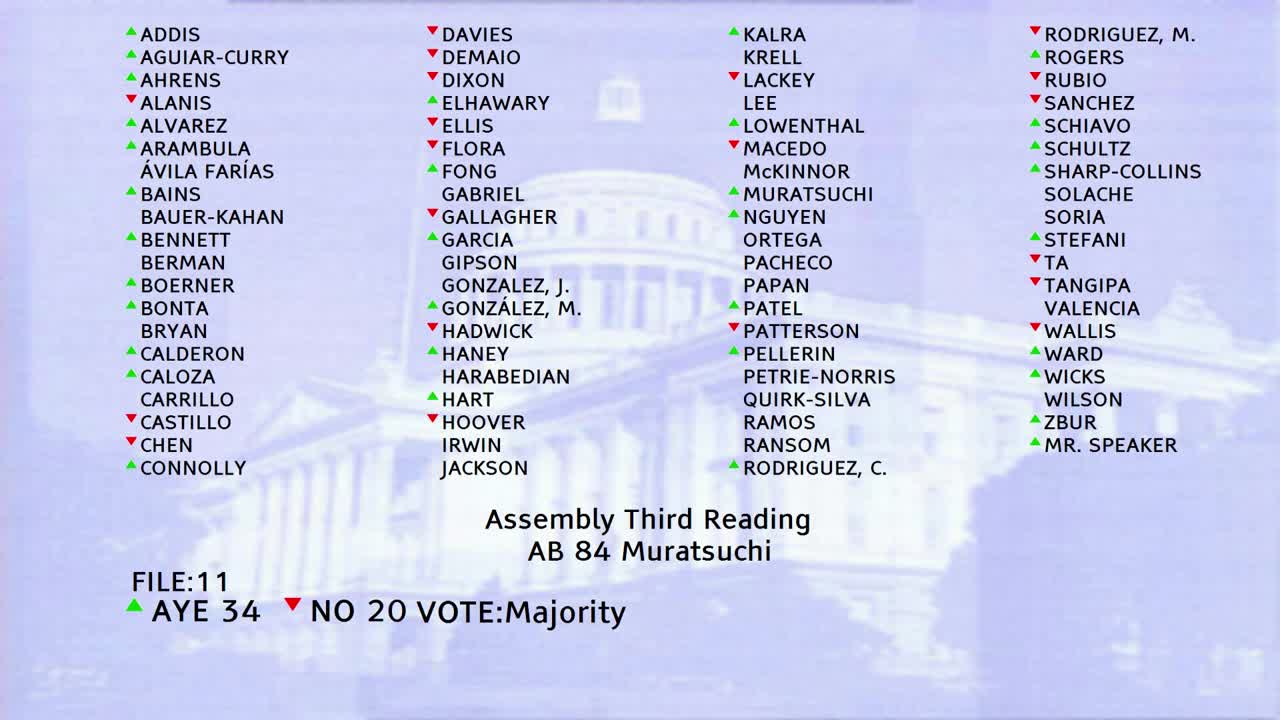 1MIN
Assembly Floor
 7MIN
Assembly Standing Committee on Judiciary
 16MIN
Assembly Standing Committee on Health
Bill Author

Bill Co-Author(s):