AB 1078: Firearms.
- Session Year: 2025-2026
- House: Assembly
- Latest Version Date: 2025-10-10
Current Status:
Passed
(2025-10-10: Chaptered by Secretary of State - Chapter 570, Statutes of 2025.)
Introduced
In Committee
Awaiting First Chamber Vote
Passed First Chamber
In Committee
Awaiting Second Chamber Vote
Passed Second Chamber
Enacted
What does this bill do?
The bill tightens who can get or keep a California concealed‑carry license by adding disqualifiers for out‑of‑state contempt or comparable convictions, past restraining or protective orders, and unlawful drug use, and requires local law enforcement to report disqualified applicants to the federal NICS system. Non‑residents may apply if they swear the jurisdiction is their primary California location and complete live‑fire training for each gun; virtual psychological exams may be allowed. It also raises the dealer 30‑day purchase limit from one to three firearms and clarifies that unloaded guns locked in approved lock boxes may be transported on public transit.
The summary is provided by generative AI which can make mistakes. For original language, please view the details in the table below.
(1)Existing law prohibits a person from carrying a concealed firearm or carrying a loaded firearm in public. Existing law authorizes a licensing authority, as specified, if certain requirements and other criteria are met, including, among other things, the applicant has completed a specified course of training, to issue a license to carry a concealed handgun or to carry a loaded and exposed handgun, as specified. Existing law requires a licensing authority to conduct an investigation to determine whether an applicant can receive or renew a license that includes, among other things, a review of all information provided in the application for a license, and a review of the information in the California Restraining and Protective Order System. Existing law prohibits the licensing authority from issuing a license if, among other things, the applicant has been convicted of contempt of court, has been subject to a restraining order, protective order, or other type of court order, unless that order expired or was vacated or otherwise canceled more than 5 years prior to receipt of the completed application, or, in the 10 years prior to the licensing authority receiving the completed application, has been convicted of specified criminal statutes.
This bill would also prohibit a licensing authority from issuing a license if an applicant was convicted of, under any federal law or law of any other state that includes comparable elements of, contempt of court or specified criminal statutes in the 10 years prior to the completed application, was subject to any restraining order, protective order, or other type of court order, or is an unlawful user of, or addicted to, any controlled substance, as specified. Upon determining that an applicant is a disqualified person due to being an unlawful user of, or addicted to, any controlled substance, the bill would require the licensing authority to, within 5 days, submit to the National Instant Criminal Background Check System Index specified information of the disqualified person and supporting documentation, as specified.
This bill would require the review of the California Restraining and Protective Order System to include information concerning whether the applicant is reasonably likely to be a danger to self, others, or the community at large, as specified. By imposing new duties on local licensing authorities, this bill would create a state-mandated local program.
The bill would additionally exempt from the licensure prohibition for applicants previously subject to a restraining order, protective order, or other type of court order, applicants who were previously subject to an above-described order that did not receive notice and an opportunity to be heard before the order was issued.
(2)Existing law prohibits a person who is licensed to carry a firearm from carrying a firearm in specified places, including schools, government buildings, hospitals, zoos, parks, churches, and a bus, train, or other form of public transportation. Existing law exempts a firearm that is secured in a lock box, as specified, under certain circumstances, from these prohibitions.
This bill would exempt a firearm that is unloaded and locked in a lock box for the purpose of transporting the firearm from the prohibition on carrying the firearm on a bus, train, or other form of public transportation, including a building, real property, or parking area under the control of a public transportation authority.
(3)Existing law requires, when a person applies for a new license or license renewal to carry a pistol, revolver, or other firearm capable of being concealed upon the person, a licensing authority, as specified, to issue or renew a license if the applicant has provided proof that, among other things, the applicant has completed a specified course of training, including live-fire shooting exercises on a firing range, and the applicant is the recorded owner of the pistol, revolver, or other firearm for which the license will be issued.
This bill would clarify that these requirements for a new license or license renewal specifically apply to a California resident. For non-California residents, the bill would additionally require, among other requirements, the applicant to attest, under oath, that the jurisdiction in which the applicant has applied is the primary location in California in which they intend to travel or spend time, and that the applicant has completed live-fire shooting exercises for each pistol, revolver, or other firearm for which the applicant is applying to be licensed to carry in California. By requiring local agencies to issue licenses for concealed firearms to non-California residents and expanding the scope of the crime of perjury, this bill would create a state-mandated local program.
If a psychological assessment on an initial application to carry a pistol, revolver, or other firearm capable of being concealed upon the person is required by a licensing authority, existing law requires the applicant to be referred to a licensed psychologist acceptable to the licensing authority.
This bill would authorize a licensing authority to allow a non-California resident applicant to satisfy this psychological assessment with a virtual psychological assessment, as specified, or approve this examination with a provider located within 75 miles of the applicants residence.
Existing law prohibits a license to carry a pistol, revolver, or other firearm capable of being concealed upon the person from being issued if the Department of Justice determines that the applicant is prohibited by state or federal law from possessing, receiving, owning, or purchasing a firearm. Existing law also requires this license to be revoked by the local licensing authority if, at any time, the local licensing authority determines that, among other reasons, the licensee is prohibited by state or federal law from owning or purchasing a firearm.
This bill would revoke or prohibit the issuance of that license by the local licensing authority if any certain situation occurred, including that an applicant knowingly provides any inaccurate or incomplete information in connection with an application for a license, a license renewal, or an amendment to a license. The bill would require a licensee to inform the local authority that issued the license of any restraining order or arrest, charge, or conviction of a specified crime and would prohibit the issuance of, or require the revocation of, that license based on the licensees failure to inform the local licensing authority of any restraining order or arrest, charge, or conviction of a specified crime.
(4)Existing law prohibits a person from making an application to purchase more than one firearm within any 30-day period. Existing law prohibits a dealer from delivering a firearm to a purchaser when the dealer is notified by the Department of Justice that, within the preceding 30-day period, the purchaser has made another application to purchase a firearm. Existing law requires a licensed dealer of firearms to conspicuously post a prescribed firearms safety warning message within the licensed premises, including that no person shall make an application to purchase more than one firearm, as specified, within any 30-day period, and no delivery shall be made to any person who has made an application to purchase more than one firearm, as specified, within any 30-day period.
An existing federal district court order in a case pending appeal has enjoined the enforcement of the law limiting the number of firearms that a person is allowed to purchase in a 30-day period.
This bill would, beginning April 1, 2026, increase the number of firearms that a person can apply to purchase within any 30-day period from one to 3 and would prohibit, beginning April 1, 2026, delivery of a firearm by a dealer if the dealer is notified by the Department of Justice that the purchaser has made an application to purchase one or more firearms that would result in the purchase of more than 3 firearms cumulatively within the 30-day period preceding the date of the application, as specified. The bill would make a conforming change to the required firearms safety warning.
(5)Existing law makes it a crime for a person to own or possess a firearm if the person has been convicted of a felony, as specified. Existing law makes those provisions inapplicable to a conviction or warrant for a felony if, both the conviction of a like offense under California law can only result in imposition of felony punishment and the defendant received either, or both, a sentence to a federal correctional facility for more than 30 days and a fine exceeding $1,000.
This bill would additionally make those provisions inapplicable to a conviction for a nonviolent felony under the laws of any other state if the conviction has been vacated, set aside, expunged, or otherwise dismissed and, if the conviction resulted in a firearms prohibition, the conviction relief restored the firearms rights, or if the conviction did not involve the use of a dangerous weapon and the person received a pardon, as specified.
(6)Existing law requires a licensing authority to give written notice to an applicant, who is applying for a new license or license renewal to carry a pistol, revolver, or other firearm capable of being concealed upon the person, indicating if the license is approved or denied. Existing law requires the licensing authority to give this notice within 120 days of receiving the completed application for a new license or 30 days after receipt of specified information and report from the Department of Justice, whichever is later, and for a license renewal, the licensing authority has within 120 days of receiving the completed application to give this notice. In determining whether to approve or deny these applications, existing law requires the licensing authority to apply the statutory requirements in effect as of the date the licensing authority received the completed applications, except as specified.
This bill would apply the 120-day notice requirement for a license renewal to a completed application for a license renewal submitted prior to September 1, 2026. For license renewal applications submitted on or after September 1, 2026, the bill would apply the above notice requirement for a completed application for a new license. The bill would delete the provision requiring the licensing authority to apply the statutory requirements in effect as of the date of receiving the completed application.
The California Constitution requires the state to reimburse local agencies and school districts for certain costs mandated by the state. Statutory provisions establish procedures for making that reimbursement.
This bill would provide that with regard to certain mandates no reimbursement is required by this act for a specified reason.
With regard to any other mandates, this bill would provide that, if the Commission on State Mandates determines that the bill contains costs so mandated by the state, reimbursement for those costs shall be made pursuant to the statutory provisions noted above.
(1)Existing law prohibits a person from carrying a concealed firearm or carrying a loaded firearm in public. Existing law authorizes a licensing authority, as specified, if certain requirements and other criteria are met, including, among other things, the applicant has completed a specified course of training, to issue a license to carry a concealed handgun or to carry a loaded and exposed handgun, as specified. Existing law requires a licensing authority to conduct an investigation to determine whether an applicant can receive or renew a license that includes, among other things, a review of all information provided in the application for a license, and a review of the information in the California Restraining and Protective Order System. Existing law prohibits the licensing authority from issuing a license if, among other things, the applicant has been convicted of contempt of court, has been subject to a restraining order, protective order, or other type of court order, unless that order expired or was vacated or otherwise canceled more than 5 years prior to receipt of the completed application, or, in the 10 years prior to the licensing authority receiving the completed application, has been convicted of specified criminal statutes.
This bill would also prohibit a licensing authority from issuing a license if an applicant was convicted of, under any federal law or law of any other state that includes comparable elements of, contempt of court or specified criminal statutes in the 10 years prior to the completed application, was subject to any restraining order, protective order, or other type of court order, or is an unlawful user of, or addicted to, any controlled substance, as specified. Upon determining that an applicant is a disqualified person due to being an unlawful user of, or addicted to, any controlled substance, the bill would require the licensing authority to, within 5 days, submit to the National Instant Criminal Background Check System Index specified information of the disqualified person and supporting documentation, as specified.
This bill would require the review of the California Restraining and Protective Order System to include information concerning whether the applicant is reasonably likely to be a danger to self, others, or the community at large, as specified. By imposing new duties on local licensing authorities, this bill would create a state-mandated local program.
The bill would additionally exempt from the licensure prohibition for applicants previously subject to a restraining order, protective order, or other type of court order, applicants who were previously subject to an above-described order that did not receive notice and an opportunity to be heard before the order was issued.
(2)Existing law prohibits a person who is licensed to carry a firearm from carrying a firearm in specified places, including schools, government buildings, hospitals, zoos, parks, churches, and a bus, train, or other form of public transportation. Existing law exempts a firearm that is secured in a lock box, as specified, under certain circumstances, from these prohibitions.
This bill would exempt a firearm that is unloaded and locked in a lock box for the purpose of transporting the firearm from the prohibition on carrying the firearm on a bus, train, or other form of public transportation, including a building, real property, or parking area under the control of a public transportation authority.
(3)Existing law requires, when a person applies for a new license or license renewal to carry a pistol, revolver, or other firearm capable of being concealed upon the person, a licensing authority, as specified, to issue or renew a license if the applicant has provided proof that, among other things, the applicant has completed a specified course of training, including live-fire shooting exercises on a firing range, and the applicant is the recorded owner of the pistol, revolver, or other firearm for which the license will be issued.
This bill would clarify that these requirements for a new license or license renewal specifically apply to a California resident. For non-California residents, the bill would additionally require, among other requirements, the applicant to attest, under oath, that the jurisdiction in which the applicant has applied is the primary location in California in which they intend to travel or spend time, and that the applicant has completed live-fire shooting exercises for each pistol, revolver, or other firearm for which the applicant is applying to be licensed to carry in California. By requiring local agencies to issue licenses for concealed firearms to non-California residents and expanding the scope of the crime of perjury, this bill would create a state-mandated local program.
If a psychological assessment on an initial application to carry a pistol, revolver, or other firearm capable of being concealed upon the person is required by a licensing authority, existing law requires the applicant to be referred to a licensed psychologist acceptable to the licensing authority.
This bill would authorize a licensing authority to allow a non-California resident applicant to satisfy this psychological assessment with a virtual psychological assessment, as specified, or approve this examination with a provider located within 75 miles of the applicants residence.
Existing law prohibits a license to carry a pistol, revolver, or other firearm capable of being concealed upon the person from being issued if the Department of Justice determines that the applicant is prohibited by state or federal law from possessing, receiving, owning, or purchasing a firearm. Existing law also requires this license to be revoked by the local licensing authority if, at any time, the local licensing authority determines that, among other reasons, the licensee is prohibited by state or federal law from owning or purchasing a firearm.
This bill would revoke or prohibit the issuance of that license by the local licensing authority if any certain situation occurred, including that an applicant knowingly provides any inaccurate or incomplete information in connection with an application for a license, a license renewal, or an amendment to a license. The bill would require a licensee to inform the local authority that issued the license of any restraining order or arrest, charge, or conviction of a specified crime and would prohibit the issuance of, or require the revocation of, that license based on the licensees failure to inform the local licensing authority of any restraining order or arrest, charge, or conviction of a specified crime.
(4)Existing law prohibits a person from making an application to purchase more than one firearm within any 30-day period. Existing law prohibits a dealer from delivering a firearm to a purchaser when the dealer is notified by the Department of Justice that, within the preceding 30-day period, the purchaser has made another application to purchase a firearm. Existing law requires a licensed dealer of firearms to conspicuously post a prescribed firearms safety warning message within the licensed premises, including that no person shall make an application to purchase more than one firearm, as specified, within any 30-day period, and no delivery shall be made to any person who has made an application to purchase more than one firearm, as specified, within any 30-day period.
An existing federal district court order in a case pending appeal has enjoined the enforcement of the law limiting the number of firearms that a person is allowed to purchase in a 30-day period.
This bill would would, beginning April 1, 2026, increase the number of firearms that a person can apply to purchase within any 30-day period from one to 3 and would prohibit prohibit, beginning April 1, 2026, delivery of a firearm by a dealer if the dealer is notified by the Department of Justice that the purchaser has made an application to purchase one or more firearms that would result in the purchase of more than 3 firearms cumulatively within the 30-day period preceding the date of the application, as specified. The bill would make a conforming change to the required firearms safety warning.
If a mandate is issued following an appeal reversing the district courts order and judgment, this bill, on the 30th day after the issuance of the mandate, would decrease the number of firearms that can be purchased within any 30-day period to one. The bill would require the Attorney General to notify every licensed firearms dealer in California, by the 30th day after the issuance of the mandate, that the number of firearms a person may purchase within any 30-day period decreased to one. If no such mandate is issued, the bill would maintain the number of firearms that can be purchased within any 30-day period at 3.(5)Existing law makes it a crime for a person to own or possess a firearm if the person has been convicted of a felony, as specified. Existing law makes those provisions inapplicable to a conviction or warrant for a felony if, both the conviction of a like offense under California law can only result in imposition of felony punishment and the defendant received either, or both, a sentence to a federal correctional facility for more than 30 days and a fine exceeding $1,000.
This bill would additionally make those provisions inapplicable to a conviction for a nonviolent felony under the laws of any other state if the conviction has been vacated, set aside, expunged, or otherwise dismissed and, if the conviction resulted in a firearms prohibition, the conviction relief restored the firearms rights, or if the conviction did not involve the use of a dangerous weapon and the person received a pardon, as specified.
(6)Existing law requires a licensing authority to give written notice to an applicant, who is applying for a new license or license renewal to carry a pistol, revolver, or other firearm capable of being concealed upon the person, indicating if the license is approved or denied. Existing law requires the licensing authority to give this notice within 120 days of receiving the completed application for a new license or 30 days after receipt of specified information and report from the Department of Justice, whichever is later, and for a license renewal, the licensing authority has within 120 days of receiving the completed application to give this notice. In determining whether to approve or deny these applications, existing law requires the licensing authority to apply the statutory requirements in effect as of the date the licensing authority received the completed applications, except as specified.
This bill would apply the 120-day notice requirement for a license renewal to a completed application for a license renewal submitted prior to September 1, 2026. For license renewal applications submitted on or after September 1, 2026, the bill would apply the above notice requirement for a completed application for a new license. The bill would delete the provision requiring the licensing authority to apply the statutory requirements in effect as of the date of receiving the completed application.
The California Constitution requires the state to reimburse local agencies and school districts for certain costs mandated by the state. Statutory provisions establish procedures for making that reimbursement.
This bill would provide that with regard to certain mandates no reimbursement is required by this act for a specified reason.
With regard to any other mandates, this bill would provide that, if the Commission on State Mandates determines that the bill contains costs so mandated by the state, reimbursement for those costs shall be made pursuant to the statutory provisions noted above.
(1)Existing law prohibits a person from carrying a concealed firearm or carrying a loaded firearm in public. Existing law authorizes a licensing authority, as specified, if certain requirements and other criteria are met, including, among other things, the applicant has completed a specified course of training, to issue a license to carry a concealed handgun or to carry a loaded and exposed handgun, as specified. Existing law requires a licensing authority to conduct an investigation to determine whether an applicant can receive or renew a license that includes, among other things, a review of all information provided in the application for a license, and a review of the information in the California Restraining and Protective Order System. Existing law prohibits the licensing authority from issuing a license if, among other things, the applicant has been convicted of contempt of court, has been subject to a restraining order, protective order, or other type of court order, unless that order expired or was vacated or otherwise canceled more than 5 years prior to receipt of the completed application, or, in the 10 years prior to the licensing authority receiving the completed application, has been convicted of specified criminal statutes.
This bill would also prohibit a licensing authority from issuing a license if an applicant was convicted of, under any federal law or law of any other state that includes comparable elements of, contempt of court or specified criminal statutes in the 10 years prior to the completed application, was subject to any restraining order, protective order, or other type of court order, or is an unlawful user of, or addicted to, any controlled substance, as specified. Upon determining that an applicant is a disqualified person due to being an unlawful user of, or addicted to, any controlled substance, the bill would require the licensing authority to, within 5 days, submit to the National Instant Criminal Background Check System Index specified information of the disqualified person and supporting documentation, as specified.
This bill would require the review of the California Restraining and Protective Order System to include information concerning whether the applicant is reasonably likely to be a danger to self, others, or the community at large, as specified. By imposing new duties on local licensing authorities, this bill would create a state-mandated local program.
The bill would additionally exempt from the licensure prohibition for applicants previously subject to a restraining order, protective order, or other type of court order, applicants who were previously subject to an above-described order that did not receive notice and an opportunity to be heard before the order was issued.
(2)Existing law prohibits a person who is licensed to carry a firearm from carrying a firearm in specified places, including schools, government buildings, hospitals, zoos, parks, churches, and a bus, train, or other form of public transportation. Existing law exempts a firearm that is secured in a lock box, as specified, under certain circumstances, from these prohibitions.
This bill would exempt a firearm that is unloaded and locked in a lock box for the purpose of transporting the firearm from the prohibition on carrying the firearm on a bus, train, or other form of public transportation, including a building, real property, or parking area under the control of a public transportation authority.
(3)Existing law requires, when a person applies for a new license or license renewal to carry a pistol, revolver, or other firearm capable of being concealed upon the person, a licensing authority, as specified, to issue or renew a license if the applicant has provided proof that, among other things, the applicant has completed a specified course of training, including live-fire shooting exercises on a firing range, and the applicant is the recorded owner of the pistol, revolver, or other firearm for which the license will be issued.
This bill would clarify that these requirements for a new license or license renewal specifically apply to a California resident. For non-California residents, the bill would additionally require, among other requirements, the applicant to attest, under oath, that the jurisdiction in which the applicant has applied is the primary location in California in which they intend to travel or spend time, and that the applicant has completed live-fire shooting exercises for each pistol, revolver, or other firearm for which the applicant is applying to be licensed to carry in California. By requiring local agencies to issue licenses for concealed firearms to non-California residents and expanding the scope of the crime of perjury, this bill would create a state-mandated local program.
If a psychological assessment on an initial application to carry a pistol, revolver, or other firearm capable of being concealed upon the person is required by a licensing authority, existing law requires the applicant to be referred to a licensed psychologist acceptable to the licensing authority.
This bill would authorize a licensing authority to allow a non-California resident applicant to satisfy this psychological assessment with a virtual psychological assessment, as specified, or approve this examination with a provider located within 75 miles of the applicants residence.
Existing law prohibits a license to carry a pistol, revolver, or other firearm capable of being concealed upon the person from being issued if the Department of Justice determines that the applicant is prohibited by state or federal law from possessing, receiving, owning, or purchasing a firearm. Existing law also requires this license to be revoked by the local licensing authority if, at any time, the local licensing authority determines that, among other reasons, the licensee is prohibited by state or federal law from owning or purchasing a firearm.
This bill would revoke or prohibit the issuance of that license by the local licensing authority if any certain situation occurred, including that an applicant knowingly provides any inaccurate or incomplete information in connection with an application for a license, a license renewal, or an amendment to a license. The bill would require a licensee to inform the local authority that issued the license of any restraining order or arrest, charge, or conviction of a specified crime and would prohibit the issuance of, or require the revocation of, that license based on the licensees failure to inform the local licensing authority of any restraining order or arrest, charge, or conviction of a specified crime.
(4)Existing law prohibits a person from making an application to purchase more than one firearm within any 30-day period. Existing law prohibits a dealer from delivering a firearm to a purchaser when the dealer is notified by the Department of Justice that, within the preceding 30-day period, the purchaser has made another application to purchase a firearm. Existing law requires a licensed dealer of firearms to conspicuously post a prescribed firearms safety warning message within the licensed premises, including that no person shall make an application to purchase more than one firearm, as specified, within any 30-day period, and no delivery shall be made to any person who has made an application to purchase more than one firearm, as specified, within any 30-day period.
An existing federal district court order in a case pending appeal has enjoined the enforcement of the law limiting the number of firearms that a person is allowed to purchase in a 30-day period.
This bill would increase the number of firearms that a person can apply to purchase within any 30-day period from one to 3 and would prohibit delivery of a firearm by a dealer if the dealer is notified by the Department of Justice that the purchaser has made an application to purchase one or more firearms that would result in the purchase of more than 3 firearms cumulatively within the 30-day period preceding the date of the application, as specified. The bill would make a conforming change to the required firearms safety warning.
If a mandate is issued following an appeal reversing the district courts order and judgment, this bill, on the 30th day after the issuance of the mandate, would decrease the number of firearms that can be purchased within any 30-day period to one. The bill would require the Attorney General to notify every licensed firearms dealer in California, by the 30th day after the issuance of the mandate, that the number of firearms a person may purchase within any 30-day period decreased to one. If no such mandate is issued, the bill would maintain the number of firearms that can be purchased within any 30-day period at 3.
(5)Existing law makes it a crime for a person to own or possess a firearm if the person has been convicted of a felony, as specified. Existing law makes those provisions inapplicable to a conviction or warrant for a felony if, both the conviction of a like offense under California law can only result in imposition of felony punishment and the defendant received either, or both, a sentence to a federal correctional facility for more than 30 days and a fine exceeding $1,000.
This bill would additionally make those provisions inapplicable to a conviction for a nonviolent felony under the laws of any other state if the conviction has been vacated, set aside, expunged, or otherwise dismissed and, if the conviction resulted in a firearms prohibition, the conviction relief restored the firearms rights, or if the conviction did not involve the use of a dangerous weapon and the person received a pardon, as specified.
(6)Existing law requires a licensing authority to give written notice to an applicant, who is applying for a new license or license renewal to carry a pistol, revolver, or other firearm capable of being concealed upon the person, indicating if the license is approved or denied. Existing law requires the licensing authority to give this notice within 120 days of receiving the completed application for a new license or 30 days after receipt of specified information and report from the Department of Justice, whichever is later, and for a license renewal, the licensing authority has within 120 days of receiving the completed application to give this notice. In determining whether to approve or deny these applications, existing law requires the licensing authority to apply the statutory requirements in effect as of the date the licensing authority received the completed applications, except as specified.
This bill would apply the 120-day notice requirement for a license renewal to a completed application for a license renewal submitted prior to September 1, 2026. For license renewal applications submitted on or after September 1, 2026, the bill would apply the above notice requirement for a completed application for a new license. The bill would delete the provision requiring the licensing authority to apply the statutory requirements in effect as of the date of receiving the completed application.
The California Constitution requires the state to reimburse local agencies and school districts for certain costs mandated by the state. Statutory provisions establish procedures for making that reimbursement.
This bill would provide that with regard to certain mandates no reimbursement is required by this act for a specified reason.
With regard to any other mandates, this bill would provide that, if the Commission on State Mandates determines that the bill contains costs so mandated by the state, reimbursement for those costs shall be made pursuant to the statutory provisions noted above.
(1)Existing law prohibits a person from carrying a concealed firearm or carrying a loaded firearm in public. Existing law authorizes a licensing authority, as specified, if certain requirements and other criteria are met, including, among other things, the applicant has completed a specified course of training, to issue a license to carry a concealed handgun or to carry a loaded and exposed handgun, as specified. Existing law requires a licensing authority to conduct an investigation to determine whether an applicant can receive or renew a license that includes, among other things, a review of all information provided in the application for a license, and a review of the information in the California Restraining and Protective Order System. Existing law prohibits the licensing authority from issuing a license if, among other things, the applicant has been convicted of contempt of court, has been subject to a restraining order, protective order, or other type of court order, unless that order expired or was vacated or otherwise canceled more than 5 years prior to receipt of the completed application, or, in the 10 years prior to the licensing authority receiving the completed application, has been convicted of specified criminal statutes.
This bill would also prohibit a licensing authority from issuing a license if an applicant was convicted of, under any federal law or law of any other state that includes comparable elements of, contempt of court or specified criminal statutes in the 10 years prior to the completed application or application, was subject to any restraining order, protective order, or other type of court order. order, or is an unlawful user of, or addicted to, any controlled substance, as specified. Upon determining that an applicant is a disqualified person due to being an unlawful user of, or addicted to, any controlled substance, the bill would require the licensing authority to, within 5 days, submit to the National Instant Criminal Background Check System Index specified information of the disqualified person and supporting documentation, as specified.
This bill would require the review of the California Restraining and Protective Order System to include information concerning whether the applicant is reasonably likely to be a danger to self, others, or the community at large, as specified. By imposing new duties on local licensing authorities, this bill would create a state-mandated local program.
The bill would additionally exempt from the licensure prohibition for applicants previously subject to a restraining order, protective order, or other type of court order, applicants who were previously subject to an above-described order that did not receive notice and an opportunity to be heard before the order was issued.
(2)Existing law prohibits a person who is licensed to carry a firearm from carrying a firearm in specified places, including schools, government buildings, hospitals, zoos, parks, churches, and a bus, train, or other form of public transportation. Existing law exempts a firearm that is secured in a lock box, as specified, under certain circumstances, from these prohibitions.
This bill would exempt a firearm that is unloaded and locked in a lock box for the purpose of transporting the firearm from the prohibition on carrying the firearm on a bus, train, or other form of public transportation, including a building, real property, or parking area under the control of a public transportation authority.
(3)Existing law requires, when a person applies for a new license or license renewal to carry a pistol, revolver, or other firearm capable of being concealed upon the person, a licensing authority, as specified, to issue or renew a license if the applicant has provided proof that, among other things, the applicant has completed a specified course of training, including live-fire shooting exercises on a firing range, and the applicant is the recorded owner of the pistol, revolver, or other firearm for which the license will be issued.
This bill would clarify that these requirements for a new license or license renewal specifically apply to a California resident. For non-California residents, the bill would additionally require, among other requirements, the applicant to attest, under oath, that the jurisdiction in which the applicant has applied is the primary location in California in which they intend to travel or spend time, and that the applicant has completed live-fire shooting exercises for each pistol, revolver, or other firearm for which the applicant is applying to be licensed to carry in California. By requiring local agencies to issue licenses for concealed firearms to non-California residents and expanding the scope of the crime of perjury, this bill would create a state-mandated local program.
If a psychological assessment on an initial application to carry a pistol, revolver, or other firearm capable of being concealed upon the person is required by a licensing authority, existing law requires the applicant to be referred to a licensed psychologist acceptable to the licensing authority.
This bill would authorize a licensing authority to allow a non-California resident applicant to satisfy this psychological assessment with a virtual psychological assessment, as specified, or approve this examination with a provider located within 75 miles of the applicants residence.
Existing law prohibits a license to carry a pistol, revolver, or other firearm capable of being concealed upon the person from being issued if the Department of Justice determines that the applicant is prohibited by state or federal law from possessing, receiving, owning, or purchasing a firearm. Existing law also requires this license to be revoked by the local licensing authority if, at any time, the local licensing authority determines that, among other reasons, the licensee is prohibited by state or federal law from owning or purchasing a firearm.
This bill would revoke or prohibit the issuance of that license if by the local licensing authority if any certain situation occurred, including that an applicant provides any inaccurate or incomplete information in connection with an application for a license, a license renewal, or an amendment to a license. The bill would require a licensee to inform the local authority that issued the license of any restraining order or arrest, charge, or conviction of a specified crime. crime and would prohibit the issuance of, or require the revocation of, that license based on the licensees failure to inform the local licensing authority of any restraining order or arrest, charge, or conviction of a specified crime.
(4)Existing law prohibits a person from making an application to purchase more than one firearm within any 30-day period. Existing law prohibits a dealer from delivering a firearm to a purchaser when the dealer is notified by the Department of Justice that, within the preceding 30-day period, the purchaser has made another application to purchase a firearm. Existing law requires a licensed dealer of firearms to conspicuously post a prescribed firearms safety warning message within the licensed premises, including that no person shall make an application to purchase more than one firearm, as specified, within any 30-day period, and no delivery shall be made to any person who has made an application to purchase more than one firearm, as specified, within any 30-day period.
An existing federal district court order in a case pending appeal has enjoined the enforcement of the law limiting the number of firearms that a person is allowed to purchase in a 30-day period.
This bill would increase the number of firearms that a person can apply to purchase within any 30-day period from one to 3 and would prohibit delivery of a firearm by a dealer if the dealer is notified by the Department of Justice that the purchaser has made an application to purchase one or more firearms that would result in the purchase of more than 3 firearms cumulatively within the 30-day period preceding the date of the application, as specified. The bill would make a conforming change to the required firearms safety warning.
If a mandate is issued following an appeal reversing the district courts order and judgment, this bill, on the 30th day after the issuance of the mandate, would decrease the number of firearms that can be purchased within any 30-day period to one. The bill would require the Attorney General to notify every licensed firearms dealer in California, by the 30th day after the issuance of the mandate, that the number of firearms a person may purchase within any 30-day period decreased to one. If no such mandate is issued, the bill would maintain the number of firearms that can be purchased within any 30-day period at 3.
(5)Existing law makes it a crime for a person to own or possess a firearm if the person has been convicted of a felony, as specified. Existing law makes those provisions inapplicable to a conviction or warrant for a felony if, both the conviction of a like offense under California law can only result in imposition of felony punishment and the defendant received either, or both, a sentence to a federal correctional facility for more than 30 days and a fine exceeding $1,000.
This bill would additionally make those provisions inapplicable to a conviction for a nonviolent felony under the laws of any other state if the conviction has been vacated, set aside, expunged, or otherwise dismissed and, if the conviction resulted in a firearms prohibition, the conviction relief restored the firearms rights, or if the conviction did not involve the use of a dangerous weapon and the person received a pardon, as specified.
(6)Existing law requires a licensing authority to give written notice to an applicant, who is applying for a new license or license renewal to carry a pistol, revolver, or other firearm capable of being concealed upon the person, indicating if the license is approved or denied. Existing law requires the licensing authority to give this notice within 120 days of receiving the completed application for a new license or 30 days after receipt of specified information and report from the Department of Justice, whichever is later, and for a license renewal, the licensing authority has within 120 days of receiving the completed application to give this notice. In determining whether to approve or deny these applications, existing law requires the licensing authority to apply the statutory requirements in effect as of the date the licensing authority received the completed applications, except as specified.
This bill would apply the 120-day notice requirement for a license renewal to a completed application for a license renewal submitted prior to September 1, 2026. For license renewal applications submitted on or after September 1, 2026, the bill would apply the above notice requirement for a completed application for a new license. The bill would delete the provision requiring the licensing authority to apply the statutory requirements in effect as of the date of receiving the completed application.
The California Constitution requires the state to reimburse local agencies and school districts for certain costs mandated by the state. Statutory provisions establish procedures for making that reimbursement.
This bill would provide that with regard to certain mandates no reimbursement is required by this act for a specified reason.
With regard to any other mandates, this bill would provide that, if the Commission on State Mandates determines that the bill contains costs so mandated by the state, reimbursement for those costs shall be made pursuant to the statutory provisions noted above.
(1)Existing law prohibits a person from carrying a concealed firearm or carrying a loaded firearm in public. Existing law authorizes a licensing authority, as specified, if certain requirements and other criteria are met, including, among other things, the applicant has completed a specified course of training, to issue a license to carry a concealed handgun or to carry a loaded and exposed handgun, as specified. Existing law requires a licensing authority to conduct an investigation to determine whether an applicant can receive or renew a license that includes, among other things, a review of all information provided in the application for a license, and a review of the information in the California Restraining and Protective Order System. Existing law prohibits the licensing authority from issuing a license if, among other things, the applicant has been convicted of contempt of court or court, has been subject to a restraining order, protective order, or other type of court order, unless that order expired or was vacated or otherwise canceled more than 5 years prior to receipt of the completed application. application, or, in the 10 years prior to the licensing authority receiving the completed application, has been convicted of specified criminal statutes.
This bill would also prohibit a licensing authority from issuing a license if an applicant was convicted of, under any federal law or law of any other state that includes comparable elements of, contempt of court or specified criminal statutes in the 10 years prior to the completed application or was subject to any restraining order, protective order, or other type of court order.
This bill would require the review of the California Restraining and Protective Order System to include information concerning whether the applicant is reasonably likely to be a danger to self, others, or the community at large, as specified. By imposing new duties on local licensing authorities, this bill would create a state-mandated local program.
The bill would additionally exempt from the licensure prohibition for applicants previously subject to a restraining order, protective order, or other type of court order, applicants who were previously subject to an above-described order that did not receive notice and an opportunity to be heard before the order was issued.
The California Constitution requires the state to reimburse local agencies and school districts for certain costs mandated by the state. Statutory provisions establish procedures for making that reimbursement.This bill would provide that, if the Commission on State Mandates determines that the bill contains costs mandated by the state, reimbursement for those costs shall be made pursuant to the statutory provisions noted above.(2)Existing law prohibits a person who is licensed to carry a firearm from carrying a firearm in specified places, including schools, government buildings, hospitals, zoos, parks, churches, and a bus, train, or other form of public transportation. Existing law exempts a firearm that is secured in a lock box, as specified, under certain circumstances, from these prohibitions.
This bill would exempt a firearm that is unloaded and locked in a lock box for the purpose of transporting the firearm from the prohibition on carrying the firearm on a bus, train, or other form of public transportation, including a building, real property, or parking area under the control of a public transportation authority.
(3)Existing law requires, when a person applies for a new license or license renewal to carry a pistol, revolver, or other firearm capable of being concealed upon the person, a licensing authority, as specified, to issue or renew a license if the applicant has provided proof that, among other things, the applicant has completed a specified course of training, including live-fire shooting exercises on a firing range, and the applicant is the recorded owner of the pistol, revolver, or other firearm for which the license will be issued.
This bill would clarify that these requirements for a new license or license renewal specifically apply to a California resident. For non-California residents, the bill would additionally require, among other requirements, the applicant to attest, under oath, that the jurisdiction in which the applicant has applied is the primary location in California in which they intend to travel or spend time, and that the applicant has completed live-fire shooting exercises for each pistol, revolver, or other firearm for which the applicant is applying to be licensed to carry in California. By requiring local agencies to issue licenses for concealed firearms to non-California residents and expanding the scope of the crime of perjury, this bill would create a state-mandated local program.
If a psychological assessment on an initial application to carry a pistol, revolver, or other firearm capable of being concealed upon the person is required by a licensing authority, existing law requires the applicant to be referred to a licensed psychologist acceptable to the licensing authority.
This bill would authorize a licensing authority to allow a non-California resident applicant to satisfy this psychological assessment with a virtual psychological assessment, as specified, or approve this examination with a provider located within 75 miles of the applicants residence.
Existing law prohibits a license to carry a pistol, revolver, or other firearm capable of being concealed upon the person from being issued if the Department of Justice determines that the applicant is prohibited by state or federal law from possessing, receiving, owning, or purchasing a firearm.
This bill would prohibit the issuance of that license if an applicant provides any inaccurate or incomplete information in connection with an application for a license, a license renewal, or an amendment to a license. The bill would require a licensee to inform the local authority that issued the license of any restraining order or arrest, charge, or conviction of a specified crime.
(4)Existing law prohibits a person from making an application to purchase more than one firearm within any 30-day period. Existing law prohibits a dealer from delivering a firearm to a purchaser when the dealer is notified by the Department of Justice that, within the preceding 30-day period, the purchaser has made another application to purchase a firearm. Existing law requires a licensed dealer of firearms to conspicuously post a prescribed firearms safety warning message within the licensed premises, including that no person shall make an application to purchase more than one firearm, as specified, within any 30-day period, and no delivery shall be made to any person who has made an application to purchase more than one firearm, as specified, within any 30-day period.
An existing federal district court order in a case pending appeal has enjoined the enforcement of the law limiting the number of firearms that a person is allowed to purchase in a 30-day period.
This bill would increase the number of firearms that a person can apply to purchase within any 30-day period from one to 3 and would prohibit delivery of a firearm by a dealer if the dealer is notified by the Department of Justice that the purchaser has made an application to purchase one or more firearms that would result in the purchase of more than 3 firearms cumulatively within the 30-day period preceding the date of the application, as specified. The bill would make a conforming change to the required firearms safety warning.
If a mandate is issued following an appeal reversing the district courts order and judgment, this bill, on the 30th day after the issuance of the mandate, would decrease the number of firearms that can be purchased within any 30-day period to one. The bill would require the Attorney General to notify every licensed firearms dealer in California, by the 30th day after the issuance of the mandate, that the number of firearms a person may purchase within any 30-day period decreased to one. If no such mandate is issued, the bill would maintain the number of firearms that can be purchased within any 30-day period at 3.
(5)Existing law makes it a crime for a person to own or possess a firearm if the person has been convicted of a felony, as specified. Existing law makes those provisions inapplicable to a conviction or warrant for a felony if, both the conviction of a like offense under California law can only result in imposition of felony punishment and the defendant received either, or both, a sentence to a federal correctional facility for more than 30 days and a fine exceeding $1,000.
This bill would additionally make those provisions inapplicable to a conviction for a nonviolent felony under the laws of any other state if the conviction has been vacated, set aside, expunged, or otherwise dismissed and, if the conviction resulted in a firearms prohibition, the conviction relief restored the firearms rights, or if the conviction did not involve the use of a dangerous weapon and the person received a pardon, as specified.
The California Constitution requires the state to reimburse local agencies and school districts for certain costs mandated by the state. Statutory provisions establish procedures for making that reimbursement.
This bill would provide that with regard to certain mandates no reimbursement is required by this act for a specified reason.
With regard to any other mandates, this bill would provide that, if the Commission on State Mandates determines that the bill contains costs so mandated by the state, reimbursement for those costs shall be made pursuant to the statutory provisions noted above.
Existing law prohibits a person from carrying a concealed firearm or carrying a loaded firearm in public. Existing law authorizes a licensing authority, as specified, if certain requirements and other criteria are met, including, among other things, the applicant has completed a specified course of training, to issue a license to carry a concealed handgun or to carry a loaded and exposed handgun, as specified. Existing law requires a licensing authority to conduct an investigation to determine whether an applicant can receive or renew a license that includes, among other things, a review of all information provided in the application for a license, and a review of the information in the California Restraining and Protective Order System. Existing law prohibits the licensing authority from issuing a license if, among other things, the applicant has been convicted of contempt of court or has been subject to a restraining order, protective order, or other type of court order, unless that order expired or was vacated or otherwise canceled more than 5 years prior to receipt of the completed application.
This bill would require the review of the California Restraining and Protective Order System to include information concerning whether the applicant is reasonably likely to be a danger to self, others, or the community at large, as specified. By imposing new duties on local licensing authorities, this bill would create a state-mandated local program.
The bill would additionally exempt from the licensure prohibition for applicants previously subject to a restraining order, protective order, or other type of court order, applicants who were previously subject to an above-described order that did not receive notice and an opportunity to be heard before the order was issued.
The California Constitution requires the state to reimburse local agencies and school districts for certain costs mandated by the state. Statutory provisions establish procedures for making that reimbursement.
This bill would provide that, if the Commission on State Mandates determines that the bill contains costs mandated by the state, reimbursement for those costs shall be made pursuant to the statutory provisions noted above.
(a)For purposes of this section:
(1)Public transit facility means any land, building, or equipment, or an interest therein, including a station on a public transportation route, to which access is controlled in a manner consistent with the public transit authoritys security plan, whether or not the operation thereof produces revenue, that has as its primary purpose the operation of a public transit system or the providing of services to the passengers of a public transit system. A public transit system includes the vehicles used in the system, including, but not limited to, motor vehicles, streetcars, trackless trolleys, buses, light rail systems, rapid transit systems, subways, trains, or jitneys, that transport members of the public for hire.
(2)Firearm has the same meaning as specified in subdivisions (a) and (b) of Section 16520.
(b)It is unlawful for a person to knowingly possess any of the following in a public transit facility:
(1)A firearm.
(2)An imitation firearm as defined in subdivision (a) of Section 16700.
(3)An instrument that expels a metallic projectile, such as a BB or pellet, through the force of air pressure, CO2 pressure, or spring action, or a spot marker gun or paint gun.
(4)A metal military practice hand grenade.
(5)A metal replica hand grenade.
(6)A plastic replica hand grenade.
(7)An unauthorized tear gas weapon.
(8)An undetectable knife, as described in Section 17290.
(9)An undetectable firearm, as described in Section 17280.
(c)(1)Subdivision (b) does not apply to, or affect, any of the following:
(A)A duly appointed peace officer as defined in Chapter 4.5 (commencing with Section 830) of Title 3 of Part 2.
(B)A retired peace officer with authorization to carry concealed weapons as described in Article 2 (commencing with Section 25450) of Chapter 2 of Division 5 of Title 4 of Part 6.
(C)A full-time paid peace officer of another state or the federal government who is carrying out official duties while in California.
(D)A qualified law enforcement officer of another state or the federal government, as permitted under the Law Enforcement Officers Safety Act pursuant to Section 926B or 926C of Title 18 of the United States Code.
(E)A person summoned by an officer listed in subparagraphs (A) to (C), inclusive, to assist in making arrests or preserving the peace while they are actually engaged in assisting the officer.
(F)A person who is responsible for the security of the public transit system and who has been authorized by the public transit authoritys security coordinator, in writing, to possess a weapon specified in subdivision (b).
(G)A person possessing an unloaded firearm while traveling on a public transit system that offers checked baggage services, so long as the firearm is stored in accordance with the public transit systems checked baggage policies.
(2)Paragraph (7) of subdivision (b) does not apply to or affect the possession of a tear gas weapon when possession is permitted pursuant to Division 11 (commencing with Section 22810) of Title 3 of Part 6.
(3)Paragraph (1) of subdivision (b) does not apply to a person transporting an unloaded firearm locked in a lock box in compliance with paragraph (8) of subdivision (a) of Section 26230.
(d)A violation of this section is punishable by imprisonment in a county jail for a period not exceeding six months, or by a fine not exceeding one thousand dollars ($1,000), or by both that fine and imprisonment.
(e)The provisions of this section are cumulative and do not restrict the application of any other law. However, an act or omission that is punishable in different ways by this and any other provision of law shall not be punished under more than one provision.
(f)This section does not prevent prosecution under any other provision of law that may provide a greater punishment.
(g)This section shall be interpreted so as to be consistent with Section 926A of Title 18 of the United States Code.
SEC. 2.Section 26150 of the Penal Code is amended to read:26150.(a)When a California resident applies for a new license or license renewal to carry a pistol, revolver, or other firearm capable of being concealed upon the person, the sheriff of a county shall issue or renew a license to that California resident upon proof of all of the following:
(1)The applicant is not a disqualified person to receive such a license, as determined in accordance with the standards set forth in Section 26202.
(2)The applicant is at least 21 years of age, and presents clear evidence of the persons identity and age, as defined in Section 16400.
(3)The applicant is a resident of the county or a city within the county, or the applicants principal place of employment or business is in the county or a city within the county and the applicant spends a substantial period of time in that place of employment or business. Prima facie evidence of residency within the county or a city within the county includes, but is not limited to, the address where the applicant is registered to vote, the applicants filing of a homeowners property tax exemption, and other acts, occurrences, or events that indicate presence in the county or a city within the county is more than temporary or transient. The presumption of residency in the county or city within the county may be rebutted by satisfactory evidence that the applicants primary residence is in another county or city within the county.
(4)The applicant has completed a course of training as described in Section 26165.
(5)The applicant is the recorded owner, with the Department of Justice, of the pistol, revolver, or other firearm for which the license will be issued.
(b)When a non-California resident applies for a new license or license renewal to carry a pistol, revolver, or other firearm capable of being concealed upon the person, the sheriff of a county shall issue or renew a license to that non-California resident, subject to the following conditions:
(1)The applicant is not a disqualified person to receive the license, as determined in accordance with the standards set forth in Section 26202 and all comparable statutes and provisions of law of the nonresident applicants state of residence.
(2)The applicant is at least 21 years of age and presents clear evidence of the nonresidents identity, age, and state of residence. Clear evidence of the nonresidents identity, age, and state of residence means either of the following:
(A)A valid drivers license from their state of residence.
(B)A valid out-of-state identification card issued by the Department of Motor Vehicles.
(3)The applicant attests, under oath, that the jurisdiction in which they have applied is the primary location in California in which they intend to travel or spend time.
(4)The applicant has completed a course of training that meets the criteria set forth in paragraphs (1) to (5), inclusive, of subdivision (a) of Section 26165 and subdivision (d) of Section 26165, as it pertains to the licensing authority to which the application is submitted. If the licensing authority to which the application is submitted has not approved of any online training courses, the applicant may complete an online training course approved by any other licensing authority that issues licenses under this section.
(5)The applicant has completed live-fire shooting exercises, as required by paragraph (6) of subdivision (a) of Section 26165, for each pistol, revolver, or other firearm for which the applicant is applying to be licensed to carry in California. The applicant shall inform the licensing authority to which they have applied of the live-fire course the applicant intends to complete, and the licensing authority shall either approve the course or suggest an alternative acceptable course within 75 miles of the applicants residence.
(6)The applicant has identified on the application the make, model, caliber, and serial number of each pistol, revolver, or other firearm for which the applicant is applying to be licensed to carry in California. Identification of a pistol, revolver, or other firearm that cannot lawfully be carried or possessed in California shall be cause for denial of a license as to that pistol, revolver, or other firearm.
(c)The sheriff shall issue or renew a license under subdivision (a) in either of the following formats:
(1)A license to carry concealed a pistol, revolver, or other firearm capable of being concealed upon the person.
(2)Where the population of the county is less than 200,000 persons according to the most recent federal decennial census, a license to carry loaded and exposed in only that county a pistol, revolver, or other firearm capable of being concealed upon the person.
(d)(1)Nothing in this chapter shall preclude the sheriff of the county from entering into an agreement with the chief or other head of a municipal police department of a city to process all applications for licenses, renewals of licenses, or amendments to licenses pursuant to this chapter, in lieu of the sheriff.
(2)This subdivision shall only apply to applicants who reside within the city in which the chief or other head of the municipal police department has agreed to process applications for licenses, renewals of licenses, and amendments to licenses, pursuant to this chapter.
SEC. 3.Section 26155 of the Penal Code is amended to read:26155.(a)When a California resident applies for a new license or license renewal to carry a pistol, revolver, or other firearm capable of being concealed upon the person, the chief or other head of a municipal police department of any city or city and county shall issue or renew a license to that California resident upon proof of all of the following:
(1)The applicant is not a disqualified person to receive such a license, as determined in accordance with the standards set forth in Section 26202.
(2)The applicant is at least 21 years of age, and presents clear evidence of the persons identity and age, as defined in Section 16400.
(3)The applicant is a resident of that city or city and county. Prima facie evidence of residency within the county or a city within the county includes, but is not limited to, the address where the applicant is registered to vote, the applicants filing of a homeowners property tax exemption, and other acts, occurrences, or events that indicate presence in the county or a city within the county is more than temporary or transient. The presumption of residency in the county or city within the county may be rebutted by satisfactory evidence that the applicants primary residence is in another county or city within the county.
(4)The applicant has completed a course of training as described in Section 26165.
(5)The applicant is the recorded owner, with the Department of Justice, of the pistol, revolver, or other firearm for which the license will be issued.
(b)When a non-California resident applies for a new license or license renewal to carry a pistol, revolver, or other firearm capable of being concealed upon the person, the chief or other head of a municipal police department of any city or city and county shall issue or renew a license to that nonresident, subject to the following conditions:
(1)The applicant is not a disqualified person to receive the license, as determined in accordance with the standards set forth in Section 26202 and all comparable statutes and provisions of law of the nonresident applicants state of residence.
(2)The applicant is at least 21 years of age, and presents clear evidence of the nonresidents identity, age, and state of residence. Clear evidence of the nonresidents identity, age, and state of residence means either of the following:
(A)A valid drivers license from their state of residence.
(B)A valid out-of-state identification card issued by the Department of Motor Vehicles.
(3)The applicant attests, under oath, that the jurisdiction in which they have applied is the primary location in California in which they intend to travel or spend time.
(4)The applicant has completed a course of training that meets the criteria set forth in paragraphs (1) to (5), inclusive, of subdivision (a) of Section 26165 and subdivision (d) of Section 26165, as it pertains to the licensing authority to which the application is submitted. If the licensing authority to which the application is submitted has not approved of any online training courses, the applicant may complete an online training course approved by any other licensing authority that issues licenses under this section.
(5)The applicant has completed live-fire shooting exercises, as required by paragraph (6) of subdivision (a) of Section 26165, for each pistol, revolver, or other firearm for which the applicant is applying to be licensed to carry in California. The applicant shall inform the licensing authority to which they have applied of the live-fire course the applicant intends to complete, and the licensing authority shall either approve the course or suggest an alternative acceptable course within 75 miles of the applicants residence.
(6)The applicant has identified on the application the make, model, caliber, and serial number of each pistol, revolver, or other firearm they intend to carry in California. Identification of a pistol, revolver, or other firearm that cannot lawfully be carried in California shall be cause for denial of a license as to that pistol, revolver, or other firearm.
(c)The chief or other head of a municipal police department shall issue or renew a license under subdivision (a) in either of the following formats:
(1)A license to carry concealed a pistol, revolver, or other firearm capable of being concealed upon the person.
(2)Where the population of the county in which the city is located is less than 200,000 persons according to the most recent federal decennial census, a license to carry loaded and exposed in only that county a pistol, revolver, or other firearm capable of being concealed upon the person.
(d)Nothing in this chapter shall preclude the chief or other head of a municipal police department of any city from entering an agreement with the sheriff of the county in which the city is located for the sheriff to process all applications for licenses, renewals of licenses, and amendments to licenses, pursuant to this chapter.
SEC. 4.Section 26162 of the Penal Code is amended to read:26162.(a)Prior to the issuance of a license, renewal of a license, or amendment to a license pursuant to subdivision (a) of Section 26150 or subdivision (a) of Section 26155, each licensing authority with direct access to the designated Department of Justice system shall determine if the applicant is the recorded owner of the particular pistol, revolver, or other firearm capable of being concealed upon the person reported in the application for a license or the application for the amendment to a license under this chapter.
(b)Pursuant to subdivision (a), an agency with direct access to the designated Department of Justice system shall confirm the applicants information with firearm ownership maintained in the system. An agency without access to the system shall confirm this information with the sheriff of the county in which the agency is located.
SEC. 5.Section 26185 of the Penal Code is amended to read:26185.(a)(1)Upon issuance of the notice described in paragraph (1) of subdivision (d) of Section 26202, the licensing authority shall submit to the Department of Justice fingerprint images and related information required by the Department of Justice for each applicant applying for a new license to carry a pistol, revolver, or other firearm capable of being concealed upon the person, pursuant to subdivision (u) of Section 11105. The Department of Justice shall provide a state or federal response to the licensing authority, pursuant to subdivision (l) of Section 11105 of the Penal Code.
(2)Upon receipt of the fingerprints of an applicant for a new license, as well as the fee as prescribed in Section 26190, the department shall promptly furnish the forwarding licensing authority information as to whether the person is prohibited by state or federal law from possessing, receiving, owning, or purchasing a firearm. The department shall make this determination in a manner to be prescribed through regulations. If the department is unable to ascertain the final disposition of an arrest or criminal charge, the outcome of the mental health treatment or evaluation, or the applicants eligibility to possess, receive, own, or purchase a firearm, the department shall notify the forwarding licensing authority.
(3)No new license shall be issued by any licensing authority unless the department confirms the applicants eligibility to possess, receive, own, or purchase a firearm as described in paragraph (2).
(b)(1)For each applicant for a renewal license, upon issuance of the notice described in paragraph (1) of subdivision (d) of Section 26202, the licensing authority shall submit to the department the renewal notification described in paragraph (1) of subdivision (d) of Section 26202, in a manner and format prescribed by the department.
(2)For each renewal notification submitted to the department in accordance with paragraph (1) on or after September 1, 2026, the licensing authority shall also submit to the department fingerprint images and related information required by the department for each applicant applying for a renewal license to carry a pistol, revolver, or other firearm capable of being concealed upon the person, pursuant to subdivision (u) of Section 11105. The department shall then provide a state or federal response to the licensing authority, pursuant to subdivision (l) of Section 11105.
(c)(1)For each applicant for a renewal license, upon receipt by the department of the renewal notification as prescribed in subdivision (b), as well as the fee as prescribed in Section 26190, the department shall determine whether the applicant is prohibited by state or federal law from possessing, receiving, owning, or purchasing a firearm.
(2)For each applicant for a renewal license whose renewal notification is submitted to the department prior to September 1, 2026, the department shall determine whether the applicant is prohibited by state or federal law from possessing, receiving, owning, or purchasing a firearm and notify the forwarding licensing agency in a manner to be prescribed through regulations.
(3)For each applicant for a renewal license whose renewal notification is submitted to the department on or after September 1, 2026, upon receipt of the applicants fingerprints, the department shall promptly furnish the forwarding licensing authority information as to whether the person is prohibited by state or federal law from possessing, receiving, owning, or purchasing a firearm. The department shall make this determination in a manner to be prescribed through regulations. If the department is unable to ascertain the final disposition of an arrest or criminal charge, the outcome of the mental health treatment or evaluation, or the applicants eligibility to possess, receive, own, or purchase a firearm, the department shall notify the forwarding licensing authority. No renewal license shall be issued by any licensing authority unless the department confirms the applicants eligibility to possess, receive, own, or purchase a firearm as described in this paragraph.
(d)As used in this section, licensing authority means a sheriff of a county, or the chief or other head of a municipal police department of any city or city and county.
SEC. 6.Section 26190 of the Penal Code is amended to read:26190.(a)(1)An applicant for a new license or for the renewal of a license shall pay at the time of filing the application a fee determined by the Department of Justice. The fee shall not exceed the application processing costs of the Department of Justice for the direct costs of furnishing the information and report required by Section 26185.
(2)After the department establishes fees sufficient to reimburse the department for processing costs, fees charged shall increase at a rate not to exceed the legislatively approved annual cost-of-living adjustments for the departments budget.
(3)The officer receiving the application and the fee shall transmit the fee, with the fingerprints, if required, to the Department of Justice in accordance with Section 26185.
(b)(1)The licensing authority of any city, city and county, or county shall charge an additional fee in an amount equal to the reasonable costs for processing the application for a new license or a license renewal, issuing the license, and enforcing the license, including any required notices, excluding fingerprint and training costs, and shall transmit the additional fee, if any, to the city, city and county, or county treasury.
(2)The first 50 percent of this additional local fee may be collected upon filing of the initial or renewal application. The balance of the fee shall be collected only upon issuance of the license.
(c)These local fees may be increased to reflect increases in the licensing authoritys reasonable costs, as described in paragraph (1) of subdivision (b). In no case shall the local fees exceed the reasonable costs to the licensing authority, as described in paragraph (1) of subdivision (b).
(d)(1)In the case of an amended license pursuant to Section 26215, the licensing authority of any city, city and county, or county may charge a fee in an amount not to exceed the reasonable costs to process the amended license. In no case shall the amount charged to the applicant for the amended license exceed the reasonable costs to the licensing authority.
(2)This fee may be increased at a rate to reflect increases in the licensing authoritys reasonable costs, as described in paragraph (1) of subdivision (d). In no case shall this fee exceed the reasonable costs to the licensing authority, as described in paragraph (1).
(3)The licensing authority shall transmit the fee to the city, city and county, or county treasury.
(e)(1)If a psychological assessment on the initial application is required by the licensing authority, the license applicant shall be referred to a licensed psychologist acceptable to the licensing authority. For an applicant for a license issued pursuant to subdivision (b) of Section 26150 or subdivision (b) of Section 26155, the licensing authority may either allow the applicant to complete a virtual psychological assessment, where the applicant appears by video and audio, or approve an examination provider located within 75 miles of the applicants residence. The applicant may be charged for the actual cost of the assessment. In no case shall the amount charged to the applicant for the psychological assessment exceed the reasonable costs to the licensing authority.
(2)Additional psychological assessment of an applicant seeking license renewal shall be required only if there is compelling evidence of a public safety concern to indicate that an assessment is necessary. The applicant may be charged for the actual cost of the assessment. In no case shall the cost of psychological assessment exceed the reasonable costs to the licensing authority.
SEC. 7.Section 26195 of the Penal Code is amended to read:26195.(a)A license under this chapter shall not be issued by the local licensing authority if any of the following occurs:
(1)The local licensing authority is notified by the Department of Justice that the applicant is prohibited by state or federal law from possessing, receiving, owning, or purchasing a firearm.
(2)The applicant knowingly provides any inaccurate or incomplete information in connection with an application for a license or license renewal or an application to amend a license pursuant to subdivision (e) of Section 26175.
(3)The applicant fails to comply with subdivision (c) of this section.
(b)(1)A license under this chapter shall be revoked by the local licensing authority if at any time the local licensing authority determines any of the following:
(A)The licensee has breached any of the conditions or restrictions set forth in or imposed in accordance with Section 26200.
(B)The licensee knowingly provided any inaccurate or incomplete information in connection with an application for a license or license renewal or an application to amend a license pursuant to subdivision (e) of Section 26175.
(C)The licensee has become a disqualified person and cannot receive such a license, as determined in accordance with the standards set forth in Section 26202.
(D)The licensee failed to comply with subdivision (c) of this section.
(2)A license under this chapter shall be revoked by the local licensing authority if at any time the local licensing authority is notified by the Department of Justice that the licensee is prohibited by state or federal law from possessing, receiving, owning, or purchasing a firearm.
(3)If the local licensing authority revokes the license, the Department of Justice shall be notified of the revocation and reason pursuant to Section 26225. The licensee shall also be immediately notified of the revocation in writing.
(c)A licensee under this chapter shall inform the local licensing authority that issued the license of any restraining order or arrest, charge, or conviction of a crime referenced in Section 26202.
(d)If at any time the Department of Justice determines that a licensee is prohibited by state or federal law from possessing, receiving, owning, or purchasing a firearm, the department shall immediately, but no longer than 15 days after the determination, notify the local licensing authority of the determination.
SEC. 8.Section 26202 of the Penal Code is amended to read:26202.(a)Unless a court makes a contrary determination pursuant to Section 26206, an applicant shall be deemed to be a disqualified person and cannot receive or renew a license pursuant to Section 26150, 26155, or 26170 if the applicant satisfies any one or more of the following:
(1)Is reasonably likely to be a danger to self, others, or the community at large, as demonstrated by anything in the application for a license or through the investigation described in subdivision (b), or as shown by the results of any psychological assessment, including, but not limited to, the assessment described in subdivision (e) of Section 26190.
(2)Has been convicted of contempt of court under Section 166 or any federal law or law of any other state that includes comparable elements of contempt of court under Section 166.
(3)Has been subject to any restraining order, protective order, or other type of court order issued pursuant to the following statutory provisions, or any federal law or law of any other state that includes comparable elements of those statutory provisions, unless that order expired or was vacated or otherwise canceled more than five years prior to the licensing authority receiving the completed application, or that order expired or was vacated or otherwise canceled and the applicant did not receive notice and an opportunity to be heard before the order was issued:
(A)Section 646.91 or Part 3 (commencing with Section 6240) of Division 10 of the Family Code.
(B)Part 4 (commencing with Section 6300) of Division 10 of the Family Code.
(C)Sections 136.2 and 18100.
(D)Section 527.6, 527.8, or 527.85 of the Code of Civil Procedure.
(E)Section 213.5, 304, 362.4, 726.5, or 15657.03 of the Welfare and Institutions Code.
(4)In the 10 years prior to the licensing authority receiving the completed application for a new license or a license renewal, has been convicted of an offense listed in Section 422.6, 422.7, 422.75, or 29805, or any federal law or law of any other state that includes comparable elements of those offenses.
(5)Has engaged in an unlawful or reckless use, display, or brandishing of a firearm.
(6)In the 10 years prior to the licensing authority receiving the completed application for a new license or a license renewal, has been charged with any offense listed in Section 290, 667.5, 1192.7, 1192.8, or 29805, or any federal law or law of any other state that includes comparable elements of those offenses, that was dismissed pursuant to a plea or dismissed with a waiver pursuant to People v. Harvey (1979) 25 Cal.3d 754.
(7)In the five years prior to the licensing authority receiving the completed application for a new license or a license renewal, has been committed to or incarcerated in county jail or state prison for, or on probation, parole, postrelease community supervision, or mandatory supervision as a result of, a conviction of an offense, an element of which involves controlled substances, as described in Sections 11053 to 11058, inclusive, of the Health and Safety Code, or alcohol.
(8)Is, as described in paragraph (3) of subdivision (g) of Section 922 of Title 18 of the United States Code and applicable regulations and guidance, an unlawful user of or addicted to any controlled substance.
(9)Is currently abusing any controlled substance, as described in Sections 11053 to 11058, inclusive, of the Health and Safety Code, or alcohol. For purposes of this subdivision, the term abusing means excessive use or consumption reflecting that the applicant has lost the power of self-control with reference to the controlled substance or alcohol.
(10)In the 10 years prior to the licensing authority receiving the completed application for a new license or a license renewal, has experienced the loss or theft of multiple firearms due to the applicants lack of compliance with federal, state, or local law regarding storing, transporting, or securing the firearm. For purposes of this paragraph, multiple firearms includes a loss of more than one firearm on the same occasion, or the loss of a single firearm on more than one occasion.
(11)Failed to report a loss of a firearm as required by Section 25250 or any other state, federal, or local law requiring the reporting of the loss of a firearm.
(b)In determining whether an applicant is a disqualified person and cannot receive or renew a license in accordance with subdivision (a), the licensing authority shall conduct an investigation that meets all of the following minimum requirements:
(1)For a license issued pursuant to subdivision (b) of Section 26150 or subdivision (b) of Section 26155, an in-person interview of the applicant or a virtual interview of the applicant, where the applicant appears by video and audio, at the applicants election. For renewal applications, the licensing authority may elect to forgo this requirement.
(2)In-person, virtual, or telephonic interviews with at least three character references, at least one of whom must be a person described in subdivision (b) of Section 273.5, if applicable, and at least one of whom must be the applicants cohabitant, if applicable. For renewal applications, the licensing authority may elect to forgo this requirement.
(3)A review of publicly available information about the applicant, including publicly available statements published or posted by the applicant.
(4)A review of all information provided in the application for a license.
(5)A review of all information provided by the Department of Justice in accordance with subdivision (a) of, paragraph (2) of subdivision (b) of, and paragraph (3) of subdivision (c) of Section 26185, as well as firearms eligibility notices or any other information subsequently provided to the licensing authority regarding the applicant.
(6)A review of the information in the California Restraining and Protective Order System accessible through the California Law Enforcement Telecommunications System, including information indicating that the applicant is reasonably likely to be a danger to self, others, or the community at large pursuant to paragraph (1) of subdivision (a), or that the applicant is otherwise a disqualified person pursuant to paragraph (3) of subdivision (a).
(c)In determining whether an applicant is a disqualified person and cannot receive or renew a license in accordance with subdivision (a), this section does not preclude the licensing authority from engaging in investigative efforts in addition to those listed in subdivision (b).
(d)Within 90 days of receiving the completed application for a new license or a license renewal, the licensing authority shall give written notice to the applicant of the licensing authoritys initial determination, based on its investigation thus far, of whether an applicant is a disqualified person pursuant to Section 26150, 26155, or 26170 as follows:
(1)(A)If the licensing authority makes an initial determination that, based on its investigation thus far, the applicant is not a disqualified person, the notice shall inform the applicant to proceed with the training requirements specified in Section 26165. The licensing authority shall then submit the applicants fingerprints or the renewal notification to the Department of Justice in accordance with Section 26185.
(B)The initial determination described in subparagraph (A) shall include a final determination as to whether the applicant is or is not a disqualified person pursuant to paragraph (8) of subdivision (a).
(2)If, within 90 days of receiving the completed application for a new license or a license renewal, the licensing authority determines that the applicant is a disqualified person, the notice shall inform the applicant that the request for a license has been denied, state the reason as to why the determination was made, and inform the applicant that they may request a hearing from a court, as outlined in Section 26206. A licensing authority providing notice under this paragraph informing the applicant that the request for a license has been denied satisfies the requirement to provide notice of a denial of a license pursuant to Section 26205.
(e)The prohibitions listed in subdivision (a) shall apply whether or not the relevant conduct, order, conviction, charge, commitment, or other relevant action took place or was issued or entered before the effective date of the act that added this subdivision.
(f)Upon determining the applicant is a disqualified person pursuant to paragraph (8) of subdivision (a), the licensing authority shall, within five days, submit to the National Instant Criminal Background Check System Index the full name, date of birth, and physical description of the applicant reflecting that the applicant meets the criteria of paragraph (3) of subdivision (g) of Section 922 of Title 18 of the United States Code and regulations issued pursuant thereto, and shall include supporting documentation validating any identifying information provided about the applicant and the licensing authoritys determination. The supporting documentation required under this subdivision shall include proof of an arrest or a conviction, results of a test administered on the applicant or substance, or documentation of the admission of use, as applicable, as well as the date of any such arrest, conviction, test, or admission. Unless the licensing authoritys document retention policies provide for a longer period, the licensing authority shall retain any such supporting documentation for 12 months from the date of submission.
SEC. 9.Section 26205 of the Penal Code is amended to read:26205.(a)(1)The licensing authority shall give written notice to the applicant indicating if the license under this chapter is approved or denied. The licensing authority shall give this notice within 120 days of receiving the completed application for a new license, or 30 days after receipt of the information from the Department of Justice described in paragraph (2) of subdivision (a) of Section 26185, whichever is later.
(2)For each application for a license renewal submitted prior to September 1, 2026, the licensing authority shall give this notice within 120 days of receiving the completed application for a license renewal.
(3)For each application for a license renewal submitted on or after September 1, 2026, the licensing authority shall give this notice within 120 days of receiving the completed application for a license renewal, or 30 days after receipt of the information from the department described in paragraph (3) of subdivision (c) of Section 26185, whichever is later.
(b)If the license is denied, the notice shall state which requirement was not satisfied.
SEC. 10.Section 26206 of the Penal Code is amended to read:26206.(a)If a new license or license renewal pursuant to Section 26150, 26155, or 26170 is denied or revoked based on a determination that the applicant is a disqualified person for such a license, as set forth in Section 26202, the licensing authority shall provide the applicant with the notice of this determination as required under subdivision (d) of Section 26202, Section 26205, or paragraph (3) of subdivision (b) of Section 26195. The notice shall state the reason as to why the determination was made and also inform the applicant that they may request a hearing from a court, as provided in this section, to review the denial or revocation. The licensing authority shall provide the applicant with a copy of the most recent Request for Hearing to Challenge Disqualified Person Determination form prescribed by the Department of Justice under this section.
(b)The department shall develop a Request for Hearing to Challenge Disqualified Person Determination form for use throughout the state. The form shall include an authorization for the release of the applicants criminal history records to the appropriate court solely for use in the hearing conducted pursuant to this section. The Request for Hearing to Challenge Disqualified Person Determination form is deemed to be a local form expressly exempt from the requirements of the Administrative Procedure Act (Chapter 3.5 (commencing with Section 11340) of Part 1 of Division 3 of Title 2 of the Government Code).
(c)Except as specified in paragraph (2), an applicant shall have 30 days after the receipt of the notice of denial described in subdivision (a) to request a hearing to review the denial or revocation from the superior court of their county of residence or, for nonresident applicants, the county in which the application was submitted. The request for hearing shall be made on the Request for Hearing to Challenge Disqualified Person Determination form prescribed by the department.
(1)Nothing in this section prevents a licensing authority from requiring an applicant to use and exhaust any process for appealing a denial or revocation that may be offered by the licensing authority prior to 30 days after the receipt of the notice of denial described in subdivision (a) before the applicant may request a hearing as described in this subdivision. Licensing authorities that require applicants to use such a process shall resolve any appeal within 60 days of when the appeal is filed.
(2)If an applicant uses and exhausts any process for appealing a denial or revocation that is offered by the licensing authority as described in paragraph (1), an applicant shall have 30 days after receiving notice of an unsuccessful appeal to request a hearing to review the denial or revocation from the superior court of their county of residence. The request for hearing shall be made on the Request for Hearing to Challenge Disqualified Person Determination form prescribed by the department.
(d)(1)An applicant who has requested a hearing under this section shall be given a hearing. The clerk of the court shall set a hearing date and notify the person, the licensing authority, the department, and the district attorney. The people of the State of California shall be the plaintiff in the proceeding and shall be represented by the district attorney. Within 14 days after receiving from the clerk of the court the request for a hearing, the department shall file copies of the applicants criminal history report described in this section with the superior court under seal, if the department received the applicants fingerprints from the licensing authority, and the licensing authority shall file any records or reports on which it relied in denying or revoking the license at issue with the superior court. The licensing authority may also, or instead, file a declaration that summarizes the information it relied upon in denying or revoking the license at issue. The reports filed by the department and the licensing authority shall be disclosed to the person and to the district attorney upon request. The court, upon motion of the applicant establishing that confidential information is likely to be discussed during the hearing that would cause harm to the person, shall conduct the hearing in camera, with only the relevant parties present, unless the court finds that the public interest would be better served by conducting the hearing in public.
(2)The court shall set the hearing within 60 days of receipt of the request for a hearing. Upon showing good cause, the district attorney shall be entitled to a continuance not to exceed 30 days after the district attorney was notified of the hearing date by the clerk of the court. If additional continuances are granted, the total length of time for continuances shall not exceed 60 days.
(3)Notwithstanding any other law, declarations, police reports, including criminal history information, and any other material and relevant evidence that is not excluded under Section 352 of the Evidence Code shall be admissible at the hearing under this section.
(e)The people shall bear the burden of showing by a preponderance of the evidence that the applicant is a disqualified person in accordance with Section 26202.
(f)If the court finds at the hearing that the people have not met their burden, or if the district attorney declines or fails to go forward in the hearing, the court shall order as follows:
(1)If the applicant was denied a new license or license renewal, the court shall order that the person shall not be deemed a disqualified person to receive a new license or license renewal pursuant to Section 26150, 26155, or 26170, and that the licensing authority issue notice to proceed with the training requirements and submit the applicants fingerprints or the renewal notification in accordance with paragraph (1) of subdivision (d) of Section 26202. The Department of Justice shall then confirm the applicants eligibility to possess, receive, own, or purchase a firearm in a manner prescribed through regulations. A copy of the order shall be submitted to the Department of Justice.
(2)If the applicants license was revoked, the court shall order that the persons license be reinstated with the original expiration date extended by the length of time between the date of the revocation notice provided under paragraph (3) of subdivision (b) of Section 26195 and the date of the courts order so long as the Department of Justice confirms the applicants eligibility to possess, receive, own, or purchase a firearm in a manner prescribed through regulation. A copy of the order shall be submitted to the Department of Justice.
(g)If the court finds that the people have met their burden to show by a preponderance of the evidence that the applicant is a disqualified person in accordance with Section 26202, the court shall inform the person of their right to file a subsequent application for a license no sooner than two years from the date of the hearing.
(h)If an applicant has been denied a license or had a license revoked based on any ground outlined in Section 26202 two or more times in a 10-year period, which determination was either not challenged or upheld at a hearing under this section, any subsequent hearings under this section for the applicant shall be conducted as described in this section, with the exception that the burden of proof shall be on the applicant to establish by a preponderance of the evidence that the applicant is not a disqualified person in accordance with Section 26202.
(i)If a new license or license renewal pursuant to Section 26150, 26155, or 26170 is denied or revoked based on the applicants failure to satisfy paragraph (2), (3), (4), or (5) of subdivision (a) of Section 26150, paragraph (2), (3), (4), or (5) of subdivision (a) of Section 26155, or paragraph (2), (3), or (4) of subdivision (a) of Section 26170, the licensing authority shall provide the applicant with the notice required under Section 26205 or paragraph (3) of subdivision (b) of Section 26195, as applicable, and inform the applicant that they may apply to the superior court of the county in which they reside for a writ of mandate pursuant to Section 1085 of the Code of Civil Procedure. Except as specified in paragraph (2), the application for writ of mandate shall be made within 30 days after the receipt of the notice of denial or the notice of revocation.
(1)Nothing in this section prevents a licensing authority from requiring an applicant to use and exhaust any process for appealing a denial or revocation that may be offered by the licensing authority prior to 30 days after the receipt of the notice of denial described in subdivision (a). Licensing authorities that require applicants to use such a process shall resolve any appeal within 60 days of when the appeal is filed.
(2)If an applicant uses and exhausts any process for appealing a denial or revocation that is offered by the licensing authority as described in paragraph (1), an applicant shall have 30 days after receiving notice of an unsuccessful appeal to file the application for writ of mandate described in this subdivision.
(j)For the purposes of this section, criminal history report is defined as information provided by the Department of Justice in accordance with subdivision (a) of Section 26185, paragraph (2) of subdivision (b) of Section 26185, and paragraph (3) of subdivision (c) of Section 26185, as well as firearms eligibility notices or any other information subsequently provided to the licensing authority regarding the applicant.
SEC. 11.Section 26225 of the Penal Code is amended to read:26225.(a)A record of the following shall be maintained in the office of the licensing authority:
(1)The denial of a license.
(2)The denial of an amendment to a license.
(3)The issuance of a license.
(4)The amendment of a license.
(5)The revocation of a license.
(b)Copies of each of the following shall be filed immediately by the licensing authority with the Department of Justice, in a manner as prescribed by the Attorney General:
(1)The denial of a license.
(2)The denial of an amendment to a license.
(3)The issuance of a license.
(4)The amendment of a license.
(5)The revocation of a license.
(c)(1)Commencing on or before January 1, 2000, and annually thereafter, each licensing authority shall submit to the Attorney General the total number of licenses issued to peace officers pursuant to Section 26170, and to judges pursuant to Section 26150 or 26155.
(2)The Attorney General shall collect and record the information submitted pursuant to this subdivision by county and licensing authority.
(d)The Department of Justice may adopt emergency regulations for the purpose of implementing Sections 26150 to 26230, inclusive, Section 29805, and Section 31635. The adoption of emergency regulations shall be deemed to be an emergency and necessary for the immediate preservation of the public peace, health and safety, or general welfare for purposes of Sections 11346.1 and 11349.6 of the Government Code. Emergency regulations adopted pursuant to this section shall be exempt from review by the Office of Administrative Law. The emergency regulations authorized by this section shall be submitted to the Office of Administrative Law for filing with the Secretary of State and shall remain in effect no later than two years after the effective date of the act that added this subdivision.
(e)If a licenseholder fails to submit an application for renewal within 90 days of the expiration of their license, the licensing authority shall immediately request that the department terminate state or federal subsequent notification pursuant to subdivision (d) of Section 11105.2.
SEC. 12.Section 26230 of the Penal Code is amended to read:26230.(a)A person granted a license to carry a pistol, revolver, or other firearm capable of being concealed upon the person pursuant to Section 26150, 26155, or 26170 shall not carry a firearm on or into any of the following:
(1)A place prohibited by Section 626.9.
(2)A building, real property, or parking area under the control of a preschool or childcare facility, including a room or portion of a building under the control of a preschool or childcare facility. This paragraph does not prevent the operator of a childcare facility in a family home from owning or possessing a firearm in the home if no child under childcare at the home is present in the home or the firearm in the home is unloaded, stored in a locked container, and stored separately from ammunition when a child under childcare at the home is present in the home so long as the childcare provider notifies clients that there is a firearm in the home.
(3)A building, parking area, or portion of a building under the control of an officer of the executive or legislative branch of the state government, except as allowed pursuant to paragraph (2) of subdivision (b) of Section 171c.
(4)A building designated for a court proceeding, including matters before a superior court, district court of appeal, or the California Supreme Court, parking area under the control of the owner or operator of that building, or a building or portion of a building under the control of the Supreme Court, unless the person is a justice, judge, or commissioner of that court.
(5)A building, parking area, or portion of a building under the control of a unit of local government, unless the firearm is being carried for purposes of training pursuant to Section 26165.
(6)A building, real property, and parking area under the control of an adult or juvenile detention or correctional institution, prison, or jail.
(7)A building, real property, and parking area under the control of a public or private hospital or hospital affiliate, mental health facility, nursing home, medical office, urgent care facility, or other place at which medical services are customarily provided.
(8)A bus, train, or other form of transportation paid for in whole or in part with public funds, and a building, real property, or parking area under the control of a transportation authority supported in whole or in part with public funds, unless the firearm is unloaded and is locked in a lock box, as defined in subdivision (y) of Section 4082 of, and subdivision (b) of Section 4094 of, Title 11 of the California Code of Regulations, which is a firearm safety device, as defined in Section 16540, and that is listed on the departments Roster of Firearm Safety Devices Certified for Sale pursuant to Sections 23650 and 23655, for the purpose of transporting the firearm.
(9)A building, real property, and parking area under the control of a vendor or an establishment where intoxicating liquor is sold for consumption on the premises.
(10)A public gathering or special event conducted on property open to the public that requires the issuance of a permit from a federal, state, or local government and sidewalk or street immediately adjacent to the public gathering or special event but is not more than 1,000 feet from the event or gathering, provided this prohibition shall not apply to a licensee who must walk through a public gathering in order to access their residence, place of business, or vehicle.
(11)A playground or public or private youth center, as defined in Section 626.95, and a street or sidewalk immediately adjacent to the playground or youth center.
(12)A park, athletic area, or athletic facility that is open to the public and a street or sidewalk immediately adjacent to those areas, provided this prohibition shall not apply to a licensee who must walk through such a place in order to access their residence, place of business, or vehicle.
(13)Real property under the control of the Department of Parks and Recreation or Department of Fish and Wildlife, except those areas designated for hunting pursuant to Section 5003.1 of the Public Resources Code, Section 4501 of Title 14 of the California Code of Regulations, or any other designated public hunting area, public shooting ground, or building where firearm possession is permitted by applicable law.
(14)An area under the control of a public or private community college, college, or university, including, but not limited to, buildings, classrooms, laboratories, medical clinics, hospitals, artistic venues, athletic fields or venues, entertainment venues, officially recognized university-related organization properties, whether owned or leased, and real property, including parking areas, sidewalks, and common areas.
(15)A building, real property, or parking area that is or would be used for gambling or gaming of any kind whatsoever, including, but not limited to, casinos, gambling establishments, gaming clubs, bingo operations, facilities licensed by the California Horse Racing Board, or a facility wherein banked or percentage games, any form of gambling device, or lotteries, other than the California State Lottery, are or will be played.
(16)A stadium, arena, or the real property or parking area under the control of a stadium, arena, or a collegiate or professional sporting or eSporting event.
(17)A building, real property, or parking area under the control of a public library.
(18)A building, real property, or parking area under the control of an airport or passenger vessel terminal, as those terms are defined in subdivision (a) of Section 171.5.
(19)A building, real property, or parking area under the control of an amusement park.
(20)A building, real property, or parking area under the control of a zoo or museum.
(21)A street, driveway, parking area, property, building, or facility, owned, leased, controlled, or used by a nuclear energy, storage, weapons, or development site or facility regulated by the federal Nuclear Regulatory Commission.
(22)A church, synagogue, mosque, or other place of worship, including in any parking area immediately adjacent thereto, unless the operator of the place of worship clearly and conspicuously posts a sign at the entrance of the building or on the premises indicating that licenseholders are permitted to carry firearms on the property. Signs shall be of a uniform design as prescribed by the Department of Justice and shall be at least four inches by six inches in size.
(23)A financial institution or parking area under the control of a financial institution.
(24)A police, sheriff, or highway patrol station or parking area under control of a law enforcement agency.
(25)A polling place, voting center, precinct, or other area or location where votes are being cast or cast ballots are being returned or counted, or the streets or sidewalks immediately adjacent to any of these places.
(26)Any other privately owned commercial establishment that is open to the public, unless the operator of the establishment clearly and conspicuously posts a sign at the entrance of the building or on the premises indicating that licenseholders are permitted to carry firearms on the property. Signs shall be of a uniform design as prescribed by the Department of Justice and shall be at least four inches by six inches in size.
(27)Any other place or area prohibited by other provisions of state law.
(28)Any other place or area prohibited by federal law.
(29)Any other place or area prohibited by local law.
(b)Notwithstanding subdivision (a), except under paragraph (21) or (28) of subdivision (a), a licensee may transport a firearm and ammunition within their vehicle so long as the firearm is locked in a lock box, as defined in subdivision (y) of Section 4082 of, and subdivision (b) of Section 4094 of, Title 11 of the California Code of Regulations, which is a firearm safety device, as defined in Section 16540, and that is listed on the departments Roster of Firearm Safety Devices Certified for Sale pursuant to Sections 23650 and 23655. This subdivision does not preempt local laws placing more restrictive requirements upon the storage of firearms in vehicles.
(c)Notwithstanding subdivision (a), except under paragraph (21) or (28) of subdivision (a), a licensee prohibited from carrying a concealed firearm into the parking area of a prohibited location specified in subdivision (a) shall be allowed to:
(1)Transport a concealed firearm or ammunition within a vehicle into or out of the parking area so long as the firearm is locked in a lock box.
(2)Store ammunition or a firearm within a locked lock box and out of plain view within the vehicle in the parking area. This paragraph does not preempt local laws placing more restrictive requirements upon the storage of firearms in vehicles.
(3)Transport a concealed firearm in the immediate area surrounding their vehicle within a prohibited parking lot area only for the limited purpose of storing or retrieving a firearm within a locked lock box in the vehicles trunk or other place inside the vehicle that is out of plain view.
(d)For purposes of subdivision (c), a lock box is an item as defined in subdivision (y) of Section 4082 of, and subdivision (b) of Section 4094 of, Title 11 of the California Code of Regulations, which is a firearm safety device, as defined in Section 16540, and that is listed on the Departments Roster of Firearm Safety Devices Certified for Sale pursuant to Sections 23650 and 23655.
(e)For purposes of subdivisions (b) and (c), a lock box that was listed on the Departments Roster of Firearm Safety Devices Certified for Sale at the time it was purchased by the licensee shall be deemed to be a compliant lock box.
(f)Except in the places specified in paragraph (14) of subdivision (a), a licensee shall not be in violation of this section while they are traveling along a public right-of-way that touches or crosses any of the premises identified in subdivision (a) if the concealed firearm is carried on their person in accordance with the provisions of this act or is being transported in a vehicle by the licensee in accordance with all other applicable provisions of law. This section does not allow a person to loiter or remain in a place longer than necessary to complete their travel.
(g)This section does not prohibit the carrying of a firearm where it is otherwise expressly authorized by law.
SEC. 13.Section 26835 of the Penal Code is amended to read:26835.(a)A licensee shall conspicuously post within the licensed premises the following warnings in block letters not less than one inch in height:
(1)FIREARMS MUST BE HANDLED RESPONSIBLY AND SECURELY STORED TO PREVENT ACCESS BY CHILDREN AND OTHER UNAUTHORIZED USERS. CALIFORNIA HAS STRICT LAWS PERTAINING TO FIREARMS, AND YOU MAY BE FINED OR IMPRISONED IF YOU FAIL TO COMPLY WITH THEM. VISIT THE WEBSITE OF THE CALIFORNIA ATTORNEY GENERAL AT HTTPS://OAG.CA.GOV/FIREARMS FOR INFORMATION ON FIREARM LAWS APPLICABLE TO YOU AND HOW YOU CAN COMPLY.
(2)IF YOU KEEP A FIREARM WITHIN ANY PREMISES UNDER YOUR CUSTODY OR CONTROL, AND A PERSON UNDER 18 YEARS OF AGE OBTAINS IT AND USES IT, RESULTING IN INJURY OR DEATH, OR CARRIES IT TO A PUBLIC PLACE, YOU MAY BE GUILTY OF A MISDEMEANOR OR A FELONY UNLESS YOU STORED THE FIREARM IN A LOCKED CONTAINER OR LOCKED THE FIREARM WITH A LOCKING DEVICE TO KEEP IT FROM TEMPORARILY FUNCTIONING.
(3)CHILDREN MAY BE UNABLE TO DISTINGUISH FIREARMS FROM TOYS AND MAY OPERATE FIREARMS, CAUSING SEVERE INJURIES OR DEATH. IF YOU KEEP A FIREARM WITHIN ANY PREMISES UNDER YOUR CUSTODY OR CONTROL, AND A PERSON UNDER 18 YEARS OF AGE GAINS ACCESS TO THE FIREARM AND CARRIES IT OFF-PREMISES, YOU MAY BE GUILTY OF A MISDEMEANOR, UNLESS YOU STORED THE FIREARM IN A LOCKED CONTAINER, OR LOCKED THE FIREARM WITH A LOCKING DEVICE TO KEEP IT FROM TEMPORARILY FUNCTIONING.
(4)YOU MAY BE GUILTY OF A MISDEMEANOR, INCLUDING A SIGNIFICANT FINE OR IMPRISONMENT, IF YOU KEEP A FIREARM WHERE A MINOR IS LIKELY TO ACCESS IT OR IF A MINOR OBTAINS AND IMPROPERLY USES IT, OR CARRIES IT OFF OF THE PREMISES TO A SCHOOL OR SCHOOL-SPONSORED EVENT, UNLESS YOU STORED THE FIREARM IN A LOCKED CONTAINER OR LOCKED THE FIREARM WITH A LOCKING DEVICE.
(5)IF YOU NEGLIGENTLY STORE OR LEAVE A FIREARM WITHIN ANY PREMISES UNDER YOUR CUSTODY OR CONTROL WHERE A PERSON UNDER 18 YEARS OF AGE IS LIKELY TO ACCESS IT, YOU MAY BE GUILTY OF A MISDEMEANOR, INCLUDING A SIGNIFICANT FINE, UNLESS YOU STORED THE FIREARM IN A LOCKED CONTAINER OR LOCKED THE FIREARM WITH A LOCKING DEVICE.
(6)DISCHARGING FIREARMS IN POORLY VENTILATED AREAS, CLEANING FIREARMS, OR HANDLING AMMUNITION MAY RESULT IN EXPOSURE TO LEAD, A SUBSTANCE KNOWN TO CAUSE BIRTH DEFECTS, REPRODUCTIVE HARM, AND OTHER SERIOUS PHYSICAL INJURY. HAVE ADEQUATE VENTILATION AT ALL TIMES. WASH HANDS THOROUGHLY AFTER EXPOSURE.
(7)FEDERAL REGULATIONS PROVIDE THAT IF YOU DO NOT TAKE PHYSICAL POSSESSION OF THE FIREARM THAT YOU ARE ACQUIRING OWNERSHIP OF WITHIN 30 DAYS AFTER YOU COMPLETE THE INITIAL BACKGROUND CHECK PAPERWORK, THEN YOU HAVE TO GO THROUGH THE BACKGROUND CHECK PROCESS A SECOND TIME IN ORDER TO TAKE PHYSICAL POSSESSION OF THAT FIREARM.
(8)NO PERSON SHALL MAKE AN APPLICATION TO PURCHASE MORE THAN ONE FIREARM WITHIN ANY 30-DAY PERIOD AND NO DELIVERY SHALL BE MADE TO ANY PERSON WHO HAS MADE AN APPLICATION TO PURCHASE MORE THAN ONE FIREARM WITHIN ANY 30-DAY PERIOD.
(9)IF A FIREARM YOU OWN OR POSSESS IS LOST OR STOLEN, YOU MUST REPORT THE LOSS OR THEFT TO A LOCAL LAW ENFORCEMENT AGENCY WHERE THE LOSS OR THEFT OCCURRED WITHIN FIVE DAYS OF THE TIME YOU KNEW OR REASONABLY SHOULD HAVE KNOWN THAT THE FIREARM HAD BEEN LOST OR STOLEN.
(b)(1)In addition to the notice required by subdivision (a), a licensee shall post conspicuously within the licensed premises, on a contrasting background and written in block letters not less than one inch in height, an additional notice containing the following statement:
WARNING:
IF YOU OR A LOVED ONE IS EXPERIENCING DISTRESS OR DEPRESSION OR IS CONTEMPLATING SUICIDE, PLEASE CALL 988 (THE 988 SUICIDE AND CRISIS LIFELINE).
ACCESS TO A FIREARM IN THE HOME SIGNIFICANTLY INCREASES THE RISK OF SUICIDE, DEATH, AND INJURY DURING DOMESTIC VIOLENCE DISPUTES, AND THE UNINTENTIONAL DEATH AND TRAUMATIC INJURY TO CHILDREN, HOUSEHOLD MEMBERS, AND GUESTS.
(2)The statement in paragraph (1) shall be posted on the counter of one of the main gun displays or within five feet of the cash register. In the case that posting the statement on the counter of a gun display or within five feet of the cash register is impossible, the licensed dealer shall post the statement conspicuously within the licensed premises. The statement shall not be placed on the floor or the ceiling of the premises.
(3)The word WARNING in paragraph (1) shall be on a separate line above the other text in the statement.
(4)The sentence IF YOU OR A LOVED ONE IS EXPERIENCING DISTRESS OR DEPRESSION OR IS CONTEMPLATING SUICIDE, PLEASE CALL 988 (THE 988 SUICIDE AND CRISIS LIFELINE). in paragraph (1) shall be on a separate line below WARNING and above the other text in the statement.
(c)This section shall become inoperative on April 1, 2026, and, as of January 1, 2027, is repealed.
SEC. 14.Section 26835 is added to the Penal Code, to read:26835.(a)A licensee shall conspicuously post within the licensed premises the following warnings in block letters not less than one inch in height:
(1)FIREARMS MUST BE HANDLED RESPONSIBLY AND SECURELY STORED TO PREVENT ACCESS BY CHILDREN AND OTHER UNAUTHORIZED USERS. CALIFORNIA HAS STRICT LAWS PERTAINING TO FIREARMS, AND YOU MAY BE FINED OR IMPRISONED IF YOU FAIL TO COMPLY WITH THEM. VISIT THE WEBSITE OF THE CALIFORNIA ATTORNEY GENERAL AT HTTPS://OAG.CA.GOV/FIREARMS FOR INFORMATION ON FIREARM LAWS APPLICABLE TO YOU AND HOW YOU CAN COMPLY.
(2)IF YOU KEEP A FIREARM WITHIN ANY PREMISES UNDER YOUR CUSTODY OR CONTROL, AND A PERSON UNDER 18 YEARS OF AGE OBTAINS IT AND USES IT, RESULTING IN INJURY OR DEATH, OR CARRIES IT TO A PUBLIC PLACE, YOU MAY BE GUILTY OF A MISDEMEANOR OR A FELONY UNLESS YOU STORED THE FIREARM IN A LOCKED CONTAINER OR LOCKED THE FIREARM WITH A LOCKING DEVICE TO KEEP IT FROM TEMPORARILY FUNCTIONING.
(3)CHILDREN MAY BE UNABLE TO DISTINGUISH FIREARMS FROM TOYS AND MAY OPERATE FIREARMS, CAUSING SEVERE INJURIES OR DEATH. IF YOU KEEP A FIREARM WITHIN ANY PREMISES UNDER YOUR CUSTODY OR CONTROL, AND A PERSON UNDER 18 YEARS OF AGE GAINS ACCESS TO THE FIREARM AND CARRIES IT OFF-PREMISES, YOU MAY BE GUILTY OF A MISDEMEANOR, UNLESS YOU STORED THE FIREARM IN A LOCKED CONTAINER, OR LOCKED THE FIREARM WITH A LOCKING DEVICE TO KEEP IT FROM TEMPORARILY FUNCTIONING.
(4)YOU MAY BE GUILTY OF A MISDEMEANOR, INCLUDING A SIGNIFICANT FINE OR IMPRISONMENT, IF YOU KEEP A FIREARM WHERE A MINOR IS LIKELY TO ACCESS IT OR IF A MINOR OBTAINS AND IMPROPERLY USES IT, OR CARRIES IT OFF OF THE PREMISES TO A SCHOOL OR SCHOOL-SPONSORED EVENT, UNLESS YOU STORED THE FIREARM IN A LOCKED CONTAINER OR LOCKED THE FIREARM WITH A LOCKING DEVICE.
(5)IF YOU NEGLIGENTLY STORE OR LEAVE A FIREARM WITHIN ANY PREMISES UNDER YOUR CUSTODY OR CONTROL WHERE A PERSON UNDER 18 YEARS OF AGE IS LIKELY TO ACCESS IT, YOU MAY BE GUILTY OF A MISDEMEANOR, INCLUDING A SIGNIFICANT FINE, UNLESS YOU STORED THE FIREARM IN A LOCKED CONTAINER OR LOCKED THE FIREARM WITH A LOCKING DEVICE.
(6)DISCHARGING FIREARMS IN POORLY VENTILATED AREAS, CLEANING FIREARMS, OR HANDLING AMMUNITION MAY RESULT IN EXPOSURE TO LEAD, A SUBSTANCE KNOWN TO CAUSE BIRTH DEFECTS, REPRODUCTIVE HARM, AND OTHER SERIOUS PHYSICAL INJURY. HAVE ADEQUATE VENTILATION AT ALL TIMES. WASH HANDS THOROUGHLY AFTER EXPOSURE.
(7)FEDERAL REGULATIONS PROVIDE THAT IF YOU DO NOT TAKE PHYSICAL POSSESSION OF THE FIREARM THAT YOU ARE ACQUIRING OWNERSHIP OF WITHIN 30 DAYS AFTER YOU COMPLETE THE INITIAL BACKGROUND CHECK PAPERWORK, THEN YOU HAVE TO GO THROUGH THE BACKGROUND CHECK PROCESS A SECOND TIME IN ORDER TO TAKE PHYSICAL POSSESSION OF THAT FIREARM.
(8)NO PERSON SHALL MAKE AN APPLICATION TO PURCHASE ONE OR MORE FIREARMS THAT WOULD RESULT IN THE PURCHASE OF MORE THAN THREE FIREARMS CUMULATIVELY WITHIN ANY 30-DAY PERIOD AND NO DELIVERY SHALL BE MADE TO ANY PERSON WHO HAS MADE AN APPLICATION TO PURCHASE ONE OR MORE FIREARMS THAT WOULD RESULT IN THE PURCHASE OF MORE THAN THREE FIREARMS CUMULATIVELY WITHIN THE 30-DAY PERIOD PRECEDING THE DATE OF THE APPLICATION, INCLUSIVE.
(9)IF A FIREARM YOU OWN OR POSSESS IS LOST OR STOLEN, YOU MUST REPORT THE LOSS OR THEFT TO A LOCAL LAW ENFORCEMENT AGENCY WHERE THE LOSS OR THEFT OCCURRED WITHIN FIVE DAYS OF THE TIME YOU KNEW OR REASONABLY SHOULD HAVE KNOWN THAT THE FIREARM HAD BEEN LOST OR STOLEN.
(b)(1)In addition to the notice required by subdivision (a), a licensee shall post conspicuously within the licensed premises, on a contrasting background and written in block letters not less than one inch in height, an additional notice containing the following statement:
WARNING:
IF YOU OR A LOVED ONE IS EXPERIENCING DISTRESS OR DEPRESSION OR IS CONTEMPLATING SUICIDE, PLEASE CALL 988 (THE 988 SUICIDE AND CRISIS LIFELINE).
ACCESS TO A FIREARM IN THE HOME SIGNIFICANTLY INCREASES THE RISK OF SUICIDE, DEATH, AND INJURY DURING DOMESTIC VIOLENCE DISPUTES, AND THE UNINTENTIONAL DEATH AND TRAUMATIC INJURY TO CHILDREN, HOUSEHOLD MEMBERS, AND GUESTS.
(2)The statement in paragraph (1) shall be posted on the counter of one of the main gun displays or within five feet of the cash register. In the case that posting the statement on the counter of a gun display or within five feet of the cash register is impossible, the licensed dealer shall post the statement conspicuously within the licensed premises. The statement shall not be placed on the floor or the ceiling of the premises.
(3)The word WARNING in paragraph (1) shall be on a separate line above the other text in the statement.
(4)The sentence IF YOU OR A LOVED ONE IS EXPERIENCING DISTRESS OR DEPRESSION OR IS CONTEMPLATING SUICIDE, PLEASE CALL 988 (THE 988 SUICIDE AND CRISIS LIFELINE). in paragraph (1) shall be on a separate line below WARNING and above the other text in the statement.
(c)This section shall become operative on April 1, 2026.
SEC. 15.Section 27535 of the Penal Code is amended to read:27535.(a)A person shall not make an application to purchase more than one firearm within any 30-day period. This subdivision does not authorize a person to make an application to purchase a combination of firearms, completed frames or receivers, or firearm precursor parts within the same 30-day period.
(b)Subdivision (a) does not apply to any of the following:
(1)Any law enforcement agency.
(2)Any agency duly authorized to perform law enforcement duties.
(3)Any state or local correctional facility.
(4)Any private security company licensed to do business in California.
(5)Any person who is properly identified as a full-time paid peace officer, as defined in Chapter 4.5 (commencing with Section 830) of Title 3 of Part 2, and who is authorized to, and does carry a firearm during the course and scope of employment as a peace officer.
(6)Any motion picture, television, or video production company or entertainment or theatrical company whose production by its nature involves the use of a firearm.
(7)Any person who may, pursuant to Article 2 (commencing with Section 27600), Article 3 (commencing with Section 27650), or Article 4 (commencing with Section 27700), claim an exemption from the waiting period set forth in Section 27540.
(8)Any private party transaction where the seller is, at the time of the transaction, required under state law or by court order to relinquish all firearms.
(9)Any private party transaction where the seller is any of the following:
(A)The personal representative of a decedents estate who is transferring the firearms to one or more heirs or beneficiaries of the decedents estate pursuant to the decedents will or the laws of intestate succession.
(B)The holder of the decedents property who is transferring the firearms pursuant to Section 13101 of the Probate Code to the successor of the decedent, as defined in Section 13006 of the Probate Code, or to the surviving spouse of the decedent pursuant to Section 13500 of the Probate Code.
(C)The trustee of a trust who is transferring the firearms to one or more trust beneficiaries upon the death of a settlor of the trust.
(10)Any person who is licensed as a collector pursuant to Chapter 44 (commencing with Section 921) of Title 18 of the United States Code and the regulations issued pursuant thereto, and has a current certificate of eligibility issued by the Department of Justice pursuant to Article 1 (commencing with Section 26700) of Chapter 2.
(11)The exchange of a firearm where the dealer purchased that firearm from the person seeking the exchange within the 30-day period immediately preceding the date of exchange or replacement.
(12)The replacement of a firearm if the persons firearm was lost or stolen, and the person reported that firearm lost or stolen pursuant to Section 25250 prior to the completion of the application to purchase the replacement.
(13)The return of any firearm to its owner.
(14)A community college that is certified by the Commission on Peace Officer Standards and Training to present the law enforcement academy basic course or other commission-certified law enforcement training.
(c)This section shall become inoperative on April 1, 2026, and, as of January 1, 2027, is repealed.
SEC. 16.Section 27535 is added to the Penal Code, to read:27535.(a)A person shall not make an application to purchase one or more firearms that would result in the purchase of more than three firearms cumulatively within any 30-day period. This subdivision does not authorize a person to make an application or applications to purchase a combination of firearms, completed frames or receivers, or firearm precursor parts within the same 30-day period.
(b)Subdivision (a) does not apply to any of the following:
(1)Any law enforcement agency.
(2)Any agency duly authorized to perform law enforcement duties.
(3)Any state or local correctional facility.
(4)Any private security company licensed to do business in California.
(5)Any person who is properly identified as a full-time paid peace officer, as defined in Chapter 4.5 (commencing with Section 830) of Title 3 of Part 2, and who is authorized to, and does carry a firearm during the course and scope of employment as a peace officer.
(6)Any motion picture, television, or video production company or entertainment or theatrical company whose production by its nature involves the use of a firearm.
(7)Any person who may, pursuant to Article 2 (commencing with Section 27600), Article 3 (commencing with Section 27650), or Article 4 (commencing with Section 27700), claim an exemption from the waiting period set forth in Section 27540.
(8)Any private party transaction where the seller is, at the time of the transaction, required under state law or by court order to relinquish all firearms.
(9)Any private party transaction where the seller is any of the following:
(A)The personal representative of a decedents estate who is transferring the firearms to one or more heirs or beneficiaries of the decedents estate pursuant to the decedents will or the laws of intestate succession.
(B)The holder of the decedents property who is transferring the firearms pursuant to Section 13101 of the Probate Code to the successor of the decedent, as defined in Section 13006 of the Probate Code, or to the surviving spouse of the decedent pursuant to Section 13500 of the Probate Code.
(C)The trustee of a trust who is transferring the firearms to one or more trust beneficiaries upon the death of a settlor of the trust.
(10)Any person who is licensed as a collector pursuant to Chapter 44 (commencing with Section 921) of Title 18 of the United States Code and the regulations issued pursuant thereto, and has a current certificate of eligibility issued by the Department of Justice pursuant to Article 1 (commencing with Section 26700) of Chapter 2.
(11)The exchange of a firearm where the dealer purchased that firearm from the person seeking the exchange within the 30-day period immediately preceding the date of exchange or replacement.
(12)The replacement of a firearm if the persons firearm was lost or stolen, and the person reported that firearm lost or stolen pursuant to Section 25250 prior to the completion of the application to purchase the replacement.
(13)The return of any firearm to its owner.
(14)A community college that is certified by the Commission on Peace Officer Standards and Training to present the law enforcement academy basic course or other commission-certified law enforcement training.
(c)This section shall become operative on April 1, 2026.
SEC. 17.Section 27540 of the Penal Code is amended to read:27540.A dealer, whether or not acting pursuant to Chapter 5 (commencing with Section 28050), shall not deliver a firearm to a person, as follows:
(a)Within 10 days of the application to purchase, or, after notice by the department pursuant to Section 28220, within 10 days of the submission to the department of any correction to the application, or within 10 days of the submission to the department of any fee required pursuant to Section 28225, whichever is later.
(b)Unless unloaded and securely wrapped or unloaded and in a locked container.
(c)Unless the purchaser, transferee, or person being loaned the firearm presents clear evidence of the persons identity and age to the dealer.
(d)Whenever the dealer is notified by the Department of Justice that the person is prohibited by state or federal law from possessing, receiving, owning, or purchasing a firearm.
(e)A firearm, including a handgun, shall not be delivered unless the purchaser, transferee, or person being loaned the firearm presents a firearm safety certificate to the dealer, except that in the case of a handgun, an unexpired handgun safety certificate may be presented.
(f)A firearm shall not be delivered whenever the dealer is notified by the Department of Justice that within the preceding 30-day period, the purchaser has made another application to purchase a handgun, semiautomatic centerfire rifle, completed frame or receiver, or firearm precursor part, and that the previous application to purchase did not involve any of the entities or circumstances specified in subdivision (b) of Section 27535.
(g)This section shall become inoperative on April 1, 2026, and, as of January 1, 2027, is repealed.
SEC. 18.Section 27540 is added to the Penal Code, to read:27540.A dealer, whether or not acting pursuant to Chapter 5 (commencing with Section 28050), shall not deliver a firearm to a person, as follows:
(a)Within 10 days of the application to purchase, or, after notice by the department pursuant to Section 28220, within 10 days of the submission to the department of any correction to the application, or within 10 days of the submission to the department of any fee required pursuant to Section 28225, whichever is later.
(b)Unless unloaded and securely wrapped or unloaded and in a locked container.
(c)Unless the purchaser, transferee, or person being loaned the firearm presents clear evidence of the persons identity and age to the dealer.
(d)Whenever the dealer is notified by the Department of Justice that the person is prohibited by state or federal law from possessing, receiving, owning, or purchasing a firearm.
(e)A firearm, including a handgun, shall not be delivered unless the purchaser, transferee, or person being loaned the firearm presents a firearm safety certificate to the dealer, except that in the case of a handgun, an unexpired handgun safety certificate may be presented.
(f)A firearm shall not be delivered whenever the dealer is notified by the Department of Justice that the purchaser has made an application to purchase one or more firearms that would result in the purchase of more than three firearms cumulatively within the 30-day period preceding the date of the application, inclusive, including any handgun, semiautomatic centerfire rifle, completed frame or receiver, or firearm precursor part, and that the application or applications to purchase did not involve any of the entities or circumstances specified in subdivision (b) of Section 27535.
(g)This section shall become operative on April 1, 2026.
SEC. 19.Section 29800 of the Penal Code is amended to read:29800.(a)(1)Any person who has been convicted of a felony under the laws of the United States, the State of California, or any other state, government, or country, or of an offense enumerated in subdivision (a), (b), or (d) of Section 23515, or who is addicted to the use of any narcotic drug, and who owns, purchases, receives, or has in possession or under custody or control any firearm is guilty of a felony.
(2)Any person who has two or more convictions for violating paragraph (2) of subdivision (a) of Section 417 and who owns, purchases, receives, or has in possession or under custody or control any firearm is guilty of a felony.
(3)Any person who has an outstanding warrant for any offense listed in this subdivision and who has knowledge of the outstanding warrant, and who owns, purchases, receives, or has in possession or under custody or control any firearm is guilty of a felony.
(b)Notwithstanding subdivision (a), any person who has been convicted of a felony or of an offense enumerated in Section 23515, when that conviction results from certification by the juvenile court for prosecution as an adult in an adult court under Section 707 of the Welfare and Institutions Code, and who owns or has in possession or under custody or control any firearm is guilty of a felony.
(c)Subdivision (a) shall not apply to a conviction or warrant for a felony under the laws of the United States unless either of the following criteria, as applicable, is satisfied:
(1)Conviction of an offense under California law that includes comparable elements of the federal offense can only result in imposition of felony punishment.
(2)The defendant was sentenced to a federal correctional facility for more than 30 days, or received a fine of more than one thousand dollars ($1,000), or received both punishments.
(d)Subdivision (a) does not apply to a conviction for a nonviolent felony under the laws of any other state if both of the following criteria are satisfied:
(1)The conviction has been vacated, set aside, expunged, or otherwise dismissed under the laws of the state where the defendant was convicted.
(2)If the conviction resulted in a firearms prohibition under the laws of the state where the defendant was convicted, the vacatur, set aside, expungement, or dismissal of the conviction restored firearms rights under the laws of that state.
(e)Subdivision (a) does not apply to a conviction for a nonviolent felony under the laws of any other state if both of the following criteria are satisfied:
(1)The person received a full and unconditional pardon by the Governor of the other state for the felony conviction and the pardon restores civil rights that include firearms rights.
(2)The person was never convicted of a felony involving the use of a dangerous weapon, as that phrase is used in Sections 4852.17 and 4854.
(f)(1)As used in this section, nonviolent felony means an offense under the laws of any other state that does not include comparable elements constituting an offense listed in subdivision (c) of Section 667.5, subdivision (c) of Section 1192.7, subdivision (a) of Section 1192.8, Section 23515, or Section 29905.
(2)An attempt, conspiracy, or solicitation to commit an offense under the laws of any other state that includes comparable elements constituting an offense listed in subdivision (c) of Section 667.5, subdivision (c) of Section 1192.7, subdivision (a) of Section 1192.8, Section 23515, or Section 29905 is not a nonviolent felony, as used in this section.
(3)Aiding or abetting an offense under the laws of any other state that includes comparable elements constituting an offense listed in subdivision (c) of Section 667.5, subdivision (c) of Section 1192.7, subdivision (a) of Section 1192.8, Section 23515, or Section 29905 is not a nonviolent felony, as used in this section.
SEC. 20.The provisions of this act are severable. If any provision of this act or its application is held invalid, that invalidity shall not affect other provisions or applications that can be given effect without the invalid provision or application.
SEC. 21.No reimbursement is required by this act pursuant to Section 6 of Article XIIIB of the California Constitution for certain costs that may be incurred by a local agency or school district because, in that regard, this act creates a new crime or infraction, eliminates a crime or infraction, or changes the penalty for a crime or infraction, within the meaning of Section 17556 of the Government Code, or changes the definition of a crime within the meaning of Section 6 of Article XIIIB of the California Constitution.
However, if the Commission on State Mandates determines that this act contains other costs mandated by the state, reimbursement to local agencies and school districts for those costs shall be made pursuant to Part 7 (commencing with Section 17500) of Division 4 of Title 2 of the Government Code.
(a)For purposes of this section:
(1)Public transit facility means any land, building, or equipment, or an interest therein, including a station on a public transportation route, to which access is controlled in a manner consistent with the public transit authoritys security plan, whether or not the operation thereof produces revenue, that has as its primary purpose the operation of a public transit system or the providing of services to the passengers of a public transit system. A public transit system includes the vehicles used in the system, including, but not limited to, motor vehicles, streetcars, trackless trolleys, buses, light rail systems, rapid transit systems, subways, trains, or jitneys, that transport members of the public for hire.
(2)Firearm has the same meaning as specified in subdivisions (a) and (b) of Section 16520.
(b)It is unlawful for a person to knowingly possess any of the following in a public transit facility:
(1)A firearm.
(2)An imitation firearm as defined in subdivision (a) of Section 16700.
(3)An instrument that expels a metallic projectile, such as a BB or pellet, through the force of air pressure, CO2 pressure, or spring action, or a spot marker gun or paint gun.
(4)A metal military practice hand grenade.
(5)A metal replica hand grenade.
(6)A plastic replica hand grenade.
(7)An unauthorized tear gas weapon.
(8)An undetectable knife, as described in Section 17290.
(9)An undetectable firearm, as described in Section 17280.
(c)(1)Subdivision (b) does not apply to, or affect, any of the following:
(A)A duly appointed peace officer as defined in Chapter 4.5 (commencing with Section 830) of Title 3 of Part 2.
(B)A retired peace officer with authorization to carry concealed weapons as described in Article 2 (commencing with Section 25450) of Chapter 2 of Division 5 of Title 4 of Part 6.
(C)A full-time paid peace officer of another state or the federal government who is carrying out official duties while in California.
(D)A qualified law enforcement officer of another state or the federal government, as permitted under the Law Enforcement Officers Safety Act pursuant to Section 926B or 926C of Title 18 of the United States Code.
(E)A person summoned by an officer listed in subparagraphs (A) to (C), inclusive, to assist in making arrests or preserving the peace while they are actually engaged in assisting the officer.
(F)A person who is responsible for the security of the public transit system and who has been authorized by the public transit authoritys security coordinator, in writing, to possess a weapon specified in subdivision (b).
(G)A person possessing an unloaded firearm while traveling on a public transit system that offers checked baggage services, so long as the firearm is stored in accordance with the public transit systems checked baggage policies.
(2)Paragraph (7) of subdivision (b) does not apply to or affect the possession of a tear gas weapon when possession is permitted pursuant to Division 11 (commencing with Section 22810) of Title 3 of Part 6.
(3)Paragraph (1) of subdivision (b) does not apply to a person transporting an unloaded firearm locked in a lock box in compliance with paragraph (8) of subdivision (a) of Section 26230.
(d)A violation of this section is punishable by imprisonment in a county jail for a period not exceeding six months, or by a fine not exceeding one thousand dollars ($1,000), or by both that fine and imprisonment.
(e)The provisions of this section are cumulative and do not restrict the application of any other law. However, an act or omission that is punishable in different ways by this and any other provision of law shall not be punished under more than one provision.
(f)This section does not prevent prosecution under any other provision of law that may provide a greater punishment.
(g)This section shall be interpreted so as to be consistent with Section 926A of Title 18 of the United States Code.
SEC. 2.Section 26150 of the Penal Code is amended to read:26150.(a)When a California resident applies for a new license or license renewal to carry a pistol, revolver, or other firearm capable of being concealed upon the person, the sheriff of a county shall issue or renew a license to that California resident upon proof of all of the following:
(1)The applicant is not a disqualified person to receive such a license, as determined in accordance with the standards set forth in Section 26202.
(2)The applicant is at least 21 years of age, and presents clear evidence of the persons identity and age, as defined in Section 16400.
(3)The applicant is a resident of the county or a city within the county, or the applicants principal place of employment or business is in the county or a city within the county and the applicant spends a substantial period of time in that place of employment or business. Prima facie evidence of residency within the county or a city within the county includes, but is not limited to, the address where the applicant is registered to vote, the applicants filing of a homeowners property tax exemption, and other acts, occurrences, or events that indicate presence in the county or a city within the county is more than temporary or transient. The presumption of residency in the county or city within the county may be rebutted by satisfactory evidence that the applicants primary residence is in another county or city within the county.
(4)The applicant has completed a course of training as described in Section 26165.
(5)The applicant is the recorded owner, with the Department of Justice, of the pistol, revolver, or other firearm for which the license will be issued.
(b)When a non-California resident applies for a new license or license renewal to carry a pistol, revolver, or other firearm capable of being concealed upon the person, the sheriff of a county shall issue or renew a license to that non-California resident, subject to the following conditions:
(1)The applicant is not a disqualified person to receive the license, as determined in accordance with the standards set forth in Section 26202 and all comparable statutes and provisions of law of the nonresident applicants state of residence.
(2)The applicant is at least 21 years of age and presents clear evidence of the nonresidents identity, age, and state of residence. Clear evidence of the nonresidents identity, age, and state of residence means either of the following:
(A)A valid drivers license from their state of residence.
(B)A valid out-of-state identification card issued by the Department of Motor Vehicles.
(3)The applicant attests, under oath, that the jurisdiction in which they have applied is the primary location in California in which they intend to travel or spend time.
(4)The applicant has completed a course of training that meets the criteria set forth in paragraphs (1) to (5), inclusive, of subdivision (a) of Section 26165 and subdivision (d) of Section 26165, as it pertains to the licensing authority to which the application is submitted. If the licensing authority to which the application is submitted has not approved of any online training courses, the applicant may complete an online training course approved by any other licensing authority that issues licenses under this section.
(5)The applicant has completed live-fire shooting exercises, as required by paragraph (6) of subdivision (a) of Section 26165, for each pistol, revolver, or other firearm for which the applicant is applying to be licensed to carry in California. The applicant shall inform the licensing authority to which they have applied of the live-fire course the applicant intends to complete, and the licensing authority shall either approve the course or suggest an alternative acceptable course within 75 miles of the applicants residence.
(6)The applicant has identified on the application the make, model, caliber, and serial number of each pistol, revolver, or other firearm for which the applicant is applying to be licensed to carry in California. Identification of a pistol, revolver, or other firearm that cannot lawfully be carried or possessed in California shall be cause for denial of a license as to that pistol, revolver, or other firearm.
(c)The sheriff shall issue or renew a license under subdivision (a) in either of the following formats:
(1)A license to carry concealed a pistol, revolver, or other firearm capable of being concealed upon the person.
(2)Where the population of the county is less than 200,000 persons according to the most recent federal decennial census, a license to carry loaded and exposed in only that county a pistol, revolver, or other firearm capable of being concealed upon the person.
(d)(1)Nothing in this chapter shall preclude the sheriff of the county from entering into an agreement with the chief or other head of a municipal police department of a city to process all applications for licenses, renewals of licenses, or amendments to licenses pursuant to this chapter, in lieu of the sheriff.
(2)This subdivision shall only apply to applicants who reside within the city in which the chief or other head of the municipal police department has agreed to process applications for licenses, renewals of licenses, and amendments to licenses, pursuant to this chapter.
SEC. 3.Section 26155 of the Penal Code is amended to read:26155.(a)When a California resident applies for a new license or license renewal to carry a pistol, revolver, or other firearm capable of being concealed upon the person, the chief or other head of a municipal police department of any city or city and county shall issue or renew a license to that California resident upon proof of all of the following:
(1)The applicant is not a disqualified person to receive such a license, as determined in accordance with the standards set forth in Section 26202.
(2)The applicant is at least 21 years of age, and presents clear evidence of the persons identity and age, as defined in Section 16400.
(3)The applicant is a resident of that city or city and county. Prima facie evidence of residency within the county or a city within the county includes, but is not limited to, the address where the applicant is registered to vote, the applicants filing of a homeowners property tax exemption, and other acts, occurrences, or events that indicate presence in the county or a city within the county is more than temporary or transient. The presumption of residency in the county or city within the county may be rebutted by satisfactory evidence that the applicants primary residence is in another county or city within the county.
(4)The applicant has completed a course of training as described in Section 26165.
(5)The applicant is the recorded owner, with the Department of Justice, of the pistol, revolver, or other firearm for which the license will be issued.
(b)When a non-California resident applies for a new license or license renewal to carry a pistol, revolver, or other firearm capable of being concealed upon the person, the chief or other head of a municipal police department of any city or city and county shall issue or renew a license to that nonresident, subject to the following conditions:
(1)The applicant is not a disqualified person to receive the license, as determined in accordance with the standards set forth in Section 26202 and all comparable statutes and provisions of law of the nonresident applicants state of residence.
(2)The applicant is at least 21 years of age, and presents clear evidence of the nonresidents identity, age, and state of residence. Clear evidence of the nonresidents identity, age, and state of residence means either of the following:
(A)A valid drivers license from their state of residence.
(B)A valid out-of-state identification card issued by the Department of Motor Vehicles.
(3)The applicant attests, under oath, that the jurisdiction in which they have applied is the primary location in California in which they intend to travel or spend time.
(4)The applicant has completed a course of training that meets the criteria set forth in paragraphs (1) to (5), inclusive, of subdivision (a) of Section 26165 and subdivision (d) of Section 26165, as it pertains to the licensing authority to which the application is submitted. If the licensing authority to which the application is submitted has not approved of any online training courses, the applicant may complete an online training course approved by any other licensing authority that issues licenses under this section.
(5)The applicant has completed live-fire shooting exercises, as required by paragraph (6) of subdivision (a) of Section 26165, for each pistol, revolver, or other firearm for which the applicant is applying to be licensed to carry in California. The applicant shall inform the licensing authority to which they have applied of the live-fire course the applicant intends to complete, and the licensing authority shall either approve the course or suggest an alternative acceptable course within 75 miles of the applicants residence.
(6)The applicant has identified on the application the make, model, caliber, and serial number of each pistol, revolver, or other firearm they intend to carry in California. Identification of a pistol, revolver, or other firearm that cannot lawfully be carried in California shall be cause for denial of a license as to that pistol, revolver, or other firearm.
(c)The chief or other head of a municipal police department shall issue or renew a license under subdivision (a) in either of the following formats:
(1)A license to carry concealed a pistol, revolver, or other firearm capable of being concealed upon the person.
(2)Where the population of the county in which the city is located is less than 200,000 persons according to the most recent federal decennial census, a license to carry loaded and exposed in only that county a pistol, revolver, or other firearm capable of being concealed upon the person.
(d)Nothing in this chapter shall preclude the chief or other head of a municipal police department of any city from entering an agreement with the sheriff of the county in which the city is located for the sheriff to process all applications for licenses, renewals of licenses, and amendments to licenses, pursuant to this chapter.
SEC. 4.Section 26162 of the Penal Code is amended to read:26162.(a)Prior to the issuance of a license, renewal of a license, or amendment to a license pursuant to subdivision (a) of Section 26150 or subdivision (a) of Section 26155, each licensing authority with direct access to the designated Department of Justice system shall determine if the applicant is the recorded owner of the particular pistol, revolver, or other firearm capable of being concealed upon the person reported in the application for a license or the application for the amendment to a license under this chapter.
(b)Pursuant to subdivision (a), an agency with direct access to the designated Department of Justice system shall confirm the applicants information with firearm ownership maintained in the system. An agency without access to the system shall confirm this information with the sheriff of the county in which the agency is located.
SEC. 5.Section 26185 of the Penal Code is amended to read:26185.(a)(1)Upon issuance of the notice described in paragraph (1) of subdivision (d) of Section 26202, the licensing authority shall submit to the Department of Justice fingerprint images and related information required by the Department of Justice for each applicant applying for a new license to carry a pistol, revolver, or other firearm capable of being concealed upon the person, pursuant to subdivision (u) of Section 11105. The Department of Justice shall provide a state or federal response to the licensing authority, pursuant to subdivision (l) of Section 11105 of the Penal Code.
(2)Upon receipt of the fingerprints of an applicant for a new license, as well as the fee as prescribed in Section 26190, the department shall promptly furnish the forwarding licensing authority information as to whether the person is prohibited by state or federal law from possessing, receiving, owning, or purchasing a firearm. The department shall make this determination in a manner to be prescribed through regulations. If the department is unable to ascertain the final disposition of an arrest or criminal charge, the outcome of the mental health treatment or evaluation, or the applicants eligibility to possess, receive, own, or purchase a firearm, the department shall notify the forwarding licensing authority.
(3)No new license shall be issued by any licensing authority unless the department confirms the applicants eligibility to possess, receive, own, or purchase a firearm as described in paragraph (2).
(b)(1)For each applicant for a renewal license, upon issuance of the notice described in paragraph (1) of subdivision (d) of Section 26202, the licensing authority shall submit to the department the renewal notification described in paragraph (1) of subdivision (d) of Section 26202, in a manner and format prescribed by the department.
(2)For each renewal notification submitted to the department in accordance with paragraph (1) on or after September 1, 2026, the licensing authority shall also submit to the department fingerprint images and related information required by the department for each applicant applying for a renewal license to carry a pistol, revolver, or other firearm capable of being concealed upon the person, pursuant to subdivision (u) of Section 11105. The department shall then provide a state or federal response to the licensing authority, pursuant to subdivision (l) of Section 11105.
(c)(1)For each applicant for a renewal license, upon receipt by the department of the renewal notification as prescribed in subdivision (b), as well as the fee as prescribed in Section 26190, the department shall determine whether the applicant is prohibited by state or federal law from possessing, receiving, owning, or purchasing a firearm.
(2)For each applicant for a renewal license whose renewal notification is submitted to the department prior to September 1, 2026, the department shall determine whether the applicant is prohibited by state or federal law from possessing, receiving, owning, or purchasing a firearm and notify the forwarding licensing agency in a manner to be prescribed through regulations.
(3)For each applicant for a renewal license whose renewal notification is submitted to the department on or after September 1, 2026, upon receipt of the applicants fingerprints, the department shall promptly furnish the forwarding licensing authority information as to whether the person is prohibited by state or federal law from possessing, receiving, owning, or purchasing a firearm. The department shall make this determination in a manner to be prescribed through regulations. If the department is unable to ascertain the final disposition of an arrest or criminal charge, the outcome of the mental health treatment or evaluation, or the applicants eligibility to possess, receive, own, or purchase a firearm, the department shall notify the forwarding licensing authority. No renewal license shall be issued by any licensing authority unless the department confirms the applicants eligibility to possess, receive, own, or purchase a firearm as described in this paragraph.
(d)As used in this section, licensing authority means a sheriff of a county, or the chief or other head of a municipal police department of any city or city and county.
SEC. 6.Section 26190 of the Penal Code is amended to read:26190.(a)(1)An applicant for a new license or for the renewal of a license shall pay at the time of filing the application a fee determined by the Department of Justice. The fee shall not exceed the application processing costs of the Department of Justice for the direct costs of furnishing the information and report required by Section 26185.
(2)After the department establishes fees sufficient to reimburse the department for processing costs, fees charged shall increase at a rate not to exceed the legislatively approved annual cost-of-living adjustments for the departments budget.
(3)The officer receiving the application and the fee shall transmit the fee, with the fingerprints, if required, to the Department of Justice in accordance with Section 26185.
(b)(1)The licensing authority of any city, city and county, or county shall charge an additional fee in an amount equal to the reasonable costs for processing the application for a new license or a license renewal, issuing the license, and enforcing the license, including any required notices, excluding fingerprint and training costs, and shall transmit the additional fee, if any, to the city, city and county, or county treasury.
(2)The first 50 percent of this additional local fee may be collected upon filing of the initial or renewal application. The balance of the fee shall be collected only upon issuance of the license.
(c)These local fees may be increased to reflect increases in the licensing authoritys reasonable costs, as described in paragraph (1) of subdivision (b). In no case shall the local fees exceed the reasonable costs to the licensing authority, as described in paragraph (1) of subdivision (b).
(d)(1)In the case of an amended license pursuant to Section 26215, the licensing authority of any city, city and county, or county may charge a fee in an amount not to exceed the reasonable costs to process the amended license. In no case shall the amount charged to the applicant for the amended license exceed the reasonable costs to the licensing authority.
(2)This fee may be increased at a rate to reflect increases in the licensing authoritys reasonable costs, as described in paragraph (1) of subdivision (d). In no case shall this fee exceed the reasonable costs to the licensing authority, as described in paragraph (1).
(3)The licensing authority shall transmit the fee to the city, city and county, or county treasury.
(e)(1)If a psychological assessment on the initial application is required by the licensing authority, the license applicant shall be referred to a licensed psychologist acceptable to the licensing authority. For an applicant for a license issued pursuant to subdivision (b) of Section 26150 or subdivision (b) of Section 26155, the licensing authority may either allow the applicant to complete a virtual psychological assessment, where the applicant appears by video and audio, or approve an examination provider located within 75 miles of the applicants residence. The applicant may be charged for the actual cost of the assessment. In no case shall the amount charged to the applicant for the psychological assessment exceed the reasonable costs to the licensing authority.
(2)Additional psychological assessment of an applicant seeking license renewal shall be required only if there is compelling evidence of a public safety concern to indicate that an assessment is necessary. The applicant may be charged for the actual cost of the assessment. In no case shall the cost of psychological assessment exceed the reasonable costs to the licensing authority.
SEC. 7.Section 26195 of the Penal Code is amended to read:26195.(a)A license under this chapter shall not be issued by the local licensing authority if any of the following occurs:
(1)The local licensing authority is notified by the Department of Justice that the applicant is prohibited by state or federal law from possessing, receiving, owning, or purchasing a firearm.
(2)The applicant knowingly provides any inaccurate or incomplete information in connection with an application for a license or license renewal or an application to amend a license pursuant to subdivision (e) of Section 26175.
(3)The applicant fails to comply with subdivision (d) (c) of this section.
(b)(1)A license under this chapter shall be revoked by the local licensing authority if at any time the local licensing authority determines any of the following:
(A)The licensee has breached any of the conditions or restrictions set forth in or imposed in accordance with Section 26200.
(B)The licensee knowingly provided any inaccurate or incomplete information in connection with an application for a license or license renewal or an application to amend a license pursuant to subdivision (e) of Section 26175.
(C)The licensee has become a disqualified person and cannot receive such a license, as determined in accordance with the standards set forth in Section 26202.
(D)The licensee failed to comply with subdivision (d) (c) of this section.
(2)A license under this chapter shall be revoked by the local licensing authority if at any time the local licensing authority is notified by the Department of Justice that the licensee is prohibited by state or federal law from possessing, receiving, owning, or purchasing a firearm.
(3)If the local licensing authority revokes the license, the Department of Justice shall be notified of the revocation and reason pursuant to Section 26225. The licensee shall also be immediately notified of the revocation in writing.
(c)A licensee under this chapter shall inform the local licensing authority that issued the license of any restraining order or arrest, charge, or conviction of a crime referenced in Section 26202.
(d)If at any time the Department of Justice determines that a licensee is prohibited by state or federal law from possessing, receiving, owning, or purchasing a firearm, the department shall immediately, but no longer than 15 days after the determination, notify the local licensing authority of the determination.
SEC. 8.Section 26202 of the Penal Code is amended to read:26202.(a)Unless a court makes a contrary determination pursuant to Section 26206, an applicant shall be deemed to be a disqualified person and cannot receive or renew a license pursuant to Section 26150, 26155, or 26170 if the applicant satisfies any one or more of the following:
(1)Is reasonably likely to be a danger to self, others, or the community at large, as demonstrated by anything in the application for a license or through the investigation described in subdivision (b), or as shown by the results of any psychological assessment, including, but not limited to, the assessment described in subdivision (e) of Section 26190.
(2)Has been convicted of contempt of court under Section 166 or any federal law or law of any other state that includes comparable elements of contempt of court under Section 166.
(3)Has been subject to any restraining order, protective order, or other type of court order issued pursuant to the following statutory provisions, or any federal law or law of any other state that includes comparable elements of those statutory provisions, unless that order expired or was vacated or otherwise canceled more than five years prior to the licensing authority receiving the completed application, or that order expired or was vacated or otherwise canceled and the applicant did not receive notice and an opportunity to be heard before the order was issued:
(A)Section 646.91 or Part 3 (commencing with Section 6240) of Division 10 of the Family Code.
(B)Part 4 (commencing with Section 6300) of Division 10 of the Family Code.
(C)Sections 136.2 and 18100.
(D)Section 527.6, 527.8, or 527.85 of the Code of Civil Procedure.
(E)Section 213.5, 304, 362.4, 726.5, or 15657.03 of the Welfare and Institutions Code.
(4)In the 10 years prior to the licensing authority receiving the completed application for a new license or a license renewal, has been convicted of an offense listed in Section 422.6, 422.7, 422.75, or 29805, or any federal law or law of any other state that includes comparable elements of those offenses.
(5)Has engaged in an unlawful or reckless use, display, or brandishing of a firearm.
(6)In the 10 years prior to the licensing authority receiving the completed application for a new license or a license renewal, has been charged with any offense listed in Section 290, 667.5, 1192.7, 1192.8, or 29805, or any federal law or law of any other state that includes comparable elements of those offenses, that was dismissed pursuant to a plea or dismissed with a waiver pursuant to People v. Harvey (1979) 25 Cal.3d 754.
(7)In the five years prior to the licensing authority receiving the completed application for a new license or a license renewal, has been committed to or incarcerated in county jail or state prison for, or on probation, parole, postrelease community supervision, or mandatory supervision as a result of, a conviction of an offense, an element of which involves controlled substances, as described in Sections 11053 to 11058, inclusive, of the Health and Safety Code, or alcohol.
(8)Is, as described in paragraph (3) of subdivision (g) of Section 922 of Title 18 of the United States Code and applicable regulations and guidance, an unlawful user of, of or addicted to, to any controlled substance.
(9)Is currently abusing any controlled substance, as described in Sections 11053 to 11058, inclusive, of the Health and Safety Code, or alcohol. For purposes of this subdivision, the term abusing means excessive use or consumption reflecting that the applicant has lost the power of self-control with reference to the controlled substance or alcohol.
(10)In the 10 years prior to the licensing authority receiving the completed application for a new license or a license renewal, has experienced the loss or theft of multiple firearms due to the applicants lack of compliance with federal, state, or local law regarding storing, transporting, or securing the firearm. For purposes of this paragraph, multiple firearms includes a loss of more than one firearm on the same occasion, or the loss of a single firearm on more than one occasion.
(11)Failed to report a loss of a firearm as required by Section 25250 or any other state, federal, or local law requiring the reporting of the loss of a firearm.
(b)In determining whether an applicant is a disqualified person and cannot receive or renew a license in accordance with subdivision (a), the licensing authority shall conduct an investigation that meets all of the following minimum requirements:
(1)For a license issued pursuant to subdivision (b) of Section 26150 or subdivision (b) of Section 26155, an in-person interview of the applicant or a virtual interview of the applicant, where the applicant appears by video and audio, at the applicants election. For renewal applications, the licensing authority may elect to forgo this requirement.
(2)In-person, virtual, or telephonic interviews with at least three character references, at least one of whom must be a person described in subdivision (b) of Section 273.5, if applicable, and at least one of whom must be the applicants cohabitant, if applicable. For renewal applications, the licensing authority may elect to forgo this requirement.
(3)A review of publicly available information about the applicant, including publicly available statements published or posted by the applicant.
(4)A review of all information provided in the application for a license.
(5)A review of all information provided by the Department of Justice in accordance with subdivision (a) of, paragraph (2) of subdivision (b) of, and paragraph (3) of subdivision (c) of Section 26185, as well as firearms eligibility notices or any other information subsequently provided to the licensing authority regarding the applicant.
(6)A review of the information in the California Restraining and Protective Order System accessible through the California Law Enforcement Telecommunications System, including information indicating that the applicant is reasonably likely to be a danger to self, others, or the community at large pursuant to paragraph (1) of subdivision (a), or that the applicant is otherwise a disqualified person pursuant to paragraph (3) of subdivision (a).
(c)In determining whether an applicant is a disqualified person and cannot receive or renew a license in accordance with subdivision (a), this section does not preclude the licensing authority from engaging in investigative efforts in addition to those listed in subdivision (b).
(d)Within 90 days of receiving the completed application for a new license or a license renewal, the licensing authority shall give written notice to the applicant of the licensing authoritys initial determination, based on its investigation thus far, of whether an applicant is a disqualified person pursuant to Section 26150, 26155, or 26170 as follows:
(1)(A)If the licensing authority makes an initial determination that, based on its investigation thus far, the applicant is not a disqualified person, the notice shall inform the applicant to proceed with the training requirements specified in Section 26165. The licensing authority shall then submit the applicants fingerprints or the renewal notification to the Department of Justice in accordance with Section 26185.
(B)The initial determination described in subparagraph (A) shall include a final determination as to whether the applicant is or is not a disqualified person pursuant to paragraph (8) of subdivision (a).
(2)If, within 90 days of receiving the completed application for a new license or a license renewal, the licensing authority determines that the applicant is a disqualified person, the notice shall inform the applicant that the request for a license has been denied, state the reason as to why the determination was made, and inform the applicant that they may request a hearing from a court, as outlined in Section 26206. A licensing authority providing notice under this paragraph informing the applicant that the request for a license has been denied satisfies the requirement to provide notice of a denial of a license pursuant to Section 26205.
(e)The prohibitions listed in subdivision (a) shall apply whether or not the relevant conduct, order, conviction, charge, commitment, or other relevant action took place or was issued or entered before the effective date of the act that added this subdivision.
(f)Upon determining the applicant is a disqualified person pursuant to paragraph (8) of subdivision (a), the licensing authority shall, within five days, submit to the National Instant Criminal Background Check System Index the full name, date of birth, and physical description of the applicant reflecting that the applicant meets the criteria of paragraph (3) of subdivision (g) of Section 922 of Title 18 of the United States Code and regulations issued pursuant thereto, and shall include supporting documentation validating any identifying information provided about the person applicant and the licensing authoritys determination. The supporting documentation required under this subdivision shall include proof of an arrest or a conviction, results of a test administered on the person applicant or substance, or documentation of the admission of use, as applicable, as well as the date of any such arrest, conviction, test, or admission. Unless the licensing authoritys document retention policies provide for a longer period, the licensing authority shall retain any such supporting documentation for 12 months from the date of submission.
SEC. 9.Section 26205 of the Penal Code is amended to read:26205.(a)(1)The licensing authority shall give written notice to the applicant indicating if the license under this chapter is approved or denied. The licensing authority shall give this notice within 120 days of receiving the completed application for a new license, or 30 days after receipt of the information from the Department of Justice described in paragraph (2) of subdivision (a) of Section 26185, whichever is later.
(2)For each application for a license renewal submitted prior to September 1, 2026, the licensing authority shall give this notice within 120 days of receiving the completed application for a license renewal.
(3)For each application for a license renewal submitted on or after September 1, 2026, the licensing authority shall give this notice within 120 days of receiving the completed application for a license renewal, or 30 days after receipt of the information from the department described in paragraph (3) of subdivision (c) of Section 26185, whichever is later.
(b)If the license is denied, the notice shall state which requirement was not satisfied.
SEC. 10.Section 26206 of the Penal Code is amended to read:26206.(a)If a new license or license renewal pursuant to Section 26150, 26155, or 26170 is denied or revoked based on a determination that the applicant is a disqualified person for such a license, as set forth in Section 26202, the licensing authority shall provide the applicant with the notice of this determination as required under subdivision (d) of Section 26202, Section 26205, or paragraph (3) of subdivision (b) of Section 26195. The notice shall state the reason as to why the determination was made and also inform the applicant that they may request a hearing from a court, as provided in this section, to review the denial or revocation. The licensing authority shall provide the applicant with a copy of the most recent Request for Hearing to Challenge Disqualified Person Determination form prescribed by the Department of Justice under this section.
(b)The department shall develop a Request for Hearing to Challenge Disqualified Person Determination form for use throughout the state. The form shall include an authorization for the release of the applicants criminal history records to the appropriate court solely for use in the hearing conducted pursuant to this section. The Request for Hearing to Challenge Disqualified Person Determination form is deemed to be a local form expressly exempt from the requirements of the Administrative Procedure Act (Chapter 3.5 (commencing with Section 11340) of Part 1 of Division 3 of Title 2 of the Government Code).
(c)Except as specified in paragraph (2), an applicant shall have 30 days after the receipt of the notice of denial described in subdivision (a) to request a hearing to review the denial or revocation from the superior court of their county of residence or, for nonresident applicants, the county in which the application was submitted. The request for hearing shall be made on the Request for Hearing to Challenge Disqualified Person Determination form prescribed by the department.
(1)Nothing in this section prevents a licensing authority from requiring an applicant to use and exhaust any process for appealing a denial or revocation that may be offered by the licensing authority prior to 30 days after the receipt of the notice of denial described in subdivision (a) before the applicant may request a hearing as described in this subdivision. Licensing authorities that require applicants to use such a process shall resolve any appeal within 60 days of when the appeal is filed.
(2)If an applicant uses and exhausts any process for appealing a denial or revocation that is offered by the licensing authority as described in paragraph (1), an applicant shall have 30 days after receiving notice of an unsuccessful appeal to request a hearing to review the denial or revocation from the superior court of their county of residence. The request for hearing shall be made on the Request for Hearing to Challenge Disqualified Person Determination form prescribed by the department.
(d)(1)An applicant who has requested a hearing under this section shall be given a hearing. The clerk of the court shall set a hearing date and notify the person, the licensing authority, the department, and the district attorney. The people of the State of California shall be the plaintiff in the proceeding and shall be represented by the district attorney. Within 14 days after receiving from the clerk of the court the request for a hearing, the department shall file copies of the applicants criminal history report described in this section with the superior court under seal, if the department received the applicants fingerprints from the licensing authority, and the licensing authority shall file any records or reports on which it relied in denying or revoking the license at issue with the superior court. The licensing authority may also, or instead, file a declaration that summarizes the information it relied upon in denying or revoking the license at issue. The reports filed by the department and the licensing authority shall be disclosed to the person and to the district attorney upon request. The court, upon motion of the applicant establishing that confidential information is likely to be discussed during the hearing that would cause harm to the person, shall conduct the hearing in camera, with only the relevant parties present, unless the court finds that the public interest would be better served by conducting the hearing in public.
(2)The court shall set the hearing within 60 days of receipt of the request for a hearing. Upon showing good cause, the district attorney shall be entitled to a continuance not to exceed 30 days after the district attorney was notified of the hearing date by the clerk of the court. If additional continuances are granted, the total length of time for continuances shall not exceed 60 days.
(3)Notwithstanding any other law, declarations, police reports, including criminal history information, and any other material and relevant evidence that is not excluded under Section 352 of the Evidence Code shall be admissible at the hearing under this section.
(e)The people shall bear the burden of showing by a preponderance of the evidence that the applicant is a disqualified person in accordance with Section 26202.
(f)If the court finds at the hearing that the people have not met their burden, or if the district attorney declines or fails to go forward in the hearing, the court shall order as follows:
(1)If the applicant was denied a new license or license renewal, the court shall order that the person shall not be deemed a disqualified person to receive a new license or license renewal pursuant to Section 26150, 26155, or 26170, and that the licensing authority issue notice to proceed with the training requirements and submit the applicants fingerprints or the renewal notification in accordance with paragraph (1) of subdivision (d) of Section 26202. The Department of Justice shall then confirm the applicants eligibility to possess, receive, own, or purchase a firearm in a manner prescribed through regulations. A copy of the order shall be submitted to the Department of Justice.
(2)If the applicants license was revoked, the court shall order that the persons license be reinstated with the original expiration date extended by the length of time between the date of the revocation notice provided under paragraph (3) of subdivision (b) of Section 26195 and the date of the courts order so long as the Department of Justice confirms the applicants eligibility to possess, receive, own, or purchase a firearm in a manner prescribed through regulation. A copy of the order shall be submitted to the Department of Justice.
(g)If the court finds that the people have met their burden to show by a preponderance of the evidence that the applicant is a disqualified person in accordance with Section 26202, the court shall inform the person of their right to file a subsequent application for a license no sooner than two years from the date of the hearing.
(h)If an applicant has been denied a license or had a license revoked based on any ground outlined in Section 26202 two or more times in a 10-year period, which determination was either not challenged or upheld at a hearing under this section, any subsequent hearings under this section for the applicant shall be conducted as described in this section, with the exception that the burden of proof shall be on the applicant to establish by a preponderance of the evidence that the applicant is not a disqualified person in accordance with Section 26202.
(i)If a new license or license renewal pursuant to Section 26150, 26155, or 26170 is denied or revoked based on the applicants failure to satisfy paragraph (2), (3), (4), or (5) of subdivision (a) of Section 26150, paragraph (2), (3), (4), or (5) of subdivision (a) of Section 26155, or paragraph (2), (3), or (4) of subdivision (a) of Section 26170, the licensing authority shall provide the applicant with the notice required under Section 26205 or paragraph (3) of subdivision (b) of Section 26195, as applicable, and inform the applicant that they may apply to the superior court of the county in which they reside for a writ of mandate pursuant to Section 1085 of the Code of Civil Procedure. Except as specified in paragraph (2), the application for writ of mandate shall be made within 30 days after the receipt of the notice of denial or the notice of revocation.
(1)Nothing in this section prevents a licensing authority from requiring an applicant to use and exhaust any process for appealing a denial or revocation that may be offered by the licensing authority prior to 30 days after the receipt of the notice of denial described in subdivision (a). Licensing authorities that require applicants to use such a process shall resolve any appeal within 60 days of when the appeal is filed.
(2)If an applicant uses and exhausts any process for appealing a denial or revocation that is offered by the licensing authority as described in paragraph (1), an applicant shall have 30 days after receiving notice of an unsuccessful appeal to file the application for writ of mandate described in this subdivision.
(j)For the purposes of this section, criminal history report is defined as information provided by the Department of Justice in accordance with subdivision (a) of Section 26185, paragraph (2) of subdivision (b) of Section 26185, and paragraph (3) of subdivision (c) of Section 26185, as well as firearms eligibility notices or any other information subsequently provided to the licensing authority regarding the applicant.
SEC. 11.Section 26225 of the Penal Code is amended to read:26225.(a)A record of the following shall be maintained in the office of the licensing authority:
(1)The denial of a license.
(2)The denial of an amendment to a license.
(3)The issuance of a license.
(4)The amendment of a license.
(5)The revocation of a license.
(b)Copies of each of the following shall be filed immediately by the licensing authority with the Department of Justice, in a manner as prescribed by the Attorney General:
(1)The denial of a license.
(2)The denial of an amendment to a license.
(3)The issuance of a license.
(4)The amendment of a license.
(5)The revocation of a license.
(c)(1)Commencing on or before January 1, 2000, and annually thereafter, each licensing authority shall submit to the Attorney General the total number of licenses issued to peace officers pursuant to Section 26170, and to judges pursuant to Section 26150 or 26155.
(2)The Attorney General shall collect and record the information submitted pursuant to this subdivision by county and licensing authority.
(d)The Department of Justice may adopt emergency regulations for the purpose of implementing Sections 26150 to 26230, inclusive, Section 29805, and Section 31635. The adoption of emergency regulations shall be deemed to be an emergency and necessary for the immediate preservation of the public peace, health and safety, or general welfare for purposes of Sections 11346.1 and 11349.6 of the Government Code. Emergency regulations adopted pursuant to this section shall be exempt from review by the Office of Administrative Law. The emergency regulations authorized by this section shall be submitted to the Office of Administrative Law for filing with the Secretary of State and shall remain in effect no later than two years after the effective date of the act that added this subdivision.
(e)If a licenseholder fails to submit an application for renewal within 90 days of the expiration of their license, the licensing authority shall immediately request that the department terminate state or federal subsequent notification pursuant to subdivision (d) of Section 11105.2.
SEC. 12.Section 26230 of the Penal Code is amended to read:26230.(a)A person granted a license to carry a pistol, revolver, or other firearm capable of being concealed upon the person pursuant to Section 26150, 26155, or 26170 shall not carry a firearm on or into any of the following:
(1)A place prohibited by Section 626.9.
(2)A building, real property, or parking area under the control of a preschool or childcare facility, including a room or portion of a building under the control of a preschool or childcare facility. This paragraph does not prevent the operator of a childcare facility in a family home from owning or possessing a firearm in the home if no child under childcare at the home is present in the home or the firearm in the home is unloaded, stored in a locked container, and stored separately from ammunition when a child under childcare at the home is present in the home so long as the childcare provider notifies clients that there is a firearm in the home.
(3)A building, parking area, or portion of a building under the control of an officer of the executive or legislative branch of the state government, except as allowed pursuant to paragraph (2) of subdivision (b) of Section 171c.
(4)A building designated for a court proceeding, including matters before a superior court, district court of appeal, or the California Supreme Court, parking area under the control of the owner or operator of that building, or a building or portion of a building under the control of the Supreme Court, unless the person is a justice, judge, or commissioner of that court.
(5)A building, parking area, or portion of a building under the control of a unit of local government, unless the firearm is being carried for purposes of training pursuant to Section 26165.
(6)A building, real property, and parking area under the control of an adult or juvenile detention or correctional institution, prison, or jail.
(7)A building, real property, and parking area under the control of a public or private hospital or hospital affiliate, mental health facility, nursing home, medical office, urgent care facility, or other place at which medical services are customarily provided.
(8)A bus, train, or other form of transportation paid for in whole or in part with public funds, and a building, real property, or parking area under the control of a transportation authority supported in whole or in part with public funds, unless the firearm is unloaded and is locked in a lock box, as defined in subdivision (y) of Section 4082 of, and subdivision (b) of Section 4094 of, Title 11 of the California Code of Regulations, which is a firearm safety device, as defined in Section 16540, and that is listed on the departments Roster of Firearm Safety Devices Certified for Sale pursuant to Sections 23650 and 23655, for the purpose of transporting the firearm.
(9)A building, real property, and parking area under the control of a vendor or an establishment where intoxicating liquor is sold for consumption on the premises.
(10)A public gathering or special event conducted on property open to the public that requires the issuance of a permit from a federal, state, or local government and sidewalk or street immediately adjacent to the public gathering or special event but is not more than 1,000 feet from the event or gathering, provided this prohibition shall not apply to a licensee who must walk through a public gathering in order to access their residence, place of business, or vehicle.
(11)A playground or public or private youth center, as defined in Section 626.95, and a street or sidewalk immediately adjacent to the playground or youth center.
(12)A park, athletic area, or athletic facility that is open to the public and a street or sidewalk immediately adjacent to those areas, provided this prohibition shall not apply to a licensee who must walk through such a place in order to access their residence, place of business, or vehicle.
(13)Real property under the control of the Department of Parks and Recreation or Department of Fish and Wildlife, except those areas designated for hunting pursuant to Section 5003.1 of the Public Resources Code, Section 4501 of Title 14 of the California Code of Regulations, or any other designated public hunting area, public shooting ground, or building where firearm possession is permitted by applicable law.
(14)An area under the control of a public or private community college, college, or university, including, but not limited to, buildings, classrooms, laboratories, medical clinics, hospitals, artistic venues, athletic fields or venues, entertainment venues, officially recognized university-related organization properties, whether owned or leased, and real property, including parking areas, sidewalks, and common areas.
(15)A building, real property, or parking area that is or would be used for gambling or gaming of any kind whatsoever, including, but not limited to, casinos, gambling establishments, gaming clubs, bingo operations, facilities licensed by the California Horse Racing Board, or a facility wherein banked or percentage games, any form of gambling device, or lotteries, other than the California State Lottery, are or will be played.
(16)A stadium, arena, or the real property or parking area under the control of a stadium, arena, or a collegiate or professional sporting or eSporting event.
(17)A building, real property, or parking area under the control of a public library.
(18)A building, real property, or parking area under the control of an airport or passenger vessel terminal, as those terms are defined in subdivision (a) of Section 171.5.
(19)A building, real property, or parking area under the control of an amusement park.
(20)A building, real property, or parking area under the control of a zoo or museum.
(21)A street, driveway, parking area, property, building, or facility, owned, leased, controlled, or used by a nuclear energy, storage, weapons, or development site or facility regulated by the federal Nuclear Regulatory Commission.
(22)A church, synagogue, mosque, or other place of worship, including in any parking area immediately adjacent thereto, unless the operator of the place of worship clearly and conspicuously posts a sign at the entrance of the building or on the premises indicating that licenseholders are permitted to carry firearms on the property. Signs shall be of a uniform design as prescribed by the Department of Justice and shall be at least four inches by six inches in size.
(23)A financial institution or parking area under the control of a financial institution.
(24)A police, sheriff, or highway patrol station or parking area under control of a law enforcement agency.
(25)A polling place, voting center, precinct, or other area or location where votes are being cast or cast ballots are being returned or counted, or the streets or sidewalks immediately adjacent to any of these places.
(26)Any other privately owned commercial establishment that is open to the public, unless the operator of the establishment clearly and conspicuously posts a sign at the entrance of the building or on the premises indicating that licenseholders are permitted to carry firearms on the property. Signs shall be of a uniform design as prescribed by the Department of Justice and shall be at least four inches by six inches in size.
(27)Any other place or area prohibited by other provisions of state law.
(28)Any other place or area prohibited by federal law.
(29)Any other place or area prohibited by local law.
(b)Notwithstanding subdivision (a), except under paragraph (21) or (28) of subdivision (a), a licensee may transport a firearm and ammunition within their vehicle so long as the firearm is locked in a lock box, as defined in subdivision (y) of Section 4082 of, and subdivision (b) of Section 4094 of, Title 11 of the California Code of Regulations, which is a firearm safety device, as defined in Section 16540, and that is listed on the departments Roster of Firearm Safety Devices Certified for Sale pursuant to Sections 23650 and 23655. This subdivision does not preempt local laws placing more restrictive requirements upon the storage of firearms in vehicles.
(c)Notwithstanding subdivision (a), except under paragraph (21) or (28) of subdivision (a), a licensee prohibited from carrying a concealed firearm into the parking area of a prohibited location specified in subdivision (a) shall be allowed to:
(1)Transport a concealed firearm or ammunition within a vehicle into or out of the parking area so long as the firearm is locked in a lock box.
(2)Store ammunition or a firearm within a locked lock box and out of plain view within the vehicle in the parking area. This paragraph does not preempt local laws placing more restrictive requirements upon the storage of firearms in vehicles.
(3)Transport a concealed firearm in the immediate area surrounding their vehicle within a prohibited parking lot area only for the limited purpose of storing or retrieving a firearm within a locked lock box in the vehicles trunk or other place inside the vehicle that is out of plain view.
(d)For purposes of subdivision (c), a lock box is an item as defined in subdivision (y) of Section 4082 of, and subdivision (b) of Section 4094 of, Title 11 of the California Code of Regulations, which is a firearm safety device, as defined in Section 16540, and that is listed on the Departments Roster of Firearm Safety Devices Certified for Sale pursuant to Sections 23650 and 23655.
(e)For purposes of subdivisions (b) and (c), a lock box that was listed on the Departments Roster of Firearm Safety Devices Certified for Sale at the time it was purchased by the licensee shall be deemed to be a compliant lock box.
(f)Except in the places specified in paragraph (14) of subdivision (a), a licensee shall not be in violation of this section while they are traveling along a public right-of-way that touches or crosses any of the premises identified in subdivision (a) if the concealed firearm is carried on their person in accordance with the provisions of this act or is being transported in a vehicle by the licensee in accordance with all other applicable provisions of law. This section does not allow a person to loiter or remain in a place longer than necessary to complete their travel.
(g)This section does not prohibit the carrying of a firearm where it is otherwise expressly authorized by law.
SEC. 13.Section 26835 of the Penal Code is amended to read:26835.(a)A licensee shall conspicuously post within the licensed premises the following warnings in block letters not less than one inch in height:(1)FIREARMS MUST BE HANDLED RESPONSIBLY AND SECURELY STORED TO PREVENT ACCESS BY CHILDREN AND OTHER UNAUTHORIZED USERS. CALIFORNIA HAS STRICT LAWS PERTAINING TO FIREARMS, AND YOU MAY BE FINED OR IMPRISONED IF YOU FAIL TO COMPLY WITH THEM. VISIT THE WEBSITE OF THE CALIFORNIA ATTORNEY GENERAL AT HTTPS://OAG.CA.GOV/FIREARMS FOR INFORMATION ON FIREARM LAWS APPLICABLE TO YOU AND HOW YOU CAN COMPLY.(2)IF YOU KEEP A FIREARM WITHIN ANY PREMISES UNDER YOUR CUSTODY OR CONTROL, AND A PERSON UNDER 18 YEARS OF AGE OBTAINS IT AND USES IT, RESULTING IN INJURY OR DEATH, OR CARRIES IT TO A PUBLIC PLACE, YOU MAY BE GUILTY OF A MISDEMEANOR OR A FELONY UNLESS YOU STORED THE FIREARM IN A LOCKED CONTAINER OR LOCKED THE FIREARM WITH A LOCKING DEVICE TO KEEP IT FROM TEMPORARILY FUNCTIONING.(3)CHILDREN MAY BE UNABLE TO DISTINGUISH FIREARMS FROM TOYS AND MAY OPERATE FIREARMS, CAUSING SEVERE INJURIES OR DEATH. IF YOU KEEP A FIREARM WITHIN ANY PREMISES UNDER YOUR CUSTODY OR CONTROL, AND A PERSON UNDER 18 YEARS OF AGE GAINS ACCESS TO THE FIREARM AND CARRIES IT OFF-PREMISES, YOU MAY BE GUILTY OF A MISDEMEANOR, UNLESS YOU STORED THE FIREARM IN A LOCKED CONTAINER, OR LOCKED THE FIREARM WITH A LOCKING DEVICE TO KEEP IT FROM TEMPORARILY FUNCTIONING.(4)YOU MAY BE GUILTY OF A MISDEMEANOR, INCLUDING A SIGNIFICANT FINE OR IMPRISONMENT, IF YOU KEEP A FIREARM WHERE A MINOR IS LIKELY TO ACCESS IT OR IF A MINOR OBTAINS AND IMPROPERLY USES IT, OR CARRIES IT OFF OF THE PREMISES TO A SCHOOL OR SCHOOL-SPONSORED EVENT, UNLESS YOU STORED THE FIREARM IN A LOCKED CONTAINER OR LOCKED THE FIREARM WITH A LOCKING DEVICE.(5)IF YOU NEGLIGENTLY STORE OR LEAVE A FIREARM WITHIN ANY PREMISES UNDER YOUR CUSTODY OR CONTROL WHERE A PERSON UNDER 18 YEARS OF AGE IS LIKELY TO ACCESS IT, YOU MAY BE GUILTY OF A MISDEMEANOR, INCLUDING A SIGNIFICANT FINE, UNLESS YOU STORED THE FIREARM IN A LOCKED CONTAINER OR LOCKED THE FIREARM WITH A LOCKING DEVICE.(6)DISCHARGING FIREARMS IN POORLY VENTILATED AREAS, CLEANING FIREARMS, OR HANDLING AMMUNITION MAY RESULT IN EXPOSURE TO LEAD, A SUBSTANCE KNOWN TO CAUSE BIRTH DEFECTS, REPRODUCTIVE HARM, AND OTHER SERIOUS PHYSICAL INJURY. HAVE ADEQUATE VENTILATION AT ALL TIMES. WASH HANDS THOROUGHLY AFTER EXPOSURE.(7)FEDERAL REGULATIONS PROVIDE THAT IF YOU DO NOT TAKE PHYSICAL POSSESSION OF THE FIREARM THAT YOU ARE ACQUIRING OWNERSHIP OF WITHIN 30 DAYS AFTER YOU COMPLETE THE INITIAL BACKGROUND CHECK PAPERWORK, THEN YOU HAVE TO GO THROUGH THE BACKGROUND CHECK PROCESS A SECOND TIME IN ORDER TO TAKE PHYSICAL POSSESSION OF THAT FIREARM.(8)NO PERSON SHALL MAKE AN APPLICATION TO PURCHASE ONE OR MORE FIREARMS THAT WOULD RESULT IN THE PURCHASE OF MORE THAN THREE FIREARMS CUMULATIVELY WITHIN ANY 30-DAY PERIOD AND NO DELIVERY SHALL BE MADE TO ANY PERSON WHO HAS MADE AN APPLICATION TO PURCHASE ONE OR MORE FIREARMS THAT WOULD RESULT IN THE PURCHASE OF MORE THAN THREE FIREARMS CUMULATIVELY WITHIN THE 30-DAY PERIOD PRECEDING THE DATE OF THE APPLICATION, INCLUSIVE.(9)IF A FIREARM YOU OWN OR POSSESS IS LOST OR STOLEN, YOU MUST REPORT THE LOSS OR THEFT TO A LOCAL LAW ENFORCEMENT AGENCY WHERE THE LOSS OR THEFT OCCURRED WITHIN FIVE DAYS OF THE TIME YOU KNEW OR REASONABLY SHOULD HAVE KNOWN THAT THE FIREARM HAD BEEN LOST OR STOLEN.(b)(1)In addition to the notice required by subdivision (a), a licensee shall post conspicuously within the licensed premises, on a contrasting background and written in block letters not less than one inch in height, an additional notice containing the following statement:WARNING:IF YOU OR A LOVED ONE IS EXPERIENCING DISTRESS OR DEPRESSION OR IS CONTEMPLATING SUICIDE, PLEASE CALL 988 (THE 988 SUICIDE AND CRISIS LIFELINE).ACCESS TO A FIREARM IN THE HOME SIGNIFICANTLY INCREASES THE RISK OF SUICIDE, DEATH, AND INJURY DURING DOMESTIC VIOLENCE DISPUTES, AND THE UNINTENTIONAL DEATH AND TRAUMATIC INJURY TO CHILDREN, HOUSEHOLD MEMBERS, AND GUESTS.(2)The statement in paragraph (1) shall be posted on the counter of one of the main gun displays or within five feet of the cash register. In the case that posting the statement on the counter of a gun display or within five feet of the cash register is impossible, the licensed dealer shall post the statement conspicuously within the licensed premises. The statement shall not be placed on the floor or the ceiling of the premises.(3)The word WARNING in paragraph (1) shall be on a separate line above the other text in the statement.(4)The sentence IF YOU OR A LOVED ONE IS EXPERIENCING DISTRESS OR DEPRESSION OR IS CONTEMPLATING SUICIDE, PLEASE CALL 988 (THE 988 SUICIDE AND CRISIS LIFELINE). in paragraph (1) shall be on a separate line below WARNING and above the other text in the statement.(c)If a mandate following an appeal is issued reversing, in whole or in part, the district court order and judgment in Nguyen v. Bonta, S.D. Cal. No. 3:20-cv-02470, thereby allowing the state to limit firearm sales to one firearm within any 30-day period, the Attorney General shall, before the 30th day after the issuance, inform every licensed firearms dealer in California that the limit to purchase a firearm shall decrease to one firearm within any 30-day period.(d)This section shall remain in effect only until the 30th day after the issuance of a mandate following an appeal reversing, in whole or in part, the district court order and judgment in Nguyen v. Bonta, S.D. Cal. No. 3:20-cv-02470, thereby allowing the state to limit firearm sales to one firearm within any 30-day period, and as of that date is repealed.SEC. 14.Section 26835 is added to the Penal Code, to read:26835.(a)A licensee shall conspicuously post within the licensed premises the following warnings in block letters not less than one inch in height:(1)FIREARMS MUST BE HANDLED RESPONSIBLY AND SECURELY STORED TO PREVENT ACCESS BY CHILDREN AND OTHER UNAUTHORIZED USERS. CALIFORNIA HAS STRICT LAWS PERTAINING TO FIREARMS, AND YOU MAY BE FINED OR IMPRISONED IF YOU FAIL TO COMPLY WITH THEM. VISIT THE WEBSITE OF THE CALIFORNIA ATTORNEY GENERAL AT HTTPS://OAG.CA.GOV/FIREARMS FOR INFORMATION ON FIREARM LAWS APPLICABLE TO YOU AND HOW YOU CAN COMPLY.(2)IF YOU KEEP A FIREARM WITHIN ANY PREMISES UNDER YOUR CUSTODY OR CONTROL, AND A PERSON UNDER 18 YEARS OF AGE OBTAINS IT AND USES IT, RESULTING IN INJURY OR DEATH, OR CARRIES IT TO A PUBLIC PLACE, YOU MAY BE GUILTY OF A MISDEMEANOR OR A FELONY UNLESS YOU STORED THE FIREARM IN A LOCKED CONTAINER OR LOCKED THE FIREARM WITH A LOCKING DEVICE TO KEEP IT FROM TEMPORARILY FUNCTIONING.(3)CHILDREN MAY BE UNABLE TO DISTINGUISH FIREARMS FROM TOYS AND MAY OPERATE FIREARMS, CAUSING SEVERE INJURIES OR DEATH. IF YOU KEEP A FIREARM WITHIN ANY PREMISES UNDER YOUR CUSTODY OR CONTROL, AND A PERSON UNDER 18 YEARS OF AGE GAINS ACCESS TO THE FIREARM AND CARRIES IT OFF-PREMISES, YOU MAY BE GUILTY OF A MISDEMEANOR, UNLESS YOU STORED THE FIREARM IN A LOCKED CONTAINER, OR LOCKED THE FIREARM WITH A LOCKING DEVICE TO KEEP IT FROM TEMPORARILY FUNCTIONING.(4)YOU MAY BE GUILTY OF A MISDEMEANOR, INCLUDING A SIGNIFICANT FINE OR IMPRISONMENT, IF YOU KEEP A FIREARM WHERE A MINOR IS LIKELY TO ACCESS IT OR IF A MINOR OBTAINS AND IMPROPERLY USES IT, OR CARRIES IT OFF OF THE PREMISES TO A SCHOOL OR SCHOOL-SPONSORED EVENT, UNLESS YOU STORED THE FIREARM IN A LOCKED CONTAINER OR LOCKED THE FIREARM WITH A LOCKING DEVICE.(5)IF YOU NEGLIGENTLY STORE OR LEAVE A FIREARM WITHIN ANY PREMISES UNDER YOUR CUSTODY OR CONTROL WHERE A PERSON UNDER 18 YEARS OF AGE IS LIKELY TO ACCESS IT, YOU MAY BE GUILTY OF A MISDEMEANOR, INCLUDING A SIGNIFICANT FINE, UNLESS YOU STORED THE FIREARM IN A LOCKED CONTAINER OR LOCKED THE FIREARM WITH A LOCKING DEVICE.(6)DISCHARGING FIREARMS IN POORLY VENTILATED AREAS, CLEANING FIREARMS, OR HANDLING AMMUNITION MAY RESULT IN EXPOSURE TO LEAD, A SUBSTANCE KNOWN TO CAUSE BIRTH DEFECTS, REPRODUCTIVE HARM, AND OTHER SERIOUS PHYSICAL INJURY. HAVE ADEQUATE VENTILATION AT ALL TIMES. WASH HANDS THOROUGHLY AFTER EXPOSURE.(7)FEDERAL REGULATIONS PROVIDE THAT IF YOU DO NOT TAKE PHYSICAL POSSESSION OF THE FIREARM THAT YOU ARE ACQUIRING OWNERSHIP OF WITHIN 30 DAYS AFTER YOU COMPLETE THE INITIAL BACKGROUND CHECK PAPERWORK, THEN YOU HAVE TO GO THROUGH THE BACKGROUND CHECK PROCESS A SECOND TIME IN ORDER TO TAKE PHYSICAL POSSESSION OF THAT FIREARM.(8)NO PERSON SHALL MAKE AN APPLICATION TO PURCHASE MORE THAN ONE FIREARM WITHIN ANY 30-DAY PERIOD AND NO DELIVERY SHALL BE MADE TO ANY PERSON WHO HAS MADE AN APPLICATION TO PURCHASE MORE THAN ONE FIREARM WITHIN THE 30-DAY PERIOD PRECEDING THE DATE OF THE APPLICATION, INCLUSIVE.(9)IF A FIREARM YOU OWN OR POSSESS IS LOST OR STOLEN, YOU MUST REPORT THE LOSS OR THEFT TO A LOCAL LAW ENFORCEMENT AGENCY WHERE THE LOSS OR THEFT OCCURRED WITHIN FIVE DAYS OF THE TIME YOU KNEW OR REASONABLY SHOULD HAVE KNOWN THAT THE FIREARM HAD BEEN LOST OR STOLEN.(b)(1)In addition to the notice required by subdivision (a), a licensee shall post conspicuously within the licensed premises, on a contrasting background and written in block letters not less than one inch in height, an additional notice containing the following statement:WARNING:IF YOU OR A LOVED ONE IS EXPERIENCING DISTRESS OR DEPRESSION OR IS CONTEMPLATING SUICIDE, PLEASE CALL 988 (THE 988 SUICIDE AND CRISIS LIFELINE).ACCESS TO A FIREARM IN THE HOME SIGNIFICANTLY INCREASES THE RISK OF SUICIDE, DEATH, AND INJURY DURING DOMESTIC VIOLENCE DISPUTES, AND THE UNINTENTIONAL DEATH AND TRAUMATIC INJURY TO CHILDREN, HOUSEHOLD MEMBERS, AND GUESTS.(2)The statement in paragraph (1) shall be posted on the counter of one of the main gun displays or within five feet of the cash register. In the case that posting the statement on the counter of a gun display or within five feet of the cash register is impossible, the licensed dealer shall post the statement conspicuously within the licensed premises. The statement shall not be placed on the floor or the ceiling of the premises.(3)The word WARNING in paragraph (1) shall be on a separate line above the other text in the statement.(4)The sentence IF YOU OR A LOVED ONE IS EXPERIENCING DISTRESS OR DEPRESSION OR IS CONTEMPLATING SUICIDE, PLEASE CALL 988 (THE 988 SUICIDE AND CRISIS LIFELINE). in paragraph (1) shall be on a separate line below WARNING and above the other text in the statement.(c)This section shall become operative on the 30th day after the issuance, if any, of a mandate following an appeal reversing, in whole or in part, the district court order and judgment in Nguyen v. Bonta, S.D. Cal. No. 3:20-cv-02470, thereby allowing the state to limit firearm sales to one firearm within any 30-day period. Otherwise, this section shall not take effect.SEC. 15.Section 27535 of the Penal Code is amended to read:27535.(a)A person shall not make an application to purchase one or more firearms that would result in the purchase of more than three firearms cumulatively within any 30-day period. This subdivision does not authorize a person to make an application or applications to purchase a combination of firearms, completed frames or receivers, or firearm precursor parts within the same 30-day period.(b)Subdivision (a) does not apply to any of the following:(1)Any law enforcement agency.(2)Any agency duly authorized to perform law enforcement duties.(3)Any state or local correctional facility.(4)Any private security company licensed to do business in California.(5)Any person who is properly identified as a full-time paid peace officer, as defined in Chapter 4.5 (commencing with Section 830) of Title 3 of Part 2, and who is authorized to, and does carry a firearm during the course and scope of employment as a peace officer.(6)Any motion picture, television, or video production company or entertainment or theatrical company whose production by its nature involves the use of a firearm.(7)Any person who may, pursuant to Article 2 (commencing with Section 27600), Article 3 (commencing with Section 27650), or Article 4 (commencing with Section 27700), claim an exemption from the waiting period set forth in Section 27540.(8)Any private party transaction where the seller is, at the time of the transaction, required under state law or by court order to relinquish all firearms.(9)Any private party transaction where the seller is any of the following:(A)The personal representative of a decedents estate who is transferring the firearms to one or more heirs or beneficiaries of the decedents estate pursuant to the decedents will or the laws of intestate succession.(B)The holder of the decedents property who is transferring the firearms pursuant to Section 13101 of the Probate Code to the successor of the decedent, as defined in Section 13006 of the Probate Code, or to the surviving spouse of the decedent pursuant to Section 13500 of the Probate Code.(C)The trustee of a trust who is transferring the firearms to one or more trust beneficiaries upon the death of a settlor of the trust.(10)Any person who is licensed as a collector pursuant to Chapter 44 (commencing with Section 921) of Title 18 of the United States Code and the regulations issued pursuant thereto, and has a current certificate of eligibility issued by the Department of Justice pursuant to Article 1 (commencing with Section 26700) of Chapter 2.(11)The exchange of a firearm where the dealer purchased that firearm from the person seeking the exchange within the 30-day period immediately preceding the date of exchange or replacement.(12)The replacement of a firearm if the persons firearm was lost or stolen, and the person reported that firearm lost or stolen pursuant to Section 25250 prior to the completion of the application to purchase the replacement.(13)The return of any firearm to its owner.(14)A community college that is certified by the Commission on Peace Officer Standards and Training to present the law enforcement academy basic course or other commission-certified law enforcement training.(c)If a mandate following an appeal is issued reversing, in whole or in part, the district court order and judgment in Nguyen v. Bonta, S.D. Cal. No. 3:20-cv-02470, thereby allowing the state to limit firearm sales to one firearm within any 30-day period, the Attorney General shall, before the 30th day after the issuance, inform every licensed firearms dealer in California that the limit to purchase a firearm shall decrease to one firearm within any 30-day period.(d)This section shall remain in effect only until the 30th day after the issuance of a mandate following an appeal reversing, in whole or in part, the district court order and judgment in Nguyen v. Bonta, S.D. Cal. No. 3:20-cv-02470, thereby allowing the state to limit firearm sales to one firearm within any 30-day period, and as of that date is repealed.SEC. 16.Section 27535 is added to the Penal Code, to read:27535.(a)A person shall not make an application to purchase more than one firearm within any 30-day period. This subdivision does not authorize a person to make an application to purchase a combination of firearms, completed frames or receivers, or firearm precursor parts within the same 30-day period.(b)Subdivision (a) does not apply to any of the following:(1)Any law enforcement agency.(2)Any agency duly authorized to perform law enforcement duties.(3)Any state or local correctional facility.(4)Any private security company licensed to do business in California.(5)Any person who is properly identified as a full-time paid peace officer, as defined in Chapter 4.5 (commencing with Section 830) of Title 3 of Part 2, and who is authorized to, and does carry a firearm during the course and scope of employment as a peace officer.(6)Any motion picture, television, or video production company or entertainment or theatrical company whose production by its nature involves the use of a firearm.(7)Any person who may, pursuant to Article 2 (commencing with Section 27600), Article 3 (commencing with Section 27650), or Article 4 (commencing with Section 27700), claim an exemption from the waiting period set forth in Section 27540.(8)Any private party transaction where the seller is, at the time of the transaction, required under state law or by court order to relinquish all firearms.(9)Any private party transaction where the seller is any of the following:(A)The personal representative of a decedents estate who is transferring the firearms to one or more heirs or beneficiaries of the decedents estate pursuant to the decedents will or the laws of intestate succession.(B)The holder of the decedents property who is transferring the firearms pursuant to Section 13101 of the Probate Code to the successor of the decedent, as defined in Section 13006 of the Probate Code, or to the surviving spouse of the decedent pursuant to Section 13500 of the Probate Code.(C)The trustee of a trust who is transferring the firearms to one or more trust beneficiaries upon the death of a settlor of the trust.(10)Any person who is licensed as a collector pursuant to Chapter 44 (commencing with Section 921) of Title 18 of the United States Code and the regulations issued pursuant thereto, and has a current certificate of eligibility issued by the Department of Justice pursuant to Article 1 (commencing with Section 26700) of Chapter 2.(11)The exchange of a firearm where the dealer purchased that firearm from the person seeking the exchange within the 30-day period immediately preceding the date of exchange or replacement.(12)The replacement of a firearm if the persons firearm was lost or stolen, and the person reported that firearm lost or stolen pursuant to Section 25250 prior to the completion of the application to purchase the replacement.(13)The return of any firearm to its owner.(14)A community college that is certified by the Commission on Peace Officer Standards and Training to present the law enforcement academy basic course or other commission-certified law enforcement training.(c)This section shall become operative on the 30th day after the issuance, if any, of a mandate following an appeal reversing, in whole or in part, the district court order and judgment in Nguyen v. Bonta, S.D. Cal. No. 3:20-cv-02470, thereby allowing the state to limit firearm sales to one firearm within any 30-day period. Otherwise, this section shall not take effect.SEC. 17.Section 27540 of the Penal Code is amended to read:27540.A dealer, whether or not acting pursuant to Chapter 5 (commencing with Section 28050), shall not deliver a firearm to a person, as follows:(a)Within 10 days of the application to purchase, or, after notice by the department pursuant to Section 28220, within 10 days of the submission to the department of any correction to the application, or within 10 days of the submission to the department of any fee required pursuant to Section 28225, whichever is later.(b)Unless unloaded and securely wrapped or unloaded and in a locked container.(c)Unless the purchaser, transferee, or person being loaned the firearm presents clear evidence of the persons identity and age to the dealer.(d)Whenever the dealer is notified by the Department of Justice that the person is prohibited by state or federal law from possessing, receiving, owning, or purchasing a firearm.(e)A firearm, including a handgun, shall not be delivered unless the purchaser, transferee, or person being loaned the firearm presents a firearm safety certificate to the dealer, except that in the case of a handgun, an unexpired handgun safety certificate may be presented.(f)A firearm shall not be delivered whenever the dealer is notified by the Department of Justice that the purchaser has made an application to purchase one or more firearms that would result in the purchase of more than three firearms cumulatively within the 30-day period preceding the date of the application, inclusive, including any handgun, semiautomatic centerfire rifle, completed frame or receiver, or firearm precursor part, and that the application or applications to purchase did not involve any of the entities or circumstances specified in subdivision (b) of Section 27535.(g)If a mandate following an appeal is issued reversing, in whole or in part, the district court order and judgment in Nguyen v. Bonta, S.D. Cal. No. 3:20-cv-02470, thereby allowing the state to limit firearm sales to one firearm within any 30-day period, the Attorney General shall, before the 30th day after the issuance, inform every licensed firearms dealer in California that the limit to purchase a firearm shall decrease to one firearm within any 30-day period.(h)This section shall remain in effect only until the 30th day after the issuance of a mandate following an appeal reversing, in whole or in part, the district court order and judgment in Nguyen v. Bonta, S.D. Cal. No. 3:20-cv-02470, thereby allowing the state to limit firearm sales to one firearm within any 30-day period, and as of that date is repealed.SEC. 18.Section 27540 is added to the Penal Code, to read:27540.A dealer, whether or not acting pursuant to Chapter 5 (commencing with Section 28050), shall not deliver a firearm to a person, as follows:(a)Within 10 days of the application to purchase, or, after notice by the department pursuant to Section 28220, within 10 days of the submission to the department of any correction to the application, or within 10 days of the submission to the department of any fee required pursuant to Section 28225, whichever is later.(b)Unless unloaded and securely wrapped or unloaded and in a locked container.(c)Unless the purchaser, transferee, or person being loaned the firearm presents clear evidence of the persons identity and age to the dealer.(d)Whenever the dealer is notified by the Department of Justice that the person is prohibited by state or federal law from possessing, receiving, owning, or purchasing a firearm.(e)A firearm, including a handgun, shall not be delivered unless the purchaser, transferee, or person being loaned the firearm presents a firearm safety certificate to the dealer, except that in the case of a handgun, an unexpired handgun safety certificate may be presented.(f)A firearm shall not be delivered whenever the dealer is notified by the Department of Justice that the purchaser has made an application to purchase one or more firearms that would result in the purchase of more than one firearm within the 30-day period preceding the date of the application, inclusive, including any handgun, semiautomatic centerfire rifle, completed frame or receiver, or firearm precursor part, and that the application or applications to purchase did not involve any of the entities or circumstances specified in subdivision (b) of Section 27535.(g)This section shall become operative on the 30th day after the issuance of a mandate, if any, following an appeal reversing, in whole or in part, the district court order and judgment in Nguyen v. Bonta, S.D. Cal. No. 3:20-cv-02470, thereby allowing the state to limit firearm sales to one firearm within any 30-day period. Otherwise, this section shall not take effect.SEC. 13.Section 26835 of the Penal Code is amended to read:26835.(a)A licensee shall conspicuously post within the licensed premises the following warnings in block letters not less than one inch in height:
(1)FIREARMS MUST BE HANDLED RESPONSIBLY AND SECURELY STORED TO PREVENT ACCESS BY CHILDREN AND OTHER UNAUTHORIZED USERS. CALIFORNIA HAS STRICT LAWS PERTAINING TO FIREARMS, AND YOU MAY BE FINED OR IMPRISONED IF YOU FAIL TO COMPLY WITH THEM. VISIT THE WEBSITE OF THE CALIFORNIA ATTORNEY GENERAL AT HTTPS://OAG.CA.GOV/FIREARMS FOR INFORMATION ON FIREARM LAWS APPLICABLE TO YOU AND HOW YOU CAN COMPLY.
(2)IF YOU KEEP A FIREARM WITHIN ANY PREMISES UNDER YOUR CUSTODY OR CONTROL, AND A PERSON UNDER 18 YEARS OF AGE OBTAINS IT AND USES IT, RESULTING IN INJURY OR DEATH, OR CARRIES IT TO A PUBLIC PLACE, YOU MAY BE GUILTY OF A MISDEMEANOR OR A FELONY UNLESS YOU STORED THE FIREARM IN A LOCKED CONTAINER OR LOCKED THE FIREARM WITH A LOCKING DEVICE TO KEEP IT FROM TEMPORARILY FUNCTIONING.
(3)CHILDREN MAY BE UNABLE TO DISTINGUISH FIREARMS FROM TOYS AND MAY OPERATE FIREARMS, CAUSING SEVERE INJURIES OR DEATH. IF YOU KEEP A FIREARM WITHIN ANY PREMISES UNDER YOUR CUSTODY OR CONTROL, AND A PERSON UNDER 18 YEARS OF AGE GAINS ACCESS TO THE FIREARM AND CARRIES IT OFF-PREMISES, YOU MAY BE GUILTY OF A MISDEMEANOR, UNLESS YOU STORED THE FIREARM IN A LOCKED CONTAINER, OR LOCKED THE FIREARM WITH A LOCKING DEVICE TO KEEP IT FROM TEMPORARILY FUNCTIONING.
(4)YOU MAY BE GUILTY OF A MISDEMEANOR, INCLUDING A SIGNIFICANT FINE OR IMPRISONMENT, IF YOU KEEP A FIREARM WHERE A MINOR IS LIKELY TO ACCESS IT OR IF A MINOR OBTAINS AND IMPROPERLY USES IT, OR CARRIES IT OFF OF THE PREMISES TO A SCHOOL OR SCHOOL-SPONSORED EVENT, UNLESS YOU STORED THE FIREARM IN A LOCKED CONTAINER OR LOCKED THE FIREARM WITH A LOCKING DEVICE.
(5)IF YOU NEGLIGENTLY STORE OR LEAVE A FIREARM WITHIN ANY PREMISES UNDER YOUR CUSTODY OR CONTROL WHERE A PERSON UNDER 18 YEARS OF AGE IS LIKELY TO ACCESS IT, YOU MAY BE GUILTY OF A MISDEMEANOR, INCLUDING A SIGNIFICANT FINE, UNLESS YOU STORED THE FIREARM IN A LOCKED CONTAINER OR LOCKED THE FIREARM WITH A LOCKING DEVICE.
(6)DISCHARGING FIREARMS IN POORLY VENTILATED AREAS, CLEANING FIREARMS, OR HANDLING AMMUNITION MAY RESULT IN EXPOSURE TO LEAD, A SUBSTANCE KNOWN TO CAUSE BIRTH DEFECTS, REPRODUCTIVE HARM, AND OTHER SERIOUS PHYSICAL INJURY. HAVE ADEQUATE VENTILATION AT ALL TIMES. WASH HANDS THOROUGHLY AFTER EXPOSURE.
(7)FEDERAL REGULATIONS PROVIDE THAT IF YOU DO NOT TAKE PHYSICAL POSSESSION OF THE FIREARM THAT YOU ARE ACQUIRING OWNERSHIP OF WITHIN 30 DAYS AFTER YOU COMPLETE THE INITIAL BACKGROUND CHECK PAPERWORK, THEN YOU HAVE TO GO THROUGH THE BACKGROUND CHECK PROCESS A SECOND TIME IN ORDER TO TAKE PHYSICAL POSSESSION OF THAT FIREARM.
(8)NO PERSON SHALL MAKE AN APPLICATION TO PURCHASE MORE THAN ONE FIREARM WITHIN ANY 30-DAY PERIOD AND NO DELIVERY SHALL BE MADE TO ANY PERSON WHO HAS MADE AN APPLICATION TO PURCHASE MORE THAN ONE FIREARM WITHIN ANY 30-DAY PERIOD.
(9)IF A FIREARM YOU OWN OR POSSESS IS LOST OR STOLEN, YOU MUST REPORT THE LOSS OR THEFT TO A LOCAL LAW ENFORCEMENT AGENCY WHERE THE LOSS OR THEFT OCCURRED WITHIN FIVE DAYS OF THE TIME YOU KNEW OR REASONABLY SHOULD HAVE KNOWN THAT THE FIREARM HAD BEEN LOST OR STOLEN.
(b)(1)In addition to the notice required by subdivision (a), a licensee shall post conspicuously within the licensed premises, on a contrasting background and written in block letters not less than one inch in height, an additional notice containing the following statement:
WARNING:
IF YOU OR A LOVED ONE IS EXPERIENCING DISTRESS OR DEPRESSION OR IS CONTEMPLATING SUICIDE, PLEASE CALL 988 (THE 988 SUICIDE AND CRISIS LIFELINE).
ACCESS TO A FIREARM IN THE HOME SIGNIFICANTLY INCREASES THE RISK OF SUICIDE, DEATH, AND INJURY DURING DOMESTIC VIOLENCE DISPUTES, AND THE UNINTENTIONAL DEATH AND TRAUMATIC INJURY TO CHILDREN, HOUSEHOLD MEMBERS, AND GUESTS.
(2)The statement in paragraph (1) shall be posted on the counter of one of the main gun displays or within five feet of the cash register. In the case that posting the statement on the counter of a gun display or within five feet of the cash register is impossible, the licensed dealer shall post the statement conspicuously within the licensed premises. The statement shall not be placed on the floor or the ceiling of the premises.
(3)The word WARNING in paragraph (1) shall be on a separate line above the other text in the statement.
(4)The sentence IF YOU OR A LOVED ONE IS EXPERIENCING DISTRESS OR DEPRESSION OR IS CONTEMPLATING SUICIDE, PLEASE CALL 988 (THE 988 SUICIDE AND CRISIS LIFELINE). in paragraph (1) shall be on a separate line below WARNING and above the other text in the statement.
(c)This section shall become operative on January 1, 2024.(c)This section shall become inoperative on April 1, 2026, and, as of January 1, 2027, is repealed.
SEC. 14.Section 26835 is added to the Penal Code, to read:26835.(a)A licensee shall conspicuously post within the licensed premises the following warnings in block letters not less than one inch in height:
(1)FIREARMS MUST BE HANDLED RESPONSIBLY AND SECURELY STORED TO PREVENT ACCESS BY CHILDREN AND OTHER UNAUTHORIZED USERS. CALIFORNIA HAS STRICT LAWS PERTAINING TO FIREARMS, AND YOU MAY BE FINED OR IMPRISONED IF YOU FAIL TO COMPLY WITH THEM. VISIT THE WEBSITE OF THE CALIFORNIA ATTORNEY GENERAL AT HTTPS://OAG.CA.GOV/FIREARMS FOR INFORMATION ON FIREARM LAWS APPLICABLE TO YOU AND HOW YOU CAN COMPLY.
(2)IF YOU KEEP A FIREARM WITHIN ANY PREMISES UNDER YOUR CUSTODY OR CONTROL, AND A PERSON UNDER 18 YEARS OF AGE OBTAINS IT AND USES IT, RESULTING IN INJURY OR DEATH, OR CARRIES IT TO A PUBLIC PLACE, YOU MAY BE GUILTY OF A MISDEMEANOR OR A FELONY UNLESS YOU STORED THE FIREARM IN A LOCKED CONTAINER OR LOCKED THE FIREARM WITH A LOCKING DEVICE TO KEEP IT FROM TEMPORARILY FUNCTIONING.
(3)CHILDREN MAY BE UNABLE TO DISTINGUISH FIREARMS FROM TOYS AND MAY OPERATE FIREARMS, CAUSING SEVERE INJURIES OR DEATH. IF YOU KEEP A FIREARM WITHIN ANY PREMISES UNDER YOUR CUSTODY OR CONTROL, AND A PERSON UNDER 18 YEARS OF AGE GAINS ACCESS TO THE FIREARM AND CARRIES IT OFF-PREMISES, YOU MAY BE GUILTY OF A MISDEMEANOR, UNLESS YOU STORED THE FIREARM IN A LOCKED CONTAINER, OR LOCKED THE FIREARM WITH A LOCKING DEVICE TO KEEP IT FROM TEMPORARILY FUNCTIONING.
(4)YOU MAY BE GUILTY OF A MISDEMEANOR, INCLUDING A SIGNIFICANT FINE OR IMPRISONMENT, IF YOU KEEP A FIREARM WHERE A MINOR IS LIKELY TO ACCESS IT OR IF A MINOR OBTAINS AND IMPROPERLY USES IT, OR CARRIES IT OFF OF THE PREMISES TO A SCHOOL OR SCHOOL-SPONSORED EVENT, UNLESS YOU STORED THE FIREARM IN A LOCKED CONTAINER OR LOCKED THE FIREARM WITH A LOCKING DEVICE.
(5)IF YOU NEGLIGENTLY STORE OR LEAVE A FIREARM WITHIN ANY PREMISES UNDER YOUR CUSTODY OR CONTROL WHERE A PERSON UNDER 18 YEARS OF AGE IS LIKELY TO ACCESS IT, YOU MAY BE GUILTY OF A MISDEMEANOR, INCLUDING A SIGNIFICANT FINE, UNLESS YOU STORED THE FIREARM IN A LOCKED CONTAINER OR LOCKED THE FIREARM WITH A LOCKING DEVICE.
(6)DISCHARGING FIREARMS IN POORLY VENTILATED AREAS, CLEANING FIREARMS, OR HANDLING AMMUNITION MAY RESULT IN EXPOSURE TO LEAD, A SUBSTANCE KNOWN TO CAUSE BIRTH DEFECTS, REPRODUCTIVE HARM, AND OTHER SERIOUS PHYSICAL INJURY. HAVE ADEQUATE VENTILATION AT ALL TIMES. WASH HANDS THOROUGHLY AFTER EXPOSURE.
(7)FEDERAL REGULATIONS PROVIDE THAT IF YOU DO NOT TAKE PHYSICAL POSSESSION OF THE FIREARM THAT YOU ARE ACQUIRING OWNERSHIP OF WITHIN 30 DAYS AFTER YOU COMPLETE THE INITIAL BACKGROUND CHECK PAPERWORK, THEN YOU HAVE TO GO THROUGH THE BACKGROUND CHECK PROCESS A SECOND TIME IN ORDER TO TAKE PHYSICAL POSSESSION OF THAT FIREARM.
(8)NO PERSON SHALL MAKE AN APPLICATION TO PURCHASE ONE OR MORE FIREARMS THAT WOULD RESULT IN THE PURCHASE OF MORE THAN THREE FIREARMS CUMULATIVELY WITHIN ANY 30-DAY PERIOD AND NO DELIVERY SHALL BE MADE TO ANY PERSON WHO HAS MADE AN APPLICATION TO PURCHASE ONE OR MORE FIREARMS THAT WOULD RESULT IN THE PURCHASE OF MORE THAN THREE FIREARMS CUMULATIVELY WITHIN THE 30-DAY PERIOD PRECEDING THE DATE OF THE APPLICATION, INCLUSIVE.
(9)IF A FIREARM YOU OWN OR POSSESS IS LOST OR STOLEN, YOU MUST REPORT THE LOSS OR THEFT TO A LOCAL LAW ENFORCEMENT AGENCY WHERE THE LOSS OR THEFT OCCURRED WITHIN FIVE DAYS OF THE TIME YOU KNEW OR REASONABLY SHOULD HAVE KNOWN THAT THE FIREARM HAD BEEN LOST OR STOLEN.
(b)(1)In addition to the notice required by subdivision (a), a licensee shall post conspicuously within the licensed premises, on a contrasting background and written in block letters not less than one inch in height, an additional notice containing the following statement:
WARNING:
IF YOU OR A LOVED ONE IS EXPERIENCING DISTRESS OR DEPRESSION OR IS CONTEMPLATING SUICIDE, PLEASE CALL 988 (THE 988 SUICIDE AND CRISIS LIFELINE).
ACCESS TO A FIREARM IN THE HOME SIGNIFICANTLY INCREASES THE RISK OF SUICIDE, DEATH, AND INJURY DURING DOMESTIC VIOLENCE DISPUTES, AND THE UNINTENTIONAL DEATH AND TRAUMATIC INJURY TO CHILDREN, HOUSEHOLD MEMBERS, AND GUESTS.
(2)The statement in paragraph (1) shall be posted on the counter of one of the main gun displays or within five feet of the cash register. In the case that posting the statement on the counter of a gun display or within five feet of the cash register is impossible, the licensed dealer shall post the statement conspicuously within the licensed premises. The statement shall not be placed on the floor or the ceiling of the premises.
(3)The word WARNING in paragraph (1) shall be on a separate line above the other text in the statement.
(4)The sentence IF YOU OR A LOVED ONE IS EXPERIENCING DISTRESS OR DEPRESSION OR IS CONTEMPLATING SUICIDE, PLEASE CALL 988 (THE 988 SUICIDE AND CRISIS LIFELINE). in paragraph (1) shall be on a separate line below WARNING and above the other text in the statement.
(c)This section shall become operative on April 1, 2026.
SEC. 15.Section 27535 of the Penal Code is amended to read:27535.(a)A person shall not make an application to purchase more than one firearm within any 30-day period. This subdivision does not authorize a person to make an application to purchase a combination of firearms, completed frames or receivers, or firearm precursor parts within the same 30-day period.
(b)Subdivision (a) does not apply to any of the following:
(1)Any law enforcement agency.
(2)Any agency duly authorized to perform law enforcement duties.
(3)Any state or local correctional facility.
(4)Any private security company licensed to do business in California.
(5)Any person who is properly identified as a full-time paid peace officer, as defined in Chapter 4.5 (commencing with Section 830) of Title 3 of Part 2, and who is authorized to, and does carry a firearm during the course and scope of employment as a peace officer.
(6)Any motion picture, television, or video production company or entertainment or theatrical company whose production by its nature involves the use of a firearm.
(7)Any person who may, pursuant to Article 2 (commencing with Section 27600), Article 3 (commencing with Section 27650), or Article 4 (commencing with Section 27700), claim an exemption from the waiting period set forth in Section 27540.
(8)Any private party transaction where the seller is, at the time of the transaction, required under state law or by court order to relinquish all firearms.
(9)Any private party transaction where the seller is any of the following:
(A)The personal representative of a decedents estate who is transferring the firearms to one or more heirs or beneficiaries of the decedents estate pursuant to the decedents will or the laws of intestate succession.
(B)The holder of the decedents property who is transferring the firearms pursuant to Section 13101 of the Probate Code to the successor of the decedent, as defined in Section 13006 of the Probate Code, or to the surviving spouse of the decedent pursuant to Section 13500 of the Probate Code.
(C)The trustee of a trust who is transferring the firearms to one or more trust beneficiaries upon the death of a settlor of the trust.
(10)Any person who is licensed as a collector pursuant to Chapter 44 (commencing with Section 921) of Title 18 of the United States Code and the regulations issued pursuant thereto, and has a current certificate of eligibility issued by the Department of Justice pursuant to Article 1 (commencing with Section 26700) of Chapter 2.
(11)The exchange of a firearm where the dealer purchased that firearm from the person seeking the exchange within the 30-day period immediately preceding the date of exchange or replacement.
(12)The replacement of a firearm if the persons firearm was lost or stolen, and the person reported that firearm lost or stolen pursuant to Section 25250 prior to the completion of the application to purchase the replacement.
(13)The return of any firearm to its owner.
(14)A community college that is certified by the Commission on Peace Officer Standards and Training to present the law enforcement academy basic course or other commission-certified law enforcement training.
(c)This section shall become operative on January 1, 2025.(c)This section shall become inoperative on April 1, 2026, and, as of January 1, 2027, is repealed.
SEC. 16.Section 27535 is added to the Penal Code, to read:27535.(a)A person shall not make an application to purchase one or more firearms that would result in the purchase of more than three firearms cumulatively within any 30-day period. This subdivision does not authorize a person to make an application or applications to purchase a combination of firearms, completed frames or receivers, or firearm precursor parts within the same 30-day period.
(b)Subdivision (a) does not apply to any of the following:
(1)Any law enforcement agency.
(2)Any agency duly authorized to perform law enforcement duties.
(3)Any state or local correctional facility.
(4)Any private security company licensed to do business in California.
(5)Any person who is properly identified as a full-time paid peace officer, as defined in Chapter 4.5 (commencing with Section 830) of Title 3 of Part 2, and who is authorized to, and does carry a firearm during the course and scope of employment as a peace officer.
(6)Any motion picture, television, or video production company or entertainment or theatrical company whose production by its nature involves the use of a firearm.
(7)Any person who may, pursuant to Article 2 (commencing with Section 27600), Article 3 (commencing with Section 27650), or Article 4 (commencing with Section 27700), claim an exemption from the waiting period set forth in Section 27540.
(8)Any private party transaction where the seller is, at the time of the transaction, required under state law or by court order to relinquish all firearms.
(9)Any private party transaction where the seller is any of the following:
(A)The personal representative of a decedents estate who is transferring the firearms to one or more heirs or beneficiaries of the decedents estate pursuant to the decedents will or the laws of intestate succession.
(B)The holder of the decedents property who is transferring the firearms pursuant to Section 13101 of the Probate Code to the successor of the decedent, as defined in Section 13006 of the Probate Code, or to the surviving spouse of the decedent pursuant to Section 13500 of the Probate Code.
(C)The trustee of a trust who is transferring the firearms to one or more trust beneficiaries upon the death of a settlor of the trust.
(10)Any person who is licensed as a collector pursuant to Chapter 44 (commencing with Section 921) of Title 18 of the United States Code and the regulations issued pursuant thereto, and has a current certificate of eligibility issued by the Department of Justice pursuant to Article 1 (commencing with Section 26700) of Chapter 2.
(11)The exchange of a firearm where the dealer purchased that firearm from the person seeking the exchange within the 30-day period immediately preceding the date of exchange or replacement.
(12)The replacement of a firearm if the persons firearm was lost or stolen, and the person reported that firearm lost or stolen pursuant to Section 25250 prior to the completion of the application to purchase the replacement.
(13)The return of any firearm to its owner.
(14)A community college that is certified by the Commission on Peace Officer Standards and Training to present the law enforcement academy basic course or other commission-certified law enforcement training.
(c)This section shall become operative on April 1, 2026.
SEC. 17.Section 27540 of the Penal Code is amended to read:27540.A dealer, whether or not acting pursuant to Chapter 5 (commencing with Section 28050), shall not deliver a firearm to a person, as follows:
(a)Within 10 days of the application to purchase, or, after notice by the department pursuant to Section 28220, within 10 days of the submission to the department of any correction to the application, or within 10 days of the submission to the department of any fee required pursuant to Section 28225, whichever is later.
(b)Unless unloaded and securely wrapped or unloaded and in a locked container.
(c)Unless the purchaser, transferee, or person being loaned the firearm presents clear evidence of the persons identity and age to the dealer.
(d)Whenever the dealer is notified by the Department of Justice that the person is prohibited by state or federal law from possessing, receiving, owning, or purchasing a firearm.
(e)A firearm, including a handgun, shall not be delivered unless the purchaser, transferee, or person being loaned the firearm presents a firearm safety certificate to the dealer, except that in the case of a handgun, an unexpired handgun safety certificate may be presented.
(f)A firearm shall not be delivered whenever the dealer is notified by the Department of Justice that within the preceding 30-day period, the purchaser has made another application to purchase a handgun, semiautomatic centerfire rifle, completed frame or receiver, or firearm precursor part, and that the previous application to purchase did not involve any of the entities or circumstances specified in subdivision (b) of Section 27535.
(g)This section shall become operative on January 1, 2024.(g)This section shall become inoperative on April 1, 2026, and, as of January 1, 2027, is repealed.
SEC. 18.Section 27540 is added to the Penal Code, to read:27540.A dealer, whether or not acting pursuant to Chapter 5 (commencing with Section 28050), shall not deliver a firearm to a person, as follows:
(a)Within 10 days of the application to purchase, or, after notice by the department pursuant to Section 28220, within 10 days of the submission to the department of any correction to the application, or within 10 days of the submission to the department of any fee required pursuant to Section 28225, whichever is later.
(b)Unless unloaded and securely wrapped or unloaded and in a locked container.
(c)Unless the purchaser, transferee, or person being loaned the firearm presents clear evidence of the persons identity and age to the dealer.
(d)Whenever the dealer is notified by the Department of Justice that the person is prohibited by state or federal law from possessing, receiving, owning, or purchasing a firearm.
(e)A firearm, including a handgun, shall not be delivered unless the purchaser, transferee, or person being loaned the firearm presents a firearm safety certificate to the dealer, except that in the case of a handgun, an unexpired handgun safety certificate may be presented.
(f)A firearm shall not be delivered whenever the dealer is notified by the Department of Justice that the purchaser has made an application to purchase one or more firearms that would result in the purchase of more than three firearms cumulatively within the 30-day period preceding the date of the application, inclusive, including any handgun, semiautomatic centerfire rifle, completed frame or receiver, or firearm precursor part, and that the application or applications to purchase did not involve any of the entities or circumstances specified in subdivision (b) of Section 27535.
(g)This section shall become operative on April 1, 2026.
SEC. 19.Section 29800 of the Penal Code is amended to read:29800.(a)(1)Any person who has been convicted of a felony under the laws of the United States, the State of California, or any other state, government, or country, or of an offense enumerated in subdivision (a), (b), or (d) of Section 23515, or who is addicted to the use of any narcotic drug, and who owns, purchases, receives, or has in possession or under custody or control any firearm is guilty of a felony.
(2)Any person who has two or more convictions for violating paragraph (2) of subdivision (a) of Section 417 and who owns, purchases, receives, or has in possession or under custody or control any firearm is guilty of a felony.
(3)Any person who has an outstanding warrant for any offense listed in this subdivision and who has knowledge of the outstanding warrant, and who owns, purchases, receives, or has in possession or under custody or control any firearm is guilty of a felony.
(b)Notwithstanding subdivision (a), any person who has been convicted of a felony or of an offense enumerated in Section 23515, when that conviction results from certification by the juvenile court for prosecution as an adult in an adult court under Section 707 of the Welfare and Institutions Code, and who owns or has in possession or under custody or control any firearm is guilty of a felony.
(c)Subdivision (a) shall not apply to a conviction or warrant for a felony under the laws of the United States unless either of the following criteria, as applicable, is satisfied:
(1)Conviction of an offense under California law that includes comparable elements of the federal offense can only result in imposition of felony punishment.
(2)The defendant was sentenced to a federal correctional facility for more than 30 days, or received a fine of more than one thousand dollars ($1,000), or received both punishments.
(d)Subdivision (a) does not apply to a conviction for a nonviolent felony under the laws of any other state if both of the following criteria are satisfied:
(1)The conviction has been vacated, set aside, expunged, or otherwise dismissed under the laws of the state where the defendant was convicted.
(2)If the conviction resulted in a firearms prohibition under the laws of the state where the defendant was convicted, the vacatur, set aside, expungement, or dismissal of the conviction restored firearms rights under the laws of that state.
(e)Subdivision (a) does not apply to a conviction for a nonviolent felony under the laws of any other state if both of the following criteria are satisfied:
(1)The person received a full and unconditional pardon by the Governor of the other state for the felony conviction and the pardon restores civil rights that include firearms rights.
(2)The person was never convicted of a felony involving the use of a dangerous weapon, as that phrase is used in Sections 4852.17 and 4854.
(f)(1)As used in this section, nonviolent felony means an offense under the laws of any other state that does not include comparable elements constituting an offense listed in subdivision (c) of Section 667.5, subdivision (c) of Section 1192.7, subdivision (a) of Section 1192.8, Section 23515, or Section 29905.
(2)An attempt, conspiracy, or solicitation to commit an offense under the laws of any other state that includes comparable elements constituting an offense listed in subdivision (c) of Section 667.5, subdivision (c) of Section 1192.7, subdivision (a) of Section 1192.8, Section 23515, or Section 29905 is not a nonviolent felony, as used in this section.
(3)Aiding or abetting an offense under the laws of any other state that includes comparable elements constituting an offense listed in subdivision (c) of Section 667.5, subdivision (c) of Section 1192.7, subdivision (a) of Section 1192.8, Section 23515, or Section 29905 is not a nonviolent felony, as used in this section.
SEC. 20.The provisions of this act are severable. If any provision of this act or its application is held invalid, that invalidity shall not affect other provisions or applications that can be given effect without the invalid provision or application.
SEC. 20.SEC. 21.No reimbursement is required by this act pursuant to Section 6 of Article XIIIB of the California Constitution for certain costs that may be incurred by a local agency or school district because, in that regard, this act creates a new crime or infraction, eliminates a crime or infraction, or changes the penalty for a crime or infraction, within the meaning of Section 17556 of the Government Code, or changes the definition of a crime within the meaning of Section 6 of Article XIIIB of the California Constitution.
However, if the Commission on State Mandates determines that this act contains other costs mandated by the state, reimbursement to local agencies and school districts for those costs shall be made pursuant to Part 7 (commencing with Section 17500) of Division 4 of Title 2 of the Government Code.
(a)For purposes of this section:
(1)Public transit facility means any land, building, or equipment, or an interest therein, including a station on a public transportation route, to which access is controlled in a manner consistent with the public transit authoritys security plan, whether or not the operation thereof produces revenue, that has as its primary purpose the operation of a public transit system or the providing of services to the passengers of a public transit system. A public transit system includes the vehicles used in the system, including, but not limited to, motor vehicles, streetcars, trackless trolleys, buses, light rail systems, rapid transit systems, subways, trains, or jitneys, that transport members of the public for hire.
(2)Firearm has the same meaning as specified in subdivisions (a) and (b) of Section 16520.
(b)It is unlawful for a person to knowingly possess any of the following in a public transit facility:
(1)A firearm.
(2)An imitation firearm as defined in subdivision (a) of Section 16700.
(3)An instrument that expels a metallic projectile, such as a BB or pellet, through the force of air pressure, CO2 pressure, or spring action, or a spot marker gun or paint gun.
(4)A metal military practice hand grenade.
(5)A metal replica hand grenade.
(6)A plastic replica hand grenade.
(7)An unauthorized tear gas weapon.
(8)An undetectable knife, as described in Section 17290.
(9)An undetectable firearm, as described in Section 17280.
(c)(1)Subdivision (b) does not apply to, or affect, any of the following:
(A)A duly appointed peace officer as defined in Chapter 4.5 (commencing with Section 830) of Title 3 of Part 2.
(B)A retired peace officer with authorization to carry concealed weapons as described in Article 2 (commencing with Section 25450) of Chapter 2 of Division 5 of Title 4 of Part 6.
(C)A full-time paid peace officer of another state or the federal government who is carrying out official duties while in California.
(D)A qualified law enforcement officer of another state or the federal government, as permitted under the Law Enforcement Officers Safety Act pursuant to Section 926B or 926C of Title 18 of the United States Code.
(E)A person summoned by an officer listed in subparagraphs (A) to (C), inclusive, to assist in making arrests or preserving the peace while they are actually engaged in assisting the officer.
(F)A person who is responsible for the security of the public transit system and who has been authorized by the public transit authoritys security coordinator, in writing, to possess a weapon specified in subdivision (b).
(G)A person possessing an unloaded firearm while traveling on a public transit system that offers checked baggage services, so long as the firearm is stored in accordance with the public transit systems checked baggage policies.
(2)Paragraph (7) of subdivision (b) does not apply to or affect the possession of a tear gas weapon when possession is permitted pursuant to Division 11 (commencing with Section 22810) of Title 3 of Part 6.
(3)Paragraph (1) of subdivision (b) does not apply to a person transporting an unloaded firearm locked in a lock box in compliance with paragraph (8) of subdivision (a) of Section 26230.
(d)A violation of this section is punishable by imprisonment in a county jail for a period not exceeding six months, or by a fine not exceeding one thousand dollars ($1,000), or by both that fine and imprisonment.
(e)The provisions of this section are cumulative and do not restrict the application of any other law. However, an act or omission that is punishable in different ways by this and any other provision of law shall not be punished under more than one provision.
(f)This section does not prevent prosecution under any other provision of law that may provide a greater punishment.
(g)This section shall be interpreted so as to be consistent with Section 926A of Title 18 of the United States Code.
SEC. 2.Section 26150 of the Penal Code is amended to read:26150.(a)When a California resident applies for a new license or license renewal to carry a pistol, revolver, or other firearm capable of being concealed upon the person, the sheriff of a county shall issue or renew a license to that California resident upon proof of all of the following:
(1)The applicant is not a disqualified person to receive such a license, as determined in accordance with the standards set forth in Section 26202.
(2)The applicant is at least 21 years of age, and presents clear evidence of the persons identity and age, as defined in Section 16400.
(3)The applicant is a resident of the county or a city within the county, or the applicants principal place of employment or business is in the county or a city within the county and the applicant spends a substantial period of time in that place of employment or business. Prima facie evidence of residency within the county or a city within the county includes, but is not limited to, the address where the applicant is registered to vote, the applicants filing of a homeowners property tax exemption, and other acts, occurrences, or events that indicate presence in the county or a city within the county is more than temporary or transient. The presumption of residency in the county or city within the county may be rebutted by satisfactory evidence that the applicants primary residence is in another county or city within the county.
(4)The applicant has completed a course of training as described in Section 26165.
(5)The applicant is the recorded owner, with the Department of Justice, of the pistol, revolver, or other firearm for which the license will be issued.
(b)When a non-California resident applies for a new license or license renewal to carry a pistol, revolver, or other firearm capable of being concealed upon the person, the sheriff of a county shall issue or renew a license to that non-California resident, subject to the following conditions:
(1)The applicant is not a disqualified person to receive the license, as determined in accordance with the standards set forth in Section 26202 and all comparable statutes and provisions of law of the nonresident applicants state of residence.
(2)The applicant is at least 21 years of age and presents clear evidence of the nonresidents identity, age, and state of residence. Clear evidence of the nonresidents identity, age, and state of residence means either of the following:
(A)A valid drivers license from their state of residence.
(B)A valid out-of-state identification card issued by the Department of Motor Vehicles.
(3)The applicant attests, under oath, that the jurisdiction in which they have applied is the primary location in California in which they intend to travel or spend time.
(4)The applicant has completed a course of training that meets the criteria set forth in paragraphs (1) to (5), inclusive, of subdivision (a) of Section 26165 and subdivision (d) of Section 26165, as it pertains to the licensing authority to which the application is submitted. If the licensing authority to which the application is submitted has not approved of any online training courses, the applicant may complete an online training course approved by any other licensing authority that issues licenses under this section.
(5)The applicant has completed live-fire shooting exercises, as required by paragraph (6) of subdivision (a) of Section 26165, for each pistol, revolver, or other firearm for which the applicant is applying to be licensed to carry in California. The applicant shall inform the licensing authority to which they have applied of the live-fire course the applicant intends to complete, and the licensing authority shall either approve the course or suggest an alternative acceptable course within 75 miles of the applicants residence.
(6)The applicant has identified on the application the make, model, caliber, and serial number of each pistol, revolver, or other firearm for which the applicant is applying to be licensed to carry in California. Identification of a pistol, revolver, or other firearm that cannot lawfully be carried or possessed in California shall be cause for denial of a license as to that pistol, revolver, or other firearm.
(c)The sheriff shall issue or renew a license under subdivision (a) in either of the following formats:
(1)A license to carry concealed a pistol, revolver, or other firearm capable of being concealed upon the person.
(2)Where the population of the county is less than 200,000 persons according to the most recent federal decennial census, a license to carry loaded and exposed in only that county a pistol, revolver, or other firearm capable of being concealed upon the person.
(d)(1)Nothing in this chapter shall preclude the sheriff of the county from entering into an agreement with the chief or other head of a municipal police department of a city to process all applications for licenses, renewals of licenses, or amendments to licenses pursuant to this chapter, in lieu of the sheriff.
(2)This subdivision shall only apply to applicants who reside within the city in which the chief or other head of the municipal police department has agreed to process applications for licenses, renewals of licenses, and amendments to licenses, pursuant to this chapter.
SEC. 3.Section 26155 of the Penal Code is amended to read:26155.(a)When a California resident applies for a new license or license renewal to carry a pistol, revolver, or other firearm capable of being concealed upon the person, the chief or other head of a municipal police department of any city or city and county shall issue or renew a license to that California resident upon proof of all of the following:
(1)The applicant is not a disqualified person to receive such a license, as determined in accordance with the standards set forth in Section 26202.
(2)The applicant is at least 21 years of age, and presents clear evidence of the persons identity and age, as defined in Section 16400.
(3)The applicant is a resident of that city or city and county. Prima facie evidence of residency within the county or a city within the county includes, but is not limited to, the address where the applicant is registered to vote, the applicants filing of a homeowners property tax exemption, and other acts, occurrences, or events that indicate presence in the county or a city within the county is more than temporary or transient. The presumption of residency in the county or city within the county may be rebutted by satisfactory evidence that the applicants primary residence is in another county or city within the county.
(4)The applicant has completed a course of training as described in Section 26165.
(5)The applicant is the recorded owner, with the Department of Justice, of the pistol, revolver, or other firearm for which the license will be issued.
(b)When a non-California resident applies for a new license or license renewal to carry a pistol, revolver, or other firearm capable of being concealed upon the person, the chief or other head of a municipal police department of any city or city and county shall issue or renew a license to that nonresident, subject to the following conditions:
(1)The applicant is not a disqualified person to receive the license, as determined in accordance with the standards set forth in Section 26202 and all comparable statutes and provisions of law of the nonresident applicants state of residence.
(2)The applicant is at least 21 years of age, and presents clear evidence of the nonresidents identity, age, and state of residence. Clear evidence of the nonresidents identity, age, and state of residence means either of the following:
(A)A valid drivers license from their state of residence.
(B)A valid out-of-state identification card issued by the Department of Motor Vehicles.
(3)The applicant attests, under oath, that the jurisdiction in which they have applied is the primary location in California in which they intend to travel or spend time.
(4)The applicant has completed a course of training that meets the criteria set forth in paragraphs (1) to (5), inclusive, of subdivision (a) of Section 26165 and subdivision (d) of Section 26165, as it pertains to the licensing authority to which the application is submitted. If the licensing authority to which the application is submitted has not approved of any online training courses, the applicant may complete an online training course approved by any other licensing authority that issues licenses under this section.
(5)The applicant has completed live-fire shooting exercises, as required by paragraph (6) of subdivision (a) of Section 26165, for each pistol, revolver, or other firearm for which the applicant is applying to be licensed to carry in California. The applicant shall inform the licensing authority to which they have applied of the live-fire course the applicant intends to complete, and the licensing authority shall either approve the course or suggest an alternative acceptable course within 75 miles of the applicants residence.
(6)The applicant has identified on the application the make, model, caliber, and serial number of each pistol, revolver, or other firearm they intend to carry in California. Identification of a pistol, revolver, or other firearm that cannot lawfully be carried in California shall be cause for denial of a license as to that pistol, revolver, or other firearm.
(c)The chief or other head of a municipal police department shall issue or renew a license under subdivision (a) in either of the following formats:
(1)A license to carry concealed a pistol, revolver, or other firearm capable of being concealed upon the person.
(2)Where the population of the county in which the city is located is less than 200,000 persons according to the most recent federal decennial census, a license to carry loaded and exposed in only that county a pistol, revolver, or other firearm capable of being concealed upon the person.
(d)Nothing in this chapter shall preclude the chief or other head of a municipal police department of any city from entering an agreement with the sheriff of the county in which the city is located for the sheriff to process all applications for licenses, renewals of licenses, and amendments to licenses, pursuant to this chapter.
SEC. 4.Section 26162 of the Penal Code is amended to read:26162.(a)Prior to the issuance of a license, renewal of a license, or amendment to a license pursuant to subdivision (a) of Section 26150 or subdivision (a) of Section 26155, each licensing authority with direct access to the designated Department of Justice system shall determine if the applicant is the recorded owner of the particular pistol, revolver, or other firearm capable of being concealed upon the person reported in the application for a license or the application for the amendment to a license under this chapter.
(b)Pursuant to subdivision (a), an agency with direct access to the designated Department of Justice system shall confirm the applicants information with firearm ownership maintained in the system. An agency without access to the system shall confirm this information with the sheriff of the county in which the agency is located.
SEC. 5.Section 26185 of the Penal Code is amended to read:26185.(a)(1)Upon issuance of the notice described in paragraph (1) of subdivision (d) of Section 26202, the licensing authority shall submit to the Department of Justice fingerprint images and related information required by the Department of Justice for each applicant applying for a new license to carry a pistol, revolver, or other firearm capable of being concealed upon the person, pursuant to subdivision (u) of Section 11105. The Department of Justice shall provide a state or federal response to the licensing authority, pursuant to subdivision (l) of Section 11105 of the Penal Code.
(2)Upon receipt of the fingerprints of an applicant for a new license, as well as the fee as prescribed in Section 26190, the department shall promptly furnish the forwarding licensing authority information as to whether the person is prohibited by state or federal law from possessing, receiving, owning, or purchasing a firearm. The department shall make this determination in a manner to be prescribed through regulations. If the department is unable to ascertain the final disposition of an arrest or criminal charge, the outcome of the mental health treatment or evaluation, or the applicants eligibility to possess, receive, own, or purchase a firearm, the department shall notify the forwarding licensing authority.
(3)No new license shall be issued by any licensing authority unless the department confirms the applicants eligibility to possess, receive, own, or purchase a firearm as described in paragraph (2).
(b)(1)For each applicant for a renewal license, upon issuance of the notice described in paragraph (1) of subdivision (d) of Section 26202, the licensing authority shall submit to the department the renewal notification described in paragraph (1) of subdivision (d) of Section 26202, in a manner and format prescribed by the department.
(2)For each renewal notification submitted to the department in accordance with paragraph (1) on or after September 1, 2026, the licensing authority shall also submit to the department fingerprint images and related information required by the department for each applicant applying for a renewal license to carry a pistol, revolver, or other firearm capable of being concealed upon the person, pursuant to subdivision (u) of Section 11105. The department shall then provide a state or federal response to the licensing authority, pursuant to subdivision (l) of Section 11105.
(c)(1)For each applicant for a renewal license, upon receipt by the department of the renewal notification as prescribed in subdivision (b), as well as the fee as prescribed in Section 26190, the department shall determine whether the applicant is prohibited by state or federal law from possessing, receiving, owning, or purchasing a firearm.
(2)For each applicant for a renewal license whose renewal notification is submitted to the department prior to September 1, 2026, the department shall determine whether the applicant is prohibited by state or federal law from possessing, receiving, owning, or purchasing a firearm and notify the forwarding licensing agency in a manner to be prescribed through regulations.
(3)For each applicant for a renewal license whose renewal notification is submitted to the department on or after September 1, 2026, upon receipt of the applicants fingerprints, the department shall promptly furnish the forwarding licensing authority information as to whether the person is prohibited by state or federal law from possessing, receiving, owning, or purchasing a firearm. The department shall make this determination in a manner to be prescribed through regulations. If the department is unable to ascertain the final disposition of an arrest or criminal charge, the outcome of the mental health treatment or evaluation, or the applicants eligibility to possess, receive, own, or purchase a firearm, the department shall notify the forwarding licensing authority. No renewal license shall be issued by any licensing authority unless the department confirms the applicants eligibility to possess, receive, own, or purchase a firearm as described in this paragraph.
(d)As used in this section, licensing authority means a sheriff of a county, or the chief or other head of a municipal police department of any city or city and county.
SEC. 6.Section 26190 of the Penal Code is amended to read:26190.(a)(1)An applicant for a new license or for the renewal of a license shall pay at the time of filing the application a fee determined by the Department of Justice. The fee shall not exceed the application processing costs of the Department of Justice for the direct costs of furnishing the information and report required by Section 26185.
(2)After the department establishes fees sufficient to reimburse the department for processing costs, fees charged shall increase at a rate not to exceed the legislatively approved annual cost-of-living adjustments for the departments budget.
(3)The officer receiving the application and the fee shall transmit the fee, with the fingerprints, if required, to the Department of Justice in accordance with Section 26185.
(b)(1)The licensing authority of any city, city and county, or county shall charge an additional fee in an amount equal to the reasonable costs for processing the application for a new license or a license renewal, issuing the license, and enforcing the license, including any required notices, excluding fingerprint and training costs, and shall transmit the additional fee, if any, to the city, city and county, or county treasury.
(2)The first 50 percent of this additional local fee may be collected upon filing of the initial or renewal application. The balance of the fee shall be collected only upon issuance of the license.
(c)These local fees may be increased to reflect increases in the licensing authoritys reasonable costs, as described in paragraph (1) of subdivision (b). In no case shall the local fees exceed the reasonable costs to the licensing authority, as described in paragraph (1) of subdivision (b).
(d)(1)In the case of an amended license pursuant to Section 26215, the licensing authority of any city, city and county, or county may charge a fee in an amount not to exceed the reasonable costs to process the amended license. In no case shall the amount charged to the applicant for the amended license exceed the reasonable costs to the licensing authority.
(2)This fee may be increased at a rate to reflect increases in the licensing authoritys reasonable costs, as described in paragraph (1) of subdivision (d). In no case shall this fee exceed the reasonable costs to the licensing authority, as described in paragraph (1).
(3)The licensing authority shall transmit the fee to the city, city and county, or county treasury.
(e)(1)If a psychological assessment on the initial application is required by the licensing authority, the license applicant shall be referred to a licensed psychologist acceptable to the licensing authority. For an applicant for a license issued pursuant to subdivision (b) of Section 26150 or subdivision (b) of Section 26155, the licensing authority may either allow the applicant to complete a virtual psychological assessment, where the applicant appears by video and audio, or approve an examination provider located within 75 miles of the applicants residence. The applicant may be charged for the actual cost of the assessment. In no case shall the amount charged to the applicant for the psychological assessment exceed the reasonable costs to the licensing authority.
(2)Additional psychological assessment of an applicant seeking license renewal shall be required only if there is compelling evidence of a public safety concern to indicate that an assessment is necessary. The applicant may be charged for the actual cost of the assessment. In no case shall the cost of psychological assessment exceed the reasonable costs to the licensing authority.
SEC. 7.Section 26195 of the Penal Code is amended to read:26195.(a)A license under this chapter shall not be issued by the local licensing authority if any of the following occurs:
(1)The local licensing authority is notified by the Department of Justice that the applicant is prohibited by state or federal law from possessing, receiving, owning, or purchasing a firearm.
(2)The applicant knowingly provides any inaccurate or incomplete information in connection with an application for a license or license renewal or an application to amend a license pursuant to subdivision (e) of Section 26175.
(3)The applicant fails to comply with subdivision (d) of this section.
(b)(1)A license under this chapter shall be revoked by the local licensing authority if at any time the local licensing authority determines any of the following:
(A)The licensee has breached any of the conditions or restrictions set forth in or imposed in accordance with Section 26200.
(B)The licensee knowingly provided any inaccurate or incomplete information in connection with an application for a license or license renewal or an application to amend a license pursuant to subdivision (e) of Section 26175.
(C)The licensee has become a disqualified person and cannot receive such a license, as determined in accordance with the standards set forth in Section 26202.
(D)The licensee failed to comply with subdivision (d) of this section.
(2)A license under this chapter shall be revoked by the local licensing authority if at any time the local licensing authority is notified by the Department of Justice that the licensee is prohibited by state or federal law from possessing, receiving, owning, or purchasing a firearm.
(3)If the local licensing authority revokes the license, the Department of Justice shall be notified of the revocation and reason pursuant to Section 26225. The licensee shall also be immediately notified of the revocation in writing.
(c)A licensee under this chapter shall inform the local licensing authority that issued the license of any restraining order or arrest, charge, or conviction of a crime referenced in Section 26202.
(d)If at any time the Department of Justice determines that a licensee is prohibited by state or federal law from possessing, receiving, owning, or purchasing a firearm, the department shall immediately, but no longer than 15 days after the determination, notify the local licensing authority of the determination.
SEC. 8.Section 26202 of the Penal Code is amended to read:26202.(a)Unless a court makes a contrary determination pursuant to Section 26206, an applicant shall be deemed to be a disqualified person and cannot receive or renew a license pursuant to Section 26150, 26155, or 26170 if the applicant satisfies any one or more of the following:
(1)Is reasonably likely to be a danger to self, others, or the community at large, as demonstrated by anything in the application for a license or through the investigation described in subdivision (b), or as shown by the results of any psychological assessment, including, but not limited to, the assessment described in subdivision (e) of Section 26190.
(2)Has been convicted of contempt of court under Section 166 or any federal law or law of any other state that includes comparable elements of contempt of court under Section 166.
(3)Has been subject to any restraining order, protective order, or other type of court order issued pursuant to the following statutory provisions, or any federal law or law of any other state that includes comparable elements of those statutory provisions, unless that order expired or was vacated or otherwise canceled more than five years prior to the licensing authority receiving the completed application, or that order expired or was vacated or otherwise canceled and the applicant did not receive notice and an opportunity to be heard before the order was issued:
(A)Section 646.91 or Part 3 (commencing with Section 6240) of Division 10 of the Family Code.
(B)Part 4 (commencing with Section 6300) of Division 10 of the Family Code.
(C)Sections 136.2 and 18100.
(D)Section 527.6, 527.8, or 527.85 of the Code of Civil Procedure.
(E)Section 213.5, 304, 362.4, 726.5, or 15657.03 of the Welfare and Institutions Code.
(4)In the 10 years prior to the licensing authority receiving the completed application for a new license or a license renewal, has been convicted of an offense listed in Section 422.6, 422.7, 422.75, or 29805, or any federal law or law of any other state that includes comparable elements of those offenses.
(5)Has engaged in an unlawful or reckless use, display, or brandishing of a firearm.
(6)In the 10 years prior to the licensing authority receiving the completed application for a new license or a license renewal, has been charged with any offense listed in Section 290, 667.5, 1192.7, 1192.8, or 29805, or any federal law or law of any other state that includes comparable elements of those offenses, that was dismissed pursuant to a plea or dismissed with a waiver pursuant to People v. Harvey (1979) 25 Cal.3d 754.
(7)In the five years prior to the licensing authority receiving the completed application for a new license or a license renewal, has been committed to or incarcerated in county jail or state prison for, or on probation, parole, postrelease community supervision, or mandatory supervision as a result of, a conviction of an offense, an element of which involves controlled substances, as described in Sections 11053 to 11058, inclusive, of the Health and Safety Code, or alcohol.
(8)Is, as described in paragraph (3) of subdivision (g) of Section 922 of Title 18 of the United States Code and applicable regulations and guidance, an unlawful user of, or addicted to, any controlled substance.
(9)Is currently abusing any controlled substance, as described in Sections 11053 to 11058, inclusive, of the Health and Safety Code, or alcohol. For purposes of this subdivision, the term abusing means excessive use or consumption reflecting that the applicant has lost the power of self-control with reference to the controlled substance or alcohol.
(10)In the 10 years prior to the licensing authority receiving the completed application for a new license or a license renewal, has experienced the loss or theft of multiple firearms due to the applicants lack of compliance with federal, state, or local law regarding storing, transporting, or securing the firearm. For purposes of this paragraph, multiple firearms includes a loss of more than one firearm on the same occasion, or the loss of a single firearm on more than one occasion.
(11)Failed to report a loss of a firearm as required by Section 25250 or any other state, federal, or local law requiring the reporting of the loss of a firearm.
(b)In determining whether an applicant is a disqualified person and cannot receive or renew a license in accordance with subdivision (a), the licensing authority shall conduct an investigation that meets all of the following minimum requirements:
(1)For a license issued pursuant to subdivision (b) of Section 26150 or subdivision (b) of Section 26155, an in-person interview of the applicant or a virtual interview of the applicant, where the applicant appears by video and audio, at the applicants election. For renewal applications, the licensing authority may elect to forgo this requirement.
(2)In-person, virtual, or telephonic interviews with at least three character references, at least one of whom must be a person described in subdivision (b) of Section 273.5, if applicable, and at least one of whom must be the applicants cohabitant, if applicable. For renewal applications, the licensing authority may elect to forgo this requirement.
(3)A review of publicly available information about the applicant, including publicly available statements published or posted by the applicant.
(4)A review of all information provided in the application for a license.
(5)A review of all information provided by the Department of Justice in accordance with subdivision (a) of, paragraph (2) of subdivision (b) of, and paragraph (3) of subdivision (c) of Section 26185, as well as firearms eligibility notices or any other information subsequently provided to the licensing authority regarding the applicant.
(6)A review of the information in the California Restraining and Protective Order System accessible through the California Law Enforcement Telecommunications System, including information indicating that the applicant is reasonably likely to be a danger to self, others, or the community at large pursuant to paragraph (1) of subdivision (a), or that the applicant is otherwise a disqualified person pursuant to paragraph (3) of subdivision (a).
(c)In determining whether an applicant is a disqualified person and cannot receive or renew a license in accordance with subdivision (a), this section does not preclude the licensing authority from engaging in investigative efforts in addition to those listed in subdivision (b).
(d)Within 90 days of receiving the completed application for a new license or a license renewal, the licensing authority shall give written notice to the applicant of the licensing authoritys initial determination, based on its investigation thus far, of whether an applicant is a disqualified person pursuant to Section 26150, 26155, or 26170 as follows:
(1)(A)If the licensing authority makes an initial determination that, based on its investigation thus far, the applicant is not a disqualified person, the notice shall inform the applicant to proceed with the training requirements specified in Section 26165. The licensing authority shall then submit the applicants fingerprints or the renewal notification to the Department of Justice in accordance with Section 26185.
(B)The initial determination described in subparagraph (A) shall include a final determination as to whether the applicant is or is not a disqualified person pursuant to paragraph (8) of subdivision (a).
(2)If, within 90 days of receiving the completed application for a new license or a license renewal, the licensing authority determines that the applicant is a disqualified person, the notice shall inform the applicant that the request for a license has been denied, state the reason as to why the determination was made, and inform the applicant that they may request a hearing from a court, as outlined in Section 26206. A licensing authority providing notice under this paragraph informing the applicant that the request for a license has been denied satisfies the requirement to provide notice of a denial of a license pursuant to Section 26205.
(e)The prohibitions listed in subdivision (a) shall apply whether or not the relevant conduct, order, conviction, charge, commitment, or other relevant action took place or was issued or entered before the effective date of the act that added this subdivision.
(f)Upon determining the applicant is a disqualified person pursuant to paragraph (8) of subdivision (a), the licensing authority shall, within five days, submit to the National Instant Criminal Background Check System Index the full name, date of birth, and physical description of the applicant reflecting that the applicant meets the criteria of paragraph (3) of subdivision (g) of Section 922 of Title 18 of the United States Code and regulations issued pursuant thereto, and shall include supporting documentation validating any identifying information provided about the person and the licensing authoritys determination. The supporting documentation required under this subdivision shall include proof of an arrest or a conviction, results of a test administered on the person or substance, or documentation of the admission of use, as applicable, as well as the date of any such arrest, conviction, test, or admission. Unless the licensing authoritys document retention policies provide for a longer period, the licensing authority shall retain any such supporting documentation for 12 months from the date of submission.
SEC. 9.Section 26205 of the Penal Code is amended to read:26205.(a)(1)The licensing authority shall give written notice to the applicant indicating if the license under this chapter is approved or denied. The licensing authority shall give this notice within 120 days of receiving the completed application for a new license, or 30 days after receipt of the information from the Department of Justice described in paragraph (2) of subdivision (a) of Section 26185, whichever is later.
(2)For each application for a license renewal submitted prior to September 1, 2026, the licensing authority shall give this notice within 120 days of receiving the completed application for a license renewal.
(3)For each application for a license renewal submitted on or after September 1, 2026, the licensing authority shall give this notice within 120 days of receiving the completed application for a license renewal, or 30 days after receipt of the information from the department described in paragraph (3) of subdivision (c) of Section 26185, whichever is later.
(b)If the license is denied, the notice shall state which requirement was not satisfied.
SEC. 10.Section 26206 of the Penal Code is amended to read:26206.(a)If a new license or license renewal pursuant to Section 26150, 26155, or 26170 is denied or revoked based on a determination that the applicant is a disqualified person for such a license, as set forth in Section 26202, the licensing authority shall provide the applicant with the notice of this determination as required under subdivision (d) of Section 26202, Section 26205, or paragraph (3) of subdivision (b) of Section 26195. The notice shall state the reason as to why the determination was made and also inform the applicant that they may request a hearing from a court, as provided in this section, to review the denial or revocation. The licensing authority shall provide the applicant with a copy of the most recent Request for Hearing to Challenge Disqualified Person Determination form prescribed by the Department of Justice under this section.
(b)The department shall develop a Request for Hearing to Challenge Disqualified Person Determination form for use throughout the state. The form shall include an authorization for the release of the applicants criminal history records to the appropriate court solely for use in the hearing conducted pursuant to this section. The Request for Hearing to Challenge Disqualified Person Determination form is deemed to be a local form expressly exempt from the requirements of the Administrative Procedure Act (Chapter 3.5 (commencing with Section 11340) of Part 1 of Division 3 of Title 2 of the Government Code).
(c)Except as specified in paragraph (2), an applicant shall have 30 days after the receipt of the notice of denial described in subdivision (a) to request a hearing to review the denial or revocation from the superior court of their county of residence or, for nonresident applicants, the county in which the application was submitted. The request for hearing shall be made on the Request for Hearing to Challenge Disqualified Person Determination form prescribed by the department.
(1)Nothing in this section prevents a licensing authority from requiring an applicant to use and exhaust any process for appealing a denial or revocation that may be offered by the licensing authority prior to 30 days after the receipt of the notice of denial described in subdivision (a) before the applicant may request a hearing as described in this subdivision. Licensing authorities that require applicants to use such a process shall resolve any appeal within 60 days of when the appeal is filed.
(2)If an applicant uses and exhausts any process for appealing a denial or revocation that is offered by the licensing authority as described in paragraph (1), an applicant shall have 30 days after receiving notice of an unsuccessful appeal to request a hearing to review the denial or revocation from the superior court of their county of residence. The request for hearing shall be made on the Request for Hearing to Challenge Disqualified Person Determination form prescribed by the department.
(d)(1)An applicant who has requested a hearing under this section shall be given a hearing. The clerk of the court shall set a hearing date and notify the person, the licensing authority, the department, and the district attorney. The people of the State of California shall be the plaintiff in the proceeding and shall be represented by the district attorney. Within 14 days after receiving from the clerk of the court the request for a hearing, the department shall file copies of the applicants criminal history report described in this section with the superior court under seal, if the department received the applicants fingerprints from the licensing authority, and the licensing authority shall file any records or reports on which it relied in denying or revoking the license at issue with the superior court. The licensing authority may also, or instead, file a declaration that summarizes the information it relied upon in denying or revoking the license at issue. The reports filed by the department and the licensing authority shall be disclosed to the person and to the district attorney upon request. The court, upon motion of the applicant establishing that confidential information is likely to be discussed during the hearing that would cause harm to the person, shall conduct the hearing in camera, with only the relevant parties present, unless the court finds that the public interest would be better served by conducting the hearing in public.
(2)The court shall set the hearing within 60 days of receipt of the request for a hearing. Upon showing good cause, the district attorney shall be entitled to a continuance not to exceed 30 days after the district attorney was notified of the hearing date by the clerk of the court. If additional continuances are granted, the total length of time for continuances shall not exceed 60 days.
(3)Notwithstanding any other law, declarations, police reports, including criminal history information, and any other material and relevant evidence that is not excluded under Section 352 of the Evidence Code shall be admissible at the hearing under this section.
(e)The people shall bear the burden of showing by a preponderance of the evidence that the applicant is a disqualified person in accordance with Section 26202.
(f)If the court finds at the hearing that the people have not met their burden, or if the district attorney declines or fails to go forward in the hearing, the court shall order as follows:
(1)If the applicant was denied a new license or license renewal, the court shall order that the person shall not be deemed a disqualified person to receive a new license or license renewal pursuant to Section 26150, 26155, or 26170, and that the licensing authority issue notice to proceed with the training requirements and submit the applicants fingerprints or the renewal notification in accordance with paragraph (1) of subdivision (d) of Section 26202. The Department of Justice shall then confirm the applicants eligibility to possess, receive, own, or purchase a firearm in a manner prescribed through regulations. A copy of the order shall be submitted to the Department of Justice.
(2)If the applicants license was revoked, the court shall order that the persons license be reinstated with the original expiration date extended by the length of time between the date of the revocation notice provided under paragraph (3) of subdivision (b) of Section 26195 and the date of the courts order so long as the Department of Justice confirms the applicants eligibility to possess, receive, own, or purchase a firearm in a manner prescribed through regulation. A copy of the order shall be submitted to the Department of Justice.
(g)If the court finds that the people have met their burden to show by a preponderance of the evidence that the applicant is a disqualified person in accordance with Section 26202, the court shall inform the person of their right to file a subsequent application for a license no sooner than two years from the date of the hearing.
(h)If an applicant has been denied a license or had a license revoked based on any ground outlined in Section 26202 two or more times in a 10-year period, which determination was either not challenged or upheld at a hearing under this section, any subsequent hearings under this section for the applicant shall be conducted as described in this section, with the exception that the burden of proof shall be on the applicant to establish by a preponderance of the evidence that the applicant is not a disqualified person in accordance with Section 26202.
(i)If a new license or license renewal pursuant to Section 26150, 26155, or 26170 is denied or revoked based on the applicants failure to satisfy paragraph (2), (3), (4), or (5) of subdivision (a) of Section 26150, paragraph (2), (3), (4), or (5) of subdivision (a) of Section 26155, or paragraph (2), (3), or (4) of subdivision (a) of Section 26170, the licensing authority shall provide the applicant with the notice required under Section 26205 or paragraph (3) of subdivision (b) of Section 26195, as applicable, and inform the applicant that they may apply to the superior court of the county in which they reside for a writ of mandate pursuant to Section 1085 of the Code of Civil Procedure. Except as specified in paragraph (2), the application for writ of mandate shall be made within 30 days after the receipt of the notice of denial or the notice of revocation.
(1)Nothing in this section prevents a licensing authority from requiring an applicant to use and exhaust any process for appealing a denial or revocation that may be offered by the licensing authority prior to 30 days after the receipt of the notice of denial described in subdivision (a). Licensing authorities that require applicants to use such a process shall resolve any appeal within 60 days of when the appeal is filed.
(2)If an applicant uses and exhausts any process for appealing a denial or revocation that is offered by the licensing authority as described in paragraph (1), an applicant shall have 30 days after receiving notice of an unsuccessful appeal to file the application for writ of mandate described in this subdivision.
(j)For the purposes of this section, criminal history report is defined as information provided by the Department of Justice in accordance with subdivision (a) of Section 26185, paragraph (2) of subdivision (b) of Section 26185, and paragraph (3) of subdivision (c) of Section 26185, as well as firearms eligibility notices or any other information subsequently provided to the licensing authority regarding the applicant.
SEC. 11.Section 26225 of the Penal Code is amended to read:26225.(a)A record of the following shall be maintained in the office of the licensing authority:
(1)The denial of a license.
(2)The denial of an amendment to a license.
(3)The issuance of a license.
(4)The amendment of a license.
(5)The revocation of a license.
(b)Copies of each of the following shall be filed immediately by the licensing authority with the Department of Justice, in a manner as prescribed by the Attorney General:
(1)The denial of a license.
(2)The denial of an amendment to a license.
(3)The issuance of a license.
(4)The amendment of a license.
(5)The revocation of a license.
(c)(1)Commencing on or before January 1, 2000, and annually thereafter, each licensing authority shall submit to the Attorney General the total number of licenses issued to peace officers pursuant to Section 26170, and to judges pursuant to Section 26150 or 26155.
(2)The Attorney General shall collect and record the information submitted pursuant to this subdivision by county and licensing authority.
(d)The Department of Justice may adopt emergency regulations for the purpose of implementing Sections 26150 to 26230, inclusive, Section 29805, and Section 31635. The adoption of emergency regulations shall be deemed to be an emergency and necessary for the immediate preservation of the public peace, health and safety, or general welfare for purposes of Sections 11346.1 and 11349.6 of the Government Code. Emergency regulations adopted pursuant to this section shall be exempt from review by the Office of Administrative Law. The emergency regulations authorized by this section shall be submitted to the Office of Administrative Law for filing with the Secretary of State and shall remain in effect no later than two years after the effective date of the act that added this subdivision.
(e)If a licenseholder fails to submit an application for renewal within 90 days of the expiration of their license, the licensing authority shall immediately request that the department terminate state or federal subsequent notification pursuant to subdivision (d) of Section 11105.2.
SEC. 12.Section 26230 of the Penal Code is amended to read:26230.(a)A person granted a license to carry a pistol, revolver, or other firearm capable of being concealed upon the person pursuant to Section 26150, 26155, or 26170 shall not carry a firearm on or into any of the following:
(1)A place prohibited by Section 626.9.
(2)A building, real property, or parking area under the control of a preschool or childcare facility, including a room or portion of a building under the control of a preschool or childcare facility. This paragraph does not prevent the operator of a childcare facility in a family home from owning or possessing a firearm in the home if no child under childcare at the home is present in the home or the firearm in the home is unloaded, stored in a locked container, and stored separately from ammunition when a child under childcare at the home is present in the home so long as the childcare provider notifies clients that there is a firearm in the home.
(3)A building, parking area, or portion of a building under the control of an officer of the executive or legislative branch of the state government, except as allowed pursuant to paragraph (2) of subdivision (b) of Section 171c.
(4)A building designated for a court proceeding, including matters before a superior court, district court of appeal, or the California Supreme Court, parking area under the control of the owner or operator of that building, or a building or portion of a building under the control of the Supreme Court, unless the person is a justice, judge, or commissioner of that court.
(5)A building, parking area, or portion of a building under the control of a unit of local government, unless the firearm is being carried for purposes of training pursuant to Section 26165.
(6)A building, real property, and parking area under the control of an adult or juvenile detention or correctional institution, prison, or jail.
(7)A building, real property, and parking area under the control of a public or private hospital or hospital affiliate, mental health facility, nursing home, medical office, urgent care facility, or other place at which medical services are customarily provided.
(8)A bus, train, or other form of transportation paid for in whole or in part with public funds, and a building, real property, or parking area under the control of a transportation authority supported in whole or in part with public funds, unless the firearm is unloaded and is locked in a lock box, as defined in subdivision (y) of Section 4082 of, and subdivision (b) of Section 4094 of, Title 11 of the California Code of Regulations, which is a firearm safety device, as defined in Section 16540, and that is listed on the departments Roster of Firearm Safety Devices Certified for Sale pursuant to Sections 23650 and 23655, for the purpose of transporting the firearm.
(9)A building, real property, and parking area under the control of a vendor or an establishment where intoxicating liquor is sold for consumption on the premises.
(10)A public gathering or special event conducted on property open to the public that requires the issuance of a permit from a federal, state, or local government and sidewalk or street immediately adjacent to the public gathering or special event but is not more than 1,000 feet from the event or gathering, provided this prohibition shall not apply to a licensee who must walk through a public gathering in order to access their residence, place of business, or vehicle.
(11)A playground or public or private youth center, as defined in Section 626.95, and a street or sidewalk immediately adjacent to the playground or youth center.
(12)A park, athletic area, or athletic facility that is open to the public and a street or sidewalk immediately adjacent to those areas, provided this prohibition shall not apply to a licensee who must walk through such a place in order to access their residence, place of business, or vehicle.
(13)Real property under the control of the Department of Parks and Recreation or Department of Fish and Wildlife, except those areas designated for hunting pursuant to Section 5003.1 of the Public Resources Code, Section 4501 of Title 14 of the California Code of Regulations, or any other designated public hunting area, public shooting ground, or building where firearm possession is permitted by applicable law.
(14)An area under the control of a public or private community college, college, or university, including, but not limited to, buildings, classrooms, laboratories, medical clinics, hospitals, artistic venues, athletic fields or venues, entertainment venues, officially recognized university-related organization properties, whether owned or leased, and real property, including parking areas, sidewalks, and common areas.
(15)A building, real property, or parking area that is or would be used for gambling or gaming of any kind whatsoever, including, but not limited to, casinos, gambling establishments, gaming clubs, bingo operations, facilities licensed by the California Horse Racing Board, or a facility wherein banked or percentage games, any form of gambling device, or lotteries, other than the California State Lottery, are or will be played.
(16)A stadium, arena, or the real property or parking area under the control of a stadium, arena, or a collegiate or professional sporting or eSporting event.
(17)A building, real property, or parking area under the control of a public library.
(18)A building, real property, or parking area under the control of an airport or passenger vessel terminal, as those terms are defined in subdivision (a) of Section 171.5.
(19)A building, real property, or parking area under the control of an amusement park.
(20)A building, real property, or parking area under the control of a zoo or museum.
(21)A street, driveway, parking area, property, building, or facility, owned, leased, controlled, or used by a nuclear energy, storage, weapons, or development site or facility regulated by the federal Nuclear Regulatory Commission.
(22)A church, synagogue, mosque, or other place of worship, including in any parking area immediately adjacent thereto, unless the operator of the place of worship clearly and conspicuously posts a sign at the entrance of the building or on the premises indicating that licenseholders are permitted to carry firearms on the property. Signs shall be of a uniform design as prescribed by the Department of Justice and shall be at least four inches by six inches in size.
(23)A financial institution or parking area under the control of a financial institution.
(24)A police, sheriff, or highway patrol station or parking area under control of a law enforcement agency.
(25)A polling place, voting center, precinct, or other area or location where votes are being cast or cast ballots are being returned or counted, or the streets or sidewalks immediately adjacent to any of these places.
(26)Any other privately owned commercial establishment that is open to the public, unless the operator of the establishment clearly and conspicuously posts a sign at the entrance of the building or on the premises indicating that licenseholders are permitted to carry firearms on the property. Signs shall be of a uniform design as prescribed by the Department of Justice and shall be at least four inches by six inches in size.
(27)Any other place or area prohibited by other provisions of state law.
(28)Any other place or area prohibited by federal law.
(29)Any other place or area prohibited by local law.
(b)Notwithstanding subdivision (a), except under paragraph (21) or (28) of subdivision (a), a licensee may transport a firearm and ammunition within their vehicle so long as the firearm is locked in a lock box, as defined in subdivision (y) of Section 4082 of, and subdivision (b) of Section 4094 of, Title 11 of the California Code of Regulations, which is a firearm safety device, as defined in Section 16540, and that is listed on the departments Roster of Firearm Safety Devices Certified for Sale pursuant to Sections 23650 and 23655. This subdivision does not preempt local laws placing more restrictive requirements upon the storage of firearms in vehicles.
(c)Notwithstanding subdivision (a), except under paragraph (21) or (28) of subdivision (a), a licensee prohibited from carrying a concealed firearm into the parking area of a prohibited location specified in subdivision (a) shall be allowed to:
(1)Transport a concealed firearm or ammunition within a vehicle into or out of the parking area so long as the firearm is locked in a lock box.
(2)Store ammunition or a firearm within a locked lock box and out of plain view within the vehicle in the parking area. This paragraph does not preempt local laws placing more restrictive requirements upon the storage of firearms in vehicles.
(3)Transport a concealed firearm in the immediate area surrounding their vehicle within a prohibited parking lot area only for the limited purpose of storing or retrieving a firearm within a locked lock box in the vehicles trunk or other place inside the vehicle that is out of plain view.
(d)For purposes of subdivision (c), a lock box is an item as defined in subdivision (y) of Section 4082 of, and subdivision (b) of Section 4094 of, Title 11 of the California Code of Regulations, which is a firearm safety device, as defined in Section 16540, and that is listed on the Departments Roster of Firearm Safety Devices Certified for Sale pursuant to Sections 23650 and 23655.
(e)For purposes of subdivisions (b) and (c), a lock box that was listed on the Departments Roster of Firearm Safety Devices Certified for Sale at the time it was purchased by the licensee shall be deemed to be a compliant lock box.
(f)Except in the places specified in paragraph (14) of subdivision (a), a licensee shall not be in violation of this section while they are traveling along a public right-of-way that touches or crosses any of the premises identified in subdivision (a) if the concealed firearm is carried on their person in accordance with the provisions of this act or is being transported in a vehicle by the licensee in accordance with all other applicable provisions of law. This section does not allow a person to loiter or remain in a place longer than necessary to complete their travel.
(g)This section does not prohibit the carrying of a firearm where it is otherwise expressly authorized by law.
SEC. 13.Section 26835 of the Penal Code is amended to read:26835.(a)A licensee shall conspicuously post within the licensed premises the following warnings in block letters not less than one inch in height:
(1)FIREARMS MUST BE HANDLED RESPONSIBLY AND SECURELY STORED TO PREVENT ACCESS BY CHILDREN AND OTHER UNAUTHORIZED USERS. CALIFORNIA HAS STRICT LAWS PERTAINING TO FIREARMS, AND YOU MAY BE FINED OR IMPRISONED IF YOU FAIL TO COMPLY WITH THEM. VISIT THE WEBSITE OF THE CALIFORNIA ATTORNEY GENERAL AT HTTPS://OAG.CA.GOV/FIREARMS FOR INFORMATION ON FIREARM LAWS APPLICABLE TO YOU AND HOW YOU CAN COMPLY.
(2)IF YOU KEEP A FIREARM WITHIN ANY PREMISES UNDER YOUR CUSTODY OR CONTROL, AND A PERSON UNDER 18 YEARS OF AGE OBTAINS IT AND USES IT, RESULTING IN INJURY OR DEATH, OR CARRIES IT TO A PUBLIC PLACE, YOU MAY BE GUILTY OF A MISDEMEANOR OR A FELONY UNLESS YOU STORED THE FIREARM IN A LOCKED CONTAINER OR LOCKED THE FIREARM WITH A LOCKING DEVICE TO KEEP IT FROM TEMPORARILY FUNCTIONING.
(3)CHILDREN MAY BE UNABLE TO DISTINGUISH FIREARMS FROM TOYS AND MAY OPERATE FIREARMS, CAUSING SEVERE INJURIES OR DEATH. IF YOU KEEP A FIREARM WITHIN ANY PREMISES UNDER YOUR CUSTODY OR CONTROL, AND A PERSON UNDER 18 YEARS OF AGE GAINS ACCESS TO THE FIREARM AND CARRIES IT OFF-PREMISES, YOU MAY BE GUILTY OF A MISDEMEANOR, UNLESS YOU STORED THE FIREARM IN A LOCKED CONTAINER, OR LOCKED THE FIREARM WITH A LOCKING DEVICE TO KEEP IT FROM TEMPORARILY FUNCTIONING.
(4)YOU MAY BE GUILTY OF A MISDEMEANOR, INCLUDING A SIGNIFICANT FINE OR IMPRISONMENT, IF YOU KEEP A FIREARM WHERE A MINOR IS LIKELY TO ACCESS IT OR IF A MINOR OBTAINS AND IMPROPERLY USES IT, OR CARRIES IT OFF OF THE PREMISES TO A SCHOOL OR SCHOOL-SPONSORED EVENT, UNLESS YOU STORED THE FIREARM IN A LOCKED CONTAINER OR LOCKED THE FIREARM WITH A LOCKING DEVICE.
(5)IF YOU NEGLIGENTLY STORE OR LEAVE A FIREARM WITHIN ANY PREMISES UNDER YOUR CUSTODY OR CONTROL WHERE A PERSON UNDER 18 YEARS OF AGE IS LIKELY TO ACCESS IT, YOU MAY BE GUILTY OF A MISDEMEANOR, INCLUDING A SIGNIFICANT FINE, UNLESS YOU STORED THE FIREARM IN A LOCKED CONTAINER OR LOCKED THE FIREARM WITH A LOCKING DEVICE.
(6)DISCHARGING FIREARMS IN POORLY VENTILATED AREAS, CLEANING FIREARMS, OR HANDLING AMMUNITION MAY RESULT IN EXPOSURE TO LEAD, A SUBSTANCE KNOWN TO CAUSE BIRTH DEFECTS, REPRODUCTIVE HARM, AND OTHER SERIOUS PHYSICAL INJURY. HAVE ADEQUATE VENTILATION AT ALL TIMES. WASH HANDS THOROUGHLY AFTER EXPOSURE.
(7)FEDERAL REGULATIONS PROVIDE THAT IF YOU DO NOT TAKE PHYSICAL POSSESSION OF THE FIREARM THAT YOU ARE ACQUIRING OWNERSHIP OF WITHIN 30 DAYS AFTER YOU COMPLETE THE INITIAL BACKGROUND CHECK PAPERWORK, THEN YOU HAVE TO GO THROUGH THE BACKGROUND CHECK PROCESS A SECOND TIME IN ORDER TO TAKE PHYSICAL POSSESSION OF THAT FIREARM.
(8)NO PERSON SHALL MAKE AN APPLICATION TO PURCHASE ONE OR MORE FIREARMS THAT WOULD RESULT IN THE PURCHASE OF MORE THAN THREE FIREARMS CUMULATIVELY WITHIN ANY 30-DAY PERIOD AND NO DELIVERY SHALL BE MADE TO ANY PERSON WHO HAS MADE AN APPLICATION TO PURCHASE ONE OR MORE FIREARMS THAT WOULD RESULT IN THE PURCHASE OF MORE THAN THREE FIREARMS CUMULATIVELY WITHIN THE 30-DAY PERIOD PRECEDING THE DATE OF THE APPLICATION, INCLUSIVE.
(9)IF A FIREARM YOU OWN OR POSSESS IS LOST OR STOLEN, YOU MUST REPORT THE LOSS OR THEFT TO A LOCAL LAW ENFORCEMENT AGENCY WHERE THE LOSS OR THEFT OCCURRED WITHIN FIVE DAYS OF THE TIME YOU KNEW OR REASONABLY SHOULD HAVE KNOWN THAT THE FIREARM HAD BEEN LOST OR STOLEN.
(b)(1)In addition to the notice required by subdivision (a), a licensee shall post conspicuously within the licensed premises, on a contrasting background and written in block letters not less than one inch in height, an additional notice containing the following statement:
WARNING:
IF YOU OR A LOVED ONE IS EXPERIENCING DISTRESS OR DEPRESSION OR IS CONTEMPLATING SUICIDE, PLEASE CALL 988 (THE 988 SUICIDE AND CRISIS LIFELINE).
ACCESS TO A FIREARM IN THE HOME SIGNIFICANTLY INCREASES THE RISK OF SUICIDE, DEATH, AND INJURY DURING DOMESTIC VIOLENCE DISPUTES, AND THE UNINTENTIONAL DEATH AND TRAUMATIC INJURY TO CHILDREN, HOUSEHOLD MEMBERS, AND GUESTS.
(2)The statement in paragraph (1) shall be posted on the counter of one of the main gun displays or within five feet of the cash register. In the case that posting the statement on the counter of a gun display or within five feet of the cash register is impossible, the licensed dealer shall post the statement conspicuously within the licensed premises. The statement shall not be placed on the floor or the ceiling of the premises.
(3)The word WARNING in paragraph (1) shall be on a separate line above the other text in the statement.
(4)The sentence IF YOU OR A LOVED ONE IS EXPERIENCING DISTRESS OR DEPRESSION OR IS CONTEMPLATING SUICIDE, PLEASE CALL 988 (THE 988 SUICIDE AND CRISIS LIFELINE). in paragraph (1) shall be on a separate line below WARNING and above the other text in the statement.
(c)If a mandate following an appeal is issued reversing, in whole or in part, the district court order and judgment in Nguyen v. Bonta, S.D. Cal. No. 3:20-cv-02470, thereby allowing the state to limit firearm sales to one firearm within any 30-day period, the Attorney General shall, before the 30th day after the issuance, inform every licensed firearms dealer in California that the limit to purchase a firearm shall decrease to one firearm within any 30-day period.
(d)This section shall remain in effect only until the 30th day after the issuance of a mandate following an appeal reversing, in whole or in part, the district court order and judgment in Nguyen v. Bonta, S.D. Cal. No. 3:20-cv-02470, thereby allowing the state to limit firearm sales to one firearm within any 30-day period, and as of that date is repealed.
SEC. 14.Section 26835 is added to the Penal Code, to read:26835.(a)A licensee shall conspicuously post within the licensed premises the following warnings in block letters not less than one inch in height:
(1)FIREARMS MUST BE HANDLED RESPONSIBLY AND SECURELY STORED TO PREVENT ACCESS BY CHILDREN AND OTHER UNAUTHORIZED USERS. CALIFORNIA HAS STRICT LAWS PERTAINING TO FIREARMS, AND YOU MAY BE FINED OR IMPRISONED IF YOU FAIL TO COMPLY WITH THEM. VISIT THE WEBSITE OF THE CALIFORNIA ATTORNEY GENERAL AT HTTPS://OAG.CA.GOV/FIREARMS FOR INFORMATION ON FIREARM LAWS APPLICABLE TO YOU AND HOW YOU CAN COMPLY.
(2)IF YOU KEEP A FIREARM WITHIN ANY PREMISES UNDER YOUR CUSTODY OR CONTROL, AND A PERSON UNDER 18 YEARS OF AGE OBTAINS IT AND USES IT, RESULTING IN INJURY OR DEATH, OR CARRIES IT TO A PUBLIC PLACE, YOU MAY BE GUILTY OF A MISDEMEANOR OR A FELONY UNLESS YOU STORED THE FIREARM IN A LOCKED CONTAINER OR LOCKED THE FIREARM WITH A LOCKING DEVICE TO KEEP IT FROM TEMPORARILY FUNCTIONING.
(3)CHILDREN MAY BE UNABLE TO DISTINGUISH FIREARMS FROM TOYS AND MAY OPERATE FIREARMS, CAUSING SEVERE INJURIES OR DEATH. IF YOU KEEP A FIREARM WITHIN ANY PREMISES UNDER YOUR CUSTODY OR CONTROL, AND A PERSON UNDER 18 YEARS OF AGE GAINS ACCESS TO THE FIREARM AND CARRIES IT OFF-PREMISES, YOU MAY BE GUILTY OF A MISDEMEANOR, UNLESS YOU STORED THE FIREARM IN A LOCKED CONTAINER, OR LOCKED THE FIREARM WITH A LOCKING DEVICE TO KEEP IT FROM TEMPORARILY FUNCTIONING.
(4)YOU MAY BE GUILTY OF A MISDEMEANOR, INCLUDING A SIGNIFICANT FINE OR IMPRISONMENT, IF YOU KEEP A FIREARM WHERE A MINOR IS LIKELY TO ACCESS IT OR IF A MINOR OBTAINS AND IMPROPERLY USES IT, OR CARRIES IT OFF OF THE PREMISES TO A SCHOOL OR SCHOOL-SPONSORED EVENT, UNLESS YOU STORED THE FIREARM IN A LOCKED CONTAINER OR LOCKED THE FIREARM WITH A LOCKING DEVICE.
(5)IF YOU NEGLIGENTLY STORE OR LEAVE A FIREARM WITHIN ANY PREMISES UNDER YOUR CUSTODY OR CONTROL WHERE A PERSON UNDER 18 YEARS OF AGE IS LIKELY TO ACCESS IT, YOU MAY BE GUILTY OF A MISDEMEANOR, INCLUDING A SIGNIFICANT FINE, UNLESS YOU STORED THE FIREARM IN A LOCKED CONTAINER OR LOCKED THE FIREARM WITH A LOCKING DEVICE.
(6)DISCHARGING FIREARMS IN POORLY VENTILATED AREAS, CLEANING FIREARMS, OR HANDLING AMMUNITION MAY RESULT IN EXPOSURE TO LEAD, A SUBSTANCE KNOWN TO CAUSE BIRTH DEFECTS, REPRODUCTIVE HARM, AND OTHER SERIOUS PHYSICAL INJURY. HAVE ADEQUATE VENTILATION AT ALL TIMES. WASH HANDS THOROUGHLY AFTER EXPOSURE.
(7)FEDERAL REGULATIONS PROVIDE THAT IF YOU DO NOT TAKE PHYSICAL POSSESSION OF THE FIREARM THAT YOU ARE ACQUIRING OWNERSHIP OF WITHIN 30 DAYS AFTER YOU COMPLETE THE INITIAL BACKGROUND CHECK PAPERWORK, THEN YOU HAVE TO GO THROUGH THE BACKGROUND CHECK PROCESS A SECOND TIME IN ORDER TO TAKE PHYSICAL POSSESSION OF THAT FIREARM.
(8)NO PERSON SHALL MAKE AN APPLICATION TO PURCHASE MORE THAN ONE FIREARM WITHIN ANY 30-DAY PERIOD AND NO DELIVERY SHALL BE MADE TO ANY PERSON WHO HAS MADE AN APPLICATION TO PURCHASE MORE THAN ONE FIREARM WITHIN THE 30-DAY PERIOD PRECEDING THE DATE OF THE APPLICATION, INCLUSIVE.
(9)IF A FIREARM YOU OWN OR POSSESS IS LOST OR STOLEN, YOU MUST REPORT THE LOSS OR THEFT TO A LOCAL LAW ENFORCEMENT AGENCY WHERE THE LOSS OR THEFT OCCURRED WITHIN FIVE DAYS OF THE TIME YOU KNEW OR REASONABLY SHOULD HAVE KNOWN THAT THE FIREARM HAD BEEN LOST OR STOLEN.
(b)(1)In addition to the notice required by subdivision (a), a licensee shall post conspicuously within the licensed premises, on a contrasting background and written in block letters not less than one inch in height, an additional notice containing the following statement:
WARNING:
IF YOU OR A LOVED ONE IS EXPERIENCING DISTRESS OR DEPRESSION OR IS CONTEMPLATING SUICIDE, PLEASE CALL 988 (THE 988 SUICIDE AND CRISIS LIFELINE).
ACCESS TO A FIREARM IN THE HOME SIGNIFICANTLY INCREASES THE RISK OF SUICIDE, DEATH, AND INJURY DURING DOMESTIC VIOLENCE DISPUTES, AND THE UNINTENTIONAL DEATH AND TRAUMATIC INJURY TO CHILDREN, HOUSEHOLD MEMBERS, AND GUESTS.
(2)The statement in paragraph (1) shall be posted on the counter of one of the main gun displays or within five feet of the cash register. In the case that posting the statement on the counter of a gun display or within five feet of the cash register is impossible, the licensed dealer shall post the statement conspicuously within the licensed premises. The statement shall not be placed on the floor or the ceiling of the premises.
(3)The word WARNING in paragraph (1) shall be on a separate line above the other text in the statement.
(4)The sentence IF YOU OR A LOVED ONE IS EXPERIENCING DISTRESS OR DEPRESSION OR IS CONTEMPLATING SUICIDE, PLEASE CALL 988 (THE 988 SUICIDE AND CRISIS LIFELINE). in paragraph (1) shall be on a separate line below WARNING and above the other text in the statement.
(c)This section shall become operative on the 30th day after the issuance, if any, of a mandate following an appeal reversing, in whole or in part, the district court order and judgment in Nguyen v. Bonta, S.D. Cal. No. 3:20-cv-02470, thereby allowing the state to limit firearm sales to one firearm within any 30-day period. Otherwise, this section shall not take effect.
SEC. 15.Section 27535 of the Penal Code is amended to read:27535.(a)A person shall not make an application to purchase one or more firearms that would result in the purchase of more than three firearms cumulatively within any 30-day period. This subdivision does not authorize a person to make an application or applications to purchase a combination of firearms, completed frames or receivers, or firearm precursor parts within the same 30-day period.
(b)Subdivision (a) does not apply to any of the following:
(1)Any law enforcement agency.
(2)Any agency duly authorized to perform law enforcement duties.
(3)Any state or local correctional facility.
(4)Any private security company licensed to do business in California.
(5)Any person who is properly identified as a full-time paid peace officer, as defined in Chapter 4.5 (commencing with Section 830) of Title 3 of Part 2, and who is authorized to, and does carry a firearm during the course and scope of employment as a peace officer.
(6)Any motion picture, television, or video production company or entertainment or theatrical company whose production by its nature involves the use of a firearm.
(7)Any person who may, pursuant to Article 2 (commencing with Section 27600), Article 3 (commencing with Section 27650), or Article 4 (commencing with Section 27700), claim an exemption from the waiting period set forth in Section 27540.
(8)Any private party transaction where the seller is, at the time of the transaction, required under state law or by court order to relinquish all firearms.
(9)Any private party transaction where the seller is any of the following:
(A)The personal representative of a decedents estate who is transferring the firearms to one or more heirs or beneficiaries of the decedents estate pursuant to the decedents will or the laws of intestate succession.
(B)The holder of the decedents property who is transferring the firearms pursuant to Section 13101 of the Probate Code to the successor of the decedent, as defined in Section 13006 of the Probate Code, or to the surviving spouse of the decedent pursuant to Section 13500 of the Probate Code.
(C)The trustee of a trust who is transferring the firearms to one or more trust beneficiaries upon the death of a settlor of the trust.
(10)Any person who is licensed as a collector pursuant to Chapter 44 (commencing with Section 921) of Title 18 of the United States Code and the regulations issued pursuant thereto, and has a current certificate of eligibility issued by the Department of Justice pursuant to Article 1 (commencing with Section 26700) of Chapter 2.
(11)The exchange of a firearm where the dealer purchased that firearm from the person seeking the exchange within the 30-day period immediately preceding the date of exchange or replacement.
(12)The replacement of a firearm if the persons firearm was lost or stolen, and the person reported that firearm lost or stolen pursuant to Section 25250 prior to the completion of the application to purchase the replacement.
(13)The return of any firearm to its owner.
(14)A community college that is certified by the Commission on Peace Officer Standards and Training to present the law enforcement academy basic course or other commission-certified law enforcement training.
(c)If a mandate following an appeal is issued reversing, in whole or in part, the district court order and judgment in Nguyen v. Bonta, S.D. Cal. No. 3:20-cv-02470, thereby allowing the state to limit firearm sales to one firearm within any 30-day period, the Attorney General shall, before the 30th day after the issuance, inform every licensed firearms dealer in California that the limit to purchase a firearm shall decrease to one firearm within any 30-day period.
(d)This section shall remain in effect only until the 30th day after the issuance of a mandate following an appeal reversing, in whole or in part, the district court order and judgment in Nguyen v. Bonta, S.D. Cal. No. 3:20-cv-02470, thereby allowing the state to limit firearm sales to one firearm within any 30-day period, and as of that date is repealed.
SEC. 16.Section 27535 is added to the Penal Code, to read:27535.(a)A person shall not make an application to purchase more than one firearm within any 30-day period. This subdivision does not authorize a person to make an application to purchase a combination of firearms, completed frames or receivers, or firearm precursor parts within the same 30-day period.
(b)Subdivision (a) does not apply to any of the following:
(1)Any law enforcement agency.
(2)Any agency duly authorized to perform law enforcement duties.
(3)Any state or local correctional facility.
(4)Any private security company licensed to do business in California.
(5)Any person who is properly identified as a full-time paid peace officer, as defined in Chapter 4.5 (commencing with Section 830) of Title 3 of Part 2, and who is authorized to, and does carry a firearm during the course and scope of employment as a peace officer.
(6)Any motion picture, television, or video production company or entertainment or theatrical company whose production by its nature involves the use of a firearm.
(7)Any person who may, pursuant to Article 2 (commencing with Section 27600), Article 3 (commencing with Section 27650), or Article 4 (commencing with Section 27700), claim an exemption from the waiting period set forth in Section 27540.
(8)Any private party transaction where the seller is, at the time of the transaction, required under state law or by court order to relinquish all firearms.
(9)Any private party transaction where the seller is any of the following:
(A)The personal representative of a decedents estate who is transferring the firearms to one or more heirs or beneficiaries of the decedents estate pursuant to the decedents will or the laws of intestate succession.
(B)The holder of the decedents property who is transferring the firearms pursuant to Section 13101 of the Probate Code to the successor of the decedent, as defined in Section 13006 of the Probate Code, or to the surviving spouse of the decedent pursuant to Section 13500 of the Probate Code.
(C)The trustee of a trust who is transferring the firearms to one or more trust beneficiaries upon the death of a settlor of the trust.
(10)Any person who is licensed as a collector pursuant to Chapter 44 (commencing with Section 921) of Title 18 of the United States Code and the regulations issued pursuant thereto, and has a current certificate of eligibility issued by the Department of Justice pursuant to Article 1 (commencing with Section 26700) of Chapter 2.
(11)The exchange of a firearm where the dealer purchased that firearm from the person seeking the exchange within the 30-day period immediately preceding the date of exchange or replacement.
(12)The replacement of a firearm if the persons firearm was lost or stolen, and the person reported that firearm lost or stolen pursuant to Section 25250 prior to the completion of the application to purchase the replacement.
(13)The return of any firearm to its owner.
(14)A community college that is certified by the Commission on Peace Officer Standards and Training to present the law enforcement academy basic course or other commission-certified law enforcement training.
(c)This section shall become operative on the 30th day after the issuance, if any, of a mandate following an appeal reversing, in whole or in part, the district court order and judgment in Nguyen v. Bonta, S.D. Cal. No. 3:20-cv-02470, thereby allowing the state to limit firearm sales to one firearm within any 30-day period. Otherwise, this section shall not take effect.
SEC. 17.Section 27540 of the Penal Code is amended to read:27540.A dealer, whether or not acting pursuant to Chapter 5 (commencing with Section 28050), shall not deliver a firearm to a person, as follows:
(a)Within 10 days of the application to purchase, or, after notice by the department pursuant to Section 28220, within 10 days of the submission to the department of any correction to the application, or within 10 days of the submission to the department of any fee required pursuant to Section 28225, whichever is later.
(b)Unless unloaded and securely wrapped or unloaded and in a locked container.
(c)Unless the purchaser, transferee, or person being loaned the firearm presents clear evidence of the persons identity and age to the dealer.
(d)Whenever the dealer is notified by the Department of Justice that the person is prohibited by state or federal law from possessing, receiving, owning, or purchasing a firearm.
(e)A firearm, including a handgun, shall not be delivered unless the purchaser, transferee, or person being loaned the firearm presents a firearm safety certificate to the dealer, except that in the case of a handgun, an unexpired handgun safety certificate may be presented.
(f)A firearm shall not be delivered whenever the dealer is notified by the Department of Justice that the purchaser has made an application to purchase one or more firearms that would result in the purchase of more than three firearms cumulatively within the 30-day period preceding the date of the application, inclusive, including any handgun, semiautomatic centerfire rifle, completed frame or receiver, or firearm precursor part, and that the application or applications to purchase did not involve any of the entities or circumstances specified in subdivision (b) of Section 27535.
(g)If a mandate following an appeal is issued reversing, in whole or in part, the district court order and judgment in Nguyen v. Bonta, S.D. Cal. No. 3:20-cv-02470, thereby allowing the state to limit firearm sales to one firearm within any 30-day period, the Attorney General shall, before the 30th day after the issuance, inform every licensed firearms dealer in California that the limit to purchase a firearm shall decrease to one firearm within any 30-day period.
(h)This section shall remain in effect only until the 30th day after the issuance of a mandate following an appeal reversing, in whole or in part, the district court order and judgment in Nguyen v. Bonta, S.D. Cal. No. 3:20-cv-02470, thereby allowing the state to limit firearm sales to one firearm within any 30-day period, and as of that date is repealed.
SEC. 18.Section 27540 is added to the Penal Code, to read:27540.A dealer, whether or not acting pursuant to Chapter 5 (commencing with Section 28050), shall not deliver a firearm to a person, as follows:
(a)Within 10 days of the application to purchase, or, after notice by the department pursuant to Section 28220, within 10 days of the submission to the department of any correction to the application, or within 10 days of the submission to the department of any fee required pursuant to Section 28225, whichever is later.
(b)Unless unloaded and securely wrapped or unloaded and in a locked container.
(c)Unless the purchaser, transferee, or person being loaned the firearm presents clear evidence of the persons identity and age to the dealer.
(d)Whenever the dealer is notified by the Department of Justice that the person is prohibited by state or federal law from possessing, receiving, owning, or purchasing a firearm.
(e)A firearm, including a handgun, shall not be delivered unless the purchaser, transferee, or person being loaned the firearm presents a firearm safety certificate to the dealer, except that in the case of a handgun, an unexpired handgun safety certificate may be presented.
(f)A firearm shall not be delivered whenever the dealer is notified by the Department of Justice that the purchaser has made an application to purchase one or more firearms that would result in the purchase of more than one firearm within the 30-day period preceding the date of the application, inclusive, including any handgun, semiautomatic centerfire rifle, completed frame or receiver, or firearm precursor part, and that the application or applications to purchase did not involve any of the entities or circumstances specified in subdivision (b) of Section 27535.
(g)This section shall become operative on the 30th day after the issuance of a mandate, if any, following an appeal reversing, in whole or in part, the district court order and judgment in Nguyen v. Bonta, S.D. Cal. No. 3:20-cv-02470, thereby allowing the state to limit firearm sales to one firearm within any 30-day period. Otherwise, this section shall not take effect.
SEC. 19.Section 29800 of the Penal Code is amended to read:29800.(a)(1)Any person who has been convicted of a felony under the laws of the United States, the State of California, or any other state, government, or country, or of an offense enumerated in subdivision (a), (b), or (d) of Section 23515, or who is addicted to the use of any narcotic drug, and who owns, purchases, receives, or has in possession or under custody or control any firearm is guilty of a felony.
(2)Any person who has two or more convictions for violating paragraph (2) of subdivision (a) of Section 417 and who owns, purchases, receives, or has in possession or under custody or control any firearm is guilty of a felony.
(3)Any person who has an outstanding warrant for any offense listed in this subdivision and who has knowledge of the outstanding warrant, and who owns, purchases, receives, or has in possession or under custody or control any firearm is guilty of a felony.
(b)Notwithstanding subdivision (a), any person who has been convicted of a felony or of an offense enumerated in Section 23515, when that conviction results from certification by the juvenile court for prosecution as an adult in an adult court under Section 707 of the Welfare and Institutions Code, and who owns or has in possession or under custody or control any firearm is guilty of a felony.
(c)Subdivision (a) shall not apply to a conviction or warrant for a felony under the laws of the United States unless either of the following criteria, as applicable, is satisfied:
(1)Conviction of an offense under California law that includes comparable elements of the federal offense can only result in imposition of felony punishment.
(2)The defendant was sentenced to a federal correctional facility for more than 30 days, or received a fine of more than one thousand dollars ($1,000), or received both punishments.
(d)Subdivision (a) does not apply to a conviction for a nonviolent felony under the laws of any other state if both of the following criteria are satisfied:
(1)The conviction has been vacated, set aside, expunged, or otherwise dismissed under the laws of the state where the defendant was convicted.
(2)If the conviction resulted in a firearms prohibition under the laws of the state where the defendant was convicted, the vacatur, set aside, expungement, or dismissal of the conviction restored firearms rights under the laws of that state.
(e)Subdivision (a) does not apply to a conviction for a nonviolent felony under the laws of any other state if both of the following criteria are satisfied:
(1)The person received a full and unconditional pardon by the Governor of the other state for the felony conviction and the pardon restores civil rights that include firearms rights.
(2)The person was never convicted of a felony involving the use of a dangerous weapon, as that phrase is used in Sections 4852.17 and 4854.
(f)(1)As used in this section, nonviolent felony means an offense under the laws of any other state that does not include comparable elements constituting an offense listed in subdivision (c) of Section 667.5, subdivision (c) of Section 1192.7, subdivision (a) of Section 1192.8, Section 23515, or Section 29905.
(2)An attempt, conspiracy, or solicitation to commit an offense under the laws of any other state that includes comparable elements constituting an offense listed in subdivision (c) of Section 667.5, subdivision (c) of Section 1192.7, subdivision (a) of Section 1192.8, Section 23515, or Section 29905 is not a nonviolent felony, as used in this section.
(3)Aiding or abetting an offense under the laws of any other state that includes comparable elements constituting an offense listed in subdivision (c) of Section 667.5, subdivision (c) of Section 1192.7, subdivision (a) of Section 1192.8, Section 23515, or Section 29905 is not a nonviolent felony, as used in this section.
SEC. 20.No reimbursement is required by this act pursuant to Section 6 of Article XIIIB of the California Constitution for certain costs that may be incurred by a local agency or school district because, in that regard, this act creates a new crime or infraction, eliminates a crime or infraction, or changes the penalty for a crime or infraction, within the meaning of Section 17556 of the Government Code, or changes the definition of a crime within the meaning of Section 6 of Article XIIIB of the California Constitution.
However, if the Commission on State Mandates determines that this act contains other costs mandated by the state, reimbursement to local agencies and school districts for those costs shall be made pursuant to Part 7 (commencing with Section 17500) of Division 4 of Title 2 of the Government Code.
(a)For purposes of this section:
(1)Public transit facility means any land, building, or equipment, or an interest therein, including a station on a public transportation route, to which access is controlled in a manner consistent with the public transit authoritys security plan, whether or not the operation thereof produces revenue, that has as its primary purpose the operation of a public transit system or the providing of services to the passengers of a public transit system. A public transit system includes the vehicles used in the system, including, but not limited to, motor vehicles, streetcars, trackless trolleys, buses, light rail systems, rapid transit systems, subways, trains, or jitneys, that transport members of the public for hire.
(2)Firearm has the same meaning as specified in subdivisions (a) and (b) of Section 16520.
(b)It is unlawful for a person to knowingly possess any of the following in a public transit facility:
(1)A firearm.
(2)An imitation firearm as defined in subdivision (a) of Section 16700.
(3)An instrument that expels a metallic projectile, such as a BB or pellet, through the force of air pressure, CO2 pressure, or spring action, or a spot marker gun or paint gun.
(4)A metal military practice hand grenade.
(5)A metal replica hand grenade.
(6)A plastic replica hand grenade.
(7)An unauthorized tear gas weapon.
(8)An undetectable knife, as described in Section 17290.
(9)An undetectable firearm, as described in Section 17280.
(c)(1)Subdivision (b) does not apply to, or affect, any of the following:
(A)A duly appointed peace officer as defined in Chapter 4.5 (commencing with Section 830) of Title 3 of Part 2.
(B)A retired peace officer with authorization to carry concealed weapons as described in Article 2 (commencing with Section 25450) of Chapter 2 of Division 5 of Title 4 of Part 6.
(C)A full-time paid peace officer of another state or the federal government who is carrying out official duties while in California.
(D)A qualified law enforcement officer of another state or the federal government, as permitted under the Law Enforcement Officers Safety Act pursuant to Section 926B or 926C of Title 18 of the United States Code.
(E)A person summoned by an officer listed in subparagraphs (A) to (C), inclusive, to assist in making arrests or preserving the peace while they are actually engaged in assisting the officer.
(F)A person who is responsible for the security of the public transit system and who has been authorized by the public transit authoritys security coordinator, in writing, to possess a weapon specified in subdivision (b).
(G)A person possessing an unloaded firearm while traveling on a public transit system that offers checked baggage services, so long as the firearm is stored in accordance with the public transit systems checked baggage policies.
(2)Paragraph (7) of subdivision (b) does not apply to or affect the possession of a tear gas weapon when possession is permitted pursuant to Division 11 (commencing with Section 22810) of Title 3 of Part 6.
(3)Paragraph (1) of subdivision (b) does not apply to a person transporting an unloaded firearm locked in a lock box in compliance with paragraph (8) of subdivision (a) of Section 26230.
(d)A violation of this section is punishable by imprisonment in a county jail for a period not exceeding six months, or by a fine not exceeding one thousand dollars ($1,000), or by both that fine and imprisonment.
(e)The provisions of this section are cumulative and do not restrict the application of any other law. However, an act or omission that is punishable in different ways by this and any other provision of law shall not be punished under more than one provision.
(f)This section does not prevent prosecution under any other provision of law that may provide a greater punishment.
(g)This section shall be interpreted so as to be consistent with Section 926A of Title 18 of the United States Code.
SEC. 2.Section 26150 of the Penal Code is amended to read:26150.(a)When a California resident applies for a new license or license renewal to carry a pistol, revolver, or other firearm capable of being concealed upon the person, the sheriff of a county shall issue or renew a license to that California resident upon proof of all of the following:
(1)The applicant is not a disqualified person to receive such a license, as determined in accordance with the standards set forth in Section 26202.
(2)The applicant is at least 21 years of age, and presents clear evidence of the persons identity and age, as defined in Section 16400.
(3)The applicant is a resident of the county or a city within the county, or the applicants principal place of employment or business is in the county or a city within the county and the applicant spends a substantial period of time in that place of employment or business. Prima facie evidence of residency within the county or a city within the county includes, but is not limited to, the address where the applicant is registered to vote, the applicants filing of a homeowners property tax exemption, and other acts, occurrences, or events that indicate presence in the county or a city within the county is more than temporary or transient. The presumption of residency in the county or city within the county may be rebutted by satisfactory evidence that the applicants primary residence is in another county or city within the county.
(4)The applicant has completed a course of training as described in Section 26165.
(5)The applicant is the recorded owner, with the Department of Justice, of the pistol, revolver, or other firearm for which the license will be issued.
(b)When a non-California resident applies for a new license or license renewal to carry a pistol, revolver, or other firearm capable of being concealed upon the person, the sheriff of a county shall issue or renew a license to that non-California resident, subject to the following conditions:
(1)The applicant is not a disqualified person to receive the license, as determined in accordance with the standards set forth in Section 26202 and all comparable statutes and provisions of law of the nonresident applicants state of residence.
(2)The applicant is at least 21 years of age and presents clear evidence of the nonresidents identity, age, and state of residence. Clear evidence of the nonresidents identity, age, and state of residence means either of the following:
(A)A valid drivers license from their state of residence.
(B)A valid out-of-state identification card issued by the Department of Motor Vehicles.
(3)The applicant attests, under oath, that the jurisdiction in which they have applied is the primary location in California in which they intend to travel or spend time.
(4)The applicant has completed a course of training that meets the criteria set forth in paragraphs (1) to (5), inclusive, of subdivision (a) of Section 26165 and subdivision (d) of Section 26165, as it pertains to the licensing authority to which the application is submitted. If the licensing authority to which the application is submitted has not approved of any online training courses, the applicant may complete an online training course approved by any other licensing authority that issues licenses under this section.
(5)The applicant has completed live-fire shooting exercises, as required by paragraph (6) of subdivision (a) of Section 26165, for each pistol, revolver, or other firearm for which the applicant is applying to be licensed to carry in California. The applicant shall inform the licensing authority to which they have applied of the live-fire course the applicant intends to complete, and the licensing authority shall either approve the course or suggest an alternative acceptable course within 75 miles of the applicants residence.
(6)The applicant has identified on the application the make, model, caliber, and serial number of each pistol, revolver, or other firearm for which the applicant is applying to be licensed to carry in California. Identification of a pistol, revolver, or other firearm that cannot lawfully be carried or possessed in California shall be cause for denial of a license as to that pistol, revolver, or other firearm.
(c)The sheriff shall issue or renew a license under subdivision (a) in either of the following formats:
(1)A license to carry concealed a pistol, revolver, or other firearm capable of being concealed upon the person.
(2)Where the population of the county is less than 200,000 persons according to the most recent federal decennial census, a license to carry loaded and exposed in only that county a pistol, revolver, or other firearm capable of being concealed upon the person.
(d)(1)Nothing in this chapter shall preclude the sheriff of the county from entering into an agreement with the chief or other head of a municipal police department of a city to process all applications for licenses, renewals of licenses, or amendments to licenses pursuant to this chapter, in lieu of the sheriff.
(2)This subdivision shall only apply to applicants who reside within the city in which the chief or other head of the municipal police department has agreed to process applications for licenses, renewals of licenses, and amendments to licenses, pursuant to this chapter.
SEC. 3.Section 26155 of the Penal Code is amended to read:26155.(a)When a California resident applies for a new license or license renewal to carry a pistol, revolver, or other firearm capable of being concealed upon the person, the chief or other head of a municipal police department of any city or city and county shall issue or renew a license to that California resident upon proof of all of the following:
(1)The applicant is not a disqualified person to receive such a license, as determined in accordance with the standards set forth in Section 26202.
(2)The applicant is at least 21 years of age, and presents clear evidence of the persons identity and age, as defined in Section 16400.
(3)The applicant is a resident of that city or city and county. Prima facie evidence of residency within the county or a city within the county includes, but is not limited to, the address where the applicant is registered to vote, the applicants filing of a homeowners property tax exemption, and other acts, occurrences, or events that indicate presence in the county or a city within the county is more than temporary or transient. The presumption of residency in the county or city within the county may be rebutted by satisfactory evidence that the applicants primary residence is in another county or city within the county.
(4)The applicant has completed a course of training as described in Section 26165.
(5)The applicant is the recorded owner, with the Department of Justice, of the pistol, revolver, or other firearm for which the license will be issued.
(b)When a non-California resident applies for a new license or license renewal to carry a pistol, revolver, or other firearm capable of being concealed upon the person, the chief or other head of a municipal police department of any city or city and county shall issue or renew a license to that nonresident, subject to the following conditions:
(1)The applicant is not a disqualified person to receive the license, as determined in accordance with the standards set forth in Section 26202 and all comparable statutes and provisions of law of the nonresident applicants state of residence.
(2)The applicant is at least 21 years of age, and presents clear evidence of the nonresidents identity, age, and state of residence. Clear evidence of the nonresidents identity, age, and state of residence means either of the following:
(A)A valid drivers license from their state of residence.
(B)A valid out-of-state identification card issued by the Department of Motor Vehicles.
(3)The applicant attests, under oath, that the jurisdiction in which they have applied is the primary location in California in which they intend to travel or spend time.
(4)The applicant has completed a course of training that meets the criteria set forth in paragraphs (1) to (5), inclusive, of subdivision (a) of Section 26165 and subdivision (d) of Section 26165, as it pertains to the licensing authority to which the application is submitted. If the licensing authority to which the application is submitted has not approved of any online training courses, the applicant may complete an online training course approved by any other licensing authority that issues licenses under this section.
(5)The applicant has completed live-fire shooting exercises, as required by paragraph (6) of subdivision (a) of Section 26165, for each pistol, revolver, or other firearm for which the applicant is applying to be licensed to carry in California. The applicant shall inform the licensing authority to which they have applied of the live-fire course the applicant intends to complete, and the licensing authority shall either approve the course or suggest an alternative acceptable course within 75 miles of the applicants residence.
(6)The applicant has identified on the application the make, model, caliber, and serial number of each pistol, revolver, or other firearm they intend to carry in California. Identification of a pistol, revolver, or other firearm that cannot lawfully be carried in California shall be cause for denial of a license as to that pistol, revolver, or other firearm.
(c)The chief or other head of a municipal police department shall issue or renew a license under subdivision (a) in either of the following formats:
(1)A license to carry concealed a pistol, revolver, or other firearm capable of being concealed upon the person.
(2)Where the population of the county in which the city is located is less than 200,000 persons according to the most recent federal decennial census, a license to carry loaded and exposed in only that county a pistol, revolver, or other firearm capable of being concealed upon the person.
(d)Nothing in this chapter shall preclude the chief or other head of a municipal police department of any city from entering an agreement with the sheriff of the county in which the city is located for the sheriff to process all applications for licenses, renewals of licenses, and amendments to licenses, pursuant to this chapter.
SEC. 4.Section 26162 of the Penal Code is amended to read:26162.(a)Prior to the issuance of a license, renewal of a license, or amendment to a license pursuant to subdivision (a) of Section 26150 or subdivision (a) of Section 26155, each licensing authority with direct access to the designated Department of Justice system shall determine if the applicant is the recorded owner of the particular pistol, revolver, or other firearm capable of being concealed upon the person reported in the application for a license or the application for the amendment to a license under this chapter.
(b)Pursuant to subdivision (a), an agency with direct access to the designated Department of Justice system shall confirm the applicants information with firearm ownership maintained in the system. An agency without access to the system shall confirm this information with the sheriff of the county in which the agency is located.
SEC. 5.Section 26185 of the Penal Code is amended to read:26185.(a)(1)Upon issuance of the notice described in paragraph (1) of subdivision (d) of Section 26202, the licensing authority shall submit to the Department of Justice fingerprint images and related information required by the Department of Justice for each applicant applying for a new license to carry a pistol, revolver, or other firearm capable of being concealed upon the person, pursuant to subdivision (u) of Section 11105. The Department of Justice shall provide a state or federal response to the licensing authority, pursuant to subdivision (l) of Section 11105 of the Penal Code.
(2)Upon receipt of the fingerprints of an applicant for a new license, as well as the fee as prescribed in Section 26190, the department shall promptly furnish the forwarding licensing authority information as to whether the person is prohibited by state or federal law from possessing, receiving, owning, or purchasing a firearm. The department shall make this determination in a manner to be prescribed through regulations. If the department is unable to ascertain the final disposition of an arrest or criminal charge, the outcome of the mental health treatment or evaluation, or the applicants eligibility to possess, receive, own, or purchase a firearm, the department shall notify the forwarding licensing authority.
(3)No new license shall be issued by any licensing authority unless the report described in paragraph (2) department confirms the applicants eligibility to possess, receive, own, or purchase a firearm. firearm as described in paragraph (2).
(b)(1)For each applicant for a renewal license, upon issuance of the notice described in paragraph (1) of subdivision (d) of Section 26202, the licensing authority shall submit to the department the renewal notification described in paragraph (1) of subdivision (d) of Section 26202, in a manner and format prescribed by the department.
(2)For each renewal notification submitted to the department in accordance with paragraph (1) on or after September 1, 2026, the licensing authority shall also submit to the department fingerprint images and related information required by the department for each applicant applying for a renewal license to carry a pistol, revolver, or other firearm capable of being concealed upon the person, pursuant to subdivision (u) of Section 11105. The department shall then provide a state or federal response to the licensing authority, pursuant to subdivision (l) of Section 11105.
(c)(1)For each applicant for a renewal license, upon receipt by the department of the renewal notification as prescribed in subdivision (b), as well as the fee as prescribed in Section 26190, the department shall determine whether the applicant is prohibited by state or federal law from possessing, receiving, owning, or purchasing a firearm.
(2)For each applicant for a renewal license whose renewal notification is submitted to the department prior to September 1, 2026, the department shall determine whether the applicant is prohibited by state or federal law from possessing, receiving, owning, or purchasing a firearm and notify the forwarding licensing agency in a manner to be prescribed through regulations.
(3)For each applicant for a renewal license whose renewal notification is submitted to the department on or after September 1, 2026, upon receipt of the applicants fingerprints, the department shall promptly furnish the forwarding licensing authority information as to whether the person is prohibited by state or federal law from possessing, receiving, owning, or purchasing a firearm. The department shall make this determination in a manner to be prescribed through regulations. If the department is unable to ascertain the final disposition of an arrest or criminal charge, the outcome of the mental health treatment or evaluation, or the applicants eligibility to possess, receive, own, or purchase a firearm, the department shall notify the forwarding licensing authority, and the licensing authority shall not issue the renewal license. authority. No renewal license shall be issued by any licensing authority unless the department confirms the applicants eligibility to possess, receive, own, or purchase a firearm as described in this paragraph.
(d)For any renewal license applicant referred to the department prior to the effective date of the act that added this subdivision, the department may use any method authorized through regulations implementing this section to determine if the applicant is prohibited by state or federal law from possessing, receiving, owning, or purchasing a firearm.(e)(d)As used in this section, licensing authority means a sheriff of a county, or the chief or other head of a municipal police department of any city or city and county.
SEC. 6.Section 26190 of the Penal Code is amended to read:26190.(a)(1)An applicant for a new license or for the renewal of a license shall pay at the time of filing the application a fee determined by the Department of Justice. The fee shall not exceed the application processing costs of the Department of Justice for the direct costs of furnishing the information and report required by Section 26185.
(2)After the department establishes fees sufficient to reimburse the department for processing costs, fees charged shall increase at a rate not to exceed the legislatively approved annual cost-of-living adjustments for the departments budget.
(3)The officer receiving the application and the fee shall transmit the fee, with the fingerprints, if required, to the Department of Justice in accordance with Section 26185.
(b)(1)The licensing authority of any city, city and county, or county shall charge an additional fee in an amount equal to the reasonable costs for processing the application for a new license or a license renewal, issuing the license, and enforcing the license, including any required notices, excluding fingerprint and training costs, and shall transmit the additional fee, if any, to the city, city and county, or county treasury.
(2)The first 50 percent of this additional local fee may be collected upon filing of the initial or renewal application. The balance of the fee shall be collected only upon issuance of the license.
(c)These local fees may be increased to reflect increases in the licensing authoritys reasonable costs, as described in paragraph (1) of subdivision (b). In no case shall the local fees exceed the reasonable costs to the licensing authority, as described in paragraph (1) of subdivision (b).
(d)(1)In the case of an amended license pursuant to Section 26215, the licensing authority of any city, city and county, or county may charge a fee in an amount not to exceed the reasonable costs to process the amended license. In no case shall the amount charged to the applicant for the amended license exceed the reasonable costs to the licensing authority.
(2)This fee may be increased at a rate to reflect increases in the licensing authoritys reasonable costs, as described in paragraph (1) of subdivision (d). In no case shall this fee exceed the reasonable costs to the licensing authority, as described in paragraph (1).
(3)The licensing authority shall transmit the fee to the city, city and county, or county treasury.
(e)(1)If a psychological assessment on the initial application is required by the licensing authority, the license applicant shall be referred to a licensed psychologist acceptable to the licensing authority. For an applicant for a license issued pursuant to subdivision (b) of Section 26150 or subdivision (b) of Section 26155, the licensing authority may either allow the applicant to complete a virtual psychological assessment, where the applicant appears by video and audio, or approve an examination provider located within 75 miles of the applicants residence. The applicant may be charged for the actual cost of the assessment. In no case shall the amount charged to the applicant for the psychological assessment exceed the reasonable costs to the licensing authority.
(2)Additional psychological assessment of an applicant seeking license renewal shall be required only if there is compelling evidence of a public safety concern to indicate that an assessment is necessary. The applicant may be charged for the actual cost of the assessment. In no case shall the cost of psychological assessment exceed the reasonable costs to the licensing authority.
SEC. 7.Section 26195 of the Penal Code is amended to read:26195.(a)A license under this chapter shall not be issued if by the local licensing authority if any of the following occurs:
(1)The local licensing authority is notified by the Department of Justice determines that the person that the applicant is prohibited by state or federal law from possessing, receiving, owning, or purchasing a firearm.
(b)A license under this chapter shall not be issued if an applicant provides any inaccurate or incomplete information in connection with an application for a license or license renewal or an application to amend a license pursuant to subdivision (e) of Section 26175.(2)The applicant provides any inaccurate or incomplete information in connection with an application for a license or license renewal or an application to amend a license pursuant to subdivision (e) of Section 26175.
(3)The applicant fails to comply with subdivision (d) of this section.
(c)(b)(1)A license under this chapter shall be revoked by the local licensing authority if at any time either the local licensing authority determines or is notified by the Department of Justice of any of the following:
(A)A licensee is prohibited by state or federal law from owning or purchasing a firearm.(B) A(A)The licensee has breached any of the conditions or restrictions set forth in or imposed in accordance with Section 26200.
(C)Any information provided by a licensee in connection with an application for a new license or a license renewal is inaccurate or incomplete.(B)The licensee provided any inaccurate or incomplete information in connection with an application for a license or license renewal or an application to amend a license pursuant to subdivision (e) of Section 26175.
(D) A(C)The licensee has become a disqualified person and cannot receive such a license, as determined in accordance with the standards set forth in Section 26202.
(D)The licensee failed to comply with subdivision (d) of this section.
(2)If at any time the Department of Justice determines that a licensee is prohibited by state or federal law from possessing, receiving, owning, or purchasing a firearm, the department shall immediately notify the local licensing authority of the determination.(2)A license under this chapter shall be revoked by the local licensing authority if at any time the local licensing authority is notified by the Department of Justice that the licensee is prohibited by state or federal law from possessing, receiving, owning, or purchasing a firearm.
(3)If the local licensing authority revokes the license, the Department of Justice shall be notified of the revocation and reason pursuant to Section 26225. The licensee shall also be immediately notified of the revocation in writing.
(d)(c)A licensee under this chapter shall inform the local licensing authority that issued the license of any restraining order or arrest, charge, or conviction of a crime referenced in Section 26202.
(d)If at any time the Department of Justice determines that a licensee is prohibited by state or federal law from possessing, receiving, owning, or purchasing a firearm, the department shall immediately, but no longer than 15 days after the determination, notify the local licensing authority of the determination.
SEC. 8.Section 26202 of the Penal Code is amended to read:26202.(a)Unless a court makes a contrary determination pursuant to Section 26206, an applicant shall be deemed to be a disqualified person and cannot receive or renew a license pursuant to Section 26150, 26155, or 26170 if the applicant: applicant satisfies any one or more of the following:
(1)Is reasonably likely to be a danger to self, others, or the community at large, as demonstrated by anything in the application for a license or through the investigation described in subdivision (b), or as shown by the results of any psychological assessment, including, but not limited to, the assessment described in subdivision (e) of Section 26190.
(2)Has been convicted of contempt of court under Section 166 or any federal law or law of any other state that includes comparable elements of contempt of court under Section 166.
(3)Has been subject to any restraining order, protective order, or other type of court order issued pursuant to the following statutory provisions, or any federal law or law of any other state that includes comparable elements of those statutory provisions, unless that order expired or was vacated or otherwise canceled more than five years prior to the licensing authority receiving the completed application, or that order expired or was vacated or otherwise canceled and the applicant did not receive notice and an opportunity to be heard before the order was issued:
(A)Section 646.91 or Part 3 (commencing with Section 6240) of Division 10 of the Family Code.
(B)Part 4 (commencing with Section 6300) of Division 10 of the Family Code.
(C)Sections 136.2 and 18100.
(D)Section 527.6, 527.8, or 527.85 of the Code of Civil Procedure.
(E)Section 213.5, 304, 362.4, 726.5, or 15657.03 of the Welfare and Institutions Code.
(4)In the 10 years prior to the licensing authority receiving the completed application for a new license or a license renewal, has been convicted of an offense listed in Section 422.6, 422.7, 422.75, or 29805, or any federal law or law of any other state that includes comparable elements of those offenses.
(5)Has engaged in an unlawful or reckless use, display, or brandishing of a firearm.
(6)In the 10 years prior to the licensing authority receiving the completed application for a new license or a license renewal, has been charged with any offense listed in Section 290, 667.5, 1192.7, 1192.8, or 29805, or any federal law or law of any other state that includes comparable elements of those offenses, that was dismissed pursuant to a plea or dismissed with a waiver pursuant to People v. Harvey (1979) 25 Cal.3d 754.
(7)In the five years prior to the licensing authority receiving the completed application for a new license or a license renewal, has been committed to or incarcerated in county jail or state prison for, or on probation, parole, postrelease community supervision, or mandatory supervision as a result of, a conviction of an offense, an element of which involves controlled substances, as described in Sections 11053 to 11058, inclusive, of the Health and Safety Code, or alcohol.
(8)Is, as described in paragraph (3) of subdivision (g) of Section 922 of Title 18 of the United States Code and applicable regulations and guidance, an unlawful user of, or addicted to, any controlled substance.
(8)(9)Is currently abusing controlled substances, any controlled substance, as described in Sections 11053 to 11058, inclusive, of the Health and Safety Code, or alcohol. For purposes of this subdivision, the term abusing means excessive use or consumption reflecting that the applicant has lost the power of self-control with reference to the controlled substance or alcohol. This section does not apply to the lawful habitual or occasional use or consumption of cannabis or alcohol.
(9)(10)In the 10 years prior to the licensing authority receiving the completed application for a new license or a license renewal, has experienced the loss or theft of multiple firearms due to the applicants lack of compliance with federal, state, or local law regarding storing, transporting, or securing the firearm. For purposes of this paragraph, multiple firearms includes a loss of more than one firearm on the same occasion, or the loss of a single firearm on more than one occasion.
(10)(11)Failed to report a loss of a firearm as required by Section 25250 or any other state, federal, or local law requiring the reporting of the loss of a firearm.
(b)In determining whether an applicant is a disqualified person and cannot receive or renew a license in accordance with subdivision (a), the licensing authority shall conduct an investigation that meets all of the following minimum requirements:
(1)For a license issued pursuant to subdivision (b) of Section 26150 or subdivision (b) of Section 26155, an in-person interview of the applicant or a virtual interview of the applicant, where the applicant appears by video and audio, at the applicants election. For renewal applications, the licensing authority may elect to forgo this requirement.
(2)In-person, virtual, or telephonic interviews with at least three character references, at least one of whom must be a person described in subdivision (b) of Section 273.5, if applicable, and at least one of whom must be the applicants cohabitant, if applicable. For renewal applications, the licensing authority may elect to forgo this requirement.
(3)A review of publicly available information about the applicant, including publicly available statements published or posted by the applicant.
(4)A review of all information provided in the application for a license.
(5)A review of all information provided by the Department of Justice in accordance with subdivision (a) of, paragraph (2) of subdivision (b) of, and paragraph (3) of subdivision (c) of Section 26185, as well as firearms eligibility notices or any other information subsequently provided to the licensing authority regarding the applicant.
(6)A review of the information in the California Restraining and Protective Order System accessible through the California Law Enforcement Telecommunications System, including information indicating that the applicant is reasonably likely to be a danger to self, others, or the community at large pursuant to paragraph (1) of subdivision (a), or that the applicant is otherwise a disqualified person pursuant to paragraph (3) of subdivision (a).
(c)In determining whether an applicant is a disqualified person and cannot receive or renew a license in accordance with subdivision (a), this section does not preclude the licensing authority from engaging in investigative efforts in addition to those listed in subdivision (b).
(d)Within 90 days of receiving the completed application for a new license or a license renewal, the licensing authority shall give written notice to the applicant of the licensing authoritys initial determination, based on its investigation thus far, of whether an applicant is a disqualified person pursuant to Section 26150, 26155, or 26170 as follows:
(1)(A)If the licensing authority makes an initial determination that, based on its investigation thus far, the applicant is not a disqualified person, the notice shall inform the applicant to proceed with the training requirements specified in Section 26165. The licensing authority shall then submit the applicants fingerprints or the renewal notification to the Department of Justice in accordance with Section 26185.
(B)The initial determination described in subparagraph (A) shall include a final determination as to whether the applicant is or is not a disqualified person pursuant to paragraph (8) of subdivision (a).
(2)If, within 90 days of receiving the completed application for a new license or a license renewal, the licensing authority determines that the applicant is a disqualified person, the notice shall inform the applicant that the request for a license has been denied, state the reason as to why the determination was made, and inform the applicant that they may request a hearing from a court, as outlined in Section 26206. A licensing authority providing notice under this paragraph informing the applicant that the request for a license has been denied satisfies the requirement to provide notice of a denial of a license pursuant to Section 26205.
(e)The prohibitions listed in subdivision (a) shall apply whether or not the relevant conduct, order, conviction, charge, commitment, or other relevant action took place or was issued or entered before the effective date of the act that added this subdivision.
(f)Upon determining the applicant is a disqualified person pursuant to paragraph (8) of subdivision (a), the licensing authority shall, within five days, submit to the National Instant Criminal Background Check System Index the full name, date of birth, and physical description of the applicant reflecting that the applicant meets the criteria of paragraph (3) of subdivision (g) of Section 922 of Title 18 of the United States Code and regulations issued pursuant thereto, and shall include supporting documentation validating any identifying information provided about the person and the licensing authoritys determination. The supporting documentation required under this subdivision shall include proof of an arrest or a conviction, results of a test administered on the person or substance, or documentation of the admission of use, as applicable, as well as the date of any such arrest, conviction, test, or admission. Unless the licensing authoritys document retention policies provide for a longer period, the licensing authority shall retain any such supporting documentation for 12 months from the date of submission.
SEC. 9.Section 26205 of the Penal Code is amended to read:26205.(a)Unless otherwise specified in subdivision (b), the (1)The licensing authority shall give written notice to the applicant indicating if the license under this chapter is approved or denied. The licensing authority shall give this notice within 120 days of receiving the completed application for a new license, or 30 days after receipt of the information and report from the Department of Justice described in paragraph (2) of subdivision (a) of Section 26185, whichever is later. The
(2)For each application for a license renewal submitted prior to September 1, 2026, the licensing authority shall give this notice within 120 days of receiving the completed application for a license renewal.
(3)For each application for a license renewal submitted on or after September 1, 2026, the licensing authority shall give this notice within 120 days of receiving the completed application for a license renewal, or 30 days after receipt of the information from the department described in paragraph (3) of subdivision (c) of Section 26185, whichever is later.
(b)In determining whether to approve or deny an application for a new license or a license renewal the licensing authority shall apply the statutory requirements in effect as of the date the licensing authority received the completed application for a new license or a license renewal, except for the requirements in former paragraph (2) of subdivision (a) of Sections 26150, 26155, and 26170. For applications for a new license submitted prior to the effective date of the act that added this subdivision, the licensing authority shall give written notice to the applicant indicating if the license under this chapter is approved or denied within 120 days of receiving the completed application, or 30 days after receipt of the information and report from the Department of Justice described in paragraph (2) of subdivision (a) of Section 26185, whichever is later.(c)(b)If the license is denied, the notice shall state which requirement was not satisfied.
SEC. 9.SEC. 10.Section 26206 of the Penal Code is amended to read:26206.(a)If a new license or license renewal pursuant to Section 26150, 26155, or 26170 is denied or revoked based on a determination that the applicant is a disqualified person for such a license, as set forth in Section 26202, the licensing authority shall provide the applicant with the notice of this determination as required under subdivision (d) of Section 26202, Section 26205, or paragraph (3) of subdivision (b) of Section 26195. The notice shall state the reason as to why the determination was made and also inform the applicant that they may request a hearing from a court, as provided in this section, to review the denial or revocation. The licensing authority shall provide the applicant with a copy of the most recent Request for Hearing to Challenge Disqualified Person Determination form prescribed by the Department of Justice under this section.
(b)The department shall develop a Request for Hearing to Challenge Disqualified Person Determination form for use throughout the state. The form shall include an authorization for the release of the applicants criminal history records to the appropriate court solely for use in the hearing conducted pursuant to this section. The Request for Hearing to Challenge Disqualified Person Determination form is deemed to be a local form expressly exempt from the requirements of the Administrative Procedure Act (Chapter 3.5 (commencing with Section 11340) of Part 1 of Division 3 of Title 2 of the Government Code).
(c)Except as specified in paragraph (2), an applicant shall have 30 days after the receipt of the notice of denial described in subdivision (a) to request a hearing to review the denial or revocation from the superior court of their county of residence or, for nonresident applicants, the county in which the application was submitted. The request for hearing shall be made on the Request for Hearing to Challenge Disqualified Person Determination form prescribed by the department.
(1)Nothing in this section prevents a licensing authority from requiring an applicant to use and exhaust any process for appealing a denial or revocation that may be offered by the licensing authority prior to 30 days after the receipt of the notice of denial described in subdivision (a) before the applicant may request a hearing as described in this subdivision. Licensing authorities that require applicants to use such a process shall resolve any appeal within 60 days of when the appeal is filed.
(2)If an applicant uses and exhausts any process for appealing a denial or revocation that is offered by the licensing authority as described in paragraph (1), an applicant shall have 30 days after receiving notice of an unsuccessful appeal to request a hearing to review the denial or revocation from the superior court of their county of residence. The request for hearing shall be made on the Request for Hearing to Challenge Disqualified Person Determination form prescribed by the department.
(d)(1)An applicant who has requested a hearing under this section shall be given a hearing. The clerk of the court shall set a hearing date and notify the person, the licensing authority, the department, and the district attorney. The people of the State of California shall be the plaintiff in the proceeding and shall be represented by the district attorney. Within 14 days after receiving from the clerk of the court the request for a hearing, the department shall file copies of the applicants criminal history report described in this section with the superior court under seal, if the department received the applicants fingerprints from the licensing authority, and the licensing authority shall file any records or reports on which it relied in denying or revoking the license at issue with the superior court. The licensing authority may also, or instead, file a declaration that summarizes the information it relied upon in denying or revoking the license at issue. The reports filed by the department and the licensing authority shall be disclosed to the person and to the district attorney upon request. The court, upon motion of the applicant establishing that confidential information is likely to be discussed during the hearing that would cause harm to the person, shall conduct the hearing in camera, with only the relevant parties present, unless the court finds that the public interest would be better served by conducting the hearing in public.
(2)The court shall set the hearing within 60 days of receipt of the request for a hearing. Upon showing good cause, the district attorney shall be entitled to a continuance not to exceed 30 days after the district attorney was notified of the hearing date by the clerk of the court. If additional continuances are granted, the total length of time for continuances shall not exceed 60 days.
(3)Notwithstanding any other law, declarations, police reports, including criminal history information, and any other material and relevant evidence that is not excluded under Section 352 of the Evidence Code shall be admissible at the hearing under this section.
(e)The people shall bear the burden of showing by a preponderance of the evidence that the applicant is a disqualified person in accordance with Section 26202.
(f)If the court finds at the hearing that the people have not met their burden, or if the district attorney declines or fails to go forward in the hearing, the court shall order as follows:
(1)If the applicant was denied a new license or license renewal, the court shall order that the person shall not be deemed a disqualified person to receive a new license or license renewal pursuant to Section 26150, 26155, or 26170, and that the licensing authority issue notice to proceed with the training requirements and submit the applicants fingerprints or the renewal notification in accordance with paragraph (1) of subdivision (d) of Section 26202. The Department of Justice shall then confirm the applicants eligibility to possess, receive, own, or purchase a firearm in a manner prescribed through regulations. A copy of the order shall be submitted to the Department of Justice.
(2)If the applicants license was revoked, the court shall order that the persons license be reinstated with the original expiration date extended by the length of time between the date of the revocation notice provided under paragraph (3) of subdivision (b) of Section 26195 and the date of the courts order so long as the Department of Justice confirms the applicants eligibility to possess, receive, own, or purchase a firearm in a manner prescribed through regulation. A copy of the order shall be submitted to the Department of Justice.
(g)If the court finds that the people have met their burden to show by a preponderance of the evidence that the applicant is a disqualified person in accordance with Section 26202, the court shall inform the person of their right to file a subsequent application for a license no sooner than two years from the date of the hearing.
(h)If an applicant has been denied a license or had a license revoked based on any ground outlined in Section 26202 two or more times in a 10-year period, which determination was either not challenged or upheld at a hearing under this section, any subsequent hearings under this section for the applicant shall be conducted as described in this section, with the exception that the burden of proof shall be on the applicant to establish by a preponderance of the evidence that the applicant is not a disqualified person in accordance with Section 26202.
(i)If a new license or license renewal pursuant to Section 26150, 26155, or 26170 is denied or revoked based on the applicants failure to satisfy paragraph (2), (3), (4), or (5) of subdivision (a) of Section 26150, paragraph (2), (3), (4), or (5) of subdivision (a) of Section 26155, or paragraph (2), (3), or (4) of subdivision (a) of Section 26170, the licensing authority shall provide the applicant with the notice required under Section 26205 or paragraph (3) of subdivision (b) of Section 26195, as applicable, and inform the applicant that they may apply to the superior court of the county in which they reside for a writ of mandate pursuant to Section 1085 of the Code of Civil Procedure. Except as specified in paragraph (2), the application for writ of mandate shall be made within 30 days after the receipt of the notice of denial or the notice of revocation.
(1)Nothing in this section prevents a licensing authority from requiring an applicant to use and exhaust any process for appealing a denial or revocation that may be offered by the licensing authority prior to 30 days after the receipt of the notice of denial described in subdivision (a). Licensing authorities that require applicants to use such a process shall resolve any appeal within 60 days of when the appeal is filed.
(2)If an applicant uses and exhausts any process for appealing a denial or revocation that is offered by the licensing authority as described in paragraph (1), an applicant shall have 30 days after receiving notice of an unsuccessful appeal to file the application for writ of mandate described in this subdivision.
(j)For the purposes of this section, criminal history report is defined as information provided by the Department of Justice in accordance with subdivision (a) of Section 26185, paragraph (2) of subdivision (b) of Section 26185, and paragraph (3) of subdivision (c) of Section 26185, as well as firearms eligibility notices or any other information subsequently provided to the licensing authority regarding the applicant.
SEC. 10.SEC. 11.Section 26225 of the Penal Code is amended to read:26225.(a)A record of the following shall be maintained in the office of the licensing authority:
(1)The denial of a license.
(2)The denial of an amendment to a license.
(3)The issuance of a license.
(4)The amendment of a license.
(5)The revocation of a license.
(b)Copies of each of the following shall be filed immediately by the licensing authority with the Department of Justice, in a manner as prescribed by the Attorney General:
(1)The denial of a license.
(2)The denial of an amendment to a license.
(3)The issuance of a license.
(4)The amendment of a license.
(5)The revocation of a license.
(c)(1)Commencing on or before January 1, 2000, and annually thereafter, each licensing authority shall submit to the Attorney General the total number of licenses issued to peace officers pursuant to Section 26170, and to judges pursuant to Section 26150 or 26155.
(2)The Attorney General shall collect and record the information submitted pursuant to this subdivision by county and licensing authority.
(d)The Department of Justice may adopt emergency regulations for the purpose of implementing Sections 26150 to 26230, inclusive, Section 29805, and Section 31635. The adoption of emergency regulations shall be deemed to be an emergency and necessary for the immediate preservation of the public peace, health and safety, or general welfare for purposes of Sections 11346.1 and 11349.6 of the Government Code. Emergency regulations adopted pursuant to this section shall be exempt from review by the Office of Administrative Law. The emergency regulations authorized by this section shall be submitted to the Office of Administrative Law for filing with the Secretary of State and shall remain in effect no later than two years after the effective date of the act that added this subdivision.
(e)If a licenseholder fails to submit an application for renewal within 90 days of the expiration of their license, the licensing authority shall immediately request that the department terminate state or federal subsequent notification pursuant to subdivision (d) of Section 11105.2.
SEC. 11.SEC. 12.Section 26230 of the Penal Code is amended to read:26230.(a)A person granted a license to carry a pistol, revolver, or other firearm capable of being concealed upon the person pursuant to Section 26150, 26155, or 26170 shall not carry a firearm on or into any of the following:
(1)A place prohibited by Section 626.9.
(2)A building, real property, or parking area under the control of a preschool or childcare facility, including a room or portion of a building under the control of a preschool or childcare facility. This paragraph does not prevent the operator of a childcare facility in a family home from owning or possessing a firearm in the home if no child under child care childcare at the home is present in the home or the firearm in the home is unloaded, stored in a locked container, and stored separately from ammunition when a child under child care childcare at the home is present in the home so long as the childcare provider notifies clients that there is a firearm in the home.
(3)A building, parking area, or portion of a building under the control of an officer of the executive or legislative branch of the state government, except as allowed pursuant to paragraph (2) of subdivision (b) of Section 171c.
(4)A building designated for a court proceeding, including matters before a superior court, district court of appeal, or the California Supreme Court, parking area under the control of the owner or operator of that building, or a building or portion of a building under the control of the Supreme Court, unless the person is a justice, judge, or commissioner of that court.
(5)A building, parking area, or portion of a building under the control of a unit of local government, unless the firearm is being carried for purposes of training pursuant to Section 26165.
(6)A building, real property, and parking area under the control of an adult or juvenile detention or correctional institution, prison, or jail.
(7)A building, real property, and parking area under the control of a public or private hospital or hospital affiliate, mental health facility, nursing home, medical office, urgent care facility, or other place at which medical services are customarily provided.
(8)A bus, train, or other form of transportation paid for in whole or in part with public funds, and a building, real property, or parking area under the control of a transportation authority supported in whole or in part with public funds, unless the firearm is unloaded and is locked in a lock box, as defined in subdivision (y) of Section 4082 of, and subdivision (b) of Section 4094 of, Title 11 of the California Code of Regulations, which is a firearm safety device, as defined in Section 16540, and that is listed on the departments Roster of Firearm Safety Devices Certified for Sale pursuant to Sections 23650 and 23655, for the purpose of transporting the firearm.
(9)A building, real property, and parking area under the control of a vendor or an establishment where intoxicating liquor is sold for consumption on the premises.
(10)A public gathering or special event conducted on property open to the public that requires the issuance of a permit from a federal, state, or local government and sidewalk or street immediately adjacent to the public gathering or special event but is not more than 1,000 feet from the event or gathering, provided this prohibition shall not apply to a licensee who must walk through a public gathering in order to access their residence, place of business, or vehicle.
(11)A playground or public or private youth center, as defined in Section 626.95, and a street or sidewalk immediately adjacent to the playground or youth center.
(12)A park, athletic area, or athletic facility that is open to the public and a street or sidewalk immediately adjacent to those areas, provided this prohibition shall not apply to a licensee who must walk through such a place in order to access their residence, place of business, or vehicle.
(13)Real property under the control of the Department of Parks and Recreation or Department of Fish and Wildlife, except those areas designated for hunting pursuant to Section 5003.1 of the Public Resources Code, Section 4501 of Title 14 of the California Code of Regulations, or any other designated public hunting area, public shooting ground, or building where firearm possession is permitted by applicable law.
(14)An area under the control of a public or private community college, college, or university, including, but not limited to, buildings, classrooms, laboratories, medical clinics, hospitals, artistic venues, athletic fields or venues, entertainment venues, officially recognized university-related organization properties, whether owned or leased, and real property, including parking areas, sidewalks, and common areas.
(15)A building, real property, or parking area that is or would be used for gambling or gaming of any kind whatsoever, including, but not limited to, casinos, gambling establishments, gaming clubs, bingo operations, facilities licensed by the California Horse Racing Board, or a facility wherein banked or percentage games, any form of gambling device, or lotteries, other than the California State Lottery, are or will be played.
(16)A stadium, arena, or the real property or parking area under the control of a stadium, arena, or a collegiate or professional sporting or eSporting event.
(17)A building, real property, or parking area under the control of a public library.
(18)A building, real property, or parking area under the control of an airport or passenger vessel terminal, as those terms are defined in subdivision (a) of Section 171.5.
(19)A building, real property, or parking area under the control of an amusement park.
(20)A building, real property, or parking area under the control of a zoo or museum.
(21)A street, driveway, parking area, property, building, or facility, owned, leased, controlled, or used by a nuclear energy, storage, weapons, or development site or facility regulated by the federal Nuclear Regulatory Commission.
(22)A church, synagogue, mosque, or other place of worship, including in any parking area immediately adjacent thereto, unless the operator of the place of worship clearly and conspicuously posts a sign at the entrance of the building or on the premises indicating that licenseholders are permitted to carry firearms on the property. Signs shall be of a uniform design as prescribed by the Department of Justice and shall be at least four inches by six inches in size.
(23)A financial institution or parking area under the control of a financial institution.
(24)A police, sheriff, or highway patrol station or parking area under control of a law enforcement agency.
(25)A polling place, voting center, precinct, or other area or location where votes are being cast or cast ballots are being returned or counted, or the streets or sidewalks immediately adjacent to any of these places.
(26)Any other privately owned commercial establishment that is open to the public, unless the operator of the establishment clearly and conspicuously posts a sign at the entrance of the building or on the premises indicating that licenseholders are permitted to carry firearms on the property. Signs shall be of a uniform design as prescribed by the Department of Justice and shall be at least four inches by six inches in size.
(27)Any other place or area prohibited by other provisions of state law.
(28)Any other place or area prohibited by federal law.
(29)Any other place or area prohibited by local law.
(b)Notwithstanding subdivision (a), except under paragraph (21) or (28) of subdivision (a), a licensee may transport a firearm and ammunition within their vehicle so long as the firearm is locked in a lock box, as defined in subdivision (y) of Section 4082 of, and subdivision (b) of Section 4094 of, Title 11 of the California Code of Regulations, which is a firearm safety device, as defined in Section 16540, and that is listed on the departments Roster of Firearm Safety Devices Certified for Sale pursuant to Sections 23650 and 23655. This subdivision does not preempt local laws placing more restrictive requirements upon the storage of firearms in vehicles.
(c)Notwithstanding subdivision (a), except under paragraph (21) or (28) of subdivision (a), a licensee prohibited from carrying a concealed firearm into the parking area of a prohibited location specified in subdivision (a) shall be allowed to:
(1)Transport a concealed firearm or ammunition within a vehicle into or out of the parking area so long as the firearm is locked in a lock box.
(2)Store ammunition or a firearm within a locked lock box and out of plain view within the vehicle in the parking area. This paragraph does not preempt local laws placing more restrictive requirements upon the storage of firearms in vehicles.
(3)Transport a concealed firearm in the immediate area surrounding their vehicle within a prohibited parking lot area only for the limited purpose of storing or retrieving a firearm within a locked lock box in the vehicles trunk or other place inside the vehicle that is out of plain view.
(d)For purposes of subdivision (c), a lock box is an item as defined in subdivision (y) of Section 4082 of, and subdivision (b) of Section 4094 of, Title 11 of the California Code of Regulations, which is a firearm safety device, as defined in Section 16540, and that is listed on the Departments Roster of Firearm Safety Devices Certified for Sale pursuant to Sections 23650 and 23655.
(e)For purposes of subdivisions (b) and (c), a lock box that was listed on the Departments Roster of Firearm Safety Devices Certified for Sale at the time it was purchased by the licensee shall be deemed to be a compliant lock box.
(f)Except in the places specified in paragraph (14) of subdivision (a), a licensee shall not be in violation of this section while they are traveling along a public right-of-way that touches or crosses any of the premises identified in subdivision (a) if the concealed firearm is carried on their person in accordance with the provisions of this act or is being transported in a vehicle by the licensee in accordance with all other applicable provisions of law. This section does not allow a person to loiter or remain in a place longer than necessary to complete their travel.
(g)This section does not prohibit the carrying of a firearm where it is otherwise expressly authorized by law.
SEC. 12.SEC. 13.Section 26835 of the Penal Code is amended to read:26835.(a)A licensee shall conspicuously post within the licensed premises the following warnings in block letters not less than one inch in height:
(1)FIREARMS MUST BE HANDLED RESPONSIBLY AND SECURELY STORED TO PREVENT ACCESS BY CHILDREN AND OTHER UNAUTHORIZED USERS. CALIFORNIA HAS STRICT LAWS PERTAINING TO FIREARMS, AND YOU MAY BE FINED OR IMPRISONED IF YOU FAIL TO COMPLY WITH THEM. VISIT THE WEBSITE OF THE CALIFORNIA ATTORNEY GENERAL AT HTTPS://OAG.CA.GOV/FIREARMS FOR INFORMATION ON FIREARM LAWS APPLICABLE TO YOU AND HOW YOU CAN COMPLY.
(2)IF YOU KEEP A FIREARM WITHIN ANY PREMISES UNDER YOUR CUSTODY OR CONTROL, AND A PERSON UNDER 18 YEARS OF AGE OBTAINS IT AND USES IT, RESULTING IN INJURY OR DEATH, OR CARRIES IT TO A PUBLIC PLACE, YOU MAY BE GUILTY OF A MISDEMEANOR OR A FELONY UNLESS YOU STORED THE FIREARM IN A LOCKED CONTAINER OR LOCKED THE FIREARM WITH A LOCKING DEVICE TO KEEP IT FROM TEMPORARILY FUNCTIONING.
(3)CHILDREN MAY BE UNABLE TO DISTINGUISH FIREARMS FROM TOYS AND MAY OPERATE FIREARMS, CAUSING SEVERE INJURIES OR DEATH. IF YOU KEEP A FIREARM WITHIN ANY PREMISES UNDER YOUR CUSTODY OR CONTROL, AND A PERSON UNDER 18 YEARS OF AGE GAINS ACCESS TO THE FIREARM AND CARRIES IT OFF-PREMISES, YOU MAY BE GUILTY OF A MISDEMEANOR, UNLESS YOU STORED THE FIREARM IN A LOCKED CONTAINER, OR LOCKED THE FIREARM WITH A LOCKING DEVICE TO KEEP IT FROM TEMPORARILY FUNCTIONING.
(4)YOU MAY BE GUILTY OF A MISDEMEANOR, INCLUDING A SIGNIFICANT FINE OR IMPRISONMENT, IF YOU KEEP A FIREARM WHERE A MINOR IS LIKELY TO ACCESS IT OR IF A MINOR OBTAINS AND IMPROPERLY USES IT, OR CARRIES IT OFF OF THE PREMISES TO A SCHOOL OR SCHOOL-SPONSORED EVENT, UNLESS YOU STORED THE FIREARM IN A LOCKED CONTAINER OR LOCKED THE FIREARM WITH A LOCKING DEVICE.
(5)IF YOU NEGLIGENTLY STORE OR LEAVE A FIREARM WITHIN ANY PREMISES UNDER YOUR CUSTODY OR CONTROL WHERE A PERSON UNDER 18 YEARS OF AGE IS LIKELY TO ACCESS IT, YOU MAY BE GUILTY OF A MISDEMEANOR, INCLUDING A SIGNIFICANT FINE, UNLESS YOU STORED THE FIREARM IN A LOCKED CONTAINER OR LOCKED THE FIREARM WITH A LOCKING DEVICE.
(6)DISCHARGING FIREARMS IN POORLY VENTILATED AREAS, CLEANING FIREARMS, OR HANDLING AMMUNITION MAY RESULT IN EXPOSURE TO LEAD, A SUBSTANCE KNOWN TO CAUSE BIRTH DEFECTS, REPRODUCTIVE HARM, AND OTHER SERIOUS PHYSICAL INJURY. HAVE ADEQUATE VENTILATION AT ALL TIMES. WASH HANDS THOROUGHLY AFTER EXPOSURE.
(7)FEDERAL REGULATIONS PROVIDE THAT IF YOU DO NOT TAKE PHYSICAL POSSESSION OF THE FIREARM THAT YOU ARE ACQUIRING OWNERSHIP OF WITHIN 30 DAYS AFTER YOU COMPLETE THE INITIAL BACKGROUND CHECK PAPERWORK, THEN YOU HAVE TO GO THROUGH THE BACKGROUND CHECK PROCESS A SECOND TIME IN ORDER TO TAKE PHYSICAL POSSESSION OF THAT FIREARM.
(8)NO PERSON SHALL MAKE AN APPLICATION TO PURCHASE ONE OR MORE FIREARMS THAT WOULD RESULT IN THE PURCHASE OF MORE THAN THREE FIREARMS CUMULATIVELY WITHIN ANY 30-DAY PERIOD AND NO DELIVERY SHALL BE MADE TO ANY PERSON WHO HAS MADE AN APPLICATION TO PURCHASE ONE OR MORE FIREARMS THAT WOULD RESULT IN THE PURCHASE OF MORE THAN THREE FIREARMS CUMULATIVELY WITHIN THE 30-DAY PERIOD PRECEDING THE DATE OF THE APPLICATION, INCLUSIVE.
(9)IF A FIREARM YOU OWN OR POSSESS IS LOST OR STOLEN, YOU MUST REPORT THE LOSS OR THEFT TO A LOCAL LAW ENFORCEMENT AGENCY WHERE THE LOSS OR THEFT OCCURRED WITHIN FIVE DAYS OF THE TIME YOU KNEW OR REASONABLY SHOULD HAVE KNOWN THAT THE FIREARM HAD BEEN LOST OR STOLEN.
(b)(1)In addition to the notice required by subdivision (a), a licensee shall post conspicuously within the licensed premises, on a contrasting background and written in block letters not less than one inch in height, an additional notice containing the following statement:
WARNING:
IF YOU OR A LOVED ONE IS EXPERIENCING DISTRESS OR DEPRESSION OR IS CONTEMPLATING SUICIDE, PLEASE CALL 988 (THE 988 SUICIDE AND CRISIS LIFELINE).
ACCESS TO A FIREARM IN THE HOME SIGNIFICANTLY INCREASES THE RISK OF SUICIDE, DEATH, AND INJURY DURING DOMESTIC VIOLENCE DISPUTES, AND THE UNINTENTIONAL DEATH AND TRAUMATIC INJURY TO CHILDREN, HOUSEHOLD MEMBERS, AND GUESTS.
(2)The statement in paragraph (1) shall be posted on the counter of one of the main gun displays or within five feet of the cash register. In the case that posting the statement on the counter of a gun display or within five feet of the cash register is impossible, the licensed dealer shall post the statement conspicuously within the licensed premises. The statement shall not be placed on the floor or the ceiling of the premises.
(3)The word WARNING in paragraph (1) shall be on a separate line above the other text in the statement.
(4)The sentence IF YOU OR A LOVED ONE IS EXPERIENCING DISTRESS OR DEPRESSION OR IS CONTEMPLATING SUICIDE, PLEASE CALL 988 (THE 988 SUICIDE AND CRISIS LIFELINE). in paragraph (1) shall be on a separate line below WARNING and above the other text in the statement.
(c)If a mandate following an appeal is issued reversing, in whole or in part, the district court order and judgment in Nguyen v. Bonta, S.D. Cal. No. 3:20-cv-02470, thereby allowing the state to limit firearm sales to one firearm within any 30-day period, the Attorney General shall, before the 30th day after the issuance, inform every licensed firearms dealer in California that the limit to purchase a firearm shall decrease to one firearm within any 30-day period.
(d)This section shall remain in effect only until the 30th day after the issuance of a mandate following an appeal reversing, in whole or in part, the district court order and judgment in Nguyen v. Bonta, S.D. Cal. No. 3:20-cv-02470, thereby allowing the state to limit firearm sales to one firearm within any 30-day period, and as of that date is repealed.
SEC. 13.SEC. 14.Section 26835 is added to the Penal Code, to read:26835.(a)A licensee shall conspicuously post within the licensed premises the following warnings in block letters not less than one inch in height:
(1)FIREARMS MUST BE HANDLED RESPONSIBLY AND SECURELY STORED TO PREVENT ACCESS BY CHILDREN AND OTHER UNAUTHORIZED USERS. CALIFORNIA HAS STRICT LAWS PERTAINING TO FIREARMS, AND YOU MAY BE FINED OR IMPRISONED IF YOU FAIL TO COMPLY WITH THEM. VISIT THE WEBSITE OF THE CALIFORNIA ATTORNEY GENERAL AT HTTPS://OAG.CA.GOV/FIREARMS FOR INFORMATION ON FIREARM LAWS APPLICABLE TO YOU AND HOW YOU CAN COMPLY.
(2)IF YOU KEEP A FIREARM WITHIN ANY PREMISES UNDER YOUR CUSTODY OR CONTROL, AND A PERSON UNDER 18 YEARS OF AGE OBTAINS IT AND USES IT, RESULTING IN INJURY OR DEATH, OR CARRIES IT TO A PUBLIC PLACE, YOU MAY BE GUILTY OF A MISDEMEANOR OR A FELONY UNLESS YOU STORED THE FIREARM IN A LOCKED CONTAINER OR LOCKED THE FIREARM WITH A LOCKING DEVICE TO KEEP IT FROM TEMPORARILY FUNCTIONING.
(3)CHILDREN MAY BE UNABLE TO DISTINGUISH FIREARMS FROM TOYS AND MAY OPERATE FIREARMS, CAUSING SEVERE INJURIES OR DEATH. IF YOU KEEP A FIREARM WITHIN ANY PREMISES UNDER YOUR CUSTODY OR CONTROL, AND A PERSON UNDER 18 YEARS OF AGE GAINS ACCESS TO THE FIREARM AND CARRIES IT OFF-PREMISES, YOU MAY BE GUILTY OF A MISDEMEANOR, UNLESS YOU STORED THE FIREARM IN A LOCKED CONTAINER, OR LOCKED THE FIREARM WITH A LOCKING DEVICE TO KEEP IT FROM TEMPORARILY FUNCTIONING.
(4)YOU MAY BE GUILTY OF A MISDEMEANOR, INCLUDING A SIGNIFICANT FINE OR IMPRISONMENT, IF YOU KEEP A FIREARM WHERE A MINOR IS LIKELY TO ACCESS IT OR IF A MINOR OBTAINS AND IMPROPERLY USES IT, OR CARRIES IT OFF OF THE PREMISES TO A SCHOOL OR SCHOOL-SPONSORED EVENT, UNLESS YOU STORED THE FIREARM IN A LOCKED CONTAINER OR LOCKED THE FIREARM WITH A LOCKING DEVICE.
(5)IF YOU NEGLIGENTLY STORE OR LEAVE A FIREARM WITHIN ANY PREMISES UNDER YOUR CUSTODY OR CONTROL WHERE A PERSON UNDER 18 YEARS OF AGE IS LIKELY TO ACCESS IT, YOU MAY BE GUILTY OF A MISDEMEANOR, INCLUDING A SIGNIFICANT FINE, UNLESS YOU STORED THE FIREARM IN A LOCKED CONTAINER OR LOCKED THE FIREARM WITH A LOCKING DEVICE.
(6)DISCHARGING FIREARMS IN POORLY VENTILATED AREAS, CLEANING FIREARMS, OR HANDLING AMMUNITION MAY RESULT IN EXPOSURE TO LEAD, A SUBSTANCE KNOWN TO CAUSE BIRTH DEFECTS, REPRODUCTIVE HARM, AND OTHER SERIOUS PHYSICAL INJURY. HAVE ADEQUATE VENTILATION AT ALL TIMES. WASH HANDS THOROUGHLY AFTER EXPOSURE.
(7)FEDERAL REGULATIONS PROVIDE THAT IF YOU DO NOT TAKE PHYSICAL POSSESSION OF THE FIREARM THAT YOU ARE ACQUIRING OWNERSHIP OF WITHIN 30 DAYS AFTER YOU COMPLETE THE INITIAL BACKGROUND CHECK PAPERWORK, THEN YOU HAVE TO GO THROUGH THE BACKGROUND CHECK PROCESS A SECOND TIME IN ORDER TO TAKE PHYSICAL POSSESSION OF THAT FIREARM.
(8)NO PERSON SHALL MAKE AN APPLICATION TO PURCHASE MORE THAN ONE FIREARM WITHIN ANY 30-DAY PERIOD AND NO DELIVERY SHALL BE MADE TO ANY PERSON WHO HAS MADE AN APPLICATION TO PURCHASE MORE THAN ONE FIREARM WITHIN THE 30-DAY PERIOD PRECEDING THE DATE OF THE APPLICATION, INCLUSIVE.
(9)IF A FIREARM YOU OWN OR POSSESS IS LOST OR STOLEN, YOU MUST REPORT THE LOSS OR THEFT TO A LOCAL LAW ENFORCEMENT AGENCY WHERE THE LOSS OR THEFT OCCURRED WITHIN FIVE DAYS OF THE TIME YOU KNEW OR REASONABLY SHOULD HAVE KNOWN THAT THE FIREARM HAD BEEN LOST OR STOLEN.
(b)(1)In addition to the notice required by subdivision (a), a licensee shall post conspicuously within the licensed premises, on a contrasting background and written in block letters not less than one inch in height, an additional notice containing the following statement:
WARNING:
IF YOU OR A LOVED ONE IS EXPERIENCING DISTRESS OR DEPRESSION OR IS CONTEMPLATING SUICIDE, PLEASE CALL 988 (THE 988 SUICIDE AND CRISIS LIFELINE).
ACCESS TO A FIREARM IN THE HOME SIGNIFICANTLY INCREASES THE RISK OF SUICIDE, DEATH, AND INJURY DURING DOMESTIC VIOLENCE DISPUTES, AND THE UNINTENTIONAL DEATH AND TRAUMATIC INJURY TO CHILDREN, HOUSEHOLD MEMBERS, AND GUESTS.
(2)The statement in paragraph (1) shall be posted on the counter of one of the main gun displays or within five feet of the cash register. In the case that posting the statement on the counter of a gun display or within five feet of the cash register is impossible, the licensed dealer shall post the statement conspicuously within the licensed premises. The statement shall not be placed on the floor or the ceiling of the premises.
(3)The word WARNING in paragraph (1) shall be on a separate line above the other text in the statement.
(4)The sentence IF YOU OR A LOVED ONE IS EXPERIENCING DISTRESS OR DEPRESSION OR IS CONTEMPLATING SUICIDE, PLEASE CALL 988 (THE 988 SUICIDE AND CRISIS LIFELINE). in paragraph (1) shall be on a separate line below WARNING and above the other text in the statement.
(c)This section shall become operative on the 30th day after the issuance, if any, of a mandate following an appeal reversing, in whole or in part, the district court order and judgment in Nguyen v. Bonta, S.D. Cal. No. 3:20-cv-02470, thereby allowing the state to limit firearm sales to one firearm within any 30-day period. Otherwise, this section shall not take effect.
SEC. 14.SEC. 15.Section 27535 of the Penal Code is amended to read:27535.(a)A person shall not make an application to purchase one or more firearms that would result in the purchase of more than three firearms cumulatively within any 30-day period. This subdivision does not authorize a person to make an application or applications to purchase a combination of firearms, completed frames or receivers, or firearm precursor parts within the same 30-day period.
(b)Subdivision (a) does not apply to any of the following:
(1)Any law enforcement agency.
(2)Any agency duly authorized to perform law enforcement duties.
(3)Any state or local correctional facility.
(4)Any private security company licensed to do business in California.
(5)Any person who is properly identified as a full-time paid peace officer, as defined in Chapter 4.5 (commencing with Section 830) of Title 3 of Part 2, and who is authorized to, and does carry a firearm during the course and scope of employment as a peace officer.
(6)Any motion picture, television, or video production company or entertainment or theatrical company whose production by its nature involves the use of a firearm.
(7)Any person who may, pursuant to Article 2 (commencing with Section 27600), Article 3 (commencing with Section 27650), or Article 4 (commencing with Section 27700), claim an exemption from the waiting period set forth in Section 27540.
(8)Any private party transaction where the seller is, at the time of the transaction, required under state law or by court order to relinquish all firearms.
(9)Any private party transaction where the seller is any of the following:
(A)The personal representative of a decedents estate who is transferring the firearms to one or more heirs or beneficiaries of the decedents estate pursuant to the decedents will or the laws of intestate succession.
(B)The holder of the decedents property who is transferring the firearms pursuant to Section 13101 of the Probate Code to the successor of the decedent, as defined in Section 13006 of the Probate Code, or to the surviving spouse of the decedent pursuant to Section 13500 of the Probate Code.
(C)The trustee of a trust who is transferring the firearms to one or more trust beneficiaries upon the death of a settlor of the trust.
(10)Any person who is licensed as a collector pursuant to Chapter 44 (commencing with Section 921) of Title 18 of the United States Code and the regulations issued pursuant thereto, and has a current certificate of eligibility issued by the Department of Justice pursuant to Article 1 (commencing with Section 26700) of Chapter 2.
(11)The exchange of a firearm where the dealer purchased that firearm from the person seeking the exchange within the 30-day period immediately preceding the date of exchange or replacement.
(12)The replacement of a firearm if the persons firearm was lost or stolen, and the person reported that firearm lost or stolen pursuant to Section 25250 prior to the completion of the application to purchase the replacement.
(13)The return of any firearm to its owner.
(14)A community college that is certified by the Commission on Peace Officer Standards and Training to present the law enforcement academy basic course or other commission-certified law enforcement training.
(c)If a mandate following an appeal is issued reversing, in whole or in part, the district court order and judgment in Nguyen v. Bonta, S.D. Cal. No. 3:20-cv-02470, thereby allowing the state to limit firearm sales to one firearm within any 30-day period, the Attorney General shall, before the 30th day after the issuance, inform every licensed firearms dealer in California that the limit to purchase a firearm shall decrease to one firearm within any 30-day period.
(d)This section shall remain in effect only until the 30th day after the issuance of a mandate following an appeal reversing, in whole or in part, the district court order and judgment in Nguyen v. Bonta, S.D. Cal. No. 3:20-cv-02470, thereby allowing the state to limit firearm sales to one firearm within any 30-day period, and as of that date is repealed.
SEC. 15.SEC. 16.Section 27535 is added to the Penal Code, to read:27535.(a)A person shall not make an application to purchase more than one firearm within any 30-day period. This subdivision does not authorize a person to make an application to purchase a combination of firearms, completed frames or receivers, or firearm precursor parts within the same 30-day period.
(b)Subdivision (a) does not apply to any of the following:
(1)Any law enforcement agency.
(2)Any agency duly authorized to perform law enforcement duties.
(3)Any state or local correctional facility.
(4)Any private security company licensed to do business in California.
(5)Any person who is properly identified as a full-time paid peace officer, as defined in Chapter 4.5 (commencing with Section 830) of Title 3 of Part 2, and who is authorized to, and does carry a firearm during the course and scope of employment as a peace officer.
(6)Any motion picture, television, or video production company or entertainment or theatrical company whose production by its nature involves the use of a firearm.
(7)Any person who may, pursuant to Article 2 (commencing with Section 27600), Article 3 (commencing with Section 27650), or Article 4 (commencing with Section 27700), claim an exemption from the waiting period set forth in Section 27540.
(8)Any private party transaction where the seller is, at the time of the transaction, required under state law or by court order to relinquish all firearms.
(9)Any private party transaction where the seller is any of the following:
(A)The personal representative of a decedents estate who is transferring the firearms to one or more heirs or beneficiaries of the decedents estate pursuant to the decedents will or the laws of intestate succession.
(B)The holder of the decedents property who is transferring the firearms pursuant to Section 13101 of the Probate Code to the successor of the decedent, as defined in Section 13006 of the Probate Code, or to the surviving spouse of the decedent pursuant to Section 13500 of the Probate Code.
(C)The trustee of a trust who is transferring the firearms to one or more trust beneficiaries upon the death of a settlor of the trust.
(10)Any person who is licensed as a collector pursuant to Chapter 44 (commencing with Section 921) of Title 18 of the United States Code and the regulations issued pursuant thereto, and has a current certificate of eligibility issued by the Department of Justice pursuant to Article 1 (commencing with Section 26700) of Chapter 2.
(11)The exchange of a firearm where the dealer purchased that firearm from the person seeking the exchange within the 30-day period immediately preceding the date of exchange or replacement.
(12)The replacement of a firearm if the persons firearm was lost or stolen, and the person reported that firearm lost or stolen pursuant to Section 25250 prior to the completion of the application to purchase the replacement.
(13)The return of any firearm to its owner.
(14)A community college that is certified by the Commission on Peace Officer Standards and Training to present the law enforcement academy basic course or other commission-certified law enforcement training.
(c)This section shall become operative on the 30th day after the issuance, if any, of a mandate following an appeal reversing, in whole or in part, the district court order and judgment in Nguyen v. Bonta, S.D. Cal. No. 3:20-cv-02470, thereby allowing the state to limit firearm sales to one firearm within any 30-day period. Otherwise, this section shall not take effect.
SEC. 16.SEC. 17.Section 27540 of the Penal Code is amended to read:27540.A dealer, whether or not acting pursuant to Chapter 5 (commencing with Section 28050), shall not deliver a firearm to a person, as follows:
(a)Within 10 days of the application to purchase, or, after notice by the department pursuant to Section 28220, within 10 days of the submission to the department of any correction to the application, or within 10 days of the submission to the department of any fee required pursuant to Section 28225, whichever is later.
(b)Unless unloaded and securely wrapped or unloaded and in a locked container.
(c)Unless the purchaser, transferee, or person being loaned the firearm presents clear evidence of the persons identity and age to the dealer.
(d)Whenever the dealer is notified by the Department of Justice that the person is prohibited by state or federal law from possessing, receiving, owning, or purchasing a firearm.
(e)A firearm, including a handgun, shall not be delivered unless the purchaser, transferee, or person being loaned the firearm presents a firearm safety certificate to the dealer, except that in the case of a handgun, an unexpired handgun safety certificate may be presented.
(f)A firearm shall not be delivered whenever the dealer is notified by the Department of Justice that the purchaser has made an application to purchase one or more firearms that would result in the purchase of more than three firearms cumulatively within the 30-day period preceding the date of the application, inclusive, including any handgun, semiautomatic centerfire rifle, completed frame or receiver, or firearm precursor part, and that the application or applications to purchase did not involve any of the entities or circumstances specified in subdivision (b) of Section 27535.
(g)If a mandate following an appeal is issued reversing, in whole or in part, the district court order and judgment in Nguyen v. Bonta, S.D. Cal. No. 3:20-cv-02470, thereby allowing the state to limit firearm sales to one firearm within any 30-day period, the Attorney General shall, before the 30th day after the issuance, inform every licensed firearms dealer in California that the limit to purchase a firearm shall decrease to one firearm within any 30-day period.
(h)This section shall remain in effect only until the 30th day after the issuance of a mandate following an appeal reversing, in whole or in part, the district court order and judgment in Nguyen v. Bonta, S.D. Cal. No. 3:20-cv-02470, thereby allowing the state to limit firearm sales to one firearm within any 30-day period, and as of that date is repealed.
SEC. 17.SEC. 18.Section 27540 is added to the Penal Code, to read:27540.A dealer, whether or not acting pursuant to Chapter 5 (commencing with Section 28050), shall not deliver a firearm to a person, as follows:
(a)Within 10 days of the application to purchase, or, after notice by the department pursuant to Section 28220, within 10 days of the submission to the department of any correction to the application, or within 10 days of the submission to the department of any fee required pursuant to Section 28225, whichever is later.
(b)Unless unloaded and securely wrapped or unloaded and in a locked container.
(c)Unless the purchaser, transferee, or person being loaned the firearm presents clear evidence of the persons identity and age to the dealer.
(d)Whenever the dealer is notified by the Department of Justice that the person is prohibited by state or federal law from possessing, receiving, owning, or purchasing a firearm.
(e)A firearm, including a handgun, shall not be delivered unless the purchaser, transferee, or person being loaned the firearm presents a firearm safety certificate to the dealer, except that in the case of a handgun, an unexpired handgun safety certificate may be presented.
(f)A firearm shall not be delivered whenever the dealer is notified by the Department of Justice that the purchaser has made an application to purchase one or more firearms that would result in the purchase of more than one firearm within the 30-day period preceding the date of the application, inclusive, including any handgun, semiautomatic centerfire rifle, completed frame or receiver, or firearm precursor part, and that the application or applications to purchase did not involve any of the entities or circumstances specified in subdivision (b) of Section 27535.
(g)This section shall become operative on the 30th day after the issuance of a mandate, if any, following an appeal reversing, in whole or in part, the district court order and judgment in Nguyen v. Bonta, S.D. Cal. No. 3:20-cv-02470, thereby allowing the state to limit firearm sales to one firearm within any 30-day period. Otherwise, this section shall not take effect.
SEC. 18.SEC. 19.Section 29800 of the Penal Code is amended to read:29800.(a)(1)Any person who has been convicted of a felony under the laws of the United States, the State of California, or any other state, government, or country, or of an offense enumerated in subdivision (a), (b), or (d) of Section 23515, or who is addicted to the use of any narcotic drug, and who owns, purchases, receives, or has in possession or under custody or control any firearm is guilty of a felony.
(2)Any person who has two or more convictions for violating paragraph (2) of subdivision (a) of Section 417 and who owns, purchases, receives, or has in possession or under custody or control any firearm is guilty of a felony.
(3)Any person who has an outstanding warrant for any offense listed in this subdivision and who has knowledge of the outstanding warrant, and who owns, purchases, receives, or has in possession or under custody or control any firearm is guilty of a felony.
(b)Notwithstanding subdivision (a), any person who has been convicted of a felony or of an offense enumerated in Section 23515, when that conviction results from certification by the juvenile court for prosecution as an adult in an adult court under Section 707 of the Welfare and Institutions Code, and who owns or has in possession or under custody or control any firearm is guilty of a felony.
(c)Subdivision (a) shall not apply to a conviction or warrant for a felony under the laws of the United States unless either of the following criteria, as applicable, is satisfied:
(1)Conviction of an offense under California law that includes comparable elements of the federal offense can only result in imposition of felony punishment.
(2)The defendant was sentenced to a federal correctional facility for more than 30 days, or received a fine of more than one thousand dollars ($1,000), or received both punishments.
(d)Subdivision (a) does not apply to a conviction for a nonviolent felony under the laws of any other state if both of the following criteria are satisfied:
(1)The conviction has been vacated, set aside, expunged, or otherwise dismissed under the laws of the state where the defendant was convicted.
(2)If the conviction resulted in a firearms prohibition under the laws of the state where the defendant was convicted, the vacatur, set aside, expungement, or dismissal of the conviction restored firearms rights under the laws of that state.
(e)Subdivision (a) does not apply to a conviction for a nonviolent felony under the laws of any other state if both of the following criteria are satisfied:
(1)The person received a full and unconditional pardon by the Governor of the other state for the felony conviction and the pardon restores civil rights that include firearms rights.
(2)The person was never convicted of a felony involving the use of a dangerous weapon, as that phrase is used in Sections 4852.17 and 4854.
(f)(1)As used in this section, nonviolent felony means an offense under the laws of another laws of any other state that does not include a material element of death, mayhem, serious or great bodily injury, force likely to produce serious or great bodily injury, threat of serious or great bodily injury, kidnapping, discharge of a firearm or other weapon, carjacking, assault with a deadly weapon, rape, or oral copulation. comparable elements constituting an offense listed in subdivision (c) of Section 667.5, subdivision (c) of Section 1192.7, subdivision (a) of Section 1192.8, Section 23515, or Section 29905.
(2)An attempt, conspiracy, or solicitation to commit an offense under the laws of any other state that includes comparable elements constituting an offense listed in subdivision (c) of Section 667.5, subdivision (c) of Section 1192.7, subdivision (a) of Section 1192.8, Section 23515, or Section 29905 is not a nonviolent felony, as used in this section.
(3)Aiding or abetting an offense under the laws of any other state that includes comparable elements constituting an offense listed in subdivision (c) of Section 667.5, subdivision (c) of Section 1192.7, subdivision (a) of Section 1192.8, Section 23515, or Section 29905 is not a nonviolent felony, as used in this section.
SEC. 19.SEC. 20.No reimbursement is required by this act pursuant to Section 6 of Article XIIIB of the California Constitution for certain costs that may be incurred by a local agency or school district because, in that regard, this act creates a new crime or infraction, eliminates a crime or infraction, or changes the penalty for a crime or infraction, within the meaning of Section 17556 of the Government Code, or changes the definition of a crime within the meaning of Section 6 of Article XIIIB of the California Constitution.
However, if the Commission on State Mandates determines that this act contains other costs mandated by the state, reimbursement to local agencies and school districts for those costs shall be made pursuant to Part 7 (commencing with Section 17500) of Division 4 of Title 2 of the Government Code.
(a)For purposes of this section:
(1)Public transit facility means any land, building, or equipment, or any an interest therein, including any a station on a public transportation route, to which access is controlled in a manner consistent with the public transit authoritys security plan, whether or not the operation thereof produces revenue, that has as its primary purpose the operation of a public transit system or the providing of services to the passengers of a public transit system. A public transit system includes the vehicles used in the system, including, but not limited to, motor vehicles, streetcars, trackless trolleys, buses, light rail systems, rapid transit systems, subways, trains, or jitneys, that transport members of the public for hire.
(2)Firearm has the same meaning as specified in subdivisions (a) and (b) of Section 16520.
(b)It is unlawful for any a person to knowingly possess any of the following in a public transit facility:
(1)Any A firearm.
(2)Any An imitation firearm as defined in Section 417.4. subdivision (a) of Section 16700.
(3)Any An instrument that expels a metallic projectile, such as a BB or pellet, through the force of air pressure, CO2 pressure, or spring action, or any a spot marker gun or paint gun.
(4)Any A metal military practice hand grenade.
(5)Any A metal replica hand grenade.
(6)Any A plastic replica hand grenade.
(7)Any An unauthorized tear gas weapon.
(8)Any An undetectable knife, as described in Section 17290.
(9)Any An undetectable firearm, as described in Section 17280.
(c)(1)Subdivision (b) shall does not apply to, or affect, any of the following:
(A)A duly appointed peace officer as defined in Chapter 4.5 (commencing with Section 830) of Title 3 of Part 2.
(B)A retired peace officer with authorization to carry concealed weapons as described in Article 2 (commencing with Section 25450) of Chapter 2 of Division 5 of Title 4 of Part 6.
(C)A full-time paid peace officer of another state or the federal government who is carrying out official duties while in California.
(D)A qualified law enforcement officer of another state or the federal government, as permitted under the Law Enforcement Officers Safety Act pursuant to Section 926B or 926C of Title 18 of the United States Code.
(E)Any A person summoned by any of the officers an officer listed in subparagraphs (A) to (C), inclusive, to assist in making arrests or preserving the peace while they are actually engaged in assisting the officer.
(F)A person who is responsible for the security of the public transit system and who has been authorized by the public transit authoritys security coordinator, in writing, to possess a weapon specified in subdivision (b).
(G)A person possessing an unloaded firearm while traveling on a public transit system that offers checked baggage services, so long as the firearm is stored in accordance with the public transit systems checked baggage policies.
(2)Paragraph (7) of subdivision (b) shall does not apply to or affect the possession of a tear gas weapon when possession is permitted pursuant to Division 11 (commencing with Section 22810) of Title 3 of Part 6.
(3)Paragraph (1) of subdivision (b) does not apply to a person transporting an unloaded firearm locked in a lock box in compliance with paragraph (8) of subdivision (a) of Section 26230.
(d)A violation of this section is punishable by imprisonment in a county jail for a period not exceeding six months, or by a fine not exceeding one thousand dollars ($1,000), or by both that fine and imprisonment.
(e)The provisions of this section are cumulative, and shall not be construed as restricting cumulative and do not restrict the application of any other law. However, an act or omission that is punishable in different ways by this and any other provision of law shall not be punished under more than one provision.
(f)This section does not prevent prosecution under any other provision of law that may provide a greater punishment.
(g)This section shall be interpreted so as to be consistent with Section 926A of Title 18 of the United States Code.
SEC. 2.Section 26150 of the Penal Code is amended to read:26150.(a)When a person California resident applies for a new license or license renewal to carry a pistol, revolver, or other firearm capable of being concealed upon the person, the sheriff of a county shall issue or renew a license to that person California resident upon proof of all of the following:
(1)The applicant is not a disqualified person to receive such a license, as determined in accordance with the standards set forth in Section 26202.
(2)The applicant is at least 21 years of age, and presents clear evidence of the persons identity and age, as defined in Section 16400.
(3)The applicant is a resident of the county or a city within the county, or the applicants principal place of employment or business is in the county or a city within the county and the applicant spends a substantial period of time in that place of employment or business. Prima facie evidence of residency within the county or a city within the county includes, but is not limited to, the address where the applicant is registered to vote, the applicants filing of a homeowners property tax exemption, and other acts, occurrences, or events that indicate presence in the county or a city within the county is more than temporary or transient. The presumption of residency in the county or city within the county may be rebutted by satisfactory evidence that the applicants primary residence is in another county or city within the county.
(4)The applicant has completed a course of training as described in Section 26165.
(5)The applicant is the recorded owner, with the Department of Justice, of the pistol, revolver, or other firearm for which the license will be issued.
(b)When a non-California resident applies for a new license or license renewal to carry a pistol, revolver, or other firearm capable of being concealed upon the person, the sheriff of a county shall issue or renew a license to that non-California resident, subject to the following conditions:
(1)The applicant is not a disqualified person to receive the license, as determined in accordance with the standards set forth in Section 26202 and all comparable statutes and provisions of law of the nonresident applicants state of residence.
(2)The applicant is at least 21 years of age and presents clear evidence of the nonresidents identity, age, and state of residence. Clear evidence of the nonresidents identity, age, and state of residence means either of the following:
(A)A valid drivers license from their state of residence.
(B)A valid out-of-state identification card issued by the Department of Motor Vehicles.
(3)The applicant attests, under oath, that the jurisdiction in which they have applied is the primary location in California in which they intend to travel or spend time.
(4)The applicant has completed a course of training that meets the criteria set forth in paragraphs (1) to (5), inclusive, of subdivision (a) of Section 26165 and subdivision (d) of Section 26165, as it pertains to the licensing authority to which the application is submitted. If the licensing authority to which the application is submitted has not approved of any online training courses, the applicant may complete an online training course approved by any other licensing authority that issues licenses under this section.
(5)The applicant has completed live-fire shooting exercises, as required by paragraph (6) of subdivision (a) of Section 26165, for each pistol, revolver, or other firearm for which the applicant is applying to be licensed to carry in California. The applicant shall inform the licensing authority to which they have applied of the live-fire course the applicant intends to complete, and the licensing authority shall either approve the course or suggest an alternative acceptable course within 75 miles of the applicants residence.
(6)The applicant has identified on the application the make, model, caliber, and serial number of each pistol, revolver, or other firearm for which the applicant is applying to be licensed to carry in California. Identification of a pistol, revolver, or other firearm that cannot lawfully be carried or possessed in California shall be cause for denial of a license as to that pistol, revolver, or other firearm.
(b)(c)The sheriff shall issue or renew a license under subdivision (a) in either of the following formats:
(1)A license to carry concealed a pistol, revolver, or other firearm capable of being concealed upon the person.
(2)Where the population of the county is less than 200,000 persons according to the most recent federal decennial census, a license to carry loaded and exposed in only that county a pistol, revolver, or other firearm capable of being concealed upon the person.
(c)(d)(1)Nothing in this chapter shall preclude the sheriff of the county from entering into an agreement with the chief or other head of a municipal police department of a city to process all applications for licenses, renewals of licenses, or amendments to licenses pursuant to this chapter, in lieu of the sheriff.
(2)This subdivision shall only apply to applicants who reside within the city in which the chief or other head of the municipal police department has agreed to process applications for licenses, renewals of licenses, and amendments to licenses, pursuant to this chapter.
SEC. 3.Section 26155 of the Penal Code is amended to read:26155.(a)When a person California resident applies for a new license or license renewal to carry a pistol, revolver, or other firearm capable of being concealed upon the person, the chief or other head of a municipal police department of any city or city and county shall issue or renew a license to that person California resident upon proof of all of the following:
(1)The applicant is not a disqualified person to receive such a license, as determined in accordance with the standards set forth in Section 26202.
(2)The applicant is at least 21 years of age, and presents clear evidence of the persons identity and age, as defined in Section 16400.
(3)The applicant is a resident of that city or city and county. Prima facie evidence of residency within the county or a city within the county includes, but is not limited to, the address where the applicant is registered to vote, the applicants filing of a homeowners property tax exemption, and other acts, occurrences, or events that indicate presence in the county or a city within the county is more than temporary or transient. The presumption of residency in the county or city within the county may be rebutted by satisfactory evidence that the applicants primary residence is in another county or city within the county.
(4)The applicant has completed a course of training as described in Section 26165.
(5)The applicant is the recorded owner, with the Department of Justice, of the pistol, revolver, or other firearm for which the license will be issued.
(b)When a non-California resident applies for a new license or license renewal to carry a pistol, revolver, or other firearm capable of being concealed upon the person, the chief or other head of a municipal police department of any city or city and county shall issue or renew a license to that nonresident, subject to the following conditions:
(1)The applicant is not a disqualified person to receive the license, as determined in accordance with the standards set forth in Section 26202 and all comparable statutes and provisions of law of the nonresident applicants state of residence.
(2)The applicant is at least 21 years of age, and presents clear evidence of the nonresidents identity, age, and state of residence. Clear evidence of the nonresidents identity, age, and state of residence means either of the following:
(A)A valid drivers license from their state of residence.
(B)A valid out-of-state identification card issued by the Department of Motor Vehicles.
(3)The applicant attests, under oath, that the jurisdiction in which they have applied is the primary location in California in which they intend to travel or spend time.
(4)The applicant has completed a course of training that meets the criteria set forth in paragraphs (1) to (5), inclusive, of subdivision (a) of Section 26165 and subdivision (d) of Section 26165, as it pertains to the licensing authority to which the application is submitted. If the licensing authority to which the application is submitted has not approved of any online training courses, the applicant may complete an online training course approved by any other licensing authority that issues licenses under this section.
(5)The applicant has completed live-fire shooting exercises, as required by paragraph (6) of subdivision (a) of Section 26165, for each pistol, revolver, or other firearm for which the applicant is applying to be licensed to carry in California. The applicant shall inform the licensing authority to which they have applied of the live-fire course the applicant intends to complete, and the licensing authority shall either approve the course or suggest an alternative acceptable course within 75 miles of the applicants residence.
(6)The applicant has identified on the application the make, model, caliber, and serial number of each pistol, revolver, or other firearm they intend to carry in California. Identification of a pistol, revolver, or other firearm that cannot lawfully be carried in California shall be cause for denial of a license as to that pistol, revolver, or other firearm.
(b)(c)The chief or other head of a municipal police department shall issue or renew a license under subdivision (a) in either of the following formats:
(1)A license to carry concealed a pistol, revolver, or other firearm capable of being concealed upon the person.
(2)Where the population of the county in which the city is located is less than 200,000 persons according to the most recent federal decennial census, a license to carry loaded and exposed in only that county a pistol, revolver, or other firearm capable of being concealed upon the person.
(c)(d)Nothing in this chapter shall preclude the chief or other head of a municipal police department of any city from entering an agreement with the sheriff of the county in which the city is located for the sheriff to process all applications for licenses, renewals of licenses, and amendments to licenses, pursuant to this chapter.
SEC. 4.Section 26162 of the Penal Code is amended to read:26162.(a)Prior to the issuance of a license, renewal of a license, or amendment to a license, license pursuant to subdivision (a) of Section 26150 or subdivision (a) of Section 26155, each licensing authority with direct access to the designated Department of Justice system shall determine if the applicant is the recorded owner of the particular pistol, revolver, or other firearm capable of being concealed upon the person reported in the application for a license or the application for the amendment to a license under this chapter.
(b)An Pursuant to subdivision (a), an agency with direct access to the designated Department of Justice system shall confirm the applicants information with firearm ownership maintained in the system. An agency without access to the system shall confirm this information with the sheriff of the county in which the agency is located.
SEC. 5.Section 26185 of the Penal Code is amended to read:26185.(a)(1)Upon issuance of the notice described in paragraph (1) of subdivision (d) of Section 26202, the licensing authority shall submit to the Department of Justice fingerprint images and related information required by the Department of Justice for each applicant applying for a new license to carry a pistol, revolver, or other firearm capable of being concealed upon the person, pursuant to subdivision (u) of Section 11105. The Department of Justice shall provide a state or federal response to the licensing authority, pursuant to subdivision (l) of Section 11105 of the Penal Code.
(2)Upon receipt of the fingerprints of an applicant for a new license, as well as the fee as prescribed in Section 26190, the department shall promptly furnish the forwarding licensing authority information as to whether the person is prohibited by state or federal law from possessing, receiving, owning, or purchasing a firearm. The department shall make this determination in a manner to be prescribed through regulations. If the department is unable to ascertain the final disposition of an arrest or criminal charge, the outcome of the mental health treatment or evaluation, or the applicants eligibility to possess, receive, own, or purchase a firearm, the department shall notify the forwarding licensing authority. For each applicant for a new license, the department shall also promptly furnish the forwarding licensing authority a criminal history report pertaining to the applicant.
(3)No new license shall be issued by any licensing authority unless the report described in paragraph (2) confirms the applicants eligibility to possess, receive, own, or purchase a firearm.
(b)(1)For each applicant for a renewal license, upon issuance of the notice described in paragraph (1) of subdivision (d) of Section 26202, the licensing authority shall submit to the department the renewal notification described in paragraph (1) of subdivision (d) of Section 26202, in a manner and format prescribed by the department.
(2)For each renewal notification submitted to the department in accordance with paragraph (1) on or after September 1, 2026, the licensing authority shall also submit to the department fingerprint images and related information required by the department for each applicant applying for a renewal license to carry a pistol, revolver, or other firearm capable of being concealed upon the person, pursuant to subdivision (u) of Section 11105. The department shall then provide a state or federal response to the licensing authority, pursuant to subdivision (l) of Section 11105.
(c)(1)For each applicant for a renewal license, upon receipt by the department of the renewal notification as prescribed in subdivision (b), as well as the fee as prescribed in Section 26190, the department shall determine whether the applicant is prohibited by state or federal law from possessing, receiving, owning, or purchasing a firearm.
(2)For each applicant for a renewal license whose renewal notification is submitted to the department prior to September 1, 2026, the department shall determine whether the applicant is prohibited by state or federal law from possessing, receiving, owning, or purchasing a firearm and notify the forwarding licensing agency in a manner to be prescribed through regulations.
(3)For each applicant for a renewal license whose renewal notification is submitted to the department on or after September 1, 2026, upon receipt of the applicants fingerprints, the department shall promptly furnish the forwarding licensing authority information as to whether the person is prohibited by state or federal law from possessing, receiving, owning, or purchasing a firearm. The department shall make this determination in a manner to be prescribed through regulations. If the department is unable to ascertain the final disposition of an arrest or criminal charge, the outcome of the mental health treatment or evaluation, or the applicants eligibility to possess, receive, own, or purchase a firearm, the department shall notify the forwarding licensing authority. For each applicant for a renewal license, the department shall also promptly furnish the forwarding licensing authority a criminal history report pertaining to the applicant. authority, and the licensing authority shall not issue the renewal license.
(d)For any renewal license applicant referred to the department prior to the effective date of the act that added this subdivision, the department may use any method authorized through regulations implementing this section to determine if the applicant is prohibited by state or federal law from possessing, receiving, owning, or purchasing a firearm.
(e)As used in this section, licensing authority means a sheriff of a county, or the chief or other head of a municipal police department of any city or city and county.
SEC. 6.Section 26190 of the Penal Code is amended to read:26190.(a)(1)An applicant for a new license or for the renewal of a license shall pay at the time of filing the application a fee determined by the Department of Justice. The fee shall not exceed the application processing costs of the Department of Justice for the direct costs of furnishing the information and report required by Section 26185.
(2)After the department establishes fees sufficient to reimburse the department for processing costs, fees charged shall increase at a rate not to exceed the legislatively approved annual cost-of-living adjustments for the departments budget.
(3)The officer receiving the application and the fee shall transmit the fee, with the fingerprints, if required, to the Department of Justice in accordance with Section 26185.
(b)(1)The licensing authority of any city, city and county, or county shall charge an additional fee in an amount equal to the reasonable costs for processing the application for a new license or a license renewal, issuing the license, and enforcing the license, including any required notices, excluding fingerprint and training costs, and shall transmit the additional fee, if any, to the city, city and county, or county treasury.
(2)The first 50 percent of this additional local fee may be collected upon filing of the initial or renewal application. The balance of the fee shall be collected only upon issuance of the license.
(c)These local fees may be increased to reflect increases in the licensing authoritys reasonable costs, as described in paragraph (1) of subdivision (b). In no case shall the local fees exceed the reasonable costs to the licensing authority, as described in paragraph (1) of subdivision (b).
(d)(1)In the case of an amended license pursuant to Section 26215, the licensing authority of any city, city and county, or county may charge a fee in an amount not to exceed the reasonable costs to process the amended license. In no case shall the amount charged to the applicant for the amended license exceed the reasonable costs to the licensing authority.
(2)This fee may be increased at a rate to reflect increases in the licensing authoritys reasonable costs, as described in paragraph (1) of subdivision (d). In no case shall this fee exceed the reasonable costs to the licensing authority, as described in paragraph (1).
(3)The licensing authority shall transmit the fee to the city, city and county, or county treasury.
(e)(1)If a psychological assessment on the initial application is required by the licensing authority, the license applicant shall be referred to a licensed psychologist acceptable to the licensing authority. For an applicant for a license issued pursuant to subdivision (b) of Section 26150 or subdivision (b) of Section 26155, the licensing authority may either allow the applicant to complete a virtual psychological assessment, where the applicant appears by video and audio, or approve an examination provider located within 75 miles of the applicants residence. The applicant may be charged for the actual cost of the assessment. In no case shall the amount charged to the applicant for the psychological assessment exceed the reasonable costs to the licensing authority.
(2)Additional psychological assessment of an applicant seeking license renewal shall be required only if there is compelling evidence of a public safety concern to indicate that an assessment is necessary. The applicant may be charged for the actual cost of the assessment. In no case shall the cost of psychological assessment exceed the reasonable costs to the licensing authority.
SEC. 7.Section 26195 of the Penal Code is amended to read:26195.(a)A license under this chapter shall not be issued if the Department of Justice determines that the person is prohibited by state or federal law from possessing, receiving, owning, or purchasing a firearm.
(b)A license under this chapter shall not be issued if an applicant provides any inaccurate or incomplete information in connection with an application for a license or license renewal or an application to amend a license pursuant to subdivision (e) of Section 26175.
(b)(c)(1)A license under this chapter shall be revoked by the local licensing authority if at any time either the local licensing authority determines or is notified by the Department of Justice of any of the following:
(A)A licensee is prohibited by state or federal law from owning or purchasing a firearm.
(B)A licensee has breached any of the conditions or restrictions set forth in or imposed in accordance with Section 26200.
(C)Any information provided by a licensee in connection with an application for a new license or a license renewal is inaccurate or incomplete.
(D)A licensee has become a disqualified person and cannot receive such a license, as determined in accordance with the standards set forth in Section 26202.
(2)If at any time the Department of Justice determines that a licensee is prohibited by state or federal law from possessing, receiving, owning, or purchasing a firearm, the department shall immediately notify the local licensing authority of the determination.
(3)If the local licensing authority revokes the license, the Department of Justice shall be notified of the revocation and reason pursuant to Section 26225. The licensee shall also be immediately notified of the revocation in writing.
(d)A licensee under this chapter shall inform the local licensing authority that issued the license of any restraining order or arrest, charge, or conviction of a crime referenced in Section 26202.
SECTION 1.SEC. 8.Section 26202 of the Penal Code is amended to read:26202.(a)Unless a court makes a contrary determination pursuant to Section 26206, an applicant shall be deemed to be a disqualified person and cannot receive or renew a license pursuant to Section 26150, 26155, or 26170 if the applicant:
(1)Is reasonably likely to be a danger to self, others, or the community at large, as demonstrated by anything in the application for a license or through the investigation described in subdivision (b), or as shown by the results of any psychological assessment, including, but not limited to, the assessment described in subdivision (e) of Section 26190.
(2)Has been convicted of contempt of court under Section 166. 166 or any federal law or law of any other state that includes comparable elements of contempt of court under Section 166.
(3)Has been subject to any restraining order, protective order, or other type of court order issued pursuant to the following statutory provisions, or any federal law or law of any other state that includes comparable elements of those statutory provisions, unless that order expired or was vacated or otherwise canceled more than five years prior to the licensing authority receiving the completed application, or that order expired or was vacated or otherwise canceled and the applicant did not receive notice and an opportunity to be heard before the order was issued:
(A)Section 646.91 or Part 3 (commencing with Section 6240) of Division 10 of the Family Code.
(B)Part 4 (commencing with Section 6300) of Division 10 of the Family Code.
(C)Sections 136.2 and 18100.
(D)Section 527.6, 527.8, or 527.85 of the Code of Civil Procedure.
(E)Section 213.5, 304, 362.4, 726.5, or 15657.03 of the Welfare and Institutions Code.
(4)In the 10 years prior to the licensing authority receiving the completed application for a new license or a license renewal, has been convicted of an offense listed in Section 422.6, 422.7, 422.75, or 29805. 29805, or any federal law or law of any other state that includes comparable elements of those offenses.
(5)Has engaged in an unlawful or reckless use, display, or brandishing of a firearm.
(6)In the 10 years prior to the licensing authority receiving the completed application for a new license or a license renewal, has been charged with any offense listed in Section 290, 667.5, 1192.7, 1192.8, or 29805 29805, or any federal law or law of any other state that includes comparable elements of those offenses, that was dismissed pursuant to a plea or dismissed with a waiver pursuant to People v. Harvey (1979) 25 Cal.3d 754.
(7)In the five years prior to the licensing authority receiving the completed application for a new license or a license renewal, has been committed to or incarcerated in county jail or state prison for, or on probation, parole, postrelease community supervision, or mandatory supervision as a result of, a conviction of an offense, an element of which involves controlled substances, as described in Sections 11053 to 11058, inclusive, of the Health and Safety Code, or alcohol.
(8)Is currently abusing controlled substances, as described in Sections 11053 to 11058, inclusive, of the Health and Safety Code, or alcohol. This section does not apply to the lawful habitual or occasional use or consumption of cannabis or alcohol.
(9)In the 10 years prior to the licensing authority receiving the completed application for a new license or a license renewal, has experienced the loss or theft of multiple firearms due to the applicants lack of compliance with federal, state, or local law regarding storing, transporting, or securing the firearm. For purposes of this paragraph, multiple firearms includes a loss of more than one firearm on the same occasion, or the loss of a single firearm on more than one occasion.
(10)Failed to report a loss of a firearm as required by Section 25250 or any other state, federal, or local law requiring the reporting of the loss of a firearm.
(b)In determining whether an applicant is a disqualified person and cannot receive or renew a license in accordance with subdivision (a), the licensing authority shall conduct an investigation that meets all of the following minimum requirements:
(1)An For a license issued pursuant to subdivision (b) of Section 26150 or subdivision (b) of Section 26155, an in-person interview with the applicant. of the applicant or a virtual interview of the applicant, where the applicant appears by video and audio, at the applicants election. For renewal applications, the licensing authority may elect to forgo this requirement.
(2)In-person, virtual, or telephonic interviews with at least three character references, at least one of whom must be a person described in subdivision (b) of Section 273.5, if applicable, and at least one of whom must be the applicants cohabitant, if applicable. For renewal applications, the licensing authority may elect to forgo this requirement.
(3)A review of publicly available information about the applicant, including publicly available statements published or posted by the applicant.
(4)A review of all information provided in the application for a license.
(5)A review of all information provided by the Department of Justice in accordance with subdivision (a) of, paragraph (2) of subdivision (b) of, and paragraph (3) of subdivision (c) of Section 26185, as well as firearms eligibility notices or any other information subsequently provided to the licensing authority regarding the applicant.
(6)A review of the information in the California Restraining and Protective Order System accessible through the California Law Enforcement Telecommunications System, including information indicating that the applicant is reasonably likely to be a danger to self, others, or the community at large pursuant to paragraph (1) of subdivision (a), or that the applicant is otherwise a disqualified person pursuant to paragraph (3) of subdivision (a).
(c)In determining whether an applicant is a disqualified person and cannot receive or renew a license in accordance with subdivision (a), this section does not preclude the licensing authority from engaging in investigative efforts in addition to those listed in subdivision (b).
(d)Within 90 days of receiving the completed application for a new license or a license renewal, the licensing authority shall give written notice to the applicant of the licensing authoritys initial determination, based on its investigation thus far, of whether an applicant is a disqualified person pursuant to Section 26150, 26155, or 26170 as follows:
(1)If the licensing authority makes an initial determination that, based on its investigation thus far, the applicant is not a disqualified person, the notice shall inform the applicant to proceed with the training requirements specified in Section 26165. The licensing authority shall then submit the applicants fingerprints or the renewal notification to the Department of Justice in accordance with Section 26185.
(2)If, within 90 days of receiving the completed application for a new license or a license renewal, the licensing authority determines that the applicant is a disqualified person, the notice shall inform the applicant that the request for a license has been denied, state the reason as to why the determination was made, and inform the applicant that they may request a hearing from a court, as outlined in Section 26206. A licensing authority providing notice under this paragraph informing the applicant that the request for a license has been denied satisfies the requirement to provide notice of a denial of a license pursuant to Section 26205.
(e)The prohibitions listed in subdivision (a) shall apply whether or not the relevant conduct, order, conviction, charge, commitment, or other relevant action took place or was issued or entered before the effective date of the act that added this subdivision.
SEC. 2.If the Commission on State Mandates determines that this act contains costs mandated by the state, reimbursement to local agencies and school districts for those costs shall be made pursuant to Part 7 (commencing with Section 17500) of Division 4 of Title 2 of the Government Code.SEC. 9.Section 26206 of the Penal Code is amended to read:26206.(a)If a new license or license renewal pursuant to Section 26150, 26155, or 26170 is denied or revoked based on a determination that the applicant is a disqualified person for such a license, as set forth in Section 26202, the licensing authority shall provide the applicant with the notice of this determination as required under subdivision (d) of Section 26202, Section 26205, or paragraph (3) of subdivision (b) of Section 26195. The notice shall state the reason as to why the determination was made and also inform the applicant that they may request a hearing from a court, as provided in this section, to review the denial or revocation. The licensing authority shall provide the applicant with a copy of the most recent Request for Hearing to Challenge Disqualified Person Determination form prescribed by the Department of Justice under this section.
(b)The department shall develop a Request for Hearing to Challenge Disqualified Person Determination form for use throughout the state. The form shall include an authorization for the release of the applicants criminal history records to the appropriate court solely for use in the hearing conducted pursuant to this section. The Request for Hearing to Challenge Disqualified Person Determination form is deemed to be a local form expressly exempt from the requirements of the Administrative Procedure Act (Chapter 3.5 (commencing with Section 11340) of Part 1 of Division 3 of Title 2 of the Government Code).
(c)Except as specified in paragraph (2), an applicant shall have 30 days after the receipt of the notice of denial described in subdivision (a) to request a hearing to review the denial or revocation from the superior court of their county of residence. residence or, for nonresident applicants, the county in which the application was submitted. The request for hearing shall be made on the Request for Hearing to Challenge Disqualified Person Determination form prescribed by the department.
(1)Nothing in this section prevents a licensing authority from requiring an applicant to use and exhaust any process for appealing a denial or revocation that may be offered by the licensing authority prior to 30 days after the receipt of the notice of denial described in subdivision (a) before the applicant may request a hearing as described in this subdivision. Licensing authorities that require applicants to use such a process shall resolve any appeal within 60 days of when the appeal is filed.
(2)If an applicant uses and exhausts any process for appealing a denial or revocation that is offered by the licensing authority as described in paragraph (1), an applicant shall have 30 days after receiving notice of an unsuccessful appeal to request a hearing to review the denial or revocation from the superior court of their county of residence. The request for hearing shall be made on the Request for Hearing to Challenge Disqualified Person Determination form prescribed by the department.
(d)(1)An applicant who has requested a hearing under this section shall be given a hearing. The clerk of the court shall set a hearing date and notify the person, the licensing authority, the department, and the district attorney. The people of the State of California shall be the plaintiff in the proceeding and shall be represented by the district attorney. Within 14 days after receiving from the clerk of the court the request for a hearing, the department shall file copies of the applicants criminal history report described in this section with the superior court under seal, if the department received the applicants fingerprints from the licensing authority, and the licensing authority shall file any records or reports on which it relied in denying or revoking the license at issue with the superior court. The licensing authority may also, or instead, file a declaration that summarizes the information it relied upon in denying or revoking the license at issue. The reports filed by the department and the licensing authority shall be disclosed to the person and to the district attorney upon request. The court, upon motion of the applicant establishing that confidential information is likely to be discussed during the hearing that would cause harm to the person, shall conduct the hearing in camera, with only the relevant parties present, unless the court finds that the public interest would be better served by conducting the hearing in public.
(2)The court shall set the hearing within 60 days of receipt of the request for a hearing. Upon showing good cause, the district attorney shall be entitled to a continuance not to exceed 30 days after the district attorney was notified of the hearing date by the clerk of the court. If additional continuances are granted, the total length of time for continuances shall not exceed 60 days.
(3)Notwithstanding any other law, declarations, police reports, including criminal history information, and any other material and relevant evidence that is not excluded under Section 352 of the Evidence Code shall be admissible at the hearing under this section.
(e)The people shall bear the burden of showing by a preponderance of the evidence that the applicant is a disqualified person in accordance with Section 26202.
(f)If the court finds at the hearing that the people have not met their burden, or if the district attorney declines or fails to go forward in the hearing, the court shall order as follows:
(1)If the applicant was denied a new license or license renewal, the court shall order that the person shall not be deemed a disqualified person to receive a new license or license renewal pursuant to Section 26150, 26155, or 26170, and that the licensing authority issue notice to proceed with the training requirements and submit the applicants fingerprints or the renewal notification in accordance with paragraph (1) of subdivision (d) of Section 26202. The Department of Justice shall then confirm the applicants eligibility to possess, receive, own, or purchase a firearm in a manner prescribed through regulations. A copy of the order shall be submitted to the Department of Justice.
(2)If the applicants license was revoked, the court shall order that the persons license be reinstated with the original expiration date extended by the length of time between the date of the revocation notice provided under paragraph (3) of subdivision (b) of Section 26195 and the date of the courts order so long as the Department of Justice confirms the applicants eligibility to possess, receive, own, or purchase a firearm in a manner prescribed through regulation. A copy of the order shall be submitted to the Department of Justice.
(g)If the court finds that the people have met their burden to show by a preponderance of the evidence that the applicant is a disqualified person in accordance with Section 26202, the court shall inform the person of their right to file a subsequent application for a license no sooner than two years from the date of the hearing.
(h)If an applicant has been denied a license or had a license revoked based on any ground outlined in Section 26202 two or more times in a 10-year period, which determination was either not challenged or upheld at a hearing under this section, any subsequent hearings under this section for the applicant shall be conducted as described in this section, with the exception that the burden of proof shall be on the applicant to establish by a preponderance of the evidence that the applicant is not a disqualified person in accordance with Section 26202.
(i)If a new license or license renewal pursuant to Section 26150, 26155, or 26170 is denied or revoked based on the applicants failure to satisfy paragraph (2), (3), (4), or (5) of subdivision (a) of Section 26150, paragraph (2), (3), (4), or (5) of subdivision (a) of Section 26155, or paragraph (2), (3), or (4) of subdivision (a) of Section 26170, the licensing authority shall provide the applicant with the notice required under Section 26205 or paragraph (3) of subdivision (b) of Section 26195, as applicable, and inform the applicant that they may apply to the superior court of the county in which they reside for a writ of mandate pursuant to Section 1085 of the Code of Civil Procedure. Except as specified in paragraph (2), the application for writ of mandate shall be made within 30 days after the receipt of the notice of denial or the notice of revocation.
(1)Nothing in this section prevents a licensing authority from requiring an applicant to use and exhaust any process for appealing a denial or revocation that may be offered by the licensing authority prior to 30 days after the receipt of the notice of denial described in subdivision (a). Licensing authorities that require applicants to use such a process shall resolve any appeal within 60 days of when the appeal is filed.
(2)If an applicant uses and exhausts any process for appealing a denial or revocation that is offered by the licensing authority as described in paragraph (1), an applicant shall have 30 days after receiving notice of an unsuccessful appeal to file the application for writ of mandate described in this subdivision.
(j)For the purposes of this section, criminal history report is defined as information provided by the Department of Justice in accordance with subdivision (a) of Section 26185, paragraph (2) of subdivision (b) of Section 26185, and paragraph (3) of subdivision (c) of Section 26185, as well as firearms eligibility notices or any other information subsequently provided to the licensing authority regarding the applicant.
SEC. 10.Section 26225 of the Penal Code is amended to read:26225.(a)A record of the following shall be maintained in the office of the licensing authority:
(1)The denial of a license.
(2)The denial of an amendment to a license.
(3)The issuance of a license.
(4)The amendment of a license.
(5)The revocation of a license.
(b)Copies of each of the following shall be filed immediately by the licensing authority with the Department of Justice, in a manner as prescribed by the Attorney General:
(1)The denial of a license.
(2)The denial of an amendment to a license.
(3)The issuance of a license.
(4)The amendment of a license.
(5)The revocation of a license.
(c)(1)Commencing on or before January 1, 2000, and annually thereafter, each licensing authority shall submit to the Attorney General the total number of licenses issued to peace officers pursuant to Section 26170, and to judges pursuant to Section 26150 or 26155.
(2)The Attorney General shall collect and record the information submitted pursuant to this subdivision by county and licensing authority.
(d)The Department of Justice may adopt emergency regulations for the purpose of implementing Sections 26150 to 26230, inclusive, Section 29805, and Section 31635. The adoption of emergency regulations shall be deemed to be an emergency and necessary for the immediate preservation of the public peace, health and safety, or general welfare for purposes of Sections 11346.1 and 11349.6 of the Government Code. Emergency regulations adopted pursuant to this section shall be exempt from review by the Office of Administrative Law. The emergency regulations authorized by this section shall be submitted to the Office of Administrative Law for filing with the Secretary of State and shall remain in effect no later than two years after the effective date of the act that added this subdivision.
(e)If a licenseholder fails to submit an application for renewal within 90 days of the expiration of their license, the licensing authority shall immediately request that the department terminate state or federal subsequent notification pursuant to subdivision (d) of Section 11105.2.
SEC. 11.Section 26230 of the Penal Code is amended to read:26230.(a)A person granted a license to carry a pistol, revolver, or other firearm capable of being concealed upon the person pursuant to Section 26150, 26155, or 26170 shall not carry a firearm on or into any of the following:
(1)A place prohibited by Section 626.9.
(2)A building, real property, or parking area under the control of a preschool or childcare facility, including a room or portion of a building under the control of a preschool or childcare facility. Nothing in this paragraph shall This paragraph does not prevent the operator of a childcare facility in a family home from owning or possessing a firearm in the home if no child under child care at the home is present in the home or the firearm in the home is unloaded, stored in a locked container, and stored separately from ammunition when a child under child care at the home is present in the home so long as the childcare provider notifies clients that there is a firearm in the home.
(3)A building, parking area, or portion of a building under the control of an officer of the executive or legislative branch of the state government, except as allowed pursuant to paragraph (2) of subdivision (b) of Section 171c.
(4)A building designated for a court proceeding, including matters before a superior court, district court of appeal, or the California Supreme Court, parking area under the control of the owner or operator of that building, or a building or portion of a building under the control of the Supreme Court, unless the person is a justice, judge, or commissioner of that court.
(5)A building, parking area, or portion of a building under the control of a unit of local government, unless the firearm is being carried for purposes of training pursuant to Section 26165.
(6)A building, real property, and parking area under the control of an adult or juvenile detention or correctional institution, prison, or jail.
(7)A building, real property, and parking area under the control of a public or private hospital or hospital affiliate, mental health facility, nursing home, medical office, urgent care facility, or other place at which medical services are customarily provided.
(8)A bus, train, or other form of transportation paid for in whole or in part with public funds, and a building, real property, or parking area under the control of a transportation authority supported in whole or in part with public funds. funds, unless the firearm is unloaded and is locked in a lock box, as defined in subdivision (y) of Section 4082 of, and subdivision (b) of Section 4094 of, Title 11 of the California Code of Regulations, which is a firearm safety device, as defined in Section 16540, and that is listed on the departments Roster of Firearm Safety Devices Certified for Sale pursuant to Sections 23650 and 23655, for the purpose of transporting the firearm.
(9)A building, real property, and parking area under the control of a vendor or an establishment where intoxicating liquor is sold for consumption on the premises.
(10)A public gathering or special event conducted on property open to the public that requires the issuance of a permit from a federal, state, or local government and sidewalk or street immediately adjacent to the public gathering or special event but is not more than 1,000 feet from the event or gathering, provided this prohibition shall not apply to a licensee who must walk through a public gathering in order to access their residence, place of business, or vehicle.
(11)A playground or public or private youth center, as defined in Section 626.95, and a street or sidewalk immediately adjacent to the playground or youth center.
(12)A park, athletic area, or athletic facility that is open to the public and a street or sidewalk immediately adjacent to those areas, provided this prohibition shall not apply to a licensee who must walk through such a place in order to access their residence, place of business, or vehicle.
(13)Real property under the control of the Department of Parks and Recreation or Department of Fish and Wildlife, except those areas designated for hunting pursuant to Section 5003.1 of the Public Resources Code, Section 4501 of Title 14 of the California Code of Regulations, or any other designated public hunting area, public shooting ground, or building where firearm possession is permitted by applicable law.
(14)Any An area under the control of a public or private community college, college, or university, including, but not limited to, buildings, classrooms, laboratories, medical clinics, hospitals, artistic venues, athletic fields or venues, entertainment venues, officially recognized university-related organization properties, whether owned or leased, and any real property, including parking areas, sidewalks, and common areas.
(15)A building, real property, or parking area that is or would be used for gambling or gaming of any kind whatsoever, including, but not limited to, casinos, gambling establishments, gaming clubs, bingo operations, facilities licensed by the California Horse Racing Board, or a facility wherein banked or percentage games, any form of gambling device, or lotteries, other than the California State Lottery, are or will be played.
(16)A stadium, arena, or the real property or parking area under the control of a stadium, arena, or a collegiate or professional sporting or eSporting event.
(17)A building, real property, or parking area under the control of a public library.
(18)A building, real property, or parking area under the control of an airport or passenger vessel terminal, as those terms are defined in subdivision (a) of Section 171.5.
(19)A building, real property, or parking area under the control of an amusement park.
(20)A building, real property, or parking area under the control of a zoo or museum.
(21)A street, driveway, parking area, property, building, or facility, owned, leased, controlled, or used by a nuclear energy, storage, weapons, or development site or facility regulated by the federal Nuclear Regulatory Commission.
(22)A church, synagogue, mosque, or other place of worship, including in any parking area immediately adjacent thereto, unless the operator of the place of worship clearly and conspicuously posts a sign at the entrance of the building or on the premises indicating that licenseholders are permitted to carry firearms on the property. Signs shall be of a uniform design as prescribed by the Department of Justice and shall be at least four inches by six inches in size.
(23)A financial institution or parking area under the control of a financial institution.
(24)A police, sheriff, or highway patrol station or parking area under control of a law enforcement agency.
(25)A polling place, voting center, precinct, or other area or location where votes are being cast or cast ballots are being returned or counted, or the streets or sidewalks immediately adjacent to any of these places.
(26)Any other privately owned commercial establishment that is open to the public, unless the operator of the establishment clearly and conspicuously posts a sign at the entrance of the building or on the premises indicating that licenseholders are permitted to carry firearms on the property. Signs shall be of a uniform design as prescribed by the Department of Justice and shall be at least four inches by six inches in size.
(27)Any other place or area prohibited by other provisions of state law.
(28)Any other place or area prohibited by federal law.
(29)Any other place or area prohibited by local law.
(b)Notwithstanding subdivision (a), except under paragraph (21) or (28) of subdivision (a), a licensee may transport a firearm and ammunition within their vehicle so long as the firearm is locked in a lock box, as defined in subdivision (y) of Section 4082 of, and subdivision (b) of Section 4094 of, Title 11 of the California Code of Regulations, which is a firearm safety device, as defined in Section 16540, and that is listed on the departments Roster of Firearm Safety Devices Certified for Sale pursuant to Sections 23650 and 23655. Nothing in this subdivision is intended to This subdivision does not preempt local laws placing more restrictive requirements upon the storage of firearms in vehicles.
(c)Notwithstanding subdivision (a), except under paragraph (21) or (28) of subdivision (a), a licensee prohibited from carrying a concealed firearm into the parking area of a prohibited location specified in subdivision (a) shall be allowed to:
(1)Transport a concealed firearm or ammunition within a vehicle into or out of the parking area so long as the firearm is locked in a lock box.
(2)Store ammunition or a firearm within a locked lock box and out of plain view within the vehicle in the parking area. Nothing in this paragraph is intended to This paragraph does not preempt local laws placing more restrictive requirements upon the storage of firearms in vehicles.
(3)Transport a concealed firearm in the immediate area surrounding their vehicle within a prohibited parking lot area only for the limited purpose of storing or retrieving a firearm within a locked lock box in the vehicles trunk or other place inside the vehicle that is out of plain view.
(d)For purposes of subdivision (c), a lock box is an item as defined in subdivision (y) of Section 4082 of, and subdivision (b) of Section 4094 of, Title 11 of the California Code of Regulations, which is a firearm safety device, as defined in Section 16540, and that is listed on the Departments Roster of Firearm Safety Devices Certified for Sale pursuant to Sections 23650 and 23655.
(e)For purposes of subdivisions (b) and (c), a lock box that was listed on the Departments Roster of Firearm Safety Devices Certified for Sale at the time it was purchased by the licensee shall be deemed to be a compliant lock box.
(f)Except in the places specified in paragraph (14) of subdivision (a), a licensee shall not be in violation of this section while they are traveling along a public right-of-way that touches or crosses any of the premises identified in subdivision (a) if the concealed firearm is carried on their person in accordance with the provisions of this act or is being transported in a vehicle by the licensee in accordance with all other applicable provisions of law. Nothing in this section allows This section does not allow a person to loiter or remain in a place longer than necessary to complete their travel.
(g)Nothing in this section shall This section does not prohibit the carrying of a firearm where it is otherwise expressly authorized by law.
SEC. 12.Section 26835 of the Penal Code is amended to read:26835.(a)A licensee shall conspicuously post within the licensed premises the following warnings in block letters not less than one inch in height:
(1)FIREARMS MUST BE HANDLED RESPONSIBLY AND SECURELY STORED TO PREVENT ACCESS BY CHILDREN AND OTHER UNAUTHORIZED USERS. CALIFORNIA HAS STRICT LAWS PERTAINING TO FIREARMS, AND YOU MAY BE FINED OR IMPRISONED IF YOU FAIL TO COMPLY WITH THEM. VISIT THE WEBSITE OF THE CALIFORNIA ATTORNEY GENERAL AT HTTPS://OAG.CA.GOV/FIREARMS FOR INFORMATION ON FIREARM LAWS APPLICABLE TO YOU AND HOW YOU CAN COMPLY.
(2)IF YOU KEEP A FIREARM WITHIN ANY PREMISES UNDER YOUR CUSTODY OR CONTROL, AND A PERSON UNDER 18 YEARS OF AGE OBTAINS IT AND USES IT, RESULTING IN INJURY OR DEATH, OR CARRIES IT TO A PUBLIC PLACE, YOU MAY BE GUILTY OF A MISDEMEANOR OR A FELONY UNLESS YOU STORED THE FIREARM IN A LOCKED CONTAINER OR LOCKED THE FIREARM WITH A LOCKING DEVICE TO KEEP IT FROM TEMPORARILY FUNCTIONING.
(3)CHILDREN MAY BE UNABLE TO DISTINGUISH FIREARMS FROM TOYS AND MAY OPERATE FIREARMS, CAUSING SEVERE INJURIES OR DEATH. IF YOU KEEP A FIREARM WITHIN ANY PREMISES UNDER YOUR CUSTODY OR CONTROL, AND A PERSON UNDER 18 YEARS OF AGE GAINS ACCESS TO THE FIREARM AND CARRIES IT OFF-PREMISES, YOU MAY BE GUILTY OF A MISDEMEANOR, UNLESS YOU STORED THE FIREARM IN A LOCKED CONTAINER, OR LOCKED THE FIREARM WITH A LOCKING DEVICE TO KEEP IT FROM TEMPORARILY FUNCTIONING.
(4)YOU MAY BE GUILTY OF A MISDEMEANOR, INCLUDING A SIGNIFICANT FINE OR IMPRISONMENT, IF YOU KEEP A FIREARM WHERE A MINOR IS LIKELY TO ACCESS IT OR IF A MINOR OBTAINS AND IMPROPERLY USES IT, OR CARRIES IT OFF OF THE PREMISES TO A SCHOOL OR SCHOOL-SPONSORED EVENT, UNLESS YOU STORED THE FIREARM IN A LOCKED CONTAINER OR LOCKED THE FIREARM WITH A LOCKING DEVICE.
(5)IF YOU NEGLIGENTLY STORE OR LEAVE A FIREARM WITHIN ANY PREMISES UNDER YOUR CUSTODY OR CONTROL WHERE A PERSON UNDER 18 YEARS OF AGE IS LIKELY TO ACCESS IT, YOU MAY BE GUILTY OF A MISDEMEANOR, INCLUDING A SIGNIFICANT FINE, UNLESS YOU STORED THE FIREARM IN A LOCKED CONTAINER OR LOCKED THE FIREARM WITH A LOCKING DEVICE.
(6)DISCHARGING FIREARMS IN POORLY VENTILATED AREAS, CLEANING FIREARMS, OR HANDLING AMMUNITION MAY RESULT IN EXPOSURE TO LEAD, A SUBSTANCE KNOWN TO CAUSE BIRTH DEFECTS, REPRODUCTIVE HARM, AND OTHER SERIOUS PHYSICAL INJURY. HAVE ADEQUATE VENTILATION AT ALL TIMES. WASH HANDS THOROUGHLY AFTER EXPOSURE.
(7)FEDERAL REGULATIONS PROVIDE THAT IF YOU DO NOT TAKE PHYSICAL POSSESSION OF THE FIREARM THAT YOU ARE ACQUIRING OWNERSHIP OF WITHIN 30 DAYS AFTER YOU COMPLETE THE INITIAL BACKGROUND CHECK PAPERWORK, THEN YOU HAVE TO GO THROUGH THE BACKGROUND CHECK PROCESS A SECOND TIME IN ORDER TO TAKE PHYSICAL POSSESSION OF THAT FIREARM.
(8)NO PERSON SHALL MAKE AN APPLICATION TO PURCHASE MORE THAN ONE FIREARM ONE OR MORE FIREARMS THAT WOULD RESULT IN THE PURCHASE OF MORE THAN THREE FIREARMS CUMULATIVELY WITHIN ANY 30-DAY PERIOD AND NO DELIVERY SHALL BE MADE TO ANY PERSON WHO HAS MADE AN APPLICATION TO PURCHASE MORE THAN ONE FIREARM WITHIN ANY 30-DAY PERIOD. ONE OR MORE FIREARMS THAT WOULD RESULT IN THE PURCHASE OF MORE THAN THREE FIREARMS CUMULATIVELY WITHIN THE 30-DAY PERIOD PRECEDING THE DATE OF THE APPLICATION, INCLUSIVE.
(9)IF A FIREARM YOU OWN OR POSSESS IS LOST OR STOLEN, YOU MUST REPORT THE LOSS OR THEFT TO A LOCAL LAW ENFORCEMENT AGENCY WHERE THE LOSS OR THEFT OCCURRED WITHIN FIVE DAYS OF THE TIME YOU KNEW OR REASONABLY SHOULD HAVE KNOWN THAT THE FIREARM HAD BEEN LOST OR STOLEN.
(b)(1)In addition to the notice required by subdivision (a), a licensee shall post conspicuously within the licensed premises, on a contrasting background and written in block letters not less than one inch in height, an additional notice containing the following statement:
WARNING:
IF YOU OR A LOVED ONE IS EXPERIENCING DISTRESS OR DEPRESSION OR IS CONTEMPLATING SUICIDE, PLEASE CALL 988 (THE 988 SUICIDE AND CRISIS LIFELINE).
ACCESS TO A FIREARM IN THE HOME SIGNIFICANTLY INCREASES THE RISK OF SUICIDE, DEATH, AND INJURY DURING DOMESTIC VIOLENCE DISPUTES, AND THE UNINTENTIONAL DEATH AND TRAUMATIC INJURY TO CHILDREN, HOUSEHOLD MEMBERS, AND GUESTS.
(2)The statement in paragraph (1) shall be posted on the counter of one of the main gun displays or within five feet of the cash register. In the case that posting the statement on the counter of a gun display or within five feet of the cash register is impossible, the licensed dealer shall post the statement conspicuously within the licensed premises. The statement shall not be placed on the floor or the ceiling of the premises.
(3)The word WARNING in paragraph (1) shall be on a separate line above the other text in the statement.
(4)The sentence IF YOU OR A LOVED ONE IS EXPERIENCING DISTRESS OR DEPRESSION OR IS CONTEMPLATING SUICIDE, PLEASE CALL 988 (THE 988 SUICIDE AND CRISIS LIFELINE). in paragraph (1) shall be on a separate line below WARNING and above the other text in the statement.
(c)This section shall become operative on January 1, 2024.(c)If a mandate following an appeal is issued reversing, in whole or in part, the district court order and judgment in Nguyen v. Bonta, S.D. Cal. No. 3:20-cv-02470, thereby allowing the state to limit firearm sales to one firearm within any 30-day period, the Attorney General shall, before the 30th day after the issuance, inform every licensed firearms dealer in California that the limit to purchase a firearm shall decrease to one firearm within any 30-day period.
(d)This section shall remain in effect only until the 30th day after the issuance of a mandate following an appeal reversing, in whole or in part, the district court order and judgment in Nguyen v. Bonta, S.D. Cal. No. 3:20-cv-02470, thereby allowing the state to limit firearm sales to one firearm within any 30-day period, and as of that date is repealed.
SEC. 13.Section 26835 is added to the Penal Code, to read:26835.(a)A licensee shall conspicuously post within the licensed premises the following warnings in block letters not less than one inch in height:
(1)FIREARMS MUST BE HANDLED RESPONSIBLY AND SECURELY STORED TO PREVENT ACCESS BY CHILDREN AND OTHER UNAUTHORIZED USERS. CALIFORNIA HAS STRICT LAWS PERTAINING TO FIREARMS, AND YOU MAY BE FINED OR IMPRISONED IF YOU FAIL TO COMPLY WITH THEM. VISIT THE WEBSITE OF THE CALIFORNIA ATTORNEY GENERAL AT HTTPS://OAG.CA.GOV/FIREARMS FOR INFORMATION ON FIREARM LAWS APPLICABLE TO YOU AND HOW YOU CAN COMPLY.
(2)IF YOU KEEP A FIREARM WITHIN ANY PREMISES UNDER YOUR CUSTODY OR CONTROL, AND A PERSON UNDER 18 YEARS OF AGE OBTAINS IT AND USES IT, RESULTING IN INJURY OR DEATH, OR CARRIES IT TO A PUBLIC PLACE, YOU MAY BE GUILTY OF A MISDEMEANOR OR A FELONY UNLESS YOU STORED THE FIREARM IN A LOCKED CONTAINER OR LOCKED THE FIREARM WITH A LOCKING DEVICE TO KEEP IT FROM TEMPORARILY FUNCTIONING.
(3)CHILDREN MAY BE UNABLE TO DISTINGUISH FIREARMS FROM TOYS AND MAY OPERATE FIREARMS, CAUSING SEVERE INJURIES OR DEATH. IF YOU KEEP A FIREARM WITHIN ANY PREMISES UNDER YOUR CUSTODY OR CONTROL, AND A PERSON UNDER 18 YEARS OF AGE GAINS ACCESS TO THE FIREARM AND CARRIES IT OFF-PREMISES, YOU MAY BE GUILTY OF A MISDEMEANOR, UNLESS YOU STORED THE FIREARM IN A LOCKED CONTAINER, OR LOCKED THE FIREARM WITH A LOCKING DEVICE TO KEEP IT FROM TEMPORARILY FUNCTIONING.
(4)YOU MAY BE GUILTY OF A MISDEMEANOR, INCLUDING A SIGNIFICANT FINE OR IMPRISONMENT, IF YOU KEEP A FIREARM WHERE A MINOR IS LIKELY TO ACCESS IT OR IF A MINOR OBTAINS AND IMPROPERLY USES IT, OR CARRIES IT OFF OF THE PREMISES TO A SCHOOL OR SCHOOL-SPONSORED EVENT, UNLESS YOU STORED THE FIREARM IN A LOCKED CONTAINER OR LOCKED THE FIREARM WITH A LOCKING DEVICE.
(5)IF YOU NEGLIGENTLY STORE OR LEAVE A FIREARM WITHIN ANY PREMISES UNDER YOUR CUSTODY OR CONTROL WHERE A PERSON UNDER 18 YEARS OF AGE IS LIKELY TO ACCESS IT, YOU MAY BE GUILTY OF A MISDEMEANOR, INCLUDING A SIGNIFICANT FINE, UNLESS YOU STORED THE FIREARM IN A LOCKED CONTAINER OR LOCKED THE FIREARM WITH A LOCKING DEVICE.
(6)DISCHARGING FIREARMS IN POORLY VENTILATED AREAS, CLEANING FIREARMS, OR HANDLING AMMUNITION MAY RESULT IN EXPOSURE TO LEAD, A SUBSTANCE KNOWN TO CAUSE BIRTH DEFECTS, REPRODUCTIVE HARM, AND OTHER SERIOUS PHYSICAL INJURY. HAVE ADEQUATE VENTILATION AT ALL TIMES. WASH HANDS THOROUGHLY AFTER EXPOSURE.
(7)FEDERAL REGULATIONS PROVIDE THAT IF YOU DO NOT TAKE PHYSICAL POSSESSION OF THE FIREARM THAT YOU ARE ACQUIRING OWNERSHIP OF WITHIN 30 DAYS AFTER YOU COMPLETE THE INITIAL BACKGROUND CHECK PAPERWORK, THEN YOU HAVE TO GO THROUGH THE BACKGROUND CHECK PROCESS A SECOND TIME IN ORDER TO TAKE PHYSICAL POSSESSION OF THAT FIREARM.
(8)NO PERSON SHALL MAKE AN APPLICATION TO PURCHASE MORE THAN ONE FIREARM WITHIN ANY 30-DAY PERIOD AND NO DELIVERY SHALL BE MADE TO ANY PERSON WHO HAS MADE AN APPLICATION TO PURCHASE MORE THAN ONE FIREARM WITHIN THE 30-DAY PERIOD PRECEDING THE DATE OF THE APPLICATION, INCLUSIVE.
(9)IF A FIREARM YOU OWN OR POSSESS IS LOST OR STOLEN, YOU MUST REPORT THE LOSS OR THEFT TO A LOCAL LAW ENFORCEMENT AGENCY WHERE THE LOSS OR THEFT OCCURRED WITHIN FIVE DAYS OF THE TIME YOU KNEW OR REASONABLY SHOULD HAVE KNOWN THAT THE FIREARM HAD BEEN LOST OR STOLEN.
(b)(1)In addition to the notice required by subdivision (a), a licensee shall post conspicuously within the licensed premises, on a contrasting background and written in block letters not less than one inch in height, an additional notice containing the following statement:
WARNING:
IF YOU OR A LOVED ONE IS EXPERIENCING DISTRESS OR DEPRESSION OR IS CONTEMPLATING SUICIDE, PLEASE CALL 988 (THE 988 SUICIDE AND CRISIS LIFELINE).
ACCESS TO A FIREARM IN THE HOME SIGNIFICANTLY INCREASES THE RISK OF SUICIDE, DEATH, AND INJURY DURING DOMESTIC VIOLENCE DISPUTES, AND THE UNINTENTIONAL DEATH AND TRAUMATIC INJURY TO CHILDREN, HOUSEHOLD MEMBERS, AND GUESTS.
(2)The statement in paragraph (1) shall be posted on the counter of one of the main gun displays or within five feet of the cash register. In the case that posting the statement on the counter of a gun display or within five feet of the cash register is impossible, the licensed dealer shall post the statement conspicuously within the licensed premises. The statement shall not be placed on the floor or the ceiling of the premises.
(3)The word WARNING in paragraph (1) shall be on a separate line above the other text in the statement.
(4)The sentence IF YOU OR A LOVED ONE IS EXPERIENCING DISTRESS OR DEPRESSION OR IS CONTEMPLATING SUICIDE, PLEASE CALL 988 (THE 988 SUICIDE AND CRISIS LIFELINE). in paragraph (1) shall be on a separate line below WARNING and above the other text in the statement.
(c)This section shall become operative on the 30th day after the issuance, if any, of a mandate following an appeal reversing, in whole or in part, the district court order and judgment in Nguyen v. Bonta, S.D. Cal. No. 3:20-cv-02470, thereby allowing the state to limit firearm sales to one firearm within any 30-day period. Otherwise, this section shall not take effect.
SEC. 14.Section 27535 of the Penal Code is amended to read:27535.(a)A person shall not make an application to purchase more than one firearm one or more firearms that would result in the purchase of more than three firearms cumulatively within any 30-day period. This subdivision does not authorize a person to make an application or applications to purchase a combination of firearms, completed frames or receivers, or firearm precursor parts within the same 30-day period.
(b)Subdivision (a) does not apply to any of the following:
(1)Any law enforcement agency.
(2)Any agency duly authorized to perform law enforcement duties.
(3)Any state or local correctional facility.
(4)Any private security company licensed to do business in California.
(5)Any person who is properly identified as a full-time paid peace officer, as defined in Chapter 4.5 (commencing with Section 830) of Title 3 of Part 2, and who is authorized to, and does carry a firearm during the course and scope of employment as a peace officer.
(6)Any motion picture, television, or video production company or entertainment or theatrical company whose production by its nature involves the use of a firearm.
(7)Any person who may, pursuant to Article 2 (commencing with Section 27600), Article 3 (commencing with Section 27650), or Article 4 (commencing with Section 27700), claim an exemption from the waiting period set forth in Section 27540.
(8)Any private party transaction where the seller is, at the time of the transaction, required under state law or by court order to relinquish all firearms.
(9)Any private party transaction where the seller is any of the following:
(A)The personal representative of a decedents estate who is transferring the firearms to one or more heirs or beneficiaries of the decedents estate pursuant to the decedents will or the laws of intestate succession.
(B)The holder of the decedents property who is transferring the firearms pursuant to Section 13101 of the Probate Code to the successor of the decedent, as defined in Section 13006 of the Probate Code, or to the surviving spouse of the decedent pursuant to Section 13500 of the Probate Code.
(C)The trustee of a trust who is transferring the firearms to one or more trust beneficiaries upon the death of a settlor of the trust.
(10)Any person who is licensed as a collector pursuant to Chapter 44 (commencing with Section 921) of Title 18 of the United States Code and the regulations issued pursuant thereto, and has a current certificate of eligibility issued by the Department of Justice pursuant to Article 1 (commencing with Section 26700) of Chapter 2.
(11)The exchange of a firearm where the dealer purchased that firearm from the person seeking the exchange within the 30-day period immediately preceding the date of exchange or replacement.
(12)The replacement of a firearm if the persons firearm was lost or stolen, and the person reported that firearm lost or stolen pursuant to Section 25250 prior to the completion of the application to purchase the replacement.
(13)The return of any firearm to its owner.
(14)A community college that is certified by the Commission on Peace Officer Standards and Training to present the law enforcement academy basic course or other commission-certified law enforcement training.
(c)This section shall become operative on January 1, 2025.(c)If a mandate following an appeal is issued reversing, in whole or in part, the district court order and judgment in Nguyen v. Bonta, S.D. Cal. No. 3:20-cv-02470, thereby allowing the state to limit firearm sales to one firearm within any 30-day period, the Attorney General shall, before the 30th day after the issuance, inform every licensed firearms dealer in California that the limit to purchase a firearm shall decrease to one firearm within any 30-day period.
(d)This section shall remain in effect only until the 30th day after the issuance of a mandate following an appeal reversing, in whole or in part, the district court order and judgment in Nguyen v. Bonta, S.D. Cal. No. 3:20-cv-02470, thereby allowing the state to limit firearm sales to one firearm within any 30-day period, and as of that date is repealed.
SEC. 15.Section 27535 is added to the Penal Code, to read:27535.(a)A person shall not make an application to purchase more than one firearm within any 30-day period. This subdivision does not authorize a person to make an application to purchase a combination of firearms, completed frames or receivers, or firearm precursor parts within the same 30-day period.
(b)Subdivision (a) does not apply to any of the following:
(1)Any law enforcement agency.
(2)Any agency duly authorized to perform law enforcement duties.
(3)Any state or local correctional facility.
(4)Any private security company licensed to do business in California.
(5)Any person who is properly identified as a full-time paid peace officer, as defined in Chapter 4.5 (commencing with Section 830) of Title 3 of Part 2, and who is authorized to, and does carry a firearm during the course and scope of employment as a peace officer.
(6)Any motion picture, television, or video production company or entertainment or theatrical company whose production by its nature involves the use of a firearm.
(7)Any person who may, pursuant to Article 2 (commencing with Section 27600), Article 3 (commencing with Section 27650), or Article 4 (commencing with Section 27700), claim an exemption from the waiting period set forth in Section 27540.
(8)Any private party transaction where the seller is, at the time of the transaction, required under state law or by court order to relinquish all firearms.
(9)Any private party transaction where the seller is any of the following:
(A)The personal representative of a decedents estate who is transferring the firearms to one or more heirs or beneficiaries of the decedents estate pursuant to the decedents will or the laws of intestate succession.
(B)The holder of the decedents property who is transferring the firearms pursuant to Section 13101 of the Probate Code to the successor of the decedent, as defined in Section 13006 of the Probate Code, or to the surviving spouse of the decedent pursuant to Section 13500 of the Probate Code.
(C)The trustee of a trust who is transferring the firearms to one or more trust beneficiaries upon the death of a settlor of the trust.
(10)Any person who is licensed as a collector pursuant to Chapter 44 (commencing with Section 921) of Title 18 of the United States Code and the regulations issued pursuant thereto, and has a current certificate of eligibility issued by the Department of Justice pursuant to Article 1 (commencing with Section 26700) of Chapter 2.
(11)The exchange of a firearm where the dealer purchased that firearm from the person seeking the exchange within the 30-day period immediately preceding the date of exchange or replacement.
(12)The replacement of a firearm if the persons firearm was lost or stolen, and the person reported that firearm lost or stolen pursuant to Section 25250 prior to the completion of the application to purchase the replacement.
(13)The return of any firearm to its owner.
(14)A community college that is certified by the Commission on Peace Officer Standards and Training to present the law enforcement academy basic course or other commission-certified law enforcement training.
(c)This section shall become operative on the 30th day after the issuance, if any, of a mandate following an appeal reversing, in whole or in part, the district court order and judgment in Nguyen v. Bonta, S.D. Cal. No. 3:20-cv-02470, thereby allowing the state to limit firearm sales to one firearm within any 30-day period. Otherwise, this section shall not take effect.
SEC. 16.Section 27540 of the Penal Code is amended to read:27540.A dealer, whether or not acting pursuant to Chapter 5 (commencing with Section 28050), shall not deliver a firearm to a person, as follows:
(a)Within 10 days of the application to purchase, or, after notice by the department pursuant to Section 28220, within 10 days of the submission to the department of any correction to the application, or within 10 days of the submission to the department of any fee required pursuant to Section 28225, whichever is later.
(b)Unless unloaded and securely wrapped or unloaded and in a locked container.
(c)Unless the purchaser, transferee, or person being loaned the firearm presents clear evidence of the persons identity and age to the dealer.
(d)Whenever the dealer is notified by the Department of Justice that the person is prohibited by state or federal law from possessing, receiving, owning, or purchasing a firearm.
(e)A firearm, including a handgun, shall not be delivered unless the purchaser, transferee, or person being loaned the firearm presents a firearm safety certificate to the dealer, except that in the case of a handgun, an unexpired handgun safety certificate may be presented.
(f)A firearm shall not be delivered whenever the dealer is notified by the Department of Justice that within the preceding 30-day period, the purchaser has made another application to purchase a the purchaser has made an application to purchase one or more firearms that would result in the purchase of more than three firearms cumulatively within the 30-day period preceding the date of the application, inclusive, including any handgun, semiautomatic centerfire rifle, completed frame or receiver, or firearm precursor part, and that the previous application application or applications to purchase did not involve any of the entities or circumstances specified in subdivision (b) of Section 27535.
(g)This section shall become operative on January 1, 2024.(g)If a mandate following an appeal is issued reversing, in whole or in part, the district court order and judgment in Nguyen v. Bonta, S.D. Cal. No. 3:20-cv-02470, thereby allowing the state to limit firearm sales to one firearm within any 30-day period, the Attorney General shall, before the 30th day after the issuance, inform every licensed firearms dealer in California that the limit to purchase a firearm shall decrease to one firearm within any 30-day period.
(h)This section shall remain in effect only until the 30th day after the issuance of a mandate following an appeal reversing, in whole or in part, the district court order and judgment in Nguyen v. Bonta, S.D. Cal. No. 3:20-cv-02470, thereby allowing the state to limit firearm sales to one firearm within any 30-day period, and as of that date is repealed.
SEC. 17.Section 27540 is added to the Penal Code, to read:27540.A dealer, whether or not acting pursuant to Chapter 5 (commencing with Section 28050), shall not deliver a firearm to a person, as follows:
(a)Within 10 days of the application to purchase, or, after notice by the department pursuant to Section 28220, within 10 days of the submission to the department of any correction to the application, or within 10 days of the submission to the department of any fee required pursuant to Section 28225, whichever is later.
(b)Unless unloaded and securely wrapped or unloaded and in a locked container.
(c)Unless the purchaser, transferee, or person being loaned the firearm presents clear evidence of the persons identity and age to the dealer.
(d)Whenever the dealer is notified by the Department of Justice that the person is prohibited by state or federal law from possessing, receiving, owning, or purchasing a firearm.
(e)A firearm, including a handgun, shall not be delivered unless the purchaser, transferee, or person being loaned the firearm presents a firearm safety certificate to the dealer, except that in the case of a handgun, an unexpired handgun safety certificate may be presented.
(f)A firearm shall not be delivered whenever the dealer is notified by the Department of Justice that the purchaser has made an application to purchase one or more firearms that would result in the purchase of more than one firearm within the 30-day period preceding the date of the application, inclusive, including any handgun, semiautomatic centerfire rifle, completed frame or receiver, or firearm precursor part, and that the application or applications to purchase did not involve any of the entities or circumstances specified in subdivision (b) of Section 27535.
(g)This section shall become operative on the 30th day after the issuance of a mandate, if any, following an appeal reversing, in whole or in part, the district court order and judgment in Nguyen v. Bonta, S.D. Cal. No. 3:20-cv-02470, thereby allowing the state to limit firearm sales to one firearm within any 30-day period. Otherwise, this section shall not take effect.
SEC. 18.Section 29800 of the Penal Code is amended to read:29800.(a)(1)Any person who has been convicted of a felony under the laws of the United States, the State of California, or any other state, government, or country, or of an offense enumerated in subdivision (a), (b), or (d) of Section 23515, or who is addicted to the use of any narcotic drug, and who owns, purchases, receives, or has in possession or under custody or control any firearm is guilty of a felony.
(2)Any person who has two or more convictions for violating paragraph (2) of subdivision (a) of Section 417 and who owns, purchases, receives, or has in possession or under custody or control any firearm is guilty of a felony.
(3)Any person who has an outstanding warrant for any offense listed in this subdivision and who has knowledge of the outstanding warrant, and who owns, purchases, receives, or has in possession or under custody or control any firearm is guilty of a felony.
(b)Notwithstanding subdivision (a), any person who has been convicted of a felony or of an offense enumerated in Section 23515, when that conviction results from certification by the juvenile court for prosecution as an adult in an adult court under Section 707 of the Welfare and Institutions Code, and who owns or has in possession or under custody or control any firearm is guilty of a felony.
(c)Subdivision (a) shall not apply to a conviction or warrant for a felony under the laws of the United States unless either of the following criteria, as applicable, is satisfied:
(1)Conviction of a like an offense under California law that includes comparable elements of the federal offense can only result in imposition of felony punishment.
(2)The defendant was sentenced to a federal correctional facility for more than 30 days, or received a fine of more than one thousand dollars ($1,000), or received both punishments.
(d)Subdivision (a) does not apply to a conviction for a nonviolent felony under the laws of any other state if both of the following criteria are satisfied:
(1)The conviction has been vacated, set aside, expunged, or otherwise dismissed under the laws of the state where the defendant was convicted.
(2)If the conviction resulted in a firearms prohibition under the laws of the state where the defendant was convicted, the vacatur, set aside, expungement, or dismissal of the conviction restored firearms rights under the laws of that state.
(e)Subdivision (a) does not apply to a conviction for a nonviolent felony under the laws of any other state if both of the following criteria are satisfied:
(1)The person received a full and unconditional pardon by the Governor of the other state for the felony conviction and the pardon restores civil rights that include firearms rights.
(2)The person was never convicted of a felony involving the use of a dangerous weapon, as that phrase is used in Sections 4852.17 and 4854.
(f)As used in this section, nonviolent felony means an offense under the laws of another state that does not include a material element of death, mayhem, serious or great bodily injury, force likely to produce serious or great bodily injury, threat of serious or great bodily injury, kidnapping, discharge of a firearm or other weapon, carjacking, assault with a deadly weapon, rape, or oral copulation.
SEC. 19.No reimbursement is required by this act pursuant to Section 6 of Article XIIIB of the California Constitution for certain costs that may be incurred by a local agency or school district because, in that regard, this act creates a new crime or infraction, eliminates a crime or infraction, or changes the penalty for a crime or infraction, within the meaning of Section 17556 of the Government Code, or changes the definition of a crime within the meaning of Section 6 of Article XIIIB of the California Constitution.
However, if the Commission on State Mandates determines that this act contains other costs mandated by the state, reimbursement to local agencies and school districts for those costs shall be made pursuant to Part 7 (commencing with Section 17500) of Division 4 of Title 2 of the Government Code.
(a)Unless a court makes a contrary determination pursuant to Section 26206, an applicant shall be deemed to be a disqualified person and cannot receive or renew a license pursuant to Section 26150, 26155, or 26170 if the applicant:
(1)Is reasonably likely to be a danger to self, others, or the community at large, as demonstrated by anything in the application for a license or through the investigation described in subdivision (b), or as shown by the results of any psychological assessment, including, but not limited to, the assessment described in subdivision (e) of Section 26190.
(2)Has been convicted of contempt of court under Section 166.
(3)Has been subject to any restraining order, protective order, or other type of court order issued pursuant to the following statutory provisions, unless that order expired or was vacated or otherwise canceled more than five years prior to the licensing authority receiving the completed application: application, or that order expired or was vacated or otherwise canceled and the applicant did not receive notice and an opportunity to be heard before the order was issued:
(A)Section 646.91 or Part 3 (commencing with Section 6240) of Division 10 of the Family Code.
(B)Part 4 (commencing with Section 6300) of Division 10 of the Family Code.
(C)Sections 136.2 and 18100.
(D)Section 527.6, 527.8, or 527.85 of the Code of Civil Procedure.
(E)Section 213.5, 304, 362.4, 726.5, or 15657.03 of the Welfare and Institutions Code.
(4)In the 10 years prior to the licensing authority receiving the completed application for a new license or a license renewal, has been convicted of an offense listed in Section 422.6, 422.7, 422.75, or 29805.
(5)Has engaged in an unlawful or reckless use, display, or brandishing of a firearm.
(6)In the 10 years prior to the licensing authority receiving the completed application for a new license or a license renewal, has been charged with any offense listed in Section 290, 667.5, 1192.7, 1192.8, or 29805 that was dismissed pursuant to a plea or dismissed with a waiver pursuant to People v. Harvey (1979) 25 Cal.3d 754.
(7)In the five years prior to the licensing authority receiving the completed application for a new license or a license renewal, has been committed to or incarcerated in county jail or state prison for, or on probation, parole, postrelease community supervision, or mandatory supervision as a result of, a conviction of an offense, an element of which involves controlled substances, as described in Sections 11053 to 11058, inclusive, of the Health and Safety Code, or alcohol.
(8)Is currently abusing controlled substances, as described in Sections 11053 to 11058, inclusive, of the Health and Safety Code, or alcohol.
(9)In the 10 years prior to the licensing authority receiving the completed application for a new license or a license renewal, has experienced the loss or theft of multiple firearms due to the applicants lack of compliance with federal, state, or local law regarding storing, transporting, or securing the firearm. For purposes of this paragraph, multiple firearms includes a loss of more than one firearm on the same occasion, or the loss of a single firearm on more than one occasion.
(10)Failed to report a loss of a firearm as required by Section 25250 or any other state, federal, or local law requiring the reporting of the loss of a firearm.
(b)In determining whether an applicant is a disqualified person and cannot receive or renew a license in accordance with subdivision (a) of this section, (a), the licensing authority shall conduct an investigation that meets all of the following minimum requirements:
(1)An in-person interview with the applicant. For renewal applications, the licensing authority may elect to forgo this requirement.
(2)In-person, virtual, or telephonic interviews with at least three character references, at least one of whom must be a person described in subdivision (b) of Section 273.5, if applicable, and at least one of whom must be the applicants cohabitant, if applicable. For renewal applications, the licensing authority may elect to forgo this requirement.
(3)A review of publicly available information about the applicant, including publicly available statements published or posted by the applicant.
(4)A review of all information provided in the application for a license.
(5)A review of all information provided by the Department of Justice in accordance with subdivision (a) of, paragraph (2) of subdivision (b) of, and paragraph (3) of subdivision (c) of Section 26185, as well as firearms eligibility notices or any other information subsequently provided to the licensing authority regarding the applicant.
(6)A review of the information in the California Restraining and Protective Order System accessible through the California Law Enforcement Telecommunications System. System, including information indicating that the applicant is reasonably likely to be a danger to self, others, or the community at large pursuant to paragraph (1) of subdivision (a), or that the applicant is otherwise a disqualified person pursuant to paragraph (3) of subdivision (a).
(c)In determining whether an applicant is a disqualified person and cannot receive or renew a license in accordance with subdivision (a), nothing in this section precludes this section does not preclude the licensing authority from engaging in investigative efforts in addition to those listed in subdivision (b).
(d)Within 90 days of receiving the completed application for a new license or a license renewal, the licensing authority shall give written notice to the applicant of the licensing authoritys initial determination, based on its investigation thus far, of whether an applicant is a disqualified person pursuant to Section 26150, 26155, or 26170 as follows:
(1)If the licensing authority makes an initial determination that, based on its investigation thus far, the applicant is not a disqualified person, the notice shall inform the applicant to proceed with the training requirements specified in Section 26165. The licensing authority shall then submit the applicants fingerprints or the renewal notification to the Department of Justice in accordance with Section 26185.
(2)If, within 90 days of receiving the completed application for a new license or a license renewal, the licensing authority determines that the applicant is a disqualified person, the notice shall inform the applicant that the request for a license has been denied, state the reason as to why the determination was made, and inform the applicant that they may request a hearing from a court, as outlined in Section 26206. A licensing authority providing notice under this paragraph informing the applicant that the request for a license has been denied satisfies the requirement to provide notice of a denial of a license pursuant to Section 26205.
(e)The prohibitions listed in subdivision (a) shall apply whether or not the relevant conduct, order, conviction, charge, commitment, or other relevant action took place or was issued or entered before the effective date of the act that added this subdivision.
SEC. 2.If the Commission on State Mandates determines that this act contains costs mandated by the state, reimbursement to local agencies and school districts for those costs shall be made pursuant to Part 7 (commencing with Section 17500) of Division 4 of Title 2 of the Government Code.
|
Date
|
Status
|
|---|---|
| Oct 10, 2025 | Chaptered by Secretary of State - Chapter 570, Statutes of 2025. |
| Oct 10, 2025 | Approved by the Governor. |
| Sep 23, 2025 | Enrolled and presented to the Governor at 4 p.m. |
| Sep 11, 2025 | Senate amendments concurred in. To Engrossing and Enrolling. (Ayes 57. Noes 20. Page 3284.). |
| Sep 9, 2025 | In Assembly. Concurrence in Senate amendments pending. |
| Sep 9, 2025 | Read third time. Passed. Ordered to the Assembly. (Ayes 29. Noes 10. Page 2671.). |
| Sep 8, 2025 | Read second time. Ordered to third reading. |
| Sep 4, 2025 | Read third time and amended. Ordered to second reading. |
| Sep 2, 2025 | Read second time. Ordered to third reading. |
| Aug 29, 2025 | Read second time and amended. Ordered returned to second reading. |
| Aug 29, 2025 | From committee: Amend, and do pass as amended. (Ayes 5. Noes 2.) (August 29). |
| Aug 18, 2025 | In committee: Referred to suspense file. |
| Jul 8, 2025 | From committee: Do pass and re-refer to Com. on APPR. (Ayes 5. Noes 1.) (July 8). Re-referred to Com. on APPR. |
| Jun 26, 2025 | From committee chair, with author's amendments: Amend, and re-refer to committee. Read second time, amended, and re-referred to Com. on PUB. S. |
| Jun 11, 2025 | Referred to Com. on PUB. S. |
| Jun 3, 2025 | In Senate. Read first time. To Com. on RLS. for assignment. |
| Jun 2, 2025 | Read third time. Passed. Ordered to the Senate. (Ayes 57. Noes 19. Page 1875.) |
| May 27, 2025 | Read second time. Ordered to third reading. |
| May 23, 2025 | From committee: Do pass. (Ayes 10. Noes 3.) (May 23). |
| Apr 30, 2025 | In committee: Set, first hearing. Referred to suspense file. |
| Apr 9, 2025 | From committee: Do pass and re-refer to Com. on APPR. (Ayes 6. Noes 2.) (April 8). Re-referred to Com. on APPR. |
| Apr 2, 2025 | Re-referred to Com. on PUB. S. |
| Apr 1, 2025 | From committee chair, with author's amendments: Amend, and re-refer to Com. on PUB. S. Read second time and amended. |
| Mar 24, 2025 | In committee: Set, first hearing. Hearing canceled at the request of author. |
| Mar 10, 2025 | Referred to Com. on PUB. S. |
| Feb 21, 2025 | From printer. May be heard in committee March 23. |
| Feb 20, 2025 | Read first time. To print. |
|
Date
|
Description
|
Location
|
Votes
|
|
|---|---|---|---|---|
| Sep 11, 2025 | AB 1078 Berman Concurrence in Senate Amendments | Assembly Floor |
Passed |
|
| Sep 9, 2025 | Assembly 3rd Reading AB1078 Berman et al. By Blakespear | Senate Floor |
Passed |
|
| Aug 29, 2025 | Do pass as amended | Senate Standing Committee on Appropriations |
Passed |
|
| Aug 18, 2025 | Placed on suspense file | Senate Standing Committee on Appropriations |
Passed |
|
| Jul 8, 2025 | Do pass, but first be re-referred to the Committee on [Appropriations] | Senate Standing Committee on Public Safety |
Passed |
|
| Jun 2, 2025 | AB 1078 Berman Assembly Third Reading | Assembly Floor |
Passed |
|
| May 23, 2025 | Do pass. | Assembly Standing Committee on Appropriations |
Passed |
|
| Apr 8, 2025 | Do pass and be re-referred to the Committee on [Appropriations] | Assembly Standing Committee on Public Safety |
Passed |
This list shows positions taken on this bill by organizations on the date displayed, which is linked to the original source.
Positions by individuals are not included.
|
Organization
|
Position
|
Date
|
|---|---|---|
| California Attorney General Rob Bonta | ** Support | |
| California Department of Justice | ** Support | |
| California Moms Demand Action | ** Support | |
| California Rifle and Pistol Association | ** Against | |
| Department of Justice | ** Support | |
| Everytown for Gun Safety Action Fund | ** Support | |
| Giffords Law Center To Prevent Gun Violence | ** Support | |
| Gun Owners of California | ** Against | |
| Students Demand Action for Gun Sense in America | ** Support |
CONCURRENCE IN SENATE AMENDMENTS
CSA1 Bill Id:AB 1078
Author:(Berman)
As Amended Ver:September 4, 2025
Majority vote
SUMMARY
Establishes, among other things, new criteria for a non-California resident application for a concealed carry weapons (CCW) license or license renewal, requires the applicant to attest that the jurisdiction in which the applicant has applied is the primary location in California in which they intend to travel or spend time, and requires that the applicant has completed live-fire shooting exercises for each pistol, revolver, or other firearm for which the applicant is applying to be licensed to carry in California.
Senate Amendments
- Increase the number of firearms that a person can apply to purchase within any 30-day period from one to three, beginning April 1, 2026, and would prohibit, beginning April 1, 2026, delivery of a firearm by a dealer if the dealer is notified by the Department of Justice that the purchaser has made an application to purchase one or more firearms that would result in the purchase of more than 3 firearms cumulatively within the 30-day period preceding the date of the application
- Establish that requirement for a licensee shall conspicuously post within the licensed premises the following warnings in block letters not less than one inch in height shall become inoperative on April 1, 2026, and, as of January 1, 2027, is repealed.
- State that the law limiting individuals to one firearm per month (including frames or receivers, and firearm precursor parts), and its exceptions, shall become inoperative on April 1, 2026, and, as of January 1, 2027, is repealed.
- Provide that a firearms dealer shall not deliver a firearm to a person under defined conditions shall become inoperative on April 1, 2026, and, as of January 1, 2027, is repealed.
- Remove provision that would reinstate the one firearm per month law if the case overturning the same law were reversed on appeal.
- Clarify that no local licensing authority shall issue a concealed carry license if the applicant knowingly provides any inaccurate or incomplete information in connection with an application for a license or license renewal or an application to amend a license, as defined.
- Clarify that a concealed carry license shall be revoked if the applicant knowingly provides any inaccurate or incomplete information in connection with an application for a license or license renewal or an application to amend a license, as specified.
- State that a licensing authority shall issue no concealed carry renewal license unless the Department of Justice (DOJ) confirms the applicant′s eligibility to possess, receive, own, or purchase a firearm, as specified.
- Provide that a concealed carry license shall not be issued if the licensee provided any inaccurate or incomplete information in connection with an application for a license or license renewal or an application to amend a license, as specified.
- Provide that a license shall not be issued if at any time DOJ determines that a licensee is prohibited by state or federal law from possessing, receiving, owning, or purchasing a firearm, and requires DOJ to immediately, but no longer than 15 days after the determination, notify the local licensing authority of the determination.
- Provide that an applicant shall be deemed to be a disqualified person and cannot receive or renew of a CCW if they are an unlawful user of, or addicted to, any controlled substance.
- Define ″abusing,″ for purposes of deeming a person to be disqualified for abusing any controlled substance, as an excessive use or consumption reflecting that the applicant has lost the power of self-control with reference to the controlled substance or alcohol.
- State that the initial determination shall include a final determination regarding the applicant′s qualification status and that, upon determining the applicant is a disqualified person, the licensing authority shall, within five days, submit to the National Instant Criminal Background Check (NICS) system the full name, date of birth, and physical description of the applicant. The supporting documentation validating any identifying information shall be retained for at least 12 months and include proof of arrest or conviction, results of a controlled substance test, or documentation of the admission of use, as well as date of arrest, conviction, test, or admission.
- Clarify that an application for license renewal before September 1, 2026 shall give the applicant written notice of approval or denial within 120 days and on or after September 1, 2026, the written notice shall be within 120 days or within 30 days of the DOJ′s receipt of the required information, as defined, whichever is later.
- Define ″nonviolent felony,″ for the purposes of the felon-in-possession prohibition to mean an offense under the laws of another state that does not include a material element of California laws delineating serious and violent felonies, offenses involving the violent use of a firearm, and other violent offenses, as specified.
- Specify that an attempt, conspiracy or solicitation to commit an offense, or aiding and abetting an offense, under the laws of any other state that includes comparable elements constituting a serious or violent felony, an offense involving the violent use of a firearm, and other violent offenses, is not a ″non-violent felony.″
- Include severability provision.
- Make other technical and nonsubstantive changes.
COMMENTS
As passed by the Assembly: This bill established new criteria for a non-California resident application for a concealed carry weapons (CCW) license or license renewal, requires the applicant to attest that the jurisdiction in which the applicant has applied is the primary location in California in which they intend to travel or spend time, and requires that the applicant has completed live-fire shooting exercises for each pistol, revolver, or other firearm for which the applicant is applying to be licensed to carry in California.
Major Provisions:
- Stated that the prohibition against a person knowingly possessing a firearm in a public transit facility does not apply to a person transporting an unloaded firearm locked in a lock box, as specified.
- Provided that when a non-California resident applies for a new CCW license or license renewal to carry a pistol, revolver, or other firearm, the sheriff of a county or the chief or other head of a municipal police department of any city or city and county shall issue or renew a license to that non-California resident, subject to the following conditions:
- The applicant is not a disqualified person to receive the license, as determined in accordance with defined standards and all comparable statutes and provisions of law of the nonresident applicant′s state of residence.
- The applicant is at least 21 years of age and confirms their identity, age, and state of residence by providing either a valid driver′s license from their state of residence or a valid out-of-state identification card issued by the Department of Motor Vehicles.
- The applicant attests, under oath that the jurisdiction in which they have applied is the primary location in California in which they intend to travel or spend time.
- The applicant has completed a course of training that meets the criteria as it pertains to the licensing authority to which the application is submitted. If the licensing authority to which the application is submitted has not approved of any online training courses, the applicant may complete an online training course approved by any other licensing authority that issues licenses, as specified.
- The applicant has completed live-fire shooting exercises, as required, for each pistol, revolver, or other firearm for which the applicant is applying to be licensed to carry in California. The applicant shall inform the licensing authority to which they have applied of the live-fire course the applicant intends to complete, and the licensing authority shall either approve the course or suggest an alternative acceptable course within 75 miles of the applicant′s residence.
- The applicant has identified on the application the make, model, caliber, and serial number of each pistol, revolver, or other firearm for which the applicant is applying to be licensed to carry in California. Identification of a pistol, revolver, or other firearm that cannot lawfully be carried or possessed in California shall be cause for denial of a license as to that pistol, revolver, or other firearm.
- Provided that a licensing authority shall not issue a CCW renewal license if DOJ is unable to ascertain the final disposition of an arrest or criminal charge, the outcome of a mental health treatment or evaluation, or the applicant′s eligibility to possess, receive, own, or purchase a firearm.
- Stated that, if a psychological assessment on the initial application is required by the licensing authority, the licensing authority may either allow the applicant to complete a virtual psychological assessment, where the applicant appears by video and audio, or approve an examination provider located within 75 miles of the applicant′s residence.
- Stated that a license shall not be issued if an applicant provides any inaccurate or incomplete information in connection with an application for a license or license renewal or an application to amend a license.
- Provided that a licensee shall inform the local licensing authority that issued the license of any restraining order or arrest, charge, or conviction of a crime.
- Expanded the circumstances making someone ineligible for a CCW license or license renewal to include convictions for any federal law or law of any other state that includes comparable elements of the specified state offenses, as defined.
- Provided that the prohibition on a person CCW license eligibility or renewal for people abusing controlled substances does not apply to the lawful habitual or occasional use or consumption of cannabis or alcohol.
- Provided that a review by the licensing authority of a person′s eligibility for CCW shall include a review of information indicating that the applicant is reasonably likely to be a danger to self, others, or the community at large, as specified, or that the applicant is otherwise disqualified, as specified.
- Stated that in determining whether a person is disqualified to receive or renew a license, an in-person interview or virtual interview where the person appears by video and audio, at the person′s election, is required.
- Required a licensing authority, if a licenseholder fails to submit an application for renewal within 90 days of the expiration of their license, to immediately request that the department terminate state or federal subsequent notification, as described.
- Provided that, if a mandate following an appeal is issued reversing, in whole or in part, the district court order and judgment in Nguyen v. Bonta, S.D. Cal. No. 3:20-cv-02470, thereby allowing the state to limit firearm sales to one firearm within any 30-day period, the Attorney General shall, before the 30th day after the issuance, inform every licensed firearms dealer in California that the limit to purchase a firearm shall decrease to one firearm within any 30-day period.
- Made technical and conforming changes pursuant to the above provision regarding the posting requirements.
- Stated that a person shall not apply to purchase one or more firearms if the application would result in the person cumulatively purchasing more than three firearms in a 30-day period, where the rule is subject to change pending the outcome of court cases.
- Provided that the prohibition on a person with a felony conviction from owning, purchasing, receiving, or possession a firearm does not apply if the felony conviction was for a nonviolent felony under the laws of another state and if both of the following criteria are satisfied:
- The conviction has been vacated, set aside, expunged, or otherwise dismissed under the laws of the state where the defendant was convicted; and
- If the conviction resulted in a firearms prohibition under the laws of the state where the defendant was convicted, the vacatur, set aside, expungement, or dismissal of the conviction restored firearms rights under the laws of that state.
- Provided that the prohibition for defined convictions does not apply to a conviction for a nonviolent felony under the laws of any other state if both of the following criteria are satisfied:
- The person received a full and unconditional pardon by the Governor of the other state for the felony conviction and the pardon restores civil rights that include firearms rights; an
- The person was never convicted of a felony involving the use of a dangerous weapon, as that phrase is used in Sections 4852.17 and 4854.
- Provided that ″nonviolent felony″ means an offense under the laws of another state that does not include comparable elements, attempt, conspiracy, solicitation, or aiding or abetting an offense under the laws of another state constituting an offense, as defined.
- Made other technical and nonsubstantive changes.
According to the Author
″California has long been a leader in implementing commonsense firearm laws, and these laws save lives. Recent Supreme Court decisions in Bruen and Rahimi created new constitutional standards for evaluating firearm regulations under the Second Amendment, leading to legal challenges that threaten critical aspects of California′s firearm safety laws. After Bruen, California followed Supreme Court guidance and enacted Senate Bill 2, expanding public carry while protecting public safety. Legal challenges to Senate Bill 2 and other California firearm laws are working through the courts, but the Legislature must be proactive in better aligning the State′s strong and effective firearms laws to evolving constitutional requirements and practical realities.
″AB 1078 responds to these challenges by amending California′s firearm laws to ensure they remain enforceable and effective. This bill updates our concealed carry licensing rules to comply with due process and establishes procedures for non-residents and individuals with rehabilitated out-of-state felony convictions to exercise their rights under the Second Amendment. It also strengthens firearm purchase restrictions to prevent gun trafficking and allows concealed carry license holders to transport their firearms on public transit while protecting public transit passengers from gun violence by requiring those firearms to be unloaded and secured in a lockbox.
″By addressing constitutional concerns and making the needed updates to our firearm laws, AB 1078 enhances public safety, prevents legal uncertainty, respects Second Amendment rights, and protects California′s strong firearm laws from additional legal challenges.″
Arguments in Support
According to California Attorney General Rob Bonta, ″In 2022, the Supreme Court issued its decision in New York Rifle & Pistol Ass′n v Bruen, holding that ″good cause″ requirements for carry a concealed weapon (″CCW″) licenses were unconstitutional. In reaching the Bruen decision, the Court set aside the traditional two-step test for evaluating Second Amendment cases and instead created the new text-and-history test, requiring that any regulation of firearms must be consistent with the nation′s historical tradition of firearm regulation. The Bruen decision itself, however, provided little guidance on how to apply this new test.
″In response to Bruen, California enacted Senate Bill 2 (Portantino) in 2023, which revised the state′s CCW licensing laws to replace the good cause requirement with objective, defined criteria consistent with Bruen′s guidance. Since that time, the interpretation of the Bruen test has been clarified through lower court rulings in cases challenging California′s firearms laws, including Senate Bill 2.
″AB 1078 provides critical updates to California′s CCW and firearms laws to align with recent court holdings clarifying the text-and-history test including: removing the automatic five-year CCW disqualification for individuals who were subject to expired ex parte restraining orders; authorizing CCW holders to transport firearms on public transit, provided the firearms are unloaded and secured in a DOJ-certified lock box; establishing a process for non-residents to apply for CCW licenses; allowing individuals with non-violent, out-of-state felony convictions that have been expunged, vacated, or pardoned to regain firearm rights; and making various technical improvements to the CCW licensing process.
″In addition, AB 1078 will reestablish reasonable purchase limits on firearms to prevent bulk purchases of guns. Enforcement of the current laws governing firearm purchase limits is presently enjoined by court order, meaning an individual can currently purchase an unlimited number of firearms at any time. This bill will set a new purchase limit of three firearms per 30-day period, which will prevent individuals from stockpiling weapons in a short period of time.″
Arguments in Opposition
According to Gun Owners of California, ″This legislation is multi-faceted; one of the more objectionable elements is that it seeks to mandate non-Californians select the jurisdiction for their CCW application based upon where their primary destination would be while in the state. Given that we are one of the largest states nationally and boast more tourism dollars than another other state by far – forcing a tourist to establish a single, primary area where they may visit is an unreasonable expectation. Visitors to beautiful California travel from one end of the state to the other.
″Additionally, this proposal circumvents – in a seemingly positive matter – the ruling in Nguyen v. Bonta, which declared California′s one gun a month scheme unconstitutional. In truth, however, this is nothing more than a legislative snub to the ruling, as if increasing the limit to three guns would pass Constitutional muster. Further, the bill provides that any CCW application that contains even the most basic error or unintended omission, would be invalidated; this is both punitive and unnecessary.
″In closing, it′s important to note that should Congress pass HR 38, the National Constitutional Reciprocity bill, this legislation and a score of other similar proposals will be declared null and void.″
FISCAL COMMENTS
According to the Senate Appropriations Committee:
- The Department of Justice (DOJ) estimates a fiscal impact of approximately $190 thousand or less (General Fund). DOJ notes that implementation of this bill will be dependent upon the appropriation of funds. DOJ will be unable to absorb the costs to comply with or implement the requirements of the bill within existing budgeted resources. The estimated expenditures for this bill cannot be funded from the Dealers′ Record of Sale (DROS) Account. Current revenues are insufficient to cover the increased cost of this bill. As such, for the DOJ to fully fund the associated costs inherent with the mandates of this bill, a General Fund appropriation is required.
- DOJ notes that its Division of Law Enforcement (DLE), Bureau of Firearms (BOF) would require the following overtime in FY 2025-26:
- 40 hours of overtime (OT) from 1.0 Associate Governmental Program Analyst in the Customer Support Center (CSC) to create/review business requirements (BRs), review functional requirements (FRs), attend joint application development (JAD) sessions, conduct user acceptance testing (UAT);
- 40 hours of OT from 1.0 Staff Services Analyst (SSA) in CSC to attend JAD sessions and conduct UAT;
- 44 hours of OT from 1.0 Crime Analyst Supervisor (CAS) ) in the Eligibility Clearance Unit (ECU) to create/review BRs, review FRs, attend JAD sessions, conduct UAT, modify the BOF/DROS-0003 which includes reviews, edits, routing time, uploading to R4J, and provide information to Web team to make changes to BOF site in regard to this modification;
- Three hours of OT from 1.0 CAS in the Quality Assurance Unit (QAU) to update training materials for the new firearm prohibition and update the Firearms Prohibiting Categories list;
- 15 hours of OT from 1.0 CAS in the QUA to update training materials;
- 20 hours of OT from 1.0 Crime Analyst (CA) in ECU to attend JAD sessions and conduct UAT;
- 70 hours of OT from 2.0 Field Representatives (FR) in the Regulation Compliance Unit to update procedures and inspection documents with new requirements specified in AB 1078; and,
- Additionally, DLE would require funding in FY 2025-26 for Deputy Attorney General (DAG) consultation costs.
DOJ also notes that its California Justice Information Services (CJIS) Division would necessitate system modification and enhancement to existing systems. The CJIS Division estimates a four-month implementation project. This effort would consist of two weeks of upfront planning, followed by six weeks of development effort, four weeks of testing, and four weeks of post implementation efforts. The following resources would also be required:
- Java/SQL Developer Consultant – FY 2025-26, $100,000 (500 hours at $200/hour). The JAVA/SQL Developer would be responsible for developing system changes in DROS, DES, CFIS Batch, CFIG, CFIS Database and JES. The consultant would update any technical documentation, unit test and fix defects, and provide post implementation support; and,
- Systems Analyst Consultant – FY 2025-26, $60,000 (300 hours at $200/hour). The Consultant would gather requirements, document functional requirements, update use cases and process workflows, update report specifications, test, log defects and provide user acceptance testing support.
- Unknown, potentially significant costs to the state funded trial court system (Trial Court Trust Fund, General Fund) to the courts to hear cases arising from this bill. This bill adds additional bases upon which a licensing authority may deny a person′s application for a CCW license. Existing law permits a person whose CCW application is denied to seek court review of the licensing authority′s decision. As described in more detail in the policy committee analyses, this bill may result in additional trial court costs to the extent that cases are brought to litigate its constitutionality. The fiscal impact of this bill to the courts will depend on many unknowns, including the numbers of people charged with an offense and the factors unique to each case. An eight-hour court day costs approximately $10,500 in staff in workload. This is a conservative estimate, based on the hourly rate of court personnel including at minimum the judge, clerk, bailiff, court reporter, jury administrator, administrative staff, and jury per-diems. If court days exceed 10, costs to the trial courts could reach hundreds of thousands of dollars. While the courts are not funded on a workload basis, an increase in workload could result in delayed court services and would put pressure on the General Fund to fund additional staff and resources and to increase the amount appropriated to backfill for trial court operations.
- Costs of an unknown but potentially significant amount to local law enforcement agencies (local funds, General Fund) that issue CCW licenses, typically county sheriffs′ offices and city police departments. This bill will increase workload of local law enforcement agencies, particularly in areas with a high proportion of non-residents seeking CCW licenses. The state must reimburse these costs from the General Fund if the Commission on State Mandates determines the duties imposed by this bill constitute a reimbursable state mandate.
VOTES:
ASM PUBLIC SAFETY: 6-2-1
YES: Schultz, Mark González, Haney, Harabedian, Ramos, Sharp-Collins
NO: Alanis, Lackey
ABS, ABST OR NV: Nguyen
ASM APPROPRIATIONS: 10-3-2
YES: Wicks, Calderon, Caloza, Elhawary, Fong, Mark González, Hart, Pacheco, Pellerin, Solache
NO: Dixon, Ta, Tangipa
ABS, ABST OR NV: Sanchez, Arambula
ASSEMBLY FLOOR: 57-19-3
YES: Addis, Aguiar-Curry, Ahrens, Alvarez, Ávila Farías, Bauer-Kahan, Bennett, Berman, Boerner, Bonta, Bryan, Calderon, Caloza, Carrillo, Connolly, Elhawary, Fong, Gabriel, Garcia, Gipson, Mark González, Haney, Harabedian, Hart, Irwin, Jackson, Kalra, Krell, Lee, Lowenthal, McKinnor, Muratsuchi, Nguyen, Ortega, Pacheco, Papan, Patel, Pellerin, Petrie-Norris, Quirk-Silva, Ramos, Ransom, Celeste Rodriguez, Michelle Rodriguez, Rogers, Blanca Rubio, Schiavo, Schultz, Sharp-Collins, Solache, Stefani, Valencia, Ward, Wicks, Wilson, Zbur, Rivas
NO: Alanis, Castillo, Chen, Davies, DeMaio, Dixon, Ellis, Flora, Gallagher, Jeff Gonzalez, Hadwick, Hoover, Lackey, Macedo, Patterson, Sanchez, Ta, Tangipa, Wallis
ABS, ABST OR NV: Arambula, Bains, Soria
UPDATED
VERSION: August 29, 2025
CONSULTANT: Dustin Weber / PUB. S. / (916) 319-3744 FN: 0001941
SENATE RULES COMMITTEE Office of Senate Floor Analyses (916) 651-1520 Fax: (916) 327-4478 | AB 1078 |
THIRD READING
Bill No: AB 1078
Author: Berman (D)
Amended: 9/4/25 in Senate
Vote: 21
SENATE PUBLIC SAFETY COMMITTEE: 5-1, 7/8/25
AYES: Arreguín, Caballero, Gonzalez, Pérez, Wiener
NOES: Seyarto
SENATE APPROPRIATIONS COMMITTEE: 5-2, 8/29/25
AYES: Caballero, Cabaldon, Grayson, Richardson, Wahab
NOES: Seyarto, Dahle
ASSEMBLY FLOOR: 57-19, 6/2/25 - See last page for vote
SUBJECT: Firearms
SOURCE: Department of Justice
DIGEST:
This bill makes various changes to California’s concealed carry license (CCW) laws, increases the number of firearms an individual may purchase in a 30-day period from one to three, and makes California’s lifetime firearm ban for felony convictions inapplicable to specified nonviolent felony convictions that occurred outside California.
Senate Floor Amendments of 9/4/25 make technical and clarifying changes; delay implementation of purchase restriction changes to April 1, 2026; remove language making monthly purchase restrictions contingent on the outcome of future litigation.
ANALYSIS:
Existing law:
- Generally prohibits the possession of firearms in most public areas, with specified exceptions. (Penal Code (Pen. Code), §§ 25300 et seq.)
- Exempts persons with CCW licenses from the laws prohibiting possessing a firearm in a public area. (Pen. Code, § 25655.)
- Provides that knowingly possessing a firearm, imitation firearm, and other specified devices in a public transit facility is a misdemeanor punishable by imprisonment in county jail for up to six months, a fine of up to $1,000, or both. (Pen. Code, § 171.7, subd. (b).)
- Provides that when a person applies for a new CCW license or license renewal, the sheriff of a county or the chief or other head of a municipal police department of any city or city and county shall issue or renew a license to that person upon proof of all of the following:
- The applicant is not a disqualified person to receive such a license, as defined.
- The applicant is at least 21 years of age, and presents clear evidence of the person’s identity and age, as defined.
- The applicant is a resident of the county or a city within the county, or the applicant’s principal place of employment or business is in the county or a city within the county and the applicant spends a substantial period of time in that place of employment or business.
- The applicant has completed a course of training, as defined.
- The applicant is the recorded owner, with the Department of Justice (DOJ), of the pistol, revolver, or other firearm for which the license will be issued. (Pen. Code, §§ 26150, subd. (a)(1)-(5); 26155, subd. (a)(1)-(5).)
- Provides that prior to the issuance of a license, renewal of a license, or amendment to a license, each licensing authority with direct access to the designated DOJ system shall determine if the applicant is the recorded owner of the particular pistol, revolver, or other firearm capable of being concealed upon the person reported in the application for a license or the application for the amendment to a license. (Pen. Code, § 26162, subd. (a).)
- Provides that an agency with direct access to the designated DOJ system shall confirm the applicant’s information with firearm ownership maintained in the system. An agency without access to the system shall confirm this information with the sheriff of the county in which the agency is located. (Pen. Code, § 26162, subd. (b).)
- States that upon issuance of the notice, the licensing authority shall submit to the DOJ fingerprint images and related information required by the DOJ for each CCW license applicant, and requires the DOJ to provide a state or federal response to the licensing authority. (Pen. Code, § 26185, subd. (a)(1).)
- Provides that upon receipt of the fingerprints of an applicant for a new license, the DOJ must promptly furnish the licensing authority with information as to whether the person is prohibited by state or federal law from possessing or purchasing a firearm, and requires DOJ to notify the licensing authority if it is unable to ascertain the specified information about the applicant. (Pen. Code, § 26185, subd. (a)(2).)
- Specifies that for each new applicant, the DOJ shall promptly furnish the licensing authority a criminal history report pertaining to the applicant. (Pen. Code, § 26185, subd. (a)(2).)
- Provides that for each applicant for a renewal license, upon issuance of the notice, the licensing authority shall submit to the DOJ the renewal notification, as defined. (Pen. Code, § 26185, subd. (b)(1).)
- States that for each applicant for a renewal license, the DOJ shall determine whether the applicant is prohibited by state or federal law from possessing, receiving, owning, or purchasing a firearm. (Pen. Code, § 26185, subd. (c)(1).)
- States that for each applicant for a renewal license whose renewal notification is submitted to DOJ prior to September 1, 2026, DOJ shall determine whether the applicant is prohibited by state or federal law from possessing, receiving, owning, or purchasing a firearm and notify the licensing agency in a manner to be prescribed through regulations. (Pen. Code, § 26185, subd. (c)(2).)
- Establishes that for each applicant for a renewal license whose renewal notification is submitted to the DOJ on or after September 1, 2026, upon receipt of the applicant’s fingerprints, the DOJ shall promptly furnish the licensing authority information as to whether the person is prohibited by state or federal law from possessing, receiving, owning, or purchasing a firearm. For each applicant for a renewal license, the DOJ must furnish the licensing authority with a criminal history report. (Pen. Code, § 26185, subd. (c)(3).)
- States that if a psychological assessment on the initial application is required by the licensing authority, the license applicant shall be referred to a licensed psychologist acceptable to the licensing authority. The applicant may be charged for the actual cost of the assessment. In no case shall the amount charged to the applicant for the psychological assessment exceed the reasonable costs to the licensing authority. (Pen. Code, § 26190, subd. (e)(1).)
- States that a CCW shall not be issued if the DOJ determines that the person is prohibited by state or federal law from possessing, receiving, owning or purchasing a firearm. (Pen. Code, § 26195, subd. (a).)
- States that a CCW shall be revoked by the local licensing authority if at any time either the local licensing authority determines or is notified by the DOJ of any of several specified conditions. (Pen. Code, § 26195, subd. (c)(1)(A)-(D).)
- Provides that if the local licensing authority revokes the license, the DOJ shall be notified of the revocation. The licensee shall also be immediately notified of the revocation in writing. (Pen. Code, § 26195, subd. (c)(3).)
- Provides that, unless a court makes a contrary determination, an applicant shall be deemed to be a disqualified person and cannot receive or renew a license if, among other things, the applicant is reasonably likely to be dangerous, has been convicted of specified crimes, has engaged in the reckless use of a firearm, or is currently abusing any controlled substance, as specified. (Pen. Code, § 26202, subd. (a)(1)-(10).)
- States that in determining whether an applicant is a disqualified person and cannot receive or renew a license, the licensing authority shall conduct an investigation that includes, among other things, an in-person interview unless otherwise stated, interviews with three character witnesses, and a review of information provided by DOJ. (Pen. Code, § 26202, subd. (b)(1)-(6).)
- States that if a new license or license renewal is denied or revoked based on a determination that the applicant is a disqualified person for such a license, the licensing authority shall provide the applicant with the notice of this determination stating the reason for the determination. (Pen. Code, § 26206, subd. (a).)
- Provides that an applicant shall have 30 days after the receipt of the notice of denial to request a hearing to review the denial or revocation from the superior court of their county of residence. (Pen. Code, § 26206, subd. (c)(1)-(2).)
- Provides that a person granted a CCW license shall not carry a firearm on or into several specified areas, including a bus, train, or other form of transportation paid for in whole or in part with public funds, and a building, real property, or parking area under the control of a transportation authority supported in whole or in part with public funds. (Pen. Code, § 26230, subd. (a)(1)-(29), (a)(8).)
- Prohibits a person from making an application to purchase more than one firearm within any 30-day period, except as specified. (Pen. Code, § 27535, subds. (a)(b).)
- Provides that a firearm dealer shall not deliver a firearm to a person under specified circumstances and unless specified conditions are met, including whenever the dealer is notified by the DOJ that within the preceding 30-day period, the purchase has made another application to purchase a handgun, semiautomatic centerfire rifle, completed frame or receiver, or firearm precursor part, and that the previous application to purchase did not involve any of the entities or circumstances exempt from the one-gun-a-month rule. (Pen. Code, § 27540.)
- Provides that any person who has been convicted of a felony under the laws of the United States, the State of California, or any other state, government, or country, or of an offense involving the violent use of a firearm or who is addicted to the use of any narcotic drug, and who owns, purchases, receives, or has in possession or under custody or control any firearm is guilty of a felony. (Pen. Code, § 29800, subd. (a)(1).)
- Provides that any person who has two or more specified convictions related to making criminal threats and who owns, purchases, receives, or has in possession or under custody or control any firearm is guilty of a felony. (Pen. Code, § 29800, subd. (a)(2).)
- Provides that the felon-in-possession firearm prohibition shall not apply to a conviction or warrant for a felony under the laws of the United States unless conviction of a like offense under California law can result in imposition of felony punishment. (Pen. Code, § 29800, subd. (c)(1).)
This bill:
- Specifies that the prohibition against carrying a firearm in a public transit facility does not apply to a person transporting an unloaded firearm locked in a lock box that is compliant with requirements regarding such lock boxes.
- Specifies that the enumerated requirements for a CCW listed in Penal Code Sections 26150 and 26155 only apply to California residents.
- Provides that when a non-California resident applies for a new CCW license or license renewal, the sheriff of a county or the chief of a municipal police department shall issue or renew a license to that non-California resident subject to the following conditions:
- The applicant is not a disqualified person to receive the license, in accordance with California law and all comparable statutes and provisions of law of the nonresident applicant’s state of residence.
- The applicant is at least 21 years of age and presents “clear evidence of their identity, age, and state of residence,” which means either a valid driver’s license from their state of residence or a valid out-of-state ID card issued by the Department of Motor Vehicles.
- The applicant attests under oath that the jurisdictions which they have applied is the primary location in California in which they intend to travel or spend time.
- The applicant has completed a course of training that meets specified criteria for each firearm for which the applicant is applying to be licensed to carry in California, as specified.
- The applicant has completed live-fire shooting exercises for each firearm, as specified.
- The applicant has identified on the application the make, model, caliber and serial number for each firearm; identification of a firearm that cannot be lawfully carried or possessed in California shall be cause for denial of a license.
- Strikes the requirements that the DOJ, for each CCW applicant for a new or renewal license, must promptly furnish the licensing authority a criminal history report pertaining to the applicant.
- Specifies that no renewal license shall be issued by any licensing authority unless the DOJ confirms the applicant’s eligibility to possess, receive, own, or purchase a firearm, as specified.
- Specifies that for a non-resident CCW applicant, the licensing authority may either allow the applicant to complete a virtual psychological assessment, where the applicant appears by video or audio, or approve an examination provider located within 75 miles of the applicant’s residence.
- Provides that a CCW shall not be issued and an existing CCW shall be revoked if an applicant knowingly provides any inaccurate or incomplete information in connection with an application for a license or license renewal or an application to amend a license.
- Provides that a CCW holder shall inform the local licensing authority that issued the license of any restraining order or arrest, charge, or conviction of a crime, as specified.
- Provides that if at any time the DOJ determines that a licensee is prohibited by state or federal laws from possessing, receiving, owning, or purchasing a firearm, the DOJ shall immediately, but no longer than 15 days after the determination, notify the local licensing authority of the determination.
- Provides that unless a court makes a contrary determination, as specified, an applicant shall also be deemed to be a disqualified person if the applicant satisfies any one or more of the following:
- They have been convicted of any federal law or law of any other state that includes comparable elements of contempt of court under California law.
- They have been subject to a restraining order or protective order under any federal law or law of any other state that includes comparable elements of specified restraining and protective orders in California law, unless the order expired or was vacated or canceled more than five years prior to the licensing authority receiving the application, or the order expired or was vacated or cancelled and the applicant did not receive notice and an opportunity to be heard before the order was issued.
- They were subject to a restraining order or protective order under California law, unless the order expired or was vacated or otherwise cancelled and the applicant did not receive notice and an opportunity to be heard before the order was issued.
- They have been convicted of a federal offense or offense under the laws of another state, the elements are comparable to specified California offenses, including serious and violent felonies, crimes requiring sex offender registration, crimes resulting in a 10-year ban on the purchase or possession of firearms, and crimes involving criminal threats.
- They are an unlawful user of, or addicted to, any controlled substance, as described in specified federal laws and regulations.
- For the purposes of these disqualifying provisions, the term “abusing” means excessive use or consumption reflecting that the applicant has lost the power of self-control with reference to the controlled substance or alcohol.
- Provides that, for a non-resident applicant, the investigation conducted by the licensing authority to determine whether an applicant is a disqualified person must include an in-person interview of the applicant or a virtual interview of the applicant, where the applicant appears by video and audio, at the applicant’s election.
- Specifies that an investigation conducted by the licensing authority for any applicant must include a review of specified information indicating whether the applicant is reasonably likely to be a danger to self, others, or the community at large, or that the applicant is otherwise a disqualified person because they have been the subject of a restraining order.
- Specifies that the initial determination made by the licensing authority that the person is not a disqualified person shall include a final determination as to whether the applicant is or is not a disqualified person due to being an unlawful user of, or addicted to, any controlled substance.
- Provides that upon determining that the applicant is a disqualified person due to being an unlawful user of, or addicted to, any controlled substance, as described in specified provisions of federal law, the licensing authority shall, within five, days, submit to the National Instant Criminal Background Check System, specified information regarding the applicant, as provided.
- Provides that non-resident applicants must request a hearing to review the denial or revocation of a CCW from the county in which the application was submitted.
- Provides that for the purposes of CCW revocations or denials based on a determination that the applicant is a disqualified person, the term “criminal history report” is defined as specified information provided by the DOJ as well as firearms eligibility notices or any other information subsequently provided to the licensing authority regarding the applicant.
- Provides that if a CCW licensee fails to submit an application for renewal within 90 days of the expiration of their license, the licensing authority shall immediately request that the DOJ terminate state or federal subsequent notification, as specified.
- Specifies that a person granted a CCW may carry a firearm on a bus, train, or other form of transportation paid for in whole or in part with public funds, and a building, real property, or parking area under the control of a transportation authority as long as the firearm is unloaded and locked in a lock box which is approved by the DOJ as a firearm safety device, as specified.
- Prohibits a person, beginning April 1, 2026, from making an application to purchase one or more firearms that would result in the purchase of more than three firearms cumulatively within any 30-day period.
- Prohibits a firearm dealer, beginning April 1, 2026, from delivering a firearm whenever the dealer is notified by the DOJ that the purchaser has made an application to purchase one or more firearms that would result in the purchase of more than three firearms cumulatively within the 30-day period preceding the date of the applications.
- Requires firearms dealers to modify the notice posted on the licensed premises regarding the number of permissible firearm purchases that may be made per month, per the following: “No person shall make an application to purchase one or more firearms that would result in the purchase of more than three firearms cumulatively within any 3- day period and no delivery shall be made to any person who has made an application to purchase one or more firearms that would result in the purchase of more than three firearms cumulatively within the 30-day period preceding the date of the application, inclusive.”
- Specifies that the California law resulting in imposition of felony punishment must include comparable elements of the federal offense for a conviction or warrant for a felony under the laws of the United States to trigger the felon-in-possession prohibition.
- Provides that the felon-in-possession prohibition does not apply to a conviction for a nonviolent felony under the laws of any other state if both of the following criteria are satisfied:
- The conviction has been vacated, set aside, expunged, or otherwise dismissed under the laws of the state where the defendant was convicted.
- If the conviction resulted in a firearms prohibition under the laws of the state where the defendant was convicted, the vacatur, set aside, expungement, or dismissal of the conviction restored firearms rights under the laws of that state.
- Provides that the felon-in-possession prohibition also does not apply to a conviction for a nonviolent felony under the laws of any other state if both of the following criteria are satisfied:
- The person received a full and unconditional pardon by the Governor of the other state for the felony conviction and the pardon restores civil rights that include firearms rights.
- The person was never convicted of a felony involving the use of a dangerous weapon, as provided.
- Defines “nonviolent felony,” for the purposes of the felon-in-possession prohibition to mean an offense under the laws of another state that does not include a material element of California laws delineating serious and violent felonies, offenses involving the violent use of a firearm, and other violent offenses, as specified.
- Specifies that an attempt, conspiracy or solicitation to commit an offense, or aiding and abetting an offense, under the laws of any other state that includes comparable elements constituting a serious or violent felony, an offense involving the violent use of a firearm, and other violent offenses, is not a “non-violent felony.”
- Makes various technical and conforming changes.
Comments
For a more extensive explanation and discussion of this bill’s provisions, see the analysis prepared by the Committee on Public Safety.
FISCAL EFFECT: Appropriation: No Fiscal Com.: Yes Local: Yes
According to the Senate Appropriations Committee:
- The Department of Justice (DOJ) estimates a fiscal impact of approximately $190 thousand or less (General Fund). DOJ notes that implementation of this bill will be dependent upon the appropriation of funds. DOJ will be unable to absorb the costs to comply with or implement the requirements of the bill within existing budgeted resources. […] DOJ also notes that its California Justice Information Services (CJIS) Division would necessitate system modification and enhancement to existing systems.
- Unknown, potentially significant costs to the state funded trial court system (Trial Court Trust Fund, General Fund) to the courts to hear cases arising from this bill.
- Costs of an unknown but potentially significant amount to local law enforcement agencies (local funds, General Fund) that issue CCW licenses, typically county sheriffs’ offices and city police departments. This bill will increase workload of local law enforcement agencies, particularly in areas with a high proportion of non-residents seeking CCW licenses.
SUPPORT: (Verified 9/4/25)
Department of Justice (source)
California Moms Demand Action
Everytown for Gun Safety Action Fund
Giffords Law Center to Prevent Gun Violence
Students Demand Action for Gun Sense in America
OPPOSITION: (Verified 9/4/25)
California Rifle and Pistol Association
Gun Owners of California, Inc.
ASSEMBLY FLOOR: 57-19, 6/2/25
AYES: Addis, Aguiar-Curry, Ahrens, Alvarez, Ávila Farías, Bauer-Kahan, Bennett, Berman, Boerner, Bonta, Bryan, Calderon, Caloza, Carrillo, Connolly, Elhawary, Fong, Gabriel, Garcia, Gipson, Mark González, Haney, Harabedian, Hart, Irwin, Jackson, Kalra, Krell, Lee, Lowenthal, McKinnor, Muratsuchi, Nguyen, Ortega, Pacheco, Papan, Patel, Pellerin, Petrie-Norris, Quirk-Silva, Ramos, Ransom, Celeste Rodriguez, Michelle Rodriguez, Rogers, Blanca Rubio, Schiavo, Schultz, Sharp-Collins, Solache, Stefani, Valencia, Ward, Wicks, Wilson, Zbur, Rivas
NOES: Alanis, Castillo, Chen, Davies, DeMaio, Dixon, Ellis, Flora, Gallagher, Jeff Gonzalez, Hadwick, Hoover, Lackey, Macedo, Patterson, Sanchez, Ta, Tangipa, Wallis
NO VOTE RECORDED: Arambula, Bains, Soria
Prepared by: Alex Barnett / PUB. S. /
9/8/25 21:33:31
**** END ****
SENATE RULES COMMITTEE Office of Senate Floor Analyses (916) 651-1520 Fax: (916) 327-4478 | AB 1078 |
THIRD READING
Bill No: AB 1078
Author: Berman (D)
Amended: 8/29/25 in Senate
Vote: 21
SENATE PUBLIC SAFETY COMMITTEE: 5-1, 7/8/25
AYES: Arreguín, Caballero, Gonzalez, Pérez, Wiener
NOES: Seyarto
SENATE APPROPRIATIONS COMMITTEE: 5-2, 8/29/25
AYES: Caballero, Cabaldon, Grayson, Richardson, Wahab
NOES: Seyarto, Dahle
ASSEMBLY FLOOR: 57-19, 6/2/25 - See last page for vote
SUBJECT: Firearms
SOURCE: Department of Justice
DIGEST:
This bill makes various changes to California’s concealed carry license (CCW) laws, increases the number of firearms an individual may purchase in a 30-day period from one to three, and makes California’s lifetime firearm ban for felony convictions inapplicable to specified nonviolent felony convictions that occurred outside California.
ANALYSIS:
Existing law:
- Generally prohibits the possession of firearms in most public areas, with specified exceptions. (Penal Code (Pen. Code), §§ 25300 et seq.)
- Exempts persons with CCW licenses from the laws prohibiting possessing a firearm in a public area. (Pen. Code, § 25655.)
- Provides that knowingly possessing a firearm, imitation firearm, and other specified devices in a public transit facility is a misdemeanor punishable by imprisonment in county jail for up to six months, a fine of up to $1,000, or both. (Pen. Code, § 171.7, subd. (b).)
- Provides that when a person applies for a new CCW license or license renewal, the sheriff of a county or the chief or other head of a municipal police department of any city or city and county shall issue or renew a license to that person upon proof of all of the following:
- The applicant is not a disqualified person to receive such a license, as defined.
- The applicant is at least 21 years of age, and presents clear evidence of the person’s identity and age, as defined.
- The applicant is a resident of the county or a city within the county, or the applicant’s principal place of employment or business is in the county or a city within the county and the applicant spends a substantial period of time in that place of employment or business.
- The applicant has completed a course of training, as defined.
- The applicant is the recorded owner, with the Department of Justice (DOJ), of the pistol, revolver, or other firearm for which the license will be issued. (Pen. Code, §§ 26150, subd. (a)(1)-(5); 26155, subd. (a)(1)-(5).)
- Provides that prior to the issuance of a license, renewal of a license, or amendment to a license, each licensing authority with direct access to the designated DOJ system shall determine if the applicant is the recorded owner of the particular pistol, revolver, or other firearm capable of being concealed upon the person reported in the application for a license or the application for the amendment to a license. (Pen. Code, § 26162, subd. (a).)
- Provides that an agency with direct access to the designated DOJ system shall confirm the applicant’s information with firearm ownership maintained in the system. An agency without access to the system shall confirm this information with the sheriff of the county in which the agency is located. (Pen. Code, § 26162, subd. (b).)
- States that upon issuance of the notice, the licensing authority shall submit to the DOJ fingerprint images and related information required by the DOJ for each CCW license applicant, and requires the DOJ to provide a state or federal response to the licensing authority. (Pen. Code, § 26185, subd. (a)(1).)
- Provides that upon receipt of the fingerprints of an applicant for a new license, the DOJ must promptly furnish the licensing authority with information as to whether the person is prohibited by state or federal law from possessing or purchasing a firearm, and requires DOJ to notify the licensing authority if it is unable to ascertain the specified information about the applicant. (Pen. Code, § 26185, subd. (a)(2).)
- Specifies that for each new applicant, the DOJ shall promptly furnish the licensing authority a criminal history report pertaining to the applicant. (Pen. Code, § 26185, subd. (a)(2).)
- Provides that for each applicant for a renewal license, upon issuance of the notice, the licensing authority shall submit to the DOJ the renewal notification, as defined. (Pen. Code, § 26185, subd. (b)(1).)
- States that for each applicant for a renewal license, the DOJ shall determine whether the applicant is prohibited by state or federal law from possessing, receiving, owning, or purchasing a firearm. (Pen. Code, § 26185, subd. (c)(1).)
- States that for each applicant for a renewal license whose renewal notification is submitted to DOJ prior to September 1, 2026, DOJ shall determine whether the applicant is prohibited by state or federal law from possessing, receiving, owning, or purchasing a firearm and notify the licensing agency in a manner to be prescribed through regulations. (Pen. Code, § 26185, subd. (c)(2).)
- Establishes that for each applicant for a renewal license whose renewal notification is submitted to the DOJ on or after September 1, 2026, upon receipt of the applicant’s fingerprints, the DOJ shall promptly furnish the licensing authority information as to whether the person is prohibited by state or federal law from possessing, receiving, owning, or purchasing a firearm. For each applicant for a renewal license, the DOJ must furnish the licensing authority with a criminal history report. (Pen. Code, § 26185, subd. (c)(3).)
- States that if a psychological assessment on the initial application is required by the licensing authority, the license applicant shall be referred to a licensed psychologist acceptable to the licensing authority. The applicant may be charged for the actual cost of the assessment. In no case shall the amount charged to the applicant for the psychological assessment exceed the reasonable costs to the licensing authority. (Pen. Code, § 26190, subd. (e)(1).)
- States that a CCW shall not be issued if the DOJ determines that the person is prohibited by state or federal law from possessing, receiving, owning or purchasing a firearm. (Pen. Code, § 26195, subd. (a).)
- States that a CCW shall be revoked by the local licensing authority if at any time either the local licensing authority determines or is notified by the DOJ of any of several specified conditions. (Pen. Code, § 26195, subd. (c)(1)(A)-(D).)
- Provides that if the local licensing authority revokes the license, the DOJ shall be notified of the revocation. The licensee shall also be immediately notified of the revocation in writing. (Pen. Code, § 26195, subd. (c)(3).)
- Provides that, unless a court makes a contrary determination, an applicant shall be deemed to be a disqualified person and cannot receive or renew a license if, among other things, the applicant is reasonably likely to be dangerous, has been convicted of specified crimes, has engaged in the reckless use of a firearm, or is currently abusing any controlled substance, as specified. (Pen. Code, § 26202, subd. (a)(1)-(10).)
- States that in determining whether an applicant is a disqualified person and cannot receive or renew a license, the licensing authority shall conduct an investigation that includes, among other things, an in-person interview unless otherwise stated, interviews with three character witnesses, and a review of information provided by DOJ. (Pen. Code, § 26202, subd. (b)(1)-(6).)
- States that if a new license or license renewal is denied or revoked based on a determination that the applicant is a disqualified person for such a license, the licensing authority shall provide the applicant with the notice of this determination stating the reason for the determination. (Pen. Code, § 26206, subd. (a).)
- Provides that an applicant shall have 30 days after the receipt of the notice of denial to request a hearing to review the denial or revocation from the superior court of their county of residence. (Pen. Code, § 26206, subd. (c)(1)-(2).)
- Provides that a person granted a CCW license shall not carry a firearm on or into several specified areas, including a bus, train, or other form of transportation paid for in whole or in part with public funds, and a building, real property, or parking area under the control of a transportation authority supported in whole or in part with public funds. (Pen. Code, § 26230, subd. (a)(1)-(29), (a)(8).)
- Prohibits a person from making an application to purchase more than one firearm within any 30-day period, except as specified. (Pen. Code, § 27535, subds. (a)-(b).)
- Provides that a firearm dealer shall not deliver a firearm to a person under specified circumstances and unless specified conditions are met, including whenever the dealer is notified by the DOJ that within the preceding 30-day period, the purchase has made another application to purchase a handgun, semiautomatic centerfire rifle, completed frame or receiver, or firearm precursor part, and that the previous application to purchase did not involve any of the entities or circumstances exempt from the one-gun-a-month rule. (Pen. Code, § 27540.)
- Provides that any person who has been convicted of a felony under the laws of the United States, the State of California, or any other state, government, or country, or of an offense involving the violent use of a firearm or who is addicted to the use of any narcotic drug, and who owns, purchases, receives, or has in possession or under custody or control any firearm is guilty of a felony. (Pen. Code, § 29800, subd. (a)(1).)
- Provides that any person who has two or more specified convictions related to making criminal threats and who owns, purchases, receives, or has in possession or under custody or control any firearm is guilty of a felony. (Pen. Code, § 29800, subd. (a)(2).)
- Provides that the felon-in-possession firearm prohibition shall not apply to a conviction or warrant for a felony under the laws of the United States unless conviction of a like offense under California law can result in imposition of felony punishment. (Pen. Code, § 29800, subd. (c)(1).)
This bill:
- Specifies that the prohibition against carrying a firearm in a public transit facility does not apply to a person transporting an unloaded firearm locked in a lock box that is compliant with requirements regarding such lock boxes.
- Specifies that the enumerated requirements for a CCW listed in Penal Code Sections 26150 and 26155 only apply to California residents.
- Provides that when a non-California resident applies for a new CCW license or license renewal, the sheriff of a county or the chief of a municipal police department shall issue or renew a license to that non-California resident subject to the following conditions:
- The applicant is not a disqualified person to receive the license, in accordance with California law and all comparable statutes and provisions of law of the nonresident applicant’s state of residence.
- The applicant is at least 21 years of age and presents “clear evidence of their identity, age, and state of residence,” which means either a valid driver’s license from their state of residence or a valid out-of-state ID card issued by the Department of Motor Vehicles.
- The applicant attests under oath that the jurisdictions which they have applied is the primary location in California in which they intend to travel or spend time.
- The applicant has completed a course of training that meets specified criteria for each firearm for which the applicant is applying to be licensed to carry in California, as specified.
- The applicant has completed live-fire shooting exercises for each firearm, as specified.
- The applicant has identified on the application the make, model, caliber and serial number for each firearm; identification of a firearm that cannot be lawfully carried or possessed in California shall be cause for denial of a license.
- Strikes the requirements that the DOJ, for each CCW applicant for a new or renewal license, must promptly furnish the licensing authority a criminal history report pertaining to the applicant.
- Specifies that no renewal license shall be issued by any licensing authority unless the DOJ confirms the applicant’s eligibility to possess, receive, own, or purchase a firearm, as specified.
- Specifies that for a non-resident CCW applicant, the licensing authority may either allow the applicant to complete a virtual psychological assessment, where the applicant appears by video or audio, or approve an examination provider located within 75 miles of the applicant’s residence.
- Provides that a CCW shall not be issued and an existing CCW shall be revoked if an applicant knowingly provides any inaccurate or incomplete information in connection with an application for a license or license renewal or an application to amend a license.
- Provides that a CCW holder shall inform the local licensing authority that issued the license of any restraining order or arrest, charge, or conviction of a crime, as specified.
- Provides that if at any time the DOJ determines that a licensee is prohibited by state or federal laws from possessing, receiving, owning, or purchasing a firearm, the DOJ shall immediately, but no longer than 15 days after the determination, notify the local licensing authority of the determination.
- Provides that unless a court makes a contrary determination, as specified, an applicant shall also be deemed to be a disqualified person if the applicant satisfies any one or more of the following:
- They have been convicted of any federal law or law of any other state that includes comparable elements of contempt of court under California law.
- They have been subject to a restraining order or protective order under any federal law or law of any other state that includes comparable elements of specified restraining and protective orders in California law, unless the order expired or was vacated or canceled more than five years prior to the licensing authority receiving the application, or the order expired or was vacated or cancelled and the applicant did not receive notice and an opportunity to be heard before the order was issued.
- They were subject to a restraining order or protective order under California law, unless the order expired or was vacated or otherwise cancelled and the applicant did not receive notice and an opportunity to be heard before the order was issued.
- They have been convicted of a federal offense or offense under the laws of another state, the elements are comparable to specified California offenses, including serious and violent felonies, crimes requiring sex offender registration, crimes resulting in a 10-year ban on the purchase or possession of firearms, and crimes involving criminal threats.
- They are an unlawful user of, or addicted to, any controlled substance, as described in specified federal laws and regulations.
- For the purposes of these disqualifying provisions, the term “abusing” means excessive use or consumption reflecting that the applicant has lost the power of self-control with reference to the controlled substance or alcohol.
- Provides that, for a non-resident applicant, the investigation conducted by the licensing authority to determine whether an applicant is a disqualified person must include an in-person interview of the applicant or a virtual interview of the applicant, where the applicant appears by video and audio, at the applicant’s election.
- Specifies that an investigation conducted by the licensing authority for any applicant must include a review of specified information indicating whether the applicant is reasonably likely to be a danger to self, others, or the community at large, or that the applicant is otherwise a disqualified person because they have been the subject of a restraining order.
- Specifies that the initial determination made by the licensing authority that the person is not a disqualified person shall include a final determination as to whether the applicant is or is not a disqualified person due to being an unlawful user of, or addicted to, any controlled substance.
- Provides that upon determining that the applicant is a disqualified person due to being an unlawful user of, or addicted to, any controlled substance, as described in specified provisions of federal law, the licensing authority shall, within five, days, submit to the National Instant Criminal Background Check System, specified information regarding the applicant, as provided.
- Provides that non-resident applicants must request a hearing to review the denial or revocation of a CCW from the county in which the application was submitted.
- Provides that for the purposes of CCW revocations or denials based on a determination that the applicant is a disqualified person, the term “criminal history report” is defined as specified information provided by the DOJ as well as firearms eligibility notices or any other information subsequently provided to the licensing authority regarding the applicant.
- Provides that if a CCW licensee fails to submit an application for renewal within 90 days of the expiration of their license, the licensing authority shall immediately request that the DOJ terminate state or federal subsequent notification, as specified.
- Specifies that a person granted a CCW may carry a firearm on a bus, train, or other form of transportation paid for in whole or in part with public funds, and a building, real property, or parking area under the control of a transportation authority as long as the firearm is unloaded and locked in a lock box which is approved by the DOJ as a firearm safety device, as specified.
- Prohibits a person from making an application to purchase one or more firearms that would result in the purchase of more than three firearms cumulatively within any 30-day period.
- Prohibits a firearm dealer from delivering a firearm whenever the dealer is notified by the DOJ that the purchaser has made an application to purchase one or more firearms that would result in the purchase of more than three firearms cumulatively within the 30-day period preceding the date of the applications.
- Requires firearms dealers to modify the notice posted on the licensed premises regarding the number of permissible firearm purchases that may be made per month, per the following: “No person shall make an application to purchase one or more firearms that would result in the purchase of more than three firearms cumulatively within any 3- day period and no delivery shall be made to any person who has made an application to purchase one or more firearms that would result in the purchase of more than three firearms cumulatively within the 30-day period preceding the date of the application, inclusive.”
- Specifies that its provisions regarding the number of permissible firearm purchases in a 30-day period are contingent upon an appellate ruling reversing the district court order and judgement in Nguyen v. Bonta, S.D. Cal. No. 3:20-cv-02470.
- Specifies that the California law resulting in imposition of felony punishment must include comparable elements of the federal offense for a conviction or warrant for a felony under the laws of the United States to trigger the felon-in-possession prohibition.
- Provides that the felon-in-possession prohibition does not apply to a conviction for a nonviolent felony under the laws of any other state if both of the following criteria are satisfied:
- The conviction has been vacated, set aside, expunged, or otherwise dismissed under the laws of the state where the defendant was convicted.
- If the conviction resulted in a firearms prohibition under the laws of the state where the defendant was convicted, the vacatur, set aside, expungement, or dismissal of the conviction restored firearms rights under the laws of that state.
- Provides that the felon-in-possession prohibition also does not apply to a conviction for a nonviolent felony under the laws of any other state if both of the following criteria are satisfied:
- The person received a full and unconditional pardon by the Governor of the other state for the felony conviction and the pardon restores civil rights that include firearms rights.
- The person was never convicted of a felony involving the use of a dangerous weapon, as provided.
- Defines “nonviolent felony,” for the purposes of the felon-in-possession prohibition to mean an offense under the laws of another state that does not include a material element of California laws delineating serious and violent felonies, offenses involving the violent use of a firearm, and other violent offenses, as specified.
- Specifies that an attempt, conspiracy or solicitation to commit an offense, or aiding and abetting an offense, under the laws of any other state that includes comparable elements constituting a serious or violent felony, an offense involving the violent use of a firearm, and other violent offenses, is not a “non-violent felony.”
- Makes various technical and conforming changes.
Comments
For a more extensive explanation and discussion of this bill’s provisions, see the analysis prepared by the Committee on Public Safety.
FISCAL EFFECT: Appropriation: No Fiscal Com.: Yes Local: Yes
According to the Senate Appropriations Committee:
- The Department of Justice (DOJ) estimates a fiscal impact of approximately $190 thousand or less (General Fund). DOJ notes that implementation of this bill will be dependent upon the appropriation of funds. DOJ will be unable to absorb the costs to comply with or implement the requirements of the bill within existing budgeted resources. […] DOJ also notes that its California Justice Information Services (CJIS) Division would necessitate system modification and enhancement to existing systems.
- Unknown, potentially significant costs to the state funded trial court system (Trial Court Trust Fund, General Fund) to the courts to hear cases arising from this bill.
- Costs of an unknown but potentially significant amount to local law enforcement agencies (local funds, General Fund) that issue CCW licenses, typically county sheriffs’ offices and city police departments. This bill will increase workload of local law enforcement agencies, particularly in areas with a high proportion of non-residents seeking CCW licenses.
SUPPORT: (Verified 8/29/25)
Department of Justice (source)
California Moms Demand Action
Everytown for Gun Safety Action Fund
Giffords Law Center to Prevent Gun Violence
Students Demand Action for Gun Sense in America
OPPOSITION: (Verified 8/29/25)
California Rifle and Pistol Association
Gun Owners of California, Inc.
ASSEMBLY FLOOR: 57-19, 6/2/25
AYES: Addis, Aguiar-Curry, Ahrens, Alvarez, Ávila Farías, Bauer-Kahan, Bennett, Berman, Boerner, Bonta, Bryan, Calderon, Caloza, Carrillo, Connolly, Elhawary, Fong, Gabriel, Garcia, Gipson, Mark González, Haney, Harabedian, Hart, Irwin, Jackson, Kalra, Krell, Lee, Lowenthal, McKinnor, Muratsuchi, Nguyen, Ortega, Pacheco, Papan, Patel, Pellerin, Petrie-Norris, Quirk-Silva, Ramos, Ransom, Celeste Rodriguez, Michelle Rodriguez, Rogers, Blanca Rubio, Schiavo, Schultz, Sharp-Collins, Solache, Stefani, Valencia, Ward, Wicks, Wilson, Zbur, Rivas
NOES: Alanis, Castillo, Chen, Davies, DeMaio, Dixon, Ellis, Flora, Gallagher, Jeff Gonzalez, Hadwick, Hoover, Lackey, Macedo, Patterson, Sanchez, Ta, Tangipa, Wallis
NO VOTE RECORDED: Arambula, Bains, Soria
Prepared by: Alex Barnett / PUB. S. /
9/2/25 18:13:23
**** END ****
SENATE COMMITTEE ON
Senator Anna Caballero, Chair
2025 - 2026 Regular Session
AB 1078 (Berman) - Firearms
Version: | Policy Vote: |
Urgency: | Mandate: |
Hearing Date: | Consultant: |
Bill Summary:
Increases the number of firearms an individual may buy in a 30-day period from one to three and makes various changes to California’s firearm statutes.
*********** ANALYSIS ADDENDUM – SUSPENSE FILE ***********
The following information is revised to reflect amendments
adopted by the committee on August 29, 2025
Fiscal Impact:
- The Department of Justice (DOJ) estimates a fiscal impact of approximately $190 thousand or less (General Fund). DOJ notes that implementation of this bill will be dependent upon the appropriation of funds. DOJ will be unable to absorb the costs to comply with or implement the requirements of the bill within existing budgeted resources. The estimated expenditures for this bill cannot be funded from the Dealers’ Record of Sale (DROS) Account. Current revenues are insufficient to cover the increased cost of this bill. As such, for the DOJ to fully fund the associated costs inherent with the mandates of this bill, a General Fund appropriation is required.
DOJ notes that its Division of Law Enforcement (DLE), Bureau of Firearms (BOF) would require the following overtime in FY 2025-26:
- 40 hours of overtime (OT) from 1.0 Associate Governmental Program Analyst in the Customer Support Center (CSC) to create/review business requirements (BRs), review functional requirements (FRs), attend joint application development (JAD) sessions, conduct user acceptance testing (UAT);
- 40 hours of OT from 1.0 Staff Services Analyst (SSA) in CSC to attend JAD sessions and conduct UAT;
- 44 hours of OT from 1.0 Crime Analyst Supervisor (CAS) ) in the Eligibility Clearance Unit (ECU) to create/review BRs, review FRs, attend JAD sessions, conduct UAT, modify the BOF/DROS-0003 which includes reviews, edits, routing time, uploading to R4J, and provide information to Web team to make changes to BOF site in regard to this modification;
- 3 hours of OT from 1.0 CAS in the Quality Assurance Unit (QAU) to update training materials for the new firearm prohibition and update the Firearms Prohibiting Categories list;
- 15 hours of OT from 1.0 CAS in the QUA to update training materials;
- 20 hours of OT from 1.0 Crime Analyst (CA) in ECU to attend JAD sessions and conduct UAT;
- 70 hours of OT from 2.0 Field Representatives (FR) in the Regulation Compliance Unit to update procedures and inspection documents with new requirements specified in AB 1078; and,
- Additionally, DLE would required funding in FY 2025-26 for Deputy Attorney General (DAG) consultation costs.
- 40 hours of overtime (OT) from 1.0 Associate Governmental Program Analyst in the Customer Support Center (CSC) to create/review business requirements (BRs), review functional requirements (FRs), attend joint application development (JAD) sessions, conduct user acceptance testing (UAT);
DOJ also notes that its California Justice Information Services (CJIS) Division would necessitate system modification and enhancement to existing systems. The CJIS Division estimates a four-month implementation project. This effort would consist of two weeks of upfront planning, followed by six weeks of development effort, four weeks of testing, and four weeks of post implementation efforts. The following resources would also be required:
- Java/SQL Developer Consultant – FY 2025-26, $100,000 (500 hours at $200/hour). The JAVA/SQL Developer would be responsible for developing system changes in DROS, DES, CFIS Batch, CFIG, CFIS Database and JES. The consultant would update any technical documentation, unit test and fix defects, and provide post implementation support; and,
- Systems Analyst Consultant – FY 2025-26, $60,000 (300 hours at $200/hour). The Consultant would gather requirements, document functional requirements, update use cases and process workflows, update report specifications, test, log defects and provide user acceptance testing support.
- Java/SQL Developer Consultant – FY 2025-26, $100,000 (500 hours at $200/hour). The JAVA/SQL Developer would be responsible for developing system changes in DROS, DES, CFIS Batch, CFIG, CFIS Database and JES. The consultant would update any technical documentation, unit test and fix defects, and provide post implementation support; and,
- Unknown, potentially significant costs to the state funded trial court system (Trial Court Trust Fund, General Fund) to the courts to hear cases arising from this bill. This bill adds additional bases upon which a licensing authority may deny a person’s application for a CCW license. Existing law permits a person whose CCW application is denied to seek court review of the licensing authority’s decision. As described in more detail in the policy committee analyses, this bill may result in additional trial court costs to the extent that cases are brought to litigate its constitutionality. The fiscal impact of this bill to the courts will depend on many unknowns, including the numbers of people charged with an offense and the factors unique to each case. An eight-hour court day costs approximately $10,500 in staff in workload. This is a conservative estimate, based on the hourly rate of court personnel including at minimum the judge, clerk, bailiff, court reporter, jury administrator, administrative staff, and jury per-diems. If court days exceed 10, costs to the trial courts could reach hundreds of thousands of dollars. While the courts are not funded on a workload basis, an increase in workload could result in delayed court services and would put pressure on the General Fund to fund additional staff and resources and to increase the amount appropriated to backfill for trial court operations.
- Costs of an unknown but potentially significant amount to local law enforcement agencies (local funds, General Fund) that issue CCW licenses, typically county sheriffs’ offices and city police departments. This bill will increase workload of local law enforcement agencies, particularly in areas with a high proportion of non-residents seeking CCW licenses. The state must reimburse these costs from the General Fund if the Commission on State Mandates determines the duties imposed by this bill constitute a reimbursable state mandate.
Committee Amendments:
Provide that a license shall not be issued if the applicant knowingly provides any inaccurate or incomplete information in connection with an application for a license or a renewal or application to amend a license.
-- END --
SENATE COMMITTEE ON
Senator Anna Caballero, Chair
2025 - 2026 Regular Session
AB 1078 (Berman) - Firearms
Version: | Policy Vote: |
Urgency: | Mandate: |
Hearing Date: | Consultant: |
Bill Summary:
AB 1078 increases the number of firearms an individual may buy in a 30-day period from one to three and makes various changes to California’s firearm statutes.
Fiscal Impact:
- The Department of Justice (DOJ) estimates a fiscal impact of approximately $190 thousand or less (General Fund). DOJ notes that implementation of this bill will be dependent upon the appropriation of funds. DOJ will be unable to absorb the costs to comply with or implement the requirements of the bill within existing budgeted resources. The estimated expenditures for this bill cannot be funded from the Dealers’ Record of Sale (DROS) Account. Current revenues are insufficient to cover the increased cost of this bill. As such, for the DOJ to fully fund the associated costs inherent with the mandates of this bill, a General Fund appropriation is required.
DOJ notes that its Division of Law Enforcement (DLE), Bureau of Firearms (BOF) would require the following overtime in FY 2025-26:
- 40 hours of overtime (OT) from 1.0 Associate Governmental Program Analyst in the Customer Support Center (CSC) to create/review business requirements (BRs), review functional requirements (FRs), attend joint application development (JAD) sessions, conduct user acceptance testing (UAT);
- 40 hours of OT from 1.0 Staff Services Analyst (SSA) in CSC to attend JAD sessions and conduct UAT;
- 44 hours of OT from 1.0 Crime Analyst Supervisor (CAS) ) in the Eligibility Clearance Unit (ECU) to create/review BRs, review FRs, attend JAD sessions, conduct UAT, modify the BOF/DROS-0003 which includes reviews, edits, routing time, uploading to R4J, and provide information to Web team to make changes to BOF site in regard to this modification;
- 3 hours of OT from 1.0 CAS in the Quality Assurance Unit (QAU) to update training materials for the new firearm prohibition and update the Firearms Prohibiting Categories list;
- 15 hours of OT from 1.0 CAS in the QUA to update training materials;
- 20 hours of OT from 1.0 Crime Analyst (CA) in ECU to attend JAD sessions and conduct UAT;
- 70 hours of OT from 2.0 Field Representatives (FR) in the Regulation Compliance Unit to update procedures and inspection documents with new requirements specified in AB 1078; and,
- Additionally, DLE would required funding in FY 2025-26 for Deputy Attorney General (DAG) consultation costs.
- 40 hours of overtime (OT) from 1.0 Associate Governmental Program Analyst in the Customer Support Center (CSC) to create/review business requirements (BRs), review functional requirements (FRs), attend joint application development (JAD) sessions, conduct user acceptance testing (UAT);
DOJ also notes that its California Justice Information Services (CJIS) Division would necessitate system modification and enhancement to existing systems. The CJIS Division estimates a four-month implementation project. This effort would consist of two weeks of upfront planning, followed by six weeks of development effort, four weeks of testing, and four weeks of post implementation efforts. The following resources would also be required:
- Java/SQL Developer Consultant – FY 2025-26, $100,000 (500 hours at $200/hour). The JAVA/SQL Developer would be responsible for developing system changes in DROS, DES, CFIS Batch, CFIG, CFIS Database and JES. The consultant would update any technical documentation, unit test and fix defects, and provide post implementation support; and,
- Systems Analyst Consultant – FY 2025-26, $60,000 (300 hours at $200/hour). The Consultant would gather requirements, document functional requirements, update use cases and process workflows, update report specifications, test, log defects and provide user acceptance testing support.
- Java/SQL Developer Consultant – FY 2025-26, $100,000 (500 hours at $200/hour). The JAVA/SQL Developer would be responsible for developing system changes in DROS, DES, CFIS Batch, CFIG, CFIS Database and JES. The consultant would update any technical documentation, unit test and fix defects, and provide post implementation support; and,
- Unknown, potentially significant costs to the state funded trial court system (Trial Court Trust Fund, General Fund) to the courts to hear cases arising from this bill. This bill adds additional bases upon which a licensing authority may deny a person’s application for a CCW license. Existing law permits a person whose CCW application is denied to seek court review of the licensing authority’s decision. As described in more detail in the policy committee analyses, this bill may result in additional trial court costs to the extent that cases are brought to litigate its constitutionality. The fiscal impact of this bill to the courts will depend on many unknowns, including the numbers of people charged with an offense and the factors unique to each case. An eight-hour court day costs approximately $10,500 in staff in workload. This is a conservative estimate, based on the hourly rate of court personnel including at minimum the judge, clerk, bailiff, court reporter, jury administrator, administrative staff, and jury per-diems. If court days exceed 10, costs to the trial courts could reach hundreds of thousands of dollars. While the courts are not funded on a workload basis, an increase in workload could result in delayed court services and would put pressure on the General Fund to fund additional staff and resources and to increase the amount appropriated to backfill for trial court operations.
- Costs of an unknown but potentially significant amount to local law enforcement agencies (local funds, General Fund) that issue CCW licenses, typically county sheriffs’ offices and city police departments. This bill will increase workload of local law enforcement agencies, particularly in areas with a high proportion of non-residents seeking CCW licenses. The state must reimburse these costs from the General Fund if the Commission on State Mandates determines the duties imposed by this bill constitute a reimbursable state mandate.
Background:
California established its “1-gun-a-month rule” in 1999 with the passage of AB 202 (Knox, Ch. 128, Stats. of 1999), which prohibited an individual from purchasing more than one concealable firearm within a 30-day window. On June 20, 2025, the Ninth Circuit Court of Appeal affirmed a lower court’s decision in Nguyen v. Bonta (2025) Case No. 24-2036, holding that California’s 1-gun-a-month rule facially violates the Second Amendment. According to the court:
The Second Amendment expressly protects the right to possess multiple arms. It also protects against meaningful constraints on the right to acquire arms because otherwise the right to “keep and bear” would be hollow. And while Bruen does not require a “historical twin” for a modern firearm regulation to pass muster, 597 U.S. at 30, here the historical record does not even establish a historical cousin for California’s one-gun-a-month law.
In 2022, the United States Supreme Court issued its landmark ruling in New York State Rifle and Pistol Association v. Bruen (2022) 597 U.S. 1, which invalidated a New York State law requiring applicants for a concealed carry license to show “proper cause,” or a special need distinguishable from the general public, as well as good moral character, when applying for license. In a 6-3 decision along ideological lines, the Court ruled that the New York law’s “proper cause” requirement was an unconstitutional violation of the Second Amendment, and that the “Second and Fourteenth Amendments protect an individual’s right to carry a handgun for self-defense outside the home,” effectively establishing a constitutional right to publicly carry a firearm under the Second Amendment.
In reaching its decision in Bruen, the Court recognized that California was among the limited number of states that had an analogue to New York’s “proper cause” standard in their concealed carry laws, suggesting that California’s law was similarly unconstitutional. In response, the Legislature passed SB 2 (Portantino, Ch. 249, Stats. of 2023), which revised the state’s concealed carry laws to no longer require a showing of good cause or good moral character to obtain a CCW and prohibited the carrying of concealed weapons in several specified sensitive locations, including schools, government buildings, public transit, medical facilities, public parks, sporting facilities, places of worship, correctional institutions, and several others. Since their enactment, the provisions codified by SB 2 have been the subject of several constitutional challenges under the new Bruen standard, particularly on issues related to CCW licenses.
Under existing law, only California residents are authorized to obtain a CCW, contingent on the successful completion of a background check and the local licensing authority (e.g. a county’s sheriff’s department). The law includes no pathway for individuals residing out-of-state to apply for a CCW, a restriction that was recently challenged in federal court. In one of these cases, the court issued a preliminary injunction enjoining the residency requirement and laid out a detailed procedure for the non-residents plaintiffs to apply for and renew a CCW.
Proposed Law:
- Prohibits a person from making an application to purchase one or more firearms that would result in the purchase of more than three firearms cumulatively within any 30-day period.
- Prohibits a firearm dealer from delivering a firearm whenever the dealer is notified by the DOJ that the purchaser has made an application to purchase one or more firearms that would result in the purchase of more than three firearms cumulatively within the 30-day period preceding the date of the applications.
- Requires firearms dealers to modify the notice posted on the licensed premises regarding the number of permissible firearm purchases that may be made per month, per the following: “No person shall make an application to purchase one or more firearms that would result in the purchase of more than three firearms cumulatively within any 3- day period and no delivery shall be made to any person who has made an application to purchase one or more firearms that would result in the purchase of more than three firearms cumulatively within the 30-day period preceding the date of the application, inclusive.”
- Provides that when a non-California resident applies for a new CCW license or license renewal, the sheriff of a county or the chief of a municipal police department shall issue or renew a license to that non-California resident subject to the following conditions:
- The applicant is not a disqualified person to receive the license, in accordance with California law and all comparable statutes and provisions of law of the nonresident applicant’s state of residence;
- The applicant is at least 21 years of age and presents “clear evidence of their identity, age, and state of residence,” which means either a valid driver’s license from their state of residence or a valid out-of-state ID card issued by the Department of Motor Vehicles;
- The applicant attests under oath that the jurisdictions which they have applied is the primary location in California in which they intend to travel or spend time;
- The applicant has completed a course of training that meets specified criteria for each firearm for which the applicant is applying to be licensed to carry in California, as specified;
- The applicant has completed live-fire shooting exercises for each firearm, as specified; and,
- The applicant has identified on the application the make, model, caliber and serial number for each firearm; identification of a firearm that cannot be lawfully carried or possessed in California shall be cause for denial of a license.
- Specifies that for a non-resident applicant, the licensing authority may either allow the applicant to complete a virtual psychological assessment, where the applicant appears by video or audio, or approve an examination provider located within 75 miles of the applicant’s residence.
- Specifies that no renewal license shall be issued by any licensing authority unless the DOJ confirms the applicant’s eligibility to possess, receive, own, or purchase a firearm, as specified.
- Provides that a CCW shall not be issued and an existing CCW shall be revoked if an applicant provides any inaccurate or incomplete information in connection with an application for a license or license renewal or an application to amend a license.
- Provides that a CCW holder shall inform the local licensing authority that issued the license of any restraining order or arrest, charge, or conviction of a crime, as specified.
- Provides that if at any time the DOJ determines that a licensee is prohibited by state or federal laws from possessing, receiving, owning, or purchasing a firearm, the DOJ shall immediately, but no longer than 15 days after the determination, notify the local licensing authority of the determination.
- provides that unless a court makes a contrary determination, as specified, an applicant shall also be deemed to be a disqualified person if the applicant satisfies any one or more of the following:
- They have been convicted of any federal law or law of any other state that includes comparable elements of contempt of court under California law;
- They have been subject to a restraining order or protective order under any federal law or law of any other state that includes comparable elements of specified restraining and protective orders in California law, unless the order expired or was vacated or canceled more than five years prior to the licensing authority receiving the application, or the order expired or was vacated or cancelled and the applicant did not receive notice and an opportunity to be heard before the order was issued;
- They were subject to a restraining order or protective order under California law, unless the order expired or was vacated or otherwise cancelled and the applicant did not receive notice and an opportunity to be heard before the order was issued;
- They have been convicted of a federal offense or offense under the laws of another state, the elements are comparable to specified California offenses, including serious and violent felonies, crimes requiring sex offender registration, crimes resulting in a 10-year ban on the purchase or possession of firearms, and crimes involving criminal threats; or,
- They are an unlawful user of, or addicted to, any controlled substance, as described in specified federal laws and regulations.
- Provides that, for a non-resident applicant, the investigation conducted by the licensing authority to determine whether an applicant is a disqualified person must include an in-person interview of the applicant or a virtual interview of the applicant, where the applicant appears by video and audio, at the applicant’s election.
- Specifies that an investigation conducted by the licensing authority for any applicant must include a review of specified information indicating whether the applicant is reasonably likely to be a danger to self, others, or the community at large, or that the applicant is otherwise a disqualified person because they have been the subject of a restraining order.
- Specifies that the initial determination made by the licensing authority that the person is not a disqualified person shall include a final determination as to whether the applicant is or is not a disqualified person due to being an unlawful user of, or addicted to, any controlled substance.
- Provides that upon determining that the applicant is a disqualified person due to being an unlawful user of, or addicted to, any controlled substance, as described in specified provisions of federal law, the licensing authority shall, within five, days, submit to the National Instant Criminal Background Check System, specified information regarding the applicant, as provided
- Provides that non-resident applicants must request a hearing to review the denial or revocation of a CCW from the county in which the application was submitted.
- Provides that if a licenseholder fails to submit an application for renewal within 90 days of the expiration of their license, the licensing authority shall immediately request that the DOJ terminate state or federal subsequent notification, as specified.
-- END --
ASSEMBLY THIRD READING
ATR Bill Id:AB 1078
Author:(Berman)
As Amended Ver:April 1, 2025
Majority vote
SUMMARY
Establishes new criteria for a non-California resident application for a concealed carry weapons (CCW) license or license renewal, requires the those to attest that the jurisdiction in which the applicant has applied is the primary location in California in which they intend to travel or spend time, and requires that the applicant has completed live-fire shooting exercises for each pistol, revolver, or other firearm for which the applicant is applying to be licensed to carry in California.
Major Provisions
- States that the prohibition against a person knowingly possessing a firearm in a public transit facility does not apply to a person transporting an unloaded firearm locked in a lock box, as specified.
- Provides that when a non-California resident applies for a new CCW license or license renewal to carry a pistol, revolver, or other firearm, the sheriff of a county or the chief or other head of a municipal police department of any city or city and county shall issue or renew a license to that non-California resident, subject to the following conditions:
- The applicant is not a disqualified person to receive the license, as determined in accordance with defined standards and all comparable statutes and provisions of law of the nonresident applicant's state of residence.
- The applicant is at least 21 years of age and confirms their identity, age, and state of residence by providing either a valid driver's license from their state of residence or a valid out-of-state identification card issued by the Department of Motor Vehicles.
- The applicant attests, under oath, that the jurisdiction in which they have applied is the primary location in California in which they intend to travel or spend time.
- The applicant has completed a course of training that meets the criteria as it pertains to the licensing authority to which the application is submitted. If the licensing authority to which the application is submitted has not approved of any online training courses, the applicant may complete an online training course approved by any other licensing authority that issues licenses, as specified.
- The applicant has completed live-fire shooting exercises, as required, for each pistol, revolver, or other firearm for which the applicant is applying to be licensed to carry in California. The applicant shall inform the licensing authority to which they have applied of the live-fire course the applicant intends to complete, and the licensing authority shall either approve the course or suggest an alternative acceptable course within 75 miles of the applicant's residence.
- The applicant has identified on the application the make, model, caliber, and serial number of each pistol, revolver, or other firearm for which the applicant is applying to be licensed to carry in California. Identification of a pistol, revolver, or other firearm that cannot lawfully be carried or possessed in California shall be cause for denial of a license as to that pistol, revolver, or other firearm.
- Provides that a licensing authority shall not issue a CCW renewal license if DOJ is unable to ascertain the final disposition of an arrest or criminal charge, the outcome of a mental health treatment or evaluation, or the applicant's eligibility to possess, receive, own, or purchase a firearm.
- States that, if a psychological assessment on the initial application is required by the licensing authority, the licensing authority may either allow the applicant to complete a virtual psychological assessment, where the applicant appears by video and audio, or approve an examination provider located within 75 miles of the applicant's residence.
- States that a license shall not be issued if an applicant provides any inaccurate or incomplete information in connection with an application for a license or license renewal or an application to amend a license.
- Provides that a licensee shall inform the local licensing authority that issued the license of any restraining order or arrest, charge, or conviction of a crime.
- Expands the circumstances making someone ineligible for a CCW license or license renewal to include convictions for any federal law or law of any other state that includes comparable elements of the specified state offenses, as defined.
- Provides that the prohibition on a person CCW license eligibility or renewal for people abusing controlled substances does not apply to the lawful habitual or occasional use or consumption of cannabis or alcohol.
- Provides that a review by the licensing authority of a persons eligibility for CCW shall include a review of information indicating that the applicant is reasonably likely to be a danger to self, others, or the community at large, as specified, or that the applicant is otherwise disqualified, as specified.
- Requires a licensing authority, if a licenseholder fails to submit an application for renewal within 90 days of the expiration of their license, to immediately request that the department terminate state or federal subsequent notification, as described.
- Provides that, if a mandate following an appeal is issued reversing, in whole or in part, the district court order and judgment in Nguyen v. Bonta, S.D. Cal. No. 3:20-cv-02470, thereby allowing the state to limit firearm sales to one firearm within any 30-day period, the Attorney General shall, before the 30th day after the issuance, inform every licensed firearms dealer in California that the limit to purchase a firearm shall decrease to one firearm within any 30-day period.
- Makes technical and conforming changes pursuant to the above provision.
- Provides that the prohibition on a person with a felony conviction from owning, purchasing, receiving, or possession a firearm does not apply if the felony conviction was for a nonviolent felony under the laws of another state and if both of the following criteria are satisfied:
- The conviction has been vacated, set aside, expunged, or otherwise dismissed under the laws of the state where the defendant was convicted; and
- If the conviction resulted in a firearms prohibition under the laws of the state where the defendant was convicted, the vacatur, set aside, expungement, or dismissal of the conviction restored firearms rights under the laws of that state.
- Provides that the prohibition for defined convictions does not apply to a conviction for a nonviolent felony under the laws of any other state if both of the following criteria are satisfied:
- The person received a full and unconditional pardon by the Governor of the other state for the felony conviction and the pardon restores civil rights that include firearms rights; and
- The person was never convicted of a felony involving the use of a dangerous weapon, as that phrase is used in Sections 4852.17 and 4854.
- Provides that "nonviolent felony" means an offense under the laws of another state that does not include a material element of death, mayhem, serious or great bodily injury, force likely to produce serious or great bodily injury, threat of serious or great bodily injury, kidnapping, discharge of a firearm or other weapon, carjacking, assault with a deadly weapon, rape, or oral copulation.
COMMENTS
According to the Author
"California has long been a leader in implementing commonsense firearm laws, and these laws save lives. Recent Supreme Court decisions in Bruen and Rahimi created new constitutional standards for evaluating firearm regulations under the Second Amendment, leading to legal challenges that threaten critical aspects of California's firearm safety laws. After Bruen, California followed Supreme Court guidance and enacted Senate Bill 2, expanding public carry while protecting public safety. Legal challenges to Senate Bill 2 and other California firearm laws are working through the courts, but the Legislature must be proactive in better aligning the State's strong and effective firearms laws to evolving constitutional requirements and practical realities.
"AB 1078 responds to these challenges by amending California's firearm laws to ensure they remain enforceable and effective. This bill updates our concealed carry licensing rules to comply with due process and establishes procedures for non-residents and individuals with rehabilitated out-of-state felony convictions to exercise their rights under the Second Amendment. It also strengthens firearm purchase restrictions to prevent gun trafficking and allows concealed carry license holders to transport their firearms on public transit while protecting public transit passengers from gun violence by requiring those firearms to be unloaded and secured in a lockbox.
"By addressing constitutional concerns and making the needed updates to our firearm laws, AB 1078 enhances public safety, prevents legal uncertainty, respects Second Amendment rights, and protects California's strong firearm laws from additional legal challenges."
Arguments in Support
According to California Attorney General Rob Bonta, "In 2022, the Supreme Court issued its decision in New York Rifle & Pistol Ass'n v Bruen, holding that "good cause" requirements for carry a concealed weapon ("CCW") licenses were unconstitutional. In reaching the Bruen decision, the Court set aside the traditional two-step test for evaluating Second Amendment cases and instead created the new text-and-history test, requiring that any regulation of firearms must be consistent with the nation's historical tradition of firearm regulation. The Bruen decision itself, however, provided little guidance on how to apply this new test.
"In response to Bruen, California enacted Senate Bill 2 (Portantino) in 2023, which revised the state's CCW licensing laws to replace the good cause requirement with objective, defined criteria consistent with Bruen's guidance. Since that time, the interpretation of the Bruen test has been clarified through lower court rulings in cases challenging California's firearms laws, including Senate Bill 2.
"AB 1078 provides critical updates to California's CCW and firearms laws to align with recent court holdings clarifying the text-and-history test including: removing the automatic five-year CCW disqualification for individuals who were subject to expired ex parte restraining orders; authorizing CCW holders to transport firearms on public transit, provided the firearms are unloaded and secured in a DOJ-certified lock box; establishing a process for non-residents to apply for CCW licenses; allowing individuals with non-violent, out-of-state felony convictions that have been expunged, vacated, or pardoned to regain firearm rights; and making various technical improvements to the CCW licensing process.
"In addition, AB 1078 will reestablish reasonable purchase limits on firearms to prevent bulk purchases of guns. Enforcement of the current laws governing firearm purchase limits is presently enjoined by court order, meaning an individual can currently purchase an unlimited number of firearms at any time. This bill will set a new purchase limit of three firearms per 30-day period, which will prevent individuals from stockpiling weapons in a short period of time."
Arguments in Opposition
According to Gun Owners of California, "This legislation is multi-faceted; one of the more objectionable elements is that it seeks to mandate non-Californians select the jurisdiction for their CCW application based upon where their primary destination would be while in the state. Given that we are one of the largest states nationally and boast more tourism dollars than another other state by far – forcing a tourist to establish a single, primary area where they may visit is an unreasonable expectation. Visitors to beautiful California travel from one end of the state to the other.
"Additionally, this proposal circumvents – in a seemingly positive matter – the ruling in Nguyen v. Bonta, which declared California's one gun a month scheme unconstitutional. In truth, however, this is nothing more than a legislative snub to the ruling, as if increasing the limit to three guns would pass Constitutional muster. Further, the bill provides that any CCW application that contains even the most basic error or unintended omission, would be invalidated; this is both punitive and unnecessary.
"In closing, it's important to note that should Congress pass HR 38, the National Constitutional Reciprocity bill, this legislation and a score of other similar proposals will be declared null and void."
FISCAL COMMENTS
According to the Assembly Appropriations Committee:
- Costs (General Fund, special funds) to the Department of Justice (DOJ) to update its CCW database and firearms registration database to accommodate non-resident CCW licenses. At the time this analysis was prepared, DOJ was unable to provide information about its costs. Based on costs reported for similar database changes in the past, DOJ's costs may be in the hundreds of thousands of dollars to make the updates required by this bill.
- Costs of an unknown but potentially significant amount to LEAs that issue CCW licenses, typically county sheriffs' offices and city police departments. The bill requires LEAs to assess non-resident CCW applications, review certain information in CARPOS for each CCW application, and make specified notifications to DOJ about lapsed CCW licenses. These duties will increase workload to LEAs, particularly in areas with a high proportion of non-residents seeking CCW licenses. The state must reimburse these LEA costs from the General Fund if the Commission on State Mandates determines the duties imposed by this bill constitute a reimbursable state mandate.
- Cost pressures (Trial Court Trust Fund, General Fund) to the courts to hear cases arising from this bill. This bill adds additional bases upon which a licensing authority may deny a person's application for a CCW license. Existing law permits a person whose CCW application is denied to seek court review of the licensing authority's decision. It costs approximately $1,000 to operate a courtroom for one hour. If 150 people seek court review of denied CCW applications and each case takes an hour of court time, court costs would be approximately $150,000. Actual costs will depend on the number of applications denied and the amount of court time needed to resolve each case.
Although courts are not funded on the basis of workload, increased pressure on the Trial Court Trust Fund may create a demand for increased funding for courts from the General Fund. The fiscal year 2024-25 state budget provides $37.3 million ongoing General Fund to backfill declining revenue to the Trial Court Trust Fund.
VOTES
ASM PUBLIC SAFETY: 6-2-1
YES: Schultz, Mark González, Haney, Harabedian, Ramos, Sharp-Collins
NO: Alanis, Lackey
ABS, ABST OR NV: Nguyen
ASM APPROPRIATIONS: 10-3-2
YES: Wicks, Calderon, Caloza, Elhawary, Fong, Mark González, Hart, Pacheco, Pellerin, Solache
NO: Dixon, Ta, Tangipa
ABS, ABST OR NV: Sanchez, Arambula
UPDATED
VERSION: April 1, 2025
CONSULTANT: Dustin Weber / PUB. S. / (916) 319-3744 FN: 0000641
Date of Hearing: April 30, 2025
ASSEMBLY COMMITTEE ON APPROPRIATIONS
Buffy Wicks, Chair
ABPCA Bill Id:AB 1078
Author:(Berman) – As Amended Ver:April 1, 2025
Policy Committee: | Public Safety | Vote: | 6 - 2 |
|
| ||
|
|
Urgency: No State Mandated Local Program: Yes Reimbursable: Yes
SUMMARY:
This bill makes numerous changes to the statutes governing concealed carry weapons (CCW) licenses, including establishing standards for issuing a CCW license to a non-resident and adding additional bases for denying a CCW license application.
Specifically, among other provisions, this bill:
- Permits a person with a CCW license to carry a firearm on public transportation if the firearm is unloaded and locked in a lock box.
- Establishes standards for issuing a CCW license to a non-resident, including that a non-resident may not be disqualified for a CCW license in their state of residence and must complete specified live-fire shooting exercises.
- Requires a licensing authority to review, when evaluating an application for a CCW license, information in the California Restraining and Protective Order System (CARPOS) that indicates the applicant is reasonably likely to be a danger to self, others, or the community at large, or the applicant is disqualified due to a restraining or protective order.
- Requires, unless a court makes a contrary determination, a licensing authority to deny a person’s application for a CCW license if the person has been convicted of a federal or out-of-state offense that is comparable to the California offenses that prohibit CCW licensure.
- Requires a licensing authority, if a person with a CCW license fails to submit an application for renewal within 90 days of the expiration of their license, to immediately request that the department terminate state or federal subsequent notification, as described.
- Specifies that a person with a nonviolent felony conviction from another state that would otherwise prohibit the person from possessing or owning a firearm in California may possess or own a firearm if certain criteria are met, including if the person’s conviction was expunged and their firearm ownership rights were restored in the state where they were convicted.
FISCAL EFFECT:
- Costs (General Fund, special funds) to the Department of Justice (DOJ) to update its CCW database and firearms registration database to accommodate non-resident CCW licenses. At the time this analysis was prepared, DOJ was unable to provide information about its costs. Based on costs reported for similar database changes in the past, DOJ’s costs may be in the hundreds of thousands of dollars to make the updates required by this bill.
- Costs of an unknown but potentially significant amount to LEAs that issue CCW licenses, typically county sheriffs’ offices and city police departments. The bill requires LEAs to assess non-resident CCW applications, review certain information in CARPOS for each CCW application, and make specified notifications to DOJ about lapsed CCW licenses. These duties will increase workload to LEAs, particularly in areas with a high proportion of non-residents seeking CCW licenses. The state must reimburse these LEA costs from the General Fund if the Commission on State Mandates determines the duties imposed by this bill constitute a reimbursable state mandate.
- Cost pressures (Trial Court Trust Fund, General Fund) to the courts to hear cases arising from this bill. This bill adds additional bases upon which a licensing authority may deny a person’s application for a CCW license. Existing law permits a person whose CCW application is denied to seek court review of the licensing authority’s decision. It costs approximately $1,000 to operate a courtroom for one hour. If 150 people seek court review of denied CCW applications and each case takes an hour of court time, court costs would be approximately $150,000. Actual costs will depend on the number of applications denied and the amount of court time needed to resolve each case.
Although courts are not funded on the basis of workload, increased pressure on the Trial Court Trust Fund may create a demand for increased funding for courts from the General Fund. The fiscal year 2024-25 state budget provides $37.3 million ongoing General Fund to backfill declining revenue to the Trial Court Trust Fund.
COMMENTS:
DOJ is responsible for education, regulation, and enforcement pertaining to the manufacture, sales, ownership, and transfer of firearms. The department also maintains databases that contain statewide information about CCWs and firearm ownership. However, CCW licenses are issued by local LEAs, which are responsible for evaluating and approving or denying applications for CCW licenses.
In 2022, in New York Rifle and Pistol Association v. Bruen, the U.S. Supreme Court struck down New York’s CCW licensing statute, holding the statute was not sufficiently grounded in the historical understanding of the Second Amendment. This case established a new legal test for determining whether a firearm restriction is unconstitutional, and invalidated California’s CCW licensing standards. In 2023, the Legislature enacted SB 2 (Portantino), Chapter 249, Statutes of 2023, which established new requirements for CCW licensure and new standards for LEAs to use when investigating and issuing CCW licenses. SB 2 also included a mechanism for court review when an applicant is denied a license because an LEA determined the applicant was disqualified from obtaining a license.
This bill, which is sponsored by DOJ, makes multiple changes to the CCW licensing scheme established by SB 2. According to the author:
Legal challenges to Senate Bill 2 and other California firearm laws are working through the courts, but the Legislature must be proactive in better aligning the State’s strong and effective firearms laws to evolving constitutional requirements and practical realities.
Some of this bill’s provisions are proposed in response to ongoing legal challenges to SB 2. For example, the existing law does not allow a non-resident to obtain a California CCW license, and the law permits a person to purchase only one firearm each month. Courts have recently held that each of these provisions is unconstitutional. This bill establishes standards for issuing CCW licenses to non-residents, and increases, from one to three, the number of firearms that a person may purchase in one month. However, the bill also provides that if a higher court reverses the lower court’s decision on the purchase limit, the one-firearm-per-month limit will be reinstated and DOJ must notify all firearm dealers of the change.
Analysis Prepared by: Annika Carlson / APPR. / (916) 319-2081
Date of Hearing:
Counsel: Dustin Weber
ASSEMBLY COMMITTEE ON PUBLIC SAFETY
Nick Schultz, Chair
ABPCA Bill Id:AB 1078
Author:(Berman) – As Amended Ver:April 1, 2025
SUMMARY:
Establishes new criteria for a non-California resident application for a concealed carry weapons (CCW) license or license renewal, requires the those to attest that the jurisdiction in which the applicant has applied is the primary location in California in which they intend to travel or spend time, and requires that the applicant has completed live-fire shooting exercises for each pistol, revolver, or other firearm for which the applicant is applying to be licensed to carry in California. Specifically, this bill:
- States that the prohibition against a person knowingly possessing a firearm in a public transit facility does not apply to a person transporting an unloaded firearm locked in a lock box, as specified.
- Provides that when a non-California resident applies for a new CCW license or license renewal to carry a pistol, revolver, or other firearm, the sheriff of a county or the chief or other head of a municipal police department of any city or city and county shall issue or renew a license to that non-California resident, subject to the following conditions:
- The applicant is not a disqualified person to receive the license, as determined in accordance with defined standards and all comparable statutes and provisions of law of the nonresident applicant’s state of residence.
- The applicant is at least 21 years of age and confirms their identity, age, and state of residence by providing either a valid driver’s license from their state of residence or a valid out-of-state identification card issued by the Department of Motor Vehicles.
- The applicant attests, under oath, that the jurisdiction in which they have applied is the primary location in California in which they intend to travel or spend time.
- The applicant has completed a course of training that meets the criteria as it pertains to the licensing authority to which the application is submitted. If the licensing authority to which the application is submitted has not approved of any online training courses, the applicant may complete an online training course approved by any other licensing authority that issues licenses, as specified.
- The applicant has completed live-fire shooting exercises, as required, for each pistol, revolver, or other firearm for which the applicant is applying to be licensed to carry in California. The applicant shall inform the licensing authority to which they have applied of the live-fire course the applicant intends to complete, and the licensing authority shall either approve the course or suggest an alternative acceptable course within 75 miles of the applicant’s residence.
- The applicant has identified on the application the make, model, caliber, and serial number of each pistol, revolver, or other firearm for which the applicant is applying to be licensed to carry in California. Identification of a pistol, revolver, or other firearm that cannot lawfully be carried or possessed in California shall be cause for denial of a license as to that pistol, revolver, or other firearm.
- The applicant is not a disqualified person to receive the license, as determined in accordance with defined standards and all comparable statutes and provisions of law of the nonresident applicant’s state of residence.
- Provides that a licensing authority shall not issue a CCW renewal license if DOJ is unable to ascertain the final disposition of an arrest or criminal charge, the outcome of a mental health treatment or evaluation, or the applicant’s eligibility to possess, receive, own, or purchase a firearm.
- States that, if a psychological assessment on the initial application is required by the licensing authority, the licensing authority may either allow the applicant to complete a virtual psychological assessment, where the applicant appears by video and audio, or approve an examination provider located within 75 miles of the applicant’s residence.
- States that a license shall not be issued if an applicant provides any inaccurate or incomplete information in connection with an application for a license or license renewal or an application to amend a license.
- Provides that a licensee shall inform the local licensing authority that issued the license of any restraining order or arrest, charge, or conviction of a crime.
- Expands the circumstances making someone ineligible for a CCW license or license renewal to include convictions for any federal law or law of any other state that includes comparable elements of the specified state offenses, as defined.
- Provides that the prohibition on a person CCW license eligibility or renewal for people abusing controlled substances does not apply to the lawful habitual or occasional use or consumption of cannabis or alcohol.
- Provides that a review by the licensing authority of a persons eligibility for CCW shall include a review of information indicating that the applicant is reasonably likely to be a danger to self, others, or the community at large, as specified, or that the applicant is otherwise disqualified, as specified.
- Requires a licensing authority, if a licenseholder fails to submit an application for renewal within 90 days of the expiration of their license, to immediately request that the department terminate state or federal subsequent notification, as described.
- Provides that, if a mandate following an appeal is issued reversing, in whole or in part, the district court order and judgment in Nguyen v. Bonta, S.D. Cal. No. 3:20-cv-02470, thereby allowing the state to limit firearm sales to one firearm within any 30-day period, the Attorney General shall, before the 30th day after the issuance, inform every licensed firearms dealer in California that the limit to purchase a firearm shall decrease to one firearm within any 30-day period.
- Makes technical and conforming changes pursuant to the above provision.
- Provides that the prohibition on a person with a felony conviction from owning, purchasing, receiving, or possession a firearm does not apply if the felony conviction was for a nonviolent felony under the laws of another state and if both of the following criteria are satisfied:
- The conviction has been vacated, set aside, expunged, or otherwise dismissed under the laws of the state where the defendant was convicted; and
- If the conviction resulted in a firearms prohibition under the laws of the state where the defendant was convicted, the vacatur, set aside, expungement, or dismissal of the conviction restored firearms rights under the laws of that state.
- The conviction has been vacated, set aside, expunged, or otherwise dismissed under the laws of the state where the defendant was convicted; and
- Provides that the prohibition for defined convictions does not apply to a conviction for a nonviolent felony under the laws of any other state if both of the following criteria are satisfied:
- The person received a full and unconditional pardon by the Governor of the other state for the felony conviction and the pardon restores civil rights that include firearms rights; and
- The person was never convicted of a felony involving the use of a dangerous weapon, as that phrase is used in Sections 4852.17 and 4854.
- The person received a full and unconditional pardon by the Governor of the other state for the felony conviction and the pardon restores civil rights that include firearms rights; and
- Provides that “nonviolent felony” means an offense under the laws of another state that does not include a material element of death, mayhem, serious or great bodily injury, force likely to produce serious or great bodily injury, threat of serious or great bodily injury, kidnapping, discharge of a firearm or other weapon, carjacking, assault with a deadly weapon, rape, or oral copulation.
EXISTING LAW:
- Provides that knowingly possessing a firearm, imitation firearm, and other specified devices on a public transit facility is a misdemeanor punishable by imprisonment in county jail for up to six months, a fine of up to $1,000, or both. (Pen. Code, § 171.7, subd. (b).)
- States that when a person applies for a new license or license renewal to carry a pistol, revolver, or other firearm capable of being concealed upon the person, the sheriff of a county or the chief or other head of a municipal police department of any city or city and county shall issue or renew a license to that person upon proof of all of the following:
- The applicant is not a disqualified person to receive such a license, as defined.
- The applicant is at least 21 years of age, and presents clear evidence of the person’s identity and age, as defined.
- The applicant is a resident of the county or a city within the county, or the applicant’s principal place of employment or business is in the county or a city within the county and the applicant spends a substantial period of time in that place of employment or business.
- The applicant has completed a course of training, as defined.
- The applicant is the recorded owner, with the Department of Justice, of the pistol, revolver, or other firearm for which the license will be issued. (Pen. Code, § 26150, subd. (a)(1)-(5); 26155, subd. (a)(1)-(5)..)
- The applicant is not a disqualified person to receive such a license, as defined.
- States that prior to the issuance of a license, renewal of a license, or amendment to a license, each licensing authority with direct access to the designated DOJ system shall determine if the applicant is the recorded owner of the particular pistol, revolver, or other firearm capable of being concealed upon the person reported in the application for a license or the application for the amendment to a license. (Pen. Code, § 26162, subd. (a).)
- Provides that an agency with direct access to the designated DOJ system shall confirm the applicant’s information with firearm ownership maintained in the system. An agency without access to the system shall confirm this information with the sheriff of the county in which the agency is located. (Pen. Code, § 26162, subd. (b).)
- States that upon issuance of the notice, the licensing authority shall submit to the Department of Justice fingerprint images and related information required by the Department of Justice for each applicant applying for a new license to carry a pistol, revolver, or other firearm capable of being concealed upon the person. (Pen. Code, § 26185, subd. (a)(1).)
- States that upon issuance of the notice, the licensing authority shall submit to the Department of Justice fingerprint images and related information required by the Department of Justice for each applicant applying for a new license to carry a pistol, revolver, or other firearm capable of being concealed upon the person. (Pen. Code, § 26185, subd. (a)(1).)
- Provides that for each applicant for a renewal license, upon issuance of the notice, the licensing authority shall submit to the department the renewal notification, as defined. (Pen. Code, § 26185, subd. (b)(1).)
- States that for each applicant for a renewal license, the department shall determine whether the applicant is prohibited by state or federal law from possessing, receiving, owning, or purchasing a firearm. (Pen. Code, § 26185, subd. (c)(1).)
- States that for each applicant for a renewal license whose renewal notification is submitted to DOJ prior to September 1, 2026, DOJ shall determine whether the applicant is prohibited by state or federal law from possessing, receiving, owning, or purchasing a firearm and notify the forwarding licensing agency in a manner to be prescribed through regulations. (Pen. Code, § 26185, subd. (c)(2).)
- Establishes that for each applicant for a renewal license whose renewal notification is submitted to the department on or after September 1, 2026, upon receipt of the applicant’s fingerprints, the department shall promptly furnish the forwarding licensing authority information as to whether the person is prohibited by state or federal law from possessing, receiving, owning, or purchasing a firearm. The department shall make this determination in a manner to be prescribed through regulations. (Pen. Code, § 26185, subd. (c)(3).)
- Provides that for any renewal license applicant referred to the department, the department may use any method authorized through regulations implementing this section to determine if the applicant is prohibited by state or federal law from possessing, receiving, owning, or purchasing a firearm. (Pen. Code, § 26185, subd. (d).)
- States an applicant for a new license or for the renewal of a license shall pay at the time of filing the application a fee determined by the Department of Justice. The fee shall not exceed the application processing costs of the Department of Justice for the direct costs of furnishing the information and report. (Pen. Code, § 26190, subd. (a)(1).)
- Stipulates after the department establishes fees sufficient to reimburse the department for processing costs, fees charged shall increase at a rate not to exceed the legislatively approved annual cost-of-living adjustments for the department’s budget. (Pen. Code, § 26190, subd. (a)(2).)
- States the officer receiving the application and the fee shall transmit the fee, with the fingerprints, if required, to the Department of Justice in accordance with Section 26185. (Pen. Code, § 26190, subd. (a)(3).)
- Requires the licensing authority of any city, city and county, or county charge an additional fee in an amount equal to the reasonable costs for processing the application for a new license or a license renewal, issuing the license, and enforcing the license, including any required notices, excluding fingerprint and training costs, and shall transmit the additional fee, if any, to the city, city and county, or county treasury. (Pen. Code, § 26190, subd. (b)(1).)
- States if a psychological assessment on the initial application is required by the licensing authority, the license applicant shall be referred to a licensed psychologist acceptable to the licensing authority. The applicant may be charged for the actual cost of the assessment. In no case shall the amount charged to the applicant for the psychological assessment exceed the reasonable costs to the licensing authority. (Pen. Code, § 26190, subd. (e)(1).)
- Establishes that additional psychological assessment of an applicant seeking license renewal shall be required only if there is compelling evidence of a public safety concern to indicate that an assessment is necessary. The applicant may be charged for the actual cost of the assessment. In no case shall the cost of psychological assessment exceed the reasonable costs to the licensing authority. (Pen. Code, § 26190, subd. (e)(2).)
- States a license shall be revoked by the local licensing authority if at any time either the local licensing authority determines or is notified by the Department of Justice of any of the following:
- A licensee is prohibited by state or federal law from owning or purchasing a firearm.
- A licensee has breached any of the conditions or restrictions set forth in or imposed in accordance with Section 26200.
- Any information provided by a licensee in connection with an application for a new license or a license renewal is inaccurate or incomplete.
- A licensee has become a disqualified person and cannot receive such a license, as determined in accordance with the standards set forth in Section 26202. (Pen. Code, § 26195, subd. (c)(1)(A)-(D).)
- A licensee is prohibited by state or federal law from owning or purchasing a firearm.
- Provides that if the local licensing authority revokes the license, the Department of Justice shall be notified of the revocation and reason. The licensee shall also be immediately notified of the revocation in writing. (Pen. Code, § 26195, subd. (c)(3).)
- Establishes that, unless a court makes a contrary determination, an applicant shall be deemed to be a disqualified person and cannot receive or renew a license if, among other things, the applicant is reasonably likely to be dangerous, has been convicted of specified crimes, has engaged in the reckless use of a firearm. (Pen. Code, § 26202, subd. (a)(1)-(10).)
- States that in determining whether an applicant is a disqualified person and cannot receive or renew a license, the licensing authority shall conduct an investigation that includes, among other things, an in-person interview unless otherwise stated, interviews with three character witnesses, and a review of information provided by DOJ. (Pen. Code, § 26202, subd. (b)(1)-(6).)
- Provides that in determining whether an applicant is a disqualified person and cannot receive or renew a license, nothing in this section the licensing authority from engaging in investigative efforts in addition to those defined. (Pen. Code, § 26202, subd. (c).)
- Establishes that within 90 days of receiving the completed application for a new license or a license renewal, the licensing authority shall give written notice to the applicant of the licensing authority’s initial determination, based on its investigation thus far, of whether an applicant is a disqualified person. (Pen. Code, § 26202, subd. (d)(1)-(2).)
- States that if a new license or license renewal is denied or revoked based on a determination that the applicant is a disqualified person for such a license, the licensing authority shall provide the applicant with the notice of this determination stating the reason for the determination. (Pen. Code, § 26206, subd. (a).)
- Provides that an applicant shall have 30 days after the receipt of the notice of denial to request a hearing to review the denial or revocation from the superior court of their county of residence. (Pen. Code, § 26206, subd. (c)(1)-(2).)
- States that an applicant who has requested a hearing shall be given a hearing. (Pen. Code, § 26206, subd. (d)(1).)
- The court shall set the hearing within 60 days of receipt of the request for a hearing. Upon showing good cause, the district attorney shall be entitled to a continuance not to exceed 30 days after the district attorney was notified of the hearing date by the clerk of the court. If additional continuances are granted, the total length of time for continuances shall not exceed 60 days. (Pen. Code, § 26206, subd. (d)(2).)
- Provides that the people shall bear the burden of showing by a preponderance of the evidence that the applicant is a disqualified person. (Pen. Code, § 26206, subd. (e).)
- Provides that if the court finds that the people have met their burden to show by a preponderance of the evidence that the applicant is a disqualified person, the court shall inform the person of their right to file a subsequent application for a license no sooner than two years from the date of the hearing. (Pen. Code, § 26206, subd. (g).)
- Provides that a person granted a license to carry a pistol, revolver, or other firearm capable of being concealed upon the person shall not carry a firearm on specified public transportation or property under the control of a transit authority, as specified. (Pen. Code, § 26230, subd. (a)(8).)
- States a person shall not make an application to purchase more than one firearm within any 30-day period. This does not authorize a person to make an application to purchase a combination of firearms, completed frames or receivers, or firearm precursor parts within the same 30-day period. (Pen. Code, § 27535, subd. (a).)
- States any person who has been convicted of a felony under the laws of the United States, the State of California, or any other state, government, or country, or of a specified offense, or who is addicted to the use of any narcotic drug, and who owns, purchases, receives, or has in possession or under custody or control any firearm is guilty of a felony. (Pen. Code, § 29800, subd. (a)(1).)
FISCAL EFFECT:
Unknown
COMMENTS:
- Author's Statement: According to the author, “California has long been a leader in implementing commonsense firearm laws, and these laws save lives. Recent Supreme Court decisions in Bruen and Rahimi created new constitutional standards for evaluating firearm regulations under the Second Amendment, leading to legal challenges that threaten critical aspects of California’s firearm safety laws. After Bruen, California followed Supreme Court guidance and enacted Senate Bill 2, expanding public carry while protecting public safety. Legal challenges to Senate Bill 2 and other California firearm laws are working through the courts, but the Legislature must be proactive in better aligning the State’s strong and effective firearms laws to evolving constitutional requirements and practical realities.
“AB 1078 responds to these challenges by amending California’s firearm laws to ensure they remain enforceable and effective. This bill updates our concealed carry licensing rules to comply with due process and establishes procedures for non-residents and individuals with rehabilitated out-of-state felony convictions to exercise their rights under the Second Amendment. It also strengthens firearm purchase restrictions to prevent gun trafficking and allows concealed carry license holders to transport their firearms on public transit while protecting public transit passengers from gun violence by requiring those firearms to be unloaded and secured in a lockbox.
“By addressing constitutional concerns and making the needed updates to our firearm laws, AB 1078 enhances public safety, prevents legal uncertainty, respects Second Amendment rights, and protects California’s strong firearm laws from additional legal challenges.”
- Effect of the Bill: This bill aims to tackle myriad sections of our firearms codes, largely in an apparent effort to align our statutes with case law.
The impetus for many of the changes required to our firearms codes grows out of the U.S. Supreme Court’s decision, New York Rifle & Pistol Ass’n v. Bruen, where the Court held that certain discretionary licensing schema (i.e., largely, “may issues” regimes) were unconstitutional under the Second Amendment’s extension of the indibidual right to public carry for lawful self-defense. (See generally, New York Rifle & Pistol Ass’n v. Bruen (2022) 597 U.S. 1.)
Following the Bruen decision, California enacted Senate Bill 2. This bill updated our concealed carry laws to switch from a “may-issue” regime into a “shall-issue” regime, which leaves less discretion to administering officials to grant a concealed carry weapons (CCW) license. To be sure, exercise of one’s public carry rights are subject to various constitutionally-justifiable hurdles that must be cleared before a person is granted a CCW. Multiple issues have arisen in the wake of Bruen (and to a lesser extent, Rahimi, which held a finding that a person is dangerous is sufficient to disarm that dangerous person consistent with the Second Amendment.) (United States v. Rahimi, (2024) 602 U.S. 680, 685.) State and federal courts continue addressing the issues left over by the Bruen court. Some of the court decisions restrict or enjoin application of our laws on constitutional grounds, which requires legislators to abandon or rework the legislation subdued by the courts. This bill endeavors to make significant updates to tour firearms laws, consistent with recent court decisions and existing constitutional boundaries.
By revising multiple provisions of the California Penal Code to conform certain California firearms laws, this bill appears to serve as a notable effort at continuing our responsiveness to the ongoing evolution of firearms laws while also continuing to promote public safety.
Firearm Purchase Frequency
This bill makes updates to our laws implicating our purchasing limits. California law limits each person to purchase of one firearm every thirty days. (Pen. Code, 26195?.) The District Court in the Southern District found this limitation to be an insufficient number for individuals for want to exercise their right to public carry, for example, at a second home or place of business. As such, the court ruled California’s purchase limits violate the Second Amendment. (Nguyen v. Bonta (2024) 720 F. Supp. 3d 921.) In Nguyen, the court stated, “nothing in the text of the Second Amendment suggests that the Second Amendment right is limited to possession and acquisition of a single firearm, or that the acquisition of additional firearms is inherently subject to additional limitations—if anything, the usage of the term ‘arms’ in plural suggests the opposite.” (Nguyen, supra, at p. 934.) After beginning its movement through the appellate courts, there remains no currently constitutional limit on the number of firearms that may be purchased in California.
The bill would update our laws to authorize the purchase of up to three firearms within any 30-day period. (See Pen. Code, §§§ 26835, 27535, 27540.) This bill likewise makes provisions for the law to revert back to the one firearm per month, upon order of a final disposition in the State’s favor.
Ex Parte Domestic Violence or Civil Protection Orders and CCW Licenses
California dispossesses anyone subject to a restraining or protection order and similary, prohibits those individuals from acquiring a CCW. (Pen. Code, 26202, subd. (a).) Our laws currently allow for denial of a CCW following an ex parte order from the court. Ex parte orders are relatively seldom used and done so typically in emergency circumstances where the risk and amount of potential irreparable harm done by allowing the conduct to continue is sufficient to override a defendant or respondent’s procedural Due Process rights to notice and a hearing. The Brownstein appears open to reconsidering whether these orders are sufficient to justify disqualifying a person from acquiring a CCW. (See Brownstein v. Orange County Sheriff's Dept., C.D. Cal. No. 24-cv-00970.)
This bill would attempt to resolve those concerns by extending the possibility of licensure through alternative proceudres Penal Code Section 26202(a).
Prohibited Places: Public Transit and Public Carry
Passage of SB 2 following the Bruen decision created a list of roughly two dozen prohibited places for carrying a firearm even with a valid CCW. Prohibited places under this law captured large swaths of public and publicly accessible areas, which the court found too expansive to satisfy constitutional scrutiny. (Wolford v. Lopez (2024) 116 F.4th 959.) Our Ninth Circuit Court of Appeals engaged in a lengthy analysis applying Bruen’s test to each individual place categorized as sensitive and found many of the designated prohibited places did not have relevantly similar analogues and thus, could not be reconciled with our nation’s historical tradition of firearm regulation. (See generally Wolford, supra, at p. 959.) This included public transit, likely unless properly and securely stored.
Section 26230 of this bill seems to provide allowance for valid CCW holders to carry a secure firearm on public transit.
Restoration of Second Amendment Rights for Out-of-State Commutations and Pardons
Current law prohibits any convicted felons from acquiring firearms, at both the federal and state levels (See Gun Control Act and Pen. Code, § 29800, et seq.) or firearms and ammunition at the state level. (Pen. Code, §§ 29800, 30305.) Courts are creating a rapidly developing split of authjorities on the general question of whether nonviolent felons can be subject to lifetime dispossession under the Second Amendment’s reach, as contemplated by, among others, Bruen and Rahimi. Various federal circuits are already split as to whether the GCA’s lifetime ban on firearms possession is consistent with current Second Amendment jurisprudence. Because the Second Amendment is incorporated to the States through the Fourteenth Amendment, overturning lifetime dispossession for nonviolent felons at the federal level likely invalidates our State’s ban.
Our federal district court in the Northern District weighed in favor of the challengers on summary judgement finding lifetime dispossession violative the Second Amendment, at least as applied to certain persons like the Linton plaintiffs. (Linton v. Bonta, N.D. Cal., Case No. 18-cv-07653, at p. 21.) The district court concluded, “Overall, California did not demonstrate that permanently denying firearms to these plaintiffs accords with the “unqualified command” in the Second Amendment of the right to bear arms. (Bruen, 597 U.S. at 24.) Summary judgment is granted in favor of plaintiffs on the Second Amendment claim.”
This bill amends Section 29800 of the Penal Code to incorporate Linton’s guidance into our statutes. These updates could put California ahead of a burgeoning circuit split that warrants resolution from the U.S. Supreme Court and helps clarify the firearms and ammunition rearming process for out-of-state, non-violent felons potentially authorized for firearms rights restoration.
CCW Standards for Out-of-State Residents
California law to date has permitted only residents to obtain a CCW license. Individuals domiciled outside of California had no recourse then to even apply for a CCW in California. The California Rifle & Pistol Association (CRPA) challenged this restriction in court and the district court enjoined further enforcement of California’s requirement for residency for the purposes of securing a CCW, and the case was returned to the district court for further adjudication (See Hoffman v. Bonta, S.D. Cal. No. 24-cv-664.)
This bill appears to rectify the absence of a CCW licensure process for out of state residents by developing a system largely identical to the process already in place for in-state residents. This bill makes additional clarifying and substantive changes arising from ambiguities in SB 2.
- Additional Considerations: The author may wish to consider establishing a mens rea or similar requirement for inaccurate information being entered onto a CCW application in Section 26195(b) of the bill before. Including this type of requirement would prevent arbitrary determinations on an applicant’s license where, for example, the applicant simply inadvertently misspelled a word. If the intent with this criterion is to weed out dishonest applicants, it would follow that attaching a mens rea component could be worth inclusion. Dishonesty itself suggests a state of mind intending to deceive or mislead, which could be useful information about a CCW applicant, while a minor spelling or grammar error would not have an intent attached and likely offers no information about the applicant.
- Argument in Support: According to California Attorney General Rob Bonta, “In 2022, the Supreme Court issued its decision in New York Rifle & Pistol Ass’n v Bruen, holding that “good cause” requirements for carry a concealed weapon (“CCW”) licenses were unconstitutional. In reaching the Bruen decision, the Court set aside the traditional two-step test for evaluating Second Amendment cases and instead created the new text-and-history test, requiring that any regulation of firearms must be consistent with the nation’s historical tradition of firearm regulation. The Bruen decision itself, however, provided little guidance on how to apply this new test.
“In response to Bruen, California enacted Senate Bill 2 (Portantino) in 2023, which revised the state’s CCW licensing laws to replace the good cause requirement with objective, defined criteria consistent with Bruen’s guidance. Since that time, the interpretation of the Bruen test has been clarified through lower court rulings in cases challenging California’s firearms laws, including Senate Bill 2.
“AB 1078 provides critical updates to California’s CCW and firearms laws to align with recent court holdings clarifying the text-and-history test including: removing the automatic five-year CCW disqualification for individuals who were subject to expired ex parte restraining orders; authorizing CCW holders to transport firearms on public transit, provided the firearms are unloaded and secured in a DOJ-certified lock box; establishing a process for non-residents to apply for CCW licenses; allowing individuals with non-violent, out-of-state felony convictions that have been expunged, vacated, or pardoned to regain firearm rights; and making various technical improvements to the CCW licensing process.
“In addition, AB 1078 will reestablish reasonable purchase limits on firearms to prevent bulk purchases of guns. Enforcement of the current laws governing firearm purchase limits is presently enjoined by court order, meaning an individual can currently purchase an unlimited number of firearms at any time. This bill will set a new purchase limit of three firearms per 30-day period, which will prevent individuals from stockpiling weapons in a short period of time.”
- Argument in Opposition: According to Gun Owners of California, “This legislation is multi-faceted; one of the more objectionable elements is that it seeks to mandate non-Californians select the jurisdiction for their CCW application based upon where their primary destination would be while in the state. Given that we are one of the largest states nationally and boast more tourism dollars than another other state by far – forcing a tourist to establish a single, primary area where they may visit is an unreasonable expectation. Visitors to beautiful California travel from one end of the state to the other.
“Additionally, this proposal circumvents – in a seemingly positive matter – the ruling in Nguyen v. Bonta, which declared California’s one gun a month scheme unconstitutional. In truth, however, this is nothing more than a legislative snub to the ruling, as if increasing the limit to 3 guns would pass Constitutional muster. Further, the bill provides that any CCW application that contains even the most basic error or unintended omission, would be invalidated; this is both punitive and unnecessary.
“In closing, it’s important to note that should Congress pass HR 38, the National Constitutional Reciprocity bill, this legislation and a score of other similar proposals will be declared null and void.”
- Related Legislation:
- SB 704 (Arreguin) would prohibit the sale or transfer of a firearm barrel, unless the transaction is completed in person by a licensed firearms dealer. The bill would require the licensed firearms dealer to conduct a background check of the purchaser or transferee and to record specified information pertaining to the transaction, including the date of the sale or transfer. This bill is in the Senate Rules Committee.
- SB 320 (Limon) would require the Department of Justice to develop and launch a system to allow a person who resides in California to voluntarily add their own name to, and subsequently remove their own name from, the California Do Not Sell List, to prevent the sale or transfer of a firearm to a person who adds their name. SB 320 is pending hearing in the Senate Public Safety Committee.
- SB 15 (Blakespear) would authorize the Department of Justice to remove a person from the centralized list who has willfully failed to comply with specified licensing requirements or who, among other things, failed to remedy violations discovered as a result of an inspection within 90 days of the inspection. This bill is set to be heard in the Senate Appropriations Committee.
- AB 1092 (Castillo) would extend the concealed carry weapon license window from two to four years, beginning on January 1, 2027. This bill is set to be heard in the Assembly Public Safety Committee.
- Prior Legislation:
- SB 1002 (Blakespear), Chapter 526, Statutes of 2024, requires a person subject to the prohibition, because they are a danger to themselves or others as a result of a mental health disorder, to relinquish a firearm, other deadly weapon, or ammunition they own, possess, or control within 72 hours of discharge from a facility.
- SB 899 (Skinner), Chapter 544, Statutes of 2024, requires the court, when issuing protective orders, to provide the person how any firearms or ammunition still in their possession to be relinquished. Requires the court to review the file to determine whether the receipt was filed and inquire whether the person complied with the requirement.
- AB 303 (Davies), Chapter 161, Statutes of 2023, requires the Attorney General to provide specific information to local law enforcement agencies involving prohibited persons, including, but not limited to, personal identifying information, case status, and information regarding previous contact with the prohibited person.
- AB 2518 (Davies), of the 2023-2024 Legislative Session, would have any minor adjudicated or convicted of murder, attempted murder or manslaughter lose all firearm privileges for life. This bill was held in the Senate Appropriations Committee.
- AB 1133 (Schiavo), of the 2023-2024 Legislative Session, would have required the Department of Justice to develop, evaluate, update, maintain, and publish a standardized curricula for a license to carry a concealed firearm. This bill was held in the Senate Appropriations Committee.
- SB 715 (Portantino), Chapter 250, Statutes of 2021, amended the available exceptions to include new requirements for loans based upon the type of firearm and the age of the minor. This bill also prohibits the dealer from returning a firearm to the person making the sale, transfer, or loan, if that person was prohibited from obtaining a firearm.
REGISTERED SUPPORT / OPPOSITION:
Support
California Department of Justice
Oppose
Gun Owners of California, INC.
Analysis Prepared by:
Dustin Weber / PUB. S. / (916) 319-3744
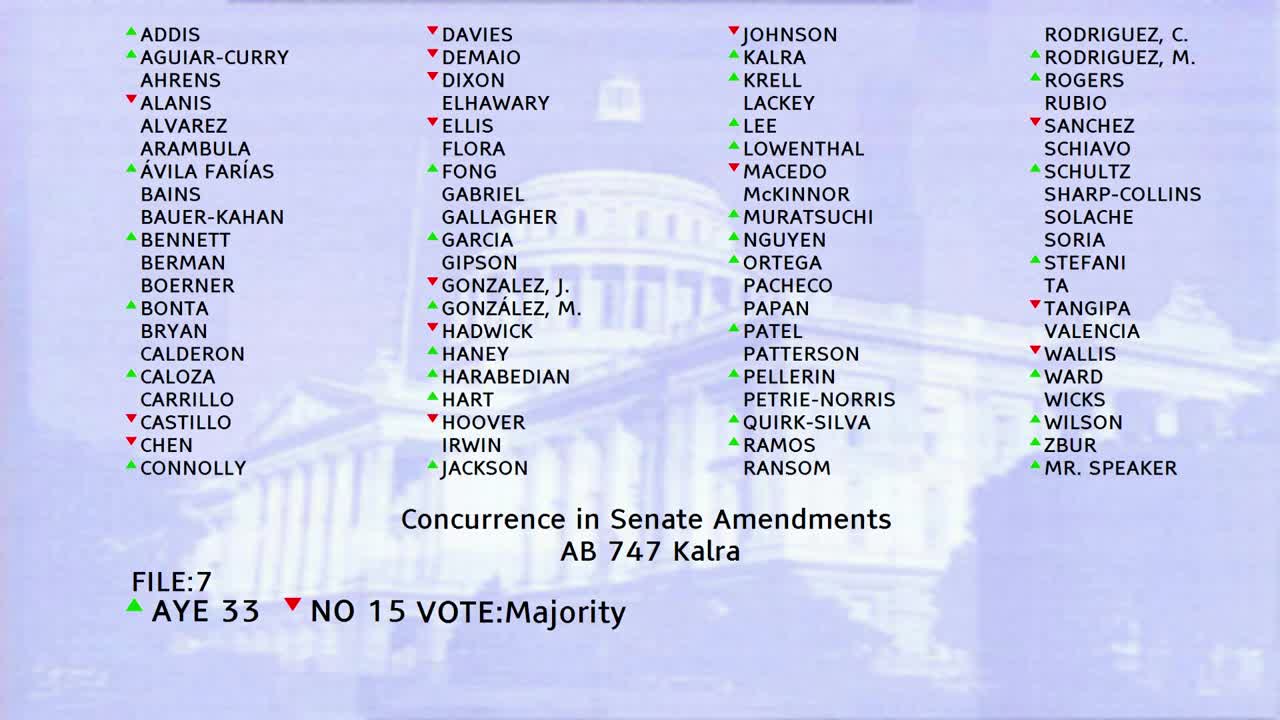
Bill Author

Bill Co-Author(s):