AB 1089: Western Joshua Tree Conservation Act: industrial projects and commercial projects: tree removal and trimming.
- Session Year: 2025-2026
- House: Assembly
- Latest Version Date: 2025-09-16
Current Status:
Failed
(2026-01-22: Consideration of Governor's veto stricken from file.)
Introduced
In Committee
Awaiting First Chamber Vote
Passed First Chamber
In Committee
Awaiting Second Chamber Vote
Passed Second Chamber
Enacted
(1)Existing law, the Western Joshua Tree Conservation Act, prohibits any person or public agency from importing into the state, exporting out of the state, or taking, possessing, purchasing, or selling within the state, a western Joshua tree or any part or product of the tree, except as provided. Under existing law, the Department of Fish and Wildlife may authorize, by permit, the taking of a western Joshua tree if certain conditions are met, including, among other conditions, that the permittee mitigates all impacts to, and the taking of, the western Joshua tree. Existing law authorizes the department to enter into an agreement with any county or city to delegate to the county or city the ability to authorize the taking of a western Joshua tree associated with developing single-family residences, multifamily residences, accessory structures, and public works projects concurrent with its approval of the project if certain conditions are met. Existing law authorizes any person or public agency receiving a take authorization for a project to pay specified fees in lieu of satisfying the mitigation obligation on several bases, including if the project receives a permit issued by a county or city.
This bill would additionally authorize the department to enter into an agreement with any city to delegate to the city the ability to authorize the taking of western Joshua trees associated with developing commercial and industrial projects. The bill would, relative to other project types subject to delegated local mitigation authority, limit the bases for commercial or industrial projects to pay specified fees in lieu of satisfying the mitigation obligation, as provided.
(2)Existing law authorizes the department to issue a permit to authorize either the removal or trimming of a dead western Joshua tree or the trimming of a live western Joshua tree.
This bill would remove the reference to a dead or live western Joshua tree, thereby authorizing the department to issue a permit to authorize either the removal or trimming of any western Joshua tree.
Existing law authorizes the department to issue a permit for these purposes, without the payment of fees or other mitigation, provided that a dead western Joshua tree or any limbs to be removed meet at least one of a specified list of conditions.
This bill would revise and recast this provision to instead authorize the department to issue a permit, without the payment of fees or other mitigation, if either the western Joshua tree is located within 100 feet of an existing single-family home and any associated accessory structure or that removal or trimming is necessary for the homeowner to meet defensible space requirements, as provided.
Existing law, the Western Joshua Tree Conservation Act, prohibits any person or public agency from importing into the state, exporting out of the state, or taking, possessing, purchasing, or selling within the state, a western Joshua tree or any part or product of the tree, except as provided. Under existing law, the Department of Fish and Wildlife may authorize, by permit, the taking of a western Joshua tree if certain conditions are met, including, among other conditions, that the permittee mitigates all impacts to, and the taking of, the western Joshua tree. Existing law authorizes the department to enter into an agreement with any county or city to delegate to the county or city the ability to authorize the taking of a western Joshua tree associated with developing single-family residences, multifamily residences, accessory structures, and public works projects concurrent with its approval of the project if certain conditions are met. Existing law authorizes any person or public agency receiving a take authorization for a project to pay specified fees in lieu of satisfying the mitigation obligation on several bases, including if the project receives a permit issued by a county or city.
This bill would additionally authorize the department to enter into an agreement with any city to delegate to the city the ability to authorize the taking of western Joshua trees associated with developing commercial and industrial projects. The bill would, relative to other project types subject to delegated local mitigation authority, limit the bases for commercial or industrial projects to pay specified fees in lieu of satisfying the mitigation obligation, as provided.
Existing law, the Western Joshua Tree Conservation Act, requires the Department of Fish and Wildlife to submit an annual report to the Fish and Game Commission and the Legislature assessing the conservation status of the western Joshua tree, as provided.This bill would make a nonsubstantive change to that law.Existing law, the Western Joshua Tree Conservation Act, requires the Department of Fish and Wildlife to submit an annual report to the Fish and Game Commission and the Legislature assessing the conservation status of the western Joshua tree, as provided.
This bill would make a nonsubstantive change to that law.
(a)The department may authorize, by permit, the taking of a western Joshua tree if all of the following conditions are met:
(1)The permittee submits to the department for its approval a census of all western Joshua trees on the project site, including size information and photographs, that categorize the western Joshua trees according to the following size classes:
(A)Less than one meter in height.
(B)One meter or greater but less than five meters in height.
(C)Five meters or greater in height.
(2)The permittee avoids and minimizes impacts to, and the taking of, the western Joshua tree to the maximum extent practicable. Minimization may include trimming, encroachment on root systems, relocation, or other actions that result in detrimental but nonlethal impacts to a western Joshua tree.
(3)The permittee mitigates all impacts to, and taking of, the western Joshua tree. The measures required to meet this obligation shall be roughly proportional in extent to the impact of the authorized taking of the species. When various measures are available to meet this obligation, the measures required shall maintain the permittees objectives to the greatest extent possible. All required measures shall be capable of successful implementation. The permittee shall ensure adequate funding to implement the mitigation measures. In lieu of completing the mitigation obligation on its own, the permittee may elect to satisfy this mitigation obligation by paying fees, pursuant to the fee schedule in subdivision (d) or (e), for deposit into the fund.
(4)(A)The department may include permit conditions that require the permittee to relocate one or more of the western Joshua trees. If relocation is required, the permittee shall implement measures to assist the survival of relocated trees, and to comply with any other reasonable measures required by the department to facilitate the successful relocation and survival of the western Joshua trees. These relocation measures shall include, but are not limited to, all of the following:
(i)A requirement that the relocated western Joshua tree is placed in a location and with proper orientation to improve its survival.
(ii)A requirement that western Joshua trees are relocated at a time that maximizes their survival when feasible.
(iii)A requirement that a desert native plant specialist be onsite to oversee relocation.
(B)The department may limit relocation to certain size classes of trees.
(C)By July 1, 2024, the department shall adopt guidelines and relocation protocols, based on the best available science, to relocate western Joshua trees successfully. The department shall consult with desert native plant specialists as part of the development of these guidelines and relocation protocols. Chapter 3.5 (commencing with Section 11340) of Part 1 of Division 3 of Title 2 of the Government Code shall not apply to the development, adoption, or amendment of guidelines and relocation protocols pursuant to this subparagraph.
(b)For purposes of this section, each western Joshua tree stem or trunk arising from the ground shall be considered an individual tree requiring mitigation, regardless of its proximity to any other western Joshua tree stem or trunk.
(c)(1)If all of the conditions of paragraph (3) are met, the department may enter into an agreement with any county to delegate to the county the ability to authorize the taking of a western Joshua tree associated with developing any one or more of the following projects concurrent with the countys approval of the project:
(A)Single-family residences.
(B)Multifamily residences.
(C)Accessory structures.
(D)Public works projects.
(2)If all of the conditions of paragraph (3) are met, the department may enter into an agreement with any city to delegate to the city the ability to authorize the taking of a western Joshua tree associated with developing any one or more of the following projects concurrent with the citys approval of the project:
(A)Single-family residences.
(B)Multifamily residences.
(C)Accessory structures.
(D)Public works projects.
(E)Commercial projects.
(F)Industrial projects.
(3)The delegation of authority pursuant to paragraphs (1) and (2) shall be subject to all of the following conditions:
(A)The county or city adopts an ordinance that requires as a condition of any approval or permit issued under the authority of an agreement entered into pursuant to this subdivision satisfaction of the requirements of this chapter.
(B)Except as provided otherwise in this subdivision, the county or city ensures that the permittee satisfies all of the requirements of subdivision (a) of this section.
(C)The project will take no more than 10 individual western Joshua trees on the project site where the project proponent proposes to construct a single-family residence, multifamily residence, accessory structure, commercial project, or industrial project, or no more than 40 individual western Joshua trees on the project site on which a public agency proposes to undertake a public works project. Before authorizing the take of more than 20, but no more than 40, individual western Joshua trees for a public works project, the county or city shall obtain the departments written concurrence that the project has avoided and minimized the take of western Joshua trees to the maximum extent practicable.
(D)The county or city shall collect any fees for permits issued and remit them quarterly to the fund as directed by the department.
(E)The county or city entering into an agreement pursuant to this subdivision may impose a reasonable fee to cover the administrative costs of issuing the permit.
(F)(i)The department retains express authority to suspend or revoke the county or citys take authorization in the event the department determines the county or city has violated the terms of the agreement, or this chapter, the county or city fails to implement or enforce the terms of the agreement or this chapter, or the department determines that the local population of western Joshua trees within, or in the vicinity of, that county or city needs further protection. The county or city shall conduct an annual assessment of the status of the local population within the county or city and submit the assessment to the department. The department shall determine if the population needs further protection to provide for the conservation of the species.
(ii)The department shall adopt standardized survey and assessment methods for the annual assessment required pursuant to clause (i), including requiring that a desert native plant specialist conduct the assessment. Chapter 3.5 (commencing with Section 11340) of Part 1 of Division 3 of Title 2 of the Government Code shall not apply to the development, adoption, or amendment of standardized survey and assessment methods pursuant to this subparagraph.
(G)The county or city shall be required to submit to the department quarterly reports documenting the number of permits issued, photographs and other evidence demonstrating that take and other impacts were avoided and minimized to the maximum extent practicable, the number and size class of western Joshua trees authorized to be taken, the number of western Joshua trees encroached upon, the number of western Joshua trees lethally removed, the number and location of western Joshua trees relocated, the amount of fees collected, and other information required by the department in the agreement.
(d)Any person or public agency receiving a take authorization pursuant to this chapter for a project that meets the criteria of either subparagraph (A) of paragraph (1) or subparagraph (B) of paragraph (1) may elect, in lieu of satisfying the mitigation obligation provided for in paragraph (3) of subdivision (a), to pay fees in the amounts provided in paragraph (2) for deposit into the fund.
(1)(A)Any project in the area bounded by the intersection of Highway 99 and Highway 58, then east along Highway 58 to the intersection of Interstate 15, then north along Interstate 15 to the intersection of Highway 247, then south along Highway 247 to the intersection of Highway 18, then west along Highway 18 to the intersection of Highway 138, then west and north along Highway 138 to the intersection of Interstate 5, then north along Interstate 5 to the intersection of Highway 99, then north along Highway 99 to Highway 58.
(B)Any single-family residence, multifamily residence, accessory structure, or public works project receiving a permit issued by a county or city pursuant to an agreement with the department pursuant to subdivision (c), regardless of location.
(2)(A)One thousand dollars ($1,000) for each western Joshua tree five meters or greater in height.
(B)Two hundred dollars ($200) for each western Joshua tree one meter or greater but less than five meters in height.
(C)One hundred fifty dollars ($150) for each western Joshua tree less than one meter in height.
(e)Any person or public agency receiving a take authorization pursuant to this chapter for a project that meets the criteria set forth in paragraph (1) may elect, in lieu of satisfying the mitigation obligation provided for in paragraph (3) of subdivision (a), to pay fees in the amounts provided in paragraph (2) for deposit into the fund.
(1)(A)Notwithstanding paragraph (1) of subdivision (d), any project within two miles of Joshua Tree National Park, or any unit of the state park system.
(B)Any project that does not meet the criteria set forth in paragraph (1) of subdivision (d).
(2)(A)Two thousand five hundred dollars ($2,500) for each western Joshua tree five meters or greater in height.
(B)Five hundred dollars ($500) for each western Joshua tree one meter or greater but less than five meters in height.
(C)Three hundred forty dollars ($340) for each western Joshua tree less than one meter in height.
(f)Upon request, the department may authorize a reduction in the amount of the fees prescribed by subdivisions (d) and (e) for any western Joshua tree conserved by a project proponent through the acquisition of compensatory habitat mitigation land otherwise required by law for the project.
(g)(1)The permittee shall bear responsibility for implementing measures to assist the survival of western Joshua trees relocated pursuant to paragraph (4) of subdivision (a).
(2)Unless specifically required by written agreement, a landowner that agrees in writing to allow western Joshua trees to be relocated onto land it owns shall not be liable for the continued survival of the western Joshua trees, shall not be required to manage or maintain the translocated western Joshua trees, and shall not be required to change existing land use practices, provided that the land use practices do not result in the taking, possession, sale, or further translocation of the western Joshua trees.
SEC. 2.Section 1927.4 of the Fish and Game Code is amended to read:1927.4.(a)The department may issue a permit to authorize either the removal or trimming of a western Joshua tree.
(1)Upon receipt of a permit and payment of any applicable administrative fees, a property owner or its agent may remove a detached dead western Joshua tree or the detached limb of a western Joshua tree. All other removals and all trimming of a western Joshua tree authorized by permits issued pursuant to this subdivision shall be completed by a desert native plant specialist.
(2)The department may issue a permit pursuant to this section, without payment of fees or other mitigation, provided that either of the following apply:
(A)A dead western Joshua tree or any limb to be removed meets one of the following conditions:
(i)Has fallen over and is within 30 feet of a structure.
(ii)Is leaning against an existing structure.
(iii)Creates an imminent threat to public health or safety.
(B)A western Joshua tree is located within 100 feet of an existing single-family home and any associated accessory structure, and removal or trimming is necessary for the homeowner to meet defensible space requirements pursuant to Section 51182 of the Government Code, Section 4291 of the Public Resources Code, or a local ordinance. Subdivision (c) of Section 21080.49 of the Public Resources Code applies to all permits issued by the department to the homeowner, pursuant to this subparagraph, for the removal or trimming of any western Joshua tree within 100 feet of a structure in the state responsibility area, and high and very high fire hazard severity zones in the local responsibility area.
(3)A property owner seeking a permit pursuant to this subdivision shall submit a permit request to the department on a form to be provided by the department that requires the following information:
(A)The name, telephone number, mailing address, and email address of the property owner seeking the permit.
(B)The street address of the property on which the western Joshua tree to be removed or trimmed is located. If no street address is available, the property owner shall include the assessors parcel number.
(C)Photographs of the western Joshua tree that visually depict the dead tree or the tree to be trimmed and that demonstrate that the western Joshua tree meets one or more of the requirements of paragraph (2).
(D)A signed attestation from the property owner or signed certification by a desert native plant specialist that the tree meets the definition of a dead western Joshua tree.
(4)(A)Within 30 days of receipt of a request for a permit pursuant to clause (i) or (ii) of subparagraph (A), or subparagraph (B), of paragraph (2), the department shall either issue a permit allowing for the removal or trimming, or deny the request if the request does not demonstrate a permit can be issued pursuant to this section.
(B)Within 10 days of receipt of a request for a permit pursuant to clause (iii) of subparagraph (A) of paragraph (2), the department shall either issue a permit allowing for the removal or trimming, or deny the request if the request does not demonstrate a permit can be issued pursuant to this section.
(C)If the department issues a permit, it shall provide the property owner 60 days in which to complete the removal or trimming. The department may extend this 60-day period in writing at its discretion.
(D)If the department denies the permit request, the property owner may resubmit the request with additional information and photographs. Resubmissions pursuant to this subdivision shall be processed as new permit requests.
(5)Within 30 days of completing the removal or trimming of one or more western Joshua trees in accordance with a permit issued pursuant to this section, the property owner shall submit, by mail or email, photographs of the site at which the western Joshua tree was removed or trimmed pursuant to the permit.
(b)The department may enter into an agreement with any county or city to delegate to the county or city the ability to authorize the removal or trimming of a dead western Joshua tree or the trimming of a live western Joshua tree, provided that the county or city ensures that all permits issued satisfy the requirements of subdivision (a). The county or city shall be required to submit to the department quarterly reports documenting the number of permits issued, the number and size class of a western Joshua tree authorized to be removed or trimmed, and any other information specified in the agreement with the department. A county or city entering into an agreement pursuant to this subdivision may impose a reasonable fee to cover the administrative costs of issuing the permit.
(c)(1)The department retains express authority to suspend or revoke an agreement with any county or city to delegate to the county or city the ability to authorize the removal or trimming of a dead western Joshua tree or the trimming of a live western Joshua tree in the event the department determines the county or city has violated the terms of the agreement or this chapter, the county or city fails to implement or enforce the terms of the agreement or this chapter, or the local population of western Joshua trees within, or in the vicinity of, that county or city needs further protection. A county or city that has entered into an agreement with the department shall conduct an annual assessment of the status of the local population of western Joshua trees within the county or city and submit the assessment to the department. The department shall determine if the population needs further protection to provide for the conservation of the species.
(2)The department shall adopt standardized survey and assessment methods for the annual assessment required pursuant to paragraph (1), including requiring that a desert native plant specialist conduct the assessment. Chapter 3.5 (commencing with Section 11340) of Part 1 of Division 3 of Title 2 of the Government Code shall not apply to the development, adoption, or amendment of standardized survey and assessment methods pursuant to this paragraph.
(a)The department may authorize, by permit, the taking of a western Joshua tree if all of the following conditions are met:
(1)The permittee submits to the department for its approval a census of all western Joshua trees on the project site, including size information and photographs, that categorize the western Joshua trees according to the following size classes:
(A)Less than one meter in height.
(B)One meter or greater but less than five meters in height.
(C)Five meters or greater in height.
(2)The permittee avoids and minimizes impacts to, and the taking of, the western Joshua tree to the maximum extent practicable. Minimization may include trimming, encroachment on root systems, relocation, or other actions that result in detrimental but nonlethal impacts to a western Joshua tree.
(3)The permittee mitigates all impacts to, and taking of, the western Joshua tree. The measures required to meet this obligation shall be roughly proportional in extent to the impact of the authorized taking of the species. When various measures are available to meet this obligation, the measures required shall maintain the permittees objectives to the greatest extent possible. All required measures shall be capable of successful implementation. The permittee shall ensure adequate funding to implement the mitigation measures. In lieu of completing the mitigation obligation on its own, the permittee may elect to satisfy this mitigation obligation by paying fees, pursuant to the fee schedule in subdivision (d) or (e), for deposit into the fund.
(4)(A)The department may include permit conditions that require the permittee to relocate one or more of the western Joshua trees. If relocation is required, the permittee shall implement measures to assist the survival of relocated trees, and to comply with any other reasonable measures required by the department to facilitate the successful relocation and survival of the western Joshua trees. These relocation measures shall include, but are not limited to, all of the following:
(i)A requirement that the relocated western Joshua tree is placed in a location and with proper orientation to improve its survival.
(ii)A requirement that western Joshua trees are relocated at a time that maximizes their survival when feasible.
(iii)A requirement that a desert native plant specialist be onsite to oversee relocation.
(B)The department may limit relocation to certain size classes of trees.
(C)By July 1, 2024, the department shall adopt guidelines and relocation protocols, based on the best available science, to relocate western Joshua trees successfully. The department shall consult with desert native plant specialists as part of the development of these guidelines and relocation protocols. Chapter 3.5 (commencing with Section 11340) of Part 1 of Division 3 of Title 2 of the Government Code shall not apply to the development, adoption, or amendment of guidelines and relocation protocols pursuant to this subparagraph.
(b)For purposes of this section, each western Joshua tree stem or trunk arising from the ground shall be considered an individual tree requiring mitigation, regardless of its proximity to any other western Joshua tree stem or trunk.
(c)(1)If all of the conditions of paragraph (3) are met, the department may enter into an agreement with any county to delegate to the county the ability to authorize the taking of a western Joshua tree associated with developing any one or more of the following projects concurrent with the countys approval of the project:
(A)Single-family residences.
(B)Multifamily residences.
(C)Accessory structures.
(D)Public works projects.
(2)If all of the conditions of paragraph (3) are met, the department may enter into an agreement with any city to delegate to the city the ability to authorize the taking of a western Joshua tree associated with developing any one or more of the following projects concurrent with the citys approval of the project:
(A)Single-family residences.
(B)Multifamily residences.
(C)Accessory structures.
(D)Public works projects.
(E)Commercial projects.
(F)Industrial projects.
(3)The delegation of authority pursuant to paragraphs (1) and (2) shall be subject to all of the following conditions:
(A)The county or city adopts an ordinance that requires as a condition of any approval or permit issued under the authority of an agreement entered into pursuant to this subdivision satisfaction of the requirements of this chapter.
(B)Except as provided otherwise in this subdivision, the county or city ensures that the permittee satisfies all of the requirements of subdivision (a) of this section.
(C)The project will take no more than 10 individual western Joshua trees on the project site where the project proponent proposes to construct a single-family residence, multifamily residence, accessory structure, commercial project, or industrial project, or no more than 40 individual western Joshua trees on the project site on which a public agency proposes to undertake a public works project. Before authorizing the take of more than 20, but no more than 40, individual western Joshua trees for a public works project, the county or city shall obtain the departments written concurrence that the project has avoided and minimized the take of western Joshua trees to the maximum extent practicable.
(D)The county or city shall collect any fees for permits issued and remit them quarterly to the fund as directed by the department.
(E)The county or city entering into an agreement pursuant to this subdivision may impose a reasonable fee to cover the administrative costs of issuing the permit.
(F)(i)The department retains express authority to suspend or revoke the county or citys take authorization in the event the department determines the county or city has violated the terms of the agreement, or this chapter, the county or city fails to implement or enforce the terms of the agreement or this chapter, or the department determines that the local population of western Joshua trees within, or in the vicinity of, that county or city needs further protection. The county or city shall conduct an annual assessment of the status of the local population within the county or city and submit the assessment to the department. The department shall determine if the population needs further protection to provide for the conservation of the species.
(ii)The department shall adopt standardized survey and assessment methods for the annual assessment required pursuant to clause (i), including requiring that a desert native plant specialist conduct the assessment. Chapter 3.5 (commencing with Section 11340) of Part 1 of Division 3 of Title 2 of the Government Code shall not apply to the development, adoption, or amendment of standardized survey and assessment methods pursuant to this subparagraph.
(G)The county or city shall be required to submit to the department quarterly reports documenting the number of permits issued, photographs and other evidence demonstrating that take and other impacts were avoided and minimized to the maximum extent practicable, the number and size class of western Joshua trees authorized to be taken, the number of western Joshua trees encroached upon, the number of western Joshua trees lethally removed, the number and location of western Joshua trees relocated, the amount of fees collected, and other information required by the department in the agreement.
(d)Any person or public agency receiving a take authorization pursuant to this chapter for a project that meets the criteria of either subparagraph (A) of paragraph (1) or subparagraph (B) of paragraph (1) may elect, in lieu of satisfying the mitigation obligation provided for in paragraph (3) of subdivision (a), to pay fees in the amounts provided in paragraph (2) for deposit into the fund.
(1)(A)Any project in the area bounded by the intersection of Highway 99 and Highway 58, then east along Highway 58 to the intersection of Interstate 15, then north along Interstate 15 to the intersection of Highway 247, then south along Highway 247 to the intersection of Highway 18, then west along Highway 18 to the intersection of Highway 138, then west and north along Highway 138 to the intersection of Interstate 5, then north along Interstate 5 to the intersection of Highway 99, then north along Highway 99 to Highway 58.
(B)Any single-family residence, multifamily residence, accessory structure, or public works project receiving a permit issued by a county or city pursuant to an agreement with the department pursuant to subdivision (c), regardless of location.
(2)(A)One thousand dollars ($1,000) for each western Joshua tree five meters or greater in height.
(B)Two hundred dollars ($200) for each western Joshua tree one meter or greater but less than five meters in height.
(C)One hundred fifty dollars ($150) for each western Joshua tree less than one meter in height.
(e)Any person or public agency receiving a take authorization pursuant to this chapter for a project that meets the criteria set forth in paragraph (1) may elect, in lieu of satisfying the mitigation obligation provided for in paragraph (3) of subdivision (a), to pay fees in the amounts provided in paragraph (2) for deposit into the fund.
(1)(A)Notwithstanding paragraph (1) of subdivision (d), any project within two miles of Joshua Tree National Park, or any unit of the state park system.
(B)Any project that does not meet the criteria set forth in paragraph (1) of subdivision (d).
(2)(A)Two thousand five hundred dollars ($2,500) for each western Joshua tree five meters or greater in height.
(B)Five hundred dollars ($500) for each western Joshua tree one meter or greater but less than five meters in height.
(C)Three hundred forty dollars ($340) for each western Joshua tree less than one meter in height.
(f)Upon request, the department may authorize a reduction in the amount of the fees prescribed by subdivisions (d) and (e) for any western Joshua tree conserved by a project proponent through the acquisition of compensatory habitat mitigation land otherwise required by law for the project.
(g)(1)The permittee shall bear responsibility for implementing measures to assist the survival of western Joshua trees relocated pursuant to paragraph (4) of subdivision (a).
(2)Unless specifically required by written agreement, a landowner that agrees in writing to allow western Joshua trees to be relocated onto land it owns shall not be liable for the continued survival of the western Joshua trees, shall not be required to manage or maintain the translocated western Joshua trees, and shall not be required to change existing land use practices, provided that the land use practices do not result in the taking, possession, sale, or further translocation of the western Joshua trees.
SEC. 2.Section 1927.4 of the Fish and Game Code is amended to read:1927.4.(a)The department may issue a permit to authorize either the removal or trimming of dead western Joshua trees or the trimming of live a western Joshua trees. tree.
(1)Upon receipt of a permit and payment of any applicable administrative fees, a property owner or its agent may remove a detached dead western Joshua tree or the detached limb of a western Joshua tree. All other removals and all trimming of a western Joshua trees tree authorized by permits issued pursuant to this subdivision shall be completed by a desert native plant specialist.
(2)The department may issue permits a permit pursuant to this section, without payment of fees or other mitigation, provided that the either of the following apply:
(A)A dead western Joshua trees tree or any limbs limb to be removed meet meets one of the following: following conditions:
(A)Have(i)Has fallen over and are is within 30 feet of a structure.
(B)Are(ii)Is leaning against an existing structure.
(C)Create(iii)Creates an imminent threat to public health or safety.
(B)A western Joshua tree is located within 100 feet of an existing single-family home and any associated accessory structure, and removal or trimming is necessary for the homeowner to meet defensible space requirements pursuant to Section 51182 of the Government Code, Section 4291 of the Public Resources Code, or a local ordinance. Subdivision (c) of Section 21080.49 of the Public Resources Code applies to all permits issued by the department to the homeowner, pursuant to this subparagraph, for the removal or trimming of any western Joshua tree within 100 feet of a structure in the state responsibility area, and high and very high fire hazard severity zones in the local responsibility area.
(3)A property owner seeking a permit pursuant to this subdivision shall submit a permit request to the department on a form to be provided by the department that requires the following information:
(A)The name, telephone number, mailing address, and email address of the property owner seeking the permit.
(B)The street address of the property on which the western Joshua trees tree to be removed or trimmed are is located. If no street address is available, the property owner shall include the assessors parcel number.
(C)Photographs of the western Joshua trees tree that visually depict the dead trees tree or the trees tree to be trimmed and that demonstrate that the western Joshua tree meets one or more of the requirements of paragraph (2).
(D)A signed attestation from the property owner or signed certification by a desert native plant specialist that the tree meets the definition of a dead western Joshua tree.
(4)(A)Within 30 days of receipt of a request for a permit pursuant to subparagraph (A) or (B) clause (i) or (ii) of subparagraph (A), or subparagraph (B), of paragraph (2), the department shall either issue a permit allowing for the removal or trimming, or deny the request if the request does not demonstrate a permit can be issued pursuant to this section.
(B)Within 10 days of receipt of a request for a permit pursuant to subparagraph (C) clause (iii) of subparagraph (A) of paragraph (2), the department shall either issue a permit allowing for the removal or trimming, or deny the request if the request does not demonstrate a permit can be issued pursuant to this section.
(C)If the department issues a permit, it shall provide the property owner 60 days in which to complete the removal or trimming. The department may extend this 60-day period in writing at its discretion.
(D)If the department denies the permit request, the property owner may resubmit the request with additional information and photographs. Resubmissions pursuant to this subdivision shall be processed as new permit requests.
(5)Within 30 days of completing the removal or trimming of one or more western Joshua trees in accordance with a permit issued pursuant to this section, the property owner shall submit, by mail or email, photographs of the site at which the western Joshua trees were tree was removed or trimmed pursuant to the permit.
(b)The department may enter into an agreement with any county or city to delegate to the county or city the ability to authorize the removal or trimming of a dead western Joshua trees tree or the trimming of a live western Joshua trees, tree, provided that the county or city ensures that all permits issued satisfy the requirements of subdivision (a). The county or city shall be required to submit to the department quarterly reports documenting the number of permits issued, the number and size class of a western Joshua trees tree authorized to be removed or trimmed, and any other information specified in the agreement with the department. A county or city entering into an agreement pursuant to this subdivision may impose a reasonable fee to cover the administrative costs of issuing the permit.
(c)(1)The department retains express authority to suspend or revoke an agreement with any county or city to delegate to the county or city the ability to authorize the removal or trimming of a dead western Joshua trees tree or the trimming of a live western Joshua trees tree in the event the department determines the county or city has violated the terms of the agreement or this chapter, the county or city fails to implement or enforce the terms of the agreement or this chapter, or the local population of western Joshua trees within, or in the vicinity of, that county or city needs further protection. A county or city that has entered into an agreement with the department shall conduct an annual assessment of the status of the local population of western Joshua trees within the county or city and submit the assessment to the department. The department shall determine if the population needs further protection to provide for the conservation of the species.
(2)The department shall adopt standardized survey and assessment methods for the annual assessment required pursuant to paragraph (1), including requiring that a desert native plant specialist conduct the assessment. Chapter 3.5 (commencing with Section 11340) of Part 1 of Division 3 of Title 2 of the Government Code shall not apply to the development, adoption, or amendment of standardized survey and assessment methods pursuant to this paragraph.
(a)The department may authorize, by permit, the taking of a western Joshua tree if all of the following conditions are met:
(1)The permittee submits to the department for its approval a census of all western Joshua trees on the project site, including size information and photographs, that categorize the western Joshua trees according to the following size classes:
(A)Less than one meter in height.
(B)One meter or greater but less than five meters in height.
(C)Five meters or greater in height.
(2)The permittee avoids and minimizes impacts to, and the taking of, the western Joshua tree to the maximum extent practicable. Minimization may include trimming, encroachment on root systems, relocation, or other actions that result in detrimental but nonlethal impacts to a western Joshua tree.
(3)The permittee mitigates all impacts to, and taking of, the western Joshua tree. The measures required to meet this obligation shall be roughly proportional in extent to the impact of the authorized taking of the species. When various measures are available to meet this obligation, the measures required shall maintain the permittees objectives to the greatest extent possible. All required measures shall be capable of successful implementation. The permittee shall ensure adequate funding to implement the mitigation measures. In lieu of completing the mitigation obligation on its own, the permittee may elect to satisfy this mitigation obligation by paying fees, pursuant to the fee schedule in subdivision (d) or (e), for deposit into the fund.
(4)(A)The department may include permit conditions that require the permittee to relocate one or more of the western Joshua trees. If relocation is required, the permittee shall implement measures to assist the survival of relocated trees, and to comply with any other reasonable measures required by the department to facilitate the successful relocation and survival of the western Joshua trees. These relocation measures shall include, but are not limited to, all of the following:
(i)A requirement that the relocated western Joshua tree is placed in a location and with proper orientation to improve its survival.
(ii)A requirement that western Joshua trees are relocated at a time that maximizes their survival when feasible.
(iii)A requirement that a desert native plant specialist be onsite to oversee relocation.
(B)The department may limit relocation to certain size classes of trees.
(C)By July 1, 2024, the department shall adopt guidelines and relocation protocols, based on the best available science, to relocate western Joshua trees successfully. The department shall consult with desert native plant specialists as part of the development of these guidelines and relocation protocols. Chapter 3.5 (commencing with Section 11340) of Part 1 of Division 3 of Title 2 of the Government Code shall not apply to the development, adoption, or amendment of guidelines and relocation protocols pursuant to this subparagraph.
(b)For purposes of this section, each western Joshua tree stem or trunk arising from the ground shall be considered an individual tree requiring mitigation, regardless of its proximity to any other western Joshua tree stem or trunk.
(c)The (1)If all of the conditions of paragraph (3) are met, the department may enter into an agreement with any county or city to delegate to the county or city the ability to authorize the taking of a western Joshua tree associated with developing single-family residences, multifamily residences, accessory structures, and public works any one or more of the following projects concurrent with its the countys approval of the project, if all of the following conditions are met: project:
(A)Single-family residences.
(B)Multifamily residences.
(C)Accessory structures.
(D)Public works projects.
(2)If all of the conditions of paragraph (3) are met, the department may enter into an agreement with any city to delegate to the city the ability to authorize the taking of a western Joshua tree associated with developing any one or more of the following projects concurrent with the citys approval of the project:
(A)Single-family residences.
(B)Multifamily residences.
(C)Accessory structures.
(D)Public works projects.
(E)Commercial projects.
(F)Industrial projects.
(3)The delegation of authority pursuant to paragraphs (1) and (2) shall be subject to all of the following conditions:
(1)(A)The county or city adopts an ordinance that requires as a condition of any approval or permit issued under the authority of an agreement entered into pursuant to this subdivision satisfaction of the requirements of this chapter.
(2)(B)Except as provided otherwise in this subdivision, the county or city ensures that the permittee satisfies all of the requirements of subdivision (a) of this section.
(3)(C)The project will take no more than 10 individual western Joshua trees on the project site where the project proponent proposes to construct a single-family residence, multifamily residence, or accessory structure, commercial project, or industrial project, or no more than 40 individual western Joshua trees on the project site on which a public agency proposes to undertake a public works project. Before authorizing the take of more than 20, but no more than 40, individual western Joshua trees for a public works project, the county or city shall obtain the departments written concurrence that the project has avoided and minimized the take of western Joshua trees to the maximum extent practicable.
(4)(D)The county or city shall collect any fees for permits issued and remit them quarterly to the fund as directed by the department.
(5)(E)The county or city entering into an agreement pursuant to this subdivision may impose a reasonable fee to cover the administrative costs of issuing the permit.
(6)(A)(F)(i)The department retains express authority to suspend or revoke the county or citys take authorization in the event the department determines the county or city has violated the terms of the agreement, or this chapter, the county or city fails to implement or enforce the terms of the agreement or this chapter, or the department determines that the local population of western Joshua trees within, or in the vicinity of, that county or city needs further protection. The county or city shall conduct an annual assessment of the status of the local population within the county or city and submit the assessment to the department. The department shall determine if the population needs further protection to provide for the conservation of the species.
(B)(ii)The department shall adopt standardized survey and assessment methods for the annual assessment required pursuant to subparagraph (A), clause (i), including requiring that a desert native plant specialist conduct the assessment. Chapter 3.5 (commencing with Section 11340) of Part 1 of Division 3 of Title 2 of the Government Code shall not apply to the development, adoption, or amendment of standardized survey and assessment methods pursuant to this subparagraph.
(7)(G)The county or city shall be required to submit to the department quarterly reports documenting the number of permits issued, photographs and other evidence demonstrating that take and other impacts were avoided and minimized to the maximum extent practicable, the number and size class of western Joshua trees authorized to be taken, the number of western Joshua trees encroached upon, the number of western Joshua trees lethally removed, the number and location of western Joshua trees relocated, the amount of fees collected, and other information required by the department in the agreement.
(d)Any person or public agency receiving a take authorization pursuant to this chapter for a project that meets the criteria set forth in of either subparagraph (A) of paragraph (1) or subparagraph (B) of paragraph (1) may elect, in lieu of satisfying the mitigation obligation provided for in paragraph (3) of subdivision (a), to pay fees in the amounts provided in paragraph (2) for deposit into the fund.
(1)(A)Any project in the area bounded by the intersection of Highway 99 and Highway 58, then east along Highway 58 to the intersection of Interstate 15, then north along Interstate 15 to the intersection of Highway 247, then south along Highway 247 to the intersection of Highway 18, then west along Highway 18 to the intersection of Highway 138, then west and north along Highway 138 to the intersection of Interstate 5, then north along Interstate 5 to the intersection of Highway 99, then north along Highway 99 to Highway 58.
(B)Any single-family residence, multifamily residence, accessory structure, or public works project receiving a permit issued by a county or city pursuant to an agreement with the department pursuant to subdivision (c), regardless of location.
(2)(A)One thousand dollars ($1,000) for each western Joshua tree five meters or greater in height.
(B)Two hundred dollars ($200) for each western Joshua tree one meter or greater but less than five meters in height.
(C)One hundred fifty dollars ($150) for each western Joshua tree less than one meter in height.
(e)Any person or public agency receiving a take authorization pursuant to this chapter for a project that meets the criteria set forth in paragraph (1) may elect, in lieu of satisfying the mitigation obligation provided for in paragraph (3) of subdivision (a), to pay fees in the amounts provided in paragraph (2) for deposit into the fund.
(1)(A)Notwithstanding paragraph (1) of subdivision (d), any project within two miles of Joshua Tree National Park, or any unit of the state park system.
(B)Any project that does not meet the criteria set forth in paragraph (1) of subdivision (d).
(2)(A)Two thousand five hundred dollars ($2,500) for each western Joshua tree five meters or greater in height.
(B)Five hundred dollars ($500) for each western Joshua tree one meter or greater but less than five meters in height.
(C)Three hundred forty dollars ($340) for each western Joshua tree less than one meter in height.
(f)Upon request, the department may authorize a reduction in the amount of the fees prescribed by subdivisions (d) and (e) for any western Joshua tree conserved by a project proponent through the acquisition of compensatory habitat mitigation land otherwise required by law for the project.
(g)(1)The permittee shall bear responsibility for implementing measures to assist the survival of western Joshua trees relocated pursuant to paragraph (4) of subdivision (a).
(2)Unless specifically required by written agreement, a landowner that agrees in writing to allow western Joshua trees to be relocated onto land it owns shall not be liable for the continued survival of the western Joshua trees, shall not be required to manage or maintain the translocated western Joshua trees, and shall not be required to change existing land use practices, provided that the land use practices do not result in the taking, possession, sale, or further translocation of the western Joshua trees.
SECTION 1.Section 1927.7 of the Fish and Game Code is amended to read:1927.7.(a)Beginning in 2025, by January 31 of each calendar year, the department shall submit an annual report to the commission and the Legislature assessing the conservation status of the western Joshua tree, including, but not limited to, the number of permits issued, the number and size class of western Joshua trees authorized to be taken, the number of western Joshua trees lethally removed, the number and location of western Joshua trees relocated, the number and location of acres of western Joshua tree woodlands developed, the type, scope, and scale of mitigation measures undertaken by permittees, the number and location of acres of western Joshua tree woodlands conserved, the quality of the acres conserved, the amount of fees paid, the amount of all expenditures from the fund, the projects and actions funded by expenditures from the fund, the adequacy of the fees to conserve the western Joshua tree, actions taken pursuant to the conservation plan, and other relevant information. The departments annual report shall summarize the information provided by counties and cities pursuant to agreements entered into pursuant to subdivision (c) of Section 1927.3 and subdivision (b) of Section 1927.4.(b)The report to the Legislature pursuant to subdivision (a) shall be submitted in accordance with Section 9795 of the Government Code.(a)Beginning in 2025, by January 31 of each calendar year, the department shall submit an annual report to the commission and the Legislature assessing the conservation status of the western Joshua tree, including, but not limited to, by detailing the number of permits issued, the number and size class of western Joshua trees authorized to be taken, the number of western Joshua trees lethally removed, the number and location of western Joshua trees relocated, the number and location of acres of western Joshua tree woodlands developed, the type, scope, and scale of mitigation measures undertaken by permittees, the number and location of acres of western Joshua tree woodlands conserved, the quality of the acres conserved, the amount of fees paid, the amount of all expenditures from the fund, the projects and actions funded by expenditures from the fund, the adequacy of the fees to conserve the western Joshua tree, actions taken pursuant to the conservation plan, and other relevant information. The departments annual report shall summarize the information provided by counties and cities pursuant to agreements entered into pursuant to subdivision (c) of Section 1927.3 and subdivision (b) of Section 1927.4.
(b)The report to the Legislature pursuant to subdivision (a) shall be submitted in accordance with Section 9795 of the Government Code.
|
Date
|
Status
|
|---|---|
| Jan 22, 2026 | Consideration of Governor's veto stricken from file. |
| Oct 3, 2025 | Consideration of Governor's veto pending. |
| Oct 3, 2025 | Vetoed by Governor. |
| Sep 24, 2025 | Enrolled and presented to the Governor at 3 p.m. |
| Sep 12, 2025 | Senate amendments concurred in. To Engrossing and Enrolling. (Ayes 76. Noes 0. Page 3386.). |
| Sep 12, 2025 | In Assembly. Concurrence in Senate amendments pending. |
| Sep 11, 2025 | Read third time. Passed. Ordered to the Assembly. (Ayes 40. Noes 0. Page 2921.). |
| Aug 29, 2025 | Read second time. Ordered to third reading. |
| Aug 29, 2025 | From committee: Do pass. (Ayes 7. Noes 0.) (August 29). |
| Aug 18, 2025 | In committee: Referred to suspense file. |
| Jul 21, 2025 | From committee: Amend, and do pass as amended and re-refer to Com. on APPR. (Ayes 6. Noes 0.) (July 16). |
| Jul 21, 2025 | Read second time and amended. Re-referred to Com. on APPR. |
| May 7, 2025 | Referred to Com. on N.R. & W. |
| Apr 29, 2025 | In Senate. Read first time. To Com. on RLS. for assignment. |
| Apr 28, 2025 | Read third time. Passed. Ordered to the Senate. (Ayes 65. Noes 0. Page 1319.) |
| Apr 24, 2025 | Read second time. Ordered to third reading. |
| Apr 23, 2025 | From committee: Do pass. (Ayes 15. Noes 0.) (April 23). |
| Apr 9, 2025 | From committee: Do pass and re-refer to Com. on APPR. (Ayes 11. Noes 0.) (April 8). Re-referred to Com. on APPR. |
| Mar 25, 2025 | Re-referred to Com. on W. P., & W. |
| Mar 24, 2025 | Referred to Com. on W. P., & W. |
| Mar 24, 2025 | From committee chair, with author's amendments: Amend, and re-refer to Com. on W. P., & W. Read second time and amended. |
| Feb 21, 2025 | From printer. May be heard in committee March 23. |
| Feb 20, 2025 | Read first time. To print. |
|
Date
|
Description
|
Location
|
Votes
|
|
|---|---|---|---|---|
| Sep 12, 2025 | AB 1089 Carrillo Concurrence in Senate Amendments | Assembly Floor |
Passed |
|
| Sep 11, 2025 | Assembly 3rd Reading AB1089 Carrillo By Laird | Senate Floor |
Passed |
|
| Aug 29, 2025 | Do pass | Senate Standing Committee on Appropriations |
Passed |
|
| Aug 18, 2025 | Placed on suspense file | Senate Standing Committee on Appropriations |
Passed |
|
| Jul 16, 2025 | Do pass as amended, but first amend, and re-refer to the Committee on [Appropriations] | Senate Standing Committee on Natural Resources and Water |
Passed |
|
| Apr 28, 2025 | AB 1089 Carrillo Assembly Third Reading | Assembly Floor |
Passed |
|
| Apr 23, 2025 | Do pass. | Assembly Standing Committee on Appropriations |
Passed |
|
| Apr 8, 2025 | Do pass and be re-referred to the Committee on [Appropriations] | Assembly Standing Committee on Water, Parks, and Wildlife |
Passed |
This list shows positions taken on this bill by organizations on the date displayed, which is linked to the original source.
Positions by individuals are not included.
|
Organization
|
Position
|
Date
|
|---|---|---|
| Antelope Valley Economic Development & Growth Enterprise | ** Support | |
| Audubon California | ** Against | |
| California Cement Manufacturers Environmental Coalition | ** Support | |
| California Department of Finance | ** Against | |
| California Native Plant Society | ** Against | |
| Center For Biological Diversity | ** Against | |
| Community Water Systems Alliance | ** Support | |
| County of San Bernardino | ** Support | |
| Defenders Of Wildlife | ** Against | |
| Mojave Desert Land Trust | ** Against | |
| Palmdale Water District | ** Support | |
| Planning And Conservation League | ** Against | |
| San Bernardino County | ** Support | |
| Sierra Club California | ** Against |
GOVERNOR'S VETO
GV Bill Id:AB 1089
Author:(Carrillo)
As Enrolled Ver:September 16, 2025
2/3 vote
SUMMARY
Authorizes the Department of Fish and Wildlife (CDFW) to enter into an agreement with any city to delegate to the city the taking of a western Joshua tree associated with commercial and industrial projects as well as revises CDFW's authority to issue a permit for the removal of a western Joshua tree, including to meet defensible space requirements.
Governor's Veto Message
"This bill authorizes [CDFW] to enter into an agreement with any city to delegate to the city the taking of a Western Joshua Tree associated with commercial and industrial projects. In addition, this bill revises CDFW's authority to issue a permit for the removal of a Western Joshua
Tree around single-family homes.
The Western Joshua Tree Conservation Act (WJTCA) of 2023 was carefully crafted to balance the need to develop housing and clean energy projects in the Mojave Desert region, while creating a robust but practical permitting process aimed at protecting one of California's most iconic species. The [WJTCA] currently authorizes CDFW to enter into an agreement with any county or city and delegate limited authority to permit the taking of a Western Joshua Tree associated with developing single-family residences, multifamily residences, accessory structures, and public works projects.
While I recognize the desire to expand this delegated authority to include the taking of these trees where commercial and industrial projects are sited, this bill goes too far in authorizing the blanket removal of these trees near single-family homes that will ultimately undermine Western Joshua Tree protections and conservation requirements under the [WJTCA]. Furthermore, this bill would increase the complexity and time required to manage the permitting process as modified by this measure.
COMMENTS
Western Joshua trees are widely distributed in the Mojave Desert region of California. According to CDFW's Status Review of the species, estimates indicate that the abundance of the western Joshua tree is currently relatively high, but there is high uncertainty in estimates of population size due to both the uncertainty of density estimates, and uncertainty regarding how much area is occupied by the species.
To provide protections to western Joshua trees and hopefully prevent an official listing while enabling development, the WJTCA was enacted in 2023. The WJTCA prohibits the importation, export, take, possession, purchase, or sale of any western Joshua tree in California unless authorized by CDFW. WJTCA authorizes CDFW to issue permits for the incidental take of one or more western Joshua trees if the permittee meets certain conditions. Permittees may pay specified fees in lieu of conducting mitigation activities. WJTCA also authorizes CDFW to issue permits for the removal of dead western Joshua trees and the trimming of live western Joshua trees under certain circumstances.
Pursuant to the WJTCA, CDFW may enter into an agreement with any county or city to delegate limited authority to permit the take of a western Joshua tree associated with developing single-family residences, multifamily residences, accessory structures, and public works projects (Delegation Agreements). Delegation Agreements for this purpose limit the number of trees that may be taken depending on the type of project. CDFW may similarly enter into Delegation Agreements with any county or city to permit the removal of dead western Joshua trees and the trimming of live western Joshua trees. Delegation Agreements just became available as of February 28, 2024 and CDFW began negotiating agreements with several local agencies. To date, no delegation agreements have been approved.
According to the Author
"The Western Joshua Tree is an iconic symbol of the High Desert region and I support the preservation of this species. Although the state has been moving in the right direction to protect this iconic species while meeting our state's goals, we still need to address the need to streamline permitting for projects that are vital economic developments for local governments in the growing Antelope Valley and throughout the high desert. With the increased cost of living and lack of space in the metropolitan areas of Los Angeles, more people are continuing to move into the High Desert region. We must strike a balance between conservation and the urgently needed housing and economic development that is needed to address the increases in population."
Arguments in Support
Several groups write in support of this bill referencing the escalating cost and regulatory complexity due to the WJTCA. They note that increasing local government engagement, as proposed by this bill, will reduce environmental impacts and costs to the state. San Bernardino County adds that this bill "makes targeted, pragmatic updates" to the WJTCA to "ensure continued conservation of this iconic desert species while addressing urgent local needs for economic development and wildfire resilience."
Arguments in Opposition
None on file. Previous opposition has changed their position to neutral.
FISCAL COMMENTS
According to the Senate Appropriations Committee, this bill has unknown, but potentially significant ongoing costs, likely in the high hundreds of thousands of dollars annually (General Fund).
VOTES
ASM WATER, PARKS, AND WILDLIFE: 11-0-2
YES: Papan, Jeff Gonzalez, Alvarez, Ávila Farías, Bains, Bennett, Hart, Macedo, Celeste Rodriguez, Rogers, Tangipa
ABS, ABST OR NV: Boerner, Caloza
ASM APPROPRIATIONS: 15-0-0
YES: Wicks, Sanchez, Arambula, Calderon, Caloza, Dixon, Elhawary, Fong, Mark González, Hart, Pacheco, Pellerin, Solache, Ta, Tangipa
ASSEMBLY FLOOR: 65-0-14
YES: Addis, Aguiar-Curry, Ahrens, Alanis, Alvarez, Arambula, Ávila Farías, Bains, Bauer-Kahan, Bennett, Berman, Calderon, Carrillo, Castillo, Chen, Davies, DeMaio, Dixon, Ellis, Fong, Gabriel, Gallagher, Garcia, Gipson, Jeff Gonzalez, Mark González, Hadwick, Haney, Harabedian, Hart, Hoover, Irwin, Lackey, Lee, Lowenthal, Macedo, McKinnor, Nguyen, Ortega, Pacheco, Papan, Patel, Patterson, Pellerin, Petrie-Norris, Quirk-Silva, Ramos, Ransom, Celeste Rodriguez, Michelle Rodriguez, Rogers, Blanca Rubio, Schiavo, Sharp-Collins, Solache, Soria, Stefani, Ta, Tangipa, Valencia, Wallis, Ward, Wicks, Wilson, Rivas
ABS, ABST OR NV: Boerner, Bonta, Bryan, Caloza, Connolly, Elhawary, Flora, Jackson, Kalra, Krell, Muratsuchi, Sanchez, Schultz, Zbur
SENATE FLOOR: 40-0-0
YES: Allen, Alvarado-Gil, Archuleta, Arreguín, Ashby, Becker, Blakespear, Cabaldon, Caballero, Cervantes, Choi, Cortese, Dahle, Durazo, Gonzalez, Grayson, Grove, Hurtado, Jones, Laird, Limón, McGuire, McNerney, Menjivar, Niello, Ochoa Bogh, Padilla, Pérez, Reyes, Richardson, Rubio, Seyarto, Smallwood-Cuevas, Stern, Strickland, Umberg, Valladares, Wahab, Weber Pierson, Wiener
ASSEMBLY FLOOR: 76-0-4
YES: Addis, Aguiar-Curry, Ahrens, Alanis, Alvarez, Arambula, Ávila Farías, Bains, Bauer-Kahan, Bennett, Berman, Bonta, Bryan, Calderon, Caloza, Carrillo, Castillo, Chen, Connolly, Davies, DeMaio, Dixon, Elhawary, Ellis, Flora, Fong, Gabriel, Gallagher, Garcia, Gipson, Jeff Gonzalez, Mark González, Hadwick, Haney, Harabedian, Hart, Hoover, Irwin, Johnson, Krell, Lackey, Lee, Lowenthal, Macedo, McKinnor, Nguyen, Ortega, Pacheco, Papan, Patel, Patterson, Pellerin, Petrie-Norris, Quirk-Silva, Ramos, Ransom, Celeste Rodriguez, Michelle Rodriguez, Rogers, Blanca Rubio, Sanchez, Schiavo, Schultz, Sharp-Collins, Solache, Soria, Stefani, Ta, Tangipa, Valencia, Wallis, Ward, Wicks, Wilson, Zbur, Rivas
ABS, ABST OR NV: Boerner, Jackson, Kalra, Muratsuchi
UPDATED
VERSION: September 16, 2025
CONSULTANT: Stephanie Mitchell / W., P., & W. / (916) 319-2096 FN: 0002153
CONCURRENCE IN SENATE AMENDMENTS
CSA1 Bill Id:AB 1089
Author:(Carrillo)
As Amended Ver:July 21, 2025
Majority vote
SUMMARY
Authorizes the Department of Fish and Wildlife (CDFW) to enter into an agreement with any city to delegate to the city the taking of a western Joshua tree associated with commercial and industrial projects.
Senate Amendments
Revise CDFW's authority to issue a permit for the removal of a western Joshua tree, including to meet defensible space requirements.
COMMENTS
Western Joshua trees are widely distributed in the Mojave Desert region of California. According to CDFW's Status Review of the species, estimates indicate that the abundance of the western Joshua tree is currently relatively high, but there is high uncertainty in estimates of population size due to both the uncertainty of density estimates, and uncertainty regarding how much area is occupied by the species.
To provide protections to western Joshua trees and hopefully prevent an official listing while enabling development, the Western Joshua Tree Conservation Act (WJTCA) was enacted in 2023. The WJTCA prohibits the importation, export, take, possession, purchase, or sale of any western Joshua tree in California unless authorized by CDFW. WJTCA authorizes CDFW to issue permits for the incidental take of one or more western Joshua trees if the permittee meets certain conditions. Permittees may pay specified fees in lieu of conducting mitigation activities. WJTCA also authorizes CDFW to issue permits for the removal of dead western Joshua trees and the trimming of live western Joshua trees under certain circumstances.
Pursuant to the WJTCA, CDFW may enter into an agreement with any county or city to delegate limited authority to permit the take of a western Joshua tree associated with developing single-family residences, multifamily residences, accessory structures, and public works projects (Delegation Agreements). Delegation Agreements for this purpose limit the number of trees that may be taken depending on the type of project. CDFW may similarly enter into Delegation Agreements with any county or city to permit the removal of dead western Joshua trees and the trimming of live western Joshua trees. Delegation Agreements just became available as of February 28, 2024 and CDFW began negotiating agreements with several local agencies. To date, no delegation agreements have been approved.
According to the Author
"The Western Joshua Tree is an iconic symbol of the High Desert region and I support the preservation of this species. Although the state has been moving in the right direction to protect this iconic species while meeting our state's goals, we still need to address the need to streamline permitting for projects that are vital economic developments for local governments in the growing Antelope Valley and throughout the high desert. With the increased cost of living and lack of space in the metropolitan areas of Los Angeles, more people are continuing to move into the High Desert region. We must strike a balance between conservation and the urgently needed housing and economic development that is needed to address the increases in population."
Arguments in Support
Several groups write in support of this bill referencing the escalating cost and regulatory complexity due to the WJTCA. They note that increasing local government engagement, as proposed by this bill, will reduce environmental impacts and costs to the state. San Bernardino County adds that this bill "makes targeted, pragmatic updates" to the WJTCA to "ensure continued conservation of this iconic desert species while addressing urgent local needs for economic development and wildfire resilience."
Arguments in Opposition
None on file. Previous opposition has changed their position to neutral.
FISCAL COMMENTS
According to the Senate Appropriations Committee, this bill has unknown, but potentially significant ongoing costs, likely in the high hundreds of thousands of dollars annually (General Fund).
VOTES:
ASM WATER, PARKS, AND WILDLIFE: 11-0-2
YES: Papan, Jeff Gonzalez, Alvarez, Ávila Farías, Bains, Bennett, Hart, Macedo, Celeste Rodriguez, Rogers, Tangipa
ABS, ABST OR NV: Boerner, Caloza
ASM APPROPRIATIONS: 15-0-0
YES: Wicks, Sanchez, Arambula, Calderon, Caloza, Dixon, Elhawary, Fong, Mark González, Hart, Pacheco, Pellerin, Solache, Ta, Tangipa
ASSEMBLY FLOOR: 65-0-14
YES: Addis, Aguiar-Curry, Ahrens, Alanis, Alvarez, Arambula, Ávila Farías, Bains, Bauer-Kahan, Bennett, Berman, Calderon, Carrillo, Castillo, Chen, Davies, DeMaio, Dixon, Ellis, Fong, Gabriel, Gallagher, Garcia, Gipson, Jeff Gonzalez, Mark González, Hadwick, Haney, Harabedian, Hart, Hoover, Irwin, Lackey, Lee, Lowenthal, Macedo, McKinnor, Nguyen, Ortega, Pacheco, Papan, Patel, Patterson, Pellerin, Petrie-Norris, Quirk-Silva, Ramos, Ransom, Celeste Rodriguez, Michelle Rodriguez, Rogers, Blanca Rubio, Schiavo, Sharp-Collins, Solache, Soria, Stefani, Ta, Tangipa, Valencia, Wallis, Ward, Wicks, Wilson, Rivas
ABS, ABST OR NV: Boerner, Bonta, Bryan, Caloza, Connolly, Elhawary, Flora, Jackson, Kalra, Krell, Muratsuchi, Sanchez, Schultz, Zbur
UPDATED
VERSION: July 21, 2025
CONSULTANT: Stephanie Mitchell / W., P., & W. / (916) 319-2096 FN: 0002082
SENATE RULES COMMITTEE Office of Senate Floor Analyses (916) 651-1520 Fax: (916) 327-4478 | AB 1089 |
THIRD READING
Bill No: AB 1089
Author: Carrillo (D)
Amended: 7/21/25 in Senate
Vote: 21
SENATE NATURAL RES. & WATER COMMITTEE: 6-0, 7/16/25
AYES: Limón, Seyarto, Allen, Hurtado, Laird, Stern
NO VOTE RECORDED: Grove
SENATE APPROPRIATIONS COMMITTEE: 7-0, 8/29/25
AYES: Caballero, Seyarto, Cabaldon, Dahle, Grayson, Richardson, Wahab
ASSEMBLY FLOOR: 65-0, 4/28/25 - See last page for vote
SUBJECT: Western Joshua Tree Conservation Act: industrial projects and commercial projects: tree removal and trimming
SOURCE: Author
DIGEST:
This bill (1) authorizes the California Department of Fish and Wildlife (CDFW) to enter into an agreement with any city to delegate to the city the taking of a Western Joshua Tree (WJT) associated with commercial and industrial projects in certain conditions, and (2) revises CDFW’s authority to issue a permit for the removal of WJT, including to meet defensible space requirements, among other provisions, as specified.
ANALYSIS:
Existing law:
- Prohibits the taking of an endangered or threatened species, except in certain situations. (Fish and Game Code (FGC) §§2070 et seq.). Defines “take” as hunt, pursue, catch, capture, or kill, or attempt to hunt, pursue, catch, capture, or kill. (FGC §86)
- Allows CDFW to authorize the taking of listed species pursuant to an incidental take permit if the taking is incidental to an otherwise lawful activity, the impacts are minimized and fully mitigated, and the issuance of the permit would not jeopardize the continued existence of the species. (FGC §§2081; 2084)
- Establishes the Western Joshua Tree Conservation Act that enacts the following, among other provisions (FGC §§1927 et seq.):
- Prohibits any person or public agency from importing into the state, exporting out of the state, or taking, possessing, purchasing, or selling within the state, a WJT or any part or product of the tree, except as provided pursuant to existing law or by paying a specified fee;
- Specifies that certain take authorizations apply during any period in which the WJT has been designated by the California Fish and Game Commission (commission) as a candidate for listing under the California Endangered Species Act (CESA), if the commission lists the WJT as endangered or threatened pursuant to the CESA, and upon the approval of a natural community conservation plan in which the WJT is a covered species;
- Authorizes CDFW to issue a permit for the taking of a WJT if specified conditions are met, including, that the permittee mitigates all impacts to, and taking of, the WJT;
- Authorizes a permittee, in lieu of completing the mitigation measures on its own, to elect to satisfy the mitigation obligation by paying a fee pursuant to a specified fee schedule;
- Authorizes CDFW to enter into an agreement with any county or city to delegate to the county or city the ability to authorize the taking of a WJT associated with developing single-family residences, accessory structures, and public works projects, as defined, concurrent with the city’s or county’s approval of the project;
- Authorizes CDFW or its designee to issue a permit to authorize the removal or trimming of a dead WJT or the trimming of a live WJT; and without the payment of a fee or other mitigation in certain circumstances, such as when a dead WJT creates an imminent threat to health and safety, as provided.
This bill authorizes CDFW to enter into an agreement with any city to delegate to the city the taking of a WJT associated with commercial and industrial projects in certain conditions, and revises and recasts CDFW’s authority to issue a permit for the removal of WJT, including to meet defensible space requirements, among other provisions, as specified.
This bill:
- Authorizes CDFW to additionally enter into a delegation agreement with a city to authorize the take of a WJT associated with developing commercial and industrial projects concurrent with the city’s approval.
- Requires the commercial or industrial project to take no more than 10 WJT.
- Prohibits the commercial or industrial project from using the reduced in lieu mitigation fees, unless those projects are within a certain boundary, as specified.
- Additionally authorizes CDFW to issue a permit without payment of a fee or other required mitigation to authorize the removal or trimming of:
- A dead WJT limb if it has fallen over and is within 30 feet of a structure, is leaning against an existing structure, or creates an imminent threat to health and safety.
- A WJT located within 100 feet of an existing single-family home and any associated accessory structure, and removal or trimming is necessary for the homeowner to meet defensible space requirements, as provided. An existing exemption to the California Environmental Quality Act applies to all permits issued to the homeowner to perform this work, as specified.
- Requires CDFW to approve or deny a permit within 30 days for the defensible space treatments described above in 2b). Adds a dead WJT limb, as described above in 2a), to existing CDFW requirements to approve or deny a permit within 10 or 30 days for the removal or trimming of a dead WJT tree, as provided.
- Makes various technical and conforming changes.
[NOTE: See the Senate Natural Resources and Water Committee analysis for additional information regarding this bill.]
FISCAL EFFECT: Appropriation: No Fiscal Com.: Yes Local: No
According to the Senate Appropriations Committee:
- Unknown but potentially significant ongoing costs, likely in the high hundreds of thousands of dollars annually (General Fund), for CDFW to implement the provisions of this bill.
SUPPORT: (Verified 9/9/25)
Antelope Valley Economic Development & Growth Enterprise
California Cement Manufacturers Environmental Coalition
Community Water Systems Alliance
County of San Bernardino
Palmdale Water District
OPPOSITION: (Verified 9/9/25)
Audubon California
California Department of Finance
California Native Plant Society
Defenders of Wildlife
Mojave Desert Land Trust
Planning and Conservation League
Sierra Club California
ARGUMENTS IN SUPPORT: According to the author, “The Western Joshua Tree is an iconic symbol of the High Desert region and I support the preservation of this species. Although the state has been moving in the right direction to protect this iconic species while meeting our state’s goals, we still need to address the need to streamline permitting for projects that are vital economic developments for local governments in the growing Antelope Valley and throughout the high desert. With the increased cost of living and lack of space in the metropolitan areas of Los Angeles, more people are continuing to move into the High Desert region. We must strike a balance between conservation and the urgently needed housing and economic development that is needed to address the increases in population.”
San Bernardino County adds that AB 1089 “makes targeted, pragmatic updates” to the WJTCA to “ ensure continued conservation of this iconic desert species while addressing urgent local needs for economic development and wildfire resilience.”
ARGUMENTS IN OPPOSITION: The Center for Biological Diversity writes in opposition that “AB 1089 represents an unnecessary and premature amendment to the [WJTCA] that would weaken critical protections for the western Joshua Tree and undermine the delicate and carefully negotiated compromise that led to the Act’s passage.” The Center continues that the WJTCA “strikes a delicate balance: protecting the western Joshua tree, streamlining permitting for housing, renewable energy, and public works projects while protecting the integrity of CESA […]”
In a joint sign-on opposition letter, the Defenders of Wildlife and others write that the WJTCA delegated “‘take’ authority to local government for a limited class of projects (single-family residences, multifamily residences, accessory structures, and public works projects). […] To date, no local government has signed a delegation agreement. Therefore, it is too soon to know if the framework of SB 122 does or does not work.”
Opponents also recommend that the in lieu fees be raised as they are too low to provide for adequate mitigation.
ASSEMBLY FLOOR: 65-0, 4/28/25
AYES: Addis, Aguiar-Curry, Ahrens, Alanis, Alvarez, Arambula, Ávila Farías, Bains, Bauer-Kahan, Bennett, Berman, Calderon, Carrillo, Castillo, Chen, Davies, DeMaio, Dixon, Ellis, Fong, Gabriel, Gallagher, Garcia, Gipson, Jeff Gonzalez, Mark González, Hadwick, Haney, Harabedian, Hart, Hoover, Irwin, Lackey, Lee, Lowenthal, Macedo, McKinnor, Nguyen, Ortega, Pacheco, Papan, Patel, Patterson, Pellerin, Petrie-Norris, Quirk-Silva, Ramos, Ransom, Celeste Rodriguez, Michelle Rodriguez, Rogers, Blanca Rubio, Schiavo, Sharp-Collins, Solache, Soria, Stefani, Ta, Tangipa, Valencia, Wallis, Ward, Wicks, Wilson, Rivas
NO VOTE RECORDED: Boerner, Bonta, Bryan, Caloza, Connolly, Elhawary, Flora, Jackson, Kalra, Krell, Muratsuchi, Sanchez, Schultz, Zbur
Prepared by: Katharine Moore / N.R. & W. / (916) 651-4116
9/9/25 13:53:25
**** END ****
SENATE RULES COMMITTEE Office of Senate Floor Analyses (916) 651-1520 Fax: (916) 327-4478 | AB 1089 |
THIRD READING
Bill No: AB 1089
Author: Carrillo (D)
Amended: 7/21/25 in Senate
Vote: 21
SENATE NATURAL RES. & WATER COMMITTEE: 6-0, 7/16/25
AYES: Limón, Seyarto, Allen, Hurtado, Laird, Stern
NO VOTE RECORDED: Grove
SENATE APPROPRIATIONS COMMITTEE: 7-0, 8/29/25
AYES: Caballero, Seyarto, Cabaldon, Dahle, Grayson, Richardson, Wahab
ASSEMBLY FLOOR: 65-0, 4/28/25 - See last page for vote
SUBJECT: Western Joshua Tree Conservation Act: industrial projects and commercial projects: tree removal and trimming
SOURCE: Author
DIGEST:
This bill (1) authorizes the California Department of Fish and Wildlife (CDFW) to enter into an agreement with any city to delegate to the city the taking of a Western Joshua Tree (WJT) associated with commercial and industrial projects in certain conditions, and (2) revises CDFW’s authority to issue a permit for the removal of WJT, including to meet defensible space requirements, among other provisions, as specified.
ANALYSIS:
Existing law:
- Prohibits the taking of an endangered or threatened species, except in certain situations. (Fish and Game Code (FGC) §§2070 et seq.). Defines “take” as hunt, pursue, catch, capture, or kill, or attempt to hunt, pursue, catch, capture, or kill. (FGC §86)
- Allows CDFW to authorize the taking of listed species pursuant to an incidental take permit if the taking is incidental to an otherwise lawful activity, the impacts are minimized and fully mitigated, and the issuance of the permit would not jeopardize the continued existence of the species. (FGC §§2081; 2084)
- Establishes the Western Joshua Tree Conservation Act that enacts the following, among other provisions (FGC §§1927 et seq.):
- Prohibits any person or public agency from importing into the state, exporting out of the state, or taking, possessing, purchasing, or selling within the state, a WJT or any part or product of the tree, except as provided pursuant to existing law or by paying a specified fee;
- Specifies that certain take authorizations apply during any period in which the WJT has been designated by the California Fish and Game Commission (commission) as a candidate for listing under the California Endangered Species Act (CESA), if the commission lists the WJT as endangered or threatened pursuant to the CESA, and upon the approval of a natural community conservation plan in which the WJT is a covered species;
- Authorizes CDFW to issue a permit for the taking of a WJT if specified conditions are met, including, that the permittee mitigates all impacts to, and taking of, the WJT;
- Authorizes a permittee, in lieu of completing the mitigation measures on its own, to elect to satisfy the mitigation obligation by paying a fee pursuant to a specified fee schedule;
- Authorizes CDFW to enter into an agreement with any county or city to delegate to the county or city the ability to authorize the taking of a WJT associated with developing single-family residences, accessory structures, and public works projects, as defined, concurrent with the city’s or county’s approval of the project;
- Authorizes CDFW or its designee to issue a permit to authorize the removal or trimming of a dead WJT or the trimming of a live WJT; and without the payment of a fee or other mitigation in certain circumstances, such as when a dead WJT creates an imminent threat to health and safety, as provided.
This bill authorizes CDFW to enter into an agreement with any city to delegate to the city the taking of a WJT associated with commercial and industrial projects in certain conditions, and revises and recasts CDFW’s authority to issue a permit for the removal of WJT, including to meet defensible space requirements, among other provisions, as specified.
This bill:
- Authorizes CDFW to additionally enter into a delegation agreement with a city to authorize the take of a WJT associated with developing commercial and industrial projects concurrent with the city’s approval.
- Requires the commercial or industrial project to take no more than 10 WJT.
- Prohibits the commercial or industrial project from using the reduced in lieu mitigation fees, unless those projects are within a certain boundary, as specified.
- Additionally authorizes CDFW to issue a permit without payment of a fee or other required mitigation to authorize the removal or trimming of:
- A dead WJT limb if it has fallen over and is within 30 feet of a structure, is leaning against an existing structure, or creates an imminent threat to health and safety.
- A WJT located within 100 feet of an existing single-family home and any associated accessory structure, and removal or trimming is necessary for the homeowner to meet defensible space requirements, as provided. An existing exemption to the California Environmental Quality Act applies to all permits issued to the homeowner to perform this work, as specified.
- Requires CDFW to approve or deny a permit within 30 days for the defensible space treatments described above in 2b). Adds a dead WJT limb, as described above in 2a), to existing CDFW requirements to approve or deny a permit within 10 or 30 days for the removal or trimming of a dead WJT tree, as provided.
- Makes various technical and conforming changes.
[NOTE: See the Senate Natural Resources and Water Committee analysis for additional information regarding this bill.]
FISCAL EFFECT: Appropriation: No Fiscal Com.: Yes Local: No
According to the Senate Appropriations Committee:
- Unknown but potentially significant ongoing costs, likely in the high hundreds of thousands of dollars annually (General Fund), for CDFW to implement the provisions of this bill.
SUPPORT: (Verified 9/2/25)
Antelope Valley Economic Development & Growth Enterprise
California Cement Manufacturers Environmental Coalition
Community Water Systems Alliance
County of San Bernardino
Palmdale Water District
OPPOSITION: (Verified 9/2/25)
Audubon California
California Department of Finance
California Native Plant Society
Center for Biological Diversity
Defenders of Wildlife
Mojave Desert Land Trust
Planning and Conservation League
Sierra Club California
ARGUMENTS IN SUPPORT: According to the author, “The Western Joshua Tree is an iconic symbol of the High Desert region and I support the preservation of this species. Although the state has been moving in the right direction to protect this iconic species while meeting our state’s goals, we still need to address the need to streamline permitting for projects that are vital economic developments for local governments in the growing Antelope Valley and throughout the high desert. With the increased cost of living and lack of space in the metropolitan areas of Los Angeles, more people are continuing to move into the High Desert region. We must strike a balance between conservation and the urgently needed housing and economic development that is needed to address the increases in population.”
San Bernardino County adds that AB 1089 “makes targeted, pragmatic updates” to the WJTCA to “ ensure continued conservation of this iconic desert species while addressing urgent local needs for economic development and wildfire resilience.”
ARGUMENTS IN OPPOSITION: The Center for Biological Diversity writes in opposition that “AB 1089 represents an unnecessary and premature amendment to the [WJTCA] that would weaken critical protections for the western Joshua Tree and undermine the delicate and carefully negotiated compromise that led to the Act’s passage.” The Center continues that the WJTCA “strikes a delicate balance: protecting the western Joshua tree, streamlining permitting for housing, renewable energy, and public works projects while protecting the integrity of CESA […]”
In a joint sign-on opposition letter, the Defenders of Wildlife and others write that the WJTCA delegated “‘take’ authority to local government for a limited class of projects (single-family residences, multifamily residences, accessory structures, and public works projects). […] To date, no local government has signed a delegation agreement. Therefore, it is too soon to know if the framework of SB 122 does or does not work.”
Opponents also recommend that the in lieu fees be raised as they are too low to provide for adequate mitigation.
ASSEMBLY FLOOR: 65-0, 4/28/25
AYES: Addis, Aguiar-Curry, Ahrens, Alanis, Alvarez, Arambula, Ávila Farías, Bains, Bauer-Kahan, Bennett, Berman, Calderon, Carrillo, Castillo, Chen, Davies, DeMaio, Dixon, Ellis, Fong, Gabriel, Gallagher, Garcia, Gipson, Jeff Gonzalez, Mark González, Hadwick, Haney, Harabedian, Hart, Hoover, Irwin, Lackey, Lee, Lowenthal, Macedo, McKinnor, Nguyen, Ortega, Pacheco, Papan, Patel, Patterson, Pellerin, Petrie-Norris, Quirk-Silva, Ramos, Ransom, Celeste Rodriguez, Michelle Rodriguez, Rogers, Blanca Rubio, Schiavo, Sharp-Collins, Solache, Soria, Stefani, Ta, Tangipa, Valencia, Wallis, Ward, Wicks, Wilson, Rivas
NO VOTE RECORDED: Boerner, Bonta, Bryan, Caloza, Connolly, Elhawary, Flora, Jackson, Kalra, Krell, Muratsuchi, Sanchez, Schultz, Zbur
Prepared by: Katharine Moore / N.R. & W. / (916) 651-4116
9/2/25 9:49:01
**** END ****
SENATE RULES COMMITTEE Office of Senate Floor Analyses (916) 651-1520 Fax: (916) 327-4478 | AB 1089 |
THIRD READING
Bill No: AB 1089
Author: Carrillo (D)
Amended: 7/21/25 in Senate
Vote: 21
SENATE NATURAL RES. & WATER COMMITTEE: 6-0, 7/16/25
AYES: Limón, Seyarto, Allen, Hurtado, Laird, Stern
NO VOTE RECORDED: Grove
SENATE APPROPRIATIONS COMMITTEE: 7-0, 8/29/25
AYES: Caballero, Seyarto, Cabaldon, Dahle, Grayson, Richardson, Wahab
ASSEMBLY FLOOR: 65-0, 4/28/25 - See last page for vote
SUBJECT: Western Joshua Tree Conservation Act: industrial projects and commercial projects: tree removal and trimming
SOURCE: Author
DIGEST:
This bill (1) authorizes the California Department of Fish and Wildlife (CDFW) to enter into an agreement with any city to delegate to the city the taking of a Western Joshua Tree (WJT) associated with commercial and industrial projects in certain conditions, and (2) revises CDFW’s authority to issue a permit for the removal of WJT, including to meet defensible space requirements, among other provisions, as specified.
ANALYSIS:
Existing law:
- Prohibits the taking of an endangered or threatened species, except in certain situations. (Fish and Game Code (FGC) §§2070 et seq.). Defines “take” as hunt, pursue, catch, capture, or kill, or attempt to hunt, pursue, catch, capture, or kill. (FGC §86)
- Allows CDFW to authorize the taking of listed species pursuant to an incidental take permit if the taking is incidental to an otherwise lawful activity, the impacts are minimized and fully mitigated, and the issuance of the permit would not jeopardize the continued existence of the species. (FGC §§2081; 2084)
- Establishes the Western Joshua Tree Conservation Act that enacts the following, among other provisions (FGC §§1927 et seq.):
- Prohibits any person or public agency from importing into the state, exporting out of the state, or taking, possessing, purchasing, or selling within the state, a WJT or any part or product of the tree, except as provided pursuant to existing law or by paying a specified fee;
- Specifies that certain take authorizations apply during any period in which the WJT has been designated by the California Fish and Game Commission (commission) as a candidate for listing under the California Endangered Species Act (CESA), if the commission lists the WJT as endangered or threatened pursuant to the CESA, and upon the approval of a natural community conservation plan in which the WJT is a covered species;
- Authorizes CDFW to issue a permit for the taking of a WJT if specified conditions are met, including, that the permittee mitigates all impacts to, and taking of, the WJT;
- Authorizes a permittee, in lieu of completing the mitigation measures on its own, to elect to satisfy the mitigation obligation by paying a fee pursuant to a specified fee schedule;
- Authorizes CDFW to enter into an agreement with any county or city to delegate to the county or city the ability to authorize the taking of a WJT associated with developing single-family residences, accessory structures, and public works projects, as defined, concurrent with the city’s or county’s approval of the project;
- Authorizes CDFW or its designee to issue a permit to authorize the removal or trimming of a dead WJT or the trimming of a live WJT; and without the payment of a fee or other mitigation in certain circumstances, such as when a dead WJT creates an imminent threat to health and safety, as provided.
This bill authorizes CDFW to enter into an agreement with any city to delegate to the city the taking of a WJT associated with commercial and industrial projects in certain conditions, and revises and recasts CDFW’s authority to issue a permit for the removal of WJT, including to meet defensible space requirements, among other provisions, as specified.
This bill:
- Authorizes CDFW to additionally enter into a delegation agreement with a city to authorize the take of a WJT associated with developing commercial and industrial projects concurrent with the city’s approval.
- Requires the commercial or industrial project to take no more than 10 WJT.
- Prohibits the commercial or industrial project from using the reduced in lieu mitigation fees, unless those projects are within a certain boundary, as specified.
- Additionally authorizes CDFW to issue a permit without payment of a fee or other required mitigation to authorize the removal or trimming of:
- A dead WJT limb if it has fallen over and is within 30 feet of a structure, is leaning against an existing structure, or creates an imminent threat to health and safety.
- A WJT located within 100 feet of an existing single-family home and any associated accessory structure, and removal or trimming is necessary for the homeowner to meet defensible space requirements, as provided. An existing exemption to the California Environmental Quality Act applies to all permits issued to the homeowner to perform this work, as specified.
- Requires CDFW to approve or deny a permit within 30 days for the defensible space treatments described above in 2b). Adds a dead WJT limb, as described above in 2a), to existing CDFW requirements to approve or deny a permit within 10 or 30 days for the removal or trimming of a dead WJT tree, as provided.
- Makes various technical and conforming changes.
[NOTE: See the Senate Natural Resources and Water Committee analysis for additional information regarding this bill.]
FISCAL EFFECT: Appropriation: No Fiscal Com.: Yes Local: No
According to the Senate Appropriations Committee:
- Unknown but potentially significant ongoing costs, likely in the high hundreds of thousands of dollars annually (General Fund), for CDFW to implement the provisions of this bill.
SUPPORT: (Verified 8/29/25)
Antelope Valley Economic Development & Growth Enterprise
California Cement Manufacturers Environmental Coalition
Community Water Systems Alliance
County of San Bernardino
Palmdale Water District
OPPOSITION: (Verified 8/29/25)
Audubon California
California Native Plant Society
Center for Biological Diversity
Defenders of Wildlife
Mojave Desert Land Trust
Planning and Conservation League
Sierra Club California
ARGUMENTS IN SUPPORT: According to the author, “The Western Joshua Tree is an iconic symbol of the High Desert region and I support the preservation of this species. Although the state has been moving in the right direction to protect this iconic species while meeting our state’s goals, we still need to address the need to streamline permitting for projects that are vital economic developments for local governments in the growing Antelope Valley and throughout the high desert. With the increased cost of living and lack of space in the metropolitan areas of Los Angeles, more people are continuing to move into the High Desert region. We must strike a balance between conservation and the urgently needed housing and economic development that is needed to address the increases in population.”
San Bernardino County adds that AB 1089 “makes targeted, pragmatic updates” to the WJTCA to “ ensure continued conservation of this iconic desert species while addressing urgent local needs for economic development and wildfire resilience.”
ARGUMENTS IN OPPOSITION: The Center for Biological Diversity writes in opposition that “AB 1089 represents an unnecessary and premature amendment to the [WJTCA] that would weaken critical protections for the western Joshua Tree and undermine the delicate and carefully negotiated compromise that led to the Act’s passage.” The Center continues that the WJTCA “strikes a delicate balance: protecting the western Joshua tree, streamlining permitting for housing, renewable energy, and public works projects while protecting the integrity of CESA […]”
In a joint sign-on opposition letter, the Defenders of Wildlife and others write that the WJTCA delegated “‘take’ authority to local government for a limited class of projects (single-family residences, multifamily residences, accessory structures, and public works projects). […] To date, no local government has signed a delegation agreement. Therefore, it is too soon to know if the framework of SB 122 does or does not work.”
Opponents also recommend that the in lieu fees be raised as they are too low to provide for adequate mitigation.
ASSEMBLY FLOOR: 65-0, 4/28/25
AYES: Addis, Aguiar-Curry, Ahrens, Alanis, Alvarez, Arambula, Ávila Farías, Bains, Bauer-Kahan, Bennett, Berman, Calderon, Carrillo, Castillo, Chen, Davies, DeMaio, Dixon, Ellis, Fong, Gabriel, Gallagher, Garcia, Gipson, Jeff Gonzalez, Mark González, Hadwick, Haney, Harabedian, Hart, Hoover, Irwin, Lackey, Lee, Lowenthal, Macedo, McKinnor, Nguyen, Ortega, Pacheco, Papan, Patel, Patterson, Pellerin, Petrie-Norris, Quirk-Silva, Ramos, Ransom, Celeste Rodriguez, Michelle Rodriguez, Rogers, Blanca Rubio, Schiavo, Sharp-Collins, Solache, Soria, Stefani, Ta, Tangipa, Valencia, Wallis, Ward, Wicks, Wilson, Rivas
NO VOTE RECORDED: Boerner, Bonta, Bryan, Caloza, Connolly, Elhawary, Flora, Jackson, Kalra, Krell, Muratsuchi, Sanchez, Schultz, Zbur
Prepared by: Katharine Moore / N.R. & W. / (916) 651-4116
8/30/25 13:34:41
**** END ****
SENATE COMMITTEE ON
Senator Anna Caballero, Chair
2025 - 2026 Regular Session
AB 1089 (Carrillo) - Western Joshua Tree Conservation Act: industrial projects and commercial projects: tree removal and trimming
Version: | Policy Vote: |
Urgency: | Mandate: |
Hearing Date: | Consultant: |
Bill Summary:
This bill would authorize the California Department of Fish and Wildlife (CDFW) to enter into an agreement with any city to delegate to the city the taking of a western Joshua tree associated with commercial and industrial projects in certain conditions, as provided.
Fiscal Impact:
- Unknown but potentially significant ongoing costs, likely in the high hundreds of thousands of dollars annually (General Fund), for CDFW to implement the provisions of this bill.
Background:
The western Joshua tree (Yucca brevifolia). According to the Assembly Water, Parks, and Wildlife Committee, the western Joshua tree (WJT) is a member of the Agave family. The WJT is a monocot in the subgroup of flowering plants that also includes grasses and orchids. Many birds, mammals, reptiles, and insects depend on the WJT for food and shelter, and it is both culturally and ecologically important.
WJT seeds germinate rarely, and young WJTs may grow quickly in the first five years, then slow down considerably thereafter. WJT grow at rates between 0.5 – 3 inches annually, and the tallest WJT can be more than forty feet high. Some researchers think an average lifespan for a WJT is about 150 years, but some of the largest trees may be older.
WJTs are widely distributed in the Mojave Desert region of California. According to the California Department of Fish and Wildlife’s (CDFW’s) Status Review of the species, estimates indicate that the abundance of the WJT is currently relatively high, but there is considerable uncertainty in population size estimates.
Threats to the WJT. WJT populations within the state declined following European settlement of the Mojave Desert region, primarily due to habitat loss and degradation related to agricultural conversion and development. CDFW estimates that approximately 30% of the habitat occupied by WJT in California may have been modified between European settlement and the present. Habitat loss, wildfires, aridification, and other climate change effects are major threats to the WJT. For example, in 2020, the Dome Fire incinerated 1.3 million Joshua trees in a part of the Mojave National Preserve called the Cima Dome. While potentially less immediate than other threats, climate change could represent an existential threat to the WJT. CDFW anticipates that some of the impacts of climate change (e.g., increased temperatures and decreased total water availability locally) will in all likelihood contribute to a decline in WJT populations within the state by 2100. In addition, CDFW estimates that 7.2% of the WJT range has been developed for other uses.
Proposed WJT listing under the California Endangered Species Act (CESA). In response to these threats, the WJT was proposed for listing as threatened under CESA at the Fish and Game Commission (commission) in late 2019. The commission accepted the WJT as a candidate species in 2020, and has not made a final decision on the listing yet. While a candidate for listing, the western Joshua tree has similar protections to those of a listed species. This includes take prohibitions and take authorization through permits obtained from CDFW. Since becoming a candidate, take permits were issued under Fish and Game Code (FGC) §2081 and §2084.
The Western Joshua Tree Conservation Act (WJTCA). To provide protections to WJT and in an effort to prevent an official listing under CESA while enabling development, WJTCA was enacted in 2023. The WJTCA provides a carefully circumscribed additional and alternative permitting mechanism for “take” of the species. The WJTCA prohibits the import, export, take, possession, purchase, or sale of any WJT in California unless authorized by CDFW. WJTCA authorizes CDFW to issue permits for the incidental take of one or more western Joshua trees if the permittee meets certain conditions. Permittees may pay specified fees in lieu of conducting mitigation activities. WJTCA also authorizes CDFW to issue permits for the removal of dead western Joshua trees and the trimming of live western Joshua trees under certain circumstances.
Pursuant to the WJTCA, CDFW may enter into an agreement with any county or city to delegate limited authority to permit WJT take associated with developing single-family residences, multifamily residences, accessory structures, and public works projects. These so-called delegation agreements limit the number of WJTs that may be taken depending on the type of project. CDFW may similarly enter into delegation agreements with any county or city to permit the removal of dead western Joshua trees and the trimming of live western Joshua trees. No delegation agreements have yet been executed to Committee staff knowledge, and they have been available for only about 1-1/3 years.
Under WJTCA, all in-lieu fees collected will be deposited into the Conservation Fund for appropriation to CDFW solely for the purposes of acquiring, conserving, and managing WJT conservation lands and completing other activities to conserve the WJT. Additionally, WJTCA requires CDFW to develop and implement a WJT conservation plan, as provided. The final conservation plan was approved by the commission in June 2025. CDFW must also compile annual reports assessing WJT conservation status and submit them to the commission and Legislature annually. The first report was delivered earlier this year. The commission is expected to postpone final consideration of the petition to list the WJT until CDFW submits an updated status review to the commission by no later than January 1, 2033.
WJTCA implementation In July 2024, CDFW released the WJT Relocation Guides and Protocols to guide how and when to relocate WJTs to minimize impacts to populations, prevent habitat fragmentation, and preserve WJT connectivity. CDFW has also implemented two permitting systems: to date, 25 incidental take permits and 350 hazardous management permits have been issued. The 258 projects authorized during 2023–2024 have resulted in the taking of 3,175 WJTs, the development of 2,888 acres of WJT woodland and just over $3 million in in-lieu fees remitted. CDFW purchased 283 acres of WJT habitat near the Kern River Valley.
Proposed Law:
This bill would authorize CDFW to enter into an agreement with any city to delegate to the city the taking of a WJT associated with commercial and industrial projects in certain conditions, as provided.
Specifically, this bill would:
- Authorize CDFW to additionally enter into a delegation agreement with a city to authorize the take of a WJT associated with developing commercial and industrial projects concurrent with the city’s approval.
- Require the commercial or industrial project to take no more than 10 WJT.
- Prohibit the commercial or industrial project from using the reduced in lieu mitigation fees, unless those projects are within a certain boundary, as specified.
- Make technical and conforming changes.
- Allow CDFW to issue a permit to authorize either the removal or trimming of a WJT, as provided, without payment of fees or other mitigation, provided that
- A dead western Joshua tree or any limb to be removed meets one of the following conditions:
- (i) Has fallen over and
- Is leaning against an existing structure.
- Creates an imminent threat to public health or safety.
- (i) Has fallen over and
- A western Joshua tree is located within 100 feet of an existing single-family home and any associated accessory structure, and removal or trimming is necessary for the homeowner to meet defensible space requirements pursuant to Section 51182 of the Government Code, Section 4291 of the Public Resources Code, or a local ordinance. Subdivision (c) of Section 21080.49 of the Public Resources Code applies to all permits issued by the department to the homeowner, pursuant to this subparagraph, for the removal or trimming of any western Joshua tree within 100 feet of a structure in the state responsibility area, and high and very high fire hazard severity zones in the local responsibility area.
- A dead western Joshua tree or any limb to be removed meets one of the following conditions:
Related Legislation:
SB 131 (Committee on Budget and Fiscal Review, Chapter 24, Statutes of 2025) establishes a statutory exemption from the California Environmental Quality Act for defensible space projects to reduced wildfire risk, among other provisions.
AB 2443 (Carillo, 2024) would have addressed commercial and industrial projects under the WJTCA in a similar fashion to this bill. (This bill was subsequently amended into a bill about transaction and use tax.)
SB 122 (Committee on Budget and Fiscal Review, Chapter 51, Statutes of 2023), a public resources budget trailer bill, establishes the WJTCA.
AB 1183 (Ramos), Chapter 380, Statutes of 2021, establishes the California Desert Conservation Program at the Wildlife Conservation Board to acquire, preserve, restore, and enhance desert habitat within the California deserts region.
-- END --
SENATE COMMITTEE ON NATURAL RESOURCES AND WATER
Senator Monique Limón, Chair
2025 - 2026 Regular
Bill No: AB Hearing Date: July 16, 2025
Author: | Carrillo | ||
Version: | March 24, 2025 Amended | ||
Urgency: | No | Fiscal: | Yes |
Consultant: | Katharine Moore | ||
Subject: Western Joshua Tree Conservation Act: industrial projects and commercial projects
SUMMARY
This bill would authorize the California Department of Fish and Wildlife to enter into an agreement with any city to delegate to the city the taking of a western Joshua tree associated with commercial and industrial projects in certain conditions, as provided.
BACKGROUND AND EXISTING LAW
The western Joshua tree (Yucca brevifolia)[1]
According to the Assembly Water, Parks, and Wildlife Committee, the western Joshua tree (WJT) is a member of the Agave family. The WJT is a monocot in the subgroup of flowering plants that also includes grasses and orchids. Many birds, mammals, reptiles, and insects depend on the WJT for food and shelter, and it is both culturally and ecologically important.
WJT seeds germinate rarely, and young WJTs may grow quickly in the first five years, then slow down considerably thereafter. WJT grow at rates between 0.5 – 3 inches annually, and the tallest WJT can be more than forty feet high. Some researchers think an average lifespan for a WJT is about 150 years, but some of the largest trees may be older.
WJTs are widely distributed in the Mojave Desert region of California. According to the California Department of Fish and Wildlife’s (CDFW’s) Status Review of the species, estimates indicate that the abundance of the WJT is currently relatively high, but there is considerable uncertainty in population size estimates.
Threats to the WJT
WJT populations within the state declined following European settlement of the Mojave Desert region, primarily due to habitat loss and degradation related to agricultural conversion and development. CDFW estimates that approximately 30% of the habitat occupied by WJT in California may have been modified between European settlement and the present. Habitat loss, wildfires, aridification, and other climate change effects are major threats to the WJT. For example, in 2020, the Dome Fire incinerated 1.3 million Joshua trees in a part of the Mojave National Preserve called the Cima Dome. While potentially less immediate than other threats, climate change could represent an existential threat to the WJT. CDFW anticipates that some of the impacts of climate change (e.g., increased temperatures and decreased total water availability locally) will in all likelihood contribute to a decline in WJT populations within the state by 2100. In addition, CDFW estimates that 7.2% of the WJT range has been developed for other uses.[2]
Proposed WJT listing under the California Endangered Species Act (CESA)
In response to these threats, the WJT was proposed for listing as threatened under CESA at the Fish and Game Commission (commission) in late 2019. The commission accepted the WJT as a candidate species in 2020, and has not made a final decision on the listing yet. While a candidate for listing, the western Joshua tree has similar protections to those of a listed species. This includes take prohibitions and take authorization through permits obtained from CDFW. Since becoming a candidate, take permits were issued under Fish and Game Code (FGC) §2081 and §2084.
The Western Joshua Tree Conservation Act (WJTCA)
To provide protections to WJT and in an effort to prevent an official listing under CESA while enabling development, WJTCA was enacted in 2023. The WJTCA provides a carefully circumscribed additional and alternative permitting mechanism for “take” of the species. The WJTCA prohibits the import, export, take, possession, purchase, or sale of any WJT in California unless authorized by CDFW. WJTCA authorizes CDFW to issue permits for the incidental take of one or more western Joshua trees if the permittee meets certain conditions. Permittees may pay specified fees in lieu of conducting mitigation activities. WJTCA also authorizes CDFW to issue permits for the removal of dead western Joshua trees and the trimming of live western Joshua trees under certain circumstances.
Pursuant to the WJTCA, CDFW may enter into an agreement with any county or city to delegate limited authority to permit WJT take associated with developing single-family residences, multifamily residences, accessory structures, and public works projects. These so-called delegation agreements limit the number of WJTs that may be taken depending on the type of project. CDFW may similarly enter into delegation agreements with any county or city to permit the removal of dead western Joshua trees and the trimming of live western Joshua trees. No delegation agreements have yet been executed to Committee staff knowledge, and they have been available for only about 1-1/3 years.
Under WJTCA, all in-lieu fees collected will be deposited into the Conservation Fund for appropriation to CDFW solely for the purposes of acquiring, conserving, and managing WJT conservation lands and completing other activities to conserve the WJT. Additionally, WJTCA requires CDFW to develop and implement a WJT conservation plan, as provided. The final conservation plan was approved by the commission in June 2025. CDFW must also compile annual reports assessing WJT conservation status and submit them to the commission and Legislature annually. The first report was delivered earlier this year. The commission is expected to postpone final consideration of the petition to list the WJT until CDFW submits an updated status review to the commission by no later than January 1, 2033.
WJTCA implementation
In July 2024, CDFW released the WJT Relocation Guides and Protocols to guide how and when to relocate WJTs to minimize impacts to populations, prevent habitat fragmentation, and preserve WJT connectivity. CDFW has also implemented two permitting systems: to date, 25 incidental take permits and 350 hazardous management permits have been issued. The 258 projects authorized during 2023–2024 have resulted in the taking of 3,175 WJTs, the development of 2,888 acres of WJT woodland and just over $3 million in in-lieu fees remitted. CDFW purchased 283 acres of WJT habitat near the Kern River Valley.
Existing law:
- Establishes CDFW and the commission in the California Natural Resources Agency. In general, CDFW implements and enforces the regulations set by the commission and provides data and expertise to inform the commission’s decision making.
- Specifies that CDFW has jurisdiction over the conservation, protection, and management of fish, wildlife, native plants, and habitat necessary for biologically sustainable populations of those species. (FGC §1802)
- Defines “take” as hunt, pursue, catch, capture, or kill, or attempt to hunt, pursue, catch, capture, or kill. (FGC §86)
- Prohibits the taking of an endangered or threatened species, except in certain situations. (FGC §§2070 et seq.)
- Allows CDFW to authorize the taking of listed species pursuant to an incidental take permit if the taking is incidental to an otherwise lawful activity, the impacts are minimized and fully mitigated, and the issuance of the permit would not jeopardize the continued existence of the species. (FGC §§2081; 2084)
- Establishes the WJTCA that enacts the following (FGC §§1927 et seq.):
- Prohibits any person or public agency from importing into the state, exporting out of the state, or taking, possessing, purchasing, or selling within the state, a WJT or any part or product of the tree, except as provided pursuant to existing law or by paying a specified fee;
- Specifies that certain take authorizations apply during any period in which the WJT has been designated by the commission as a candidate for listing under CESA, if the Commission lists the WJT as endangered or threatened pursuant to the CESA, and upon the approval of a natural community conservation plan in which the WJT is a covered species;
- Authorizes CDFW to issue a permit for the taking of a WJT if specified conditions are met, including, that the permittee mitigates all impacts to, and taking of, the WJT;
- Authorizes a permittee, in lieu of completing the mitigation measures on its own, to elect to satisfy the mitigation obligation by paying a fee pursuant to a specified fee schedule;
- Requires CDFW to annually adjust the fees for inflation, and to review the fees by December 31, 2026, and every four years thereafter, to ensure the conservation of WJT;
- Requires all fees remitted to CDFW to be deposited into the WJT Conservation Fund (Conservation Fund), as provided, and requires the moneys in the Conservation Fund, upon appropriation by the Legislature, to be used solely for the purposes of acquiring, conserving, and managing WJT conservation lands and completing other activities to conserve the WJT.
- Authorizes CDFW to enter into an agreement with any county or city to delegate to the county or city the ability to authorize the taking of a WJT associated with developing single-family residences, accessory structures, and public works projects, as defined, concurrent with the city’s or county’s approval of the project;
- Authorizes CDFW or its designee to issue a permit to authorize the removal or trimming of a dead WJT or the trimming of a live WJT, as provided;
- Requires CDFW to develop and implement a WJT conservation plan, as provided. Specifies that CDFW shall present the final conservation plan at a public meeting of the commission, for its review and approval, by December 31, 2024, and requires the commission to take final action on the plan by June 30, 2025;
- Requires CDFW to submit an annual report to the commission and the Legislature addressing the conservation status of the WJT, as provided; and
- Requires the commission, beginning in 2026, and at least every four years thereafter, to, at a public meeting, review the status of the western Joshua tree and the effectiveness of the conservation plan, as specified.
PROPOSED LAW
This bill would authorize CDFW to enter into an agreement with any city to delegate to the city the taking of a WJT associated with commercial and industrial projects in certain conditions, as provided.
Specifically, this bill would:
- Authorize CDFW to additionally enter into a delegation agreement with a city to authorize the take of a WJT associated with developing commercial and industrial projects concurrent with the city’s approval.
- Require the commercial or industrial project to take no more than 10 WJT.
- Prohibit the commercial or industrial project from using the reduced in lieu mitigation fees, unless those projects are within a certain boundary, as specified.
- Make technical and conforming changes.
ARGUMENTS IN SUPPORT
According to the author, “The Western Joshua Tree is an iconic symbol of the High Desert region and I support the preservation of this species. Although the state has been moving in the right direction to protect this iconic species while meeting our state’s goals, we still need to address the need to streamline permitting for projects that are vital economic developments for local governments in the growing Antelope Valley and throughout the high desert. With the increased cost of living and lack of space in the metropolitan areas of Los Angeles, more people are continuing to move into the High Desert region. We must strike a balance between conservation and the urgently needed housing and economic development that is needed to address the increases in population.”
ARGUMENTS IN OPPOSITION
The Center for Biological Diversity writes in opposition that “AB 1089 represents an unnecessary and premature amendment to the [WJTCA] that would weaken critical protections for the western Joshua Tree and undermine the delicate and carefully negotiated compromise that led to the Act’s passage.” The Center continues that the WJTCA “strikes a delicate balance: protecting the western Joshua tree, streamlining permitting for housing, renewable energy, and public works projects while protecting the integrity of CESA […]”
In a joint sign-on opposition letter, the Defenders of Wildlife and others write that the WJTCA delegated “‘take’ authority to local government for a limited class of projects (single-family residences, multifamily residences, accessory structures, and public works projects). […] To date, no local government has signed a delegation agreement. Therefore, it is too soon to know if the framework of SB 122 does or does not work.”
Opponents also recommend that the in lieu fees be raised as they are too low to provide for adequate mitigation.
COMMENTS
WJTCA implementation is still underway. The WJTCA is a relatively new program with some apparent growing pains. It is unclear if additional authority to reach delegation agreements between a local jurisdiction and CDFW is needed because none have been entered into to Committee staff knowledge. Opponents make a fair point that the WJTCA represented a heavily negotiated balance between competing interests, and changes to the WJTCA have the potential to either delay further implementation or upset the perceived balance between interests. On the other hand, it is not unusual for the implementation of a new program to reveal unanticipated issues for some of those affected.
Addressing wildfire risk. Prior to this bill’s hearing in Committee, various stakeholders, the author’s office, and Committee staff discussed how to streamline the approval of the take of WJT in order to comply with defensible space requirements required by law and local ordinance. Ultimately, the take of WJT up to 100 feet surround a structure (i.e. zones 0, 1, and 2) was proposed to be incorporated into the existing provisions to address dead and hazardous WJT which imposes no take fee on permittees.
The Committee may wish to amend the bill to add these provisions to ease approval of WJT take for defensible space purposes. [Amendment #1]
Additional concerns. Committee staff met with several public agencies and special districts engaged in public works projects that are impacted by the WJTCA. In particular at least some of the public works projects were for projects that began before the WJTCA became law and will be completed under the WJTCA. Some of the concerns may be common to the implementation of new programs while projects are underway. However, while the intent of the WJTCA is clear, it is less clear that all of its potential ramifications were understood and considered during its development. To be sure, the WJTCA is unique, and includes elements within it, such as required reviews, that should help to inform any needed changes. It is worth emphasizing that the WJTCA has been in effect only for a short time.
This Committee may wish to consider conducting oversight of the WJTCA and its implementation in the second half of this session as more information becomes available.
Recent related legislation
SB 131 (Committee on Budget and Fiscal Review, Chapter 24, Statutes of 2025) establishes a statutory exemption from the California Environmental Quality Act for defensible space projects to reduced wildfire risk, among other provisions.
AB 2443 (Carillo, 2024) would have addressed commercial and industrial projects under the WJTCA in a similar fashion to this bill. (This bill was subsequently amended into a bill about transaction and use tax.)
SB 122 (Committee on Budget and Fiscal Review, Chapter 51, Statutes of 2023), a public resources budget trailer bill, establishes the WJTCA.
AB 1183 (Ramos), Chapter 380, Statutes of 2021, establishes the California Desert Conservation Program at the Wildlife Conservation Board to acquire, preserve, restore, and enhance desert habitat within the California deserts region.
SUGGESTED AMENDMENTS
AMENDMENT 1
Add and amend FGC §1927.4 as follows:
1927.4. (a) The department may issue a permit to authorize either the removal or trimming of dead western Joshua trees or the trimming of live western Joshua trees.
(1) Upon receipt of a permit and payment of any applicable administrative fees, a property owner or its agent may remove a detached dead western Joshua tree or the detached limb of a western Joshua tree. All other removals and all trimming of western Joshua trees authorized by permits issued pursuant to this subdivision shall be completed by a desert native plant specialist.
(2) The department may issue permits pursuant to this section, without payment of fees or other mitigation, provided that:
(A) the dead western Joshua trees or any limbs to be removed meet one of the following:
(i) (A) Have fallen over and are within 30 feet of a structure.
(ii) (B) Are leaning against an existing structure.
(iii) (C) Create an imminent threat to public health or safety.
(B) The western Joshua trees are located within 100 feet of an existing single family home and any associated accessory structure and removal or trimming is necessary for the homeowner to meet defensible space requirements pursuant to Public Resources Code section 4291, Government Code section 51182, or local ordinance. Subdivision (c) of Public Resources Code section 21080.49 applies for all permits issued by the department to the homeowner pursuant to this subsection for the removal or trimming of any western Joshua tree within 100 feet of a structure in the state responsibility area and high and very high fire hazard severity zones in the local responsibility area.
(3) A property owner seeking a permit pursuant to this subdivision shall submit a permit request to the department on a form to be provided by the department that requires the following information:
[…]
SUPPORT
Antelope Valley Economic Development & Growth Enterprise
California Cement Manufacturers Environmental Coalition
Community Water Systems Alliance
Palmdale Water District
OPPOSITION
Audubon California
California Native Plant Society
Center for Biological Diversity
Defenders of Wildlife
Mojave Desert Land Trust
Planning and Conservation League
Sierra Club California
-- END --
The eastern Joshua tree (Yucca jaegeriana) is a distinct variety of Joshua tree found mostly in the eastern Mojave Desert. It is not considered in this bill analysis. ↑
California Department of Fish and Wildlife (CDFW). 2025. Western Joshua Tree Conservation Plan. Presented to the California Fish and Game Commission, June 12, 2025. ↑
ASSEMBLY THIRD READING
ATR Bill Id:AB 1089
Author:(Carrillo)
As Amended Ver:March 24, 2025
Majority vote
SUMMARY
Authorizes the Department of Fish and Wildlife (CDFW) to enter into an agreement with any city to delegate to the city the taking of a western Joshua tree associated with commercial and industrial projects.
Major Provisions
- Prohibits the taking of more than 10 individual trees for commercial or industrial projects that are permitted through the delegated authority to cities.
- Prohibits commercial and industrial projects permitted through delegated authorities to cities, from using the reduced in lieu mitigation fees, unless those projects are within a certain boundary.
COMMENTS
Western Joshua trees are widely distributed in the Mojave Desert region of California. According to CDFW's Status Review of the species, estimates indicate that the abundance of the western Joshua tree is currently relatively high, but there is high uncertainty in estimates of population size due to both the uncertainty of density estimates, and uncertainty regarding how much area is occupied by the species.
To provide protections to western Joshua trees and hopefully prevent an official listing while enabling development, the Western Joshua Tree Conservation Act (WJTCA) was enacted in 2023. The WJTCA prohibits the importation, export, take, possession, purchase, or sale of any western Joshua tree in California unless authorized by CDFW. WJTCA authorizes CDFW to issue permits for the incidental take of one or more western Joshua trees if the permittee meets certain conditions. Permittees may pay specified fees in lieu of conducting mitigation activities. WJTCA also authorizes CDFW to issue permits for the removal of dead western Joshua trees and the trimming of live western Joshua trees under certain circumstances.
Pursuant to the WJTCA, CDFW may enter into an agreement with any county or city to delegate limited authority to permit the take of a western Joshua tree associated with developing single-family residences, multifamily residences, accessory structures, and public works projects (Delegation Agreements). Delegation Agreements for this purpose limit the number of trees that may be taken depending on the type of project. CDFW may similarly enter into Delegation Agreements with any county or city to permit the removal of dead western Joshua trees and the trimming of live western Joshua trees. Delegation Agreements just became available as of February 28, 2024 and CDFW began negotiating agreements with several local agencies. To date, no delegation agreements have been approved.
According to the Author
"The Western Joshua Tree is an iconic symbol of the High Desert region and I support the preservation of this species. Although the state has been moving in the right direction to protect this iconic species while meeting our state's goals, we still need to address the need to streamline permitting for projects that are vital economic developments for local governments in the growing Antelope Valley and throughout the high desert. With the increased cost of living and lack of space in the metropolitan areas of Los Angeles, more people are continuing to move into the High Desert region. We must strike a balance between conservation and the urgently needed housing and economic development that is needed to address the increases in population."
Arguments in Support
None on file
Arguments in Opposition
Several environmental groups write in opposition to amending WJTCA less than two years after the bill with into effect and claim the bill is "premature, undermines essential protections for the western Joshua tree, and re-opens a compromise that most environmental groups disliked." Opposition cites concerns with other actions that they believe have weakened WJTCA standards, such as solar developers, who had secured permits to take Joshua trees under the previous CESA rules renegotiated their take permits at the much lower fee. They state that "If this bill moves forward and re-opens the WJTCA, the undersigned organizations believe that the mitigation fees in SB 122 should be revisited due to the proposed changes to the [WJTCA] and the "changed circumstances" due to the solar industries' "bait and switch" tactics for fees."
FISCAL COMMENTS
According to the Assembly Appropriations Committee, this bill will result in minor and absorbable costs to CDFW. This bill could reduce CDFW's workload by an indeterminate amount by delegating the permitting of some commercial and industrial projects to cities. A person or public agency receiving a take authorization for a commercial or industrial project would pay the required in-lieu fees regardless of whether the project proponent received the take authorization from CDFW or from a city.
VOTES
ASM WATER, PARKS, AND WILDLIFE: 11-0-2
YES: Papan, Jeff Gonzalez, Alvarez, Ávila Farías, Bains, Bennett, Hart, Macedo, Celeste Rodriguez, Rogers, Tangipa
ABS, ABST OR NV: Boerner, Caloza
ASM APPROPRIATIONS: 15-0-0
YES: Wicks, Sanchez, Arambula, Calderon, Caloza, Dixon, Elhawary, Fong, Mark González, Hart, Pacheco, Pellerin, Solache, Ta, Tangipa
UPDATED
VERSION: March 24, 2025
CONSULTANT: Stephanie Mitchell / W., P., & W. / (916) 319-2096 FN: 0000284
Date of Hearing: April 23, 2025
ASSEMBLY COMMITTEE ON APPROPRIATIONS
Buffy Wicks, Chair
ABPCA Bill Id:AB 1089
Author:(Carrillo) – As Amended Ver:March 24, 2025
Policy Committee: | Water, Parks and Wildlife | Vote: | 11 - 0 |
|
| ||
|
|
Urgency: No State Mandated Local Program: No Reimbursable: No
SUMMARY:
This bill authorizes the Department of Fish and Wildlife (DFW) to enter into an agreement with any city to delegate to the city the ability to authorize the “taking” of a western Joshua tree associated with developing commercial and industrial projects, concurrent with the city’s approval of the project and if specified conditions are met.
FISCAL EFFECT:
Minor and absorbable costs to DFW. This bill could reduce DFW’s workload by an indeterminate amount by delegating the permitting of some commercial and industrial projects to cities. A person or public agency receiving a take authorization for a commercial or industrial project would pay the required in-lieu fees regardless of whether the project proponent received the take authorization from DFW or from a city.
COMMENTS:
1) Purpose. According to the author:
The Western Joshua Tree is an iconic symbol of the High Desert region and I support the preservation of this species. Although the state has been moving in the right direction to protect this iconic species while meeting our state’s goals, we still need to address the need to streamline permitting for projects that are vital economic developments for local governments in the growing Antelope Valley and throughout the high desert. With the increased cost of living and lack of space in the metropolitan areas of Los Angeles, more people are continuing to move into the High Desert region. We must strike a balance between conservation and the urgently needed housing and economic development that is needed to address the increases in population
2) Background. Enacted in 2023, the Western Joshua Tree Conservation Act prohibits the importation, export, take, possession, purchase, or sale of any western Joshua tree in California unless authorized by DFW. The act authorizes DFW to issue permits for the incidental take (a take that is incidental to otherwise lawful activities) of one or more western Joshua trees if the permittee meets certain conditions. Permittees may pay specified fees in lieu of conducting mitigation activities. The act also authorizes DFW to issue permits for the removal of dead western Joshua trees and the trimming of live western Joshua trees under certain circumstances.
Under the act, all in-lieu fees collected are deposited into the Western Joshua Tree Conservation Fund (Fund) for appropriation to DFW solely for the purposes of acquiring, conserving, and managing western Joshua tree conservation lands and completing other activities to conserve the western Joshua tree. To date, DFW has collected approximately $9.3 million in fees and expended approximately $649,000 from the Fund.
Additionally, the act requires DFW to develop and implement a western Joshua tree conservation plan in collaboration with governmental agencies, California Native American Tribes, and the public. The complete draft conservation plan must be presented no later than December 31, 2024, at a public meeting of the Fish and Game Commission (FGC) for its review and approval. DFW must also develop annual reports assessing the conservation status of the western Joshua tree and submit them to the FGC and the Legislature no later than January 1 of each year, starting in 2025.
In July 2024, DFW released the Western Joshua Tree Relocation Guides and Protocols to guide how and when to relocate western Joshua trees to minimize impacts to populations, prevent habitat fragmentation, and preserve western Joshua tree connectivity. In November 2024, DFW released the draft conservation plan. FGC must take action to adopt the conservation plan by June 30, 2025. DFW has also implemented two permitting systems; specifically, to date, DFW has issued 45 incidental take permits and 426 hazardous management permits. The 45 incidental take permits have resulted in the lethal taking of approximately 23,637 western Joshua trees.
Pursuant to the act, DFW may enter into an agreement with any county or city to delegate limited authority to permit the taking of a western Joshua tree associated with developing single-family residences, multifamily residences, accessory structures, and public works projects. DFW may similarly enter into an agreement with any county or city to delegate limited authority to permit the removal of dead western Joshua trees and the trimming of live western Joshua trees. Delegation agreements became available in February 2024, but to date, no delegation agreements have been approved by DFW.
Several environmental groups write in opposition to amending the Western Joshua Tree Conservation Act less than two years after it with into effect and claim the bill is “premature, undermines essential protections for the western Joshua tree, and re-opens a compromise that most environmental groups disliked.” Opposition cites concerns with other actions that they believe have weakened the act’s standards, such as solar developers (who had secured permits to take Joshua trees under the previous California Endangered Species Act rules) renegotiating their take permits at the much lower fee established under the act. The coalition argues that if this bill moves forward and re-opens the act, “the mitigation fees in SB 122 should be revisited due to the proposed changes to the [WJTCA] and the “changed circumstances” due to the solar industries’ “bait and switch” tactics for fees.”
3) Prior Legislation. AB 2443 (Carrillo), Chapter 961, Statutes of 2024, was substantially similar to this bill when it was heard before this committee but was later amended to address transactions and use taxes.
Analysis Prepared by: Nikita Koraddi / APPR. / (916) 319-2081
Date of Hearing: April 8, 2025
ASSEMBLY COMMITTEE ON WATER, PARKS, AND WILDLIFE
Diane Papan, Chair
ABPCA Bill Id:AB 1089 (
Author:Carrillo) – As Amended Ver:March 24, 2025
SUBJECT: Western Joshua Tree Conservation Act: industrial projects and commercial projects
SUMMARY: Authorizes the Department of Fish and Wildlife (CDFW) to enter into an agreement with any city to delegate to the city the taking of a western Joshua tree associated with commercial and industrial projects. Specifically, this bill:
- Prohibits the taking of more than 10 individual trees for commercial or industrial projects that are permitted through the delegated authority to cities.
- Prohibits commercial and industrial projects permitted through delegated authorities to cities, from using the reduced in lieu mitigation fees, unless those projects are within a certain boundary, as specified.
- Makes technical and conforming changes.
EXISTING LAW:
- Specifies that CDFW has jurisdiction over the conservation, protection, and management of fish, wildlife, native plants, and habitat necessary for biologically sustainable populations of those species [Fish and Game Code (FGC) § 1802].
- Defines “take” as hunt, pursue, catch, capture, or kill, or attempt to hunt, pursue, catch, capture, or kill (FGC § 86).
- Prohibits the taking of an endangered or threatened species, except in certain situations (FGC § 2080 et seq.).
- Allows CDFW to authorize the taking of listed species pursuant to an incidental take permit if the taking is incidental to an otherwise lawful activity, the impacts are minimized and fully mitigated, and the issuance of the permit would not jeopardize the continued existence of the species (FGC §§ 2081; 2084).
- Establishes the Western Joshua Tree Conservation Act (WJTCA) that enacts the following (FGC § 1927 et seq.):
- Prohibits any person or public agency from importing into the state, exporting out of the state, or taking, possessing, purchasing, or selling within the state, a western Joshua tree or any part or product of the tree, except as provided pursuant to existing law or by paying a specified fee;
- Specifies that certain take authorizations apply during any period in which the western Joshua tree has been designated by the Fish and Game Commission (Commission) as a candidate for listing under the California Endangered Species Act (CESA), if the Commission lists the western Joshua tree as endangered or threatened pursuant to the CESA, and upon the approval of a natural community conservation plan in which the western Joshua tree is a covered species;
- Authorizes CDFW to issue a permit for the taking of a western Joshua tree if specified conditions are met, including, that the permittee mitigates all impacts to, and taking of, the western Joshua tree;
- Authorizes a permittee, in lieu of completing the mitigation measures on its own, to elect to satisfy the mitigation obligation by paying a fee pursuant to a specified fee schedule;
- Requires CDFW to annually adjust the fees for inflation, and to review the fees by December 31, 2026, and every four years thereafter, to ensure the conservation of western Joshua tree;
- Requires all fees remitted to CDFW to be deposited into the Western Joshua Tree Conservation Fund (Conservation Fund), as provided, and requires the moneys in the Conservation Fund, upon appropriation by the Legislature, to be used solely for the purposes of acquiring, conserving, and managing western Joshua tree conservation lands and completing other activities to conserve the western Joshua tree.
- Exempts CDFW from the State Contract Act; requirements related to state acquisition of goods and services; requirements related to contracts with private architects, engineering, land surveying, and construction project management firms; and the California Environmental Quality Act (CEQA) for the expenditure of moneys in the Conservation Fund;
- Authorizes CDFW to enter into an agreement with any county or city to delegate to the county or city the ability to authorize the taking of a western Joshua tree associated with developing single-family residences, accessory structures, and public works projects, as defined, concurrent with the city’s or county’s approval of the project;
- Authorizes CDFW or its designee to issue a permit to authorize the removal or trimming of a dead western Joshua tree or the trimming of a live western Joshua tree, as provided;
- Requires CDFW to develop and implement a western Joshua tree conservation plan in collaboration with governmental agencies, California Native American tribes, and the public. Specifies that CDFW shall present the final conservation plan at a public meeting of the Commission, for its review and approval, by December 31, 2024, and requires the Commission to take final action on the plan by June 30, 2025;
- Requires CDFW to submit an annual report to the Commission and the Legislature addressing the conservation status of the western Joshua tree, as provided; and
- Requires the Commission, beginning in 2026, and at least every four years thereafter, to, at a public meeting, review the status of the western Joshua tree and the effectiveness of the conservation plan, as specified.
FISCAL EFFECT: Unknown. This bill is keyed fiscal.
COMMENTS:
- Purpose of this bill. This bill authorizes CDFW enter into an agreement with any county or city to delegate to the county or city the taking of a western Joshua tree associated with commercial and industrial projects. According to the author, “The Western Joshua Tree is an iconic symbol of the High Desert region and I support the preservation of this species. Although the state has been moving in the right direction to protect this iconic species while meeting our state’s goals, we still need to address the need to streamline permitting for projects that are vital economic developments for local governments in the growing Antelope Valley and throughout the high desert. With the increased cost of living and lack of space in the metropolitan areas of Los Angeles, more people are continuing to move into the High Desert region. We must strike a balance between conservation and the urgently needed housing and economic development that is needed to address the increases in population.”
- Background. The western Joshua tree, Yucca brevifolia, is a member of the Agave family. The Joshua tree is a monocot in the subgroup of flowering plants that also includes grasses and orchids. Many birds, mammals, reptiles, and insects depend on the Joshua tree for food and shelter.
The tree’s life cycle begins with the rare germination of a seed—its survival dependent upon well-timed rains. Young sprouts may grow quickly in the first five years, then slow down considerably thereafter. The tallest Joshua trees can be more than forty feet (12.2 meters) high. Determining the age of a Joshua tree is difficult, and rough estimates are often based on height—Joshua trees grow at rates of one-half inch to three inches per year. Some researchers think an average lifespan for a Joshua tree is about 150 years, but some of the largest trees may be older than that.
Western Joshua trees are widely distributed in the Mojave Desert region of California. According to CDFW’s Status Review of the species, estimates indicate that the abundance of the western Joshua tree is currently relatively high, but there is high uncertainty in estimates of population size due to both the uncertainty of density estimates, and uncertainty regarding how much area is occupied by the species. The eastern Joshua tree is also present in California, but is not considered in this bill or this analysis.
Threats to western Joshua trees. Populations of western Joshua trees within California have declined following European settlement of the Mojave Desert region, primarily due to habitat loss and degradation related to agricultural conversion and development. CDFW estimates that approximately 30% of the habitat occupied by western Joshua tree in California may have been modified between European settlement and the present. Habitat loss, wildfires, aridification, and other climate change effects are major threats to the western Joshua tree. For example, in 2020, the Dome Fire incinerated 1.3 million Joshua trees in a part of the Mojave National Preserve called the Cima Dome. While potentially less immediate than other threats, climate change could represent an existential threat to the western Joshua tree. CDFW expects that some of the effects of climate change (e.g., increased temperatures and decreased total water availability locally) will likely contribute to a decline in populations of western Joshua trees within California through the end of the 21st century. CDFW estimated that 7.2% of the western Joshua tree ranges has been converted (Table 4-3 in the draft conservation plan).[1]
Proposed CESA listing. In response to this threat, the western Joshua tree was proposed for listing as threatened under CESA at the Commission in late 2019. The Commission accepted the western Joshua tree as a candidate species in 2020 and has not made a final decision on the listing yet. While a candidate for listing, the western Joshua tree has similar protections to those of a listed species. This includes take prohibitions and take authorization through permits obtained from CDFW. Since becoming a candidate, take permits were issued under FGC § 2081 and § 2084.
The Western Joshua Tree Conservation Act. To provide protections to western Joshua trees and hopefully prevent an official listing while enabling development, WJTCA was enacted in 2023 (see Related Legislation and Existing Law). The WJTCA prohibits the importation, export, take, possession, purchase, or sale of any western Joshua tree in California unless authorized by CDFW. WJTCA authorizes CDFW to issue permits for the incidental take of one or more western Joshua trees if the permittee meets certain conditions. Permittees may pay specified fees in lieu of conducting mitigation activities. WJTCA also authorizes CDFW to issue permits for the removal of dead western Joshua trees and the trimming of live western Joshua trees under certain circumstances.
Pursuant to the WJTCA, CDFW may enter into an agreement with any county or city to delegate limited authority to permit the take of a western Joshua tree associated with developing single-family residences, multifamily residences, accessory structures, and public works projects (Delegation Agreements). Delegation Agreements for this purpose limit the number of trees that may be take depending on the type of project. CDFW may similarly enter into Delegation Agreements with any county or city to permit the removal of dead western Joshua trees and the trimming of live western Joshua trees. Delegation Agreements just became available as of February 28, 2024 and CDFW has already begun negotiating agreements with several local agencies.
Under WJTCA, all in-lieu fees collected will be deposited into the Conservation Fund for appropriation to CDFW solely for the purposes of acquiring, conserving, and managing western Joshua tree conservation lands and completing other activities to conserve the western Joshua tree. Additionally, WJTCA requires CDFW to develop and implement a western Joshua tree conservation plan in collaboration with governmental agencies, California Native American Tribes, and the public. The complete draft conservation plan must be presented no later than December 31, 2024 at a public meeting of the Commission for its review and approval. CDFW must also develop annual reports assessing the conservation status of the western Joshua tree and submit them to the Commission and the State Legislature no later than January 1 of each year, starting in 2025. The Commission is expected to postpone final consideration of the petition to list western Joshua tree until CDFW submits an updated status review to the Commission by no later than January 1, 2033.
WJTCA implementation. In July 2024, CDFW released the Western Joshua Tree Relocation Guides and Protocols to guide how and when to relocation western Joshua trees to minimize impacts to populations, prevent habitat fragmentation, and preserve western Joshua tree connectivity. In November 2024, CDFW released the draft conservation plan, which is expected to be finalized by the Commission by June 30, 2025. CDFW also implemented two permitting systems: to date, 25 incidental take permits and 350 hazardous management permits have been issued. The 258 projects authorized during 2023–2024 have resulted in the taking of 3,175 western Joshua trees, the development of 2,888 acres of western Joshua tree woodland and just over $3 million in in-lieu fees remitted.
To date, no delegation agreements have been approved.
- Policy considerations. WJTCA, which this bill is amending, represents a highly negotiated balance between mitigation, in lieu fees, impacted area, allowed activities, and even the definition of an “individual tree.” Modifying WJTCA at this time will likely interrupt current implementation and unsettle the balance struck in the WJTCA. The Committee is unaware of any delegated agreements, so it is unclear what benefit may be realized.
- Arguments in opposition. Several environmental groups write in opposition to amending WJTCA less than two years after the bill with into effect and claim the bill is “premature, undermines essential protections for the western Joshua tree, and re-opens a compromise that most environmental groups disliked.” Opposition cites concerns with other actions that they believe have weakened WJTCA standards, such as solar developers, who had secured permits to take Joshua trees under the previous CESA rules renegotiated their take permits at the much lower fee. They state that “If this bill moves forward and re-opens the WJTCA, the undersigned organizations believe that the mitigation fees in SB 122 should be revisited due to the proposed changes to the [WJTCA] and the “changed circumstances” due to the solar industries’ “bait and switch” tactics for fees.”
- Related legislation. AB 2443 (Carillo) of 2024 was substantially similar to this bill, but was amended into a bill about transaction and use tax (Chapter 961, Statutes of 2024).
AB 1008 (Bauer-Kahan) of 2023 was the policy bill that established the WJTCA and enabled negotiation. The WJTCA was included in budget bill SB 122, Chapter 51, Statutes of 2023.
AB 1183 (Ramos), Chapter 380, Statutes of 2021, establishes the California Desert Conservation Program at the Wildlife Conservation Board to acquire, preserve, restore, and enhance desert habitat within the California deserts region.
SR 116 (Allen, Hertzberg, Hill, Leyva, and Stern) of 2018 declares the California Desert an ecological treasure, and proclaims we should secure for the American people of this and future generations an enduring heritage of biodiversity, wilderness, national parks, and public land values in the California Desert.
REGISTERED SUPPORT / OPPOSITION:
Support
None on file
Opposition
Audubon California
California Native Plant Society
Center for Biological Diversity
Defenders of Wildlife
Mojave Desert Land Trust
Planning and Conservation League
Sierra Club California
Analysis Prepared by: Stephanie Mitchell / W., P., & W. / (916) 319-2096
California Department of Fish and Wildlife (CDFW). 2024. Western Joshua Tree Conservation Plan. Draft Presented to the California Fish and Game Commission, December 12, 2024. ↑
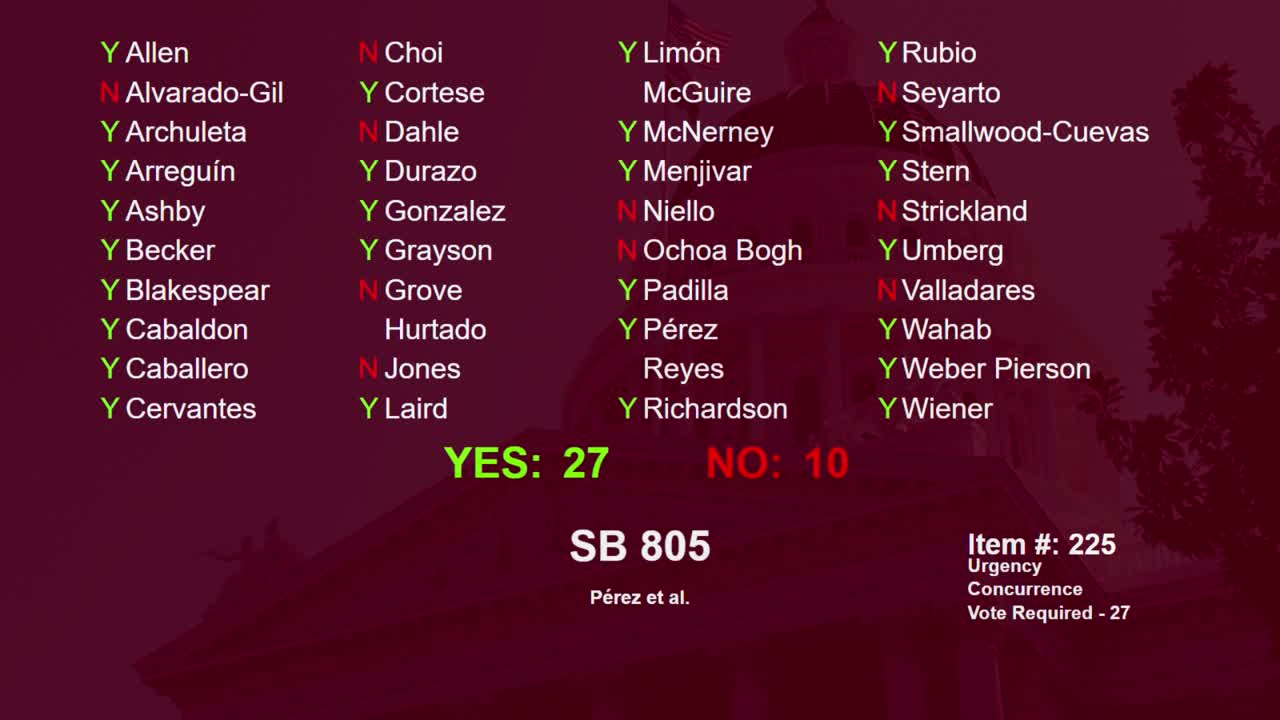
Bill Author

Bill Co-Author(s):